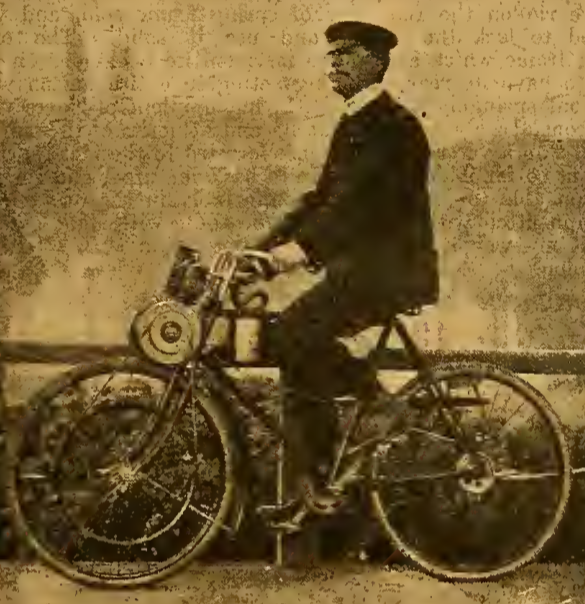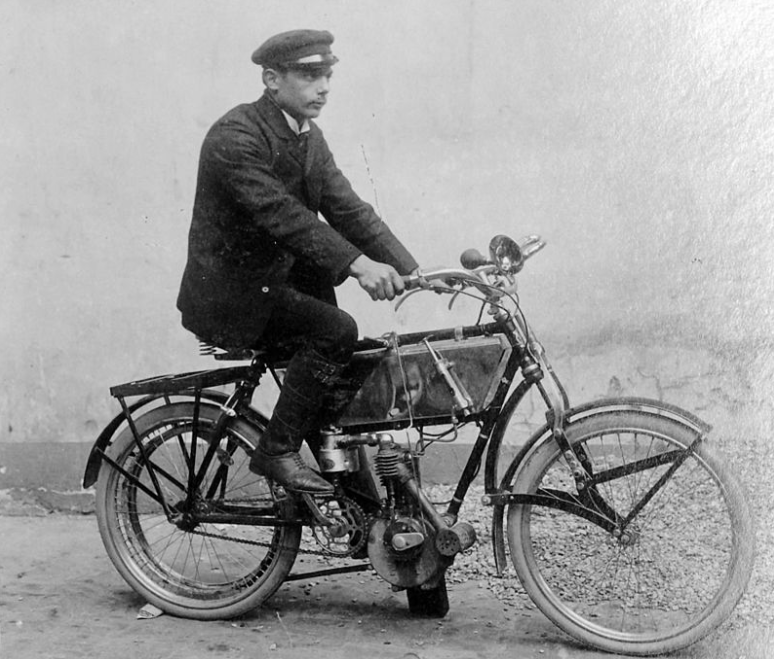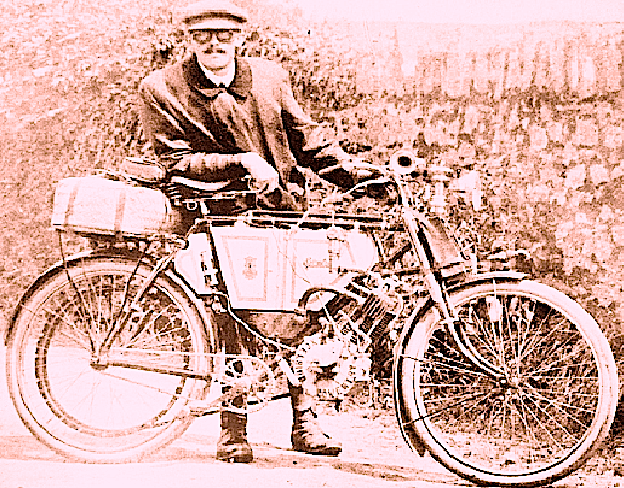
Race reports from Brummagen, Brighton and London…a 46sec flying kilometre at Lyon aboard a 5hp Perfecta trike…should racers be allowed to pedal?…a note on motor cycling in Japan…Alpine touring on a Derby and a Trent…checking platinum points with aqua fortis…a revamped Starley…timely advice on protecting your battery with fuse wire…enthusiasts abound on what would become the A1, A3 and A23…Italy decides motor cyclists don’t need to take a test…and Marconi revealed as a motor cyclist. All this and much more await your attention in 1902.
“The human form divine. MOTIST: ‘By St Petrol and all that’s puncturable, what must he look like when they’re pumped up hard?’ HUNTIST: ‘Gwacious! What have we found? Paw beggah looks cold!’”
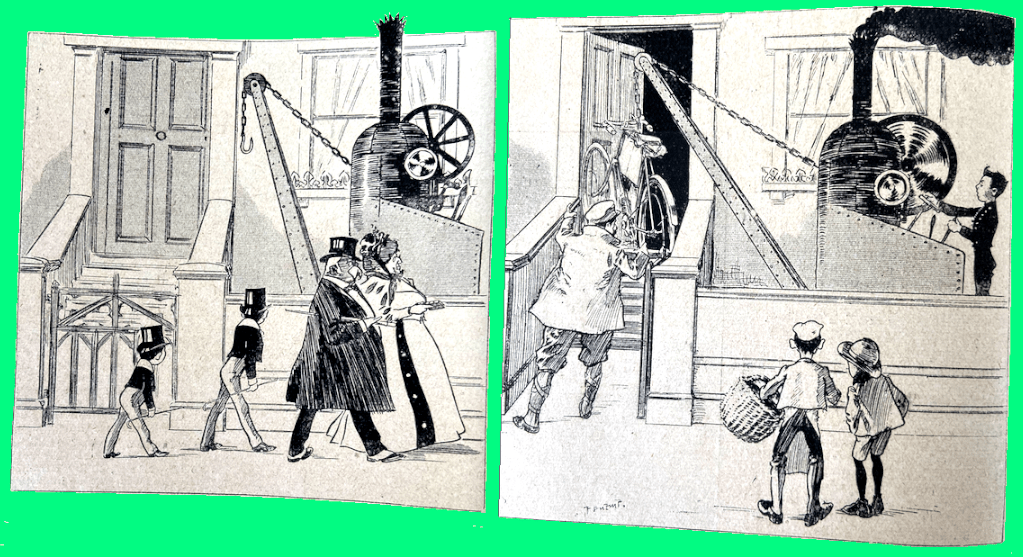
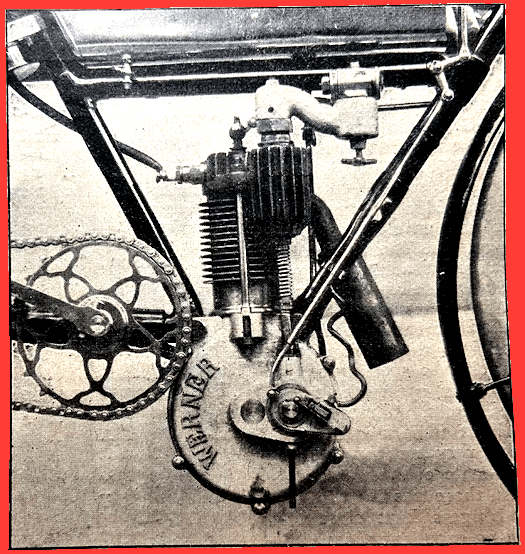
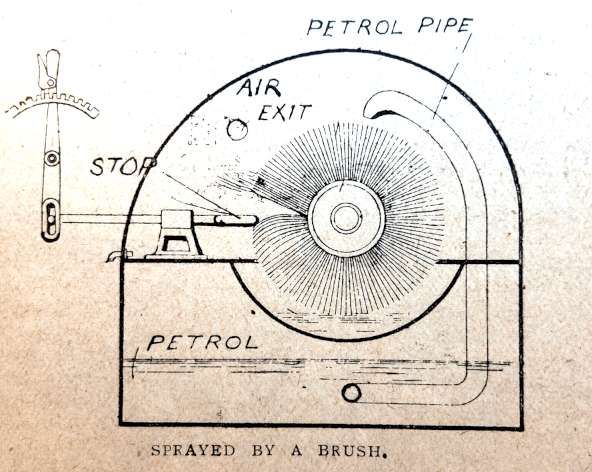
“The first race meeting in England confined to purely motor bicycles”—read all about it in 1902. There are also warnings to heed: wrapping your legs in brown paper will make you rustle—and take care when handling petrol “which to the observer appears about as harmless as water”. Plus news of a carb incorporating a spinning brush in place of jets; a two-speed gearbox; a folding teak paddock stand; a poem lauding bio-fuel (“It’s my artichokes and turmuts What’s a-driving that there car!”; a 65mph record; and a petrol/electric hybrid. And don’t miss my favourite caption of 1902 (thus far): “Feeding on a big bun.”
Carb designers—don’t bother with jets…switch to a brush!
Another batch of American iron has been added to the Melange; you’ll find them under their respective logos. And a good number of assorted snaps await your attention in the second melange. Meanwhile in 1902 you’ll find a report on the race meeting that was held during the Crystal Palace show—the sketches that illustrate the report are well worth a look.
“In a quiet corner. Westlake’s peculiar position. Tessier.”
If you’re reading this you’ve probably read any number of motor cycle magazines, packed with readers’ letters, new product pages, bike launches, technical advice features, show reports and the like. If you’d care to take a look at 1902 you’ll find the first letter to be published in a bike mag (you’ll recognise the writer’s name). You’ll also find handy tips (sound advice to keep your hands off the engine and use fresh petrol); new products (starting with a ‘catalytic plug’); a new model (from Precision) and a show report (from Crystal Palace). There’s also a series of delightful yarns along the lines of “aren’t these new-fangled motor bicycles BRILLIANT!’. Which, you’ll agree, they are.
“J Van Hooydonk. Specially photographed for Motor Cycling Mr van Hooydonk is depicted rigged out and with his motor bicycle in trim for the 200-mile non-stop run on the Crystal Palace track during the Motor Show.”
Before there was electronic ignition there were coils. Before coils there were magnetos. And before there magnetos there were…coils which trembled. And before tremblers there were hot tubes that combined with top-heavy bikes to make fires a daily hazard. Motor Cycling set out to introduce the first generation of motor cyclists to the intricacies of ignition systems. [Sorry about the ‘ohm’ pun, by the way, it’s 3.30am, I’m way past my best and I couldn’t resist it.
This isn’t any old wiring diagram, this is the first wiring diagram to be published in a motor cycle magazine. And yes, as indicated by the arrows (and as I vaguely recall from my Grade 6 General Science O-level) electrons actually move through from the negative terminal of a battery to the positive.
OK so I’m currently concentrating on 1902, but I was delighted to come across an 1898 essay in The Cycle Age And Trade Review reviewing the motor-cycle market since 1895. I stuck it at the top of the year so it’s easy to find. Well worth a look.
State-of-the-art motor cycling circa 1898—the top-heavy Werner was inclined to fall over, at which point its hot-tube ignition would invariably burst into flames. Not for the faint-hearted.
You’ll find the first features culled from the first volume of Motor Cycling, starting with a column justifying the idea of a specialised magazine for motorised bicycles and, unsurprisingly, an article extolling the virtues of motor cycling. I’m now summarising a yarn predicated on the need to make motor cycles lighter and simpler. Plus ça change, plus c’est la même chose, n’est ce pas?
The review of 1932 is, for now, just about complete apart from a few pics and some more ads. I’ve been busy adding pics up to and including the Great War and making a start on the hundreds of pics awaiting publications dans Le Melange (merci Francois). And, inevitably, I’ve been planning to move on to 1933—but not yet awhile. First, looking for caption material on one of Francois’ pics, I came across a lengthy report on the 1905 “Tour de France pour motocyclettes”. Then, in on old issue of the Association of Pioneer Motorcyclists excellent journal I found a smashing review of the motor cycling scene culled from an 1898 American cyclists’ magazine. Fair enough, a couple days’ work and back, or forward, to 1933. Thing is, late April brings the annual Stafford classic bike show, which features a Bonhams auction of motor cycle treasures. No harm in a little window shopping, I thought; why not press my nose against the window of the auction website? Which is how come I’ve just spent the kids’ inheritance on four volumes of Motor Cycling, covering 1902-4. Never one to fight temptation I’ve turned my back on the ’30s—for as long as it takes the timeline will be strictly Edwardian (apart from batches of Francois’ pics of course). Excited? I’m positively tremulous.
Giuppone on the Peugeot he rode to second place in the 1905 Tour de France.
Finally, I’ve made a start on 1932. The first big trial the year was the snowbound Colmore Cup; you’ll find a report and pics, along with coverage of the TT (Stanley Woods did the double), the ISDT (Britain did the double), the Senior Manx Grand Prix (the wettest Manx race on record) and the Southport sand races (which sorted out which marque was top dog). There are a number of new models including, shock/horror, a Douglas single. I’ve also started on the backlog of pics received from my amigo Francois, starting with some wonderful images from 1896, 1898 and 1900.
“The enclosure of the engine, and the deep tank and large brakes, give the new 150cc Douglas an extremely pleasing appearance.”
Yes, I know, it’s time to press on with a review of 1932. But no sooner had I finished a hugely enjoyable excursion back to 1904 than I came across some fascinating details of the first TT. If you’d care to take a gander at the updated ‘first TT’ feature in (when else?) 1907, you’ll find a detailed post-race report courtesy of the Blue ‘Un’s ‘special correspondent’ and a forgotten footnote of history—it seems Rem Fowler never got his trophy. Fortunately his clubmates rallied round with a rather fine silver hip flask that’s been bought for £25,000 and is now safe in Manxland. As soon as I’ve uploaded another batch of pics to the Melange and sorted out some extra stories that have come to hand from 1930 I really will get to grips with 1932.
Rem Fowler, wearing the spare inner tube he would fit during the race, pictured with James Norton. This being the Tourist Trophy, the Norton is equipped with mudguards, registration plate and horn. After the event James claimed half of Rem’s prize money.