ROADTEST: 192cc LE VELOCETTE TWIN
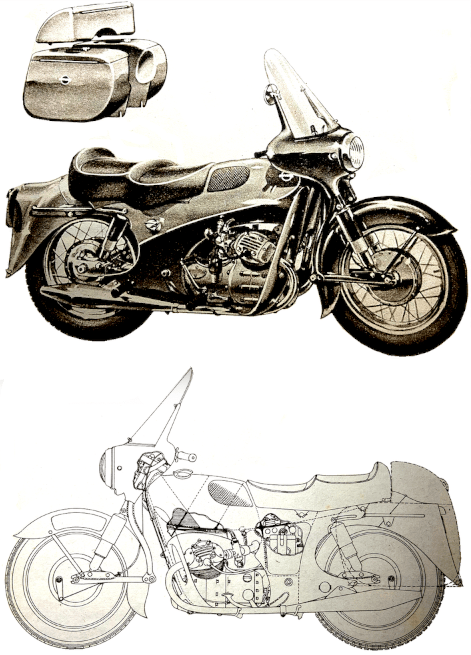
“WITH ITS PEERLESS STANDARD of mechanical and exhaust quietness, its smoothness and flexibility, the LE Velocette is unique the world over. Yet these are only some of its attributes—to them must be added a high degree of weather protection and comfort for the rider, cleanliness, economy and a performance in keeping with the purpose for which the machine is intended. But undoubtedly the Velocette’s greatest charm lies in the fact that no matter how hard the driving methods employed, the machine gives of its best in the most gentlemanly and unobtrusive manner. Although it has been on the market since 1948, and there are many examples now on the roads, the model continues to evoke the interested glances of pedestrians, mainly, one assumes, because of its discreet manners. Mechanical noise from the LE is all but non-existent, and even on fast tick-over with the machine stationary, it is audible only as a low-pitched whirr. At speeds over 20mph in top gear the exhaust could barely be heard by a rider normally seated in the saddle; under conditions of brisk acceleration in the lower gears, the exhaust was apparent only as a well-modulated and unostentatious hum. There was no induction noise, and no whine from the gear box irrespective of which ratio was in engagement. A plate fitted to the inside of the tool-compartment lid advises a speed of 50mph as the maximum commensurate with long engine life. But with an indicated 50mph sustained for mile after mile of undulating road, the engine was at all times felt to be working well within its limits. Power delivery at this speed (and, indeed, at higher speeds) possessed a turbine-like quality. No oil leaks occurred and there were never any signs of overheating. Hi11-climbing was good and, at medium engine speeds in top gear, power was well sustained. It was seldom necessary to use the well-chosen second gear on average main-road hills. In congested traffic further admirable qualities obtruded. Speeds as low as 15mph were practicable in top gear. When the throttle was opened quickly at these speeds there was no trace of pinking and the engine responded readily. On the other hand, in first and second gears the LE possessed a turn of acceleration which was surprisingly brisk. Whether in busy city streets or on the open highway, the LE was a delight to handle. From a mere trickle right up to maximum speed, straight-ahead steering was above reproach. On corners and bends the machine could be heeled over to a degree that was limited only by the width across the base of the legshields. While traversing slippery—sometimes icy—surfaces, the impression was gained that the machine possessed stability far and away beyond that normally expected from a single-track vehicle. The capacity of the front and rear suspensions to absorb road shocks furnished a smooth and comfortable ride over every type of road surface encountered during the test. Speedy traversal of uneven stone setts, sunken manhole covers and the like, on no
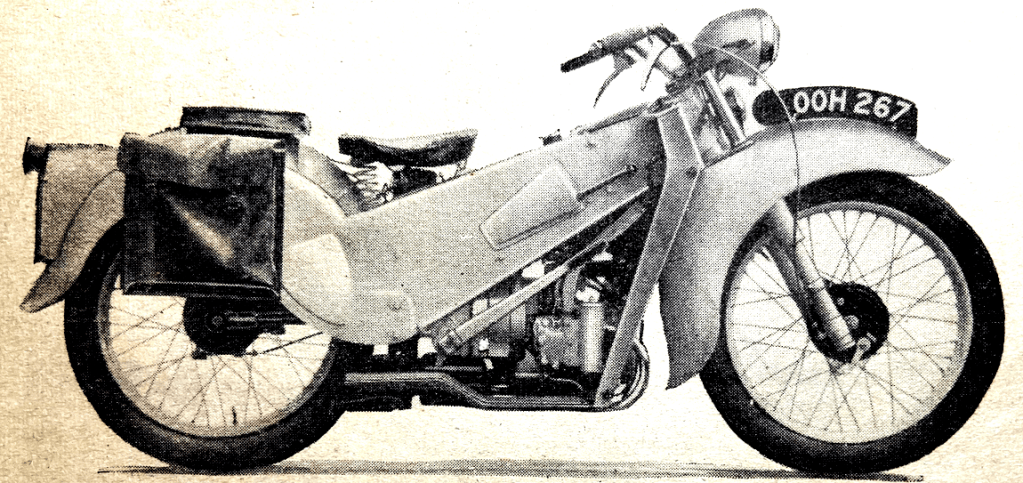
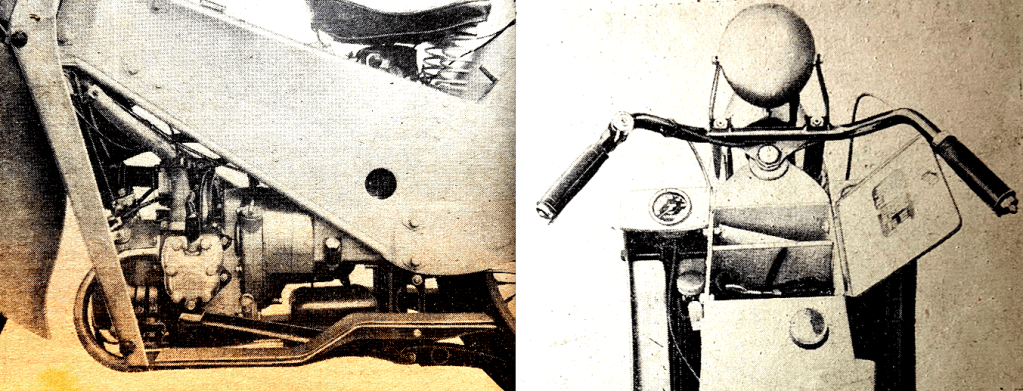
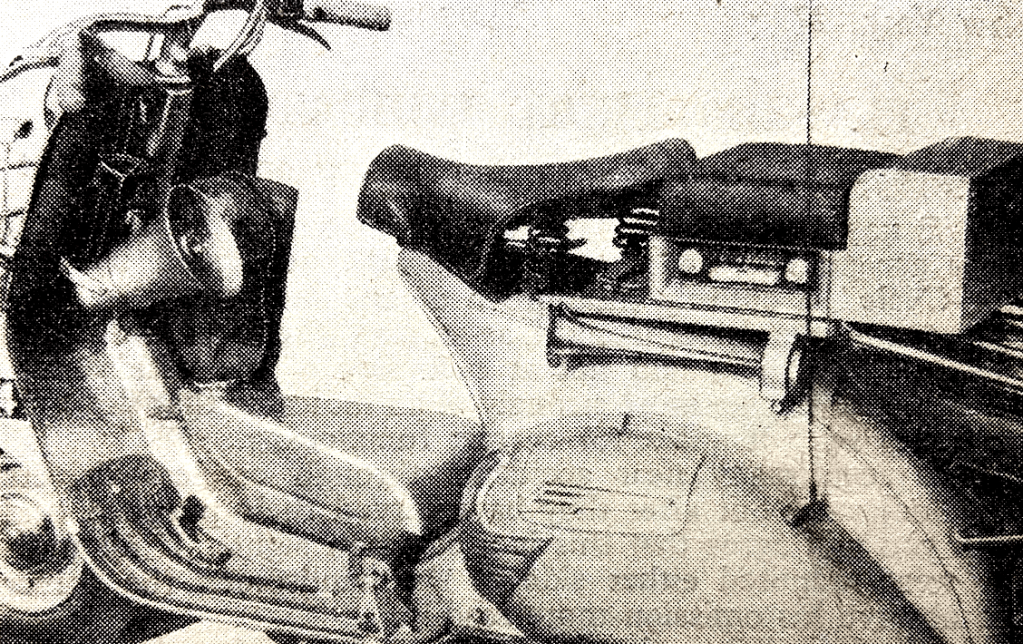
occasion jarred the rider or caused bottoming of the suspension. Nor did it deflect the machine from the rider’s chosen line. The rear springing is readily adjustable to suit varying loads. The riding position is compact but completely comfortable for a person of average stature. Saddle height is fairly low in relation both to the ground and the handlebar, so that one sits in, rather than on, the machine. Use of the sloping portions towards the rear of the footboards provided a comfortable position for the rider’s feet. Hand-operated controls and the rear-brake pedal were excellently placed for ease of operation. The forward-facing horn produced a penetrating note. Mounted in a panel at the top of the left-hand legshield, the-speedometer was easily read; it registered fast by approximately 1mph at 30, 2mph at 40 and 3mph at 50. Starting the engine from cold was simple in the extreme. After the petrol and ignition had been switched on and the starting control on the carburettor pulled outward, it was necessary only to give a couple of light upward pulls on the starting handle. When the engine had been running for something less than half a minute the carburettor control could be safely pushed in again. To start the engine when it was warm one pull on the starting handle always produced the desired result. A minor criticism was that the petrol tap was not too easy to operate since it is shrouded by the panel enclosing the tanks. The ignition key can be withdrawn when the switch is in the ‘off’ or ‘parking lights’ position and removal of the key renders the switch inoperative. Incorporated in the switch is an emergency position which enables the engine to be started irrespective of the state of the battery. To achieve a start under these conditions it is necessary to engage bottom or second gear and make a push start—during the course of the test, it was not found necessary to push the model at more than a fast walking pace. When the engine had warmed, idling was slow, even and reliable, and carburation clean throughout the throttle range. Gear changing is effected by means of a hand lever operating in a simple ‘gate’. Clean, sweet gear changes could be readily accomplished, and neutral was easily selected from any gear. Light in operation, the clutch took up the drive smoothly and progressively. Used in unison, the brakes were a joy to operate and provided stopping power well in advance of that normally required. The braking figure of 34 feet was obtained on a wet surface; on a dry surface, it was felt, the figure would be below 30 feet. Conditions were also unfavourable when other performance data were obtained, and a cross wind is considered to have reduced the mean maximum speed figure by about 2mph. The combination of legshields and footboards rendered the use of waterproof leg coverings unnecessary except in very heavy rain. The centre-stand could be operated with the minimum of effort and was completely reliable, even when in use on steeply cambered surfaces. Other features which appealed were the tool and glove compartments incorporated in the tank top and the built-in pannier bags. A comprehensive tool kit is provided. Finished in grey, the model is, by virtue of its styling, easy to clean. Thanks to the adequate mudguarding and the leg-shields, the machine, to a large extent, keeps itself clean. To sum up, the LE Velocette proved an economical, multi-purpose machine which should satisfy the tastes of a great many discerning riders.” Specifications: Engine, 192cc, unit-construction, water-cooled sidevalve flat twin; transmission, three-speed, hand-operated with lever on right of the frame pressing; petrol consumption, 82mpg at 50mpg, 90mpg at 40mph, 109mpg at 30mph; petrol capacity, 1¼gal; top speed, 56mph.
“FREEDOM ON THREE WHEELS: The title may sound a little dramatic, but it does not exaggerate the feelings expressed to me by one who, after more than 40 years of dependence on others for transport, realised the possibilities of a suitably modified sidecar outfit and thereby secured the freedom of the road. The man concerned is TA Greenhalgh, a well-known radio and television engineer of Manchester, who lives some 15 miles out on the border of the Peak District. Mr Greenhalgh has been handicapped throughout life by the effect of infantile paralysis contracted 46 years ago. Walking, even with sticks or crutches, has always been a conscious effort and a somewhat painful process. It was only some three years ago that the idea of using a motor cycle and sidecar was considered; a car in any event was out of the question owing to insurance difficulties arising from the particular disability involved. Mr Greenhalgh first selected a Corgi with box sidecar. The outfit was used locally for training purposes and the driving test was successfully passed. Disabled drivers do not usually have much difficulty in passing the driving test because they tackle the job very seriously; they are failed more often than not on inability to start their machines in reason-ably quick time, a matter which may appear to be of little consequence until it is related to an involuntary engine stoppage in dense traffic. The Corgi was found to be excellent within its limitations but prone to sidecar-wheel lift if driven with abandon. To obtain mastery in all circumstances Mr Greenhalgh deliberately practised lifting the wheel until the outfit could be driven continuously with the box up. The Corgi is still cherished as a reserve mount, but something more ambitious was required; accordingly a 197cc Francis-Barnett with Watsonian box sidecar was purchased. The pulling-power of the Villiers engine at low speeds and the general handleability were first rate. Controls had to be modified for hand operation and they were not altogether perfect. Braking, gear changing and starting all have to be done by hand. Under certain conditions this Francis-Barnett was also sensitive to sidecar-wheel lift and a heavier outfit was decided on. After a good deal of thought a Sunbeam S7 outfit was ordered through EW Bowers of Chapel-en-le-Frith. It was specified that it should have hand control throughout and that a sidecar-wheel brake should be fitted. Some of the modifications were carried out by the Sunbeam experimental department before delivery of the outfit to EW Bowers, who completed the necessary work. The low compression ratio of the Sunbeam engine was a deciding factor in its choice. Where a physical handicap exists, starting by personal effort is always likely to be troublesome. The substitution of a long hand lever for the kick-starter pedal is seemingly all that is necessary in this case, but it must not be overlooked that the weight of the body cannot be swung into pulling a lever upward as it can into forcing a pedal downward. In the case of the Sunbeam, however, cold starting has not presented any great problem given a preliminary flood of the carburetter and not more than two suck-in pulls before switching on; plug gaps must be correctly maintained and the plugs must be kept clean. If the throttle setting is just so, the engine fires on the first starting pull. Restarting after a short stop with the engine hot is not always so reliable. Most times it starts first pull, but if it does not, subsequent effort involved may
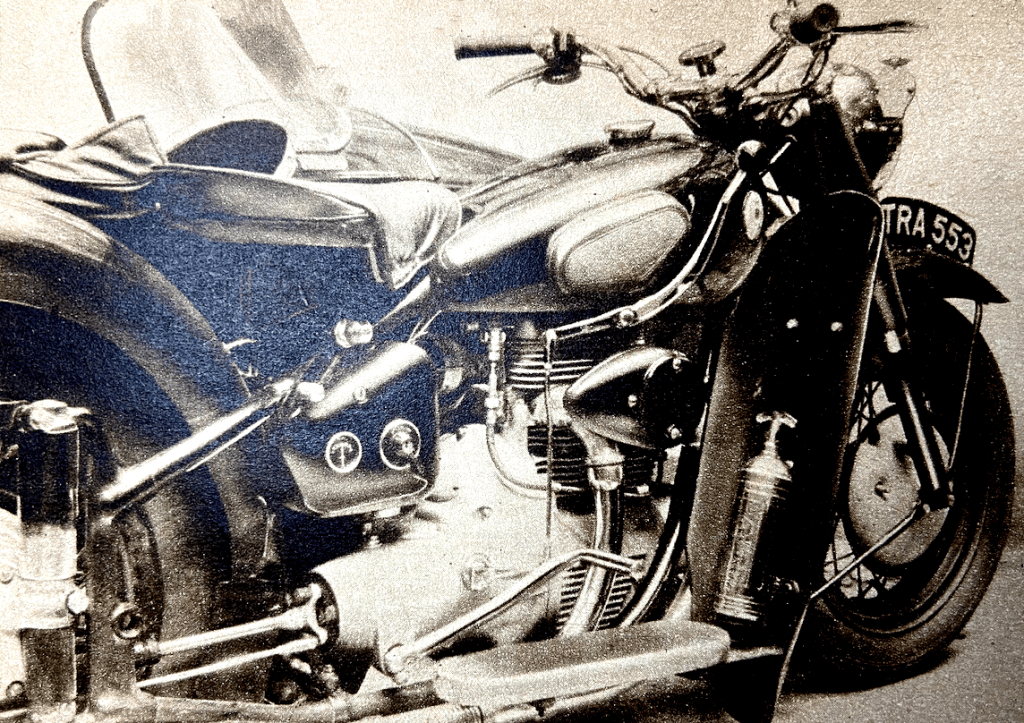
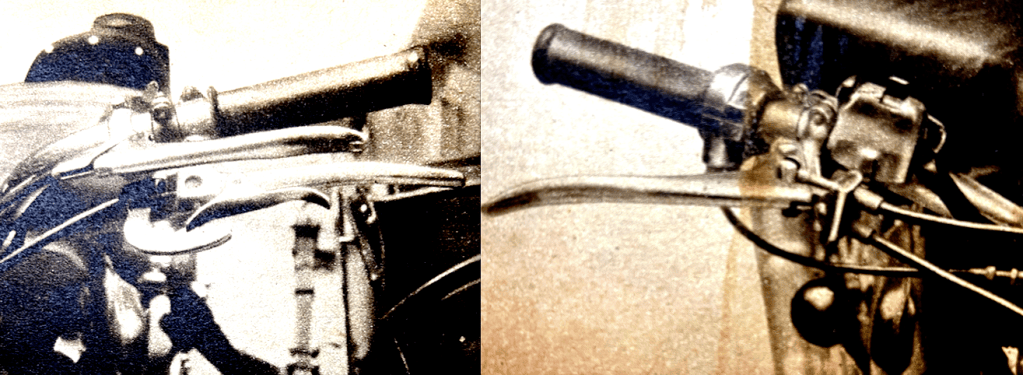
be considerable. This suggests a too-rich starting mixture, yet any attempt at weakening it leads to loss of good cold starting. Braking, particularly holding the machine during starting operations, was another major problem. Both the front and rear brakes are controlled from a single lever (of Triumph origin) on the right handlebar; the two cables are connected to a short balancing beam. Fortunately the owner has great strength in his hands and arms. Apart from its help, especially on a gradient, while starting, the sidecar brake is an important factor in driving. As the driver is not capable of any considerable amount of body swing, light application of the brake on the sidecar wheel provides the same effect as weight transference on left bends. The correct technique must be mastered, however, and the main lesson that has been learned is not to release the sidecar brake until the outfit has straightened out after the bend. The gear change is by lever mounted beside the tank on the right-hand side; the knob moves through a vertical arc. The lever is reminiscent of the hand control of the vintage Sunbeam era, although the action is quite different from the old quadrant arrangement with its progressive notching from one ratio to the next. The hand lever acts exactly as the pedal of the positive-stop type of control. In some respects the old form of hand change might be preferable, if only because of its visibly located neutral position. Special footboards were made up by Ferodo using non-slip friction material and the aluminium sections which are familiar in the surfaces and nose cappings of Ferodo bus-stair treads. The whole outfit was black enamelled, it being the colour most easily touched up when scratched—a point to be considered when crutches have to be swung aboard. When the outfit was delivered, Mr Greenhalgh spent an evening getting to know its peculiarities and next day, with his wife as passenger, started a 1,200-mile Devonshire tour, covering 200 miles per day for six days. Since then the outfit has made the daily journey of 15 miles each way into Manchester—a run which includes the rush-hour traffic, morning and evening, of both Manchester and Stockport. The control conversion has been entirely satisfactory, but the idea of applying electric starting is now being considered. Not that hand starting is difficult but, as Mr. Greenhalgh says: ‘Dismounting, getting out your crutches, and then reversing the whole process does not make you too popular with anyone waiting behind you, quite apart from the physical effort involved. It would be very nice just to take your seat and press a button.’ Whether electric starting can be adapted easily is a matter for investigation. If a suitable machine can be found, a dynamotor might be fitted in place of the existing dynamo. The alternative arrangement would be a normal starter motor with Bendix drive to a gear ring on the flywheel—a layout that would involve structural modification of the flywheel bell housing. A 12-volt installation would probably be necessary to keep down the size of the starter motor. Already a six-volt car battery is mounted in the sidecar.”—WHARFDALE
REPORT: BRUSSELS SHOW
“IN SPITE OF the fact that Belgium is a country of only about 8¾ million population, and has but a small national industry, there was much of interest at the 37th Salon which opened in Brussels last Saturday. As would be expected, many foreign-built machines were exhibited; no fewer than nine countries, including the USA, were represented. Full statistics for motor cycle sales during 1953 are not available but those for the first nine months indicate that, although Belgian production declined slightly, imports made a substantial increase. The countries making the biggest gains were Italy (mainly scooters), Holland and Germany; in the figures for Germany are included the many proprietary engines which are built into Belgian machines. The total number of foreign makes on display was about 60, of which 16 were British, 18 German and 10 Italian. There is no doubt that the German firms are making every effort to increase their export sales and, as the Frankfurt Show revealed, they are in the forefront of technical development and styling. The recent rapid increase in popularity of pivoted-fork rear suspension in Italy, Germany and Britain has its counterpart in Belgium. This type of springing is now featured on hitherto plunger-sprung models by the established manufacturers as
well as on one or two newcomers to the ranks. New examples were also to be seen of the pivoted, Earles-type front fork which, at the present rate of progress, seems destined to rival the telescopic design. After sitting on the fence for some years, the Belgian has apparently accepted the scooter as a means of locomotion. Not only were many Italian and a few German scooters imported during the past year but home output, from being nil in 1952, was nearly 800 machines in 1953. This is a small start but sales should increase considerably when production of the several new Belgian types gets into its stride. The moto carénée, or enclosed motor cycle, is gaining in popularity, and examples of varying degree of enclosure were displayed by the two best-known Belgian concerns. From the evidence at the Brussels Show, it seems that the semi-scooter variant of the moto carénée may become a dominant type. Such machines, with their reasonably large-diameter wheels (up to 16in rims), total enclosure and weather protection, seek to combine the advantages of both scooter and motor cycle. They appeal to the lady rider because, though not so open in lay-out as some scooters, they can still be mounted without throwing the leg over the saddle. In common with the Continental trend, Belgian cyclomoteurs almost all feature built-in engine units, usually of 50cc and with two speeds. Telescopic front forks are popular and rear suspension is on the way in—a design point for which the notorious pavé is doubtless responsible. A fair number of 500
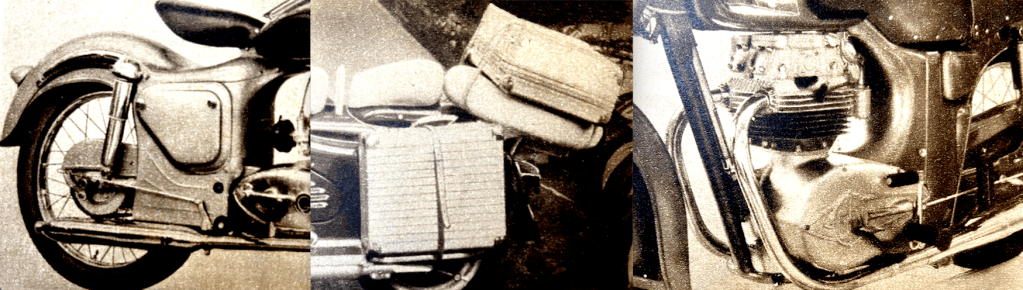
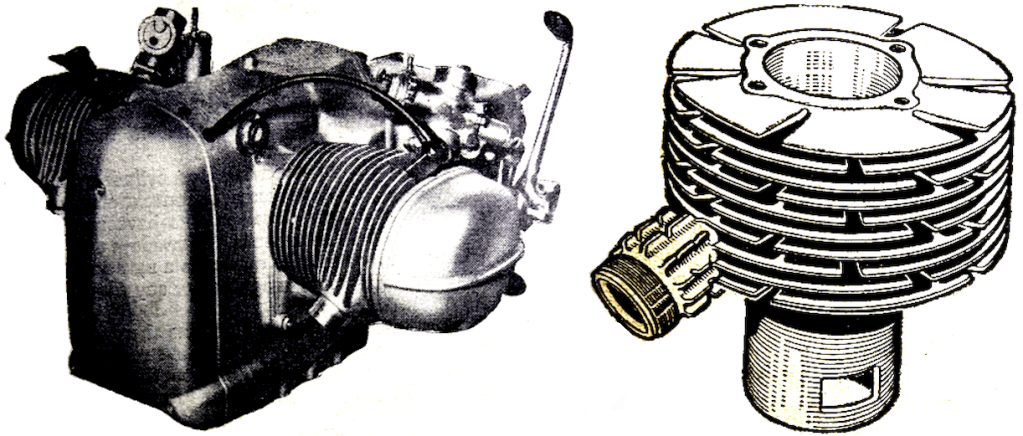
“Light-alloy suitcases on a Zündapp Bella provide ample luggage capacity for touring.” “Drive side of the sturdy engine-gear unit of the new 5OOcc FN twin.”
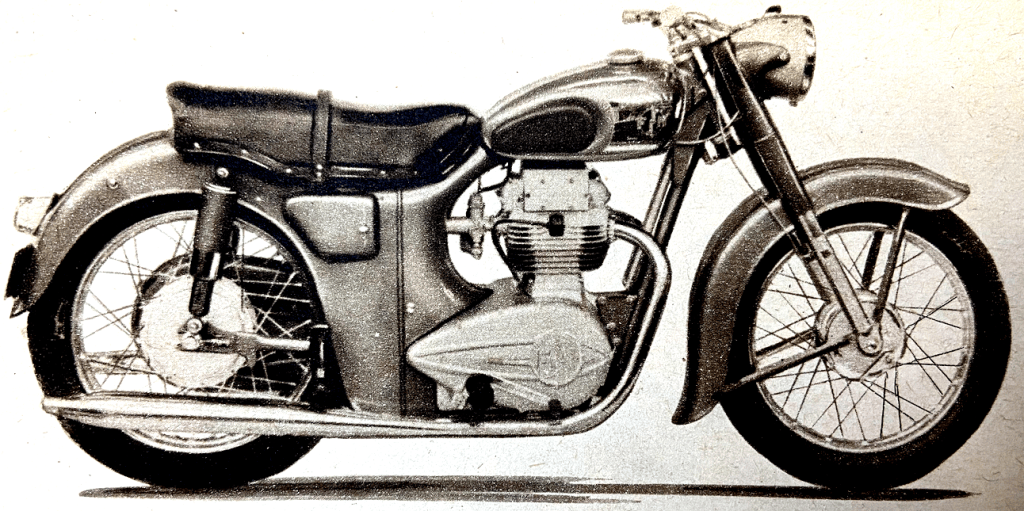
and 600cc Saroléa Atlantic parallel-twin machines has been produced. For 1954 a considerably improved version is to be built. Plunger rear suspension has given way to a neat pivoted-fork design which has adjustable Girling shock-absorber legs. Square-section tubing forms the sub-frame of the new suspension system, and the tubes are welded to the main frame; the fork has oval section, tubular arms and pivots between gusset plates welded to the sub-frame. Battery, filter and tools are enclosed in a large U-shaped box embracing the seat tube and filling the sub-frame loop, in a manner rather similar to that adopted for the Triumph Tigers. The horn is set into the toolbox lid. Other developments include a cast-aluminium primary chaincase, a dual-seat, a guard over the lower run of the rear chain, and a modified gear box which has a British-style pedal in place of the rocking pedal previously fitted. Last year Sarolea displayed a 200cc two-stroke moto carénée which this year is joined by a prototype of similar engine size but with improved enclosure and 3.00x17in tyres. The slim fuel tank is bounded in front by the continuous, full-width legshield panel which has louvres for engine cooling. Footboards are fitted, and there is a hinged panel on each side concealing the cylinder. Behind the tank, a well-curved rear cowling encloses much of the rear wheel and supports the dual-seat. The deep valance of the unsprung front mudguard extends outside the fork legs. One of the outstanding novelties of the Show is the prototype
500 vertical-twin FN which has valve operation by a single, chain-driven overhead camshaft. Crankcase and gear box form a massive unit of clean and symmetrical shape. Ignition components are entirely enclosed within the side covers, and the plug leads emerge from the case at the rear of the cylinder block. Since it was gathered that all the engine internals could not be completed in time for the Show, it is possible that the final layout will differ in some respects from the model exhibited. This interesting power unit is housed in an all-welded frame of composite construction, having a tubular front portion with gusset plates to brace the steering head. The rear section is composed of pressings which enclose air filter, tools and battery, and form a major part of the mudguard. Rear suspension is by pivoted fork. The upper ends of the spring legs are mounted directly to the guard, which is stiffened internally to take the loading. The rear chain is totally enclosed, and the rear-brake torque arm is unusual in that it embodies a left- and right-hand turn-buckle in the middle to allow for movement of the wheel relative to the case when adjusting the chain. A telescopic front fork is fitted, and both hubs are of full-width, light-alloy type. This pattern of hub is becoming as popular in Belgium as
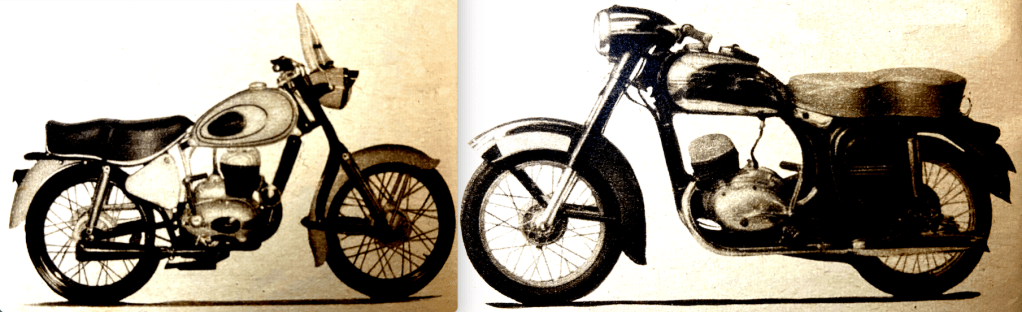
elsewhere on the Continent. German and Netherlands proprietary units were to be seen on a number of machines. One of last year’s highlights, the 175cc FN split-single two-stroke, is continued unchanged and its pivoted-fork rear springing has proved so successful that its use is being extended to other models in the famous range. Another convert to the pivoted fork is Gillet, who exhibit two new models so equipped. The latest suspension is part of a new frame which houses the established 200 and 250cc two-stroke engines. Following the modern trend, partial carénage neatly encloses the machine from just behind the engine to the rear of the sub-frame carrying the suspension legs. For several years the Belgians have been well to the fore in the realms of moto-cross; now interest in trials is rapidly increasing. First in the field to meet the demand for lightweight trials machines is Socovel who proudly display a very English-looking competition mount, powered by a 197cc Villiers engine and equipped with a flexible exhaust pipe. Socovel is also the concessionaire for CZ and Jawa motor cycles; as the import quota of complete machines is small, Socovel models are marketed with the Czechoslovak engine-gear units, as well as Villiers units. On the stand is a Jawa which has the 150cc CZ engine in a new frame with a pressed-steel rear portion reinforced by tubes, and pivoted-fork springing. The familiar square-section front down tube is retained and the rear chain is totally enclosed. A headlamp nacelle, very similar to
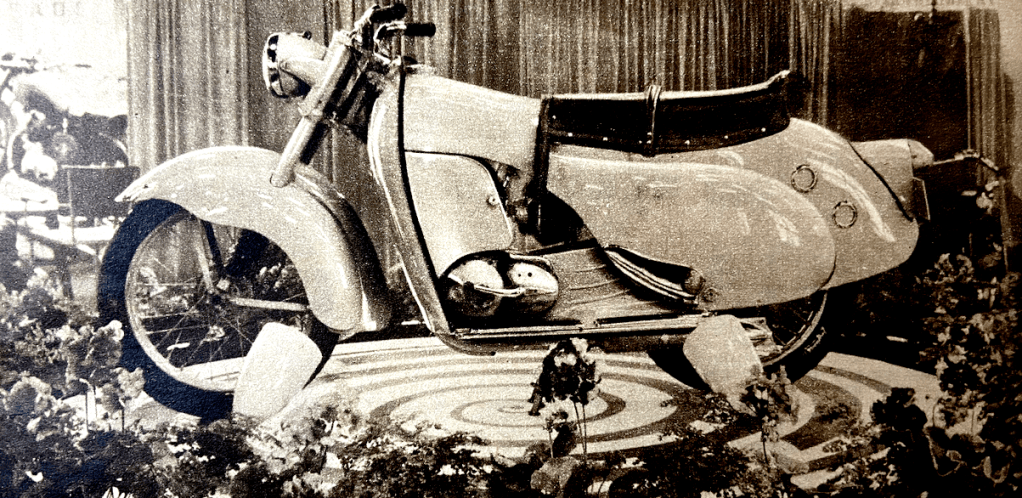
that on the larger Jawa, enhances the front-end appearance of this neat little machine. The clean lines of the new Villiers 1H engine clearly mark it as a desirable power unit, so it is not surprising to see it on three stands at Brussels: those of the Belgian Socovel and Novy, and the Dutch Hulsmann. These last two have Earles-type front forks of which the Novy’s is supplied by the British Reynolds concern and has Armstrong shock-absorbers. A telescopic fork is available as an alternative on the Novy, and both makes of machine have pivoted-fork rear suspension. On the Hulsmann, oval-section stanchion tubes are employed for the front fork which has a separate pivot on each side. An unusual feature of this model is the exhaust system: the engine cradle comprises two large-diameter tubes linked by a cross-tube, and the exhaust pipe from the cylinder feeds into the forward end of the left-hand tube; the corresponding end of the right-hand tube is blanked off. On the rear of each tube is mounted a silencer. It is claimed that the duplication of the silencers results in a very quiet exhaust, while also providing a balanced appearance. An interesting
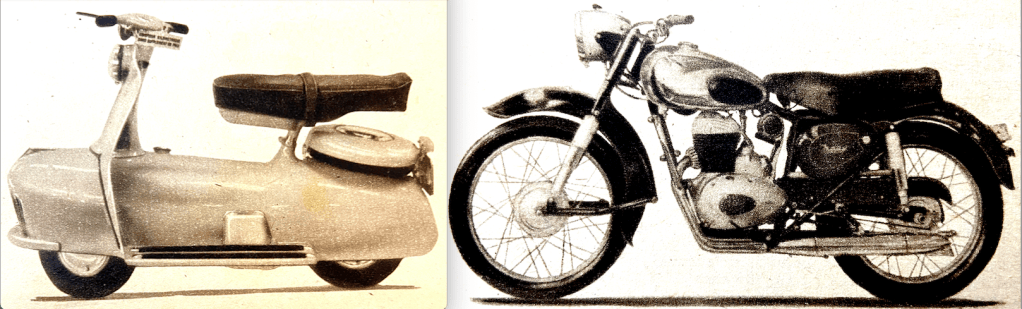
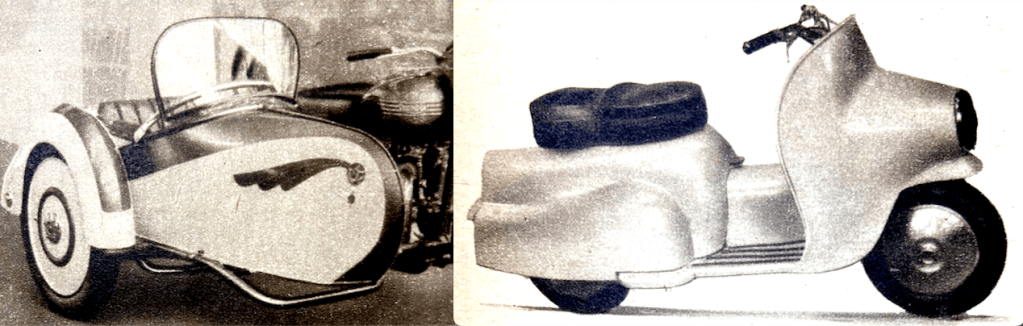
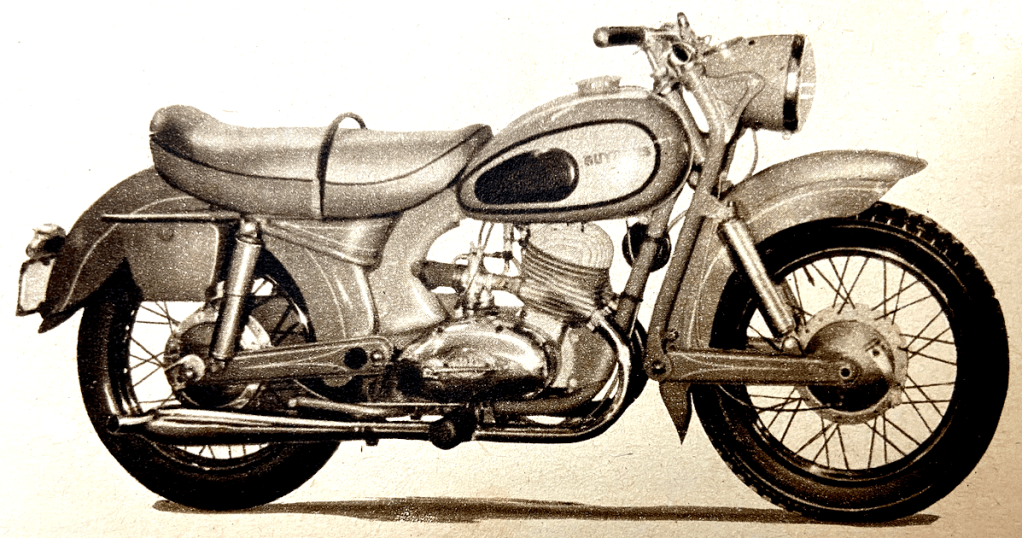
Belgian newcomer in the modern idiom is the Buydens, powered by a 174cc French Ydral engine-gear unit. Front and rear suspension is by pivoted fork, both forks being of fabricated, pressed-steel construction. Pressed steel is also employed for the enclosed centre-section of the frame, and for the rear chain case. The engine embodies a Gyrostarter, which operates on the lines of the aircraft inertia starter. Among the scooters are the ubiquitous Vespa and Lambretta, and several of the German models which appeared at the Frankfurt Show. Among the indigenous scooters is the Belgian Aldimi, a stylish 198cc model which is said to be already in production although on show for the first time. The palm for originality in scooter design, however, must go to the Italian-designed Piatti, shortly to be produced in Belgium after two years in prototype form. Though small and light, it is a highly practical vehicle and has obviously been designed in close conjunction with the production engineers. It has no separate frame—the low body is fabricated from pressings reinforced where necessary by stiffeners spot-welded into position. The power unit is a horizontal 125cc two-stroke with an engine-speed wet clutch. Transmission is by chain to a three-speed gear-box in the rear hub; the integral
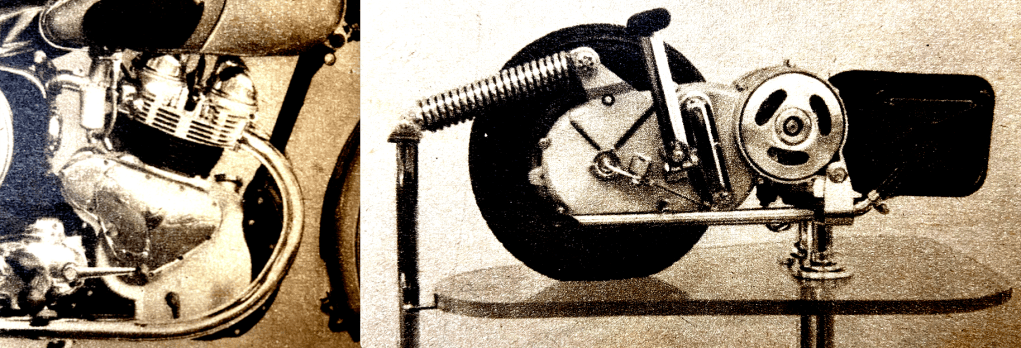
chaincase is of cast aluminium. The complete engine-transmission unit pivots about an axis below the crankcase; wheel movement is controlled by an adjustable tension spring. Front suspension, of the single, leading-link pattern, has an enclosed coil spring ahead of the wheel spindle. Since the body is of low build, the comfortable twin-seat is mounted in a pillar, bicycle-fashion, and has a height adjustment of several inches. Also adjustable for height, the handlebar has a central fairing embodying the speedometer and horn. Brake and clutch levers have extensions of hard plastic moulded on to metal pivot-portions. To avoid the necessity of detachable panels, and so to keep the structure as simple and robust as possible, the makers intend that the machine should be laid on its side for attention other than to the carburettor—there is a small trap door for access to this component. Costing 17,500 francs (about £127) complete with spare wheel, this fascinating little machine is below the average price for scooters in Belgium. Negotiations are proceeding for its manufacture in Britain; if the arrangements mature, it is hoped that the total price will be little over £100. The majority of the British machines on show impress by the excellence of workmanship and finish rather than by styling, though the latest Villiers 1H-powered lightweights challenge comparison with anything there. Two specially good displays featured BSA, Ariel and Sunbeam, and AJS, Matchless and James respectively. A Norton Dominator 88 has the misfortune to be wedded to a right-hand sidecar in such a manner that the machine could not be started or ridden with any degree of ease owing to the positioning of the sidecar connections. Two examples of the Oscar scooter are attracting considerable notice, and compare favourably in appearance with Continental productions.”
“RIDING KIT—NOTHING BETTER THAN SHINY BLACK RUBBER By gad, sir! Mrs Joan Thompson is right, and not only in regard to riding kit for her own sex [Mrs Thompson maintained that, for ladies, “…if kept clean, there is nothing smarter than a shiny black rubber coat worn with shiny black Wellingtons and jodhpurs and topped by a glossy black safety helmet…if a little colour is required then a gay woollen scarf may be wound around the neck”.—Ed] Well might most of us men give more thought to smartness. I agree with her that nothing looks better than shiny black rubber—unless it be leather, which few of us can now afford. During many years’ riding I have disproved the theory that rubber cracks and peels (it doesn’t if you buy only top quality material and treat it properly); nor does the blacking come off as I have sometimes heard said. Its outstanding merit is of course cleanliness, since it can be hosed down. What matter if we look like motor cyclists, provided we look clean? It is strange that among the many two-piece and one-piece suits that have lately appeared on the market, the well-made black rubber suit is hardly to be found. Though many stores keep black rubber trousers, seatless or with elastic tops, very, very few stock jackets to match. If anyone can tell me where to find a suit to compare with the pre-war Jupiter Suit, I shall be glad to know. One does not always want the bulk of a competition coat and waders, though these remain my favourite wet-weather attire.
‘Rubber-Dub-Dub’, London, EC2.”
“RIDING KIT THE BUTT OF COLLEAGUES’ WIT I use my motor cycle for travelling to work each day and, having discovered quite early in my experience that if the roads bear the slightest trace of moisture, it is only necessary to ride a matter of 20 yards before one’s ankles and legs are spattered with drops of filthy water, I have bought a pair of waders. This was a very wise step from a motor cycling point of view but a disastrous one from the social angle. On those mornings when I arrive at the office wearing coat and waders I am greeted with supposedly witty remarks from my friends such as ‘Going deep-sea fishing?’ or ‘Don’t forget the diver,’ or ‘First stop Dogger Bank.’ I have endured these remarks with patience and lost count of the number of times I have explained to my lay colleagues that bulky protective clothing is essential in winter. Recently, however, the departmental chief—a man of lofty intelligence and a Master of Arts—saw me and inquired when my attempt on the South Col was due to begin. Having been questioned on my supposed visits to the North Sea and now on my proposed mountaineering exploits, I am impelled to write and inquire if any other motor cyclists have to endure similar joking. I fully realise it is all meant in fun, but do these wise-cracks go on indefinitely? Can they be stopped only by one’s riding waderless until one catches pneumonia and thereby proves (in a rather risky fashion) that such utilitarian and graceless garments as waders are essential?
‘Rubber-Legs’ Acomb, York.”
“MPG—ECONOMICAL OHV SINGLE AND SIDECAR Recent letters on fuel consumption by sidecarists prompt me to express my own observations. What is the most suitable machine for sidecar work? I am beginning to wonder. I have watched all the famous twins of 500cc and upwards purring along in comparative quietness. I have seen the well-known side-valve models, and they always seem to ‘get there’. That both types of machine perform as intended there can be no doubt. However, from conversations with other sidecar enthusiasts, and from correspondence published in The Motor Cycle, it would appear that owners of 650cc twins and side-valve machines average between 50 and 60mpg. My first sidecar outfit, which I am now running, is powered by a 1952 500cc ohv M33 BSA. The sidecar is a Swallow Commando. My average fuel consumption for 1953 worked out at 77mpg. I climb hills (Dacre Bank 1 in 4), and can cruise at 55mph without difficulty. Unless readers can show me better figures my next machine will be another M33.
JC Gowdy, Sunderland.”
“LETTER FROM AMERICA—The Views of a Girl Rider: I wonder if you receive many letters from the United States? If so, do their writers despair as I do over the situation in this country? It is such a pleasure to read articles in your magazine, and be a vicarious partner to all the excitement, compatibility and warmth evident in the fraternity of motor cyclists in Great Britain. The attitude towards motor cycling over here in the US is quite different. It is a commonly held belief that only no-good, foolhardy, dare-devil troublemakers ride motor cycles. Many people are horrified at the mention of a motor cycle; then they joke, and try to dissuade prospective buyers from ‘the ridiculous idea’ of buying one. A movie has just been-released in this country called The Wild One. Starring Marlon Brando, it shows the general American conception of motor cycles and their riders—more chrome than on Cadillacs, shinier leather and more zippers than on a portfolio, and plenty of outrageous hoodlum character. It is true that some Harley-Davidsons are painted bright green or mauve, with fancy doodahs hanging from everywhere. But there is an increasing number of English and European machines around, in good condition and taste. I used to ride my Triumph Speed Twin to the museum where I taught last year. But few people ever consider motor cycles as transportation. This situation is pathetic. If the United States tariff on foreign machines were reduced (or obliterated, hooray!), perhaps more low-priced and better-built machines could be introduced to the American public, and some of the prevailing prejudice could be vanquished. In the meantime, I can’t wait to get over to England some day, to shop around for a machine and accessories, talk to fellow-riders—and not be hooted at.
‘Disgusted New Yorker’, New York, 27.”
FROM A LENGTHY touring yarn set in “the land of lonely sierras and dark-eyed senoritas”: “The bull-ring at Ventes is a massive affair, and the crowd of people there on a Sunday evening is not dissimilar from that at a Wembley cup-final. Bull-fighting is not, as many people imagine, just a matter of killing the bull in any old way. It is a fine art which demands from the artist a latent ability developed into something which makes him stand out from among his fellow men, especially to those who have trained themselves to appreciate the finer points of the artist’s work. The matador, lithe as a snake, then motionless, goes through a series of antics until, poised like a ballet-dancer, he waits for the split second when the bull, thoroughly maddened, offers him the best opportunity; then, with a flash of steel, the lethal weapon sinks into the vital part of the bull’s body. If the artist is a good one, the end is quick and merciful; if he is not—well, Spanish bull-fighting enthusiasts are not the least bashful in showing their disapproval. Unlike our football enthusiast, the average Spaniard is initiated into the critical audience almost as soon as he can walk—and in many cases even before that.”
“MANUFACTURERS COMPETING IN classic road races guard the secret of their racing engines’ bhp as jealously as tigresses defend their cubs. But, according to the Parisian L’Equipe, their secrets are out. From a well-informed central European correspondent, the paper announces that the 500cc four-cylinder Moto-Guzzi develops 65.9bhp, the MV Agusta 63.375bhp and the Gilera 60.840. Where these figures come from or how accurate they are is anyone’s guess. But if they are correct it means that by exceeding 130bhp per litre with an unsupercharged engine, Moto-Guzzis have reached a signal landmark in the realm of internal-combustion engine design…The technical committee of the FIM has been discussing the possible abandonment of the 350 and 500cc classes. The Moto-Guzzi concern is rumoured to be developing a 500 single. Has it been decided at Mandello that the single will be more easily and more cheaply developed than the four, and good enough for the few years remaining to the class?”
“FUEL FOR SCRAMBLES It has been decided by the ACU Competitions Committee to standardise the regulations covering fuel for national and regional-restricted scrambles. In future only recognised pump fuels will be permitted, and no additives may be used to increase the octane rating. This regulation does not apply to Centre-restricted and closed scrambles, the organisers of which may specify any type of fuel.”
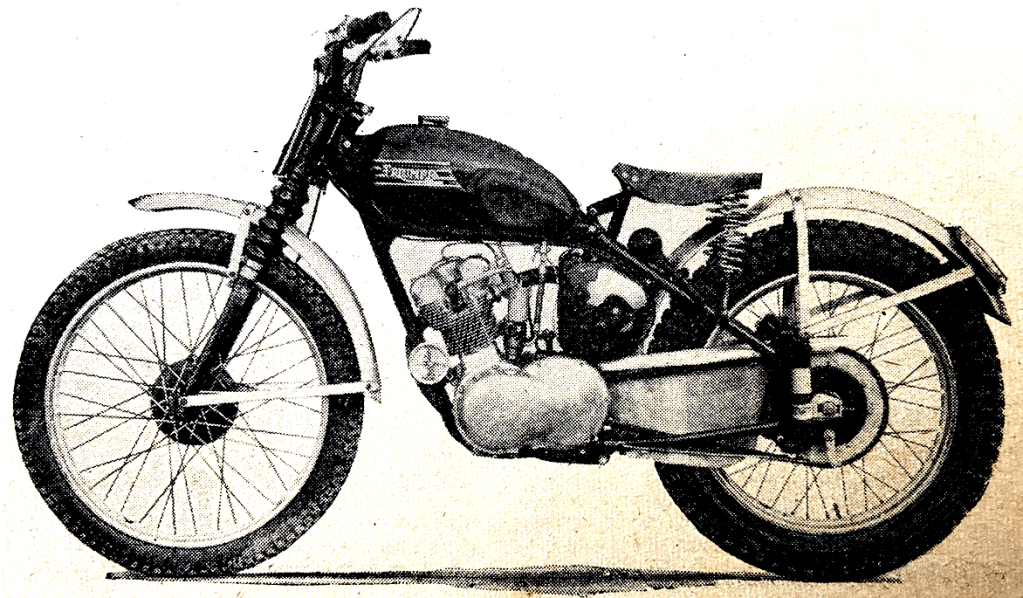
“MAKING ITS FIRST APPEARANCE in a national trial, the Triumph Terrier ridden by PH Alves in the St David’s Trial aroused considerable interest at the start and elsewhere. Basically a standard model, the Terrier is equipped with 21in-diameter front and 19in-diameter rear wheels and shod with 2.75in and 4.00in section tyres. The competition wheels and tyres, together with the Trophy mudguards, handlebar and upswept silencer, endow the machine with a decidedly businesslike appearance. An additional ground-clearance has been achieved by the fitting of the larger wheels. The complete machine tips the scales at 185lb, and it was obvious from its lively performance last Saturday that the power-to-weight ratio was excellent.”
“OVER A PERIOD of many years—indeed, as far back as pre-war—experiments have been conducted with butyl for inner tubes. In recent times, butyl tubes have been available in North America and on the Continent, but have not been marketed in Great Britain owing to the fact that the basic material had to be imported from North America. Certain imports were permitted, but only for the purpose of making tubes for export. The restrictions have now been eased, and a statement from Dunlops says that butyl tubes are now to be issued as original equipment for new vehicles, including motor cycles; later on, these tubes will be available for replacement purposes. It is not yet known how much butyl can be imported, but this factor will, of course, influence the speed of the changeover from natural rubber. Butyl is derived from petroleum gases and, unlike natural rubber, is not porous. Hence frequent ‘topping-up’ to maintain the recommended pressure is unnecessary. Although normal cold patching for puncture repairs is not usually satisfactory, vulcanising is perfectly practicable.”
“DURING 1953 the RAC approached highway authorities concerning 242 complaints on road conditions. Remedial measures were taken in 230 instances. An analysis shows that 55 complaints referred to lack of signposting, 26 to inadequate signposting, 79 referred to general dangerous road surfaces, and seven to lack of white lines or cat’s eyes; in the category of obstruction, 18 complaints referred to obscured visibility. This service through the RAC has been operated since 1946, and the procedure is that all road users are invited to provide information, irrespective of whether they are members of a club or not. Every complaint is investigated by RAC officers and, if considered justified, representations are then made to the highway authority concerned. During 1953 the number of reports was 20% lower than in 1952 and was the lowest for five years. The club is anxious to stimulate interest in this work and to encourage road users to lose no opportunity to get in touch where a complaint seems warranted in the interests of road safety.”
“I HAVE RECEIVED from Detroit a six-page letter from a quite fanatic admirer of ‘limey’ motor cycles, who rides at the moment a Squariel and an AJS scrambler model. His thrills have inspired him to burst into poetry. His epic is far too long to publish in full, but it describes how at last a motor cyclist went the way of all flesh. Having been a bad lad, he ultimately went downstairs, instead of upstairs. On arrival in the infernal regions he was astounded to find such familiar American amenities as a turnpike, a dirt track, and a drug store. The final verse tells how the full horror of his doom smote him: ‘The Devil now saw the time had arrived To tell the poor guy the fate he’d contrived; “There are no limey jobs here, however you So you can perceive why we call this place Hell.”‘”—IXION
“THAT WONDER MAGAZINE with the 4,000,000 circulation, the Saturday Evening Post, does not restrict its con-tents to boy-meets-girl fiction but regularly prints some very valuable motoring stuff. A recent article re-counted the whole story of traffic signals, and told me much that I did not know. They are, for example, a genuine economy. In the USA a pair of robot lamp pillars can be maintained for 142 years, working 24 hours a day, for the cost of one cop’s annual salary. Capital cost plus maintenance may be only half the cost of employing a point policeman. The ‘first ever’ is supposed to have been a kiosk erected in the Montmartre quarter of Paris in 1912. It consisted of a kiosk containing a gendarme, who manually operated a large rotatable wooden cube with two red and two white faces. The Parisian taxicabbies almost swooned when they first sighted it. But their reaction was instantaneous. They accelerated hard on perceiving the red flats, cocked snoots, blew Bronx cheers, and hissed ‘Cochon!‘ Copper, kiosk and cube lasted precisely three weeks. In 1913 semaphores appeared on the streets of Philadelphia. In 1914 electric lamps were introduced at Cleveland. The familiar green, amber, red sequences have had their funny side. Green being the colour dearest to Catholic Irish, with amber being suspiciously like the pet hue of Northern Orangemen, Paddy has always been liable to heave a rock at anything orange. At one time no robot standard lasted very long in the Irish quarter of some American cities if the orange was located above the green. It is said that in one or two such areas the robots are still designed to mount the green over the amber, Orangemen being presumably less touchy on such details. Robot lights must be hard on folk suffering from Daltonism (colour blindness), for they drive by the location of the discs, not by the tints, which they cannot easily identify.”—IXION
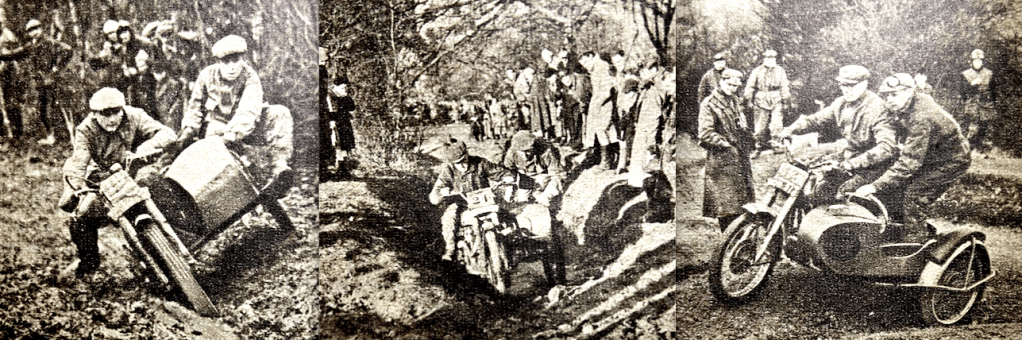
HELD LAST SATURDAY in fine weather, the national, sidecars-only DK Mansell Trial was won by AJ Humphries (490 Norton), with a loss of six marks. Two laps of a 22½-mile course had to be covered: Humphries lost his marks on the first lap by footing on two of the most difficult hills—Ashmeads and Rowden. Second time round he was clean on all sections, and thus beat by a slender margin of three marks WJ Stocker (499 Royal Enfield); like Humphries, Stocker had dropped six marks on the first lap, but he lost a further three on the second. Thirty-nine competitors assembled at the Bear Pools Cafe, Rodborough Common, Stroud, for the start of the event, the eighth in the series organised by the Birmingham 30 Club. Among the non-starters from the original entry of 45 were GL Buck and RGJ Watson; considerable disappointment was caused by the latter’s non-appearance, which deprived curious spectators of the opportunity of appreciating Eric Oliver’s talents as a passenger.”
“DURING 1952, A TOTAL OF 171,757 road accidents involving personal injury occurred in Great Britain. More than a quarter of a million vehicles were concerned; casualties exceeded 200,000, of which 4,706 were fatal; approximately 50,000 were serious and over 150,000 were slight. Casualties to motor cyclists numbered 33,099, including 957 fatalities, 10,781 serious injuries and 21,361 slight injuries. The figures for motor cycle passengers were 185 deaths, 2,533 serious injuries and 6,827 slight injuries.”
“IN THE FIRST 10 months of 1953 new registrations of vehicles in Western (Federal) Germany numbered 647,000, an increase of 8% over registrations in the corresponding period of 1952. Of the newly registered vehicles 52% were motor cycles. The growth in motor cycle registrations has been greater than that for any other type of vehicle, and the total number of motor cycles and similar-category vehicles registered in Western Germany at the end of October last year was 2,100,000.”
GERMAN DESIGN TRENDS
“WESTERN GERMAN POST-WAR motor-cycle production got under way in 1947. Then the standard of living was only just above the bare existence level. These circumstances conditioned the type of machines produced which were thus simple utility models. A comparison with the latest machines shows clearly how technical trends are related to living standards. The economic recovery of Federal Germany has been remarkable and has provided living standards which are regarded as bettered on the Continent only by those of Switzerland, Sweden and Belgium. As a result, the requirements of the German motor cyclist have altered considerably in the last few years. Owners changing their machines are no longer faithful to one particular make, but are nowadays considering technical specifications more closely in making their choice. The market-research departments of at least two leading German motor cycle manufacturers confirm that, up to about 1952, almost 65% of their machines went to customers who had used those particular makes for the previous two years. Now, slightly less than 25% of the buyers remain faithful. This remarkable revelation must be considered in the light that, while in pre-war days the average German owner kept his machine for five years, a period of two and a half to three years is now the common rule. The factors mentioned have obviously influenced trends of design, but other points should not be overlooked. High road taxation and insurance rates for cars and the high price of petrol in Germany have, in the last few years, largely increased the ranks of motor cyclists. Many people, including doctors and business men who, in Great Britain, would normally have a car, are in Germany using motor cycles or scooters. This fact explains why some 70% of German motor cyclists depend for repairs (and even
normal running adjustments) on workshops and garages. By the end of 1953 there were more than 2,126,000 motor cycles, auto-cycles and scooters registered in Germany, and the total output of the industry for 1953 was 437,500 machines. Both figures are records for Germany, and are higher than in any other country in the world. It follows, therefore, that German designers have had to bear in mind the need for easy professional servicing (cutting down labour costs when servicing reduces the charge to the customer), and for layouts which are suitable for big production. In some cases their designs take full advantage of the fact that high output warrants heavy tooling costs. The only trend typical of all German machines is that new models no longer appear as an accumulation of components, but as machines which have been styled as a whole. That is not to say that German manufacturers no longer employ proprietary components. Indeed, such items are being used in ever increasing quantities, but they are carefully and neatly blended into each particular design, which accounts for the clean and tidy appearance of the machines. Otherwise, the technical trends of the various makes are highly individualistic. Even the smaller manufacturers who specify proprietary power units in many cases have certain modifications incorporated in the units to suit their particular requirements. Most German manufacturers now separate their production programmes into three distinct fields: autocycles with an engine capacity not larger than 50cc, an all-up weight not exceeding 72lb and a wheel diameter of not less than 23in; scooters; and motor cycles. The particular class of autocycle described, which in Germany is known as ‘moped’ (coined from motor and pedal), is exempt from road tax and can be ridden by any person over 16 years of age; no driving licence is required, but third-party insurance is compulsory. The popularity of the moped can be judged from the facts that, although it was freed from licence duties only about 12 months ago, already nearly 38,000 have been produced and no fewer than 72 different models are marketed. Prices range from approximately £36
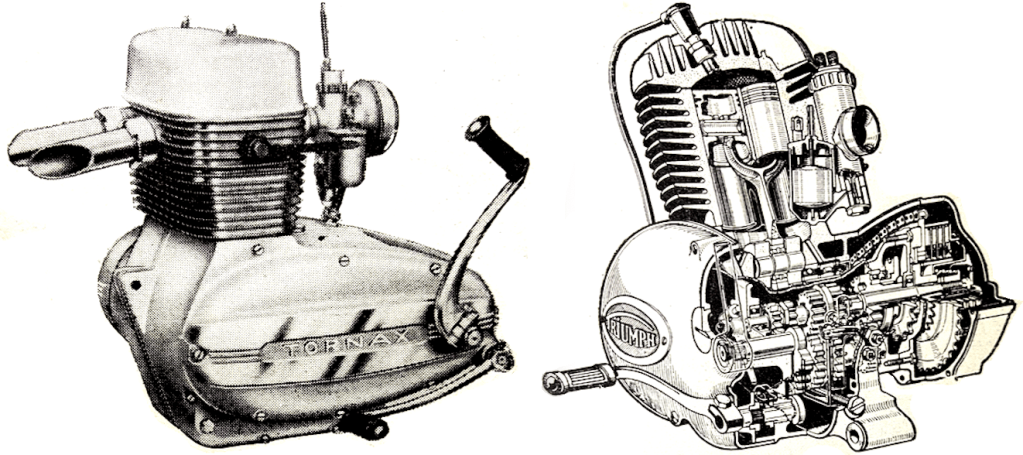
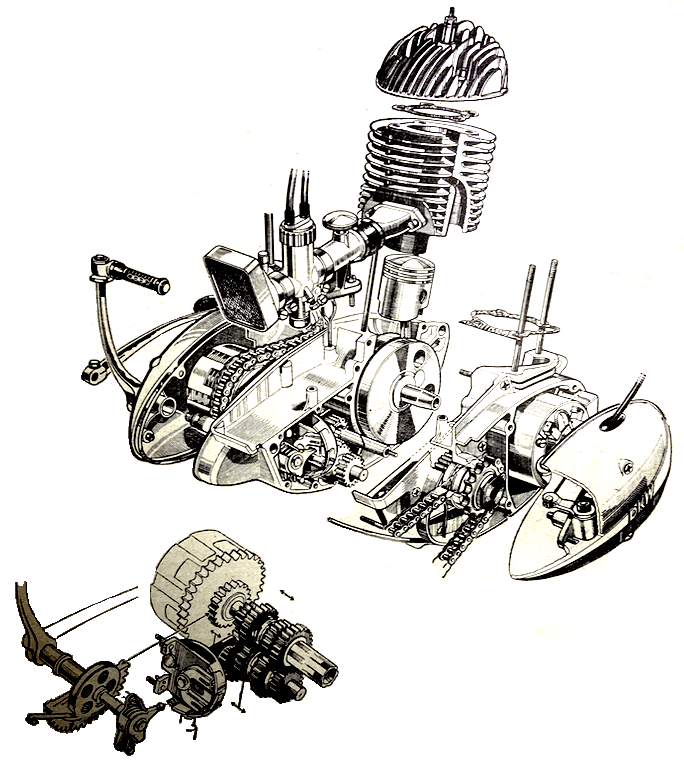
to £53. Although the NSU concern started production of its Quickly moped only last November, over 9,000 had been turned out by the end of the year, when it was announced that the expected output for the next five months had already been sold. The Quickly retails at about £47. No longer regarded in Germany as a passing phase, the scooter is gaining tremendously in popularity. At present no fewer than 26 different models are on the market at prices ranging from approximately £55 to £160. In 1952, 39,404 scooters were produced; last year the output was just over 70,000. The latter figure, and the fact that production of motor cycles dropped from 353,045 in 1952 to 331,018 in 1953, would seem to confirm the opinion of German manufacturers that many riders are turning from motor cycles to scooters. Of the 116 different models of motor cycle at present offered by the 24 German manufacturers, 99 are powered by two-stroke engines. Of the two-stroke models, 61 are equipped with proprietary engines—in most cases Ilo or Sachs. Although, outwardly, there appears to be little new in the two-stroke field, research and development work during the last two years has resulted in some remarkable performance characteristics. In order to obtain better scavenging, particular attention has been paid to the position and shape of the ports. In the latest German two-strokes the inlet and exhaust ports are very elongated in shape, except where dual carburettors are employed (as, for instance, in the case of the Zündapp 200cc Norma-Luxus and Elastic models, on which the dual intake ports are circular). The modified port layouts give a much more even gas flow, resulting in a smoother and more flexible performance throughout the speed range. Another notable development is the positioning of carburettors, even on single-cylinder two-strokes, farther away from the cylinders and the fitting of a section of non-metallic, heat-insulating material in the induction pipe or manifold. The long inlet manifold, of which that on the latest DKW RT 175 is a good example, ensures good integration of the mixture and uniform flow, and helps to eliminate any tendency to blow-back through the carburettor. The heat-insulating portion of the manifold results in a lower mixture temperature and hence improved volumetric efficiency. These factors have contributed to a considerable reduction in the specific fuel consumption. With the foregoing modifications to ports and induction tracts incorporated, a two-piston single resembles very closely the performance of the average two-stroke twin in the matter of flexibility and smooth power delivery, even though the split-single cannot, of course, reproduce the twin’s torque characteristics. While single-cylinder engines are employed almost exclusively for machines up to 175cc, double-piston singles or twin-cylinder power units now dominate the 200 and 250cc two-stroke
classes, and this also applies to the 350s and 400s. A remarkable two-stroke development is the 250cc TWN Duplex, a four-piston twin-cylinder power unit with twin carburettors and a three-bearing crankshaft which is claimed to develop approximately 14bhp at 5,000rpm. It is scheduled to go into quantity production next May. Further research and development work has been directed to finding the most suitable materials for cylinders, pistons and piston rings. Cylinder-material ranges from normal cast iron to light alloy with hard-chromium-plated bores; from forged or cast, plated or unplated, liners in light-alloy blocks to cast-iron liners permanently bonded to the alloy. Pistons in light alloy with steel ring carriers have given excellent results and are being employed in increasing numbers. Piston-ring material in many cases is matched to the material employed for the cylinder bore. Although the choice of materials for cylinders, pistons and piston rings is in some cases unconventional, almost without exception the new developments have resulted in much improved wear characteristics. Nowadays the owners of modern German two-strokes expect as a matter of course some 30,000 miles of normal usage before, any major engine overhaul becomes necessary. With a few notable exceptions, hitherto there have been no startling post-war developments of four-stroke engines in Germany, but there are now indications that further developments are likely in the not too distant future. For a time after the war the main interest was in more powerful machines, However, German manufacturers’ market- research departments have now established that the present demand is not so much for ultra-high speed in four-strokes as for machines capable of a good long-distance performance with a very full load. Surveys have shown that, on account of the usually favourable weather conditions in Germany from April to October, almost 50% of the users of four-stroke machines of 250cc and over regard a week-end trip of up to 400 miles as not unusual, and an annual holiday tour of 1,700 miles as normal. During the past year there has been a considerable gain in the popularity of 250cc four-stroke machines. Prior to 1953, the only German machine in that field available on the home market was the BMW R25/3. The 250cc Horex Regina was produced only for export—chiefly to Switzerland—and the 250cc Hoffmann transverse flat twin exhibited at Frankfurt in 1951 never reached the production stage. At the beginning, of last year the NSU-Max went into full production; 24,403machines were made by the end of December. During the year, the Horex Regina was made available for the home market, and last October the Frankfurt Show saw the introduction of no fewer than five new four-stroke 250s: Bauer and Zündapp showed examples fitted with engines of their own manufacture, while Express, Tornax and UT exhibited machines equipped with the ohc parallel twin designed by Richard Kuchen and manufactured by Opti-Werk; Hoffmann introduced a 300cc transverse flat twin. While little is known of the production plans of Bauer and Hoffmann, delivery of the new Zündapp is scheduled to begin next April. The 250cc Zündapp has a transverse, horizontally
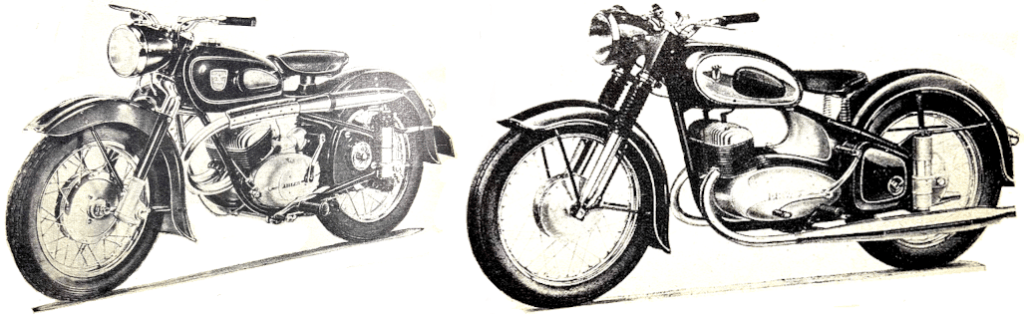
opposed, twin-cylinder ohv engine with a bore and stroke of 54mm and a compression ratio of 6.8 to 1. The unit is said to develop 18.5bhp at 7,000rpm. In some respects the new engine is similar to the well-known 600cc Zündapp KS601. For instance, the big ends are equipped with needle-roller bearings. To the forward end of the three-bearing crankshaft is attached the armature shaft of a DC dynamo. A four-speed gear box is flange-fitted to the rear of the crankcase, and the drive is through a large-diameter, single-plate, car-type clutch. The transmission medium within the gear box consists of duplex roller chains. Final drive is by shaft. In the realm of larger-capacity four-strokes, it is interesting that Horex, whose 350cc single and 500cc twin are already well known, has started to produce an ohv 400cc single. The reason for the unusual capacity is that road taxation and third-party insurance premiums are the same for 350 and 400cc machines, whereas the cost is 25% higher for a 500. An output of 22bhp at 6,550rpm is claimed for the newcomer, which has a specification almost identical with that of the 350. Chief difference lies in the bore measurements, which are 69 and 74.5mm respectively for the 350 and 400cc engines. Both power units have a stroke of 91.5mm. The 350cc ohv transverse V-twin Victoria Bergmeister, a prototype of which was shown at Frankfurt in 1951, is to go into limited production forthwith. In its latest form it has a bore and stroke of 64x54mm and a compression ratio of 7.5 to 1. Power output is said to be 21bhp at 6,300rpm. Although the Bergmeister is intended mainly for sidecar work, a short run showed that the solo handling is good and the power delivery amazingly smooth. Popularity of the large BMWs, with their transverse flat-twin engines and shaft final drive, continues undiminished. The 500cc R51/3 and the 600cc R67/2 and R68 are equipped with new types of air cleaner and a modified exhaust system, whereby intake and exhaust silencing is improved. The R68, which in solo form is capable of attaining 100mph and is still Germany’s fastest standard production machine, is now available with side-car attachments. For export, NSU still produces a considerable number of the 500cc ohv single-cylinder Konsul, which is basically a much-modified pre-war touring model. It has a moderate power output of 21.5bhp at 5,000rpm. At the lower end of the capacity scale, the 98cc ohv NSU four-stroke Fox is still the only genuine lightweight four-stroke in Germany. It was originally introduced over four years ago, and more than 52,000 have been produced to date. Its popularity is not confined to the ranks of utility users—the Fox has been consistently successful in competition work, its potential of 6bhp at 6,500rpm proving an asset in the 125cc class. Latest modifications include a different crankpin mounting, improved crankcase ventilation, a new silencer system of greater efficiency, and a stay between the cylinder head and frame to minimise engine vibration.”
“THE WINTER TRIALS SEASON is in full swing. Almost every weekend in many parts of the country, short-wheel-base, high-ground-clearance motor cycles, fitted with competition number plates and diminutive fuel tanks are to be seen on our by-roads. The events in which they take part are of only a few hours’ duration and are as specialised as the machines. For competitors, the events provide an immense. amount of fun. Reliability trials began long before the first world war. In those early days the aim was to cover a considerable distance on the roads at a set average speed. As time went on, it was found that mere mileage was not in itself an adequate test, so rougher and rougher terrain was sought and observed sections were introduced. For a while, big mileages continued to find favour but gradually courses became shorter and the number of observed sections increased. Today, trials are far removed from what they were originally intended to be—tests of standard machines. Suggestions are often heard that the important manufacturer-supported trials should be run over greater distances. If manufacturers themselves are sufficiently interested to want a change they have given no sign of it. Surely the time has come for manufacturers and Auto-Cycle Union officials to meet and review the situation. Only when the important trials are once again a severe test of man and machine will more public interest be aroused.”
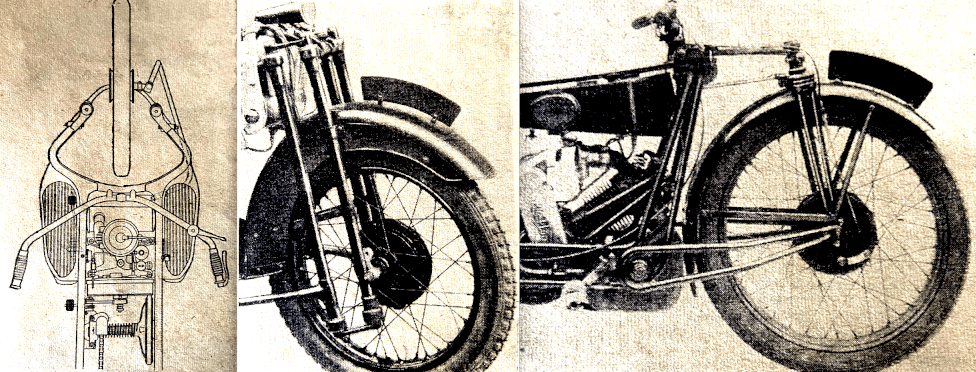
“WRITING IN THE ISSUE of The Motor Cycle for December 31, ‘Technicus’ set out to show that the orthodox inclined steering-head layout was technically unsound. He maintained that such a layout was inherently unstable and subject to periodicity because of the pendulum effect of the mass ahead of the steering pivot. His solution was to advocate the hub-centre type of steering for ultra-high speeds, and his schematic design featured a single arm carrying a swivelling stub axle on the lines of current automobile practice. The readers’ letters which followed amply justified the hope expressed by ‘Technicus’ that his views would ‘provide food for thought and discussion’.”
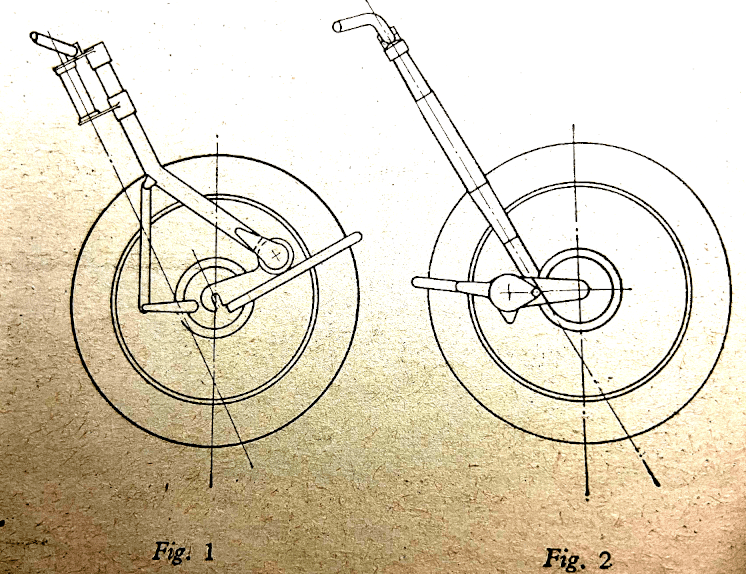
“REGARDING THE RECENT CONTROVERSY on steering for world’s records, we have proved to our satisfaction that the question of mass balance relative to the centre line of the steering head is of considerable importance, not only under road conditions but very much more so in competition work. It will be seen from the drawing of our original front fork layout (Figure 1) that there is considerable excess weight ahead of the steering axis. In the course of development, the design has been changed to the pattern illustrated in Figure 2; without the headlamp, but with competition mudguards, the new layout maintains the mass balance at a positive figure. This modification has given a very marked improvement in the stability, controllability and general feeling of safety of our machine. We feel that we have gone a long way towards achieving the advantages of the centre-pivot steering as advocated by ‘Technicus’ while retaining the traditional basis which we think is more acceptable to the average motor cyclist.
B Greeves, (Managing and Technical Director, Greeves Motor Cycles), Thundersley, Essex.”
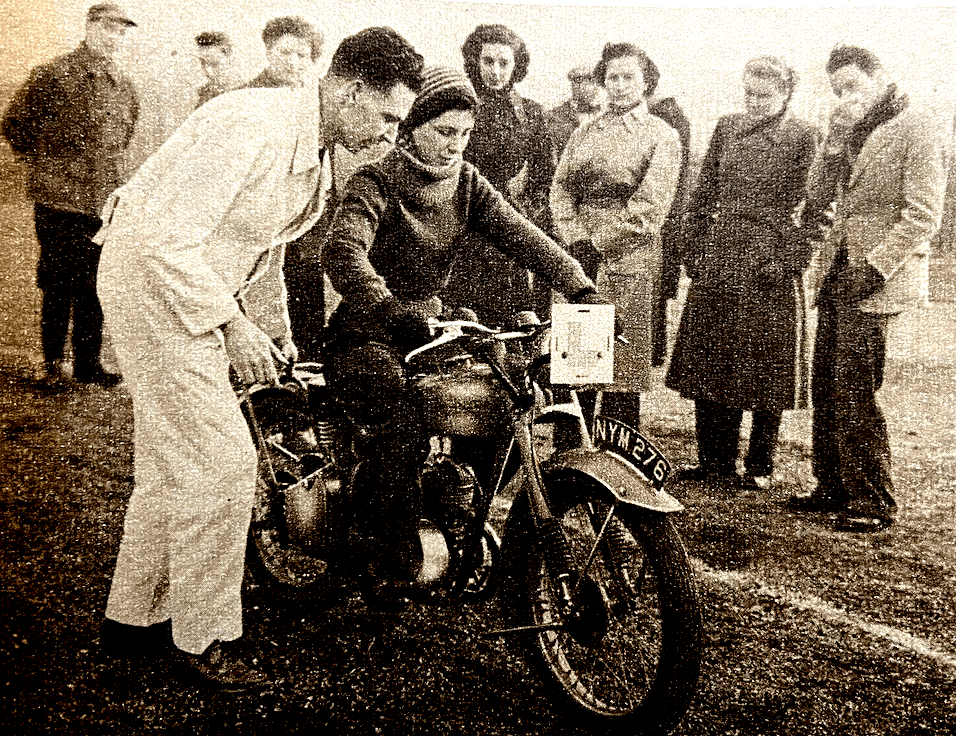
“SECOND PHASE OF the RAC-ACU Training Scheme is under way. Three centres, Crystal Palace, London, Gillingham, Kent, and Guildford, Surrey, are in operation as the pilot scheme on which future policy may be based. Some six months elapsed before training started, and to date about 100 pupils have passed proficiency tests. In short, progress has been made, though at a much slower rate than hoped. For this reason it is probably too early for a decision to be taken as to whether the grand conception of a network of training schools, in addition to club schools, can be pursued. In 1947, clubs began to take part in the RAC-ACU Training Scheme, and at the present time 70 club schools are functioning. Many other clubs have contemplated starting schools, but have found the problems insuperable; the most common difficulty has been that of obtaining the use of training grounds on private property. Some clubs have operated schools for a while, but have been forced to stop training for one reason or another. The problems encountered by clubs are, in the main, applicable to the pilot scheme. For example, the ready co-operation of the London County Council, which controls Crystal Palace, was one of the major factors in making possible greater progress at that centre than at Gillingham and Guildford. A nationwide scheme would require hundreds of training grounds and perhaps a thousand machines, and a much larger number of competent instructors prepared to give their services on a part-time basis with payment restricted to compensation for out-of-pocket expenses. Is such a project in the category of star-gazing, or could it become reality?
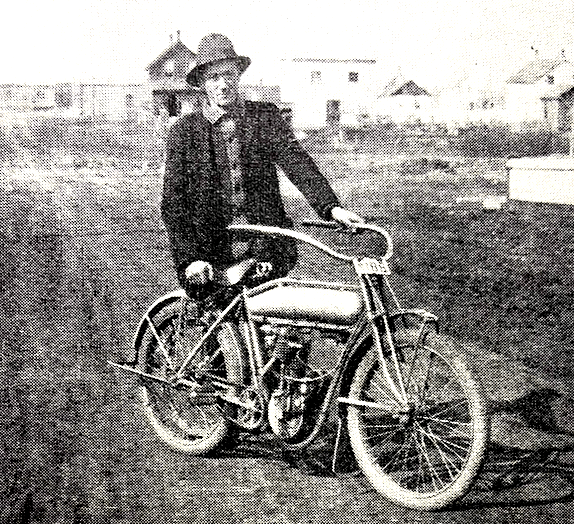
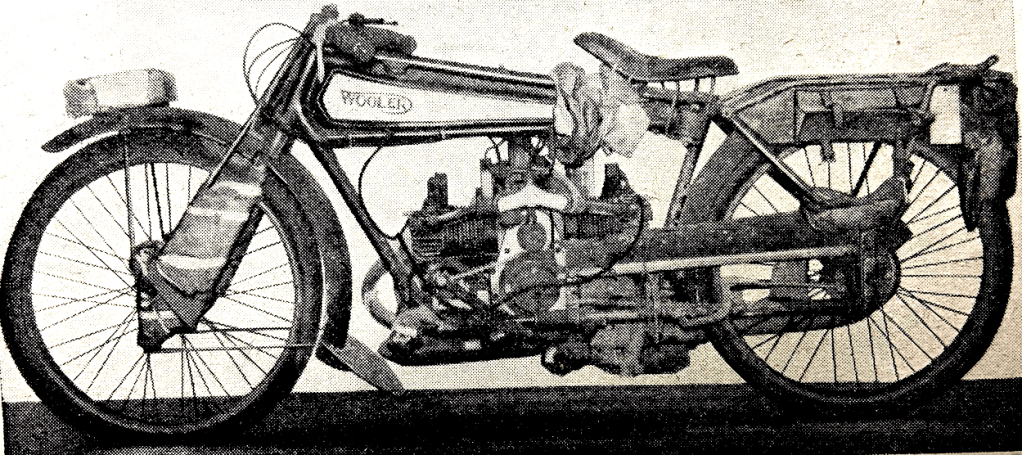
A COLLEAGUE MADE an interesting discovery the other day. In a corner of a South London garage, he unearthed an unused 500cc flat-twin Wooler that had lain there for 31 years. Apparently the machine had been taken into stock together with a number of others and, while its contemporaries were sold, this model remained. Much of the original wrappings were still intact, but dampness and the ravages of time had done their worst. The paintwork was peeling; the once polished aluminium surfaces were pitted and dull; the tyres were flat and their walls cracked and rotting; cobwebs were strung from handlebar to controls, from fin to fin of the horizontally opposed cylinders. My colleague tells me that the relic has been sold to an enthusiast for the sum of £10. Many of the features of the Wooler, by the way, would not be out of place on a ‘modern’. Valve operation is by a form of overhead camshaft. The valves themselves are disposed at 90° to the cylinder barrels, and operated by long rockers acting directly on the cams. Camshafts are horizontal and parallel to each cylinder, and driven from skew gears on the mainshaft. Cylinder heads are detachable and screwed to the barrels. Final drive is by chain, and the-three-speed gear train and the clutch are contained in the crankcase. A forward-operating kick-starter drives a mainshaft ratchet by means of a chain. Gear changing is by a rocking pedal, situated near the foremost of the two pairs of footrests. Plunger-type suspension is employed front and rear; the brakes are of internal-expanding type. According to a catalogue of the period, the model was guaranteed to do 75mph.”
ROADTEST: BSA BANTAM MAJOR
“ORIGINALLY ANNOUNCED IN October last year, the 148cc BSA Bantam Major provoked favourable comment a few weeks later at the London Show. The power unit of the Major is based on that of the now-famous 123cc BSA [which, in turn, was based on the DKW 125—Ed] and, indeed, the chief difference is one of capacity. Cylinder bore and stroke of the larger model are 57x58mm as compared with 52x58nn of the 123cc engine. The aim behind the slight increase in engine size was to provide enhanced performance at low and medium rpm without trespassing into the next higher taxation class. All-round performance of the Bantam Major was most impressive. On undulating main-road going the speedometer could be held indefinitely hovering over the 45mph mark. Such speeds did not require the use of full throttle. And even when full throttle was employed, as it was for as often as possible during a two-hour run on one occasion, the unit gave no indication that it was being overdriven. No engine oil leaks became apparent during the course of the test. However, leakage of burnt oil occurred at the joint between the silencer and exhaust pipe. Acceleration characteristics of the Major were above average for a machine of 148cc capacity. From traffic halts the machine could be unobtrusively accelerated from a standstill to 30mph faster than could the average car. Only at very high engine revolutions the first and second gears was any vibration apparent. Power delivery was free from harshness throughout the speed range. Power on hills was well sustained; average main-road gradients could be taken on top gear without the speed falling below an indicated 40mph. Starting the engine from cold was simplicity itself, in spite of low temperatures experienced during the test. The cold-starting drill was to close the carburettor strangler, flood lightly and set the throttle about one-third open. If the engine failed to fire at the first kick it would almost certainly fire at the second. The air control could be partially opened immediately the engine had started, and fully opened as soon as it had been running for approximately a minute. It was unnecessary to make use of the complete arc of travel on the kick-start crank; in fact, it was inadvisable to do so because of the relatively close positions of the kick-starter and right-hand footrest. With the engine warm, starting could be accomplished by a single leisurely prod, the twistgrip turned just a shade off its closed stop. Once the engine was warm, it would idle slowly and reliably though not, of course, without four stroking. Except for slight piston slap, particularly when it was cold, the engine was commendably quiet mechanically. At 30mph. in top gear the standard of exhaust quietness was moderate; under conditions of harsh acceleration, and at speed on the open road, it was considered to be slightly obtrusive both to the rider and to the lay public. The gear pedal movement was short and positive: up for upward changes and down for downward changes.
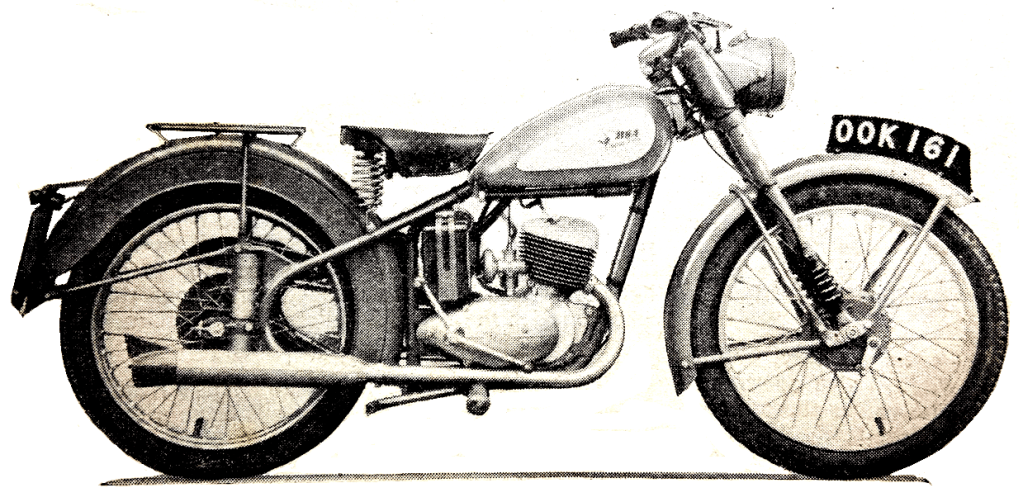
Carried on a splined shaft that is concentric with that for the kick-starter, the pedal is adjustable for height. However, even with the lever in its optimum position, it was necessary for the rider to lift his foot clear of the footrest when making upward or downward gear changes. Clean, sweet downward gear changes could be accomplished no matter how quickly the controls were operated. The upward gear change required a pause in pedal travel if a ‘clonk’ from the gear box was to be avoided. Racing-type upward changes were, however, often made without detriment to the gear box. With the engine idling and the machine stationary, bottom gear could be engaged quietly. Neutral could easily be selected from bottom or second gear. Moderately light in operation, the clutch took up the drive smoothly and progressively, and it freed perfectly at all times. Steering and roadholding were above criticism. On corners and bends the machine could be heeled over to a degree that was limited only by the height of the footrests. Straight-ahead steering was light but positive, while cornering and bend-swinging required the minimum of effort on the part of the rider. During the course of the test all types of road surfaces were encountered, from uneven stone and wood blocks to well-paved highway. Irrespective of how slippery the going, the Bantam Major proved stable to a degree that would inspire confidence even in riders with brief experience. Satisfactory riding comfort was provided by the suspension. Road shocks were adequately absorbed by the front fork and bottoming never occurred. The plunger-type rear springing was sensitive around the static-load position and provided a sufficient range of travel; neither bottoming nor topping of the suspension was experienced. The relationship between seat, handlebar and footrests afforded a compact riding position for riders of average stature. For taller riders, however, a higher saddle position would probably prove desirable, since the angle formed at their knees would then be more than a right-angle. For taller riders, too, the relationship between the seat and handlebar was restricted. It is considered that the twin-seat (which is available as an extra) would produce the desired improvement. All hand controls were satisfactorily located for ease of operation.
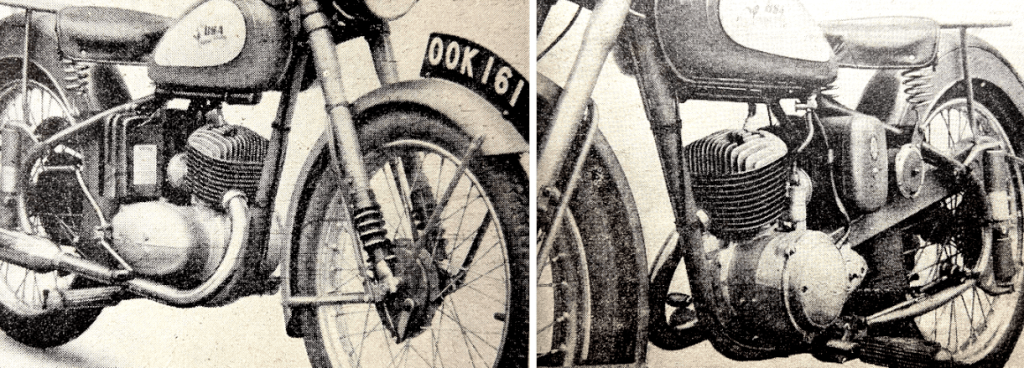
Clutch and front-brake levers operate on fixed pivot blocks—a feature which proved no disadvantage. The handlebar is adjustable for angle of the grips. With the grips in an approximately horizontal position, the rider’s wrists fell into a natural and comfortable angle. From any point in the speed range, ample stopping power was provided by simultaneous application of the front and rear brakes. Both brakes were light and smooth in operation. In its ‘off’ position the rear-brake pedal, which has a non-adjustable stop, was higher than the left footrest, which meant that some delay in application was unavoidable. Rectifier and battery lighting is standard equipment and the driving beam from the 30/30w main bulb enabled the full engine performance to be used after dark. Since the electric horn is fitted to the seatstay and is thus behind the rider’s leg, the note emitted could, with advantage, have been more penetrating. The horn button is embodied in the front-brake-lever pivot block. Operation of the button made it necessary for the rider’s hold on the twistgrip to be momentarily relinquished. A centre stand, which required no special knack to operate, raises either wheel clear of the ground. Mounted on the steering crown, the speedometer recorded fast by approximately 1mph when registering 30, 2mph when showing 40, and 3mph at 50. Equipment included a tyre-pump carried underneath the tank, a brake stop light, a toolbox of adequate capacity mounted on the forward side of the seat pillar, and a reasonable selection of tools. The rear mudguard is well valanced and incorporates a small luggage carrier. A smart appearance is provided by the pastel-grey finish, which is relieved by cream tank panels and chromium-plated wheel-rims. In conclusion, it was felt that for many riders the increase in capacity inevitably broadened the model’s appeal. Price and fuel consumption are higher than those for the smaller Bantam, but these factors are offset by the 150’s enhanced acceleration and speed performance and its great suitability for carrying a pillion passenger.”
“THE KANDY ROAD RACE, which was held round the picturesque Victoria Drive, Ceylon, had a threefold significance. The meeting was intended as a farewell to Johnny Mockett, who was leaving Ceylon shortly afterwards; it was intended as an entertainment to the 224 delegates from 20 countries who were conferring at Kandy, and it was also a selection test for a team to visit Calcutta. There was a record crowd and most of those who had arrived the previous day found it impossible to obtain accommodation in or near Kandy. Before the roads were closed, Mockett set off as sidecar passenger in JK Moore’s Vincent outfit, and the entire plot came to grief when it took the Mahamaya bend too fast and plunged into the Kandy lake. The outfit was completely covered by water, and while both Moore and Mockett escaped with a severe shaking, they were prevented from taking part in the meeting. Racing stated at 10am The curtain-raiser was the sidecar event, which was won by NG Wickremasinghe (Triumph). T Givendrasinghe, who was driving a Vincent Black Shadow outfit, also plunged into the lake. Both rider and passenger were unhurt. The Junior Racing-class event will long be renumbered for the gallant show put up by veteran RM Allan Clark on his JAP-powered machine against Z Dean on his Manx Norton. Clark led for seven of the 10 laps and only a few feet separated the pair. At the start of the eighth lap Dean overtook and Clark came off. He remounted but could do no better than finish third. The Senior Racing class event provided a titanic struggle between Z Dean and R Shiriwardene. For six of the 10 laps Dean led. On the seventh lap Siriwardene took the lead amid deafening applause. At the close of the eighth lap the two were almost neck-and-neck but halfway through the lap Dean came off and Siriwardene went on to win.”
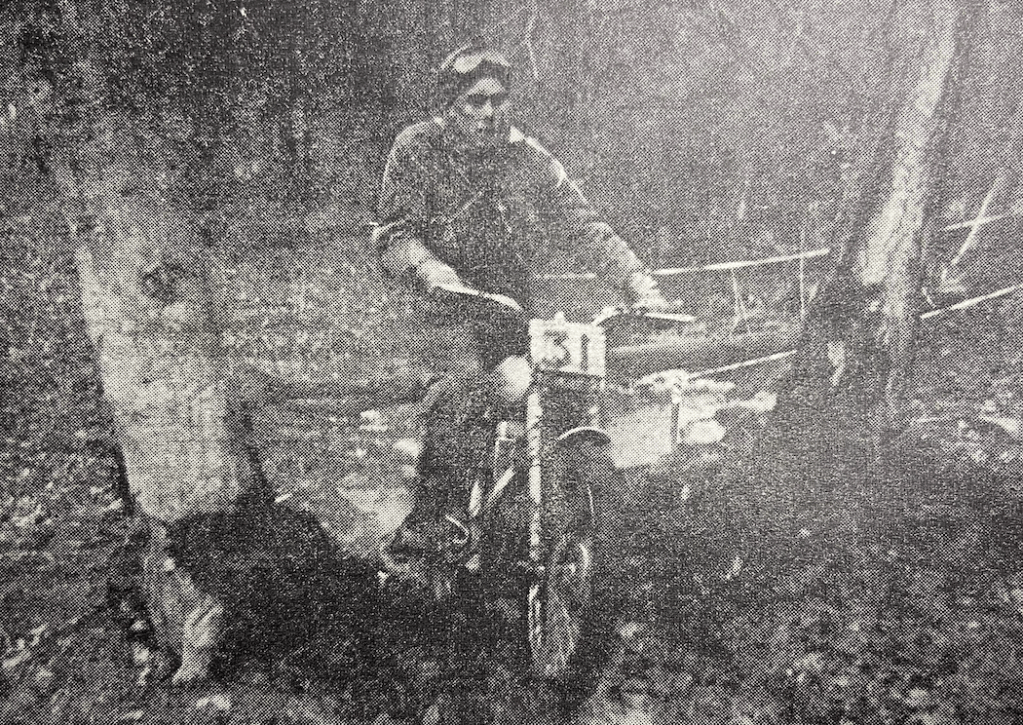
“RIDING HIS 346cc ROYAL ENFIELD with magnificent consistency, JV Brittain made best performance in last Saturday’s national Hurst Cup Trial. Decided on both time and observation, the event was held over six laps of a 17-section course at Clandeboye, Co Down, in Northern Ireland. There were 73 starters, of whom no fewer than 36 rode 197cc machines. Last weekend’s event will be remembered for trees and low tyre pressures—trees for the way in which they provided obstacles in many sections, and low tyre pressures for being responsible for a score of punctures. Riders set out in the belief that the going would be muddy. Hard surfaces were en-countered between sections, tree roots were laid bare at several parts of the course and some of the sections lay over shale and rock; verb sap. The Weather Clerk smiled on the event. For three days there had been mixed weather—snow, hail and then heavy rain—and, as competitors and officials were shown the premiere of George Simpson’s film of the 1953 Scottish Six Day’s Trial, reports came in of heavy mud, floods here and there and of a jeep being stuck fast. But Saturday dawned bright and clear with a blue sky, a beaming sun and a light breeze.”
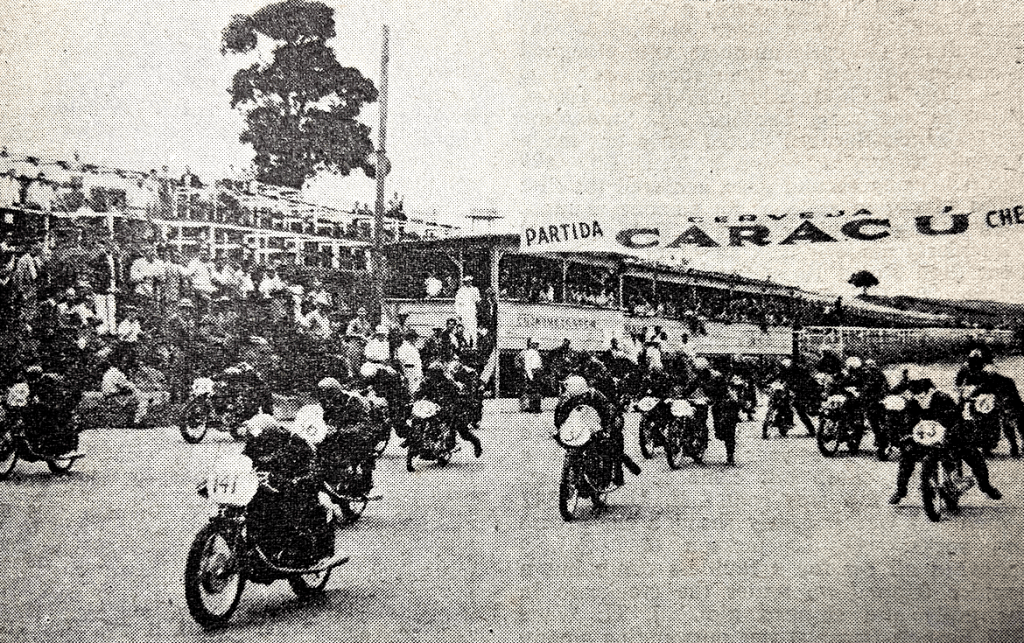
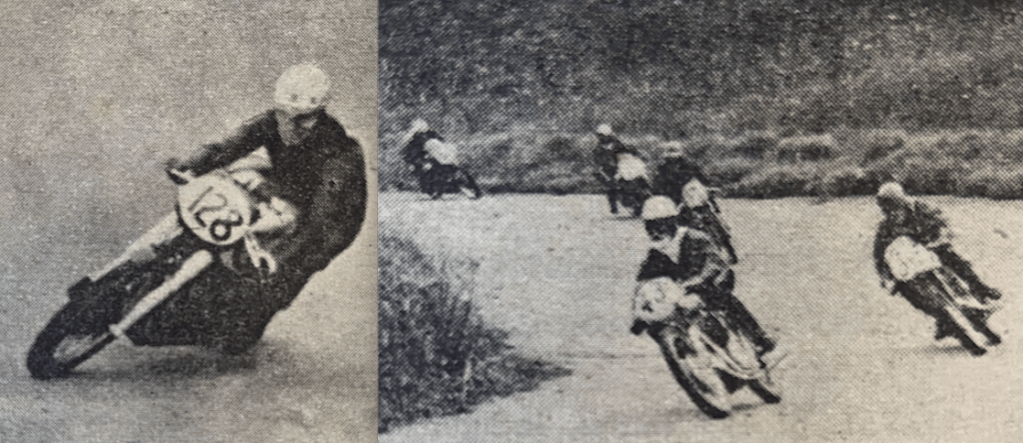
“BRAZIL HAS HAD ITS FIRST taste of international motor cycle road racing. Riders of no fewer than 15 nations provided the spectacle, and among them were men of the calibre of Ray Amm (Norton), Enrico Lorenzetti (Moto Guzzi), Nello Pagani (Gilera and FB Mondial), and Alfredo Milani (Gilera). Run on the tortuous five-mile Interlagos circuit, the races formed part of a sporting programme arranged to celebrate the fourth centenary of the founding of the city of Sao Paulo. Saturday’s programme comprised an eight-lap contest for 125s, followed by a 15-lap 350cc event. On Sunday a 250 race over 10 laps opened the proceedings, after which the 500s battled for 25 laps. Great Britain and Italy shared the major honours, Amm winning the 350 and 500cc races, Lorenzetti the 250cc, and Pagani the 125cc. Saturday’s attendance totalled no more than a few hundred. Unfriendly weather dull, with an occasional drizzle—was partly responsible. Moreover, the Brazilian public was not fully appreciative of the attraction of this essentially European sport. Press and radio publicity after Saturday’s event helped to swell considerably the magnitude of Sunday’s crowd. Owing to its sinuous configuration, the whole Interlagos course occupies an area measuring no more than approximately three-quarters of a mile by half a mile. This area takes the form of a great natural bowl, so that nearly all the circuit is visible from a given vantage point. The competitors had less cause to be enamoured of the circuit, not because of the seemingly endless succession of acute bends, but because of the broken and treacherous condition of much of the surface. This was rated by European riders as the worst they had raced on; minor spills and retirements through suspension failures accounted for a relatively high percentage of non-finishers. About one-third of the starters were South Americans; of the remainder, the Italians enjoyed strong local favour by virtue of the predominantly Latin lineage of the spectators. In the 125cc race some curiosity was aroused by the first appearance in an international event of a Japanese rider on a
Japanese machine. He was Mikio Omura and his machine a Hama; he was the last to finish. The race provided a comfortable vic-tory for Nello Pagani (FB Mondial), who maintained an unchallenged lead from the start of the second lap. He was closely supported throughout by his team-mate, R Ferri. ‘John Grace’, of Gibraltar, riding a Montesa, recovered well from a poor start and finally forced his way into fourth place, nearly a minute behind A Artesiani (MV Agusta). Amm took the poor surface conditions in his stride in the 350cc race. Quickly establishing a safe lead, he won as he pleased in dashing style. In spite of strenuous efforts Lorenzetti was unable to harass the Southern Rhodesian, though he did manage to equal the Norton rider’s fastest lap in an all-out bid for victory towards the end of the race. On the last lap Lorenzetti’s frantic exertions brought him to earth, but he was able to remount and finish without losing his second place. A Goffin, of Belgium, rode well to bring his Norton into third place, but was more than half a lap behind Lorenzetti. Moto Guzzis were ridden by 12 of the 16 starters in the 250cc race; no other make of machine completed the full 10 laps. Way out in front, Lorenzetti and A Montanari fought a wheel-to-wheel duel for the first seven laps until Montanari was forced to retire with a punctured front tyre. Another close struggle between the Brazilian C Ferreira and R Fern of Italy, both Moto-Guzzi mounted, continued until the final lap, when their machines collided, happily with-out serious injury to either rider. Amm’s chief opposition in the 500cc race was expected to come from A Milani, who was riding a Gilera four. The Italian threat ceased early, however, for the four-cylinder machine limped into the pits at the end of the first lap with ignition trouble. Once again Amm circled effortlessly to win with-out being seriously challenged. For the first quarter of the race second place was disputed by Goffin and E Soares, a Brazilian, both riding Nortons. Soares then lost nearly four minutes in rectifying a rear-springing defect. On Lap 15 Goffin also relinquished his hold on second place when he fell at a hairpin bend. This let Montanari (Moto Guzzi) into second place, which he retained to the finish. Meanwhile Milani had rejoined the race but, after several fast laps came to grief on the same bend which had unseated Goffin.”
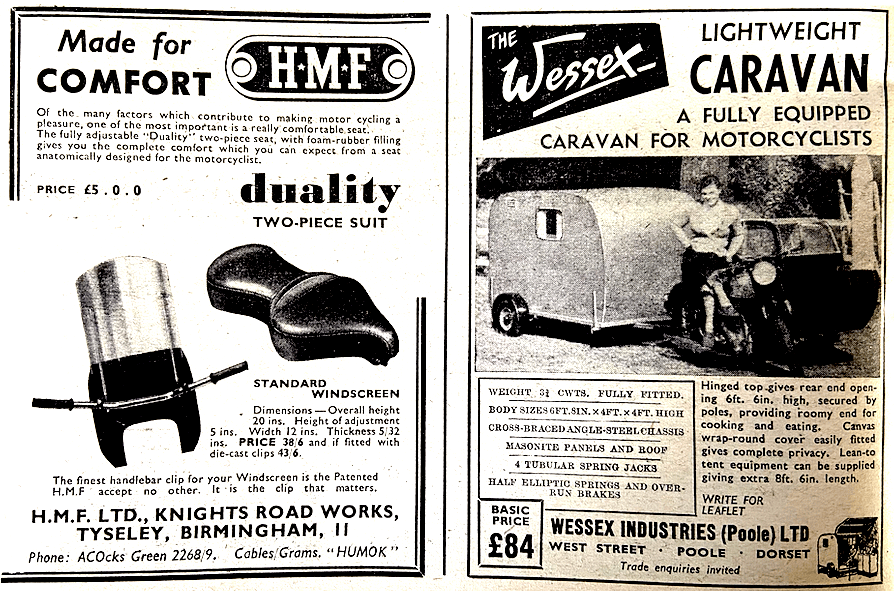
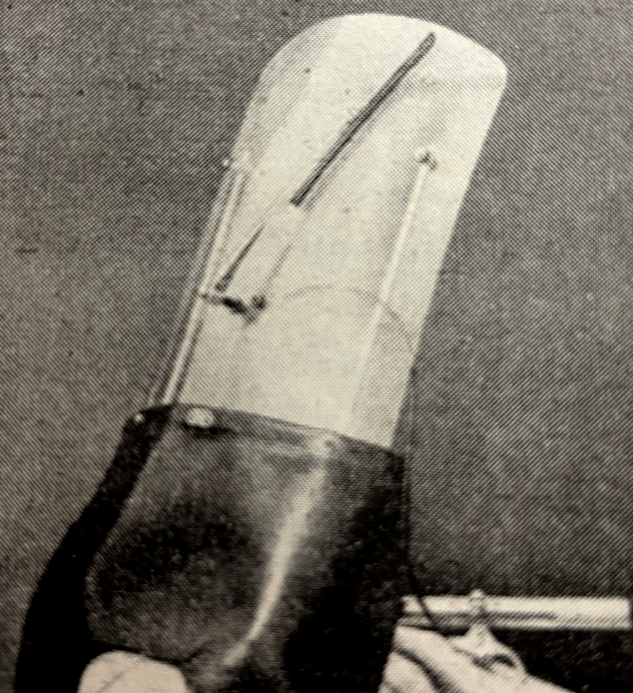
“A NEW HMF accessory, which it is anticipated will be in production in about two months’ time, is a windscreen wiper. A spring-loaded wiper arm is pivoted on a light-steel spindle operating in an externally threaded brass bush which is inserted in the windscreen and secured by lock nuts and fibre washers. On the prototype, the inboard end of the pivot spindle is cranked to enable it to be operated from a trigger mounted on the handlebar of the machine. Depression of the trigger actuates the curved wiper blade through a 12in arc; the blade is returned by a coil spring incorporated in the control-cable mechanism. Powered operation of the wiper is also being considered. The HMF adjustable two-piece Duality Junior seat, introduced at the last London Show, went into operation last week and is now available through accessory dealers. Mounted on plywood baseboards, the seats are of latex foam-rubber cushioning upholstered in grained leathercloth. The baseboards are recessed into the cushions to obviate chafing, and the bases are lined on the outside with impregnated, waterproof felt. The passenger seat is provided with a three-positional mounting on the steel chassis, affording a 2½in adjustment in the overall length of the complete unit. If necessary, fittings can be provided to make the Duality Junior suitable for attachment to lightweight machines equipped with rear carriers. The seat-nose lug incorporates three pairs of holes to provide adjustment for height. Dimensions are, overall length, 22½-25in; maximum width of front seat, 12¼in; width of rear seat, 7¼in; average depth of cushion, 3¾in. Retail price of the Duality Junior is £3 10s. Makers of HMF equipment are Hughes Motor Fitments, Tyseley, Birmingham, 11.”
“TWICE POSTPONED ON account of foot-and-mouth disease, the 1953 Welsh Experts’ Trial was held last Sunday at Cefn Cribbwr, near Bridgend. Organisation was in the hands of the Mid-Glamorgan Club, and a course of 35 miles had been selected on the border of the East and West South Wales Centres. The course comprised 12 observed sections and no fewer than 58 sub-sections. The winner was R Heaton (197 James), who rode steadily throughout to lose only 32 marks. Runner-up, RD Rees (498 BSA), was leading at half-distance but heavy marks loss in the ninth and 10th sections proved his undoing. The most usual type of section consisted of a steep, grassy descent into a river, a ride along the river and a climb out over mud and rocks: Nant Heuadd conformed to this pattern. J. H. Moxham (197 James) was the best performer with two dabs. Close at hand was the aptly named Heartbreak, a steep grassy climb among trees. Speed was essential, but a sharp turn among the trees reduced speed just when it was most needed. A very determined L Edwards (346 Royal Enfield) was easily best; he footed vigorously at the most difficult part but was able to recover and ride the remainder of the hill clean. Wally’ Worry, the ninth section, was a particularly good example of the river-and-hill type of hazard. Beyond the river, a long, steep climb over grass was followed by an S-bend over humps and rocks. Moxham was the first arrival and promptly made a clean climb. Thereafter, however, the section deteriorated rapidly and a second clean performance seemed impossible with impossible —until Heaton proved the reverse with a fine display of controlled speed.”
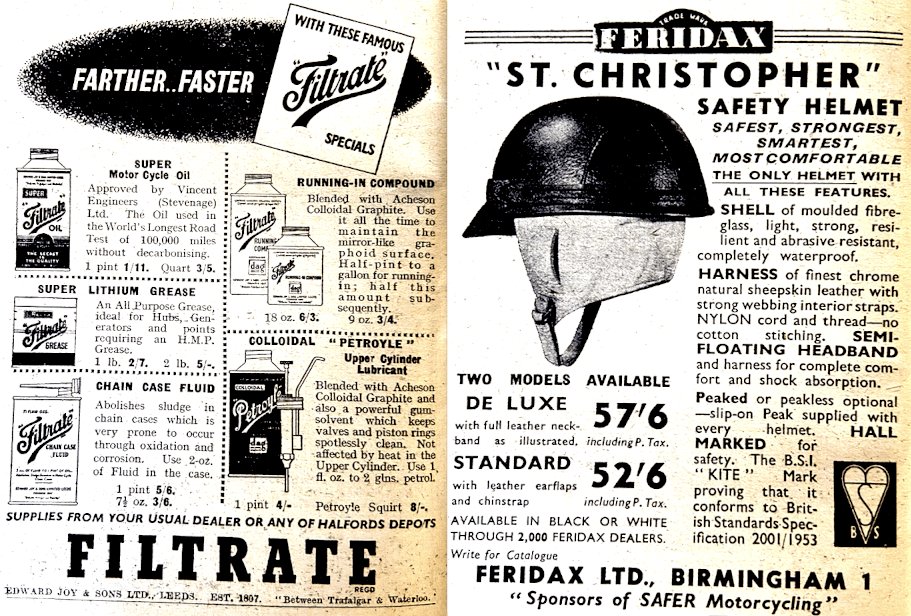
“THE ROYAL AUTOMOBILE CLUB is to issue all road patrols with St Christopher helmets. Painted white, with the RAC monogram in blue, the helmets will be readily distinguishable. This decision by the Club has been taken because it is felt that the patrols should set an example to other motor cyclists.”
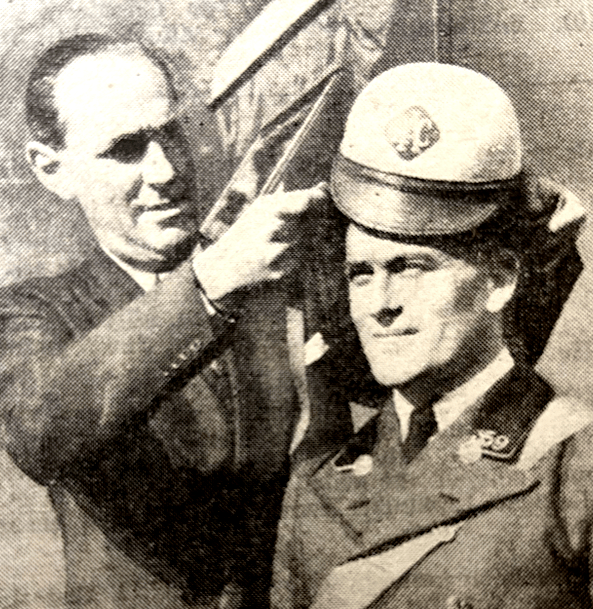
“THE FIRST UITENHAGE ’75’ road race was run over 41 laps of the new Clarrie Scott Circuit at Uitenhage, South Africa. Most important event of the day was the Senior Handicap race, which was won by a local traffic inspector, C Ferreira (347 Matchless). Second was K Cooke (248 Velocette) and third, EF Cope, the veteran rider from England, who was riding a 350 Horton sleeved down to 249cc. CW Scott, after whom the course is named, was fourth on a 350 Triumph.”
“ON WEDNESDAY OF last week a statement concerning future road-racing policy was issued by Gileras. In effect, the statement said that, in view of the abolition of the manufacturers’ classes of the World’s Road-racing Championships, Gileras considered they were no longer required to defend titles won in 1952 and 1953; further, Gileras had decided not to concern themselves with racing aimed at annexing riders’ championships. It was stressed, however, that the decision did not preclude Gilera-sponsored riders competing in international events. The programme of meetings to be supported would take into account the interests of the company and those of the supporting public. Unofficial interpretation of this announcement is that British riders of Gilera machines (Geoff Duke and Reg Armstrong) are likely to ride in the TT and, presumably, the Ulster Grand Prix; further, that the Grand Prix des Nations at Monza in Italy will be supported by a full team of riders in the interests of home publicity for Gileras.”
“RIDING AGAINST DOCTOR’S ORDERS following a recent operation for appendicitis, John Avery (499 BSA), won the two main races at the South Newbury Club’s scramble near Midgham on Sunday. Sternest opposition came from DJ Rickman (499 BSA). WJ Stocker was also well in the picture on his new 497cc Ariel, and spectators enjoyed some spectacular racing on the muddy Froud’s Farm circuit.”
“SNOW AND A GOOD DEAL of mud faced competitors in the Harold Embrey Trial, held on Sunday from Longville, Shropshire. Of the 66 starters, which included five sidecars, all but five competitors completed the 45-mile course with its 25 sub-sections. The event was open to the Midland Centre.”
The Blue ‘Un offered some sage advice on luggage gear on solos and combos, with pics of contemporary products.
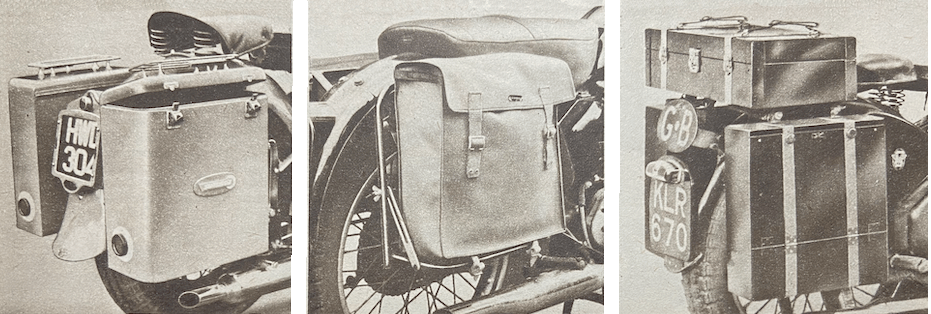
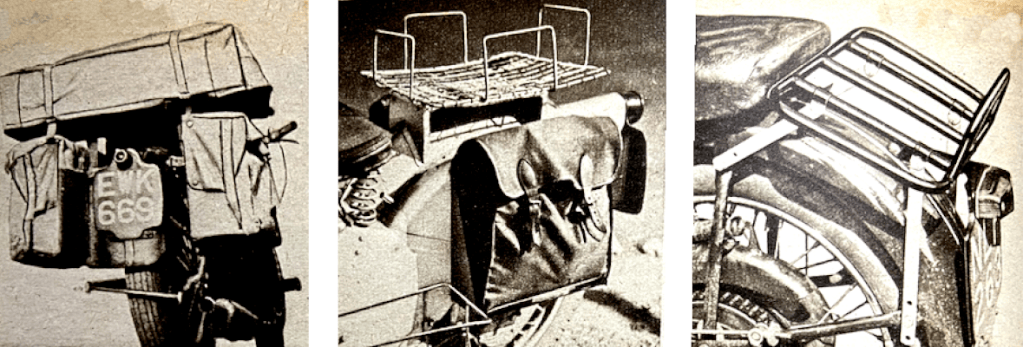
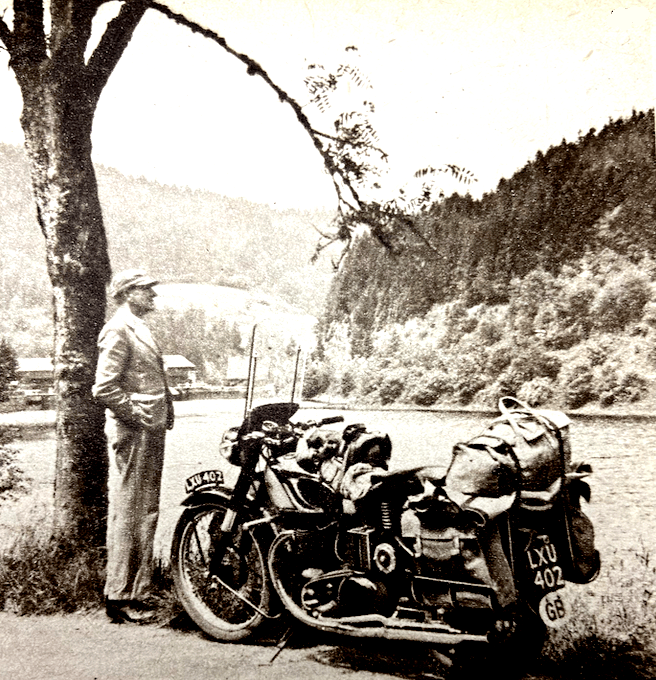
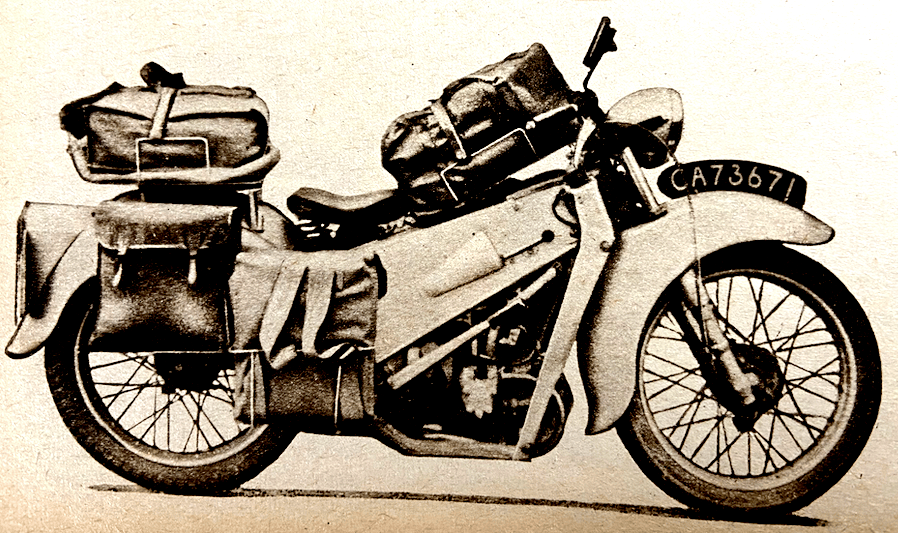
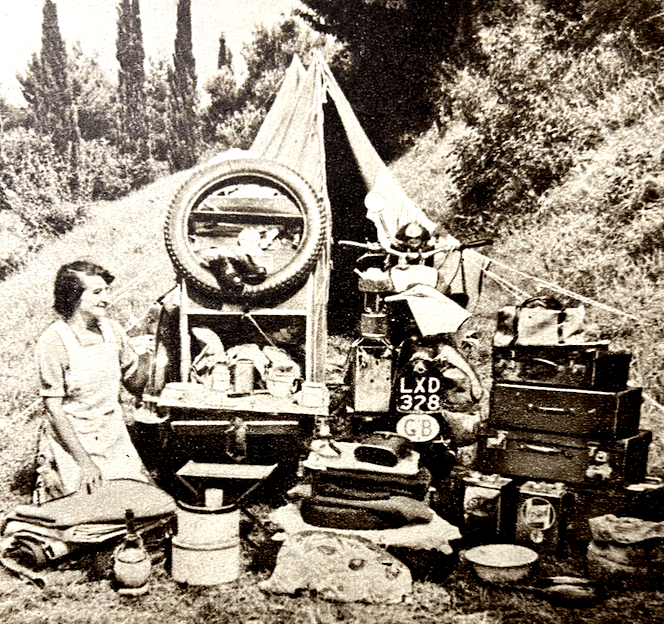
Here’s a rather charming touring yarn involving another Panther, complete wsith homep-brewed trailer.
“PREVIOUS EXPERIENCE OF FAMILY camping with a sidecar outfit had convinced us that we must have a trailer for our camping tour of South Wales. Accordingly, a second-hand sprung chassis with new wheels and tyres was obtained. A bracket and tow-bar constructed of lin angle-iron welded to form a box section, together with plywood and sundries for the home-made body, brought the total cost to about £13. Our insurance company required a further lOs for third-party cover. Measuring 4ft long x 2ft wide x 1½ft deep, the trailer body was designed to carry two medium-size tents with flysheets, two Primus stoves, sundry cooking gear, camp stools, sleeping bags, blankets, ground sheets and personal kit for ourselves, two children and the dog. Finding that we had ample stowage space, we were tempted to take more than was necessary, and in due course we set off from the Midlands with a 170-mile journey before us and a grossly over-loaded trailer behind. At least, so it seemed to me. I had visions of being unable to stop on hills, and of the 2.00x20in wheels collapsing under the strain. However, these and kindred worries had dissolved by the time we turned aside from the A5 to brew up for lunch under the shadow of the Shropshire Wrekin. The only untoward incident was when the dog, Snuff, leaned out too far on a corner. A shriek from the three women indicated that something was amiss and I looked round to see Snuff far behind, pursuing m with the speed of despair! It is a good thing to be sure of one’s camping ground at the end of a long day’s run, so we made for Aberystwyth and the well-equipped Rheidol site. We planned thereafter to follow the coast of Cardigan and Pembroke, look at ruined castles and build our own whenever we came to a sandy cove. Our first sandy cove was Llangranog, 30 miles south-west of Aberystwyth. A long, deep valley leads down to the village and tiny bay flanged by high cliffs. The coast thereabouts resembles Cornish coastal scenery. In such delightful surroundings we cheerfully abandoned our schedule, camped for five days in a nearby field, made friends with the cows and explored the neighbourhood. One day we visited Cilgerran Castle, perched on precipitous cliffs high above the River Teifi, by which we found a fleet of coracles. Another day was devoted to neolithic burial chambers and bronze-age standing stones. Once you get the taste for it, there is quite a fascination in hunting out prehistoric monuments and trying to imagine how things looked 4,000 years ago. Around Newport (Pembrokeshire) are Arthur’s Quoit, Pentre Ifan Dolmen, Parc y Meirw (‘The Field of the Dead’) and a host of lesser’ curiosities. All these we located on the new Ordnance Map of Ancient Britain, and then tracked down by means of their National Grid references. From Llangranog our way lay over the Prescelly Mountains, bleak in comparison with the coastal areas, to Amroth on Carmarthen Bay. For such a district our time was all too short. Saundersfoot and Tenby are close at hand; along the
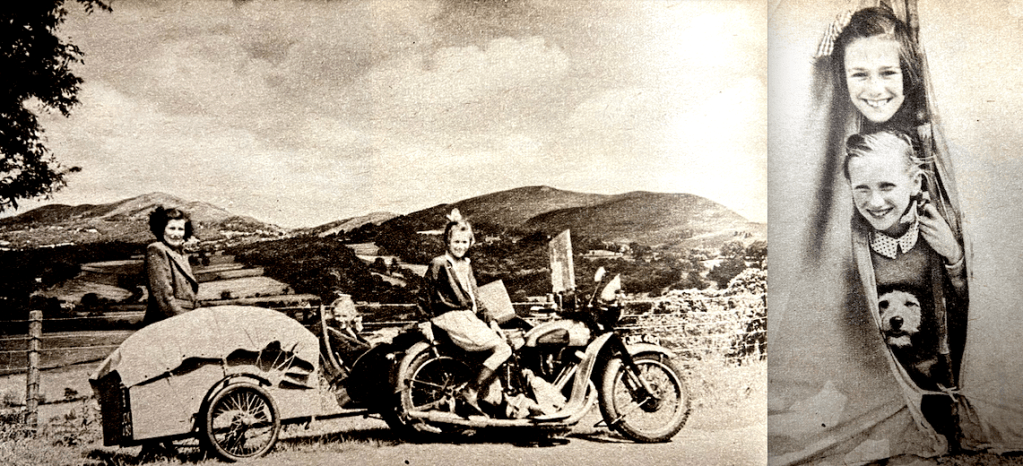
coast to the west are Lydstep caverns and Manorbier Castle; to the east are Langhorne Castle and the famous Pendine Sands. A trip to the little village of Llawhaden disclosed not only a further castle but also a fully equipped and extensive motor cycle depot at which we bought sidecar coil springs. It is unusual to find a complete spares service in such rural surroundings. The journey home was broken at the National Forest camp site at Christchurch in the Forest of Dean. There, sidecar trailers are a familiar sight, and caravans, too. The Forest of Dean, in spite of its miniature coal mines worked almost single-handed by ‘free’ miners, is a charming area as well as a good centre for the Wye Valley. We added Goodrich and Raglan to our list of castles, and photographed the unique fortified bridge at Monmouth, the bronze-age standing stones at Trellech, and Tintern Abbey. Then, having loaded up the trailer for the last time, we followed A449 through Ross, Ledbury and Malvern to Worcester, and thence onwards through Birmingham to Nottingham and home. With the towing point only 10 inches from the centre-line of the back wheel no undue strain was felt in driving. The light wheels of the trailer stood up to their task well, but the internal expanding brakes with which they are fitted will be coupled up and brought into use for our next holiday trip. Our combined personal weight is more than 44cwt, not to mention that of the trailer, camp-gear and clothing. In such circumstances trailer brakes would be an added security, even though they are not required by law where the unladen weight of the trailer is under 2cwt. Panther owners and others who understand the nature of the Model 100 will hardly need telling that our ‘Big Pussy’ made light of its task, returned an average of 45mpg for the whole trip, and on all but the steepest hills strongly resented the 30mph limit legally imposed on account of the trailer. So the trailer brakes will be fixed up before the summer, and then Scotland? The West coast of Ireland? Wherever it may be, we shall set off with confidence, for we have proved that, for the family which enjoys a camping holiday, a sidecar trailer adds enormously to the holiday’s scope and comfort.”
“NOT SO LONG AGO I alluded laudatorially (what a lovely word!) to Mrs. Ballard, Mrs Gable and Miss Jenkins of Rickmansworth. Three years ago they blew up in sudden resentment at the perpetually rising cost of season tickets and bought small motor cycles which they consider a delicious alternative to hurrying for the train, and sitting in stuffy carriages twice a day. (Incidentally, the weekly budget is now much lower.) Weather they accept as a challenge. Drying facilities are available at their London offices. They wear helmets, ancient flannel slacks with waterproof overs, woollies, scarves and disreputable stormcoats. They keep smarter garments at the office, and carry smarter changes on pleasure runs. They are not fresh from the school room. They occasionally take daughters and even hubbies on the pillion. One is partially straying from grace, as a small car now shares her garage with the lightweight motor cycle. In the 1952/3 winter they flinched at the weather and returned to the booking office on eight occasions. So far, during the 1953-4 winter, they have left their mounts at home on six days. They have had one or two mild skids, which they resent more than mere man can comprehend, as the inevitable effect on feminine legs is one or more laddered nylons. A shuttle service goes into swift action if any machine has the sulks, its mistress doubling up pronto on one of the others. They cannot speak too highly of the fraternity of the road. If they pause to light a cigarette, hosts of men immediately squeal their brakes to offer a light. (PS Do not take that word ‘fraternity’ too seriously. I possess a snap which suggests certain affinities with Marilyn Monroe.)”—IXION
“A KETTERING OWNER hopes to put a 1901 (American) 3hp Orient through next Sunday’s Pioneer Run. Only two samples of this marque were ever imported, and the present owner will be lucky if he reaches Brighton unless he has modified the model during the last couple of months or so. I am not impugning his ability, but (a) the model has only one brake—namely, a spoon on top of the front tyre; and (b) the engine has only one control, viz, a removable twistgrip on the right handlebar, which is an ‘on-off’ ignition switch. There is a tiny stub lever on the carburettor body, probably a form of choke, quite inaccessible for use with the model in motion. I am sorry to disappoint the owner, but this is not the first twistgrip in British use; detachable twistgrip ignition switches were common on French machines some years earlier than 1901. It may, however, have scored a first in the USA. When fully screwed home, a contact inside the grip was pressed against a contact inset in the butt of the handlebar tube. From these contacts a wire passed to a vulcanite interrupter block (possibly on the top tube), carrying a removable plug, to safeguard the electricity if the platinum points of the contact-breaker happened to be left in touch when the machine was stored. French machines usually relied solely on the removable grip, which was pocketed by the owner when the model was not in use.”—IXION
REPORT:GENEVA SHOW
“AN OBJECTIVE STUDY of the 24th Geneva Salon, which opened last Thursday, reveals it as a summing-up of the great exhibitions of London, Frankfurt and Milan. There are few startling innovations of technical interest such as characterised those earlier shows and, indeed, few were to be expected. As far as motor cycles of over 250cc capacity are concerned, the eight nations represented at the Salon are showing in the main models whose impact has already been made. Primarily, the Salon is a representation of European design as it is today, with particular emphasis on the needs of the Swiss market. Swiss requirements are undergoing a change. Some three years ago, the scooter became widely popular. The Lambretta and Vespa caught the public taste and thus enabled Italy to corner the choicest slice of the coveted market. In 1950, the number of all-Italian machines imported by Switzerland was under 7,000; a year later the figure was more than doubled; in 1952 it was 24,255 and the majority were scooters. But last year, Italian imports were down to 19,900; more-over, the fact that the January figure for all scooter imports this year is only half of that for January last year suggests that the peak in scooter popularity has been passed. The explanation is that for carrying two people up Switzerland’s long passes and valleys, the orthodox 125 or 150cc scooter is under-powered. The demand today is for bigger engines and the motor cycling public is turning to the machines of 250cc. But why the 250 when there is no shortage of first-class 350s and 500s? For taxation and insurance purposes in Switzerland motor cycles—as distinct
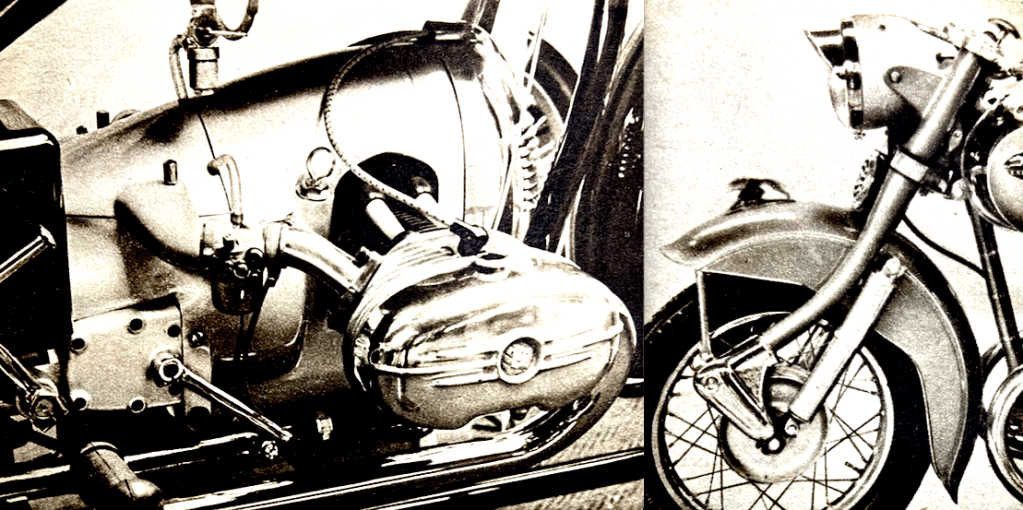
from motor-assisted cycles—are divided into two classes: under 250cc and over 250cc. The amounts vary according to the canton (county) ‘in which the machine is normally resident’, and for those in the larger category, third-party insurance may be as much as the equivalent of £25, and taxation about £10. The corresponding rates for smaller machines are only about half of those quoted. Hence, while insurance premiums and taxes on larger models remain at their present high levels, the popularity of machines in the under-250cc category is assured; similarly, the demand for the 350s and 500s will never be great. In spite of the drop in imports to the figure of 19,900 mentioned earlier, Italy continued last year to retain a clear lead over all other nations. Imports of German machines increased from 9,740 in 1952 to 10,038 in 1953, Austria’s from 1,419 to 1,546. Imports of British machines dropped from 1,781 to 1,541. Of the Italian machines imported in 1953, the greatest number were Lambrettas (8,564) and Vespas (7,936). A measure of the degree by which these makes outstrip all others may be gauged from the fact that the next highest figure was 762—achieved by Motom. Of the German machines, BMWs were once more the most popular (2,502, of which 70% were 250s), then Horex with their specially-designed-for-the-Swiss-market 250 (1,645), then NSU with 722. Of the British machines imported last year BSA led with 593. Next in the field was Norton (222), then AJS (189), Triumph (179) and Matchless (105). The total number of new machines registered in 1953 was 29,213 as compared with 34,630 the year earlier. A second significant trend in Swiss requirements concerns the cyclomoteur, or ‘moped’ as it is now commonly styled. As in most Continental countries, the bicycle has long been popular as a cheap and convenient means of covering short distances.
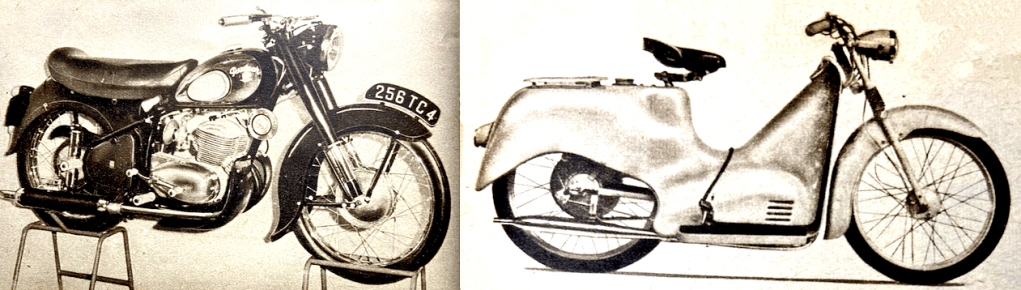
The clip-on received only a lukewarm welcome from the Swiss, chiefly because of its limited power output, and also because of its friction drive which proved generally inadequate on the steep Swiss roads in wet weather. But the advent of the 50cc engine—particularly the German Sachs unit introduced at the 1953 Paris Salon—with two-speed gear and chain drive has brought about a complete volte-face. Nearly every cyclist who can afford a moped now wants one. No fewer than 20 new makes are exhibited at the salon, most of them with German Sachs engines. Prices for complete machines range from 600 to 800 francs. Sachs-powered models are in the more expensive category, but these engines have an excellent power output and a reputation for reliability second to none. At the present rate of exchange of 12 francs to the £ these prices may seem high but they must be viewed against the buying power of a prosperous nation. Of the new mopeds in the Salon, the out-standing exhibit is the 48cc German Victoria which is light, sleek, low-built and equipped with a leading-link type front fork. The open frame is formed by tubes and pressings. Extending from the steering head to the bottom of the seat-pillar tube, box-section pressings play the dual role of main frame member and fuel tank. The fork links are malleable castings controlled by bonded rubber in shear. Smart pressings, bolted to the
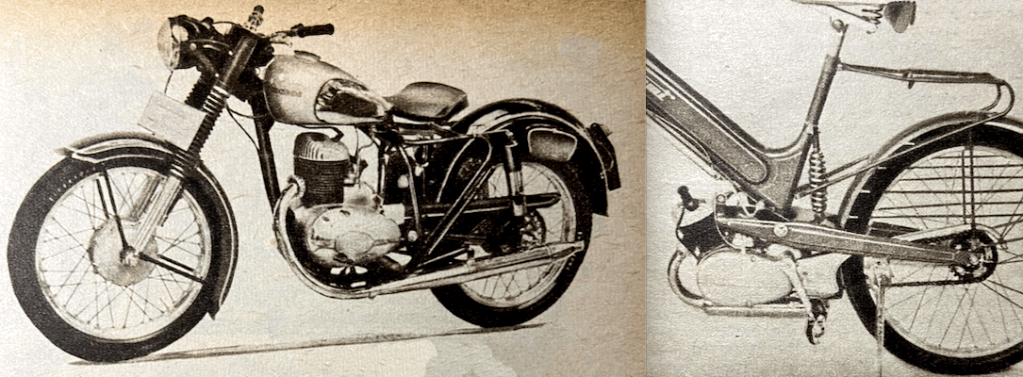
main oval-section fork tubes and to the mudguard stays, conceal both the fork links and rubbers, and blend with the lines of the front mudguard valances. The rear mudguard is deeply valanced; further protection for the rider is provided by a deep-section guard over the top chain run. Said to develop 1.75bhp at 4,900rpm, the engine is of straightforward three-port two-stroke design, having a light-alloy cylinder and head, and internal flywheels. Primary transmission to the cross-over-drive gear box is by helical gearing. The Victoria concern is, of course, widely experienced in two-stroke design: there was a Victoria lightweight motor cycle in 1901. The new moped is designated Vicky III. The majority of the other mopeds displayed follow the same basic layout, though one or two employ simple forms of rear springing. One such is the Ami which is powered by the two-speed Sachs unit. Of pressed-steel construction, the pivoted rear fork is controlled by a single, vertical barrel compression spring situated in front of the rear wheel and anchored at its upper end to the seat-pillar tube. Also shown by Ami is a 175cc Sachs-powered sports scooter, which was manufactured until 18 months ago in Switzerland and is now, like the moped, produced in Germany, where it is known as the Achilles. The model has been extensively redesigned in recent months and now features complete enclosure of the power unit by panels (which form also legshields and footboards), and partial enclosure of the wheels. Finish is in polychromatic old gold. The price in Switzerland is 1,970 francs. In addition to the new Victoria and Ami models other new mopeds attracting the greatest attention are those exhibited by Universal and Mars (both of which employ rubber-controlled leading-link forks), NSU, Pony, Dürkopp and Maico; all are fitted with Sachs power units. The Universal is, in fact, a German Rabenieke product marketed in Switzerland by Universals. Rabenieke, it may be recalled, manufacture the remarkably clean 250cc Universal in Germany, which was exhibited under their name at Frankfurt. One of the few Swiss motor cycle manufacturers, Universal are showing two new 580cc flat twins designated respectively the Meteor and Meteor Super Sport. Both models are based on the design of the orthodox Universal flat twin, but they are even cleaner and have increased power outputs, especially the Super Sport. The new models are identical except in minor
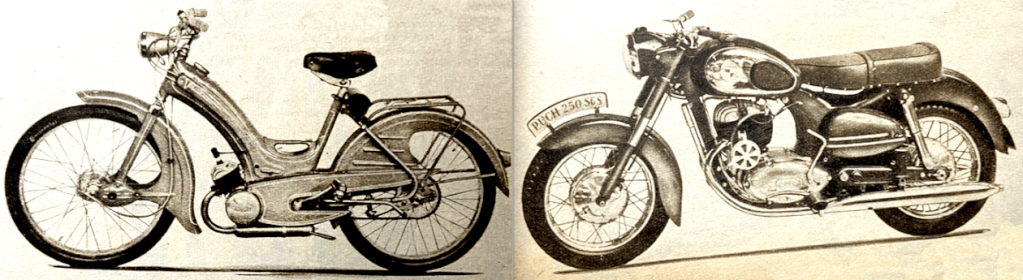
detail. The most important differences are that the Super Sport compression ration is 7 to 1 as compared with 6.8 for the Meteor, and that the Super Sport is fitted with twin Oba carburettors. Manufactured in Oensingen, these carburettors have no mixing chambers as is usual with motor cycle-type instruments. Instead, the jet passages are all within the float chamber and float-chamber lid castings. Each carburettor is positioned approximately mid-way between the single, enclosed air filter and the port. To reach the intake, air enters the engine castings by way of louvres at the front, travels through ducts along the bottom of the crankcase, and is then impelled to the air cleaner by means of a fan on the engine-shaft clutch. For sheer cleanliness of line the Universal models are decidedly attractive. Their power outputs, however, are modest: 30bhp for the twin-carburettor model, 28 for the Meteor and 24 for the touring version. Of the other Swiss manufacturers, Condor are showing a new, very British-looking model equipped with the 225cc Villiers power unit. Designated the 25 de Luxe, the machine incorporates an all-welded tubular frame, a pivoted rear fork controlled by Armstrong damper units, oil-damped telescopic front fork and nose-pivoted saddle. The price in Switzerland is 2,450 francs—some 230 francs (about £19 at the present exchange rate) more expensive than the sleek Condor-Puch scooter. When asked the reason for this, the Condor representative shrugged expressively, and pointed out that the Puch body is
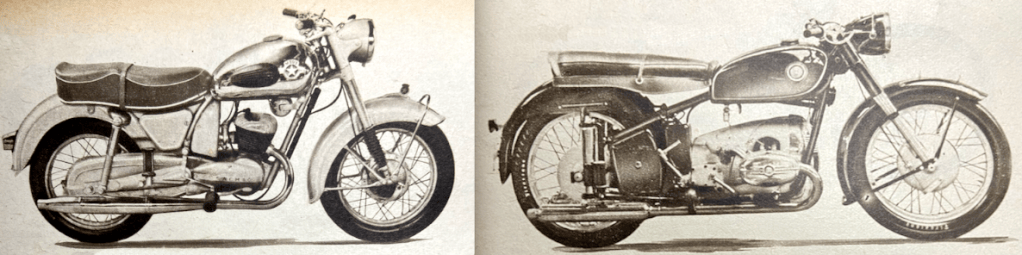
of simple steel pressings whereas the orthodox motor cycle requires a tubular frame. An unusual Condor exhibit is a tricycle scooter for invalids. The machine is a derivative of the Puch scooter fitted with twin rear wheels carried on a form of pivoted fork and driven through a car-type differential. The price in Switzerland is 2,650 francs. The remaining Swiss manufacturer, Motosacoche, is showing the 250cc ohc twin that was the sensation of the Salon in 1953. Except for the addition of a twin-seat, the model is entirely unchanged. Production began a few months ago. Also in the true motor-cycle class—as distinct from mopeds and scooters—the German Mars concern is showing its established 175cc Sachs-powered Stella model in redesigned form. The rear fork continues to be pivoted about a large-diameter, rubber-in-torsion block, but additional control is now provided by means of enclosed springs working between the fork and the deep-section rear mudguard. Rear part of the frame has been modelled on orthodox Continental lines and a twin-seat fitted. Battery, toolbox and air filter are all enclosed by steel pressings. Hubs are of light-alloy, full-width type and also, incidentally, of Sachs manufacture. The front fork is of straightforward telescopic design. The majority of the other German motor cycles are unchanged but a polychromatic blue NSU Max is shown with a sleek 3½-gallon fuel tank and a twin-seat—features which make it more attractive to the Swiss. The price is 2,900 francs as compared with 2,600 for the standard Max. An attractive invader from Austria is the new 250cc SGS Puch, claimed to develop 17bhp. Like all other motor cycles in the Puch range, the SGS is fitted with 16in wheels and full-width hubs, and employs a pressed-steel frame with pivoted rear fork and total enclosure of the rear chain. Unlike the sports 175cc SVS model, the SGS is
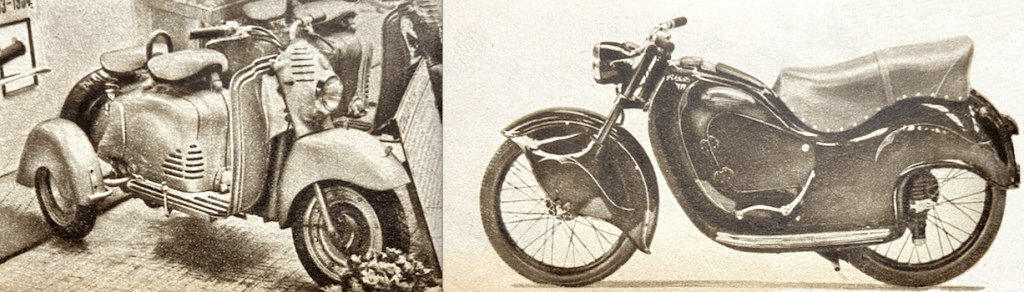
equipped with only one carburettor. It will be recalled that on the SVS Sports the carburettors are so phased that the instrument on the right-hand side comes into operation only after the throttle of its opposite number is approximately half open. The French Peugeot and Fallis concerns, too, have answered the Swiss appeal for 250s—Peugeots by exhibiting a two-stroke parallel twin. Apart from the fact that both cylinders and heads are separate castings in light alloy, very little could be learned of the machine’s technical details. The frame, telescopic front fork, wheels and full-width hubs, and plunger-type rear springing are similar to those used in the established 176 GS. Fallis have a complete range of models with AMC, Ydral and Sachs engines, the most outstanding of which is a moto-carénée (motor cycle with enclosed engine) powered by the 175cc Sachs unit. Few Continental salons pass without the introduction of at least one two-stroke-powered, enclosed three-wheeler. At the current Swiss exhibition, one such is the Kabinenroller ‘Inter’, exhibited by a French aircraft concern which insists on remaining anonymous. The machine is very similar to the widely-popular German Messerschmitt though it is not quite so luxuriously appointed. Of clean aerodynamic design, the sheet-steel body is fitted with a hinged canopy and accommodates two adults tandem-fashion. The engine, a 175cc Ydral two-stroke, is situated at the rear and drives the single rear wheel through a three-speed (and reverse) gear box and exposed secondary chain. An unusual but extremely practical feature for a machine of this nature is that the front axle has two pivots to facilitate parking in confined spaces. The wheels hinge forward so that the track is reduced from about 51 to 35 inches. Front suspension is by rubber-controlled trailing arms. Wheel sizes are 4.00x8in. Price in Switzerland is 3,250 francs. Among the other new models displayed are a 125cc Rico-IFA—no more than a standard IFA with enclosure—from the eastern zone of Germany; a version of the standard 250cc two-stroke twin Express with an extremely sturdy-looking, trailing-link fork; a version of the 48cc Italian Motom with plunger-type rear springing, a 48cc Kreidler scooter and a 48cc Ducati scooter. British machines displayed are AJS, BSA, Francis-Barnett, Matchless, Oscar, Norton, Panther and Triumph.”
MANUFACTURERS LISTED IN the Blue ‘Un’s annual buyers’ guide: AC, AJS, Ambassador, Ariel, BMW, Bond Minicar, Bown, Corgi, BSA, Cyc-Auto, CZ, DMW, DOT, Douglas, Excelsior, Francis-Barnett, Greeves, Indian, James, Jawa, Lambretta, Matchless, Moto Guzzi, New Hudson, Norman, Norton, NSU-Vincent, OEC, Oscar, Panther, Pashley, Radco, Reliant, Royal Enfield, Scott, Sun, Sunbeam,Tandon, Triumph, Velocette, Vincent, Wooler, Zündapp. Clip-on engines and mopeds: BSA Winged Wheel, Cucciolo, Cyclaid, Cyckemaster, Itom, Mini-Motor, Mobylette, Mocyc, Mosquito, Power Pak, VeloSolex, Vincent Firefly. Sidecar manufactuers: Blacknell, Bowser, BSA, Busmar, Canterbury, Castle, Garrard, Hodgson, Nicholson, Norton, OEC, Rankin, Raven, Steib, Sunbeam, Surrey, Swallow, Trinder, Watsonian, Waverley.
REPORT: STOCKHOLM SHOW
“AS WAS APPARENT at the time of the Gothenburg Fair about 12 months ago, the motor-assisted cycle and similar-type machines (called ‘mopeds’ as elsewhere in Europe), are rapidly gaining popularity in Sweden. Providing engines do not exceed 50cc and do not develop more than 0.8bhp, such machines are not subject to taxation and registration, and driving licences are not required. The regulation lifting the taxation and legal formalities came into force in July 1952, and since then sales have been considerable. More than 170,000 are already used on Swedish roads and the yearly increase is estimated at about 100,000. It was predicted last Friday when the Stockholm Show opened, that within the next few years at least half-a-million mopeds will be in circulation. There are approximately 330,000 motor cycles in use—that is, machines which are registered—and when this total is added to the figure for mopeds, it is realised that the number of two-wheelers on the roads is high in relation to the seven-million population of the country. Most of the fully fledged motor cycles are imported from Great Britain and Germany, although many of the smaller-capacity machines—those of 250cc and under—are of Swedish origin. Each of the major Swedish manufacturers, NV, Husqvarna and Monark, produces about 6,000 machines annually. Popular engine units fitted are British Villiers and German Sachs and
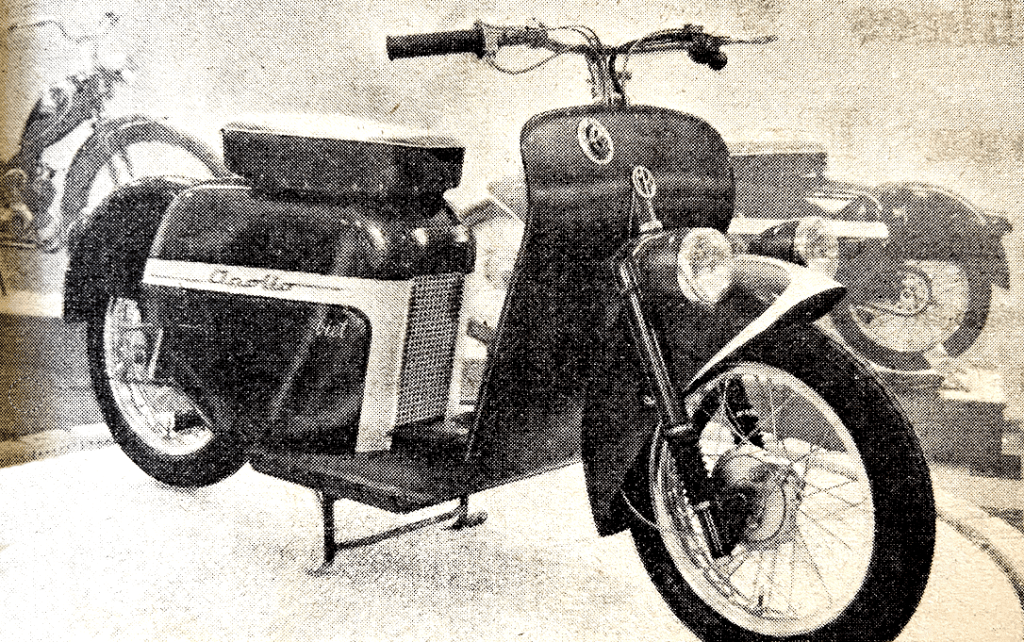
Ilo, but there are also a few machines with Swedish engines of Husqvarna or JB manufacture. Total yearly output from Swedish factories is around 30,000 machines. In the small-capacity classes, the Stockholm Show is dominated by Swedish products. Most of the mopeds are equipped with front forks of telescopic or bottom-link design, frames are relatively robust and, in some respects, the machines could be called lavishly equipped. On some models, the engines are totally enclosed. Popular forms of transmission are chain and V-belt; friction drive has almost completely disappeared. Most of the mopeds exhibited are already known, but a completely new one at Stockholm is the NV which, although in the moped class and fitted with a 48cc German Sachs engine, is on scooter lines. Another show surprise is the all-Swedish scooter manufactured by both M Berlin and Company of Vamamo, and Maskin AB John Ericsson of Falun. That marketed by Berlin is called the Apollo, and differs only in detail from the John Ericsson edition. The 128cc,
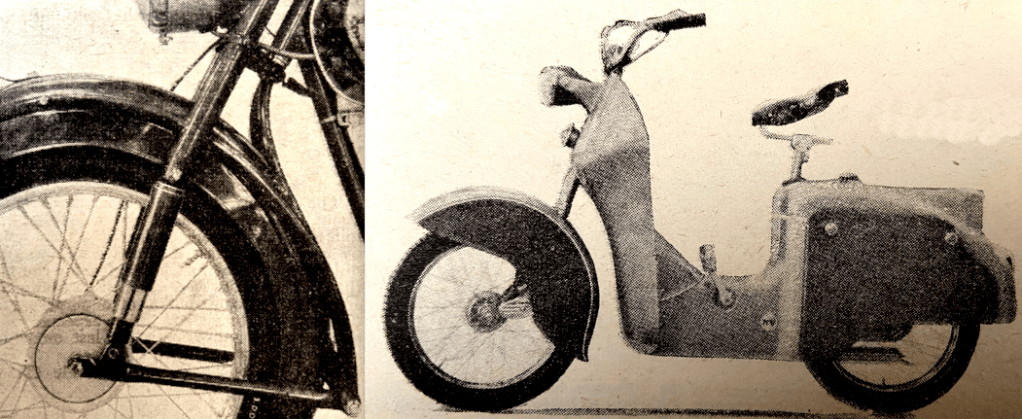
fan-cooled JB power unit develops 4.5bhp at 5,000rpm and is said to provide a maximum speed of around 40mph. A two-speed gear box is employed. Wheels are of 14in diameter and the front suspension is by telescopic fork. Weight of the complete machine is just below 165lb, which is the limit set by regulation for the lowest motor-cycle taxation range in Sweden. However, machines of this weight are not permitted to carry pillion passengers. Price of the Apollo is approximately £100. In the larger-capacity field there is a tendency to give machines a sporting appearance. Such features as light-alloy mudguards, dual-seats and upswept exhaust pipes are popular. A machine in this category is the Monark Blue Arrow, fitted with the 250cc Ilo twin-cylinder two-stroke engine. This very attractive machine has a telescopic front fork and pivoted-fork rear suspension controlled by telescopic legs with hydraulic damping in the British fashion. Another interesting model for the sportsman is the NV 125cc racing model which has a German DKW two-stroke engine. Its claimed maximum speed is over 80mph. British representation in Stockholm is extensive; well-known makes represented include AJS, Ambassador, Ariel, Bond Mini-car, BSA, DMW, Douglas, Excelsior, Francis-Barnett, James, JAP, Matchless, Norton, Panther, Royal Enfield and Triumph.”
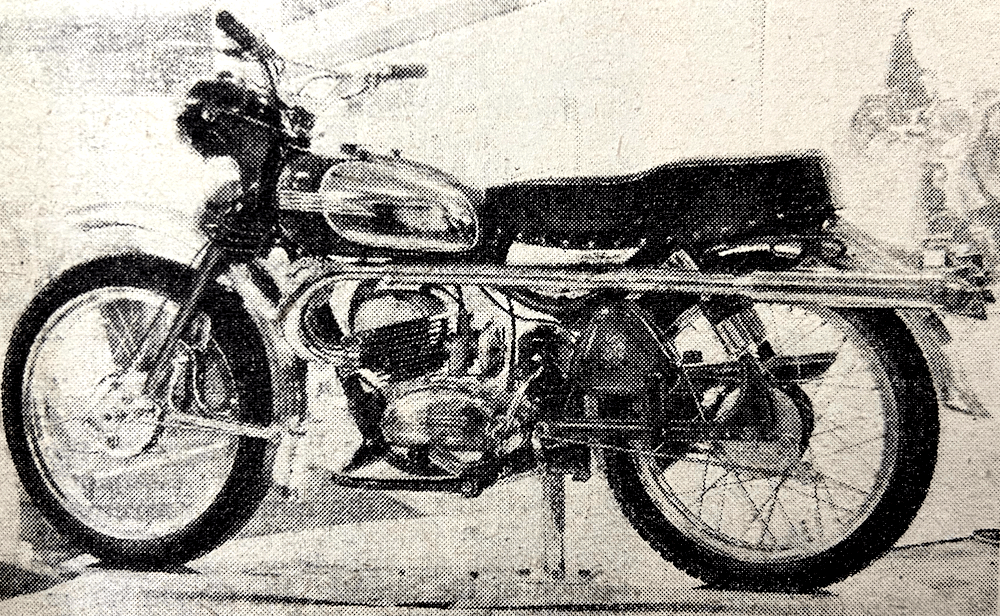
“BRITISH MACHINES GAINED overwhelming successes at the famous Daytona Races. With an entry of 127, representing in the main British and American machines and a few German and Italian models, the 200-mile Championship claimed its usual place as the major contest in the United States calendar. The winner, Bobby Hill, riding a 497cc BSA twin, averaged 94.24mph, which was a fraction slower than the average in last year’s event. The next four men home—famous North American riders Dick Klamfoth, Tommy McDermott, Al Gunter and Ken Eggers—were also BSA-mounted. Riders of Triumph machines filled the sixth and seventh places. Owing to heavy rain, the Amateur 100-mile Race could not be held on Saturday and it was, therefore, postponed until the Sunday morning. Although the weather was more promising, a strong wind was blowing in from the sea, with the result that the tide was not clear of the course until late. So that the programme could be completed in the day, it was necessary to reduce the length of the race to 50 miles. The winner, Bobby Stilwell, averaged 93.26mph. Approximately 10,000 spectators saw the day’s racing. The famous 4.2-mile circuit consists of about two miles of sand and a parallel two miles of tar macadam, linked at the ends by banked corners…Plans are afoot for the construction of a modern race track at Daytona, and it is expected that this year will prove to be the last on which the beach circuit is used.”
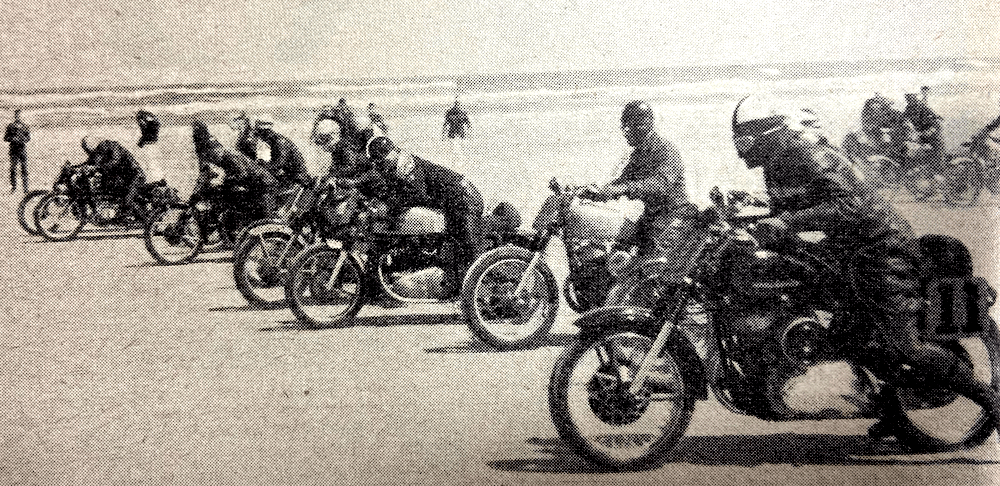
“ACHIEVING A SUCCESSFUL balance of caution and full-throttle, front-wheel-in-air assault, DS Tye (348 BSA) won last Saturday’s Wessex-Centre organised national Kickham Trial with a loss of 14 marks. Mud was encountered on the majority of the nine observed sections. Where it was moderately thick, Tye assumed a slow, respectful pace and resisted any temptation to bow-sweep through the numerous mud pools; where the mud more nearly resembled drying cement he abandoned his sedate tactics and indulged in a flashing display of speed. Losing 15 marks, A Shutt (197 Francis-Barnett) narrowly failed to make best performance and thus emulate GE Fisher, who won last year’s event on a 122cc Francis-Barnett. In view of last Saturday’s well-conditioned mud, however, it is probable that Shutt’s performance was on a par with Fisher’s in 1953. On steep gradients, covered in a thin slime of mud, the lusty power of the larger four-stroke machines enabled a suitably high gear to be used; precisely the converse applied for the two-strokes. Sidecar drivers were blessed with the benefits of lusty engines and suitable gearing but bowed to the pure slipperiness of the mud.
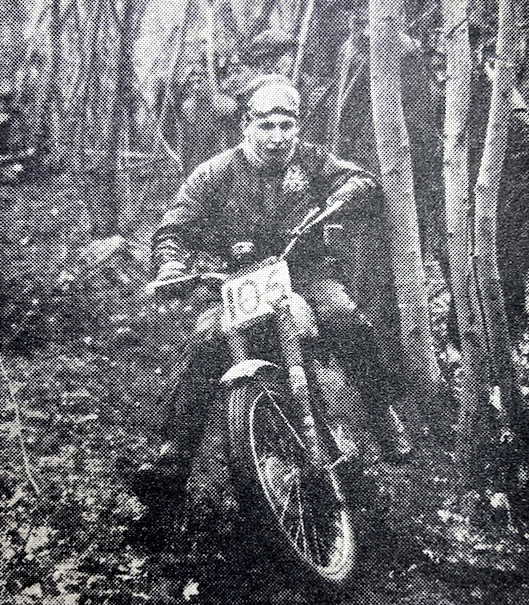
EARLY IN JANUARY last year, Spike Rhiando left England with the intention of crossing the Sahara in an ingenious semi-saloon scooter of his own design. The trip was abandoned because of unforeseen bothers but the experience gained has served a very useful purpose. It was Mr Rhiando’s intention to go into production with the scooter, but circumstances made it impossible for him to do so on his own. However, his project was taken over by the Harper Aircraft Co, of Exeter, and intensive development work has recently been carried out by that concern. As a result, production arrangements are well under way for a scooter based on Rhiando’s concept, which he called the Scootermobile. It is intended to market two models, both powered by Villiers engines. The de luxe version will have the 197cc engine, a high-output generator, a large battery and an electric starter. A 122cc engine with the normal generator and battery and a conventional kick-starter will be featured on the otherwise identical standard model. Most striking aspect of the new scooter is undoubtedly its bodywork, which provides a sleek, open design with a built-in windscreen. Moulded from laminated glass-fibre plastic material, the body features to some extent the attractive razor-edge styling which has become familiar on a few post-war cars. The engine is fan-cooled and is supported in the frame by a cast light-alloy member at the front and by a fabricated steel bracket at the rear. A two-pedal, remote control for the gear change is provided on the right footboard. The interchangeable 12in wheels are shod with specially developed Goodyear tyres of 4in section. A 5in-diameter, cable-operated brake is fitted to each wheel. Opportunity was provided for a short run on the prototype, which was very smartly finished in red metallic-lustre cellulose. Handling was well above average scooter standards, and the high degree of riding comfort and exhaust silence was impressive. The self-starter, which drives by belt, brought the 197cc engine to life without the slightest difficulty.”
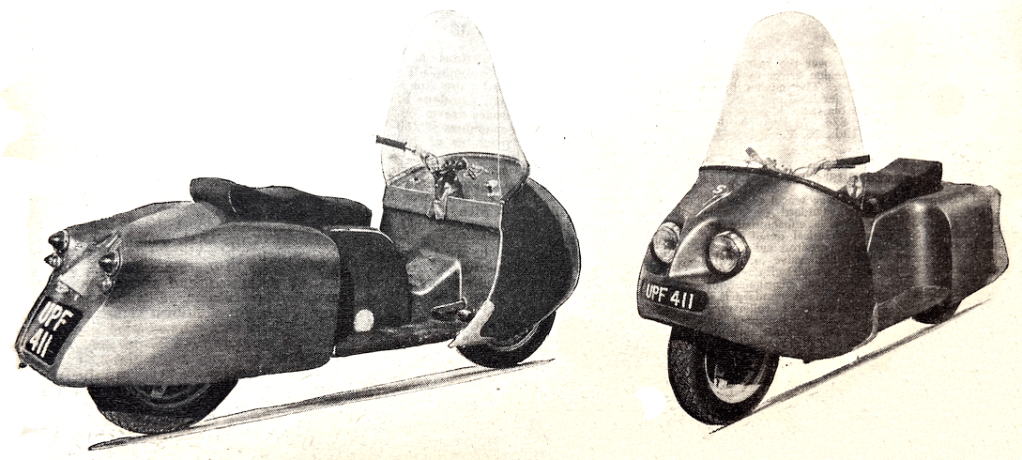
“THE ILKLEY GRAND NATIONAL, held last Saturday, proved to be too tough for 41 of the 66 competitors. Only 25, of whom 15 finished within the time limit, completed the two laps of the 20-mile circuit. Organised by the Middlesbrough Club, the event was run at an average speed of 15mph, with 10 minutes added to the time because of the heavy mist on high ground. No competitor averaged the required speed, but GE Broadbent (346 Royal Enfield) rode magnificently to lose only seven marks on time (one mark per minute late). The course lay entirely on private land, without any metalled road for the full distance. The going was mainly on water-sodden grouse moors, and there were 49 observed sections. Riders took over five minutes to cover the mile to the first observed hazard, Lostshaw Gill, on which no rider was clean on the first circuit, and where only G Parker (197 James), JG Brown (197 Dot) and JR Milner (490 Norton) were clean on the second lap. “
“DESPITE A COLD WIND and overcast sky, a large crowd watched excellent racing at the March Hare Scramble run by the Reading Ace Club at Aldworth, Berkshire, last Sunday. The meeting was dominated throughout by GH Ward, riding 197cc James and 498cc AJS machines.”
ROADTEST: NORTON ES2
“THOSE WHO, FOR THE SAKE of pocket or preference, seek a machine in the single-cylinder range, find that the Norton 490cc ES2 appeals strongly. For one thing, it is a long-established model, built to provide 100% reliable transport in solo or combination form. It is completely modern, but, in general design, it retains much of the inherent ‘one lunger’ simplicity, and, equally important, accessibility, which is not always achieved in a ‘multi’. Motor Cycling last tested this model in 1950 and mention was then made of the high standard of mechanical quietness. In the case of the 1954 test just completed, the yet further improvements made in this direction were a strong first impression which deserves initial emphasis in the report. At normal ride-to-work-or-seaside speeds, no one engine component made its activities particularly audible. Gear and chain whine were absent; the tappets emitted a subdued ticking sound, but there was no undue noise from the rocker mechanism nor evidence of piston slap, even when the engine was first started from cold. Altogether, the power unit of the ES2 seems now to be among the quietest of its kind. Using the performance to the full, ie, carrying out test runs against the clock in search of maximum-speed figures, and at the end of a spell of fast main-road work, a degree of loosening-up was noticeable, this resulting in slightly increased mechanical noise. Another likeable feature was the crisp but subdued exhaust note. Overall gear ratios are slightly lower than they were four years ago, and that factor probably contributed to the rather steeper performance-curve, recording a maximum speed attained
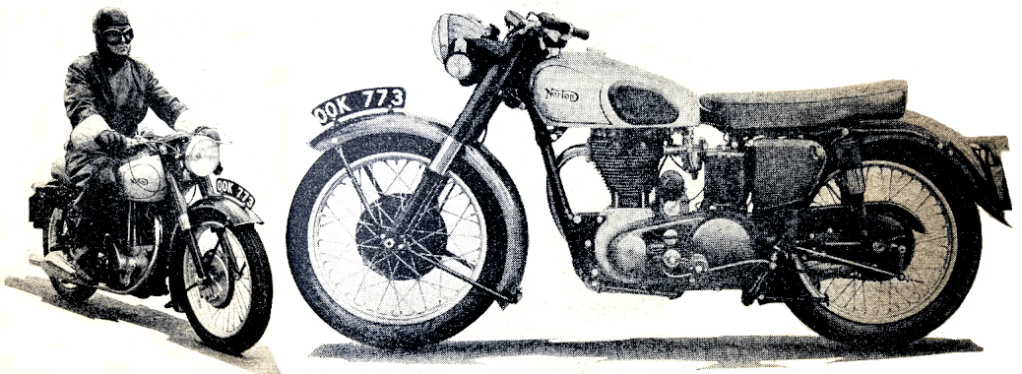
in slightly more than 32sec instead of 34, as previously. It must, of course, be recognised that premium-grade petrol, unobtainable in 1950, somewhat nullifies further comparison of old and new performance figures. Provided that such figures conform generally to an expected standard—and in this case the graph shows that they do—interest centres chiefly on attributes such as ease of starting, handling, reliability, comfort and ease of maintenance. An affirmative answer to the easy-starting question is given without qualification. Almost infallible first-kick firing, followed by a slow, steady tick-over, was another early impression of the ES2 which earned good marks. Physical ease in getting this result depended somewhat upon the stature of the rider. The level of the dual seat is some two inches higher than that of the saddle previously fitted and that, coupled with the elevation of the sprung rear-end in an unloaded condition, tends to impede the full swinging kick which text books advise. This, however, is a characteristic of nearly all modern swinging-fork, dual-seat-equipped motor cycles and one to which the rider, accustomed to the conventional saddle, readily adapts himself. For believers in a comparatively high riding position the ES2 provides full justification. From town speeds up to maximum mph the steering of the model tested was first class, for the geometry of the new rear suspension appears to be harmonic with that of the sturdy ‘Roadholder’ forks. The positions of the seat, handlebars and tests were just right and the longest non-stop run—in the region of 130 miles—was carried out with complete satisfaction from the comfort point of view. Rests and handlebars are fully adjustable. On main-road journeys of that kind, using 70mph bursts when conditions permitted, but also dawdling behind ‘heavies’ and through 30mph areas, an average mpg figure of approximately 78 was recorded. On a premium-grade diet the engine ‘plonked’ like a side valve in top gear and would
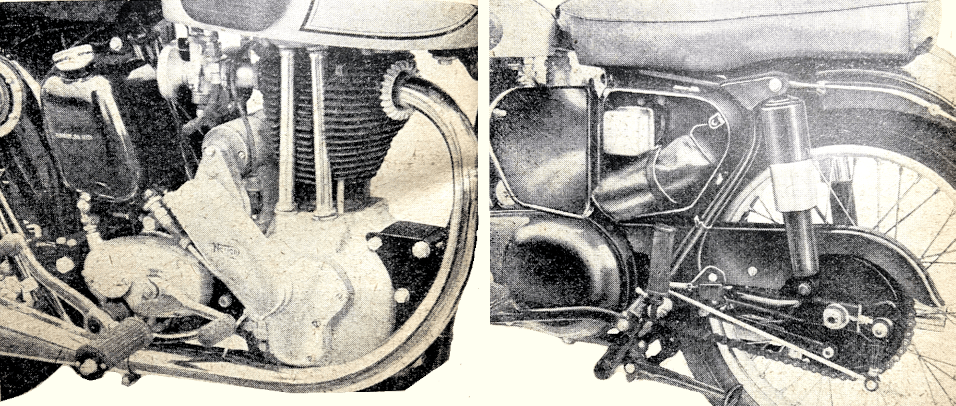
pull away in that ratio (4.75:1), silkily and swiftly. The only criticism of the handling of the model is that a rider unused to the ES2 finds it difficult at first to accept the somewhat limited steering lock, necessarily restricted by stops in order to avoid the fork shrouds impinging on the tank panels. The four-speed Norton gearbox was smooth in operation: gear selection was foolproof and positive, and the clutch, though light to handle, stood up to every aspect of the test and needed no adjustment or attention of any kind. Since the previous test an 8in. diameter brake has been fitted at the front, and the benefit of this useful ‘stopper’ was most marked. Using this brake alone it was possible to pull the machine up in 40ft from 30mph. The 7in. diameter rear brake was efficient, bringing the model to a standstill in 52ft. Applied together the brakes served to record a stopping distance of 31ft, which is good. Throughout prolonged tests of this type there was no sign of brake fade. Although the new swinging-fork rear suspension components add slightly to the weight at the rear end, the model can be lifted on to the substantial centre stand without difficulty. For general parking purposes, however, the side-stand, spring controlled and located beneath the primary chaincase, gives excellent service. It is held extended or folded back by spring tension and the foot is sufficiently well-dimensioned to give support on soft ground without sinking in and allowing the machine to topple over. Full marks also go to the electrical equipment. The headlamp beam provided satisfactory illumination throughout the period that the machine was in our possession, the only maintenance carried out being a routine topping-up of the battery. A point worthy of mention is the complete protection given to the Lucas CVC unit, which is housed in a special toolbox compartment. The machine came to us during a period of drought, therefore there was scant opportunity for assessing handling characteristics on really wet roads. It was felt, however, that road-holding qualities would remain unimpaired in damp conditions and that weather protection would be good. We took delivery of the ES2 in practically brand-new condition and normal running-in maintenance, including tappet adjustment and the tightening of the head race was carried out. The tools supplied were adequate for these and all other items of owner-maintenance, but the kit could with advantage be supplemented by a special spanner for the QD wheel nuts. None of the standard tools seemed sufficiently long to give good leverage, while the holes provided originally in the spoke flange for a box spanner are now screened by the speedometer drive box. These constructive criticisms do not detract from the impression that the ES2, now completely modern in every respect, is as fine a value-for-money proposition as ever it was.”
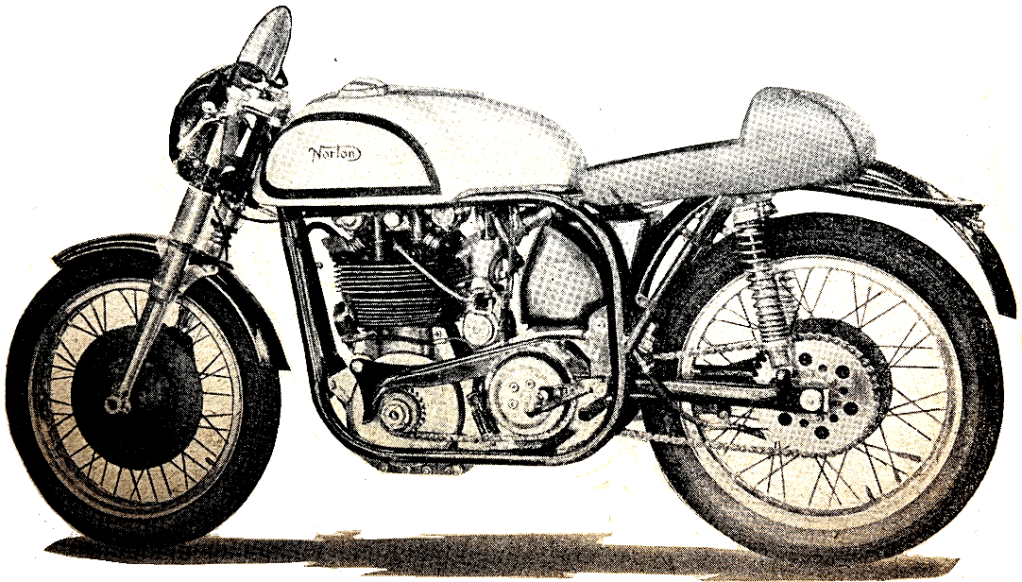
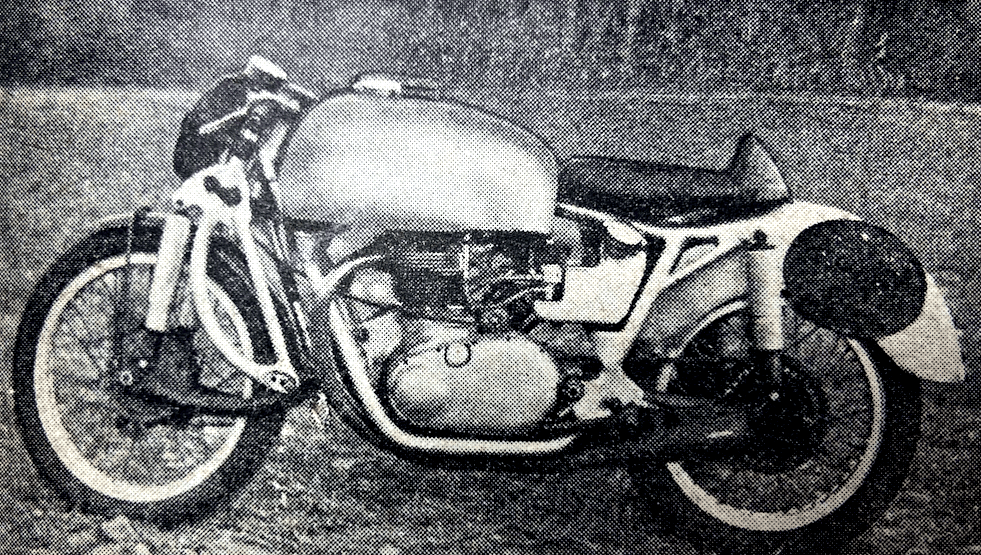
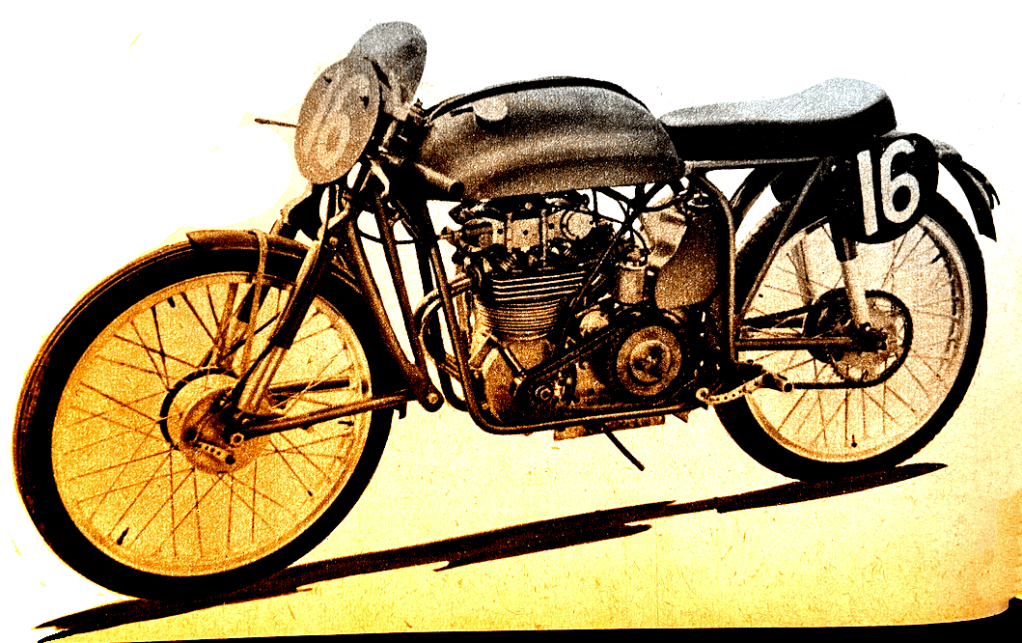
“WITH ROD COLEMAN AWAY winning the Australian TT, there was a duel between Dene Hollier and Leo Simpson for the lead in both Junior and Senior races in the New Zealand Grand Prix. Organised by the Canterbury ACC and run over the 6.1-mile Cust circuit, the meeting was nevertheless dominated by North Island riders who filled all the leading positions in both races. In the 15-lap Senior race, Simpson on his G45 Matchless led throughout. although never by more than a second or two from Hollier, who was Norton-mounted. Len Perry (Matchless), winner of the race in the previous two years, maintained third place. Jim Kennedy of Christchurch, who has recently acquired a new Norton. made a very bad start and was 15th at the end of the first lap but put up a most impressive ride to finish fourth. In the Junior race, covering 10 laps, Simpson led until halfway through the last lap, but was then passed by Hollier who finished so little ahead of him that the timekeepers credited both riders with the same time.”
“THE FOURTH CATALINA Grand National meeting took place last week-end on the 10.3-mile course—consisting almost entirely of loose metalled or unmetalled roads—on the Santa Catalina Island, off Los Angeles, Calif. In the main event, last year’s winner, Johnny McLaughlin, again riding a Velocette, led for nine of the 10 laps but was forced to retire with a burst oil tank. By then, however, he had brought the lap record down to 18min 40sec.”
“ONE OF THE MORE meritorious performances in the MCC’s recent Land’s End Trial was that returned by Arnold Jones on his modified 48cc ohv Britax-Cucciolo. With this diminutive model he not only completed the course, but did so within the scheduled time. Had it not been for a sparking plug which had unscrewed itself sufficiently to take the edge off the ‘Cucci’s’ performance, perhaps even more might have been accomplished.”
“A PASSENGER ABOARD this vessel on a recent run between Colombo and Bombay was a motor cyclist whose courage we cannot but admire. He was Keith Jones, originally from Rochdale, who emigrated to Australia two years ago and who was then on his way back home with the intention of riding about two-thirds of the distance alone! With his 1950 Norton Dominator he set out from Sydney (appropriately enough in the Italian vessel Sydney) and arrived in Ceylon via Singapore. Having toured the island he shipped his machine aboard the Strathmore and disembarked at Bombay, where, having settled a few visa problems, he intended to set out and ride by way of India, Pakistan, Iraq and Iran, across the Arabian Desert to Lebanon, Turkey, Yugoslavia, Austria, France and thence home—armed with a carnet, international driving licence, tent, spare shirt and underclothes in an attaché case, water bottle and a cardboard box of spares. His pannier-bags were of good, stout, horsehide and the frames—which he made himself—were of mild-steel rod, with a luggage-grid mounted above the back mudguard. Speaking of his tour on the tortuous roads of Ceylon, he said the Dominator rode perfectly happily with the additional weight at the rear (high though it is), and in spite of the long, lonely distances he had in front of him his faith in the mechanical reliability of the machine was superb. With no set schedule, he hopes to arrive sometime in August. Here’s wishing him all the luck.
EG LONGMANS, SS Strathmore.”
“A FEW DETAILS of the NSU machines used by Gustav Baum on his recent record-breaking runs are now available. These miniature projectiles are 9ft long, 29¼in. wide and 27½in high. Tyre size is 16x2in fitted to disc-type wheels. The weight of the 98cc machine is 216lb; of the 49cc machine 163lb; the rider’s weight was 121lb. Suspension, both at front and rear, is by rubber bands and both wheels are fitted with brakes. Steering on these highly unorthodox. machines is effected by two levers, one on each side of the reclining driver, and ‘handlebar’ controls are fixed to the appropriate levers. On the actual day of the attempts, the best speed achieved by the smaller model was lower than had been anticipated, due to a strong wind blowing diagonally across the autobahn.” Despite the adverse conditions Gustav-Adolph Baum set four 50 and 100cc world records on the Ingolstadt-Munich autobahn. Baumm was described in a contemporary report as a “jovial, bearded giant”. He must have been an extremely skinny giant but to fit inside the tiny body he designed it with a ‘deckchair’, lying on his back to cover a kilometre at 127.34 km/h—35 km/h faster than the existing record despite an engine, closely based on an NSU Quickly moped, rated at just 3.4hp.
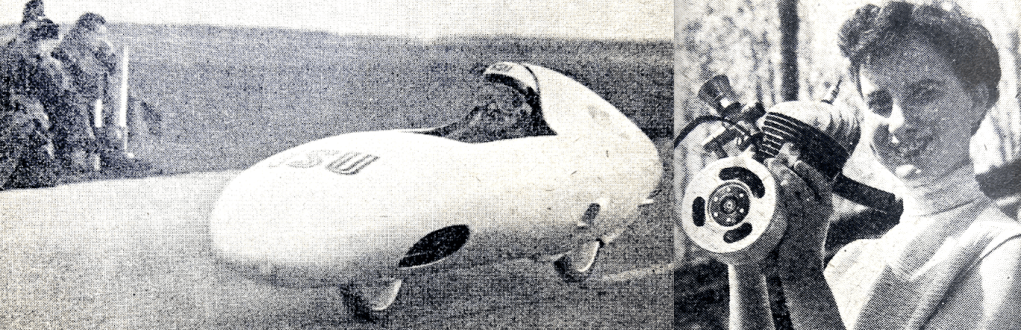
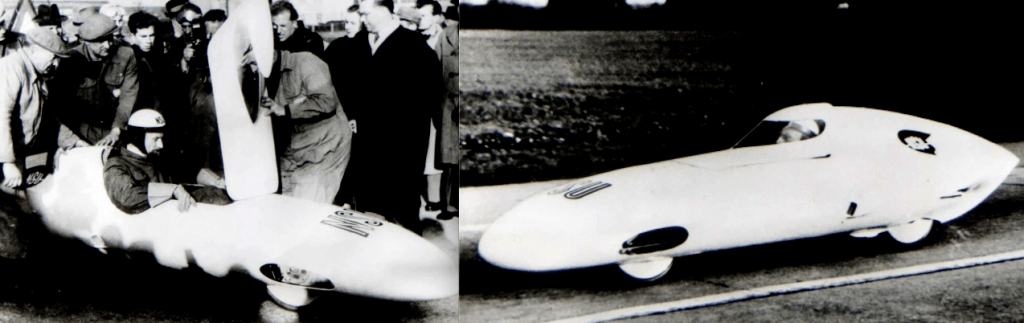
“DESIGNED BY THE BIRMINGHAM accessory specialists LH Vale-Onslow (Motors) to give improved silencing without bulky pipe extensions, the coiled absorption chamber illustrated below retails at 10s. It is an accessory intended primarily for upswept exhaust systems; the open ends are of differing diameters suitable for medium- or large-bore pipes. It is claimed that, clipped into position on the machine, the component saves space, does not detract from the good appearance of a model to which it is fitted and, most important, results in a subdued exhaust note, particularly in the case of two-strokes. By reason of its compactness this unique expansion chamber can readily be scavenged by immersion in a pail of caustic soda solution.”
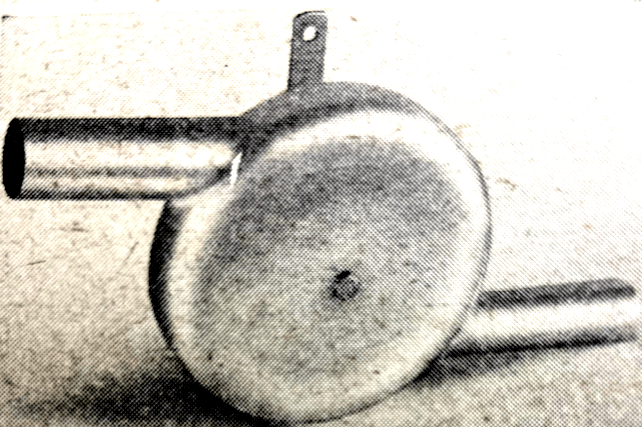
“NEWS REACHED US last week from Mr and Mrs Keith McDonald, the two New Zealanders who last year decided to devote their honeymoon to a motor cycle ride from their home country to Britain. This was achieved on two solo 125cc CZ machines. Early in 1954 they sailed for South America with the intention of completing their round-the-world journey by riding from Rio de Janiero, north through the Panama Isthmus and Mexico to San Francisco, whence they take ship back to Christchurch. They report that all has gone well on the second half of the tour and they had reached, when writing, Cali in Colombia.”
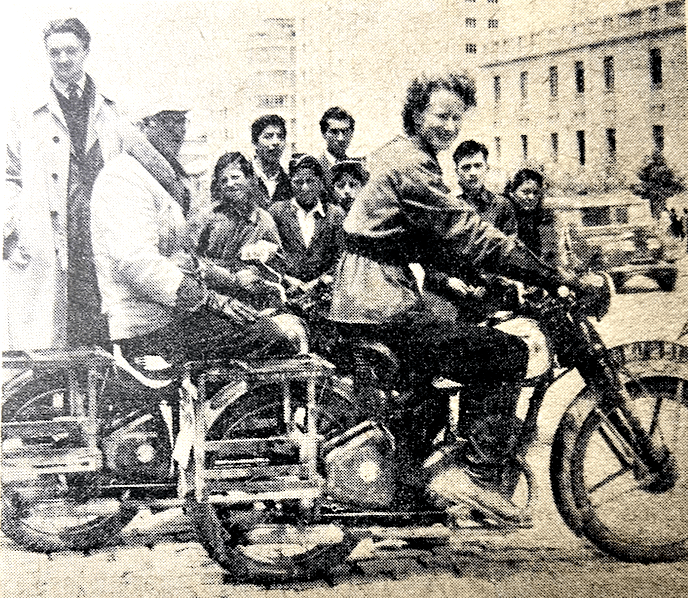
“AS A CONSEQUENCE of the death of Peter Chamberlain, the Auto-Cycle Union, responsible for the organisation and control of motorcycling sport throughout the greater part of the British Empire, now has no direct representation on the all-important Commission Sportive Internationale (CSI) of the International Motorcycling Federation [FIM]. Nor is it by any means certain that the A-CU.’s nominee will be elected to one of the four seats on the CSI which become vacant in the autumn. That a position should continue in which one of the three countries which provides the machines for the classic road races, and the Empire which provides a very large proportion of the riders, is unable at the moment to have a voice in deciding how these races should be run is clearly unsatisfactory. When casting their votes in Paris, where the Autumn Congress is to take place in October, delegates from some of the smaller countries which enjoy parity in the FIM Council with Great Britain and the Empire, might be well advised to reflect upon what would happen to international sport if the A.-CU., feeling that it was being ‘shut out’ from the CSI, should decide that there was no longer any good reason for continuing its affiliation to the FIM.”
“GADGETS TAKE A LONG TIME to become popular. Most owners are against cluttering up their machines, and need a lot of convincing that an extra fitment is really worth having. But once an idea starts to become acceptable, it very quickly becomes a fashion. The windscreen is a perfect example of this. Once a rarity on solo models, you now see them everywhere. The same thing could be said of the stop-light. Pre-war, it was regarded rather as a faddist’s accessory. Now there are signs that the riding public looks upon it as a necessity —and rightly, too, I think.”—CARBON
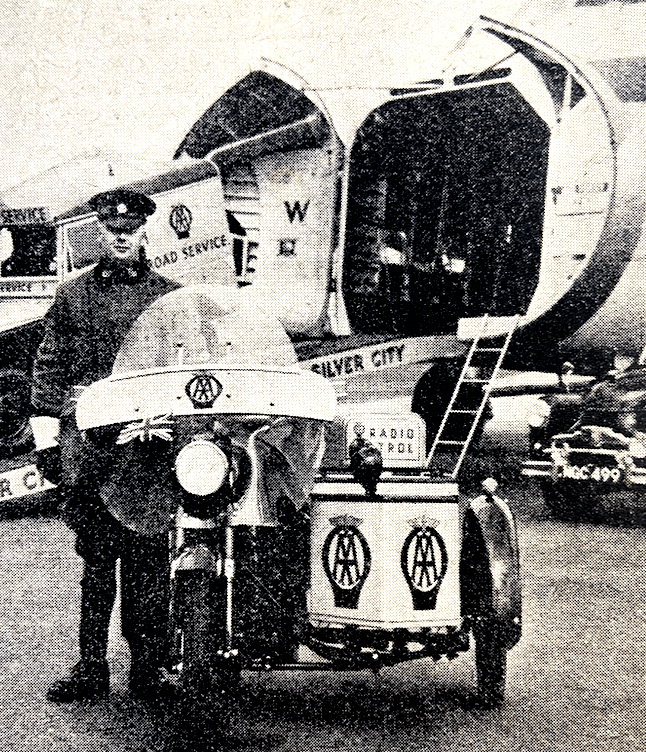
“MEET MR GEORGE BRADLEY, who lives near Flowden, in Yorkshire; he is one of ourselves. Now aged 86, Mr. Bradley rode his motorcycle regularly until a couple of years ago. He used it chiefly for his business rounds, selling forage, and only ceased doing so, temporarily, for health reasons. Optimistically, though, he has renewed driving licence. The Motor Cycling reader who told me about Mr Bradley has himself turned 80! But even these octogenarians are relative youngsters compared with Mr George Dobson, of Market Lavington in Wiltshire, who received, last week, what must surely have been a unique present on his 96th birthday, namely, permission once more to ride his motor cycle. In August last he lost his licence for a period of three years following a conviction for careless driving. But now the Devizes magistrates have relented and cancelled the period of probation. Presumably they were influenced in their decision by the fact that Mr. Dobson is at present ill in Market Lavington Hospital, and is reported to be unlikely to ride again. I, for one, hope the report proves pessimistic and that this grand old man will again experience the joys of the open road.”—CARBON
“A SHORT TIME AGO it seemed that we knew hardly anything about how the Russians lived, and especially how they travelled. Glimpses of Moscow in occasional movie newsreels suggested they were still using a lot of lease-lend trucks and jeeps; there were American-style buses in Moscow and a few private cars, but little information came out about motor cycling activity. But now they have begun to reveal a little of their way of life. The Russians have shown interest in membership of the FIM. They have also begun staging exhibitions of Russian products and even bidding for a place in the export markets of the Western world…at the big trade fairs there have been impressive Russian displays—at Naples, at Milan and most of all at Lyons, France. They showed textiles and porcelain, microscopes and machine tools, radio sets and pianos, cars, trucks, excavators, agricultural implements—yes, and motor cycles. Not the IFA machines, which we have seen, from the Eastern Zone of Germany, but genuine made-in-Russia models, marked with strange symbols and reasonably well finished. Naturally public interest is enormous and the big white and gold Russian pavilion at the recent Lyons Fair was packed solid with people from morning to night, while the loudspeakers played Russian folk music and a projector showed colour films of Moscow. The salesmanship was not what you would call brisk; sales of motor cycles, like those of other Russian products, depend on government trade agreements, and you just cannot walk up and order the machine you want in the colour of your choice; but the Russians are definitely out to win a place for
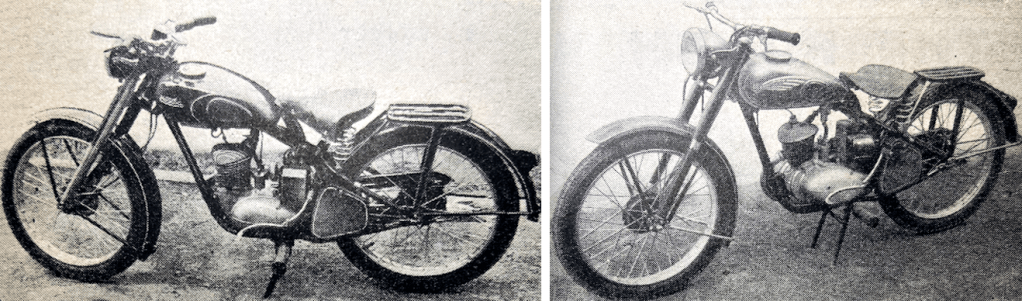
their machines in world markets. They have some bright young technicians of the new generation to explain the features of design in fluent English, French and German. At Lyons they showed three types, all with single-cylinder two-stroke engines. The heaviest, the 350cc IJ-49, is described as a sports-touring machine and is said to have won the Russian moto-cross championship, although it is rather far removed from our idea of a moto-cross ‘special’. The other two, the M1A Moskva and the K-125 are lightweights of 123cc and so much alike in design—with a striking resemblance to the DKW—as to suggest that they are the same basic machine produced in two factories. The IJ-49 has a pressed-steel frame, but the frames on the smaller machines are tubular; they all have telescopic forks with hydraulic damping, and the IJ-49 has a sprung rear wheel. There is a moderate amount of chromium plating on items like handlebars, controls, headlamp rims, saddle springs, exhaust pipes and fishtails. Engines employ cross-flow scavenging and the cylinders have detachable aluminium heads. Lubrication is, of course, by petroil, in the ratio of 25:1. Primary chain cases and gearboxes are built in unit with the crankcases from a series of aluminium castings. The IJ-49 has four speeds with both hand and foot control; the lightweights have three speeds with foot control only. Equipment includes lamps, battery, electric horn, and on the IJ-49, a speedometer built into the headlamp. For this machine the Russians claim a maximum of 56mph and a fuel consumption of 80-90mpg. The lightweights are said to do 43mph and 115mpg. As on the Russian cars, the design is simple and conservative, and it is impossible to form any idea of relative values, because the machines are handled through state trading agencies which can quote any price depending on how badly they want foreign materials, goods or currency in return, but the mere fact that they are on offer is an encouraging sign that the Iron Curtain has lifted a little.”
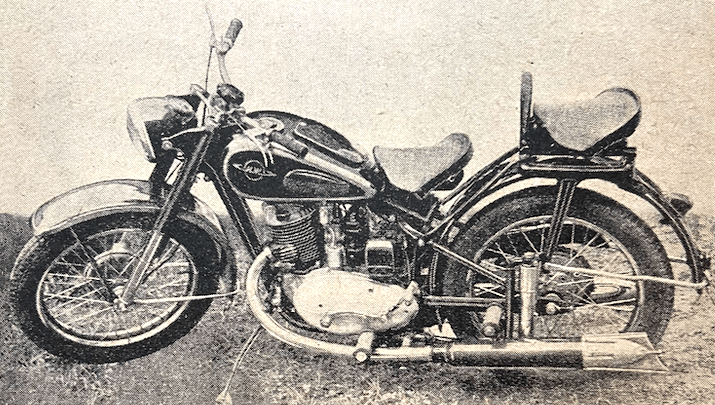
“RECENTLY OPENED, THE LADIES’ showrooms of D Lewis, 124 Great Portland Street, London, W1, will meet a demand that has been apparent for some time. A comprehensive range of ladies’ clothing, including the new Dryad suit, especially attractive for the pillion rider, and, of course, the popular Aviakit helmets, is available.”
“SOME VACANCIES STILL exist in the RAC-A-CU training scheme at Farnborough. Theory classes are held every Thursday at 7.30pm and practical classes on Sunday mornings from 10am until 1pm.”
“MEMBERS OF THE Guzzi, BMW, NSU and MV teams competed at the International Rhein-Pokal road races, held at Hockenheim, in South-West Germany. In the larger-capacity classes Guzzis were all-conquering. From the field of 32 in the 350cc event E Lorenzetti and F Anderson went straight into the lead, pursued by JA Storr (Norton). Also well up was Australian Maurice Quincey, likewise Norton-mounted. On the 18th lap Lorenzetti went out with engine trouble, leaving Anderson to come home a lap ahead of Storr. The Hockenheim circuit measures 4.5 miles. A ‘single versus multi’ battle was obviously in store in the 500cc race, for Ken Kavanagh had brought the new Guzzi single to the line, to compete with Anderson’s four-cylinder Guzzi, Nello Pagani’s MV and the unstreamlined BMW twins of Walter Zeller, Hans Meier and Co. After the first few laps the fight was on between the two big Guzzis, whose riders duelled for the lead, with Pagani 20 seconds behind after the first 10 laps had been run. On lap 18 Pagani—his engine losing tune—fell behind Zeller, on the first of the BMWs. Then Anderson was forced to give up the fight, leaving his team-mate Kavanagh in a winning position. Earlier, the 250cc race had been a triumph for the NSU team men, who occupied the first. second and fifth places, sandwiching Guzzi riders Lorenzetti and Kavanagh. A ‘sports’ NSU came into sixth berth, ahead of a 247cc twin-cylinder Adler piloted by W Vogel. This race followed yet another NSU walk-over in the 125cc race, where the Renn-Fox men took the first four places. The sole all-British victory came in the sidecar class, where Eric Oliver brought his Norton outfit home a split second ahead of Noll’s BMW after battling wheel to wheel throughout the race.”
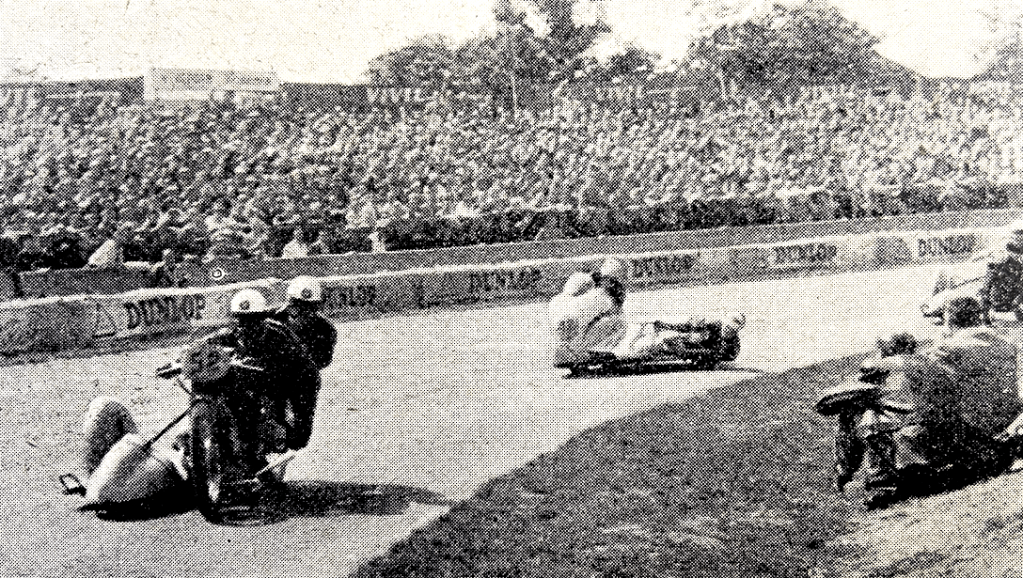
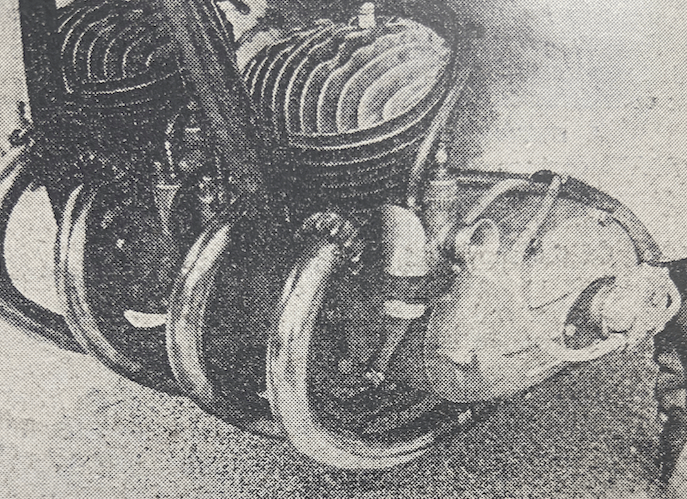
“IN SATURDAY’S INTERNATIONAL Leinster Two Hundred’ races at Wicklow, Eire, Reg Armstrong (Gilera), Frank Fox (Norton) and Arthur Wheeler (Guzzi) each won his class with ease at record speed. Armstrong and Wheeler also set up new lap records. The meeting started with the 350 and 250cc classes run concurrently over 12 laps (100.1 miles), followed by a 500cc race. Fox shot ahead at the start of the 350 race and at the end of his second lap, on which he averaged 83.17mph (one second slower than Armstrong’s record on the works Norton two years ago), he had a lead of 48 seconds. He then settled down to a slightly slower speed and went on to win by nearly three minutes at a record 82.06mph. This runaway win did not detract from the interest in the race, for behind Fox an exciting four-rider tussle went on between a young Dublin rider, J Woods (Norton), and two Ulstermen, M Templeton (AJS) and JA Dickson (AJS) and Ernie Lyons’s elder brother, Alan (BSA). At the end of the second lap there were only three seconds between them, with Woods, unexpectedly, still in front. Early on the third lap a locking brake brought Lyons off—he was unhurt, though his machine was well bent. Woods kept hard at it and at half-distance, despite a desperate slide at Rathnew Corner, he narrowly held his lead at an average78.5mph. But then a stop to remedy the cause of an over-rich mixture put him right back, and gear-change trouble later delayed him still further after a plucky effort. Templeton finally drew away from Dickson to take a comfortable second place. In the 250cc class Wheeler ran away from the rest, pushing up his own lap record from 76.01 to 79.00mph to win by five minutes at 77.40mph, his fourth successive victory in the class. WM Webster (Velocette) and WJ Maddrick (Guzzi) had a great battle from the fourth lap to the end and Maddrick took second place by half a length, passing Webster on the run-in to the finish from the last corner. Armstrong had things all his own way in the 500cc class. Riding the new streamlined Gilera in effortless style he won the class for the third successive year. On his standing-start lap he was only four seconds outside record, and on the next he beat it by four seconds. After three relatively quiet laps he had another, go and took a further three seconds off to leave the new figure at 90.16mph. His race average of 88.22mph was an improvement of 1.07mph over the old figure. Public attention was focused on the flying Gilera, but more exciting was a battle between MGP winner Frank Fox (Norton) and Dubliner Louis Carter (Norton). Carter led in the early stages with Fox holding grimly on to his tail despite Carter’s equalling the 1953 lap record of 88.31mph. The lead changed frequently. On his eighth lap Fox also equalled the old record and managed to get away from Carter. But the Dublin man kept hard at it and in the last two laps pulled back seven seconds; but he had lost his chance and Fox took second place by three seconds, equalling the old course record at 87.05mph.”
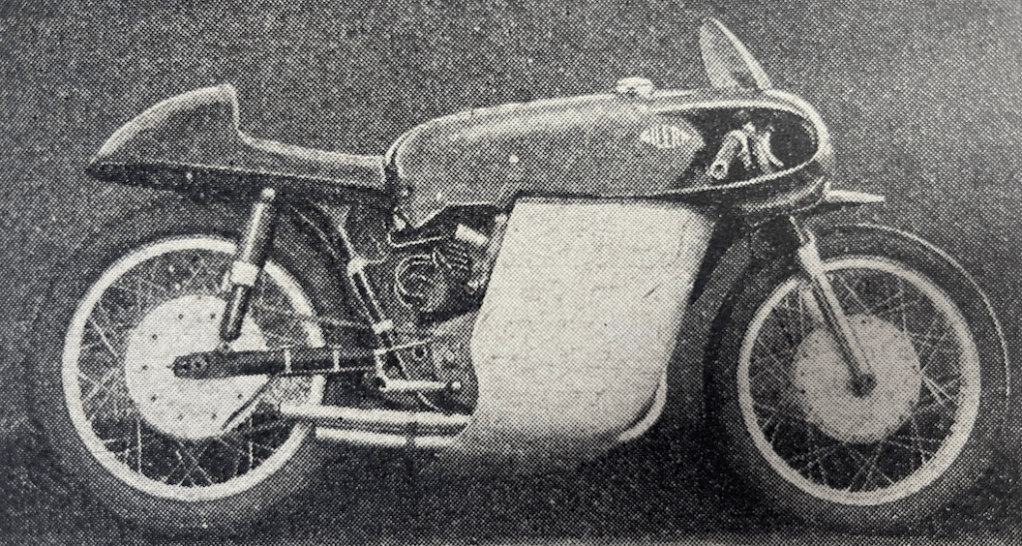
“BEFORE A CROWD conservatively estimated at 15,000—double the previous best attendance—John Surtees (348 and 499 Norton) swept the hoard at the Aberaman MC&LCC’s National road races, held over the ¾-mile Aberdare Park course. Riding brilliantly, he won the 350, 500 and 1,000cc races. II Lloyd (125 MV) and EW Tinkler (248 Rudge) were the victors in their respective classes.”
IMPRESSIONS: ADLER M250
“RECENTLY, I have fulfilled an ambition by riding one of those beautifully-finished 247cc Adler M250 two-stroke twins. I was able to do so through the kindness of one of our readers, Mr Fred Ager, of Ealing, who has the good fortune to possess one. And, apparently, I introduced him to it. Then a BMW rider, Mr Ager read the description of the Adler models which appeared in this feature last autumn. He was impressed, and wrote to the Frankfurt factory to inquire whether one could he imported. Adlers, though not interested in exporting to the UK (they consider that the 30% import duty levied upon Continental machines denies them the chance of fair competition), nonetheless offered to sell him one privately, and the deal was arranged. Then came the Frankfurt Show—with the introduction of a new, vastly improved, model. Despite the fact that they had already been paid for the 1953 machine to which Mr Ager’s order referred, Adlers, unasked, substituted one of the latest machines in its place—a gesture typical of this go-ahead Frankfurt establishment. On its arrival in this country, the Adler so fulfilled its owner’s expectations that he wrote to tell me about it, and immediately agreed to lend it to me for a few days when he had run it in fully. He was as good as his word, and a fortnight ago I called at Hanwell to collect the machine. From the start. I was impressed by it. The design is first-class—neat, clean, eminently practical. Workmanship and finish are of the highest order. Such details as the knurled top rings which adjust the hydraulically-damped plunger rear suspension for load; the Yale-type lock in the steering damper; the same type of safeguard on the toolbox (which component hinges when released, lying horizontal to form an accessible tool tray); the rubber buffers for the central stand; the ‘quick-release’ wing-nuts for the hinged rear mudguard—all give evidence of a machine planned down to the last nut and bolt. A mere dab on the inward-folding kickstarter brought the engine to subdued life. The lack of mechanical noise (save for a distinctly audible primary transmission) was uncanny.
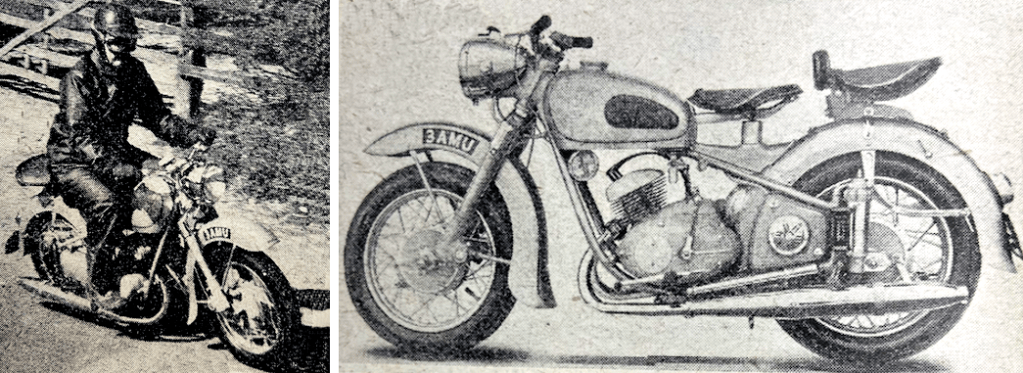
Huge silencers coped admirably with the exhaust note, reducing it to little more than a drone, except when the machine was accelerating hard. Adlers have solved the problem of an evasive ‘neutral’ by positioning it at the bottom of the gear selection, and thus all four gears were ‘up’—a system which, once the rider has become accustomed to it, has much to recommend it, especially when it is reinforced by an easily visible neutral-indicating light in the speedometer. Clutch take-up was a little fierce, and the initial change from first to second gear demanded care if noise was to be avoided. Subsequent changes, in either direction, were effortless, provided that a pause was made. This need for ‘hesitation’ tactics led me to prefer use of the toe, instead of utilising the small heel pad provided on the pedal. Whether accelerating or cruising, the machine was smooth and vibration-free, save for a roughness in the transmission over a narrow range at 31mph and some high-frequency vibration occurring at about 55mph in top gear. For the rest, the twin produced its power in so fussless a manner that one would hardly have realised that there was an engine at work at all had it not been for the road racing past. With a front and rear suspension that was truly excellent (especially in combination with the soft springing of the saddle and rock-steady stability added to the characteristics of the engine and transmission, the Adler gave me the impression of being a two-wheeled car—one with that effortless, floating mode of of progression so beloved of four-wheeled addicts. The steering did not disgrace the rest of the machine—the M250 could be heeled over well either way whatever the surface and would hold its line with barely a waver. On bumpy left-handers the stand fouled the ground—the only fault I could find. Naturally, the small wheels (tyres are 16×3.25 front and rear) did not permit of that ultimate refinement which gives hairline navigation. Though I made no attempt to set up any ‘records’—it
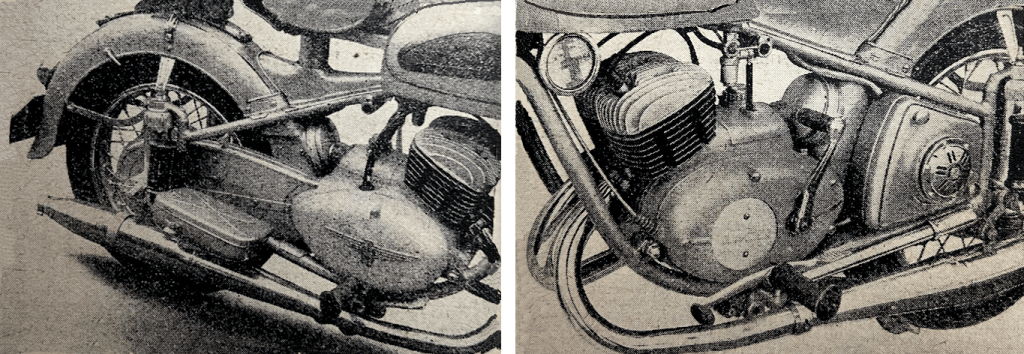
would hardly have been the thing to risk another chap’s barely run-in model, would it?—I was able to assess the machine’s probable speed capabilities. It seemed that once the bores had settled down, a cruising speed of 55-60mph could be sustained indefinitely, leaving plenty of throttle in hand. The makers claim a maximum speed of 72mph with the rider normally seated, which, if past experience is anything to go by, would be about 75mph under Motor Cycling roadtest conditions (speeds are taken with the rider as flat as he can safely get). Without trying to push the machine, I several times, when conditions were favourable, recorded 70mph normally seated—and I checked the speedometer, too, to ensure that my figures were correct. The instrument—a VDO—proved to have a 7% error, for which allowance has been made. Acceleration in the intermediate gears became, once 30mph was reached, very pronounced. As much of the performance is located at the upper end of the rev range, however, an intelligent use of the gearbox was essential if the best was to be obtained in this respect. Economy is another Adler feature, overall averages of 70mpg being returned even when the top end of the performance scale was used. At lower speeds well over 100mpg could reasonably be expected. Finally, the brakes were the sort of which one dreams—powerful, smooth, fadeless. Either was powerful enough to lock its wheel, yet pull-up was always dead straight, unless the model was leaned to the right when the front anchor was applied, when a slight deviation was noticeable. Despite the link-type front forks, there was no tendency for the machine either to dip or to lift up on its springs. When the model was returned to its owner an extra 400 miles had been recorded. Yet the engine/gearbox unit was as clean as if the model had just been wheeled out of a showroom. The only signs of use were a slight smearing of exhaust oil and dust on the lower three inches of the rear mud-guard; one tiny, solitary ‘weep’ from the rear end of the secondary chain case; and a film of oil of microscopic proportions on each rear plunger. After a 60-mile trip (including main road work, lane pottering, and the negotiation of heavy traffic) which had easily been packed into less than two hours, the engine was cool enough to permit me to place my hand upon it without hurriedly withdrawing it again. I am very grateful to Fred Ager for his generous action…and, I must confess it— I rather envy him his model!”—John Thorpe
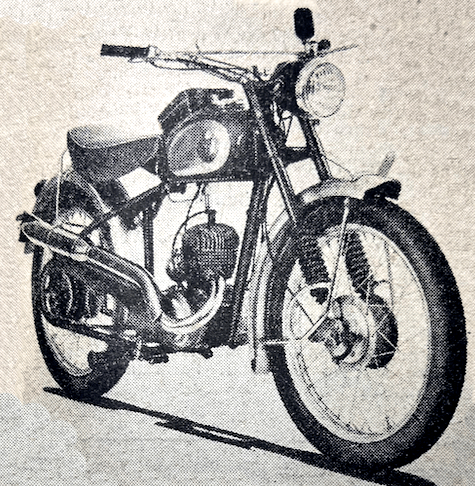
THE CZECH JOURNAL Svet Motoru described a “car on two wheels” built by Ing Bartos and Ratocna. Rider and passenger were to be seated inside streamlined bodywork, their heads protected by an aircraft-type canopy. Small stabiliser wheels were fitted. Power was supplied by a Jawa 250, giving a top speed of 55mph at 80mpg.
MONTESA CLAIMED THAT its Sprint competition model was the fastest 125 on the planet. With an 11:1 compression ratio and weighing 128lb it developed 12bhp at 7,250rpm and was claimed to hit 89mph. Motor Cycling proudly mentioned its source—HM Vice-Consul in Seville, GWR Gilbert.
AN ITALIAN DESIGNER came up with a novel way to combat plug troubles on two-strokes: a spark plug with a single long electrode. A pimple on the crown of the piston served as the second electrode, sparking as the piston reached TDC.
“WOULD THE ‘GENTLEMAN’ who stole my motor cycle from Marble Arch be so kind as to return the Bible from the panniers? The article in question belongs to a friend and has great sentimental value.
ALAN DENNISON, Newport, Mon.”
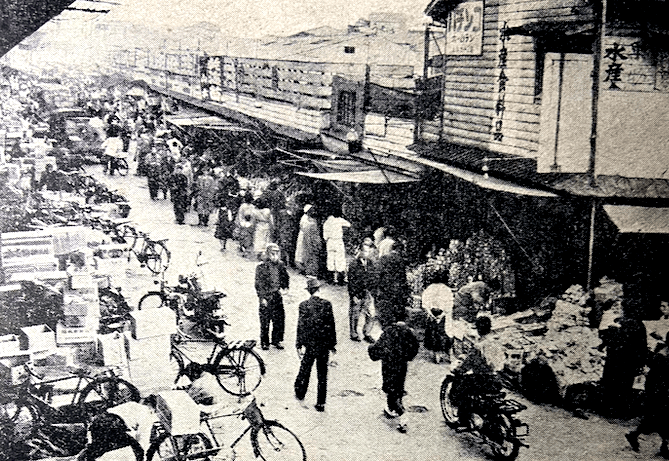
REPORT: SCOTTISH SIX DAYS’ TRIAL
“Edinburgh, Sunday
THERE WAS MUCH tapping of barometers in Scotland this week-end for, on Saturday, eve of handing-in for the Edinburgh &DMC’s 35th Scottish Six Days Trial, citizens and visitors to the Caledonian capital for the hospital carnival week and the trial awoke to find a Christmas-card scene around them. Snow lay white and quite thickly on the roofs; the chocolate-brown trams fussed and groaned on their various ways, sending bow-waves of slush, and many, like the writer, who had half forgotten such things, re-learned in a hurry the fine art of swinging a solo across pavé and steely, black lines without coming a cropper. Early arrivals were making the most of yesterday afternoon to start the amazingly comprehensive overhauls which, it seems, must needs precede a ‘Six Days’; clutches were stripped and parts strewn around awaiting the arrival of ‘Mr Ferodo’ who, alas, was late due to trouble on the road. Dickie (Dunlop) Davies, his van turned into the biting east wind, sat snugly inside it, handing out covers, tubes and the buckshee odds and ends that go with them. One or two riders stood about with nothing to do, regarding the animated scene almost with aloofness. Their tasks were done. One of them was the Wickham MC’s FH Carey whose 150cc Royal Enfield, about to start its third ‘Scottish’, had been immaculately prepared. Double rear sprockets, giving, in effect, six gear ratios, three for road work and three for the hills, are a feature of Carey’s mount which this year has only seven rivals for the 175cc award—four more 150s, including the CZ of JE Breffitt, and four 125s. Veteran Karl Pugh was another early arrival. His machine, too, was almost ready for the start, and attracted a small crowd interested in Karl’s ingenuity in equipping the 200cc Norman with several very commonsense ‘mods’. Best and neatest is the reservoir for the chain oiler, comprised of a tyre pump body, corked and vented at the top, with a tap and feed pipe at the lower end. Clipped neatly and rigidly to the nearside rear mudguard stay this simple but effective gadget earned applause. While he is entered by the Norman
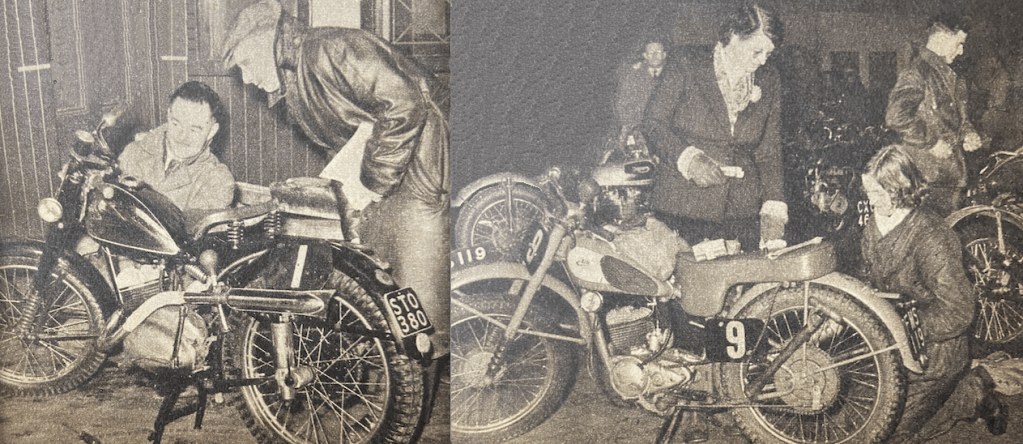
concern, Karl is not this year a member of either of the works teams, having stood down in favour of young CN Mills.” BSA also entered two three-man teams; singles teams were entered by AJS, Ariel, Francis-Barnett, James and Matchless. There were also 19 club teams. “Gradually the garage filled and despite the gloom without, all the animation and pleasure of the ‘Scottish’ weigh-in period began to bring warmth to the scene. One by one machines were completed; models were wheeled to a corner to await official inspection. For some—works riders such as Hugh Viney, Bob Manns and Ted Usher—the work is already done. They stood watching the familiar activity. Viney smoked a pipe—a pipe, doubtless, of contemplation, for he is the winner of four post-war Scottish Six-day events. My outstanding impression at this stage was of the high proportion of two-stroke machines entered. By lunch time today non-starters and other alterations had resulted in a final entry list of 174, of which 80 are on 125, 150 or 200cc two-strokes. Least competition is in the 250cc field, there being only three machines of that capacity entered. Forty-one 350s are listed, while in the 500cc class the total is 50. Their machines handed over, their work complete, all preparation finished, competitors, bunched up in riding kit or oilskins, went off in little groups, each, doubtless, mindful of the pattering rain and the 952 miles lying ahead, where riding skill in sections and time-keeping on the road would determine the best among them.
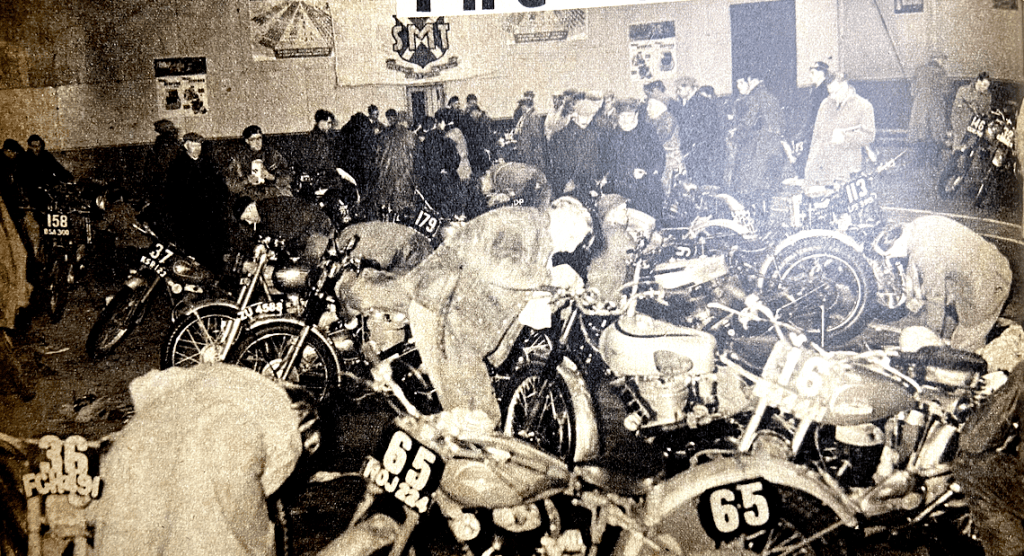
EDINBURGH, Monday
FOR MANY, TODAY’S 184-MILE run to Fort William will have resulted in a consider-able loss of marks, for it has been achieved in weather conditions quite foreign to the sunshine and warmth which has become almost a ‘Scottish’ tradition. Last night the rain cleared up on the turn of the tide and everybody decided to forget the weather and carry on with the event. The start this morning went off without a hitch: the grey roof of cloud was thinning and shortly before the first man, JE Breffitt (150 CZ), and No 2, GE Fisher (Francis-Barnett), reached the first control at Menstrie, the sun broke through. Both riders were early here, arriving before the official car, and were also first at Scotstoun, by which time it was snowing. And that seemed to set the weather pattern for the day. Normally easy, Scotstoun’s sting today was in the No 1 section, where the mudhole, worthy of a one-day sporting trial, sent riders nadgering up the bank to avoid it. The two rock sections which followed provided an exercise in path-picking but unseated none of the early men watched here. PH Alves (200 Triumph) was a pleasure to see. Breffitt, clean, appeared to be overgeared, a fault which had cost him some 20 marks before the lunch check at Kinlochrannoch was reached. Weem, a hill which contained some difficult sections, was 3 ½ hours out from Edinburgh, and by this time weather problems were making their mark. Many of the two-strokes, comprising nearly the first half of the entry, were bothered by water in float chambers or in the ignition. I passed No 17, WH Martin (200 James), coping with a snag of this kind. The ladies, with the exception of young Miss Paterson (125 BSA) who is gaining experience in a very hard school, accounted for themselves well. They all looked particularly neat in appearance and an example in this respect to the less gentle sex. Veteran D Lamb (200 DMW), of the Edinburgh &DMC, was applauded for an excellent climb on Weem and he was followed by RT Hill (350 BSA), the first of the four-stroke contingent who, as he went by, voiced the opinion of us all—he could do with a ‘wee
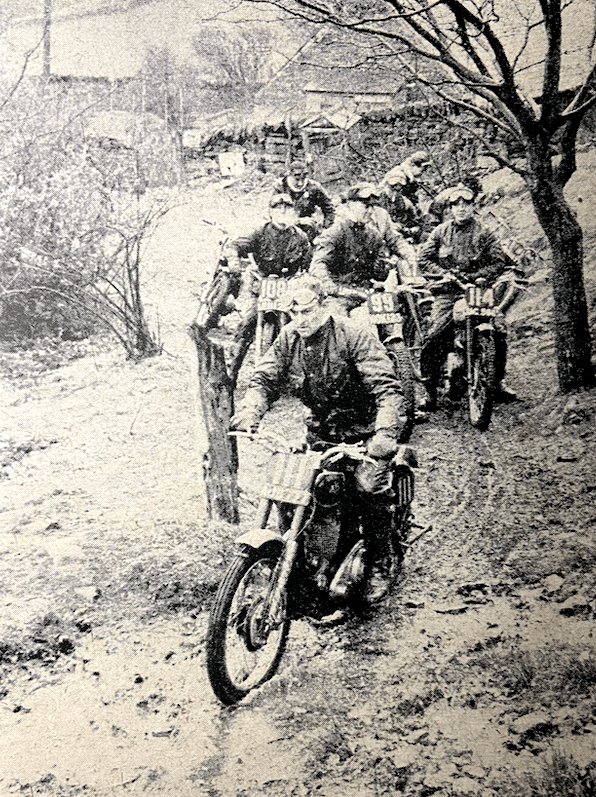
dram’. The competitors went through Glen Lyon to Meall Glas, a stony section always kinder to the later numbers when the worst of the stone and rocks have been lifted out of the way or bedded down. Mean Glas saw GE Fisher (Francis-Barnett) clean. His team-mate, PJ Marr, riding on top of his form, was also unpenalised up to the lunch check. At Meall Glas the two-strokes were over-hauled by the 350s and 500s whose riding numbers ran from 89 onwards. Alves dabbed here; so did SR Wicken (200 Norman). A sorry tale of woe was told during the lunchtime period by riders whose main interest was to get as near the fire as possible, to warm their hands and dry their gloves. Outside the steep, snow-clad massif of Kinlochrannoch awaited; farther north, the normally simple Meall na Moine was said to be in treacherous mood. This section takes competitors off the main road, then up a rocky path and down again, to join the highway once more. Many riders came to grief this afternoon on the wet, boulder-strewn descent. Tantalisingly, during the afternoon the weather changed and competitors were able to tackle Town Hall Brae, in Fort William, in mellow sunshine before going off in search of hot baths and high tea. During the evening it was learned that snow-bound Correyairack would not figure in Tuesday’s run.
FORT WILLIAM, Tuesday.
HIGHLIGHT OF TODAY’S 141-mile run, and the turning point in the fortunes of Fisher, Stirland and Ratcliffe—all three clean thus far—and many others who up to last night had lost marks only for a dab or for footing, was Craig-an-Eilcin, a 10-section, zig-zag climb near Aviemore in the foothills of the snow-capped Cairngorms. With Corrieyairack, the highest usable road in Britain, snowed up and impassable, Craig-an-Eilein became the focal point for onlookers in search of something spectacular. And what a pleasant trip it was. Scotland so tearful on Monday awakened today with a smile. The sun climbed up over the Grampians throwing long fingers of warm light across the Bens. Her drab grey veil replaced by a hood of dazzling white, Nevis stood serenely resplendent. Here was the real Scotland of ‘Six Days’ repute and, as an appetiser to what promised to be a splendid day, riders departed for the familiar, yet still tricky, M and D hill, a starred two-section climb, almost within a stone’s throw of the centre of the town and a popular means of entertainment for the inhabitants of Fort William who could spare the time to watch the riders. Until then, it was not generally known that BSA’s number one team had lost the services of GJ Draper whose 500cc model had plagued him throughout Monday’s run with clutch trouble. With many marks lost, he had come sadly back to Fort William to conclude his 1954 Scottish with a gallant climb up Town Hall Brae. Fourteen miles out was Chunaig, controversially spelt on the map as Clinaig. Academic points apart, it worried nearly 90% of the entry. Water was the main hazard, creating an awkward path into the section, and, as wheels loosened the rocks and top soil, liquid, released in increasing quantities, caused deterioration. The hill of the day, Craig-an-Eilein, known last year as Inchriach, was 48 miles distant. Nobody was clean over the complete section. The last snorter, leading over stone slabs to the dizzy summit, stopped practically the whole field, only PCO Stanfield (200 Norman), EW Smith (200 Francis-Barnett), J Giles (500 Triumph), Q Wheldon (350 Royal Enfield), WL Rutherford (350 Ariel), F Hickman (350 Matchless) and DS. Evans (350 Royal Enfield) surmounting it unpenalised. Still out on their own, forming the spear-head of the troop of two-strokes which occupy the first 80-odd numbers in the programme, JE Breffitt (150 CZ) and GE Fisher, both walked on ahead, section by section, ruefully assessing the prospects. Breffitt’s difficulty since the start has been unduly high gear ratios and Fisher’s, on such hills as this, the obviously limited power available. To overcome his gear problems, Ted Breffitt slips the CZ chuck shamelessly, but on Craig-an-Eilein even this expedient was unavailing. Hitherto unpenalised, Fisher and PT Stirland also suffered stops. The real sting was in the hairpinned number six and seven sections and in the rocky steps of number 10. Ratcliffe went up beautifully with only a dab in the severe sections but PF Hammond (500 Triumph) flailed wildly and, like so many others, ran off the narrow track. Down the other side of the hill a track commanding magnificent views led to Ord Ban and a contrast in hazards, for here were four sections up a mossy, slimy hillside with scarcely a rock in sight. The slow, careful treatment of Ord Ban by people of the calibre of TU Ellis, GL Jackson and JV Brittain indicated the snags underlying its innocent appearance. Another long trek by main roads through a heavy shower of rain took us back to Fort William and the section Town Hall Brae which, for three more afternoons, will be a delight to hundreds of school-children.
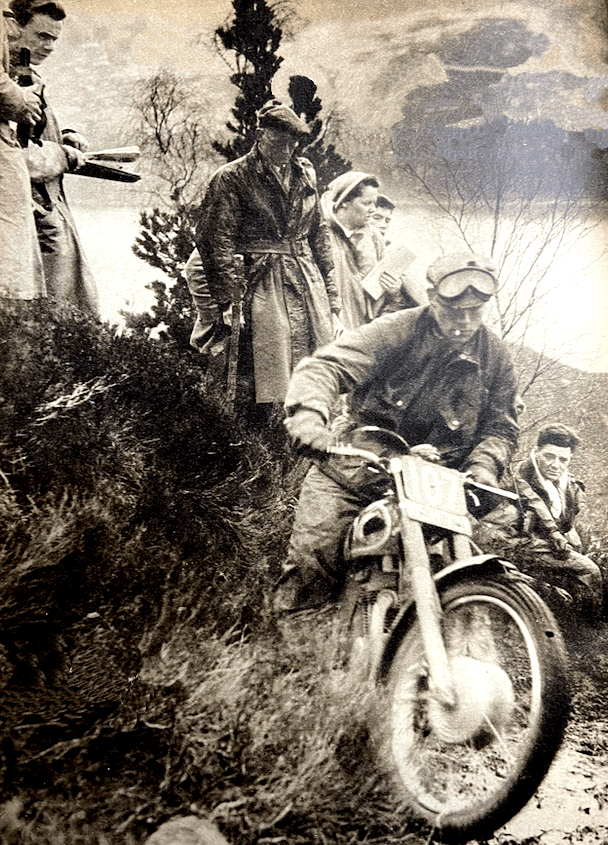
FORT WILLIAM, Wednesday.
MONDAY’S TROUBLES ALL over again plus the additional tribulation of Mhic, a new section on the Kinlochleven-Glencoe track, and Camushurich Hill near Killin. This is the story of today’s 178-mile ‘tour’ which again embraced Meall Glas and Meall na Moine where all of the 12 first-day leaders lost marks. The route also included Kinlochrannoch and a long trek into Perthshire for the purpose of climbing the Tayside hill, Camushurich. This section was in excellent condition, penalising a great many riders but giving the stars an opportunity of displaying their skill. Up with the lark in time for the only early start this week, the first of the two-stroke contingent made their way to the garage just before 7.30am—and a delightful morning it was too, bright and mild, with a tang of sea and mountain air, which made one feel on top of the world. But for competitors the top of M and D was again the prime objective and, surprisingly, there were many dabs recorded and eight complete stops; this virtually in Fort William’s own backyard and in conditions generally considered to be less severe than the wild, rocky stretch of Mhic! On part of the old road from Kinlochleven, leading across to Glencoe (a battered signpost labels it optimistically as the footpath to Glencoe), F Hickman, of the Matchless team, lost one of his Wednesday marks and so did David Tye. Riders watched at the next section, Martuim, an old favourite, included Ray Peacock, who appeared to be far from happy, and Miss L Blackburn who footed in four of the five sections. A glint of sunshine mellowed the gaunt walls of the Glencoe region and lit the corries and snow-streaked summit of the black mountains past which competitors sped towards the Bridge of Orchy and the altogether softer scenery of Loch Tay, its four sections reaching up the steep escarpment. South of the Loch, Camushurich was dry, apart from a natural seeping of spring water, and presented a boulder-strewn path with an extremely difficult right hairpin in section three. Number 18, PH Alves, was the first to show how it should be done. A crowd had gathered and watched, fascinated, as this rider skilfully picked his way through spindle-high rock outcrops. E Rice, a Knock MCC member, ably followed Alves’ example but the majority came to grief at the corner. Ellis lost five, a too leisurely path-picking technique ending in a full stop just before the corner, and Nicholson cost the No 2 BSA team one mark for a dab. Usher and JV Brittain were models of path-selection, tight throttle-control, and discretion—qualities which were lacking in the performance of the Dublin clubman DF Ryder (500 Matchless). With infinite care Hugh Viney examined almost every inch of the hill before his perfectly executed attempt. Today the weather department reversed Monday’s arrangements, providing a fine morning and wet afternoon which meant that, for many, Meall Glas, an after-lunch section, was tackled in pouring rain. Here, probably, the early two-stroke arrivals had an advantage, for conditions were still fair—certainly better than the cold, wet, watery state of the hill with which they had to contend on Monday. George Fisher set the ball rolling with a first-class climb. Rain later made things difficult for most of the four-stroke riders; Bob Manns and Ratcliffe were the first in this class to tackle the wet muddy hill and were clean. Using Monday’s return route via Meall na Moine, in a much kinder mood, competitors came back to really heavy rain and a somewhat trickier, muddier Town Hall Brae. While, in general, the loss of marks has been high, two clean sheets were recorded at the final count tonight. The riders concerned are Hugh Viney (20) and LA Ratcliffe (11). The latter still leads and WH Martin (200 James), who lost three marks during the day, is second with 17. SR Wicken’s really wonderful effort yesterday with the 200cc Norman was not repeated today; he lost 14.
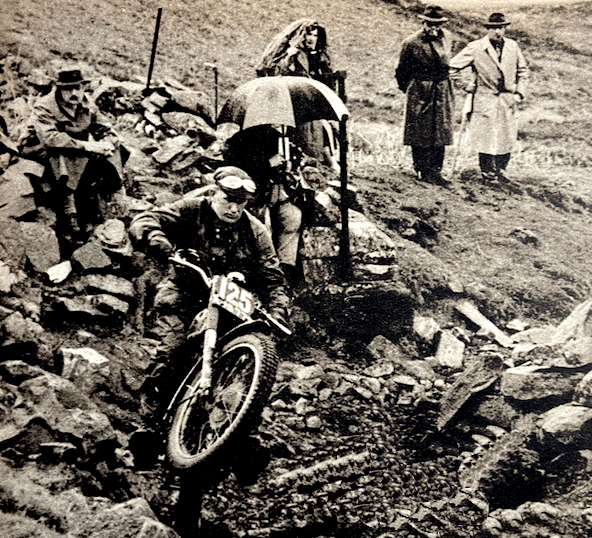
FORT WILLIAM, Thursday.
THE NEEDLE MATCH is on! Provisional results posted up in secretary George McIntosh’s HQ’s office tonight show that, despite an increased loss all round, only 14 marks separate the 12 leaders. LA Ratcliffe, who has had a relatively disastrous day, retains the lead from George Fisher by a single point and great interest now focuses on this duel between the 125 and 350. Altogether it has been the most interesting day of the event so far. Cutting into the amphitheatre of hills that tower above the grey slate roofs of Kinlochleven is the steep, rocky Martuim track, long used by Scottish competitors, and also a path scaling the northern escarpment known, for the purposes of the trial, as Grey Mare’s Ridge. It is included for the first time this year and adds considerably to the interest in, and certainly the results of, today’s 168-mile run. In this wilderness of snow-streaked mountain country, Molly Briggs (DMW) developed electrical trouble. She got the machine back to the road but decided to retire and become a spectator. Her departure from the ranks reduced feminine survival to Miss L Blackburn (150 BSA) and Miss Olga Kevelos (200 James), with the odds fairly well in favour of the James rider. Bill Nicholson was granted an hour’s grace this morning at the start in which to carry out running repairs following a mishap between him and WT Tiffen, the 350 Velocette rider, on the way back from Killin yesterday. The BSA, specially built by Nicholson himself for the event, was considerably grazed and Tiffen suffered a wrist injury. Later Bill retired. On Grey Mare’s Ridge Fisher, handling his 125cc Francis-Barnett-Villiers to perfection, roared up faultlessly. Half the town had turned out to watch the fun and had congregated at the hairpin in section two where a sharp left-hander called for great skill or luck. Jim Alves inspected the hill intently, but had to steady the little
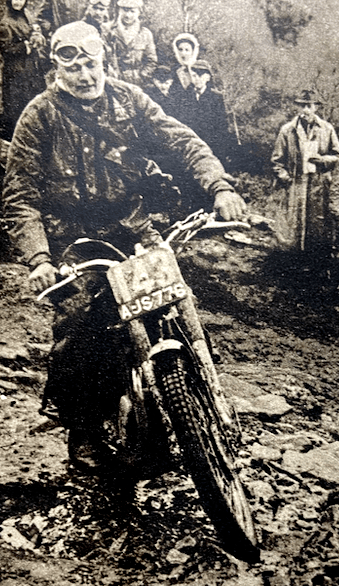
200cc Triumph with a dab just after the hairpin; he was also in trouble at the top of the ridge where a fourth section had been laid out. Few spectators budged from the hairpin vantage point and never knew, therefore, that many favourites, whose performances they had applauded, were to come to grief as soon as they were out of sight and earshot. The difficulty, with a big ‘un was to get the model around the comer—whether by perfect balance and hairline steering, or by skilfully running the front wheel along the right hand bank and ricochetting off again. E Mellers’ 500cc Royal Enfield threw him viciously. The North Armagh clubman, D Lavery, fell heavily, bringing cries of dismay from the audience. J Brittain chose slow plonking tactics and dabbed once. Peter Hammond tried an ounce too much speed but got into difficulties and, in sliding clear of the Triumph, inadvertently grasped the very hot exhaust pipe: this was thought to be funny and the crowd laughed. Scorning prior inspection of the hill Tom Ellis rode straight up, but was forced to drop a steadying foot as his BSA rounded the corner. Without doubt, No. 110, riding a 500cc Norton, has suffered puns, good and bad, all his life for his name is Job. Let it simply be recorded, therefore, that NG Job, using what seemed to be absolute minimum throttle, bested many of the king-pins. ‘Worse than the Scott,’ muttered Ted Usher, after prolonged contemplation of the section. He, and also GL Jackson (350 AJS), lost a single mark, a penalty extended to NS Holmes (500 Ariel) when he arrived. Frequently, during the past three days, performances of Knock MCC members have been noted, but there has been no room for special mention in the report. None now could forbear to put on record the excellent climb made by their member JD Campbell (500 Norton). He went up the hill in company with many trade riders, who footed or stopped, and surprised the crowd with a faultless ride. The list continues at great length, for this new hill, obviously a good one, greatly influenced today’s tally of marks lost. Hugh Viney, of course, is good money’s worth on any ‘Scottish’ hill. Winner of four Scottish Six Days’ events, Hugh is sought at ‘Section Ends’ by autograph hunters, but, unhappily, he let down his public today by footing to get out of the hairpin and by stopping in section 4 at the summit. Grey Mare’s Ridge seemed at first to be a bitter pill to LA Ratcliffe who, heading the score sheet with best performance last night, gave away no fewer than 11 marks before he reached the top of this section! Today, smoothest, cleanest and neatest by far, was the faultless ascent of David Tye who, wearing a new tartan cap and looking very confident, rode his BSA as if Grey Mares was a main road. And then, after the trade men had all gone up the hill and spectators were beginning to drift, there a great round of applause as the Edinburgh clubman, JD Williamson (350 BSA), emulated Tye’s effort. A long main road run across to Kinlochmoidart in the Bay Hill and Ravine country comprised the second half of the day’s outing. Comment on it should include a word about lack of refreshment facilities at the lunch stop. Perhaps compensation was found in the rare sight of sunshine and blue skies which greeted many of the riders when they reached Lochailort Ravine. The worst of the two afternoon hills robbed PN Brittain of more marks. Bob Ray dabbed and Ratcliffe rounded off a really bad day by adding a further three to his fast growing total. Riders returned via the Devil’s Staircase, taken today in a downhill direction, and the considered opinion tonight is that the new Grey Mare’s Ridge outclasses this famous hill. We shall see tomorrow, when ‘The Staircase” is tackled in the opposite direction.
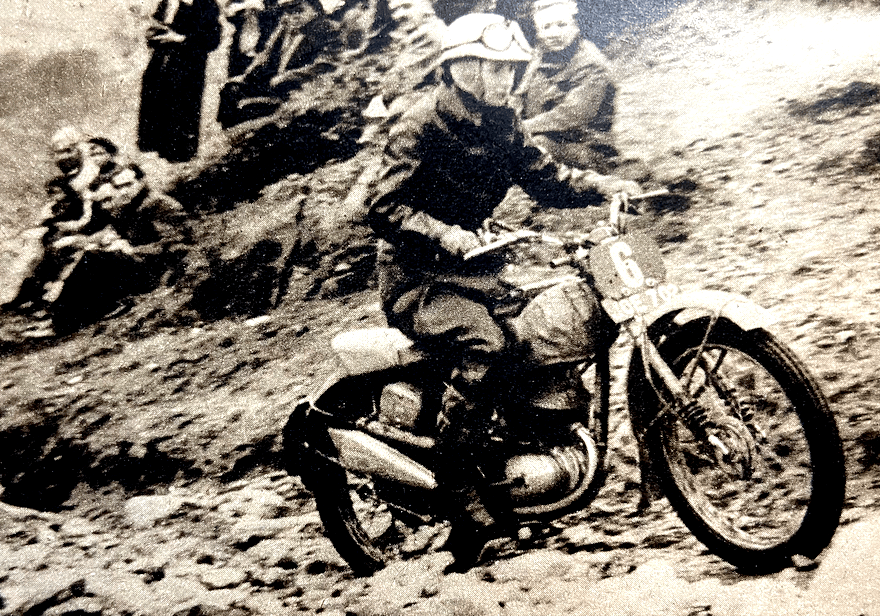
FOURT WILLIAM, Friday.
LIKE THEATRE ENTHUSIASTS waiting for a first night performance, several hundred spectators today took up their positions on the Devil’s Staircase well before any of the riders arrived at this classic section. It is a hill generally regarded as the most severe of the six included in the day’s 144-mile route. Grey stone cliffs beside the hairpinned. three-section hazard offered fine vantage points from which to view the competitors’ performances during this most critical phase of an event which any of the first dozen of yesterday’s finishers could still win. Tea flasks and picnic baskets were opened. Bright sunshine and cloud patterned the tree-lined slopes and Lochmoidart sparkled in the sunshine. The riders have come to ‘The Staircase’ via Mamore—an equally famous section which had been suitably doctored for the occasion. ‘Unfair to little two-strokes’ was the verdict of George Fisher after he had made a quick inspection of Mamore. He paused to let BF Rowbotham tackle the hill first and it was the ‘doctoring’, in the form of a large rock set in the obvious fairway of the section, that caught the flywheel cover of Rowbotham’s James, bending the mainshaft and putting him out of the trial. His fallen motor cycle actually screened the large piece of rock during Fisher’s hectic, but successful, climb. Successful also were WH Martin, PT Stirland and PH Alves. LA Ratcliffe, the favourite for this year’s ‘Scottish’, was seen to give nothing away here, either. One particularly regrettable retirement with a transmission fault at Mamore was that of Miss Olga Kevelos who had the Ladies’ Award ‘in the bag’, so Miss L Blackburn now carried on unchallenged. Fisher’s first penalisation since Wednesday came on section two of the Devil’s Staircase where he momentarily dropped a foot, thus giving further slight advantage to Ratcliffe. A high proportion of top-line riders, including Jack Stocker, EW Smith, Ted Usher, Peter Hammond and Johnny Giles, lost marks for footing. Phil Mellers had a repeat of yesterday’s bad luck when his 500cc Royal Enfield stopped on section two of Devil’s Staircase and pitched him off. Geoff Duke stopped twice and, to the amazement of the crowd, Hugh Viney, long regarded as a master of ‘The Staircase’, also halted in section two thus losing five marks and almost certainly eliminating himself at this point from his familiar place at the top of the awards list. He was one of several riders who forthwith rode straight on to Bay Hill instead of stopping to sample the offering of lemonade from that Yorkshire veteran Joe Shearsmith, who had thoughtfully organised a ‘Soft Drinks for Riders’ service at the top of Devil’s Staircase. Bay Hill and The Ravine, tackled in the opposite direction to that taken yesterday, caught out Viney once more. A last canter up Town Hall Brae, and the M and D section in Fort William, wound up the day’s ride.
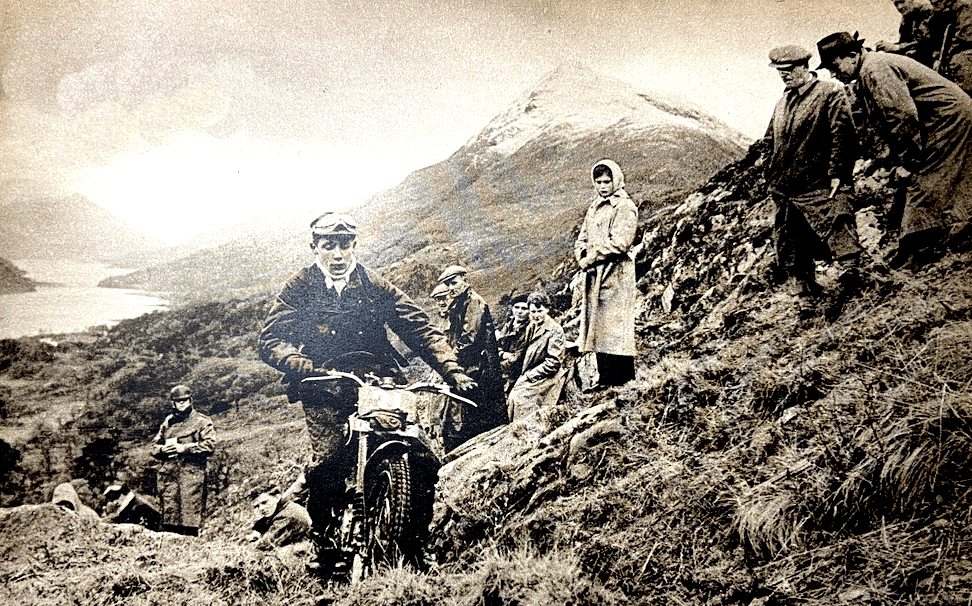
EDINBURGH, Saturday.
FAREWELL TO FORT WILLIAM. With a dance, one of George Simpson’s famous film shows, the proceeds from which are to enrich the local Old People’s Fund by some £30, and other forms of festivity last night, ‘Six Days’ visitors rounded off their stay and this morning set off for Edinburgh. Leaving in twos at minute intervals, riders encountered one of the heaviest downpours of the week; as if to give full measure, rain and sleet continued all the way across Glencoe and many of the two-stroke riders were to be seen halted, attending to ignition and carburation troubles. George Fisher, runner-up to Arthur Ratcliffe, endured several worrying minutes, for he had collected water in his fuel and had repeatedly to stop and clear the float chamber and jets. Except at Blackford Hill, in Edinburgh, where stop-and-restart and brake tests and the final machine examination took place, there were no observed hills today, the main task being one of good time-keeping between the six controls. During the run several performances established previously were in jeopardy: NS Holmes, for instance, carrying the flag for the Ariel factory team and also the Bradford club, completed the 133 miles with a badly leaking petrol tank which, despite a makeshift repair, was fast emptying itself over, instead of into, the engine, a fault for which he was docked two marks at the finish. After giving Ted Breffitt almost perfect service all the Week the CZ finally let him down almost within sight of the city. Breffitt pushed in to finish, but was penalised on time. Despite tight speed schedules, particularly that for the last section from Linlithgow into Edinburgh, much of which is built-up and restricted, none of the potential award winners had hopes dashed by last-minute loss of marks today. Tonight, best bibs and tuckers were donned for the prizegiving at the Music Hall in Edinburgh; awards were handed over by Bailie Tom Curr, MBE, supported by Provost J Carmichael, of Fort William, after which the Song and Dance department took over, bringing to a close a tough, but enjoyable, week.”—BERNAL OSBORNE
RESULTS
JR Alexander Challenge Trophy (best performance): LA Ratcliffe (350 Matchless), 25 marks lost. Lochaber Challenge Trophy (second-best performance): GE Fisher (125 Francis-Barnett), 27. Nelson Challenge Trophy (third-best performance): GL Jackson (350 AJS), 31. PS Chamberlain Challenge Trophy (best ‘Scottish’ newcomer not having won a named trophy or class award in a trade-supported trial): SR Wicken (200 Norman), 51. Ben Nevis Challenge Trophy (second-best performance by a rider eligible for the Chamberlain Trophy): SH Miller (200 SHS), 67. Allan Hay Memorial Challenge Trophy (best Scottish rider not winning a trophy, cup or class award): JD Williamson (350 BSA), 76. Jimmy Beck Memorial Cup (best non-Scottish rider not winning a trophy, cup or class award): JV Brittain (350 Royal Enfield), 34. The Edinburgh Trophy (best performance by non-British subject): DF Ryder (500 Matchless), 64. Meteor Challenge Trophy (best non-trade Club Team): Knock MCC (E Rice, WJ Hutton, DJ Campbell), 304. Services Team Prize (John Bull Tyre Challenge Trophy): Not awarded. Under 150cc Award: GE Fisher (125 Francis-Barnett), 27. 151-200cc Award: PH Alves (200 Triumph), 32. 201-250cc Award: PN Brittain (250 Royal Enfield), 64. 251-350cc Award: LA Ratcliffe (350 Matchless), 25. Over-350cc Award: CM Ray (500 Ariel), 33. Ladies’ Prize: Miss L Blackburn (150 BSA), 356. Best Private Owner: G . McLaughlan (500 Norton), 39. Sydney Latimer Challenge Trophy (best performance by an Edinburgh Club member): PT Stirland (200 James), 37. Henderson Challenge Trophy (best Edinburgh Club member not winning any trophy, cup or class award): RT Hill (350 BSA), 61. RA Castle Challenge Trophy (best Services rider): Not awarded. Manufacturers’ Team Trophy (The Blackford Challenge Trophy): AJS (SB Manns, GL Jackson, BHM Viney), 119. Club Team Trophy (The Andy Pattison Memorial Challenge Trophy): Bradford &DMC (LA Ratcliffe, TU Ellis, NS Holmes), 126.”
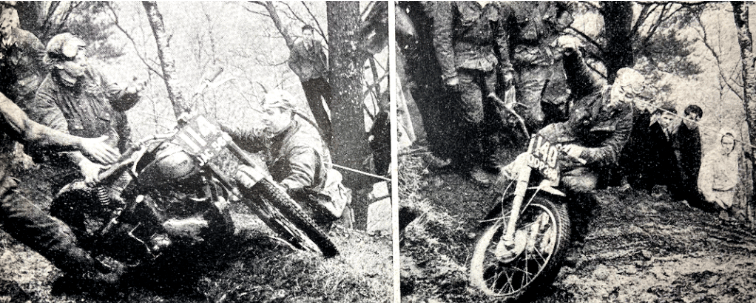
“THE VERY SUCCESSFUL event which ended last Saturday in Edinburgh used to be known as the ‘Highland Holiday’. Nowadays there is still quite a high proportion of the private-owner entrants who do actually make the Scottish Six Days Trial a part of their annual vacation, but in the main the event has taken on a character very different indeed from the care-free spirit of pre-war days. The rivalry between the factories, especially since the demise of the sidecar class, had become intensified into a major war. This still rages, but the 1954 ‘Scottish’ revealed an entirely new angle to the battle, which is now between Brobdingnag and Lilliput—the ‘big ‘uns’ versus the ‘tiddlers’. Two years ago Motor Cycling wrote that a small capacity victory was a possibility in the immediate future. How nearly that came about is shown in the results of last week’s event, when a 350 beat a 125 by only two marks and half of the first six places were occupied by machines of under 200cc. Now what of the future? It is evident that the current ‘tiddler’ has power in plenty to deal with gradient and, with its ‘handleability’, it gives its rider a distinct advantage on the tight-turned, narrow, nadgery sections which comprise so much of a modern ‘Scottish’ route. On the score of reliability, it is interesting to note that whereas 17% of the ‘250 and over’ entry retired, only 15% of the ‘200 and under’ class fell out. The actual retirements per class make interesting comparisons: 125cc, one from four entries; 150cc, two from five; 200cc, nine from 71; 250cc, one from three; 350cc, nine from 41; and 500cc, eight from 51. The total retirement rate was 17% of the 175 entry, so the lightweights, with their 15%, came through well on the good side. The small-size motorcycle is with us to stay. It is already the most popular machine across the Channel, where it has been developed to a high pitch of efficiency. Off to a rather late start. British manufacturers are catching up on this market and last week’s ‘Scottish’ evidenced the progress that has been made. On the other hand, it also revealed that there is still work to be done if performance is to be matched equally by reliability. The short-route, one-day open trials have encouraged the former characteristic; the ‘Scottish’ helps in the latter case. In short, it is truly a reliability trial, and as such is of tremendous value to our industry, and the Edinburgh Club has done—and continues to do—a fine job in the running of it. Though their aim is primarily to provide a sporting contest—and how well they succeed!—they are also playing a vital part in the effort to maintain Britain’s reputation for building good motor cycles—from the largest to the smallest sizes.”
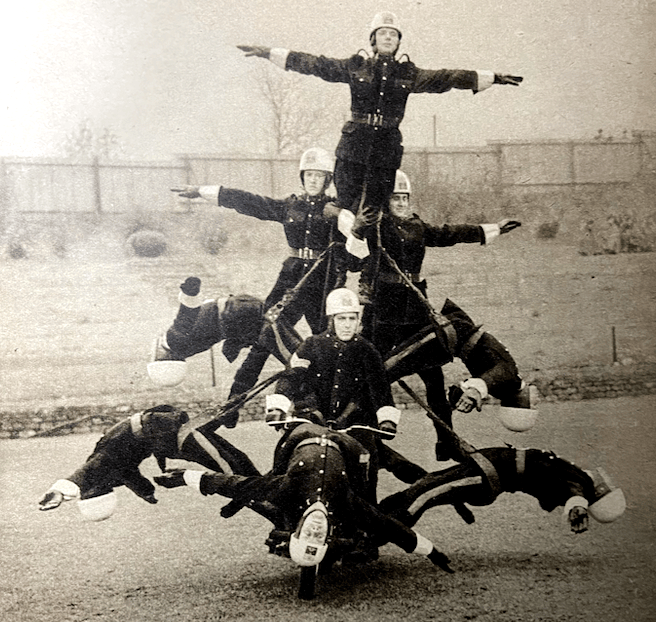
“‘ANY STATEMENT FROM any quarter that the present British standard for motorcyclists’ protective hats is too low is unwarranted and unhelpful, in particular to motor cyclists.’ This comment was made last Thursday by Professor AM Low, the well-known scientist who is chairman of the Auto-Cycle Union and chairman of the British Standards Institution technical committee which prepared the specification for motor cyclists’ hats. On the previous day national newspapers had printed an account of an inquest on a motorcyclist and the jury, returning a verdict of death by misadventure, were reported as saying that the safety standards of certain makes of crash helmet should be investigated. Further, it was stated in evidence that the victim’s helmet was ‘too flimsy’ to give adequate protection. It carried a label indicating that it conformed to the BSI specification. ‘If the BSI pattern helmet were made strong enough to resist every form of crash,’ Prof. Low continued, ‘its effect would be simply to transfer the blow from the helmet to the head and then to the spinal column. A helmet that was absolutely ideal from the viewpoint of strength and safety would be even heavier than the well-established racing crash helmet, and no ordinary motor cyclist would wear it.’ Prof Low also emphasised that the standard for protective hats had been prepared in full agreement with the British Medical Association and the greatest brain surgeon in England, the late Sir Hugh Cairns, KBE, DM, FRCS. All the competent authorities, including the Road Research Laboratory, the Ministry of Transport and the leading manufacturers of crash helmets, agreed that the current standard represents a very sound compromise between what would be absolutely safe and what people will, in fact, wear.”
“STAFFORDSHIRE POLICE SAY the increased use of safety helmets has definitely cut down deaths and head injuries among motor cyclists—none was killed in the county during the first quarter of the year.”
“LAST FRIDAY AFTERNOON CE ‘Titch’ Allen, with A-CU Observer John McNulty in the sidecar of the Ariel-Nicholson outfit, turned inland from Liverpool and headed for Birmingham, and left the coastline which for the previous nine days he had followed closely, emulating, under modern conditions, the feat of Hugh Gibson who, 30 years ago, accomplished an epic (for those days) round-the-coast-of-England-Scotland-and-Wales tour, against the clock, using a Raleigh outfit for the purpose and taking 12 days. With the object of demonstrating the advance made in general reliability and machine comfort since Gibson’s day and, in particular, testing various items of Feridax equipment, CE Allen set himself an average speed schedule some 10mph higher than that of Gibson and, when he arrived back in Birmingham on Friday evening, he had completed the journey with a record of time in hand on all days except the last one, when the replacement of a proprietary component in Liverpool caused delay. This, repairing a broken chain and the replacement of the rear tyre earlier, constituted the sum total of work carried out’ on the machine—an Ariel Huntmaster twin—and Nicholson prototype sidecar during the 3,600-mile journey which, it is claimed, is the longest single-handed A-CU-observed run ever, attempted. To meet Titch and John McNulty in Birmingham were the staff and directors of Feridax, AE Perrigo, of Ariel Motors, and representatives of the technical and local press: there was a reception, at which the story of the trip was told—a story of a very hard ride made endurable by the progress in design of machinery and equipment that has taken place during the past three decades. Then Titch handed the Ariel over to the A-CU for safe keeping and rode home on his own machine.”
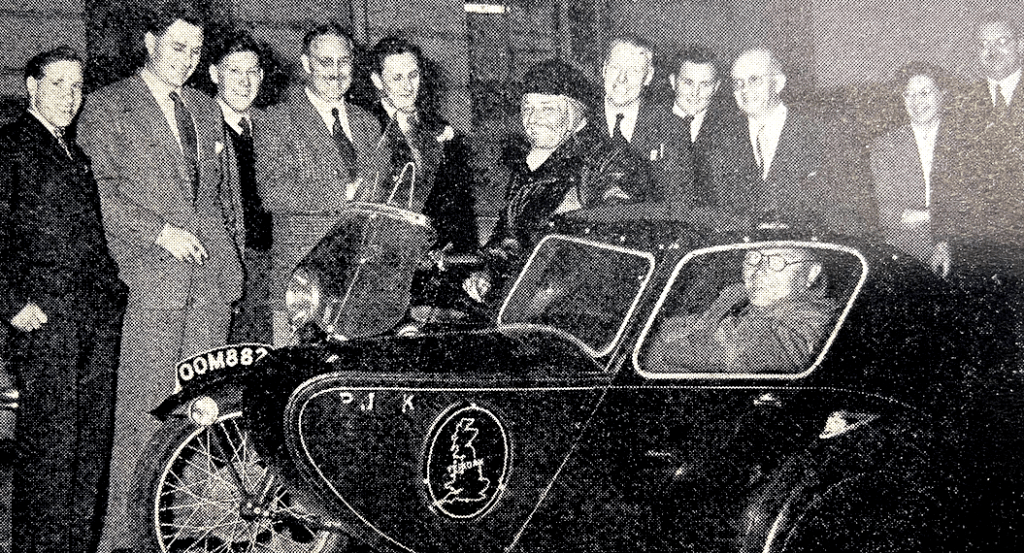
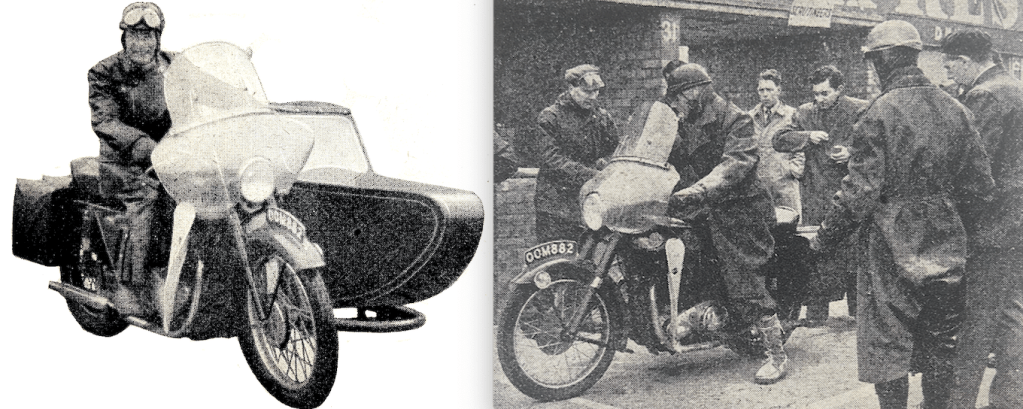
IMPRESSIONS: JAMES COLONEL/WATSONIAN WINDSOR COMBINATION
“LAST WEEK BERT KERSHAW, a self-confessed enthusiast for lightweight two-stroke combinations, wrote about experiences with 197cc and 225cc Villiers-engined James models. His story kindled interest, and, asked to lend us the bigger of the two outfits, Mr Kershaw, with the agreement of the James and Villiers companies, for whom he has been carrying out exhaustive tests, let us sample what is likely very soon to become a most popular and economical form of transport. Without a passenger, the 225cc James and Watsonian Windsor sidecar cruised on main roads at nearly 50mph; carrying a full load the model has a 40-45mph cruising speed. These figures are quoted for people who, in thinking of a new model, invariably concentrate on the mph factor. Nevertheless, the real market for the 225cc sidecar outfit would appear to be among the many who favour a 40mph gait two-up with holiday luggage, etc, and who need their journeys to be undertaken economically and their overall tax and insurance costs per year to be economical. As tested, the James, fitted with Armstrong rear dampers, appeared to be a sturdy little combination with beautiful handling characteristics. Thanks to its narrow track, one could turn it around on the proverbial halfpenny; in traffic it was a delight to drive and, on the main roads, full-bore performance could be used without the engine tiring. At low speeds the engine would slog and on upgrades full rpm could be used in intermediate gears to maintain the very favourable average speed. The model was tested in wet weather and full marks go to the brakes; this characteristic was mentioned recently in Motor Cycling’s James Captain test and the addition of the heavier engine and a sidecar does not detract from this very desirable feature. The engine of the model tested is a prototype which has seen 12 months’ hard service on special Kershaw destruction tests—all of which have failed. And when, at the close of an instructive morning’s ride, we had to confess that we, too, had been unable to blow-up, or bend, the power unit, Bert seemed almost disappointed!”
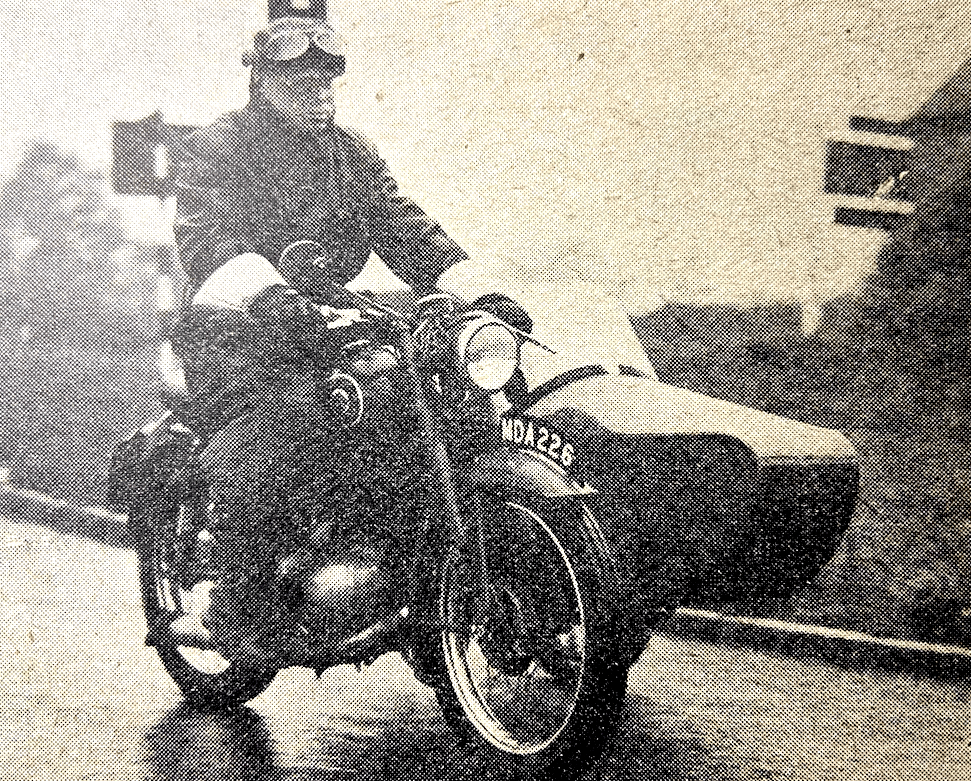
“TEN THOUSAND MILES in 90 days is no mean feat for an experienced motor cyclist, but Miss Brenda Collins, a 25-year-old freelance journalist from Kent, has just returned from the American continent after completing such a journey on a 125cc BSA Bantam. Travelling to America 16 months ago in order to gather the material for a book, Miss Collins decided that a motorcycle would solve her transport problems. Not having any experience, she had to learn to ride the hard way as she progressed across Canada from Montreal to Vancouver and onwards around the American seaboard. Despite a pannier load of over 100lb the machine and Miss Collins were able to cope with the dirt roads frequently encountered to the east of the Rockies. However, riding along the super-highways of America she was driven off the road several times by speeding cars.”
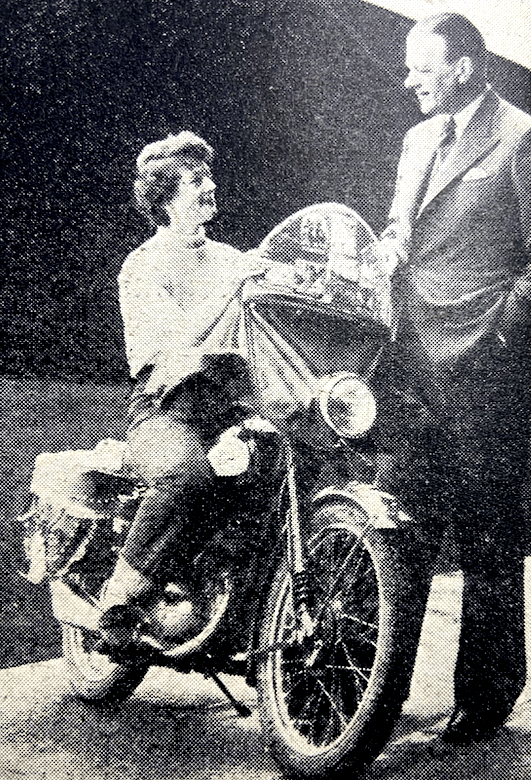
“THEIR SECOND SUCCESSIVE victory in this season’s Irish International Races was scored by Dubliner Reg Armstrong and his Gilera 4 by winning the Senior Class in Ireland’s Silver Jubilee North-West ‘200’ over the 11-mile Portstewart course last Saturday. Although his winning average of 92.81mph was 17sec slower than Syd Lawton’s (Norton) record last year, a hot scrap between Armstrong and Geoff Duke (Gilera) for most of the race was contested at record pace. Only when Duke retired after cracking the lap record no fewer than three times did Armstrong slow. Other highlights were a frenzied shoulder-to-shoulder duel between Derek Ennett (AJS) and S Africa’s Rudy Allison (Norton), which ended when Allison’s petrol tank split, and a record-breaking ride in the Lightweight Class by Arthur Wheeler (Guzzi) when he might well have toured round with no opposition.”
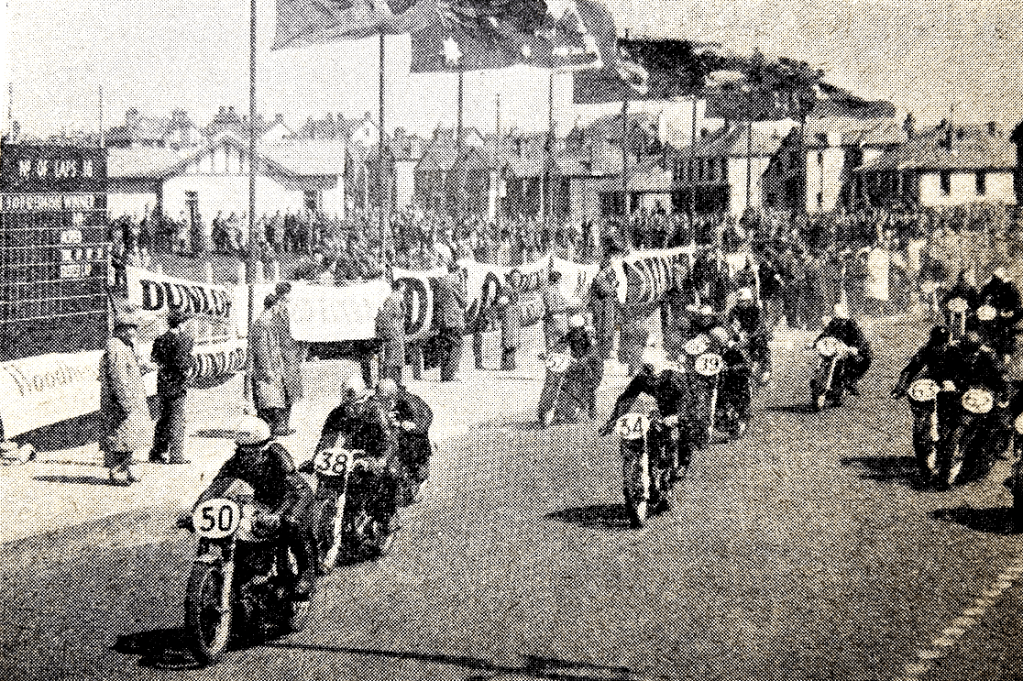
“ANOTHER INDICATION OF the progress being made by BMW is the claim now made by the factory in the world’s record field. In the pre-war days of unrestricted supercharging, BMW were, of course, deeply involved in record breaking. Their first post-war effort, subject to confirmation, puts them on top in the 8 and 9 hour bracket in the 500, 750 and 1,000cc solo classes. The riders were Georg and Hans Meier and Walter Zeller, the attempts were made at Montlhéry last week, and the claimed speeds are 103.3 and 102.7mph respectively. The machines used are said to have been production type 494cc RS race models, but they had fairly extensive streamlining.”
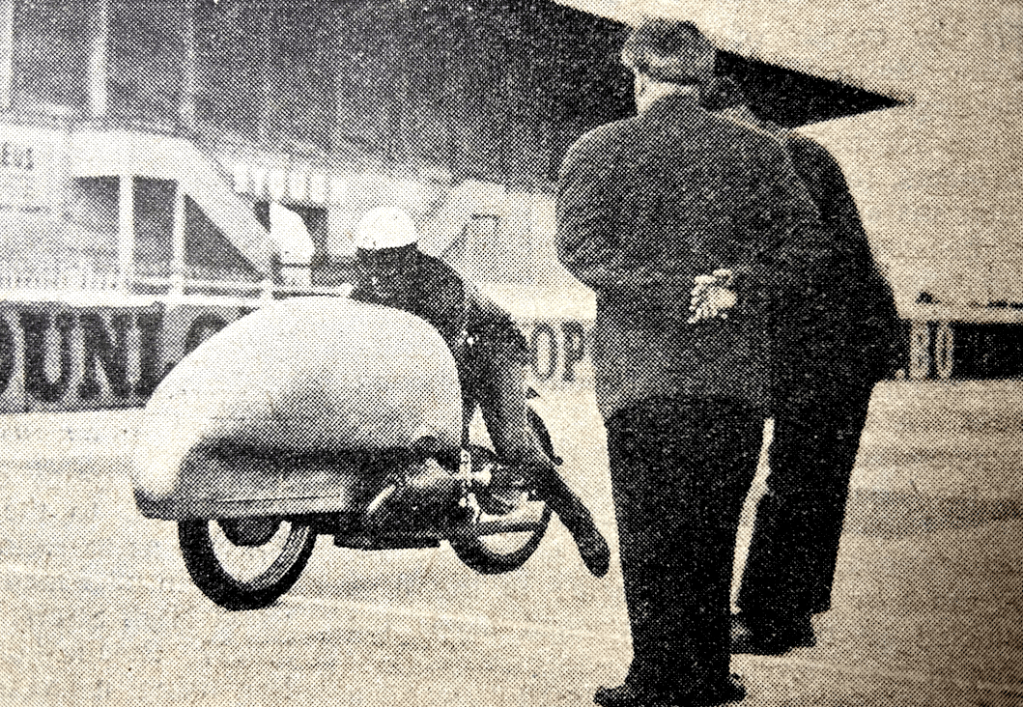
“IN RECENT YEARS Canadian motorcycling sport has been plagued by the evils inherent in bifurcated control. Now, by an agreement ratified last week between officers of the FIM-affiliated Canadian Motorcycle Association on the one hand and the unattached American Motorcycle Association on the other, the split has been healed and a good neighbour policy replaces one of veiled hostility. The Canadian national, hitherto required to owe allegiance to one organisation or the other, may now compete in events organised by either Association provided he becomes a fully-paid-up member of each, both of which retain full independence of action. Thus, it will be appreciated, divided control has now become dual control. While this move represents a triumph for common sense and patient diplomacy, it can be regarded, in our view, only as the initial step toward the policy of perfection whereby Canadians will become solely responsible for the conduct of the sport within their territory. In no other Dominion is the competitor required to subscribe to two organisations and to comply with two sets of rules; to owe allegiance to the international governing body on the one hand and to deny it on the other.”
ROADTEST: BSA DB32 GOLD STAR
“REDESIGNED PRACTICALLY FROM top to bottom, the 1954 BSA Gold Star models, available in 348 and 499cc form with specifications suitable for all types of sport from road racing to trials, and also touring. now command attention. The spot-light of public interest is upon them because of the Gold Star success at Daytona this year. Developed gradually and patiently during the post-war period from a touring-cum-sporting machine, the Gold Star now emerges as a fully-fledged racer, each model being sold with a certified and guaranteed performance…The 1954 model has a considerably altered external appearance. The deeply finned ‘square’ head and barrel, clip-on handle-bars and modified exhaust pipe give the machine great eye-appeal—to the sporting rider, if not to every motorcyclist. The specification is left open to the buyer’s choice; most of the components can be altered to suit individual taste, such items as carburetter bore size, compression ratio, valve timing and type of electrical equipment being optional, as are footrest positions, tyre types and sizes and handle-bars. The model under test was a standard Gold Star in Clubman’s trim, complete with kickstarter, full lighting equipment (even including a stop-lamp), silencer, number plates and, of course, licence holder with appropriate filling. When collected from Birmingham, the first point noticed, apart from the obvious god looks of the model, was the tickover—slow, even and, let it be emphasised, reliable. The rev, counter (no speedometer is fitted) showed about 900rpm. The Birmingham-London journey was quite an experience; once accustomed to the low riding position, we found that the machine could be swung in and out of traffic with ease, although in the built-up areas of Birmingham and London, with the numerous traffic stops, the close-ratio gearbox, with necessary clutch slipping, was inclined to require careful-handling. On the open road, where the machine is primarily intended to be ridden, the gearbox was a joy to use, changes being made with the greatest of ease at any speed. Second, third and top gears are all very close together and, coupled with the excellent acceleration, enabled very good cross-country averages to be set up. Used for several days as a runabout, the machine proved to have a phenomenally low petrol consumption—better than that of some lightweights.
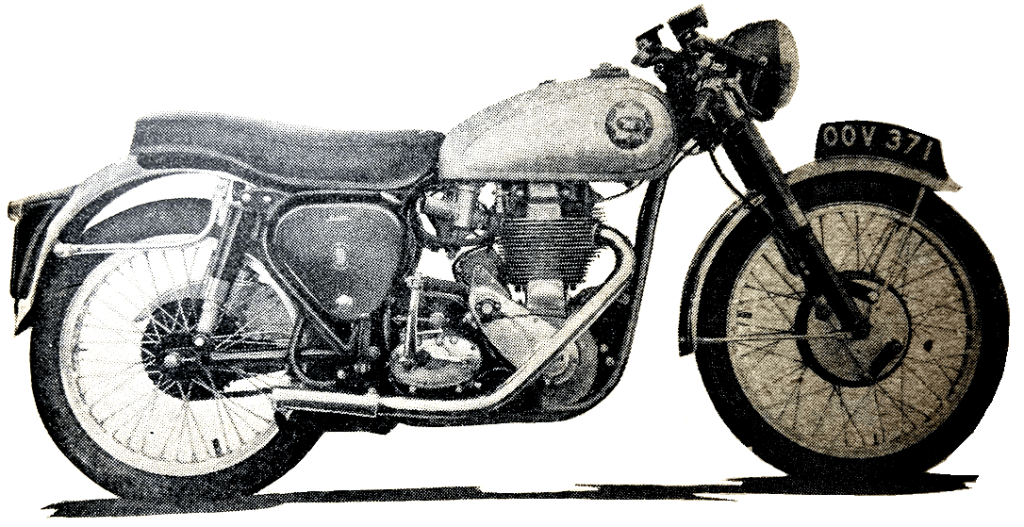
Low-speed pulling with the new engine is much smoother than heretofore, and, providing the ignition and throttle controls were manipulated care-fully, top gear could be held down to 23mph without any trace of transmission snatch. On night trips the Lucas head lamp fulfilled all hopes and enabled high cruising speeds to be maintained: when dipped, the unit gave a useful amount of light without offending on-coming traffic. With the silencer fitted engine revs were limited from the 7,400 quoted by the manufacturers as the safe maximum to approximately 5,700. This was no great disadvantage as these revs could be effortlessly held in top, giving a road speed of some 82mph—more than sufficient on all but dead straight, deserted, highways. Starting from cold, although definitely not of the ‘tickle’ variety, could be accomplished reliably, providing the controls were precisely set—the engine indicated when they were not—and a good, ‘long-swinging-kick’ given. This usually brought the desired results at the fourth or fifth attempt. Once the engine was warm, first kick starting was the rule rather than the exception. For recording high-speed figures the BSA ‘racing kit’ supplied with the machine, was fitted. This must surely be the most compact in the world, comprising an 8½in exhaust extension held in place by the silencer fixing bolts to. A ‘hot’ plug was also fitted. Mention here must be made of the really excellent 21-piece tool kit. With the extension fitted the engine really came into its own, accelerating cleanly throughout the range if the grip was rotated steadily; ‘scorching’ acceleration was required it was advisable to hold the revs at 5,000 and feed the clutch in. The safe limit of 7,400rpm was easily attained—once the engine reached 7,800 with no ill effects, but this is not a practice to be indulged in. The Silverstone Club Circuit was used for obtaining most of the high-speed range figures but it did not provide enough space to get the ultimate top speed so recourse had to be made to a deserted stretch of straight road just after sunrise. This satisfied the tester’s personal ambition to exceed the magic ton on a 350—102mph being obtained, although the rev-counter was still creeping forward slowly and 105 could probably have been achieved under more favourable conditions. The flying quarter figures obtained did not give a really complete indication of the machine’s capabilities as it was accelerating throughout the quarter, and top gear was engaged just after crossing the end of the stretch when the excellent brakes had to be clamped on to avoid a cross-country test.
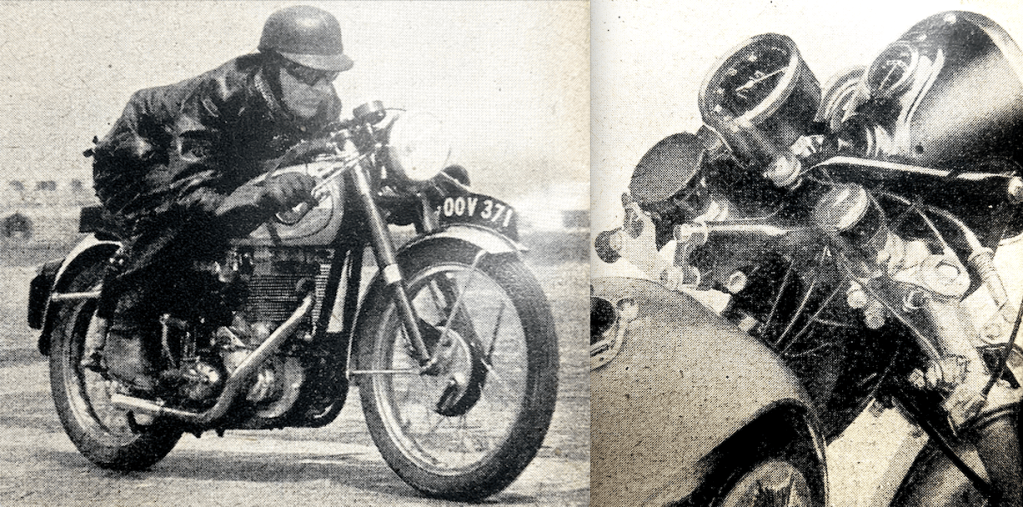
Unsprung weight, with the alloy rims fitted, is exceptionally low and the suspension and steering earned the highest admiration—on fast, bumpy bends no pitching or rolling was ever experienced and the machine could be heeled over as far as was desired in perfect safety. At low speeds the steering was as good as when really hurrying. A steering damper is fitted, but the tester did not find out why! The riding position, somewhat constricted for town use, was really excellent on the circuit, all controls being most conveniently positioned. No machine is perfect; nevertheless, the only criticisms that can be levelled against the B32 are very slight. The one painful one is that the kickstarter removes shin skin somewhat readily when riding through town. The engine, which remained commendably oil-tight throughout the test, was lubricated externally by oil dripping from the rubber connecting piece in the rocker-feed pipe. As lubrication is by ‘R’ grade oil, this provided a real ‘race atmosphere’ when stationary! The only other grouse concerns the engine breather; this has a union on its exterior, but no pipe was connected to take the ‘breathings away, so they found a home on the exhaust pipe. The only adjustments necessary during the test were tightening of the primary chain—and, consequently, adjusting the rear chain—and taking-up a little slack in the clutch cable by means of the adjuster fitted in the end of the handlebar lever. This was at the end of the standing-quarter tests when the clutch made a few protests about the sustained abuse it was receiving. Suitable alternative gears are available for sprint work. Taken by and large, the new Clubman’s Gold Star will meet the needs of the enthusiast who wants a machine with which he can compete at race meetings but which is tractable and easily convertible to enable him to ride it to and from the meetings and to use for normal riding as well. For the man who desires a machine to ride to and from work and for road use only alternative handlebars and cams are available, and the makers will advise which specification is best suited to the buyer’s requirements. In our 1952 report of the then current Gold Star the tester wrote that it was ‘obviously faster than before’. That statement can now be repeated—together with a word of thanks for the enjoyment received from a very short acquaintance.”
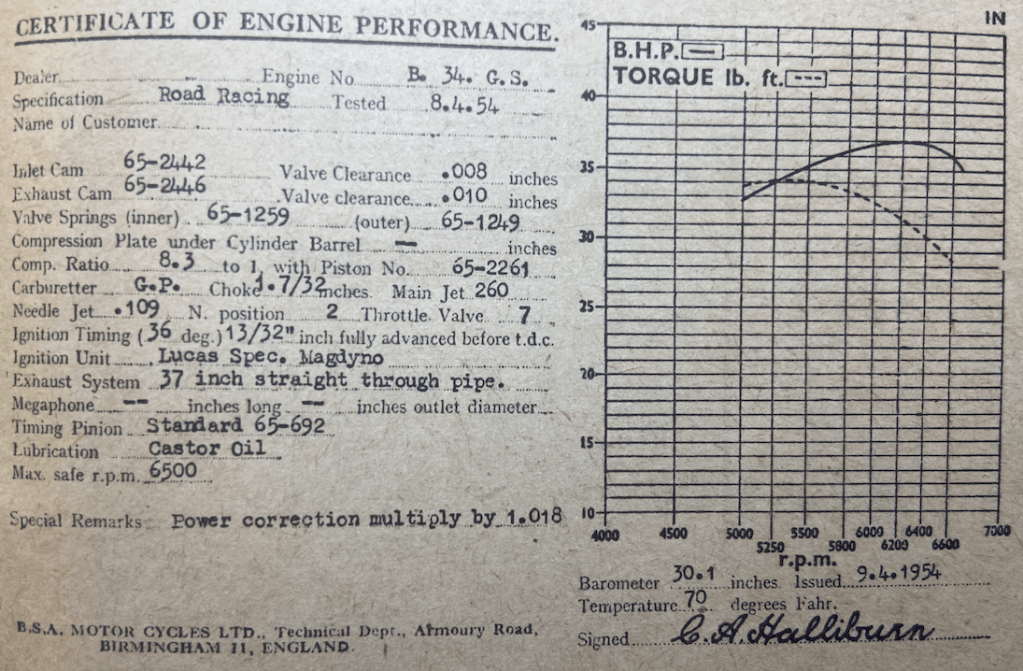
“BY THE END OF 1953, 16% of motor cyclists were using safety helmets; too many riders fail to use their front brakes, especially in wet weather; riders tend to drive more carefully when carrying women pillion passengers. These are some of the facts in Road Research 1953, available from the Stationery Office. On the subject of motor-assisted cycles, the report says that their brakes are frequently inadequate and their narrow tyres unsuitable.”
“MOTORCYCLE ENTHUSIASM OF the highest order was recently demonstrated by Australian riders Arne Saeter and Lex Blackstock, of Sydney. They wanted Harley-Davidsons, which, because of import restrictions, are not available down under. A heroic solution to their problem was hit upon when they decided to come to the US, obtain employment and work until they had enough funds to purchase their bikes and take them back home. This they have done, and shortly expect to be the proud riders of the only current model Harleys in their native land.”
“QUITE THE MOST remarkable feature of last Sunday’s 17th International Eifelrennen, run by the ADAC on Germany’s famous 14.16-mile. Nürburgring, was the all-time record lap set up by Werner Haas (NSU), winner of the 250cc race, in a time of 10min 52.4sec, at 127.8kph (78.12mph). Underlining this achievement was the fastest lap—still a record for his class—put in by 500cc race winner Ray Amm (Norton) at 77.44mph. And the underlining was made doubly effective by the running concurrently of the 250 and 500cc events.”
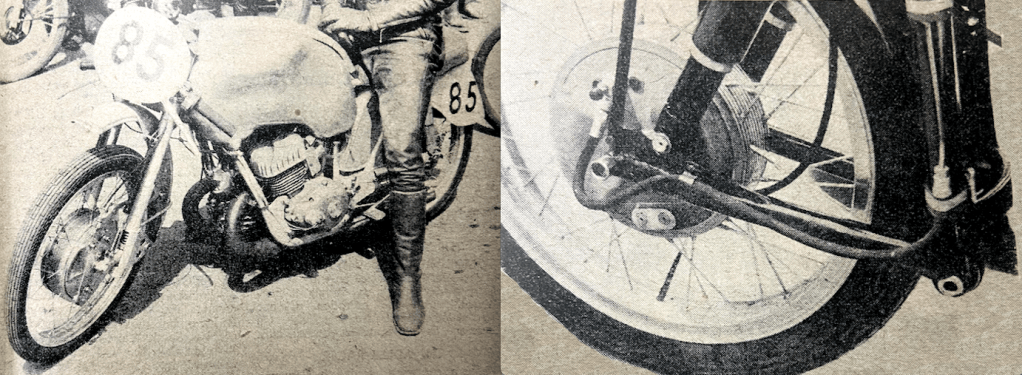
NEWS FROM THE USA
“US MAIL ORDER and retail chain Sears, Roebuck and Co are handling Puch 125 and 175cc motor cycles under their own ‘Allstate’ nameplate. These are in addition to the Italian Vespa scooters which have been a regular item for the past two years. Sears, who have no servicing arrangements for motor cycles or scooters, are presumably making provision for this with local motor cycle dealers and repairmen. ◈━◈━◈━◈ LATEST ‘UNBELIEVABLE’ FIGURES from the drag strips were hung up by a supertuned Triumph Thunderbird ridden by Dewey Merritt and given the ‘works’ by hot-up wizard AJ Lewis. The lengths to which the Southern California speed boys will go are illustrated by the number of specially built parts incorporated in this latest record breaker. Builder Lewis personally manufactured the flywheel, cams, lifters, manifold, float bowl bracket, carburetter block and stainless-steel valves. Carburation is through two 1¹⁄₁₆in Amals with the fuel being a blend of approximately 50% nitro and 50% alcohol. Performance figures are quite dynamic. From a standing start a speed of 132.49mph is attained in a quarter-mile and in less Than 10sec. This places the time within 0.8mph of the record set by Lloyd Krantz and his Harley-Davidson with over twice the displacement of the ‘Bird.’ ◈━◈━◈━◈ YEP, SOMEONE FINALLY did it! Of course, it was only a matter of time until some US motor cycle enthusiast tried to mount a Ford V8 engine in a motorcycle frame. Bill Drabeck, of Kingsville, Texas (where else?), has manufactured a bitza to end all bitzas. His power plant is a 2,200cc 60hp Ford V8 with a four-speed Harley-Davidson box. Overall weight is 965lb, wheelbase is 78in with 15x6in. tyres. The machine has never been opened up but has done 95 in second. ◈━◈━◈━◈ ‘ANTIQUE MOTORCYCLE CLUB’ is to be the title of the American group now in the process of formation. Purpose and plans of this new club are essentially the same as those of British organisations devoted to the seeking out, restoration, exhibition and operation of ‘antique’ motorcycles. A preliminary meeting has decided on the date 1930 as the latest to qualify for ‘antique’ status. ◈━◈━◈━◈ ‘NATIONAL CHAMPIONSHIP’—there was a time when this was a magic designation in America. It meant a premier event, a once-a-year gathering of the best riders to contest for the top honour over one of a few designated distances. Now, with the rash of so-called ‘Nationals’ the title means nothing. For instance, there will be ‘titles’ awarded for 5, 6, 7, 8 and 10 miles on ½-mile tracks, and 5, 8, 10, 15, 20, 25 and 100 miles on mile tracks. It is strongly felt that this is too many title events. This year, there are to be no fewer than 21 ‘National Championships’. A better idea would be sectional championships and a grand national meeting to conclude the season.”
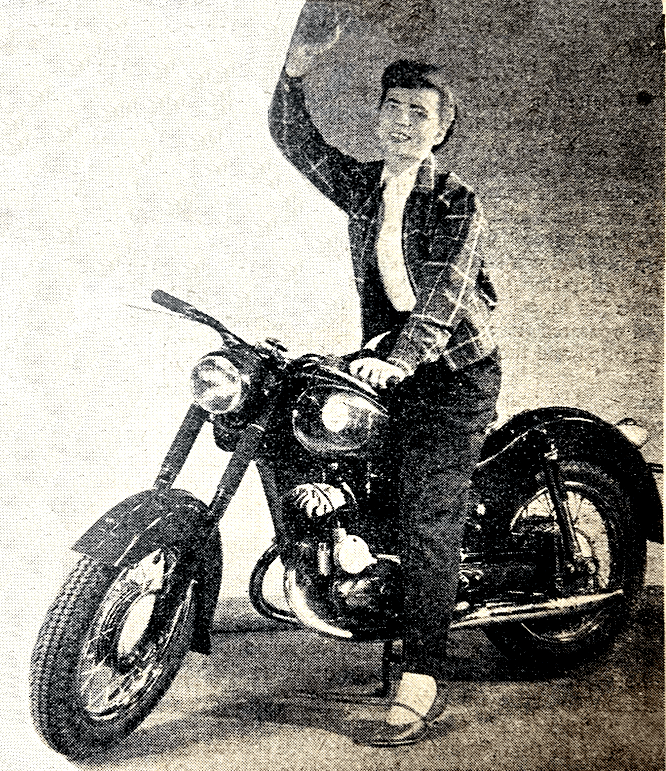
“THE RECENT TOUR of Italy, a nine-day race for small-capacity machines, had an entry of over 600. It was a fairly hectic event from all accounts, with some highly unorthodox methods employed for getting ‘tows’ behind faster machines or even, so they tell me, behind cars in some cases. The quality of the entry varied considerably, with experts competing against raw novices on very standard machines, and in the first day there were a number of fatal accidents and over a hundred casualties requiring hospital attention. Oddly enough, there were virtually no casualties on the following days.”
“ENTRIES FOR THE Trophée de Monaco have to reach the organising club via each competitor’s own national body. Of a similar nature to the famous Monte-Carlo Rally—only for two- and three-wheeled, instead of four-wheeled vehicles; and taking place in mid-summer instead of mid-winter—it is now in its fifth year, and is gaining increasing support and prestige. Competitors have the choice of several starting points, among them, Oxford, Amsterdam, Brussels, Paris and Monaco itself—and in every case the total distance to be covered is in the region of 1,000 miles. This has to be covered at an average speed of between 30½ and 36mph, depending upon the engine capacity of the machine used. Which, even at the fastest schedule, means well over 24 hours of continuous riding. It is to be hoped—because the Trophée de Monaco does arouse a lot of interest on the Continent—that all British riders who propose competing this year will take the trouble to ascertain the staying power not only of their machines but also of themselves.”
“ACCORDING TO AN official Hungarian ‘hand out’, there is a boom in road racing in that country. The number of registered racing men is said to have risen from 30 to 2,000 since 1942, and the number of race followers is put at 50-60,000. The pastime is financed by a compulsory ‘sport and culture’ fund raised by all the State factories.”
REPORT: ’50th EDINBURGH’ COMMEMORATION RUN
“‘THE FIRST GOLDEN Jubilee of a Sporting Motoring event’ was the somewhat ambiguous wording by which the Motor Cycling Club described the ’50th Edinburgh’ Commemoration Run. So far as I can check, the ‘London-Edinburgh’ is the oldest sporting motor cycling event in the world, dating back to 1904. It was a happy thought, therefore, that prompted the present committee to decide to commemorate the half-century by staging this year’s run on lines as closely as possible akin to those of the original turn-out. Fifty years ago motor cycles—the development of which can generally be said to have begun in 1901—were regarded as having achieved a fair reputation for reliable transport. Nevertheless, the project of a 24-hour journey over nearly 400 miles was thought by many to be asking a bit too much. Experts of the day prophesied that if 10 or a dozen completed the course on time, that was all that could be expected. As it turned out there were 70 entries, about two-thirds being on solos and the balance op tricars—the sidecar was still to come! In the event, 46 turned up to face the starter and 22 reached the Edinburgh check within the time. One was subsequently disqualified,
so 21 gold medals were awarded. Seven-eighths of the finishing machines had belt drive. Almost all used battery and coil ignition, which gave hardly any trouble, but the acetylene lighting sets were a terrible bugbear and accounted for many retirements. As last week, the first ‘Edinburgh’ began with a beano. According to our reporter, ‘a large and curious crowd examined the machines while competitors and friends had supper at Huggett’s—a hostelry within the Square.’ Of the 14 competitors in the motor cycle class—which was the rather disappointing response from the MCC’s two- and three-wheeled experts—who reported to the checker-in at the Talbot Restaurant, the doyen, as regards seniority of Edinburgh entry, was George Brough, whose first ride was in the 1908 event. Not so long since having gone through a spell or convalescence, this famous Nottingham manufacturer proudly displayed his 998cc ohv Matchless-engined SS100 coupled to one of the launch-bodied petrol-carried-in-the-main-frame type of sidecars. The chair was occupied by Eric Adlington, Temple Press director, and a Brough-Sup enthusiast from the days when, as a staff man on Motor Cycling, he used to ride the black and silver big twins in all MCC events. Another Nottinghamian and a renowned B-S exponent who was among those to sign on was Harold Karslake; though he did not actually compete in it, he attended the start of the first ‘Edinburgh” For 1954 this 74-year-old sportsman rode a 200cc LE Velocette, his famous Dreadnought
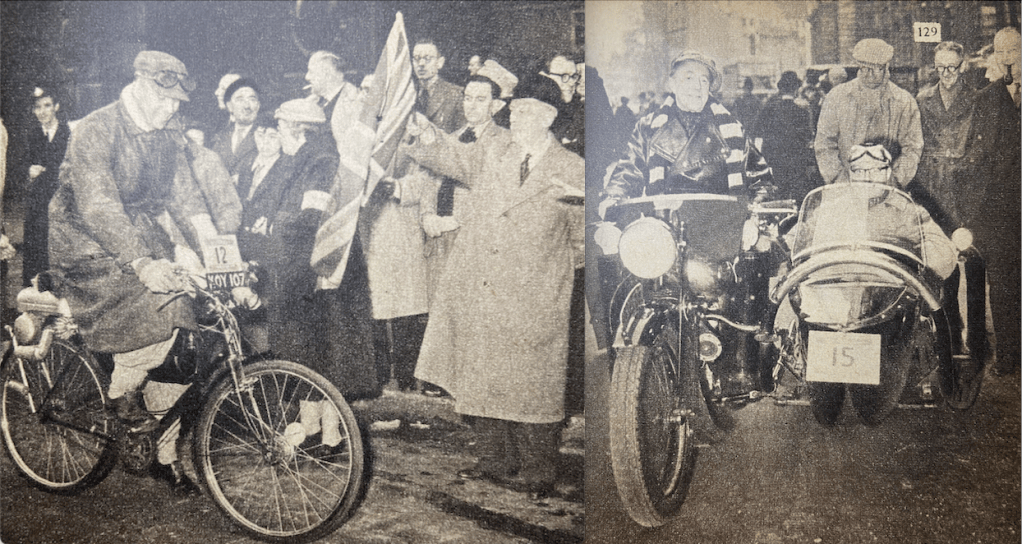
being in a temporary state of dismantlement. The Bradford club’s president, Oliver Langton, took the honours for machine age, turning up with a wonderfully well preserved 311cc Rex of 1903 vintage with direct belt drive, ‘period’ sparking plug and surface carburetter. JC Lowe, chairman of the A-CU Competitions Committee and secretary of the South Midland Centre, appeared with his well-kept 1926 493 cc. flat tank ‘Little Oil Bath’ ohv Sunbeam, while the remainder of the motor cycle entry was on post-war machinery, most modern being GM Denton’s 49cc Mini-Motor-engined cycle. At 8.1pm Jackie Masters, as No 1, travelling marshal, made his way out of the crowd which had gathered outside the official starting point, the GPO in the City. It was not, as it was 50 years ago, raining, but the sky was none too promising, and even before the first control at Hitchin was reached there was a shower that damped the roads. This was only a prelude to what was to come as the procession went north. The frequency of the showers increased and the temperature fell so that Langton had great difficulty in getting the petrol in his surface carburetter to vaporise! Most competitors arrived at the night control at Grantham far too early and had, perforce to wait anything up to a couple of hours in a draughty transport café yard before being allowed to restart. The controls were arranged so as to impose an under-20mph average speed. Breakfast was taken at Wetherby and a good meal at the Old Fox Hotel did much to repair the strain of all-night motoring. Meticulously following the original North Road route, the course led on through Scotch Corner and Newcastle-upon-Tyne to Morpeth, in which town an enthusiastic crowd turned out to give a welcome at the
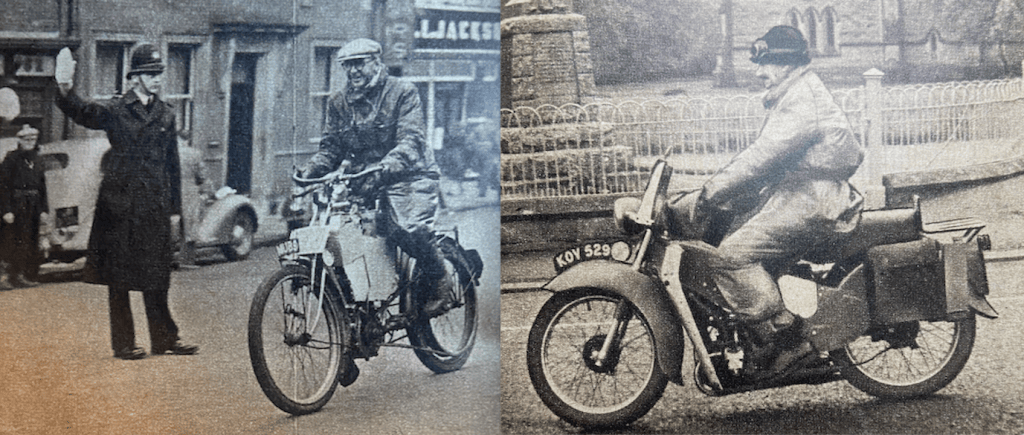
lunch control. The arrivals of Langton and Denton, and Edinburgh clubman George Simpson with his fine 1910 model T Ford created quite a furore as listeners to the BBC’s commentary on Saturday will have heard. Denton, plucky fellow, had only time for a cup of coffee and a sandwich before dashing off on his constant endeavour to keep to schedule. It had been raining all morning and now a strong headwind was blowing across bleak Northumbria and the Mini-Motor was needing frequent pedalling. Over the border the weather got worse and a thick Scotch mist froze some of the competitors on the Alnwick to Ayton stretch. One turn-out seemingly, however, was not affected by the conditions; this was the Brough-Superior outfit which roared on at an ever-increasing gait, hitting 75mph, and sometimes 80, on the open stretches. Its actual owner, Police-Sgt L Kirnmance of Leyton, who had loaned it to George, will be glad to learn that the full speed of his exceptionally well-kept outfit was much appreciated by the manufacturer! A tea stop at Ayton broke the later stage of the journey but the monotonous rain continued right into the Scottish capital where the leader of the run was due to sign off at 7pm. One by one they came down Princes Street—the Triumphs of KM Roberts and D March, the BSAs of JD Barber and V Loupart, the Vincents of RE Wright and CHR Warner, the Velocettes of AH Clarke and Karslake, the James of AG Scott and the Francis-Barnett of JEG Heritage—and late, but still cracking along to give the motor cycle section a 100% finishing strength, Langston’s 51-year-old Rex and Denton’s little Mini-Motor. No wonder these two stalwarts got a big cheer at the dinner held that evening in the Caledonian Hotel where Bailie T Robertson Mossman, deputising for the Lord Provost, welcomed the Golden Jubilee ‘Edinburgh’ to Edinburgh.”— [Green ‘Un editor] RR Holliday
RETROSPECTIVE: FREDDIE DIXON
“EVEN TODAY, MORE THAN a quarter of a century after Fred’s retirement from motor cycle racing, the exploits of the horse-playful Meester Deekzon are recalled with tummy-heaving chuckles wherever he rode on the Continent. Mention his name around the cafés of Spa, Dinant, Montlhéry, Tours, Le Mans, Madrid—to take a random selection—and see what sort of a reminiscence-binge you set off among the elders of the parish: If you should happen across a Belgian or a Frenchman or a Spaniard who actually owned or ran one of these establishments, he will probably admit he tore his hair and bit the carpet every time Meester Deekzon darkened the door. But although it was easy to get sore with Fred, staying sore with him was another matter. Nothing on earth would stop him having his fun, but when he broke the joint up he was invariably scrupulous in paying for the damage. Besides, although he was no Tyrone Power for looks, the sight of that homely pan of his creasing into a grin was something that would anneal the steeliest heart. Recalling these Continental capers of Fred’s, a riding contemporary of his gave us a description of Dixon making the rounds of the local fun spots and eating places the morning after a lucrative race, and peeling compensatory notes off his prize-money roll with an abandon that suggested the whole darn take was being disbursed. ‘No,’ corrected Fred when we quoted this yarn, ‘only half. I always took half
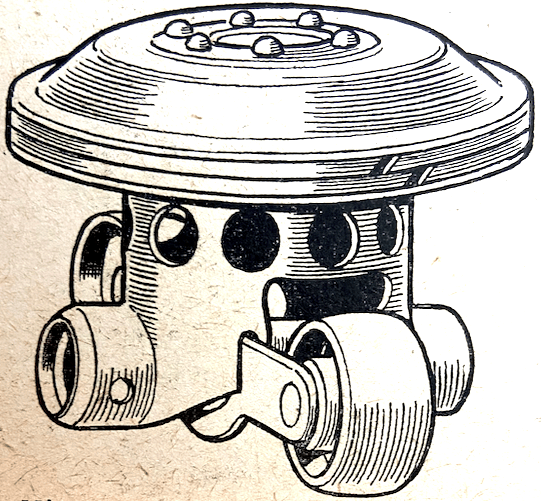
home’…Preternaturally strong in all the senses of the word—muscled like an ox, and with an ox’s constitution too—he had an extra-ordinary capacity for doing without sleep. Times without number, during pre-race preparation spells, he would work continuously on his machines for two days and two nights straight, charging batteries sufficiently for his needs by snatching two-minute dozes at intervals of 12 hours or more. When the occasion arose he was as ready to forgo slumber for another rider’s benefit as for his own. Apropos, there was the time he toiled a whole night to rectify trouble that had befallen a compatriot’s bike. The rider in question, who shall be nameless, won his race the following day; but subsequently, so far from showing the slightest appreciation, he made haste to forget the whole affair. Some months later, as it chanced, Dixon dropped in on the accessories shop of which this Jehu was the proprietor. Mr. ‘X, it further chanced, was called away for half an hour during Fred’s visit, and rashly asked Dixon if he’d mind dispensing merchandise in his absence. It was only then that the stand-in noticed a placard above the counter saying ‘Our one concern is a satisfied customer’. This was too much for our Middlesbrough Robin Hood, who positively ensured the customer’s satisfaction by issuing all goods gratis. Wherever he rode in Europe, it came to be understood that the ordinary rules of etiquette included Dixon out. The least dressy of men, he was the only customer allowed into the Casino at Spa without a boiled shirt…But there was one Spa occasion—after the 1921 Belgian Grand Prix—when the hospitable locals were stung to admonitory tuts. As souvenirs of the race, in which Fred, riding an Indian, had finished third, behind the late Bert Le Vack and Hubert Hassall, the Fabrique Nationale presented the successful British riders with FN automatic pistols. By the time
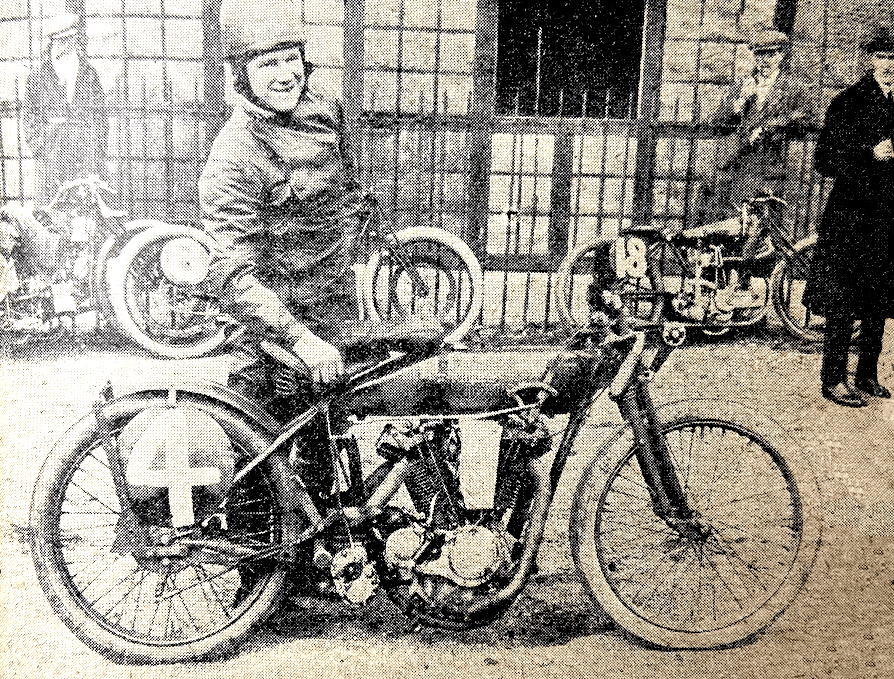
Meester Deekzon was finished practising his triggerwork, the headquarters hotel possessed more holes than a Swiss cheese…Early in 1930, Dixon left Douglas for the second and last time and began experiments with a water-cooled ‘four’ of his own design. He had even bought the necessary manufacturing tools and machinery when the great slump put the kybosh on this little known enterprise. It was about two years later again that he made his sensational break into car racing; and the motorcycle game saw little of him until ’38, when the Brough Superior ‘Golden Dream’ (four transverse cylinders, two geared-together cranks) scooped the limelight at the Show. Fred had considerable responsibility for this remarkable model…His meteoric car career during the ‘thirties was peppered, with blood-chilling accidents. At Donington in 1934 he was yowling down to the hairpin at the end of Starkey Straight when his Riley’s differential case broke up at 115mph. All in the same instant, the propeller shaft snapped and both rear brake cables were severed like cotton. Berserk, the car left the circuit and ran into a stout tree stump, then ricocheted into a row of sandbags. Fred, with several ribs broken, a lacerated face and other injuries, was unconscious for 10 days. But as soon as they let him out of hospital he got busy preparing a Riley for the 500-mile Race at Brooklands. That one was wet. He drove the whole distance solo, although shared drives were the general rule. And won. Speed, 104.8mph. In brackets: Who will be first to write and contradict us if we risk saying Dixon was the only man who contested both the motorcycle and car ‘500s’? ‘Fearless ‘is an adjective that any conscientious biographer of Fred has to resist. He wasn’t fearless, having too much imagination to be. There was one period during the mid-’30s when, as he freely admits, his nerve temporarily forsook him. To get it back he went flying. This choice of cure was a calculated one: if there was one form of conveyance he hated, it was the great silver birds. So…he made himself fly. The result, in terms of insensibility duration, was exactly same as he got in his Donington pile-up: 10 days’ unconsciousness. In some way or other, the machine in which he was a passenger tangled with a bunker on a golf course. Inverting itself, it struck him on the head with a sharp part of its petrol tank. Quantities of fuel welled out and completely soaked his clothes, a fact of which, being stunned, he was of course unaware…”
ROADTEST: NSU-VINCENT 98cc FOX
“ONE OF THE MOST interesting developments in the motor cycling sphere during 1953 was the announcement that an arrangement had been concluded between Vincent Engineers (Stevenage) and the NSU concern, of Neckarsulm, Germany. for the modification and sale in this country of the German manufacturer’s range of motor cycles. The smallest of these (autocycles apart) is the 98cc Fox—an ohv machine which has no British equivalent and is said to be a favourite with Continental riders. The engine, with its four-speed gearbox in unit, is mounted in a pressed-steel beam-type frame, which is equipped with swinging-fork rear suspension utilising a fork welded up from steel pressings. Fork movement is controlled by a single coil spring mounted in the main frame and acting in compression with a rubber shock-absorbing cushion. The front suspension is also of swinging-fork type. The main fork member is of pressed steel and comprises the fork legs, crossbridge and a ‘shroud’ enclosing the steering head
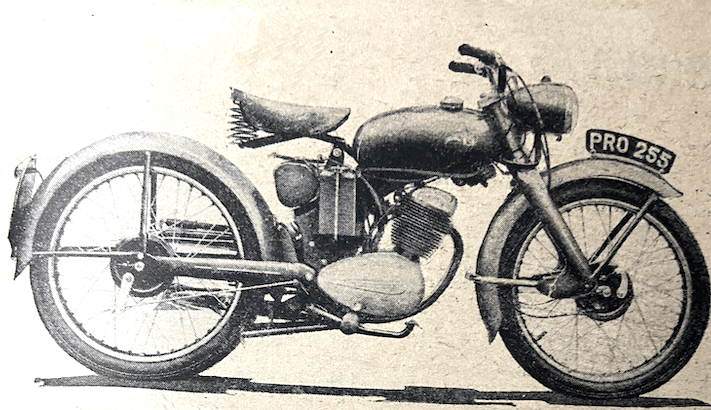
and providing a collar-type mounting for the Miller headlamp. The wheel is carried on a chromium plated U-fork, horizontally mounted, which is pivoted roughly 3in from the wheel-spindle. Movement is controlled by two short coil springs. Both front and rear suspensions are provided with friction dampers. Though the frame, forks, engine (apart from the Miller generator and Amal carburetter) and gearbox are of German manufacture, the remainder of the machine is British. Starting the NSU-Vincent was almost invariably a first-kick procedure. Gear selection from neutral proved to be positive but the clutch take-up was rather fierce. As is usual with Continental machines, first gear was rather low, and the change into second was made almost immediately. None of the upward changes demanded any special care, save that top gear did not always engage perfectly unless the pedal was given a decided ‘pull’ to lock the dogs. Downward changes, too, were clean, though it was necessary to watch the road speed closely to avoid too-audible over-running. The power output of the Fox engine was deceptive. At first the tester was misled into believing it to lack power. However, the first run down his ‘yardstick’ of 56 miles from the Thames to the Channel dispelled the illusion, for the little four-stroke was able, without difficulty. to clip five
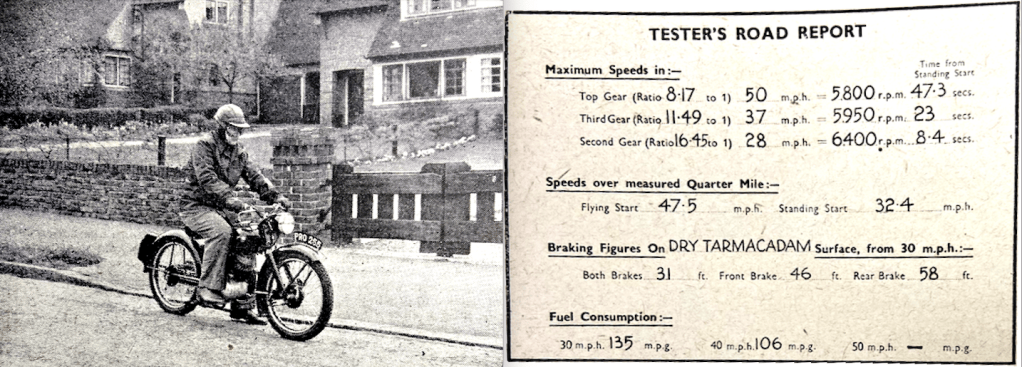
minutes off the previous best time for a machine of similar capacity. Subsequent runs over, the same road resulted in overall times m the region of 105min being recorded for the full distance, and 63min for the 39 open-road miles. These averages —32 and 37mph respectively—were achieved without so much as bending a law, and with the machine cruised at its maximum full-throttle speed of 50 mph for long periods. Despite the use of full speed the engine evinced no sign of distress. After nearly 1,000 miles on test, the dipstick in the oil sump still registered well above the danger mark, and no trace of leakage was apparent anywhere on the unit. On these trips, one gallon of petrol sufficed for just over 100 miles of main-road motoring. The hill-climbing abilities of the NSU-Vincent were considerable, the machine pulling well down to 20mph or less in top gear. Obviously, however, better results could be obtained by using the gearbox, and in practice third gear was used once the speed fell below an indicated 30mph. While the steering and general handling of the machine earned full marks, even on indifferent road surfaces, both the front and rear springing systems gave an impression of inflexibility. It is a drawback of friction damping, of course, that it can be adjusted to cope with only one particular set of road conditions at any one time, and where the suspensions were allowed full play to deal with pot-holes (even so, jarring occulted at comparatively low speeds) the settings were obviously not right for rippled surfaces taken in the ’40s’. With a compromise setting, bottoming was encountered at the front on more than one occasion. It would seem that, in this department, Neckarsulm may well learn something from Stevenage as the partnership progresses! Until the engine had really settled down vibration was in evidence once the speed rose above 40mph, though below that
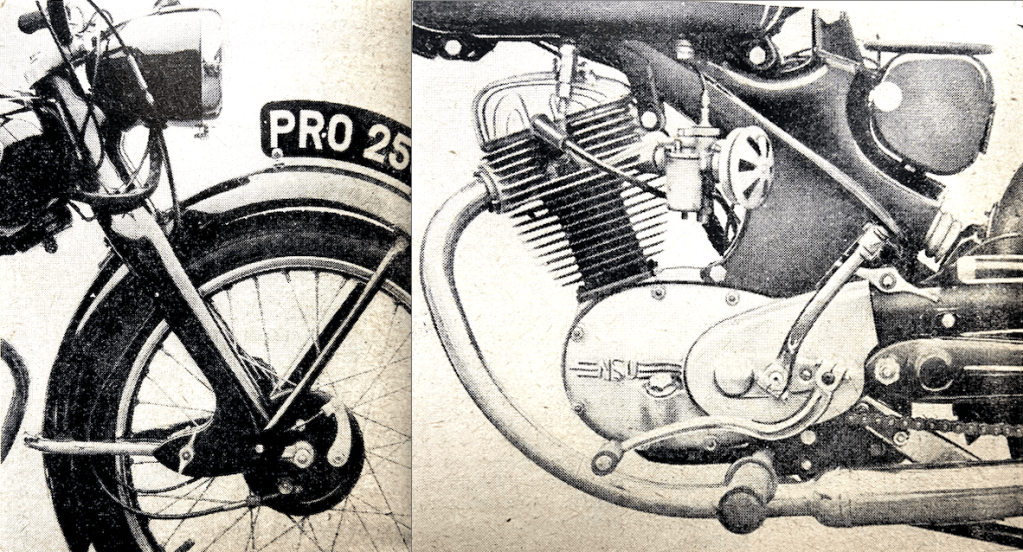
barely a tremor made itself felt. As the recorded mileage rose, however, all such symptoms disappeared, and the model became progressively free from discernible traces of an engine at work. Mechanical noise was limited to a whisper from the tappets. When first received, a German silencer, which permitted a somewhat crisp exhaust note, was fitted. Replacement of this component by a British Carbjector component (the standard fitment) considerably reduced the phonage. Unfortunately, the improved silencing affected the performance, cutting the maximum cruising speed to 45mph, however, this made only a few minutes difference to the overall times mentioned earlier. The riding position proved to be reasonably comfortable for a rider. of medium height, though some saddle-soreness was at first felt after 50 miles or so had been covered. Mudguarding is above average, and short runs on wet roads could be safely undertaken in ordinary walking-out dress without the fear that ‘throw-back’ from the front wheel would bespatter shoes and trouser legs. Additionally, the complete cleanliness of the neat engine/gearbox unit made the use of ordinary clothes quite practicable for local journeys. Initially some trouble was experienced with both the front and rear brakes which, though powerful, gave audible evidence of application. The fitting of new linings—a task carried out at the ‘works’—effected a cure, but did not preclude good braking figures. A good tool kit is provided with the Fox, but—except to retighten the odd nut and to free a jammed float tickler—it was never seriously needed. On all parts, British and German alike, the finish of the Fox is first-class. Light alloy components are left in dull metallic silver and chromium plating is kept to a sensible minimum. Black enamel, with gold lining on the tank and red lining on the wheels—as in normal Vincent practice—provides a ‘classic’ colour scheme, and enhances the attraction of a machine which can best be described as belonging to the ‘luxury’ class of lightweights.”
REPORT: FRENCH GRAND PRIX
“LAST SUNDAY’S FRENCH Grand Prix, organised by the Federation Française de Motocyclisme and staged for the first time on the exceptionally fast 5.18-mile circuit at Rheims, which has seen many a great car race, was the opening event of the nine comprising the 1954 World Championship series. Unfortunately, the imminence of the TT, concern about the type of fuel which would be available and, in one case it has been suggested, in deference to riders’ wishes to hold aloof from the championships, combined to persuade many manufacturers to refrain from entering or to withdraw their entries, or even to fail to honour entries which had been made. Only NSU and Gilera were there in any force, with their riders setting, such a pace in their respective classes that most of the private competitors—a representative collection of the ‘Continental Circus’—were completely outstripped. The most remarkable achievement, perhaps, was the 101.03mph average achieved by Werner Haas when winning the 250cc race for NSU. It was over 5mph higher than Pierre Monneret’s winning speed in the 350cc class, in which he rode a ‘treble-knocker’ AJS, and only 7mph below Monneret’s 500cc race average on one of the redesigned Gilera fours. Yet Haas, like his three NSU team-mates, had a 1953 power-unit, the new engines being reserved for the more strenuous, and more important, bid for Lightweight TT honours. The meeting took place in brilliant weather, with a westerly wind blowing behind competitors on the long downhill straight between the Garenne and Thillois hairpins—the only real corners on the circuit. It was well organised, and accident-free. THE 250cc RACE In the absence of the Moto-Guzzi team, the 18-lap 250cc event which opened the programme developed at once into a race between the four NSU representatives, with the young star of the team, double World Champion Werner Haas, and the veteran ‘new boy’ Hermann Milner duelling for the lead. Haas led for seven laps, then Miller went ahead, after notching a 102.26mph record lap, and remained in front up to the final turn round the radiused Thillois hairpin. From there, however, Haas broke through once more, to cross the line a yard or so ahead. Ruppert Hollaus and Hans Baltisberger—the other members of the NSU quartet—were the only others of a field of 17 to complete the full distance. W Reichert went well on a single-cylinder NSU Max for a few laps, then blew up, after which Tommy Wood, on his Guzzi, was outstandingly better than anyone. Two of the new parallel-twin two-stroke Adler race models were still running in close formation when the chequered flag went out. THE 350cc RACE The nearest
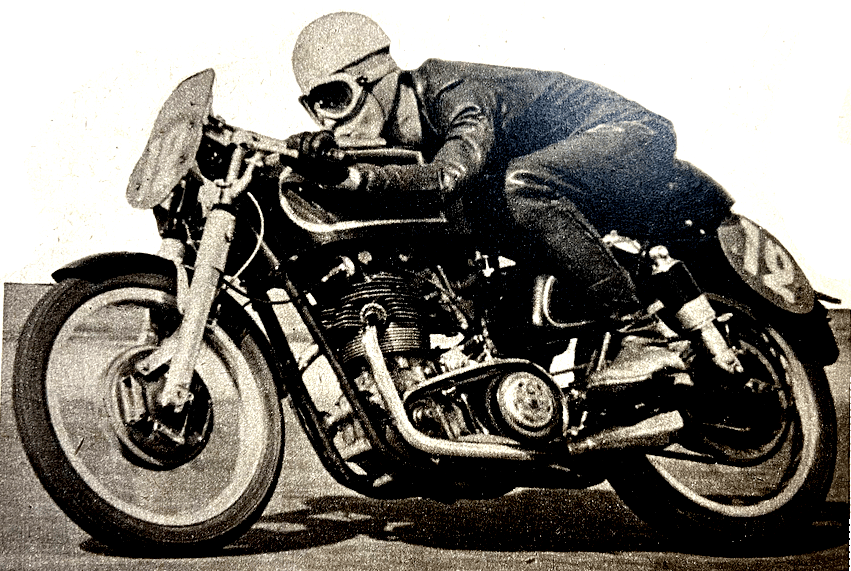
thing to works support for the 24-lap 350cc event was the presence of the three-cam AJS, in the hands of French champion Pierre Monneret. He soon took the lead, but was closely pressed by the Belgian, Auguste Goffin and Ireland’s Bob Matthews, and on the fourth lap lost the lead to Goffin. After that, however, the Frenchman got his feet up and drew very gradually ahead, leaving Goffin and Matthews to battle for second place right to the last moment. Behind the leading trio, Jacques Collot (Norton) soon established himself as fourth placeman; while Tommy Wood (Norton) and the New Zealander, Barry Stormont, mounted on one of the latest BSA Gold Stars, fought for fifth position. They were never more than a yard or two apart, and were often wheel to wheel, right up to the 19th lap when—a main frame bolt coming adrift—Wood was forced to retire. Stormont continued to motor to such good effect that he was still unlapped by the winner when the race ended, giving a clear indication that, even on the fastest circuits, in racing trim, this ohv BSA is good enough to hold its own with the cammy models which comprised the main part of the field of 21 starters. THE 500cc RACE There was a long interval between the 350 and 500cc events but eventually a score of riders—some of whom were again using their ‘Junior’ mounts—came to the line. Reg Armstrong, Geoff Duke, Alfredo Milani and Monneret had works Gileras; the majority of the others were on Manx Nortons. Monneret was worried because during the warming-up period his four ran erratically, and there was some delay, with everyone else on the grid, while he visited his pit for a plug change. Then when the starting signal was finally given he stalled his engine, and only got under way after most of the field—led by Milani, Duke, Goffin (Norton) and Luigi Taveri (Norton) were streaking round the long right-handed curve at the far end of the pits. In a lap Milani and Duke were already ½-mile ahead of their nearest pursuer, Taveri. He had Collot (Norton), Goffin, Canada’s Roy Godwin (Norton) and Stormont—on p 499cc BSA this time—all hard behind him. Monneret was just beginning to overhaul the tail-enders, but there was no sign of Armstrong. Within a few laps Duke had moved ahead of Milani, while Monneret—riding as if he had a fiend behind him—was through the remainder of the field and into third place, within three laps, and had put the lap record at 114.67mph by the fifth. Armstrong had retired, after touring in with a badly misfiring motor. Relentless riding, and the retirement of some of his opponents, soon had Stormont in fourth place, where he stayed until a large jet and a small-capacity fuel tank resulted in him running out of petrol on the 25th of the 30 laps. By then there had been an even more notable retirement. Geoff Duke, who had a substantial lead at the time over Monneret, who had taken second place from Milani, went out of the race on his 23rd lap, afflicted by the same trouble he suffered in the recent North West 200—stripped timing gear. Only two riders ran the full distance—the winner, Monneret, and his team-mate for the race, Milani—but special praise should go to Monneret’s compatriot, Jacques Collot, who, alone among those still running at the finish, had been lapped but twice by the leader.”
“THE FOURTH IN THE series of Welsh Two Day Trials, organised by the Mid-Wales Centre ACU, centred on Llandrindod Wells, was won by Gordon Jackson riding a 350cc AJS who lost a total of 13 marks. Runner-up was Johnny Brittain (350 Royal Enfield) whose total of 18 marks gained for him the Rhayader Cup, while Arthur Humphries (500 Norton sc) won for the second successive, year, the Welsh Trophy for sidecars, losing 24 marks compared with 65 last year. Second to Humphries in this class was F Wilkins (500 Ariel sc) with 25 marks. The organisation of the 1954 event followed the pattern of previous years—Friday being devoted mainly to riding cross-country against the clock in International style, while the Saturday programme brought the one-day specialists into their own. Always a popular event, the trial this year attracted an entry of 105.”
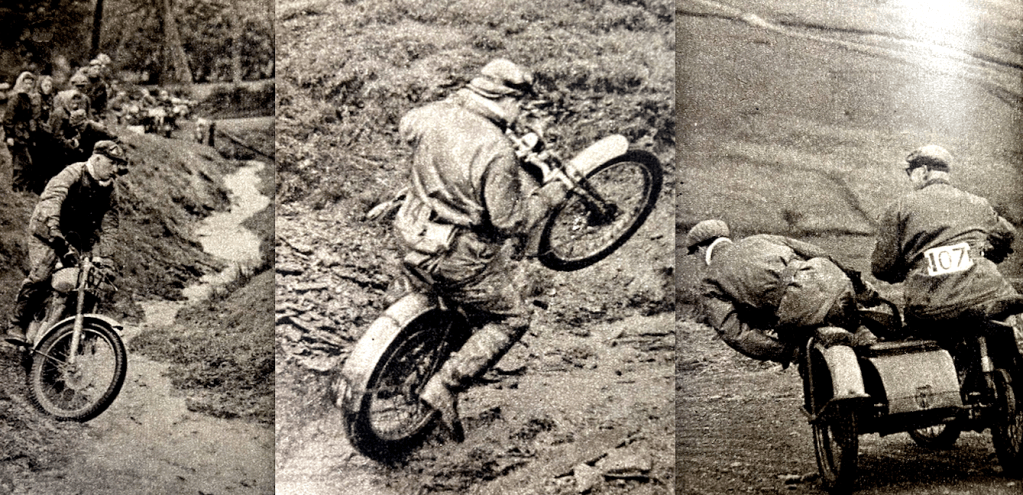
“DIRECTOR PALIN, OF THE Manufacturers’ Union, has been over in the States. Reason for his flying visit was to organise opposition to yet another move to raise tariff walls against British imports to that country. As about 40% of the motorcycles now sold in the USA come from this country, the anxiety of local manufacturers may be understandable. But they should try to compete, instead of seeking the protection of duties. The history of the American motor cycle industry is a curious one. It was remarked recently in this column that motor cycling never got the hold in the States that it succeeded in doing here. While that is strictly true, the statement needs qualifying. Shortly before the first world war the US motor cycle trade appeared quite thriving. There was a number. of manufacturers in the field; probably as many as in this country. Moreover, some of their products were very advanced indeed—I think it would be fair to say that they were actually ahead of Britain. The USA could have become the world’s leading motorcycle manufacturing country. Yet, for some reason, or possibly several, the industry went into. a progressive decline. Interest was revived, beyond any doubt, by the large scale importations of British machines after 1945. But for that, the probability is that motor cycling would have virtually died out in the States by this time.—CARBON
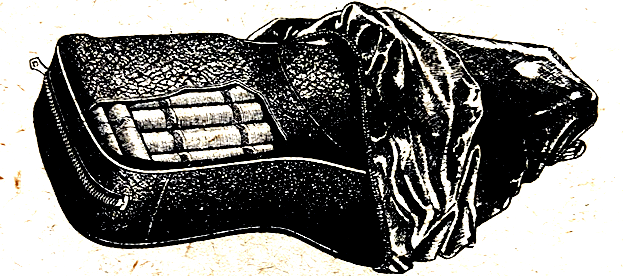
“THROUGH THE ENTERPRISE of Alan WAJ Bruce and Co an especially neat German engine/gearbox unit may become available in the near future on the British market. It is the ohv Wimmer, which is produced in 248cc (68x68mm) and 344cc (74x80mm). It features three main roller bearings to support the crank assembly and silicon alloy for the cylinder head. Power outputs are 17bhp at 6,500rpm and 21bhp at 6,200rpm respectively. Inquiries, from the trade only, should he addressed to Mr IB Addis, BSc, MInstT, Clock House, Little Brickhill. Bletchley, Bucks.”
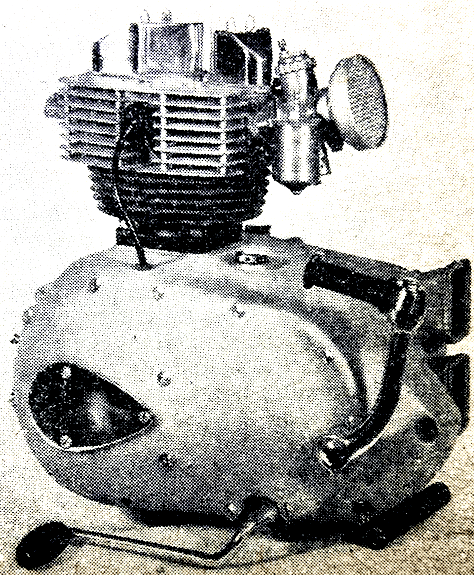
“PRIDE OF OWNERSHIP is one of the joys of motor cycling and this is greatly increased if the machine has been built by the rider. On this reasoning, two Colchester clubmen, the De’Ath brothers Leonard and. Ronald, must be extremely proud of their home-made combination, The Roamer. The idea was born about three years ago when a 1924 Rover fiat-twin car engine/gearbox unit was obtained from a local breakers’ yard. As this unit measures about 1,000cc, it was thought to possess the makings of an ideal engine for sidecar use, being able to give plenty of power for a small rate of rpm. Before work could be started on the machine the unit had to be ‘trimmed’ to size—a long extension on the front of the engine, designed to accommodate the starting handle, being one major snag. This cover was removed, the extension turned off and a plate fastened over the resulting hole. The original magneto platform was also removed from this cover and the mag re-sited on top of the engine (in a position similar to that on a modern Douglas). This necessitated a casting being made up to cover the magneto driving gear and the builders were fortunate inasmuch as there is an aluminium foundry ‘ just-down-the-road’ where all the castings—and several were necessary—were made. An OEC Duplex frame was found, much labour followed and a few months ago the machine was finished and a start made on the sidecar. The frame has been lengthened and a new pivoting-fork rear
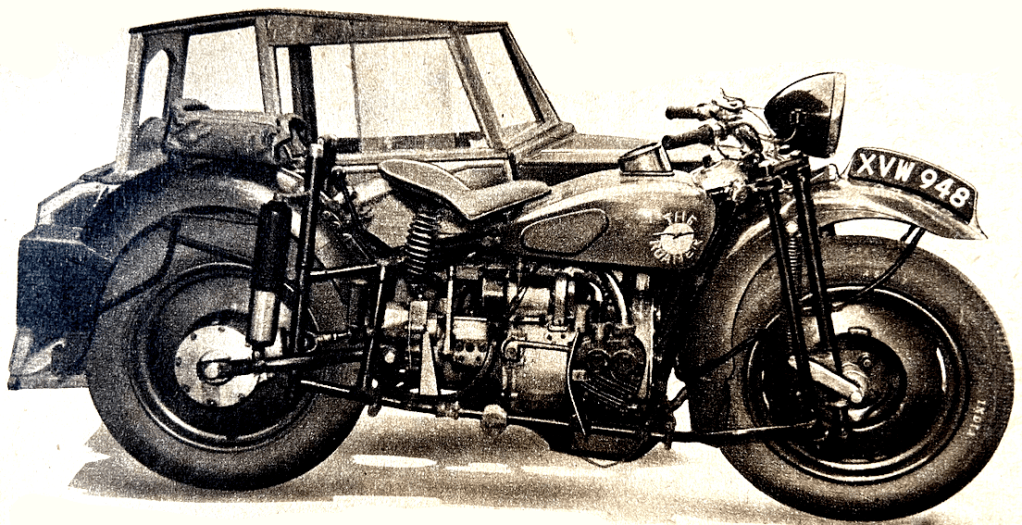
suspension system made up. This is controlled by two hydraulically damped spring units of the owners’ own design which give over four inches of movement. The front down tube is replaced by twin tubes each side of the engine. The original duplex steering is retained but the telescopic principle of the forks has been abandoned in favour of a bottom link type, controlled by coil springs in tension and damped by one hydraulic damper on the nearside fork leg, Another aluminium casting houses a set of spur gears (ex-Army tank) which transfers the drive from the centre of the unit to the offside, to allow the engine to be centrally placed in the frame. Final drive is by a shaft housing two Hardy-Spicer universal joints to allow rear suspension movement. The crown wheel and pinion are ex-Morris Minor and are housed in an aluminium casting. All three hubs, home-built, house Wolsley 9 Brakes, hydraulically operated and inter-connected, and carry interchangeable disc wheels from an Austin A40 van. Tyre size is 17×4.50in, and three different makes are fitted to determine which type lasts longest. The front and rear mudguards are Sunbeam S7 and are ideal for the job. The tank started life on a New Imperial but has been cut into halves and a wide centre section welded into it, this houses a large ex-Ford speedometer head driven from the rear hub. The tank effectively hides the magneto and the Smiths carburetter which feeds the engine via a home-built induction-cum-exhaust manifold, made in an attempt to keep the mixture warm until it reaches the cylinders. In cold
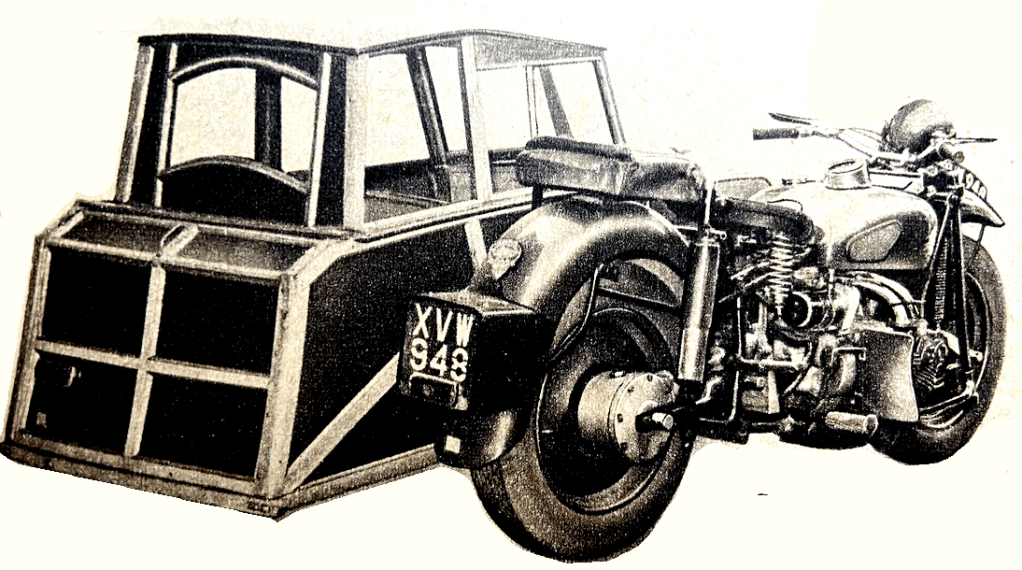
weather some condensation trouble was experienced before this modification was completed. The electric.starter has been replaced by an Austin Seven type dynamo driven off the ring, and a transverse kickstarter (à la BMW) fitted. Gear changing is at present effected by the original lever which protrudes behind the Harley-Davidson saddle. This is due for modification in the near future. A Triumph front number plate is fitted and a parking light is faired into the mudguard immediately behind this. A car headlamp of uncertain origin and an internally illuminated rear number plate incorporating tail and stop lamps is fitted. Below the dynamo, originally, was a large opening disclosing the flywheel, this has been fitted with an aluminium cover, as has a similar opening on the opposite side of the engine. Shields for the rider’s feet are arranged behind each cylinder; these also help the air to circulate completely around the barrels for they are extended downwards to form scoops. A large sump houses a home-built oil pump employing bicycle three-speed gear pinions in a phosphor-bronze body. The oiling system follows normal car practice, employing a wet sump into which excess oil drains back. Turning to the sidecar, the pleasing lines and the ‘shooting brake’ type of construction have great eye-appeal. The chassis, made from 18-gauge square tubing, has four connections to the machine—these being threaded eyebolts and yokes. The body completely encloses the wheel and chassis. The wheel, incidentally, is sprung with a large horizontal spring operated by a cranked lever. The nose of the body is made from aluminium, as is the wheel cover and roof. A wooden framework and hardboard are used for the door, the rest of the bodywork and the boot lid. Safety glass is employed for
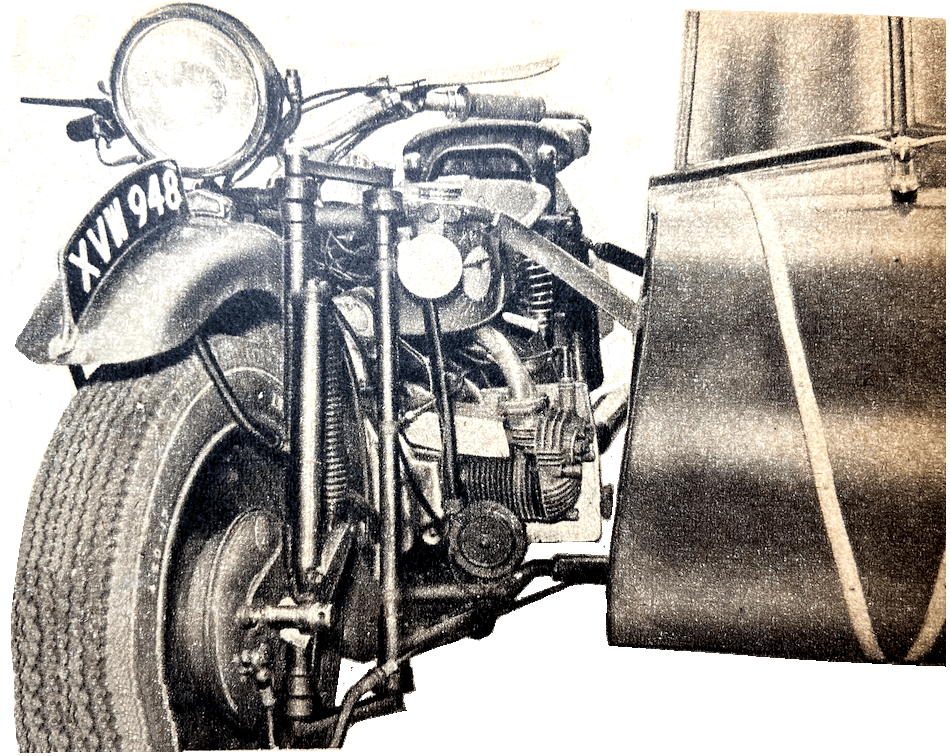
all the sidecar windows, including the sliding ones at the sides. Only one seat is fitted to the sidecar so that there is exceptional passenger room: the upholstery is at present being completed. The boot lid has been made to drop down to carry any luggage that cannot be accommodated inside. An attractive dark green finish is used for the sidecar, mudguards, wheels and tanks, the cycle parts being enamelled black. A short run showed the steering to be somewhat heavy at low speeds: otherwise it was quite light. Gear whine from the spur gears in the cross-over drive was somewhat pronounced but this is due for improvement when better gears are obtained. Engine power was good at low revs, the outfit pulling evenly when proceeding slowly in the highest of the three forward speeds; a reverse gear is available and is a help when manoeuvring the outfit in confined spaces. Handlebar controls are orthodox, except that the brake lever operates on to the rear hub mechanically to give the outfit its ‘second independent brake’ thus complying with the law. ‘What will she do?’ is an inevitable question readers will want answered. With the present top gearing, about 4.5:1, maximum engine revs of 3,500 give 60mph—above that speed vibration becomes pronounced. Petrol consumption is rather heavy: no long runs have been undertaken yet, but cruising around 40-45mph gives 45-50mpg. In closing it can truly be said that it has been a long time since a ‘special’ has been seen possessing a standard of mechanical and general exterior finish of such a high order.”
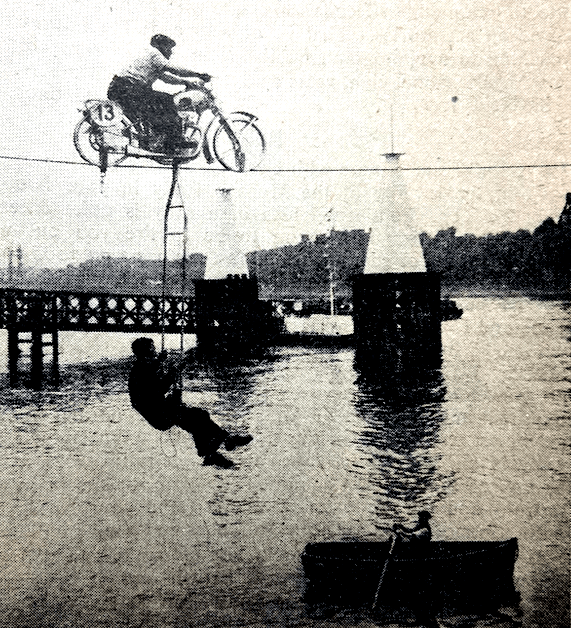
“TRIPOLI…MANY OF THE LADS were transported to this part of the world entirely free of charge during the 1942-5 period. Nowadays you need pretty good business reasons if the trip is to be a paying proposition. Well, I had five days in which to do a job of work—which meant a wonderful opportunity for a look-see round the place with special reference to its motor cycling activities. Now, I claim to know less than nothing about the business of exporting motor cycles, but it seems to me that English manufacturers are losing a useful market in Tripoli and similar places along the coastline. Although I spent every available minute wandering around, in the approved tourist manner, I had been in Tripoli two whole days before I saw a single English motor cycle. Perhaps there is some good reason for this. The Italian influence is strong, for about half the population seems to have come from the toe of Italy, just across the water. But although Continental scooters buzz happily everywhere, the fact that they are made in Italy cannot be the sole reason for their popularity. Morris has found a ready market for cars, for there are scores of Minors about, almost outnumbering the Fiat 500s which are parked in shoals. A dealer told me that a first-class Morris agency was the reason for the popularity of this make; I wonder if a go-ahead motor cycle manufacturer could duplicate this success ? The climate in Tripoli is almost perfect for motor cycling, although perhaps a little too hot in mid-summer. Ex-desert campaigners will no doubt recall the effect of riding against the blast-furnace type of hot wind that dries up your very eyeballs. And it is just like that in the afternoon of high summer. But in kinder months, and always during morning and evening, you can enjoy very pleasant motor cycling. During my stay, a friend lent me his Vespa scooter and 1 purred in and out of dusty side streets in great style until a dusky African policeman began to show an interest in my licence-less activities. Then I took a walk down to the bazaar. I knew we were short of an ashtray back home so the purchase of a small item of native brassware
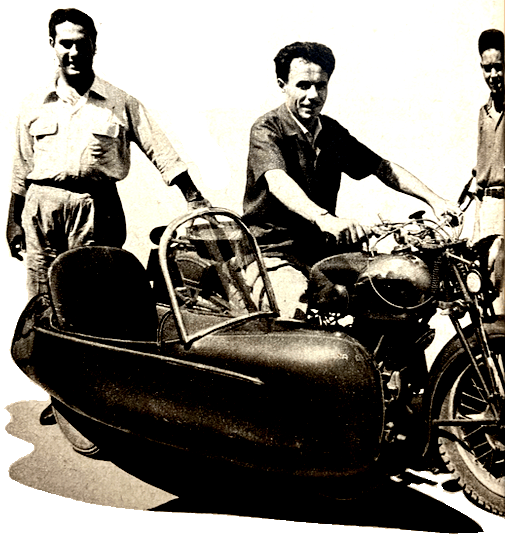
seemed the thing. I picked up what I considered a good specimen of local craftwork for five bob. A week later, I presented it to my wife, only to find that during my absence she had been up to town on a shopping expedition and also bought a brass ashtray in Oxford Street. They were exactly the same—even to the trade mark underneath—and probably of Birmingham origin. The only difference was that the English one cost only three shillings. After three years in India during the war I thought never again would I be ‘had’ in a native bazaar! It was in this bazaar that I encountered the bright red Moto Guzzi outfit with a banking sidecar. Whether the owner spoke Italian or Arabic I could not tell, nor did it matter in the least, for I speak neither. Yet such is the camaraderie of the motor-cycling movement even in this far corner of the world that in a few minutes we were indulging in a sign language conversation that spoke wonders for the fluency of the human hands. Then came a convincing demonstration of the capabilities of the combination, carried out in the confined space of the bazaar crossroads. Dark brown, pot bellied, near-naked children scattered madly in all directions, one losing his richly embroidered skull cap in the excitement. Those three wheels certainly motored like two. Then the owner obligingly posed for my camera, two other gents muscling in with a sudden failure to comprehend my sign language—which had been understood by all until then—when told to stand out of the picture. I passed on through the bazaar, resisting the temptation to buy a fez for thirty shillings, for twenty-five shillings, for a pound, even for fifteen shillings. I decided that at ten bob it might be
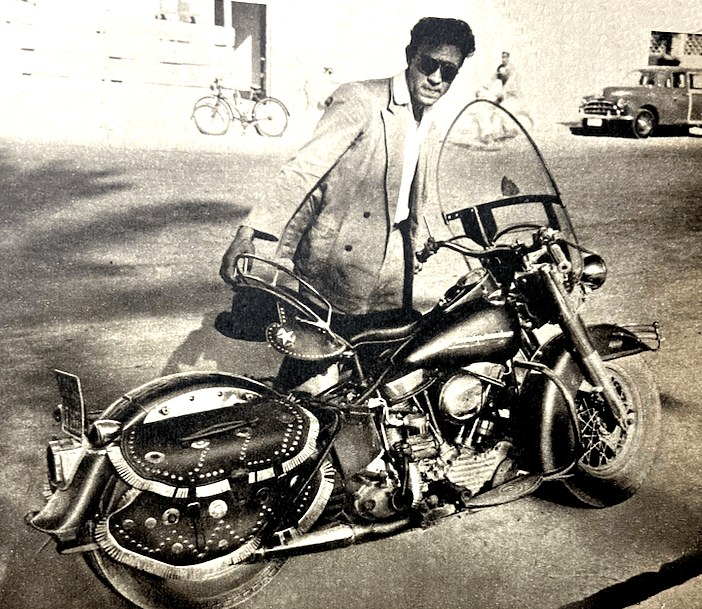
worth it as a novelty. But fifteen seemed to be rock bottom. Even the actual production of the Libyan equivalent of a ten bob note failed to stir the sales instinct in the vendor. I gave up and bought an English-made scarf imported the week before from Bond Street. But Tripoli is not all bazaar. It has an English-style cathedral, some magnificent shopping arcades, a Royal palace of fairy-tale beauty and—the waterfront. Always a foreign waterfront is a place of fantasy. The strangest ships come from unknown ports, nationalities never before seen frequent the umbrella-shaded/ cafes and in the side turnings men are forever working on the nets…Then I came across the Harley. They say one picture is worth a thousand words so I will cut the cackle and print the negative. The property of a local civil engineer, it stood ready for action as I brought my camera into play, shooting from astern to give prominence to the richly decorated studded leather panniers and massive saddle with chromium railed back-rest…Nearby is what is probably the oldest thing in Tripoli, a Roman triumphal arch, made entirely of white marble finely sculptured in places and bearing a still readable inscription attributing its construction to the time of the emperor Antonius and the completion to Marcus Aurelius. Five days slipped quickly by and the babble of Arab, Turk, Italian and Negro voices was eventually left behind as I sped out at midnight, in the still warm air, for the runways of Idris Airport. We drove through fields of monkey nuts hedged with giant cacti like gaunt crazy scarecrows in the moonlight, and then civilisation overtook me. Customs, bureau-de-change, even the good old Naafi and at 2.40am, the magic seat once more. At a thousand feet the only sign of life was the red flares of Bedouin Arab camp fires on the fringe of the great Sahara. The drone of four propellers sent me off to sleep. At seven o’clock we touched down at London Airport…—LESLIE SAMSOM
THE AMERICAN ANTIQUE MC held its inaural meeting at “picturesque Wing Farm, in the Berkshire hill country of the Eastern States”; not surprisingly they rode on on a selection of old American iron.
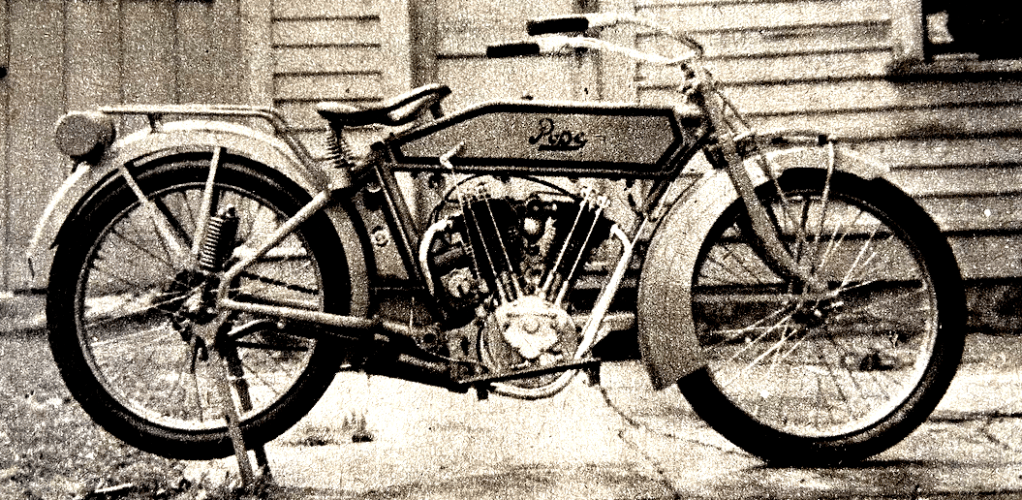
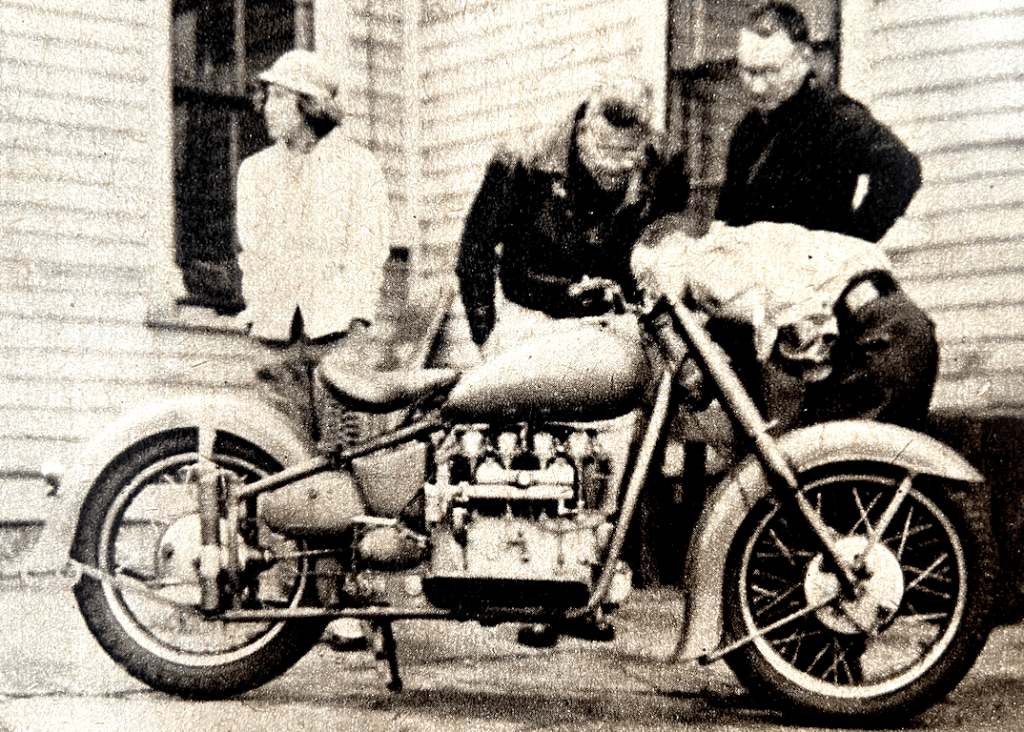
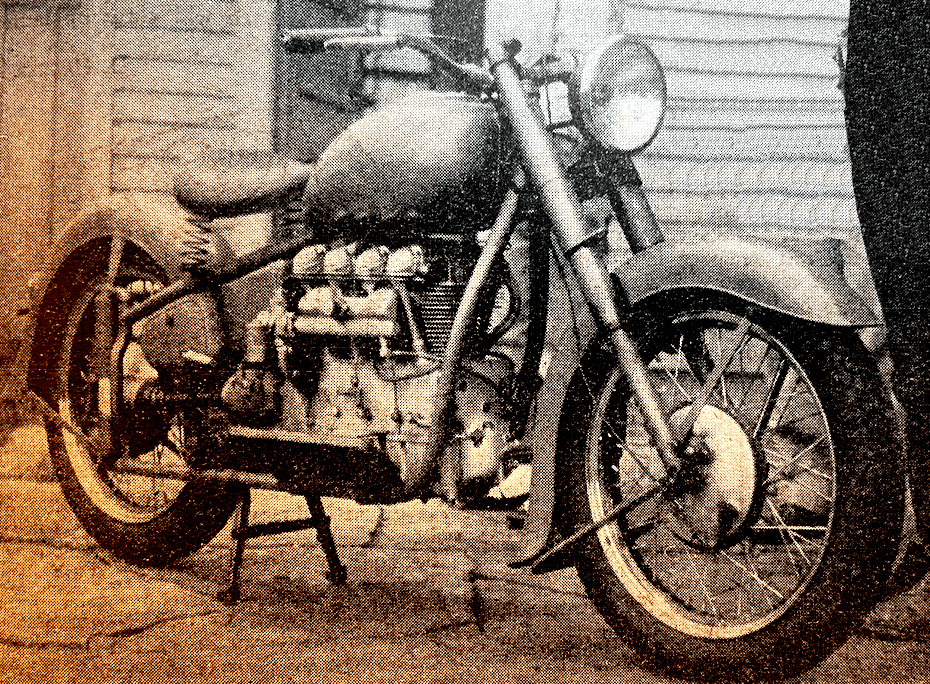
“UNEASINESS ABOUT THE future of the TT is still lurking. Sam Huggett did his best to give reassurance when he spoke at the marshals’ supper last week, but because he also touched on the subject of the high speeds being achieved and the availability now of the alternative Clypse circuit, many—probably wrongly—have sensed a double meaning. In a hands-off-the-TT spirit, speakers at the riders’ and traders’ dinner and dance, held at the Majestic Hotel last night, demanded a no-change policy in the Island. Rod Coleman, replying to Bob Walsham’s toast to overseas visitors, said that in New Zealand a world championship title meant less than a TT win. Rather more forthright, Jimmy Simpson opined that if the TT has to be taken off the TT course, “You can chuck motor cycle racing out of the front door.” This annual function attracted more than 240 guests, including the newly arrived NSU and Guzzi riders.”
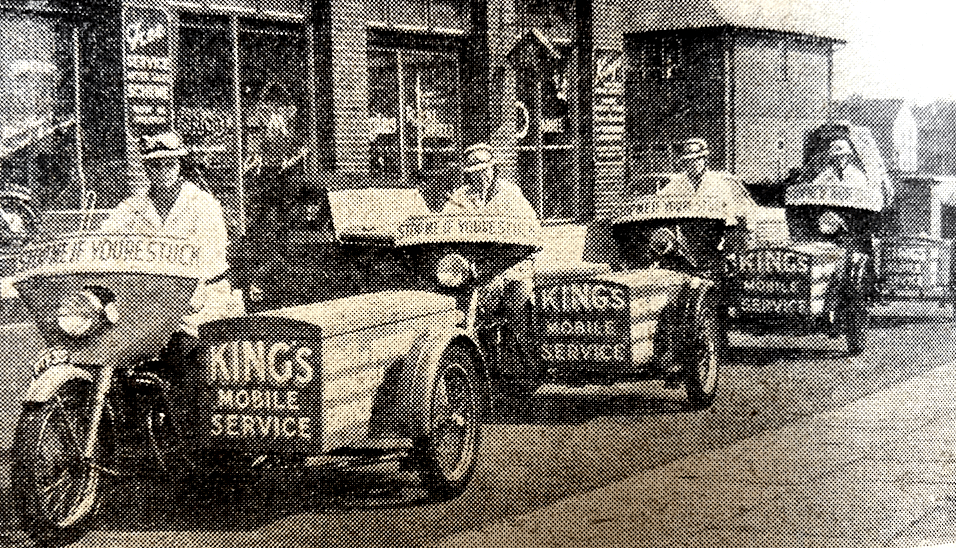
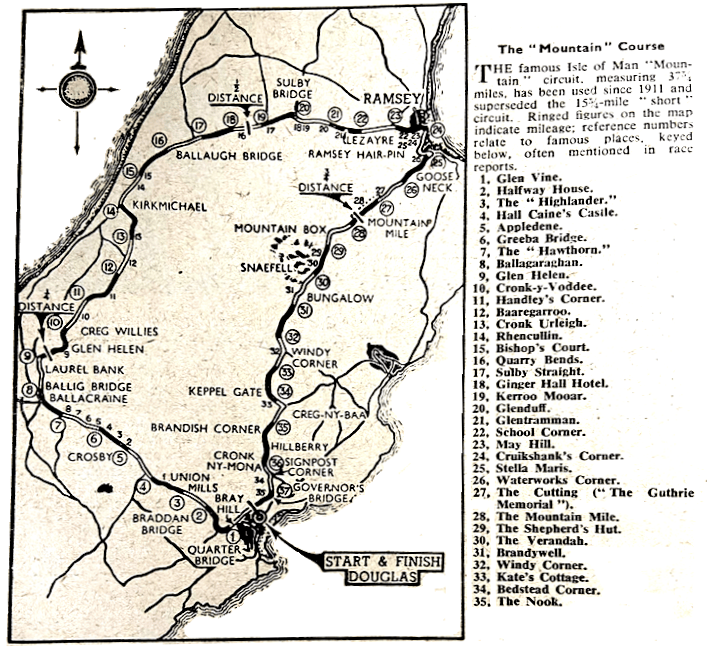
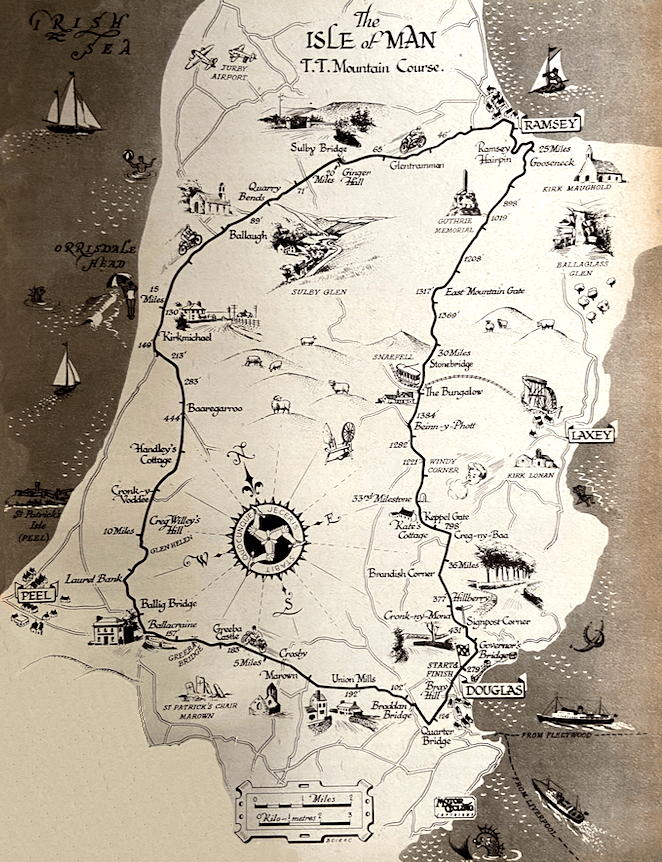
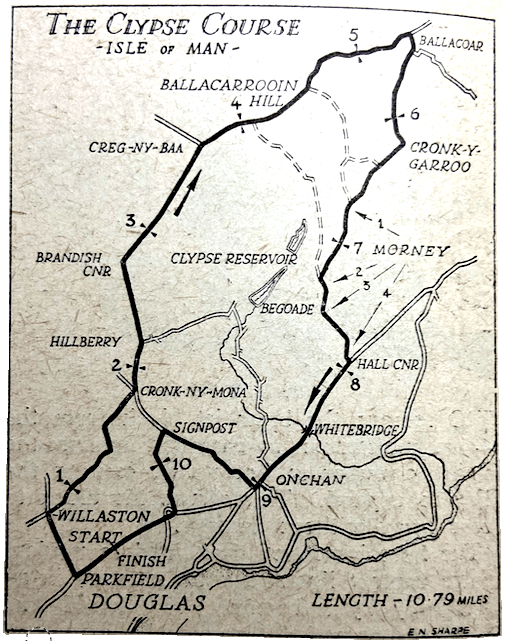
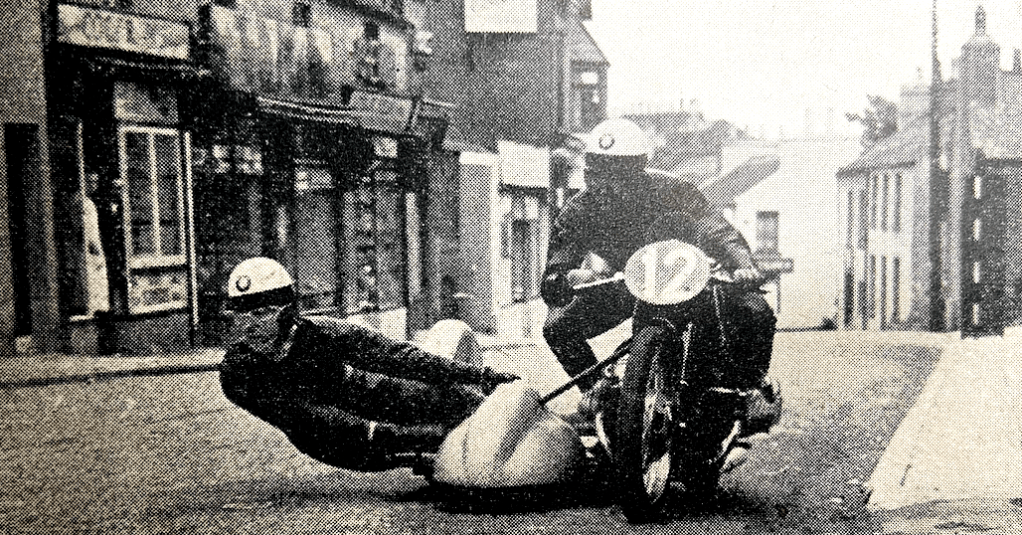
REPORT: TT
INTERNATIONAL LIGHTWEIGHT TT “Run in brilliant weather last Monday afternoon, the International Lightweight TT, second of the five races included in the Auto-Cycle Union’s 36th ‘classic’ meeting the Isle of Man, proved to be as much of a triumph for Germany’s NSU Werke as was the 250cc class of the recent French Grand Prix at Rheims. With five machines entered, four of them finishing in the first four places and the other coming in sixth, the NSU camp must by now entertain exceptionally strong hopes of sweeping the board in the subsequent meetings to be included in the World Championship series. Werner Haas, 27-year-old reigning World Champion in the 250cc class, led the race from start to finish, creating a fresh record on each of the three laps, and finally covering the 37.73-mile circuit at 91.22mph, bringing his race record up to 90.88mph. Ruppert Hollaus just beat Reg Armstrong into second place, and another NSU rider, the veteran Hermann Müller, was a close fourth. The only serious opposition to the German machines was provided by two Italian Moto-Guzzi representatives. One of these, Ken Kavanagh, retired on the first lap, but the other, Fergus Anderson, put up a good fight—despite a stop to remove part of his streamline fairing which came adrift—managing to gain fifth place. Like the Junior, the Lightweight was happily free from accidents, even though it was run at such high speed that the lap record was broken 17 times.” Results: 1, Werner Haas (NSU), 90.88mph; 2, Ruppert Hollaus (NSU); 3, Reg Armstrong (NSU); 4, HP ‘Happi’ Müller (NSU); 5, Fergus Anderson (Moto Guzzi); 6, Hans Baltisberger (NSU). INTERNATIONAL JUNIOR TT “In his fifth Junior TT, 28-year-old Rod Coleman, from Wanganui, New Zealand, provided AJS—one of the most consistent supporters of the Isle of Man races over a great many years—with an extremely popular victory in last Monday’s five-lap (188.65-mile) International Junior TT. His average speed of 91.31mph set a record for the race. Up to the middle of the last lap, when he retired, Ray Amm (Norton) was leading and he had raised his own lap record, set last year, to 94.61mph. Another AJS rider, Derek Farrant, was second and Bob Keeler, Norton teamster, third. With fourth finisher, Leo Simpson (AJS) and GCA Murphy, also on an AJS, finishing eighth, Coleman wins the club team prize for the New Zealand A-CU. No manufacturers’ team finished complete, in a race which, though remarkable for the number of mechanical failures, was marked by a complete absence of serious accidents, and both the Italian Guzzi machines, which had been strongly fancied as potential winners, retired with unsuspected engine troubles. The race was run in almost ideal weather conditions and was watched by enormous crowds at all points around the famous 37.73-mile Mountain circuit.” Results: 1, Rod Coleman (AJS), 91.51mph; 2, Derek Farrant (AJS); 3, Bob Keeler (Norton); 4, LT Simpson (AJS); 5, PA Davey (Norton); 6, JR Clark (AJS). INTERNATIONAL 125cc TT “After a closely fought duel which lasted for the 107.9 miles over which the race was run, the 22-year-old Austrian, Ruppert Hollaus, from Vienna, rode the German NSU into first place in the International 125cc TT, the first motor cycle race ever to be run on the 10.79-mile Clypse Circuit. Held on Wednesday morning, the race was one of the five included in the Auto-Cycle Union’s 36th ‘classic’ meeting, and was the second in its class to count towards the 1954 World Championship. Hollaus, who put in the fastest lap on the final circuit, at 71.53mph, took 1hr 33min 3.4sec. to cover the 10 laps, averaging 69.57mph, and finished only 4sec ahead of Carlo Ubbiali (MV), who had contested every yard of the distance with him. Third was Cecil Sandford, on another MV; fourth was Hans Baltisberger (NSU) and the fifth and sixth places were awarded—after some confusion over flagging at the conclusion of the race—to II Lloyd (MV) and BG Purslow (MV). Werner Haas (NSU), German winner of the previous Monday’s Lightweight TT, run on the 37.73-mile Mountain circuit, retired after twice falling off on roads which had been left wet by over-night rain which ceased, fortunately, before racing commenced.” Results: 1, R Hollaus (NSU), 69.57mph; 2, C Ubbiali (MV); 3, CC Sandford (MV); 4, HBultisbeger (MV); 5, II Lloyd (MV); 6, BG Purslow (MV). SIDECAR TT “Eric Oliver, the 43-year-old World sidecar Champion, made a good start to this year’s series of ‘classic’ meetings when, with Les Nutt as passenger, he won the first Sidecar TT to be held for almost 30 years. The race took place on Wednesday afternoon over 10 laps (107.9 miles) of the Clypse Circuit. Oliver took 1hr 43min 0.2sec to cover the full distance, averaging 68.87mph, and he put in the fastest lap of the race on his third circuit in 9min 9sec (70.85mph). Although Oliver, entered by Watsonian Sidecars and riding a fully streamlined 499cc ‘double-knocker’ Norton prepared by that company, was able to outclass all his opponents, the three ‘semi-works’ BMW drivers from Germany—Fritz Hillebrand, Wilhelm Noll and Walter Schneider—who put up a remarkable demonstration by finishing second, third and fourth. The race was run in weather which varied from bright to dull, but there was no rain and the roads remained dry throughout. There were a few minor collisions with the banks and kerbs at different points around the course but there were no serious accidents to embarrass the protagonists of sidecar racing.” Results: 1, ES Oliver (Norton), 68.87mph; 2, F Hillebrand (BMW); 3, W Noll (BMW); 4, W Schneider (BMW); 5, J Drion (Norton); 6, WG Boddice (Norton). JUNIOR CLUBMAN’S TROPHY RACE RIDING a 348cc ohv BSA Gold Star, 25-year-old Phillip Palmer, entered by the Wakefield &DMSC, won the 1954 Junior Clubman’s Trophy Race, run last Thursday over four laps of the Isle of Man TT circuit, at a record average speed of 81.83mph. BSA riders filled the next three places and second place-man, DA Wright, entered by the Chester MC turned a record last lap in 27min 15.8sec, equal to a speed of 83.05mph. Third was JW Davie, entered by the Kirkcaldy &DMC. Run in fine weather, the race was commendably free from mechanical failures or accidents.” Results: 1, Philip Palmer (BSA), 81.83mph; 2, DA Wright (BSA); 3, JW Davie (BSA); 4, AS Bowie (BSA); 5, Geoff Tanner (Norton); 6, GE Arnold (BSA). SENIOR CLUBMAN’S TROPHY RACE “Race and lap records were broken in the 1954 Senior Clubman’s Trophy Race, organised by the Auto-Cycle Union for riders of standard 500cc sports machines, nominated by members of affiliated clubs. Held last Thursday afternoon over four laps (150.92 miles), the race enjoyed fine weather conditions and was free from serious accidents. It also demonstrated the fine reliability of the machines entered, for there were only seven retirements in a field of 39. The winner, 27-year-old Alastair King, entered by the Mercury MCC of Glasgow, covered the distance in 1hr 45min 36sec, averaging 85.76mph, on a BSA Gold Star, and on his final circuit, which took only 26min 1sec, raised the lap record—which had been broken repeatedly throughout the race—to 87.02mph. Second was JB Denton of the Bradford &DMC, also riding a BSA, and third was E McG Haldane, of the Menstrie MCC, on yet another BSA. Little more than half a minute separated the first three.” Results: 1, Alistair King (BSA), 85.76mph; 2, JB Denton (BSA); 3, Ewen Haldane (BSA); 4, Tony A Ovens (Triumph); 5, MR Baigent (BSA); 6, Percy Tait (BSA). INTERNATIONAL SENIOR TT Bad weather conditions caused last Friday’s International Senior TT to be stopped after only four of the seven laps of the 37.73-mile Mountain circuit had been covered. At that stage 26-year-old Ray Amm, from Salisbury, Southern Rhodesia, winner of the 1953 Senior, again riding for Nortons, had taken the lead from Geoff Duke (Gilera), following the latter’s stop to refuel at the end of the third lap. Amm thus became the fourth man, with Duke, Charlie Dodson and Stanley Woods, to have two consecutive Senior TT victories. Duke was placed second, Jack Brett (Norton) was third and Reg Armstrong (Gilera) fourth. With Amm, Brett and Bob Keeler, who finished in eighth place, as its members, the Norton first team won the Manufacturers’ Award. The start of the race had been delayed 11 hours owing to the presence of heavy belts of mist on the Mountain section of the course, and there was rain when it commenced. The winner’s average speed of 88.12mph was nearly 6mph below the 93.85mph record he set up last year, and the fastest lap, also achieved by Ray Amm at 89.82mph, was also well below his 97.41mph 1953 record. Most regrettably the excellent record of the six earlier races in this year’s TT programme was marred by a first lap crash in which S Sandys-Winsch suffered injuries which proved fatal.” Duke later remarked: “The narrower, lower Gilera, now with steering geometry akin to the Featherbed Norton, was superb. I was convinced that this afforded me the best possible opportunity of a TT victory, but it was not to be. The start of the race was delayed, and then we were sent on our way in totally unacceptable, wet and misty conditions, with visibility on the Mountain section down to 50 yards. Then, after we had braved the elements for four laps, the race was stopped when conditions had improved—alas, after I had lost my early lead when refuelling! Ray Amm, the eventual winner, completed the four laps non-stop, which I could also have done, had I known that the race was going to be halted…” Results: 1, Ray Amm (Norton), 88.12mph; 2, Geoff Duke (Gilera); 3, Jack Brett (Norton); 4, Reg Armstrong (Gilera); 5, Rudy Allison (Norton); 6, G, Laing (Norton).
“BEWILDERED BY THE sudden cessation of the race, and with nerves still taut from their ordeal by fog and water, the three placed men nevertheless had clear-cut impressions of their struggles with zero visibility and a minus quantity of grip on corners when interviewed immediately after their arrival in the paddock. Ray Amm, the 26-year-old Southern Rhodesian phenomenon, expressed surprise that the race should have been terminated just as the sun had begun to shine and the road showed signs of drying out. Apart from overshooting Signpost Corner he had had no really exciting moment and with the lightening of his non-stop fuel load had just begun to keep his feet once more firmly on the rests when he saw the chequered flag. He had wondered why the race had been started when it was, but was now even more puzzled by the fact that it had been stopped prematurely. Geoff Duke, of St Helens, Lancs, now running his own motor cycle business in that town. 31 years of age, was a bitterly disappointed man who felt a grave error had been made, first in the decision to start the race at midday, and secondly in cancelling it when conditions were steadily improving. He said that the opening laps, and more particularly the second one, had turned the world’s greatest speed event into a trial rather than a race. Bearing in mind the fact that he had stopped to refuel and had been given no opportunity to retrieve his small time deficit. he considered the decision to shorten the race without advising the competitors must be the subject of an official protest. Jack Brett, of Leeds, employed in the experimental department of Phelon and Moore, and a family man with two youngsters, said there were far more pleasurable ways of celebrating his 37th birthday week than in battling around the Mountain Course in such conditions but he felt that, having started the race, the stewards should have let it go the full distance. With the lightening of his heavy fuel load, he had just begun to enjoy swinging his model through the bends when he was astonished to see the finishing flag. Before that. however, he had had one unforgettably grim experience. When about to overtake three slower, line-ahead riders at the Barragarroo cross-roads, the tail-ender had pulled out suddenly, forcing him to shut off and putting him oft line; then, before he could recover full control, he had had to pass through the rapidly closing gap formed by a fallen rider and his machine.”
“THE TURBULENT RAGING of the Irish Sea as boat-load after boat-load of visitors to the TT Races returned to the Mainland on Friday evening was a mere storm in a tea-cup compared with the squall which quickly blew up at the prizegiving, held in the Villa Marina Gardens after the Senior race. The mood of the crowd was obvious when the chairman of the A-CU TT Sub-Committee, Mr Norman Dixon, after offering sympathy to the family of Simon Sandys-Winsch in their tragic bereavement, set out, no doubt anticipating a controversy, to explain the Stewards’ decision to stop the day’s race. Mr Dixon asked the audience what they would have done in the circumstances and went on to emphasise that the decision was made with the safety of the riders as the prime consideration. Reg Armstrong, after explaining that he might, with his Irish tongue, say the wrong thing at the wrong time, asked why the race had’ ever been started in the conditions prevailing at 12 noon, and said that the principals of Norton and Gilera Motors were also in agreement that conditions were not suitable for road racing. His sympathies went to the private owners who had spent a great deal of money in order to ride this year. Both Jack Brett and Geoff Duke said a few words on the same subject, but His Excellency, the Lieutenant-Governor of the Isle of Man, Sir Ambrose Dundas Flux Dundas, who presented the awards, followed a more peaceful line, welcoming all of the Island’s visitors. It had been a wonderful week of wonderful racing, he said. A truly International meeting.”
And now… a shed load of TT pics…
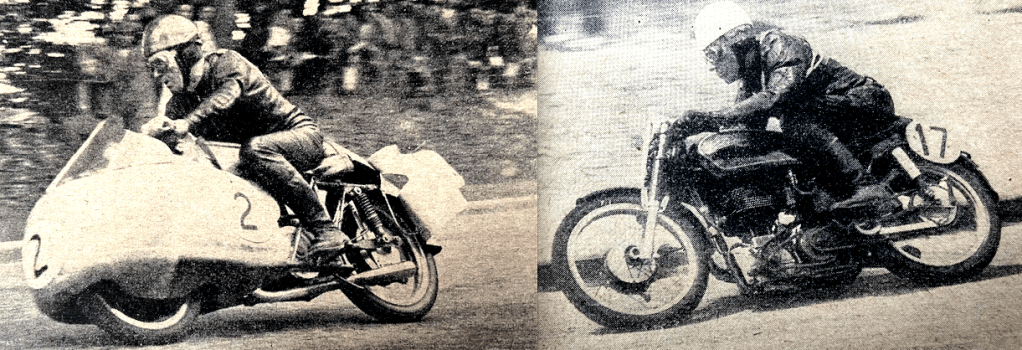
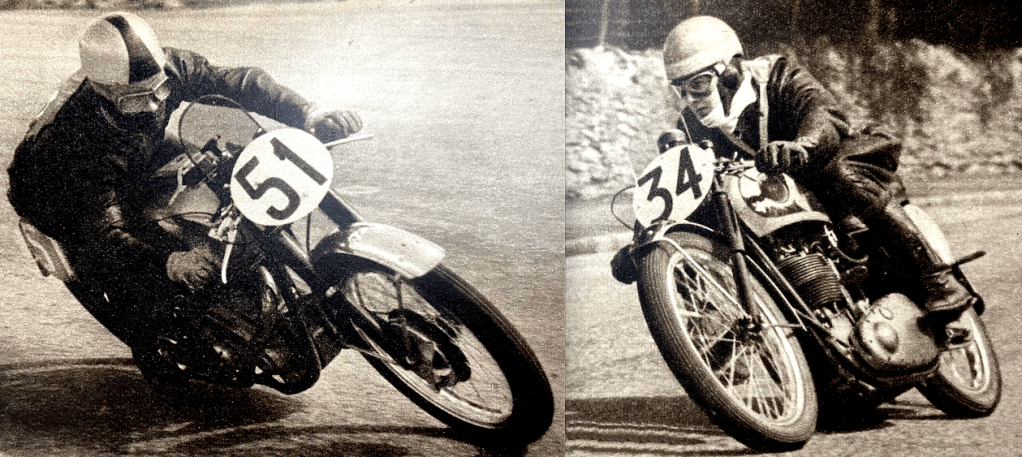
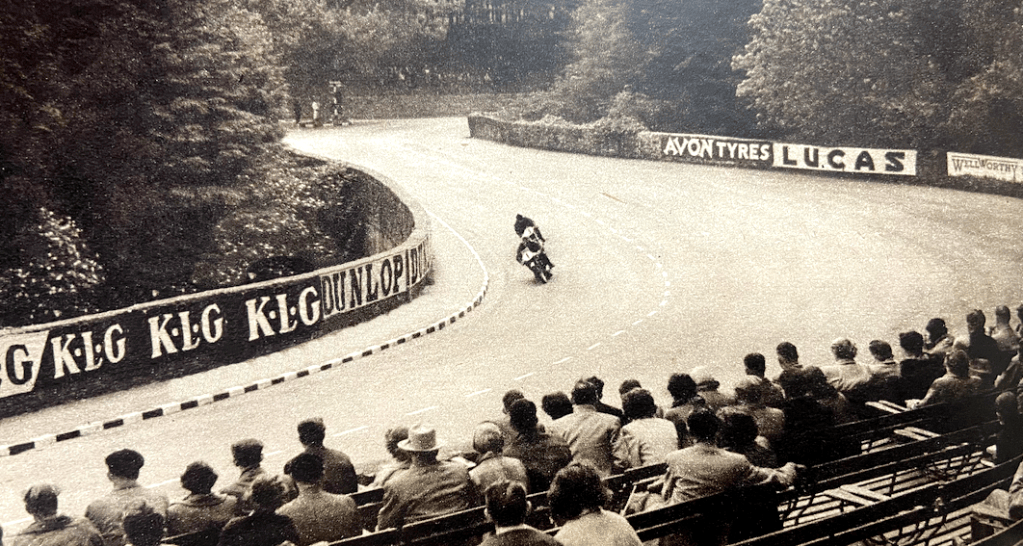
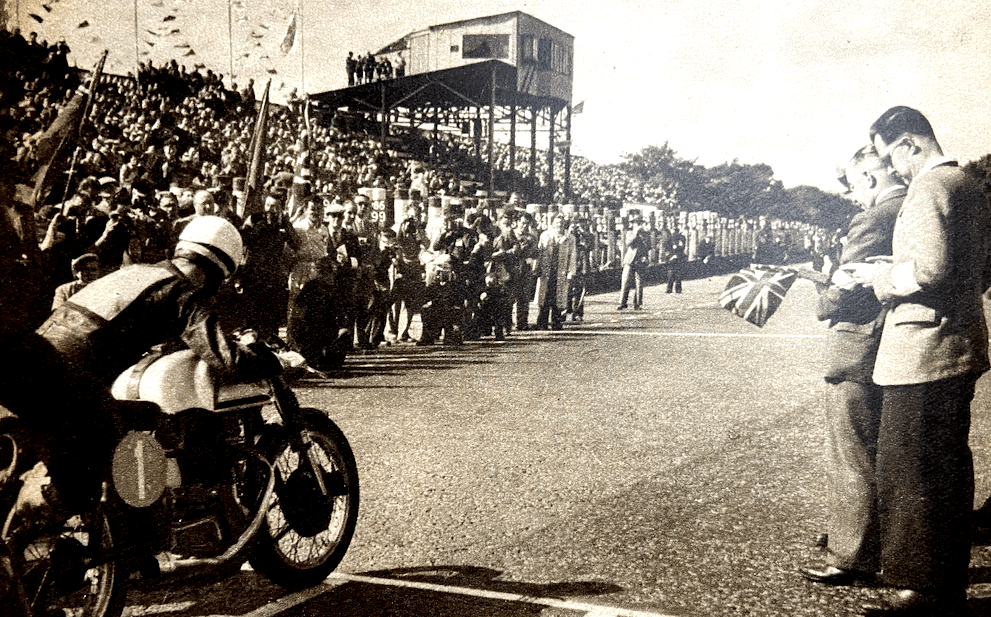
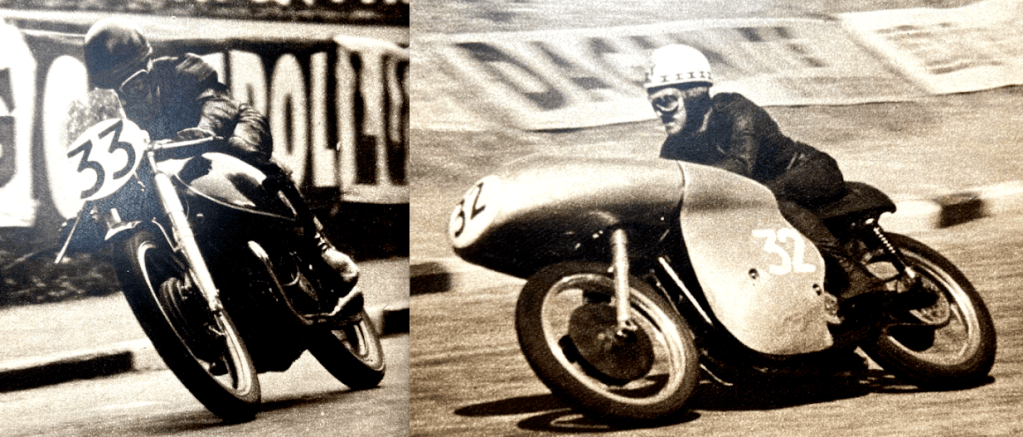
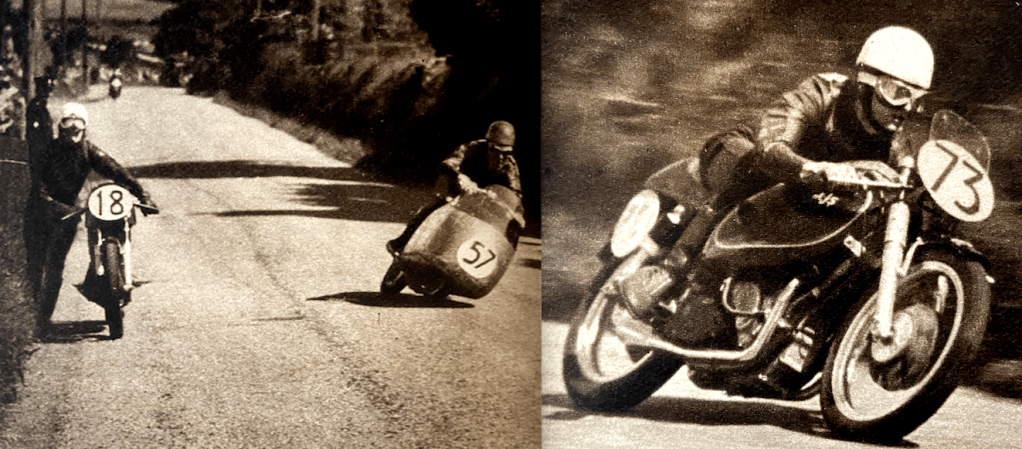
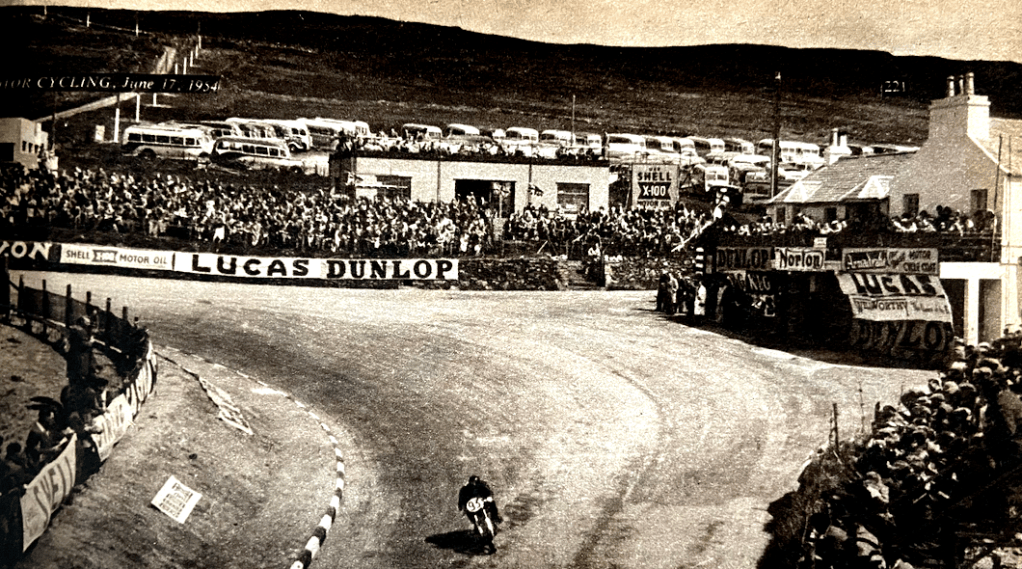
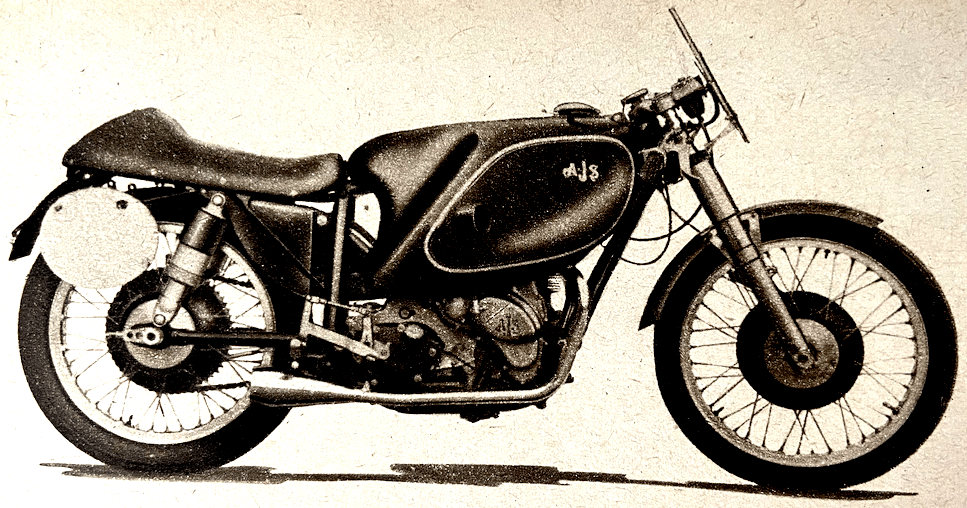
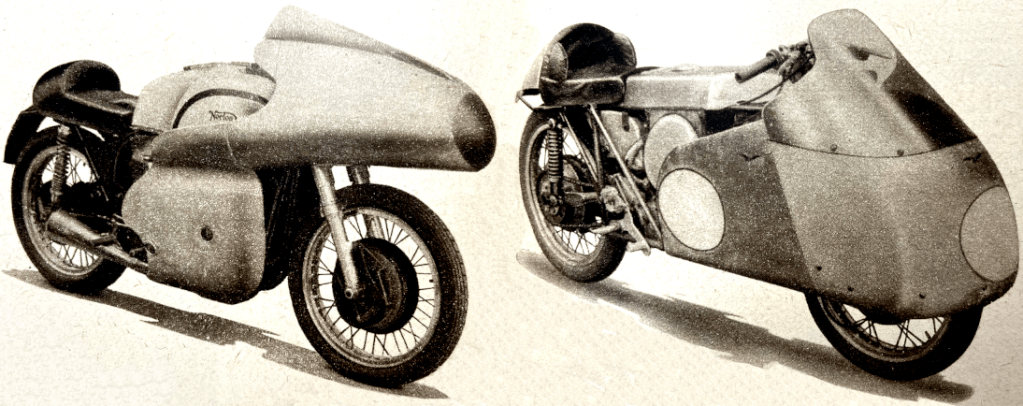
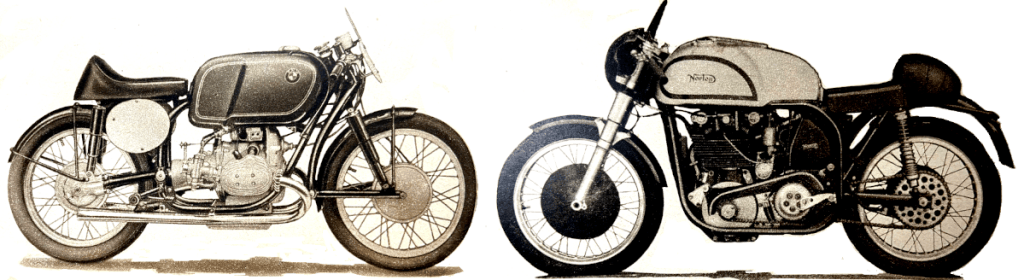
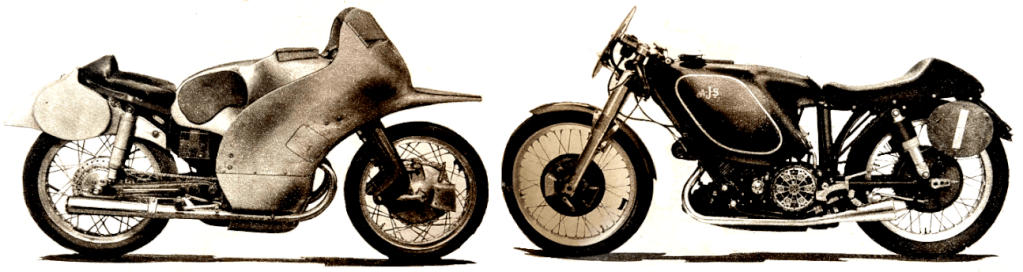
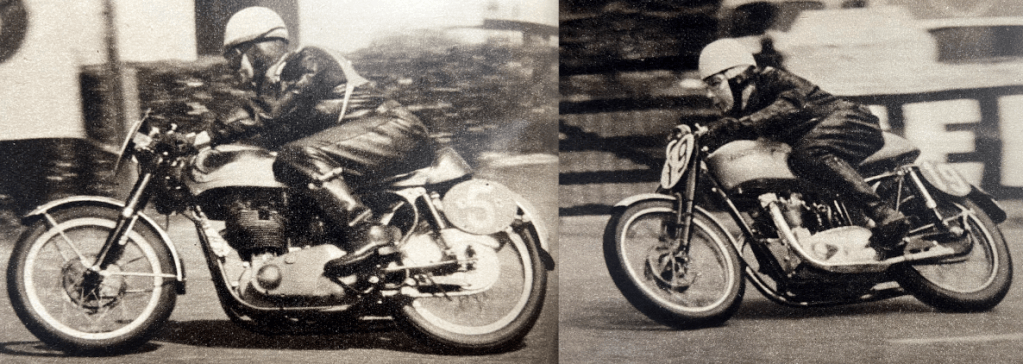
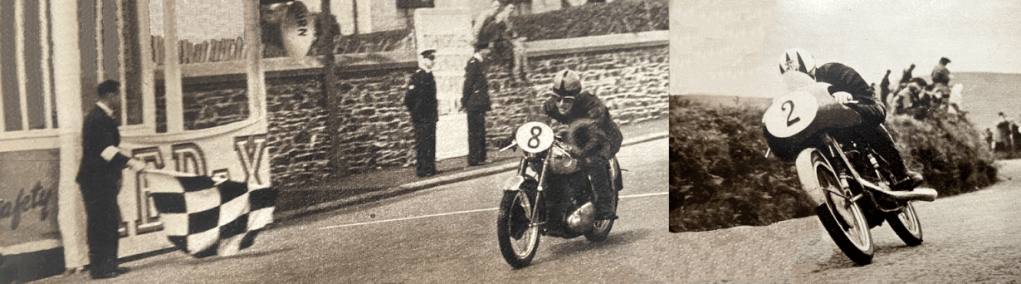
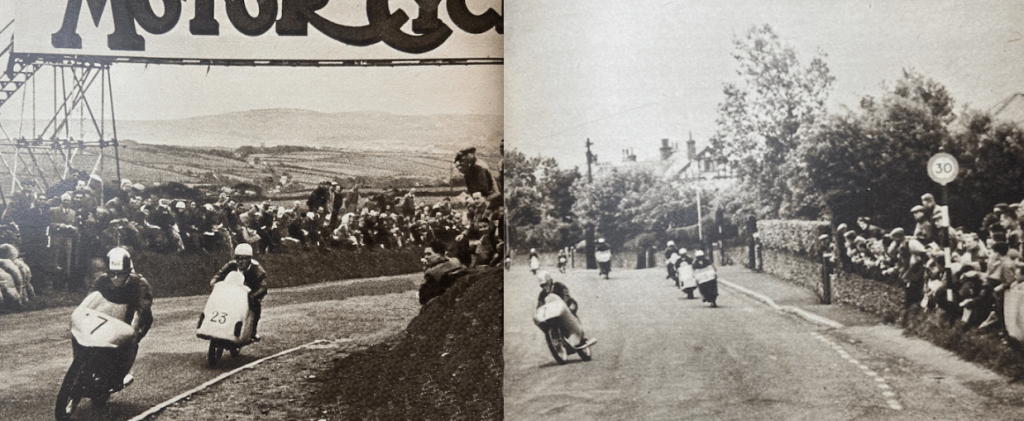
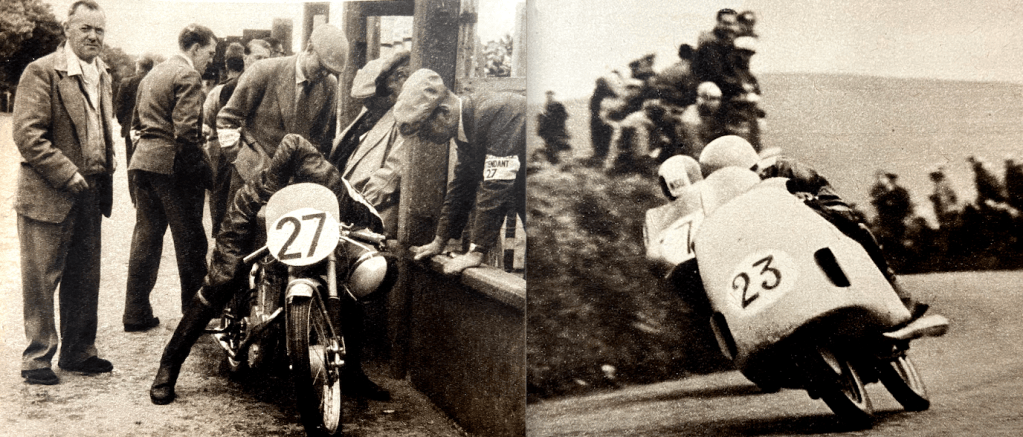
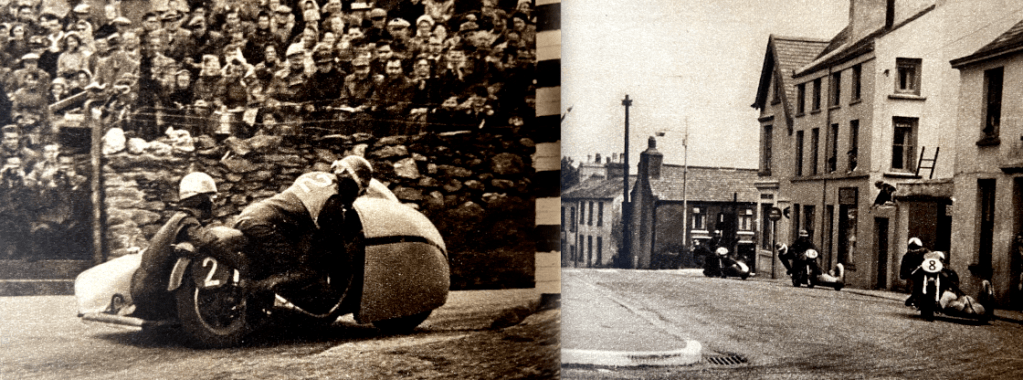
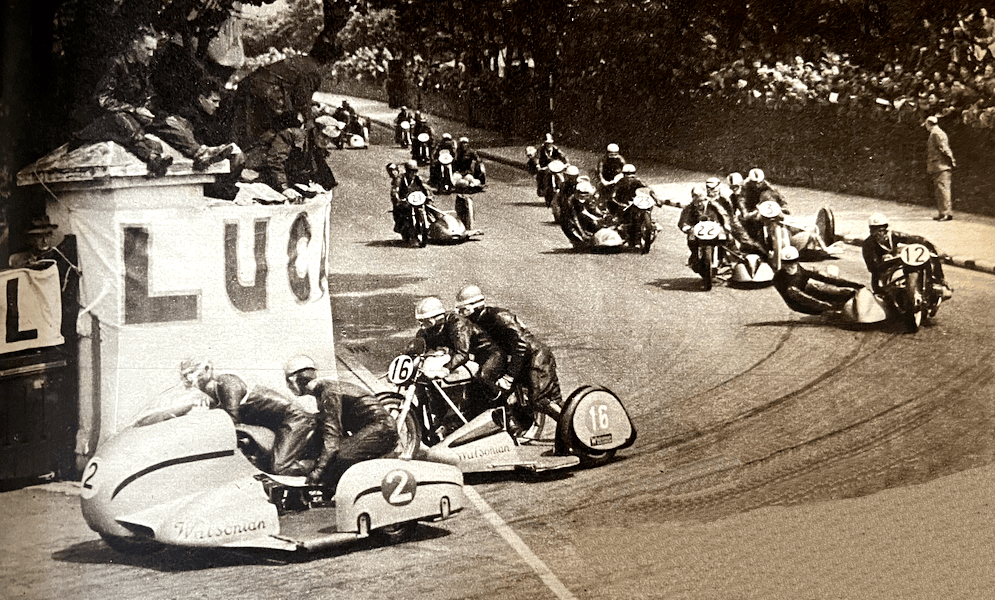
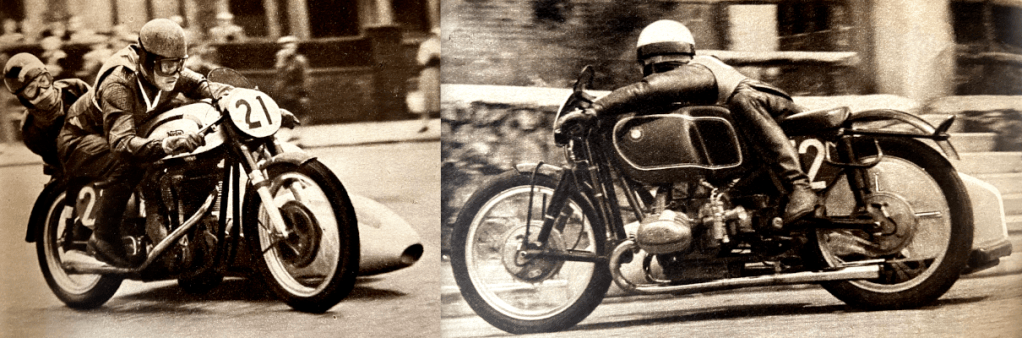
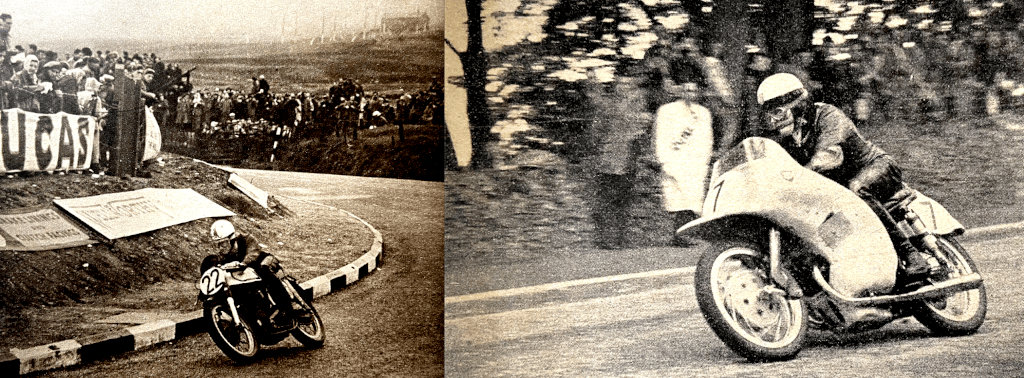
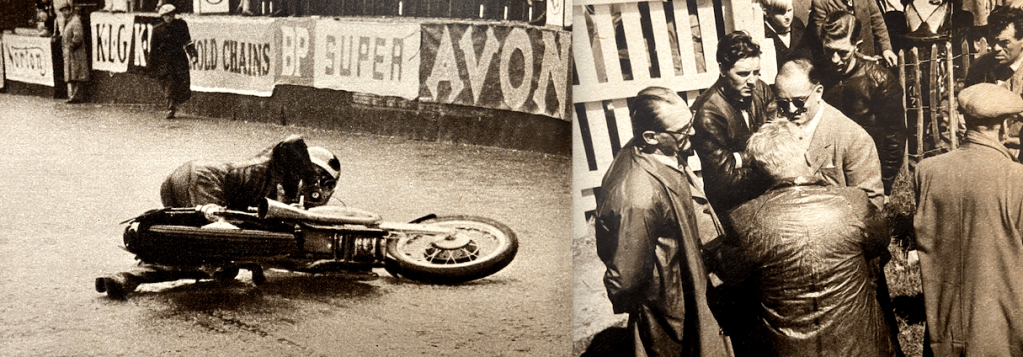
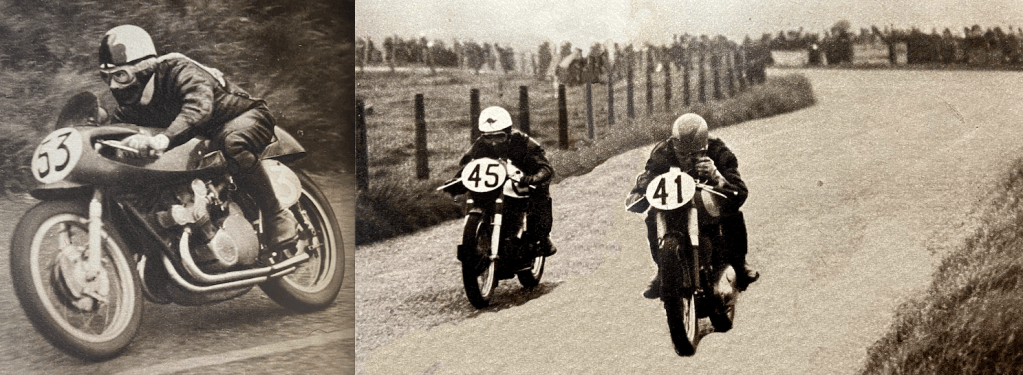
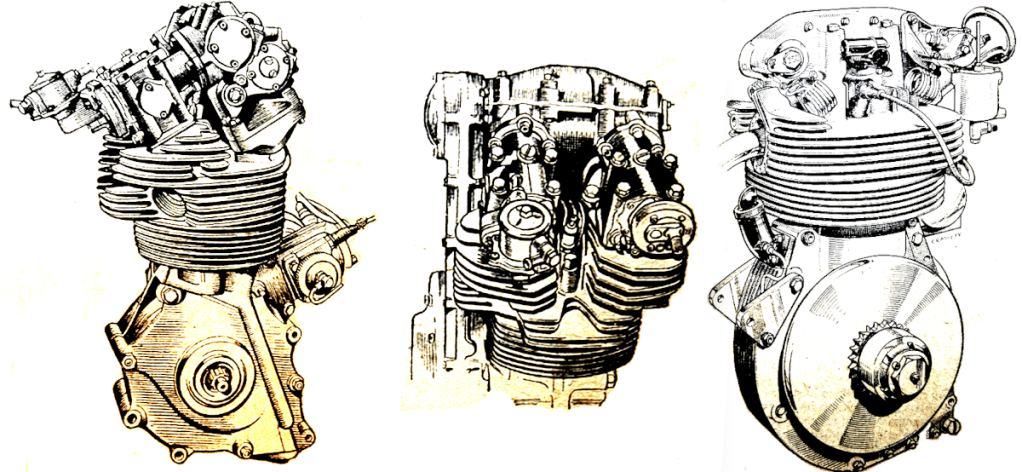
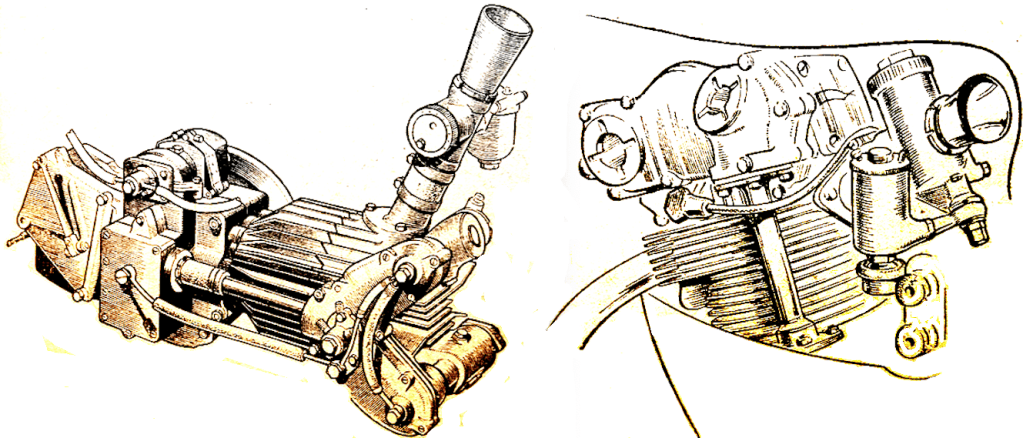
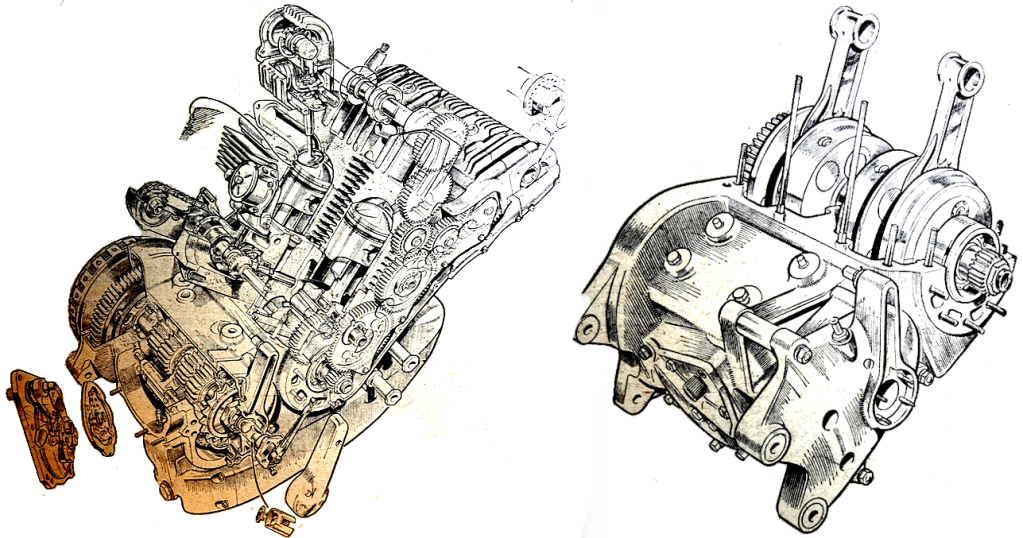
“THERE WAS A DRAMATIC, last-minute change of position in the Senior Race of the Stroud Valley MC’s national Cotswold Scramble, a trade-supported event held on Saturday last over the undulating, meandering Nymphsfield course near Stroud, Glos. With but a couple of hundred yards to go, JV Smith (500 BSA) led similarly mounted PA Nex by two or three lengths. Topping the last hill Smith tried to lap W Barugh (Dot) by cutting inside. It was a mistake, for Barugh was already pulling over to let the leaders pass. Wheels touched, Smith fell, and Nex streaked past to win. Earlier, GH Ward (500 AJS) had headed the field by a considerable margin, but on the fifth lap his primary chain broke and he retired at the far side of the 2¼-mile circuit. Smith, who had ridden an excellent race, leaping from 16th berth on his opening lap to third on his second circuit and second on his fourth, thereupon took over and had seemed to have the race in his pocket.”
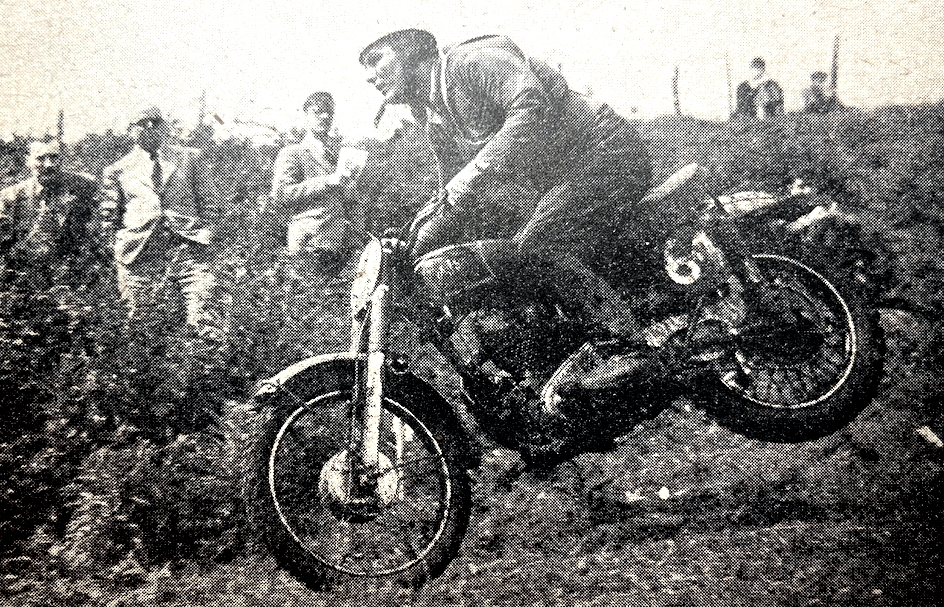
“A NEW DEVELOPMENT, pioneered by Mr A Fletcher, of Normandy, Surrey, may, however, point the way for a new type of two-stroke with several features of outstanding interest. Several engines of the type have been built by its designer and tested in cyclemotor form. Of the advantages claimed for the Fletcher engine, the most important are low weight, freedom from seizure and improved low-speed pulling power. In construction, the Fletcher two-stroke differs fundamentally from conventional engines of the type, for the cylinder is a light-alloy casting with an unsleeved bore, in which operates a steel piston with skirts extended above its crown. Ports cut at the top of the skirts correspond with ports in the alloy barrel. In place of the normal cylinder head is fitted a junk head carrying two piston rings and provided with oil grooves. This head is a sliding fit within the piston, and has a deflector formed upon its crown opposite the transfer port. Mixture is induced into the crankcase through a simple rotary valve and is transferred through a long transfer port in the normal way. Port timing is controlled in the usual way, by the relative movement between the ported piston (which can be considered as a form of moving cylinder barrel) and the junk-head, which forms in effect a static piston.”
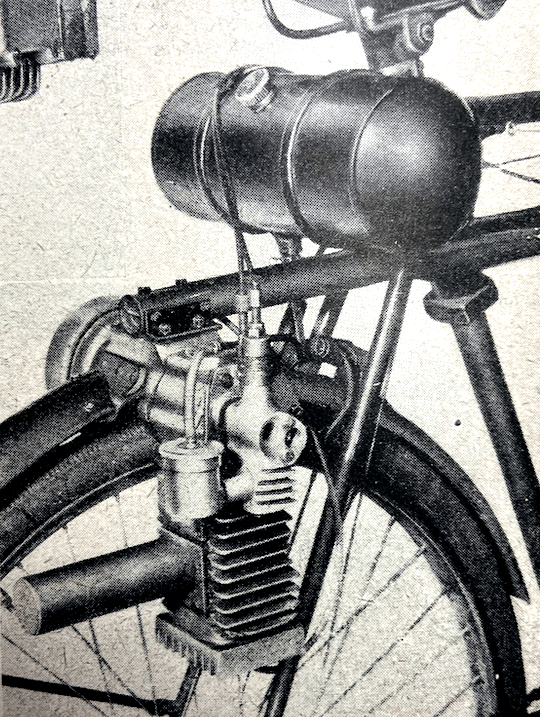
EXTREMELY ADVERSE WEATHER conditions—with rain and gale-force winds—and the non-appearance of several riders of Italian machines combined to spoil some of the success of the third of the nine World Championship meetings in the 1954 calendar. This was the Ulster Grand Prix—26th in the series promoted by the Ulster MCC and the second to be held on the 7-mile 732yd Dundrod circuit, near Belfast—staged last Thursday and Saturday. Ray Amm, brilliant Southern Rhodesian member of the Norton factory team, scored a double victory in the 350 and 500cc races—the latter shortened to 111.2 miles (some 10% below the 200km minimum set by the International Sporting Committee for a 500cc ‘classic’) because of bad weather conditions—and NSU riders Werner Haas and Ruppert Hollaus won the 250 and 125cc classes respectively. Eric Oliver (Norton) was the sidecar winner and, despite, the weather, lap records were broken in both the 125 and 350cc races.”
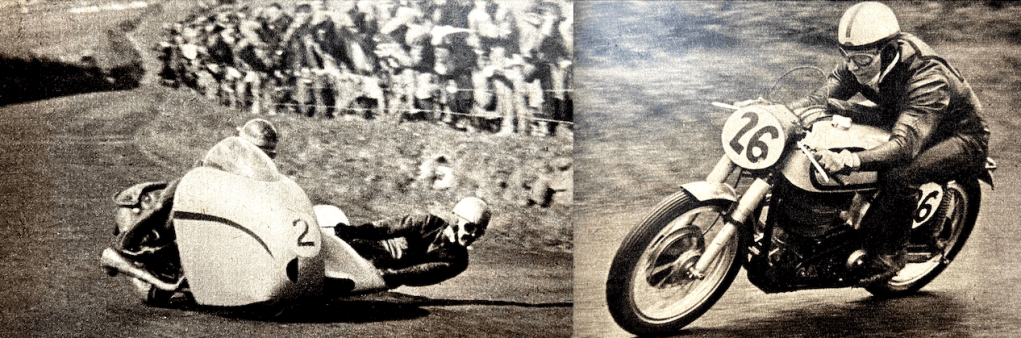
“SCATTERED SHOWERS DID nothing to dampen the enthusiasm of the 200-odd competitors and several thousand spectators during last Sunday’s Sixth Annual Banbury Run. Organised by the Vintage MCC the event is open to any rider of a pre-1931 machine having fewer than four wheels (other than disqualified drivers!). The scene at the Midland Mart Car Park in Banbury, starting and finishing place of the event, was the usual one of interested spectators distracting the attention of harassed riders doing last-minute ‘adjustments’—those little points that crop up even on the best-prepared models. The Concours d’Elegance was won by a 1919 Rudge Multi, noteworthy for its original specification and correct period accessories. This machine, incidentally, is a real ‘bigga-banger’—750cc all in one ‘pot’!”
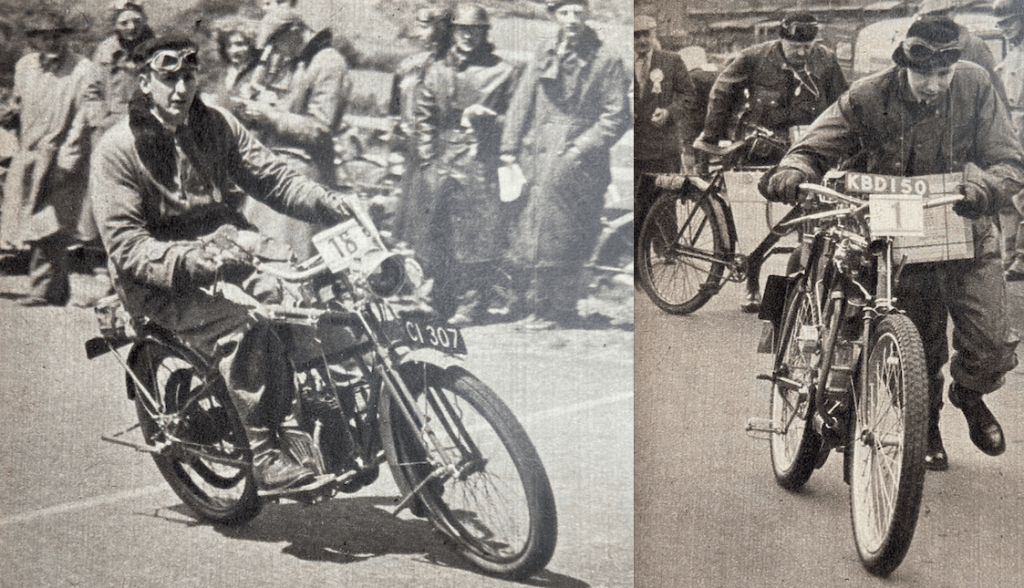
ROADTEST BSA A7
“CAPABLE OF PUSHING the speedometer needle round to nearly 85mph; of cruising comfortably in the region of 70mph, so long as road conditions permit, and in give-and-take circumstances, of taking the rider nearly 70 miles for the price of a gallon of petrol, the 49cc A7 BSA commands high respect. It was one of the several vertical twins tested early in the post-war period, from which time the design has remained largely unaltered, although the machine in general has been progressively embellished season by season with various refinements. This development process has inevitably resulted in an increase in weight, a disadvantage offset by enhanced rider comfort and better roadholding owing to the swinging-fork, Girling-damped, rear frame structure, which is now an optional extra. Initial impression was of the readiness, almost the eagerness, of the engine to start at first pressure on the kickstarter crank; the tick-over was good, subject to careful adjustment of the air control. Hasty pulling-back of the lever revealed what appeared to be a weak spot at the cut-away phase when the engine was cold and it paid to keep the carburettor almost fully choked for the first mile or so. This point is mentioned because it is a feature of careful BSA mixture control. Once normal running temperature had been attained the rpm rate could he raised swiftly, or the throttle snapped shut, as and when traffic conditions called for swift acceleration or slowing down, and, throughout the speed range the power output was exceedingly smooth and the machine a delight to handle. A slight tremor felt through the footrests when the engine was pulling really hard in top gear at about 38-40mph must be recorded, but with the reservation that the rider, of course, was diligently seeking such things. It was not in any way a pronounced vibration period. Most pleasing was the speed pick-up from a 20mph top-gear town crawl, and the absence of snatch or back-
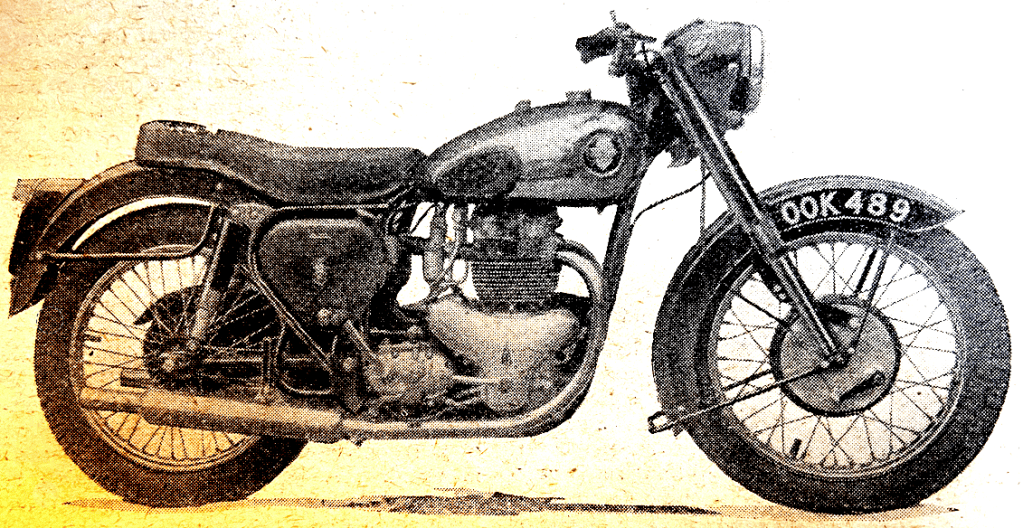
lash from the chains. By reason of the now separate, instead of bolted-up-to-the-engine. gearbox, centres between the mainshaft of the box and the swinging-fork pivot are reasonably close and the rear chain tension almost constant, this factor contributing further to the positive. snatch-free transmission characteristics. The primary and rear chains, although new, required no adjustment during the 500-mile test distance. In essentials, the 1954 A7 gearbox is similar to that of its semi-unit type predecessor, save that since 1947 several improvements in foot-change and gear-selector mechanism have been effected. These modifications have made a good gearbox even better. Light clutch action and excellent, non-fade brakes give the rider an easy time from the point of view of personal energy and mental effort expended in driving the machine along the road. The ratios of the swinging-fork model are slightly lower than those in the standard A7 specification, and they proved very suitable for the 27bhp power output available from the 1954 unit, with its compression ratio of 6.6:1, and the premium grade fuel used throughout the test. The rider did not try—as used to he the vogue—to make the engine pink. The practice seems pointless when, under conditions of normally hard usage, there is no sign of detonation. Close to the top gear of 5.28, the 6.38 third ratio provided a most useful range and, although the graph shows an arbitrary 70mph gear-change point, it is reasonable to hold on to third up to the mid-70s. This gear was particularly useful on long, main-road up-grades where one may he baulked by slower traffic and may wish to make a quick recovery afterwards. During cross-country journeys through winding lanes, the occasional use of this ‘lower top’ helped to maintain overall high averages and, thanks to the engine’s flexibility, the 6.2 ratio was useful well below the 53mph graphed as the average change point for second to third gears. The steering of the A7 was good and the general behaviour of the machine inspired confidence. Main-road cornering could be carried out with hair-line precision and the model felt equally stable irrespective of wet or dry conditions. Birmingham’s cobbled Bradford Street used to be regularly used by motorcycle testers—this test-piece is now fairly out-moded by Leopold Street, for here is a quarter-mile stretch which contains cobbles, wood blocks and the now comparatively rare hazard of tram lines. The BSA gave no cause for panic during its almost daily two-way journey throughout this thoroughfare. It is, perhaps, a tribute to the good working of the well-designed and damped rear suspension that the BSA dual seat is only of moderate resilience. While the seat did not cause discomfort, its general design had a certain spartan character. A point noted by the tester was the standard angle of the seat which, while suiting the attractive lines of the machine, tends to tip the rider towards the nose. This tendency may be accentuated by the forward position of the handlebars and the combined result, for an average-to-small stature rider, is that he is riding with his arms a little too out-stretched for comfort on a long run. For one-man solo work the dampers were left at the soft setting.
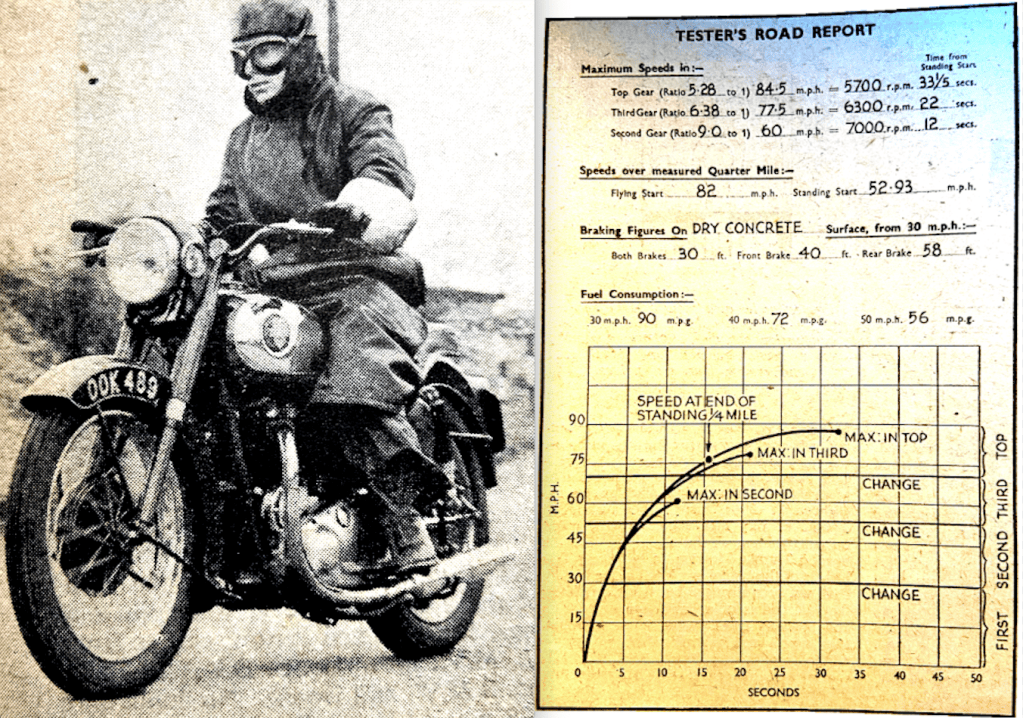
Their action can be stiffened by means of a special spanner included in the tool-kit, and this was found to be necessary when a pillion passenger was to be carried for any considerable distance. All major components, except the battery, which is housed beneath the seat, are readily accessible for maintenance. Wheel detachability, front and rear, is excellent, and for attention to the rocker box or cylinder head, the petrol tank, anchored centrally, can be removed in less than a minute. The very full range of kit. including a valve-grinding tool and template guide to assist in refitting the push-rods after an overhaul, is adequate for all running adjustments and general maintenance. Listed as an extra at 18s, including PT, the prop-stand fitted to the test model received full marks. Pivoting from the front of the lower rail of the duplex frame, the stand swings out and downwards and is held by spring tension in either the folded or operative position. It is a fitment which proved to be a real blessing, particularly during the many town journeys undertaken during the course of the test. In the garage, the model could be pulled on to the substantial, wide-angle, central stand without difficulty. The angled tube, acting as the stay to the deeply valanced rear mudguard, forms an ideally-positioned lifting handle. All-in-all, high marks go to the latest A7 for its smooth, surging power output and the twin attribute of fine-quality brakes. Praise goes also to the first-class suspension, adequate Lucas lighting, high degree of silence and quality finish of this, the least expensive of the 500cc twin, swinging-fork equipped models now on the home market.”
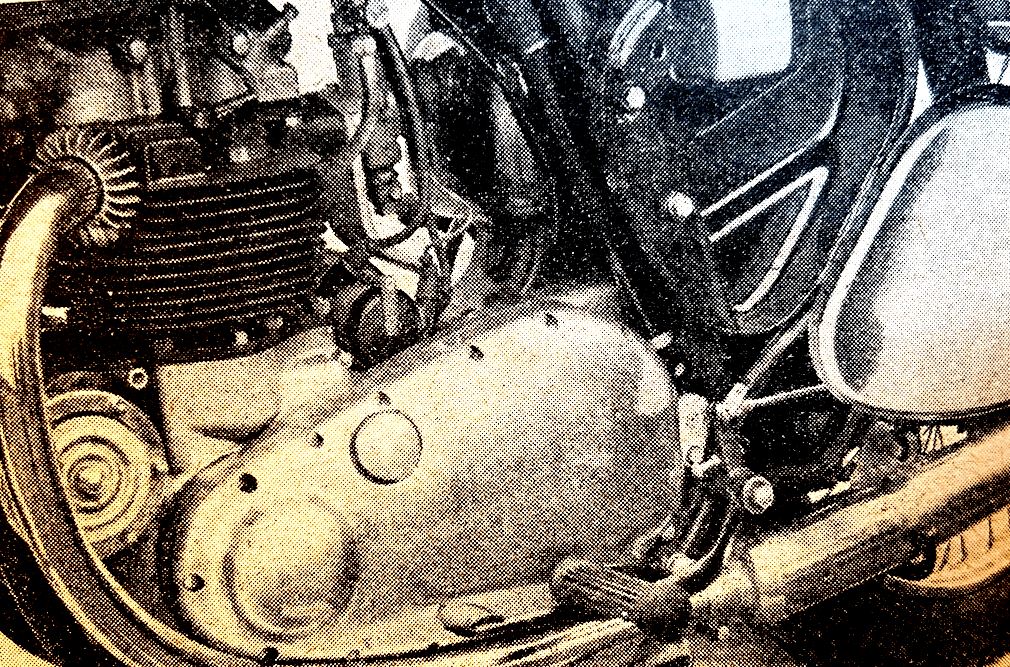
“JOHN WOOLER—AN APPRECIATION: Last week’s issue carried the sad news of John Wooler’s death. For all who knew him, his passing has meant the loss of a good friend and a modest genius who had the ability to dream and to translate his dreams into reality with his own hands. A. superb craftsman, his technical idealism always meant more to him than personal profit. Of him, Graham Walker writes: ‘With the death of John Wooler the industry has lost a brilliant engineer and a very charming man. An individualist and an original thinker, throughout his long association with motor cycle design he hitched his wagon to the twin stars of maximum accessibility and lightest possible weight. Examples of his highly practical unorthodoxy are fortunately preserved in the 1909 horizontal single-cylinder two-stroke Wooler with infinitely variable gear and the better-known 350cc ioe flat-twin four-stroke design, affectionately nicknamed the ‘Flying Banana’, first produced in 1919. During the 1939-45 war he developed a remarkable beam-type transverse 500cc ohv four-cylinder unit with single connecting-rod and positive-drive, infinitely variable gear. Later, this was replaced by the current unit-construction, four-cylinder model with normal crankshaft and four-speed box with shaft drive, the first “off the production line” model of which was ridden by him a few days before his death. I feel he died a happy man, proud of his last design which, he told me, had fulfilled his fondest hopes.'”—CARBON
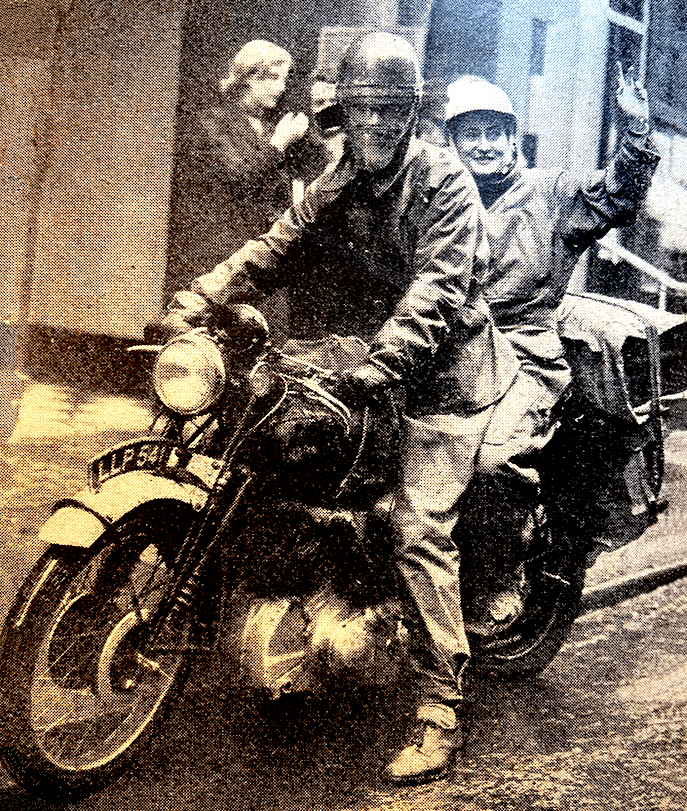
“IN ISSUING THEIR final road accident return for April, the Ministry of Transport commented on the number of casualties among cyclemotor users. They described it as ‘a feature, of the figures, that is becoming increasingly noticeable’. The total for the month was 208—cases of slight injury being in the vast majority—which was 40 more than in April last year. Some rise in the number of cyclemotor accidents was only to be expected. The popularity of this form of transport is increasing rapidly, and in the past 12 months 40-50,000 more powered cycles have come onto the roads. Yet that point was not mentioned in the official statement. What it implied was that cyclemotor crashes are rocketing. But they are not. In actual fact casualties in February were well below the 200 mark, but that has been about the average figure for this year so far. Further, 208 is an ‘improvement’ on the figures for November and December last, which were 236 and 293 respectively. . We welcome the ,Ministry’s returns and comments, but, unless all the relevant facts are published, such statistics can be very misleading!”
“AMC WILL CLOSE for the annual holiday from 5.30pm, July 23 until 8.30am, August 10.”
D SALEM, 15 CROSS STREET, Manchester, 2 have been appointed by the Triumph Werke Nurnberg of Nuremberg, Germany, as UK concessionaires for TWN two-stroke motorcycles. It is proposed to put four models on the market: the Cornet 200cc, BDG 200L, BDG 200 SL and Boss 350cc.”
REPORT: BRITISH MOTO-CROSS GRAND PRIX
CONTINENTAL PRIDE OF PLACE in the Moto-Cross field received a severe shaking last Sunday afternoon when men of repute from Belgium, Sweden and France went down before a concerted attack by British riders in the International Moto-Cross Grand Prix of Great Britain, organised by the Salop MC on behalf of the Auto-Cycle Union. The meeting was on the 1.5-mile Hawkstone Park circuit, which has a special run-in start leading to the main outer circuit. Hazards are a spectacular ‘mountain’ section, an equally severe side-of-a-house descent, a bumpy path—Wood Roughs—a sandpit and a corrugated straight. Altogether a trying 1½-mile ride, extended to 22½ miles (15 laps). Hawkstone Park is exacting to both the rider and his machinery; indeed, on Sunday it served to reduce a field of 23 starters in the Moto-Cross event to 14 finishers, of whom only seven had completed the full 15-lap distance. The latter included Belgium’s N Jansen (500 Sarolea), only survivor of the seven top-flight Continentals who came to the starting line. Although this main event of the day was run in perfect summer weather, the two supporting races, invitation events, each of two heats and a final for riders of machines up to 1,000cc, took place in showery conditions. But the dark cloud masses which all the morning had been blowing across from the nearby Welsh hills did nothing to damp the enthusiasm of the crowd, estimated at 35,000 to 40,000, who, with motor cycles and cars, had thronged the main roads leading to the Shrewsbury district. It was not until the white starting tape was up and the starting light—used instead of a flag at this meeting—had flashed over to green, that the heavens really opened. Heedless of the sudden deluge, the riders swept around, headed by SB Manns (350 AJS). At the first climb up the ‘mountain’ to the appropriately named Hilltop, he still commanded the field.
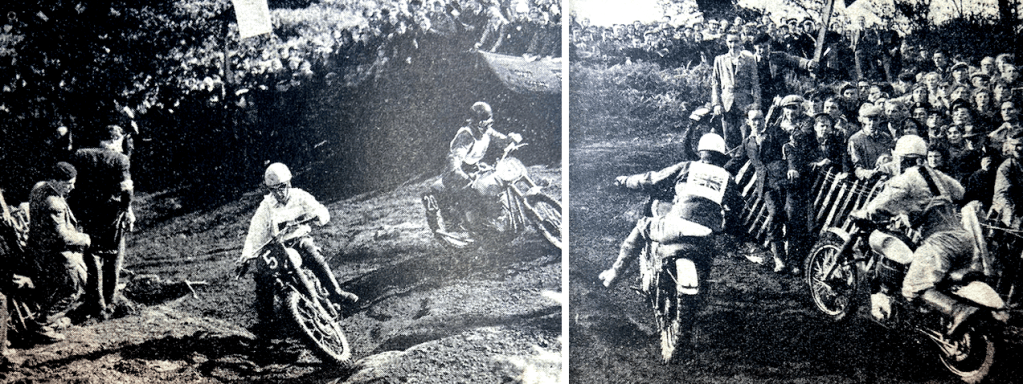
How spectacular, that wall of dark red earth, glistening in the wet; riders bumping, pitching and struggling to get to the summit, and the sides of the hill lined by the pinky, patched pattern of thousands of eager faces, with eyes gazing down to watch the skill, success or failure of men coming up! Bob Manns had no equal in this four-lap heat; he won with comparative ease in a time of 9min 49sec with J Bray (350 BSA) runner up, but far behind. Such was Sunday’s weather that, when Heat 2 started, the fine colouring of Hawkstone Park was crystal-clear and lit by rich summer sunlight. Perhaps encouraged by these better conditions, the American Bud Ekins (500 Matchless) set off at a cracking pace. The Stars and Stripes of USA floated lazily with the flags of other competing nations, and the miniature replica on Ekins’ helmet was seen, bravely showing the way to them all. What a pity that the American’s plug lead came adrift on the third of the four laps of this heat and, more pity, that the rider did not realise the trouble and almost exhausted himself striving to push the machine in to finish. His misfortune left a way open to WA Bell (350 BSA) and DE Rickman (500 BSA), who made a fine race of it, Bell crossing the line with only ⅘sec. advantage. D Bickerton and J Bray (500 BSAs) momentarily menaced JV Smith (350 BSA), who snatched the lead at the beginning of the six-lap final, but, by turning in a fine third-lap time (1min 59sec), Smith drew away and secured the race for himself. This same element of rivalry persisted throughout the second event, Smith besting the rest in Heat one and Bell finishing as runner-up; Smith’s time of 9min 0.08⅗sec was the fastest four-lap effort of the day. Heat two was a Bickerton-Bray scrap again. But Bickerton, as winner in a time of 9min 31sec, stood scant chance of beating Smith in the eight-lap final. Nor did he get second place, which went to JD Hughes (500 BSA). The persistent pushing of his model had won Bud Ekins a place in the final; while his fellow-countryman, V Hancock (500 Matchless)—they both contributed to the truly international nature of the meeting—secured sixth place in the opening heat of Event 2 and also earned a ride in the final. But it was not a day for the star-spangled banner, Bud finishing sixth and Hancock tenth. Suitable pomp and a touch of gracious ceremony ushered in the big event of the day. And the sun seemed to realise the difference between April and July and the 10-minute downpours ceased. Mackintoshes were put away; the St John Ambulance band cast off their coats and brought instruments out of hiding beneath the timekeeper’s box. The three solemn chords of the Swedish National Anthem echoed across the central starting area and the representatives of that country, B Andersson, B Nilsson and S Lundin (all riding 500 BSAs) crossed over to be introduced to the owner of Hawkstone Park, Brig Sir Alexander Stainer, Bart, DSO, MC. The Swedes were followed by the Belgians, A Mingels, V Leloup (500 FNs) and N Jansen and R Baeten (500 Saroleas). For France, J Charrier (500 BSA) was presented. ‘Waltzing Matilda’ was played for the Australian, LE Sheehan (500 AJS) before the National Anthem rang out and the British contingent stepped forward. They were as per programme save for the absence, due to an injury received in Italy, of Basil Hall. Heading the party came tall Brian Stonebridge, with John Avery, PA Nex and RK Pilling, all riding 500 BSAs. Other BSA riders were TW Cheshire, T White, J Draper, D Tye (on a 350 model), B Martin and DJ Rickman. Matchless-mounted was DG Curtis, G. Ward was on an AJS, LR Archer a Norton and D Eaves a Royal Enfield, all 500s. They lined up, engines revving heartily, for this 15-lap championship was to have a clutch-start. Tension was high; somebody anticipated. Confusion! Back they all had to go for another try which, though ragged, and the cause of shaking of heads, served its purpose. Nobody was really cheated out of a rightful position and none got left behind. Determined, indeed, on that last mentioned point, was Mingels, doyen of almost every Continental moto-cross event. His bright-blue riding suit and speeding FN were seen coming down from the sandpits ahead of Geoff Ward, and they were both well ahead of Stonebridge. P Nex was fourth and then they all came by—Archer, Nilsson, Draper and Jansen fighting hard, Curtis, Baeten, John Avery and Martin, a tight, scrapping
little quartet, and a long, drawn tail of back markers. They would catch up or fall out; vital and in sharp focus were the fortunes of Mingels and Ward. Now the Belgian had it—by just a few feet—but Stonebridge was creeping up and Nex reinforced him. Les Archer (father of rider No 14) had taken over the local public address and was keeping the crowd well on its toes with excitement. Lap three. No change; only the gripping suspense of that wheel-to-wheel tussle between the Belgian and Englishman. Still the Curtis-Baeten-Avery-Martin fight continued, though with some change of stations. The race was for individual championship points; the positions of the finishing riders counted nothing at all for team or other awards. It was every man for himself and every man was busy with that in view. At the fifth tour, when Ward had been slightly ahead for some little time, he, Mingels and Stonebridge came through almost together and the FN drew away up the ‘mountain’ with a short advantage. To creep up on Ward and gain the lead Mingels had worked wonders. And on lap six he returned a time of 1min 49sec— a record for the course—and then, after one more swift, triumphant trip around the Circuit, dropped back behind Stonebridge. Ward was out; no sign of him. Later, word same through that he had fallen and injured his shoulder, not badly, but he was out of the race. Then, with the prize in his pocket, Stonebridge came in to retire—a finger injury—leaving Nex to carry on, and, as if knowing what was wanted of him, Nex built up a fine lead. With three laps to go he had only to tour around to win. And had he failed, then some of the earlier tag-end men had by now, in hare-and-tortoise fashion, come into leader-board positions. One was David Tye; in the wake of the survivor of the foursome scrap—Curtis. Archer was fourth with Cheshire fifth, and in that order the final pattern of the race was woven. Poor Jansen in sixth place saw no fame forthcoming from Hawkstone Park; Mingels, with reported carburetter trouble, had abandoned such thoughts and coasted hack to the start; Johnny Draper, with no option, had returned with a flat tyre and, with others who had retired or stopped, they watched PA Nex ride his BSA to victory.”
“BRILLIANT DRIVING AND thrills in abundance—that was the way of it in the only Scottish road races to I be held this year, the National Speed Championships at Beveridge Park, Kirkcaldy. I The outstanding performance of the day on the 1.4-mile circuit came from Alastair King, I of Troon, Ayrshire. He won the 350cc event easily, clocking a last lap speed of 59.3mph. In the 500cc class he was unlucky to gain only second place. He had just completed a spanking lap, recording the fastest time of the day—60.3mph—when he skidded and was unseated. Before he could recover AM Phillip, of Angus, had streaked through to win. JG Home, of Perth, had a fine debut, taking out the Italian 125cc MV Agusta for the first time on the Scottish track. He won the 150cc class and was second in the 200cc class. In both races he was riding in place of JA Thompson, of South Croydon, who was injured a practice lap earlier in the day. After the spill at the Railway Bridge bend, Thompson was taken to hospital with a suspected broken collarbone.”
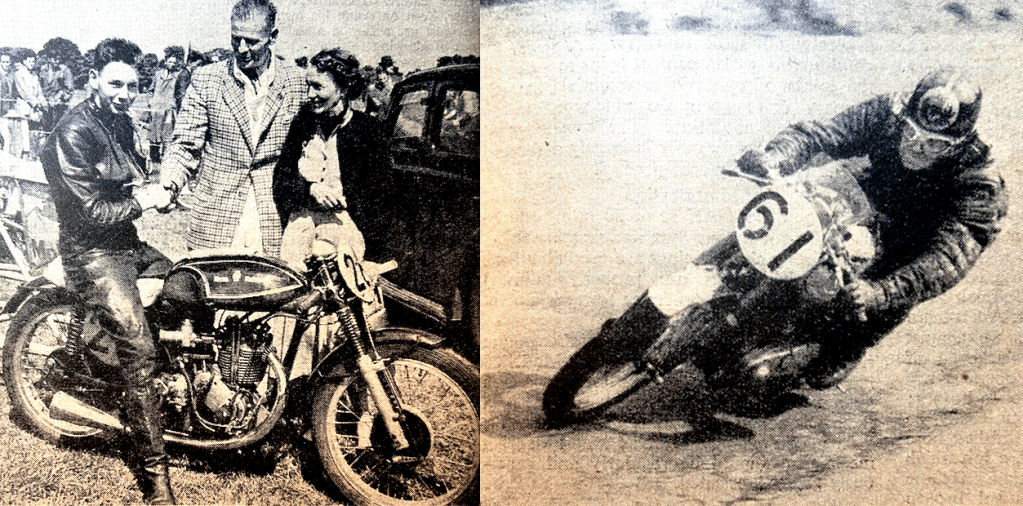
“STRANGE THAT WE seldom think of Sweden as a motor cycle manufacturing country. Why not? Sweden’s steel is without doubt among the finest in the world, her heavy engineering is universally famous and her ball bearings unsurpassed—why otherwise should we have sent flat-bottomed mine-dodgers to run the Baltic blockade in the dark days between 1939 and ’45? Stranger, too, when you recall that a rider of the calibre of Stanley Woods chose a Swedish-made Husqvarna for the 1934 Senior TT, put up the fastest lap at 80.49mph and was only robbed of second place on the last lap by an empty tank. Perhaps it is not surprising then, that last week’s State visit of King Gustaf VI Adolf and Queen Louise served to remind me of one motor cycle manufacturer whose factory I recently had the pleasure of visiting—the Nymanbolagen concern which started as a small motor cycle shop at Uppsala in 1888 and now has a vast plant, employing 1,100 workmen. At seven o’clock one morning last March, assembly started on an NV Autoped—a 50cc motor-assisted cycle—and by 9.20am Bertil Lofgren, a well-known rider, had set off on a 10 days’ endurance test to the north of Sweden and back to Stockholm, a distance of 1,200 miles. Prevailing conditions were the worst that Sweden can produce—and that’s pretty bad—but the journey was accomplished without a hitch and the factory’s faith in this elegant little mount was fully confirmed. The advent of the power-assisted cycle to Sweden ushered in a new era of cheap transport which Nymanbolagen set out to meet with no less than five models, four of them chain driven and one employing belt drive. The power unit is either a two-stroke of NV design or one of the well-known Sachs 50cc engines. The strong, good-looking frames are fitted with telescopic forks or rubber-block, bottom-link suspension; they have 24in. wheels, balloon tyres and 6V/17W hub-dynamo lighting. Unfortunately, the introduction of the Autoped brought with it the problem of noise, which at first proved to be something of a sales deterrent. But NV tackled the problem with their usual thoroughness and eliminated practically all noise by fitting a ‘whispering motor’ device, encased in either metal or rubber, to the air intake of the carburetter. As a result, the Autoped now operates with full efficiency and almost complete silence, a fact which should stimulate the already growing demand for this vehicle in Sweden. But the Nyman concern is not solely concerned with the manufacture of Autopeds. Chief among its products is the 250cc ‘Army Sixdays’ NV36 powered by a DKW single-cylinder two-stroke engine mounted in a massive frame equipped with a newly-designed, hydraulically damped, rear suspension, well tried NV telescopic forks and sponge-rubber dual seat. Among its many refinements are a totally enclosed rear chain, thief-proof steering-head lock and rubber mounting for the 18-litre petroil tank. Also popular are the NV 22, powered by a 150cc four-speed Sachs motor, and two lightweights, the 125cc 11CL and 11DL, both using a single-cylinder DKW two-stroke engine with telescopic forks, rear suspension and automatic greasing.”
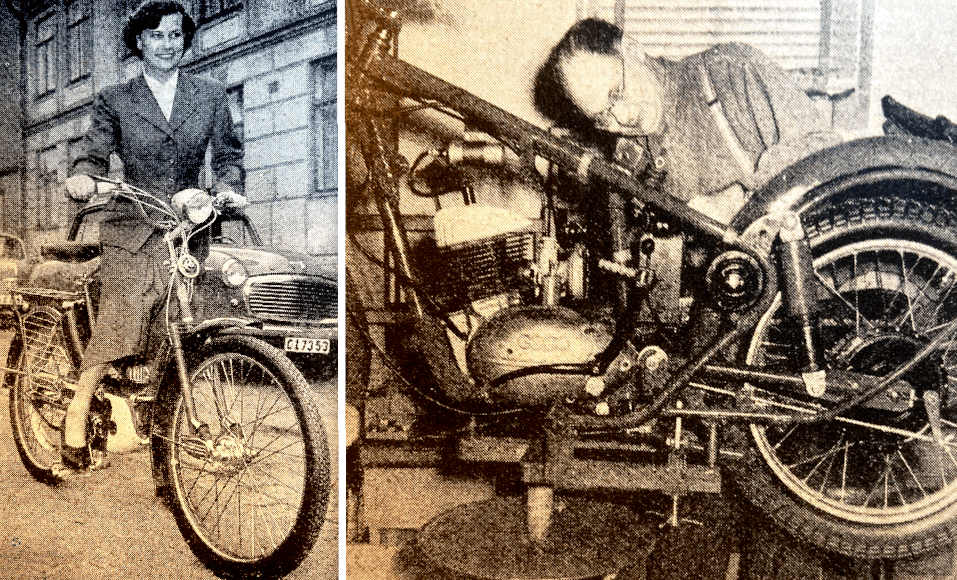
“AS I HAVE BEEN riding motor cycles for 25 years, my daughter, now 18 years of age, has been successively a sidecar passenger and pillion rider almost since her birth. At last year’s motorcycle show at Earls Court we wished to order her a new Vespa motor scooter, and accordingly contacted the representative of the London Scooter Co on the Douglas-Vespa stand. This gentleman subsequently paid us a visit and, upon being given a deposit for the machine, arranged for my daughter to have driving lessons from a lady member of his concern, and maintenance lessons at their Greenford premises were given by a qualified mechanic. Since then—it was in late March that she actually received her new machine—she has covered over 1,400 trouble-free miles and has passed her driving test.
AJ READ, Watford, Herts.”
“MAY I ADD to the remarks of your correspondent concerning the excellence of Messrs Norton’s service department. A rear shock absorber on my Dominator 88 developed a rather bad leak and I naturally wrote to Norton’s asking them what I should do about it. Almost by return post I received a new unit, accompanied by a letter asking for the return of the faulty one. The cost to me was nil, proof, I think, of an efficient after-sales service.
C LANFEAR, Stourbridge, Worcs.”
“WE WOULD LIKE to obtain, either permanently or on loan, certain old AJS and Matchless engines. If any of your readers have any knowledge of the existence of these engines, we shall be grateful if they will let us have details. The engines in which we are particularly interested are: AJS–OHV TT engines of 1920-24 era; early ohc (1927 and 1929); genuine ‘Big Port’ of the early ‘twenties; a 250cc ohc; 799cc V-twin; the 1,000cc V-twin ohc used for world’s record attempts in 1930 and 1933; 500cc ohv of 1925-6; the transverse twin. Matchless—Silver Hawk, V4 ohc; Silver Arrow, narrow-angle V-twin; 347cc ohc model L/R of 1925; 250cc side-valve model R of 1926; 500cc ohv model V2 of 1928; pre-1914 engines, particularly ex-Brooklands or TT example.
LR HIGGINS, Publicity Dept, AMC, London, SE18.”
“RIDING A FOUR-CYLINDER Italian Gilera, Geoff Duke registered his first classic win of the year last Sunday in the 500cc class of the Belgian Grand Prix—the fourth 1954 World Championship meeting. His average speed of 109.51mph was fractionally below the record set by Alfredo Milani (Gilera) last year and his best lap, covered in 4min. 42sec, was one second outside the 112.33mph record achieved by Ray Amm (Norton) on that occasion. In the 350cc class, too, which was won by Australian Ken Kavanagh (Guzzi), speeds were lower than last year and it was left to Eric Oliver, who ran away with the sidecar race on his streamlined Norton/Watsonian combination, to do the only record-breaking of the meeting. The Grand Prix, organised by the Federation Motocycliste de Belgique, was held on the 14.1-km (81-mile) Spa-Francorchamps circuit in the Belgian Ardennes. It was, most unfortunately, marred by a fatal accident involving the Australian Gordon Laing, a member of the Norton team.”
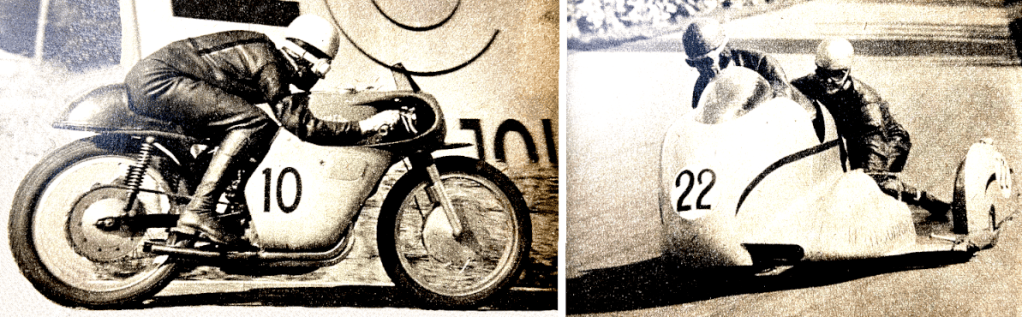
“IT WAS A GAME PERFORMANCE by Marcel Masuy, the popular Belgian sidecarrist, last Sunday. Only two months ago he collected a compound leg fracture at Floreffe but—still in plaster—he insisted upon competing in the Belgian GP. He completed the race, too, despite having to do all his gear- changing by hand.”
“VISITORS TO SPA who cheered the unbeatable Eric Oliver to victory, included sidecar experts from another sphere of the sport—Ariel exponent Frank Wilkins and his passenger, Kay, who were on their way back from the German Three Day Trial, in which they were the only British competitors. Frank, who had to retire when his chair wheel collapsed, says that the trial is one which British manufacturers might well put on their list of proving events for the ‘International’. The German factories were using it for that purpose.”
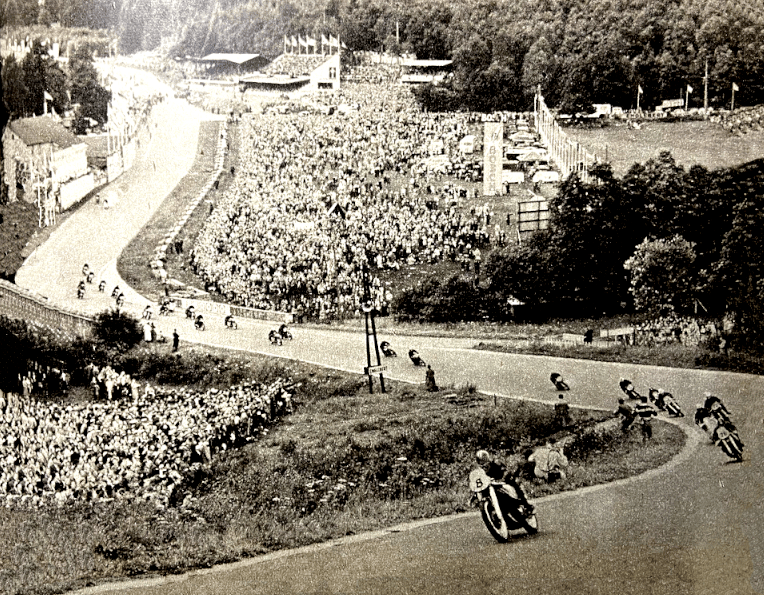
“A MOST INTERESTING new German machine put in some fast practice times during the training for the Belgian Grand Prix, although it was not actually ridden in the race because a minor fault in the lubrication system was discovered. But we should watch out for it in the German Grand Prix, where it is due to make its next appearance, in the hands of Georg Braun. The machine is a Horex 350 parallel twin. It has a box-section, beam-type frame of wishbone pattern, with the rear ends forming the pivot point for the swinging-fork suspension unit. The front forks are of the bottom, forward-link pattern. The power unit, which carries its oil in a sump tank, is nearly ‘square’ at 60×61.6mm; it pushes out some 38bhp at 9,000rpm. There is chain drive to the twin overhead camshafts; Bosch coil ignition is employed, with the distributor driven off the engine mainshaft; and two Dell’Orto carburettors are fitted.”
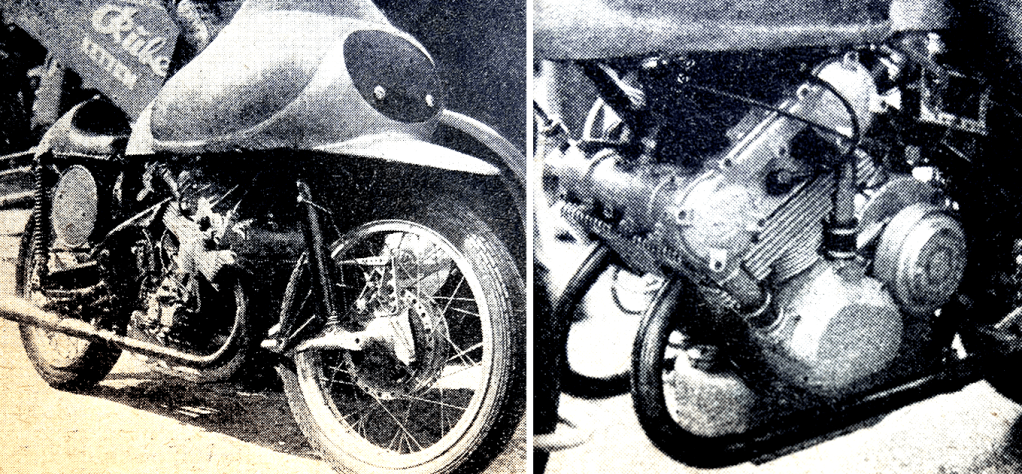
“MOTOR CYCLE SPORT PLAYS an important part in the activities of the Army, and recently riders from RASC units from the British zone of Germany, Berlin, ,and the Advance Base in Belgium, took part in the finals of the RASC (Rhine Army) Motor Cycle Championships. Forty-two riders—ten teams of three and 12 individuals—competed, all of whom were winners in district and divisional preliminaries. Completely standard army machines were used; before the start, they and their riders were closely scrutinised. Each rider had to be properly turned-out in uniform and carry his work ticket, accident form, identity card and driving licence. The short course, set in a hilly area near Hildesheim, consisted of 12 hazards—timed hill-climbs, steep descents, switchbacks and a water splash. Difficult, but not impossible, they had been deliberately designed to test throttle control, balance and path selection. The event finished with a flexibility test Members of the German Service Organisation gave valuable help, particularly in hauling men and machines out of the mud when wheelgrip fell to below zero and they must have learned a lot of useful—although, perhaps, somewhat basic—English in the process! Among the spectators were German youngsters who enjoyed watching the ‘Englanders’ coping with the hazards, as do so many at any popular trial or scramble back home. The winners were 114 Company, RASC, Lubbecke District (Lt Macbeth, L/Cpl Wheeler and Cftsmn. Watson). Runners-up were 7th Armoured Division Column, RASC (Capt Pickering, S/Sgt Smith and Cpl Challis); Wheeler won the individual championship and Cpl Challis was second.”
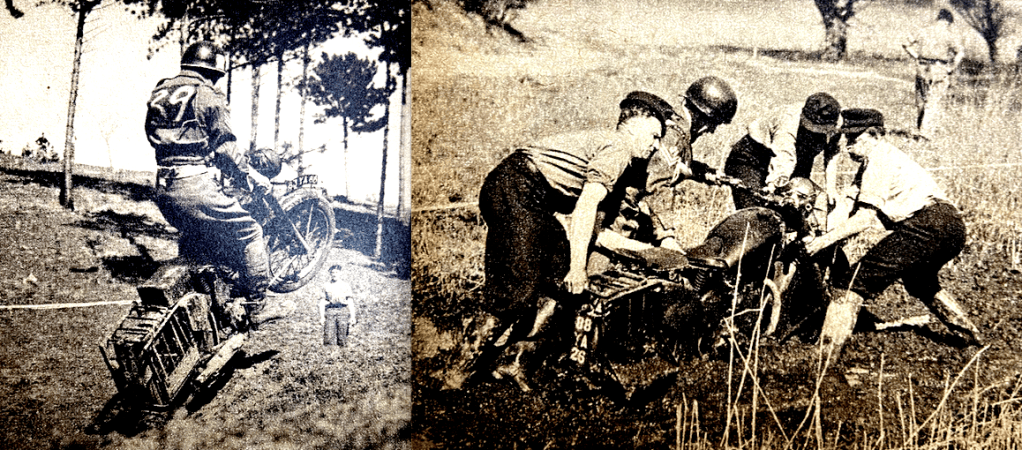
“WHEN THE RAC/A-CU Training Scheme was at the planning stage the responsible committee unanimously decided that the standard of instruction to be provided must be higher than that needed by pupils to pass the Ministry of Transport driving test. The hope was expressed that the day would come when possession of an RAC/A-CU proficiency certificate would enable the holder to obtain a full driving licence without carrying L-plates and taking the official test. Now, seven years later, that day would appear to be near at hand. The scheme has for long enjoyed the approval of the Minister and the sympathetic support of his senior executive officers. And we believe the logic in permitting RAC/A-CU examiners to relieve MoT officials of a portion of their excessive load has never been questioned. The problem has been one of method rather than of principle. Already the MoT delegates authority to Army examiners who issue licences to military personnel, but in ‘civvy street’ it is by no means so simple to ensure nationwide uniformity in testing standards. It is understood, however, that negotiations have reached an advanced stage and it is known that the utmost goodwill exists between the parties to the discussion.”
“DURHAM RDC HAVE instructed their surveyor to find a site where novice motor cyclists can be given elementary training in riding. This is the council’s own idea, apparently, in marked contrast to that of some other local authorities who have shown themselves completely unco-operative when clubs have sought their help over such schemes. Now is a chance for clubmen in the Durham neighbourhood. Let them rally to the support of the RDC; show them the ‘know how’ of the business, and provide the instructors.”—CARBON
“THE SOONER A YOUNGSTER can start learning to ride, the better. All good horsemen know that, and just the same thing applies to motor cycling. I was reminded of this by a letter that appeared in one of the illustrated papers. The writer has two sons, aged nine and 12. For the latter he built a 125cc machine and a 98cc for the smaller boy. Naturally they cannot use them on public roads, but are able to get plenty of practice, and will be thoroughly experienced by the time they can obtain driving licences. That father is a wise man.”—CARBON
“PROVIDED THERE ARE NO non-starters, 946 motor cyclists will set out on Saturday to make their ways by roundabout routes to the North Wales seaside resort of Rhyl. As competitors in the Auto-Cycle Union’s 11th National Rally they can start from any of the 121 controls situated at garages, agents’ shops, clubrooms and cafés throughout the length and breadth of England and Wales. Then, after an all-night ride, they will converge on the final control at Rhyl between 9 and 11am on Sunday. A maximum average speed of 25mph has been set, so riders aiming at a major award will have to cover about 600 miles and visit as many controls as, possible, points awarded being one per mile and two per control. Only once before has there been a larger entry for a National Rally—in 1951, when 1,100 riders competed. This year, the official Army contingent of 67—mostly teams of three competing for the Motor Cycling Challenge Trophy—includes Cpl WE Christian, last year’s winner of the individual Army award. JR Walton, of the Derby Phoenix club, who, for the past two years has won the premier Varley Trophy for the best solo performance, will again be all-out for victory. No speed trial, the Rally has attracted riders of machines ranging from ‘clip-ons’ to 1,000cc big-twins, and in age from vintage mounts to up-to-the-minute models. Still, it is no picnic, and a welcome innovation at Rhyl will be the emergency repair service to be set up near the reception area. Entertainment for competitors at the conclusion of the event includes meals provided in the Pavilion by Joseph Lucas (Electrical), and a film show organised by CC Wakefield and Co, in the Town Hall. The main feature of the latter will be Castrol’s ‘On The Surface’, a 45min colour film covering 1953 events including the Belgian Grand Prix, the Moto-Cross des Nations in Sweden, the Red Rose Trial, Pendine sand races and a Chiltern Hills grass-track meeting.”
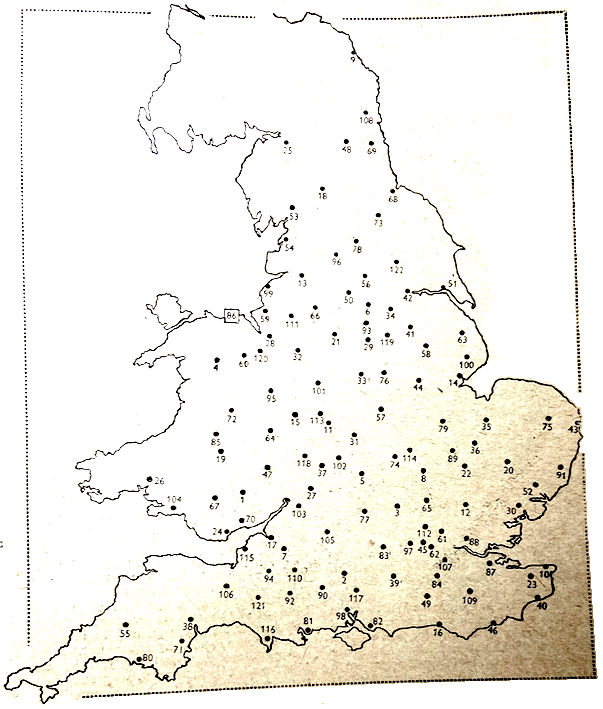
“BY HIS PERFORMANCE last Saturday afternoon in finishing first in the 15-lap Experts Grand National Scramble, organised by the Redditch MC&CC at Rollswood Farm, near Alcester, JV Smith (500 BSA), who completed the 15 laps (26¼ miles) in 43min 00⅕sec, becomes British Scrambles Expert for 1954. Still inconvenienced by a hand injury sustained in the recent Cotswold event, Brian Stonebridge (BSA) failed to hold an early lead but finished second, nearly ¾min after Smith, with John Avery (500 BSA) third. The winning speed was slower than that recorded last year by Geoff Ward. He, convalescent after his tumble at Hawkstone Park the previous weekend, had to leave his AJS at home and be resigned to watching and cheering on the hard-working DG Curtis who, with a 500 Matchless, strove in vain to break up the powerful BSA spearhead. Although Curtis did, in fact, succeed in this direction by narrowly beating PA Nex (500 BSA) to the flag in the 500cc 10-lap race, the No 2 BSA team (JV Smith, GJ Draper and BW Martin) was the only one of six to complete the course intact so the team award, the BSA Cup, goes to Small Heath for the next 12 months. The day’s sport began with a four-lap 150cc race which everybody hoped would prove to be a repetition of last year’s exciting ‘tiddler’ event in which wheel-to-wheel riding left the issue in doubt right up to the finish. On Saturday, however, the 150cc machines did not provide much of a spectacle. W Barugh (125 Dot) secured a good lead but lost it on Lap 3 by getting into trouble in the stream on the lower part of the course. His Villiers engine was not waterproofed and he retired, leaving A Shutt (125 Francis-Barnett) to win in13min. 54⅖sec.”
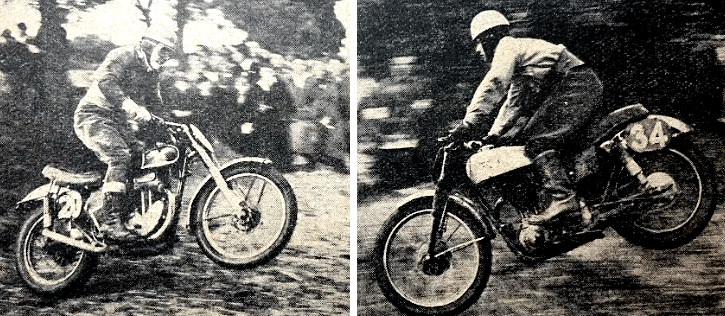
“DESIGNED TO BE strapped to the back of a driving glove, the Safeglance mirror is a well-made accessory. Advantages of the mirror are that it is not subject to vibration transmitted from the handlebar of the machine and, as it is not fixed to the bars, it will not shatter should the machine be accidentally dropped. Another place to keep one of these mirrors, possibly a use not visualised by the makers, is in the glove compartment of a sidecar, passengers of the fair sex being very impressed by the idea! Priced at a mere 4s 11d, the Safe-glance is made by Chas King Plastics, Fetter Lane, York.”
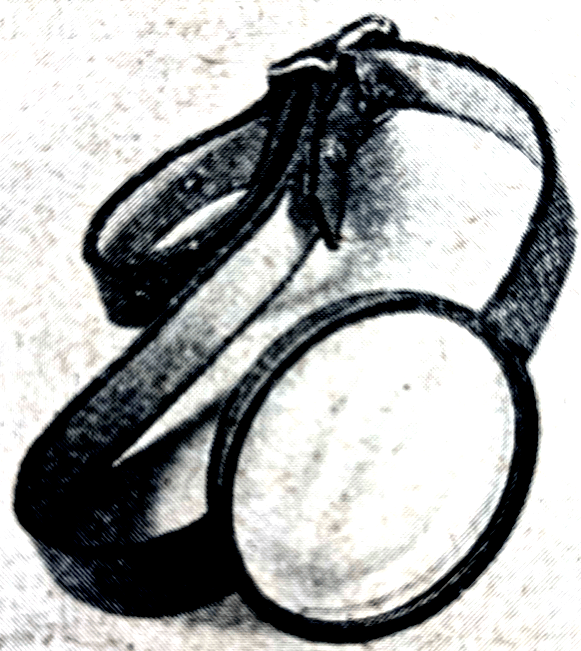
“Brief-testing of the new Starleto dual seat sufficed to justify the claims of its manufacturers, Pulley Brothers, 54 Northampton Street, Birmingham, 18, that the springing system employed gives a high degree of rider-passenger comfort but eliminates all lateral roll. The base of this seat, which is to retail at 89s 11d, is a strong metal tray fitted with adjustable brackets suitable for a 6in rear mudguard and a 1¾in saddle noselug. Suspension is by a mattress of non-collapsible steel strips overlaid with a cushion of latex foam rubber. Measuring 24x10in, wide, with a dividing centre ridge and slightly raised back support, the Starlet provides a passenger seating area of 100sq in. For the rider the pointed nose adds slightly to that area. The seat is well finished and covered with waterproof plastic material in colours to match those of leading current motor cycles.”
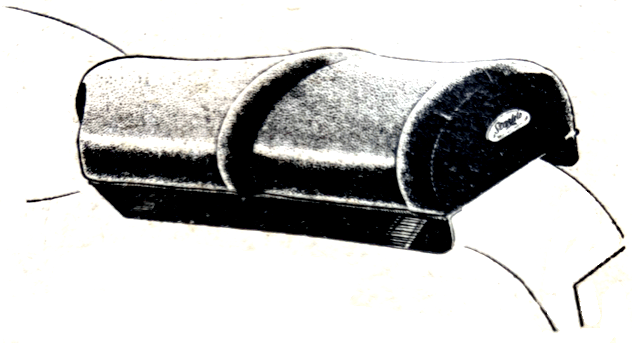
“TRIED ON A rear mudguard during a wet period of our English summer, the Grove mudguard valances proved their worth in no uncertain manner, stopping much of the spray which normally finds its way on to the back of rider or passenger. The valances, which are made by the Grove Tool Company, 61 High Street, Teddington, Middlesex, are offered in colours to match different machines, alternative fittings being available for individual makes; wherever possible, use has been made of existing bolts on the machine to avoid the necessity for any drilling. For fitting to the rear mudguard the price of the valances is 14s 9d per pair; front guard types cost 18s 9d per pair.”
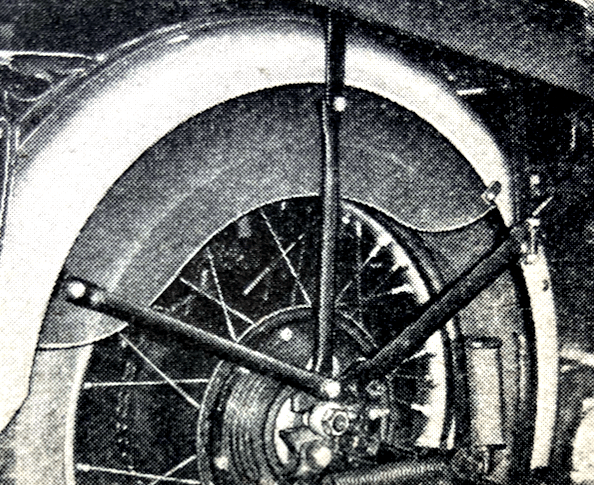
“THE Middlesbrough &DMC was granted a Grand Prix title for its National sand race meeting held at Redcar on Saturday, when FM Rist, normally retired from active motor cycle competition, brought his 350, 500 and 650cc BSAs north to take first places in the 20-mile, 350 and 600cc classes, and a second in the 1,000cc event held over a similar distance. NL McLintoch, who also rode a BSA, won this latter class, leading Rist for the whole race. While the sky was overcast it was very warm during the afternoon and early evening, and a crowd numbering almost 6,000 saw the racing on the two-mile circuit. Unfortunately the sand was not in particularly good condition since the high water mark of the currently low tides was below that of the course; hence the surface was not entirely smooth.”
“BY NEXT YEAR there will probably be a completely new, roughly triangular Circuit van Drenthe, near Assen, in the north of Holland, where the Grote Prijs van Nederland der KNMV—the Dutch ‘TT’—has been run since its inception in 1925. In the meantime, much road widening is taking place and the once narrow, tree-lined roads are being replaced by broad highways, bordered by grass verges. Last Saturday, when the 1954 ‘TT’ meeting took place, all records were broken in each of the four races included in the programme for 125, 250, 350 and 500cc machines. Geoff Duke added to his lead in the World Championship table by running away with the 500cc event on his Gilera, at an average speed of 104.24mph. The other races were also dominated by their respective winners—Fergus Anderson, who won the 350cc event on a Guzzi; Werner Haas, who gained his fourth successive victory in a 250cc ‘classic’ on an NSU, so making certain that he would retain the Championship title in that class for a second year; and his NSU team-mate, Ruppert Hollaus, who had a third consecutive win in the 125cc event. The races were held on a day which began with brilliant sunshine and continued fine, although rather cloudy, throughout the afternoon. An enormous crowd saw racing at high speeds yet free from any serious accidents. There were, however, several mechanical casualties, and they included the two Nortons on which Ray Amm held second place in the 500cc race and third in the 350cc until almost the end of each event.”
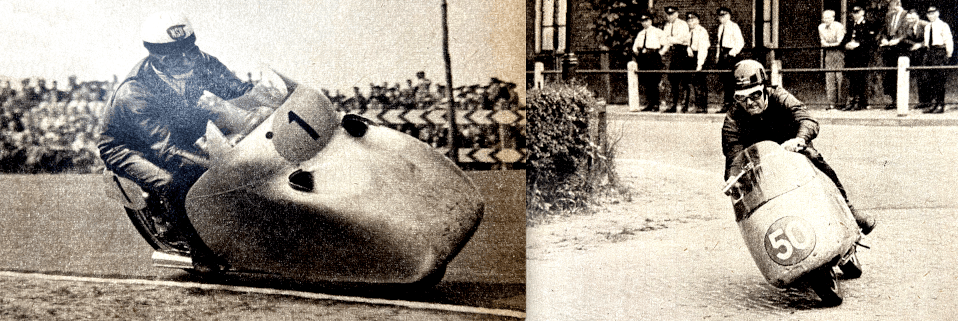
WHEN YORKSHIREMAN BERT MASKELL was in the market for a bike to haul a sidecar and caravan he looked no further than Cleckheaton for a brand new 600 Panther “or, as we know it in the West Riding, ‘the local product’.” He roped in his pal Norman Wilks, fitted a Swallow Jet 80 chair and they headed into the Deep South, well, Croydon, to collect a 12ftx7ft 4in three-berth Rambler caravan. Having lowered the gearing, enriched the mixture and uprated the clutch they went for a ride, from Bradford, to John o’ Groats, thence to Land’s End, and back to Bradford. The law at that time restricted the plot to 30mph but Wilks reported: “A cruising speed of 40-45mph could easily have been maintained.” Two days took them to the top, two more days and they were at the bottom, and another two days got them home via the Cheddar Gorge, “…even on this ascent the machine made light of its load…the seventh day’s run of 176 miles brought the total for the week to to 1,865. Petrol consumption worked out in the region of 40mpg…After a very hard week’s work the machine was detached from the van and taken for a long run over familiar ground…it required no attention and was still in excellent fettle. Now it is again in normal daily use.” The only spanner work involved adjusting the tappets, and apart from four broken spokes in the rear wheel the Panther took the trip in its stride.
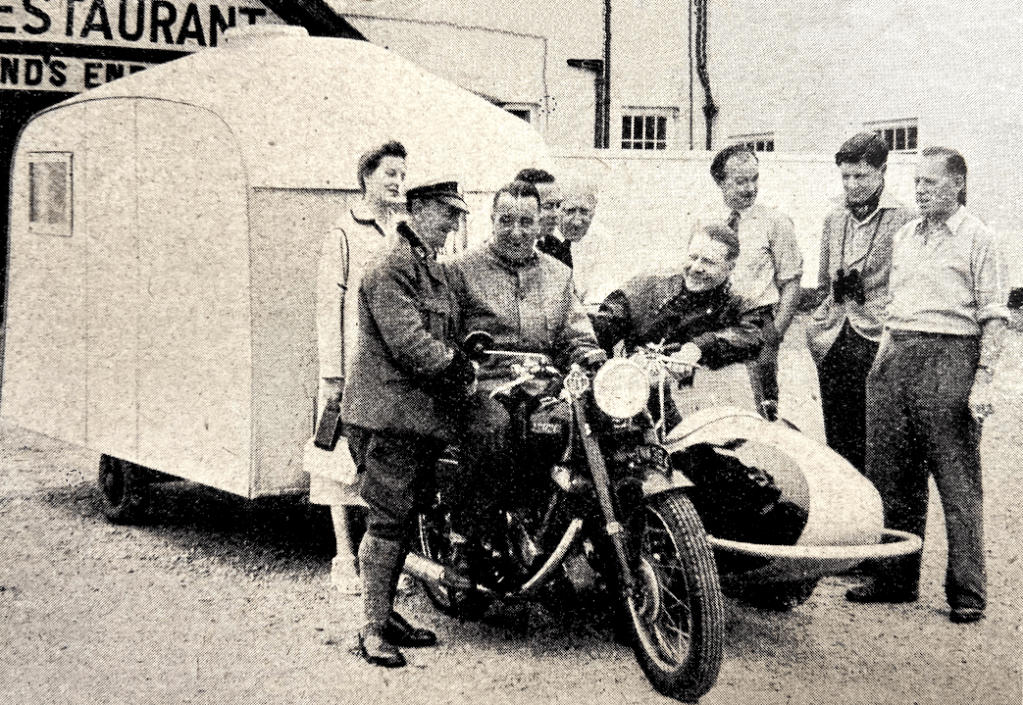
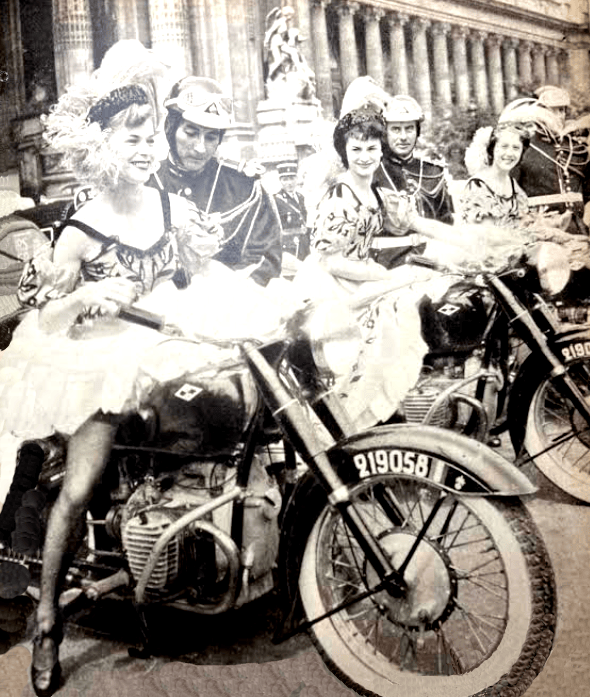
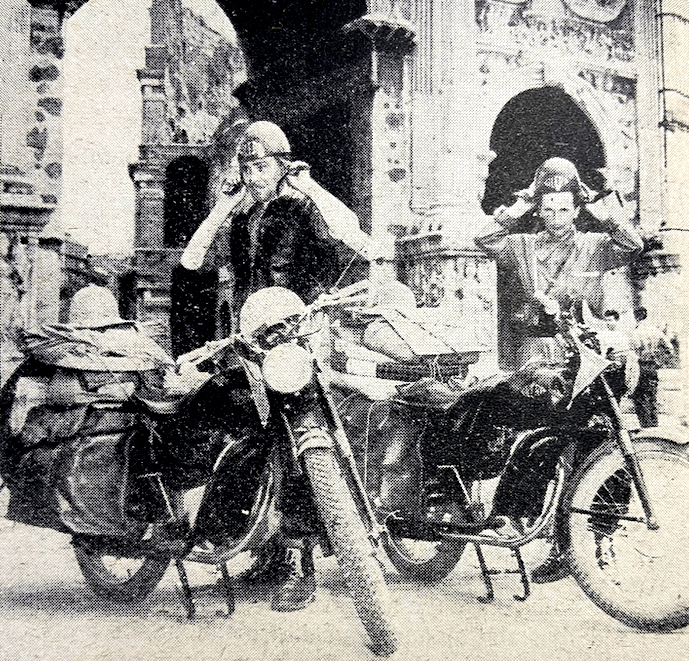
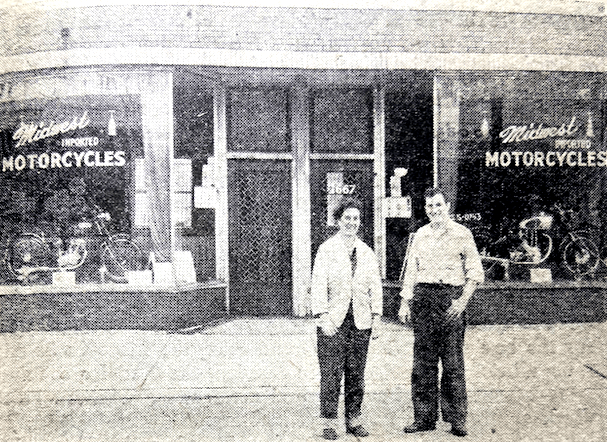
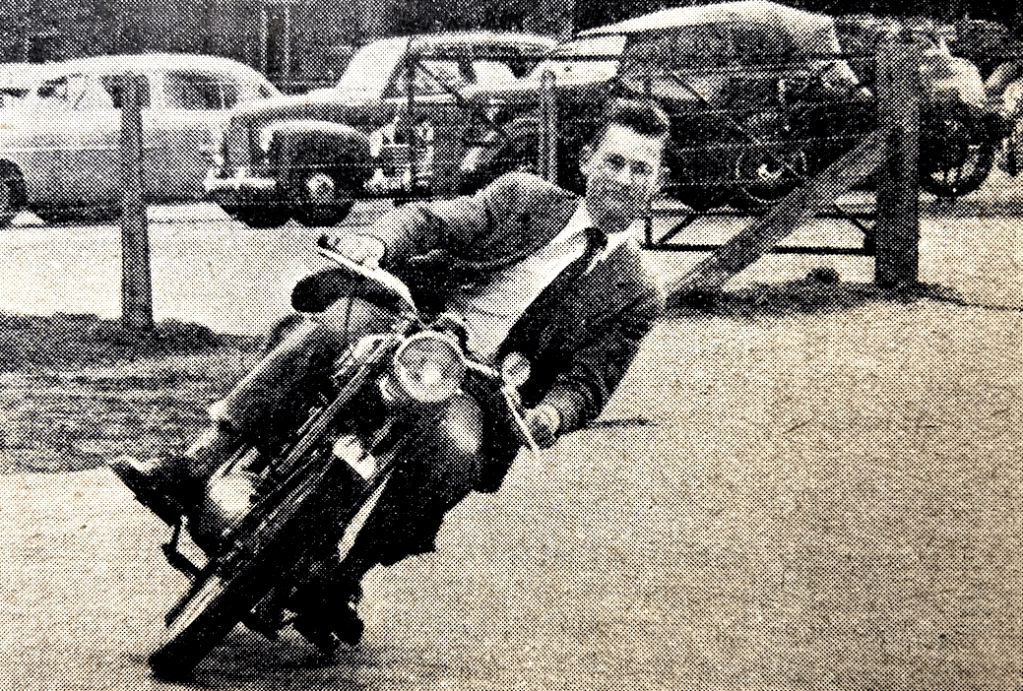
ROADTEST: HJH DRAGON
“THE FIRM FOUNDATIONS of Britain’s great motor cycle industry were built up by small, enthusiastic concerns who had the courage to venture into the then uncharted seas of commercial motorcycle manufacture. And today, when those who survived the storms and shoals are so well established, it is refreshing to see a revival of their spirit despite high costs and the discouragement of purchase tax. So it was with lively interest that Motor Cycling took delivery of the newest product of the industry, a 197cc HJH Dragon, manufactured HJ Hulsman (Industries), of Canal Side Works, Canal Road, Neath Glamorgan. Naturally, there can be little novelty in the basic specification of a machine which uses the ubiquitous 197cc Villiers 8E engine and three-speed gearbox, a conventional, welded, square-tube cradle frame with plunger rear suspension and Metal Profiles telescopic front forks. But the designer of the Dragon accepted basic orthodoxy and lavished his skill and ingenuity on the task of producing a thoroughly practical motorcycle with an impeccable finish. The success of his efforts can be judged at first glance. With the exception of the cylinder head, all external alloy components of the engine and gearbox have been polished until their sheen rivals that of the chromium-plated tank, mudguards, wheel rims and accessories. And the plating itself is of the highest quality since ‘undercoats’ of copper and nickel underlie the chrome surface, ensuring not only brilliance, but durability. Intelligent attention to detail is also obvious in the machine’s layout and accessories. To achieve the feel of a full-sized mount, the spacious dual seat has been set rather high and far back. It is also provided with a rail which forms both a convenient lifting handle and a hand-hold for the pillion passenger. Fully adjustable handlebars with clip-on controls further ensure that the ‘reach’ can be modified to suit individual tastes, and the footrests, mounted eccentrically on their spindle, give a choice of height
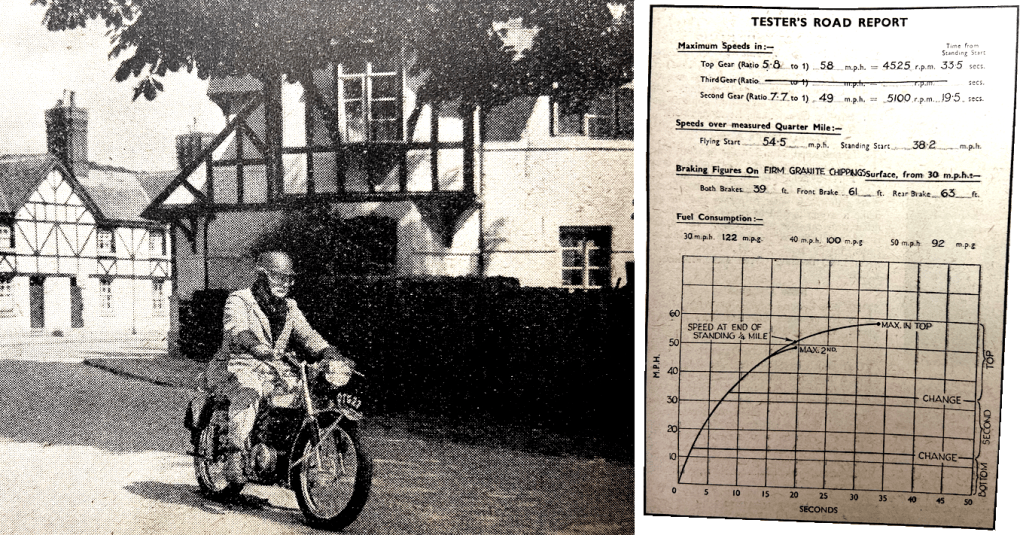
and fore-and-aft positions without hampering the use of brake pedal or gear-change. Pillion footrests are standard and give a comfortable riding position for the passenger. Other laudable refinements include a cast centre-stand which is readily accessible from both sides of the machine, and twin toolboxes with ample room for tool kit and spares. Under test, the Dragon earned high commendation. The seating position was almost ideal, having none of the ‘sit-up-and-beg’ characteristics sometimes associated with lightweights. However, the extremely comfortable seat had one slight disadvantage in that its rather broad nose tended to force the rider’s legs apart so that an inward pressure had to be exerted in order to grip the sides of the tank between the knees and give that added measure of control which distinguishes the motor cycle from the scooter. Despite this, however, the machine handled well in traffic, and on the open road it could be heeled far over on corners and steered as though on rails. When taken over by Motor Cycling, the frame and cycle parts were brand new and the rear suspension seemed a trifle hard at cruising speeds over very rough patches of road, but it worked in complete harmony with the front forks and gave a comfortable ride. Much of the test was carried out in bad weather, but wet roads had no great effect on the machine’s handling properties or appearance.
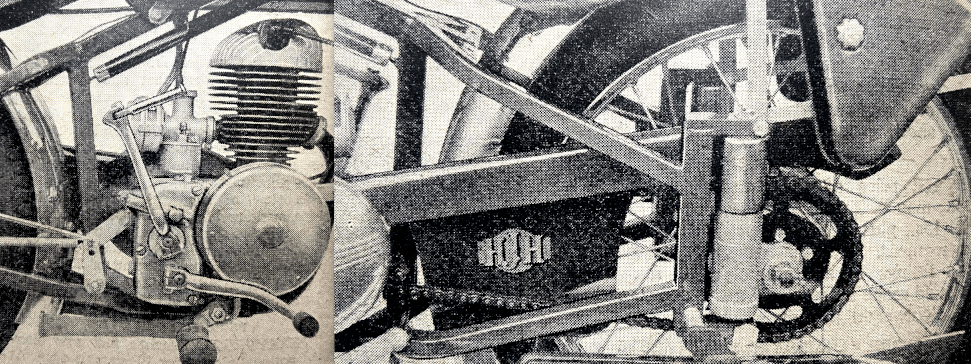
Although sports mudguards were fitted little spray was thrown back from the front wheel, but for those who require even better protection, the manufacturer will fit broader or valanced mudguards as standard at no extra charge. As the final stage of the test, it was decided to ride the Dragon back to Neath, to see how it behaved among its native hills and valleys. Little has been said so far about the popular Villiers power unit, because its likeable characteristics are too well known to need repetition. First-kick starting was taken for granted, and, on the level a cruising speed of 40-50mph was easily maintained. One point worthy of note, however, is that the engine was slightly offset in the frame—a feature which consider-ably minimised vibration. There are some very searching hills in the neighbourhood of Ebbw Vale and Merthyr Tydfil, but the Dragon climbed the worst of them at a steady 35mph in second, and on the downgrades the 10%-slow speedometer registered 62mph on occasions before a cautious hand rolled the power off. For, though the 5in brakes were quite satisfactory at cruising speeds, rather more powerful anchors were needed for such ‘through the gate’ power dives. At night, the beam from the shapely Miller head lamp was well up to cruising requirements, and the plastic rear lamp was a reassuring tailguard. As current for the electrics was supplied direct from the flywheel generator the machine was equipped with a bulb horn, but this gave quite as effective a warning as the smaller type of electric unit. Throughout the test no minor criticisms other than those mentioned above were aroused. Certainly this attractive Welsh Dragon is an ideal mount for anyone who esteems finish as much as he does reliability, and at £116, including purchase tax, it represents a sound investment.”
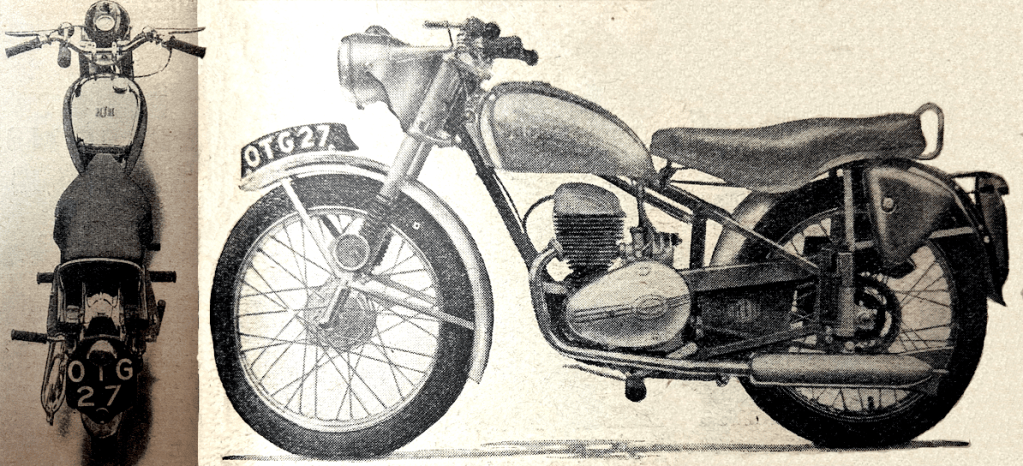
ORGANISED BY THE BRADFORD &DMC, the eighth Allan Jefferies Trophy Trial, a national event held in the Threshfield-Kettlewell area last Saturday, attracted an entry of 155 in which were included 10 manufacturers’ and seven club teams. The route-card listed 11 main observed sections, the ingredients of which were mostly mud-covered rock and steep gradients. Mixed weather conditions gave the competitors a hard day’s work and the win by JV Brittain (350 Royal Enfield) with a loss of 20 marks represents a particularly good performance. The BSA team (GJ Draper, JV Smith and TU Ellis) beat the Royal Enfield trio (GE Broadbent, JV Brittain and DS Evans) by eight marks—90 to 98—to secure the manufacturers’ team award. Fielding the formidable combination of NS Holmes, LA Ratcliffe and TD Ellis, the organising club won the club team prize from the West of England MC with 107 marks to 128.
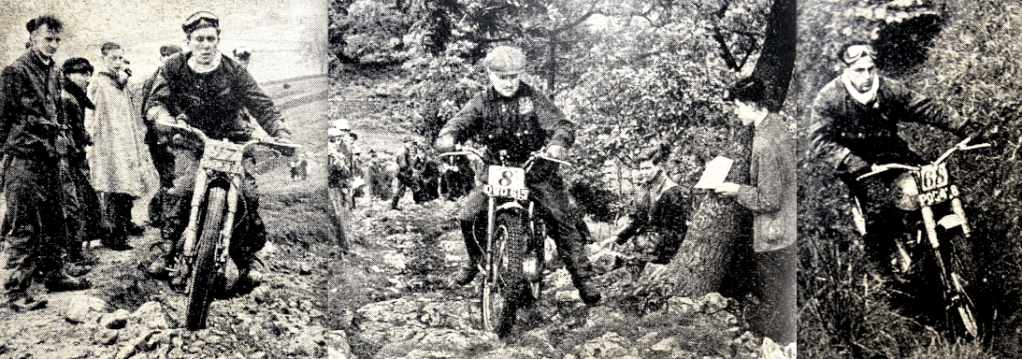
“THE PROSPECTUS MIGHT have been worded something like this: ‘Unlimited vacancies at newly established college near Liphook, Hants. No fees, but pupils must provide own trials sidecar outfits. Official uniform ‘International’ suits. Apply B Romany, Headmaster, BSSA, London, NW1. In actual fact, the wording announcing the founding of the British Sporting Sidecar Association’s Tuition Scheme for novice trials sidecar crews was rather more prosaic, though quite effective, and it drew a small gathering of chariot enthusiasts to the Deer’s Hut, near Liphook, last Sunday, to gain an initiation into the art from Frank Wilkins, Bern Romany, ‘Kay’ and Mrs EM Romany. The day’s timetable was designed to deal with elementary aspects of the subject—but that did not prevent at least one experienced Ariel ‘barrow boy’, HA Burrows from attending and adding to his knowledge by some coaching in The Dell. Teachers Romany and Wilkins appeared to differ somewhat to judge by their signals to Keith Tuvey and Miss Joan Marchment, two East Acton novices, tackling the section with their 500cc BSA outfit (below).”
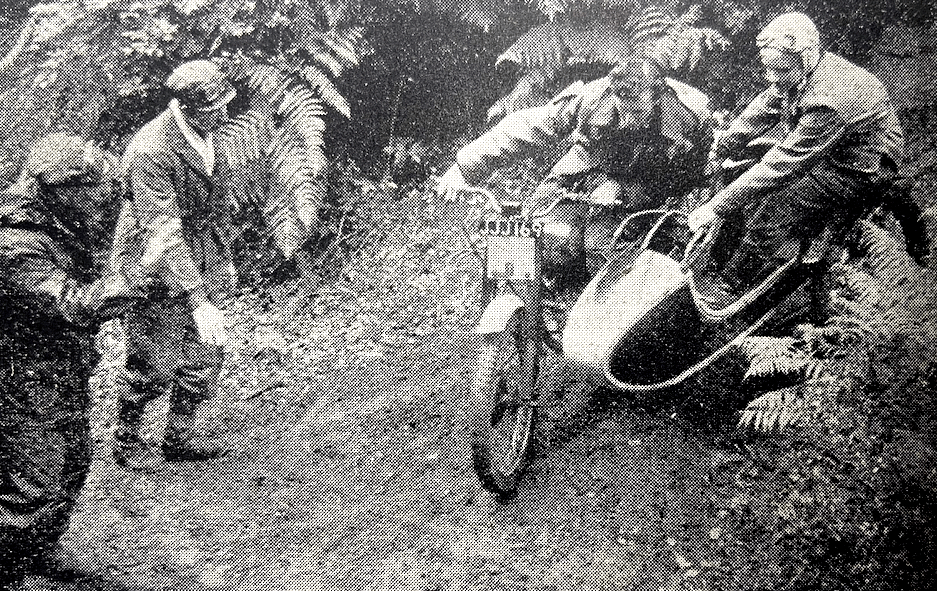
“THE FINAL MEETING in the 1954 Crystal Palace motor cycle road racing programme—a national event organised by the BMCRC on behalf of the London County Council—suffered as the result of terrible weather. Racing commenced with the 125cc event, won in convincing style by Maurice Cann on his very fast Italian Mondial. Fifth away. he was first at the end of the opening lap and was never seriously challenged. The 250cc final was run on drying roads and it was Surtees all the way. The Forest Hill rider was the second to get his motor to fire, and led by 80 to 100 yards at the end of the first lap. By half distance he was already lapping the tail-enders, as were GJ Turner (249 Rudge), HD German (248 Cleveland Duffel Special) and J Eckhart (248 Excelsior), who finished in the order given. First away in the all-Norton sidecar final was Bill Boddice, pursued by PV Harris and F Taylor. At the end of the first lap Boddice still led. The rest of the field came through —Jack Becton stopping to make some minor adjustment—and it was suddenly apparent that Harris had not completed the circuit. With two laps run, Boddice had a clear 300 yards lead over Taylor, with E Walker chasing them hard. Another lap saw the two leading positions still unaltered, but L Taylor had bettered Walker for third berth. No further change occurred until the contestants entered their last lap, when L Taylor displaced his namesake from second place. As the riders came out for the 350cc final it was made known that Harris had come to grief at the North Tower Crescent and was uninjured, though his passenger had suffered cuts and abrasions. Quick off the mark in the Junior event was GR Dunlop, followed by FA Rutherford and R Alderslade (all AJS-mounted) and Surtees on his Norton. But at the end of the lap it was the irrepressible Surtees in front, chased by PH Tait (Norton). And both of them were clear of the main body of riders. By half-distance there was a wonderful scrap going on for third place between JR Clark (AJS) and W Ryan, similarly mounted. These two fought it out, with Clark always the odd machine’s length in front until Ryan managed to get ahead on the last lap. Rain was falling again as the finalists in the 1,000cc race came to the grid. The flag dropped—and S Cooper’s 498cc Triumph was first away, with Surtees’ Norton right on its tail. At the end of the opening lap Surtees was 300 yards ahead, and it seemed that, once again, the race pattern was set. But just after half-distance, when lapping a slower man, Surtees went out with water in the carburetter. Clark and MP O’Rourke, who had been swapping places behind the leader, took over, and it was Clark who forged ahead to win. A magnificent ride was that of Tait who, third away at the start, must have had some bother on his opening lap, for he came round last, with smoke billowing from his exhaust. Nonetheless, he was able to work his way steadily up to sixth place on the eighth lap, in which position he eventually finished.
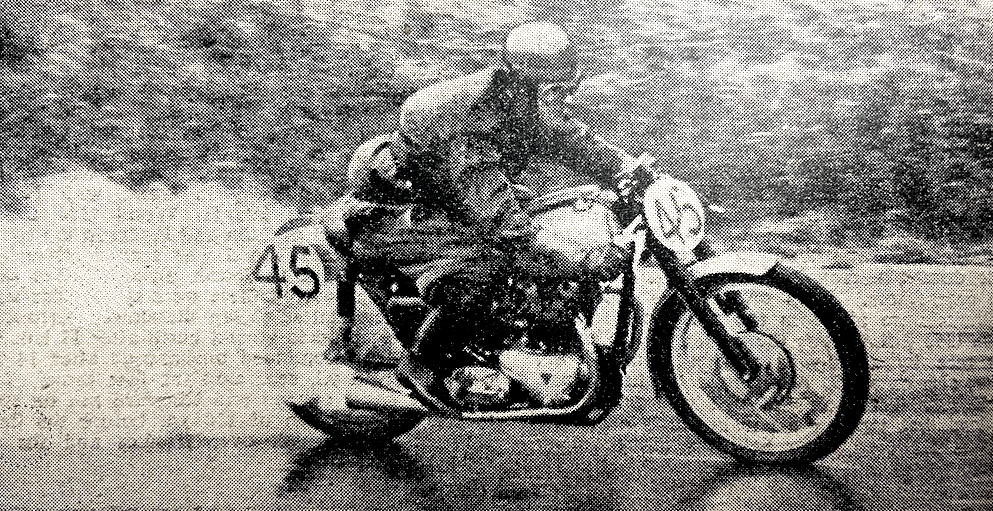
“IN CONTRAST TO the weather at Crystal Palace the previous day, it was cloudy but dry for the Gravesend Eagles MCC’s open-to-South Eastern Centre road-race meeting over the 1.24-mile Brands Hatch course in Kent. Although in his heat John Surtees (248 REG) lost his initial lead to GJ Turner (248 Rudge) and had to fight hard to regain it, in the final he was never challenged. In the 10-lap final of the 350cc event. Suttees (348 Norton) again secured the lead immediately, with JR Clark, WR Fletcher, J Hartle and W Ryan—all on 348cc Ajays—scrapping for second position. By half distance Suttees was in an unbeatable position. The final of the sidecar scratch event promised to be a battle royal between heat winners Bill Boddice and Pip Harris, both mounted on 499cc Norton outfits. Harris and Boddice went into the lead from the start and stayed in that order for the eight laps. Harris was pushed so hard that he broke the race record set by Eric Oliver (499 Norton sc) endeavouring to keep his advantage. The first 1.000cc c solo heat went to JR Clark (498 Matchless) and the second providing another easy win for Surtees (499 Norton). In the final, Clark led for the first two laps but on the third circuit Surtees came round first and thereafter steadily pulled away from the rest of the field. Good handicapping in the sidecar heats saw Boddice and Harris work hard for their wins but in the final E Walker (499 Norton sc) came home just ahead of ET Young (498 Triumph sc) and Boddice.”
“BEARING IN MIND that the same chassis must be suitable for the ISDT, well-known sidecar trials exponent Peter Wraith has designed and built one which, harnessed to an Ariel 4, he entered the RAC of Belgium Liége-Milan Rally which concluded yesterday. A ride, both on the machine and in the chair, confirmed that driver and passenger comfort has received every consideration. The steering is light and positive on both left or right lock while the effortless power of the four-cylinder engine enables high speeds to be maintained indefinitely. To counter the effects of headwinds on the rider, a handlebar screen is fitted and the three brakes adequately take care of retardation problems.”
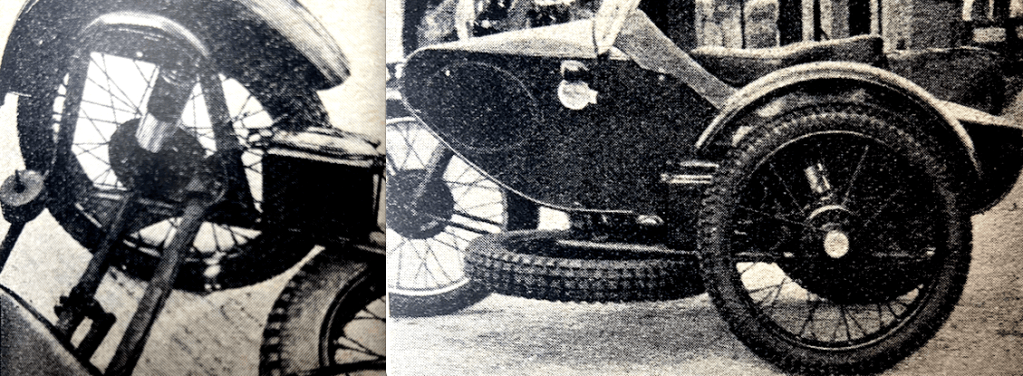
“ALTHOUGH IT IS TRUE that Aerco Jigs and Tools bought up the Scott manufacturing rights largely out of Sentiment —there could be no greater Scott enthusiasts than Mr MD Holder, and his co-directors—their underlying purpose was ultimately to use their experience as precision engineers to produce a post-war version of the marque which had for some four decades emanated from Shipley, in Yorkshire. Mr Holder and his friends immediately set to work to convert the pipe dreams of war-time days—discussions held and lash-ups made during fire watching, for example—into reality. They startled foundry experts with plans for a die-cast Scott crank-case, and moreover, they made it, together with die-cast cylinder heads which, providing space for a greater volume of water, promised to give cooler running and longer plug life. The old Scott frame, which none could better—as a frame pure and simple—had to be scrapped or modernised to provide rear suspension facilities, and it is this component which Aerco Jigs and Tools are now testing. It has been decided to retain the duplex character of Alfred Scott’s original pattern but to use an up-to-date loop design, braced at the sides in the region of the gearbox, with rear members to form a top anchorage for the swinging-fork assembly which, on the prototypes at present running around Birmingham, incorporates Armstrong dampers. Forward suspension is by Scott telescopic forks, using long coil springs, widely separated slider bearings and hydraulic damping.
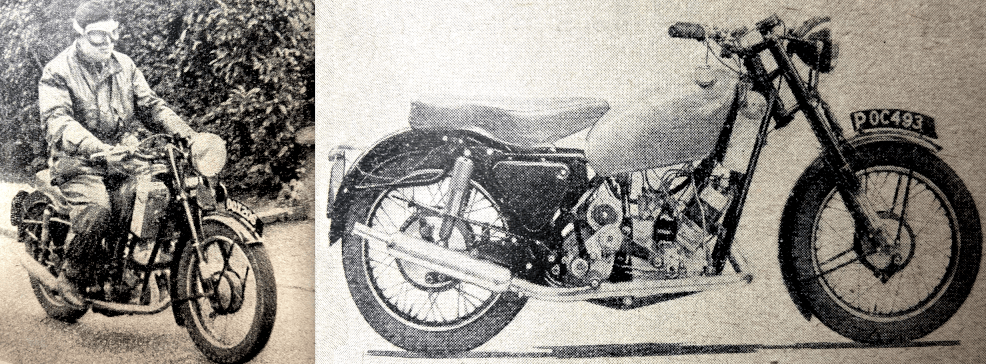
Many Midlanders have seen these prototypes on the road: the familiar looking models have aroused curiosity and whetted Scott-fan appetites. Enthusiasts have commented on the use of coil-ignition with a Lucas ‘pancake’-type generator driven from the nearside mainshaft, the shaft on the other side operating a skew-driven distributor/contact breaker unit. On both the 498 and 596cc prototypes the Scott foot-operated three-speed-gearbox has been retained and, from a recent trial run on the 498cc machine, it appeared to Motor Cycling’s representative that modern springing had markedly added comfort to the good handling qualities for which Scotts have always been famous. Capable of approximately 80mph, the bigger model, unfortunately, could not be tested, as work was in progress on the fuel tank, and we had to be content with the pleasant nostalgia aroused by sampling once again the excellent, surging acceleration which came from the smooth torque of the 500cc model. The future? Mr Holder and Harry Langman, who has come down from Shipley as development engineer, say they are far from the production line stage and, when the machine is ready, it will not be marketed on much more than a hand-built-for-the-enthusiast scale. Be that as it may, it is like a breath of fresh air to encounter such enthusiasm and to know that, given reasonable luck, this spirit will serve to revive a famous name and a fine motorcycle.”
“REGARDING ‘CARBON’S’ QUERY as to whether the publication of social fixtures serves any useful purpose so far non-club members are concerned, it would seem that the friend in question was most unfortunate in his choice of club and feel sure that there are not many where such treatment would be handed out. Speaking for my club, I can say with all sincerity that any non-member who would care to come along to the Hare and Hounds, Purley Way, any Friday evening, or join in a run on Sunday, would be very welcome and no effort will be spared by members to see that he enjoys himself. As regards a PRO, I think that this should not be necessary, as every club motor cyclist worthy of the name should extend the hand of friendship without having to be detailed.
JOHN R MARTIN (Asst Secretary, Croydon MC), Croydon, Surrey.”
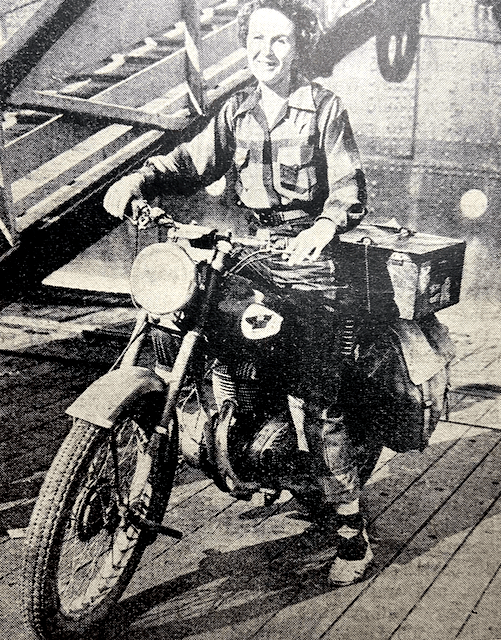
REPORT: A-CU NATIONAL RALLY
“NEVER IN THE HISTORY of the ACU’s National Rally has there been a closer finish than in the 11th of the series, which took place last week-end, finishing on Sunday at the North Wales seaside resort of Rhyl. Over 80 competitors gained the maximum possible marks of 670 by covering 600 miles and calling at 35 controls and, in deciding the winner of the Varley Trophy —the premier solo award—the methods of settling ties which have been evolved in the past three years were stretched to the limit. However, under the preference given to the smallest capacity class, the list was whittled down to five: last year’s winner, JR Walton (125 BSA) of the Derby Phoenix MCC, F Osborne (125 James) of the MCC, RH James (100 NSU-Vincent), Kingswood MCC, H Clarke (125 BSA) from the Bourneville Works MC, and similarly mounted DJ England, who hails from Barnet. The age of the machines was then invoked to decide this tie and all but Walton and Osborne were eliminated. But they could not be separated, for their machines had actually been registered not only in the same year but on the same day! The only way left of deciding was on the distance between Rhyl and the controls at which they had started, and here Walton just had the edge. His route had commenced at Wellingborough and Osborne’s at Leicester so, after all that, the ‘Varley’ went for the third successive year to the Derby schoolmaster. Similar situations presented themselves in the sidecar class and the Army individual entry. In the former, the, deciding final went to RR Meier (350 Ariel sc) of the Wickham MC, but, at the time of writing the destination of The Motor Cycle Trophy had not been decided since all the riders involved—Capt WA Mackenzie, Lt AS Petrie, Lt JJ Holmes, Sgt J Rattan, Sgt D Rowthorn and L/Cpl R Canner—were riding 350cc Matchlesses and the ‘registration dates’ of these WD machines was a well-kept military secret. About one major award, however, there was no doubt, the A-CU Inter-Club Trophy going this year to Bill Mold and his merry men of the Bow District Police Garage MCC with a 43-point lead over the Antelope (Coventry) MCC, who took second place—a well-deserved effort, for the Bow Garage have been persistent triers ever since the war. A special hand must go to P Derbyshire (250 BSA) of the Royton ATC MCC, for being the first RAC/A-CU trainee ever to win
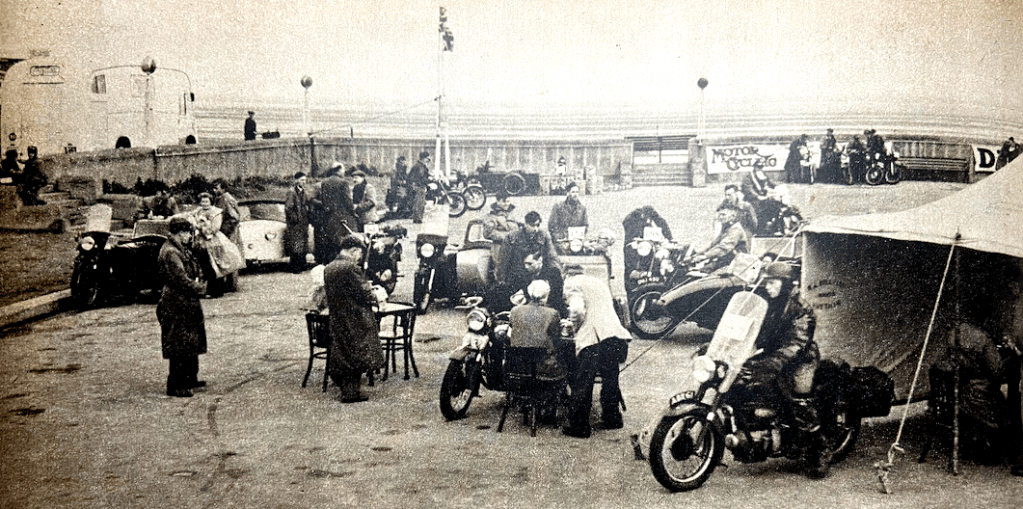
the News Chronicle Trophy with maximum marks. The regulations . for this exciting rally were much the some as last year’s, save for the starting time being advanced to 11am. Starting at whatever control they pleased, riders were awarded one mark for each mile covered and two for every control at which they called. To visit any one control more than once cost the competitor a 25-mark penalty and forfeits were also imposed for covering more than 50 miles between checks and for exceeding the maximum of 600 miles. Some idea of the proportions to which the Rally has grown in recent years can be gained from the awards list, which reads like a stocktaking sheet from the Goldsmiths and Silversmiths Company. For, in addition to the major awards set out in the provisional results, every rider obtaining maximum marks will be awarded a special plaque as distinct from the ‘golds’ gained by anyone with over 600 marks; those with between 500 and 599 get a ‘silver’, those with from 400 to 499 a ‘bronze’, and a certificate of merit goes to all others with over 300 marks. Rhyl, Sunday, July 18. Heavy layers of ominous grey cloud swept in over a sea lashed into white caps by a high wind as, at 9am this morning, the first competitors began to arrive at Rhyl. For most of them it had been a stormy night with fine rain driving almost horizontally before the gale, but a few had been lucky in striking fine patches. Even so, most were agreed that conditions had been much better than last year when, to quote the official programme, ‘the clerk of the weather was a non-co-operator’. Amenities at the final control were also better—better in fact than at any post-war Rally. Competitors were first ushered into an asphalted reception area the size of a football pitch on the spacious promenade. Then, when their time to clock in arrived, the machines were moved to a parking area adjoining the Pavilion. Fortunately, the rain held off but, in case of further ‘non-cooperation’, a line of bench-filled shelters which stood with their backs to the wind near the parking area, were ready to shield the tired riders. However, when they had had a wash and brush up most competitors, together with their passengers, sidecar and pillion, went into the Pavilion to enjoy the hospitality provided by Joseph Lucas (Electrical) and when they re-emerged were loud in praise of ‘good old Joe’ who, during the course of the day, supplied nearly 1,300 free meals. Most of them, too, were
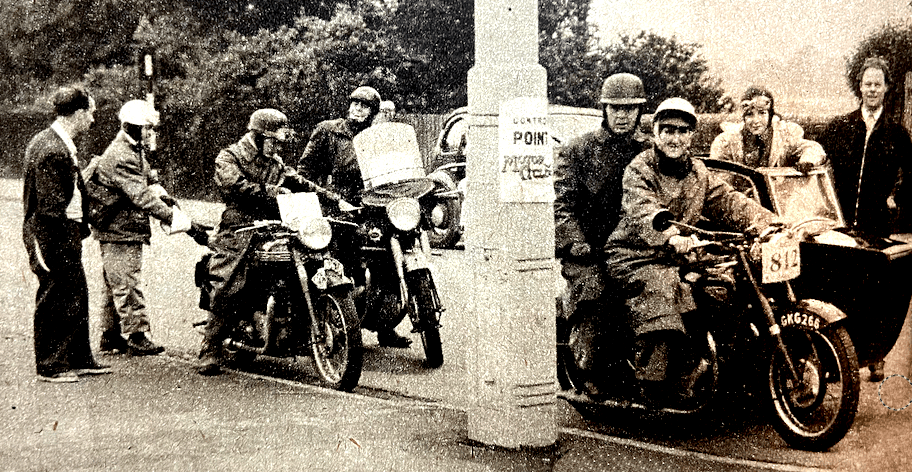
agreed that the Rally had been a success. Though the signposting to some controls had been sketchy there had been nothing half-hearted about the reception accorded by the hard-working staffs of club members and garage authorities. At almost every control riders were plied with hot tea and refreshments. In the parking area one or two machines bore battle scars in the shape of bent head-lamp rims and scraped handlebars, but there were few accident reports. The most spectacular mishap was that reported to have been suffered by Bob Pratt of the Worcester AC, when a deer had jumped over a hedge and written off his machine, but he had sustained no damage and took to the pillion of a clubmate. By 11am the parking area was crammed with 622 machines of all ages and types. Three-wheelers were represented by a number of Bond Minicars and several Morgans, as well as the solitary Reliant Regal entry of JS Mingay from London. At the other end of the scale was G Langlois’ 48cc Britax-Ducati which had gained a bronze award. The Lambrettas of EJ Parker and HR Hall, both of which were equipped with auxiliary fuel tanks, had also arrived with just under 500 miles to their credit and the solitary Swallow Gadabout of WK Cooper had clocked 508 miles, despite having suffered a seized engine. A particularly interesting mount was CC Cann’s bronze-winning 125cc Anelay-Excelsior, which ran in the 1951 Ultra-lightweight TT and was entered for last year’s ISDT. But, naturally, it was the riders claiming maximum marks who aroused the greatest interest and among these the hardest hard-luck story was that of E Corley (650 BSA sc) whose wife, the secretary of the Oswestry &DMC and a polio victim for the past six years, had travelled in his chair with her folding wheelchair stowed in the back. A misunderstanding had arisen at the final control and they had been checked in early—a fate which one or two other competitors suffered also—and there are a few protests yet to be settled on this score. Another problem was that set by HF Tanner who had gained maximum marks on a 1921 398cc ABC but, because of trouble with one cylinder, had accepted a tow into the final control. As a result the awards in class D were temporarily held in abeyance pending a decision of the Stewards. Map-reading gadgets abounded, but undoubtedly the best was that of John Phillips, from Nottingham, another ‘maximum’, who carried an illuminated control list on his back for passenger H Simpson to read and also had a roll map in an illuminated ex-American Air Force astrograph mounted inside the windscreen of his LE Velocette. Many competitors had to depart early in readiness for a day’s work on Monday, but despite this, good crowds attended the Castrol film show in the Town Hall and, to round off a very satisfactory event, A-CU chairman Professor AM Low was able to announce some of the major awards before all riders
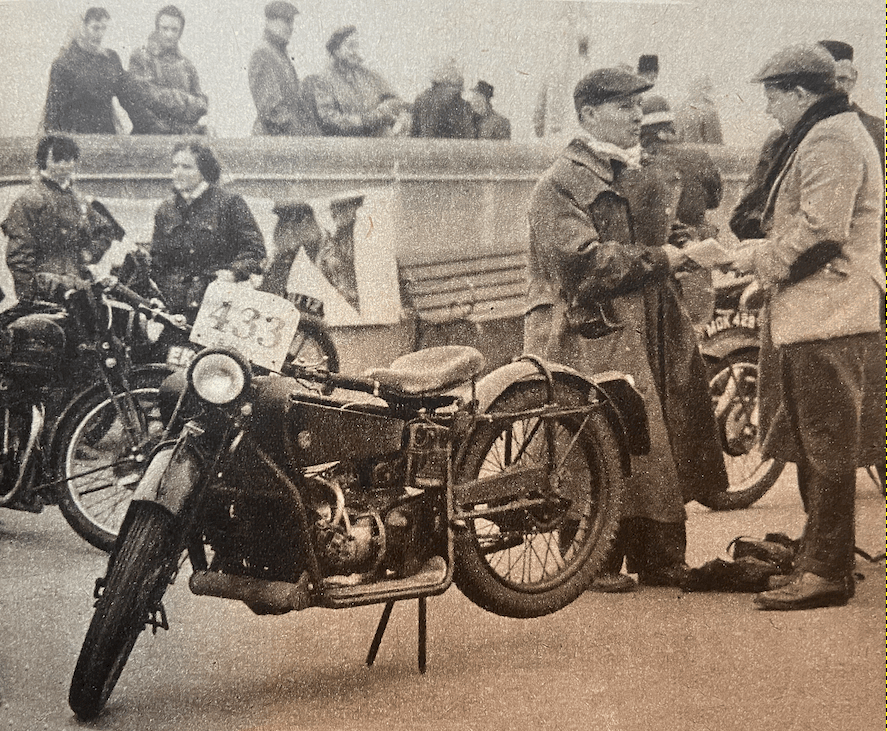
dispersed. INDIVIDUAL AWARDS The Varley Challenge Trophy (best solo performance): 1, R Walton (125 BSA), 670 marks. The Basic Challenge Trophy (best sidecar performance): RR Meier (350 Ariel sc), 670. News Chronicle Challenge Trophy (best ex-RAC/A-CU trainee): P Derbyshire (250 BSA), 670. CLUB TROPHIES A-CU Inter-Club Rally Challenge Trophy (best club calculated on figure of merit): Bow District Garage MCC, 5,261. Manufacturers Challenge Vase (second-best club): Antelope (Coventry) MCC, 5,218. Belstaff Challenge Cup (third-best club): Worcester AC, 5,092. Dunlop Challenge Cup (fourth-best club): North Liverpool MC, 4,763. South-Midland Centre Trophy (best South-Midland Centre club): Bow District Garage MCC. South Eastern Centre Trophy (largest entry from South Eastern Centre club): Triang MCC. Midland Centre Lycett Shield (best Midland Centre club): Antelope (Coventry) MCC. ARMY AWARDS Referred to Army MCA. CLASS AWARDS ‘A’ (up to 125cc solo): 1, JR Walton (125 BSA); 2, DJ England (125 BSA), 670. ‘B’ (126-250cc solo): 1, RM Payne (200 Velocette), 670; 2, P Derbyshire; 3, H Rhodes (200 James), 670. ‘C’ (251-350cc solo): 1, JN Kendall (350 Velocette), 670; 2, HR Simpson (350 BSA), 670; 3, RN Tubman (350 BSA), 670. ‘D’ (over-350cc solo): Held in abeyance. ‘E’ (sidecars): 1, RR Meer, 2, EHJ Goatham (600 BSA), 670; 3 GG Davies (1,000 Vincent), 670. ‘F’ (three-wheelers): 1, H Pass (990 Morgan), 669; 2, CW Parkinson (990 Morgan), 654; 3, LS Rayfield (1,021 BSA), 653. MANUFACTURERS AWARDS Ambassador: J Maddocks (200 Ambassador), 512. Ariel: DS Tompkins (500 Ariel), 670. AMC (AJS): WF Paris (350 AJS), 670. AMC (Matchless): MJ Hodges (350 Matchless), 670. BSA: H. Clarke (125 BSA), 670. Bond Minicar J Gray (200 Bond), 600. Dot: L Clarke (200 Dot), 670. Royal Enfield: JT Edge (700 Royal Enfield sc), 669. Excelsior: RH Portlock (250 Excelsior), 668. Francis Barnett Ltd: KE Hunt (200 Francis-Barnett), 670. James: PW Osborne (125 James), 670. Morgan: EN King (1,172 Morgan), 664. Norman: AR Dove (200 Norman), 552. Norton: EA Hardy (500 Norton), 670. Phelon and Moore: ED Corps (600 Panther sc), 670. Sunbeam: JA Parlett (500 Sunbeam), 670. Triumph: LTN Gardiner (500 Triumph), 670. Veloce: HG Carey (200 Velocette), 670. Vincent: RHH James (100 NSU Vincent), 670. SPECIAL AWARDS Ladies Award: Mrs GG Collishaw (650 BSA sc), 664. London Douglas MCC Award: RL Proudfoot (350 Douglas), 649. Morgan Three-wheeler Award: H Pass. Southern Centre Trophy: H Dunning (650 BSA), 670.
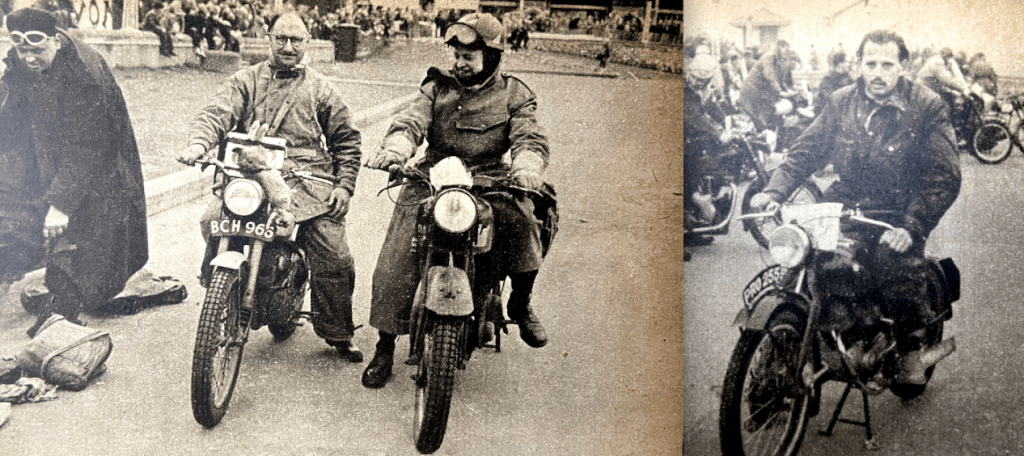
“BY AND LARGE, the A-CU’s 11th National Rally was a great success and every credit is due to all who helped to make it so: to the organisers, control officials, award donors, providers of food and film shows and, most of all to the Mayor, Corporation and people of Rhyl for making available such excellent facilities at the rallying point. But, while the memory of the event is still fresh, it may be as well to record some constructive criticism which, if taken, might still further enhance the prestige and popularity of this hardy annual. There are, of course, many seemingly insuperable problems inherent in a nationwide event in which anyone, from the merest tyro to the seasoned veteran, can enter any size or type of motorcycle, and one of the knottiest is that of deciding ties. In the past three years improvements have been made, but the ideal solution has not yet been devised. Take, for example, the question of capacity class. One would hardly deny that it is more difficult to cover 600 miles in 24 hours on a 98cc machine than on a 500 and, therefore, that the former performance merits greater recognition. But could not the same be said for a 350cc sidecar outfit as against one of 1,000cc? Presumably it could, but not according to the A-CU’s interpretation of the regulations which, although they state that preference will be given to the smaller capacity class, list, under class awards, only one group for sidecars and another for cyclecars—which at present includes anything from 197 to 1,200. It could, indeed, be argued that for the purposes of deciding ties this class-award grouping should not be as taken as the criterion since it is not specifically stated as such, and contains not only different classes but different categories of machine. Would it not be
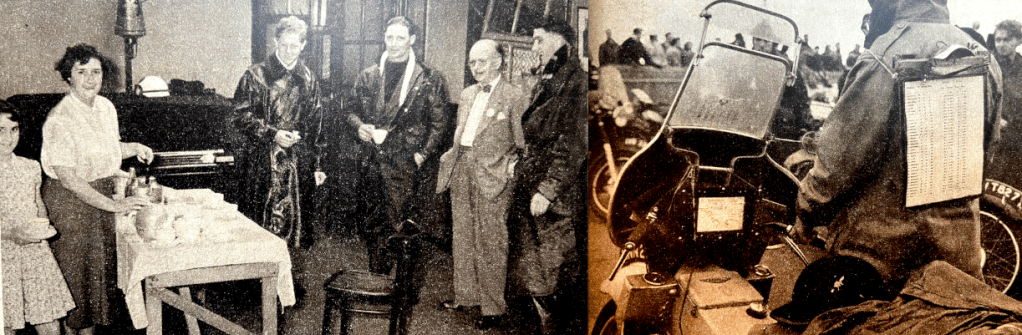
wiser to judge according to the capacity classes laid down in the General Competition Rules—under which the competition is held? In that case the number of solo classes would be increased and their ranges narrowed and distinctions could also be made in the sidecar and three-wheeler categories. And, while on the subject, is it not time a new class for over-600cc solos was introduced? The riders of Golden Flashes, Thunderbirds, Huntmasters, Meteors and Vincent twins cannot at present hope for an award in the over-350cc class and have little chance of a manufacturers’ prize. The eternal question of entertainment for competitors at the final control is, of course, a thorny one. But perhaps the most vital problem of all is that of the outlying controls. Under the present system it is essential that controls should be established in as many parts of the country as possible to enable riders to start from places reasonably near their homes, Inevitably, however, in such counties as Cumberland, Northumberland, Devon and Cornwall, controls are widely separated and are, therefore, visited, by very few competitors other than those who start from there. Yet, manned by volunteers, many have to remain open most of the night. Surely this is taxing the willing helper a little too far? If such controls were to be used for starting only their main purpose would be fulfilled and no one would be inconvenienced. Alternatively, riders could be attracted to them by the award of additional bonus marks. There are those intimately connected with the organisation of the Rally who think that its whole concept should be changed with, perhaps, special tests, and more than one rallying point to reduce return distances. But whether or not revolutionary changes are necessary, it is still clear that while the A-CU can congratulate itself on a generally successful 1954 event, there remains much that can be done in the way of improvement.”
…and for your delectation, the customary agglomeration of contemporary advertisments.