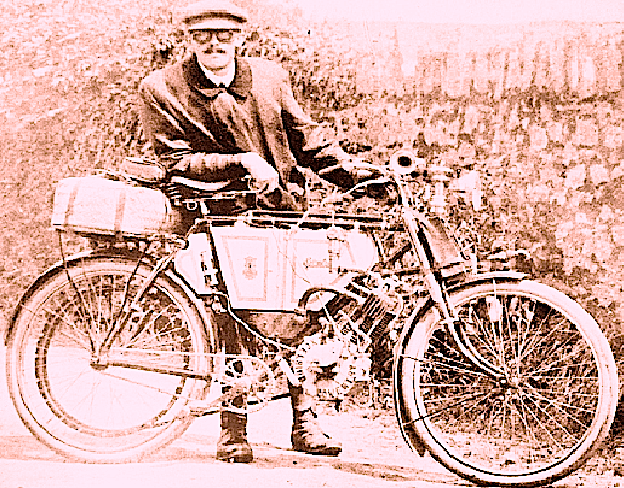
The review of 1918 is complete, at least until more material comes my way, and I’m working on 1919. There is already a lot of material on-site covering the 1920s, 1930s and 1950s but that’s still a work in progress. The motor cycling story is now covered in some depth from the Big Bang to the end of the Great War. So let’s get on to 1919 and roar into the ‘twenties.
Will it all be over by Christmas?
I’ve uploaded a lot of text and some fascinating pics from 1918. The war’s nearing its bloody end and, despite a virtual cessation of motor cycling for pleasure, there’s lots going on in preparation for a return to peace and, for the survivors, the joy of the open road.
1917: That’s it folks
Another year bites the dust. There was no petrol for non-essential motor cycling; a clamp down on petrol substitutes…desperate enthusiasts resorting to blimps full of coal gas…but despite that, and the number of motor cyclists who wouldn’t be coming home again there were still developments in suspension, transmission and power. There were roadtests, humorous yarns and the wit and wisdom of Ixion so take a gander; it’s a good read. Meanwhile my combo’s running on four pots again, plans are afoot to look for the missing fourth gear in a Burman gearbox and 1918 beckons. Motor cycling… it’s a magnificent obsession.
Welcome to 1917, and some more poetry
There are a lot of new yarns in 1917 (with a lot more to come) including pictures of all the bikes built for the Russian front, electro-magnetic valves, illustrated readers’ tips, a big twin Rudge…the Harleys and Indians have joined the fray, there’s a bike made from scrap at the front line, there’s a letter from Wizard O’Donovan about Brooklands Nortons, some exquisite writing by Ixion, so no change there…despite everything new models were being developed too. And in the Poetry section you’ll find three poems from 1917: a jolly ode about a novice; an enthusiast’s address to his final few drops of petrol; and a reflection on the joys of motor cycling written by a lady. By the way, you’ll find loads of meaty features attached to the annual reviews, from blow-by-blow TT and Six-Day Trials reports to touring yarns and oodles of delights. Worth a browse?
1916…finally, it is, for now, complete.
More information from 1916 might well come to hand. But for now, at least, with nigh on 44,000 words, countless pics, a library of period adverts and a yarn to make your eyes water, it is ready for you. You’ll find new machines, roadtests, technical innovations—and an almost complete ban on civilian motor cycle production as that damned bloody war ground on for another year. I’m going to take a day or two off in the garage where several motor cycles lie neglected before getting stuck into 1917.
By the way, when I talk of starting on another year, there is already plenty of copy running throughout the 1920s and ’30s and lots to read from the ’40s and ’50s. And when you’re browsing through the early years of the 20th century, do take a gander at some of the features, from TT reports to long-distance trials. They contain the memories that must have been so precious to the young chaps in the trenches, ploughing through Flanders (and Messpot) mud on the Triumphs, Duggies and P&Ms and, in increasing numbers, taking to the skies.
Lots to read from 1916
HUGE AMOUNTS OF NEW copy and pics from 1916 with more being posted every day. Goodies include road impressions of the P&M V-twin and Alldays & Onion’s vertical twin two-stroke.
1915: The Great War gathers pace
As the war ground into its second year P&M, motor cycle supplier to the RFC, was among firms taken under government control. The review of the year is now complete (until more factoids become available). Despite the demands of the wear effort new models still appeared, not all of them British as the Americans were happy to take a slice of the British cake. You’ll also find motor cycle sports reports from round the world, new products, a snippets, news, roadtests, a smashing bit of romantic fiction, loads of adverts…well worth a look. Meanwhile, I’ve started expanding the review of 1916. Motor cyclists were serving as despatch riders, in the Machine Gun Service, the RFC and, of course, the Poor Bloody Infantry. And all they wanted to do was get home and ride their bikes. Let’s count our blessings.
More stories and pics from 1915
1915…motor cyclists were clamouring to ride bikes on the western front, as despatch riders or with the new Motor Cycle Machine Gun Batallions. But new models were still appearing and enthusiasts were doing their thing in reliabilty trials; in countries not involved in the carnage records were being broken.
PS There’s a great deal of material already posted for the 1920s and ’30s (with more pics to be added as time allows) and for some light relief the poetry section offers its own insight into our lyrical forebears. And you really ought to check out Ixion’s summary of motor cycling history; it’s a treat.
Six Days Trial and…it’s war!
In the 1913 Features section you’ll find coverage of the ACU Six Days Trial that sowed the seeds for the ISDT. It was tough enough for riders to complain and vote over strike action. Things got pretty heated but within a few months that all seemed trivial—turn to 1914 for tales of motor cycle enthusiasts leading the charge to the front line. Before long despatch riders were having poignant letters published in The Motor Cycle.
A Dash for Liberty
When the Great war broke out a lot of unfortunates were in the wrong place at the wrong time. In the 1914 Features section you’ll find a ripping yarn detailing the Thrilling Adventures of a Scott Rider in Germany and Belgium. There’s a great deal of new material in 1914 with more to come.
 Motorcycle Timeline