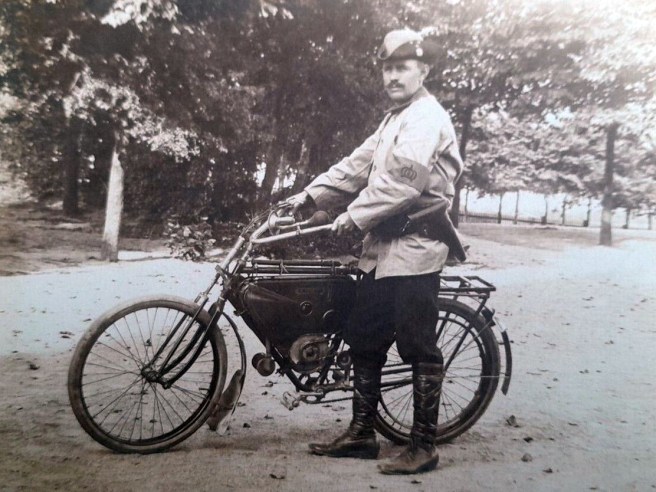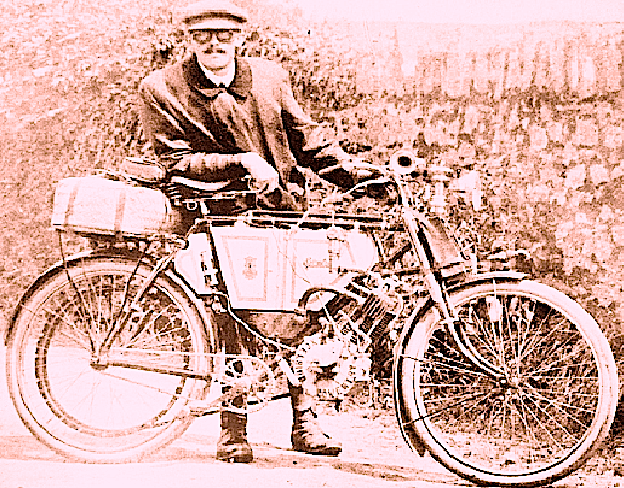
I’ve been working on the huge backlog of pics for the Melange and have been concentrating on dated images. Recent additions range from 1902-9, you’ll find some of them in Melange 2; the rest are in their respective years with some extra adverts. As of today 9 January 2024) the two Melange pages contain exactly 1,009 images.
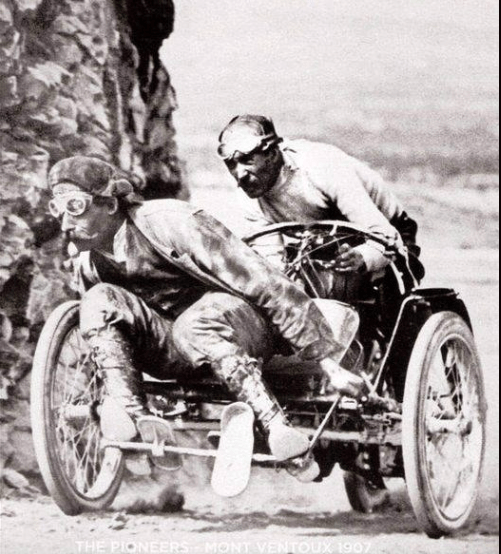
I didn’t have a date for this racing forecar rig but you’ll find it in Melange 2 with a number of other undated images. And that passenger must have nerves off steel.
My Aussie mate Murray kindly sent me scans of a 1904 issue of the Blue ‘Un which included a retrospective on the chaotic Coupe Internationale, a number of three-wheel conversions to help riders stay upright on grease, a thrilling race report from Lincolnshire and much more, culminating in a wonderfully vicious essay from Ixion in response to criticism of the Edinburgh Trial from a cheeky colonial. I’ll get back to uploading more excellent pics to the second Melange page, courtesy of my French mate Francois, then its time for 1937. Watch this space.
“A consignment of Pratt’s A arriving at Mr AW Marriot’s Depot, Hereford, for use in the Small Car Trials. The motor cyclist in the illustration rode with the cars throughout, and made the arrangements for the supplies.”
Then, as now, the world was going to hell in a handcart. Edward VIII abdicated (and a good thing too). Hungry men marched from Jarrow to London. Japan attacked China, Spain attacked itself. On the motor cycling front Britain recaptured the ISDT after three years of German domination. Noel Pope rode a Brufsup extremely fast; Ernst Henne rode a blown Beemer slightly faster. Vincent-HRD produced a 1,000cc twin, Ariel produced a 1,000cc four. And some excellent chaps in Cleckheaton produced the 600cc M100 Panther that’s in my garage. I just checked and the coverage of that momentous motor cycling year runs to more than 96,000 words and 240 pics—I urge you not to miss Ixion’s glorious yarn of the 1902 forecar that cost him a fiancée. See you in 1937.
On 1 January 1936 a Panther Model 100 took to the road.
I’ve made a start on 1936—there are already some good yarns on line—but there’s a long way to go. Regular readers will know that I’ve already leapt ahead to review 1969, simply because that’s the year I started riding (on a 1959 Ambassador-Villiers). Now, I’m pleased to say, two old mates have joined the fray. Pete, a drinking companion at some memorable rallies in the seventies, has contributed memories of some of the bikes he rode in 1971 when he was earning a crust in the bike trade. And John, my old boss on Motor Cycle Weekly, has chipped in with a review of 1980 when bike sales peaked and he was kept busy riding the cream of the crop. My thanks to them, I suggest you take a gander because they’ve done me proud.
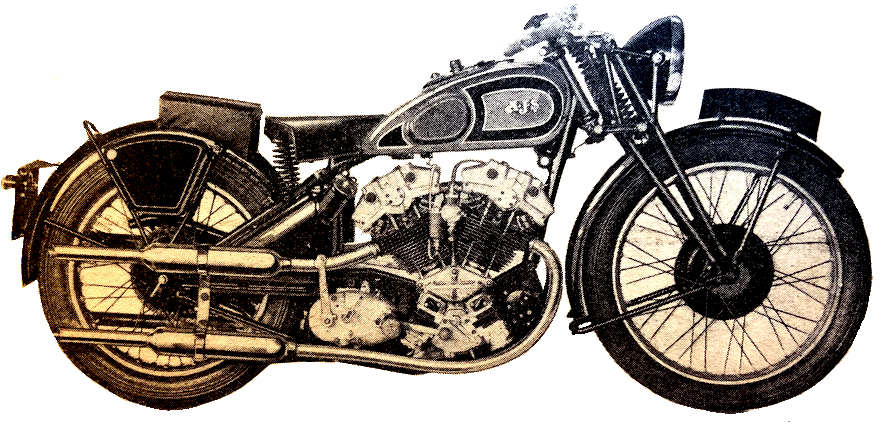
From a British point of view 1935 was, like the curate’s egg, good in parts. A Motot Guzzi, albeit a Moto Guzzi ridden by Stanley Woods, won the Senior TT. Germany tightened its grip on the ISDT and the world speed record. On the other hand Ariel launched the 1,000cc Square Four; Matchless launched a 500cc ohc V4 AJS with an optional supercharger that was expected to take over from Norton’s ageing cammy singles as a world-beating racer. A new breed of lightweights was extending the potential motor cycle market—though Britain lagged behind its Continental competitors in this respect. Tilly Shilling won a Brooklands Gold Star; Noel Pope won a Brooklands ‘Super Award’ All this and lots more awaits your pleasure; I’m getting stuck into 1936.
“The design of the new V4 AJS engine is such that it fits snugly into the frame of the ohc 500 ‘single’…the dynamo will be replaced by those who desire it with a supercharger.”
1934 is now online, with the usual assurance that further yarns and pics will be added as and when. You’ll find hardware, including the last NUT, the first high-cam HRD-Vincent, a 150cc two-wheel car and an in-line three-wheel bike from OEC, a 500 transverse flat-twin Douglas, an in-line two-stroke 750 triple from Scott and an iconic auto-cycle. Events include the first multi-cylinder ton in the UK and a Maudes Trophy for the ever so ‘umble Red Panther. There are some ripping yarns too. Staffers from the Blue ‘Un took a ride round the capital, featuring a poignant visit to Battersea Dogs’ Home and a first encounter with Chinese food; Graham Walker showed that he could write as well as he rode with mirthful racing reminiscences; and there’s an entrancing little tale of two chaps pottering about the Welsh marches. You’ll also find a particularly good crop of contemporary ads. PS: The process never stops. If you’d care to turn to 1921 you’ll find a three-cylinder radial; in 1923 there are some particularly appealing ads; in 1926 there’s a three-wheel WD Triumph; in 1933 there’s Peugeot’s first 500 since 1920 (it really is très chic); Gallimaufrey now includes ‘Batting’; Blinding’ and the great Stanley Woods.
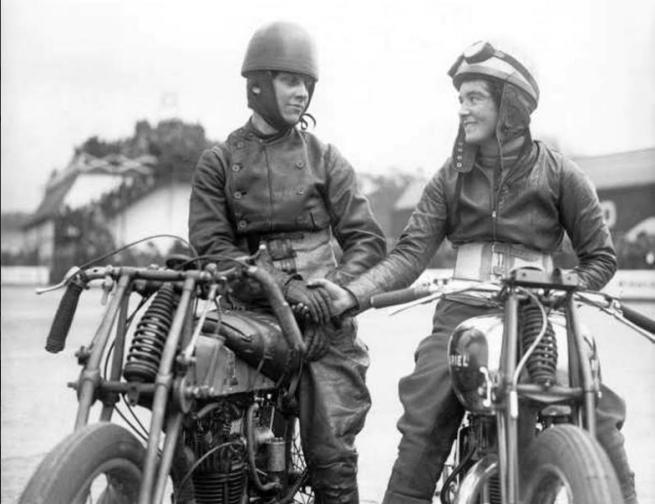
Pictured at Brooklands are Florence Blenkiron (left), who had just become the first woman to win a Brooklands gold star for averaging over a ton for an hour, and Theresa Wallach who went on to win a gold star in 1939. We’ll meet them again in 1935, when they took a Panther combo for a ride—to Capetown.
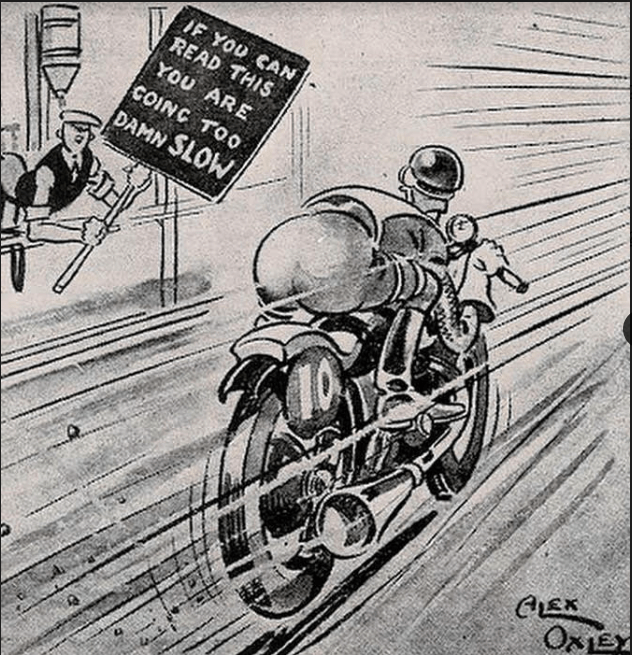
More than 50 (ok 51) images have been added to the Artwork/Humour gallery which now has nearly 220 (218 to be pedantic) cartoons and illustrations awaiting your attention. I’m particularly pleased to offer a batch of Oxley illustrations but there are also some breath taking coloured ads. More American bikes may be found in the Melange along with a large number of aditions to the Great War gallery. And a couple of dozen assorted images have been added to the second melange. Meanwhile, probably because he’s impatient with the progress of the timeline, my buddy Pete has sent me a taster for 1971. He worked in a bike shop and has wider experience than most of early Japs—his experience on a Kawasaki H2 widowmaker may bring back some memories among the survivors…
Another batch of pics have been added to the Melange including a number of excellent American sporting images; you’ll find them under the Harley, Indian, Thor and Excelsior headings. There are also some additions from the Great War which also has its own heading.
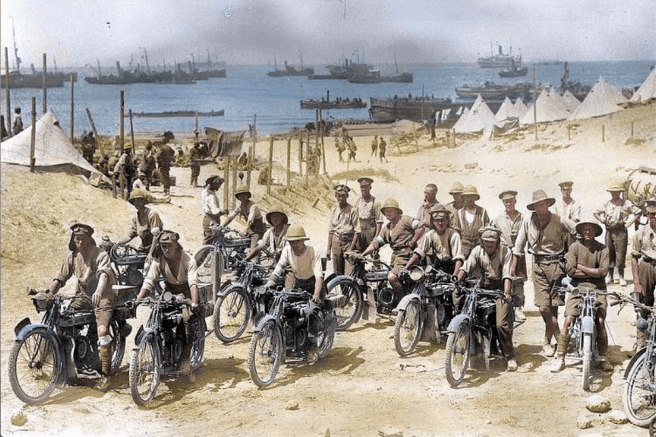
1915: British DRs in the Dardanelles prior to the Battle of Gallipoli.
All the material to hand for 1933 is now on line, incliding a comprehensive report of the Olympia Show, as well as a technical review of the state of the motor cycling nation and oodles of other good stuff. Before making a start on 1934 I’ll take some time to work on the huge backlog of assorted images of motor cycles and motor cyclist greatfully received from my chum Francois.
L-R top to bottom: “‘The Donington Special’ is the name of this Swallow model, which has an exceptionally neat hood, a plated hand-rail and is exhibited with a back and red finish. This example of a lightweight sports body was found on the Royal Enfield stand; the finish is in aluminium fabric. This launch model, to be seen on the AJS stand, is one of the smartest of its type—it has an aluminium finish with black decks and chromium beading. The chassis is enclosed in this new Triumph design; note the car-type wing and the dicky-seat. Black with red upholstery is the finish.”
Following a deep dive into 1902-4, as reported in Motor Cycling/Motor, I’m back on course working through 1933. The Jerries went to Wales and won the ISDT by a single point; Triumph won a Maudes Trophy with an ohv 650 vertical twin; bike registrations were up by a third to more than 600,000; four-speed boxes were becoming common (foot-change wasn’t); and… as usual more yarns are being aded all the time. Also uploaded today: some smashing agency pics from 1932 including motor cycle hockey; and a colourised pic from the big Richmond rally of (probably) 1911.
In 1933 Professor Archibald Low made some predictions about what we’d be riding in 1953…