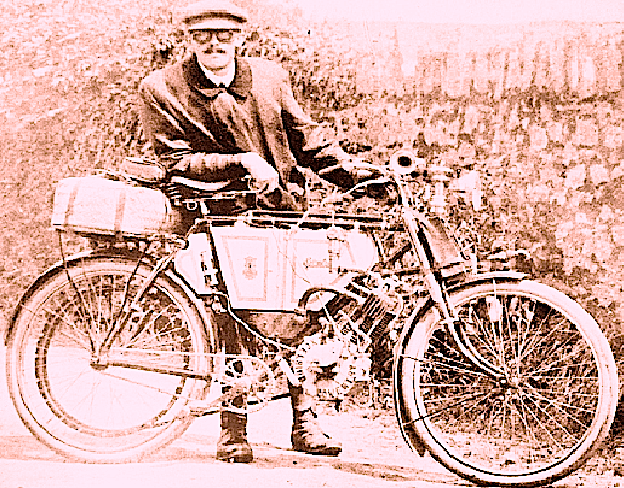
Some chaps still become over-excited by the very idea of women riding motor cycles. In the early years of the 20th century they were certainly a rare breed but a determined one typified by Mrs Edward Kennard (married women were denied Christian names of their own in the pre-suffrage era) who wrote the following incitement to ride…

“TWO YEARS AGO (in 1901), several manufacturers exhibited ladies’ motor bicycles at the Stanley and Crystal Palace shows. Messers Bayliss, Thomas & Co [Excelsior], Mr Citroen, Mr Van Hooydonk [Phoenix], Mr Dan Albone [Ivel] and the Singer Co all made praiseworthy attempts to introduce a machine adapted for the use of the fair sex. That these bicycles were not perfect in every respect was only to be expected. Nevertheless, had female cyclists displayed a greater spirit of enterprise, undoubtedly in a short time their wants would have still better catered for. There is no greater mistake than to wait for perfection. Moreover, man is so constituted that even were perfection attained, it is questionable whether he would derive half as much enjoyment as from a mount which delights him one minute, perplexes him the next, aggravates him the third, and restores him to good humour the fourth. The motor-bicycle of today, with all its defects, is a supremely interesting conveyance. Personally, I ordered an ‘Ivel’ there and then and rode it over a thousand miles last season without anyone in attendance. My husband accused me of obstinacy, disobedience and I know not what: but I
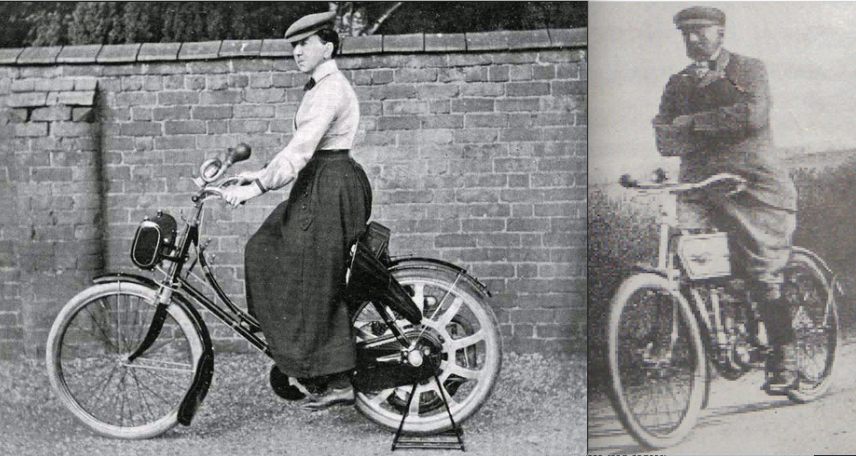
stuck to my guns—or, rather, my bicycle—and in the end converted him to the fascinations of the pastime. [So the vice-president of the MCC was introduced to motor cycling by his wife. I wonder if his clubmates knew?—Ed]. With sincere regret I noticed this winter that the number of ladies’ machines had diminished rather than increased. On inquiring the reason for this apparent retrogression I was informed on all sides that the ladies were holding aloof, and but a limited number had even made preliminary interrogations respecting motors. Having received so little encouragement the manufacturers did not persevere in their attempts to put an improved machine on the market. The consequence was at the latest shows I only saw one lady’s bicycle—the ‘Singer’. It is high time for the fair sex to wake up and to overcome their initial fear. Anyone who has ridden a free-wheel will soon find herself at home on the mechanically propelled mount. Why should men have the field all to themselves? Among their number there are novices quite as ignorant and quite as stupid as any member of the fair sex. Everybody must make a start and everybody can learn, if disposed. A great many women have husbands or brothers who would help them when any little difficulty arises, and far nicer it is to ride a bicycle of one’s own than to be propelled in a trailer or fore-carriage like a bundle of inanimate goods. There are women and women. I should not dream of recommending a motor bicycle to that section of feminine riders who fly to the nearest cycle agent to pump up their tyres, mend a puncture, or any similar trifle: they are wise in nor courting disaster. But others have good heads on their shoulders, are natty and quick, and know enough about their mounts to undertake tours of several hundred miles by themselves. These can master the intricacies of a motor bicycle if they are so minded. I do not say they could tackle a broken crank or connecting rod on the road. But they can acquire the elementary rudiments of electricity, so as to distinguish a high-tension wire from the primary circuit. They can screw a plug in and out, clean and set the points, put a belt on and take it off, shorten it, tighten up the contact screw, file the platinum points, attend to the carburetter, and perform a variety of similar jobs, which require knack and a certain amount of experience. Where the lady fails is in strength. She cannot often make an obstinate nut yield which has been tightened up by masculine force. But every ride will teach her something, and by degrees the puzzle which at first seemed hopeless of unravelling will appear comparatively simple. If the worst comes to the worst, the novice can always remove her belt and pedal to the nearest railway station. But this expedient need very seldom be resorted to. When time is not of importance it will be found more satisfactory to wheel the machine to a quiet corner and prosecute a systematic search for the cause of the stoppage. Often it may be easily found. A terminal shaken loose from the battery, a faulty sparking plug or a dirty trembler may prove the sole cause of trouble. I well remember my feelings of
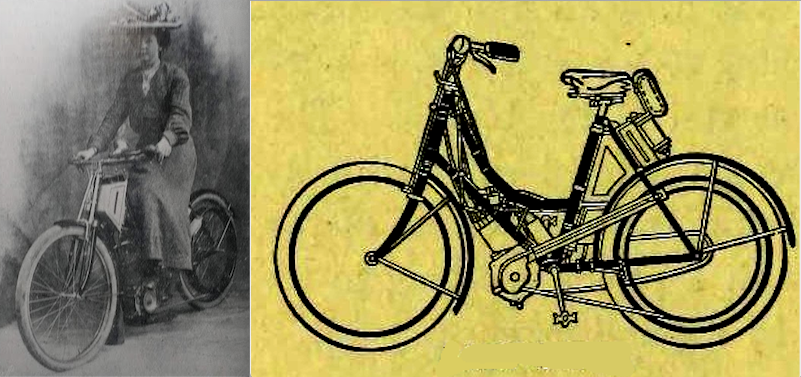
dismay when my mount first came to an unwelcome halt. I was over forty miles from home when the ‘Ivel’ suddenly jibed. ‘Oh dear oh dear!’ I thought to myself, ‘what on earth am I to do now?’ I dismounted, my heart standing still from cruel misgivings. Then I pulled myself together. ‘This is absurd; you cannot ride a motor bicycle if you are going to be frightened out of your life simply because it stops.’ I possessed a good deal of theoretical knowledge, but not much practical. However, I summoned the former to my aid, and, propping my badly behaved ‘Ivel’ against a telegraph post, went down on hands and knees in order to examine the contact breaker. Oh, misery! Not a spark could I raise. Something dreadful was the matter. I got the sparking plug out after burning my fingers, and was made doubly unhappy by finding it refused to give forth the faintest glimmer of electricity. And I was forty miles away from home! Fool that I had been to ride so far! Never again would I trust myself to such a fickle and capricious mount. The despised ordinary bicycle was worth a hundred of these new-fangled inventions. What was I to do next? Ha! happy thought. Open the battery case. I did so in fear and trembling, and lo! in one moment my despair was changed to joy. The terminal had shaken off and lay wedged between the two accumulators. My spirits soared like quicksilver in a barometer on a sunny day. Out with my long-nosed pliers and on with the terminal. I was going to say it was the work of a minute but truth compels me to state I took about five, being new to the operation in hand. At length all was in readiness. I cautiously wheeled the ‘Ivel’ into the middle of the road and, thanks to a convenient gradient, managed to mount with greater ease than usual. The welcome sound of a spasmodic explosion reached my anxious ears. It was followed by another and yet another. Hooray! Once more my gallant ‘Ivel’ soared away in gallant fashion. How pleased I was with myself! Never before had I entertained so great a respect for my own capacity. Alas! it was short-lived. Ten delightful miles of swift soul-stirring transit and then—a report like a pistol filled me with horror. What had gone wrong? On with the brakes and I pulled up, only to see my belt lying like a dark curved snake on the middle of the white road about a hundred yards in my rear. I heaved a gigantic sigh of relief. It might have been worse. I thought the engine had gone smash. Soberly, I retraced my steps and picked up the belt. The hole had torn through at one end. Once more I had recourse to a telegraph post and squatted down on the grass, knife in hand. It did not take long to cut a quarter of an inch from the leather. Fortunately, in my wallet I had the necessary tools for punching a fresh hole. I will not pretend to say I was quick over the operation, but I managed it in the end and rose triumphantly in order to put the belt back in its place. I twisted it with almost masculine determination and, hailing a passing tramp, asked him to wheel the machine whilst I put it on. But—please don’t laugh—it wouldn’t go. I tried till I was tired, then the tramp tried. Then I tried again. At last it dawned upon my obtuse mind that I had twisted the belt too tight. I slackened it a couple of turns, and to my inexpressible relief it slipped into the pulley. I gave the tramp a couple of pence and inwardly hoped he had not fathomed the depths a my ignorance. But these contretemps made me more and more determined to learn. The things only seemed difficult because I was stupid. I wouldn’t be stupid. That was the solution. I must never rest until I had mastered the ordinary difficulties likely to present themselves on the road. All men who rode bicycles could not be clever. Some of them, when they began, were surely no brighter than an ordinarily endowed woman. I took courage when my ‘Ivel’ landed me safely home and, recalling the events of the day, I realised that something had been done, something achieved, even if much
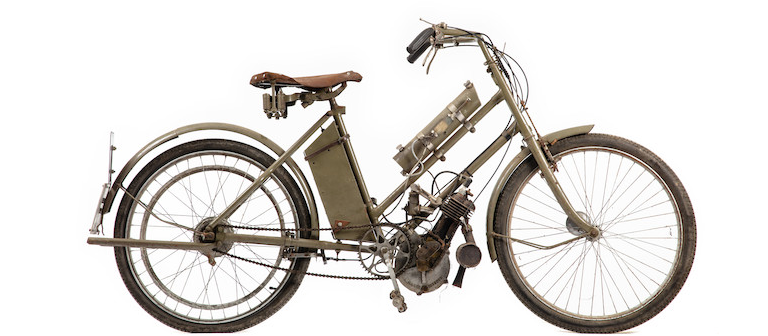
yet remained. My last season’s mount was a 1½hp ‘Minerva’, and the results obtained were extremely satisfactory. I never once had either to train or pedal home. On several occasions the terminals shook loose, I ran out of petrol owing to a leakage of the pipe, and the spray carburetter did not always behave quite as it should. On taking it to pieces one of the balance weights proved to be longer than the other—a defective piece of workmanship. But with these exceptions my low-powered mount behaved with exemplary consistency. I could average between 17 and 18mph on it, according to the roads; and although the pace may seem ridiculously slow to the scorcher, it was a very pleasant one for getting about the country. Moreover, the engine was a remarkably ready starter, and I experienced little or no difficulty in mounting, except uphill. On very steep ascents I had to pedal now and again, but on a long journey I found this formed a pleasing variety and I rather liked doing so than otherwise. Sitting still hour after hour in the same position, with one’s eyes fixed on the road ahead, has some-what of a hypnotising effect. On the whole, I was very well pleased with my ‘Minerva’ although the ‘Ivel’ was not free from sundry defects, which I gradually discovered during the process of riding. First and foremost I wanted three hands for the numerous levers; secondly, I soon came to the conclusion that handle-bar control was absolutely indispensable both for comfort and safety. A woman’s machine is not nearly as rigid as a man’s, and when running at high speeds it is not very safe having to let go of the steering and bend down to reach a throttle or sparking lever, as the case may be. Neither is it easy not to deviate an inch from one’s course. In my case, the throttle, and compression taps were placed some way below the head of the bicycle. My right hand had to control the exhaust lifter, the sparking lever, and a thumb-applied front brake. The left was kept equally busy with the manipulation of switch and bell. The maker made one or two essays to improve the control, but was not altogether successful in his attempts. Owing to the dangerous illness of my son, which necessitated a journey to Malta, my riding season was cut short, and the longest journey I performed in a single day was 98 miles. I think the ordinary female rider will find such a distance enough for pleasure. Although but little bodily fatigue is involved if all goes well, there is a certain mental strain which it would not be wise to overlook. The higher the speed the greater the tension, and for this reason I welcomed a little incidental pedalling. But ambitious man or woman is never content. This season, goaded by the example of my husband, who purchased a 2¾hp ‘Clyde’, I went in for increased horse-power in the shape of a 1903 ‘Minerva’ with mechanically operated inlet valve. I soon found that my new mount was very much harder to start than its predecessor. Once fairly set going it was right enough, but let it stand for a quarter of an hour and my feminine strength seemed almost insufficient to pedal against the compression. This, however, was overcome to a great extent by fixing a compression tap to the cylinder head and lubricating the engine with a drop or two of paraffin. My new conveyance was very much faster than the old, and its power and speed were undeniably attractive. Nevertheless, I should certainly advise the beginner to be content with an engine of 1½hp to commence with. It possesses many advantages for the novice, among which ease of starting occupies a foremost place. Most women fail where things resolve themselves into a question of physical strength. The bicycle of the future will trend towards increased lightness, a small moderate engine accompanied by a clutch of some time to render starting easy and a two-, if not three-speed gear for hill-climbing. The knowledge that the machine could always be ridden a few miles like an ordinary safety, if the worst came to the worst, would induce many of the fair sex to enter the ranks of automobilism. Effective control of a simple and reliable nature is of the utmost importance. And for the very reason that few women have any mechanical knowledge, it is imperative that everything should be accessible. It is very hard on a woman to have her sparking plug placed in such a position that she can hardly get at the high-tension wire in order to detach it, or to burn her fingers in the process against an ill-arranged exhaust pipe, or to be given a faulty carburetter which is a regular puzzle to set right. Split pins should not be used where lock nuts can be employed, and everything should be solid and of good workmanship. The time is now rapidly approaching when ladies may wake up with pleasure to themselves and profit to others. When they finally take the plunge and order a motor bicycle, they will do well to have a week’s lessons. The actual riding appears exquisitely easy at first. It is only the more experienced rider who realises the full extent to which caution is essential. The novice is almost invariably eager, daring, rash even to the point of danger. She pronounces the whole thing absurdly simple and wonders at her own hesitation in having delayed so long. But do not he misled. There is a good deal to learn, and it is no use disguising this fact. Anybody can sail away on a motor bicycle until it stops. But what then? A lady should know enough to do ordinary repairs. The requisite knowledge comes firstly, by teaching; secondly, by practical experience on the road. In the beginning such expressions as cam contact breaker, pulley, plug, trembler, etc are so much gibberish to her. Time and patience work wonders, however, and no one need despair. Will and intelligence combined solve most of the riddles of life. The lady rider must be prepared for ups and downs. She must take the rough with the smooth. Some days she will haul and strain and tussle with her mount and hate it with a vicious feminine hatred. But there are other days when she will bless it in ecstatic gratitude, when the swift and glorious passage through the air will bring a sense of exultation and of exhilaration to her whole being. At such seasons the sound of her little motor pounding merrily away, explosion following explosion in regular succession, will be to her as music dearest to her heart; and then she forgives the bit of femininity beneath her, its moods. its sulks, its smile, its vagaries, just as she would forgive her own. For are they not equally capricious, tantalising, and adorable? They provoke you one minute to make you worship at their shrine the next. How absurd to talk of a mere motor in such glowing terms, I hear the critic say sneeringly. Poor man! he does not know the fascination of piston and plug, of coil and carburetter, of trembler and terminal Their very faults endear them to the enthusiast. They are a constant puzzle, a perpetual challenge to the human brain. There are new fields before you, ladies—fields of interest, of instruction, of pleasure. Awake then from your lethargy. Throw off your fears. Once you have summoned up sufficient energy to make a start, you will never regret it. The enthralling motor will claim you as its own, welcoming in the fair votary a kindred spirit. It has already been shown that the makers of ladies’ motor bicycles can be counted on the fingers of one’s hand at the present time. Consequently the choice of machine is exceedingly limited. When I first commenced to ride, it was not so much a question of what I should like but of what I could get. Gentlemen naturally possess a great advantage, seeing that some thousands of motor bicycles have already been placed on the market designed for their use. In spite of certain drawbacks as regards rigidity it is much better for female aspirants to stick to the usual type of frame and not attempt to bestride a man’s machine. It can be done, but Mrs Grundy is far too powerful and influential in this country to render such a proceeding desirable, no matter how harmless it may be in itself. I quote a personal instance: Two or three years ago I possessed a 2¾hp De Dion tricycle, and was forced have a bar, which necessitated the wearing of a divided skin. I obtained an excellent pattern, and had one made. It hooked down the front, and when off the machine closely resembled an ordinary skirt. It had nothing to do with the knicker-bocker variety, and was absolutely decent. Nevertheless, one windy day I happened to ride into Coventry. Whilst walking down the High Street, the gusty wind slightly blew apart the lower portion of my costume. In an instant a censorious, prying old woman stopped and gazed at me. Presently she accosted me thus: ‘I do not know if you are aware of the fact, but your dress is open down the front, ma’am.’ ‘Thanks,’ I responded, with simulated indifference, ‘I am infinitely obliged to you.’ So saying, I stooped and made pretence to fasten a hook. But still the worthy dame was not satisfied, and evidently considered there was something uncanny in my personal appearance. She continued to follow in my wake, eyeing me meanwhile so intently that very soon I found myself pursued by a small crowd of ill-mannered factory girls. I took refuge in a confectioner’s shop and meditated on the ignorant prejudices of my countrywomen. But for the very reason that they exist in such force, so do I advise wise woman to bow to them. It is better to put up with a little loss of rigidity in one’s mount rather than offend convention and custom in the slightest degree. There are doubtless a great many things we women would do if we were our own masters. The probabilities are we should reform our dress altogether; but we are not free to act as we please, and that fact should be borne in mind. Nothing is gained by stepping out of the ranks of your regiment and resenting the drill imposed by discipline. Of the few ladies’ machines I have seen, that made by the Booth Motor Co, of Putney, appears to me to embody many practical features, and to fulfil female requirements to a considerable extent. The Clyde Motor Co, of Shenton Street, Leicester, are also prepared to turn out a very neat and businesslike machine. The tank is placed in front between the two tubes leading from the head, the coil is most conveniently situated beneath the peak of the saddle, thus causing it to be well protected by the dress, there is plenty of clearance. and the maker’s guarantee the rigidity of the bicycle. An ingenious attempt been made to place the accumulator close to the bottom bracket, thereby reducing the length of the high-tension wire to a minimum. In short, signs are not wanting that directly the ladies begin to create a demand, their wants will quickly be catered for by the more enterprising firms. Then improvement will be rapid. The principal points for feminine riders are rigidity, a good steering angle, freedom from vibration, and ease of manipulation. We do not want machines which demand more than an expert to guide. The sooner makers recognise these facts the better. Efficient control is absolutely essential, and there should be no occasion to remove the hands from the handle-bar. Having once selected her mount, the fair beginner will do well to exercise caution and judgment on the road. It is not always the person who rides the fastest who rides the best. The tortoise often beats the hare. The most successful riders are those who meet with the fewest accidents. Even on an ordinary safety, some individuals are in perpetual trouble. They use neither their eyes nor their head. They rush at full speed round sharp corners, and are then surprised if they collide violently with their fellow creatures. They not only damage their machines but also themselves. It is not necessary for a lady to emulate the performances of the lords of creation. No one expects it. It is enough for her to steer her conveyance with discretion and propriety. One of the highest compliments a man considers he can pay a woman in the hunting field is to tell her that she is not in the way. He means it as genuine praise. The same remark applies to motor cycling. If you do not do foolish things you are not an unmitigated nuisance to other people, and in the end you get on far better by not being too ambitious and maintaining a steady average than attempting to show off or ride road races with your companion. Your first consideration should be your engine. Never overheat it by injudicious handling. Switch off downhill and open the exhaust. No matter even if you do not run as fast as on an ordinary free-wheel bicycle, you reap the benefit when you come to a hill. Those who go at a headlong pace on the level are frequently forced to lower their colours when they come to a steep ascent. Their motor is fatigued and jibs like a living beast of burden. The engine should never be allowed to rattle and race. The great art of riding is to maintain a given speed on the weakest mixture consistent with the rate of progression. There is riding and riding, and only the ignorant maintain that one person is as good as another. There never was a greater fallacy. If you mean to ride at all, you may as well learn how to ride properly. Every sound of the engine ought no be familiar, and a quick ear should detect the smallest irregularity in the explosions. No article concerning motor cycling for the fair sex would be considered complete without some reference to that important subject—dress. But here I am afraid I shall go into disgrace. I candidly avow that what to wear is a problem not easy of solution. If the roads are muddy the feet and skirt must inevitably suffer to a certain extent and good clothes are thrown away. Nothing is more serviceable than a strong tweed that will stand any amount of brushing; the best colours are grey of fawn. In winter a very warm jacket is imperative, but at the same it must be light enough not to impede the movements when dismounted. Big sleeves and capacious pockets are both useful and comfortable. Whatever headgear is selected, it should remain firm. No flowers, feathers, or fancy ribbons are permissible in conjunction with a motor bicycle—furbelows are ridiculously out of place. The rider will find an extra pocket on the left side of her skirt invaluable. In it she can stow away a good piece of spare rag wherewith to wipe her hands after any little repair: neither should she go out without a sharp knife. Her toolbag should he carefully stocked, for if the requisite implements are wanting, she will soon be stranded. She must make a point of carrying one, if not two, spanners, a pair of long-nosed pliers, a screwdriver, a spare plug and trembler, also a platinum-pointed screw, some copper wire (stout and fine), a few nuts and bolts, and a spare exhaust valve that has been previously fitted. For testing the accumulators nothing is so useful as a small lamp (a voltmeter is apt to prove deceptive, especially after the battery has been standing still). If employed, it should be done immediately on returning from a journey. Experience alone can teach the numerous wrinkles familiar to the expert. A diligent perusal of the excellent papers now devoted to motoring will go far to render the novice acquainted with the subject. Little by little, knowledge is acquired until the difficulties fade which seemed insuperable. Women nowadays are capable of so much that I do not for one moment believe they will allow themselves to be beaten by the intricacies of the motor, They will conquer motor cycling as they have already conquered the majority of sports and pastimes. If they do so with feminine grace and tact men will welcome them cordially and do their utmost to assist and instruct. But ladies must he careful in one respect. They must not attempt to ape their male companions either as regards dress or performance—that would prove fatal to their best interests. Nobody wants them to ride from Land’s End to John o’Groat’s in record time, and then pose as champions who have gone one better than professionals. But the sensible woman has a natural intuition of the fitness of things. It is to her I appeal as belonging to the class who will eventually ride the motor bicycle—the woman of nerve, of courage, of intelligence, and of perseverance. To such a one success is assured. Those deficient in the above qualities will have to stand sadly aside and regard their more highly endowed sisters with envious eyes.”
The formidable Mrs Kennard was by no means the only proponent of motor cycling for what was commonly referred to as the gentle sex
Motor Cycling for Ladies
AT THE PRESENT time motor cycling is not pursued by many ladies, though there are evidences, and these are increasing daily, which show that the pastime will undoubtedly become a favourite of the fair sex. The great objection from the feminine point of view to motor bicycling is the very general idea that it must of necessity result in the rider besmearing her costume and gloves with oil and dirt, and becoming more or less a grimy object. A good many motor cyclists have a wonderful way of making themselves remarkably dirty every time they go out; but it should be clearly understood that this is not a necessary accompaniment of the pastime.
Quite apart from the necessity of giving foot and dress clearance and entirely protecting the skirt from the possibility of entanglement or soiling, it is needful to remember the majority of ladies will be content with very much lower speeds than the average male cyclist wants. This means a lower gear can be used and a comparatively small and light engine, which in turn permits the use of a lighter bicycle, so that the machine as a whole can safely be considerably lighter than the average bicycle intended for male use.
As it becomes realised that a specially designed and constructed machine for feminine use is available, the demand will undoubtedly grow rapidly, not only because the fair votaries of the sport are sure to make converts among their friends, but also on account of the fact that the trailer and forecarriage are introducing a large number of ladies to the pleasures of motorcycling; but many of them are too active in disposition to relish the inaction and lack of occupation inseperable from the trailer of forecar. A number of them are already quite adept in theory in the management of a motor cycle, and require very little instruction indeed before they will be thoroughly qualified to take charge of and control a motor-propelled cycle.
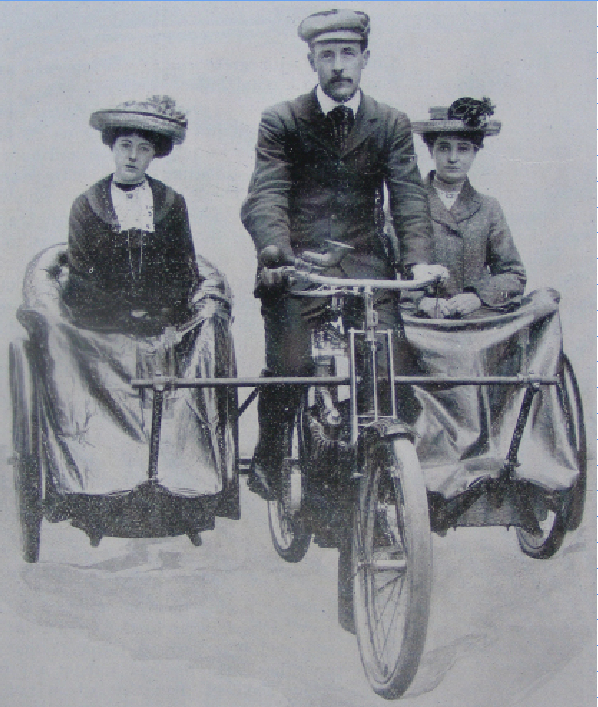
Ladies, know your place…
The readers’ letters you’re about to read were written 15 years before the first women got the vote and 30 years before women routinely wore trousers. Working-class women had no access to the expensive joys of motorcycling. But a minority of plucky gels among their middle-class and upper-class sisters were already cycling, much to the chagrin of ‘traditional’ chaps.
Motor bicycle driving by ladies.
TO MY mind, woman was never made for an engine driver, and has not that cool nerve required so often in motoring. I saw a lady motorist riding a Singer lady’s machine for the first time some fortnight ago at Cambridge, and without being ungallant, I don’t want to see another. Her nervousness was pathetically obvious, and her facial expression was an index to the sustained nervous tension under which she was labouring. I am sure that the natural constitution of the gentler sex is not such that they can extract any pleasure or physical good from such a pastime as motoring, which requires strong nerves, and a cool and ready hand and head.
Of course there are ladies who are made of very much sterner stuff than the majority, but I am sure that if motor cycling is indulged in by ladies, they will be a source of considerable danger, both to themselves and other users of the road, and I pity the poor men when the ladies of the household come home from a hard ride ‘a bundle of nerves’.
The majority of lady cyclists are bad enough in observing the rule of the road and practising gymkhanas all over the place, hopping off in front of one without the slightest warning, riding three abreast, and doing other funny things, but Heaven forbid the lady motorist.
SMTB
Mary Kennard was never going to let him get away with that…
YOUR CORRESPONDENT ‘SMTB’ seems very nervous where ladies are concerned. I must say I think he is unnecesarily so. I have riden over 2,000 miles on a motor bicycle, and only had one accident. This was occasioned by a male cyclist, who ran into and upset me, as well as himself.
I ride everywhere alone, doing journeys of one hundred miles and under. I do not consider a motor bicycle is pleasant in thick traffic or on greasy trams, but with the Bowden system of control a lady can manage her mount quite easily, and run comparitively few risks if she rides with ordinary prudence.Dogs are the principal danger, and foolish cyclists (male and female) who possess little or no headpiece.
Why forbid the lady motorist? She exists already and will surely increase.
Mary E Kennard
AS A WOMAN, and a rider of a Singer motor bicycle, I would most respectfully call the attention of SNJR to a few facts which he has evidently overlooked.
Far be it from me to take up the pained and painful attitude of a brow-beaten Premier; but is your correspondent fair? I think not.
Every woman (“ladies” preside at wash-tubs!) can do what her particular nature permits her. There are some women, and also men, who ought not to approach within ear-shot of a motor bicycle; but with motors at their present price, the fact that a woman invests in one with the intention of riding it shows she is not one of these. Practice makes perfect, and if circumstances forced the Cambridge motorist into traffic before she felt sure of her mount, she is to be sincerely pited, and not made the subject of an appeal to an even higher power than the local Robert – plus stop-watch. There are, I believe, six women motor bicyclists within the British Isles, and there must be six hundred waiting for the right moment and the right machine.
As for SMJR, all the consolation I can offer is that, despite my best efforts, it seems probable that there is still some little time beetween him and the day his nerves seeem to dread – the period when absolute equality in all things, subject to an individual capability, will be afforded to all human beings, without regard to the somewhat delicate point as to whether they mote in French boots or Stohwasser’s puttie leggings.
Woman – an engine driver
WHEN I penned my recent letter to you I quite anticipated a reply from that well-known lady motor cyclist, Mrs. Kennard. I sincerely hope she has not taken my remarks personally, as she is one of the few exceptions which prove the rule, and one admires her nerve in going in for a pastime-even moderately as she does-such as motor cycling. Even Mrs. Kennard must confess (and should be proud of the fact, perhaps) that she is one of those ladies made of “sterner stuff,” to which I referred.
With regard to your other contributor, who signs herself “Woman-an Engine Driver,” I really cannot see what to answer to her gentle vapourings, as they are pointless. What has the price of motor bicycles got to do with the principle of the suitability or otherwise of motor cycling for ladies (beg pardon – women)? She seems to have gone to some trouble also to ascertain the number of lady (my mistake, I quite forgot – woman) motor cyclists in the British Isles. It would be interesting to learn how she made her census.
I should be very sorry to be forced to the conclusion that “Woman-an Engine Driver,” is a “new woman,” but her concluding paragraph certainly points in that direction. She has entirely misunderstood my letter, and seems to have drifted into the question of that old chestnut, so-called “women’s rights.” I referred to motor cycling for ladies purely from a physical and constitutional point of view.
Neither of your correspondents has disproved my contention that motor cycling, ie, the actual driving of a motor cycle, is particularly unsuitable as a pastime for the “gentler” sex. If they can do so, I will willingly concede my point. As a matter of fact, it is with tremulous feelings that I take the audacious liberty of crossing pens with your fair correspondents, and it is only my conviction that I am right which forces me to do so.
SMTB
it would be nice to know how each of the three correspondents reacted to the following letter. Women motor cyclists must have had their heads in their hands.
IT MAY interest your lady readers to know I have been using one of Messers Dunhill’s patent safety pins for motor caps for some time, and am quite delighted with it. I had previously found it most unpleasant in windy weather having to hold my cap (or hat) to prevent it blowing up. I have used the pin on both hat and cap with the same result, and am sure every lady will be delighted with it.
Helena
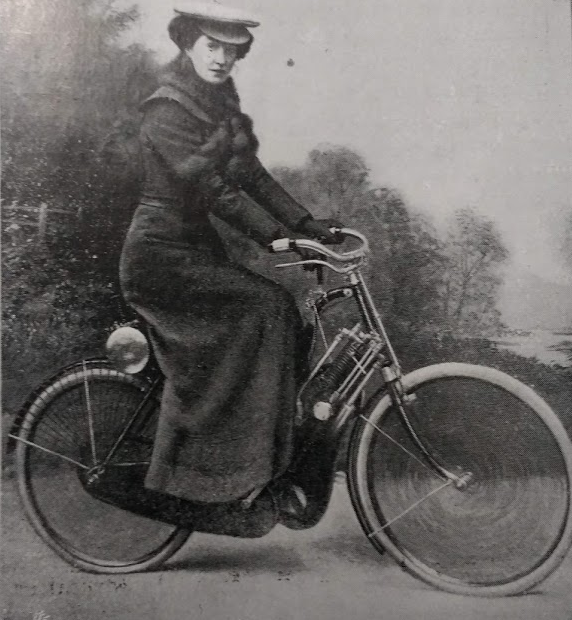
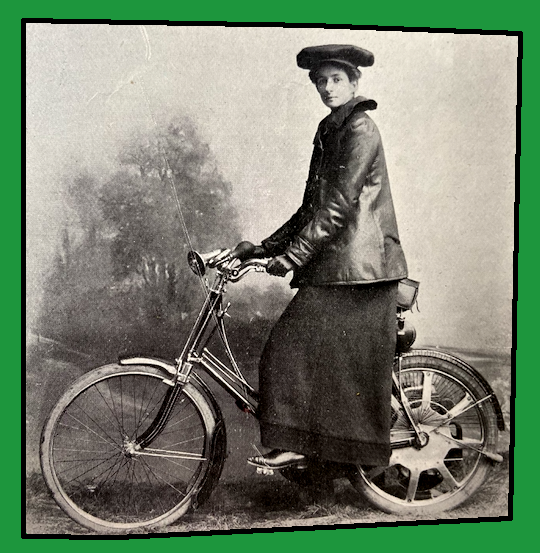
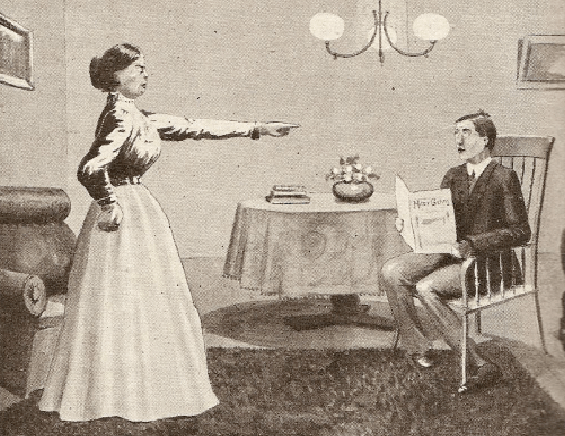
You’ll find an excellent selection of images of pioneer women riders and passengers in Chapter 7 of the Images of Yesteryear section.
 Motorcycle Timeline