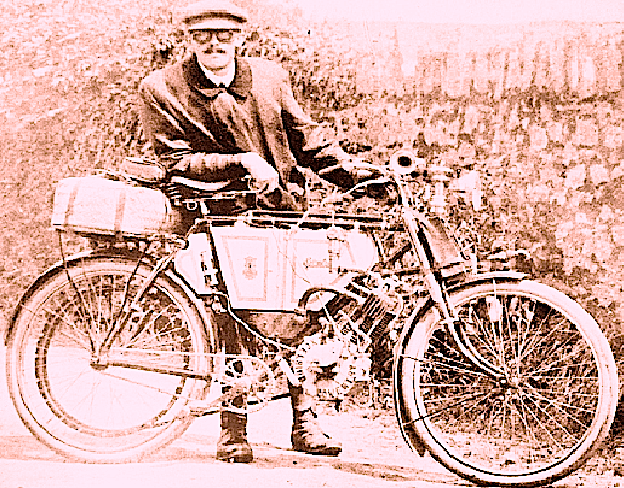
Not all poetry about motor cycling is mawkish doggerel. When the following ditties were written, as you’ll see, motor cycling bards had a light touch in humorous rhyming.
“Heavens! what a goodly prospect spreads around
Of rustic lanes, with new light railways laid
In glitt’ring rows! Behold the autocar,
That, by the dang’rous lightning flash impell’d,
Moves swiftly o’er the clay with noisy hum!
Amanda, with her boon companions, see
Careering on her bike at headlong speed,
Intent on baffling six policemen, who
Discuss the subject from afar; while we
Are forc’d to seek the safe but watery ditch.
Happy Britannia! land of tramway-lines,
Of bifurcated maids, of autocars!”
St James’s Gazette, 1896
This poem demands to be read out loud [and anyone who recalls Ernie, the Fastest Milkman in the West is likely to find themelves doing a Bennie Hill impression]…
MOUNT PLEASANT! (1910)
Reginald’s mount was a mild affair
With a gear of six to one.
An engine of one and a quarter hp
In lightness second to none.
It had been a pushbike in its youth
Til ‘converted’ up to date,
And still on a hill it would stop and brood
On its former pushful state.
The mount of Archibald (Reggie’s friend)
Was a thing to approach with awe.
It was to the mount of Reginald
As the oak tree to the straw.
Its gear was one and a bit to one,
Its hp nine-eleven.
It wasn’t a toy for a good little boy
Either under or over seven.
Now, it happened one day on the open road
Outside a well-known inn
That Reggie’s single-cylinder
And Archibald’s double twin
Stood side by side like lamb and lion
Awaiting their owners’ start,
When who should arrive in a motorcar
But the gel of Reggie’s heart!
Now, Reggie many a time had talked
Of his monster motor-bike,
Of its fearsome speeds and doughty deeds
(We, ourself, have done the like),
And the gel of his heart, of course, believed
In his deeds of derring do,
His “throttled to fifty miles an hour”
(Our girls have believed us too).
The girl of his heart admired the twin
And Reggie felt rather flat
When she pointed to Reggie’s gentle mount
With, “Whose bit of wire is that?”
And when she declared the monster twin
Magnificent and fine,
Then Reginald told a sad untruth
And said, “Er – yes – that’s mine.”
When she said, “I’d love to see you ride,”
He tried in vain to evade,
But she pleaded hard, and soft as well,
Till Reggie, much dismayed,
Consented to kindly demonstrate,
So he gave the thing a run
And the – Did a comet hit the earth?
Or somebody fire a gun?
As Reggie explained, he was just about
To mount with skill and care,
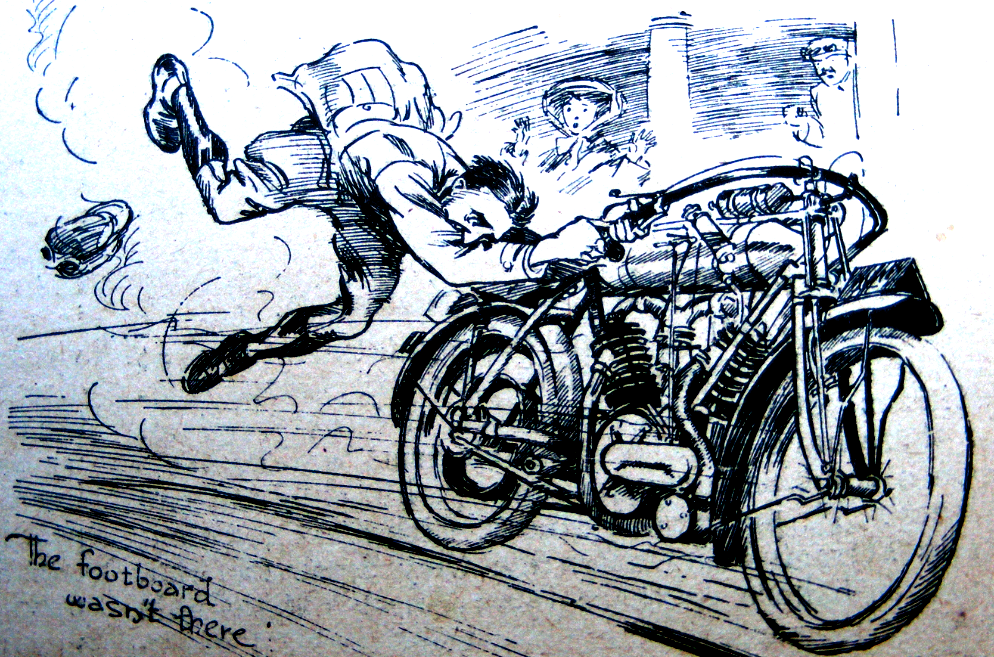
When just as he hopped on the footboard – well,
The footboard wasn’t there!
It’s very annoying for Reginald
That the girl of his heart was present;
And the scene of his most un-pleasant dismount
Was mockingly called, “Mount Pleasant.”
THE MOTOR AND THE MOTORMAN. (1909)
(With apologies to The Walrus and the Carpenter.)
The Motor and the Motorman went out to take the air
They groaned like anything because the mixture wasn’t square,
And more they groaned because a hill Uprose before them there.
If only this old ‘ surface’ thing were but a ‘spray,’ my dear,
Do you suppose,” the Motor said, “Yon hill-top we should clear?”
I doubt it,” said the Motorman, and shed a bitter tear.
Pretty plug, come spark with us,” The Motor did beseech;
A steady spark, a nice thick spark until the top we reach;
We’ll switch you off at that, and have free engine, my peach!
The sparking plug, he looked at him and missed quite once in three;
The sparking plug he winked his eye. “Retard, retard!” said he.
(Meaning, ” The lever’s too advanced in his ideas for me.”)
O throttle,” said the Motorman, “Come open, open more!
The operation’s painless, ’cause I’ll give you gas galore.”
The Motor grunted, ” ‘Twas enough to make me hot before!”
The plug he gave a final spark; then all things ceased to go.
The Motor and the Motorman walked on a mile or so;
And then they rested on a bank conveniently low.
Then several miles of muddy road they walked to catch a train ;
The language of the Motorman was warmer than the rain;
And when they found the last had gone, his words—well, words were vain !
L Etherege
SEIZED! (1907)
I fancied I was fairly smart and knew a thing or two.
But latterly I’ve changed my mind and hold a. different view.
And if you’ll listen to my yarn I think you’ll not deny
The somewhat slangy term, ‘a mug’, was coined for such as I.
You see, I’d bought a motor bike—the latest and the best
And so, of course, went for a spin to put it to the test.
You may be sure it was with pride I rode my willing steed,
Whose levers needed but a touch to regulate its speed.
My motor cycle travelled well, and with delight I found
Hills didn’t seem to trouble it, but were as level ground.
And when the road was straight and clear, by Jove! I made the pace!
No one was faster, I am sure, in this year’s Trophy Race.
But suddenly the engine stopped without the least excuse,
And nothing I could do to it was of the slightest use;
The driving pulley wouldn’t move, and though with might and main
I strove to make the thing revolve, I tried and tried in vain.
That something extraordin’ry had happened was quite clear.
And I was very pleased to see a motorist appear.
I waved my hand for him to stop, and hoped perhaps he might
Know how to diagnose the fault. And how to put it right.
I’ve seen a lot of ancient wrecks when out upon the road
But never one so bad as that the motorist bestrode.
And when he brought it to a stand the thought passed through my mind
That, after all, I had but called the blind to help the blind.
The proverb says you should not judge a man by his attire,
Or fancy he’s a novice if his engine misses fire;
So when the stranger said, “What’s up?” I didn’t let him guess
I doubted his ability to help me in my mess.
I told him of my accident, and how it came to pass
But by the way he fooled about I took him for an ass.
And when he growled, “Y’our engine’s seized!” I said, “Of course, I know,
I thought I told you that myself It ceased an hour ago.”
“He eyed me up and down with scorn, then broke into a laugh:
“You ought to get a berth,” he said, “Upon the motor staff
Of a ha’penny daily paper, you’d nicely fill the bill,
For your knowledge and experience of motoring are nil.
“When I say ‘seized’, of course I mean SEIZED;
The cylinder must be removed, that’s very plain to me.
The damage is but slight, I think. Most luckily for you.
And as I’ve got an hour to spare I’ll show you what to do.”
In point of fact, he did the work while I stood looking on;
He must have been an engineer, so quickly was it done.
From what he said, I might have saved much worry, time, and toil
If I had had the sense to use a charge or two of oil.
“I’ll try the jigger,” he remarked. And mounted my machine.
I’ll run as far as yonder tree To see if all’s serene.”
He “ran as far as yonder tree,” and then he yelled, “Adieu!”
Put on full speed, and in a trice had faded from my view.
As soon as i observed his game and overcame the shock,
I tried to overtake him on His prehistoric crock.
I might have caught him “might”, I say, but just then, don’t you see,
A ‘Bobby’ in a motor car rushed up and collared me.
“So I have got you, after all,” my captor proudly said,
“A ridin’ of the motor bike stole from the Old Bull’s Head;
With three hours’ start you oughter got a bigger lead by far
Now come along to gaol with me in my nice motor car!”
I told the constable the truth. But it was past belief.
He therefore apprehended me like any common thief.
On the charge of having stolen the rotten lot of scrap
The stranger left behind him in place of my new JAP.
And though I’m not in durance vile, I’m only out on bail,
So take this opportunity of telling you the tale.
The moral is quite obvious, as you will all agree:
Don’t be too sparing with your oil. ‘Tis false economy.
by THE NOVICE. (From the Xmas issue of the Blue ‘Un)
IRRECLAIMABLE!
A surly old motorphobe sat on a stile,
And a motorist sat on a stone,
He was tink’ring a fizzywig thing with a file,
And the motorphobe eyed him, and after a while
Addressed him with scorn in his tone.
‘You ride on a motor,’ the motorphobe said,
And your speed is alarming to view;
You cannot see aught but the roadway ahead,
To the beauties of Nature your soul must be dead;
Pray, how does it benefit you?’
‘I have no desire,’ said the automobiller,
‘The ditches’ damp dangers to dare,
To stalk in the hedgerow the fierce caterpillar,
Or roam in the fields with a butterfly-killer,
”Or track the wild worm to its lair.’
‘You ride on a motor,’ the motorphobe cried,
‘A weapon devised by the de’il;
You scatter the dust and the stones far and wide;
And were I the head of the Government, I’d
Put a check on your murderous wheel.’
‘The dust,’ said the motist, ‘I’ll freely admit,
But the fault’s with the road, not with us;
And I cannot see why you should go in a fit
Because we have drawn your attention to it,
The surveyor’s the man you should cuss!
And further,’ he said, as he put in his clutch,
‘You say we are going too fast.
Well, it seems to me, sir, you’re expecting too much—
With the twentieth cent’ry you’re quite out of touch,
You ought to have lived in the last.’
The car moved away with a simmering sound
And a weird and unmusical hoot,
And the motorphobe said, as he horridly frowned,
And cast himself heavilv down on the ground,
He said, motorphobially, ‘Brute!’
Motor, 1904
TITWILLOW (1908)
[With Apologies to WS Gilbert.]
By the side of a motor an architect stood,
Singing willow, tit-willow, tit-willow.
Said he, the design of this bike is no good.
Singing willow, tit-willow, tit-willow.
So I’ll change all the wiring—a new coil I’ve got—
Plugs, tank, carburetter, and heaven knows what,
And I’ve handle control for the whole bally lot.
Oh, willow, tit-willow, tit-willow.
For weeks upon weeks, and from morning till night,
Oh willow, tit-willow, tit-willow,
He worked at that motor with main and with might.
Oh willow, tit-willow, tit-willow.
The bike then was certainly like a new pin.
And at Brooklands he thought it could easily win:
But alas! when the bills for the new parts came in——
Oh willow, tit-willow, tit-willow
Morton Brown.
SPEEDING BY (1909)
Twomilesaminute, Seehowwefly!
Swiftasameteor Streakingthesky.
Whatisthatblur? Onlythetrees.
Lookatthemwave, Mywhatabreeze!
honkandarush, Aflashandasmell–
Whatdidwehit? Didsomebodyyell?
Ajarandascream–
Itlookedlikeahorse.
Notellingnow, Keeptothecourse.
A YORKSHIRE LEGEND. (1910)
The firelight in eager eyes,
In the inglenook; and like a book,
With every look of candour frank,
The old man spreads himself, and lies
Of things oft-told; of buried gold;
How Edwin bold was badly sold
In days of old, on Sutton Bank.
* * * *
Angeline was a maiden fair,
Fascinating purple eyes and hair.
She was Edwin’s—temporary—joy.
Edwin was—pro tem—her darling boy.
Angeline went one week in May
To her aunt in Helmsley ; and a day
Later came a wire from Edwin: “I’m
Motor cycling down, arriving nine.”
* * * *
‘Twas nearly nine o’clock
And Thirsk was at his back.
When Edwin got a shock
The engine gave a knock
In sympathy.
Before him Sutton Bank
Upreared. Hiscardiac
Proportionately sank
As, steeply up its flank,
A dim path he
Discerned, gyrating high
To distant regions; where,
Beyond the eastern sky,
The Land of Bye-and-bye,
Wept Angeline.
“May I misfire before
I fail my tryst with her!”
Across the bridge he tore,
Shouting “Excelsior!”
To his machine.
Three times he stormed the hill,
Before he passed the ‘trough.’
Three times again, until
He got a frightful spill
At Big Tree Bend.
“No beastly ‘one in four’
Is going to shunt me off
From her whom I adore.
This struggle must,” he swore,
“In victory end.”
A window far on high,
Beneath the hill’s black brow,
Mirrored the sunset sky,
And gleamed, a bloodshot eye.
In angry frown.
Young Edwin frowned as black,
And quoted “Do it now.”
He tried six times; alack!
Six times he turned him back
The hill adown.
Then, more or less insane,
He turned, a thirteenth time,
Machine and self again
To face those hairpins twain
Of Sutton Bank.
With scarce a slackened wheel
Beyond the ‘trough’ they climb;
Now round the corner reel:
Then, as the steep they feel,
Hope-lingering-sank!
Then cried he in his need,
“To pass that second bend
I’d sell my soul.” “Agreed!”
The motor picked up speed
and snorted loud.
AGREED! What did it mean?
Or did his fancy lend
Voice to some Thing unseen,
That shadowed his machine,
And mocked and mowed?
Or was it—horror dread—
It was!…His heart stood still.
Upon the engine head
He saw an imp, who said,
With thumb to nose,
“AGREED Observe we flash,
Like petrol flame, uphill—
Now round the comer dash,
And now—O Edwin rash—
Your bargain close!”
* * * *
And now, they say.
Each year in May,
A spectral motor climbs the Bank
With glowing cylinder and tank
And clears the bends–
But there it ends,
And vanishes afire!
For Edwin sold his soul to round
That second bend, before he found
‘Twas all in vain
He’d ne’er attain
The TOP: ’twas some yards higher!
HRT
THE SONG OF THE TRAILER (an extract from Punch)
My Algernon is loving,
My Algernon is kind,
He rides upon a motor bike
A-trailing me behind.
He is my lord and hero,
In him I fondly trust,
And let him drag my wicker chair
Through clouds of rolling dust.
Our loving conversation
Is limited, I fear,
For if I talk to Algernon
He might forget to steer.
Although a lot of matters
I’m longing to discuss,
I do not want to to be upset
Beneath a tram or ’bus.
So, happy and contented,
I sit discretely dumb,
And watch the landscape whirling by,
And hear the motor hum.
My Algernon is perfect,
Good looks he does not lack.
I love to gaze upon his face
But chiefly see his back.
My Algernon is loving,
My Algernon is kind,
He rides upon a motor bike
A-trailing me behind.
And till the tyres are punctured,
Or till the engine bust,
I’ll let him drag my wicker chair
Through clouds of rolling dust.
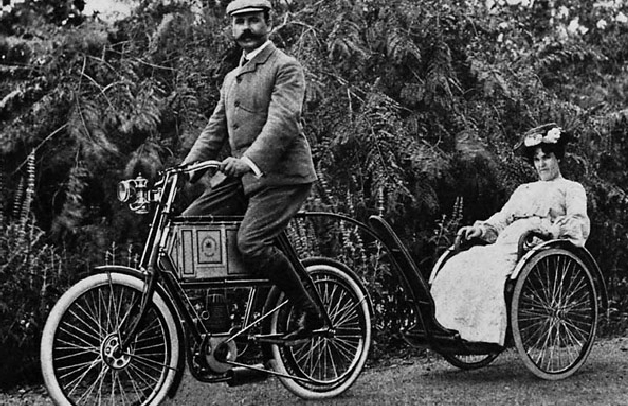
A HIGH RESOLVE. (1911)
There was a brave old Yorkshireman
Who came one day to town;
He said: I’m Phelon Moore and Moore
As though I’d been done down.
My legs are getting old and stiff,
I cannot push a bike;
I think I’ll get a motor one,
And see what that is like.
Great Scott! I’ll be a Wanderer,
And ride these islands through;
I’ll chase the wary Lincoln Elk,
And hunt the NS(Gn)U.
I’ll Triumph over every foe,
And all that venture nigh;
The Humber is my native Hoe,
“Excelsior!” my cry.
With Fairy movements I shall glide
End to End to End and back,
And on my record-breaking ride
My belt shall ne’er be slack.
My word! I’ll make the Moto-Reve,
You’ll see the Mabon clutch
With angry fingers at my throat;
They won’t beat me by much.
With crafty movements I’ll elude
The Griffon grim and grey;
“FN” shall be my motto—
“Fear nought,” that is to say.
Brave Douglas I shall put to flight,
I’m Matchless, don’t you see,
The Motosacoche is out of sight,
Left far behind by me.
The Indian chief will fight me hard.
The Wolf may try my pluck,
I’ll Bat along till yard by yard
They one by one get stuck.
My peerless riding all shall see,
A motor bike’s the notion,
And henceforth that will always be
My means of locomotion.
MOTOR MURMURS (1910)
“My petrol engine is the most peevish thing in existence; you can’t hurt it without it giving tongue…and this in no uncertain fashion”—Ixion
I strolled along the Great North Road,
A little while ago,
And watched the motor bicycles
Which flitted to and fro;
I listened to their murmurings
Whilst idling on my walk,
For I understand the language
which petrol engines talk.
Some told me by their gentle purr
That they were all serene,
And that their drivers knew each whim
Of engine and machine;
But others told a different tale
In no uncertain way,
And just below are samples of
The things I heard them say.
2½hp Lion:
“I know I’m overheating
(I hope I shall not seize)—
My valves upon their seating
Are burning by degrees,
And I’m vainly, vainly striving
To inform the silly ass
Who is fiddling with my levers
That I’m getting too much gas.”
3hp Victory:
“I’m clanking and I’m knocking,
As plainly as can be,
To indicate the shocking
Irregularity
Of the methods of my driver;
But he sits like one entranced,
And it never dawns upon him
That my spark’s too far advanced.”
6hp (twin) Sun:
“I’m scraping and I’m rumbling
In most acute distress;
I’m groaning and I’m grumbling
At the forgetfulness
Of the novice who’s deriving
Much enjoyment from my toil,
For the juggins can’t remember
That I need a dose of oil.”
3½hp Unnerver (with sidecar):
With agony I’m crying,
Upon this hilly road,
But have to keep on trying
To pull a double load,
For the monster who is sitting
On the saddle fails to hear
That to climb the heavy gradient
I require a two-speed gear.”
The extracts which appear above,
Though few and somewhat short,
May interest the novices
Of this absorbing sport;
They also may suggest to them—
And others, too, perhaps—
That driving probably means more
Than twiddling certain taps.
Then, learners, listen carefully,
And be on the alert,
For a motor—like a baby—
Cries out if it is hurt;
And you must do your very best
To ascertain what’s wrong
Immediately you think you hear
Your engine ‘giving tongue’.
MOTORCYCLING PARODIES: A CHANGE OF VIEW
(With apologies to Sir WS Gilbert)
When I first took that motor-bike out,
The family hastened to sneer:
“When once you get moving,
‘Twill quickly be proving
The dickens to handle and steer.
Its cost will be woefully vast;
Your affluent days will be past.
And ere far you’ve proceeded,
A train will be needed
To bring you back homeward at last.”
Yes! that’s what they babbled about,
When I first took that motor-bike out.
But after I’d had it a while,
They noticed how grandly it went.
‘Twas health’s own concocter,
And banished the doctor,
‘Twas worth every penny I spent.
My talk introduced to their view
The places and scenes I went through,
Till no more they derided,
But promptly decided
To go out and purchase one too.
They put off their pitying smile
As soon as I’d had it a while.
MOTORCYCLING PARODIES: YOUNG LOCHNIVAR* (1910)
(With apologies to Sir Walter Scott)
The young Lochnivar has gone out for a ride;
His latest machine is the neighbourhood’s pride.
His gaiters are spotless, his spirits are gay,
He’s free from the office the whole of the day;
And men say, “A lucky young beggar you are!”
The ladies, “How handsome is young Lochnivar!”
He speeds on the level, he cares for no slope,
His engines with mountains is ready to cope.
Away from ther troubles and worries of ‘biz”,
What sport could be matching this pleasure of his,
When only a puncture is able to mar
The perfect enjoyment of young Lochnivar?
“The views in the valley, the scenes on the hill,
The rest by the sweet shady side of the rill,
The speeding back homeward as even draws in,
The outing all day and the lunch at an inn,
No form of amusement I’ll base on a par
With things such as these,” cried the young Lochnivar.
“Oh! Grumblers may prate, as they frequently do,
Of road hogs (referring to me and to you),
I care not for them and their ignorant taunts,
They spoil not the fun of my motoring jaunts;
For health and good spirits undoubtedly are
Produced by such travel,” quoth young Lochnivar.
* A hugely successful poem written by Sir Walter and learned by generations of schoolchildren; for comparison purposes here’s the first verse of the original:
O young Lochinvar is come out of the west,
Through all the wide Border his steed was the best;
And save his good broadsword he weapons had none,
He rode all unarm’d, and he rode all alone.
So faithful in love, and so dauntless in war,
There never was knight like the young Lochinvar.
And I don’t reckon the Green ‘Un’s anonymous scribe owes Sir Walter any apologies!
THE VILLAGE MOTOR-TRAP (1904)
(with apologies to Henry Wadsworth Longfellow)*
Screened by a wayside chestnut tree,
The village ‘PC’ stands.
The ‘cop’, a crafty man is he
With a stop-watch in his hands,
And the muscles of his lower jaw
Are set like iron bands!
He goes each morning to his lair
And hides among the trees,
He hears the sound of motors there
And it sets his mind at ease,
For it seems to tell of captures—and
Promotion follows these!
Folks often call his statements lies
And his ruse a ‘shady’ plan.
But he knows his watch is accurate!
And he stops whoe’er he can.
And he looks the motist in the face
For he fears not any man.
From morn till night he’s timing there
The cars that come and go,
While his stop-watch ticks the seconds off
With measured beat and slow.
Nor thinks of rest till he homeward turns,
When the evening sun is low.
Hiding and clocking, summoning,
Onward through life he goes.
Each night he’s had his vengeance on
Some of his ‘scorching’ foes.
Somebody summoned, someone ‘done’,
Has earned a night’s repose.
Thanks, thanks to you, ye zealous ‘chaps’,
For the lesson you have taught,
For now we read in ‘thicket’, ‘traps’,
And, warned, we go uncaught.
For where the trees are thickest—there
We know such deeds are wrought.
‘Pedal and Crank’.
* Henry Wadsworth Longfellow wrote ‘Under a Spreading Chestnut-tree’. It started:
The village smithy stands;
The smith, a mighty man is he,
With large and sinewy hands,
And the muscles of his brawny arms
Are strong as iron bands…
—once again, the parody surpasses the oft-quoted original…and there’s more:
Within the village “Chestnut Tree”
The local expert stands.
Indeed, a knowing man is he
Though time hangs on his hands,
And oil and petrol, belts and tyres,
He stocks, of doubtful brands.
His air is willing, shrewd, and bland,
More noticed, perhaps, in spring;
His brow is wet with useless sweat;
He “nicks” whate’er you bring.
And he loves to speak of tuning up,
For he knows not anything.
Week in, week out, from morn till night
His horn you’ll hear him blow;
You’ll hear him on his worn-out bike,
With measured beat and slow,
Like lampless wight returning home
When the evening sun is low.
And victims coming down the road
Look in at the open door,
Rejoice to see his dozen tools
Reposing on the floor,
And think that they have still a chance
Of getting home by four.
He goes on Saturday to hill-climbs
Amidst a crowd of boys;
They like to hear him scoff and preach
More sense, I fear, than noise;
But still, to hear the expert speak
Embraces some folks’ joys.
Spoiling, rejoicing, borrowing,
Onward through life he goes;
New victims with some ticklish job
Find him about to close.
Nothing effected, someone done,
Has earned a night’s repose.
Thanks, thanks to thee, my worthy friend,
For the lesson thou hast taught;
Thus at this flameless forge of thine
Experience must be bought;
And to maintain your proud renown
Fresh victims must be caught.
FD
THE MEETING
The cow at eve had drunk her fill,
And chewed the cud, the time to kill;
What time the ruddy orb of day
Departed in the usual way.
The mists of twilight gather chill;
The lark’s song ends, upon a trill;
The droning bees seek earned repose;
The pink-tipped daisies’ petals close;
The sleepy breeze forsakes the mill;
And bids the murmuring trees be still;
And Turmoil seems a thing afar,
But—Bill has left the gate ajar!
Young Brown at eve had drunk his fill,
And much enriched the landlord’s till;
And sunset found him on the road,
Intent on reaching his abode.
His friends’ discussions heeding nil,
Who sought some caution to instil,
He rashly rides his motorbike;
Which every moment seems to strike
A wobbling patch of road which will
Inevitably cause a spill.
And Turmoil now seems not so far;
For—Bill has left the gate ajar!
The placid cow chewed on until
(The ink nigh freezes on my quill!)
Her roving eye chanced on the gate.
(Alas, that seals our hero’s fate!)
She strolls out through it. Reader, thrill!
For Brown is tearing down the hill!
At forty miles an hour he flies;
And lo, two cows before him rise!
He grinds his teeth, but trusts his skill
To steer between the pair…And Bill
Who hears the Turmoil from afar,
Cries “Gee, I’ve left that gate ajar.”
“ALL OUT” (1908)
Would you like to go a-touring in a manner most alluring,
Here and there,
And employ your well-earned leisure in obtaining health and pleasure
Everywhere?
Would you care to go a-flitting, on your saddle calmly sitting
At your ease,
Through the lively crowded highways or the lovely leafy byways
As you please?
Would you like to ride serenely, and enjoy the motion keenly
Of your steed,
Over hills and crests and ridges, under aqueducts and bridges
At full speed?
If you would, try motor biking; ’twill be greatly to your liking.
‘Twill indeed!
There’s no sport that’s more beguiling when the sun is softly smiling,
Or ablaze,
For its joys are keen and many, and within the reach of any
Nowadays.
Therefore, if you’ve never tried it, buy a motor bike and ride it,
We advise,
And your voice you’ll soon be raising, and the pastime loudly praising
To the skies
(A word is quite sufficient to the wise.)
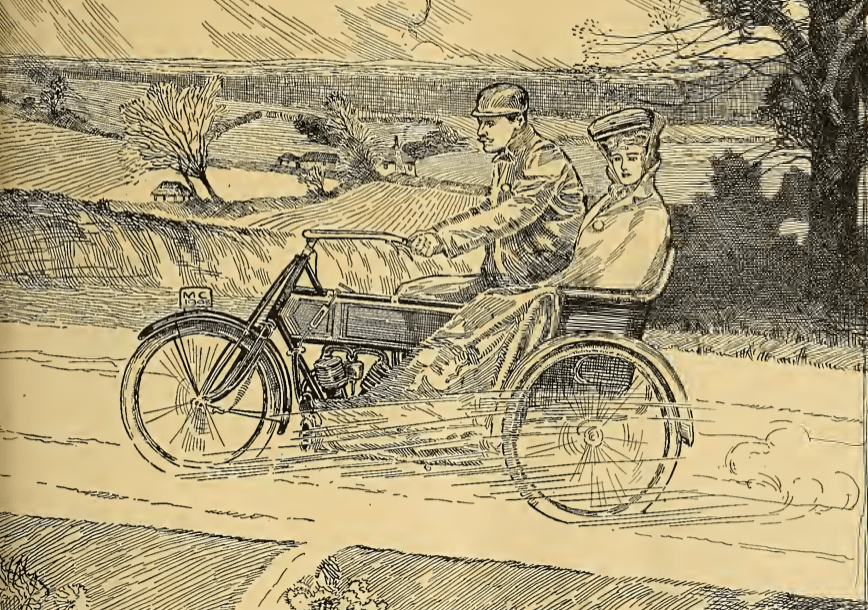
FORCE OF HABIT (1909)
Major O’Finnigan Fadd,
Of the Onety-oneth Mounted Marines,
In full regimentals is clad,
And booted and spurred; for he means
To test his new seven-horse twin
By taking it out to begin
With a run round the town,
When pretty Miss Brown
Will likely be out for a spin.
Soldiers, enthralled, see him start;
Civilians, amazed, see him tear
Careering along to the part
Of the town that’s frequented by her
He specially hopes to impress
By the daring and grace and address,
With which he bestrides
The monster he rides,
And controls at his will, more or less.
Pretty Miss Brown is in sight;
She’s cycling ahead, without heed
Of the Major, who, wild with delight,
Cries “Hup! ye spalpeen!” to his steed;
And, spurred by his amorous fire,
He – rang! likewise – crash! – he is by her,
But – lost in a mist
Of language, the gist
Of which is: “I’ve spurred my back tyre!”
WHERE THE SIDECAR SCORES: 1 (1903)
Oh! forecar, you’re a poor device
For lovers twain, alack!
She cannot see her swain at all,
While he beholds her back.
No tender glances are exchanged –
Indeed, the case is sad;
No arm can gentle steal around
To make waist places glad.
WHERE THE SIDECAR SCORES: 2
O, love it is a funny thing,
It tickles poets in the spring.
It caused young Robinson to bring
His girl out in a trailer.
The way was short, the rider bold.
The motor was by no means old;
So fast the merry miles unrolled
Behind the girlful trailer.
“Now hold on tight, O girl of mine,
I’m going to shave this corner fine;
Off SF Edge I’ll take the shine…”
A squeal came from the trailer!
He heeded not, but on he tore
And even faster than before,
Until at length by Brighton’s shore
He pulled up with the trailer.
The sun fades sudden from his sky
With pallid face and ruffled tie,
He gazes with a frenzied eye
Upon an empty trailer.
No more will Robinson be seen
To mote with his affection’s queen,
And advertised you’ll note: “Machine
For sale, complete with trailer.”
Moral: Have a sidecar!
TO THE WAVERER (1909)
If you have the leisure,
Listen while I sing
Songs of joy and pleasure
Passing beyond measure
Everything
Go and buy a motor-bike,
Never mind what maker,
Let the choice be what you like –
Hack or record-breaker.
See it has an engine on,
Wheels and pedals likewise;
Saddle, too, to sit upon
Sound and motor-bike wise.
Fill the tank with petrol up,
Get the plug a-sparking,
Oil—at least a breakfast cup—
Start the engine barking.
Now the road, the open road,
With its charms alluring,
Drives you with its golden goad—
Drives you forth a-touring.
Spend no pelf on pocket-maps,
Take no route selected,
Seek the glorious “Perhaps”—
Choose the unexpected.
Motorcycling waits for you—
All its joys untasted!
You would count, if but you knew,
Ev’ry moment wasted.
Winter fog, or snow, or rain!
Why should they dismay you?
“Wait till summer comes again!”
Don’t let that delay you.
Go and get a motor-bike,
Dally not to choose it;
If you know what joy is like,
Get one—and then use it!
Motor Cycling
Merely a Duffer, or the Modest Motorcyclist. (1905)
I rested at a wayside inn
My modest thirst to quench,
And found a motorcyclist, who
Was sitting on a bench.
“Pray, gentle sir,” I thus began,
“Pray tell me what to do
That I may grow expert, and ride
As cleverly as you!”
“Expert!’’ said he, and shook his head,
“Such things, pray, do not name!
Between ourselves, I’m really quite
A duffer at the game.”
“I fear there’s some mistake,” I said,
“Or else mine host hath lied;
He told me that you finished in
The Edinburgh ride.”
“The Edinburgh ride? Well, yes;
I had some luck, perhaps;
But any duffer, don’t you know,
Can sit and twirl the taps.”
“You give me hope, good sir,” I said,
“For I’m a duffer too.
Pray tell me, on the average,
How many miles you do.”
“A duffer, like myself,” said he,
“Can do, perhaps, let’s say—
In fact, I’ve tried it for a week—
Two hundred miles a day.
“But then, of course, I’m quite untrained,
And ignorant; in short,
I’m but a duffer, destitute
Of skill of any sort.
“With piston rings, and things like that,
I’ve got a sort of knack;
But local agent’s demon skill
I absolutely lack.
“And now I must be jogging on.
Excuse me, sir, for I’m
Already less than half an hour
Inside my scheduled time.”
Fred Gillett.
YE FEAST OF THE TT. (1912)
And there had been many wet days in the land.
And it came to pass that the Feast of the TT drew nigh,
and the Masters which are called Manufacturers did
murmur and say unto each other,
Behold, on the morrow shall our six-speed model wipe from
the face of the earth all manner of change-speed devices.
And it came to pass that on the day, Monday, the people
who had travelled from afar did rejoice and say,
We will arise and congregate about the banner of Start.
And, notwithstanding the early hour, a great multitude had
assembled together to behold the start.
And one Ebblewhite did lift his voice and say “Go,” upon
which James, who is surnamed Haswell, did gather
his girdle about his loins.
And James, who is surnamed Haswell, hastening into his
saddle did wend his way amidst an exceeding great
noise and dust.
And on the tenth hour it became monotonous, insomuch
that we said one to another, Let us remount and depart
unto Mount Snaefell;
For it is written in the book The Motor Cycle, He who abides
at the Mount shall find his reward.
So we arose and smote (two strokes) the throttles of our
asses, which are called Scotts, and did ride exceeding
fast nigh unto ‘blinding’.
And behold we came unto the Temple of Bungalow;
And being athirst we lifted up our voices and cried, Give
us of the waters of Soda and Whisky.
Having satisfied our thirst we assembled together on the
brow of the Mount.
And it came to pass that we did hear from afar an exceeding
loud noise like unto the roar of the sea and wind.
And behold one CR Collier, son of HH Collier, flashed o’er the brow on his mount,
which by the prophets is called Matchless.
Then came one Frank, who is surnamed Applebee, riding nigh on to the wayside;
And he also was exceeding fast—Yea verily, insomuch that we were afraid.
And many riders flashed by on their iron mounts—verily, a pleasing sight—
And our spirits ran high.
But lo! From afar off came the noise which is called misfiring,
And we lifted up our eyes and beheld one coming slow, insomuch that he wobbled ;
His spirit was low, yea very low.
Now at the twelfth hour the multitude were an hungered,
and the men folk did fetch from their tents, called sidecars and carriers, loaves of bread and small bottles;
And many’ were the longing glances of those called competitors at our pitchers of Waters of Bass.
And it came to pass that we did again remount and rode
unto the city of Douglas, even unto the foot of Bray
Hill, whence cometh many people.
And we did inspect the machines, from the 1,000 c.c.
racer to ye olde crocks.
Then did we say one to another, Let us back to our tents
or the temples will be closed, for the hour is late.
Nob Ward
VOLO NON VALEO (I want to but I can’t)
I want a motor bicycle,
But cannot quite decide
Between the rival merits of
The Fairy and the Clyde,
The Singer and the Bradbury,
The Matchless and FN,
The Norton, Kerry, Rip, and Rex,
The Bat and Phänomen.
I sometimes think an NSU
Would suit me to a T,
But later on I feel inclined
To purchase a GB;
Again my fancy hesitates,
And covets very much
A Quadrant or a Clarendon,
Or Roc with metas clutch.
At other times, to my idea,
By far a better way
Would be to get an L and C,
Or, say, an L and K;
But these selections are in turn,
Before the day is o’er,
Relinquished, and their places filled
By a two-speed Phelon-Moore.
I wobble thus and hesitate,
But can’t make up my mind;
I read The Motor Cycle and
Much good advice I find,
But it doesn’t seem to help me,
For really—to be frank—I’ve not a blessed copper in
My pocket or the bank.
The Motor Cycle, 1907
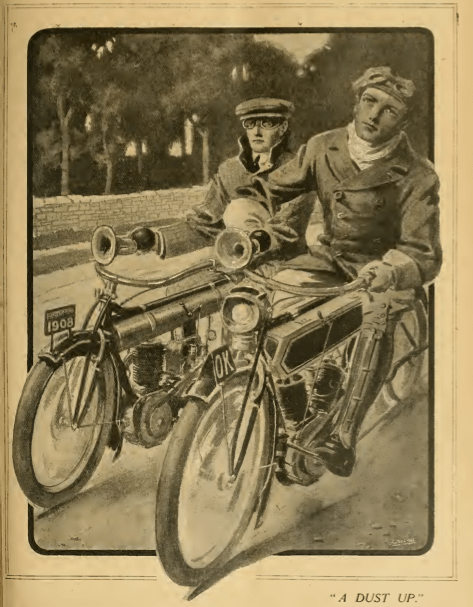
In 1911 educated Englishmen had enough Latin beaten into them to appreciate the following ditty:
A TALE. (1911)
Juvenis Algy’s motor-bike
Had equus power of septem.
In colour ’twas a rufus hue;
And as for hills–it leapt ’em.
In pensive mood perambulans,
Percepit limit–“Decem,”
Then shoved a pump, connected to
His cylinders, to grease ’em.
By now he’d reached a praeceps hill
Proclivitatis shocking,
Discovered, consternatio,
His machina was knocking.
Then scintillam retardavit,
Rededit ‘LPA’.
Infirme, turned his currus round,
Pergavit t’other way.
The causa for the clamor
Emissus by his motor,
Was that proportio magna was,
Between id et his rota.
Moralis of this parvus talis,
Is nunquam gear for velox.
Praeterquam bike armatur cum
Efficienti gear box.
A GROWING FAMILY (1909)
Young Petrolwise of whom I write,
A happy man was he
When he started on his honeymoon
With happy Mrs P;
For it seemed to them that life would run
As smoothly from that day
As ever any tri-car ran
Upon the King’s highway.
They were a happy couple
And one day a little bird
Told Mr P and Mrs P
About a minor third;
And, in view of probabilities,
They purchased at the show
A fore-car with a tiny seat
In front of that, you know.
Now Petrolwise (I don’t think that
I mentioned this before)
Preferred a single-cylinder,
And by it oft he swore.
Imagine his expression when
The Nurse one day ran in
To his shed – I mean his garage
And said “Please sir it’s a twin!”
The happy father, pardoned motor-
Cyclist that he was
Could not restrain a symptom of
Astonishment, because,
Although “The more the merrier”
Proverbial may be
The tri-car wasn’t built for four
But only built for three
But he was of inventive mind,
Like Daedalus of old.
The twin-feed bottle was his own idea;
As was the two-stroke rocking chair
Worked by a single crank,
With timing gear for Mrs P.
To synchronise a spank.
But his triumph was the graduated
Four-to-one four-chair
To carry quintoplectively
Himself, his lady fair,
In front of them, in single file
The twins in front of them
(An item “to say nothing of”)
The dog. That’s all. Pro tem.

Exactly 100 enthusiasts left the Bulstrode Hotel, Hounslow on Boxing Day 1911 for the MCC’s Winter Run to Exter and back. Gold medals were awarded to 80 riders who finished in the required time; six were disqualified for finishing to soon or two late; and 14 failed to finish. J Robertson-Brown and Fred Gillet (4¼hp Ivy-Precision outfit) were among the DNFs and Fred left the following account of their travails.
HOUNSLOW TO HOOK (1912)
A delightful twenty-four hours’ run.
I put on several pairs of socks,
And clothed myself in wool,
Packed up the turkey-sandwiches,
And saw the flask was full.
1 wrung my driver by the hand;
“Robertson Brown,” said I,
“To-night away to Exeter
With you I’ll do or die.”
Our engine was an Ivy-P,
Whose horse-power was not great:
Four and a quarter had to pull
The coachbilt sidecar’s weight;
How much it had to pull that night
Will later on appear,
When I describe in glowing terms
Our trouble with the gear.
The Turner sidecar was a treat—
All weather it defied;
Moreover, it had road-bump-proof
Upholstery inside.
Our lamp, a hefty FRS,
Orion’s belt outshone
(Orion might have wished that night
He’d got a chain drive on).
The poets, so I am informed,
Who lived in ancient days,
Chose attics underneath a roof
Wherein to write their lays.
But I’ll write ‘neath the open sky,
Said I without regret;
Inspired by frost if it is fine,
If not, inspired by wet.
At Hounslow there were gathered all
Great Britain’s choicest bloods;
Dame Fashion had provided joys
In overalls and duds,
Thank Goodness! there was vain enough,
For, had there been no squalls
And had the night been dry, think what
A waste of overalls.
I saw “I’m It” with twenty-two-
Inch wheels and strange air springs,
And Mundy lowering his gear,
And Vernon Taylor’s wings,
And Thompson with his green stream-line
Which all design out-knocks,
And Thomas Frank and 0P Hill
With crackers in a box.
We started from Bulstrode Hotel
To ride the long night through;
Our hearts were stout, our clothes were thick,
Our sou’-westers were new.
But man proposes Exeter,
While Fate, who’s always near,
Steps in and utterly upsets
The meshes of the gear.
It was on Egham’s little hill,
And somewhere near the top,
Our engine seemed to grow quite tired,
Then faltered to a stop.
Examination in the dark
Evolved the simple fact
That both the gears were in at once,
And neither would retract.
Adjustments made, we journeyed on,
But up hill it was plain
The high gear, acting on its own,
Had sidled in again.
Ignoring the controlling rod,
That high gear would assert
Itself on awkward gradients;
The lower gear felt hurt.
Although as yet we’d hardly got
As far as Hartley Row,
It seemed as though we must have done
Two hundred miles or so.
A mile at moments such as these
Is made of every yard.
And every little eminence
Becomes as steep as Chard.
“The time has come,” I said to Brown,
“To talk of many things,
Of ratios and formulas,
Of Karslakes and George Kings.”
But Brown replied, “Would I were back—
We still are far from Devon—
At home in pleasant Portland Street,
Number one-fifty-seven!”
And still the engine pulled and pulled,
And didn’t stop to bask;
The Ivy clung hour after hour
Right bravely to its task.
Vainly the gear put on the brake,
For still the engine turned;
The Watawata held, although
The gear-bearings were churned.
Which showed what pluck the engine had. But, hang it all! ye gods!
When both the gears are in at once
Too fearful are the odds.
Some sage advice I gave to Brown
(It came too late, I fear),
“If I were you I wouldn’t let
The hub control the gear!”
Upon a slightly sloped incline,
Where mud was thick and svelte,
The high gear hit the lower gear
Somewhere below the belt.
And then we stopped and tinkered things,
Hopeless was our outlook
Till someone told us we were but
A short half-mile from Hook.
A pleasant little spot is Hook;
Not far from London Town;
The villages of Devonshire
No doubt deserve renown.
But Hook in Hampshire’s pleasant realm
Is quite as good a spot
As Exeter for writing odes
And mild poetic rot.
We might have gone to Exeter,
‘Mid wind and sleet and showers,
Or wallowed in Wiltonian floods
For hours and hours and hours.
Instead of that old Destiny
Rough-hews us as it will.
And bids us stop the night at Hook,
Where we are stopping still.
0, Hook! Sweet Auburn never was
So sweet as thou to us!
Thy charms in poetry or prose
I could at length discuss.
Though Yeovil has its “Mermaid” fame,
And Exeter its “Bude,”
Hook with a temperance hotel,
“The Acom,” is endued.
Some have to Middle Wallop gone,
To where Windwhistle blows,
To Crewkerne and to Honiton,
And places such as those.
Well, let them go, as to the Pole
Went Shackleton or Cook,
While we will pause upon our way—
We’ve got as far as Hook!
FRED GlLLETT.
THE CHANGE (1907)
“The motorcyclist may be seen wherever there is anything interesting”
I always like to poke around
And dream my dreams in famous places.
I deem it almost holy ground
That show ancient castle’s traces,
Loving to sit and ponder how
The cries and counter-cries of battle
Rang loudly over what is now
A peaceful pasturage for cattle.
But few such sights were mine to see;
Each old baronial tactician
Had fixed, without consulting me,
His geographical position.
Of all my neighbourhood could yield
I long had been a careful noter,
But had not wandered far afield
Until at last I bought a motor.
Ah me! A wond’rous, welcome change!
Its cost (which once I thought alarming)
Has purchased me the power to range
Wherever there is aught that’s charming.
Each famous building, old world haunt,
For sight of which I once was pining,
Has been the object of a jaunt
When England’s summer sun was shining.
COLD (1908)
It is rather entertaining,
When it’s cold and wet and raining.
And the language you’re restraining
Is becoming hard to bear,
When with clothes all wet and wringing
To your handles you are clinging,
With your motor ever dinging
Out its rhythm in your ear,
Just to take its cheery meter
For to make the journey sweeter
And to render time the fleeter
‘Tis a very good idea,
And to rhyme all out of season,
Say good-bye to every reason,
Tell the weather it can freeze on
If it likes, as you don’t care.
• • • • • • • • • • • • • • • • • •
Pop! Pop! Pop! Pop! Pop! Pop! Pop! Pop!
Oh I wonder when I’ll stop-op.
What’s the good of Mother Hubbard,
With her bones inside her cupboard.
I’m as mad as any hatter—
Bless me ! how my teeth do chatter
Poor Jack Spratt could get no fatter
‘Cause his wife would eat the platter.
Sure, this road’s a muddy river—
Ugh And how I qui-ui-uiver!
Mary had a little liver,
And Cock Robin killed the sparrow
With his borrowed bow and arrow;
Oh I hope he ate his marrow.
And I wonder if Jack Horner
Really had a plum or corn, or
Whether really Cinderella
Left her shoe or umb(e)rella;
If it’s true shock-headed Peter
Tried to woo or tried to eat her;
If that blackguard Alpha beat her,
Or that giddy Gamma dealt her
Little digs about her belt? Ah!
Here’s a hill; guess I’m mistaken
If I do not put the brake on,
Put the brake on, put the brake on.
Put the bally blighted brake on.
Oh my whiskers! What has happened?
Has the thing got jammed or flattened
Sure it is I cannot shove it,
Love or money will not move it.
Then look sharp; turn off the motor
Hurry up, you silly goat, or
Curse! I can’t! The lever’s broken!
How I wish I’d never spoken.
Yes, that last one must have done it
Why the blazes did I pun it
Keep your nerve now—no use swearing
When the thing is past repairing.
Can’t you see you’ll have to risk it,
Steer for life or break your brisket!
Oh my dinner! How unwilling
Am I now I spent that shilling
Though in truth I had my filling,
Now it serves to most remind me
Of “The girl I left behind me”.
Can I clear that nasty corner
Straight ahead…
…I could have sworn a
Thousand pounds I’d never do it.
Yet my luck has brought me through it
Brought me through it, yes, by thunder.
What is that, though, over yonder.
At the bottom by that pond?
Ah! Sheep!
The things I least expected,
If they haven’t just collected
In the road—a clear obstruction.
Silly things to court destruction
But as sure as they’ll be mutton
My poor life’s not worth a button.
Either they must act as buffer
Else it means the pond, you duffer!
Woolly sheep and instant slaughter—
Either that or slimy water!
Choose! Make haste! No hesitation!
Which best suits your inclination?
Oh then—since it’s life or leave me,
Let the duck-pond there receive me
Nearer yet! I’m right agin it!
Mercy! Save us! Splash! I’m in it!!
HCL
 1911
1911
Now at this gladsome season of the year
When Spring puts forth her this-year’s-pattern buds,
And roadsides deck themselves in flowery gear
And lay aside their best assorted muds,
It doth behove me in these present pages
To tell of those who Jived in the dark ages.
Therefore, without excuse, I tell the tale
Anent Sir Wotabout, a worthy knight,
And Lady Helen de la Farthingale,
And several other people, who have quite
Escaped the pen and memory mementive
Of ancient bards—my own is more retentive.
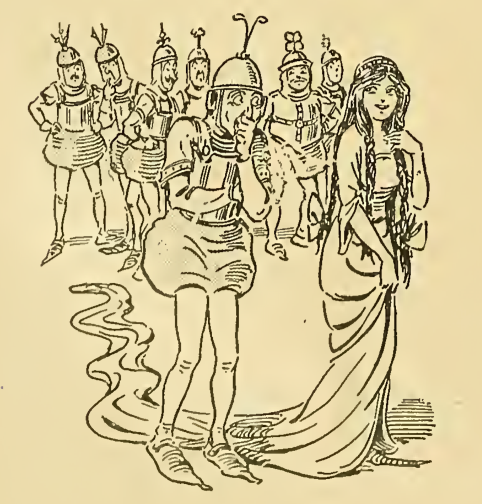
The Lady Helen was the only child
Of Baron Brasted, who a castle had
Upon a hill. The Baron often smiled
Because that hill was steep, its surface bad.
And suitors riding up to woo his daughter
Failed on the one in seven-and-a-quarter.
Helen by all the gallant knights was wooed.
Some came on horses, slow and tortoise-like
And some in carts laborious and crude.
But no one came upon a motorbike,
Because no motorbike was on the market
In those dark days, not even a Noah’s Arkette.
In consequence, their lack of dash and speed
In climbing up the Baron’s steep front drive
Made the good Baron very vexed indeed.
And he declared ” Till someone looks alive,
Eftsoons! and does this measured furlong well in-
side seven seconds, none shall wed fair Helen!”
This caused dismay among the knights, who knew
Their chance to gain fair Helen’s hand was nil.
The Young Sir Wotabout despondent grew,
Yet by an extra effort hoped on still;
For, as he stood apart and muttered, “Had I
A motorbike!” Helen gave him the glad eye.’
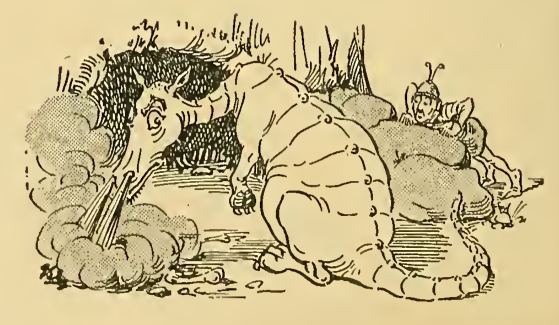
At this he hied himself unto a cave
Wheie dwelt a dragon. Here Sir Wotabout
Observed the dragon snort red fire, and rave,
And breathe blue smoke and thunder from its snout.
“Methinks,” thought he, “this dragon hath possession
Of motive power, but badly lacks compression.”
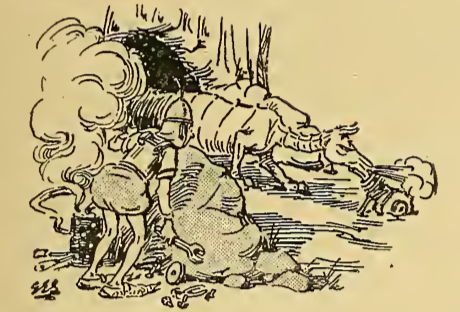
That night Sir Wotabout went forth to snare
The dragon by a trap adroit and neat.
He placed a cylinder outside its lair
Fitted with valves and piston all complete,
And when the dragon placed its head unsightly
Therein to search for nuts, he brazed it tightly.
The captured dragon coughed, and gave a hiccough ;
The valves opened and closed in strict rotation;
The piston fearful speed began to pick up
At each terrific gurgling exhalation.
Placed on two wheels, with belt, belt rim, and pulley,
It answered speed requirements very fully.
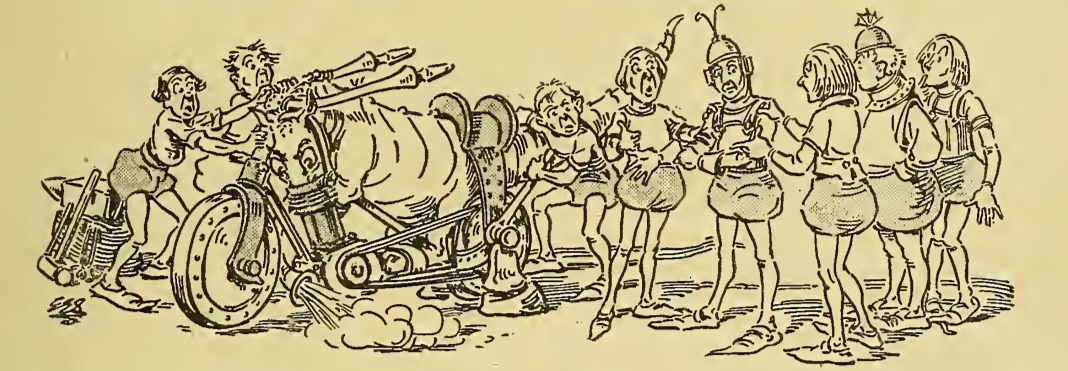
His friends advised him not to ride the thing.
It was, they said, both dangerous and noisesome.
But youth, they knew, of course, must have its fling.
Sir Wotabout determined to enjoy some,
And having tuned his steed and cut the cackle,
Resolved the Baron’s hillclimb next to tackle.
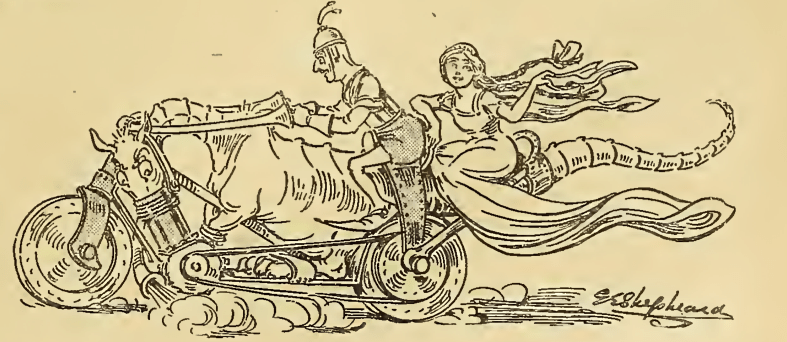
Upon that hill Sir Wotabout achieved
A Dark Age record time, and without fail
The Baron him with open arms received,
So did the Lady Helen Farthingale;
And when the day arrived for him to marry her,
The dragon’s tail supplied a splendid carrier.
Touchstone in the Daily Mail wrote an ode in praise of the military motor cyclists who won their spurs on the Western Front…
NO SIDECAR NEEDED. (1910)
Mary had a. little lamb,
But that was long ago:
For Mary’s grown up with the times,
While lambs but sheepish grow.
So Mary’s bought a motor bike,
That’s warranted to go
And go it does when Mary rides,
For none could call her slow.
She’s most enthusiastic, too;
You’ll see her at the Show:
You’ll meet her down at Brooklands, and
You won’t in Rotten Row.
A member of a dozen clubs,
She’s done the Edinbro’,
The Thousand Miles, the Quarterlies,
As oft as any pro.
I’m pretty often there myself,
And that is how I know.
In fact, they call me Mary’s Lamb,
Because I’m “sure to go”.
And so I am, and by her leave,
I always will be so.
And, faith, we’ll need no sidecar when
It’s Mary, Lamb, and Co.
M’s L
Despatches 1914
Swift as a bullet out of a gun
He passed me by with an inch to spare,
Raising a dust cloud thick and dun
While the stench of lubricant filled the air.
I must admit that I did not like
The undergrad on his motor bike
I have seen him, too, at the wayside inn,
A strapping lad scarce out of his teens.
Grimy, but wearing a cheerful grin;
A young enthusiast, full of beans.
While his conversation was little better
Than pure magneto and carburetter.
Now he, he has got the chance of his life,
The chance of earning glorious scars,
I picture him scouring a land of strife,
Crouching over his handle-bars.
His open exhaust, with its roar and stench,
Like a Maxim gun in a British trench.
Lad, when we met in that country lane
Neither foresaw the days to come,
But I know that if ever we meet again
My heart will throb to your engine’s hum,
And to-day, as I read, I catch my breath
At the thought of your ride through the hail of death!
But to you it is just a glorious lark
Scorn of danger is still your creed.
As you open her out and advance your spark
And humour the throttle to get more speed,
Life has only one end for you,
To carry your priceless message through!
THE NOVICE. (1917)
By ARBUTUS.
Half an hour, half an hour, half an hour longer
Twisting himself like a newly-caught “conger”;
Testing the spark, yet, oh–
Blaming the magneto!
While his words get so much wronger and stronger.
Boys to the right of him, boys to the left of him—
Almost on top of him–add to his fury.
[Would he acquitted be if he slew two or three?
Nearly—if you an’ me got on the jury.]
“Where is that spanner gone? How does this thing screw on?
What is this gadget? ‘Compression’ —what’s that?
Maybe they’ve left it out! or it fell off, no doubt;
Can’t find it, anyhow. Where is my hat?
“I can’t stick here all night; no one can set this right;
Sorry I bought the thing; look at my glove!
Must be the gears are wrong—I thought that, all along;
Give me a hand, you boys; help me to shove.”
0, the wild charges made, when, overnight delayed,
At an hotel he stayed, dressed like a toff.
Wasn’t he half-dismayed! Then, a chap, in the trade,
Showed- him the blunder made–
Petrol tap “off”.
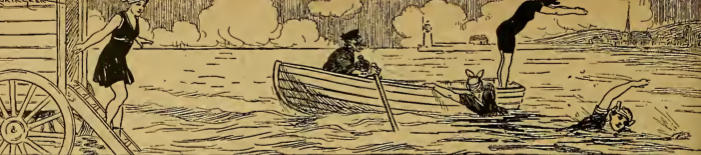
Life and the Open Road. (1917)
By Sophie Elliott Lynn
Pleasant it is to hear the swish
Of the water round your boat,
Or in flannels cool in some still pool,
To drift and laze afloat.
There’s joy in swimming with crestless waves
Where the tide runs deep and wide,
And there’s life alway in the swift short sway
Of a horse’s steady stride.
But there’s joy of life in the open road,
The road that is unknown too,
Where the endless wind that is seldom kind
Can kiss you or cut in two.
A boat will rock as the sea gets strong.
And the crested waves turn cold;
They buffet and beat—and a horse’s feet
Grow tired-a horse grows old.
But with grease and oil and a little time
Your bike is a friend that’s fair;
On valley or hill it is faithful still,
And it always gets you there.
You cross the glare of a summer sun,
You bow to the slash of rain,
But never you find in storm or wind
That you’ve given your care in vain.
Ah, me! the streak of the long white road
Where the tall, dark trees flash by,
And the heat of the day gets wiped away
With the dusk of a twilight sky.
And the moon comes up from a dewy haze,
And the damp air lends you power,
You know you can do—the whole night through—
Your thirty miles per hour.
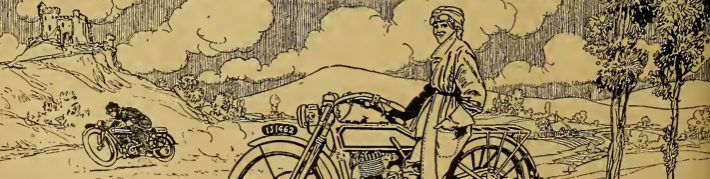
A Miser to his ‘Hoard’. (1917)
By Sec-Lt. RDC Graham.
When I unlock the garage door to see
No dastard thief has robbed me of my prize
That fear is constantly before my eyes
Ah! how I rub my wasted hands in glee
And chuckle hoarsely at the sight of thee,
Poor sorry remnant of my ‘juice’ supplies!
This thought provokes the moist unbidden tear,
Or not infrequently the peevish curse.
(I don’t say ‘Blow!’ but something rather worse,
Causing a pinkness in the atmosphere.)
Yet so things stand: and I am not quite clear
Just how thy precious contents I’ll disperse.
Shall. I fare forth on some long-distance ‘blind’
Which, like a swan-song, shall be very sweet?
–Or light a noble bonfire in the street?
(For a dramatic finish I’m inclined.)
Or keep thee here, unopened and enshrined,
To gaze on while I wait the Huns’ defeat?
The Dirge of the Carburetter. (1917).
You thought you were above decay
Upon your pedestal of clay.
The tricar vanished in its pride,
Accumulators came, and died:
You saw the trailer’s final rout.
Hub gears came in—hub gears went out,
And belt drive tottered on its throne.
Of all the parts you stood alone.
Each year your pipes were cankered through
With juice of still more heavy brew.
With substitute we “wreaked our wills.
Your float was caked with petrol pills.
You even swallowed paraffin.
But now at last your checks are in.
Begone ! The weak must leave the race :
A gas tap comes to take vour place.
EPB
Survival of the Fittest. (1904)
Ten little motors going very fine, A defective carburetter, then only nine.
Nine little motors, each one up-to date, Then 11 leaking petrol tank, then only eight.
Eight little motors, each by expert driven, Then a broken belt, and then only seven.
Seven little motors going over bricks, Vibration loosens something, then only six.
Six little motors now alone survive, Then a knocking engine, and then only five.
Five little motors left of half a score, Then a short circuit, and then only four.
Four little motors, riders full of glee, Then a belt rim trouble, then only three.
Three little motors, riders ‘dare and do’, An over-heated engine, then only two.
Two little motors finishing the run, Breaking of a contact spring leaves a single one.
One little motor covered 1,000 miles, Rider of the ————— finishes all smiles!
A COLD BATH (1908)
It is rather entertaining,
When it’s cold and wet and raining,
And the language you’re restraining
Is becoming hard to hear,
When with clothes all wet and wringing
To your handles you are clinging,
With your motor ever dinging
Out its rhythm in your ear,
Just to take its cheery meter
For to make the journey sweeter
And to render time the fleeter
‘Tis a very good idea,
And to rhyme all out of season,
Say good-bye to every reason,
Tell the weather it can freeze on
If it likes, as you don’t care.
Pop! Pop! Pop! Pop! Pop! Pop! Pop! Pop!
Oh I wonder when I’ll stop-op.
What’s the good of Mother Hubbard,
With her bones inside her cupboard.
I’m as mad as any hatter—
Bless me! how my teeth do chatter!
Poor Jack Spratt could get no fatter
‘Cause his wife would eat the platter.
Sure, this road’s a muddy river—
Ugh! And how I qui-ui-uiver!
Mary had a little liver,
And Cock Robin killed the sparrow
With his borrowed bow and arrow;
0h 1 hope he ate his marrow.
And I wonder if Jack Horner
Really had a plum or corn, or
Whether really Cinderella
Left her shoe or umb(e)rella;
If it’s true shock-headed Peter
Tried to woo or tried to eat her;
If that blackguard Alpha beat her,
Or that giddy Gamma dealt her
Little digs about her belt! Ah!
Here’s a hill; guess I’m mistaken
If I do not put the brake on,
Put the brake on, put the brake on,
Put the holly blighted brake on.
Oh my whiskers! What has happened?
Has the thing got jammed or flattened?
Sure it is I cannot shove it,
Love or money will not move it.
Then look sharp; turn off the motor;
Hurry up, you silly goat, or—
Curse! I can’t! the lever’s broken!
How I wish I’d never spoken.
Yes, that last one must have done it;
Why the blazes did I pun it!
Keep your nerve now—no use swearing
When the thing is past repairing.
Can’t you see you’ll have to risk it,
Steer for life or break your brisket!
Oh my dinner! How unwilling
Am I now I spent that shilling;
Though in truth I had my filling,
Now it serves to most remind me
Of ‘The girl I left behind me’.
Can I clear that nasty corner
Straight ahead…
…I could have sworn a
Thousand pounds I’d never do it,
Yet my luck has brought me through it.
Brought me through it, yes, by thunder.
What is that, though, over yonder,
At the bottom by that pond? Ah!
Sheep! The things I least expected,
If they haven’t just collected
In the road—a clear obstruction.
Silly things to court destruction!
But as sure as they’ll he mutton
My poor life’s not worth a button.
Either they must act as buffer,
Else it means the pond, you duffer!
Woolly sheep and instant slaughter—
Either that or slimy water!
Choose! Make haste! No hesitation!
Which best suits your inclination?
Oh then—since it’s life or leave me,
Let the duck-pond there receive me!
Nearer yet! l’m right agin it!
Mercy! Save us! Splash! I’m in it!!
HCL.
Artemis in London. (1917)
by Wilfred Blaise
In many forms, in many forms, these new heroic days,
Has Artemis come down to us—in virginal brave ways.
But oh, the motor cycle maid, with lithe, straight back threw low,
Slim outspread arms, wind-braving breast, and the fair, keen face aglow!—
As she leans thrumming down Whitehall or on to th’ Embankment swings,
I see the Winged Victory, whose fluttered garment clings
About her splendid, urgent limbs, her poise superb with speed—
I see the inviolate Maid,
Buskined and unafraid,
Spear-armed, spear-eager, lead the hunt where’er the hunt may lead.
This charming ode appeared in the programme for the 1921 Scott Trial…
“With Apologies to Mr George Robey.
The fact is.
I’ve just bought a wonderful motor, it has an engine, a tank, and a gear.
Now I have this new toy, all the world is a joy, I travel for miles without fear,
I ride it in day-time and night-time, all its uses I cannot describe,
It rings like a bell, and travels like —— it belongs to a wonderful tribe.
May I say it’s a marvellous goer? Well, perhaps, that is hardly correct
Marvellous true, and it sometimes does go, though I am rather afraid it’s inclined to be slow;
Perhaps it does overheat on occasions, it is even reputed to knock.
It’s a wonderful ‘bus—though it’s taught me to cuss, well the fact is—SOME CROCK!
I used it last for a journey, to Brighton, to spend the week-end,
The weather was fine, so I started at nine, and sent off a wire to my friend.
The ‘bus was in fine, fettle, it started first kick of my feet,
So I mounted my steed—put her into low speed—and waved to the kids in the street.
The journey was really successful, well, perhaps that is hardly the word,
At least it was pleasant, now that I can say, though I felt rather tired at the close of the day;
Well, when I say tired, I was weary! I was almost too fagged out to talk,
I’d a terrible thirst though my feet were the worst, well, the fact is—I HAD TO WALK.
Now this really wonderful auto is the joy of my life so to speak,
It gives to my boy, in a minute more joy, than a car could give in a week;
It never goes right for an hour, it breaks down at the slightest excuse,
It fizzles and pops, and misses and stops, and causes the vilest abuse.
It’s a sort of a kind of a Triumph, Well, Rudge is p’rhaps nearer the mark,
Yet it isn’t a Rudge and it isn’t a Bat, though all of these names make me take off my hat;
Now Douglas you guess, or Zenith or Nut, you may even surmise it’s a Dot,
It’s a wonderful bike—a real Yorkshire Tyke, well, the fact is—IT’S A SCOTT.”
…and this equally charming ode was writted by a Scott trial competitor (victim?); it appeared with the 1927 Scott Trial Report in the Blue ‘Un (which described Denton Moor as ‘f”ve miles of frightfulness”.)
ON DENTON MOOR.
My bike is bust, it will not go
On Denton Moor.
Both footrests went some time ago
On Denton Moor.
When the Yorkshire hills are clad in snow,
And the lads are riding in the Exeter show,
I shall still be wandering to and fro
On Denton Moor.
In this Scott Trial I showed some fight
Till Denton Moor.
But every rock my crank case hit
‘Twas dented more.
I crashed through bracken left and right,
My gear box screamed, and well it might,
And so did I, such was my plight
On Denton Moor.
My silencer soon came away
On Denton Moor.
I’ve left the bike some times today,
On Denton Moor.
And rocks and stones and dirt and clay
Have filled my mouth as there I lay,
While the poor old ‘bus ploughed on its way, On Denton Moor.
I shout aloud, none hear my cries,
On Denton Moor.
The light gives place to darkening skies,
On Denton Moor.
Methinks I’ll lay me down and dies,
Till Judgment Day when all arise,
Perhaps I’ll get a special prize,
For Denton Moor.
JC
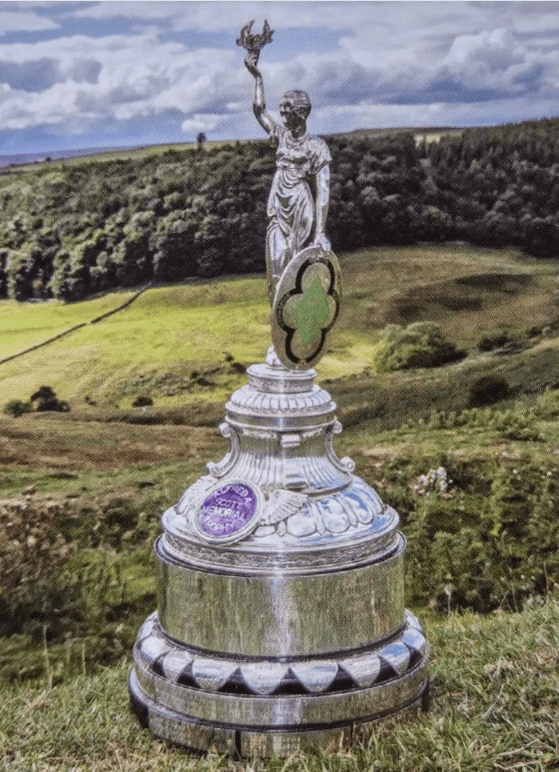
In 1927 Ixion wrote, under the heading ‘The Next Laureate’: “The following poem is reprinted from the official journal of the Metropolitan Vickers’ Apprentice Association; it is good enough to deserve a wider audience.” As usual, Ixion was right.
When we’ve ridden out our guarantee, and several thousand more,
And the mileage on the dial is running high,
Then the human engine seizes, or a.piston starts to score,
Or a frame breaks, and we settle down and die,
And the next stage (experts tell us) is a region bright and fair;
But is there room for trusty steeds besides?
When the hero reached Valhalla, did he find his charger there?
Shall we meet the old machines we used to ride?
Have they got a super garage, way out there beyond the sun?
Where the buses that we’ve ridden here below
Live in glorious new enamel and with burnished handlebars
Now await the riders whom they used to know?
Shall we trace our earthly progress from the days of pushbike frames
With an enging (for the sake of peace I shall not mention names)
Which is just a flash of lightning and a zoom?
Shall we ride our favourites once again in celestial TT,
(Lapping thirty-three times round the Milky Way)?
Shall we see St Christopher arrayed as Dergeant RAC
OrSt Peter representing the AA?
Shall we find ourselves as cherubim with uncelestial mirth
Skidding round the double hairpins on Orion?
BUT—if we have to tune up each machine we owned on earth,
Say, Bo, I guess I’m sorry for Ixion.
Poets, it seems, are still inspired by motor cycling. My Manx chum Bill Snelling was kind enough to pass on a pair of gems from the perfectly named* Dave Kelly. Bill told me: “Dave is a local farmer, not a biker, and composes these as he goes around on his tractor!”
*Kelly, as all TT fans know, is a ubiquitous Manx surname; hence the old Music Hall favourite Kelly of the Isle of Man.
ODE TO THE MOTORBIKE [FROM THE GIRL ON THE PILLION]*
It’s great to ride a motor bike perched on the pillion seat,
The sun on your face, the wind in your hair and all the wasps you can eat.
You’re snuggled up behind your bloke as close as you can get,
But he reeks of oil and petrol, wet leathers and stale sweat.
Then he said he’d take me dancing because dancing’s what I like,
But he’s out there in the garden shed, still tinkering with the bike.
On his pilgrimage to see ”The Manx” two muddy weeks we spent,
On a rain soaked field out at Glen Lough in an army surplus tent.
A Spartan life we girls must lead if our fellas we would hold,
It really turns a biker on when your lips are blue with cold.
Needs must you wear a helmet, so states the highway code,
And a shiny leather mini skirt to slide along the road.
He drops me at the Grandstand, so he can “Utilise full power.”
But the quickest lap he ever clocked was three quarters of an hour.
Riding topless on the promenade, some girls cut quite a dash,
But it’s only just to show the lads we’ve all got “Gravel Rash”
Then you really have to brace yourself when he thinks it’s time for nookie,
You should try it ‘cross the petrol cap on the tank of his Suzuki.
THE COURSE
Straight off the Canon Bench Mark, that tests both nerve and will.
Which riders keep her on the pipe, as they plummet down Bray Hill?
Take extra care at Quarter Bridge, when your tank is filled with gas.
There’s no mercy in the pit lane, if you wind up on “the grass”.
Braddan Bridge needs rear wheel steering, but don’t inform your next of kin.
Sometimes you have to step it out, so that you can, ‘Back her in’.
As you pull away from Union Mills, Dunlop’s truth can’t be denied.
A long straight track is what you face; it just isn’t all that wide.
Appledene needs close attention, then at Greeba, if you’re wise.
Keep your head down and your mouth shut, or you’ll be dining out, on flies.
From Doran’s to Glen Helen pub, is the hardest stage to learn.
But once you’ve got the rhythm right, she’ll flow through every turn.
That groove along your helmet, souvenir of one close call.
Inscribed at Handleys Corner, where you scraped it on the wall.
Down Barregarroo and through Michael, as you head for Bishops Court
While tank slappers at Rhencullen, will give several – pause for thought.
Here the road can seem to vanish, as if a curtain’s ‘cross the track.
But keep your throttle open, and the trees keep falling back.
Knock her off as you approach Ballaugh, there is little here to gain.
Beside the chance of falling off, you might easy bust the chain.
Two ton along the Sulby Straight, if such speed does not appal.
But you’d better hit your braking point, or you won’t make Ginger Hall.
Negotiate Glentramman Bends as you’re wheeling round The North.
Then sit there quietly and relax, and let the road drift back and forth.
The track is rough through Schoolhouse, and the line is pretty tight.
But when you wind up in the bus stop, then you’ll know you got it right.
Bob Mac. assessed The Mountain, and spoke with insight rare.
Ascend that hill quick as you can, then come down fast as you dare!
Through Water Works and Gooseneck the boys throw on some style,
It’s the reason why they ride a bike, powering up the Mountain Mile.
Count the kinks on the Verandah, because should you lose your line,
You’ll be ploughing through the heather, heading down for Snaefell Mine.
Sweeping round the Thirty Second, requires both steel and poise.
To crank those corners at one bite, sorts the men out from the boys.
Round Windy and The Thirty Third, then pass through Kepple Gates,
Swooping down on Creg-ny-Baa, while your stomach’s back at Kate’s.
Pour it on straight down to Brandish, if the road is dry and clear.
Sucking rabbits from the hedges. trying to find that extra gear,
The knack to taking Bedstead would make you hold your breath.
With the wheels up on the pavement, much like the wall of death.
When your light comes on at Sign Post,
There’s a board hangs by your pit,
Shows the lead is just five seconds,
So you had better keep her lit.
PS
All the gear but no idea,
It’s a cinch to spot the fake.
Twenty thousand quid and twenty miles,
Does not a biker make.
Popping wheelies in a head wind,
Not worth the buzz it brings.
It could give a whole new meaning,
To, ‘The wind beneath your wings’.
I have no fear of riding fast,
When I’m racing on my bike.
It’s the thought that I might crash and burn.
I just can’t get to like.
..and here’s one we can all sympathise with:
ODE TO A MOTORCYCLE ENGINE:
I have breathed life into this thing of oil and fine ground steel
Held the pieces in my hand, this nut, this spring, that wheel,
I have nurtured every piece that makes this iron heart
Yet tho’ I try my best, the flamin’ thing won’t start!
’twas ever thus.
 Motorcycle Timeline