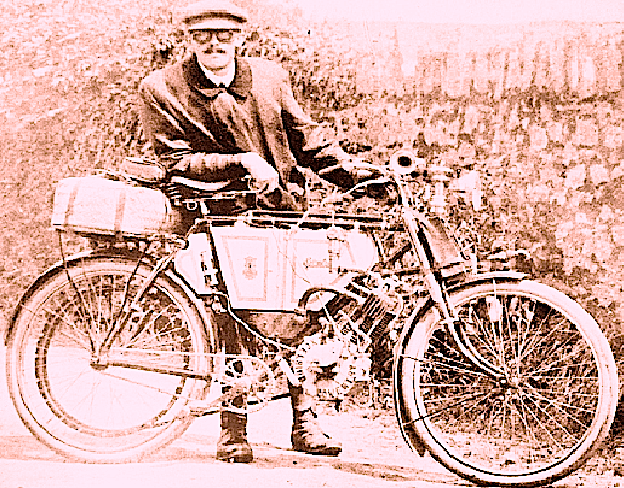
“IT WAS ONLY a week before the publication of our Jubilee number that George VI, Britain’s motor cycling king, passed on after a reign devoted to the service of his people. Time was—and I have personal memories of it—when he was a keen rider, and one, it may be added, of spirit. His Majesty enjoyed himself on his machines, and probably got as much kick out of them as any young man naturally does. He became a patron, too, of the sport. And now we have entered upon the second Elizabethan age, which should be, like the first, one of adventure. That many are entering it in that spirit is already evident, and the example set by HRH the Duke of Edinburgh is something to be noted. I am not thinking of the fact that he is learning to fly so much as of the interest that he shows in motoring in all its forms, including the one nearest to our hearts. He is Patron of the A-CU, President of the AA, and President-in-Chief of the British Racing Drivers’ Club, and it looks as though, in him, the motor-using community has found a much-needed champion. It was a happy augury for the future that he consented to open the first Motor Cycle Show to be held in the new reign.”

THE AGE REPORTED: “The oldest inhabitant of Market Lavington (Wiltshire), Mr George Dobsony, aged 95, has decided that he will never ride his motor cycle again. He made this resolve after the Devises magistrates had convicted him for having driven his motor cycle without due care and attention. The magistrates put Dobson on probation for three years on condition that he did not ride his motor cycle during that period. This arose from a minor collision when the senior citizen of Market Lavington, according to the prosecution, pulled across the path of an on coming car without giving a hand signal. The motorist, Herbert Dummer, of Corsham, said, ‘The old gentleman had two bottles of liquor in his pocket. His hand was slightly hurt, but he seemed to be more concerned with recovering one bottle which fell on the road and did not break than about the collision.” After his conviction Dobson said, ‘I have been motor cycling since 1913 without an accident. I ought to know how to drive by now. I had my arm out for the whole length of this piece of road. There has been too much fuss.’ Despite his advanced age, Dobson has been on his motor cycle almost every day. Sometimes he went shopping on it, or to see his wife in hospital and on other days he sped along to the Wheatsheaf Inn after a day in the garden, to get himself a couple of bottles of beer for supper.”
“SCOOTERS SHOULD BE more in the picture when the industry holds its next exhibition next autumn. Here Britain is very much behind the Continent. For that no justification is apparent. I look forward to the outcome, and it should not be long before the first signs of it appear. We must have supremacy all round, remember, if it is to be worth very much. At the moment we make the world’s best motor cycles in certain classes. But I want to see us taking the unquestioned lead in all, including that of the scooter.”
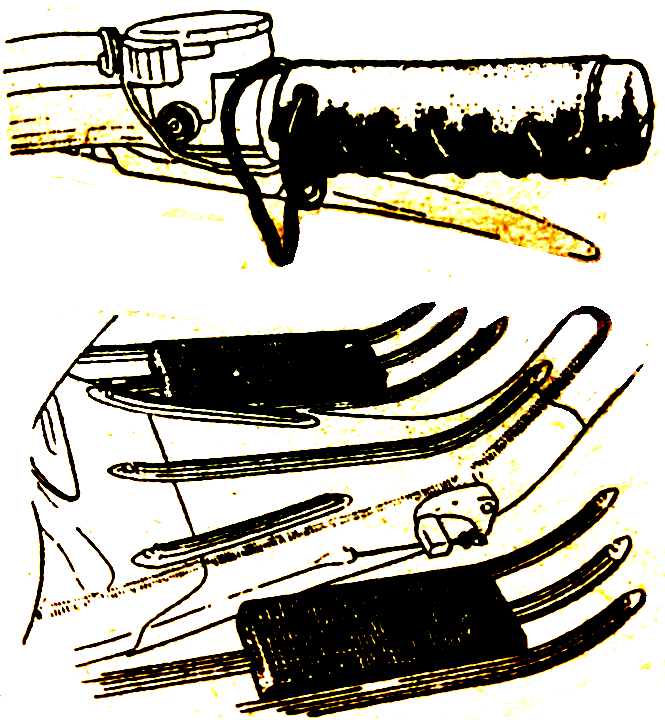
“OUR FRENCH CONTEMPORARY Motocycles CONTAINS an interesting account of two recent inventions of M Arestié, a specialist in electrical equipment, which should prove popular among ‘all-weather’ motor cyclists. The first, a hand-heater which can he used on any motorcycle equipped with a flywheel generator, consists of a pair of fabric covers which lace over the handlebar grips. The internal heating elements of the covers are fed directly by the flywheel generator, the current consumption being so small that it in no way diminishes the efficiency of the lighting. The other invention, a foot-warmer, is designed specifically for scooters and consists of two shallow aluminium boxes which can be fixed to the foot boards, the heat being derived from the engine exhaust gases circulated through the boxes. The inventor has equipped his own Vespa with these two devices and they have been tested by ‘Motocycles’, which reports favourably on their efficiency and the absence of any ill-effects on the machine’s performance.”
“WITH THE INTRODUCTION, by a number of concerns, of safety helmets designed expressly for ‘civilian’ use, there has been an increasing demand from readers for first-hand information on the subject of safety headgear. As a consequence, examples of the products of several makers have been worn recently by members of Motor Cycling’s staff: the ‘Corker’, produced by J Compton, Sons and Webb, who have for many years specialised in the.,production of protective headgear; the ‘Cromwell’, which emanates from Helmets, of St Albans, already well known in motor cycling circles for their racing ‘bowlers’ ; the ‘Aviakit Mark 2’, from the house of D Lewis; and the Feridax ‘St Christopher’…The ‘Corker’ features a shell of resin-bonded gossamer layers, covered with cork to give a certain amount of resilience. A cork peak is fitted, this being flexible—an important point—so that it will fold over the nose and eyes to give protection to the face in the event of a fall without the wearer incurring the danger of neck injuries, which is always present with a rigid peak. On the latest models, the head cradle takes the form of a fore-and-aft web strap with a width of 4in, and a separate cross-strap, of heavier material, 2⅛in wide. This, it has been found, gives greater comfort than the narrow straps which featured on the earlier helmets. In the forepart of the shell is a substantial sponge-rubber pad which continues to the helmet crown Ventilation is provided by air holes, rubber-grommeted, which are situated two on each side. An adjustable leather headband, reinforced by canvas, is stitched to the shell. with an interposed foam-rubber shock absorber continuing around the base of the helmet. Side flaps only are fitted, these being of leather, canvas-lined. A leather strap, with a quick-action buckle, has a chamois panel to prevent slip, and the side-flaps are provided with ear holes. Various colour finishes are available, and the helmet retails at 65s [=£120 in 2026] including PT. In use the ‘Corker’ has proved eminently satisfactory. It weighs 16oz and even on runs of over 100 miles, no ill effects were noted…Very
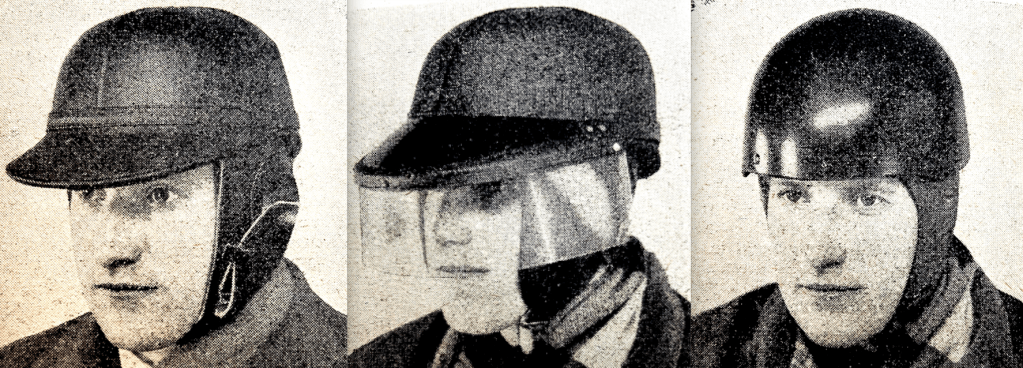
welcome indeed was the warmth of the helmet in cold winds or rain and under wet conditions the peak proved invaluable, fully protecting the rider’s goggles, allowing only a few spots to appear on the lenses during a really heavy shower. Because it was not easy to raise the goggles over the fixed peak, the testers soon acquired the knack of slipping them down to hang around the neck. Similar in construction, the ‘Aviakit’—marketed by D Lewis—was tried out in its latest Mark 2 form, which has a full leather neck curtain, adjustable for closeness of fit. Unlike the ‘Corker’, the ‘Aviakit’ has internal ventilation, this being achieved by arranging four air ducts in the sponge-rubber shock pad. ‘Very comfortable’ was the report of the staffman who used this helmet. Also tested with the helmet was a visor which Lewis produce specially to match. A clear celluloid screen, with a buckled leather head-strap, it fits neatly over the flexible peak and is retained in place by a moulded rubber grommet. At the rear, it is fastened by the goggle strap, which is an integral part of the helmet. Of identical design, with the exception of the use of side flaps instead of a full neck curtain, the ‘Aviakit Mark 1’ weighs 17oz and retails at 55s 6d [£95], while the Mark 2, weighing approximately the same, costs 59s 11d [£110], inc PT. At 42s [£75] inc PT the ‘Cromwell’ is the cheapest helmet on the market. Although, externally, it resembles a racing helmet, it is actually of somewhat different construction. The shell is of wood pulp, bonded by a special synthetic resin. To this extremely strong outer casing is riveted the adjustable head cradle, consisting of three looped webbing straps 1n. wide. The combined chin-strap and necklet is in lined gaberdine and the chinstrap fixing is by means of two press studs. The strap is adjustable and, once it has been set, the buckle need not be touched. The ‘Cromwell’—which, the makers claim, will pass the impact test of the BSS 1869 for crash helmets—weights 17oz. and is both warm and comfortable in wear. The ear holes are provided with muffs to prevent wind rush and to exclude water, while a slightly more expensive edition—priced at 46s 6d [£85] inc PT—is provided with a leather necklet in place of the gaberdine type fitted to the model which was tested. Only one fault was apparent in the ‘Cromwell’, and that only a minor one. The cut-away at the front, which is provided to allow goggles to be comfortably accommodated, proved to be a trifle too shallow to take the popular Mark VIII goggles. These had, perforce, to be rested on the helmet itself, at an angle, which proved to be detrimental to windproofing. Apart from that, the ‘Cromwell’ acquitted itself admirably. When the extremely low price is taken into consideration, it seems destined to achieve popularity amongst riders with whom first cost is of prime importance. There is one further ‘Cromwell’ model which, retailing at 70s [£125] inc PT has a
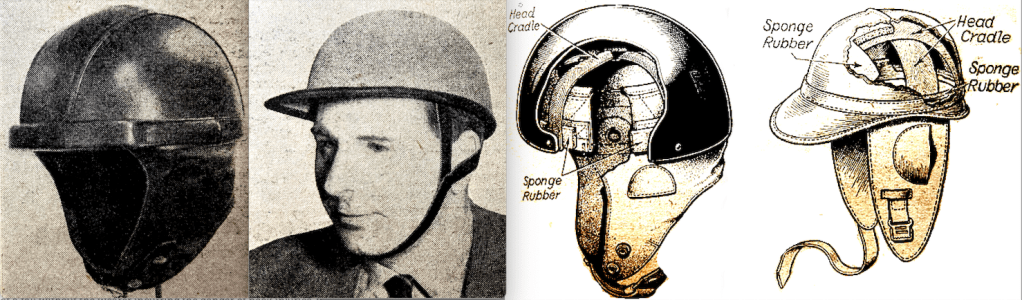
leather, instead of a painted, finish and which is supplied with either a soft peak or a rubber buffer. Slightly heavier—the weight is, approximately, 20oz—this helmet has constructional features similar to those in the cheaper ‘Cromwell’ models. Lastly, there is the newly introduced stylish ‘St Christopher’, marketed by Feridax. The ‘St Christopher’ helmet dispenses entirely with both side and neck curtains and relies upon a pair of ‘Y’ straps. These, it was felt, were somewhat inadequate, and an improvement in this department would be indicated, especially as the absence of side-flaps naturally detracts from the degree of weather protection offered. That consideration apart, the Feridax product is good-looking, well designed and well made. Fibre-glass layer-moulding is employed for the shell, which has an integral peak. Although seemingly stiff, this will, in fact, bend considerably under load. A foam-rubber strip is interposed between the rim of the shell and the leather head-band, to which are sewn—by nylon thread—eight webbing cross-straps, these having a centre drawstring. Holes are drilled around the rim to take the nylon headband lace, which is subsequently covered with tape before the helmet is sprayed with felt flock. The rim and peak have a rubber moulding around the edges and the ‘Y’ straps, buckle-adjusted, press-stud into place. Available in a variety of colours, several of which match motorcycle finishes, the ‘St Christopher’ weighs only 12oz and retails at 44s 10d [£80] inc PT. Appearance has formerly been one of the stumbling blocks in the way of a general adoption of helmets. In the course of these tests, however, comment on the headgear was generally favourable, both by riders and laymen. With such a variety of helmets to choose from, the rider who wishes to invest in this form of ‘extra insurance’ against injury need no longer be deterred by the absence of suitable headgear, or by considerations of price. It is not without significance that at least two members of Motor Cycling’s staff who were responsible for compiling this article have decided to adopt safety helmets as standard headgear and that one has such a helmet in daily use for his return trip of 10 miles through some the busiest and worst-surfaced streets of London. And clubs can now seriously consider the Duke of Edinburgh’s suggestion, made at the Earls Court Show, of the adoption of distinctive club helmets.”
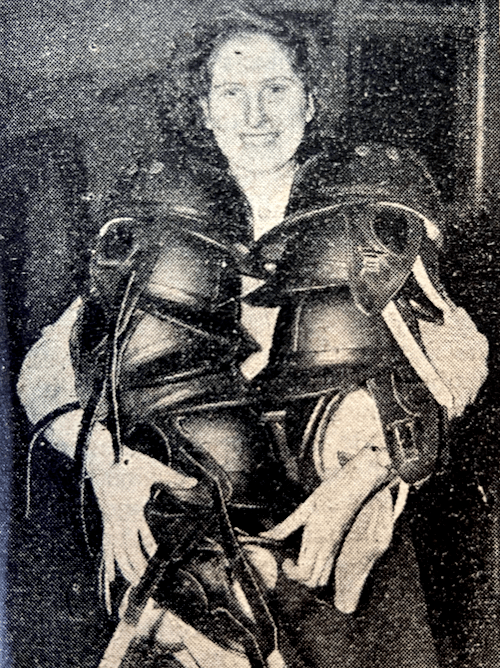
“HOTLY OPPOSED AS I have always been to making the wearing of safety helmets compulsory, I share the view that the practice is certainly one to be encouraged. More and more riders seem to be coming round to that way of thinking, and the wearer of a helmet is no longer such an uncommon sight on the roads. To popularise the safety helmet should not prove difficult. Two things would be necessary, the first being to free it from purchase tax. That will no doubt be done before very long, and the second requirement is really the more important. It is that some interested body, which could be Rospa, or even the Transport Ministry, should appoint a public relations expert to put the idea across to the motor cycling nubile. The right man would start getting results quite quickly, and probably within a year or two his task could be considered as having been accomplished. It is only a matter of getting a fashion accepted, and the most effective way of doing that is to employ the services of a specialist. You can induce people to stick to beer, or eat more bananas, by the right kind of publicity, as was most convincingly demonstrated in those two instances. And you could have most motor cyclists wearing protective headgear by the same method.”—CARBON
“I DO NOT WANT to wear a safety helmet for many reasons. Who among us has not enjoyed the cool evening air on the brow? Who has not saved money by detecting an audible fault and stopping in time?…I personally cannot stand anything around my ears and back of the neck at any time. I have been a motor cyclist for 18 years, averaging about 20,000 miles per year. In all that time I have personally known of only two cracked skulls—one was a rider who had worked too much overtime during the war; he had a black out while riding, fell from his machine and stopped a rolling beer barrel with his head. The other was a young lady inside her father’s family saloon car. I have made many friends and contacts in the motor cycling world, apart from the sporting fraternity, and have known of many motor cycle accidents. I recently canvassed among my friends—eight motor cyclists to be precise—and none of them personally knew of a cracked skull or a case where a helmet saved a life without any doubt. I know of several would-be motorcyclists who have been put off by the prospect of ‘having to wear a safety hat’…by wearing them I believe we only impress the general public with the danger of the motor cycle. Whether or not the reader is in favour of these hats, compulsory legislation must he fought to the last. Motor cycling for business or pleasure will be absolute misery. Think of the restrictions as they affect as personally—nip up the road for cigarettes; better walk. Offer a lift to Bill Brown from the local bus stop—sorry, old man, you need a hat. Stop the model and have a walk round to view the scenery; you must carry it with you. If some character steals the hat—walk home, brother!
KW TREMAIN, London, N6.”
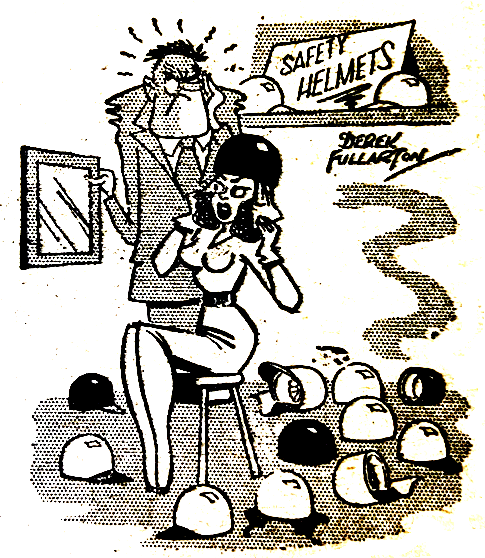
“WITH REFERENCE TO your Editorial on compulsion, you mentioned ‘…including pillion and sidecar passengers’. Would not this bring car passengers into the same class, because they are only enclosed —just the same as saloon sidecar passengers in fact, who cannot fall off as the driver or pillion rider can. What of the family man? Has he got to stop taking his kiddies or baby out in the sidecar if this law is passed? Myself, I am all for helmets, but would not [Transport Minister] Mr Lennox-Boyd be going too far if he attempted to include sidecar passengers? What do other family men think?
FAMILY SIDECAR MAN, Sheffield, 6.”
IN THE USA PROFESSOR Red Lombard was granted a patent for a crash helmet.
“LISTENERS TO THE broadcast on road safety given on January 19 by Mr Gurney Braithwaite, Parliamentary Secretary to the Ministry of Transport, were left with the impression that the Government intends to do all that ties within its power to assist the Coronation year campaign to reduce the accident rate…Yet within 24 hours of making his moving appeal to motor cyclists to wear protective helmets, Mr Braithwaite heard the Chancellor of- the Exchequer decline to exempt such headgear from purchase tax…The lame excuse put forward by Mr Butler was that helmets must be classed as protective clothing…[However] no trouble was experienced by Treasury officials in making protective helmets designed for miners and quarrymen exempt from purchase tax. Many miners and quarrymen ride motor cycles; surely it cannot seriously be argued that protection for their heads is of greater importance when they are at work than when they are going to and from work? Yet that is the implication in the Treasury’s ruling, which makes one type of helmet subject to tax and the other type exempt. Hair-splitting is a pastime beloved of bureaucrats, but when it may involve head-splitting the game becomes a dangerous one. The skull of a miner is neither more nor less valuable than the skull of a motor cyclist, but at present the helmet designed to save the latter from serious injury ranks, pari passu, in the eyes of the Treasury officials, with the grocer’s apron.”
“THE ROYAL SOCIETY for the Prevention of Accidents is offering a prize of £100 for the motor cycle club which submits the best suggestion for methods of popularising the use of safety helmets among riders and pillion passengers.”
ROAD RACING RETURNED to London with the revival of the Crystal Palace circuit by the London County Council. Facilities included a trackside railway station.
THE BSA GOLD STAR was treated to swinging arm rear suspension. Also new from Hall Green was the Super Flash, a tuned plunger-framed Golden Flash. Within months the A10 got swinging-arm suspension and the Super Flash became the Road Rocket.
AMC DEVELOPED ITS G9/7R hybrid into the G45 production racer (the ‘45’ reflected the 500 twin’s claimed power output).
LEGISLATION TO COMPEL motor cyclists to wear safety helmets was called for in the House of Lords by Lord Teviot (Nat Lib). He quoted from the letter of a coroner who had held six inquests on motor cyclists since last June, saying that in each case death had been due to head injuries and that none of the victims had been wearing a helmet. Lord Teviot argued that though many motor cyclists wished to wear safety helmets they were deterred by fear of ridicule. Personally, he said, he thought the helmets quite attractive and saw no reason why they should not be available in many colours and have club badges painted on them.”
“THE QUESTION OF whether a safety helmet should have a peak is more important than it looks. Everybody knows that experts frown on the mere idea of a peak for a racing helmet. If a stiff peak scrapes anything in a spill, it may wrench the helmet out of position and almost destroy the theoretic protection. But some authorities take rather a different view of a very light peak on roadster helmets. Unquestionably, a peak shades the eyes from fierce sun, from headlamp dazzle, and from hail or rain. It is improbable that—for example—a light celluloid peak, secured round the helmet by an elastic no stronger than goggles’ elastic, would wrench the helmet in a major crash. Ergo, a similarly light peak, lightly secured to the helmet (perhaps press-buttons?), could be far more convenient and just as safe? More than one manufacturer, eager to cater for the growing trade in helmets, takes the view that a light peak is both desirable and safe. The sooner we are given an authoritative decision on the point, the better.”—Ixion
THE WORLD ROAD RACING CHAMPIONSHIP, started in 1949 with six rounds, had grown to nine ‘classics’: the TT and the Ulster, Belgian, Dutch, French, German, Swiss, Italian and Spanish Grands Prix. The best five performances counted towards each manufacturer’s points standings.
“IN HIS NEAT, effortless and faultless style Rod W Coleman, on Norton and AJS machines, won both Senior and Junior New Zealand TT titles on January 10, at Mangere, Auckland. Twelve thousand witnessed Coleman’s riding and were satisfied that they had seen a rider of world’s class. He was 3min 28sec faster in the Junior event than Jim Swarbrick’s winning 1952 time and also clocked the fastest lap in 4min 36sec—80.86mph against the 4min 46sec of the 1952 event. On his Manx Norton he made fastest lap in the Senior when he clocked the 6.2-mile circuit in 4min 24sec—84.54mph. Unfortunately the Senior was only run over 12 laps, 74.4 miles, owing to a mishap on the opening lap when Gordon Haggitt, braking late for a corner, collided with a flag marshal. As a consequence the ambulance van had to go out on the course. Under the new NZ A-CU ruling no rider may pass the ambulance while it is in motion. The rule did not work out as intended, for the van came on to the course just as Coleman, Hollier, Perry, Jensen and Laurent had gone by, thus
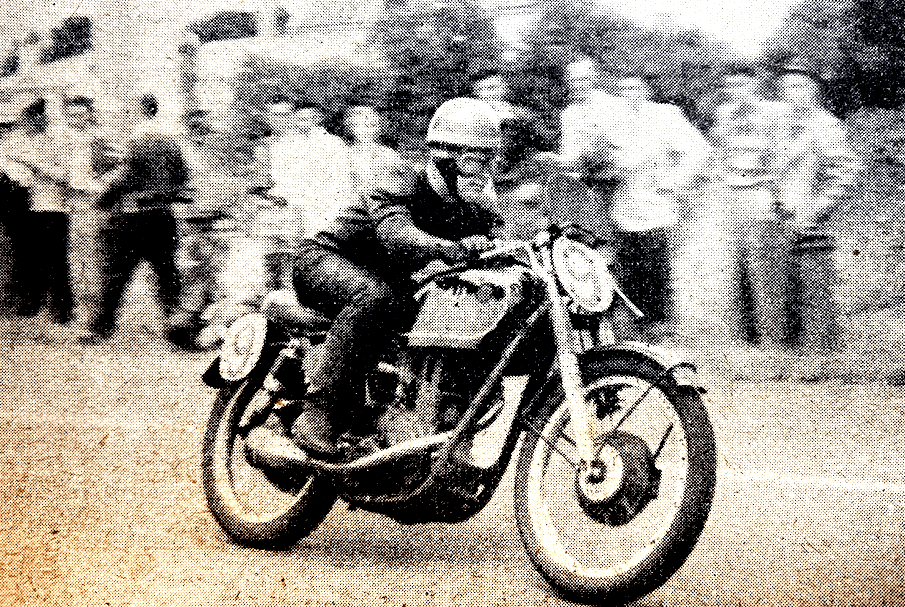
splitting the field. While the former five went on uninterrupted the others had to slow behind the ambulance. As the leaders finished the third lap they were red-flagged to stop and the race was eventually restarted. As the road closure operated only to 4pm, race distance was reduced from 17 to 12 laps. The almost flat rectangular course at Mangere comprises four miles of tar-sealed surface and two miles of metal. This latter section was treated with oil and early morning rain also helped to minimise the dust nuisance of the 1952 races. Official road closure was from 11am. At 11.15am the riders were sent off on their half-hour practice period. Shortly after noon the 28 juniors were started off by the local MP, Mr Leon Gotz. THE JUNIOR RACE: At the end of the first lap Coleman led Murphy, Jensen, Gibbs, Horner and Simpson. All bar Hollier (Norton) were riding 7R AJS machines. From his push start Coleman clocked 4min 49sec against Swarbrick’s opening lap of 5min in the 1952 race. On his third and fourth laps Coleman equalled the Senior 1952 lap record of 4min 36sec, 80.86mph, after which he settled down to touring laps between 4min 40sec and 4min 46sec. With his motor spluttering Jensen pulled in to his pit at the end of round three to find a flooding carburetter, traced later to a punctured float. The early pattern of the race changed little.,Coleman steadily increased his lead on Peter Murphy and ran out the winner with 1min 34sec lead on Murphy, who had ridden hard and consistently on John ale’s 7R. Leo Simpson caused a mild sensation when he passed Keith Gibbs on the final mile and the pair roared across the line a machine length apart. Results (17 laps, 105 miles): 1, RW Coleman (AJS), 78.8mph; 2, P Murphy (AJS); 3, LT Simpson (AJS); 4, K Gibbs (AJS); 5, A Hollier (Norton); 6, N McCutcheon (AJS). THE SENIOR RACE: Thirty-three of the 42 entrants started in the Senior race at 2pm. The crowd were toeing the tarseal when the Seniors were sent off. In the first 100 yards three riders collided, with David Bell being forced into the crowd, luckily without serious hurt, although he lost two minutes before resuming. Later, on the final mile of that lap, Haggit and a flag marshal collided, necessitating hospital treatment
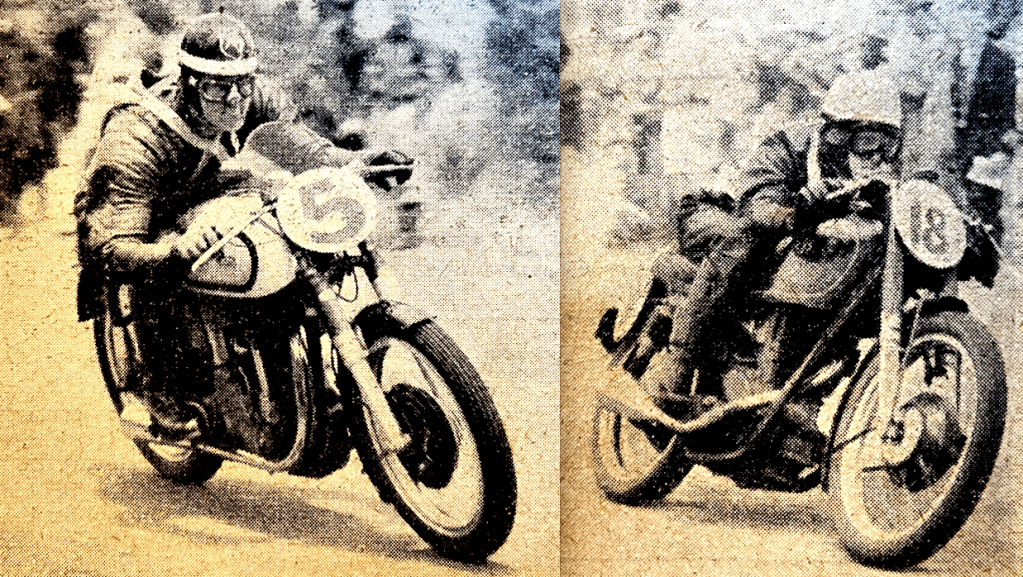
for suspected concussion to both. On the third lap the riders were stopped and the race restarted with the four leaders, Coleman, Jensen, Hollier and Perry, placed in the front row. From his push start Coleman knocked a second off the 1952 lap record of ,4min 36sec, and next round further consolidated his lead with a lap in 4min 27sec, 83.59mph. Meantime, Hollier, Jensen, Perry, Murphy and Laurent completed the leader board. On his fifth tour Coleman made the fastest lap of the day in 4min 24sec, 84.54mph, proving the Mangere course to be the fastest in New Zealand and Rod the fastest rider, but no proof of that was necessary. At half-distance, 37.2 miles, Nortons held the first five positions, with Coleman, Hollier, Perry, Jensen and Laurent in that order and Doug Johnston (GP Triumph) next, just ahead of Murphy on a slowing Matchless twin which caused his retirement next lap. While Coleman was riding superbly, Hollier, making his first competitive appearance since his return, was well ahead of Perry and Jensen, who were only a few machine lengths apart throughout and thus held more interest than the two leaders. On the 11th lap Jensen had to ride wide round a slower competitor, skidded in the loose surface bordering the tarseal, and retired. Coleman ended his 12th lap with victory by 45 seconds over Hollier, who had made a splendid recovery from his left-foot injury sustained when practising on Boxing Day at the Wanganui meeting. Results (12 laps, 74:4 miles): 1, RW Coleman (Norton), 82.3mph; 2, D Hollier (Norton); 3, LV Perry (Norton); 4, RJ Laurent (Norton); 5, D Johnston (Triumph); 6, LT Simpson (348 AJS).

“AT THE PRESS TRIAL the 197cc B2C Norman, ridden by a member of Motor Cycling’s advertisement staff, excited considerable comment because, first, it had a sound, pleasing appearance—made for the job, in other words—and, secondly, used by a comparative novice the machine handled excellently and enabled its rider to finish well and to win an award. It seemed expedient to learn more about the newest competition model to come from the well-known Ashford, Kent, concern. We were entrusted with the Press trial model, the property of Mr AF Wheeler, who had acquired the machine for his personal use. Arthur Wheeler had run it in sufficiently for us to make use of the full performance available. The Norman’s main-road performance, of course, was restricted by trials gears, but the 197cc Villiers motor, on which the Wheeler Tuning Department had already made several ‘mods’ including the fitting of an Amal carburetter, pulled very willingly. At the first sight of some waste ground everybody ‘had a go’ and expressed pleasant surprise at the way in which the B2C leapt up little escarpments and slogged through sand and mud patches. Good omen. Now for a real test. The standard tyre arrangement was superseded, the back tyre being of 4in. section, whilst at the front the standard wheel had been replaced by a 21×3. By taking a certain amount of liberty with waterlogged tree roots and morass sections, a pleasant half-hour was spent revealing the very likeable and tractable nature of the machine. The
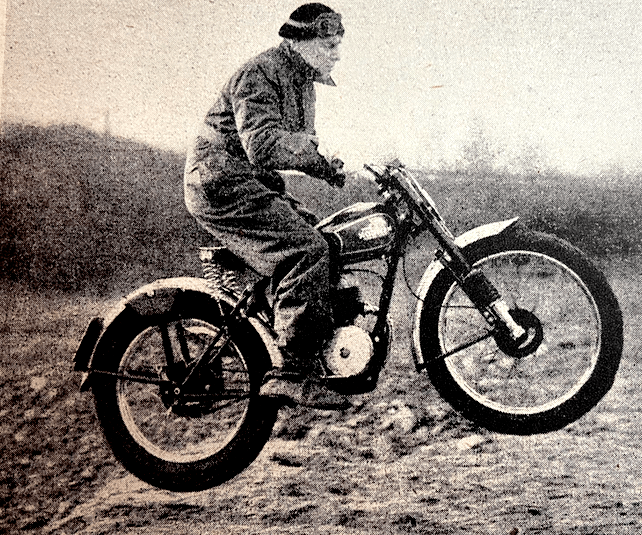
B2C shares with only one other competition model of similar engine capacity, the short-wheelbase dimension of 48in. This seems to be a beneficial factor allowing not only a tight turning circle, but a sense of positivity, or ‘one-ness’ with the rider on all types of terrain. In the mud and on ‘side-of-a-house gradient’ the Norman’s fork action was tested to the full. For 1953, of course, the hydraulic forks have been superseded by an improved spring system with deep rubber end-stops. At extreme and sudden deflections there was no feeling of harsh impact—and it should be emphasised that the ‘nadgery’ stuff was well mixed with a number of fast runs over wasteland, gullied and rutted to a degree which would have delighted the average scrambles, rather than trials, organiser. Switch-back hills, with a leaf-mould dressing, enabled the Villiers unit, a standard engine, with a 7.25:1 compression ratio and a brake horsepower figure of 8.4 at 4,000rpm, to demonstrate prowess in permitting almost idling rpm as the machine trickled down 1-in-2½ gradients at walking pace on the release valve, and then, given the proverbial ‘gun’ at the bottom, to climb 60ft or more, up the opposite side of the bank, with the front wheel just pawing at the rough surface, actually threatening to lift all the while. So much for the praise. Points of criticism are few. They include such minor grumbles as those concerning the positioning of the knee-grips, which tend to jab at one’s knee-caps if one is striving in an on-the-rests posture to navigate the model up a difficult section. The cure would be simple. And the exhaust note…In common with that of a number of modern two-strokes, the Norman strikes one as being loud, considering that, irrespective of the sporting character of the machine in question, a certain amount of town and suburban riding is inseparable from normal usage.

The rear brake, unavoidably immersed in water at an early stage of the ride, did not, even after diligent ‘drying out’ usage, provide quite the degree of retardation expected of such a really well-made component. Normans now employ a cast hub and brake drum. Perseverance with the front brake on the run back to Epsom thoroughly dried out the linings and produced a 100% stopper. In general, however, and despite the rather short wheelbase, the abbreviated dimensions of the B2C appeared to suit the stature of all members of the party, ranging from a six-footer to the writer, who is 5ft 8in in height. The Norman saddle, which is adjustable, had a good average position for road or cross-country riding, footrests and handlebars, standard equipment and factory fitted, conformed with the remainder of the lay-out which seemed to be very satisfactory. The Norman, hitherto cultivated for competition work by one or two enthusiasts only, has remained, to some extent, an unknown quantity in the sporting field. Hence this article which, in the opinion of the writer, puts the potentialities of a pleasing little machine into somewhat sharper focus. Competitively priced at £127 17s 4d inc PT the 197cc Competition model from Kent has pleasing dual character in that, whilst obviously a most satisfactory mount for the inexperienced trials rider, it is also, apparently, the choice of an expert. At Ashford, Kent, they call it the B2C a practical though, perhaps, unimaginative, type name. In fact, from experience gained by several people during the past two weeks or so, this little model has all the promise of becoming quite a Norman ‘Conquest’.”

“IT IS ALMOST INEVITABLE that the name of Steib should be coupled with that of BMW when sidecar outfits are under discussion, for in many yeas this German-built motor cycle, has been harnessed to this German-built sidecar so frequently that the immediate reaction on seeing another make of ‘chair’ attached to the machine would be one of surprise. By courtesy of Kings of Oxford a model R 67/2 BMW, to which was attached a sports single-seater S5OOL Steib sidecar, was lent to Motor Cycling for an extended test. It had but 400 miles registered on the speedometer. During the three months the outfit was in our hands it was used for routine journeys and, on several occasions, for express runs from London to Birmingham. ‘Express’ is a suitable word to use for, from door to door, the motorcycle proved to be a faster means of transport than the train. The BMW is a unique motorcycle; it possesses many of the features that appear in specifications dreamed up by an enthusiast in his search for the ideal model. Neat in appearance, the transverse, ho-twin engine, with car-type clutch, a unit gearbox and shaft drive, looks compact. Few external auxiliaries live outside the light-alloy castings which form so much of the engine and in fact they number but two—the pair of German Bing carburetters. Basically simple in conception, the main casting is virtually a box into which the crankshaft is inserted at approximately mid-height. Above the crankshaft—which runs on ball bearings—is a single camshaft driven by helical gears. On to the sides of the box are bolted the cylinder barrels of cast iron with light-alloy heads. The magneto, with stationary windings, and the 60-watt dynamo, are driven respectively by extensions of the camshaft and the crankshaft. Thus there are three compartments within the outer skin; a central area in which crankshaft and cams work, a forward annexe for the camshaft-and oil-pump drives and, at the extreme front of the engine, a third compartment in which are located the electrical components. The base of the central compartment forms the oil sump, closed by a simple, shallow, pressing. The drive is taken through a single-plate clutch to an all indirect gearbox and finally to a helically toothed crown-wheel and pinion via a shaft which has a rubber coupling at its forward end and a
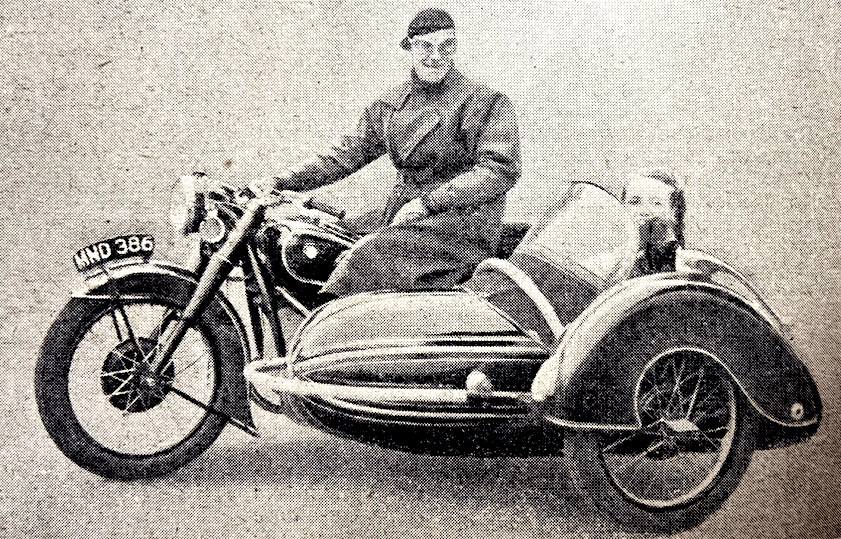
mechanical universal joint immediately in front of the bevel housing. A duplex tube, welded frame- carries the engine-gearbox unit and has undamped plunger suspension at the rear; the telescopic front forks have double-acting hydraulic damping. An important and to-day, unusual virtue is that all the wheels are not only quickly detachable, but interchangeable as well. Several features are unusual to British eyes. Positive-stop gear changes are made with a short pedal on the left-hand side and the kickstarter, also on the left-hand side, works transversely. A simple suspension, involving a trailing arm and coil spring, is fitted to the sidecar wheel and the outfit is therefore fully sprung. Initially, certain details had to be memorised: foot brake on the right; gear change on the left; ignition switch case combined with light switch—push in to turn the ‘sparks’ when red indicator light goes on together with a green ‘neutral’ gear indicator light. Turning this switch to the right brought in the tail and ‘dim’ light, turning to left produced the full driving light. The dip switch, combined with the horn button, was found on the left-hand bar. Fitted on the left, the sidecar chassis rail is apt to be knocked and scraped when the kick-start lever is pushed down and this prevents full use of the starter which could, with advantage, be geared higher. For some reason, the machine did not always react to well-established routine when starting from cold. In nine attempts out of ten, immediate response was forthcoming when the carburetters were flooded and the air-control, on the gearbox casing, was closed; the 10th attempt finished with a ‘wet’ engine and almost full throttle opening had to be given. When warm, a push with the hand on the pedal was sufficient and, indeed, used frequently for demonstration purposes. With first gear engaged—silently if the very light clutch was withdrawn quite fully—the green indicator light goes out. The drive is taken up quickly but smoothly once the short movement of the clutch had been appreciated. At no time during the test was there any sign of clutch slip whatsoever. Considerable experimentation was necessary before silent upward gearchanges could be made. Without due deliberation—and always if the rider was in a hurry—a tell-tale ‘clonk’ resulted. Downward changes were invariably accompanied by some noise; in this case, the quicker they were made, the quieter they proved to be. This noise appears to be inseparable from units with an engine-speed clutch-to-gear-box mainshaft. It is thought also, that a twist-grip with a quicker action and less backlash would assist materially on downward changes. Perhaps insufficient time was allowed for the engine to settle itself for when cold a light piston slap noise came from one cylinder. This disappeared when the engine warmed up, returning if the unit was run slowly for any length of time. A tight gudgeon pin was the
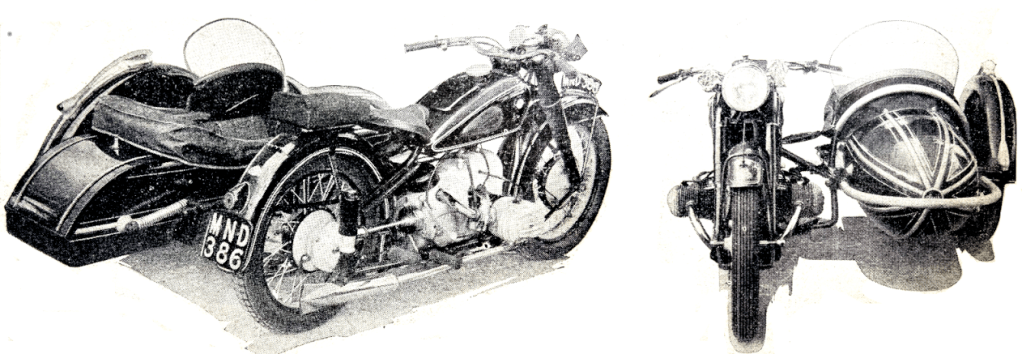
snap diagnosis but it interfered little with the performance of the machine and was outstanding only because of the lack of noise generally. This general mechanical silence was undoubtedly one of the most endearing features of the BMW. Other than for the exhaust burble—a reasonably subdued note—milestones passed in silence, for valve-gear, gearbox and transmission were quite inaudible. With the ability to rev freely and with, a comparatively low compression ratio, the performance characteristics were unusual. It was quite possible to force a long pull in top gear without sign of distress and yet the engine would turn smoothly in ‘third’ at over 50mph. Although the machine was almost devoid of vibration, there was one small period which made itself felt, and this was on the over-run at approximately 40mph in top gear, equalling about 3,000rpm. When driving through this speed the tremor was almost indistinguishable. Many miles were covered at a cruising speed of 55-60mph. In fact, this proved to be the gait at which the machine was usually driven, for it seemed effortless. Above 60mph a certain fussiness became apparent and it was considered inadvisable to hold 60-plus for any length of time. Gearchanges were made early, without any attempt to let the engine revs rise, for results were as good, if not better, if ‘top’ was engaged at just over 40mph. Although the footrests can be moved vertically the riding position cannot be varied much and those with long legs may find the pipes from the carburetters to the in-built air-cleaner rather too close to the shins. The locations of neither gear-change pedal nor brake pedal can be altered. The general degree of comfort is augmented by the use of a front-pivoted saddle with adjustable spring tension. At first the suspension was thought to be a trifle ‘firm’ although as the mileage increased the. ride softened. High-frequency bumps were unsettling, particularly to the sidecar passenger, for whom the ‘chair’ springing on cobbles and uneven stone-setts, did not always absorb the bumps. No doubt this firm riding was responsible for the taut feel of the outfit as a whole and, if the passenger did not always enjoy the vigorous manner in which the outfit could be handled, it was a delight to the driver. In spite of a body that appears slim, the width of the outfit, owing to the protruding off-side cylinder, seems wider than most. Violent cornering methods would not induce the sidecar wheel to lift—in fact, all three wheels slid before this would occur when a passenger occupied the sidecar seat. Both brakes were excellent, particularly with respect to their continued efficiency. Little adjustment was necessary and throughout the period of test the only non-standard feature was a squeak from the front drum on a wet day. Later this disappeared and left brakes which could hardly be faulted. Lights were quite adequate for the machine, the dynamo serving to keep the battery well charged. Maintenance of the BMW is absurdly simple. Ignition and lighting machinery are both housed beneath a light-alloy cover secured by two screws and are easily approached, while tappet adjustment, at the rockers, is but a matter of minutes. Both gearbox and bevel casing were checked for lubricant by removing the easily reached hexagonal caps, but required none. Perhaps some improvement is possible where the engine is concerned, for the oil-filler orifice is rather small. Other than for the specific conditions mentioned earlier, the Steib sidecar is comfortable and the luggage space good. On one particular trip, using unconventional stowing methods, a vast amount of luggage and stores were carried, Only an army pack, strapped to the locker lid, looked unusual. The windscreen deflected air effectively, and although the hood took some minutes to erect, it remained watertight. As a sporting single-seater this sidecar is admirable. Traditionally an oil-tight machine, the R67/2 maintained this tradition throughout our temporary ownership, and was displaying only two smears of lubricant when the machine was returned. These occurred at the off-side (right) gearbox cover-plate and at the juncture of the first and second main engine castings. The exhaust pipes, each blued at the sharp bend in front of the port, were the only other disfigurements to a clean and remarkably handsome machine.”
“IN 1946, VERSIONS OF a small James two-stroke, designed primarily for military use, were entered and ridden in the short, tough, one-day sporting trials developed by a post-war shortage of petrol. In competition with man-sized ohv mounts with four times the engine capacity, there seemed little likelihood that these small machines would provide serious opposition and the efforts of their riders were mainly, if not solely, directed towards the acquisition of awards in the two smaller capacity classes. Gradually, with increased power from the engines and the evolution of suitable frames, the picture has changed. Indeed, in 1951, the Travers Trophy Trial was won outright by a 200cc machine ridden by WA Lomas, who later provided the fourth best performance in the 1952 British Experts Trial. Both of these outstanding successes were on a James—in fact the 1953 ‘Commando’ is a replica of the winning mount. Added interest is given to this test by the fact that the machine on loan was a prototype, fitted with an example of the new Villiers single-lever carburetter. In this instrument, the lever providing needle variation is omitted and slow running adjustments are made by an adjuster screw located at the junction of float bowl and mixing chamber body. The 197cc Mk 6E Villiers engine-gearbox unit is, of course, a two-stroke with bore and stroke of 59x72mm. Bolted to the rear of the engine crankcase is a three-speed gearbox with trials ratios of 6.8, 11.5 and 22 to 1 with a 52-tooth rear sprocket. A 44-tooth sprocket may be fitted to give a higher cruising speed. Commando engines give slightly more power than the standard Mk 6E–9bhp at 4,000rpm with a compression ratio of 8.25 to 1 as opposed to the standard 7.25. Special sealing
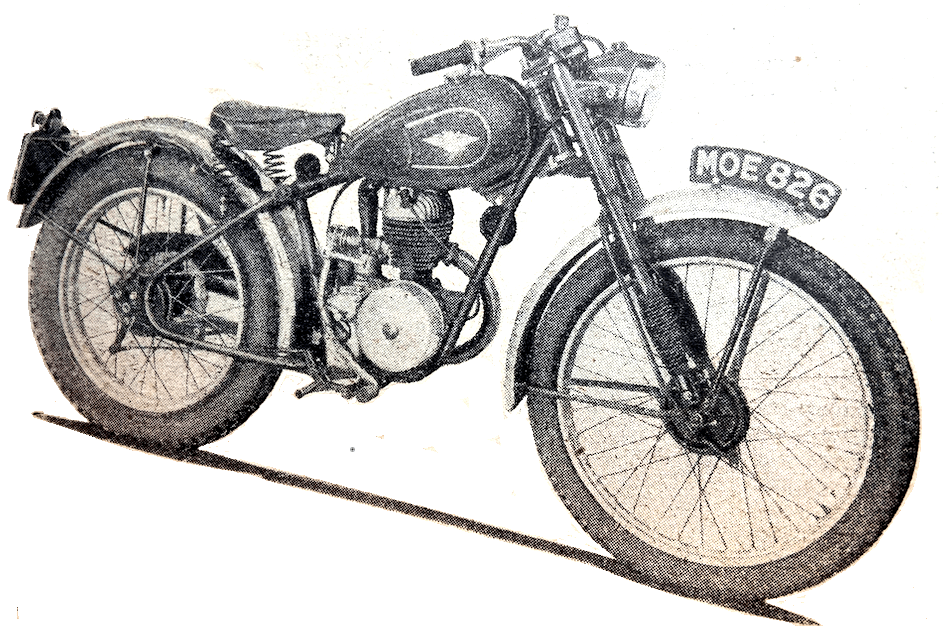
is applied to waterproof the flywheel magneto. Of brazed lug construction, the frame is built to give a ground clearance of 8½in. Telescopic James front forks have two-rate springs and progressive hydraulic damping on both compression and rebound. To accommodate a 4in-section rear tyre and maintain chain clearance the engine is offset in the frame. Both wheels have 10swg spokes and Dunlop Trials Universal tyres: 21×2.75 front; 4.00×19 rear; felt seals protect the hub bearings. Trials equipment includes security bolts; polished light-alloy mudguards; a lightweight Dunlop competition saddle; a competition number plate and a high-level exhaust system. An AC direct lighting set can be fitted at an extra cost of £5 7s 10d inc PT. With the new version of the Villiers carburetter on the machine, particular interest was taken in the routine job of starting. This proved absolutely foolproof and, in the midst of the current deep-freeze no hesitation was experienced. If the choke on the air filter was closed and the float chamber filled, no more than four prods were necessary. Some four-stroking was noticed at tickover but this disappeared so soon as the throttle was opened. The choke could be opened Progressively and, with the engine warm it two-stroked efficiently. Four-stroking, with the exception of a period which occurred on-the overrun only, was pleasantly absent. James lightweights have always appeared to have the riding position of a ‘big’ machine and the Commando was no exception. Three holes are drilled in the saddle nose plate to give optional heights of 30¼, 31 and 31¾in. Footrests fit to a hexagonal bar and theoretically can be moved to any one of six positions. In fact, other considerations limit this movement and the footrests foul the footbrake if dropped below the horizontal. It is unlikely that the lower positions will be needed, for with the saddle lifted to the top notch a 6ft rider found the riding position admirable in every way. The tester has a private patch of ‘trials country’— rocks are lacking but sufficient variations on the up and down theme can be tried to discover a machine’s capabilities. Considerable falls of snow had thawed and left the deep ruts full of water. The ‘ups and downs’ were frozen but on top of the frozen mud was a thin layer of greasy clay. The first of three ‘sections’ proved an admirable test for the magneto for it was almost entirely under water for twenty yards. Deep and wide, the rut proved no navigational hazard
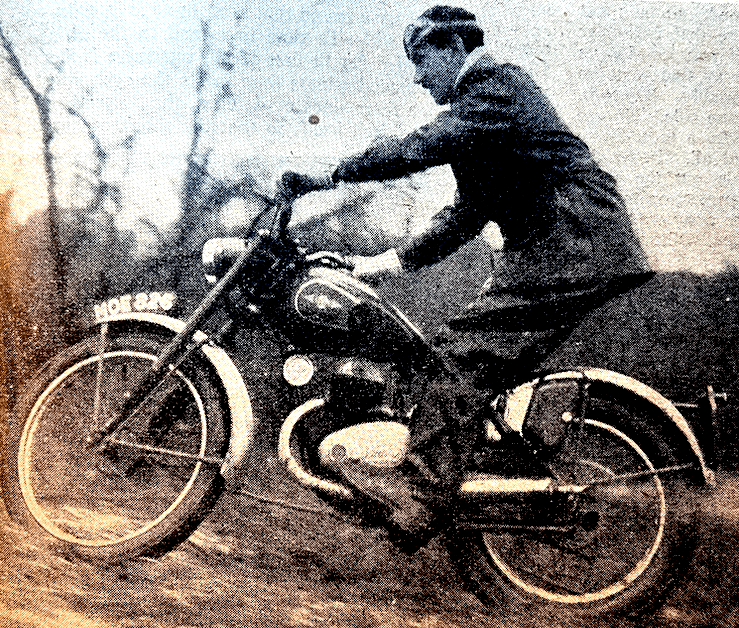
and once the engine had been thoroughly soaked without showing any ill effects, the next section was tried. A tight right turn across frozen ruts revealed ample lock and the ability of the engine to pull steadily in bottom gear at tick-over speeds. From the turn a steep bank had to be negotiated without any space in which to increase speed. From tickover, the throttle was snapped open to lift the machine over a steep bank. If the effort was made too early a bush, neatly positioned, tangled with the front wheel. Badly tuned or temperamental machines, particularly of small capacity, usually stall on the bank. No such indignity was suffered and the Commando lifted front wheel up and over without hesitation. A word might be said, at this juncture, concerning the facility with which the front wheel can be nailed to the ground. Short-wheelbase, two-stroke trials models are very prone to spend too much time motoring along with the front wheel in the air. It is not always possible to reduce the throttle opening to regain control and the ease with which the rider’s weight can be moved forward is decisive. Well-positioned footrests and handlebars so arranged that the rider is not ‘pulling back’ will assist materially and in this respect the machine was admirably proportioned. An ability to maintain control on a track proceeding diagonally down a steep, greasy bank is dependent on the degree of success with which a model can be steered (if ‘steering’ is a suitable description for a crabwise manoeuvre) sideways. Twice a steadying foot had to be used to hold the rear wheel in check but the third attempt was entirely successful. This was an occasion for some satisfaction, for it was the first time that the descent had been made without footing. In spite of the abrupt way in which the weight of the machine—and rider—moved on to the front wheel at the bottom of this drop, the hydraulic damping worked excellently and metallic ‘clashing’ was noticeably absent. A night run of some 80 miles finished the test and provided an opportunity to check the lighting system and brakes. For those who wish to own a general-purpose machine, suitable for both trials and the daily run, it would seem that a Commando’ fitted with the AC lighting equipment, provides the answer, for 45mph could be maintained easily at night. Both brakes dried quickly after a thorough soaking And if the front unit was a trifle spongy, it worked adequately. The footrests have a reinforcing plate, but it was felt that an even sturdier support would have been an advantage. In addition, stronger saddle springs would prevent the saddle—supporting in this case well under 12 stone—from bottoming on the mudguard occasionally. The James Commando is priced £134 3s 4d inc PT.

“THERE CAN BE NO possible doubt that the 125cc Model RE2 Royal Enfield is capable of providing useful, economical transport for most purposes—that much was amply proved by an example recently road tested by Motor Cycling. Its outstanding characteristic is light weight and because of this it can be ridden in heavy traffic with consummate ease. Naturally, with only 140lb to be handled, it can be lifted on to and off the spring-up centre stand without exertion and it is ideally suitable for pottering both in and out of town. Add to this a petroil consumption that will better 120mpg in all but the most unfavourable conditions, and it will be appreciated that the model can be described as an excellent utility mount—a description that does not in any way infer a ‘cheap’ machine, for the finish is good and the motor cycle well made. Changes have been effected to both engine and frame since the model was first designed, during the Hitler war, for use with airborne forces. Telescopic front forks have been added and a new Miller 36-watt flywheel generator with an external 6-volt car-type ignition coil replaces the earlier Miller component. The RE is an all-the-year-round model. The engine unit proved easy to start, even when air temperatures were well below freezing point, and required but three or four prods on the kick-starter. The machine is undoubtedly small and has a fixed position in which the long-legged may find the saddle too far forward or too low. An optional move either upward or backward would improve the comfort on long journeys. On the other hand, adjustment to the position of the foot-change-controlled gear pedal and to the rake of the handlebars—but not to individual handlebar controls—is easily made. Outstandingly light, the clutch frees well
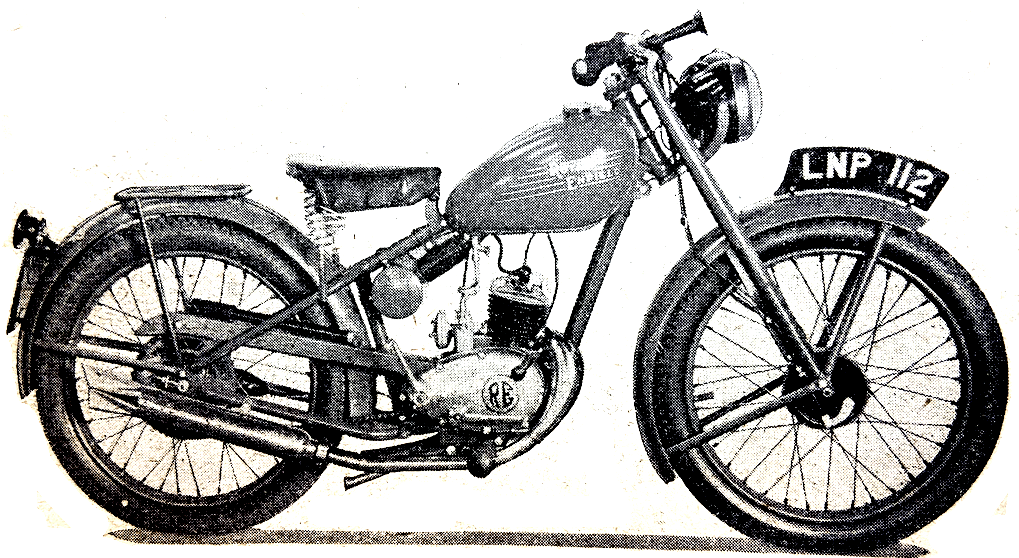
and permits bottom gear to be selected without noise. Engagement is smooth and permits bottom gear to be selected without noise. A time lag of some seconds is necessary to ensure noiseless gearchanges, although those even made hastily are quite positive. Ratios are, well chosen. The lack of fourth speed is more noticeable with small-capacity engines, but the engine-torque characteristic made good this ratio deficiency in reasonable fashion. Steep hills called for second gear, but the majority of main-road inclines in anything but very hilly country could be climbed in top gear. Gear changes were made almost immediately from first to second, and top gear was selected at 25mph. Continual cruising at a speed just below 40mph is comfortable and without effort. At this road speed in top gear the machine is free from vibration—vibration is noticeably absent at all but maximum throttle openings. Exhaust noise was, at an average level, not unduly obtrusive. It is difficult to refrain from over-praising the steering and road-holding. Light and responsive, it was always quite positive and, to the maximum gait of which the machine was capable, proved more than adequate. Minimum non-snatch speed in top gear was about 13mph and the engine would accelerate from this speed on a level road without distress. Mention must be made of the twist-grip, which is not of the conventional drum type. It was smooth in operation, did not shut incontinently when released and had only a slight amount of backlash. Both brakes, of 5in. diameter, have cast-iron drums and are well above average in both sensitivity and efficiency. Hand and foot controls worked smoothly; the pedal for the rear brake is well positioned and can be operated without taking foot from the footrest. Ample light is available for night-riding; the head lamp is capable of throwing a beam far enough. and with sufficient intensity, for a road speed beyond the capabilities of the machine. A dipping switch controls beam-direction and a parking light is supplied from a small proprietary dry battery in the head lamp. This turned out to he the only piece of electrical equipment which failed during the test. Normal top-overhaul can be done with the petrol tank undisturbed. When the cylinder barrel is to be removed, the tank bolts will have to be taken out and the tank lifted an inch. Routine maintenance jobs are few and quickly done. Contact-breaker adjustment is made via a small cover-plate in the generator housing secured by two screws. The gearbox is filled through a small plug on the near side; a wing-nut adjusts the rear brake and a knurled screw and locknut is provided for the front brake. While the lack of a rubber cover to the kick-starter is not important, a cover to the gear-change control would increase the rider’s comfort when operating the pedal and reduce the risk of damage to shoes.”
“TO CORRECT ANY MISAPPREHENSION that may arise concerning the opinions of those responsible for DMW motor cycles with regard to the use of a spring frame in trials, it may be advisable to preface this report by stating that a rigid-frame competition machine is manufactured and available to those who feel that better results in typical. ‘one-day’ events may be obtained without the suspension unit. Rear springing does, however, improve the usefulness of the Competition DMW in events of longer duration and, as an all-round sporting motor cycle, the Model 45 may be cited as a very satisfactory compromise. The factory is proud of its successes in both International and Scottish Six Day trials and it is for this type of event that the spring machine is intended. The basic details of the machine are as follow: square tube is used for the frame, which is of all-welded construction. Tests have shown that an increase in torsional stiffness, particularly in the rear section, has been obtained without the disadvantage of increased weight. The MP suspension units are coil-spring-plunger boxes carried in brackets welded to the rear stays. High-tensile steel tubes are used for the MP telescopic front forks, which have rubber gaiters to give protection to the sliding surfaces. Both magneto and carburetter of the 59x72mm, 197cc Villiers 6E engine are protected against water by rubber seals. Felt seals are fitted to the journal bearings of the front and rear hubs; intended primarily to retain lubricant. they should materially assist in excluding water. The engine is offset in the frame to give clearance, of course, for the 4.00in-section rear tyre which is standard equipment. Lightweight mudguards, with adequate clearance, and a high-level exhaust pipe form part of the specification. Two sets of gear ratios are available with the Villiers gearbox, which is bolted to the crankcase and forms a single unit with the engine. Some increase in power is forthcoming if a special cylinder head, giving a compression ratio of 8.25:1, is fitted; this is not part of the ‘trials’ specification, but is offered as an option on new machines. Most of those ingredients necessary for a sporting trial can be found on Penn Common, near Wolverhampton. A stream, rutted mud, steep banks and narrow gullies are all available. Towards this area, DMW sales manager, Arthur Frost, headed, followed by tester and photographer. Arthur Frost’s machine has been used in every type of sporting event for over 12 months without overhaul. In spite of this, it still galloped along remarkably well, giving nothing away to the newer machine following. In conjunction with the 4.00in rear tyre the suspension at the rear proved almost luxurious on main roads. An opportunity to sample the brakes before they were submerged in water proved them to be effective and needing only reasonable pressure of hand or foot. Even with the large rear tyre excessive zeal with the foot brake
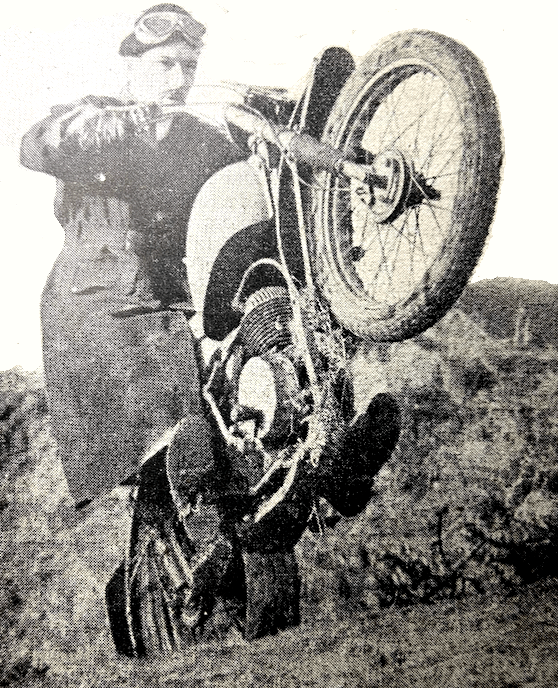
provoked rear wheel skids. The machine’s light weight and ‘handleability’ enabled any resulting slide to be coped with immediately. A muddy, rutted lane with cross gullies, rocks and an occasional-deep hole formed the approach road to the sections, and this could be traversed almost as fast as the rider wished, once accustomed to a steady spray of water from the front wheel. In the interests of maximum efficiency and minimum unsprung weight. the front mudguard is attached to the fork crown and does not move with the wheel. Although no disadvantage while in a section and proceeding slowly, this arrangement was rather disconcerting when travelling quickly in a muddy lane. Six distinct hazards were identified; the first involved 50 yards of the stream and a climb out of the water along a narrow path. Two attempts were necessary before complete success was attained. For some reason, the decompressor appeared to exert more than usual control on the rear wheel; possibly the discharge orifice is smaller than average. Whatever the reason, it was possible to trickle slowly down a greasy track and turn into a narrow opening with full confidence and well in control. The steering lock is more than adequate and was no excuse, other than bad navigation, for running out of room on a turn. At 47in the wheelbase is remarkably short and this, in conjunction with an engine possessing good torque at low speeds, is apt to assist the front wheel in any effort towards aviation. An excellent riding position. helps to bring this under control and, indeed, in some circumstances, the ease with which the front wheel can be lifted may prove an advantage. No large rock steps were available to test the theory, but many such sections come to mind. It is difficult to envisage a machine more suitable to those tricky, tight sections colloquially described as ‘nadgery’. A short wheel-base, good lock and an indefinable quality of ‘balance’ take all the hard work out of this type of hazard. Feet were brought into operation on several occasions during the attempts on the last—and most difficult—of the six test pieces. An approach through the stream had to he made at a speed as high as possible to the patch of soft mud at the entrance to a gully between two steep banks. Low speed attempts failed with wheelspin and were abortive. A brief wall-of-death turn at the top of the stream’s bank was essential if fast runs were made. Twice complete success was within reach, but just evaded the tester who was forced to foot out of trouble. During one excursion at too high a speed, the machine was left at the bank top and the journey continued alone. Suitable footwork at the vital moment enabled non-stop climbs to be made, but the final polish that spelt complete success was too elusive. Both brakes dried quickly after their continued immersion and were ‘back-to-strength’ before the main road was reached. During the afternoon the engine had not faltered once and on those occasions when restarts had to be made, balanced at awkward angles on nothing but a six-inch muddy track, it responded without delay. Well made and of sturdy appearance the Model 4S is bound to enjoy popularity in its class.”
“THE NAME OF INNOCENTI is held in high esteem by the scooter-minded population of the Continent, and rightly so, for the rugged little Lambretta, produced by that Milanese concern, offers both economy and dependability, coupled with somewhat restrained good looks which distinguish it from the more flamboyant of its species. Marketed in this country by Lambretta Concessionaires Ltd, of 64 High Street, Epsom. Surrey, a model LD Lambretta has recently been tested by members of Motor Cycling’s staff. The machine is built round a single, large-diameter tubular backbone which forms an open frame and seat mount. To this is welded a tube of similar dimensions, bent at right-angles, to form the engine cradle and rear-springing pivot, with welded outriggers to support the bodywork. The rider is protected by a pressed-steel front apron and footboard designed to give comprehensive weather protection, while the ‘engine-room’ and rear wheel are enclosed by easily detachable side panels, each of which is held in place by rubber-sheathed flutings at its edges and secured by a lever at the rear. The well-tried 123cc two-stroke engine of 52x58mm has an iron cylinder and alloy head. The unit construction crankcase and gearbox assembly extends rearwards to form the arm which carries the rear stub axle and encloses the shaft final drive. The primary drive is by bevel gears. The whole of this assembly pivots about an anchorage under the front of the crankcase and is sprung by means of a torsion bar situated beneath the gearbox and operated through a robust linkage system. Rubber buffers prevent contact between the engine and frame. Forced-cooling is employed, air being impelled round the cowled cylinder by means of a fan on the Marelli flywheel magneto. Cooling grilles are situated in the leading edge of each side panel, air scoops of die-cast light alloy being
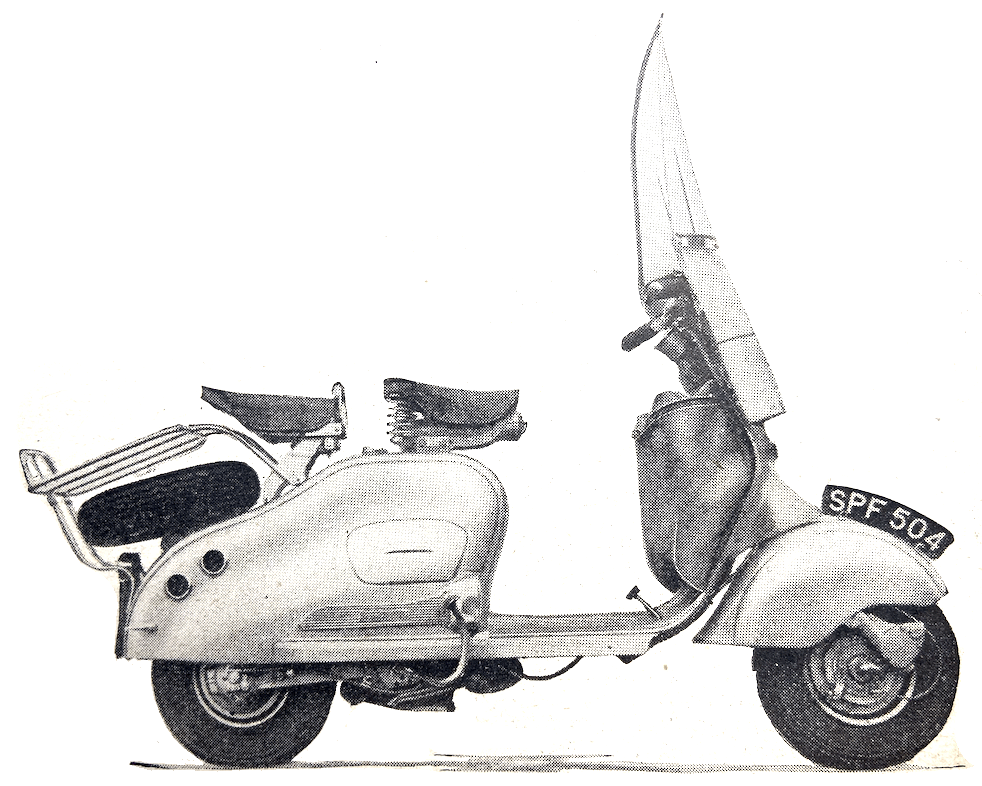
optional extras. Undamped helical springs form the suspension media of the trailing-link front forks, the mechanism being encased in neat covers. A generously proportioned front mudguard is fitted with a conventional ‘English-type’ front number plate. Both wheels arc of 8in. diameter carrying 4in. Michelin, Dunlop or Pirelli tyres; rims are quickly detachable and interchangeable, a fact which renders the spare wheel and tyre (an optional extra) doubly useful. With the exception of the rear-brake pedal, which protrudes through the right footboard, all the controls arc situated on the handle-bars. The gear-change is operated by a twist-grip—with integral clutch lever—on the left, while the front brake lever and throttle twist-grip are conventionally accommodated on the right. Conveniently placed near the right thumb is the ‘switch box’ which incorporates the light switch, cut-out and horn button. Access to the-three-position fuel tap and Dell’Orto carburetter, which has a built-in sludge-trap fuel filter, is gained through a hinged, spring-loaded flap in the right-hand panel. With the carburetter flooded and the choke closed, usually no more than two prods at the kickstarter were necessary to bring the engine to life, once the technique of using the small pedal had been acquired. Fortunately this did not take long, for clumsy kicking resulted in the ankle rapping sharply on the footboard. On the road the machine behaved extremely well. Familiarity with the combined clutch and twist-grip gearchange came quickly, though some difficulty in locating second gear was experienced at the outset. The clutch itself is commendably light and considerable riding in traffic proved no hardship for the left hand. A couple of miles sufficed to accustom the rider to the feel of the machine, and steering and suspension were so good that it could be well heeled over on corners with confidence. Even greasy cobbles and wood blocks required no more respect than when on a normal motorcycle. The 5in. internal-expanding front brake felt rather spongy and it was found to be preferable to use the 5½in rear anchor, which was both smooth and powerful and which, combined with the weight distribution, gave thoroughly satisfactory retardation. Before the Lambretta had 250 miles on the clock a 100-mile night journey in freezing conditions was undertaken, with the roomy leg-shield pannier—a most useful extra—filled to capacity and a weighty gladstone bag secured to the rear luggage carrier. Under the prevailing weather conditions, the normally excellent windscreen proved to be a mixed blessing for while it served admirably as a windbreak, its surface soon became frosted and it could not be lowered sufficiently to allow the 5ft 6in. rider to see comfortably over the top. However, the apron, which extends the
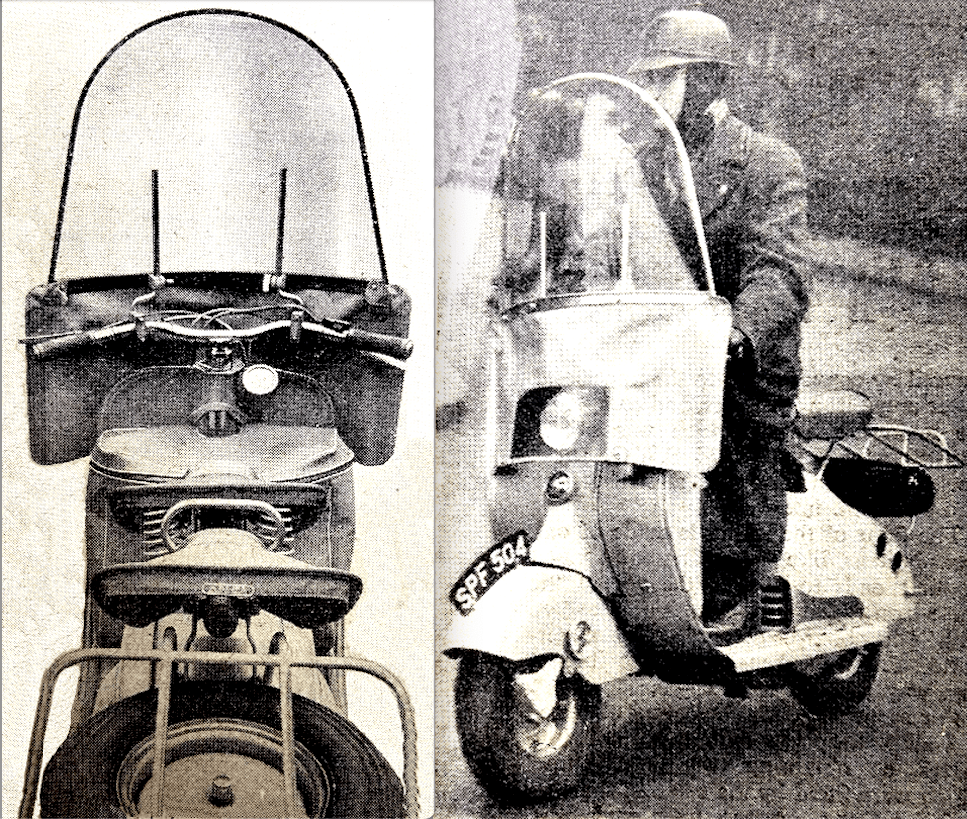
whole width of the handlebars, provided welcome protection for the hands. A celluloid panel is provided in the apron where it covers the headlamp, but the latter, fed by the flywheel generator, offered far from satisfactory illumination for night touring and considerably limited the cruising speed on winding roads. Nevertheless, on straight, level stretches a nocturnal cruising speed of 35-40mph could be maintained with ease, and an overall average of 23.5mph was achieved. The maximum speed obtained was 45mph. Owing to the necessity for maintaining plenty of revs to provide current for the headlight, and because it was not always possible to get up sufficient speed before tackling a gradient, second gear had to be selected early on any hill worthy of the name; but once the middle cog was engaged, 20-25mph could be sustained without stress. Pulling power in top gear was good, but it was found that the increase in the liveliness of the engine made driving more pleasant if second gear was used at a relatively high road speed. Petrol consumption for the journey was excellent, working out at almost 100mpg despite the drag caused by the large windscreen and shielding—and the excellent protection they afford is adequate compensation. Moreover, they do not render the machine unmanageable, even in gusty winds. The exhaust note tends to be noisy, though not unpleasant. On the other hand, the electric horn’s note could be stronger and more tuneful with advantage. Another drawback is the absence of a parking light—surprising in view of the fact that the Lambretta is primarily a town machine. However, despite the few shortcomings which have been mentioned, it left the rider with the impression that it is a most comfortable and enjoyable scooter to ride, and one which can inspire both enthusiasm and affection.”

“HIGH TAXES AND HIGH COSTS offset by high mpg, if not high speed—these factors are to some extent responsible for the ever-growing popularity of the lightweight two-stroke in Britain today; a popularity catered for, and fostered by, a number of relatively new manufacturers such as Tandon Motors, of Watford, whose l97cc Imp Supreme model has recently undergone tests by members of Motor Cycling’s staff. In introducing this model, which made its debut at last year’s Show, Tandon had in mind a machine which, while having the basic specifications of a luxury mount, would sell at a utility price. The result is an attractive ‘springer’ with a creditable performance. Reliability was sought as the keynote of the design, so that little firm and money have been spent on frills and furbelows. Instead, production costs have been concentrated in good materials and thorough workmanship. All the tubing used is Accles and Pollock ‘Kromo’ chrome-molybdenum material and all nuts and bolts used are rust-proof cadmium plated. The single loop frame carries bronze-welded engine and seat lugs and swinging-fork spindle-housing. Bolted to the frame is the triangular sub-frame supporting Armstrong hydraulic, oil-damped spring legs. These legs are used only on the export model, Newton legs being standard on the home edition. It is understood, however, that eventually all models will use the Armstrong unit. The Tandon telescopic front forks have a total movement of 5in and work well in conjunction with

the rear springing. At the outset, the 197cc Villiers 6E two-stroke engine proved somewhat temperamental under starter’s orders. However, after the correct setting for the handlebar-mounted mixture control had been discovered—not quite fully rich for this particular power unit—and with a well-flooded carburetter, three or four swings on the kick-starter were usually sufficient. Once the engine was warm it was found that a three-quarters weak mixture produced even two-stroking on all but the over-run. While the engine had a delightfully lively performance, except when nearing its peak, the bolted-up three-speed gearbox on the particular model under test was found to be somewhat slow in operation, demanding considerable foot movement. Despite this, the machine was pleasant to use in traffic, and although the steering was a trifle heavy at very low speeds it was commendably steady when the model was really under way. Or the open road 40-45mph could be maintained for mile after mile without any sign of fatigue. In fact the engine seemed quite capable of sustaining nearly 50mph for lengthy periods, but a vibration phase somewhat detracted from the pleasure of riding at this speed. At all speeds the suspension was excellent, not in the least spongy and yet capable of coping with all but the roughest roads. It is unfortunate, therefore, that the comfortable-looking dualseat—an optional extra—did not completely fulfil its promise, and thicker sponge rubber padding for its inverted metal tray would seem to be a worthwhile modification which might well result in a really luxurious ride. The seat could also be a few

inches longer with advantage, since accommodation for two is rather cramped, and owing to the short wheelbase and fixed footrests the rider had to sit well forward when carrying a passenger. In all other respects, however, the machine proved admirable for two-up work. Whereas a bulb horn is normally fitted, the test machine carried an electric horn which proved capable of giving effective warning of approach. However, being operated by a dry battery, neatly housed under the seat, its strong note did not last for long and frequent battery replacements would seem to be necessary for its effectiveness to be maintained. Current for the 5in Villiers headlamp and neat Lucas 529 plastic rear lamp is supplied by the flywheel generator which provided ample illumination for night riding. A dip switch, located near the left thumb, was easily operated and brought into action a good dip beam which was apparently quite innocuous to oncoming traffic. A twin-cell dry battery housed in the head-lamp provided current for the parking light. An excellent feature of the machine was its smooth and powerful front brake, which, although only 5in in diameter, had first-rate arresting power. The stopping distance of 30ft from 30mph was due almost entirely to this front brake, the cable-operated rear brake being far less efficient. This may be attributable in some measure to the very long brake arm with its low-mounted pedal which, while giving ample leverage, naturally required considerable foot movement before the brake

was fully effective. The test showed up certain items which merit the manufacturer’s attention even if, as a result, a few shillings are added to the cost. The first is the desirability of using lock nuts on the rear sprocket locating bolts. The nuts used at present have a tendency to slacken off despite the provision of locking washers. Also the incorporation of a fuel reserve in the 1¾-gallon petroil tank would be a welcome modification, especially in view of the tank’s small capacity, though enough fuel for some five miles is trapped in the tank and can be used by tipping the machine to the right. Most of the test was carried out under dry conditions, but some riding was done on frosty roads and the indications were that the stability and excellent handling would be little impaired by wet or greasy surfaces. The shallow mudguards did, on occasions, show traces of spray at the edges, but the weather protection seemed to be of a good average standard. A gracefully styled machine, the Imp Supreme is finished in attractive beige enamel carrying the maker’s transfer in a triangular red panel on the tank. Details, while not elaborate, are well finished and in keeping with the workmanship of the model. One particularly novel idea is the self-locking central stand. When assessing the merits of the Tandon, its exceptionally low price must always be borne in mind. Nor should it be forgotten that fundamental quality has not been sacrificed on the altar of cost-cutting. As a result the manufacturers have produced a sturdy and reliable lightweight capable of giving excellent service while coming well within the means of the less affluent rider.”
“ALTHOUGH SEVERAL EXAMPLES of American lightweight and medium-weight machines have been built by the two concerns with which the U.S. motorcycle industry is generally associated in the minds of British riders—the Indian and the Harley-Davidson—the popular conception of an American motorcycle is that of a big, husky V-twin in which everything is of the most massive. There is, however, a third make which enjoys considerable popularity across the Atlantic—particularly on the West side—and it is very different from the traditional US model. The machine is known as the Mustang and was originally produced in 1947. It is now built by Mustang Motorcycle Corp of Glendale, California, in a factory which extends over several acres. It is a type of machine in which simplicity receives considerable emphasis and with certain reservations, its design could find favour in British eyes, for it is rugged and well-made and requires very little in the way of maintenance. It would appear to occupy a place somewhere between the scooter and the normal motorcycle and is stated to weigh about 210lb in full trim. The engine incorporates a number of novel and interesting features. A British-built Burman 3-speed gearbox is an item in the specification of the Mustang as also is a glass-bowl type fuel filter. The engine has cylinder and crankcase cast en-bloc. Oil-controlled, telescopic front forks of very simple construction are employed. The handle-bars, which are non-adjustable, are welded to the tops of the fork legs. A well-shaped saddle-tank of approximately 2 gallons is fitted, the capacity of the oil sump being two quarts. Disc wheels carrying 12x4in balloon tyres are fitted. To the rear wheel is bolted a casting which does duty as brake drum and
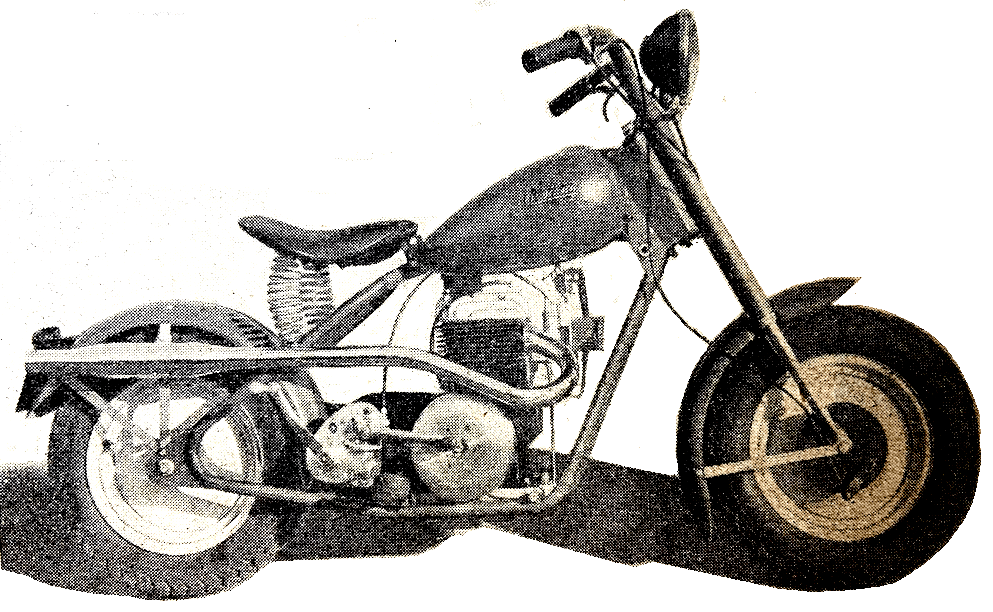
sprocket, both front and rear hubs being supported on taper-roller bearings. Normally there is only one brake is fitted, but a front brake is standard on the Special ’75’ model and is available as an extra on the ordinary machine. Instead of brake shoes the facing is riveted to the outer surface of a spring steel hand, one end of which is anchored to a fixed point. the other to a spindle which is rotated by a brake arm in the conventional manner. At a point midway along its periphery the band is located by a pin and a single tension spring is hooked between a lip formed in the band and an anchorage on the reaction plate to hold the brake in the off’ position. As the brake is applied the spindle rotates and the band is expanded to press the facing against the drum. According to a road test carried out by a member of the Alhambra Police Department, a ‘Special’ Mustang was stopped from 25mph in 21ft with both brakes and in 39ft with the rear brake only. The police report quotes acceleration from a standstill as: 30mph, 8sec; 48mph, 15sec; 60mph, 22sec. Maximum speed 64mph, the total weight of machine and rider being 404lb. The cruising speed was given as 50-55mph. In the machine used by the police tester a racing camshaft was fitted and compression ratio was 6.5:1. A power output of 10.5bhp at 5,000rpm was quoted. In view of the fact that the Mustang was primarily designed for utility use, quite a sensation was caused at the end of last year when a specially modified model was reported to have registered 100mph in a speed trial held by the Glendale MC at Rosamond Dry Lakes. In the machine used, the capacity of the engine was increased to 22.5in³ (approximately 400cc). A cylinder head machined out of solid Dural was fitted and a combination of methanol and 40% nitro was employed as fuel. A lower handlebar mounting was used and the rider adopted a prone position, lying on a specially constructed platform. Wire-spoke wheels were substituted for the disc type.”
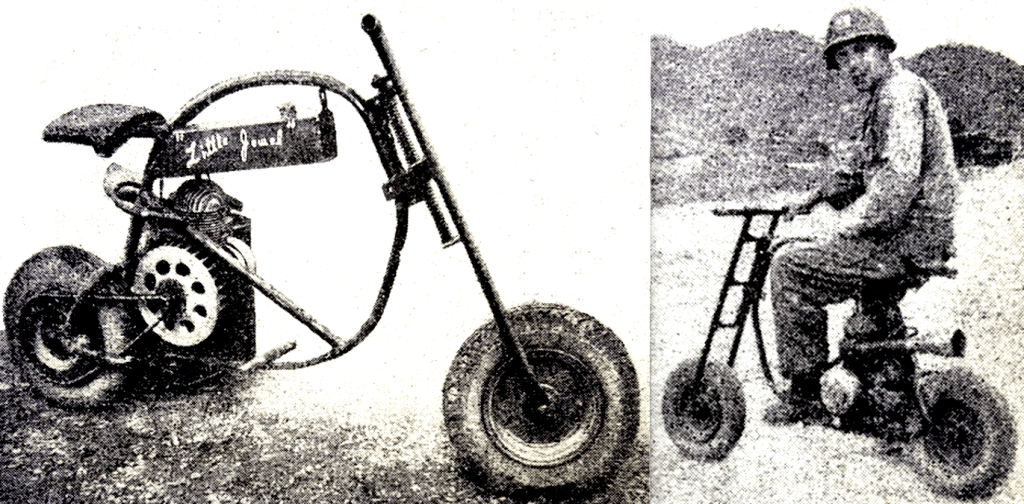
“SURELY THE MOST CURIOUS ‘bitza’ ever built is the ‘Little Jewel’. At a first glance it looks anything but a practical machine but, when the circumstances surrounding its construction are borne in mind, even the most captious critic will raise his hat to its ‘inventor’ for his ingenuity and enthusiasm. The ‘Little Jewel’ was actually built on the Korean front—within 2,000yds of the enemy. Its constructor is a GI named Don Backstrand and it was through his friend, HC Simon, of Allied Motorcycle Sales and Service, Portland, Oregon, that the details reached us. Mr Simon writes than Don was a motor cycle enthusiast for many years, and when he was sent overseas he just couldn’t be without a machine. In a surprisingly short time he had created the ‘Little Jewel’, the frame of which was made out of Jeep hood ‘sticks’. The fork springs were originally recoil springs in 90mm cannon, and the engine began work as an auxiliary generator in a tank; the sprockets were filed by hand from plain steel blanks. The engine has no throttle control and Backstrand relied on a magneto cut-out button to control the speed which, he reported, provided quite a thrill, for the model would do up to 30mph. The ‘Little Jewel’ is still giving good service on the Korean front in the hands of the ‘buddies’ to whom Don bequeathed it when his overseas tour terminated and he returned home to America.”
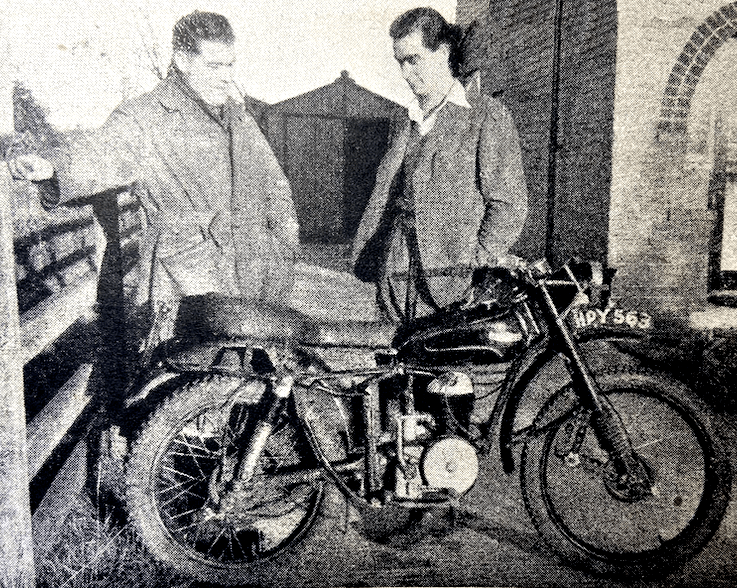
“SPECTATORS AT THE Scarborough Grand National last July will remember that there appeared a 197cc Francis-Barnett that was both swift and extremely non-standard. Its rider, Brian Andrew, son of Scarborough’s famous Ted Andrew, was well in the picture in his class until a breakdown in the gearbox caused his retirement. The mount was built by Pat Wagstaffe, in Ted Andrew’s workshops, and it began life as a standard ‘Falcon’ with a rigid frame. The rear chain stays were cut and bent upwards, as were the seat stays, the two sets of members being joined on either side of the rear wheel by steel plates, which also form the top anchorages for the hydraulic suspension units…The rear fork is a standard Francis-Barnett unit, modified and strengthened. Bronze bushes pressed into the fork members pivot on a hardened-steel sleeve which is held stationary between the pivot anchorage plates by a long bolt passing through from one side to the other. The suspension units are of early AJS 7R type, with suitable springs fitted. The variation in chain tension is negligible and the wheelbase was shortened by 1³⁄₁₆in. Friction dampers are used on the front forks and an André-pattern Manx Norton steering damper was also fitted, with an anchorage secured to the tank-top. Wide-clearance mudguards, a raised exhaust system, a dual-seat and sundry lightening and weather-protecting operations concluded the construction and this scrambler Francis-Barnett plays a dual role: with its speedometer and QD lighting equipment, it may also be used as a touring or ride-to work machine.”
“ONCE again the plea is renewed to all vehicle owners to fit suppressors at their own expense. Television has been subsidised by sound radio for some years, partly with money which could have gone into improving sound radio. Why, then, should I pay more money for a service in. which I am not the least interested? Let the television enthusiasts subscribe for the free distribution of suppressors to motorists—that much-maligned section of the community which already bears too great a burden of taxation.
RL DARLEY, Chatham, Kent.”
“THE UNFORTUNATE POSITION of the British so-called racing motorcycle has been caused by what may aptly described as ‘TT-mania’. Unquestioning subservience to road racing, and unjustifiably restrictive regulations, have prevented even a 125cc machine from being given full bore for more than a few seconds at a time (there is just nowhere where it can be done), and have effectively barred the post-war exploration, in this country, of every possible means of improving engine performance, which is the major technical object of racing. It is, therefore, hardly to be wondered at that: (1) British aspirants to world records must go abroad for their attempts. (2) They are, consequently, few in number, seldom successful, and even then only in relatively easy and unimportant brackets. (3) All solo and sidecar kilo and mile records, both flying and standing start (the important and difficult ones) are held by foreign machines. (4) A 250cc Guzzi (with sidecar) recorded, quite recently, kilo and mile speeds exceeding those ever officially recorded by any British solo of up to 750cc, or machines with sidecar of any capacity. (5) No British machine of any capacity has equalled the current 350cc solo kilo and mile records held by a German NSU. The negative advertisement value of this has, of course, been duly noted abroad, to the discredit of our industry. The blame for this state of affairs must be shared by the governing body, the manufacturers (of cars also), and that portion of the technical Press afflicted with ‘TT-itis’. For the first and last there is no excuse. The manufacturers, however, would appear to have been seduced by the soporific ‘seller’s market'” which has existed since the last war. This, however, no longer exists, and puerile advertisements which one continually sees displayed will have to be replaced by something with greater appeal to the overseas buyer, to whom world’s records are sales talk. At present he is buying increasingly from Germany and Italy, where a more balanced outlook has furthered the racing development necessary for their machines to occupy the majority of the important brackets in the records list. The combination of an unprejudiced and technically informed Press with the financial resources of this country’s motor and motor cycle manufacturers could, undoubtedly, ensure a suitable ‘all-out’ track, which would help to restore h present unbalance in motor cycle (and car) racing.
LWE HARTLEY, London, SEI8.”
“SWISS MOTORCYCLISTS, through their national federation, are taking practical steps to tackle the problem of exhaust noise. Maybe the shrill cry of the scooter has become too incessant among the Alps of late, but however that may be, we think the idea a good one. The FMS has set up a committee to organise a concours at which different types of silencer will be thoroughly tested, and the military and other authorities are co-operating…36 entries have been received for the trial. It will occupy two days and promises to yield some useful information. Many years have elapsed since such an event was organised in this country, apart from the tests carried out on the occasion of the A-CU’s cyclemotor demonstration last summer. On the whole, present-day motor cycles are much quieter than they were in the mid-wars period and this welcome change was particularly noticeable during last week-end’s MCC Exeter Trial. A Motor Cycling reporter, calling for petrol at an all-night garage on the route, was told by the proprietor that, in regard to exhaust noise, quite a change has come over the event: ‘The motor cycles are very much quieter than many of the cars, particularly the sports models. In earlier days it was the other way about.’ We should not, however, be too complacent: there is still plenty of room for improvement, especially on the latest brand of high-performance two-stroke.”
“ALL MOTOR CYCLES registered on after July 1 1953 must be equipped with suppressors designed to reduce electrical interference with television reception. But the law is not retrospective and hundreds of thousands of vehicles will remain on the roads for many years to come, so its beneficial effect cannot be fully achieved for a very considerable period. The Postmaster-General has expressed the polite hope that motorists not required to do so by law will voluntarily fix suppressors to their vehicles at their own expense. This suggestion will undoubtedly be resented by many motor cyclists, who may reasonably ask why they should be expected to pay for the convenience of another section of the community. We hope, however, that they will accept the plea in a sporting spirit—motor cyclists have the opportunity to set an example of ‘good neighbourliness’ which will ultimately reflect to their credit. Motorcycle dealers, too, could make a valuable contribution towards public goodwill by fitting suppressors to all used machines offered by them for sale. The gesture should be well worth the very small cost involved.”
“SUPPRESSION IS AN UGLY WORD, but used to define a method of preventing interference with radio and television reception by motor cycle and car electrical equipment, it represents, in the opinion of many, a step forward. It is a move which, if my guess is not far wrong, will be accepted with reasonable goodwill by most road users—even though, at heart, many believe that the wireless and television people should, themselves, make some provision to avoid outside electrical interference. Some people, including the writer, made a first acquaintance with suppressor equipment when the Army discovered that MT activity upset the work of wireless operators. And so we all had to interpose in our HT lead a little black tube device with screw-ends. The purpose in life of the black tube was a mystery, but inquiry showed that it acted as a resistance, which explained the symbol it carried, ie, 10,000-15,000Ω indicates the resistance measured in ohms. Motor Cycling’s recent tests have been carried out with magneto-equipped motor cycles in which suppressors at distributor spark-over points, obviously, would have been inapplicable. But, bearing in mind the Lucas dictum, a series of modem-pattern suppressors, introduced into the HT leads of a staff machine at varying distances between the pick-up and the plug points, have been used, and, in all cases, it has appeared that the result has been beneficial—from the radio point of view. Engine performance is quite unaffected.”
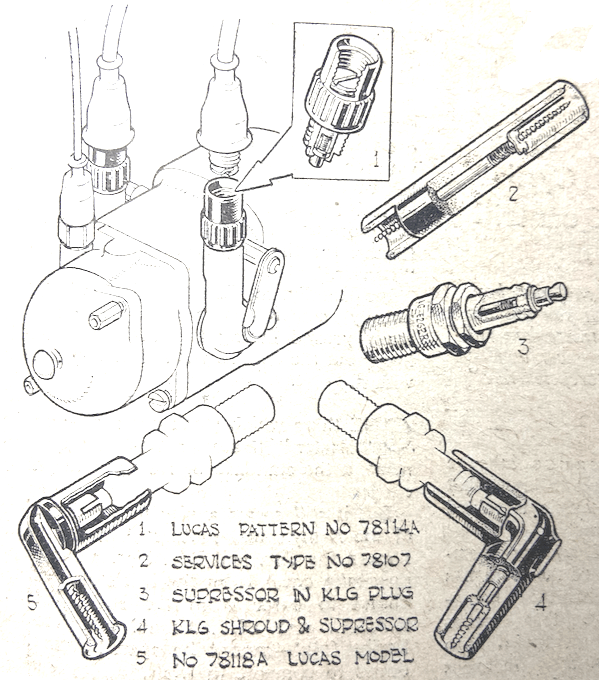
“ON A WINTER’S NIGHT—that of Boxing Day, to be precise—43 years ago, the MCC held its first Exeter Trial which started from the Bell Hotel, Hounslow, and returned there covering, in the meantime, just over 320 miles. The event thus inaugurated has remained the classic winter trial, for either cars or motorcycles, in Britain ever since, the series being interrupted only by such over-shadowing calamities as wars and fuel restriction. The first post Hitler-war ‘Exeter’ was delayed until 1949, when 90 competitors entered to cope with the then very-filleted course totalling but 60 miles. In the year following, a full-length trial was reinstated and in 1951 entries had risen to 119 motor cycles and 144 cars. Strictly speaking, 1952 did not have an ‘Exeter’ because the subsequent event took place on Friday and Saturday last, January 2 and 3, and should thus be regarded as the 1953 model. The entry was excellent: 159 solos, sidecars and three-wheelers (note for old hands with long memories—no Morgan ‘tricycle’ appeared in the programme, thus creating a record!) and 166 cars comprised a list of runners 325 strong representing the best post-war support so far. As before, there were three starting points for the 164-mile course—from Guyver’s Garage, Rother Street, Stratford-on-Avon; from a new venue, Old Sheep Market, Launceston; and from the Wheatsheaf Hotel, Virginia Water, the last being regarded as the London end. Common starting time was 10pm Friday. From Stratford, 28 solos, five sidecars and a solitary Reliant three-wheeler were due to start, while 20 solos and a brace of ‘chairs’ had selected Launceston for take-off. Actually 31 left Stratford and 21 started from Launceston. As might have been expected, the most popular starting point was the Wheatsheaf Hotel, with its quota of 77 solos, 24 sidecars and two three-wheelers, of which number only a mere five failed to sign on. The Army participation in the trial, first apparent in 1939, as an officially approved training ‘op’ was keen, and soldier after soldier, commissioned and other ranks, took starter’s orders, although a mild excitement occurred early in the evening when the WD fuel issue vehicle failed to turn up (it eventually arrived, having been to the wrong ‘Wheatsheaf’). No Exeter, of course, would have been complete without that veteran Harley-Davidson sidecar driver, RW. Praill, who
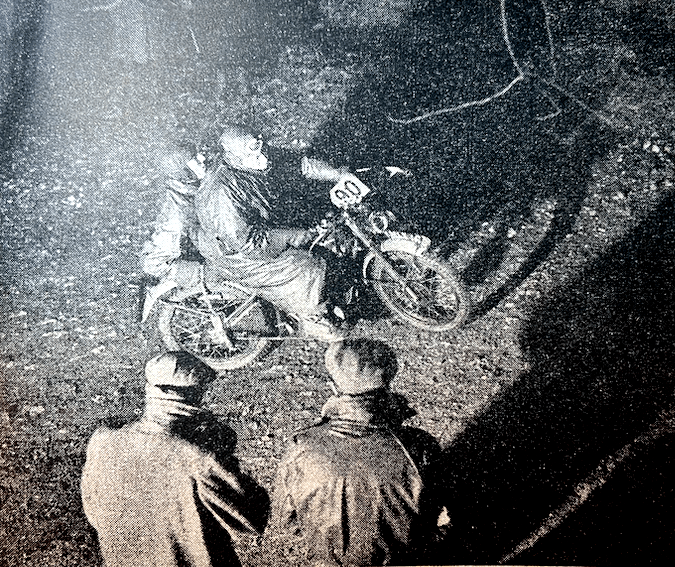
was there with his 10-year-old ohv ’61’ transatlantic outfit of 1,000cc. At the other end of the ‘chair’ range was SH Goddard and his little 200cc Sun-Villiers combination. Of the two three-wheelers starting from London, one was a 21-year-old twin BSA and the other a 200cc Mark B Bond ‘Minicar’—the first occasion that one of these vehicles has competed. And so the London end of the Exeter Trial got under way, on dry roads and with a bite in the air. From here, and from the other starting points, competitors followed routes, each approximately 130 miles long, to converge upon Honiton, in Devon. For the London contingent, followed by one of Motor Cycling’s reporters, there were patches of ground mist between Basingstoke and the half-way check at Wylye, and a certain amount of frost and ice on the roads. Less than 10 miles from Honiton came the first of the trial’s observed climbs, of Pin Hill, lying to the west of the Sidmouth road. Pin Hill, actually, although long and steep, with two sharp corners near its summit, has a good hard surface and sufficient width to enable even the three-wheeler ‘die-hards’ to make a perfect ascent. The only motor cyclist seen to fail was RJ Kelly (125 BSA), who subsequently dismounted and ran alongside his little machine. AI Bailey and RC Hicks romped up on their 125cc Douglas-Vespa runabouts and SH Goddard’s little sidecar outfit never looked like failing. L/Cpl J Stimpson, one of the several Army competitors, made a perfect ascent, despite the fact that his M20 BSA was without lights, and RHH James managed to keep his feet up while trying to nurse an overheated plug in his 125cc Excelsior. E Travers (500 Rudge sc) set the pattern for a run of clean sidecar ascents. Fortified by breakfast, served, in accordance with tradition, at Deller’s Cafe, and with the night run officially concluded, ‘No 1’, RF Lake (500 Vincent) headed the procession towards Dartmoor, leaving the Devon capital at 6am still in darkness. At Crockernwell A30 was relinquished and a left turn sent competitors following direction cards through narrow lanes to the famous moorland beauty spot, Fingle Bridge. Darkness was just fading and the three-quarter moon was dipping behind the shoulder of the
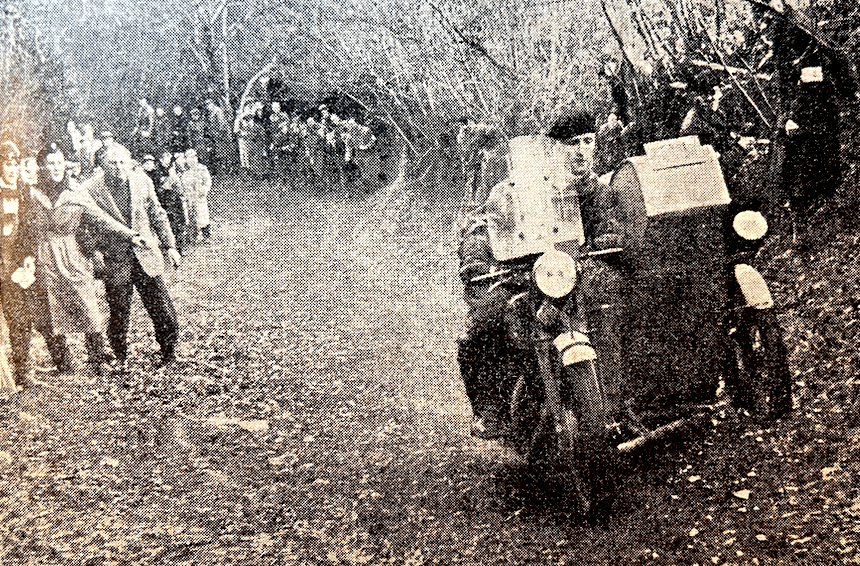
hill when Motor Cycling’s man arrived to find that already a score or so of early numbers had made their ascents, with varying degrees of success…Loose stones and a certain amount of leafmould on the otherwise dry surface caused stoppages for 2nd Lt RFF Lane, Gnr PN Waters and L/Cpl J Godstone (all 350 Matchlesses), L/Cpl J Stimpson (500 BSA), Pte D Ricketts (500 BSA), and Gnr J. Stone (350 Matchless). By now the sun had replaced the moon and though it was cold watching, the scene, in the clear morning light, was enchanting. Only the scents of summer flowers and heather were lacking and to make up for these A Putman (500 Rudge) drenched the woods with the pungent odour of ‘Castrol R’. The first sidecar to essay the climb was a 500AJS in the hands of DS Campbell. A little less pressure in the rear tyre might have helped him to find more wheelgrip. Using one of the old spring-steel-type chassis on his 500 Rudge, E Travers made a very good showing, and then came that MCC stalwart, RW Praill. After some difficulty in getting away from the starting line he swept round the first bend in spectacular style, but his huge engine had more power than the rear wheel could cope with and the mighty combination stopped half-way up the hill. A very good climb indeed came from PGM Harris (1,000 Vincent sc) and JH Hodge (500 Ariel sc) was also noted as excellent. When it was his turn to try the climb SH Goddard found that he needed to adjust the clutch of his Sun-Villiers outfit, which had already suffered a severe buffeting when a collision occurred with a cow during the night on Salisbury plain. Using standard touring outfits, WE Rose (” Norton Dominator sc) and MG Newton (500 Triumph sc) both showed onlookers how it should be done. Via Moretonhampstead, the route led to Waterworks Hill, a narrow, greasy trench-like little path running up a bank beside the dam of a reservoir. Half-way up the track was a stop-and-restart test which was not by any means easy. Then, in another nine miles, through Bovey Tracey and llsington, came that hoary ‘Exeter’ terror, Simms Hill. Except for a smearing of mud on the approaching right-hand sweep there was a dry path all the way up but even so, many competitors found the steep gradient too much for them, especially as each ascent had to be made from a standing start. The crowd was early treated to some excitement when the sidecars arrived. First Harris tore up on his Vincent and all but tipped over backwards when the sidecar body parted from its front securing bolts and reared upwards. But, as one man in perfect unison, driver and passenger threw their weight forward and brought down the aviating coachwork, to continue ‘clean’ to the summit. The only other ‘chair’ driver to bring off an unpenalised climb was Hodge and he and his passenger up-turned the outfit just as they reached the end of the section. Among the general run of the solos the standard of riding varied considerably—from the polished ‘flat-in-two’ attack of the ‘comp model’ rider to the nervously hesitant attempt of the obvious first-timer. That is a feature of the ‘Exeter’ to which all regular spectators are accustomed. But few, it is imagined, were prepared for the ‘fireworks’ provided by the two Douglas-Vespa riders. First, with a calico-tearing scream reminiscent of a Gilera ‘four’ came AJ Bailey. Round the. first bend he swept at tremendous
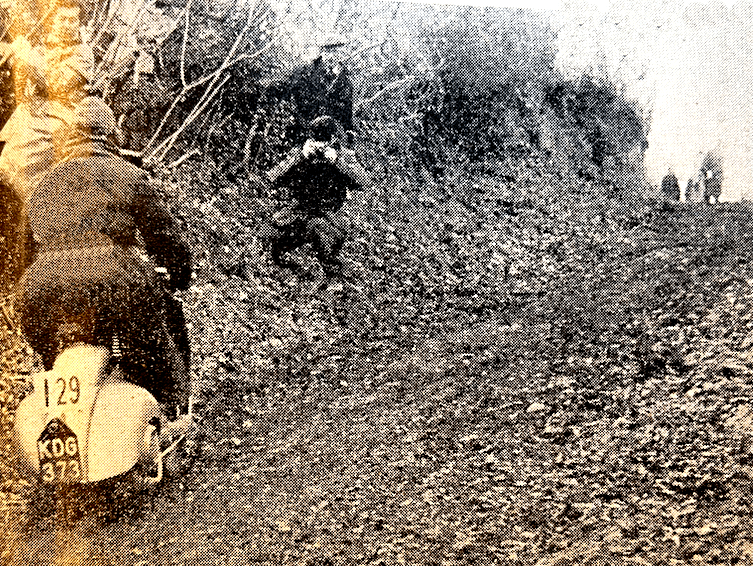
speed and was going like the proverbial ‘clappers’ when his small front wheel slid away on a patch of mould and he had to foot vigorously to keep upright. Hardly had the lookers-on ceased their cheers for a splendid non-stop effort than RC Hicks flashed into view, his 125cc engine turning over at an even greater rate. With the front wheel making only occasional contact with the ground and the rear end snickering from side to side like the tail of an agitated drake, the little runabout rocketed upwards and no better clean climb of Simms was seen that day. From here the route began its homeward trek, with Strete’s Hill, near Ottery St Mary, tackled next and then Knowle Lane, three miles out of Bridport.Strete’s is about a quarter of a mile long, running up the side of a wooded hill and getting steeper towards the top. An easy left sweep halfway up required little negotiation; newcomers, particularly the sidecars, found thawed-out greasy conditions that called for a gentle throttle hand to prevent wheelspin…H Mawson, casually smoking a cigarette, took his 350 AJS up in exemplary fashion, and JH Hodge again came out amongst the best of the ‘barrow boys’. Of the entry from the Army not all showed equal skill, but all tackled the exercise with admirable determination. Some, it was thought, might have done better with a little less air in the tyres, for they were afflicted with wheelspin unusually early in the proceedings. L /Cpl A Jobb (350 Matchless) was perhaps best of the team from. the 6th Bn RAOC, and L/Cpl JSH Bray (350 Matchless), from the same unit, got a cheer from the crowd. At Creekmoor, seven miles out of Bournemouth, came the final time check, and thence it was straightforward going to the finish at Bournemouth’s Grand Hotel and the end of one of the pleasantest ‘Exeters’ ever held, and certainly the kindest from the weather point of view.”
MOTOR CYCLING STALWART Bernal Osborne described the ‘post war’ dream bike he’d designed 10 years earlier with his flatmate Bob Sayer: “Bob was a skilled engineer and both of us were motorcyclists. The friendship continues to-day. ‘Young Bob’ is my godson—that is the way of things…Sayer, when his room-mate had finally gone Armywards, actually made a number of patterns and castings. Three years afterwards they were destroyed by a Hitler rocket…the Sayer-Osborne idea demanded almost complete supersession of then existing British motor-cycle design—not just for the sake of being clever, but for the reason that (so we thought at the time) if the motor cycle was to endure, it would have to sever its long relationship with the bicycle…The engine, planned as a 500cc would have to he efficient, simple and compact. Bob had a soft spot for the slogging-quality plus high-speed performance of the Ford V8. So we mentally chopped one in halves and made a V4…Details of the 90° engine should include mention of the almost-square bore-and-stroke dimensions (about 52x57mm), giving low piston speed at the fairly high rpm envisaged as being forthcoming from the well-designed (we thought at the time and still do) side-valve-type combustion chamber. We adopted a fine idea, that of the hydraulic tappet, promising ourselves a measure of mechanical silence hitherto undreamed of in the motor cycle world…The frame was visualised as a structure of light-gauge welded pressings. Cross-sections of the various channel, and box, frame components are shown in Sayer’s side-elevation drawing. The lower frame section is designed to be jointed and detachable at points ‘A’ and ‘B’ and, with it, can be withdrawn the entire engine-gearbox unit. Frontally the top, main pressings are riveted and welded à la Zündapp or Coventry-Eagle and accommodated in a central petrol tank recess is a battery and glove, or tool, cubby…Though the phrase had hardly been coined in 1941, dual-seat equipment of an advanced type was featured. Let the ‘moderns’ note that here we had no rubber-covered metal pressing, but individually sprung front and rear seats, made as a unit, for rider and passenger. How could either of us have known in 1941 that within the span of a decade the majority of British manufacturers would have relinquished rigid frames and that, in some cases, after a trial period with plunger springing, they would rift over to the swinging-fork theme, not only in Britain but in the BMW ‘fabrik’ at Munich too…the telescopic fork vogue was destined to sweep the world like wild-fire so soon as hostilities were finished. Working without that knowledge, Bob and Co sought something even better than the only telescopic fork of which they had knowledge—that of the BMW. The result of much cogitation…the forks are pressings, rigidly mounted and forming a lower pivot point for swinging-link arms…Then we ” clad the thing, and, having no precedent as a guide, I think we rather overdid the enclosure business. Perhaps we drew unduly on the Francis-Barnett ‘cruiser’, a model of which I then happened to own. Note the ‘turn-screws’ used to secure the tail, the engine bonnets and’ exterior tank panels…”
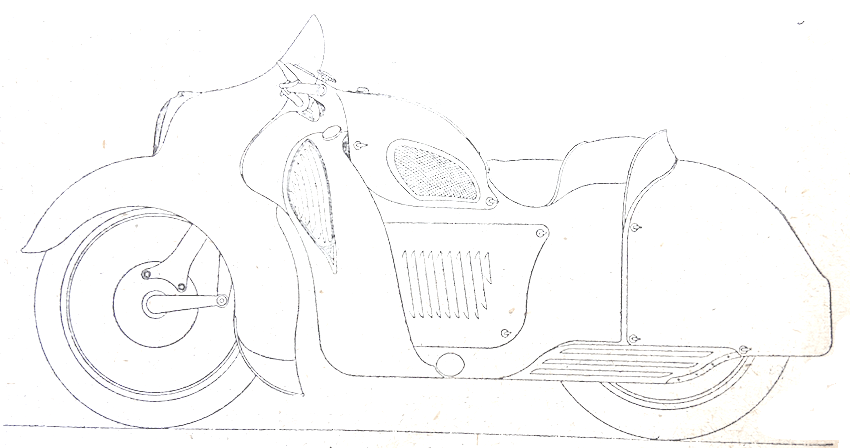
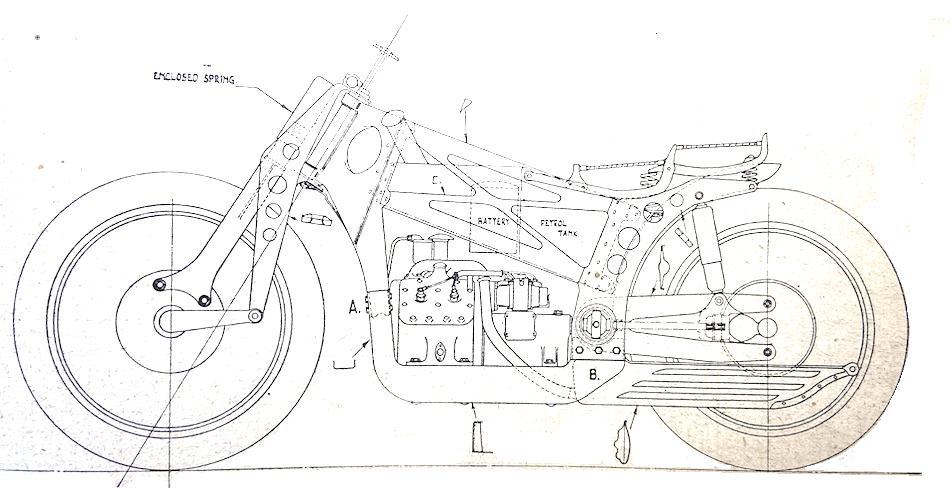
HUGH PALIN BECAME director of the Manufacturer’s Union which is still in business as the Motorcycle Industry Association. He was still in post when he and I were invited to Newcastle for a Tyne-Tees TV panel on motor cycle safety. As we were sitting with a local dealer and a BMF rep waiting for the star, a make-up girl scurried over to Hugh to pat some powder on his bonce, which was reflecting the studio lights (fair enough, Hugh had as much hair on his head then as I do now, which is very little). But, noting that he was sitting ‘to attention’ she gushed “Now then Hugh, no need to be nervous!” He was too well mannered to tell her off but it’s a pity she hadn’t read the Green ‘Un’s 1953 report on the new MU boss: “To begin with he is just 40 and was destined for a career in the insurance world. [He] was still studying for his final examinations when the war broke out. He had then been a Territorial, in the Westminster Dragoons, for a matter of a couple of years, and after being called up as soon as hostilities broke out, he served in the Royal Tank Regiment, being demobilised in the autumn of 1945. His duties took him to North Africa as well as Western Europe, and he was awarded the MBE for services in the field with an armoured brigade in the Normandy landings, leaving the Army with the rank of major. He still serves, however, in the Territorial Army, being, in fact, second-in-command of the Warwickshire Yeomanry.”
CANADIAN SPIKE RHIANDO, who is making an attempt to ride from Algiers to Capetown in record time on a Scootamobile, a semi-enclosed scooter of his own design and construction, is believed to he somewhere in the Sahara. In a letter to his wife he reported that all was well during his two-day run from Le Touquet to Marseilles, though the weather had been bad and he was delayed at Marseilles through grounded aircraft. He expected to he away to Algiers in the early part of last week.”
“AS AFRICA’S PREMIER motorcycle classic, the PE 200 ended at Port Elizabeth, South Africa, on New Year’s Day, with three new track records established, the consensus of opinion among nearly 30,000 spectators was that the experiment of running three 72-mile scratch races, instead of the former 144-mile handicap, event, had been a big success. A good deal of the credit for that success must go to 37-year-old Borro Castellani from Nigel, Northern Transvaal. The tough, veteran speed ace, who was once termed a ‘real wild man of the track’ but who, in fact, is a courageous and skilful rider, brought thousands of fans to their feet as he more than made up for his own bad luck. Castellani, a building contractor who has been a top-flight racing man for more than 15 years and is probably South Africa’s most spectacular performer, built up a big lead of something like half a minute in the first, eight-lap, 72-mile event, which was for 350cc machines. In one rip-roaring lap, tilting his 7R AJS low on the corners and trailing his left foot, he set up a new 350cc class record for the famous 9-mile WM Gray Circuit, with a 5min 48sec lap, equal to an average speed of 93.10mph. For more than 65
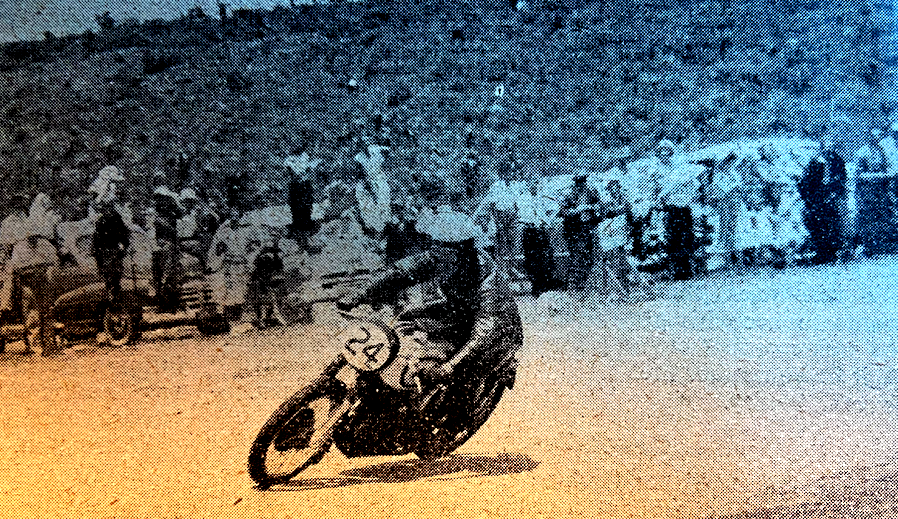
miles he was well ahead of the other 25 men in the event. Then, in the last lap, his engine unaccountably petered out. He got his machine re-started but only after losing so many precious minutes that he finally came in 12th. But the crowd had not seen the last of the ‘Man from Nigel’. In the last of the three races, the 500cc contest, he was off like a flash on his ‘Featherbed’ Norton, and 29 other contestants were soon strung out behind him. Again he established a new track record, at 99.69mph. Then he rode home an easy winner, having completed the 72 miles in 44min. The crowd roared his name, the autograph hunters blocked his path and then, revealing his genuine modesty, this grinning, black-haired veteran of the track. who rode second in the PE 200 in 1952, retired behind the pits until called to the winners’ booth. He had beaten the two reigning joint national champions of the 500cc class—3I-year-old Rudy Allison of Johannesburg’s Phoenix Club and grey-haired George Anderson of Cape Town, brother-in-law of South Africa’s overall speed champion, Vic Procter—who had battled hard for second place, right to the finish when Anderson managed to build up a slight lead over his friend and rival. Another reigning champion, 27-year-old garage proprietor ‘Boet’ Ferreira, also a member of the Phoenix Club, Johannesburg, who has topped the lightweight class lists in South Africa for the past three years, sped 72 miles to victory in the 250cc event. Though he has more than 25 victories to his credit, Ferreira has never previously raced in the ‘200’, but he seemed confident from the start and had soon set a new lap record for 250s at an average of 81.61mph on his 18-year-old Velocette. Behind Ferreira, in second place in the 250cc race, came his clubmate Eddie Grant, also on a Velocette, winner of last year’s ‘200’. Grant lost a foot-rest on the fifth lap and put the brake pedal out of action. Then, on the sixth lap, his front mudguard started coming apart, and he had to stop to remove it. By then Doug Holmes, also from Johannesburg, had passed him, on another Velocette, but Grant managed to get back into second
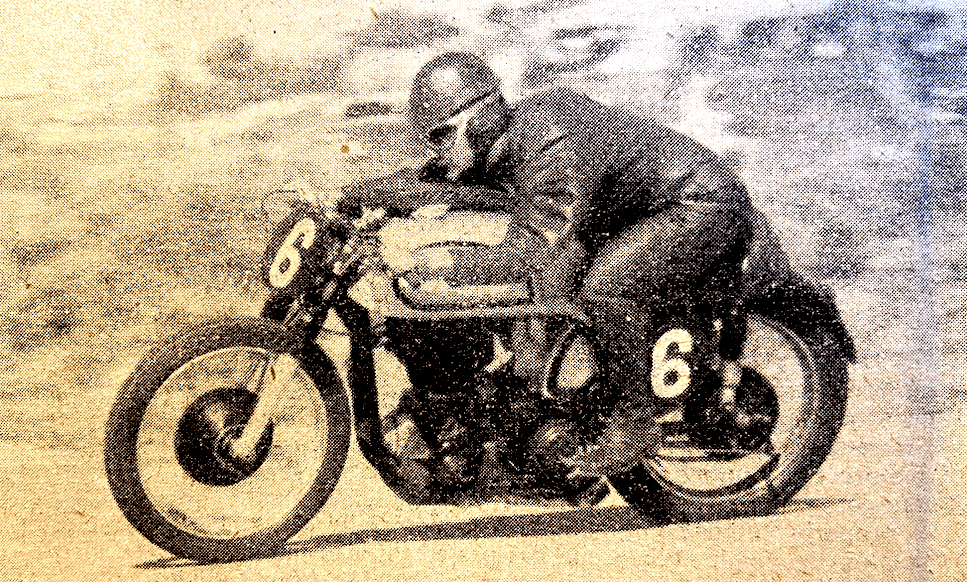
place before the end of the race. The two who came in immediately after Holmes had fully earned their places. Dennis Spencer, 28-year-old motor mechanic, well-known in Natal hill-climb events, had turned New Year’s Eve into a busman’s holiday by battling, with his two pit attendants, Vic Mobey and Ted Lucey, to get his four-year-old Velocette into shape, following big-end trouble. All three were up almost all night before the race fitting replacement parts borrowed from Ferreira. Behind Spencer, 57-year-old Frank Cope, second oldest man in the race and Britain’s only representative, came in fifth. The 350cc race, in which Castellani relinquished the lead as a result of engine trouble, was won by 30-year-old East London engineer Henry Theron who has been in every PE 200 since the war. After the race, Theron said: ‘I was doing my damnedest to reach Castellani. My gear slipped out while I was changing-up at the end of the Uitenhage Road stretch. WA Gwillam passed me but I stuck to his tail and then managed to pass him.’ WA Gwillam, who came second, was the winner of the ‘200’ in 1951. Third was RM Travers, of Maritzburg, whose average speed of 89.5mph for the whole race put him about a mile behind Gwillam.”
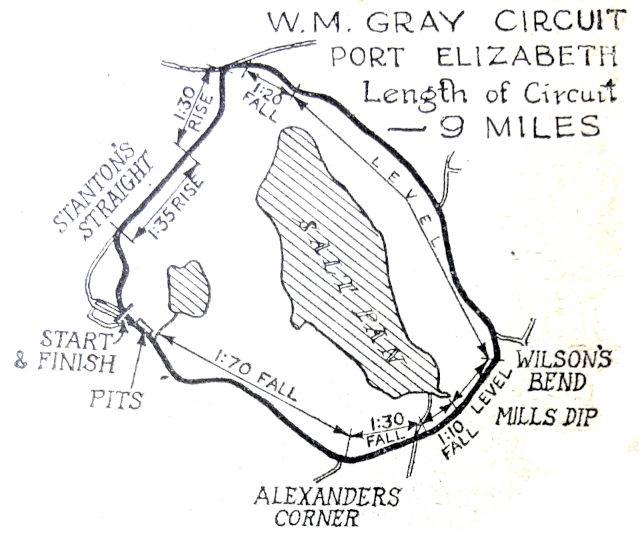
“”THANKS TO THE co-operation of the Little River Shire Council, the Australian TT, organised on December 26 and 27, 1952, by the Harley Club of Victoria, became the first motorcycle race ever to be held on the public roads of the Victorian mainland. At its own expense, the council sealed over 1½ miles of road so that tarred surfaces formed the whole of the 4-mile 18yd circuit, which included a section through the main street of the town. Little River lies just off Victoria’s main south-western highway, about 30 miles from Melbourne. This was the first time for six years that the event had been held in Victoria, since it is organised annually by each state in turn, and Victorian riders won five of the seven events. From all accounts, the meeting scored an immediate hit and the sport has gained a large number of new enthusiasts in consequence. This was the kind of racing in which Australians have shown themselves to be such experts. In particular, the two-day meeting will be remembered because it threw up not a few new names which, according to well-informed opinion. will make, no mean impact upon the world of road racing. Among these outstanding, riders at Little River was the almost unknown George Scott, the Perth, Western Australia, jockey of a 7R AJS in the 350cc race,
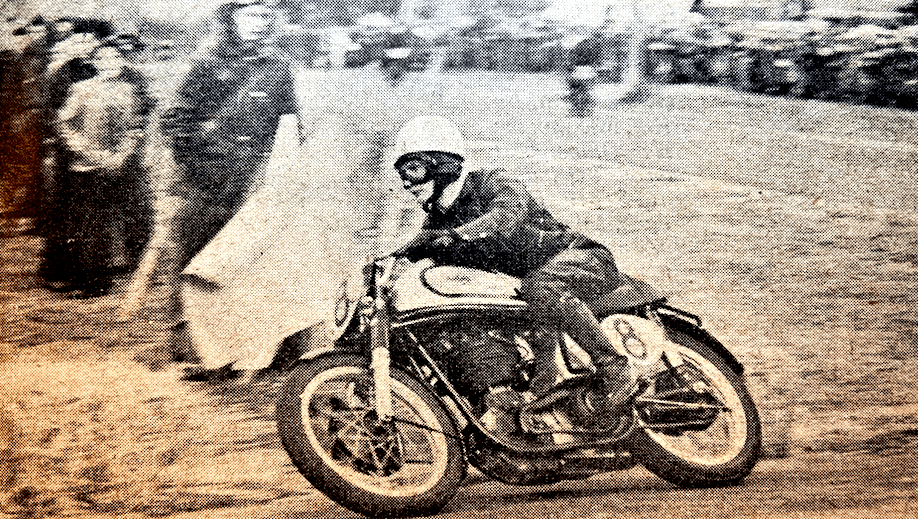
who, much to everyone’s surprise, led home the redoubtable Maurice Quincey (Norton) by 100 Yards to take second place behind the New South Wales newcomer, Alan Boyle (Velocette). Boyle’s machine was Ernie Ring’s works KTT and its victory gave special pleasure to at least one member of the audience who had come a long way to see the meeting—Mr Jim Edwards of the Velocette factory. Scott also showed his ability to handle a bigger model by bringing his GP Triumph into third place in the Unlimited TT race the following day, only 16sec behind yet another new star in the Southern Cross of racing—J Ehret. The last-named was riding the Vincent Black Lightning which came to Australia with Tony McAlpine. Weighing just over 7 stone, S Willis brought a Lightweight cammy Velocette of his own construction from New South Wales and put his plate up by winning the 250 TT, while Queenslander W Anderson, riding a ‘Featherbed’ Norton in the Senior TT, opened the spectators’ eyes by sharing fastest lap of the meeting, 3min (80.20mph) with the winner, Quincey. In fact, he did it twice. A victory was scored in the Senior sidecar race by F Sinclair’s twin Vincent, modified by Phil Irving and sleeved down to 750cc.”
“THERE IS A RE-AWAKENING of interest in road racing in the USA and these winter months, when the enthusiasts can do little except conduct ‘hot stove leagues’ during which past events are reviewed and plans for the future are discussed, there is much- talk of hoped-for races on closed-off public roads. Actual developments, outside the realm of pipe dreams, are the 50-mile championship event to be held this summer on a road circuit near Johnstown. Pennsylvania, and, of course, the annual meeting on the one-mile circuit at Laconia, New Hampshire. There is no possibility of another 100-mile race being run in the New England area. Already Daytona’s three-race programme is the subject of much speculation. The main race is the national 200-mile, championship, and the others are the 100-mile amateur event and special 50-mile ‘consolation’ race for those who should have taken part in last year’s rained-out 100-miler. Accord to all reports, the ‘beach classic’ promises to be a battle between riders of British vertical twins—BSA Star Twins, Matchless G45s, Norton Export Dominators and Triumph Tiger 100s—but there is always the possibility that the Harley-Davidson factory will spring a surprise with some of its new KR 750cc side-valve racing machines, while the old-type Manx Norton still in the hands of several riders cannot be discounted, in a race which covers 200 miles.”
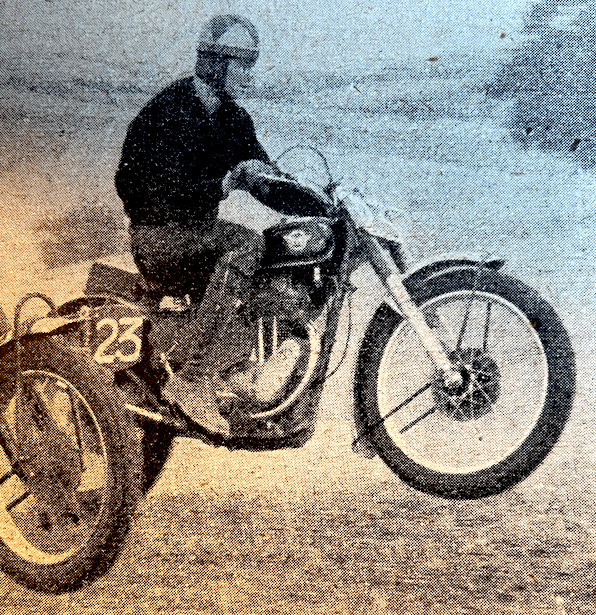
“THE ANCELL RANCH RUN, held near Wichita Falls, Texas, attracted an entry of 94 and was held entirely on the 14,000-acre Ancell Ranch, where the terrain varies from mud-holes to sandy desert. The method of determining the winner is unusual. The riders are informed that they should finish sometime between 1am and 3am, then a ticket is made out for each minute of the two intervening hours and there is a ballot. Whoever finishes nearest to the time drawn from the hat becomes the winner. On this occasion it was Jack Williams, of Abiline, Texas, on an Indian Warrior. The meeting finished with a typical Texas barbecue and a ‘rocket run’, in which ranch owner ‘Bull’ Ancell hid himself way out on the ranch and fired rockets into the air. First man to reach him was Bill G Williams, on an Indian Brave.”
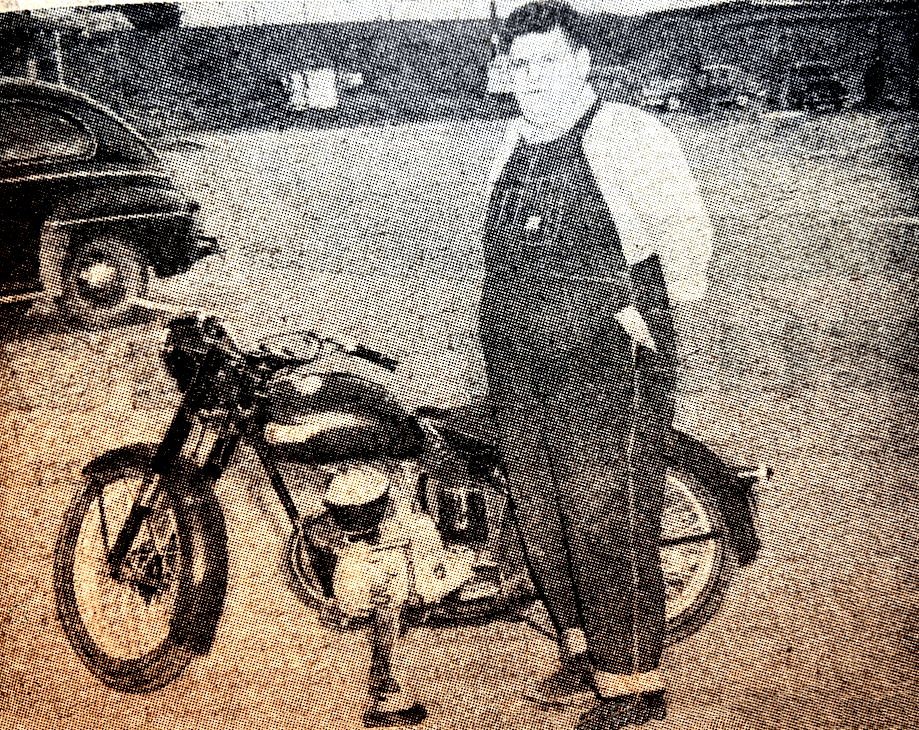
“THE AMERICAN RED CROSS and the AMA have jointly created an emergency blood transport service, it having been proved that a motor cycle can go anywhere in less time than any other land vehicle. As human blood is rather sensitive to being shaken about, some fears were expressed about its condition at the end of a fast ride, but modern spring frame machines were used for the tests and the plasma suffered no harm.”
“THE SPRINGFIELD, OHIO MCC has undertaken the task of ridding the area surrounding its town of all out-dated signs and posters and, in the first few weeks of its effort, has accounted for several thousand ragged signs.”
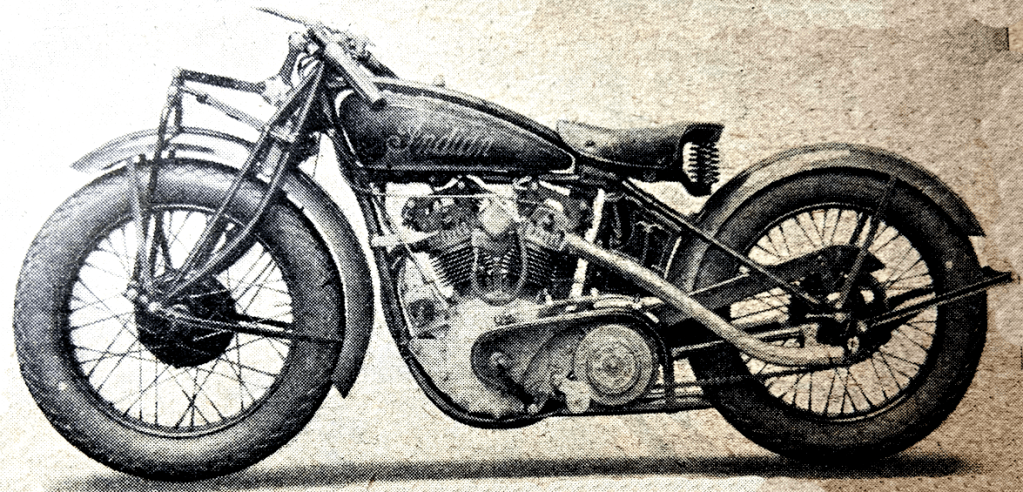
“EXHIBITORS IN THE 36th International Brussels Motor Cycle and Cycle Salon are jubilant, and justly so, over the initial success of this year’s display. Like Earls Court, the building devoted to motor cycles and cycles has a gallery: previously it has not been needed but this year, so great has been the demand for floor space, that the upstairs department has also been well filled. Yes, the visitor walking up the entrance steps into the main hall is certainly greeted with a fine spectacle—and to report on what there is to see let us make the grand tour as any ordinary visitor would. As soon as he comes into the body of the building he is met by the displays, located side by side opposite the doors, of Belgium’s two leading motorcycle factories—FN and Sarolea—and both have something new to attract his attention. FN, for instance, have augmented their range of big side-valve and ohv models with a brand-new two-stroke, a type that has appeared only once before, in 1930, in the long history of this, one of the oldest concerns in the motor cycle industry. The new
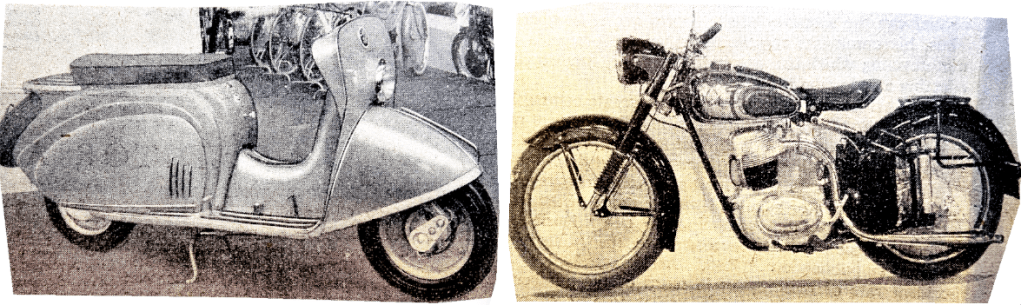
model, Type 22, is a 175cc job designed to put FN in the keenly competitive small-machine class. As you would expect, it is extremely well made and, though it possesses some unusual features, it is a clean straight-forward motor cycle with no fancy frills. A four-speed, unit construction motor operates on the twin piston, common combustion chamber system. The diameter of each bore is 45mm but at 57.5mm the stroke of the rear piston is 2.5mm greater than the front. This is brought about by mounting the front piston on an auxiliary connecting rod, knuckle-jointed to the rear master rod. The two-port cylinder block is slightly inclined forward and has an alloy head; contained within the box-shaped crankcase-gearbox unit is the contact breaker, 35-watt Noris dynamo and the coil, the battery being fitted below the saddle. Petroil lubrication is used and the unit is supported in a loop cradle frame with a swinging-fork rear springing system controlled by Girling double-acting spring units. Variable rate springs are used in the front teles. A multi-plate metal-to-metal clutch transmits the drive and the wheels have finned alloy central-hub-type brakes. Two models are being marketed, the Standard and the Luxe, both finished in metallic blue. The chief differences are in the silencers, in
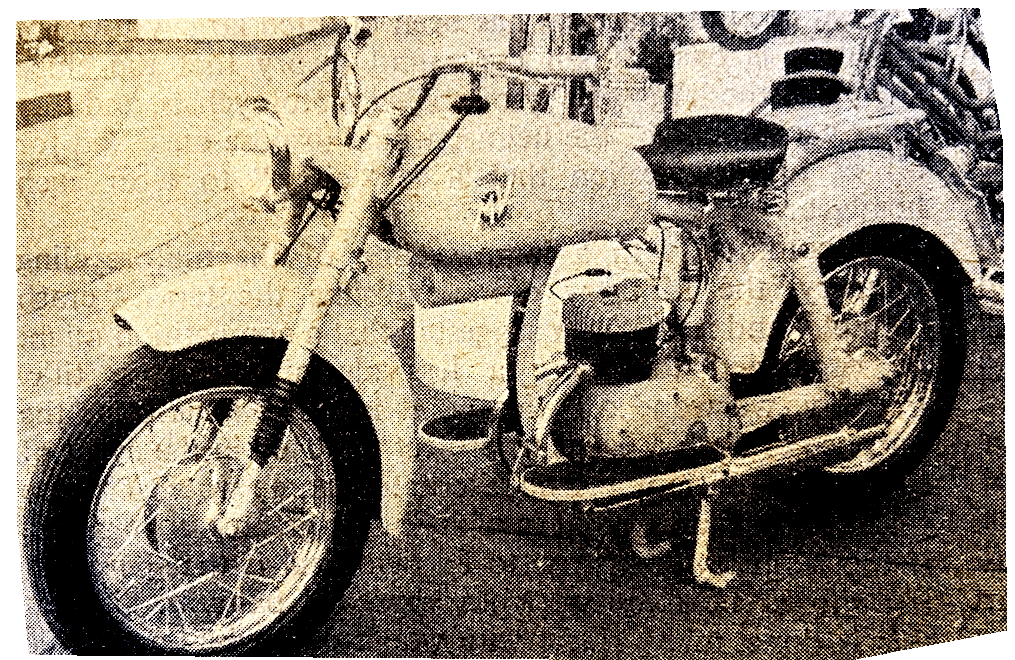
the extent of chrome plate and in the polished finish to some of the alloy castings. The price? About 21,000 Belgian francs (approx £150). The rest of the FN range embodies minor detail improvements and the 500cc parallel twin, first shown last year, is due go into production very shortly. Sarolea’s latest offering is a larger version of the pretty little L’Oiseau Bleu two-woke, which made its debut last year with a 125cc engine. The new Regina model has a 198cc motor with built-in AC alternator lighting equipment. It has central-hub-type brakes (the rear hub incorporating a rubber block type shock absorber) and the foot-operated three-speed gear is in unit with the crankcase. Rear springing is by vertical plungers and telescopic forks look after the front. The big ohv models are all on show and the handsome 500cc ohv parallel twin Atlantic now has a bigger brother in the 600cc Major. Next along the gangway are to be found another famous Belgian concern, Gillet-Herstal. Their very popular 250cc ohv model has grown into a 350 called the 4-TC and having swinging fork rear suspension with Girling units. There is also a new 175cc two-stroke with plunger rear springing, central drum brakes and other modernities. Gillet also exhibit French Bernardet scooters fitted with 125 and

250cc Gillet engines. A fourth indigenous manufacturer, Socovel, is next door. On this stand are shown the neat pressed-steel framed, 14in-wheeled, Villiers-engined, rear-sprung velomotors that first appeared last year, and also the Socovel versions of the well-known Jawa single- and twin-cylinder two-strokes. Close to these local makes are the stands of BMW and Puch and the Dutch Sparta people, and on the last-named are to be found examples, as elsewhere in the show, of the new Villiers 8E engine unit. This closely follows the pattern of the 200cc 6E, the main external differences to be noted being a more streamlined chaincase, a slightly shorter inlet stub, the new single-lever carburetter and more finning on the cylinder barrel. A range of French Peugeot lightweights is in close company with German TWNs and Italian Guzzis. And then the visitor comes to an interesting newcomer from another very old Belgian concern, the Minerva Company, of Antwerp. Famous in very early days for their motorcycles and engines, and later for their sleeve-
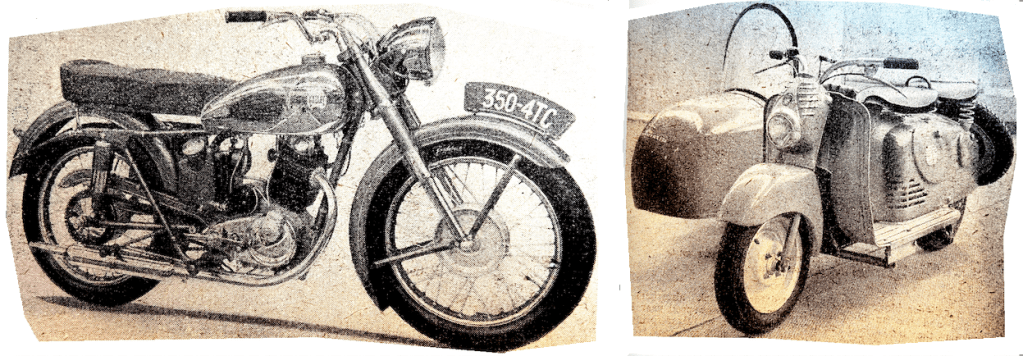
valve cars, Minervas have entered the scooter market and show what appears to be a very soundly designed two-seat job which is powered by a 175cc MV Agusta two-stroke-engine-transmission unit. MVs themselves have a selection of scooters and ohv and two-stroke machines including an ingenious model in which the swinging fork is mounted direct on to the engine base, the pivot point being forward of the crankcase at the base of the front down tube. Telescopic spring units at the extremities of the rear legs are damped by a, shock absorber anchored below the saddle at its top end and above the gearbox at its base. Further down the hall are located Royal Nord, who have a particularly attractive velomotor powered by a 50cc two-speed-clutch engine unit of their own make. Bigger models are fitted with Maico and Gillet engines. From their factory at Alost, Lion Rapide bring a range that includes Villiers, Ilo and FN power units, the last-named model having a swinging fork rear suspension system controlled by Girling units. The model 100 employs the latest Villiers 4F 98cc unit. In close proximity at the far end of the hall is a big German group dominated by NSU, who give pride of place to the only recently introduced Max model, which has ohc gear operated by three levers working on eccentrics. With a 250cc engine, it is priced at 32,130 francs. Kreidler velos, Phoenix scooters, Victoria, Horex, Meister, Hoffmann, Adler, Maico and Bauer are all represented in this section and the last-named show an unusual
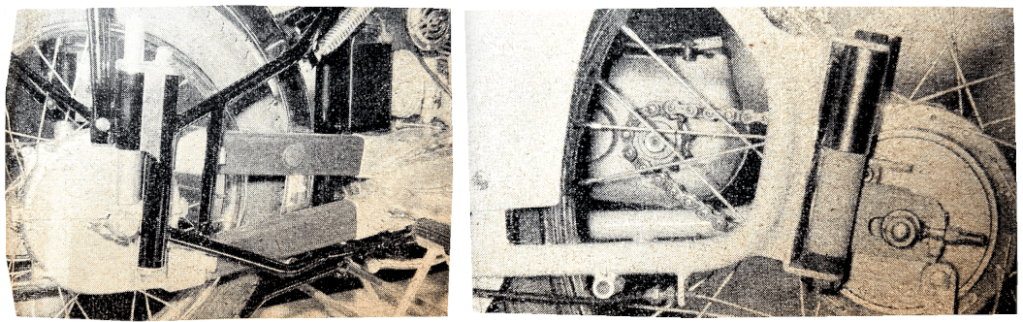
250cc ohv with push rods at the front of the cylinder and the inlet and exhaust ports are parallel at the rear. Along the side aisles are to be found, among many others, Ducati (whose Cruiser fluid-drive ohv job is the last word in scooters), Lambretta, Zündapp and Rumi, who show their new twin-cylinder ohc racer along with their very unusual twin-cylinder two-stroke touring and sports models. DKW also feature a racer with the tourers—the three-cylinder 350. Vespa include George Monneret’s Cross-Channel floata-scooter; Motobecane include their Paris Show sensation, the twin 350 with the plugs facing front and rear, and Alpino, Flandria and Novy all offer nice looking lightweights, the Novy people having a 125cc Villiers-engined machine ticketed at 12,500 francs (£90). Terrot scooters, DMF Ilo-engined velos, Hurtu cyclemotors and Walba scooters—they are all here making up the colourful display. But before we leave the ground floor, mention should be made of the Steib hydraulic sidecar brake. This consists of a miniature Lockheed-type master cylinder ‘in series’ with the rear brake rod. A flexible duct connects with the piston-operated sidecar wheel brake to make a very practical fitting that can be applied to almost any outfit. In the gallery are to be found such well-known
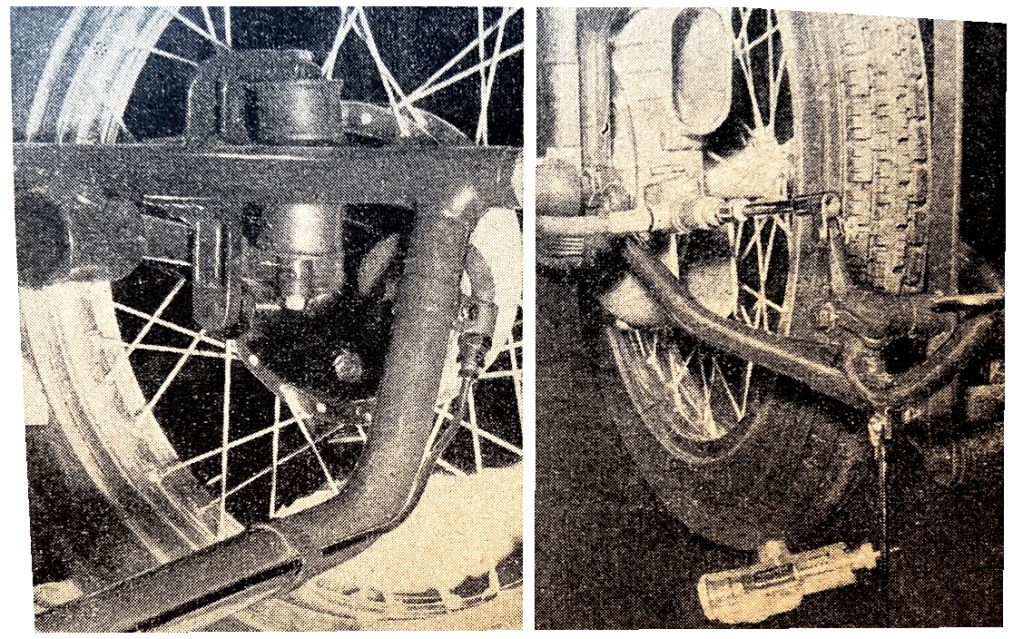
names as Tornax, Omega, Ardie, Durkopp, Mars, Eysink, Bianchi, Gilera, Rabeneick, Whizzer, Ratly, Csepel, Indian, Harley-Davidson and Precision Sidecars. From the Chemnitz (Russian Zone) former DKW factory, the Ifa people have sent along their interesting flat-twin 350cc two-stroke, with shaft drive and plunger springing, which is listed at 34,000 francs. Next door to the Parilla stand, which on opening day was the only one empty, are the Swiss Universal twins and there is a host of less well-known makes, featuring mostly Ito, Sachs or Ydral engines. A big British display is scattered over the hall. Velocette and Norman are in the gallery; Vincent, Panther and Excelsior are located on the side lines, while Ariel, BSA, Francis-Barnett, James, Matchless, Royal Enfield, Sunbeam and Triumph are there in force is the main aisles. The Royal Enfield Meteor and Ensign models and the Triumph Terrier, all being fresh from Earls Court, are a big attraction and many are the admiring comments, for Belgium, although only a small country, is astonishingly motor cycle-wise. Latest returns show that there are now approximately 200,000 registered motor cycle owners among a population which is under 10 millions—about one machine to every 50 people. A large proportion of the 200,000 are scooter owners but Belgian riders are by no means conservative and there appears to be a good market for all classes of machine. Certainly, with a strong home production and 12 foreign countries competing for their favours, Brussels Show visitors have an almost infinite variety of selection.”
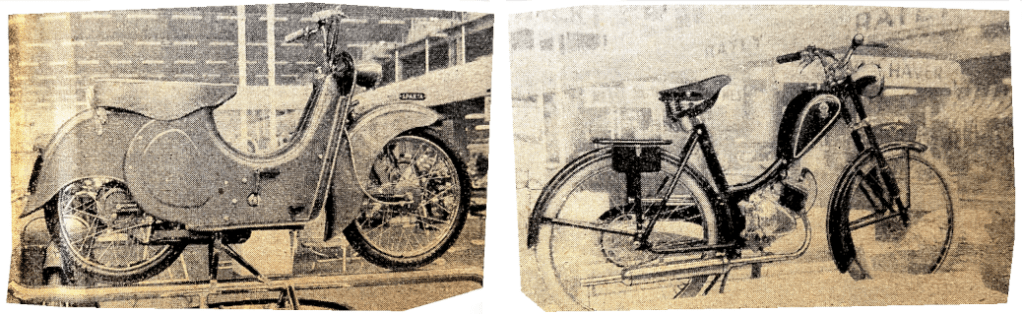
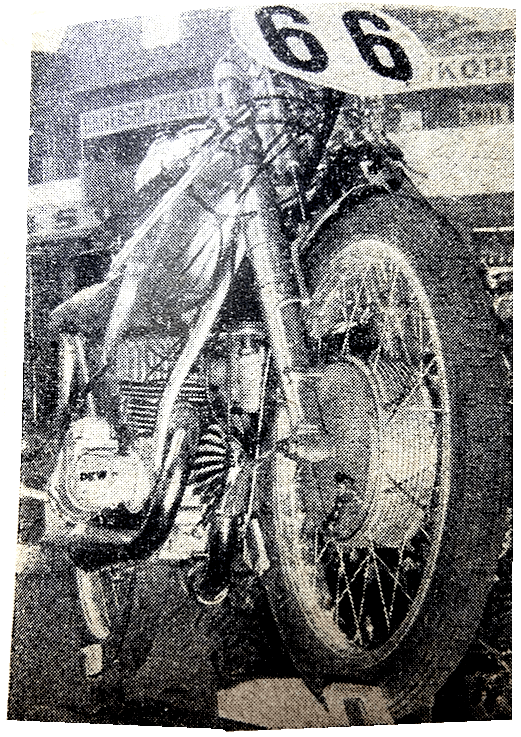
THE FIRST PUBLIC transmission of television in Germany was on Christmas Day. Three days later there was a 45min programme on motor cycling, with Otto Daiker and Werner Haas, NSU racers, Ewald Kluge, the DKW exponent, and Georg (BMW) Meier all in the Hamburg studio with their machines.”
“WHILE, FROM FEBRUARY 1, the majority of leading petroleum distributors in this country are to market a No 1 fuel at 3d a gallon above existing prices, plus a standard grade at ‘Pool’ prices, the Esso Petroleum Co announce two better-quality fuels, ‘Esso Extra’ and ‘Esso Mixture’ at 4d and 2d respectively more than ‘Pool’. Current prices vary between 4s 2¾d 4s 3¾d.”
“FURTHER TIDINGS OF Spike Rhiando, who is attempting a record journey to the Cape with his Villiers-powered Scootamobile, told of unusually bad weather encountered in North Africa during the first week of the journey. Later news of his progress came from Blida, situated on the foothills of the Atlas range, where snow falling amid orange groves contributed to the freakish conditions. A message brought back by other trans-Sahara travellers was received in London last Saturday and indicated that serious trouble of a mechanical nature had been encountered during the desert crossing and that the rider was suffering from exposure due to the extremely low night temperatures.”
“FOR THE THIRD YEAR running, a concert party composed of Wolverhampton MC members styling themselves The Con Rods put on a first-class show. Billed as ‘Trialing Times’, the entertainment was staged at the Beardmore Hotel, Wolverhampton, on January 14, and the varied programme attracted an audience which more than filled the hail to capacity.”
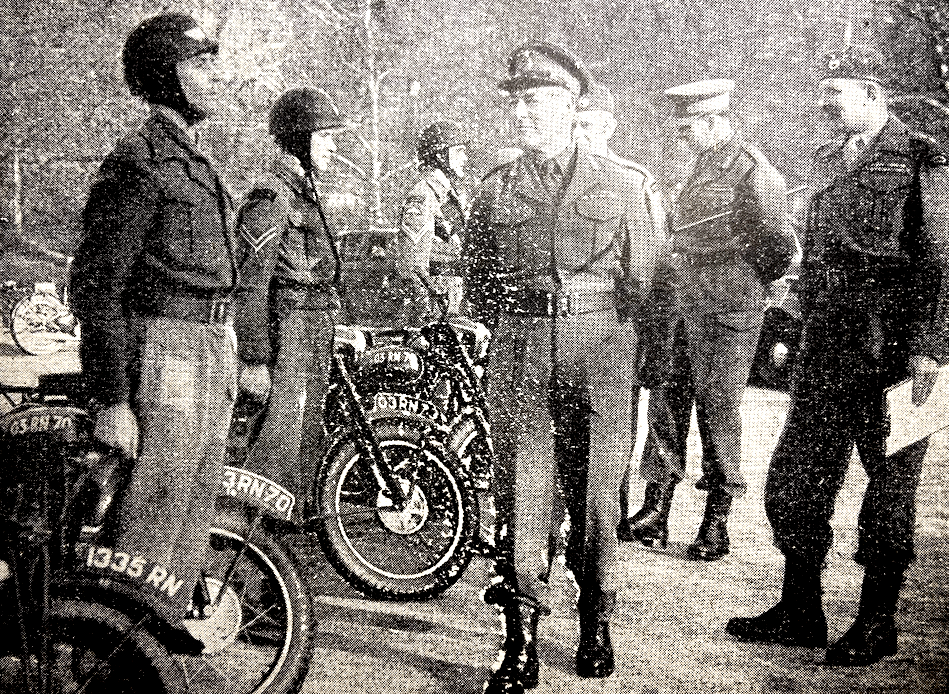
“TO INCREASE MANUFACTURING space, Francis and Barnett have completed negotiations for the purchase of a freehold factory in Coventry. It is hoped to start production at the new premises, which offer floor space of more than 13,000ft², in the immediate future.”
“ARE SPRING FRAMES really necessary on lightweights? Evidently the majority of riders are all in favour of this refinement. About 75% of the demand for the BSA Bantam is for sprung-heel models. More than 80,000 of these machines have been sold—about 60% of the 125cc motor cycles exported from this country have been Bantams.”
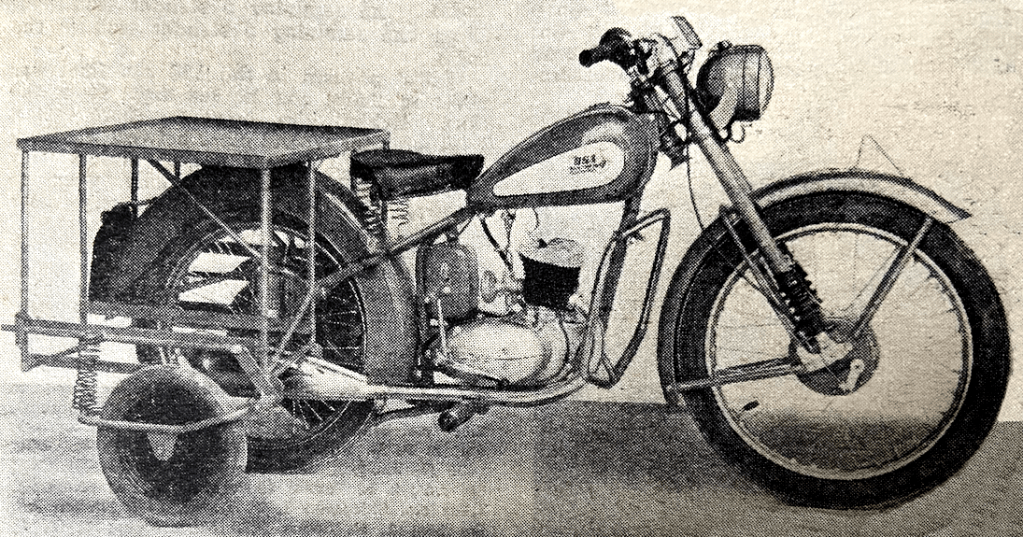
“HYDRAULIC LEGS AND rear-suspension systems manufactured by Mackenzie Motor and General Engineers of 35, Sunderland Road, Forest Hill, SE23, have been supplied mainly to dealers and ‘spring heel’ specialists for the past four years, and have featured on machines in such diverse events as the TT, ISDT, North vs South Scramble and even the Ceylon and Daytona road races. The hydraulic legs—which are now available from stock, price £5 17s 6d per pair, post free in Great Britain—are constructed from solid cold-drawn weldless steel tube. They can be obtained in various sizes with from 3-4in of stroke suitable for any type of machine from 125-1,000cc. Various rates of springs can be supplied, according to the type of machine and the use for which it is intended; and different rates of damping can easily be achieved by oils of varying viscosities. An external filler hole and screw is provided in each leg to allow the oil level to be checked, and, if necessary, topped up, without difficulty.”
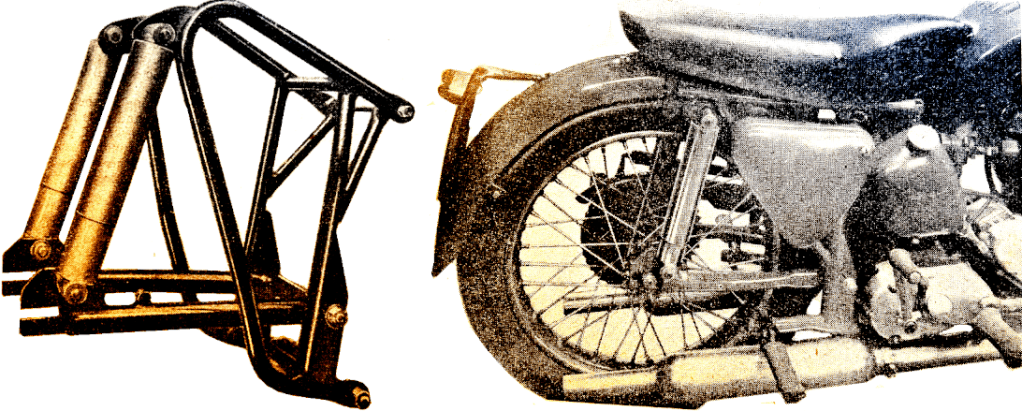
“AN INTERESTING PROJECT is in course of development by the Myford Engineering Co of Beeston, Nottingham. This concern manufactures, among other tools, the well-known ML lathe, and their plan is to supply part-finished components for a 50cc twin-cylinder two-stroke engine, enabling the owner of a Myford lathe not only to set himself a first-class practical lesson in machining, but to have, when the work is finished, a rather unusual type of power unit ready for attachment to his bicycle. Clearly, the cost of the end product, manufactured under such a do-the-work-at-home scheme, is likely to be but a fraction of the figure normally paid for a similar engine commercially produced and marketed.”
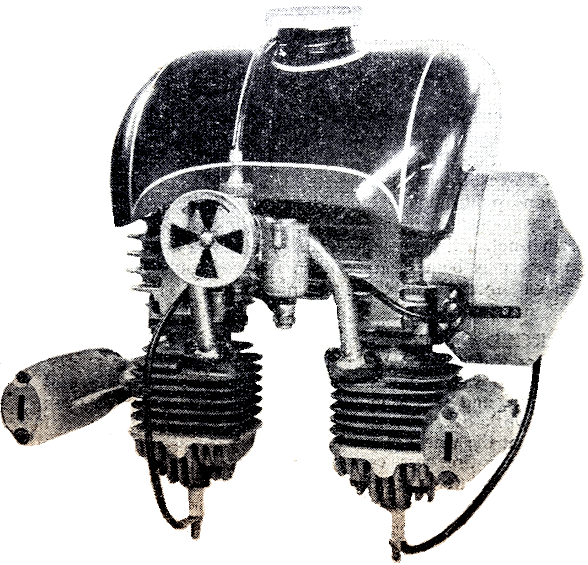
“THE TYPE OF reliability trial run in Germany would appear to fit a rider for the ‘International’ better than do our one-day, or more usually half-day, events. I have just been reading about the ADAC’s 10th annual Midwinter Trial, which starts from Garmisch-Partenkirchen and is run on rather similar lines to the National Rally. It lasted for 24 hours, starting at 9 on the morning of January 10, and the schedules varied from 30kph (l8½mph) for 125s and 250cc sidecars to 55kph (36½mph) for over-350cc solos which meant that, with snow-covered roads, some fairly steady motoring was needed to gain maximum points. Not without interest is the fact that the only four scorers of maximum points among the 71 finishers in the motorcycle classes all used a sidecar to prop the model up. Two of them were on 250cc outfits —an Ardie and Victoria two-strokes, for which the schedule was the same as for 125cc solos—and the others used 600cc BMW and Zündapp outfits; their 45kph schedule being the same as for the 250cc solos.”
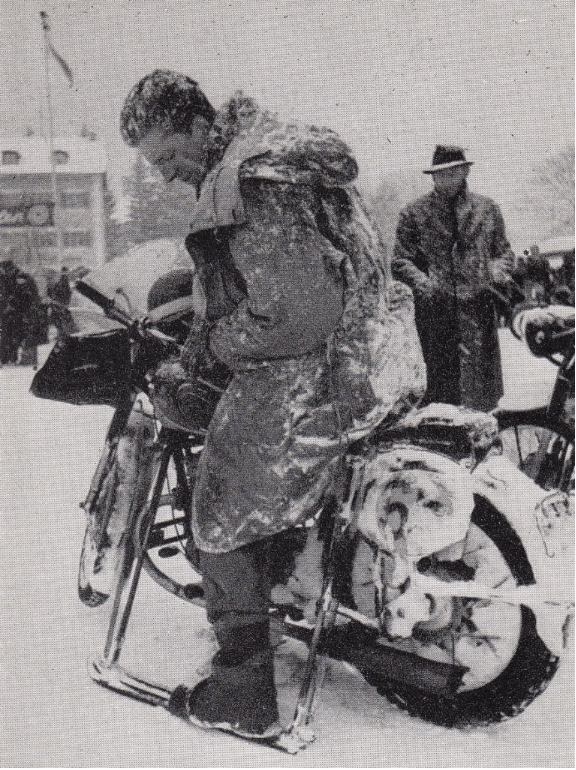
“SOME BLACK LOOKS have been cast at the cyclemotor…It is not one, for example, which appeals to operators of public transport services; the upward spiral of bus and train fares is inciting people to acquire private transport on a scale which has begun to alarm them. So much so that our associated journal, ‘The Commercial Motor’, recently reported that many traffic managers have already had a ‘foretaste of mass solo travel…and know to their cost its disruptive effect on the transport organisation’. Clearly a very astute section of the business community is closely watching the development of the cyclemotor and sees a big future for it.”
“OVER A PERIOD of more than 30 years there has been continual concentrated effort in the 500cc class, while interest in the over-500cc classes was waning before the war and has scarcely been revived since. The 250 and 350cc short-distance records, once British preserves, have been pursued successfully by German and Italian factories since the early ’30s, and the 175cc class—originally French, then German-dominated—has been completely eclipsed since the war by the 125cc, thanks to attention devoted to record-tweaking by Italian scooter manufacturers. Most neglected class of all has been that for 100cc machines, in which all records have now been surpassed by the Italian ’75s’, while a purely post-war phenomenon is the establishment of records for 50cc midgets. In the passenger machine field, now streamlined into 350, 500, 750 and 1,200c combined three-wheeler classes, a 500cc NSU outfit holds the ‘World’s Fastest’ title, at 154mph, against its solo stablemate’s 180mph, but the most amazing achievement of all is the ‘runner-up’ position of
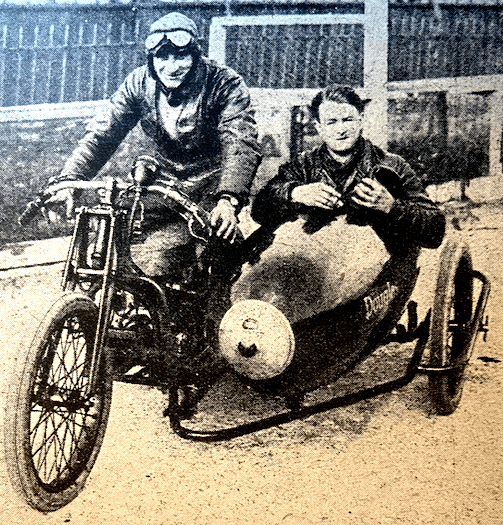
Cavanna’s 250cc Guzzi sidecar outfit which, in averaging 137mph over the kilo, equalled the late Eric Fernihough’s pre-war ‘fastest sidecar’ figure, achieved on a 1,000cc Brough-Superior, and beat the fastest post-war 350cc outfit. With one exception—the 750cc German Goliath, which gained a number of long-distance records—there have been no attempts made with cyclecars since the ’30s, but even then, capacity for capacity, the sidecars were generally beating the trikes. Oldest standing records—with the lowest speeds—are Jim Hall’s 35mph 5km and 5-mile figures, set up at Brooklands in July, 1929, on a 75cc Rocket-JAP; the latest are the long-distance three-wheeler records—some of which beat previous 500, 750 and even 1,200cc. class figures established by Rod Coleman, Bill Doran and the Monnerets at Montlhéry, last October, on a 350cc three-valve AJS hitched to a Blacknell sidecar. There are 504 recognised records ready to be beaten—ranging from 50cc solo to 1,200cc three-wheeler and from 1km to 5,000km and 1 mile to 3,000 miles in distance, and 1hr to 48hr in time. Of these, over the longest distances and periods and mainly in the smallest capacity classes, 67 have yet to be attempted. In the early ’20s, record-breaking by machines of less than 100cc had never been thought of, and when 1923 opened there were only 163 figures standing But of these no fewer than 140 had been set up on British-made machines. American big twins had gained 11, and France—the first country to explore the possibilities of breaking records with small-capacity solos—had seven entries in the book. No German factories figured in those days, but the
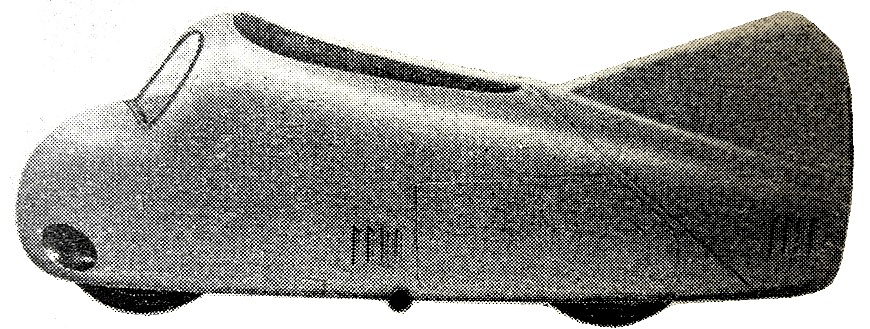
then revolutionary Garelli two-stroke, the first successful ‘split-single’, had won seven titles for Italy. British-made machines now hold only 100—no fewer than 82 of which are to the credit of AJS—of the 437 current records which almost half, 218 to be exact, have been made on Italian machines, the-most successful factory being Moto Guzzi, with a round 100 records in the bag. Germany can claim 66; France 42; Austria five; Belgium four, and Argentina two. Does this mean that, as a nation, we have lost interest in the record attempts? I don’t think so. One has only to talk to Noel Pope or Bob Berry to realise that the enthusiasm is there, and the comparatively few—but always successful—visits to Montlhéry made by the AJS, Norton and Vincent folk since the war have shown that When they choose to do so, British factories can produce the machines for the job. But the need for going to Montlhéry, or to a German autobahn, if really fast work is to be attempted, may be one reason why Britain does figure less regularly in the records list than in the past, for the loss of Brooklands most have had its effect. However, too much significance can be—and has been, on more than one occasion—attached to the disappearance of the old Weybridge ‘saucer’. It would not, after all, have been a very suitable place for trial-and-error tests with the 180mph NSU ‘World’s Fastest’ machine! Probably the biggest single factor
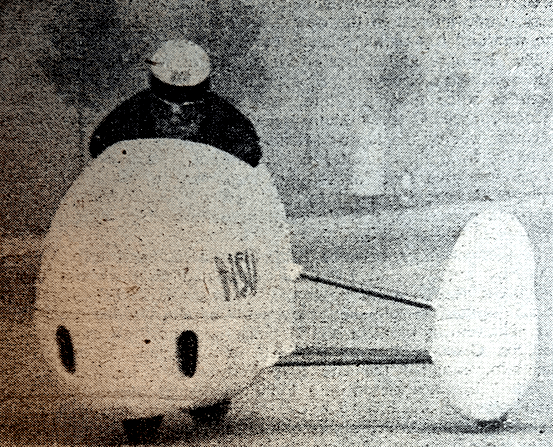
in the falling-off of British interest in short-distance attempts has been a shyness to use the elaborate streamlining or complete ‘shells’ favoured by the Germans and Italians. In the British heyday in the records field—the mid-‘twenties—riders like Victor Horsman, Bert Denly, Bill Lacey, Dougal Merchant, Bert le Vack, Wal Handley, Freddie Hicks, Claude Temple and DR O’Donovan went for their titles on models which were virtually race machines stripped of all ‘non-essentials’ and run on a witch’s brew of alcohol and ether, They’d scarcely heard of’ ‘blowers’ and would have been amazed to learn that a wind-tunnel would come to be almost indispensable to anyone out for the ‘flying kilo’. The BMWs came on the scene in 1930—supercharged 750 cc transverse twins and far too fast for comfort! So, when he pushed the ‘World’s Fastest’ title to 137.32mph at Arpajon that summer, Joe Wright had boosted the power of his 0EC-Temple-JAP by fitting a supercharger. A month later, nevertheless, Henne had passed him—by a mere .31mph admittedly—and the writing was on the wall. Wright countered at the end of that year with one of the most remarkable efforts in the history of the ‘kilo’, topping the ‘150’ mark along the Carrigrohane straight, which nowadays forms one leg of the ‘Munster 100’ circuit near Cork. An improvement of over 12mph in a matter of months—needless to say, the big JAP engine was again supercharged. Then, using more complete enclosure than had ever before been attempted on a motor cycle, Henne got
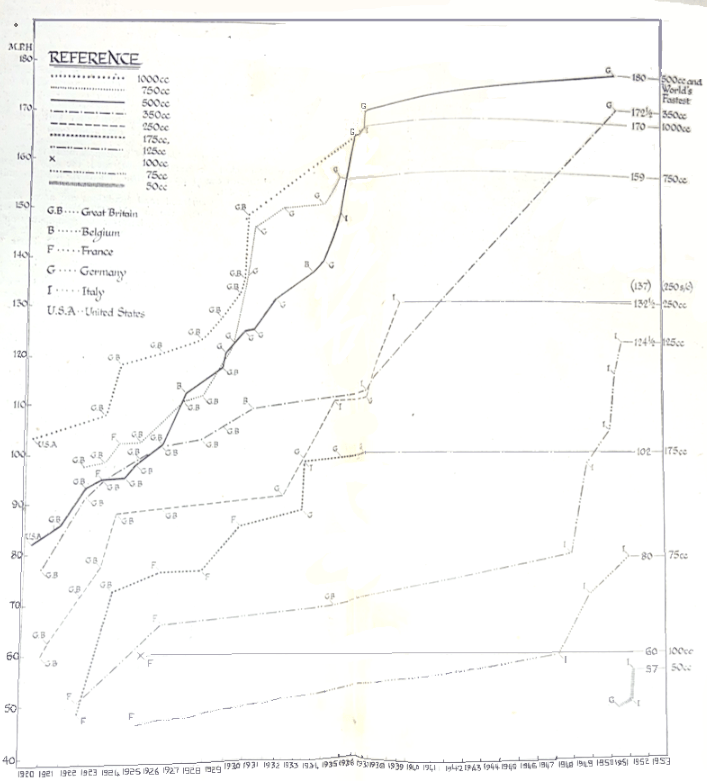
back on top in 1932, and by the end of 1936 had put the speed up to 169mph. By then he was using a 500 instead of a 750, presumably because, with improved streamlining, he could get all the power needed from the smaller engine. British hopes centred upon one man, Eric Fernihough, who was preparing a Brough Superior in his garage at Byfleet, and who was experimenting with cowling for the front forks and the bottom-half of the engine and with a streamlined tail. And at Gyon, in Hungary, on April 19, 1937, ‘Ferni’, after months of painstaking work, succeeded in regaining the title for Britain—but with no more than a .76mph improvement on Henne’s speed. And before the year was out the German ace, backed by the resources of a large factory and by a [Nazi] government anxious to to increase national prestige, had done still better by clocking 173½mph. Fernihough wouldn’t give up! He returned to Gyon the following April and, after waiting around for some days for a cross-wind to abate, he made the attempt which cost him his life. After that the record stood, until another April, in 1951, when Wilhelm Herz, fully encased in one of the most perfectly streamlined machines over produced—the German NSU twin, again only a 500—recorded 180mph on the Munich-Ingolstadt
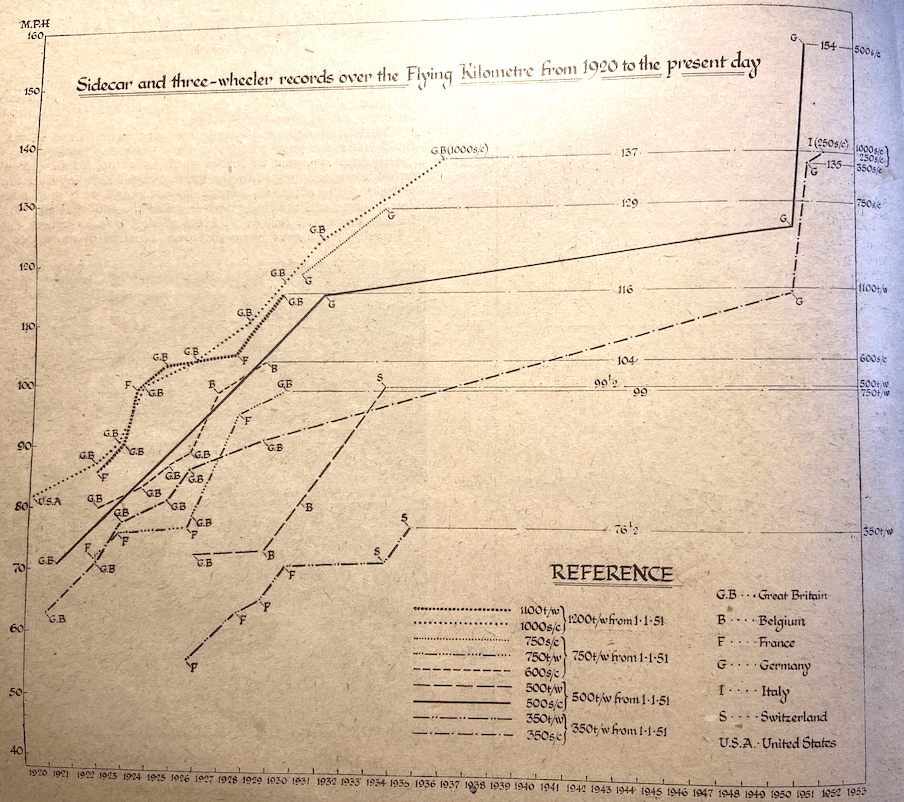
autobahn. In Its way, this striving to cover a single kilometre faster than ever before tells the story of all record attempts. Increasingly, aerodynamics have played a hand in the results. From cowling there has been a development towards complete enclosure, then to the ‘egg’, pioneered by DKW when gaining 175 and 250cc solo records, and when seeking the 600cc sidecar title before the war, by Gilera when Piero Taruffi set the still-current one-hour solo figure of 127½mph in 1939—again on a 500—and carried to its extreme in the Lambretta scooter, the ill-fated 125cc MV and the 75cc Guzzi. The last them have all had small wheels and the rider lies virtually prone, so enabling a form to be used for the shell which closely parallels the fuselage of a modem aircraft. Cavanna’s sidecar outfit, too, had contours reminiscent of aircraft rather than motor cycle practice. Undoubtedly, streamlining now plays an extremely important part in motor cycle record breaking. Taking the flying kilo as a standard for all capacity classes, I have plotted speed increases throughout the years, and in every case, where there is a sharp upward trend in the later period, an ‘egg’ provides part, at least, of the explanation. Hw high, I wonder, will the ‘World’s Fastest’ soar when a bold enough spirit is found to lie prone inside a 20-in-high shell which houses a blown 500 instead of a 75cc two-stroke or a 125?”—Cyril Quantrill
“THERE IS NO DOUBT that the method of splitting the course into two ‘loops’ paid dividends in the 32nd Colmore Cup Trial. This it the first time that ‘Sunbac’ have, post-war, applied this procedure and the organisers must have been gratified to find the last competitor returning on schedule to Shipston-on-Stour; the start and finish of the event. In addition, the first man was dispatched at 9.01am and the early start, together with the fact that the number of competitors using the course at one time was doubled, overcame the difficulty experienced in post-war years of getting the last rider home in the daylight. A narrow margin of one mark decided the destination of the Colmore Cup, and GL Jackson (350 AJS) beat VM Young (350 Royal Enfield), losing only three points during the day. A far more decisive win by Arthur Humphries (500 Norton sc) left no doubt as to the destination of the William Watson Shield for, losing only 58 marks, he was well ahead of the runner-up, P Wraith (500 Ariel sc), who lost 83 marks, on a course not by any means kind to the three-wheelers. A firm decision to forgo the use of some typical ‘Colmore’ hills in order to avoid delay, did not alter the character of the trial and several of the favourite hazards in the Cotswolds—Camp for example—were still on the route card. The ‘North’ and ‘South’ loops were based on a road junction midway between Broadway and Stow-on-
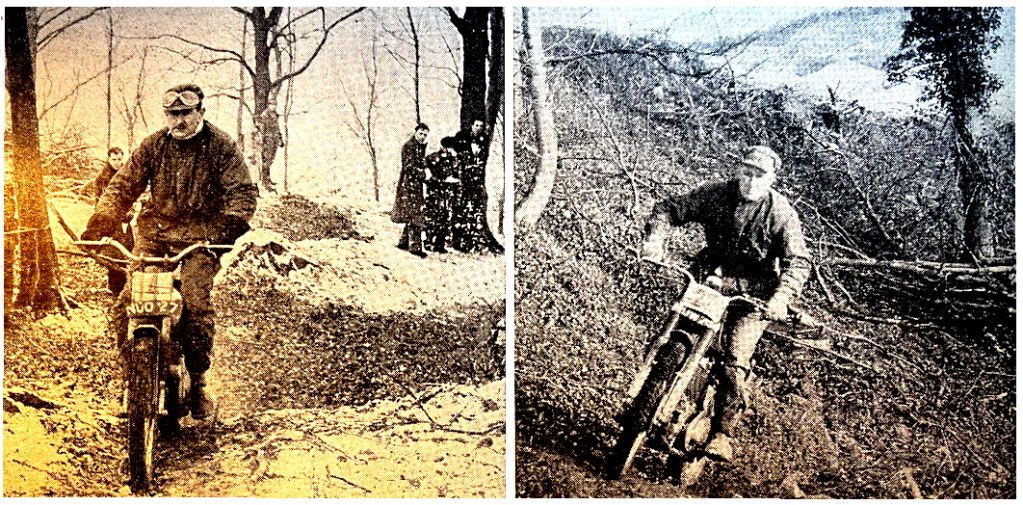
the-Wold. To this point, competitors were dispatched in pairs at 1min intervals and from there, those with riding numbers up to 100 set off to tackle the North circuit, whilst the ‘over 100s’ started the South loop. A total of 20 observed sections, divided to provide 38 sub-sections in all, were packed into the course, 55 miles in length. Continued hard frost and the cold bright weather that held during the trial had made many of the sections easy. Not so Dovedale, however, for the first of the two sections here consisted of a stream, liberally sprinkled with rocks. The two sections proved worthy of inclusion and indeed, were responsible for the loss of more marks than any other in the trial. Outstanding on the hairpin and tree roots of the second section was Bob Ray (500 Ariel) who ascended the hill at high velocity. Both Pat and John Brittain, Royal Enfield mounted, were unpenalised. Longlands, Weston Wood and Saintbury preceded that old favourite, Fish. This was but a shadow of its former self, for with the ground frozen hard both sections were treated contemptuously by the majority of riders. Three straightforward attempts by JV Smith (500 Norton), KE Oakley (500 Matchless) and BJ Dale (125 BSA) served only to spotlight the fact that JR Stanley (350 Matchless) had chosen the wrong path when, after bitting a log, he stuck on the summit of the bank. Similar conditions existed at the second section, where both GEH Godber-Ford (201 Dot) and DS Evans (350 Royal Enfield) climbed with speed and wheelgrip to spare. One exception proved to be TG Garner (125 Royal Enfield), who stopped short of the card after an attempt that started too slowly. Sited in a quarry, both Chips I and II were short, sharp and tricky. A very steep climb prefaced a sharp right-hand turn. Many competitors found difficulty at Chips I in making the change of direction with the front wheel in the air. Both JB Houghton (350 Royal Enfield) and GL Jackson (350 AJS) made beautifully controlled ascents, but BA Wright (500 Norton), after a neat showing on the first sub, was fortunate to land outside the cards after a ‘wall of death’ ride in the air. George Buck (500 Ariel sc) spoiled what looked like a stout effort by footing early and then capsizing after getting over the hump, which stopped all other sidecar men. A number of rocks and logs provided opportunities for ‘balancing acts’ in Chips II, and on these both RE Jordan (350 BSA) and Bill Nicholson (500 BSA) were outstanding. The steep slope stopped nearly all the sidecarists, but Arthur Humphries proved the exception to the rule with a magnificent,
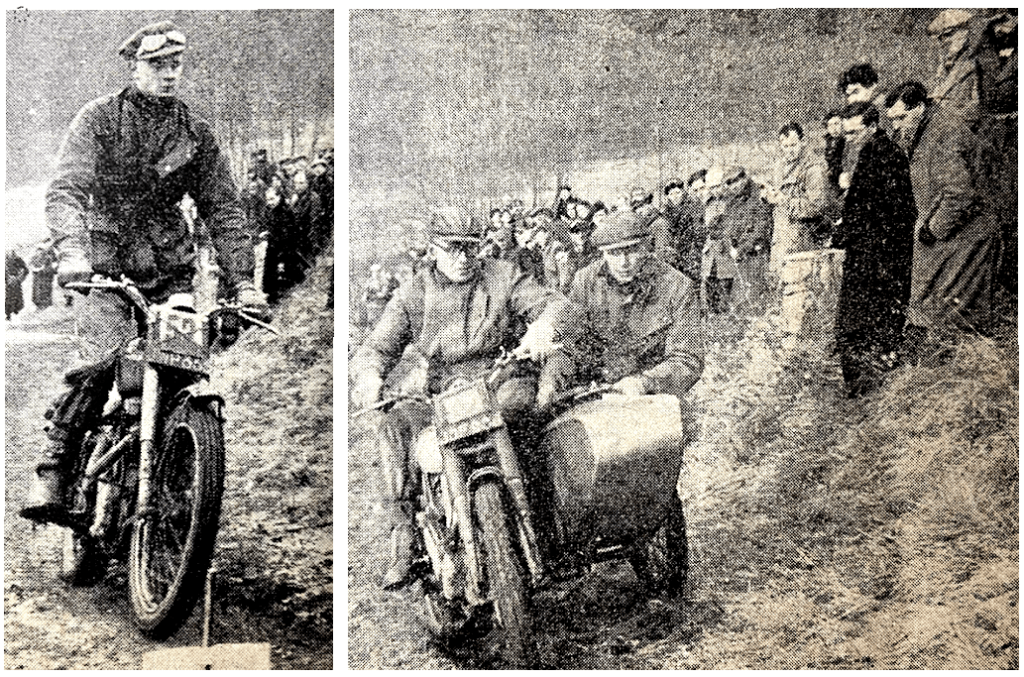
unpenalised climb. Stanway Loop, a ‘stop and go’ timed and observed test, followed the brake test, which started the southern circuit. Here. Bill Nicholson put paid to his chances with an over-enthusiastic attempt that ended with a loss of 10 marks. Both Stanway River and Lidcombe Wood were extremely easy for solos, although many of the sidecar drivers, among them AG Brown (500 Norton sc) and Bob Collier (500 Norton sc) lost marks in the Stanway River section. Of the two short hazards at Jackdaw Quarry the second undoubtedly caused more trouble than the first. In spite of this, not all riders got through unpenalised to the tight, right-hand uphill hairpin that was Jackdaw II. A tree stopped BA Wright (500 Norton), while RW Smith (500 Triumph), who seemed to be troubled by a pair of oddly shaped handlebars, also lost marks in Jackdaw I. As the sun thawed the surface more and more riders found grip at Jackdaw II, while at one stage 10 riders made consecutive faultless climbs. At Guiting Wood Jackson made the mistake that cost him the only three marks he lost during the day. Both sections were easy, and although others were penalised, clean, climbs were in the majority. Camp was surprisingly easy and proved dull for the many spectators. Towards the end of the trial the surface deteriorated, and finally both RW Smith (500 Triumph) and B Holland (200 James) shot over the side of the path after the first hairpin. Clean climbs became more difficult and infrequent, but both CM Bennett (500 Ariel) and L Wyer (200 James) showed that the hill could still be mastered. Some’ excitement was provided by Bob Collier (500 Norton sc), who came to grief on the hairpin, whereupon his passenger disappeared, with the outfit, over the side of the track. Apparently the gearbox disconnected the drive to the rear wheel at a critical moment. Two non-stop, but vigorously assisted, climbs by RN Holoway (500 BSA sc) and TH Ashcroft (500 Ariel, sc) were capped by both Arthur Humphries and George Buck who went’ through, but unpenalised. RESULTS Colmore Cup (best performance): GL Jackson (350 AJS), 3 marks lost. William Watson Shield (best sidecar): AJ Humphries (500 Notion sc), 58. Cranmore Trophy (second best performance): VM Young (350 Enfield), 4. Moxon Cup (best 125cc): GE Fisher (125 Francis-Barnett), 7. Calthorpe Cup (best 250cc): GE Godber-Ford (201 Dot), 9. Horton Cup (best 350cc): WA Lomas (350 Enfield), 4. Kershaw Cup (best 500cc): PF Hammond (500 Triumph), 6. Hassan Cup (best 500cc sidecar): P Wraith (500 Ariel sc), 83. Bayliss Cup (best ‘Sunbac’ member): GJ Draper (350 BSA), 7. Best Club and General Team: Sunbeam MCC ‘A’ (GJ Draper, GL Jackson, JV Brittain), 19.”
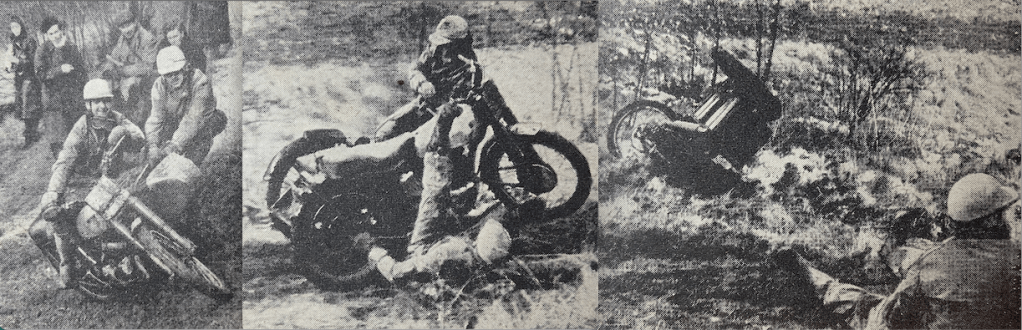
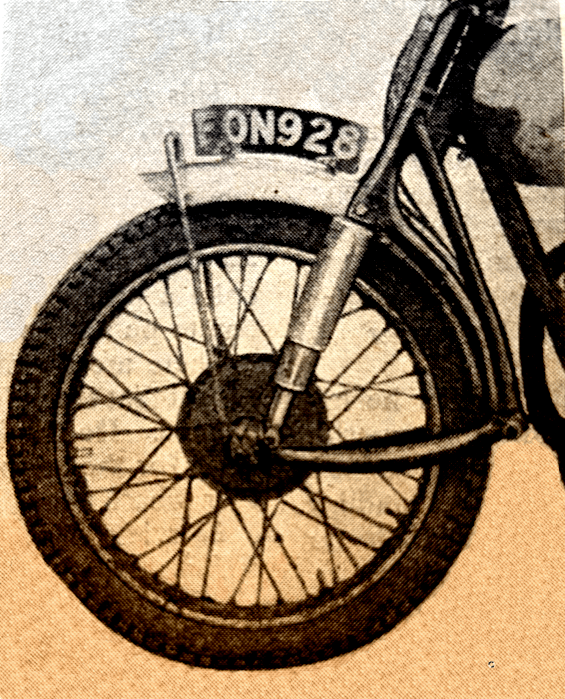
“GERMAN CHEMISTS, SO it is reported, think they have evolved a preparation that, when applied to road surfaces, will prevent the formation of ice, and even stop snow. from settling. The treatment was applied to a half-mile stretch sometime back in the autumn, and to date is said to have done what was claimed for it. While the advent of ice-proof roads sounds too good to be true, it nevertheless seems within sight.”
A storm surge in the North Sea led to floods in the Netherlands, Belgium, and the United Kingdom which killed more than 2,000 people including 307 in Lincolnshire, Norfolk, Suffolk and Essex.—Ed
“FROM THE SWEDISH distributors of Panther motorcycles, Messrs Stach & Co, of Stockholm, Phelon & Moore received last Monday a cheque for £200, with the request that it be passed to the Lord Mayor of London’s National Flood and Tempest Fund.”
“JUST RETURNED FROM his Monte-Carlo Rally adventures, Bob Foster, British concessionaire for Guzzi machines, phoned last week to give us the test of a cable he had received from Italy: ‘Distressed at great disaster; our thoughts go to you in this tragic moment for your country. Moto-Guzzi.’ Thank you, Mandello. Motor cyclists who have suffered through the East Coast flood calamity will appreciate such kindly concern.”
“ONE OF THE EAST COAST flood pictures indirectly suggested a holiday thought to one of our readers. The photograph displayed maybe 200 caravans buckled and rolled away from their coastal site by the furious waters. There are many such sites around our coasts. A typical example near Bridport houses a couple of hundred vans, rented at £5 5s a week in June, and rather more in July and August. The vans are roomy and of good quality, on hard standings. The central amenities include telephone, hot and cold showers, excellent sanitation, laundry, and the like. Gas stoves in each van simplify catering. Such an organised van camp has obvious attractions for a motor cycling couple or family who wish to tackle a series of hub-and-spoke tours at a considerable distance from home.”

Articles in the Green ‘Un lauding the potential of lightweight combos led to some startling claims in the correspondence pages which, in turn, inspired these ripostes…
“I AM TOYING with the idea of fixing a sidecar to my autocycle (a light one, of course) in order that my wife and I may take our small son with us on our outings. If this is practicable, I hope later to obtain a small caravan to tow behind us on our annual holiday. I should like to hear the views of others on their experiences with similar lightweight sidecar and sidecar/caravan outfits.
DAVID WICKHAM, Tring, Herts.”
“LET ME HASTEN to assure Mr David Wickham that an autocycle with a sidecar is quite a practical proposition. In fact, a friend of mine uses one to pull a plough (single furrow, of course) on his farm. There are no major snags, he says. High-speed steering is not all that it might be, but he may not have the outfit correctly aligned. He thinks a two-speed model would be an improvement for the steep bits, and recommends a tractor tyre for the rear wheel.
H HENNESSY, Fairview, Dublin.”
“YOUR CORRESPONDENT Mr David Wickham, who considers fitting a sidecar and caravan to his autocycle, can go ahead and try. My friend and I, both over the 12-stone mark, recently completed a tour of the Highlands of Scotland with a motor-assisted cycle-sidecar and caravan. The only snag was that when we were on a gradient of more than 1 in 2½, my friend had to lean out of the sidecar and fan the carburetter intake with his hat, thus getting a supercharged effect. Next year we are going to tour the Alps, and in 1955 we are going to put the outfit on ‘dope’ and make the first motor-cycle attempt to ascend Mount Everest (international situation permitting). Any contributions to a fund for this purpose will be gratefully received.
P GRAYSON, Leicester.”
“THOSE OF US who have ever been involved in a toss at high speed remember that a certain catapult effect is involved. Even a sharp skid at low speed provides that sensation—we feel as if we were being violently slung out of the saddle. I hate chatting about unpleasant events, but this element in a spill particularly affects a pillion passenger, who has next to no knee grip, and would not be popular with her (or his) driver if accustomed to hug that individual too tightly. Hence it is probably even more desirable that pillion passengers should adopt safety helmets than that solo riders should do so.—Ixion
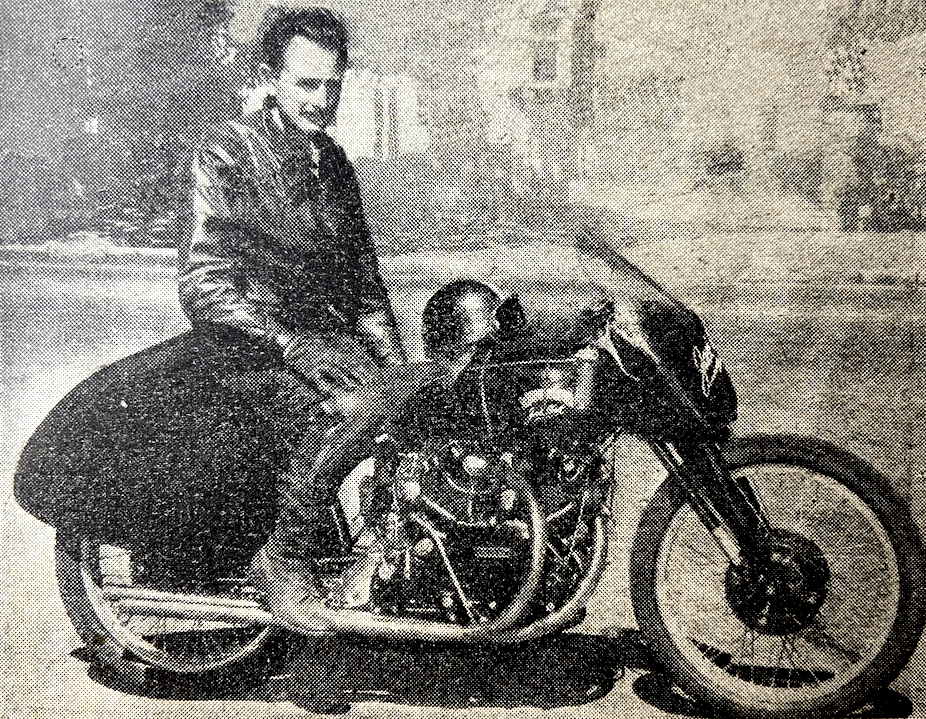
A CAVALCADE* READER chides me gently for failing to explore in its pages the origins of the so-called parallel twin. I just hadn’t the time! Immense leisure is needful for such research, covering a period in which unknown and forgotten men, toiling with their own hands, produced innumerable engines of the ‘one-off’ type (or little better), which ranked as originals, and yet died quick, natural deaths. The first parallel twin in my personal experience (which was possibly an all-time first in the motor cycle sphere) was the French 4hp Werner, dated about 1945 (but I certainly would not swear that water-cooled parallel twins had not preceded it in the car field). My next memory pivots on an engine which may have been called Bercley or Berkeley. I met and rode it about 1912-13. It was then under test in Triumph hands. The Triumph directors were already fastidious, and I believe that the sample which I rode was made by them, because they regarded the inventor’s sample as somewhat crude. Anyhow, they changed their minds about it, and finally turned it down, deeming it best to peg motor cycles to the rock-bottom of simplicity until knowledge had expanded. It failed, probably owing to heat distortion, for until the Kaiser War, with its aircraft tragedies, had taught us how lop-sided metal pulls an engine ‘out of round’, there were very definite limits to air-cooling. I fancy the Bercley was a single casting with double side-valves (a type which probably grew oval as it warmed up!). It would be a feather in the Triumph cap if they could claim to have made the first practical parallel twin and then 30 years later made it a ruling fashion.”—Ixion
*Ixion’s masterpiece, Motor Cycle Cavalcade, is required reading—Ed
“TWO WIDELY KNOWN pioneers of the motor cycle movement, Canon FW Hassard-Short, aged 79, and Lt-Com. FA McNab, aged 74, died last week. For more than 10 years Canon Hassard-Short was the chairman of the Automobile Association, yet there is some doubt whether he ever owned a motor car. His great love was motor cycling, which he began in 1903. In those days he was a curate in Cardiff, and he was one of the founder members of the Cardiff Motor Club. In 1911 he became a motor cycling chaplain in the British Army and was attached to the Kent Cyclist Battalion (TA). During the first world war he acted as a recruiting officer and was concerned with the enrolment of motor cycle dispatch riders. Lt-Com FA McNab is especially remembered for having established, in 1909, the first officially recognised world’s one-hour record in the 500cc class at 48.22mph. Two years before that, he started manufacturing motor cycles of his own design, under the name of Trump, and in the early twenties he built a special Trump-Anzani to the order of King George VI (then the Duke of York). On one memorable day, McNab broke no fewer than 26 world’s records at Brooklands. In spite of advancing years, Lt-Com McNab’s enthusiasm for motor cycle sport remained undiminished. At the time of his death he was a member of the Pre-war TT Riders’ Re-union, vice-president of the Sunbeam MCC, a member of that club’s competitions committee, a member (and past president) of the Association of Pioneer Motor Cyclists, and a life member of the British Motor Cycle Racing Club.”
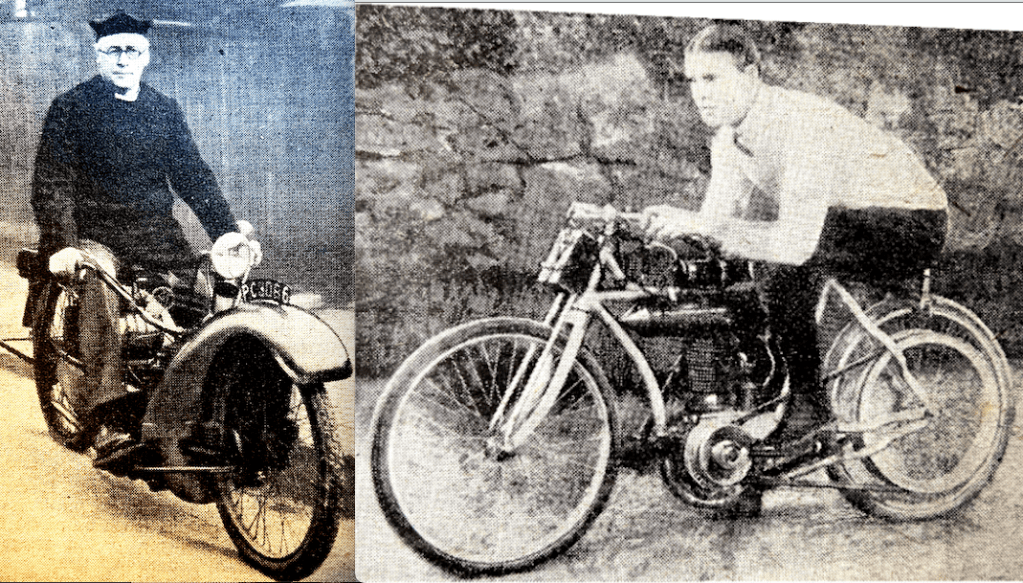
“FEW WOULD HAVE thought it possible that, with a modern motorcycle, mechanical noise could be actually more objectionable than that of the exhaust. Yet the fact was proved quite conclusively, it seems, in the tests recently conducted in Switzerland. Certainly it gives the technicians something to think about. Also the manufacturers, and those concerned with the sales side, all of whom must be well aware that noise remains one of the motor cycle’s more serious failings. It is possible to argue that a machine can be too quiet for safety, at any rate when being ridden in towns. I doubt the validity of that theory, but in any case silent running is demanded by very many potential users who will never be satisfied until they get it. To quieten a four-stroke engine is likely to involve more than modifications of the valve gear. Liquid cooling is realised to be a valuable aid; where air-cooled units are concerned the fitting of shields, or cowls, may also prove helpful, provided the design is right. Over the latter there is scope for a great deal of further research. Shields can actually make matters worse by setting up drumming and so on, but they also hold out the possibilities of very substantial improvements in noise reduction. Certainly the Swiss are very much to be commended for arranging this exceedingly useful trial, and we in Britain would do well to follow their lead.”
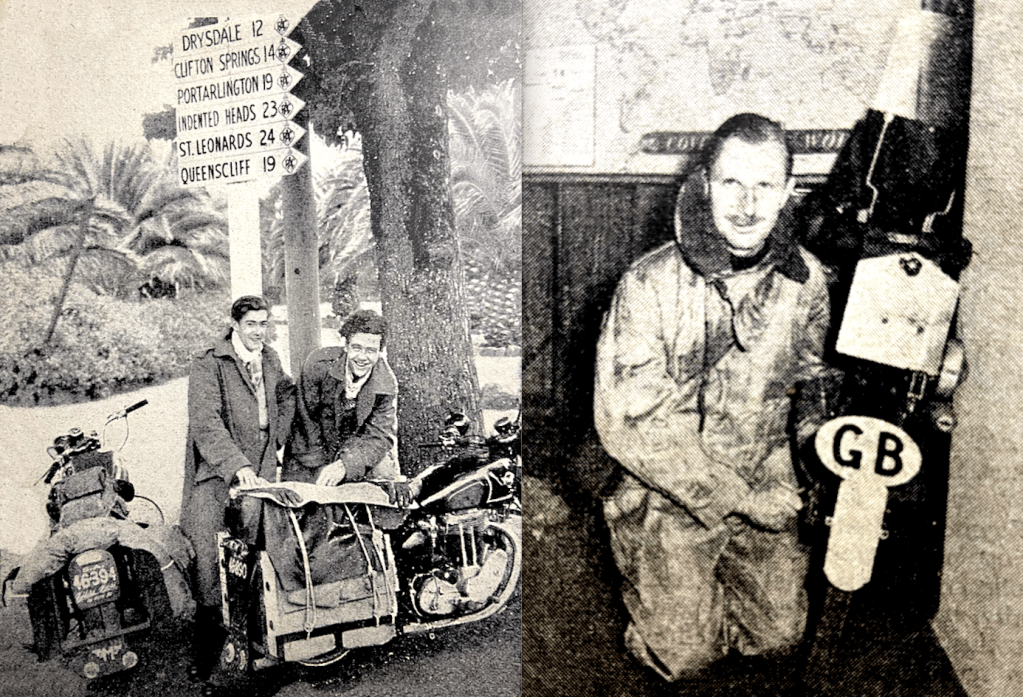
“THE PHILLIPS CONCERN is one of the largest producers of bicycles in this country, and incidentally does a very big export trade. At the Show they introduced a special model for use with a cyclemotor, of whatever make the purchaser might prefer, and now the factory has produced a complete range of cycles for power propulsion. No fewer than eight models are included in the list. This is yet another indication of the fact that the cyclemotor is now accepted as a coming thing by some of the best business brains in the country. There is no doubt, too, that many who propose switching from pedals to power would prefer to have a cycle that had been specially built for the purpose, with a strengthened frame, bigger-brakes and tyres, and so on. While that is true enough, there is another aspect of the matter. It is that the ideal motor attachment should be suitable for fitting to any sound bicycle. If modifications are necessary, or the device is only suitable for installation in a special machine, then the original idea seems rather to have misfired. The chief merit of the cyclemotor is, or it should be, that it enables the cyclist to choose his method of propulsion, and if the fitting of the engine makes the machine unsuitable for pedalling, that condition is obviously not fulfilled.”
“THE AMBITION TO GO foreign touring by motor cycle is now to be realised by 34-year-old Kenneth Bletcher, of Chorlton-cum-Hardy, whose suggestion to call a protective helmet a ‘Skidlid’ won the Daily Express competition, held recently to find a popular alternative to ‘crash-hat’. First prize is a £150 motor cycle on which Mr Bletcher and his wife plan to tour Spain this year.”
RIDERS OF RIGID-FRAME motor cycles who hanker after more comfortable conditions are likely to find interest in a new bolt-on spring-heel assembly designed and made by Deeprose Bros. With considerable experience of suspension problems, this London concern has supplied units sporting purposes. The manufacturers have specialised in conversions for BSA machines, enabling the standard wheel, spindle and chain tension of Gold Star and ‘B’ models to be retained. Further details and prices are obtainable from Deeprose Bros, 178, Brownhill Road, Catford, London, SE6.”
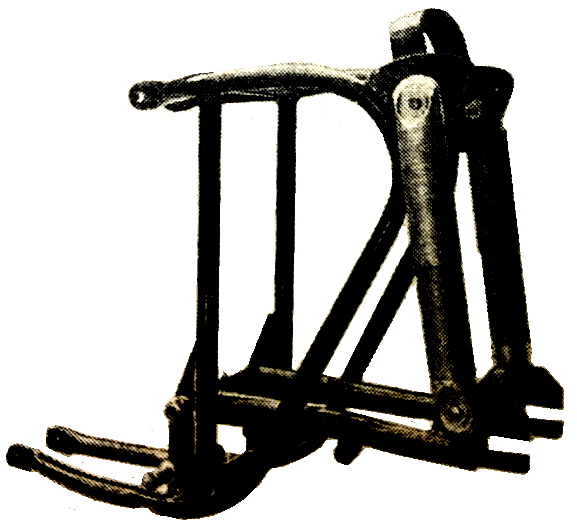
“A RECENT ACCIDENT in which nine foxhounds were killed by a lorry temporarily focused newspaper headlines on something concerning the safety of every motor cyclist— the menace of dogs on the road. Every year approximately 3,000 human casualties, including 20 dead and 600 seriously injured, result from this cause. Statistics leave no doubt that it is motor cyclists who are most exposed to danger and suffer the highest percentage of casualties. It is motorcyclists, therefore, who have the greatest interest in some solution being found to the problem, especially as the present legal position is that the chances of obtaining compensation from the dog owner are remote. If they are accepted, however, the recommendations of a law committee published a few days ago may enable compensation to be obtained from owners whose negligence is proved. The toll of human suffering far outweighs the loss of canine life, but it is nevertheless tragic that 75,000 dogs are killed or injured on the roads annually—only 4% of those involved in accidents ‘escape without some injury. Thus, it is obvious that true animal lovers as well as road-users have a vital interest in preventing these accidents. There is evidence, however, that many of the accidents are not caused by dogs belonging to animal lovers, but to the callous people who keep a puppy and then turn it loose when its licence becomes due—the animal is, of course, a greater menace than ever, because it runs more and more aimlessly in an effort to find its home again. Motor cyclists can do much to help themselves and other road users by reporting anyone guilty of such treachery, to the RSPCA.”

“ONE OF THE HEROES of schoolboy fiction during my youth was Dan—Dan the ‘Daily Wire’ man, a journalistic gentleman who was the pride of Fleet Street and who always ‘scooped’ his rivals because he had invented a marvellous machine. With it he scanned the world, seeing on its screen vivid pictures of stirring events almost before they happened! Not for nothing was Dan known as ‘The Ray Reporter’! And little ‘CP’, his eyes popping out like chapel hat-pegs, absorbed Dan’s adventures quite unconscious of the fact that, nearly half a century later, he, too, would be a reporter using just such a machine. But that’s how it was last week-end when, with Bob-Holliday, I found myself assigned to ‘cover’ the BBC’s Television Trophy Trial on Saturday—Bob to do the field duty while I took the receiving end of the job. Sitting in slippered ease, with pint and pipe nicely to hand waiting for zero hour of 3 pip emma and the first ‘shots’ to come through on my set, I reflected appreciatively that my boyhood’s hero, without doubt, certainly had something, to say nothing of the prophetic genius of some now forgotten author. Then the announcer gave us the sad news that something had happened to their main aerial so our pictures might not be all that they should…But he was unduly pessimistic for, when the opening views took the screen they were so pin-sharp that I shivered and thought sympathetically of Bob, out there in all that snow! Raymond Baxter introduced himself to us. He told us that he was about to compére a team trial held under the auspices of the ACU for solos in which four quartets of leading British riders representing the North, the South, the Midlands and the West (including Wales) Regions would compete for a
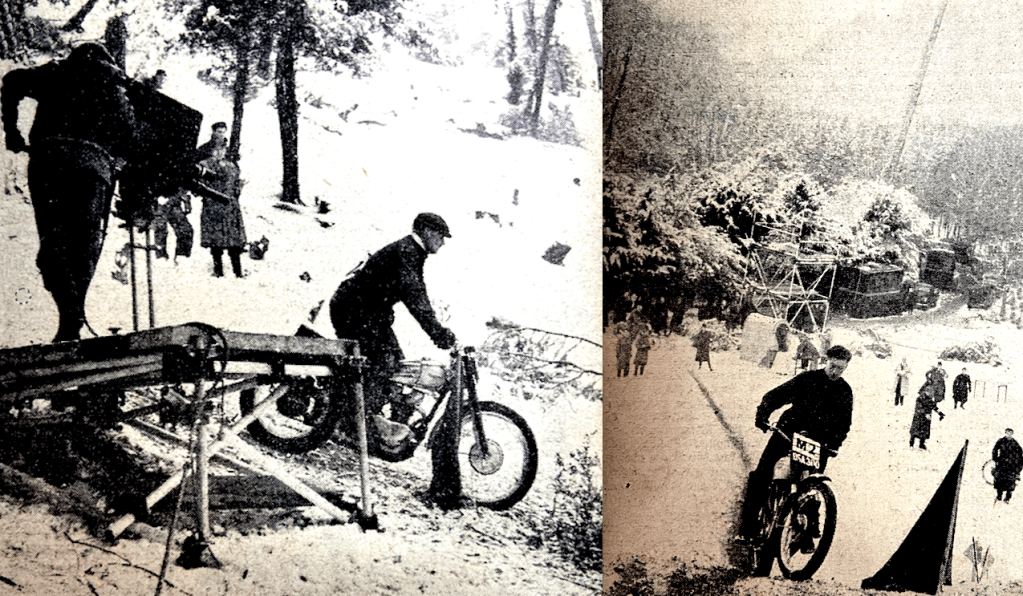
trophy over a miniature course on Aston Hill containing three sections, each with two sub-sections. A-CU Clerk of the Course was the popular South Midland Centre secretary, JC Lowe. Then we had a close-up of the ‘assembly area’, which Baxter had called a new winter sports centre, with in the background, a kind of igloo—probably for the Clerk of the Course! The four teams were named: Midland, Billy Nicholson, Brian Martin, Dave Tye on BSAs and JV Smith (Norton). South, Hugh Viney and Bob Manns with AJS machines, and Gordon Jackson and Ted Usher on Matchlesses. North, Tom Ellis (BSA), Geoff Broadbent (Royal Enfield), Stan Holmes (Ariel) and Johnnie Giles on a Triumph. West, Jim Alves and Peter Hammond with Triumphs, Bob Ray on an Ariel and Fred Rist with a BSA. Late arrivals Johnny Brittain and Don Evans, their places taken by reserves, joined the ‘on-site’ assistants. Raymond Baxter warmed up to his job, giving us a graphic word picture of the Arctic conditions—the hills had been practically unclimbable earlier that morning—but the snowfall had ceased and the sun was trying to come out. The machines crackled into life as the group of riders moved over to the first hill—a hump, a chicane and a climb given as 1 in 2. The camera panned. I thought I caught sight of Bob, looking straight into the lens—or whatever it is that TV cameras have—with a sort of ‘Can you sec me, brother?’ expression, and then the camera picked up Tom Ellis making the first ascent—a good effort spoilt by footing; ‘Nicky’ didn’t even do as well; Viney looked as though he would make it but footed. So did Alves and in the excitement a marshal fell on his back! Then we followed hard on the heels of Bob Ray as he scored what was to be the only ‘clean’ of the day; Dave Tye spilled everything in a most untidy manner, while Giles marred what might have been the best climb so far by a dab. Last man up was Fred Rist whose robust figure bobbed about until he stopped. Baxter announced the scores to be West, 18; South and North 21 apiece; and Midland 23 marks lost. On the second hill, which contained a stiff
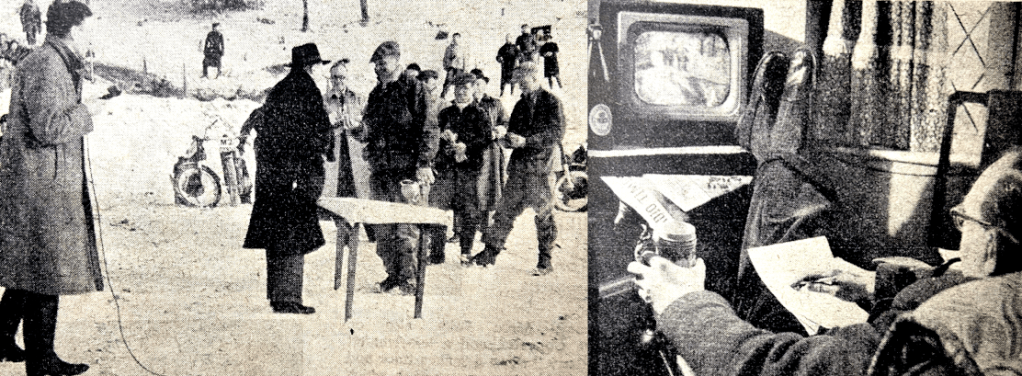
climb on frozen mud which, said Baxter, was then thawing, Jim Alves hit what would have been the dust and Martin demonstrated to several million onlookers how to stand still without footing. Then he, too, fell off, and the section was left with the scores reading West 36, North and Midlands 37 each, and South 39. The third hazard had two climbs with a few tight turns between and everyone was clean (except Hammond, who knocked a flag down, and Giles who footed) which interfered more than somewhat with the BBC schedule. And as you can’t do that to BBC schedules Baxter was heard calling upon CoC Lowe for leave to give the boys another go at a modified version of the first hill and so make up the time promised to the cash customers. Meanwhile the scores to date were produced: South, 39; Midland and North, 40; and West, 41. This time without the chicane, the last hill was a straight climb. Nicholson, Ray, Usher, Giles and Manns were clean but Stan Holmes parted from the model with great velocity and pulled off the plug lead to ‘kill’ his racing engine. Alves took to the country and showered a lot of it over an innocent bystander. One by one the rest took their turns, footing or failing, and at the end the South were announced as winners with a loss of 52 marks, the North and Midland tying for second place with 55 and the West tailing up with 56. The familiar face of television pioneer Prof AM Low, appropriately enough, came into focus as Baxter called upon the A-CU’s chairman to present the handsome silver trophy. And with the grinning faces of Bob Manns, Ted Usher, Gordon Jackson and Uncle Hugh Viney and all holding their replicas, Raymond Baxter returned us to the studio, and your reporter remembered regretfully that next week-end’s trials would have to be ‘covered’ in the hard, old-fashioned way.—CP READ.
“THE ‘FARTHEST-ROUND-CLEAN’ rule, used for deciding ties in the Birmingham ’30’ MC’s national DK Mansell Trophy Trial—the sidecar drivers’ ‘classic’—will have to be supplemented by a special test. For last Saturday, when the trial took place, in the Stroud Valley for the second year running, last year’s winner, Frank Wilkins (500 Ariel sc), and F Darrieulat (500 BSA sc), who was runner-up on that occasion, both lost three marks, as a result of footing in just one section, and both chose the same section in which to do it! The day opened with a heavy snowstorm and the familiar Cotswold Hills were carpeted with snow when the trial began at 11am, but there was no frost in the ground and the passage of a few machines soon exposed the mud and rocks which feature in most of the sections in those parts. Five non-starters, one of whom was Ted ‘Cabby’ Cooper, who is making a rapid recovery from the effects of his prang in the previous Sunday’s Paley Cup Trial, left a total of 36 competitors to tackle the two laps of a 29-mile course which started and finished at the Bear. Pools Café, Rodborough Common, Stroud, Glos.”
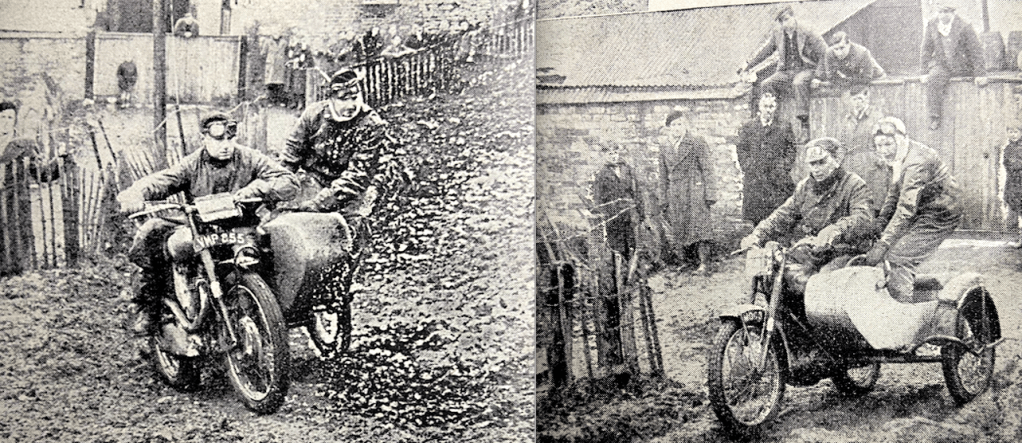
“LAST SATURDAY THE 1953 season’s first National (open) trade-supported reliability event, the Birmingham MCC’s Victory Trial—29th in the series that began in 1919—was centred once again on Church Stretton, Salop, where gathered the 150 competitors, the passengers, the ‘barons’ and a fair assemblage of the veterans of former ‘Victories’. The last-named, of course, were in attendance in connection with the ‘Olde Tyme Dinner and Dice’, occasions that have for some years been associated with this trial. Snow, still lingering on the higher ground, had prevented the route plotters from making much preliminary exploration and, as a consequence, this year’s course was very much the same as previous ones in this district, though two new sections were added to bring the total of observed hills to 14—all divided into at least two sub-sections. The opening gambit on Saturday morning was, as hitherto, to send all competitors straight away, from the start-and-finish point at the Longmynd Hotel, over the 61-mile timed section. ‘Tiddlers’ and 350cc sidecars were allowed 16min 15sec; the 151-250cc class of solos and all other sidecars had 14min 5sec; the rest had to make it in 13min. Then came the first hill, Mynd Bottom. A U-shaped semi-loop. on the open hillside, it involved a downhill approach, a tight muddy hairpin and a climb through a boulder-filled gully with the exit over ling and dead bracken. Some delay accrued immediately, for the marshals had not got the course marked out when the first arrivals appeared. G Beamish (500 BSA), HW Thorne (200 James) and LA Ratcliffe (350 Matchless) all opened up with footwork, and then WSG Parsons (350 Ariel) showed a method of doing it clean that was followed by many others: but when the sidecars took their turn it was quickly seen that the section was a waste of time for them. Plowden Wall, a mile farther on, caught very few in its two liquid mud sub-sections and a change of scene to Hillend was made. In general characteristics very much like Mynd Bottom, this hazard has a steep downhill approach, a tight turn, a rocky gully and a slippery exit; but, additionally, this year a precipitous descent over heather and bracken was tacked on as a tailpiece. Unfortunately, from the observers’ viewpoint, the actual route was not clearly defined and, after Artie Ratcliffe and Bill Nicholson (500 BSA) had both made excellent clean ascents the hard way up the gully, subsequent riders found they could dodge the rockery by crossing it at an angle, making a series of zig-zag rushes up the hill. This, of course, deprived the section of much of its sting and most of the top-flight men romped up once they had successfully rounded the sharp turn at the foot. David Tye (350 BSA) gave perhaps the most unconcerned display and even the little machines had no trouble if properly handled. Pat Brittain (150 Royal Enfield) and George Pickering (125 BSA) swept up in perfect style.

Among the few who got into unexpected trouble were Don Evans (350 Royal Enfield) and Jim Alves and Peter Hammond (500 Triumphs). Excitement among the spectators mounted when the sidecars arrived but, even though they also used the criss-cross method, they were unable to return one clean sheet. CV Kemp (500 Norton sc) did make a non-stop climb without footwork—a tremendous feat—but as he inadvertently made a digressive journey into the bracken, and swung the outfit round through a complete circle before tackling the upper section, he had to lose five marks for ‘failing to maintain forward direction’. Spectacular attempts came from Arthur Humphries (500 Norton sc) and Fred Whittle (600 Panther sc), while F Darrieulat’s 500cc BSA outfit not only reared up like a circus horse but, with its front wheel pawing the air, it persisted in chasing a terrified photographer! As was anticipated, the final descent section was, for the chairs, downright dangerous and it was fortunate there were no serious casualties. ST Seston (500 Ariel sc) did, in fact, have a lucky escape when his outfit turned over, first falling on the driver and then dragging him by a trapped leg down the hillside. He freed himself just in time before the machine plunged into a rocky ravine where it lay upended with a buckled front wheel and bent forks. By way of Ridgeway, a long hillside gully where a rapidly deepening central rut made progress increasingly difficult for later numbers, competitors were headed through Leintwardine and Burrington village to the new sections at Bringewood Chase. The first of these consisted of a long run up the rocky bed of a small stream, with the entry down a steep bank, and a greasy exit as its most difficult features. Most of the experts, such as Bob Manns (500 AJS), Geoff Duke (350 BSA) and Johnny Draper (500 BSA) had little difficulty in keeping their feet up throughout its length, but R Hayes (350 Royal Enfield) stopped both on the descent into the stream and when attempting to get out of it, and JR Stanley (350 Matchless) and Bill Boddice (500 Ariel) were by no means the only two to fail in the last few yards. Farther up the valley there was another excursion into the stream. preceded by a sharply cambered turn on buttery clay. This became progressively worse and Geoff Duke was one of those who had his wheels slip away from under him. Particularly neat ‘cleans’ were recorded by Draper, Tom. Ellis (500 BSA), E Adcock (200 Francis-Barnett), Brian Martin (350 BSA), Pat Brittain, Brian Povey (350 BSA), Stan Holmes and Bob Ray (500 Ariels) and Jimmy Alves. There was still another section in Bringewood Chase, a broad expanse of churned-up turf, with just enough upward gradient to demand a fast approach. It was just the sort of hazard which suits Ted Usher (350 Matchless) and, making a brisk getaway, he absolutely burned a path straight through the greasy ruts. Also using all the power his engine would give, Bill Jackson made an impressive clean ascent on his 200cc Francis-Barnett. Another fine performance by a rider of a small two-stroke was the slower, but equally sure, passage made by LH Vale-Onslow (200 James). At Aldon, Ratcliffe led the field and rushed up at high velocity. He was followed by EJ Wiffen (200 Francis-Barnett) who, although almost as fast, motored sideways for much of the distance. WSG Parsons (500 Ariel), however, showed that speed was not essential to success, for he, likewise, was unpenalised. An early failure was JW Morris (500 Norton), for his front wheel slid away and deposited him in the mud of the first sub-section. In trouble for a second or two, Geoff Broadbent (350 Royal Enfield) recovered nicely and, regaining speed, finished in good order. The two bends in the Whettleton section spoilt a large number of the ‘flat-in-two’ runs, but Bill Nicholson found a new line that enabled him to continue without slackening speed or losing marks. Almost stationary at least twice, BA Wright (500 Norton) managed to keep both feet up and continued round the second bend without having lost a mark. Another dogged climb,

this time by TSC Gilfillan (250 Ariel), did come to a halt but with the front wheel apparently beyond the card. Much too slow, D Bradley (500 Norton) footed early and long. No difficulties existed at the next section, Norton. This proved so easy that, during the period the hill was under Motor Cycling’s observation, the only rider to lose marks proved to be Cyril Smith (500 Norton) who appeared to be suffering from a. watered magneto. With an established reputation as a ‘stopper’, Strefford Wood took toll of almost every rider. An incredible climb at very high speed enabled GJ Draper to break the monotony of penalised efforts and excited considerable enthusiasm among the spectators perched on each bank. With this climb over, the observers were busy with pencils again and docked marks from G Buttigeig (500 Triumph) and TU Ellis when they used their feet in the last 20 yards of the long section. After Fred Whittle had, with assistance, pushed and carried his sidecar all the way, an obvious decision to by-pass the three-wheeled brigade was taken, much to the relief of the passengers upon whom would have fallen the major portion of the propulsion. Water from the recently melted snow loosened the mud at Titterel and spinning wheels soon dug a rut to the firm rocky bottom. Generally, however. high-speed dashes were successful and BHM Viney (350 AJS) was faster than most. Similar but slower runs were made by GL Jackson (350 AJS) and JR Hobbs (500 AJS). A patch of rocks enlivened the proceedings for sidecarists F Darrieulat and FW Whittle who shot up at high speed with the passengers rattling about like peas in a pod. A steep clay bank down which many of the competitors rushed helter-skelter proved the only real hazard at Harton Wood. At first sight a main problem for the sidecarists, it did not catch many and both RG Collier (500 Norton sc) and F Wilkins (500 Ariel sc) dealt neatly with the sharp turn at the bottom. After the brake test came the final hill, Marshbrook, and as in past years the steep greasy bank that forms the first part of the section held few terrors for the balance experts prepared to let fly in second gear. But the infamous mud-bath that lies a couple of hundred yards beyond the hilltop was a trap that, with its submerged tree roots and transversely positioned fallen branches, brought man after man headlong into the slime. For a long time it seemed impossible that anyone could emerge unscathed—until, with a mighty heave on his handlebars, Tom Ellis hoiked his front wheel over the greasy pole that barred the exit.

Subsequently only JB Houghton (350 Royal Enfield), GE Fisher and JHS Bray (350 BSA) were able to emulate him. Only one of the sidecar men, Darrieulat, who was the first to attack it, got through Marshbrook non-stop and he did not even have to foot. Furthermore, half-way through he injured his right arm against a tree stump and made his departure from the quagmire operating the twist-grip with his left hand. Four miles of country lanes brought the trial back to Church Stretton where the last man signed off just as the sun, which had shone bravely all day, was preparing to disappear behind the shoulder of the Long Mynd. With a suspicion of spring in the air it had been a pleasant romp over the Shropshire countryside but, for the premier one-day trial on the calendar, it was thought that the promoters would be well advised next year to tighten up on the field organisation, which was not up to the standard expected of so experienced a club. RESULTS Victory Cup (best performance): GJ Draper (500 BSA), 12 marks lost. Cranford Bowl (best in opposite class): AJ Humphries (500 Norton sc), 33. Perrey Cup (best 500): J Giles (500 Triumph), 16. Henley Cup (best 350): WSG Parsons (350 Ariel), 16. Premier Cup (best 250cc): L Wyer (200 James), 33. Francis-Barnett Cup (best 150cc): GE Fisher 125 Francis-Barnett), 27. Chekko Cup (second best sidecar): F. Wilkins (500 Ariel sc), 41. Frank Hallam Cup (best multi-cylinder): NJ Crump (500 Triumph), 31. Triumph Cup (best rider under 21): JV Smith (500 Norton), 19. Walter Hackett Cup (best Birmingham MCC member): JE. Brefitt (500 Norton), 17. HJ Simms Trophy (best novice): RH Browning (500 Norton), 41. Watsonian Cup (best manufacturer’s team): BSA No 1 team (GJ Draper, BW Martin, W Nicholson), 75. Donsthorpe Cup (best club team): Sunbeam MCC (GL Jackson, CM Ray), 51. Well on the way to becoming a tradition. the veteran old-timers and one or two others assembled at the Longmynd Hotel, Church Stretton, on the morning of the Sunday that followed the Victory Trial, to be convoyed to Plowden for their annual return to battle. Among their number were past winners. Bert Kershaw, Bert Perrigo and Vic Brittain; the latter pair were responsible for organisation and handicapping in addition to featuring on the entry list. Fewer runners chose three wheels for their dice through the three sub-sections; in fact, only one official appearance of a sidecar was made. Act 1 was staged in period costume, for J Westwood Wills conducting a ‘4¼’ side-valve veteran James in sturdy fashion exhibited ‘plonk’ that would shame most moderns. Some slight derangement brought the old ‘un to rest mid-way up the climb, but with assistance from both of Westwood Wills’ feet and a willing helper the James restarted and chuffed to the top. Both Cohn Edge and JV Smith, Snr footed here and there, but Bert Kershaw, tipped as a likely winner, recovered well after an initial set-back and motored onward. A salmon race in and out of the section markers by two runners preceded a neat climb by Bob Humber who, although footing once or twice with his only leg, made several two-legged competitors look novices. Cyril Locke topped the section after an impressive run, marred by but a single dab and was, ignoring the handicapping, fifth best performer, for among the soloists Vic Brittain, Bert Perrigo, ‘B’ackie’ Blacknell and Westwood Wills made immaculate climbs. Among the ‘footers’ were Tim Reid, George Savage, Harry Barton. Don Adams and, surprisingly enough, Norman Hooton—though he have been foxing a little in order to assist his handicap in the Trade Reps Trial that followed in the afternoon.”

“A PROPOSED MERGING of the interests of Associated Motor Cycles and Norton Motors was announced by the BBC and the national Press on Tuesday morning. On Monday night, Mr C Gilbert Smith, managing director of the Bracebridge Street concern, told reporters that the Norton directors had received an offer from AMC, whose group includes AJS, Matchless, James and Francis-Barnett, to acquire the entire share capital. The Norton directors, agreeing to sell their part of the capital, some 50%, are recommending other shareholders to do likewise. As to the future, Mr Smith said he envisaged his company continuing as a separate entity with the same management and with the same keen competition in the racing sphere. The racing rivalry between the two concerns has existed since the first TT, in 1907, when the sing1e-cylinder class was won by a Matchless and the twin-cylinder by a Norton.”

“FOLLOWING AN ACCIDENT in which he suffered a broken leg when his motor cycle and a taxi collided, Mr James G Hayter, the actor who played Mr. Pickwick in the film Pickwick Papers, was awarded £4,000 damages in the Queen’s Bench Division last week. Mr Hayter afterwards told Motor Cycling that he first took up motor cycling in the early 1920s when he was a repertory performer, and his machine was then a Model ‘P’ Triumph. His mounts in recent years have been a BSA Bantam and an Ariel twin. On the day of the collision he had actually placed an order for a Vincent twin, but now regrets that his accident has left his right ankle too weak to allow him to do any more riding at the present time.”

“IMAGINE ORGANISING A seven-lap TT race and allowing drivers to decide for themselves whether they will complete four, five, six or seven laps—the winner to he decided by a driver’s best four laps! Imagine the County Cricket Championship being decided by taking each county’s best 10 matches! Or imagine determining the Football League champions by counting only each team’s aggregate goals in its ‘best’ 15 matches! Yet it is on a similar basis that the FIM. Road Racing World Championships are decided. Surely there is something farcical in this and a ‘World Championship’ must be a synthetic honour when the holder did not even start in the TT. I should like the consensus of opinion of your readers on my proposal that the Auto-Cycle Union’s delegates to the FIM should be instructed to impress upon the latter body the absurdity of the present formula and to fight for a saner method whereby six performances in six ‘classic’ races (always including the TT) decide the Champions. If they fail in this submission (and they might well do so, having regard to the peculiar voting system, eg, one-club Monaco has the same voting strength as the 740-club Auto-Cycle Union), then let us withdraw the TT from the so-called ‘World Championships’ and stand on our own. I am convinced that the world as a whole pays more regard to the TT wins than it does to these strange ‘Championships’.
NORMAN E DIXON, Adel, Yorks.”

“THIS ROAD-TEST REPORT of the 497cc Norton Model 7 ‘Dominator’ makes history in that, for the first time since the war, premium grade fuel was available to obtain the performance figures. Many miles were also covered with ‘Pool’ in the tank and before assessing the machine’s capabilities, it may be stated that surprisingly little difference was observed in the general behaviour on the two different grades of spirit. With the better-quality fuel the most obvious improvement was in consumption, and the test figures indicate that with the Dominator, an inherently economical machine, the price increase per gallon may well be offset by the greater resulting mileage. To the reputation for high performance established during the years that followed the introduction ‘of the machine, in 1949, can now be added the further claim of remarkable comfort, for the incorporation of swinging-arm-type, hydraulically damped, rear suspension and a well-made dual seat has resulted in a motorcycle on which excellent averages can be maintained without personal stress or strain. A single-tube cradle. forms the front half of the frame and, onto this a pair of triangulated tubes attached to the top and bottom of the seat down-tube carry the rear fork pivot and the attachment points for the tops of the hydraulically damped spring units. ‘Roadholder’ front forks are, of course, fitted and the petrol tank, of 3¾ gallons capacity, is of distinctive shape. Silencers of unusual section are part of the new specification. When considering the riding position, the factory chose to provide a layout that is admirably suited to ‘leaning on the wind’ and is ideal for fast main-road stretches. Without some support from a self-made breeze the wrists and arms tend to

react to the fact that the handlebars are low and well forward, suited to those with short arms and, in fact, with arms that are not so short. All controls and the footrests are adjustable and the riding position can be altered to permit the knees of even the tallest rider to fit to the knee grips on a tank in which the width is nicely proportioned. At maximum depression the footbrake tends to foul the exhaust pipe, but this occurs only when the brake pedal is set low in the first case. Almost uncannily, the engine would fire at the second prod, even after standing in the open at night, when temperatures were well below zero. Controls worked smoothly and the clutch withdrew easily, but required firm pressure. From neutral, first gear engagement was noiseless and the movement of the pedal sufficient without being excessive. Clean gearchanges could he made and the definite manner in which the gears went in indicated the racing experience which lay behind the Norton nameplate. At whatever speed the gearchange was made, fast or slow, ratios could be swapped positively and noiselessly. In the earlier stages, the first-to-second movement tended to ‘hang on’ very occasionally; with increased mileage this eased off and would occur only when clutch and gearchange movements were poorly co-ordinated. The ratios are well selected; in particular, third gear is nicely related to the top ratio. On those occasions when a burst of acceleration was necessary, a snap change into third would start the speedometer needle on its way round the dial. Good acceleration is an outstanding feature of the machine and this has not been obtained at the expense of tractability. The engine did not appear unduly sensitive and even with ‘Pool’ in the tank, could not, when driven more harshly than warranted, be made to ‘pink’. Quite happy when pulling at 25mph, the unit would accelerate from this speed even if the throttle was used without particular care. At the other end of the range, 65mph could be maintained smoothly; 70mph followed without fuss and bursts of 85mph were well within the machine’s scope when conditions permitted. Following one high-speed trip ‘running-on’ occurred; subsequent experience showed that, with a change to Lodge FEI00 plugs this disappeared entirely. However, the standard F70 plug will be entirely suitable for all but the most exceptional conditions. Mention has already been made of the comfortable manner in which the machine performs and to this must be added the satisfactory way in which it sits on the road. The change to a swinging-arm system at the rear has produced an almost indefinable weight characteristic which, after a brief mileage, can be ignored. In cold weather the front fork movement was noticeably stiffer than the rear, but when the oil warmed both units worked well together. The noise level of engine, transmission and exhaust was commendably low. Neither pistons nor

rocker gear could be heard and only at high engine revs was a slight high-pitched whine apparent. At normal throttle openings no offence could be given by the exhaust through the twin silencers. Higher in the range, the note had a not unpleasant ‘tang’, never, however, reaching an objectionable stage. No engine vibration could be discerned until the unit was working hard. Some very slight period was noticed via the petrol tank and knees as the road speed reached 65mph in third gear or 75mph in top gear. Widely different characteristics were apparent in the movement of the brake controls. At the front, firm pressure, short travel and positive feel were the points noted; with the footbrake the reverse was the case— a long, soft movement was needed. Both units worked well but a more powerful front brake would be in keeping with the spirited performance of the machine. The head lamp provided a beam for night driving that could hardly be bettered. In the dipped position—effected by a conveniently placed thumbswitch on the nearside bar—the beam gave no offence. The crankcase remained clean throughout the test, but small traces of oil smear appeared on the rocker-box covers. Tappet adjustment would be best carried out with the tank removed, but routine adjustments are easily made. Some difficulty was experienced with the oil filler cap which, when opened, fouls the dual seat and restricts the size of the orifice. Although no necessity arose to make use of the facility, it was noted that the rear wheel may be detached without removing either chain or brake unit.”
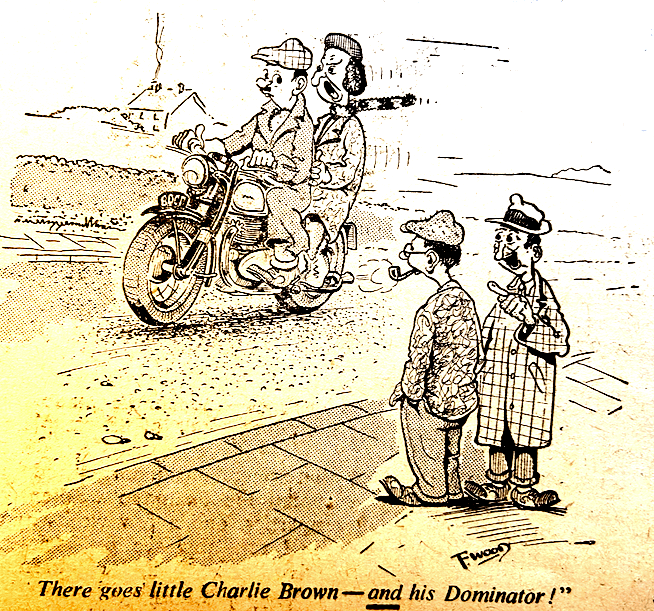

“SO GOOD IS THE general performance of the modern 350 that a legitimate doubt might exist as to whether, for solo touring, a machine of larger capacity is really necessary. This class of motor cycle will give the unattached rider a useful cruising speed of 55-60mph and will show a saving in petrol. Such a machine is the Model NH Ariel Hunter. The duel seat is in keeping with the control layout and instils a sense of confidence. Those with very short legs will possibly find the saddle height inconvenient and some difficulty may be experience when the machine is stationary. Controls are admirably placed and can be positioned to suit both the very tall and very short. With the exception of a few freak days in which spring made too early an appearance, the weather was cold enough to force an engine to show any inherent temperament. But always the Hunter was placid in the extreme and could be started without even recourse to the float chamber tickler. A few prods win the air lever closed and the ignition lever at half retard brought the engine to life when quite frozen. When the unit had warmed up no difficulty was experienced in starting the engine from the seated position. Fully advanced the engine hunted at tickover speeds but could be made to turn over evenly and slowly with the magneto control at the halfway position. A mile or two was sufficient to warn the unit enough to allow the air control to be opened fully. Except for the occasion when a partially blocked main jet occurred, the carburation was clean and crisp. The controls were a pleasure to use. A light responsive clutch operation backed up a smooth take-up.

Footbrake and handbrake were similarly easy to operate. So sensitive was the foot-change movement that difficulty was occasionally experienced in taking up the free movement of the pedal before making a gearchange without actually changing gear. From neutral, bottom gear engaged noiselessly; neutral could easily be selected from either bottom or second gear. Some slight delay was advisable when changing ratios, but selection was quite positive even when hurrying from one gear to the other during a burst of acceleration. Within the limits of reasonable use the exhaust noise was subdued and inoffensive. At large throttle openings and with the engine revving freely it became healthy in tone and attracted some attention if the throttle was used without discretion. Both the air intake—no air cleaner was fitted—and the piston were audible at town speeds, the latter noise diminishing considerably when the engine reached working temperature. Although an engine of this capacity is expected to turn over quickly, it showed a surprising ability to pull at low speeds. With the new fuels available, a piston giving en optional compression ratio of 7.4 to 1 was fitted; this did not result in an intractable unit and pinking was entirely absent unless the twistgrip was used brutally. The ignition lever could be left fully advanced. Normal cruising speeds were 55-60mph, with an occasional burst up to 70mph. On one occasion 80mph was indicated in conditions not unduly favourable to high speed and without alteration of the normal riding position. Steering and handling were excellent. Front forks and rear suspension were soft in action but this did not detract from the positive feel of the machine at over 60mph and the machine was comfortable to ride. At

its best on surfaces with high frequency shock characteristics, some pitching was noticed if a series of widely spaced bumps were encountered. This did not prove disconcerting and never reached a stage likely to cause concern. Much of the test mileage was undertaken when snow and ice covered the roads. During this period the Ariel was chosen for use and revealed an inherent stability of high order. At walking speeds the steering appeared to be slightly heavy but this heaviness disappeared immediately the machine was under way. Both front and rear brakes are adjusted by fulcrum expanders and can be easily kept in good order. Both were found to be smooth and progressive in operation; the front had a firm feel and was not spongy, but the rear unit, operated by an enclosed cable, required considerable movement. However it did not lock easily and the effort could be well judged to give satisfactory retardation. Together they were more than satisfactory and gave no indication of fade. In very wet conditions some water was thrown back from the front wheel but the majority of this spray came from the contact point of wheel and road. Little escaped round the side of the mudguard arch. At all normally used engine speeds there was no vibration. Some vibration was noted at over 60mph in third gear, and at over 70mph in top, but this was never excessive and common sense alone prevented the engine being over-revved in the intermediate ratios. Regular maintenance tasks on the Hunter are easy to perform. No chain adjustment was required during the test but the rear chain oiler—a jet feed from the primary chaincase—worked efficiently and kept the chain well lubricated. The engine and gearbox remained free of oil leaks and showed only dusty smears along the primary chaincase and the timing case at the conclusion of the test. A sensible prop-stand was used more frequently than the rear stand, which requires a certain knack to operate. In spite of many nights in the open, both chrome plate and enamel kept well and slight discolouration at the exhaust pipe proved the only ‘dull spot’ on a very attractive machine.

“DESIGNED FROM START to finish to cater for the most exacting Services requirements, the 498cc side-valve Triumph, though comparatively unknown to civilian riders, is commanding the attention of all whose work is concerned with swift military or liaison; whose mode of transport for that purpose calls for reliability above suspicion and, equally important, must be easily serviced, when the need arises, from spares available on the spot. Hitherto the difficulty of carrying spared for up to half-a-dozen varying types of machine, few components of which are interchangeable with those of four-wheelers, has long been the Achilles heel of motorcycle efficiency in the Services. Mindful of those three- vital factors—speed, reliability. and ready-repair facilities—the Triumph Engineering Co have devoted more than a decade of development to a motorcycle likely to fill the bill. The result is the TRW model, a specimen of which has been ridden by Motor Cycling staff members during the past few weeks. Engine dimensions of this Triumph are 63x80mm— similar, in fact, to the ohv 500s—producing 498cc. Dissimilarity is found in the compression ratio, which has been lowered to 6:1 and, of course, the cylinder head assembly. That component, a neat one-piece alloy casting, carries no valve gear and lends an appearance of unusual, squat compactness to the otherwise familiar-looking unit from Meriden. Inspection of the timing case reveals the absence of a magneto. In its place is a coil-ignition car-type contact-breaker distributor unit incorporating automatic advance-retard mechanism. There is no dynamo in the conventional sense and the frontal space usually occupied by that component has been left, so affording ready access to the valve gear. The tappets are adjusted by removing two cover plates and rotating milled tappet-guide adjusters by means of a special ratchet tool. Movement of the adjusters is arrested by spring-loaded segments on the underside of the tappets,

each segment representing approximately .0025in vertical movement. The heart of the electrics is a Lucas alternator located the primary chain case; the only moving part is the rotor which is mounted on the engine mainshaft. The alternator output, normally rectified to DC for battery charging purposes, is adequate for emergency kick-starting and a switch position caters for that exigency, diverting low-tension AC voltage from the main circuit direct to the contact-breaker and 6v ignition coil mounted high up out of harm’s way beneath the petrol tank. Complicated magneto and dynamo drive arrangements are thus avoided and inertia losses are reduced. In effect, therefore, the TRW has dual electrics comprised of generator, battery and coil, with full DC battery lighting, or, at option, generator and coil with simple AC lighting. Both systems are quite foolproof, as was found by purposely disconnecting the battery and running by day and night simply on the Lucas AC set. The beam from the 7in. nacelle-type headlamp was first-class on both the AC and DC circuits. From a servicing point of view coils and condensers are, of course, the most vulnerable items of this equipment but both are components widely used in MT transport and, therefore, more likely to be available when motor cycle magneto armatures and bearings might be at a premium. The same safeguard is suggested by the fitting of a Solex carburetter which, whilst different so far as jet sizes are concerned from those used in the car world, probably offers few snags from the point of view of replacement in emergency. This type of instrument, unlike the widely-used Amal, cannot be flooded; it was found that for starting purposes a rich-mixture control lever provided a first-kick response. Left at that setting the mixture was of course, over-rich for normal running, yet, as the test proceeded, it was found that more than the slightest movement of the control lever produced symptoms of weakness which manifested itself in

spasmodic backfires and a tendency for the engine to cut out at small throttle openings. A blocked jet was diagnosed; also a check on nuts and bolts enabled the head to be tightened down a fraction, both jobs proving beneficial from a performance point of view. The lowest of the four gear ratios (16.85:1) gave a good get-away and was quite adequate for low-speed road or cross-country riding when the slogging quality of the side-valve engine was appreciated. One felt that a civilian trials 500 of this type would appeal very much to those who enjoy a smooth surge of power, yet hanker after good, low-speed torque in a twin. The TRW had flexibility and handled like a 350. Second gear (12.8:1) could be retained until about the 40mph mark, although normally the useful maximum seemed to be in the region of 35mph, at which juncture selection of the third ratio (8.25:1) provided for speeds up to a trifle under 60mph. At that gait valve-float was imminent; for everyday purposes, a change to top (5.8:1) at about 55mph resulted in unflurried, progressive performance to maximum speeds which were in the region of 73-75mph. Time taken to complete the speed range varied; the best, on average, was 34sec, which is creditable considering the non-sporting character of the engine, and that no more than 16.8bhp at rather more than 5,000rpm is claimed. On the other hand, completely equipped, the TRW weighs only 320lb—considerably less, in fact, than any other 1953 British-made 500cc twin except the Triumph Trophy, and is comparable, within a score of pounds, with some rigid-frame competition half-litre models. At all speeds, except those deliberately invoking valve float, the engine, fitted with silent-ramp cams, was mechanically quiet, a quality which was matched by transmission smoothness due, doubtless, to the efficient working of the rubber-insert clutch shock absorber. The four-speed gearbox, of long-established one-down-and-three-up fame, had the silky action associated with civilian models. Good points noted included the ample steering lock and nearside prop-stand; a tool-kit, complete down to such useful equipment as a timing-pinion withdrawal bolt; the back-folding pillion foot-rests; the long, resilient saddle springs which, with a 4in rear tyre, served to offset the unaccustomed sense of hardness of a rigid frame. Less favourable was the impression of the rear stand; it tended to flap up and down on rough terrain. The chrome, unlike the smart green enamel finish, quickly showed the effect of exposure, whilst the pannier equipment, possibly fitted at the behest of a Government department, rattled as of yore; it carried the load too far aft, and in general, seemed to be no better than it ever was. These criticisms in no way belittle a machine which, designed for special work, promises very ably to fulfil the purpose intended. The TRW goes farther; it represents an effort to provide good, reliable performance largely by simplifying auxiliary components, reducing weight and thereby making it possible to use to advantage the maximum power output of a simple type of engine.”


“IT IS GRATIFYING to find that a machine with performance characteristics very similar in many ways to the more likeable dualities of a typical pre-war large capacity V-twin is now available. Not only does the new Meteor 700 Royal Enfield vertical twin offer most exhilarating acceleration and a high cruising speed, but both of ,these features are attained with a complete lack of fuss. If desired, the acceleration from just over 20mph to its maximum of 90mph plus can be obtained in top gear alone. And this without pinking and with no particular regard for tactful use of the twist-grip. During the our road test, impatience with the intermediate ratios was felt and, so tractable was the engine, that top gear was frequently selected at speeds below those normally used for a top-gear change when accelerating hard. On the other hand, the engine was instantly responsive. Attention can also be drawn to the excellent braking figures obtained, proving beyond doubt that the dual front brake layout does, by virtue of an equal reaction on both front fork legs, ensure that maximum pressure can be used on the handlever without a directional bias. Although starting involved turning over what is virtually two 350s no difficulty was experienced at any time. Warm weather prevailed during the test and under these conditions, assisted no doubt by the fact that coil ignition is fitted, a first-kick start was frequently enjoyed.
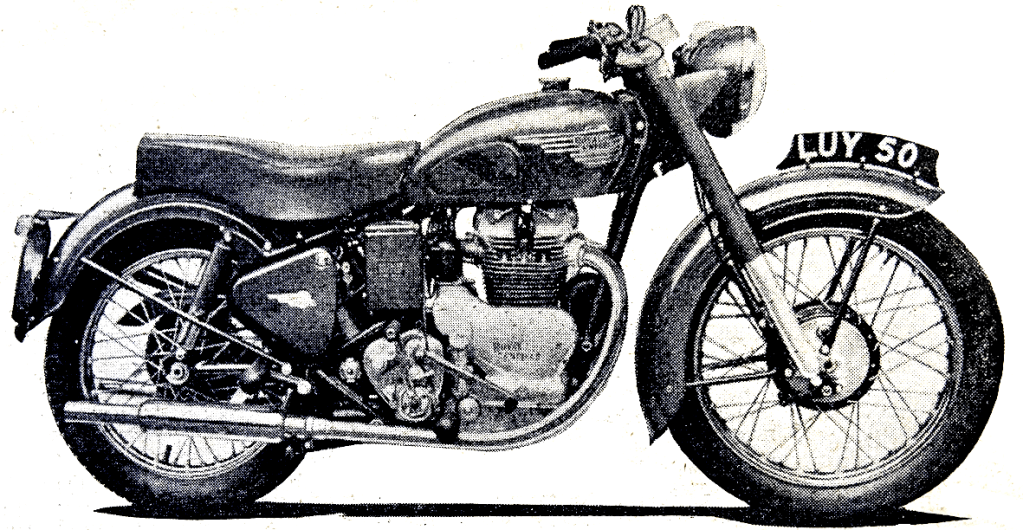
When the engine had warmed up, the air lever could be ignored. Carburation throughout the range was clean and the engine ran up without any flat spot or hesitation. A comfortable, fairly upright, riding posture is set by the combination of foot-rest position, handlebar bend and dual seat height. Limited adjustment is available at the footrests and the positions of both foot-change gear lever and brake pedal can be altered if necessary. The former is fitted to a splined shaft; the latter has an adjustable stop. Narrow, swept-back handlebars have control levers clipped to them and the latter can, of course, easily be moved. The dual seat is not adjustable for height but proved most comfortable. A great depth of foam rubber in its construction ensures easy miles for both rider and pillion passenger. On one occasion a passenger was in fact carried and at journey’s volunteered a commendation. Throughout the machine the accent is on comfort. Both front and rear suspensions have soft movements and more than adequate travel for all but the severest conditions, although a succession of depressions in a poorly-surfaced road will, if taken fast, induce some pitching. It is difficult to write of ‘touring speeds’ for even at 70mph the engine is turning over at only 4,000rpm. This was in fact the speed at which the machine was in fact the speed at which the machine was habitually driven and at such gait, proved tireless. Without any bother the engine would increase this road speed to 80mph. Some evidence of the presence of individual cylinders was felt at approximately 65mph in top gear but this smoothed out when the speed increased to 70mph. As noted earlier, there was little necessity to make frequent use of the gearbox; in top gear the speed of the machine could be permitted to drop to approximately 22mph, from which speed it would accelerate smoothly and without pinking. This could not have been done without a transmission that incorporated an efficient shock-absorber—credit must go to the familiar Royal Enfield rubber cushioned device in the rear wheel. A short control pedal travel has long been a characteristic of Royal Enfield gearboxes. Occasionally the movement was stiff to operate and required very firm pressure but this can fairly be attributed to the ‘newness’ of the gearbox generally. Under compression, the outer case of the clutch cable tended to shorten and so reduce the available movement at the quick thread which operated the withdrawal pushrod. Therefore to ensure noiseless gear selection from neutral it was advisable to pull the lever right

back to the handlebar. This imposed little extra exertion for the clutch withdrawal was extremely light. Similarly, neutral selection from bottom gear sometimes required care. An overriding neutral selector control is fitted in the usual Royal Enfield manner. Conversely gearchanges could be made when in motion as quickly as the pedal was moved. Although not obtrusive, the valve gear could be heard and was thrown into prominence by the comparative silence of the transmission and the pleasantly modulated exhaust system. Dual 6in drums are disposed one each side of the front hub; the mechanism is operated by a pair of cables from a compensating whiffle-tree at the hand lever. In the rear wheel there is a single 7in-diameter drum. Possibly due to the friction inherent in two cables and the additional springs which four shoes need the front brake requires very positive pressure—but the braking that results is powerful, sensitive and progressive. This description can also be applied to the rear brake and when used together the deceleration from the highest speed of which the machine is capable can only be described as outstanding. It marks out the Meteor 700 as one of the safest machines on the road. Adjustment at the front was required once during the test, following a number of deliberately savage applications from high speeds. Other than for unusual oil leaks at two head nuts, the power-unit was as clean at the termination of the test as when it started. No opportunity of checking the mudguarding presented itself for the weather was most kind throughout. However both mudguards are well valanced and appear to be more than adequate. A 75W dynamo provides the current for ignition and lighting, the latter being perfectly satisfactory for speeds up to 60mph on main roads at night. Finished in polychromatic copper-beech with a matching plastic cloth covering for the dual seat, the new Royal Enfield Meteor 700 is a credit to the Redditch factory, and is a machine which will ensure great pride of ownership to any-one lucky enough to possess one.”

“IT IS DIFFICULT to visualise a more attractive colour scheme than blue and silver, and confirmation of the effectiveness of such a combination can be found in the Model KHA twin-cylinder Ariel. Introduced within the past 12 months as a standard finish to all Ariel machines with light-alloy cylinder barrels and heads, ‘Wedgwood Blue’ surrounds an engine which is not only handsome in appearance but possesses a performance that is more than adequate for all but the most avid seeker after mph. To put the edge on both acceleration and maximum speeds, the pistons, giving a ratio of 6.8:1, suitable for Pool petrol, were changed for a pair which increase this ratio to 7.5:1. This proved entirely satisfactory with the better quality petrols now available and was originally arranged for export markets in which 80 octane fuels were normally available. Advantage was taken of the fact that the Ariel link-type rear suspension is offered as an optional extra to the rigid-framed specification and this spring frame was part of the equipment of the model under review. While the engine is one that revs freely, it is not ‘fussy’ in operation, for, throughout the test, there remained an impression of smooth tractability. Starting was always a simple. matter and the machine displayed no temperament in this respect. Although no really cold weather was encountered, a night or two in the open revealed that, in spite of oil thickened by low temperature, the engine would fire promptly provided the air control was used sensibly. Warming up quickly, the unit proved to be a little on the rich side and the air lever could be opened fully in a very short space of time.

All Ariel machines are possessed of a first-class riding position that is particularly suited to those with long legs. The dual-seat fitted provides a saddle height that is perhaps slightly inconvenient to those of short stature. With the machine at rest, some difficulty is likely to be experienced in putting both feet squarely on the ground. However, with adjustable footrests and pedals, a first-class riding position can quickly be arranged. Sensitive to tyre pressures, the KHA was found to react heavily to an under-inflated front tyre. With correct readings on the tyre gauge, low-speed handling proved sensitive down to walking pace. At all times the machine was extremely comfortable and the lack of hydraulic damping in the rear was noticeable only on bad roads at high speeds. A large depression traversed at 65 plus would induce a pitching motion. This did not seem to affect the front wheel, which stayed firmly on the ground, even in these extreme condition. Considerable travel is, of course, a feature of the Ariel telescopic hydraulically damped forks and it is almost superfluous to add that they gave a comfortable ride. The spring frame adds to the standard 56in. wheelbase and a machine so fitted is perhaps above average in length. These additional inches do not, however, have much effect on the cornering ability and the frame proved quite stable even when over-enthusiastic cornering methods were employed. Gear changing was pleasant by virtue of the light clutch and pedal movement. Normal changes were made with some slight pause and these were noiseless; snap changes were not always unaccompanied by noise but this slight indication of engagement did not affect the positive manner in which the dogs meshed. Neutral could always be found from either first or second gear and there was no clutch drag. In the same way, first gear could be selected smoothly and silently. A natural cruising gait of 70mph was spoilt by a slight vibration period. This resulted in the selection of a speed which, at 65mph, seemed too low or at 75mph, too high. The latter figure was inevitably chosen and produced no ill effects in spite of a maintained engine speed of approximately 5,000rpm. It is possible, however, that on a long-term basis, the piston

speed at this figure would be too high and might result in excessive wear. Acceleration to these road speeds was sparkling, aided by the effective gear change and well-selected ratios. A high degree of mechanical silence has been attained with this engine. Some slight noise, thought to be a slack valve adjustment, was finally traced to the magneto and could, in all probability, be attributed to the automatic advance mechanism. This commendable engine silence was backed by a quiet transmission and a reasonably modulated exhaust system. Particularly smooth in operation, both brakes proved efficient at normal touring speeds. During the course of several full-throttle runs the drums expanded and, on the front brake, the available usefulness was considerably reduced. It must be emphasised that this did not occur on the road; it arose only after a number of severe retardations from speeds in excess of 85mph. Normally the front brake was sensitive and progressive, with a feeling of positive contact between hand lever and brake shoe. Long pedal travel was a feature of the rear brake and this reduced the tendency to lock the rear wheel in emergency stops. A flexible cable connects the pedal to the brake cam lever. Adjustment at both front and rear is by conical shoe expanders. Adjustments during the test were confined to the brakes and the check on the valve adjustment mentioned earlier. This latter can be carried out without removing the petrol tank. A jet located at the rear of the primary chaincase provides oil for the rear chain. This it did with continued efficiency and without excess. Some caution must be exercised when topping up the oil tank for an overfilled tank will, after a high-speed run, blow oil over the rear of the machine. Otherwise, both engine and gearbox were clean and oil-tight; a slight smudge of oil and dust along the chaincase joint proved the only disfiguration. One fault showed in the electrical equipment. Towards the end of the test, following the maximum speed runs, a bulb fractured in the pilot light. Otherwise, illumination proved ample for night driving up to speeds of 65mph on main roads. The quality of the enamel finish and the chromium plate appeared excellent and neither had deteriorated to any degree when the machine was returned to Ariel Motors after the test.”

“ON AN ‘MPH PER POUND’ basis, the BSA Golden Flash must be one of the least expensive high-performance projects offered to the buying public in post-war years. In fact, every mile indicated on the speedometer at the machine’s maximum speed, costs approximately forty-two shillings and sixpence: a standing quarter-mile in 16½sec is thrown in for good measure. Such performance does give the fast-moving, long-distance rider an opportunity to cover daily mileages that are likely to remain proud boasts throughout his lifetime, and it is to this type of rider that the Golden Flash is most likely to appeal, for an outstanding feature of the machine is its ability to cruise at a speed dictated by traffic conditions rather than by the capability of the engine. In spite of this characteristic, the ‘bottom end’ performance has not suffered and there is no low speed temperament to make traffic negotiation a niggling business of clutch slipping and throttle blipping. Several efforts were made to get rid of a tendency to spit back through the carburetter when the throttle was opened quickly with the engine ticking over. This apparent weakness did not show at any other stage, and past experience has revealed that this slight fault can be cured by attention to the throttle slide. Starting was always effortless and the carburation was clean from low speed to maximum throttle. At the end of the test the near-side exhaust pipe had blued slightly at the port, but this minor tendency toward induction bias had no apparent effect on the unit. Both the handlebars and the footrests are located well forward and this produced a straight-armed position well suited to ‘leaning the breeze’. Although mounted forwardly, the handlebars are low and did not induce tired wrists when riding in thick traffic. All controls, both for foot and hand, are adjustable and a satisfactory stance can be quickly arranged. An adjustable stop is now fitted to the brake pedal which can be set comfortably below the ball of the left foot.

Both footrests are set on tapers and the gear-change pedal is mounted on a splined spindle. All hand controls were pleasantly smooth in operation and this, particularly where the clutch was concerned, assisted toward clean and noiseless gearchanges. Some pause was necessary when changing from second to third gear, but on this occasion only was any unusual delicacy needed. Changes were quite positive and could be made as fast as the pedal could be moved. First gear was selected from neutral without sign of clutch drag and no difficulty was experienced when finding neutral at traffic lights. No doubt the high degree of acceleration was due as much to well-selected gear ratios as to the excellent power output of the engine. Power output of substantial proportions is, however, necessary to maintain acceleration at above 70mph and the manner in which the speedometer needle would continue moving beyond the 70mph figures on the dial was most exhilarating. In this country, at any rate, the cruising speed of this machine is hard to define: not so difficult to ascertain was the minimum top gear speed, which could be assessed at 25mph. Below this speed, third gear was advisable if roughness in the transmission was to be avoided. At any speed, pinking, with the better quality fuels now available, could only be induced by brutal use of the throttle. On any type of road surface the handling and steering were excellent. The hydraulically-controlled telescopic front forks—now fitted with two-way damping—provided six inches of well-controlled movement. This softness of the front suspension tended to accentuate the firmness of the plunger units fitted to the rear wheel, particularly on bad surfaces, but on all main roads the springing, aided by the comfortable dual-seat, gave tireless riding. There was little evidence of the engine when it was at work. In every department—pistons, valve gear and crankcase—nothing could be heard of the unit when the machine was under way and little indeed when the machine was stationary. The subdued exhaust note was undoubtedly assisted by a high top-gear ratio (4.4:1), which ensured that no offence was given. Some slight noise emanated from the intermediate ratios of the gearbox, but against the overall excellence, it was little to complain of. Both brakes were well up to their job and would stop the machine from high speed in a most reassuring fashion. During the unusually extended test, and in spite of very thorough use, the front brake needed adjusting twice only and the rear brake not at all. Some squeal from the front drum was experienced in the early stages, but this disappeared as the unit bedded down.
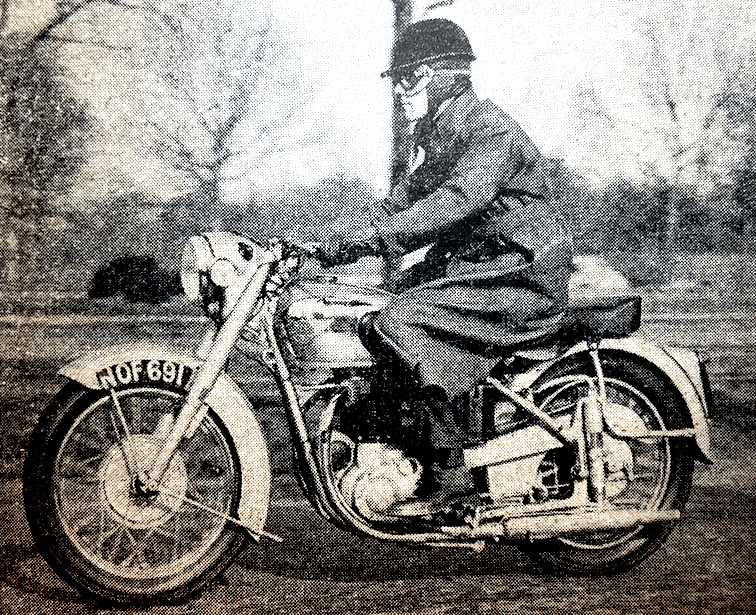
Those unused to a unit of 8in diameter might consider the application to be fierce, but on closer acquaintance and using two fingers on the lever only, such criticism would undoubtedly disappear. No definable vibration period existed throughout the engine speed range until the unit was working at maximum throttle opening in the intermediate ratios. Several routine adjustments were carried out prior to the maximum-speed tests. These involved a check on tappet adjustment, magneto points and, on one occasion, the removal of dirt from the main jet. It is advisable to remove the 4¼-gallon tank to adjust the tappets, and this can be done by removing two bolts. At this stage, a recent addition to the tank-attachment lug at the rear was noticed; the bolt now passes through rubber bushes held in lugs welded to the tank. The work on both carburetter and magneto. was easily and quickly done. Several troubles were experienced with the electrical equipment, all of them subsequent to the maximum speed runs. A considerable quantity of electrolyte escaped from the battery and, leaking over both carrier and primary chaincase, spoilt the appearance of the machine. Inevitably, the wiring faults were discovered late at night. The first consisted of a broken wire close to the battery, which was easily found. The cables that came away from the switch terminal posts were not so easily discovered. These faults did, however, give the tester an opportunity to discover the accessibility of the switch gear and ammeter in the nacelle; this is revealed by removing the two head lamp bolts and lowering the lamp. There is undoubtedly more room than would be available if the units were mounted inside the head lamp. Two minor criticisms can be levelled at the machine itself. The first concerns the limited amount of ‘free space’ in the oil tank. If several miles are covered at high speed, frothing oil tends to over-lubricate the rear chain which, in turn, flings a film of oil over the rear of the machine. This spoils an otherwise clean unit on which the only small leaks were at the filler caps of both oil tank and primary chaincase. The second point concerns the rubber cover to the gear-change pedal; in the duration of the test, in which 1,500 miles were covered, the rubber had worn sufficiently to show the metal of the lever, which finally chafed the toes of shoes and waders, Small enough criticisms, both—and minor complaints when the general excellence of this good-looking machine is assessed as a whole.”
“FOR YEARS I HAVE been trying to make up my mind to write to you on the question of your road tests. What is the object of these tests? Surely it can only be to point out the merits or failings of various vehicles, and thus to help the intending purchaser to make up his mind which particular model will best suit him. Why, then, do you always shun direct comparisons? For instance, I have never yet seen a 500cc twin tested that was not, implicitly or explicitly, a ‘credit to its class’. More often than not it is ‘outstanding’. Such indiscriminate commendation does nothing to help your readers or the industry. May we not be informed what constitutes the average 500cc twin, than which all models tested since the war have been so much better? And, having established the average, and knowing that all machines so far tested have been above it, we should all, I am sure, be highly delighted to read reports on the completely unmanageable models which balance all the outstanding ones and pull the average down to its present deplorable level. Is Motor Cycling as independent as you would have us believe, or does its existence depend on the continued support of the manufacturers? There are motor cycles on the market that no motor cyclist wants, once he has tried them for a while. Second-hand values help the intending purchaser a little—your road tests do not. I wonder if this will be printed?
BRIAN R CAUKWELL, London, W1.”
“BEARDED, AND THREE STONES lighter than when he left England in January, ‘Spike’ Rhiando arrived home on March 9 after a series of adventures as hair-raising as any related in fiction. It will be remembered that his original intention was to ride a scooter of his own design—the Scootamobile—across Europe and Africa to Cape Town, a distance of 10,000 miles. The scheme was thwarted, however, by unusually severe weather conditions in North Africa, including deep snow in the Atlas Mountains—at one point the machine had to be carried through a half-mile snowfield—and high winds in the desert, blowing sand which obscured the tracks and made navigation, except by compass, impossible. A direct result of the piling of sand on the tracks was the need for prolonged bottom- gear riding, with the machine averaging only six or seven miles in each hour. Under such sustained punishment the cooling system broke down, making it impossible to continue. At this juncture, -Rhiando had covered 2,400 miles, no fewer than 820 of which had been in bottom gear. Stranded on a dried-up lake bed, Rhiando protected himself from the intense cold of the desert nights by burning grass, ignited with petrol, and by building himself a small shelter. After several days of hardship he was rescued by a party of French geologists, after a military aircraft had spotted the brightly-coloured Scootamobile two miles from the place where Rhiando was searching for fresh grass. He reported that, generally speaking, his machine had stood up well to the arduous conditions. The plastic bodywork had withstood the hammering it received and only one or two faults had been found in the design. One was the tendency for the inside of the screen to become dust-covered. He plans to place in production the sports version of the Scootamobile which, unlike the model on which the attempted desert crossing was made, will be an open scooter. It will have 20in wheels and will be equipped with an electric starter. The price, it is estimated, will be £137.”

“COMPLETED OVER A YEAR AGO, used daily for traveling 20 miles to go to work and raced, not altogether unsuccessfully, on South Eastern Centre grass tracks, the Rudge-powered special built by Norman Lockwood, Yorkshire-born engineer now of Woking, Surrey, is an interesting example of the work of an individualist who not only knows what he wants but also knows how to make it. Wartime experience in the aircraft industry, where Duralumin is as commonplace a material as soap in. a laundry, got Norman thinking in terms of lightweight construction when he decided to build a machine to his own design. And aircraft experience too, so he tells me, convinced him that it wasn’t a very sound scheme to weld Duralumin, because the effect of welding destroys certain characteristics of the material. So the old Speedway Rudge engine he had acquired is housed in a frame in which a single loop of 1in-diameter 16-gauge Duralumin tube is held solely by split clamps and pinch bolts passing through gusset plates to a box-section, steering head assembly. Similar split clamps and gusset plates locate the engine and gearbox, the latter component being completely surrounded by the heavy-section Duralumin rear engine plates. The rear fork assembly is built up of ⅞x⅞in chrome-molybdenum square tube and the front forks are of Duralumin. I asked Norman how he came to work out the head angle—the sort of question which, nine times out of ten, starts the proud designer propounding his particular theories on frame geometry—but in this case there was a delightfully frank reply. ‘I dug out a lot of copies of the ‘Green’un’, he said, ‘and measured the head angle, in photographs, of a lot of the best machines. They varied a surprising amount, so I took an average. It’s the same as the ‘ International Norton, actually, and the model has always steered very well. Weighing less than 250lb. the Lockwood special must be one of the lightest 500s in existence and if it isn’t exactly the best-looking, it is certainly one of the best-used. So often these home-made models are more to be gazed upon than to be ridden.”

“I AM MOST interested by the letters on the subject of Diesels…in the case of a single applied to motor-driven cycles and emanating from Germany I hear that control, even on more or less standard lines, is very good. The idea is worth an experimental trial, for there should be little difficulty in obtaining economy from the self-ignition principle as compared with the carburetter which must ‘throw in’ petrol which we know cannot all be burned effectively. Fuel regulations are not necessarily a fixture and paraffin could be cheaper than petrol. I like the suggestion of electric drive but so many thousands of engineers have invented the ‘perfect’ accumulator which, however, remains heavy, expensive, inefficient and short-lived. Perhaps one day we shall see power picked up inductively from sunken cables on main roads, while the invention of a high-tension storage remains impossible at our present stage of physical knowledge. Novelty is seldom popular, the advent of mechanically operated inlet valves was bitterly contested!
PROF AM LOW, London, W4.”
“REFERENCE THE INDIAN twist-grip, universally-jointed shaft-type controls, which your correspondent Mr CF Gaunter says were introduced in 1909. This statement is inaccurate, as this type of handlebar control was introduced in 1905 on the first Indian twin, but it was strictly a factory experimental job for racing and hill-climbs, and was not available to the public. These controls were certainly standardised in 1907, if not before, as photographs show.
HAROLD KARSLAKE, Hon Librarian and Past-President APMC, Nottingham.”|

“YOUR CORRESPONDENT ‘COMET’ appears to be a little at sea regarding this ‘lust for speed’ mentioned in my letter published in an earlier issue. Surely the motor cyclist has the lust for speed and not the motor cycle. He seems to have this attribute himself, because he says that when riding his Rapide his speed was only limited by road and traffic conditions, and adds that a Shadow would get there first. My letter was primarily concerned with an appeal for a real family sidecar outfit, where speed is not demanded, but where reliability and ease of maintenance and economy of running are the essentials, and to suggest that the Tourist Trophy races should be more ‘Tourist’. Your correspondent JH Pritchett has the right idea—the earlier 1,000s were designed mainly for comfort, and they were the ideal machines for sidecar work. I would like to see the 1,000s without a Clubman’s TT and the 125cc Class put in its place, as it would be very much more interesting and would serve to develop a useful machine. I have always been a big-twin enthusiast, but only for the nice woolly 1,000cc, with side-valves, that ticked along very comfortably with a high gear and a sidecar at between 20 and 60mph in top. Let’s hope that such an outfit will come back again. I believe that the motor cycle’s purpose is to give pleasant transport—not for scorching the roads and annoying the general public, as it does when used by these speed men.
FW PRESCOTT, Hatch End, Middx.”
“THIS BUSINESS OF a 350 being just as good as a 1,000 amuses me. Would I, a canny Scot, pay all that money for a Black Shadow if a 350 costing some £200 less would sat my purpose? Not on your life! In any case, I refuse to listen to anyone who criticises a Vincent or other 1,000cc machine unless he can truthfully say ‘I have covered a long journey on such a machine’. Which brings me to reader JH Pritchett and his remark ‘…in the hands of young and/or inexperienced riders, as is so often the case from my observation of 1,000cc riders’. He needs spectacles. Or statistics. We have the ages of around 1,000 Vincent riders on our files and the average is around 30 years. They’ve got to be that old to save the money required; and they have to be experienced, otherwise they’d buy a bike with masses of chrome and bright paint on it. Comfort, finish and luxury also apply to Vincents, you know. Then ‘Euclid’. What in heck is he talking about? He says ‘…a modern 1,000cc ohv big twin which feels as steady at 110mph as my sister’s bicycle does at 10 m.p.h. We owe this improvement in road handling just as much to the courage and skill of racing riders like Geoff Duke…as to the different kind of skill possessed by the engineers who design…etc.’ Obviously his machine is a 1,000cc Vincent. Now then, did racing design the Girdraulic fork or the triangulated rear suspension he is so happy about? Or the dual brakes, the head angle or the trail? Maybe someone should have a look at his sister’s bicycle, though!
RAB COOK, Editor, Vincent Owners Club, Banff, Scotland.”
“*This correspondence is now closed. The two letters published here fairly represent the opposing schools of thought and are selected from many received on this subject.—Ed.”

“WHY MUST PEOPLE complain about the noise of a motor cycle when they still cheerfully rush under one’s front wheel and then say ‘But why didn’t you blow your horn? 1 didn’t know you where there!’ And at about the time that helmets are made compulsory I think there should be something done about open commercial lorries. My biggest grouse is against lorries carrying, or having carried, bricks or cement, etc. These loads, more often than not uncovered, spew out a fine dust, which penetrates practically any goggles and almost blinds one. Next on the black list are the fruiterers’ trucks which have a trail of flying pieces of paper, potatoes, etc.
L STEPHENS, Stockton-on-Tees, Co Durham.”
“I HAVE NOT HEARD it expressed that the wearing of a safety helmet may in itself be the cause of an accident, yet that is a point which I would like to put up for consideration. When entering a busy road, acute side-vision is called for. Even ‘wide-vision’ goggles can be an impediment at such times and the experienced rider will use two fingers to slip his goggles up onto his forehead. It is not practicable in such circumstances to bare the eyes if a helmet is worn. Those who remain begoglled at such times will be seen turning their heads rapidly from side to side, assessing the opportunities of negotiating at least one stream of quickly-moving traffic. The movement of the head is through a greater angle, and is slower. I earnestly submit that interference with vision, and to a certain extent with hearing, is not to be countenanced by the vast majority of safe riders for the sake of the few who, denied the luxury of cracking their skulls, will perhaps attempt to use the helmet as a lever for breaking the said head right off! Motorists have body-pillars impeding side-vision; we all have ‘the cricketer’s blind-spot’. Is this not enough to be going on with, or are we to hear more frequently the well known story,‘he was coming up so fast I didn’t see him’?
W Goar, Manchester, 20.”
“Staff members, who normally wear safety helmets, are quite adamant—the interference with vision alleged by our correspondent is, in fact, non-existent. Good roadmanship is, of course, essential when entering a busy street—no matter what type of headgear one wears. But lifting one’s goggles is a new one on us!—Ed.”

“THOUGH THE DUTCH themselves do not, as yet, have a manufacturing industry of their own, they are increasing their assembly plants and the 31st Dutch show at the RAI in Amsterdam contains a great deal more than in the past of motor cycles which, if not wholly built in the country, can be classed as of Dutch production. Well-established concerns such as Eysink and DMF have some interesting new models on show; perhaps the most unusual-looking machine in the exhibition is an Eysink which features a frame comprising a large-diameter tube forming the backbone-cum-tank, to which are attached the steering head and short chain stay members. The 98cc Villiers 4F unit is held in a short extension of the saddle tube, there being no front down-tube. DMF show two new models, both powered by German Ilo units, of 200 and 150cc. The HMW cyclemotor is built at Hallein, in Austria, to a Dutch specification. Another attractive exhibit is the ‘Mosquito’ velomotor marketed by Knibbe and made in Amsterdam. It incorporates a V-shaped member combining seat and front down ‘tubes’; power is provided by an Italian Mosquito motor attachment. Something of a coup for the RAI is the exhibition of the latest Swedish Husqvarna 175cc two-stroke with rubber band springing for the front forks and swinging fork rear suspension with undamped coil springs enclosed in rubber tubes. Germany is well represented. A new Hoffmann features an unusually good-looking arrangement of shielding for the engine and gearbox and makes an exceptionally eyeable job of an otherwise fairly standard single-cylinder two-stroke. Adler show a sports version of the twin-cylinder two-stroke which gained such a reputation in last year’s ISDT. It has miniature shock absorbers for the bottom-link front suspension, upturned exhaust pipes, shielded headlamp and QD wheel. For Italy Innocenti dominate one end of the main hall with an ingenious moving display of Lambretta scooters running within circular revolving Perspex tracks. Vespa features an all-weather fitting to provide a coupé top and screen for the de luxe model. The competitively priced Czechoslovak Jawas are popular in the Netherlands and the Beers concern, still enhances the 250cc model’s good looks by adding a rear chaincase. In a country so bicycle minded as the Netherlands it is not surprising that the motor attachment is popular; the Birmingham-built Miller unit is among the many British products on show among the accessories.

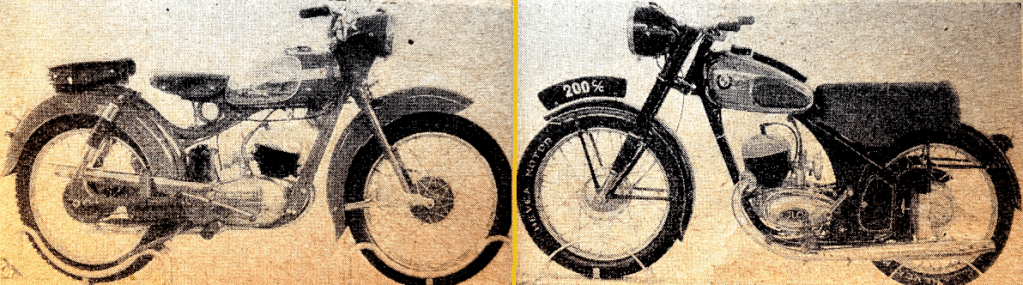


“GENEVA WAS EN FÊTE last week-end when hundreds of clubmen from all parts of Switzerland, gaily clad and riding machines of Continental and British makes, took part in an ‘up-for-the-Show’ rally organised by the Union Motocycliste Genevoise.”

“IF THE GENEVA SALON can still be regarded as indicative of European market demands—as formerly was certainly the case—the 23rd Geneva Salon, suggests that the demand for British machines is waning. Sales in Switzerland of two leading Italian scooter makers, for example, were more than double the figures of the best dozen British motorcycle factories exporting to the Confederation.Attractively displayed in a compact exhibition are some 50 makes of machine from nine nations, including Switzerland. Great Britain is represented by three makes only (BSA, Royal Enfield and Vincent), as against 15 makes from Italy and 15 from Germany (however, neither the BMW nor the Zündap appears—another surprise, for these makes always attract attention). This remarkable drop in British exhibits is the result of a boycott by some Swiss distributors of British machines. They considered that the stand locations offered were unsatisfactory, and furthermore have felt for some years that a show in Zurich rather than Geneva would be desirable. Hence, on this occasion, conclusions based on exhibits can be misleading. However, the Italians continue to head the imports list. In 1951, 14,893 Italian machines were sent into Switzerland; last year the figure was 24,255. From Germany, 6,904 machines were imported in 1951, and 9,540 in 1952. Imports of British machines totalled 3,873 in 1951, and 1,781 in 1952. The only two makes from Great Britain which showed a small increase last year (as compared with the 1951 Swiss import figures) are specialist machines at opposite ends of the scale, namely, Velocette and Vincent. Of the Italian totals, Lambretta and Vespa scooters together contributed over 12,000 machines in 1951 and over 19,000 in 1952. The scooter has certainly made its mark with the Swiss. Several tendencies on Continental makes are evident at the Geneva Salon. Unit construction of engine and gear box, enclosing such items as magneto and/or generator and presenting easily cleaned, flowing curves, is now the rule
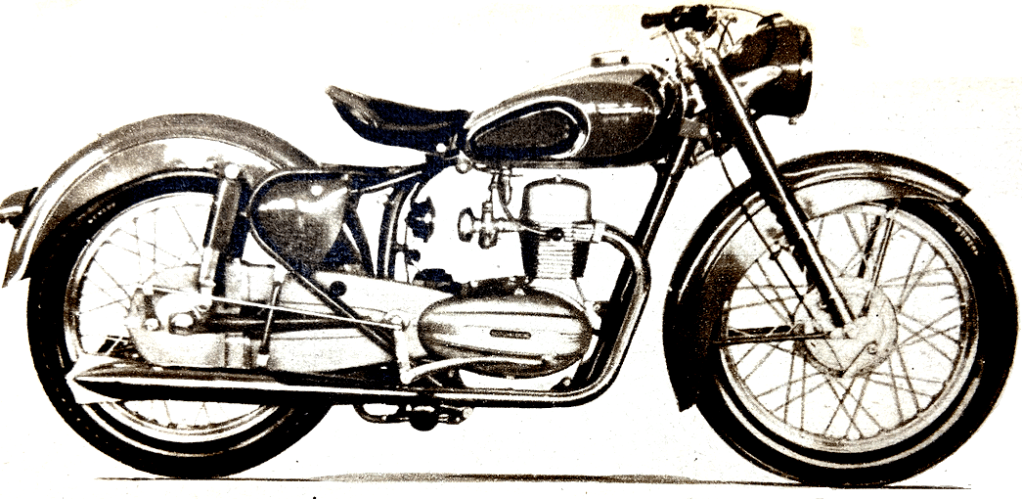
rather than the exception. There is extension of the theme of total enclosure of the rear chain. Wheel diameter on scooters is on the increase. There is wide use of light-alloy wheel rims on production sports (and even some touring) models. Pivoted-fork rear springing shows signs of superseding plunger-type suspension. Light-alloy hubs, with centrally disposed brakes, are in greater numerical evidence than previously, and there is a distinct swing toward light-alloy engines. On autocycles and built-for-the-purpose motorised cycles, there is increasing use of frame members to house the petroil, thus dispensing with a tank. The two most outstanding new models displayed are both of Swiss manufacture. In 1893, two brothers named Dufaux started making motor cycles (one of those brothers is still alive today). In 1903, one of their productions had a fuel tank shaped like a sacoche (bag); hence was born the name Motosacoche, which was continued until the war stopped production in 1942. There is general delight that Motosachoche has now returned to motor-cycle production after a lapse of 11 years. The machine is an up-to-the-minute, 250cc ohc parallel twin of very clean appearance. Of light alloy, the engine is square in more senses than one; the bore and stroke measurements are 54x54mm, and the head and cylinder finning, which is continued right down to crankcase level, gives the unit a square appearance. Although the fins continue right round the engine in unbroken line (except at the spark-plug position on each side), there is, in fact, a space between the cylinders through which air flows, though the space is not visible from casual inspection. Also invisible is the means of drive to the camshaft, which is by roller chain housed within tunnels cast in the left side of the block. The order of items on the left end of the crank-shaft, reading outward from the crankcase, is camshaft-drive sprocket, oil-pump drive pinion (the oil pump is of gear type), primary drive sprocket. Driven by the right-hand end of the crankshaft is a dynamo which supplies current for coil-

ignition and battery charging. Driven by the end of the dynamo shaft is the contact breaker and automatic advance-and-retard mechanism. In unit with the engine is a four-speed gear box, whence power is transmitted to the rear wheel by totally enclosed chain. The rear wheel is supported by a pivoted fork controlled by telescopic spring legs which incorporate air damping. Front-wheel suspension is by telescopic fork. Both wheels have light-alloy rims and hubs; the latter have centrally disposed brakes. There are two models—sports and touring—which are identical in outward appearance; the difference lies in cam form and valve timing. The sports model is said to develop 14bhp, and the touring model 12bhp. The price is 2,700 Swiss francs, equal to £225 [£8,100 in 2026]. In contrast, the prices of some of the British machines at Geneva are: BSA C11 de Luxe, 2,465 francs (£205 l0s); B31, 2,710fr (£226); Royal Enfield Meteor, 3,585fr (£280); Vincent Black Shadow, 4,850fr (£404) [£14,600 in 2026]. The second outstanding new Swiss model is a 250cc ohv Universal single with shaft drive. For sheer cleanliness of line of the engine-gear unit, nothing has been made to surpass this handsome newcomer. The engine is in light alloy; the valves are operated by push-rods housed in concealed tunnels cast in the cylinder. Except for a polished aluminium nose, the whole of the shell of the unit is stove-enamelled in an attractive metallic grey. Crankshaft is in line with the frame and at its front end the shaft drives the Scintilla magneto-dynamo. The battery is housed in a tool box. From the four-speed gear box, the shaft drive to the rear wheel is on the same principle as that of the well-known Universal transverse twins. The rear wheel is carried by a pivoted fork, the taper arms of which are pressed from seamless steel tube. At the front end, the arms are bridged by a welded-on tubular member shaped in the form of a shallow U, this to pass under the universal joint of the shaft drive; the pivot bearings are bronze bushes. Hydraulically damped, telescopic spring legs control fork movement. Features of the specification are light-alloy rims and hubs with central brakes. A power output of 14bhp is claimed. The price is

2,700fr (£225). The weight is 138kg (approximately 304lb). Much interest is centred in a new German Horex QC specially designed for the Swiss market. This machine also is a 250 pushrod-ohv single. Though cast iron is the cylinder-barrel material, light alloy is used for the large, square, single-port head. Helical timing gears are employed. The fuel tank is of new shape and there is a new, oil-damped telescopic front fork. Features are plunger-type rear springing, light-alloy rims and light-alloy hubs with central brakes. Weight is 144kg (317lb). The price is 2,590fr (£216). A special feature of the new Horex is the tubular silencer, which is appreciably longer than average. This is to ensure compliance with the Swiss regulation which requires that the exhaust noise of a motor cycle shall record below 90 phons. It is shown alongside the prototype 500cc Imperator twin with chain-driven ohc twin and gear primary drive. Specially prepared in this respect for the Swiss market is the 250cc ohc NSU Max. Indeed, the silencer is of such length and diameter as virtually to dominate the left side of the machine. A maximum noise level of 85 phons is claimed —this with an output of over 18bhp. Another newcomer designed specially for Switzerland is the four-speed RT 250 H two-stroke DKW. The Swiss-built transverse flat-twin 580 and 750cc Condors now have all-alloy ohv engines and the final shaft is now enclosed. Larger brakes are fitted and the gearbox provides eight speeds. Rear suspension is by spring-controlled plungers with teles at the front. Smaller models are two-strokes: a 350cc inclined parallel-twin a Villiers-powered 197. Most of the well-known German makers are here with models which have already been seen at previous European shows this season. A highly interesting new machine designed for sidecar or solo use is shown by TWN. The engine is a 346cc, two-piston ‘split-single’ two-stroke with common combustion chamber. Two carburettors and two exhaust pipes are fitted; yet the normal principle of split-single operation is unchanged. Object of the two carburettors is to ensure that both pistons are cooled by incoming fresh gas. Exhaust outlet is from the left-hand bore only; part of the exhaust gas travels through the exhaust pipe on the left, and the remainder passes through an internal passage across

the front of the cylinder block and thence into the exhaust pipe on the right. Here is yet another German firm which is noise conscious. Both exhaust pipes on the new TWN increase in diameter to provide expansion chambers of no mean capacity over the downward sweep from the exhaust ports; the diameter then reduces to normal for the low-level, horizontal length of the pipes, which terminate in large, fishtail-ended silencers of a shape not uncommon on Continental two-strokes. The result is said to be elimination of the annoying penetrating character of the exhaust noise associated with many two-strokes, and reduction of the noise level to below 85 phons. Hitched to a Steib sidecar and mounted on a revolving dais, the TW Boss, as this new model is named, makes an imposing exhibit. Wall charts show the power output to be 16.5bhp at 3,800rpm, and nearly 11bhp at 2,500rpm; these figures suggest engine characteristics eminently suitable for sidecar work. The model is equipped as standard with the Teves system of hydraulic operation for the rear and sidecar-wheel brakes, both operated by a single pedal; the master cylinder is built on to the engine unit. The machine has total enclosure of the rear chain, plunger-type rear springing, light-alloy hubs with central brakes and light-alloy wheel rims. All wheels are interchangeable, and a spare wheel is provided. Both carburettors are fed through an air cleaner. The price solo is 2,800fr U233), and with sidecar approximately 4,000fr (£333). An unconventional machine from Italy is the Macchi 250, made by the aircraft firm AER Macchi. The main frame consists of two tubular loops in the form of a shallow U which run from the bottom of the steering head to a position just behind the saddle. Support for the saddle is provided by a tubular V which runs forward from the rear of the main loops. To the apex of the V is attached the nose of the saddle and the rear end of the tank. The tank itself forms the link between the apex of the

V and the top of the steering head; two reinforcing bars run through the tank from front to rear. The power unit is a 246cc two-stroke parallel twin in unit with a four-speed gear box. The unit lies horizontally and is pivot-mounted to brackets welded to the bottom of the frame loops. The rear wheel is carried in a fork, the arms of which are, in fact, the exhaust pipes; indeed, both front and rear wheel suspensions are similar to those employed on the Macchi 125cc scooter, examples of which were seen at the last ISDT. The wheels have light-alloy rims equipped with 3.50x15in tyres. An interesting scooter from Italy is the latest Vittoria, which is powered by the NSU 125cc two-stroke engine in unit with a four-speed gear box; power output is claimed to be over 5bhp at 5,000rpm. Here again is an example of the engine pivoting with the fork that carries the rear wheel; movement is controlled by telescopic spring legs which incorporate hydraulic damping. Front wheel suspension is by telescopic fork. Tyre size is 3.50x10in; the weight is 90kg (198lb). Latest effort from the German Messerschmitt aircraft factory is an attractive three-wheeler saloon in which two bucket-type seats are arranged in tandem. Body construction is a steel tubular frame panelled in sheet steel. Sides, domed top and back of the saloon are in transparent plastic above about chest level with the occupants seated; the wind-screen is of safety glass. Sliding windows are provided on one side and there is a corresponding removable panel on the other side.

The saloon top is hinged along the right side after the manner of many British saloon sidecars. When the top is hinged back for entry of the driver and passenger a left-side body panel is raised with it which opens the vehicle down to driving seat level; hence no contortions are required for entry and exit. A compartment for parcels is provided to the rear of the back seat. If required, the rear seat can be lifted out and luggage carried instead. Power unit of the Fend-Kabinenroller, as this three-wheeler is named, is a Fichtel and Sachs 175cc two-stroke. The engine, four-speed gear box and fuel tank are mounted on a pivot steel framework which is pivoted (the bearings are spaced to the width of the vehicle) and which also carries the rear wheel; rubber bands and a long coil spring comprise the suspension media. Positive-stop gear changes are effected by a hand lever positioned on the right of the driving seat; this lever operates the clutch automatically when a gear-change is made. Throttle control is by twistgrip, and steering (which is direct) is controlled by handlebar. The windscreen wiper is operated from a trigger lever on the handlebar. All three brakes are coupled and actuated by a single pedal. The front wheels are independently sprung. Red-light trafficators are provided front and rear. The 4.00x8in, the weight is 155kg (341lb) and the price 2,985Fr (£249). Montesa is debuting a 124cc two-stroke with, oddly enough, a separate gearbox and an even more separate foot control. One edition sports electrically heated fur-lined handlebar muffs and an electrically saddle cover—from sunny Spain too! The Austrian Puch concern show a new 175 with twin plugs and carburetters. Belgium sends her FNs, as before, and a new cyclemotor, the Flandria, with two speeds and plunger suspension; and Hungary has produced the Csepel in two new models, a three-speed 125 type and four-speed 250. Scooters abound in their dozens. Vespa has a special Swiss model with coupled brakes and, for the first time, the German Goggo has a 200cc engine. One Goggo model, for invalids, has three wheels; another has a lightweight Royale sidecar. The Italian Frizoni has a 160cc Astoria engine and four-speed box.”

“DURING A VISIT to the Motosacoche works in Geneva there was an opportunity to ride the new Motosacoche ohc 250 twin touring model, with only 300km (about 190 miles) on the speedometer recorder—the engine gave the impression of being still on the tight side. The engine had been warmed up to some extent before the machine was handed over and there was thus no opportunity to test the cold starting. One gentle prod on the kick-starter brought the engine to life, and it idled slowly, evenly and reliably with the twistgrip in the closed position; both cylinders fired regularly, and the exhaust at tickover was virtually inaudible in traffic. There was also a marked absence of mechanical noise. Pedal positions are kickstarter and gear change on the left, rear brake on the right. The gear pedal is moved down for downward changes, and up for upward changes; neutral is in the conventional position between bottom and second. Operation of the clutch was light and sweet. Not the slightest noise accompanied engagement of bottom gear at a standstill; whether on the move or stationary, selection of neutral from either bottom or second gear was easy and positive. Slightly greater movement of the pedal was necessary to effect changes than is the case on some British machines, but surprisingly little effort was required to move the pedal. Silent changes could be made in either direction without noticeable pause. First impression was of excellent low-speed steering; there was no difficulty in turning feet-up circles in either direction in a narrow road at less than walking speed and, thanks to the even pull and docility of the engine at small throttle openings, this was accomplished with the clutch fully home. Next impression was of extreme comfort. The telescopic front fork has a long, soft action. Generous movement of the rear wheel is provided—soft around the static load position. Added to this there is the cantilever mounted saddle, itself capable of long movement and, like most Continental saddles, shaped to provide maximum comfort. On the open road, so ready was the response to

opening of the throttle that the temptation could not be resisted to disregard the comparative newness of the engine and make a quick run-up through the gears. From a standstill, 85kph (about 53mph) was seen on the speedometer in a surprisingly short period of time; one was apt to overlook that the machine was only a 250. The engine ran smoothly, quietly, and without any fuss up to about 22mph in bottom gear, 37mph in second, and 48mph in third. These are not, of course, the ultimate maximum speeds in the indirect gears. Top-gear ratio gave the impression of being too high for maximum performance to be obtained except under very favourable conditions (but this might not be the case with the engine fully run-in). On the other hand, there was the feeling that it would be impossible to over-drive the machine in top gear; and that the engine would be quite happy to cruise at 50mph indefinitely. At the other end of the scale, the engine pulled smoothly and without a trace of transmission snatch down to 14mph in top gear. No greater compliment can be paid to the high-speed steering than to say that the rider was entirely unconscious of it. Suitable terrain on which to test high-speed cornering was not encountered during the brief run. The suspension was entirely adequate. Whether the road was smooth or bumpy made no difference either to the steering or to the rider’s extreme comfort at any speed of which the machine was capable. The exhaust note remained unobtrusive to the rider right up the scale. Outstandingly good were the brakes, which are centrally disposed within light-alloy hubs. Both were light to operate to maximum effect, yet had that desirable measure of sponginess which enabled the rider to feel the degree of application to a nicety (the kind of feel that would be appreciated particularly on slippery roads). It was possible to squeal the front tyre from top speed downward; in fact, the brake gave the impression that it would be capable of locking the wheel at low speeds. The only criticism concerns the position of the rear-brake pedal. It was necessary to take the right foot off the rest and move the leg appreciably forward to reach the pedal pad. This feature is to be modified forthwith on the production models.”
“FOLLOWING THE EXAMPLE of the British Triumph organisation, Germany’s NSU factory is marketing a conversion kit for its 300cc Konsul model. This includes Alfin cylinder and light alloy head with larger than standard valves, special cams and a 32mm choke downdraught carburetter, and is said to increase the performance of the engine from 20bhp, giving a top speed of over 90mph. Only minor changes are being made to the NSU Rennfox 125cc racing machines for the coming season. Part of the valve gear has been redesigned to achieve a reduction in weight. The arrangement of the twin overhead camshafts remains virtually unaltered, but more space has been found for the rockers and valve springs by slight modification of the massive, square cylinder-head casting. Engine power output is said to be over 14bhp at 10,000rpm. NSU has been notably reticent over disclosing details of the 125cc engine’s interior; this drawing is the first to be completed. The crankcase and gear box are composed of three main castings, the middle one of which forms the timing-side half crankcase as well as housing the spur-gear primary drive to the multi-plate clutch. The gear box is of the cross-over drive type and the driving sprocket is on the left-hand end of the gear box main shaft. As usual on racing machines, the crankcase is very deep, and the cylinder is spigoted into it for more than a third of the stroke. Drive to the twin overhead camshafts is by means of a vertical shaft and bevel gears. Mounted on the timing side of the engine, the vertical coupling is driven by a bevel gear attached to the spur pinion interposed between the crankshaft and clutch pinions. The top bevel box houses also the spur pinion gears driving the camshafts; it extends the whole length of the cylinder head and is bolted thereto. The cam pinions incorporate a vernier-type adjustment for timing purposes. Valve springs are of the hairpin type, and are enclosed within the cam box.”


“MARCH OF TIME: To many who rode motor cycles down the Brighton road in the ‘nineties, telephones and gaslight were new-fangled. On March 22 the performances of those who take part in the Sunbeam MCC’s annual Pioneer Run to Brighton are to be televised.”
“TRIUMPH TEAMSTER JIMMY ALVES has recently produced in his workshops at Glastonbury an attractive special for scrambling, and it weighs only 305lb. The swinging-arm rear-fork assembly employs Feridax-McCandless springing units and pivots on Silentbloc bushes set in a bridge piece fabricated from steel plate. The steering head is standard Triumph ‘A’ pattern, hearth-welded to the frame tubes. The Triumph engine, gearbox and primary drive oil bath are assembled as a unit, being held in the frame by four main ⅜in, bolts and two short ⅜in bolts to take the engine thrust. A number of other power units could be accommodated in the frame. A single-bolt petrol tank- fixing is used, with the tank resting on three standard Triumph rubbers set in cups incorporated in the frame members.”

“DESCRIBED BY HRH the Duke of Edinburgh as a concrete way to make the roads safe, the RAC/A-CU Training Scheme for learner motor cyclists is to be made the subject of an experiment which has as its ultimate objective the establishment of training facilities in all towns of reasonable size throughout the country. With the aid of 24 motor cycles donated be members of the Manufacturers’ Union a pilot scheme which will be put to the test in the Chatham and Rochester, Guildford and the Crystal Palace—districts with widely differing characteristics to provide a cross-section of the country as a whole. Instructors, to be recruited by the RAC, preferably from among local clubmen, will receive expenses and bonuses payable as results…it is anticipated. that several hundred learners will be trained within 12 months. By making the fee for the full course Of 12 practical and theoretical lessons 36s, inclusive of the proficiency examination, it is believed the scheme will be self-supporting, as the RAC will continue to make no charge for the administration work involved. The pilot scheme is supplementary to, and in no way in competition with, the original scheme established in 1947 and now being worked so successfully by some 60 A-CU clubs. The plan was supported by Sir Gilmour Jenkins, KCB, KBE, MC, Permanent Secretary to the Ministry of Transport; Sir Frank Newsam, KCB, KBE, CV0, Permanent Under-Secretary of State, Home Office; Sir Howard Roberts, CBE, DL, Clerk of the LCC and Chairman of the RoSPA National Executive Committee; and by Professor AM Low, chairman of the A-CU and the RAC Motorcycle Committee. RAC chairman Wilfred Andrews concluded: ‘Harness caution to courage and rich will be the reward.'”
“A FRENCH IDEA. With characteristic ingenuity a French engineer, MV Bouffort, has fashioned a two-wheeler which he calls the ‘Valscooter’, powered by a 98cc Villiers engine. The aluminium rear bodywork is built in the shape of a box and forms a structural member. It is closed by a lid, to which is bonded the sponge-rubber seat pad. Supported by a spindle at its forward extremity, a welded-up, tubular fabricated ‘chassis’ within the body carries the engine two-speed gearbox unit and the rear wheel. Up and down motion of the ‘chassis’ is controlled by two rubber bands at the rear; the engine is, of course, unsprung. There is no front suspension. Four attachment points at the front of the body receive two long, steel pull-out spindles which locate a welded-up tubular front sub-frame. The steering head pivots about a spindle on the sub-frame and is secured by a pull-out pin. Once the pin is removed, the steering head, front fork and wheel fold neatly between the two lower sub-frame members, the head stem and handlebars first being removed simply by operating a catch. Removal of the two spindles enables the complete sub-frame to be detached and this is then stored in the ‘bodywork’ the entire operation takes but 30 seconds, and reassembly is equally quick. Leather handles are provided on the rear body to enable the scooter to be lifted or wheeled when folded. In its folded form it measures but 2ft by 1ft 3in by 1ft, and the weight is only 85lb. The Val-scooter—short for ‘valise scooter’—is claimed to have a top speed of 35-40mph. Aircraft tailwheels are used and only one brake is fitted, a point which will be rectified to comply with British requirements. Production models will also incorporate a QD rear wheel.”


“FOR QUALITY OF MATERIALS and workmanship, there is no better motor cycle in the world than that made in Britain. This is a fact, undisputed among foreign purchasers of our industry’s products. But—and here is a big ‘but’—it is also a fact, reflected in declining export figures, that the British motor cycle is fighting a losing action on the European front, as was demonstrated with special emphasis at the Geneva Show. Switzerland, in the immediate post-war years our best customer in Europe, and in the world’s markets our second best, now buys our motorcycles in steadily diminishing quantities. In 1948 41% of new machines registered in Switzerland were British. In the following three years the returns were 34, 26 and 13%—1952 saw the nadir at only 6.5%. What is the cause of this decline? The Swiss still want motor cycles. The peculiar geographical layout of their country and the nature of their roads make two-wheel transport particularly desirable. They are not, generally speaking, short of money and they acknowledge freely they would still prefer to ‘buy British’. Well, why don’t they? A memorandum was recent circulated among its members by a Swiss traders’ organisation which particularly concerns itself with the importation of motor cycles into the Confederation. While expressing regret at the necessity to do so, this document gave a warning that those considering orders for British motor cycles should use discretion because the design and certain constructional details thereof tended to adhere to out-of-date concepts no longer acceptable to Swiss customers. The British love of conservatism is often the butt of not unkindly intended wit on the part of foreigners. We rather enjoy it—but here the subject is no joke. If we are losing our overseas markets on account of our determination that what suits us has to suit our customers, surely the time has come when the brains behind our industry should be directed towards a revision of that policy, because what is happening in Switzerland can easily be repeated elsewhere. It can readily be appreciated that the heavy expense of producing models specially adapted to the needs of any given market cannot be lightly undertaken. But so far as Switzerland is concerned, that is exactly what our most serious competitors, the Italians and Germans, are doing, and at the Geneva Salon there were many examples of ‘Swiss Only’ models. In several cases, these were merely slightly modified standard machines, but the inference was there and the agents were making the most of it. Finally, although we need hardly repeat previous statements on the subject, there is a continuously expanding market for scooters on the Continent—and Britain still takes no share in it.”
Motor Cycling reviewed the growing choice of skidlids…


Motor Cycling also published an haute couture fashion designer’s take on riding gear for women…
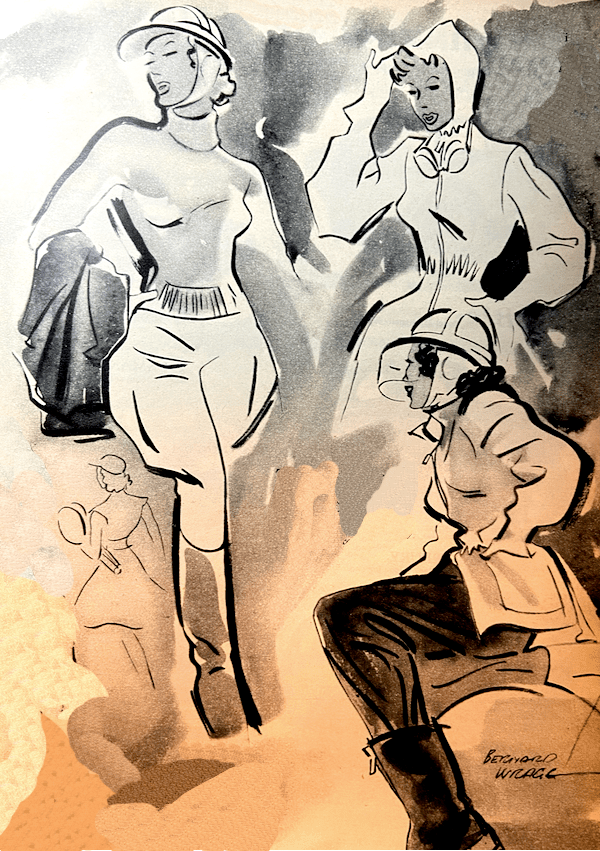
“SID WILLIS, Australian lightweight title-holder, is to race his home-built 250cc Velocette in England and on the Continent this summer. Having sold his two larger Velocettes to raise the fare, he will come over with Tony McAlpine. Standing less than 5ft and weighing under 9 stone, Sid has had an unbroken run of victories in the 250cc class on the machine he has built up from a KTT. A pattern maker by trade, he supplies many leading Australian riders with their racing pistons.”
“A DEVON RIDER of the name of Yelland decided to give his fiancée some instruction in handling his motor cycle, and they accordingly changed places, she sitting on the saddle and he upon the pillion seat. Unfortunately, the young lady had neither driving licence nor insurance cover. The result of a meeting with a police officer was that the pair appeared in court on the usual charges. Mr Yelland’s defence was certainly novel. He maintained that he was able to control the machine from the pillion, and demonstrated the fact to the justices outside the court. So convincing was the display that the magistrates dismissed the summons relating to insurance, although fines were imposed on the licensing point.”
“HAVING ACTED FOR Associated Motor Cycles Francis Barnett as their resident factory representative in the East for a number of years, the letter signed ‘Black Shadow’ indicates that the writer has an extremely limited knowledge of motor cycle sales in Pakistan. In Karachi, Matchless, Francis-Barnett and Royal Enfield are adequately represented by the leading motor cycle firm there, Poled and Co. Norton, BSA and James are represented by Almukhtar and Co, a subsidiary of the big Shah Nawaz car group. Ariel and Panther are represented by the old-established concern, International Traders. Velocette, Douglas and the Italian Vespa are represented by Talpur Motors, and Triumph by the Universal Engineering Co. The only four Continental firms represented are CZ, Jawa, Lambretta and Horex. Of these four, CZ sells because of its extremely low price and it should be borne in mind that this unit, as well as the Jawa, is made behind the Iron Curtain. As to Karachi being a good market for motorcycles, the total number of units in Western Pakistan is only 2,683, excluding those used by the Armed Forces. Due to the non-co-operative attitude of The Karachi Customs and the Police Registration Officials, it is extremely difficult to obtain reliable statistics, but British motor cycles obtain quite a large percentage of the markets and the main outlet for units of Continental origin is the Ape Motorickshaw, manufactured by the Italian Vespa company. It should, therefore, be obvious that the British manufacturers are not losing a growing market, but are fully aware of the importance of the Pakistan market, bearing in mind import licensing difficulties which are acute at the present time.
HF HIGGINS, Bombay, India.”
“RECENTLY I WAS pulled-up by a very friendly motor cycle policeman and warned about my spotlight attached to the forks by one of the bolts holding the head lamp. Strictly illegal, he informed me—only one movable lamp permitted! The fact that the head lamp is attached to the forks makes it the one movable lamp. Therefore, all additional lights attached to any part of the front fork assembly—handlebars, forks, mudguard—are illegal. It would seem one must fit crash-bars higher than 30 inches in order to attach a spot light.
WH REDFORD, Addlestone, Surrey.”

“AT LAST YEAR’S London Show, the ratio of spring-frame to solid-frame models exhibited was 120 to 81. These are telling figures in themselves, but sales over the past few months suggest that rear springing is even more popular than the exhibits indicated. An approximate assessment is that around 80% of all new machines ordered are of the spring-frame type. Even in the keen price ranges, a buyer will usually pay the extra charge required if springing is not a feature of the standard specification. Assuming current indications are a reliable guide, the days of the solid-frame new machine are numbered, except for specialised purposes such as sporting trials. Manufacturers are likely to standardise rear springing, not only because demand makes this step appear justified, but also because standardisation should result in production economies. The various suspension systems available have their pros and cons which, it might be emphasised, should be judged on the basis of the price of a machine and normal usage as well as effectiveness in the technical sense. However, since a springing system may be called upon to accommodate loads varying between a lightweight rider at the one extreme, and the combined weight of a heavyweight rider and passenger, or the loading imposed by sidecar work, at the other, a device to provide quick and effective adjustment for load is highly desirable. This development is one to which technicians should give urgent attention.”
“SINCE THE WAR the Wessex Centre’s annual Kickham Trial, one of the national trade-supported events, has had more than its share of bad weather. But last Saturday the organisers would have been glad to see some rain for the majority of the well-known hills around Bath were so dry that they had lost almost all their usual sting. In the circumstances it was a remarkable achievement to find a course that was just easy enough for one man—the remarkable George Fisher on his 125cc Francis-Barnett two-stroke—to complete without the loss of even a mark, yet difficult enough to avoid a single tie for any of the several class cups. Another commendable feature of the course was the fact that it was no more easy or difficult for early starters than it was for those among the 132-strong solo entry who started late.”

“The results of the silencer congress carried out by the Federation Motocycliste Suisse have now been published, and it is noteworthy that the most efficient silencers submitted for test effected a reduction in exhaust noise of 13% as compared with the silencers originally fitted. Even more remarkable is the fact that the silencers caused no loss of power; the most favourable design actually resulted in an increase of power of 8% over the output with the standard silencer. Of the 36 silencers entered for the tests, only 12 were considered efficient enough to merit inclusion in the awards list. There were three classes: engines up to 50cc, two-stroke engines above 50cc and four-stroke engines above 50cc. The respective first-prize winners were French, Italian and Swiss. The conclusions of the jury were that the exhaust silencing of motor cycles could be improved by the adoption of suitable silencers; that the reduction of mechanical noise could do much to improve the overall silence; and that driving methods play an important part.”
“JA PRESTWICH AND CO, the well-known manufacturers of JAP power units, are in production with newly designed 248, 344 and 497cc motor cycle racing engines. Each engine is available in four forms: for petrol or alcohol fuels, and with dry-sump or total-loss lubrication. All engines have Elektron crankcases, Wellworthy Al-fin cylinders and light-alloy cylinder heads with inserted valve seats and sparking plug bosses. Push-rod operation is employed for the valves, and return springs for the rockers supplement the double hairpin valve springs. The new engines are being fitted by EA Barrett into the racing machines which he is marketing for the coming season. Featuring all-welded, duplex-loop frames, with pivoted-fork rear springing and novel Earles-type leading-link front forks, the 250s are expected to scale approximately 2251b and the larger models 2501b. These machines will be marketed under the name Phoenix. The manufacturers’ address is HB Engineering, Newton Road, London, N15.” Vic Willoughby checked out the Phoenix project for the Blue ‘Un: “During my visit to the JAP factory I saw one of the 248cc engines showing its paces on the bench. Running on 80-octane petrol, with a compression ratio of 9 to 1, it was delivering 18.6bhp at 7,200rpm. This 250 engine, I was told, had gone like the proverbial bomb straight from the drawing board; it produces 23.5bhp on alcohol fuel with a compression ratio of 14 to 1. At that time the 344cc engine had not been bench tested on its petrol compression ratio of 8.8 to 1, but, with a 14-to-1 piston and ‘dope’ fuel, it had turned out 34.5bhp at 6,500rpm. The largest engine of the trio operates on a compression ratio of 8.6 to 1 on petrol, on which it develops the creditable figure of 39.6bhp at 5,800rpm. When run on alcohol, it, too, employs a 14-to-1 piston, and its maximum power output is then 46bhp at 6,000rpm. These, then, are the latest JAP racing engines, around which Barrett is confidently constructing his new frames.”


DUBLIN’S FIRST MOBILES: Very belatedly, as may be thought, Dublin’s first mobile police squad now comes into action to try to sort out the muddle of the city’s traffic. That, according to the Irish Times, has become chaotic, and the uniformed motor cyclists will he faced with a task that promises to be far from easy. According to the same paper, the road conduct of the citizens is characterised by a sublime disregard of all rules and regulations. Each and all follow their own ways—not always sweet—and if serious trouble follows, well that is just too bad. Consideration for others is not in their code; courtesy is something they do not appear to have heard about. The journal flays them all; motorists, cyclists, and pedestrians. Motor cyclists, though, do not get a special mention, for the reason, let us hope, that their behaviour is such as to escape censure.”

“A SPLIT WHEEL, designed to permit easy tyre removal and fitting, was displayed by TR Reeves, of 118, Tetley Road, Hall Green, Birmingham, 11 at the recent Modern Inventions and New Ideas Exhibition. The wheel can be adapted to suit any type of car or motor cycle hub and, for motor cycles, either chain or shaft drive can be accommodated. Mr Reeves was with the Sunbeam company during the development of the post-war models and a prototype wheel, having a 16x3in rim, bears a close resemblance to those for the S7 model.”
“A TROPHY, to be known as the TG Meeten Trophy, is to be awarded annually to the rider (or team) who, riding a British-made two-stroke, puts up the best performance during or throughout the year in any sphere of motor cycling. The trophy is to be a form of two-stroke Maudes Trophy, and entrants will range from such riders as W Barugh in scrambles to those who completed the round-Britain tour last year on a trio of 98cc James machines.”
“RECENTLY, AT ANY RATE, the scooter has been developed chiefly by Italy. It may be judged fairly enough, accordingly, that these people should have taken it upon themselves to produce a definition of this class of machine. The Italian formula lays down a maximum engine capacity of 125cc; an open frame, and wheels with rims of not more than 17in diameter. According to current practice, it allows designers plenty of latitude. But in this particular respect need they be tied down at all? The scooter has a long way to go yet, and experimenters should be given a free hand so far as possible.”
“MR PETER LEE-WARNER, using a 49cc Power Pak on a trade type bicycle, is to start from Australia House, London, en route to Sydney. Australia. Mr Lee-Warner’s equipment will include a special reserve tank of drinking water, a tent, sleeping bag, seven days’ food supply, medical kit and a cine camera. It is hoped that the journey to Australia and back will he accomplished within 12 months.”
“THE AUSTRALIAN TT moves from one state to another and, owing to local conditions, may take place at almost any time of the year. Thus it happens that only a few months after the 1952 title event the 1953 TT has already taken place. It was staged on a 4l-mile circuit at Longford, near Launceston, Tasmania, and was organised by the Tasmanian Road Racing Association. Riders from Victoria collected eight of the nine titles contested during a meeting which opened on Saturday, February 28 and which concluded on Monday, March 2.”
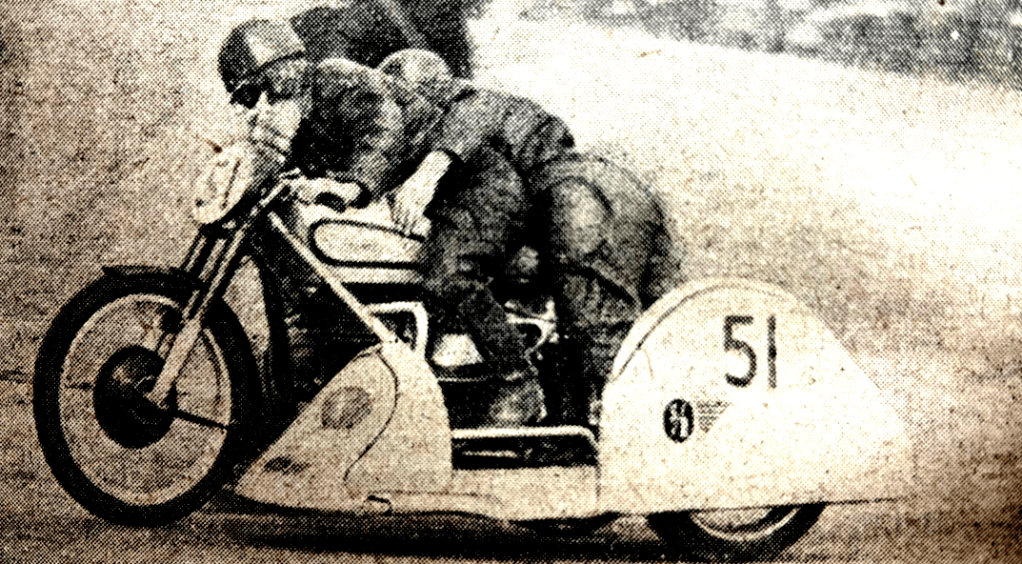
“THERE ARE THOSE who advocate that the regular inspection of all motor vehicles should be compulsory at certain intervals. That certificates of serviceability should be added to the documents we already have to carry and produce for inspection when required. Despite powerful backing, the notion has so far failed to secure the support of any Government. For the reason, possibly, that comparatively few road accidents are caused by mechanical failures. That is shown clearly enough by the available statistics: on their evidence, this further restriction, which would be costly as well as time-wasting, appears quite unnecessary. Yet a Coronation Year stunt, with this same idea at the back of it, is being sponsored by the Transport Ministry. With the blessing, too, of the garage trade, whose organisations have approved a plan to encourage car users to have inspections carried out, at a standard charge, as a voluntary gesture in support of the 1953 road safety drive. This could be a subtle manoeuvre. So warns the leading paper of the industry most concerned. They see in it a step towards introducing compulsion; a softening-up operation to make the public more inclined to accept an additional restriction by order.”
“REPLYING TO A REQUEST, made by the Road Safety Committee of the Boston Rural District Council, for the revision of road signs marking the approach to a notorious local danger spot, Major WA Rogerson, the Holland County Council Surveyor, is reported to have written: ‘The cluttering of roads with signs will never prevent accidents; it is more common sense and road sense that is required.’ Adding that motor cyclists have been the principal sufferers at the point concerned, he saw fit to support his contention with the extraordinary statement that ‘as the majority of them are mad, you can do nothing about it; they must go on killing themselves until they are extinct.'”
“SINCE THE BEGINNING OF 1953 there have been three important motor cycle shows held in Belgium, Holland And Switzerland. It is of interest now to glance back at these shows, to see a little more of what was exhibited there and to study a further selection of the machines which visitors were enabled to examine…”


“IN THE BRIGHT SPRING SUNSHINE of last Sunday the motor cyclists of today came in their thousands to pay tribute to the motor cycles of yesterday—the machines upon which had been laid the very foundations of the industry from which had sprung their own sleek mounts. The pilgrimage was made, mostly, along the famous London to Brighton road—scene of so many stages in the evolution of modern transport—and the occasion was the 17th Pioneer Run organised by the Sunbeam MCC for riders of motor cycles built before the end of 1914, that fateful year which had cried ‘Finish!’ to an epoch. Of the 223 machines entered there were only 10 non-starters, and of the entrants, no fewer than 40 had nominated machines dating from 1904 or earlier, the palm for the oldest model being taken by the 432cc Romain-Orleans tricycle ridden by JF Sloan. It is a machine of French origin built in 1898. Starting point was the yard of the railway station at Tattenham Corner, Epsom Downs, and a foretaste of the interest being taken in the Run was given by the huge crowds, not only of motor cyclists, which surrounded the fine old machines standing in the paddock. Gone,

indeed, was the once popular expression, descriptive of a pioneer motorcycle—’Old Crock’. Instead, the vast majority of the machines looked to be in showroom condition, or at least as they might have appeared after only a few years of careful usage. Hard it was to believe that some of the ‘ancients’, their sparkling nickel plate and gleaming enamel reflecting the morning sun, had spent many long years lying, rust-riddled and forgotten, in field or outhouse and had been restored to their present state by patient and loving care on the part of real enthusiasts. In fact, in not a few instances, the old-timers put to shame the near-new mounts of the observers who were to accompany them to Brighton. But interest lay not only in the machines themselves, absorbing though these might be. Certain of the riders claimed the attention of the spectators. For instance, top-flight Norton race-ace, Australian Ken. Kavanagh, was seen putting in a few practice laps in the paddock on the 1912 3½hp sv single-speed Norton which he was to ride; Graham Walker, editor of Motor Cycling, knelt beside his 1913 2¾hp Douglas, not so much in adoration as in reparation! CF
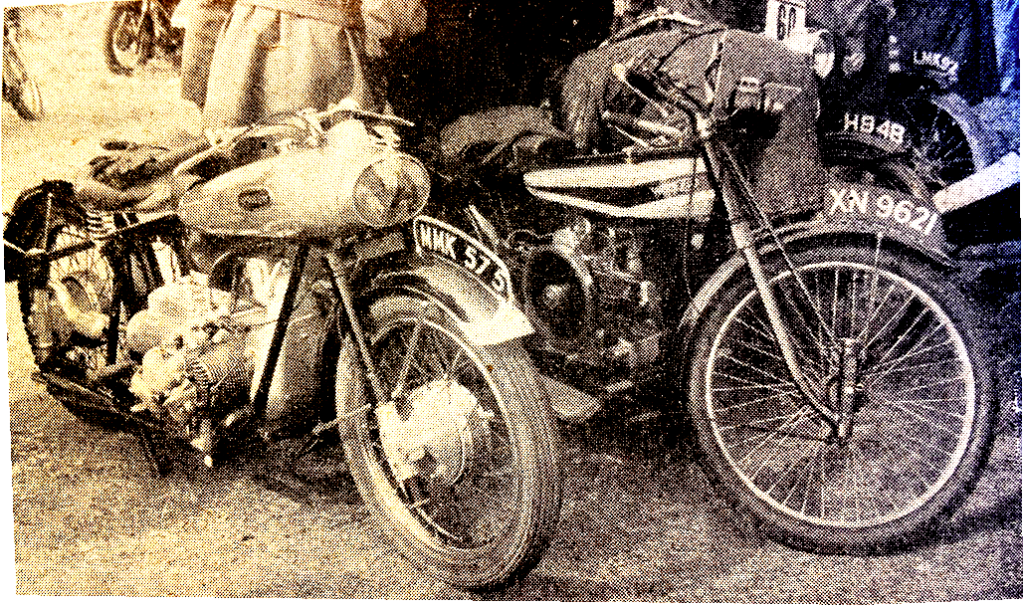
Caunter, custodian of the ancient vehicles in the South Kensington Science Museum and therefore an expert among experts, warmed up the two-stroke engine of his 1914 2¼hp ‘Baby’ Triumph. His observer, ex-TT star HG Tyrell Smith, somewhat ruefully handed over his badges of office to a successor, for the regulations forbade the use of trade plates and his 1953 Thunderbird, upon which he had travelled up from Coventry to attend the Run, was thus equipped. On the only existing example of a four-cylinder Douglas, a 696cc model of 1906 vintage, was 74-year-old Duggie Withers, dad of Eddie, who rode a more orthodox 1911 twin. One of the most interesting partnerships was that of the 1909 Wooler ‘all-sprung’ horizontal two-stroke single ridden by LV Fenton and observed by J Wooler riding a 1923 Wooler twin, accompanied by R Wooler on a prototype of the 1953 flat four described in Motor Cycling in November last. An early arrival at the start was president of the Manufacturers’ Union, Mr JY Sangster. One by one, competitors and observers brought their mounts up to the starter and received his orders. Through ranks of spectators every machine got away to a good start, led by JP Smith on his extraordinary three-wheels-in-line 4½hp Slinger of 1901 vintage. P Tacon, a fractured leg held stiffly in a plaster cast following an accident, carried his nurse in the forecar of his 1903 375cc Humber. H0 Twitches, that arch-priest of pioneer restoration, bestrode a 1911 3½hp Triumph in perfect condition—and

his observer was mounted on a 1919 model of the same marque which dazzled the eye. The 1913 532cc Scott of 0W Tyler purred away in true Saltaire style, its warning bell clanging away merrily. Original, plunger-type rear suspension and all-chain drive in conjunction with pedalling gear struck an incongruous note in EH Beckham’s powerful 1913 ohv twin Pope—an American 1,000 which had been fitted with a 1924 Scott front brake to render it legal on British roads. Almost as soon as he had started, ill-luck befell CF Burton, whose 1903 239cc Quadrant developed, so it was said, oiling trouble and he registered the first of the nine retirements. Then Gerry Cruddas, whose 1904 5hp Kerry had already carried him successfully through a dozen Pioneer Runs, found that the 13th was indeed unfortunate, for his inlet valve broke some six miles from Tattenham Corner, near the point where, for the first time, the route was diverted from the Reigate road and sent down a by-way to join the Brighton road at Redhill. Attention to the brakes of his 1902 225cc Quadrant caused RF Gower to stop for a while and ED Lee (1900 3½hp Deschamps tricycle) retired with some unspecified trouble near the Class I (up to the end of 1904 models) unpenalised halt at County Oak. Momentary stops were recorded by BJ Collins (1903 Phoenix-Trimo 3½hp forecar) and by RA Carter whose 1904 Howard used a fuel metering device instead of a carburetter. Near Povey Cross, GF Lock gave too hearty a pull up to the oil-pump handle of his 3½hp 1914 TT racer Singer and whipped the plunger out of the barrel. But he managed to get it back without stopping—no mean feat. Truly heroic was the performance of GW Goodall, riding a 1909 3½hp Centaur. His front tyre burst and with the inner tube cut to ribbons he rode over 20 miles on the cover to check in on time. Interviewed at the finish, Brighton Front, where an exhibition of the machines formed an added attraction to visitors to this popular resort, the competitors, for the most part, voiced appreciation of the good manners that had been shown them on the road by other drivers and riders with, of course, the usual ignorant and ‘clottish’ exceptions. Particularly praised, too, were the police who, to quote an official, have the making or breaking of the run in their hands and whose efficiency had contributed so much to the 1953 event—a mobile museum of motor cycling history which, according to a usually well-informed source, had been seen at one point or another by some 150,000 to 200,000 people, surely the biggest ‘gate’ yet!”
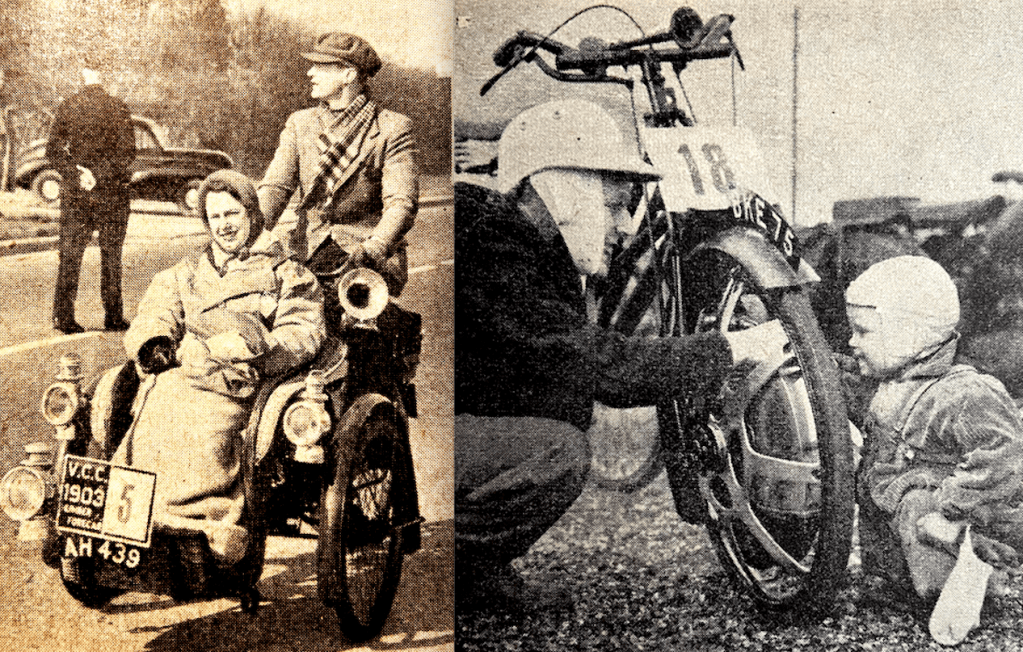
CONSOLIDATING HIS REPUTATION as Yorkshire’s premier roughrider, GE Broadbent (350 Royal Enfield) won the Ilkley Grand National for the fourth time on Saturday. The club team prize went to the Bradford &DMC, whose three members—GE Broadbent, NS Holmes (500 Ariel) and TU Ellis (500 BSA)—also filled the first three places on the results sheet. Organised annually by the Ilkley &DMC, the event is held on the moors to the north of the town, over a 22-mile course containing 16 sections. The event is run to a time limit and the riders are required to average 15mph over the two laps, fastest time being regarded as standard time. As usual Broadbent was the quickest although JG Brown, the runner-up in the Northern Experts’ Trial, riding a 125 BSA, took only three minutes longer. Of the 92 entrants there were two non-starters and 45 finishers, 40 of these within the time limit.”
“MUCH HAS ALREADY been said for and against compulsory helmets for motor cyclists. I have a suggestion, both for the Government and for general consideration. There are, I believe, quite a number of Government-sponsored ‘Remploy’ factories, producing toys and other kinds of articles, employing war-disabled ex-servicemen. Now, why cannot another place be started, employing those men who would be glad of work, to make a national model helmet? Such a scheme would create work and people might take a patriotic pride in buying such a hat voluntarily.
R BRITT, Oxford.”
“ALTHOUGH THE SPANISH motor cycle industry is not of the same proportions as those of some other Continental countries, its products have a distinctive appearance and include features of general interest. A new development in Spain is the production, by Sanglas, of Barcelona, of a 500cc single-cylinder ohv model; previously, this manufacturer has marketed 350s. The engine and gearbox are built in unit to form a ‘power egg’, ultra-modern in appearance except for the valve gear, which is vaguely reminiscent of British general practice of the mid-’30s, in that the valve springs appear to be enclosed in separate tubular housings. Telescopic front forks of massive design have a head lamp nacelle neatly faired into the upper shrouds. Of heavy construction, the duplex frame is equipped with a rear swinging fork controlled by spring units supported at the top by extensions of the tank tubes, while the engine cradle tubes are also extended to the rear, apparently to form an anchorage for the twin silencers. Among other Spanish productions is the 250cc Derbi two-stroke which, in general appearance, closely follows the lines of the. Czechoslovak Jawa models. Here again, unit construction of engine and gearbox is favoured, with the carburetter fully enclosed in a streamlined casing to the rear of the cylinder, which is inclined. Telescopic front forks, again with a head lamp nacelle, and plunger rear springing are other features. At 4,000rpm the Derbi power unit is stated to develop 9bhp. fvScooters have not yet gained the popularity in Spain which they enjoy in Italy, but there is at least one home-brewed machine of this type is the Rondine, which is powered by a 125cc two-stroke. It features an exceptionally well-styled ‘engine room’ with faired intake grilles for the cooling air. This scooter is also produced as a lightweight, three-wheeled delivery truck, when it is known as the Titano.”
“THE FIRST SNOW-FREE springtime Bemrose Trial since the war was won last Saturday by JV Smith (500 BSA) after an excellent performance in which he yielded only 15 marks to a 70-mile course made tricky by the timely rain. And, although the sidecars had 10 fewer hazards to contend with than the solos, AJ Humphries (500 Norton sc) did well to equal that numerical performance, thereby winning the News of the World Cup for the best sidecar effort. High praise was merited also by the team fielded by the organising club—the Pathfinders & Derby MC—which forfeited nine fewer marks than the best one-make team. As usual, the event was trade-supported and ‘open’. Much to the delight of the organisers the gloomy predictions of the weather prophets had been confirmed the night prior to the trial; and when the first of the 143 starters set off at 10.31am from the Charles Cotton Hotel, Hartington, grey clouds were brushing the tops of the surrounding hills, and steady, piercing rain, scudded before a blustering wind. As a result, most of the 20 sections—divided into 38 solo sub-sections—which the day before had nestled among the blackened heather in dusty innocence, were quickly transformed into treacherous rinks of boulder-strewn clay.”

“‘HOW CAN A BIKE that age possibly be any good?’ That, and similar remarks, are the lot of vintagents. We’re in used to it, and we’ve usually got all the stock answers ready. But some of the queries…! To hear some of them talk, you’d think every vintagent was a mechanical wet-nurse, nightly burning midnight oil to keep the model going. Therefore let it be said that we’ve no time for a machine which won’t perform as reliably as a ‘modern’. I need a bike which will run without constant tinkering. I haven’t sold my ‘P’ Triumph and chair yet; so far it’s given trouble-free years of service. Often, we get the ‘design progress’ theme flung at us. All we can say is that, for some of us, perhaps design hasn’t progressed the right way. Simplicity and longevity, coupled with ease of maintenance, mean much more to a lot of folk than bhp per litre. Personally, I’m more interested in ’90’ as applied to mpg as opposed to mph. The man who really gets my ‘vintage’ means. The dictionary says ‘of good and rare quality’ but this type applies it to any mass produced, mid-’30s rattle-box which has been neglected and bodged to death by a succession of disinterested impecunious utilitarians. I remember my wife’s remarks when I suggested getting a newer sidecar body. Pungent words were voiced regarding ease of exit and entry, together with fearful descriptions of floor-level seating…The commonest of all bystander queries is ‘You don’t really use that gas lighting, though?’ ‘Yes,’ I reply, ‘I do. It gives me light, and it doesn’t give me trouble.’ And I’ve usually got to light the thing to prove it. The ‘P’ first saw light in ’25, has never been a wreck, and hauls a Gloria chair, complete with sprung wheel. Long trips apart, it carries me to work daily and doesn’t steal my spare time.
G READ, Wickham, Hants.”
“THE VERY THOUGHT of converting a Reliant three-wheeled van into a trials machine would cause most motor-cyclists to have repeated fits of apoplexy. However, Major A Lewis Jones, MC, MA, practising solicitor and president of the Wirral ‘100’ MC, decided to test the idea and the result—the ‘Hovis Special’, as it came to be known—has become a familiar sight in MCC events, where it has met with considerable success. In the 1953 ‘Exeter’, for instance, it gained the only gold medal to be won by a vehicle in the passenger machine class. Necessity provided the spur for its construction. Hampered by an artificial leg, acquired during the war, and with a growing family to transport, Major Lewis Jones could hardly manage with a trials combination, and deliveries of new three-wheelers were of the ‘two or three years’ variety. But on a visit to the 1948 Earls Court Show, he chanced to glance at the Reliant stand. And there was the answer, for it was noted that the Reliant truck seemed to have possibilities. An hour was spent in the Alpine Tavern with only beer for company; a consultation answered one or two queries; and the deal was done. A Reliant truck was purchased. Upon delivery, modifications commenced. The rear doors were removed and the top cut off, leaving about 2ft freeboard. One of the doors was used for the back, but later on this was superseded by a stronger panel which supported the spare wheel.

Apart from the purchase of a hood and the adaptation of an old Austin Seven hood frame this was the limit of structural alterations; and the ‘Hovis Special’ emerged as an open tourer. Consultations with the licensing ‘ authority were necessary before the vehicle took to the road for its maiden run on April 1, 1949. Some unkind person suggested that it could not have emerged on a better day. Running-in was only half completed when the Reliant was put to its first serious work. Its owner had been commissioned to survey the northern loop for the 1949 International Six Days Trial, and the Reliant was called upon many times during the ensuing weeks as, piece by piece, the course was put together. Venturing into the competition sphere, it was decided that the MCC’s One Day Sporting Trial would provide an excellent opportunity to try its paces, and the first event proved the three-wheeler’s mettle—a bronze medal joined the trophies gained by the Major with more conventional vehicles. The Edinburgh Trial in the same year yielded a silver medal. When the recent ‘Exeter’ was contemplated it was with fine hopes for that elusive ‘gold” And it was duly gained—justification indeed for the decision made at Earls Court on that day in 1948. But the. Reliant has by no means been used exclusively for trials. To date the mileage is well over 50,000, due in some measure to its role as a town carriage, while its everyday duties are not confined to use as a business vehicle, since the whole family makes continual demands upon its time. An adaptable model is the Reliant. Summer holidays saw a caravan hitched on and a mountain of luggage piled high in the rear compartment. And the sight of the Reliant dashing about Liverpool immediately prior to departure with an outboard motor clipped appropriately on its transom caused serious conjecture as to its origin!”
“BELIEVED TO BE the first safety event of its kind in the country, a road-sense trial for GPO messenger motor cyclists was staged last week on a five-mile course through the streets of Leeds. Along the route there were more than a dozen observers at secret points recording ‘bad marks’ against the 24 competitors for breaches of courtesy, for using unsafe tactics, and for lack of consideration for other road users. Competitors were started at two-minute intervals. The winner was Kevin O’Neill, who lost only two marks; second was Thomas Baker, who lost five, and third, Haydon Arnold, seven. All competitors rode BSA Bantams. Observers included plain-clothes policemen, officials of motor cycle Cubs and Automobile Association officials, who were required to pay especial attention to riding ability and general handling of machines; restraint and general behaviour in traffic; observance of traffic signals and signs; and consideration for other road users, including signalling to other traffic. Competitors were also required to answer questions on the Highway Code. The trial was arranged by Leeds City Police, the City Accidents Prevention Committee and the Yorkshire Evening News. Triple Manx Grand Prix winner Denis Parkinson was timekeeper and chief scrutineer. The youths were set a speed of 15mph for the five-mile course. The nearest to standard time was five seconds out, and only three were more than two minutes out, in spite of a circuit which included many traffic fights, pedestrian crossings, halt signs and heavy, early afternoon traffic. The accent was on safety, however, and timing was intended to be decisive only in the event of a tie. Each observer recorded on his results sheet comments on the skill of the competitors, and these showed that the general standard achieved was very high. The detailed analysis is to be used to enable the riders to improve their standards. In view of the high standard of riding and attention to road signals, all 24 competitors were awarded special certificates signed by J Barnett, the Chief Constable of the Leeds Police, and Denis Parkinson.”

“AS A READER OF Motor Cycling and an English rider of British motor cycles for many years, I thought you might be interested in my model. After leaving the Metropolitan Police last year, I sought employment in the USA, as a motorcycle mechanic. After many miles ‘cow trailing’, I have ‘gone Californian’ with the bike. It has a Thunderbird engine, frame and sprung hub, Trophy front forks, lights and gearbox, a special 3T-type tank, and Californian twin cross-over pipes. I never thought I would ride such an odd-looking machine but after riding with the Americans along firebreaks in the mountains, power line dirt roads and in plenty of hill climbs, I think this type of machine is the best bet. By the way, I had the pleasure of meeting Mr Edward Turner, of Triumphs, when he called at the Valley Cycle Centre in San Bernardino. My employer put forward this type of model, and we are putting most of our new standard 6Ts in the same shape. Out here the customer, as you well know, chops his bike about quite a lot!
JW WETHERELL, San Bernardino, Calif, USA.”

“‘UBIQUE’, IN OUR Jubilee issue, described the transit from wick and surface carburettors to the Amal era. This evolution was hampered by a curious obstacle. Greedy inventors were obsessed by dreams of ‘master’ patents, which should enable them to charge royalties on every vehicle constructed during the next few centuries. In the carburettor world this ambition centred on an instrument known as the Krebs, fitted to Panhard cars. While the lawyers waged their campaign, it became dangerous to market spray carburettors. Two were already coquetting with the British market—the compact little Longuemare with a ‘rose’ jet, and the De Dion (with its jet in the middle of an annular float). This pair became difficult to buy. My first was a simple French model, retailed at 10s 6d. It was so simple that it had a fixed choke, and a fixed jet with a fixed flow. I eventually adapted it to several engines by making interchangeable chokes, soldering up the jet, and using jewellers’ files to provide the desired flows.”—Ixion

“YES, SIR, THEY’RE TOUGH, and not only in the West! Wisconsin’s weather is quite unfit for motor cycling four or five months each year; or was until some live wire—tired of being cribbed, cabined and confined—hit on the idea of ice racing. So now these super-enthusiasts spend their winter week-ends slithering over the surface of any convenient stretch of snow-covered ice. But not on hot rods with spiked tyres; these boys use their standard mounts, special tyres barred. Though, out of respect for Newton’s second law and the force of gravity, Francis ‘Shack’ Shackleton, of Horder’s Triumph Agency in Janesville, devised the ‘FIM sidecar’ outrigger. No back-room boy, Shack (Number 10 in the picture) is a keen ‘ricer’ himself, and like the rest he favours British mounts. James Walter, a ‘Gold Star’ enthusiast, took the pictures in pauses between being drenched in icy spray and thawing himself out with mugs of hot coffee which the spectators keep on the simmer for the boys.”

“LAST FRIDAY EVENING the 33rd Land’s End Trial, organised by the MCC, started from three venues, Virginia Water, near Staines, from which point 138 riders on solos, sidecars and three-wheelers were due to set off; from Kenilworth, Warwickshire, which accounted for 59; and from Launceston, Cornwall, where the starter’s list contained 63 names. Total motor cycle support for the event thus amounting to no fewer than 260 runners with, as last year, the two- and three-wheelers well out-numbering the cars. A lady marshal and white-overalled policeman kept the exit from the Wheatsheaf carpark clear and, sharp at 8.01pm, the first man went away through the narrow path left by spectators and then right, along the A30 towards Bagshot, Willough-by-Hedge, Taunton—and Land’s End. At minute intervals they followed, forming a long procession westward, some driving in small groups and some singly, into a cool, dark, starlit night. Some hurried, their headlights ablaze and in good order; some seemed to dawdle, unsure of ‘electrics’ already dimly yellow. Many wore strange, and quite unsuitable, woolly hats; all were obviously enjoying themselves. Promptly at 10.19pm R Lloyd’s Ariel Square Four purred away from the Chesford Grange Hotel, Kenilworth, en route to the South-West. The Old Sheep Market, Launceston, was also the scene of great activity on Friday night when, at 11.18pm, the first of the ‘Westerners’ began his trip to Taunton. At 1am on Saturday morning the three individual routes converged on Taunton, Somerset, and an hour and a half later the first of the motor cycle entry, fortified by breakfast, began the journey over the sporting section of the course. Headlamps swept the moorland lanes as one by one the early numbers descended upon the quietly sleeping village of Timberscombe and then on to Wootton Courtenay, almost immediately following which was the first observed hill, Stoney Street—a section new to the ‘Land’s End’. After a night run which

had included a positive pot pourri of weather—fog, snow, hail and tempestuous rain, as well as clear skies, the first few competitors tackled the hill, rising from the Exmoor village of Luccombe, in the darkness. The section is a muddy lane, with a sharp, steep right-hand corner near the commencement of the climb and a surface of loose boulders becoming later one of greasy turf. Not a difficult hill, but tricky enough to catch a tired rider. The pale light of a waning moon soon gave way to a magnificent sunrise, and after the initial 100 or so had passed, the rest had the benefit of a beautiful spring morning—but it was a false promise of what was to come. Only four stops and a foot were recorded among the first 80-odd competitors seen here—a standard which was maintained throughout the rest of the entry. By way of moorland roads, the course led to Porlock, down the steep descent of Countisbury Hill with its incomparable views of rocky coast and wild tors and through devastated Lynmouth, now bravely facing up to recovery, to the observed climb of Station Lane with a stop-and-restart test. From Barbrook Mill—another flood-wrecked village—it was but a mile to the notorious Beggars’ Roost, where ‘golds’ were lost by the peck! This steep section, where the only tactics were controlled speed, had been well and truly ‘doctored’ with lorry-loads of loose stones, which were gleefully raked back after each ascent so that no man knew the path his predecessor had chosen. On Saturday ‘The Roost’ was dry, but quite half the entry failed or footed there; particularly among the sidecars and three-wheelers were casualties heavy—of the entire London contingent, which comprised 23 entries in these classes, only two were seen to climb the hill non-stop. The first was

PGM Harris, whose Vincent outfit simply hurtled up, using every ounce of the power possessed by its massive ‘1,000’ engine, and the second was that stalwart who habitually masquerades under the nom de course of ‘Jimmy Green’, who took his 500cc Ariel combination to the top with very little fuss or bother. The only ‘tricycle’ to get up at all was the now famous Reliant ‘Hovis Special’ of AL Jones, from Kenilworth. An Army rider to put up a truly magnificent show on his WD 350cc Matchless was S/Sgt A. Nicholson. Equally good were Gunner MF Sackitt and L/Cpl D Johnstone, both similarly mounted. But Sackitt’s efforts availed him little, because his engine stopped suddenly when he had , almost reached the ‘Section Ends’ card. JAE Coke’s 750cc BMW/Steib outfit reached quite a way up before it gasped ‘Nein’! and stopped. What might have been a nasty incident occurred when marshals allowed SJ Hanley (500 Triumph) to set about a fast climb while the upper stretches of the hill were being used by TP Burton and his stuck Vincent twin. Dazzled by the low sun, Hanley only just managed to scrape past the group of helpers and a great gasp went up from the crowd lining the banks. Fifty-seven miles of road, many of them through a blinding storm of snow and sleet, took the competitors to the next section, Darracott, a long, fairly steep hill with an awkward corner near the top. But most of the grease had been washed off the rocky surface and rider after rider ‘cleaned’ the hill. AL Mainstone’s 1,100cc Morgan three-wheeler and AL Jones’ Reliant made good climbs. When D March (500 Triumph) arrived he was baulked by the stationary form of PJA Evans and his vintage 350cc Sunbeam and claimed an unpenalised run. LS Rayfieid’s 1,021cc BSA three-wheeler finished the climb on a rope, astern of the Clerk of the Course’s Land-Rover. At Bude, where the first arrival was scheduled at 8.15am, there lay, just beyond the time check, the special test, the site of which was arranged in the Crooklets Beach car park. The solos, sidecars and three-wheelers were required to traverse a triangle-shaped figure that involved making turns round markers at each end of the base line and then returning, all as quickly as possible, to the starting point at the apex. In the estimation of an official, over half the entry who, apparently, could not grasp what was required of them, failed this test. A 15mph schedule was imposed for the next 8½ miles to No 5 observed hill, Crackington, and then the route led via the main Camelford road and narrow by-lanes, down to the water-splash at the foot of No 6, New Mill. By this time the lowering black clouds had been sending down heavy showers and the steepish surface of New Mill, with its two acute turns, was becoming soggy. Nevertheless, the solos found enough wheel-grip and Motor Cycling’s man watched the first half-hundred make steady, well-controlled ascents from which footwork was conspicuously absent. A very different state of affairs, however, obtained at Hustyn Hill, 20 miles further on. The steep, rocky gradient was in none too kind a mood and approximately a third of the single-trackers got into trouble before they reached the top. Heavily laden, as many were, with panniers and week-end luggage, the machines bucked and bounced over the slimy, stony track and the marshals were kept busy pushing. It was noticeable that many of the

Army-mounts were geared too high for comfort and few of the khaki-clad competitors risked lowering pressures in their standard section tyres. Sgt FW Gamwell (350 Matchless) set an excellent example, travelling up at a brisk pace yet perfectly steadily; Cpl GC Norton, on a similar machine, was also noted as having his mount well under control. C Waters (Excelsior Talisman) had to he pushed off from the standing start, but once under way motored up smoothly. TEH Friend (Sunbeam S8) was good and L/Cpl F Holliday (350 Matchless) pursued a tortuous, though none-the-less unpenalised, path of his own. The tow-rope tractor was called unexpectedly early into action when AL Morris, listed in the programme as riding a solo Vincent 1000, arrived with a sidecar attached. When the London brigade of soloists had all departed the tractor was busy with the sidecars—but not for RW Praill, who roared his huge Harley-Davidson outfit up at great velocity. Completely unconcerned was AL Jones with his Reliant. On the journey down to Perranporth the weather deteriorated still further and something suspiciously like more snow was encountered at times. All the same, a bigger-than-ever crowd had gathered at Blue Hills Mine. Competitors, having descended into the valley, had first to navigate a rock-surfaced S-shaped hazard and then, from a standing start, tackle the famous one-in-three grade. The ‘S’ caught out a surprising number of soloists, and probably many were by now feeling the strain of the long journey. Once again AL Jones soared up with his three-wheeler. Particularly good shows were made by HJ Miller (500 Norton), CBT Toy (500 BSA), KH Gregory (500 Triumph) and the 200cc Dot team of JW Holding, PW Brown and HD Thomas. WH Tonkin (350 Jawa) was among the many who found difficulty with the stones on the ‘S’ approach. The route then took the main road run down through Penzance to ‘the End’, where a biting wind was whipping the waves against the cliffs of the famous promontory. After signing off at the conclusion of their 340-mile run under observation, most riders dealt first with a hearty tea and then turned homewards into the showers, later to meet the string of car competitors who were still climbing Hustyn and Blue Hills Mine when darkness fell.”

“HAD HE BEEN competing in last Sunday’s open trial, the 22nd Beggars’ Roost organised by the Wood Green &DMC on Exmoor, the poet Browning would undoubtedly have lost a lot of his yearning for England now that April’s here! The 247 competitors—there were 26 non-starters—faced the 50-mile course in weather which ranged from the balmy sunshine of the travel-agency advertisement to biting blizzards, which caked their kit with breast-plates of ice, and positive stair-rods of rain which stung like whips. Hopcott Common, near Minehead, was the scene of the start of a course shaped into a double loop and covered by odd and even numbers under a complicated system. The first section was famous Cloutsham with its steep corners. But torrential rain had robbed the hill of its greasy surface and few troubles were experienced here. Langeombe came next with a watersplash and then Wilmersham—a rocky climb over shelves—after which there was Doverhay and then Downscombe, a greasy climb followed by a tight turn. Then came a much more difficult, greasy descent which really held the sting of the section. Here a very good double performance was noted on the part of a girl competitor, Miss Gwen Wickham on her 200cc Francis-Barnett. Another woman competitor to show up many of the men on the difficult drop was Miss M Munday (200 James). RJ Shaw (350 AJS) earned special mention for quite one of the most spectacular ‘prangs’ of the day from which, happily, he emerged unharmed, physically and mechanically. Exford Mill and Langdon’s Way preceded more downhill work on Combeleigh, the tricky twist at the foot causing most trouble. Early arrivals to ‘clean’ the section were BP Worman (125 BSA) and RE Russell (500 Norton) which showed that the section favoured no particular class of model. After Yellowcombe Lane, Barlinch Wood (a very difficult shale climb with a hairpin) was cut out to avoid delay and West Ditch followed. Next was Slades Lane, with an approach via a sea of deep, liquid mud, a sharp right corner followed by another to the left and finishing with a steep climb over muddy rocks. But despite its fearsome reputation this hill gave comparatively little trouble to the solos. Both F Darrieulat (500 BSA sc) and Frank Wilkins (500 Ariel sc) made good, fast climbs as did AS Rasen Norton sc) although somewhat more deliberate. LH Williams (500 Ariel sc) turned the outfit over early in the section. After Stades Lane, a taped ‘coasting’ special test was laid on—and well that it was, too. for. despite the weather and the undoubtedly searching nature of the hazards, no fewer than five clean sheets were returned and 10 riders had lost only three marks apiece by the time the last man had reached the finish, again at Hopcott Common. RESULTS Graham Walker Trophy (best solo performance): DS Tye (350 BSA), 0 marks lost, special test, 26ft 7in. Graham Walker Cup (best sidecar): F Darrieulat (500 BSA sc), 11. Class Awards: 150cc: GE Fisher (125 Francis-Barnett), 3, st, 21ft 3in, 2. 250cc: KW Haydon (200 James), 3, st, 22ft 6in. 350cc: GL Jackson (350 AJS), 0, st, 19ft 7in. Over 350cc: 1, J Giles (500 Triumph), 0, st, 18ft 1in. Over 350cc sc: B Romany (500 Norton sc), 19. S Midland Centre Plaque: A Bryant (500 Norton), 3. Glencairn Cup (best Wood Green member): RA Wright (5OO Norton), 6. Lowestoft Tankard (best Wood Green novice: AJ Smith (350 AJS), 37. Team Award: Sunbeam MCC—PJ Mellers (500 Ariel), J Giles and GL Jackson, 6.”
“THE 98CC ZIGOLO is an addition to the Moto-Guzzi range. Conforming with long-established Guzzi layout, the engine, a two-stroke with 50mm bore and stroke dimensions, is horizontally mounted. The remainder of the unit, which incorporates a three-speed gearbox, is effectively cowled by a pressed-steel cover which, with an unmistakable Continental flair, sweeps back to form part of the ‘frame’ structure, the rear mudguard providing an anchorage for the saddle springs and upper damper arms. A main tubular backbone is employed with a rear swinging fork assembly controlled-by springs in tension. The friction damper component is adjustable. Telescopic forks, flywheel-generator lighting with an external coil for ignition, foot-change gear control and l9x2½in tyres,. complete the specification of this attractive-looking lightweight, for which nearly 50mph is claimed.”

“DESPITE A HALF-GALE blowing from the West, Ken Kavanagh on a borrowed Manx Norton, managed to equal the 82.24mph lap record for the 2-mile Thruxton aerodrome circuit near Andover, in the last of the 14 races which made up the Easter Monday programme staged there, under a national permit, by the Ashton Combine. Ken was trying, unsuccessfully, to catch 20-year-old John Surtees (499 Norton), who won the race at an average speed of 79.71mph, easily the highest of the day. The weather, wet for most of the meeting, and cold, failed to spoil the attendance, for it was estimated that more than 12,000 enthusiasts were lining the ropes. They were rewarded by excellent racing, marred by a number of spills—mostly attributable to the slippery nature of the track when wet—which caused few injuries to riders but unfortunately sent more than one spectator to hospital.”


“WHILE A LARGE CROWD watched the Swansea MC’s Easter Monday sandrace meeting at Pendine, entries were not so numerous as usual and, due to the very wet state of the sand, finishers in the races were fewer still! SomE events, indeed, ended with only the place-men crossing the line. Standard machines were much less in evidence than heretofore and two of the races billed especially for them had to be abandoned for lack of support. Those that were run were dominated by a Swansea rider, VB Davies on a Gold Star who took everything in his stride. A number of Pendine regulars were missing. LF Griffiths was a non-starter for the first time in very many years and no member of the Treseder family was present. Reg Dearden had brought along a brace of potent Featherbed Nortons, while Fred Rist, now a local boy, had his well-tuned 350 and 650cc BSAs on parade. These two riders shared most of the honours, but the JAP-engined specials of GT Salon and D Griffith were also swift.”
“JOHN SURTEES, ACKNOWLEDGED king-pin of the one-mile road circuit at Brands Hatch, Kent, dropped his new Norton when trying to oust Bob Keeler (499 Norton) from the lead in the 1,000cc scratch race final during the opening meeting of the season, staged last Friday by the Brands Racing Committee. Thus it was Keeler, a newcomer to the course, who was the fastest finisher of the day, while another virtual unknown, RA Russell, also on a Norton, was singled out as the most stylish winner. In the sidecar class, Ted Davis on his Black Lightning Vincent outfit outclassed a field somewhat depleted by the counter-attraction of Yorkshire’s Brough Aerodrome meeting.”

“BY DECISIVELY WINNING the opening heat, and enjoying a runaway ride in the final of the Hants Grand National, PA Nex (500 BSA) retains for 1953 the Castle Cup, awarded for the best performance in this Ringwood MC&LCC open scramble held, as in previous post-war years, at Matchams on Good Friday. Clearly, by the size of the crowd, an Easter ‘must’ for many thousands of spectators, the well-organised racing was marred only by bad luck, resulting in some of the events becoming processional, rather than competitive, and, therefore, temporarily unexciting. Interest was maintained at a high level, however, and was stimulated in particular by the striking show put up in three of the four events by the 197cc and overbored 201.5cc Dots of F Bartlett, TW Cheshire, G Beamish and—outstandingly—young Brian Sharp, who finished third behind Nex and RK Pilling, both on 500s, in the Grand National final.”

“A COMPLETELY NEW idea is a rare thing and, particularly in the world of motor cycle engineering, a design that can be described as quite original is very rare indeed. It is wrong, therefore, to describe the method of pivoted front-wheel suspension, which has now been adopted by Ariel Motors, as new, for examples of this manner of controlling front wheel movement have been seen on motor cycles since the early days of the industry. Two years ago, a development of the swinging fork suspension system was evolved by ER Earles. In this example the method of carrying the wheel was taken to its logical conclusion in that the work was made in one piece and was carried round from one side of the wheel to the other. Many units were made and these were fitted almost exclusively to racing machines of one type or another. An Earles fork was fitted to the MV raced by Les Graham during 1952; the machine enjoyed a number of successes. This activity was watched with interest by members of the Ariel technical staff and work was started on a modified edition for use on Ariel machines. Following a period of testing and further experimentation in conjunction with Mr Earles, Ariel Motors have decided that this fork, together with an attractive headlamp nacelle, shall be fitted to the three new, light-alloy-engined machines in their range. As a consequence, new names are to be added to the catalogue. The Mk II Square Four, when ‘pivot-sprung’, will be known as the Royal Hunter. The twin cylinder KHA machine will be designated the Hunt Master, and the single-cylinder model the Hunt Marshal. Several technical advantages can be claimed for this fork. Most important, perhaps, are the facts that the wheelbase and steering geometry remain virtually unaltered throughout the movement of the wheel, and that worthwhile reduction should be possible in the weight of the unsprung mass. A further advantage, not readily appreciated, is that the wheel spindle is required to lift only the height of whatever obstruction the wheel surmounts, whilst in the case of the telescopic fork the spindle moves along the hypotenuse of a triangle. With a fork angle of 65° the additional travel of a telescopic fork on a 3in bump is approximately ¼in. By the provision, in the Earles fork, of alternative spindle holes at the lower ends of the main stanchions, a simple alteration can quickly be made to the trail when a sidecar is attached to the machine. Spring and damper units are easily dismantled for servicing, and a replacement unit can be fitted in a matter of minutes. All

vertical loads are carried by the top spring unit lugs, close to the head stem, and horizontal forces imposed by motion and braking are resisted by the main stanchions. It will be appreciated, therefore, that the spring units are relieved entirely of side thrust and have two functions only, that of damping wheel movement and of carrying the suspension springs.” To assess the new front end Motor Cycling took a ride on Squariel Royal Hunter: “In spite of the fact that there was not the same apparent movement at the front of the machine, there was no doubt that at touring speeds, a smoother ride with the new forks resulted. Normal irregularities were absorbed with virtually no up-and-down motion at the steering head, and it was not until a sizeable road bump was encountered that the machine moved vertically in a noticeable fashion. When it did lift, the lift was quickly controlled with an absence of pitching that indicated the speed with which the movement was subdued by the dampers. Handling proved light and sensitive, with a pleasant balance between extremes. Directional change was noticeably positive and bends could be taken in a clean sweep. In spite of the undoubted weight of the machine as a whole, manoeuvrability at walking speeds was light and untiring. The machine was markedly steady when the throttle was shut suddenly from high speeds; this could possibly be attributed to the fact that the steering geometry did not alter appreciably when the weight was transferred to the front wheel. A further characteristic was noticed on application of the front brake. At low speeds the brake reaction tended to overcome the weight transfer and lifted the front of the machine. At high speed the two forces appeared to cancel out and there was no movement, either up or down—a marked contrast to the sudden dipping of telescopic forks in the same circumstances. A rough surface induced the minimum of front-wheel patter under braking stresses and, as an experimental two-leading shoe brake was fitted to this machine, the stresses were more than average in severity. A drastic departure in appearance has been avoided by careful styling, but whenever the machine was parked, it was quickly surrounded by enthusiasts who were, in a great majority, impressed by the manner in which the new headlamp assembly and front fork had been blended to provide a handsome continuity of line.”

“AROUND 50 YEARS AGO a motor cycle did the flying mile on the old Canning Town track at 62mph. The machine—a 7½hp twin—weighed 110lb, the rider was Charlie Collier. In 1907 or 1908, Jack Marshall rode a Triumph around the old TT short course. at an average speed of about 40mph, despite stops to repair punctures, etc. His machine weighed 157lb and petrol consumption worked out at 117mpg. In the period which has since elapsed we have had: (a) Road surfaces improved beyond description. (b) Development of light and strong metals. (c) Improvements in engine design, including carburation. (d) Better petrol. (e) Improved tyres. When one considers the weight of the modern machine and the average fuel consumption possible on the basis of an average speed of 40/50mph, one wonders whether ‘progress’ in this instance has not been too dearly bought! Granted the present-day machine is reliable, but the principal causes of breakdown in the old days were usually small matters related to ignition and carburation. I am intrigued by the tremendous increase in weight per hp which, to my lay mind, is the more incomprehensible having regard to (b) above. Of course, in the all-up weight, the modern machine carries about 40lb. weight of petrol in its six-gallon tank, against perhaps half this quantity in the old days, but even allowing for this, the increase in actual machine weight is colossal. I can only think that the machine itself is built, on ‘battleship’ lines to withstand the stresses and strains of acceleration and braking encountered in racing, particularly at today’s speeds. There must be other reasons, so perhaps one of your specialist readers can enlighten me?
‘CURIOUS‘, Sale, Cheshire.”
“LOOKING WITH LONGING eyes upon the new Continental machines, eg the Ilo, Horex, Motoacoche, etc, which,’ in my opinion, are masterpieces of design, I am ashamed and disappointed with our British ‘creations’. Do all our designers drive cars? Please let’s move with the times and see the current machines relegated to the museum. I realise that our racing machines are, so far, superior to Continental makes—but how many riders employ racing machines for everyday use?
‘SHOP MANAGER’, London, E10.”


“EACH YEAR THE American Motorcycle Association promotes a Safety Inspection Week. During this time any motor cycle rider will be able to have his machine thoroughly inspected for mechanical defects at any of the many dealers throughout the country who will be co-operating with the scheme. Mechanical defects are just about the poorest excuse in the world for an accident, and the AMA sponsors this week with the aim of completely removing this particular cause of mishaps on the road.”
LATEST REGISTRATION FIGURES for motor cycles in the US (1951) show a 427,595 total of two-wheelers. This includes all scooters and power bicycles. For every 100,000 motor vehicles there are but 78 in the two-wheeler class! Five highest States are: California, 52,373; Texas, 27,890; Pennsylvania, 26,481; Ohio, 26,382 and New York, 25,574.”
“THERE ARE MORE motor cycles and similar-category machines registered in Great Britain than ever before. At the peak period last year, the total was approximately 900,000, or twice the total for 1938, the last normal pre-war year. Not uninteresting is the fact that new registrations show a marked emphasis on small-capacity machines. For example, 5,057 under-250cc solos were registered for the first time in January this year, compared with 2,204 machines of larger capacity. Included in the under-250s are 2,403 under-60cc; these indicate the rising popularity of cyclemotors. But it would be wrong to conclude that the high post-war registrations are largely the result of the introduction of cyclemotors. In fact, of the 900,000 total, the cyclemotors number fewer than 150,000.”

“VERY SPECIAL EMOTIONS, pleasant or the reverse, go with our first experience in any sphere—your first long trousers, your first smoke, your first kiss, the first money you ever earned, the first goal you ever scored at football, the first time you saw something you had written appear in print. The list is interminable, and most of us have long since forgotten innumerable peaks in that vast plain of experience which we call life…I honestly think that no ‘first’ in my memory compares with the day when I pedalled furiously down to a shabby little shop in a shabby little street of a shabby little town to find that the model which I had eagerly awaited for so many months had actually arrived! I was so idiotically excited that I almost cried! I certainly could neither think nor speak rationally. I hope it is not cynical to assert that one’s first love is usually unworthy. Inexperience is not necessarily a trustworthy mentor. My first motor bicycle was a horror. I did not realise this for at least 18 months. My loyalty weakened ever so slowly, and I felt so ashamed as I gradually realised its shortcomings. You tyros of 1953 are far luckier than I. Maybe the glorious, glittering projectiles, large or small, which 1953 will entrust to your eager, tremulous fingers will occasionally strand you miles from anywhere in the most perplexing fashion. But that isn’t in the least probable—I know plenty of 1952 novices who have still to experience their first involuntary stop. In the mechanical sphere most of you are Romeos whose primal worship will pivot on a Juliet as noble as she is beautiful. Again, I have no wish to be cynical. But I bid you enjoy this marvellous experience to the full, for you may never again savour anything quite so completely satisfying. One occasion will stand out eternally in its memories—some sunny day when you have survived your initial nervousness, achieved a deft mastery of the model, and are riding far and fast through gorgeous scenery, temporary master of all you survey, with not a dream left unfulfilled.”—Ixion
“FOR THE PAST TWO winters I have fitted about five or six chains to my front wheel. I find this enables we to ride feet up and put the machine just where I like on hard, packed snow or ice, and feel much safer. The chains are just long enough to cover the tread and part of the side walls, and are held in place by strips of old inner tube. I thread the strip of rubber through the end links, pull it tight and tie it in place over the rim; the chains stay in position with this arrangement. I do not think the rear wheel needs chains, as one can correct a rear-wheel slide. If the front wheel starts to slide, the chains soon put a stop to it. The chains are evenly spaced round the tyre, and can only just be felt on my machine, which is fitted with a girder fork. I rode my machine every day to work whatever the weather; it was a case of ride or walk, and I don’t like walking all that much.
HS HULL, Birmingham.”
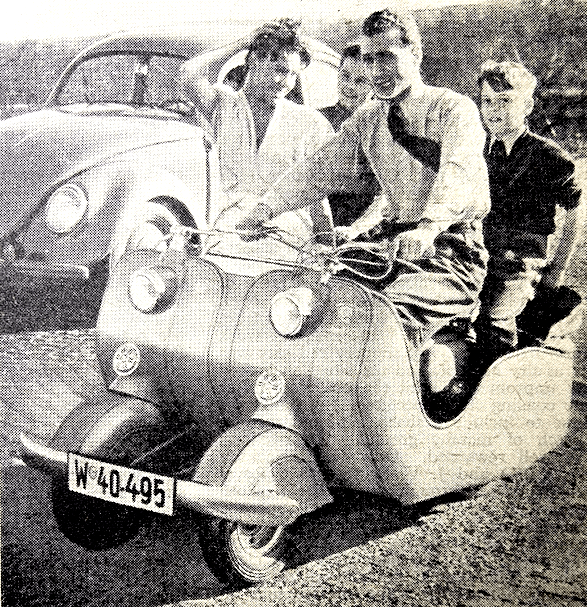
“IN LAST SATURDAY’S Wye Valley Trial, a national event organised by the Wye Valley Club, there was a tie on observation for best performance between Gordon Jackson (347 AJS) and George Fisher (122 Francis-Barnett). Both lost eight marks, but the smaller machine was handicapped in the acceleration test used to decide ties. However, Fisher enjoyed the distinction of achieving the only clean climb of Hermit’s Lane. The dry weather all but made a farce of the second hazard, situated on the open slopes of Saddlebow Hill, some 11 miles from the start at Hereford. What had, the week before, been a mass of slippery red clay was now as dry as dust, and the situation looked most unpromising until the observers (after some coaxing from spectators!) rerouted the course to include a sharp left-hand turn in a patch of marshy ground. Their efforts were well rewarded. Only GL Jackson (347 AJS) and JV Brittain (346 Royal Enfield) came through unpenalised. Both fought their way through the mud superbly. Sidecars took a different route.”
“AS A WEEKEND of speed and enthusiasm for racing motor cyclists, there is nothing in South Africa to eclipse the famous Pietermaritzburg Natal Championships and Natal ‘100’. Enthusiasm this year reached an unprecedented pitch with over 50,000 spectators packing the beautiful Alexandra Park Circuit for the second day’s racing.”

“OUTRIGHT WINNER OF THE Giro Motociclistica D’Italia, the six days’ tour of Italy for machines of up to 175cc, was L Tartarini riding a 125cc Benelli two-stroke. A 20-year-old youth (who, driving a BSA outfit, won the sidecar class of the 1952 Milano-Taranto road race), Tartarini averaged 96kph (about 60mph) for the 1,896 miles. Second was P Campanelli (also Benelli-mounted), and third was M Ventura (175 MV Agusta). Fourth, fifth and sixth places were filled by a 125cc Rumi, a 125cc MV Agusta and a 175cc Mi-Val respectively. Winner of the 75cc class was Mariani, riding a Laverda, at an average speed of 50mph. Over 400 competitors took part in the event and no fewer than 40 makes were represented. There were 140 finishers. Over one day’s route, from Riccione to Trieste, a distance of 284 miles, Venturi, on a 125cc FB.-Mondial, averaged no less than 67mph.”
“NOT A FEW motor cycles change hands on Sundays. Naturally enough, as those concerned may have no other time free. But both sellers and buyers will do well to realise a point that is involved. The transaction may involve some form of a contract. For example, the purchaser may pay a small deposit on the machine, promising to produce the balance when he calls to collect it. Something of that kind is very often done. In fact, though, the contract is not binding. That is laid down under the Sunday Observance Act of 1677, which was invoked in a recent case, and successfully. If one of the parties changes his mind after thinking it over, the deal can be called off. A lot of inconvenience could result, and all should be aware of the possibility.”
“MANUFACTURERS AND FUTURE purchasers of machines in which the 197cc Villiers engine unit is incorporated will now be able to avail themselves of a new unit embodying a four-speed gearbox. This unit is now offered by The Villiers Engineering Co as an alternative to the three-speed unit and will be known as the Mk 8E/4. Riders of lightweight machines who reside in hilly or mountainous country will obtain a more satisfactory performance from their engines and the sporting rider will have the extra ratio for conditions which have, so far, defeated him.”

“AN OUTSTANDING CONTRIBUTION to economical motor cycling has been made by the Excelsior Motor Co, Tyseley, Birmingham, who have introduced the Consort Model 53/4, a 98cc two-speed motor cycle at the extremely low total price of £63 8s 9d. Of neat appearance, the cradle frame is of brazed-lug construction, having single top and front down tubes. Webb forks with a central spring are employed. These are made from a pair of high-quality tapered steel tubes, tapped and drilled at the lower extremities for the front-wheel spindle, and joined at two points by cross tubes. Rubber lock-stops are fitted to the cross-piece of the head stem, carried in ball bearings, and both these and the fork links are adjustable. Attached to the frame, at three points, is the latest-type, petroil-lubricated 98cc two-stroke Villiers engine and two-speed gearbox unit. Both crankcase and gearbox castings, as well as the cylinder head, are of light alloy, the barrel being of iron.”
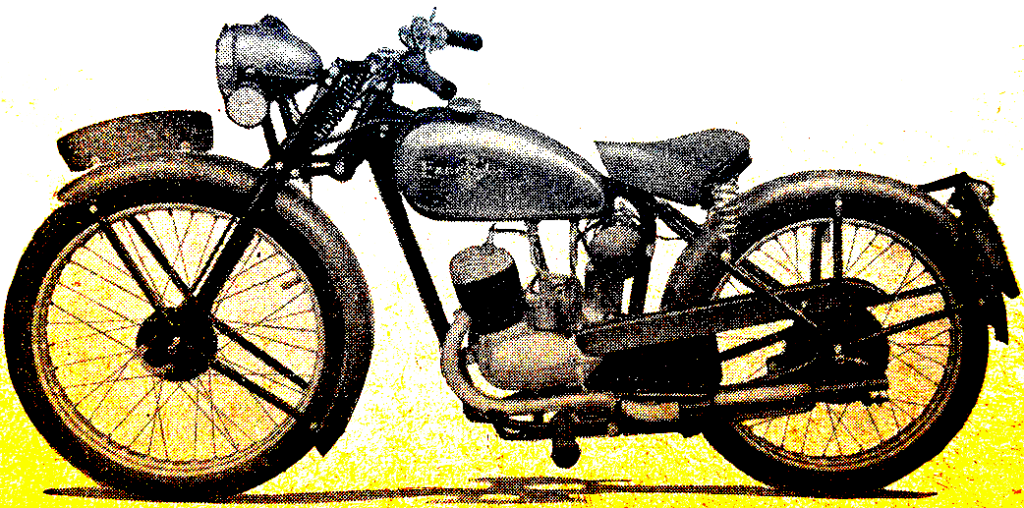
“LAST SUNDAY HALF BELGIUM, it seemed, thronged the 13.6km Floreffe course to see the first encounter of the season between British factory riders, most of them on new and still hush-hush TT machines, and to watch the elite of the ‘Circus’ do battle in the 20th Circuit de Floreffe, organised by the Royal Motor Union Namurois. In the ¼-litre race Fergus Anderson came to the line with his 248cc four-valve twin-carburetter Guzzi which, during practice, had caused lifted eyebrows among riders in the 250cc class and also among the 350cc fraternity. Anderson justified this apprehension by piling up a long lead and returning lap times well in excess of Mastellari’s fastest at the last Floreffe meeting two years ago. His nearest rival was Bill Lomas, enjoying a first outing on a new NSU. It looked as if Lomas had resigned himself to runner-up honours when, on Lap 5, he came past the Tribunes in first position and with a very long lead. News filtered through to the effect that Fergus had blown the motor up. Tommy Wood (Guzzi), who had been scrapping with the German R Meier (DKW) early in the race, also disappeared from the leader board. He had run out of road and motored sharply into the local river! Lomas sped on to win and the German national anthem and then ‘God Save the Queen’ rang out across Floreffe’s sun-dappled woodlands. If Anderson’s misfortune removed one dark-horse intruder from the Junior class, none could ignore the possibility of the snarling NSU outpacing some of the 350s. Lomas was comparably fast on the straights but took his corners sedately and, consequently, did not improve on the seventh position in which he was riding just behind Kavanagh on Lap 1. The Australian quickly pulled up, displacing D Farrant and R McIntyre (348 AJS) and then overhauled the three-valve 7R of E Ring to join his fellow team men, S Lawton and Ray Amm, who

swapped the lead on successive laps throughout the race. With this consolidation achieved, serious opposition to a 1-2-3 Norton win seemed to collapse for Bill Doran, also on a three-valve AJS, had suffered a very bad start and remained too far back to be able to help Ring or McIntyre break up the Norton spearhead. As if to mark the occasion, Amm turned in an 89.95mph lap, substantially beating the previous best in both the 350 and 500cc classes. Joe Craig came up smilingly with his team to take a bow and help carry the bouquets. And with an equally charming smile, plus considerable wisdom, declined to talk to questioners about the AC pumps which had been fitted into the fuel line of the Nortons at Floreffe on Sunday. ‘Time enough later…’ he grinned. Four riders dominated the sidecar event. ES Oliver and C Smith (499 Nortons) both away to a good start, set a pace which, while it could not be challenged, might be imitated, and it was the two Belgians, J Deronne and M Masuy (499 Nortons) who, by Lap 2, were delighting the crowd with a wheel-to-wheel ride. The two leaders rode a close race for the opening laps but at half-distance drew away. Oliver seemed to have Smith beaten but a lead came adrift from his electric fuel-pump mechanism, costing him 19sec. Despite an effort to gain lost ground, during which he lowered his own previous lap record by 3mph, Oliver could not beat Smith to the chequered flag. The Frenchman, J Drion (499 Norton sc), who had ridden a steady race, finished third, followed by the Deronne-Masuy partnership in which, during the closing phase, Masuy forced the issue by practically taking to the

rough a few yards from the flag in order to finish fourth. J Wijns (499 Norton sc) was sixth behind Deronne. As if to set the seal on a day of unbroken success, Amm, Kavanagh and Lawton stationed themselves at the head of affairs as soon as the flag dropped for the start of the 12-lap Senior race. Kavanagh, who had not enjoyed things all his own way in the 350, was clearly bent on a 500 win, and so was Amm. The Rhodesian, using a form of trailing-link fork suspension, rode a fine ding-dong race with Kavanagh which delighted the crowd—though their real interest lay on a scrap going on midfield between D Farrant, on a 7R, Phil Heath, and their own hero, A Goffin (499 Norton). Between that trio and the flying Nortons were sandwiched Rod Coleman, on an AJS Porcupine, and McIntyre, doing wonders with one of the early factory Matchless twin racers, forerunner of the current G45. That he finished the bumpy, twisting 163km in fifth position, ahead of a long strung-out echelon of more orthodox racing models, augurs well for the future of this interesting machine. Weakened by Doran’s dropping out, due to a tumble in Lap 1, the AJS team-men held their own but could not improve on their position. And to emphasise the point, Amm rounded off a fine ride by shattering Les Graham’s 1950 500cc lap record. More flowers, more music, and the British National Anthem for the fourth time that day. RESULTS 250cc International Race (8 laps): 1, W Lomas (248 NSU), 83.48mph; 2, C Pelluti (Guzzi); 3, R Fauchereaux (Guzzi). 350cc International Race (10 laps): 1, S Lawton (348 Norton), 87.13mph; 2, K Kavanagh (348 Norton); 3, R Amm (348 Norton). Sidecar Race (8 laps): 1, C Smith (499 Norton sc), 74.79mph; 2, ES Oliver (499 Norton sc); 3, J Drion (499 Norton sc). 500cc International Race (12 laps): 1, K Kavanagh (499 Norton), 91.45mph; 2, R Amm (499 Norton); 3, S Lawton (499 Norton).


“AN EXCELLENT TOTAL of 252 entries was received by the Civil Service Motoring Association for the annual Services Trial, run last Sunday in bright sunshine on Bagshot Heath, Surrey. A 15-mile course was plotted, including 24 sections, and the odd and even numbers system of covering two loops of a figure of eight was used. The five Services—Royal Navy, Army, Royal Air Force, Police and Civil Service—were all fully represented in the team section of the competition. The Navy had eight trios, the Army 14, the RAF nine, the Police 18 and the CS 25. Eleven of the Army teams used standard Service machines and eight of the police teams were so mounted. On account of the double loop arrangement and the open go-as-you-please nature of the Heath, it was a little difficult for the large crowd of spectators to follow the trial logically, especially towards the end when the two loops started to overlap. However, as the time factor played no part in the marking (on the 1, 3, 5 principle) every competitor had plenty of opportunity to find his way to each of the sections, mostly in the Water Tower and Tunnel Hill areas. On Section 24 (Telegraph Hill) one of the neatest climbs noted was that of Mrs B Naylor (CS, RAE) who handled a 125 Tandon (with a special alloy cylinder head) in exemplary fashion. The celebrated PC R Jamieson (Met Police, No 2 Dist), who last week figured in the newspapers when he chased a cosh bandit through a block of Hackney flats on his motorcyc!e (sic), made a polished ascent on his standard 5T Triumph. From HMS President, A/B R Campbell (RN, 350 AJS), was good and the RAF was well represented by J/Tech JN Beaumont, who took his 200 Francis-Barnett up effortlessly. Not so neat, but non-stop, was Air Cdre 0T Caril-Worsley (FT Command, RAF, 350 Ariel). Two TRW twin side-valve Triumphs from the FVRDE, ridden by W Randall (CS) and Maj RW Holmes, performed smoothly and well. Perhaps the fastest ascent of all came from G Milbank (CS, MoS), whose BSA Bantam carried him up at great speed. Among the soldiers on standard mounts, easily the quickest and cleverest noted

were Lieut DGM Start (10 Coy RASC, MT) and Gnr M Sackett (79 HAA Rgt, RA); both used 350 Matchlesses. Over a series of ‘wiggle-woggles’ laid out among the trees near the Water Tower, Gnr G Owen (31 Trg Rgt, RA) showed up very well among the standard Service machine users while, through a tricky mud-hole section, SAC PG Brockett (RAF Martlesham) was outstanding on a Triumph. RESULTS Services Trophy (best individual): TJ Maynard (CS RAE, 200 Francis-Barnett), 0 marks lost, ST 10.2sec. Arbuthnot Trophy (best Naval officer): Lieut (E) MH Bolus (RN, HMS Thunderer, 200 James), 18. Dolphinian Trophy (best lower deck entrant): A/A BNJ Scull (RN, HMS Curlew, 350 BSA), 11. WH Jago Cup (best Army entrant): L/Cpl JSH Bray (Army, RASC Trg Unit, 350 BSA), 1. FJ Milner Cup (best RAF entrant): AC1 RJ Rix (RAF, 500 Ariel), 0. Graham Walker Cup (best Police entrant): PC A Vickers (Police, Durham CC, 350 BSA), 3. William Charles Crocker Cup (best Civil Service entrant): LM Talbott (CS, AMWD, 350 BSA, 1. Special Award (best 125cc): LG Millbank (CS, MoS, 125 BSA), 1. Special Standard Service Machine Awards: Army, Gnr J Robb (79 HAA Rgt RA, 350 Matchless), 15. Police (Henry Dalton Trophy), PC JR Thornthwaite (Met Pol, 500 Triumph), 30. The Motor Cycle Team Trophy (best six from any one Service): Civil Service, marks lost, 11 (Maynard, 0; Talbott, 1; DC Hull, 350 Norton, 1; AGL Bryant, 200 Francis-Barnett, 1; WG Earnshaw, 350 Matchless, 2; L Francis, 500 Norton, 6).”
“THE A-CU GENERAL COUNCIL has opened a nationwide competition for a motto which will epitomise its aims and achievements. The competition is open to all and the prizes offered are a BSA Bantam, £25, £15 and £10. In the Union’s own words, its objects are the furtherance of ‘safety first’ through training schools, the encouragement of the sport and pastime of motor cycling and the ‘improvement of the breed’. Mottos may be in English or Latin. If a quotation is used, the source must be stated, and, in the case of a classical quotation a translation should be appended.”


“ANY SHADE OF BLACK! That purchasers of motor cycles should be given the choice of at any rate two or three different colour schemes for their mounts is a contention that has often been raised. Car buyers are given an option, and so are cyclists. Folk in certain overseas markets like nothing better than an eyeful of colour. That applies not only to primitive peoples, by any manner of means, and there are parts of Europe where even things like motor cycles are chosen largely for their finish. A specialist in the export trade was saying to me only recently that British industry will have to take more notice of this fact than has been its habit hitherto. It might be that the overseas demand for more colourful motor cycles will lead to their becoming available in the home market.”
“FROM THE BOND AIRCRAFT and Engineering Co, production of the Gazelle scooter has been taken over by Projects and Development, Coventry Works, Blackburn, Lanes. The prototype of a new model has been made and production is anticipated to commence shortly. A 98cc Villiers engine is fitted and a number of modifications to the frame layout have been made. The fuel tank has been moved forward under the saddle to leave the rear carrier free for luggage or a pillion seat. The braking system has been altered and the control arrangement changed from heel to toe operation. It is expected that there will be little or no change in the price which will be approximately £98, including PT. Plans for fitting a 122cc engine are in hand.”

ALTHOUGH the final appraisal of the new 35cc BSA ‘Winged Wheel’ must rest with the buying public, it would appear that the efforts of BSA Cycles, of Small Heath, Birmingham, to present a motor attachment for bicycles which combines attractive appearance, economical but adequate performance, safe operation and simple maintenance have been successful. None can deny that the compact and neat exterior of the recently announced motor wheel, characteristically green in finish, is good looking. With a claimed power output of 1bhp and a fuel consumption of 200mpg the performance should be at least satisfactory, while the incorporation of an outsize internal expanding brake in the unit overcomes the most doubtful factor in cycles to which an engine is fitted. Maintenance of this type of two-stroke power unit is usually confined to the removal of carbon deposit from cylinder head and silencer. Therefore, of all parts of the Winged Wheel, these have been planned to be the most accessible. The transmission is quite positive, and utilises a train of internal gears operating in a self-contained oilbath; the system is quite unaffected by water. No friction roller, of course, is employed and tyre wear should be very little above that to be expected from a machine operated solely by pedals. It is unlikely that the gears will need servicing for long periods, other than for attention to the oil level. No ‘fitting’ in the normally accepted sense is required and the unit can be installed in a few minutes. Electrical equipment is by Wico-Pacy and the flywheel-magneto-generator supplies a 6v output for 6w head and 3w tail lamps and high tension current for ignition. As a complete unit, including the petroil container, the Winged Wheel costs £25, there being no purchase tax chargeable.”

“TWO NEW CYCLEMASTER motor-assisted – bicycles have been introduced. One, called the Pillion, is substantially the same as the current Mercury model except that it is fitted with a pillion seat and foot-rests. The pillion seat is of the sponge-rubber pad type and is unsprung. It is fixed to a sub-frame which is secured to the frame saddle tube at the front, and to the rear-wheel spindle. The other machine, known as the Roundsman, is, as its name implies, a commercial delivery model. It closely resembles the usual delivery bicycle with a small front wheel and a large carrier mounted over the wheel. The machine is capable of ‘transporting 1cwt of goods. In both cases the machines are equipped with 2in-diameter tyres. The Roundsman is not subject to purchase tax, and costs £47 5s complete. The Pillion model is sold in two units. The bicycle (minus rear wheel) is priced at £17 19s 9d, and the rear wheel with engine costs £27 16s 6d. Makers are Cyclemaster, 38A, St George’s Drive, Victoria, London, SWI.”
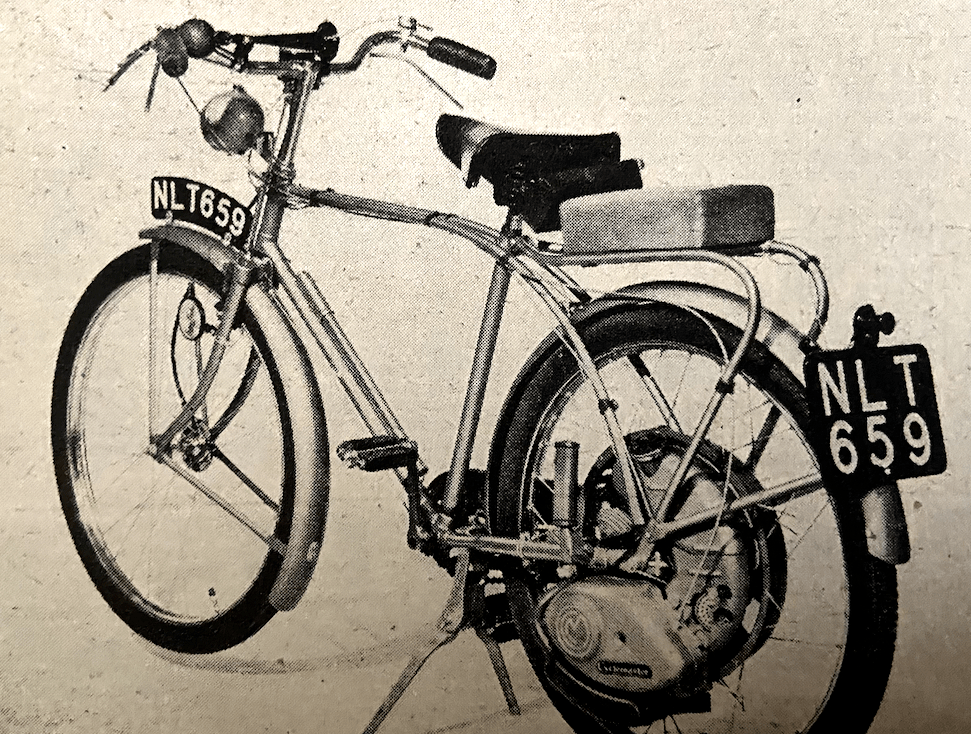
“THE RACING REPUTATION of two-stroke enthusiasts John Hogan and his brother Peter has become enhanced by successes with BSAs in numerous British events. Believing, as many do, that the performance of the simple type of single-piston two-cycle engine is capable of considerable improvement, the Hogans have applied countless man-hours to research and, as a result of theory, substantiated by practical experience, they now offer an improved type of alloy cylinder head for BSA Bantam owners whose first requirement is to extract a little more urge for touring purposes and who, perchance, also toy with ideas about 125 racing. The critical factor, according to the Hogans, is the compression ratio, which can be stepped up considerably without, as is popularly thought, padding the fly-wheels or otherwise altering the bottom end of the engine. The average man-in-the-street rider obviously does not wish to disturb the crankcase assembly, but can easily modify the top-end, for which reason the Hogan brothers are now marketing a cylinder head component giving a 9:1 compression ratio. This head, a well-designed alloy casting with optional anodised finish, is the major component in their conversion kit, complete with instructions indicating how the ignition timing should be retarded to cope with the altered flame speed resulting from the head modification.”

“RIDING IN THREE HEATS and three finals, winning them all, recording the fastest lap in each and the best for the day (82.23mph), John Surtees, using 348 and 499cc Nortons, established himself Master of Snetterton last Saturday. The meeting, held under an A-CU open-to-Eastern Centre permit and organised by the Snetterton Combine, made history in that motor cycles have never previously used the 2.7-mile Snetterton airfield circuit, near Thetford. To mark the occasion, Geoff Duke was present and, with a one-lap tour d’honneur on Denis Parkinson’s Norton, declared this new East Anglian track well and truly open.”

“A CONVINCING DEMONSTRATION of high-speed reliability was given by Reg Armstrong and Dickie Dale in their first race on Gilera fours. For the 500cc class in last Saturday’s Leinster Two Hundreds meeting—held over the 8.34-mile Wicklow Circuit—was that rather than a race proper. Armstrong made one of his excellent get-aways and was six seconds ahead of Dale at the end of the first lap, with L Carter (Norton) and FM Fox (Norton) another six seconds behind. Armstrong’s 86.27mph standing lap was only four seconds outside Artie Bell’s lap record of 87.27mph, made on a works Norton three years ago. On his second lap Armstrong bettered the record by a second and then slowed by about four seconds a lap until, by half-distance, Dale was on his tail and Carter, who had shaken off Fox—and equalled the new lap record in the process—was a bare five seconds in arrears. An accident occurred when WJ Sargent (Norton), engaged in a tussle with another rider, went wide on the fast right-hand bend coming out of Rathnew village and struck a wall, sustaining head injuries from which he died on the way to hospital. At two-thirds distance the Gileras received a ‘faster’ signal and, despite some melted tar on parts of the course, drew away from Carter to the tune of five seconds per lap. Dale raised the lap record to 87.79mph, Armstrong responded with 88.31mph on the next lap to Dale’s 88.05mph and they went on to win with the Dublin man 14sec ahead, winner of his fourth successive race on this circuit at the record speed of 87.05mph. Carter eased off when his chance of challenging the Gileras had vanished, finishing 31sec behind Dale, but 20sec ahead of Fox. Fifth place went to Carter’s younger brother, Gerard, riding a borrowed single-cam Norton to good purpose, while a remarkable performance was put up by a local rider, 0 Sheridan, who averaged 65.47mph on his familiar 29-year-old Sunbeam. FC Dickson (Norton), who had won the 350cc class in the previous week’s Phoenix Park races, had an easy win once again, for CG Griffith (AJS), who had been fancied to make amends for his bad luck two years ago when a broken chain on his last lap cost him a win, was 1½mph down on his previous performance and finished two minutes behind, without ever being in a challenging position.”


“EDINBURGH, SUNDAY MAY 3. This morning the activity at the official garage in Roseburn Street was much greater than yesterday but even so it appeared more leisurely than in past years. Seems that many riders have gone more thoroughly into getting the model ready in time. In the summery warmth the Trade Barons supplied their fuels and tyres and plugs and oils and the mobile workshops were in demand, but nowhere did I see any signs of urgency or last-minute panic. Everything proceeded peacefully towards the handing-in process which began at 2pm. Among the machinery the most noticeable difference from last year’s models was the four-speed gearbox with which many of the 200cc ‘tiddlers’ are now equipped. On account of the extra bulk of the new box, some riders have found difficulty in arranging a satisfactory footrest position. Ted Breffitt has solved that problem for himself by practically rebuilding the entire frame of his Sun. He now reckons that he has got at least 9½in of ground clearance and has managed to bring his rests well forward. Another very well planned handlebar and footrest layout was seen on HR Kemp’s James. Protecting the flywheel magneto from damage on rocks has led several prudent men to fix up steel shields for this vital and somewhat vulnerable component. The popularity of the small two-stroke as a trials machine grows with every year and the

possibility of even a 125cc victory is being regarded quite seriously, though most of the form-watchers reckon that 1953 will turn out to be a battle between the two Johnnies, Brittain and Draper. FORT WILLIAM, MONDAY, MAY 4. Yet another beautiful morning greeted the ‘Scottish’ competitors when they set off from the capital at 8am on their 179-mile journey to Fort William. A clear run northward through Perthshire brought the route to the opening hazard, Scotstoun (three sub-sections), a fairly easy loop off the main road six miles south of Aberfeldy. Familiar to the old hands, it caused no trouble among the kingpins. Then, just outside Aberfeldy, came Weem Hill, a new section sub-divided into two pairs of three sections on an open track across the hillside. A mixture of earth and boulders in a trench, it was not thought by the organisers to be difficult, but all the same it soon started some excitement—much of it probably due to early attacks of nerves. Many of the lesser-known tiddler riders romped up the lower, more difficult, sub-sections but stars such as GE Fisher (125 Francis-Barnett), EW Smith (200 Francis-Barnett) and PN Brittain (150 Royal Enfield) lost three marks apiece for footwork. When the big fellows made their appearance there was a sensation practically at once. After making a careful inspection of the hill Johnny Draper actually dropped his 500 BSA. within a few feet of the ‘Section Begins’ card

on the easy ‘rabbit’s run’ into the hill. Rival Johnny Brittain helped him to pick up the model. Among other early numbers to lose marks was Ted Usher (350 Matchless), who needed one steadying dab. After the petrol stop at Fortingall came the 10 sections of Meall Glas—in almost the same state of stony hardness as last year. Very good over the boulders was PF Hammond (500 Triumph). On the other hand, Johnny Brittain was out of luck here and had to foot. Kinlochrannoch’s rock-strewn heights came next and straight away HR Kemp (200 James) demonstrated that it could be climbed by a two-stroke; later Fisher showed that even a 125 could do it After the buzz of the two-strokes had died away, the crowd sat up for the arrival of the two Johnnies. Draper recorded a perfect climb, but Brittain made his approach to the hardest Number 2 sub-section, with its left-hand sweep, too fast, and needed one dab. A similar fate overtook Ted Usher. There-after all the head men made good climbs but not a few had to fight hard to maintain balance. With the sun still blazing over the mountain tops the cavalcade then tackled the two sections of Meall na Moine, a newcomer, not exceptionally hard, and then headed for Fort William and Town Hall Brae’s two short, sharp, starred sections to round off a brilliant day. With half its width taken up by concrete steps, laid to ease the ascent for those who

climb the hill on foot, the Brae, which is to provide the sting in the tail of each day’s run, took a considerable toll of marks this evening. Tom Ellis registered a failure when he ran hard into the wall, and it looked as if he had given himself a nasty shaking. FORT WILLIAM, Tuesday, May 5: Yet again, superb sunshine spread over the Highlands when competitors set out this morning on the second sortie. This commenced with the two-section ‘starred’ scamper up M&D, the rocky footpath opposite the Grand Hotel, and then led away to the north-east, alongside the Caledonian Canal, to Spean Bridge, and thence to Roy Bridge, near which was located the newcomer, Chunaig. This double section ‘starred’ hill was over damp earth, and included one hairpin bend. PN Brittain (150 Royal Enfield) was unlucky when his front wheel slipped off the 3ft. path. Among the rest of the small machine riders, GE Fisher (125 Francis-Barnett), Kemp and HW Thorne (200 James) were all clean. CP Dunne (200 Francis-Barnett), JG Stewart (200 Sun) and W Coulson (200 DMW) each needed one steadying foot. Among the masters, Jackson, Rex Young, Smith and ‘Nipper’ Parsons were caught with their feet down. Back on the main road the yellow dye laid a trail through Newtonmore and Kingussie to Kincraig, in the heart of the Badenoch Forest district that is steeped in Highland tradition and typifies Highland beauty. Here, overlooking romantic Loch-an-Eilan, stands Inchriach, a towering crag with a terrifying track criss-crossing up over its face to the cairn, a thousand feet in the sky. Some idea of its precipitous and giddy nature can be gained from the fact that at one time it was used by Indian Army troops to train pack mules! Goodness knows how many hairpins there are—riders and spectators were far too anxious to avoid a false move that might mean a sudden disappearance over the edge, to make a count. The first five sub-sections ended in a short ‘no man’s land’ and then followed five further, and even more atrocious, ‘subs’. It was quite impossible for one man to observe all the hill, so a stance was taken near

the top, where some of the worst going existed. One by one the two-strokes struggled up then bounced, bumped, stopped and fell, the riders lying panting and exhausted in the heather. They had little hope of a clean climb—or even of getting up non-stop. George Fisher, of course, was outstandingly supreme, handling his 125cc Francis-Barnett with incredible skill. He simply would not give away a trick and succeeded in scaling all 10 subs with a loss of nine marks (three foots) only—undoubtedly the finest effort of the day. When the big boys arrived it was seen that they were not going to fare much better than the tiddlers. Furthermore, the whole thing got even more difficult to follow through persistent baulking. There was no apparent method of controlling the hill—by whistles or flags for instance—and several times there were as many as three riders in a section at once. Probably the best climb came from Parsons. Undeterred by the gradient he forged his way up to the ninth ‘sub’, to find it already occupied by two stranded competitors and a bunch of shoving marshals. Without even wasting breath to cry ‘baulk!’ he just motored on, scattering officials, and brushing past fallen rivals to bulldoze his way to the summit. But for sheer artistry the palm went to Johnny Brittain for the magnificent way in which he heaved his front wheel over the wall of rock that stopped at least half the entry. Hugh Viney made it nonstop, but it was an awkward climb. Poor Don Evans, who was riding with his back strapped in plaster (cure for a slipped disc), dropped his machine over one of the precipices and suffered an unpleasant-looking tumble. Another incident occurred at the foot of the hill when Jeff Smith, having finished his climb, was motoring off to the nearby next observed hill, Ord Ban. On a sharp corner he met, coming in the opposite direction and on the same side of the road, the Canadian, C Venier. Jeff Smith spilled, cutting a hand and buckling his front wheel until it was almost square. Nevertheless, he climbed Ord Ban before taking out the wheel to hammer the rim roughly true. Albeit, he continued—minus several spokes and with very little time in hand. In fact at the next check he lost two marks, which were subsequently washed out by the stewards. Ord Ban consisted of six hairpins zig-zagging up a steepish bank through a wood. Not all that hard, it nevertheless surprisingly caught both Peter Hammond (500 Triumph) and Bob Ray (500 Ariel) for three marks each for footwork, and Fisher for a stop. Town Hall Brae ended the 129-mile run, cut short because Corrieyairack is snow-blocked and impassable, to the great relief of most who felt that they had already lost quite enough marks. Even so, ‘The Brae’ collected a few more—three from Fisher and four from Gordon Jackson, who yesterday climbed it, and every other section, clean. Viney who now leads lost all his 13 marks on Inchriach. FORT WILLIAM, Wednesday, May 6: Already midway through the week the probable ultimate winner Hugh Viney, victor in 1947, ’48 and ’49, stands clearly at the head of the list. To his total score up till last night of 13, he today added only eight more marks and that over a 178-mile route that had the majority of his earlier rivals thankful to get home with a tally in the region of a score. Hugh’s total of 21 now gives him a nine-mark lead over ‘Nipper’ Parsons who rode brilliantly to

notch a loss of only nine…A loss of 39 put HR Kemp in seventh place and in a safe lead in the tiddler class. General disappointment was felt when George Fisher had to retire from his place in the lead of the 125cc class. He broke the front down tube off short below the head and rode home with the frame roped together. Thus ended a brilliant bash on his first ‘Scottish’ in lovely sunshine that continued until dusk. M&D opened the route, which then followed the Mamore road to Martuim, outside Kinlochleven. On this climb, over loose rocks with a damp turf surface, WJ Hutton (200 Francis-Barnett) and GEH Godber-Ford (200 Dot) were both clean on the first two sub-sections. JS Oliver (125 BSA) found the gradient too much for his small machine but he refused to drop a foot until it was too late to recover…Among the bigger fellows in the lead, Viney suffered a single failure and Parsons footed in two sections. The old Glencoe road led through Crianlarich to Camushurich on the banks of Loch Tay. Craftily prearranged with a wide assortment of stones and boulders, this well-known terror was in a difficult mood. Nevertheless, A Tedbury (200 Dot) and EW Smith (200 Francis-Barnett) soon showed that a two-stroke could cope with the loose rockery and the solid stone ledge on the famous hairpin. GB Martin (250 BSA) needed only one dab, and then came Draper with a masterly ascent. Ellis, Jackson, Tye, Brian Martin of the Army contingent, Ray, Geoff Smith and E King were all clean, and finally came Viney, with an almost miraculous climb over an entirely new line that only his cleverness could have discovered. The 10 sections of Meall Glas were tackled before the lunch check, and here Draper got into difficulties for the first and last time in the day; a foot and a lost three marks when his cap fell over his eyes, temporarily blacking him out. After lunch came Kinlochrannoch. The first man to arrive, B Butt (200 Norman), was clean on each section. Thereafter, the majority of the leading riders were unpenalised, although G. E. Fisher climbed the diagonal rock slab too quickly and aviated his front wheel as he left the last step. Two heavy dabs were required to correct this and then he motored smartly into the bank, needing another dab to regain control…Ted Usher attempted to tackle the diagonal stone slab squarely and, in doing so,

hit the bank at the edge of the section; three marks lost for a couple of dabs. Attempting the same path, DS Tye fell in trying to avoid hitting the bank. SB Manns (350 AJS) followed in Usher’s and Tye ‘s wheel tracks and actually had his front wheel over the bank—two foots again. Viney took a similar path, crossing the section from extreme right of the hairpin to the left bank, and rode along the top of this—a superb exhibition of path picking and balance. It was on this hill that Miss L. Blackburn retired with a broken rear wheel spindle and, in the same vicinity, Pat Brittain had to give up with gearbox trouble. Yet another trip along the Laggan Loch road returned the trial to Town Hall Brae and, here again, the complexity of the hill produced some astonishing results, many of the experts footing like novices, while some of the lesser-known men soared up with no bother at all. C. Venier, the Canadian who had been involved in the spill with Jeff Smith, retired at the start, having suffered a leg injury. FORT WILLIAM, Thursday, May 7: Surely there has never been a better trial than this in the long story of the ‘Scottish’! Even the veterans cannot recall such a wonderful, sustained spell of sunshine, whilst as to the outcome of the event, the situation is getting so critical that the fight to the finish is as exciting as a road race. When Hugh Viney went to bed last night it looked as though he had the Alexander Trophy in the bag. But that unassailable-looking margin of 9 marks that protected him on Wednesday has, as a result of today’s outing, dwindled to only three. True, it is his team mate, Gordon Jackson—suddenly risen from the obscure depths of the scoresheet—who threatens him, but, only four points away, are three of the ‘opposition’ who are likely to give no quarter tomorrow; they are, Johnny Brittain, who has pulled up magnificently, ‘Nipper’ Parsons and Bob Ray, all with 39 marks lost. And Ray has another combat on his hands—Johnny Draper, four marks behind, is going all out for the 500cc Cup. M&D began the 168-mile route and made no difference to the experts. But the next item on the programme, Martuim, started Hugh’s day off badly, for the slow-running AJS stopped altogether, and bang went five marks. A similar score went against Draper, while Jackson and Parsons each lost three. Brittain ‘cleaned’ the whole lot. A big crowd on Mamore raised a cheer when AML Mclean (200 DMW) of the Edinburgh Club roared up unpenalised. He was the only two-stroke rider to make it…Next to earn a cheer was Draper, who brought off one of his typical, daring

manoeuvres, riding high up the bank at Flook’s Bend, scattering the – crowd wildly over the mountainside. Best run of all was Geoff Broadbent’s on his Royal Enfield—fast, steady and confident…A big hand, particularly from his Yorkshire supporters, was given Dudley Brown for a fine ascent on his Norton. Over the Mamore road the route led us through Fort William and across the Canal into the Lochailort area, where the Drover’s Road was followed round the Peninsula. Here came Gordon (one section), Ravine (three sections) and Bay (three sections) Hills, all ‘starred’. Gordon was not difficult. Ravine was a different matter altogether. The first ‘sub’ was dry and dusty, but the second and third were damp. At the rock outcrop in the third ‘sub’, early numbers with their spinning wheels had dug a hole right on the approach line and this greatly increased the difficulty for the later men. Viney’s arrival at the section brought a cry of apprehension from the onlookers, for his slow approach and climb of the first ‘sub’ was clearly misjudged. He had not sufficient momentum to get over the step into the second section, though he tried hard to lift the front wheel. A dab was required to complete the operation, but he had not regained balance when faced with the sharp right turn and had to foot all the way round. Then, in the third ‘sub’, the machine took charge and Motor Cycling’s man had to retire smartly out of the way as the maestro lost another three. Indeed, he was lucky it was not five. Gordon Jackson and Brittain were clean, Parsons, Ray and Draper all lost three. The disastrous Ravine must have still been on his mind when Viney tackled Ray Hill, for he chose a path too far to the right, and loose stones there quickly threw his front wheel off course, necessitating hard footwork to regain balance. Hammond, Usher, Draper, Parsons, Alves, Wicken, Tye, Ellis and Evans all brought off excellent climbs. Taking a different line, Brittain. Broadbent and Ray were also clean. Back to Town Hall Brae, and there Johnny Brittain—with father, Vic, who arrived this morning, looking on—had to go and blot an otherwise clean sheet for the day by footing—not just a dab but genuine three-marks prawning! But for that, he would have been only one mark behind Viney. FORT WILLIAM, Friday, May 8: Into the bright sunshine this morning went the survivors of the hardest fought ‘Scottish’ in history. Mamore was the first objective and, as yesterday, several of the smaller machines made light work of it, GEH Godber-Ford (200 Dot) being particularly good. Among the ‘works’ team men on whom all attention was focused in view of the closeness of the issue Viney, Jackson, Brittain, Draper, Ellis, Alves and King all got up scot-free, but Parsons, Mellers and Tye sacrificed three at least, while Ray, Kemp and Usher all registered failures. From Mamore the Fort William-Ardgour road was followed to Kinlochmoidart and the Devil’s Staircase, where a big crowd had gathered on the hillside overlooking the series of tight, rockstrewn hairpins. Straight away, R Armsden (200 Francis-

Barnett), Tedbury, Kemp, PJ Marr (200 Francis-Barnett), Holme and AJ Wright (200 Francis-Barnett) made clean climbs in the Lightweight class. Breffitt had one dab (one mark lost) and Ernie Smith lost three…Johnny Brittain’s climb was a copybook example; with the engine maintaining the same steady tickover throughout, he pursued a deliberate, unwavering line right through the five hairpins. No better climb was made later. WA Bell of the Army was given a big cheer for a neat, clean effort. Then came Parsons, with no penalty and Alves who lost one mark. Don Evans got into real trouble and lost six—one for a dab in the first subsection and five for stopping in the second…E Rice (500 Norton), of the Knock MCC, earned a big cheer, especially from Billy Kelso. Suffering a bad day when he needed every point in his fight for the 500cc cup, Bob Ray dropped the model on the second and a few minutes later E Sellars, also on a 500 Ariel, did exactly the same thing…Then arrived the Maestro—with jaw grimly set, and in a deathly silence from the ranks of spectators. Hugh Viney virtually set the seat on his fourth ‘Scottish’ victory with a fine climb. He went on to romp up Bay and Ravine and, to the echoes of deafening cheers from the entire child population of Fort William, he brushed aside Town Hall Brae and M&D to ride into the storage garage with a clean sheet. Team mate Jackson was also unpenalised —but what stopped Johnny Brittain from also handing in a clean card? His old enemy, Town Hall Brae filched a final mark from him tonight. Had it not been for that one hill—on which he has lost eight marks during the week—Johnny would be leading Viney by three points instead of coming third. EDINBURGH, Saturday, May 9: With a catchy Scottish dance tune, played last night at George Simpson’s’ excellent film show, still ringing in our ears, we said goodbye this morning to Fort William and left the Highlands still smiling in the heat haze of another lovely day. For all but two unlucky men, who broke down en route, it was an uneventful run to Edinburgh’s Blackford Hill, the special tests and machine examination; in the riders were docked last-minute marks, including Tom Gilfillan, Stan Holmes and David Tye. In the evening there was a big gathering in the George Street Music Hall where Edinburgh’s Bailie JB Mackenzie and Fort William’s Provost J Carmichael handed over the already engraved awards. The ‘Scottish’s’ grand old man, Jimmy Alexander, was there to see his trophy go for the fourth time since the war to Hugh Viney, final winner of a strenuous trial. This is the second trophy he has had, for in 1949 he won the award outright after the hat trick of successes in the first post-war events. Viney rode with brilliant judgment; after a good start he lost many marks but kept his head and fought back to end the week in a magnificent manner with three points in hand on his team mate, Gordon Jackson. Of the record entry of 188, seven were non-starters and 32 did not finish the course. It was a stiff route containing several new features as well as new hills. Unfortunately, there were some accidents and one rider, AW Hunter, of the Tynemouth &DMC, had to be left behind in hospital. And so with a dance and a dram in the Assembly Rooms ended a wonderful week with the Scots singing ‘Will Ye No’ Come Back Again?’ and the Sassenachs declaring they were ‘No Awa’ to Bide Awa’.'” RESULTS JR Alexander Challenge Trophy (best performance): BHM Viney (350 AJS), 35 marks lost. Lochaher Challenge Trophy (second-best performance): GL Jackson (350 AJS), 38. Nelson Challenge Trophy (third-best performance): JV Brittain (350 Royal Enfield), 40. PS Chamberlain Challenge Trophy (best ‘Scottish’ newcomer not having won a named trophy or class award in a trade-supported trial): JE Wicken (500 Triumph), 72. Ben Nevis Challenge Trophy (second-best performance by a rider eligible for the Chamberlain Challenge Trophy: WJ Hutton (200 Francis-Barnett), 85. Manufacturers’ Team Trophy: AJS Motorcycles (BHM Viney, GL Jackson and SB Manns), 148. Club Team Trophy: Sunbeam MCC (GJ Draper, JV Brittain and GL Jackson), 122. Ladies’ Prize: Mrs M Briggs (200 DMW), 339.”

“FORTUNATE INDEED WERE those who took part in the 1953 Scottish Six Days Trial for they enjoyed a spell of sub-tropical weather the like of which has not been experienced in Scotland for over 160 years. Whether they rode in the event, acted as officials or just came to look on, none of the ‘Scottish’ party staying in Lochaber last week will ever forget the breath-taking beauty of mountain and moor, loch and glen, dressed in their delicately shaded early summer finery. To have the opportunity to appreciate such scenery under such ideal conditions is a privilege that rarely comes more than once in a lifetime. In other ways as well this year’s ‘Scottish’ was especially good. The Clerk of the Course is to be congratulated on a well-selected route with plenty of variety. His titbit, the one unclimbable hill, was perhaps a little too much of a good thing and there was general feeling that the speed schedules could well be reviewed and relaxed. The employment of checks so ‘tight’ that racing on public roads becomes a necessity, if marks are not to be lost on time, is no good for the trial nor the sport. Nor for the safety of the competitors, several of whom this year came to grief in one way or another as a result of the need for ultra-close clockwatching. On the secretariat side everything worked with smooth efficiency and the committee are to be complimented on the greatly improved setting for the ‘finale’; the social arrangements on the Saturday evening were a great success. Finally, our congratulations to Hugh Viney, the maestro. Already the outright winner of one ‘Scottish’ premier award, he displayed such calm skill last week that few would be surprised if the Edinburgh&DMC does not have to ask J Alexander to buy another for Hugh in 1955! One aspect of the record entry is worthy of comment. Out of the 188 competitors who sent in their names for battle, nearly 36% were mounted on machines below 250cc—and all but one of these were under 200cc two-strokes. The great advances made in the field of light and ultra-light motor cycle productions are thus underlined and it is a measure of the confidence placed in these little machines that so many riders used them in Britain’s toughest trial.”



“‘ALEX,’ SAID BILL, almost shouting, for a gale was blowing outside, ‘what about spectating on the Scottish Six Days for our first long trip this year?’ That was the start of it—a train of thoughts, taking us back to many ‘Scottishes’ of the past; even to the one when, in the 1920s, we tried emulating some of the competitors on Applecross with a ‘2¾’ belt-driven New Imperial, two up! Two up at start—the model was on its own shortly after! There is atmosphere about the ‘Scottish’ and it must be ridden to, by motor cycle, naturally, from north, east or south; and then lived with for a day or two—if possible for six days! And then ridden from, by motor cycle. We agreed that this, our nearly annual visit, must be on the first two days of the trial. There must be thought given to Bill’s customers and he would work on their behalf between 9pm Tuesday evening and 3am Wednesday morning, after the 115 miles from ‘Trial Town’. Such is Bill’s enthusiasm for the game! The trial itself was, of course, to be the high spot; but, the run from the Clyde to Loch Linnhe and back, through some of the best highland scenery, was most certainly almost equally the feature of importance. ‘Suppose,’ I said, as the rain gave a particularly hard blast on the window panes, ‘suppose the weather is like this going across Rannoch or through Glencoe?’ But it wasn’t, and as we entered the ‘Boulevarde’, just out of Old Kilpatrick on the north side of the Clyde, nestling in the shelter of the Kilpatrick Hills, about nine ack emma, we felt we were heading for another world. A world where time does not matter too much—except at Check Points! The winding road following Loch Lomond on its western shore was soon covered, at a speed higher than our usual gait, we wanted to get into the wild stuff up above Glen Falloch and Crianlarich. There, in between taking one or two snaps, we had our elevenses out of vacuum flask and paper bag. Thence, a switchback road to Tyndrum with the Forest of Mamlorn to the right, where we saw the old twisty road leading past Ben Odhar and the—once—West Highland Railway line. Bridge of Orchy next, where, a couple or so years previously, we had seen a cine-camera recording the arrival of competitors in the trial of that year; where, for bygone centuries, vagrants had met. And, when we remember, having crossed the ominously named Black Mount and skirted the fearsome Rannoch Moor, we come to Glencoe, can it be doubted that this junction of the roads from Crianlarich and Dalmally, at Bridge of Orchy, may have had some connection with the terrible massacre of Glencoe in 1692? Sun and cloud played around 3,345ft of the massive peak of Buchaille Etive as we approached Glencoe and it must be questioned if there is such an impressive approach to any other Scottish glen. Bill signalled me to stop and, with the cry of the cuckoo echoing among the hills and not a soul to be seen, we agreed, over our pipes, that those two apt words applied to the Glen of Weeping—’awe inspiring’—could not be bettered. The cuckoo! I wondered if my friends in the English midlands had possibly heard the same one, in a Warwickshire glade, on its journey north? We voted for a pot of tea and biscuits in the hotel at Bridge of Coe, after the glorious run along the comparatively new road through the glen. Then we struck off for the road built by German prisoners of war during 1914-18. This took us along the south side of Loch Leven to Kinlochleven. The Germans were attracted here once again during the last war—by air—and wasted cargo was their legacy this time! Leaving Mamore, on the north bank of the loch, we covered the last score of miles into Fort William and once again arrived in time to watch the early competitors arrive. There was evidence enough they had thoroughly enjoyed the first day of their ‘Highland Holiday’. So, too, had we! That evening we took a lazy walk round the town, during which models parked in various side streets were inspected, and we listen to the musical lilt of ‘the. Gaelic’, spoken by many of the locals. Atmosphere? Yes, most certainly—it’s in the air. The friendliness of the Fort William people themselves; the cameraderie of officials and competitors; the spring flowers, rather later than in our part of the country. In the hotel at night the boys gathered for a chinwag about the day’s incidents. Bill and I chipped in with an occasional comment or inquiry. The interest and enthusiasm was highlighted by a gentleman past middle age whom we met in the lounge. He forfeits one week’s holiday and golf—amazing thought!—every year, to assist in observing. Needless to relate, he also mentioned .that he was an old motor cyclist and, apparently, still very much with us in spirit. Good food, good company, among folk leading a very different life, probably, from what most of us normally live—it all added to the zest of the journey to Fort William. But we had to be back on Tuesday evening, so we spent the early morning, after the eggs and bacon, watching the competitors off on the second day’s run. First of all, M and D in the town itself, and then out to Lochy Bridge to see some of the boys (and girls) taking the road through the Great Glen. It was a glorious morning and, appropriately clad, a young lady from Stirling, holidaying on two wheels, slipped quietly across the bridge. She kindly consented to pose for me. With snow-capped Ben Nevis and the picturesque bridge in the back-ground—the lady on her LE Velocette in the foreground—I felt I had a winner. The rider told me she read Motor Cycling and longed for the urge of a competition model. As our models trickled slowly back through Fort William, headed reluctantly for ‘hame’, the loch alongside appeared very attractive in the late morning light. So with thoughts of the Ballachulish Ferry and scenery ahead of us, we opened up. But not too much—we wanted to make it last as long as possible. And, in any case, we were ‘no’ awa’ to bide awa””!


“LAST SATURDAY’S INTERNATIONAL North-West ‘200’, organised by the North of Ireland MC, provided class victories for S Lawton (499 Norton), R McG McIntyre (348 AJS) and Arthur Wheeler (248 Guzzi). It also gave the 11.2-mile Portstewart-Coleraine-Portrush circuit the new title of ‘Britain’s fastest road course’—now that Clady is lost—and gave the public the first view of the new streamlined Norton. Nortons gave the event their full support, sending all of their team over. Lawton and Ken Kavanagh used orthodox Senior models, while Jack Brett had an orthodox 350; the streamlined model, also a 350, being assigned to Ray Amm. The chief opposition was expected to be from Reg Armstrong and Dickie Dale on 498cc Gileras of 1952 vintage, but in the 350 class young Bob McIntyre appeared with a two-valve AJS and in practice showed how well he could use it by recording fastest 350cc lap. In the 250cc class Arthur Wheeler could look forward to another North-West scrap with local boy David Andrews (248 Excelsior) and Bill Webster on a quick Velocette. Race day was perfect, with glorious sunshine and a cool breeze which kept the tar firm. Armstrong’s Gilera was first to fire as the Seniors got away and he led Kavanagh and Lawton into Henry’s Corner, but by Milburn the Nortons had taken advantage of a new ruler-straight section of the course and it was Kavanagh who led for the remainder of the lap, opening at 90.72mph. Lawton was one second behind (90.51mph), with Armstrong another seven seconds (89.09mph) and Dale two seconds later. That order remained unchanged on the second lap, on which both Nortons cracked Duke’s. 1951 lap record of 7min 12sec (92.27mph) by lapping in 7min. 5sec. (93.71mph). The Gileras were now 20sec behind. On the third lap Dale pulled in, his goggles shattered by a stone from Armstrong’s wheel, and he had to go to hospital to have his eye attended to. The pattern of the 500cc class was now settled, with the Nortons

playing the ‘follow-my-leader’ game. Kavanagh repeated his lap record, but Lawton bettered it with 7min 1sec (94.6mph) sixth lap. Behind Armstrong, a great scrap developed between L Williams (499 Norton) and EW Hunt (499 Norton), with TH Turner (499 Norton) close behind. Lawton took a temporary lead on the eighth lap while Kavanagh refuelled, by which time he had clipped another second off the lap record (94.82mph). Kavanagh resumed the lead and on occasions had as much as 12sec on Lawton, both averaging over 92mph. Hunt retired, leaving Williams now being harried by Turner, who passed him on the 14th lap. On the 15th lap Lawton piled on pressure and came through ahead of Kavanagh, and on the next circuit the timekeepers were unable to separate them. Armstrong was almost 3min behind and the rest of the field had been lapped. For the closing two laps the Norton boys mixed things really hard. First Kavanagh cracked in a new lap at 6min 58sec (95.25mph), to lead Lawton by 1sec, but Lawton closed with a terrific circuit in 6min 54sec (96.20mph) and won by 8sec. Ray Amm and his ‘airflow’ Norton must have brought several thousand extra spectators to the race and as he heaved off in the front row of the grid for the 350cc field every eye was on him. Alas…with fuel pouring from the cowling, poor Amm pushed and heaved with no response, while Brett, McIntyre, Pearce and the rest streaked for Henry’s Corner. They were all through the bend before the Norton fired and Amm, tucked literally into the machine. set about reducing his handicap. Brett led the rush through the start, having averaged 86.39mph on his opening lap, with McIntyre only 7sec behind (85.10mph), Pearce 2sec behind the Scot and then—creditable effort!—Ray Amm, 20sec behind the leader but going beautifully. But it wasn’t to be Norton’s day in the Junior class! At the end of the second lap Brett toured into the pits and retired with engine trouble, McIntyre passing into the lead before Brett had stopped…but with Amm—who had lapped in 7min 30sec (87.72mph)—close on his heels. That, unfortunately, was the last seen of the streamlined Norton, for Amm stopped on the Portrush straight with engine trouble. Now it was McIntyre, with Pearce 10sec behind, GL Paterson (AJS) third and Albert Moule (Norton) fourth. Moule nipped into third place on the sixth lap. but it was a neck-and-neck business and, the leaders being over 3min ahead, a purely private battle. A pit-stop dropped Moule back a place after the 12th lap and that determined the finishing order, McIntyre easing off in the final laps. The 250cc class was Arthur Wheeler’s from the beginning but provided more interest than the other classes. His first lap put him 23sec ahead of F Purslow’s Velocette and Andrews’ Excelsior but the latter two, with Webster’s Velocette, in close attendance were enjoying a great scrap. Wheeler broke his own 1952 lap record by 9sec on the fourth lap when returning 8min 29sec (78.24mph) but after that settled to a steady average of just over 76mph. Webster slipped into third place, held it until a pit-stop on his eighth lap and after that fought grimly for his fourth place with a loose carburetter. Purslow also had a costly pit call on his 11th lap while Andrews, who went through non-stop, settled firmly into second place to repeat the 1952 class finish. Rumour had it that Wheeler had a slight engine seizure late in the race but this was not reflected in his steady average.

“ALTHOUGH IT HAS been common knowledge for many months that an experimental streamlined Norton was undergoing tests at Montlhéry and in the Isle of Man, it was not until last Thursday’s practising period for the North West ‘200’ that the general public—to say nothing of the other competitors!—were given an opportunity to see the highly unorthodox 350cc model in action with Ray Amm aboard. As the final specification has yet to be settled, one or two details in this most ingenious design must, for the time being, remain on the secret list, but clearly a considerable degree of enclosure has been obtained while satisfying the FIM regulations concerning safety of the rider in the event of an emergency. Basically, the frame is a ‘depressed’ version of the famous Featherbed, with the twin top rails bowed out to clear the cylinder head. The front portion of the light alloy ‘egg’ with its Perspex window is mounted at the top under a T-shaped horizontal tubular member whose stern is welded to the head lug. Tubular members welded to the frame down-tubes support the cowling at the rear, bottom corners. The shell is reinforced with a tubular ‘bending’ and gusset plates at strategic points and is attached to the frame members with bolts passing through hard rubber bushes which absorb vibration. The aft portion of the shell is attached to the shortened, triangulated rear frame in a similar manner. The space between the halves of the ‘egg’ is filled by two low-slung, square section fuel tanks joined by a large bore flexible pipe which passes below the oil tank, the latter mounted above the gearbox and held in position by aero-elastic thongs. Shallow rubber-lined grooves, formed in the tops of the fuel tanks, act as ‘shin rests’ for the rider’s legs, whose left and right feet operate, respectively, the rear brake pedal and the gearchange pedal. The ‘saddle’ is, in effect, vertical and the rider’s body is supported on a long and narrow ‘mattress’ reaching to the steering head.”


“ON A COLD WINDY DAY, on which the snow-capped tops of the nearby Black Forest emphasised the fact that winter was only just past, 120,000 German enthusiasts gathered at the 4¾-mile Hockenheim-Ring near Heidelberg for the DMV’s annual international Rhein-Pokal Rennen, held last Sunday. They saw the new four-cylinder Guzzi with Enrico Lorenzetti in the saddle run away with the 500cc race at the record speed of 107.8mph. Les Graham retired with engine trouble on his MV four. The sidecar class provided a photo-finish between Eric Oliver (Norton sc) and Wiggerl Kraus (BMW sc) with Eric eventually winning by what the judges described as ‘only a few centimetres’. In the 350cc event, in which Graham had been entered on an MV which failed to materialise, Fergus Anderson on a 320cc Guzzi was able to outstrip the works DKW ridden by Siegfried Wünsche. The NSUs,, however, were too fast for Lorenzetti’s Guzzi in the lightweight class, a race marred unfortunately by a collision between G Gehring and a policeman who ran on to the course to pick up a pair of goggles, which resulted in the death of both.


“WHENEVER AND WHEREVER motor cyclists go into debate, you can get yourself a contradiction on the proposition that modern racing 500s either (a) are, or (b) aren’t too fast for modern circuits…let’s spare newsprint for the opinions of the British star who has only once been out of the first three in the 500cc World Championship, Leslie Graham: ‘Definitely, the time has come for a change. Present-day 500s are both too big and too fast for anybody’s good. I’ve been saying so for ages. Tradition and sentiment. are all very well up to a point, but that point is here, and past What is needed is something like they have in the car world, with changes of engine size limits at prearranged intervals, say once in five years.’ This suggestion seems particularly apropos now, within sight of an era in which the single, and possibly the twin, too, will be as outmoded as the surface carburetter. Les reckons that when switching from singles to fours riders will need to allow at least a season for mastering the new torque-taming technique. He adds that whereas the single, notwithstanding the acknowledged genius of the Craigs of this world, most assuredly have reached a stage of development where further advances are slow and measured, the multi is still in its infancy.”


“IN HOLLAND, ON the same day, there was an international meeting on the Zandvoort circuit, in which Australia had a double success. Tony McAlpine (Norton), from Sydney, won the 500cc class ahead of Phil Heath and Bob Matthews (both similarly mounted); and Gordon Laing (Norton), from Melbourne, was the 350cc winner, with the same riders placed second and third.”
“ONCE AGAIN THE Grand Prix of Finland provided a victory for Alan Dudley Ward, builder of the DW Special on which he won the 500cc class. He also finished first in the 350cc event.”
“DESPITE SPIRITED OPPOSITION from Bob Keeler (AJS and Norton) and Sid Barnett (Norton) John Surtees (Norton) continued his winning ways at the National road-race meeting—organised by the Aberaman MC&LCC—held over the 1,338yd course at Aberdare Park on Saturday last. In addition to taking first place in the 251-350, 351-500 and Unlimited cc events, Surtees set a new lap record for the course with a 49⅗ sec. circuit on his 350, thereby handsomely beating his own figure, established last year, and taking the lap speed for the tricky, serpentine course over the 55mph mark for the first time.”
“AMONG US, IT SEEMS, is Argentina’s President Peron. He is addicted, I read, to taking early morning rides on his motor cycle. What is more, the escorting cops have to twist their grips in order to keep up with him. An actual witness of these Presidential blinds is RM MacColl, Daily Express columnist, who has been writing lately from the ‘Silver Republic’s’ capital. Hitler viewed motor cycling with favour. So did Mussolini, who was, himself, a rider. Curious how ‘all the dictators speak well of motoring’, as Peter Chamberlain once wrote. True, a motor-minded population can be relied upon to click readily into place where mechanised warfare is concerned but I suppose one must be generous and ascribe possible other more altruistic motives to them.”

“VINCENTS ARE TO make the Miller-designed cyclemotor which so impressed experienced observers when it made its first public appearance at the 1952 Cyclemotor Demonstration Trial. Both Vincent and Miller are, in their respective spheres, names to be conjured with, and that such firms should interest themselves in cyclemotors is both a sign of the times and a portent of what is to come. The Firefly, as it is now to be called, has appeared at exhibitions on the Continent. It was due to do so at the London Show, according to the catalogue, but was withheld at the last moment. The reason was that i the marketing arrangements had not been completed. There are engineers who think that the Miller engine position is the ideal one for a cyclemotor. It is a question on which I am not prepared to dogmatise. Be that as it may, none can deny that the Firefly is attractive and practical. Handlebar-controlled engine disengagement has ousted the original frame-mounted lever and the carburetter appears different in several details—notably in the strangler bell and in the bottom-feed float chamber—from that fitted to the prototype. Internal modifications consist solely of the scrapping of one piston ring, bringing the number down to two. And not the least attractive feature is the rubber shock-absorber sandwich construction of the half-engine-speed driving roller which, Vincents say, has completely eliminated the bogy of tyre wear.”

“SEEN ON THE Southend Road one recent Sunday afternoon—a motorcyclist with ‘L’ plates, wearing a sports jacket, open-neck cricket shirt, blue jean trousers, socks rolled down to his ankles, and what appeared to be sandals. He was not wearing gloves, goggles, or scarf, and his jacket was unbuttoned and flying open. Vulnerable? Not a bit—he was wearing a helmet! Seen at Snetterton—a plastic helmet decorated with a skull and crossbones!”
SP LEEPER, London, E17.”
“WHEN RACING GETS GOING at Oulton Park, which may be before the end of the season, it is to be supposed that quite a few motor cyclists will decide to visit Cheshire for the first time. And they are likely to find its countryside more attractive than they had been lad to suppose. A year or two before the war I looked in at Oulton myself. The ruins of the burned-out mansion impressed me as on the grim side for a place that was being organised as a pleasure resort, but the ride took me through part of Delamere Forest. Pleasure going, that, and Beeston Castle stands grandly on its height.
A WHEATLEY, Kew.”
“AFTER RIDING AND OWNING vintage motor cycles for many years, I have at last managed to get my hands on a very old, new motorcycle! The story goes like this—1905: Machine was sent to Bristol agents where it was put in the window for sale, was never sold, and was put down in the cellar under the shop and forgotten. Circa 1929: The shop changed hands and the owner, taking one of his friends round the place, showed him the aforementioned machine, which the friend bought for 30 shillings…new and unregistered in 1930! 1953: I went to a house in Bristol and there, in the basement, was shown the model, which the owner sold me. I’ve been all over the machine but can find no maker’s name; only numbers. The frame number is 22962, and on the side of the crankcase is 80 M/M 8199. Can you or any of your readers tell me what the model is and estimate its age, please? The owner before me thinks it’s a 1905 Humber. The carburetter and magneto have been fitted by me to make it go, as the proper components were missing. The tank is grey, with green panels lined in red like the old Triumphs; the oh inlet valve is worked by a push rod and the exhaust valve is on the side. It has an adjustable engine pulley, with locking ring, and – one rear foot brake working on the belt rim.
JACK STONARD, Bristol.”

“VARIATIONS TO THE main theme of swinging-fork suspension units are now to be found among the specifications of a considerable number of British and foreign-built motorcycles. On the larger machines in particular, control of the fork movement is dependent upon a hydraulic unit about which the load-carrying coil spring is arranged, the whole assembly being housed in light-gauge telescopic tubes. To date, many of the hydraulic damping devices have been adapted from car suspension shock-absorbers with, perhaps, some modifications to the fluid valves and bleed orifices. But the successful adoption of a similar pivoted-fork suspension at the front of a motorcycle has focused attention on the fact that, in future, many machines may need not two, but four, hydraulic units. Girling, of Birmingham, who were early in the field with motor cycle units and who already produce a damper that can be adjusted to load, have now decided that these earlier units are larger than is necessary. Two new dampers with a bore of ¾in and designated the types MDA3 and MDA4, have been designed to replace the 1in. units, and included in these new dampers is a feature that overcomes the problem of load variation. For loads on the rear wheel of a motorcycle can, by the addition of a pillion passenger, be almost doubled.”
“SOMEBODY HAS BEEN complaining because he could not obtain a St George’s Cross to fly on his vehicle. He found almost every national flag on sale in the shops, but not England’s. The fact, apparently, is that only admirals are permitted to use it. Not knowing the reasons for the rule, I am in no position to discuss it. But it does seem quite wrong than an Englishman may not display his patriotism in the way that the Scots, and the Irish, and the Welsh are perfectly free to do.”
“W1TH A LOSS OF 12 marks only, JV Brittain (350 Royal Enfield) won the 22nd National (Open) Mitchell Trial held in good weather last Saturday afternoon over a figure-of-eight course near Merthyr Tydfil. Second-best on observation were NS Holmes (500 Ariel) and JV Smith (500 BSA), who tied with 17; Holmes won the 500cc class award on his special-test figure of 27.4 against Smith’s 27.2. Seldom regarded as an ideal sidecar event, this year’s ‘Mitchell’ attracted only six starters in the chair class; the most successful of them was CV Kemp (500 Norton sc), who finished with a debit of 54, RG Collier (500 Norton sc) securing the runner-up award with 60.”


“FROM ONE OF Germany’s oldest-established factories, the Zündapp concern, of Nurnberg, comes the Bella motor scooter. This good-looking runabout is powered by a Zündapp 198cc single-port unit-construction motor having geared primary drive-to a four-speed gearbox controlled by a rocking pedal; the rear chain is fully enclosed in a case arranged to pivot with the swinging-fork rear suspension assembly. Open coil springs are used, controlled by a single hydraulic damper fitted on the left side of the fork. The front wheel is mounted in telescopic forks and ‘big’ wheels are shod with 3.50x12in. tyres—6in-diameter drum brakes are used. An unusual form of frame principally consists of a large-diameter down-tube and two backbone members arching over the engine and rear wheel. Over this frame is fitted pressed-steel bodywork offering apron protection at the front, long footboards and complete enclosure of the ‘works’. A cooling duct admits air at the front and directs it over the cylinder through a vent behind the driver’s seat: a pillion seat may be fitted on top of this vent. Cast-alloy ‘openwork’ platforms on each side of the rear wheel are hinged to fold down to become pannier luggage supports, while a spare wheel and, carrier (extra) provide carriage for an additional suitcase. Maximum speed is said to be 80kph (50mph) and the consumption, on petroil, is a claimed 120mpg. The finish is steel blue, with beige and red relief, and the price is DM1,600 (approx £133). “

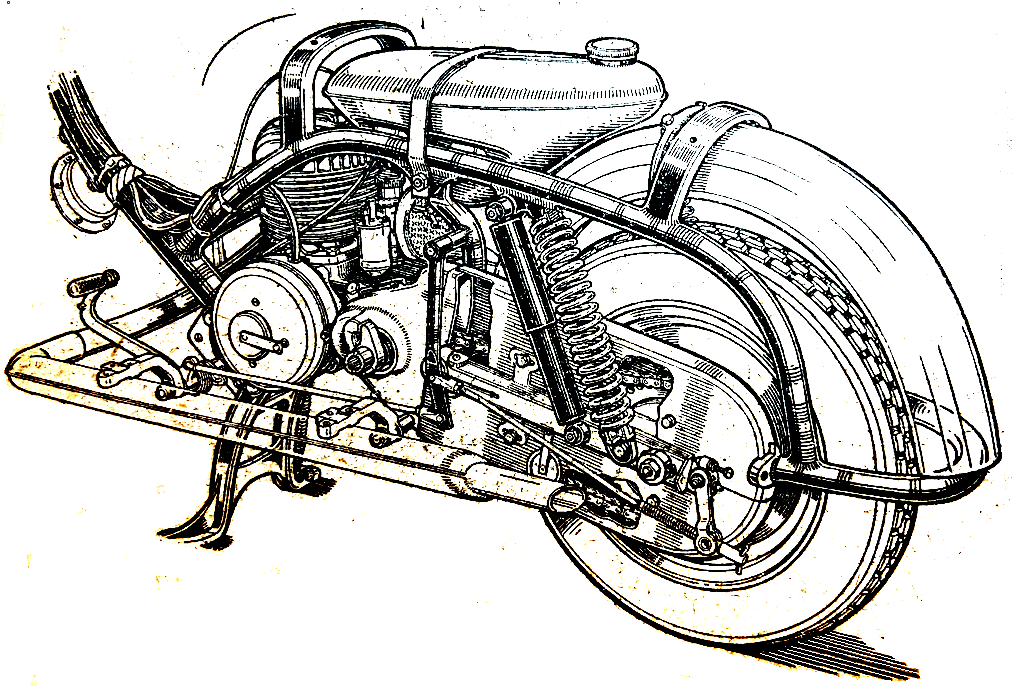
“RIDING A 1953 SPRING-FRAME 350cc Velocette, John McLaughlin completely upset ‘the book’ in the Catalina Grand National Championship races held on Catalina Island, situated off the west coast of America. In the I00-mile event his machine beat all-comers, including mounts of up to 1,200cc, and he finished the race with a 1min. 16.6sec. lead over Charles Cripps. The Velocette covered the distance in 3hr 21min 56.7sec. Using a TT-type carburetter, 7: 1 compression ratio and top gear of 6.45 to 1. McLaughlin astounded spectators with incredible downhill speeds and amazing last-minute braking on both the dirt and paved sections. Starting from the fourth row (five men to a row and rows dispatched at 30sec. intervals), he was never passed by any of the 205 starters during the entire race. Second placeman, Cripps, and Joe Leonard, who was third, were both on K-model Harley-Davidsons, and they were followed by Ed Sumner (500 BSA single) and Al Copping on a 650 Triumph twin with home-made swinging-arm rear suspension. The race marked the first competition appearance of the new BSA swinging-arm 500 single, which was placed sixth with Charles Minnert up. The 50-mile race was divided into four classes, ranging from 125 to 350cc, and all groups were run concurrently. McLaughlin won the 250cc ohv group with a 350cc engine sleeved down, against a big field of pre-war 250cc BSAs. Marty Dickerson won the 250cc side-valve and two-stroke class on a Jawa, Ralph Adams the 200cc category on a Francis-Barnett, and David, brother of Bud Ekins, won the 125cc on a 98cc NSU.”


“A FURTHER PIECE of news on the movie, ‘Cyclists Raid’, making in Hollywood. The title has been changed to ‘The Wild One’—and the publicity release from the studio only confirms the worst fears of thinking motorcyclists in the US The ‘stills’ that accompany the release portray a gang of disreputable characters attired in sloppy costume—and, of course, acting the parts of hoodlums to the limit. Obviously this film will do nothing to raise the public esteem of motorcycling but, despite the indignant protests, it seems likely that this opus will be released soon. A bad taste in the mouth of the public is bound to result.”

“HOME-BREW ” SPRING FRAMES are making their appearance in great variety on the West Coast. Most of them involve swinging-arm suspensions with the application of automobile-type shock absorber units. It’s a strange fact that almost all private enterprise concerning motorcycles is localised in Southern California. It is but rarely that a ‘bitza’ makes its appearance anywhere else in the nation.”

“THE FRENCH RIDER Gustave Lefevre (Norton) won the 24-hour Bol d’Or held last weekend at Montlhéry, near Paris. He rode 409 laps—about 1,674 miles—at an average speed of 66mph. Second man home was Bronte riding a Triumph who covered 344 laps. Lefevre beat all records—including that for cars.”
“AT THE CIRCUIT INTERNATIONAL de Regensdorf-Zurich held last weekend, the 500cc race was won by J Albisser (Norton), Switzerland, at 73mph; second was Nello Pagani (Gilera) and third B Bottac (Norton). In the 350cc race, B Boehrer (Parilla) was first home at 68mph, followed by Bob Matthews (Velocette), of Ireland, and R Knees (Norton). Two-fifty class winner was H Thorn-Prikker (Moto-Guzzi) at 66.5mph. Winner of the 500cc sidecar event was Hans Haldemann (Norton sc).”
“AUGUSTE MINGELS (Matchless), of Belgium, was the winner of the Grand Prix de France de Moto-Cross, held on the Charbonnières Wood course, near Lyons. Second man home was V Leloup (FN), also of Belgium—and the reigning European Champion—and third was another FN rider, H Frantz, of France. First Britisher home was LR Archer (Norton) in fourth place. Fifth and sixth places were filled by Molinari (Gilera), of France, and Chamier (BSA), also of France. JCM. Avery (BSA) was the only non-starter in a field of 15. During the meeting PA Nex (BSA) went out with gear-box trouble and BW Hall (BSA) had a chain break when he was lying 11th in the second heat.”
“LIGHT, STINGING RAIN did not mar the success of the Welsh Two-day Trial. It can be argued that rain goes well with the Welsh landscape. The mountains that rear bleakly from the flat, sombre tone of the lakes are seen at their most impressive against a backcloth of grey, cloud-pillowed sky. But rain is not conducive to the maintenance of reasonably tight speed schedules over narrow, tortuous roads for the most part secondary or unclassified. In this connection, the smaller machines and sidecar outfits had a rather easier time this year than in 1952. Speed schedules were cut by between 1 and 1½mph. Machines equipped to ISDT standards were not to be seen; very little other than spare inner tubes and, in a few instances, compressed-air bottles, was carried. The majority of competitors were mounted on straightforward trials machines. Observed sections included in the trial were equal to the most difficult encountered in one-day events. Losing no marks on time and only three on observation, JE Wicken (498 Triumph) won this, the third trial of the series organised by the Mid-Wales Centre, with a margin of three marks over the runner-up, BHM Viney (347 AJS). AJ Humphries (490 Norton sc) made best performance in the opposite class.”

“NOT FOR MANY YEARS—perhaps never before—have the Isle of Man TT Races provided so much interest for the student of design. The inescapable glamour of high speeds in the Senior class, backed by reputations established in classic road races over the past few years, focuses attention on the Italian 500cc four-cylinder models. Yet, in the comparable sense, these machines border on the orthodox. Some two years ago a prominent technician predicted that the next phase in the evolution of normally aspirated racing engines, whether singles or multis, would be in the sphere of carburation. It has long been recognised that the accepted type of carburettor is far short of the ideal. The fuel-injection system used on a famous German twin and the ‘flood’ carburettor fitted to equally famous British singles are but the early stages of a development that may have far-reaching consequences. The use of a fuel tank mounted below the level of the carburettor brings obvious advantages. Examples of lay-outs on these lines are to be seen in the Isle of Man this week. One of the machines in this category has extensive streamlining and may well indicate, a trend which will be quickly followed by other designers. An unorthodox three-cylinder two-stroke; a transverse four of only 350cc; oil cooling of the exhaust valve; ignition by battery and coil; a three-valve cylinder head; quickly adjustable hydraulic damping on rear suspensions; variety in front-fork design; wider use of two-leading-shoe brakes; these, and others less obvious, are among the wealth of interesting features of this year’s Isle of Man machines. The classic series of TT Races continues to serve its function as a testing ground to stimulate design and development.”

INTERNATIONAL JUNIOR TT. Soon after dawn, the sun was burning our bedroom curtains. The sea was as silent as a glass lawn—too limp to twinkle in the sunlight. Only a filmy heat-haze veiled the mountain tops. The International Junior Race seemed assured of a perfect day. Coronation year! Everest year! And motor cyclists are eager to share in this Elizabethan resurgence. But the croakers dare to hint at five foreign victories in the coming week. In the Junior, British machines have to beat Leslie Graham’s MV Agusta and Fergus Anderson’s bored-out Moto-Guzzi. Geoff Duke and Carlo Bandirola are the most famous of the non-starters. Everybody mightily regrets Duke’s abstention, but his supporters applaud his refusal to compete on too slow a model. Chances of a German victory were slim after the accidents to [DKW factory rider] Ewald Kluge, and Rudi Felgenheier, his replacement. [1938 Lightweight TT winner Kluge suffered a broken femur at the Nurburgring; 1952 250cc German GP winner Felgenheier also broke a leg during practice. Neither raced again—Ed]. The new Governor was given a warm welcome, and after the usual preliminaries the 99 starters were duly launched. How an Epsom Downs starter must envy the smooth docility with which nearly 100 motor cyclists accept the ‘off’! The weather remains absolutely perfect. Eminent among the eight non-starters are two of the Norton team—S Lawton, with arm and leg injuries, and John Surtees, robbed of his TT debut by an injured wrist. Jack Brett thus joins Ray Amm and Ken Kavanagh in the spearhead of Britain’s defence—the Norton team. At 10-second intervals the lads get away quickly. Graham on the brand-new MV four, and the Norton team, are the most impressive. S Wünsche (DKW) shares with Graham the dubious honour of being the noisiest. Wünsche is under orders to take the Race gently, as he is greatly depressed by the serious crashes lately sustained by his team mates. There are 13 club teams and three manufacturers’ teams (two AJS and one Norton). With over 25 riders from oversea, the TT is really international this year. The first retirement comes early—J Harding (Velocette) at Braddan Bridge. The remaining clocks seem to be clicking steadily. EJ Frend (AJS) ushers in the returning procession. He is moving fast. All the riders are fast enough to

make their numbers hard to read broadside-on—their speed is over 100mph. But Graham sets fresh standards of both noise and speed. Fergus Anderson (Moto-Guzzi) is quieter than Graham, but looks terrifically fast. Graham’s standing-start lap is completed at 86.26mph. Thus early it is reported that DK Farrant’s tank is visibly leaking at the Gooseneck. Leo Starr (AJS) strikes engine trouble at Brandywell—sounds like a good place if stop one must! As the field passes through the Glencrutchery Road, the lap times are hoisted. Kavanagh is 42 seconds ahead of Graham. Then it becomes known that Amm (Norton) has lapped in six seconds less than Kavanagh, at 88.99mph. Wizard Joe Craig appears to have done it again, and the flying Italian four will have no walk-over. Tommy McEwan (Norton) retires at his depot with engine trouble. Sensation! Rod Coleman (AJS), of New Zealand, arrives in 25min 20sec—89.40mph—to take the lead! Who would have guessed before the start an AJS would lead two Nortons, the Moto-Guzzi and the MV Agusta on Lap 1? Meanwhile, WT Hancock (Velocette) is replacing a chain at Laurel Bank, and EVC Hardy (AJS) pauses at his pit with broken goggles. It transpired much later that, by a time-keeping error, R McIntyre (AJS) had actually taken fifth place behind Kavanagh, which pushed Brett into sixth place, Doran into seventh place, and Graham into eighth. AJS has nine machines in the first 15. AL Parry (Norton) is out at Glen Tramman with engine trouble. The fast men are all lapping regularly, though CF Salt (BSA) has to adjust brakes at Sulby. And now comes a tragedy—not yet broadcast. HL Stephen (Norton) is killed instantaneously in a crash near Bishop’s Court. CC Sandford (Velocette) had to change a plug at Governor’s Bridge. The men seemed to be clumping more than usual and often passed in tight three-formation. J Maloney (Norton) fell in Glen Helen, but was unhurt. Then JW Beevers (Norton) retired at the pits with suspension trouble. GJ Walker (AJS) retired at Crosby with engine trouble, and then Wünsche followed suit with the sole DKW. By

this time the pattern of the race is becoming clear. Fergus Anderson is a graver menace to the British machines than Graham’s Agusta, which has suffered from clutch-slip from the start. Coleman’s AJS and the Norton team resurrect their ancient duel. Coleman has lost a valuable henchman through McIntyre’s unlucky disappearance at Ballaugh with engine trouble. Clearly it is anybody’s race and the tension grows. The fury of the battle next produces a dead-heat for first and second places! Coleman and Amm both complete the first 75 miles in 50min 25sec, with Kavanagh only eight seconds behind! The hidden signallers are furiously exhorting the wee black hornets to go faster and faster in this savage battling. The racket is so continuous that most of the loudspeaker announcements are unintelligible. But the first news on Lap 3 is mournful; the leader, Coleman, is out with a split oil tank at Glen Vine. Amm, the Southern Rhodesian, is only one second outside Duke’s 1951 lap record of 24min 47sec; Amm lapped in 24min 48sec on his third circuit. He is now 24 seconds ahead of his team mate Kavanagh. Anderson (Moto-Guzzi) remains in third place. A batch of unfortunates go with assorted troubles—FA Norris (AJS), M Templeton (AJS), S. Cooper (AJS) and CC Sandford (Velocette). RH Rudge (Norton) does a lightning re-fuel in 19.8sec. Everybody is visibly fly-smothered. DA Tutty (Velocette) retires with a puncture at Quarter Bridge but does not fall. Then Graham garages his MV Agusta at the pits; his clutch is now practically useless. This formidable Manx lap discovers weak points which do not necessarily surrender to weaker circuits. ‘S Franklen’ (AJS) retires at the pits just as Doran passes apparently at a gigantic speed. The observer must swing his neck to read his number broadside-on. Momentarily, the three-cornered battle forming for the lead between Amm, Kavanagh and Anderson focuses all our attention. At the end of four laps this trio is covered by a time gap of nine seconds with Kavanagh and Amm one second apart! It is not, of course, certain whether all or any

one of them is yet absolutely full out. Fergus Anderson has a reputation for riding cunningly and likes to keep a wee bit up his sleeve. Two more retirements are announced—J Fisher (AJS) near the Bungalow, and TW Brown (AJS). Another retirement is BJ Purslow (Ariel) at the pits. These large entries of around 100 roar past so incessantly that the public-address system is practically muzzled. Chain trouble is less common this year, but AE Moule (Norton) drops out for that reason at Ballacraine. During Lap 4, DK Farrant (AJS), one of our most promising newcomers, climbs into the magic leading six at about the same time as a confrère of his, Robin Sherry, throws in the towel at Union Mills. Prayers were offered on Sunday in local churches for the safety of all the TT competitors, and it is a great grief to hear of a second fatality—this being TW Swarbrick. The leader list after four laps reveals a solid block of seven AJS machines chasing the four fastest men, which indicates the great success of the firm’s 7R policy. The leaders’ clocks tick uneventfully. The potential ability of men like Coleman and Kavanagh might never have been spotted and developed but for the circumstances which rather suddenly compelled both Norton and AJS to seek stars from the Commonwealth. Ernie Ring, the Australian, is the next to meet ill-luck; he retired at the Stonebreaker’s Hut after a fine ride in which he temporarily held sixth place in the third lap. It looks now as though Fergus Anderson can hardly hope to win. He is up against two slightly faster Nortons, and neither of them is yielding an inch. Nor can he break them up. The gap between him and Amm has been slowly increased, while Kavanagh is threatening to wipe out the 30sec starting allowance which originally separated them. A ‘one-against-two’ battle from a stern position is very hard plugging. However, the Guzzi’s third position looks safe enough, for Brett is slightly over-geared for the conditions and is more than a minute behind. Quite a gang of comparatively unknown men are chasing the leading six. The fact is that the number of top-ranking stars competing this year is not very large, and some of them have hit hard luck and retired. From the other angle, the continuous summer programme of lesser races at our innumerable small tracks is developing a host of clever

youngsters. The pace of the dozen men following the leading six shows that they are really good. At the end of Lap 6, a great burst of cheering saluted the announcement that Kavanagh had equalled the lap record of 91.38mph. The course has not undergone any substantial easing since 1951. The main changes are the use of rather larger stones in the top dressing, and a considerable widening of Bedstead Corner. Reverting to Lap 4, LT Simpson of New Zealand on his AJS registered a very creditable lap in 26min 41sec, equalling 84.86mph, which hoisted him to 14th place. Another worthy note was that after four laps the 18th man had averaged no less than 83.31mph. These minnows will soon become full-grown tritons. More retirements are announced—AL Parry at Ramsey; EJ Frend at the Bungalow; AW Jones; RM Travers, of South Africa; CB Carr and PA. Davey. We wonder whether Kavanagh and Amm are teaming up to beat the Moto-Guzzi, or indulging in a little Commonwealth duello as between Australia and Southern Rhodesia. At one time they were only a single second apart. Pit orders are that either man may win, but they are not to scrap with unnecessary ferocity. Both lads will assuredly remember their great battle as long as they live. Spectators curse the interference in the public-address system which makes it quite difficult to be sure precisely what is happening. So, at last, we come to the final lap. It began with Amm leading Kavanagh by 7sec. Fergus Anderson, on the Moto-Guzzi, lay over a minute and a half behind Kavanagh, and could not hope for absolute victory unless both Nortons retired. The announcer struggled hard to keep us au fait with the progress of this trio at all the telephone points, but he was so hampered by almost continuous interference from the exhausts of the slower men that we heard comparatively little of what was happening. Worse still, both Amm and Kavanagh, after breaking the record in their seventh lap, came through the stands without receiving the ovation which they so richly deserved. It was, of course, a very tight finish. Amm won by a mere 9.6sec. Anderson’s Moto-Guzzi slowed a trifle towards the end, and was beaten by over 2½ minutes. Amm established both lap and race records. Almost immediately after the six leaders reached home, the hooters sounded for the clubmen to get out their machines for the afternoon fixture.” RESULTS: 1, Ray Amm (Norton), 90.52mph; 2, Ken Kavanagh (Norton); 3, Fergus Anderson (Moto Guzzi); 4, Jack Brett (Norton); 5, Bill Doran (AJS); 6, Derek Farrant (AJS); 7, Ken Mudford (AJS); 8, Peter Murphy (AJS); 9, P Carter (AJS); 10, Harold Clark (AJS), 93.72; 11, JR Clark (AJS); 12, Vic H Willoughby (Norton).Tye next five finishers were Ajays followed by Norton, AJS, Norton, AJS, AJS, Norton, AJS, AJS, Norton, Norton, Velo, Norton, AJS, AJS, Norton, AJS, Velocette, AJS, AJS, Velocette, AJS, Velocette, AJS, AJS, Velocette, Norton, Norton, AJS, AJS, Norton, Norton, AJS, Norton, Norton, AJS, BSA and AJS. As well as AJays, Nortons and Velos, the 41 ‘DNF’s included Wünsche on the works DKW, Les Graham’s MV Agusta, another Beeza and one of the new Phoenix JAPs. JUNIOR (350CC) AND 1,000CC CLUBMAN’S RACES. “The perfect weather experienced for the International Junior event continued in the afternoon for the Junior (350cc) and 1,000cc Clubman’s Races. It was well that it did, for practice had been marred by rain. Riders’ morale was lowered by the effect of constant peering through spattered goggles and trying to learn the formidable Manx circuit while riding on wet roads. As a result, practice lap times had been low, though DT Powell (BSA), of the Ringwood Club, had circled on one occasion in 28min 44sec, a speed of 78.80mph. Fifth man home at 77.26mph last year, Powell was tipped as a likely winner, and H Plews (BSA), of the Wakefield Club, as the chief challenger. Riding a Norton in the 1952 event, Plews finished in sixth place at 76.92mph. In a field of 71, comprising BSA, Norton, Douglas, AJS and Matchless machines, BSAs predominated with 54 starters. Five Centre teams were represented. Being run concurrently with the 350cc Race was the fifth 1,000cc Clubman’s Race in the series, and the first to be held since 1950. The two years’ lapse was the result of poor support, and the revival on this occasion was due to the efforts of the Vincent Owners’ Club. Sixteen entries—all Vincents—had been received, but the number had been reduced to eight—by practice spills in all but one instance. Happily, only one rider was more than slightly injured and he, E Ellis, though in hospital, was making good progress. At 1pm, when the late finishers in the International Junior Race were on their final lap, the hooters blared, signalling the Clubmen to enter the closed control to collect their machines for warming up. The banners behind the pits stirred gently in the softest breeze. An army of workmen swarmed over

the giant scoreboard, stripping it of its story of the morning’s victories and vicissitudes. Round the circuit, vast crowds basked in the summer sun and munched their sandwiches. The speeds in the contest to come would be tame by comparison with those of the morning. But those riding were the lads with whom they swop yarns on club-nights, and were now representing their clubs in the race of the year. For many, this was by far the most important race of the day. Promptly at five-past-two, the first three men were dispatched on their opening lap. Starting was by kickstarters, and three riders were sent off every 10 seconds. In the main, starts were first- or second-kick efforts, and riders were crouched down to it well before they had cleared the pit area. Five minutes after the last of the Juniors had left, the first competitors in the 1,000cc class swung their kickstarters. Clocks moved regularly, and the first three dispatched, GT Salt, of the Bridgnorth Club, E. R. Williams, Oswestry, and H Williams, Kings Norton, all on BSAs, went through Kirkmichael in close, line-ahead formation. Plews was riding No 32 and Powell No 39, so that their starting interval was 30 seconds. There was every possibility that they would see each other on the road. First man to complete a lap was RA Russell (BSA), of the Kensal Rise Club, in 29min 3sec, a speed of 77.95mph, and fastest opening lap among the early men was by J Bottomley (Norton), of the Moccasin Club, in 28min 33sec. There appeared to be every indication of a stout BSA-Norton duel, though the BSAs were believed to be fractionally the faster. The anticipated Plews-Powell duel failed to develop, for the Wakefield clubman was down on speed. Powell rolled off his opening lap in 28min 20sec (79.93mph) in brilliant fashion to take the lead by 13 seconds from Bottomley. Powell’s opening lap was no more than 3.6sec outside R McIntyre’s record lap on a BSA in the 1952 event. PE Burns (BSA), of the Thornton Cleveleys Club, was third, 0E Greenwood (BSA), Leicester Query, fourth, I Lloyd (BSA), Holmsley Club, fifth, P Palmer (Norton), Huddersfield, sixth—four BSAs and two Nortons in the first six. The fact that all six riders were covered by 36 seconds on corrected time, spelt racing of the highest order. Plews could do no better than lap in 30min 2sec. More than this, Russell was tying with RD Keeler (Norton), Ruislip, for ninth place, and there was a further tie between AFJD Martin (BSA), Rugby, and MEJ Taft (BSA), of Ilkeston, for 14th place. The first pair circled at 77.95mph, and the second pair at 77.55mph. Speeds of that order are magnificent bearing in mind that the riders are on production sports machines and are tackling the most difficult and arduous road-race circuit in the world. The times achieved on the 1,000cc machines were unimpressive by comparison. Speed approaching International TT standard is needed to extend a twin-cylinder Vincent in the Isle of Man, and the necessary riding skill is rarely apparent in Clubman’s Races. Fastest opening lap was by R. Madsen-Mygdal, Vincent Owners’ Club, in 27min 41sec (81.79mph). But even Mygdal was riding outside his capabilities for he spilled at Brandywell, though without hurt, on his second circuit. This let GP Clark, Hull, into the lead with a 14sec advantage over GP Douglass, VOC. L. Floodgate, VOC, retired and, along with Mygdal, reduced the field in the larger class to six riders. The standard of reliability among the Junior machines was high, and only some half a dozen retirements

were listed. At the end of Lap 2 Powell had stepped up his average speed to 80.43mph, and now led Bottomley by 42sec. Burns disappeared from the leader board and dropped to ninth place. Greenwood moved up to third and, with a quite fantastic spurt, H McKenzie (BSA), Galloway, moved up from 13th to fourth place. Martin was fifth, Lloyd sixth and, from out of nowhere, HA Voice (BSA) lay seventh at 77.72mph. Keeler retired at the pits. Leader in the 1,000cc class at the end of Lap 2 was Douglass, at an average speed of 81.27mph. The searing speed of the Junior Race continued. Powell was riding as to the manner born, and appeared unbeatable; except for Bottomley’s Norton in second place, and R Ingram’s Norton in the eighth position, BSAs filled the first 16 places! On the third lap, Powell increased his pace even more. Bottomley slowed and was displaced by Greenwood for second position. AM Sutton (BSA), Castle (Colchester) Club, hoisted himself from 14th place to fourth, and Palmer from 11th place to sixth place. Seventh was Lloyd; eighth, Oldfield, and ninth, McKenzie, sole champion of the Scottish flag in the first 12. ST Seston (BSA), Meteor Club, was riding consistently and holding a worthy 10th place. Completing the first 12 with Voice, who had slowed after his fast second lap and was now 11th, was AFJD Martin. In the 1,O00cc class, circling without apparent effort, Douglass had no trouble in maintaining his considerable advantage over the remaining five Vincents opposing him, though his speed was no more than 80.86mph. And so to Lap 4. Powell lapped with perfect reliability and crossed the line to wild applause, winner by 1min 20.2sec, at an average speed of 80.17mph—precisely 1¼mph faster than Houseley’s winning speed in 1952. Greenwood staved off the Norton challenge by the barest margin, but was a creditable second nevertheless. Palmer, in fourth place, was only 30sec behind Bottomley. In addition to winning, Powell had established a record lap at 27min 58sec (80.96mph).” RESULTS. Clubmans Junior TT: 1, Derek T Powell (BSA), 80.17mph; 2, Owen Greenwood (BSA); 3, Jack Bottomley (Norton); 4, Philip Palmer (BSA); 5, AM Sutton (BSA); 6, WR Oldfield (BSA). Clubmans 1000 TT: 1, GP Douglas (Vincent), 81.54mph; 2, GP Clark (Vincent); 3, PL Peters (Vincent); 4, LF Pittam (Vincent); 5, DL Buss (Vincent); 6, JO Finch (Vincent). INTERNATIONAL SENIOR TT. “THE 1953 SENIOR TT was run in perfect weather. The winner was WR Amm (Norton), Rhodesia, in 2hr 48min 51.8sec, a speed of 93.85mph. Second man was Jack Brett, also on a Norton, in 2hr

49min 3.8sec, 93.74mph. Third place was taken by HR Armstrong, of Dublin, on a four-cylinder Italian Gilera, in 2hr 49min 6.8sec, 93.62mph. The anticipated threat from the Italian fours petered out after three laps. The Manufacturers’ Team Prize fell to the AJS team (W Doran, R Coleman and RH Sherry), while the Club Team Prize was carried off by the Pathfinders & Derby Club, represented by E Houseley (Norton), PA Davey (Norton) and CF Salt (BSA). The first 17 men received silver replicas, and 15 bronze replicas were awarded; the respective time limits were 3hr 9min 58.4sec, and 3hr 22min 38.2sec. Seventy-seven riders started, of whom 36 finished. The percentage of retirements was high, presumably owing to the hot pace set by the earlier leaders. The lap record was broken four times in all, thrice by GE Duke on his Gilera with times of 23min 30sec (96.38mph) on his first lap; again with 23min 22sec (96.93mph), on his second lap; and 23min 18sec (97.20mph), on his third lap. But the final holder is WR Amm, whose Norton on the third lap cut the Gilera time by three seconds to 23min 15sec (97.41mph). The proceedings were marred by two fatal accidents. While lying second, on his second lap, 38 seconds behind GE Duke, RL Graham lost control of his speeding MV Agusta on the descent of Bray Hill. He was killed instantaneously, and the machine caught fire. During the sixth lap, GE Walker (Norton), of Australia, crashed near the 20th milestone (in the vicinity of Ginger Hall) with equally disastrous results. Graham, an ex-World’s Champion, one of the most likeable men in the motor cycle fraternity, universally popular, will be widely mourned. Walker was not so well known, but it is especially pathetic that he died so far from home. Enormous crowds gathered early in the morning for what was regarded as the race of the century. Two teams of Italian four-cylinder mounts, known to be about 10mph faster than any British machine, were expected to interrupt the monopoly

which the Nortons have enjoyed in the Senior for many years past. Some folk comforted themselves with the theory that the four-cylinders are very apt to scuff their rear tyres in a really long race, while the Manx habitués, who have seen so many famous foreign machines broken up by their formidable circuit, never swerved from their certainty that if Italy had the speed, Britain had the reliability. The weather conditions could not possibly have been better. Many had slept ‘outside the bedclothes’, or covered at most by a single sheet. But as the sun climbed, a mild breeze tempered the heat. Every vehicle in the island was enlisted to carry spectators to chosen vantage areas, and large steamers were berthed all along the jetties, token of the multitudes who had invaded Douglas during the night. At the Stands, bright touches of colour glittered from the international flags, the girls’ smart costumes, and the superb giant calceolarias on the Governor’s stand. The preliminaries passed off smoothly, and visitors from abroad, especially, admired the smooth celerity with which so large an entry was dispatched. One eminent trader from New York, who buys and sells motor cycles by the thousand, remarked that his country had ‘to hand it to you Britons’. K Johansson, who comes from Sweden, was the only rider whose engine sulked a little. Graham’s MV Agusta sent hoarse echoes reverberating along the little valleys which radiate inland from Douglas. N Nicholson, sole rider from the USA, made an excellent getaway. The veriest novice could pick the stars, from the slick certainty with which they made their engines fire evenly at the first bump, were stretched flat along the tank within a very few yards, and thundering at real speed long before the dip for Bray Hill. Some slight air of mystery attached to the start, since S Cooper (348 AJS), and R McIntyre, who had duly weighed-in overnight with a works’ AJS twin, did not appear to claim their machines. Eyes soon focused on the clocks above the scoreboard, where Graham’s digit revealed him as a man-eater—he had caught seven or eight of his

predecessors before completing half a lap, and Duke, whose Gilera started 84min later, seemed even more voracious. Walter Zeller, on the German BMW, wisely decided to make a medium-speed exploration of Mona rather than risk a spill. There were no fewer than 30 visitors from oversea, and several of them were destined to depart for home with most of the prize money in their wallets. However, in the first quarter of an hour or so, it was clear that no early starter could live against Graham, and 10 minutes later it was evident that the latter half of the entry was equally helpless against Duke. It was realised, glumly, that the Italian fours were quite as fast as had been intimated, and then some! They sounded like it, too. When the field was past after one lap, Duke reassured his followers about his old magic, for he was 38sec ahead of Graham. Next came the two Commonwealth stars, WR Amm and K Kavanagh, spearheading the Norton attack, chased by HR Armstrong, on a second Gilera, and that tough New Zealander, Rod Coleman, on an AJS. Next came stark, hideous tragedy. Lap 2 had barely got going. We were all wondering whether Graham’s famous signaller had managed to warn him that Duke had already snatched a 38sec lead. Then the letter R (retired) was painted into the second square of Graham’s column, with the long vertical white line underneath, cancelling the remaining five lap squares. Graham was out—had crashed unaccountably at the foot of Bray Hill. Nothing could restore the vanished joy of a day which had begun so brightly. Meanwhile there was a host of minor retirements—T McEwan (Matchless), and WA McAlpine, K Bryen, AA Fenn, WJ Campbell, all on Nortons. Groups of twos and threes had formed and were holding mighty scraps with each other along such rare straights as Sulby and Glencrutchery Road. Most of the men were passing so fast that they could not be photographed without expert swinging of the camera, nor was it easy to
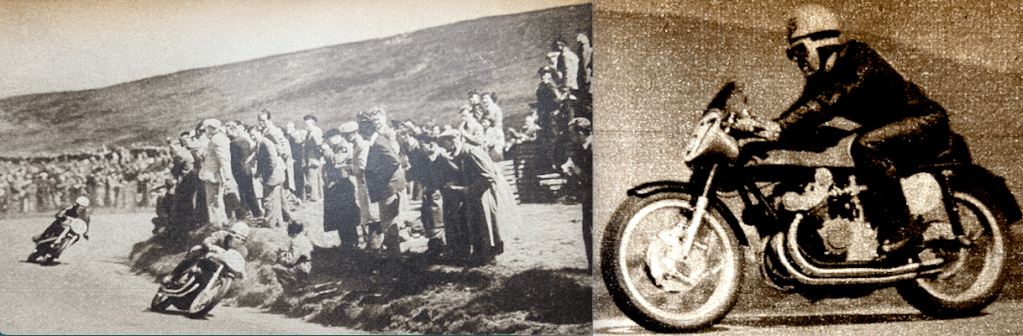
decipher their numbers without swinging one’s head. Duke had lapped his standing-start circuit in 23min 30sec, 96.38mph, establishing a lap record. It survived for a bare 23min 22sec, before yielding to the new figure of 96.93mph, both of them shattering Duke’s own 1951 figure of 95.22mph. Behind him there were mild shuffles of the stars, and both Zeller and Dale came off gently at Signpost Corner, doing just enough damage to put them out of the race. The first seven men topped 90mph in the second lap, compared with nine who had done so a lap earlier. Three Matchless twins ridden by GA Murphy, DK Farrant and HA Pearce were welcome visitors into the leading 12. Duke now held a lead of 62 seconds. Watchers round the course reported that Amm, riding No 61, used Duke (No 67) for slipstreaming purposes during part of the lap. Could it be that Duke could burst away when the mood seized him ? He assuredly knew that he had already seized a winning lead. The speed set by the champions was slaying the weaker brethren, doubtless anxious about their replicas if the speeding fours could maintain this fiendish pace. Hereabouts, the retirements reported included Mackay, Herbert, Johansson (Triumphs), and Williams, Stormont, Julian, Leigh (Nortons). Bandirola (MV Agusta) withdrew as a tribute to Les Graham. Throughout Lap 3 a couple of Gileras were not only travelling fast, but lying first and third respectively, with HR Armstrong possibly assuming the role of tortoise to Duke’s hare. The gossips speculated that perhaps the Gileras are faster than the Agustas? Jack Brett was now demonstrating his class, which had been slightly obscured by too high a gear in the Junior. Kavanagh with a superb lap had jumped over Brett and Coleman into fourth place. Young Farrant hopped up a couple of places, chased by K Mudford (Norton) of New Zealand.
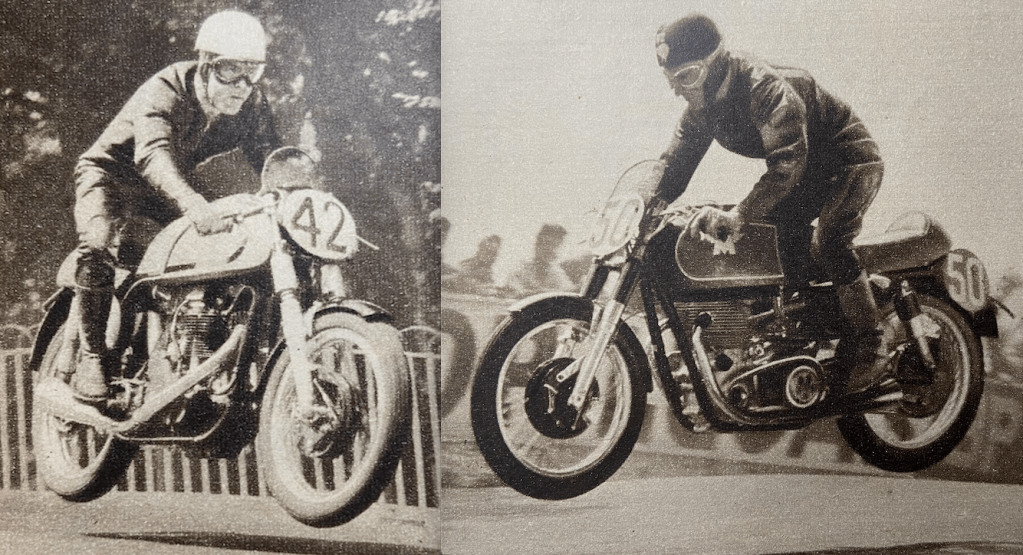
And Vic Willoughby (Norton) had suddenly asserted his right to a place in the first dozen [go, Vic!—Ed]. Duke’s average rose to 96.80mph. A minute divided Amm from Duke. Armstrong was losing ground rather alarmingly fast to Amm—40sec behind at the end of Lap 2, he was 78sec astern at the end of Lap 3, the Gilera slowing while the Norton accelerated. Coleman and Doran, the AJS champions, were lying doggo, ready to pounce on anybody ahead who might make a slip, rather than taking the role of confident aggressors. Sherry was slowish today, lapping in the region of 85mph in the company of private owners on Nortons. A. Milani (Gilera) was also detuned somewhat, and lay 16th at 86.42mph average. Once again there was a sad block of mishaps, but, fortunately, none were physical in character. Australian WA McAlpine (Norton) went out. LT Simpson (Matchless), of New Zealand, was ousted by valve-spring failure. MP O’Rourke (Matchless) had a split oil tank; veteran SA Sorensen (Norton), of Denmark, threw in his hand near Ramsey. Meanwhile, Doran executed a lightning fill-up in 24sec dead. But coming events cast their most significant shadow ahead at the end of Lap 3, for when the time-keeping auditors had done their work, they reported that although Duke had broken the lap record for the third time, Amm on the Norton had smashed the Gilera champion’s best time by 3sec! About this moment, the impish Manx gremlins, who plan so many cruel disappointments, decided that it was Duke’s turn to say goodbye to a happy dream. He swirled down Bray Hill in demon fashion and poised himself to make another of those graceful full-width sweeps through Quarter Bridge which cause maidens to swoon, and schoolboys to price a Duke autograph at 2s 6d. Alas, his mood was too exuberant; he turned up the wick too hard, found a patch of oozy tar, and over he went. He was not a penny the worse personally, but the Gilera would motor no more today. The

humorous aspect of the spill was that when the announcer read out with a trembling voice: ‘No 67 got into a wobble on some tar at Quarter Bridge…’ nobody winked an eyelash! A minute or so later somebody yelled in startled accents, ‘Hey! Did you say sixty-seven? Isn’t that Duke?’ And so it was. So now, confounding the critics Amm was riding at genuine ducal speeds, gaining ground from Armstrong all the way round the lap. Kavanagh was sitting on his tail, and, starting intervals excepted, Jack Brett was practically streamlining Kavanagh! Who said that single-cylinders are out-dated? Who said that Joe Craig’s brain had at long last run dry? Above all, who dared to say that Commonwealth speedsters aren’t really quite top class? But Nortons did not feel so jubilant at the end of Lap 4. True, Amm had fattened his lead on Armstrong to no less than 1min 38sec. But Coleman, that tough, wily, courageous New Zealander, had jumped into third place at 93mph, and another AJS, steered by Bill Doran, had suddenly gripped fifth place. Behind Doran lay a very dark horse, the young New Zealander who had ridden so brilliantly on Monday, KH Mudford on a Norton. Next came Willoughby, a member of the staff of this journal on yet another Norton, and perched on his tail was Milani, who had stepped up his average to 87.50mph. Even the stars dislike violent surprises just when they think they have managed a ‘nicely, thank-you,’ set-up. All the more so, because the fourth lap is refuelling time for most people, and a lot of time can be lost at a pit counter if the rider is shaken and clumsy. Moreover, what had happened to Kavanagh, who had suddenly disappeared from the leader board? All these speculations took quite a time for solution, partly because of the system of interval starting, because the timekeepers’ news was very slow in reaching the scoreboard, and because the incredibly rowdy exhausts were practically muzzling the microphones, and everybody had been stopping to fill up. Meanwhile, there was the usual crop of troubles—JH Cooper (Matchless) retired at the Gooseneck on his third lap; F Passmore

(Norton) fell at Signpost on Lap 4; EA Barrett (Phoenix-JAP) toured in and made a long pit stop; A Wheeler (Matchless) completed his fourth lap on a lame machine to retire forthwith; HA Pearce (Matchless) stopped for a lightning adjustment at Brandywell. And Kavanagh was out with engine trouble—lack of compression. Lap 5 was not destined to prove climacteric. First, JR Clark (348 AJS) broke his primary chain and KW Swallow (348 AJS) went out at the pits with engine trouble. So far as the leaders were concerned, Amm and Armstrong retained their first and second places. Coleman had poked his nose in front of Brett to the extent of 18sec but Brett was accelerating. Those who came later were not in very close touch. Doran was 2min 46sec behind Brett; then came Mudford, 1min 51sec astern; and Willoughby lay 53sec farther back. Immediate interest centred on the tussle between Coleman, Brett and Doran for third, fourth and fifth places. But a second dreadful tragedy was to over-shadow everything. GJ Walker, of Australia, riding a 499cc Norton, crashed with fatal results near the 20th milestone. His footrest caught the kerb and flung the model into a wild swerve from which recovery was impossible. The running was unexciting during the remainder of Lap 5. Amm hung on to a 1min 32sec lead, with Armstrong seeking desperately to narrow the gap. Brett and Coleman continued to play a ferocious version of puss in the corner, and Brett gained a 59sec advantage when Coleman stopped for fuel. Behind them there was fierce effort, and fine riding enough and to spare. Again there were no vital changes in the leading positions. Armstrong could make no real impression on Amm. Brett seemed just to have the legs of Coleman. Behind them Willoughby broke a leg of his rear suspension on a right-hand turn on Greg Willys Hill. He spilled but was unhurt. Such mishaps sound trivial to the lay spectator. But several hundred pounds may easily be involved between finishing sixth, and a tardy retirement, which robs a fellow of both prizes and bonus. Apart from such disappointments, which are the secrets of the lads with an unlucky ‘R’ under their number on the scoreboard, Lap 6 was melancholy for everybody and somewhat dull as a section of the race. But in the Island you never know. Motor cycle racing resembles an April shower, a capricious woman, a beaker of quicksilver. Suddenly, some far-distant marshal ‘phoned into the

grandstand that ‘No 61 is trailing his left foot!’ Just that, and no more. Frantic efforts were made to extort additional information. None came. At last, another marshal said that Amm seemed just as fast and sure as usual, and that he hadn’t noticed the trailing foot. However, the trailing foot was confirmed. Amm had spilled on the same bend as Willoughby, and wiped off a footrest. Anxiously we watched his clock. Yes, he was certainly going as well as ever! Then came another announcement. Armstrong had struck chain trouble near Ramsey! Anything now seemed possible—even probable. Perhaps there might even be an AJS win by Coleman, whose luck in the Junior had been vile. But all these excursions and alarms ultimately petered out. Armstrong restarted after replacing his chain again—in what agony of spirits no one will ever know. He came in 5min 5sec ahead of Amm on uncorrected time. What was his lap time after that hurried by-play with a filthy chain at Ramsey Only 24min 19.8sec! Only half a minute longer than his sixth lap! It was barely credible! But it was not good enough to beat Brett, who lapped in 23min 46.8sec to head Armstrong by 13sec! However, Amm now had to finish in under 6min 50sec to win. No one knew how far his spill was hampering him. It looked as if he had just enough time. He was signalled in due succession from the Bungalow, from Kate’s Cottage, from the Craig; and when he had three minutes of start allowance left at Hillberry, the crowds felt that it was all over bar shouting. Amm won, deservedly after a brilliant ride, by 12sec from Brett, and with a 25sec advantage over Armstrong!” RESULTS: 1, Ray Amm (Norton), 93.85mph; 2, Jack Brett (Norton); 3, HR Armstrong (Gilera); 4, Rod Coleman (AJS); 5, Bill Doran (AJS); 6, PA Davey (Norton); 7, 0EJ Frend (Norton); 8, Robin H Sherry (AJS); 9, HA Pearce (Matchless); 10, John Grace (Norton); 11, LC Boulter (Norton); 12, FA Norris (FAN Norton Special). INTERNATIONAL LIGHTWEIGHT TT “The International Lightweight Race attracted 30 starters out of 37 entries. Eighteen finished and 12 retired. The winner was

Fergus Anderson (Moto-Guzzi), who repeated his 1952 victory. After the first few miles he moved swiftly into the front of the field and was never afterwards headed. His time of 1hr 46min 53sec produced an average speed of 84.73mph, and his second lap in 26min 29sec (85.52mph) broke Ruffo’s 1952 record by 13 seconds. Second man was W Haas of Germany, on an NSU, in 1hr 47min 10sec (84.52mph). He chased Anderson with immense courage, but lacked the ability on the Manx circuit to catch him. S Wünsche, also of Germany, was perhaps, lucky to snatch third place from E Lorenzetti (Moto-Guzzi) who had comfortably held that position from the start until he fell at Governor’s Bridge towards the end of his third lap. Wünsche’s time on the DKW two-stroke twin was 1hr 51min 20sec (81.34mph). Five silver replicas and seven bronze replicas were awarded. No complete manufacturers’ or club team finished. No drop of rain had fallen for nearly a week, but during Tuesday night there were heavy showers and, towards the scheduled starting time of 9.45am hill’ crests and valleys betrayed pockets of dank, white mist, while a coy sun peeped like a timid schoolgirl from between low, grey clouds. Just before 9.45 a travelling marshal found visibility down to a mere 10 yards

in the vicinity of Creg Willeys Hill and 40 yards on the Mountain toad. The start was postponed for one hour, by which time a 10-knot wind from the north-west had cleared the high moors and dried the worst damp patches under the lowland trees. Caution, however, was still required. The delay was full of excitement. First, it transpired that the NSU manager had, over-night, invited Geoffrey Duke to fill the saddle vacated as a result of the crash which damaged WA Lomas’s hand. Duke promptly tried out an NSU at Jurby airfield, but the ACU refused permission, since Duke had not completed the necessary qualifying laps on an NSU. Then came the news that, after tests, the analyst had discovered traces of tetra-ethyl in the sample of fuel taken from one competitor’s tank. Fresh fuel was ordered, after an inquiry had exonerated the entrant and driver. No change of weather nullified the postponed start, but the competitors were warned that the lower slopes of Bray Hill were not conducive to crash brake-work, and to use caution under all trees. The mass start was a tame and perfectly safe affair, led quite naturally by the men whose fast practice laps had earned them places in the front row. W Haas, S Wünsche, TL Wood (Moto-Guzzi), and EA Barrett (Phoenix-JAP) drew momentarily clear by the end of the pit area, only to be caught and passed by Anderson and Lorenzetti as soon as they could worm their way through the ruck. Long before Kirkmichael, Anderson, Haas and Lorenzetti had annexed the three leading places, which they were to hold practically unchallenged for so many miles. The NSU supporters enjoyed a little encouragement, for Haas had got away first at the start, and Anderson was unusually tardy. Haas was still ahead by perhaps 500 yards when entering Glen Helen. Then the Guzzi champion overhauled the flying German, and the pair remained between 15 and 30 seconds apart for the remainder of the race. The leader was about 12½mph faster on overall average than the 12th man; barring accidents it seemed unlikely that anybody outside the Anderson-Haas-Lorenzetti

trio would win. Anderson’s ‘vantage over Haas at the end of Lap 1 was only 16sec, which sounds microscopic, but in a four-lap race contested at nearly 90mph, a 16sec lead is actually enormous. Multiplied by four, it exceeds a full minute or nearly 1½ miles over the whole distance. Wünsche in fourth place was 69sec astern, but 69 x 4 maker over 4½ minutes, or about seven miles. The man who is out-speeded over Lap 1 to this extent must either produce violent acceleration in Lap 2, or meekly wait till his rivals blow up. Such margins normally spell heavy defeat for the chaser. Many of the chasers in this race were men with no great reputation, and it is impossible to dwell on their doings in close detail. But Arthur Wheeler evinced fine mastery of his ‘private owner’ Moto-Guzzi. S Willis, the Australian on a far-from-new Velocette, will feel no shame when he confronts his home folk again. It is timely to remind a majority that Britain does not manufacture super-sports 250s. If a lad wishes to shine in this category, he must still, unfortunately, ‘buy foreign’. Most of the other British aspirants were probably seeking an opportunity to caracole [“make a half-turn”, according to my OED—Ed] happily—and legally—at speeds between 90 and 70mph on models which were mostly rather elderly products, care-fully ‘tuned’ by amateurs in their back sheds, or bitzas, or ‘ones-off’. Not so can one lick the Mandello works with famous professionals as jockeys. Still, there were 13 British machines in the first 20 at the end of Lap 1, even if the leading sextette were Italian, German, Italian, German, Italian and Italian in that order; and three of the first six

were straddled by Britons. Five men retired on Lap 1. They were M Cann (Moto-Guzzi); CM Luck (CLS); C Tattersall (CTS); E Houseley (Norton); and AA Fenn (Rudge). Lap 2 brought no excitements or tragedies. The first eight men moved relentlessly forward in their original order and mostly at progressive speeds. Lower down the list the pack was gently shuffled, mainly to the benefit of WM Webster (Velocette) who bounded from 14th to ninth at about 73mph. AW Jones (Excelsior) and RE Geeson (REG) also displayed aggressive intentions. EVC Hardy cut his lap time by a whole 20sec and climbed to 19th place of which he had every right to be proud, seeing that he was riding an old Rudge in aristocratic company. And so to Lap 3. The same 10 doughty fellows who had headed the raucous procession on Lap 2 continued to lead it right round Lap 3 as far as Governor’s Bridge. There—to the intense sorrow of Italy—Lorenzetti (even as many equally great men before him), miscalculated the tricky little hairpin, and probably for the usual reason. Nothing is harder in road lore than to estimate a slow-down from really high speed. Lorenzetti had been exceeding 100mph off the Mountain. Approaching. the Bridge, he probably supposed he had slowed to about 8mph, whereas in fact he was still

doing perhaps 30mph. So he jabbed his brake on a bit more, fell off, bent the model, grazed his hand and that was the end of him for the day. Lorenzetti’s departure let in at the tail of the procession, RE Geeson (REG), who, possibly, owed his promotion to the magneto of F Purslow, who had hitherto been his ‘next ahead’. However, who can say that if Purslow’s mag had magged better, he might have beaten Geeson’s third-lap time of 31min 3sec? We all felt sorry for Lorenzetti, who had come so far to meet such an untimely retirement. But Manx frequenters know that it is the habit of the Manx gods to exact at least one such victim for each race, and this year the lot fell upon Lorenzetti. After all, if seven very fast machines of a single make are entered for one small race, it is only logical that such trouble as may be going should stop at least one of the seven. No single incident on the fourth and last lap could be regarded as exceptionally exciting. If there was a thrill, it consisted of the really plucky effort of Haas to run down Anderson’s Guzzi. For approximately 113 miles he had been tortured by the vision of Anderson’s leather-clad rump, poised above the stern of a vermilion machine, travelling just a wee bit faster than he could handle his own NSU. Haas started Lap 3 precisely 26sec astern of Fergus. Knowing that Fergus is the last man to slow down and whisper ‘After you, Cecil!’ he resolved to cover the entire lap on full throttle, win or die. Unfortunately for him, Fergus was accurately signalled, was unflurried and able, occasionally, to glance backward. The NSU eventually screeched home 17sec behind. Wünsche’s third on the DKW will help to console him a little for the temporary loss of his mates, Kluge and Felgenheier, to whom we all wish

speedy and complete recovery. Wheeler and Willis will be more than satisfied with fourth and fifth in such company. The six ‘silvers’ are all good men, and the seven ‘bronzes’ should be in the silver class next year.” RESULTS: 1, Fergus Anderson (Moto Guzzi), 84.73mph; 2, Werner Haas (NSU); 3, Siegfried Wünsche (DKW); 4, Arthur Wheeler (Moto Guzzi); 5, S Willis (Velocette); 6, Tommy L Wood (Moto Guzzi); 7, Ray JA Petty (Norton); 8, AW Jones (M&F Excelsior); 9, Bill Webster (Velocette); 10, Reg E Geeson (REG). grandstand that ‘No 61 is trailing his left foot!’ Just that, and no more. Frantic efforts were made to extort additional information. None came. At last, another marshal said that Amm seemed just as fast and sure as usual, and that he hadn’t noticed the trailing foot. However, the trailing foot was confirmed. Amm had spilled on the same bend as Willoughby, and wiped off a footrest. Anxiously we watched his clock. Yes, he was certainly going as well as ever! Then came another announcement. Armstrong had struck chain trouble near Ramsey! Anything now seemed possible—even probable. Perhaps there might even be an AJS win by Coleman, whose luck in the Junior had been vile. But all these excursions and alarms ultimately petered out. Armstrong restarted after replacing his chain again—in what agony of spirits no one will ever know. He came in 5min 5sec ahead of Amm on uncorrected time. What was his lap time after that hurried by-play with a filthy chain at Ramsey Only 24min 19.8sec! Only half a minute longer than his sixth lap! It was barely credible! But it was not good enough to beat Brett, who lapped in 23min 46.8sec to head Armstrong by 13sec! However, Amm now had to finish in under 6min 50sec to win. No one knew how far his spill was hampering him. It looked as if he had just enough time. He was signalled in due succession from the Bungalow, from Kate’s Cottage, from the Craig; and when he had three minutes of start allowance left at Hillberry, the crowds felt that it was all over bar shouting. Amm won, deservedly after a brilliant ride, by 12sec from Brett, and with a 25sec advantage over Armstrong!” RESULTS: 1, Ray Amm (Norton), 93.85mph; 2, Jack Brett (Norton); 3, HR Armstrong (Gilera); 4, Rod Coleman (AJS); 5, Bill Doran (AJS); 6, PA Davey (Norton); 7, 0EJ Frend (Norton); 8, Robin H Sherry (AJS); 9, HA Pearce (Matchless); 10, John Grace (Norton); 11, LC Boulter (Norton); 12, FA Norris (FAN Norton Special).INTERNATIONAL ULTRA-LIGHTWEIGHT TT “The International Lightweight 125cc Race provided the brilliant RL Graham with his first Isle of Man TT victory. Riding his MV Agusta impeccably, he led throughout and established new lap and race records. The dashing young German rider, Werner Haas, split what threatened to be an MV Agusta monopoly by bringing his

NSU into second place, two seconds ahead of last year’s winner, CC Sandford, after a fierce struggle throughout the race. With three finishers in the first four places, MV Agusta secured the Manufacturers’ Team Prize. After being postponed on Wednesday because of a heavy mist on Snaefell, the race was run last Thursday morning in perfect weather. The Island circuit basked in bright summer sunshine and a fresh north-west breeze tempered the heat; there would be no trouble from melting tar today. Eleven non-starters reduced the field to 22. Of these, the riding number 68 was carried by F Passmore (EMC-Puch) in lieu of young John Surtees, who had crashed in practice and injured a wrist. AE Moule was riding an Earles-frame FB Mondial instead of an MV Agusta. Poor Motile started at a great disadvantage—his clutch was out of order. At the fall of the flag at 9.45am W Haas streaked into the lead on his NSU, closely followed by Carlo Ubbiali (MV Agusta). The screaming pack was close on their heels and F Purslow’s MV Agusta brought up the rear of the procession. LJBR French found his Sulby-EMC in recalcitrant mood and, after three plug changes, he spluttered away eight minutes behind the field. At Quarter Bridge Haas still led, but he was being threatened by Graham who had thus

early overtaken Ubbiali. At Union Mills Graham had established himself in first position ahead of Ubbiali, Haas and Sandford, who were in second, third and fourth positions respectively. As the screaming file of machines sped through Ballacraine, Glen Helen, Kirkmichael and Ballaugh, their order remained. Announcements of trouble came early. H Clark (MV Agusta) stopped at Quarter Bridge and spent a minute and a half changing a plug. DE Bell was reported as havingseized the engine of his EMC-Puch at Crosby. At Sulby, meanwhile, Graham’s lead over Ubbiali had grown to approximately 150 yards. The stern Haas-Sandford duel had begun in earnest, positions had switched, and the Englishman now had the advantage. Then Ramsey announced that Sandford had moved up to second position ahead of Ubbiali, when he passed through the town on his way up to the Mountain climb. Already the leading five riders had drawn well away from the remainder of the field. The gruelling Mountain ascent represents a severe test for diminutive engines. Ubbiali was again in second place at the Gooseneck, and had cut Graham’s lead to 50 yards. At the end of the Mountain Mile, the Italian was reported to be within five yards of the leader. But such close riding was not in

accordance with Graham’s plans. He promptly drew ahead and swept past the Bungalow with a six-seconds advantage. A message from Birkin’s Bend announced that RH Dale, riding one of the three FB Mondial machines, had retired with a sulky engine. LJBR French was another to lose interest in the proceedings, when the engine of his Sulby-EMC seized at Union Mills. At Cronk-ny-Mona, within two miles of the end of Lap 1, Sandford and Ubbiali were still in close company, some 150 yards astern of Graham. Haas, in turn, was a similar distance behind the third man. But as the leaders completed their first circuits, Ubbiali had dropped to fourth place, two seconds behind Haas. There was an excited babble of conversation when the lap times were hoisted, and it was seen that the first four men had broken last year’s lap record—and this from a standing start! Graham’s time was 29min 7sec, a speed of 77.77mph Copeta (MV Agusta) was in fifth place, and more than two and a half minutes elapsed before the sixth man, F Purslow (MV Agusta), passed through. Seventh was A Jones on yet another MV Agusta. In eighth, ninth and tenth places, AE Moule (FB Mondial), WMWebster (MV Agusta) and AA Fenn (FB Mondial) were enjoying a spirited tussle and were separated by only three seconds. Some four minutes behind them, H Clark (MV Agusta) retired at the pits after having made a further stop at Governor’s Bridge with plug trouble. Little change took place in the fortunes of the leaders as they proceeded on their second laps. From Kirkmichael onward Graham began to increase his lead. At Kirkmichael he led by 14 seconds, at Ramsey by 24 seconds. Kirkmichael reported Haas and Ubbiali in close company and at Ramsey the young German rider had drawn ahead. He was, however, 14 seconds behind Sandford and he seemed to have little chance of splitting the leading Agustas. Another EMC-Puch went out with engine trouble when F Passmore retired at Ballig Bridge. Haas’s

NSU appeared to be favourably geared for the Mountain climb for, while Graham had stretched his lead to 31 seconds by the East Mountain Box, the German had closed to within nine seconds of Sandford’s MV. At the Bungalow, Haas had gained five more precious seconds. On the giant scoreboards facing the pits the pointer of Les Graham’s clock moved with chronometric precision. Soon Graham was signalled at Craig-ny-Baa. The red light indicated his arrival at Governor’s Bridge and then he hurtled through the start, flat on the tank and changing up into top gear at the far end of the pits. Sandford completed his second lap 38 seconds later; Haas had lost time on the Mountain descent and was 12 seconds in Sandford’s rear. No one was surprised to learn that Graham’s second lap constituted yet another 125ccrecord. His time was 28min 57sec, representing a speed of 78.21mph. Copeta had by then displaced Ubbiali in fourth position and, at the end of his second lap, Ubbiali pulled into the pits with his engine spluttering in unhealthy fashion. He retired, since a defective ohc oil feed had smothered the rear of his machine in oil. The leaders were now well into their last laps. An announcement from the Highlander stated that the gaps between the first three men were 40sec and 50sec respectively. From then onward Haas steadily whittled down Sandford’s advantage. Twelve seconds at Ballacraine, it was reduced to 8sec at Glen Helen. At Kirkmichael the two were riding together. Sandford pulled ahead at Ballaugh, but Haas had caught him at Sulby and had overtaken on the approach into Ramsey. Up the arduous Mountain climb the ‘towing act’ continued, with Sandford slipstreaming the brilliant Haas wherever possible. Meanwhile Graham, with a substantial lead, seemed to be easing slightly and to be certain of victory. Haas’s second place, however, was by no

means secure, for Sandford led him again by a small margin at the Bungalow! Shortly, to well-earned cheers, Graham received the chequered flag for his first TT win. Haas had now regained a slender lead over Sandford and took second place by no more than 60 yards—his second place in two days and a highly creditable performance. Misfortune befell AE Moule at Appledene when his frame broke. In order to avoid ramming the wall he cast himself from his machine and damaged his shoulder in the fall that followed. Having run out of fuel at Cronk-ny-Mona, F Purslow pushed in the remaining 1½ miles.” RESULTS: 1, R Les Graham (MV Agusta) (77.79mph); 2, Werner Haas (NSU); 3, Cecil Sandford (MV Agusta); 4, AA Copeta (MV Agusta); 5, AW Jones (MV Agusta); 6, Bill Webster (MV Agusta); 7, AA Fenn (Mondial); 8, WN Webb (MV Agusta); 9, JA Thomson (MV Agusta); 10, Fron Purslow (MV Agusta). SENIOR CLUBMAN’S TT “THE GOOD WEATHER experienced for the Lightweight 125cc Race last Thursday morning continued in the afternoon for the

Clubman’s Senior Race. The sun still beamed from a bright blue sky; the wind had freshened a little and the flags of the nations, flying from the grandstand, were lively in the breeze. The huge crowds thronging the circuit numbered among them many friends and fellow-clubmen of the riders, all ready and eager to cheer on the representatives of their clubs. The majority took advantage of the lull before the start to relax in the warm sunshine and enjoy their sandwich lunches. Like the 125cc International event, the Clubman’s Senior Race had been postponed from the previous day, and it was reduced from four to three laps in order to allow time for the weighing-in for the International Senior Race machines that same afternoon and evening. Because of the poor weather of the previous week, practice had been distinctly discouraging. Lap speeds had been low as a result and none had approached the fastest lap recorded in last year’s race by BJ Hargreaves (Triumph) in 27min 16sec (83.05mph), much less the official lap record set up by Geoff Duke on a Norton in the 1949 event with a lap in 27min 03sec (83.70mph). Fastest practice lap had been achieved by WE Dow (BSA), Castle (Colchester) Club, in 27min 55sec (81.11mph.). Another contender for top honours was RD Keeler (Norton), of the Ruislip Club, who has earned himself an outstanding reputation in short-circuit racing. Of the 58 starters, 37 finished the race. Their mounts comprised production AJS, Ariel, BSA, Matchless, Norton and Triumph models, with Norton in the majority with no fewer than 29 machines. At 1130am the klaxons blared, signalling riders to collect their mounts. An appeal was broadcast for the loan of a pair of goggles for ST Seston (Norton), of the Birmingham Club, and someone quickly obliged. Came the double crack of the maroons and, at 12.30pm precisely, the first trio of riders were dispatched

—the remainder following in threes at 30-second intervals. With only one or two exceptions, machines responded immediately. Junior winner, DT Powell (Triumph), of the Ringwood Club, went off as though he was again out for blood. After coming from New Zealand to ride, GR Dunlop (Norton) Tenterden Club, was unlucky to come off at Quarter Bridge; he was forced to retire, though, fortunately, he was unhurt. The first man through at both Ramsey and Crook-ny-Mona was WA Holmes (Norton), Southern Club. Holmes was first to complete a lap, recording a time of 27min 39sec; but the fastest initial lap was by Keeler, who circled in 27min 07sec (83.50mph), which was only 4sec outside Duke’s long-standing lap record—and this from a standing start! Seven seconds behind Keeler, EB Crooks (Norton), Peveril Club, was well established in second place, though he could not relax. Dow was a mere 11 seconds astern of him. On the second lap, Keeler was somewhere in the vicinity of the Mountain Box as Crooks pulled out of Ramsey to begin the long climb
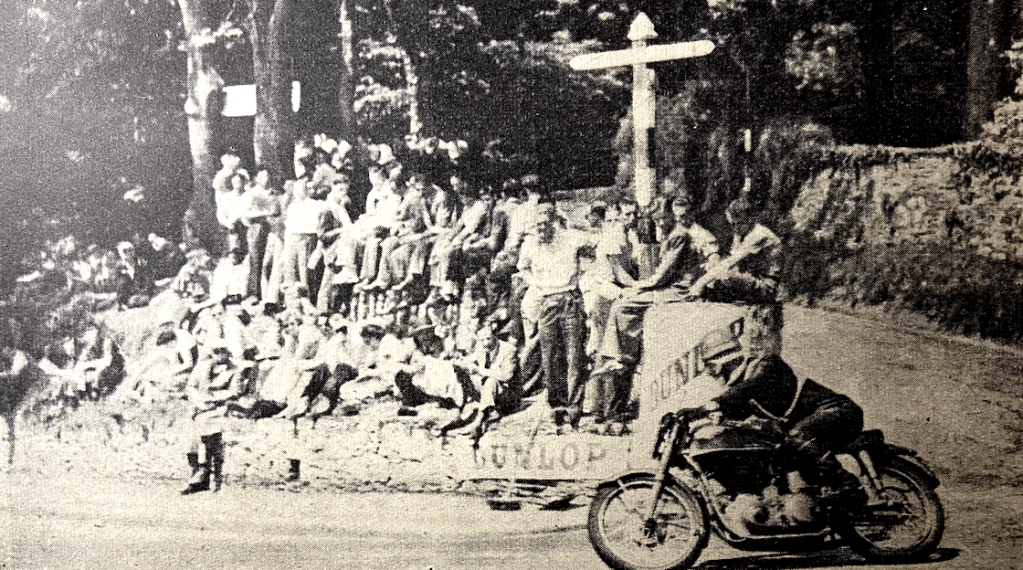
up the Mountain. Two tiny figures, crouching low over their machines, much too far apart to be able to judge the other’s speed, the pair kept the crowds on tiptoe on every popular pitch. Fourth was Powell and fifth Holmes. WR Oldfield (Triumph), Macclesfield Club, and H Plews (Norton), Wakefield Club, were tying for sixth place. The seven leaders were lapping within a minute of each other on corrected time. Pegging away in eighth, ninth and tenth places respectively were A King (Norton), Mercury (Glasgow) Club, D Andrews (Matchless), Horsforth Club, and R Ellis (Norton), Sheffield North End. Club. Keeler hurtled through well down to it to complete his second lap. He had circled fast enough to create a new lap record in 26min 48sec. It seemed that nothing could possibly rob him of a win. It was certain that no one could match his style and speed. But Dow was not to be outdone. He also lapped inside record time, with a lap in 26min 51sec, and was only 3sec slower than Keeler. His spurt carried him into second place, only 21sec behind the leader. Astern of Crooks, who was now third, a Norton-Triumph duel went on between Holmes and Powell who were actually dead-heating for fourth place. A King (Norton) had moved up into sixth place, Plews was now seventh, Oldfield eighth and Andrews ninth. With a lap in 28min 02sec, RE Jerrard (Norton), Southampton Club, had hoisted himself from the middle of the field into 10th place. The speed began to tell and there was news of several retirements. LR King (Triumph), Worcester Club, and J Bottomley (Norton), Moccasin Club, had collided on the first lap. Both riders were

uninjured but Bottomley was forced to retire. It was announced that quite a number of retirements had been caused through riders falling off but in each and every case injuries were stated to be no more than slight. Keeler’s indicator on the scoreboard clicked steadily on. Dow, in second place, was not far behind him on the road, but it seemed unlikely that Dow could catch him or make up his 21 seconds deficiency in the one remaining lap. Anxiously their progress was followed as their indicators moved. There was a gasp of sympathy when it was announced that Dow had overdone things going through Laurel Bank and had had to retire. Keeler, who had not finished in the Junior Clubman’s Race, rode on in impeccable style. When he crossed the line to a burst of applause his time for the final lap was 26min 48.4sec, only two-fifths of a second slower than on his previous lap time, displaying creditable consistency. He won by well over a minute from Crooks—who merits praise for a well-judged race. The Holmes-Powell scrap continued on the final lap. Holmes on the Norton managed to beat the Triumph rider into third place—but only by 3.6 seconds! A. King, H Plews and WR Oldfield maintained their Lap 2 order to fill fifth, sixth and seventh places respectively. The Centre Team Prize was won by the Yorkshire Centre team comprising Plews, R Ellis and D Andrews.” RESULTS: 1, Bob Keeler (Norton), 84.14; 2, Eddie Crooks (Norton); 3, Alan Holmes (Norton); 4, Derek T Powell (Triumph); 5, Alistair King (Norton); 6, Harry Plews (Norton); 7, WR Oldfield (Triumph); 8, R Ellis (Norton); 9, GW Shekell (Norton); 10, ST Seston (Norton).

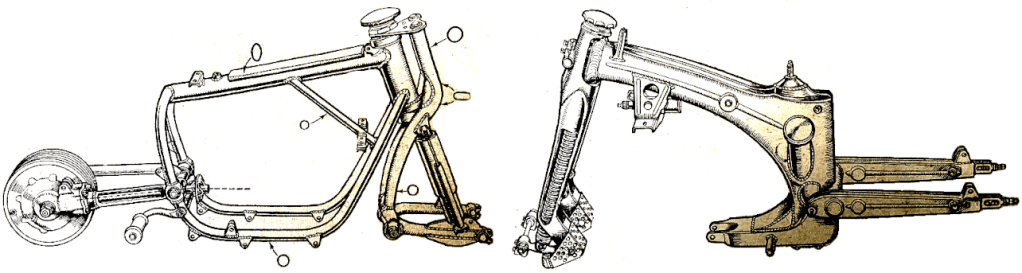
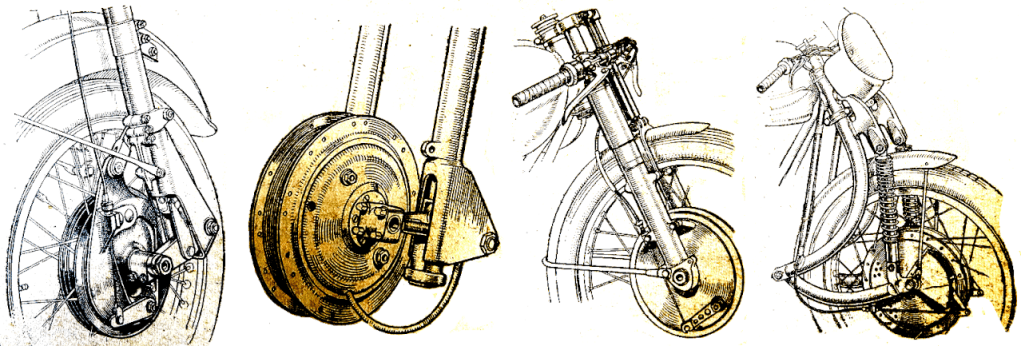
“THE NEWS OF THE DEATH of Les Graham during the Senior TT was received with profound dismay throughout the Island and came as a deep shock to the followers of road racing in all parts of the world. Graham was exceptionally popular, not only because of his engaging character, but also because he had battled for so many years against uncommonly bad fortune. In the early 1930s he was determined to race, yet, like so many other famous riders, his slender resources did not permit anything beyond an occasional entry at grass-track and short-circuit meetings. It was not until 1936, when he rode in the Ulster Grand Prix, that his name figured in the list of an international meeting. At the end of 1937 he joined OK Supremes, as a rider and to supervise the building of the ohc production and racing models. Hence his first appearance in the Island was in the 1938 Lightweight Race, in which he was placed 12th. In 1939 he appeared on a CTS in the Lightweight event, but retired with gear-box trouble during the sixth lap. As a bomber pilot during the war Graham rose to the rank of Flight Lieutenant and was awarded the Distinguished Flying Cross. He was demobilised with an even greater urge than before to take part in racing and he joined AJSs as one of their official team of riders. Ill luck dogged him repeatedly and, although in 1949 he became World’s Champion in the 500cc class, a Senior TT win—the ultimate of his aims—eluded him. The dramatic moment of the 1949 race will readily be recalled. He was comfortably leading on the last lap until Hilberry when he had to stop owing to a fractured magneto armature spindle; he pushed his machine home and was placed 10th. He was cheered every yard of that arduous two miles. In the 1950 Senior he finished fourth. The following year he appeared on Italian MV Agusta machines, which were being developed but were freely admitted as not sufficiently mature for classic races. In that year and in 1952 he worked diligently with MV technicians in bringing the machines up to 1953 standards, when they were considered potential world-beaters. He was second in last year’s Senior Race. Robert Leslie Graham was born in Wallasey, Cheshire, and was 43 years of age. His happy enthusiasm will he sadly missed.”

“THE LUSTRE OF last week’s series of Tourist Trophy Races was dimmed by four fatalities which included RL Graham, one of the finest riders in the world. The seriousness of the loss of life is faced squarely by those with the future of racing at heart; they do not need to pay attention to the unhappy and unbalanced references in some national newspapers to appreciate the gravity of the occasion. As with other manly sports, racing is inseparable from an element of danger. The only way to remove the risk is to stop racing. On the basis of this logic, no effort should have been made to climb Mount Everest, no pilot should be permitted to test the latest, high-speed aircraft, never again should a polar expedition be allowed to take place, any future venture on Kon-Tiki lines should be prevented. In fact, unless risks are down to the level of those unavoidable in the course of unexceptional activities, man should ignore the persistent inclination to match his skill in a chosen sphere against others, should spurn the stirrings of his courage and the beckoning of adventure. Obviously this line of logic is untenable, and would breed national decline. The sad deaths that occurred last week are deeply mourned and serve to emphasise the hazards of racing. So long as all practicable steps are taken to remove unnecessary risks, and to lessen the misfortunes devolving on dependants, the sponsors of racing will have the support of all thinking people. Records were established in every event, and the jump in race average speeds was remarkable. No multi-cylinder machine achieved a first place in the International classes; this in spite of a more ominous challenge than ever before from teams of Italian four-cylinder models. In particular, the result of the International Senior Race justifies confidence in the continued supremacy of the single, though it will not pass unnoticed that the fours were by no means outclassed. Very close struggles are promised in the Continental classic races to follow in the next three months. As in last year’s series of races, visitors from the Commonwealth rode magnificently. Southern Rhodesia will be proud that her representative has joined the ranks of the select few to have scored wins in Junior and Senior events in the same year. An Australian was second in the Junior Race. Other Commonwealth men secured replicas, and many of those who retired for one reason or another were well placed before they were forced to stop. German riders and machines, making their first appearance in the Isle of Man since 1939, achieved notable placings; the seconds gained in the Lightweight 250 and 125cc events are a singular credit to a young rider unfamiliar with the course, and to the manufacturer of his machines. Throughout the week ACU organisation appeared to work smoothly, in spite of its being taxed severely by the race postponements caused by the adverse weather on the Wednesday. Few detail criticisms arose, though it would be appropriate for the ACU once again to review the enforcement of the duties carried out by the scrutineers and competitors’ marshals. The duties are onerous, which makes it the more necessary for rulings to be applied with tact. On the occasion when Continental riders were warned about unsuitable boots, the altercation which followed was embarrassing to Britishers with a sense of the courtesies which should be extended to visitors.”
“A TELEGRAM WAS received by the ACU last week from Auto-Unions, Germany. It expressed the sincere thanks of the company for the kind attention which had been received by the DKW riders in the Island.”

“APROPOS NOTHING IN PARTICULAR, I mused that an engine twice the size of a 250 means a lap speed of about 12mph faster. Ray Amm’s record lap in the Senior Race when trying as hard as possible, and maybe getting a ‘tow’ from Geoff Duke, was 97.41mph. Fergus Anderson’s record was at 85.52mph. Of course, my reverie should have been teeming with all manner of thoughts. During a winter and spring, when it had been asserted with complete conviction that the 500cc single must give way to the multi in classic racing, Joe Craig had carried on with his painstaking development and had now ‘done it again’. The weather over Snaefell was near-perfect last Friday evening. The Senior Norton roared along the Mile in its impeccable fashion. The gears were changed from first to second and second to third at 6,300rpm. Third to top at 6,600, and then I had to roll back the grip as I approached a couple of solos on their way to Ramsey. We loped along to the Guthrie Memorial, turned, and headed back in the right direction of the course. Through the Cutting in second, into third with the revs mounting and, rather beyond half-way along the Mile, into top at about 6,500rpm, which is 200rpm ‘earlier’ than need be. I was quite content to see the needle at 6,500 in top and then pin the Norton down with its
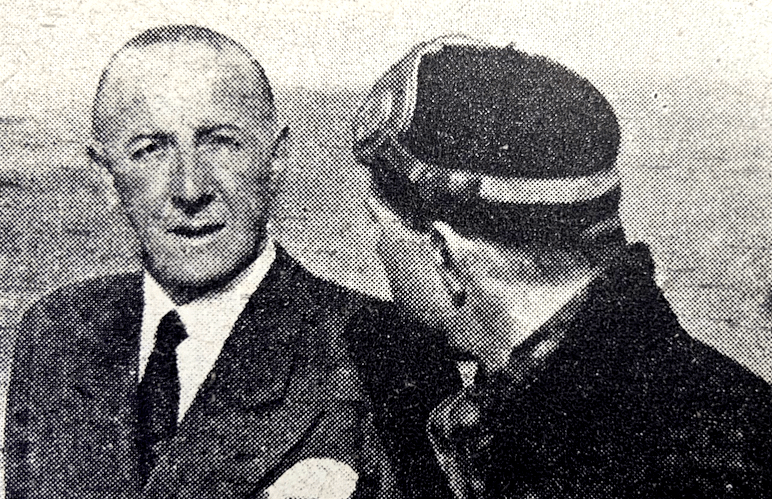
superb brakes in readiness for the right-hand bend just before the Mountain Box. After all, maximum revs—7,250—in the 4.13 to 1 top represents 130mph… Frame, fork and suspensions are identical with those of the 1952 model. Yet on my runs along the Mile I had been impressed by an absence of light rear-wheel hammer—a characteristic remarked on when riding Geoff Duke’s 1952 winner. After two minutes with Joe following my gallop, the query was settled. I had overlooked the fact that last year a 4.00x16in rear tyre was employed, whereas Amm’s machine had a 3.50x19in tyre. The larger diameter makes just that difference and I had become aware of it. Other improvements would not be apparent to anyone riding the Norton from Douglas to the Mountain, and along the Mile a few times. Bhp is up and, at 52, tops the famous ‘100hp per litre’ level on petrol-benzole of pre-war years. As compared with earlier engines, the 1953 unit is capable of sustaining its power over longer periods. More potent than any previous engine, the 1953 Norton shows its biggest step forward in rugged reliability. On this peg are hung Norton hopes of beating the multis in the classic races to come these next few months. But, I guess, the singles will not be far off the mark on speed. The same remark might also be made in reference to 250cc racing. Multis are beginning to show race-winning tendencies, but they do not yet predominate. The dohc Moto-Guzzi grows better, apparently, race by race, and it was with keen anticipation that I arranged to ride Fergus Anderson’s winning mount after the Lightweight 250cc event. ‘It’s easier to ride than last year’s model. The new tank layout brings the fuel weight lower, and the power range is wider.’ Those are the words Fergus used when he handed the model over to me. The latest machine has the 4½-gallon light-alloy tank

mounted below the large-diameter frame top tube (which forms the oil container) and the outlet is at a lower level than the float chamber. Hence a mechanical fuel pump is employed to keep the carburettor supplied. As would be expected, the bringing down of the fuel weight level means the Moto-Guzzi is more handleable—can be banked more easily to either side—and feels lighter than its predecessors. In figures, the wider power range means 5,000 to 9,000rpm for this year’s dohc engine as against 5,000 to 8,300 for the earlier single-ohc rocker engine. The double camshaft unit gives more power throughout the range; some idea of its capabilities can be gathered from the fact that Fergus says his speed was usually about 115mph towards the end of the Sulby Straight. The engine had been reassembled after the post-race examination; when I arrived at the Guzzi stable detail points were being checked over. Fergus loped a few paces, bumped on the seat and the engine was immediately spluttering its warming-up 2,000 to 3,000rpm. As I took over Fergus yelled: ‘It’s yours for five minutes.’ ‘Be back in an hour,’ I sang over my shoulder as the clutch began to bite. As the Guzzi cruised along, off the megaphone in second and third gears, from Signpost Comet towards Craig-ny-Baa, I looked anxiously towards Snaefell. The low-level clouds which had caused the postponement of the Lightweight 125cc and Senior Clubman’s Races were still doing their dirty work. From just above Windy Corner the scudding mist reduced visibility to about 50 yards and chilled the body. Occasionally any speed above 40mph was foolhardy, even allowing for the remarkable stopping power of the Guzzi brakes. Obviously the usual high-speed work along the Mountain Mile was out of the question. I turned the Moto-Guzzi in the sunshine of the Gooseneck-Guthrie Memorial area and headed back into the uninviting mist. There was only one alternative; try the handling on the swerves of Windy Corner and below, and reserve the speed work for the Kate’s Cottage-Craig-ny-Baa section. The light-alloy shroud over the frame top tube is padded and contoured to fit the rider so that be can press himself ‘into’ the machine. Fergus is over 6ft tall and I am a mere 5ft 9in, yet I have never felt so much a part of a racing machine as I did on that 250. My chest and chin rested on sponge rubber; my rump was pressed against the raised end of the seat; my elbows nestled in the elongated cups of the shroud; my knees were braced but a few inches apart into respective niches. The last feature seems the crux of the explanation for the sensation of ‘oneness’. Whether accelerating, braking or swinging bends, the knee-hold forms the anchor of the rider to the machine. This year’s model steers to a hair’s breadth, irons out the bumps even when canted over, never yaws or pitches and, indeed, feels so stable that it encourages the rider to take liberties. One needs to remember that, despite the wonderful non-skid properties of the Isle of Man roads and racing tyres, there are limits of

tyre adhesion. A signaller at Kate’s cottage waves the OK. I snick into fourth gear just after the bend. The wonderfully steady needle of the Smith’s magnetic rev-meter shows 8,000 and is climbing. Comes the singular Guzzi lurch forward as I flick the pedal for top; on this downhill section there appears to be only a 200rpm drop in revs. Speed is over 100mph, yet the sensation of speed is no more than experienced at about 70mph on a roadster—until one realises that the Craig-ny-Baa Hotel is coming into focus with remarkable clarity. Hands and feet get busy with brakes and gear changes. We round the Craig at about 10mph and, judging by the expressions on their faces, disappoint the few spectators at the Hotel. Perhaps they had thought the approaching projectile could not be pacified with such ease and in so short a distance? ‘Good?’ asked the smiling Moto-Guzzi mechanics as I handed back the little jewel. We exchanged the thumbs-up sign. ‘Good’ seemed to me to be the right word—a simple, short word that meant more in the limited English-Italian vocabulary possible at that moment than all the incomprehensible superlatives.”—HWL “NO ENTHUSIAST COULD fail to be delighted at the prospect of a full-bore run on the 349cc factory Norton which Ray Amm rode so dashingly to victory in the International Junior Race. When the opportunity came my way it held an added interest. For in the same race it had been my good fortune to bring home the first standard 348cc Manx Norton. The chance to draw a comparison between the production Model 40M and the factory up-to-date special intrigued me greatly. And, good as the production racer undoubtedly is, it cannot compare with Ray Amm’s mount. When, early on the morning after race day, I collected Amm’s 350 from the Norton depot and pobbled it up to a deserted stretch of the Mountain road, I was immediately impressed by three features: the excellence of the riding position, the comparative quietness of the exhaust note and the high degree of engine tractability. On part throttle, the engine would accelerate cleanly and smoothly from tickover to maximum rpm without a trace of megaphonitis. On full throttle, the normal working condition of such an engine, there was some degree of ‘trumpeting’ around 5,000rpm. Normal racing use of clutch and gear box, however, would overcome inconvenience from such a period, comparatively low in the engine’s speed range. The reverse-cone exhaust system and novel carburation gave much better tractability than usual with the standard racer to which I was accustomed. The riding position was superb—compact, but not so much so that it would cause cramp in a rider’s legs. Amm’s stature is not much different from my own and his forward setting of the backrest-seat was very much to my liking. The high tank top fits one’s body snugly and handlebar, footrests and flyscreen are all

ideally positioned. Of the controls, only the gear pedal fell slightly short of perfect positioning for me. Amm agreed that he also found it a trifle high, but nothing to worry about; it is, of course, adjustable. Arriving at our rendezvous, Joe Craig suggested that my tests be brief in view of the open exhaust. I learned that peak torque (for upward gear changes) occurs at 7,200-7,300rpm while peak power is achieved at 7,700rpm. I am still uncertain as to whether Mr Craig was quoting conservative figures to avoid the possibility of my over-buzzing his power unit, for my spies tell me that the factory Norton riders were not unaccustomed to seeing 8,000rpm indicated. Suffice to say that 7,700rpm in top gear represents the best part of 120mph. I pushed off, and screamed away in bottom gear. The clutch was literally finger light, yet so positive in its engagement that at first I accidentally let the engine get off the megaphone. Once over 5,000rpm the revs mounted with an almost alarming surge. Throughout its speed range, the engine possessed the uncanny degree of smoothness such as I have experienced only on factory racing machines. I was impressed, too, by the steady and smooth movement of the indicator needle of the magnetic rev-meter. At 7,300rpm I made the upward gear changes. The change was perfect and however rapidly the pedal was dabbed it was impossible to fling through a gear as I have been able to do with some standard boxes. Quite soon, in top gear, the magic 7,700rpm was reached and I was convinced that on closed roads it would not have been difficult to trespass into the 8,000rpm range. The Norton’s decelerative powers were phenomenal. The twin-leading-shoe front brake required only light pressure on the lever; the tyre squealed its protest but the machine maintained a dead-straight course. Rear brake leverage was so regulated as to give the maximum usable power without any tendency to lock the wheel. The Norton’s steering was light, positive and accurate; surface irregularities produced not the slightest tendency to wavering, whether the machine was heeled over or upright. Wheel suspension was far and away superior to any standard layout I have ever tried. Checked manually, both front and rear springing had an initially soft and ample movement with a progressive build-up and a strong rebound check. On the road, they resulted in uncanny steadiness, leech-like road holding and an entire absence of pitching. The lateral rigidity of the welded-on rear sub-frame precluded any snaking on bumpy bends. A few years ago there was a tremendously wide gulf between pure racing machines and those designed for road work and clubman racing. The gulf remains today, but the development of the 348cc BSA Gold Star to its present pitch has narrowed it considerably. DT Powell, an erstwhile Dorset farmer and now a motor cycle salesman at Bob Foster’s Parkstone premises, provided proof of this when he brought his Gold Star home first in the Junior Clubman’s at an average speed of 80.17mph. Pulling a 5.05 to 1 top gear during the race, Powell was able to obtain 7,000rpm on level stretches of road. This represents approximately 105mph, a speed which I subsequently confirmed. When I rode the BSA two days later, there was a notable absence of external oil and the machine had not been cleaned since the event. The only attention to the BSA before my test was the replacement of the petrol tank, which had split during the race. The sole modification from standard noted was the use of an Amal Grand Prix carburettor in place of a TT type [that made me smile and I’m not sure why—Ed]. I started the engine several times by means of the kick-starter, a feat which could be easily accomplished on near-full advance, provided only a small throttle opening was used and care was taken not to over-flood the carburettor. Riding from Douglas to the Mountain I found the engine tractable and the exhaust reasonably quiet provided the rpm were kept below 4,000. Around this engine speed there was a fairly pronounced show of temperament, but as soon as the carburation had cleared the power came in with a surge, racing fashion: 7,000rpm is quoted as maximum permissible engine speed. Powell had his rev-meter so mounted that this figure was in the nine o’clock position. Consequently, when I was tucked well down, it was difficult to check this reading accurately. There

was clearly audible indication from the valves whenever the engine speed exceeded 7,000rpm so that only the most clueless would unwittingly over-rev the engine. I was impressed by the potency of the pushrod engine. From rev-meter readings, it appeared to be as fast as the racing machine I had used in the Junior International event. Possibly its acceleration may not have been so good, though this is rather difficult to judge. The handlebar position was high by pure racing machine standards, but the riding position was comfortable nevertheless. The 8in front brake was powerful, though it seemed to me to have a fractionally delayed action—possibly the result of a strenuous race. The new pivoted-fork rear springing worked well. A few bumps were apparent, but I have yet to meet the springing which absorbs all the Island’s surface irregularities. Front fork action was soft and comfortable. The most unusual machine I rode during my three weeks in the Island was the 249cc dohc parallel-twin NSU. The model I sampled was a sister of that which Werner Haas had ridden into second place in the International Lightweight TT. It was, in fact, a practice machine on which many laps had been covered with a minimum of attention; the actual race machines had been whisked out of the Island immediately after the race. The Renn-Max bristles with interesting features. Never before had I ridden a machine where the rpm indicator should be held on the 10,000 mark. No other motor cycle has ever given me such an impression of being something out of a science-fiction story. The sleek, streamlined fairing, fitting snugly round my arms and the machine’s handle-bar, and cutting off my view of the front wheel, gave me the sensation of occupying the small cockpit of a high-speed projectile which one ‘aimed’ rather than steered. Gear primary drive, coil ignition, a ‘spine’ frame and a bottom-link front fork are among the unusual features of the NSU. On the bench, the engine produces 31bhp at 10,400rpm. With IoM gearing, a maximum speed of between 115 and 120mph can be achieved. Bill Lomas has been intimately connected with the rapid development of the Renn-Max. When we met at the NSU garage he was full of enthusiasm for the novel twin. He warned me that the clutch and gear change of the practice model I was to ride were heavier in operation than those of the machine Haas rode in the race; that the fuel level of the left-hand carburettor was somewhat too high, and that I would have to use the ignition batteries

which had already completed the race. Bill opined that these last two factors might spoil my appreciation of the twin’s extraordinary tractability: the megaphones are some three feet in length, with a very shallow taper. Starting the engine was child’s play. Provided one remembered to switch on the ignition, it was sufficient to walk the machine in bottom gear and engage the clutch. The left-hand carburettor did, in fact, tend to misbehave at low rpm, but even so, megaphonitis was only slight, and that at around 4,000rpm. From this engine speed upward, the pitch of the exhaust note mounted a seemingly endless scale. At 9,000rpm. I selected second gear. The other two upward changes were made at 9,500-10,000rpm and, on the fast stretch before the bends at the 33rd milestone and again on the descent to Craig-ny-Baa, I obtained flash readings of 10,000rpm in top gear. Lomas mentioned this was nearly two miles a minute. I was enthralled with the model and made several runs. At all speeds the low, curved, Perspex windshield deflected the self-made gale clear of my head so that I rode in a pleasantly calm pocket of air. If the gear change and clutch of the other machines were superior to this, then they must be excellent indeed. Engine vibration was not entirely absent, and a slight, high-frequency tremor was perceptible at the footrests. Front and rear springing were really effective, unobtrusive and there was no pitching. Steering was excellent. though there was a slight tendency to snaking during harsh deceleration. Though of single-leading shoe pattern, the front brake was immensely powerful, and the bottom-link fork behaved perfectly under heavy braking. Rear-brake leverage was more than I was used to and I locked the wheel on the first application.” —VHW “IS IT A SUPERCHARGED TWIN, with the pumping cylinder camouflaged to look like a working cylinder? This somewhat daring question concerning the 350cc three-cylinder two-stroke DKW originated, I think, in Italy towards the end of last year. The DKW concern need not be dismayed at the opinion of their ethical standards implied by this rumour. They must, instead, accept it as a tribute to their design and development prowess, for it arose because the machine displayed a speed far in excess of that believed possible with unblown two-strokes. But rumour is ever a lying jade: the machines are certainly nothing but what they are claimed to be, with three, honest-to-goodness working cylinders. I rode one of them last week and was the first apart from Wünsche, Kluge, Felgenheier and Wolf (the designer), ever to do so. Our group foregathered on the Mountain at 6.30am on the day after the Junior Race. I had intended riding Wünsche’s machine, but since it had broken a gudgeon pin on race day, I arranged instead to try the model brought over for the unlucky Kluge. In several years’ experience involving many racing machines, I have never before become familiar with a strange racer so quickly and never, I believe, even with TT-winning 500s, have I experienced such tyre-stripping, violent push-in-the-back, front-wheel-lifting acceleration from nought into the 70s. Not only is there no megaphonitis, but there is no uneven firing at low rpm when the engine is pulling. The DKW starts more readily when cold than it does when hot, and there is no need to warm it up to ensure that the oil is on the job; moreover, full throttle can be used immediately. The only proviso is that before the engine is started, the adjusting screws controlling the gravity oil feeds to the cylinder bores are slackened by about half a turn. The trouble experienced with the machines in last year’s events was piston-ring breakage, and the additional oil feeds are

said to have worked a cure. No superlatives in the Wilson vocabulary are superlative enough to describe the ease of push-starting the DKW. The procedure was so novel that I played with the machine for some time, stopping and starting, to enjoy the experience. Two brisk steps forward with bottom gear engaged, and then the clutch could be dropped instantly. Flinging my leg over the saddle, I was aboard in a flash and, with the clutch home throughout, accelerating like something out of this world, the front wheel spending as much of its time off the road as on it! Several obvious factors contribute to the tendency of the front wheel to lift. The first is the colossal power of the three-cylinder two-stroke at low and medium rpm. The second is the very low weight of the model as a whole: scaling 160lb dry, it is probably lighter than the majority of racing 125s. The third is the riding position: the seat is low and far back, the footrests are well back also, and the handlebar is only a little above the bottom steering-head lug. It is not an easy matter to keep the necessary weight on the grips. Engine speed is built up with lightning rapidity. Peak rpm is 12,000, but the engine will run up to 13,000 with safety. No rpm indicator was fitted to my model, since the electric instruments used normally have a two- or three-lap life only and chronometric units are too severely hampered by their escapement mechanism to be able to keep pace with the engine. I was told to rev it till it whistled; then rev it some more until it just wouldn’t go faster. I was assured that I couldn’t do any damage. These were magnanimous words, so I did my worst, screaming the engine till I was certain it must disintegrate, braking hard, then snapping the throttle from the closed position back to its stop coming out of the curves. Throughout the range there was absolutely no vibration, and the transmission was so smooth as to be quite unobtrusive. The gear change was on a par with the best possible; light, instantaneous, utterly positive no matter how rapidly the controls were operated. (Yet the gear box is no bigger than the magneto!) The brakes were enormously powerful, but just a shade fierce, I felt, for such a lightweight, and I gather that Wolf is looking for even more power from them in future. On the swerves, with the Dekavee, I was reminded of the moment of my arrival for practice at Solitude last year. Kluge and Wünsche passed on a fast second-gear curve, and I felt that what I was watching was just not possible. There appeared to be no limit to which the DKW could be heeled over. There was no drifting, no chopping, no snaking or yawing. Both suspensions are powerfully damped and the wheels followed every irregularity in the road’s surface. Slow and medium-slow corners were negotiated with the clutch home and, of course, the additional concentration of keeping an engine on the megaphone was not required. What maximum speed or rpm I achieved on the Mountain Mile I have no idea. That the machine was terrifically fast there is no doubt, yet it was not giving of its best in my hands because it had been jetted for a cold day and on this occasion, early as it was, the temperature was already high. Plug readings and the exhaust confirmed that the mixture was rich. We went down a size on all three carburettor jets and fitted new plugs, but the mixture strength remained rich. Even so, maximum speed was high enough to push the flesh back on my cheek bones till I felt it would tear, and to cause me to pant with exertion and excitement when i was finished with the machine. That the DKW will be a serious threat to British 350cc supremacy in the Continental classic road races is a stimulating certainty.”—GW
“I WAS VERY MUCH interested in the article entitled ‘Pick of the Breed’. Referring to Harry Louis’ section, he gives the power developed by the Norton as 52bhp, and apparently the top speed is about 135mph while developing this power. Statements have appeared that the car engineers have now succeeded in obtaining 100bhp per litre; it would appear that Norton have exceeded that rate for their 500cc engine. Vic Willoughby gives the power of the 250cc NSU as 31bhp. Here the 100bhp per litre is far exceeded; the figure works out at 120bhp per litre. I have tried to ascertain from this data the driving push exerted by the rear wheel on the road, assuming a transmission efficiency of 94% between engine and wheel. One horse power is 550ft-lb per second, and 52bhp will be 550×52=28,600ft-lb per second. If 94% of this gets to the rear wheel, it means that 28,600 x 0.94ft-lb of work are done per second by the rear whee1=26,884ft-lb. Now 135 miles per hour equals 135×88÷60ft per sec=98ft per sec. Hence, if 26,884ft-lb of work per second is done through 198ft, the push to do this work will be 26,884÷198=136lb. Thus it takes a push of 136lb to make a Norton weighing, say, 330lb, together with a rider weighing about 150lb, a total of 480lb, travel at 135mph. It is easy to see that, at these speeds, the adhesion between the tyre and the road is very nearly at, or exceeds, the slipping point, even though fresh road is passing under the wheel at 198ft per second. If one assumes that the distribution of load is 280lb on the rear wheel and 200lb on the front wheel, then µ, the coefficient of friction between tyre and road, must not be less than 136÷280=0.48 or thereabouts, which, in my opinion, indicates that the wheel is slipping all the time. Further, since the pull in the driving chain must be three times the driving push (because the rear sprocket is about one-third of the diameter of the road wheel), the thrust in the rear chain stay on the drive side must be at least 3×126+half the propelling thrust=3×136+136÷2=408+68=476lb. Here one can see the reason why Ixion frequently refers to frame whip for, under these conditions, one chain stay has a load of 476lb and the other a load of 136÷2=68lb. Under acceleration conditions, when in lower gears, these loads should be exceeded, provided there is no wheelspin. Turning now to the NSU ridden by Vic Willoughby, the work done per second by the engine is 31×550=17,050ft-lb, of which 17,050×0.94=16,027ft-lb gets to the rear wheel. Now 120mph was attained by the NSU, and 120mph=176ft per second. Hence the driving push would be 16,027÷176=91lb. The NSU would be lighter than the Norton, but it was streamlined, while the Norton was not, so let us see if we can ascertain whether or not the streamlining is beneficial. Air resistance varies as the square of the speed at such speeds as we have under consideration; hence the ratio of the air resistances is 135²÷120²=18,225÷14,400=1.26, while the ratio of engine powers is 52÷31=1.68. Thus the Norton needed 1.68 times the power to overcome 1.26 times the air resistance, so it looks as though the NSU scored heavily by streamlining.
THOMAS H WEBSTER, Lansdown, Bath.”
The Blue ‘Un filled a couple of pages with tittle tattle from the Island; here’s a selection.
“MACHINES TO BE SEEN in the Island ranged from very new to very old. One of the oldest was a 1921 Model H Matchless sidecar outfit which had been brought over from Liverpool◊◊◊At the weigh-in for the International Junior on Saturday afternoon, no fewer than three previous TT winners were to be seen, all of whom were Irish. They were Artie Bell, Stanley Woods and Cromie McCandless◊◊◊That hardy bi-perennial, the film No Limit was once again being shown in Douglas. The title would seem to apply equally well both to George Formby’s performance on the Rainbow racer and to the number of years that the film can go on being screened◊◊◊An innovation this year was incidental music by the Ferodo works’ band in the enclosure behind the Grandstand. The music was much preferred to the usual melodies that, in past years, have been broadcast over the public-address system◊◊◊Next year any rider who, in the practising period, seeks to chalk up a remarkable lap time by omitting the Ramsey side of the 37¾-mile course may find that he has to pay

£5 to the ACU Benevolent Fund. The timekeepers are not amused by attempts to hoodwink them◊◊◊Few welders practising are better craftsmen than Ted Frend. Consequently, when Moto-Guzzis were having trouble with tanks splitting in practice, Frend was consulted by Fergus Anderson. After inspecting the tanks, Frend felt that the trouble was due to the sides flexing, and he strengthened them accordingly. The race results tell the rest of the story◊◊◊The difficulty in handling the extremely powerful, smooth-torque, four-cylinder 500s lies in the ease with which wheelspin develops. The call is for much greater traction from their single rear tyres. There is little doubt that more can be achieved in this direction, but there are problems of heat generation and wear. It may well be that a range of racing rear tyres will be introduced, the tyre selected for any given event depending on the length of the course, the speeds likely to be achieved and the nature of the road surface. Once again, it is the tyre makers’ turn to be put on the spot◊◊◊Market research experts will be interested to learn of a new outlet for stick-on soles—several riders found the soles make excellent knee-grips on petrol tanks◊◊◊Ken Mudford from Australia rode in the Junior Race with several days’ growth on his chin. His face was too tender to be shaved after his Ramsey spill in practice, his lips were still split and swollen,

and he spent a great period of the race with a loose goggle head-band and a zip on the sleeve of his leathers that kept slipping. In spite of these distractions and tribulations, Mudford was the second private owner home◊◊◊During the 125cc race, a spectator was heard to remark that the engine note of one competitor’s machine failed to rise in the usual manner each time he descended Bray Hill. ‘The engine is fitted with a governor,’ remarked his friend. ‘Really, what sort?’ ‘The man in the saddle,’ was the cynical reply◊◊◊Sunny weather graced Douglas during race week. Each morning, shirt sleeves and light cotton dresses proved that holiday makers were confident of the day continuing fine. Not so the motor cyclists. Their closely buttoned competition suits and coats, securely plugged by lengthy scarves (at the other extremity, waders were not unusual), evinced a traditional faith in the imminence of rain, gales and foul weather of all degrees◊◊◊Last rider to weigh in for the Senior was staff-man Vic Willoughby, who had found that, whereas he who runs may read, he also had to write [and that’s why Vic is one of my few heroes!—Ed]◊◊◊The autograph craze appeared to have bitten Jack Brett, who was observed at the Senior weigh-in seriously (?) requesting signatures from other well-known riders◊◊◊Only machine with a built-in bar was KRE Prince’s AJS. Taking a leaf from cyclists’ books, he had fitted a small lime-juice container on his front fork, with a pipe leading to the tank top◊◊◊All will wish to salute SA Sorensen, who was competing in the Island for the last time after having taken part in over 20 TT Races. The popular, diminutive Scandinavian rider first rode in the Island in 1935 when he was already 32 years old. His name has usually appeared in print followed by the word Excelsior, in brackets, but he has also ridden Nortons. Few are aware that Sorensen is an

expert in all branches of the sport, speedway included, and that he was winner of the Senior Swedish Grand Prix in 1951◊◊◊Built for experiment and first tested at Monza on May 7—third place at 89.41mph in the Junior TT on June 8: that is the story of the ‘one off’ 320cc Moto-Guzzi ridden by Anderson◊◊◊Almost immediately the 250cc Lightweight Race was over the Moto-Guzzi equipe started to pack their tools and head for Italy. Much testing awaited them for, after the magnificent performance of the 320 in the Junior, it was decided to build a Pukka 350 (the 320cc model is a bored out 250) and to have it ready for the Dutch Grand Prix on June 27◊◊◊For the first time for many years, Wooler motor cycles were to be seen, in the Island. Two prototypes of the; latest fiat-four design were centres of attraction wherever they were parked◊◊◊Some of those responsible for motor cycle design question whether the time has come for swinging-arm front forks; they grant that such designs have merit but suggest that the telescopic front fork leaves considerable room for improvement—lighter springs, with all the shock absorbed by the hydraulic dampers, fluids which ensure that the characteristics remain constant◊◊◊As is known, quick fuel-tank detachability is one of the features of the new AMC production racers. One rider was heard to suggest that it might be quicker to change fuel tanks than to refuel in the conventional manner◊◊◊It was found relatively easy to distinguish pukka racing men from non-racers when they were riding roadster machines in Douglas, The racing men invariably adopted a normal, upright riding posture, whereas many non-racers were apparently afflicted with some deformity which compelled them to sit on the rear extremity of

their dual-seats, in obvious discomfort◊◊◊In Geoff Duke’s pit for the Senior Race was a spare rear wheel complete with 4.00x17in tyre. The intention was that at his pit stop the rear tyre would be examined and, if found to show appreciable signs of wear, the wheel would be changed. With the Gilera QD arrangement, the replacement can be effected in 15 seconds. As Geoff retired before his pit stop, there was no chance for spectators to watch the mechanic in action!◊◊◊There was no truth in the rumour that local ice cream manufacturers were about to introduce reverse cones for an extra 1d a time◊◊◊For the start of Friday’s Senior Race, boy scouts carrying flags of all the nations represented by competitors lined the starting grid. Included among the flags was the Stars and Stripes—for Nick Nicholson, of course◊◊◊If the present trend toward humped petrol tanks and low handlebars is developed much more, aspiring TT winners will need powerful arm and shoulder muscles. Steering by an extension of the front wheel spindle is likely to prove tiring work◊◊◊Geoff Duke tried out the 250cc. racing NSU last week and would have started in the Lightweight Race had the regulations permitted. Arrangements for him to ride NSU machines in future classic events are being made, but have not been finalised◊◊◊Vic Willoughby explained the very simple reason that lies behind the head-up stance characteristic of be-spectacled riders. The top wire of the daintiest pair of glasses is a considerable bar when it is

within half an inch of the eyes; if a head-down position is adopted, this bar becomes a blind streak that extends almost fully across the range of vision. That’s the reason why Vic always appears to know where he is going◊◊◊During the practice period, residents in some of the sea-front hotels in Douglas were often intrigued by a noise which sounded exactly as though someone was riding one of the MV fours up and down the far end of the promenade. Eventually the noise was traced to an electrically driven dairy van which gave forth exactly the same note as the MV (apart from a slight difference in volume)◊◊◊It was bound to happen, of course. One Junior TT rider turned out wearing a red, white and blue helmet during Coronation week◊◊◊Werner Haas (NSU), second man home in the Lightweight 250cc and 125cc races, won the Ray B Westover Trophy, presented by Ray B Westover, of Seattle, USA, for the best performance (other than that of a winner), based on a percentage of the winner’s time, by a newcomer to the TT Races◊◊◊“Your lamb-meat ist nicht gut!’ That was the only criticism proffered by members of the NSU service staff concerning their stay in the Island. Lean-ing against one of NSU’s elegant blue vans, they discussed the matter. Scenery—grand; accommodation—very comfortable; food—well…girls—too busy to notice them!◊◊◊During the TT practice and race period, approximately 40,000 passengers travelled to the Isle of Man from the mainland in IoM Steam Packet Company’s boats. This figure does not, of course, include those who travelled by air. Vehicles transported included over 5,000 solo motor cycles, about 500 sidecar outfits and 450 cars◊◊◊Some of the Continental mechanics guarded their secrets so zealously that cylinder heads removed in the scrutineers’ tent were immediately swathed from prying eyes. One mechanic even stood on his (cylinder) head. In direct contrast, Fred Neill invited inspection of the excellent internal condition of two Porcupine engines◊◊◊Just how accurately a racing machine must be geared to give of its best was apparent from Jack Brett’s performance in the Junior Race. At the last moment before weighing-in, Brett raised his gear by one tooth on the engine sprocket. But he was foxed by the weather, for on race day what wind there was blew down the mountain climb. Brett’s Norton was thus over-geared for the occasion and his speed was considerably lower than that of Amm and Kavanagh.”
“WHAT A CARVE UP! The last lap in the Senior TT, Ray Amm fighting for British motor cycling prestige and we have to leave for an ‘exciting’ game of cricket!
FF STURGE, Tottenham.
PS—Radio set for sale, cheap.”
Here’s a post-TT treat—an Island fairy story, courtesy of Bob Currie, who in my time with Motor Cycle Weekly had become the world’s leading historian of the British motor cycle industry. He was also a wordsmith of the first water. Enjoy!—Ed
“‘BROKEN THROTTLE CABLE, SIR? Only be a minute or two,’ said the Man at the wayside garage. ‘Just let me finish fiddling with this carb—the chap’s coming to collect the machine in a few minutes. Leave your bike there—Norfield, eh? Nice model!’ He fiddled about with his spanners for a few seconds, then spoke again. ‘Pal of mine runs one of those. Does a bit of road racing, too—chap by the name of Bill Simes. Ever heard of him?’ I intimated that the name was unfamiliar. ‘Rode in this year’s Clubman’s with it. As a matter of fact, there’s quite a story about that. Know the Island at all?’ I nodded. ‘Perhaps you’ll know about the fairy bridge, on the Castletown road?’ he asked. ‘I know,’ I answered. ‘Where the locals lift their hats every time they cross it and say “Good morning, fairies.”‘ ‘That’s the one,’ said the Man. There was a pause while he manoeuvred the slide into the body of the carburettor. ‘Well,’ he continued at last, ‘we’d been telling old Bill about this fairy bridge, but he just laughed and said he wasn’t superstitious. Neither were we, of course, but we hadn’t ever seen the place, so one evening during practice week the whole gang of us went out to see it. Not that there was much to see, really, but still, it made a change. We tried to kid Bill along a bit. “How about saying good evening, fairies,” we said, “might bring you luck nest week!” But Bill just laughed. Then just for a lark, he walked over to the parapet and-leaned over. “Yah—silly old fairies!” he shouted. Well, it was only our bit of high spirits, naturally, and we didn’t think anything more about it till a few days later. Nothing seemed to go right for Bill after that—broken chain on his first morning out, valve dropped in next practice; everything that could go wrong went wrong. “You know, Tom,” he said to me in the boarding house one evening, “I wonder if there are fairies?” I laughed out loud. Fairies! At his age! Still, things didn’t get much better, and I could see that it was preying on his mind. All riders get nervous at times, naturally, and so I thought I’d humour him a bit—put his mind at ease. ‘Look, Bill,’ I said, ‘just to make you feel happier we’ll go back to that bridge, and you can say you’re sorry.’ He blushed a little, but said it might help, so late that night (we’d been rebuilding the engine after a blow-up for the umpteenth time that week) we trotted out to the bridge. ‘Think it might help if I threw some silver over to them?’ Bill asked. Now I happened to have a dud sixpenny bit in my pocket that I’d been given in change the night before, and since I didn’t see the sense in chucking good money away for nothing, I handed it to Bill. It was dark, anyway, to he didn’t notice any-thing. He walked over to the parapet, and threw over the dud tanner. ‘Sorry, fairies,’ he said, ever so softly, ‘ I won’t doubt you again.’ Believe it or not, he was much brighter after that, and we went back to Douglas full of beans. There was only one practice morning left, and this time Bill couldn’t do any-thing wrong; he even managed to get into the first six! Well, that was that. All we had to do now was wait until Monday afternoon. We didn’t bother to go and see the International boys in the morning race, and just about lunch time I started to get organised for the Clubman’s do. ‘How do you feel, Bill?’ I asked. ‘Bang on, Tom!’ he said without a care in the world. The Man finished tightening the carburettor flange nuts, and stood up. ‘Right,’ he said, ‘bring your bike over here, and we’ll see what we can do for you.’ ‘But what happened to Bill in the race?’ I asked. ‘Where did he finish?’ The Man looked at me for a moment. ‘He didn’t,’ he said. ‘Bill was going like smoke for the first lap, and as be went by the pits he gave the thumbs up; but that was the last time he went through. Between Quarter and Braddan everything suddenly locked up solid, and he did a most almighty skid. It wasn’t until much later that we found out what had caused the trouble. Jammed between two of the timing gears was a bit of metal—a dud sixpenny piece.’ The Man wiped his hands on a piece of rag. ‘Now,’ he said, ‘let’s see about that throttle wire.'”
“A PROTOTYPE OF the latest Moto-Guzzi utility machine—the 98cc Zigolo—was tested by a member of The Motor Cycle staff in the Isle of Man during the TT period.Wherever this machine went its distinctive appearance attracted interested glances and favourable comment. Nor was this interest confined to motor cyclists; many laymen saw in the Zigolo a simple, safe, clean and comfortable means of transport for one or two persons. In conception, the Zigolo is modern without being freakish. Following the contemporary Continental trend, it employs a spine frame. In addition, beautifully styled steel pressings serve to enclose much of the power unit and extend rearward to form a deeply valanced mudguard. Detachable covers on the right and left of the engine provide access, respectively, to the carburettor and flywheel alternator. Above these covers, neat trapdoors conceal the toolbox on the left-hand side and the fuel tap and remote carburettor tickler control on the right. The machine’s silver-grey finish is both attractive and serviceable. To ride the Zigolo was to gain an immediate impression of its excellence. Here was a lightweight which, notwithstanding its small engine capacity, was designed and built as a fully-fledged motor cycle. In all respects it performed as such. Engine power was remarkable for a unit of 98cc, and it endowed the machine with a road performance comparable with that of many an orthodox 125. Power delivery was silky-smooth whether the engine was pulling lustily at inordinately low rpm or being grossly over-revved in one of the lower gears. Useful power was developed over a commendably wide engine-speed range. This should make for ease of driving by the non-mechanically minded. On single-figure gradients the engine would continue to pull happily at 15mph in top gear. Alternatively, prolonged high revving in the lower ratios failed to tire the little engine. Passenger carrying was easily within the Zigolo’s capabilities, even on the steep hills of Douglas. No opportunity presented itself to obtain timed performance figures. However, speedometer readings of 21mph and 33mph were recorded in bottom and second gears. In top gear, with the rider sitting
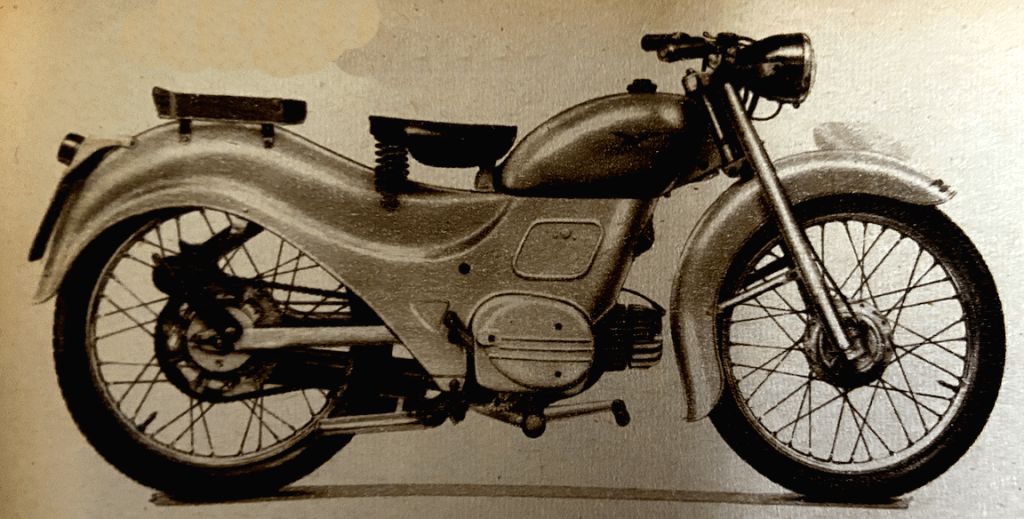
bolt upright, the maximum speedometer reading on a level road varied between 40 and 50mph, according to wind direction. A mean indicated maximum of 44-45mph is a fair indication of the Zigolo’s capabilities in this direction. Aided by the machine’s lightness, acceleration was relatively brisk. A good degree of exhaust silencing was achieved and two-stroking was excellent save for the inevitable slight irregularity of idling. Engine starting was simple, whether the unit was hot or cold. Only for a cold start was carburettor flooding and closure of the air lever required. Two kicks at the most sufficed. A minor criticism may be levelled at the kick-starter. It had a rotating, knurled, steel pedal and one’s foot readily slipped off the pedal when it was operated from astride the machine. The gear change was light and positive. Either of two techniques could be employed. Ultra-rapid changes could be made in either direction; in this case, slight clashing of the dogs was audible. Alternatively, silent changes could be achieved provided the gear pedal was moved slowly. The former method was more often used for test purposes and no apparent harm resulted. The riding position was excellent; it was in no way cramped, and gave comfort and full control. Steering and general handling were superb and of the hairline variety one associates with the TT-winning machines of the marque. Wheel suspension, too, was far above the average for a machine of this type. The telescopic front fork had a long action and well-chosen spring strength. The pivoted rear fork, controlled by rubber blocks, worked extremely well. Its friction dampers were readily adjustable. Indicative of the excellent detail design of the Zigolo are the pivots of these dampers. Screwed-in, knurled plugs act as greasers at these points. Both brakes were superb, being light in operation, smooth and extremely powerful. Even when descending steep hills on full throttle with a pillion passenger, the Zigolo could be brought to rest with complete stability in a remarkably short distance. Some trouble was experienced with air leakage from the butted joint of the rear-tyre inner tube. Attention to this point revealed that the rear wheel could, if required, be removed without detach-ing the connecting link of the chain, since the fork-end slots face forward and downward. No exact measurement of petroil consumption was made, but experience suggested that the makers’ claim of over 120mpg would not be difficult to substantiate under normal conditions.”
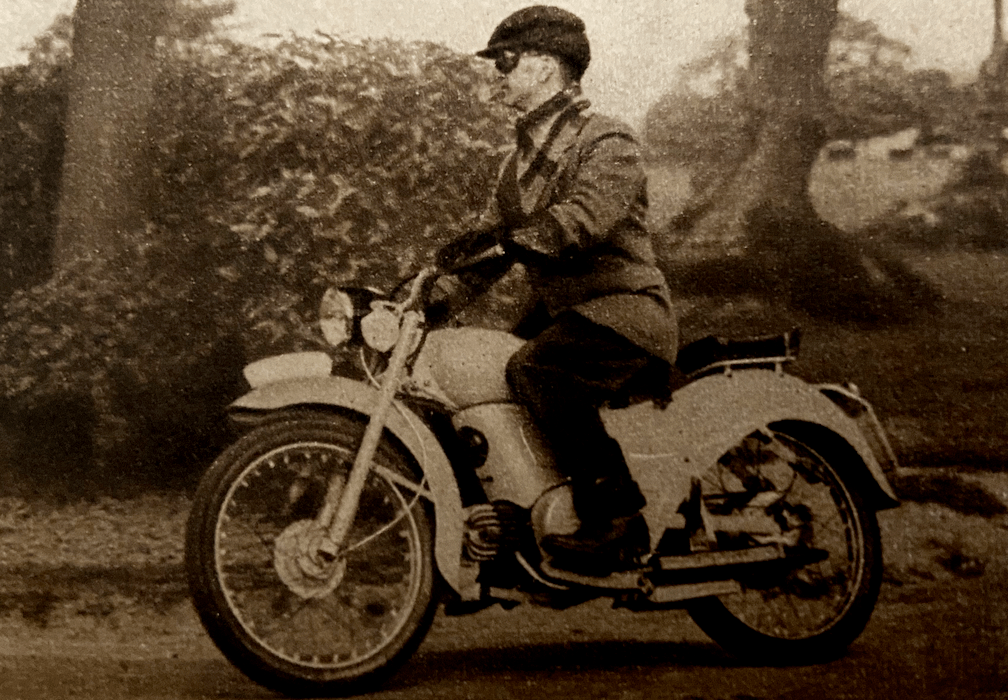
“GERMAN RIDERS W HAAS and S Wünsche chalked up further successes in the international Felberg-Rennen, held over the seven-mile Felberg Mountain Ring circuit last Sunday. Haas (NSU), won the 125cc race at an average speed of 64mph, and Wünsche (DKW) the 250 and 350cc races at 68.7 and 71mph respectively. Third place was filled by Britain’s John Storr (Norton) who finished nearly three minutes behind the leader at 68.8mph average speed for the 107.7 miles. In the 500cc event, Storr finished second, lmin lOsec behind Georg Meier (BMW) who averaged 72mph. Third was Gerhard Mette (BMW), lOsec behind Storr. In the sidecar race, ES Oliver (Norton) finished second to W Noll (BMW), who led by nearly a minute.”
“A NEW SAFETY helmet named the Tuffnut has a shell made of laminated fabric moulded under high pressure. Bisecting the crown of the shell are two protective ribs. A harness is fitted inside the shell, together with adequate cushioning. Weight of the helmet, including neck curtain, is 12¾oz. The helmet is designed to conform with the requirements of the British Standards draft specification, and has been subjected to an official test of impact, thrust and water resistance. The makers are Malcolm Campbell (Plastics), 5, Great James Street, London, WC1. The price is £1 19s 7d (inc PT).”
“HELD LAST SUNDAY, the Coronation year Banbury Run, organised by the Vintage MCC, had a record entry of well over 250. The crowds of spectators were also of record proportions so far as could be judged, and that not only at the start and finish in the North Oxfordshire town, but at the turning-point at Baginton, near Coventry, and indeed all along the route, which had an out-and-home distance of just over 60 miles. At the top of Knowle, on the Edge Hill ridge, which was one of the obvious vantage points, the congestion indeed threatened to become serious. So far as the weather was

concerned, the event was remarkably lucky, considering the prevailing conditions of June. Though the day was dull and heavy, the storm clouds never actually broke and riders of belt-driven models had an easier time than many of them expected. This year the start was made from the car park of the cattle market near Banbury station, where plenty of space was available, and it was agreed that this was a great improvement. Then and later the assistance given by the police was invaluable, and as courteous as it was efficient…The first machine away was the now famous two-front-wheels-in-line Slinger built in 1901, which had a successful trip even though the climb of Knowle proved a trifle too much for it, as happened with many of the older single-geared models. Mounts of around half a century ago included a Humber, built under P&M licence, some early Quadrants, and Arthur Bryden’s 1903-Rex. Of particular interest was the Phoenix, ridden by RJ Phillpotts, which had not appeared at Banbury before. Although built in 1904, it has a two-speed gear as well as all-chain drive, its inclined engine being mounted in a frame of particularly sturdy construction, with a duplicated front down tube. Another newcomer was the White and Poppe, dating from 1905, entered by Richard Dunmur, who sent us an account of this rare antique at the time when he acquired it. But the most extraordinary entry, at any rate in the eyes of many of the spectators, was C Smith’s Riley tricar, dating from 49 years ago. Possibly the expression of the very juvenile passenger in the forecarriage may have had something to do with that, but the vehicle, which performed well, is decidedly interesting. Noteworthy, too, was the Howard ‘flat single’ which is probably unique, but has attended at Banbury before. John Wooler appeared on a 1922 model of his father’s make. Despite heavy pressure

of work, Motor Cycling’s Editor, Graham Walker, succeeded in his ambition to compete in the Banbury Run for the first time. He received a great welcome. Too bad that the plug lead of his 1925 Sunbeam should have jumped off in the one non-stop section! This event combines the cavalcade and the competition. Veteran and vintage models cover historic ground, over which so many British motor cycles received their testing in the early days, and at the same time riders have a chance to pit their skill against the next man. There are two veteran classes, for machines built before the end of 1908 and 1915 respectively, the vintage dates being 1923 and 1930. Riders could average 15, 20 or 24mph according to choice. There were two secret checks to decide ties, a starting test after lunch that produced very few failures, and the ascent of Stoneleigh, once much used by the Coventry testers, was observed along with that of Knowle. At Baginton, following the half-way halt, considerable congestion occurred, causing delay in despatching the riders. Times were accordingly disregarded in working out the results. RESULTS: Premier Trophy: 0 Langton (1903 Humber). Best Opposite Class: PN Howdle (1914 James sc). Premier Awards: Class A (pre-1909): W Grove (1906 Triumph). Class B (pre-1915): HE Cohen (1914 Bat). Class C (pre-1924): GS Davison (1917 Douglas). Class D (pre-1931): WJ Rich (1925 Sunbeam). Founder’s Trophy: W Moore (1914 Douglas). Concours d’Elegance Awards: Feridax Trophy: W Fruin (1922 16H Norton). Best Opposite Class: JJ Allen (1912 Motosacoche).”

“NOVELTY CERTAINLY CHARACTERISES the creation of Mr AD Baxter, of Leeds. But (writes ‘Carbon’) it is novelty of a strictly, practical and commonsense kind. For everyday transport this little model has a number of undeniably attractive features. The designer’s object was to produce a mount between the cyclemotor/autocycle class and the motor cycle proper. He further wanted a comfortable machine and one that incorporated convenient equipment for carrying luggage and parcels. The power unit chosen was the 80cc two-stroke Levis with countershaft clutch. The fixed gear ratio is 11:1. A prototype has now covered a lengthy mileage over a period of many months. The machine is remarkably compact. Its wheelbase is only 40in. (approximately the same as the Corgi), and with 20x2in wheels and tyres the seat height is 24in. The dry weight of the complete machine is 84lb. The frame is a simple assembly of straight tubes; foot-rests are carried on outriggers brought down from behind the steering head. The object of placing the footrests so far forward is to provide a really comfortable and uncramped riding position within the short wheelbase. Legshields of not unattractive appearance should be very effective. The seat cushion measures 22x15in and is readily detachable, as are the metal luggage panniers on which it rests. In service the machine has proved entirely reliable. It gives an easy ride over average road surfaces and the absence of a spring fork only becomes noticeable while traversing the bumpy stone setts that are common in the West Riding, or when a pothole is encountered. Even then the steering appears unaffected and there is no tendency to wobble. Being used to riding normal motor cycles, Mr. Baxter freely admits that he finds the fixed gear a drawback, however, the machine can tackle most fairly stiff gradients without difficulty.”

“FINAL TESTS HAVE not yet been carried out on the new sidecar outfit prepared at Watsonians for Eric Oliver, and the form in which it will be raced in next week-end’s Belgian Grand Prix has not been definitely settled…the streamlined cowling covering the front wheel will be changed for one similar to that used on the streamlined works Nortons. In whichever form the machine finally appears, there is no doubt that a worthwhile speed increment is to be expected and that the improved shape will level up any possible differences in mph between this single and the Continental fours. Basically, the frame of the Norton is one of those around which Nortons built their own ‘streamliners’. It has of course been modified in detail to accommodate the sidecar fittings but these modifications are similar in most respects to those made by Oliver in previous years. The sidecar chassis also is basically unchanged although some detail alterations have been made, particularly with reference to the method of fixing the low-level petrol tank. The framework of the nose and tail, which are covered, by the way, with beautiful examples of the panel-beater’s art, is made up of half-inch steel tubing. This framework is attached to the ‘chassis’ on flexible mountings.”
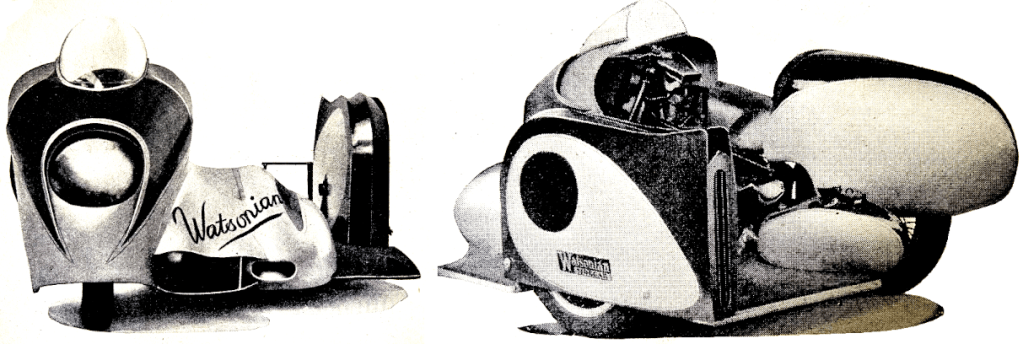

“QUESTIONS in both Houses of Parliament last week concerning the desirability of importing motor cyclists’ protective helmets from abroad in order to cope with the demand, have been criticised by the British Plastics Federation whose claim it is that British manufacturers can supply many thousands of helmets weekly if required.”
“WESTERN US ‘Enduro’ riders were recently called upon to put their specialised skill to practical use. A student Air Force officer was forced down in the brush country of Nevada, and the aid of the motor cycle trail riders was enlisted. After three days of exhausting and exhaustive search the injured airman was spotted and the rescue party got to work.”
“TEN THOUSAND SPECTATORS lined the new 1.39-mile course at the Crystal Palace, SE, last Saturday afternoon to welcome back to London motor cycle racing in one of its most thrilling and interesting forms. The circuit, developed from the pre-war layout, provides every aspect of a miniature TT course and is set in beautiful, wooded parkland, ideal for family outings. From the start-line the wide, well-surfaced road curves away under a bridge to the steep ‘mountain’ climb, with its S-bend midway, to the right-angle of South Tower Corner; then comes the high-speed Terrace Straight which curves into the tricky sweep of North Tower Crescent and the fast, tree-lined bends of the Glade and Park Curve from which descends the Bray Hill-like drop to the finish of the lap. On such a course can be seen all the skill and road craft—gear-changing, braking, cornering, flashing acceleration and sheer speed—that goes into motor cycling sport at its most exacting. Many of the 131 riders who made up the entry list—including famous names in the racing calendar—expressed approval of the course and BMCRC who organised Saturday’s National (Open) meeting; the enterprising London County Council, who sponsored it, have every reason to congratulate themselves. Despite the high speeds attained (RD Keeler on his 499cc Norton set a ‘bogey’ for the lap in 1min 10sec, equalling 71.49mph, to win Motor Cycling’s Coronation Trophy) no accident occurred which had results more serious than might have been expected from a rather hearty Rugger match. The sun shone from a perfect sky; down in the Paddock the brightly coloured fuel companies’ wagons and the gay canvas of refreshment tents contrasting with the green of the grass and trees. added their quota to the brilliance of the scene, while the Presence of high officials of both the LCC and the A-CU and many well-known figures in the sport testified to the status of the meeting. Overall there was that pleasant but almost undefinable atmosphere which old-timers call ‘the real Brooklands feeling’.”

“LAST SATURDAY’S GRAND PRIX of the Netherlands—the Dutch ‘TT’ and second of the nine ‘classic’ meetings of the 1953 season [the rounds of the European championship]—showed that the combination of Britain’s Geoffrey Duke and Italy’s four-cylinder Gilera is one which will take a lot of beating. Riding a most consistent race, he led almost from the start of the 500cc event to win at the record average speed of 99.92mph. Ray Amm (Norton), who put in the fastest lap at 100.91mph, was lying second when he ran out of petrol halfway through the final lap, so letting Reg Armstrong (Gilera) into second place, with Ken Kavanagh (Norton) third. The new 345cc single-cylinder Guzzi, completed only a week before the race, came in first in the 350cc event, in the hands of Enrico Lorenzetti, with Norton team men filling the next three places. In the 125 and 250cc races, the young German rider Werner Haas scored a double success for the NSU factory.”


“NEGOTIATIONS ARE PROCEEDING with local authorities and responsible club officials on the future of motor cycle racing at Oulton Park, near Tarporley, Cheshire, the ancestral home of Sir Philip Grey-Egerton, Bart. Meanwhile, under the direction of Cheshire Car Circuits, the company formed to sponsor the project, work continues on the half-mile circuit which already shows promise of becoming a second ‘Donington’.”
” PERMISSION HAS BEEN obtained for a part of the Crystal Palace track to be used for instructing learner motorcyclists under the RAC-A-CU Training Scheme. Volunteers from two local clubs have already agreed to assist as instructors but additional help is required from expert. unattached enthusiasts in the area. Modest out-of-pocket expenses will be payable. Instruction will be carried out mainly on Saturday afternoons and Sunday mornings, with possibly one evening lecture session per week.”

“FEW TRIALS COULD be more enjoyable than was the Motor Cycling Club’s Inter-club Team Championship held last Saturday. The green hills and valleys of the Cotswolds were bathed in sunshine for most of the day; high clouds cast patchy shadows which enhanced rather than detracted from the beauties of the landscape. Although perhaps the prevailing temperature was on the high side for comfort when tackling observed sections, the riding between sections was motor cycling at its very best. This year’s annual championship of the clubs was the 37th of a series started way back in 1904. Though the trial has experienced its ups and downs in the way of support, it remains a fixture which attracts a selection of the country’s top-notch riders with the six-men teams representing clubs from a wide area; for example, Leeds in the north and Southampton in the south; Exmoor in the west and Weyburn in the south-east. Once a rider has competed he usually likes to take part again and again, primarily because, as a perhaps welcome contrast to the dominant feature of the majority of trials, the much-coveted premier award, The Motor Cycle Challenge Trophy, is for the best performance by a team—not by an individual. In a way, the attraction was epitomised by Michael Riley, nowadays of the Wolverhampton Club, who, arriving on his DMW without over-much time to spare before starting said, ‘Mustn’t let the side down—this may be a lucky day. I first competed 21 years ago. I was in the Carshalton team, years we won!” True enough, Carshalton gained the premier award in 1932. Three wins, not necessarily in succession, by the same club mean that the Trophy becomes that club’s property. The current Trophy, offered in 1948, is the fifth presented and in Saturday’s event Bradford scored its second win towards its trio. Bradford is now level-pegging with Weyburn, the winners in 1949 and 1950. Bradford riders were TU Ellis (499 BSA), NS Holmes (497 Ariel), LA Ratcliffe (347 Matchless), GE Broadbent (346 Royal Enfield), AD Rawnsley (498 AJS) and TH Archer (490 Norton); they incurred, among them, 44 penalty marks. In second place, with 66 marks lost, was Wolverhampton. Weyburn, with 84 marks, was third and, with only three more marks lost, Gloucester and Cotswold was placed fourth. A total of 24 teams competed—five from Army units. A disappointment for the Sunbeam team arose because one of its members, PH Alves, unthinkingly omitted to sign off. Therefore the team had to be considered as incomplete at the finish and deleted from the list. But for this slip, the Sunbeam total of 48 marks lost would have given the team second place. The course comprised two laps of a 30-mile circuit centred on Rodborough Common, near Stroud, Gloucestershire. The names of the nine observed sections—Quarry, More Folly, Ham Mill, BB1, BB2, Leigh, Hodgecombe, Weighbridge and Hazel—are familiar to most trials riders. And, as might be expected, HP Baughan and his assistants were far from unconnected with the duties of the clerk of the course. Under winter conditions these sections often provide a severe test for the nation’s star riders. In July
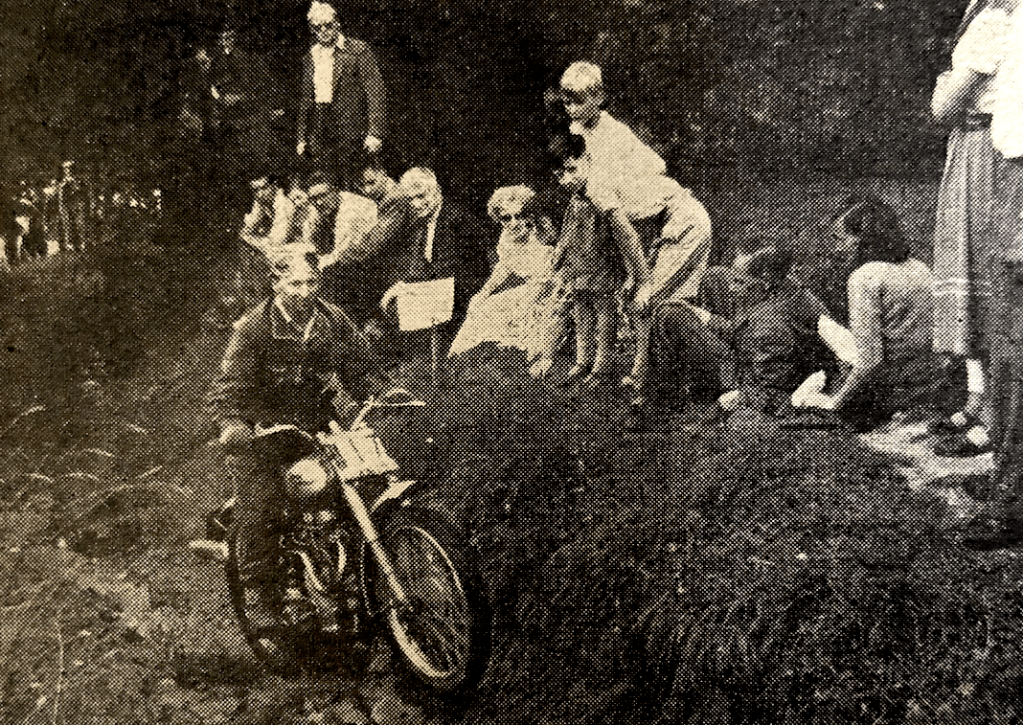
weather…? Before the start HP Baughan was overheard to remark that Leigh, Weighbridge and Hazel were in ‘nice’ condition. They were! Leigh is a mud-hole which can be charged relatively fast and navigated without undue demands on skill. But immediately after the hole there is a rutted 20-yard stretch of clay as slippery as oiled butter. To stand upright is difficult; to ride without footing is no mean accomplishment. This stretch took a heavy toll of marks, especially on the second lap when more of the wetness from the hole had been spread by the passing of wheels. There was the usual little torrent of water rushing over the rocks of Weighbridge. Wet or dry, the rocks were not really slippery, but some of those not embedded were so awkwardly placed that it was impossible to avoid them all. Of the 144 riders in the trial, some 40 managed Weighbridge unpenalised on both laps. Fewer than half that number avoided dropping marks on the three sub-sections of Hazel, which immediately follows Weighbridge. A lengthy climb under trees, Hazel has one rut in the middle and sloping banks which, almost all the way, force the rider to stay in the rut. Rut and banks were slippery; and it could fairly be said that, in the condition it was on Saturday, Hazel was near-perfect as a section to compensate a rider in direct proportion to his prowess. The two laps provided the winners without resorting to the special test. Four riders out of 144 completed the course without losing marks. Though the emphasis is on teams, the four deserve to be mentioned—LA Ratcliffe (347 Matchless), Bradford; J Giles (498 Triumph), Sunbeam; GE Fisher (197 Francis-Barnett), Sunbeam; and DS Evans (346 Royal Enfield), Wolverhampton. Army men competed on Service machines precisely to specification, including lighting equipment and standard tyres. Of course, they had no chance of figuring high in the performance list, but they were nonetheless welcome, and they appeared to enjoy themselves as much as those more suitably mounted. Winners of The Motor Cycle Challenge Trophy: Bradford &DMC, 44 marks lost. Runners-up: Wolverhampton MC & CC, 66. Third: Weyburn MCC, 84. Fourth: Gloucester and Cotswold MC, 87. Fifth: Southampton &DMCC, 99. Sixth: Antelope MCC, 103. 7, King’s Norton MCC, 124; 8, West Leeds MC, 136: 9, Leicester Query MC, 152; 10, Solihull MCC, 184; 11, Nottingham Tornado MC, 194; 12, The MCC, 232; 13, Handsworth Lions MC, 258; 14, Sunbac, 265; 15, Castle Bromwich MC, 330; 16, Exmoor MCC, 333; 17, 31st Training Regt RA MCC, 372; 18, RMP Depot (Army MCA), 464. Six teams finished incomplete.”
“ACQUITTAL OF A member of the RAC charged, at Chertsey, with speeding on A320 at Ottershaw, Surrey, was gained when the Club’s solicitor was able to prove that the distance between the lamp standards—on the presence of which the Police brought the charge—exceeded the 200 yards specified for a built-up area by 23ft 2in.”
“THERE WAS AN amusing incident at the Reunion Dinner of the Association of 1914-18 RE Despatch Riders, held in the Grill Room of the Earls Court Exhibition building, when it was discovered that the toast to ‘The Visitors’ was addressed to one man—for the only one among the 180 in the room who had not been a Don R or motor cycle officer in the Great War was Brigadier Henri Firth (‘Father’ of the Royal Tournament Motor-cycle Display Teams) who had been at that time too young to serve!”

“COMPETITORS CAME FROM all over the country to take part in the sixth Invalid Tricycle Association’s National Rally and, in spite of appalling weather conditions which persisted throughout the day, some 600 of them were present at Hendon aerodrome last Sunday. The amazing spirit of the competitors forestalled any attempt to abandon the meeting, and the various events were run off with little delay. The organisers even had to call ‘enough’ as competitors queued up to enter the various heats! Special mention must be made of Mr D Most who, at his first attempt at the Road Trial, finished without loss of marks—a record for the event. The prizes were presented by the Mayor and Mayoress of Hendon, Cllr and Mrs AV Sully; also present was the Parliamentary Secretary to the Ministry of Pensions, Brig Smyth. RESULTS Road Trial: The Middlesex Group (J Perry, Miss N Brewer, H, Jones, R Creek). Best individual performance: D Moss. Longest distance covered by road: Petrol, RC Robbie (Northumberland); Electric, DR Hall (Chingford); hand, WM Pratt (Worthing). Egg and Spoon Race: 1, TH Catey (Surrey Group); 2, DA Hutchinson (Gloucester Group); 3, C Dalgarins (Exeter Group). Obstacle Race: 1, Miss M Webb; 2, JA Lillington; 3, R Creek (Middlesex Group). Passenger Event: 1, ER Chivers (Newbury Group); 2, AS Knight (Middlesex Group). Groups Display: 1, Middlesex, ‘Coronation Parade’; 2, South London, ‘Cherry Stones’. Driving Test: 1, F Davies (North West Group); 2, MJ Matthews (unattached). Inter-Group Relay Race: 1, North West: 2, Middlesex; 3, Surrey.”
“IT MAY BE OF INTEREST to note that disc brakes were fitted as standard on the ohv Douglas machines marketed in 1920 and onwards. The cross-section of the working part of the disc approximated to a ‘V’ having an included angle of some 20°. This type of brake was also employed on the 1923 TT Douglas, the disc being moulded in special frictional material and used in conjunction with an aluminium alloy shoe. Modern disc brakes, as fitted to aircraft and automobiles, differ in as much as the disc has not the ‘V’ configuration. As regards the Cyc-Auto, mentioned by ‘Carbon’, the late E Wallington Butt was a personal friend of mine and we. were associated together during the 1914 war in connection with numerous wartime inventions. The first Cyc-Auto was built under my direction at Douglas Motors, Kingswood, Bristol, in 1926-27. It is with pleasure that I note the production will be resumed.
CG PULLIN, Birmingham, 13.”
“DURING THE ANNUAL works holiday the service and spares departments of BSA, Sunbeam and New Hudson will be closed from Friday evening, July 24, to Monday morning, August 10. Dispatch of new machines from the warehouse will continue as usual, except on Bank Holiday Monday, August 3. AMC, at Plumstead, will close down for the annual holiday on the evening of July 24, reopening on Tuesday, August 11.”
“COUNTING TOWARDS THE coveted 1953 Moto-Cross Championship of Europe last Sunday’s international scramble meeting organised at Brands Hatch by the A-CU with the co-operation of, principally, the Streatham&DMCC, resulted in a win for Matchless ace Brian Stonebridge who, on his 500cc machine, scored a most decisive victory in the final, actually lapping the entire field with the exception of the first five leaders. Those two Belgian stalwarts, the FN riders Victor Leloup and Auguste Mingels, had thoroughly bad luck although both gave exhibitions of fine riding before the rot set in.”

“TAKE AN AMERICAN, who is employed on automobile body styling. Suppose him to be a motorcyclist of long experience and unquenchable enthusiasm. If such a man were to design a two-wheeler, what would the result be like? An answer to that one has been provided by Mr 0 Ray Courtney, of Pontiac, Michigan. His first machine was a 1911 Indian; he was concerned with aviation during World War I, picked up a few ideas about streamlining and works now for the Kaiser-Frazer car people, after being mainly responsible for an Oldsmobile model that made a big hit in the early 1930s. Right now Mr Courtney is riding a motor cycle entirely designed by himself. Get into your mind’s eye the silhouette of a long-wheelbase American car, with the stern tapering off and the front grille sloping backwards from the top. Roughly a parallelogram with fairly acute angles. That is the outline, the whole of the front wheel, practically, being enclosed, along with all the works, the steering being linked to the handlebar stem. Suspension is by coil springs fore and aft. The rider sits extremely far forward—there is a passenger seat behind, needless to say. The tubular frame houses an Indian 750cc sv Scout engine. Many of the details, particularly the quick-detachable shields, appear highly ingenious. Certainly the model looks extremely well, if you like that kind of thing. But I see that it is 112in. long and weighs 580lb. Such an outsize could hardly appeal to many.”—CARBON

“A HIGHLY UNORTHODOX design of motor scooter caused a stir when it made an appearance in the streets of Birmingham last week. Bearing the name ‘Clipper’ it was a prototype and was being driven to a private demonstration. Featuring a maximum of weather protection and a car-type driving position, the model resembles the famous Ner-a-Car. Attractively styled, the ‘body’ in-corporates twin front wings, each with a recessed headlamp—though the machine is, of course, a two-wheeler. A passenger seat is provided behind the driver, and at the rear the machine terminates in a streamlined tail. A Villiers 197cc two-stroke engine-gear unit supplies the motive power. It is enclosed and located forward of the driver—under the bonnet, as it were! Steering is by means of an aircraft-type ‘wheel’, and the hand gear-change is carried on the steering column. There is a hand-throttle, and the clutch and brakes are actuated by pedals. Though I should be somewhat chary of a foot-operated clutch under congested traffic conditions, there is no doubt that the Ner-a-Car type of layout has many attractions. With total engine enclosure and full, integral weather protection, the Clipper cycles may be anticipating the design trend of the next few years—not only for scooters, but for fully-fledged motor cycles.”
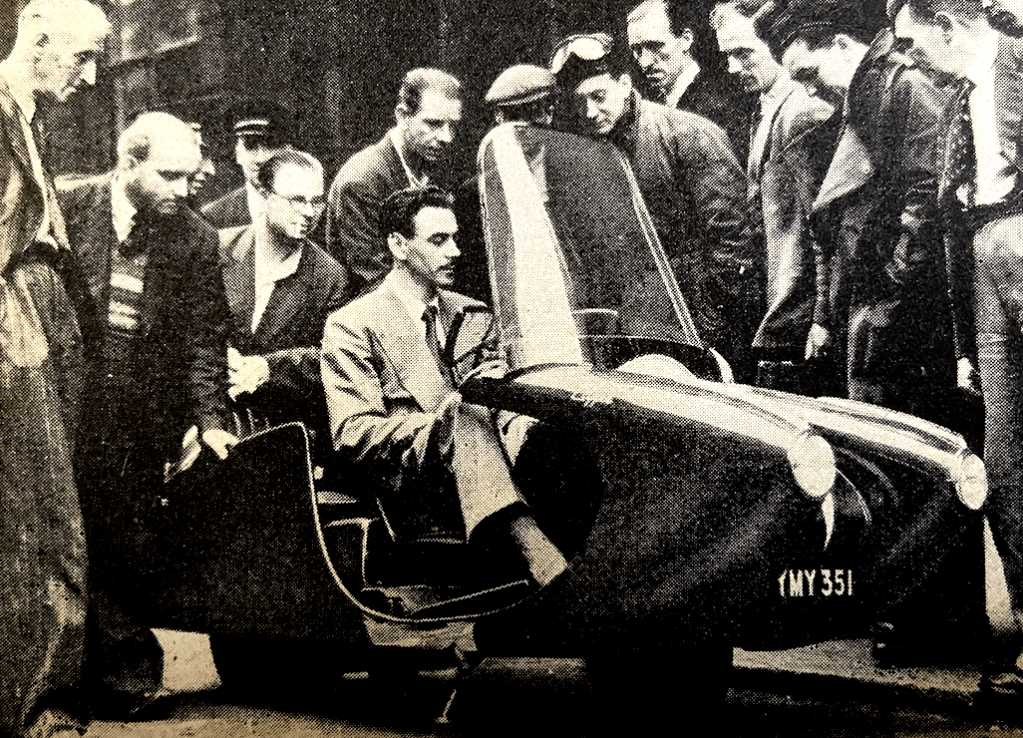
“WHAT HAS HAPPENED to the ‘Golden Flash’?” My memory of the road test of the A10 BSA in 1950 being of its outstanding performance, I have compared the previous figures with those published recently of the latest edition, and what do I find but a marked deterioration all round. All-out speed in both top and third gears has dropped by as much as 7mph, and, more surprising still, in the case of the top gear figure (gear ratios the same), the higher speed was reached in a shorter time—actually over 4sec less! The higher third gear figure in 1950 admittedly took over 4sec longer, but then there is a difference of 9sec between the time taken to reach maximum in top and maximum in third which was 10sec in 1950 and 19sec in 1953—all very puzzling. Then, braking is inferior, and so is petrol consumption, by as much as 6mpg at 50mph. And on top of all this the current model was presumably using ‘premium’ fuel, and (except for the speed figures, taken in France, where near 80 octane fuel may have been used) the 1950 machine was presumably run on Pool. As in the case of so many cars, whose performance has deteriorated over the years, the weight has gone up, but only by 13lb.
R BAILLIE, Bedford.”
“I BOUGHT A 197cc JAMES ‘springer’ late in September, 1952. To date it has covered 8,956 miles, including three trips to Skye; 257 miles each way, and about 900 miles in Skye. The roads there are of about ‘Scottish Six Days’ standard. A full tank (2½ gallons of petrol) took me to Skye and still left some in the tank.. The total time taken was nine hours, less 50 minutes or more for halts. Kitted up with luggage, I weigh 15½ stone! Total replacements to date are two piston rings (I broke one when decarbonising), one sparking plug and some steel wool for the silencer—total cost, 12s 6d. You will understand why I sign myself—
‘NO COMPLAINTS’, Glasgow, W2.”

“AS A VINTAGE ENTHUSIAST who constantly maintains that most ‘modern’ innovations have been tried before, I question Mr R Wilbur’s claim that dual seats were originated by Veloce in 1934. I believe that the first rider to use a seat extended over the rear mudguard was the late Wal Handley, who fitted one on his 500cc Rudge in 1928. This seat was made, I believe, by Dunlops, and was, of course, purely a racing seat, like the Veloce model. The touring dual seat—which is quite a different matter—was originated by an accessory manufacturer in 1938 and the first manufacturer to adopt it as standard equipment was the Vincent HRD company, in 1945.
CE ALLEN, Leicester.”
“MY RECENT ATTEMPT to throw further light on the history of the dual seat, ‘that accessory which has changed the shape of motorcycles throughout the world’, resulted in a letter from motorcycling historian Harold Karslake, from which I quote: ‘I certainly think you were right about Wal Handley. I believe it was a rubber pillion seat on the rear mudguard. I recall the jokes about it at the time. But I do not remember it being in one piece with the saddle part. But, going even farther back, George Patchett (Brough Superior) first used foam rubber mats strapped over the frame in place of a saddle to give him a lower and firmer seat than a saddle. The rubber extended on to the rear mudguard and was secured to the stays. This was certainly not later than 1926, but I think it was in 1925, at Sandlebeat Road, Doncaster. A similar arrangement was used on the special Brough Superior used for the Welsh TT 100-mile Race at Pendine from 1925 onwards. No saddle, but an elongated pack of one-inch-thick pieces of foam rubber covering the rear part of the frame and mudguard. Actually, this was much more comfortable than any saddle. 1 fancy what held up the dual seat was that it was considered effeminate and slightly comic. Curiously enough I tried to get Mr Lycett to take up a kind of dual seat made of their elastic cords in 1925, but it was too early at that date. Mr Lycett had several made, but the trade thought them effeminate, and spoiling the lines of the bikes of that day. I had a modified one on my Karbro-Express for several years from 1927. I believe this was the start of the use of the saddle top without under-frame, the front part mounted on the top tube and the rear springs mounted on the seat stays, as is almost universal today and has been for some years.’
CE ALLEN, Ibstock, Leics.”
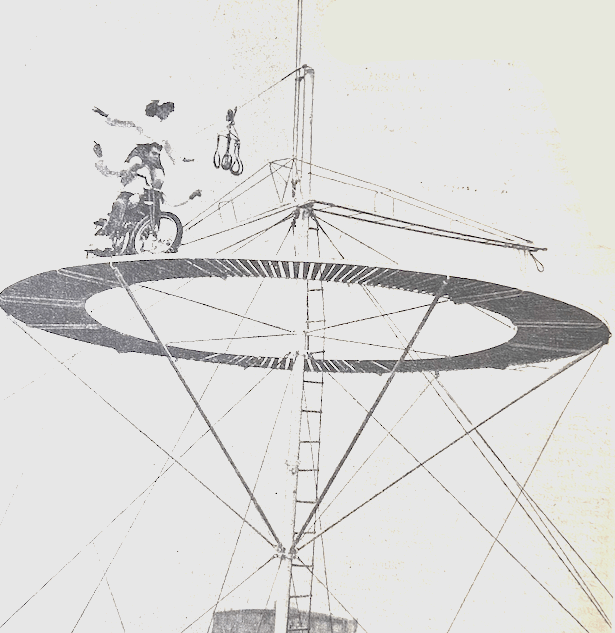
“ON June 14—a very wet Sunday—I was returning from Rhyl and was unfortunate enough, to have three punctures in my sidecar wheel, the last one completely ruining the inner tube. In pouring rain a soloist stopped and, at 9pm, took me five miles to a garage and back, and then helped me to fit the new tube. This is indeed true comradeship.
HA FARRINGTON, Birmingham.”
“I SHOULD LIKE to raise my hat to the Norton people for having so vastly improved their machines that their performance is comparable with that of the foreign multis, despite the fact that the latter have a 10mph maximum speed advantage. When discussing speeds of well over 100mph, 10mph appears a mere trifle, but actually means a speed of nearly five yards per second, or 293 yards per minute. It would be interesting to know whether the riders of the singles have to take undue risks on the corners to try and regain the valuable seconds they lose on the straights.
HAROLD E DAVIES, Neath, Glam.”
“RUN IN BLAZING SUNSHINE on the famous 14.1km. Spa-Francorchamps circuit, last Sunday’s Belgian Grand Prix saw a duel for the lead in the 500cc race between Englishman GE Duke and Italian A Milani, both riding Italian Gilera fours, result in a last-lap retirement of the former, with a wrecked engine. There were three races, for 350 and 500cc solos and for 500cc sidecars, and all were won at fantastically high record speeds, Milani’s average for the 131.5 miles of the 500cc event being 109.94mph, and Duke turning a record lap at 112.33mph. One of the outstanding performances of the day was that of the brilliant Southern Rhodesian, Ray Amm, who finished second in the 500cc and third in the 350cc races on his Nortons, and who put up a 105.93mph lap record in the latter, which was won by Englishman Fergus Anderson by a narrow margin from his Guzzi partner, Enrico Lorenzetti. ‘The Belgian’ thus becomes the world’s fastest GP so far. Winner of the sidecar race for the fifth year in succession was Eric Oliver (Norton), who averaged 90.55mph and who turned a record lap at 92.03mph; a close second was Cyril Smith, also on a Norton. The meeting was marred, regrettably, by a fatal accident to Australia’s popular Ernie Ring, who was riding as a member of the AJS team.”


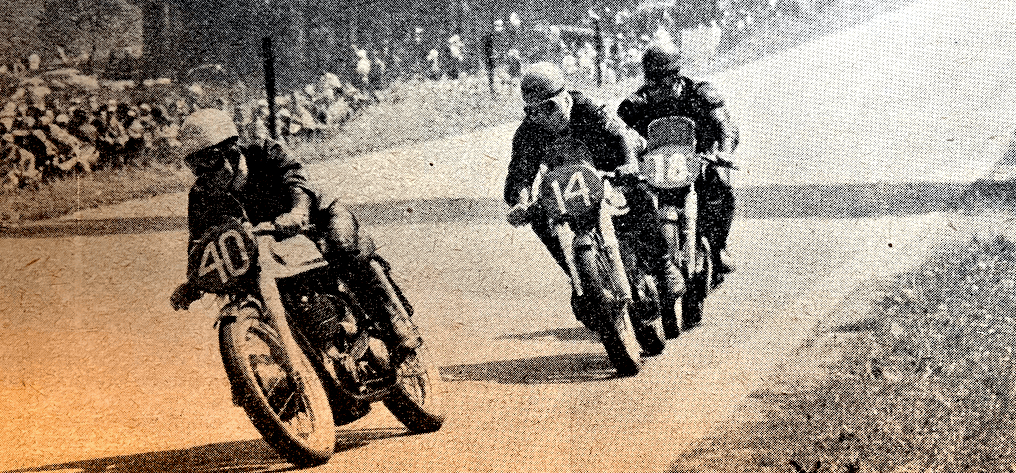
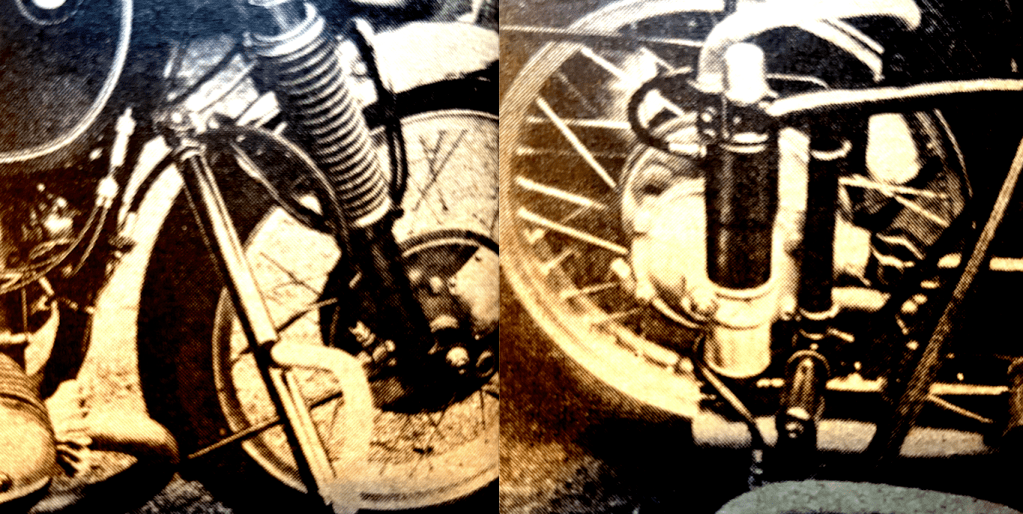
“WHILE IN BELGIUM for the Grand Prix I took the opportunity of borrowing one of the latest 175cc FNs, the good-looking split-single two-strokes which created such interest at the Brussels show. The FN has the rear piston mounted on the auxiliary connecting rod and there is an inlet port at the base of each cylinder, while three transfer ports are disposed radially round the rear cylinder and the twin exhaust ports are in the front cylinder: The cast-in induction tract is common to both inlet ports, but the forward port is located higher in the cylinder than is that at the rear, so giving, with the ‘delayed action’ of the auxiliary connecting rod, a very much longer port opening (with less overlap, I imagine) than is possessed by most two-stroke engines. Bore and stroke dimensions are 45x55mm, although the effective stroke of the rear cylinder is reckoned as 57.5mm. So much for the technicalities. Performance is the thing that interests the customer, and in this respect the FN can be compared with most other twin-piston two-strokes in about the same way that the modem Sunbeam can be compared with most other vertical-twin four-stroke machines. In other words it is far more flexible and far less rorty and sacrifices a certain amount of sheer speed for smooth running. I would estimate that it is capable of around 40mph in second, 55mph in third and perhaps 60mph in top. Once the revs have been built up and top gear engaged it will pull remarkably well in that ratio, as the long climb from Spa up towards the Francorchamps circuit demonstrated. And like all F.Ns the 175cc Type 22 with its up-to-date teles and swinging-arm rear end, has a man-sized frame and riding position and steers well.”—CYRIL QUANTRILL
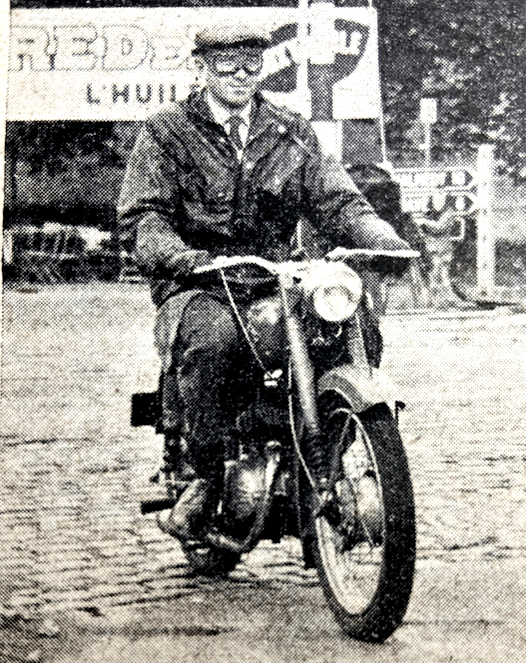
“POWERED BY THE popular 48cc Italian Cucciolo engine, the model recently introduced by Britax (London), 115-129 Carlton Vale, NW6, is an attractive cyclemotor and represents yet another machine which, though pedalling gear is retained, has an ‘in-built’ engine as opposed to a ‘clip-on’ unit. Built specially for the job by the Enfield Cycle Co of Redditch, makers of the famous Royal Enfield cycles and motor-cycles, the frame and front forks are sturdy and welt designed. The former is of the open type, giving a 29in. saddle height, and the latter are of pressed-blade pattern with rubber-band springing in the manner already used for many years in the Royal Enfield lightweight motor cycles. The wheels are fitted with Dunlop 26×1¾in heavyweight tyres, and each is equipped with a 4in cable-operated internal-expanding brake. Specially strengthened wide mudguards are supported on robust stays to stand the stresses imposed by cyclemotor use. A well-shaped 1¼-gallon petrol tank is mounted in the normal position, giving grip for the rider’s knees if required, but so placed as to allow freedom of movement when pedalling. On the four-stroke Cucciolo, of course, petroil is not employed, engine lubrication being effected by splash from a 1¼-pint sump built on to the crankcase. Also a unit with the engine is the two-speed. preselector gearbox, operated by reverse movement of the pedals in conjunction with a handlebar lever. Primary drive is by gear, final drive being by chain, the bottom gear being 13:1 and top 7.5:1. Ignition is by flywheel magneto equipped with separate coils to provide a 6-volt direct lighting system. The carburetter is a Weber. No opportunity arose, when a member of Motor Cycling’s staff had a short run on the prototype last week, to test the maker’s claim of the fuel consumption, stated to be between 250 and 275mpg, but previous experience with other models fitted with the 48cc Cucciolo engine indicates that such anticipated mileage would not be unreason-able. A maximum speed of 35mph is quite comfortable on the Britax Monarch, as it is to be called, and the machine seemed quite happy to maintain a steady 25-30mph, the front forks riding bumps with ease, despite the low weight of the model, ie 72lb.”

“IN WEATHER FIT ONLY for demented ducks, the Varley Trophy—premier solo award of the Auto-Cycle Union’s 10th National Rally, held last Saturday and Sunday—was won for the second year in succession by Derby schoolmaster JR Walton, riding a 122 OEC. The Basic Challenge Trophy for the best sidecar performance went to H Redfern (500 BSA sc) who, like Walton, amassed a score of 585—525 miles and 30 controls—and HJ Kennard (250 BMW) totalled 583 to win the News Chronicle Challenge Trophy for the best R.A.C:/A.-C.U. trainee. The event had been chosen by the Union as the tour de force of its Golden Jubilee year, to celebrate its 50 years as governing body of British motor cycle sport, and to give motor cyclists all over the country the chance to compete with their fellows in friendly competition and to meet in the pleasant seaside town of Weston-super-Mare. A worthy object, but unfortunately the Union is no more master of the elements than was King Canute. For a variety of reasons—among which, doubtless, were safety and the cost of petrol—the elders of the A-CU had reduced the duration and average speed from 26 hours at 27mph, as in previous events, to 21 hours at 25mph. So the object of those competitors with their minds set on a major award was to cover 525 miles—no more and no less—according to the official mileage card and to call at as many controls as possible; the marking being one for each mile and two per control. What the maximum possible mark would be, no one, not even the A-CU, could say for certain; the control lists had been circulated to the competitors—though many complained that they only received them a day before the start—and it was up to them to get out their maps and slide rules and work out the best route they could. Riders had to call at a control at least every 50 miles or lose one mark for every extra mile; to avoid calling at any control more than once—a penalty of 25 marks for this—and to keep within the overall average or lose virtually two marks for every mile by which they exceeded their maximum. To guard against the embarrassment of having to draw lots in order to decide ties for almost every major award—as happened in 1951—last year’s methods of elimination were retained. Thus, in the event of a tie on miles covered and controls visited, the award in question would be given first to the rider of the smallest capacity machine, or, failing that, to the entrant of the oldest model to qualify.

And this year a further safeguard was added whereby, if all else failed, the rider who started farthest from Weston would win the particular award. But in many ways the National Rally is more a social event than a competition and its beauty is that a competitor can choose his own target according to his purse, experience, or the capabilities of his machine and still get some reward in addition to the feeling of personal achievement. For as few as 175 to 299 marks would qualify for a certificate of merit, 300 to 424 for a bronze plaque, 425 to 549 silvered plaque and, for a gilt, 550 or over. The Rally prize list must be certainly the longest in any British event. In addition to the challenge trophies—the Varley for the best solo performance; the Basic for the best sidecar and the News Chronicle for the best RAC/ACU trainee—civilian entrants were offered 15 class and 17 manufacturers’ awards, seven club trophies and many special prizes. And, for the official army riders the Motor Cycling Perpetual Challenge Trophy, presented by Editor Graham Walker, for teams of three, a trophy for the best individual performance and three manufacturers’ awards, BSA, Matchless and Norton. So, promptly at 2pm last Saturday, the 124 rally controls, manned voluntarily by garage staffs, agents and club members, opened; and most of the 906 entrants set forth for Weston-super-Mare by routes so devious that they would have shamed even Chesterton’s ‘rolling English drunkard’. At that time, most of the country was bathed in summer warmth. The sun blazed from a clear, blue, cloud-flecked sky. Even Old Trafford was no longer waterlogged. But, far to the south-west, sullen grey clouds were rolling their relentless wet blanket over the face of Britain. Before long, most competitors were battling through a stinging downpour sufficient to drown all but the blithest spirit and most resolute determination. At 9 o’clock next morning, along the beach lawns at Weston-super-Mare, a few marquees hunched their backs against the wind and sodden banners fluttered disconsolately in the searing rain in a desperate effort to look festive against a background of ashen sky and leaden sea. That was the scene as the first competitors began to arrive. In

they came, a trickle first and then a broadening stream as zero hour of 11am approached. Tired and sodden, but triumphant, they pushed their machines to the assembly parks; and gradually the mood changed. Even the metallic voice of officialdom took on a kindlier note over the Tannoy. The indomitable cheerfulness which had sustained them through a night of roaring rain swept like a wave along the seafront. Some settled down in the lea of their machines to snatch a well-earned rest; some went off for a wash and a meal; but soon they were all back, swapping yarns of their experiences, comparing mileages and routes and weighing the merits of one another’s machines. And what a mixture they were—both riders and mounts. First, the ladies; veteran rallyist Mrs Doris Taylor had once more ridden her way into the ‘gilt’ class on her DMW, while Mr AB Taylor tagged along on his Triumph Trophy. For Miss I Edmundson, of the XHG Tigers MCC, her first rally in 17 years of motor cycling, had taken her 507 miles from Poole without incident; but Miss MB Dawe, of Luton, had not been so lucky. First a tumble on the greasy road had left her with a puffy, blueing eye, and then her lighting had become temperamental, but she still seemed certain of a ‘silver’ with 418 miles and 15 controls. Then there were the vintagents; the youngest, so far as machines were concerned, was D Bagnall, whose 1927 Levis—last re-bored in 1939—had suffered from nothing more serious than fluff in the jet. Its rider, wise man, had spent the night in bed, content to collect another ‘bronze’ to add to those he won in 1937 and 1951. Trials rider Eric Kennard had also taken things easy on his belt-driven 1913 Bat twin. WE Rose, on the other hand, had aimed at trundling his 1914 Rover 524 miles until persistent belt slip had forced him to be content with 457; but the ‘silver’ would be the least of his rewards. En route he had been given a 1908 speedometer and had been offered a 1906 Phoenix to add to his collection. Most interesting of the tiddlers was GM Denton’s prototype Elswick: Powered by a two-speed Trojan 49cc engine, it had covered 303 miles from Thornton Heath. Bronze medals were also on the cards for DJ Anderson and K Mercer, who had covered 295 and 296 miles respectively with their Mini-Motor clip-on units without a trace of roller slip, despite the rain. Quite a bevy of Bond Minicars festooned the lawns. One who only just made it was Col MGM Crosby, in the same vehicle with which he followed the Monte-Carlo Rally. Eight miles outside Bath his front tyre burst. After replacing it in six minutes the galloping colonel arrived at the control with only half a minute in hand. Many of the riders had voluntarily curtailed their routes, but when the final control closed only 496—little more than half the entry—had checked in; to 17

unfortunates who arrived just too late, the stewards decided to give hard-luck awards—a kindly gesture. A formidable ‘retired list’, 393, but not surprising in that weather. Most frequent comment of those who did finish was on the cheery helpfulness and hospitality of the controls. Almost all had provided tea and refreshments free of charge, and their staffs were ever willing to help. What a pity that some outlying controls did so little trade—as few as nine competitors in eighteen hours at one. A pity, too, that the Union had not organised an earlier programme for the benefit of competitors. The sun had condescended to reappear when, at 2.15, the Royal Corps of Signals Team provided a large crowd of Weston residents and trippers with their breath-taking display, but by that time most rallyists were well on their way home for a well-earned rest before Monday morning’s work. In the interval the Parliamentary Secretary to the Ministry of Transport, Mr Gurney Braithwaite, addressed the gathering and presented Major AB Bushby, of Willaston in Wirral, with a BSA Bantam for the motto Certando Proficiamus (Progress through Competition) with which he had won the A-CU Motto Contest. Competitions Manager Harry Comwell’s results team did an excellent job in compiling the results by 5pm. But, understandably, hardly any competitors had stayed to receive their awards. Like the old soldier they had simply faded away, but it will by a long time before they, or their well-wishers, forget that night of July 11-12, 1953.
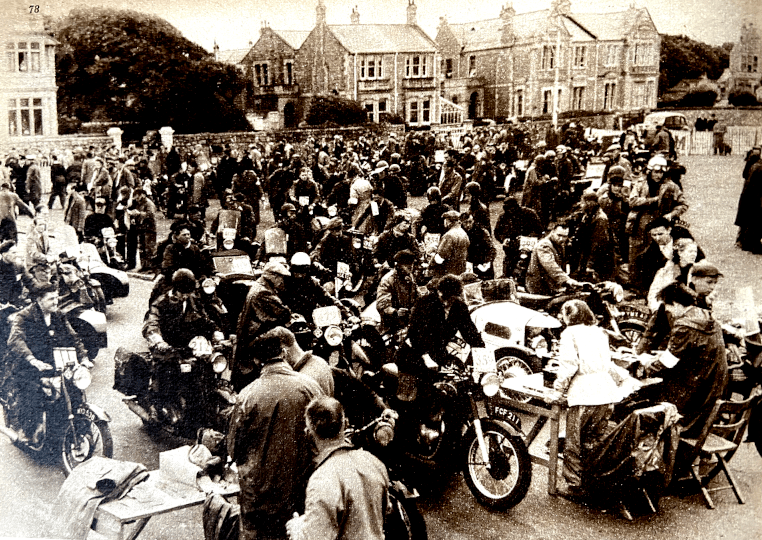
RESULTS Individual Awards The Valley Challenge Trophy (Best solo performance): JR Walton (122 OEC), 585 marks. The Basic Challenge Trophy (Best sidecar performance): H. Redfern (500 BSA), 585. News Chronicle Challenge Trophy (Best ex-RAC/A-CU trainee): HJ Kennard (248 BMW), 583. Club Trophies ACU Inter-Club Rally Challenge Trophy (Best club calculated on figure of merit): West Herts MCC, 20. Manufacturers’ Challenge Vase (Second-best Club): Bury St Edmunds &DMCC, 17.0289. Belstaff Challenge Cup (Third-best Club): Kettering &DMCC, 12.42. The Dunlop Challenge Cup (Fourth-best Club): Bow District Garage MC, 12.3381. South-Midland Centre Trophy (Best South-Midland Centre Club): West Herts MCC, 20. South-Eastern Centre Trophy (Largest entry from South-Eastern Centre Club): Sunbeam MCC. Midland Centre Shield: Antelope (Coventry) MCC, 4.3094. The Motor Cycle Perpetual Challenge Trophy (Best Army Entrant): Cpl WE Christian (500 BSA), 585. Motor Cycling Perpetual Challenge Trophy (Best Army Team in Road Competition): 20 Coy RASC (MT), 1,725 marks. Class Awards ‘A’ (Up to 125cc Solo): 1st, H Clarke (BSA), 580; 2nd, E Dench (James), 579; 3rd D Gaffyne (BSA), 578. ‘B’ (126-250cc Solo): 1st, RHH James (Excelsior), 585: 2nd, F Kiss (Francis-Barnett), 585; 3rd, R Wheeler (Francis-Barnett), 585. ‘C’ (251-350cc Solo): 1st, DJ Smart (Velocette), 585; 2nd, FH Shuckburgh (Triumph), 585; 3rd, MJ Hodges (Matchless), 585. ‘D’ (Over 350cc Solo): 1st, LTN Gardiner (Triumph), 585; 2nd, PG Douthwaite (Norton), 585: 3rd, LJ Stagg (AJS), 585. ‘E’ (Sidecars): 1st, EG Deacon (BSA), 585; 2nd, A Booth (Ariel), 585: 3rd, GAF Maddick (Brough Superior), 585. ‘F’ (Three-wheelers): 1st, H Pass (Morgan), 583; 2nd, JA Stratford (Morgan), 557; 3rd, R Atkinson (Bond). Manufacturers’ Awards Associated Motor Cycles (AJS) (silver cigarette case): KJ Bell (350 AJS), 585. Ariel Motors (travelling clock): JC Meldrum (500 Ariel), 585. BSA Cycles (table lighter and ashtray): BA Howard 600 BSA), 585. Dot Cycle and Motor Man Co (electric clock): AE Hayward (200 Dot), 571. Enfield Cycle Co (pair of tankards): CP Persian (350 Royal Enfield), 585. Excelsior Motor Co (silver cigarette case): RH Portlock (200 Excelsior), 525. Francis and Barnett (silver cup): F Kiss (200 Francis-Barnett), 585. James Cycle Co (silver cigarette box): J Walley (200 James), 583. Associated Motor Cycles (Matchless) (silver cigarette box): MJ Hodges (350 Matchless), 585. Morgan Motor Co: JA. Stratford, (Morgan), 557. Norton Motors (silver cup): PG Douthwaite (500 Norton), 585. Phelon & Moore (cigarette lighter): H Greenwood (600 Panther), 545. Sunbeam Motorcycles (table lighter and ashtray): JA Paden (500 Sunbeam), 585. Triumph Engineering Co (silver cigarette box): FH Shuckburgh (350 Triumph), 585. Veloce, (silver, cup): CE Beyts (200 Velocette), 585. Vincent Engineers (Stevenage): RL Dawson (1,000 Vincent), 585. Manufacturers’ Army Awards BSA: Lt AA Rolls, Cpl A Barr, Sgt S Buckner, all 575. Tie to be decided. Matchless: Lt FJ Yates-Round, L/Cpl R Godsen, both 583. Tie to be decided. Norton: Sgm JA Wines, 481. Special Awards Ladies’ Award: Miss E Williams (350 Matchless); 575. London Douglas Award: FW Devonshire (350 Douglas), 327. Morgan Three-Wheeler Club Award: H Pass (Morgan), 583. Vintage Challenge Cup: PJA Evans (500 Sunbeam), 538. Veteran Challenge Cup: WE Rose (500 Rover), 505.”
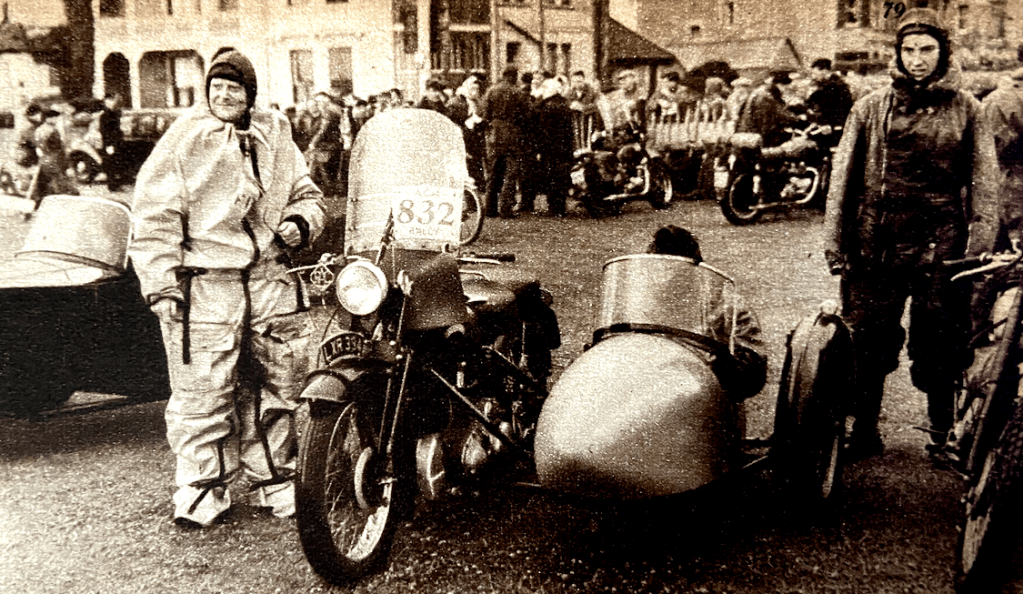
“IT WAS DOUBLY UNFORTUNATE that the weather should have been so unkind to the National Rally. First, because it was scheduled as the big event of this, the Auto-Cycle Union’s Golden Jubilee Year, and, secondly, because there have been signs during the past two years that intelligent efforts were being made to solve the difficulties inherent in this type of something-for-everyone, nation-wide event. Although successful despite the rain, the results of the 1953 Rally nevertheless suggest that the time has come to reconsider the whole structure of the event and to shift the emphasis from endurance to skill. The fact is that whatever the physical difficulties may have been, some 40% of the finishers qualified for first-class awards. Whatever modifications may be made for 1954, it should not be forgotten that the most important person in the Rally is the competitor. He provides the show and deserves more attention than he at present gets. What if he is inclined to leave early on his homeward run? This could be the fault of the organisers in their failure to provide adequate shelter and entertainment after the long trial. The accent on skill was underlined by Mr Gurney Braithwaite, Parliamentary Secretary to the Ministry of Transport, in a speech made at the conclusion of the Rally. Referring to the RAC/A-CU training scheme, he expressed the hope that as many learner motor cyclists as possible would make themselves proficient riders before taking to the- public highway, for improvement of roads could never provide the complete answer to the accident problem. Adding that the motor cycle was inherently no more dangerous than any other vehicle but that the motor cyclist was more vulnerable than the motorist, he said he would not be satisfied until the safety helmet had become as much an accepted part of the motor cyclist’s kit as goggles and gauntlets.”
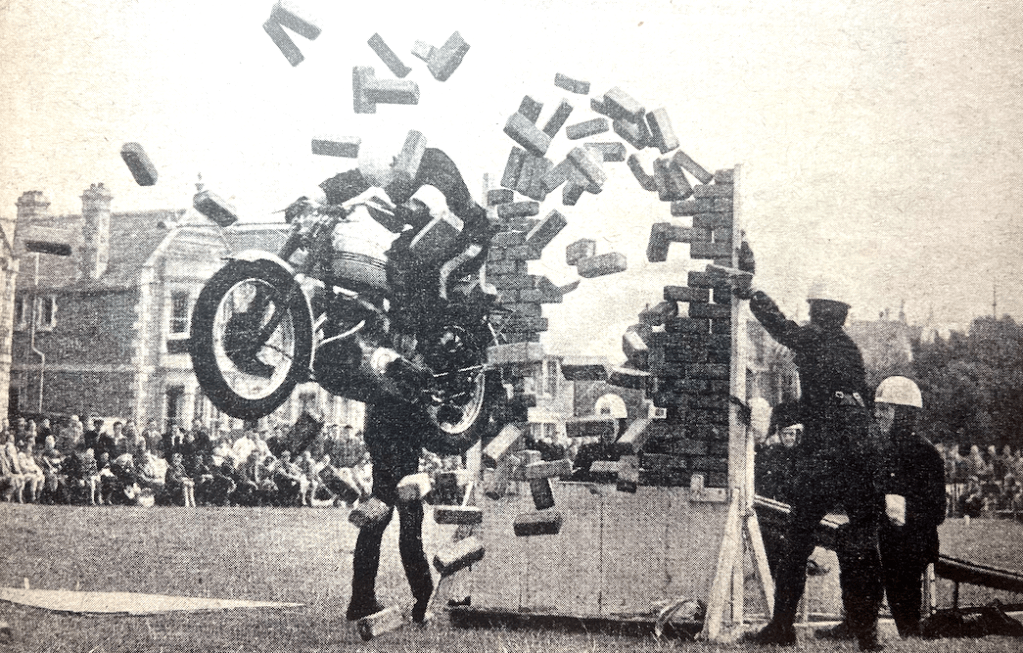
“BECAUSE IT IS SOMETHING in which all riders can take part, the National Rally is unique. It is not for experts only, nor even for sporting types alone. Looked at in that way, it has a special importance in the year’s calendar. It could do more for the motor cycling cause, I would say, than any other single fixture. Let us first be clear about the aims and objects. One is to attract users to the clubs. And secondly, which is even more important, to popularise motor cycling—by staging, as it were, a family party to show outsiders that ours is one of the better games to play, with lots of good fellowship attached to it. Repeat; to stage a party. That is the line to be followed, and accordingly the appeal must be as wide as possible. What that means is that the show should not be regarded as a competition only. The point is to get all and sundry to turn out, even if endurance contests do not happen to appeal to them. The emphasis should be more on skill and less on mileage, but I would go even further. People should be encouraged to join the gathering even if they do not take part in the competition at all. They might be allowed to enter at reduced fees and get souvenir certificates only as awards. It would be easy to devise a scheme with a far broader appeal than the present one.”—Carbon
“AFTER COMPLETING WHAT must have been the wettest A-CU Rally ever possible, I feel I must write to express my thanks to everyone in charge of the control points which.I and my brother visited—particularly those at Southampton—for their willing help when my mag got water in it. My thanks also to the motorcyclist who put himself out a lot and lost much time by frantically waving white handkerchiefs in pouring rain to stop us and warn of oil and glass where a nasty accident had occurred outside Southampton. He deserves a knighthood.
M HAIRE, Guildford, Surrey.”
“‘CARBON’ has, during the past few weeks, frequently hinted in his columns that there were big things in store for those who participated in this year’s AC-U National Rally. Was he taken for a sucker? As a Jubilee Year tour de force, the arrangements which competitors found awaiting them at the conclusion of the event were utterly inept. Apart from a display of trick motor cycling and the playing of a brass band the fare provided for competitors was even less than last. year. One obtained the impression that we were being completely ignored—and that the entire affair was haphazardly planned. Further evidence of this was the fact that competitors did not receive the official list of controls until the preceding Thursday; in some cases, Friday. At a very large number of controls which were manned by local club members, the attention given to the competitors in the way of free and ample refreshments put the A-CU headquarters to shame. Surely it would not have been beyond the Union to have provided similar fare at the close? Their funds are much greater than those of local clubs. On this showing—with all its initial promises of big things to be expected—the average motor cyclist will not be impressed with the Union and will certainly think twice about taking out individual membership.
PFC 862, Failand, near Bristol.”
“YOUR EDITORIAL ON the A-CU National Rally should certainly be carefully read by the organisers—and memorised. I am sure that neither the ACU nor Weston-super-Mare can be proud of the facilities provided for the competitors on their arrival on the Sunday morning. After a 12 hours’ soaking I at least looked for a place in which to dry some of my kit and somewhere to freshen-up before starting the journey home. The one toilet to which we were directed was totally inadequate to handle the competitors, let alone the general public as well, and frankly, the meal at 3s 9d [about seven quid in 2026] was not exactly my idea of good value. By contrast the intermediate controls were most helpful and hospitable and in particular I remember Reading, Swindon and Oxford. Before the organisers plan the 1954 rally I suggest that they themselves compete in an event finishing at Scarborough, Land’s End or Edinburgh.
K, HUDSON, Rotherham, Yorks.”
“A-CU MOTTO COMPETITION—A Review of the Entries by KS Topping (Hon Treasurer, A-CU): The motor cycle saddle is evidently one of the seats of learning for, of the thousand entries received for the recent A-CU Jubilee Motto Competition, fully three-quarters were in Latin—and not ‘dog'” Latin, either, so the experts say. Entries appear to have been submitted by folk in almost every walk of life and many were accompanied by complimentary letters congratulating the Union on the achievement of its 50th birthday. The judges found their task particularly difficult for only a small proportion of the competitors seemed to have realised exactly what were the terms of reference. Far too many attempted to sing the pleasures of motor cycling, to glorify sheer speed, or to pontificate upon road manners. Scarcely a dozen made any attempt to fulfil the chief competition requirement, which was a motto that would epitomise the aims and objects of the governing body of the sport. Apart from the winners, whose contributions are quoted later, one Leicester entrant did move in the right direction when he submitted as the raison d’être of the A-CU, ‘Ut rotis laetius eatis’ (That you may ride more happily awheel). Another suggestion, coming from both Fareham and Manchester, was ‘Ubique duarbus rotis’ (Everywhere on two wheels). This, of course, could hardly be accepted in view of the fact that the A-CU has a very large proportion of members interested in three wheels! Quite a number of competitors were working, it seemed, under the erroneous impression that the motto wanted was one that extolled ‘life awheel’.’Huc illue tuto et laete’ (Hither and thither, safely and sprightly) offered one Midland competitor, while another from the South suggested ‘Per collem et vallem fedenter’ (O’er hill, o’er dale, e’er without fail). Another favoured line was to lay stress on the speed angle. From Cheadle came the Virgilian ‘Fulminis ocior alis’ (Swifter than the winged thunderbolt). Along the same lines was ‘Fervidae juvant rotae’ (The hot glowing wheels are my delight)—and this from a fair maiden in a sixth form near Manchester! More soberly couched was ‘Praecepta via observa (Observe the Highway Code).’Six or seven entrants suggested ‘Festina lente’ (Hasten slowly), and a similar number cited the Co-operative Training College motto at Stanford Hall (where, incidentally, it was hoped to hold the National Rally two years ago)—’Salus populi suprema lex’ (The public welfare is the supreme consideration). In an endeavour to work upon the theme of road safety, the word ‘Comiter’ or ‘Comitas’ appeared in several entries—for example, ‘Comiter celeramus’ (Let as speed along considerately) kept company with ‘Festina cum cura’ and ‘Nec temere, nec timide’ (Neither rashly, nor timidly). Neat references to the ‘propulsive’ angle of motor cycling were, from Birmingham, ”Nici scintilla frustra’ (Without the spark we labour in vain) and, from the Isle of Man, ‘Spiritus intus alti’ (It’s the spirit that keeps it going). Of the attempts to provide a motto in English, the less said the better. It would appear that the directions issued to competitors were not sufficiently specific and that the addition of an example to illustrate the kind of thing needed would have led to a more appropriate crop of entries. It would be very ungracious, however, not to express appreciation of the enthusiasm shown by the many friends of the Union who made attempts in this class. In the opinion of the judges, the most appropriate contributions were the following: 1. The best motto in either Latin or English. Prize: a BSA Bantam. Winner: Major AB Bushby, Rye Mill Lane, Willaston-in-Wirral, Cheshire. The motto: ‘Certando Proficiamus’ (Progress through Competition). 2. Best motto in English. Prize £25. Winner, R Bachelor, 84 Stooperdale Avenue, Darlington. The motto: ‘Fellowship, Sport and Progress.’ 3. Next best motto in either language. Prize £15. Winner: The Rev JR Lamb, St John’s House, Tenterden, Kent. The motto: ‘Rota Currente Progressus’ (Progress by the Swift Running Wheel). 4. Next best motto in either language. Prize £10. Winner: JA Laurie, 71 Grantchester Meadows, Cambridge. The motto: ‘Per Ludas ad Principatum’ (To Leadership through Sport). Major Bushby, the winner of the premier award, which, it will be remembered, he collected at the National Rally at Weston-Super-Mare, is a veteran motor cyclist. In acknowledging notification of his success he wrote: ‘When I was in Bath Abbey this morning to thank God for my great good fortune, it occurred so me that if I had been an ancient Roman I should have been in duty bound to offer a 10th of the value of my prize to Mercury, the god of Good Fortune, who also presides over motor cyclists in general, the TT Races in particular and the Corps to which I had the honour to belong from its inception. Not being a pagan, however, I should like to devote a tithe (£10) to the Benevolent Fund.’ This sum Major Bushby has sent along with special intention for the benefit of the dependants of those who met with misfortune this Year in the Isle of Man TT Races.”
“AFTER A WEEK of weather which, had it persisted, would have sorely tried even a Vespa’s proofing against the elements, last Sunday provided over 11 hours of brilliant sunshine at Brighton, where the Vespa Club of Britain held its first International Vespa Rally of Southern England. From early morning the wide streets and avenues of the Sussex resort echoed to the purr of small two-strokes as some 400 scooters—many carrying lady passengers, gay in their summer dresses or smart and business-like in slacks and shining windcheaters—converged on the car park of Withdean Stadium, which stands on a hillside slope a few miles inland, and which was designated as the rallying point. By 11am the park was full of motor-scooters—and the sky was crowded with balloons as the day’s first event, a balloon race, got under way. Borne aloft on a strong westerly breeze, the crimson aerostats gyrated over the surrounding tree-tops, adding such a touch of carnival to the scene that the Continental Vespisti present—for from the branches of the Vespa clubs of France, Belgium, Italy, Switzerland and Germany contingents had come—must have felt quite at home. Before the parade moved off to take up position on Madeira Drive, there was time for the rallyists to intermingle, converse and examine each other’s machinery. Even a casual glance at the gathering sufficed to illustrate quite vividly how the motor-scooter has succeeded in breaking down the anti-two-wheeler prejudices of years. The riders were drawn from all parts of the country and included people of many diverse callings. Especially evident—and gratifying —was the numerical strength of the ladies, not all young, many of whom were driving their own scooters. And—likewise
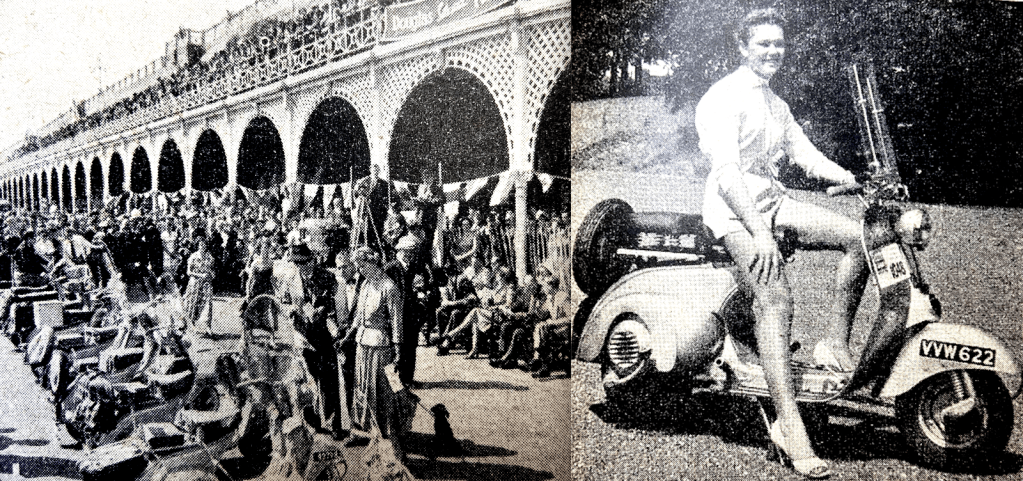
a happy augury—not a few scooterists were wearing safety helmets. The machines, too, gave mute evidence. Models with many workaday miles recorded on their milometers—the Fords and the Morrises of the motorcycling world—rubbed shoulders, quite democratically, with shining, luxuriously equipped stablemates which, by comparison, were veritable Cadillacs! Special machines on parade included a sidecar float to carry one scooter, the commercial Vespa in several forms, and a sidecar outfit scarlet as a fire engine—which, in fact, it was; a small fire-fighting vehicle for use on airfields. Among the models ridden by Continental competitors a beige French model carrying a full range of accessories and one of the latest Vespa 53 machines, hailing from Belgium, attracted the most attention. To assist any competitor who might experience mechanical difficulties, Withers of West Norwood had provided three service vehicles and one of these, a modified Douglas-Vespa commercial model, featured, displayed atop the sidecar, a sectioned engine. Of the competing riders, the oldest was a local—66-year-old WF Whitehead, who hails from Hove—while those travelling the longest distance were a Wiesbaden couple, the Walter Adlers, whose round trip would top the 1,750-mile mark. But one hopeful was hastily banished by the organisers. He had arrived on a Lambretta! Shepherded by members of Brighton’s motor cycle police, the rallyists moved off as noon approached, heading for Madeira Drive on the sea front, where the machines were to be displayed in a special enclosure before lunch and the afternoon’s festivities. Each contingent in the groups—naturally separated, in view of holiday traffic conditions—was headed by its own standard,
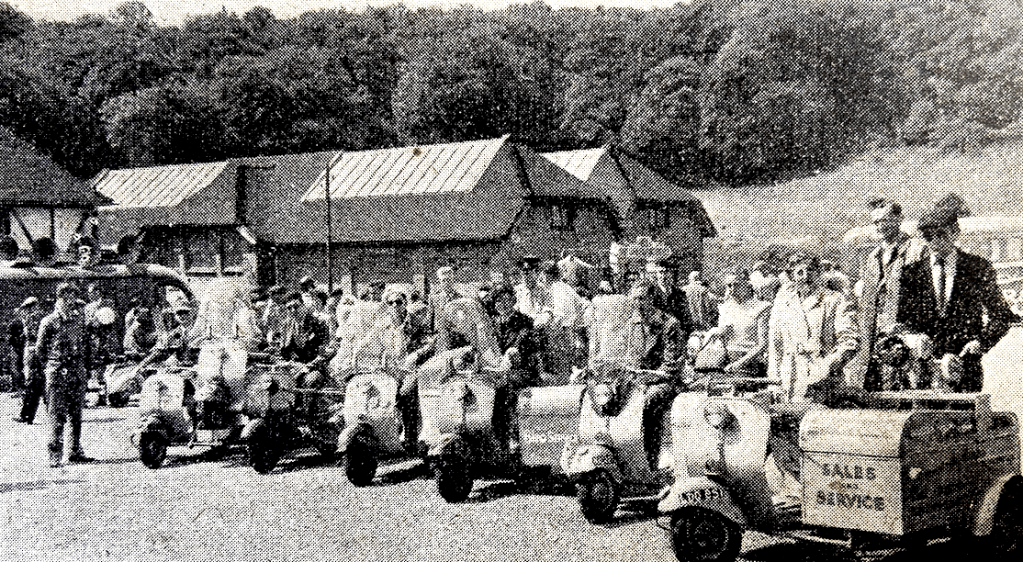
while the parade was led by the five green-and-white-clad Vespa Belles, one of them using a sidecar outfit. As the company dispersed for lunch, a non-competitor purred along the seafront with one of the most unusual accessories of the day on view a tailored box on the luggage carrier from which protruded the head of her pet poodle! After lunch came a concours d’élégance judged by a panel consisting of C McCormack, managing director of Douglas (Sales and Service), television’s Miss Joan Gilbert and Prof AM Low, himself a pioneer of scooter design. Two Miss Vespas—one of Southern England and one European—were elected, and the last competition was an obstacle race, difficult enough to form a real test of skill for the drivers and a test of handling for the machines. Then came the prize presentation before, in the early evening, the rallyists returned to Withdean prior to dispersal after an event which bodes well for the motor scooter movement in general and for the still-young Vespa club in particular.” Results: Silver City Trophy (foreign rider travelling longest distance): Waller Adler, Wiesbaden, 875 miles. Vespa Cup (home rider travelling greatest distance): A. Grant, Swansea, 286 miles. Obstacle Race: 1, D Kalra; 2, JN Durnford. Concours d’Elegance: 1 RW Krammer; 2, Leon Gobbe; 3, B Nichol.”

“A RADICAL SUGGESTION for an Everyman ‘Multi’ by Prof AM Low, ACGI, DSc: ‘For many years I have observed motorcycles. Indeed, I was most jealous when I had not enough of either money or age to secure a front-drive Werner or a Singer with its motor in the rear wheel, models amazingly like the modern examples of this method of ‘motor assistance’. I have designed models driven by steam, electricity and even by rockets. I have campaigned for silence, flexibility, speed, weather protection and all the other fine things which competition has brought into being. I have even produced a four-cylinder-in-line two-stroke with shaft-drive, detachable wheels, springing and a pressed-steel frame, many years before the war, with the object of securing comfort. I find that those who want to use a motor cycle as

transport only often say that they are not strong enough to ‘heave it about’, and that even when standing still they find its tremor almost as uncomfortable as road bumps. Nothing to do with the sportsman, I agree, but worth a thought in these days when so many people seem to become more physically soft every year. Carefully noticing the enthusiasm shown for powered cycles, I will make what may appear to be a rather wild suggestion. It is that a very comfortable, very light machine which was silent, cheap and vastly simple might enjoy a new market. If all these qualities could be found, thermal efficiency could be disregarded. A consumption of anything over 100mpg is good enough to forget and a speed of 25-30mph is ample. Given such a specification, I believe that a ‘four’ is essential. Long ago this was the cause of laughter, but modem racing machines seem not too inefficient when provided with four ‘liqueur glass’ cylinders…I want four cylinders of the type used in model ‘semi-Diesel’ engines, with no electric ignition of any kind. This would remove at a blow one of the chief terrors of the ‘utility’ rider, for it does not greatly help even the most expert to know that ‘something has burnt out’ in the middle of Salisbury Plain on a dark night. A bore of about I in. and stroke of I in. should be enough [154cc]. Drive by chain, and if a normal gearbox is too costly, a hub gear is not impossible for very low powers…springing could be fitted, but with no need to worry about high-speed shocks, those met with at low speeds could probably be absorbed by a suspended seat of the old Dursley-Pedersen bicycle type. Such a model would be easy to start; it would also be very cheap, because no good internal finish would be needed and there would be no valve gear and no ignition accessories…I feel sure that such a runabout would he useful, quiet, need no physical strength to use, have almost nothing to go wrong and would not be tiring over longer distances than one would contemplate with a ‘clip-on’. With large cylinder area and a small bore, cooling would be excellent; a monobloc casting could be very plain and loads so low that simple plain hearings would be sufficient. Whole units could be replaced in a few minutes. Even piston fit could be forgotten because it controls a type of efficiency which we would not want at all in this case. One might also not consider belt transmission, properly guarded, completely unthinkable. I think that the ‘electric motor’ feeling would attract many who actively dislike the ordinary motor cycle.'”

“THE GEORGE HOLDSWORTH TROPHY is the premier award in the Redditch MCC&CC’s annual Expert’s Grand National—a trade-supported event open only to the elite of the scrambling world. Last year it was won by Geoff Ward on his AJS and on Saturday, when the 1953 meeting was held, at Rollswood Farm, Haselor, near Alcester, he retained his title against strenuous opposition. Basil Hall, the BSA star, led handsomely for nearly half the race but had to be content with second place while Johnny Draper, also on a BSA; finished third after what promised to be a stern tussle with his team-mate, John Avery, had petered out. Some alteration had taken place in the course, which was approximately 1¾ miles of grassland, rocks, woods, gradient, mud and the crossing of a brook, so last year’s time, 47min 7.8sec is not really to be compared with that taken by Ward on Saturday—42min. 26.8sec. North country enthusiasts will find considerable satisfaction in the fact that the Manchester Dot trio, Bill Barugh, Tom Cheshire and Brion Sharp, carried off the Manufacturers’ Team Award, riding their little 197cc Villiers-powered two-strokes in the half-litre Senior race. The weather was fine, though overcast and windy, for most of the meeting but rain began before the end and the last race finished in a downpour which made the terrain treacherous and brought off not a few.”

“MUD PREVAILED IN the recent trial held at Hohne in Germany by the 7th Armoured Division—the former ‘Desert Rats’. The event comprised two competitions, one for units of the Division and the other open to all BAOR units, and both were won by the 7th Armoured Division Signals Regiment team—Sgts Slaughter and Edwards and Col Hare.”

“IN A PAPER recently read before the Scottish Congress of the Institute of Transport at Glasgow, Dr HW Glanville, Director of Road Research, stated that ‘In 1952 the cost of motor cycle accidents to the community, making no allowance for human suffering, was was 45,000,000’ [£1.63bn in 2026]. Of the 4,700 people killed in road accidents in 1952, writes Dr Glanville, 1,400 or 30% were killed in motor cycle accidents. He suggests: “From a strictly national economic angle it would, it appears, pay to fit all motor cycles of over 250cc capacity with sidecars free of cost to the motor cyclists.” On this basis it would seem that the Chancellor of the Exchequer was at fault when, ‘in the interests of safety’ he made his April Budget concession of a reduced road fund licence fee for combinations under 250cc.”

“THOUGH ENGLISHMEN COMPLAIN about the state of their roads, only a comparative few have any conception of the rugged conditions with which motor cyclists in less developed countries have to contend. This fact was brought home to Francis and Barnett, Lower Ford Street, Coventry, when they discovered that a considerable number of overseas riders were buying their competition Falcon 62 model and modifying it slightly for everyday use. It was therefore decided to satisfy this demand by producing a machine which would need no modification—a cross between a touring and a scrambles mount—and the result was the Overseas Falcon 65. A specimen of this type of machine, which is now also available on the home market, has recently been on test in the hands of Motor Cycling’s staff. The Overseas Falcon 65 is based on the current Falcon 58. It has the well-known tubular loop frame with Silentbloc-bushed swinging-fork rear suspension which employs oil damped spring units giving a total movement of four inches. Specially stiffened three-rate springs are used in the telescopic front forks to cope with rough going. These forks have a total movement of five inches. The 197cc two-stroke Villiers 8E engine is employed and is normally fitted with a three-speed gearbox giving ratios of 6.25, 8.75 and 16.6:1, but on the model under test the new four-speed box, with close ratios of 6.25, 8.45, 11.25 and 18.1:12, was fitted. It was seldom necessary to use the air lever when starting for, with the Amal carburetter well flooded, the engine almost invariably burst into song at the first prod of the kickstarter, Initially, the mixture was a

trifle too rich and hence the engine had a tendency to fourstroke, but this was soon cured. Owing to its high ground clearance the model felt very much the trials machine. The rider was seated on rather than in thy saddle and this imparted a feeling of hairsbreadth manoeuvrability which was amply supported by excellent handling qualities. Nevertheless, even a fairly short rider could plant both feet firmly on the ground when necessary; and this was seldom, since the model could be easily balanced at almost zero knots. Although mainly intended for rough terrain, the machine was used extensively for town riding. It was here that the usefulness of the new Villiers four-speed gearbox became apparent. Gear changes could be made swiftly and silently with almost featherweight pressure on the pedal, which had a very short travel, resulting in lively and effortless acceleration. And there was little or no trace of transmission roughness at relatively low revs, save when the throttle was opened too vigorously; it was possible to accelerate away from about 23mph in top without snatch. The handlebar controls were conveniently placed and easy to operate, the clutch being particularly light; and the combined dip-switch and horn button unit was well within reach of the left thumb. Both the rear brake and the gear-change pedals are adjustable, as are the footrests, but alteration in the gear-change setting necessitated the removal of the kick-starter, the two being mounted concentrically. The suspension was, perhaps, a trifle stiff for town use, but on the sort of ‘colonial’ going for which it was designed it smoothed out the shocks in truly exemplary fashion. On a loose gravel, pot-holed surface it was easier to spin the 3.50×19 Dunlop Trials Universal ” rear tyre than to lift the front wheel; and the 2.75×21 front tyre, allied with the wide steering lock and light weight, made path-picking a simple task at any speed. On the way to the rough stuff the weather, as though aware of our intention, gave vent to a downpour of near-monsoon ferocity. But throughout the tempest and the subsequent drenching in water-filled pot-holes, the engine never missed a beat—excellent testimony to the waterproof qualities of the close-fitting Villiers magneto cover. However as was to be expected, this amphibious treatment did bring home the fact that this is a machine in which performance counts more than the preservation of appearances. Not being sprung with the wheel, the narrow front mudguard keeps little of the road spray from rider or machine; similarly, its rear counterpart affords but slender protection. And although well shielded from the downpour by waders and coat, the

underside of the rider’s right thigh was spattered by spray from the rear wheel. It should be emphasised, however, that such a shortcoming is virtually unavoidable without impairing the machine’s ability to perform the job for which it is intended. And again bearing in mind the designer’s intention, the performance generally can only be described as impeccable. A high maximum speed cannot, of course, be expected with a top-gear ratio of 6.25:1. Similarly, the normal cruising speed was around 38-42mph. But this speed could be held all day and over any type of country within the rider’s capabilities. Hill-climbing, too, was outstandingly good, and on a gradient of one in six in a built-up area, after being slowed to about 20mph by struggling traffic, it was possible to accelerate smartly past in third gear and then change up without loss of speed. At night the 6in Lucas pre-focus headlamp gave a more-than-adequate beam for all speeds, whether it was fed direct from the flywheel generator, or by the 6-volt 12-amp-hr battery—either supply being selected by the headlamp-mounted. four-position switch. The battery was charged through a flat rectifier, which, mounted below the saddle, was amply protected and ventilated. Criticisms were few. Generally speaking, the machine’s components are admirably accessible, though for some carburetter adjustments it is necessary to loosen the unit at the intake stub—a simple task. The side-vent silencer, too, is easy to dismantle for cleaning, though by reason of its slight upsweep it does tend to hamper the adjustment of the rear wheel when using the tools which are available in the neatly-housed kit. Although, when used together, the brakes had satisfactory stopping power, the front unit felt somewhat spongy and did not inspire complete confidence. On the scores of comfort and appearance the Overseas Falcon 65 cannot, however, be faulted—save perhaps by those diehards who boggle at the sporty clearance of the front mudguard. Footrest hanger and seat adjustment make it a simple task to tailor the machine to accommodate any normal-sized rider with ease. And the durable black and chrome finish ensures that it is as comely as it is comfortable. A machine such as this, built virtually to user’s specification, cannot fail to have a wide appeal, both overseas and among those riders at home who like to mix rough stuff with their ride-to-work motor cycling.”

“WHEN I MOTORED into the old-world town of Schotten yesterday evening Friday, July 17 it was to find that a most extraordinary situation has arisen in connection with the Grand Prix of Germany, due to take place here on Sunday. The majority of the leading factory riders had inspected the 16.08km. circuit on the Wednesday when the roads were wet, and had unanimously decided that this was no place to go dicing for world championship honours on 500 or even 350cc machines. This morning, even as I write, the AJS, Norton and Gilera race vans are already on their way out of Germany, while Fergus Anderson has announced that neither he nor his Moto-Guzzi team-mate Enrico Lorenzetti will be competing. The MV fours have turned up here for the first time since the TT, but director Dominico Agusta has indicated that only the 125s will run. The reason for this spontaneous refusal to take part in the meeting is that not only is the circuit narrow—less than 16ft in places—but it is bordered on many of the fast corners by trees and—worst of all—the surface is extremely slippery at some of the most dangerous points. It is felt that with, perhaps, 10 men fighting for the lead a spill could involve not just one rider but them all. And there have been too many accidents already this summer. The FIM officials, faced with this unprecedented situation, had to choose quickly between cancelling the meeting; insisting that it went forward as a World Championship event despite the fact that few potential champions would be competing, or of achieving some compromise. They have chosen the last course. The meeting will be run—the organising club, the Deutscher Motorsport Verband eV, is too deeply committed financially to relish a cancellation—and the 125 and 250cc races are to count for the Championships while the 500 and 350cc races will not. Saturday, July 18. The practising ended this morning in dismally wet weather. DKW and NSU factory entries remain in the programme, and an Englishman, Len Parry, has put in fastest 350cc times as a member of the DKW team. And there is a distinct possibility that Carlo Bandirola will start on an MV in the 350 and 500cc events and will be joined in the Senior race by Gerhard Mette, who is no longer a member of the BMW team. Works interest in the major class is assured, anyway, by

the presence of three BMW. By far the most important thing that has happened today, however, has been the meeting at which CSI president Piet Nortier and a very embarrassed Emil Vorster who, as sport-president of the DMV, is responsible for the German GP being run at Schotten, faced a strong deputation from the German Press. Nortier explained the action that the FIM had taken and made it clear that he was in sympathy with the riders. So am I, incidentally, since I have had the opportunity to see the appallingly dangerous state of those parts of the circuit where smooth concrete has been patched with glistening tar. But what was of particular interest was the fact that the Pressmen, almost to a man, demonstrated that they, too, agreed with the decision that had been taken—although, as Germans, they must obviously have been disappointed that the status of the meeting has been so seriously affected…I came here to write a report of a road race meeting. Instead 1 find myself involved in the politics of the sport. But that, unfortunately, is the way things are just now in international motor-cycling—as is demonstrated by the campaigning being conducted by the Germans behind the scenes this very week-end to secure a boycott of this year’s 1SDT because it is to be run in Czechoslovakia. Sunday, July 19. After a night of rain, the sun has come out. But with the overhanging trees, the road remains wet and the start of the seven-lap (69.9-mile) 125cc race has been delayed from 9.30 to 10.15am. There only 18 starters, and with the absence of the Morinis, it is a straight contest between the five German NSU factory riders, who include Werner Haas. and the MV trio—Ubbiali, Copeta and Englishman Cecil Sandford. Sandford. from the third row, goes straight into the lead, but he completes the lap with Haas right on his tail…Sandford has put the lap record up to 68.06mph but Ubbiali has lapped at 69.24mph. Sandford disappears on Lap 3, and Ubbiali has gone into the lead…Despite a record-breaking

last lap by Haas, Ubbiali stays in front to win. On the line for the 10-lap 350cc race are 35 riders, who include Bandirola with the MV four, and a DKW trio consisting of A Höbl, K Hofmann and Len Parry. The rest of the field is made up of private owners, mainly on British machines, and among them are the Australians and New Zealanders who have been doing so well on the Continent this year, and several English ‘Circus’ performers. Parry sets the pace all the way from the start to the top of the long climb to Poppestruth, but is there reported to have retired and at the end of the lap Höbl leads by a short head from New Zealander Leo Simpson (AJS) and Bandirola. Höbl is well ahead in another lap. Bandirola is second and Simpson and Ken Mudford (AJS) are scrapping for third place. Hofmann and George Scott, of Australia, are contesting fifth placing. Höbl has- come within 1mph of Geoff Duke’s 1952 record lap speed of 77.31mph. But just when it looks as if the German rider is going to run away with the race—he is gaining 15 seconds over Bandirola on each lap—he coasts in at the end of the fourth circuit, with all three plugs oiled on the long run down to the pit area. By the time they have been changed he is back to eighth place, behind the leader and Mudford, Simpson, Hofmann, Scott, F Klager (Horex) and Irishman Bob Matthews (Velocette). The inevitable happens when he tries to catch up. A slide on one of the greasy curves brings him into contact with the straw bales and bends the model, so that he has to retire at the pit. Meanwhile, Hofmann, who had come off on the opening circuit, has moved into third place. And to the great excitement of the crowds he overhauls Mudford to become second—albeit, nearly 1½ minutes behind Bandirola—as he completes the eighth lap. There is no change among the leading three after that, although several of the private owners—among them Simpson and Matthews—disappear from the scene without a word from the organisation to say what has befallen them. And, easing up appreciably, Bandirola completes his winning ride, still comfortably ahead of Hofmann. Among the score of competitors in the nine-lap 250cc race are the five NSU factory men, the same DKW trio who have just raced in the 350cc event and Alano Montanari on a works Guzzi. Parry has two attempts to start his DKW and eventually gets away about two minutes behind the rest of the field. Werner Haas is setting the pace, well ahead of Höbl, whose DKW is followed by the NSU twins of Reichert and Daicker. Montanari lies fifth, despite a tumble. Haas is actually lapping at a higher speed than Bandirola ever achieved in the 350cc race and by the end of the fourth circuit,

which he covers at the record average of 75.76mph, he is more than 30sec ahead of Höbl…On the higher part of the circuit, away to the east, it is now raining heavily, and it would seem that Daicker has come off, for Montanan is third next time round and there is neither sight nor news of the NSU veteran until he rushes past in seventh place, just ahead of Sid Willis (Velocette)…Haas, having been off, has slowed and there is a possibility now of the lone works Guzzi challenging for the lead. There is no great excitement, however, for the German manages to maintain the gap between himself and his pursuer during the final stages. Now comes the 500cc race covering—oh, how unfortunate!—13 laps. Apart from the three works BMWs in the hands of Walter Zeller, Hans Baltisberger and Hans Meier, it looks as if all the field of just over 30 will consist of private owners, for neither Bandirola nor Mette have brought their MVs to the line. No MVs, but it would be wrong to say there is no opposition for the BMWs—at the end of Lap 1 Zeller has HP Müller on a Horex single on his tail, and while two of the four riders fighting for third place are the other BMW team men, the others are the Belgian, Auguste Coffin, and the German, Karl Rührschneck, both on Manx Nortons; and Leo Simpson on his Matchless is scotching along behind. Baltisberger moves into second place, but Meier drops back to eighth on Lap 2. While the sun shines at the start, it is raining in the hills and conditions are as bad as could be. Zeller, who is holding his lead, is lapping considerably slower than was Haas on the 250, and by the end of the fourth lap—when the order of the first eight is Zeller, Baltisberger, Müller, J Collot (Norton), Simpson, Meier, Rührschneck and K. Bryen (Norton)—more than a third of the competitors have slid out of the race. And with it beginning to rain all round the circuit, the leader’s 71mph average promises to drop still lower. In mood with the race is the thunderstorm now breaking overhead…The race drags on, with Meier, Bryen and Collot fighting for places, providing the only excitement. During Lap 10, Bryen, who is keeping ahead of Meier, has the misfortune to have his ht lead come adrift from the magneto and has to halt at the pit for repairs by his attendant, Ray Amm. In the end Zeller has more than 2min in hand over his team-mate Baltisberger.”
“SCHOTTEN—THE ORGANISER’S VIEW: The attention which Motor Cycling devoted to the happenings at the German GP at Schotten indicates that has aroused much interest among British readers. Therefore I think that you will welcome some additional information on that subject. The refusal of the mostly British factory riders to start came as a complete surprise to the organising club. The Schottenring had been inspected during the past year by Mr Peter Chamberlain, Count Lurani (Italy), and Mr Pieter Nortier (Holland), and all three foreign FIM officials had expressly approved it. Besides that, Mr Joe Craig, from Norton, had taken a look at the course in July 1952, and, although he had found it difficult, he never stated, to our knowledge, that he thought it inappropriate for the German GP. Furthermore, Georg Meier, on Mr Nortier’s suggestion, was invited there last year, and all his suggestions concerning the elimination of roadside trees and so on were followed explicitly. Finally, one week before the races and again on a German invitation, Geoff Duke, Reg Armstrong and Dickie Dale inspected the course and, although they, too, thought it difficult, they did not declare then that they would not ride. Additionally, Duke, Ray Amm and Ken Kavanagh had taken part in previous races at Schotten. But then the refusal of the riders to compete came—although all factory teams knew well in advance that the Grand Prix would be run on the Schottenring and although the course had been approved by the FIM, the OMK and by representatives of the riders. Incidentally, news of that refusal was published by Reuters, in London, before the FIM Jury and the organising club had been informed and the latter got the new from the Press. This strange fact has not been explained. Of course, the condition of the surface was as good as in all previous years, though it might be significant that the last FIM inspection took place under fog and rain, which made the road appear worse than it actually was. And never before has so much straw been used on a German race course to protect the riders than at Schotten. On the Thursday before the race the course was found at one spot between two sharp curves to be only 4.80 metres broad over a 50-metre stretch. The road was broadened at night to 5.1 metres, so when the race was run the road was at no point narrower than 5.0 metres—the width officially required for a Grand Prix. There are certainly no people more competent to judge a circuit than the riders. It is interesting, however, to remember that during the four races at Schotten (including the two World Championship races) and during the practising, in spite of new records being set in three classes, not a single rider was hurt on the course. It might be of some interest, too, to know that the financial burden for the GP did not rest on the German Motor Sport Organisation, DMV, but solely on the local club responsible for the organisation. In the discussions following the factory riders’ refusal to start, it seems to me our proposal to start the riders of the 350 and 500cc classes one after the other at 10-second intervals was not dealt with seriously enough. I still think that such an individual start would have excluded the possibility of a large number of riders racing close together in a bunch and this would, I suppose, have considerably reduced the importance of the arguments of the riders. Just one small correction: Cecil Sandford slipped at a point 2km away from the spot where Van Rijswijk was killed last year.
DR H DAMDMANN, Schotten 16, Germany.”
“YORKSHIRE IS FORTUNATE in that torrential rain seems to affect the moorland trials sections but little. On the days preceding the Allan Jefferies Trial, a mid-summer national event organised by the Bradford&DMC on July 18, thunderstorms severe enough to make some roads impassable broke over the Broad Acres. No sidecars featured—a minimum of 10 entries was required—and thus the main award, the Allan Jefferies Trophy won in clear-cut fashion by John Brittain (350 Royal Enfield), was unsupported by an ‘opposite class’ best performance. The route followed the customary plan, incorporating 60 miles of moorland road and track, in which were sited enough observed sections to satisfy the most rabid enthusiast. No complaints could possibly be made in this direction, for there were, in all, 13 observed sections, subdivided to provide a total of 41 hazards on which a rider could lose marks. Stretching the prescribed limit of 150, a total of 164 entries was received.”

“BUT FOR THE intervention of a sudden heavy shower towards the end of the meeting, it is probable that all existing motor-cycle-class lap records on the 1.84-mile airfield circuit at Castle Combe, Wilts would have been broken last Saturday, when the Wessex Centre held its open National road races. As it was, only the 500cc and sidecar figures remained. While many other parts of the country suffered severe storms, Castle Combe circuit shimmered in a blaze of sunshine when the meeting opened. And so conditions remained until it was almost over when the rains came to slow up the last two races, which were the sidecar handicap and the 500 final. Star rider of the day was Johnny Surtees who, on his double-knocker Nortons, won both the Junior and Senior events in a canter. Right from the word go the records started to tumble as II Lloyd, on his Italian ohc MV, turned the course in the opening race, the 125cc class, in 1min. 33.6 sec, equalling the remarkable speed of nearly 71mph. Surtees showed his form in his heat of the Junior event, when he established an unassailable lead in the very first lap over G Dunlop and Phil Carter, both on AJSs and in that order he headed them home. Another lap record fell in the Lightweight race. Maurice Cann, on his 248cc Guzzi, not only won but clocked a tour in 1min 27.6sec at 75.65mph. For the first couple of laps BWT Rood (249 JAP) was the leader, with Cann hard on his tail. Then the Guzzi overtook the JAP and with one lap to go had an
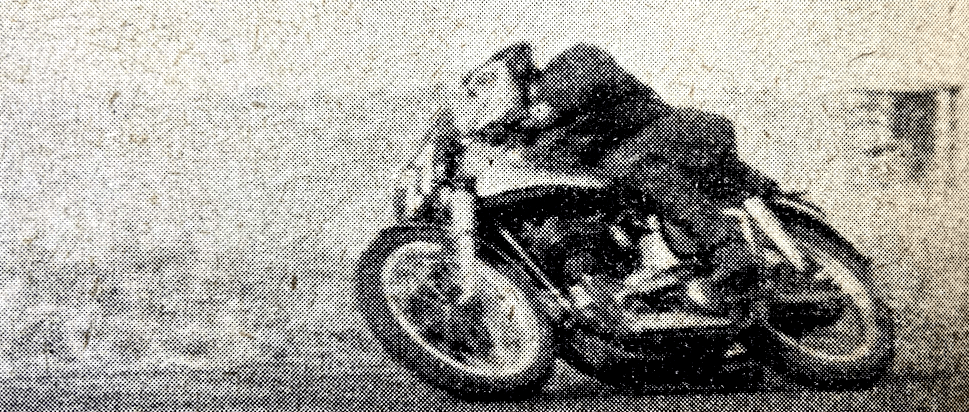
advantage of 12sec which it never gave up. In third place came Reg Geeson riding his amazing little home-brewed twin REG. In the Junior Final Phil Carter made a strong bid for victory. At the end of the first lap, he led JR Clark (AJS), G Monty (GMS), G Dunlop and John Surtees in that order, which remained unchanged throughout the second lap; on the third lap a pocket handkerchief could have covered Clark, Carter and Dunlop, with Clark in front, but on lap 4 the remarkable Surtees had passed all of them and led the flying Clark by a length, with Dunlop in the third berth. That length had stretched to 7sec by half-distance (6 laps) and Dunlop came up, to oust Clark from the second position in the ensuing, 7th circuit. But something happened to Dunlop ‘out in the country’, for the next time round he had dropped no fewer than half a dozen places! Just to show that he really was trying, Surtees clipped a little off his own Junior lap record and returned a new time of 1min 22.8sec, or 80mph dead, which is only about 1mph below the Senior figure. That smartly executed tour put Johnny so far ahead that he finished the race well out of sight of anybody else. But between Clark and Carter a pleasant little duel had been boiling up—as they crossed the line behind Surtees it was Clark who got the second place by a bare machine’s length. A non-starter in the sidecar scratch race was the redoubtable Pip Harris, whose 499 Norton outfit developed front-brake trouble when he was about to take it up to the line. With no apparent opposition, EJ Davis (998 Vincent/Watsonian) walked away from the rest in the opening lap and won with ease. Much the same comment can be made on the manner in which Surtees won his heat in the Senior race and in the second heat, which followed, Phil Carter also had a comfortable first.”
“THE SCOTTISH AUTO-CYCLE UNION officials made a bold move when deciding this year to transfer the annual Scottish Speed Championships meetings from the traditional course on St Andrew’s sands, where these events had been held ever since 1913, to the Charterhall Aerodrome circuit near Berwick-on-Tweed. The first meeting at the new venue, however, staged last Saturday by the SA-CU with the assistance of the Winfield Joint Committee (comprising the Hawick, Berwick and Lothian clubs), proved the wisdom in their decision, competitors being loud in their praises of this excellent 2-miles-to-the-lap course. With a good tarred surface and shaped like a Trafficator arm, it boasts a 1,450-yard straight and is wide enough to accommodate 40 riders abreast on the line. The meeting attracted over 100 riders and despite very heavy rain in the early’ stages more than 8,000 spectators turned up to watch a splendid afternoon’s sport which included four 20-mile Championship events, six 6-mile races, a 10-mile club team race and a 5-lap demonstration race between a 500cc car and a 500cc combination. The star of the meeting was Bob McIntyre, whose bag for the day on his very fast AJS and Matchless models included the Mediumweight and Unlimited cc championships, the 350cc and Unlimited cc 3-lap races, and whose speed of 73.3mph on the Matchless twin when finishing first in the 10-mile Club Team race was the fastest average put up at the meeting. In the 350cc Championship Race he retired with a choked jet when in the lead. Behind the flying McIntyre, Denis Parkinson and Jack Bottomley delighted the crowd with their very evenly matched Nortons—in one race the difference between the Yorkshireman and the Lancastrian being less than a wheel! When winning the Lightweight Championship after McIntyre’s departure from the scene, Parkinson gave a masterly exhibition of the short-circuit generalship for which he is noted. It was a happy occasion, too, for CP Campbell, winner of the Featherweight (250cc) Championship and the 250cc 3-lap race on his New Imperial, as it marked his last appearance before leaving Scotland to join the Kenya Police.”
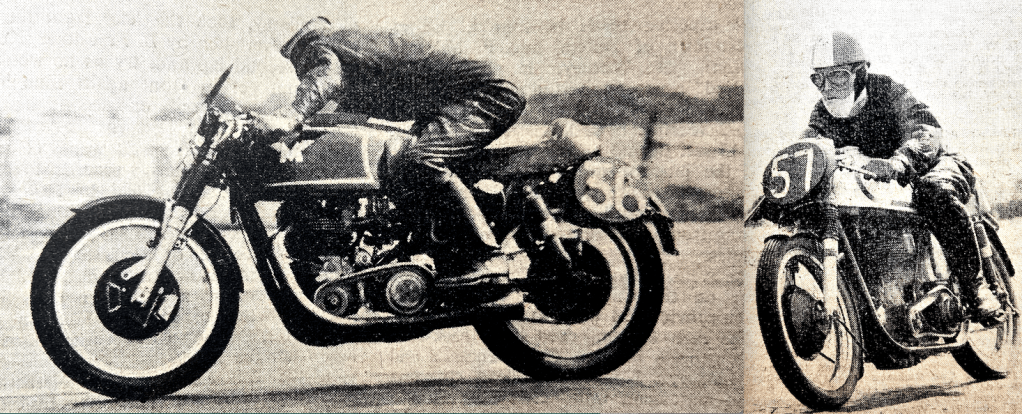
“AN EXPECTED TUSSLE between L Carter (Norton), of Dublin, and FM Fox (Norton), of Wortley, in the 500 class of the Munster ‘100s’ last Saturday ended on the second lap when Fox, 2sec behind Carter on the first and 13sec behind on the second lap, came into the pits to cure a misfire. But not till after two more stops did his engine really get going and by then Carter was far out in front and went on to win by two minutes. The event, a Southern Irish classic, took place on the Carrigrohane circuit, Cork, which provides 6.1 miles to the lap. The race was enlivened by a neck-and-neck struggle between TH Turner’s and H Lindsay’s Nortons, the lead changing again and again with never more than a second between them. Frantic weaving by Lindsay when in the lead failed to shake off Turner who, indeed, appeared to have a little in hand on the straight; he took the initiative on the last lap to finish two lengths ahead.”
“ALTHOUGH NO MOTOR CYCLE records were broken, speeds at last Saturday’s national sand-race meeting at Redcar were generally higher than 1952. The Middlesbrough &DMC fixture, with 52 competitors, had a rather smaller entry than in recent years, but the lists were not lacking in quality. At the outset it looked like being Reg Dearden’s day and, even if he disappointed in some ways, his was the most stimulating figure of the afternoon. There generally tends to be a certain similarity between events in such a series as the three 20-mile (10-lap) East Yorkshire championship races that are a usual feature of this meeting but, on this occasion, the unexpected happened more than once and interest was unabated. The sand was hard, with an assisting breeze down the land side of the course, but showery weather prevented the crowds from reaching quite the normal Redcar numbers. In the straight mile series Dearden had a couple of easy wins, his 540cc Norton being seen at its best in all-out speed in which it was remarkably consistent, with 85.71mph in the 600cc, and 84.91mph in the 1,000cc classes.”
“WITH THE OBJECT of achieving a 2,500-mile Continental tour in 12 days, using for the purpose two 125cc BSA Bantams, one of them fitted with a Watsonian Ludlow sidecar, Messrs F Allen, J Williams and C Mathews, Dulais Valley clubmen, were given an official send-off by the Mayor of Neath last Thursday. The party carries letters of greeting to the Mayor of Milan and to the Milan Motor Club.”
“THE SEVENTH ANNUAL Old Timers’ Ra11y, organised by the Hull AC&LCC in their Jubilee Year, took place last Sunday and attracted an entry of 52 motor cycles and three-wheelers in the veteran and vintage class. The course was one of 48 miles from Hull to Bridlington where, in bright sunshine, the assembled finishers delighted hundreds of onlookers. Of 47 starters, 38 finished the course, which included secret time checks and a number of stiff hills which required some manual assistance for some of the older machines. Most competitors reported a trouble-free run, except for a tail wind which tended to cause over-heating. G Grundy (1903 Quadrant) lost one of the points on his ignition system, but finished the course under his own power. R Shackleton’s beautifully prepared 1920 ABC transverse twin, complete with leaf-spring rear suspension, caused many admiring remarks and included in the runners was GW Foggit’s 1924 300cc Raleigh. which was bought shop-soiled only a week ago and was actually being run-in during the event. The Mayoress of Bridlington, Mrs M Waterhouse, presented the prizes. Results: Best performance (any class), G Holmes (1914 Sun-Villiers); Class A (pre-1908), E Langton (1903 Rex); Chas B (pre-1914), G Holmes (1914 Sun-Villiers); Class C (pre-1923), R Galbraith (1922 Bradbury); Class D (pre-1930), W Excelby (1928 Francis’ Barnett).”
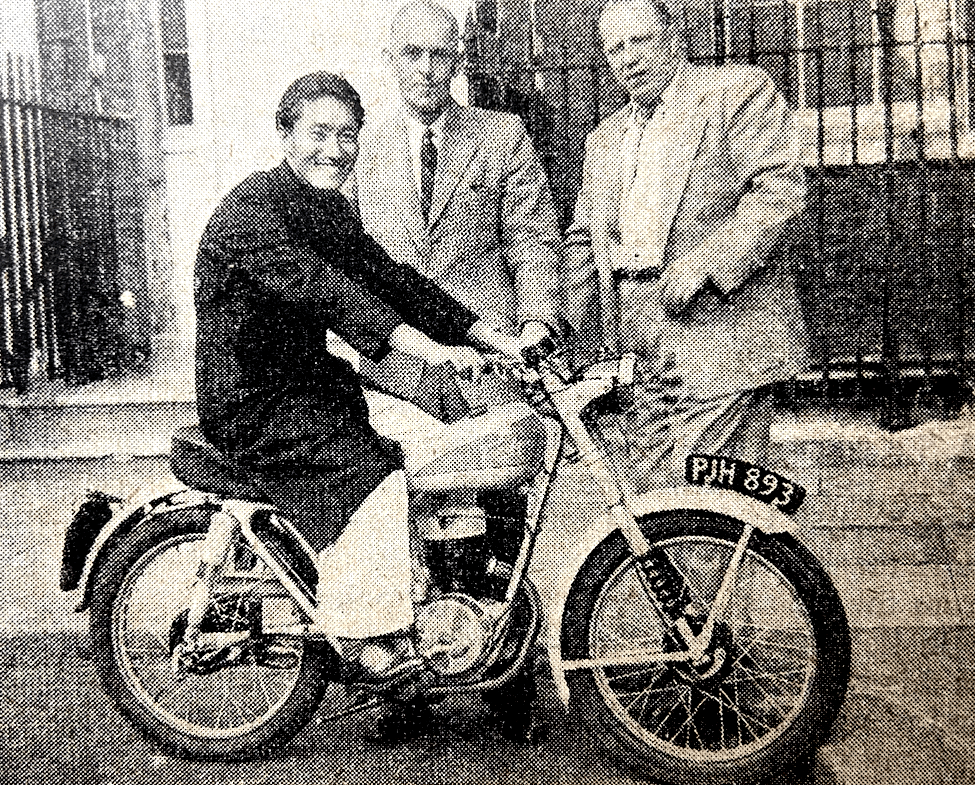
“IT IS ENCOURAGING to find that the mighty London County Council has, once again within a very short time, shown its appreciation of the requirements of the modern motoring community and has offered facilities to the RAC/A-CU Training Scheme which should act as a stimulant to other authorities all over Britain. In making available as a training ground part of the well-known Crystal Palace road racing circuit, as they have recently decided to do, the Council has made the biggest contribution yet seen in London towards reducing accidents among motor cyclists in the metropolis. Further, existing buildings are to be adapted as lecture rooms in order to make the offer even more magnanimous. As a spokesman of the LCC commented, the facilities are only open to motor cyclists, as the car folk already have their well-organised driving schools. The effect of such practical interest on the part of an organisation like the LCC is something for which the whole motor cycling community should be grateful for it should have nationwide repercussions of a most beneficial kind.”
“ISLE OF WIGHT AIR FERRY: Because of continued bad weather throughout the spring and summer of this year, the extensions and improvements at Bembridge Airport necessary for the operation of heavy Bristol Freighter aircraft have not been completed in sufficient time to enable Silver City Airways to operate their planned vehicle ferry service from the mainland in 1953. The nine-minute service from Southampton to Bembridge, which, incidentally, is the world’s shortest air route, will be in operation in the spring of 1954.”
“LAST MONTH, RIDING a 1951 197cc Norman and carrying 10-stone pillion passenger and two heavy panniers, covered 1,464 miles in Devon, Cornwall and Suffolk—952 miles in Devon and Cornwall during a holiday of nine days and the remainder in three successive week-ends—15 days in all. Long stretches, particularly one straight run of 220 miles in one day, were covered at speeds around 40mph (on the clock anyway!) and during the entire period the only attention I hai to give the machine, apart from a plug change at Redruth, was to put some air in the tyres. I have just partly stripped the engine and have dismantled the hubs, but apart from requiring a decoke I could find nothing that needed attention and no sign of wear or ill usage. In the past nine months this machine has covered just over 6,000 miles and for quite 80% of that mileage has been carrying a pillion passenger. Total cost of replacements during that period has been less than 6s [£12 in 2026]. I feel that, in general, the lightweight is vastly underrated.
JJ KIRBY, London, SWI3.”
“IS IT NOT TIME that a No 8 hat presented us with an oil pump for the lubrication of two-strokes and thus relieved us of this messy petroil business? Remember the pre-war 250cc GTP Velocette with its throttle-inter-connected oil pump regulator? Now, there was a popular machine if ever there was one, and I cannot recollect any complaints about the lubrication system. It would be interesting to know the system adopted on the racing DKW and EMC Puch machines. Can we hope for action by the manufacturers, or is the petroil engine too simple to make for them to bother?
JC BARNES, London, SE15.”
“BRITONS WON ALL THREE of the races constituting last Sunday’s French Grand Prix, staged in excellent weather on the Rouen-Les Essarts Circuit, but, except in the sidecar class, it was a field day for Italian manufacturers. In the opening 350cc event Ray Amm (Norton) crashed on the 28th of the 30 laps after having bested Fergus Anderson in a severe scrap in which the new Guzzi had the legs of every other machine except Amm’s. Parisian Pierre Monneret’s second place to Anderson, achieved on a works AJS, was a popular success. Though third, E Lorenzetti (Guzzi) was actually a lap in arrears. Eric Oliver and Cyril Smith (Nortons) both lapped Hans Haldemann, who was third in the sidecar race, in which all machines were British except the last to finish, a BMW. With colleague Amm in hospital, Norton teamsters Jack Brett and Ken Kavanagh had to battle with a horde of Gileras in the 500cc race. They were unable to prevent a 1-2-3 for Geoff Duke, Reg Armstrong and Alfredo Milani, but Kavanagh kept Giuseppe Colnago out of fourth place and Brett held his Norton in sixth berth with Rod Coleman (AJS), who lay seventh throughout, keeping just ahead of Dickie Dale (Gilera). Fastest lap was Armstrong’s 82.44mph An unlucky practice spill sent Bill Doran to hospital.”
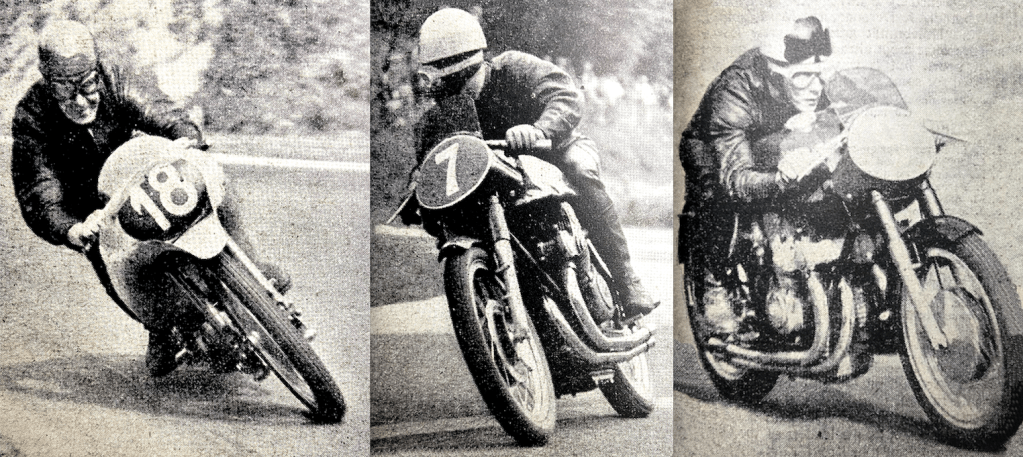
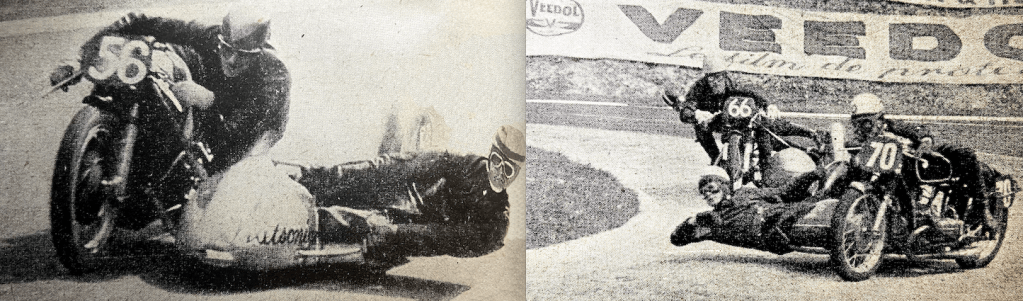
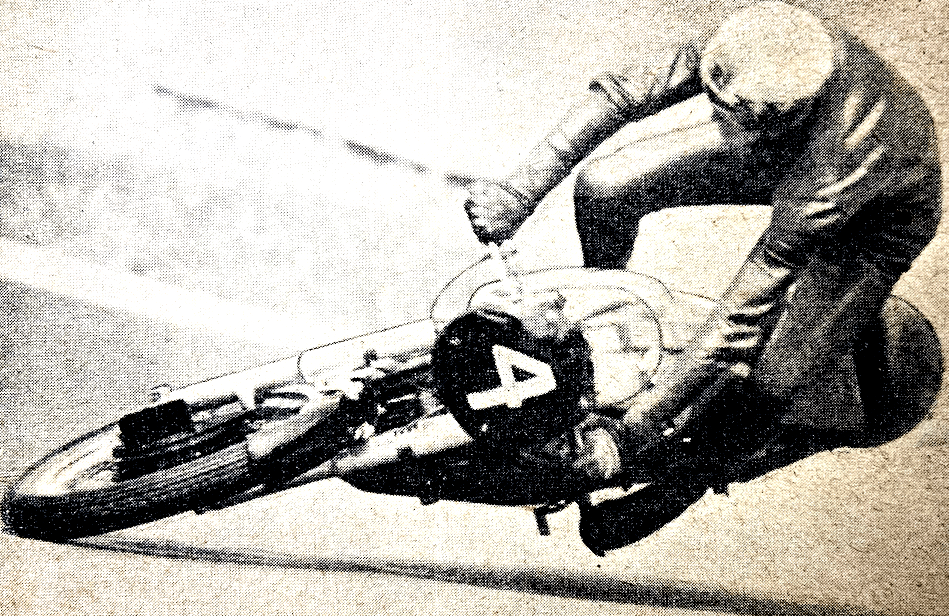
“LAST WEEK THE British Standards Institution published the long-awaited specification for ‘Protective Hats for Motor Cyclists’ BS2001:1953. It covers ‘hats for ordinary use for motor cyclists on the road’ but does not inhibit design by laying down detailed constructional requirements. The chief characteristics required of such a helmet are that it shall consist of a shell securely attached to a harness which fastens under the rider’s chin; that it shall have smooth external surfaces free from rigid external projections; that any reinforcing ridges shall be not greater than ³⁄₁₆in in height by ¾in in width and be fully radiused and smooth; that any peak shall be pliable; that when worn normally the distance between harness and the inside of the hat shall be not less than ⅝in and not snore than 1½in; and that the external depth of the helmet from base to crown shall be at least 4½in. A maximum weight of 20oz is laid down for the helmets which must be made of durable, not brittle materials and fitted with a cushioned headband and cradle to fit the head. Ear flaps may be fitted, but these must not impair the hearing of the wearer. Attention is drawn to the necessity for protecting sponge rubber padding from the injurious effects of hair oil or grease. First of the prescribed tests is that for resistance to impact in which the helmet crown has to withstand the effect of a sphere of 4lb dropped from 4ft without breaking or denting so far as to touch the harness. This test is also repeated after the helmet has been sprayed with water continuously for seven hours at the rate of 15gal/hr, and also after the shell has been raised to a temperature of 120±5°F by the application of local heat. Under an end or side thrust of 30lb the deformation of the helmet must not exceed 1¼in, and the harness and its attachment has to withstand a weight of 80lb hung on it for two minutes. In the original draft this weight was 100lb.”
“MASERATI MAKE MOTOR CYCLES: News from Italy is the entry of the famous car-making marque of Maserati into the motor cycle industry. The principal model which Maserati are to produce is the 158cc Italmotor swinging-fork rear-sprung four-stroke, originally designed by a small Bolognese concern. The ohv engine measures 60x56mm, has a compression ratio of 6:1, and a power output of 7bhp at 6,000rpm. Both the cylinder head and barrel are of light-alloy construction, and a four-speed gearbox is built in unit. Also in the Maserati range is a sprung 125cc two-stroke.”
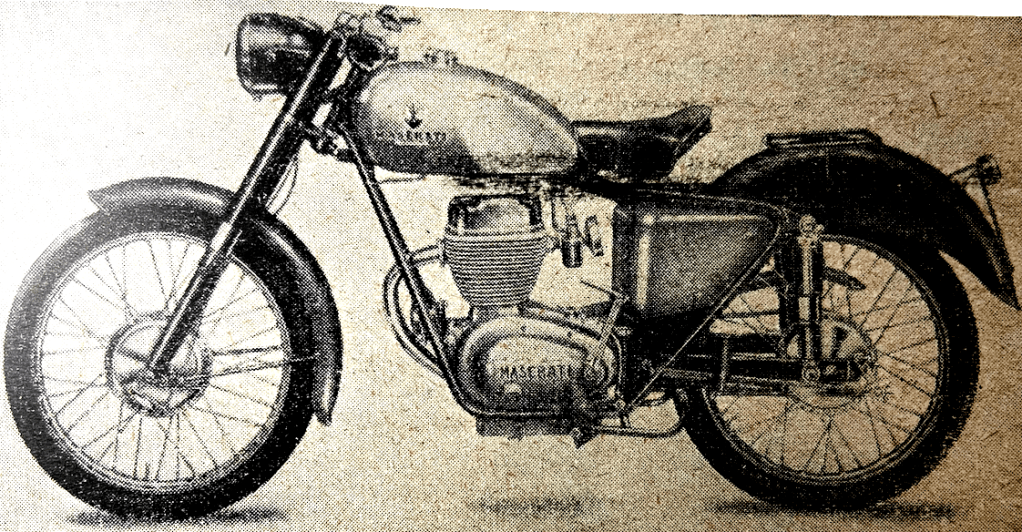
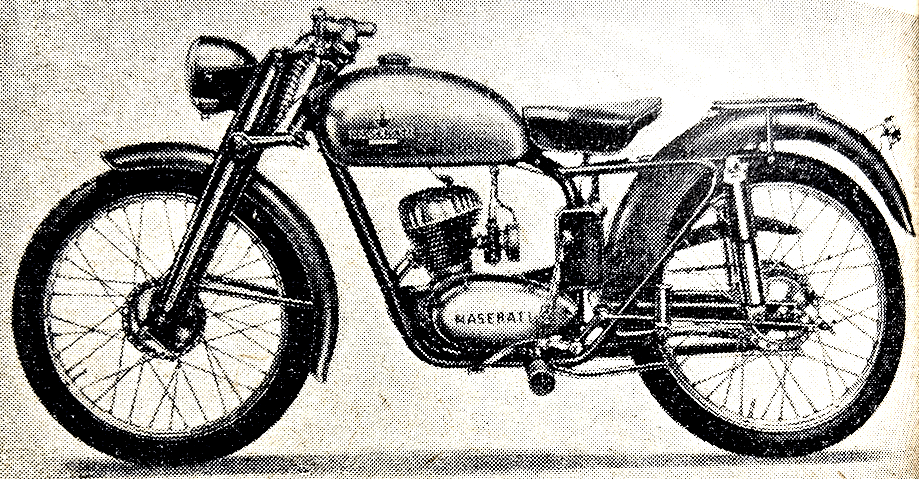
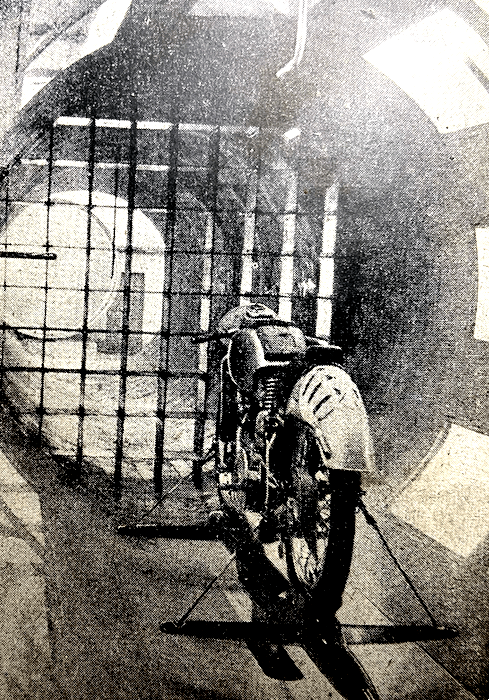
“WHEN SO EMINENT an engineer as Giuseppe Benelli propounds a thesis, one should heed it with a certain amount of respect. And the latest idea from the Benelli drawing board is a most unusual four which is, nonetheless, adaptable for motor-cycle use, although not expressly designed for it. The Benelli four is basically two 120° V-twin engines married onto a common crankshaft, and with the cylinders suitably staggered, the arrangement being such that the various couples thereby induced should cancel out. This ‘semi. radial’ engine, it is argued, would fit well into a motorcycle frame if mounted transversely and equipped with a bolted-up, car-type gearbox and final shaft drive. Its advantages are, of course, good cylinder cooling and accessibility, but I cannot help feeling that its commercial application is questionable, for its appearance is bizarre, while, for racing, the air resistance factor would probably militate against it, unless it could be mounted fore-and-aft in the frame, when it would experience the combined cooling problems of the old-type Douglas and a V-twin!”
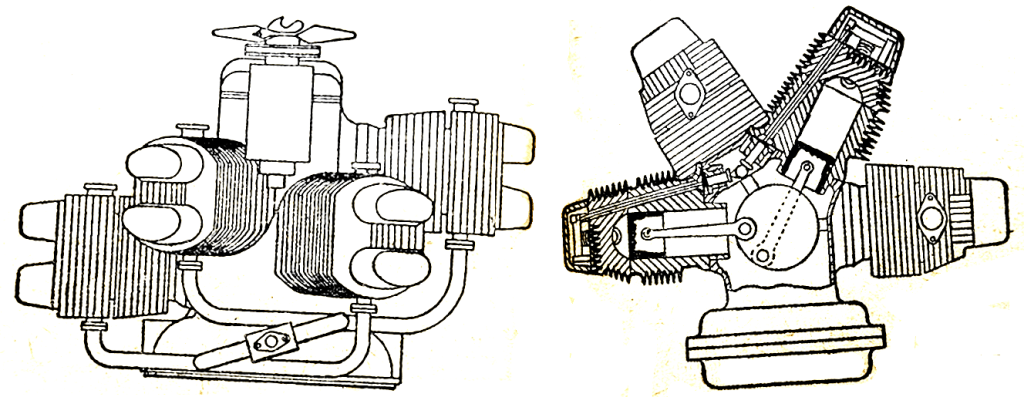
“A most unusual model has been advertised in the Italian magazines recently by the NSU agents in Italy. It does not follow the lines of any of the NSU factory’s standard turn-outs—like the Caproni Vizzola with its light-alloy beam-type frame this mysterious model is evidently an Italian-built machine powered by an NSU Lux engine-gearbox unit. Fitted with the smaller-sized wheels which appear to be gaining ground in Italy, the mystery model is of massive build, and features a pair of semi-Earles-type front forks, in which two long, separate links are controlled by one spring unit each. The tank is typically Italian in design, high and well shaped, but the general appearance of the model is heavy and Teutonic.”
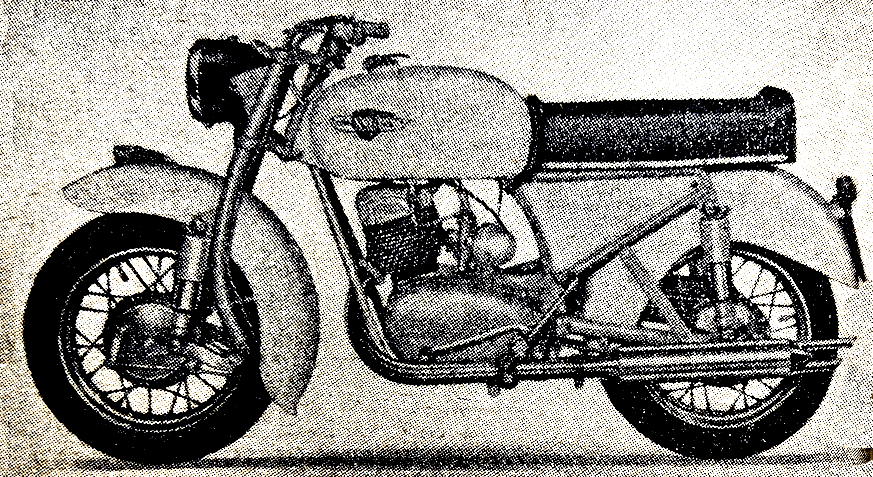
“EXTREME SIMPLICITY OF CONSTRUCTION is an outstanding feature of the new Italian 100cc ohv Baio, which was introduced at the recent Milan Fair. The gear box is situated on the left-hand side of the crankcase and the clutch on the right. On the left-hand end of the crankshaft are mounted three gear pinions which are in constant mesh with three other pinions to provide ratios of 4.78, 3.05 and 2 to 1. The driven top gear pinion is integral with a large-diameter, hollow camshaft which, carried transversely behind the crankshaft, houses a co-axial shaft supporting the other pair of gears. Thus, a double countershaft (the outer member of which is also the camshaft) forms the gear-box layshaft, and the engine crankshaft the gear-box mainshaft. Engagement of the gears is by sliding dogs, and selection is effected by means of a rocking pedal on the right-hand side of the machine. The drive by chain to the rear wheel is through a three-plate clutch on the right-hand end of the countershaft. Operation of the overhead valves is through tappets, push rods and rockers. Since the push rods are located at the rear of the cylinder, the inlet port emerges on the left of the head—a light-alloy casting with integral rocker box. The exhaust outlet is on the right. A flywheel magneto is enclosed behind a cover on the left-hand side of the engine. Lubrication of the engine is on the wet-sump principle, and included is a positive feed to the gear cluster; sump capacity is approximately four pints. The shapely fuel tank holds 2¾ gallons. A consumption of 170mpg is claimed at cruising speeds. Wheel rims are of 18in diameter and are chromium plated; tyre size is 2.75in front and rear. The spine frame is constructed of welded-up pressings which blend cleanly into the deeply valanced rear mudguard. A tool box is incorporated in the main portion of the frame, behind the engine unit. The pivoted-fork rear springing is of unusual simplicity in that there is no rearward extension of the frame to carry the upper ends of the spring units. These units are attached to the main frame pressings beneath the saddle and so have a greater forward inclination than is customary. The makers quote a maximum speed of about 47mph, which seems reasonable in view of the stated power output of 4.8bhp at 5,500rpm.”
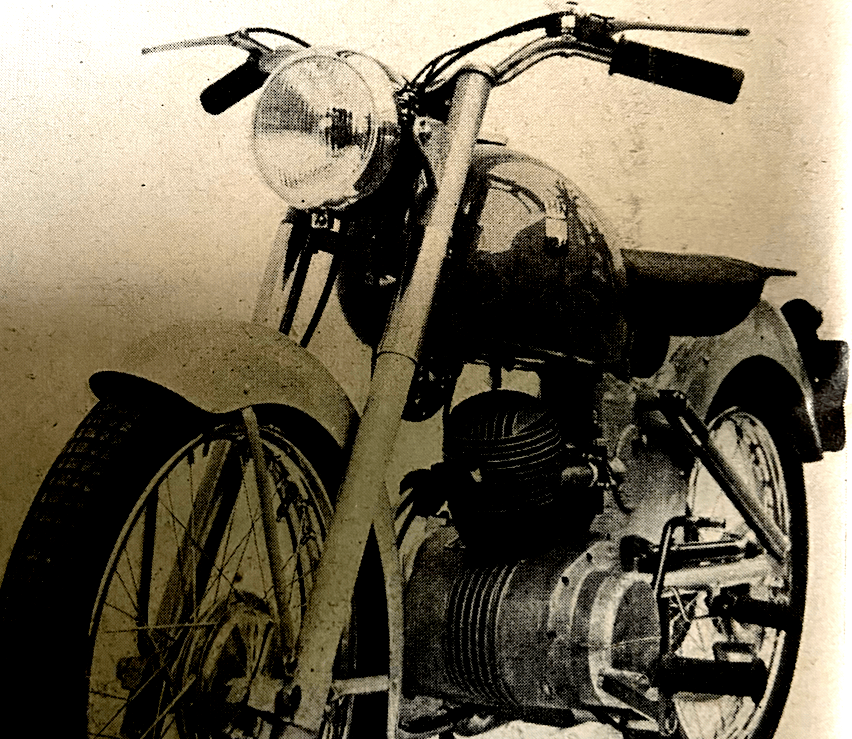
“TWO BELGIAN MAKES which are new to me are the Hulsmann and the Navy. Both are well-built lightweights on British lines, and, I am pleased to relate, are powered by 197cc Villiers engines.”
“GNOME-RHONE used, once upon a day, to be a name to conjure with—and it still survives. It was one of that band of pioneers in the aircraft sphere—Beardmore, Martinsyde and Sopwith are British equivalents (unhappily, with us no more) which spring to mind—which later turned to the manufacture of motor cycles. One of the latest jobs (a 125cc two-stroke of fairly conventional design, but sporting a massive-looking barrel and Maucourant head atop a tiny crankcase/gearbox casting) has recently been tested by the French journal Moto-cycles. It completed a flying lap of Montlhèry at a speed of nearly 56mph, while with the rider normally seated, the speed of the little two-stroke worked out to just over 52mph. Not at all bad for a ‘utility’, eh?”
“THE GERMAN MAICO concern, who have so far specialised in producing models that are—with the exception of a few bread-and-butter designs—rather out of the ordinary, have now introduced a very good-looking and quite conventional 200cc two-stroke. A feature is the well-styled rear end, with the mudguard, seat and toolbox carefully blended, while the engine, which has a rather square cylinder, boasts a very clean lower half. The tank is deeper than is usual with German designs, and bears a trace of Italian influence.”
“HOW THE ITALIANS love their four-strokes! While the utility user in this country is normally quite content with the simple two-stroke, even the ride-to-work Italian likes to hear the patter of tiny valves. Or so it would seem, for one Bergamese concern makes quite a good thing of selling kits by which the very popular Guzzi 65cc two-stroke motoleggera can be converted into a 73cc four-stroke, complete with fully enclosed valves, and a full-blown lubrication system actuated by a gear-type feed and return pump. Yet many other Italian manufacturers—making much larger machinery, too—have recently moved over towards the reintroduction of cheap, simple, wet-sump, splash-type oiling.”
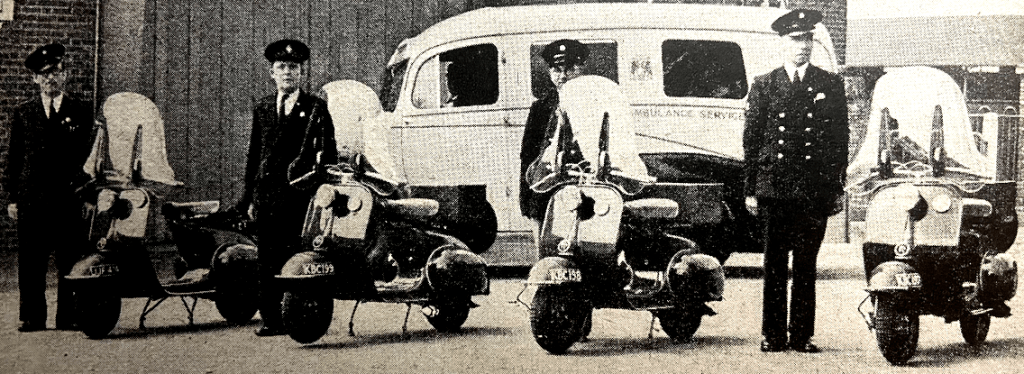
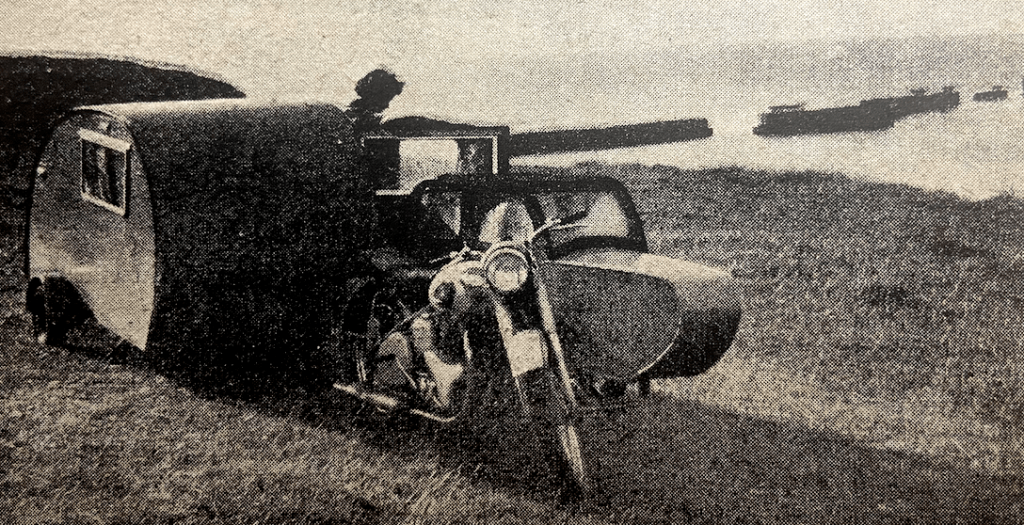
“AT A THREE-DAY CONFERENCE convened by the Australian Government in Melbourne, recently, to discuss and promote road safety, transport officials watched demonstrations by a number of motor cycle experts, among whom was Sgt Mick Fallon, ex-London policeman, driving instructor now with the South Australian police. Sg. Fallon brought with him a 649cc BSA Golden Flash, as used by police in South Australia, and, it is reported, amazed members of the conference with high-speed braking tests and an exhibition of motorcycle safety and efficiency—including giving pillion rides to officials, numbers of whom had never previously ridden on a motor cycle.”
“CLOUDLESS WEATHER FAVOURED the Sunbeam MCC’s open to SE Centre South Downs Trial last Sunday and a record entry of 155 did justice to the picturesque 74-mile course in the Petersfield area. Nearly 100 of the competitors were Army riders on standard WD machines, and they found considerably more trouble than expected in maintaining the required 18mph. average. T Andrews (500 Ariel) and SE Cunningham (350 Matchless) completed the 10 observed sections without penalty and the former was a winner by virtue of a sparkling performance in the Acceleration Test (3.6sec to Cunningham’s 4.6sec). RESULTS South Downs Cup: T Andrews (500 Ariel), no marks lost. Club Tankard: SE Cunningham (350 Matchless), no marks lost. Army Tankard: Cpl GC Norton (350 Matchless), 6. Novice Tankard: RS May (500 Triumph), 8. Club Team Prize: Sunbeam MCC (AR Slatter, DH Barrett, AE Ristow), 25. Army Team Prize: Royal Military Police (Cpl GC Norton, Sgt FW Gamwell, Capt AJ Betty), 42.
“WHAT A TURN-UP FOR THE BOOK—had there been a book—at the International Belgian Moto-Cross Grand Prix last Sunday! There was no shortage of big names, representing five lands, in the programme of the scramble, ranking for European Championship pointage, which was well organised at Namur by the Federation Motocycliste de Belge and the AMC Namur—names like the reigning champion, Victor Leloup, of Belgium, his compatriots Nic Jansen, August Mingels, Marcel Cox and A van Heuverswijn; E Bergman, the Swede, and the formidable British quartet, LR Archer, Phil Nex, Eric Cheney and Basil Hall. But this glittering galaxy of top-flight scramblers, on one of the toughest courses in Europe, the 2.21-miles Circuit de la Citadelle, was dimmed by the brilliance of a newly risen star—René Baeten, of Belgium, on his Herstal-built Sarolea. Mechanical trouble, spills or hard luck overtook each of the kingpins in turn, but the one solid fact remains, that it was Baeten who, after hanging on to the leaders for 17 of the 18 laps which formed the race, slipped through on the last tour to take the chequered flag first—which, after all, is the thing which really counts. Twenty-two seconds behind him, Jansen and his Sarolea ran into second position and, 18sec. later, Leloup (FN) rook the third berth. Of the Britons, as occurred last year, the only survivor was Basil Hall (BSA), who finished sixth.”
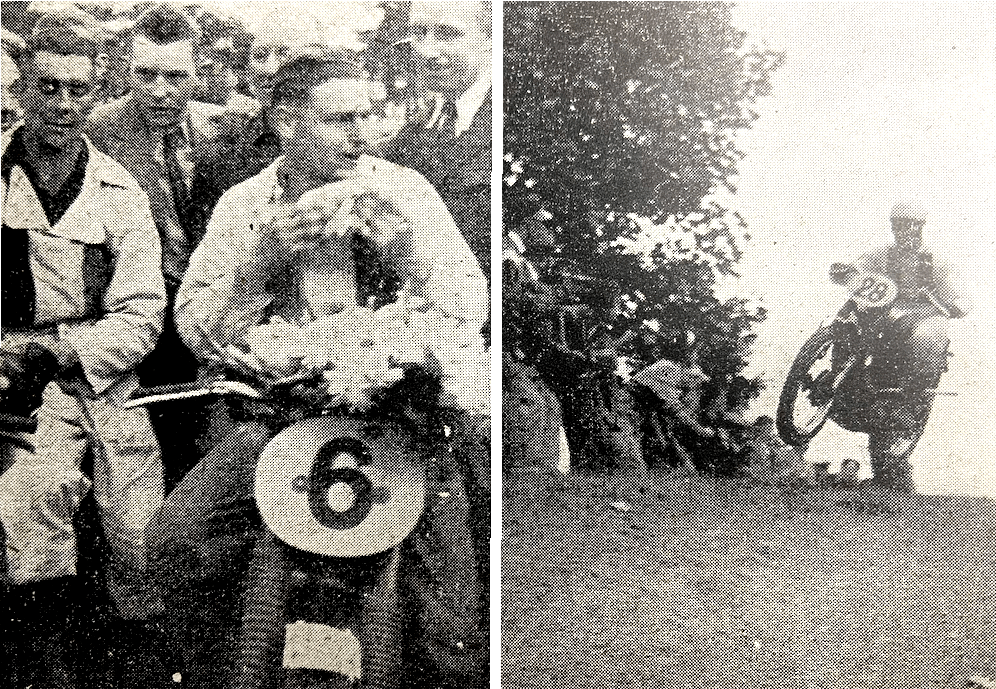
“RIDING A 350CC AJS Gordon Jackson repeated his success of last year and won the Clayton Trophy Trial, a National open organised by the Wood Green &DMC in Derbyshire last Sunday. Unlike the trial of 1952 this year’s event, the 18th in the series, was held in brilliant summer weather—the 45-mile course with its 14 sections and 31 sub-divisions (Black Bank was cut out at the last moment) was dry as the proverbial bone. There were very few non-starters at Brierlow Bar and the organisers coped with the entry of 251 by using a figure-of-eight course, sending the odd numbers out to cover the sections in one sequence, and the even numbers in another. By this means the whole of the course was in use it one time and as a result the last man had signed off before 4.15pm, only 6¼ hours after the start.”
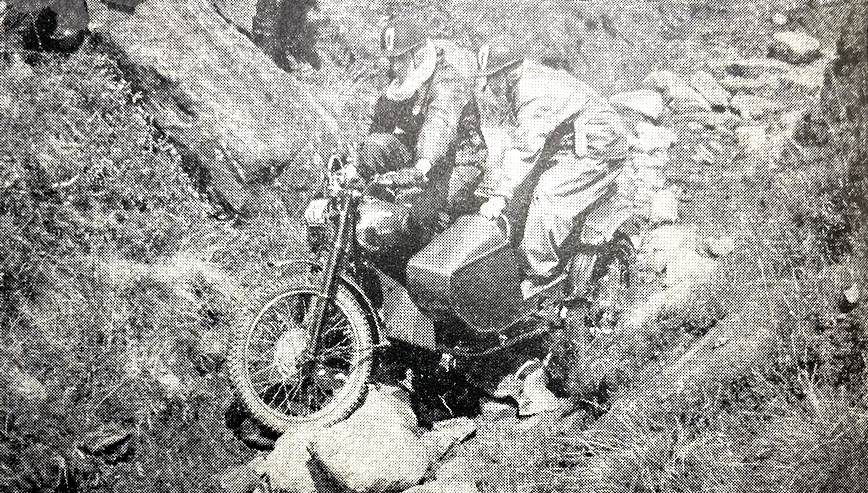
“AS VISITORS, THE SCRAMBLE team representing the South went to Cuerden Park, near Bamber Bridge, Lancashire, last Sunday, to fight the second 1953 leg of the annual North vs South scramble, for which Motor Cycling gives the Trophy. With them they took a 29-point advantage, gained during the earlier contest at Brand’s Hatch in May—and came away winners of ‘t’Coop’ by just that amount! On their own ground the Northerners had equalised the 155 points notched up by their rivals after an afternoon of keen, fast scrambling on a course which consisted, in part, of grass track where high speeds could be built up. From the viewpoint of the spectators—at Sunday’s meeting there were 15,000 plus of them—the Cuerden Park circuit is ideal, almost all of its one-mile length being visible from any position. To the rider, it is interesting, including, as well as fast stretches, many curves, up and down gradients, jumps and loose surface, and sections which under wet conditions would undoubtedly take some riding. Last week-end it was dry and although the sky was overcast and the air cool there was no rain, and, occasionally, the sun joined in the proceedings. Due to impending ISDT commitments, David Tye did not take part, his place in the Northern team being taken by D Eaves on a 500cc BSA. Also a non-starter in the équipe was J Houghton, the popular American rider, Nick Nicholson, with approved residential qualification, substituting for him on another BSA, J Cliffe (500 BSA) stood in for Brian Martin, and OJ Warburton (500 Triumph) for EG Richardson; all were in the Northern team. The organisation of the meeting was in the capable hands of the Preston &DMC, acting for the N-Western Centre, the Northern team manager being NL Culley) and
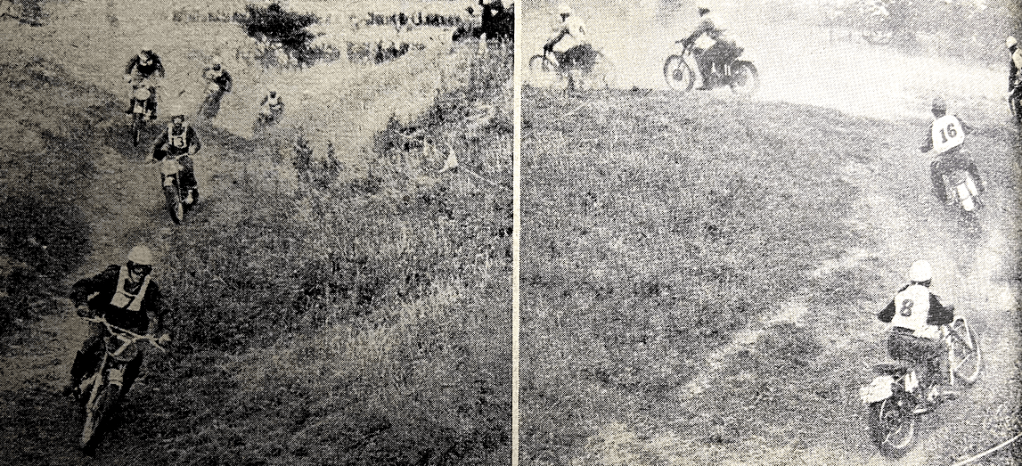
the Southern gaffer D Beckett. The captains of the respective teams were Ted Ogden and Geoff Ward. The Park, an extensive estate surrounding Cuerden Hall, offers considerable attractions, particularly to family parties anxious to enjoy exciting sport amid delightful natural surroundings. Although the meeting was not billed to commence before the afternoon, traffic into the grounds was thick from early in the morning. Just before zero hour it was like Derby Day. As a curtain raiser the Cuerden Scramble, two heats and a final, was run off, the in a popular win for S. Bickerton, the Bury clubman, on a 500cc AJS. Then came the first of the four 10-lap team races with eight men apiece competing, the home team in yellow colours and the visitors in white, the first six finishers in each team to count in the points reckoning. All 16 riders got away to a good start. Soon it was Southerner D G. Curtis (500 BSA) who grabbed the lead, hotly pursued by rival teamster NS Holmes (500 Ariel). But by half-distance Geoff Ward (500 AJS) had taken over from Curtis who then occupied second place; Holmes had fallen well back and Ogden (500 BSA) was fighting off the South’s man, Tony White (500 BSA) in a battle for third place. Curtis dropped back a notch, to third, letting White in as runner-up, and then went out with a flat rear tyre. This gave Ogden the third berth, although, as they finished the last lap he only just managed to preserve it from Gordon Jackson, S, (500 AJS). A fall, resulting in a broken clutch lever, deprived the North of Eaves, while the South lost A Harvey (500 Matchless), who shed a chain, and JF Sheehan (500 AJS), who also fell off. A fillip was given to Northern hopes when the score was found to read 40 in their favour and 37 in that of the South. The deficit was now 26. Those hopes rose even higher when the second team race was run. Right from the drop of the flag it was FH Bentham, N (500 Ariel) who led. From the South, Bob Manns (500 AJS), and Don Rickman (500 BSA) gradually crept up on the flying Northerner, and, on the seventh circuit, the latter’s position looked uncertain, for Rickman was right on
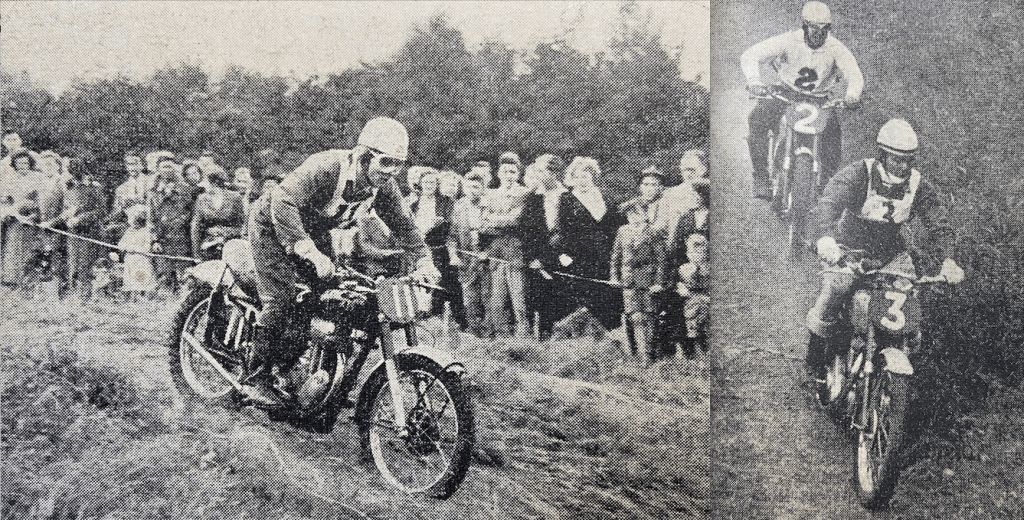
his tail. It looked even worse when Bentham missed a gear change on one of the steep climbs and for a few minutes he was not at the head of the race. But, riding superbly, he regained his leadership before the lap ended. Then, with one lap to go, Mann’s chances evaporated—his plug lead came off and he stopped! So Northerner Bentham romped home with half a dozen seconds to spare, from Rickman. Veteran Southerner Monty Banks (500 BSA) was third and Manns fourth. The tally then read: North, 42; South, 36. On total, the home side had reduced the debit to 20. points. It was Monty Banks who showed his mettle in the third team race. He led by a handsome margin at the end of the first lap and continued, lap by lap, to build up his advantage over the second man, Ogden. But on the seventh tour the Northern captain, hard pressed by Graham Beamish, S (500 BSA) put on a spurt and nearly caught Monty. In fact, at the finish a pocket handkerchief might have covered Monty, who won, Beamish, who had passed Ogden in the final lap to take second place, and the latter, who was third. Again out of luck, Manns pushed his fuel-less AJS home to finish with a split tank. At 39 all, this race left the score unaltered. After a false start the last team race began, with little doubt that the rubber would go to the visitors—miracles being out-dated. To clinch the matter, Ward set off on his own, and by the fourth lap was away out of sight in front. His rival JSH Bray (350 BSA), second, tried unavailingly to close the distance, and, in third place, Tony White (500 BSA) gave Bray no quarter. Thereafter the positions never varied, and when Ward finished, in the fastest 10-lap time of the day, 18min 40sec, he had set the seal upon the destination of the Motor Cycling Trophy for another year. With the day’s bag recorded at 155 all, the 1953 contest closed and, for the sixth time, the Cup went South. RESULTS North vs South Team Contest: 1, South with 323 points; 2, North, 294.”
“FEW MOTOR CYCLING EVENTS outside the Continent seem to have the international flavour of racing in Malaya. Motor cycle races on the Jobore Grand Prix programme on August 2, run through the heart of Johore Bahru, just across the Singapore causeway, drew entries from Chinese, Malays, Indians, Englishmen, Scots and Australians. The major events—the Junior and the Unlimited cc—were won by an Australian (Ross Isles) and an Englishman (RH Trevor). The Senior, run concurrently with the Unlimited cc, was won by a Malayan Indian, R Sivaganam. The apart draws terrific crowds of spectators and it was estimated that close to 100,000 watched from vantage points all around the two-mile circuit. In winning the Unlimited cc race on his Vincent Black Shadow, Trevor set a new lap record of 1min 50sec—67.27mph. Before the end of the 41-mile race Trevor had lapped every other rider twice, except Sivaganam who put up a masterly effort on his converted Triumph Trophy to beat two new Featherbed Nortons and a second Vincent. Trevor had been hotly pursued by James Muir (Norton) until the latter retired with engine trouble on the 12th lap. In the Junior event Isles led from the first corner, catching and lapping some of the tail-enders within three laps. Behind him, Englishmen Will Cleugh (Norton) and Dennis Tolley (AJS) were trying to break away from a bunch of six or seven, some 200 yards behind the leader. After they took second and third places on lap 6, Isles continued to increase his lead. Cleugh produced a record lap of 2min 1sec to make up some of the leeway, but Isles got a pit signal to speed up, made a 2.1 lap himself and put a mortgage on the race. The surprise of the Junior event was the speed of Arthwar Singh’s 197cc Excelsior two-stroke, which was first away from the start, led for about a ¼ mile and still clung to third place at the end of lap 1, level-Pegging with 350s on the straights. The Excelsior settled back to sixth place, lapping steadily without losing distance right to the finish. RESULTS Junior Race (20 miles): 1, R Isles (348 Norton); 2, W Cleugh (348 Norton); 3, VLS Lee (348 Triumph). Best Lightweight: A Singh (197 Excelsior). Unlimited Race: 1, RH Trevor (998 Vincent); 2, R Sivaganam (498 Triumph); 3, D Frank (499 Norton). Best Senior: R Sivaganam (498 Triumph).”
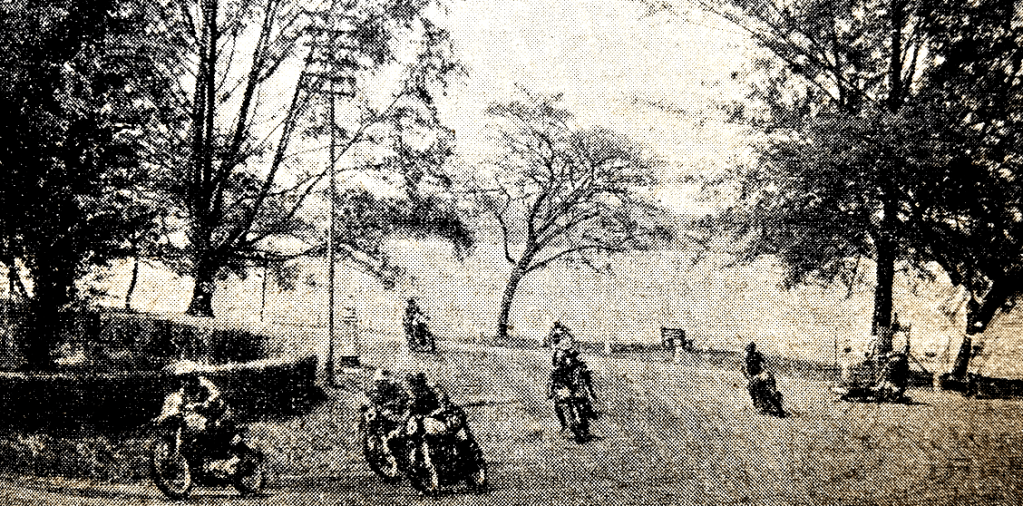
“CLAIMS ARE BEING LODGED with the ACC of Australia for standing quarter-mile records for the 500cc solo and open sidecar classes. On the Fisherman’s Bend airstrip last month Maurice Quincey clocked a mean time of 13.51sec. (66.61mph) on a 499cc Norton, while Frank Sinclair turned in an average time of 14.525sec (61.94mph) on his 998cc Vincent outfit. The shortest distance recognised inter-nationally is, of course, the kilometre.”
“ON AUGUST 22 AND 29, and on September 5 and 12, there will be half-hour English language broadcasts from Prague giving details of entries and preparations for the International Six Days Trial.”
“ALTHOUGH IT IS NOT strictly true to say that the Speed Twin Triumph was the first machine to be powered by the side-by-side vertical twin-cylinder engine which now enjoys widespread popularity, few would deny that it led the way towards the vertical-twin trend. Again, this machine is not the first on which both lighting and ignition requirements are taken care of, basically, by a stator/rotor AC generator, but it seems likely that the Speed Twin will once again give a lead likely to be followed by others in due course, for the model under review, fitted with a Lucas RMI2 AC generator, proved conclusively that this system of electrics has everything to commend it. Widely condemned in the past for a variety of reasons, notably, the dependence upon dynamo and battery, coil-ignition systems have usually been confined to small machines of medium performance and fitted largely as an economy expedient. With modern AC/DC coil-ignition equipment, however, the bogy of a flat battery and, therefore, difficult starting, is overcome. Moreover, while critics have sought from time to time to prove that the coil-ignition system is at a disadvantage at high engine speeds, a glance at the accompanying test report indicates that this opinion is unfounded. Add to these advantages the compactness factor and the reduction in the number of auxiliary drives, and it becomes obvious that the stator/rotor generator with an AC/DC rectifier, as fitted to the Speed Twin, has come to stay. Establishing a good reputation from the start, the ignition system provided a fat spark at all times. From cold, the lever controlling the air slide, mounted beneath the saddle, was used, but could almost immediately be fully opened when the engine had started. When thoroughly warm the unit settled down to an even tickover, guaranteed to continue without stalling. Carburation was well suited to the engine characteristics and the machine responded without hesitation when the twistgrip was turned from the shut to a fully open position. Another feature of the model is the rubber shock absorber incorporated in the clutch centre. This consists of a series of rubber blocks located between vanes on the clutch hub which absorb
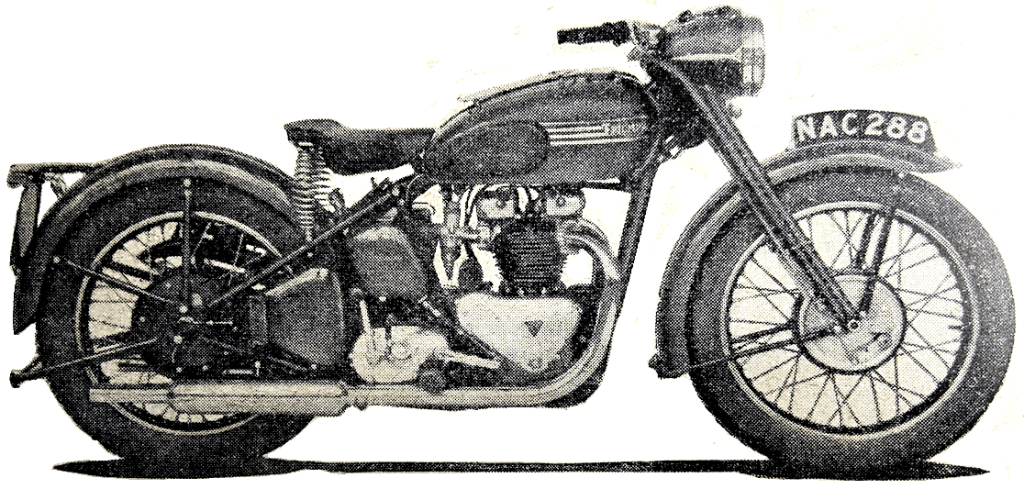
transmission shocks. No difficulty was experienced in arranging a comfortable riding position. Footrests, rear brake and gearchange pedals are all provided with a range of adjustment, and the usual Triumph-pattern handlebars can be raised or lowered as necessary. Hand controls are clipped to the bars and can be set to conform to individual requirements. A neat horn button, screwed into the handle-bar near the left grip, is inconspicuous, for the wire is taken inside the handlebar tube. It is, together with the dipswitch on the right-hand side, conveniently placed and easy to operate. That comment applied also to the remainder of the controls, either hand or foot, and the clutch in particular was noted for its light, smooth operation. Perhaps a reduction in the effort needed to operate the front brake would be a useful detail improvement. Provided that the clutch was freed before the engine was started, first gear could be engaged noiselessly. No difficulty was experienced in selecting neutral. From first to second and from second to third gears a slight pause was necessary to ensure satisfying changes, but no thought or hesitation was necessary when changing up to, or down from, top gear. Gear changes were quite positive at any speed, and could be made as fast as physically possible. Acceleration was more than adequate and the machine could quickly be whipped up to a cruising gait of 70mph. This maintained speed proved to be well within the machine’s capabilities and left a useful reserve of power. Throughout the normally used engine range there appeared to be no vibration period; there was slight vibration at wide throttle openings but it was very minor. Although possessing high performance, the machine was particularly tractable and pleasant to ride at ‘about town’ speeds. It was quite happy below 30mph in top gear. Transmission snatch was never experienced. Within the limits of the available movement, the spring-wheel absorbed road shock and was at its best on fast main roads. At high speeds on second- or third-rate surfaces a little pitching was experienced, but this, although requiring that the footrests be used to take some of the rider’s weight, did not affect the handling or steering. Really bad
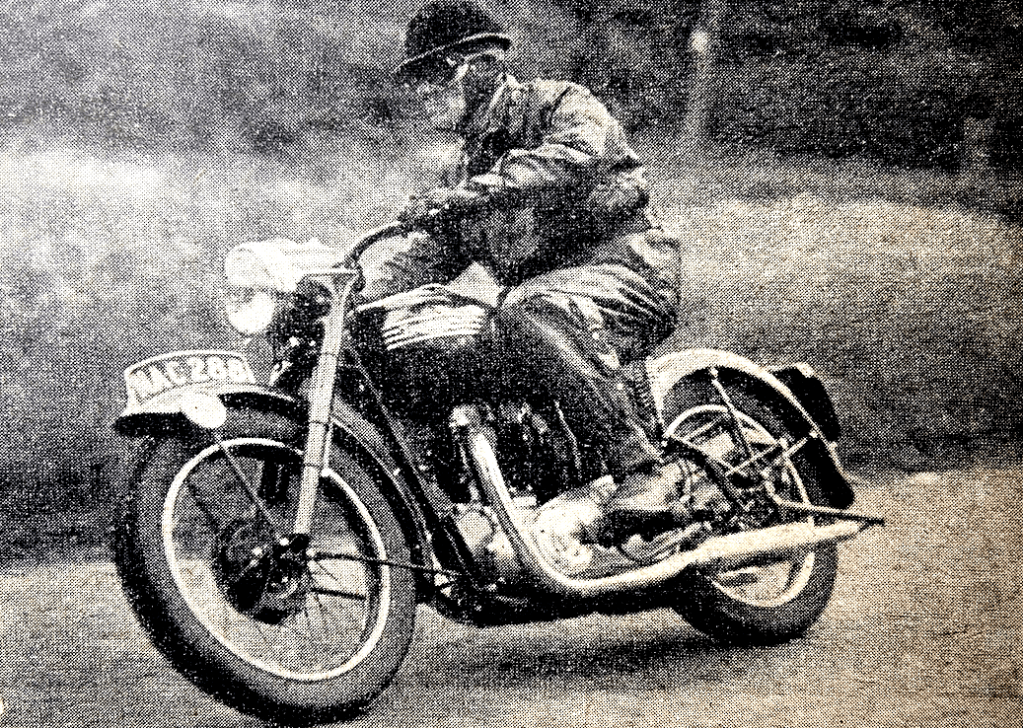
roads could be traversed at fairly high speeds, for the front wheel, controlled by the hydraulically damped front forks, remained on line at all times. On wet or dry roads the two brakes worked admirably. An earlier note concerning the effort needed to operate the front brake implies no criticism of its function as a stopper. In spite of a considerable mileage in the Welsh mountains, no brake-fade was experienced, no uncertainty arose, and no adjustment was necessary. The large-diameter rear brake required only light pressures, and the arrangement of the linkage gave smooth, progressive retardation. Generally, the machine is adequately silent. Engine noise has been held to a low level and the transmission is inaudible when working. Without employing excessive care with throttle openings, the exhaust note was subdued at speeds below the legal town limit and rose to a pleasant burble when cruising. Varying road conditions make reference to night cruising difficult. Generally, however, the main beam of the sealed unit in the nacelle provided enough light for a maintained speed in excess of 60mph on good main roads. In the dipped position, the beam caused no apparent annoyance. A recent amendment to the lighting equipment is the current use of a combined stop-and-tail” lamp, control for the stop lamp being exercised by a switch operated when the footbrake is used. Voltage-drop in the rectification process was negligible and the generator kept the battery well up to scratch. Mudguarding is neatly done and efficient in use, although the inevitable spray from the contact point between tyre and road has not been completely checked. A prop-stand on the near side of the machine now has a useful extension ensuring easy operation. A high standard of cleanliness was noted at the termination of the test and both engine and gearbox were oiltight. Normal maintenance tasks can be carried out with reasonable facility, although some owners may not possess the manual dexterity of the works personnel necessary when replacing the lower distributor clip. Generally, the latest Speed Twin has been enhanced in appearance by the change from dynamo to generator and in traditional amaranth red, would be a proud possession for any motor cyclist.”
“‘NYLONS, M’SIEUR?’ Waterproofed nylon is the material now used by a certain French maker of motor cycling clothing. Paris journalist Pierre Côte who, with his charming English wife, was at Brands Hatch reporting and picturing the recent Moto-Cross meeting, has a snappy two-piece riding suit in this material which can be rolled up into a simply incredibly small compass and slipped into a pocket. Nylon, of course, is possessed of amazing strength and M Côte says it is completely waterproof. How long, I wonder, before M Dior invades the motor cycle fashions market?”
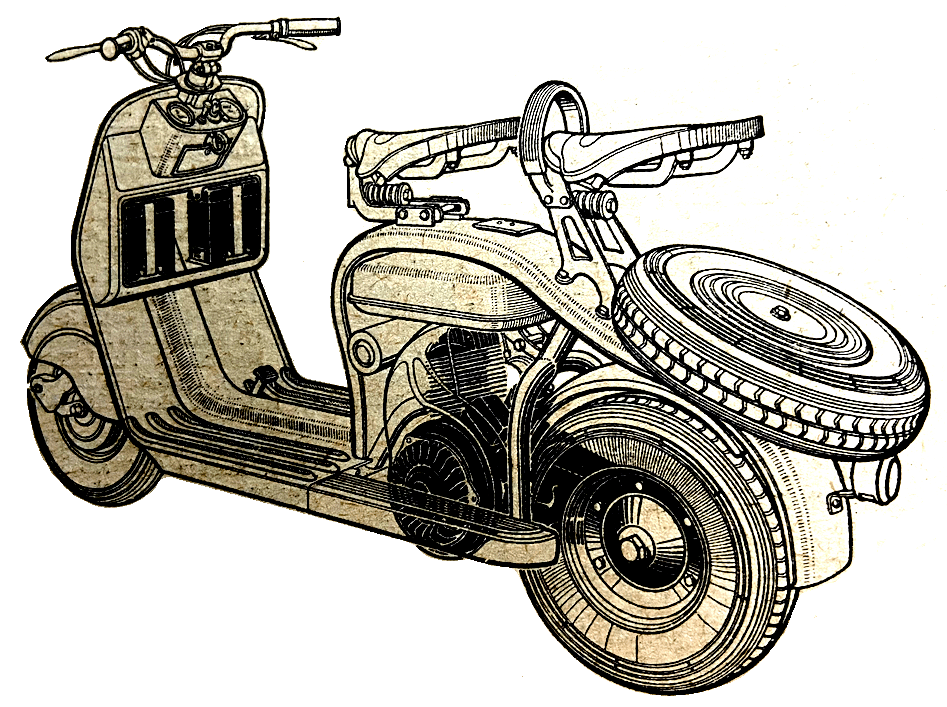
“THIS IS THE JUBILEE year of the German Triumph organisation, and they have duly celebrated it by announcing one of the smartest lightweights it has been my pleasure to see for many a long year. Named the Cornet, it has a 200cc twin-piston two-stroke engine mounted in a frame which boasts a considerable number of smoothly-contoured steel pressings. Swinging-fork rear suspension is used, in combination with an efficient-looking oil-bath chaincase for its final drive. This model, together with their bigger ‘Boss'” 350cc model, will form the mainstay of Triumph production, and if it is as good as it looks they may have a commercial winner.”
“A COMPLETELY NEW bicycle, especially designed to accommodate the Vincent Firefly cyclemotor power unit, is the latest product of the Sun Cycle and Fittings Co, Birmingham, 6. Special features of the machine are an 18-gauge frame, a wider-than-usual bottom bracket and special bracket axle giving adequate clearance between the pedal cranks and the crankcase of the Firefly engine. Forged-steel rear fork-ends are used so that the rear wheel can easily be withdrawn for maintenance or repair.”
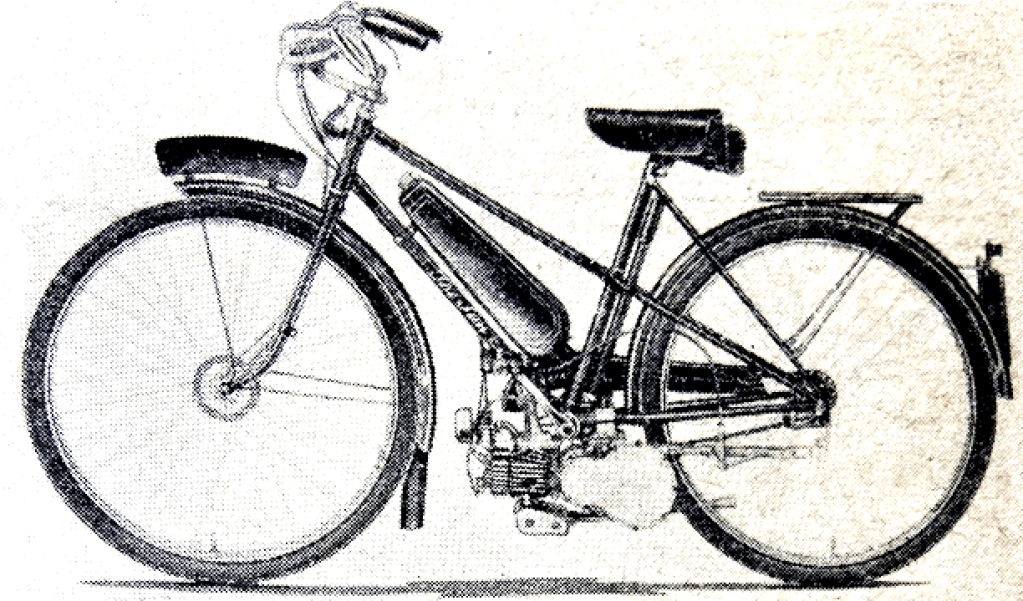
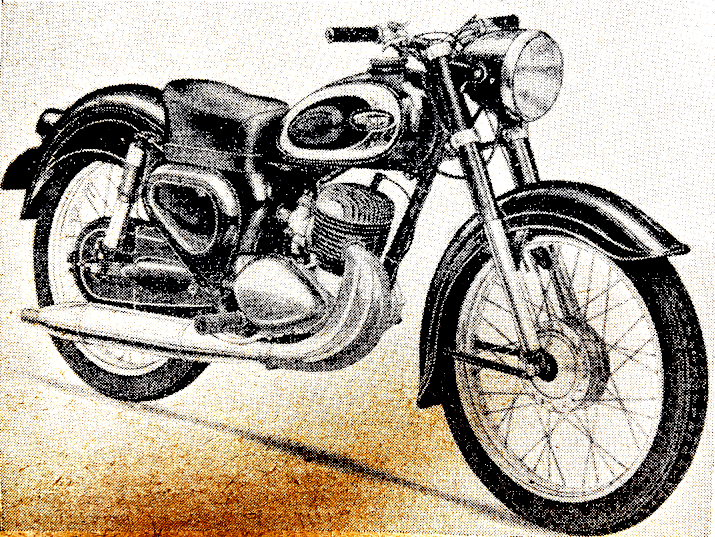
“AMID MAGNIFICENT SCHWARZWALD scenery and in wonderful weather a crowd of at least 150,000 watched the 1953 Freiburg Hillclimb, organised by the German ADAC, and saw records broken in every class except that for 500cc solos. In most respects it was a veterans’ day, for the best performances were largely drawn from the ranks of the pre-war stars. S Wünsche, for example, on a three-cylinder DKW, led the 350cc class and set up a new record of 7min 59.16sec, bettering the figures established in 1936 by H Fleischman (NSU) by 22.54sec. Wünsche’s speed of 55.95mph was the fastest of the day and better than anything that the car drivers could manage. B Petruschke had an Eastern Zone Ifa of remarkable power and came out top of the 125cc class, breaking the record set up in 1951 by HP Müller (DKW) by 1.40sec. In the 250cc category Wünsche clocked 8min 9.59sec (54.77mph) on his first run but retired on the second run with ignition. trouble, so Karl Hoffmann (DKW) gained the class award. HP Müller (Horex twin) made the best show in the 500cc class and Hans Haldeman (Norton) profited by his Swiss Alpine experience to come out best among the 500cc sidecars, with Eric Oliver (Norton) second and F Hillebrandt (BMW) third. Haldemann broke the record set up in 1937 by K Braun (DKW). The course measures 12 kilometres (8 miles) and climbs through the tortuous Schauinsland Pass road to a height of 3,500ft. Each competitor had two runs and the average times and speeds are given in the following results: RESULTS 125cc: 1, B. Petruschke (Ifa), 9min 21.39sec, 47.87mph; 2, H Luttenberge (MV); 3, Z Heiss (MV). 250cc: 1, K Hoffmann (DKW), 8min 25.06sec, 53.15mph; 2, TL Wood (Guzzi); 3, E Riedelbauch (NSU); Record run, S. Wünsche (DKW), 8min 9.59sec. 350cc: 1, S Wünsche (DKW), 8min 4.42sec, 55.33mph; 2, H Baltisberger (AJS); 3, J Albisser (Norton); record run and fastest time of day, S Wünsche, 7min 59.16sec, 55.95mph). 500cc: 1, HP Müller (Horex), 8min 2.88sec, 55.52mph; 2, WA McAlpine (Norton); 3, TL Wood (Norton). Sidecar: 1, H Haldemann (500 Norton sc), 8min 51sec, 50.48mph; 2, E Oliver (500 Norton sc); 3, F Hillebrandt (500 BMW); record rue, H Haldemann, 8min 50.46sec, 50.54mph. “
“THE FOLLOWING IS an extract from a letter which I have today written to my MP: ‘According to a report in my newspaper, the Minister of Transport is “seriously considering” the introduction of legislation to make the wearing of crash helmets compulsory on all occasions. I wish to point out most urgently that such a measure, if adopted, would be a wholly unwarranted incursion into the personal liberty and freedom of choice of the individual upon his lawful occasions, and I therefore earnestly beg you to resist the suggested measure by all means and at every opportunity.’ I became genuinely alarmed and despondent at the thought that, after 26 years of riding without serious incident, I may soon be deprived of the simple, innocent pleasure—after a hard day’s work indoors—of allowing the invigorating breeze to blow through my thinning hair. I feel that I have an absolute right to do this whenever I choose, and shall continue to feel that I have this right, whatever enactments may ensue. It should be stated that I am in full sympathy with the voluntary use of these helmets, especially in such cases where their use may be an aid to the peace of mind of families and dependants, but this suggestion of compulsion in personal wear for everyday affairs is surely quite foreign to our democratic society, and sounds ominous for the future. I most earnestly urge everyone with similar views to write to his MP now, as in the event of such a measure reaching the Statute Book we should never again be allowed to ride bareheaded.
HSD BOOM, London, SW15.”
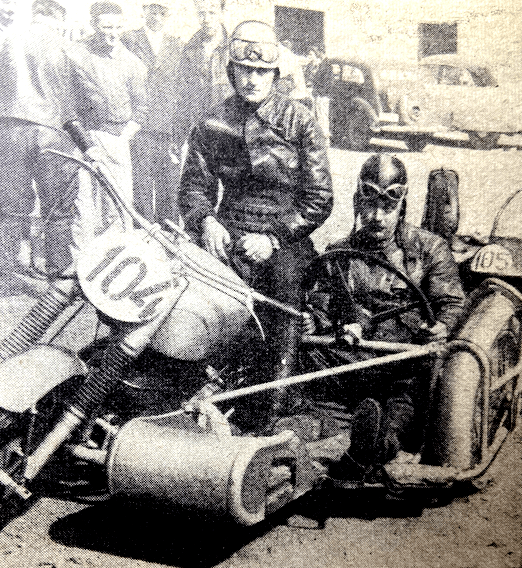
“WHAT REALLY AMAZES me in ‘Editor’s Correspondence’ is the way some writers belittle racing motor cycles made in England, stating how wonderful foreign racing machines are, so far advanced, etc. This is all very well so far as factory racing models are concerned, but what about the product sold to riders such as me? My ideal is a BSA 350 Gold Star—first-class for ‘enduros’ and trials, and fast enough around the roads in NY State. In all fairness, the selection of British products offered to all types of riders excels anything that other motor cycling countries can offer, especially here in the United States. The parts situation, that was rough before the war, is now first-class, and no model needs to be laid up for lack of the necessary bits. Road-racing wins no doubt help sales—but the factories which have been doing the winning lately in Europe do not produce production models that can compare in price and performance with the models produced in Britain for the general rider—especially the sporting rider. Here in the United States motor cycling is mostly for the sporting riders, as the auto is the main means of transportation. Thanks again to Britain for first-class motor cycles and to Motor Cycling for first-class reading.
RICHARD MAUGHAN, New York, 63, USA.”
“I NOTICE THE NUMBER of readers who complain of the time to effect the simplest repairs to motor cycles. This year I toured Spain and, on arriving in Barcelona after passing through the La Tosa Pass, I found my rear wheel had five broken spokes. The next morning I took it to a motor cycle dealer. At 1.30pm the same day new spokes, which had to be cut to size, had been fitted. The bill was 9s 6d. Need more be said?
BG KENT, London, N5.”
“IT WOULD SEEM that Mr HR Gilbert is wrong when he says that the single-cylinder machine is as good, and even better than, the multi-cylinder machines. Was not the Dutch TT won by the Gilera four of Geoff Duke? The following week the Belgian Grand Prix was won by Milani, also on a Gilera. And now, even as I write, I read that there has been a 1-2-3 Gilera victory in the French GP. Last year, too, the Gilera of Masetti was just in front of the Norton, even with Duke on the British model. It was repeated several times. The same order. Masetti, then Duke. This year, in the 350cc class, too, I feel that Nortons must look to their laurels, with such opposition from the Guzzis, MVs and DKWs. Do you recall that Anderson on a Guzzi single won the 350cc class in the French GP, the Belgian GP and came third in the Junior TT? Did not Lorenzetti, also Guzzi-mounted, win the 350cc Dutch TT and follow Anderson in most of the other events? Yes, although these Guzzis are not multi-cylinder machines, they seem to have the Nortons under their thumb. Why doesn’t a British manufacturer make a multi-cylinder effort in order to combat the Italians? Let’s see a new British-made four competing in Continental racing. If the manufacturer does not wish to copy the type of engine pattern (which seems very effective) used by the Italians, try a square configuration such as the Arid Square Four. For, at the moment, the Italians are making much faster models, and British manufacturers are quickly becoming stick in the muds.
MULTI-SUPPORTER, Wappenham, Nr Towcester, Northants.”
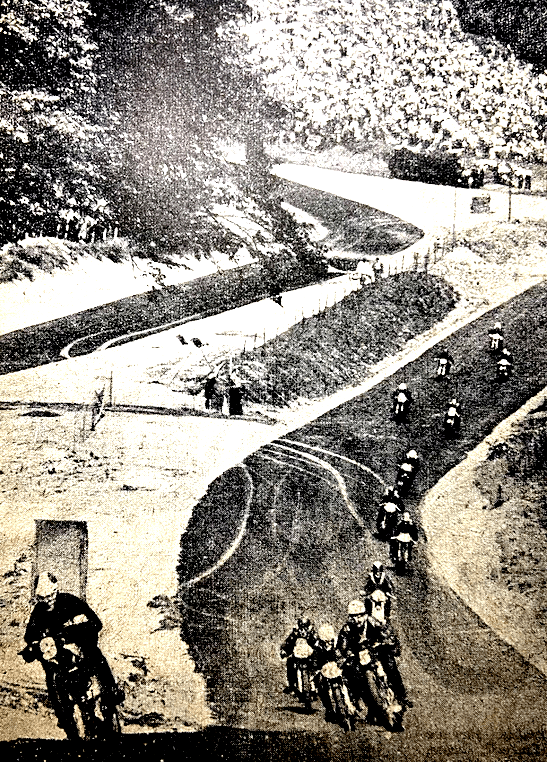
“AT HANOVER, IN THE British Zone of Germany, it is reported the police are to be equipped experimentally with sound-measuring phonometers and a list of noise limits in which motor cycles are scheduled at 80. Recordings in excess of that figure will be followed by a summons.”
“A FELLOWSHIP of £500 a year for three years has been granted by Dunlop Rubber Co at Birmingham University for research work on biosynthesis with special reference to rubber.”
“CLADY WAS THE HOME of the Ulster Grand Prix when the race was a local handicap; and it was still its home when the Ulster MCC’s meeting became one of the select group of international meetings of ‘classic’ status which count towards the World Motor Cycle Road Racing Championships. But in recent years there, have been criticisms of the short practising periods which were all that the limited road closing facilities would allow and also—in the case or some Continental visitors—of the bumps along Clady’s famous seven-mile straight. So the Ulster club wisely moved to the nearby Dundrod circuit, where a special dispensation permits the roads to be closed for longer periods, and where the contours of the course could not possibly be criticised. And the opportunity was taken to introduce a sidecar race into the meeting. Evidence that these changes were popular was given by the size and enthusiasm of the crowds which lined the 7½-mile circuit last Thursday and Saturday and by the five keenly-contested races which they witnessed at the 25th Ulster Grand Prix meeting—sixth of the nine ‘Classics’ counting towards the 1953 World Championship series…even the diehards who fought so hard to keep the ‘Prix’ on the Clady circuit are admitting that the move to nearby Dundrod—the 7-mile 732yd course which has been developed by the Antrim County Council especially for motor racing—has not been altogether unsuccessful; while all the riders here are speaking in favour of the new circuit. In the three
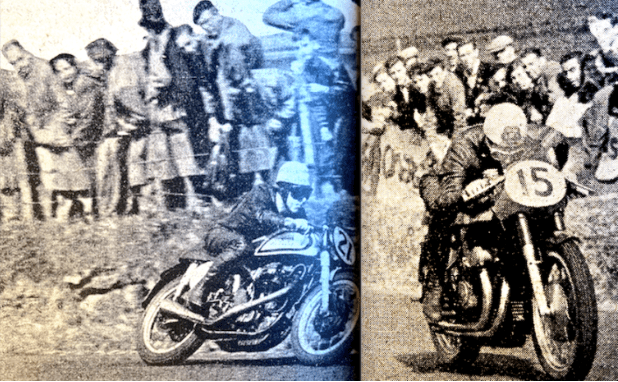
evening practice periods, all conducted in perfect weather, we have had Geoff Duke setting the pace, on his Italian Gilera, with a 4min 56sec lap on the Tuesday (12sec outside Farina’s 1951 car record), and then Jack Brett (Norton) replying, on the final evening, with a 4min 54sec (90.81mph) circuit. Fergus Anderson and Enrico Lorenzetti, the Moto-Guzzi teamsters, were faced with a problem, by the running concurrently of the 250 and 350cc classes, and have both concentrated on the smaller models, leaving Alano Montanari and Bruno .Francisci to handle the 350cc machines…” The 125cc Race (10 laps, 75 miles): Among the nine starters were trios of factory riders from NSU and MV. Copeta led for the first two laps until his MV engine blew up. Werner Haas took the lead aboard an NSU, making the fastest lap in 5min 51sec (76.06mph) and finishing first at an average 74.87mph ahead of CC Sandford (MV), HR Armstrong (NSU), O Daiker (NSU), T Forconi and F Purslow (both on MVs). The 350cc Race (28 laps, 210 miles): The MV fours didn’t show up leaving nearly 40 contenders, with the smart money on Norton (Brett, Kavanagh and Kiwi Ken Mudford), AJS ( Rod Coleman and Derek Farrant) or Guzzi (Alano Montanari and Bruno Francisci) although Scottish privateer Bob McIntyre’s practice times earned him a place on the front row of the grid aboard his Ajay. By quarter distance Kavanagh, Brett and Mudford are leading the pack but Brett drops out, followed some laps later by Kavanagh, who had built up a minute’s lead. Mudford is still up front at the three-quarter stage, ahead of McIntyre. On lap 24 Farrant’s AJS gives up the ghost but privateer McIntyre and Coleman give AJS 2nd and 3rd spots, behind Mudford’s Norton—his race average was 84.01mph.
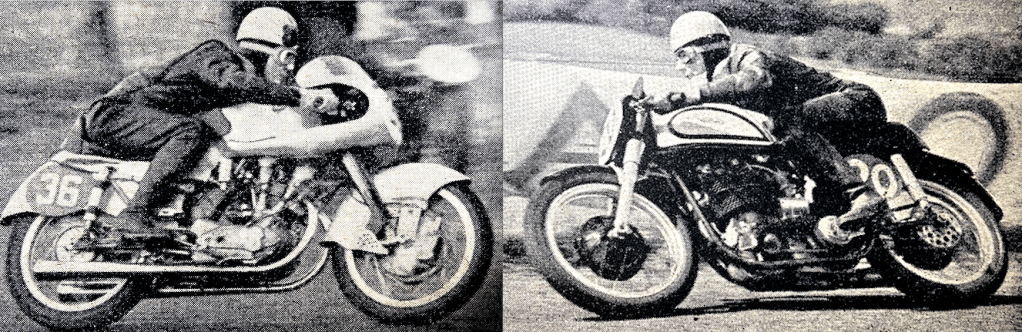
A Velo, ridden by A Pearce, was 4th, ahead of two more AJS ridden by M Templeton and K Hardwood. The 250cc Race (25 laps, 185.5 miles): The 250s started a minute behind the 350s; the 25 starters included some fine-tuned pre-war Excelsiors and a sprinkling of specials but they were clearly outpaced by the works Guzzis ridden by Fergus Anderson and Enrico Lorenzetti and the trip of NSU twins ridden by HR Armstrong, O Daiker and W Haas. The NSUs stormed away from the line but Bob Geeson, whose home-brewed REG was the only other twin in the race, went with them. Maurice Cann had won no less than five 250cc races on the Clady circuit but his luck wasn’t in this time—on the second lap he parted company with his Guzzi, sustaining breaks to a finger and a tow. By lap five Armstrong has lapped half the field to hold 1st place ahead of his NSU team-mate Haas. Anderson was 3rd, although his Guzzi was losing 10sec a lap to the fastest of the NSUs. Geeson, while lying 7th, dropped out on lap 10 with a snapped conrod and that was it for the rest of the race. Armstrong and Haas held their 1st and 2nd places at the line, followed by the Guzzis of Anderson and Lorenzetti, with the Daiker’s Guzzi 5th, chased home by AE Wheeler on another Guzzi. The Germans and Italians had dominated the race; 7th and 8th bikes home were W Fergusons’s Excelsior and F Purslow’s Velocette. NSU, inevitably, won the Manufacturer’s Team Award; the Club Team Award went to the Dublin &DMCC (W Campbell, C Gray and A Lyons). The Sidecar Race (10 laps, 75 miles): There was no continental challenge this time as the seven starters comprised six Nortons and a Beeza, and six of the seven sidecars were Watsonians. Eric Oliver and Cyril Smith rode works Nortons and on the opening lap they were running 1st and 3rd with Frenchman Jack Drion between them (the crowd were loudly cheering Drion and his blonde passenger Inge Stolls). And the first four combos to finish were all Nortons, with Fron Purslow’s BSA in 5th place). First past the post was Smith but Oliver, having made the fastest lap at
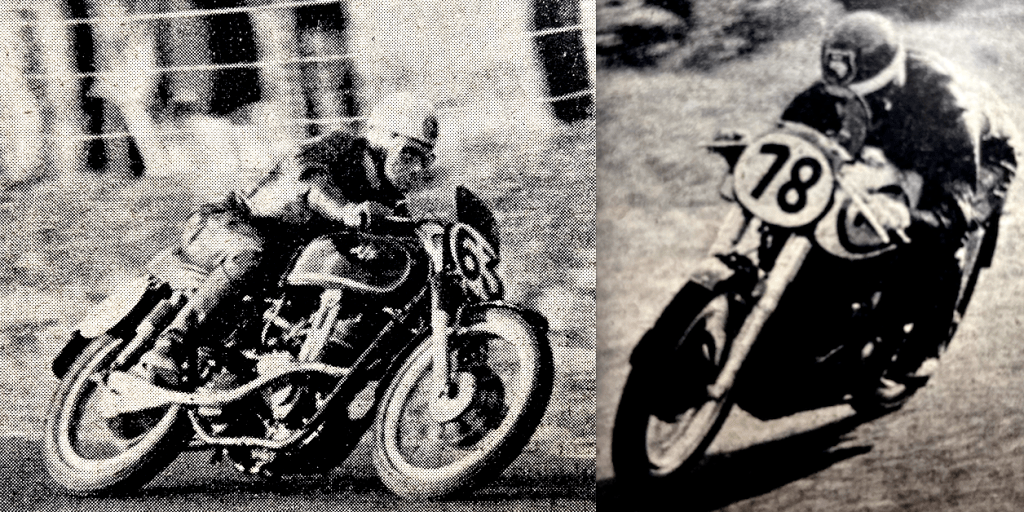
79.17mph, was out of the running with a seized engine on the last lap, so Harris was runner up with Drion 3rd and TW Bounds 4th. Ernie Walker would have placed 4th but a mudguard cut through his Norton’s rear tyre so only 5 outfits finished. The 500cc Race (30 laps, 223 miles): The Green ‘Un reported: “The local temperance bans entertains us briefly, then the music of its brass instruments is superseded by the deeper blare of nearly two-score singles, twins and fours warming up for the last, and most important, event of the meeting…And now here we are, with the riders in the 500cc solo class on the grid, and only two minutes to go to the start of what promises to be one of the toughest, 30-lap, 200-and-more-mile, classic road races that there ever has been. As delighted as many of us would be to see the game AJS camp bring off a win today—or even to see a private owner of a G45 Matchless or Manx Norton collect the crock of gold—it does seem that, with the non-arrival of the MVs and the failure to start of the Guzzis, this is going to be a straightforward battle between Brett, Kavanagh and Mudford on the works Nortons and the Gilera trio—Armstrong, Geoff Duke and Alfredo Milani. The local favourite is Armstrong, but it would be foolish to discount Brett or Duke. Or Kavanagh, of course—for Ken will be trying doubly hard to break the run of bad luck which put him out of Thursday’s race and has just had him waiting anxiously by his pit while last-moment repairs were made to his clutch. On the
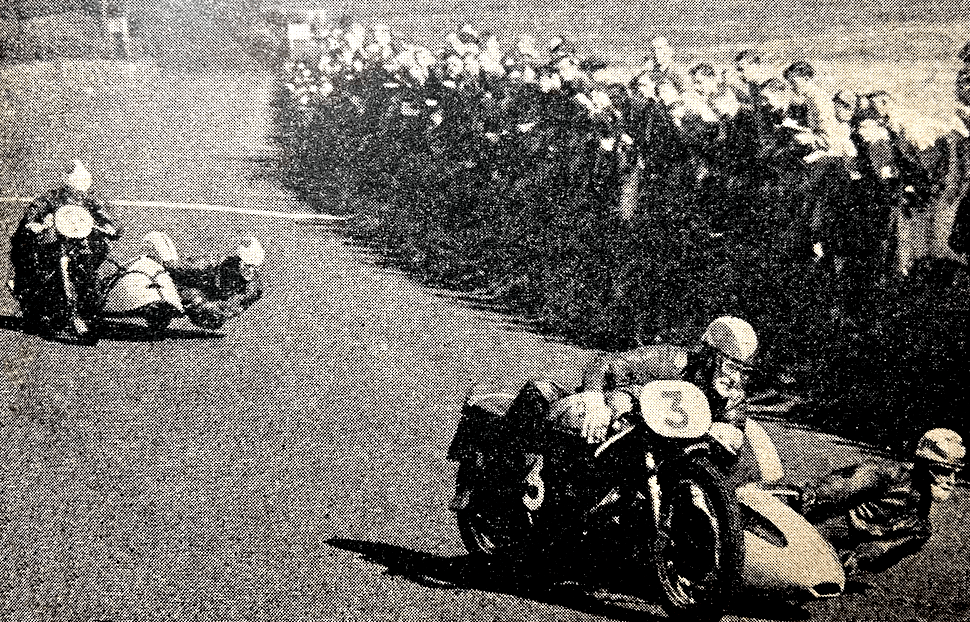
massed start, Duke breaks away from the field. Brett is also well in the van, as are Codleman, Kavanagh, Farrant and Armstrong. But poor Milani’s Gilera will only fire on one pot. He has to get off to have a second push, and is last away. Duke leads all round the first circuit, although Brett and Kavanagh are reported hard on his tail at the Hairpin. The order as they pass the pits is Duke, Kavanagh, Brett, Farrant, Bob McIntyre on his Matchless, Mudford, Coleman, Armstrong, Louis Carter (Norton), Arthur Wheeler (Matchless), TH Turner (Norton), R Knox (Norton), LA Dear (Norton), M Templeton (Matchless), K Harwood (348 AJS) and Milani—then the rest. Duke is still well ahead a lap later; and Kavanagh and Brett are stringing away from a trio which is composed of Farrant, McIntyre and Coleman. Milani has already worked up to 10th place. Duke has a quarter-mile lead over Kavanagh, after putting in a 4min 52sec (91.43mph) lap. Rod Coleman’s chances are reduced when he has a four minute halt at his pit to adjust a slipping clutch. By the end of the fifth lap—only one-sixth of the way through the race—Milani is up in eighth place; the order being Duke, Kavanagh, Brett, Farrant, Armstrong, McIntyre, Milani and Carter. At the end of lap 8 McIntyre coasts in and changes both plugs, but that doesn’t help and he is forced to retire. Lap 10—third distance—concludes with Geoff holding a steady 4min 53sec for lap after lap. He has lapped everyone up to Carter—some of them twice already!—and is averaging about 90.5mph, the only man
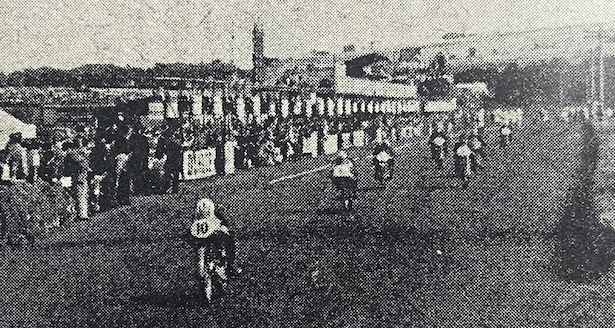
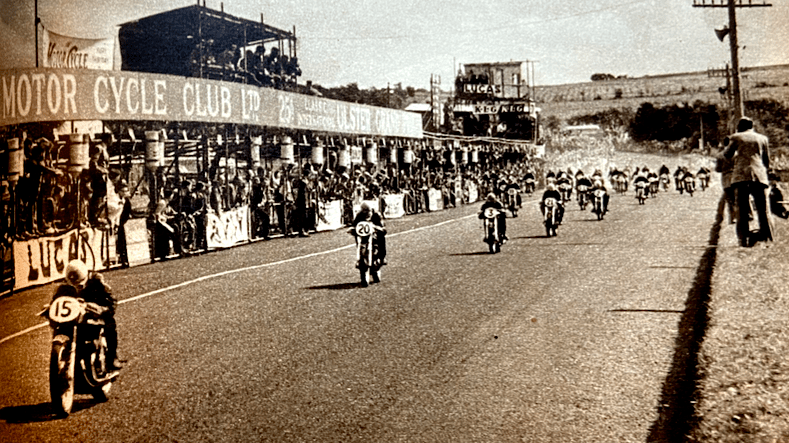
consistently maintaining a speed of over 90mph. Zacky Dean, from Ceylon, who is bringing up the rear of the field is the first to refuel, at the end of his eighth circuit, and there has been one change in the leading positions, with Farrant going into fourth place, following an excursion up the Ireland’s Corner slip-road by Reg Armstrong. Now Kavanagh is pulling out all the stops, and equals Duke’s best lap.on his 11th, and again on his 12th, circuits. But Geoff replies with a 4min 51sec. (91.74mph) on his 13th, at which stage in the race Gilera team-mate Armstrong again becomes 4th ahead of Farrant. An excellent performance is being put up by Charlie’ Salt, who is lying 9th and second privateer on an ohv BSA single. Kavanagh equals Duke’s 4min 51sec time on his next lap. Half-distance so soon! And Kavanagh has chosen this stage to refuel—in under 20sec including changing goggles—and rejoins the race just behind team-mate Brett. Farrant also tanks up on this lap and so does Mudford, who was passed at the Hairpin by Milani. A shower of rain was reported over on the far side of the circuit and now it has spread to the starting area, just as Brett pulls in at the end of Lap 16 to refuel. Temporarily, with none of the Gileras yet refuelled, the order is Duke, Kavanagh, Brett, then Armstrong, Milani, Farrant and Mudford. The shower, heavy while it lasted, ends by the time the 18th lap is over—over for the leader, at least—and still none of the ‘Gillies’ has halted. The sun comes out as Duke pulls into his pit at the end of Lap 19. Geoff fills up, heaves back against compression, shoves forward and…and the clutch won’t free…tries again…and here’s Kavanagh, bearing down the road. And going into the lead, as Duke makes a clutchless, second-gear restart—lucky that it is a four he’s pushing, and not a big single. The Aussie is leading the race by 10sec, according to the local announcer at Cochranstown. And Jack Brett is now no more than that behind Duke. What a race it is going to be from now on. What a race! At two-thirds distance, Kavanagh is increasing his lead, Duke is second, Brett third. Armstrong, despite
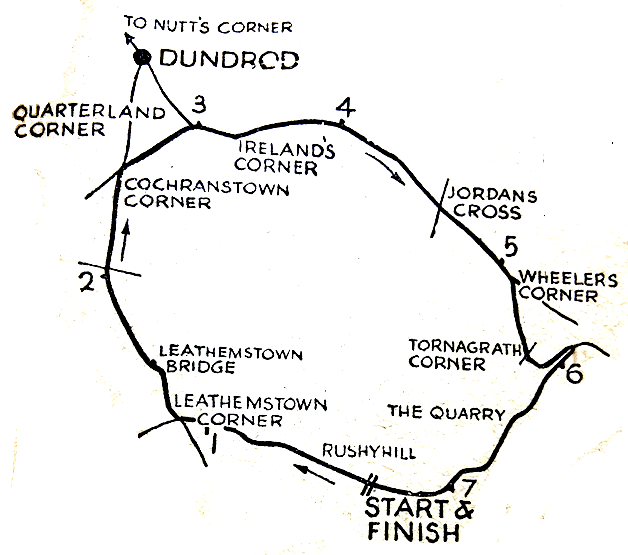
overshooting his pit when he refilled, is still fourth, while Milani, who has still to take on petrol, has Farrant after him for fifth place. Mudford bangs along unmolested in sixth position; Coleman—a lap adrift—is 7th, with Carter and Salt coming next, followed by Dear, Pearce and Harwood on his 350. On lap 23 Farrant passes Milani, shortly before the latter slows for his refuelling stop. Kavanagh is steadily increasing his lead over Duke and gives a reassuring wave to his pit as he commences the 25th lap. With four laps to go Kavanagh has more than half a minute in hand over Duke, yet he is lapping at only around 4min 56sec. Even Duke cannot overcome the handicap of a non-withdrawable clutch on a testing circuit like Dundrod. Here is Milani, now, who has just been lapped by Geoff, retiring at his pit, when there are only three more laps to be completed. Kavanagh cracks into the last seven miles, knowing that he has almost a full minute in hand over Geoff Duke. And when the small, crouched figure in the blue helmet appears coming in to finish, the whole packed grandstand rises to cheer. He was a good loser on Thursday and he is a popular winner with the sporting Irish public today. There are more cheers, too, for Duke, whose turn it was to suffer misfortune on this occasion. Conclusions drawn during the practice period, that the new Dundrod circuit was a remarkably good leveller of performance of singles and multies were confirmed today during the running of the Senior race, in which Duke on the Gilera multi and Kavanagh on the one-lunger Norton returned exactly the same time for their fastest laps. The circuit has also been proved to have a good safety factor, even though the exceptional non-skid properties of the road surface may result an abnormally rapid tyre wear.” Results of the 5OOcc Race: 1, KT Kavanagh (Norton), 89.81mph; 2, GE Duke (Gilera); 3, J Brett (Norton); 4, HR Armstrong (Gilera); 5, DK Farrant (AJS); 6, KH Mudford (Norton), 29 laps. Manufacturers’ Team Prize: Norton Motors (Kavanagh, Brett and Mudford). ,Club Team Prize: Dublin &DMCC (HR. Armstrong, L Carter and C Gray). War Memorial Trophy (Open Handicap): KT Kavanagh (Norton). 500cc class handicap: 1, K Harwood (348 AJS); 2, C Gray (348 AJS); 3, WJ Campbell (348 Norton).”
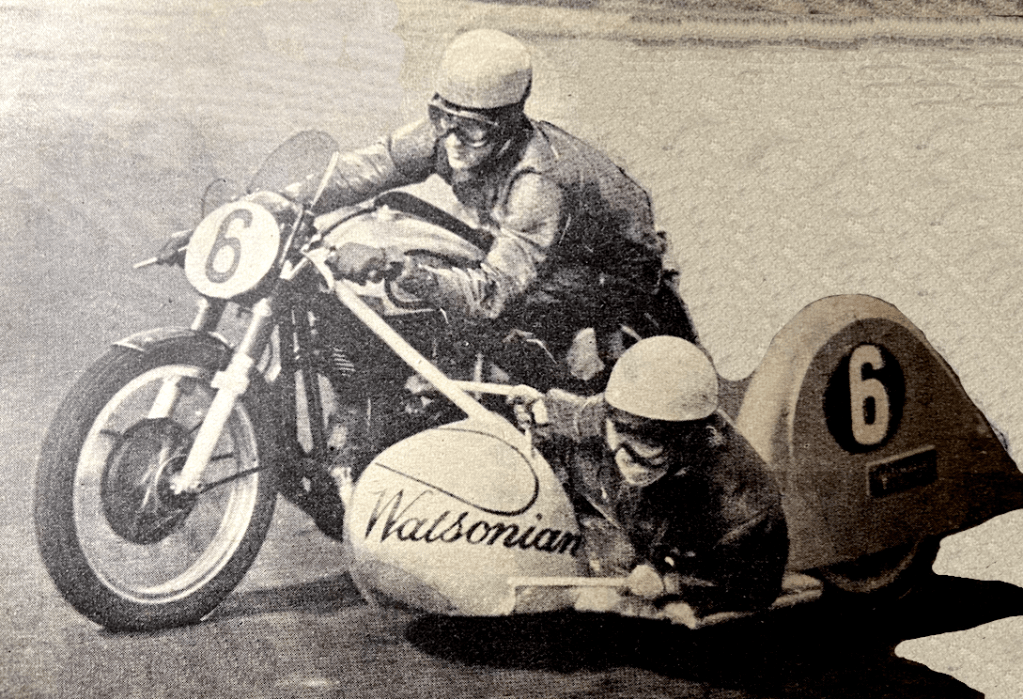
I’m obliged to mon ami Francois for this trio of action pics from the Ulster:
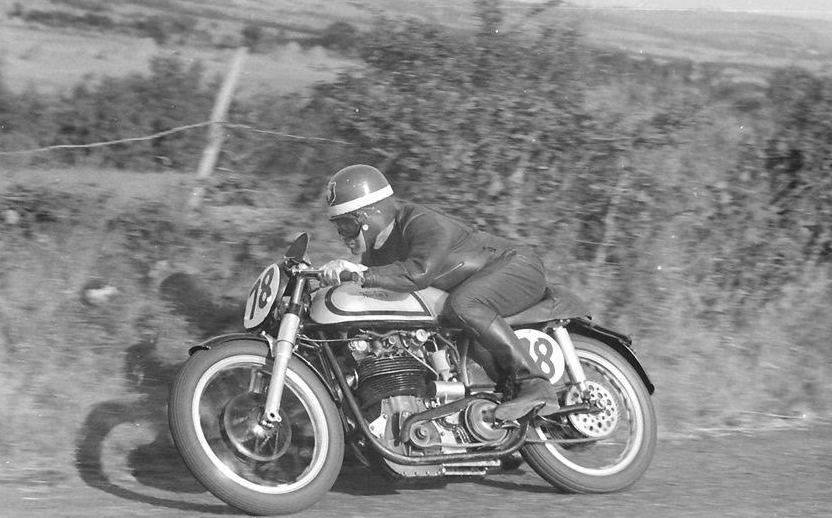
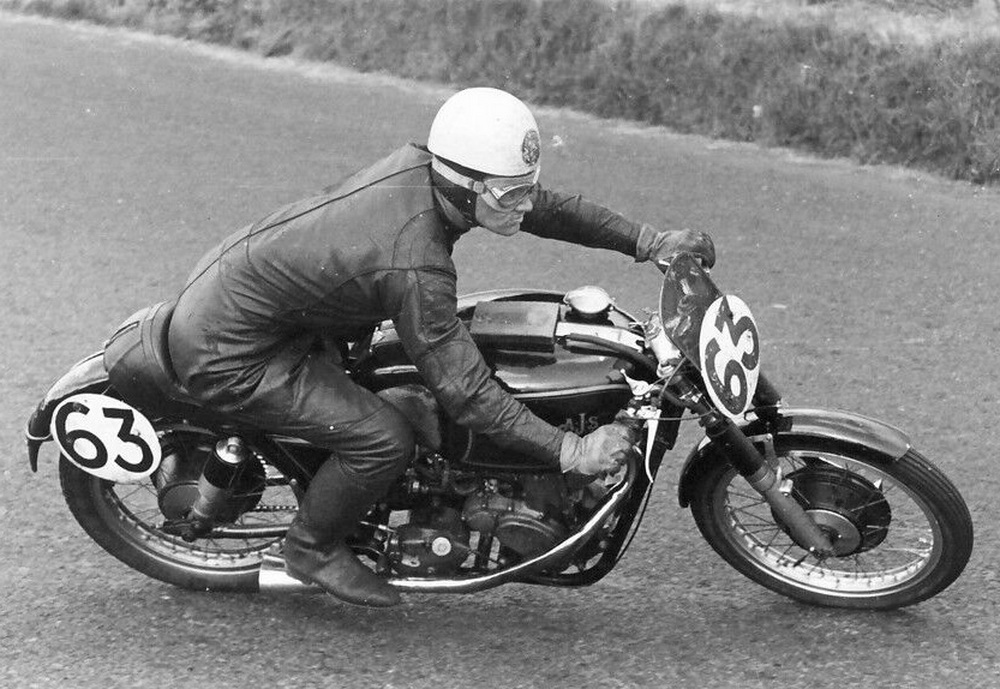
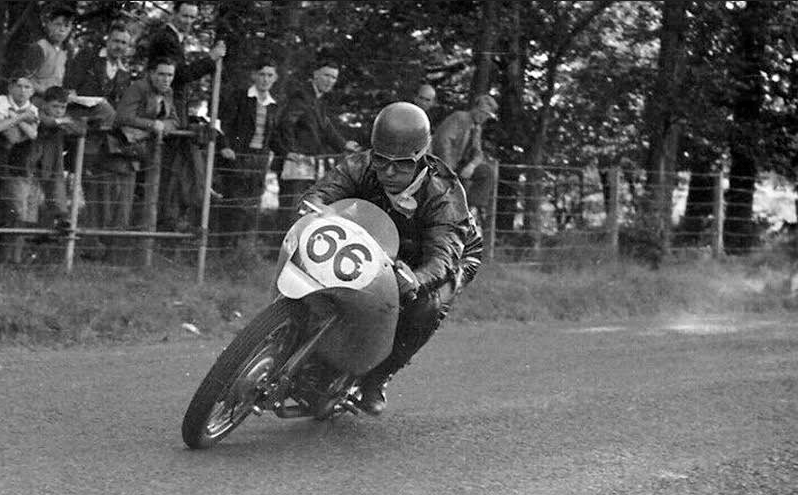
“FAMILIARITY, we are told, breeds contempt. But in the case of Governmental impositions in a world wearied by war and its ensuing austerity, it seems to breed acceptance also. So it was, years ago, with Income Tax. So it is proving with Purchase Tax—an essential wartime device which post-war Chancellors have welcomed as an unfailing source of revenue. And so it appears to be with the petroleum tax. Petrol is the nation’s lifeblood. A basic commodity, its cost is reflected in the price of almost every article in the shops. Yet it carries a tax of over 100%—a proportion greater than that on jewellery or mink coats. That does not make sense, especially as the tax has now outlived its uses. The original reason for the heavy increase in duty—decreed by the late Sir Stafford Cripps when petrol rationing was abolished—was to prevent too great an increase in consumption so as to forestall the need for larger imports of fuel from dollar sources. Later, the loss of Abadan* consolidated the tax. But recent events in Persia suggest that some hope may be entertained for a settlement of that unhappy dispute, while the establishment of new and costly home refineries has ensured a steady supply of ‘sterling’ petrol. Even the once-notorious Dollar Gap has receded, and no longer hits the headlines. Nevertheless, the circumstances have changed. Its evil influence is widespread. In public transport it can be seen in the all-too-frequent increases in fares to which even giant undertakings such as London Transport are forced to resort. And to the private motorist, it is a hardship indeed. At first glance, it might seem that the motor cyclist is the least affected, for his machine is economical. But it should not be forgotten that many riders—especially the younger ones—have but moderate means, and on them the added cost of their transport or their hard-earned pleasure bears heavily indeed. In 1949, this journal published a roadtest report on a low powered machine. At that time, we stated that it could travel the 400 miles from London to Edinburgh for 93 pence. Today, that same trip, on the same machine, would cost no less than fifteen shillings. But memories are short and, without due vigilance, the artificially high price of fuel might easily come to be regarded as normal. And if that happens, a grievous wrong may be perpetuated.”
*In 1951 Iran nationalised the assets of the BP-controlled Anglo-Iranian Oil Company (AIOC) and expelled foreign companies from oil refineries in the city of Abadan.
THE ELIMINATION OF many of the star performers due to appear in the National Jubilee road races of the A-CU., organised by the South-Eastern Centre, A-CU over the 1.39-mile Crystal Palace circuit on Saturday last, inevitably detracted from the interest of the meeting. Among the notables reported absent were Bob Keeler, Maurice Cann, C Julian, Derek Farrant, AJ Dudley-Ward—and young John Surtees, who was on the sick list with four stitches in a left elbow damaged rather badly when the conrod of his Norton snapped, seizing the engine at Ramp Bend during practising. Even so, there remained a strong contingent of short-circuit men to contest the programme of four main events, which included one for the sidecar brigade, and the crowd which lined the rails all round the course was not disappointed at the quality of the racing.”
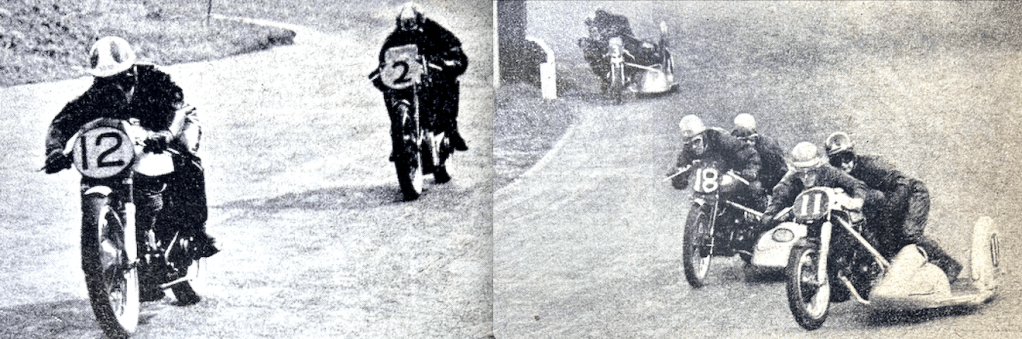
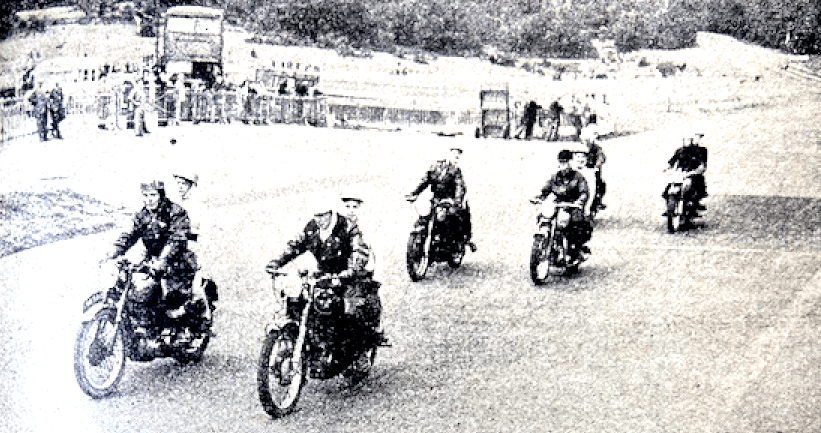
“AVOID RIDING WHEN you are overtired, out of sorts, or emotionally upset. So urges Transport Minister Lennox-Boyd, and the advice is eminently sound. He reminds, too, that alcohol can blur the judgment. A big proportion of road accidents happen because those primarily concerned were just a shade off colour. Not enough to worry them, but sufficient to make them misjudge speed and distance. The Minister could have added something. If you find yourself in a boiling temper, however justifiably, then is the time to go easy with the throttle. A clot in a car may have kept you behind him for miles by taking up too much of the road, and driven you half crazy, or otherwise aroused your righteous indignation. That is the moment for self-restraint; not for trying to ‘larn him’.”
“A GOOD REASON for motor cyclists to pay a visit to the forthcoming National Handicrafts and Hobbies Exhibition at Central Hall, Westminster is the display of beautiful little model racing motor-cycles shown by two youngsters from Hammersmith, JA and DA Rogers. These miniatures to a scale of ⅒th, were based upon Motor Cycling photographs and reach a degree of accuracy which is a delight to behold. Among the models are a Guzzi twin, a BMW, a KTT Velocette, one of Eric Oliver’s earlier Norton-Watsonian sidecar outfits, several Nortons, some with plunger and another with swinging fork rear suspension, a readily recognisable Beart-prepared Norton, a twin Vincent and a Triumph. AJS are represented by the Porcupine and the 7R. Right up to date and certainly one of the most fascinating of these models is the MV-4 complete with the Earles front suspension. None of the models is more than about 5in long, the forks pivot, the wheels turn and have rubber tyres.”
“MORE THAN 30,000 spectators watched Britain win the Moto-cross des Nations, organised by the Sveriges Motor Federation and Svenska Motorklubbens Varnamoavdelning, at Skillingaryd, Sweden, last Sunday. This meeting, the seventh in the series, took place this year for the second time at Skillingaryd, where the 1.7-mile ‘Bagshot-type’ course used in 1950 was employed again. The programme comprised two heats and a final in which teams representing Britain, Belgium, Sweden, Denmark and Finland competed, entering three riders in each heat and six in the final. The Finns were newcomers to the event and mustered three men only. Riding for Britain were LR Archer (500 Norton), BW Hall and GJ Draper (500 BSAs), BG Stonebridge (500 Matchless), PA Nex (500 BSA) and GH Ward (500 AJS). The Belgians had V Leloup, A Mingels and L Donnay on 500 FNs, with R Baeten, A Van Hetwerswijn and N Jansen Sarolea-mounted. Denmark’s hopes lay in J Lynegaard, SA Hansen and J Mygrind (all on 500 Triumphs), A Svendsen (500Matchless), E Hanson (AJS) and B Rasbro (500 AJS). Finland’s three riders were AJ Suominen and CK Wendelin (500 Triumphs) and R Rein (500 Ariel). The organising country’s flag was carried by K Johansson, L Gustavsson (500 BSAs), C Carlsson (500 Ariel), B Nilsson (500 AJS), G Eriksson (500 Sarolea) and B Andersson (500 AJS). The two heats were 12-lap races in which ability to complete the course rated higher than beating the clock because all finishers were to go into the final. This was a departure from the issued regulations which stated that only the fastest three heat finishers from each country should go into the final, the number being made up to 30 by a selection of next fastest riders. With an entry of only 27 this proved impracticable. All finishers would be finalists and as a result there was certain conservation of effort during the two heats. Basil Hall, at the top of his form, went out early with gearbox trouble. The hilly part of the course
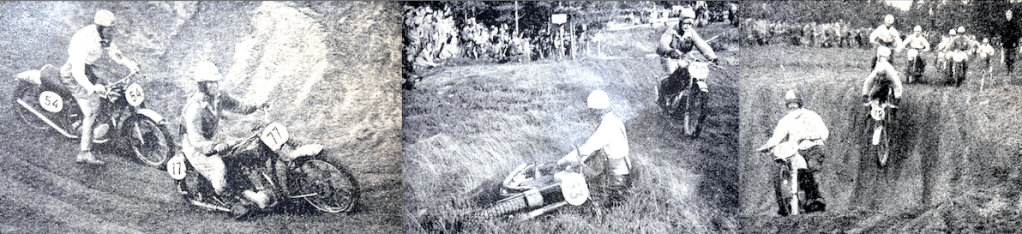
was slippery and casualties and retirements during heat two were even more numerous. Denmark’s SA Hansen retired and Britain’s loss was equalised by Belgium when Van Heuverswijn blew up. If Britain’s remaining five riders had a hectic time ahead of them in the big race, the task of Harold Taylor and his assistant team manager, Jack Stocker, was a worrying one and from the opening lap the signal organisation was at work under high pressure. Although Archer, backed up by Draper, was early in the lead, a Swedish threat in the person of Nilsson became apparent and in fourth position was Mingels, riding consistently and keeping Ward at bay. Draper later fell back several places with gearbox trouble. None knew until the race was over that he could use the second ratio only. Poor Nex had a carburetter fault and retired. Mingels and Stonebridge had a minor encounter early in the race and the Englishman fell and lost ground. Later Ward also signalled gearbox trouble but battled on. Mingels and Baeten were consistently cutting down Archer’s lead, but the signalling system worked overtime and Archer pulled away. On the penultimate lap the positions were :Archer, Mingels and Baeten, then the intrepid Draper, and Ward limping along gamely with Gustavsson sixth and Stonebridge seventh. None of those positions altered during the final tour at the end of which Archer came home individual of ‘,’A inner by less than 15 seconds. RESULTS 1, LR Archer (500 Norton); 2, P Mingels (500 FN); 3,R Baeton (500 Sarolea); 4, GJ Draper (500 BSA); 5, GH Ward (500 AJS); 6, L Gustavsson (500 BSA); 7, BG Stonebridge (500 Matchless); 8, V Leloup (500 FN); 9, K Johansson (500 BSA); 10, B Nilsson (500 AJS); 11, C Carlsson (500 Ariel); 12, L Donnay (500 FN); 13, E Hansen (500 AJS). Best Team on Aggregate: 1, Great Britain (total time, 3hr 22min 20.20sec); 2, Belgium (3hr 21min. 53.10sec); 3, Sweden (3hr 29min. 43.60sec).”

“OFFHAND, I CANNOT recollect any Spanish manufacturer who has previously built a twin-piston two-stroke, and it was all the more interesting, therefore, to learn that Derbi has just introduced such a model, which was exhibited at the recent Barcelona Fair. With a capacity of only 95cc, the Derbi must surely be one of the smallest split singles on record. The bores are each of 32mm diameter and the stroke is 59mm, giving a capacity of 94.9cc. With a compression ratio of 7:1, a power output of 4bhp at 4,500rpm is claimed. In unit with the engine, and driven through a gear primary drive, is a three-speed gearbox. The external appearance is very clean indeed, and the machine which has been designed around it is not less so. Telescopic front forks have a headlamp nacelle inbuilt and plunger rear suspension is employed. The weight is exceptionally low—only 132lb—and the manufacturers claim a top speed of some 45mph. The little 95 has a bigger brother in the T110 250cc single-piston sports two-stroke of the same concern. A dual seat is mounted on plunger spring units at the rear. ◊◊◊◊◊ In the Italian tradition is the new 125cc Mymsa, likewise introduced at Barcelona: Its cantilever subframe, deep tank and heavily-valanced rear mudguard all hear mute witness to the influence of current Italian practice, as do the somewhat square lines of the two-stroke engine/gearbox unit. A power output of 5.6bhp at 4,900rpm, a speed of 55mph and a weight of under 160lb are other relevant details. ◊◊◊◊◊ Several of the Spanish-built motorcycles at Barcelona sported Villiers engines. There was, for instance, the ‘Super Villiers’, powered by a Hispano-Villiers 10M 125cc engine—a well-styled plunger-sprung model with headlamp nacelle. And if the little Villof runabout doesn’t use a 98cc motor of the same make I’ll eat my safety helmet! Not that Vicente Llorens Ferrer—the Valencian designer who is responsible for the Villof range—produces Villiers-engined models alone, for included in his range is a smart rigid 125 with an engine vaguely reminiscent of our own BSA Bantam or the German DKW. ◊◊◊◊◊ A Spanish version of the 125cc Peugeot motor cycle is announced. It is to be built under licence by the MOVESA fabrique, of Vitoria. ◊◊◊◊◊ Mystery solved! that Italo-German ‘mystery model’ mentioned in the previous article in this series has been identified! You will remember that it was powered by an NSU Lux engine and sported a pair of ‘semi-Earles’ forks. I now
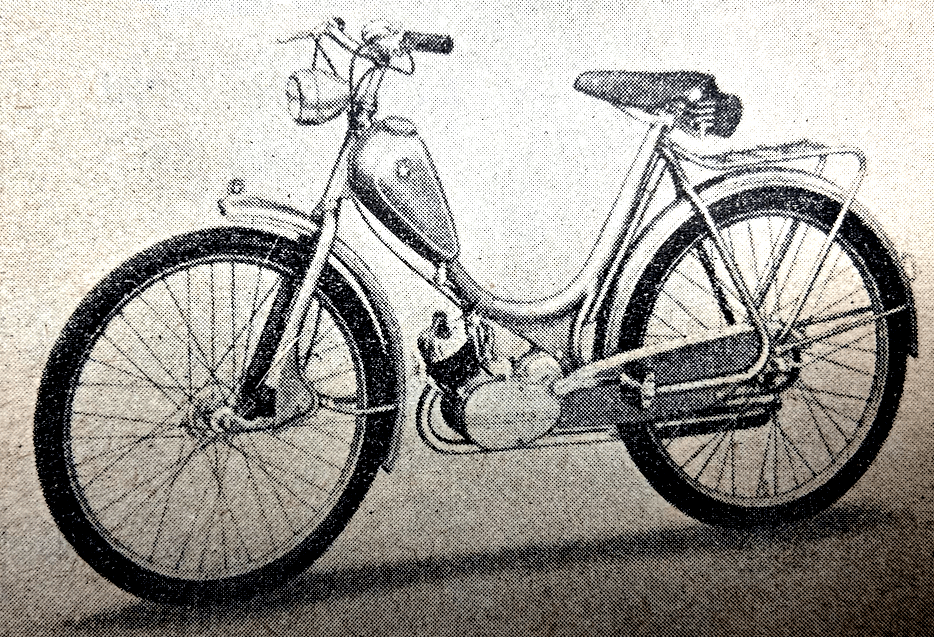
learn that it is produced by the Italian Aero Caproni Trento concern—the same people who build that interesting 75cc Capriolo model with the pressed-steel frame. And, of course, they are quite prominent in the aircraft world. Therefore, it seems, this very interesting machine will almost undoubtedly be on view at Milan next November. I shall look forward to its appearance. ◊◊◊◊◊ The new Dutch Express is a 250cc two-stroke twin fitted with the very popular German Ilo engine/gearbox unit. It has telescopic front forks and rear plungers. The same concern produces a 250cc single, as well as 175 and 200cc models. Not a Dutch product, but available in Holland, is a similarly-engined competitor. It is the German Hercules, which is very similar in its general appearance. The Hercules range is also extensive, models of 98, 125, 150, 175 and 200cc being offered, with a variety of Ilo or Sachs engines. And there is yet a third—again Ilo powered—in the shape of the German UT. This differs from the other twins in having swinging-fork rear suspension of a design rather reminiscent of the Francis-Barnett. A noteworthy feature is that at least two of these machines—including the swinging-fork job—feature full enclosure of the rear chain. ◊◊◊◊◊ ‘Boots, Boots, Boots, Boots’…very fascinating indeed was a recent issue of the German motor cycling magazine Das Motorrad, for it contained a well-illustrated section on the latest in riding equipment east of the Rhine. Especially cunning—and quite commonsensical, was the well-finished pair of rubber knee boots produced by Phönix. These featured a zip fastener positioned at the back of the leg, out of the way of driving rain and thrown-up spray. Not quite so sightly were a set of overboots in PVC plastic, hailing from France. Being translucent, they were rather too obvious, but in a darker shade they could be just the job to carry on a longish summer run. ◊◊◊◊◊ The Mars ‘Mo-Ped’: One of the first German manufacturers to make use of the excellent little engine that Sachs had brought out for light autocycles is the Mars-Werke of Nurnberg, who have announced a very smart ‘ultra-light’. A beam-type frame is a feature, as are leading-link pressed-steel forks—a fine little machine, and one which should find a ready sale. ◊◊◊◊◊ Those famous car-racing people, Maserati have lost no time, following their entry into the motor cycle industry, in supporting the sport. Piloted by Borri, one of the smart little 125cc two-stroke Maseratis contested the recent 24-hour held over a course of more than 700 miles centred on Milan.”
“IF THERE IS ONE THING that last weekend’s Swiss Grand Prix proved, it is that the four-cylinder Italian Gilera is not only one of the fastest racing motor cycles in existence but is also now quite as reliable as it is fast. Unquestionably, too, Geoff Duke remains the best of all racing motor cyclists, and this combination of circumstances made it almost inevitable that the words ‘winner, GE Duke (Gilera)’ would be written at the end of the report of the 28-lap 500cc race which concluded the motor cycle events in the two-day combined car and motor cycle meeting on Berne’s 7.3km. Bremgarten circuit. Another Englishman, Fergus Anderson, rode another Italian machine, a Guzzi, into first place in the 350cc race, and an Irishman, Reg Armstrong, rode a German NSU to victory in the 250cc class. But it was on a British Norton machine, with a British Watsonian side-car attached, that Eric Oliver won the sidecar race. And to a New Zealander, Rod Coleman, mounted on a British AJS, went the honour of setting the first over-100mph lap record for the Berne course. All events were run in brilliant weather and lap and race records were skittled in all classes, except the 350cc—and the explanation for that could well be that it was Geoff Duke, on a Norton, who set those last year, and on this occasion he was not competing.” The 250cc race: The 23 starters for the 18-lap, 81.5-mile Lightweight race included factory teams from Moto Guzzi, NSU and DKW. Siegfried Wünsche was an early leader on the two-stroke Deek but The NSUs and Guzzis steamed past him with Reg Armstrong (NSU) lapping at nigh on 90 to hold the lead to the line followed by a trio of Guzzis and a brace of NSUs. And, as the Green ‘Un reported: “Armstrong’s win caused considerable confusion to the organisers. First they were about to run up the Union Jack, then the German flag, then both; then at last someone found one in the Eirran colours and a record of The Minstrel Boy—’the national hymn of Ireland’, the announcer
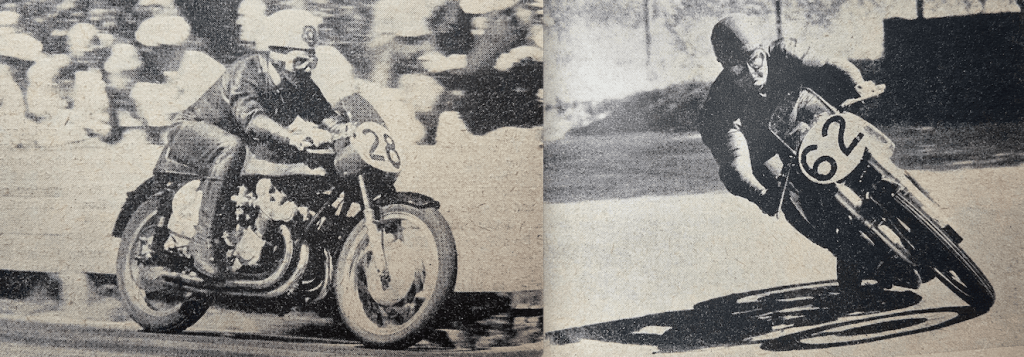
explained—was played!” The 350cc race: Fast practice times put the three works Guzzis at the front of the grid next to Rod Coleman (AJS) and Ken Kavanagh (Norton). Derek Farrant on the other works AJS was on row 2, alongside Jack Brett (Norton); Ray Amm planned to ride the third works Norton but had not fully recovered from the injuries sustained in his French GP spill. Once again Wünsche led the pack off the line on one of four factory DKWs among the 29 starters, and once again it didn’t last. Within the first lap Anderson roared away on his single-knocker Guzzi and “within three laps the race is beginning to develop a character. There is Anderson out on his own, while half a mile astern Rod Coleman and Ken Kavanagh have the other two Guzzi riders after then. Then come Farrant and Brett—for all the world like men who have disturbed a beehive—with all four DKWs angrily buzzing in pursuit”. Wünsche retired at the pits, Lorenzetti slid off his Guzzi and Anderson romped home to to win the race and the 350cc world championship, ahead of Kavanagh, Coleman, Brett and Farrant; then came K Hofmann on one of the DKWs. The sidecar race: There were no Gilera-4s on the line but Norton charioteers Eric Oliver and Cyril Smith shared the front row with a pair of BMWs ridden by Wiggerl Kraus and Wilhelm Noll. “It is the Frenchman Jacques Drion (Norton), from the second row, who makes the best start and he disappears from sight with Oliver, Smith, Kraus, Noll and Switzerland’s Hans Haldeman (Norton) after him…with eight (of 16) laps run, Oliver has a 13sec lead over Smith, who is by then 6sec ahead of Noll…On lap 14, at which stage Oliver is 30sec ahead of Smith, Taylor goes out with a wrecked engine. There are now 14 (of 22 starters) still in the race. No last lap bad luck interferes with Oliver’s victory.” His Norton team-mate Smith was runner-up, ahead of Noll’s Beemer and three Nortons piloted by messrs Haldemann, Drion and Deronne. The 500cc Race: There is another of this season’s all out efforts by the Gilera factory in the 500cc class, with six fours entered”—the riders being Reg Armstrong, Dickie Dale, Geoff Duke, Giuseppe Colnago, Alfredo Milani, plus Nello Pagani, who turned up here with a
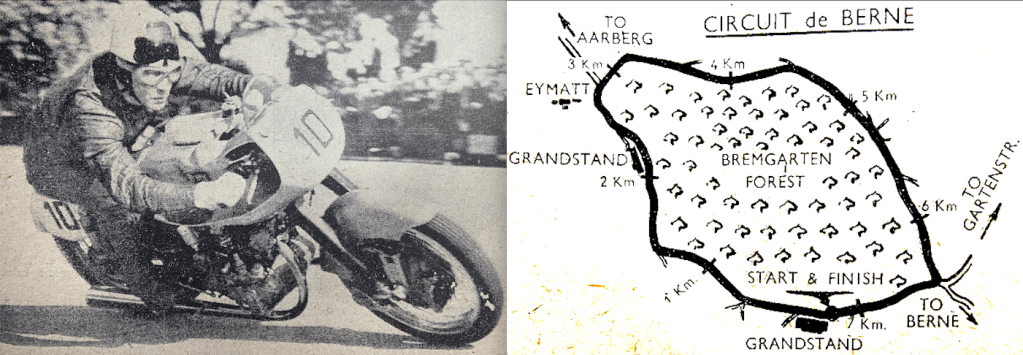
single but has been brought into the factory team to replace the vanished Masetti. On the British side we have two AJSs (Coleman and Farrant) and two Nortons (Brett and Kavanagh), while Germany is represented by three BMWs—riders Hans Baltisberger, Hans Meier and Walter Zeller—and a streamlined Horex in the hands of Müller. The rest of the field of 24 is made up of private owners of Nortons and one Swiss with a BMW. On the front row of the grid Kavanagh stands alone against four of the Gilera team—Armstrong, Duke, Colnago and Milani. There are 28 laps to be covered and at the start Duke breaks away into the lead, while Kavanagh appears to be rather badly boxed in between one of the Gillies and Zeller’s BMW. Müller is well up among the ‘red ‘uns’. In a very short time, the first lap is completed and it isn’t Duke, but Milani, who leads the pack. Duke lies second, Dickie Dale is third. And Rod Coleman is fourth! Then it is Brett, Kavanagh, Colnago, Müller, Zeller and the rest…There is a battle royal in progress between Milani and Duke, and, with the Italian holding a slight lead they are setting a record-breaking pace which, in four brief laps, has the pair of them well ahead of third man Dale, and even farther ahead of Rod Coleman, who is holding fourth place. Kavanagh is fighting for fifth position with Armstrong and Colnago on two more Gileras, and Farrant on the second AJS. And Brett has toured in with a wrecked gear-change. The end of Lap 7—and a quarter of the race already run—and still Duke has been unable to catch Milani. The order now, behind these two, is Dale, Coleman, Armstrong, Colnago, Farrant, Kavanagh, Zeller. Lap 8, and
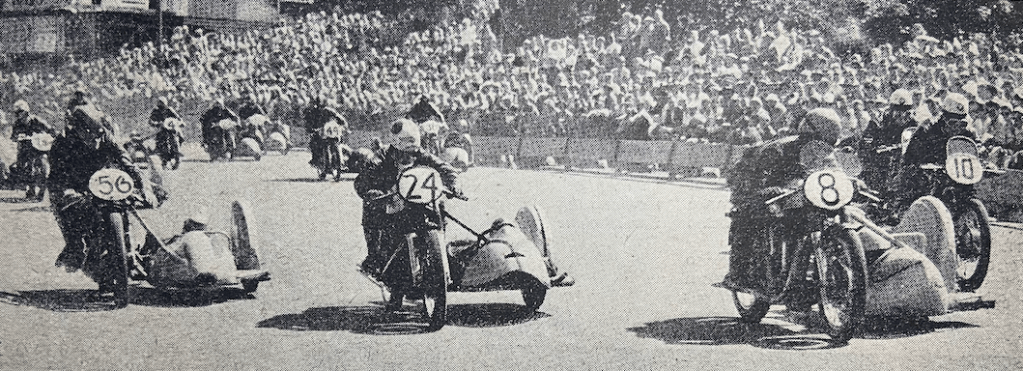
Duke is out in front! Dale has halted at his pit for nearly a minute, to remedy clutch slip, and Armstrong has passed Coleman. On the other hand Farrant has passed Colnago. In another lap, however, Colnago is again ahead of Farrant. And Kavanagh—who has just been credited with a sensational 99.42mph second lap, is hard put to keep in front of Zeller. Now it is Coleman’s turn to be credited with a record lap—100.96mph on his seventh—but that doesn’t stop Duke and Milani streaking farther and farther ahead. A halfway recap as the 14th lap is completed: Duke still leads—and has just lapped Baltisberger and Meier on the BMWs—and Milani is second. Armstrong, Coleman, Colnago, Farrant, Zeller, Kavanagh, Dale, and Pagani are the only others on the same lap. Müller came in to retire some time back with what sounded like a blown head gasket. No one has equalled Coleman’s record circuit, although the leader’s race average has gone up to 98mph. Lap 18 sees Kavanagh back in front of Zeller and both Coleman and Farrant continue to scrap with Colnago; but still there are three more Gileras, nicely spaced, in the first three places. Out goes Kavanagh on Lap 22—with a failing engine—and now the order is Duke, Milani, Armstrong, Colnago, Coleman, Farrant, Dale and Zeller. Only the AJS pair can prevent a complete Italian walkover, and there is no sign at all that any of the Gileras are running out of breath. Nor are they, for there is not a single change in the leading positions in the last stages of the race. Only Baltisberger and Meier, both a lap adrift, produce a last-minute thrill as they race to the line for 10th place, which goes to Baltisberger by no more than a wheel. RESULTS: 1, GE Duke (Gilera), 98.13mph; 2, A Milani (Gilera); 3, HR Armstrong (Gilera); 4, G Colnago (Gilera); 5, RW Coleman (AJS); 6, DK Farrant (AJS); 7, RH Dale (Gilera).”
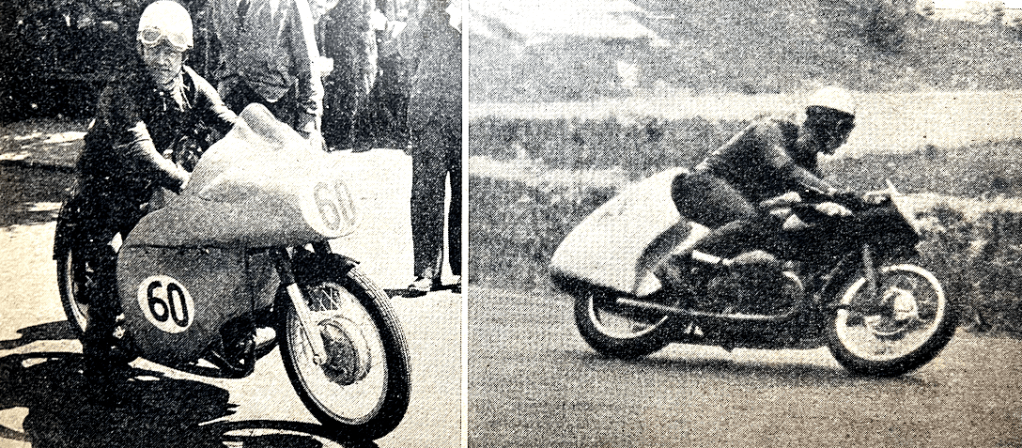
“AMONG MATTERS TO BE discussed by the Commission Sportive Internationale at the FIM Autumn Congress, we hope the subject of approved road-racing kit will be placed prominently on the agenda. All constituent governing bodies comply with the general FIM regulations covering protective clothing, but interpretation of the requirements differs in various countries. This fact led to an unfortunate scene in the Isle of Man last June, when two foreign competitors were told they could not ride in boots which they had worn in an earlier TT race and numerous Continental events. With the rights and wrongs of the case we are not concerned; the point is that it should not have been possible for such circumstances to arise. And the safety of riders is not the only consideration. Petty misunderstandings can quickly be magnified into international ill-will. This bother with boots in the Island, for example, led to the publication of an offensively ‘dirty’ article in a prominent German non-technical periodical. This sort of thing must be stopped. Because the A-CU standards of clothing and machine examination, measurement, of ‘placed’ engines and so on, are stricter than those employed in comparable Continental classics, it is unfair that British sportsmanship should be distorted and pilloried in the foreign Press. Greater uniformity in the interpretation of the appropriate international regulations, and their amplification where necessary, alone can provide the solution to this problem.”
“THERE MUST BE A MILLION motor cycles in use in Britain by this time. That is the only conclusion to be drawn from Transport Ministry figures just issued, which show that there were something over 940,000 licences current at the end of last September. Since then, of course, more models by thousands have been put on to the road. Incidentally, why is it that the MoT takes such a time to produce its statistics? If they are really, of value—as is undoubtedly the case—then they should be made available as promptly as possible. In this particular case there has been a delay of nearly a whole year. That is not good enough. [Transport Minister] Mr Lennox-Boyd should really see what can be done to speed things up. That goes not only for the returns of his department, but for its methods in answering correspondence. I speak with feeling!—CARBON
“FROM THE BLANKET OF CLOUD which enshrouded the surrounding mountains, steady rain fell all day at Aberdare, Glam, on Saturday last, marring the National road races promoted there—over the 1,320-yd Aberdare Park circuit—by the Aberaman MC&LCC and necessitating the shortening of the day’s programme. Despite the aquatic conditions which—leavened only by two fleeting, isolated, tantalising glimpses of sunshine—varied between a nagging drizzle and stair-rod torrents, a hard core of 1,000 or so spectators stood firm to watch a determined brand of riders defy the elements. In driving rain the 350cc finalists set off to cover their allotted 12 laps. The first-lap leader was R McG McIntyre (348 AJS), who was hotly pursued by JHT Harris (348 BSA) and B Freestone (348 Norton). On the sixth lap Harris slipped ahead, but his triumph was short-lived for McIntyre was leading the race again two laps later. A four-stroke vs two-stroke battle developed in the 125cc event. For three wet laps—all but a few yards—JA Hogan, on his screeching Hogan-Puch, was able to stave off the challenge of BG Purslow’s scarlet ohc MV. But the Italian machine was visibly faster and even though Hogan pulled a ‘fastest lap’ out of the bag, he could not regain the lead. Nevertheless, he had the satisfaction of finishing but a fifth of a second in arrears—and over 15 seconds ahead of II Lloyd on a second MV. So hot was the pace in this event that, at the finish, the fifth man—DE Bell (124 EMC-Puch)—only just escaped being lapped. J Surtees (499 Norton) made full use of the advantage conferred upon him by his front-row grid position to lead the field away in the 351-500cc final. And, as if to prove his own assertion that Aberdare is the safest wet-weather track he knows, at the front he stayed for the whole 12 laps, building up a commanding lead the while. Second position was held first by RA Russell (499 Norton), then by Freestone, similarly mounted, and finally—after the fifth lap—by McIntyre’s G45 Matchless.”
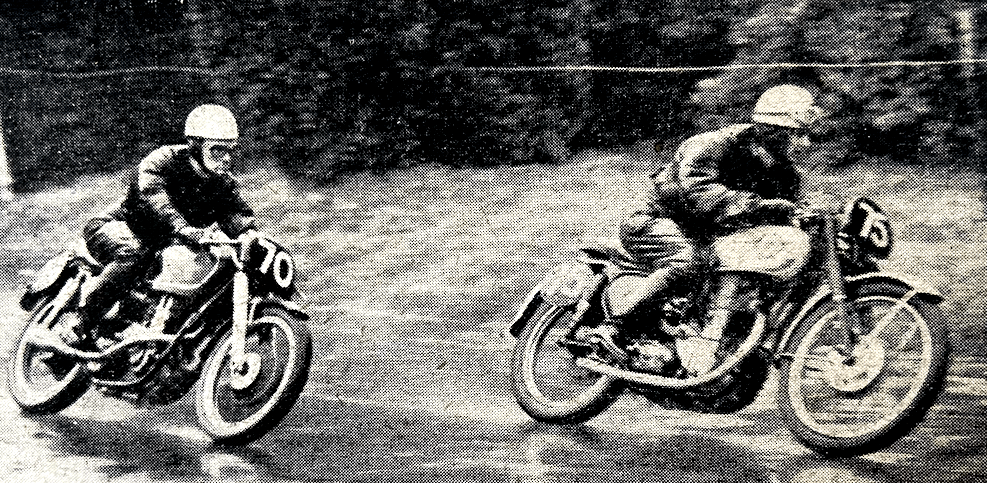
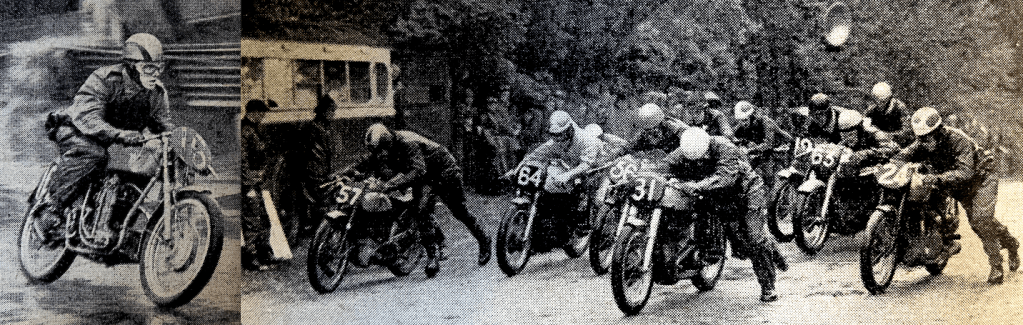
“THE SHELL OF THE NEW Tuffnut safety helmet, introduced recently by Malcolm Campbell (Plastics), of 5 Great James Street, London, WC1, is moulded from ‘Texolex’, which many motor cyclists will recognise as material sometimes used for dynamo transmission drives. Hard wearing, waterproof and extremely strong, this material consists of layers of cotton fabric impregnated with phenolic resin. The heat-moulded shell is stiffened by two raised ridges which cross at the top of the crown. The adjustable internal webbing harness is held in position by means of a replaceable draw lace which passes through eyelets in the base of the shell. This draw lace has a breaking strain of 100lb and should not be mistaken for an ordinary shoe lace.”
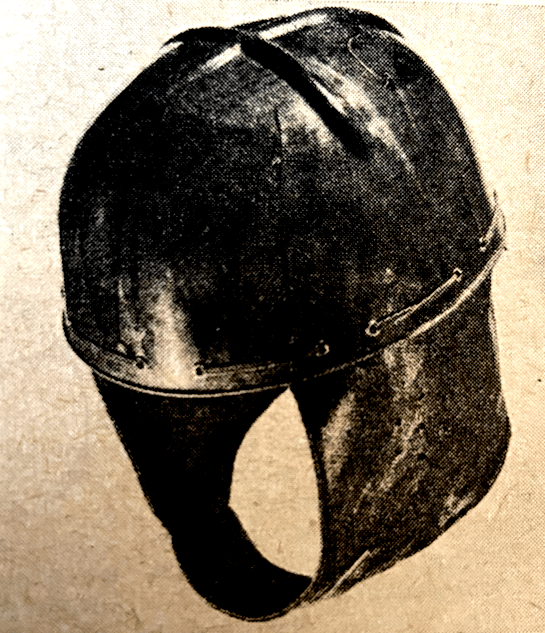
“THE CENTURION IS the name given to a safety helmet manufactured by the Patent Pulp Manufacturing Co of Thetford, Norfolk. The shell is made of moulded pulp compressed under high pressure. The very full neck protector is combined with the chin strap to form a single unit. A nylon cord secures the webbing cradle inside the helmet and the lining is riveted to the shell. Between the leather head band and the shell is fitted a single strip of latex foam to provide some degree of give when the helmet is worn. Price of the Centurion, including purchase tax, is £2 6s 8d.”
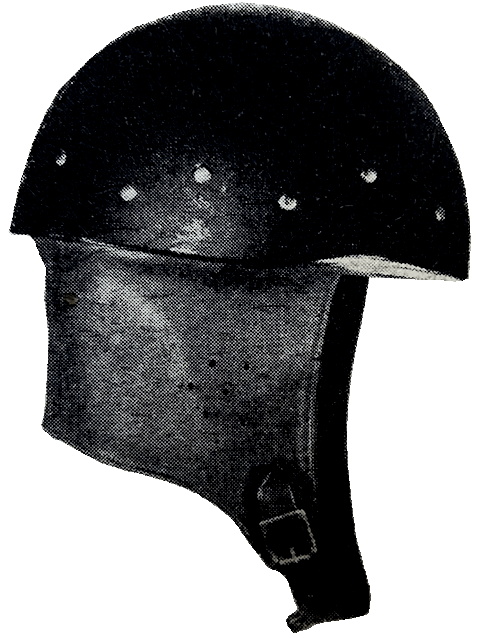
“ALL ATTEMPTS AT dressing up safety helmets must give best to the Chapeau Fort, a French creation designed for cyclemotorists. Externally, the hat appears as a well-styled trilby, such as one sees everywhere, providing normal protection from rain and sun. But concealed within the headpiece is a helmet of natural cork, and a quickly detachable chin strap is provided for use when the hat is being worn as a safety helmet. When the rider is dismounted he carries the strap in his pocket. The description of the hat in the French magazine Cyclomoto concludes ‘The Chapeau Fort offers you protection against blows and tumbles and it has an elegance that permits you to present yourself everywhere without your having the air of a Martian.’ For cyclemotoring, the hat strikes me as being an excellent proposition.”
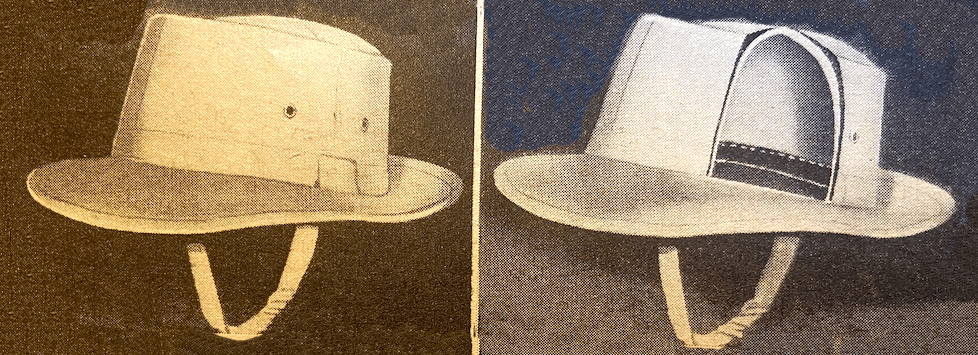
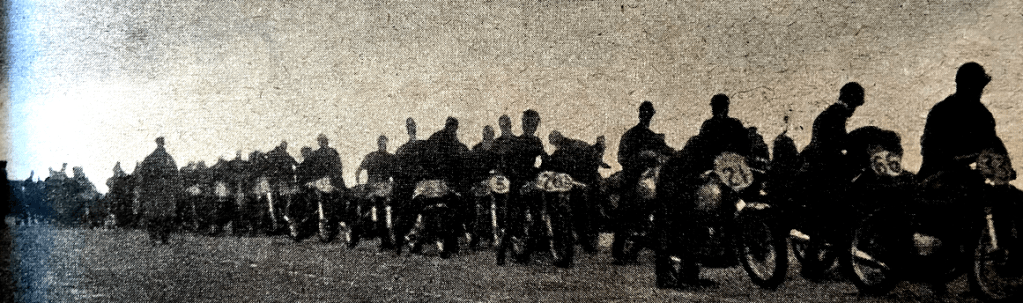
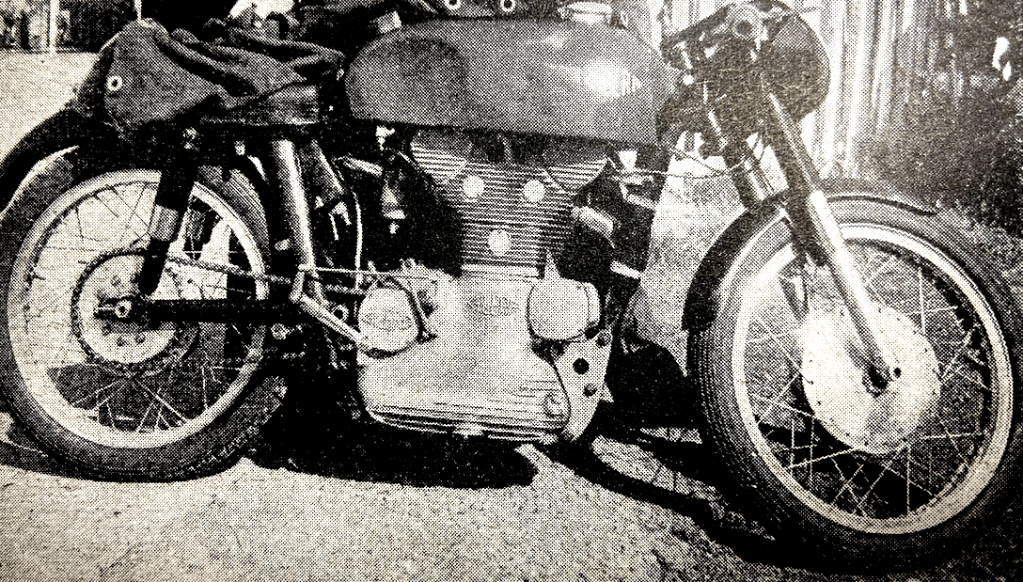
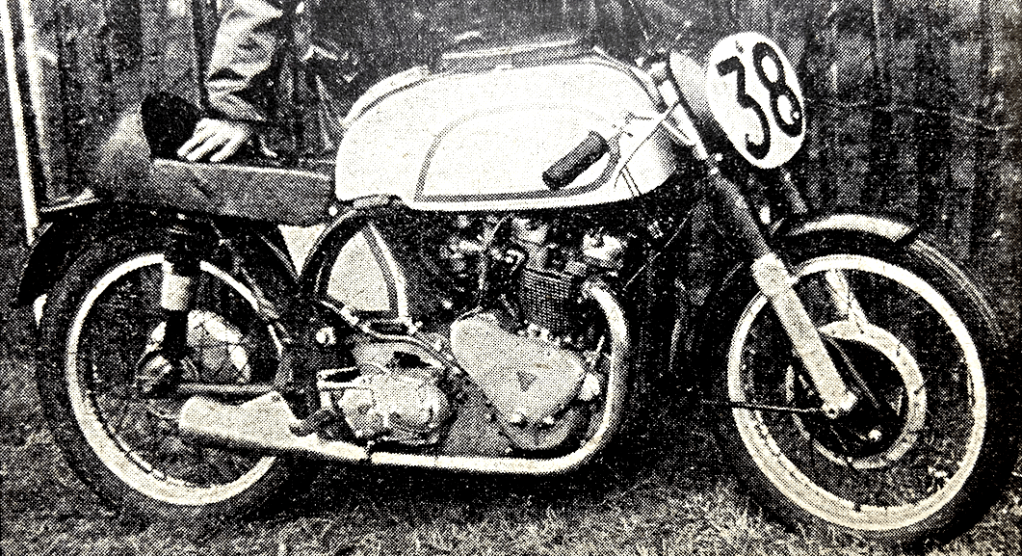
“BEFORE A SUNLIT natural grandstand packed to overflowing, with a crowd estimated to be about 12,000 strong, 84 of Britain’s leading grass-track riders competed for the honour of their centres and for individual laurels on the 1,660-yard course at Kirkby Mallory last Sunday afternoon. The meeting, organised on behalf of the A-CU by the Leicester Query Club, was the third in the series of National Grass Track Championships, and the fact that the 23 events which made up the programme resulted in very much ‘the mixture as before’ reflects only the superlative skill of the victors, for in a day of fierce competition there were very few push-overs. Proceeds from the meeting will go to the A-CU Benevolent Fund, and it was expected that about £1,000 would be realised. The solo team Championship was decided on the aggregate points gained in six heats—three for 350s and three for 500s—and was won by the East Midland Centre team of SF Mintey (344 and 498 Burdett Specials), F Wallis (344 and 498 AJS/JAPs), and A Hull (344 and 498 Triumph/JAPs) for the third successive year. Each of these riders won his 350 heat, but in the 500 class Mintey was beaten by LJ Bayliss (497 Ellbee; Midland) and Hull by WS Bassett (498 Triumph; Yorkshire). In his 500 heat, Wallis was third behind M Tatum (500 AJS; S Eastern) in a breathtaking race, won at a record speed of 68.99mph by A Cresswell (497 Royal Enfield/JAP; Midland). Also decided on points, the sidecar Centre Championship consisted of two heats and a final. After four laps of cut and thrust, W Evans (499 Norton; Midland) won the first heat by little more than a machine’s length from D Yorke (500 Rudge/JAP; Eastern). Heat 2 saw a convincing win for the S Midland Centre road-racer EJ Davis (998 Vincent); but
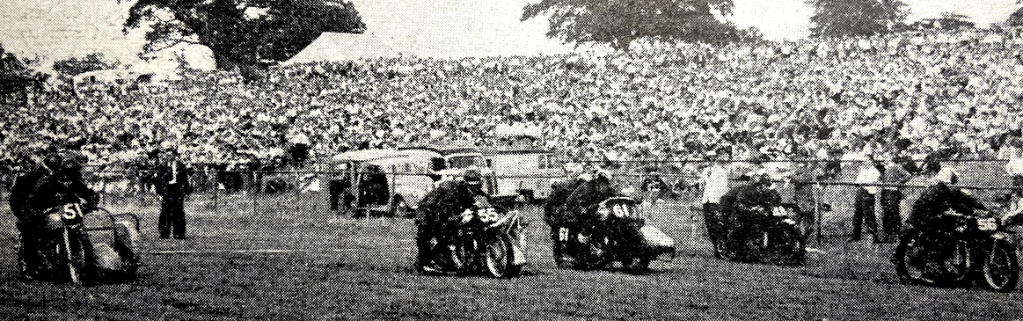
in the final Evans just beat Davis to the flag in a choking cloud of dust and the sidecar team Championship returned to the Midland Centre, who won it at the first meeting of the series at Kirkby Mallory in 1951. Team races over, the individual Championship events got under way. In the 350cc final, SF Mintey, on top of his form, streaked ahead to retain the title which he has held since the Championships were inaugurated. The second heat of the individual sidecar race started with a bang. As the machines roared away from the start, KJ Blay’s 600 Thorpe/Douglas developed a tank-slapping wobble, leaped four or five feet in the air and hurled off its crew like a bucking bronco! Blay was knocked out, but fortunately medical examination revealed no serious hurt, though he was sent to the Leicester Royal Infirmary for a thorough check-up. Evans, who won the second heat, had bad luck in the final, retiring with mechanical trouble on the second lap. This let Yorke into the lead, with Davis, who had made a bad start, pounding furiously through the field hard on his tail. As they rounded the last bend Davis tried like fury to cut inside Yorke, but swung out, missing the Rudge/JAP’s rear wheel by inches at the line. Cresswell again broke the lap record on the first individual 500 heat when he won at 69.48mph. And as if that wasn’t enough, he went on to win the final at 70.05mph, and thereby retain the title which he won last year. Second place went to LJ Bayliss who just held off a desperate challenge from R Tolley, and SF Mintey was fourth. RESULTS 350cc Individual Solo Championship Final: 1, SF Minter (344 Burdett Special); 2, F Wallis (344 AJS/JAP); 3, AJ Hagon (348 BSA/JAP). Speed, 67.18mph. 500cc Individual Solo Championship Final: 1, A Creswell (497 Royal Enfield/JAP); 2, LJ Bayliss (497 Ellbee); 3, R Tolley (497 Royal Enfield/ JAP). Speed, 70.05mph (record). Sidecar Individual Championship Final: 1, D Yorke (500 Rudge/JAP sc); 2, EJ Davis (998 Vincent sc); 3, C Freeman (499 Norton sc). Speed, 57.21mph.”
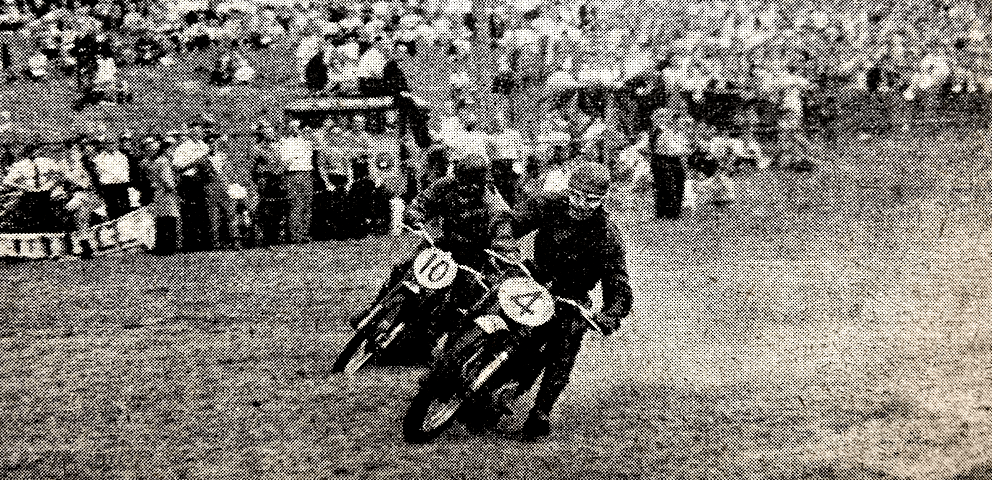
“LAST SATURDAY’S INTERNATIONAL Speed Trials organised over the Madeira Drive course on Brighton’s sea-front by the Brighton and Hove MC included a class for ‘Bemsee’ members with solos and sidecars. each pilot having two runs. Outstanding amongst the motor cycle performers was George Brown, riding his big Vincent—’Nero’. After being a fraction of a second outside his own class record on the first run, Brown had better fortune with his second try, setting a new record in 24.27sec—nearly half a second better than his previous best figure. Among the sidecarists, LW Collins, with a ‘showroom’ 495cc Velocette outfit, was especially impressive.”
“WE ARE DISTRIBUTORS of the Aviakit protective helmet and thus interested parties in the sale of these helmets. From a business point of view, the more that are sold the better we like it. Nevertheless, we are entirely opposed to forcing the motor cyclist, by law, to wear a helmet. We, as a nation, already have enough compulsion without adding to our burdens. While accepting that the State has the right and duty of protecting people from their own folly, we believe that motor cyclists as a whole are a sensible body of men and women. If they are convinced of the need for protective helmets, they will wear them, and we believe that they can be so convinced without compulsive legislation.
G. LEWIS, London, W1 (pp D Lewis).”
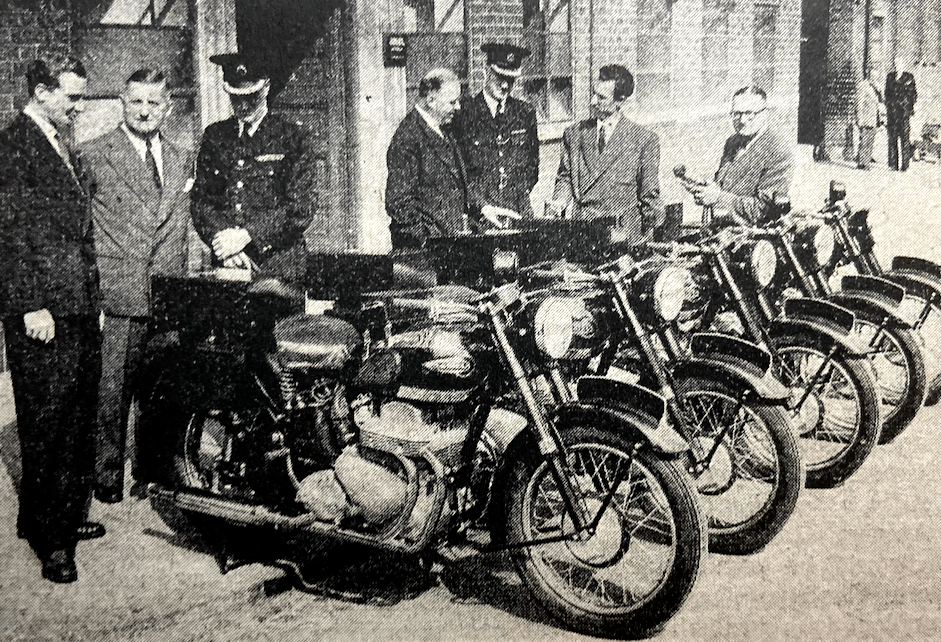
“LAST SUNDAY’S ITALIAN Grand Prix, eighth of the year’s nine ‘classic’ road race meetings, saw all but one of the classes in the World Road Racing Championships finally settled, with triumph for British riders in three major categories—the 350cc, where Fergus Anderson (Guzzi) is champion; the 500cc, where Geoff Duke (Gilera) bears the title; and the sidecar class, in which Eric Oliver (Norton, sc) regains the position he has held, with the exception of last year, since the series began in 1949. Ironically, it is in the sidecar class—which is not officially supported—that the only British manufacturer—Norton Motors—has gained a championship! The meeting was organised by the Federazione Motociclistica Italiana and run over the 6.3km circuit at Monza, near Milan.”
“MONZA, ITALY—WHAT a wretched racing year this has been! One meeting after another has brought its disasters, or troubles, and the sport has become as beset with quarrels, between competitors and promoters, as professional football or speedway. During the practice period for this five-race meeting there has been the disappointment—none too well received by the Italian Press or public—caused by the non-arrival of the AJS and Norton teams. There has been the nearest thing ever to a rider’s strike, settled only at the 11th hour, over the matter of whether foreign (British) riders employed by Italian factories should be paid starting money by the promoters. Despite the arguments over money, in which the private competitors, although not directly involved, lent their support to the factory men, the practising progressed according to plan during three swelteringly hot days. It brought many interesting machines to light. There is, for example, a glut of streamliners, upon which Ray Amm, with his shoulder in plaster, has been gazing wistfully, full of regret that he could not have a crack here with his Norton ‘egg’. Walter Zeller, only BMW representative, has one—as beautifully finished as one would expect a BMW to be—but he has also been practising on an unenclosed model, on which the carburetters, still with direct petrol injection, face forward (a cylinder head arrangement, incidentally, which is also featured on one of the 250cc DKW two-strokes). The Guzzi four is elaborately streamlined, so is one of the 125cc Mondials. Some of the NSUs have more complete streamlining than previously, so do some of the MV 125s; and there is the Norton-powered Watsonian sidecar outfit, which Frenchman Jacques Drion will be driving—the most thoroughly streamlined of all machines here. There are some interesting new rider-machine combinations. Umberto Masetti, for instance, who, it appeared, went off in a huff when he found he had Geoff Duke as a Gilera team-mate, is lined up with Morini for the 125cc race, NSU for the 250 and has been practising on an MV four. Ken Kavanagh has become a Guzzi jockey for the 250cc race, and Tommy Wood is to ride a 350cc DKW, and HP Müller, the German who normally races a Horex, has been training on one of the big MVs, all of which, incidentally, have Earles-type front forks. Fastest practice time has been recorded by Carlo Bandirola on an MV in 2min 12.1sec, nearly two seconds slower than the 108.09mph record lap put in by the late Leslie Graham on a similar machine last year. THE 125CC RACE There is low cloud and a slight, cooling breeze as the 17 starters come to the line—ideal conditions for racing. Rather surprisingly, the five Mondials have been withdrawn from the race, so it is to be a three-cornered match between Germany’s NSU factory and
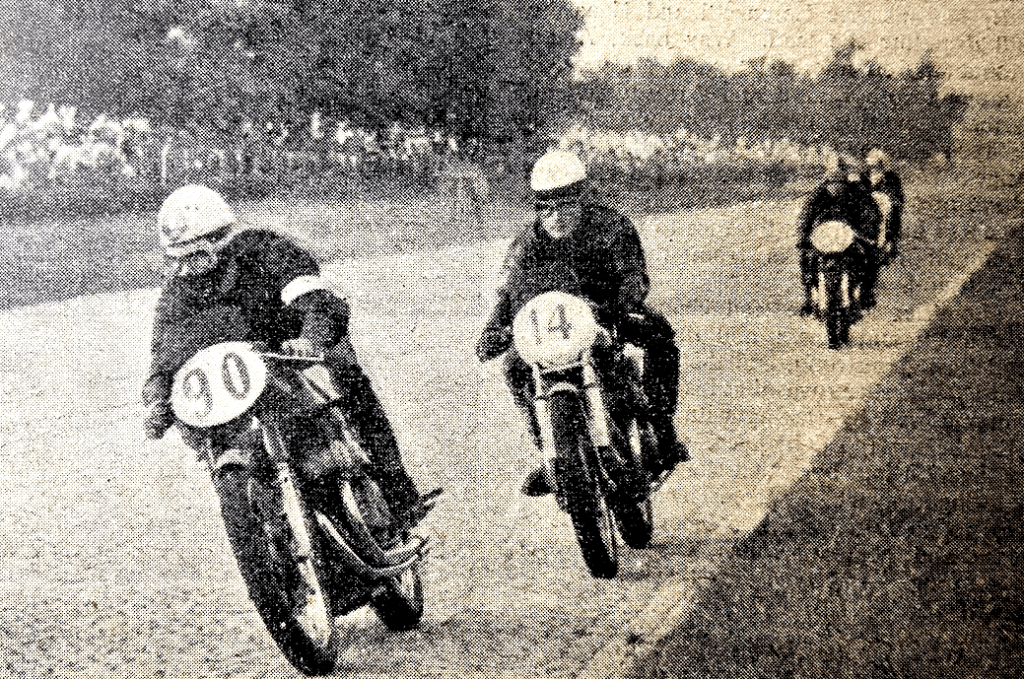
the Italian MV and Morini camps, with Frenchman Pierre Michel providing a little exotic interest with his home-made Michel Special. Cecil Sandford’s MV fails to survive the short warming-up period; F Benascdo’s MV does no more than 100yd under its own power and R. Hollaus’ NSU won’t start until well after the first lap is completed. The race soon develops into a fight for the lead between an MV pair—Carlo Ubbiali and Alfredo Copeta—and Emilio Mendogni (Morini), last year’s winner. On the eighth lap Mendogni goes into the lead, with Ubbiali and Copeta still right with him. Behind—well behind—come Werner Haas (NSU), A. Marelli (MV), W Brandt (NSU) and the rest. On Lap 9 Ubbiali again leads. And on Lap 10. By which stage Copeta’s engine is clearly ‘going sick’ and Marelli has coasted in to retire. Lap 12 sees Mendogni ahead once more, and Haas—surely the rider of 1953?—is closing up on Ubbiali. On Lap 14 it is Ubbiali who is once more in the lead—yet Haas is causing the real excitement. In two laps he has pulled back a good half-mile and is now right on the tail of the two Italians. Sitting there, now, waiting for the kill. Yes, yes…there he is…20yd ahead of Mendogni and now unbeatable 125cc champion of the world. Results of the 125cc Race (16 laps=62.6 miles): 1, W Haas (NSU), 86.98mph; 2, E Mendogni (Morini); 3, C Ubbiali (MV); 4, A Copeta (MV); 5, W Brandt (NSU); 6, P Campanelli (MV); 7, R Colombo (NSU); 8, H Luttenberger (MV); 9, G Burgraff (MV); 10, R. Hollaus (NSU). Record lap: W Haas (NSU), 89.71mph (the race speed constitutes a record).THE 350CC RACE Absence of the AJS, Norton and MV team entries has left only DKW and Guzzi teams on the line for the 24-lap 350cc race—Fergus Anderson, Enrico Lorenzetti and Duilio Agostini on the Guzzis; Siegfried Wünsche, August Hobl, Karl Hofmann, Len Parry and Tommy Wood on the three-cylinder two-strokes—and the rest of the field of 28 consists of a very representative collection of the ‘Circus’, among them British and Dominion riders. From the start, Hobl and Wünsche make their usual flashing getaway, and it is Wünsche who leads at the end of the opening lap, but with him, all bunched together, are Lorenzetti, Hobl, Wood, HP Müller (Horex), Agostini, Anderson and P Monneret (AJS). In three laps Lorenzetti establishes himself as the leader, six seconds ahead of Wünsche. And by the end of Lap 4 it is Lorenzetti, Anderson, Agostini—the three Guzzis—then Wünsche, Parry, Hobl, P Monneret, Tony McAlpine (Norton), Leo Simpson (AJS), George Morgan (Velocette), Ray Laurent (AJS), Ken Mudford (AJS), John Storr (Norton)…By the eighth lap the third Guzzi is more than a mile in front of Wünsche’s DKW and Wood, Hofmann and Parry have all retired. It is a Guzzi procession. The half-way stage sees the leading order still Lorenzetti, Anderson and Agostini. Farther and farther astern come the rest—Wünsche, Müller, who is has just passed Hobl; McAlpine, who is after the pair of them; then Simpson, Mudford, Laurent, Storr, and—despite a bad start—Arthur Wheeler (AJS). Everyone else has been lapped. The race drags on, with several retirements and only the dice for fifth place between Müller and Hobl to provide any excitement. By the end of the 20th circuit Lorenzetti has lapped McAlpine.
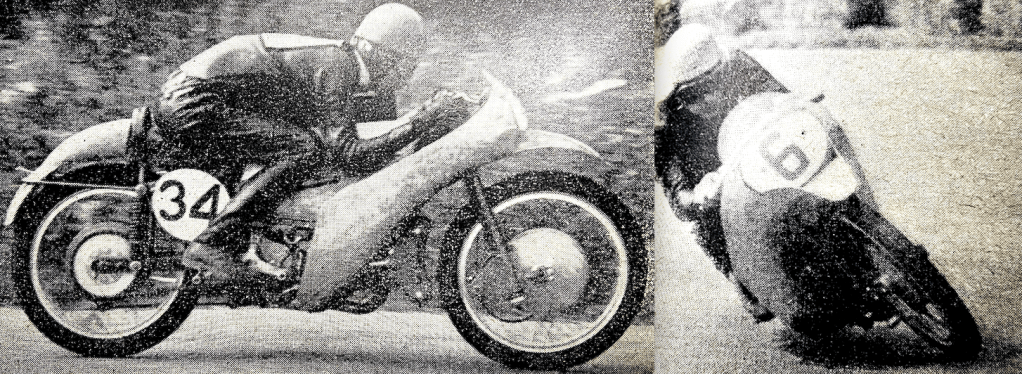
Wünsche halts at this stage to discuss an alarming engine noise with his pit and by the time he continues, still with the noise, only the three Guzzis are on their 21st lap. Yet the race is warming up, for there are now four men scrapping for fourth place—Müller, Hobl, McAlpine and Simpson. With a lap to go their order is Hobl, Simpson, McAlpine and Müller. And at the finish it is the same. Lorenzetti is the winner but Anderson, of course, has already established himself as the 350cc champion by winning in Switzerland. Results of the 350cc Race (24 laps=93.9 miles): 1, E Lorenzetti (Guzzi), 99.55mph; 2, F Anderson (Guzzi); 3, D Agostini (Guzzi); 4, A Hobl (DKW); 5, L Simpson (AJS); 6, W McAlpine (Norton); 7, HP Müller (Horex); 8, KH Mudford (AJS); 9, R Laurent (AJS); 10, JH Storr (Norton). Record lap: E Lorenzerti (Guzzi). 101.47mph (the race speed also constitutes a record).THE 250CC RACE Out come the Guzzi team again, and the DKWs, to do battle with NSU and Parilla and a lot of privately-owned Guzzis in the 20-lap 250cc race, for which there is a field of 30. There has been a lot of difficulty in persuading Anderson’s Guzzi to start for the warming-up, and at the fall of the flag it still will not respond. Nor will new boy Ken Kavanagh’s, which is going to make life doubly difficult for Lorenzetti, seeing that at least two of the NSUs—Haas’ and Brandt’s—shot away ahead. Indeed, it is only as the first lap concludes—with the field led by Haas, Brandt, Wünsche (DKW), Lorenzetti, Masetti, Armstrong, four works NSUs with one Guzzi in the middle—that the pair start. And Anderson completes only one lap after that. Lorenzetti, however, is out to set the pace—which could quite probably be very much to Haas’ liking—and takes the lead on Lap 3. Kavanagh, although a lap adrift, is going faster than anyone else in the race, faster even than the pair who are in the lead, but the organisers have the black flag out for Ken and presently he spots it and comes in, after putting the lap record up to 100.82mph. It appears that the Australian has been disqualified ‘per essere stato spinto in partenza’, a free translation of which is that he had assistance to change an oiled plug. By half-distance Lorenzetti and Haas are still disputing the lead. Way back, Alano Montanari, on another works Guzzi, is scrapping with Brandt and Armstrong and, farther back still, there is a race going on between Tommy Wood, Arthur Wheeler and Angelo Marelli, all on private Guzzis—and ahead of Masetti, who called at his pit some time ago but resumed the race to the accompaniment of cat-calls from the crowded grandstand. Lap after lap, the lead changes between Lorenzetti and Haas; and first Montanari, and then Armstrong, and then Montanari is third. Masetti proves that his NSU is now running well by staying with the leaders—after being lapped by them—from the 13th to the 17th lap, by which stage Lorenzetti is drawing away slightly from Haas. With two laps to go Lorenzetti is 5sec ahead of Haas and Montanari has 2sec over Armstrong. And thus they finished. Results of the 250cc Race (20 laps=78.3 miles): 1, E. Lorenzetti (Guzzi), 98.53mph; 2, W Haas (NSU); 3, A Montanari; 4, HR Armstrong (NSU); 5, W Brandt (NSU); 6, U Masetti (NSU); 7, TL Wood (Guzzi); 8, AF Wheeler (Guzzi); 9, A Marelli (Guzzi); 10, B Francisci (Guzzi). Record lap: E. Lorenzetti (Guzzi), 100.17mph (the race speed also constitutes a record). THE SIDECAR RACE The lunch interval is over and well behind schedule, the 16-lap sidecar race with 20 entries is about to start. Eric Oliver is here and so is Cyril
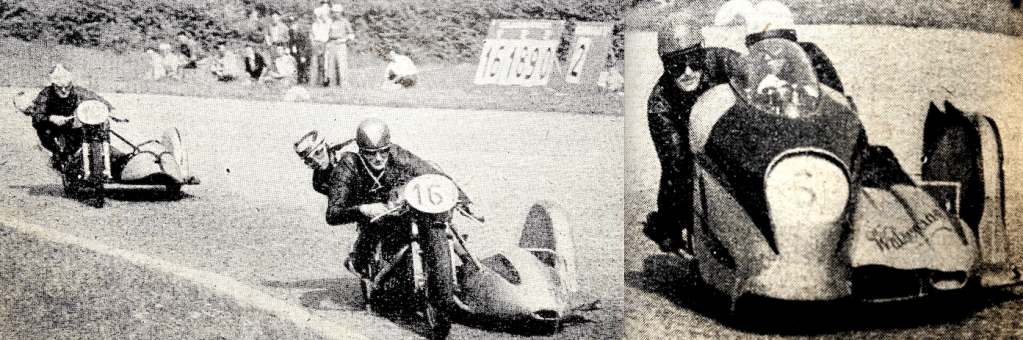
Smith, both with works motors in their Norton outfits, and Noll has a factory BMW. Oliver is out to win and goes into the lead within the first mile; but the lap ends with Smith in front, Oliver in his slipstream and Switzerland’s Hans Haldemann a very close third. Drion, on the streamliner, is fourth, followed by Belgium’s Julien Deronne (Norton); then Freidrich Hillebrand on his private BMW and Noll on the works job. For some laps Oliver and Smith race side by side. Meanwhile Noll is coming up and by the end of lap five is only five seconds astern. Haldemann remains a close fourth and Drion is on his own in fifth place. But there is nothing at all to choose between Taylor, Hillebrand and Deronne who are contesting sixth place. Noll stops for a plug change on lap seven, dropping astern of the Taylor-Hillebrand-Deronne trio, and at half distance—when Oliver and Smith are still racing wheel to wheel—coasts in to retire. Oliver keeps a machine’s length ahead for two laps then Smith turns the tables for the next two, only to be passed yet again on the 12th circuit, a period in the race which marks Drion’s progress into third place ahead of Haldemann. Oliver keeps ahead right to the last bend and leads into the final straight—but then Smith pulls out to overtake—and looks like doing it, but finds his line blocked by Oliver. And that is that! After an interval of one year Oliver has resumed his reign as World Sidecar Champion. Results of The Sidecar Race (16 laps=62.6 miles): 1, ES Oliver (Norton sc), 88.79mph; 2, C Smith (Norton sc); 3, J Drion (Norton sc); 4, H Haldemann (Norton sc); 5, LW Taylor (Norton sc); 6, F Hillebrand (BMW sc); 7, J Deronne (Norton sc); 8, E Merlo (Gilera sc); 9, M Masuy (Norton sc); 10, L Marcelli (Gilera sc). Fastest lap: ES Oliver (Norton sc) and C Smith (Norton sc), 91.16mph.THE 500CC RACE Now for the MV-Gilera battle for 500cc honours! Gilera are fielding Armstrong, Dale, Duke, Pagani, Liberati and Pierre Monneret on fours, and MV have Bandirola, M Giani, Francisci, the German Müller and Cecil Sandford as Masetti has become a non-starter. The only possible opposition to these fours can come from Anderson with the Guzzi four or from Zeller with the streamlined BMW. There are 28 starters, due to cover 32 laps. Into the lead off the grid go Francisci and Sandford, but a race like this takes a lap or two to sort itself out, and at the moment
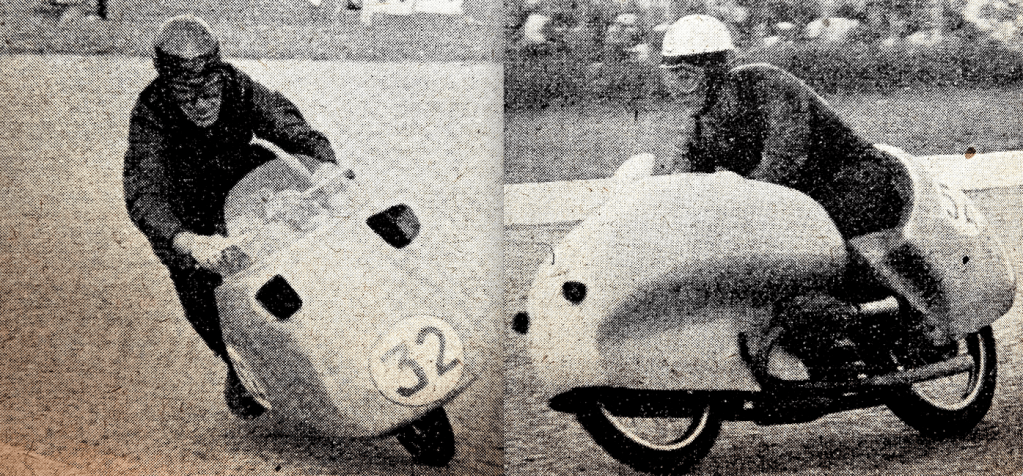
all the excitement is engendered by the enormous amount of hissing and whistling directed at the flag marshal, who set the race in motion without waiting for Armstrong and Pagani to complete their plug changes. Soon Geoff Duke moves into his accustomed first place and by the end of lap five it is Duke, tailed by Dale, who leads the race, with Sandford on the rival MV a good third. Then come Liberati, Anderson on the Guzzi, Giani, Pierre Monneret, Francisci—and Reg Armstrong, already among the leaders despite his wretched luck at the start. Bandirola retires at the pit and Zeller, who has not been making very good running, has had a long halt at his. John Storr and McAlpine on their Nortons are leading the private runners. By quarter distance Duke and Dale are almost neck and neck out in front, with Sandford still a close third, and Anderson fourth. Anderson tours in after a slow 10th lap, but not to retire. After adjustments he carries on, over a lap adrift. And by the end of the 14th lap Duke has a 10sec lead over Dale and nearly half a minute over Sandford. Liberati is fourth, Monneret fifth and Armstrong sixth. Roland Schnell, on the ‘semi-works’ single-cylinder Horex bereft of its shell, has been lapped but is holding 10th position, some distance ahead of a close sextet consisting of Storr, F Benasedo on a Guzzi single, Laurent and E Galante on Nortons, and L Facchinelli (Gilera Saturno). By half-distance Liberati has taken third place from Sandford, thus putting three Gileras out in front, and Anderson has retired—as did Zeller some time ago. Lap 19 sees Monneret go ahead of Sandford and at three-quarter distance Monneret passes Liberati and Armstrong passes Sandford. Schnell has retired and Duke has now lapped Benasedo, Storr, Galante, Laurent and Faccinelli for the second time. The end of laps 27, 28 and 29 and Duke is all on his own, right out in front. Now there is only one lap to be run and bad luck has overtaken Monneret who has just coasted in, put out of the race with apparent carburetter trouble. Duke is on his way round to get the chequered flag and Armstrong is now just eight seconds behind Liberati. There’s Duke, the winner—and Dale, right back on form, second. And Liberati is still third. Now for that private owners’ scrap which has been going on throughout the race. It is John Storr who has won it by a machine’s length from Benasedo, Galante and Facchinelli—and it will need a photo finish camera to decide which of that trio was first over the line—and Laurent is only a yard of so behind them. Results of the 500cc Race (32 laps=125.2 miles): 1, GE Duke (Gilera), 106.84mph; 2, RH Dale (Gilera); 3, L Liberati (Gilera); 4, HR Armstrong (Gilera); 5, CC Sandford (MV); 6, HPMüller (MV); 7, N Pagani (Gilera); 8, B Francisci (MV); 9, H Storr (Norton); 10, E Galante (Norton). Fastest lap: RH Dale (Gilera), 108.01mph (the race speed constitutes a record).
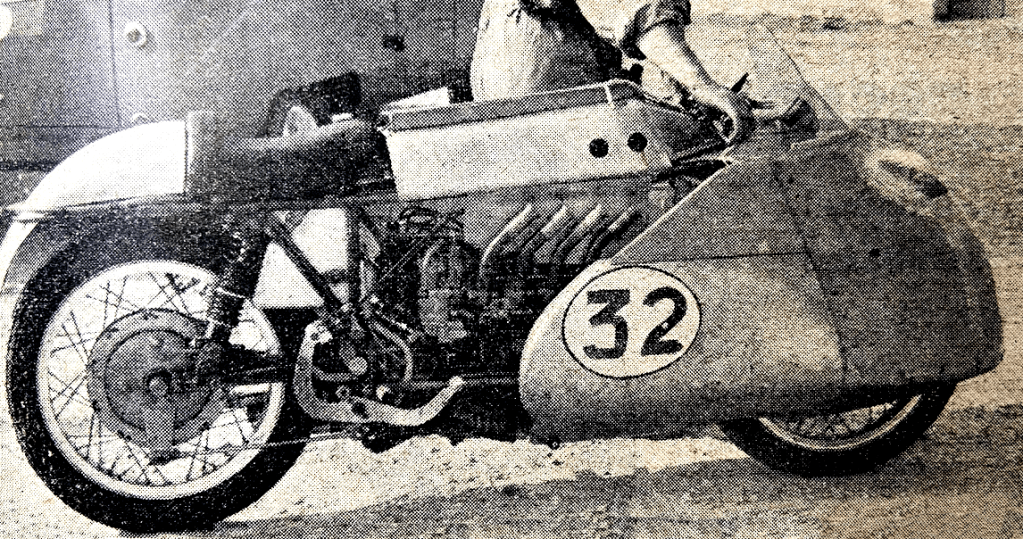
“ALTHOUGH NO OFFICIAL statements have been issued by the manufacturers, the absence of the AJS and Norton works teams at Monza on Sunday confirmed rumours circulating at the conclusion of the Swiss Grand prix last month that it was the intention of the two factories to withdraw from racing for the remainder of the 1953 season. The decision taken will be regarded variously as impolitic, regrettable or completely logical according to the viewpoint of the individual reader, but we would remind those who may be tempted to place a hasty interpretation upon the action that it is one thing to criticise and another to criticise constructively. With the destinations of the Manufacturers’ Championships virtually settled at Berne, could the heavy expense of competing in Italy, and later in Spain, justifiably be charged to sportsmanship, or could the time and money saved by abstention be used to better advantage in, presumably, making preparations for the 1954 season? We imagine that few readers, if placed in a position of responsibility to a body of shareholders, would have arrived at a verdict differing from that reached, independently of one another, by the manufacturers concerned.”
“A FAIR RIDER invites me to mention a matter which will probably generate much acidity. To judge from an enclosed photograph, there is nothing at all mannish about her. For purely practical reasons she detests a skirt when riding a motor cycle, whether on saddle or pillion (in theory I entirely agree with her; a skirt is meant to have graceful, flowing lines, and is as ugly under the conditions named as it is potentially dangerous). So she is set to choose between jodhpurs (with masculine stockings, or light gaiters), and slacks. She much prefers the jodhpurs, alike for convenience and appearance. In her opinion it is impossible to keep slacks neat, clean and creased aboard a motor cycle. She does not much mind being stared at, though she hates small boys jeering at her along the street when dismounted. Fools rush in where angels fear to tread. I. hold three strong opinions on this topic. They are: 1, no skirts in the saddle; 2, no slacks on buxom ladies; 3, jodhpurs in the saddle and on the pillion.”—Ixion
“THE 247CC NSU MAX, a product of Germany’s largest motor cycle factory, is typical of the technical enterprise which characterises post-war Continental motor cycle design. In many respects the machine represents a bold break-away from orthodoxy. Among its outstanding features are a welded spine frame and an enclosed rear driving chain. Exhaust and mechanical quietness have been studied to an unusual degree. The silencer is no less than 38in long, with a major diameter of 4in. The overhead camshaft is operated by the ingenious Ultramax valve-gear layout which employs eccentrics and long connecting rods to transmit the drive from crankshaft to camshaft. The external design of the power unit provides clean, symmetrical lines. Not only is unit construction of engine and gear box employed, but the 45-watt generator, voltage-control unit, ignition coil, contact breaker and automatic advance and retard mechanism are all enclosed in a compartment formed by the right-hand crankcase cover. Accessibility of these components is not impaired, since they may be exposed by the removal of five screws and the cover. Steering and stability of the NSU are of a high order. When ridden over treacherously wet wood blocks and stone setts the machine immediately inspired an unusually high degree of confidence. No skidding was experienced, nor anxiety felt, under these conditions, in spite of the use of driving methods calculated to provoke instability. There is a strong self-centering tendency about the steering, which was rock-steady at all times. The steering damper was used only to maintain the steering in the straight-ahead position when the machine was on its stand with the front wheel off the ground. At any speed within its compass the NSU could be heeled over stylishly and with every confidence. The riding position proved to be comfortable for a rider of comparatively small stature. Taller riders, however, would probably prefer a slightly higher
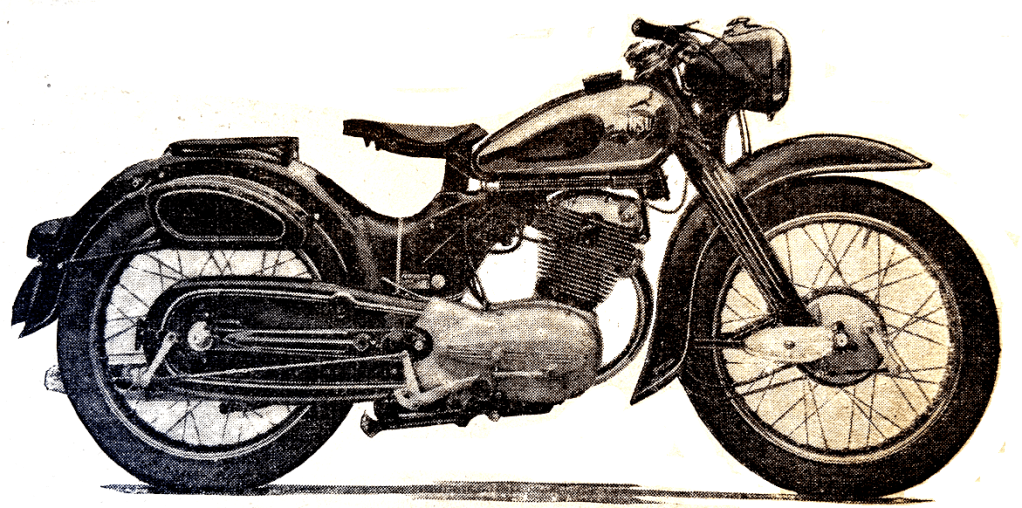
saddle position. All controls, both hand and foot, could be suitably positioned for convenience of operation. Particularly good are the combined horn button and dip-switch, both of which are readily operable by the rider’s left thumb. The twistgrip is of the slow-action type, requiring a full 180° rotation from tickover to full throttle. Backlash in the operating mechanism was present and it could not readily be eliminated. All-round engine performance was remarkable for a 250. In fact, it compared favourably with that of non-sporting machines in the next upward capacity class. Exhaust and mechanical noises were extremely well subdued at the beginning of the test, though there was a slight deterioration in both respects towards the end. As regards mechanical noise, it should be recorded that adjustment of the valve clearances was not attempted throughout the test. As regards exhaust noise, a rattle which developed in the silencer suggested that a baffle had come unwelded. Judging by the performance figures, the massive silencer was effective without causing undue back-pressure. Induction hiss was completely eliminated by the air filter. Cold starting was a simple matter provided the air lever was fully open, the throttle only fractionally open and the carburettor tickler left severely alone. Warm starting was not so certain and frequently required a large throttle opening. A slow and regular tickover was usual when the engine was cold. With the engine warm idling was inclined to be unreliable unless set rather fast, and carburation was a trifle erratic just off the pilot jet. This apart, the NSU’s traffic manners were exemplary. Smooth and lusty acceleration was obtainable from very low rpm, and the engine was quite happy at well below 30mph in top gear. On the open road, not only was the machine capable of working indefinitely up to the limit of its performance, but it revelled in doing so. Excellent flywheel characteristics and pulling power resulted in fine hill-climbing. Good acceleration was maintained right up the engine-speed range.Engine vibration was negligible and, after many miles of full-throttle, the cylinder was sufficiently cool for the rider’s hand to be held comfortably on the fins. With the rider normally seated and bulkily clad a genuine 60mph was attained against a moderate wind while downhill 70mph was frequently reached. At the conclusion of the test, the exhaust pipe had blued over a considerable length from the port. Two sparking plugs became fouled during the course of the test. The gear-change pedal is on the left-hand side of the NSU and operates on the basis of upward movement for upward changes; the pedal had a rather long travel. Once these characteristics had been mastered clean changes could be made in either direction with a normal, leisurely movement of the foot. Engagement of bottom gear from neutral was noiseless, and neutral selection was extremely easy from either bottom or second gears. The clutch had a smooth and positive actin; it remained unaffected by considerable abuse when the performance figures were taken. Both brakes were smooth in operation and notably
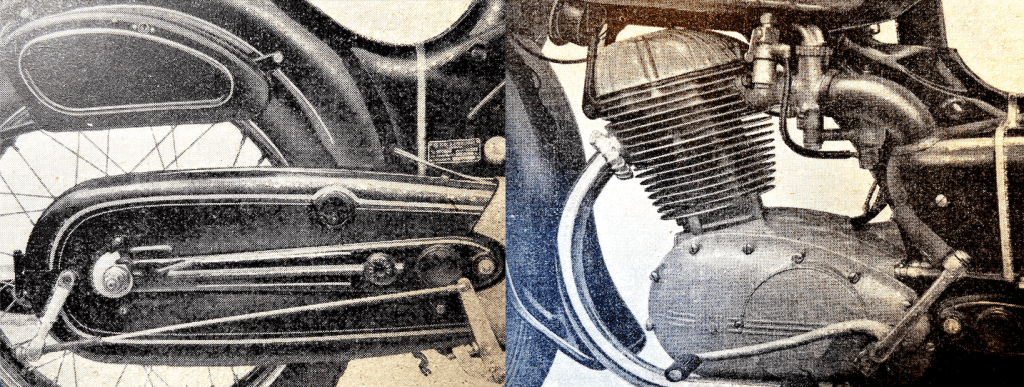
powerful. The leverage of the rear brake control is such that the wheel could be easily locked. As received, the front brake was below par. Dismantling revealed nothing amiss, but the brake shoes were centralised in the drum during reassembly. Thereafter extremely good results were obtained. A fair degree of pressure on the handlebar lever was required, but the front tyre could readily be made to squeal. A peculiar reaction to the use of this brake was a marked lifting of the front of the machine, due to the brake torque being transmitted to the fork link. Prolonged use of the front brake caused the friction material to expand appreciably, thus reducing the backlash in the operating cable.Three aids to rider comfort are provided—the bottom-link front fork, pivoted-fork rear springing and a cantilever saddle. By modern standards the wheel suspension was judged to be a little hard and would probably react well to the use of softer springs and heavier damping. A fair amount of pitching was experienced; this stemmed largely from the saddle, the spring of which had a strong, undamped action. The Bosch electrical.equipment is first class and robustly constructed. The horn gave a penetrating note. A wide, intense headlamp beam made fast night riding a pleasure. The shallowness of this beam, however, resulted in some shortening of its range when the machine was heeled over. An auxiliary control on top of the headlamp enables the reflector to be dipped a few degrees to compensate for the carrying of a pillion passenger. A fuse is provided in the electrical circuit and this, indeed, safe-guarded the lamp bulbs when a chafed wire mused a short circuit. Many detail features of the NSU Max are worthy of mention. Not only is the ignition switch removable, but a steering lock can be brought into action when the front fork is turned hard to the right. The key to this lock also fits the pannier-type battery and tool boxes. A fuel filter is interposed between the tap and the carburettor. The NSU proved commendably clean to ride. Not a vestige of external oil appeared oh the power unit; the chain case obviated the usual messiness on the rear-wheel rim. In dirty weather, the valanced mudguards were remarkably effective.”
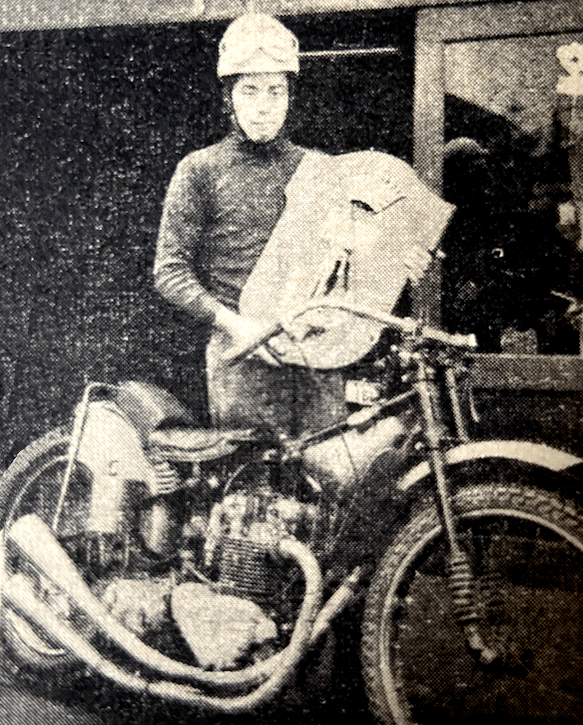
“LAST SATURDAY’S EXPERTS’ Grand National Scramble fully lived up to its title by providing a skilful and thrilling demonstration of the art of cross-country racing. The main attraction in a programme of five races was the 15-lap event restricted to competitors who conformed to the ‘Expert’ qualification. This required that each rider must, in the preceding 12 months, have won a premier, class or first-class award, or have finished in the first six, in a national scramble, or have won a premier or class award in an open-to-centre or group scramble. Eligibility for the main event was also extended to members of this year’s British Moto-Cross, and North and South, scramble teams. The meeting was organised by the Redditch Club on the 11-mile circuit at Rollswood Farm, near Alcester. The course includes grassland, bumpy and precipitous gradients, tracks among tree roots and rocks, and a watersplash…Ideal scrambling weather favoured the Experts’ race. With two exceptions, the field got away to a regular start. At the first corner—a left-hand hairpin—BG Stonebridge (498 Matchless) led a close-packed bunch of competitors and was riding with a zest which bespoke a determination to repeat his week-old success at Brands Hatch. In less than three minutes, the first-lap leaders rocketed up the hill and round the left-hand bend on to the finishing straight. BW Hall (499 BSA) led from J Avery (499 BSA) and, last year’s winner, GH Ward (498 AJS). Poor Stonebridge had thus early taken a toss, sustaining a foot injury which prevented him from any further part in the meeting. By the end of Lap 2 Ward had forced his way past Hall and Avery, but his lead was short-lived. Hall re-established himself in first position during the next lap and steadily built up a commanding lead over Ward. Meanwhile, Avery was riding fiercely some 100 yards astern of the AJS exponent, while farther back LR Archer (490 Norton) headed BSA riders GJ Draper and D Rickmam. Soon the leaders were lapping the men at the rear of the field and in the consequent baulking Ward closed up on Hall. As the two riders went to pass a slower man during the eighth lap he pulled into Hall’s path, leaving Hall the alternative of ramming a tree or exploring a ploughed field. Hall chose the latter course and his consequent delay in regaining the circuit left Ward in an unassailable position at the head of the race. In third and fourth places, BSA team-men Avery and Draper, were enjoying a spirited tussle which eventually resolved itself in Draper’s favour. Their ascent of the steep, bumpy hill at the end of each lap was invariably spectacular in the extreme. Throughout the second half of the race Hall’s riding was immaculate and, though his chance of catching the flying Ward was remote, he managed to reduce the large gap slightly. Stalwart performances were put up farther back in the field by PA Nex (499 BSA), WP Walker (349 BSA), GL Jackson (498 AJS) and JB Houghton (346 Royal Enfield). Barugh’s 197cc Villiers-engined Dot proved more than a match for many larger-capacity machines. Ward ran out a comfortable thinner from Hall while Draper continued to ride like a demon to fill third place.”
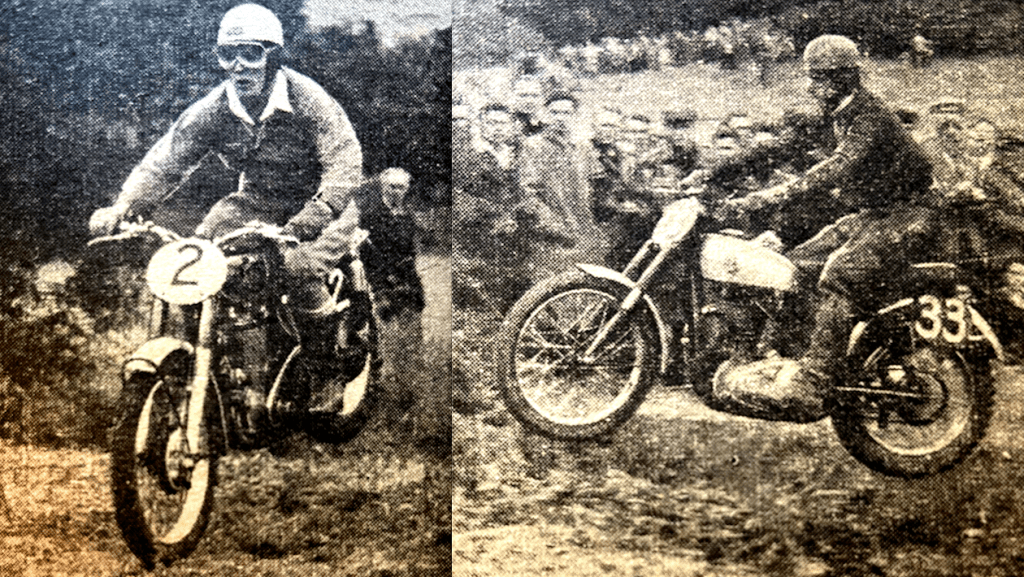
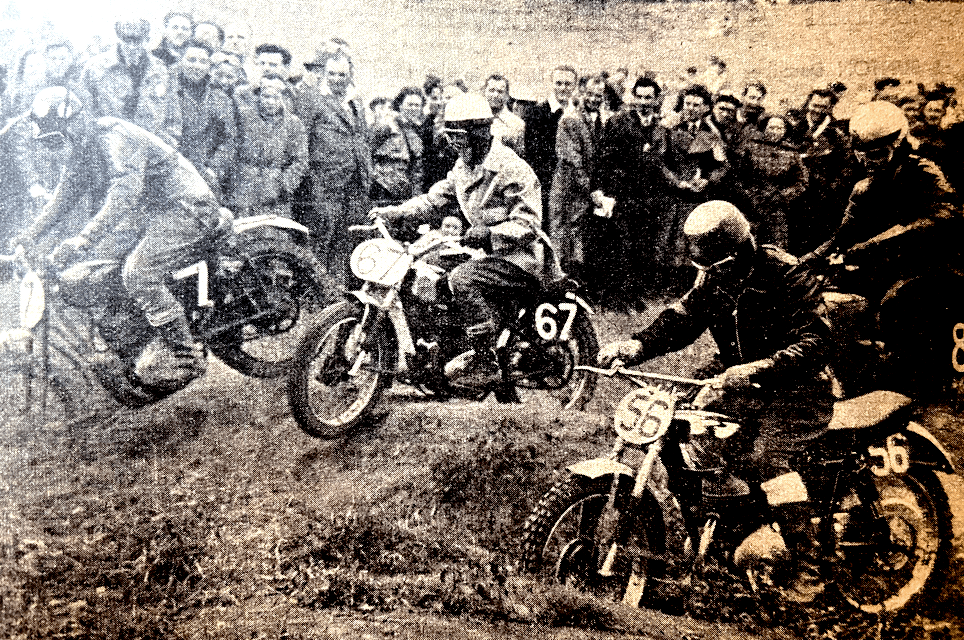
I really have no explanation for the following yarn. The Blue ‘Un published it, I enjoyed it and I hope you do too—Ed.
“DO YOU REMEMBER that some time ago I asked. if anyone could sell me an octopus? The response was amazing. I reckon I must have received over 200 letters from folk with surplus octopi. Some of the creatures were obviously quite useless. Take the case of the retired admiral at Higham and Hundred of Hoo. He had an octopus he captured in the Indian Ocean way back in 1892, and, as the creature was now well past its prime, it was tending to be very bad tempered, and had bitten three hire-purchase company representatives and frightened the life out of a company of Salvation Army trombonists. Another black mark against this animal was that it did not know the first thing about motor cycles. After a great deal of trouble I eventually found the octopus. A man at the American Legation in London was being transferred to Russia and the Soviet authorities refused to allow him to take his pet into their territory. They had an idea it was a new and extremely powerful bomb for blowing up comrades. I had look at the octopus, named Wild. Bill Hicock, and saw immediately he was just the animal I had been looking for. The deal was completed and I took Wild Bill by one tentacle and we caught a bus back to Woodford. Wild Bill caused a certain amount of confusion on the bus—perhaps I should had taken him on my pillion seat, but I did not have a spare pair of goggles at the time—so a bus it had to be. At Woodford I introduced Bill to his new home (an inspection pit in the garage filled with salt water), showed him where the light switch was, gave him the BSA instruction book to read and left him for the night. For a couple of weeks everything in the garden was lovely. Wild Bill was worth his weight in gold in assisting with repairs, and was rapidly learning to carry out minor adjustments all by himself. Then one day I was checking on my petrol purchases and found I was getting only about 30mpg. Bill and I checked the machine for petrol leaks, gave the carburettor the once-over, examined the timing and so on but could find no apparent reason for the high consumption. I rigged up a test tank and found I was getting somewhere about 70mpg at a steady thirty per. Strange. It was quite by accident that I discovered what was going on. The man next door was chatting to me one day and he remarked how intelligent Bill was. ‘Goes out for a spin on your machine every night,’ announced this worthy. He did, did he? I had a stormy scene with Wild Bill and convinced him of the folly of his ways. ‘Apart from any other consideration,’ I argued, ‘the machine is not insured while you’re riding it, and you would get into frightful trouble if you were caught.’ Bill seemed to repent and for a few more weeks things went very well. Then it happened. On Tuesday night at about 11pm there was a knock on the front door. Outside was a policeman, and in the road was a police car with a dejected Wild Bill slumped in the rear seat between two brawny traffic cops. ‘Is this animal your property?’ asked the cop sternly. I had to admit it. ‘We picked him up at Epping, drunk in charge of a vehicle, to wit, a 998cc Vincent Black Shadow. He has also resisted arrest and badly damaged one policeman’s helmet.’ This was it. We were in trouble now. At the court Wild Bill was found guilty on all the charges, fined £5, and had his driving licence suspended for two years. The incident so broke his proud spirit that he just sits brooding in his pit all day long. An octopus specialist tells me he must have a companion if he is not to go into a decline, so I now need a lady octopus with a clean licence to take Bill out for spins in the country. Can someone help, please?—MYLES STONE.”
…and a couple of issues later…
“THIS IS POSITIVELY the last time I have a good idea of any sort. The original scheme of having an octopus for an assistant was fine in theory, but the complications that arose! You will remember Wild Bill had his licence suspended and was gradually going into a decline through boredom and misery. After a great deal of trouble and expense I found an attractive, young female octopus, brought her home, and introduced her to Bill. ‘Now,’ I thought, ‘everything will be all right again. Bill has a companion, he will not be bored and waste time brooding, and we can get on with checking my motor cycle.’ That was what .should have happened. But instead of helping me, Bill spent most of his time leering unpleasantly at Amy, who, I regret to say, encouraged him in this practice. It didn’t end there, either. This precious pair used to take my machine out and stay away, for hours. I had a shrewd suspicion they used to go to a disused airfield near my home and dice the model round the perimeter track. It was a bit thick, you know. After all, I was not running a social club and I think I had done Bill very well. I’ll bet not every motor cyclist would look after his octopus as well as I looked after Bill. And what did I get in return? Sulky help with the machine, stolen rides on the model, often when I wanted it myself, and a great deal of dumb insolence from Amy, who was fast developing a most unpleasant superiority complex. Eventually, I had a serious talk with Bill. I pointed out the error of his ways and delivered an ultimatum. I told him all this gallivanting round the countryside at all hours of the day and night was bad for all of us. ‘You must,’ I said, ‘find your amusements at home—after all, you are not some giddy teen-ager who must be out every night of the week.” That was the worst advice I could have given this precious specimen. Do you know what I found in the garage this morning? Twelve little octopi swarming all over the place! London Zoo does not want them, and I am getting a bit desperate. Would anyone like fourteen octopi? I am prepared to let them go at a very reasonable price.—MYLES STONE.”
…and then the Blue ‘Un ran a jokey ‘interview’ with the designer of an insane bike and attracted a reader’s letter…
“IT WAS WITH a growing sense of distaste that I read the article ‘Myles Stone Drops a Brick’, which indeed he did. I recognised the described machine instantly as my own Z Special. This machine has served me faithfully for three years, during which time I have become fully appreciative of its many advantages, which are as follows (1) The dynamo under the saddle is completely out of the way of extraneous road water and dirt. (2) The tank-top battery is readily accessible for topping up, and is also useful as a map holder for cross-country runs. As it is a car-type battery, I can leave the lights on all night with impunity. (3) I have gone one better than the designers and fitted an extra carburettor, which gives even more shattering petrol consumption and also makes the machine wonderfully interesting to tune. (4) The exhaust system not only heats the saddle but, by reason of its many curves, effectively causes a considerable back pressure. (5) The ohc-operated exhaust valve, in view of its exposed position, keeps fairly cool in spite of its usual coating of road dirt; indeed, the metal has never actually melted. What heat is generated is very useful in expanding the valve gear to take up wear there being no adjustable tappets to cause unnecessary noise. (6) The banana oil lubrication is very economical. Being particularly addicted to this fruit, I can eat the bananas for tea before squeezing their skins (to
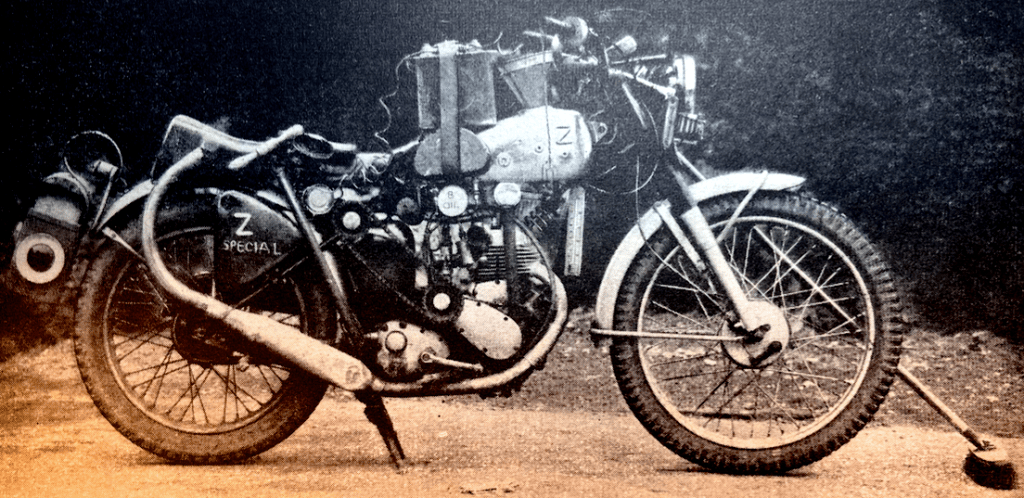
provide lubricant) into the small tank fitted for the purpose. (7) I must admit to a longing for a kick-starter. Such starting is made very difficult by the crankshaft flexion causing an inordinately high compression ratio. (8) The gear box has a commendable habit of rotating in the frame; this is very useful for draining out the old oil. The rotary motion also sets up a draught which cools the gear clusters. (9) I cannot agree with Mr Slammer that the reciprocating mass of .the double-edged bobweight exactly matches the inertia of the bobbleweight on the primary rotating column. I would suggest the introduction of a deflectorbolus in the induction tract, thereby causing a venturi effect which would not strain the modulus of elasticity (Young’s) in the crankpin. Consider this formula as opposed to the factory’s: ˣ⁄ᵥx3 3/4Z MPH m² (answer in brake hearse power in converse ratio to brake mean effective pressure). I would suggest the utilisation of proggling iron in the connecting rod in place of the existing curtain rail, and balsa wood with snogget wheels to form the big-end bearing. This would give an extraordinarily large reciprocating mass, causing high vibrational harmonic frequencies which, working is with the modulation of crankshaft distortion, would not affect the ignition timing. (10) The fire-resisting rubber originally inserted in the cylinder head to keep the piston down to reasonable limits deteriorates very rapidly, and I have replaced it with hard polyvinyl flexible head bolts which allow the cylinder head to rise with the piston, thereby acting as a safety valve in the event of too high a compression ratio. (11) The proven fact that internal combustion engines run better at night owing to the high water content of the atmosphere has prompted me to fit a funnel to the petrol filler cap so that rain-water is introduced into the fuel. The funnel is transferred to the battery when the latter needs topping up (rainwater being distilled water). (12) The camera mounted on the front of the machine supplies evidence for a survey I am compiling of the life and death of the the jay walker. (13) In view of official interest in rear lighting, the existing rear lamp has been augmented by the addition of the older, but reliable, type of oil-burner in a neat nacelle. (14) The tyre saver to be seen at the front is of my own design; I propose to offer it to next year’s ISDT team. (l5) The thermometer is merely a flippant afterthought added in an excess of enthusiasm. I trust that the foregoing points will be sufficient to convince your readers that the Z Special is indeed the world’s most interesting motor cycle (this is not a slogan).
DAVID WEEKS, Leeds, 2.”
“ONLY ONE BRITISH competitor, D Fitzgerald (498 AJS) was among the 58 riders to finish the gruelling 1,000-mile course of the Monaco Rally without loss of marks. Rain and fog in Central France during the night section tired competitors from northern starting points, and the succession of mountain passes in the Maritime Alps towards the end of the route took heavy toll of many who had completed the ordinary road sections without penalisation. Interminable hairpin bends on passes, rising in some cases to over 8,000 feet, had to be taken without a break at the same schedule speed as the main-road sections, and most of the riders arrived at the finish in a state of exhaustion. It was particularly tough on the sidecar entrants who had to average approximately 31mph; the same speed as the 350cc solos. Of the British contingent starting from Oxford, the outstanding performance was that of George Buck, the Midlands trials star who, driving a 997cc Ariel with Watsonian sidecar, was clean right up to the last section on which he was four minutes late. Only one sidecar competitor, H Petermann, of Germany, with a BMW outfit, finished without loss of marks on time. Buck was placed 62nd in the general classification. Both the other sidecar out-fits which started from Oxford finished. N Noyes (998 Vincent sc) got through until the last section without penalty and then lost 14 to be placed 71st in the list, and CE Allen (598 Panther sc) limped into the finish with a damaged outfit; he had crashed when avoiding a non-competitor on one of the mountain passes. With a loss of 62 marks on time, he was placed 91st. S Broomfield and E Hewlett, both on twin Vincents from Oxford, retired near Grenoble after losing their way in Central France. This put the Vincent Owners’ No 1 team out, although the other member, W. Francis, got through with a loss of 74 marks to finish 95th. In the Vincent No 2 team of five riders, R Chaplin and H Guicheteau collided and both retired. The remaining members of the team, J Handy, H Davies and R Maclachlan, were listed as retirements. D Hill (498 Triumph) who, like D Fitzgerald had started from Monaco, lost 24 marks and was 77th. General Classification: 1, H Sangsue (350 Condor); 2, R Zimmermann (350 Condor); 3, W Flurkiger (350 Condor); 4, C Schreuders (175 Maico); 5, S Cononencko (175 Guiller-AMC); 6, H Neuhaus (598 BMW). Sidecar Class: J Rogliardo (500 Terrot sc). Ladies’ Class: Mme EL Koppen (250 Adler). Best Club and Manufacturers’ Team: Condor (J Roth, W Flurkiger, R Zimmermann, H Sangsue). Best National Team: Switzerland. Class Awards: 175cc, C Schreuders (175 Maico); 250cc: K Berthelsen (250 Puch); 350cc, H Sangsue (350 Condor); Unlimited cc, H Neuhaus (598 BMW).”
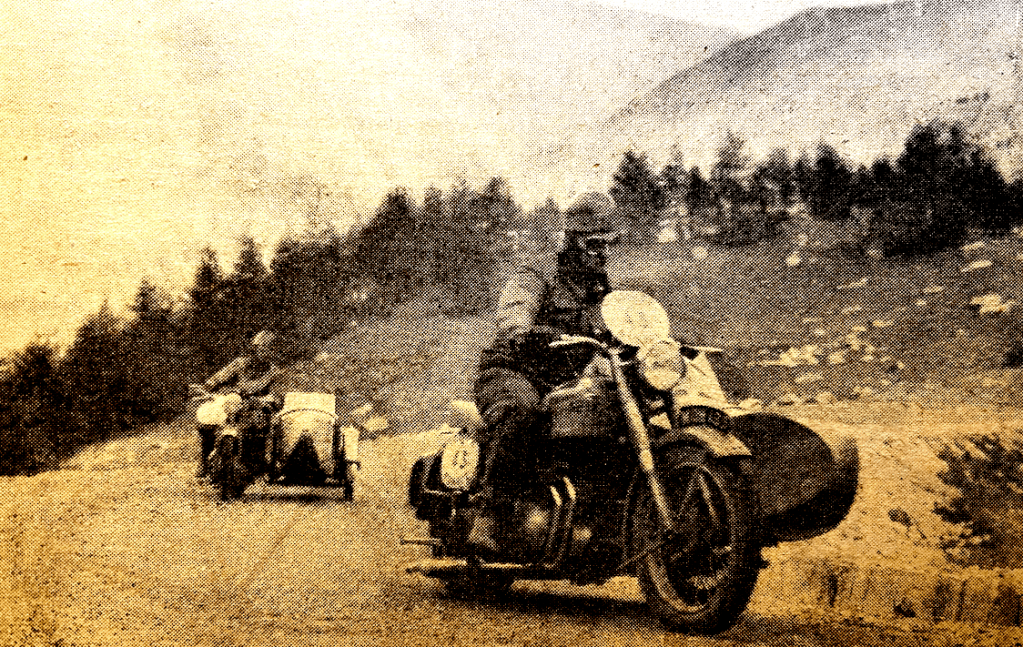
“‘NOT UNTIL YOU have ridden right through the night and are tired and critical can you really judge the merits or demerits of a machine.’—CEA, The Motor Cycle, 26 February 1953. ‘Modern multis are very nice but when it comes to covering long distances at high speed, and especially when hauling a sidecar, the vintage type of big single still takes some beating.’—CEA Allen, Vintage Bulletin, quite often. Profound statements like that come easily, but can bounce back and cause a lot of trouble, especially when one is talking to a dyed-in-the-wool enthusiast like Jim Ferriday. ‘This new pannier idea of yours,’ he began. ‘If, as you claim, it is the answer to Continental touring, you ought to test it on the Continent. Pottering won’t prove anything, but if you were to ride in the Monaco Rally—covering 1,000 miles against the clock—you might learn something. You could also test our new cantilever-sprung Dualseat. A machine has bounced up and down on the seat for about half a million times without breaking anything, but we still don’t know what it feels like to the rider after a big mileage. And after you have ridden right through the night.’ he said with a grin, ‘you may be able to pass an opinion. As you are a vintage enthusiast,’ he went on, ‘I daresay you would like to use a vintage machine. I don’t think we can arrange that, but the Model 100 Panther seems to combine vintage characteristics with modem refinement, and you can see if you are correct in your views about multis and singles.’ We discussed the question of a sidecar. Obviously the man to see was Ron Watson, the Watsonian sidecar chief, who was runner-up for the sidecar award in the 1950 Rally. Ron’s knowledge of the event would be invaluable. He, too, believed that Continental rallies were excellent testing grounds, and there were one or two experimental features he would like tested—a sidecar-wheel brake intended as an optional extra for hard-riding sidecar men, and new-type chassis connections designed to permit fine adjustment of alignment. George Buck, well-known one-day exponent and ISDT competitor, had already entered on an Ariel Square Four, and was to try out the brake on the new, single-tube, coil-sprung Watsonian chassis. For use with what I considered was a vintage-type chose the standard Watsonian VG21 chassis which has probably been made in bigger numbers than any other chassis in the world. Tentatively I asked if the sidecar brake pedal could be arranged so that I could work it with the rear brake or independently. There was an ‘old-fashioned’ look on the face of the technical director, Cliff Bennett, which I did not understand until I saw their answer to the problem. A transverse pedal for the sidecar brake was arranged under the machine’s brake pedal, so the two were applied in unison. The sidecar brake
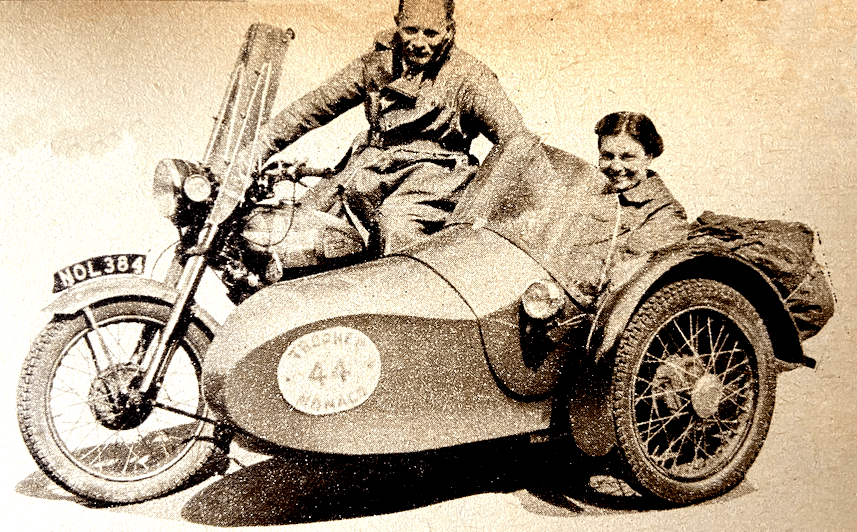
pedal was mounted on an adjustable clamp that could be slid along the chassis tube in a fore-and-aft direction to allow the brake arm to be correctly position in relation to the brake pedal of almost any machine. By depressing the machine’s brake pedal one applied both brakes; by moving one’s foot to the left, one could operate the sidecar brake independently for swinging the machine round left-hand corners. An intriguing novelty on the outfit was the pannier equipment. Like many enthusiasts, I had long felt that a new approach to the problem of carrying luggage on a motor cycle was overdue: that it was a pity to spoil the clean styling of a modern machine with a makeshift rig of strips, clips and racks. I visualised a smooth, one-piece unit, comprising twin boxes bridged by a tool box or spares locker, which could be removed in a few seconds if one encountered trouble at the rear end of the machine. An idealist’s dream, you might say, but the Feridax engineers produced a prototype which seemed practical enough. Considering the novelty of the concept, there was rough justice in my having to try it out. The unit solved the problem which most troubled my wife—how could we satisfy the incompatible sartorial demands of a tough motor cycling event and the cocktail party and presentation of awards at Monaco? Running-in time was short. I should have liked to have covered at least 3,000 miles before competing in an event such as the Monaco Rally, but this was out of the question. So I used unorthodox methods. The gear box was in for a rough time on the mountain sections of the route so, to give it more running-in than normal road-use would permit, I covered many miles in the indirect gears, the engine turning over slightly on a whiff of throttle, until the gear box felt really free. The engine seemed to enjoy this treatment and I calculated that in terms of normal revolutions it had covered double the normal running-in mileages. The seriousness of the Monaco Rally does not really dawn on one until the regulations are received. They comprise 30-odd pages of technical French. We made one slip in our translation, discovering, after my wife had practised the use of three stop watches, that ballast had to be carried for the regularity test. I did not have an opportunity to check the difference between inert ballast and a mobile passenger, but it was interesting to note that the ultimate winner of the sidecar class, Joseph Rogliardo, representing France, chose ballast in preference to a sidecar passenger for the entire trip. The realisation was rather sobering that, starting from Oxford at midnight on the Thursday, one would have no sleep beyond what could be snatched on the boat crossing, and no meal breaks beyond what could be gained from a 32mph average speed schedule. It was obvious from the start, where the Oxford Ixion Club attended to the machine inspection and sealing preliminaries, that the Monaco Rally had an atmosphere more like the ISDT than that of a normal road trial. There was only one untoward incident on the cross-
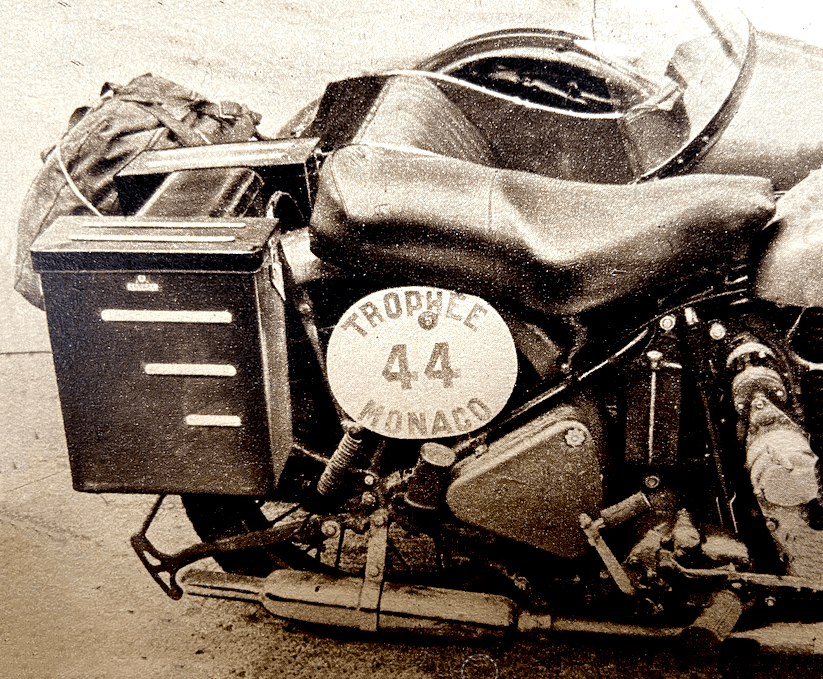
country run to Folkestone. The Reigate check was deserted and we had to persuade the local police to act as check officials. At Folkestone the local motor cycle club had laid on a wonderful reception and we were ushered through the formalities with great efficiency. The long, main-road run through France was comparatively uneventful. The Panther had a loping gait and we covered many miles at around 55-60mph. We could thus keep well ahead of schedule, and also keep in touch with the other sidecars from Oxford (George Buck on the 997cc four-port Ariel and N Noyes on a Vincent Black Shadow outfit). All along the route we were treated like racers. Police cleared a way and urged us through, and local motor cyclists insisted on leading us to and from the checks. By driving fairly hard on these sections we were making up enough time to have snacks and a look round the machines at each check, though we had a great disappointment at Lyon. After building up nearly an hour on time and looking forward to a real meal and a rest, we were misdirected by a gendarme and became firmly jammed in their equivalent to Covent Garden. By the time we had extricated ourselves from the tangle of fruit barrows and market stalls and prevailed on a taxi driver to lead us to the check, our precious break had been cut down to a quick cup of coffee. When we reached Grenoble on the Saturday morning the route began to toughen and as we climbed into the mountains it became increasingly clear that with our heavy outfit we should have to work hard to keep to the average speed. All routes had now converged and the roads were alive with the snarling two-strokes of Continental competitors. Some of these nippy lightweights possess remarkable speed, and we found it impossible to leave a 250cc two-stroke Victoria sidecar outfit over a give-and-take mountain route! Down one slope the howling baby sat on the Panther’s tail at 65mph. The tremendous pulling power of the Panther, however, came into its own on the long ascents, where I could often achieve 45mph in third gear, and then hold this speed in top. However, when we encountered narrow tracks on the edge of precipitous slopes, and only a few yards separated the hairpins, it became increasingly obvious that a narrow-track, low-geared, competition-type outfit would have been far more suitable. All the foreign men favoured narrow-track outfits, and their passengers performed remarkable acrobatics. It was on the Col de Cayolle, after being delayed by two flocks of sheep and—of all things to find on a mountain pass—a steam roller, that we ran into real trouble. On a narrow ledge with solid rock to left and a sheer drop to right, we encountered two tourists on solos. One made room for us to pass, the other waved us on; then, perhaps losing his nerve as he looked over the edge, the second man wobbled into our path. I avoided him, but the sidecar hub caught a projecting knob of rock and spun the outfit into the rock face. When I saw how the sidecar chassis was twisted and how drunkenly the machine leaned towards the body, I thought we were finished. But nothing serious had broken
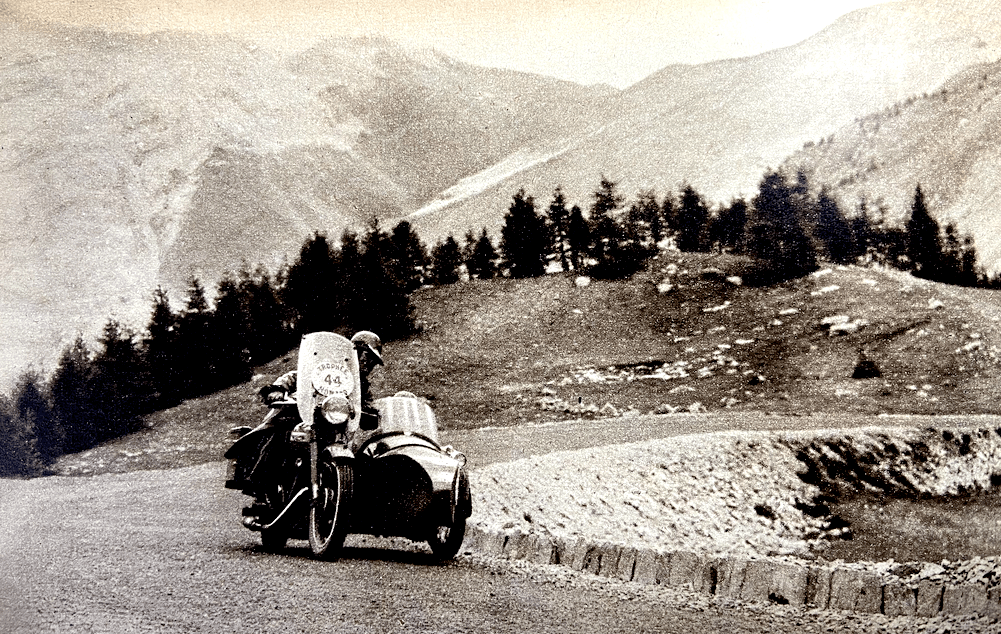
and with the aid of the special threaded connections I was able to get the machine roughly upright. We struggled on, determined to finish if it was humanly possible, though we found we had lost seven minutes at the next check. Thereafter, as the route became more and more precipitous, we had a nightmare ride. Our sidecar brake, which had been invaluable for wheeling us round the left-hand corners and which had provided first-rate straight-line braking when operated in unison with the rear break, was now out of action. The front brake, which had been fading earlier, now became virtually useless, and we slithered round hairpin after hairpin with a smoking rear brake. At this juncture I blessed the special heel-and-toe gear pedal with which the Panther had been fitted. When all else failed and we were running out of road I could select bottom gear by a downward movement of my heel and check the headlong tilt. The passes became more tortuous near the finish, and even an expert like George Buck, with his high-performance 1,000, lost four minutes. In fact, only three sidecars, and fewer than half the solos, finished on time. In our crippled state, it was a hopeless struggle, but somehow the game VG21 chassis held together, and we limped in an hour late with the nose of the sidecar almost touching the ground. Providentially, all the essential parts worked at the final examination. A faulty lamp or broken mudguard stay would have penalised us but, though everything was bent, nothing was broken, and we qualified for a bronze diploma. In 91st place among the 98 finishers we were not last—though not far from it. Not were we the only ones to finish the worse for incidents on the mountains. The Monaco Club knows just what to do when a weary motor cyclist staggers in to the finish. A girl brings a long, cool drink, officials gently wheel his machine to the final inspection park, and a taxi takes him to his hotel. The prize distribution bore the true Continental touch. Riders paraded with their machines and the appropriate national anthems were played as the premier winners came forward. Alas! no British entrant had achieved more than a diploma. We wished we could have seen a team of our own experts tackle this event—it has enormous publicity value on the Continent. The rally had been a gruelling but unforgettable experience—a real test of machine and equipment. It proved that the Panther has all the attributes of the best of vintage machines (even to the induction hiss, for all the world like that of a long-stroke Sunbeam), and it has superb staying powers. Towards the end I had to flog the engine unmercifully in an attempt to keep to time. Yet after1,000 hard miles it
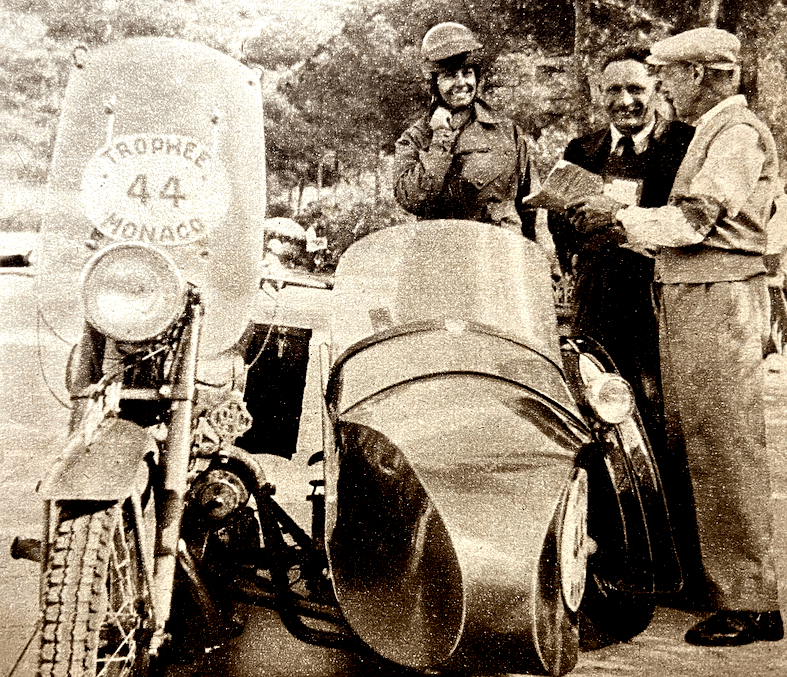
was as unruffled as when it started. I had worried about the effect of long, low-gear climbs on the oil temperature in the crankcase oil chamber, but I found one could place a hand on the aluminium at any time. The ribbed sump really did act as an oil cooler. To provoke fresh single-versus-multi argument, I would say that, to me, the long-legged gait of the Panther was definitely less tiring on the 600-mile main-road run than the hum of the 650cc twin I normally ride would have been. Moreover, the big single had that vintage characteristic of completely ignoring average main-road hills. For pass-storming, however, I found the heavy flywheels and relatively narrow revolution range a handicap. My job of work had been to test the seat and the panniers. The panniers stood up very well. No rattles developed, and the outward opening tool locker was invaluable when I had to carry out hurried adjustments. Many competitors had their tools secured to the tank top with rubber bands. Mine were ready to hand on opening the lockable lid. The seat passed with flying colours. I was riding one of the very few solid-frame machines in the event. Although my knees and arms were battered by the constant shocks as the outfit was hammered over pavé and pot-holes, never once did I bottom the cantilever springing system hidden under the foam rubber mattress. Never have I enjoyed such freedom from saddle-soreness on a long trip. This must have been partly attributable, also, to the shape of the seat top, which was curved like a horse saddle. One learns by experience and perhaps mine may be helpful to would-be competitors in the Monaco. I recommend the event to anyone who fancies a tough endurance test ending in Mediterranean sunshine. But it is wrong to regard the Monaco as a rally of the touring kind, and one needs more than a touring machine. Rather one should, I think, choose something on the lines of an ISDT machine, for the real trial occurs in the last few hundred kilometres in the Maritime Alps. Real performance and superlative brakes are essential. It appears to be a great handicap to start from Oxford, in spire the short break afforded by the sea crossing, since an extra night on the road is entailed. The real difficulty lies in remaining fresh enough after the road section to cope with the tight time schedules over the mountain passes. The event is a hard test for a machine, and perhaps an even harder test for a rider who may, through having a slow model, or through experiencing bad weather or minor trouble, have to run for as long as 12 hours without food or rest. Finally, an amateur must not expect to carry off a premier award the first time. It is extremely difficult for anyone without considerable Continental experience to ride on the public roads as the Continental entrants do. They regard the event as a road race and roar through villages and towns in a most terrifying manner! I must pay tribute to my wife; without her encouragement in the later stages, I should probably not have carried on. She, in turn, pays tribute to the comfort of the Avon sidecar–if anything it was too comfortable, and her big problem was to remain awake. There was one minor tragedy. When docking at Dover, my wife lost her handbag. It contained the Monaco medal which she bad endured so much to win.”
“CONGRATULATIONS TO MY old friend ‘Titch’ Allen for his stout performance in the Monaco Rally—and to the brave Mrs Allen for being the ideal wife! It would appear that this event is a far harder test of machines and equipment than any TT, and it enables even the sidecar manufacturer to see what his wares can do when subjected to a real hammering. No doubt the lessons learned in this run will not be lost and will be passed on to the tourist. It is interesting to note that CE Allen put his faith in a big-single Panther—in the true ,vintage tradition—and that he was not let down by his trust in this make. How well the machines from non-racing concerns (such as Ariel, Vincent and Panther) stand up to these very gruelling tests, particularly as they are entered by private owners and do not have the benefit of factory preparation such as is given to TT motor cycles. Mr Allen’s remarks anent the effortlessness of a the well-balanced single against the vertical twin on long runs are quite true. My old Marston Model 90 Sunbeam with a sidecar is far easier to drive and easier on the nerves than a post-war buzz twin, and up to 40-50mph is a darned sight quicker off the mark! The flexibility of these singles is also remarkable, as one does not need to use the gear box nearly so much in order to get the best performance. I hope that Panthers will now go a step farther with their vintage tradition and introduce a sidecar outfit in which we shall see the return of quickly detachable and interchangeable wheels all round. This feature is a boon if you have a puncture on.the- family outfit on a wet night.
WD GRIFFIN, Cheadle, Cheshire.”
“A PIVOTED-FORK system of rear springing for fitting to 598cc Model 100 Panthers is soon to go into production by a Scots engineer, David Gow, of Inverscroft Place, Edinburgh, 9. The conversion can be fitted to machines taken to his workshops, or it can be supplied in kit form for fitting at home. Patents covering the rear springing have been applied for; provisional prices are £25 for carrying out the conversion [£900 in 1926] and £20 for supplying the kit of parts. A member of The Motor Cycle Staff who rode, over the worst of Edinburgh’s cobbled streets, a machine converted by prototype Gow springing, was most impressed by the standard of comfort achieved. The suspension is first class in every way—in operation as well as in engineering workmanship.”
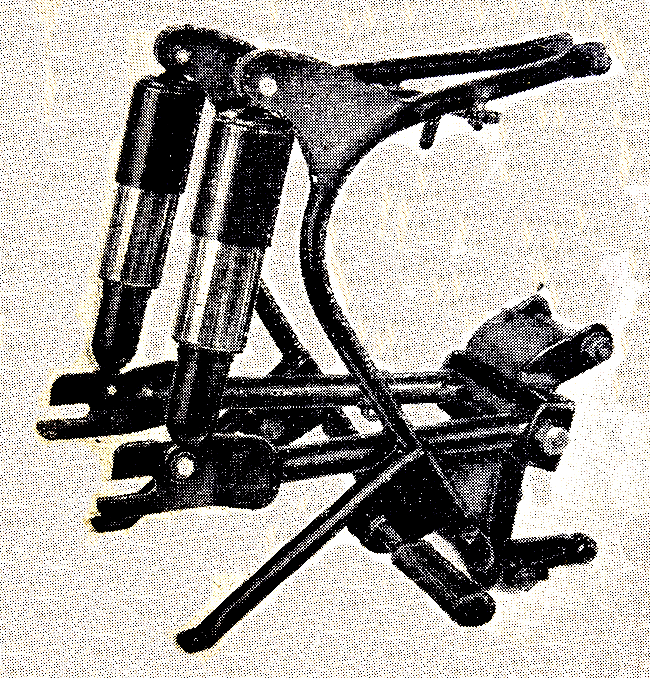
“A RECORD CROWD OF OVER 50,000 was present at a road-race meeting held at Kurunegala, Ceylon. Racing was exciting in spite of the heavy rain which began to fall soon after the start of the 500cc race and resulted in lowered speeds and a number of spills. After the novices’ races, won in fine style by B Kelaart (Velocette) and R Fernando (Triumph), the 350cc Race was the occasion for a well-judged ride by C Silva (BSA). Silva, who is 46 years old and remains an enthusiastic road-racer, moved into first position on Lap 5 and maintained his lead to the finish. Behind, WJ Blowers was in trouble with the brakes on his Velocette; during the last laps he was forced to rely entirely on the decelerative effect of gear-changing. A notable feature of the 500cc Race was R Siriwardane’s disagreement with a solid flank of sandbags at the outer radius of a particularly acute bend named Masonic Temple. After his toss, Siriwardane jumped aa machine and completed the race westing only one boot!
“I NOTE WITH SOME interest Ixion’s comments on girl riders in clubs. I would hazard a guess that not more than 3% of total club membership consists of girls. The percentage of all girl riders who belong to clubs must be even lower than this. Women riders in this country may not be so articulate as their American counterparts, but they are none the less efficient. The London Ladies’ MCC (whose range extends far beyond the London area) was in existence many years before the American Motor Maids’ Club started. The North West Ladies’ MCC is another ‘one-sex’ club, and one of the Birmingham clubs has a special section for girl riders. There must be many girls, especially those new to motor cycling or who ride small machines, who hesitate to join a mixed club. To meet the needs of these riders, the London Ladies’ MCC has a special lightweight section. It also participates in the RAC-ACU Training Scheme and is starting the next session on September 12. Our important function of one-sex clubs is to offer companionship to the lone girl rider. To further this end, my club is arranging a meet near Coventry to take place on October 10 to which all women motor cyclists are invited. It is also an aim of my club to organise competitive events for girl riders. I think all club members will agree that they have gained much in riding experience and enjoyment from their club membership, and I should like to see more girls in both mixed and one-sex clubs.
IDA M CROW, Chairman, London Ladies’ MCC, Woodford Green, Essex.”
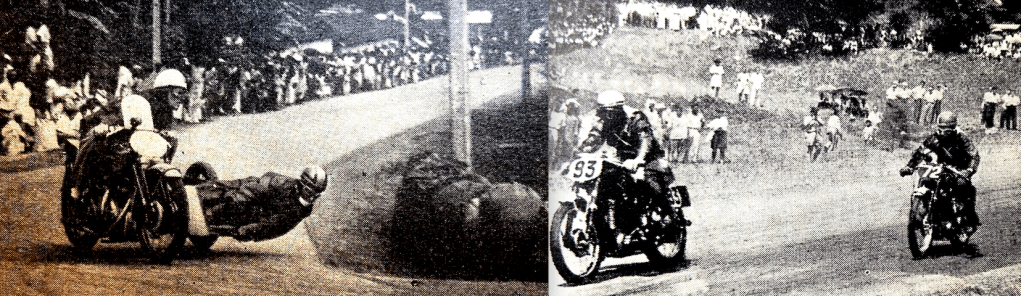
“SOME 50,000 PEOPLE went to Johore Bahru, just over the Johore Causeway from Singapore Island, to see the Johore Grand Prix, Malaya’s chief motor racing event which combines four- and two-wheeler racing. The main event for motor cycles was won by RH Trevor (Vincent), who set an all-class record for the lap of two miles and 110 yards in lmin 53sec, equal to 67.27mph. Approximately 11 laps behind him came a young Indian, R Sivaganam, on a Triumph Trophy, who won the special award for 500s. Third was Douglas Frank (Norton). Nortons ridden by Ross Isle and W Cleugh were first home in the 350cc race, followed by VLS Lee on a Triumph. Isle and Cleugh tied for fastest lap with 2min 1sec, 61.16mph. The course contained seven major bends, six of them right-handers and all but two at right angles. The longest leg was beside the Johore Straits, which separate Singapore from the Malayan mainland. The event was well organised and efficiently policed, and many of the police carried sub-machine guns. Smiling Ghurka riflemen, on leave from the jungle but still carrying automatic weapons, formed little jungle-green knots among the white-clad crowds. Under the trees Malay women served local dishes—fried rice in various forms, curries, noodles and towgay. And away from the trees the pale-skinned people (‘mad dogs’ and all that) acquired a bright sunburn under a sun that was hot even for Malaya. In the previous day’s practising Osman Abbas, the leading Malay rider, had been killed when his machine slid and left the road on the fastest corner of the circuit.”
IXION WAS ASKED to reveal his favourite bikes: “There is still a very soft spot in my heart for the famous all-black Rudge. I never kept one long enough to ascertain how many years the all-black finish would last. But I always loathed the waste of time required to keep good nickel polished, and the heart-breaking fashion in which bad nickel would peel. So the Rudge black finish was immensely popular with me. It looked equal to new with the minimum of cleaning over the term of my ownership. For the rest, with multi gear, a good Webb belt, and average roads the Rudge was lovely to ride. It was one of two which on lonely roads I often rode hands off for miles, steering by body balance with thighs against the tank, even up to 60mph on a fair surface (you’ll get pinched if a cop sees you doing this today, but on a long run it furnished a welcome change of riding posture). The model was very light, very comfortable, very reliable, and fast enough. (Weak spot —the rapidity with which the tappet clearance wore too wide.) Level with the Rudge, and even less prone to petty fiddling demands (like tappet settings) was the Ricardo Triumph. The engine was as smooth as silk, and as reliable as a bootscraper. So far as memory can judge, the performance of the two models was almost identical (including the ease of riding hands off). I recall no black mark against the Ricardo, except that if flogged really hard it was slightly destructive of the sparking plugs of the period, and even with a special spanner the plug was not too easily dislodged. (I always suspected that Mr Ricardo forgot all about the plug when he designed the head, and that when he tried to make proper room for it, Triumphs refused to let him expand the design up to 600cc!) It was a lovely model! Oh, I realise the innumerable advantages of the modern 500 which almost tips you over if you let it lean too much towards or away from you—the correct gear for every occasion in that walloping great box; plenty of amps for innumerable lamps; a fork that ignores projecting manholes; a rear suspension which has eliminated back-wheel hammer and the jarred coccyx; a hooter which always hoots; accommodation for two, plus luggage; enough petrol for 300 miles; oil for a month; balloony tyres; and all the rest of a lavish specification. But we have lost for ever the delicious feel of the bygone mediumweights, even if they couldn’t climb a pass of their tyres Forclaz type*, if their accessories were on he flimsy side, their tyres too small for true comfort, and their forks liable to bottom over a large pebble.”
*I looked up “Forclaz” to find a range of posh outdoor clothing inspired by the 5,000ft Col de la Forclaz in the Swiss Alps which was “historically used by mule teams and smugglers”. Ixion got about as bit.—Ed
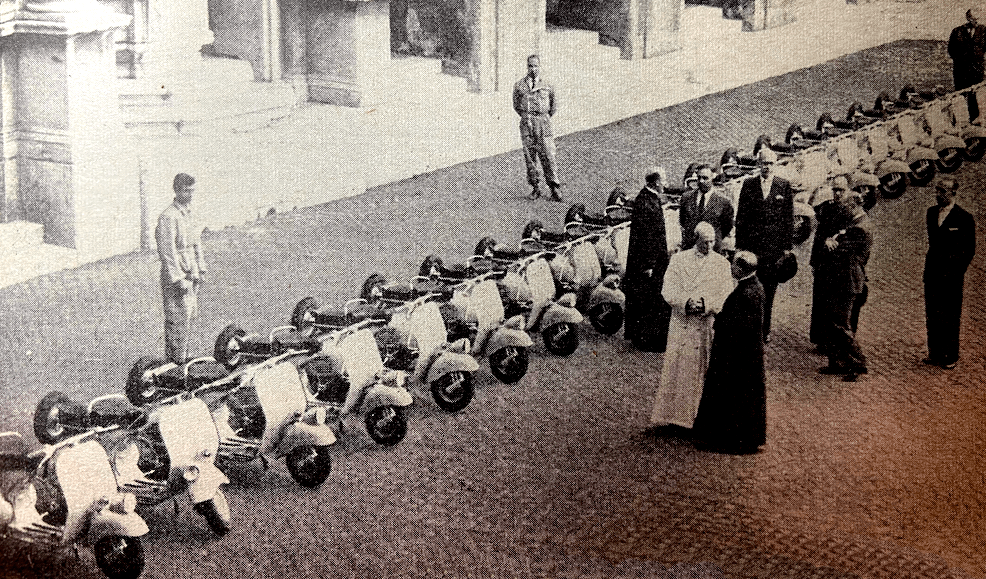
“I HAVE THREE TWINS. One is a 500 with overhead valves; the other two are of constantly varying capacity, which is always on the increase. Anyway, the 500 is attached to a Maxstoke one-and-a-half-seat sidecar; the other two, though identical, operate strictly solo. The 500 has just celebrated its first birthday; the other two are half that age. It is evident from the foregoing chronology that I acquired the sidecar outfit before the chickens were hatched. For some time after I wondered if I had bought the wrong thing, but as a result of recent experience I decided that I had not. Quite the reverse, in fact. To non-paternal brethren, I should first make it clear that children under about seven months cannot sit. So it is easy to appreciate the problem and understand the recent query in the correspondence columns of The Motor Cycle about carrying babies and their luggage in sidecars. My wife and I have just taken our twins on a long trip—a distance of 150 miles each way—and though I do not claim to have reached baby carrying perfection, I do claim that the twins arrived home in at least as good condition as they left—all three of them! The Maxstoke is quite a wondrous thing. Here is what ours carried: my wife, the twins, one large suitcase (adult clothing), one large holdall (miscellaneous items—your wife will tell you!), one straw carrier-bag (en route feed requirements, including a supply of milk ready mixed in a thermos flask), one travelling rug, one overcoat (mine, for decent self-presentation at an expected social occasion), and all the babies’ things, including, believe it or not, no fewer than 72 nappies. Modifying the Maxstoke so that it would accept horizontal infants was simplicity itself. What is more, it can readily be put back again. The rear seat is of plywood and upholstery, hinged at the joint of seat and back, and again at the front end of the seat. The whole thing can be removed by unscrew-ing the two bottom hinges and a press-stud at the top. The seat can then be flattened out and laid back on the floor of the sidecar, where it makes a perfect pram bottom. It is even better with a pram mattress laid on top of it. There is quite a large amount of space underneath provided by the foot-well—ideal.”
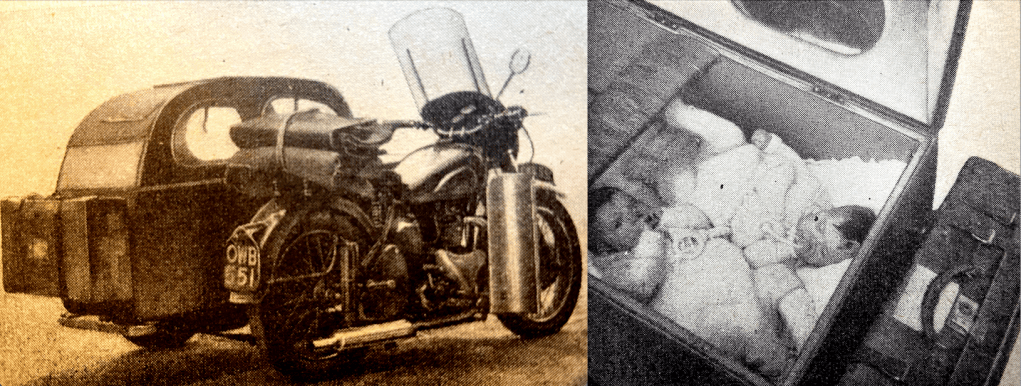
“TWO KLG INTERNALLY suppressed FE8OR sparking plugs have been used with a Matchless Super Clubman over a distance of 2,500 miles. Tests at various ranges from television sets have shown that interference is entirely eliminated. The plugs have provided completely satisfactory ignition; starting, slow running and high-speed performance have been precisely similar to that expected with orthodox plugs, from which the R-type plugs are externally indistinguishable except by the type marking. Also tested recently, on a 1948 BSA A7 and a 1952 Ariel Square Four, was a set of KLG PS waterproof covers which incorporate built-in suppressors. In the case of the twin, which employs magneto ignition, interference was entirely absent when the engine was run at a fast idling speed some 20 feet from a television set. In the case of the Ariel Four, which employs coil ignition, interference was greatly reduced by use of the covers but not eliminated entirely because of normal sparking in the distributor. A complete cure resulted when a distributor suppressor was fitted in the ht lead from the coil, The plug covers are known as the PS type. Makers are KLG Sparking Plugs, Cricklewood Works, London, NW2.”
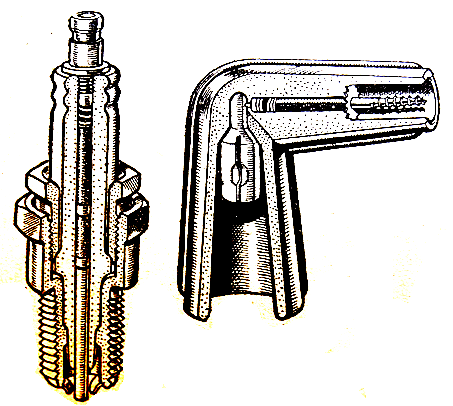
“OWING TO ITS greater-than-average width at the front, the Frystyle twin-seat gives the impression of being rather shorter than most of its contemporaries; in fact, it is longer than many. When it was fitted to the Vincent Black Shadow on which the test was carried out, the seat blended with the machine’s general lines extremely well. On the road the comfort provided was first class, and there was ample room on the seat for two persons. Several long runs were undertaken both with and without a pillion passenger. The degree of softness of the latex foam interior was found to be just right. The wide nose enabled the rider to sit well forward in comfort, while the small but effective raised back portion was sufficient to prevent the pillion rider from sliding to the rear.”
“IN SEPTEMBER, 1952, it was suggested that by 1953 there would be a million motor cyclists on the roads of Great Britain. This forecast has almost certainly proved to be correct. Statistics published by the Ministry of Transport show that in the quarter ended September 30 last year, 940,137 licences were current for motor cycles and similar-category vehicles including-three-wheelers. The increase over the corresponding figure in 1951 was 100,294; it will be obvious, therefore, why it is expected that today the total exceeds a million. Invariably the third quarter indicates the peak registrations each year. Of the 940,137, cyclemotors accounted for 120,472. Solos of 60-150cc. numbered 205,914, and those of 150-250cc totalled 138,765; solos over 250cc numbered 326,448. Hence, lightweights from 60-250cc outnumbered larger-capacity machines by 18,231. The growth in popularity of lightweights has been apparent for, some years, but 1952 marks the definite line where medium- and large-capacity solos have taken statistical second place. Sidecar outfits registered in the third quarter last year numbered 130,229, of which 128,846 were 250cc or larger. Approximately 1 in 7 of all the machines on the road were fitted with sidecars, over 250cc the proportion is 1 in 4.5. Very few manufacturers market models to appeal specifically to the sidecar enthusiast and since the war there has been an acute shortage of sidecars, so this proportion is remarkable.”
“DURING THE PAST YEAR there has been a notable rise in the demand for motor cycles in Japan. In pre-war days, machines were used almost only by governmental institutions and news agencies, but now motor cycles, scooters and motorised bicycles are being employed in various commercial fields as well as by private citizens. Nearly all the machines are produced in Japan, and an idea of the growth in output can be gathered from the fact that in April, 1952, production was 2,463 units. By December, 1952, the monthly output had more than doubled and in March this year the figure was 7,279. Demand for all types of two-wheeler is still brisk, and the Japanese Ministry of International Trade and Industry predicts that during the current year the total output from Japanese factories is likely to reach 94,000. Manufacturers, however, suggest that this forecast is conservative.”
THIS YEAR’S FIM Rally will long be remembered as the rally in which the British entrants made their presence felt for the first time. Not only did they enjoy the various functions laid on by the Federation Motocycliste Suisse, but they brought home three of the major awards: the vase offered by the Belgian Federation for third place in the General Classification, the German cup for the club with the greatest number of drivers travelling the farthest, and the Swiss jug for the club with the greatest number of passengers. Both these club awards were won by the North-East London MCC.’ Major touring event of the international calendar, the FIM Rally, is held in a different country each year with the idea of fostering international touring and friendship, and to show as many as possible of the national customs of the host country to its guests. As it is a touring event, no schedule speeds or fixed routes are set; all that is required is a completed entry form, an entry fee and the competitors’ presence at the finishing control on the afternoon of the first day of the rally. There follows a couple of days of dining, wining, excursions and displays of folk dancing and singing, concluded by a banquet with speeches and the presentation of awards. As there is no individual competition, the allocation of the awards is decided by multiplying the number of participants in any particular class by the distance they have travelled, so that the nearer any country or club is to the venue of the rally, the more members have to be
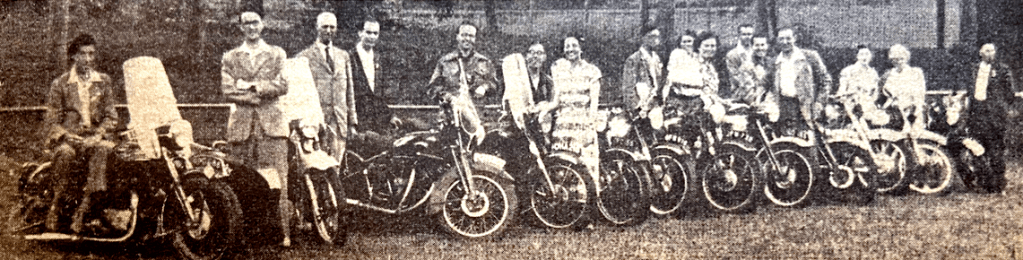
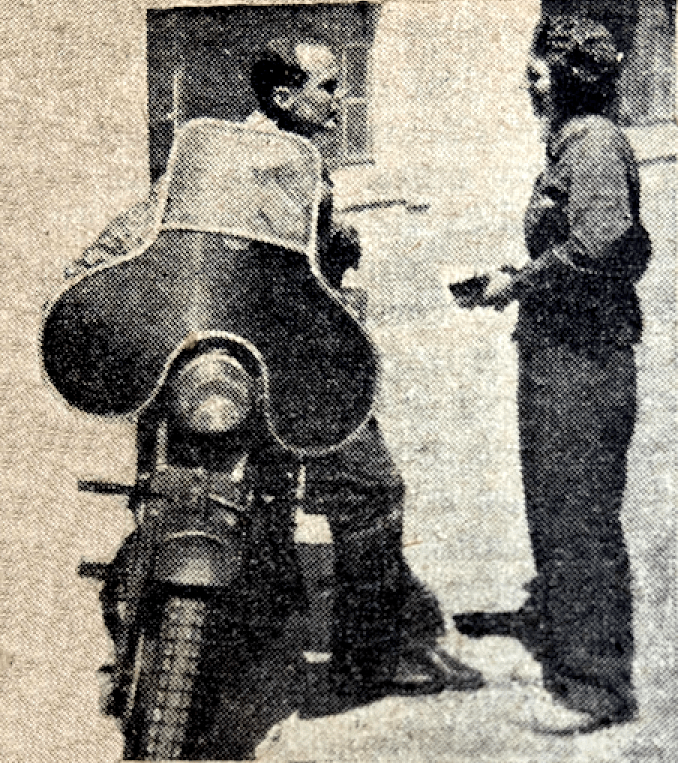
present to increase the figure of merit. The 1953 event terminated at Monthey, a small town in the Canton of Valais, Switzerland. On the afternoon of Friday, July 24, the 40 British participants arrived at the finishing control either singly or in small club groups to pay their entry fees, collect programmes and books of tickets for the social functions, and to arrange hotel accommodation. While this was going on, the early arrivals parked their machines in the official enclosure and accepted the invitation for a swim in the bathing pool. When the control closed, dinner was served, followed by dancing and singing for the rest of the evening. Meanwhile the members of the jury and the delegates of the 11 participating’ countries met under the chairmanship, of jovial Henri Steinlet, president of the CITM, to discuss the results. Next morning, a visit was made to Sion to inspect the old hilltop castle with its church—a real gem of medieval ecclesiastical architecture which houses the oldest organ in Switzerland and some of the oldest carved choir stalls and painted ceilings. After a snack of ham, pickles, bread and wine, a return was made to Monthey for a trip up the rack railway to Champery and a further climb to Planachaux by telerifique [cable-car]. At the top we enjoyed a snack of cheese raclette (a special toasted cheese), potatoes baked in their skins, and wine. This meal was taken in the open, with a magnificent view of the Dents du Midi as a backcloth. Dinner that evening was scheduled for nine o’clock, but when the party returned they found the entire hall had been filled by the Swiss competitors in their national rally, who were enjoying the display of folk songs and dances arranged for their foreign guests. However, after a rather heated and boisterous argument which lasted the better part of two hours, the British entrants were served with their meal at a special table set on the side of the stage. The playing of the giant cowbells and alphorn and the yodelling were very fine, even though seen from behind. This party went on until the small hours of the morning, with dancing and various Swiss exhibitions. Sunday morning was spent by some people in a trip up to the St Bernard monastery for a religious service, and by the Swiss national rally entrants in a procession of decorated motor cycles through the streets of Monthey. In the early afternoon a banquet was given to the international rallyists, which was followed by long speeches of welcome and thanks by various officials and civic dignitaries. After the speeches there was a slight lull in the programme during which each nation entertained the others by singing various national songs. Britain obliged with a spirited rendering of ‘Maybe it’s because I’m a Londoner’, followed by two encores of ;Tipperary’ and ‘Pack up your troubles’, in which everyone joined. Then, to wind up the rally, the results were announced and the awards presented to the singing of each country’s national anthem as the delegates went forward to receive their trophies. The FIM Trophy went to Holland; the Marcel Haeker Trophy, presented for the first time this year by the Swiss Federation for the runners-up, went to Belgium; the Belgian vase was won by Great Britain, and so on; the cup presented by the Auto-Cycle Union was won by the German team. Next year the rally is to be held in Luxembourg. It is hoped that a greater number of British motor cyclists will participate to put Great Britain even more on the international touring map. These touring rallies are easily arranged into the usual foreign tour, and give considerable extra interest to the holiday, apart from providing opportunities to see customs and traditional events which the average tourist can seldom find for himself.”
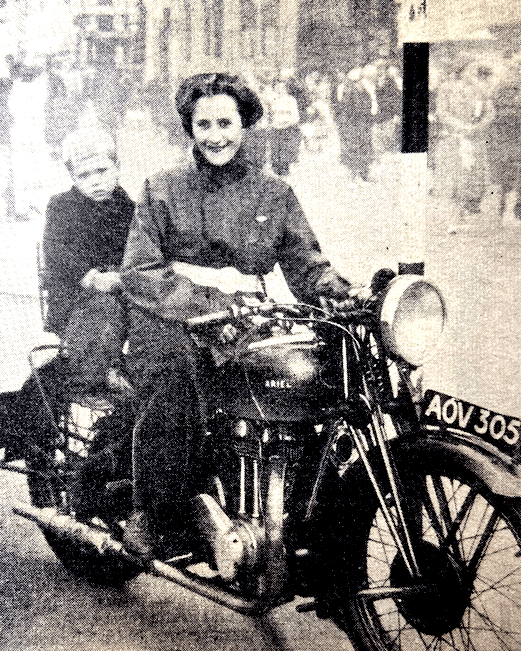
THAT INTREPID GLOBE-TROTTER Peter Lee-Warner, rode his 45cc Power Pak-driven Norman bicycle into Melbourne, Australia, on Friday, July 31, having completed the 9,500-mile overland journey from London. Of the few to have completed the overland trip, he is said to be the first to have used an engine of only ½hp. George Lynn, the Australian journalist, writes that the 33-year-old ex-commando described the journey as ‘most interesting but devoid of excitement’. Lee-Warner, it may be recalled, left England on March 21 and travelled across France into Italy. He rode to Venice, Trieste, across Yugoslavia to Salonika and Istanbul, across Turkey to northern Syria, thence by way of the famous pipe-line road to Baghdad. Lee-Warner has plans to ride to Brisbane, where he will join a ship for Los Angeles (California). He will then ride across the USA to the east coast before returning to London in time for the Motor Cycle Show in November. So far his daily mileage has been about 150, and he claims to have had no cycle or engine trouble whatsoever.”
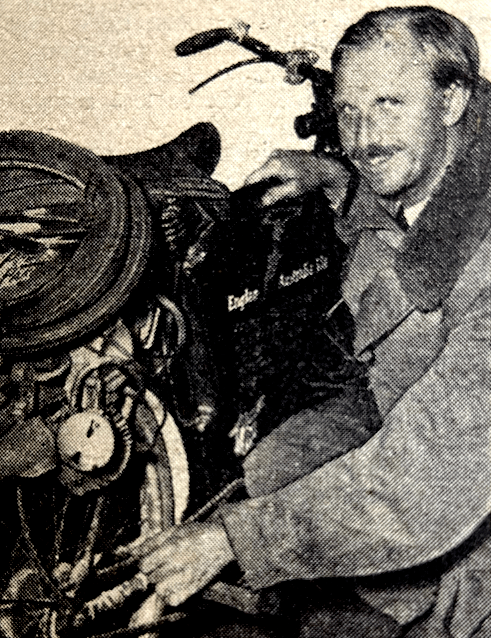
“DURING THE FIRST World War I was in the RNVR and bought a new 1915 7/9hp Indian. The machine was a joy to ride in every way. With its leaf-spring frame and front fork, and large-diameter wheels and big tyres, it gave complete riding comfort, coupled with a feeling of stability at all speeds. The engine was extremely flexible and absolutely trouble-free (so was the rest of the machine). The Dixie magneto had contact-breakers enclosed in a small metal box, the lid of which was hinged and opened by putting one’s thumbnail below the spring catch—a moment’s job! However, in all the miles I rode the machine I never needed to adjust or clean the points, and the mag never failed to give a really healthy spark—it would jump half an inch! The engine seemed equally happy in any climatic conditions, whether a hot summer’s day or a hard frost. It always started at the second kick (most times at the first) and always ran in a docile and ‘gentlemanly’ manner, but it had power, too—I could reach 85mph in half a mile from a standing start at any time provided the road was clear, The mechanical oil pump was only intended to supply all the oil necessary for the engine up to 25mp, the makers stated in their very comprehensive handbook; for higher speeds, a hand pump was fitted in the oil tank and had to be used by the rider. One could not start the engine unless the throttle was absolutely shut (the Stromberg carburettor fitted was intended to be that way). When I bought the machine new, having had several British makes of motor cycle before, I thought I knew all the answers! I was so disgusted with the new Indian not starting at various throttle settings from just open to full bore that I was on the point of returning the machine complete with a letter of complaint in naval language. However, I rang the agents from whom I bought the machine. How very small I felt when the foreman, having patiently listened to my tale of woe, simply. said, ‘Shut the throttle and kick’ and hung up the receiver. I had been too big a man to read the handbook before I tried the machine. Well, the old ‘Red Devil’ was a grand girl in every way, and I only wish I had her now and could get the same thrill from present-day motoring, Good luck to all motor cyclists, past and present.
THEO DICKINSON, Salcombe, Devon.”
“I RECENTLY CLIMBED Wrynose and Hard Knott passes non-stop on my 192cc LW Velocette after covering 13,000 miles in 12 months. Has anyone previously taken a similar machine over these sections? The good suspension of the machine enabled me to cover 944 miles between Saturday morning and the next Wednesday afternoon, although I am 67 years old.
‘KNP73‘, Redditch.”
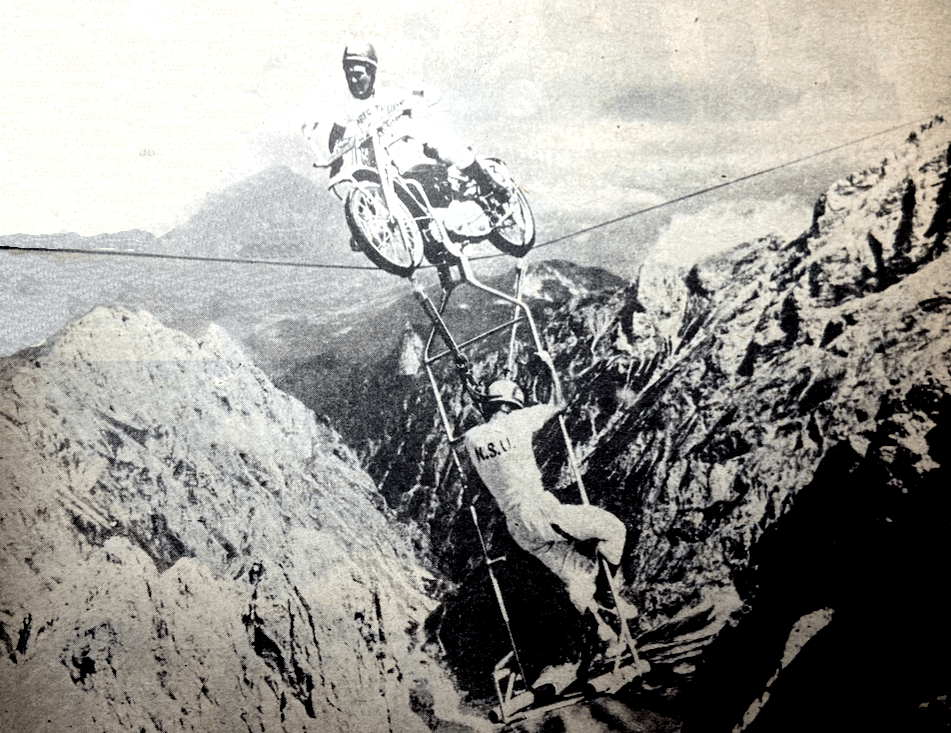
“RADIO SETS IN motor cars have now reached the stage where they are regarded almost as standard fittings. More than one sidecar driver has successfully fitted wireless in his sidecar with earphones for passenger and driver, but radio equipment for solo machines has rarely received serious attention. There are technical difficulties to overcome, of course. There is precious little room on the average solo for the equipment, and there is also the very serious problem of vibration—both from the engine and from road shocks. Yet there is at least one enthusiast—Geoff Jackson, of Leytonstone, London—who has overcome all the drawbacks to the scheme and combined his pet hobbies of motor cycling and radio. On his 1950 BSA M33 he has mounted a radio set with loudspeaker equipment and has used it for the past six months in all weather conditions with no bother at all. Mr Jackson is an exceptionally talented wireless amateur; his set was built in his spare time and constructed almost entirely from ex-WD parts. The radio is built in three main parts: receiver, loudspeaker and power pack. The receiver is a straightforward superhet design employing four midget valves. It is built in a 7x5x4in aluminium container mounted on the left side of the BSA handlebar.”
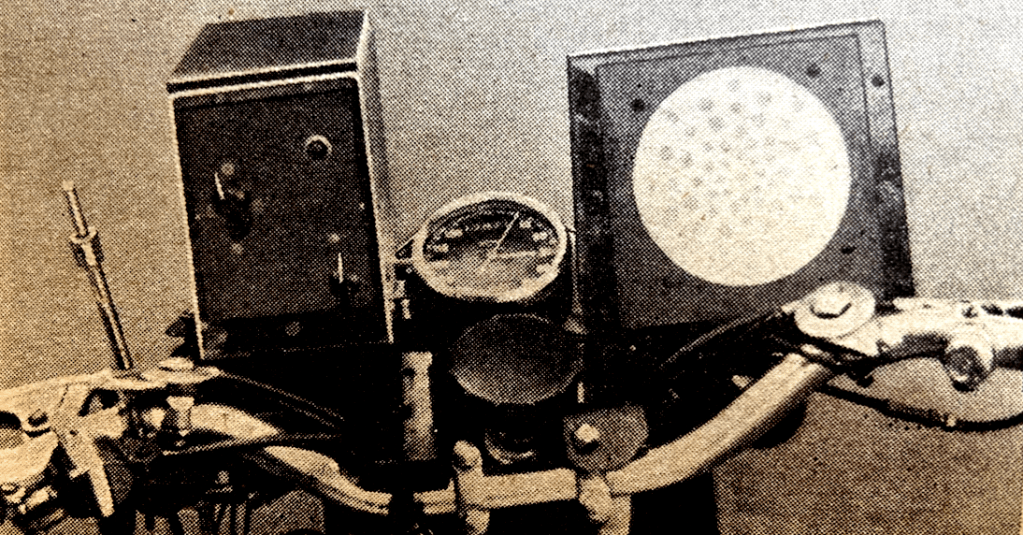
“SELDOM INDEED CAN ONE differ from Ixion who, over the years, has contributed so much sound writing. But when he speaks of impending stabilisation of motor-cycle design, he is surely wide of the mark? Have we found the remedy for rapid chain wear with normal rear suspension owing to alternate wrapping and unwrapping around gear-box and wheel sprockets? Do we know enough about the effect of shaft drive on the single-track machine? Do we know all there is to know about the combination of semi-racing valve timing with small valves, and do we even know how small we could go in valve size for only a slight reduction in speed but with, most probably, much sweeter and more flexible performance? Remembering, as some of us may, the wonderful flexibility of the 2¾ Douglas, are we sure that our 7 to 1 compression ratios are the best wear for overall efficiency and economy? Are we at the end—or only the beginning—of our knowledge of carburation and, having apparently lost the knack for fuel economy, must we stabilise on 30mpg less than was once commonplace? Is the telescopic fork the final answer or shall we move to the bottom-link type, and will this have leading or trailing links? Must we have two electrical units for ignition and lighting and, if not, what form will the final alternative take? The question is far from settled. Shall we continue to swill lubricant through pipes from engine to tank and back or retain it in the engine, as on a race-winning four and on every car? Shall we settle on the bulk, weight and cost of half-speed clutches and must our gear boxes remain at well over a foot in width? What of our 3-gallon tanks perched right on top of the machine, the exposed rear drive (solved by Sunbeam years ago), the excessive weight and that light, silent, tickle-start four visualised by ‘Ubique’, Col Bowden and others? Stabilisation, with so much to do? Surely not.
GH JONES, Shrewsbury.”
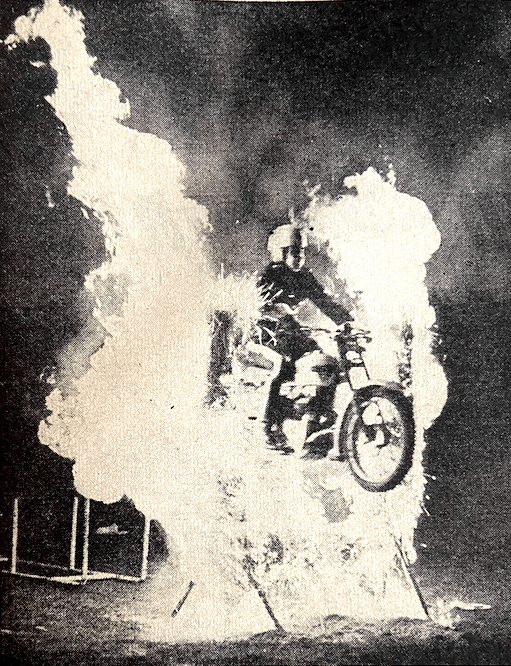
“BRITISH RIDERS AND MACHINES were successful in the international Moto-Cross des Nations, held at Skillingaryd, Sweden. With an aggregate time of 3hr 22min 20.2sec, the first three British finishers, LR Archer (Norton), GJ Draper (BSA) and GH Ward (AJS), had an advantage of lmin 32.9sec over their nearest rivals, the Belgians, in the 17-lap final. Of the seven annual events so far contested in this series, Britain has thus been victorious in five (two each in England and Sweden, and one in the Netherlands) while Belgium has won the two events which have taken place on her own soil. Sunday’s meeting was efficiently organised by the Swedish Motor Cycle Federation in conjunction with the Värnamo Motor Cycle Club. The Moto-Cross des Nations is essentially a team contest; the results are based on the aggregate time of the fastest three finalists of each nation. Five nations were competing on Sunday; Britain, Belgium, Sweden and Denmark had all entered teams of the maximum permitted strength, namely six riders each. Finland, competing for the first time in this event, was represented by only three riders. Scrambling is a form of motor cycle sport which has come to Sweden only since the end of the war. Its popularity has been obvious from the first and it was underlined last
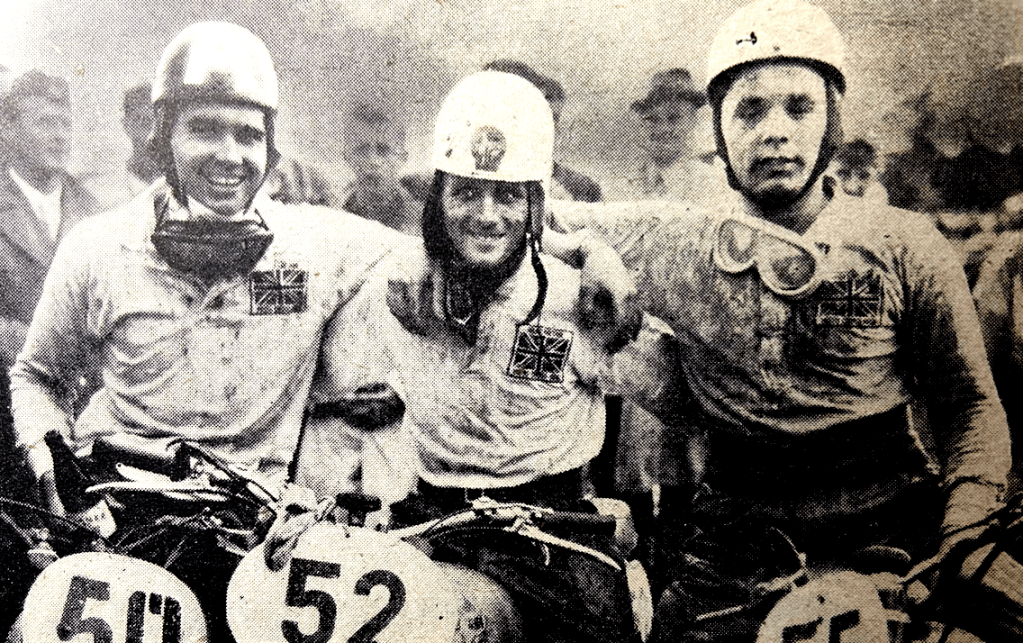
Sunday by the size of the crowd- which converged on the little Swedish village for 36 hours before the event was due to start. Many camped in the woods surrounding the course during Saturday night. The 1.7-mile circuit was laid out on sandy heathland and wooded slopes reminiscent of England’s Bagshot Heath. Aware of the ease with which too fast a course can he plotted on such terrain, the organisers had introduced several artificial hazards into the circuit. The result was a lap comprising a fair variety of going, including fast tracks, tortuous woodland paths, mud, a stream crossing, two precipitous sandpits and a section of metalled road…After the lukewarm competition of the heats, the final promised the excitement of a battle-royal. The traditional Anglo-Belgian fight for supremacy was in prospect, although each of the teams had been weakened by the loss of one rider. Britain’s loss was probably the more serious, for Hall’s brilliant form in practice had made him a strong favourite. Only the Swedish team was wholly intact; their chances could not be ignored for they had displayed fine form and determination, and were competing before a sympathetic Swedish audience. Danish prospects were poor since misfortune had reduced their numbers to half-strength and none of the remainder had so far shown winning form. With exhausts thundering, the 19 competitors made a perfect start. A blue-jerseyed Swedish rider nosed his way into a slight lead—it was Nilsson. But at the first corner Archer slipped effortlessly past him on the inside. From that moment on the young Aldershot rider was invincible. With consummate ease he led the field throughout the race and laid the foundation of Britain’s triumph. At the end of Lap 1, Draper and Ward, in third and fourth places respectively, were giving Archer staunch support. Nilsson was still second for Sweden, while his compatriots, Eriksson and Gustavsson, lay fifth and eighth respectively. Belgian riders, Mingels and Jansen, occupied sixth and seventh places, but Donnay and Leloup were well down the field—14th and 16th. Draper displaced Nilsson on the next lap and, although Mingels jumped to fourth place ahead of Ward and Eriksson, it was still Sweden that presented Britain with the strongest challenge. Belgium’s prospects brightened in Lap 3, for Mingels moved into third place when Nilsson suffered a full half-lap delay. Jansen automatically became sixth and Leloup fairly leaped ahead to complete the lap in 11th position. But Johansson, Eriksson and Gustavsson still maintained Sweden’s advantage over the Belgians by filling fourth, seventh and eighth places. At this time Stonebridge was occupying 10th place. It
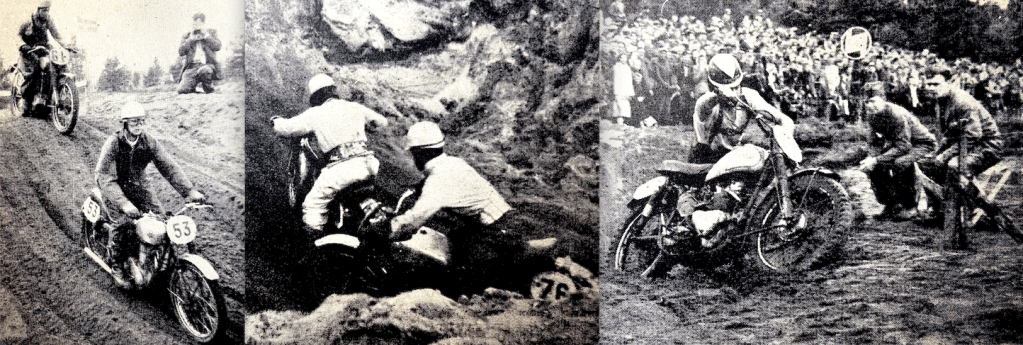
transpired that a bump with Mingels on the first lap had unseated him and cost him several places. Subsequently the damping of his rear suspension struts failed—a considerable handicap on such a bumpy course. Nex was even farther down the field—15th, the result of charging a fence while lying 10th. On that fateful third lap Draper, too, met cruel misfortune. His gear box stuck in second gear and for the remainder of the race he gave an unsurpassed exhibition of dogged grit and brilliant riding. Lacking speed on the fast stretches, and with his engine being grossly over-revved, he hurtled round the slippery woodland twists to such purpose that he persistently staved off Mingels’ challenge. At the end of six laps, amateur timing showed Archer, Draper and Ward—in first, second and fifth places, respectively—to be leading Belgium’s first three riders by approximately 50sec. Jansen had climbed to fourth place some distance behind Mingels, while Batten had steadily progressed to ninth place from the obscurity of 17th on Lap 1. The Belgians had gained a 20sec advantage over the Swedish riders who were handicapped by Nilsson’s third-lap delay. With Draper’s engine taking a merciless hammering, Harold Taylor signalled Stonebridge to pile on speed lest the valiant BSA should give way under the strain. The Matchless rider responded by moving up to seventh place by the end of Lap 10. At the same time Jansen slowed and dropped to sixth place behind Ward. Batten continued his brilliant progress and passed Ward a lap later; Ward, too, was experiencing gear-box trouble, with third gear refusing to stay in mesh. Notwithstanding these set-backs, Britain had maintained her 50sec lead at the end of Lap 11. Though no change occurred among the leaders until the 14th lap, Britain’s lead dwindled to 36sec with the inevitable, though slight, slowing of Draper’s and Ward’s machines. The result then seemed to hang in the balance. Suddenly, fate took a hand in the proceedings and Jansen, lying sixth, burst his engine. With Leloup, Belgium’s next rider, in 11th place, Britain romped home to a comfortable, well-deserved victory, with Archer unassailably in front, the courageous Draper ceding third place to Batten a lap from the finish, and Ward a safe fifth.”
“THE FAMOUS 4.5-MILE Bremgarten circuit in Berne, Switzerland, is one of the few in Europe which have remained unaltered in post-war years. Hence as race and lap speeds rise, a reasonably true indication is given of development in racing machines—and perhaps an indication of the higher prowess of riders. In the 500cc Race of the Swiss Grand Prix the irrepressible New Zealander, Rod Coleman, took his AJS twin round at 100.92mph and achieved the first over-100mph lap on a two-wheeler. His effort recalls the fact that EJ Frend, also riding an AJS twin, just bettered 90mph to make the fastest lap in 1949. In four years the speed has been hoisted 10mph. Though record race and lap speeds were established in three of the four events, there were no close finishes for first places. In each race the winners established their positions early and continued unharried to the end. As a demonstration of riding mastery the two-day meeting was attractive, but there was very little real excitement to delight the large crowds. Gilera machines dominated the 500cc Race by filling the first four places; the winning rider, in magnificent style, was Geoff Duke. In the 350cc Race Fergus Anderson (Moto Guzzi) was a comfortable winner. In the 250cc Race, Reg Armstrong (NSU) achieved a well-deserved victory. Eric Oliver (Norton), with Stanley Dibben as passenger in the Watsonian sidecar, gained the Sidecar Race honours.
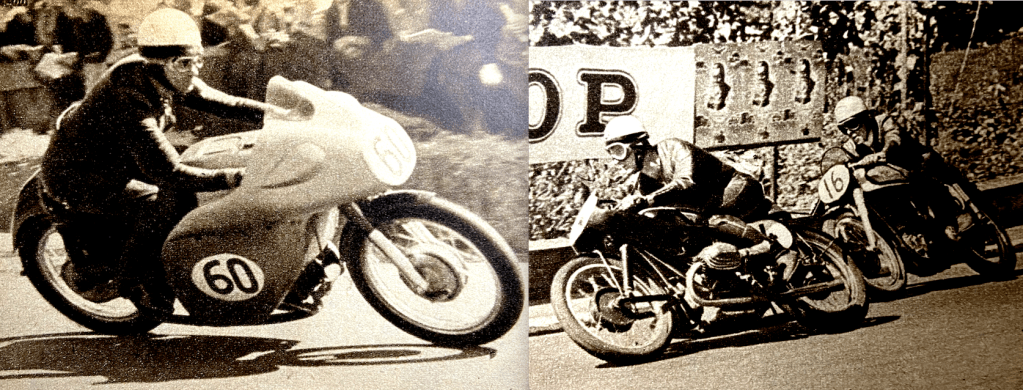
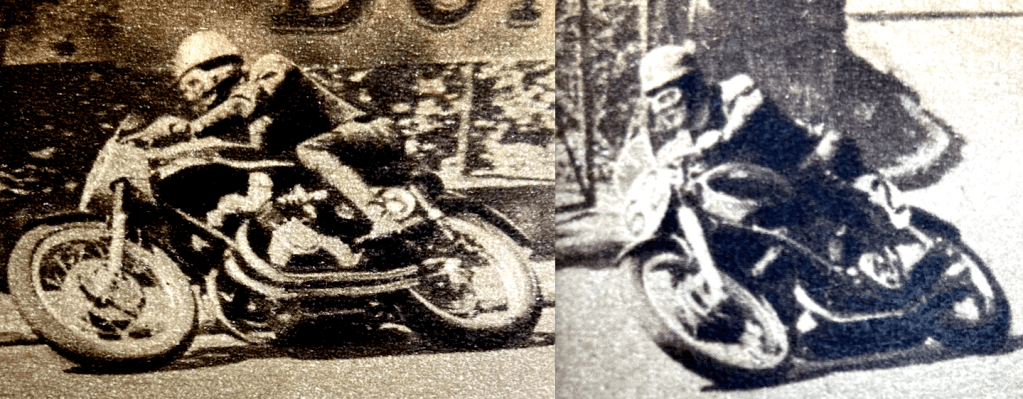
“TO MY INTENSE REGRET, I see that what I suspected might happen when safety helmets became popular is, in a mild way, taking place: show-off riding methods are becoming more noticeable. I saw just such an exhibition on my way to the office the other morning. Young, smartly turned-out, riding an AJS twin with chromium-plated tank and wearing a white safety helmet, the lad in question was ‘putting on dog’ for all and sundry to see. His posterior occupied much of the rear portion of the twin-seat. He roared off from the traffic lights in a flurry of legs and high rpm, obviously showing us lesser mortals how it should be done. He was so conscious of his smart appearance that he practically smirked at his own thoughts. During the early days of the war, when safety helmets were made compulsory for Don Rs, and knee boots and breeches were issued (and revolvers were standard wear), I saw exactly the same thing happen among Royal Corps of Signals recruits. The phase for those inclined to conceit is fortunately a short one. But I do hope that the well-merited popularity of safety helmets is not to bring a return of the Promenade Percy we knew and disliked in pre-war days. Anything, I hope, rather than that.”
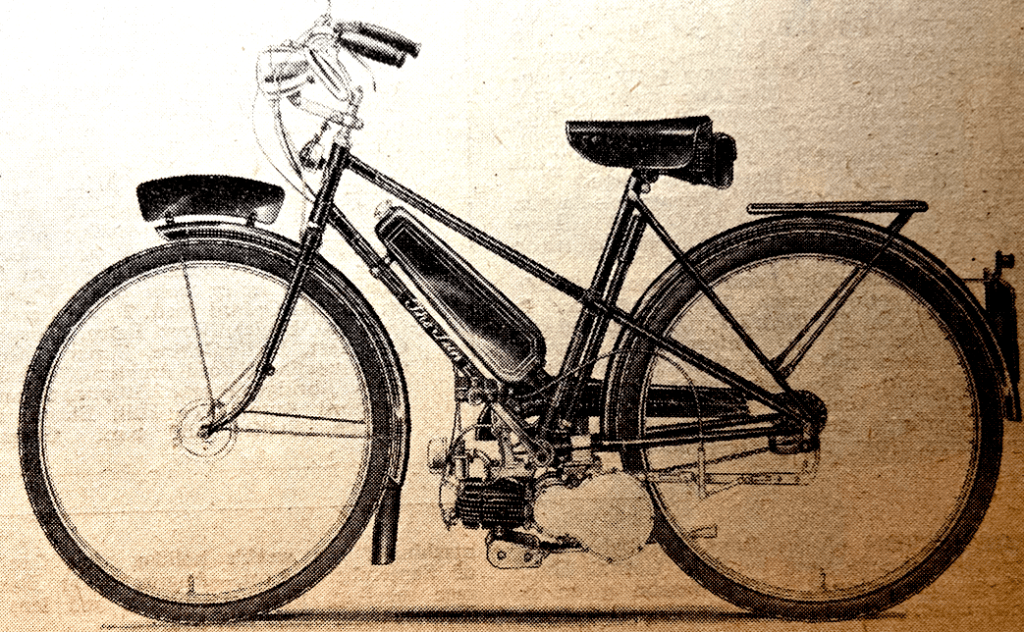
“THE SHAPELY PROW of the good ship Venus ploughed a steady furrow through a lazy North Sea swell. MS Venus (7,000 tons) is one of the sleek motor ships operated by the Bergen Line between Newcastle and Norway, towards which fair country she was heading. Reposing in the forward hold was a 197cc James Captain and sidecar which, it was hoped, would provide adequate transport for two over more than 1,000 miles of some of Norway’s more mountainous roads. To explain how this came about it is necessary to look back a few weeks to the Birmingham office of The Motor Cycle. One typically wet summer’s afternoon, the telephone rang shrilly. The voice at the other end of the line was that of E0 ‘Blackie’ Blacknell, of Blacknell Sidecars, Nottingham. ‘I have a new lightweight sidecar and chassis,’ he announced, ‘and to give it a thorough test, I’m taking it on a run up beyond the Arctic Circle.’ ‘And the very best of luck,’ I said. ‘You’ll probably be torn to pieces by wolf packs, or trodden well into the ground by a polar bear. But if you do get there, you might like to drop us a line to say how…’ ‘Wait a minute,’ cut in EOB, ‘You’re going too!’ In which assertion he proved to be correct. So there I was in the lounge of the Venus, smoking a duty-free cigarette and asking him his precise reason for the trip. First of all, he said, it was to test the application of the Blacknell sprung wheel to the standard lightweight chassis and sidecar. (It will be recalled that the sprung wheel is hydraulically damped and the suspension is adjustable for load by variation of the angle of the damper leg). From what he had gathered about the Arctic Highway, the expedition would prove an excellent test. He could well have hitched the sidecar—the all-metal, convertible model—to a 350cc machine, but he wished to sample the capabilities of a 197cc outfit for touring. Then again, be had not been to the Polar Circle before, and neither had a 197cc sidecar outfit so far as he knew. The James Captain was powered by one of the latest 197cc Villiers four-speed engine-gear units; sidecar gear ratios were obtained by substituting a 52-tooth rear-wheel sprocket for the standard 48-tooth sprocket. Extra-strong coil springs were employed in the telescopic front fork.
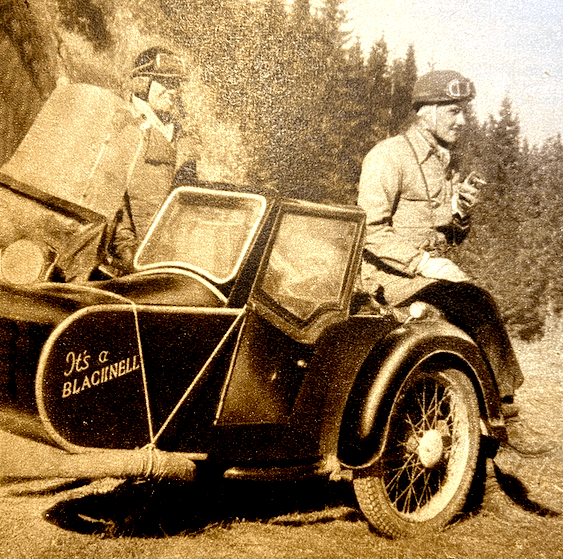
A steering damper was installed. The plunger type rear springing was standard but as some rough going was anticipated a competition-type rear-wheel hub was used; this has a ⁹⁄₁₆in diameter spindle and journal ball bearings. Standard 3.00x19in tyres were fitted all round…As the ship nosed in among the myriad islets and skerries off Bergen, the mountains behind the town were lost in low cloud, and it was raining heavily. We were quite prepared for this sort of weather because we had discovered that the Norwegians refer to the place as the capital of rain—while Oslo may have 36in of rainfall in a year, Bergen may have 126in. In general, however, the Norwegian summer is hot and sunny; it is only the Bergen weather that is somewhat freakish. By the time disembarkation formalities had been carried out and the outfit topped up with fuel, it was 4.10pm. We planned to reach Stalheim, 130 miles to the north, that evening; thus little was seen of Bergen on this occasion. Very soon the stone setts and tramlines of the town gave way to a loose-surface, though fairly even, gravel road winding along the shore of a wide fjord. This type of surface is employed on the majority of main roads away from towns, and appears to consist of coarsely ground limestone and gravel clippings, well pounded down. On the straight sections there is little or no camber, while almost all the bends are well banked. Traffic was very sparse but as the road was narrow one had to keep a sharp look-out for the occasional bus travelling townwards…with a population of only 3½ million 132,000 motor vehicles are registered in Norway, of which 22,000 are motor cycles…It was in these wide open spaces that the first warnings of trouble came from the engine. There was a tendency to pinking, as though the mixture was weak. I began to wonder whether we had been sufficiently meticulous with the petrol/oil ratio. It is easy enough for the ratio to became unbalanced when the petrol has to be purchased in litres. (The manufacturers’ recommendation is a quarter-litre of oil to every five litres of petrol.)…In the middle of a dense forest, the engine began to splutter and on tick-over sounded something like the engine of a concrete-mixer. A partially oiled plug was suggested, and to try to cure it the throttle was blipped several times. There followed a sharp explosion and the flywheel magneto cover jumped off. On being restarted the engine fired evenly, but its former power seemed to
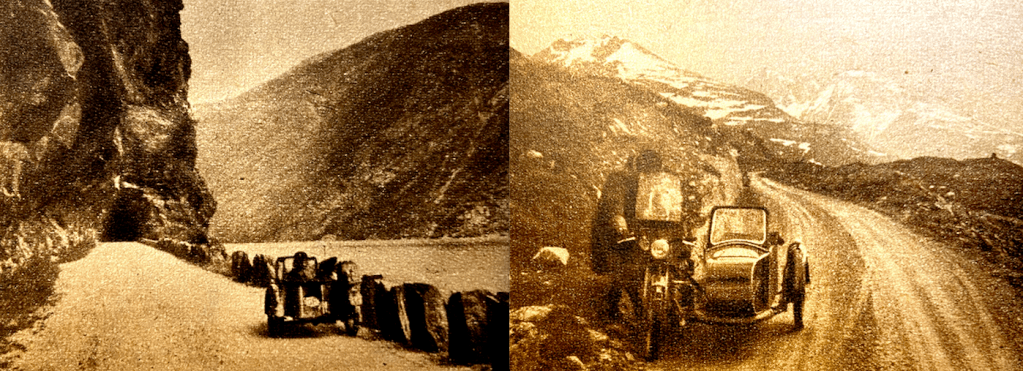
be lacking. In addition, there was a noise that sounded like little men with ice-picks hacking at the piston! It was decided that the best course of action would be to stop for the night—it was then 8pm—at the next village and examine the engine. A sound scheme, I thought, particularly as the forest on either side contained wolf-packs, about which earlier I had jested…The neat village turned out to be a very tiny place name Brekkvasselv. A small transport cafe was the only building which could accommodate travellers for the night. It was a clean, pleasant place, though with no running water; we readily accepted the offer of a double room. First daubing ourselves with oil of citronella as some protection against the mosquitoes, we sought the cause of the engine bother. EOB had suggested a blown bearing seal on the right-hand side and though it was an unlikely sort of failure, he was correct. When the flywheel mag-generator was removed we saw that the bearing seal had been blown out of its housing. The seal was intact, we wiped it clean and pushed it back into position. When the magneto had been replaced, the engine started first kick and appeared to have regained all its former punch. The Arctic Circle lay only 180 miles to the north. Pausing only to wash, we indicated to the young lady who appeared to be in charge of the transport calf that we were hungry, and then some. Not knowing a word of English, she ushered us into the kitchen and pointed out what was cooking. For the fast time in Norway, EOB was able to have his egg cooked as he likes it—fried on both sides! In case the main course was not sufficient, we were provided with a plateful of bread, a jar of honey, a Dutch cheese and a hunk of butter weighing at least a pound. We rounded off with coffee and mineralvin…During the morning, the outfit buzzed on through densely forested hill country. Most of the timber-built houses had large stocks of firewood piled up nearby, for in winter, work in these parts is made difficult by the almost entire absence of daylight…we had to cross the Loknind range of mountains, which rises to 4,000ft at its highest point. The gradients are not alarmingly steep, but entailed continuous climbing for about 12 miles. The ascent was made mainly in second gear, with an odd boost or two from first gear, and the engine again tried to emulate a blast furnace in the matter of temperature. The ascent to our target, the Arctic Circle, which the road crosses at 2,300ft, was long and very gradual. At one point, where the road is intersected by a railway level-crossing, a stop was made to inspect an unusual-looking three-wheeler. This device was a pedal-driven tricycle equipped with flanged steel wheels and an enormous chain sprocket. The vehicle was obviously designed to be ridden along the railway lines…when the road levelled out on to the Stodi plateau, a desolate vista confronted us. The barren tableland was dominated by the ragged outline of a mountain, the peak of which was lost in grey mist. Here and there, snow drifts lay at the side of the road. Timber snow breaks, leaning at crazy angles and in places smashed to pieces, bore testimony to the fury of the Arctic winds during the winter months. It was late afternoon when we hove in sight of the Polar Circle ordnance survey stone, and just 72 hours since we had left Bergen. After shooting off photographs at a colossal rate of fire, we went to inspect the deserted Polarcirkel Barracks, once used by the Germans…Half-a-dozen miles farther on, more evidence of wartime occupation was found in the form of German steel helmet lying as the side of the road. Route 50 dropped down into deep, pleasant valleys as it headed for the town of Rognan, situated at the head of the Saltfjord. We had for company a wide, deep river, green with glacial water, rushing on its way to the sea. It was on one of these winding sections of road that the outfit’s brakes proved that they were still extremely efficient. Rounding a bluff of rock we suddenly came face to face with a bus which required the full width of the road. My man did an excellent crash-stop, the bus driver performed likewise, and everyone disappeared happily from view in a cloud of dust as thick as a London fog. At Rognan, accommodation was available in the town’s one-and-only hotel. Next morning the outfit was given a quick check-over. The sidecar was in splendid condition, while nothing appeared to be amiss on the machine. The original chain was still in use, though much the worse for wear. When the carburettor was dismantled, a partially blocked compensating jet was cleared…While waiting to embark for Newcastle on the Leda, we met two Australian enthusiasts. They had ridden on an A7 BSA sidecar outfit to Bergen from the South of France. They agreed that southern Norway is an ideal touring ground for anyone who does not mind loosely-surfaced roads. I rather enjoyed the roads, and found the sparsity of traffic away from the towns a refreshing change. For magnificence of scenery, Norway ranks second to none…My impressions of the 197cc sidecar outfit after trying it in the rough Norwegian country are that such an outfit is a sound proposition for anyone who requires economy in original cost and in running costs, and who is not in too much of a hurry. Though the two-up cruising speed of our outfit was limited to around 35mph, its acceleration from zero was adequate for town traffic conditions. Two words of warning may be given to those who contemplate attaching a sidecar to a lightweight. First, it is essential for the machine to have good brakes. Secondly, it should not be thought that a lightweight outfit is easier to drive than a heavyweight. Because of its limited top speed and lower power reserve, the lightweight outfit demands accuracy of driving judgment, particularly when overtaking slower-moving traffic. Handling the outfit easy enough provided one remembers that on the open road, before the outfit can be accelerated round a left-hand bend, the throttle most be eased and speed reduced on the approach to the bend…And now, if anyone knows of a good land route to the Antarctic Circle, will they please inform Mr Blacknell—KEVIN GOVER“
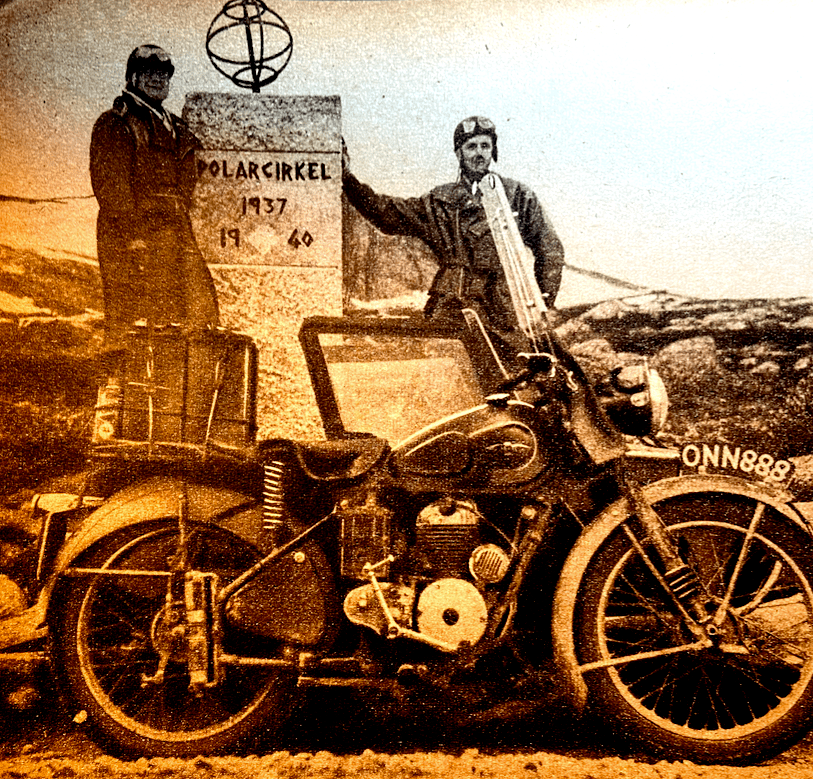
“WHEN SIDECAR OUTFITS of under 500cc are being discussed the dogmatist invariably shakes his head sadly and purses his lips in silent disapproval. 0ld notions die hard, and one of the most cherished fallacies is that the lightweight sidecar outfit is unworthy of even the mildest consideration. Yet…a sidecar outfit powered by a 197cc two-stroke engine has recently completed a trip to the Arctic Circle. Cruising speed throughout was approximately 35mph and fuel consumption was 65mpg. Only one minor and easily rectified bother was encountered during the entire trip, in spite of the steep gradients and poor roads met with in Norway. Equal success, it may be recalled, was achieved by a member of the staff on a trip to Wales with a similar outfit in February of last year. The fact is that the power output and the general quality of the modern lightweight motor cycle have improved tremendously in the past few years. Another important factor is that the total weight of the latest sidecar for fitting to a lightweight machine is no more than 100lb, compared with approximately 180lb for that of many ‘normal’ sidecars. In spite of the low weight, most up-to-date lightweight sidecars provide ample weather protection and comfort. Economic conditions do not improve. It is important, therefore, to bear in mind that the first cost of a lightweight sidecar outfit can be less than that of the least expensive 500cc solo on the British market; and that annual tax and insurance rates, together with other upkeep costs, may well amount to less than the sum paid for season tickets for daily journeys. Thus, for day in, day out utility tourneys, or for touring where a high cruising speed is not one of the main requirements, the modern lightweight two-stroke-and sidecar can undoubtedly be a most attractive proposition, especially for those who must budget with penny-counting care.”
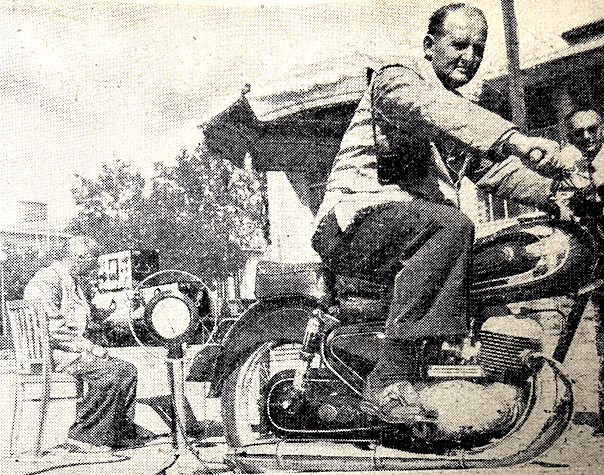
“PRACTICALLY ALL THE modern American highways are of the four-lane type (there are a few six- and eight-lane motorways in America, but they are usually short, and serve merely local traffic at the rush hours). Why then are the four-laners right in the USA and inadequate here ? For a very simple reason. The United States planners base all their plans for safety, speed and efficient transport upon the principle of segregation. The segregation plan on most US motorways consists of eliminating all pedestrians, all cyclists, all perambulators, all animals, all handcarts, and all ribbon building with its concomitants of children, pet animals and pedestrian crossings. Under these conditions, and under these conditions only, the four-lane layout becomes safe. Obviously, assuming such segregation, no bulges or excrescences can partially block the outside slow lanes. The one exception to this is parked cars or breakdowns. To cover this threat, the US motorways mostly have a 12ft edging of turf or waste ground. This can be used to provide parking bays at regular intervals, and also allows broken-down vehicles to be pushed off the road.—Ixion
Ixion was spot on in specifying the design of UK motorways; I wonder what he would have thought of doing away with hard shoulders?—Ed
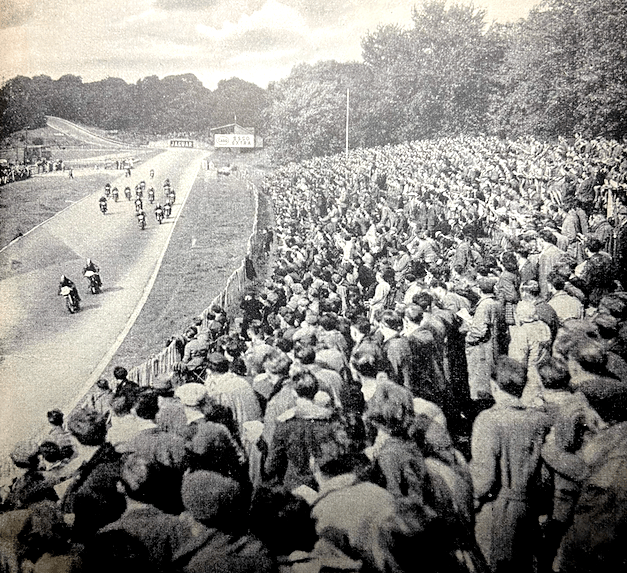
“I INVITE [BLUE ‘UN CORRESPONDENTS] GH Jones and ‘HTC’ to realise that such terms as ‘stabilisation’ and ‘stagnation’ are relative, not absolute. The pedal cycle—to all appearance—is by now very largely stabilised. The models which boys in my family ride today are practically identical with my last personal purchase many years ago, barring the addition of a dynamo. But if we compare an old Stanley Show with a modern Earls Court, the last Stanley indicated no consensus of opinion among designers about any leading elements of motor-cycle design, whereas the last Earls Court showed a general agreement, based on such leading items as, 1, clip-ons, 98cc, 250cc, 350cc and 500cc; 2, telehydraulic types of fork; 3, three to four gears with primary and secondary chain drive; 4, rear springing, where price permits; 5, magneto or AC generator ignition; 6, electric light; 7, electric horn; and a few minor details. The Squariel and the LE Velocette almost mocked at convention; but neither has, as yet, either found imitators or dominated the market. Why? Because the bulk of the public prefer more stereotyped patterns. The Douglas, with its flat-twin engine and torsion-bar springing, is still rather a lone wolf. Again why? Because the public do not exalt it to the throne. Neither the old ABC nor the fine German BMW has pushed the flat twin into our limelight. Again why ? Because the buying public determine such trends, and they prefer the parallel vertical twin. The public, not the manufacturers, call the tune. True, the public can only select from what is offered. But in Britain they are offered a definitely greater variety than in the corresponding industry of any other nation. Incidentally, we of The Motor Cycle periodically invite you, our readers, to design your ideal model on paper. You have tackled the job with avidity on several memorable occasions. But you never convinced any designer or any manufacturer that you were right—possibly because they knew what they were doing, and occasionally because your notions would have cost more than any of you are ready to pay. If you prefer the terms ‘semi-stabilised’ for the motor cycle, and ‘stabilised’ for the pedal cycle, I have no quarrel with you. But you know we may yet see an atomic motor cycle. I can believe anything since I have seen some of the ‘thimble’ engines fitted to model aircraft.”—Ixion
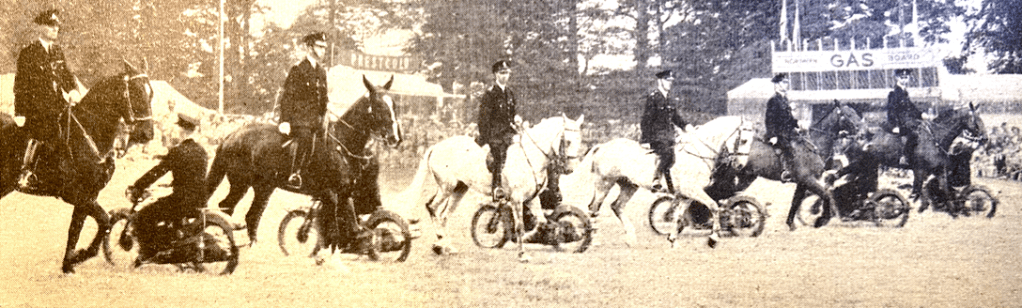
“I HAVE BEEN ASKED what was the very stupidest thing I ever did in connection with a motor cycle. I was about eight weeks old in a motor cycling sense, as far as actual ownership was concerned. One evening I rode across Barnstaple to dine with friends at Ilfracombe. On the return journey the road rises fairly steeply from the coast in terms of 19th-century engines. My engine could not be persuaded to emit even a single coughlet. So I pushed the machine up the three miles or so which separate the coast from a long run down to Barnstaple. At the summit, exhausted, I propped the model against a tree, slumped on the roadside bank, and felt in my waistcoat pocket for a match. My finger encountered some foreign metal object in the pocket. It was the brass interrupter plug then installed in all ignition circuits to prevent the battery from discharging if the contact-breaker points chanced to be in contact when the engine stopped. (We had, of course, a twistgrip handlebar switch for use while driving, but these were so unreliable that the best makers added an interrupter plug, which also provided a mild protection agains theft or meddlesome urchins.) When I had stopped perspiring and cussing, I remounted and swooped down to Barum at 50mph.”—Ixion
“THAT THE ART of grass-tracking has a big following and a large number of talented exponents was amply demonstrated at Kirkby Mallory, near Leicester, when the ACU’s National Grass Track Championship meeting was held. An estimated crowd of 12,000 enthusiasts flocked to the event, in many cases to support their fellow clubmen who were there to dispute on the track their claims to the Centre or Individual Championships. In pleasantly warm, dry weather, spectators witnessed some exciting racing in both the solo and sidecar classes. The course, which is oval to shape, 1,660 yards in length, and has a mean width of approximately 60 feet, was in dry condition, but the grass soon became polished enough to make the going ‘interesting’—particularly after the sidecar outfits had been sliding their way round. There was a total of 84 entries, and teams were entered by eight Centres. The Individual Sidecar Championship Race had a record entry of 14. In the 350 and 500cc Solo Championship events there were entries of 26 and 24 respectively. There were 23 races in all, the majority of them being heats for the various championship finals. The Solo Team Championship was won by the East Midland Centre, while the sidecar team honours were taken by the Midland Centre. The 350 and 500cc Solo Team Championship was assessed by adding together points in three heats. East Midland won
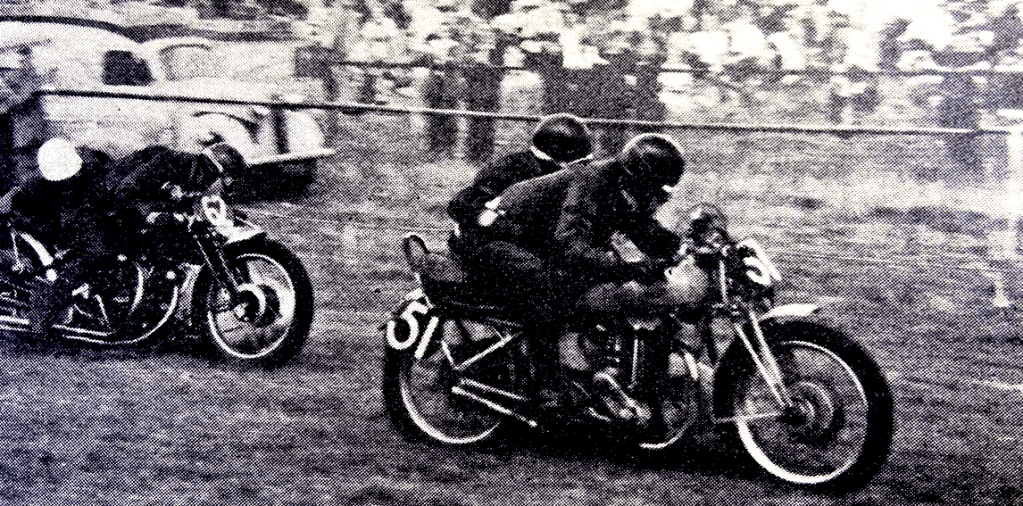
with 44 points; the Midland Centre were runners-up with 34. The chances of a close finish were spoiled when Midland riders R Tolley and A Cresswell, both on Royal Enfield-JAPs, had machine bother in one of the 350cc heats—a puncture and a melted piston. In the Centre Sidecar Team Championship W. Evans (499 Norton sc) led nearly all the way and was never seriously challenged. Obtaining 30 points from the stout efforts of their sidecar men, Midland Centre won the Championship comfortably from South Midland Centre, their nearest rivals, with 30 points. Evans’ time of 3min 54.8sec for the four laps was the best sidecar time of the day. SF Mintey (344 Burdett Special) completed his hat-trick in the final of the 350cc Individual Championship by winning the award for the third year in succession. He took the lead from the start, and held it throughout the four laps. The second- and third-place men, F Wallis (344 AJS-JAP) and AJ Hagon (348 BSA-JAP) respectively, also maintained their formation for the entire race. In the 500cc Individual Championship final no one could catch A Cresswell (497 Royal Enfield-JAP) who also won the cup last year. He was off the line like the proverbial scalded cat, and first into the left-hand bend immediately after the start. A clutch start was employed, incidentally, and in the solo categories, a starting gate, similar to those used in horse racing, was operated. Solos circled the course in an anti-clockwise direction, and sidecars clockwise. LJ Bayliss (497 Ellbee) was a resolute challenger to the flying Cresswell, but had to be content with second place, some five seconds behind the winner. Cresswell’s time of 3min 16.8sec (70.05mph) for the four laps created a new race record. In the second heat of the Sidecar Individual Championship Race a mishap occurred immediately after the start when KJ Blay’s 600cc Thorpe-Douglas found unexpected wheelgrip and reared high in the air—the outfit turned on its side and driver and passenger were flung off.
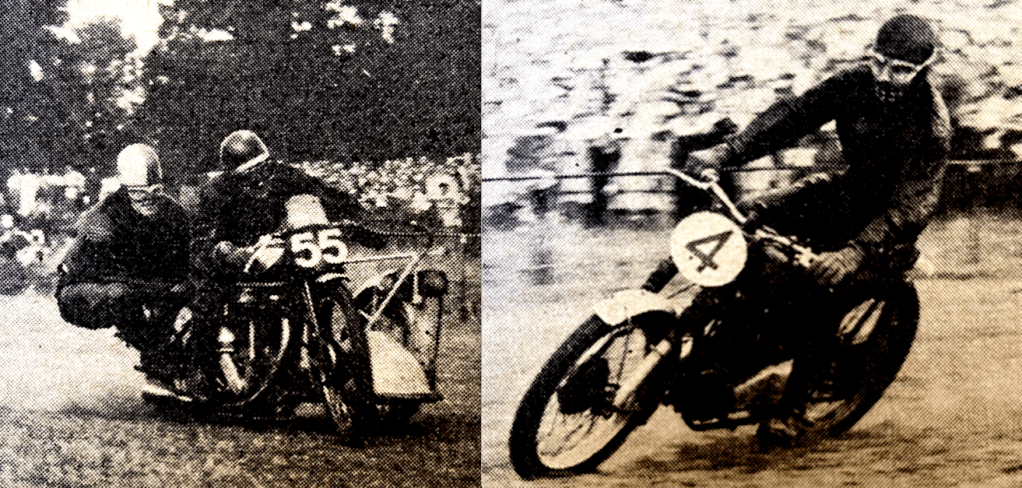
Perhaps the most keenly contested racing of the day was seen in the final of this event. W Evans, on his potent 499cc Norton outfit, was well in the lead after the first lap when he was forced out with machine trouble. The lead was taken over by D Yorke (498 Rudge-JAP sc), but was hotly disputed by EJ Davis (998 Vincent sc) who, on Lap 1, had been lying fifth and for the best part of three laps the two outfits were neck and neck. Yorke led over the line by little more than a wheel’s length—the hardworking time-keepers made the difference 0.2sec. The day’s programme was completed. Professor AM Low presented the awards to the winners and mentioned that proceeds went to the ACU Benevolent Fund. On-the-spot organisation was carried out in a highly efficient manner by the Leicester Query Club. RESULTS 350cc Individual Championship: 1, SF Mintey (344 Burdett Special); 2, F Wallis (344 AJS-JAP); 3, AJ Hatton (348 BSA). 500cc Individual Championship: 1, A Cresswell (497 Royal Enfield-JAP); 2, LJ Bayliss (497 Elbee); 3, R Tolley (497 Enfield-JAP). Sidecar Individual Championship: 1, D Yorke (498 Rudge-JAP sc); 2, EJ Davis (998 Vincent sc); 3, C Freeman (499 Norton sc). Centre Team Championship: Solo Award, East Midland Centre, 44 points; Sidecar Award: Midland Centre, 37 points. Sidecar Team Final: 1, W Evans (499 Norton sc), Midland Centre; 2, EJ Davis (998 Vincent sc), South Midland Centre; 3, D Yorke (498 Rudge-JAP), Eastern Centre.”
“OVER TWO YEARS AGO details were given of an experimental prototype lightweight, the Greeves. Two years of intensive development and testing have now come to fruition : Greeves lightweights are to be marketed forthwith. Tooling is well advanced, and initial deliveries are expected to be under way by the time of the London Show. Many modifications have been introduced since the original prototype. Out-standing among them is the adoption of a composite frame comprising aluminium-alloy castings and steel tubes. Wheel springing, both front and rear, is by bonded rubber-in-torsion units of the type which has proved so satisfactory on the Invacar invalid tricycle. Three models are to be marketed, all with Villiers 197cc Mark 8E engine-gear units; two will be roadsters and the third will be a scrambler (a trials variant is expected in the near future). The Standard roadster has a 3-speed gear box and black paintwork; the de Luxe roadster and the scrambler are equipped with 4-speed boxes and have a pleasing blue finish. Wheel rims are grey-painted on the roadsters and chromium-plated on the competition machine. Frame design represents a complete but logical departure from orthodoxy. In terms of strength/weight ratio, it is superior to the ordinary bicycle-type frame. Most critical part of a frame is the steering head because, apart from its essential function it has to resist shock and bending loads applied both from in front and behind. Without the use of large and heavy lugs of graduated section, the conventional tubular frame suffers from severe local stressing at the steering head and, to provide adequate strength there, has to be unnecessarily heavy elsewhere. In the Greeves design, the front down member is a massive I-section cast light-alloy beam which tapers downward from the head.”
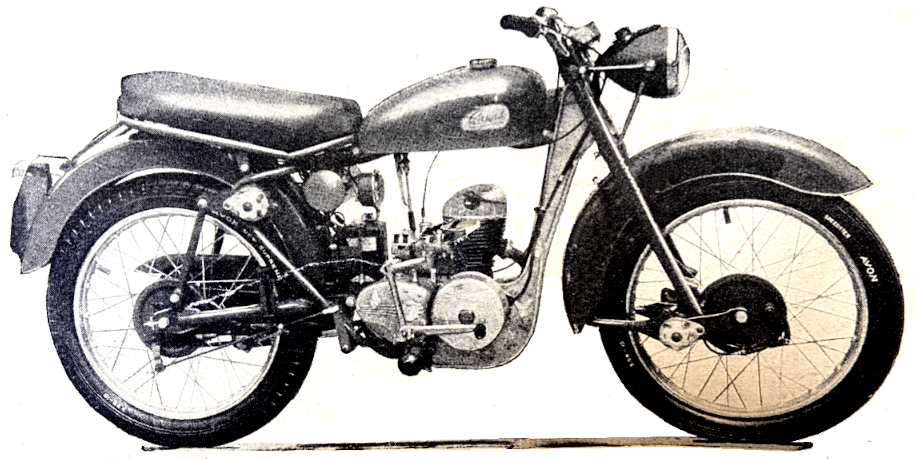
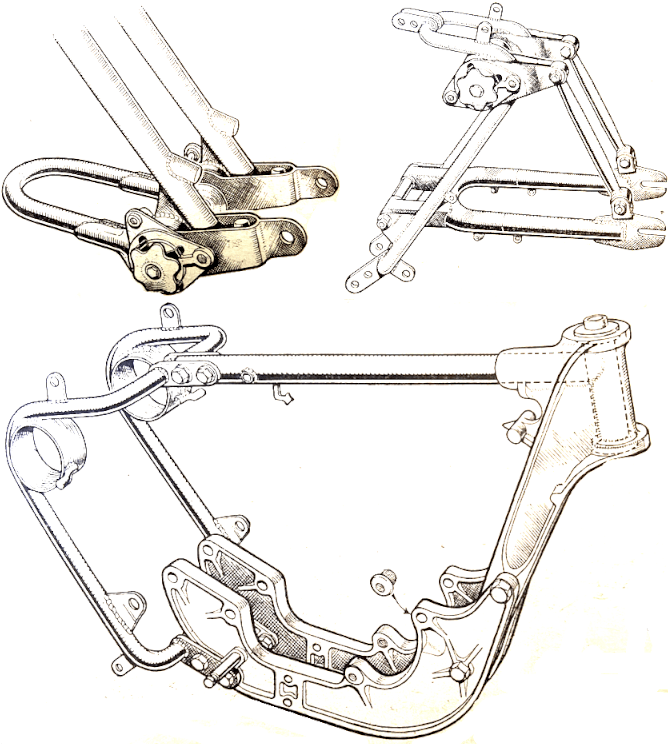
“AT THE SALT LAKE, UTAH, USA, on September 4, Joe Simpson, of Stockton, California, riding a Vincent Black Lightning, broke the American Class A (racing machines) maximum speed record with a mean of 160.697mph; his fastest one-way speed was 162.454mph. Simpson thus improved on Roland Free’s record by about 4mph. On September 7, Marty Dickerson, of Los Angeles, broke the Class C (standard machines on pump fuel) record with a speed of 147.856mph; his fastest one-way speed was 150.953mph. Dickerson used a Vincent Rapide of 1948 vintage!”
“THERE WAS A RECORD attendance at Hawkestone Park, Hine Heath, when the Salop Club held its Championship Scramble. Though the event was restricted, there was an excellent entry which included the cream of British scramble riders and two very welcome visitors from Holland, one of whom, H Reitman, was the Dutch Moto-cross Champion for 1952. Reitman added the Hawkestone Championship trophy to his collection amid a great ovation from the enthusiastic crowd of spectators, estimated at more than 15,000. In dry, sunny weather, an excellent afternoon’s racing was witnessed. All events, including the many heats, were closely contested, and in some of the finals the pace was extremely hot—the result of some skilful and spectacular riding by the experts.”
“INDIVIDUAL WORLD’S CHAMPIONSHIPS in four classes were decided at the Grand Prix of the Nations. Last but one of the classic road races for 1953, the event was held over the 3.9-mile Monza circuit, near Milan. The 500cc event was won by GE Duke (Gilera) at an average speed of 107.12mph. Duke led virtually from the start and was never seriously challenged. The Sidecar Race was won by ES Oliver, driving his Norton and Watsonian outfit, the 250 and 350cc Races by E Lorenzetti (Moto Guzzi) and the 125cc event by W Haas (NSU). Since C Ubbiali (MV Agusta) did no better than finish third in the 125cc race and HR Armstrong (NSU) was fourth in the 250cc event, Haas cannot now be beaten for the World’s Championship in the 125 and 250cc classes. Duke and Oliver become World’s Champions in the 500cc and Sidecar classes respectively. The 350cc Championship had already been won by Fergus Anderson (Moto-Guzzi). Norton and AJS factory teams did not take part. Practice last week was fraught with confusion—it appeared for a time as though the race would not take place. The contretemps which arose was a result of the organisers’ decision not to pay start money to the factory-sponsored riders of Moto-Guzzi, Gilera and MV Agusta. Such money, they said, must be paid by the manufacturers. Though the manufacturers themselves did not disapprove of this, the riders objected on a point of principle. They said that they would not ride unless starting money was paid by the Federazione Motociclistica Italiana.
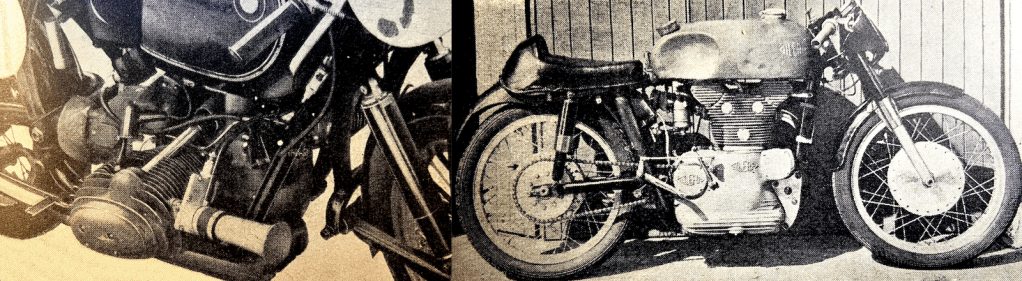
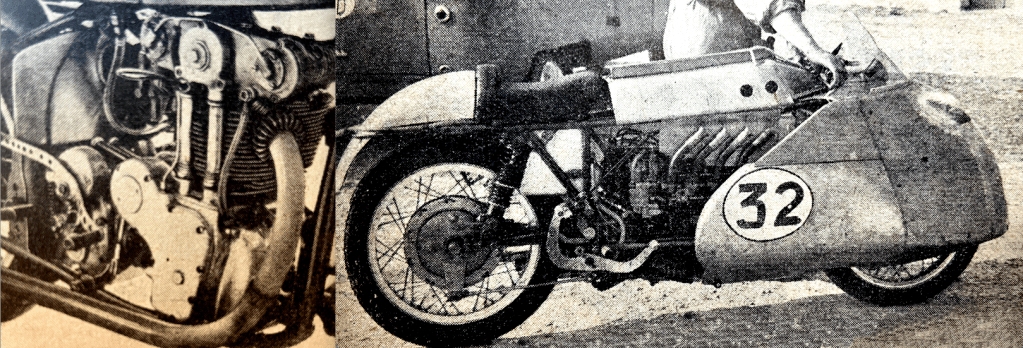
Their feeling was that if they acted otherwise, they would establish a precedent of which other organisers might later take advantage. Numerous private owners who had been guaranteed starting money lined up with the factory riders concerned. A petition was signed and sent to the organisers on Friday. The various chefs des équipes supported it, and issued a statement which asserted, in effect, no starting money, no race. On Saturday morning the FMI issued a declaration, the gist of which was that starting money would not be paid. A meeting between manufacturers and FMI officials took place towards the end of practice on Saturday evening. It was then announced that manufacturers would pay their riders’ starting money for the time being and the FMI would later pay the manufacturers. The riders maintained that they had won their point, but there were many who felt that whether they had done so or not was open to question. Rife as the confusion was, however, it did not detract from the technical interest of the practice period. Fergus Anderson turned out with the 500cc Moto-Guzzi in greatly modified form. Previously the model had not handled too well by virtue of the fact that the centre of gravity was too high and too far back. So the fuel is now carried in pannier tanks mounted forward of the cooling radiator and encased in a striking, streamlined shell. Overall height of machine and rider is no greater than that of a Gilera without a rider. As well as appearing in the form in which they are already known, the factory BMWs were considerably altered. One of the three models tried was streamlined, with massive, light-alloy fairings both in front of and behind the rider. Another model was equipped with forward-facing air intakes. Zeller reported that the machine performed well, though he decided to use the streamlined model on race day. A somewhat serious accident during practice involved A Milani (Gilera), who came off at Lesmo. He was taken to hospital suffering from a broken collar bone. Although the fastest 125cc practice lap had been made by E Mendogni (Morini), chief interest centred on W Haas (NSU) and C Ubbiali (MV Agusta). Ubbiali had to finish not lower than second if his chance of winning the World’s Championship was not to be destroyed. 125cc Class—16 laps, 62.60 miles: There were 17 starters representing four makes and six nations. Of the 17, F Benasedo (MV Agusta), CC Sandford (MV Agusta) and R Hallaus (NSU) failed to clear the pit area when the flag dropped. At the end of the opening lap AA Copeta (MV Agusta) led by nothing from Ubbiali and Mendogni was third. Fourth was W Brandt (NSU) and fifth was Haas. In spite of their promise the NSUs appeared to be down on speed. Ubbiali took over the lead on lap 2, and went on to increase the distance between himself and Copeta. At the end of five laps the order of the leaders was Ubbiali, Mendogni, Copeta, Haas, F Bettoni (MV Agusta), A Morelli (MV Agusta) and Brandt. As the race progressed, the second and third men closed up on Ubbiali. At the end of six laps his lead on Copeta was no more than 0.4sec. Copeta’s advantage on Mendogni was
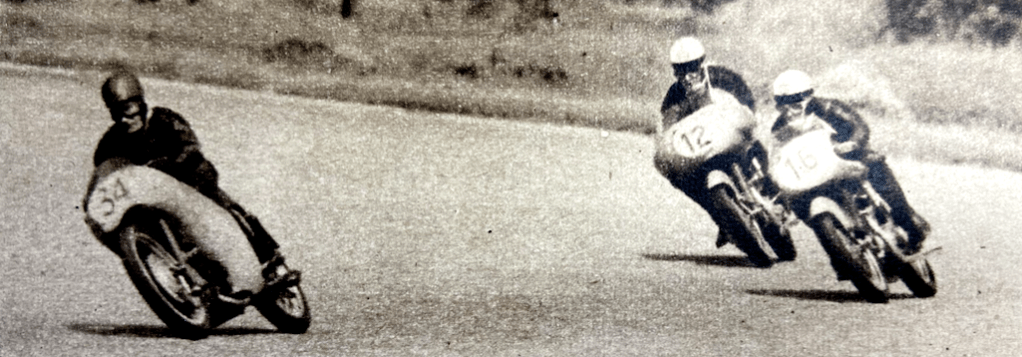
1.4sec. But was Mendogni foxing? On Lap 8 he suddenly spurted and moved ahead of both Copeta and Ubbiali. His lead was short-lived for Ubbiali was again in front on Lap 9. But Mendogni had shown his mettle—and seven laps remained. Ubbiali still led on Lap 10, but Mendogni was in his slipstream. Copeta’s engine was tiring and he was by then out of the picture. Haas was third, as much as 12sec behind the leaders. Ubbiali’s race average was approximately 88mph. Haas could win only if the leaders blew up—or fell asleep. The ding-dong struggle for the lead became a struggle for the slipstream—Mendogni and Ubbiali each wanted the other to set the pace. On Laps 12 and 13 Mendogni led; on Lap 14 Ubbiali led but Haas was close behind Mendogni. Haas gained more ground on Lap 15, though he had not spurted. The leaders were so intent on foxing one another that they seemed unaware of Haas’ presence. The trio began on the last lap with the crowds throwing their hats in the air. And Haas won. He entered the finishing straight alongside Mendogni and gained on him literally by inches. The race finish was easily the most exciting—and amusing—this year. Results: 1, W Hass (NSU), 86.98mph; 2, E Mendogni (Morini); 3, C Ubbiali(MV Agusta); 4, AA Copeta (MV Agusta); 5, W Brandt (NSU); 6, R Colombo (NSU). Fastest Lap: W Haas (NSU), 89.7mph (record). 350cc Class—24 laps, 93.99 miles:The excitement of the 125cc Race had hardly subsided when riders formed up for the 350cc event. There was universal disappointment at the non-participation of the Norton and AJS teams. The front row positions on the grid were occupied by the Moto-Guzzis of E Lorenzetti, K Anderson and a newcomer, D Agostini, and the two-stroke DKWs of S Wünsche, K Hoffman and L Parry. Two other factory DKWs ridden by TL Wood and A Hobl shared the second row with the AJSs of LT Simpson, RJ Laurent and BC Stormont. The field was drawn from 10 nations and totalled 28. At the starting signal Wünsche streaked off into the lead. He still led at the end of the lap, but after two more laps Lorenzetti was in front and Agostini and Anderson were in line astern at his tail. Wünsche was fourth. Lorenzetti had built up his lead to 7sec by Lap 4 and Anderson had moved ahead of Agostini. After six laps the field had become widely spread. Lorenzetti’s lead was 11sec from Anderson, who led Agostini by 7sec Wünsche was 27sec behind Agostini. Tommy Wood had gone out with engine trouble. Then Parry also disappeared. This left the most forward-running private owner, HP Müller (Horex), in fifth position. Wünsche pulled into his pit on Lap 20. He set off again as Lorenzetti streaked through, so that all but the second and third riders were then lapped. Wünsche failed to complete another circuit. Four laps later the rather dull race drew to a rather dull finish. Results: 1, E Lorenzetti (Moto-Guzzi), 99.55mph; 2, FK Anderson (Moto-Guzzi); 3, D Agostini (Moto-Guzzi); 4, A Hobl (DKW); 5, LT Simpson (AJS); 6, WA McAlpine (Norton). Fastest Lap: E Lorenzetti (Moto-Guzzi), 101.45mph (record). 250cc Class—56 laps, 78.25 miles: A Moto-Guzzi win was prophesied in the 250cc Race. It has
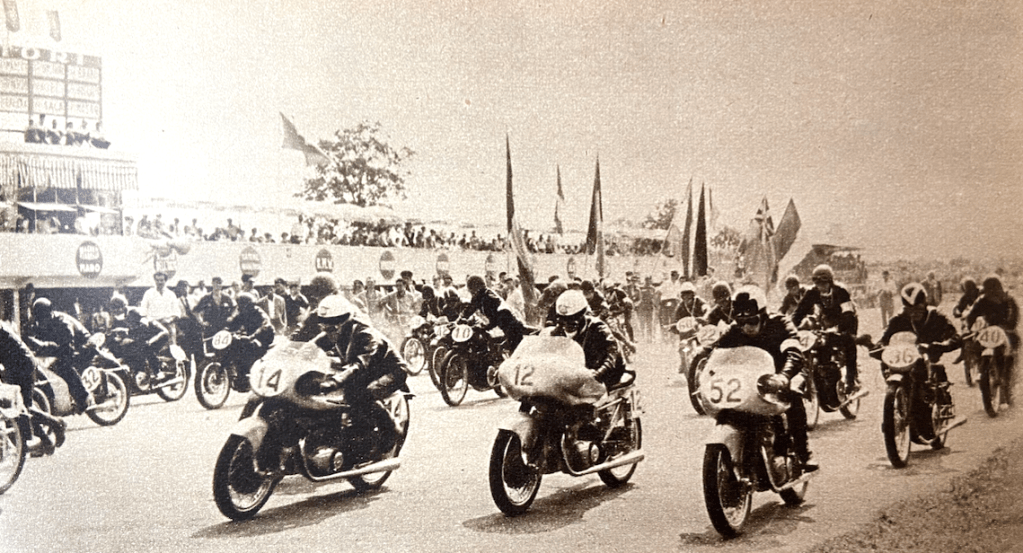
been apparent in previous classic events that the two makes, Moto-Guzzi and NSU, are closely matched in terms of sheer speed. NSUs score heavily on acceleration, but acceleration is not a deciding factor at Monza. Moto-Guzzis, moreover, were racing only a few miles from their factory. Ken Kavanagh had been given Fergus Anderson’s machine and Anderson had taken over another. HR Armstrong (NSU) had been notably lacking in speed during practice. There were 26 starters. The start was sensational. Haas and Masetti drove desperately into the lead. Anderson’s engine refused to fire and so did Kavanagh’s. The pair pushed hopelessly for many yards without result. Plugs were changed and the engines started as the field completed the opening lap: At the beginning of the second lap, the order of the leaders was Haas, Brandt, Wünsche, Lorenzetti, Masetti, Armstrong and TL Wood (Moto-Guzzi). After another lap Lorenzetti was in second place and on Lap 3 he led by inches. He and Haas were so fast that they led Brandt by 7.4sec after four laps. At the end of Lap 5 Masetti pulled into his pit and lost valuable seconds. Anderson retired. Kavanagh had set off with the leaders after his starting trouble. He was still with them after eight laps, sandwiched between Lorenzetti, who was then second to Haas, and Armstrong, who was third. Kavanagh was then shown a black flag requesting him stop. He had been given assistance during his plug change, thus contravening a race regulation. But he was cheered vigorously for making a new lap record (unofficial since he was disqualified) at 97.6mph. By half distance the NSU-Moto-Guzzi struggle was on in earnest. Haas led on Laps 8 to 10, Lorenzetti on Laps 11 and 12, Haas on Lap 13 and Lorenzetti on Laps 14, 15 and 16. Armstrong, meanwhile, was scrapping determinedly with A. Monianari (Moto-Guzzi) for third place, 36sec behind the leaders. After 16 laps the duel for the lead appeared to have been already settled, for the single bad drawn away from the twin. Haas tried brilliantly, but his efforts were of no avail. Results: 1, E Lorenzetti (Moto-Guzzi), 98.53mph; 2, W Haas (NSU); 3, A Montanari (Moto-Guzzl); 4, HR Armstrong (NSU); 5, W Brandt (NSU); 6, U Masettl (NSU). Fastest Lap: E Lorenzetti (Moto-Guzzl), 100.17mph (record). Sidecar Class—15 laps, 82.55 miles: Chief interest in the Sidecar Race centred on ES Oliver with his Norton and Watsonian outfit, for Oliver is a firm
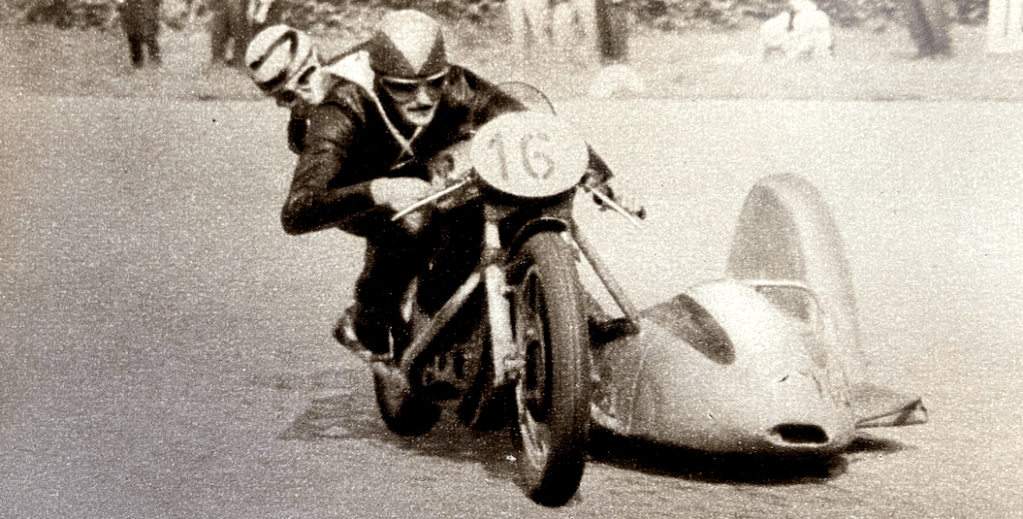
favourite with Italian crowds. He was using his orthodox outfit once again—his streamlined outfit had been passed on to J Drion, of France. The field of 20 was drawn from all over Europe. Hans Haldemann (Norton) was first away, but C Smith (Norton), Oliver and Drion were working their way rapidly forward. On the fast swerves on the back of the circuit, Smith and Oliver soon displaced Haldemann. Drion was fourth at the end of the lap. Then came J Derrone (Norton), F Hillebrand (BMW), W Noll (BMW), J Keller (Norton) and L Taylor (Norton). After two laps Oliver led and Smith was in his slipstream. After three laps the pair led Noll, then third, by 7sec Haldemann was fourth and Drion fifth. At the end of Lap 7 Noll stopped momentarily at his pit to carry out adjustments to one of the fuel injector units, losing two places in the process. After completing two more circuits he decided to retire. Flagging spirits revived when it was seen that Drion had pulled out the stops and was overhauling Haldemann. On Lap 11 he was a few yards behind and on Lap 12 he moved ahead, quickly increasing his advantage. Oliver and Smith set off on their last laps still in close company. They swept out of the last corner almost abreast and streaked up the home straight. Oliver was slightly the faster and won by inches. Included in the race had been the Italian sidecar championship—the winner was L Marcelli (Gilera), the 10th man home. Results: 1, ES Oliver (Norton), 88.77mph; 2, C Smith (Norton); 3, J Drion (Norton); 4, H Haldeman (Norton); 5, L Taylor (Norton); 6, H Hillebrand (BMW). Fastest Lap: ES Oliver (Norton) and C Smith (Norton), 91.17mph. 500cc Class—32 laps, 125.19 miles: With 29 starters, the field for the 500cc Race was the biggest of the day. Three Gileras shared the front row of the start with three MV Agustas. The BMW was in the second row and the Moto-Guzzi in the third. Inexplicably, GE Duke (Gilera) was, or should have been, in the third row. The flag dropped when some of the Gileras were still at the pit. Duke, quick-witted as always, pushed off from where he was standing and streaked off with the pack. Armstrong and N Pagani were less fortunate and were severely baulked, losing seconds which manifestly could never be recovered. Carlo Bandirola (MV Agusta) led for just as long as Duke required to have a look at the circuit. Duke then moved into the lead and proceeded to dominate the race in his most polished, courageous and brilliant style. Bandirola spilled and retired after five laps. RH. Dale (Gilera) moved up to second place, CC Sandford (MV Agusta) to third and
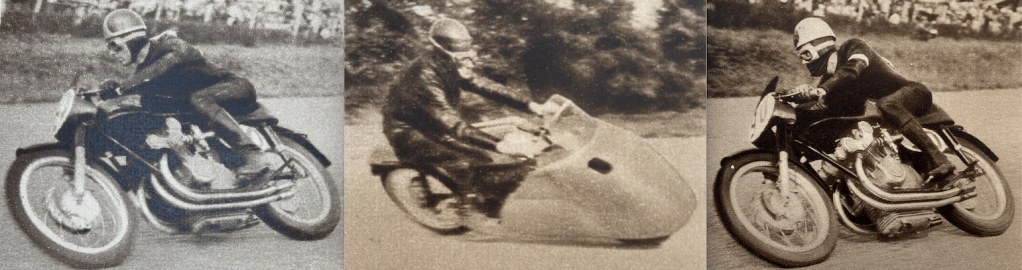
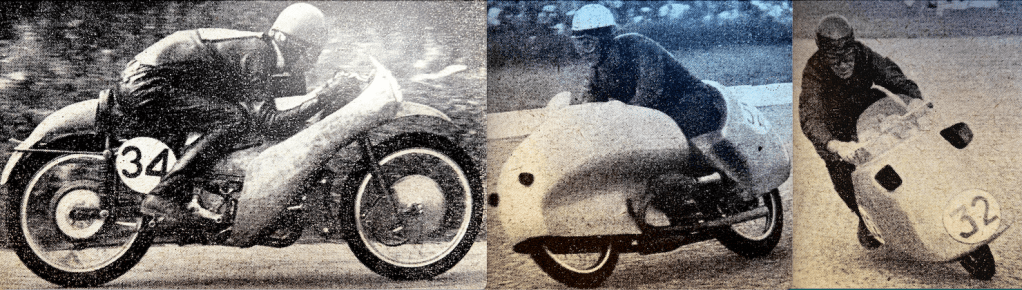
Libero Liberati (Gilera) to fourth. Behind Liberati streaked FK Anderson (Moto-Guzzi), M Giani (MV Agusta), B Francisci (MV Agusta), P Monneret (Gilera), and W. Zeller (BMW). For four laps Duke and Dale rode wheel to wheel. There were no important changes behind them except that Monneret moved up one place. On Lap 7 Duke dug in his spurs and gradually drew away from Dale. In six more laps his lead was 6.4sec. Dale, meanwhile, had drawn well away from Sandford, and Anderson, in fourth place, was ahead of Liberati. Armstrong, causing the crowds to swoon with his style and speed, was rapidly cleaving his way forward. On Lap 10 Zeller retired and on the next lap Anderson made a pit stop that cost him many places. Duke was steadily increasing his lead. After 14 laps it was 9sec, after 15 laps, 13.43sec. Sandford by then was perceptibly slowing and on Lap 14 Liberati moved up into third place. Monneret was fifth, Armstrong sixth! Anderson retired because of fuel shortage at the injector units. Two laps later Monneret overtook Sandford. There were no further changes until the 23rd lap when Liberati again headed Monneret and Armstrong displaced Sandford. Monneret was not to be outdone for long, however, and he battled with Liberati for lap after lap. Duke’s lead after 23 laps was 21.2sec, and 29.4sec after 27 laps. There were no other notable changes except that Monneret had to call it a day only two laps from the finish. He pushed over the line to gain ninth place. Results: 1, GE Duke (Gilera), 107.12mph; 2, RH Dale (Gilera); 3, L Liberati (Gilera); 4, HR Armstrong (Gilera); 5, CC Sandford (MV Agusta); 6, HP Muller (MV Agusta). Fastest Lap: 108.01mph.”
“THERE WAS ONCE a time when I could truthfully write that big-time motor cycle racing was a peculiar blend of sport and entertainment. Today it is almost entirely commercialised entertainment and, what is more, it is beginning to smell. For some years there has been a series of disputes between riders and organisers which has culminated in the present lamentable state of almost open warfare. If you ask me the basic reason, I would reply that probably it is because associations which are in theory governing a sport (and once did so) are now engaged in operating lucrative entertainment. Do not try to tell me that the riders are not being exploited. There have been some scandalous instances during this past season. Riders have had offers of starting money, only to arrive at the race and be told, ‘We wrote you cancelling your entry. But now that you are here you can start—for nothing.’ Time and time again riders get caught out on technicalities such as entering too late, yet organisers are perfectly prepared to accept another rider late if they want him. The near strike at Monza was not over money; it was on a point of principle. When the organisers announced that there would be no starting money for Italian factory riders, Gilera generously offered to pay Duke whatever he thought he should have. To his everlasting credit he flatly refused, saying, ‘No starting money, no start.’ Apart from the obvious injustice of refusing to stand the cost of the leading stars at a show attracting 100,000 paying spectators, there were underlying currents at Monza which left a very nasty taste in the mouth. In 1950 I got £120 for two starts as a private rider. I did not ride in 1951. In 1952 I was paid about £50 as a one-race factory rider. This year I was to get nothing! The promoters declared that no factory rider for an Italian firm had ever been paid starting money. This was untrue. They said, also, that riders for German firms were getting nothing. This was also untrue. They never said that they could not afford to pay anything—which was unfortunate because I had ready a syndicate to put down, that very evening, £5,000 cash as a guarantee against loss on these conditions—that the riders should nominate an accountant to examine all the accounts after the race; any loss would be borne by us, but any profit would be divided among the riders. Please do not think that it is only at Monza that the riders consider they are being given a raw deal. We would dearly love to have an accountant examine the books of the Dutch GP! At the Swiss Grand Prix in Berne, the first prize in the main car race is ten times that of the first prize in the 500cc motor cycle—maybe Ascari eats ten times as much as Duke, do you think? A good deal of these troubles is caused by one simple rule. It stipulates that on the day of a classic race, no other organiser can run an international race without the agreement of those responsible for the classic. What are the results ? Organisers are in the nice position of offering low starting money on the basis that if a rider does not accept he cannot ride elsewhere. The French Grand Prix, at Rouen, was scandalous in that the organisers accepted only 20 riders in each race ‘because they could not afford more’. If the French cannot run a classic deserving the title, they should not be allowed to run one at all. So for as I know, there was no other race that day where the ‘circus’ riders could go. Doubtless there will he a little desultory talk about all these matters at the FIM Autumn Congress. It will be one-sided talk because, although, in theory, the delegates are the representatives of the riders, many of them are, in fact, representatives of organisations making money out of racing. But I suggest that the FIM must take steps to convince riders they are getting a fair deal, or 1953 will be only a sample of the trouble in store for 1954. The remedies cannot be decided by the FIM alone—riders must be brought in for consultation and agreement.—Fergus Anderson
“FOR THE SECOND YEAR in succession, Henry Kay, a member of the Darwen&DMCC, won the two-day Scarborough Motorcycle Rally, which finished on Scarborough’s foreshore on Sunday last. Accompanied by his wife as passenger, he piloted his 500cc BSA combination through to register a total of 215 points. His win provided a measure of special celebration, for the previous day was his 30th birthday. Kay, an ex-scoutmaster who believes in being prepared by always carrying a really big hammer in addition to the recognised toolkit, received the News Chronicle Trophy, which he retains for another year, together with £15. Hundreds of late-season visitors greeted the competitors upon their arrival at the Northern resort in bright, beautiful weather which had a crisp seasonal nip of September in the air. Riding conditions could hardly have been better and competitors enthused about the excellent arrangements. Organised by the Scarborough&DMC and supported by the News Chronicle and the Scarborough Corporation, the rally received a total of 174 entries, of whom 146 started and 85 finished; the distance covered, all sections included, was between 500 and 600 miles. The riders massed at five starting controls in London, Birmingham, Liverpool, Edinburgh and Scarborough. Those from Scarborough, Edinburgh and Liverpool travelled approximately 340 miles via Morpeth and Hawes, to Scarborough and the second stage of the Rally, and those from Birmingham and London covered a similar distance through Spalding and Manchester, arriving in Scarborough on Saturday night. They had a break of 1½ hours before covering another two routes through the picturesque North and East Ridings of Yorkshire, these runs totalling, approximately, another 234 miles and including timed sections. This last part of the Rally was conducted during the hours of darkness and, after returning to Scarborough in the early hours of Sunday morning, competitors underwent machine examination for lights, silencing, starting and brakes. Hero of the rally was 24-year-old Geoff Langlois, a member of the Port Sunlight (Cheshire) MCC, who received a terrific ovation from fellow competitors when he limped across the Olympia Ballroom floor on crutches to receive the coveted News Chronicle Gold Star, awarded to the driver gaining the highest total of points in the North Lancashire Rally and the Scarborough Rally. Recovering from a broken right leg which he suffered three months ago in a rally in Wallasey, he had the plaster removed only on the Tuesday before the start. Nonetheless, he was still able to handle his 649cc Triumph sidecar, gaining the maximum number of points possible in the star competition—50 in the North Lancs Rally and 50 in the Scarborough Rally. The Silver Star awarded to the runner-up was won by G Reay, a Lancaster competitor, who rode a 498cc Matchless. RESULTS Rally Winner: HJ Kay (500 BSA sc), 215 points. Class 1 (Up to 300 cc. Solos): I, BW Holmes (200 James); 2, P Boys (250 BSA); 3, JR Walton (200 OEC). Class 2 (Up to 1,000cc Solos): 1, GB Simpson (350 Matchless); 2, H Rhodes (500 AJS); 3, W Fieldhouse (350 AJS). Class 3 (Sidecars and Three-wheelers): 1, G Langlois (650 Triumph sc), 206; 2, L Alderson (650 BSA sc); 3, H Healey (600 Panther sc). Gold Star Award: G Langlois (650 Triumph sc). Silver Star Award: G Reay (500 Matchless). Individual Marque Awards: AJS, H Rhodes; Matchless, GB Simmon; Francis-Barnett, PA Evans; Norton, R Keel; Royal Enfield, T Carroll; Bond Minicar, R Atkinson; Ariel, EA Storer; Dot, BW Holmes; BSA, HJ Kav; Sunbeam, JR Vasey; Triumph, G Langlois.”
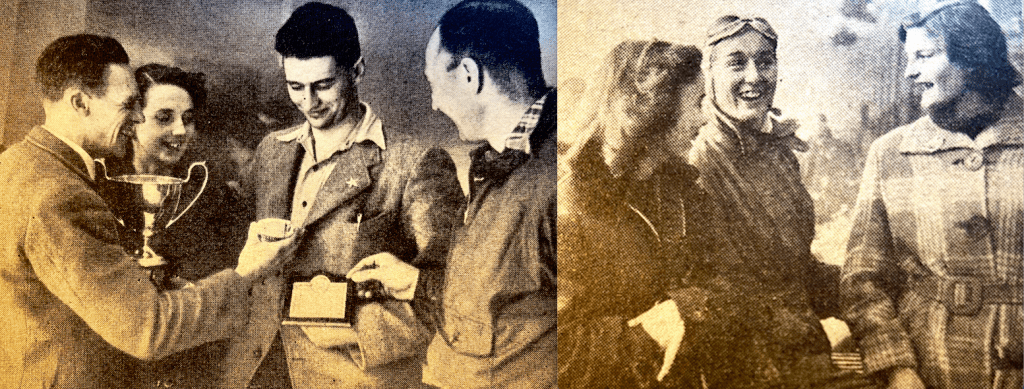
“HAROLD KARSLAKE, ENCYCLOPAEDIST to the industry, tells me he has traced some half-dozen kits sold in our first decade (1900 to 1910) for convert-ing pedal cycles into motor cycles. Some merely required a spanner, while others delivered the engine in bits, and a small lathe was required to complete the machining. For example, in 1903 the Bord Co, of Finsbury Pavement, advertised a bolt-on kit for £29 10s. A wee four-stroke engine with outside flywheel was clipped inside the diamond frame. A small battery case and a cylindrical petrol tank were slung from the top tube. Add a belt-rim to the spokes of the rear wheel, loop on a twisted raw-hide belt with C or S steel fastener, and off you go! In 1904 Brown Bros had gone so far as to produce such boxed kits in fair numbers as a standardised article. It is odd that neither I nor any of my oldtimer pals have any recollection of ever meeting a purchaser of such an outfit, and it seem probable that, on the whole, sales were microscopic.”—Ixion
“TWO WORLD’S CHAMPIONS, one a newcomer to the circuit, were outstandingly successful at the international road-race meeting held it Oliver’s Mount, Scarborough, on Friday and Saturday last. Fergus Anderson, 350cc World’s Champion, was present with 248 and 345cc Moto-Guzzis; he celebrated his first appearance on the Oliver’s Mount circuit by winning the Lightweight and Junior events. In the 250cc Race, Anderson, already far ahead of the field on the third lap, threw his little, sharp-prowed machine round the course in 2min 34.4sec (57.23mph) to smash, the previous class record by over a mile an hour. Geoff Duke, World’s Champion in the 500cc contest, delighted the huge crowd by winning the Scarborough Senior event in his most fluid, effortless style. The performance of the Italian machines in the 350 and 500cc races marked the end of a seven-year period at Scarborough during which British machines have been virtually unchallenged in these classes. The opinion held by many concerning the disadvantages of a four-cylinder machine on the narrow, tortuously winding, Oliver’s Mount circuit, with its numerous bottom-gear corners, was finally confounded by Duke’s and RH Dale’s mastery. KT Kavanagh and Jack Brett, without WR Amm, still unfit as a result of his recent crash, carried the hopes of Norton supporters; all their verve and determination, however, was unable to compensate for the superior speed of the Moto-Guzzi and the Gileras. In the 350cc final, Kavanagh took advantage of a perfect start to secure an early lead. On the third lap his Norton developed valve trouble and clattered to a standstill. Two laps later Brett was in difficulties also. Clutch failure—almost an occupational disease at Oliver’s Mount—caused Kavanagh and Brett to retire in the 500cc final.”
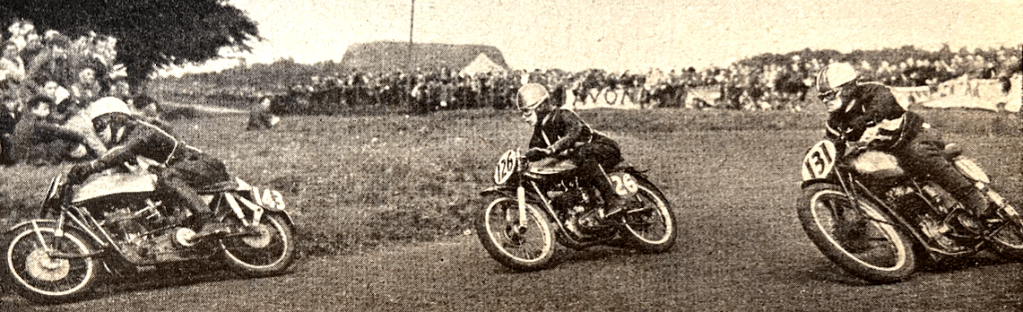
“AFTER 21 YEARS of riding in the Manx Grand Prix, during which time he has won both the Junior and the Lightweight Trophies, Denis Parkinson, 38-year-old Wakefield, Yorkshire motorcycle dealer, last Thursday achieved his great ambition by adding the Senior Trophy to his collection. Riding one of the new ‘square’ Nortons, he led throughout except on the third lap when he stopped to refuel and RD Keeler, Senior Clubman’s TT winner last June, and also riding a ‘square’ Norton, advanced from the second position he otherwise held throughout the race. Parkinson’s time of 2hr 31min 28.2sec. (89.68mph) was 1min 45.6sec better than the record set last year and he also made the record lap on his fifth circuit in a time of 24min 57sec (90.75mph). Actually he three times lapped at over 90mph, and Keeler also broke last year’s record. A Matchless Twin, ridden by Manxman D Ennett, was third, denying Nortons a clean sweep—JJ Wood, B Freestone and DT Powell were the next three men to cross the line and they were all riding Nortons. Except for a high wind, racing conditions were perfect; 58 of the 69 entrants started, 37 gained Finishers’ Plaques and 16 qualified for Replicas. Spills were remarkably few and no one suffered serious injury. It was a similar story in the Junior MGP. Yorkshireman Frank M Fox, also riding one of the new ‘square engined’ Manx Nortons took top honours, covering his six laps in 2hr 40min 18.8sec, at 84.73mph. Manxman Denis Christian, on a similar machine, was second, while an earlier pattern Norton, ridden by David Powell, of Brockenhurst, was third. RC Ritchie brought an AJS into fourth berth and a fine duel between two new names to Manx racing—B Freestone and TS Shepherd —brought Nortons into the fifth and sixth leader board places. Fox led on every lap except the third when RD Keeler (Norton) took command, only to retire on the next circuit. Fox and Keeler shared fastest lap honours at 26min 31sec (85.41mph). No records were broken though racing conditions were excellent. Of 77 entrants 67 started, 44 finished and gained 25 replicas. The IoM Peveril Club won the team award.”
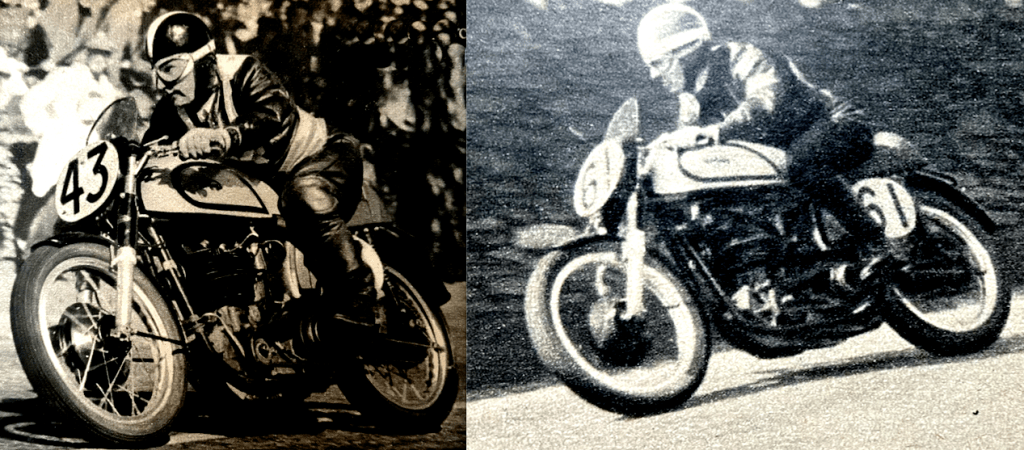
“FRED WILLIAMS, OF WALES, won the Speedway Championship of the World at Wembley last Thursday with a score of 14 points out of a possible 15. It is the second time he has gained the title, which he won also in 1950. Runner-up was Split Waterman (England) with 13 points. Third, after winning a match race to decide a tie on points for the position, was Geoff Mardon (New Zealand) with 12 points. Sweden’s 011e Nygren also scored 12 points and was placed fourth; he was given a great ovation by the sporting crowd. Australian Jack Young, the title holder in 1951 and 1952, was fifth with 10 points. Not a seat nor an inch of standing room was left unoccupied at Wembley. That indicated a crowd in excess of 90,000. Heavy rain during the day had left the track damp and anything but slick. In consequence, no records were broken; indeed, the best time of the meeting, made by Fred Williams when he won the opening race in 70.4sec, was exactly two seconds outside the 4-lap, clutch-start record. Water also attacked the starting gate. From the 12th to the 16th races inclusive the electro-magnets proved unattractive, and those five races had to be started on the green light…Sixteen riders (plus two reserves) had won their way to Wembley through various eliminating contests. The field comprised six English riders, four from Australia, and two each from Wales, New Zealand and Sweden. Each of the 16 was to ride five times in a total of 20 races (four riders in each), during the course of which each man would compete against each other man once. In the first four races Fred Williams, Young, Waterman and Mardon collected maximum points. The fifth race brought Williams and Young together. Williams had the best of the start and he lost no time in consolidating his lead, but Young was in trouble; he nearly fell on the third bend and Ronnie Moore passed inside him to take second position when coming out of the turn. Young snatched back second place on the fourth bend, but Moore continued to press so hard that he almost passed inside the Australian on the seventh turn and was within an ace of running round him on the eighth. It as a very near thing for Young’s two points…Seldom has there been such tenseness in the Empire Stadium as there was when the four riders came to the line—Rune Sormander (Nygren’s countryman), Jack Young, Geoff Mardon (who needed a win to tie with Nygren for third Championship place) and first reserve Dent Oliver in place of Jack Biggs. Young had drawn the inside starting position. The story is simply told. Young was last away. In trying to make up leeway he lifted his front wheel when accelerating out of the first bend; having got the wheel down again safely he unaccountably slid to earth. Mardon won easily in a comparative canter. In the match race to decide the tie for third place, Mardon made the better start from the outside and remained ahead throughout. Nygren slid off on the final turn when trying to go inside. To round off a very exciting evening, the Sunday Dispatch Trophy and cheques (£500*, £300 and £200 for the winner, runner-up and third man respectively) were presented by Col Sir John Hunt and Sir Edmund Hillary, of Everest fame.”
*Worth about £18k in 2026.
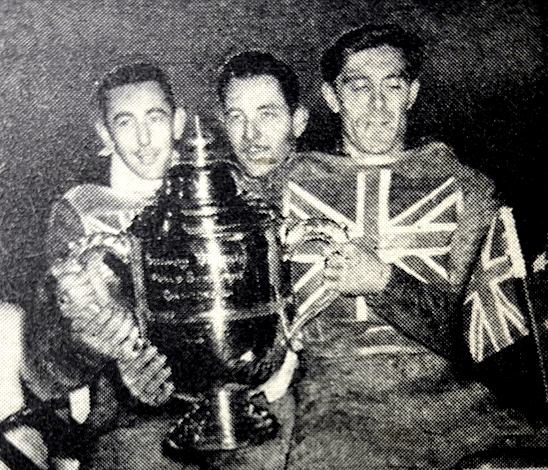
“WHEN DISCUSSING THE value of handlebar screens, leg-shields or panniers on motor cycles, how often have we heard (or made) the remark, ‘Oh yes, I quite agree, but think of the drop in performance!’ On the face of it, the comment seems justified because the more bits and pieces one festoons on a motor cycle, the slower one would expect it to go. But what certainty is there that these items would, in fact, further disturb the turbulent air flow induced by the unstreamlined machine and its equally unstreamlined rider? In an endeavour to provide the answer to the wind-resistance question, The Motor Cycle carried out a comprehensive series of tests at the MIRA proving ground, near Nuneaton, on four Royal Enfield machines ranging from 150-700cc. The machines were the new Ensign two-stroke, the 350 and 500 Bullets and the Meteor 700 twin…Legshields of Royal Enfield standard pattern were supplied for all four machines and pannier equipment was available for all save the Ensign. Since no RE panniers are listed for this last machine, a set from Craven Equipment was employed. A representative selection of windscreens was used: Olicana de luxe on the Ensign, Milverton on the smaller Bullet, HMF Giant on the 500 Feridax Mk IX on the Meteor. Happily for riders and helpers, weather conditions were good throughout the three days of the tests. Consequently there was no need to worry about the time interval between comparative runs; on the other hand, there was no opportunity of assessing the protective merit of the screens and legshields. The basic plan was to obtain figures for maximum speed, acceleration and fuel consumption in the various states of dress or undress of the machines. Also to be investigated was the variation in maximum speed with rider’s attitude, size and clothing, including some two-up runs. For the first series of maximum-speed runs the riders were fully clad and sat up in a normal touring attitude. At the outset, the machines were equipped
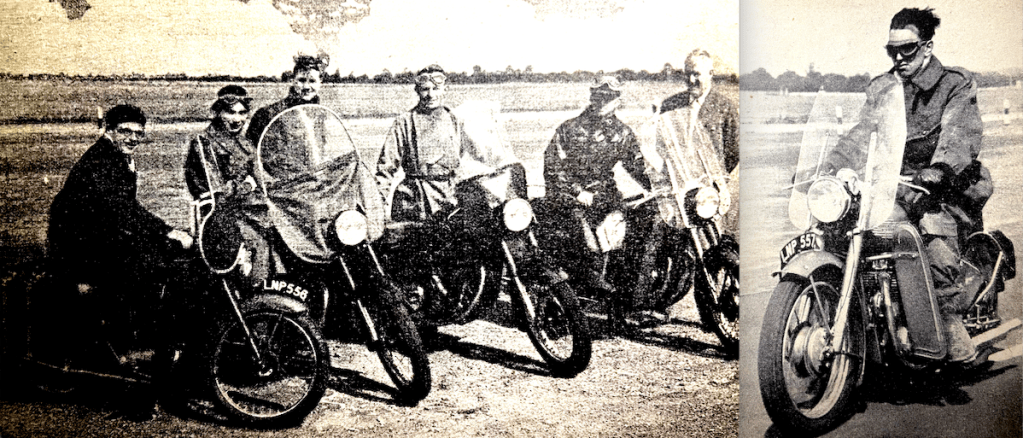
with panniers, leg-shields and windscreen; next the panniers were removed and a further set of figures was obtained. The process was repeated with legshields only, with screen only and with no equipment. Further runs were then made on the stripped machines with the riders lying down as far as possible, first with full clothing and secondly with top clothing removed…Removal of the panniers was found to make virtually no difference to the speed attained. On the three larger machines there was a fractional drop in speed, whereas the Ensign went faster by ½mph; the Craven panniers projected slightly farther laterally than did the Royal Enfield pattern, and this probably accounted for the difference in behaviour…the addition of leg-shields on their own effected an average reduction in speed of about 1½mph. The Royal Enfield shields are really flat plates, with a rearward-turned flange on the inner edge. They are therefore of poor streamline shape, and it is almost certain that legshields of curved section would prove less detrimental to performance. With the screen only there was a considerable gain in maximum speed on each machine over that obtained with no equipment. This increase was most pronounced on the 350 Bullet (amounting to nearly 2½mph), presumably because of the curved outline and appreciable angle of rake of the Milverton screen, although it has a fairly large frontal area. Though presenting the smallest frontal area of the four, the HMF screen effected the lowest percentage improvement in performance; possibly its smaller width low down resulted in more drag from the rider’s body. Despite the low speeds involved with the Ensign, the well-curved cowl of the Olicana screen more than compensated for its width over the hand extensions. The runs with both screen and legshields revealed that the addition of a screen did not counterbalance the loss from the legshields. On first consideration this appears surprising,
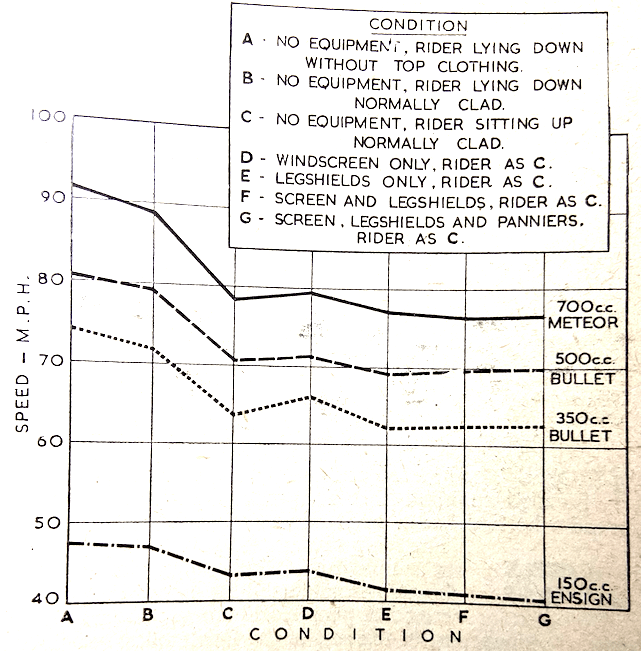
but the phenomenon is often encountered in the aircraft field—the ‘interference drag’ between two components results in their combined resistance being greater than the sum of their separate resistances…we recorded a big reduction in wind resistance when the rider ‘gets down to it’; the speed amounted to over 10mph on the Meteor, and almost 4mph on the Ensign at speeds in the middle forties. Removal of bulky top clothing made the expected but smaller improvement. It is worthy of mention that the maximum speed obtained on the road test of the 500 Bullet by Vic Willoughby was almost identical with that achieved by Roger Boss in similar circumstances (fully clad and lying down). The difference of 1mph can be attributed to Vic’s sturdier build, his spectacles—which necessitate a slightly more head-up position—and the extra bulk of his waders compared with the naval boots worn by Boss. While the machines were without equipment, the next stage was to determine the effect of riders’ bulk and clothing. In search of absolute maximum speed, Boss abandoned his 500 Bullet to try his hand on the other three machines, while Maughfling rode the Bullet. As was to be expected from the size difference, Boss was faster than Maughfling on both the Bullets by about 2½mph in each case. Even Boss was rather surprised at his ability to get 1½mph more out of the Meteor than could Vic Willoughby…An idea of the sizes and attire of the four riders can be gathered from these details: Meteor, Vic Willoughby,
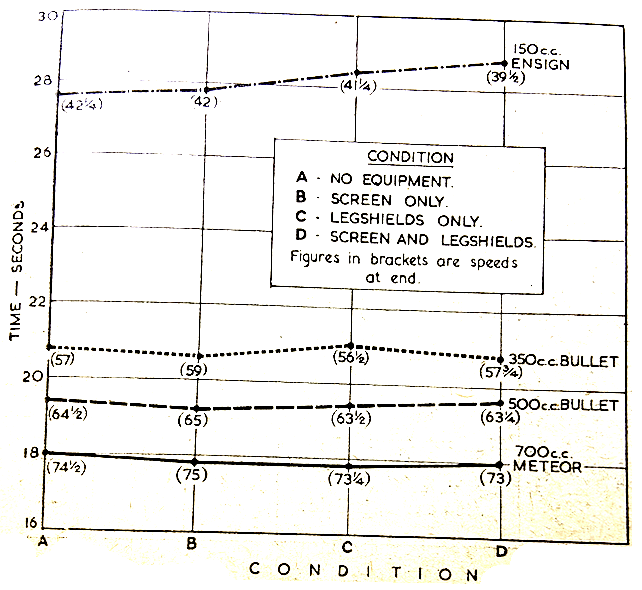
5ft 6½in, sturdy build (10½ stone), stormcoat, waders and cap; 500 Bullet, Roger Boss (of the Royal Enfield Experimental Dept), 5ft 9in, slim build (10½ stone), stormcoat, leather knee-boots and beret; 350 Bullet, Roger Maughfling, 6ft 5in, medium build (14 stone), stormcoat, gumboots, hatless;; Ensign, Alan Baker, 5ft 10½in, slim build (l0½ stone), Barbour suit, overboots and beret..In an attempt to reduce wind resistance to the minimum in present-day classic road racing, slim-fitting, one-piece leather suits and closely contoured riding boots are worn by all the famous riders. The bulk of the one-piece suit is less than that of a two-piece suit, but more important is the fact that fast-flowing air may sweep unhindered over it, whereas the air is unable to do so in the case of a two-piece suit because of eddies and turbulence. Similar reasoning may be applied to the phenomenon of the speed increasing after the fitting of a handlebar screen. The conclusion, then, is that objections to the fitting of all-weather equipment on the score of its reducing machine performance are proved unfounded. Disapproval persists, however, in that the majority of screens and legshields available today are obvious accessories, seldom harmonising in design or shape with the lines of any particular machine. The next step is for manufacturers to provide all-weather equipment integrally styled and sleekly contoured so that it blends with the machine as a homogeneous whole…Before coming to a summary of the results, it should be pointed out that a statistician would probably . claim that none of the comparisons could be significant because too few runs were performed to eliminate all the variables. However, previous experience in road testing suggests that the various figures should not be too far from the truth. It may therefore reasonably be concluded that: (a) Performance
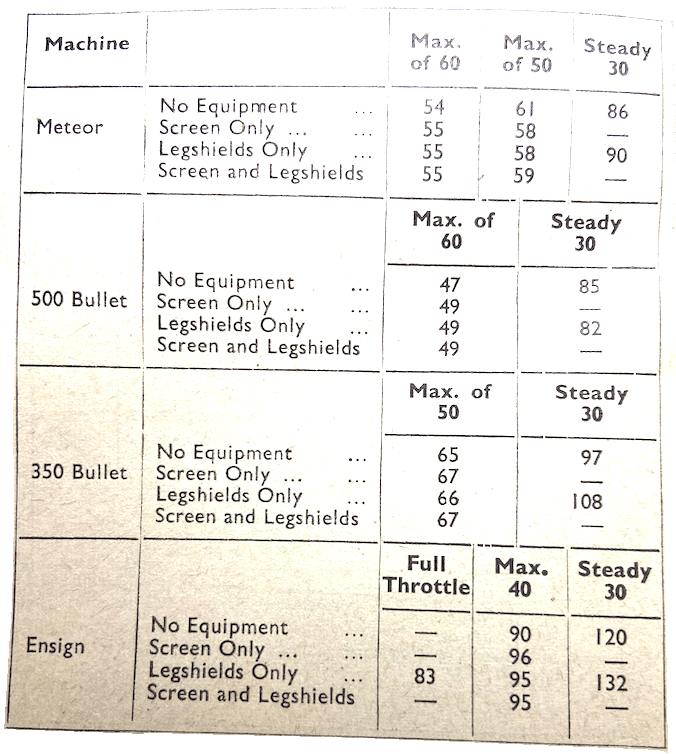
should be virtually unaffected by pannier bulk, although the weight of heavily loaded panthers would obviously impair acceleration. (b) A windscreen on its own should have a beneficial effect on maximum speed, with a corresponding gain in the upper levels of acceleration. (c) Legshields on their own, if of the fiat pattern, should reduce maximum speed slightly, with an almost negligible effect on acceleration. (d) Screen and legshields together are likely to cause a small reduction in speed, again with no serious impairment of acceleration. On lightweights the influence of weight on acceleration would appear to be more important than that of drag. (e) The difference in maximum speed obtainable with small- and big-stature riders should be in the neighbourhood of 2mph, while the addition of a pillion passenger should have much the same effect. The presence of a passenger should make more difference to acceleration than the equipment fitted. (f) Normal types of riding clothing are unlikely to make a difference of much over a mile an hour on maximum speed; acceleration should be only minutely altered. (g) Fuel consumption in the normal speed range should scarcely be affected by the equipment fitted, unless a disturbance of the air flow to the carburettor results. Driving methods have a far more important bearing on the mpg obtainable. (h) The effect of riding position on maximum speed is appreciated by most riders, though it has little touring significance. If the rider adopts an ‘on the tank’ position instead of the normal upright posture, the maximum speed can be increased to a greater extent than by any other expedient; the actual improvement will vary with the capabilities of the machine, but may be as much as 10mph for a machine of high performance. This article should not conclude without a tribute to the machines, each of which did at least 32 full-bore trips on the timing straight and at least 16 standing ‘quarters’, which really punish the clutch (apart from the engine and gear box). The Royal Enfields seemed to thrive on such treatment, and the only trouble encountered which necessitated an interruption of the tests was clutch slip on the 500 Bullet. This was referred to in our roadtest report and recurred early on in the maximum-speed runs; a quick change was made with the clutch from the 500 Twin which served as a hack machine during the three days.”
“ARRANGEMENTS ARE NOW being made for the French autocycle, the Bottin, to be imported to this country. The power unit fitted is the proprietary 49cc two-stroke Le Poulin, which incorporates a built-in clutch. Current for ignition and lighting is provided by a flywheel generator. The carburettor is a Zenith type MF12. Frame construction of the Bottin is unusual in that the duplex bottom members are swept round in the form of a loop. Welded joints are employed throughout. Steel shields are fitted at both sides of the engine, and the mudguards are of valanced pattern. Final drive to the rear wheel for both pedals and power is by a single chain and derailleur-type three-speed gear. A 5in internal expanding hub brake is employed at the rear, while the front brake is of caliper type. Tyres fitted are Hutchinson 600×50 mm. Retail price including purchase tax is £67 15s 9d. Sole concessionaires for Great Britain are The Martin Motor Co, l82 New Cross Road, London, SE14.”
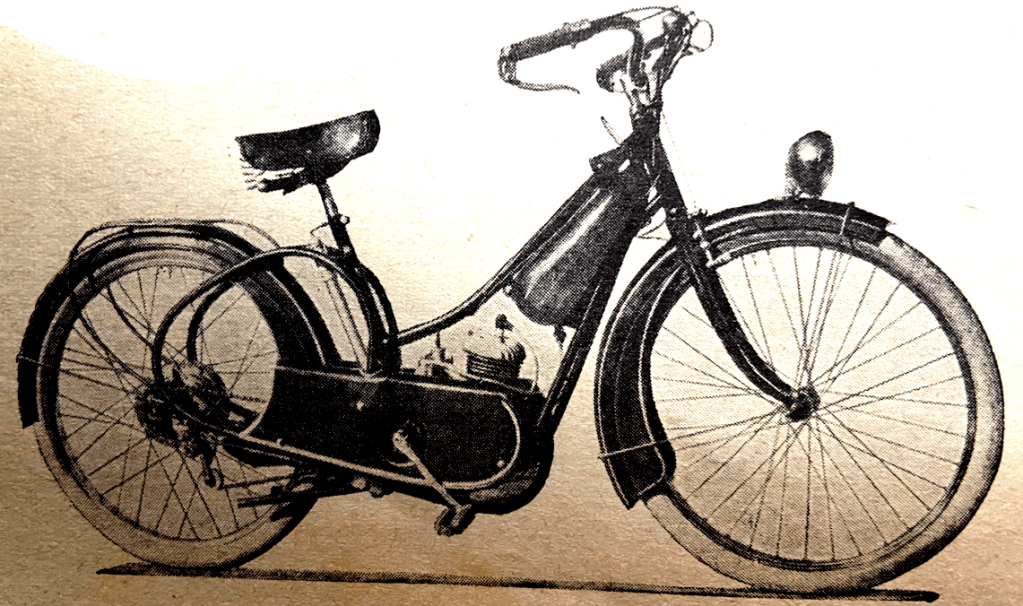
“THE VINCENT PICADOR engine has been developed from the Rapide unit to power pilotless, radio-controlled target aircraft. The twin carburettors have given way to a fuel injection system—the injector pump is driven from the air screw shaft and the nozzles are in the inlet pipes, just in board of the interconnected butterfly throttles. The injector feed valves are linked with the butterflies so fuel supply varies with throttle opening—control, however, is less critical than on a motor cycle engine since only slow-running and flat-out settings are normally used. A barometric aneroid capsule keeps the fuel/air ratio constant at varying height (standard aircraft practice), and the injector system has a centrifugal governor to avoid overspeeding in flight. A fore and-aft engine location is employed, but the unit is reversed in comparison with motor cycle practice so the exhaust ports face to the rear. The complete engine, which has full screening equipment, and a large generator to cope with the radio load, weighs 200lb and produces no less than 65bhp at 5,000rpm. The little aircraft, incidentally, has an all-up weight of only 472lb—not much more than a Rapide. We foresee members of the Vincent Owners’ Club invading Stevenage with demands for Picador engines for road machines—without radio control.”
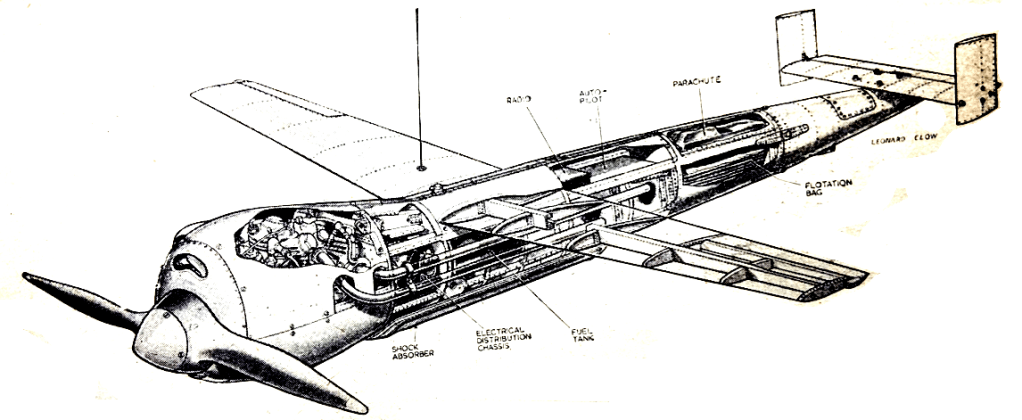
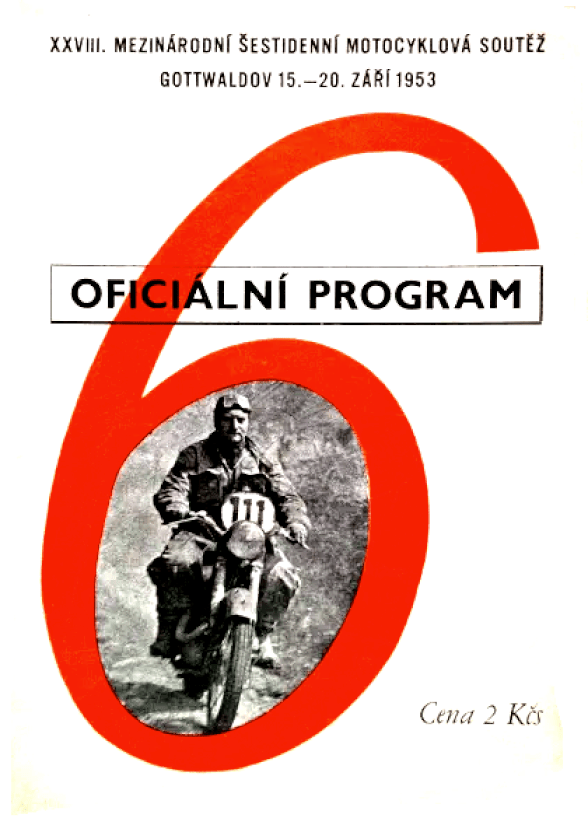
“AN INTERESTING MACHINE has been prepared for the International Six Days’ Trial by DMW Motor Cycles, Wolverhampton. Powered by a Villiers 197cc four-speed engine-gear unit. It employs an unorthodox design of frame and is equipped with Metal Profiles suspension. The machine is a prototype of what is to be an additional model to the range of DMW lightweights; the production version will probably be exhibited at the London Show. The prototype will be ridden in the ISDT by Mrs Mollie Briggs. Talbot-Stead square-section steel tubing is used for the frame top tube, the single-loop front down tube and engine cradle. A box-section structure, welded up from steel pressings, takes the place of a seat pillar and is swept upward and to the rear to form a support for the dual-seat, the upper ends of the Armstrong shock absorbers for the rear suspension, and also the valanced rear mudguard. In addition it forms a compartment for the enclosed battery and a separate tool box; access to both compartments is by lifting the seat, which pivots at the rear. Rear suspension is the MP pivoted fork, which features chain adjustment at the pivot end of the fork and a knock-out rear-wheel spindle. No sub-frame loops are necessary, and the rear end of the machine is particularly neat in appearance. A one-piece chain guard of welded-up steel pressings provides a valanced cover for the upper and lower runs of the chain and the forward part of the rear sprocket. A headlamp cowl streamlines in the speedometer, switch, ammeter and electric horn. Fitted in the front wheel is a Metal Profiles duo-hub with twin 5in-diameter brakes. Front and rear tyre sizes are 3.00x19in and 3.25x18in respectively. Finished in Paris grey enamel, with a new DMW motif in red, gold and white, the model presents an extremely smart and functional appearance.”
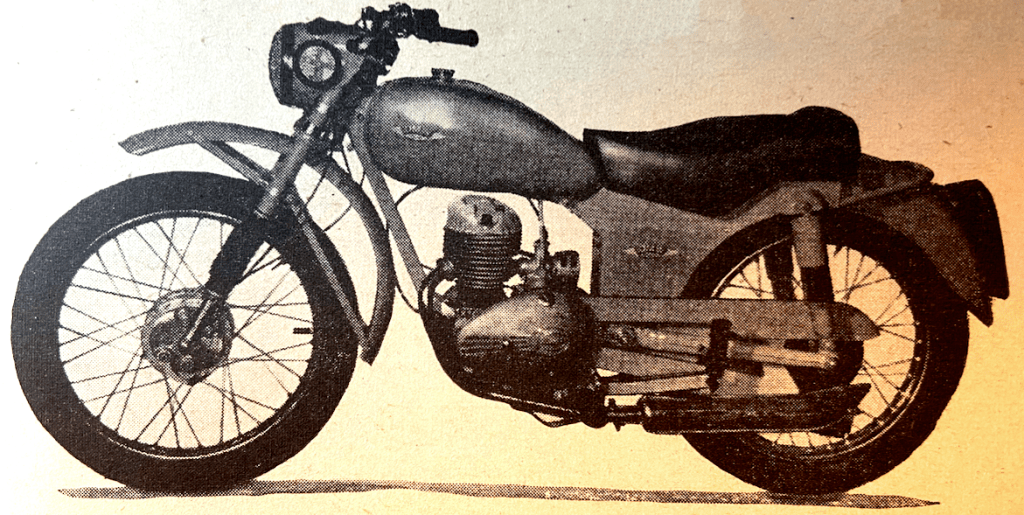
“THE CZECHOSLOVAK REPUBLIC sprawls lizard-like across the map of central Europe. Thirteen million people occupy an area about the size of England. Landlocked, its extreme length is 600 miles, and its width varies from 100 to 300 miles. Its capital, Prague, is situated mid-way between Moscow and Madrid, and between Stockholm and Rome. Its frontiers are mainly natural—mountains and rivers. In the midst of fine forests, spreading valleys and verdant plains, a world of folk-lore and quaint custom still lingers….There has never been a better organised International Six Days Trial than the 28th in the series which started in England back in 1913. Staged by the Czech Ustredni Auto-motoklub CRS, whose team won both Trophy and Vase in last year’s contest, the 1953 event took place ip Czechoslovakia from
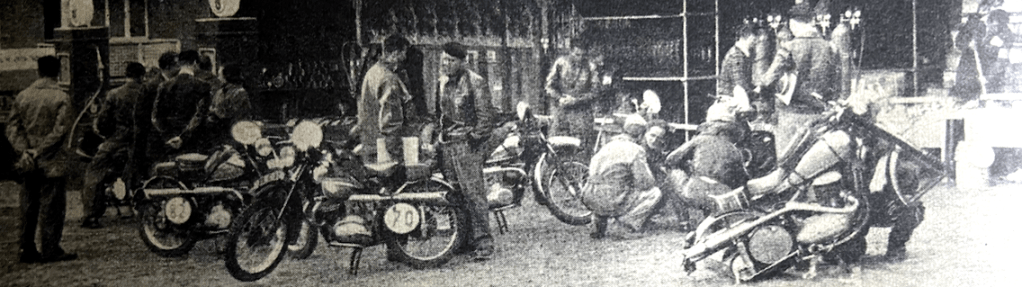
September 15 to 20 and was run over a comparatively level route , for an ‘international’, 1,470 miles long, with the headquarters in Gottwaldov…To the left of the entrance are six Czech vans containing every conceivable spare from a cotter pin to a complete frame for both CZ and Jawa machines. Certain machine components are marked by the organisers during weighing-in and may not be changed during the event; but such components were available for fitting before machines were handed in to the closed control, and those which could be fitted later were available for competitors who might re-quire them during the week. Immediately beyond the Czech vans there is a huge parc fermi, the tented enclosure in which machines are parked each evening so that competitors may not have access to them. Behind the starting area are workshops equipped with lathes, drilling machines, grinders, welding equipment, hand tools, and ramps—with everything, in short, that competitors could conceivably require during the week. Finally, there are ablution tents with hot and cold water so that riders may wash and brush up before returning to their hotels just over a mile away…The great majority of riders from foreign countries, together with team managers and officials, are housed in the vast, nine-storey Hotel Moskva, in the centre of the town. In the hotel are the organising club’s offices, meeting rooms for officials, Press offices, dark rooms for processing films, a customs office and a bank. There is no shortage of interpreters, which is appreciated since practically no one from outside Czechoslovakia is familiar with the mother tongue. Food is good and plentiful though, like almost every other commodity in Czechoslovakia, it is very expensive both to Czechs and foreigners. Most competitors from European countries rode their machines to the venue. The Netherlands teams, the Vase A on 250cc Jawas, and the Vase B equipped with a 499cc BSA Gold Star, a 498cc Matchless and a 175cc German Maico, rode from Holland; they took three days over the journey. As expected the German Trophy team arrived magnificently equipped. The team comprises U Pohl and KL Westphal riding new and functional-looking 175cc Maico two-strokes with pivoted-fork rear springing, and H Roth, Georg Meier and W Zeller, on 590cc R67 BMWs. The Trophy team BMWs used in 1952 were R68 models. These were capable of over 100mph, but they
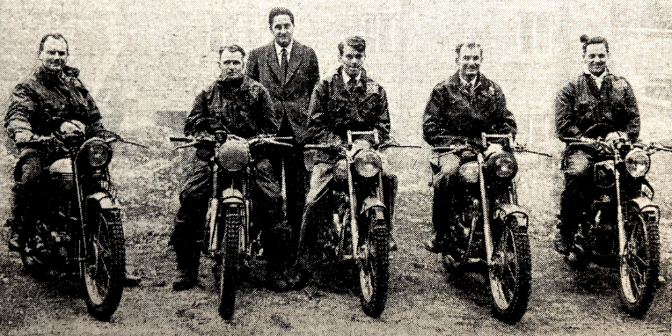
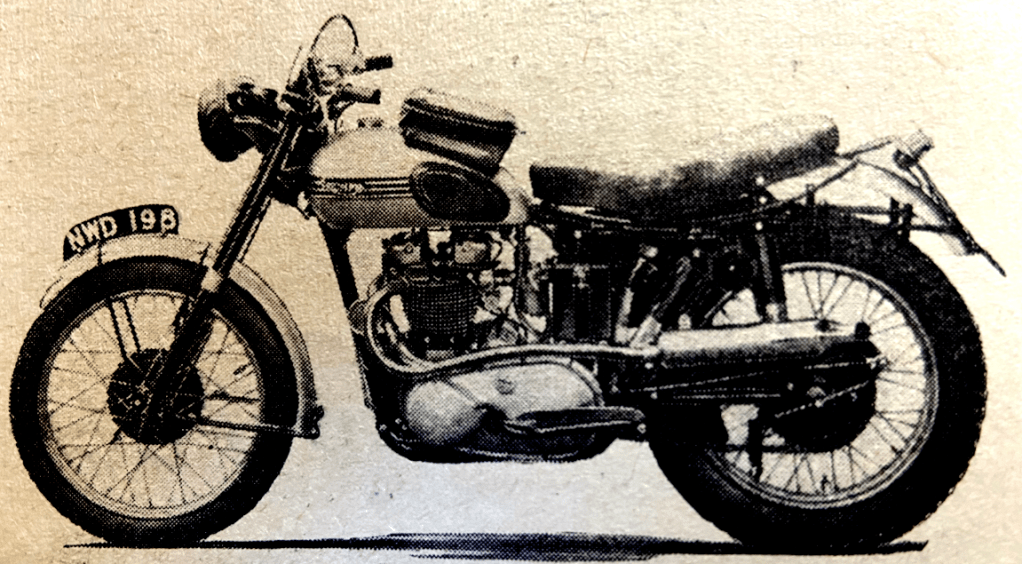
provided very little power below 3,000rpm. The R67 is not so fast, but it is much more flexible and therefore better suited to the give-and-take going encountered in an ISDT. The BMWs are fitted with massive brakes with light-alloy, hub-width drums so shaped on their peripheries as to permit the use of straight, butted spokes, and to provide the maximum strength without the use of webs. The new brakes, it is said, will become standard equipment on 1954 models. Other Trophy teams taking part are those from Hungary and Sweden. The Austrians had entered a Trophy team, but it was with-drawn whin their Puch machines could not be prepared in time. The Hungarian quintet is using 123 and 247cc Csespels. These are single-piston two-strokes with plunger-type rear springing and telescopic forks. The 250s are new models making their first ISDT appearance. The Swedish riders are once again using 175 and 246cc NVs, improved since last year by enclosure of the rear chains and the use of light-alloy, full-width brakes. Throughout the weekend and on Monday, weighing in proceeded with model efficiency and lack of fuss. It is safe to say that the organisation in the weighing-in area achieved a standard hitherto unsurpassed in any post-war ISDT. A grass-covered plot of land on the outskirts of the picturesque township had been fenced off for the occasion…The Swedish Vase B team was a man short as the result of an accident to B Hukansson. He had broken a leg while practising, and it seemed as though Sweden would have to start in the Vase contest with only half of her original strength. However, a reserve, B Erikson, was
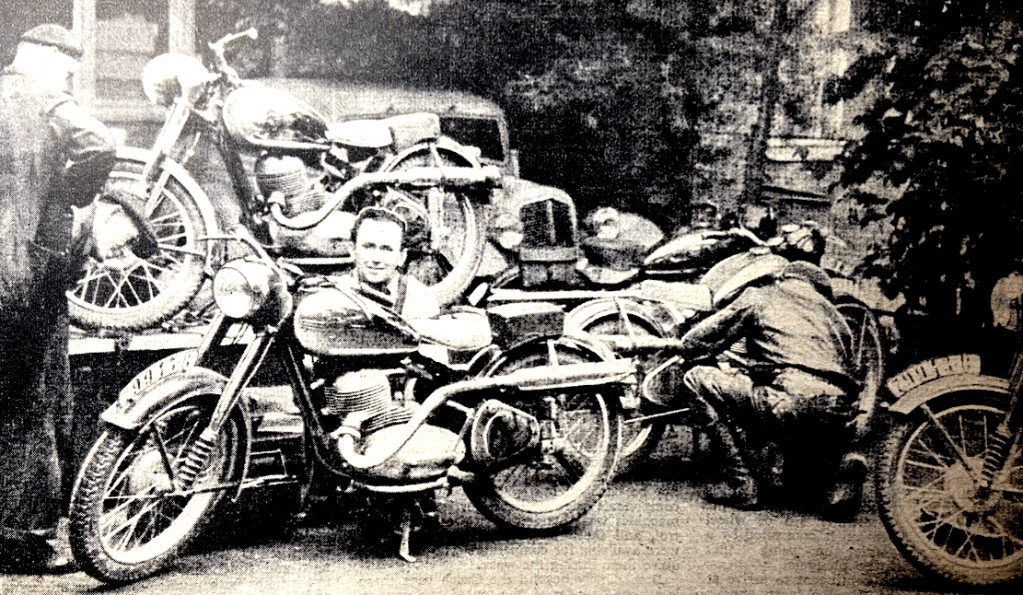
proposed and accepted. There were no other last-minute problems either for national teams or private owners. Tremendous interest was focused on the Polish riders, although their machines were orthodox-looking 150cc CZs and 250cc Jawas. Over 40 Jawas and 14 CZs are being ridden by riders from nations other than Czechoslovakia, and the Czech entry amounts almost to 50. Machines of these two marques comprise nearly a half of all in the entry. The only British rider of a Czech machine is Miss 0V Kevelos who, last weekend, was delighted with her 150cc CZ. On Saturday, when she was applying the final touches to her mount, she demonstrated a 20-second removal of the front wheel. The Poles are competing in the Vase contest for the first time since 1947. Like the Bulgarians and the Rumanians, they have not shown great interest in the more recent events. Of the private owners’ machines, the 250cc Jawa ridden by M Muller, of Switzerland, was vouchsafed almost equal attention. The machine had been ridden—and gold medals won—in the 1951 and 1952 events, and the official seals were still intact when those for the current event were being fitted. The machine is used every day and was ridden to the venue. Muller maintains that the only maintenance it receives consists in periodic cleaning of the exhaust ports and adjustment of the chain. While Sweden has pinned her faith to NV machines in the Trophy contest, her Vase A team is equipped with 346cc Royal Enfields, and her Vase B team with new-type 175cc Husqvarnas fitted with leading-link front forks and neat, two-stroke engine-gear units. The Husqvarnas
are impeccably turned out, in marked contrast to the 350cc BK IFA flat-twin two-strokes from Eastern Germany. Much more impressive machines from Germany are the Horex and Adler models. The Horex models are equipped for the first time with pivoted-fork rear springing of a type that does not interfere with rear-chain enclosure. As though by some miracle, the weather cleared on Monday. The sun shone, the temperature rose and the wind dropped. Weighing-in was completed by 5pm. Loud-speakers blared both speech and music to the strolling populace. A few minutes later the trial was officially opened at a public ceremony in the town’s open-air theatre. Riders gathered in groups under their national flags. There were speeches and translations, and introductions to important people. A flock of white doves was released. The ceremony ended with a programme of folk music. All was set for the morrow and the gruelling days ahead. Tuesday—First Day: A Scare for Viney. Soon after dawn, the sun was bathing the valley of the Dřevnice in brilliant light. The western slopes of the Carpathians lay under a golden haze. Competitors’ spirits were high as they made their way to the starting area, for the weather forecast when they had arrived at Gottwaldov had been anything but encouraging. But all was not entirely well. The night had been cold and damp, and the temperature was still low at 6.45am when the first man collected his machine from the closed control. Engines literally dripped with dampness from condensation. It seemed more than likely that starting troubles would be encountered. Almost the entire population of Gottwaldov had turned out to see the competitors set off, and the scene in front of the control was like that for a classic road race rather than for a trial. No 1 was FH Whittle (598 Panther sc), doyen of British trials sidecar drivers.
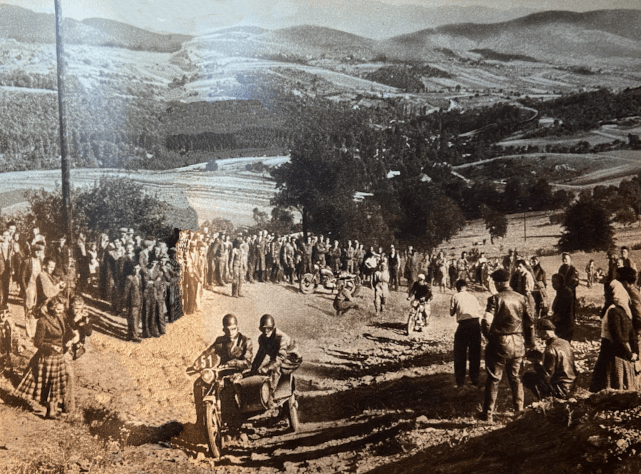
He flooded the carburettor liberally, and the big engine fired at the first kick. Many other competitors were not so skilful—or not so lucky. AR Clausen (498 Matchless sc), from Denmark, had to try for over a minute before his engine responded. 0 Kollmar (247 NSU sc) had to change a plug, and had his engine running only after his three minutes’ time allowance had expired; one Mark lost. Most of the British Trophy and Vase team machines started readily, but three which did not were the Royal Enfield twins ridden by WJ Stocker, JV Brittain and DS Evans. It was deduced that the SAE 40 grade of oil they were using was too heavy for such low temperature, and they decided to change over to SAE 30 before handing in their machines at the end of the day’s run. Two hundred and thirty-six riders started. Once under way, those with early numbers became more aware than ever of the icy temperature. Paved roads gave way to rutted tracks, some of which were almost in darkness under lofty, overhanging trees. Nine miles from the start, the somewhat doubtful distinction of being the first retirement fell to FH Whittle, whose fuel tank split. The arm of coincidence is indeed long, for Whittle retired with similar trouble in the first section of the 1952 event. Another to retire thus early was F Bracher (248 Jawa), with engine trouble. The first time control was at Kunovice, just over 21 miles to the south of Gottwaldov. Vast crowds thronged the streets, and the township was brilliantly bedecked with banners, flags and flowers, and with signs proclaiming that sport is the link of peace between nations. Small girls handed posies of flowers to the riders. There was even a brass band to provide a programme of music. The majority of riders arrived with 10 minutes to spare. In order to indicate the time to riders, large-diameter clocks, which were electrically synchronised with the stamp clocks, were mounted high, facing the direction of entry into the control. So that there would be no time variation between the clocks at various controls, short-wave radio equipment manned by radio amateurs had been pressed into service. It seemed as though even the tiniest detail of the organisation could not be improved upon. There
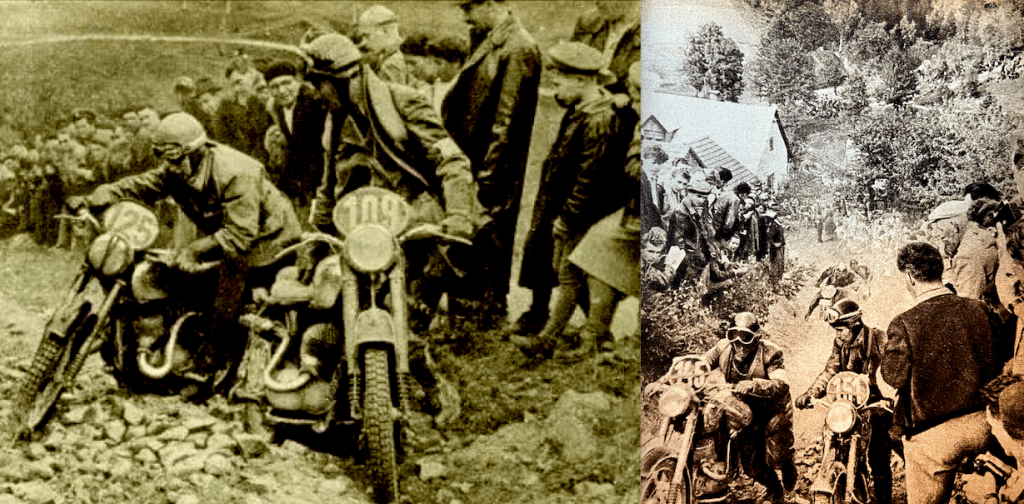
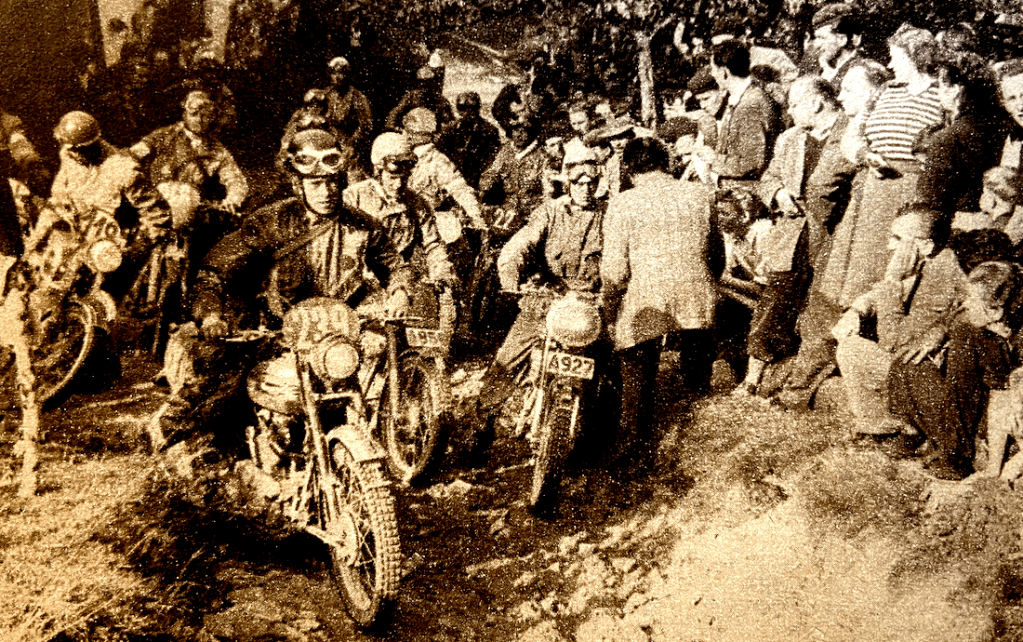
were even first-aid posts at half-mile intervals over the entire day’s route. As the morning aged, so the sun grew stronger until it was almost unbearably hot. The second control was at Senica, which was reached by way of sandy tracks and incredibly dusty, loose and rutted, waterbound roads. Dust rose in impenetrable clouds, reducing visibility to a few yards for those riding close behind other riders. It circumvented goggles and stung the eyes, and tongues felt like lumps of abrasive rubber in competitors’ mouths. Riders pressed on at high speed, but there was again no need for undue haste. The time allowance at Senica was even more generous than in the first section. Once again the high standard of organisation was evident. Every competitor was offered a cooling drink of mineral water, there was water available for washing, and there were nurses to bathe dust-infected eyes. Petrol and ready-mixed petroil were dispensed with clockwork efficiency. Another Britisher had to retire; he was E Wearden (124 Anelay-Excelsior), who, though he experienced magneto trouble, managed to reach the control. The morning’s route continued southward across the border of Moravia and into Slovakia. The lunch control was at Bratislava, which lies between the Danube and the southermost ranges of the Carpathians, and has been the capital of Slovakia since 1919. What had been spoken of as the worst section of the day was encountered en route and, though it caused a deal of trouble among the lightweights, it proved easier than expected. The difficult part consisted of a long, uphill pull over deep sand. The only way through non-stop was to make a full-blooded charge and maintain momentum at all costs. Such tactics are difficult with a lightweight, but not so much so with a 500. However, R Nystrom (499 Royal Enfield), of the Swedish Vase A team, spilled and hurt his back, though he reached the Bratislava control on time. Another to encounter trouble was W Zeller (590 BMW), of the German Trophy team, but he, too, lost no marks. Impressive performances through the sand were made by BHM Viney (498 AJS) of the British Trophy team and CM Ray (498 Ariel) of the British Vase A team, both of whom were fast and utterly steady. The majority went slowly and footed or pushed their way up a path on the left. From Bratislava the route turned northward to time controls at headquarters Banov and thence to the headquarters town. The going throughout was incredibly bumpy and rough and, though time was not unduly difficult to maintain either for those on the 10% faster schedule or for private owners, muscles began to tire. Machines were being severely punished. The country through which the trial was passing was richly agricultural. With its moss-green slopes and fields of sugar-beet and vegetables twisting their colours through every contortion demanded by husbandry, the countryside was strikingly beautiful. The pièce de résistance of the afternoon was a climb through the heavily wooded slopes of the Javorina mountain. Slanting upward, writhing this way and that between steeply cambered banks, the track was, fortunately, dry. Most British competitors sped through untroubled, though JA Hitchcock (149 Triumph Terrier) found that the combination of the gradient and his 16-stone weight tired his hardly run-in engine, causing him to lose a mark at the Banov control. And JS Oliver (BSA Bantam) was in difficulties after he had been hit from behind by a faster competitor. The road from Banov to Gottwaldov was steeply undulating, and was the scene of a near set-back to British hopes in the Trophy contest. BHM Viney had his rear tyre go flat. Quickly he set about the task of changing the inner tube. He had his tools packed and was on his way precisely five minutes after stopping. He reached Gottwaldov with four minutes in hand, only to find that his lights were not working—and there was a night run on Wednesday…Another to have trouble
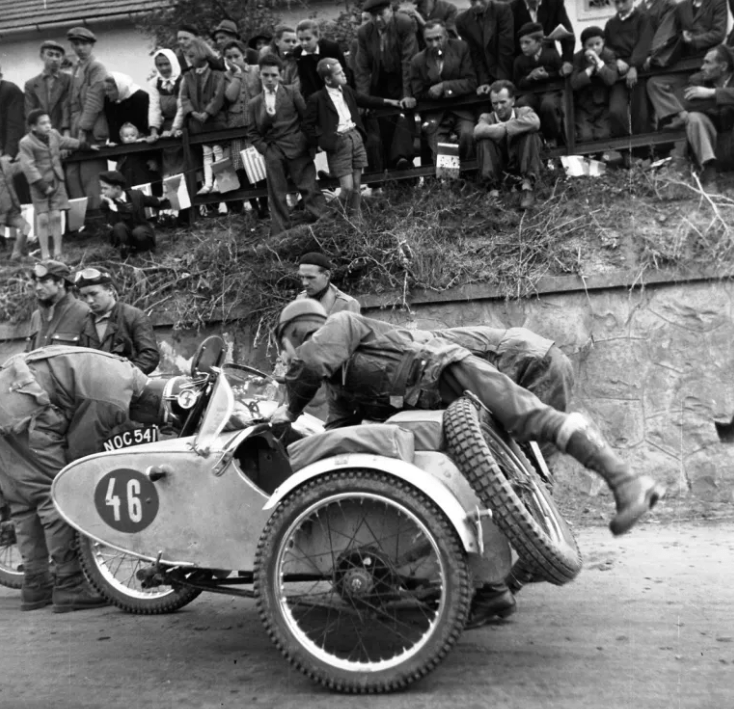
in the last section was B Nyström (499 Royal Enfield) of the Swedish Vase A team. Nyström collided with a truck and, though he was unconscious for two minutes, he was able to ride his damaged machine into the final control without losing marks. A more serious injury during the day was that to S Schram (174 Maico) of the Netherlands, who collided with an ambulance and sustained a broken hip. For the majority it had been a fairly easy day’s run, but the 240 miles had been full of interest, nevertheless. Four Trophy teams retained clean sheets. Wednesday—Second Day: Uneventful Night Run Included. The starting area on Wednesday morning seethed with excitement. S Klimt (248 Jawa), of the Czech Trophy team, failed to start his machine within the stipulated three minutes. He swung on the starter crank furiously without success, and then had to push over the line, thus losing his team one mark. Inspection showed the contact-breaker points, which had been reset earlier, to be sticking. There was another sensation. E Forsberg (246 NV), of the Swedish Trophy team, also failed to start his engine! A brilliant rider, Forsberg kicked about a dozen times then whipped out the plug. There was only a weak spark and, try as he might, he could not get the engine running until long after he had pushed away from the grid. Working in leisurely fashion, BH M Viney changed his rear tyre and tube and his head-lamp—and washed his hands!—during his 15 minutes’ time allowance. The weather was mild and dry, and starting troubles were less prevalent than on the Tuesday. All British Trophy machines started at the first effort, although Stocker had preferred not to change to a lighter oil. The Germans also moved off in impressive style. The two teams were the sole contestants for the Trophy still without loss of marks. In view of the night run to follow, the start was not until to 10am. The route ran south-east and then east into the heart of the Carpathians and Lower Tatras. The first check was at Slavikin, a tortuous and dusty 29½ miles from Gottwaldov. After Slavičin, on the way to a stamp control at Horná Sūča, the route climbed steeply to the summit of the Na Hancich mountain. The track was liberally littered with loose stones and was pock-marked by frame-jarring pot holes. The scrub of the lower slopes gave way to dense forests in which deer abound and wolves are not unknown. The track became a path, a very muddy path in places, lying in dense shadow under the trees. Hopes of a Swedish win in the Trophy contest were further dashed when Forsberg retired with ignition trouble before reaching the time control at Pūchov. Forsberg was not alone in his
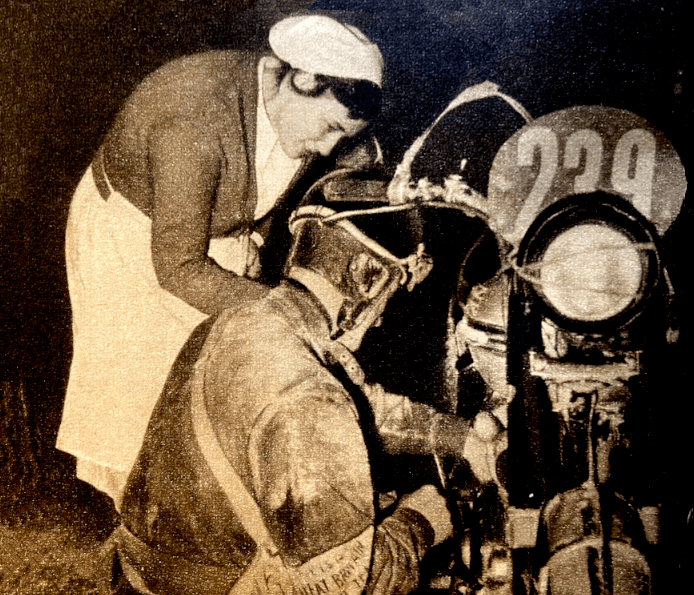
misfortune. G Ravinale (175 Morini) holed his crankcase on a rock, and H Sprung (125 IFA) had his frame break just below the steering head. From Pūchov the route to the lunch stop at Pieštany was a straightforward run over dusty, secondary roads. The only incident of note to a Britisher was that AW Glassbrook (BSA) rammed a post in avoiding a car and spilled heavily. He sprained his right foot, holed the primary chaincase, and split the fuel tank. Even so, however, he checked in with 10 minutes to spare. Any ISDT in which a rider can do that is too easy! But, in spite of the comfort with which the schedules were being maintained, the rutted, broken road surfaces continued to take their toll. Two other retirements at this stage were those of E Longoni (175 Guazzoni) and JM Ivanov (150 CZ), both with frame breakages. Riders were welcomed royally at the lunch stop as everywhere else. They arrived looking like a vast army of motor cycle-mounted bakers, and were treated to every luxury short of a bath. The evening was mild and even warm when, at 7pm, the first man left Pieštany for the 63-mile night run to Gottwaldov. The run was straightforward, over reasonably well-surfaced roads at a comfortable speed schedule. The reason for the night run is to test lighting equipment only, and to do so with the minimum risk to men and machines. There were no incidents and only seven riders, all of Hungary, Rumania and Bulgaria, riding Csepel and Jawa machines, were penalised for lighting faults. Back at Gottwaldov there were the usual displays of enthusiasm and brilliant organisation. The control area was floodlit, resembling some stage set for a Hollywood film, as indeed it almost was, for the scene was being filmed by a Czech film unit. Members of the British and German Trophy teams checked in with precise regularity, most of them with 15 minutes or more to spare. Thursday—Third Day: British Trophy Team Leads. After a late finish one day, riders may, with some justification, expect a reasonably late start the next morning. Those who did so were disappointed, for starting time for the first man
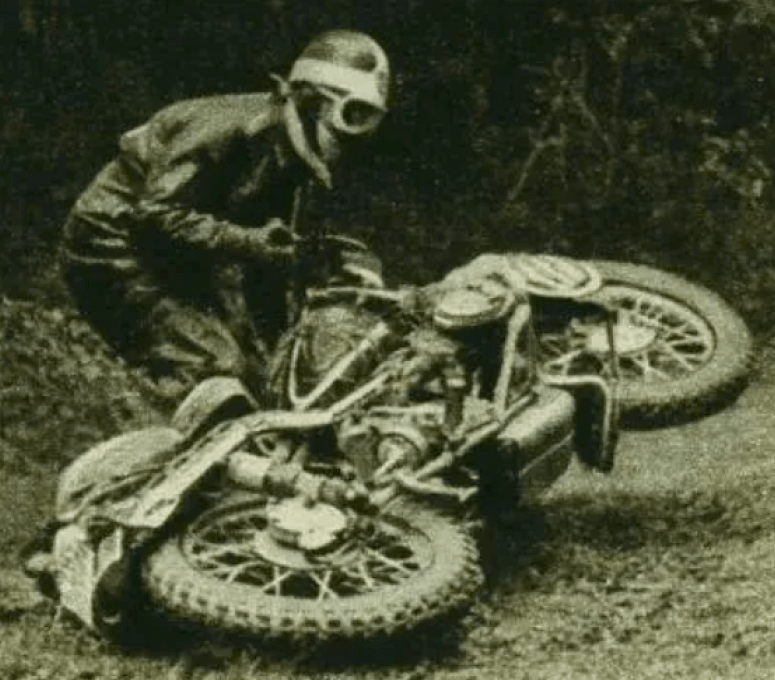
on Thursday was 5.30am, and the mileage, 299, was the longest for the trial. Dawn came mild, heralding the assurance of a fine day. The first time control was at Hluk, 60 road miles to the south. The second was at Myjava, a further 59 miles away, and the third at Trenćianská Turná. The going throughout was, once again, over loosely surfaced roads and tracks from which dust rose in dense, choking clouds. The speed schedules were still not proving sufficiently high to separate the wheat from the chaff, but H Veer (248 Jawa), of the Netherlands Vase A team, dropped 54 marks after losing time when changing plugs and ignition coils in an effort to obtain a regular spark. The first really bad terrain was encountered between the stamp control at Cavoj and the main control at Nitrianské Pravno. The section was reputedly one of the tightest of the week, but the going was dry and riders sped through without concern. From Nitrianské Pravno the course twisted between the high ranges of the Strazooska Hornatina and Mala Fatra mountains to Zilina, the lunch control. The going was again only moderately difficult, and the final stretch of road from Rajec was tarred, allowing riders easily to make up time. In the belief that they had passed the worst, competitors were becoming blasé. Then, suddenly, when emerging from a gap between farm houses in the last-but-one section of the day, they were faced with a hill that was to stop practically the entire entry. The sidecar-width track was littered with loose stones and, twisting upward, veered gently to the right at an estimated gradient of 1 in 4. As the field passed through, so the surface worsened. The air reeked with the stench of burning clutch linings. Soon after proceedings on the hill had opened the area resembled a miniature battlefield. Several machines were stopped across the track, some of them on top of their riders. At the foot of the hill an impatient queue formed and fumed. An ISDT is no place for gentlemanly waiting. Something akin to panic set in. When CM Ray (498 Ariel), first of the British teams’ contingent arrived, there appeared to
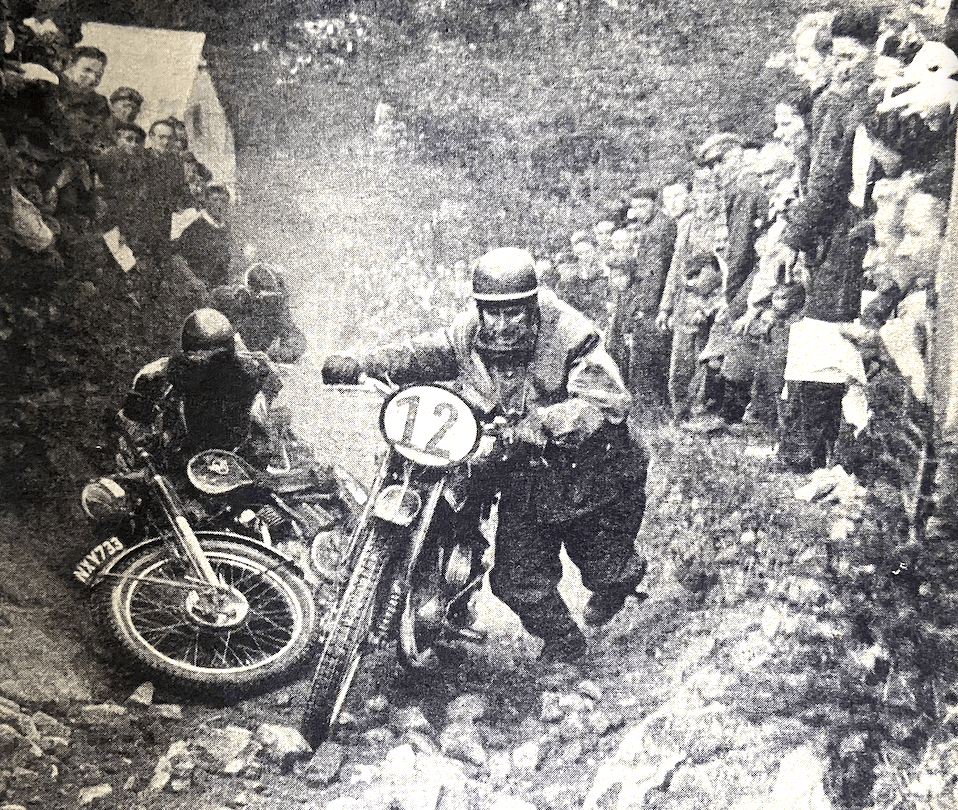
be no way through the holocaust, and he was several times brought to a stop. Afraid of burning the clutch, he kept it home or fully disengaged, and let it in without pause on a wide throttle opening. The tactics worked, and he was not long delayed. DS Evans (496 Royal Enfield) and E Usher (498 Matchless) tore through one behind the other, and so fast that Evans was feet-up all the way. WSG Parsons (498 Ariel) used ‘flat in two tactics that caused the toughest of the spectators to blanch with fright! WJ Stocker (496 Royal Enfield) had three stops and momentarily heated his clutch to the extent that it would not free. DS Tye (348 BSA) went up in a series of stops and starts, collided mildly with a competitor baulking him and apologised briefly as he sped past! The proportions of the queue when BHM Viney (498 AJS) arrived were such that he could not afford to wait. So he rode up a narrow bank on the right, took what he later described as ‘two handfuls’, and sped on his way unhindered. W Zeller’s BMW received such a pasting that the bevel-box casting—which forms part of the rear springing—split from front to back. Such a fracture was said to be unknown inBMW history, but Zeller was forced to retire nevertheless, thus leaving Britain in the lead in the Trophy contest. In spite of the difficulties, the loss of marks at the next control was not excessive, and the time allowance into Gottwaldov was more than generous. Friday—Fourth Day: Very Punishing Route. Contrary to expectations Friday provided the most punishing route of the trial so far. The day’s mileage was 212, and starting time was 6am Day by day the activity in the starting control was increasing. Machines were becoming the worse for wear, and riders strove to make the most of the 15 minutes in which they were allowed to make repairs and adjustments. CJ Langeveld, of the Netherlands, was one of several riders of 150cc CZs trying to repair a leaking fuel tank. KG Nyman (174 Husqvarna) worked hard to jury-rig, with hefty wire, a broken rear fork spring. Least active of all were the British team-men whose machines were in magnificent condition. All of them started at the first prod on the crank with the exception of JV Brittain’s Royal Enfield which required a second kick. PF Hammond (Triumph), who was not in a national team, had had his engine seize
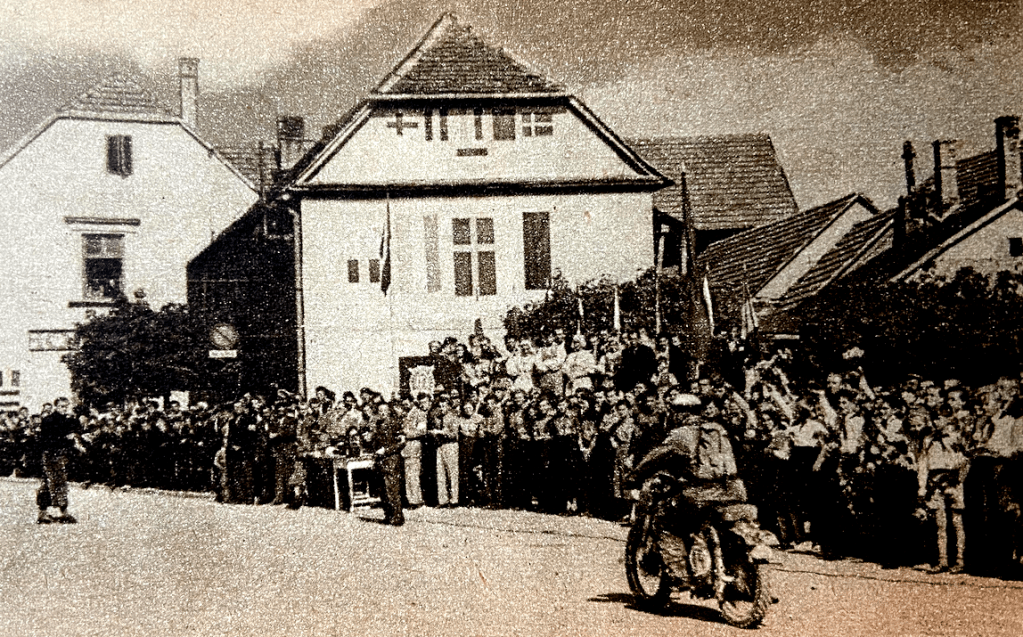
momentarily on Thursday. It sounded slightly the worse for wear, and did not appear to be developing its customary power as he started it and moved away. After heading east for a few miles on a tarmac road, the course turned northward to cross the Hostynske Orchy range of mountains and approach the first check at Bystrice pod Hostynem, some 27 miles away. The day was already hot, and dust rose in the now familiar dense haze to film goggles, sting riders’ throats and generally add to the already testing difficulties. However the section was not unduly tight. BL Jansema (248 Jawa), of the Netherlands Vase A team, was unlucky to encounter an elusive ignition fault hereabouts. It was to dog him throughout the day, and it finally lost him 20 marks. The second control was at St Kopecek, and the third at Rymarov. The route then continued northward to within a few miles of the Polish frontier before turning south and climbing steeply through heavily wooded country to Cervenohorske sedlo, the highest point to be reached that day. The going was made difficult by the gradient-loose surface combination, and there was absolutely no time to be lost if the lunch control at Sumperk, 141 miles out, was to be reached on time. WJ Stocker (496 Royal Enfield) had a heart-stopping moment when he pulled a l½in-long nail out of his rear tyre at Rymarov. The Dunlop puncture seal held, however, and he was able to press on without having to use his tools. The respite at Sumperk was more than welcome. The track climbed steeply from the village, then plummeted downward to Oskava. Speeds in the region of 60mph were possible on the longer straights, but the surface was so bumpy that machines ridden fast were severely punished. DS Tye (348 BSA), of the British Vase B team, had eight or nine spokes fracture in his front wheel and the result was a punctured innetube. Frantically he stopped to put matters right, but no man could have completed so formidable a task without penalisation. Tye lost nine marks. Misfortune then struck at PF Hammond, whose engine finally seized and would not restart at the last control of the day. Langeveld’s CZ caught fire and burned itself out. And JA Hitchcock with the Triumph Terrier was delayed for over an hour trying to trace an electrical fault, and was then excluded. In all, 10 riders retired during the day but no fewer than 156 remained unpenalised. Saturday—Fifth Day: Numerous Spills on Rutted Surface. Brilliant weather was again experienced on Saturday. A moderate-to-strong east wind effectively tempered the heat of the sun and, in the morning, helped to speed competitors on their outward run. But it slowed the smaller machines on the
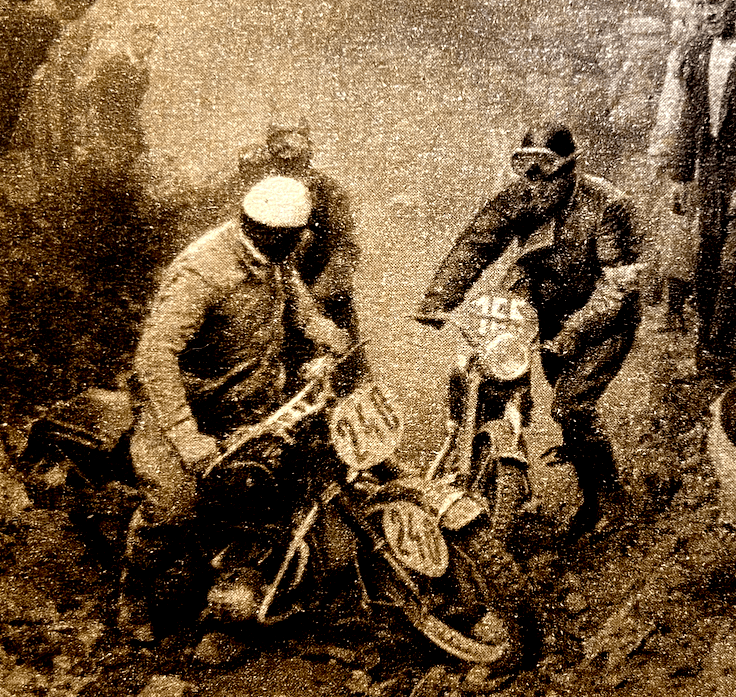
return to Gottwaldov in the afternoon, and sent the dust corkscrewing upward from the road in miniature whirlwinds. Local enthusiasm for the trial had not diminished since Tuesday, and the crowds lining the route out of the town were as great and vociferous as ever. Though the majority of riders started off with relatively little trouble, Western Germany’s hopes of winning the Silver Vase were dashed when W Aukthum (174 Maico) could not start his engine. He was forced to retire on the line, although there was a fat spark at the plug and petrol flowed freely from the carburettor jet. Most impressive start was by BHM Viney (498 AJS) whom the Czechs were describing as the Geoffrey Duke of the trials world. There was some concern for British hopes in the Trophy contest when WJ Stocker arrived at the start with a bad head cold and feeling decidedly seedy. Loose surfaces and close-spaced hairpins were encountered soon after leaving the town. When turning from the main road into the track, misfortune struck at RW Wagger (348 BSA sc), whose sidecar-connection ball-joint fractured. The crew pressed on and checked in at the Bunc control on time. But on the tortuous hairpins that followed so much time was lost that they were excluded. Wagger and passenger were not alone in their misfortune, for Miss 0V Kevelos (150 CZ) missed the route and frittered away so much time regaining it that she lost six marks. The two other ladies competing, Mrs M Briggs (197 DMW) and Miss L Rutlova (248 Jawa) remained unpenalised though Mrs Briggs was changing plugs every few miles and her engine sounded far from healthy. The time schedules on Saturday proved less easy to maintain than on previous days. Hairpin corner followed hairpin corner in rapid and often bewildering succession. The brakes had to be used savagely on loose, rutted surfaces, and there were numerous spills. The turns were negotiated as fast as possible with both wheels sliding viciously, and engines revving hard in the lower gears to provide maximum acceleration. The most difficult going of the day was experienced not far from Gottwaldov in the area of Bunc. It was there on the return run that J Giles (498 Triumph) of the British Vase B team had his engine go sick. He lost five marks at the Racice control but by dint of lurid riding he lost no further marks. However, his chances of finishing seemed remote since the drive-side cylinder lacked compression. During the day B Erikson (174 Husqvarna) of the, until then, unpenalised Swedish Vase B team, had the
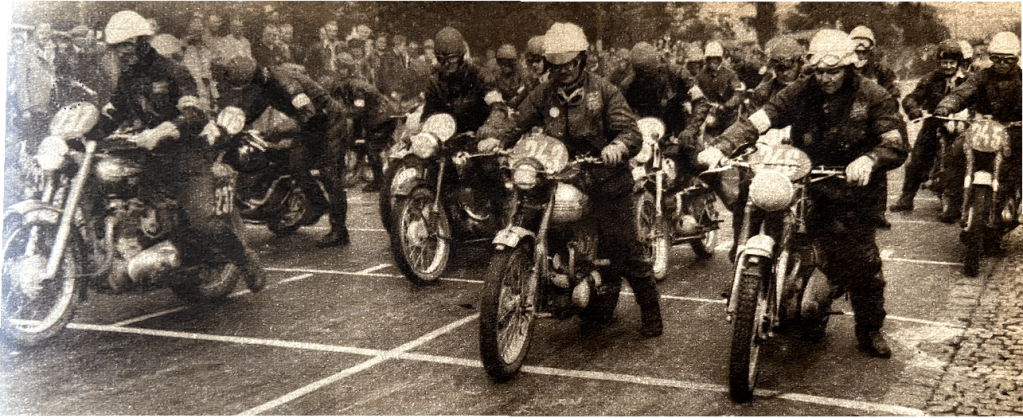
valve pull out of his rear tube. After he had made repairs and carried on the re-placement tube was punctured by a nail. His misfortunes cost the team 12 marks and, perhaps, even the Silver Vase, for the performance of a good 175cc in relation to the speed schedules was known to be more than favourable. Of the 193 riders who started the day, 16 retired, bringing the total of those withdrawn up to 59. Of the 177 competitors still running, 136 had lost no marks. The day’s mileage had been 257. Sunday—Sixth Day: Rain Clears Before Speed Test. The final day of an International Six Days’ Trial is never a happy one for competitors. The tribulations and exertions of five hectic days are behind them. Ahead lie only a few hours of rough stuff and a one-hour speed test over a closed road circuit. But in some cases machines are producing perplexing noises. If they are not, then noises are imagined. Brakes and tyres and chains are not in such good shape as they were. Wheels may be out of true and without their full complement of spokes. Fuel tanks may be leaking. The fine, free careless rapture of a few days ago is superseded by preoccupation and tenseness. Taut nerves were not soothed when rain began to fall at 7.30am on Sunday. The sky was a roof of steely grey and gave no indication that the conditions would improve for the speed test in the afternoon. The film of dust on the tarmacadam and cobbled surfaces quickly became a film of grease which was as treacherous as black ice. The going on the minor roads and tracks, too, became slippery. Machines of 500cc on the fast schedule were allowed only 3 hours and 28 minutes for the 127 miles, and there were six closely spaced controls. The morning’s ride was the most hectic of the trial. The rain continued heavily and without pause for two hours. Conditions were bad enough to cause J Cizek (248 Jawa), of the Czech Vase A team, to spill heavily and injure an arm too severely to allow him to continue. The plucky Mrs M. Briggs (197 DMW) had two punctures early on, and she, too, was forced to retire. Others to spill, though happily without any real damage to rider or machine, were Miss 0V Kevelos (150 CZ), and PH Alves (498 Triumph) of the British Trophy team. None of the riders in the British Trophy team lost marks in the morning, and thus they had only to complete their requisite 20 laps of the speed circuit in order to win. But the average speed demanded for 500 and 650cc machines was 62mph, and the 3.l-mile circuit included three slow, second-gear turns and a third-gear sweep. No ISDT can be said to be won before the speed test is over. Miraculously, and exactly as happened before the speed test of last year’s event, the sky cleared, the
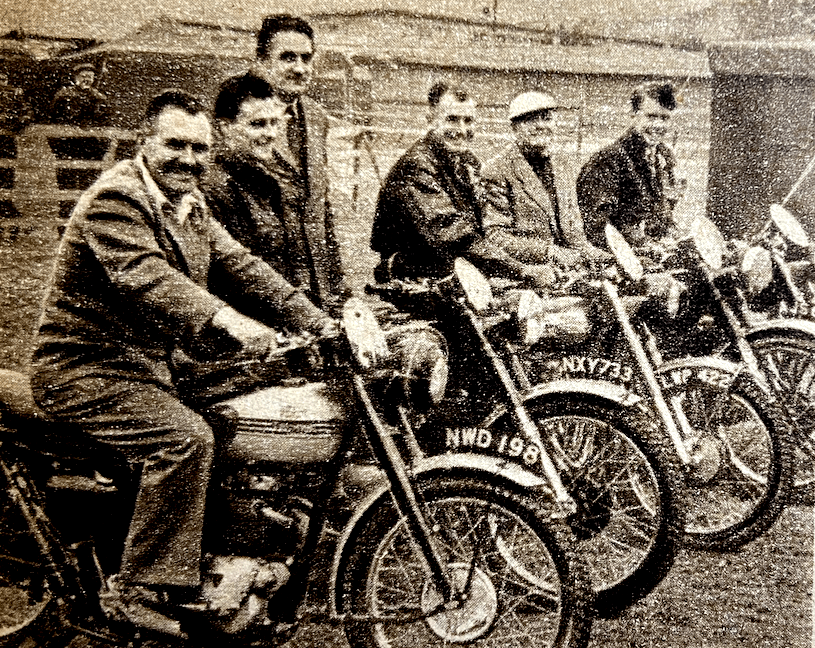
rain stopped and the roads dried before the speed test began at noon. The Britons rode in faultless style, keeping closely together throughout and building up approximately three seconds per lap on their schedule. The machines never missed a beat, and the five riders crossed the line in close formation. Hugh Viney, team captain, was so overjoyed when Len Heath gave him the success signal that he rode along the finishing straight with his feet on the dual-seat. In spite of the morning’s misfortune to the Czech Vase A team, four Vase teams, Czechoslovakia B, Great Britain A, Poland B, and Netherlands B went to the speed test without loss of marks. The test was thus used to decide the tie, the winning team being that which achieved the greatest aggregate percentage increase on its stipulated average. As expected, the Czech team, with their 150cc CZs, dominated the contest from start to finish and, by the fifth lap, had built up a 14% increase as against Britain’s 10% increase. As always, the speed-test schedules were notably in favour of small-capacity machines. Of the five manufacturers’ teams to finish without loss of marks, three were British; they were Ariel, AMC and Royal Enfield. And so, with an impressive official ceremony in the evening at which the British team received the Trophy, the 1953 ISDT ended. Britain’s success brings her total of wins up to 16 in the 28 events which have been held since the series was inaugurated in 1913. RESULTS International Trophy—1, Great Britain: JV Brittain (496 Royal Enfield), SB Manns (498 Matchless), WJ Stocker (496 Royal Enfield), PH Alves (649 Triumph), RHM Viney (498 AJS), no marks lost. 2, Czechoslovakia: J Pudil (150 CZ), E Marha (150 CZ), S Klimt (248 Jawa), V Bodine (248 Jawa), J Kubes (248 Jawa), 1 mark last. 3, Western Germany: U Pohl (174 Maico), KL Westphal (174 Maico), H Roth (590 BMW), G Meier (590 BMW), W Zeller (590 BMW), 460. 4, Sweden: G Zalle (174 NV), G Nyberg (246 NV), E Forsberg (246 NV), F. Larsson (246 NV), H Ring (248
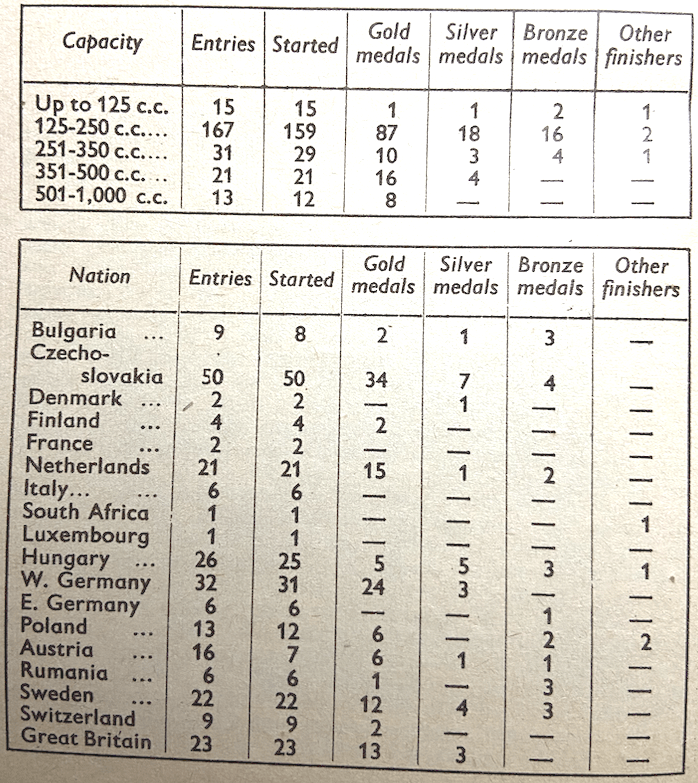
NV), 766. 5, Hungary: G Stoke (123 Csepel), J Reiss (247 Csepel), J Ruzsai (247 Csepel), A. Harangvolgyi (247 Csepel), J Rusovszki (247 Csepel ), 1,643. International Silver Vase—1, Czechoslovakia B: V. Kolar (150 CZ), F Blaha (150 CZ), B Kabat (150 CZ); no marks lost (1,650.7 speed-test rating). 2, Poland B: R Zurawiecki (248 Jawa), A. Kwiatkowski (248 Jawa), W Markowskl (248 Jawa ): 0 (1,372.1). 3, Great Britain A: CM Ray (498 Ariel), DS Evans (498 Royal Enfield), E Usher (498 Matchless), 0 (771.3). 4, Netherlands B: MP den Haan (174 Maico), M Rosenberg (498 Matchless), P Knijnenburg (499 BSA), 3. 5, Sweden A: R Nystrom (499 Royal Enfield), A Elgebrandt (499 Royal Enfield), B Nystrom (499 Royal Enfield), 10. 6, Great Britain B: DS Tye (341 BSA), NS Holmes (498 Ariel), J Giles (498 Triumph), 17. 7, Sweden B: B Erikson (174 Husqvarna), L Lindstrom (174 Husqvarna), L0 Hagman, (174 Husqvarna), 21. 8, Bulgaria: TG Gigov (246 Jawa), SP Bardarov (248 Jawa), JI Toplodoskidi (248 Jawa), 41. 9, Rumania A: N Buescu (248 Jawa), M Saratenu (248 Jawa), N Sadeanu, 54. 10, Czechoslovakia A: J Cizek (348 Jawa), L Stajner (248 Jawa), J Bednar (248 Jawa), 160. 11, Netherlands A: BL Jansema (248 Jawa), Ph JJ Haaker (248 Jawa), H Veer (248 Jawa), 241. 12, Western Germany: W. Aukthum (174 Maico), H Oelerich (342 Horex), U Kraemer (247 Adler), 260. 13, Hungary A: I Reizs (123 Csepel), G Csepregi (248 Jawa), A Urmos (247 Csepel), 490. 14, Poland A: J Jankowski (150 CZ), S Brun (150 CZ), Z Kupczyk (150 CZ), 768. 15, Rumania B: N Niculici (348 Jawa), E Somlo (348 Jawa), M Cernescu (348 Jawa), 774. 16, Hungary B: K Nagy (344 Jawa), A Szabo (344 Jawa), I Boros (344 Jawa), 923. 17, Switzerland: K Meier (342 Horex sc), E Sager (174 Puch), S Mazzola (590 BMW), 1,029. Manufacturers’ Team Prizes (no marks lost)— Ariel: CM Ray, WSG Parsons, NS Holmes. AMC: E Usher and SB Manns (Matchlesses), BHM Viney (AJS). Royal Enfield: JV Brittaln, DS Evans, WJ Stocker. Jawa: L Stainer, J Kubes, J Bodnar. CZ: J Pudil, F Blaha, E Marha. Club Team Prize (no marks lost, position decided on speed test)—1: Ustredni dum armady I (Czechoslovakia): M Soucek, 0 Chasak and K Buchuar (all on 150 CZs). 2, ADAC Maico Frankfurt (Western Germany). 3, SMK Hedemora (Sweden). 4, ADAC Gau Südbayern München (Western Germany). 5, Ustredni dum armady II (Czechoslovakia). 6, SAMS (Sweden). 7, Motorklub ONS Genergen 1945 (Netherlands). 8, Motorklub de Ronde Vencia (Netherlands).
There’s a fascinating newsreel of the 1953 ISDT on Youtube: http://www.youtube.com/watch?v=HHfITDCHEhY&t=457s
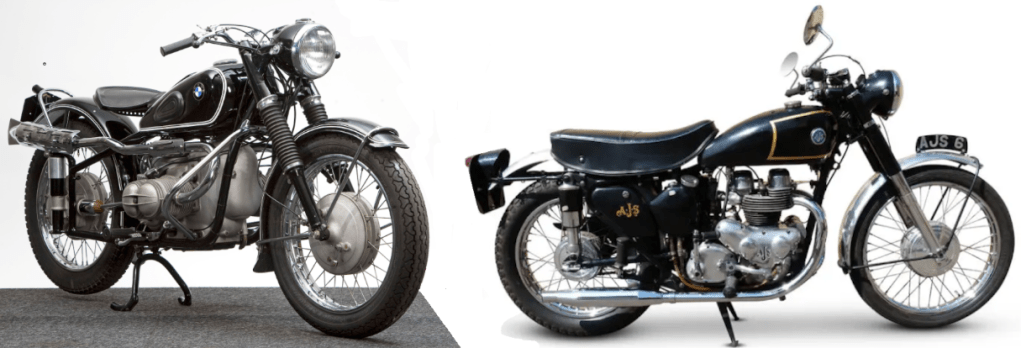
BLUE ‘UN EDITOR Harry Louis summed it up: “Once again the International Trophy, major award in the International Six Days’ Trial, has been won by a British team. This success brings the total of British wins to 16 in a series started as long ago as 1913. All enthusiasts will wish to congratulate the five riders, the team manager and his colleagues, and the manufacturers of the machines. At the same time congratulations will be extended to the Czechs for winning the Silver Vase contest. For the second time in its history, the Trial was held in. Czechoslovakia. As in 1947, the first occasion on which the Trial took place on Czech soil, organisation was exemplary and a credit to all concerned. The fact that 122 of the 236 competitors finished without loss of marks suggests that the course was less hard on men and machines than it might well have been. Furthermore, but for a petty misfortune, the Czech as well as the British Trophy team would have finished the course unpenalised. Hence, the destination of the International Trophy would have been decided on the speed test and, in view of the schedules imposed which favoured small-capacity machines, would almost certainly have been won by the Czechs. It is true that, had wet weather been experienced, the routes might have provided a more severe test. But it is extraordinarily difficult to select routes and decide riding speeds which are appropriate in all circumstances, and this year’s Trial lost none of the traditional lustre by being less arduous than expected.”
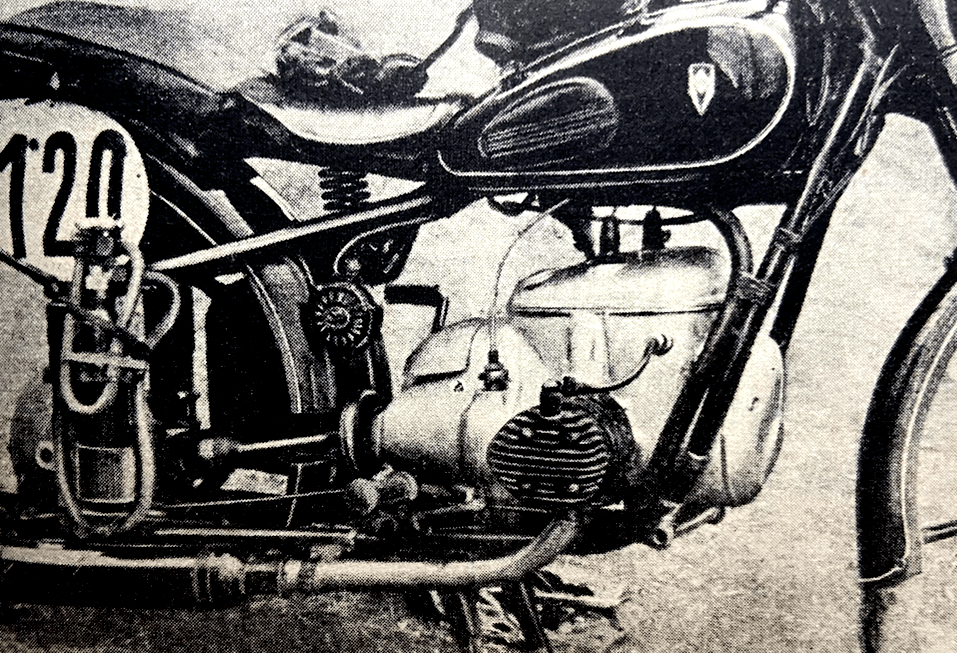
HARRY’S DEPUTY, George Wilson was in Czechoslovakia to report on the ‘ISDT’International’. Once home he wrote: “The ISDT provided an excellent week of sport. The countryside in the White Carpathians and Lower Tetras was enchantingly beautiful, the towns and villages quaintly picturesque. Everything combined to make the trial as memorable as any other in the famous series. But what of the machines? As the result of the event implies, British models performed magnificently. None of the troubles encountered in the 1952 event in Austria were repeated and there were no serious starting bothers. Indeed, the machines’ ease of starting was equalled only by that of the German BMWs and Adlers, and by some of the Maicos. Many of the Continental two-strokes, by comparison, were notably capricious. In the entry were three British 350cc sidecar outfits, an Ariel driven by GL Buck, a Matchless driven by PGK Baldwin and a BSA piloted by RW Wagger. The speed schedules during the week, as far as all three were concerned, were notably mild and their schedule in the speed test was absurdly easy to maintain. But when one hitches a sidecar to an ISDT machine one automatically increases the loads on engine and cycle parts, thus increasing the danger of mechanical breakdown. Two of the outfits, Buck’s and Wagger’s, broke important sidecar connection lugs. No engine troubles were experienced, but none would be expected in a relatively easy event. Valuable lessons have been learned. But more experience with small-capacity sidecar outfits is necessary in really ferocious events before their possible introduction into national teams is seriously envisaged. For my own perambulations in connection with the event I was loaned a 344cc twin-cylinder Jawa in ISDT trim. The model gave excellent service except for two unusual troubles that cropped up after the first day: the gear pedal-cum-clutch control refused to return to its normal position after a gear change (so that the clutch was not, in fact, re-engaging) and the battery died on me. Dust was responsible for the first bother—the reason for the second I never discovered and it did not recur after the battery had been replaced. The model was fast enough under all conditions and the performance in third gear was more than thrilling. The steering was light and positive, the brakes far above average in their stopping power as well as in their non-fade qualities. My sole criticism was of the riding position. The saddle was too far forward, with the result that I could adopt a straight-arm posture only by sitting on the saddle rear rim. At the end of the week the engine was oil-tight and seemed to be going better and better with every mile. Mechanical quietness was of an extremely high standard. The light weight of the model (it tips the scales at
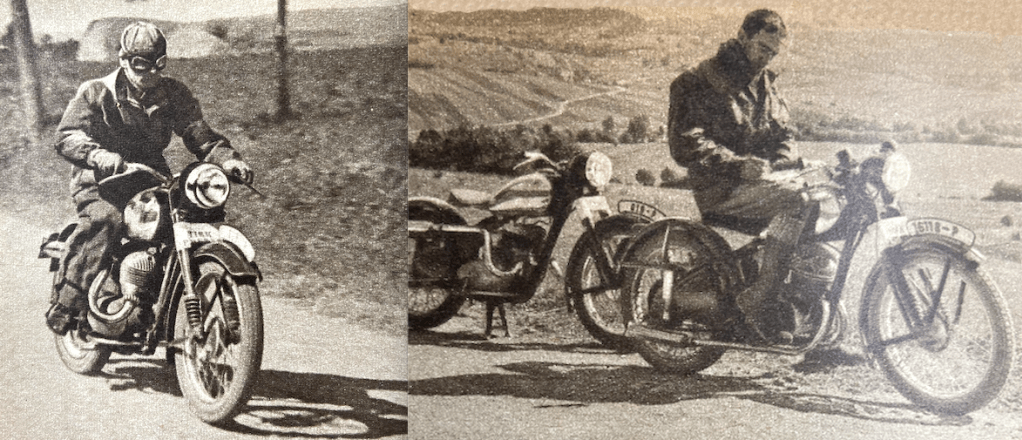
approximately 280lb) contributed as much to the handleability of the machine on the rough as it did to the acceleration performance. All in all, for my particular purpose, the Jawa was a most satisfactory mount…When in Czechoslovakia for the ISDT I also had the opportunity to try the Rodeo scooter which made a brief appearance at Gottwaldov in prototype form. It is the brainchild of a Prague engineer, J Hausman. The next step in the vehicle’s development is likely to be the fitting of 12in wheels and the replacement of the 150cc CZ engine at present in use by a 350cc Jawa engine. The design of the Rodeo is unusual in that it employs a tubular chassis within which the engine-gear unit, cast light-alloy rear chaincase and the wheels are situated, and upon which the two sections of the attractive body are mounted. The front wheel is fitted on a near-vertical kingpin situated within the confines of the wheel hub in a manner reminiscent of that used in the British Ner-a-Car of the 1920s. Both the kingpin and its housing are fitted to a stub axle, which is carried on a leading arm. The arm pivots from a very long bearing extending transversely across the chassis from the right-hand tubular member. Rear-wheel suspension also is by means of a cast light-alloy pivoted arm, the whole of the engine and
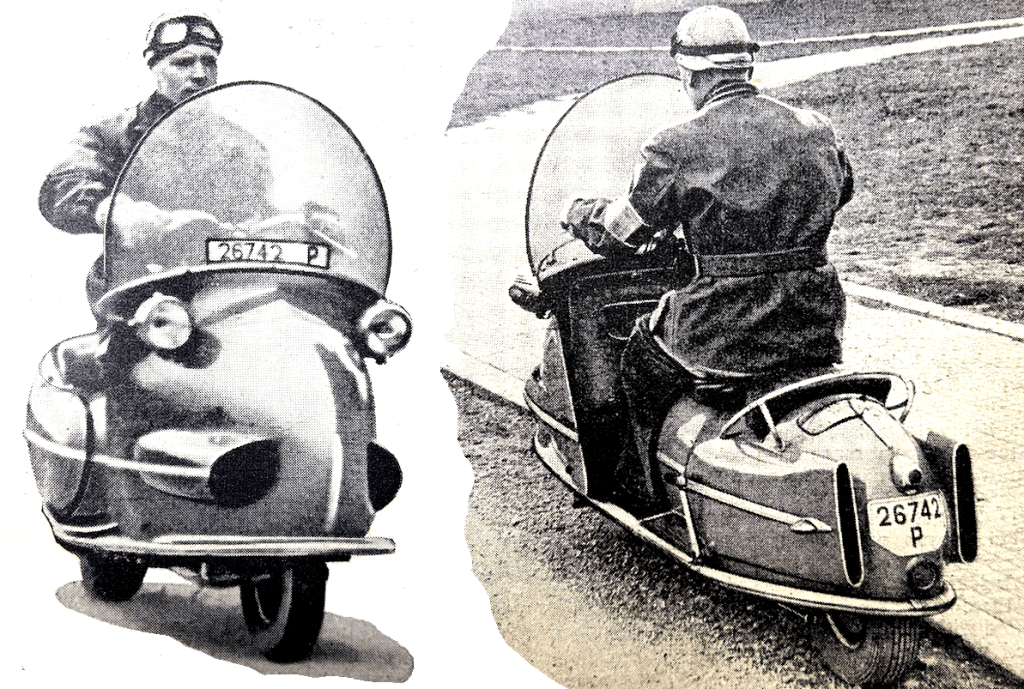
gear box pivoting with the arm so that there is no variation in chain tension. The streamlined, light-alloy nose has louvres for the entry of cooling air and is so profiled that the windscreen is, and looks, an integral part of it. Enclosed within the nose are the fuel tank and the steering linkage connecting the handlebar to the hub of the front wheel…The steering felt ultra-light and ultra-sensitive, and my passage from the trial starting area to the main road was like a landlubber’s promenade along the deck of a ship while he is trying to find his sea legs. The scooter heeled over for turns with next to no effort from me and without pressure on the handlebar. Throughout my trial run this characteristic was to impress itself more and more. There was a feeling of complete remoteness between the handle-bar and the front wheel. Apart from the fact that the throttle, brake and clutch controls had to be mounted conveniently, and the handlebar was a convenient mounting, there appeared to be no other reason for having a handlebar—once the machine was on the move. The vehicle suffered from lack of adequate lock—the seemingly inevitable snag associated with this particular steering layout. As with the Ner-a-Car, so it was with the Hausman scooter. Stability was outstandingly good. Steering was of the hairline variety. After five minutes I was completely at ease, more so, probably, than is ever possible with any other type of two-wheeler. The beautifully controlled suspension provided more than adequate comfort. Weather protection was, of course, excellent.”
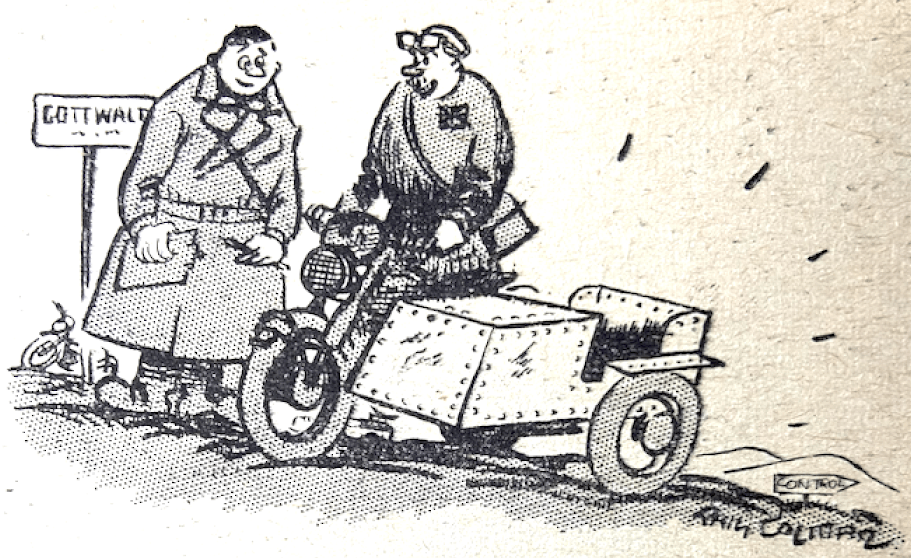
“IN REPLY TO Miss P King’s preference for riding breeches, experience has not yet proved to me that ‘Skirts are positively stupid’, either in summer or winter. From local opposition to general acceptance, I have maintained a preference for feminine apparel without the slightest inconvenience at any time—including the occasional skid and consequent separation of rider from motor cycle.
Miss D HAINES, Witney, Oxon.”
“AS A MERE MALE who also favours breeches and boots for serious riding, I should like to endorse Miss King’s statement about their warmth, tidiness and general suitability. To allay her fears about not looking feminine, I should like to say that I remember her as the only woman competitor in our last two Cheddar Gorge night trials; and at the finish, after riding her fiancé’s Flash a distance of about 160 miles overnight, she, in her safety helmet and breeches, etc, put to shame the untidy gas-cape-and-flapping-leggings brigade. It seems to me funny that a chap will spend upward of £200 on a model and then begrudge £10 or so for one of the many excellent coats or two-piece suits now on the market. To the West End playboy Miss King may look a little out of place, but to a motor cyclist (and who else matters?) she looks very feminine indeed and, what is more important, extremely efficient.
PS—If my wife happens to see this, the secretary of the meeting at next year’s ‘Cheddar’ will probably turn up in blinkers.
H WHITTAKER, (Hon Secretary, Southern Sporting MCC), Greenford, Middx.”
“CAN ANYBODY EXPLAIN why some cars evince a better mpg/weight ratio than any normal motor cycle? The new Standard Eight car has just been launched with a great fanfare of trumpets. It is said to average 55mpg at 30mph, and 40mpg at 50mph. It weighs 14cwt, with full tanks and all tools aboard. Its live load of four average humans must be averaged at about 5cwt more. I have occasionally averaged very little more than 50mpg on a real crackerjack run over French routes nationales. We seem to burn our petrol under somewhat inefficient conditions.”—IXION
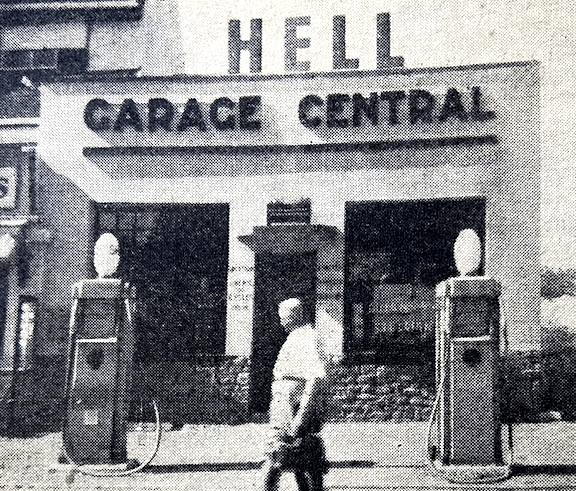
“UNLESS I HAVE MISREAD the letter from Lionel Wills, he is far wrong in stating that the Rudge Multi design did not permit the incorporation of a kickstarter, as one was fitted to the Multi for a number of years. I have Rudge catalogues for 1913 and 1919, in both of which the kickstarter is illustrated and referred to in the letterpress. It is also listed and illustrated in the Rudge spares list covering 1910 to 1923. The arrangement had much to commend it, as it could be used as a kickstarter or to revolve the engine rapidly; the chain operating the starting device was driven from pedalling gear in the bottom bracket. A somewhat similar arrangement of kickstarting was to be found on some P&M models.
HAROLD KARSLAKE, Hon Librarian, APMC, Nottingham.”
“‘NITOR’ POINTS OUT that the 1923 Coventry Mascot rear springing design ‘would not disgrace a machine 30 years younger’. This is true, for it is in fact, almost identical with the pivoted-fork rear frame of today, with the added advantage of a triangulated pivoted member. The failure to achieve wide popularity was not due to any fault in the design, but to the difficulties of a small producer competing in ‘value for money’ with the large concern: the latter may see the benefit of a new design but is not easily persuaded to depart from its standardised product. The writer was responsible for the frame design and his late firm sold many thousands of B&D stabilisers for attachment to Druid, Brampton and other front forks, while a modified form was adopted by HC Webb and Co and built into that concern’s well-known front fork. Shock absorbers were in the first place an accessory, both for motor cycles and for cars. It is the pioneer work of comparatively small concerns that has brought the increased comfort of good suspension, although much of this pioneer work was done 30 years ago, as ‘Nitor’ pointed out.
AD DRAPER, Farnham, Surrey.”
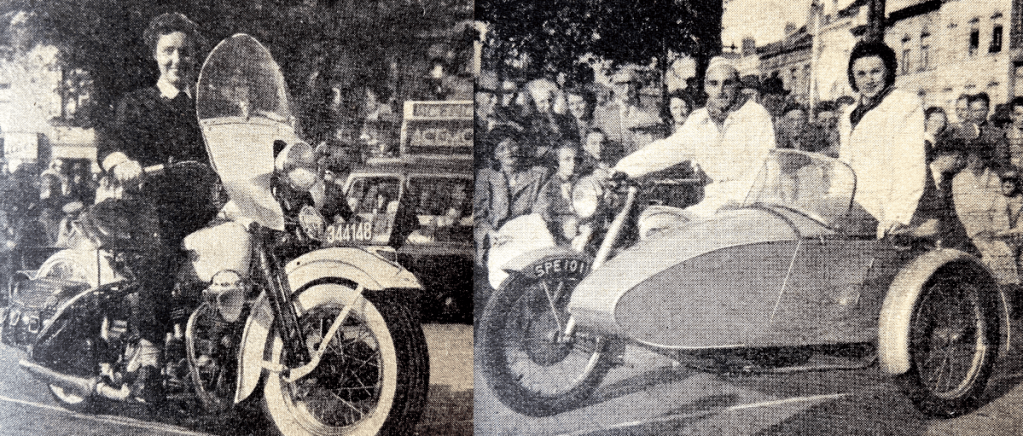
“ABBOTSFORD AIRPORT, BRITISH COLUMBIA on September 20 was the scene of the first truly national Canadian road race, in that the Eastern Canadian champions competed against the local stars. The meeting was held under the auspices of the Canadian Motor Cycle Association in first-class racing weather. A little trouble was caused by the timekeepers failing to secure all competitors’ times for every lap. Best race of the day was the 100-mile unlimited cc Grand Prix for the Championship of Canada; 350, 500 and 750cc models lined up on the grid. R Cooper (499 Norton) was first man away, with C Smith (750 Harley) and T Deeley (750 Harley) hard behind him. These three held their positions until the end of the third lap, when H Adair (499 Norton) took over third place with F Pados (499 Norton) just behind him. By the end of Lap 15 Smith’s Harley had given up the struggle and Adair lay second. The pace was extremely hot, and machine after machine went out with engine trouble; by the 33rd lap all the Harley-Davidson riders had retired. Cooper still led the field, and by the end of the 46th lap five Nortons, ridden by Cooper, Adair, E Havens, B Brawn and Pados headed the pack. This order was maintained until the finish. Cooper was believed to have established the fastest lap at 86.1mph, but this could not be officially confirmed because of the timekeepers’ troubles.”
“AS FROM 2AM ON Sunday next, October 4, vehicle lamps may not be switched off until half an hour before sunrise, and must be lit half an hour after sunset.”
“MOTOR CYCLE AND AUTOCYCLE exhibitors at the Show (November 14 to 21) at Earls Court will total 26; six manufacturers will show sidecars and seven manufacturers will show cyclemotors. Including bicycles, accessories and components, there will be 162 exhibitors occupying an area of 145,000 square feet.”
“PROFESSOR AM LOW, chairman of the Auto-Cycle Union, sent a telegram to HRH The Duke of Edinburgh, ACU Patron, advising him of the success of the British Trophy team in the International Six Days’ Trial. The reply received by the ACU from Buckingham Palace reads: ‘Please congratulate all members of the British team on their splendid achievement in Czechoslovakia—Philip, Patron Auto-Cycle Union.'”
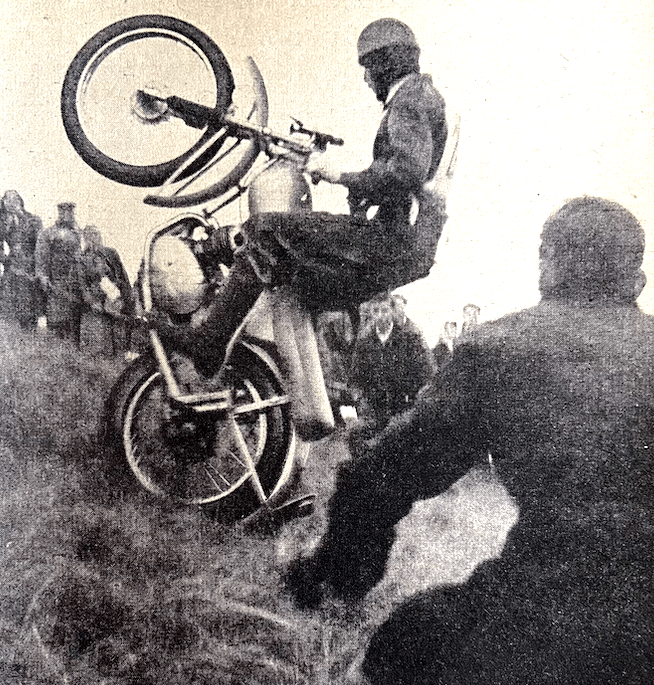
“ALTERATIONS TO THE RESULTS of the ISDT have been announced as follows: winner of the Club Team Prize is the ADAC Maico Frankfurt Club of Western Germany, which lost no marks during the entire week and gained 2,144 marks in the speed test. The riders were G Ilgenstein (175 Maico), E Hoske (175 Maico) and H Best (250 Hecker). Second in the Club Team Contest was the Ustredni dum armady 1 team of Czechoslovakia, which was announced originally as the winner, and gained 1,743 marks in the speed test.”
“THE FRENCH HAVE long had a functional outlook towards two-wheeled transport. Consequently, the trend towards ‘civilising’ two-wheelers, clearly discernible at the Paris Salon which opened last week, is both interesting and significant. As expected, the expansion of the scooter market in France continues. This fact has spurred some motor cycle manufacturers to make laudable efforts to extend the appeal of their products. They have tried, with success, to design ‘one-ness’ into their machines. Of these new approaches, the best reduces the exposed portions of the mechanism to two small, polished surfaces; yet full engine accessibility is given simply by slackening three knurled screws on each side. Equally important are the built-in legshields and footboards harmonising with the general design, and the very full mudguarding; these features provide a degree of cleanliness, protection and neat appearance hitherto unexcelled. Yet there is nothing which is not straightforward engineering practice. It has been shown that the British motor cyclist is too conservative to support unorthodoxy. Perhaps he was, even up to five years ago, but is he now? There is reason to think that the outlook of potential newcomers to motor cycling is less hide-bound by current thought among experienced riders. Since one of the oft-repeated objections to enclosure stresses magnification of mechanical noise, might not this objection be met by the use of plastic panels?”
“LIONEL WILLS is, of course, absolutely correct in denouncing the mortality of the unfortunate belts which were fitted to the Rudge Multi gear. But—maybe owing to comparative youth—he fails to realise that the Multi gear was a major attraction to enthusiasts when it was first hatched. A bad gear certainly; but just as an inferior beer is better than no beer at all, so a bad variable gear was always better than a fixed gear. By the time that Multi gear appeared I was no longer motor cycling on a shoestring. I could afford a quick-wearing belt—indeed, many of my belts were free trade samples. Let me remind Mr Wills—unless he was still in his pram at that date?—of a certain ACU Six Days’ Trial. The organisers for the first time in their lives turned tough, and took us up hills so numerous and steep that on a fixed gear we could not hope for better than a bronze medal. What did we do? We fitted pulleys adjustable for diameter by hand (mine was an Advance, made in Northampton). We took four belts—two cut to normal length, two cut to suit the lowest ratio obtainable with the pulley screwed out to its minimum diameter (ie, a gear of about 5½ to 1). We studied our route cards. We scorched ahead flat out in sections embodying a real gradient. We paused at the foot, screwed down our pulleys, scorched up to the top, screwed up our pulleys, and so forth. The Rudge Multi simplified such tactics. A bad gear, but always superior to manually adjustable pulleys. The Rudge Multi gear was also better than the Zenith [Gradua] because the Zenith involved a weak back brake, while its operation was less convenient.”—IXION

“THE GREEVES RANGE of machines, latest addition to the expanding field of lightweights, possesses several features of technical interest and novelty. Common to all models in the range is the composite frame incorporating a light-alloy beam which is cast around the steering head and forms the front down member and, cast in the same material, a duplex cradle for the power unit. Front- and rear-wheel suspensions are controlled by rubber torsion units and friction dampers. In the case of the De Luxe Roadster mode 20D tested, the power unit as the latest four-speed Villiers 197cc. Mark 8E/4. The test machine was also equipped with plain-bearing hubs, available as an extra. The behaviour of the Greeves on the road amply justifies the makers’ faith in rubber-controlled wheel suspension; a high degree of road-holding excellence and rider comfort has been achieved. The most comfortable ride on bumpy road surfaces was obtained with the friction dampers adjusted so that they were just biting. With that setting, the wheel suspension was remarkably responsive to minor surface irregularities whether they were traversed at high or low speeds. Slight pitching at the rear of the machine was induced by more severe bumps, but could readily be mitigated by tightening the rear friction dampers a shade more. These dampers are easily accessible from the riding seat. Heavy braking on the front wheel alone produced a tendency for the front fork to judder, particularly on bumpy surfaces. Again, this tendency could be reduced by employing heavier front-fork damping. It was not desirable, however, to employ more damping
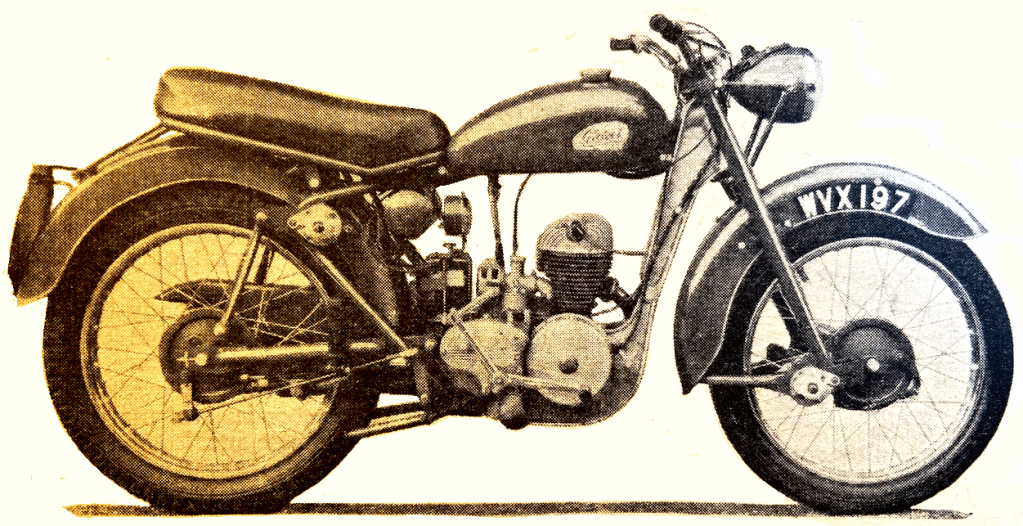
than was strictly necessary at the front end, since the front-wheel suspension units were slightly harder in action than those at the rear. The steering and general handling of the Greeves were first class. On bends and corners the machine could be heeled over to any desired degree without the footrests or any other components fouling the ground. Rapid changes of steering lock could be effected with commendably little effort. Straight-ahead steering was light yet positive. The relationship of handlebar, seat and footrests provided a riding position which was quite comfortable for a person of medium stature. No cramp or fatigue was felt after several consecutive hours’ riding. The downward slope of the dualseat, however, tended to throw the rider on to the forward extremity of the seat, where the reduced width and depth of the upholstery detracted slightly from rider comfort. All controls, both hand- and foot-operated, could be readily adjusted for convenient manipulation. The handlebar shape gave a comfortable wrist angle, but it was considered that the overall width of the bar (28in) could be reduced with advantage. Villiers power units have long earned a reputation for stalwart and unflagging performance; that fitted to the Greeves De Luxe Roadster was no exception, and it provided smooth, tractable power over a wide engine-speed range. Engine starting was invariably a first-kick affair provided that, when the engine was cold, the carburettor was well flooded and the strangler closed. With the engine warm these measures were not required. Idling was erratic—as is common with orthodox two-strokes—but reliable. At all times when the engine was firing evenly the silencer reduced the exhaust note to an inoffensive drone; irregular firing, such as on tick-over or when the engine was running light, produced a rather ‘tinny’ note. More obtrusive to the rider than the exhaust note was induction roar, which was apparent at throttle openings of one half or more. The engine was notable for its mechanical quietness and the absence of the elusive ringing noise which characterises many small two-strokes. The Greeves was a delightful machine to ride in town. At 30mph in top gear the engine pulled very sweetly and the only audible noise was a subdued drone from the exhaust. Smooth, gentlemanly acceleration from that speed was available in either third or top gears. On the open road the Greeves would cruise indefinitely at an indicated 45-55mph according to prevailing conditions. Reasonably stiff main road gradients could be surmounted at the lower figure; an adverse combination of wind and gradient was required to bring the speed of the machine down to 40mph. Prolonged hard riding failed to tire the engine. At high engine speeds a faint, high-frequency vibration was perceptible through the handlebar and seat. The speedometer registered fast by approximately 1½mph at 30mph, 2½mph at 40mph and 4mph at 50mph. The provision of four well-chosen gear ratios enabled the engine performance to be used to great advantage.
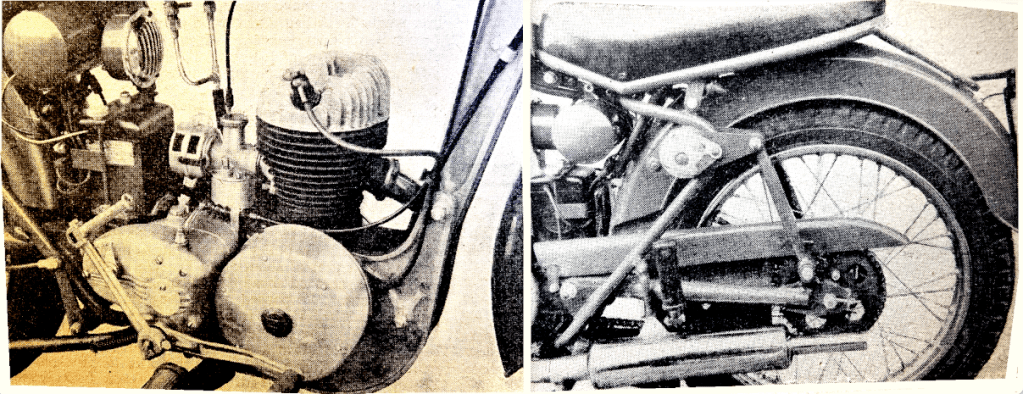
Clean gear changes could be made in either direction without any hesitation in pedal movement. The travel of the gear pedal is uncommonly short; consequently neutral selection required an undesirably delicate movement of the right foot. Bottom-gear engagement, with the machine stationary and the engine idling, was noiseless; partial release of the clutch was sometimes necessary to effect the engagement. The clutch was light to operate and sweet in action. It freed perfectly, took up the drive positively and seemed impervious to abuse. The friction of the four-speed gear box, and the use of gear oil, detracted slightly from the remarkable liveliness for which the 197cc Villiers engine, in its three-speed form, is renowned. On long, main-road journeys, a perceptible improvement became apparent when the unit was thoroughly hot and the gear oil less viscous in consequence. The rear chain tended to run dry. When adjusting it care was required to make allowance for an appreciable increase in chain tension when the machine—a pre-production model—was laden; there was also a tendency for the chain to tighten still more after the machine had been run for a few miles. On production machines modified rear-fork geometry has eliminated the difficulty. Both brakes were adequately powerful, light and positive in operation and required no adjustment for wear throughout the 1,000-mile test. In the early stages of the test the rear brake lost efficiency. Inspection showed that this was the result of leakage of a small amount of oil from the hub to the brake drum—substitution of new brake shoes for those which had become impregnated with oil effected a complete cure. Torque reaction of the front brake is transmitted through the fork links, and use of the brake resulted in lifting the front of the machine. The valanced mudguards proved commendably effective when the machine was ridden under dirty weather conditions; there was a high degree of protection from mud, both for the engine and for the rider’s shoes. After dark, with the battery circuit in use, the main head-lamp bulb provided a beam which was adequate for the maintenance of daytime cruising speeds. However, the generator did not balance the load under those conditions. The drain on the battery could be obviated by turning the head-lamp switch to the direct lighting position, though it involved some reduction in the brilliance of the light beam. A rattle from the rear number plate which occurred at high engine speeds at the beginning of the test was eliminated by substituting a rubber sleeve for the steel distance piece on the number-plate lower attachment bolt. To sum up, the excellent riding comfort and sound all-round performance provided by the Greeves De Luxe Roadster make it an attractive proposition for the lightweight buyer.”
“THE MOTOR CYCLE section of the 40th Salon de l’Automobile et du Cycle, which opened in Paris last Thursday, produces much of interest but few outstanding novelties. There are signs that the French motor-cycle industry has now settled down to a stable, thriving state where logical development is taking the place of startling innovation. Output of the industry as a whole has increased by 14% in the first seven months of this year, as compared with the corresponding period last year. This is a much smaller increase than had occurred in 1952, but is enough to warrant a good measure of confidence for the future. A break-down of this overall increase (during the seven-month period) into its components is highly interesting and reveals virtually no change in the output of machines of over 125cc capacity, whereas, at the other end of the scale, the production of cyclomoteurs (50cc and under) went up by 18%, from 260,234 to 307,085.
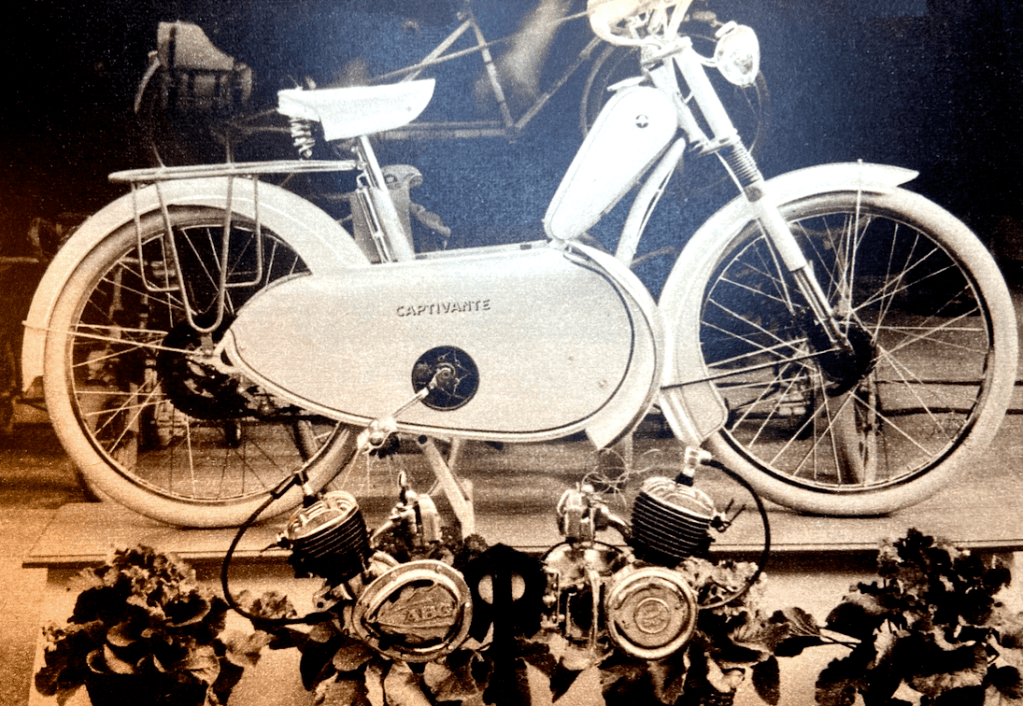
Velomoteurs, of 51-125cc capacity, fell appreciably in popularity, but the number of scooters produced was 56,154, more than double the 1952 figure of 26,048. Nearly four times as many velomoteurs as scooters were built in1952—this year the proportion has plummeted to three to two. The cyclomoteur remains by far the most popular single class of two-wheeler because the French are very keen on individual powered transport, and the wages of many do not run to anything more costly. An indication of the popularity of the type is that cyclomoteurs account for almost half of the 2½ million two-wheel vehicles on French roads. France was early in the field with the clip-on cyclemotor but now the position is reversed: almost all of them have built-in engines. As in Germany, an engine size of 50cc has been generally adopted as a satisfactory compromise between performance and economy. One or two 98cc engines were shown, but this size has the disadvantage of bringing the cycle into the realms of registration and taxation. These cyclomoteurs are tending to become more complex and less like motorised bicycles. Open or semi-open frames are general, as is front
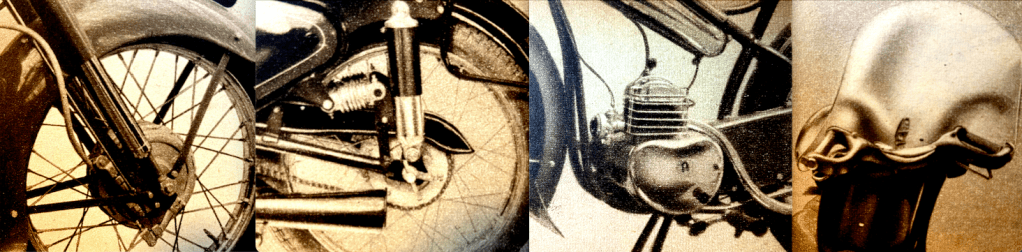
suspension which is frequently by a lightweight telescopic fork. However, girder and bottom-link designs are also to be found. An example of the latter is the Derny, which features leading links and rubber-band springing. There are several tandems with built-in engines. Several cyclomoteurs have smaller wheels than normal bicycles, and two speeds are available as an extra on certain models. The next step may well be the general adoption of rear springing; a neat plunger system is featured by Horsy on one model. In the velomoteur category, the most interesting feature is the appearance of 70cc (and 49cc) Lavallette three-speed two-strokes. Their transmission comprises three pinions on the end of the crankshaft, revolving with it, and a further three (meshing with the first three) on the output shaft. The second trio float on the shaft, but any one of them can be brought into engagement by sliding dogs. Gear selection is preselective, by twistgrip. Lavalette engines are featured on several machines including Génial Lucifer, Sterling and FR. The comparatively high cost of the luxury scooter, with its engine of 125cc or more and its elaborate pressings, has led to the appearance of several lightweight scooters or near scooters. The Motobloc, for example, has a 75cc two-speed power unit enclosed and located ahead of the rear wheel. It has a simple loop frame, no rear springing, well valanced
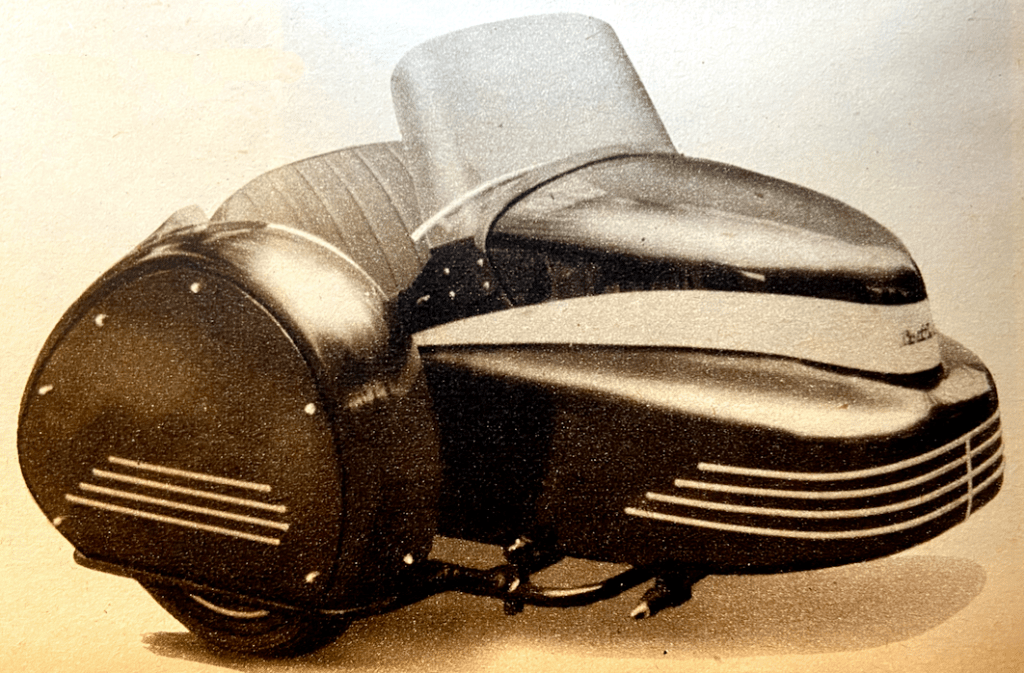
mudguards and a fuel tank mounted almost vertically in front of the rider’s legs. Another in this class is the Babymoto, also without rear springing, and equipped with the 70cc Lavalette engine. Monet et Goyon is presenting the Starlett 100cc light scooter with neat enclosure, 2.75x19in tyres and a Gregoire telescopic front fork with an external, tension check-spring behind the lower end of each slider. Gregoire rear suspension, embodying a somewhat similar external check-spring, appears on four or five makes including Monet et Goyon, in plunger and pivoted-fork guises. Plunger suspension is still the more popular choice but there are several additions to the pivoted-fork ranks this year. Of the full-size scooters, several of last year’s prototypes are now in production, including the Sterling and the Roussey. The unorthodox Derny remains in the experimental stage, with no indication of when it will emerge. Striking new designs are shown, by Mors, Peugeot and Jonghi. The Mors has a fan-cooled, 125cc two-stroke engine with direct drive to the three-speed gear box; the single-tube frame loops over the top of the engine and extends rearward to support the body. Final drive is by duplex chain enclosed in a cast-aluminium oil-bath case which pivots at the gear-box sprocket centre and forms the arm of the pivoted rear suspension. A leaf-spring tensioner avoids the necessity of providing a manual
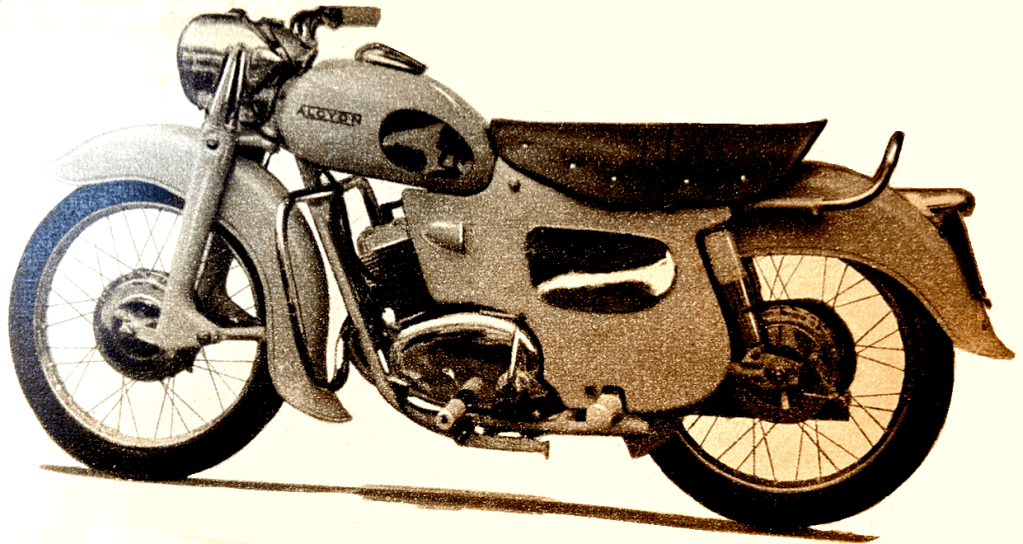
chain adjuster. Road shocks at the rear wheel are absorbed by an ingenious strut of rubber moulded round a normal helical spring. This is claimed to provide a soft but progressive action with the self-damping qualities of rubber. Front suspension is by rubber bands controlling a sturdy parallelogram-linked arm of tubular construction. The gear box is rod-operated with selection via two pedals, one of which is depressed to change up and the other is depressed to change down. Bodywork is gracefully styled, and a cover hinges at the front to expose the engine and the fuel tank. The writer had a short run on a Mors scooter. The engine produces 6.2bhp and gave a useful performance; handling was good and the suspension, the rear in particular, coped well with really bumpy pavé. Controls worked smoothly, the gear-change was positive though rather slow in the upward direction, and the bodywork was free from drumming. The Peugeot scooter also has a single-tube frame and fan-cooling is employed for the 125cc two-stroke engine, which is in unit with a three-speed gear box having two-pedal selection. On this machine, too, the cast, light-alloy rear chaincase forms the pivoted arm for the rear suspension, but the pivot point is behind the gear-box sprocket. Springing is by rubber bands fore and aft; the front wheel is carried on a trailing link while at the rear, a rod extends forward from the pivoted claincase to a bell-crank lever which actuates the rubber bands mounted under the engine unit. Two separate
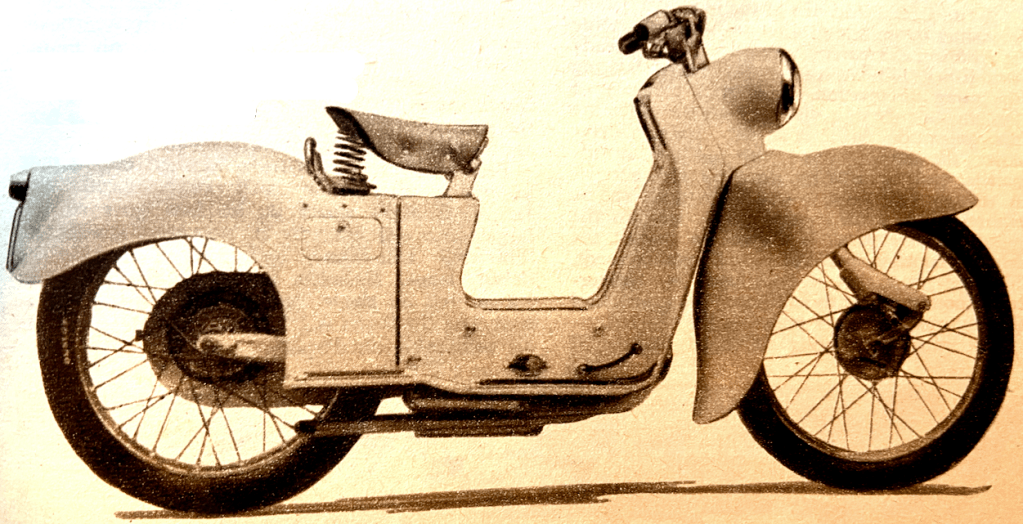
saddles provide accommodation for rider and passenger; the footboards are extended rearward round the engine cover for the pillionist’s feet. each has a single coil spring at the rear. The saddles pivot on substantial, cast-aluminium nose brackets and have coil springs at the rear. A panel under the front saddle (which pivots forward) gives access to the fuel-tank filler cap and sparking plug. Other features include a dial-type gear indicator on the instrument panel, a lockable tool box in the front panel, dash control for the fuel tap, an eccentric rear-suspension pivot for chain adjustment and a spare wheel secured by the rear number-plate assembly. General appearance of the Jonghi scooter seems to have been inspired by the Moto-Guzzi Galetto. The Jonghi has a horizontally mounted 125cc two-stroke engine with three-speed gear box, 19in wheels, trailing-link front suspension and rear springing by pivoted fork. The fork, fabricated from pressings, carries a guard which encloses most of the rear chain. There is no separate frame on this scooter; the body pressings form an integral construction on the lines of modern mass-produced cars. Mudguarding is very thorough and
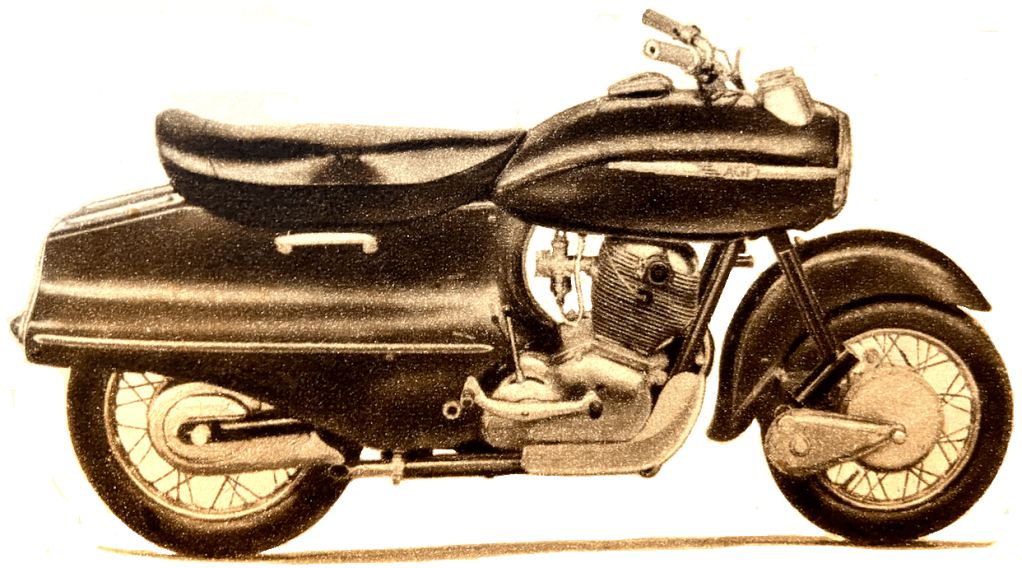
the front styling is particularly pleasing. The more general use of softer suspension systems having a long travel is almost certain to result in a reduction in wheel size for motor cycles, in order to avoid excessive seat height. Two examples of smaller wheels were noticed at the Salon; one is a 125 by Mandile et Roux, a low-built machine with footboards, legshields and side panels in one unit, 270×90 mm tyres and an appearance suggesting a scooter with a saddle tank. More startling is the AGF fitted with the well-established 250cc AMC engine. This machine has 550x85mm tyres (approximately 15in rims); the rubber suspension provides some 6in travel for both wheels through a leading-link front fork and a pivoted fork at the rear. Scooter-type enclosure of the rear half of the model, footboards and a fat, streamlined petrol tank (extending forward of the steering head and enclosing the head-lamp) combine with the small wheels to give a highly unconventional appearance. Enclosure is applied in various ways to several machines of more conventional basis than the AGF. To judge by the interest and approval which these models arc attracting they are most likely to set a fashion in line and cleanliness. A late arrival, and one of the most handsome machines in the Show, is the sage-green Gnome et Rhône L53 “carénée” [“streamlined”], based on the established 175cc two-stroke model. The only portions of engine-gear unit visible from the sides are the generator cover and the primary-drive cover; the remainder is totally enclosed by side panels, each secured by three knurled screws. A single front panel forms legshields, and is
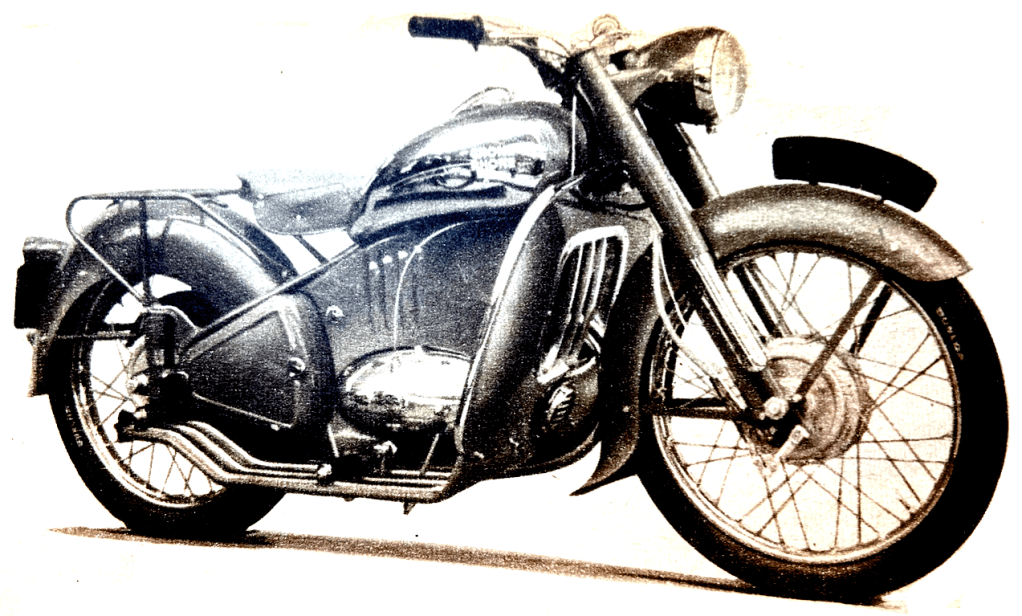
embraced by a rectangular safety bar; in the middle of the panel is a grille to permit the entry of cooling air to the engine compartment. Weather protection is completed by rubber tread footboards (with additional footrests) and shapely mudguards of really ample section. The most interesting technical feature of the L53 is that both brakes are actuated hydraulically through the pedal, with an additional cable control of the front brake through the usual handlebar lever. Another pleasing example of enclosure is the Follis with 175cc Sachs engine. The air inlet is given a ducted ‘aircraft’ aspect; the down tubes of the duplex frame are swept out from the steering head and then inward, and are embraced by the forward cowling to form an oval entry. Here, too, detachable side panels almost enclose the engine. Rather less enclosed is the prototype Alcyon carénée featuring a 175cc Zurcher engine. The similar machine with a 250cc AMC engine shown last year is now in production. In both cases the side panels extend from behind the engine to the spring units of the rear suspension and have detachable doors, one exposing a tool box and the other the battery. Design trends noted at the Salon include the increasing popularity of the 175cc engine (AMC has introduced an ohv four-speed unit on the same lines as the 125 noted last year, and Motobecane is showing a very clean design, also with overhead valves); the dropping of knee grips on many models in favour of recessed tanks (some of the recesses are chromium plated); and the painting of many silencers to match the machine as a whole. Finally, there is a strong foreign contingent in which Britain is well represented; the BSA Group’s stand is one of the largest devoted entirely to powered machines. The new Triumph Tiger 110 is making its debût, Royal Enfields have 250, G and J2 models on show with pivoted-fork suspension, and there is a striking display of the latest AJS and Matchless models.”
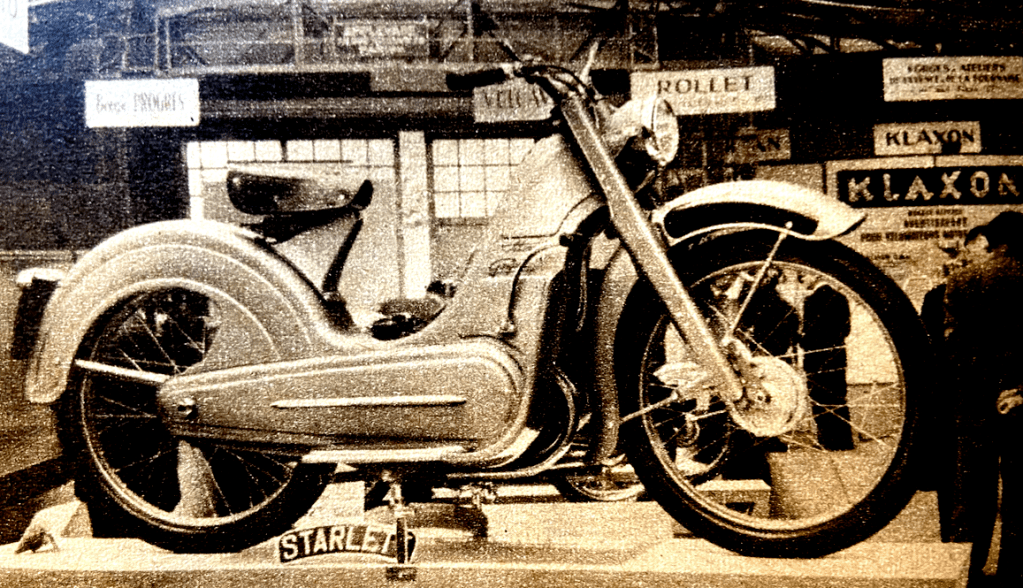
“THE EXISTENCE OF a Triumph with pivoted-fork rear springing and based on the Thunderbird was known before the recent ISDT, and a development prototype of the model, ridden by PH Alves, distinguished itself in the winning British Trophy team. At the Paris Salon the production version made its first public appearance. Said to be possessed of an outstanding all-round performance, it has been designed primarily for the US market where Triumphs are already popular and where an over-100mph motor cycle is sure of a warm welcome by enthusiasts. There is nothing unconventional about the appearance of the rear suspension. The tubular fork arms are brazed into a massive, malleable bridge-piece which has forward-extending lugs bushed to take the pivot spindle. The spindle is located in a lug on the vertical seat tube. The fork ends are welded to the tubular arms and embody the lower attachment points for the slim Girling suspension units. Of steel-tube construction, the sub-frame bolts to the lug at the top of the seat tube and, running diagonally down from the suspension unit upper mountings to the back of the gear box, turns forward to become the engine cradle. Pillion footrests and silencers are attached to pierced, triangular plates bolted to the lower rear portion of the sub-frame. The silencers are an enlarged version of those introduced for the Terrier: the barrel tapers slightly towards the rear to give an attractive, streamlined aspect. A new design of twin-seat, which gives two levels of accommodation, is carried on the sub-frame, which also supports a valanced rear mudguard. A tubular centre stand is fitted. By bringing the gear box closer to the crankcase it has been possible to avoid lengthening the wheelbase by more than about ½in. This modification has involved a shorter primary chaincase, new rear engine plates and a revision of the gear box adjustment arrangements; accessibility of the gear box clamping bolt and the adjusting screw have been greatly improved. Oil-tank capacity has been increased considerably and the tank is balanced by a combined battery container and toolbox on the left-hand side of the machine. Front fork. nacelle and petrol tank are standard, and the finish is similar to that of the Tiger 100 save that a pale bluish-green metallic paint has been substituted for the silver. As a result of a stiffened-up crankshaft, new cams, larger inlet valves, an Amal carburettor and a compression ratio of 8.5 to 1 (as compared with 7 to I of the standard Thunderbird), the engine is claimed to produce 42bhp at 6,500rpm with air cleaner and silencers fitted. Iron is employed for the cylinder block and cylinder head. The head has an extra horizontal fin to improve cooling. The larger volume of oil circulated also contributes to avoidance of excessively high running temperatures. An improved Tiger 100 to generally similar specification is expected to appear in the 1954 range.”
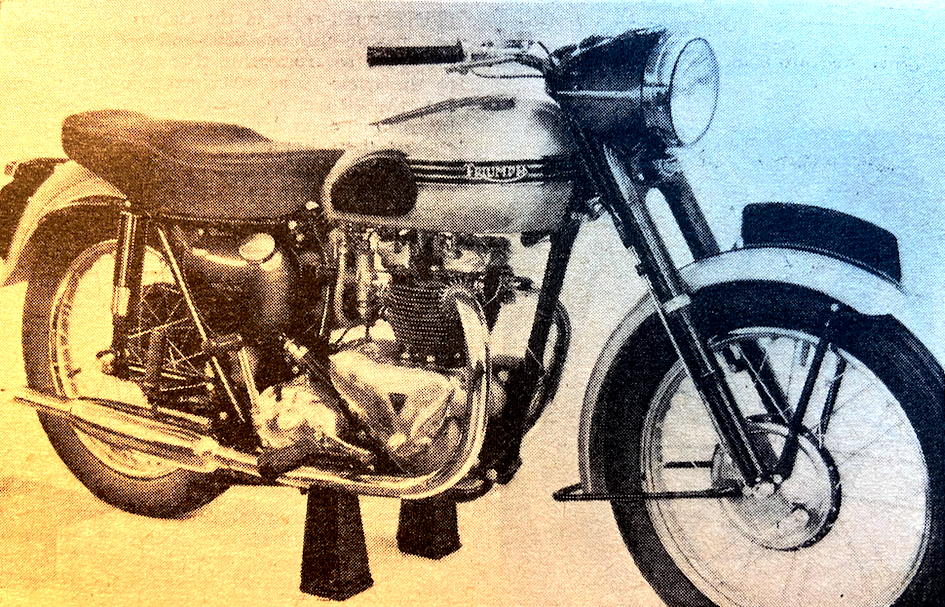
“MODIFICATIONS TO BMWs for 1954 emphasise the increased attention that is being given to brakes. All models—the 500 and 600cc twins and the 250cc singles —have light-alloy full-width hubs embracing the brakes and incorporating straight spokes. On the larger machines the front brakes are of the two-leading-shoe type with external cam levers actuated by a single operating cable. The BMW sidecar-wheel brake is also of the full-width type, is of large diameter and is hydraulically operated in conjunction with the rear brake of the machine.”
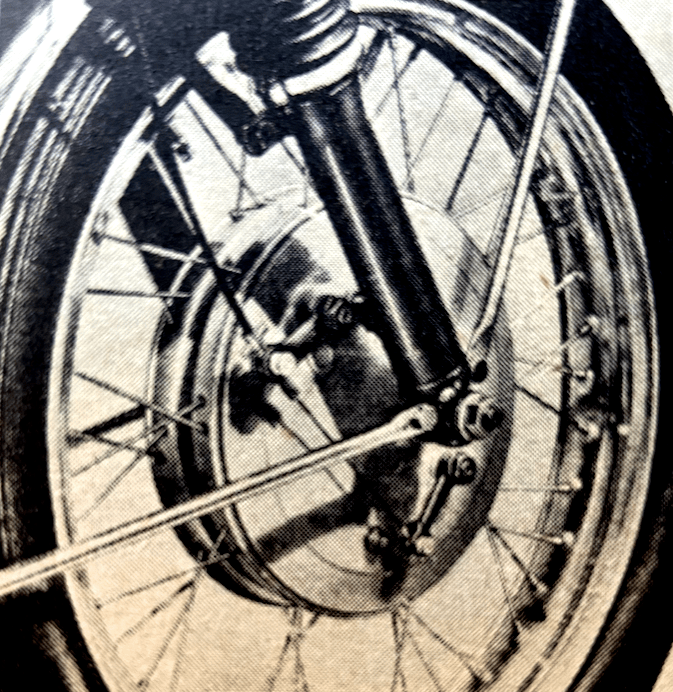
“WITH LAST SUNDAY’S Spanish Grand Prix, a very wet and rather boring curtain was drawn across the classic road-racing scene for 1953. Rain fell heavily on Saturday night and threatened to do so again on Sunday morning. As 9.30am, the time of the start of the first race, drew near, the sky was grey and uncompromising and the crowds round the circuit numbered no more than a few hundred. In the circumstances, the organisers debated whether the race could be run without involving them in financial ruin. They considered postponing it for a few hours or even, if necessary, until Monday. Finally it was decided that the meeting would be held as scheduled, and the first race started only a few minutes late. Rain began to fall when the 125cc Race was in progress. It continued with a brief pause during the 250cc Race and fell with renewed and unabating intensity during the greater part of the 500cc event. Speeds, and the degree of competition, were reduced as a result. AA Copeta (MV Agusta) won the 125cc Race at an average speed of just over 58mph. He led from beginning to end, increasing his lead until he had a safe time margin in hand before settling his pace. In the 250cc Race the story was roughly similar: Ken Kavanagh (Moto-Guzzi) led for all but two of the first 17 laps before slowing to let his team-mate, E Lorenzetti, take the lead. Lorenzetti won easily at an average speed of 57.88mph— a fraction of 1mph slower than Copeta’s winning speed in the earlier 125cc event The star of the meeting was Fergus Anderson who, riding the single-cylinder 350cc Moto-Guzzi, won the 500cc race at an average speed of a shade under 60mph. It was not an easy win, for conditions during the race were at their worst and he was faced with determined opposition from the Gilera and MV Agusta fours. A notable non-starter, as a result of injuries sustained at Silverstone, was Geoff Duke (Gilera). The meeting was held over the Montjuich Park circuit, in Barcelona. When the Spanish Grand Prix was granted classic status in 1951, the 3.8km circuit was lengthened to slightly over 6km. The alteration was said to have cost the organisers, the Real Moto Club de Cataluna, a sum approaching £12,000 [£430,000 in 2026], but since it involved only short straights linked by sharp turns the extension was unpopular with riders. Last year, in an attempt to bring about an improvement, the length was reduced to just over 4km. But the course still did not measure up to desired standards, so another change was made this year. The original course used pre-war was reverted to—and everyone seemed agreed that the change was for the better. Not all riders were agreed, however, that the course was the most suitable for a classic road race. The only ‘straight’ of any length embraces a sweeping, right-hand turn. Top gear can be used but once per lap, and only for a few seconds. The course is not only extremely sinuous, but it is also steeply undulating. From the start, the road veers left, right and then left, climbing steeply to the straight. The course then suddenly slants downwards to an acute, left, hairpin turn, a sweeping right turn, a right-hand hairpin, two sweeping left turns, a right and, finally, a left turn leading to the home stretch. These last-mentioned corners are all steeply downhill. They make the highest demands on a rider’s ability, but severely limit the amount and type of power that can be used.
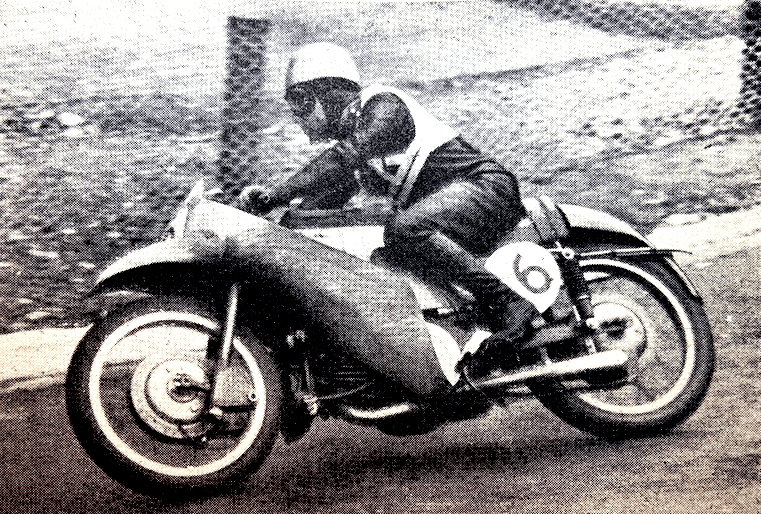
Most agree that the circuit is a true ‘riders’ course’. Where disagreement crops up is when the circuit is considered in relation to the requirements of classic road racing. During practice no more than 10 seconds per lap separated the times for the fastest 125s and those for the fastest 500s, and there was only 4sec difference in best 250 and 500cc times. Indeed, on his 350 Moto-Guzzi, Fergus Anderson had lapped in 2min 6sec—just 1sec outside the best 500cc times recorded by HR Armstrong and RH Dale (Gileras) and C Bandirola (MV Agusta). The nature of the circuit had encouraged both DKWs and Moto-Guzzis to enter their 350s in the 500cc Race. The four-cylinder Moto-Guzzi 500s were not even considered. Fuel has been responsible for many disputes in classic racing this year. That supplied for practice in Barcelona contained a small element of tetra-ethyl lead—and was thus at variance with the regulations. The German DKW and Spanish Montesa machines were in trouble because of it and Moto-Guzzis said that their machines would not race unless they could use a regulation fuel that they had brought from Italy. Eventually the club issued a statement to the effect that race équipes could use fuel from any source, provided a declaration was signed that it complied with the regulations, and provided that it passed any analytical test to which it might be submitted after the meeting. The first race was for 125s, which were to compete over 27 laps, a distance of 63.5 miles. The field of 24 came to the grid under a darkening sky and with the threat of rain growing more pronounced every minute. Most favoured for a win was E Mendogni (Morini) who won last year in a tussle with Les Graham (MV Agusta)…The two-stroke Montesas were new models but they were not seriously expected to challenge the four-strokes. The NSUs had not shone in practice and the fastest lap—by W Haas—was no better than 2min 17sec. As the field streamed off from the grid, Copeta led, Ubbiali was second, T Forconi (MV Agusta) third, and Mendogni was fourth…Copeta was in high spirits and there appeared to be be no holding him…Haas, 1953 World’s Champion in the 125 and 250cc classes, spilled early on and damaged a footrest. He continued for several laps, but the bent footrest finally broke and forced him to retire. There were no changes among the leaders until the ninth lap when Ubbiali pulled into the pits where he spent approximately 2min. 0 Daiker (NSU) then moved up to third. As expected, the Montesas were not sufficiently fast to challenge the MV Agustas. The fastest of the five was ridden by JA Elizade, who was sixth by the 11th lap and fifth by the 13th. Daiker went out with engine trouble after 15 laps. Copeta won handsomely…As a result of Copeta’s win, MV Agusta and NSU end the season with a tie for the Manufacturers’ World’s Championship. In order to decide the tie, aggregate times will be taken for all the classic 125cc Races this year, and the make of machine with the highest score will be adjudged the winner. RESULTS: 1, AA Copeta (MV Agusta), 58.10mph; 2, CC Sandford (MV Agusta); 3, R Hollaus (NSU); 4, W Brandt (NSU); 5, J Atorrasagasti (MV Agusta); 6, M Cams (Montesa). The rain was still gathering momentum when the field lined up for the start of the 250cc Race. Road surfaces were treacherously damp. There was genuine disappointment that the NSUs had not been entered. The reason given was that the machines had struck trouble in a national event in Germany and could not be prepared in time. A Moto-Guzzi win was therefore certain, though the DKWs could not be discounted. Ken Kavanagh (Moto-Guzzi) led after the opening lap. Hard on his heels came a quartet of Moto-Guzzis ridden by TL Wood, R Hollaus, A Montanari
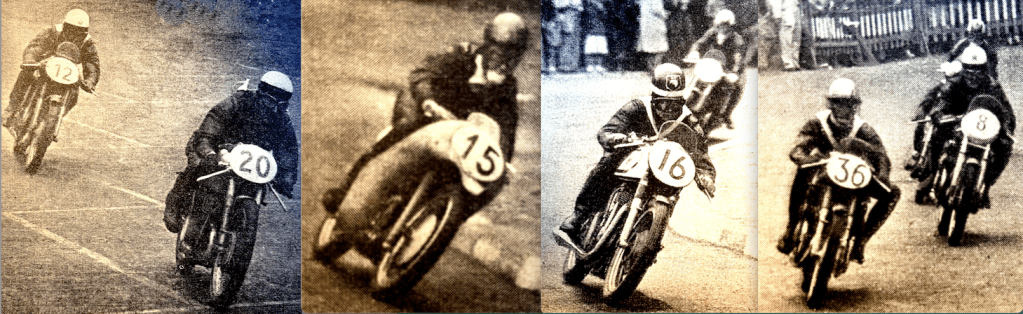
and E Lorenzetti, S Wünsche (DKW), G Braum (Horex), FK Anderson (Moto-Guzzi), A Hobl (DKW) and WC Petch (Velocette)… Hollaus was in vivid form and was very close to Kavanagh. After six laps the pair were bracketed together and 1lsec in front of Anderson…The rain increased in intensity and the downhill sections became more difficult to ride with each succeeding lap…During Lap 17 Kavanagh slowed. Lorenzetti moved into the lead and began to increase the distance between himself and Kavanagh, who was then sitting up and, along with Fergus Anderson, enjoying a steady ride. By the 22nd lap 42sec separated Anderson, then third, from Montanari, in fourth position. Similar gaps separated other pairs of riders. Spectators yawned or read their newspapers. Many decided that they were better out of the rain and left for home. Lorenzetti had the distinction of winning what may well go down in history as the 1953 season’s most boring race. RESULTS: 1, E Lorenzetti (Moto-Guzzi), 57.88mph; 2, KT Kavanagh (Moto-Guzzi); 3, FK Anderson (Moto-Guzzi); 4, A Montanari (Moto-Guzzi); 5, TL Wood (Moto-Guzzi); 6, A Hobl (DKW). In its early stages the 500cc Race provided easily the best sport of the day. Auguste Goffin (Norton) stole the lead at the start, and he was fast followed through the uphill swervery by FK Anderson (348 Moto-Guzzi), HR Armstrong and RH Dale (Gileras), and S Wünsche (348 DKW). After a lap, however, Goffin was seventh. Anderson led, Armstrong was second, Ken Kavanagh (348 Moto-Guzzi) third…On the second lap Kavanagh moved up ahead of Armstrong, and Lorenzetti headed Dale. Then Kavanagh also overtook Anderson. As the race progressed, the leading pair drew away from Armstrong. The 350 Moto-Guzzi was probably the nearest approach to the ideal machine for the circuit in the prevailing conditions. Only a fraction of the Gilera’s colossal power output could be used—and that gingerly! Armstrong spurted on Lap 5. Quickly he sliced the gap separating him from Anderson, and a lap later he was second and bearing down on Kavanagh. Armstrong has shown consistently brilliant form in l953 races, but never to the same extent as then. On the ninth lap he not only headed Kavanagh but had a 200-yard advantage. But the effort was too great and Armstrong spilled, though not seriously, on the 10th lap. Two laps later Kavanagh had to call at his pit, and finally he had to retire. The order of the leaders was then Anderson, Lorenzetti, Dale, C Bandirola (MV Agusta) and Tommy Wood…The rain teemed down relentlessly, causing riders’ goggles to steam and become mud-spattered, gloves to become saturated. There were no notable changes of position until the 26th lap, when Lorenzetti had to retire. Bandirola moved up to second place. The field was spread over three laps, and 27 laps remained. At 29 laps Anderson led Bandirola by 56sec and he allowed his advantage to decrease to 46sec by 35 laps…For 24 more laps the race dragged on. Anderson slowed even more towards the end, consolidating his chance of success by reducing the risk of a fall. Bandirola speeded. Dale and Colnago maintained their speeds and their stations. There were no surprises and Fergus crossed the line a popular winner. RESULTS 1, FK Anderson (348 Moto-Guzzi), 59.99mph; 2, C. Bandirola (MV Agusta); 3, RH Dale (Gilera); 4, G Colnago (Gilera); 5, N Pagani (Gilera); 6, TL Wood (Norton).”
“I WOULD IMAGINE that the record for longest ownership and use of the same machine must be credited to GA Reed, of York, a past-president of the Yorkshire Centre. Immediately after World War I he bought a two-speed Scott and has ridden it for at least 32 years. When over 80 years of age, he entered the Ilkley Reunion Trial last year on the same machine; he retired when he knocked the silencer off but nevertheless he managed to home under power. He had competed in much the same territory in the Scott Trial of 1920. As far as I know, Mr Reed never wished to change his machine. Indeed, the story goes that once, on an occasion when the Scott Co was anxious to obtain a vintage specimen of its own products, the offer of a brand-new machine in exchange was regarded as an aspersion on the old stalwart and was indignantly refused!
‘WHARFEDALE’, Manchester.”
“D FLEMING’S ADVOCACY of the compulsory wearing of safety helmets seems so eminently reasonable that it is easily accepted without suspicion. No one can doubt the value of the safety hat, but to apply compulsion to wear it is quite another matter. The safety hat offers no protection to third parties, but only to the motor cyclist himself, and he alone has the right to say whether or no he shall wear it. Once we start knowing what is best for other people to do for their own benefit we are playing with fire, as past and present world events should have made abundantly clear to everyone.
BC MACDONALD, Durham.”
“IN REPLY TO the letter from John S McCann, who asks if it is necessary for his mother to take the driving test again, the answer is no. By his own statement, she drove a car in the days before tests began (it is presumed she held a driving licence!). The law states that anyone who held a licence prior to April, 1934, is exempt from the necessity to take a test and may drive any type of vehicle (except a heavy lorry or public service vehicle carrying passengers). Providing Mr McCann’s mother can prove that she held a licence, either by producing it or getting the licensing authority to turn up the old records, they cannot refuse her an annual licence to cover all groups.
FG DOBBS, Penzance (Authorised by MoT to conduct driving tests).”
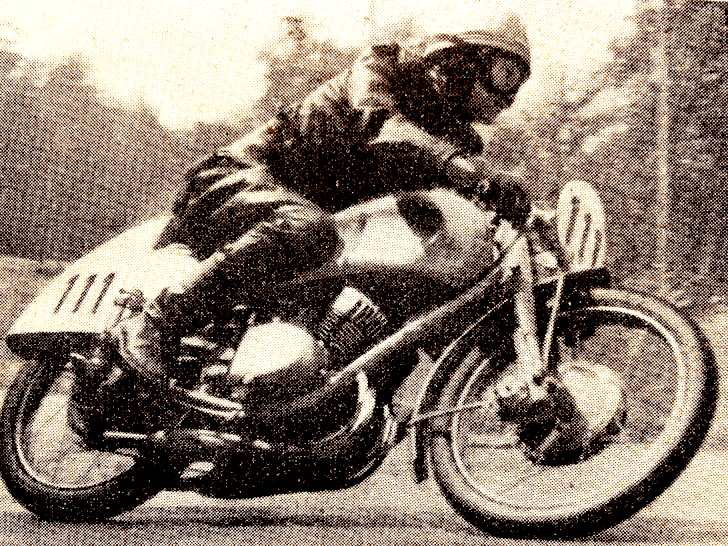
“YOUR PICTURE OF an Italian girl riding side-saddle on a Vespa pillion prompted me to drop you a line. Practically every girl here rides side-saddle on anything from a Cyclemaster (all motor-assisted cycles here are fitted with small pillions) to a Golden Flash. For the life of me I cannot understand how they do it, especially when cornering fast and particularly on these roads. The only explanation. I can offer is (a) because their dresses are too short to sit astride (the ex-new look has not caught on completely in the tropics!), or, more probably (b) because on bicycles and motor-assisted cycles it appears to be the duty of the female passenger to jump off at each traffic stop and push the machine and boy friend until the engine starts, whereupon the girl jumps skilfully aboard! I flatly refuse to take any girl side-saddle on my 500cc BSA—it would scare the daylights out of me; but I would be interested to hear if many other readers abroad carry pillion passengers like that.
DAVID J PUGH, Java, Indonesia.”
“HAVING COMPETED IN the National Rally I qualified for a silvered plaque. This morning it arrived in a cardboard box measuring 3×3½x¼in, carefully protected inside by corrugated paper. It has been pressed from approximately ¹⁄₃₂in-thick sheet aluminium alloy and could be crushed in one hand quite easily. It does not even have piece of wire at the back so that it can stand up. As for being silvered—why, it does not so much as shine. It is now in its box and there it will stay when my girl friend, who rode pillion, has seen it. A cheaper-looking award I have never seen. I can now understand why the event was not over-subscribed. The entrants must have been club members (who have something to win) and newcomers like myself. Give us our seventeen-and-sixpennyworth and we’ll enter again. Please do not tell me that one enters for the friendly rivalry and comradeship of the affair. Let the ACU run one with no awards and see how many entries are received for that.
‘STAR TURN 534’, Leicester.”
THE STANDARD OF RIDING between Leeds and Scarborough, and on the return journey, on Saturday, September 19, the occasion of the Scarborough International meeting, was the worst that I have experienced for many years. Passing five abreast is neither safe nor clever at 55-70mph, even on a road such as that between York and Malton; even the sight of four serious accidents, all to motor cyclists, one of which proved fatal, did not bring about any improvement in riding. When it began to rain on the return journey I made a detour of several miles through Wetherby, rather than expose myself to the lunatics on two wheels on a wet road between York and Leeds. The position of motor cyclists is low enough in public opinion without exhibitions of that kind. It is not safety helmets that these people need, it is strait-jackets. Let me add that it was the large majority of riders who were giving this display of bad riding and bad manners, not just a few for whom the many were blamed.
JAD, Leeds, 8.”
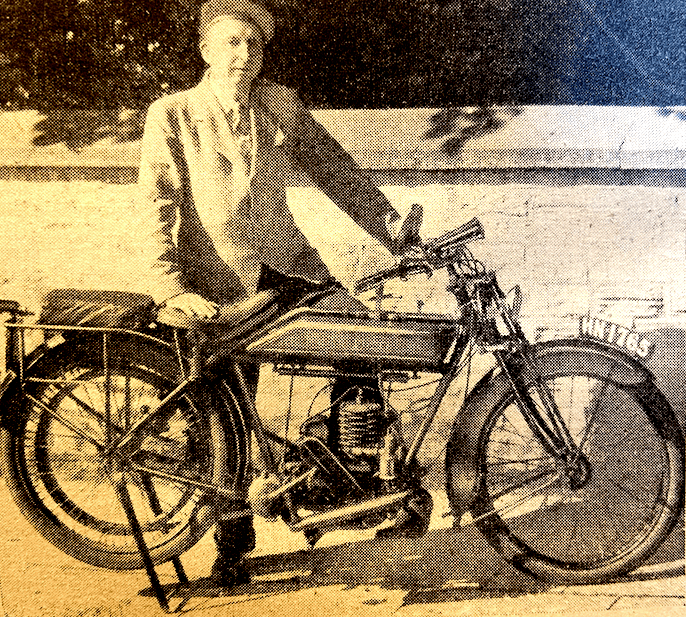
“FIRST PUBLIC ROAD-RACE meeting to be held on the new Oulton Park (Cheshire) circuit took place on Saturday in perfect weather. The event was an outstanding success from almost every point of view. Situated in the grounds of Sir Phillip Grey-Egerton’s estate near Tarporley, some 14 miles south-east of Chester, the circuit has been designed and laid down specifically for road racing. Measuring 1½ miles to the lap, the course is roughly rectangular in shape. It incorporates three sweeping right-handers, a right-hand hairpin, and a shallow S-bend. The surface is of tarmac, and the road is undulating in character. A Bailey bridge allows spectators’ vehicles to be driven on to the land inside the circuit, and there is also a spectators’ footbridge spanning the course at one point. Last Saturday’s meeting was for solo, sidecar and formula III (500cc) cars, with the motor cycle races predominating in number. It was witnessed by a crowd estimated to be well in excess of 30,000. Excellent racing was seen, and this early Oulton Park is regarded by some enthusiasts as a possible successor to pre-war Donington. Most of the corners are wide—at no point is the road less than 30 feet in width—and the provision of more favourable camber on some of the corners would go a long way towards making the course easier for riders. The programme of motor cycle racing comprised massed-start scratch races for 250, 350 and 1,000cc solos and for sidecars and three-wheelers. Both the 350 and 1,000cc races were divided into two heats and a final. The meeting was held under a Cheshire Centre restricted permit, and was used to decide the Cheshire Centre Championship. In the 250cc Race, Maurice Cann (Moto-Guzzi) was supreme. In a spirited battle for second place between E Houseley and BWT Rood (Velocettes), Houseley was narrowly successful. No one could challenge Cyril Smith (499 Norton sc) in the sidecar event. He gave a superb display of high-speed cornering on both three and two wheels! Denis Parkinson (Norton) held the lead for most of the 12-lap 350cc final. MP O’Rourke (AJS) stormed ahead of the field on Lap 2 but retired soon afterwards with engine trouble. On the very last lap the pattern of the race underwent a sudden change. PH Carter, who had been riding his AJS stylishly in second place, took a large handful of grip on Lodge Corner—only a few hundred yards from the finish—and forged into the lead; he beat Parkinson over the line by a fraction of a second. In the 12-lap Senior final, however, Parkinson (Norton) made no mistake. Though lying sixth on Lap 1, he picked up a place on each lap until by Lap 7 he was out ahead on his own. In the process he recorded fastest lap of the day in lmin 12.8sec (74.39mph), which time, incidentally was exactly equalled by the fastest car driver. On-the-spot organisation, which was first-class, was carried out by the Wirral ’10O’ and Mid-Cheshire Clubs.””ACCORDING TO LEGEND, Cassandra was a Greek maiden, wooed by the god Apollo, who bestowed upon her the knowledge of futurity. Whether it made him unpopular with the book-makers of the period, or as the result of a lovers’ tiff, the god eventually stymied the gift by causing everybody to disbelieve every word she said. So she became the personification of ‘I told you so’. We of The Motor Cycle picked up her mantle a couple of years ago in respect of motor cycle racing. We warned you that our 500s were rapidly being surpassed by their Continental rivals, and you abused us volubly. The forecast came true, even faster than we expected. Worse still, a similar fate overtook our 350s (which we had not foreseen). We also suggested that very few firms in our industry were incurably enamoured of racing, and that a couple of bad seasons might wean them from the sport. That corollary has yet to be fulfilled, though rumours are plentiful. Meanwhile we have just one small consolation. Though during 1953 we have been fairly regularly beaten by foreign machines, the vast majority of the victors have been Britons ‘riding foreign’. The future is not yet clear. It pivots on the question whether British factories, hitherto loyal to the racing game, decide that it is no longer worth the candle, and seek other methods of advertisement. (Any defections are liable to cost us the recently won American market.) In such a sad climax racing would still continue on our small tracks and in the Island. It is conceivable, of course, that the leading racing factories on the Continent would also cease to race with their former vigour and ferocity. I express no opinion on these possibilities. The future bristles with uncertainties.”—IXION
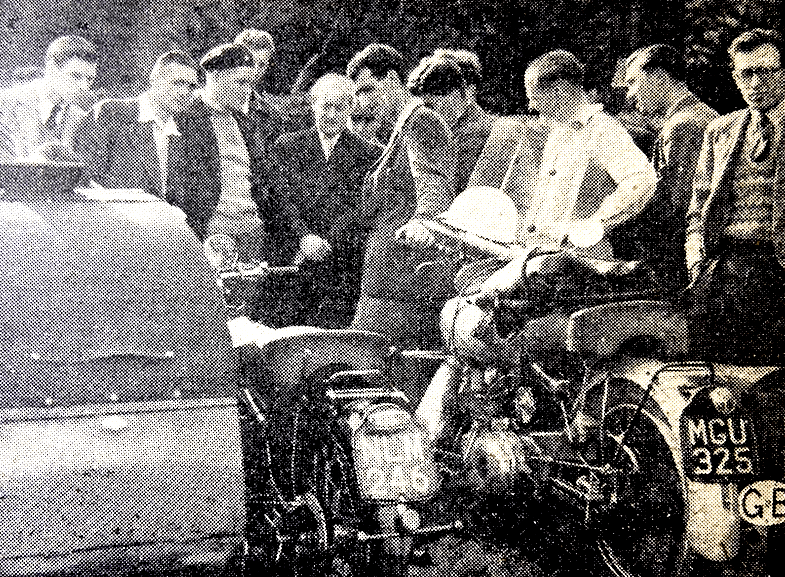
“ALTHOUGH I NEVER travel light at the expense of my comfort and convenience, this photograph places me right in the forefront of the pyjamas and toothbrush class. The machine is a Panther, the sidecar of home construction. The items carried. included one large suitcase containing Madame’s clothes (she likes to be prepared for any social occasion or contingency caused by the weather), two smaller cases containing food supplies and cooking utensils, a one-gallon water can, folding stool, a tent, axe, air bed, groundsheet, a fourth case for clothing, blankets, cushions, panniers carrying a pressure stove and a paraffin container. In addition there were oilskins, a one-piece suit, overboots, spare chains, and a spare inner tube. The whole paraphernalia can be detached and laid out for customs inspection in five minutes. On a trip on which two children were carried, the outfit tipped the scales—wrecked them probably—at two pounds short of 12cwt. Thus loaded, the outfit completed two Continental tours, covering 500 miles of autobahn on one occasion in some 12 hours. The owner is CH Salford, of London. I think that most of us regard the Model 100 Panther as a sidecar machine par excellence. Even so, it seems that the most pro-Panther of us must forthwith revise his ideas of the Model 100’s capabilities. Even when it is subject to the sort of work that would make the Society for the Prevention of Cruelty to Motor Cycles raise horrified eyebrows, the Panther’s thirst is not excessive. A three-weeks’ tour en famille, in which the camping gear was used on only five nights, cost £70 [£2,500 in 2026].”
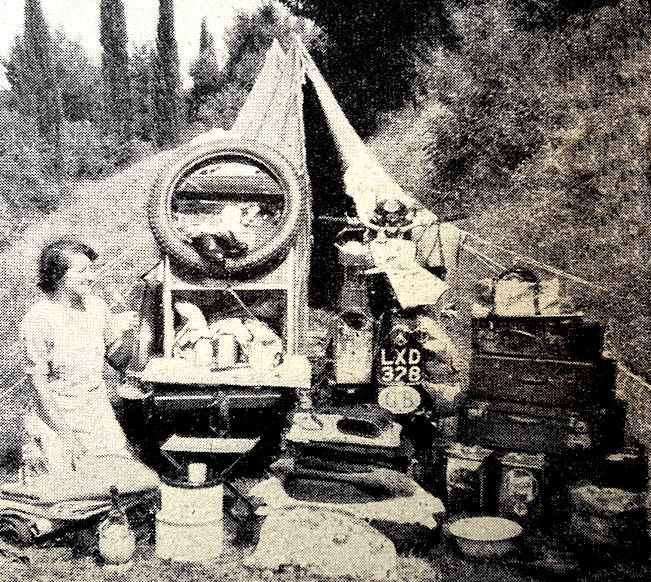
THREE 149cc OHV TRIUMPH TERRIERS last Saturday completed a 1,008-mile ACU-observed test along a route which took in Land’s End and John o’Groats. The machines were ridden by Triumph chief designer and managing director Edward Turner, works director RJ Fearon, and A St J Masters, service manager. Figures returned by the machines (subject to official ACU confirmation) were an average speed (on running time) of 36.68mph at108.6mpg. Oil consumption was about one pint for the three machines. The three riders set off from the Triumph works at Meriden on the Monday. The machines were ridden to Exeter, and the next morning the officially observed run started from Roache, near Bodmin. By way of Land’s End, the party travelled back to Exeter where, as on each successive night, the machines were locked away by the ACU observer, J McNulty. After heading north by way of Bath, the Terriers reached Leamington Spa on the Wednesday evening, well ahead of schedule. At this stage, 336¼ miles had been covered in a running time of 9hr 3min, an average on the road of approximately 38mph. No special effort was being made to obtain a high average. The objective was to set up an average that could he related to ordinary touring speeds, and to illustrate the fuel economy of small-capacity machines at these speeds. The usual cruising speed of the three machines was 40-45mph—the Terrier is said to be capable of about 60mph. Handling of the machines on undulating and winding roads was reported to make consistent average speeds easy to maintain. After some such sections of road the escorting official car had to be driven rather hard in order to catch up! Weather conditions had so far been perfect. Early on, one anxious moment had occurred when the official car rounded a bend to see no riders and an enormous cloud of white dust. It transpired that the Terriers had merely been overtaking a fertiliser-spreading wagon. The wagon had obligingly placed its nearside wheels in the gutter, whereupon the spreader mechanism had jolted loose, sending clouds of white fertiliser in all directions. From the Midlands, the route lay through Carlisle to Inverness, John o’Groats and the finish at Wick, from where the riders were flown back to Birmingham. Biggest daily mileage was last Friday when 263 miles were covered. Weather conditions remained good until Saturday, when heavy drizzle set in. During the wet period the machine being ridden by RJ Fearon developed a short circuit in the horn after he had inadvertently ridden across a deep gully on the road verge Rather than bother with rectifying the fault it was decided, as an interesting test, to run the machine on the emergency ignition, which means that the electrical feed was taken direct from the AC generator for the last 60 miles. Only minor maintenance adjustments were made en route. These comprised the refitting of the solderless nipple on the throttle cable of one machine, and the cleaning of the float chamber gland nut, following the discovery that dirt was present in the petrol being delivered by a service pump. No oil replenishments were made to the engines, gear boxes or chaincases. The lightest of the three riders weighed 13 stone 71b with full riding gear, and the heaviest, 16 stone 71b. The three machines were standard, except that they had been fitted with Triumph twin seats. Last Monday afternoon the engines, gear boxes and the various cycle parts were stripped in the presence of the official observer, and under the supervision of Harold Taylor in the capacity of ACU engineer. All-round condition of all machines was first-class. There had been a slightly excessive discharge of oil from the breather of one engine, but the joint faces of all engines had remained oil-tight. One battery was flat as the result of a broken connection, but the lighting, charging and ignition systems were otherwise in perfect order.”
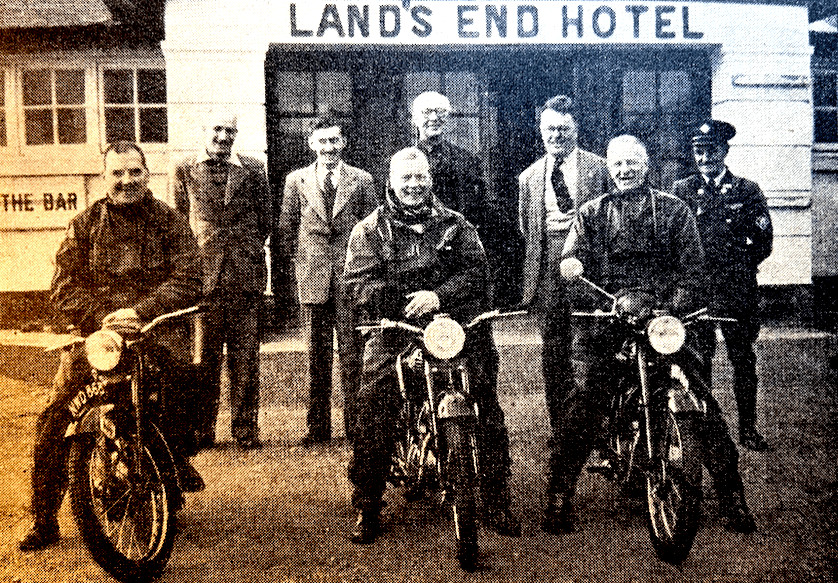
“IN THE NATIONAL Road Safety Congress held in London last week, the motion, ‘That the motor cycle in can be the safest vehicle on the road’ was defeated. Only two of those debating were men with genuine motor cycle experience, and both spoke for the motion. It might well be asked how it was that anyone without first-hand motor cycle knowledge came to be invited to debate such a topic at all. To the uninitiated, motor cycles can appear unsafe during a manoeuvre involving absolutely no risk, and further prejudice accrues from the fact that motor cycles have only two wheels and thus cannot stand alone. But those who dub motor cycles as unsafe should bear in mind that only three weeks before the debate took place, the International Six Days’ Trial was held in Czechoslovakia. In the event, in which 236 riders started, an aggregate total of approximately 350,000 miles on the most atrocious surfaces were covered at high speed. Yet only two accidents of a semi-serious nature occurred. The reason for such a high mileage-to-accident ratio is that in the hands of a rider of ISDT calibre the motor cycle is certainly one of the safest vehicles on the roads, if not absolutely the safest. Just why this should be so is known to all with motor cycle experience. When it is considered in comparison with other power vehicles, the motor cycle offers a degree of all-round visibility second to none. Its high rate of acceleration and its narrowness can prove invaluable assets in the event of an emergency, and motor cycle brakes, properly maintained, provide a rate of deceleration unequalled by any except the most expensive modern cars. The Road Safety Forum would appear to have missed the real point of the proposal. Phrased differently, the motion might have read, ‘That the motor cycle, in skilled hands, can be the safest vehicle on the road.’ Unless a mechanical breakdown of some important component occurs, no road vehicle, irrespective of its design, can be in itself responsible for a road accident. Error of judgment, carelessness or recklessness are responsible in nearly every case.”
“GREGORY PECK’S LATEST FILM Roman Holiday was shot in Rome. It embodies some terrifying scenes of traffic in narrow streets, with Vespas and Lambrettas hurtling about among the pedestrians in alleys which would be wheeled to all wheeled traffic in England. Some of them are three up! At one point Audrey Hepburn, presumed to have no knowledge of motors, pinches a scooter and departs at speed through heavy traffic on the wrong side of the road. Did they fake it in slow motion and then speed up the film? Or is Audrey in reality a potential scrambler?”
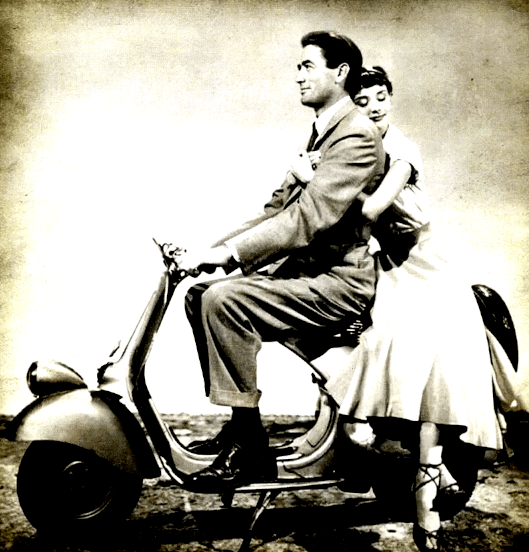
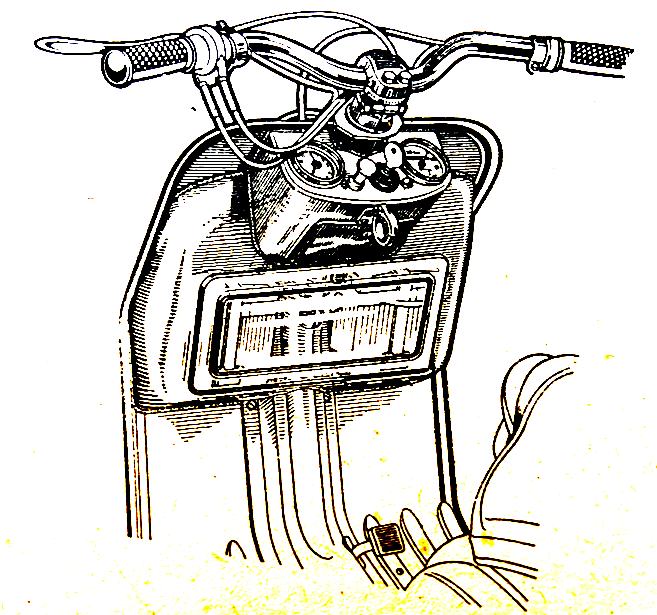
“MY CASUAL ALLUSION to the benefits of a universal language brings a letter from an Esperanto enthusiast, RG Fidler of Norwood. He cites a motor cycling illustration of its value. In 1951 his front tyre was seriously damaged while riding. through JugoSlavia, where for us Britons the language problem certainly peaks. He was flying a pennant with the green five-pointed star by which Esperantists recognise each other (they substitute lapel buttons when pedding). The local tailor happened to . be an Esperantist. In a trice a boy was sent a mile to the nearest repair shop, while Mr Fidler was fed at the tailor’s home. The tailor insisted on paying the repair bill. Quite recently, 16 million Esperantists have petitioned Unesco to join in the task of spreading their gospel.”—Nitor

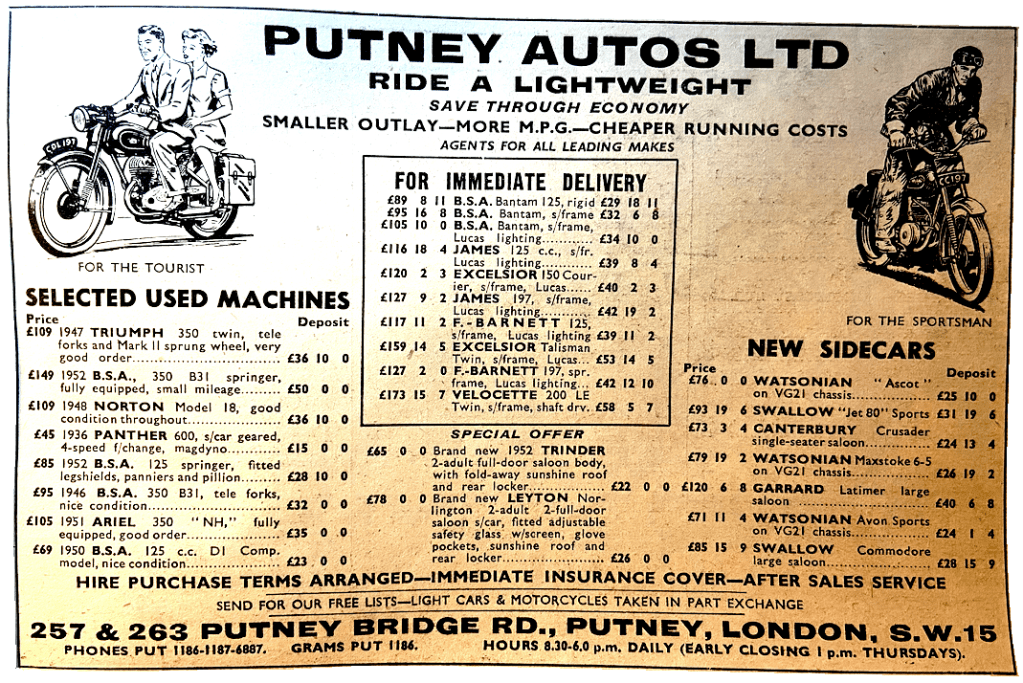
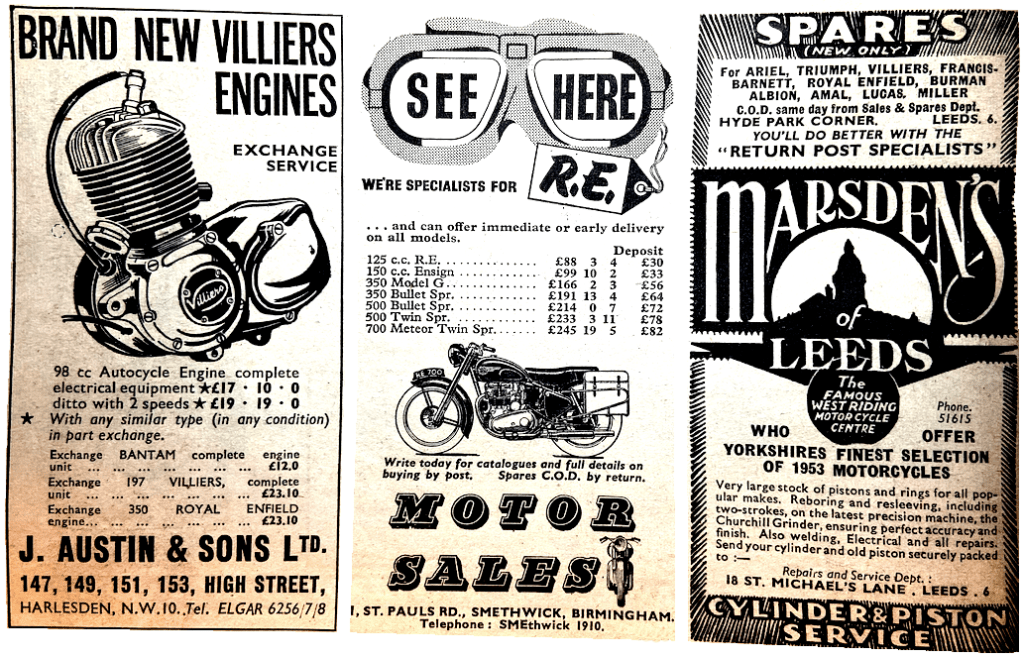
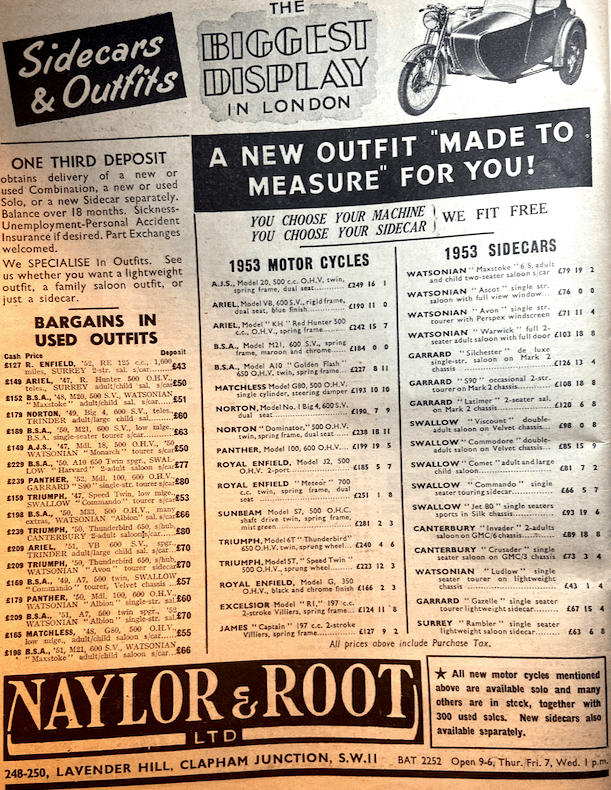
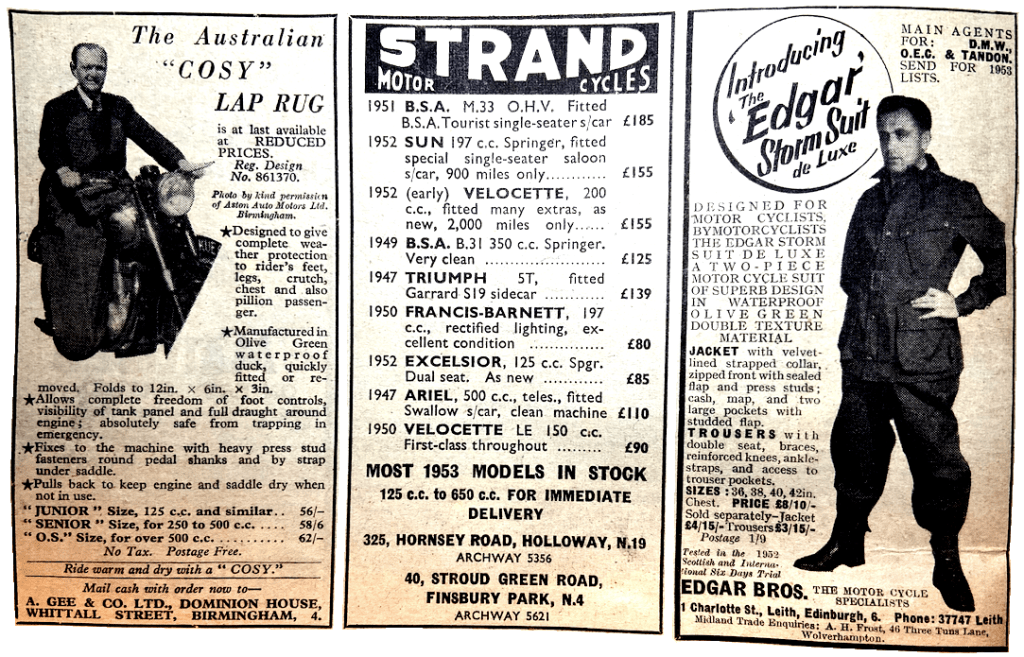
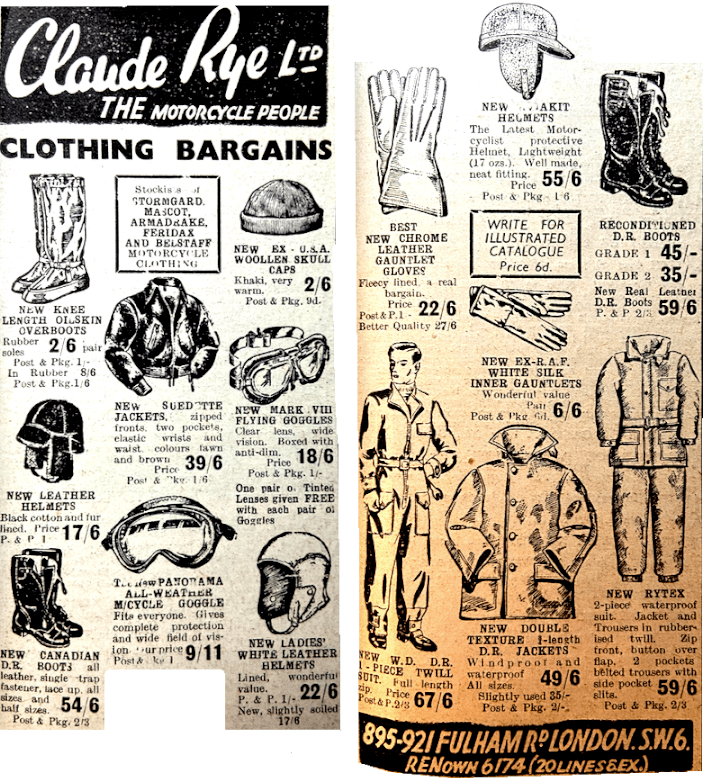
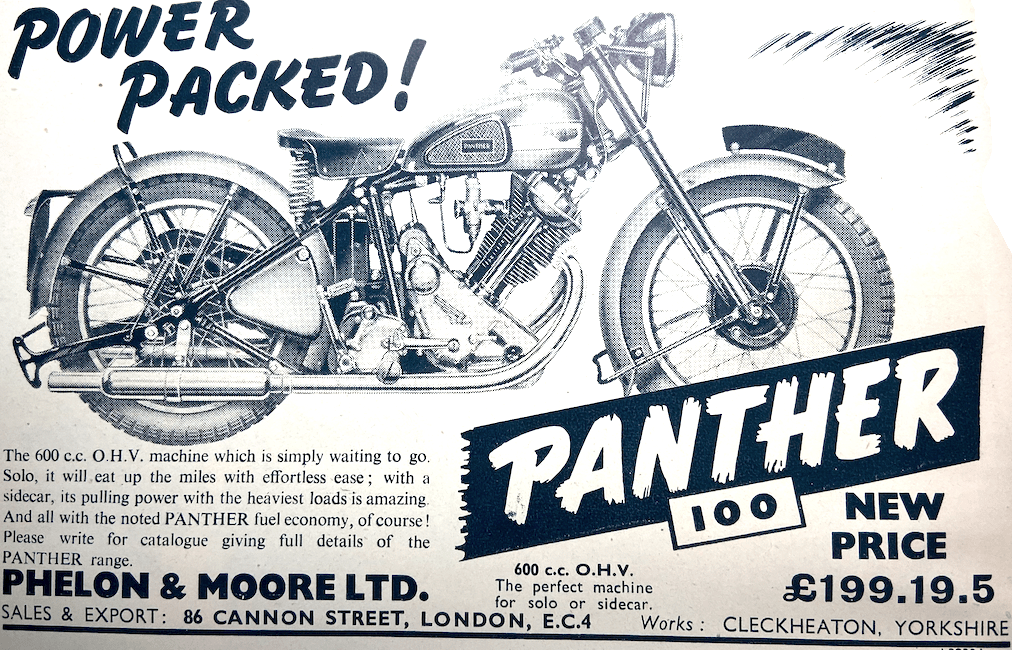
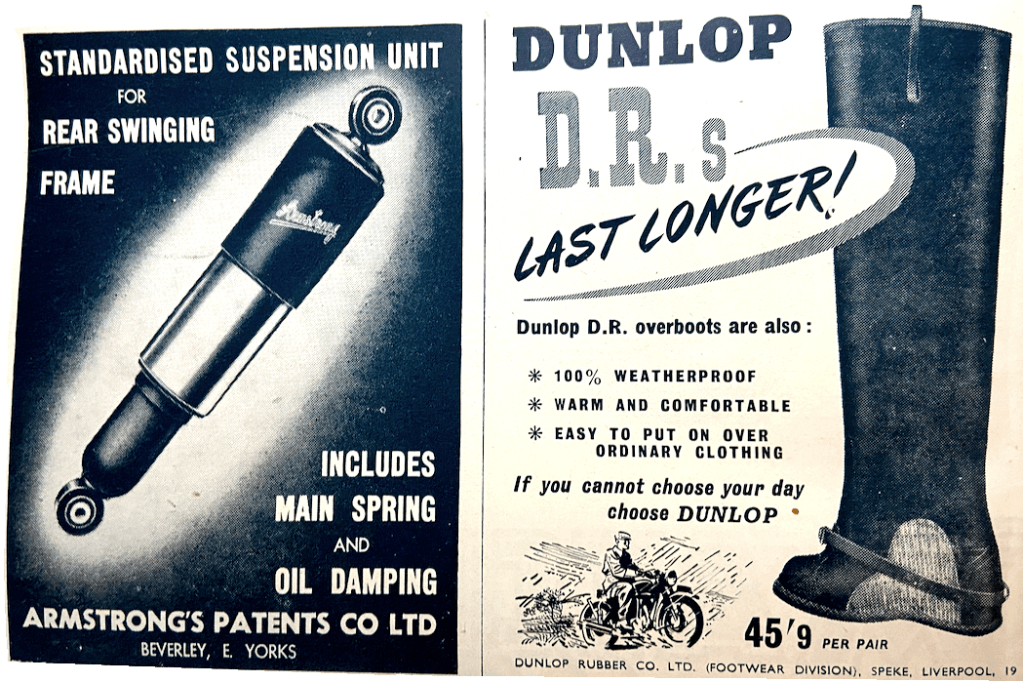
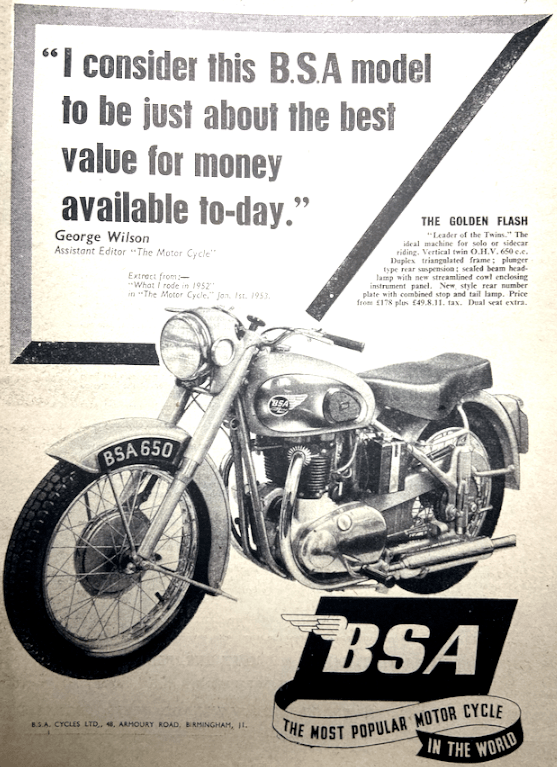




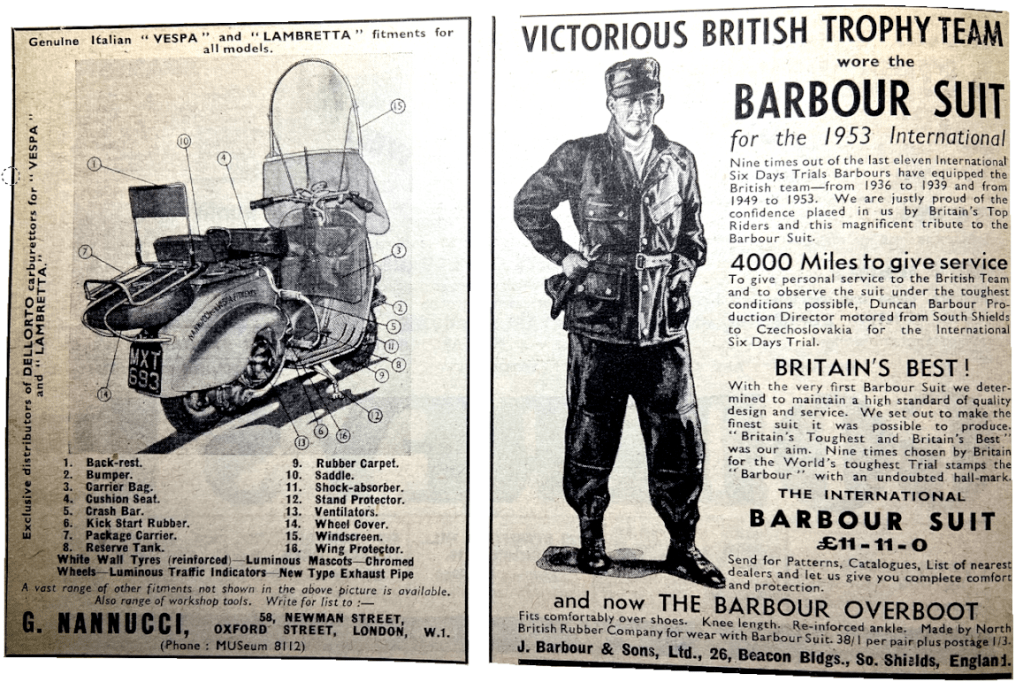
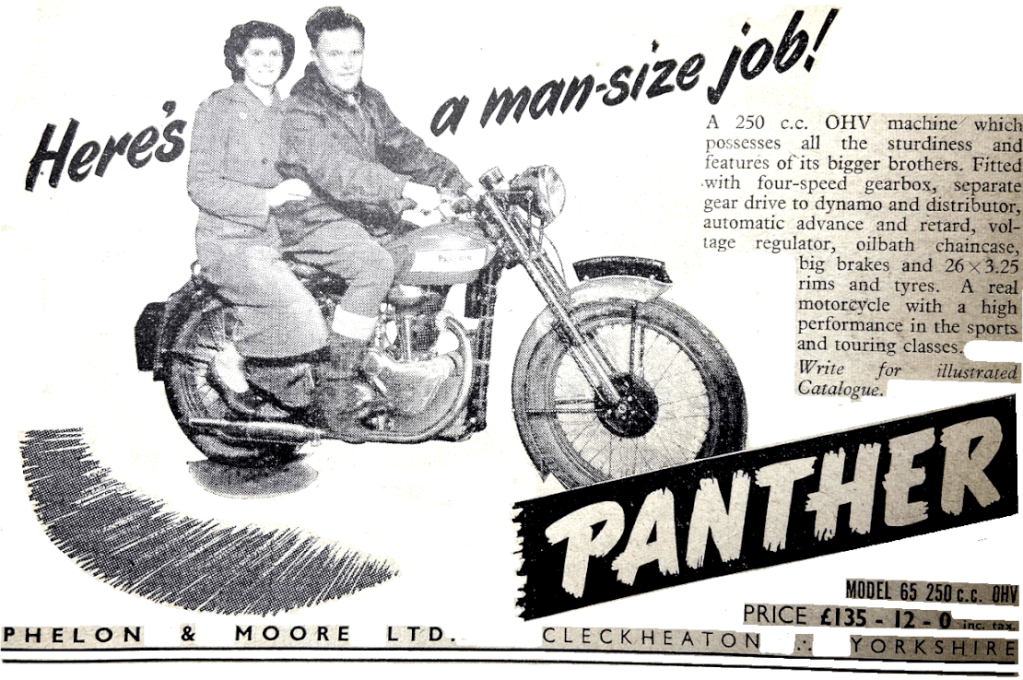
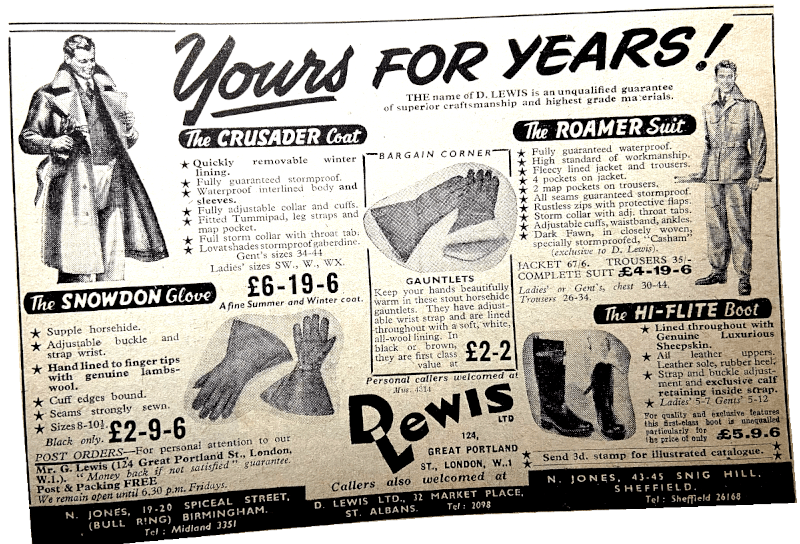
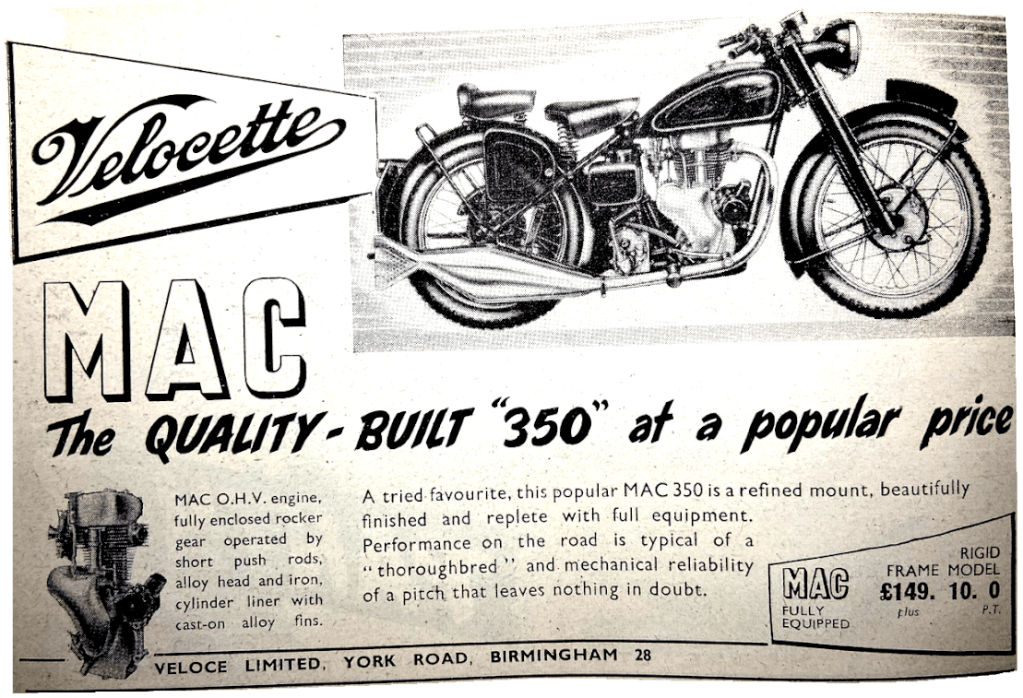
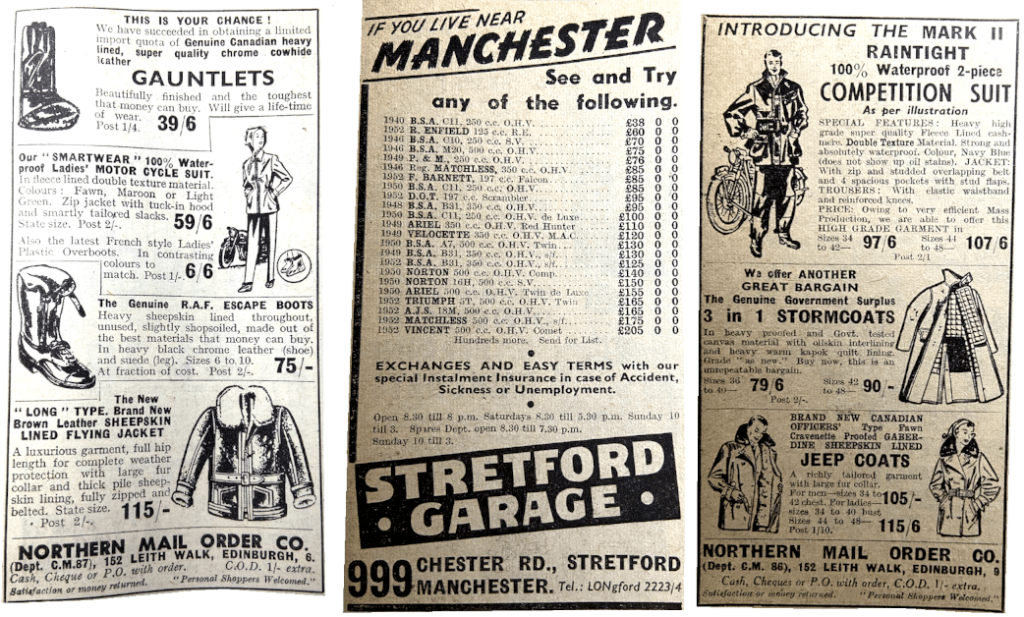
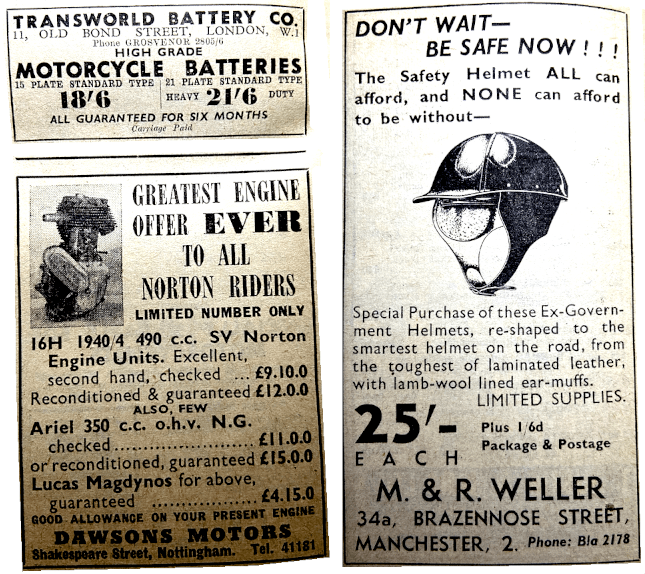
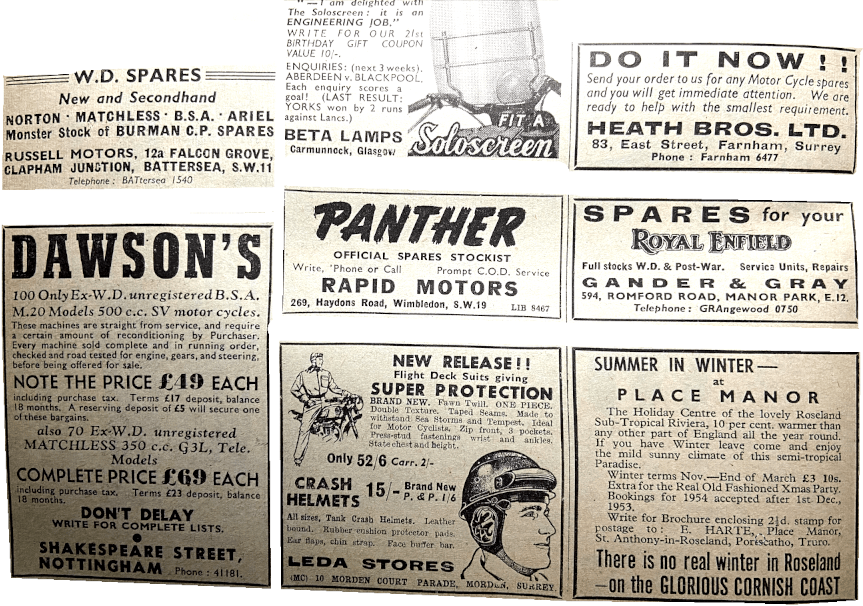
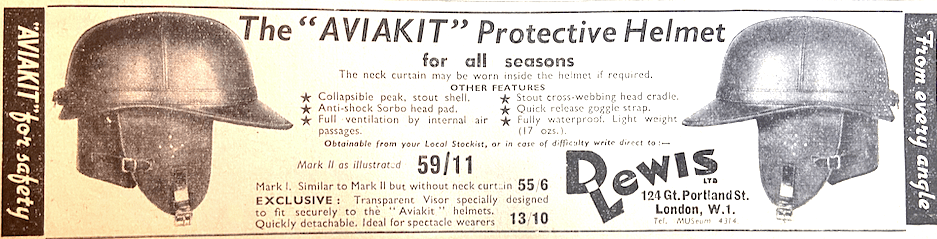
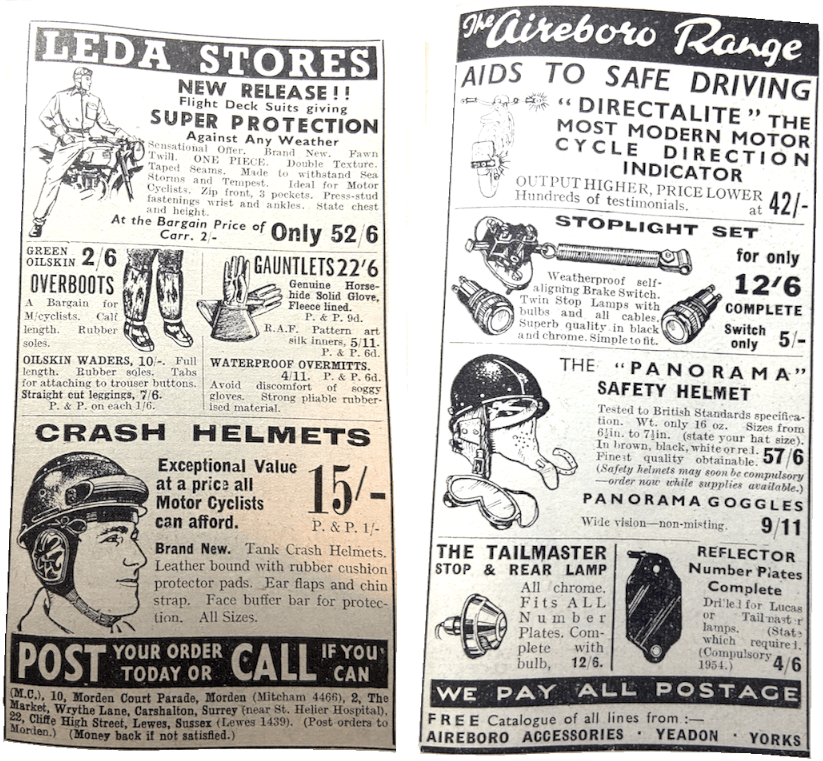
 Motorcycle Timeline