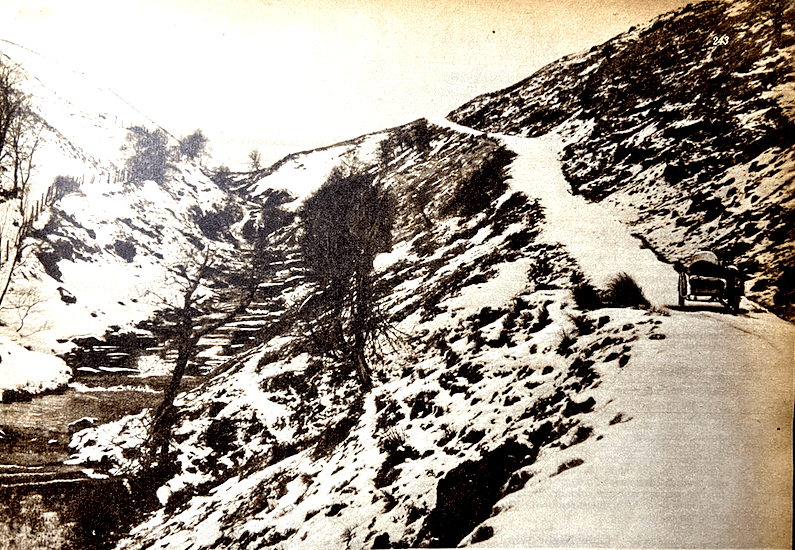
“THE next few days, so far as I was concerned, were unpredictable. How would a small-capacity sidecar perform in North Wales? Would the speed prove so slow as to be boring? Would we find ourselves grinding up the passes in bottom gear, stopping at the top of each to allow a red-hot cylinder to cool? A host of questions crowded the Wilson brain—questions to which I could provide no answer from previous experience…The outfit selected for testing comprised a 197cc James and Watsonian Netherwood lightweight sidecar, which I collected from the James factory after dark. Driving-home was a disappointing experience. The rear chain noisily fouled the top run of the guard; the mixture appeared to be weak and the control was on the right side of the handlebar, where I could not use it in junction with the throttle. There was intermittent backfiring. The brakes—especially the front one—were poor. There was a marked tendency to sideways wobbling of the front wheel and no steering damper with which to curb it. After only six miles in the dark the battery was flat. My spirits were not at their highest pitch, especially since I wanted to make an early start next morning. Two hours later I was in a more cheerful frame of mind. Moving the mixture control to the left, where I could use it, cured all the carburation troubles. After a few crash stops the brakes improved immensely. I found that the sideways wobbling of the front wheel was confined to a period in the region of 25mph. The battery had been discharged because the rear stop light bulb was wired up in reverse. The rear chain rattle I could do nothing with, but that also, I found, only occurred at certain speeds. My companion was Bill Banks, of The Motor Cycle photographic staff. He weights 9½b stone and is 5ft 7in in height, and he had brought his luggage in a large rucksack. He had so much luggage that I wondered whether it would not be better to put that in the sidecar and Banks in the boot. Eventually the rucksack went in the boot, all but filling it, and my leather bag was strapped on the luggage grid, which had been fitted to the door of the boot at my request. We had no fixed idea of how long we would stay away; hence neither of us stinted ourselves in the amount of gear we carried. Also, since Banks insisted on sharing the driving, we were both bewadered and, generally, heavily garbed. When we set off at 10.5 next morning the weather was bitterly cold and it was snowing lightly. Banks, eyeing the open sidecar suggested that at any moment burly men in white coats would appear and put us
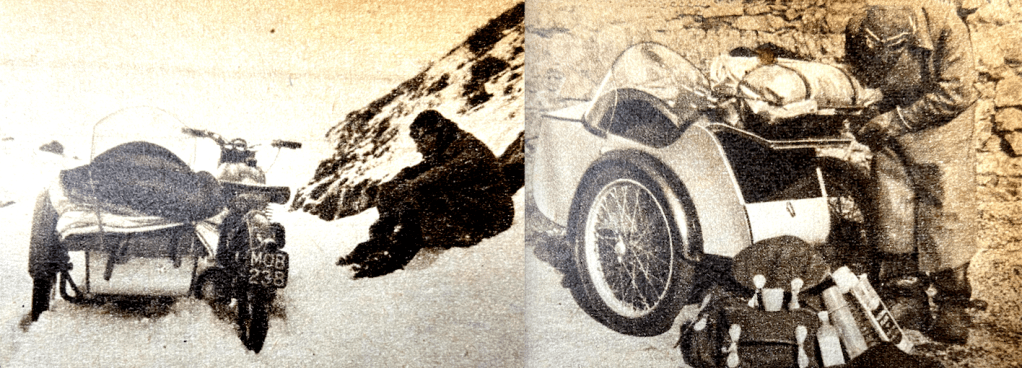
quietly away. We headed west through Wolverhampton to Shrewsbury, county town of Shropshire and once a border fortress against the Welsh. The town has many picturesque streets with timbered houses, but we passed them quickly. Though I was in no way driving ‘on the limit’ we covered the first 30 miles in a few minutes under an hour, and when we made our first stop at 11.35am, we had covered 50 miles exactly. We entered Wales at the Prince’s Oak, which is so called after an incident in 1806, when George IV was introduced to the Principality. We headed for Lake Vyrnwy over slush-covered roads, and stopped for lunch in Llanfyllin (in a cosy dining-room, heated by a coal fire and wherein there stood a single table laid for two). We were climbing now and I was in excellent spirits, for the outfit was exceeding my highest hopes. From Llanfyllin to Lake Vyrnwy by the route we followed, the road was narrow and lay under six inches of rutted snow. There were gradients of 1 in 9 to 1 in 7 climbing to over 1,000 feet and then dropping to the lake (which lies 825ft above sea level). It is the largest lake in Wales, five miles long and nearly a mile wide, and it is the reservoir for Liverpool, 68 miles away. In addition to that, however, it is one of the most beautiful lakes anywhere. We took the road skirting its south bank and headed for the Hirnant Pass—which was included in the International Six Days’ Trials. The Pass is rough and steep, and not generally regarded as a ‘motor road’. By now it was snowing so heavily that an inch-thick carpet fell in approximately half an hour. As soon as the snow stopped we set off through the first gate by the farm of Rhiwargor. Up we climbed in bottom gear, but with power to spare. As we climbed the snow became deeper until, building up under the crankcase and chassis, it brought us to a temporary. stop. On one part of the climb where I estimated the gradient to be 1 in 4, or slightly steeper for a yard or two, we stopped through lack of power and Banks had to abandon the sidecar. At all other times we had power in hand. Eventually, the snow became nearly knee-deep, Banks was breathing like a locomotive, and it was impossible to carry on farther; so we about-turned. At the road again we retraced our wheel tracks to Llanwddyn at the eastern end of the lake and drove by way of Pont-Llogel to Pen-y-bont, thence by way of A458 to Divas Mawddwy—which is at the foot of Bwlch-y-Groes, said to be the highest motoring road in Britain. The way to Pen-y-bont was through typically Welsh going, embracing narrow, twisty lanes with steep gradients and sudden, blind corners. Intermittently, the surface was a sheet of wet ice, but we sped over it with impunity. By now we had been able to assess the capabilities of the little Villiers engine. From its performance on the Hirnant it was obvious that, although newish, it was not going to seize. So I pressed on, buzzing the engine hard (going up to 30mph in second) and maintaining the highest speed possible. Had the outfit been powered by a 1,000cc engine I should not have wanted to go faster in similar circumstances. And in spite of the way I was driving, the engine was not becoming unduly hot. At Dinas Mawddwy we were told that the Bwlch, too, was impassable because of deep snow so we reluctantly abandoned the idea of tackling it. We turned, instead, towards the Tallin Pass which runs from Dinas to
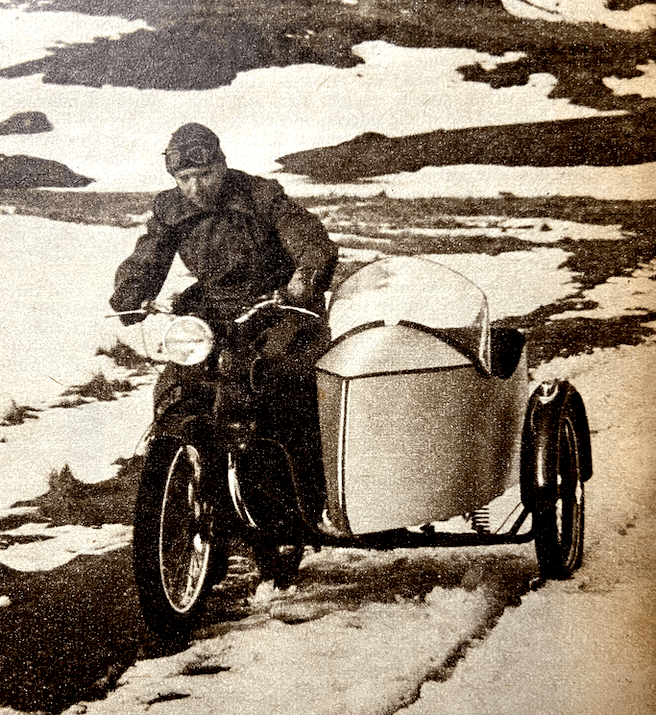
Dolgelly. The pass is surrounded by giant peaks with, on the left, Cae Afon (2,213ft) and Waen Oer (2,197ft) and, on the right, Craig-y-Ffynnon. From approximately 500ft at Dinas, the road rises to 1,178ft at the highest point. According to the RAC Handbook, the average gradient is 1 in 7, the maximum gradient 1 in 5, and the length of the climb one mile. By now the light was almost gone and Banks was driving. In the main, the ascent was accomplished in second gear (which has a ratio of 9.64 to 1), but bottom gear was required for two sections near the summit. In fact, the 18.46 bottom gear was lower than the gradient required. There was power to spare at 15-20mph. The descent was almost as steep as the climb, and the cold night wind cut into us with the keenness of a razor edge. At the bottom, where the road levelled out, Banks opened the throttle for the first time in 1½ miles. There was no response from the engine. He repeatedly blipped the throttle—still no response. In the sidecar, my immediate thought was ‘dud plug’. Without more ado, I nipped out of the sidecar, opened the tool box and made a rapid plug change. The cylinder was quite cold, and before kick-starting I drew the mixture control to the rich position. The engine fired instantly and we were off again but without, for a then unknown reason, any current reaching the sidecar bulb. I found the next morning that the wire had been nipped by the left sidecar spring. The plug had not whiskered or oiled, incidentally; my guess was that the engine had gone cold on the descent and required a rich mixture on which to restart. Dolgelly was inhospitable that Saturday night. We tried three hotels before finally settling in for the night at ‘The Clifton’ and dining at ‘The Ship’. The next day was one of torrential rain. We left Dolgelly at 11am and took the coast road to Barmouth. The distance is roughly 10 miles and the road well-surfaced. It is a twisting 10 miles with sudden, steep gradients, up which the James sang happily in second gear. One of the most popular of the Welsh resorts, Barmouth faces the open sea. It presented an uninviting aspect to Banks and me, however, with mist swirling down from the heights and over the sea, and rain lashing down furiously. We had lunch in Harlech, the ancient capital of Meirionydd and famous for its ruined castle, which is said to date from the 13th century. Nowadays, incidentally, Harlech College is an important centre of working-class education. The rain increased in intensity until it was coming down in a solid sheet. As we splashed north, the road climbed higher and higher as we went through Penrhyndeudraeth and Maentwrog. The James, I felt, really proved itself. My coat seams began to leak so I gave the outfit the gun and drove the 16 miles to Maentwrog on full bore. I did not stop there either. Ahead lay the Crimea Pass which, again according to RAC Handbook, has an average gradient of 1 in 9 and climbs for three-quarters of a mile. The steepest gradient is 1 in 6. I tore at it with the James sounding as if every bee in Christendom was waging war in its silencer. The bulk of the climb was achieved in second and the steeper parts really required, again in this case, an intermediate gear between bottom and second. Blaenau Festiniog, with its huge slate piles bordering the road, presented a dismal picture and we did not pause for it. Instead, we headed for Elen’s Castle Hotel, Dolwyddelan, where, as Signpost had suggested, we received a Royal welcome. We spent two nights there, incidentally, and I thoroughly recommend the hotel to motor cyclists. The terms are reasonable and it has a modest and homely touch that is generally absent in more pretentious establishments. The next day was the one during which, I feel, we achieved our tour de force. We climbed part of Mount Snowdon. From Dolwyddelan we ran north to Bettws-y-Coed which, this morning, was bathed in sunlight. Bettws-y-Coed means, I am told, chapel in the trees. The town nestles snugly in the wooded valley of the Conway. It is said that the surrounding district spots contains more beauty spots to the square mile than any other region in these Islands. But we were itching to get a glimpse of Snowdon and pressed on to Capel Curig, famous headquarters for mountain climbers. From here we took the road to Pen-y-Gwryd and then climbed steeply to Pen-y-pass, from where we turned off the road. Our ascent had begun in earnest now, though we had already been climbing steeply from Pen-y-Gwryd. Below us spread a valley of unbelievable splendour. From Pen-y-pass there are three tracks up Snowdon, the best known and roughest of which is, I believe, the Pig track. We were advised to avoid this and took the track on the extreme left, which climbs steeply over the shoulder of Snowdon to the stone causeway over Llyn Llydaw, a mountain lake. Loosely and roughly surfaced, the track runs south at first and then west, passing, on the left, Llyn Teyrn (a small tarn). At first, the snow was comparatively little trouble to us, and the James took the gradient in its stride. As we climbed, however, the snow became steadily deeper. Occasional drifts brought us to a halt. Then the drifts became more frequent; so much so, indeed, that we decided to turn back. After all, we argued, we had proved to our satisfaction that the gradient could be successfully defeated. But we were goaded on by the sight of Llyn Llydaw, a mile away, round a turn in the track. The sun glinted on the peaks of Crib Goch (3,023ft) and Lliwedd (2,947ft), and on the gossamer clouds resting lightly on Y Wyddfa (3,560ft); Snowdon’s loftiest peak seemed within easy striking distance. In fact, we reached the stone causeway over the glistening, crystal-like mountain lake without more difficulty. We were at journey’s end—for us, anyway. Ahead towered Y Wyddfa, accessible now only to those with mountaineering equipment. I wanted to press on over the causeway, suggesting that I could keep the sidecar airborne, since the causeway was too narrow for our track. Whereat Banks created more than a bit, muttering something about over his dead body; he wasn’t going to walk back to Dolwyddelan if I chose to drown; so I dropped the idea. By now we had been severely bitten by the climbing bug. We were back at the Pen-y-pass Hotel in time for lunch, then we headed for Llanberis and Llyn Padarn, another beautiful Welsh loch which forms the centrepiece of a setting that might well be situated in Austria, Switzerland or northern Italy. At the northern end of the loch we turned off the main road and took a steeply climbing secondary road by way of Deiniolen and Rhiwlas. Then, instead of carrying on to Pentir, we took a track over Douglas
Hill—a track that is marked on nothing less than one-inch Ordnance Survey maps. On the way to Rhiwlas, and through it, we had climbed for something like a mile in bottom gear. When we left the road the track steepened, but still we had power to play with, the engine turning over quite easily (in bottom gear) on about half throttle. At the top we had to open a closed gate. While we were doing so, the sound of a four-stroke single being blipped noisily could be heard faintly in the still, winter air. The sound grew louder, and there appeared from another gate JS Jones (490 Norton), of the Colwyn MC, who scratched his head in amazement when he saw us. We chatted, and with Jones’ blessings ringing in our ears, pressed on over what had once been a trial section—but we had no bother. By now the afternoon was ageing rapidly. We drove hard to Tregarth and Bethesda, and by way of another Welsh lake, Llyn Ogwen, back to Capel Curig, Bettws-y-Coed and Dolwyddelan. Before putting the outfit away I cleaned it, adjusted and oiled the rear chain and took up the brakes—and that was that. We left Dolwyddelan at eleven o’clock the next morning and returned by way of Bettws-y-Coed, Corwen, Llangollen and Shrewsbury to Birmingham. We had the advantage of a good following wind and gave the outfit its head, letting it run up to 50mph wherever possible. We were only once overtaken—and that was by a Lagonda car, which was being beautifully driven. Including a comfortable lunch stop and several other stops to take photographs, we were back in Birmingham at 3.20pm. The distance covered was 111 miles. Our total mileage for the test was 359 miles. Petrol’ consumed was 5½ gallons, giving a petroil consumption of 65mpg. Under almost any conditions we could average 30mph without apparently flogging the engine. Altogether, the performance of the outfit far exceeded my expectations. Criticisms? These are few and certainly not concerned with the Villiers engine-gear unit, which was well-nigh perfect in every way. Even the clutch is fully up to its job when the machine is used with a sidecar. The chief criticism concerns the brakes. If, as I for one visualise, the lightweight sidecar outfit is to have a bright future, bigger front brakes must be regarded as essential. The only other real query concerns the steering. I mentioned earlier that the front wheel had a tendency to sideways wobble at certain speeds. This will have to be overcome by investigation of steering geometry and the position of the sidecar wheel in relation to the rear wheel. On all other counts I liked both the machine and sidecar. The machine controls are light and the riding position near perfect. Incidentally, in order to see whether we had caused any damage I later went over the outfit carefully, even lifting the cylinder and head to inspect the piston. Never have I seen a piston in nicer condition. Our top gear ratio was 6.93 to 1. The gear box was the standard Villiers close-ratio type, and the rear sprocket was a James product with 52 teeth. The original plug, which was entirely satisfactory, was a Lodge HE IQ. The sidecar, on first acquaintance, gave the impression of being too short and too narrow in the nose. Yet, after our experience, neither Banks not I would have it changed in any way—although ladies might prefer a door, in order to simplify entry and exit. Still, doors cost money, and the Netherwood, as it stands, is attractively priced. The boot dimensions are adequate and the grid which I had specially fitted completely overcame our luggage problems. The Perspex screen is well shaped and at an angle which deflects rain and draughts over the passenger’s head. All things considered, the 197cc sidecar outfit is a good proposition—a far better one than the majority realise. If the criticisms I have raised are attended to, there is no reason why there should not be a tremendous boom in this sphere during austere years that may lie ahead.”
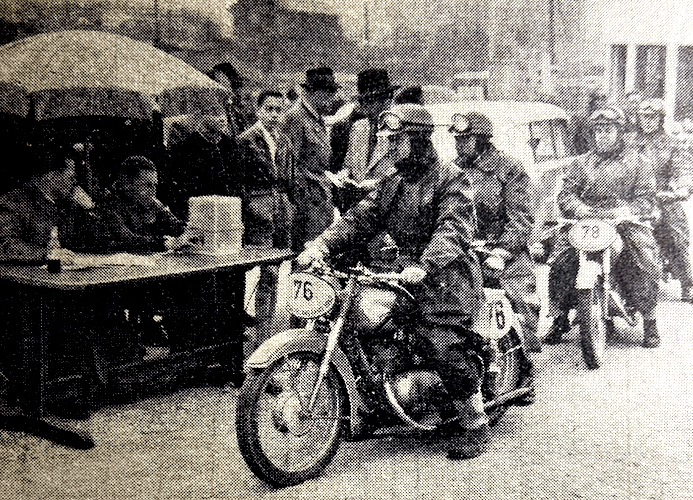
“ENTRIES FOR THIS YEAR’S international TT races total 240. There are 83 for the Senior (500cc) event, 94 for the Junior (350cc), 34 for the Lightweight (250cc), and 29 for the Lightweight (125cc). The total is 52 below the record set last year, but this fact will have no influence on the success of the events, since there is an adequate entry for each. The lists do not show as much variety in national representation as could be wished. Nevertheless, a warm welcome is extended to entrants and riders from Australia, New Zealand, Canada, Southern Rhodesia, Ceylon, Denmark, Spain and Italy. It will not pass unnoticed that a rider from Australia and one from New Zealand figure in Manufacturers’ teams. With entry lists for the Clubman’s Senior Race at 97 and for the Junior Race over-subscribed at 105, there is a total of over 400 entries for the various events to take place during the Isle of Man ‘week’. Good racing is in prospect.”
“A DISABLED MAN was recently fined at Brighton for travelling at 41mph on his invalid tricycle! I suspect he is being bombarded with letters from other cripples eager to learn the make of his projectile. But I beseech these sporting invalids to mind their step. Time was when all disabled men had to purchase their mo-chairs out of their own pocket. Now that some State assistance is available, any exuberance on the road might conceivably lead to a micro-motor of clip-on type being substituted for the present more potent engines.”—Ixion
“‘MEDICO’ OWNS A BLACK SHADOW, a Jowett Javelin and a Healey. His mature verdict is that a really long run, ie, up to 400-500 miles in the day, produces far more physical exhaustion on two wheels than on four. Though his two-wheeler is fully sprung, the contrast necessarily pivots on comfort. I have personally noted the same facts, and have always failed to reach a satisfactory analysis. For example, I remember covering 514 miles on a summer’s day (Glasgow to the South Coast), seated alone in a small sports car with not very fat tyres and quite simple suspension. I finished physically fresh. But I have never done 500 miles in the day on two wheels without feeling so punished that a boil-ing hot bath was required to remove the stiffness. Why? Is lack of support for (a) the shoulders, and (b) the hams, the main cause? There seems to, be little difference in the severity of bumps or the total of vibration. Nevertheless, there is a pronounced contrast in the total punishment…Medico accurately remarks that motor cycle head lamps are very substantially inferior to car dittoes, and explains why motor cycles cannot easily put up such high averages over a long distance. Technically he is correct. But I am all against long-distance high averages including any night element at all, nor do I really yearn for more potent motor cycle head lamps. There are a dozen arguments against them—high cost, considerable weight, bigger dynamos, bigger cells, and above all, the risk of young fools abusing so fierce a beam. To be frank, all really powerful head lamps are a confounded nuisance to the majority of road users; and I doubt whether any of us should use lamps substantially exceeding a reasonable level of illumination. I have often wished for a head lamp with a broader and more diffused beam, but I have no wish for a searchlight type.”—Ixion
“EVERY INSURED PERSON should read his policy carefully, especially the clauses in small type. Some motor cycle policies apparently furnish no cover against theft unless the complete machine is taken. Even the tariff companies’ policies do not cover loss of ‘accessories and spare parts’ if the motor cycle is not stolen at the same time. As a sample of what must be an extreme case, the other day a reader was in a cinema. At the end of the programme he found that somebody had pinched his cylinder! He could obtain no payment from his insurance company, though they would have forked out a large sum if the complete model had been stolen, By the way, it is well to agree with your company as to the current value of the model, and the figure should be reviewed once per annum. Many owners have received powerful shocks after a theft, on discovering that the current value under the policy is far less than they supposed.”—Ixion
“THE VICES AND VIRTUES of a lightweight are miniature replicas of the corresponding traits of the bigger models. In the comparison, lightweight virtues are, perhaps, greater than those of the big ‘uns. Their special virtues are lower cost, lower depreciation, easier handling with a ‘dead’ engine, less temptation to speed, and less temptation to ‘cover ground’ as opposed to enjoying a trip. Today, the market bristles with magnificent lightweights, so good that machines between 120 and 200cc are coming to be regarded as rather powerful! Perhaps all these benefits may be even more appreciated when we emerge from the present transition age, and British finances find some kind of austere equilibrium. It may well be that fewer folk will then be able to buy 500cc roadsters, and the little ‘uns may become our staple fare.”—Ixion
“I WAS CHATTING to an old-timer who rode motor cycles over half a century ago. The 98cc brigade were our topic. He remarked that their performances were better than his first 500cc models of 50 years ago; that they were more comfortable; better climbers; more reliable; and (until the war generated wild inflation) actually cheaper. He speculated on what might have happened if, eg, a 98cc Villiers-engine autocycle had been produced by some precocious genius as far back as 1902. His first reaction was that all British infantry would have been mounted on it, together with an immense number of civilians whose avocations entail daily travel. He had been an industrial physician. He recalled a Midland town where the male and female hospital wards were normally packed with factory hands suffering from gastric ulcers. He ascribed these ulcers to too short a dinner-hour. The hands scurried home, often on foot, and gulped down indigestible food far too fast, lacing it with pungent sauces and pickles because rapid labour in stuffy shops had killed their natural appetites. Gastric ulcers were often followed by tuberculosis. The 98s could have stopped all these disasters by rendering labour mobile at minimum cost and at minimum physical effort. That factor has played a great part in developing lightweight motor cycles on the Continent, and in determining Government policies towards lightweights in terms of tax, licence, and so forth. ‘Lightweights,’ quoth my physician, ‘are cheaper than hospitals and sanatoria.'”—Ixion
AN ENORMOUS ENTRY—no fewer than 333—compelled the Streatham club to plan a comparatively simple course for their annual Half-crown Trial (open to South-Eastern Centre) held near Liphook last Sunday. Even so, they achieved the ambition of all organisers when the commendably rapid working out of results revealed that only one competitor had completed the 32 sub-sections without loss of marks. Delays were almost non-existent, and the handling of this large entry was a credit to all concerned. RESULTS Best Solo: Sgt R Rhodes (348 BSA), no marks lost. Best Sidecar: BT Welch (497 Ariel sc), 3 marks lost. Best Novice: D Heryet (347 Matchless), 6. Best Team: Sunbury MCC—AGL Bryant (348 BSA), 3; W Conway (249 Triumph), 3; J Liner (348 BSA), 8; total 14.”
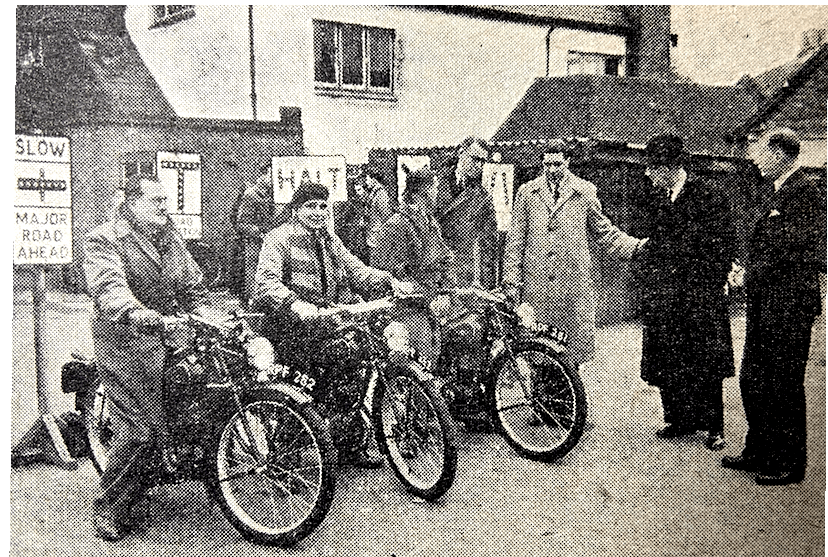
“A 122CC NORMAN MODEL B1 is to be presented by Norman to the Waterlooville. Club for use in connection with the RAC-ACU Training Scheme.”
“ONE OF THE MOST stimulating designs of the present day is without doubt the Italian 125cc twin-cylinder two-stroke Rumi. I have just had an enthusiastic letter from Thierry Holst, the well-known Dutch journalist, who has had a peep inside a Rumi engine and an opportunity of trying one of the sports models. One of the things I did not know is that the pistons have deflectors which are V-shape in plan. The cylinder heads have female equivalents of the deflectors, so that good gas turbulence ‘up top’ results. Indeed, according to Thierry, the deflectors have proved so efficient that a reduction in ignition advance has been possible. Before adoption of the deflectors, the ignition advance at 6,500rpm required to be in the region of 29°; with the deflectors, only 22° advance is necessary at 8,200rpm. The compression ratio of the sports model engine is 11½ to 1 (!) for use with normal ‘super’ (78-octane) fuel. The crankshaft is of the three-bearing type, with one bearing in the middle between the big-ends. The circular internal flywheel is highly polished. Holst’s letter goes on, ‘I don’t know if you have ridden a Rumi, but if not, let me tell you it’s a marvel. I rode the sports bus (not the racer), which behaves like a good ohv 350 and has a maximum of over 70mph (not kph—miles!). The suspension proved amazingly good. Braking is positive, progressive and safe. The riding position is like that of a comfortable 500. Acceleration is completely breathtaking. In spite of the high performance, fuel consumption tops 112mpg at 40mph.’ Thierry’s letter runs to nine pages. He does not stint himself in the use of superlatives, and he eulogises the Rumi as I have never known him praise a motor cycle before. Other snippets of interest from the letter are that Rumis have a 125cc ohc four-stroke for attacking Mondial road-racing supremacy. The 250cc ohc parallel-twin racer, which has the camshaft driven by gears between the cylinders, is undergoing tests at Monza. The 125cc racer, says Thierry, has not yet run. For a firm that is also engaged in the manufacture of textile machinery, and which made torpedoes during the war, Rumis have certainly made vast strides in the motor cycle world. He who first condemned the Latins as a lazy people certainly overlooked the Italian-motor cycle manufacturers!”—Nitor
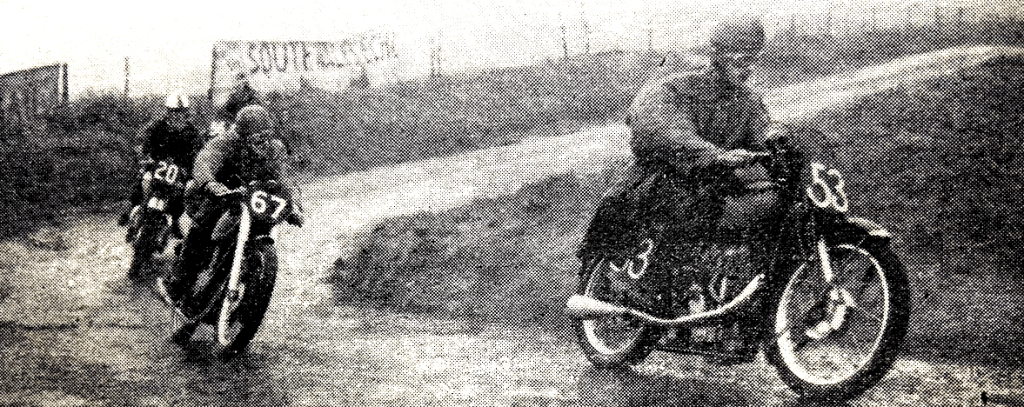
“UNDER OVERCAST SKIES and in heavy rain, thousands of enthusiasts from all parts of South Wales set out for Eppynt last Saturday in the hope that by the time they arrived at the five-mile circuit on the wind-swept Breconshire ranges the weather would relent. But, alas for their hopes! While the rain did ease off to become intermittent during the racing (organised by the Builth Wells and Carmarthen MCs), conditions, at times, were very unpleasant indeed. The spectators, greatly reduced in numbers, huddled at various points of vantage along the course to watch the riders struggle against the vagaries of nature. It was left to these riders to bring some colour into the drabness of the bleak May day. And, indeed, they did so. While no records were broken in the Senior, Junior or Lightweight events, speeds were high and, in one instance, went near to eclipsing last year’s lap record. This was in the Senior race, when ST Barnett (499 Norton) registered the fastest lap at 70.01mph as a challenge to RH Dale’s 1951 figure of 71.12mph.”
“A WEEK OR SO AGO a man proudly showed me his machine that had been treated with some sort of clear varnish to protect the paintwork and chromium. The goo is alleged to keep the finish free from rust and general deterioration. I understand that this preparation does work very well, but I had to have a quiet grin at the thought of covering a very handsome model with a chemist’s brew to keep it handsome. When chromium plate was first introduced I remember the fuss that was made about it. No more cleaning, no more rust, no more tarnished nickel. Now some folks cheerfully buy a preparation that protects the protection! The logical outcome of all this is for some-one to market a compound to protect the stuff that protects the finish. In case you think this is taking things a little too far, I understand that in the USA there are bumpers available that protect the original bumpers from severe
damage!—Nitor
“A SEARCH FOR pre-1914 machines is being conducted by the Belfast Club, which hopes to promote a grass meeting for veteran motor cycles at the Balmoral show grounds, Belfast.”
“‘IF I WERE to start making motor cycles off my own, bat, I would concentrate solely on 250s.’ The speaker was the sales manager of one of our biggest motor cycle manufacturing firms. The reasons he advanced were that with modern production methods and knowledge—assuming he were starting from scratch and his designer had a clean sheet of paper on his drawing board—it would be possible to make a 250cc machine with real performance on an economical basis. It is an axiom in the design field that the less the weight of material required, the lower the costs. A cleverly designed 250 would, in his opinion, be as inexpensive as, say, the average modern machine of under 200cc. Bearing in mind the performances of the pre-war Triumph and Ariel 250s, and the Rudges, his machine could have a cruising speed in the region of 55-60mph and a maximum of 70mph. It would be light and handleable, features which, in conjunction with the low cost, would give it a wider appeal, he believes, than any other capacity.”
“YOUR VENERABLE SCRIBE Ixion was very interesting in his dissertation about the collectors of veteran motors, but I think that he has overlooked the main reason for this enthusiasm. It applies equally to veteran or vintage enthusiasts, and I feel sure that the all-embracing reason is—fun. The ability to have fun is sadly lacking in this spoon-fed era, and your died-in-the-wool enthusiast (not necessarily, by any means a young man) does like to have fun in his motoring. Professionalism kills the happy-go-lucky spirit, and this reversion to the oldsters does give one that feeling of adventure, no matter how small that adventure may be. For instance, the tackling of the ‘Land’s End’ on a 1952 export reject is very nice but oh so certain of a smooth passage. Indeed, one need not be a clever boy to finish the course. But tackle this run on a veteran or vintage machine, as so any did at Easter—then it becomes real fun and demands real driving. Possibly Ixion may be unaware of the number of veterans that are still on the road doing daily chores. I know of a Model P Triumph and sidecar, a belt-drive 1923 Cedos, and for some weeks I used a 1921 Triumph and sidecar (only 5,000 miles old) for a 10-mile daily business run! All this fun for a few shillings (the Triumph Model P cost 30s). So here’s good luck to them all. I know who has the best of the game—and it doesn’t cost £200-£300!
W DENNIS GRIFFIN, Manchester.”

“EXPECTATIONS of new records on the ALJ Wicklow circuit by the Norton team, with the 1952 racing machines, were upset by the weather conditions, and the only record made during the day was by Reg Armstrong, who knocked three seconds off Johnny Lockett’s 1950 figure in the 350cc class with a lap at 83.40mph. The Nortons had the new rear hubs with the brake drums on the right (except Armstrong’s 350) and the modified rear suspension units. Geoff Duke was a non-starter; the explanation given was that he was unable to make the journey to Ireland. Armstrong, in his first appearance for Nortons, won both 350 and 500cc races and made fastest lap in each; Ken Kavanagh was runner-up in both races. When the field lined up for the 100-mile 350cc race, the roads were dry round the start, but a sea fog resulted in drizzle on the far side of the circuit. On the drop of the flag both Armstrong and Kavanagh made good starts, and at the end of the first lap they came through almost together, with the Australian slightly ahead; they had lapped at 79mph from a standing start. Twenty seconds behind were H Clark, C Gray and CG Griffiths (AJSs), With WAC McCandless (Norton) sixth. On Lap 2, Armstrong’s speed was 81.82mph and he led Kavanagh by seven seconds, while the lead over the rest was already 40sec. Gray had headed Clark; and McCandless, recovering from a slowish start, was in fifth place. On the third lap Armstrong surprisingly had a lead of 39sec over Kavanagh, who, it was learned later, had come off at the Beehive cross-roads, a sharp, deceptive turn at the end of the fastest stretch of the course. However, no damage was suffered and Kavanagh later worked up to an 80.72mph lap speed. At the beginning of the fifth lap McCandless came up into third place and closed on Kavanagh, who then speeded up and drew away again. On his seventh lap, Armstrong lapped at 82.71mph, equalling the record, and on his next he went round at 83.40mph, Then the rain started in earnest and speeds went down by nearly 10mph. Until then Armstrong had averaged over 81mph, but when he came in to win three minutes ahead of Kavanagh his average speed was down to 78.98mph. When McCandless finished third, all the rest were flagged off. Seven riders covered the full 12 laps, and another 11 qualified as finishers. The 500cc race (for which 350cc machines were eligible) started rather sensationally. Armstrong got away to another good start, chased by IK Arber (Norton), with Kavanagh some way back in the field. MP Roche, a young rider from Co Wexford, mounted on the ex-Ernie Lyons Triumph, came up from the second row and went into second place half-way round at Ballinabarney corner. A little beyond this point Kavanagh also passed Arber. Armstrong, covering his standing-start lap at 73.95mph, had a lead from Roche of 15sec, and Kavanagh was only one second behind the Triumph man. Going up the long hill out of Wicklow town he caught and passed Roche; but the young Irish rider held on gamely and made an attempt to regain his lead at Woolaghan’s Bridge, a tricky, fast S-bend, but did not manage it and came off, damaging his machine but not himself—in the Ernie Lyons tradition. Armstrong’s third lap was covered at 76.97mph, and this proved to be best of the race, though over 10mph below Artie Bell’s 1950 record, which gives an indication of the very bad conditions. He won by 1min 40sec from Kavanagh in spite of a stop for dry goggles. Arber rode very well in the wet, harrying Kavanagh for several laps, though he was reported as taking unusual lines on several corners. Kavanagh, however, opened up on his
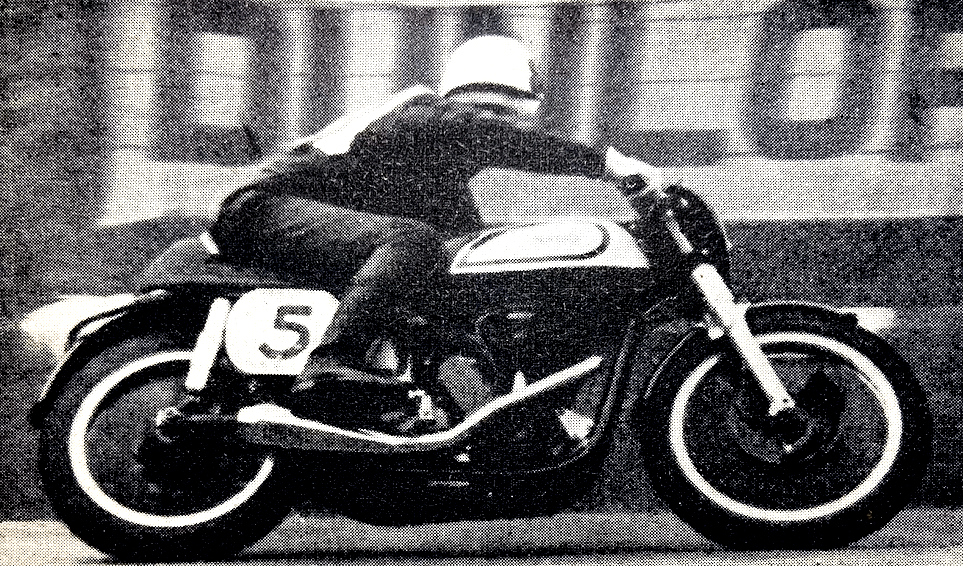
fifth lap and shook off the Kettering rider with a lap at 75.63mph, his best of the race. Arber’s best was at 74.31mph. The Carter brothers of Dublin occupied the next two places for most of the race, Louis, on a ‘Featherbed’, speeded up considerably towards the end and went ahead of his younger brother, Gerard, who was on an older Norton. Only these five covered the full distance, but 11 others, including 0 Sheridan on a 1927 Sunbeam, qualified as finishers. For the 250cc race there were only five starters: three Moto-Guzzis, a Velocette and an Excelsior. RA Mead, on the Velocette, led easily for two laps, making fastest lap at 65.13mph, then retired. W Billington ran out of brakes at Wicklow town corner on the first lap and retired; and TD Sloan, who had a two-camshaft head on his Excelsior, retired with plug trouble. This left AF Wheeler, on the Leon Martin Moto-Guzzi, with a comfortable lead from WJ. Maddrick, on the ex-Ben Drinkwater Moto-Guzzi. RESULTS 350cc Race (12 laps): 1, HR Armstrong (Norton), 78.98mph; 2, K Kavanagh (Norton); 3, WAC McCandless (Norton); fastest lap (record), R Armstrong (Norton), 83.40mph. Class Handicap (private owners): WAC McCandless (Norton). 500cc Race (12 laps): 1, HR Armstrong (Norton), 75.27mph; 2, K Kavanagh (Norton); 3, IK. Arber (Norton); fastest lap, R Armstrong (Norton), 76.97mph. Class Handicap (private owners): IK Arber (Norton). 250cc Race: 1 AF Wheeler (Moto-Guzzi), 60.73mph; 2, WJ Maddrick (Moto-Guzzi); fastest Lap, RA Mead (Velocette), 65.13mph. Hutchinson Trophy (best on handicap): 1, WAC McCandless; 2, R Armstrong; 3, WF Sparling. Skerries Cup (beat novice): WF Sparling. Club Team Prize: Dublin &DMCC No 1 (R Armstrong, L Carter, G Carter).”
“SIXTY COMPETITORS ASSEMBLED in the car park at Wembley Stadium last Sunday for the Motor-assisted Cycle Demonstration Trial, the first of its kind in this country. Organised jointly by the British Two-stroke Club and the ACU, the trial was mainly of a ‘public interest’ nature. Certificates were awarded to successful competitors. The 14 makes of cyclemotor represented included two hitherto unknown in Britain—the Jet, a Danish engine of 50cc, and the Tailwind, a promising 49cc ‘two-speed’ design. The Jet is an inverted two-stroke engine mounted behind the saddle; it drives on to the tyre through a milled roller. The Dellorto carburettor is controlled by a twist-grip. Ignition is by Stensholm flywheel magneto. It is expected that these units will be available in Britain shortly. Still in the development stages, the Tailwind is a two-stroke enclosed in a box over the wheel. A two-diameter, carborundum-coated roller is employed to give a two-speed effect as between the engine and front wheel. A twistgrip control moves the unit sideways to effect ‘gear changes’. The engine is fan cooled. The trial opened with a starting test. Each competitor had 10 yards in which to pedal the engine into life, followed immediately by 10 yards which had to be covered without pedalling. Detailed route cards
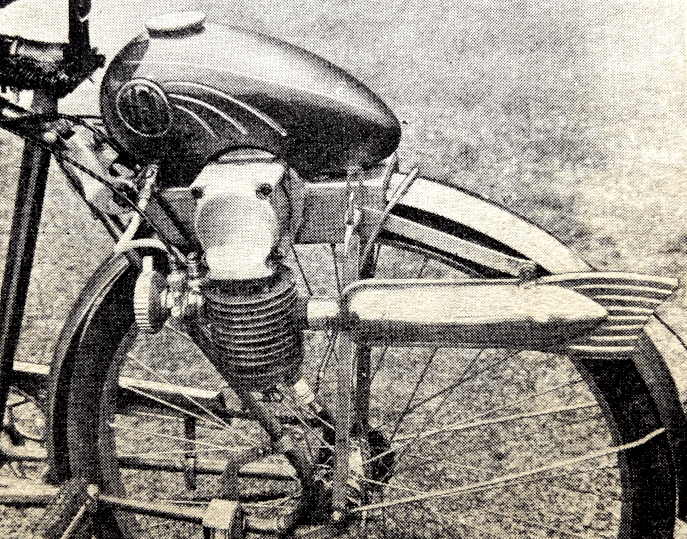
were issued. The course covered 18½ miles of road with traffic lights, roundabouts, a hill, and similar ‘hazards’, and included one ‘rough’ section—a ¼-mile of unmetalled road abounding in potholes, ruts and puddles. The route had to be covered at an average speed of 12mph. At the half-way mark was a hill employed for a climbing test; it was marked out with six lines lettered A to F. Line A was a warning to stop pedalling. After three yards, B indicated that feet must be stationary by this point, and lines C, D, E and F were at five-yard intervals up the hill. Pedal assistance was permitted after line E, but a stop anywhere in the observed section resulted in loss of marks heavy enough to preclude an award. The lower down the hill the rider had to pedal, the heavier was the penalty. In view of the difference in load in relation to the total weight of machine and rider imposed upon the tiny engines by, say, a seven-stone rider and a 12-stone rider, this policy seemed a little severe. Two further tests followed the check-in at the Stadium at the finish. Professor AM Low operated an audiometer to record the degree of silencing, and the readings of the instrument were interpreted in three grades: quiet, reasonable and noticeable. The three Tailwind entries all qualified for the first heading, and Berinis also maintained a high standard in this test. Rain, which fell heavily in the later stages of the trial, produced interesting results in the second test, which was of brakes. The cycle-type rim. brakes let many competitors down, whereas those
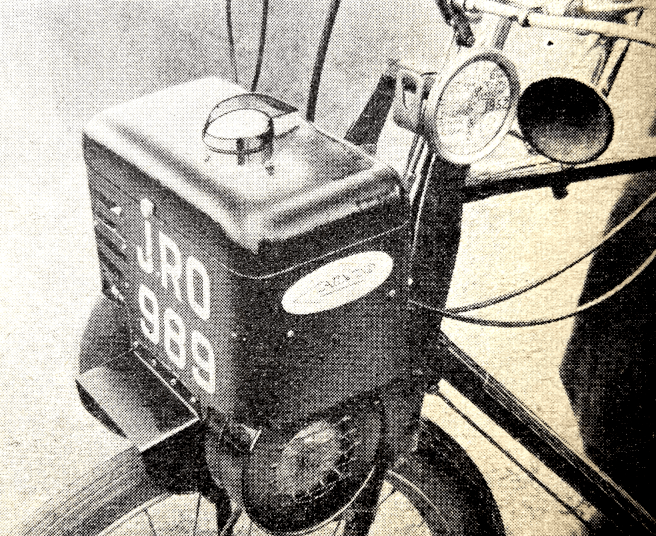
machines equipped with internally expanding hub brakes, or with coaster hubs, achieved much better results, One Cyclemotor rider had fitted a 4in front brake—just to be sure! Early arrival at the finish entailed disqualification, but each rider was allowed three minutes after his expected time of arrival. There were two retirements, one through mechanical trouble. The pint of petroil issued to each machine at the start brought all home, though some competitors admitted that the fuel level was on the low side at the end. First-class certificates were awarded for retention of 90 out of 100 marks, and second-class certificates for an 80% performance. The trial appeared to be highly popular with the competitors, and one even suggested that similar events should be run weekly. RESULTS First-class Awards: FG Cosson (38cc Bantamoto), R Dendy (48cc Cucciolo), K Poole (48cc Cucciolo), AW Jones (48cc Cucciolo), CW Saville (31cc Cyclaid), T Gould (31cc Cyclaid), R Miles (25cc Cyclemaster), J Macielinski (48cc Miller), T Smith (48cc Miller), K Mercer (49cc Mini-Motor), A Pointer (49cc Mini-Motor), F Allen (38cc Mosquito), D Shallcross (49cc Power Pak), H Easton (49cc Power Pak), J Latta (49cc Tailwind). Second-Class Awards: P Longsmore (38cc Bantamoto), J Cooke (32 Berini), I Caswell (32 Berini), F Rasch (32 Berini), P Hodge (32 Berini), T Geyther (31cc Cyclaid), K Whiting (25cc Cycle-master), J Meyrick (25cc Cyclemaster),B Bollen (25cc Cyclemaster), G Ryan (25cc Cyclemaster), D Brown (25cc Cyclemaster), G Denton (49cc Mini-Motor), RK Sergent (38cc Mosquito), W Manley (49cc Power Pak), 0 Udall (49cc Power Pak). A Gatto (49cc Power Pak), A Smith (49cc Tailwind).”

“THERE IS MUCH to interest the motor cyclist at the Birmingham section of the British Industries Fair, which opened at Castle Bromwich on Monday. A surprising number of engines which are familiar as motor cycle power units can be seen adapted to all manner of useful industrial purposes. Royal Enfield two-stroke power units of 98 and 125cc, for instance, are shown ready for application to such implements as chain saws, cultivators, winches, lawn mowers and compressors. The famous 122 and 197cc Villiers two-stroke is available for driving—among other things—water pumps, circular saws, mechanical scythes and milking machines. A 395cc Villiers two-stroke has a special reduction gear to make it suitable to power agricultural elevators and concrete mixers. All these engines are air cooled. BSA 320 and 420cc side-valve industrial engines are seen ready for installation in trucks and winches. A novel and economical method of shunting railway trucks and rolling stock is demonstrated by the BSA truck mover. This is a single-track machine running on a rail and powered by the 420cc engine. The operator walks alongside, controlling the machine from an extended handlebar. A load-moving capacity of 75 tons is claimed for the unit. An interesting two-stroke engine manufactured by Aspin—a name associated with rotary valve four-strokes—is employed for the Sankey Saw. Castings are in magnesium-electron alloy and the cylinder is fitted with an alloy-iron liner. Petrol tank and carburettor as an assembly can be rotated round the inlet stub so that the engine will operate at any angle as demanded by the cutting to be done. Purely motor cycle exhibits are the 250cc side-valve Indian Brave and the Corgi on the Brockhouse stand. On the Lucas stand is the RM12 motor cycle generator which, it will be recalled, is intended to be mounted on the engine shaft. Also on the Lucas stand is an exceptionally fine model of a main road running through a town illustrating the advantages of the double-dip headlamp system for cars.”
“FOR A HUNDRED YEARS the Australian jackeroo (boundary rider)—that great legend of the outbacks—has relied on horses to do his work. Today it is no longer fashionable, or economical, for that matter, to use a horse, and for boundary riding and sheep droving he uses a motor cycle. This was revealed recently by AE Smith, of Menincourt Station, Pooncaris, New South Wales, in an essay competition which won him a BSA Bantam. He said that the Australian station owner now found that a motor cycle, especially a spring-frame model, will go anywhere and, more quickly and cheaply, do work which previously could only be done by the horse. The 125cc two-stroke, because of its lightness and dependability, is considered ideal for this work. Mr Smith said he uses eight BSA Bantams which have almost replaced horses on his station (ranch). Several stations in the surrounding district also have two-stroke motor cycles doing daily work—for transporting stockmen on long trips across the property, for journeys into town centres for provisions, and generally for all the work formerly executed on horseback. The machines travel up to 20 miles, over all types of country, in under the hour. ‘The horse would take a whole day to complete the same journey,’ said Mr Smith. For rounding up stock a box is generally fitted to the carrier, and a sheepdog, the famous Australian ‘kelpie’ (said to be a cross between a collie and the native ‘dingo’—wild dog), rides pillion. The beauty is that the dog arrives at the destination fresh to start on its energetic work of rounding up the stock. At first, the dogs were a bit shy of motor cycles, but one ride was sufficient to convince them. ‘You only have to walk up to a machine and the dog will leap into the box ready to be taken for a ride,’ said Mr. Smith.”
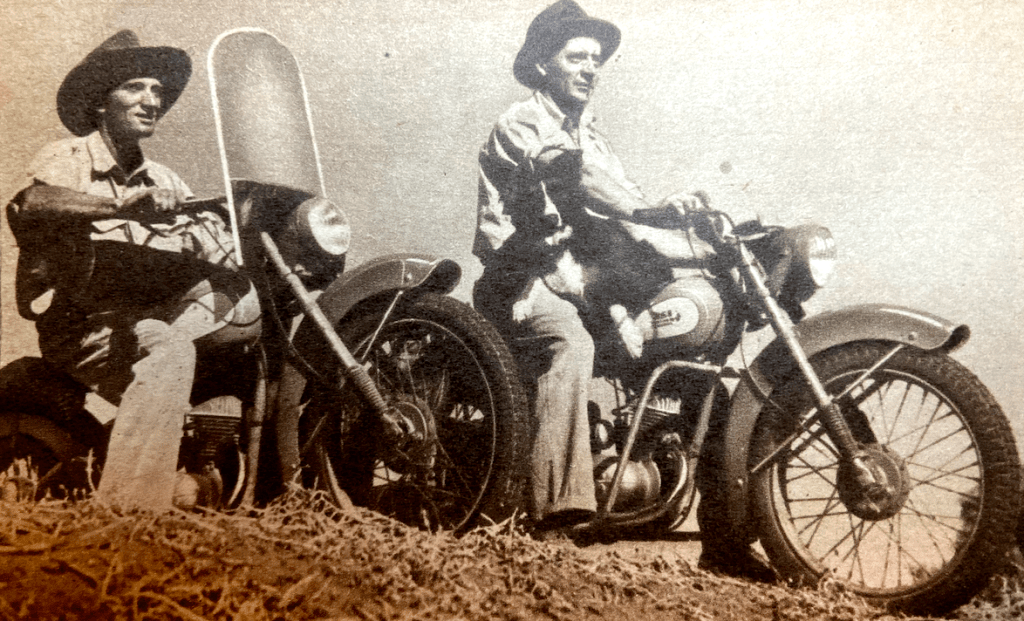
“HERE IS ANOTHER angle on motor cycling in the Australian hinterland—in the sporting sphere. In the USA they talk of riders ‘burning up the track’ in speed events, and at Yarrambat, Central Victoria, they succeeded in this—literally! At a high-speed scramble event held there by the local club, competition (and the weather—around the century mark) were so hot that competitors actually set fire to the track! The combination of sudden rains and a hot spell produced an over-growth of grass six feet in height. The excitement started in the sidecar handicap. L Evans was leading when he kicked his gear-change such a clump that the lever jammed and the exhaust pipe fell off. Unable to pull up (no gear box), he sailed straight into the long grass and in a second—it was on fire! Racing was forgotten for half-an-hour while everyone played at fire-fighters. Members of the club (Diamond Valley) were also volunteers of the local fire brigade. They dashed back to the village, grabbed the equipment, and returned to make short work of the blaze.”
“ORGANISED by the Wirral Hundred MCC and held on Wallasey Sands, the Daily Dispatch Gold Cup meeting always attracts a large entry. At last week-end’s meeting, 73 competitors came under starter’s orders. The races were run in class heats, the first four riders in each class going forward to the big race of the day which was held over 30 laps. The 500cc machines conceded two laps to the 250s and one to the 350s. The event was won in brilliant fashion by RB Young, the Norton factory rider. Starting from scratch, Young disposed of the 350 and 250cc competitors on the 17th lap and continued to draw ahead. By the end of the race he was over a lap ahead of the second man, S Wilson (498 AJS); third position was held by FC Pusey (348 Norton). Because of shifting sands, the course was not in its usual good condition. Both corners were cutting up badly and riders had to cross four gullies in the course of a lap. Viewing the circuit during practice Young very wisely decided to ride his new spring-frame Norton scrambler, and there is no doubt that this choice contributed materially to his victory. Where Manx Nortons and Triumph Tiger 100s were getting bogged down on the corners, Young sailed through as though on a main road. The 15-lap Silver Trophy race for side-car machines brought a resounding victory for F Taylor (498 Norton sc), who won by over a lap from W Poulton (998 Ariel sc), and G Woodworth (499 BSA sc).”
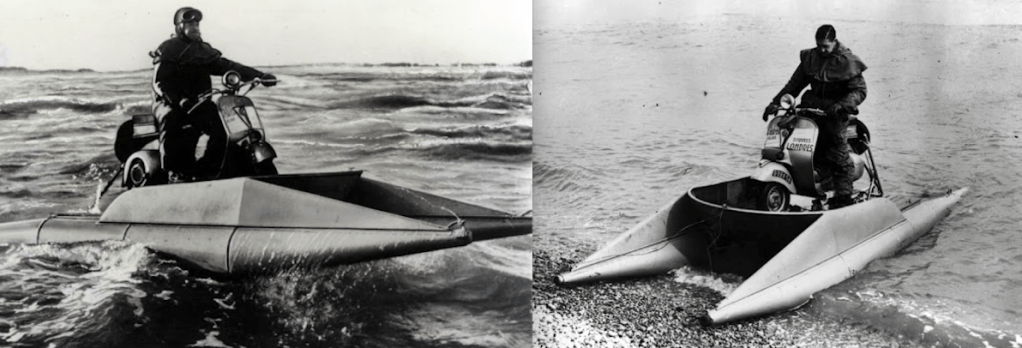
GEORGES MONNERET, NICKNAMED ‘Jojo la Moto’, rode across the Channel as part of a Paris to London race, installing his Vespa on a pedalo-catamaran whose propeller was driven via a roller from the rear wheel. The forced-air turbine continued to cool the engine despite the boat’s low speed. Escorted by a trawler from Boulogne, he reached port on his second attempt (it was damned rough out there) and won the race in a record-breaking 15 hours. In a 32-year racing career Jojo set 183 world records and won 499 races.
“tHE NORTHERN TEAM had little difficulty in winning the first leg of this year’s North vs South Scramble. When the team goes to Pirbright for the Southern leg it will have a 40-point lead. The South, without the services of some of their star men, and suffering a last minute set-back in the non-appearance of Geoff Ward, never recovered from a 32-point deficit in the first heat. The event was organised by the Ribble Valley MC for the North-Western Centre at Parsonage Farm, near Blackburn, in Lancashire. The 1¾-mile course was very dry and bumpy. Mainly fast, grassy going was interspersed with a number of short, tricky hollows, and one steep ascent from a muddy hairpin. A variation on the usual mass start is being used in this year’s events. The teams are divided into ‘A’ and ‘B’ sections of six riders, each section meeting the other in turn. This gives four races and tends to even out bad luck which might ruin a team’s chances in a single event.”
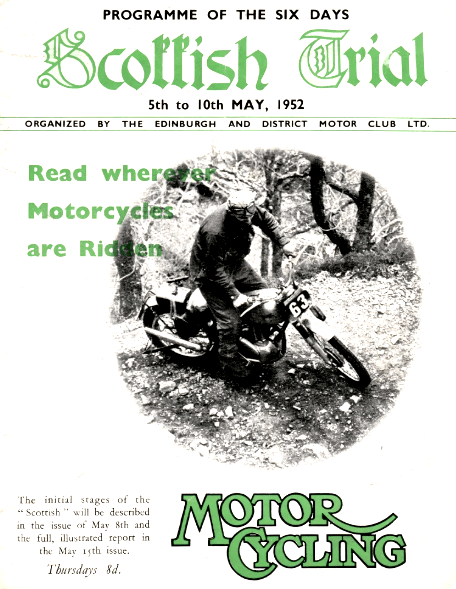
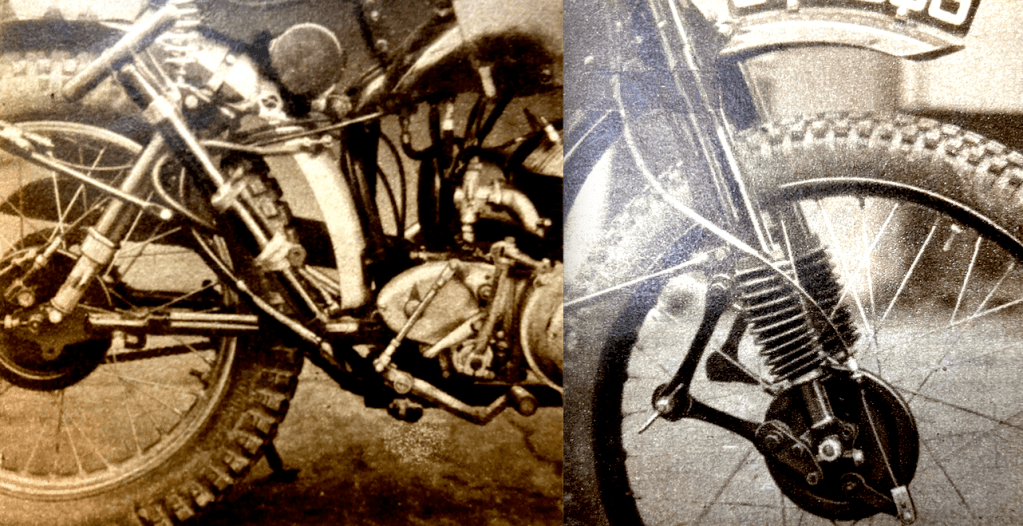
“THE TREND TOWARDS a reduction in the number of spares carried on Scottish Six Days Trial machines continues. This year, components held to machines by rubber bands usually comprise no more than spare inner tubes and footrests. Tools are mounted unobtrusively or carried in haversacks. The Christmas-tree look has disappeared. With so many manufacturers producing quality competition machines, the old order will probably never return. During the weigh-in at the official garage on Sunday, a crowd of enthusiasts and lay public alike collected to watch the proceedings. All were impressed. It is probably true to say that the general standard of machine preparation has never been higher for a ‘Scottish’. The machines gleamed and glistened as though they had come from a showroom. Especially impressive were the Royal Enfield ridden by WJ Stocker and the 347cc Matchless ridden by RW Peacock. As last year, the works’ DMWs are fitted with four-speed gear boxes and air-controlled front forks. One of the ‘unusual’ machines is FH Barnes’ Excelsior Talisman Twin with pivoted-fork rear springing. The fork is controlled for impact loading by coil springs, and by rubber for rebound. Barnes is, of course a regular competitor with sidecars. His usual, passenger, P Parsons, is also competing, riding a 348cc Norton. Another (usually) sidecar competitor riding a solo is FH Carey, who has a 125cc Royal Enfield. As for 1951, there is no sidecar class. The full solo entry of 180 represents a record for the event. The popularity and reputation of the trial may be judged from the fact that of the 180, no fewer than 93 are competing for the first time. Yet another surprising feature of the entry is the large proportion of machines of under
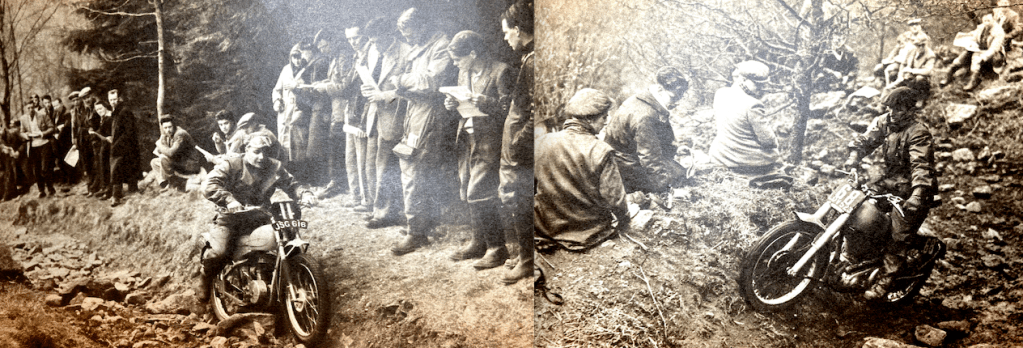
250cc. The number is 65, of which only 10 are over 200cc. It is a sign of the times—of the facts that competing expenses are high and that the modern lightweight can manage anything that a bigger machine can do, except in terms of speed. When at 8am on Monday morning the Lord Provost of Edinburgh gave the starting signal to P Victory (197 James), the roads were wet from overnight rain and a gentle drizzle had begun. There was mist, too, and visibility was down to 300 yards in places. In spite of this unpropitious outlook, however, competitors’ spirits remained high and there was no lack of light-hearted chaff as riders waited to draw their mounts from the closed control. At minute intervals the long crocodile was dispatched in numerical sequence—though this sequence will not be used throughout the week. The smaller-capacity machines, which run on a lower speed schedule, were set off first. Thus they would be overtaken by the larger machines. Because the speed schedules on rough-stuff last year allowed the under-200cc classes very little latitude and the schedules are unaltered this year, early numbers wasted no time in getting off the mark. A small crowd had gathered to watch the fun as competitors cleared the official garage and headed out of the capital’s suburbs for Bo’ness and the Kincardine road bridge. By 8.30am, the drizzle had increased and goggles became a hindrance. From Kincardine the route led to Yetts of Muckart, Dunning, and Bankfoot to Stoney Brae, the first observed hill. North of the Forth, the mist soon cleared; the sky brightened and held promise of a fine day. Stoney Brae’s four observed sections were preceded by a time-section. The hill is euphemistically named. The surface is steep and rutted, and abounds with massive boulders, many of which were loose. As in past years, it was the third section and the beginning of the fourth
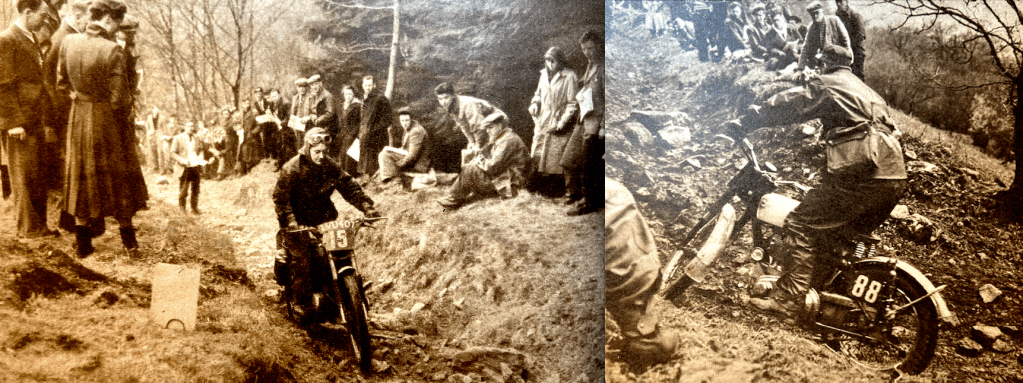
that presented the greatest difficulty. P Victory (197 James) was first to arrive. He took no risks, but paddled through cautiously, choosing a path that avoided the worst of the boulders. JW Briggs, also James-mounted, took the same path and was also non-stop. Competent, but footing, climbs were made by RS Armsden and J Botting (197 Francis-Barnetts). W Coulson (197 DMW) recorded the first stop and gave a rodeo display when his front wheel reared up and the machine turned around. A series of mediocre climbs followed. It appeared as though none of the lightweights was going to master the nasty stretch just before the end of the third section. Then HW Thorne (197 James) arrived to make the perfect performance. He was slow and careful, correcting each wayward machine movement by body-lean and throttle variation. There was applause, too, for the first of the five lady competitors to arrive, Miss Joan Slack (197 Dot). She surmounted the worst with a single dab. Another lady, Miss GE Wickham (197 Francis-Barnett), with a friction-type shock absorber on the front fork, stopped. after making a promising beginning. The ‘impossible’ was achieved by EW Smith (197 Francis-Barnett) who climbed the right-hand bank and yet kept his feet up. Immediately after Stoney Brae came Allan’s Bridge and Balhomish, two sections that were new to the Scottish in 1950. The first presented no great difficulty on Monday. The second merely entailed a ride down a greasy, boulder-strewn watercourse; it, too, caused very little bother. Scotston followed and then came Taymouth, an old favourite included last year for the first time post-war. Provided care was taken in path-picking, Taymouth was harmless. The day was now fine and warm, and the road along the side of Loch Tay to Camushurich was ablaze with the beautiful shades of green and brown peculiar to the area. Notorious Camushurich was even more vicious than usual last Monday, for it had been severely ‘doctored’ between the first and second hairpins. At first sight it looked impossible. None of the riders of lightweights could master it. When the over-200cc machines arrived to tackle Camushurich, a large gallery crowded the banks. EG Coleman (497 Ariel), the lone Australian in the entry, caused amusement when he remarked on picking up his machine: ‘Want to be a blooming mountain goat!’ In spite of the difficulties, there were many creditable performances, but they paled into insignificance alongside that of GJ Draper (490 Norton). Rounding the offending hairpin, Draper took the measure of the hill at a glance. Swiftly he turned the handlebar to full right lock and, from engine-stalling speed, turned up the wick. He put the
front wheel up the steep leaf-mould bank on the right and put the rear wheel through the gap on the right to avoid the path-blocking boulder. It looked so easy, so impudent, that it took the breath away. Like several others in the trial, Draper was wearing the experimental plastic-covered cloth Barbour suit; it is to be called the Barbourette. The lunch stop was five miles farther on at Killin, which lies at the western end of Loch Tay. From here menacing clouds could be seen hovering over the Glencoe area. Locals maintained that heavy rain was already falling thereabouts, but they were mistaken. The run through the Glen of Weeping was one of sheer delight from beginning to end. Near Kinlochleven was the formidable Mamore, the final section of the day. With its many notorious corners the hill is a law unto itself. It is very long. The surface is of loose stones—stones which shoot uselessly away from spinning rear tyres. Because of the dry spell which had preceded the trial, the surface was even more loose than usual. Of the lightweights, only WA Lomas (197 James) could deal successfully with the hill’s higher reaches. He used all the speed he could muster up to Flook’s Corner, nipped smartly round the turn and rode over the loose with as fine an exhibition of throttle control as has been seen in many a day. Few Scottish Six Days’ events take plan without someone running over the edge of the Mamore track. The honour for the first slip of this kind in the 1952 Trial went to G. Coope (248 BSA). As he went over the edge. he threw his arms around a tree and pulled himself off the machine. Then, humorously, he hugged the tree in exaggerated recognition of a service well rendered. The end was not yet in sight. Ahead lay the rocky, rutted 11 miles or so of the old Mamore road leading to Fort William. The track provides great scope for zestful rough-stuff riding and fittingly concluded such an enjoyable day’s riding. The total mileage covered had been 182. At 10.40pm the day’s results were avail-able. These showed that only GJ Draper (490 Norton) had retained a clean sheet. The runner-up, with five marks lost (one stop), was PH Alves (498 Triumph). Next came JV Brittain (346 Royal Enfield) and BW Martin (348 BSA), each with six marks lost. They were followed by G Parsons (348 Ariel), with eight marks gone; and he was followed by TU Ellis (499 BSA), David Tye (348 BSA) and GL Jackson (347 AJS), all with nine marks lost. Best in the under-200cc class was WA Lomas (197 James), with 19 marks lost.” Five days later Johnny Brittain won the 1952 Scottish Six Days Trial; he finished with 22 marks lost.
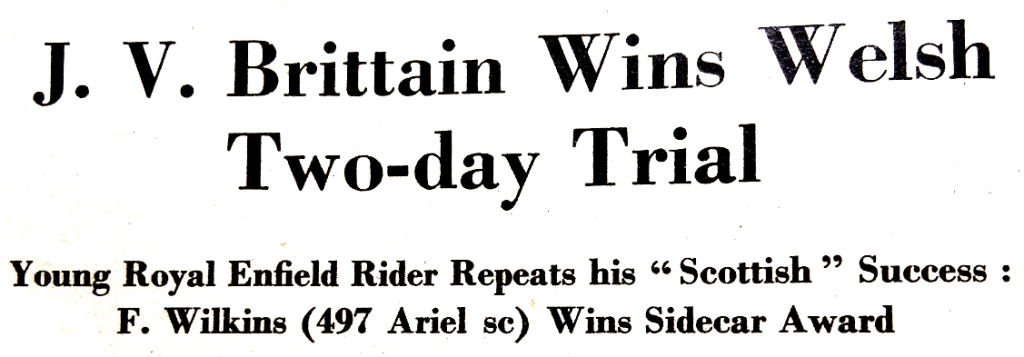
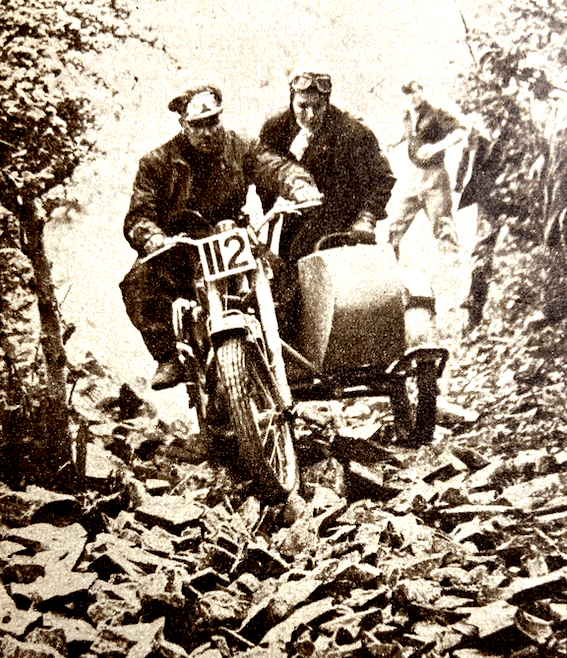
“RUN OVER A super-sporting, mountain course in some of the most rugged and beautiful areas of ‘wild Wales’ last weekend, the national Welsh Two-day Trial drew a record entry of 113 (last year’s entry totalled 78). On the first anniversary of the event, therefore, the organisers, the Mid-Wales Centre, had the satisfaction of knowing that the popularity of their highly-specialised event is increasing and that their enterprise in inaugurating it has been well justified. Fresh from his victory in the Scottish Six Days’ Trial, JV Brittain, riding his 346cc Royal Enfield, remained on top of his form to win the event by a clear-cut margin; he lost only four marks on observation and none on time. His nearest rivals were DS Tye (348 BSA) and PJ Mellers (497 Ariel), each of whom lost nine marks on observation and won the 350 and 500cc cups respectively. Best performance among the sidecar entry of six was made by F Wilkins (497cc Ariel sc) with 31 marks lost. As might be expected, with the trial based in Llandrindod Wells, good humour ran high and there was an air of joie de vivre among riders, officials, and spectators alike. With almost as much depending on the maintenance of tight time schedules over the rough stretches of the course (which meant over most of it!) as on performance on observed hills, there was also, about the event, a trace of ISDT atmosphere. Many riders carried spare inner-tubes and large inflators and many were using rear-sprung twins. A highlight of the event was that WJ Stocker was in charge of a thrilling new 700cc Royal Enfield vertical twin, which was equipped to semi ‘International’ specification. Under a warm, early-morning sun, which beamed out of a clear blue sky, the chairman of the Llandrindod council, councillor WH Edwards, JP, started the first competitor on the 135-mile route for the first day, Friday. Before reaching the first observed section, Fellwyd, some 50 miles, embracing three time checks, had to be covered. Very little
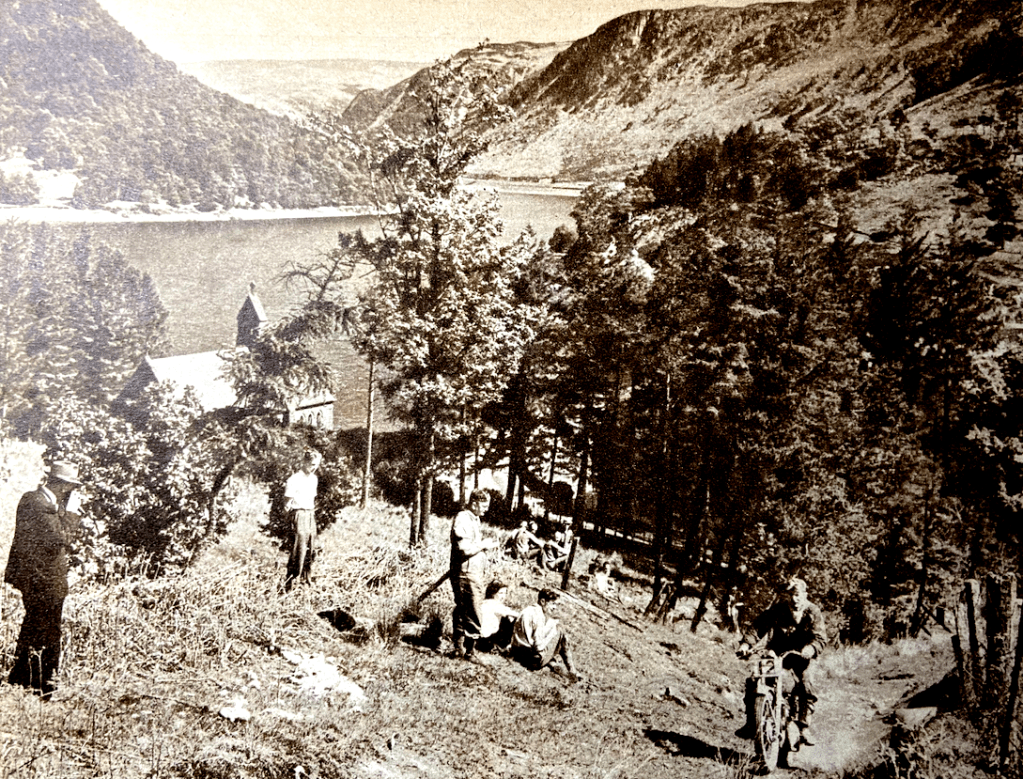
main road was encountered and the going was mostly over loosely-surfaced, winding, secondary and unclassified roads—roads of the type calling for the utmost road-craft, if the speed schedule was to be maintained without resort to ‘risky’ riding methods. The observed section did not rob many of the experts of marks, but the short stretch of smooth, slimy rock slabs required to be treated with more than a little respect. Among the first arrivals was DS Tye (348 BSA). Tye arrived dead on time, and made a very slow, controlled ascent, demonstrating among other things that his engine was in perfect tune. Slightly faster over Fellwyd were JV Keenan and WL James, both riding Trophy Triumphs, but they were equally untroubled. Unexpectedly, WJ Stocker on the 700cc Royal Enfield was bothered with wheelspin, and he had to foot his way out. Through overshooting a turning leading to the section, JV Smith (490 Norton) was some 30 minutes late; he lost no marks on the section, and when he left he was in a hurry! From Fellwyd riders were treated to the wild splendour of the Tregaron Pass before reaching the lunch check. After their brief respite they had to traverse a longish stretch of open mountain to get them to Pen-y-Gareg, the next observed hill, which lay in the Elan Valley. Time schedules, incidentally, were based on the nature of the terrain between various checks, and were in the proportions, 24, 26 and 30mph for solos up to 150 and 250cc, sidecar outfits, and solos over 250cc respectively. Pen-y-Gareg provided an interesting mixture of loose slates and earth and a 1-in-2 gradient. There were many clean climbs, among the best of those seen being by DS Tye, E Sellars (497 Ariel) and JV Britton, The course then led through the small town of Rhayader, where it appeared as though at least half the population was lining the roads to cheer competitors, and the police force, as in Welsh ‘Internationals’, was co-operating to the full. The route to the last two observed sections of the day, near Llandrindod Wells and the finishing point, lay over the tops of mountains and along forestry roads, ‘to give riders an enjoyable half-hour’s scramble riding!’ At the first of the sections, Cwm-Gwyn, an excellent climb was made by L/Cpl JSH Bray, who, with a superb show of riding, and using lots of correcting body-lean, took his WD 347cc Matchless through the tricky mud and boulders unpenalised. DV Chadwick took his BSA Bantam through in fine style, and another
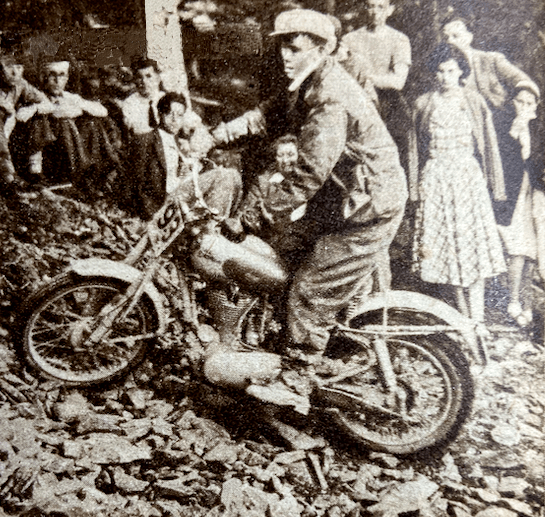
Bantam rider to go through feet up was L Wyer. One of the two lady competitors, Miss Olga Kevelos (497 Ariel) was clean in the early part; then she had trouble in the second sub-section, recovered, and required two dabs. Cefn Coed, the final section, contained a measure of deep mud of plum-duff consistency. Though the section was level and straight, the ruts were long and deep and only JV Smith among the solos rode the entire length unpenalised. JE Breffit (450 Norton) came close to success, but was forced to use three dabs—two of them when he was almost at the ‘ends’ card. Strangely enough, in the circumstances, FH Whittle (598 Panther sc) and F Wilkins (497 Ariel sc) drove their sidecar outfits through fast in great style without losing marks. Early morning mist and a clear blue sky above heralded another glorious day on Saturday for the second half of the trial. Machines had been impounded during the night and there was an easy-starting test before riders set off—this was in addition to the three other special tests (acceleration and braking) during the event. Eight observed sections were included in the course of Saturday’s route of 114 miles, which was also timed, of course. At the first section, LIwyncutta, spectators were treated to a masterly display from DM Viney (347 AJS). Viney inveigled his machine over muddy rock slabs and through a quagmire at the exit from the section with all the grace and skill that is his alone. A praiseworthy performance was made also by the second of the two lady competitors, Miss Joan Slack (197 Dot). Many excellent sections were included in the day’s route, but the highlight was Kinsley, the long stony track bristling with rock ledges, that climbs steeply up the side of a 300ft cliff towering above the roofs of Knighton. It was said that no one had ever climbed it unpenalised, and it presented for riders an awe-inspiring prospect. There was an early sensation when F Allen (123 BSA) rode feet-up almost to the top before hopping out of the saddle when his engine was about to stall. One after the other, the experts were defeated. Most of them made non-stop climbs by dint of heavy footing, and the bulk of the remainder of the entry required tow-rope assistance. The spirited charge by HL Williams (490 Norton) was typical of many who forfeited a non-stop climb in a gallant attempt to ride the entire section feet-up. Williams stormed his way over the worst part with his feet glued firmly to the rests, but eight yards from the end he lost control and dropped the model. When most of the entry had passed Johnny Brittain arrived, still with a clean sheet for the day—he had only lost four marks the previous day and was at this stage in the lead. After carefully weighing the prospects, he made a superbly-judged climb, and a tremendous cheer arose from the crowds thronging the banks when he rocketed out of the section still under control and still feet-up. Not only had he made almost certain of winning the trial but he had made local history by being first to conquer the hill. A word of praise is merited by Clerk of the Course, HP Bangham, and his merry band of fellow organisers. They did a first-class job—a really first-class job throughout the two days. RESULTS Welsh Solo Trophy: JV Brittain (346 Royal Enfield), 4 marks lost. Welsh Sidecar Trophy: F Wilkins (497 Ariel sc) 31. Knighton Cup (best 150): EW Smith (122 Francis-Barnett), 32. Llandrindod Cup (best 260): R Armsden (197 Francis-Barnett), 27. Rhayader Cup (best 350): DS Tye (348 BSA), 9. Metropole Cup (best unlimited cc): PJ Mellers (497 Ariel), 9. Spa Cup (best 350 sidecar): RU Holoway (348 Panther sc), 67. Walters Cup (best unlimited cc sidecar), AG Brown (490 Norton sc), 45. Builth Trophy (best one-make team): AJS (BHM Viney, GL Jackson, PF Richards), 74. Presteign Cup (best club team): Sunbeam MCC (GL Jackson, PJ Mellars, J Giles), 31. Morgan Cup (best Mid-Wales member): WB Mills (498 Triumph), 27. Services Cup (best Army rider): L/Cpl JSH Bray (348 Matchless), 42.”
GET ON PARADE! The Royal Artillery dominated the third Army Motorcycle Championship Trial. Nearly all the 84 entrants rode G3L Matchlesses; much of the course followed the route of the 1948 and 1949 ISDTs.
“THE REPORT TO the Minister of Transport on Motor Cycle Accidents by the Committee on Road Safety, in considering the rise in the number of motor cycle casualties, draws attention to the greatly increased number of motor cyclists on the roads. Figures quoted are 32,771 casualties in 1938, when there were 443,651 motor cycles (and similar-category machines) registered; the percentage of casualties was 7.3. In 1950 there were 37,390 casualties and 729,420 machines registered, giving a percentage of 5.12, but it will be recalled that petrol was rationed, and therefore mileage was restricted, for five months during 1950. Conclusive evidence of the reduction in the accident rate is provided by the year 1951, when there was no petrol rationing, and a valid comparison with the last normal pre-war year, 1938, can be made. In 1951, casualties numbered 42,680 or 5.18% of the 822,571 registrations. Hence, since 1938, there has been a drop of more than 2% in the casualty rate in spite of heavier traffic on less satisfactorily maintained, overcrowded roads. The Committee’s recommendations are constructive and of the utmost value in discrediting the common supposition that motor cyclists as a body are wholly culpable for the accidents in which they are involved. Motor cyclists bear their share of responsibility, but no more. Many of the recommendations are on the lines of suggestions made over a long period by The Motor Cycle and other interested parties. Attention is drawn to the danger of slippery surfaces and the need for the Ministry of Transport and highway authorities to remedy such surfaces. It is recommended that the rear lighting and driving mirrors of other vehicles should be improved; that measures for the control of dogs on the highway should be introduced; that the use of crash helmets should be encouraged (assuming a suitable helmet can be produced at a reasonable cost); that driving tests of motor cyclists should be conducted by examiners who are riding motor cycles; that there should be more police patrols mounted on motor cycles; and that the RAC-ACU Training Scheme should be expanded. ‘In essentials,’ says the Report, ‘the problem does not differ from the accident problem generally, and the preventive measures must be a combination of education, enforcement and road and vehicle improvements. The importance of proper training of learner motor cyclists cannot be overstressed.'” The report also concluded: Motor cycle manufacturers should consider further standardisation of motor cycle controls. The development of the auto-assisted pedal cycle and autocycle should be carefully watched. Driving mirrors on motor cycles should not be made compulsory. Direction indicators on motor cycles should not be made compulsory. The value of leg guards should be investigated. Proper footrests should be a requirement for all motor cycles used for carrying pillion passengers. The use of goggles with side panels should be encouraged. Special restrictions on the speed of motor cycles either in relation to the age of their riders, or generally, should not be imposed. The vulnerability of motor cyclists should be discussed between the Department and the motor cycle manufacturers. A booklet on roadcraft should be issued with all new motor cycles. Films on safe motor cycling technique should be produced and made available to interested parties. Auto-assisted pedal cycles and autocycles should be placed in a separate group for the purposes of driving tests and licences, and the question of a separate group for motor cycles of over 350cc borne in mind. The accident position among learner motor cyclists should be watched with a view to consideration being given to limitation of the number of provisional licences which a learner driver may be granted. “It seems clear, says the report, ” that the upward trend in motor cyclist casualties is largely due to the increase in this class of traffic.” Of 16,511 crashes recorded in the police reports skidding accounted for 15%; misjudging clearance, distance or speed, 12%; excessive speed in the prevailing conditions, 11%; overtaking improperly, 11%; lack of care at road junctions, 8%; inattentive or attention diverted, 7%. “The vulnerability of the rider is shared by the pillion passenger. Though no statistics are available to show whether motor cyclists with pillion riders are more likely to be involved in accidents than are solo riders, it is obvious that, if there is an accident, two lives are endangered instead of one. There is a temptation for a young rider with a girl on the pillion to show off by driving at excessive speed. A warning about the foolishness of succumbing to this temptation should be given special stress in the education and training of motor cyclists. A sample investigation of the ages of motor cyclists killed or injured in road accidents showed that about 50% of the casualties were in the age group 19-27. However, there is no information available about the ages of motor cyclists licensed.” Triumph boss Edward Turner said: “It is in refreshing contrast to the usual nonsense one reads almost daily on the same subject. As manufacturers, we heartily endorse the principal recommendations relating to the condition of road surfaces, rear lighting of other vehicles, and straying dogs. To those authorities who find difficulty in providing non-skid road surfaces we would commend a visit to the Isle of Man, where it is possible to lap the tortuous TT course at 90mph in safety on the wettest day. In many of our biggest cities it is almost impossible to travel at 10mph with any degree of confidence after a shower of rain. Motor cycles, by their liveliness and the sport they provide, appeal mainly to the young, and youngsters will always get themselves into trouble on occasion whatever sport they take up. Danger is an inherent part of any real sport, and it would be a sad day for this country if our youngsters preferred the safe pleasure of watching television to getting out into the country on a motor cycle or bicycle, or climbing mountains, or any other real sport which calls for a little courage and dash…since 1938 the number of motor cycles on the roads has increased almost 100% but the accident figures show an increase of only about 25%. There is, of course, no reason for complacency, and every effort must be made to effect a considerable improvement.”

I CAME ACROSS THIS comment piece in a French bike mag: “Better thirty dead than one wounded: When a plane crashes with thirty passengers on board, we blame the sky, the mountains or the ground, which are solely responsible for the disaster. We recover what we can from the victims, give them a beautiful funeral and open an investigation, which is soon, but more discreetly, buried. When two trains travelling on parallel tracks, which by definition cannot meet, are nevertheless clumsy enough to collide, those who did not survive the crash are given a magnificent burial, fine speeches are made, fate, frost, fog or the scapegoat are blamed, and we move on to other matters. Each time, there are massacres to lament, but these do not in any way tarnish the solid reputation for safety of the giants of the air or rail. But if an unfortunate motorcyclist knocks over a careless pedestrian who suddenly appears outside a pedestrian crossing, everyone immediately cries ‘Haro’ on the donkey; this tiny machine is, in evil hands, the most formidable killing machine in the world. If two million motorcycles are responsible for fifty accidents, that’s fifty accidents too many; we must crack down with the utmost severity. Others have the right to cause mass carnage, but an occasional accident here and there is something we cannot tolerate. This is the triumph of mass production.”
“SURPRISE AND POSSIBLY consternation will arise over the FIM decision to allow superchargers for road racing. Undoubtedly the FIM will suffer a good deal of criticism for introducing the change without notice, bearing in mind the understanding that no vitally important modification to road-racing regulations would be made without three years’ warning. Two other points of possible criticism arise. A British rider was suspended for a year at the last Autumn Congress. The suspension has been remitted by a few months, and the rider will be allowed to compete again from 1 July. He was suspended without a hearing, and only sketchy details of the charge have been made public. It is widely felt that FIM rules should be modified to ensure that a rider may state his case before suspension is enforced. Secondly, the two fatal accidents at the Swiss Grand Prix have brought into focus the fact that the FIM permitted the meeting to be held in spite of its own rule that classic motor cycle races shall not be run on the same circuit and on the same day as car events. It appears that the FIM is quick to deal stringently with riders, yet compromises with its own constituent bodies in the application of its rules.”
“WHEN THE ZEBRAS first came into use, I prophesied that many of them would need to be operated by a uniformed policeman in days to come, if only spasmodically. I spent Easter at one of our better-known watering places. The holiday crowds were by no means gigantic, but in the centre of the town all the (very few) zebras were necessarily controlled by point cops over a considerable portion of each fine day. Otherwise the dual hold-up of angry peds and angry motorists would have led to troublous scenes. I heckled a local official for his view of the matter. He said in effect, ‘The zebras are important to us on grounds of economy. In normal times, when traffic is not too heavy, a little colour on the road surface renders a service which would otherwise demand a human agent or an expensive robot lamp installation. We don’t know yet how often we shall have to supplement the zebras in the town centre by posting constables at them, but in any case they will still be extremely economical. It is too early to estimate the aspects of safety and danger, but we are well pleased with their safety up to date.”—Ixion
“I READ OUR sprightly contributor, ‘Technicus’, with a slightly rueful air. ‘Several periods in my ill-spent life have caught me in charge of engines with more than one carburettor. I think the record number was four, though I sometimes wonder whether it wasn’t eight. The job is not too foul if the engine has stub exhaust pipes and no silencers. You carefully adjust one carburettor till you get the tongue of flame with the right colour. You then bring the other carburettors up to the same standard. But this noisy task makes for acute neighbour trouble. So if the job has silencers and prolonged exhaust pipes, you have to take the vehicle bodily up to some lonely place atop of the Pennine hills or suchlike, dismount the exhaust system, set the carburettors, and remount exhaust plumbing. Even then some stupid little item soon upsets the balance, when you have to revisit your mountain summit to put it right. Whereupon the local cops begin to suspect that you are running a pot still and brewing your own whisky. One carburettor is plenty for me on a touring model, thank you.”—Ixion
“CS JONES CONSIDERS that 90% of fast drivers are competent. His thesis can’t be proved. I think that many youthful speedmen are most temerarious. But I will append two samples which tend to pillory the creepers. How many readers know the psychological effect of a tram? Nobody likes running either alongside or just astern of a tram or similar incubus. They occupy an immense slab of road. They block your view ahead. They can (and do) stop most incredibly quickly. When I find myself behind a tram, my instant and powerful reaction is to overtake it. I know as well as you do that there is probably another tram about a hundred yards farther on; and that tram C is probably rollicking a few yards ahead of tram B. No matter! I miss no possible chance of passing every tram I encounter. Again, I never ride quite so foolishly as when I am on something slow, especially in hilly country. Given a clear field, I am compulsorily rather slow over the ground, because my machine can’t do more than so-and-so. So I am loth to slow adequately at awkward corners, and will face almost any risk up a lengthy hill, lest I should be forced off top gear and be unable to change up again for a mile or so. These are two very common factors in accidents; the creeper brigade is especially susceptible to them.”—Ixion
“HOW VERY, VERY SELDOM one sees a motor cyclist tinkering by the roadside! This is no mean tribute to the industry. In a sense it is rather a surprise to me, for today quite a sizeable percentage of us ride clip-ons or autocycles of various types. Many of these riders have still to acquire the smattering of mechanical knowledge requisite for keeping any model in good running order. Hats off to designers and makers—they have done a very goof job.”—Ixion
PHIL VINCENT WAS well aware that his big twins’ unmatched performance grabbed the headlines and stimulated sales. Season-long racing was prohibitively expensive; a one-off speed record attempt was the obvious choice for the cash-strapped company whose Black Shadow was the world’s fastest production motor cycle. Vincent had certainly grabbed the headlines when Rollie Free rode a tuned Shad across the Bonneville Salt Flats to set a US record of 150.313mph. And of course he did it in his swimming trunks (read all about it in, and see the unforgettable pic in 1948). But even the best headlines are soon forgotten, so three years a team from Stevenage headed for the banked Montlhéry track in France: the plan was for a Vincent to become the first motor cycle to average over a ton for 24 hours. The Black Shadow engines were tuned beyond the production spec (including Black Lightning cams) but the uncaged roller big-end bearings were left as standard—a decision that would have unfortunate consequences. Other mods included dispensing with both the back-to-back front drum brakes and one of the rears, and a five-gallon fuel tank. The Montlhéry expedition comprised four Black Shadows, two Black Lightnings and a road-registered Black Shadow practice ‘hack’. Phil Vincent headed the support staff himself; the riders were Vincent employees Ted Davis (chief tester), John Surtees (apprentice) and Danny Thomas (tester) plus Cyril Julian, Phil Heath, Denis Lashmar, Gustave LeFevre, Bill Petch, Robin Sherry, Johnny Hodgkin and, of course, Vic Willoughby of The Motor Cycle. The first day of the record attempt ended after six hours when a big-end bearing seized. It failed again the next day, after 11 hours, but by then Vincent had eight records in the bag, including 1,000 miles and 10 hours at 99.2mph; and six hours at 100.6mph. On the third day a Black Lightnings was sent out to set some short-distance records, but after John Surtees had done over 129mph for a couple of laps the rear tyre started to de-laminate, bringing proceedings to a halt. [And now a personal note. Some 30 years later Vic told me that he was riding one of the Shads when the big end failed. It seems the riders were instructed to ride ‘fast enough but no faster’ because ‘PCV’ was well aware that the uncaged rollers could bunch up and fail if the revs were too high. And PCV, according to Vic, remonstrated with him off for ignoring trackside signals and riding too fast. Vic pointed out that da Vinci had designed a caged bearing in the 15th century and urged PCV to follow suit. After which, Vic concluded, PCV didn’t talk to him for two years. Now Vic was harking back 30 years and at the time of writing I’m harking back nearer 40 years. But the caged roller certainly dates back to legendary horologist John Harrison is the 1740s and I know Vic wouldn’t have made up the encounter; he was effortlessly assertive when discussing technical issues.—Ed]
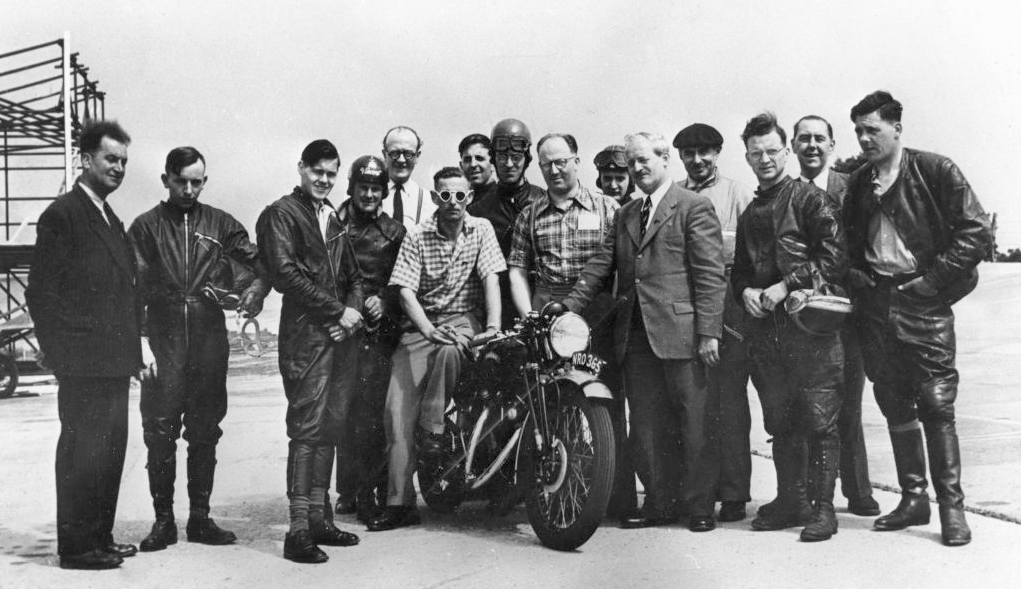
FOR THE FIRST and only time Autosport magazine roadtested a two-wheeler – a Vincent Black Shadow. It recorded a top speed of 125mph with consumption of 60mpg.
THIS WAS THE FOURTH FIM Road Racing World Championship Grand Prix season. It comprised eight Grand Prix races in five classes: 500cc, 350cc, 250cc, 125cc and 500cc Sidecars. It began on 18 May, with Swiss Grand Prix and ended with the Spanish Grand Prix on 5 October. On the face of it British bikes still led the pack, at least in the 350 and 500cc classes. At the Swiss Grand Prix AJSs finished 1st and 2nd in the 500cc class, with an MV 3rd; a Norton (inevitably ridden by Geoff Duke) led the 350s home followed by an Ajay and another Norton. But it was clear that the lightweight classes were no longer British territory; Fergus Anderson won the 250 race on a Guzzi. Harry Louis, who was to have an illustrious career as editor of the Blue ‘Un, took a well informed look at the Continental challenge: “A most impressive feature of the 500cc race of the Swiss Grand Prix at Berne was the speed and reliability of the new Italian MV Agustas.
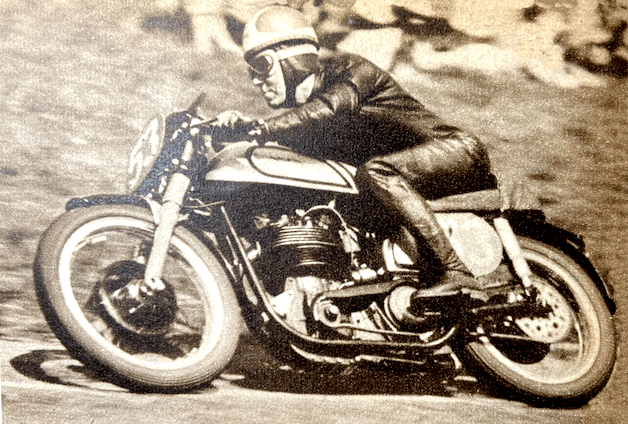
No one was surprised to see Geoff Duke leading on the first lap. But keeping Duke within sight was Les Graham, whose MV was obviously motoring very well and handling magnificently. According to my timing Graham was never more than 15sec away from Duke until the seventh lap. Duke was leading at around 95mph, and Graham’s average speed could not have been much slower. He called at his pit to examine the rear suspension because at extreme range of upward movement the tyre was rubbing on the mudguard; a lap later he retired since it was foolhardy to take risks. The remedy would be a simple matter, but could not be applied during the race. Another pointer to the performance of the latest MVs is the fact that Carlo Bandirola in the same race finished third at an average speed higher than the previous lap record, which remained intact from 1937 till this year. Only two MVs were competing and both showed great promise in a tigerish race. Engines of the 1952 models are substantially similar to the 1951 units but major changes have been made in the transmission and rear suspension. Primary drive is by gears to a five-speed gear box which, says Graham, provides a quick, certain change. (It will be recalled that one of the bothers with last year’s four-speed machines was the difficulty of avoiding a muffed change and its consequent over-revving of the engine.)
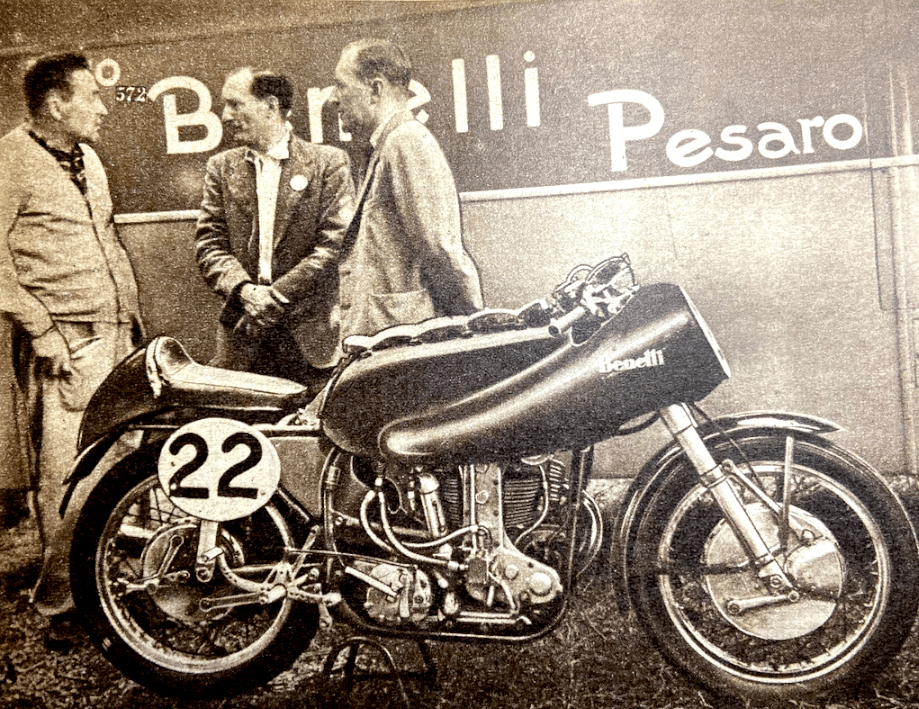
Final drive is by chain as against shaft on the 1951 jobs. The pivoted rear fork is of orthodox pattern, with Girling telescopic legs—previously there were twin rear forks controlled by torsion bars. The models at Berne were fitted with conventional telescopic front forks. However, experiments with the Earles leading-link fork have proved promising, and this type of fork may appear on the machines for the TT races. In common with almost all other Italian racing machines, the MVs have a fuel tank fashioned to fit the rider’s arms. Fairing from the front number plate extends backward round the steering head and merges with the tank; this fairing is not at present employed as a fuel container, but it might form a useful part of the tank should the need to carry the maximum amount of fuel arise. It would be wrong to form any conclusions about the Gilera fours simply because their showing in the Swiss race was unspectacular. They were nipping along well in practice (although none was recorded as getting round so fast as Duke’s Norton), and information from Italy is that for 1952 a few more horses have been found. Externally, the Gileras appear almost unchanged, apart from the fairing round the steering head and the reshaped fuel tank. The Swiss meeting provided the first appearance in a classic race of the 500cc dohc parallel-twin Horex from Germany. The power unit and especially the housing for the camshafts are of remarkably massive construction. Each cylinder has its own carburettor, which is inclined at an angle of about 45°. This engine is perhaps too new to judge, though as yet it does not seem to be fast or reliable enough to be a serious contender for honours against top-flight opposition. Roland Schnell, who will be remembered for his ingenious Perilla ‘specials’, had his two Horex specials at Berne. One is a 350 and the other a 250; but they are as alike as peas and not easy to distinguish at a quick glance. The casing enclosing the chain drive to the inlet camshaft is slightly á la AJS triple-knocker. On the left-hand side of the camshaft housing there is a further chain drive
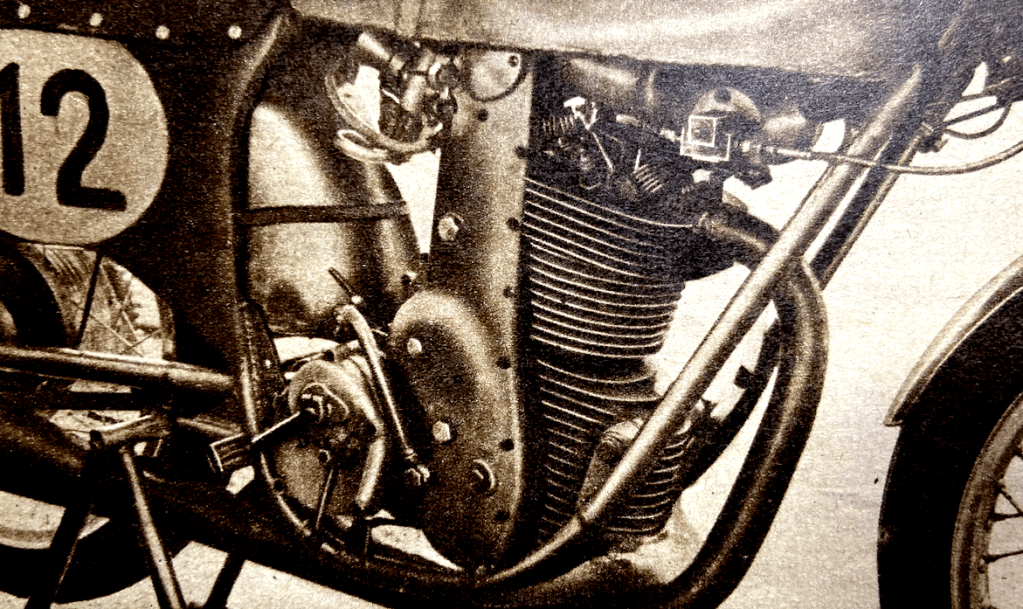
to the exhaust camshaft. Two sparking plugs are fitted, one on each side of the head, but only one plug was in use at Berne. As with the Horex twin, the carburettor has a very steep downdraught angle. An unusual feature for a present-day racing machine is the very extensive finning on the crankcase, which is not an oil container—there is a separate oil tank below the nose of the racing seat. Undoubtedly one of the most ingenious designs to appear in post-war years is the 350cc three-cylinder DKW from Germany. Two cylinders are parallel and inclined forward 15° from the vertical; the third cylinder faces forward at an angle of 75° from the parallel cylinders. The attraction of this layout is that it provides a short crankshaft, and thus a comparatively narrow engine, and also allows plenty of air to get round the cylinders for cooling. The engine is designed on basic three- port principles; each cylinder has its separate crankcase compartment and its separate carburettor. There are no rotary valves as on the 250cc DKW parallel-twin. Ignition on the three-cylinder units by means of a modified six-cylinder car magneto driven at half engine speed by a bevel gear on the end of the crankshaft. Primary drive to the four-speed gear box is by gears; secondary drive by chain. Peak rpm are 12,000. An interesting point is that the DKWs are fitted with electric revmeters which are said to be spot-on accurate and were noted to be absolutely free from needle flutter. This three-cylinder engine was no farther advanced than the drawing board last December; to have it racing within a few months is an astonishing achievement. The machine is very fast indeed—at Berne, a DKW technician said the engine would not stand the distance and his prediction came true. After holding a good fifth place for 12 laps behind such select company as Duke, Coleman, Armstrong and Brett, who were averaging about 90mph, Siegfried Wünsche had the engine die on him. Given more development this three-cylinder
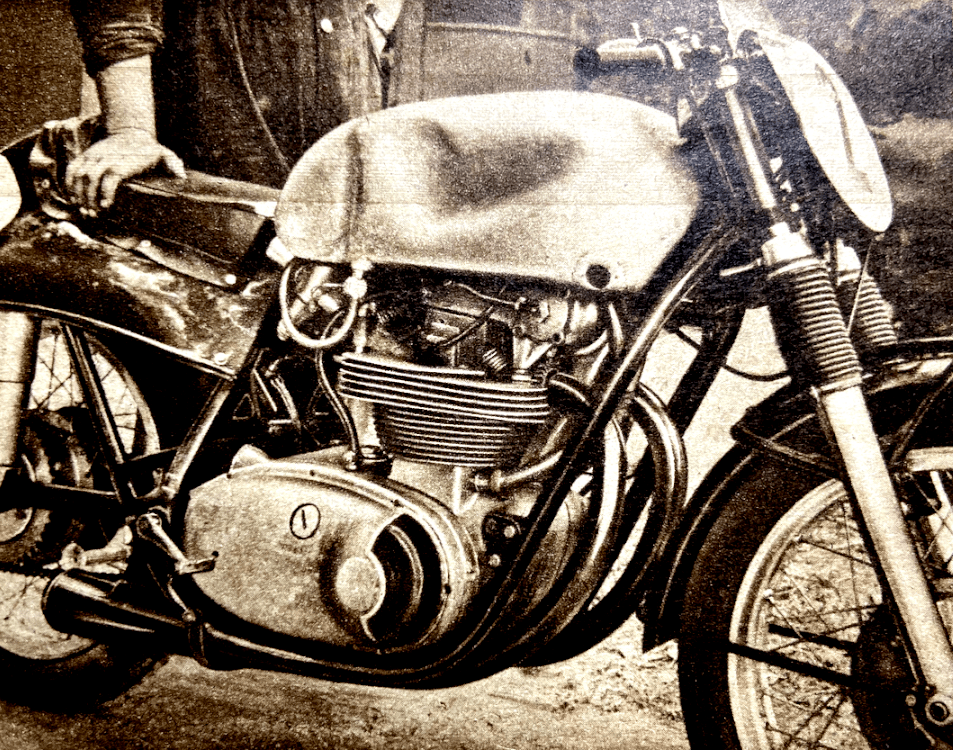
DKW might prove a strong challenger to the British monopoly in the 350cc class. In its 1952 guise, the 250cc Benelli is endearingly elegant. The engine, with its spur gear-driven twin overhead camshafts, is essentially unchanged. However, the frame is modified and the pivoted rear fork has telescopic legs in place of the plunger units employed formerly. The parallel-ruler front fork has been superseded by a telescopic design. Measuring about 11in in diameter, the front brake be the largest on any racing machine extant. By a last-minute arrangement, Les Graham rode one of the Benellis at Berne and, although he had but a few practice laps in which to gain experience of a machine which is very difficult to get to ‘know’, he finished third only 0.6mph slower than Fergus Anderson’s winning Moto-Guzzi. This in spite of being unable to engage top gear after the second lap. If Graham gets the chance of more racing on the Benelli he might well cause a flutter in the Moto-Guzzi stable, which otherwise looks all set to dominate the 250cc class without undue competition. It now seems finally decided that the TT Moto-Guzzis have two-valve engines and five-speed gear boxes. With the new Dellorto carburettor, which, in effect, has the main jet surrounded by the float, Moto-Guzzis are achieving very clean carburation and power pick-up. Another improvement for 1952 is the simple rear suspension legs, each of which consists of an exposed coil spring round a special Girling hydraulic unit. In the Swiss race Enrico Lorenzetti, who was second to Anderson, rode a machine with the twin-camshaft four-valve engine. The valve gear is entirely enclosed. Coil springs are employed, each pair of valves is parallel, and the cylinder head is of pent-roof design. Each inlet port has its separate carburettor. There was no reliable news at Berne about the new racing BMWs. Diligent ‘pumping’ of both Georg Meier and Ludwig Kraus brought forth nothing more than broad and happy smiles, but it is known that the new models are coming along well and that they will be out for the German Grand Prix at Stuttgart. This year’s crop of interesting Continental racing models is most promising. Coming along are four newish 250, four stroke twins—the Lambretta, the Rumi, the Parilla and the NSU. In the 125cc class, the 1952 MVs are considered to be capable of giving a real challenge to the FB Mondials. The 125cc Lube from Spain will not be in the Island but may be seen later. And there is the great secret of Mandello—the Moto-Guzzi 500cc in-line four which may just possibly be ready this year. The road-racing game appears to be flourishing’ as never before.”—Harry Louis
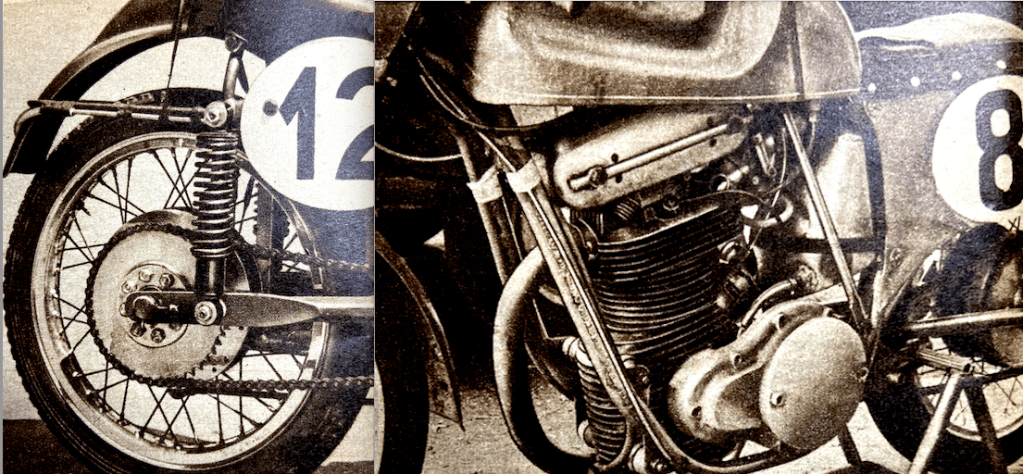
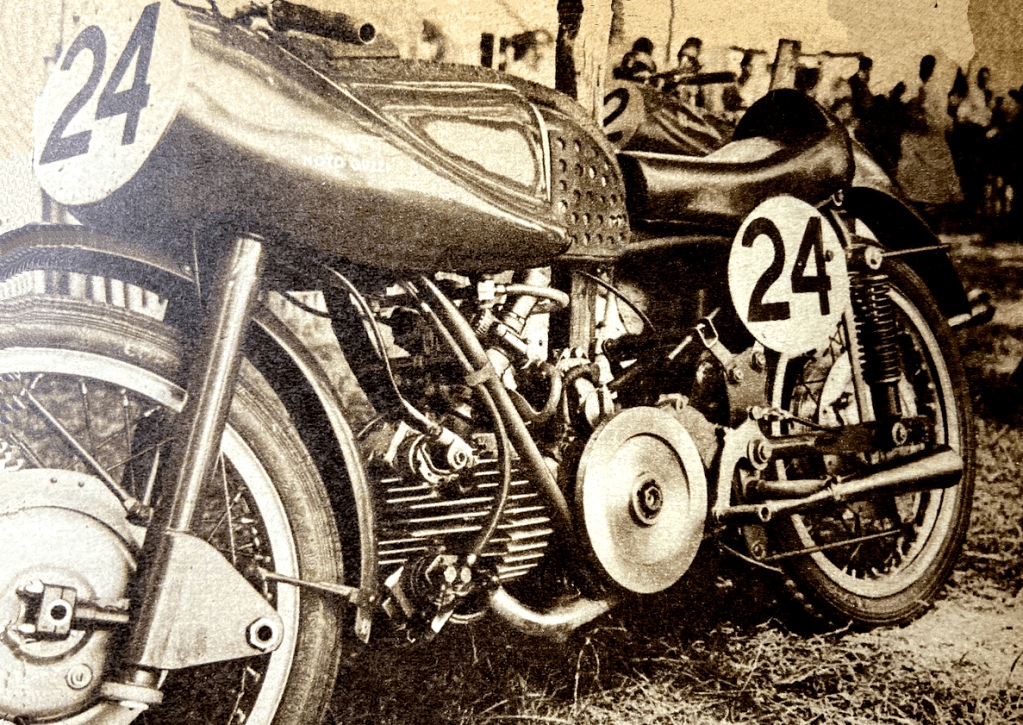
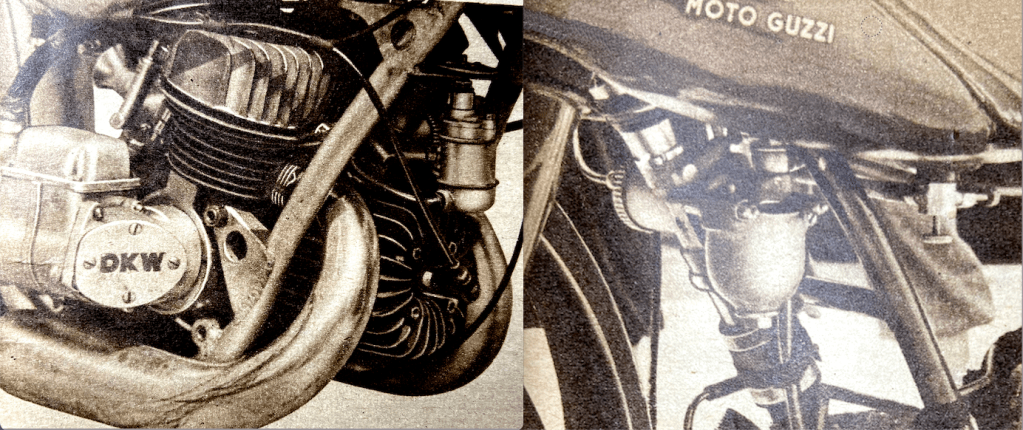
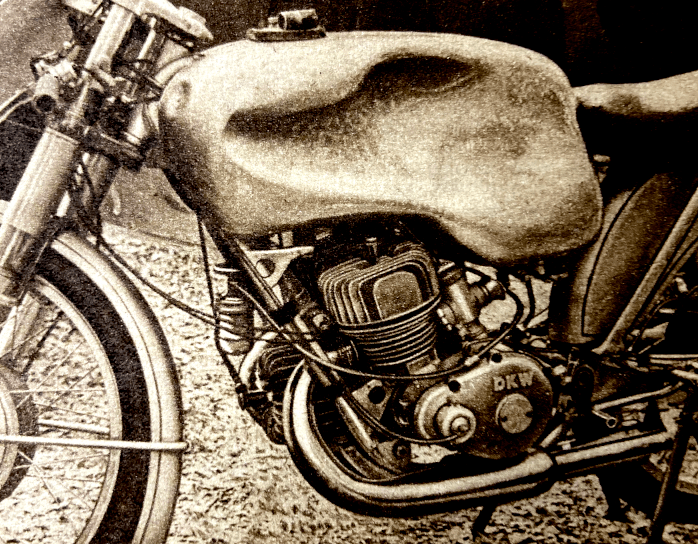
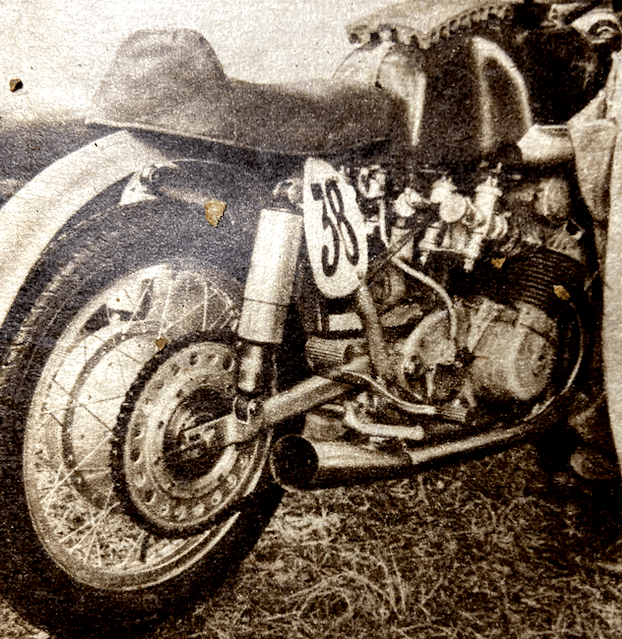
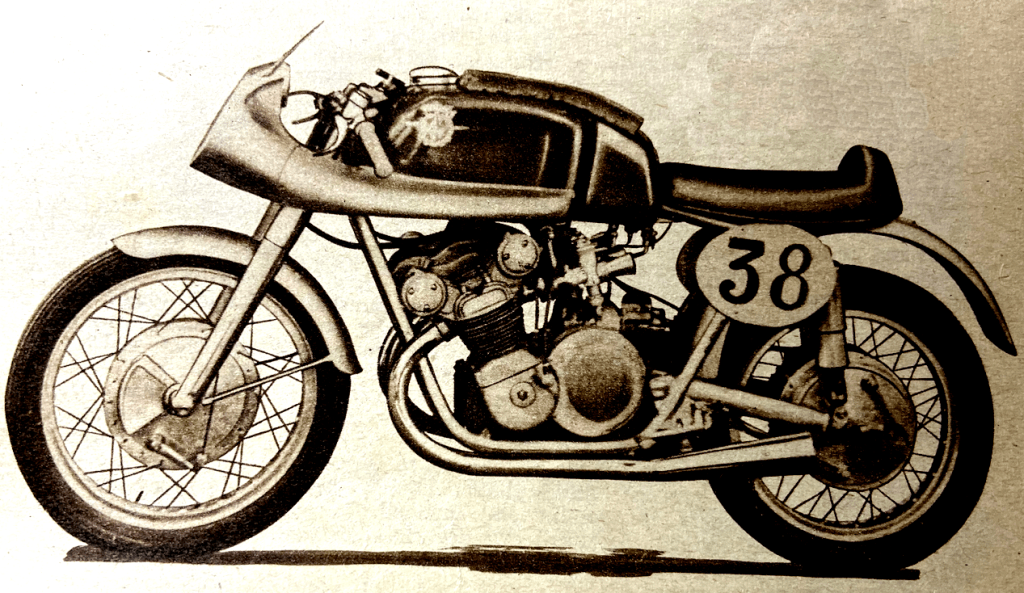
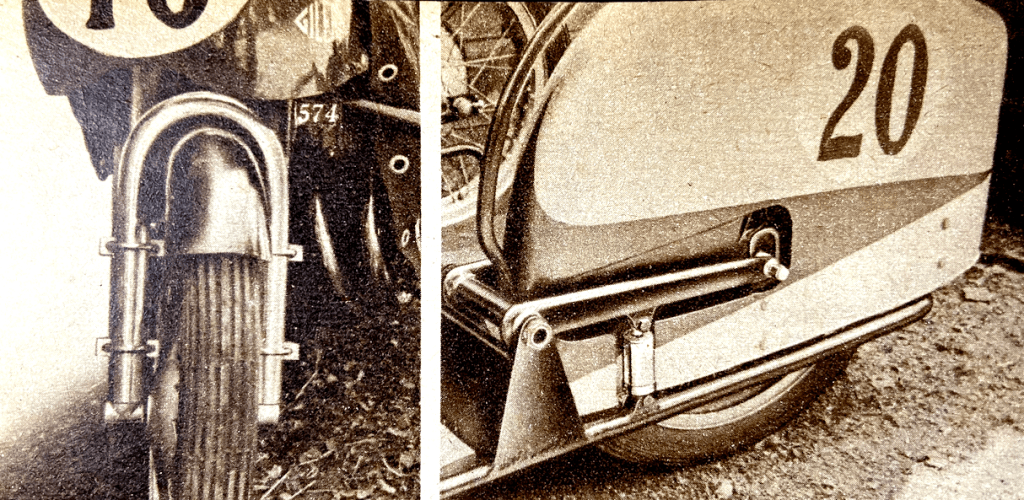
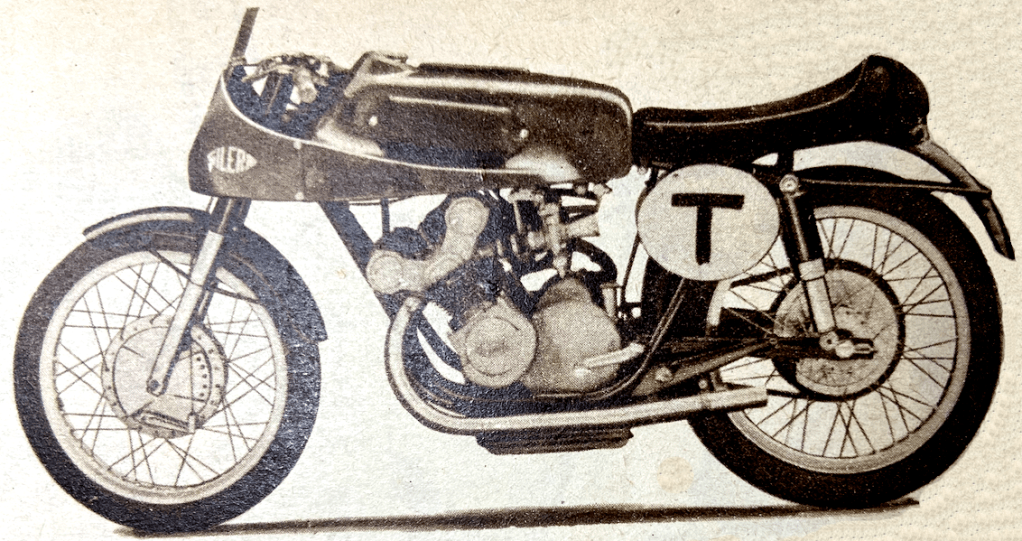
“HAVING READ WITH INTEREST Dennis May’s article, ‘Choose Your Weapon’, and the subsequent letter from ‘Medico’ who both maintain that the fastest modern motor cycles are slower over big mileages than the fastest modern cars, I feel that I most express my disagreement. Because dry roads over the whole or most of a long distance are fairly readily obtainable, while it is quite impossible to do a run of 12 hours or more without encountering hindering traffic and numerous slow-downs and stops, all of which give the motor cycle the advantage provided that the rider has the necessary skill and stamina, the statement as it stands is not correct. In one day of 24 hours I have done over 800 miles in a Ford 8hp car. In another day of 24 hours I have quite comfortably done over 1,150 miles on a Black Shadow (mileage witnessed), this although I am middle-aged and quite an amateur, without any racing experience. I run both a car and a motor cycle. Like ‘Medico’ I far prefer the motor cycle, but unlike him I think nothing of a day’s run of 600 to 700 miles, such as London to Land’s End and back, or London to Gretna Green and back, usually on a Sunday, with its ‘heavier’ traffic. I would bet heavily that no XK120 would, under those conditions keep up with the Black Shadow, yet I pride myself on careful riding without risking other people’s or my own neck. The reason is that ‘heavier’ traffic would give the motor cyclist an unfair drop, due to his ability to heel through gaps denied to his rival and due to the two-wheeler’s superior acceleration.
BOB CHAPLIN, Kenton, Middx.”
“I HAVE BEEN very interested in Dennis May’s article and the letters in connection with high average speeds and long-distance travel. On the ‘Shadow’, a speed of 80mph is a pleasant amble which can be maintained indefinitely in ordinary clothes, but 100mph is quite a serious matter for which one must have the right conditions and wear a helmet and goggles, as wind noise is very tiring and an ordinary beret can shake one’s head to such an extent that vision is affected. Last year I went to North Wales by way of Worcester and returned the same day; the recorded distance was 596 miles. When I had covered about 450 miles I found that my ordinary speed was becoming a bit of a strain, and I reduced it by 10mph. This happened to be at dusk, which is always a difficult time for riding, but as the evening wore on I completely recovered, and finished the ride at the top of my form—so much so that when I found that the recorded distance was 596 miles I put some more petrol in the tank and made it 602. Unfortunately, I have no experience of the XK120 Jaguar or the J2 Healey, but I have a 1939 2.6-litre MG which is capable of a genuine 90mph. In the car I was recently overtaken at Loudwater, on the London-Oxford road, by a ‘springer’ Norton and in his company had a very pleasant drive as far as Hoover’s factory on Western Avenue. The car was some 10mph faster on the straights but the Norton passed me every time on approaching a roundabout, shooting past at least 15mph faster, due largely to the fact that on a motor cycle one can brake, change gear, and change direction at the same time. Two hundred yards from the last roundabout I was in front, but the Norton just slipped past as usual. I think the whole thing depends upon the quality and response of the vehicle. If the controls are well balanced and are perfectly smooth in operation, the whole vehicle is entirely at one with the driver so that driving is a constant source of pleasure and one can drive without fatigue. But when mental strain is present due to anxiety over arrival time or to shortcomings in the vehicle, one gets equally, tired on either a car or motor cycle. In my particular case my motor cycle is a more outstanding example than my car. I, therefore vote for the motor cycle as being the least tiring to ride.
0B GREEVES (Manager and Technical Director, Invacar), Thundersley, Essex.”
“SOME COMMENTS ARE DESIRABLE on Mr Edisbury’s letter concerning the number 𝛑. Many definitions of 𝛑 exist but, if one is chosen, then the others become properties of this number and follow from the definition initially selected. However, none of these definitions is, in absolute sense, fundamental. It merely depends on which one finds most convenient in the development of the subject. Of course, the definition ‘Technicus’ uses enjoys chronological priority. Analogous examples are the functions sin x and cos x. These may be defined in terms of the sides of triangles, when their properties are developed from the geometry of triangles, or they may be defined as infinite series, when their properties may be developed using the Cauchy product theory. Both developments, incidentally, lead to separate, very sound, definitions of 𝛑. I was a little dubious of Mr Edisbury’s definition because complex (‘non real’) logarithms usually are not single valued. On investigating (logₑ-1)/i by the usual methods, I find that it does not unambiguously equal 𝛑, but equals (2n+1)𝛑, where n can be zero or any positive or negative integer. Finally, it seems a little unnecessary to construct a calculating machine to demonstrate that there is no sequence of repetition in the decimal part of 𝛑, when it is (relatively) simple to prove, rigorously, that 𝛑 is not only an irrational, but also a transcendental number.
(Dr) DG O’SULLIVAN,London, WI.”
“UNLIKE ‘MISS BOOTS’, I favour a jacket and slacks, which I find most comfortable to ride in, but there is no fear of their flapping in the wind or getting rain-soaked as I slip on a pair of waders. These are not so popular with my sex; why, I cannot tell, as I consider them an essential part of one’s kit. On my head I wear a plastic covering for wet days. Finally, to complete my outfit I don a white riding mac, worn in winter over a tweed coat.
‘MISS WELLCLAD’, Kettering.”
“AN ENGINE IN really good condition should sound like sweet music to a discerning car. My engine comprises quite a young orchestra. The kick starts; then, as the plug leads, you will hear (if you listen carefully) that the piston rings, the exhaust pipes, the brake drums and the handle ‘baas’; to keep them in time, the petrol taps and the valve springs; only the foot rests! It is a very individual machine!
‘MISS B31’, Sutton Coldfield.”
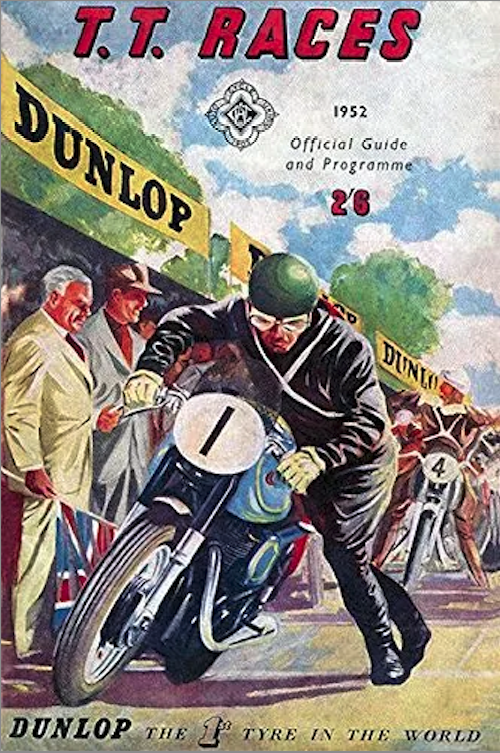

“THE INTERNATIONAL JUNIOR TT was contested under perfect weather conditions over dry roads. Geoff Duke (349 Norton) led throughout to win in 2hr 55min 30.6sec at 90.29mph. He did not set up a new lap record, perhaps because he suffered considerably from cramp. HR Armstrong, Ireland (349 Norton) was second in 2hr 56min 57.8sec at 89.55mph. Third man was R Coleman, New Zealand, on an AJS, in 2hr 58min 12.4sec at 88.93mph. WA Lomas (AJS) was fourth at 86.26mph, S Lawton (AJS) was fifth at 84.71 mph and G Brown (AJS) sixth at 84.50mph. There were no serious casualties. Eighty-three riders started, of whom 51 completed the course. Silver replicas were awarded to all who finished within 3hr 13min 3.6sec of the winner, while bronze replica time was 3hr 30min 36.6sec. No team qualified for. the Manufacturers’ Team Prize; the Club Team Prize was won by Dublin &DMCC (WAC McCandless, HR Armstrong and C Gray). Soon after dawn, a sizzling sun blazed down upon Mona full of almost tropical promise to the unparalleled crowds who jammed every popular perch round the circuit. More folk arrived by the early boat specials. Standing accommodation at Governor’s Bridge was packed solid two hours before the start. The 1952 Junior may well go down in history as the race without the stars. We have lost many famous men during these post-war years—Daniell, Lockett,
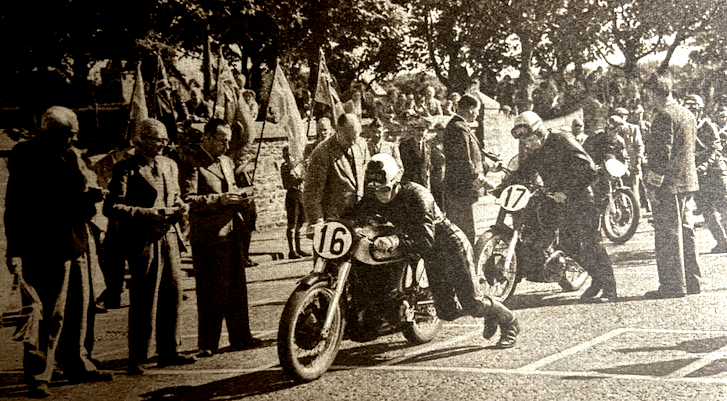
Frith, Bell, Foster and Lyons. Duke has more than filled one gap. Les Graham was a World’s Champion three years ago. But this Junior contains only two truly established stars. The pundits regard it as a star factory full of budding starlets—Brett, Parry, Lomas, Armstrong and three Commonwealth aces Coleman, Amm and Kavanagh. Conditions are perfect—a cloudless sky, roads like carpets, brilliant sunshine, and a faint northerly breeze to temper the heat. The 11 non-starters include Marsh, Doran, Flores of Spain, Stevens who weighed-in with a patch on his eye and was excluded by the doctors, Laing, the Australian, Featherstone, Storr, Mooney, Barrington and Wagar of Canada. It is a grievous shock to all that Doran is still unfit to ride after his practice crash. Ten minutes before the start the trench formed between the scoreboard and the grandstand was cleared for the beflagged battalion of 83 helmeted gnomes suggestive of invading paratroopers from some hostile planet. The met people foretold a fine day, and the sun was already softening the tar at a few named points. The start went like clockwork, except for EA Barrett (Norton) who had magneto trouble on the line, and for ‘Franklen’ (AJS) who paused at his pit for several minutes and finally broke a sparking plug off in the cylinder head. Barrett is an unlucky starter, for he broke a connecting rod clearing the grid last year. The dials indicated very little trouble during Lap 1. Duke at No 1 was, of course, first man through. His speed, 90.27mph from a standing start. WR Aram (Norton), South Rhodesia, was next man to pass through the start—very fast. McCandless (Norton) stopped to pick up a gallon of petrol for some mysterious reason. Times were hoisted—Amm, 39 seconds behind Duke. A long wait—nobody gets closer up on Duke; Brett is one second slower than Amm. Meanwhile LD Gilbert (AJS) retires unhurt at the Gooseneck. All the incomers are 26 and 27 minutes—nobody hustling the Duke! At last the New Zealander, Rod Coleman, arrives a mere 35 seconds astern of the flying Norton. Armstrong, Kavanagh and Lomas are also well up. The position resembles the tactics pursued by Duke in the 1951 Senior—to build up a dominating lead by lapping nearly 40 seconds better than his nearest rivals. RDK Holier (Norton) from New Zealand retires with a seized engine just as Duke completes his second lap in 24min 53sec, 91mph. The leader board shows three Commonwealth riders, Coleman, Amm and Kavanagh in the first six places—a grand showing. Apparently nothing is to be close today Brett and Coleman on
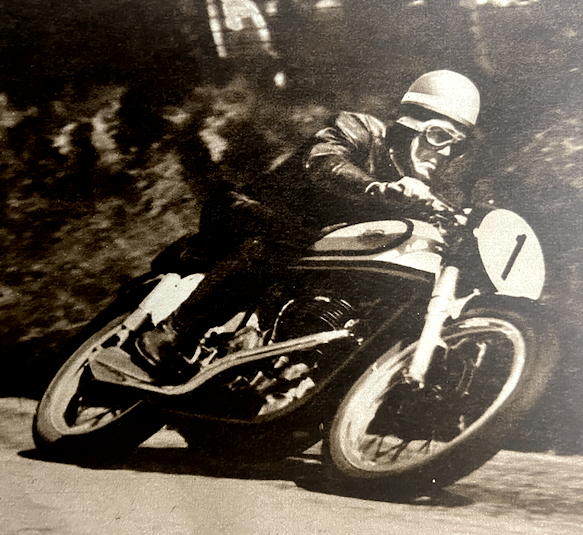
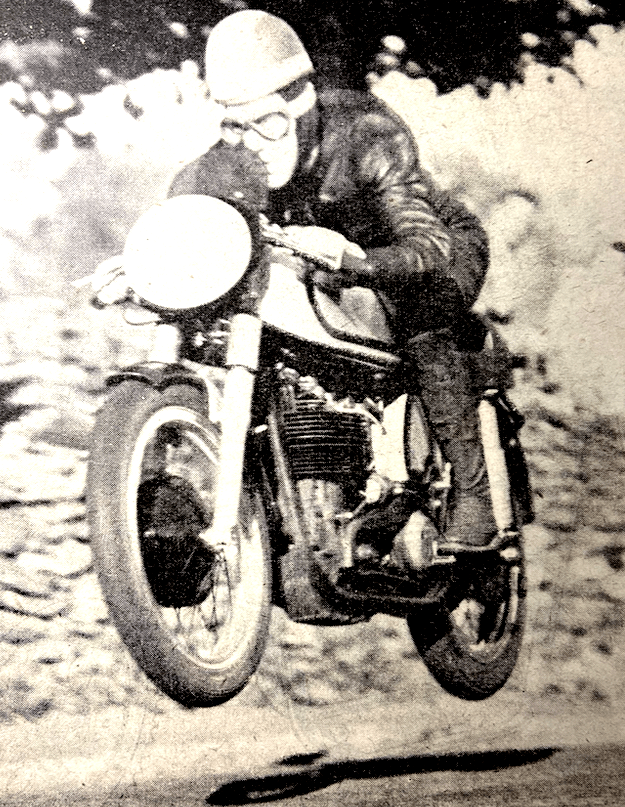
the AJSs are trapped within a clump of Nortons. Duke went very well on Lap 2. Everybody else seems rather outclassed at the moment and even if Duke were to stop, a flock or Norton vultures would still encircle Coleman and Brett on the AJSs. Meanwhile MV Lockwood (AJS) retired after a spill at Michael and suffers a few abrasions, and M Cann (AJS) gave up at the pits with faded brakes. Les Graham’s foul luck continued, and he also retired at the pits; Velocette hopes died with his disappearance—his rear chain came off at Governor’s Bridge. A Jones is tinkering with his Norton at Ramsey. Though the lack of individual competition produces rather a flat race so far, riding standards and speeds are nevertheless excellent. The situation resembles one when Bradman was at Lord’s and in his prime. On the other hand, we see the two fastest Ajays, Coleman and Brett, plus the Nortons ridden by Amm and Armstrong, share a six-second bracket on Lap 1. They are changing order a little on this second lap. But for Duke’s domination, it would be a thriller. Maybe somebody is even now going to hunt Duke. In two laps, Brett is 52 seconds astern. WC Hancock (Velocette) retires with engine trouble. VH Willoughby (Velocette) retires with a broken chain near Ramsey, and T McEwan (Norton) retires at the pits. As the late starters come through, it is seen that Brett and Armstrong have improved their placings at the expense of Coleman and Amm. Most riders picked up fuel at the end of Lap 3, and variations in their pit work clouded the real situation. The first shock is the retirement on his fourth lap of Amm, the Rhodesian champion, who comes off at Braddan Bridge when lying fifth at a speed of 89mph. RH Pike (BSA) one of our stoutest veterans, retires at the pits. The Canadian, R Godwin, falls at Governor’s Bridge, damages his Norton and he, too, retires. If this race is to convert startlets into stars, the process seems to be operating best with Commonwealth men who have solid block of three not far behind Geoff Duke. Lower down the list comes a block of four AJS 7R models, headed by Lomas and Lawton. Tenth man is another AJS, and an Australian at that—E Ring is a newcomer to fame. Parry of the Norton team is not quite so fast as expected. There is, so far, a welcome immunity from serious troubles, especially as the riders are cutting out a speed of nearly 90mph, which is high for the Junior. Suddenly a real catastrophe—if we may anticipate for a moment. The leaders are actually on Lap 4 as we watch the higher numbers complete their third lap. And news is phoned in that Jack Brett has retired at the Stonebreaker’s Hut while lying second at over 89mph. This lets Armstrong up into second place. Coleman is now the most forward A.J.S. star. He is through at 88.41 on Lap 4, but two minutes one second astern of Duke, not to mention Armstrong, who is now sandwiched between them. Duke would be well advised not to go for records today. The juniors of his team are not experienced aces and he has presumably been tipped to ride at what is, for him, rather a canny speed. Robin Sherry makes rather a prolonged pit pause—looks as if his pals are discussing ‘engine’
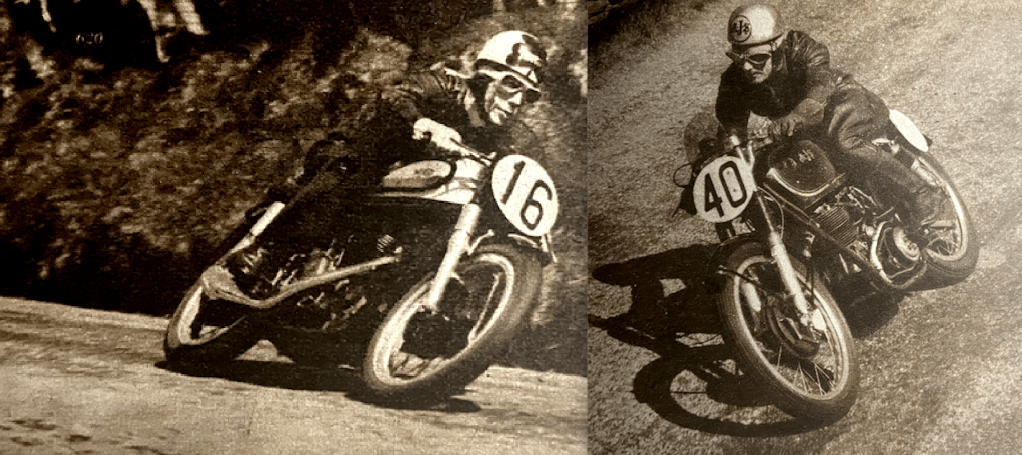
with him? The sunshine is as bright as ever, but the north wind has quite a nip. It should not be strong enough to trouble the riders anywhere, and may even help to keep the tar firm. The pit work is uniformly good. There are very few close duels past the pits, and the riders pass by at such high speeds that it is quite difficult to read their numbers broadside on. Note that Sandford has now entered the leading 12. Robin Sherry is 13th and McCandless must be detuned to be as low as 14th. Behind him come Mudford and Carter, both averaging over 82mph. So far, about a score of retirements have been boarded. CF Salt’s Velocette drops out at the pits with chain trouble. Lomas, riding the new factory AJS in lieu of the injured Doran, rises at last to fifth place on Lap 4, well-earned by his average speed of 85.84mph. Behind him, comes S Lawton who lies in sixth position at 85.02mph. Meanwhile, Duke is still casually hanging on to a cosy lead without in the least flogging a willing engine. There is nothing to flutter our pulses, but the average speeds are thoroughly spectacular for the crowds assembled at the several corners such as Hillberry. WAC McCandless (Norton), who seemed slowish last circuit, is now obviously afflicted by a misfire. HR Armstrong (Norton) must be kicking himself that he surrendered as much as 41 seconds to Duke in Lap 1. S Cooper (AJS) retires at Ballaugh with a seized engine. Coleman, in third place, is two whole minutes behind Duke; he can only have hopes if Duke breaks down. But there are still three laps to go, and anything may happen. ST Barnett (AJS) retires at Quarter Bridge with engine trouble. Reports round the course say that G Brown (AJS) is riding superbly. He has jumped up to eighth position on this lap at 84.23mph—he seems equally at home on a 350cc or a 998cc. The fifth lap was ‘sedate’ so far as the leaders were concerned. Each held his place. No substantial changes in speed occurred. All leaders were within nodding distance of about 90mph. Such consistency exerts a weird effect on the beholder. It creates the illusion that nothing much is happening except retirements. HR Armstrong (Norton) passed in lovely style, his engine revving as silkily as ever. For some queer reason, Duke’s engine, for all his tremendous speed, seemed quieter than the average, as if he had found the perfect revs to suit his megaphone. There is, of course, no mistaking the champion even on the straights—minimum frontal area, no raising of the head, no humping of the back, elbows well in, legs practically invisible. England, Ireland, New Zealand and Australia still filled the first four places. Norton, Norton, AJS, Norton was the machine order, and these four leading numbers seemed to circle with the unvarying dependability of the sun itself. The consummate ease with which most engines restarted after their pit stops was impressive. Are we promoting starlets today? Well, Nos 2-6 were hardly genuine stars yesterday, yet, at the end of Lap 6, the sixth man, S Lawton (AJS), was little more than eight minutes astern of Duke. And now a savage disappointment—some of the early numbers are already well advanced on their last lap while we watch late starters completing their sixth lap. Ken Kavanagh (Norton) has been compelled to retire while
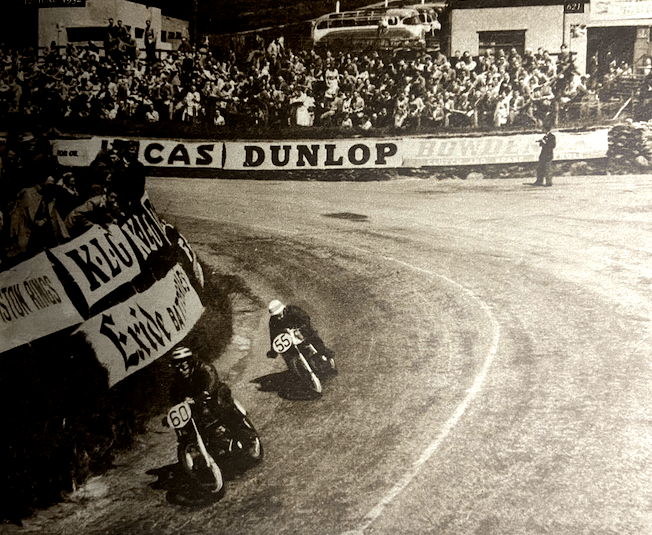
lying fourth at 87mph. Cruel luck, digger! A fine race, and everybody wishes you a fast finish on Friday! The pursuers will be under no illusion as they leave on their last lap. Armstrong, as second man, cannot hope to peel one minute 23 seconds off the Duke in one lap. He has reeled off three laps at over 90, but a slow start makes his average below that coveted figure. Those signallers who nurse men with replica ambitions are very busy at this moment. Geoff Duke has just rode home non-stop amid a storm of plaudits in 2hr 55min 30.6sec at an average speed of 90.29mph. He rode like the supreme genius that he is, and only once, when slowed by a pit stop, did his lap speed drop below 90mph. But the very instant after he finished, we saw a stopwatch boffin get very busy. The boffin was working out the replica times—which are proportionate to the winner’s time—and hastening to signal to his replica clients that the maximum time for a silver replica this year would be 3hr 13min 3.6sec, and for a bronze replica, 3hr 30min 36.6sec. HR Armstrong (Norton) was eventually beaten by Duke to the tune of 1min 27.2sec. This gives Armstrong full stellar status; but we still wonder precisely why he let Duke snatch 41 seconds from him on Lap 1. Rod Coleman must be very pleased with himself, and AJS must be very pleased with Coleman. He could not quite hold the second place which he collared on Lap 1, but third is good enough, and his time for first and second will come along in due course. He only just missed a 90mph lap and a 90mph lap is quite something. Promotion brought quick success to WA Lomas (AJS). We all knew he was good, and fourth place at 86.26mph will undoubtedly qualify him for more factory mounts. S Lawton (AJS) averaged 84.71mph to finish fifth. A superb race, with nobody badly hurt. Though we all relish a close finish, and an even division of the chief spoils between several makes, we could not complain of Monday’s sport.” RESULT 1, GE Duke (Norton),2hr 55min 30.6sec, 90.29mph; 2, HR Armstrong (Norton); 3, R Coleman (AJS); 4, WA Lomas (AJS); 5, S Lawton (AJS); 6, G Brown (AJS); 7, WAC McCandless (Norton); 8, E Ring (AJS); 9, CC Sandford (Velocette); PH Carter (Norton).
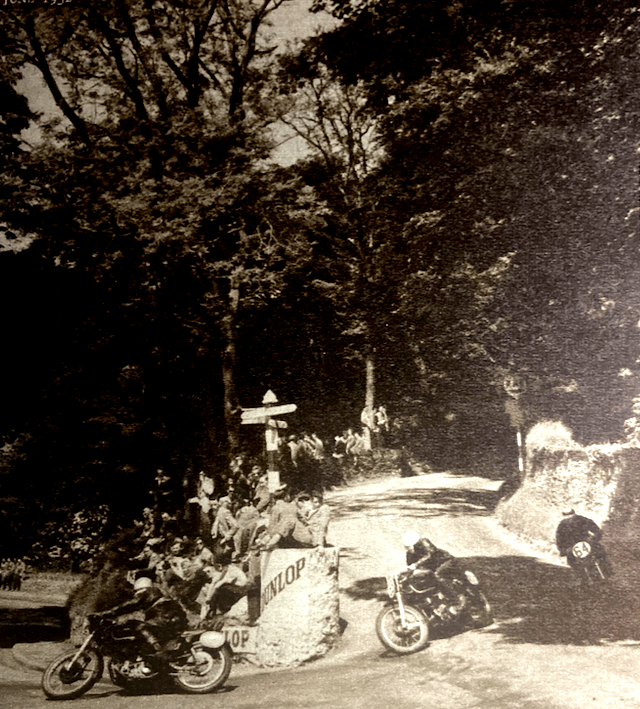
“FIRST MAN HOME and winner, Geoff Duke, said he had had a trouble-free run as far as his machine was concerned. The Norton had been running happily throughout, and Geoff thought that, if necessary, he could have driven it slightly harder. He had, however, been bothered from the end of the first lap with cramp in the right leg. Reg Armstrong, who finished second, reported that everything had gone like clockwork. He had had no worries and the machine had, in his own words, ‘gone like a bird’. Third man, Rod Coleman, also said he had had no worries over the machine. The AJS had run perfectly throughout. He had experienced a little excitement on Lap 2, however, when motoring through Laurel Bank at a speed in excess of 80mph—he had got into a rear-wheel slide. Fortunately he was able to stay in command of the machine—after wearing out a certain amount of boot leather!”
“WHEN THE ENGINE of Geoff Duke’s Norton was stripped for examination, the combustion chamber and piston crown were found to be in perfect condition. There was no sign of heat whatever. The polished surfaces were an ebony colour, and the rear part of the piston crown and cylinder head was faintly oily. The primary chain was very, very slack yet, oddly enough, the rear chain was in perfect adjustment. Brakes and clutch, too, were in excellent order. The tyres were good enough for a further seven laps. The interior of the cylinder head of Armstrong’s Norton indicated that the engine temperature had been higher than Duke’s, and the engine appeared to be generally dry. Some whiteness on the valve heads suggested that the mixture may have been just slightly weak. The rear tyre was flat—it deflated after the machine had been wheeled into the examination tent. Otherwise, the entire machine was in magnificent condition. Coleman’s triple-knocker AJS was in such good order that it appeared not to have been driven hard at all. Indications seemed to point to the fact that the engine might well have been running too cool for maximum efficiency. Chains were in perfect adjustment. Not more than 2mm had been worn off the rear tyre. Brakes and clutch were in spot-on condition.”

“MONDAY AFTERNOON’S JUNIOR Clubman’s race promised as much excitement as its international forerunner of the morning. The record lap of 29min 35sec (76.55mph), made in 1951 by KRV James (Norton), of the Ringwood Club, had fallen four times in practice. The scintillating quartet who had beaten it were James himself, again Norton mounted, R McIntyre (BSA), Glasgow Mercury Club, D Ennett (Matchless), Peveril, IoM, Club, and R Jones (BSA), of the Salop Club. They would obviously be out for blood today. The sages promised a win for James, who had retired when in the lead in the 1950 and 1951 events. Of the entry of 100, there were 96 starters, 20 more than for last year’s event. Clubs from all over the country were represented. Club-mates of competitors lined the course four deep to cheer their champions. For them the Clubman’s race has a special significance. Many of them regard it as their private party. Every clubman worth his salt regards his club as the best there is and, given a clear run, Tom or Dick or Harry, or whatever his name may be, is going to prove it today. The vast crowd has a brief respite, after the international Junior Race, for a sandwich and a cup of tea, while back at the start the giant scoreboard is cleared of its story of the epic morning’s event; and the fuel containers are drained of their 80-octane fuel and replenished with the Pool petrol stipulated for the Clubman’s race. When the first maroon crashes, the flags behind the pits are more active than they have been all morning. A chill breeze had sprung up, and the sun’s brilliance had diminished. However, the outlook remained promising. The starting order is three riders away every thirty seconds; though a few machines are reluctant to be under way, the majority fire readily enough. Group by group, the cavalcade speeds towards Bray Hill. The early starters’ clock-pointers signal no surprises and neither D Ennett nor KRV James do any overtaking before Ballacraine, though James is into Kirkmichael (14 miles)
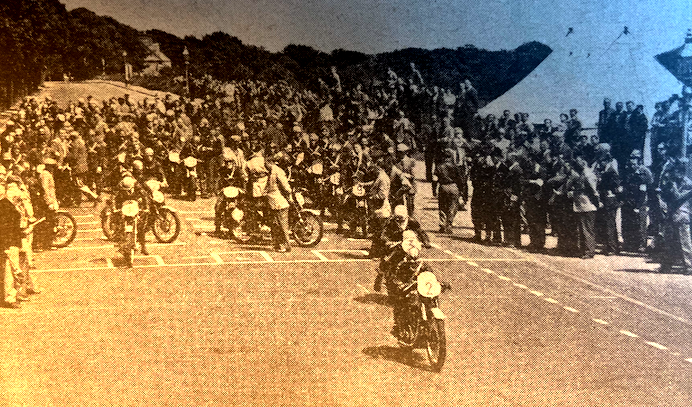
ahead of GE Parry (BSA) and HR Collier (BSA), who started half a minute ahead of him. Both H Nowell, a 53-year-old, and F Nowell, his son, aged 22, the former on a Norton and the latter on a BSA, got away to good starts. The Nowells are an enthusiastic family; father Nowell’s other two sons are in the pits. First to complete a lap is B Millman (BSA) of the West of England Club, whose time for the lap is 30min 19sec, a good average without fireworks. This early, news of retirements begins to come in. D Shepherd (BSA), of the Southall Club, and R Capner (BSA), the Whitehaven Club, go out with engine trouble, the latter between Ballacraine and Kirkmichael. Then J Winterbottom (Royal Enfield), of the Sheffield North End Club, retires in Glen Helen—rider OK. The hopes of the Farnham Royal Club were dashed when PK Cruse (BSA) was announced to be stopped at Kirkmichael and trying to effect repairs. By the end of the first lap the pattern of the race begins to form itself. E Houseley (BSA), Chesterfield Club, reels off the fastest lap in 28min 38sec—a speed of 79.09mph. Second, 12 seconds in his rear, is R McIntyre (BSA) and then comes KRV James (Norton) only three seconds slower. Fifteen seconds between the first three men spells racing of the highest calibre. Fourth, fifth and sixth men are DT Powell (BSA), Leamington Club, D Ennett (Matchless), Peveril, IoM, Club, and R Ritchie (Norton) 0WLS Club. A time bracket of 55 seconds covers the leading six men. Speeds are varying between 79 and 76mph—which is excellent going for standard 350s. There is jubilation from the permanent population of the Isle of Man that Ennett is doing so well. Retirements pile up, tumbling the hopes of clubs from every quarter. EJ Holcroft (BSA), Leamington Victory, is stopped at the Craig with petrol-feed trouble; JG Poingdestre (BSA), of Jersey, retires because of a broken oil pipe at the Stonebreaker’s Hut; DG Chapman (Douglas), South Reading, comes into the pits to retire. Indeed, retirements are so numerous that there is a constant flow of announcements over the loudspeakers. H Plews (Norton), pushes his way into seventh position with an opening lap of 29min 41sec. On Lap 2, E Houseley (BSA) retains his lead though easing off slightly and lapping wisely no faster than he need. Reports from round the course suggest that he is riding as to the
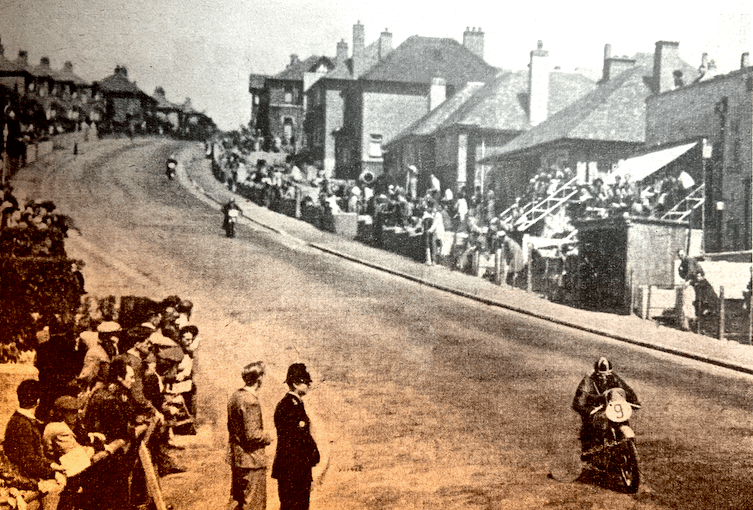
manner born. Then James spurts and pushes into second place only nine seconds behind the leader and 15 seconds ahead of McIntyre. Powell retains fourth place. Ennett fifth place and Plews eases his Norton into sixth position. The order is BSA, Norton, BSA, BSA, Matchless and Norton. Behind Plews is Ritchie, CE Staley (BSA), Market Drayton, H Brown (BSA), Berwick Club, L Broughton (BSA), Southampton Vikings, HA Voice (BSA), Bishops Waltham, who had never seen the course before practice began, and Chapman. Though the list of retirements continues to build up, the leaders speed on untroubled. On his third lap Houseley opens the taps and screams off a lap in 28min 29sec, 79.51mph, to topple the lap record, and James could do no better than 29min 18sec, 77.29mph. It might be that James hesitates to extend himself fully, remembering his ill luck in the previous two events, but it seems more probable that he is down on speed. The third and fourth men retain their positions, though Powell picks up four seconds on McIntyre. Then Staley laps in 29min dead and moves from eighth into fifth position. It seems now as though Houseley, 23-years-old and a motor mechanic, who rode in the 1950 and 1951 events, has the race in his pocket. The crowds lining the course seem to think so too, and begin to wend their ways back toward Douglas. Even the crowds behind the pits thin perceptibly. The biggest surprise of the lap comes when R Jones (BSA) of the Salop Club rips round the circuit to such tune that he hoists himself from 13th place to seventh, sits in behind Ennett, and is only 40 seconds in arrears of him on corrected time. MEJ Taft (BSA) of Ilkeston is another to dig in his spurs and he appears among the elite leading dozen—in ninth place. Ritchie is 10th, Broughton 11th and Voice 12th. In 13th position lies C Ellerby (BSA), of the Scunthorpe Club, and chasing him are ED Blackwell (BSA), Leamington Victory, and ST Seston (BSA) of the Kings Norton Club. Houseley makes no mistake on his final lap. He circles in 28min 44sec, 78.80mph, which is a shade slower than his third lap. The loudspeakers announce that he cannot now be beaten on corrected time. James rides stylishly and well, and the pundits prophesy that he will qualify for a factory ride in due course. James, however, misses second place. McIntyre puts everything he knows into his final lap. He circles in 28min 16.4sec, at a speed of 80.09mph, and a new record lap for the race is established. It is well worth the effort because he beat James handsomely. One by one the field comes in. Machines sound as healthy as when they started. The scoreboard is sadly marked with vertical white lines signifying retirements; there have been no serious spills at all. But Freddie Frith, travelling marshal, reports this late three more retirements. Staley beats Powell for fourth place and Plews finishes sixth. RESULTS: 1, E Houseley (BSA), Chesterfield, 1hr 54min 25.2sec, 78.92mph; 2, Bob McIntyre (BSA), Glasgow Mercury; 3, Ken James (Norton), Ringwood; 4, CE Staley (BSA), Market Drayton; 5, Derek Powell (BSA), Lymington; 6, Harry Plews (Norton), Wakefield; 7, Harry Brown (BSA), Berwick; 8, R Jones (BSA), Salop; 9, Bob Ritchie (Norton), 0WLS; 10, Eric Jones (BSA), Manchester; 11, JR Clark (Norton); 12, L Broughton (BSA), Southampton Vikings.”
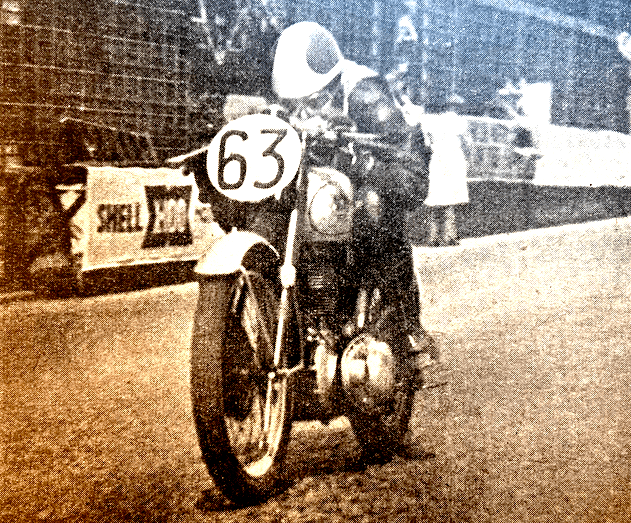
“THE WELL-KNOWN British rider CC Sandford to-day won the Ultra-Lightweight TT at record speed on an Italian Agusta which was originally entered as Les Graham’s mount. Sandford beat off the Mondial challenge and with a lap record on his second circuit he had a comfortable win. Right from the start Sandford put the Agusta in front of the Mondials, and the excitement in the Agusta camp was intense when it was seen that on the first lap he was approaching Cromie McCandless’s winning speed last year and had a lead of 40 seconds over the nearest Mondial, world champion Carlo Ubbiali. Sandford broke the record on his second lap by 17 seconds. at 76.51mph and then had the comfortable lead of over a minute. In the 125cc race the international flavour was supplied by Britain, Italy and Ireland. Men were dispatched at 10-second intervals as usual—there were 17 starters, and within a few minutes there were only 16, as G Newman, on a Dot, packed up at the pits. Sandford, riding Les Graham’s Agusta, was going ‘great guns’. He passed seven men before Ballacraine, and he passed even more before he reached Michael. Favourite was the Italian,
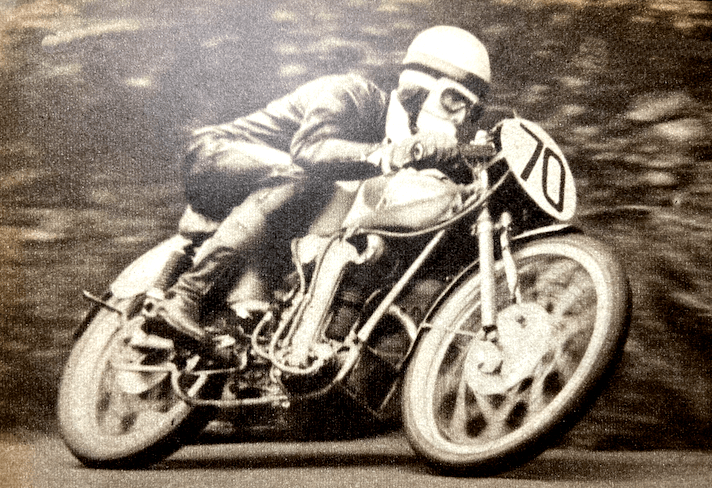
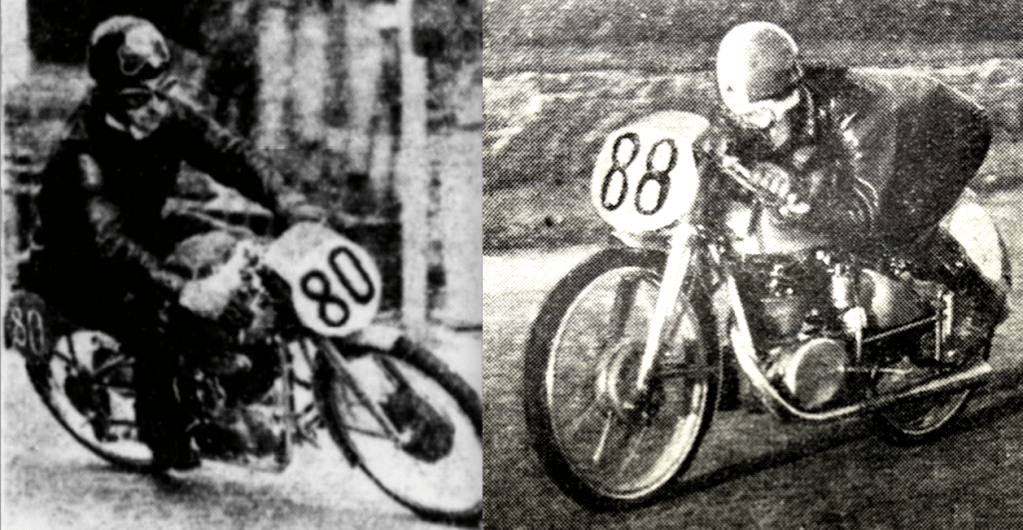
Ubbiali, riding a Mondial, and he was certainly not letting grass grow under his wheels. Last competitor to start, he was the fourth man signalled at Ramsey. A keen race was on between AL Parry (Mondial) and Sandford. They were signalled at Governor’s Bridge simultaneously and passed the Start with Parry leading on the road, but Sandford started 1min 10sec after him. At that time Ubbiali was signalled at the Creg. His was certainly a terrific performance, but it was not terrific enough. He came past the Start to complete the lap in 31 minutes, but Sandford was 30min 11sec, and so led the race. Cromie McCandless (Mondial) was fourth man, with a lap of 31min 38sec. First news on the second lap was that Parry had stopped at Quarter Bridge, had made adjustments and proceeded. As Sandford had followed him down Bray Bid he would probably see that one of his nearest rivals had a mechanical problem to solve and while we waited for the stars to do their stuff on their tiny motor cycles there was time to note that W Hall, on a Royal Enfield, had retired on his first lap at Ramsey with engine trouble, and that M Sunderland, on an Anelay, had stuck at Governor’s Bridge to make adjustments. MN Mavrogorato (EMC-Puch also appeared to have engine trouble below the Creg, had stopped, but had eventually proceeded. All the other men were well away on their second lap. The head wind on the Mountain must have troubled them a great deal, and consequently the journey from Ramsey was relatively slow, but Sandford ‘stepped on it’ all round the course and created a fresh record by lapping In 29min 48sec, an average speed of 76.51mph, thus knocking 17 seconds off the record set up by Cromie McCandless last year. McCandless, by the way, had now crept into third place with Ubbiali still hanging on to second place. The Italian’s lap time was 30min 26sec which bettered his time
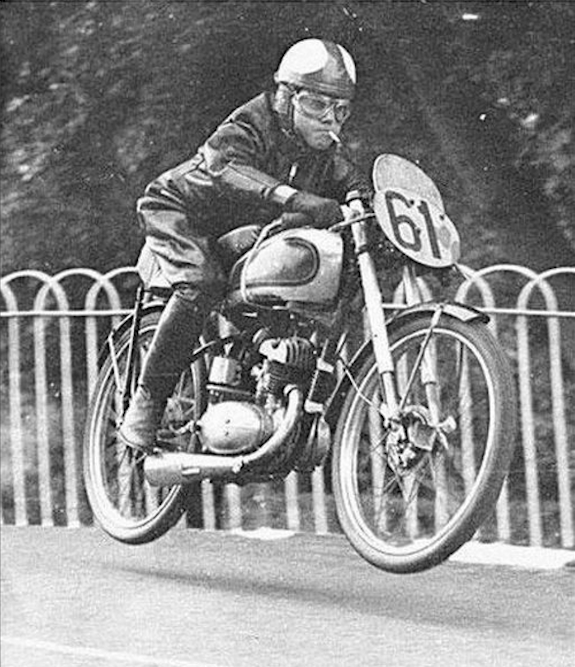
on his first circuit. Parry went through the Start going well. Sandford streaked away on this the last lap for the ‘Tiddlers’ and won the race—so it was an Anglo-Italian victory. He fled round the course crouched low over the handlebars, an easy winner and a popular one. Sandford had finished the course when it was announced that Milton Sunderland had parked up at the Highlander on his second lap. This was the first year in 18 entries that Sunderland had failed to finish the distance. There was drama too in this last lap. Cromie McCandless. who had crept into third place by reason of Parry’s stop at quarter Bridge, was signalled pushing in from Governor’s Bridge, so Parry came into his own again. The first three men to finish were Sandford, Ubbiali and Parry. So fast did the leaders go in the Ultra Lightweight TT race that very few riders received replicas as the times for which are harnessed to the winner’s time. Only the first five received first-class replicas, and there was a lone second-class replica, FH Burman, who finished sixth. Of 17 starters, 12, or nearly 71%, finished. Replica times were 1hr 38min 54.2sec for first class and 1hr 47min 53.6sec for second class.” RESULTS: 1, Cecil Sandford (MV Agusta), 75.54mph; 2, Carlo Ubbiali (Mondial); 3, Len Parry (Mondial); 4, Cromie McCandless (Mondial); 5, Angelo Copeta (MV Agusta); 6, Frank Burman (EMC-Puch); 7, Harvey Williams (BSA); 8, Howard Grindley (DMW-Royal Enfield ); 9, Noel Mavrogordato (EMC-Puch); 10, Eric Hardy (Dot).”
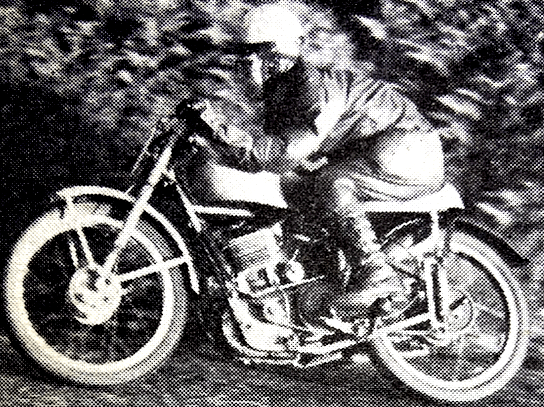
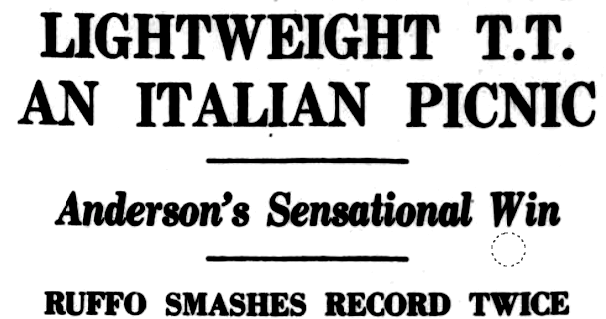
“WHICH GUZZI? THAT was the only question in the LIGHTWEIGHT TT, [according to theIsle of Man Times] and Bruno Ruffo, the 1951 world champion in this class, nearly supplied the answer with record laps in the second and third circuits, which gave him a lead he never lost until the last lap. Then came the sensational report that he had been given a wrong signal and was slowing down, but from the Gooseneck he was reported to be ‘touring’. This let in Fergus Anderson to win from team-male Lorenzetti. An Englishman from Italy, Anderson has been road racing since 1931, and has won many events in England, Europe, and Australia. He became the first Britisher to win a 250cc race in Italy for a quarter of a century by winning the 250 Circuit de Ferrara in 1950. He retired in the 1951 250cc Lightweight TT after leading for two laps, and held the lap record at 83.7mph. This was his first TT win, and at 43 years of age he became the oldest man ever to win a TT race in the Isle of Man. Only 32 seconds behind came Lorenzetti in 1hr 48min 40.8sec at 83.36mph, with Sid Lawton (Southampton) third in 1hr 49min 43.2sec, 82.54mph. Fourth, fifth and sixth were Les Graham (Velocette), Maurice Cann (Moto Guzzi) and Bruno Ruffo (Moto-Guzzi) respectively. So Moto-Guzzis occupied five of the first six places…How different was this day from that of the Junior Race. The sun hid behind grey clouds and a cold wind played round the Grandstand. But it was an ideal day for racing. At 9.45am the starter’s flag dropped to unleash the first machine, a Pike-Rudge, who shot away into the first lap of this four-lap, 151 miles race, over one of the toughest courses in the world. Sixth away was Maurice Cann, the 1948 winner, and the man with the most knowledge of the course, and only 10 seconds behind him Enrico Lorenzetti, one of the Italian aces, sped away towards Bray Hill. There were prospects of a duel here, although Moto-Guzzi against Moto-Guzzi was not so thrilling as an Italian machine versus a
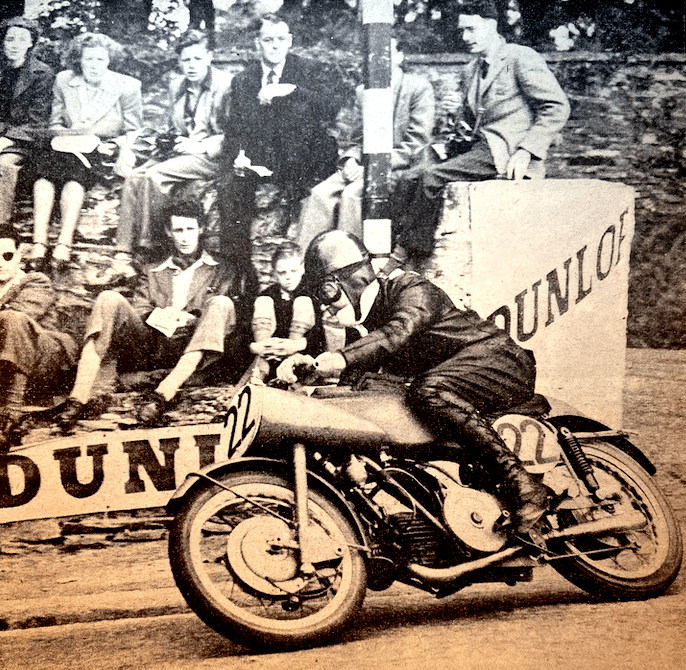
British. One race within a race could be that between F Anderson, a prospective winner, and RL Graham, the one British rider on a British machine expected to be amongst the leaders. All the competitors in the 250cc race had been despatched in less than 10 minutes. First through the Start was Lorenzetti, who had overtaken six riders on the first lap. Hugging his back mudguard was Wheeler, and hot on his tail, only a few seconds behind, came Cann. Anderson was also going great guns. Starting 19th, he was fourth through the Start, crouching over his little red machine, and another rider, Bruno Ruffo, (Italy), the little man with the big chance, was also setting up a fast pace. In the first lap he had passed many riders. From the start Moto Guzzis almost monopolised the leader board, with Fergus Anderson, lap record holder, in the first place. Would records be broken? That question could almost be answered in the first lap. From a standing start Anderson returned a lap of 27min 19sec, only 16sec outside the record. His speed was 82.9mph. Only 18sec behind in second place, Lorenzetti covered the first 37½ miles in 27min 37sec (82.01mph). Ruffo, world champion, showed his prowess by occupying third place in 27min 38sec (81.96mph). The only British machine in the first six was a Velocette ridden by Les Graham who lapped in 27min 57sec (81.01mph) to take fourth place. A red streak shot through the Start, followed by another and another. Enrico Lorenzetti, a bundle of leathers sandwiched between a red helmet and a red machine, had completed his second lap. He was first on the road after having started seventh. Close behind came Maurice Cann, who was throwing his machine round the corners in pursuit of the elusive Italian who had passed him. Wheeler followed soon after, with Anderson, who had passed 15 other competitors, fourth. RE Geeson (REG) retired at the end of his first lap. The rider was OK. Despite the strong head wind on the mountain, Anderson had lapped in 27min 6sec, only three seconds slower than the record. Surely the lap record would be broken next time round. But no, wait a moment. An excited announcer informed us that Ruffo, his team-mate, had smashed it on his second lap by no less than 17 seconds—no half measures for Buffo! His time, 26min 46sec, an average speed of 84.6mph, caused speculation as to whether a rider would complete the lap at an average speed of 85mph. Ruffo’s record lap had promoted him from third to first place with a one second lead over Anderson on growing time. On the previous lap Anderson had been 19sec
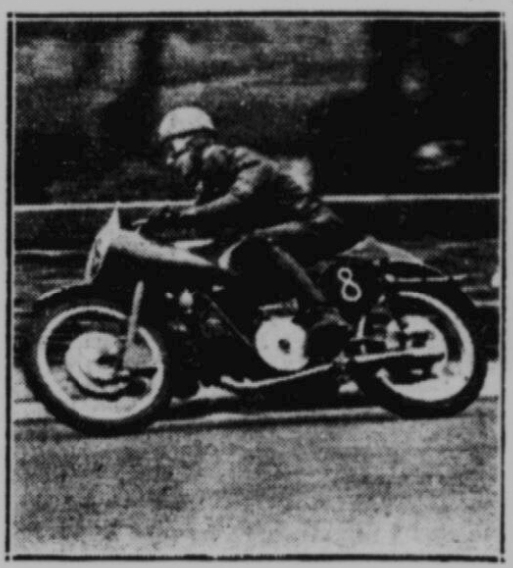
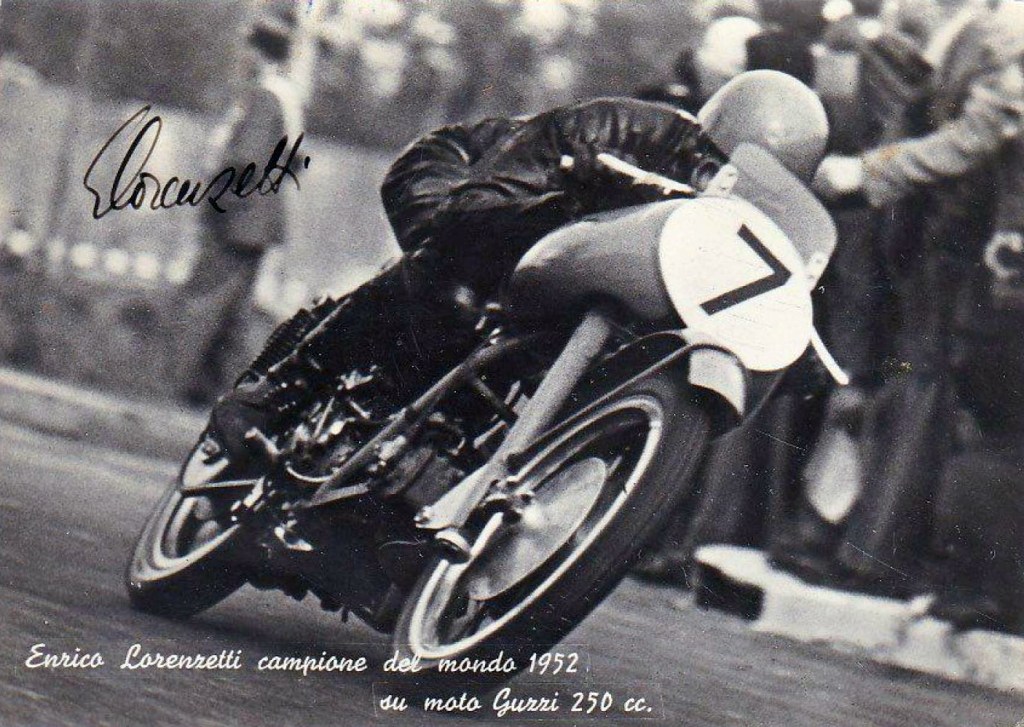
ahead of Ruffo—21sec behind Anderson, Lorenzetti, the third member of the No. 1 Guzzi team, had lapped in 27min 9sec (83.4mph). Still keeping the British flag flying was Les Graham (Velocette), who had retained fourth place, with a lap of 27min 28sec. With three-quarters of the race over, Ruffo mast have been in hurry to get back to the cocoa, for he broke the record set up less than half-an-hour previously. The lap of 26min 42sec clipped four seconds off the record, and increased his second lap lead of one second over Anderson to 20 seconds. Ruffo’s new record speed was 84.82mph. Although Ruffo was increasing the gap between himself and Anderson, the latter was speeding up. His lap of 27min 1sec bettered last year’s record by two seconds, and his lap speed was 83.8mph. Still in third position was Lorenzetti, who returned a lap of 27min 12sec, a speed of 82.80mph. The lone British machine ridden by Les Graham was holding fourth position, although falling behind all the time. He completed his third lap in 27min 33sec, a speed of 82.2mph, one minute behind Lorenzetti. Fifth man was S Lawton, who had changed places with Cann. On the fourth lap drama entered the race already made thrilling by record laps. Ruffo, the man who had thrilled the crowds with his speed and skill, had slowed down while other riders were going all out to win. He was reported to be touring at the Gooseneck. Anderson, greeted by applause, finished long before any other rider, soon after Ruffo’s misfortune had been announced. Ruffo eventually came through the Start and received a great ovation from the crowd. Why had he slowed down when victory was in sight? [It seemed that he had] misinterpreted a signal at Sulby, and had carburettor trouble. The official report was that he had received a wrong signal at his time station. He did not have engine trouble. That misunderstanding had lost Ruffo the race. Instead of finishing a comfortable winner, he came in sixth. Wheeler, who
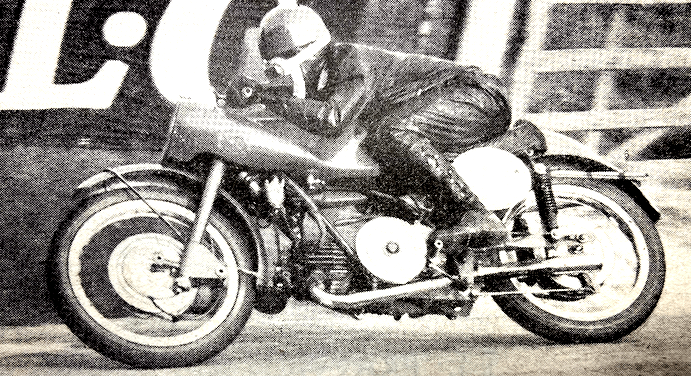
had occupied sixth place on the first lap, pushed in soon after with a silent engine, and the crowd applauded him heartily. Anderson narrowly missed beating the new lap record. He completed the lap in 26min 42.6sec, at 84.79mph, so although Ruffo had failed to take the first place, he still had the lap record to his credit. Lorenzetti was riding a very fast race and lapped in 26min 42.8sec, a speed of 84.78mph. S Lawton had pipped Graham on the last lap for third place by returning the very fast lap of 26min 42.2sec, only one-fifth of a second slower than Ruffo’s new record. His speed was 84.81mph. Graham finished fourth, the position he had occupied throughout the race, The last lap was covered by Graham in 27min 24sec, by Cann in 27min 32.6sec, and by Ruffo in the surprisingly slow time of 30min 20sec. A high percentage of the starters completed the four-lap 151-mile Lightweight TT Race. Of the 30 starters 22, or 73%, finished and the first seven received first-class replicas. The next 12 finishers gained second-class replicas. Replica times were 1hr 58min 57.4sec for first-class, and 2hr 9min 46.2sec for second-class.” RESULTS: 1, Fergus Anderson (Moto Guzzi) 83.62mph; 2, Enrico Lorenzetti (Moto Guzzi); 3, Syd Lawton (Moto Guzzi); 4, Les Graham (Velocette); 5, Maurice Cann (Moto Guzzi); 6, Bruno Ruffo ( Moto Guzzi); 7, Ron Mead (Velocette); 8, Ray Petty (Norton); 9, Arthur Wheeler (Moto Guzzi); 10, Charlie Salt (Pike-Rudge).
“THE CLUBMAN’S SENIOR TT (run over four circuits of the TT Course) must surely rank as one of the most exciting events in its history. HJ Hargreaves astride a Triumph led from the first (and incidentally put up the fastest lap of the day in his first circuit, 27min 16sec, average speed 83.05mph from a standing start), and ultimately finished the distance in 1hr 49min 50sec, an average speed of 82.45 mph, ahead of Ken James (Norton), his runner-up, by 38.6sec, whilst four seconds behind James came JR Clark with an average speed of 81.92mph for third place. The excitement of this race arose from the fact that seconds only separated the leading men, and Clark and Farrant stuck to each other ‘closer than brothers’ to such an extent, in fact, that spectators would not have been in the least surprised if their performances had resulted in a tie. However, as it turned out, Clark was able to get the extra ‘horse’ out of his engine, and pulled away to
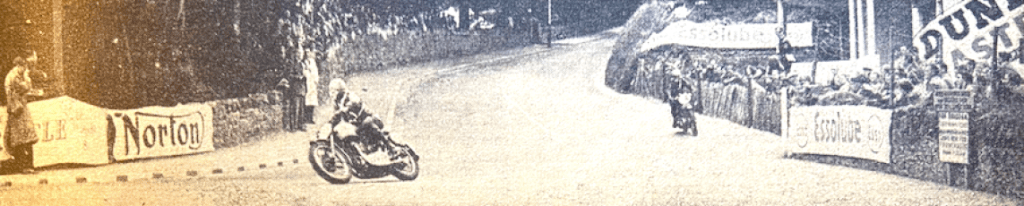
romp home as third man. The struggle between these two riders started as they went away from the starting squares (in the Clubman’s Senior the competitors were despatched in groups of threes), so Nos 4 Houseley), 5 (Farrant), and 6 (Clark) started together. It was not to be Houseley’s lucky day—he’d won the Clubman’s Junior and race crowds had thought perhaps he would have ‘done a Duke’ by pulling off a double, but it was not to be. At the end of the first lap he retired at the Start with a broken oil pipe. At Handley’s Corner the footrests of Houseley and Clark’s machines were locked together for 40 yards. The drivers stuck on their mounts, and eventually the footrests were released. To revert to Clark and Farrant, they went past the Start with one lap completed almost wheel to wheel. At the end of the second lap they pulled in for replenishments, again as close as brothers; they went away on their third lap simultaneously, and, for that lap. returned exactly the same time—27min 30sec (an honour which was shared by D Tye); and then on the final lap Clark pulled away from Farrant. The winner’s consistent riding was remarkable. From a standing start he put Up the fastest time of the race, 27min 16sec; on his second lap he did 27min 29 sec; on his third 27min 38sec and on his fourth 27min 27sec. Hargreaves stuck to his position throughout, as did James as runner-up, but there was a change in the other positions. Lap 1 saw Clark (Norton) as third, Farrant (Norton) fourth, D Tye (Triumph) fifth and H Plows (Norton)
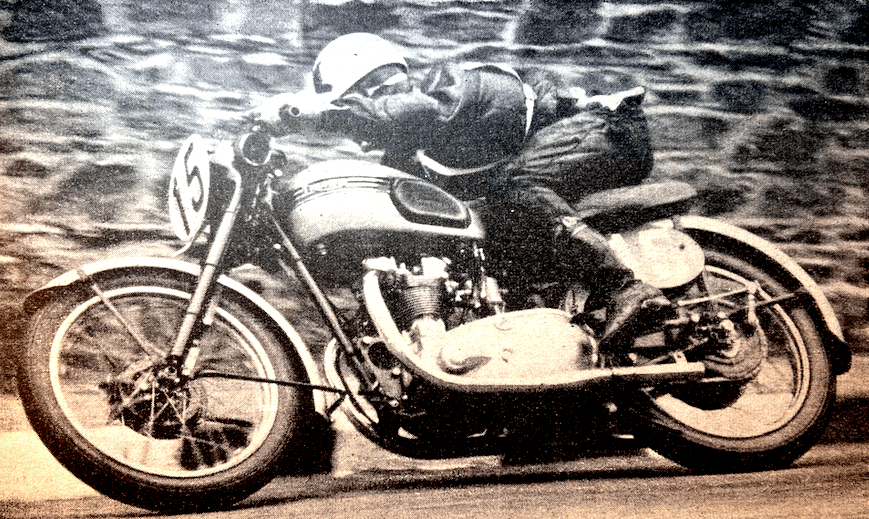
sixth. This order was maintained with half the distance over. but in the third circuit J Bottomley (Triumph) came up ‘out of the blue’ with a lap of 27min 37sec and ‘collared’ third place, thus relegating the rest of the leaders (Clark, Farrant and Tye) to fourth, fifth and sixth men. Even then the outcome was not sure, because at Handley’s Corner Tye (who had ridden a remarkably steady race) had the mis fortune to run out of petrol, and that let RWC Kerr (Triumph) into sixth place. There was only one accident. That occurred in the first lap to James Lanyon, the only Channel Islander in the race, front Guernsey. He came off at Signpost Corner and was taken to Noble’s Hospital, where it was found he was suffering from a crushed vertebra. There were other spills. DJP Wilkins (Norton) came off at Governor’s Bridge; commentator David Lay at Crook-ny-Mona, reported that AW Dobbs (Triumph) got into a colossal slide at that point of the course but managed to stay aboard; RF Keen (Triumph) came off at Windy Corms and damaged his machine but not himself, and KG Brough (BSA) came to grief at Glen Helen, but escaped with minor cuts. JE Williams (Triumph) came off at Parliament Square, Ramsey, on his first lap but was not hurt.” RESULTS: 1, Bernard Hargreaves (Triumph) 82.45mph; 2, Ken James (Norton); 3, John Clark (Norton); 4, Derek Farrant (Norton); 5, Jack Bottomley (Triumph); 6, Robert Kerr (Triumph); 7, Bob Ritchie (Norton); 8, DK Tyndale-Powell (BSA); 9, AM Cook (Triumph); 10,Bill Dobbs (Norton).”
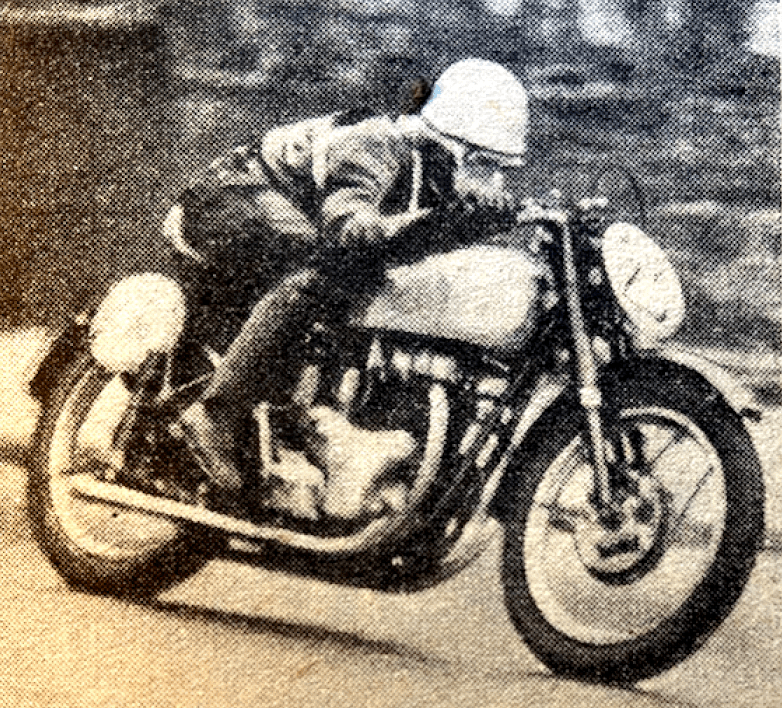
“BERNARD HARGREAVES. THE WINNER, was married in April. He and his wife deferred their honeymoon so that he might race in the isle of Man. She was the first to welcome him home safely—as well she might when she saw that the nut from his rear wheel was missing, and the rev-counter was swinging in front of the handlebars. With his right arm still disabled by an injury he received in last year’s practice Arthur Bint, of Reading, Berks, pluckily turned up again this year, this time as a mechanic for his friend, Jack Hill, of Reading, who rode a Triumph.”

HERE’S THE SENIOR TT REPORT, courtesy of the Isle of Man Times: “A 100mph lap? If that can be done, Geoff Duke is the man to do it, and the Norton, is the machine, but is today, Friday 13th, the day? We do not think it can be done this year, but by the time you read this we will know. A look at the course lends strength to our opinion. Seven times round the 37¾ miles circuit, which requires the rider to made 300 gear changes and take 200 corners each time, is enough to make anyone say ‘It can’t be done’. Eleven non-starters left 72 of the world’s most experienced riders in the race, led by Geoff Duke, No 1 on the road. Only three manufacturer’s teams, two Norton and one AJS, entered the fray. No 1 Norton team consisted of Geoff Duke, Reg Armstrong and Ken Kavanagh, and the second team was Ray Amm, ALParry and WAC McCandless. The AJS team comprised Jack Brett, Bill Lomas and Rod Coleman, the New Zealand ace. Ten club teams included the new Zealand ACU (Ken Mudford, Dean Hollier and Rod Cokeman), and the ACC of Australia (WA McAlpine, KT Kavanagh, and Ern Ring). At 10:30am the maroon fired and the starter’s flag unleashed Geoff Duke on the last stage of his bid to win the ‘double-double’ and his third successive Senior TT. For long he has been the fastest man on two wheels. Soon we would see whether this year he would become a faster fastest man. The weather report from Ronaldsway declared that it would be cloudy with light, variable wind. Drizzle was expected later in the afternoon. Mist patches were forming and dispersing quickly on the hills but whether they would envelope stretches of the mountain road was not certain. Reports from the travelling marshals indicated that the number of spectators was the greatest ever and a modest estimate was that 100,000 were watching. A telegram from Auckland, New Zealand, 12,000 miles away, wished all riders good luck generally and the New Zealand riders in particular. It was signed John Doe, a member of the 1950 team. Surprise was that Brett and Lomas, members of the AJS team, set off on last year’s machines, but Rod Coleman, the third member of the team, was astride the latest model. Les Graham’s beautiful red and silver Agusta, with its distinctive whine, got away quickly. According to the indicator clocks Graham made up time on Duke for the first stretch to Ballacraine, and Brett had passed five men before reaching Kirk Michael, and was second to Duke on the road. Graham’s clock showed him to be at Kirk Michael a split second before Armstrong, who set off 20 seconds ahead of him. Dennis Parkinson, the commentator at Ramsey, described Duke as going very quickly but his engine seemed to be misfiring, then came a long gap before he sighted the second rider, No 2, Phil Heath, who passed through 2min 15sec after Duke after starting 10 seconds after him, but what happened to Jack Brett? Several riders including McEwan, the

only local entrant, sped through Ramsey and still there was no sign of Brett. A thrilling spectacle, said Parkinson, was that of Graham and Armstrong rocketing through Ramsey together. They hung close together on the mountain climb but Graham seemed to forge head at the Mountain Box. Duke came through the Start in a posture that promised sensations to come. From a standing start he lapped in 24min 11sec, a speed of 93.64mph. Excitement mounted when Graham’s light was the next to flash on, indicating that he was passing Governor’s Bridge. He flashed through the Start second on the road, having overtaken 13 riders who started ahead of him. He completed the lap in 24min 27sec—16 seconds slower than Duke, with a speed of 92.64mph. Ray Amm threw his machine round the corners in spectacular fashion to pass 15 riders on the first lap. Brett came off at Closewood corner, near Sulby, having covered only 19 of the 264 miles of the race. He retired with two minor cuts on a hand, otherwise he was all right, but bang went the hopes of the AJS team, leaving only two Norton combinations to vie for the manufacturer’s team award. AL Parry, a member of the second Norton team, called in at Ballaugh and asked to see a doctor. He had not crashed but was feeling unwell and retired. That left only one manufacturer’s team, the No1 Norton team. Speaking from Ballaugh, Parry reported that he had a few ‘dimouts’ and did not feel too good. AA Fenn (Norton) stopped on the mountain to make adjustments. He proceeded but retired later at the Creg. Mechanical trouble in the form of a seized engine overtook HW Billington (Norton) at Gorselea. It put him out of the race, but he was all right. The end of the first lap found Nortons occupying five of the first six places, with Graham on his eye-catching MV Agusta in second place. Retirements at the pits included JA
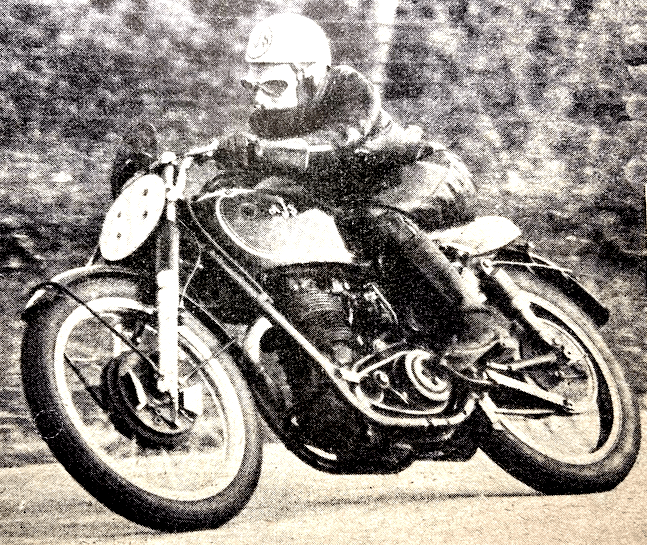
Pollott (Norton) with a broken chain, and EVC Hardy (AJS) with a broken primary chain. Having come all the way from Southern Rhodesia, NW Stewart (Norton) came off and retired at the Bungalow with minor injuries. The doctor was in attendance. He reported that Stewart had concussion and suspected damage to the pelvis. L Williams (348 Velocette) retired at Birkin’s Corner, on his first lap, with a broken valve spring. Only five seconds outside his last year’s record, Duke swept through the Start, crouching low over his machine. His time of 23min 52sec for the second lap increased his first lap lead of 16 seconds over Graham to 37 seconds. Graham streaked round the second circuit in 24min 13sec (93.52mph), closely followed by WR Amm with a lap of 24min 23sec (92.89mph). Amm was only 24 seconds behind Graham on a growing time. Robin Sherry (Norton) retired at Michael with clutch trouble. He is all right. MB Prudence (Norton) came off at the Gooseneck, made adjustments to his machine, and proceeded. Lomas stopped at the pits at the end of the second lap, changed plugs, and proceeded. By brilliant riding, RW Coleman, the New Zealand ace, the AJS
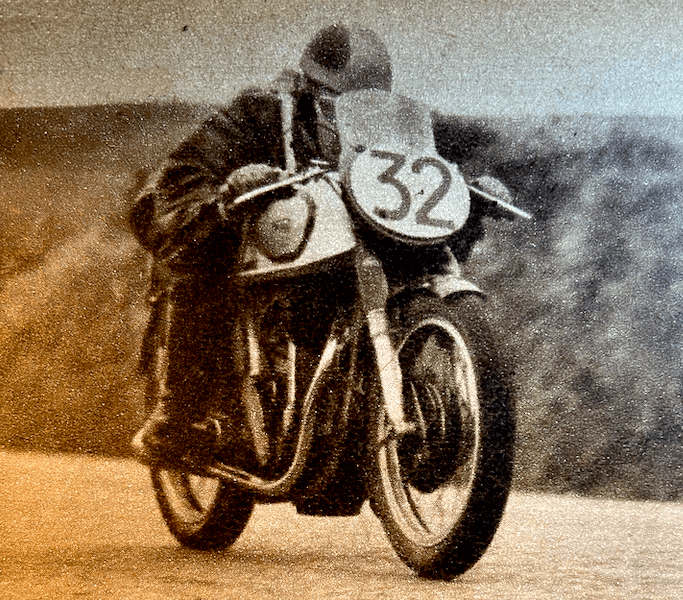
hope, managed to ride his machine into sixth place, the only AJS on the leader board. He completed the lap at 89.11mph. Duke pulled in at the end of his third lap, and amazed the crowd by his quick replenishment. Steve Darbishire, the refueller, had him away in little over 20 seconds. Soon after Les Graham also pulled in at the pits with a screech of brakes. Unfortunately he misjudged the distance and had to man-handle his machine to the pits to the urgent shouts of ‘Come on, Les!’ He made a quick replenishment and got away as Armstrong also pulled in, but he had taken longer than Duke. Graham could ill afford the 46 seconds he took to refuel. Although he slowed up slightly, Duke was still drawing away from Graham. With a lap of 23min 59sec (94.4mph), he increased his lead to 48sec. Graham, whose machine was referred to as an angry wasp, seemed to be losing time on the mountain climb, for while the commentator at Ramsey said Duke was only 24sec ahead of him, at the end of the lap he was twice that amount. Graham completed the lap in 24min 10sec (93.7mph). Rod Coleman, who had a black Kiwi painted on his orange helmet, lost time on the third lap. Earlier he had passed McCandless, but the positions were reversed. McCandless had refuelled and commenced his fourth lap before Coleman pulled in. RDK Hollier (New Zealand) was among those who retired on this lap with engine trouble at Ballaugh. Duke passed through Ramsey well ahead of any other rider, and at this stage it is interesting to compare the times. Dennis Parkinson, commentator at Ramsey, revealed that Duke passed through that point 3min 10sec ahead of anyone else. Next through was Graham, whose actual time lag behind Duke was 35sec, although he had lost more time refuelling. Only 50 yards behind him came another Norton challenge in the form of Armstrong, whom Graham had earlier overtaken. A sensation came when Duke packed up at the pits at the end of this lap. He dismounted while Steve Darbishire, his mechanic, worked feverishly on the clutch. People groaned with disappointment, then came a cheer from his many supporters as he attempted to start again, but it soon changed to groans as he could not get going. He smiled wryly, removed his helmet, kissed his wife and walked resignedly away with people patting him on
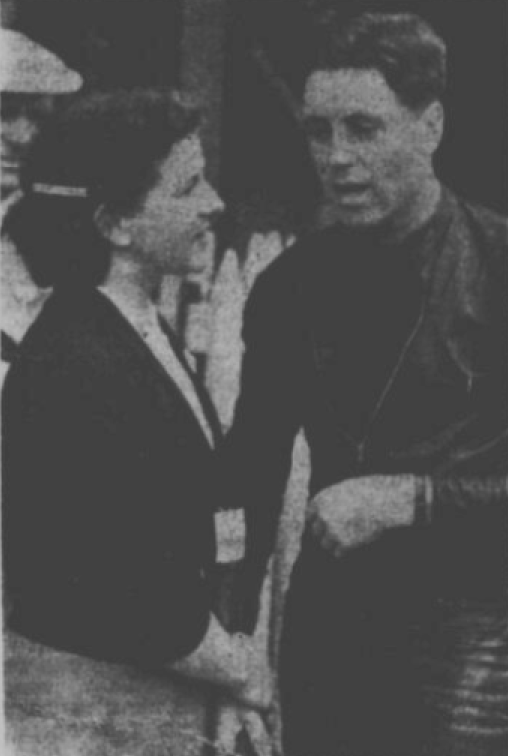
the back for his grand effort. ‘Hard luck Geoff,’ called out Rev RH Reid, the commentator at the Grandstand and Geoff’s father-in-law. Bang had gone his hopes of a double-double and third successive Senior win, which would have been an all-time record. What a coincidence! Not only Duke had misfortune on this lap. Trouble had also stolen a ride on Graham’s pillion. He overshot Sulby Bridge and lost his previous seconds regaining his line. Meanwhile Graham had passed through Cronk-ny-Mona and soon he roared triumphantly through the Start, his machine sounding as noisy and as healthy as ever. Would the 500cc champion of three years ago take this Blue Riband of racing for the first time now that his great rival and the favourite was no longer in the running? Duke had completed his fourth lap in 24min 45sec (91.5mph), and his four laps in 1hr 36min 47sec, an average speed of 93.57mph. Despite his trouble, Graham was still in second place at the end of the lap, but Armstrong had ousted Amm from third place on the leader board. Graham completed the lap in 25min 26sec (89.05mph). Duke had given the ‘thumbs down’ signal at the end of the first lap, but later told the “Times” that that was because of his engine misfiring. He thought he had a bit of dirt in the jet. Although their hero was out, the duel between Graham and Armstrong electrified the crowd and whipped-up their enthusiasm as the two fearless speedsters swapped places over 100 miles an hour. Armstrong passed Graham at Ballaugh but Graham took the lead at Sulby. On the mountain Armstrong was 40 yards ahead of Graham (who started 20 seconds after him), but by the time they swooped past the Bungalow only five yards of daylight separated them. What a roar must have assailed Armstrong’s ears from that powerful Agusta—that alone would have made anyone go faster. When the lights showed that Armstrong (No 15) had shot through Governor’s just ahead of Graham, the crowd at the start rose to see the spectacle and it was Armstrong who passed through a few seconds ahead of Graham. Armstrong clipped 12 seconds off Graham’s lead during the lap, so that only 12 seconds separated them at the end of the lap, with Graham in front.
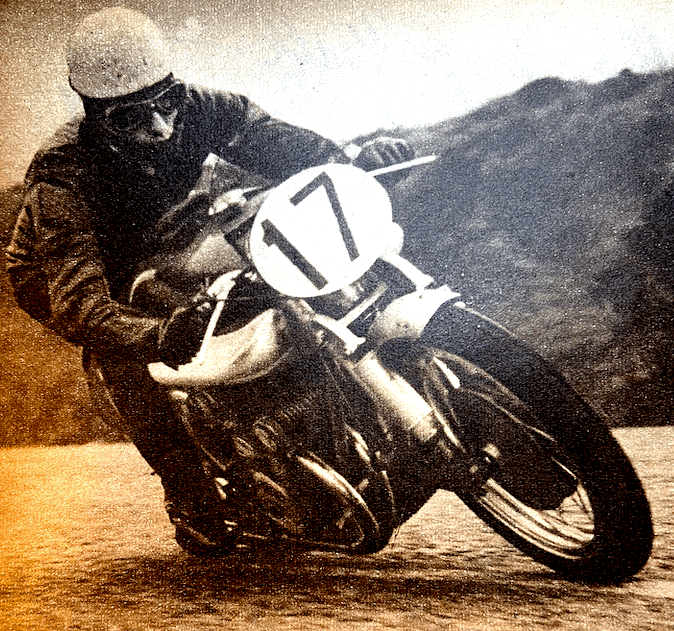
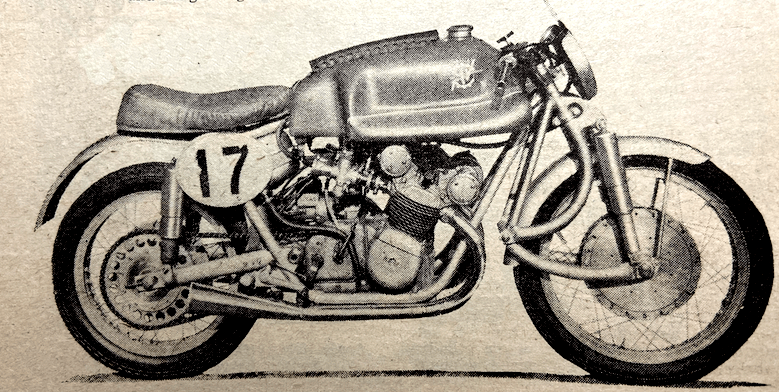
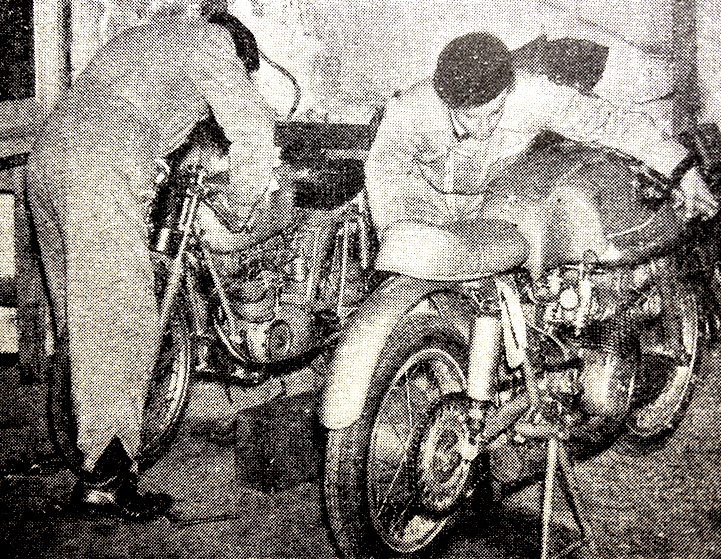
Graham’s lap time was 24min 6sec (93.96mph), 12 seconds slower than Armstrong’s 23min 54sec (94.74mph). Amm was also going great guns. E Ring (Australia) came off his Matchless at Governor’s. He injured his thumb and retired. Tommy McEwan, the local rider, retired at the end of the fourth lap with engine trouble. Reports from round the course indicated that Armstrong who was ahead on the road, was gradually overtaking Graham on growing time and from the Bungalow came the report that 20 seconds separated them on the road, which meant they were dead level on growing time. Armstrong speeded up on the last part of the lap, and for the first time led Graham for time. He completed his sixth lap four seconds ahead of Graham on growing time. His lap of 23min 56sec was only four seconds slower than Duke’s second lap. The fastest so far. His speed was 94.61mph. Graham was 16 seconds slower. Armstrong streaked away on this lap. The pace was terrific, and he was making it even hotter. Looking comfortable astride his Norton, he started this lap four seconds ahead of Graham on time, and reports from round the course showed plainly that he was increasing his lead. Barregarrow reported 30 seconds between them on the road. A check was kept at Sulby and he was 33 seconds ahead of Graham, and at Ramsey 36 seconds ahead. At the Gooseneck the gap widened to 40 seconds. At the Guthrie Memorial the Agusta made up one second. There was terrific excitement on the stand. The leader board showed a truly international picture. An Irishman on an English machine led an Englishman on an Italian machine, and other riders
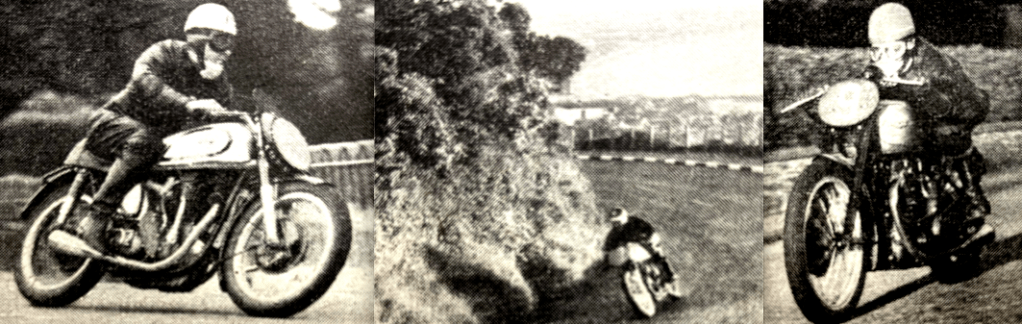
on the board came from Rhodesia (Amm in third place), Australia and New Zealand. Graham had great difficulty in changing gear because oil swilled the back of his machine and his boots for the greater part of the race, otherwise he had an uneventful ride. Armstrong finished the race in 2hr 50min 28.4sec, an average speed of 92.97mph. Great excitement greeted Armstrong at the finishing post—as he crossed the line to win his primary chain snapped and fell off. He won by 26.4 seconds from Les Graham, who finished in 2hr 50min 55sec, an average speed of 92.72mph, so the seconds wasted by Graham when he manhandled his machine to the pits for replenishment at the end of the third lap were precious ones indeed. In a thrill- packed last two laps the Norton-Agusta duel had held the huge crowd of spectators spellbound. Les Graham, for the second time in his career, had looked to be the winner after Duke retired, but Reg Armstrong took his Norton into the lead at the end of the sixth lap and then showed the Agusta a clean pair of heels in a great finish to as good a race as one could wish to see. Last lap time for Armstrong was 23min 58.4sec (94.45mph); Graham completed the lap in 24min 21sec (93.01mph). The lap record was not broken, and although Duke had to retire, he had the distinction of returning the fastest lap of the race on his second circuit in 23min 52sec. Having ridden a magnificent race, WR Amm, of Southern Rhodesia, a member of the second Norton team, finished third. A last-minute hard luck story had as its hero KT Kavanagh, Australian member of the No1 Norton team, who occupied fourth place at the end of the sixth lap. He was reported to be pushing in from Brandywell Road, a mile on the Douglas side of the Bungalow (seven miles from the finish). In the last lap, 23-years-old American born Roy Godwin, Canada’s official representative, crashed at Sulby Bridge on his Norton and was taken to Ramsey Cottage Hospital. He has raced in Canada for the past two years and has won an impressive number of races. He is an engineer in a large Montreal factory. He was later reported to have injured a hip, but not seriously.” RESULTS: 1, Reg Armstrong (Norton), 92.97mph; 2, Les Graham (MV Agusta); 3, Ray Amm (Norton); 4, Rod Coleman (AJS); 5, Bill Lomas (AJS); 6, Cromie McCandless (Norton); 7, George Brown (Norton); 8, Ken Mudford (Norton); 9, Albert E Moule (Norton); 10, Phil Carter (Norton); 11, Vic Willoughby (Norton); 12, Syd Lawton (AJS). Here’s a youtube link to a brief film of the Senior: https://www.youtube.com/watch?v=c0A9Je0DqdA
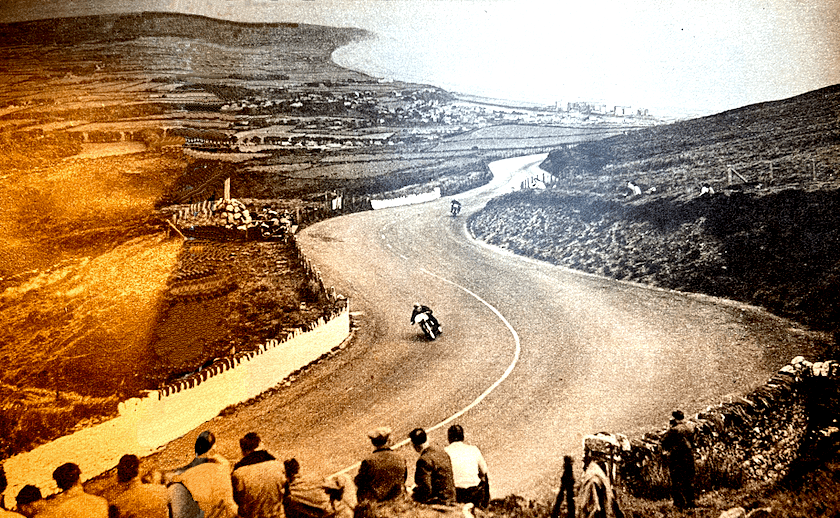
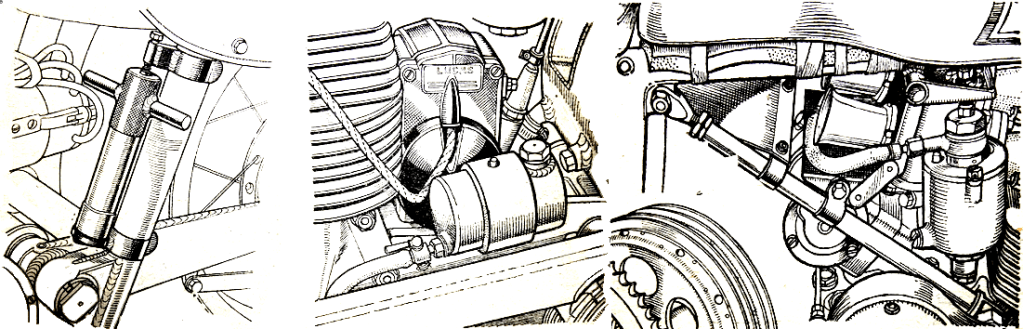
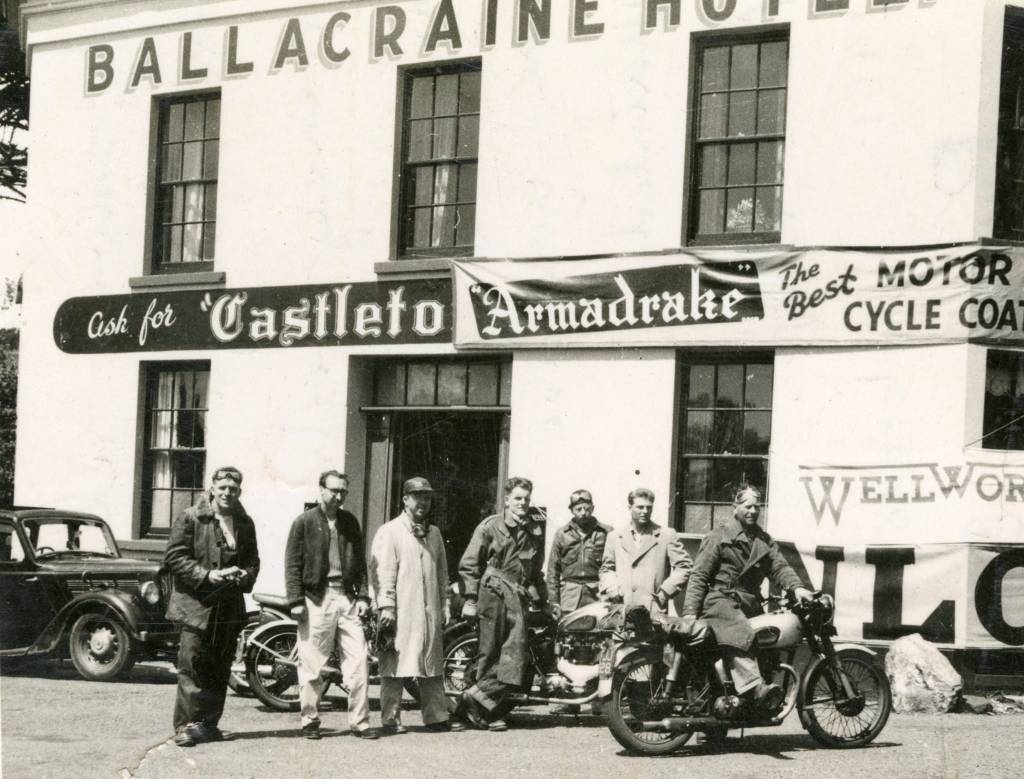
“FORTY MEN AND one little boy received awards from the hands of His Excellency the Lieutenant Governor, Sir Geoffrey Bromet, at the Senior TT Race prize distribution in the Villa Marina on Friday evening, witnessed by some 8,000 people. For the little boy,5-years-old Anthony Brown, son of TT rider George Brown. of Stevenage, Herts, it was one of the most momentous moments of his life. When his father made his way through the crowd to receive his replica Anthony ran after him, but hesitated as his father mounted the platform. But the Governor beckoned him to come up and handed him the prize. Reg Armstrong, who won the Visitors’ Cup awarded for the best performance by a rider not resident in the British Isles, as well as the premier prize, the Tourist Trophy, thanked the huge crowd for the tumultuous welcome they gave him. In his soft Irish brogue, Reg went on to pay tribute to Les Graham, the runner-up. ‘I would like to congratulate Les Graham,” he declared, ‘and to say how much I enjoyed my run with him. I’m sorry we could not keep together much longer. I don’t think it would have done me any good. Only for Geoff’s hard luck I don’t think I would be here to-night.’ He thanked Norton Motors for giving him such a good machine, and Mr Stanley Woods, famous ex-TT rider, who first brought him to the Island and taught him all he knew about the course, as well as how to ride a motor-cycle. Les Graham said: ‘I would like to say how much I think Armstrong was a worthy winner. He just rode beautifully. There was nothing I could do about that.’ He thanked his mechanics, and said that although many had declared the Agusta would not last the race, it had done so, which was a pointer of things to come. Spontaneous and sincere applause greeted Ray Amm, third in the race, when he said he would like to thank God for looking after him during the race. He thanked Norton Motors, his mechanics, and his wife, for their help. Rod Coleman, fourth on an AJS said that if Hill Doran had been riding an AJS might have been higher. The Jimmy Simpson Trophy for the fastest lap of the meeting went to Geoff Duke, who said he was very glad that Reg had pulled it off, and that ‘that beast of an MV kept going as well.’ Watching the race from the fourth lap onward he just about bit his fingernails down to the ends, he revealed. The Ray B Westover Trophy for the best performance by a newcomer was awarded to Bruno Ruffo of Italy, who broke the record and came sixth in the Lightweight race. Birmingham &DMCC (riders, AE Moule, ER Evans, and J Harding) won the Club Team Prize. Gilbert Smith, of Norton Motors, thanked the riders and mechanics of Nortons, and the Manx people. ‘You know, during this TT Week they put up with a hell of a lot of nonsense,’ he declared. He thanked the Governor, saying that no other had given the TT more support or showed such genuine interest in motor cycling. Mr Smith revealed that it was Duke who had suggested Armstrong’s inclusion in the Norton team. Sir Algernon Guinness, one of the stewards, proposed a vote of thanks to the Governor and Lady Burnet. Mr GJ Bruinsma, representative of the FIM, paid tribute to the beauty of the Isle of Man, and to the marvellous course. He had made many friends on his visit which had strengthened his opinion that if motor cyclists might govern this strange world it would be much easier in every way. They worked only for sport and knew no barriers, frontiers, religion or colour.”
“THERE WERE FIVE Manx competitors in the Clubman’s Senior, and three of them finished. Biggest hopes were pinned on D Ennett (Matchless), from Castletown, but his luck was dead out. His first lap was completed in the very creditable time of 29min 3sec, but on his second circuit he was held up at Hillberry with engine trouble, and eventually toured in to the Start where he retired. Best performance was put up by WA Harding (Norton), of St Ninian’s Road, Douglas whose growing lap times were as follows: 29min 21sec; 59min 30sec; 1hr 28min 57sec; and 1hr 58min 31sec. Next came RAD Mawson (Norton), of ‘Farnleigh’ 6, Brunswick Road, Douglas (who had a spill in practice, followed by a short stay in Noble’s Hospital). His time was 2hr 14min 55sec. JP Linskey, of 37 Malew Street, Castletown, did his first lap in 29min 3sec and then retired on his second lap with a split petrol tank. The fifth Manx boy, KA Taubman (Triumph), of 55, Willaston Crescent, Douglas, completed the race in 2hr 16min 16sec.”—Isle of Man Times
AS A CHANGE OF PACE from the TT reports, here’s a thoughtful review of the event from the Manx point of view, from the pages of the Isle of Man Times: “It is very fine to have come through a particularly successful and exciting series of Tourist Trophy races; fine, too, to have seen the success almost completely unshadowed by fatal accident. Fatalities have occurred rather frequently during the past few years: they have caused great sadness—as the one fatality this year causes sadness—and caused some not unnatural questioning. Life will always have its hazards, and while human nature remains as it is, young men—healthy adventurous young men of the kind which the world needs—will seek the bubble reputation in the cannon’s mouth*. The races were a magnificent example of sport. The struggle for victory—several winners led by a few seconds—and the changes of position, captured the imagination as much as in any year in TT history. The weather was gloriously fine; large numbers of visitors came, and there never was such an inflow of motor cycles and motor cars. Many of the visitors spent plentifully. The TT has become an indispensable curtain-raiser to the Manx holiday season. It must have given the Island more publicity than ever; every means of ‘telling the world’ was used, including for the first time television. The modern motor cycle continued, to prove its reliability—a reliability which the Manx TT races have largely created—and a very high proportion of the competitors finished. Italy continues to produce the fastest racing motor cycles in the Lightweight and Ultra-Lightweight classes. But in the Senior and Junior classes, where the highest speeds are made, and where victory counts enormously, in fame for the rider and sales for the machine, Britain held her own and the foreign challenge was beaten. In a great event like this, everything depends on good organisation and solid, good-tempered hard work. Whether or not the work is paid for, it has to be good; this time it was good beyond praise. Many people do give their time and their strength for the sake of sport or for the sake of their native land and its prosperity. The marshals and the police were splendid; and the police had to regulate traffic not only in the vicinity of the TT Course, but all over the Island. The streets of Douglas, the roads of the Isle of Man generally, became intensely busy for a few days, and motor cyclists who arrive in order to follow the fortunes of their favourites are usually lively young men. Some of the policemen on point duty were the last word in efficiency. The officials and workmen of the Steam Packet Company and the Harbour Board handled the record number of motor vehicles coming into the Island and afterwards going out—and going out in greater concentration than when coming in—with admirable efficiency. We cannot pretend that all the motor cyclists who came observed all the traffic regulations. We cannot pretend that all of them remembered that there were other people in the world. (Yet it is the duty of everyone in charge of a fast vehicle to take care, every moment, of his own and other people’s lives.) Some road regulations in the Isle of Man are different from those in England, and a motorist may break the law, and may offend against the public safety, without being consciously reckless. The ‘Halt’ sign is painted on the surface of the road instead of on a post erected above the road, and it positively means ‘Stop’; it isn’t obeyed if you slow down. The Highway Board did state this on the back of the provisional licence which they issued to visiting motorists, who also received a printed ‘handout’. But people don’t find time to read anything lengthy; they need to have things said for them in a few words and plain, We suggest to the authorities that fewer and more pointed words should be used next year. We are certain that the ‘Halt’ notices are preventing a great number of accidents. The suggestion has been made that when people ride or drive along the TT Course during the TT period they ought always to travel in the same direction as that which is taken by the riders in the races. For the first few moments that idea may be thought useful in preventing accidents. Local motor cyclists and all the race ‘hangers on’ and ‘fans’, are infected with the rage for speed. But if they were all travelling in the same way, if they believed that nothing was likely to meet them, they would probably become speedier still; they would feel that the Course had been absolutely given to them all to race on. It is only given at certain hours of certain days, and to certain accepted people. Besides, the roads are the property of the public except on the actual occasions when they are officially closed; if your business or your normal occasions cause you to travel against what appears on that day to be the stream, you are not to be discouraged from exercising your rights.”
*From the ‘seven stages of man’ speech in Shakespeare’s As You Like It that starts “All the world’s a stage, And all the men and women merely players…” The relevant lines are: “Then a soldier, Full of strange oaths, and bearded like the pard, Jealous in honour, sudden and quick in quarrel, Seeking the bubble reputation Even in the cannon’s mouth.” So it refers to seeking fame or honour (reputation) in extremely dangerous situations, like facing a cannon, for something as fragile and fleeting (a bubble) as glory, highlighting the foolishness and temporary nature of such pursuits. Ok, I confess: despite my Grade E A-Level English I Googled it—Ed.
“AN INTERESTED SPECTATOR of the TT races last week, none the less interested although last year the Clubman’s Junior race brought tragedy to him, was Mr HS Parris, of 21, Therapia Lane, West Croydon, whose son died from injuries sustained whilst competing in the Clubman’s Junior in 1951. Mr Parris has always been an enthusiast of the Douglas machine. He rode one in the 1914-18 war and in 1926 he met the lady who was to become his wife and at that time owned a Douglas. They christened their first son Douglas. The son was extremely keen on motor-cycling, and astride a Douglas machine entered the race last year with tragic results. The younger son of Mr and Mrs Parris now owns a Douglas motor cycle. Mr Parris writes that he hopes to visit our town of Douglas for many more years to come. His son, who died in Noble’s Hospital last year, is buried in the Borough Cemetery, just behind the TT Grandstands.”—Isle of Man Times
“IF A GALLUP POLL on the Island were taken concerning the TT I imagine that noise would be cited as the principal objection to our visit. The dull roar of the bigger engines on full throttle is audible on nine mornings in a period of ten days at 4.45am and continues for rather over two hours. Its volume is adequate to awake normal sleepers at a range of two miles or so, and is naturally formidable for the unfortunate folk who live in homes bordering or adjacent to the actual course, where the elderly and invalid must dislike it intensely. I know of no verbal sound which indicates its precise character. The best simile is that of a ‘giant tearing canvas’, but if we have occasionally seen rather a pigmy giant, we have never heard of a full-size giant tearing canvas continuously for over two hours at a spell. Latterly, a new terror has been added to the noise nuisance in the decibel output of the little 125cc machines, such as the Mondial. These run up to at least 10,000rpm on full bore, possibly more. They emit a shrill, almost supersonic, scream which seems to threaten to bore tiny holes in an eardrum. If you have ever been trapped inside mosquito netting with a supersize mosquito, and multiply that sensation by some such factor as a million, you begin to realise what a Mondial does to one. If a new torture is wanted to make victims talk, an exposure of, say, 15 minutes to a Mondial engine on full throttle should do the trick. Their riders somehow stand three laps of it but of course the horrible noise is going away from them all the time. Our apologies and sympathy to all islanders who dislike exhaust noise.”—Ixion
“AN OLDSTER COUNTS the Blessings Brought him in Over Thirty Years of Motorcycling: ‘I suppose that, by the standards of the youngsters who whistle past while I am leaning on a gate with a peaceful cigarette, I am quite an old man; which is a very sobering thought, because it is with great difficulty that I realise that my fiftieth birthday has come and gone, with the quiet, inexorable finality of all birthdays after the forty-first. It was spent in the saddle, where, whenever possible, I have spent all my anniversaries for the last thirty-three years; for, in a life which has had a preponderance of downs rather than ups, I am thankful beyond words that I have nearly always managed to keep some sort of motor cycle. It has often meant all kinds of other sacrifices; the machine itself has not always been what the heart could desire; there have been times when a gallon of petrol meant going without a meal; there has been the joy of new machines, and the heartbreak of old ones. But it has been so well worth while. For motor cycling, though one day it may transport you to Elysium, and the next cast you into the abyss of despair, is, taking it by and large, as good a thing as this world can offer, and far, far better than most. Not for me, frankly, the sporting side. It has always seemed to me an unkind way to treat a beloved companion to drown it in liquid slime, or smash it against unrelenting stone. But that is purely a personal view, and our many-sided game has room, and attractions, enough for all tastes. I have always used my machines for the purpose for which I conceive them to be intended; as a peerless, magic-carpet method of seeing a countryside which, if you know where to go, is still largely unspoiled and as lovely as anywhere on earth. The odd thing, as I see it, is that one can only really appreciate the country from a motor cycle saddle. A lane which, from behind a pair of bars, might well lead to Elfland, as one swings round its bends, and tops the short, steep rises on a waft of the twist grip, loses so much of its charm seen through the windows of four-wheeled transport. One is so detached in a car; there is no sense of speed, nor the odd, striding illusion that the machine between one’s knees is but an extension of one’s limbs and the feeling that one good tweak of the throttle would send machine and rider bounding over the treetops. I don’t think that all this is merely the rambling of early senility, because I have always felt that way about motor cycles, so that I passage about grinning like a cat and singing highly improper songs, a thing I would never wish to do in buses, or trains, or other people’s motor cars. Motor cycles just take me that way. Then there is the motor cycle’s most lovely asset, the ability to wander, swiftly and at will, along the small roads which cars and coaches can mercifully never traverse, through an England so far removed from the trans-Atlanticised vulgarity of the urban centres that it might be whole continents away. Our lives, in this insecure, uneasy post-war world are uncertain, day-to-day affairs, and no one knows what the morrow may hold. Perhaps we motor cyclists are better off than most, because we have the incomparable compensations of our machines, and the all-relieving balm which lies in their gift; so, on the useful principle of gathering roses while we may, let us make the most of them. For my part, I am very grateful that, for another year, I have been able to see under the cloud-flecked skies of autumn, the glories of an English countryside.'”—RK Battson
“CHARLIE COLLIER RECALLS 50 years of shows prior to 1910, when the manufacturers decided to organise their own annual exhibitions there were two rival private-enterprise shows, the ‘National’ at the Crystal Palace, and the ‘Stanley’ at the Agricultural Hall, Islington. Incidentally, a top hat and frock coat was then the recognised uniform for the well dressed stand attendant! ‘It was customary at that time, too, to offer trial runs on the spot to likely looking clients. This practice sometimes produced unexpected results, particularly at the Crystal Palace where long pins, used during the nightly displays of fireworks, were prone to produce punctures at the most awkward moments. Worse still were some of the major mechanical misfortunes, such as the occasion when the prospective purchaser of a front-wheel-drive Werner saw the cylinder head fly high into the air before his astonished gaze! That was an adventurous period when designers could indulge their personal whims in the knowledge that they were dealing with customers who knew little of the mysteries of the internal combustion engine. Nowadays the customer dictates to the designer and many a manufacturer has found to his cost that the motor cycling public is both mechanically minded and inherently conservative in outlook. Not that all the whims were whimsical in the ‘Heath Robinson’ sense: some of the early designs, such as the Starley and the Wilkinson, were years ahead of their time, or, rather, of metallurgical knowledge and production techniques of the 1902-1909 era. Probably the most exciting era the industry has known was that immediately following the 1914-18 war. Scores of engineering concerns which had been engaged on the production of armaments suddenly found themselves high and dry. Searching for some means to keep their factories in action, many of them decided to enter the motor cycle industry. Some of the designs introduced by the newcomers were brilliant in their conception, others ingenious but unsightly, and some, frankly, impossible. Few of the newcomers lasted
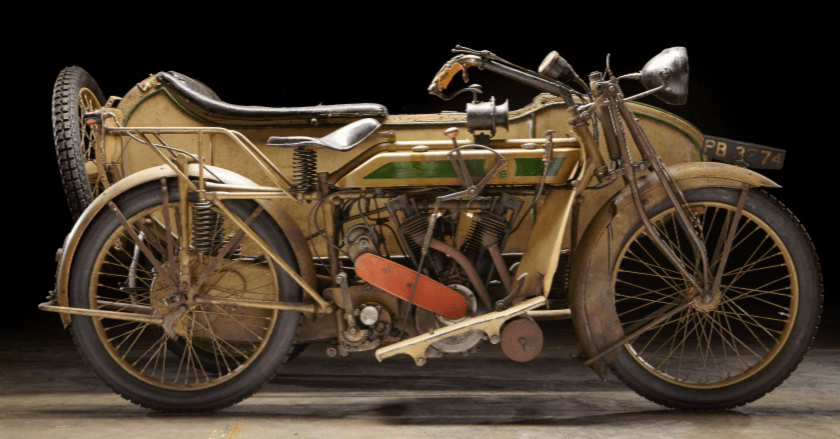
for long. Some became the victim of economic circumstances created by the 1921 slump. Others failed to overcome that conservative instinct which causes the British motor cyclist to reject the ugly machines—appearance is a factor the manufacturer neglects at his peril—while the ‘impossibles’, of course, never stood a chance anyway. Around that time there were well over 120 firms engaged in the manufacture or assembly of motor cycles. The availability of proprietary four-stroke engines produced in a wide range of cubic capacities by JAP, Blackburne, Motosacoche and other specialist manufacturers enabled large numbers of assemblers, as well as many of the bigger concerns, to display comprehensive ranges on their stands and encouraged the ‘new designs annually’ policy, now replaced by the ‘series’ plan under which basic designs may be continued for several years with changes in specification made from time to time without any particular regard to show dates. The virtual disappearance of ‘assembled’ four-stroke machines, in fact, represents the greatest change I can recall, for it has robbed the Exhibition of the last-minute ‘surprises’ which were the delight of the public—who came to admire but not to purchase—and the despair of sales managers with stocks of last year’s models left on their hands! Some of the ‘surprises’, by the way, were even more surprising than they appeared to the uninitiated viewer. At least on machine with an ‘engine’ made of wood was displayed at a show in the ’twenties, and at quite a late date another model which drew the crowds had no internal workings! Fifty years of shows has certainly taught me one lesson: always the manufacturer must remember that conservative streak in the British motor cyclist. He is apt to clamour for all sorts of ‘improvements’—often in the columns of the technical press—but time and again, makers who have gone the whole hog in answer to his demands have lived to rue the day they listened to them. I remember, for example, when my company introduced the Model H fully sprung combination at the 1919 Olympia exhibition; it was an excellent outfit in every way—interchangeable wheels, spare wheel, electric lighting, and so on—yet it wads not really appreciated until it became defunct some nine years later. There was, too, the ohc 347cc Matchless which appeared at the 1922 show, a limited-production model for which we found the present-day ‘boy racer’ market did not then exist. By the way, it is interesting to recall that the late Jimmy Guthrie rode one of these machines in the 1923 Senior TT. At the other end of the scale, numerous attempts have been made to answer the persistent appeal for the so-called ‘motor cycle for the millions’. In 1924, for example, the Model P Triumph created a tremendous furore at the show. And the
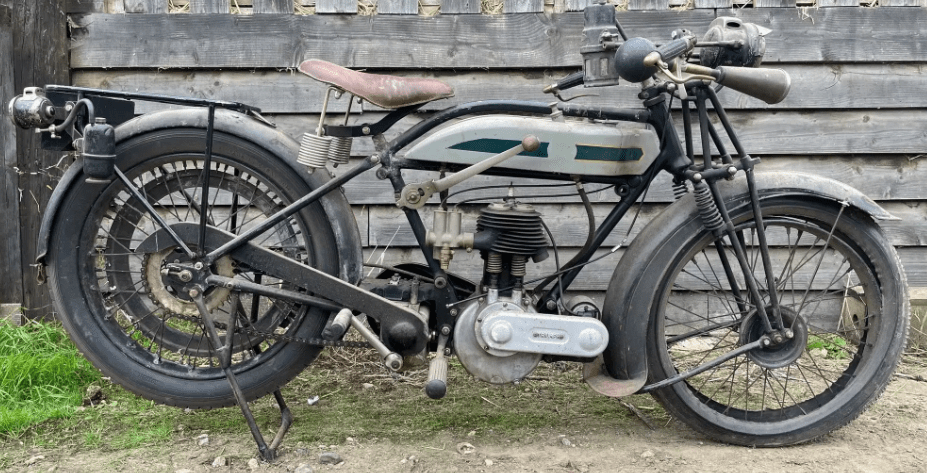
following year the EW Douglas caused an even greater sensation. Yet in each case the public proved fickle when the machines developed teething troubles which might have been cured if only that public had been more patient. Similarly, almost since the beginning of the motor cycle movement designers have sought to develop power-units which have theoretical advantages over the poppet valve four-stroke. At various times there have been exhibited at the shows engines with rotary valves, sleeve valves, cuff valves; engines which were cooled by water or by oil; engines which were self-supercharging and engines which operated on novel lines—there was once even a ‘poppet’ engine with only one valve. Always the public would look at them with wonderment, but in the long run few of them decided to buy. Motor cyclists, in fact, have always like to read about the unorthodox, but they have usually preferred to ride the orthodox.
Looking back over the years, when I think of machines such as the Ascot-Pullin, the Brough Superior Golden Dream, the three-cylinder Scott and many another show sensation—and for that matter the Matchless Silver Arrow, which was actually too quiet for the customers!—I may be forgiven for regarding a crowded stand at the show is not necessarily a reliable barometer so far as the annual balance sheet is concerned! And talking of crowded stands, I am reminded of another big change which the years have brought; nowadays visitors to the exhibition ask fewer questions. Thanks to the technical journals, motor cyclists are far better informed than they were in the early days when designers, the press and public alike were on a voyage of discovery into the unknown. Also, and particularly since the 1939-45 war, the

standard of instruction books has been vastly improved. We still have with us, however, as we did in the early days, earnest visitors to the stands with weird technical theories which they expound at great length! It’s a long cry from the Agricultural Hall and the Crystal Palace via Olympia, to Earls Court, scene of the annual shows since 1937. Some people, I know, hanker to return to Olympia, with its band music and separate gallery for the accessory manufacturers, but I hold no strong views on this point because the inside of a show office, where I spend most of my time during the exhibition week, would look much the same in either place! Much has changed in half a century. No longer are manufacturers working along rule-of-thumb lines, nor is there any chance of survival for exotic or experimental designs. But one thing, thank goodness, has never altered; although the modern motor cycle contains no mysteries and is absolutely reliable, it remains the vehicle of adventure. Adventure! How well I remember the first time I felt an engine under me—and that was quite some while before 1903. But how quickly time passes…it doesn’t seem so long since I spent several successive weekends in vain efforts to reach Brighton on a 1¾hp De Dion-engined tricycle…I can still feel in imagination the cramps produced by pedalling back to Woolwich on that 5cwt monstrosity!'”
“ASTRONOMICAL SCIENCE (WHICH frequently keeps my bed-side light burning till the early hours) tells us that the temperature of the sun is 20,000,000°C at the centre and that, in maintaining its present outflow of heat from its surface, it is losing its own mass at the rate of 4,000,000 tons a second! However, the sun’s total mass 2,000 million, million, million, million tons, and it can go giving out this heat for a further 16 million, million years; therefore our future generations do not need to worry much. Our own sources of heat and energy (coal and oil) will probably ably last for not more than a small fraction of a millionth of this time; but few of us think of future generations beyond the offspring we have around us. We delve into the earth for coal and we pierce its crust for oil, the supplies of which are strictly limited, so we are now looking into the possibilities of another limited commodity—uranium. The tasks we humans undergo in getting these fuels out of the earth are anything but pleasant, and most technicians know that we can get all the power we need from alcohol, which can be obtained in everlasting quantities as long as the sun shines—by growing vegetable matter. Thus we could labour in the fields and bask in the sunlight instead of toiling in heat and sweat and grime. And instead of being thankful for the sun’s heat so freely given to the earth, we are now attempting to use what is considered to be the sun’s own basic fuel, hydrogen, of which it is largely composed. But there is an enormous quantity of hydrogen in the Atlantic and Pacific oceans and, since nothing now appears to be impossible to science, it may not be outside man’s skill to reach the extremely high temperature necessary and to drop a super-hydrogen bomb in the middle of the Atlantic, when we may confidently expect this planet completely to disappear in about one ten-thousandth part of a second. We shall then not have to bother about the cost of any fuel!”—Technicus

“THAT DREADFUL MAN Ixion—how dare he suggest such a thing. A more suitable fuel for our lovely racers. You must never, never let him do it again, Mr Editor. It upset me so much that I haven’t been able to eat my bread and milk since. I know he means alcohol and it’s no good saying he doesn’t, so there. I feel quite, quite sure that he has been with those horrid German and Italian boys who won’t play properly and who have run away with all our nice records and put them out of our reach. I have a good mind to call and tell him how wicked it is to put alcohol in the petrol tank; it spoils the paint ever so quickly, and, besides, you go so terribly fast you can hardly breathe. He must write out one hundred times, ‘I must member the rule, Pool is the fuel’ and post it at once to that wicked man, Mr Rist. Oh, Mr Editor, did you read about him, he actually races on alcohol; he must be one of those horrid, rough men who smoke a pipe and bowl over-arm at cricket. And he really is wicked, Mr Editor; he led Mr. Wilson astray just as that horrid Mr Hartley and frightful Mr. Ferbrache did with that nice Mr Willoughby on their beastly bike. It really is almost too, too much to bear and unless you promise to stamp your foot ever so hard, ever so, and be very firm with anyone who dares to mention the nasty stuff again, I shall never be able to take my Tee-Total replica out again.
PINKIE (CRASHER) BUTTERMILK, London, SW1.”
“WHY ARE THERE not more vintagents among us? My belief is that the public (and motor cyclists too) have the idea that elderly machines are unduly prone to unreliability and mishaps, eg, cracked cylinders, broken belts, snapped spokes, fractured frames, etc. This, of course, is largely a fallacy. My 1919 Baby Triumph has perfect manners. The belt taps me smartly on the shoulder to warn me that it has broken, and the magneto only seizes up near home. However, 1 really ventured to encroach on your valuable space to make a protest. It was my happy lot to observe for a 1904 Kerry in the recent Pioneer Run. I was fully prepared for roads crowded with interested riders of modern motor cycles, but the solid stream or Sporty Boys, Percies, family cars and racing cyclists left me aghast. And 140 Vespas on Reigate Hill! I am fully aware that similar opinions have already been aired in your excellent journal and elsewhere. I merely hope that my own small voice may help to convince the stupid ones that they may lead the Run into disrepute.
BELT-DRIVER, Littlehampton, Sussex.”
SCOOTERS FROM LAMBRETTA and Vespa faced competition from the likes of MV Agusta and Ducati and a number of scooters sported German-made engines, notably by Sachs and NSU. Even the Brits got a look-in, with a number of Italian lightweights relying on Villiers while the Olympia used a modified Bantam engine.
“I WAS AMUSED the other day to learn of a court conviction and its subsequent quashing. The rider of a clip-on had fallen off and, as he painfully picked himself up, was required by a police officer to produce his licence and insurance. Free country though this is, nobody is entitled to fall off a mechanically propelled vehicle, as defined in the Road Traffic Act, unless he is fully documented for the purpose. To the unfortunate rider’s dismay, his insurance policy had expired during his holiday, and he was duly summoned to appear in court and convicted. But one small factor had escaped notice. At the time of the spill, the wee two-stroke engine had been innocent of cylinder, piston and connecting rod, and the only means of propulsion was by pedals. The RAC took up the cudgels on the cyclist’s behalf and lodged an appeal which was duly heard before the Lord Chief Justice of England, who quashed the case. It was made clear, however, that the case was a very special and unusual one. Clip-on enthusiasts are duly warned that to use their machines without insurance cover is to court trouble. The excuse that one was pedalling may not be accepted.”
“I WAS INTERESTED to note W Dennis Griffin’s letter, since I believe it is the first to appear on the theme of—fun. To state my own case, up to 1923 I had ridden in many road trials, by that time I realised that one just had to sit tight to be sure of success. So to obtain an element of fun, in 1923 I rode my 1903 Dreadnought in that year’s London-Edinburgh Run. Having two Brough Superior machines, I fancy other members thought I had taken leave of my senses, but before arriving at Edinburgh a number acquired something of the idea behind the effort. With further riding in between on Brough Superior machines I again rode my Dreadnought in the 1927 ‘Edinburgh’ and this time I was mobbed throughout the run. Shortly afterwards, the RAC asked me whether I thought it possible for pioneer motor cycles to be included in the forthcoming Olympia Show. I gave what help I could, and the exhibition of 27 pioneer motor cycles at the 1927 Olympia Show caused quite a sensation. The following year, at the 1928 Olympia Show, the Association of Pioneer Motor Cyclists was formed. And a year later still, in February, 1930, the first Pioneer Run to Brighton took place. At the 1930 Olympia Show the RAC repeated their 1927 exhibition of pioneer motor cycles, with 40 machines on show. The rest of the story most of your readers will know. But it was all for fun, as Mr Griffin so aptly points out.
HAROLD KARSLAKE, Cinderhill, Nottingham.”
THE MAGNIFICENT BOHMERLAND, named for its Bohemian homeland, designed by Albin Liebisch, was in production from 1925 until the outbreak of WW2 (read all about it in 1925). Liebisch hoped to resume motor cycle production at the end of the war but fell foul of the Soviets and ended up in a Czech labour camp at Kamenice, alongside his son Richard. They escaped and ended up in Passau, Germany, where Albin scratched a living by making hand trucks, while dreaming of making motorbikes. Thanks mainly to Richard, the Böhmerland marque did reappear with a streamlined, low-slung model powered by a 198cc Zündapp engine, but it failed to go into production.
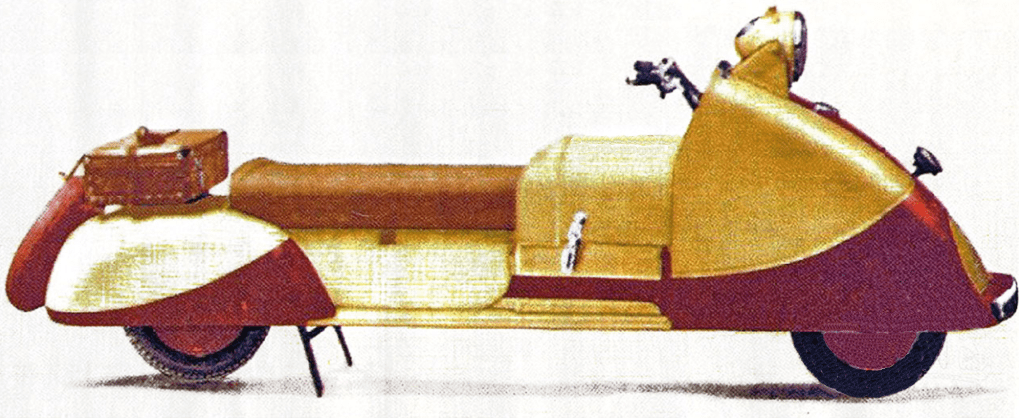
THE NEW SCOOTER sector was booming but Lambretta decided to branch out with a Grand Prix racer. Designed by Pier-Luigi Torre, the 250 Lambretta featuring a 247cc (54x54mm) dohc 90° transverse V-twin lump producing 29 horsepower at 9,000rpm and a top speed of 106mph. A five speed box transmitted power via a shaft. The racer’s only outing was at Locarno where it was on course to finish second, but didn’t finish.
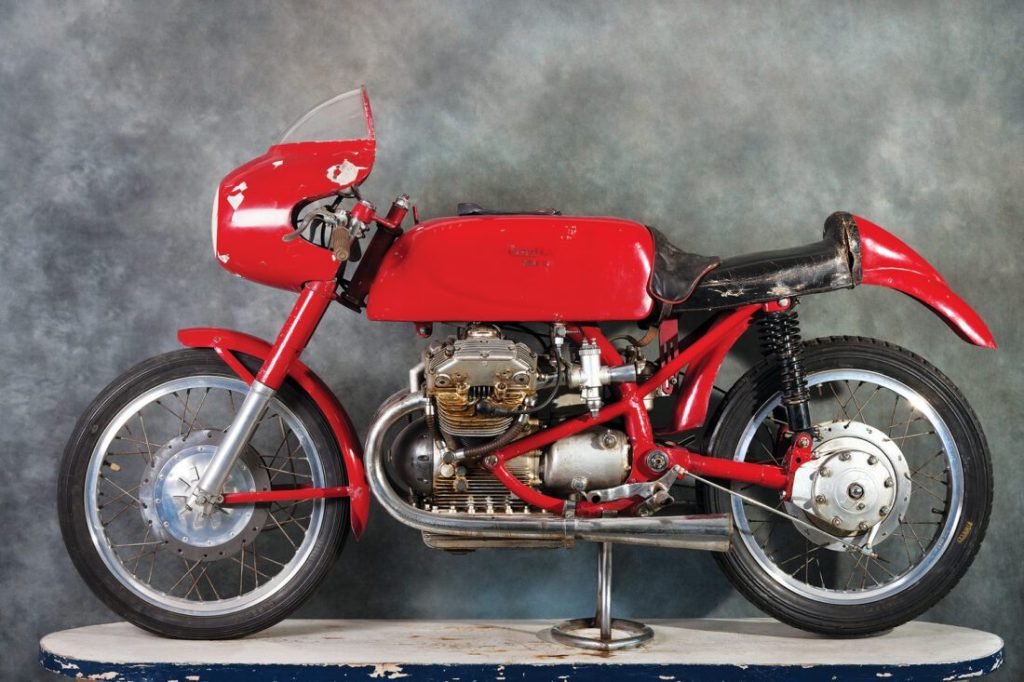
“IN IXION’S CAVALCADE I noticed with interest mention of the Redrup three-cylinder radial engine. In the early ’20s I bought one of these engines and fitted it into a 1913 Triumph frame with three-speed Sturmey-Archer hub gear. The machine was delightful to ride and the engine very quiet and smooth, though it lacked power, and the carburettor—designed and made by Redrup—suffered frequent stoppage of the tiny jets. Yet, on this machine with direct belt drive, I made a return journey from Leeds to Peterhead. I think I rode the only six-cylinder radial motor cycle ever made, as Redrup fitted two of his engines coupled into a frame which I duly rode to Coventry, where the machine was photographed for The Motor Cycle. The acceleration and speed were really good, but the somewhat jury-rigged spark distributor packed up on the return journey. I am still motor cycling and am now a convert to the practical utility of shaft-drive for the everyday rider. But, on a note of warning, I would advise anyone buying an unorthodox or ‘years-ahead’ type of machine to be sure that the makers are willing to help if in trouble. I fear that any agents are interested only in turnover, and that, by lack of knowledge and equipment, they are unable to deal with difficulties except on machines built on ordinary lines. Yet all considered I should not like to revert to chain drive with primary case and gear box leaks, plus a messy final chain drive.
J THORNTON WALKER, Roundhay, Leeds.
“THIS MORNING, THE 27th International Six Days’ Trial is due to begin at Bad Aussee, the headquarters town, in the US Zone of Austria. The day’s run is the longest of the trial. The route lies mainly to the west and south of Bad Aussee and, passing through Hüttau, Fusch, Winklern, Möllbrücke, Mauterndorf and Radstadt, it wriggles its way over roughly surfaced mountain tracks for a distance of 456km (285 miles). Two well-known passes, the Grossglockner and the Katschberg, are included in the itinerary. Tomorrow’s (Friday’s) daylight mileage is 268 and there will be, in addition to that, a night run of 99 miles. Total distance to be covered during the week is approximately 1,300 miles. Finally, on the sixth day machines have to take part in a one-hour high-speed test on the Anif autobahn, near Salzburg. The daily routes are divided into a series of time sections (or checks), in which high speed schedules have to be maintained. Marks are deducted for every minute in excess of the schedule for each complete section. Since, for the most part, the course lies over rough and rarely used tracks and paths, surfaces generally are of a type bordering on the atrocious. Steep gradients, often on loose terrain, and with numerous hairpins, have to be taken just as fast as possible. Engines, transmission systems, suspensions, complete machines and riders take a punishing such as is possible only in the ‘International’. Members of Trophy, Vase and Manufacturers’ Teams have to maintain a 10% higher speed schedule than other competitors. The International Trophy is rightly described as the Blue Riband of motor cycling. Taking part in the Trophy contest are teams representing six great motor cycling nations: Austria, Czechoslovakia, Germany, Great Britain, Italy and Sweden. The British team comprises BHM. Viney (498 AJS), team captain; CM Ray (498 Ariel); WJ Stocker (692 Royal Enfield); PH Alves (649 Triumph); and SB Manns (498 Matchless). It will be noted that the machines are of 500cc and over; this fact might have an important significance in so far as the final result is concerned. All other national Trophy Teams, the German team included, are riding lightweight models. The Austrian team is mounted on 125 and 250cc Puchs, the Czechs on 125cc CZs and 250cc Jawas, the Germans are using 175cc Maicos and 98cc NSUs, the Italian machines are Parilla, Rumi, Macchi, Alpino and Guazzoni; and those of the Swedish team, 123 and 244cc NVs. During the week, machines must maintain schedules calculated according to their capacity. The same applies to the speed test
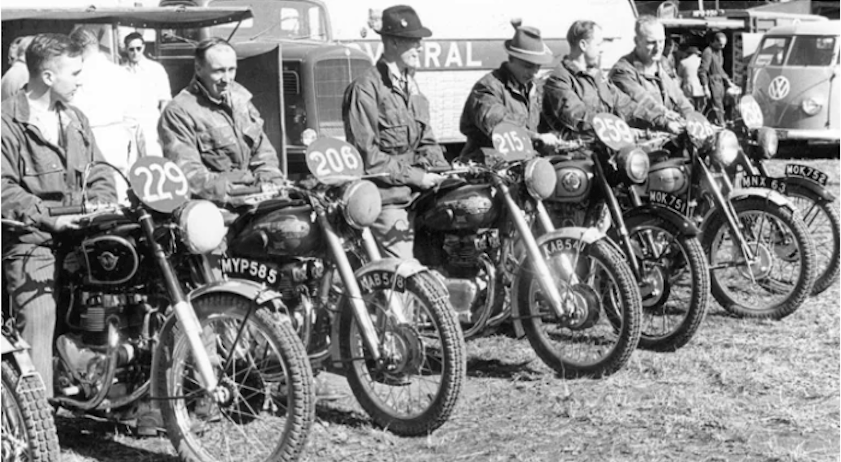
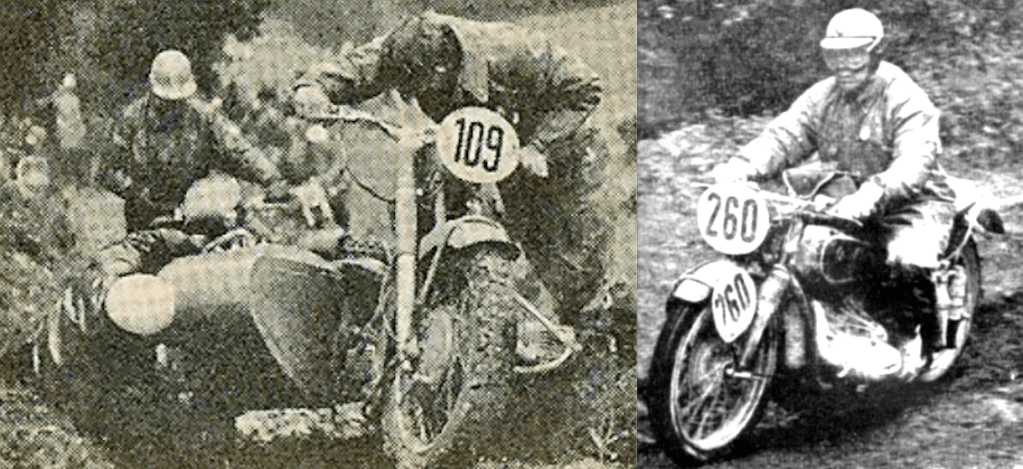
on the final day. But an important feature of the trial is that if two or more teams reach the speed test tieing for the lead, it is the team which increases on its schedule by the greatest margin which wins. It is now accepted that the schedules in the speed test favour lightweights. Only the next six days will show whether.the daily schedules favour them also, or whether the schedules are equally severe for all classes. The entry lists were over-subscribed. However, 262 riders are being allowed to start. This includes the 12 national teams competing for the International Silver Vase, two of which are British. The British ‘A’ team is composed of R Clayton (498 Matchless), E Usher (498 AJS) and DS Evans (496 Royal Enfield). In the ‘B’ team are JV Brittain (498 Royal Enfield), DS Tye (499 BSA) and PF Hammond (498 Royal Enfield). RB Young (497 Norton) was originally nominated for the ‘B’ team, but had to stand down because of back injuries sustained in a road accident. British team reserve is TU Ellis (499 BSA), solo winner of the last British Experts’ Trial. Britain is not alone in fielding her Vase team men on large-capacity mounts. The single German team, for example, is riding 600cc BMW R68 models. No fewer than 32 club teams and 19 manufacturers’ teams have been entered. The greatest number of entries for any one class, 83, are due to start in the 125-175cc category; 80 are in the 350cc class and over; 65 in the 250cc class, five in the 100cc class. In the sidecar categories, 11 are 350s and 15 are 500cc or over. Individual entrants in the ISDT compete against the organising club for gold, silver or bronze medals, rather than against each other as in a one-day sporting trial. Assuming a rider finishes the trial without the loss of a single mark—a magnificent achievement—he gains a gold medal. A rider who loses up to 10 marks wins a silver medal, and 10-50 marks lost earns a bronze medal. Previous International Trophy contests have been won by Great Britain 15 times—a dominating record since no other nation has scored more than three wins. The secondary team contest, that for the Silver Vase, was introduced in 1924 and has been held on 20 occasions. Here, too, Britain has scored most wins, 11, as against three by Holland (last year’s winners). Two wins each have been scored by teams from Czechoslovakia and Germany, and one each by France and Norway.”
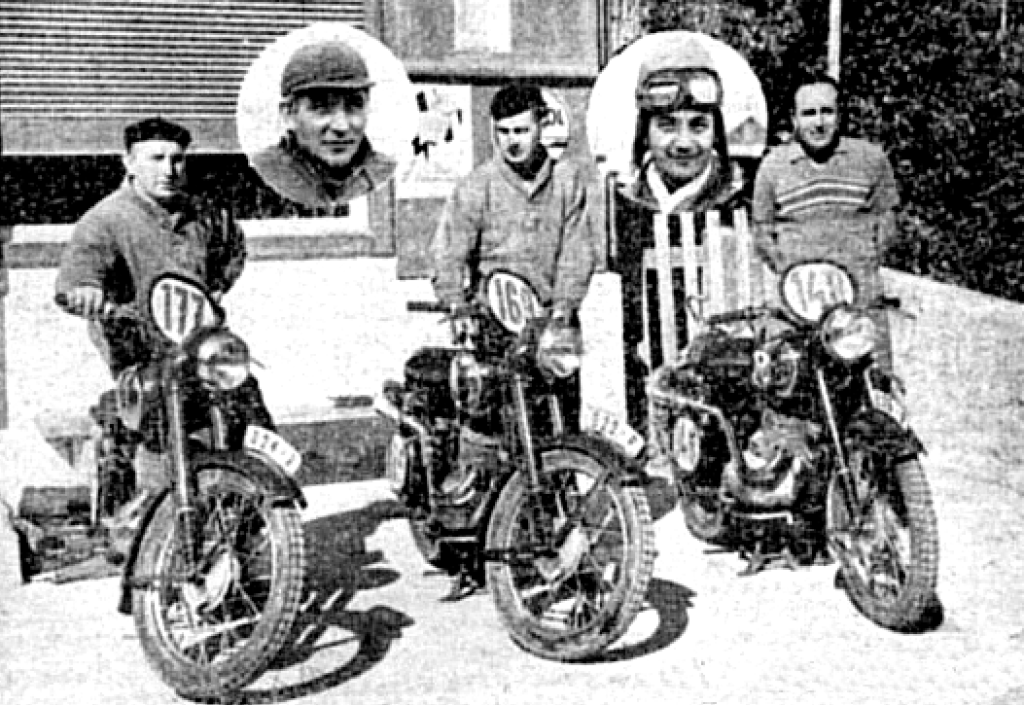

WITH HINDSIGHT, THE Blue ‘Un’s preview was rather poignant. Big bangers, like British dominance, had had their day. Rather than dwelling on the details, here’s a mercifully short report by the Daily Express: “Misfortune has overtaken our three crack motor-cycle teams in the 1,500-mile International Six Days Trial which finishes near Salzburg on Tuesday. Nothing, it would seem, can now save Britain from taking a thorough beating. First Bob Manns, of London, pulled in at a lunch stop and never got going again. Hours of rain at high altitudes had caused condensation in the magneto of his Matchless. and he retired. Which means that Britain loses 200 penalty marks each day for the rest of the trial. This puts the Czechoslovak team of five in the lead, and I do not see how they can fail to win the trophy and all the prestige that goes with it. [Czechoslovakia, using lightweight two-strokes, won both the Trophy and the Vase—Ed] Don Evans, riding
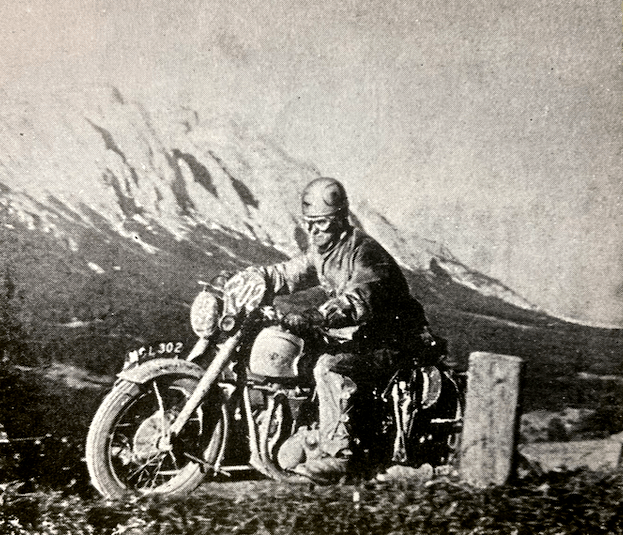
for the Silver Vase trophy, had a series of misfortunes. First his Royal Enfield petrol tank leaked. He repaired it. Making up time he crashed and was knocked out. Today he resoldered the tank and had a puncture. Finally the tank split again. Petrol poured on the hot exhaust pipe and the machine caught fire. Next, Dick Clayton, in the same Vase team, was disqualified because a seal of his Matchless was broken. Finally Peter Hammond, on a Triumph, retired with a broken gearbox. Of the 17 British teams which started the trial on Thursday, only one now remains with a clean sheet—the three riders of the Birmingham Motorcycle Club, all on BSA machines. The only woman rider still going is Mrs Molly Briggs, tubby, shy, who has plugged on after losing nearly an hour on the mountain. She also dropped marks for late starting. She is riding a Triumph and has lost piles of points. But she is still running. Not a bad effort.” The Beeza trio’s exploits were the best news to come out of the Austrian Alps and Molly Briggs did bloody well as you’ll see by reading on. But “tubby, shy”…”not a bad effort”…sexist, patronising bullshit. So no change there, then. And now, the good news…
“THE ONLY WOMAN taking part in the International Six Days Motor-Cycle Trial in Austria, Molly Briggs, showed all the men just how a steep and muddy hill should be negotiated. While the members of the stronger sex wallowed and floundered on the slippery slopes she literally gave her machine the works and flew to the top leaving everybody speechless. Mrs Briggs, 38-years-old and only 5ft 3in in height, is a member of the Burton Motor-cycle and Light Car Club, and has taken part in most of the races and scrambles organised locally. Both she and her husband, Mr Alfred Briggs, have been members of the Burton club since it was re-formed shortly after the war and they are also members of the Pathfinders and Derby MC, Derby being their home town. The Burton club boasts several lady members, but Mrs. Briggs is acknowledged to be the outstanding rider, and her colleagues are not surprised to hear of her performance in the national trial. Concerning the race an observer writes: ‘There were Germans, Dutch and Swedes on dozens of bikes and chairs (sidecars) bogged down in more than a foot of sodden clay. Suddenly Molly appeared. She stopped at the bottom of the track to have a look what was ahead. Then she burst through like Joan of Arc. She raced up that hill at full throttle, zigzagging through the fallen riders. She was over that impossible, slimy hill with its one in five gradient and out on the mountain road again scarcely putting a foot to the ground.’ She has now coaxed her machine, assembled by herself and her husband at their Derby home, round 1,400 miles of the worst mountain tracks in Europe for five days. If every motor-cyclist was as competent as Mrs Briggs Accident Prevention Councils would not have so much to worry about.'”—Burton Observer & Chronicle
“THE AUTO CYCLE UNION of Great Britain has awarded the Maudes Trophy to BSA for the most meritorious observed motor cycling performance of the year. Three stock model BSA Star Twins were selected by the official ACU observer J McNulty from a batch of 35 passing through the finishing department of the BSA works early in September. These machines were marked with special paint and the engines and components sealed. From then on the machines were under the direct supervision of the observer unless he impounded them under lock and key with his own personal seal on the door. On September 7 the three machines, ridden by prominent British riders Fred Rist, Norman Vanhouse and Brian Martin, left Birmingham accompanied by Mr McNulty. [Fred Rist had represented Britain in the ISDT four times, twice as captain of the winning Trophy team—Ed.] Their route was to take them through nine countries. From September 18 to 23 they were in the International Six-Days’ Trial through the Austrian provinces of Styria and Carinthia in the British zone, and Salzburg and Upper Austria in the US zone. Competition from top rank Continental riders and machines was met, but, despite the rigours of the course and bad weather, each was awarded a gold medal for having covered the course without loss of marks (in marked contrast to every other British team). After the International Six Days’ Trial the machines continued their road test, passing through Germany, Denmark and Sweden to the finishing point at Oslo on September 30. Mr McNulty made a detailed report of his observations to the ACU in which he included a record of every attention the machines had received, and later the ACU issued a certificate of performance. The Maudes trophy was first introduced by the ACU in 1923 and was last awarded in 1939. On October 9 this year the ACU competitions committee considered the report of their observer on the BSA performance and made the new award.”—The Adelaide Advertiser [Yes, word of the Beezas’ astonishing feat had reached Australia. And the Aussies forgot to mention that at Oslo the A7s, , despite low gearing foir the ISDT, each did a flying quarter at over 82mph; they covered 4,958 miles and when stripped were found to be in excellent condition.]
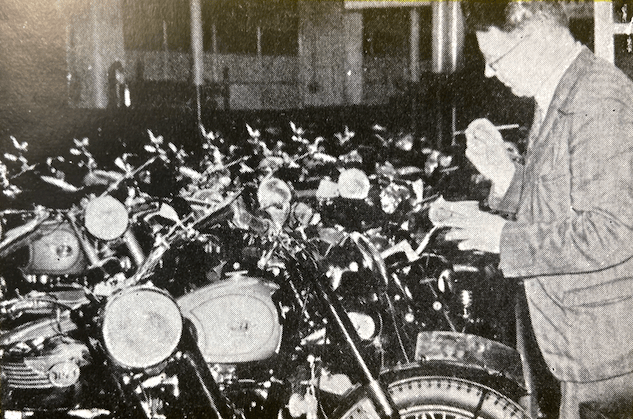
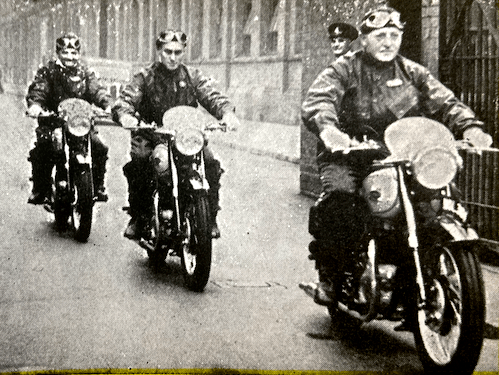
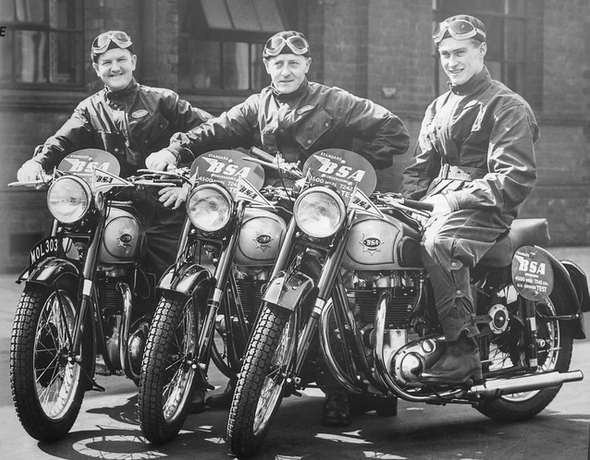
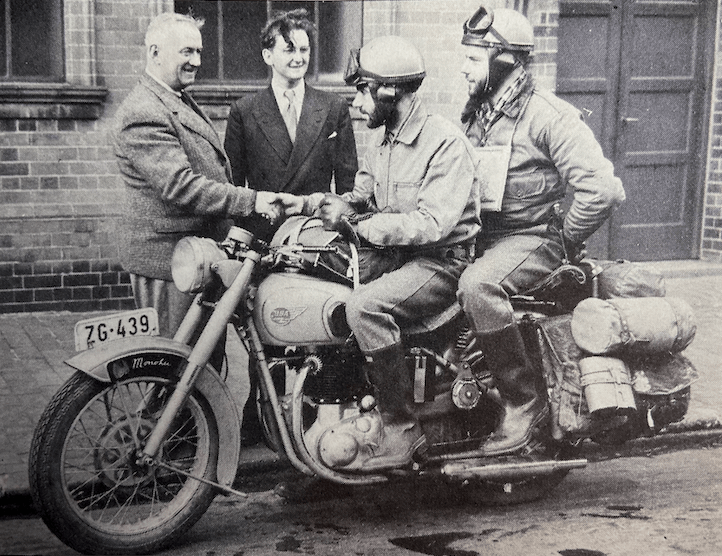
JOHN PALREYMAN OF MANCHESTER arrived home after a three-year/53,000-mile global tour on his Triumph combo. Transcontinental riding was clearly flavour of the month. A husband and wife team on 125cc CZs reached Iran en route from New Zealand to Blighty. A pair of Aussies on a Dommi, riding home after a couple of years in the old country, passed through Jerusalem—along with a Glaswegian chum who went along for the ride on a battered ex-WD 350cc SV Royal Enfield. Hard on their heels was a plucky English lass on a 250cc ohv Beeza who had passed her test just two weeks before. She encountered blizzards in France, freezing headwinds in Italy, quagmires in Iraq, heatstroke in the Sind Desert and monsoons in India where she sensible dumped her bike and flew to Oz.
A CYCLEMOTOR powered by an Italian Mosquito clip-on engine covered 25,000 miles in 55 days at an average of 19mph with only routine maintenance.
“THE MANAGING DIRECTOR of Shell-Men and BP has made public his company’s case for the reintroduction of branded petrol. According to the statement issued, the position is that the oil industry in this country has the refining capacity to produce in adequate quantities higher-quality fuel than the 70- to 72-octane Pool which British pumps have delivered for so long. A very large—and costly—expansion of refining facilities was started after the war, and the programme will be virtually completed next year. This programme, undertaken with the full support of the Government, included catalytic-cracking plants which are designed to supply high-quality petrol. Now that the plants are operating, the oil industry is confronted with a refusal by the Government to allow the sale of superior fuel. Indeed, it is stated that the catalytic-cracking plants now producing in Britain are being operated uneconomically because the high-octane petrol obtained is blended with low-grade petrol from other plants to provide the standard-grade fuel…Whether motor cyclists will be prepared to pay the additional price per gallon will, to a large extent, depend on the advantages apparent in use. Most high-performance motor cycle engines would give improved results on higher-octane fuel, and it is probable that more miles to the gallon would be obtained. But the issue is not so much a matter of the need for better fuels as the desirability for such fuels to be marketed for those who require them.”
“STATISTICS JUST ISSUED by the Ministry of Transport disclose that motor cycle licences current during the September quarter last year reached a record of 839,843. This total covers motor-assisted cycles, autocycles, scooters, motor cycles, sidecar outfits and three-wheelers. The record of 744,516 set in 1950 has been increased by 95,327, or by about 13%. The September quarter is the one during each year in which the maximum registrations are current and is accepted as the yardstick to indicate the real popularity of any class of road vehicle. It is enlightening to compare earlier years with the 1951 peak of 839,843: 559.313 in 1948, 462,375 in 1938 and 731,298 in 1929—the record until it was surpassed by the 744,516 of 1950. Motor cycling gains in popularity year by year. If the rate of increase is maintained there will be million motor cyclists on the roads of Great Britain next year.”
“A FEW READERS claim that it is desirable to retain pedals, on autocycles, even when a multi-speed gear renders pedalling unnecessary on hills. The idea is that a lightweight can always be pedalled home if roadside trouble cannot be diagnosed or repaired on the spot. There are two retorts to this view, namely, that only a very muscular fellow could pedal a fully equipped autocycle very far on a hilly road, and that breakdowns are too infrequent to counteract the merits of dispensing with pedals in favour of a simple gear box. The scooters are achieving a real vogue without pedals.” —Ixion
“AT LONG LAST I perceive a faint spasm in the direction of new cap fashions, and not only in the motor cycle sphere. The new caps bear no special name, as far as I am aware. We first met them in the pages of American motor cycle journals, and perhaps next on the heads of fellows like Joe Mercer, ie, American visitors to the TT. I have yet to see a British motor cyclist wearing one. I refer its the design which consists of a tight little skull cap equipped with a very long peak. Thousands of our August holiday makers have been wearing them on the beaches and in the streets. I have even seen young women wearing them in conjunction with extremely brief costumes. In other words, they are being sold to go with sketchy costumes in hot weather. They are not unlike the ski caps which were once mildly popular among us on motor cycles. They are light; shade the eyes; create no wind resistance; and to my thinking look- quite smart. But the peak must be well stiffened And the colour—for us—should not be white, even if the material is washable.”—Ixion [And now I’m smiling at the thought of Ixion riding in a back-to-front baseball cap—Ed.]
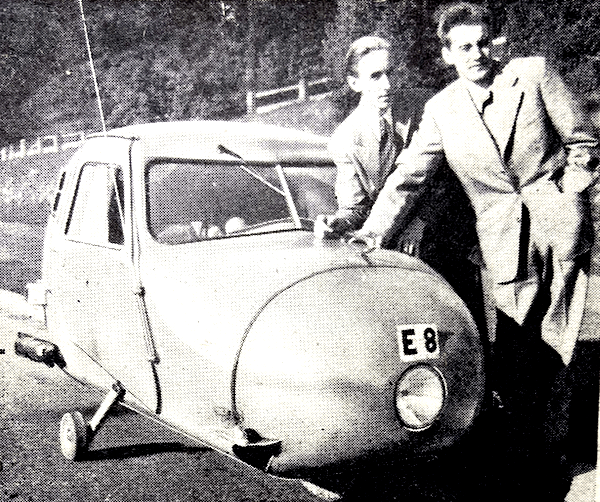
“COMMENTING ON THE reduction in the price of the Triumph Speed Twin, Edward Turner, managing director, said, ‘This must not be taken as a sign that a price landslide in the industry is imminent—stringent economies alone have made a small reduction possible. It would be a great mistake for anyone to anticipate any general drop in British motor cycle prices. In point of fact, the industry is out on a limb. In spite of the fact that our contribution to the export drive has been out of all proportion to the size of the industry, we manufacturers know that we are far from ‘sitting pretty’. Motor cycle prices have already reached a level above which export markets are not prepared to pay, and if there are any more increases in costs—pay increases, for example—these will have to find reflection in higher prices for our products. The logical consequence will be a swift shrinkage in oversea markets. This would be disastrous, particularly at a time when German competition in the motor cycle field is becoming acute. Observers who have visited German factories have been impressed—and seriously disturbed—by the modernity and excellence of the plants, equipped probably with American lease-lend money. We do not object to the normal rough and tumble of international competition, but we feel that there is a grave danger of Britain being handicapped right out of the running. As things are at present, the reborn and subsidised Gentian factories are going to give this country’s industries a considerable shaking as time goes on. The Germans are working hard and long, and it is as well that we should face facts squarely now rather than indulge in rosy dreams for which there is no sound foundation. There is no indication that raw material prices and production costs in the industry will fall. Rather is the reverse the case, and what small price reductions may be possible will have to come from internal economies.”
“BY A LEAD OF 22 POINTS, the South team won the North versus South Scramble last Sunday for the third year in succession. The Northern team had a preliminary advantage of 40 points after their victory in the first half of the contest, but during the day the Southern team gradually built up a lead. It was a glorious day for racing: warm, with just enough cloud to prevent dazzle. The course was slightly dusty, but not so bad as to hamper riders to any extent. Geoff Ward, the captain of the Southern team, encountered gear-box trouble in the practice period, and he borrowed a 348cc BSA from a team-mate. In spite of riding an unfamiliar machine, he won the first event in the contest with little trouble. E Ogden (499 BSA), who was up among the leaders for the first few laps, had to retire through lack of fuel. In the second race, GW Beamish (499 BSA) took the lead from the start and, by the end of the first lap, had built up a comfortable lead. Near the start of the fifth lap, DE Rickman (499 BSA) was catching Beamish and, for a time, it seemed as if he might pass Beamish. After another lap, however, Rickman dropped back and Beamish came in an easy first. The Northerners had bad luck in this event when DJ Hughes (498 Triumph), who was well up to the fore, lost both footrests and had to retire. By the end of the first two races of the contest the Southern team had more than halved the Northern team’s first-leg advantage, and, although it was too early to make any definite forecasts, it was quite obvious that the Northern riders would have to put up a better show to take the trophy back home. In the next race, the third of four events, Northerner FH Bentham (497 Ariel) led the field from the start. His engine was not going too well and could be heard misfiring at many points round the course. Ward, who was close behind him at one time, was another to lose his footrests and he, too, had to retire. Right until the last lap Bentham held his lead and then, with only a few yards to go, EJ Whitten (348 BSA), South, swept past to win by a matter of feet. Tony White (349 Velocette), South, had been indulging in a spirited scrap with EK Myers (490 Norton), North, for most of the race, but he just beat the Northerner on the finishing line. For the final race of the day, excitement was running high—this was the deciding event. The field kept together for the first laps but by the fourth lap M Banks (499 BSA) had established a fairly comfortable lead. Team-mate DE Rickman (495 BSA) passed him at the end of Lap 5. Although the Northern riders had been beaten, they had put up a strong fight, and there can be no doubt that the crowd, which was reckoned to number almost 30,000, had a very good day’s sport. There was one race in the programme for SE Centre riders and one for Centre riders plus nominated N vs S team-men. The Streatham Club is to be congratulated on organising a first-class meeting.”
HEAVY RAIN, THUNDER and lightning added to the hazards of the Tor Club’s fifth Avalon Scramble, at Higher Farm, Wick, last Sunday. Conditions were so bad that it was necessary to abandon the last event of the day—the Handicap Race.”
“SIX TIME CHECKS were sufficient to identify a a winner from 76 entrants in the annual Night Time Trial organised by the London Motor Cycle Touring Club last week-end. The start was from Kingston By-pass, Tolworth, Surrey, and the 116 miles under dry, bright skies embraced many narrow Sussex and Surrey lanes. Competitors had to average 20-22mph over the distance. The Club provided welcome coffee and sandwiches to all riders and passengers before dispatching them on the more difficult second half of the course. The time checks over Blackdown decided the premier award for PC Hedges (646 BSA) with only six marks lost, one fewer than W Cleall (649 Triumph sc). Breakfast was at Southdean Holiday Camp, near Bognor, Sussex.”
“RECORDS IN 350 AND 500cc classes were broken at the Louth MCC’s Championship Road Race meeting held at Cadwell Park on Sunday. Peter Davey, who was third in last week’s Senior Manx Grand Prix, set the pace by equalling Les Graham’s 350cc six-lap record, which has stood since 1948. Then Fred Wallis, in winning the 350cc final, broke Graham’s eight-lap record by 3sec. The Folbigg Trophy race was won by the irrepressible Davey with an eight-lap time of 6min 26sec. This, however, was 0.8sec outside the 500cc record set up previously this year by JP Hodgkin, who will, therefore, hold the Folbigg Trophy. The trophy is awarded for the best eight-lap time of the year in the qualifying races, although Sunday’s final was over 12 laps. Ironically, Davey broke Hodgkin’s record in the last event of the day, which he won at an average speed of just over 56mph.”
“FINAL HILL-CLIMB of the season was held at Bouley Bay, Jersey, last Thursday. The weather was bright and fine, but there were two wet patches on the roadway. That before the Les Platons bend caused no trouble, but the other was on the outside of Radio Hairpin and most riders had to change their tactics to ensure a safe passage. The road surface is of concrete, which can be very slippery when wet. On the first runs, GR Bisson on a 348cc Velocette with 65.7sec was fastest in the under-350cc class. There had been no practice, and the majority of riders were much faster on their second runs. M Boizaro (347 Matchless) improved on Bisson’s first time by 0.3sec, but the latter then came up in 64.5sec to win the class. Most impressive in the over-350cc ‘petrol’ class was MS Wilkinson on an apparently standard Triumph Thunderbird, which was quick and very potent; his time was 62.2sec. In the first runs for over-350 cc dope-fuel machines, M Hubert (499 BSA) made a very fine climb in 60.6sec, which was then bettered by E Le Masurier (497 Ariel-JAP) with 60.0sec, in turn bettered by N George (499 BSA) with a hectic 58.7sec. On the second runs, no one could break the one-minute mark until M Daghorn on his 499cc BSA, which had been misfiring badly on his first run, recorded 58.2src. Le Masurier then pipped him with a fine climb in 58.1sec, which would have been even better had his plug not jumped off just before the finishing banner.”
“A FULL PROGRAMME, run in sunny weather, was provided by the MCC at its third Silverstone Meeting on Saturday. In addition to the two one-hour high-speed reliability trials, there were also a scratch race, a handicap and a winners’ handicap, all over five laps of the 1.6-mile club circuit with its three sharp corners. Throughout the meeting the neat and fast riding of GP Douglass on his Vincent Black Shadow kept spectators on their toes.”
“WELL OVER 100 people attended the official opening of the new headquarters of the Antelope Club at Whitefriars Lane, Coventry, on September 5. The club building, complete with its own car park, was built almost entirely by the club members themselves. Councillor Harry Weston, ex-Mayor of Coventry, and a vice-president of the club, performed the opening ceremony. Also present was the Chief Constable of Coventry, EWC Pendleton, OBE, BEM. The club will be open each evening, though the main club-night will be each Friday. Unattached riders, whether permanently or temporarily in Coventry area, are welcome.”
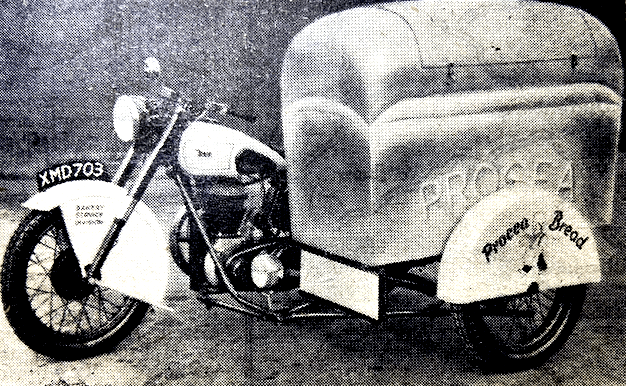
“ON AUGUST 18 a reader was given a lift in a lorry from Bristol to Gloucester; inadvertently he left his raincoat in the cab of the lorry. It is known that the lorry driver is a reader of The Motor Cycle, and if he wishes to get in touch with the owner of the raincoat, his letter will be forwarded provided it is addressed to this office, care of the Editor.”
“TWO BRITISH RIDERS, Bert Morris (BSA) and ER Fitton (Norton and Velocette) competed in the Pynikki TT, Finland on Sunday, September 7. In addition, there were riders from Sweden as well as nationals. Winner of the 500cc race was Nils Schroder (Triumph); other placings were W Bergstrom (Triumph, second, and L Nyman (Triumph), third. Fitton, riding the Norton, finished fifth. In the 350cc class, the winner was 011i Riekki, AJS, with C Ginman (AJS) second and L Makinen (Velocette) third. Mois (BSA) was seventh and Fitton (Velocette), eighth.”
“THE HERTS AND WEST Essex Group of the Invalid Tricycle Association will hold a touring trial on Sunday, September 28; assistance will be given by the Ilford Amateur MC. All members of the Invalid Tricycle Association are invited to enter; the entry fee is 1s. Start and finish will be at The Retreat, Chigwell Row, Essex, on the B173 between Grange Hill and Lambourne End. First competitor will leave at 2pm. “
“AFTER TWO YEARS’ construction work, the Vacuum Oil Company’s mighty refining plant at Coryton, Essex, is nearing completion. The first large consignment of crude oil has been delivered, and it is anticipated that the power plant at the site will soon be working. An astonishing fact is the amount of water that will be required for cooling purposes and the boilers. It is said that when the plant is working at full pressure, approximately 45 million gallons of water will be circulated each day! The refinery, which will have cost over £12 million, is expected to be in full production in less than a year, and it is estimated that 900,000 tons of oil will be processed annually.”
“EB STOTT IS PERFECTLY correct in advising a certain cynicism where new engines are concerned in the racing sphere. I may have felt an undue optimism about the prospects of developing a successor to the Norton single-cylinders. On the other hand, an air-cooled twin or four-cylinder is a very simple affair as contrasted with a BRM. Much may depend on the degree of fact behind the now quite aged gossip about multi-cylinder designs long existent in designers’ heads, on paper, and even in prototype form. In addition, the Norton firm has an unequalled know-how in the extortion of maximum power from simple engines, and Joe Craig has an exceptional brain, extensively cultivated over a long period in the requisite field. If and when the Continental fours can beat us over curly circuits, I still trust Nortons quickly to produce something that will hold them.”—Ixion
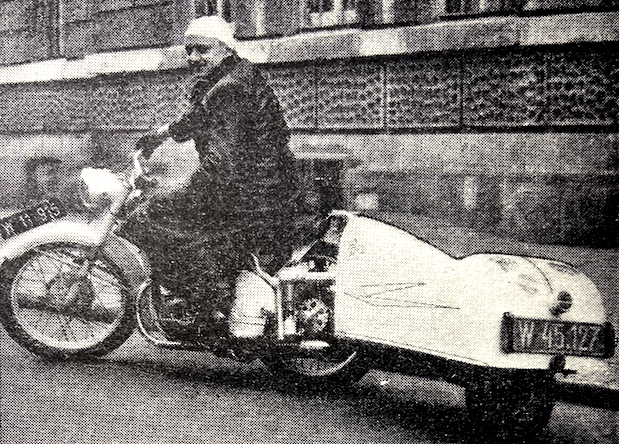
“TWIN-SEATS WILL BE featured on all AJS and Matchless spring-frame models for 1953. The seat to be standardised is similar to that introduced with the 498cc twin-cylinder Matchless Super Clubman in 1948, but it is narrower and now measures 11in across the top. The length remains the same, at 24in, and the general seat construction is unchanged. Blue piping will be used to edge AJS seats, and red for those on the Matchless models. Otherwise, at a cursory glance, it might be imagined that the ranges of AJS and Matchless machines are unchanged. However, while it is true that there are no major changes, and no new models, there are numerous detail refinements, all of which add up to making the machines, long recognised as being in the top class, even better. A novel and most practical innovation is provision for a simple thief-proof lock. The lower steering-head lug is drilled vertically in the vicinity of the left-hand tank stop. A small malleable casting, slotted so that it slips over the tank stop, is provided. When the front wheel is turned to the right, the rear end of the locking bar abuts against the machine’s frame. A padlock is then inserted in the hole in the lower head lug. The device is extremely simple, and the locking bar is small enough to be carried in a pocket. The price of the locking bar is a mere 1s 6d. The existing range of AJS and Matchless machines is continued. That is to say, each programme embraces the famous 350 and 500cc singles—widely renowned for their excellent all-round performance and mechanical quietness—which are available with rigid or sprung frames; 350 and 500cc single-cylinder trials and and scrambles mounts, which feature light-alloy cylinders and heads; and last, but far from least, the luxury, high-performance, 500cc rear-sprung vertical twins. All models are paralleled in both AJS and Matchless ranges; all have ohv engines. Of chief interest to the hard rider is the fact that all models for 1953 will have a new-type front brake—a brake which is claimed to be even better than that employed on 1952 models. A prototype of the new brake has undergone considerable testing on the Matchless twin owned by a member of the staff of The Motor Cycle, and its efficiency is almost beyond belief. Braking is smooth and progressive, and braking distances so incredibly short. that they seem impossible to achieve. There is very little that is different in the appearance of the new brake compared with the former pattern. The shoe plate has been moved anti-clockwise through a number of degrees, and the cam lever has been turned relative to the camshaft, so that the lever projects forward instead of to the rear; the cable stop has, of course, been moved to the front of the fork stanchion. The new position of the cam lever provides maximum mechanical efficiency on the leading shoe instead of the trailing shoe, and hence better stopping power.”
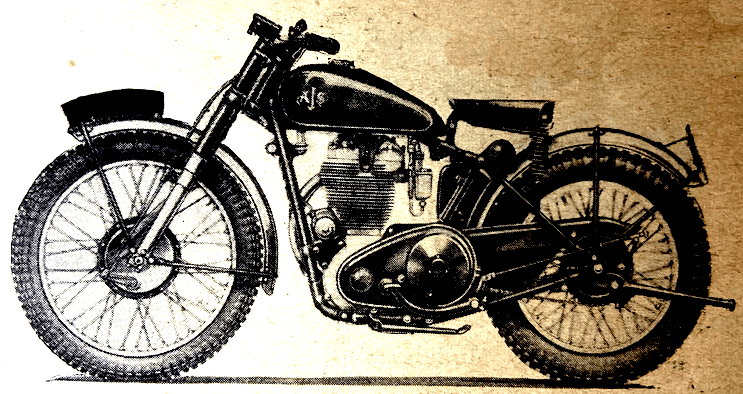
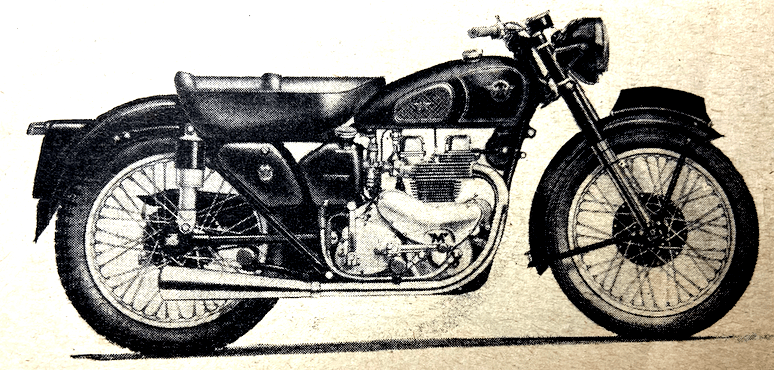
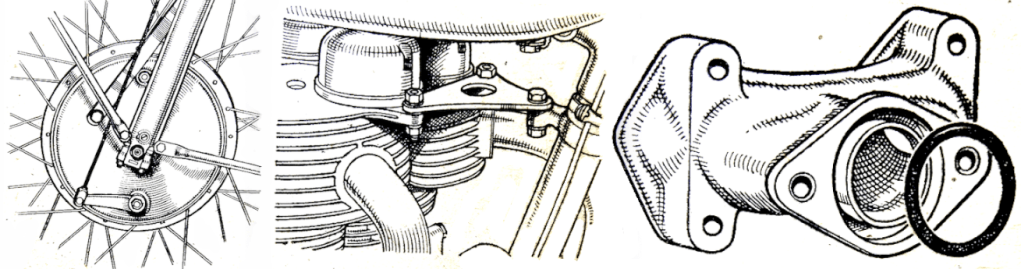
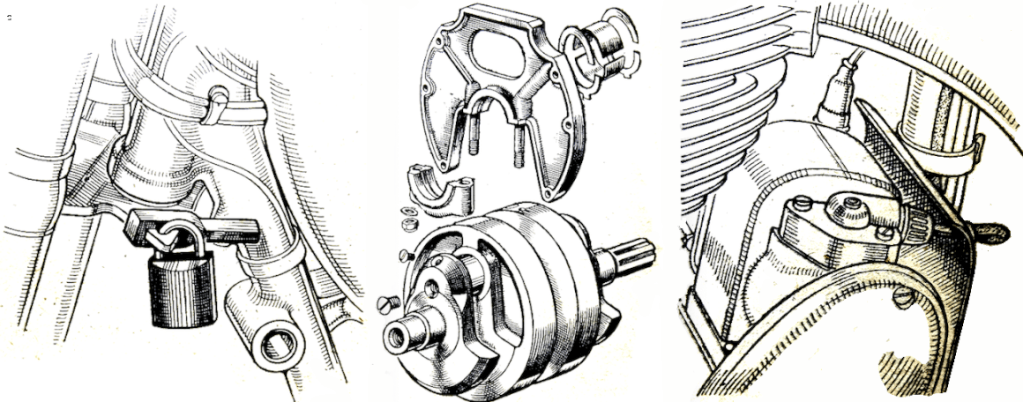
“I NOTE THE interesting article entitled ‘The Gear Box’, and that it is suggested that the Scott Company first introduced the friction-clutch type of two-speed countershaft gear made in 1908. Actually, this type of has was invented and manufactured by JC Phelon and R Moore, and was successfully demonstrated by the latter gentleman when he was awarded a gold medal (riding a P&M. machine fitted with this gear) in the 1903 ACC 1,000-mile Trial. The Scott gear introduced some years later was practically the same, the only variation being in the method of operating the wedges which expanded the two clutch.
B MARIANS, (Director, Panther Motor Cycles), London, EC4.”
“THE 1952 JUNIOR Manx Grand Prix, contested on Tuesday of last week over six laps of the IoM TT course, was won at the record speed of 85.73mph by 23-year-old Glasgow mechanic RM McIntyre riding an AJS His time of 2hr 28min 27sec was nearly six minutes better than the previous record, set up by Robin Sherry last year—a remarkable performance for a comparative newcomer to road racing, whose only previous IoM experience was in the Junior Clubman’s TT last June. Second man home, also AJS-mounted, was Harold Clark, a consistent post-war MGP competitor, who was robbed of almost certain victory by a sensational last-lap misfortune after three times shattering the lap record. His final lap record of 25min 55sec beat the 1951 by no less than 1min 4sec. Third position throughout the race was held by DK Farrant (AJS), who rode unobtrusively but extraordinarily well to average only 1mph lower than the winner. The first four men all beat last year’s winning time. All rode AJS machines equipped with extra large tanks which enabled them to complete the six laps without refuelling. Throughout the race a stiff, chilly, wind blew from the north-east. This was favourable to the riders on the Mountain section, but adverse from Ballacraine to Ramsey. Both race and lap records were shattered last Thursday when the Senior Manx Grand Prix was won, in perfect weather, by DK Farrant, riding the now famous 498cc Matchless twin at an average speed of 88.65mph for the six laps (226½ miles) of the Isle of Man TT circuit. During the course of his ride Farrant broke the lap record four times; his final circuit in 25min 15.8sec represents a speed of 89.64mph. Second place went to RM McIntyre, riding the same 348cc AJS on which he won the previous Tuesday’s Junior race. Riding superbly, he improved on his Junior winning speed by nearly 2mph. Third—and first of the single-cylinder 500s—was Cadwell star PA Davey (Norton). The first three men all beat last year’s race time. Of the 83 starters, 66 completed the course, a creditable percentage of almost 80.”
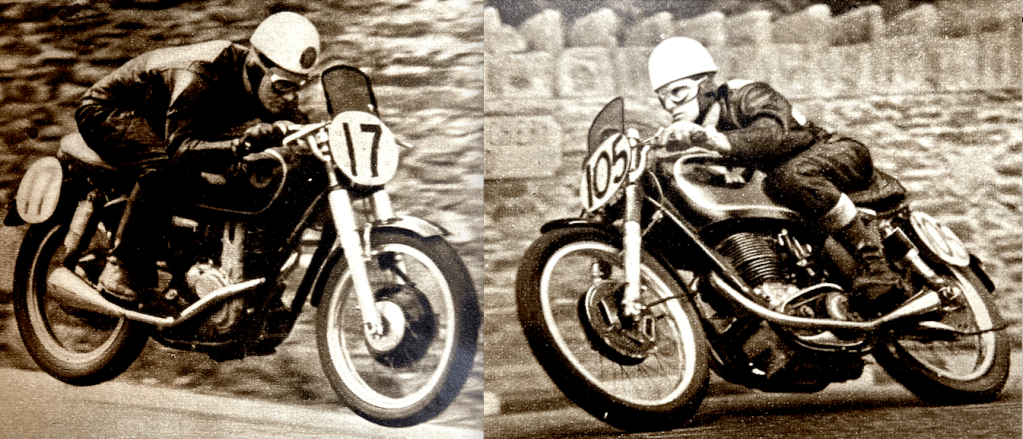
“THE PREVALENCE OF foot and mouth disease made it necessary for this year’s Stroud Valley Club’s Cotswold Scramble to be postponed from June 28 to last Saturday, September 13. This fact had unfortunate repercussions. The Cotswold meeting was selected to stage the British event to rank as the Grand Prix to count in the European Moto-Cross Championship. The postponement meant that the British race became the sixth and last of the Grand Prix meetings instead of the second. In effect, the title was won a week earlier by Victor Leloup (FN) of Belgium, who, first home in the Grand Prix de France, placed himself in an unassailable position. Thus the keen competitive edge was absent from the British race and, indeed many famous scramblers whose names were in the list, including four Belgians, did not put in an appearance. Nevertheless, the standard of riding during the afternoon was exceptionally high, and the large crowds gathered at the 2¼-mile Nymphsfield (Gloucestershire) circuit had little reason for disappointment. An unofficial computation of the final result of the European Championship, in which the best four performances count, gives Leloup the winner, as mentioned earlier, with 28 points. Second is the famous Belgian, A Mingels (Matchless), with 20 points scored in three events. Had the British rider TCM Avery (BSA) won the Cotswold race on Saturday, he would have achieved 20 points also, but unfortunately he retired and had to be content with third position in the Championship on a score of 12 points from two events. Brian Stonebridge (Matchless) who won the race on Saturday, annexed fourth place with eight points obtained for that single success! At Nymphsfield the hillsides form a natural arena for the circuit. Colourfully clad spectators packed the slopes and waited expectantly in the bright sunshine for 3pm and the start of the international event. The circuit was similar to that employed for previous ‘Cotswolds’; it embraces first-class scramble terrain—severe ups and downs, twists and turns, a modicum of mud, a dash of shallow water, a few slightly rocky patches, and plenty of bumps guaranteed to keep even the best suspension systems and the brawniest muscles fully occupied. For the most part, the surface is grassland. Billowy clouds were threatening to obliterate the sun (more than

that—threatening rain, though it did not materialise) as the much-reduced field of 19 starters came to the line for the big race. They were set off in two flagged lanes which merged into the circuit proper, and all got away well. Right from the beginning, GH Ward (AJS), PA Nex (BSA) and BG Stonebridge (Matchless) were well to the fore; Victor Leloup, too, was well placed, though he is capable of much more purposeful riding than he showed during the first lap. Ward kept in front for the lap, but howling at his heels were Stonebridge and Nex; there was no more than a yard or so between each machine. All three held a clear 200-yard advantage over the rest led by Leloup. So fast were the leaders going—unofficial timing showed 3min 38sec for the lap—that they caught and overtook the last straggler, Veevers (197 Dot), on Lap 2. W Barugh, also mounted on a 197cc Dot, was showing just what can be done with a small-capacity two-stroke in mighty four-stroke company, by holding 10th place just behind the charming young American rider on holiday in England, Bud Ekins (498 Matchless). Only about 50 yards behind Barugh came another rider of a two-stroke Dot—T Cheshire. Misfortune eliminated LR Archer ( Norton) who fell and bruised his hip slightly, and JCM. Avery (BSA) whose front mudguard was jammed down on the tyre. Stonebridge got ahead of Ward and they tussled in thrilling style every yard of the way. Nex had lost a few yards, but was within striking distance. Then, early on during the sixth lap, Ward overbraked on a short downhill section and dropped his AJS across the track. Aided by marshals he was away again fairly quickly, but Nex was unavoidably baulked. This left Stonebridge comfortably out in front where he remained without challenge till the end. During the seventh lap, Nex had passed and gained a 7sec lead over Ward who had bent his handlebar controls in the fall and was obviously uncomfortable. Later he retired. Leloup circled in easy and, apparently, unhurried style in fourth place with Derek Rickman (BSA) between him and Nex. Highlight of the last few laps was the battle between Bud Ekins and the irrepressible Barugh. They were within feet of each other on the last lap, and they were so close as they swept over the finishing line that only the judges could decide who had gained fifth place; the American got the verdict, and both riders got a warm, and well deserved, ovation. For the Lightweight Race (machines up to 250cc), LR Archer brought his very peppy 249cc Velocette to the line and showed how to get in front and stay there throughout four laps. On the second lap, T Cheshire (197 Dot) overtook G Davis (249 Triumph) for second position and he, too, held his place to the end. As in the Grand Prix, there was a very close finish for a place—the fourth—in which JCM. Avery (249 BSA) just pipped Davis. After his Grand Prix win, BG Stonebridge decided he had had enough exercise for one day and he did not turn out for the Junior and Senior Races. Hence it was not surprising that GH Ward (AJS) was soon in command of the Junior (350cc) event. He led all the way and finally won by a margin of over half a minute. During the first two laps, inspiringly close racing was provided by JCM Avery (BSA), GJ Draper (Norton) and PA
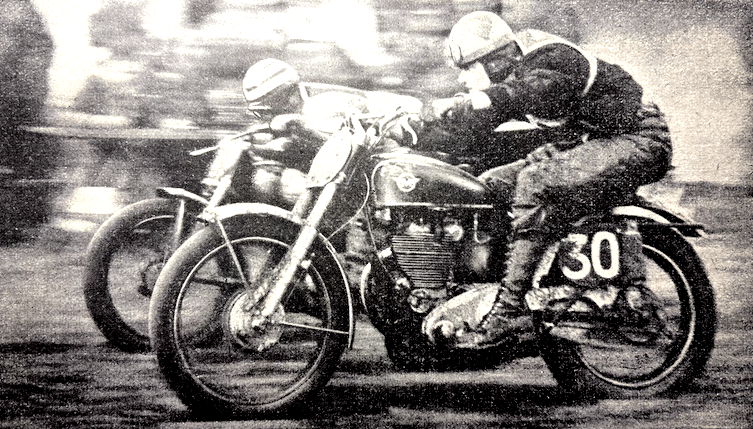
Nex (BSA), who were disputing second place. All three appeared to be riding much faster than Ward, yet, in fact, he was slightly increasing his lead all the time. On Lap 3 Nex dropped back about 75 yards; Avery and Draper continued their tussle. Two laps later, Avery overdid it on a slippery bend; he slid down, and the stirring battle was over. Nex also passed Avery. No further change occurred in the first four positions. At six laps, Ward had a 24sec lead which he increased in the remaining two laps. It was approaching 6.30pm as the 23 starters—including Barugh on his Dot—got ready for the Senior (500cc) Race. As Ward’s 500cc AJS was out of commission he borrowed Bud Ekins’ Matchless and lent his 350 AJS to Ekins. However, Ward’s luck was out because after three laps he retired with gear box trouble. Draper and Avery then ‘got down to business’. Seldom has more tigerish scrambling been seen. Feet only separated them. They leaped, slid and wriggled their machines along to lap repeatedly in under 31 minutes. They were 5sec ahead of Archer in third place after two laps; 24sec after three; 33sec after five. It seemed impossible that they could keep going without mishap. Meanwhile, Cheney was fourth, Rickman fifth and W Nicholson (BSA) had come through to sixth; the American, Bud Ekins, was seventh and enjoying a duel with WA Bell (BSA). Archer suffered from water in the carburettor and retired on Lap 7. Cheney was delayed by sliding down on a greasy climb. Avery established a two-yard lead over Draper, and he held it during the first half of the last lap. Then Draper got ahead again but had a moment or two of bother in a muddy section. Avery slipped into the lead to win a magnificent race by a few yards. RESULT International Moto-Cross Grand Prix (10 laps): 1, BG Stonebridge (498 Matchless); 2, PA Nex (499cc BSA); 3, Derek Rickman (499 BSA); 4, V Leloup (498 FN); 5, Bud Ekins (498 Matchless); 6, W Barugh (197 Dot). Lightweight Race (4 laps): 1, LR Archer (249 Velocette); 2, T Cheshire (197 Dot); 3, AW Lee, (197 Francis-Barnett). Best 175cc, T Sharp (123cc BSA). Junior Race (8 laps): 1, GH Ward (347 AJS); 2, GJ Draper (348 Norton); 3, PA Nex (348 BSA). Senior Race (8 laps): 1, JCM Avery (499 BSA); 2, GJ Draper (499 Norton); 3, Derek Rickman (499 BSA).”
“ANY rider who finished the Road Courtesy Rally to Scarborough last week-end without loss of marks could certainly claim to be a competent and courteous motor cyclist, for the Rally, in its 1952 version, proved a thorough test of the skill and ability of the everyday rider on a standard machine. The event was sponsored by the News Chronicle and organised by the Scarborough MC. A higher proportion of awards was won by sidecar drivers than by riders in any other class, and the outright winner proved to be RJ Kay, who piloted a 1949 BSA A7 Twin with Watsonian Avon-model sidecar. He had his wife as passenger and navigator. It was his first premier award, although he won the sidecar class in this year’s Morecambe Rally. Kay was outstandingly successful in the start-and-braking test which, with the results of two police checks and a secret check, was used to decide the winner from the 32 competitors who completed the entire course of some 600 miles without loss of marks. Kay is a member of the Darwen MCC. The entry of 270 was about the same as last year but the number of non-starters, 54, was surprisingly high. There were six starting points. London, Birmingham
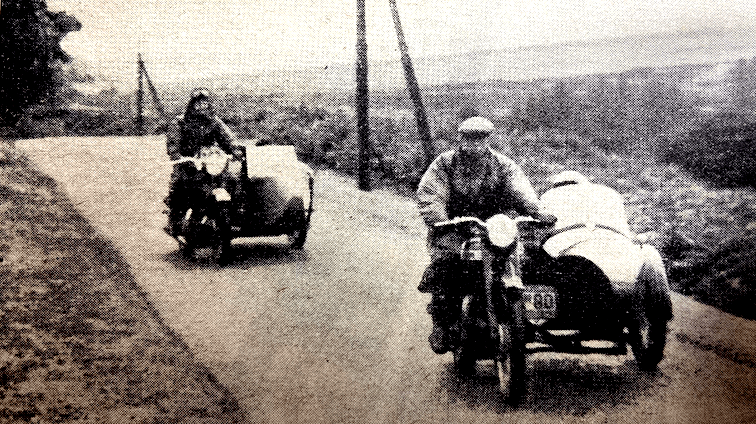
and Dorchester competitors checked through at Swindon and Leicester, and those from Barnard Castle, Scarborough and Manchester, rode via Knaresborough and Leicester. At Filey there was a penultimate control point, and from there followed a run of about nine miles to Scarborough. This included a 2,000-yard timed stretch, to be taken at 22½mph, and a secret check in Scarborough itself for the observance of signals and road courtesy. En route to Filey, the under-200cc solo and the sidecar classes were set an average of 25mph, and the over-200cc solos had to average 28mph. Most riders reported good weather until Scarborough was reached, although some had had difficulty when they encountered the thick traffic resulting from the Queen’s visit to Doncaster for the St Leger. The real fun began after an hour’s break for all entrants at Scarborough. Riders were dispatched on a 140-mile circuit of North Yorkshire moorland roads and a 102-mile wold run south of Scarborough. Each circuit had control checks, and riders failing to report within an hour of their due time were excluded. The wold course was much easier than the northern ride. The latter circuit provided miles of narrow, twisting roads with sharp gradients which, but for their uniformly good surface, could have been classed as sporting in character. Half the entry tackled each circuit concurrently, and those who started the moorland tour around midnight had patches of mist and heavy downpours of rain. A surprising number of competitors neglected to ensure full tanks before leaving Scarborough; there were instances of riders having insufficient petrol at the Staithes check, only 34 miles from Scarborough, to reach the second check and fuel-supply point at Swainby, 29 miles farther on. Of the 216 starters, 30 retired before reaching Scarborough and 42 failed to complete the circuits. There were several reports of riders being stranded for two and three hours, whose troubles could have been put right, and indeed in some cases were put right, by more experienced motor cyclists in as many minutes. The attitude of some competitors seemed to be, ‘we will wait for rescue and the dawn’. The average to be maintained by all classes was 22½mph—about 11 hours’ riding—and many found themselves with time in hand at the finish. General opinion was that the Rally in its new form was highly successful. The Mid-Derbyshire Club, with three riders, secured two awards of merit. Possibly the organisers might consider a team prize next year. RESULTS Premier Award and Trophy: RJ Kay (497 BSA sc). Under 200cc: 1 PA Evans (197 Francis-Barnett); 2, HW Holmes (197 James); 3, T Bergh (192 Velocette). Over 200cc solos: 1, R Axe (347 AJS) and E Myers (499 BSA), joint winners with equal marks; 3, RA Skull (499 BSA); 4, JA Rarlett (487 Sunbeam). Sidecars: 1, H Dyson (997 Ariel sc); 2, RJ Wallington (499 BSA sc); 3, L Alderson (646 BSA sc). Best Performance by a Woman Rider: Mrs Joyce Barnes 123 BSA).”
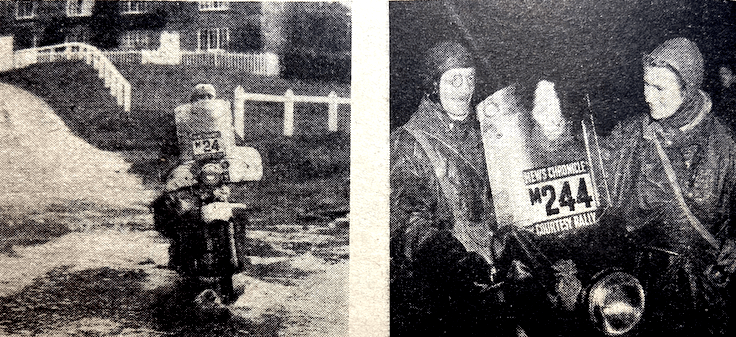
“IN AMERICA, THE MOTOR CYCLE occupies a position very different from that held in Europe. The great bulk of motor cycle sales in the United States are made to the sporting rider, and two-wheelers are rarely used purely for transportation or business. Let us go back to the early days and find out how this situation came about. From the beginnings of the industry—in 1901—the motor cycle business flourished and grew until the years just before World War 1. In 1914, over 20 large factories were busily engaged in manufacturing machines. Competition was keen and many of these concerns were actively interested in racing. Factory teams were supported by Indian, Harley-Davidson, Thor, Yale, Emblem, Merkel, Reading Standard, Excelsior and Cyclone. The industry was booming and things looked rosy. Just about this time, however, the villain appeared upon the scene. This villain was the cheap, mass-produced car, chiefly the Model T Ford. This one model of car was largely responsible for the decline of the motor cycle industry. The car could be sold almost as cheaply as the motor cycle, and most folks turned to the four-wheeler. A look at the registration figures down through the years is interesting in tracing the rise, decline, and resurgence of the motor cycle in America. In 1915, the first year for which reliable figures are available, there were registered in the United States 2,372,696 passenger cars and 199,329 motor cycles. Here are comparative figures for selected years: 1917: Cars, 4,792,205; Motor Cycles, 257,522. 1919: 7,143,954; 241,038. 1921: 12,238,375; 182,714. 1924: 20,051,276; 145,691. 1928: 24,629,921; 121,656. 1930: 26,697,398; 110,757. 1934: 25,163,789; 102,332. 1935: 26,408,500; 96,401. It will be seen from these figures that the motor
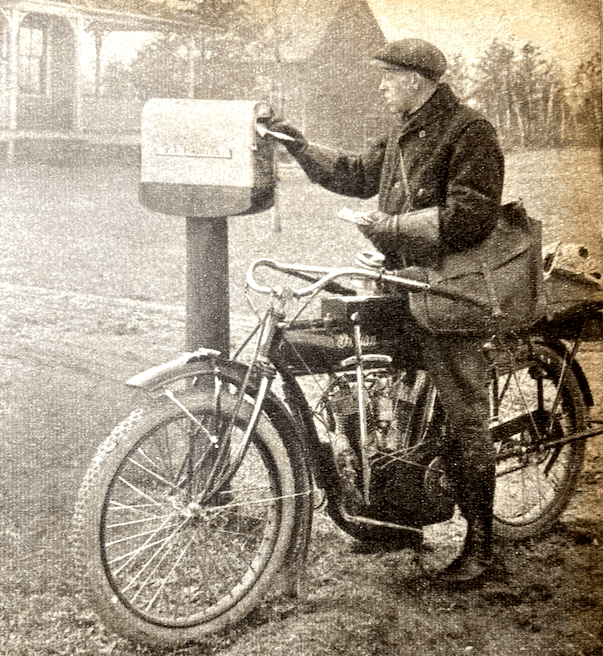
cycle declined steadily in numbers from the 1917 high, while the motor car grew to astronomical numbers. The low year for motor cycles was 1935. There were but two manufacturers left, and their combined production was often under 20,000 units. The decade 1930-40 was the low-water period in US motor cycling activities. This period saw the end of Class A racing, which had dwindled almost to nothing. The prospective motor cyclist had very little choice of mounts, as there were no true lightweights produced, and brave was the heart that elected to begin riding on a big twin—which was all there was to ride. Even the so-called ‘small’ mounts were very heavy by European standards. It was this lack of choice which led many to forgo motor cycling altogether. A motor cyclist was seldom seen on the highway at that time. In the years immediately before World War II, the British motor cycle began to make its appearance, and this was reflected in a slow climb in registrations. Let us glance at some more figures: 1939: Cars, 31,009,870; Motor Cycles, 126,233. 1944: 30,479,306; 165,675; 1946: 34,373,002; 314,073. 1948: 41,151,326; 492,165. 1949: 44,670,588; 478,851. It will be noted that the figures took quite a jump in the post-war period. This was the time when anything that moved could be sold—it was a sellers’ market. Many of these machines are not ‘real’ motor cycles at all. There is no recognition in the registration figures of the difference between a motor cycle, a scooter and a powered bicycle. All two-wheelers are lumped together, and this is apt to be misleading. For instance, there have been very large numbers of cyclemotors sold, and also thousands of scooters. The figures are not broken down into classes, but a fair estimate would, in my opinion, place fully half of the present-day registrations in the motorised-bicycle and scooter classes. At the present time it is estimated that there are about 500,000 two-wheelers of all types On the roads of USA The ‘real’ motor cycle is still rather
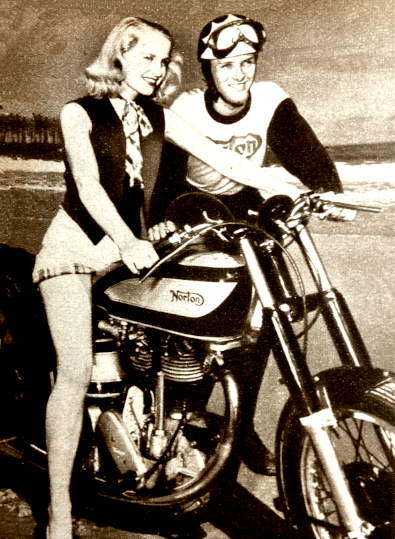
scarce on the streets of an American city. I reside in a large Mid-Western town and use my machine for the daily ride to work. During this trip of 10 miles, undertaken at the busy time of day, it is but seldom that I see another ‘utility’ rider. It is quite possible to observe the rush-hour traffic for hours without sighting a single motor cycle. The utility rider is conspicuous by his absence. There are, of course, the police and commercial users of. motor cycles. Most police departments employ a few big twins for pursuing speedsters; but with the growing use of radar, ‘speed cops’ are likely to decline in numbers. Many garages have three-wheeler units for delivering cars. These three-wheelers are towed out behind the car, and are used for the deliveryman’s return journey. There are also a few sidecar vans used by printing companies and the like. The real market, then, is the sporting one. The introduction of 500cc and smaller-capacity machines has helped to popularise sport and encouraged many new riders. The ‘foreign’ machine is no longer a novelty at gatherings of motor cyclists. On sale in my home town are American, British, German and Czech machines. There is a mount to suit every taste and purse. The usual career for motor cyclists in US is a progression from a light to a heavier mount. Most riders have a term ‘in the saddle’ of from three to five years, and will then abandon the motor cycle for a car. A smaller proportion become dyed-in-the-wool enthusiasts, even as you and I! But almost all American motor cyclists also own a car. Sporting riders amuse themselves in various ways. Some like to tour. Some like the endurance runs, which are a combination of road and rough-country riding. These events are run on a timed basis, and the winner is the man who adheres most closely to his schedule. Most riders addicted to endurance runs have a special trials mount, or maybe just an ‘old crock’ to ride. Motor cycle dealers favour these events; after each one the repair business booms! Growing in popularity are ‘English trials’, which are just what the name implies. These give the average rider the chance to engage in competition without wrecking his mount. A few scrambles are held. We call them ‘TT races’—why, I know not. I favour the explanation heard at an event some years back. One local character said to another, ‘Whut’s the ‘TT’ stand fer?’ The second LC replied, ‘I dunno—thorns and thickets, I reckon.’ There are growing signs that road racing is due for a come-back in America. Already some events have been held in California. Airstrip racing has also been staged in a few localities. With any luck, hard-surface racing will be the coming sport in America. What a wonderful day it will be when the US is linked with the Federation Internationale Motocycliste and we can see the European champions in action on American courses! And who knows but that one day might see an American rider on an American racing machine hurtling down Bray Hill—or am I dreaming? I believe that there is a growing acceptance of the motor cycle in US today. Provided there remains a good selection of machines from which to choose—this presupposes imported machines as mentioned earlier—and if the emphasis on clean sport and safety continues, motor cycling should become more and more popular.”—Emmett Moore
“THE 500CC SOLO CLASS of the last but one of the 1952 series of classic road-race meetings, the Grand Prix des Nations, was won at the record speed of 106.29mph by RL Graham, riding an Italian MV Agusta equipped with an Earles front fork. In the course of the race Graham raised to over the 108mph mark, the lap record of 107.81mph achieved by Alfredo Milani (Gilera) in 1951. Graham led throughout and the issue was never in doubt. His victory evoked remarkable scenes of enthusiasm from a gigantic and excited Italian crowd. Two World’s Championships were also decided last Sunday. E Lorenzetti (Moto-Guzzi) won the 250cc race and thus convincingly secured the Championship title in that class. Although he did not finish in the 125cc race, CC Sandford of England, riding an MV Agusta, became 125cc Champion. His nearest rival, C Ubbiali (FB Mondial) could do no better than finish second; this placing did not give him enough points to take the title from Sandford. The 350cc race was won by WR Amm (Norton) who was making a welcome reappearance in a classic road race after his Solitude mishap. Winner of the sidecar event was E Merlo (Gilera). Practice took place on Friday and Saturday in pluperfect weather. It was, indeed, as though the.weather had changed for the occasion, for the previous week had been one of torrential rain and low temperatures. A brief sensation on Friday morning was the appearance of the new Moto-Guzzi in-line four. The machine covered a few laps in the hands of Fergus Anderson and it was—or appeared to be—very potent, though no ultra-fast laps were recorded. The Moto-Guzzi earned the doubtful distinction of being the noisiest motor cycle ever. By comparison with its ear-shattering scream, the four-cylinder Gileras may be described as being almost quiet. As was indicated when water entered one of the cylinders—the heads are water-cooled—the machine is not developed sufficiently for serious racing. As usual, the Grand Prix of the Nations took place over the 6.31km circuit at Monza, a course that is very, very fast, and resembles, in plan, Italy itself, but with the southern ‘heel’ removed. In spite of its track-like character, the circuit remains a magnificent test-bed
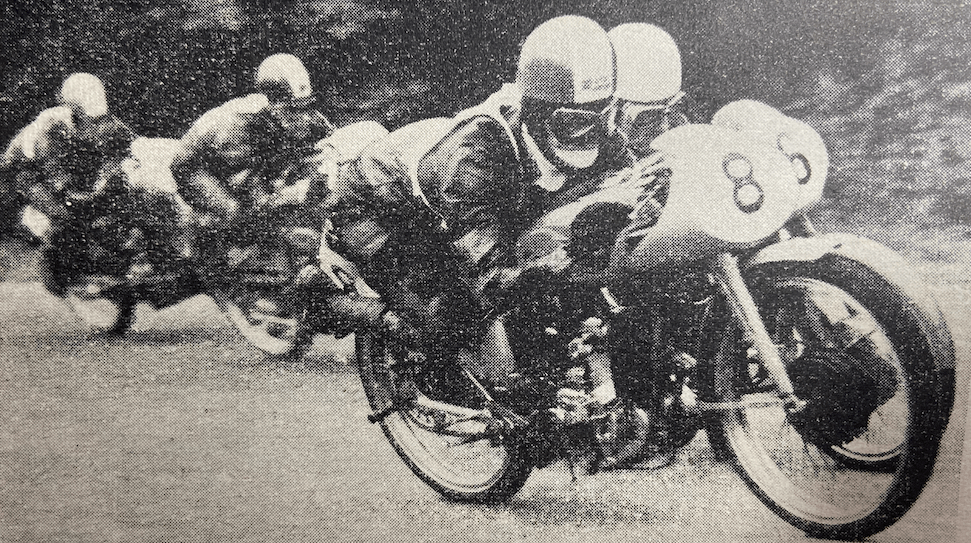
for racing motor cycles. Sunday morning dawned unpropitiously. There was little wind but the air had a distinct snap. Dull grey cloud obscured the sun. Rain threatened. The conditions were not bad enough to deter the vast and enthusiastic throng. The Italians are probably the most motor-cycle conscious nation in the world. Although racing was not scheduled to begin till 9.30am, vast lightweight- and scooter-mounted crowds began to converge on the circuit, seemingly from every hand, by as early as seven o’clock. The weather throughout the day remained uncharacteristic of Monza race meetings. At 9.20, the 18 starters for the 125cc race paraded behind the banners representing the four competing nations. In the field were NSUs from Germany, their front wheels enclosed in light-alloy fairings for the occasion, Italian MV Agustas and FB Mondials and two Morinis. British riders in the field were CC Sandford, WA Lomas and RL Graham, all three riding MVs. Prompt to time the starting flag dropped and E Mendogni swept off into the lead. The NSUs were notably slow starters. At the end of the opening lap, RL Graham had taken the lead, but Mendogni (Morini), C Ubbiali (FB Mondial) and AA Copeta (MV Agusta) were hard at his heels, each slipstreaming the man in front to maximum advantage. On the second lap, Ubbiali had the lead, though it was one of feet only. At the end of the fourth lap Ubbiali, Mendogni and Graham had drawn away from G Sala (MV Agusta), who was fourth, and Copeta, who was fifth. Thus early, Sandford drew into his pit to retire. At half-distance the race pattern was far from being settled. Ubbiali and Graham scrapped hard for the lead and changed positions repeatedly. Behind them, the Mendogni-Copeta-Sala scrap was just as earnest. The group passed in such close formation that rider identification was almost impossible. With only two laps to go to the finish, it began to look as though Ubbiali had been camouflaging his real performance. On the straight past the stand he suddenly shot Past Graham with a fantastic burst of speed. But at Lesmo Corner, Graham again led. Past the pits on their last-but-one lap, Graham and Ubbiali were side by side, and Mendogni and Zinzani (Morini) were within inches of them. Such close scrapping is seldom seen in 125cc racing. At the finish, the four were in close line-astern formation. The crowd rose to its feet, whistling and waving excited hands. Mendogni wins! The finish is so close that it might be a dead-heat. But no, Ubbiali is announced as second. Graham is third. Zinzani fourth. Morinis beat the FB Mondials, and FB Mondials the MV Agustas. The atmosphere was charged with excitement and became even more so when it was announced that, in spite of his second place, Ubbiali had failed to beat Sandford for the 125cc World’s Championship. RESULT, 125cc Class, 11 laps, 62.6 miles: 1 E Mendogni (Morini), 84.39mph; 2, C Ubbiali (FB Mondial); 3, RL Graham (MV Agusta); 4, L Zinzani (Morini); 5, G Sala (MV Agusta); 6, H Luttenberger (NSU); 7, W Haas (NSU); 8, N Pagani (FB Mondial). Even more excitement was expected from the 24 starters in the 250cc race. Though, in the early stages, it looked as though Fergus Anderson (Moto-Guzzi) would win, it seemed inconceivable that such a result would be acceptable at the pit, since Anderson’s team-mate, E Lorenzetti, was so obviously all set to win
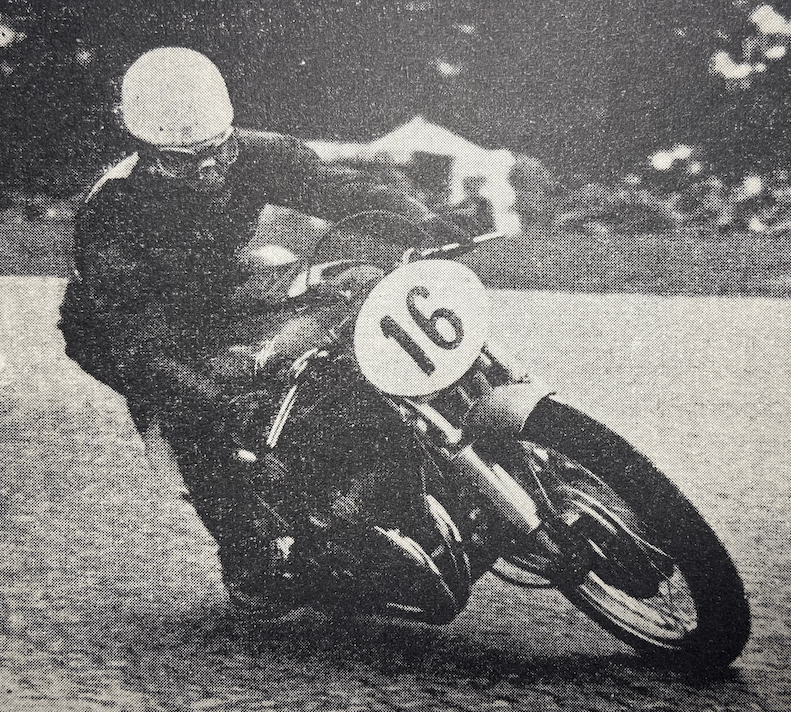
the 250cc World’s Championship. Anderson went into the lead on Lap 1, and was still ahead next time round; A Montanari (Moto-Guzzi) was second on the opening lap; E Lorenzetti, third; and W Haas (NSU), fourth. TL Wood (Moto-Guzzi) was stopped with a broken rocker. On Lap 3 there was a minor sensation when Haas came round in the lead; Anderson was second. On the next lap Anderson attempted to pull out of the German rider’s slipstream to overtake, but returned to the ‘tow’ again as though unable to produce the necessary power. A lap later the NSU still led, and Anderson, Lorenzetti and Montanari snapped closely at its heels. After another lap Lorenzetti led and Haas was in his slipstream. The several Parillas circled confidently but were manifestly down on speed compared with the Moto-Guzzis and NSUs. Colombo, on the second NSU, lay a very safe fifth, although he was a considerable distance behind Anderson. The pundits nodded wisely. Anderson probably had enough power to pass the NSU, but, satisfied he had its measure, got back to take advantage of the ‘tow’. Lorenzetti, meantime, was off into the lead; the other two Moto-Guzzis would then ‘take’ the NSU in the later stages. The pace was hot, nevertheless, and if some of those among the leading quartet were not on full bore, their engines sounded as though they were very near it. At half-distance the order remained unchanged. But at the end of the 13th circuit, when seven laps remained, the pundits’ prophesy was fulfilled. Both Anderson and Montanan pulled out the stops and moved ahead of Haas. But the race was not over yet—not by any means. On the next lap there was a return to the status quo. It began to look as though the NSU was ‘developing’ more rapidly than expected. Perhaps Anderson and Montanan could not successfully deal with it after all. For two more laps the issue remained in doubt. Then, on the 16th lap, Haas moved into the lead. On Lap 17 the NSU still led; but Lorenzetti and Anderson were challenging so furiously that they drew away from Montanari. Haas increased his lead. On Lap 19 Anderson drew alongside Lorenzetti. At the finish the crowd was on its feet and shouting crazily. Three machines appeared at the end of the straight. Two were in line-abreast and travelling at tremendous speed. Lorenzetti and Haas were neck-and-neck. There was absolutely nothing in it. But inch by inch, the single gained on the twin, and Lorenzetti crossed the line a tyre’s width, or little more, in front of Haas. Seldom has there been a closer finish in an international road race. According to the timekeepers, one second covered the first three men home! RESULT 250cc Class, 20 laps, 78.2 miles: 1, E Lorenzetti (Moto-Guzzi) 93.67mph; 2 W Haas (NSU); 3, F Anderson (Moto-Guzzi); 4, A Montanari (Moto-Guzzi); 5, G Colombo (NSU); 6, Francisci (Moto-Guzzi); 7, H Gablenz (Horex). Before the start of the sidecar race there was an interval of rather more than an hour for luncheon. ES Oliver (Norton) occupied the solus position on the starting grid. Contrary to expectations, and contrary to his custom, he made a poor start. It was E Merlo (Gilera) who was first away. He was closely followed by C Smith (Norton). At the end of the opening lap, Merlo had increased his advantage. Smith
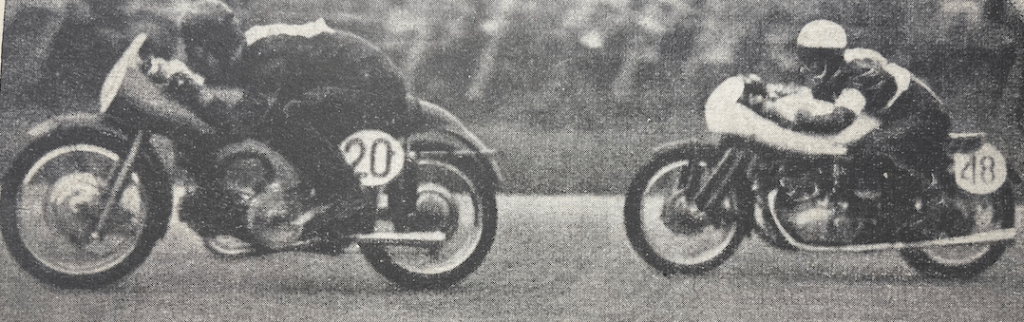
was second; Albino Milani (Gilera) third. Oliver was fourth. After another lap Milani headed Smith. Merlo’s lead was then 400 yards and increasing with every second. Smith gained on Milani, but had not enough speed to overtake. Oliver remained an unenviable fourth—a long way behind Smith. On the next lap there was wild excitement when it was seen that Smith had overtaken Milani. It appeared as though this was to be. Merlo’s race. The focal points, therefore, became the Smith-Milani duel, and Oliver’s effort to better his fourth place. But try as he might, and lying prone along the tank on the straights, he lost ground rather than gained it. Before half-distance Merlo had lapped five outfits scrapping at the rear of the field. By half distance, retirements had reduced the held to 12. Merlo maintained his searing pace. Milani and Smith passed and re-passed each other, and were never separated by more than a few feet. On Lap 11 it was Smith who was second. On the next lap, Milani pulled into his pit. Although he did not delay long, he could not now possibly recover the lost ground. Oliver failed to appear; it was reported that his rear chain had broken. Merlo waltzed home an easy winner, sitting up, and braking before crossing the line. RESULT Sidecar Class, 16 laps, 62.6 miles: 1, E Merlo (Gilera), 91.80mph; 2, C Smith (Norton); 3, A Milani (Gilera). Six nations, with British riders predominating, were represented in the field of 19 which lined up for the start of the 350cc race. It was anticipated that nothing could prevent a Norton win. In practice, it had appeared that the AJS three-valve factory models could just stay with the Nortons provided they could remain glued to the Norton’s rear mudguards. Ray Amm was on the grid, though one of his legs was still in plaster. Early on, it appeared as though the race would emerge as a procession, with the Nortons at its head. HR Armstrong and Ken Kavanagh started almost as one, and moved ahead of the field. At the end of the opening lap Kavanagh led Armstrong; RH Sherry (AJS) was third, Amm (Norton) fourth. Then came Rod Coleman (AJS) and, some distance to his rear, J Brett on the third factory AJS Fifth was WA McAlpine (Norton); sixth, CR Bruguiere (AJS). The anticipated procession developed, and the Nortons drew well ahead. Armstrong’s machine appeared to be slower than those of his team-mates and, possibly because he was trying too hard, he spilled on the sixth lap. Brett’s machine, too, appeared to be down on power in comparison with those of Coleman and Sherry, both of whom duelled their way round the lap, changing places repeatedly. Interest waned, but revived on Lap 8 when Amm came through on his own. Coleman was now second and Sherry third. Kavanagh had come off but he was reported to have sustained only slight injuries. Sherry moved ahead of Coleman to second place. Amm went on to increase his lead. The Norton bastion was in safe hands. With 16 laps gone and eight to go, it appeared unlikely that any changes of note would take place. Amm’s lead at this stage was 1½ minutes by amateur timekeeping. Coleman appeared ready to pass Sherry when he felt the need, and with three laps to go, he was close enough to Sherry to see the grain on his leathers. The pair remained like that until the last lap when on the finishing straight Coleman swept out of Sherry’s slipstream to beat his partner by a bare wheel’s length. RESULT 350cc Class, 24 laps, 93.9 miles: 1, WR Amm (Norton), 97.59mph; 2, R Coleman (AJS); 3, RH Sherry (AJS); 4, J Brett (AJS). In the field for the 500cc race were the chief contenders for World’s Championship
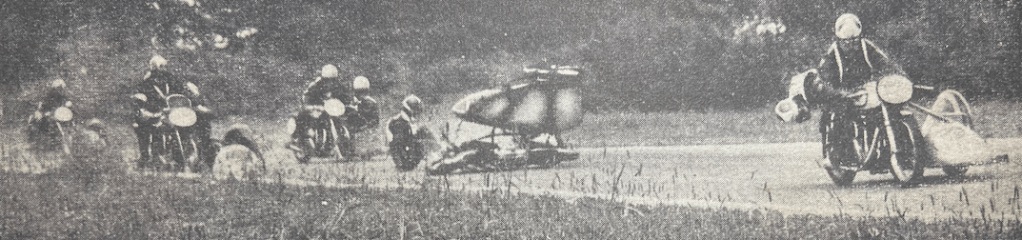
honours, HR Armstrong (Norton), with 19 points, and U Masetti (Gilera) with 16. The final result, of course, could not be calculated at Monza since the 500cc class is to be fought out over eight events, including the Spanish Grand Prix, scheduled for October 5. As a result of his 350cc race spill, K Kavanagh (Norton) was a non-starter. C Bandirola was the fastest away, and was aboard and turning on the power while others were still pushing. Armstrong was not far behind, and close also was RL Graham (MV Agusta). After the MV’s tremendous display of speed in the Ulster Grand Prix, great things were expected of it. While Monza is a circuit calling for a high degree of riding skill, it remains one which favours high-speed machines. The chances of a win for the British AJS and Norton teams were not exactly high. After the first lap it seemed that the predictions concerning Graham were to be fulfilled. He had built up an enormous lead. Bandirola was second, and in a tight bunch behind him were Armstrong, Masetti, Colnago (Gilera) and R Coleman (AJS). Lap by lap, Graham carried on to increase his lead and was undoubtedly not only the finest rider on the circuit, but also the best-mounted. By the end of four laps Graham had built up a lead of over a mile. To his rear, Colnago, Masetti, Nello, Pagani and Bandirola carried on as furious a battle as has been seen for many a day. During one lap Masetti would be fifth; on another, second. There appeared to be nothing in it as regards speed. Behind the four—quite a long way behind—another scrap went on between HR Armstrong and Ray Amm. And, to their rear, J Brett (AJS) duelled ferociously with Libero Liberati (Gilera) eventually beating him for the place on the last lap. Rod Coleman retired early, and Amm went out the 28th of the 32 laps when his back chain broke. By the time the 20th lap had covered, the searing pace had reduced bid to 14. Graham’s win produced scenes of enthusiasm such as have never before been seen at the end of a classic road race. Hundreds of excited Italians surged into the road and a police escort was necessary for him as he went to the dais to let the pushing conclave applaud him. RESULT 500cc Class, 32 laps, 125.2 miles: 1, RL Graham (MV Agusta), mph; 2, U Masetti (Gilera); 3, N Pagani (Gilera); 4, C Bandirola (MV Agusta); 5, G. Colinago (Gilera); 6, HR Armstrong (Norton). Fastest Lap, RL Graham (MV Agusta), 108.09mph (record).”
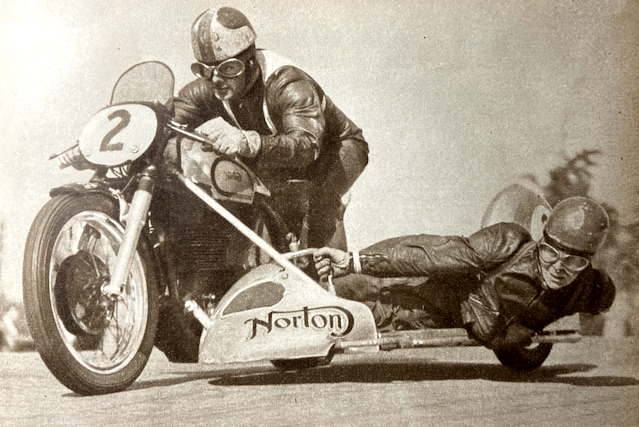
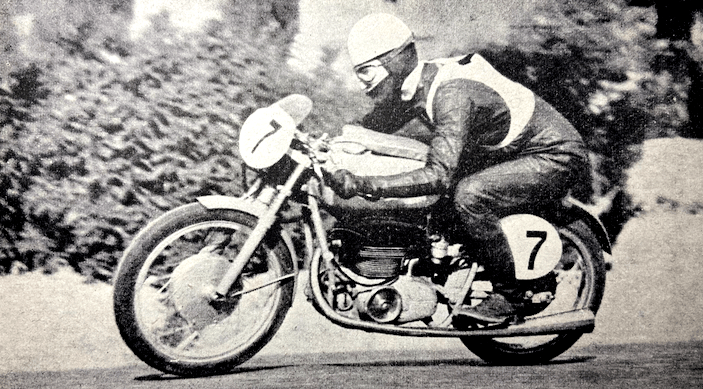
“IN THE SIX YEARS since the scooter boom began, sales have reached unprecedented proportions. The reasons for the tremendous impetus given to the utility two-wheeler were several and correlated. Most important were the tremendous shortage in Italy of all forms of personal transport, and a public transport system that, as a result of the war, could not be described as other than deplorable. The scooter, when it came, provided the perfect answer. It was clean and easy to ride. The temperate climate made no demands for special clothing. At that time, scooters were subject to neither taxation nor compulsory insurance. Thousands who were not interested in motor cycles, or, indeed, ever likely to be, were drawn into the sphere of the powered two-wheeler. Now, it is said, while scooter sales have by no means come to an end, they are being surpassed by the sales of small motor cycles. The reasons for the switch provide an interesting basis for conjecture. Is it that the efficiency of the public service transport system has reached a high level and the utility value of the scooter is thus reduced? Or have scooter owners become converts to pure motor cycles, and is it they who are boosting motor cycle sales?”
“THE SWEDISH ARTIST Bjorn Karlstrom, well known for his brilliant aeroplane drawings, was asked to give his ideas of the dream-racer of the future. The result was a 350cc racing four with many interesting features. Even if most of Karlstrom’s fantastic ideas will never be carried out, they are, no doubt, of interest to all racing enthusiasts. The engine, which is placed in the rear-wheel hub, as with some makes of cyclemotor, is a four-cylinder, twin-piston (eight-piston altogether) two-stroke with light-alloy cylinders. Bores of the cylinders are chromium plated. Because of the small capacity of each cylinder and thus the lightness of components, it is visualised that the engine would run at very high rpm—say, about 14,000. The very short stroke means that piston speeds would be low in spite of the high revolutions of the crankshaft. The engine is housed in a static hub around which the large air-cooled brake drum, the spring spokes and the rest of the wheel rotate. Apart from the sprung spokes, the rear wheel is also sprung by means of a pivoted-fork arrangement. Clutch, gear box and flywheel magneto are, of course, also housed in the hub. Drive is by spur pinions. The front wheel is sprung by means of a bottom-trailing-link lock which ensures minimum weight ahead of the steering column.”
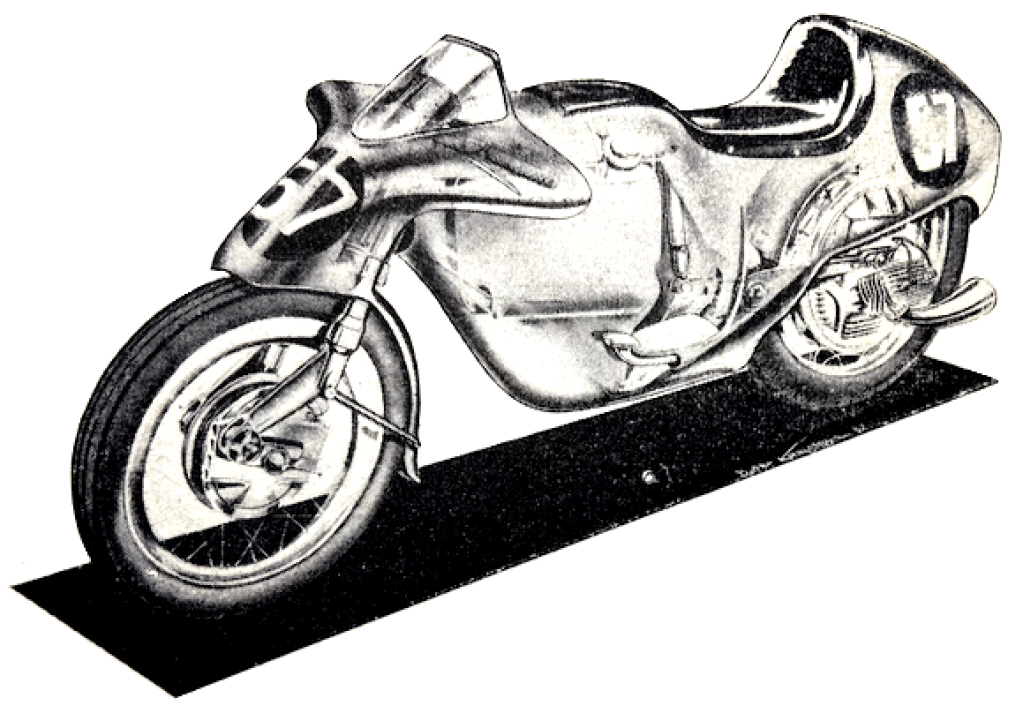
“A SCOTTISH OWNER of a BSA Bantam likes his safety helmet, and considers they should be encouraged for roadwork. His view is worth quotation: ‘Although at first I wore it reluctantly under parental compulsion, I would not now think of not using it. It is by no means uncomfortable, though the absence of a peak is a disadvantage in rainy weather, while the front comes rather far down my forehead and restricts the type of goggles which one can wear.’ He is no pawky middle-aged creeper, but a juvenile sportsman about to trade off his Bantam for a larger model.”—Ixion
“I HAPPEN TO POSSESS a certain motor cycle experience to a degree probably unequalled in our ranks. Years ago I used to report or officiate at a vast number of trials. It was my duty to tear ahead of the procession to any gradients which I had identified overnight on a contoured map as the high spots of the day’s run. I reached them before lad No 1 hove in sight, spectated all the ascents and failures, made my notes. When the last lad vanished, I remounted, rode through the procession to the next star hill, and so forth. Note the word ‘remount’. I could save precious minutes in my mad race if I could ‘remount’ at the steep knuckle which was my observation point. This was one reason why I experimented with two-speed gears well ahead of most contemporaries. I soon discovered that no matter how accurately I might adjust my chains, I could always ‘throw off’ a chain if I used my clutch too fiercely in such restarts on a stiff grade. With the early Scott two-speeders, and their low ratio of 84 to 1, it was practically impossible to restart on a 1 in 5 grade without whipping the frame so badly that the chain was flung off; and similar frame whip marred all the famous models of the period. Lately, such memories have set me wondering how much frame whip survives unrecognised on the best models of the day. A potent side stress is created when a star straightens out his 500cc TT model at the Ramsey hairpin, and abruptly puts 55bhp through the clutch.”
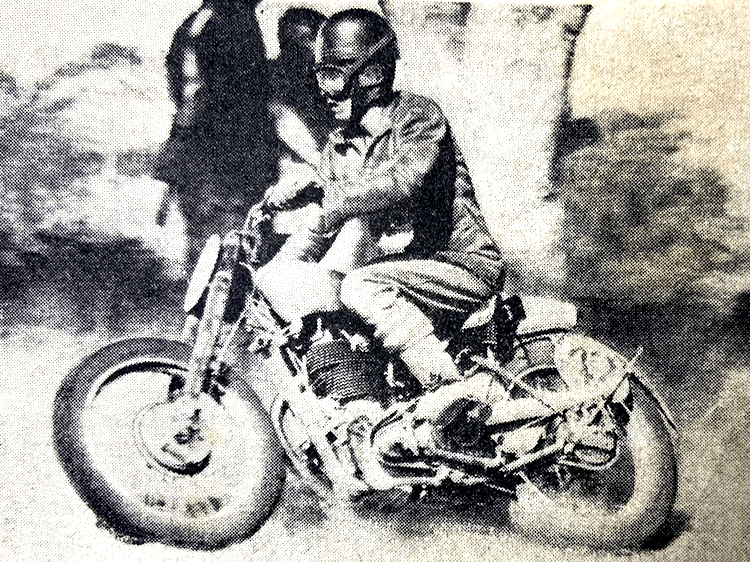
“I HAVE BEEN somewhat surprised that our fraternity displays so little excitement about those modern ignitions which enable us to start and run our models even though the battery happens to be as flat as a fen. Throughout the whole of my motoring life I have been the victim of a severe accumulator complex. I yield to no man in my enthusiasm for electric lamps and electric horns. But over much of my years I have dwelt in the country, remote from a charging station, and dependent on oil or petrol lamps. I have normally been a member of large households with quite a stud of motor vehicles. (I remember one period when the stud consisted of a station wagon, two small cars, and four motor cycles, irrespective of any trade machines on temporary loan to myself.) Moreover, it was not until quite late in the motor era that batteries became at all reliable. I served my novitiate on a De Dion trike which used huge cylindrical dry cells for its ignition. The wee, flimsy accumulators which first superseded those dry cells shed their paste in lumps from the start, and the plates shorted. On the first (or maybe, the second?) London-Edinburgh run, the representative of one of our leading electrical firms stacked four 20-ampere-hour accumulators in a large case on his carrier. They were coupled in pairs by two-way switches, one for ignition, and the other for a small head-lamp. Unkind rumour (probably a liar) whispered that he renewed all four of them somewhere up in the Doncaster region! I could fill this issue with comic or tragic tales of battery trouble in bygone years. For instance, how I once carried a spare 8ah accumulator in my ‘rabbit’ pocket, and when a thud on the road drew my attention thereto, I found that half my jacket had been eaten away by acid. But there are still many thousands of riders who live remote from charging stations even in Britain, and far greater numbers are spread over the Commonwealth. Those dependent on coil ignition are at the mercy of a battery which will in any case go flat if it is left out of use for a long period, and may be damaged if bad roads dislodge much of its paste. To all such, the ability to start and run without battery aid is a very valuable and comforting insurance.”—Ixion
“MANY READERS ARE no doubt aware that the brakes on modern high-performance cars have been causing some anxiety. This anxiety usually starts in the designer’s office and may well finish up on a mountain pass…the word ‘fade’ is bandied about…When a moving object is decelerated, the kinetic energy of its motion has to be dissipated; this the brakes of a vehicle do by converting the energy into heat. Since the kinetic energy is proportional to the mass of the vehicle and the square of its velocity, a very large amount of heat can be generated in braking from high speed…Most of the friction lining materials in use today have only a limited resistance to temperature rise. If they are heated beyond a certain level, they soften and lose their grip (like many a competitor in the Scott Trial!). In consequence, the brakes suffer a reduction in efficacy; this is the phenomenon known as ‘fade’. The reason why fade is almost unknown to motor cyclists outside the racing sphere is that our brakes are well exposed to the cooling draught, the passage of which is facilitated by the big difference between drum and rim diameters and the comparatively small-section tyres…Another factor is the more forward weight distribution now favoured in the interest of improved riding and handling. This has resulted in substantially more braking being done on the front wheels than on the rear; the proportion is 60% or even higher on the front brakes, which thus generate a lot more heat than the rear brakes. These factors, together with the higher maximum and cruising speeds now possible, all add up to an increased pre-disposition towards ‘fading’, particularly of the front brakes. This has been attacked by the experts from two angles: first, to develop the drum brake in order to improve its efficiency and give it greater immunity from fade; secondly…to discard drum brake systems and
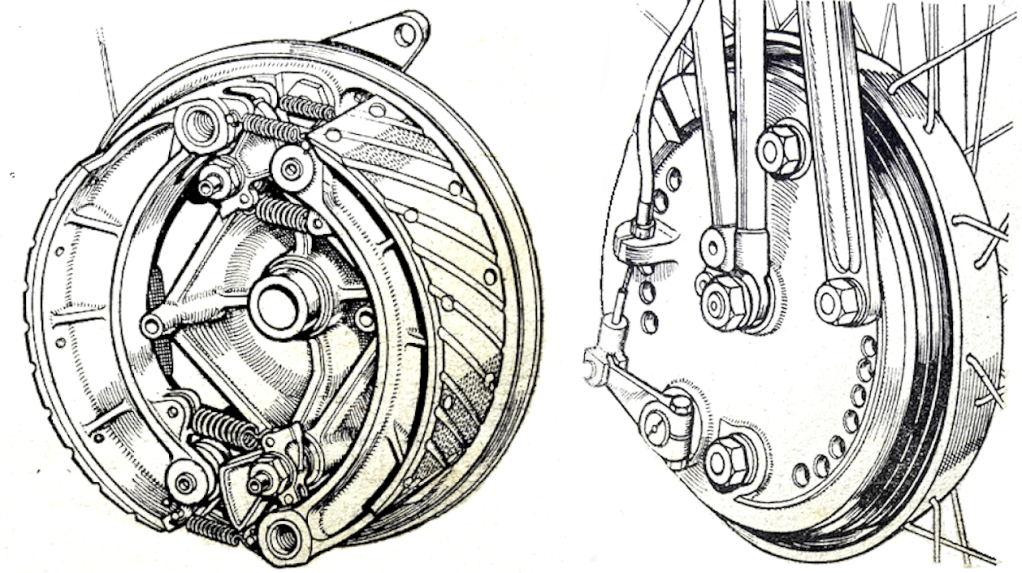
evolve an alternative with fewer limitations. The disc brake was an obvious target for the second school of thought, since it had already proved its merit on two severe duties, namely, armoured cars and aircraft…The two-leading shoe brake is well known to motor cyclists through its use on certain racing machines, and it has been adopted on a number of cars in the search for higher braking efficiency. As the name indicates, the applicational movement takes place at the leading end of both shoes relative to the normal direction of rotation of the wheel…as soon as the shoes come into contact with the drum, the reactional force tends to expand them farther, so causing a considerable self-energising (or servo) effect…Although the two-leading shoe system gives excellent retardation in relation to pedal pressure under average driving conditions, its fade characteristics are rather poor…Hence, it is by no means the solution to the problem. In fact, a later Girling system goy: quite the other way by employing two trailing shoes…There may well be room for improvement in lining materials. But while some have been developed which have a greater resistance to heat, this has so far been accompanied by a lower initial coefficient of friction. This, in turn, necessitates an increase in shoe pressure, so we are back where we started except in having a more consistent performance…A further possible way of reducing fade tendencies is by internal ventilation of the brakes, on the lines of the factory Velocette in the last Junior TT. On this machine the front brake drum shell forms a simple centrifugal blower, air being taken in near the centre and ejected at the outer periphery, cooling the shoes and drum in its passage…it is interesting to consider the advantages claimed for disc brakes in comparison with drum brakes: Greater rigidity, resulting in reduced distortion under load and hence higher mechanical efficiency; improved thermal stability (when a drum heats up, its diameter increases, making automatic adjustment of the brake difficult to arrange); much improved resistance to fading, due to the high thermal capacity of the disc and the better ventilation. At the time of writing, only one car in normal production is fitted with disc brakes, but two well-known British firms of brake specialists have recently announced designs of much merit which are known to have attracted the interest of manufacturers…The car so fitted is the Chrysler Crown Imperial, the largest and heaviest in the range of this U.S.A. company. This design of brake differs from the others in that it is totally enclosed and has two central pressure plates; these carry the lining segments and are expanded away from each other against the inner faces of the rotating housing…this is a rather complex and costly layout [but] has proved itself very efficient…The two British systems are the Lockheed and the Girling Hydra-Static…they employ a central disc on which the linings contract, caliper-wise; the whole of the brake gear is exposed. These differences result in a much lighter and simpler construction than the Chrysler type…the Lockheed system’s main components are the disc, which revolves with the wheel, and the saddle casting carried on a torque plate which, in turn, is mounted on the stationary portion of the hub The actuating hydraulic cylinders are attached to the inboard side of the saddle; the latter also carries the outer friction segment. The inner segment is riveted to a back plate which is free to move laterally in guides on the torque plate and on which bear the hydraulic pistons. When pressure is applied, the back plate is pushed outward, and thus the inner segment is brought into contact with the disc. Since the saddle floats on the two pins which pass through the torque plate, the reaction causes the saddle to move inward, thus applying an equal pressure to the outer face of the disc…The interposition of the back plate and the exposed situation of the cylinders ensures that the temperature of the operating fluid remains low…The Girling disc brake was introduced rather earlier than the Lockheed, from which it differs in one important respect. To avoid the necessity of a floating mounting for the saddle, Girlings apply the ‘squeeze’ directly to both sides of the disc and attach the saddle rigidly to the torque plate. Two or three facing pairs of friction pads are employed, each with its own hydraulic cylinder and piston…These pads are circular discs which are bonded to the pistons…While the Lockheed design has a steel and cast-iron disc, the Girling employs a, disc of stainless alloy steel.
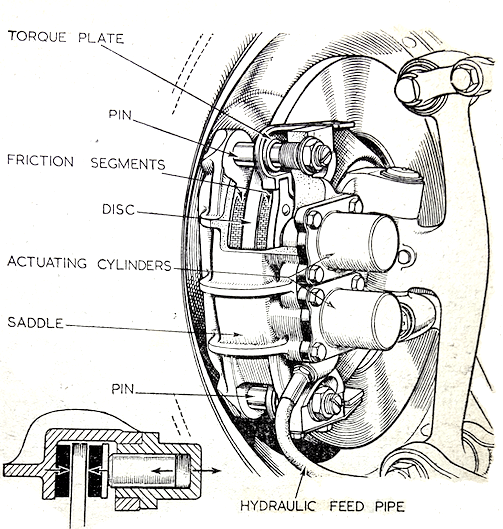
Both firms point out that although their brakes show great promise, they are still in comparative infancy, and subsequent developments may well lead to alterations in both the layout and the materials used…effective lining life should not differ appreciably from that of a drum brake. Since automatic adjustment is provided on both Lockheed and Girling patterns, they should require considerably less maintenance than a drum brake…The almost total exposure of the disc on these two layouts would appear to be open to criticism on the grounds of the adverse effects of water and road grit. However, both water and grit tend to be thrown off by centrifugal force (in a drum brake, this results in their staying where least wanted!). Also the linings, which have only a very small clearance in the ‘off’ position, exert an appreciable cleaning action on the disc. Any foreign matter so removed is free to fall clear instead of dropping into the drum to resume its unpleasantness…Lockheeds claim that their disc brake is comparable in performance with the equivalent two-leading shoe brake for the same pedal pressure and travel, but with the advantage of greatly improved resistance to fade…The Girling brakes were given a strenuous test at the MIRA proving ground on a Jaguar XKI20 car. Discs of 10¾in-diameter were fitted. Well over a 100 brakings were made from 100mph down to 50mph on the corners without any sign of fading or alteration in pedal travel, whereas the normal drum brakes would have shown considerable fade after 10 such brakings…Although the drum brake is still very much alive and kicking, the foregoing suggests that the disc type, even at its present stage of development, will soon take over from the drum on the faster and heavier cars. In fact, if disc brakes can be produced in quantity at an economic price, it seems possible that, with their inherent advantages, they might eventually become standard on all save the cheapest and lightest four-wheelers…The disc brake has undoubted possibilities on racing motor cycles, particularly sidecar outfits, since it fulfils all the requirements for such arduous usage. However, it does not appear to have the same scope on normal machines, and the firms concerned have done no development work in this direction so far. Apart from the general adequacy of existing drum brakes on touring two-wheelers, it should be appreciated that our production quantities are far smaller than those of the cheaper cars. As a result, unless a standard car disc brake could be adopted, the cost might well be excessive.”—Alan Baker
“FEW, IF ANY, British sporting trials have taken place under such adverse weather conditions as characterised last Saturday’s British Experts’ event. For this year’s trial, the 18th of the series, the course lay in the Cotswold Hills. During Thursday night a blizzard raged and in the morning snow was thick over a wide area. The temperature remained low, and by Saturday morning the snow on many roads was frozen into vicious ruts. Some secondary road hills were impassable to four-wheelers. On the Cotswold ridges snowdrifts were over six feet deep. But if conditions were difficult on Saturday morning, they were vile in the afternoon. The snowing restarted; borne by a keen wind, it stung ungoggled eyes, filled the ears, lodged and froze in the chinks of riding apparel, and gave hazards a different ‘complexion’. The last feature was important. The Saturday snowfall started as competitors were embarking on the second lap of the 33-mile circuit. It would be an exaggeration to say that, as a consequence of the new carpet of snow, the hazards were markedly different. But certainly many a mark was lost owing to the obliteration of rocks and gullies which, visible and avoided on the first lap, were encountered unexpectedly on the second. In addition, there was the influence on riders of the wretchedness that assails the spirits when hands and feet are numb, when eyes are balls of searing pain, and when riding gear is frozen stiff. Precisely how much the contrasting conditions of the day influenced the results will never be known. However, the solo winner, 20-year-old John Brittain (346 Royal Enfield) showed magnificent consistency by
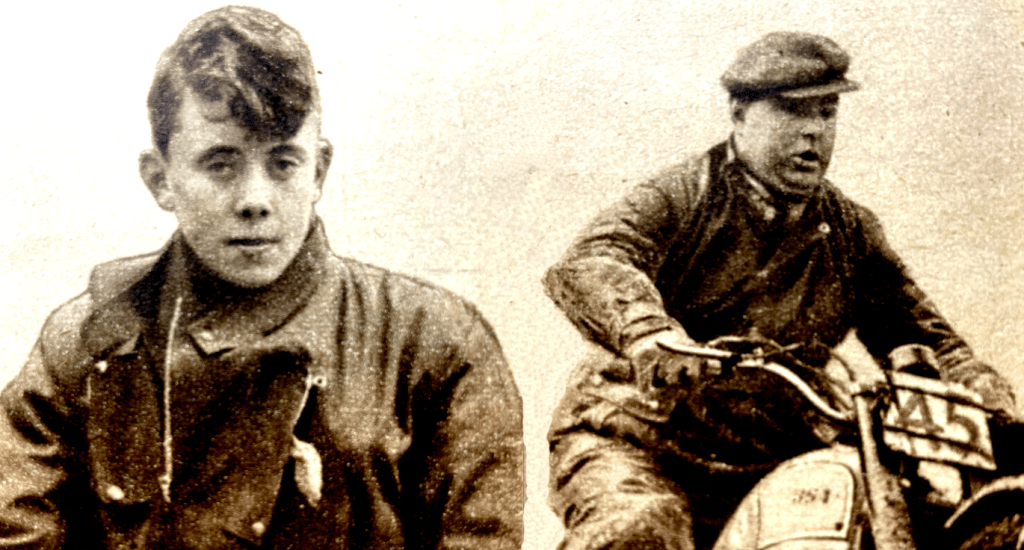
losing 13 marks on the first lap and only one more on the second, a total of 27. No win could have been more popular. And no father (or mother) could be more proud than the famous Vic Brittain who became the solo British Expert first in 1936 and then, in 1939, tied with Jack Williams for the honour. John Brittain is the youngest British Experts’ solo winner; he has pipped Jack Williams, who was 21 years old when he topped the list in 1932. Second in the solo category was BHM Viney (498 AJS) who, with a loss of only six marks on the first lap, was all set to win comfortably. However, he had a rough passage on the second lap and was penalised 23 marks, which brought his total to 29. Fitting sidecar-class winner with 37 marks lost was Harold Tozer (499 BSA sc), who had decided to make the trial his last. He thus retires, after 21 years of competition driving on the peak of success. Not that this experience is anything new to him. He has won the sidecar class of the British Experts’ on four previous occasions, and he scored a hat-trick over the years 1946 to 1948. Runner-up among the sidecars was AJ Humphries (490 Norton sc), who lost 44 marks. It is the practice to hold British Experts’ events in a variety of localities. With the return to the Cotswolds last Saturday, it was fitting that the maestro clerk of courses, HP Baughan, should be responsible for the route on behalf of the organisers, the Birmingham MCC. Three miles from the start at Rodborough Common, near Stroud, the first observed section, Step, gave riders no cause for optimism concerning the nature of the hazards. Competitors were confronted with a muddy, 180° hairpin bend—one sub-section—followed by a water-hole and a tricky climb over a slippery rock step in the second sub-section. The hairpin was formed by diverting riders round the end of a felled tree-trunk. Viney caused a smile by placing one foot on the end of the trunk while he changed course through 180°; this, in effect, was only one dab (and one mark lost, as
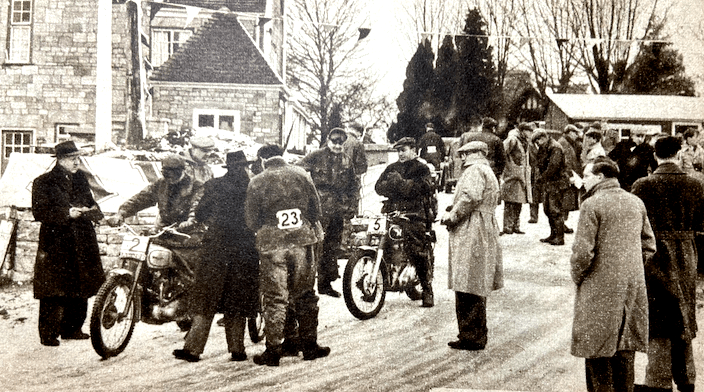
distinct from three for foot-slogging). The manoeuvre placed his mount on a nice line for the step, which he negotiated neatly—though, owing to lack of wheel grip, foot assistance again became necessary farther on. The problem here was obviously one of how to obtain sufficient momentum to take the machine over the step and up the bank—bearing in mind that a hairpin and a water-hole were in the way. Marks were, in fact, lost at Step by all 35 solo and 12 sidecar starters. One of the best performances was that by PH Alves (498 Triumph), who got through with only a single dab in each sub-section. Next hazard, The Gully, was also in ripe, muddy condition, but riders did have the opportunity to build up enough impetus to carry them over the steep, clayey hummocks at the end of the climb. Most polished climb on the first lap was by GL Jackson (347 AJS), who literally romped up; a remark overheard suggested he was showing great promise as a scrambler! E Usher (347 Matchless) was equally fast, but, after hitting an outsize in bumps, his machine landed front wheel first and shed its rider with considerable dispatch. The real fun started when the sidecars arrived. They by-passed the lower, narrower end of the gully, but two difficult sub-sections were formed at the upper end. The short descent and turn into the first sub-section proved very awkward: CV Kemp and passenger Lindsay (490 Norton sc) were flung out with some force when the outfit dipped its nose and then turned upside down. AJ Humphries (490 Norton sc) and F Darrieulat (499 BSA sc) were among the few who were unpenalised in the first sub-section; no driver managed the second sub-section without losing marks. When WJ Stocker with erstwhile solo star Charlie Rogers in the sidecar of a five-hundred Royal Enfield made a do-or-die effort, it seemed a pity bonus marks could not be earned for a courageous attempt. The outfit careered a considerable distance up the hill before coming to a sudden halt with the front wheel high in the air and the two charioteers struggling manfully to prevent a back-somersault. Following the Gully came Littlewood, for solos only. On the first lap only four riders were noted as unpenalised; these were Brittain,
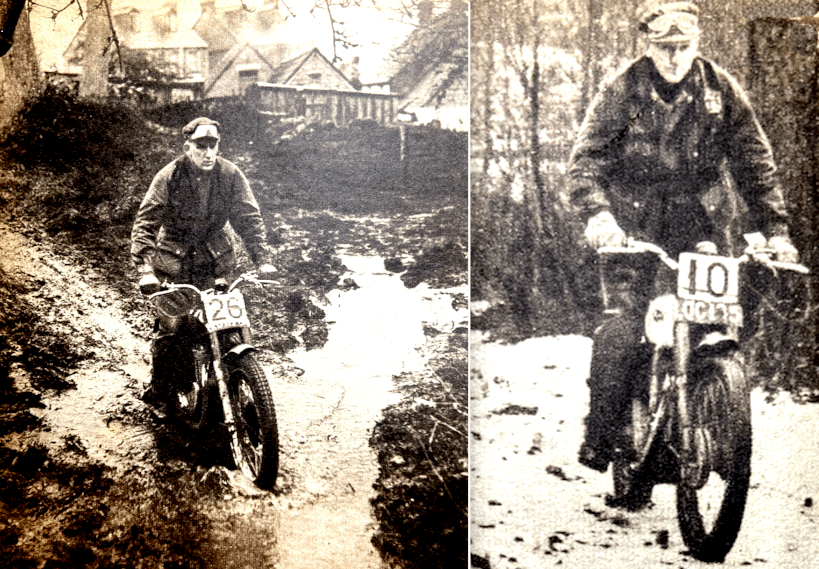
Viney, last year’s solo winner, TU Ellis (499 BSA), and DS Tye (348 BSA). On the second lap Littlewood was by-passed. No particular bother was caused at Kingsway, BB1 or BB2. The last had a slight sting in the tail; the final sub-section offered little in the way of wheelgrip for sidecar outfits, and rush tactics were to be recommended. However, the approach was exceedingly bumpy, and few outfits entered the section with enough momentum to get through unpenalised. CV Kemp, J Sandiford (490 Norton sc), Whittle (598 Panther sc), FH Barnes (490 Norton sc) and Tozer were the elite. For the second lap, BB1 and 2 were little changed; as earlier in the day, next to no solos and about half the sidecar entries lost marks. Owing to the condition of the roads, the observers did not reach Leigh before the competitors. Hence this hazard was observed for the second lap only. In fact, observation brought little in the way of marks lost. The leaf-mould surface of Hodgecombe offered ample wheelgrip. Most solo and sidecar pilots used plenty of throttle and treated this famous hazard with contempt. Between the laps the observers altered the positions of their cards to take in a more promising part of the hill, and also introduced a few unusual obstacles. The result was that a few solos were caught out—even John Brittain lost one mark —and many sidecars stopped. Consisting of a long, twisting slippery climb for solos only, Hillslie was the ninth of the 15 observed sections scheduled for each lap. Of the three sub-sections, the last, with a sharp left turn on a very steep gradient with a rock step, gave competitors most trouble. On the first lap, first arrival was SB Manns (498 AJS). He was about 10 minutes ahead of his expected time—so early, in fact, that he was there before the observers had finished the marking out. Snow was starting to fall—as yet, not very heavily—when at last the sub-section cards were in place. Manns gave an admirable, feet-up display. The technique adopted by most riders was to use a low gear and plenty of throttle, as fittingly demonstrated by past-master of the art Bill Nicholson (499 BSA); he took the top bend on the extreme outside and lifted his front wheel over the step. His team mate, BW Martin, on a 350 from the same stable, had a front wheel slide which brought him up short, facing the left bank. From Hillslie, the course followed a path through the woods to Breakheart. This famous old terror was perhaps less formidable than of yore owing to the activities of enthusiastic organisers of a car trial. For solo riders of the calibre of experts, the climb on Saturday was comparatively easy, but it was no mean obstacle for sidecar competitors. The first outfit to appear—that of F Wilkins (497 Ariel sc)—came to a halt at the step half-way through the first S-bend. RU Holoway (499 BSA sc) stopped in the same place. A spirited attempt by Kemp ended in a stop with wheelspin, and it took the combined efforts of four hefty spectators to get him going again. Whittle provided a variation in the theme by involuntarily turning his Panther outfit on its side. Among others to experience a similar misfortune was P Wraith (497 Ariel sc); later he was forced to retire
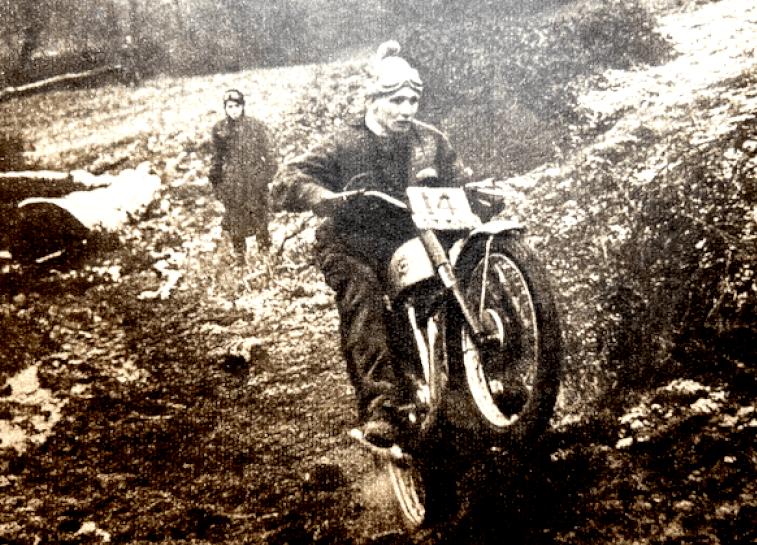
with a seized engine following damage to the oil pump. First to make a non-stop ascent was Barnes, who succeeded by footing lustily. He was spurred on by the cheering crowd, which by now numbered about 100—a surprisingly large gathering in view of the uninviting weather conditions. Other noteworthy non-stop climbs were made by Harold Tozer and RG Collier, the latter with his Norton Dominator outfit. On the second lap Collier had extremely hard luck; he negotiated the first two sub-sections without even a single dab, only to be brought to a halt in the last when his rear chain came off. Whiteway was for solos only. Divided into two sub-sections, it comprised a straight, steep ascent, followed by an even steeper climb up a narrow gully, with the inevitable rock step. On the first lap only two riders, Alves and Viney, managed unpenalised climbs. The blizzard added to the difficulties for the second lap, and it seemed unlikely that any riders would conquer Whiteway on their second attempts. However, E Usher (347 Matchless) disproved the prophets; poised on the footrests and displaying the acme of clever machine and throttle control, he was clean through both sub-sections. Shortly afterwards, AA Kirk (490 Norton) emulated Usher’s performance. By the time riders reached the notorious Stag Lane on their second circuit, this long, slimy ascent through the woods was more sticky than it had been earlier in the day. The second of three adjoining sub-sections was responsible for an appreciable loss of marks. Snow was falling thick and fast—snow which blinded the eyes and numbed the hands. With fewer than 10 miles to the finish, competitors appeared to be pressing on as quickly as they could and tackling sections as they came, rather than weighing up the difficulties beforehand. The adjoining sections of Hazel and Rowden held few terrors for the solo entry but were rather harder on the sidecar men. By way of the tight hairpin trickery of More Folly, and the special test at Ham Mill, the route wended its icy way to the finish. RESULTS Skefko Cup (best solo performance): JV Brittain (346 Royal Enfield), 27 marks lost. Palmer Trophy (best sidecar performance): H Tozer (499 BSA sc), 37. Feridax Trophy (passenger in twinning sidecar): I Wilkes.”
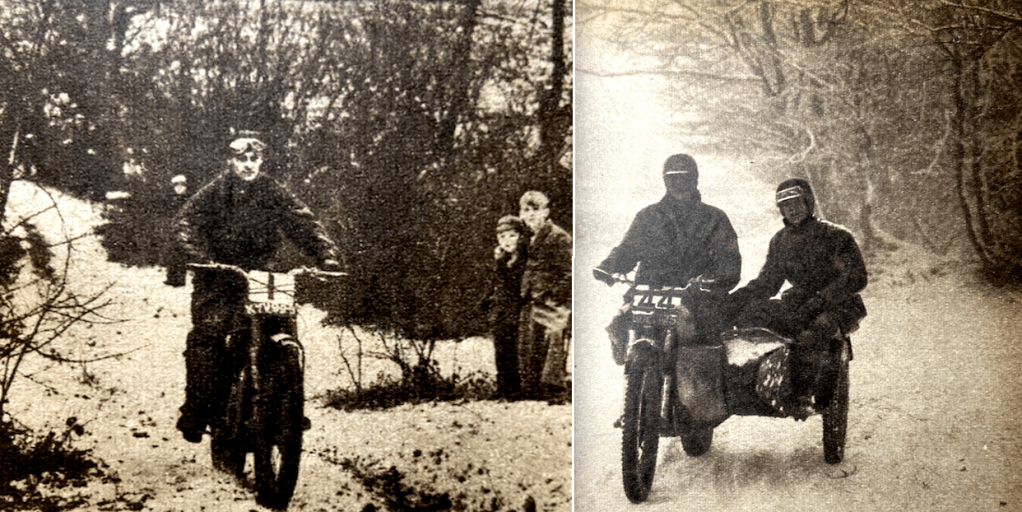
“IN ANSWER TO ‘500 BSA’, may I say I am happy to know he received such hospitality in my native Northern Ireland. He asks, ‘Could it be equalled in England?’ When on a trip in the West of England, I found myself held up with ignition trouble and a broken throttle cable just outside Bristol. A veteran rider assisted me to his home in Bath, helped me to repair the trouble, persuaded me to spend the night under his roof, and provided me with breakfast before I left in the morning. So ‘500 BSA’ may rest assured that I’ve found hospitality in his country which, I think, equals that which he found in mine.
‘ULSTERMAN’, Pinner, Middlesex.”
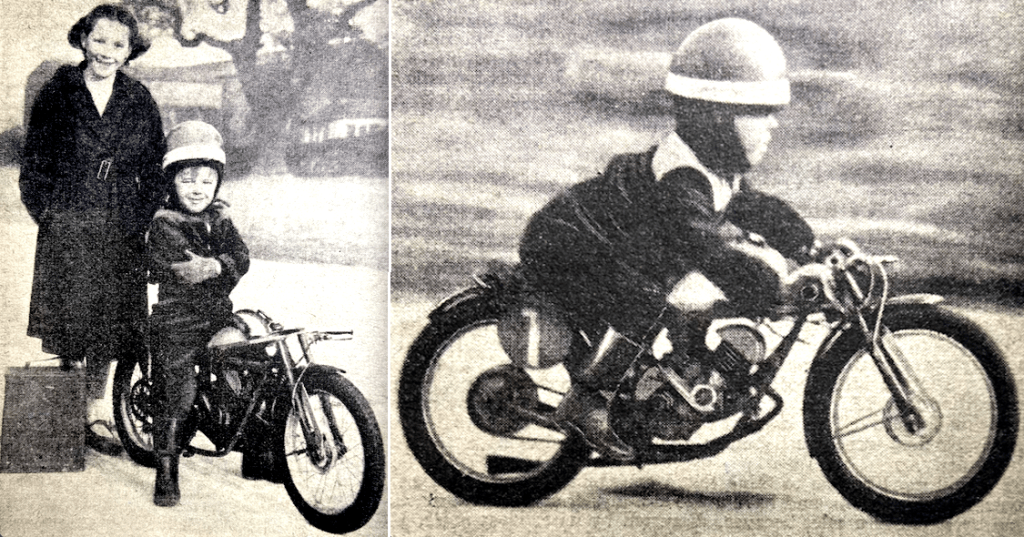
“WE HAVE NOW reached the end of another racing season, which has shown the superiority of four-cylinder machines. Concrete evidence of this is supplied by the result of the 500cc World Championship. In 1951, it was the brilliant riding of one man that kept the singles ahead. He cannot last for ever and this season has shown what happens when he is not racing. The Spanish GP showed this more than any other race this year. It is a course for singles, demanding absolute reliability, good steering, roadholding and a really strong gear box. Another advantage the singles have is their lighter weight, which shows on the numerous corners. It was here, I thought, that Armstrong would win the championship, but the MV won comfortably. I have always admired Les Graham and I wish him the best of luck, although I would like to see him on a British machine. In the past readers have written saying that when the time comes we shall have a four-cylinder racer and that the designs are already on the drawing board. I am surprised at Ixion’s view on the subject. At this stage designs on the drawing board are useless. Practical development is needed. Machines do not become world-beaters straight from the drawing board. They need racing experience to find the faults in their design. I don’t like to play Jerimiah, but the next few years will see a very strong Continental challenge.
J WILSON, Clitheroe, Lancs.”
“HOW IS THIS for a coincidence? I sold KK6617, a single-gear Norton, 29 years ago and have not set eyes on it until, a few days ago, I called at the store of Dodgers, Norwich, owned by the brothers Kerrison. I made my purchase of a clothes line prop and began talking about old bikes to Percy Kerrison. He took me through to the back of his premises, and there stood my old Norton—still in very good order, and so proudly owned that a hundred pounds cannot buy it.
GEORGE SWAIN, Norwich.”
KK 6617, a 500cc Norton Model 9 first registered in September 1923, is still on the DVLA database so it seems the old girl is a survivor. —Ed
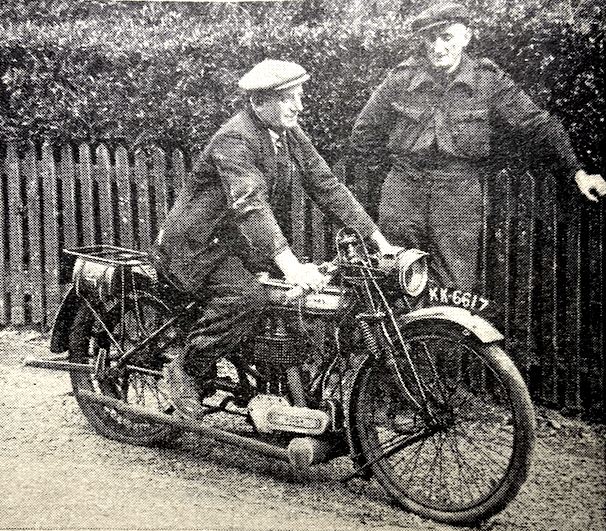
“ROAD RACING, TRIALS riding and scrambling are, to say the least, hard on the model. Another ‘sport’ to take its toll appears to be stunt riding on the stage. According to Tex Martin, who does a sharp-shooting act on the halls while riding a 98cc James, his machine has had its brakes applied hard 20,920 times, has completed 14,300 broadsides, has reared up on its rear wheel 4,320 times, has had its clutch operated 30,000 times and its chains jerked viciously 10,368 times. Recently it was crashed for the 27th time. During the whole of the period, the James was not serviced since it left the factory nine months previously, and it has given no trouble. Shame on you, Mr Martin! If I may make a semi-serious suggestion, it is that the James ought to be serviced now. Then it might well be pensioned off, so that it may pass the remainder of its days quietly, as a self-respecting 98 should.”—Nitor
“DURING THE MONTH of October, 3,861 motor cycles, autocycles, cyclemotors and three-wheelers, valued at £438,634, were exported. Spare parts and accessories worth £136,869 were sent oversea in the same period. In the first 10 months of this year a total of 62,522 machines valued at £7,053,197 and spares worth £1,978,944 have been exported.”
TRANSPORT MINISTER LENNOX-Boyd supported the use of crash helmets but “doubted whether compulsion was desirable”.
WEST GERMANY ABOLISHED its wartime 50mph autobahn speed limit.
A GROWING NUMBER OF clubs supported a ‘white flag’ scheme: riders of broken-down bikes would tie a white hanky to the handlebar as a sign that they needed help.
“ONLY A LIMITED number of AJS 7R and Matchless G45 racing models will be produced for 1953. Already there are indications of demand considerably exceeding supply. Consequently, a system of allocations is to be introduced in which those with experience of, say, the Isle of Man circuit, will be given higher priority than newcomers to racing. In order that the claims of a potential TT winner may not be overlooked, allocations will be withheld until Christmas. In the meantime, the makers hope that all who aspire to the ownership of a 7R or G45 will specify their requirements.”
“SEVERAL CHANGES IN ITALIAN motor cycle design are manifest at the current Milan Show. The 30th in the series, the Esposizione Internationale opened last Saturday in the modernistic, fan-shape Pavilion of Engineering, one of the buildings on the site of the World’s Fair held in Milan last April. The first and most striking development is the incursion of the ohv four-stroke engine into the lightweight two-stroke sphere. Another proclivity, one which may, at this stage, be more of an indication than a definite trend, is that, according to some manufacturers, the colossal boom in the scooter sphere is lessening, and public interest is turning more and more toward lightweight motor cycles. A third portent is the almost universal adoption of all-welded frames with pivoted-fork rear springing; a fourth is the wide adoption of the AC generator; yet a fifth is the increasing popularity of the ‘spine’ frame. Public interest in powered two-wheelers in Italy continues at a higher level, probably, than in any other nation. The total number of machines registered in the country at October 31 last was over a million and a quarter. The exact figure is 1,318,500, which represents an increase of roughly 260,000 over the corresponding figure of a year ago. During the past 10 months, it is held, registrations have increased at the rate of 1,100 a day. This rise applies to all classes of powered two-wheelers. Scooters and lightweight motor
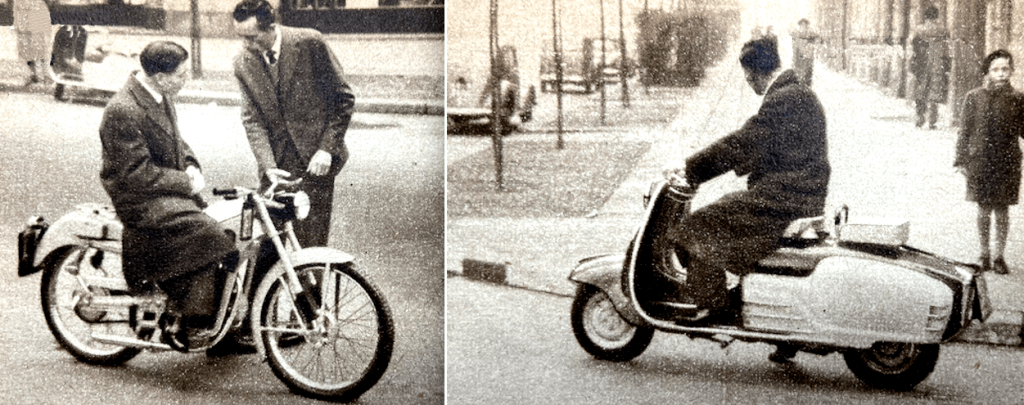
cycles are lumped together in the official statistics. The increase in registrations in these two classes has mounted by 185,000 to 700,000. Larger-capacity motor cycle figures during the same period are up by 5,200 to 170,500. Cyclemotor registrations have reached 395,000—an increase of no fewer than 94,000 over those for January this year. There is no less interest in the motor cycle category commercial-vehicle field, and the figure for current registrations is 28,500, representing an increase of 7,500 over the January figure. As always at Milan Shows, there is at the current exhibition an endless variety in design. Only the bigger and long-established concerns—such as Moto-Guzzi (which continues to account for 60% of Italian motor cycle sales), Gilera, Lambretta, Vespa and Sertum—express in their machines what may be described as orthodox thought. In spite of the sales holds of the big firms, the vast number of smaller concerns in Italy continues to flourish. The total number of exhibitors of all classes of machine is 64. Of that total, it is probably safe to say that no more than six have not at least one entirely new and individually styled model on display. Highlight of the previous Milan Show (held last January) was the 175cc ohv Ducati Cruiser. A scooter fitted with a self-starter [a casual mention of an electric-starter—Ed], and employing hydraulic torque-convertor transmission [a casual mention of such advanced transmission—Ed], the Ducati, the pundits said, could never be economically produced. But the scooter is now generally available, and is selling in Italy at 320,000 lire (about £I90). In Milan last week a member of The Motor Cycle staff rode one of the production
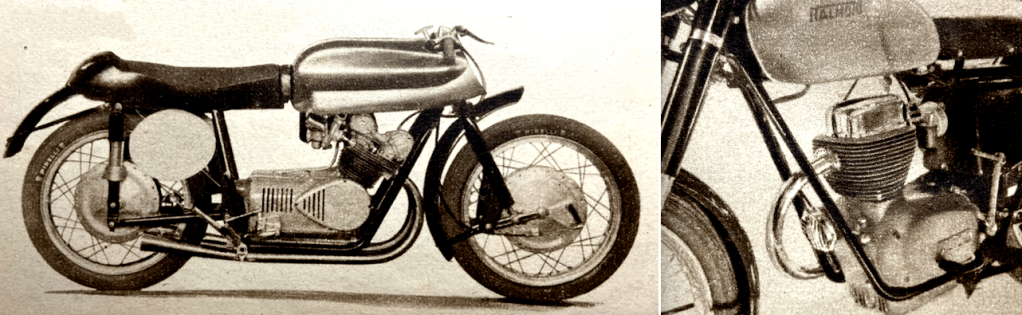
models. With the torque convertor eliminating the need for gear changing, the only controls are those for the throttle and brakes, and, as a safeguard in case the starter should fail, a ‘clutch’ lever is provided so that the transmission can be locked and the engine push-started. With the model tried, starting was at all times positive on the button. In order to pull away from a halt, it was necessary merely to open the throttle. At normal throttle openings the take-up of the drive was very slow. One had the impression of riding a machine with a badly slipping clutch. Quick take-up of the drive, however, could be ensured by starting on a wide throttle opening, and ultra-rapid take-up by holding the machine with the brakes applied while the engine was screamed up the rpm scale. By this means the front wheel could be raised off the ground as soon as brakes were released [a wheelie, forsooth!—Ed]. Effortless restarts were made on a garage ramp with an estimated gradient of about 1 in 8. During a brief tour of Milan, the transmission proved faultless. Ducati ingenuity is apparent also in two other exhibits. The more striking is a 98cc ohv model with a workmanlike, pressed-steel, spine-type frame and pivoted-fork rear springing. Crankcase and gear box are formed by egg-shape, dull-finished, light-alloy castings. The forwardly inclined engine cylinder has integral pushrod tunnels and is of symmetrical appearance. Finning on the head is horizontal right up to the rocker cover joint face. The cover itself is finned longitudinally. Weight of the model is stated to be 60kg (132lb). The price is not yet fixed. Second of the new Ducati exhibits is a 48cc ohv
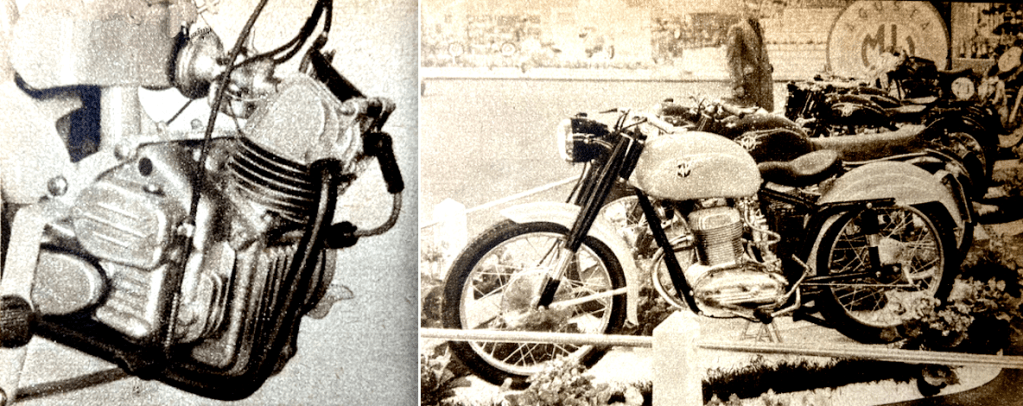
pull-rod model with a miniature three-speed gear box mounted on the right of the engine. Three such models have completed a round trip between Milan and the Arctic Circle—a distance of 10,000km. Pivoted-fork rear springing is standard. The price in Italy is 97,000 lire (about £56). Another miniature ohv, the Capriolo, is attracting enormous interest. Of 75cc capacity, and manufactured by the Aero-Coprani-Trento concern, the model is as full of delightful design features as it appears, to the orthodox mind, to be full of production problems. The machine, however, is already generally available, and the writer was able to try out one from a dealer’s showroom in Milan. A pressed-steel frame houses the unbelievably neat engine and four-speed, unit-construction gear box. The engine crankshaft is in line with the wheelbase and has a low-tension AC generator (which energises an external ht coil) mounted at its forward end. A bevel gear at the rear of the crankshaft is used to drive a crown wheel such as that of a car differential unit. The transverse shaft carrying the crown wheel is, in fact, the gear-box main-shaft; it has the multi-plate, progressively operated, wet clutch and final-drive sprocket fitted to its right-hand end. From the top of the crown wheel another bevel gear drives a vertical shaft housed in an integral tunnel in the rear of the sleeved, light-alloy cylinder casting. At the top of the shaft is a face cam for actuating the valve rockers. The tiny valves are situated side by side across the head—the inlet
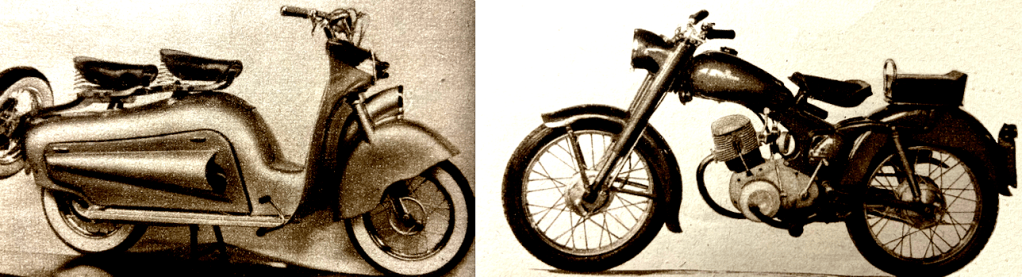
valve on the left and the exhaust valve on the right. Positive lubrication of the valve gear and other engine parts is provided by a piston-type oil pump. Normal compression ratio is 7 to 1. Peak rpm are 6,000. Front-wheel suspension is by telescopic fork; rear springing by a pressed-steel pivoted fork, controlled by horizontal springs located under the engine and friction dampers. Tyre sizes are 2.375x20in front and rear. Brakes are 6in in diameter. One version of the model. is exhibited with legshields and the engine enclosed by steel pressings. The weight is given as 70kg (154lb). The price, 170,000 lire (£100), is not unduly high, judged by those of contemporary present-day models. A ride on the machine was a stimulating experience and proved that the performance easily matches the attractive appearance. The riding position is man-size, and as comfortable as that of many a 500. Engine starting was first-kick and idling was slow and perfectly reliable. Operation of the automatic clutch was light and did not require letting-in in the normal way.
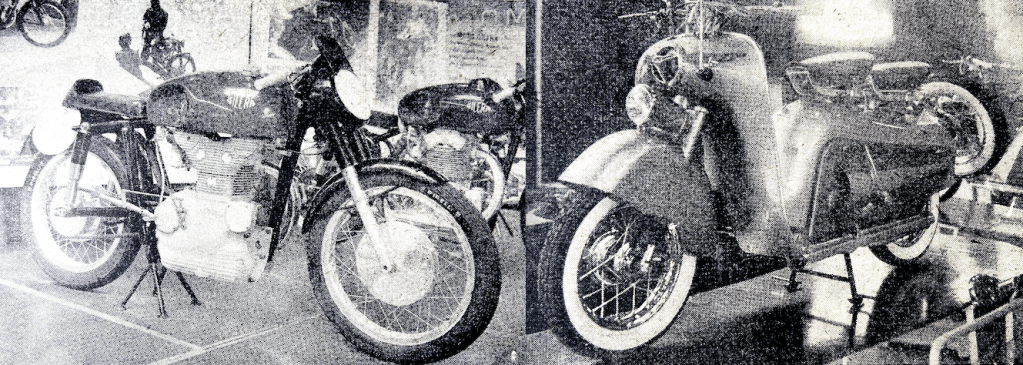
One merely took one’s hand off the lever and drive take-up was automatic. The gear change was perfect, the handling exemplary, the brakes more than adequate. The engine was astonishingly flexible and the power delivery velvety throughout the speed range. There was at no time even the faintest trace of vibration. There were no criticisms. A slightly larger ohv lightweight making its show debut is a 158cc Italmoto of extraordinarily clean design. Bore and stroke are 60x56mm. In this instance also the light-alloy cylinder has an integral push-rod tunnel. No holding-down studs are visible. Crankcase and gear box are enclosed in superbly profiled light-alloy castings. Ignition current is provided by a 60W generator mounted on the crankshaft and an external ht coil. The frame is of very small-diameter (22mm) tubing and of all-welded construction. Rear springing is of pivoted-fork design with hydraulic control. The
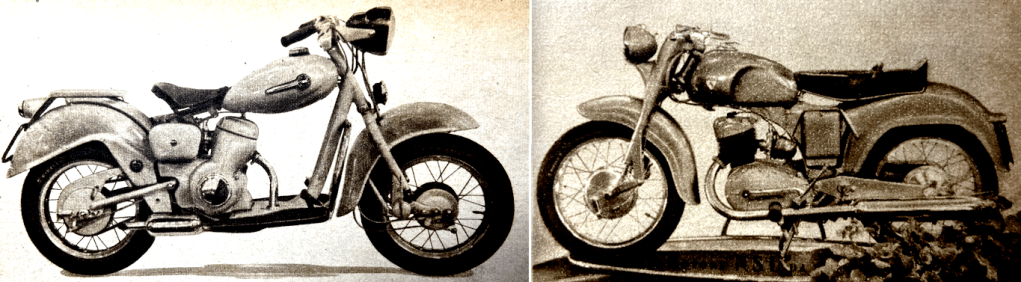
model has big brakes and a hefty rear chain for so small a machine. Power output is said to be 6.5hp at 6,00rpm. The weight is given as 95kg (209lb). The price is 256,500 lire (about £150). Other new small-capacity four-strokes are exhibited by FB Mondial, Taurus, Laverda (the machine which won the 75cc class in the last Milan-Taranto race), MV Agusta, Parilla and Moto-Gitan. Though closely resembling the ohc racing models, the 200cc FB Mondial has push-rod operated valves. Crank-case and gear box are formed by a single, light-alloy casting that is a masterpiece of foundry work. The cylinder and cylinder head castings, too, are complicated because of concealed push-rod tunnels in the former and a big, integral rocker box in the latter. Front suspension is by telescopic fork and rear springing by a pivoted
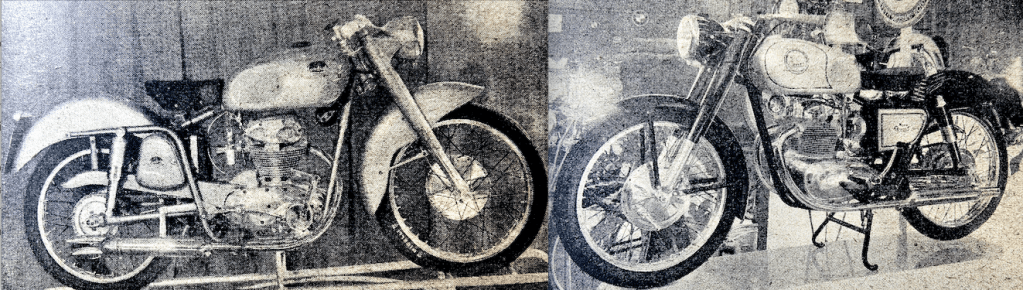
fork. The price is high—348,000 lire (about £205). The 125cc single-ohc production racer has an altered frame but retains its girder fork and plunger-type rear springing. Capacity of the Taurus is 200cc, of the Laverda 75cc and of the MV Agusta 175cc. The last is unusual in that the engine forms part of the frame. Twin down tubes from the steering are bolted to the front of the streamline crankcase-gear box unit. The pivoted rear fork oscillates about a shaft housed in the rear of the engine castings, and the sub-frame is also bolted thereto. One of the trimmest designs present, the little MV, like the majority of other small four-strokes, looks very much bigger than its capacity. The rocker cover (as well as that on the Taurus) is finned all over. The only external studs visible on the head are no bigger than British twistgrip friction adjusters. The Farina, too, is as trim as could be wished. Called the Fox, it has an engine capacity of 175cc. The valves are actuated by very short, wide-angle push rods which, in turn, are operated by a camshaft at cylinder-head height. Ignition is by battery and coil. Also on the stand is the elegant 125cc Farina scooter. It is equipped
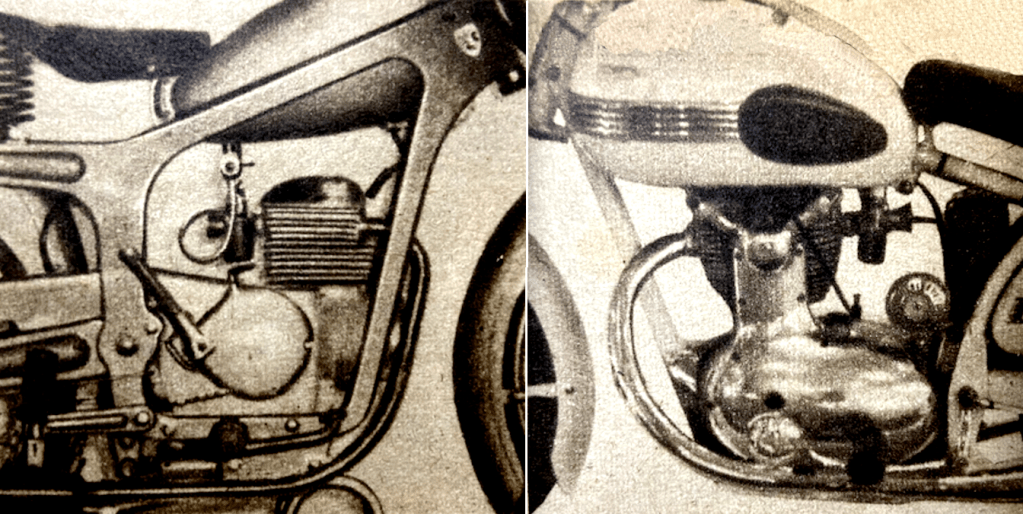
with an electric starter which is energised by a normal 6V battery of about 13 ampere-hour capacity. An enthusiastic attendant is only too pleased to demonstrate the working of the starter to all and sundry, and is apparently unconcerned about the battery. Of the new two-strokes on display, the most attractive, in appearance at all events, are probably the 200cc ‘split-single’ Iso models, which have separate lubrication systems (as distinct from petroil) and final drive by shaft. The price is 300,000 lire (about £176). Other features are plunger-type rear springing, 3.50x15in tyres and a leading-link front fork. Iso are also exhibiting the lightweight Isomoto, sales of which are now exceeding those of scooters. Another attractive two-stroke is a new 125cc FMB. The frame is one of many of the spine type exhibited. The main frame is formed by a single, large-diameter tube extending from the steering head to a deep, inverted U-section pressing which provides a housing for the rear fork pivot and a mounting for the seat, tool box, carrier and rear mudguard. The Beta engine-gear unit, with its longitudinally finned cylinder and head, is suspended from the spine tube. The spine frame theme is again apparent in the Caproni Vizzola, which is fitted with a 2OOcc NSU engine and gear box. In this case, the spine is a massive, light-alloy casting. Both the box-section pivoted rear fork and the leading-link front fork are controlled by rubber in compression. Wheels, which are shod with 3.00x17in tyres, are interchangeable. An unusual feature is that the working angle of the fork links can be altered to provide different characteristics. Another is that the fork legs are enclosed in a streamline steel sheet; there are no mudguard stays. Yet another new spine-frame model is a 125cc ‘B’ [Moto ‘B’, later shortened to Motobi, was established in 1949 by Giuseppe, one of the six Benelli brothers—Ed]; the frame is similar to that employed for the 200cc twin announced in January. Much of the Show thunder is stolen by a new 250cc (54x54mm) Rumi racer. A dohc vertical twin with
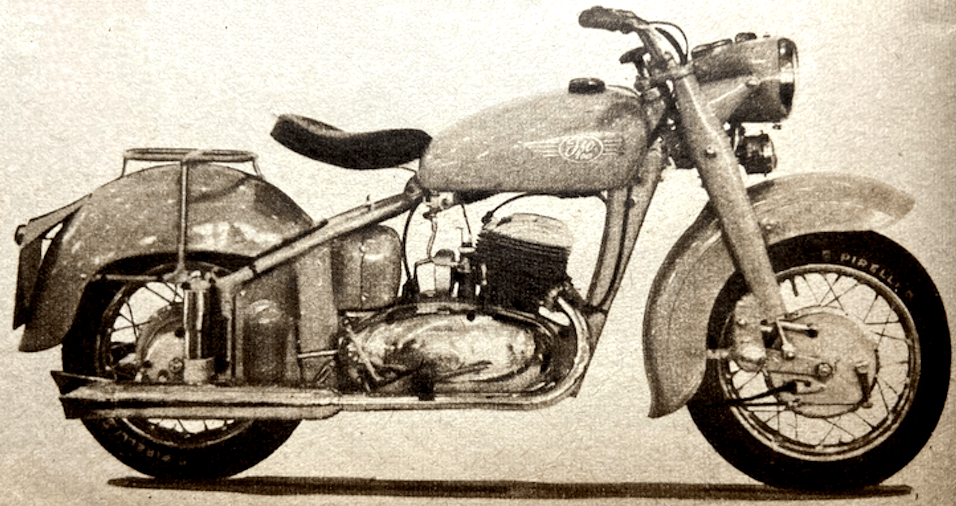
the forwardly inclined cylinders set across the frame, unit-construction, four-speed gear box and shaft drive, leading-link front fork, massive, dual front brakes and 3.00x18in tyres, the model will appear in Italian national races in 1953. The 125cc Rumi racer is now equipped with lights to make it suitable for the Milan-Taranto race. All the lightweight Rumis are now fitted with four-speed gear boxes. One of the scooters is shown fitted with a self-starter. Scooter exhibits are in the minority, yet there are five debutantes. They are the Ambrosini, made by the Societa Aeronautica Italiana, the Arieto, made by the SIM concern, the S Cristoferno, the Orix and the Frera. The first is one of the most elegant of all scooters. Fitted with a 147cc Sachs engine and gear box, and available with built-in radio, it costs 245,000 lire (about £144); the radio is about £9 extra. Front wheel suspension is by telescopic fork; rear springing by pivoted fork. The wheels are shod with 3.00x12in tyres. Generally speaking, the tendency appears to be to fit larger-diameter, smaller-section tyres on scooters, and small-diameter wheels on full-blown motor cycles. As befits a firm with a racing reputation, Gileras give pride of place to the four-cylinder racing machine. Also displayed are the extremely trim dohc single-cylinder racer and the entire lightweight production range. The only change is that the 125cc Turismo has grown
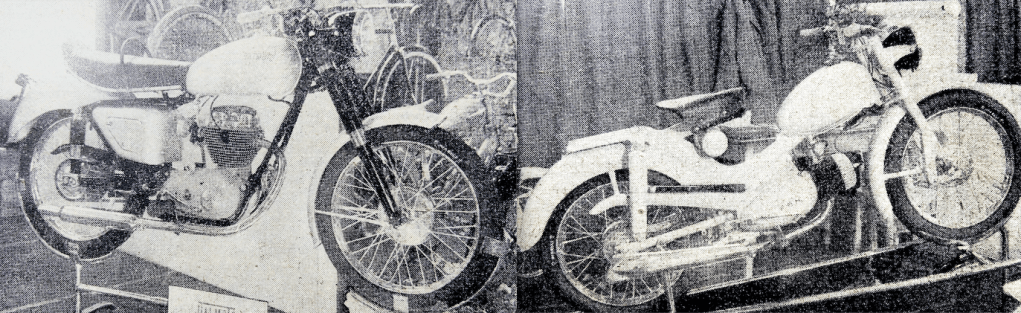
to a 150.” Since collating this report, courtesy of the Blue ‘Un, I’ve come across the Green ‘Un’s Milan Show report which, oddly enough, barely overlaps with that of the Blue ‘Un. So it seems sensible to simply add Motor Cycling’s take on the Innovazioni italiane: “One of the most interesting models on view—the 175cc Comet—is built by, Drusiani. This new Bolognese lightweight is of outstanding technical interest. The engine is a vertical twin, with light alloy barrels and heads, the overhead camshaft being driven by a chain located between the cylinders. In unit with the engine, a four-speed gearbox drives an in-built distributor, a separate ignition coil for the flywheel generator being located in the tank cutaway. Telescopic forks and hydraulically damped swinging fork rear suspension are other features. MV Agusta, too, have entered the 175cc field with an ohc design. This is an ‘alloy’ single, in which the chain tunnel for the camshaft drive is cast into the left-hand side of the cylinder. An ohc engine powers the MV 125cc ‘production racer’ and a racing scooter, but all other production machines feature two-stroke engines. In each case telescopic front forks and swinging-fork rear suspension are used. On the Guzzi stand, the Gino Cavanna all-enclosed record-breaking sidecar outfit and a
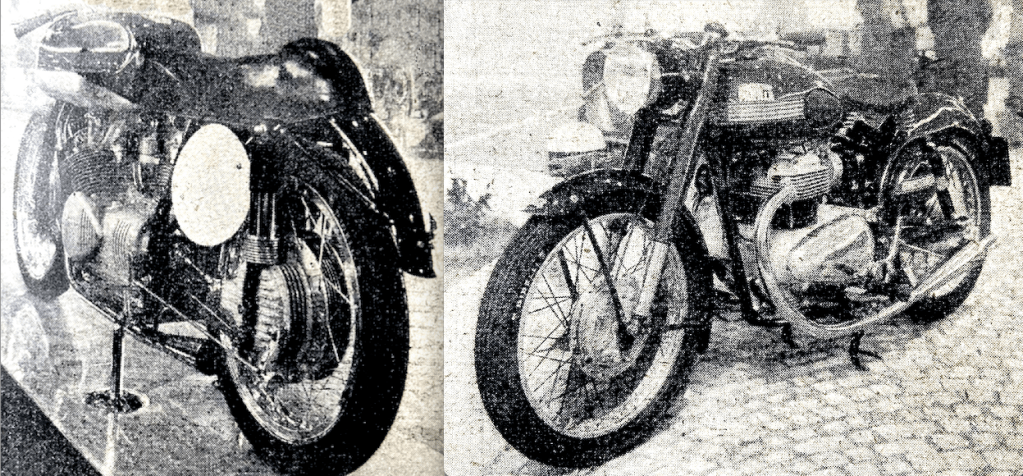
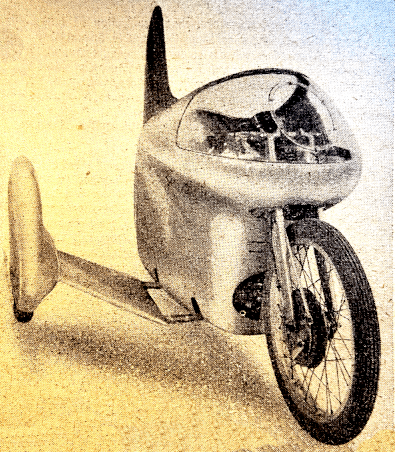
‘works 250’ rather tend to draw attention from the standard models. Besides the well-established horizontal-single motorcycles of 250 and 500cc, the Mandello establishment are showing the improved, version of the Galletto, with an ohv engine of 175cc, in unit with which is a four-speed gearbox. In characteristic Italian style, the spring units anchor, at the top, on backward-sweeping cantilevers from the main frame tubes, the former also forming the rear mudguard stays. A rival in the racing field, Moto Morini have on show a 175cc ohv four-stroke, again with a four-speed gearbox in unit, and with swinging-fork rear suspension, while Parilla try a less orthodox line with a high-camshaft model, the valves of their 175cc engine being operated through short splayed pushrods, the left-hand of the engine being the timing side. The clean-lined vertical twin 350 introduced last year is again shown. Unit construction is employed, the four-speed gearbox sharing the ‘power egg’. Light-alloy heads, with side and separate cast-iron cylinder used. Several new
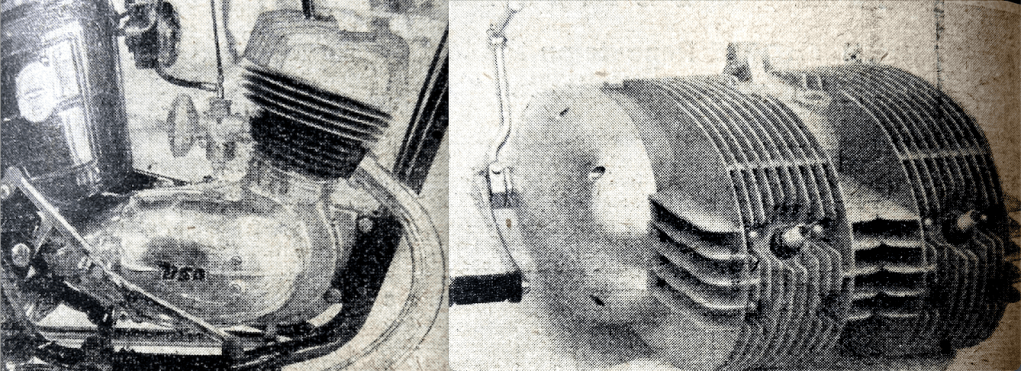
scooters are on show. There is the Sachs-engined 150cc Ambrosini with 3.00×12. tyres on spoked wheels. Rumi exhibit their Squirrel, with large wheels and the now well-known twin engine. Iso, MV Agusta, Ducati, Lambretta and Vespa are mainly unchanged—although the last-named have a model with cleaned-up engine fairings—but Luigi Frisoni introduces an entirely new scooter powered by a 160cc two-stroke engine bearing the Frisoni name. Detail points of interest on this machine are the hatch a-top the bodywork, through which access to the sparking plug is gained, and the folding rear carrier. The new Italian-German ‘axis’ remarked in the Ambrosini, is found again in the 125cc Vittoria scooter, powered by an NSU motor. Taking the Italian gage into the challenger’s own domain, a considerable number of British models are here. Sunbeams are well displayed; BSA, Ariel, Triumph and Excelsior models appear on the stands occupied by their agents, while a number of Villiers-powered, Italian-built machines are on view. BSA Bantam engines, fitted with much modified light-alloy cylinder heads, are in evidence on the Olympia models built by Borghi, of Milan.”
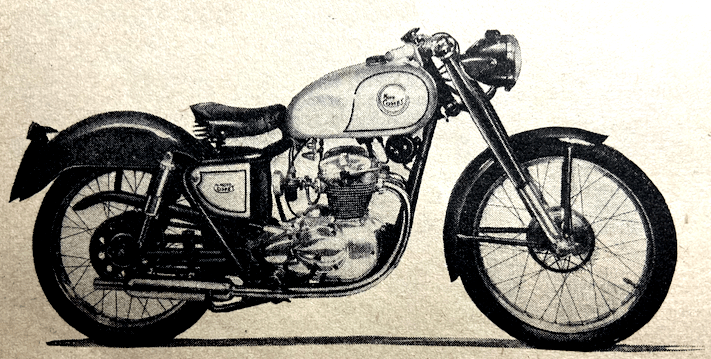
“THE SEARCH FOR ways and means of improving the performance of two-strokes has produced many interesting results. While some of these have been successful, the degree of complication which they have entailed has often completely negatived any advantages gained. It is all the more interesting, therefore, to learn—from our Italian contemporary, Moto Ciclismo—of a new development incorporated on the ‘B’ motorcycle, produced by Giuseppe Benelli, and exhibited at the current Milan Show. It retains the characteristic two-stroke simplicity and entails the addition of no extra moving parts. The petroil mixture is induced into the crankcase through a rotary valve incorporated in the crankshaft. At low revs it passes direct into the crankcase through a central diaphragm in the flywheel, induced —as is normal practice—by taking advantage of the partial vacuum formed in the crankcase as the piston rises. However, the flywheel on the induction-valve side contains a number of channels, radiating tangentially from its centre in a manner reminiscent of the spokes of a wheel. These channels connect to the hollow crankshaft. As the engine speeds up,
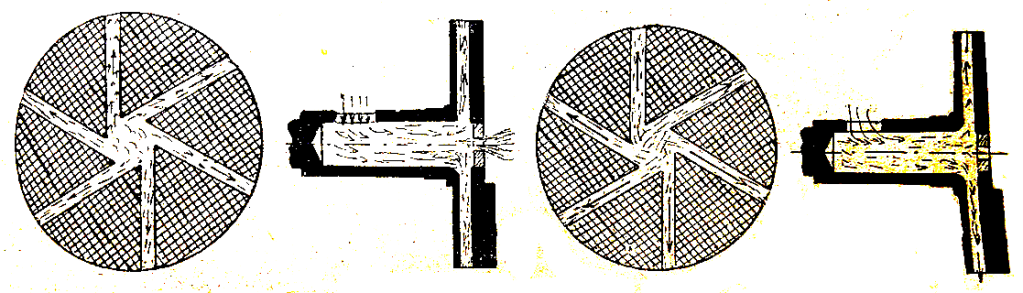
“THE FAMOUS MOTO-GUZZI concern of Mandello, Italy, has been experimenting with a water-cooled, in-line four-cylinder 500cc shaft-drive racer which, among other unorthodox features, dispensed with the usual carburation layout. And these experiments were not only confined to the factory, for such a machine was under test, ridden by the British ‘ jockey’, Fergus Anderson and the Italian star, Enrico Lorenzetti, at Monza, coincidental with the Grand Prix des Nations. It certainly cannot be described as a thing of beauty, but none can deny its interest—and it is still very much in the experimental stage and is, in fact, little else than a mobile test-bench. Technical details of the engine can be summarised as four cylinders, in line; water-cooled, with radiator and pump circulation; bore 56mm, stroke 50mm, enabling a high crankshaft speed to be maintained; double, gear-driven oh camshafts; magneto ignition; four-speed gearbox and shaft final drive. But the principal interest lies in the fuel system. This consists mainly of a double-acting gear pump drawing petrol from a well formed in the tank; under pressure the fuel is fed into a channel which runs parallel to the centre line of the engine and in juxtaposition to the inlet ports. This channel is equipped with jets, not unlike those of a normal carburetter, each so placed as to register with the passage leading to an individual cylinder and from these nozzles the fuel issues, the quantity being controlled by the twist-grip ‘throttle’ control. Here the similarity to Diesel engine control will be noted. But an appropriate quantity of air is required, and this is derived from a second pump, which blows a stream of air on to the jets of fuel so creating a combustible mixture of the correct proportions which, aided by the pressure caused by the air pump, is inspired into the cylinders through the inlet valves in the ordinary way. Finally, a third pump, a recuperator, returns excess fuel to the tank. Such a system is not entirely new. It may not, moreover, be regarded as a fuel injection system, but rather as a mechanical carburettor in which the usual depression in the induction tract, caused by the sucking-in stroke of the piston, is assisted by pressurised fuel as a means of inducing the charge to enter the cylinder. Following the usual Guzzi practice, engine lubrication is from a separate oil tank, placed forward of the unit. A special device is fitted to prevent excess oil being thrown on to the rear wheel…55bhp at somewhere around 11,000rpm is spoken of in usually knowledgeable circles, while observation has led to the belief that the engine behaves well when accelerating or pulling, as well as at high speeds.”
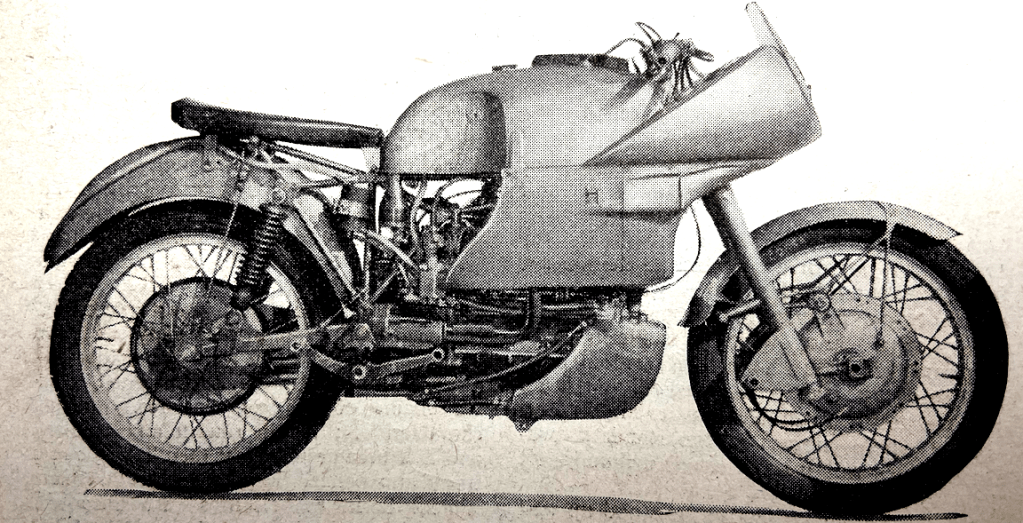
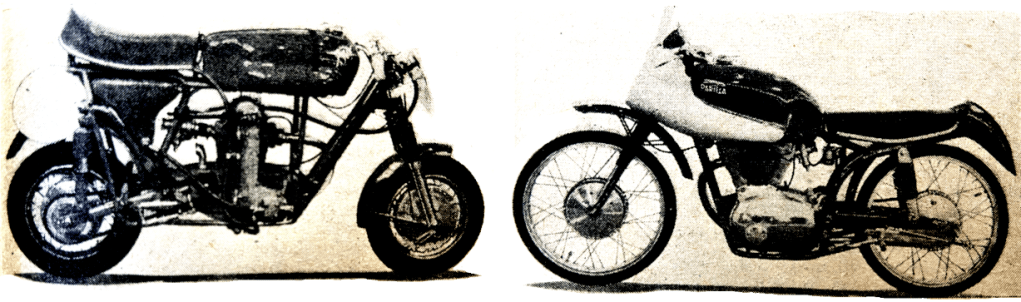
“A NORTON RIDER has been talking to me about his pre-war model, a 16H. Although it dates from 1934, it still looks well even though there are no obvious signs of spit-and-polish. You, no doubt, grasp the distinction; one occasionally sees a vintage mount that the owner obviously cared for as something like a full-time hobby, but this machine is kept for use rather than entertainment. It normally does rather over 300 miles a week, mostly on business journeys, and has covered a total of about 400,000 since first bought. Yet the engine has never yet been rebored or appeared to need it, the oil consumption at the present time being very modest indeed. The original rear chain is still in service, and the same applies to the wheel bearings. The owner described himself as being a trifle faddy on the subject of lubrication; he is punctilious about the routine, and sticks to the brands he believes the most suitable. He lifts the head more often than most would be inclined to do; removes what little deposit he finds, and takes a look at the valves. Otherwise his maintenance drill is nothing out of the ordinary. Taking that amount of care has given him a machine that is still in top-notch condition after nearly 18 years. That it has paid him handsomely does not need saying.”—Carbon
“THERE IS A REPORT from Holland to the effect that someone is exploiting a plastic frame for bicycles. Extreme cheapness and light weight are the claims made; both could be true. Indeed I think it safe to say that sooner or later plastic will become accepted as a suitable frame material for motor cycles. Even before the war the German DKW concern was conducting experiments with it that were said to be not entirely unsuccessful. Fibreglass, and I dare say other plastics as well, have the strength required; they are very light, and do not cost much, provided that production is on a big enough scale. But the ‘know how’ of handling such materials requires some discovering, and experimentation may take years, more likely than months. This development may be regarded as being in the bag, but when we shall be able to get it out and into our hands is another matter.”—Carbon
“QUESTIONED IN THE HOUSE of Commons recently about the possibility of abolishing purchase tax on crash hats, Mr JA Boyd-Carpenter, Financial Secretary to the Treasury, said he was considering the matter but that there were great difficulties involved. Other speakers drew attention to public feeling on the subject and referred to present Purchase Tax arrangements as ‘a tax on safety’.”
“FOR SOME CONSIDERABLE time the Automobile Association has been using, with marked success, night-operational fleets of four-wheel ‘rescue’ vehicles in the Leeds, Birmingham and London districts which are radio-linked with a central control. Under this system it is possible for headquarters, upon receiving a call for assistance from a member who has broken down, to call up the aid vehicle nearest to the casualty and so ensure that the minimum delay occurs in getting the member mobile once more. Consequent upon the good work done by these vehicles—which are, incidentally, ‘Land Rovers’—the Association this week announces the inauguration of another service in which radio-equipped motor cycle combinations are employed and which will, on a nation-wide basis, extend the scheme already in operation with the cars.”
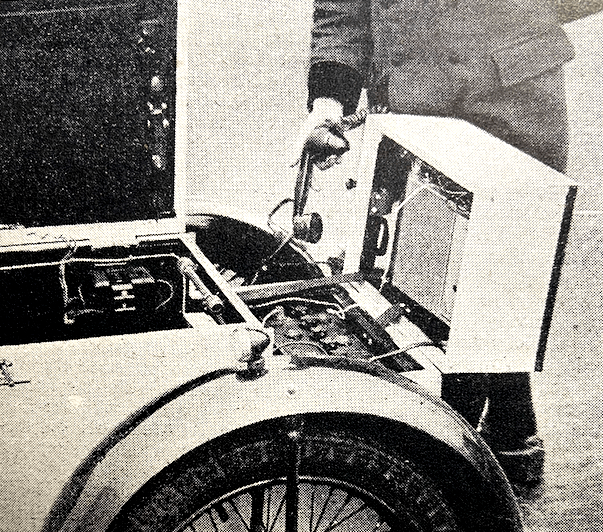
“WITH A NEW FACTORY in Barcelona, the Hispano Villiers Company is to embark on the manufacture of lightweight Villiers motor cycle engines in Spain. Production is planned to commence early in 1953.”
“THE EIGHTH NORTHERN Experts Trial, staged by the Chester MC in conjunction with the Sale MC last Sunday, resulted in a triumph for the lightweight brigade. TD Wark (200 Francis-Barnett) lost only two marks to win the Thomas Trophy, while the runner-up, JG Brown, who lost three marks, was riding a 125cc BSA. Best in the opposite class was P Wraith (500 Ariel sc) who incurred the same 16-mark penalty as CV Kemp (500 Norton sc), but made a better showing in the special test.”
“AMC SUCCESSES IN CALIFORNIA: Using an over-bored 545cc AJS ‘Springtwin’ J McLaughlin won the recent Rams National Championship, a 130-mile Californian classic which this year attracted no fewer than 380 starters. AJS ‘comp’-mounted Del Kuhn finished second with Bud Ekins on a 545cc Matchless G9 in third place.”
“ONLY VERY SELDOM does a death really mark the passing of an age. The phrase is apt to be used too freely, but it applies in the case of the late John Alfred Prestwich, founder of the JAP engine business. As a pioneer, his record was truly extraordinary. Starting in a small way as a camera manufacturer, he became associated with the inventor of the cinematograph, Friese-Greene. He turned to making motor cycle engines at precisely the right moment and, by producing comparatively reliable power units, undoubtedly did a great deal to establish the new British industry, then struggling against foreign competition. He was in at the start of aviation, and was working at one period with Sir Alliott Verdon-Roe, as the Avro pioneer has since become. Also, I suppose, it could be said that his concern was about the first to exploit the possibilities of the small petrol motor for industrial purposes. As a sideline to begin with, he started what has become one of the largest pencil manufacturing businesses in the world. JAP Industries remains as a monument to his enterprise. If the name now means less in the motorcycling—as apart from speedway—world than it once did, Prestwich more than adequately served his day and generation. He played his part in the evolution of the motor cycle.”
“YOUNG JV BRITTAIN (350 Royal Enfield) added yet another premier award to his 1952 collection by winning the trial named after his famous father, who also gave the trophy. The event, organised under a special restricted permit by the Wolverhampton MC&CC, was open to riders from the Midland, East Midland and Cheshire Centres; there were five non-starters out of an entry of 82, and only one rider retired. RESULTS Vic Brittain Trophy (best performance): JV Brittain (350 Royal Enfield), 8 marks lost. Committee Cup (best in opposite class): J Lewis (500 BSA sc), 29. Best 150cc: EW Smith (125 Francis-Barnett), 19. Best 250cc: A Shutt (200 Francis-Barnett), 14. Best 350cc: DS Evans (350 Royal Enfield), 25. Best 500cc: JL Davies (500 Triumph), 10. Club Cup (best Wolverhampton member): CJ Devey (200 James) 26. Buckingham Cup (best ‘over-40’ Wolverhampton member): VW Evans, (125 BSA), 39.”
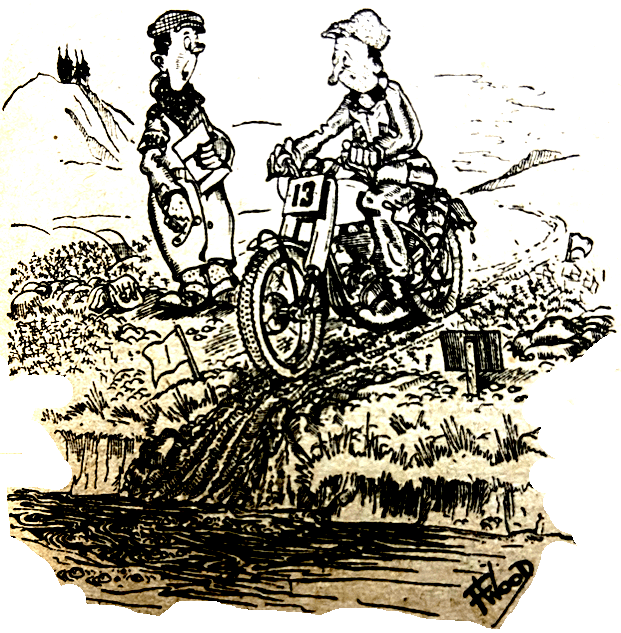
“IT IS CLEAR THAT the official attitude concerning Brooklands, far as motor racing is concerned, is not known, so I will endeavour to elucidate. After the cessation of hostilities in 1945, a well-known car club applied to the track authorities for permission to hold a rally there, but the official attitude being what it was, the application found its way to the Ministry of Aircraft Production—the then occupiers—who were very much against any form of publicity in connection with the track. From then onwards, various ‘board’ meetings were held to the effect that the club had ‘had it’ and, also, that the Ministry were finding it cheaper to buy the track for industrial development than to reinstate it as a race track. This last statement aroused considerable indignation and the British Racing Drivers’ Club called a public protest meeting in London, at which Lord Howe took the chair. But, alas, on January 7, 1946, Brooklands (Weybridge), called a shareholders’ meeting at which the majority of those present voted in favour of selling the track to Vickers, who paid £330,000 for The late Sir Malcolm Campbell, a director, appeared fully in favour. The meeting brought to light the fact that the MAP (now the Ministry of Supply) would not release Brooklands for three years and therefore, as racing could not resume before 1950 at the very earliest, it was felt wise to sell out. That is the story of the sad demise of Brooklands, the very first motor race track in the world, a feat of private enterprise and individual endeavour the like of which this country may never see again. To let Brooklands languish on in its present state is absolutely disgraceful. GRAHAME FLEMING, Thornton Heath, Surrey.”
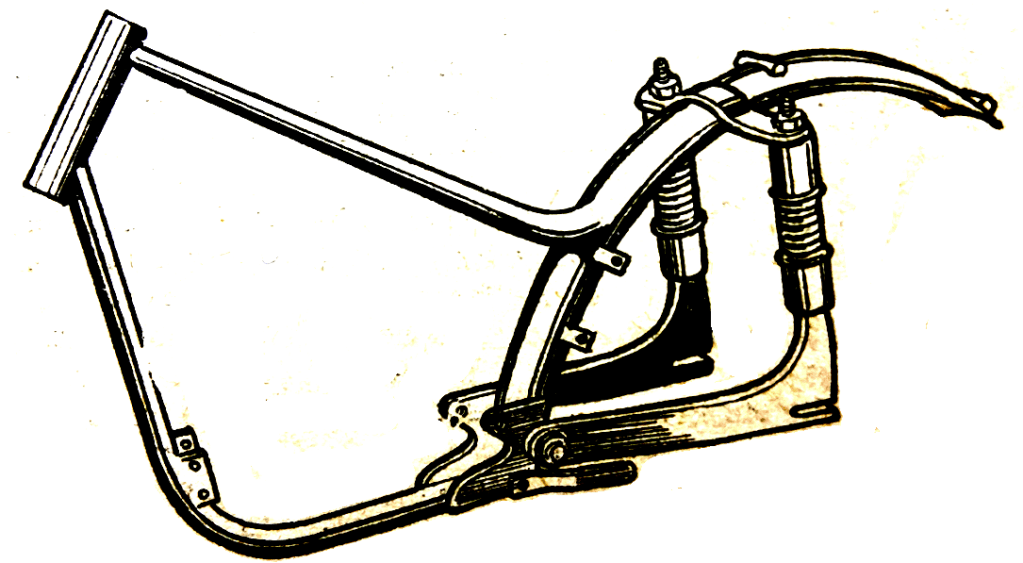
“THOSE WHO HAVE BEEN appealing for a revival of Brooklands are, I fear, flogging a very dead horse. The decisive factor is that the cost of reconditioning the track would be completely fabulous, and at any rate, as things are to-day, it is doubtful whether either the material or the labour could be made available within a reasonable time. Also to be considered, naturally, is the new circumstance that the site is now the property of an industrial concern who must have sunk a great deal of money in it. It can only be supposed that they would not take kindly to the idea of relinquishing the property, and as they are further engaged on work of the highest importance, it would probably be against the public interest that they should do so. Those with long memories will tell you that Brooklands never really recovered from the maltreatment it received during the First World War. At that time heavy lorries with solid tyres made free use of the track as a short cut to the establishments they served, and the result was that the concrete suffered severely. When peace returned, even though conditions were far less difficult than they are now, the money could not be found to restore the surface to its original condition, and repairs were really only of the make-shift order. If that could happen in the 1920s, it seems clear that a far more costly reconstruction can be regarded as out of the question in the ’50s.”
BMW’s PLANT IN EISENACH, which had been under Russia control since the war, was handed over to the East German government and turned out bikes badged BMW until the West German company won a trademark lawsui. The East Germans duly renamed the plant Eisenacher Motorenwerk (EMW). Instead of BMW’s blue-and-white roundel, EMW used a suitably socialist red-and-white roundel. The EMW R35 was effectively a BMW R35 with a 340cc single-cylinder, four-stroke engine producing 14hp.
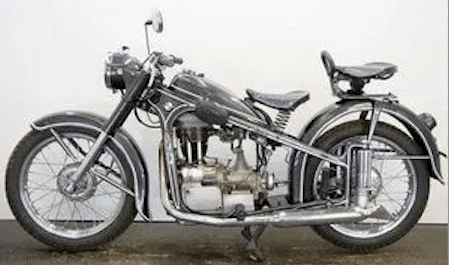
centrifugal force acts upon the induction system and draws in a greater charge of mixture than could be inspired by the normal means. At the upper end of the speed scale all the mixture is distributed through the flywheel channels instead of through the diaphragm by virtue of the force acting upon it. It will be seen that the higher the engine speed the greater is the force, and, therefore, the breathing at high engine speed is greatly improved when compared with conventional two-strokes which utilise only atmospheric pressure as the induction medium. An ancillary effect, which is decidedly interesting, is that centrifugal force breaks down the petroil mixture, the oil separating from the petrol in the flywheel channels. The result is, of course, improved lubrication and, as a result of the purer mixture reaching the cylinder, better combustion, with consequent lowering of fuel consumption and an increase in power. On the earlier experimental engines the flywheel diaphragm was not fitted, the only connection between crankcase and carburetter being by way of the induction tract in the crankshaft and the radial channels. It was found that as centrifugal force at low engine speeds was of a small order, starting became difficult—a trouble completely overcome by the addition of the diaphragm. A 115cc ‘B’ equipped with the new induction system was tested by the Dell’Orto carburetter concern. It was reported that at a speed of 50kph (31mph) fuel consumption figures of 66km/lit (187mpg) had been obtained.”
“I THOUGHT I HAD been asked all the questions which can be put to a motor cycle journalist, but a Midland lady has struck new ground. Will I help her to choose a motor cycling coat with which to surprise her husband on an anniversary? I will NOT! The earth is full of sweet young things who imagine they know all about ‘his’ tastes, for example, in cigars and ties. The ‘surprises’ operated by such damsels could be more truthfully described as shocks. In this gift sphere we males have far more sense than the cunninger sex. Orchids? Yes! Chocolates? Yes! Cigarettes? Yes! Jewellery? Perhaps! But garments—no, no, NO! After many years of married life I wouldn’t-dare to buy a hat, or even a frock, or even a nightie, for my ‘her’. She would probably burst into tears at the first glimpse of the hat, and the undies of my choice would assuredly be the wrong colour. Give the brute the money, and let him choose. (The gift of the money will probably be as big a surprise as the arrival of a £7 coat which he hasn’t ordered could ever be; and it leaves him free to make his own pick.)”—Ixion
“IN THE HOUSE of Commons last Thursday Lt-Col Lipton asked the Chancellor of the Exchequer whether he would abolish the Purchase Tax on safety-helmets in order to encourage their use by motor cyclists. Mr. Boyd-Carpenter, Financial Secretary to the Treasury, said he was considering this matter, though he feared there were great difficulties involved. Lt-Col Lipton asked whether, instead of penalising the use of these life-saving precautions and putting a tax on safety, the Minister would consider the advice given in the opening speech at the recent Motor Cycle Exhibition at Earls Court. Mr Boyd-Carpenter said he hoped his answer indicated sympathy, but the hon member must recall that there were many other forms of protective clothing which were subject to tax, and the possibility of a concession in one direction would inevitably give rise to consideration of the other cases as well. Mr Deedes asked if he would bear in mind how strongly a large number of doctors and surgeons felt about it, in view of the amount of time and money they wasted dealing with head injuries to motor cyclists; if he was prepared to remit the tax, he would get it back on savings in the health services. There was no reply.”
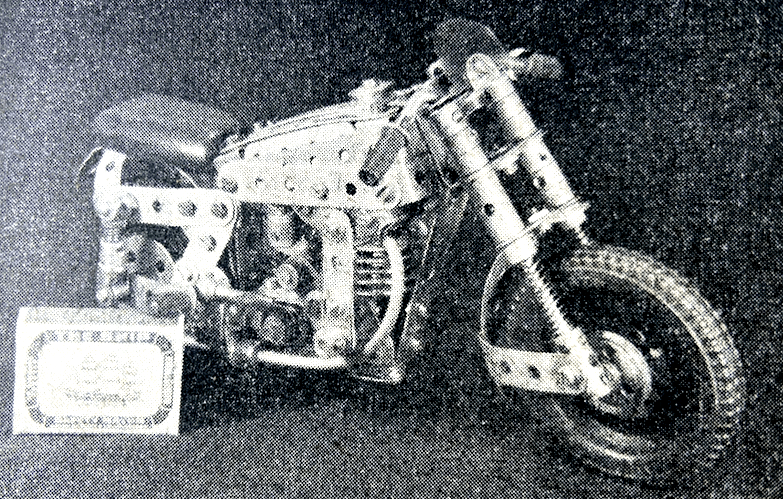
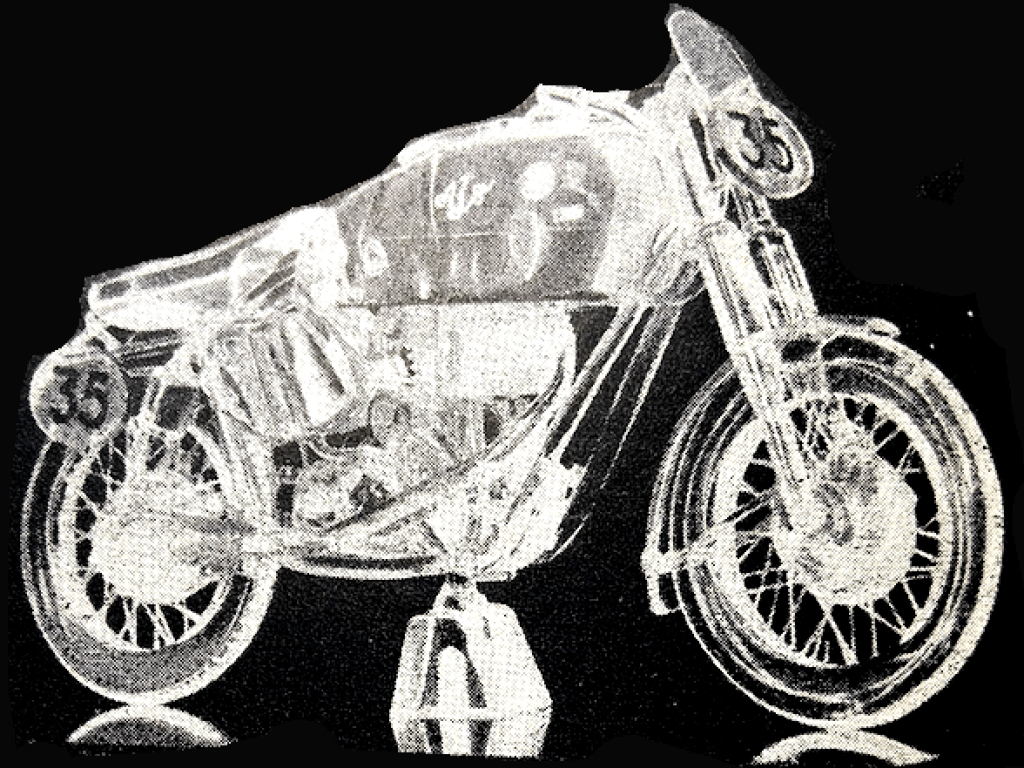
“THE BRITISH MOTOR CYCLE industry has every reason to be heartened by its current display at Earls Court. World trade conditions have deteriorated markedly in the past year, and the commerce of every nation has been affected. Largely owing to the contraction of export markets brought about by national policies, the motor cycle industry has found itself confronted by a rapid change-over from a sellers’ to a buyers’ market. Hence the future has been regarded with some concern. Earls Court portrays no such anxiety. On the contrary, it puts an emphasis on efforts to react to the changed conditions. Opening day provided a promising augury. The attendance was 39,098 in spite of severe fog during the morning in the London area and to the east. The total is over 4,000 higher than the opening-day figure for 1951. A magnificent send-off was provided by His Royal Highness the Duke of Edinburgh, who performed the opening ceremony. In his speech, Prince Philip said, ‘British cycles and motor cycles have a reputation throughout the world for excellence that is unsurpassed.’ This comment epitomises the theme of the 1952 Show. There are examples of true excellence wherever the visitor may look—among the cyclemotors and autocycles, in the vast range of motor cycles from 98cc to 998cc, among the sidecars, the three-wheelers, the components and accessories. Quality, suitability for purpose, reliability based on well-proved design, technical development established only after severe testing in the laboratories and in competitions—these are the foundations of the excellence for which British machines continue to be famous…There are nearly 400 motor cycles, autocycles and three-wheelers on display—about 30 more than at the 1951 Show. Ranges are larger—that is to say, there are more different types of machine. The number is just over 190 which represents a 20% increase as compared with last year. In Great Britain, interest in motor cycles is at a higher level than ever before. The last official return showed almost 850,000 licences current. If the registrations continue to mount as in the past few years, a total of a million will be reached in 1953. A similar trend has been apparent in many other countries. Although the industry faces keener competition, there is no reason for pessimism. So far as motor cyclists the world over are concerned, the London Show provides ample proof that British machines continue to be second to none.”
“DURING SHOW WEEK a few of the surviving pioneers meet at their annual dinner in London. They are in a position to value the Earls Court achievement more accurately than the youngsters who throng its stands. They can remember when a stagnant parliament and narrow-minded, horsey interests condemned this nation to lag far behind France, Austria, Italy, Germany and America. The red flag, and the 4mph limit, grudgingly succeeded by the 12mph limit, both followed over a long period of years by a police persecution which can now be labelled as unconsciously both savage and dishonest, hampered all that our engineers could attempt in the field of light road engineering. Time was—and I lived through it—when British workmen could not cast a light cylinder, or wind a decent ignition coil, or turn out a spark plug capable of sustaining any real heat or make a tyre larger than those for pedal cycles. Either we tried our prentice hand, and produced rubbish; or we bought from the Continent and ate humble pie. The motor cycle industry faced a tougher struggle than its big sister, the car industry, mainly because the latter catered for well-to-do folk, who could cheerfully waste their money on new toys, whereas the cheap motor cycle appealed to the less pecunious masses. But humility and determination gradually fought down all opposition. Today, if some of our larger concerns came on the market, their price would be ranked in millions; and they are so precious to their present owners that they will probably never change hands.”—Ixion
CARBON, IXION’S OPPOSITE NUMBER on the Greeen ‘Un, met up with a number of motor cycling pioneers at the show: “Muriel Hind (Mrs R Lord), who was very poorly early in the year, has made an almost miraculous recovery. So I learned from Harold Karslake when I met him at the APMC’s picture show that proved a strong attraction to its rather remote and draughty corner. Harry Martin, as spry as ever despite his years, was very much about on the Excelsior stand and I was particularly glad to meet Jack Woodhouse, one of the most dashing riders of the pre-1914 period whom I had not seen for a very long time. He was famous in motorcycling, even though he never secured a place in the TT, and started the production of the Regal-Precision—a make once considerably favoured among speedmen. And he became famous again when be went to the RFC as a pilot. Nowadays, Group-Captain John Whittaker Woodhouse, DSO, MC, is retired, but he keeps up his interest in motorcycling.”
“INDIVIDUALS WILL DIFFER as to the men who played the greatest part in establishing the British motor cycle industry. More than once it was on the very brink of folding, apparently for ever, though in sober fact somebody would doubtless have resuscitated it. I can remember when its life hung on thin threads recalled by such names as Excelsior, Quadrant and Rex. Away in the far north Phelon & Moore kept the ideas of a chain drive and two-speed gear alive without convincing an incredulous world. But I think that the true crisis came at the turn of the first decade of this century, and centred round the year 1910 or thereabouts. The wise judgment which averted the crash was rooted at that date in the directing board of the Triumph Company. Once and once only I sat with that board, and I formed the impression that wisdom belonged to them all. Most of my dealings were with MJ Schulte, who often seemed to make the big decisions. To him I should accord the chief credit for putting our rickety industry on its feet.”—Ixion
“SELF PRAISE IS no recommendation, as the old adage puts it. But those of us who are outside ‘the trade’ have every right to feel proud of our country as we tread the interminable concrete gangways at Earls Court. War-battered and impoverished, largely stripped of our Empire and stung by the ingratitude of many backward nations to whom we have been reasonably wise and kind foster-parents, we can still produce a range of motor cycles unparalleled In the world. The designers, who deserve the major credit, are all there to witness their personal triumphs. I could wish that every factory hand, from the office boys and cleaners upward, could visit the great hall, and realise the majesty of the enterprise in which they have played their part. For quality, originality and tastefulness the exhibits are more impressive than ever. Other nations annually contrive to evolve and construct one or two models which achieve a world market, figure notably in international races, and serve their own populations faithfully. But after all these years Britain still contrives to turn out quite a squad of models which leap across the barriers of tariffs and of patriotic prejudices, and Britain still possesses the acumen to blaze new pathways of evolution. I am proud to be a Briton, just as in a different sphere an even deeper pride suffused me on VE Day and VJ Day.”—Ixion
“EARLS COURT DREW a gigantic crowd on the opening day, and we were delighted that the Prince was there. We are a youngish crowd, and he is wildly popular among us. British youth already regards him as its leader. He spoke to us, wisely, sympathetically and not a bit ‘de haut en bas’. First about a few 500cc and larger machines. They are AJS, Ariel, BSA, Matchless, Norton, Royal Enfield, Sunbeam, Triumph and Vincent. Each with its own special cachet. Each with its distinct worldwide reputation and market. All so different. Each patiently developed by quiet, able men from a predecessor which was a mere shadow of its present self. AJS and Matchless—a pair of puzzled twins—one wondering why it is handed all (or nearly all!) the racing honours. Both undergoing intensive, continuous development, and strangely innocent of too many twiddly bits. Ariel, keeping its 21st birthday in its four-cylinder version, with another 5hp as its natal present, plus an honest 100mph and cooler than ever it was. Norton, growling defiance on the racing circuits at all Italian fours, and leaving us speculating whether there is already a cunningly camouflaged four somewhere in the background. BSA, trying not to look too conceited over that marvellous Maudes scoop, and blushing because the baby Bantam almost outshines the Golden Flash. Royal Enfield, with some new engines, and defying the world to cram more than 700cc into a vertical-twin engine. Sunbeam, pretending not to be a two-wheel car in its comfort aspects with very indifferent success. Vincent, the fastest model on earth, with or without sidecar, and never mind if the engine does form the frame. What a team!
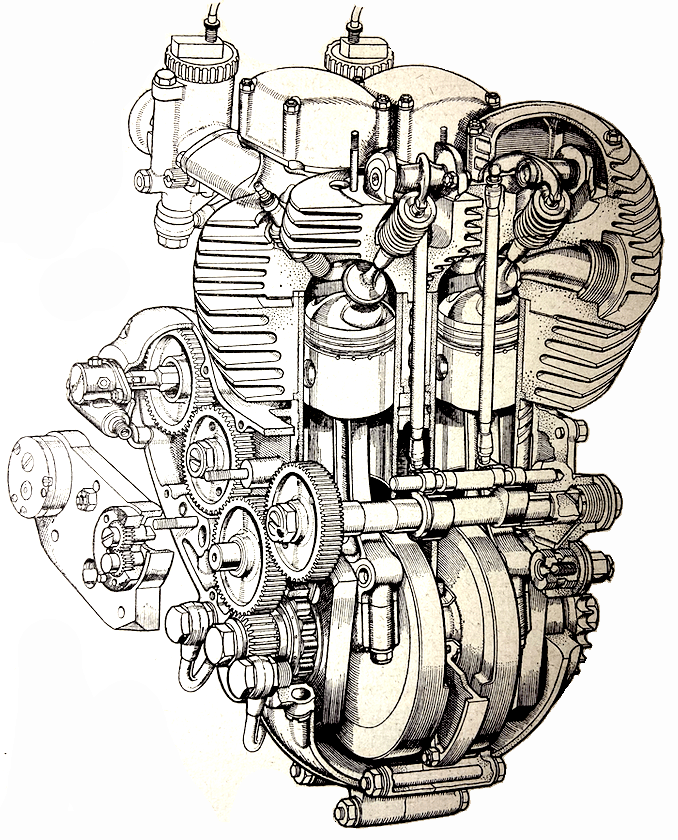
With no peers anywhere on earth. None of them parvenus. All established friends of motor cyclists wherever men ride on two wheels. Each undergoing steady improvement in the hands of shrewd men, pa.cked as full of motor cycling lore as an egg is full of nourishment. Barring minor details, there is little to say about any of them, except that they are even better this year than they were last. You may not think that is possible, but you do not know their designers so well as I know them. Did you notice that some manufacturers are flirting with the idea of colour? Ariel, for example, with a lovely milky blue, and a pure claret red! BSA with a cafe-au-lait—not too much lait—and so on. I have seen these colour gushes before now. After Christmas, the sales options sometimes drive them back upon the old black-and-silver prescription, but I agree with the revolutionaries. In grim times one can have too much sombre black. Why not even try a harlequin mixture? We all need cheering up. But the gilding of the big lilies, while it may be the chief merit of the Show, is not its top note. Perhaps the toppest note of all is that fore-and-aft suspension, once regarded as a somewhat pansy luxury, an effeminate refinement, is now a Big Must. Moreover, a hesitating note of criticism is creeping into the doctrine of springing. The big fellows remain loyal to the two accepted suspension systems. But the little ‘uns are simmering with rebellion. Who shall rush to say they are wrong? Consider the EMC and the Commander. I freely admit that punctures are unusual nowadays. But we all know the invincible vice of most inanimate objects. They reserve their naughtiness for the worst imaginable when and where. So if you sustain only a single puncture in a given year, it will happen either in deep floods or on the summit of an alp in a snowstorm. In such an emergency you are likely to find your back wheel so beleaguered with rods and encased springs, and stays and struts, that it is almost impossible to extract it, and quite impossible to lever off 9in of bead, so as to patch the tube in situ. So be pliable, and study one of the
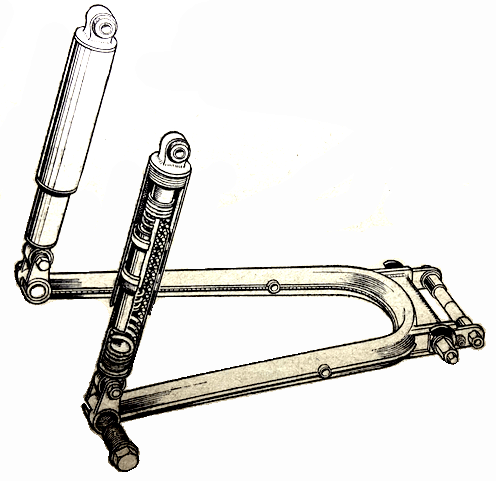
juvenile rebels for a moment. The EMC 125cc, for example. A simple—if slightly inaccurate—description of its rear suspension might state that it is based on a single rocking lever of inordinate length with the only spring hidden under the steering head. No obstructions wherever around the rear wheel! Or glance at the feminine beauty of the Commander, which has a fat, short spring concealed—where? Again, no burying the back wheel behind impenetrable entanglements. If, in addition, the suspension compares favourably with established types, this young, new critical school merits a hearing. All vulnerable details should be as accessible as human wits can make ’em, and the tyre is still the most vulnerable of them all. A most interesting ‘re-invention’ is the Ambassador throwback to the electric starter, which Billy Wells, of blessed memory, fitted to an Indian nearly half a century ago. The cons?—about 20lb to the weight and a bit to the price. The pros?—effortless engine starts. The 6-volt 47-ampere-hour cells are slung pannier-wise in neat cases on the sides of the carrier, and the starter drive is by endless belt. Is such luxury a sop intended for the weak, the wheezy, and the witless? It is definitely odd that it should stage its reappearance on a mere 197cc engine which some infants can start. But, after all, practically every car in the world relies upon an electric starter. And now—at long last—I arrive at what impresses me as the topmost feature of the 1952 Show. I will use a strong word to drive my point home. You may remember that twenty years ago we used to call all models under or up to 250cc ‘pipsqueaks’. The term was culled from a famous strip cartoon. It was in no sense derogatory, but rather affectionate. Well, this is, fundamentally, a ‘Pipsqueak Show’. The tinies form a giant majority. BSA still turn out the largest variety of brats from a single family, but there are innumerable firms mothering quite a shoeful of models with tiny engines. May I just whisper a few quite famous names in your ear? James, Francis-Barnett, Excelsior, Norman, Dot, Bown, Ambassador, Excelsior, DMW, Panther, Royal Enfield, Tandon. And others. I omit all the scooters. I omit several auto-cycles. I omit the numerous clip-ons (many of them foreign). These swarms of cheap, light models besiege the nation because their sponsors know that thousands of potential motor cyclists have lean purses, are averse to weight and speed, and cannot afford used light cars. They also perceive a vast new public of better-paid artisans who are growing a little too old for pedalling and might just afford a small model or something else cheap and light. A similar boom in the little ‘uns swept the Continent before the Hitler war. One is sweeping Italy now. It is possible that it may yet sweep England’s green and pleasant land. (I shudder to think what our roads might be like at weekends.) At the head of this bijou class stand three pukka aristocrats. They are the new amaranthine red Triumph Terrier (brand new, and a best seller if ever I saw one); the BSA Bantam, well known wherever there are roads, and in some lands which have no roads at all; and the LE Velocette, the daintiest lady of them all, smooth and satiny as a Napoleon brandy. The ‘little ‘uns’ constitute a most formidable invasion. No man yet knows how things may turn out in the next critical year or two. The cold war may boil over, in which case petrol will be reserved for national use. The cold war may continue, in which event most of our spare cash will be gobbled into the maw of defence, as now. Or we may see a sort of peace, with a slow-down in armaments, the sudden death of that loathsome octopus known as Purchase Tax, and a sudden expansion of gracious living.

However, it is at least possible that ‘pipsqueaks’ of assorted types are going to be more important alike to maker, seller and customer than any of the big brothers. Remember that several makers of lightweights already list eight or 10 models, all thoroughly well tested and developed types. Their potential importance cannot be questioned. And the newcomers to their ranks—such as the Commander, and the DMW—are by no means inferior to the more famous members. There is a lot of brain—and of keen, original brain—in many of them. What has already happened in Italy may yet happen here, if politics so decree. A period may not be far distant when £250-300 may be an impossible sum for the average motor cyclist to find. The future of the lightweight is intimately associated with several other problems, the sum of which boils up to formulate a puzzle admitting of nothing better than a very hesitant guess. How stands the 350cc today? A firm or two (Douglas, for instance) regard it as bread and butter business. In 1947 it constituted a fair percentage of the entire Triumph output! Three years ago they dropped it like a hot coal. Today they exclude it in favour of just three engine sizes—150, 500 and 650cc (the last being in part a hauler of sidecars, and in part a concession to the American passion for large engines). Now the 350s are notoriously of two distinct types. Some of them are 500 c.c. models in every respect except engine bore and stroke. Others are expanded two-fifties. Europe, as a whole, is inclined to ignore the three-fifty. Is the type on its way out ? In any event, there may soon be no place in economic production programmes for both a 350 and a 500cc model. Meanwhile, there is, alas! no deeply grounded optimism in trade circles. No industry can operate confidently, or happily or efficiently, unless it can budget for at the very least one year in advance. Who knows what next harvest may bring forth? It is not merely a matter of the cold war. Many markets have been more than queasy during the last year. The home market is obviously dependent on our foreign trade, and on the size and immediacy of national defence. All we can say is that although world affairs may still go haywire at split-second notice, the outlook seems less bleak than at any time since VE Day. We can at least hope. Meanwhile, a cold war, while infinitely preferable to a shooting war, can be all but fatal to rational planning, manufacture and efficiency. The industry is operating with courage and vision. But it still finds itself in a most unenviable position. It is entitled to our warmest sympathy and our keenest admiration.”
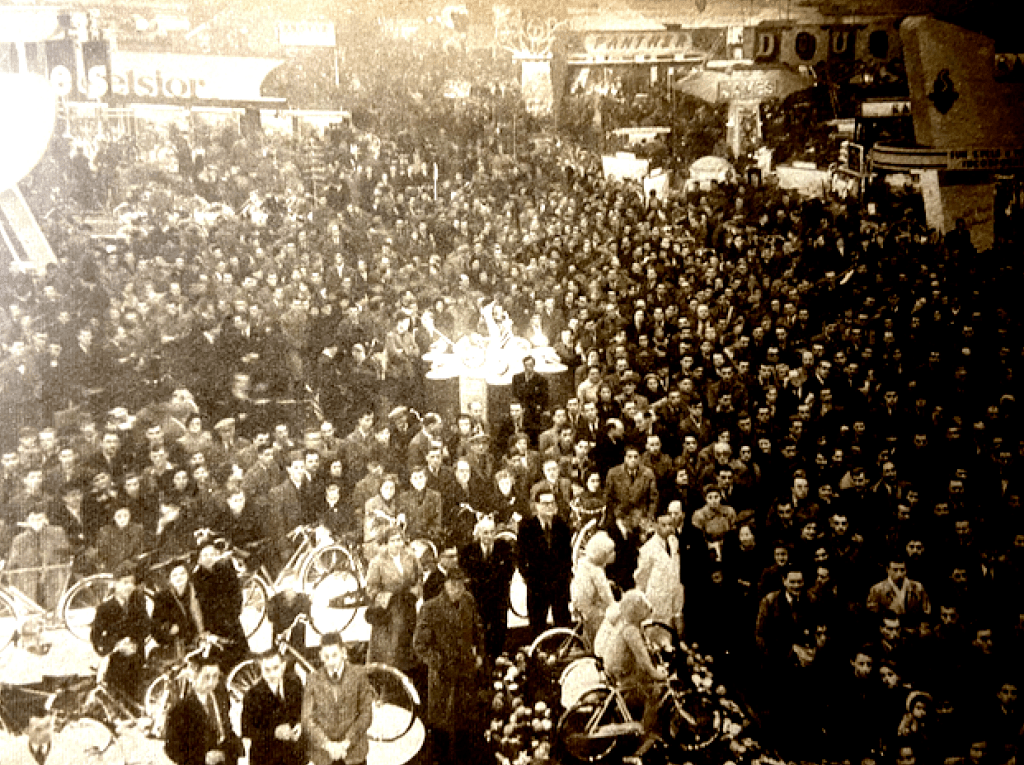
THE DUKE OF EDINBURGH opened the show with a few well chosen words. “…The industry deserves every credit for their post-war achievements…Having reached this leading position it remains to be seen whether they can maintain it. I have no doubt that it can be done, but it certainly will not be done if there is any complacency or relaxation of effort. Only those companies who make full use of modern science and technology will be able to withstand the cold winds of competition when they start to blow really hard…If participation in racing improves the quality of the product, success in international competitions certainly improves the chances of selling it abroad. I hope the industry will continue to foster and encourage racing, and I wish the riders every success wherever they go…we must try to make sure that the riders are safe. In this connection, I congratulate the Auto-Cycle Union, of which I am happy to be Patron, on their training scheme for young riders. This really is a concrete way to make roads safer. I only wish, incidentally, that they could persuade more riders to wear helmets. Perhaps
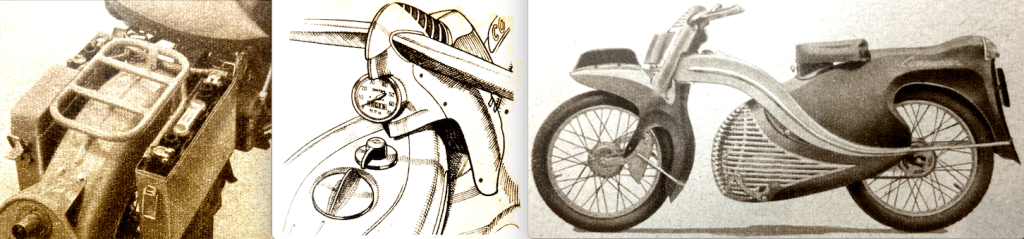
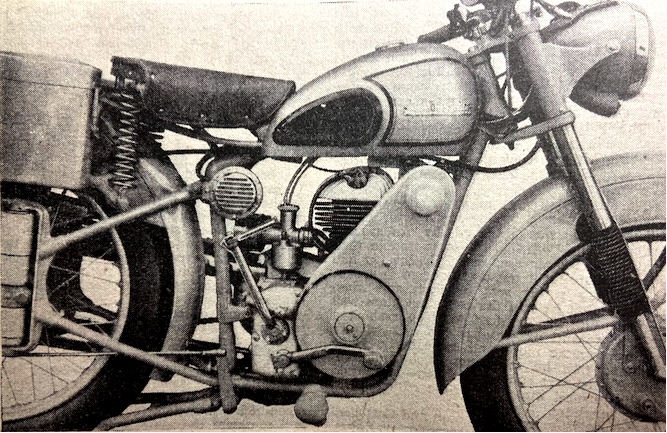
if motor cycle clubs went in for club helmets, instead of club ties, the helmets might become more popular.” The Duke was then presented with a miniature Royal Enfield for his nipper; Prince Charles had just celebrated his fourth birthday. I wonder if KCIII still has it? During his tour of the show Price Philip was shown two exhibits that stood next to each other: a James Comet at £70 5s 7d and a Vincent Black Lightning at £504 14s 5d. He “showed great interest in the triple-camshaft 348cc AJS which was used to capture 21 world’s records at Montlhéry last month [including an hour at 111mph that had been held for 14 years by a blown Guzzi 250] and in the racing Porcupine Twin. On the Norton Stand, he was shown the actual model which Reg Armstrong rode to victory in the Senior TT last June, and discussed the dual-seats fitted to standard machines.” Here’s a selection of other debutantes that might have attracted the Duke’s attention: “A beautifully prepared sectioned working model of the new Ariel Square Four engine is fascinating dozens of enthusiasts at a time on the Ariel stand. World famous
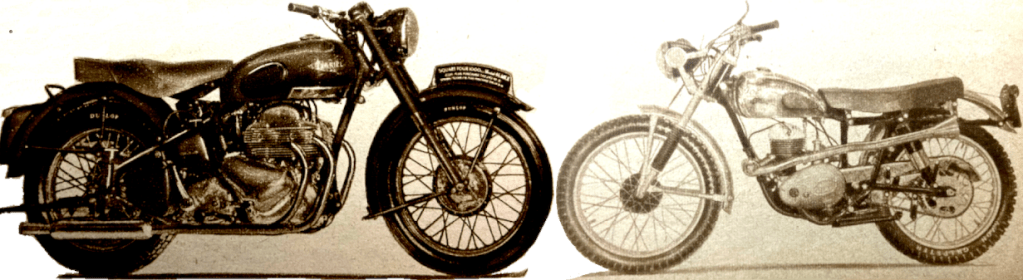
for many years, this unique 1,000 c.c. power unit, known in its latest form as the 4G Mark II, has modified induction and exhaust systems which are said to result in a power output of 40hp at 5,600rpm. In road performance this represents smooth, surging power right up to 100mph and more. Yet such is the efficiency of the new engine that a fuel consumption figure of 65mpg at 50mph is claimed. The sectioned engine reveals the new four-port exhaust layout, which has two bolted-on manifolds. A straight induction pipe, bolted to the top of the cylinder head casting, leads to a cruciform distributory tract…Pistons are available to give a compression ratio of 6.7 to 1 for Pool petrol, or 7.2 to 1 for 80-octane fuel…Proved in the International Six Days’ Trial, the new 498cc Hunter Twin with light-alloy engine is also attracting much attention…Gleaming, chromium-plated fuel tank panels and wheel rims, together with new colour finishes, make an extremely bright and attractive display on
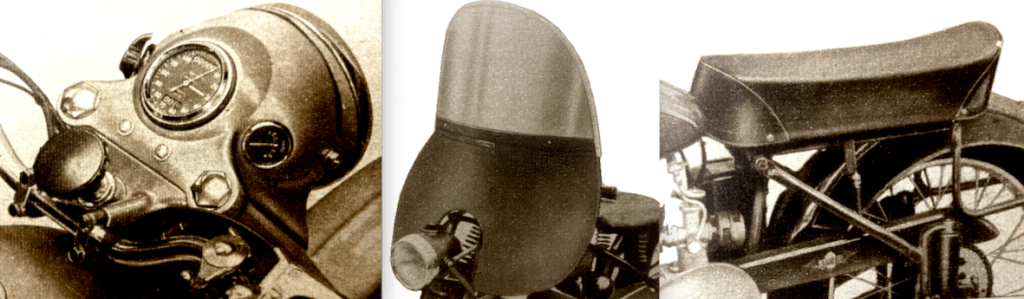
the BSA stand. These latest versions of the world’s largest range of motor cycles also include several noticeable refinements to detail. For instance, there is the new streamline headlamp and speedometer cowling introduced on all except the 125 and 250cc machines; the light steel shell of the cowling does not interfere with adjustment of the headlamp for vertical position. Switch and ammeter are incorporated in the cowling. Matching this innovation is the redesigned rear number plate which features the new Lucas stop and tail light. Common to all but the 125cc machines, the number plate is neatly blended into the lines of the rear mudguard by a steel fairing. For the sporting rider, the greatest attraction is undoubtedly the BSA Gold Star, of which 350 and 500 versions are shown. These machines are fitted with the new hydraulically damped, pivoted-fork rear springing. The Girling telescopic legs are fitted with adjusters for pre-setting spring loading according to requirements. For Gold Star engines, a choice of cams, valve springs, pistons, sprockets, and tyres is available to meet a wide variety of operating conditions. One of the three production 495cc Star Twins that won for BSA the Maudes Trophy is shown in the condition in which it returned from its strenuous 5,000-mile test through Europe and the ISDT. Also on the stand is the Maudes Trophy…Polychromatic beige colour finish is available for the A10, or alternatively
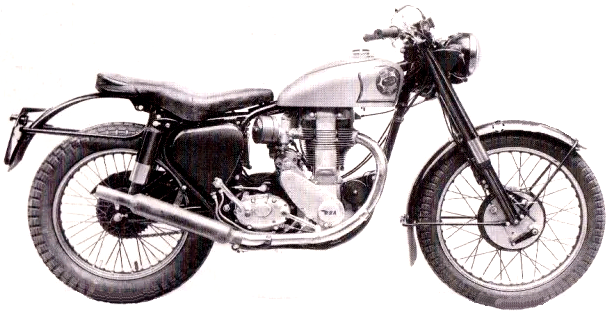
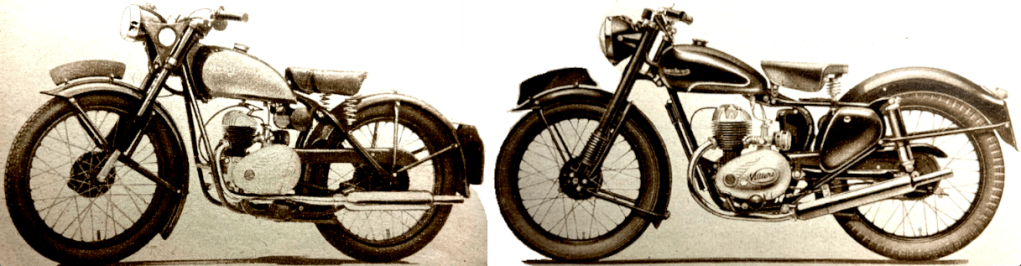
black and chromium; this latter finish is featured on a smart-looking police motor cycle which is on view. Dark maroon with chromium-plated tank panels is the new finish introduced on several models in the BSA range. A completely new dual-green finish distinguishes the latest Star Twins…Over the years, the name Tourist Trophy has become more and more of a misnomer as applied to the famous races in the Isle of Man. Now the name graces also the latest addition to the Bown range, a 125 which is indeed a worthy addition to the ranks of lightweight machines. The Tourist Trophy Bown is on show in two forms, one of which has legshields and a carrier fitted. The machine is powered by the 122cc Villiers Mark 10D engine-gear unit, which is mounted in a duplex frame. A Metal Profiles telescopic front fork is fitted; rubber gaiters protect the sliding parts. Very attractive is the finish, which is in maroon, with metallic-blue tank panels and chromium-plated handlebar and exhaust system…Arrested by the revolutionary styling and striking colours of the Commanders, enthusiasts at Earls Court are discovering that these new British lightweights are not mere outward show. The flowing lines conceal a frame of great strength allied to front and rear springing which is in accordance with the most up-to-date principles…Seamless-drawn steel tubing of square section is employed for the all-welded frame,
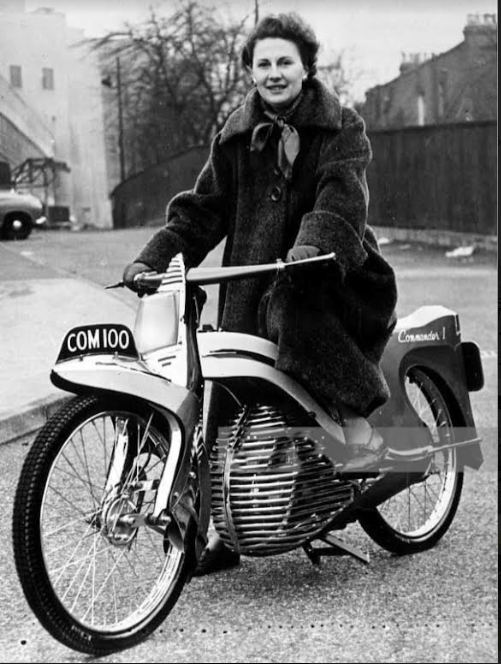
which is of beam type. Rear wheel suspension medium is a pivoted fork controlled by a large-diameter coil spring. The front wheel is carried between leading links pivoted at the bottom of the front fork legs; rubber bands control the movement. There are three models—a 98cc auto-cycle, a 98cc two-speed ultra-lightweight, and a 122cc three-speed machine. All three incorporate Villiers power units and have identical frames and suspension systems. Hydraulically damped, pivoted-fork rear springing, which has been tested on competition machines in every open scramble during the past 18 months, can be seen on the latest 197cc Villiers-powered Dot lightweight…the new frame is used in the same form both for the competition Dots and for the new roadster. A sturdy, loop-type main frame is employed. The pivot bearings for the rear fork consist of two Silentbloc bushes; no lubrication is necessary. Girling spring and hydraulic shock-absorber units are fitted. at a forwardly inclined angle of 40° from vertical. Total movement possible at the rear wheel spindle is 4½in—made up by 3½in on impact and 1in on reaction. A new system of engine mounting in the frame employs Silentbloc bushes at all three attachment points. They are claimed to provide complete insulation from engine vibration…Flower gardens, floodlit fountains, crazy paving—all this at the Motor Cycle Show? Yes, a complete Continental boulevard is laid out on the Douglas stand. Arresting the progress of all who pass the exhibit is the sight of a Douglas Vespa scooter balanced on a four-foot jet of water! Quite how the machine stays at the top of the column is a dark secret known only to the engineers. Dotted here and there in the ‘boulevard’ are numerous Vespas in solo and sidecar form. A last-minute Show surprise is a single-seat passenger outfit fitted with a large screen. A door of generous size enables an adult to climb in with ease…Not all the interest is stolen by the Vespas, however. The Douglas 350 twins are being minutely examined by many enthusiasts of
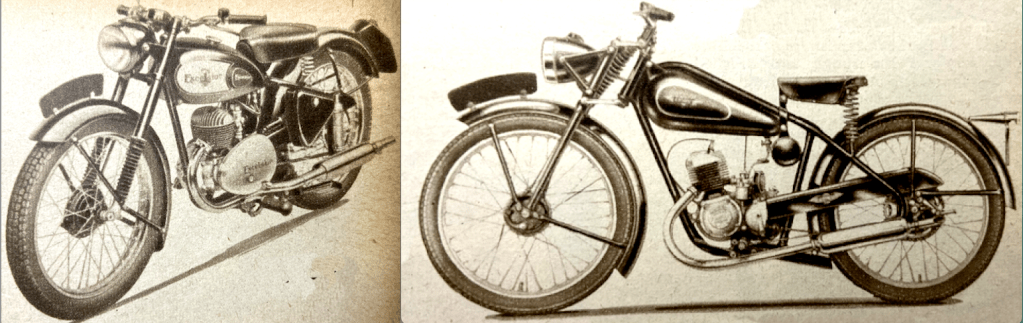
all types. The Mk V model is finished in green, and polychromatic gold is employed for the 90 Plus—a potent road-burner which has components available to convert it into a pukka road-racing model…Wheeled into Earls Court on the eve of the Show, the latest addition to the range of smart and efficient-looking Villiers-powered lightweights is the 122cc DMW Coronation model, which supersedes the standard 122cc DMW. The Coronation model is equipped with a new Metal Profiles bottom-link front fork and a valanced front mudguard. The new front fork comprises two oval-section uniform-gauge steel legs. To the lower end of each leg is pivoted a 4in-long leading link formed by two steel pressings. Welded to the forward end of each link is a tubular member which incorporates a wheel-spindle slot; these members are tubular in order to accommodate the Metal Profiles quickly-detachable wheel mounting, which employs sleeved retaining nuts. The link action is controlled by 7½-long telescopic spring units, the upper ends of which are attached to lugs welded on the fork-leg tubes. Each unit contains a coil spring, trapped at each end, which provides resistance on both impact and rebound. At the pivoted point of each bottom link a Ferobestos bush bearing is employed. Movement possible at the front-wheel
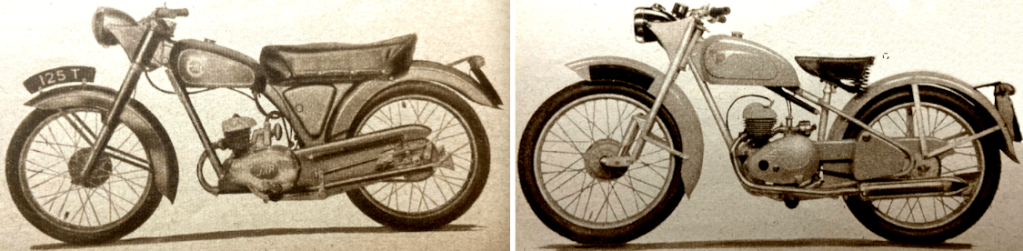
spindle is approximately 4in…Highlight of the Excelsior stand is the new 148 c.c. two-stroke Courier. Powered by a neat Excelsior three-speed engine-gear unit, the Courier is to be available for the home market right away. The new engine, which has a compression ratio of 7.8 to 1, employs a cast-iron cylinder barrel with orthodox twin transfer ports, and a detachable light-alloy cylinder head. The crankcase is made up of castings in DTD 424 light-alloy, which gives a smooth finish. An enclosed flywheel mag-generator is fitted…Solid and spring-frame 350 roadsters of unorthodox appearance, a highly successful 125cc racing two-stroke, and a novel and ingenious fully sprung lightweight utility machine, also of 125cc capacity, are on view on the EMC stand, Mecca of split-single two-stroke enthusiasts. The standard 350T model has been modified only in minor details, but its sporting counterpart is shown in spring-frame guise (an optional extra) and fitted with conical, light-alloy hubs incorporating 7in brakes. The engine of this model has an imposing light-alloy cylinder barrel with close-pitch, uniform finning and a throttle-controlled oil pump…A rear sub-frame is bolted to the main frame and the rear fork pivots on Silentbloc bushes. Armstrong suspension units are employed. A last-minute surprise, the novel 125T model, is among the cheapest spring-frame lightweights at the Show. Attractively finished in polychromatic grey, it has sleek lines which belie its unorthodoxy. The main frame consists of a curved, 1¾in-diameter tubular backbone, to
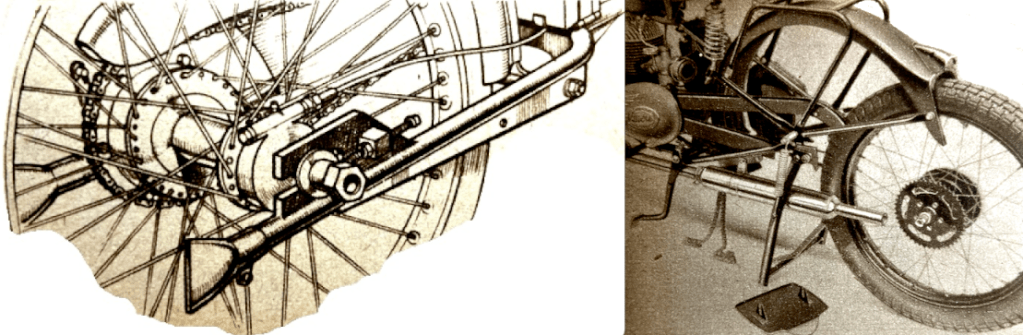
which are welded the steering head at the front and a transverse pivot housing at the rear. About the latter is pivoted a combined rear fork and engine bearer tube, which also forms the exhaust system for the 125cc JAP two-stroke engine. Movement of the engine-bearer-rear-fork unit is controlled by a telescopic spring unit which takes the place of an orthodox front down tube. A full range of handsome lightweights, which comprises both solid-frame machines and other models with ultra-modern rear springing, is deservedly drawing considerable interest on the Francis-Barnett stand. Star model of the range, the 197cc Villiers-engine Falcon 58, is displayed both in its home-market colour scheme of black and gold, and with its dazzling export finish; the latter includes chromium-plated wheel rims and tank panels, and the enamelled parts are black. The 122cc Falcon 57, is also shown in two forms—blue and gold for home consumption, blue and chromium plating for export…Not many hours before the Show opened, two Lambretta models were wheeled into Earls Court; designated the D and LDn. Particularly impressive is the de luxe model LD which is one of the smartest scooters available anywhere. It has many refinements. Controlled by torsion bar, the rear suspension is exciting considerable comment; a pivoted arm carries the engine and gearbox at one end and the rear wheel at the other. The three-speed gearbox is controlled by a twistgrip on the left side of the handlebar. Saddle and pillion seat are
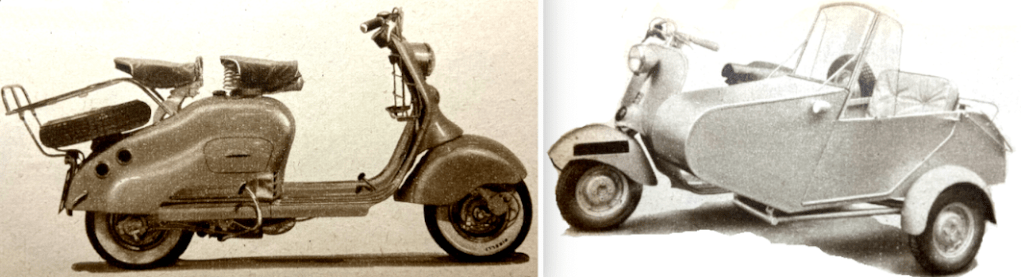
finished in a shade of green that matches well with the silver-green of the machine. A spare wheel and a large parcel rack are attached at the rear, and on the metal weatherscreen at the front is a large clip for holding papers. The D model…has not the same high degree of enclosure as the more luxurious LD…Another compelling exhibit is a particularly handsome single-seat Lambretta sidecar. A large windscreen extends right round the cockpit. Also on view are examples of the C and LC scooters and a commercial box sidecar designed to carry a load of over one hundredweight. “Pride of place on the Matchless stand is taken by a gleaming example of the new 498cc twin-cylinder ‘over-the-counter’ G45 racing model. There is an entire range of models on the stand, from the 347cc G3/L machine developed for arduous Don R work all over theworld during the war—to the famous twin. Included in the range as well as the 347cc models are the equally illustrious 498cc singles, available with solid or rear-sprung frames. A fast, flexible and comfortable roadster type of mount, the twin-cylinder Super Clubman is fitted as standard with pivoted-fork, hydraulically controlled rear springing. The machines are finished in gleaming black. Light-alloy sliders of the Teledraulic forks are highly polished. The small winged M tank motif, which is die-cast in light-alloy, is mounted on a circular red background. Tanks are lined in silver and red. All the spring-frame models are equipped with twin-seats. Among the external modifications evident on the singles are the shorter and neater weathershields fitted to the magnetos; and, on the twins, the two-stud fixing for the
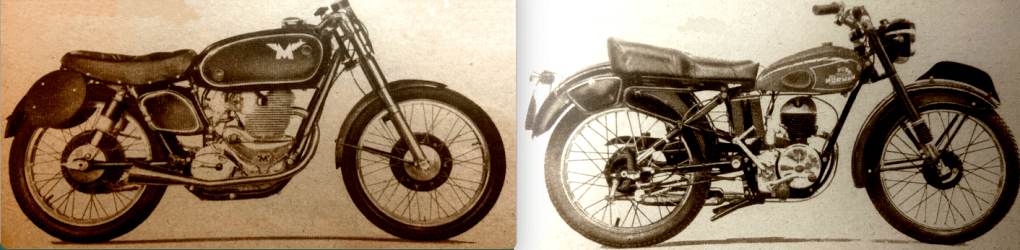
rocker covers and the new cylinder head steady plates. Do you remember your history lessons at school? 1066 and all that is recalled on the Norman stand, where there is a ‘Norman castle’ with motor cycles perched on battlements. Five springers are on show finished in two new colour ranges—mid-green lustre and old bronze lustre…itemssuch as lighting sets, hubs, speedometers, horns and even control-cable casings are finished in a silver shade. The new Model E is attracting considerable interest, for here is a machine which does not fall within the luxury range, yet it is by no means an austerity model. A telescopic front fork, sturdy rear carrier and rectifier and battery lighting (this last as an optional extra) are a few of the noteworthy features of this 122cc lightweight. At the other end of the scale is the new competition machine which is based on the factory mounts that performed so well in the last Scottish Six Days Trial. The New Hudson autocycle is being closely examined by the utility-rider clan. The two models stand out among the BSAs and Sunbeams—though perhaps they do look a little forlorn. Attractively finished in an appealing shade of dark green, the tank has cream panels with gold outlines, and the leg-shields are picked out in gold. The Villiers Mark 2F single-speed engine is employed. Unpretentious in specification, the solid-frame side-valve Norton 16H and Big 4, of 490 and 596cc respectively, and the 490cc ohv ES2 continue to appeal to those who require simple, non-luxury, quality mounts for solo or sidecar purposes. The standardisation of dual-seats and built-in pillion footrests (as on all models except the trials mount) has greatly enhanced the appearance of these machines. Anothersolid-frame machine displayed is the 500T trials machine incorporating a light-alloy engine and distinctive-looking, dull-chromium-plated tank. All the other models displayed have pivoted-fork rear suspension. Of these, five models in the range have the racing-type, all-welded,
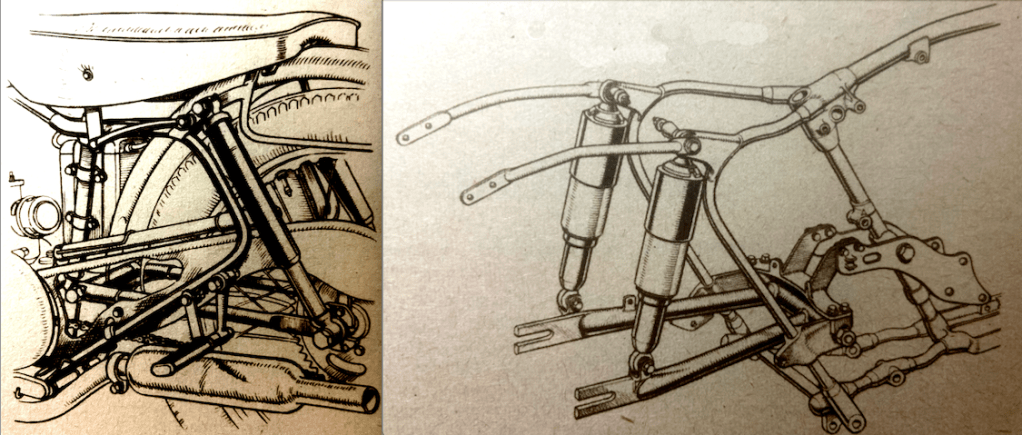
duplex-loop frame, with cross-over tubes behind the steering head, while two feature the new Norton spring frame which is of brazed-lug construction. These latter machines are the 490cc ohv single-cylinder ES2 and the 497cc twin-cylinder Model 7 Dominator—the version which is available for the home market. Their appearance is enhanced not only by the new springing and dual-seat, but also by the fitting of a new shape of silencer (said to be very efficient), a deeply valanced rear mudguard and side-lifting handles. With its exhaust ports widely spaced to assist engine cooling, and improvements to its lubrication system…Still, alas, for export only, the Model 88 Dominator de Luxe combines the same engine and gear box with the racing frame, strap-down tank and dual-seat. Critical observers are praising the rubber mount for the handlebar, the thin kneegtips the readily accessible tool-box and cut-out button located under the dual seat. Finally, there are the renowned 348 and 490cc International models, which now also feature genuine ‘featherbed’ frames, and the ever-popular and highly successful Manx racing models of 348 and 499cc. The Internationals are handsome. fully equipped, super-sports machines with high-compression, ohc, single-cylinder engines fitted with Amal TT carburettors.With dohc engines, light-alloy fuel and oil tanks, megaphone exhausts, fly screens and number-plate lugs, the Manx models are ready to race. In spite of the presence of an all-chromium-plated speedway machine with five-stud JAP engine, a complete OEC sidecar and chassis, and a skeleton sidecar which
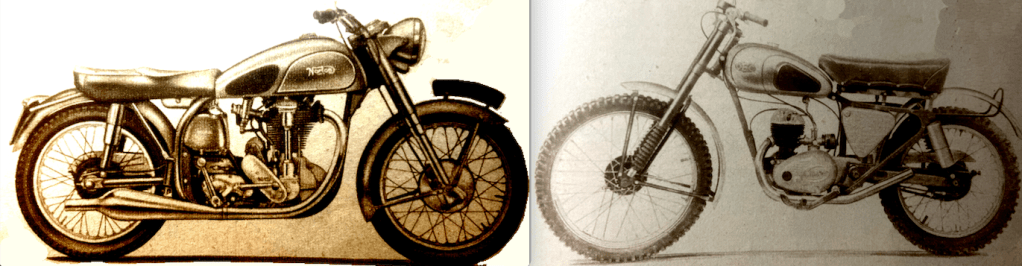
reveals the tubular construction, the accent of the OEC display is on Villiers-powered lightweights. These are attractively finished in poly-chromatic grey. In addition to a selection from the eight models produced for the home market—embracing engine capacities of 122 and 197cc, solid and rear-sprung frames, and direct and rectifier-battery lighting equipment—there are two new models, ST2 and ST3, which are capturing much attention. The former is intended for the export market and has a de luxe specification. Rectangular-section tubing is employed the frame, which is available in solid form with pivoted-fork rear suspension incorporating Girling shock-absorber units. The ST3 is the new competition machine; it also has a weldedframe of rectangular-section tubing and pivoted-fork rear springing. Its chief attraction, however, lies in the its transmission, which employs chains. A short chain from the gear box output sprocket of the 197cc Villiers unit drives a sprocket on the left-hand end of a countershaft which is co-axial with the rear-fork pivot. From the right-hand end of this countershaft another sprocket and chain conveys the drive to the rear-wheel sprocket. An obvious advantage of this layout is that chain tension remains constant throughout full wheel deflection, a praiseworthy feature on a machine designed for the arduous work of scrambling. Many detail improvements to the Pashley lightweight delivery vehicles are to be seen at Earls Court. The range comprises three models, the Peterborough closed-body truck, the Preston open-body truck, and the Penzance flat-platform truck. All are
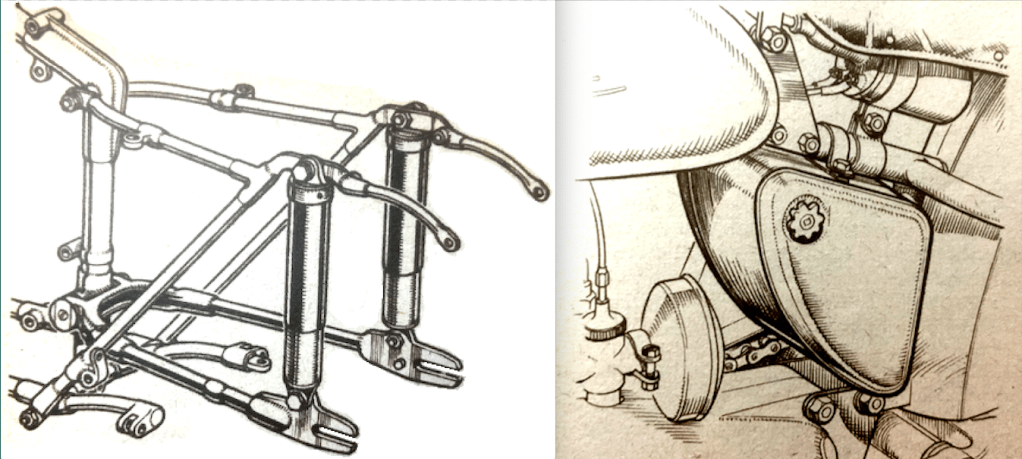
powered by the well-tried 197cc 6E Villiers engine-gear unit, with the drive taken by chain to a single wheel at the rear. This wheel is carried by a pivoted fork sprung and damped by Girling units. Front suspension is by coil springs with Girling hydraulic shock absorbers. All models are now fitted with bucket seats. More protection from the elements has been afforded by an increase in the size of windscreen and scuttle. A worm-and-nut steering box of Burman-Douglas manufacture is employed. Focal points of interest on the Panther stand are the recently announced 248 and 348cc single-cylinder engines with light-alloy cylinders and heads, and the new Panther spring frames. Two of the light-alloy engines, which are for the Stroud competition models only, are on display. The cylinders are gravity castings in Y-alloy with bold finning, a feature which endows them with a most businesslike appearance. As with the standard engines, the push rods are enclosed in a single, external tunnel. So trim and functional do the Stroud models appear that they are provoking more than usual interest by experienced and prospective trials men. Compression ratio for both 248 and 348cc. engines is 7 to 1. Tests carried out with 80-octane fuel are said to have been most satisfactory. At the present time, the spring frames are available only for the 248cc Model 65 and the 349cc Model 75.The 248 and 348cc solid-frame models, and the four 598cc Models 100 on the stand are all equipped with Dowty oleomatic forks, which employ no springs, but rely on air as the suspension medium. An unusual feature of the Panther exhibits (though one that is becoming prominent) is that two-way hydraulic control is provided both by the springing plunger units and the new fork. The bright new colour schemes introduced last year—polychromatic silver-grey and blue—are undoubtedly attractive. Knowledgeable sidecar enthusiasts viewing the 598cc Model 100 with a keen eye. Its Dowry fork is readily adjustable to static load and to provide sidecar or solo trail. All that is n for the latter is to remove the front and turn the
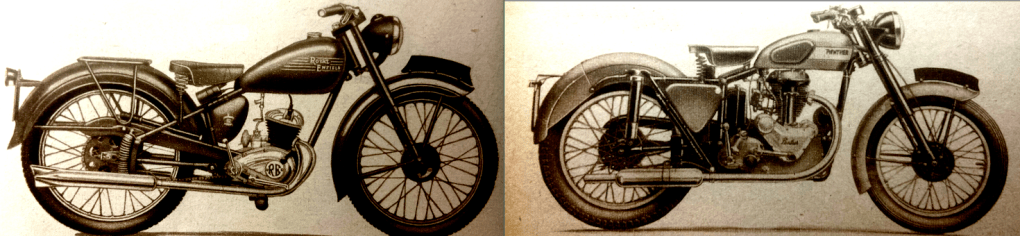
fork sliders through 180°. The exciting new Royal Enfield 700 Meteor twin. is featured in conjunction with a Watsonian sidecar. The Meteor is fitted as standard with a specially robust rear fork designed to make the spring-frame entirely suitable to withstand the stresses imposed by high-speed side-car driving. In solo trim, the Meteor is an extremely fleet sports tourer. Heavier than the well-proved 500 twin by only 10 or 12lb, the engine churns out 36hp at 6,000rpm. From the crankcase upward, the Meteor engine is not unlike two 350s side-by-side. Two separate cast-iron cylinder barrels are deeply spigoted into the crank-case and surmounted by separate, light-alloy cylinder heads. Compression ratio is 6.5 to 1. The Meteor has a 7in-diameter rear brake, and a 6in dual front brake with compensated twin cables operated by a single handlebar lever. The front fork is modified internally to provide increased damping on reaction. The popular 350 Bullet sports single is shown in road and trials trim. The new 500 Bullet is likely to become equally popular. Bottom half of the new Bullet is basically the same as that of its forerunner, but there is additional bearing support for the crank-shaft. Power output is given as 25hp at 5,250rpm. Like the Meteor, this model is equipped with the stiffened-up rear fork to make it suitable for sidecar work if desired. An excellent feature is that the stop-light switch is housed in the toolbox. Yet another new model on the Royal Enfield stand is the 148cc Ensign—an attractive lightweight two-stroke which, complete with pivoted-fork rear springing, retails at a total price below £100. The power unit is a compact, three-speed engine-gear unit, a development of the famous 125cc RE model. Seat covers are brown—to match the machine finish. As in past years, the Sunbeam
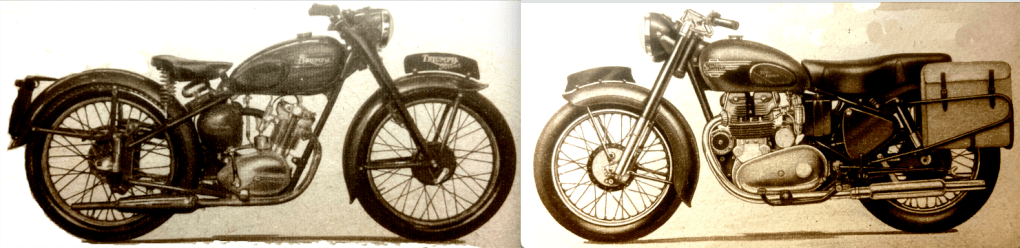
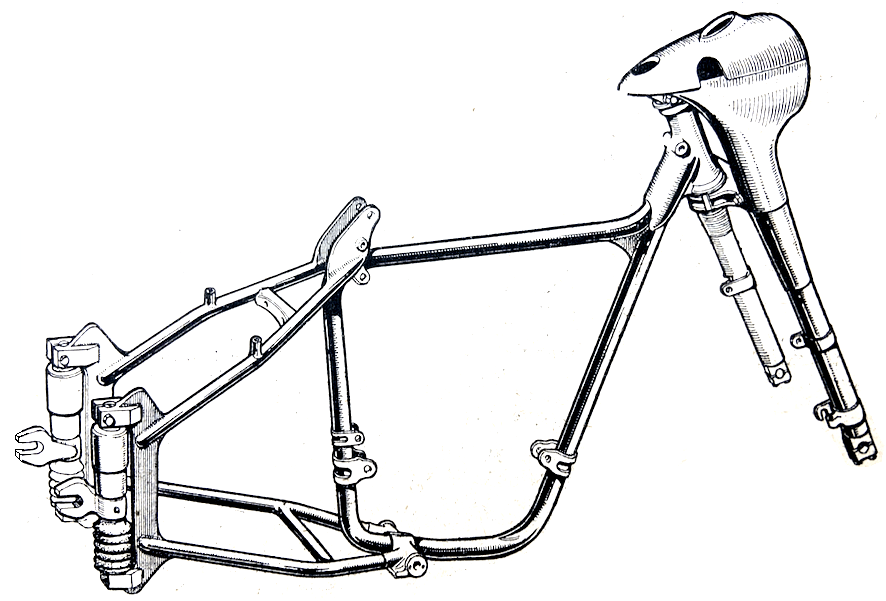
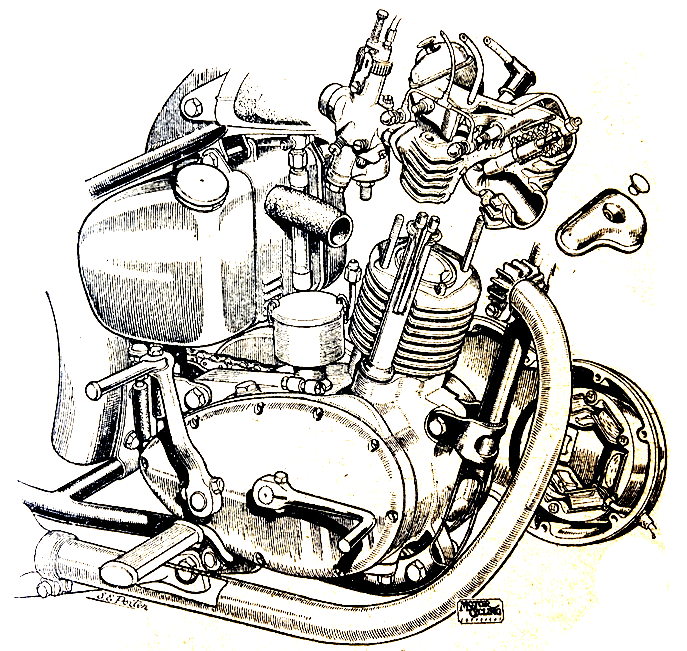
exhibits are combined with those of BSA and New Hudson. Both luxurious S7 and S8 models, with their up-to-the-minute, in-line, ohc twin-cylinder engines and shaft drive, are displayed. In spite of the fact that over half a decade has passed since the original post-war Sunbeams were introduced, the design remains one of the two, or perhaps three, most advanced at the Show. Cylinder block and crankcase are formed by a single aluminium-alloy casting. The crankshaft is a one-piece iron casting. An unusual design feature is that the bore is greater than the stroke—the dimensions are 70×63.5mm. The generator is a bow Lucas instrument of the ‘pancake’ type. A new 197cc two-stroke, equipped with pivoted-fork rear springing, appeared on the Sun stand little more than 24 hours before Show opening. The new model is destined for oversea markets only. As with the other models displayed, the Challenger, as it is called, is powered by a Villiers engine-gear unit. The rear sub-frame, which is used for locating the top ends of the suspension units and for mounting the dual-seat and rear mudguard, is of such shape that its rearmost section lies parallel to the suspension unit; its lower tube lengths are thus taken down low enough to allow them to be utilised for silencer and pillion footrest mounting. Baby of the models on the stand is the 98cc de Luxe model which is exhibited with a Villiers Mark 4F engine and two-speed gear. Remaining exhibits are 197cc machines, one of which is fitted with Metal Profiles rear springing [Metal Profile’s successful proprietary plunger rear suspension system had been joined by a welded pressed-steel swinging arm featuring chain adjuster cams that worked by moving the whole swinging arm backwards—Ed]. Another version has a solid frame. The front fork in each case is a Metal Profiles unit, famous for its simplicity, great strength, and lateral rigidity. Rectifier and battery lighting is included in the standard specification of both models. The 6v 5 amp batteries fitted previously are now replaced by the more usual 13 amp type. The Challenger competition mount’s high saddle is achieved by mounting it on a sub-frame raised above the seat stays. Under the saddle is situated a small cylindrical air filter, which is connected to the carburettor by a flexible pipe. At the 1951 London show, the crowds on the Triumph stand were such that the stand collapsed. No such calamity has occurred this year but the crowds are, if anything, greater than they were on the previous catastrophic occasion. The attraction is the new 150cc Terrier, a machine which appeals, it seems, to young and old, to the hard-bitten, dyed-in-the-
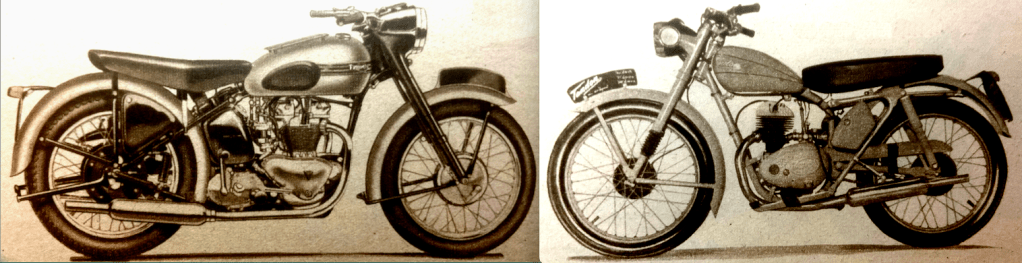
waders enthusiast as well as to the tyro. Though it is an ohv four-stroke with a four-speed gear box and all the features of a 500, it remains a true miniature. It looks light and easily controllable, and easy to start. It has large-diameter brakes. It is compact. In short, it is the type of motor cycle to bring impulsive ejaculations from the beginner, such as: ‘I could easily ride that!’ The price is attractive, too, and more than one person has remarked: ‘Why, 1 could afford that!’ The Terrier is a machine which simply exudes Edward Turner thought on style and simplicity. However, the Terrier is far from being the only highlight. There is an almost ever-present coterie of enthusiastic clubmen round the new Tiger 100C models. Fitted with twin carburettors, the machines can be converted for road racing by little more than removal of the silencers; such components as racing camshafts, high-compression pistons and high-poundage valve springs are fitted as standard. The Speed Twin remains a firm favourite. Indeed, judging from the remarks of enthusiasts regarding it, its popularity has increased as a result of the change from magneto to coil ignition. But does this emergency starting device really work ? Of course it does! By turning over quite slowly a sectioned Speed Twin engine on the stand, healthy sparks can be produced (and seen) at the plug points. Appearance of the engine is not greatly altered as a result of the AC generator installation and change to coil ignition. The distributor and coil are mounted in the space formerly occupied by the magneto, and the dynamo has disappeared; hence the front engine plates are again without a circular aperture—as they were when the Speed Twin made its debut at the 1937 Show. The total number of models exhibited is 19 and the entire range is represented. Not least interesting is a TRW military model finished in businesslike green. From the attention devoted to it, apparently the public demand for a 500cc side-valve twin has increased rather than diminished in the past 12 months. Harassed attendants are kept busy explaining why the TRW cannot be marketed. In
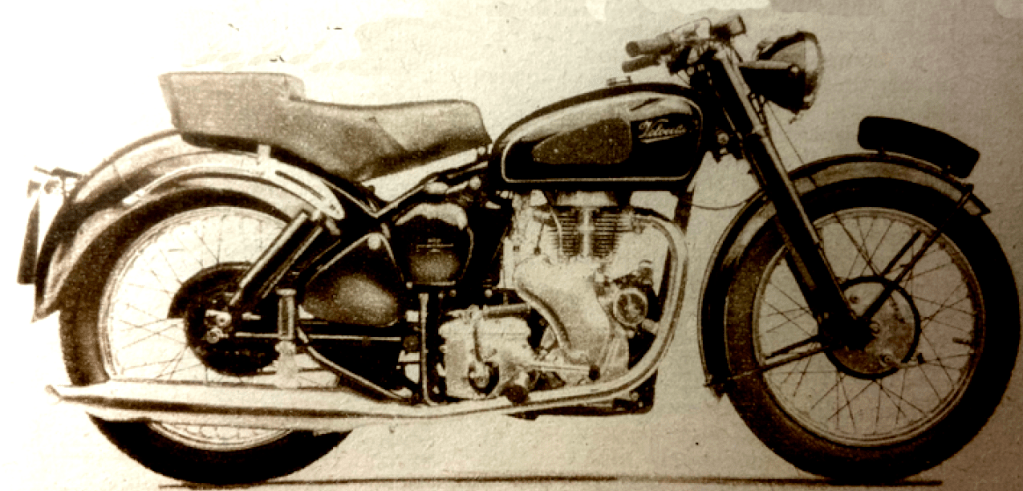
spite of the fact that it is appearing at Earls Court in almost precisely the same external form as it has done since 1948, the LE Velocette is attracting enormous interest. For luxurious, about-town travel without the need for ‘dressing-up’ or for touring where ultra-high speed is not a desideratum, the LE undoubtedly sets a very high standard. As smooth and quiet as a high-price quality car, the little machine is simplicity itself to ride and maintain. A notable absentee from the stand is once again the renowned KTT racing model. But on this occasion the omission is part assuaged, for there appears the new MAC springer. The frame of this striking newcomer is based on that of the KTT. The model is for export only. Every feature of the new Velocette frame is obviously based on long experience with high-speed, rear-sprung motor cycles. Fittingly, the new MAC is finished in black and chromium plate. One of the surprises of the show is on the Tandon stand, where it is stealing much of the thunder. It is called the Imp Supreme, and is equipped with hydraulically damped rear springing incorporating Newton shock-absorber units. Indeed, two new models are shown; the second—a 125 with a solid rear frame—is named the Imp. Power units fitted are respectively the Villiers 6E and 10D engines, built-in unit with three-speed gear boxes. Single-loop frame construction (as distinct from the familiar duplex-loop layout of other Tandon machines) characterises both the new models. Other features common to both machines are 5in brakes, a front fork incorporating impact and rebound springs and permitting 5in of movement for the front wheel, and a low-level exhaust system with barrel-type silencer. The general finish is in beige stove enamel, with the usual bright parts chromium plated. Also on show are the Supaglid and Supaglid Supreme. These are available in a choice of three colour schemes: polychromatic blue, Tandon rouge, or black. The redesigned petroil tank on the 197 is most
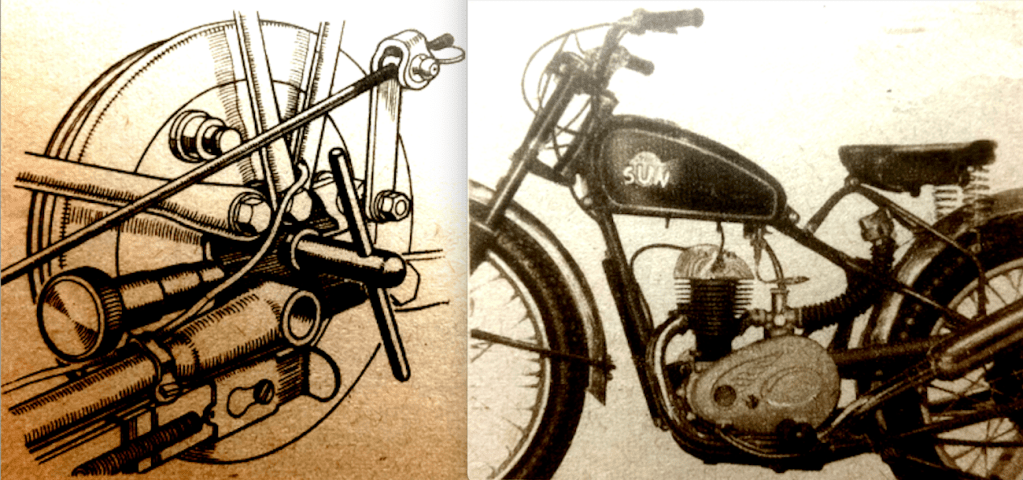
attractive. Previously the tool compartment was in the top of the tank; now it consists of a container clipped in the channel under the tank. Competition men are finding much to enthuse over on this stand, for the display includes the new 197cc Kangeroo Supreme trials mount and also the 122cc Kangeroo. The former incorporates pivoted-fork rear springing. As with the other Tandon models, the frame is of all-welded, tubular construction in which no lugs are employed. Advantages of this method of construction are a reduction in overall weight and, it is claimed, greater strength due to increased flexibility. Incorporated on the touring models are Lucas rectifier sets which can supply AC direct to the head lamp (a Lucas sealed-beam unit) or, at the turn of a switch, direct current to the battery. Main emphasis on the Vincent stand is the ultra-high performance 998cc Black Shadow, super-sporting member of a family of exclusive thoroughbreds built for hard-riding and discriminating connoisseurs. Maintaining its proud boast to be the fastest standard production machine in the world, this fully equipped mile-eater exemplifies the Vincent post-war policy of frameless construction in its most up-to-date form. The massive though compact 50° V-twin engine-gear unit is bolted to a six-pint, box-section oil tank to form the main frame. Pivoted behind the power plant, the fully triangulated rear fork assembly is controlled by twin telescopic coil spring units and a hydraulic shock-absorber positioned between the spring units. ‘Riders’ features abound, such as the really quickly detachable wheels, for which no tools are required; the finger adjusters for rear chain tension and front brakes; the knurled battery retainer; gear and brake pedals
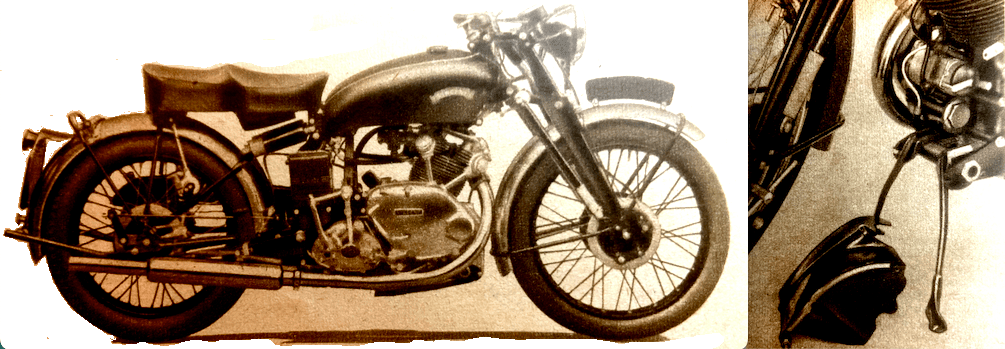
adjustable for both height and length; and the twin prop stands which combine to form a sturdy front stand. Mechanical noise is claimed to be reduced by means of new cam forms; gear selection is improved by an alteration to the selector mechanism; and the clutch and brake shoes are fitted with friction linings said to be impervious to oil and water. With the tractability and exhaust quietness which stem from the large capacity of its twin-carburettor, moderately tuned engine, allied to the stupendous acceleration and maximum speed of over 120mph provided by the available output of 55hp, the Black Shadow offers the ultimate in usable road performance. For the slightly less ambitious connoisseur who favours two or three wheels, there is the more docile big twin, the standard Rapide. Externally recognisable by virtue of the unenamelled castings of its power unit and the 3in-diameter speedometer head, the Rapide’s salient differences lie in such items as compression ratio, carburettor size and valve-spring poundage. Capable of dispensing 45hp, it makes an ideal fast-touring solo or sidecar machine. Indeed, for the sidecar enthusiast, Black Shadow and Rapide models with both standard and touring equipment are shown wedded to a variety of imposing sidecars. Enthusiasts who do not aspire to the ownership of a ‘1,000’ are finding that the majority of the exclusive Vincent features are incorporated in the 499cc single-cylinder Comet.
SIX SIDECAR SPECIALISTS exhibited at Earls Court. Blacknell majored on a sprung-wheel conversion for its chassis. “Recently a member of The Motor Cycle staff rode a 600cc BMW and Blacknell Bullet sidecar fited with the sprung wheel. Behaviour of the sidecar wheel inspired the utmost confidence under all conditions. A 7in-high kerb, for instance, could be taken diagonally at moderate speed, sidecar wheel first, without the sidecar becoming dangerously airborne and without any clashing of the suspension.” The new lightweight Convertible was made for bikes from 200-350cc; the body weighed 65lb. Busmar launched two new models, the double-adult York saloon and, “built on sleek Continental lines” and the convertible Dorset which could “serve the double purpose of either a sporting single-seater or spacious child-adult saloon”. Canterbury debuted the double-adult Invader saloon on a sprung chassis and the single-
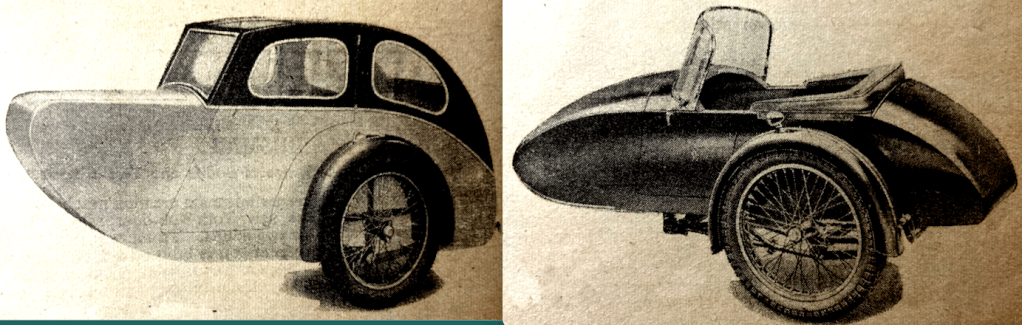
seat Crusader saloon. Garrard’s popular S90 sports model was joined by a child/adult version and the lightweight Gazelle, aimed at bikes from 200-500cc. The Swallow Jet 80 single-seat steel-bodied sportster was one of the best known chairs on the market (I have fond memories of the Jet 80 I ran on my plunger ‘Flash in the early seventies); it was joined by the double-adult Viscount “razor-edged saloon”, Comet child-adult and Commando single-seat saloon. Watsonian, a pioneer of British sidecars, is still very much in business. It displayed “an interesting development in sidecar suspension” incorporating rear coil springs for the body and “a Silentbloc resilient wheel mounting”. The chassis could be mounted on either side. New bodies included the “lightweight Ludlow open single-seat tourer…Detail refinements have been carried out on nearly all other models. The roomy Monarch single-seater has been fitted with a sliding roof coupé hood which allows the passenger seat to be fully enclosed within a few seconds…Also available is a special competition sidecar constructed in light-alloy…a 7in-diameter brake is fitted…In addition some motor cycle manufacturers such as BSA, Norton, OEC and Sunbeam list sidecars.” Also serving the sidecar market in 1952 were Bowser, Greeves, Lambretta, Rankin, Surrey and Trinder.
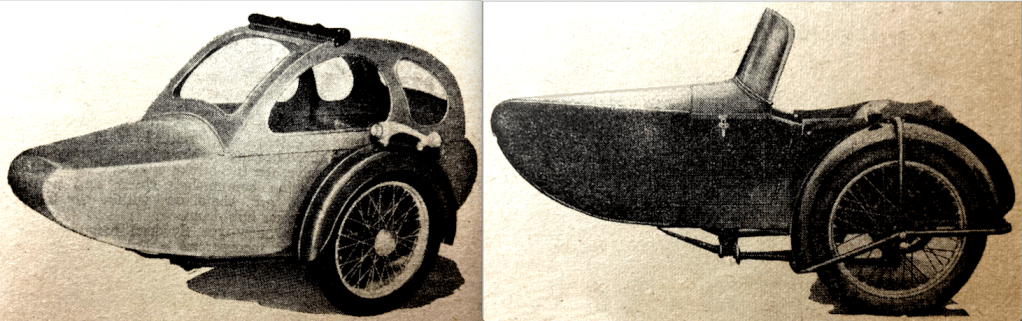
UNDER THE OPTIMISTIC heading “Welcome to the Push-less Era” the Blue ‘Un reviewed the “cyclemotors and under-60cc machines at Earls Court. The 11 exhibitors were Berini (Dutch 32cc two-stroke with an Amal carb and Wipac flywheel mag); Cucciolo (Italian 48cc ohv); Cyclaid (31cc two-stroke “horizontally mounted over the rear wheel” with V-belt transmission); Cyclemaster (a 32cc two-stroke built into the rear wheel); Lohmann (18cc compression ignition driving the rear wheel via a friction roller); Mini-Motor 49.9cc two-stroke, also driving via a roller—”considerable interest is shown in the Trojan engine-gear unit, available to cycle manufacturers); Mobylette (49.9cc two-stroke); Mocyc (49cc two stroke “mounted on a sub-frame attached to the front wheel spindle” a driving via a roller); Mosquito (Italian 38cc two-stroke “Mosquito-equipped cycles which gained awards in the ACU National Rally are on view); Power Pak (“A robustly built, all-British 49cc two-stroke); and the French Solex (45cc two-stroke “available only as a complete motorised cycle”). Here are some more details of products that were laying the foundations of the moped sector. “If anybody had told me two years ago that an 18cc engine would be seriously marketed for clip-on use, I should have jeered at him…The wee German two-stroke Lohmann engine can be run on paraffin or diesel oil (or, I believe, on any fuel oil), can touch 20mph and may average 350mpg…An 18cc two-stroke compression-ignition unit, the Lohmann has neither carburettor nor spark equipment. It is mounted at the cycle bottom bracket and drives the rear tyre through a
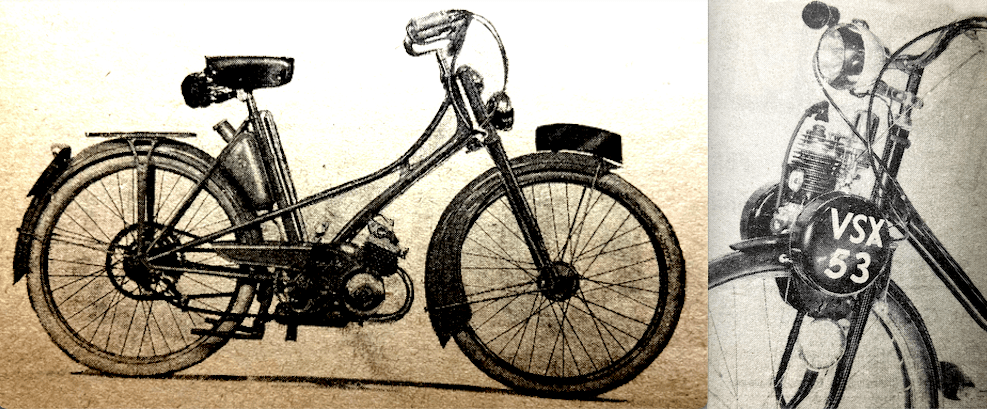
roller. Engine control is effected by two twist-grips; the right-hand grip governs fuel supply, and the left-hand grip varies the compression ratio and port timing…A Netherlands production, the Mobylette is exhibited in three guises and is available only as a complete motorised cycle. Motive power is a 49.9cc two-stroke engine. Primary drive is by belt to a countershaft, and final drive is by chain. The standard model has a solid front fork and rim brakes. Next in price is the Standard de Luxe version with an internal expanding rear brake and automatic, centrifugally operated dutch. Finally, the Super de Luxe model features a telescopic front fork, front and rear internal expanding brakes and the automatic clutch. The ingenious clutch depends on the speed of the cycle, not that of the engine, for its automatic engagement and disengagement; critical speed is approximately 5mph. Thus acceleration and deceleration are simplified and the engine may be kept running when stationary…Although the engine is mounted in front of the steering head and drives the front tyre through a friction toiler, the VeloSolex is available only as a complete motorised cycle. The pet roil tank is mounted alongside the crankcase. Fuel is fed to the floatless carburettor of the 45cc two-stroke engine by means of a membrane pump. Lighting coils are fitted to the flywheel magneto, and the cycle is supplied with oversize tyres, electric lighting, rear carrier and number plates…Not exhibiting at Earls Court are the following: Auto Minon—Available only as complete motorised cycles; 49cc two-stroke engine and single-speed bicycle, £41 18s 4d; 49cc two-stroke engine and bicycle fitted with three-speed hub, £43 9s 2d…VAP—48cc two-stroke engine with clutch and chain drive to rear wheel.”
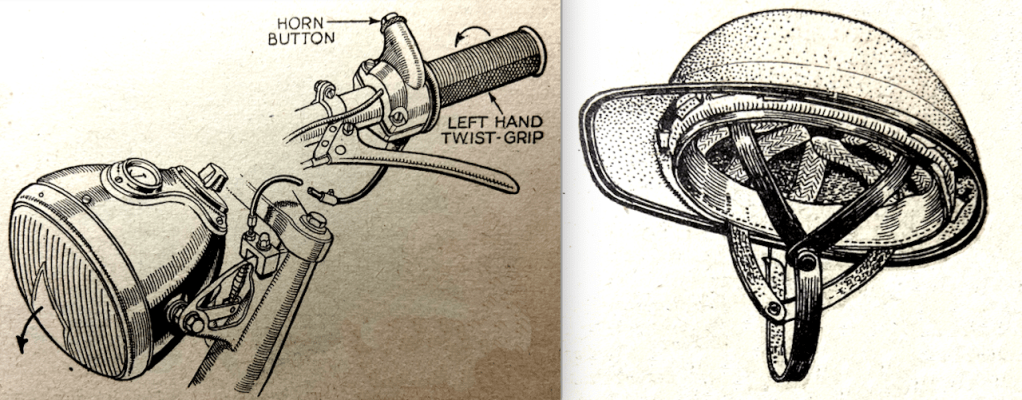
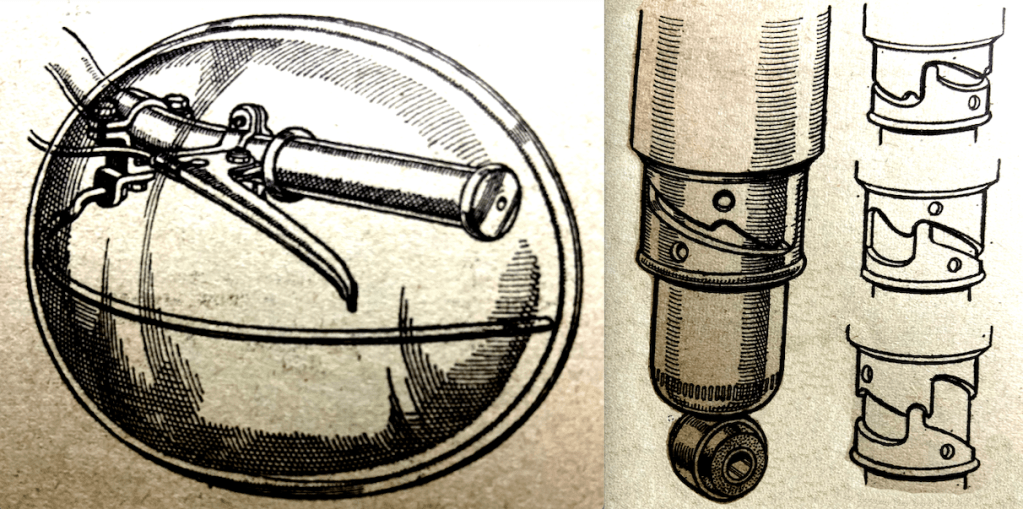
GREEN ‘UN SCRIBE Carbon urged the organisers of the Earl’s Court Show to provide enthusiasts with draught beer. “At the Motor Show there was not a single bar with bitter on tap,” he reported. “If that happens when the motorcyclists are assembled it will not be clever tactics.” On a more serious note, he asserted: “Motorcycling has ceased, and now finally, to appeal to the comparative few. It has at least acquired the universal attraction so long prophesied for it, and the faith of the unshakeable believers has been justified.”
“MR WT TEAGLE called at Motor Cycling’s Earls Court Stand to show me the drawings of a proposed 49cc cycle-motor unit developed from an engine of that capacity already manufactured by him for use in conjunction with a mechanical hedge-cutter and other agricultural machinery. As a bicycle unit, the engine is fitted to the seat stays and saddle pillar lugs which, being integral with the outrigger bracket casting, give support to the structure at points in line with the two crankshaft bearings and thus ensure maximum rigidity. A spring-loaded pivot arrangement controls the position of the unit in either the driving or free position. In de luxe form the 49cc Teagle, complete with the fan-type ‘Wipac’ flywheel, a die-cast cowl for cooling and a neat ‘saddle-bag’ shaped fuel tank, retails at £16. A utility version without fan cooling and fitted with a round tank is listed at £14…The manufacturers may make history by producing the lightest, and possibly cheapest, cyclemotor unit marketed in Britain to date. The address of the manufacturers is WT Teagle (Machinery), Blackwater, Truro, Cornwall.”—Bernal Osborne
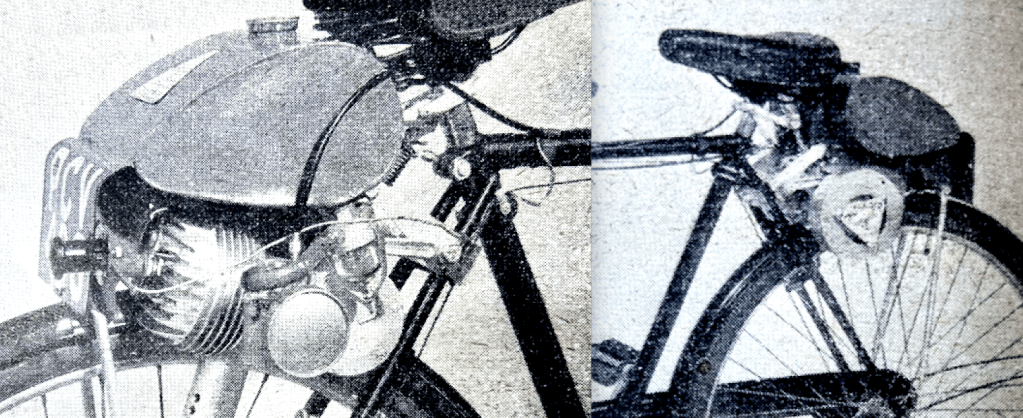

A YUGOSLAV VISITOR to Earls Court, Dragomir Jovanovic told a Green ‘Un correspondent about the state of motor cycling back home: “He was telling me that although there was an acute shortage of motorcycles in his country there is no lack of enthusiasm. He quoted instances of clubs with several hundred members and only half a dozen machines. Sounds rather like the motorcycling clubs one formed at school, doesn’t it? Ex-WD models, a few British and Italian mounts and some CZs and Jawas that came from Czechoslovakia before that country and Yugoslavia became estranged, are the machines the local clubmen ride. Oddly enough Jovanovic had never heard of the Csepel, made in neighbouring Hungary.”
A REMARKABLY OPTIMISTIC pundit predicted that within five years British designers would come up with large-wheeled scooters and a 1,000cc liquid-cooled, in-line four with shaft drive, hydraulically-damped front and rear suspension and an electric start. Clearly an early customer for a K100 Beemer.
“A FEW DAYS before the London Show opened, the opportunity arose to put the new 150cc Triumph Terrier through its paces among the winding country lanes of Warwickshire. Good impressions when merely viewing the Terrier were substantiated when the model was in action. Outstanding was the way in which the machine could, entirely without fuss from the engine, be quickly accelerated through the gears up to 50mph and then be cruised at this speed, circumstances permitting, almost indefinitely. Equally impressive was the ease with which the model could be handled, almost irrespective of the road surface, when bend-swinging or when making tight turns. The riding position, though very slightly cramped for a person of average stature, inspired the rider with a feeling of absolute control—even when the machine was forced through 180° rear-wheel slides in a muddy field! On full throttle, with 60mph showing on the neatly enclosed speedometer, the exhaust note was unobtrusive; even under brisk acceleration it was not exceptionable. Ample stopping power was provided by the 5½in-diameter brakes. The gear change was positive, though there was a longish arc of travel on the well-positioned, foot-change lever. First-kick starting, even from cold, was accomplished merely by having the petrol and ignition switched on and the twistgrip fractionally open. For a machine which was still at the drawing board stage little more than eight weeks ago, the Terrier shows promise of being a real thoroughbred in the Triumph tradition. Deliveries are expected to start in the late spring.”—Kevin Gover
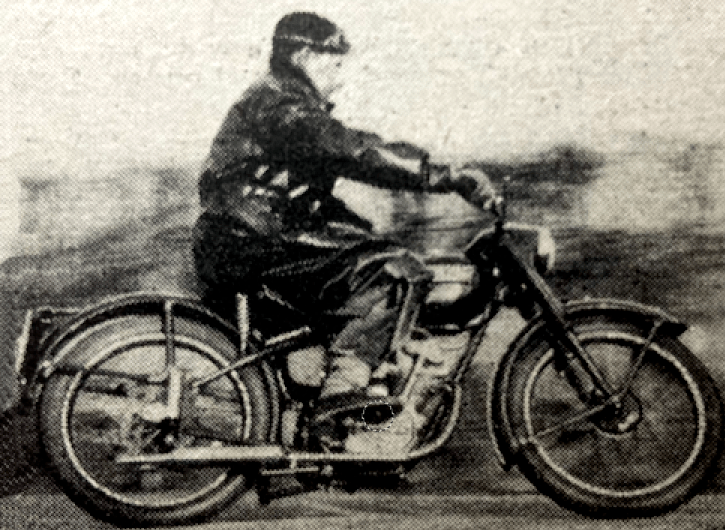

TRIUMPH TIGER 100
“FOR A NUMBER OF YEARS the 498cc Triumph Tiger 100 has enjoyed an enviable reputation as a super-sports mount with a Jekyll and Hyde personality, docile and gentle when the occasion demands, such as in heavy traffic, yet possessed of truly tigerish characteristics when given its head on the open road. In 1951 its appeal was widened by the introduction of a light-alloy cylinder block and head and, as an extra, a conversion kit for transforming the model into a pukka racing machine. The model’s success in the competition sphere was recently underlined by victory in the 1952 Senior Clubman. It is on the open road, as ‘Mr. Hyde’, that the Tiger 100 really comes into its own. Acceleration up to speeds in the seventies is vivid yet smooth. The engine seems to revel in the continued use of full throttle, and high average speeds are not difficult to maintain. The rapidity with which the speedometer needle could be sent round to the 80mph mark in third gear, and held between 80 and 85mph in top for as long as road and traffic conditions permitted, made averages of over 50mph commonplace. Twice in one day the 102-mile journey between the Midlands and a London suburb was covered in an hour and three-quarters, in spite of the usual volume of week-day traffic. On these trips the speedometer frequently read 87mph for some miles, though the rider was normally seated and clad in a stormcoat and waders. Long main-road hills pulled the needle back no farther than the 80mph mark. Checked electrically, the speedometer was found to register 2½mph at 30mph and approximately 5mph fast at all speeds between 40 and 80mph. In spite of the hardest of driving methods, there was never the slightest sign of engine tiredness, nor was there any tendency for the engine to ‘run on’ when the ignition cut-out was operated after long use of the maximum speed performance. At the conclusion of one particular day’s riding, which comprised some 300 miles—
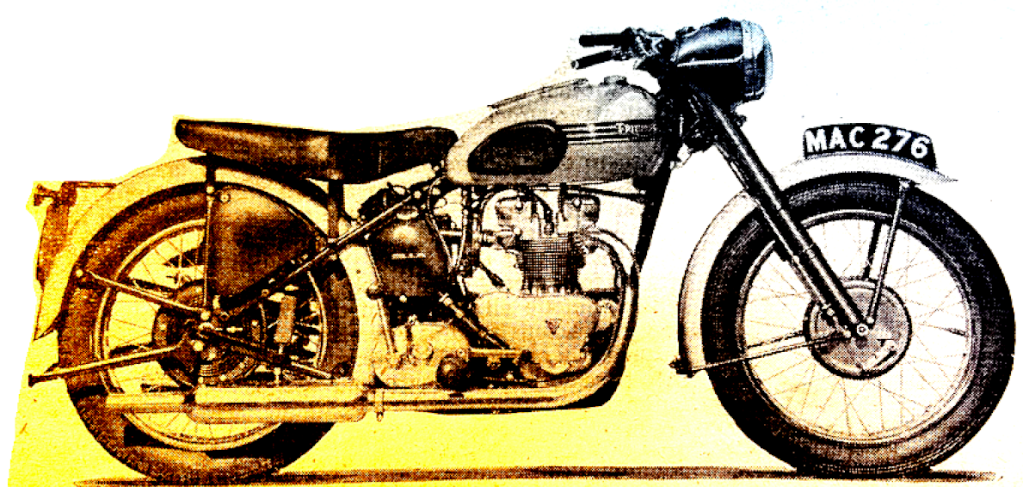
many of them on full throttle—the only visible signs of hard riding were discolouration of the exhaust pipes for a few inches from the ports, an oil leak from the cylinder head joint, a faint smear at the base of the push-rod tubes and a slight oil deposit on the rear-wheel rim. Except at high engine rpm there was no vibration. At no speed, indeed, was vibration sufficient to warrant criticism. Provided normal use was made of the gear box and manual ignition control, there was no undue tendency for she engine to pink, even though the fuel employed throughout the test was the usual low-octane Pool petrol. The exhaust note was pleasant and inoffensive whether the Tiger 100 was trickling through towns and villages or being driven hard. Mechanically, as is to be expected with light-alloy cylinders and heads, the engine was slightly noisy, though this ceased to be apparent to the rider when the road speed rose above 35mph. Most of the mechanical noise was from the pistons, and It was emphasised mainly by the complete absence of induction noise; responsible for this last condition is a large Vokes air filter incorporated as a standard fitting. Top gear maximum speed figures were taken on a 1,650-yard straight, both with and without the air filter. Downwind speeds were identical (97.06mph) in each case; upwind, without the filter and using the same 170 main jet, there was a speed increase of 1.79mph compared with that obtained with the filter in position. Engine starting, whether the unit was hot or cold, was invariably accomplished at the first kick. The air control, which is situated beneath the left-hand side of the twinseat, was never required during the course of the test. When the engine was cold, the only pre-starting drill was flooding of the carburettor. Provided a small throttle opening was used, there was no need to retard the ignition. As would be expected, the tick-over was rather ‘lumpy’ on full advance, but the idling was improved when the ignition was one-third retarded; however, for complete reliability, the tick-over had to be set faster than some consider desirable. As to ‘Dr Jekyll’, though a certain amount of docility and low-speed flexibility is inevitably sacrificed in the interests of top-end performance the Tiger 100 is nevertheless very well-mannered. It could be driven unobtrusively at speeds in the region of 30mph in top gear. Fuel consumption under these conditions was markedly good. Oil consumption was negligible throughout the test. The relationship between the handlebar, with its distinctive, rearward sweep, the footrests and the twinseat provided a comfortable riding position for all normal conditions. For prolonged, ultra-high-speed work, a slightly more rearward footrest mounting or a raised support on the twinseat would have been appreciated—these solely to relieve the arms of tension caused by wind pressure. Much appreciated was the slenderness of that part of the tank which lies between the rider’s knees; the width was just right for maximum comfort and controllability. Located on a serrated shaft, the gear pedal was adjustable to a position which gave easy operation without removing the foot from its rest. The rear brake pedal came conveniently under the ball of the left foot. The reach from the handlebar to the
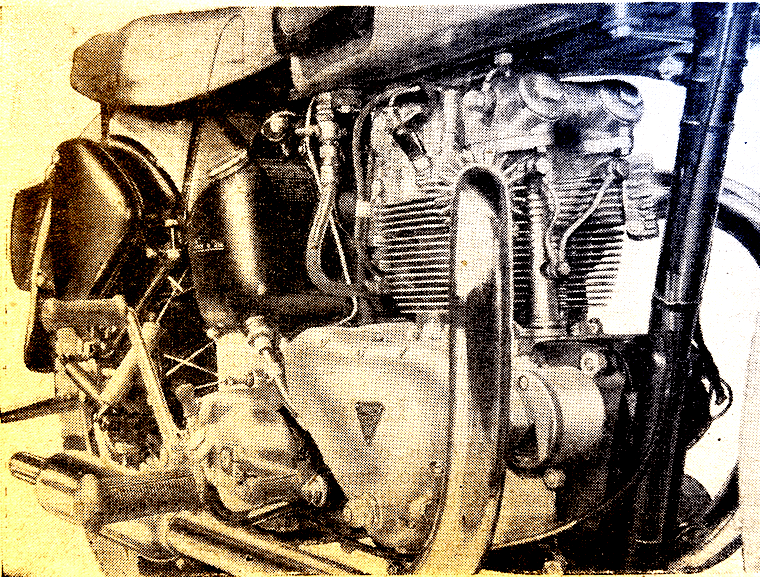
clutch and front-brake levers was felt to be a trifle too great. Horn button and dipswitch were excellently positioned for left and right thumb operation respectively. The twistgrip, which incorporates a knurled, self-locking friction adjuster, was slightly heavy in operation. The pillion footrests were well positioned for passenger comfort and the twinseat provided comfortable accommodation for two. Riders of large build, dressed for long-distance travel, might desire slightly greater length in the seat. Pleasantly close, top and third gear ratios are well-chosen in relation to engine characteristics; in fact, the gear change between them was so slick as to encourage more frequent changes than was necessary—just for the sheer pleasure of it. In order to achieve silent changes between bottom and second, and second and third gears, a leisurely movement of the pedal was called for. Owing to slight clutch drag on the machine tested, bottom gear could not be engaged silently when the machine was stationary with the engine idling. Neutral selection was easy from either bottom or second gears. The clutch was delightfully sweet in taking up the drive. It was light in operation and appeared to be impervious to abuse. Both brakes were smooth, reasonably powerful, and progressive in action. The front brake by itself was good, but required somewhat heavy pressure. Rear-brake pedal travel was rather too long to permit maximum braking effort. The Triumph front fork has a soft action around the static-load position; it absorbed road shocks in an exemplary manner. Occasionally, with the added weight of a pillion passenger, it was made to bottom under conditions of heavy braking. The sprung rear hub provided reasonable comfort at touring speeds but rather more movement would have been preferred at high speeds. On corners and bends the Tiger 100 could be heeled over confidently and stylishly. On very bumpy bends taken at speed there was a slight tendency to roll. Straight-ahead steering was first class. Bumpy surfaces and gusty winds produced an impression of lightness, which could be curbed by a turn of the steering-damper knob. With its fine blending of silver, black and chromium, the finish of the machine is a credit to the.manufacturers. To sum up, the Tiger 100 is a thoroughbred sporting 500, calculated to inspire pride of ownership both on account of its magnificent all-round performance and its handsome appearance.”
“MOST RIDERS ARE probably vaguely aware that sidecars and chassis are ‘live’ tested before being put into full-scale production. I had vague ideas of a new model being taken for long tours over poor roads—possibly even over rough cart tracks—to see if it broke up. During a visit a couple of weeks ago to the Invacar works in Essex, I was asked if I would like a trip in a sidecar incorporating the new Greeves chassis. Imagining a trip round the quiet Essex lanes in a luxurious saloon chair, I agreed readily. A little too readily, in fact, because as Mr Greeves (the designer of the chassis) and I walked out to the car park, I was handed a crash hat. This should have made me pause and ponder; my thought was that wearing a crash hat was an insurance requirement or something. Then I saw the sidecar outfit, a large and strongly built box fitted to a venerable 1928 Norton. The Norton had been worked on and boasted a Greeves front fork and foot-change gear box. The ensemble had that ‘used’ appearance—you know, the look a builder’s truck has. I put on my crash hat and climbed into the box. Works manager Frank Byford drove, and we set off along the road that lies behind the works. For 100 yards or so the going was good. The old box outfit breasted the bumps in the road beautifully; I relaxed and began to enjoy myself. Then, for one terrible moment, I thought Byford had gone mad or had lost control of the machine. We speeded up, shot off the road and headed straight for a ditch. There was no room to pull up; it was too late to bail out; I grabbed the funk rails fitted to the sides of the box and hung on with all my might. Into the ditch we went, but to my surprise there was no sickening crash of breaking wood, metal and Mills. There was indeed a crash, but it came from the springing which had deflected to its limit and given the box a mighty thump. The next 10 or 15 minutes seemed like the end of the world. The testers at Invacar have turned their field into a super, miniature scrambles course that involves humps, bumps, ditches, holes and every other natural obstacle possible to imagine. When they ran out of natural chassis breakers they brought in some mighty slabs of concrete kerbing and made some vicious steps down to a big bump. Byford charged the outfit down these steps at well over 30mph. We literally took off—all three wheels were well clear of the ground—and then we landed just before the hump; then over the hump (airborne again!) and down on the tarmac once more. What a ride! ‘Having fun?’ asked Byford, smiling; he seemed to be enjoying himself. I grinned weakly and nodded my head. ‘We’ll go for a spin along the road now,’ said my tormentor brightly, ‘and you can see how the suspension works in normal circumstances.’ Normal circumstances, my foot! How many family men run their sidecar wheel up and down four-inch kerbs at 45mph?”
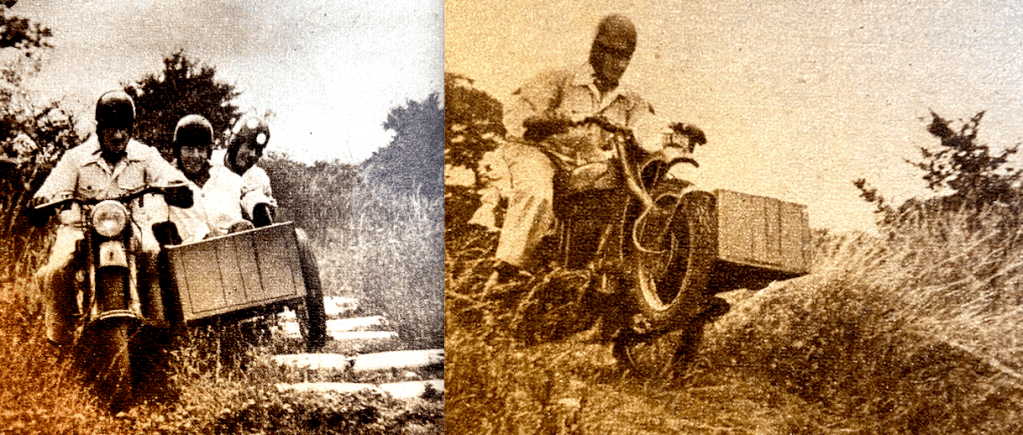
“AFEW months ago, when I heard that Canadian racing driver Spike Rhiando intended to cross the Sahara Desert on a motor scooter, I laughed. But now that I have seen and ridden the scooter? I am no longer laughing. Rhiando’s scooter is designed to his specification by engineering consultant Robert Clerk, of Richmond, Surrey, who was himself a racing driver, and had a hand in the design of the Allard sports cars. The construction was under-taken by engineering student Don Palmer, who once assisted with the Cooper car racing ‘circus’. The machine has a lively 197cc Villiers two-stroke engine-gear box unit, a. trailing-link, tubular-type front fork, and laminated-torsion-bar rear suspension. The steel tube frame is of welded construction and can be hammered indefinitely over scrambles terrain in a way that would paralyse the rider were it not for the excellence of the suspension…There are no grease nipples or oil holes for the suspension; bushes are of self-lubricating ‘Ferobestus’, a graphite-impregnated plastic compound said to have a life far greater than that of a normal metal bush when operating under arduous conditions in an abrasive-laden atmosphere. Engine cooling is to be assisted by twin fans, providing forced-draught cooling. The gear change has been altered to hand operation, and the rear-brake pedal is on the right-hand side. It was Rhiando’s aim to produce a scooter that combined the robustness and suspension of a scrambles machine with the tractability and ease of starting of a light car. To this end, the machine is to be fitted with an electric starter similar to that used on the Bond three-wheeler…There is no tendency for the rider to fall out of the open-frame seat when banked over. For the desert crossing, six gallons of fuel will be carried in a tank mounted behind the rider, and a lightweight plastic shell, to pass over the rider’s head to protect him from the sun, is to be fitted. There is also a possibility that a light, two-way radio set may be carried. If the venture is successful, Rhiando hopes to interest a manufacturer in producing the scooter for sale in parts of the world, such as Africa or the Australian Bush, where roads are poor or non-existent.”
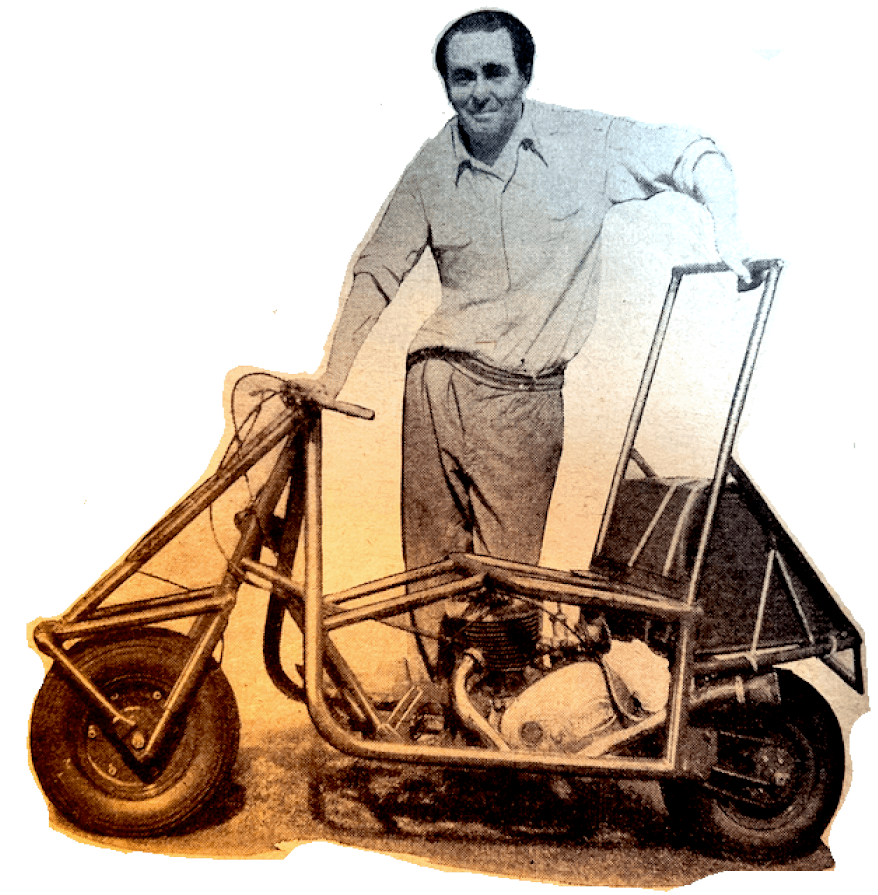
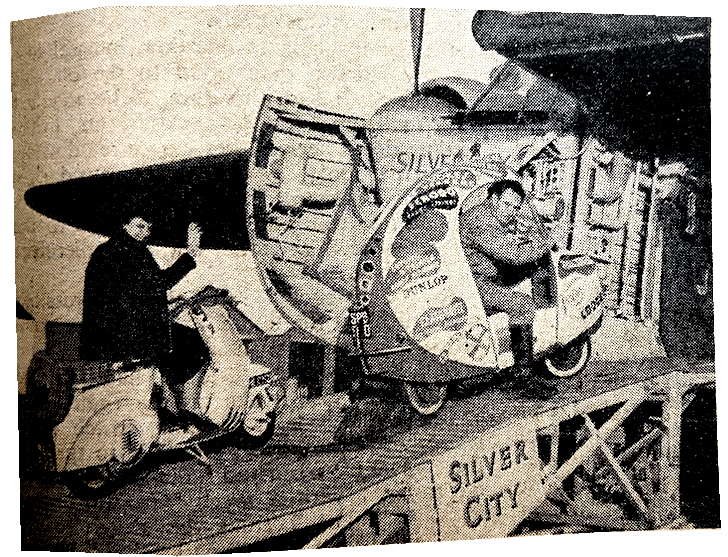
“OVER 15,000 SPECTATORS from all parts of the Transvaal lined the main Springs-Nigel highway on Saturday afternoon (October 25) when the Nigel Motor Cycle Racing Club staged the 1952 Springs Rose Festival Championships. Entries had been received from the Transvaal, the Orange Free State, Cape Province, Natal and Southern Rhodesia, and 74 riders were scheduled to fight out the three classes over a new circuit through the very heart of the modern and fast-growing city of Springs. Ballot decided the positions on the starting grid. After two short practising periods, the 22 riders in the junior event of 28 laps came to the starting grid. At 2pm starter Julie Friedenthal sent the roaring procession scurrying off down the road, and in a remarkably short space of time the flying figure of L Cantamessa, one of South Africa’s most promising and dashing speedmen, came into sight at the head of the field…”
“THE THIRD OF THE International Moto-Cross meetings, the Grand Prix de Moto-Cross a Ettelbruck, was held on Sunday. The winner was Victor Leloup who, riding a Belgian FN, covered the 12 laps (about 26 miles) in 50min 16sec. Auguste Mingels (Belgium), riding a Matchless, who chased Leloup home in the Belgian Moto-Cross event a week earlier, again finished runner-up, 15sec behind. Third was another Belgian, Marcel Meunier, on an FN. Best of the British riders was JCM Avery on a BSA, who finished eighth, a lap behind the winner. LR Archer (Norton) was ninth.”
THE KURUNEGALA ROAD RACE in Ceylon drew a record crowd estimated at over 30,000. Measuring approximately 21 miles to the lap, the course provided long straights and sweeping bends, but speeds were a little restricted on account of the bumpy nature of one portion—Circular Road South. However, as the Ceylon MCC has decided to make this an annual event, the municipality has agreed to improve the surface. A healthy sign for motor cycling in Ceylon is the number of newcomers who competed. One of these was L Oorloff (BSA), who won both novices events with the finesse of an expert. Most praiseworthy in both Junior and Senior Clubmen’s events was Bobby Fraser, who rode his 349cc MAC Velocette to victory in both races; his lap times were only a fraction longer than the lap times in the racing classes. Veteran and the doyen of motor cycle racing in Ceylon, R. Allan Clark (JAP), annexed the Junior Race and was unlucky not to make best time of the day in the Senior. On his fastest lap he came off twice —at the Masonic Temple Bend and again Getuwana hairpin. As a stylist, notwithstanding the fact that he had raced only once before, Ralph Wijeysinghe (Triumph), who led the Senior from start to finish, had no equal. He also made best time of the day.”
“AS PART OF THE 700th anniversary celebrations of Breda, in Southern Holland, the third Dutch VeloSolex Rally was arranged to converge on that town. Entries were limited to 2,500, and competitors started from six points in Belgium and Holland. Each rider covered not more than 200 miles and maintained a speed of 12mph. Routes were to some extent optional but had to include a certain number of open and secret checks. On arrival at Breda competitors were given free lunch and admission to the anniversary festival and fair; then, after the prize-giving, they paraded round the town.”
“A RECORD CROWD saw S Jensen (AJS and Norton) win both major events at the Wanganui GP on October 25. The event marked the beginning of the 1952-53 New Zealand road racing season. Jensen’s victories were won in blazing sunshine, and the four-mile Matarawa circuit was heavily oiled to keep down the dust…”
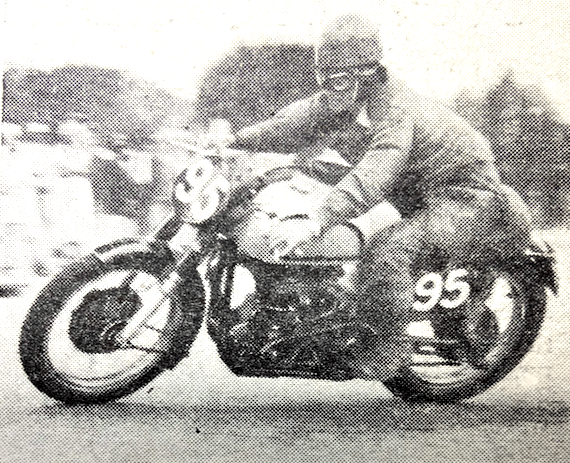
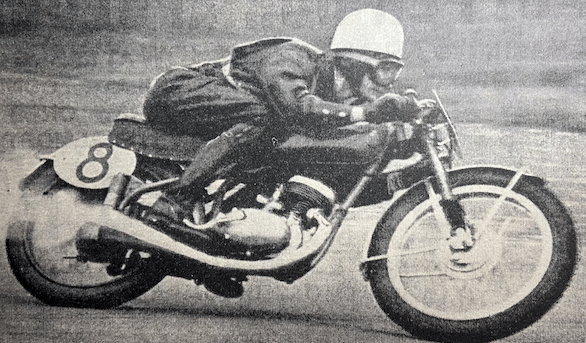
“IT WAS LEARNED from a brief cable received last week that Miss Winifred Wells and her father, who were both riding Royal Enfield Bullets, successfully completed their ride round Australia which started from Perth in September. The journey involved 10,000 miles over some of Australia’s worst roads. Miss Wells, who is 23 years of age, came into prominence about two years ago for her ride from Perth to Sydney and back on a Royal Enfield. Her father is 59 years of age.”
“WINNER OF THE PINHARD PRIZE for 1952 is Miss Maureen Towler, aged 20 years, who is a member of the London Ladies MCC. Second is the well-known competitions rider Don Rickman, aged 17 years, of the Sunbeam Club. Third is Bryan Sharp, 17 years, of the XHG Tiger MCC. The Pinhard Prize is awarded annually to a novice member of a club affiliated to the ACU or the Scottish ACU, who in the opinion of the majority of the trustees of the Pinhard Fund has made the most meritorious achievement in the field of motor cycle sport during a year ended August 31. Miss Towler is a very active member of the London Ladies MCC. As assistant secretary of the Club’s RAC-ACU Training Scheme she has attended every learner class during this year and has given up many hours to taking learner riders on the road and helping them in the early stages. At one period during the club secretary’s absence she carried on the administrative work and produced the club magazine. In competitions, Miss Towler gained an award in the London Ladies Women’s Trial and a silver plaque in this year’s ACU National Rally; in the latter event she covered about 700 miles on a BSA Bantam. In the words of the club secretary, Miss Towler is ‘a worthy member of any club’.”
“HANDLEBAR GRIPS IN PVC (Polyvinyl Chloride) manufactured by The DM Industrial Plastics Co (Kingsbridge Road, Cottimore Lane, Walton-on-Thames) are produced at 2s per pair. Cast in a deep tread pattern, the grips are softer than rubber and they are claimed to ensure a perfect grip under all conditions, even if the model has been dropped in mud. Other DM products include plastic fork gaiters (those fitted to the James, BSA Bantam and Tandon lightweights) and spark plug covers.”
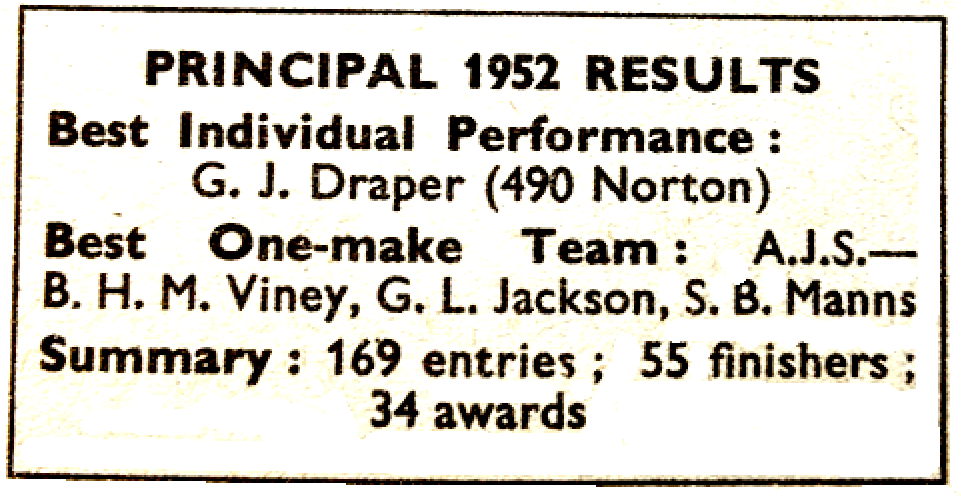
“NO EVENT IN THE motor cycle sporting calendar has quite the traditional attraction of the Scott Trial, always supposing that ‘traditional’ can be applied to an event so continuously and plainly alive and virile. Just what the fascination is becomes rather difficult to define. Probably it accrues from the fact that it was the ‘Scott’ which really began this sport of motor cycle trials riding in the style that we now know it. Almost 40 years ago the ‘Scott’ began as a sort of cross-country point-to-point, in which riders followed a map-course over what were then almost unknown moorlands so far as wheels and engines were concerned. The event went on from year to year, and from difficulty to difficulty. No hazard or obstacle was deemed too difficult provided that somebody, at some time, could persuade a motor cycle to surmount it. Thus a tradition grew up about ‘rough, heartbreaking stuff’. The trial gained national repute, and a collection of stories began to build up around it. As the years roll on, riders retire and join the veterans who look on and criticise. Like the TT for racing men, the event has become an occasion for the aged and the ageing to reminisce about earlier experiences in the series. ‘Do you remember 1927?’ ‘What about 1935?’ ‘It isn’t as bad as last year!’ (Of course it isn’t. It never is!) This sense of the ‘Scott’ being an occasion is very strong. It is a social function as well as a trial. The night before the start, the headquarters hotel is filled with rumours and forebodings. The same place on the evening of the trial is filled with aches, pains and adventure stories—tall ones, often—but never a grumble. Never, ‘It was too much’; more likely, ‘I should have done better’. As an event, the Scott Trial differs from the more usual kind because both time and observation are taken into account. An award can be won on speed alone, on observation alone, or on a combination of the two. There is something diplomatically called ‘standard time’. Every rider who finishes outside it loses one mark for every two minutes. Just what is ‘standard time’? It is simply the time taken by the competitor who covers the course at the highest speed. As the man who establishes standard time is the fastest finisher, he is the only competitor with a zero time loss. The rider who can establish standard time and lose least marks on observation is an expert indeed—and it has been done more than once. The importance of time in the results produces certain unusual effects. There is no controlling of observed sections in the usual one-at-a-time manner, and no prior examination of hazards on foot. It is up to each rider to avoid being baulked by using his own judgment. Hazards, whether they are known or not, must be taken on the run. Last Saturday the scene was again laid in Swaledale, north Yorkshire. The start
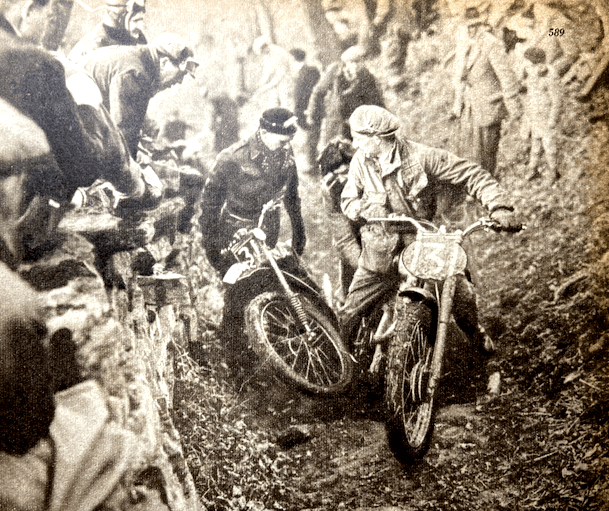
was on the outskirts of the picturesque old town of Richmond. Organisation was handled by the Darlington &DMC. The course comprised a 20-mile circuit covered twice and reached by a seven-mile leg, which was traversed in the opposite direction on the homeward run. Here and there the route crossed public roads but by and large, the whole trip involved following flags staked across the open moorlands, with occasional excursions into streams and over farm tracks of the most elementary kind. Nineteen named hazards were included, and each was dealt with twice in the total of 54 (approximate!) miles. There were 169 entrants, 16 fewer than last year. A very high proportion could be classed as ‘local’, providing one stretched the term to mean Yorkshire, Lancashire and immediately adjacent areas. Most of those from farther afield were trade experts, and perhaps that is an indication of the shape of things to come. Another feature of the.entry was that there were over 50 machines of under 200cc, to remind us of the progress that has been made in that field. It is not so very long ago that Harold Wood, an organiser of past Scott Trials himself, was given an ex gratia award for getting a pip-squeak half-way round the course! This year six such models ranked among the first-class category of awards; GE Fisher (122 Francis-Barnett) actually achieved 12th place in the general order of merit. Last Saturday was a gloriously fine day. It had been reasonably dry beforehand, too, so that all those ‘likely to be difficult if wet’ references in the programme seemed unduly pessimistic. The new starting point, less than a mile from the town, presented a busy and glittering scene in the bright and frosty sunshine. ‘It’s going to be easy,’ said one to another, more, perhaps, to hearten himself than to ease the mind of his companion. In truth, so far as one could judge by the sections in sight of the start, the trial did promise to be easy indeed. Spectators around the course, too, seeing hazards almost bone dry, thought the same. But their disillusionment began when the field thinned on the second circuit. The true state of affairs was reflected late in the day, when Mr Timekeeper Pickering was compelled to fill in the finish cards of the last stragglers by the light of a lamp. Even David Tye (348BSA), who established standard time, took 4hr 17min 58sec to cover the 54 miles, thus averaging about 12¾mph—a speed well below the 18mph maximum allowed by the regulations. To be considered as finishing, competitors must not exceed standard time by more than 1½ hours. Thus, by this rule last Saturday, only 55 (about a third of the starters) became eligible for the final reckoning! On observation, too, even the recognised experts lost marks as the trees shed leaves in autumn. The absolute winner, GJ Draper (490 Norton), lost no fewer than 109 marks under that heading, plus four on time. Nicholson’s total loss was 117! In spite of his zero loss on time, Tye forfeited 135 marks on observation and so was not included in the first three in the general classification. These facts, along with the other detailed results, explode the idea that the 1952 ‘Scott’ was easy. The new starting point was less congested than the old one, and the earlier observed sections led into the wilds in less of a bottle-neck fashion.
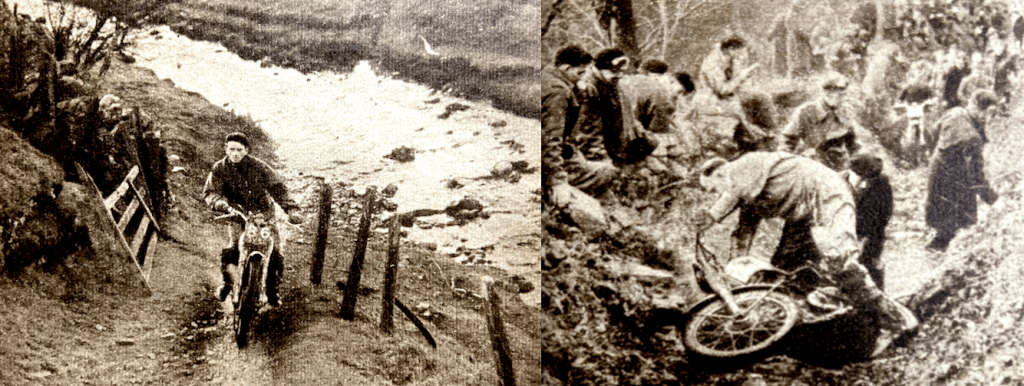
These sections did not create undue trouble, anyway. A typical Dales section was experienced when the macabre-sounding Hell Holes was reached at approximately 10.30am by the first men. Beside the bubbling Marske Beck the section comprised a steep track with wicked tree roots and rock slabs at intervals throughout its length. PL Hodgson (490 Norton), the first arrival, surprised the spectators by picking a sure and faultless path, but DS Tye (348 BSA), CM Ray (497 Ariel) and and JV Smith (490 Norton), in close formation, were halted by running into a ‘baulk’. H Wiley (197 James) had fallen—but retained his bowler hat! BHM Viney (347 AJS), in spite of fine handling, had to use his feet twice and so, too, did W Nicholson (499 BSA). GJ Draper (490 Norton), trying hard not to foot, rolled over. A further section of Hell Holes presented a different kind of problem. The rocks were covered with a slime that would have gladdened the heart of a lubricant advertiser’s copy writer. Competitors in bunches were trying to ride, push, pull or otherwise urge their machines over the top. On Primrose Hill, a new piece near Scotty Hill, GJ Draper (490 Norton) displayed fine mastery in jumping a rock step and then doing a beautiful, slow-balancing act in the rut that followed; in the same place SB Maims (498 AJS) had to foot. TH Archer (490 Norton) earned unstinted applause for a polished performance. David Tye (348 BSA) made a good recovery after some footing. Fourteenth of the main sections, the Steppes provided a climb over a stone-flagged hillside. The flags are said to have been laid by the monks of nearby Marrick Priory—365 steps, it is alleged, although Clerk of Course Eddie Williamson vociferates ‘370, and if you don’t believe me go and count ’em yourself.’ The stones are covered by wet lichen. In ‘Scott’ country the condition is described as ‘slape’—which means that it is equivalent to trying to climb a sloping greasy plank when wearing rubber boots. The chief difficulty proved to be the clearing of failures from the top of the section. JV Brittain (346 Royal Enfield) made a magnificent ascent in spite of some footing, and a very neat showing was achieved by GE Fisher (123 Francis-Barnett). Although The Steppes and Underbanks had both attracted large crowds of keen spectators, the most popular area seemed to be that of the tiny hamlet of Hurst—a group of four or five houses in a vast moorland tract. Hurst is the key point for three observed sections, one of which is Washfold Splash. According to the critical veterans present, the water crossing provided a problem in navigation that indicated that these modern chaps don’t know how to waterproof their motor cycles. Following the splash was a steep, stony path leading to the Schoolhouse. As a short cut it probably ‘blows’ laggard scholars but it presented no difficulty to generous throttle, second gear and firm wrists. There followed the respite of a grassy lane, a descent—into Shaw Gill—and the appalling climb therefrom. Shaw Gill was discovered by the Darlington Club. It has never been climbed clean in previous Scott Trials, but on this occasion the second arrival, SB Matins (498 AJS), swept over the rocky steps with ease. TH Archer (490 Norton) followed, slowly choosing his path. His nonchalance was equalled by G0 McLaughlan (490 Norton), who also fully exploited the low-speed pulling of his engine. Tye (348 BSA) made a fast and perfect ascent, and JV Smith added to the Norton laurels. Could this be the Shaw Gill of last year and the year before? Wait! E Watkinson (197 Francis-Barnett) wavered and fell. But CM Ray (497 Ariel), W Godson (490 Norton), GJ Draper (490 Norton) and W Nicholson (499 BSA) were all clean—’Nick’, apparently, was not at all perturbed by a flat front tyre. E Usher (347 Matchless) did drop a foot. Among the riders of small models, WA Lomas (197 James) was quite master of the situation. Unlike Lomas, however, JG Brown (123 BSA) had both wheels off the ground—front,
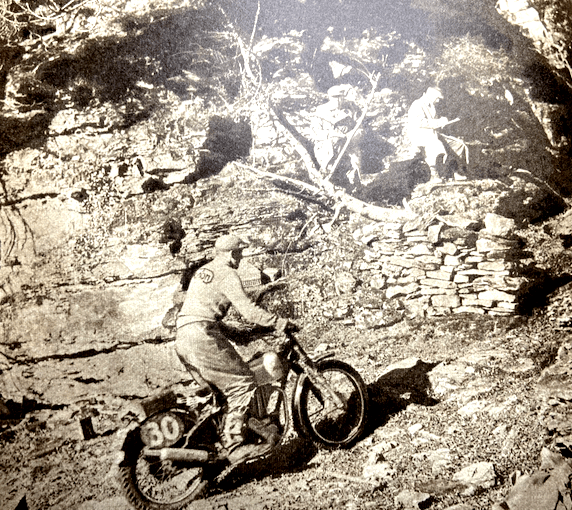
then back, then both together! Ken Lees (197 Francis-Barnett) climbed somewhat strenuously to a rhythmic accompaniment from his bulb horn that went ‘Pip! Pup!—Pip! Pup!’—rather like Danny Kaye singing about the dripping tap in his bedroom. Stanley Woods (197 James) made a seemingly effortless climb, but confessed later that the descents so fatigued him owing to a damaged brake, that the uphill bits provided the only relief! With the trial over, the evening went by in the usual way. Everyone relived the day while waiting for the results announcement. There was a show of some of CH Wood’s films of earlier Scott Trials. Then there was the customary Allan-Jefferies-conducted auction on behalf of St. Dunstan’s, with commodities ranging from powder boxes to haggis. Finally, there came the results. The more famous a winner, the more likely he was to be booed and cat-called. Only one thing was certain—everybody was in good spirits and no one was serious. So as midnight crept nearer, the cheers faded, exhausts echoed across the cobbled market square of Richmond, and silence came. Another Scott Trial passed into history.” RESULT Alfred A Scott Trophy (best performance on time and observation): GJ Draper (490 Norton), 113 marks lost. Raymond Bailey Trophy (second best): W Nicholson (499 BSA), 117. Winter Trophy (third best): SB Manns (498 AJS), 161. Harrison Trophy (best on time other than above): DS Tye (348 BSA), no marks lost (time only). Trophy (second best on time): PH Alves (498 Triumph), 8. Raspin Bowl (best on observation only): GJ Jackson (347 AJS), 118. Pickering Trophy (second best on observation), WA Lomas (197 James), 122. Trophy (best up to 125cc): GE Fisher (122 Francis-Barnett), 177. Galloway Cup (best up to 200cc): EW Smith (197 Francis-Barnett), 192. Trophy (second best up to 200cc), S Woods (197 James), 199. Veteran’s Tankard (best rider who competed in 1938 or earlier): JE Breffitt (490 Norton), 189. Manufacturers’ Team Prize: AJS—BHM Viney, GL Jackson, SB Manns, 434. Club Team Prize: Sunbeam—CM Ray (497 Ariel), PH Alves (498 Triumph), GJ Draper (490 Norton), 425. Folbigg Cup (best 200-300cc): WAJ Milner (248 Panther), 292. Herbert Scott Cup (best newcomer): GL Jackson (347 AJS), 133. Eddie Flintoff Trophy (rider creating standard time): DS Tye (348 BSA), 4hr 17min 58sec. Billy Moore Cup (best Yorkshireman): GE Broadbent (346 Royal Enfield), 172. Best Lady (ex gratia award): Mrs MA Briggs (197 Dot).”
This poem was writted by a Scott Trial competitor (victim?) in the 1927 Scott Trial. The report in the Blue ‘Un described Denton Moor as ‘five miles of frightfulness’…
ON DENTON MOOR.
My bike is bust, it will not go
On Denton Moor.
Both footrests went some time ago
On Denton Moor.
When the Yorkshire hills are clad in snow,
And the lads are riding in the Exeter show,
I shall still be wandering to and fro
On Denton Moor.
In this Scott Trial I showed some fight
Till Denton Moor.
But every rock my crank case hit
‘Twas dented more.
I crashed through bracken left and right,
My gear box screamed, and well it might,
And so did I, such was my plight
On Denton Moor.
My silencer soon came away
On Denton Moor.
I’ve left the bike some times today,
On Denton Moor.
And rocks and stones and dirt and clay
Have filled my mouth as there I lay,
While the poor old ‘bus ploughed on its way, On Denton Moor.
I shout aloud, none hear my cries,
On Denton Moor.
The light gives place to darkening skies,
On Denton Moor.
Methinks I’ll lay me down and dies,
Till Judgment Day when all arise,
Perhaps I’ll get a special prize,
For Denton Moor.
JC
“AT THE PREHISTORIC SHOWS, the trial run was at least as important as visual inspection of decorated stands. Many of the visitors had never thrown a leg over a motor cycle saddle, and more needed persuading that motor cycles were both safe and practical. So long as we formed a tiny percentage of the population, local agents were loth to stock even a single machine for window-dressing purposes, and the various makes differed so profoundly in comfort and other aspects of appeal that a trial run was indispensable to a keen buyer. Some of those Shows were located with a view to giving trial runs, and a squad of testers would be available outside to shepherd the trembling novice. The custom of organising trial runs died so hard that even in these days of lordly provincial agencies with enormous stocks, the odd trial bus or two may still haunt the back premises of Earls Court. But central London is no place for a trial run. If an intending buyer wants to sample the model before he signs on the dotted line, he will be wise to arrange for a trip at home, where local agents will go out of their way to assist him. Of course, in these days quality and design have reached a pitch at which a trial run is no longer necessary. On the other hand, it remains almost as desirable as ever it was. The necessity centres round two special aspects. The first is to clinch your selection. You are buying a 500cc parallel twin, for example. Their name is now almost legion. You have narrowed your choice down by eye and by meditation to two makes. They may be largely what Giles would call the ‘dead spit of each other’. But you are a connoisseur, and you’d feel more comfortable if you could contrast them at the only place where knowledge is decisive, ie, on the road. The second aspect only arises if you are a giant or a dwarf. The human body is extraordinarily adaptable. I am an outsize, and quite often the first half hour aboard a new buy has felt so frightful that I have decided to get rid of it quickly. Yet within a few hours my flexible body has developed that centaur-like feeling which welds owner and model into a single entity. Yet once—and not so long ago, either—I verbally ordered a new model which had bewitched me, and later had to enrage the vendor by demonstrating that no juggling with saddle, foot-rests, etc could ever make me feel at home upon it.”—Ixion
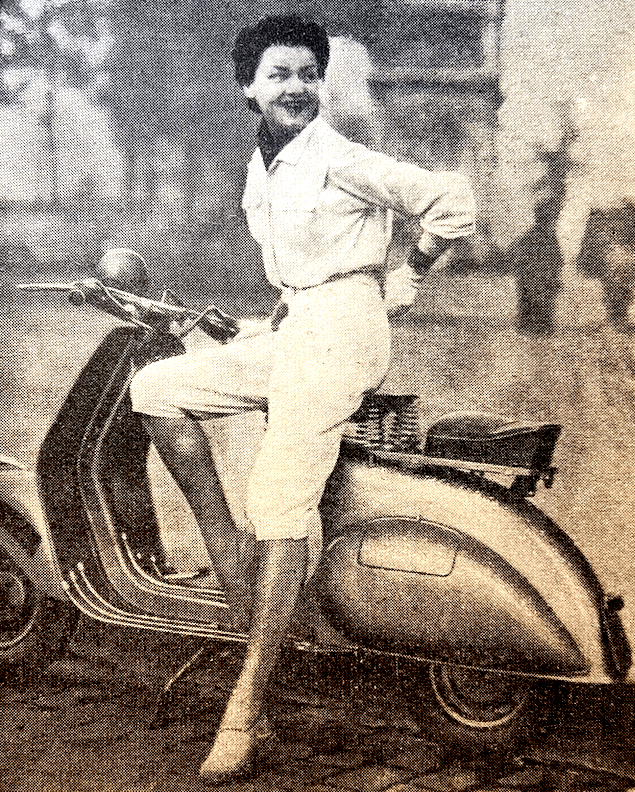
“FEW DESIGNERS HAVE a reputation for unorthodox thought to compare with that possessed J Wooler. Mr Wooler will go down in history as the originator of the ‘Flying Banana’ and of the interesting four-cylinder beam-engine exhibited at Earls Court in l948. The beam-four design has been abandoned in favour of a more orthodox 500cc ohv flat four which I examined recently; it may go into production next spring. The reason for abandonment of the beam engine was that the inertia loadings proved unduly severe, and a high rate of bearing wear resulted. The new four is perhaps the most straightforward Wooler design yet. The cylinders lie across the frame, one pair behind the other. A forged, three-bearing, one-piece crankshaft is employed, and since there are forked and plain connecting rods, the cylinders are not offset. Thus the rocking couple associated with some horizontally opposed designs is eliminated. The crankcase of the new Wooler is a one-piece casting. Cylinders and heads are cast in light alloy and incorporate concealed push-rod tunnels. A car-type, engine-speed clutch drives a four-speed unit-construction gear box. The pistons are flat-topped and, at present, provide a 7.7 to 1 compression ratio. Each pair of cylinders consists of a single, well-finned light-alloy casting, into which the shouldered cast-iron liners are pressed. The light-alloy heads carry the valves at an included angle of 55° in hemispherical combustion chambers. The valves are operated by short push-rods and Duralumin rockers with clearance adjusters. Separate rocker boxes are used to ensure maximum circulation of external air. The camshafts run semi-submerged in oil troughs, operate the push-rods through short plunger-type tappets and are driven by an adjustable 8mm duplex Renold chain, which also drives the Lucas magneto which will feature on the faster of the two models it is intended to market. The other model will employ a Lucas AC generator.Final drive is by shaft. The frame is of the duplex type and is telescopic, plunger-type springing for both front and rear wheels. An opulent-looking light-alloy pressing, the fuel tank enshrouds the steering head tube and incorporates a nacelle housing the head lamp and other electrical components. I hope to be able to report soon that I have had a flip on the model—and that production is on the way…”—Nitor
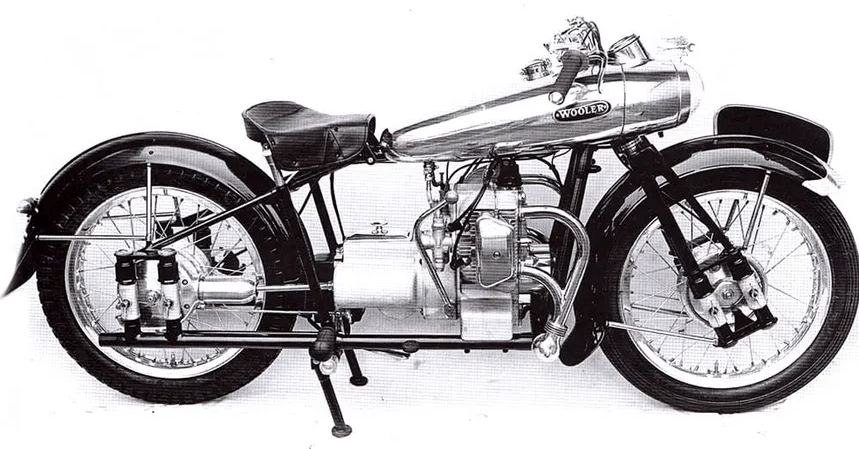
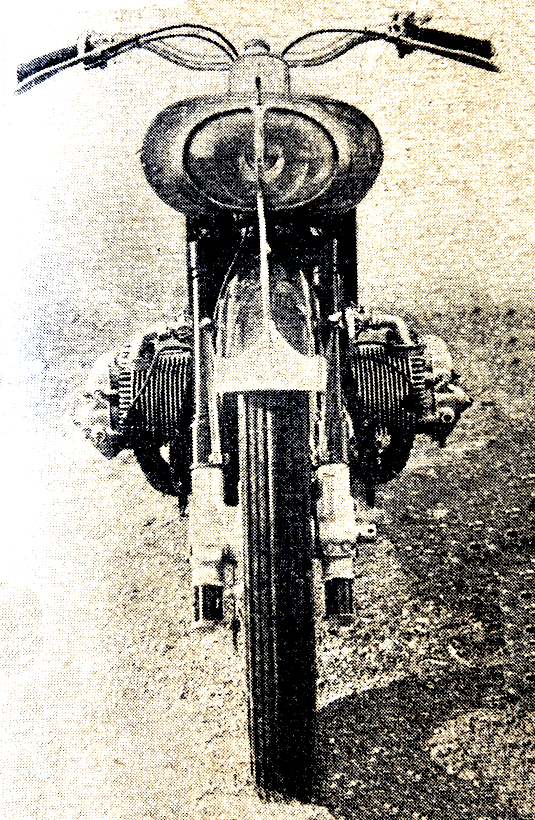
SOICHIRO HONDA VISITED the US to buy machine tools. Back at Hamamatsu, he stood on a recycled orange crate and told his team: “In America, all kinds of things including refrigerators are being produced in large quantities and come off of the conveyor belt one after another. We don’t have anything like that in Japan. So, our company needs to become able to make motor cycles like that. I will definitely make something like that in the future.” Honda’s first exports were a batch of F-Type Cubs for Taiwan. The Cub’s 50cc clip-on engine was rated at ¾hp at 3,600rpm giving a claimed top speed of 22mph. Innovations included a plastic front mudguard and legshields; more than 15,000 were exported by year’s end.
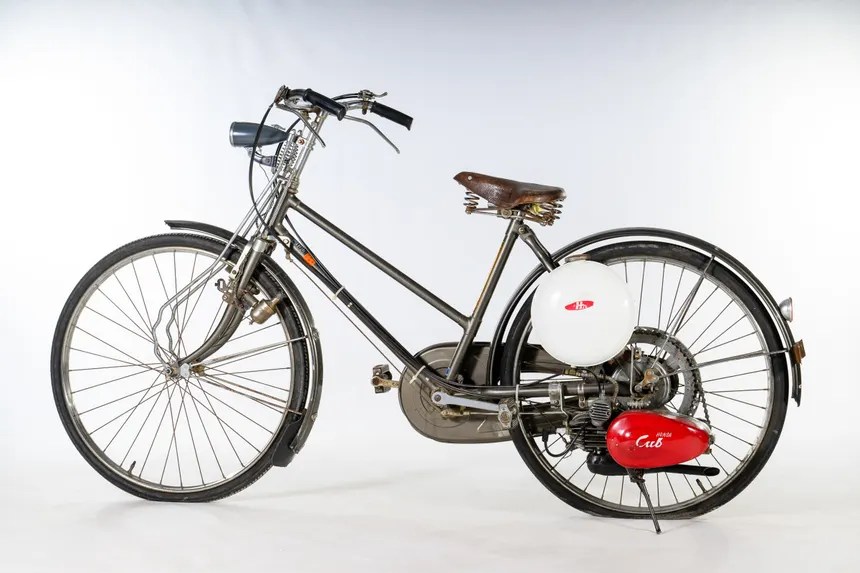
“AS ONE OF THE pioneers of the 197cc sidecar outfit, I feel bound to reply to the suggestion by Ixion that the 197cc machine is unsuitable for sidecar work owing to lack of performance and durability. I personally have found that a 197cc sidecar outfit gives all the performance required by the average family motorist who wishes to travel at normal speeds not exceeding 50mph and cruise at 35-40mph. On a recent journey from London to York and back in one day—435 miles—on a 197cc Sun and saloon sidecar with a 13-stone passenger, it was found that 40mph was the normal cruising speed, and the average for the whole journey worked out at 30mph. Top gear only was used for the whole of the journey except for traffic crawling and re-starting. The performance of a 197cc two-stroke sidecar with driver and one passenger is a little better than that of the average 500cc sv outfit, and far superior to that of a 600cc sv outfit, with large two-seat saloon and two passengers. Ixion also states that miracles can be performed with baby outfits with a maestro at the helm. Naturally an experienced driver can obtain better results than an inexperienced one, but having sold many small outfits to people of both sexes who had no previous experience, I can state that in no case has trouble been experienced owing to the small size of the outfit. All the owners are more than satisfied, both with the performance and the durability. I would stress, however, that a sidecar should never be fitted to a 197cc machine without the consent of the manufacturer, as some designs arc unsuitable for sidecar work owing to different methods of construction of forks, frames and rear suspensions. Regarding the suggestion of an ACU 1,000-mile test, I for one would welcome such a test, as this would once and for all prove that 500cc is not necessary to provide comfortable, speedy and safe transport for two adults, provided that they are content to travel at normal speeds.
SH GODDARD, London, SW9.”
“AFTER RUNNING FOR 55 days and four hours, a bicycle equipped with a 38cc Mosquito clip-on engine recently completed nearly 25,000 miles, equal to the circumference of the earth. The test was carried out on a country ring road around the town of Pau, in South-West France; it started on August 31 and finished on October 25. One mile and 174 yards long, the circuit was completed 22,762 times, making a total distance of 24,970 miles. Included in the 1,324 hours of the test were all the necessary stops for refuelling, tyre changes, repairs and the fitting of authorised replacements to the engine and bicycle. In spite of the fact that the test was carried out on open roads, which naturally caused many hold-ups, the average speed was 19mph. Eight riders rode the machine in rotation; they experienced long periods of bad weather, and also several spills owing to tyre troubles and collisions with other vehicles. So that the engine, a standard Mosquito, should not be tampered with, the crankcase was sealed and the cylinder head, barrel and piston were punch-marked to ensure that the original parts were reassembled after the decarbonisation required during the test. The pedals and chain were removed so that riders could not assist the engine. Two observers, civic officers of Pau, alternately followed the bicycle around, tabulating events and watching that the test was correctly carried out.”
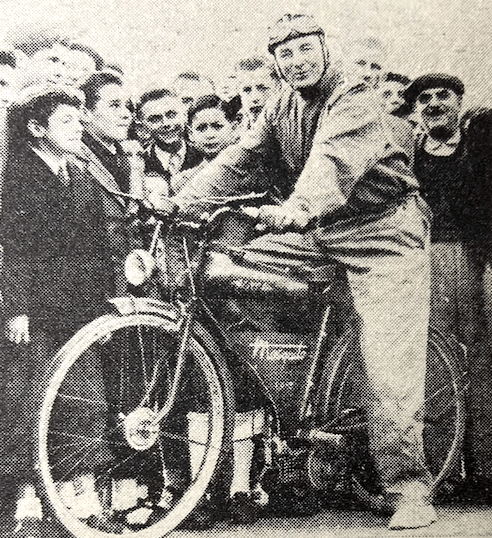
“THE PLACING OF letters after the numbers for new vehicle registrations has been decided upon by the Minister of Transport. Within a few months all the available registration marks for new number plates will be exhausted in some parts of Great Britain. As and when registration authorities use up their existing index letters, the new system of placing the letters after the numbers will be adopted; in most areas the change will not be necessary for many years. One- and two-letter marks were first allotted to registration authorities as long ago as 1903. In 1932, three-letter combinations were introduced—a third letter was added where necessary in front of the existing two-letter combinations. The same general principle will be followed in the new system, so that any combination of letters following the numbers will represent the same registration authority as it did when it preceded the numbers. As at present, the total of figures and letters on any plate will not exceed six, of which not more than four will be figures.” The ministry rejected calls for the reallocation of number plates from scrapped vehicles. It would be half a century before a Transport Secretary would appear on telly with a ‘DOT1’ plate touting for the cherished-plate trade.
LIGHTWEIGHT TWO-STROKES were challenging fourstroke thumpers in trials—while the Southern Experts Trial was won by a 500cc Beeza and the Welsh Experts was won by a 500cc Norton, the Northern experts was won by a 200cc Fanny-Barnett.
THE AA CALCULATED that motorcycle traffic had risen by 14% in a year. Car traffic was up by 1.5%. All well and good, but in Italy, it was calculated, almost 3% of the population rode bikes, scooters or cyclemotors (mopeds to you, sonny) and that total was rising fast with 518,000 bikes up to 125cc, 153,000 over 125cc, 12,000 goods -carrying outfits and 300,000 cyclemotors.
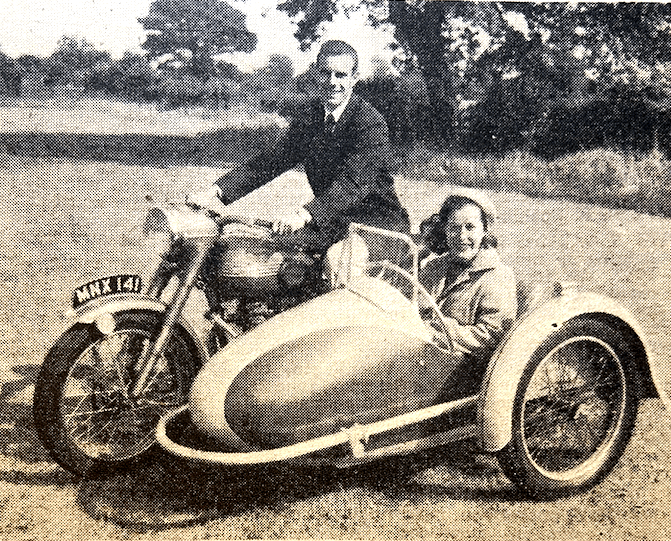
“THE NOTORIOUS LANCASHIRE WITCHES who, according to tradition, flourished around those parts, must have worked with a will on the weather during Hallowe’en; all last Friday night Holcombe Moors, near Bury, the site of the course for the open Lancs Grand National, was subjected to a prolonged and steady downpour which put the already tough three-mile circuit into exceptionally ‘ripe’ condition. But on Saturday, the day of the event, the little cherub who sits up aloft and looks after the fate of the North-Western Centre A-CU put over a strong line in counter magic and even produced spells of bright sunshine and patches of blue sky among the lowering clouds! Thus encouraged, spectators toiled up the craggy moor to the venue in their thousands and were rewarded with a thrill-packed race which was anything but a foregone conclusion, particularly in its later stages. Combined with the 10-lap scramble for the ‘Motor Cycling’ Challenge Cup, was yet another battle in the famous ‘Wars of the Roses’—a modern continuance of the 500-year-old Lancashire vs Yorkshire feud—to decide the fate of ‘The Ashes’, a trophy which, since its inception in 1926, has been won 11 times by the White Rosians and six times by protagonists of the Red Rose. Last year the honours went to Yorkshire. At 2pm 75 of Britain’s best scramblers—there was only one non-starter, Johnny Brittain—lined up in front of the gaunt Peel Tower. Among them, Ted Breffitt (Norton) had taken over No 19, credited in the programme to Brian Stonebridge who, oddly, enough, also appeared as the bearer of No 42. A strong wind blew, seemingly from all directions simultaneously, and as the maroon exploded, everyone got away to a good start except T Cheshire, whose 200 Dot was reluctant to get two-stroking. Stonebridge’s 500cc Matchless was soon in the lead; close behind him steamed Les Archer (500 Norton); a long way behind these two was Phil Nex (500 BSA), attended by VE Eastwood (500 BSA). John Avery (500 BSA) lay fifth and E Myers (500 Norton) completed the first lap leader board without a single Lancashire or Yorkshire feudist being on it. ‘Ashes’ holder Geoff Broadbent (350 Royal Enfield) in eighth position, was the first Yorkshireman and
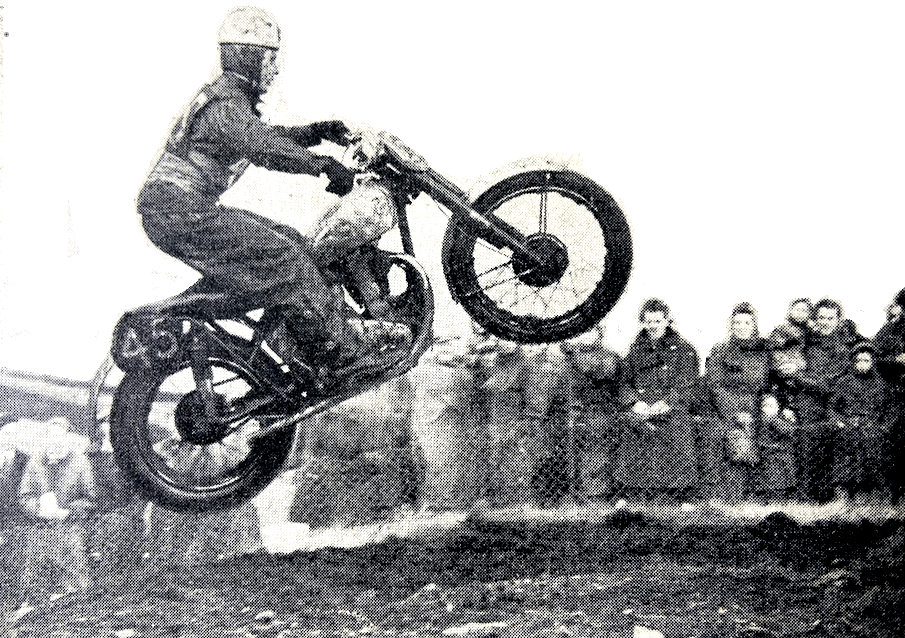
RK Pilling (500 AJS), who was destined to wrest the trophy from him, led Lancashire, in the 13th berth. On the second lap Stonebridge had increased his lead over Archer to 18sec. Ted Breffitt had come up into third place, Lancashire’s Ted Ogden (500 BSA) was fourth, Avery fifth and Dave Tye, on a 350cc BSA, sixth. Retirements had already begun, a notable disappearance being that of Geoff Ward (500 AJS) who was not registered on the opening lap. With his reputation, Stonebridge was now freely recognised as the winner, barring an accident And the accident happened on lap three, when Brian, not long returned to scrambling after a back injury, crashed in the Quarry and had to be taken to hospital for observation of a damaged head. Avery led the third lap by a considerable advantage over Archer who held doggedly on to his second position; appreciably behind Les was Ogden—the Red Rose was blooming—Eastwood, Tye and Pilling in that order. Broadbent had slipped right back. By half-distance Basil Hall (500 BSA) had knocked off his rear brake control and retired; Jim Alves (500 Triumph) made a poor landing after a particularly spectacular jump and lost some way ; MT Wilkinson (350 Triumph) stopped to examine his engine and restarted with what sounded like a disconnected exhaust pipe. More changes took place among the leaders on the sixth circuit. Archer, lying comfortably second, wound
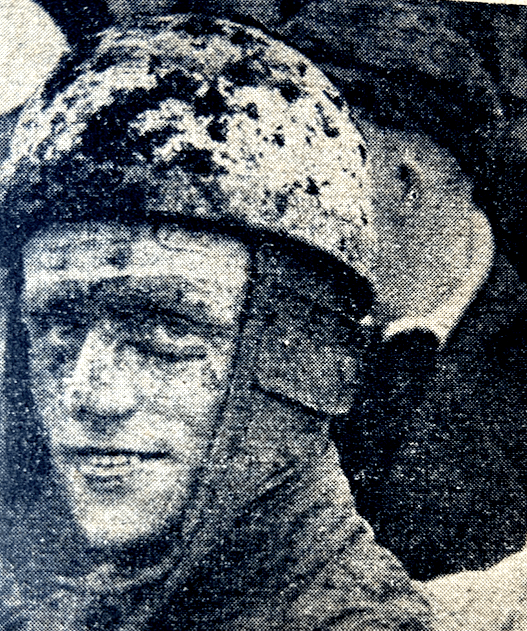
many yards of course-marking tape round his rear hub and when disentangling it found his sprocket to be dangerously loose, so he retired to let Tye in as runner-up, for Ogden had stopped, repeatedly, to replace his rear chain—a trouble which caused his retirement. Pilling held third place. Working his way steadily up was JD Hughes (500 Triumph) who occupied fourth position. Fifth was Wilkinson and Broadbent had come back on to the leader board. An outstanding effort was that of Bill Barugh who had forced his little 200cc Dot-Villiers up into seventh berth. Eighth was Phil Nex, who ran into trouble in a big way on the next lap, for he drove the clutch lever through, his hand and had to receive medical treatment. The ultimate shape of the race began to take form at the end of lap eight when Pilling passed into the leadership, several seconds ahead of Avery, these two setting such a pace that they were both out of sight before the third man, Tye, came along. He, in turn, was well in advance of the fourth man, Hughes. E Sellars came into the paddock with one of the rear-suspension ‘legs’ of his 500cc Ariel trailing and a report was received that Johnny Draper’s Norton was out with a flattened rear rim. But Pilling was not to have things all his own way. He actually began the last lap a few yards behind Avery, but it was in those final three miles that the gallant BSA rider struck difficulty, let the AJS through and dropped behind his team-mate, Tye, to finish in third place. After a stirring exhibition of scrambling, Pilling not only won the ‘premier’ by over a minute but collected the ‘Ashes’ back for Lancashire, while Dave Tye had the satisfaction of finishing as runner-up on a 350cc machine. Fourth, behind Avery, was Hughes, fifth was FH Bentham (500 Ariel) and sixth was Myers, the two last mentioned having come up among the leaders in the final stages of the race. RESULTS Motor Cycling Challenge Trophy (fastest time): RK Pilling (500 AJS) Ashes Challenge Casket (best Lancashire or Yorkshire rider): RK Pilling (Lancashire). Raymond Balky Challenge Trophy (fastest NW Centre rider not qualifying for other closed awards): FG Richardson (500 BSA). Class Awards, 500cc: 1, J Avery (500 BSA); 2, ID Hughes (5OO Triumph). 350cc: 1, DS Tye (350 BSA); 2, GE Broadbent (350 Royal Enfield). 250cc: 1, W Barugh (200 Dot-Villiers); 2. EW Smith (200 Francis-Barnett-Villiers). Newcomer Award: 1, V Smith (500 Norton). Manufacturers Team Award: Ariel (CM Ray, PJ Mellers, FH Bentham). Club Team Award: Not awarded. Souvenirs: All other finishers.”
“IN ALMOST EVERY WAY last Saturday’s Army Motorcycle Championship Trial was a better test of the reliability of riders and machines than are most of the famous ‘opens’ in the A-CU calendar. And with the vast resources, especially of manpower, at the Army’s command, it was probably better organised. The second of these championship events to he held since the war and only the third in the series, this year’s trial was staged in the Western Command area, centring upon Park Hall Camp, Oswestry, Salop. It covered over 100 miles of lanes and mountain tracks in the hilly country of the Welsh Border and took place under extremely wet condition. Competing were 84 officers and men, best performers in the various Command championships held during the past few weeks throughout the British Isles and in the BAOR. It was a team from the Western Command—the 31 Training Regiment, RA ‘A’ trio—who gained the premier award, the Gore Trophy, and one of its members, L/Bdr Houghton, who put up the best individual performance and won the Norton Trophy. Much of the course would have familiar to competitors in the 1949 and International Six Days Trials, for ii from Oswestry across the Vale of Llatl to Minera and Llanferris, along the range towards Denbigh, then into the Cambrian mountains, going through Lhinfihangel-Glyn-Myfyr as trio—who gained the premier award, the Con Trophy, and one of its members, L/Bdr. Houghton, who put up the best individual performance and won the Norton Trophy. I.S.D.T. Country Much of the course would have been familiar to competitors in the 1949 and 1950 International Six Days Trials, for it ran from Oswestry across the Vale of Llangollen to Minera and Llanferris, along the Clwydian range towards Denbigh, then into the mass of the Cambrian mountains, going south through Llanfihangel-Clyn-Myfyr and over Llantysilio Mountain to Llangollen, and so back to Glyn Ceiriog and Oswestry. At the outset, competitors’ machines—almost everyone of which was a G3/L Matchless—were inspected by the REME to ensure that there were no departures from standard equipment and that their 3.25in-section tyres were up to the prescribed 16lb front and 18lb rear pressures (12lb and 14lb for the cross-country going was allowed).”
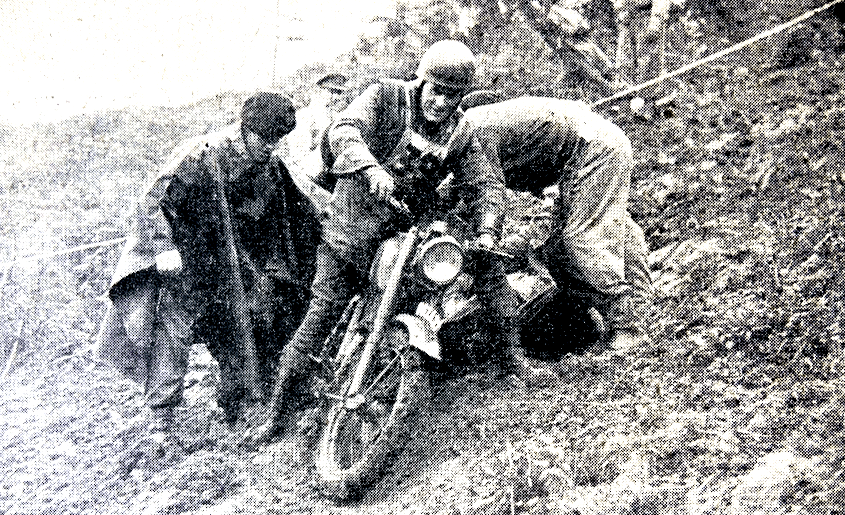
“WITH REFERENCE TO Mr Fred Dowty’s comments, the organisers of the Remembrance Run were informed by him that a permit could not be granted for this (or any other) competition to be held on Remembrance Sunday…However, the main item of interest contained in Mr Dowty’s letter is the statement that the ban on all Remembrance Day competitions ‘is an A-CU rule approved by the General Council’. We are told that the RAC is the ‘parent body’ of the A-CU, yet year after year the RAC issues permits for important car trials to be held on Remembrance Sunday—and the majority of these events start in the morning and are in full swing during the traditional two minutes’ silence. It is a curious situation, to say the very least.
RALPH VENABLES, Tilford, Surrey.”
“LEGSHIELDS MADE IN plastic material have been just an idea—up to now. Readers have experimented and reported, but there was no response from the trade until the. Show that has just been concluded, when the Feridax concern arrived with the goods at Earls Court. Having looked these shields over carefully, I admit to being not a little impressed. They are very nice indeed; they offer a distinct saving of weight, and the material is tough enough to take all ordinary knocks.”
“FERIDAX ARE AMONG those who are setting out to fill the need for safety helmets that are lighter, simpler and cheaper, as well as a good bit better-looking than the standard pattern. And each and all should be assured that these productions are by no means to be despised. Far, indeed, from it. They do not, of course, give the protection of racing crash-hats, but that is not required by the users for whom they are intended. Even an ordinary ‘bowler’ will often save nasty injuries, as the hunting people well know. Wearing his ‘Derby’, a friend of mine, who goes in for being a well-dressed young man, was pitched off his machine one morning when on the way to his London office. He landed on the top of his head, but the bowler crumpled and jammed its rim against his cars, with the result that he escaped completely unhurt. Without it he would have had concussion at least. If a ‘bowler’ can do that, those new lines in headwear under the ‘Corker’, ‘Cromwell’ and ‘Feridax’ brands should be even more effective.”—’Carbon‘
“ON THE SOMEWHAT RARE occasions when an ohv ‘250’ is submitted to Motor Cycling for a road test, the members of the staff doing the job almost invariably sense regret that the quarter-litre class has been left to languish by the majority of British manufacturers. Without doubt, this engine capacity copes with the needs of the average man with whom a desire for utility ride-to-work transport, plus a means of touring inexpensively at moderate road speeds, is the main incentive in his choosing and purchasing a machine. Certainly, the performance of the Model 65 Panther, with its 45-50mph cruising gait, good pulling power low down, favourable fuel consumption and a maximum speed of more than a mile a minute supports this point of view. Without prejudice, let it be said here that the writer started his motorcycling in the early 1930s with a 250cc model which, like the 1953 Panther, had coil ignition, a type of ‘electrics’ often frowned upon—perhaps rightly, two decades ago. Before the Panther was taken on the road, therefore, this item in the specification was given very close attention. Indeed, design has changed since the tester’s novitiate years! The Panther has a well-thought-out electrical system offering a minimum chance of snags arising. There is a very accessible, high-output Lucas dynamo controlled by an MCR2 Lucas CVC; the battery is accessibly mounted and the well-protected, car-
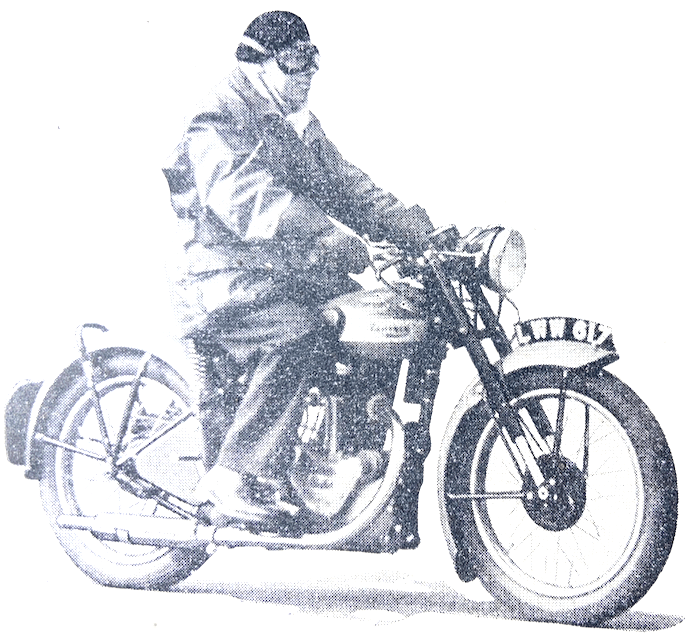
type contact-breaker unit and coil, too, are easy to get at for maintenance, but are not exposed to the weather. A warning light, built into the ammeter assembly, keeps the rider posted as to the state of affairs electrical. No need to worry, therefore, and turning on the petrol, pushing over the handlebar lever to give a rich mixture, and prodding the ks crank, the tester at once enjoyed that best-of-all coil-ignition feature—a first-kick engine start. And it happened on one of those recent mornings when. as the Bard. put it, ‘icicles hang by the wall’. The engine had a slow but determined tick-over and a high degree of mechanical quietness—features which endured through-out the test. First- and second-gear pulling, whilst not snappy, was steady and progressive, another attribute, doubtless, of the fat spark derived from a coil-ignition outfit at low rpm. At an early stage the common-sense character of the Model 65, designed to serve the utility-type of owner, became obvious. With a claimed power output of 8¾bhp at rather more than 5,000rpm, the engine was adequately geared in the lower ratios. The 15.67:1 bottom ‘cog’ provided a real plodding pace suitable for traffic riding or for coping with severe gradients. Second gear, 10.34:1, served from a fast walking pace to just over 40mph. Normally, a change was made to ‘third’ at around 30mph, and that ratio, actually 7.52:1, could be held indefinitely, certainly up to 53-55mph mark. In undulating country or when driving into a headwind, one had the feeling that the top ratio (5.88:1) was a trifle too high. In adverse conditions, winding on everything in ‘third’ before changing resulted in little or no increase in speed once top gear had been achieved. The Model 65 weighs 310lb and yet is geared higher than lighter machines of similar type. Of course, under more favourable conditions than those mentioned, the rider reaps a certain amount of benefit. For instance, helped by a breath of following wind on one occasion, the tester found the machine bowling along with the speedometer needle quivering towards ’70’ which, allowing for a small percentage of speedometer optimism, meant an actual ’65’ —and this with the engine turning over at a rate still somewhat below that of the makers’ claimed useful maximum. Performance from a speed point of view is always of interest, but it cannot be over-emphasised that the charm of the Model 65 lies in its capacity for hard work at a moderate pace with complete reliability. Weight was found to be well distributed and, except in one or two respects, no rider, novice or expert, of the Model 65 could justify a criticism with regard to its handling—on the ‘road or otherwise. The exceptions? A small lifting handle on the nearside of the rear mudguard would help considerably in raising the machine on to its central stand. And whilst in a critical mood, let it be said that a stand with feet more widely disposed would be a great advantage on soft or cambered surfaces. A prop stand is not fitted as standard. And why not a wider-angle steering lock, Mr Designer? A rigid-frame machine, this lightweight had first-class steering. characteristics. The 8-in saddle springs did much to iron out the bumps, and only the inevitable sunken drain or neglected level-crossing served to remind the tester that, despite the modem spring-frame fashion, many people still enjoy riding motorcycles equipped with front suspension only. In the
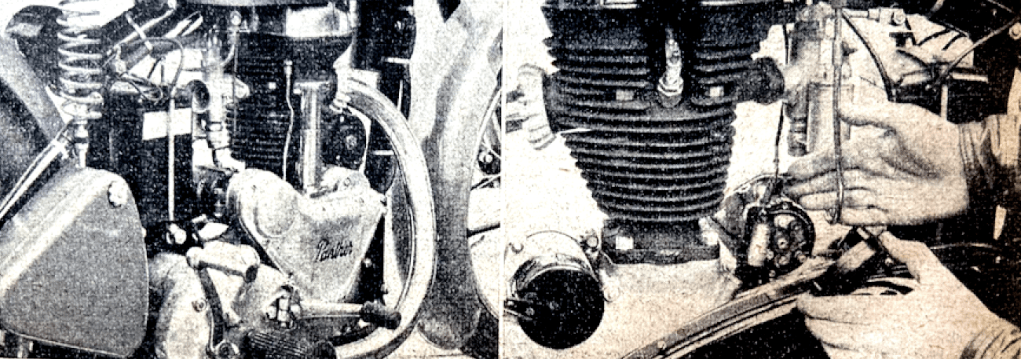
case of the Panther, Dowty forks are fitted and during the period of the test they called for no attention whatsoever. Air pressure remained constant notwithstanding extensive use of the machine in East London suburbs, where pave of a near-Continental type exists. Conceivably the ‘solid back-end’, whilst contributing to positive steering, was the cause of a certain amount of wheel hop and, therefore, locking during the braking test in which, initially, the rear stopper showed up poorly. Careful readjustment of the brake and equal care in its use brought steady improvement. The front brake was first class and contributed largely to the excellent stopping distance of 29ft obtained for combined brake application. Whilst the toolkit was found, on inspection, to be adequate for all normal maintenance requirements—again full marks go to the factory for commonsense, accessible location of every component likely to need routine attention—there was no need to work on this model during the test period. Its prolongation, however, would have necessitated attention to the dynamo output rate, a job which, in the ordinary course of events, would, of course, have been dealt with under the dealer’s guarantee. Accustomed to bigger and, therefore, ‘thirstier’ mounts, the tester enjoyed remarkably inexpensive journeys whilst riding the Model 65. At 30mph, which means, roughly speaking, town and suburban running, a gallon of petrol could be relied upon to last a full 100 miles provided throttle openings were gentle and restrained. This means that a man travelling to and from work, say, 20 miles a day, on the Panther, might well get through the working week for the price of a gallon of petrol…A brief spell of night riding completed the test and provided opportunity of giving a mental OK to the lighting arrangements, which were up to their job in every way.”
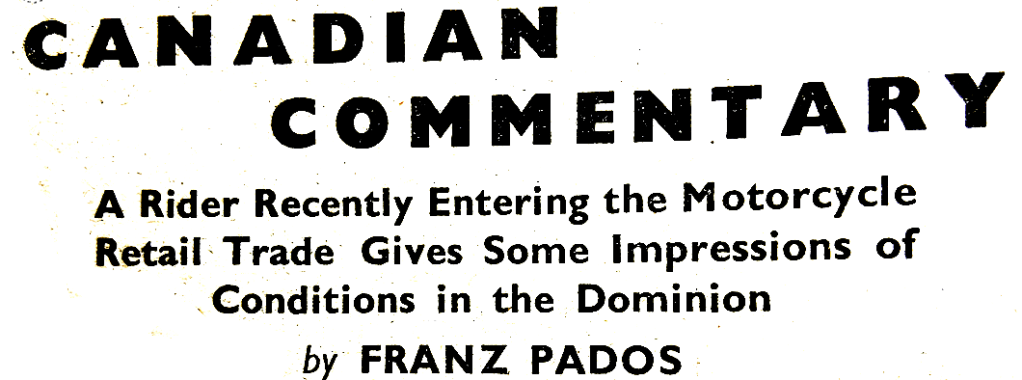
“THE WRITER, WHO BECAME a well-known rider on British circuits, particularly on Douglas machines, is now in the retail motor cycle business in Canada and gives some interesting sidelights on conditions in that country: ‘During the winter of 1951 we opened shop in Calgary, Alberta, and now operate the largest motor cycle premises in western Canada, under the name of Calgary Motorcycle Clinic, where we handle every English and German make of machine and, of course, all kinds of accessories. Our stock usually consists of from 150 to 160 new and used machines. English motor cycles only started to sell well in 1949—that is in this part of the world. More than 50% of the motor cycles now on the road are from English factories and are increasing heavily, despite Harley-Davidson and Indian competition, although, so far, there are very few German models around here. The BSA lines are the best sellers, followed by Norton, Ariel, Triumph and AMC products, while Panther and Royal Enfield are also gaining popularity on the road. In England we always thought the small machine would not be very popular in the USA and Canada, but believe me, the BSA Bantam is one of the hot favourites. I am afraid that motorcyclists in this country do not have very much entertainment, as the distance between cities is too vast. Occasionally we have the American type of hill climb or dirt track racing, while in Ontario and British Columbia they have not a few road races. The boys are plenty fast—at times too fast—which makes the corners slow. For road racing we have a few ‘Featherbed’ Nortons and some other models from the same stable. Triumphs on which the magic touch of the racing kit has been applied are very popular for this type of competition and also the ‘Gold Star’ BSAs. Recently one or two ‘Star Twin’ racing jobs arrived here and they seem to do most of the winning…Going back to the everyday motorcyclist, ‘small’ handle-bars are not very popular. Every time we sell a bike the customer requires a buddy seat, saddle-bags, one or two and sometimes even five crash bars, and the most colourful jobs sell first. There are one or two red Vincents around and believe me, the boys here consider these the real McCoy. I am sure the British factories could sell many more motor cycles if, for instance, AJS would field a nice blue, Sunbeam a bit more chrome and so on. The 250cc BSA de luxe model is very attractive and the ‘Golden Flash’ is also a most likeable machine. Just looking out from my office to the showroom I can see a Harley-Davidson outside, with a wind-screen, two crash bars on the frame, one on each mudguard, four spotlights on the front, two underneath the back seat and two on the back mudguard! Every possible part is chromium-plated. In England you would call this a Christmas tree, here it is just a common motor cycle. Such a bike has a sidecar as well and I will get $1,200 for it. For a 1950 Norton Dominator Twin, fully equipped like the ‘HD’ but without the sidecar, I am asking $575. This shows the difference here in price between the English and the American models.'”
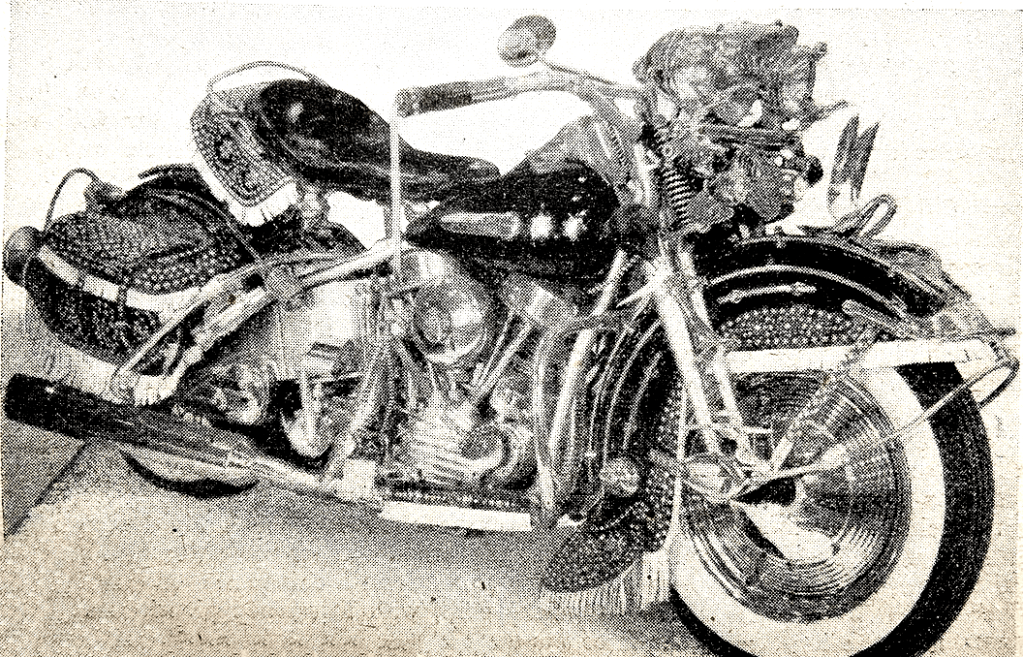
BELGIAN RIDER ANDRÉ Milhoux won the European Motocross Championships and duly attended the FIM World Championship presentation in Paris. Would you believe the FIM suits had forgotten to arrange a trophy for the new championship so Andre had to be content with a congratulatory speech from the FIM president.
“ON OCTOBER 1 THERE were 3,468,449 vehicles of all types taxed in Western Germany, and that of this total, no fewer than 1,710,420 were two-wheelers or sidecar outfits. Returns for July showed a total of 1,582,118 in the motor cycle classes. Another news item from Germany prophesies the probable abolition of speed limits in that country next year.”
“A SIX-GEAR BANTAM, designed and ridden by the owner, Bill Morris, of Woolongong, has been unbeatable in all recent New South Wales races. The Bantam appears to have two sizes of engine sprockets on the mainshaft, each connected to twin clutch sprockets through Parallel chains. The engine sprockets are divided by an ingenious sliding-dog device so that each sprocket can be used independently and at will. being operated by the rider through a cable control.”
COLONEL HJ ‘TAPS’ TAPLIN, an aviation pioneer and model engineering maestro, decided to find out if lightweight motorcycle engines could be converted to diesel. After successful experiments with a 98cc Villiers unit he made and patented a steel cylinder head for a 123cc Bantam engine incorporating a cable-controlled variable compression device. It worked well and the diesel Bantam was ridden on the road but Taps turned his attention to radio controlled model planes and boats, many of which were powered by diminutive diesels.
HAVING WON THE 350cc world championship on his Manx Norton, Geoff Duke became the first motorcyclist to win the Seagrove Trophy which, since 1930, had been awarded by the RAC to “outstanding British performances on land, over the water and in the air.” The citation noted his victories in the Senior and Junior TTs, a similar double in the Ulster, Begian and German GPs, the Senior Dutch TT, Junior Italian and French GPs—leading to his double world championship. Accepting the award, Duke promised to stick with British machinery, primarily Aston Martin cars but with some rides in Lightweight (250cc) events. Previous Seagrave winners had included Sir Malcolm Campbell, John Cobb and Amy Johnson.
MOTORCYCLE EXPORTS fell from 91,692 in 1951 to 70,266. The main export markets were the USA (7,095), Australia (6,874), Sweden (4,340) and Malaya (3,363).
“SHORTLY AFTER NOON on January 3 an air freighter will take off from a South Coast airfield bearing to Le Touquet a rider and his motorscooter. Commonplace? Maybe—but not when the rider is Canada’s Spike Rhiando and his destination Cape Town! And even less when the aim is to complete the 10,500-mile journey across Europe and through Africa in the record time—for a solo—of 21 days. But then, Rhiando is no ordinary rider. and his mount—the Scootamobile, designed by himself and developed in collaboration with Donald Palmer—is no ordinary scooter. In fact, it fairly bristles with original ideas and, one snowy morning recently, 1 arrived at the Cobham, Surrey, headquarters of Rhiando Industries to chat with Spike on his forthcoming adventure and to examine and ride his machine. ‘We’re just bringing it out!’ was his opening sentence as photographer Dick Ross and I arrived on the step. And, as he spoke, the nose of a most unusual scooter appeared through the doorway. Unusual in being fully enclosed; unusual in having a 197cc Villiers engine; unusual in having a SEC self-starter, air conditioning, central heating, twin headlamps…’The frame,’ explained its designer, ‘is mainly welded, although the suspension systems employ some brazing. Material? Tube of 1½in od, 16 gauge on this model—it’s got a tough trip ahead. But production machines will he lighter.’ ‘That’s an unusual springing system, too,’ I remarked. ‘Torsion bars?’ ‘At the rear, yes. The bars are, laminated and fit in square slots at the pivot point. We have a Rotoflo hydraulic damper at the back, and the front forks have a large Teleflo damper.’…At low speeds, the steering felt slightly heavy, probably owing to the use of a Ferodo Ferobestos fibre head bearing which provides for a degree of damping. But it was only an impression of heaviness, for I found that the machine could be placed just where I wanted it to go. Gathering sped, I charged the little rise, shutting off slightly as I breasted it and braked. Just a slight snake as the rear wheel hit through the white overcoat onto the ice below, but nothing to cause a moment’s worry. A slow, sharp turn served to show that the model’s stability was excellent…A trans-Africa trip planning…After traversing France, Spike and the scooter fly across the Mediterranean from Algiers. Thence his route
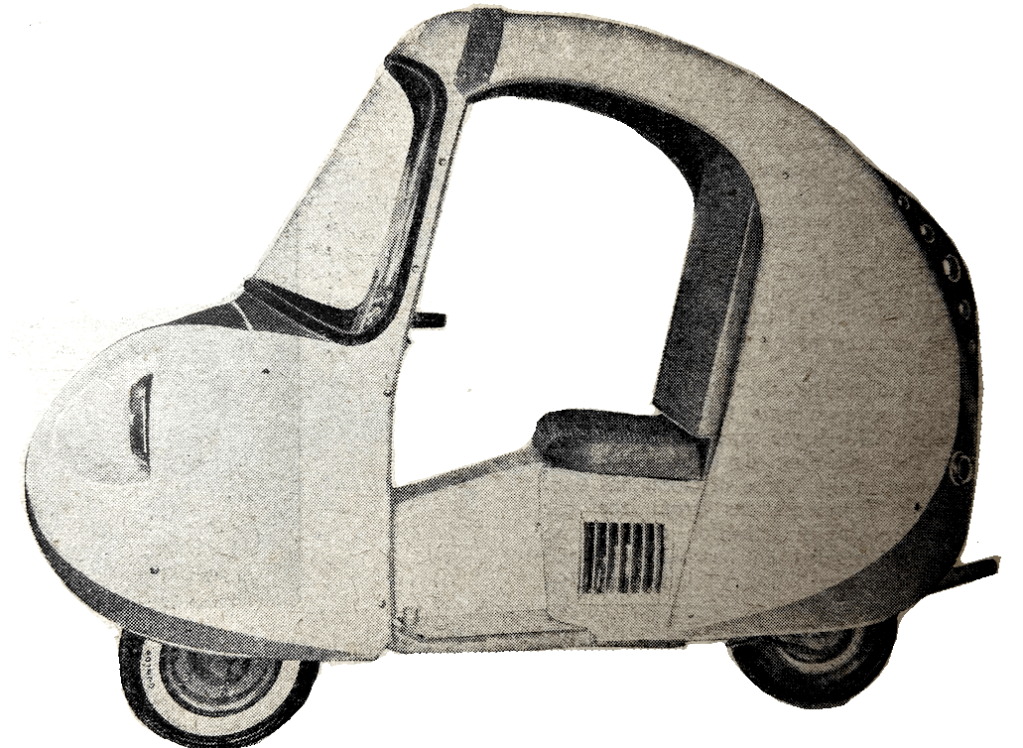
lies across the wastes of the Sahara—on one stretch of 650 miles it is likely that no living thing will be seen—and on into the Equatorial regions. Between Stanleyville and Elisabethville—south of the ‘Line’—even the vile African roads peter out, becoming mere tracks. And, to add to the hazards, part of the route is through country where lions, leopards and rhinos roam. All previous trips of this nature have been made by two or more people, but Spike is to travel alone. His original intention was to beat the record time, set up by a Hillman Minx car, of 21 days 19¾ hours, but since then, a Humber Snipe has lowered the time, using a crew of three, to 13 days. Even so, whatever time Spike returns (and his aim is 21 days), it will be a remarkable feat of endurance, for he most drive for 19 hours every day at an average speed of 29mph! What does one take on such an expedition? There is no time to cook food, so concentrated food tablets are the answer there. Water supplies may be foul, so sterilising material must be included. A Very pistol—no fire-arms are allowed—must serve as protection against wild life. Petrol filling facilities are few and far between and even though the Scootamobile has a 6½-gallon reservoir, a collapsible 2-gallon container joins the expedition. Special bumpers have been designed to fit on the front and rear of the Scootamobile—and very substantial they are, too. But they are not for show, for they are intended to provide a means of lifting the model aboard rafts when it is necessary to become temporarily waterborne. And—just in case—a two-way radio is being fitted. Finally, you may ask, what is the purpose of the trip? Well, there is the question of prestige to be considered. This is an ‘all-British’ attempt, and one which might do much to establish this country’s reputation in a class where, at present, Continental manufacturers are supreme.”—John Thorpe
THE RAC/ACU TRAINING SCHEME processed 1,071 novice riders, of whom 914 qualified. In its five years the scheme had trained 2,925 beginners, with a pass rate of 87%. “Inquiries about the RAC/ACU Training Scheme continue to flow into ‘Motor Cycling’s’ offices. The scheme started in the autumn of 1947 with a nucleus of slightly more than a dozen clubs and, during the subsequent five years, it has been greatly extended…The South-Midland Centre leads with a total of 12. Runners-up are the go-ahead South-Eastern Centre clubs, 11 of which offer training facilities and the next best are the East Midlanders with a total of six. The Midland, Cheshire and Southern Centres tie with four each. The remainder of the Centres contribute one or two training-minded clubs to the grand total which at the time of writing is 63. Most clubs operating this scheme now have more than one training motor cycle. The original issue’ of James and Bantam two-strokes has been supplemented by bigger machines; the Sunbeam Club has been the recipient of the latest new model, a Triumph recently presented to them by Mr E Bedlam, London representative of Triumphs. The Hillingdon & Uxbridge MC which is now going well ahead with its second ‘squad’ of pupils has obtained permission to use the Uxbridge industrial estate which comprises two miles of newly-made roads complete with normal bends, cross-roads and so forth. The local council has provided full size road signs which are erected at strategic points. The Hillingdon clubmen recently received a brand new BSA Bantam for instruction purposes. Whilst the scheme is comparatively strong in the South and the Midlands, the progress maps of the West and the North have large open spaces where little or no training activity is in progress. The cause in the past has been a shortage not of enthusiasm or manpower so much as motor cycles for training purposes. Now that the market is easier to some extent there is every reason to anticipate a considerable improvement.”
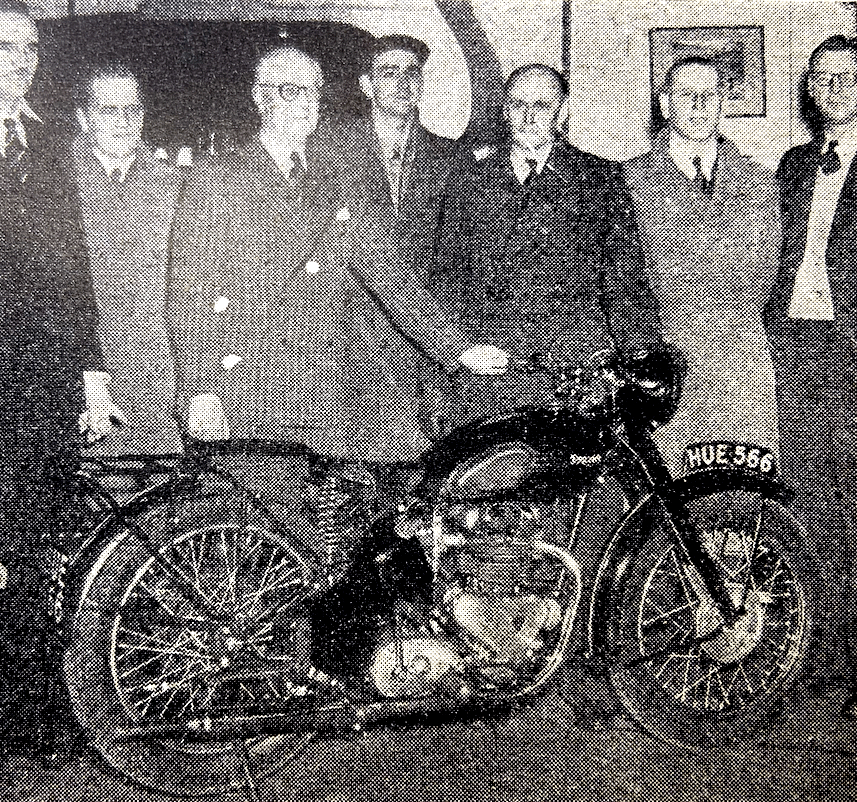
“FOR 63 YEARS the firm of Messrs Crisps have carried on business in Norwood High Street, W Norwood, in SE London, supplying the needs of generations of pedal cyclists. A present-day partner in the concern is Wally Crisp, well-known South Eastern Centre clubman, and something of a connoisseur of custom-built sporting motor cycles—several of his ‘specials’ are familiar to Brands Hatch habitués—and his latest effort is a particularly attractive trials mount powered, by a 350cc. AJS engine which, with the gearbox, saddle, wheel rims, spokes and tyres, represents about all of the machine which was not hand-made. Chrome-molybdenum tubing, ⅞in dia, of 14g, nickel-bronze welded, went to the frame, which has a 1¾-in dia. steering head and 1¼in dia main top-rail. A bayonet quick-release attachment holds the rear mudguard in position—it can be removed, complete, in a matter of seconds. The hubs and brake-reaction plates were made from Dural and, wherever possible, light alloys were used in the machine’s construction. It is no small wonder, then, that its weight, in fighting trim, is only 261lb.”
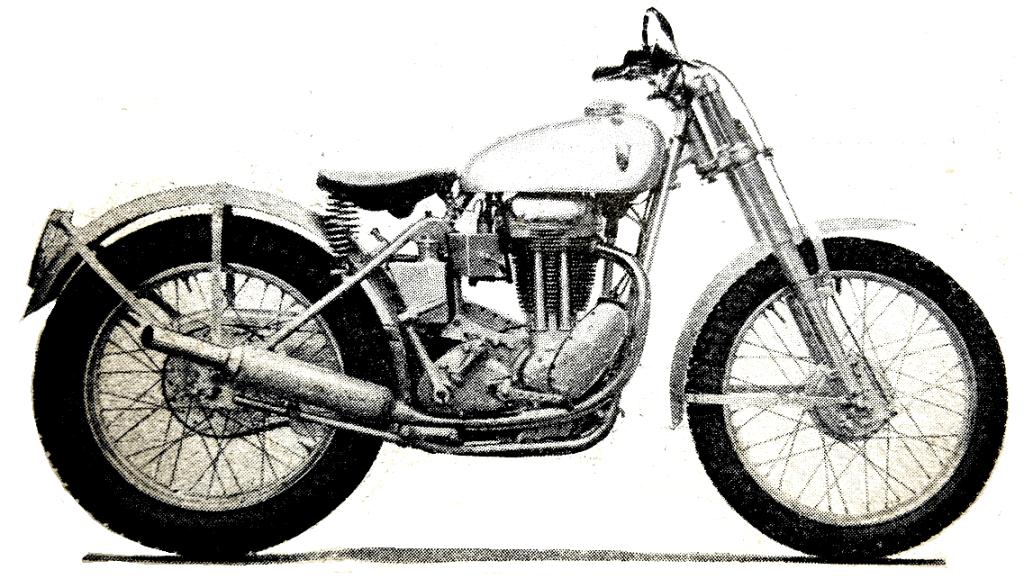
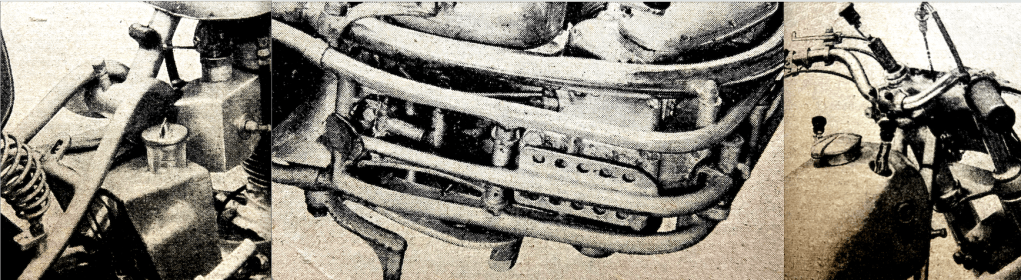
“BY MODIFYING A STANDARD 123cc BSA Bantam engine to run satisfactorily on the Diesel principle, Mr HJ Taplin, managing director of the Birchington Engineering Co, Birchington, Kent, has won an argument and possibly contributed another page to the history book of motor cycle development. The argument concerned the possibility, or otherwise, of employing compression ignition for motorcycle purposes, ie, dispensing with electricity as a means of setting off the combustion phase, and, at the same time, retaining desirable motorcycle engine characteristics—light weight and smooth torque. Whilst the conventional motorcycle engine derives most of its urge from a brake-horse-power build-up at medium or high rpm, the conventional Diesel is usually a slow-revving unit, with a heavy punch Packed into each power stroke.”
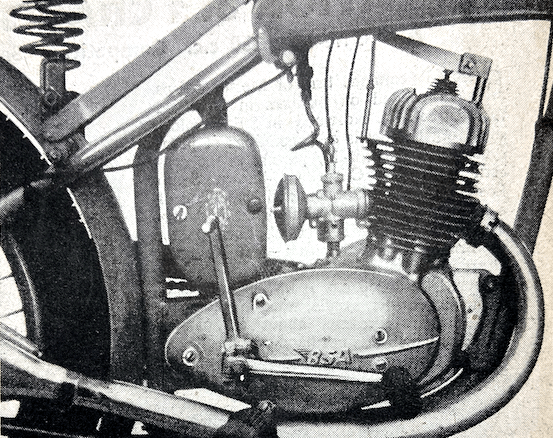
“ACCORDING TO THE ‘REGS’ issued by the East South Wales Centre for its annual dinner at Cardiff on November 29, attire was optional, but ‘evening dress encouraged’. Thus, dinner jackets abounded but, resplendent among the ‘tuxedos’ was a solitary White Tie and its attendant Tails. The immaculate wearer, with his carnation and cigar, had a very definite ‘first class only’ look but, incredible though it might seem, had, in fact, travelled to the dinner from far-off London on a motorised bicycle, his ‘glad rags’ carefully stowed in a rucksack on his back! He is Mr Arnold Jones, sales manager of the Cucciolo department of the agents for that unit, Britax, of Carlton Vale, London, NW6, and he believes in practising what he preaches. On the morning of the dinner, which was to take place 12½ hours later, Mr Jones pushed his two-year-old Norman bicycle, powered by a 48cc ohv Cucciolo cycle-motor unit, out of his garage in Harrow. It was 7.30, dark and frosty and a heavy mist reduced visibility on the ice-covered roads to some 20 yards. But the Rubicon had been crossed and he set off on A40, soon settling down to the job of footing his way round half-seen roundabouts and dodging imaginary objects that seemed to loom up, ghost-like, out of he gloom. Radar would have been an advantage! By Beaconsfield it was getting almost light. The mist had lifted, giving way to quite a strong headwind. So far the only complaints had been from fingertips and ears, necessitating frequent halts to revive circulation with the aid of a suitably filled pocket flask. Conditions were more favourable towards Oxford and it was not until Great Barrington was reached, with half the journey—80 miles—covered in three hours, that further difficulties were encountered in the form of frozen, rutted snow, whereupon the antics of the motorised bicycle began to beggar description. But a total weight of only some 47lb, plus rider and kit, proved its points and keeping the machine on course was more exciting than actually dangerous. As Cheltenham came into sight, the roads ceased to be treacherous and Gloucester was attained at 11.40am. Here a break of half an hour for lunch was indicated. Snow had started to fall during this brief halt and, with his physical tanks replenished, Jones took the road again in a flurry of driven flakes. Visibility was now poor and the going became more difficult as the snow deepened. At Chepstow police were diverting traffic to avoid the steep climb out of the town, which was like a sleigh run. However, they let Jones and the Cucciolo go through, saying that he could push. But they had under-estimated the capabilities of the ‘Little Pup’, for the formidable hill, with its skating-rink surface, was scaled without any assistance, pedal or pedestrian. It was shortly after this that the rear tyre punctured and half an hour was lost effecting the repair at a small local garage. Following a mechanical snow-plough through Newport, the roads of which were now under a covering about 9in thick, Jones had the fortifying knowledge that only 12 more miles lay between him and his dinner. In the deep, white drifts and against the wind, speed fell, sometimes to not more than 10 or 12mph and intermittent misfiring set in due to water from melting snow shorting the plug. But at ten minutes past four o’clock, Jones was splashing large lumps of snow from his boots over ‘Staff’ Bevan’s office carpet at the Castle Street premises of Messrs. Robt Bevan and Son, the Cardiff Cucciolo agents, and eagerly accepting a cup of tea. The trip had been accomplished in a running time of 7hr 40min on 1¹⁄₁₆ gallons of petrol costing under 5s. Dinner was at eight and, as the chairman read out the numerous telegrams apologising for the absence of guests owing to snow and ice-bound roads, Arnold Jones felt that his little Cucciolo had, all things considered, done fairly well by him.”
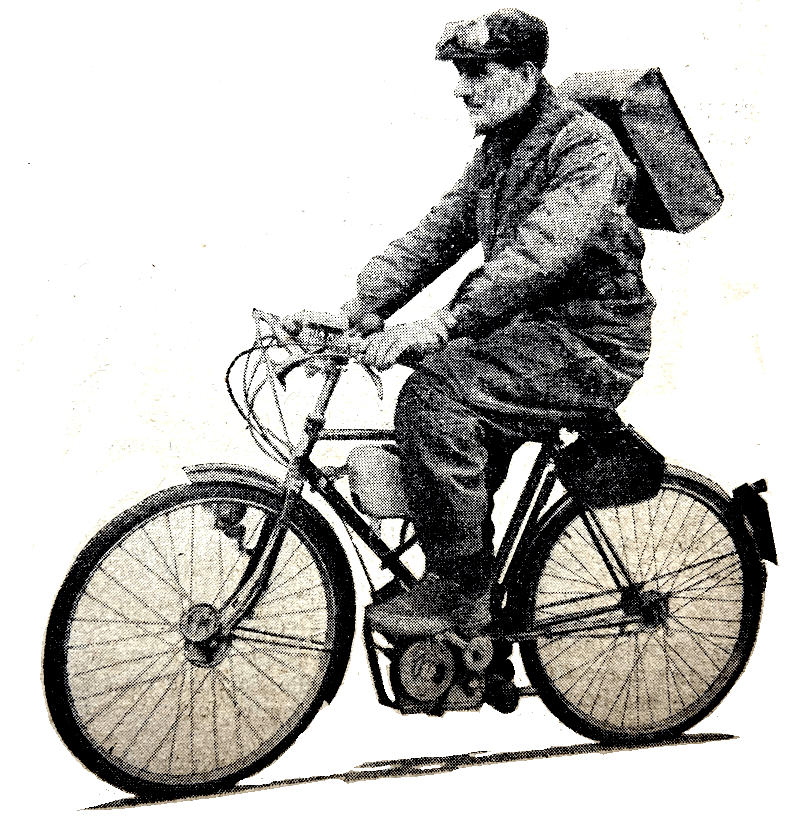
“I WOULD LIKE TO SAY ‘Thank you’ to Dudley Stone for his article. I am one of the ‘ladies’ who, before I met my husband, had for years hated motor cycles, thinking that they were nasty, noisy, smelly things. And I classed all riders of such contraptions in the same way. How wrong I was I have since found out. When I met him in 1947, the only transport we had was a motor cycle so, of course, I went on the pillion. I wasn’t very thrilled at first but soon I could take quite long trips in my stride. Now I am truly converted. I love the sport as much as he does and I always accompany him to the Show (he couldn’t get away without me). In winter, I cheerfully don all the warm and waterproof clothing I can find and stand for hours in mud and, often, pouring rain watching trials and scrambles. In summer, road racing is the chief attraction. Who cares if handkerchiefs and towels get dirty; if motor-cycling is always the chief topic of conversation; or if pieces of machinery find their way onto the hearth? The compensations are many. Lots of cheerful company; more travel than could possibly be accomplished by any other means with the present price of petrol; club meetings and dances—to mention only a few…apart from the fact that it keeps him happy all the year round. In conclusion, I am certain there are many, many, wives and sweethearts who will enthusiastically join me in this toast to: ‘The Motor cyclists’.
(MRS) MARY B ABBOTT, Northampton.”
“IT HAS COME to this club’s notice that Vincent machines bearing the Vincent Owners’ Club badge are at times being sold by agents. In one case, the agent flatly refused to hand the badge to a Cub official. In another, a rider told a member that he was not a member of the club and did not intend joining, but did intend continuing to display our badge! We would point out that these badges remain the property of the club and that nobody has any grounds whatsoever for refusing to return them. It is also very pointless. Agents could help as greatly by returning any badges ‘sold’ to them with machines to SG Powell, Flax Bourton Road, Sixty Acres, Failand, near Bristol, costs involved being refunded, and also by removing any transfers of the badge which might be on machines before reselling. Having handed out very nearly 1,500 of these badges during the Past four years, it is hard to keep trace of them all.
RAB COOTS, (Hon Editor, Vincent Owners’ Club) , Banff.”
“RETURNING ABOARD THE LINER ‘United States’ from a 17,400-mile tour of America, Mr John Palfreyman, of Chorlton Road, Manchester, arrived back in this country on November 5, thus completing 52,800 miles of overseas travel by motor cycle. During the past three years Mr Palfreyman has visited every country in Europe, with the exception of Russia, has spent many months in Africa, and has now completed a trip to the New World. It was on May 14, he told a ‘Motor Cycling’ reporter, that he left this country aboard the ‘Georgic’, and, landing in New York, he was surprised to find that the law required him to take out a learner’s licence before he could drive his Triumph combination. Within a few hours, however, he was examined, passed and on his way on what was to be a four-month journey to the west coast. From the outset his idea was to keep to Route 40, one of the main arterial roads running across the continent, deviating here and there to places which aroused his interest. Washington, the capital , city of America, came first, then Pittsburgh, where the celebrations to mark the opening of what is to be the World’s largest airport were in full swing. A tortuous route via Niagara Falls led to Indianapolis just in time to see the big car race…the man from Manchester came away deeply impressed with the enthusiasm that the Americans show for this meeting. A fortnight spent in Chicago saw Theresa Wallach established in her new and larger premises at 1548 East 57 Street. Theresa, Mr. Palfreyman reports, has built up a firm reputation through her ability to maintain ‘Limey’ motorcycles, and enthusiasts for hundreds of miles around bring their machines to her for attention [Ms Wallach and her chum Florence Blenkiron rode a Panther combo from
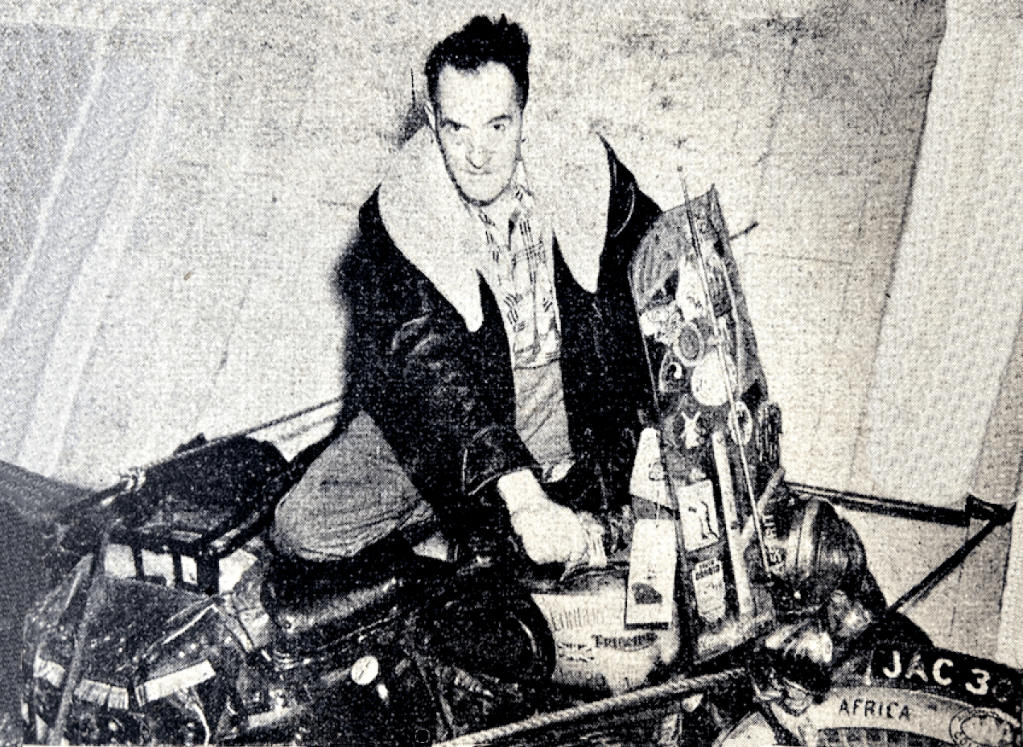
London to Cape Town; read all about it in 1936—Ed.]. At Milwaukee the Harley-Davidson company were hosts to the traveller and his combination for several days. It was here that he had the opportunity to ride one of the now-famous Harley model Ks, and a report of his impressions of the machine appeared in one of the ‘American journals. A visit to Springfield for the motorcycle races followed, then across cowboy country through the Grand Canyon National Park to Las Vegas, the gambling city of America. Here luck favoured him, and 50 dollars came his way via the tables of the Golden Nugget Saloon.. Continuing through Death Valley, both rider and machine found it difficult to breathe, it was so hot. Evidently the thing to do is travel at night and avoid the intense heat. At Johnson Motors Incorporated, the main Triumph dealers, he made his headquarters in Los Angeles, and after spending a few weeks on the coast John Palfreyman returned to New York, setting up what is believed to be a new coast-to-coast record in the process. The journey, mainly along Route 60, took 7 days and 4 hours, the mileage a mere 3,284. This tour, which makes normal holiday ventures look like a run around the block, was entirely uneventful. One front and two rear and two sidecar tyres were the only casualties, and the machine had no attention whatsoever, apart from an oil change every 1,000 miles. The tappets were not even adjusted, and even after a grand total of 52,800 miles the engine still runs as sweetly as ever—a tribute to British craftsmanship—which the Americans were quick to realise…Long distance touring by motorcycle is a cult that is growing fast in popularity…in the same week that John Palfreyman came back to his native Manchester, the newspapers printed pictures of two girls setting off from London with the Antipodes as their destination. And for several weeks now, news flashes have been reaching London recording the progress of that remarkable young woman, Miss Winifred Wells, who two years ago made Australian history with a solo run on a Royal Enfield from Perth to Sydney and back, and who has just completed a never-before attempted feat—a ride right round the perimeter of the Australian continent…almost in the same post come two letters from the Middle East, each describing the progress of adventurers who are making their way half-way round the globe, from Australasia to the UK. One comes from our old friend ‘Punch’ Glanville who, from his exile in Teheran, Iran, has more than once sent us news of motor cycling globe-
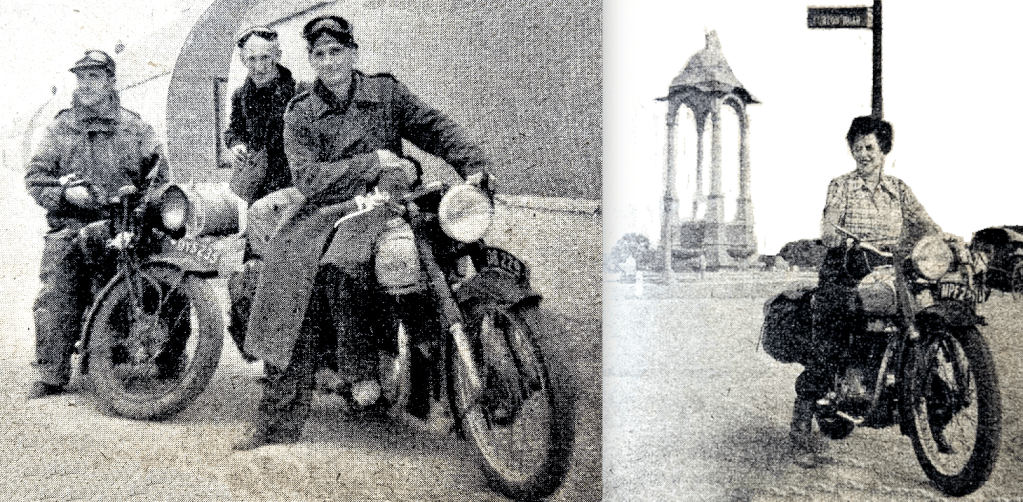
trotters whom he has encountered. This time he writes: ‘Last month there were two interesting people through here—Mr and Mrs McDonald, who are riding a couple of 125cc CZ machines from New Zealand to the UK— and possibly round the world if they feel like pressing on when they reach London. They came to Teheran via Australia, Ceylon, India and Afghanistan and they left this country for Iraq, Jordan, Egypt, North Africa, Spain and France. ‘The astonishing thing about this trip is that neither of them had had more than three months’ experience of motorcycling before they started out, but I should say that they have crammed the experience of years into the six months they have spent on the way here. They arrived in Persia at the wrong moment, for it was just before Anglo-Iranian diplomatic relations, were broken off and they spent three days in prison at Gorgon, in North Persia. Their documents were not quite in order and the local authorities, not knowing what to do with them, had to cable Teheran for instructions. We took their two machines and my Triumph Thunderbird out on to the Baghdad road, which is our only decent piece of asphalt, and swopped them round. They found that the Thunderbird was a trifle rapid, while the 125s felt a little sluggish to me, this being the first time in 27 years of motor cycling that I had ridden a machine of this capacity. They left with letter of introduction to ‘Motor Cycling’ and should reach London about mid-December.” The second letter comes from SAC IF Blake, of RAF Station Mafraq, Jordan. He writes: ‘I am sending a few words of praise for some chaps I met in Jerusalem on November 9. They are Bob Graham, whose home is in Queensland, Frank Hoffman, of Melbourne, travelling two-up on a Norton Dominator; and Jock McCabe of Glasgow, who is mounted on the most remarkable little ex-WD side-valve Royal Enfield, which, the journey from England to here had already suffered two frame breakages and some badly buckled front forks due to crashes on rocky roads. ‘These damages were being repaired in Jerusalem and I spent a happy evening with the boys at Mafraq, having fixed them up with accommodation for the night—with the CO’s permission, of course. They left on the following morning, quite happy about their-500-mile run across the desert to Baghdad…The Australians had been in England for two years and had saved enough money to make the return trip by road. They had also met up with Tony
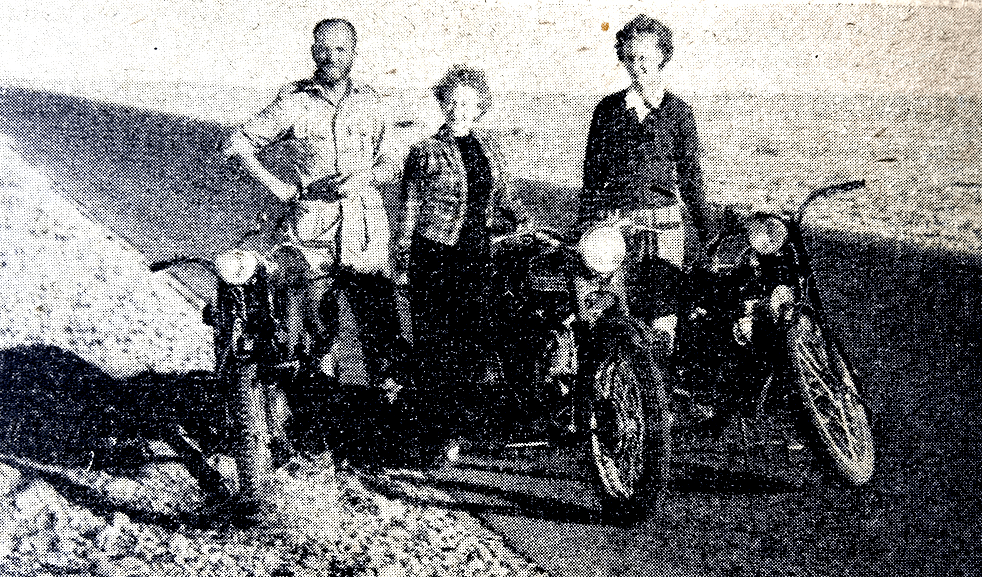
McCabe, who wanted to emigrate to Australia, and, believe me, his machine deserves a gold medal for the hard work it is doing, keeping up with the three-year-old Dominator at cruising speeds of 40-45mph wherever conditions allow. If other readers some in contact with these chaps, I would be very. pleased to read a few lines in our Green-un about their progress. I reckon they will deserve a grand reception on reaching Australia and sincerely hope they will enjoy the rest of their trip—they must be great enthusiasts!’ To round off this week’s news of .wanderers awheel there is the story of Miss Norah Gregory, who has recently arrived in Sydney, Australia, and who can probably claim to be the first British woman ever to have motor cycled from London to Calcutta—quite alone. Her mount was a four-year-old 250cc ohv BSA which she bought second-hand for £96. And she took her ‘L’ plates off just a fortnight before setting out. She left London on the cold, grey day of the King’s funeral—February 15, 1952—and she ran into her first weather trouble south of Paris, where icy roads forced her to pitch her tent in roadside snow. ‘But half an hour later,’ she records, ‘two gendarmes practically saved my life by bringing me boiling-hot coffee well laced with cognac’.’ In Italy, after a week in hospital following a slight accident, she faced bitter headwinds, while in Iraq heavy rains turned the desert tracks into muddy quagmires. In Pakistan, riding through the Sind Desert, a scorching hot wind seared her arms and legs: finally she caught the full force of the monsoon downpours on her way through Delhi to Calcutta. Throughout her long, and sometimes perilous, journey she used only ‘English and sign language—the only two I speak.’ But the Middle East, she quickly discovered, is a man’s world. Wearing ski-trousers for her journey, she was often asked if she was man or woman. Once, when she had given the correct answer by making curves in the air, an Arab proprietor of a Kurdish village coffee house refused to serve her. His expression, she said, clearly indicated that he thought a woman’s place should be in the home and not on a motor-cycle. Although she had planned, when leaving London, to ride through Afghanistan, she was put off by stories of tribal warfare on the border and, instead, went by sea from Basrah to Karachi, finding the ships all full to overflowing with pilgrims to the Raj. Dynamo trouble delayed her in Delhi—the only serious mechanical breakdown she experienced—and she was held up when she reached Calcutta through difficulties in obtaining a sea-lift to Australia…At Calcutta airport she was offered an air-lift to Bangkok, in Siam and got another air-lift on a zig-zag journey to Australia.”
MANY years ago I enjoyed brief notoriety as the Man Who Wheeled His Motor Cycle Round Corners; and this was very unfair, because I only wheeled it round left-handed corners. It is a sad little story, and a grim warning to bitza builders—especially young and inexperienced ones. . . Almost exactly 30 years ago, the assistant at our village garage owned a 1913 track-racing, belt-drive Singer; once the property of the famous Stanley. The assistant, whose name I cannot remember, was leaving England for South Africa and desired to dispose of his treasure, which I had long coveted. For one thing, it had a straight-through exhaust pipe of polished copper; for another, an imposing pair of bars whose grips terminated in line with the level of the wheel spindles; and there were other delights too numerous to mention. So mother put her rings in pawn; the owner departed; and I brought the Singer home. After three months, with never a dull moment, the gudgeon-pin fixing (a nasty arrangement involving a set-screw) came unstuck, and the pin ploughed a catastrophic furrow in the cylinder wall. The engine was now past repair; so, for that matter, was its owner. But life must go on, and life without a motor cycle, even such a one as this, was impossible, so I decided to fit another engine into the Singer’s frame. There was not a wide choice available, for this was a period when demand far exceeded supply. Only a new one was any good to me—I was feeling excusably bitter on the subject of second-hands—and new engines were dear and scarce. However, my mother had a distant acquaintance—they had met at a bazaar, or something—with the wife of a Very Great Magnate Indeed, who at that time was connected with the Blackburne Engineering Company; and with considerable effrontery, I traded on this opening to the extent of calling on the magnate at his enormous residence one evening after dinner, and asking him to sell me one of his engines. How I had the crust to do this, I cannot
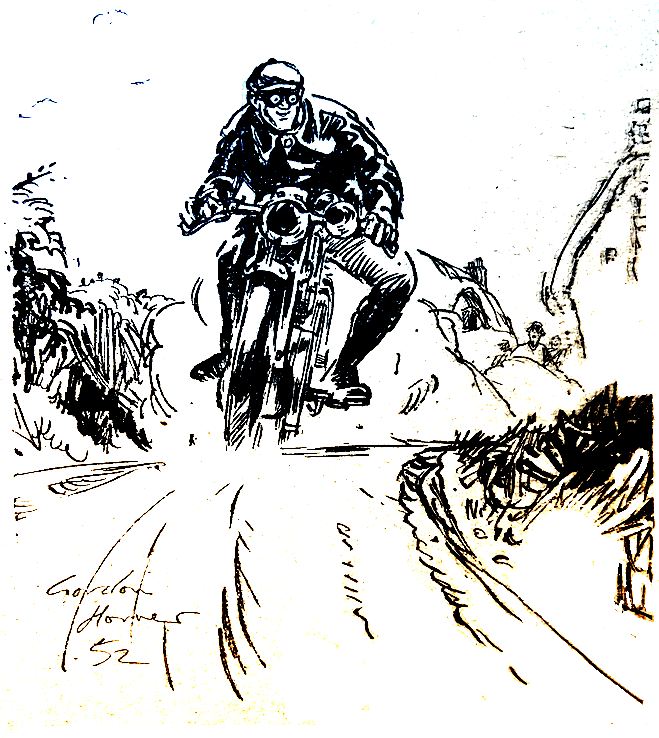
now imagine. But I happened to catch the magnate in an expansive mood—he’d had probably made another million that day—and at the end of the interview I was the proud possessor of a new, outside-flywheel 4hp Blackburne and a colossal cigar, both of which were to make me very unwell. Mother’s necklace joined her rings and in a few days the engine was delivered. At that time I had little equipment, and was working long hours trying to retrieve my parent’s jewellery, so the actual fitting of my prize was perforce entrusted to the local garage. I used to rush in late at night, assist in cutting up little patterns destined to serve as engine-plate patterns, and join in the chorus of rustic cries of self-approval as each problem was solved. The side-valve engine would just clear the lower tank tube, but the worst headache—then—was the belt pulley. The Blackburne was designed for a chain sprocket, which screwed on a boss on the inside face of the flywheel. The boss was large, which meant that the pulley would have to be larger still, and eventually we found that the smallest possible diameter gave a single gear of about 3½ to 1. This was a rather flattening discovery, as I lived in a hollow between two hills, and I visualised—very correctly—some difficulty in starting. But there was no help for it, so all the local peasantry were roped in to take turns at treadling the lathe on which my pulley was to be turned from a bar of solid steel. It was a slow process, and I think its ultimate cost was about seven pounds and five gallons of beer; or it may have been five pounds and seven gallons. But there came a Saturday when my rejuvenated Singer was ready for the road, and very handsome it looked. The enormous outside flywheel shimmered and glittered in the sun as I wheeled the machine on to the road, followed by the entire garage staff swollen with my money and the pride of the rural craftsman. Amid cries of, ‘See Gearge, ‘er’s gooin’ now,’ I set the throttle and air levers, flooded the Senspray, raised the valve-lifter and pushed off. The engine fired at once—at about every second telegraph pole—and I leapt aboard, swung round a slight left-hand bend, and. … DONG . .! What a beautiful, sweet-toned bell, I thought; but where on earth is it? No church near; and anyway, they don’t ring the Angelus in England. . . DONG. . .! Somebody’s dead, then; one for a man, two for a woman, three for. a child. Must be poor old Higgs, I suppose. But dash it, the church is at the other end of the village! DONG! This time there came a slight lurch and, from the corner of my eye, I spied a shower of sparks. I went quite cold and numb inside, shut the throttle, and dismounted. It was only too true. The garage proprietor’s assurance that the engine would fit into my frame with what he always called ‘ampler’ of room was apparently based on the erroneous assumption that a motor cycle in motion remains, car-like, strictly vertical. It was the first time I had seen the flywheel in position. Beneath it was a ground clearance of exactly one and a half inches. I popped and donged my musical way homeward and for the next two months (until I sold the thing to a man who wanted an engine for a beet-slicer), tried to evolve a left-hand technique for silent cornering, but without success. I soon found that people began to look strangely at the motor cyclist who came roaring up to the corners, hastily braked and dismounted, and pushed round on tiptoe. Efforts to convince them that it was part of a new road safety campaign met with no luck at all; odd whispers reached my ears…’bit daaft-like, I reckon, or else afeard; dunno which. But ‘e (spit) allus pushes ‘is motybike round…’ But I didn’t, you know; only left-handers.”
DURING 1952, 3,143 RAC motor cycle members made use of the Club’s ‘Get-You-Home’ service. Ignition defects still constitute the major source of trouble—this has been the case since breakdown figures were first published by the RAC over 30 years ago. Faulty ignition caused 20.11% of motor cycle breakdowns covered by the 1952 report. The second major source of trouble for motorcyclists proved to be punctures, with 15.48%, and various forms of engine trouble with 8.90%. Compared with 1951, accident figures dropped from 4.19 to 2.71% for motor cycles.”
“ONE OF THE feature events of the Carnival Week held at Wanganui (Rod Coleman’s home town) was the motor cycle road race meeting run on Boxing Day. A tar-sealed circuit of nine-tenths of a mile—known as the ‘Cemetery Circuit’, because it encircles the old town cemetery—was used for the second successive year, and a good crowd attended in splendid weather. Unfortunately, Dene Hollier fell during practice, when he fouled the kerbing on the railway overhead bridge, damaging his left foot and bending parts of his 499cc Norton. This robbed the afternoon’s racing of much interest, for it would have been Dene’s first appearance since his return to New Zealand. As expected, Coleman was the outstanding rider of the day. He gave faultless exhibitions when he won both the Junior and Senior races on his 7R AJS and 499cc Norton respectively, taking the Junior event by 100 yards from the improving Les Aislabie and finishing the Senior with 150 Yards to spare—again from Aislabie.”
“RIDING 197CC AMBASSADORS, Billy Meier, Ed Eby and Sam Piazza finished first, third and fourth respectively in the Bay City Motor Cycle Club’s hare-and-hounds race in San Francisco, on December 28. Riding a Triumph, Rocky Kremesec came into fifth position, with AJS and BSA riders sixth and seventh.
Before closing the year with the Green ‘Un’s Xmas greetings, here’s a batch of 1952 pics from mi amigo Francois, whose pictorial contributions continue to fill this site’s Melange pages. I don’t have the background stories but have included the captio n info as supplied. So here’s a final taste of motor cycling in 1952; se you in 1953—Ed.
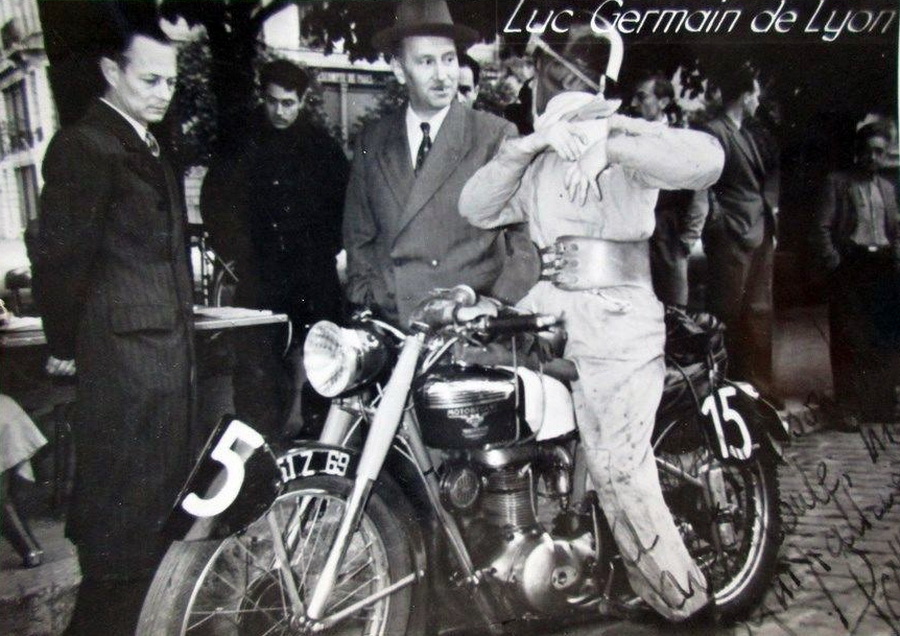
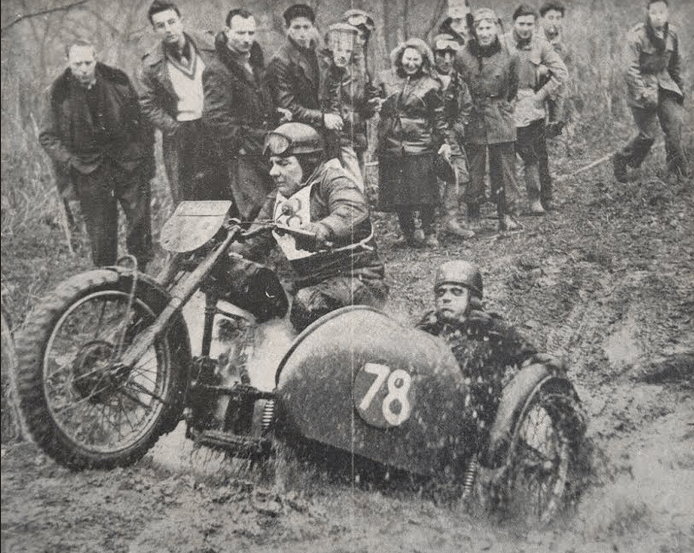
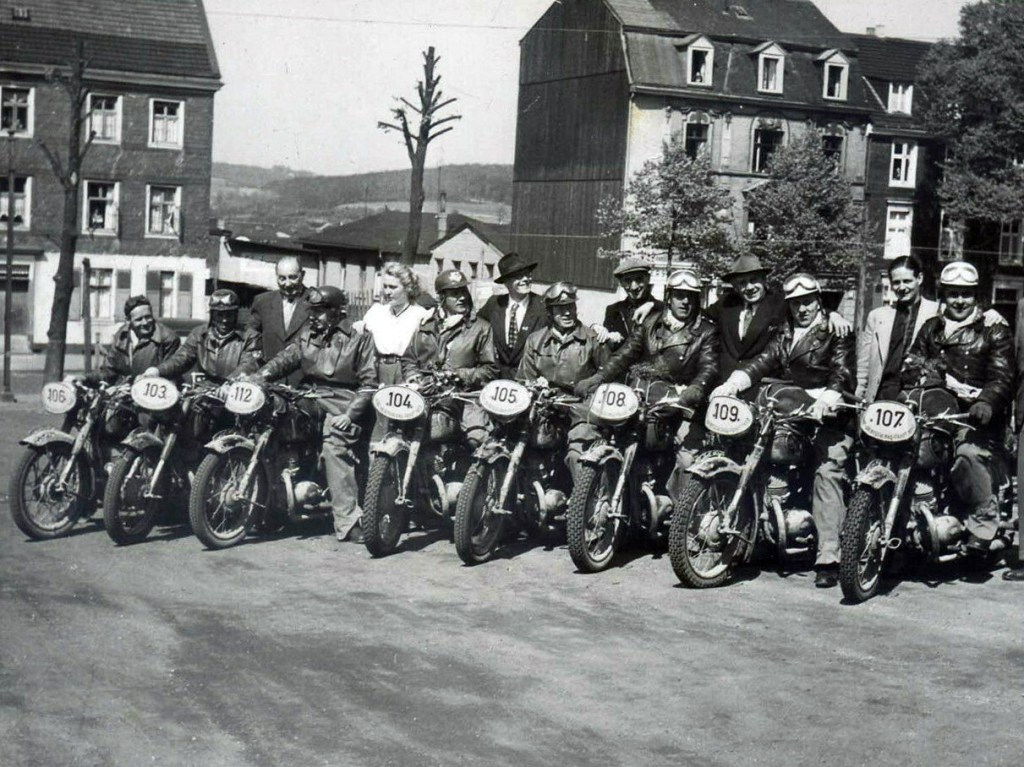
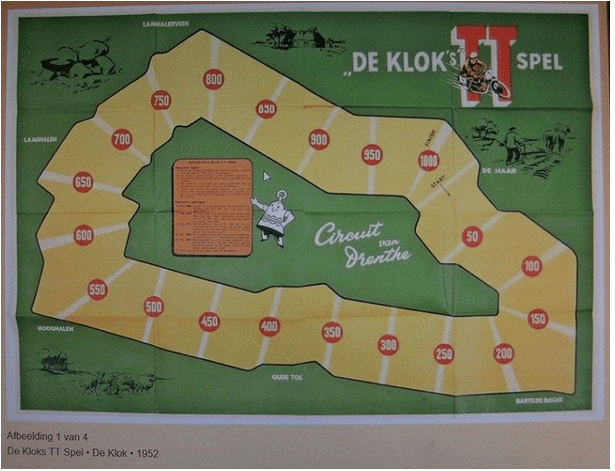
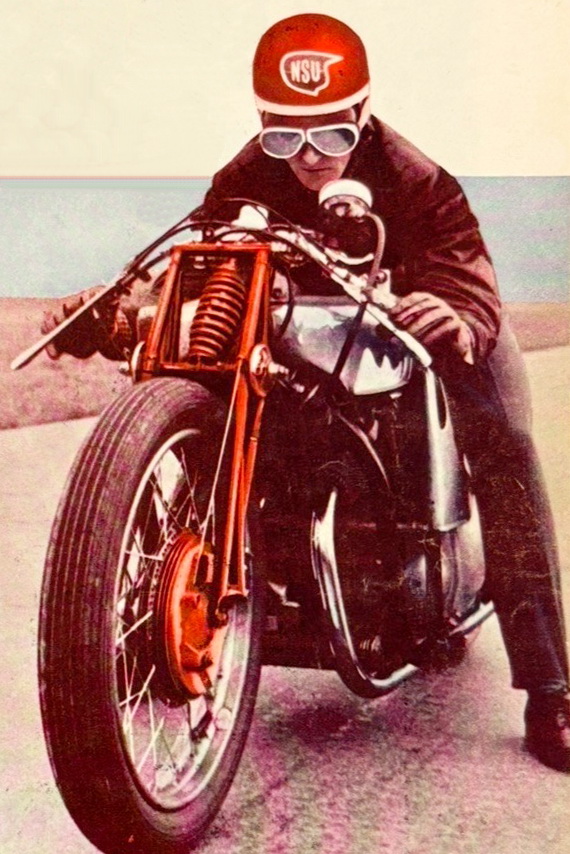
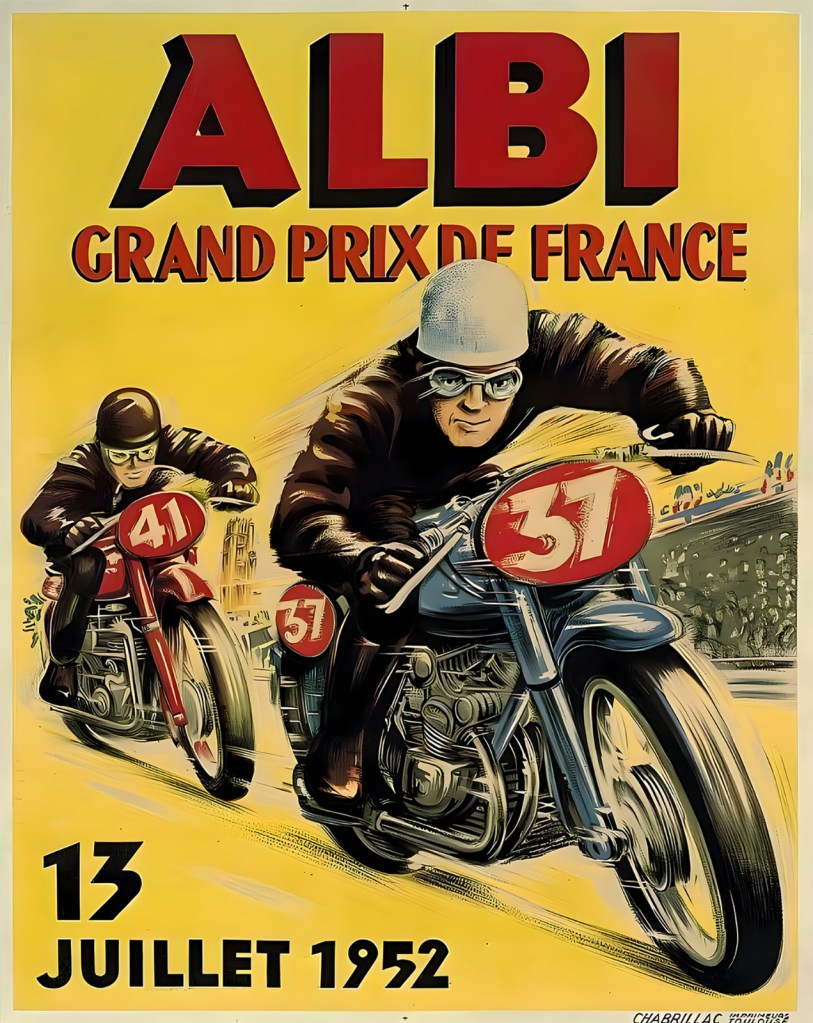
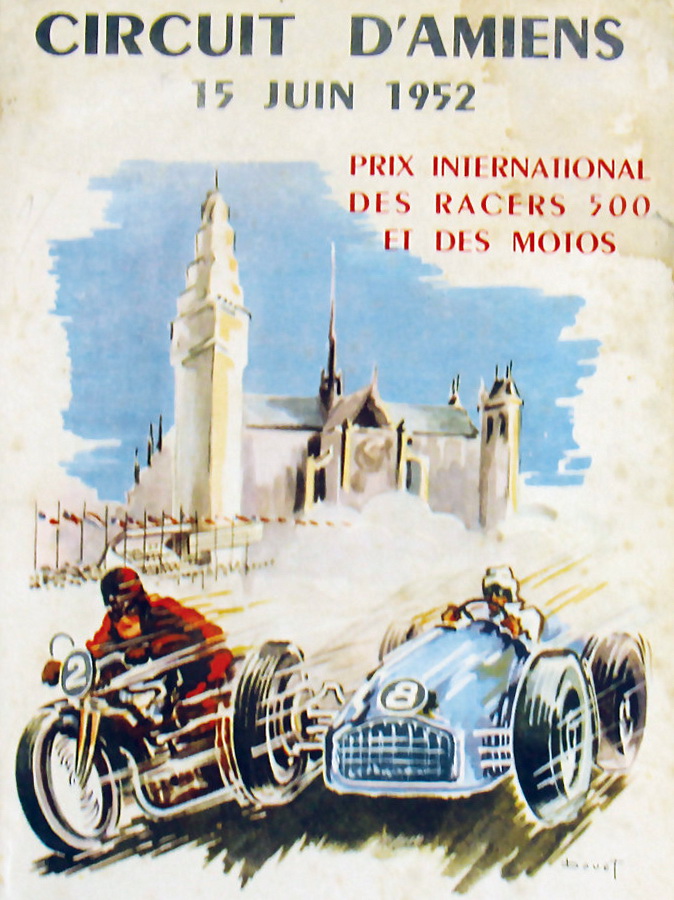
“FIFTY YEARS AND A DAY have passed since the staff of Motor Cycling first wished their readers ‘The Compliments of the Season’, for it was on December 24, 1902, that the then Editor employed this somewhat stilted phrase when realising ‘with infinite pleasure that the Christmas greetings which we now most heartily extend go forth to more than 20,000 readers’. And now, on this 25th day of December, 1952, the present Editor and staff offer, with that same infinite pleasure, their Christmas greetings and good wishes for the New Year to a circle of readers which has expanded some tenfold with the passage of half a century. And with those greetings we couple our grateful thanks for the hundreds of Christmas cards which have reached as from the four corners of the earth. It is at once an inspiring and humbling experience to realise that so many people in no many far away places have found time to remember us at this season. Whilst we cannot go all the way with the staff cynic, who recently defined Christmas as the one period of the year in which human beings become human, it is, nevertheless, a fact that in a world of ever-changing values and standards—and changes by no means always for the better—the Christmas-tradition has remained unshaken and unaltered. It is an occasion when men, escaping temporarily from the hard knocks of everyday existence, tend to count their blessings rather than to nurse their grievances. And, in that connection, it is as well to recall at this time that ten years ago, we had only reached the halfway mark of the greatest war in history, and that five years ago to-day British motor cyclists deprived of their basic fuel ration were, perforce, pedestrians. Compared with such hardships, even to-day’s, Purchase Tax pales into insignificance. Optimistically, then, we close the 52nd issue of 1952 and append below the real message of this page this week.”
You’ll find an extra-large collection of ads this year; among the ex-WD bargains is a new one on me—DR trousers to go with the DR coat and boots I used to wear.
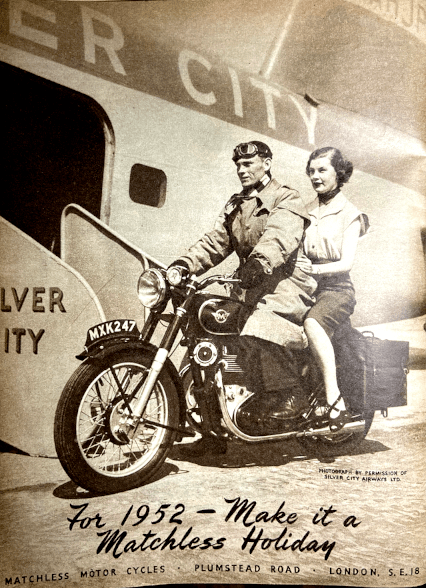
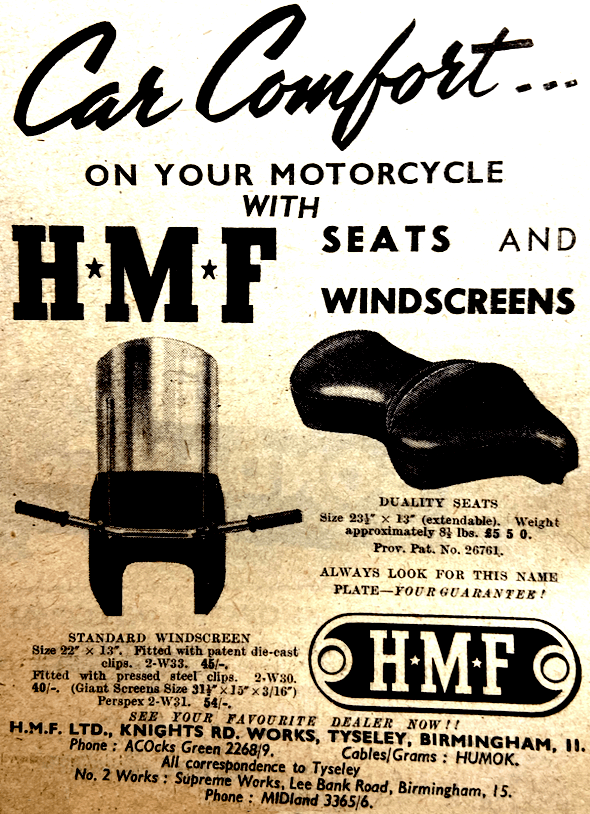


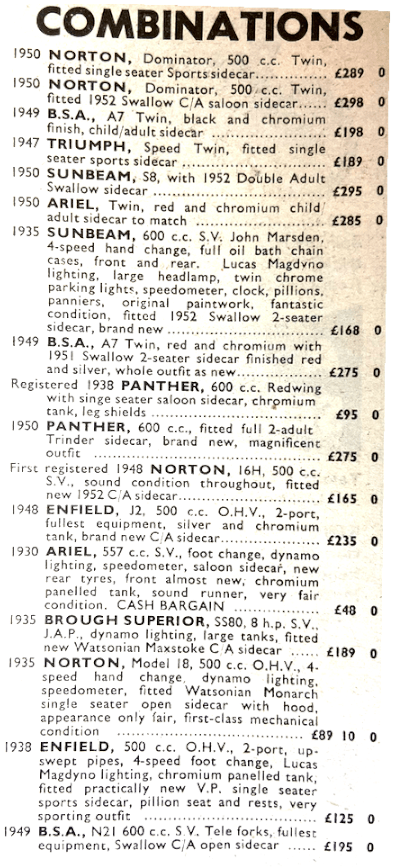
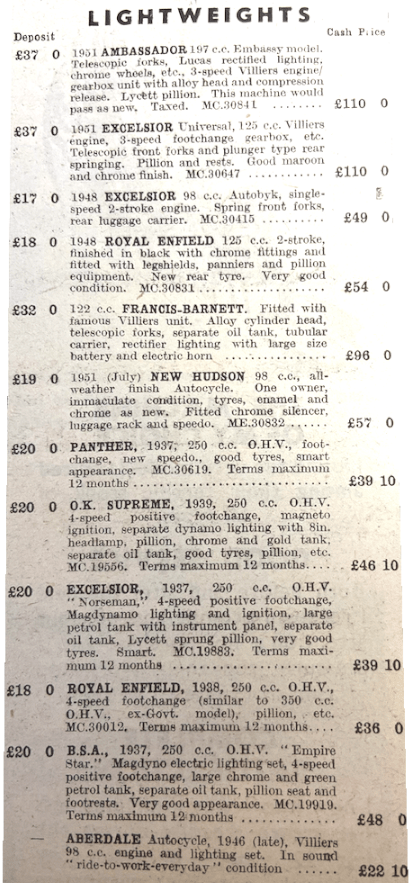
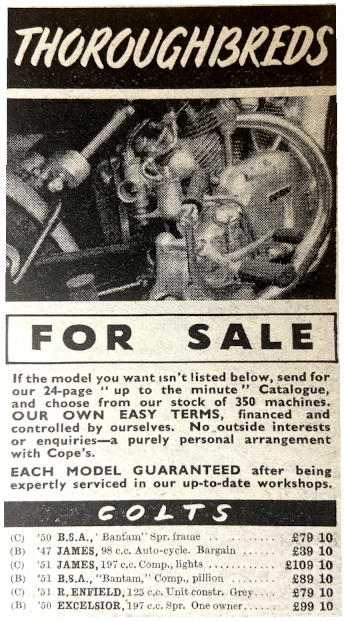
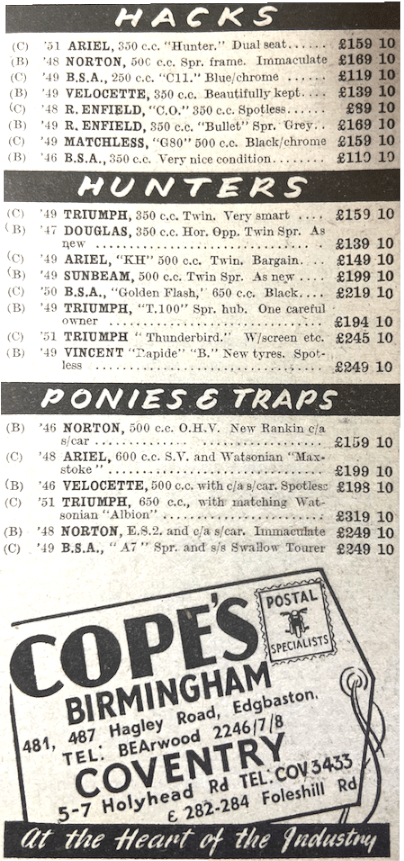
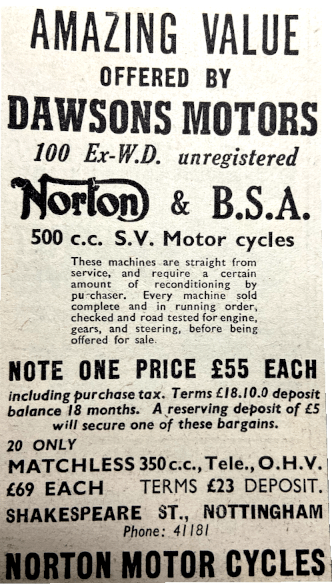

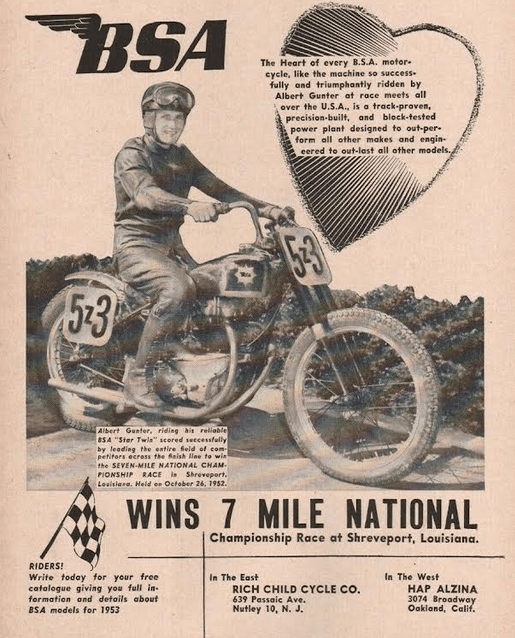
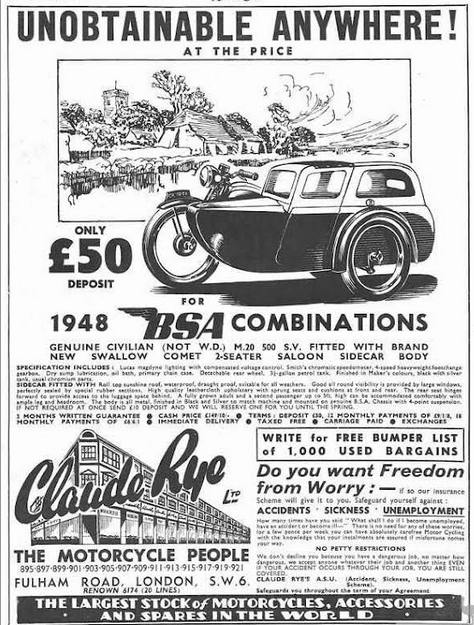
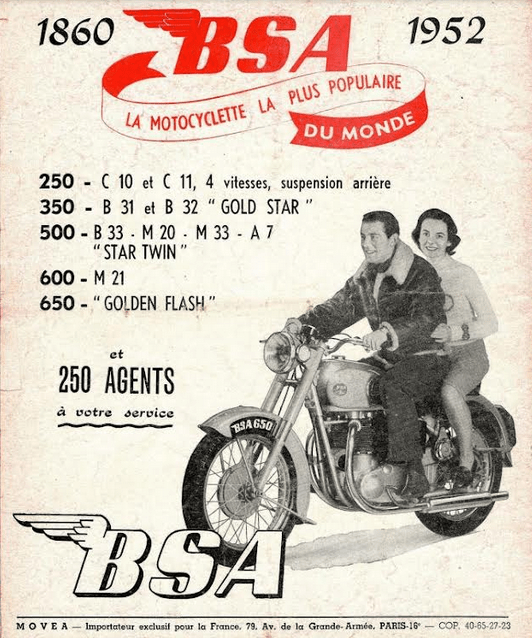



To give a taste of what else was happening on The Island during TT week, here’s a selection of ads from the Isle of Man Times…

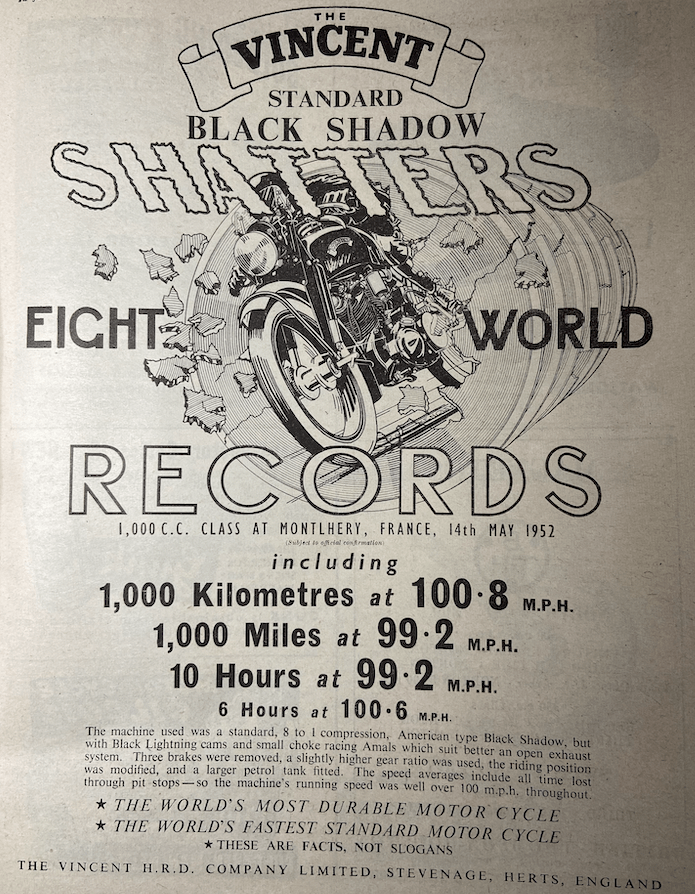
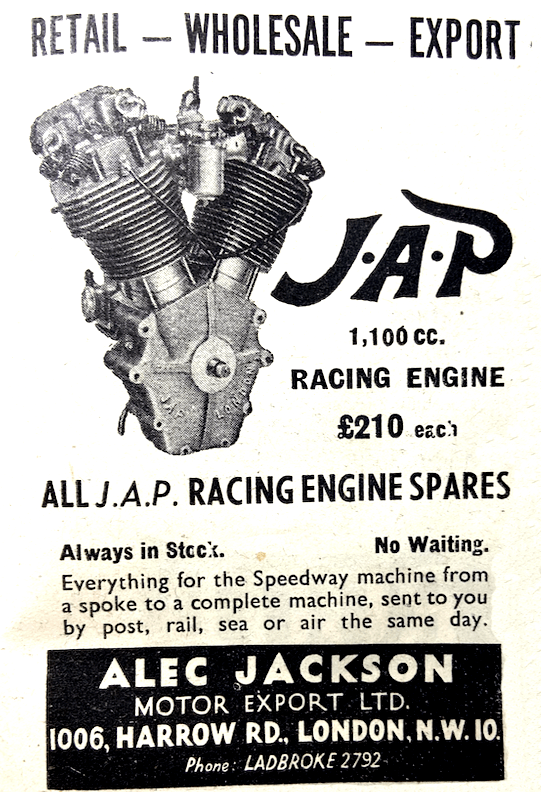
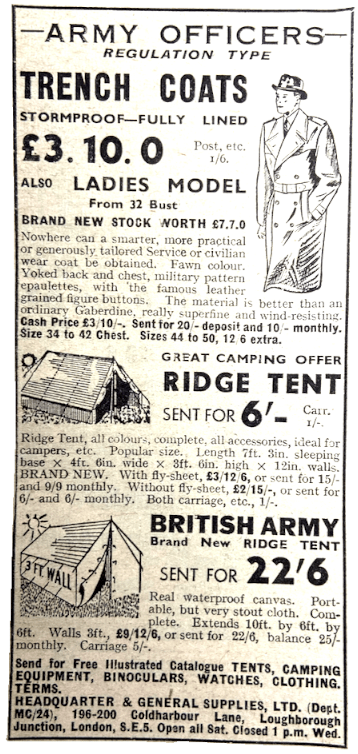
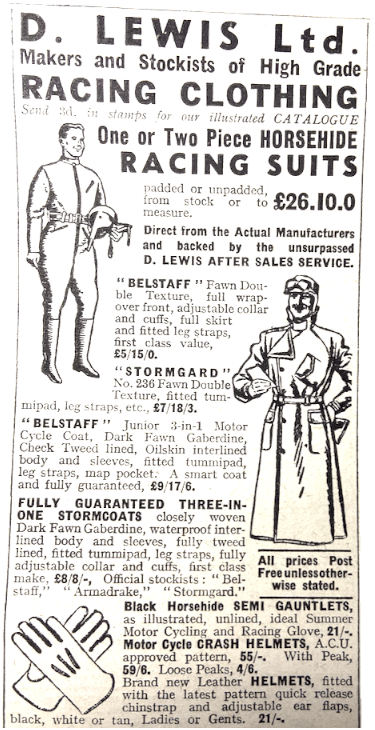
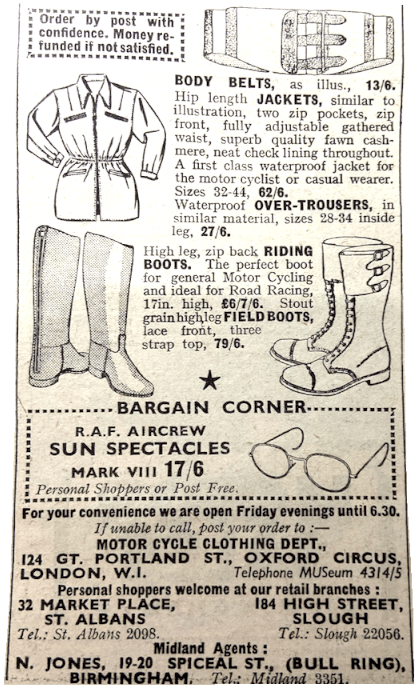

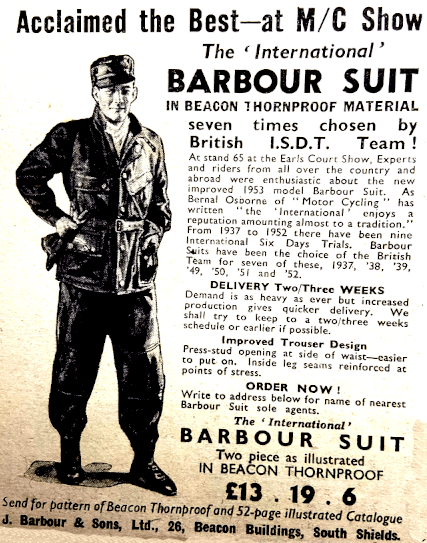
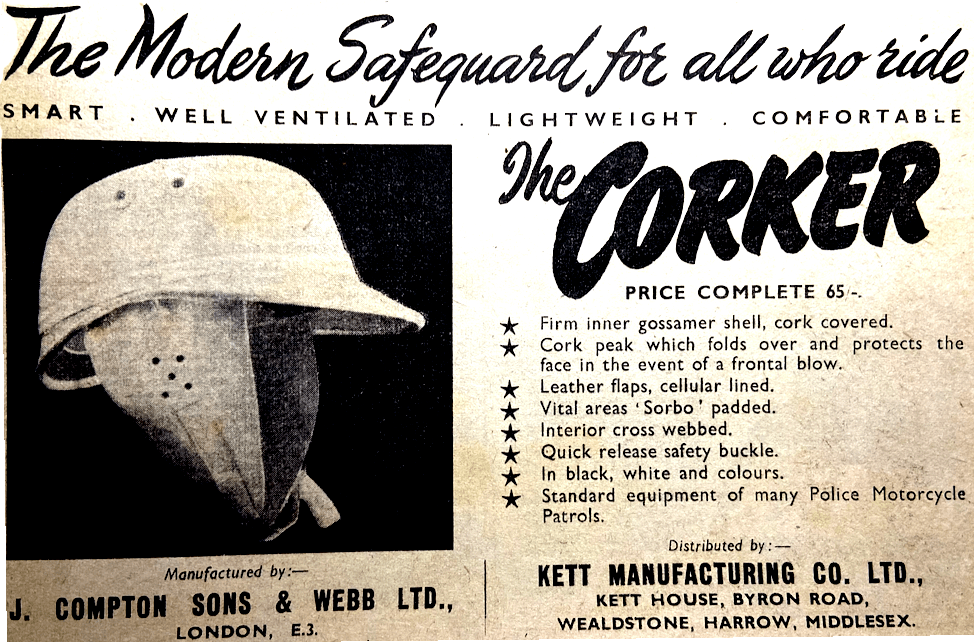
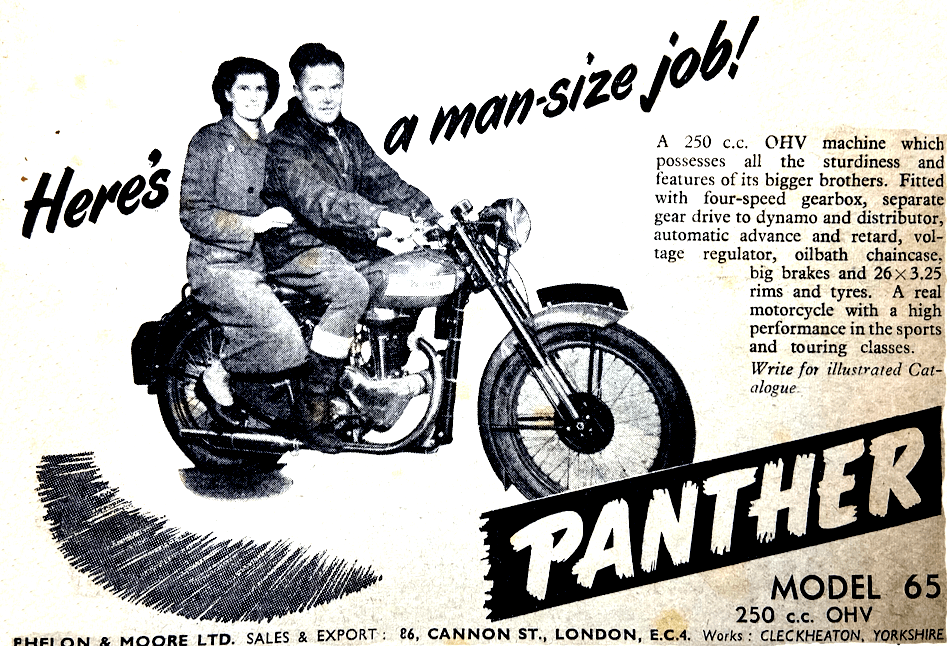
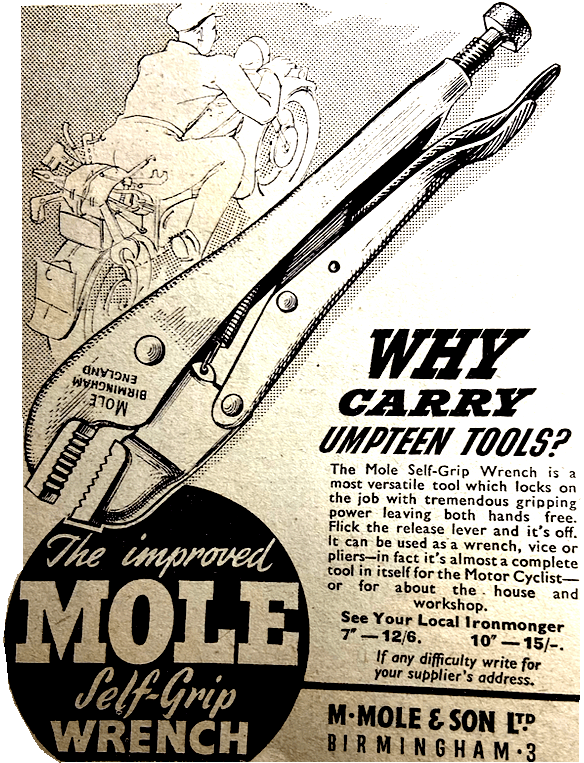
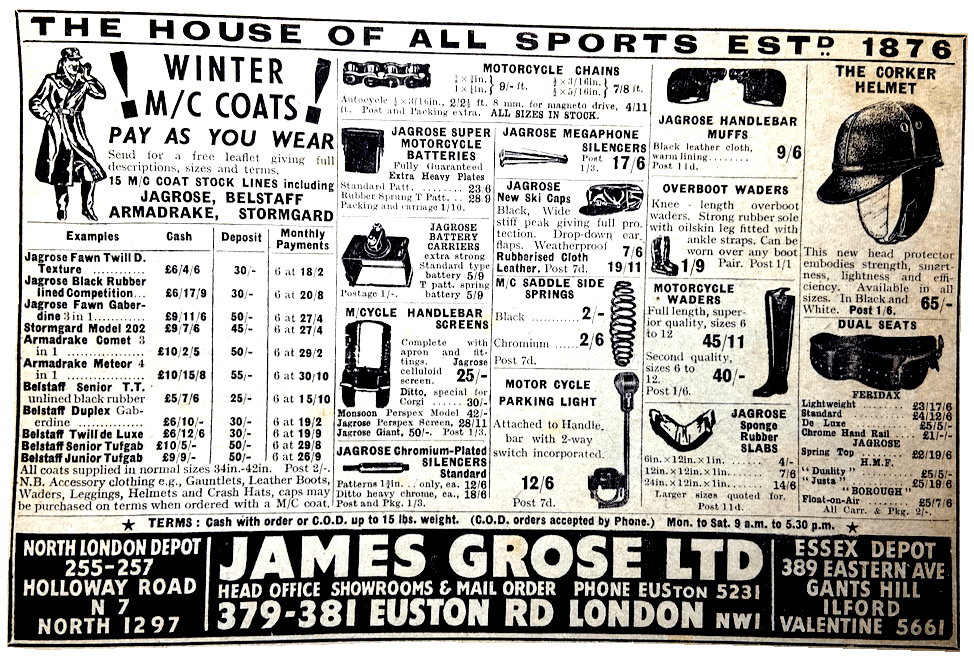
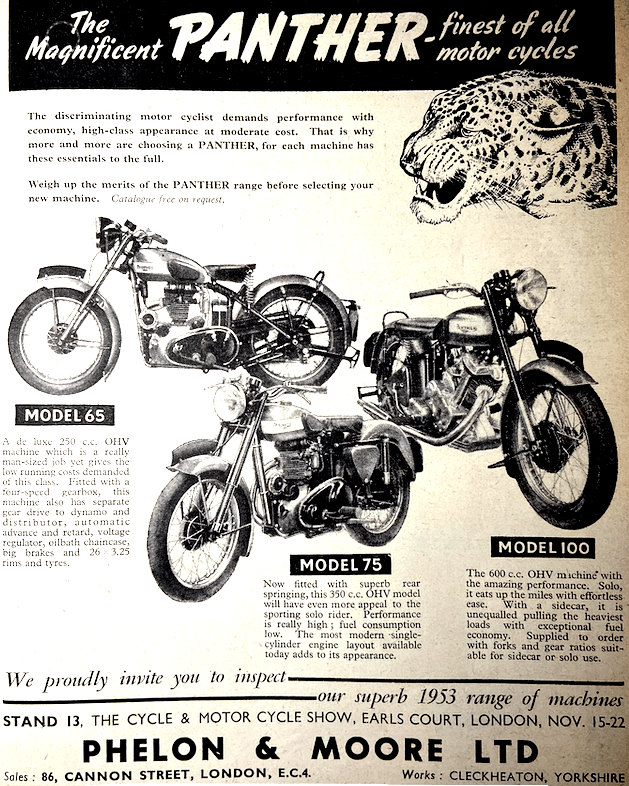
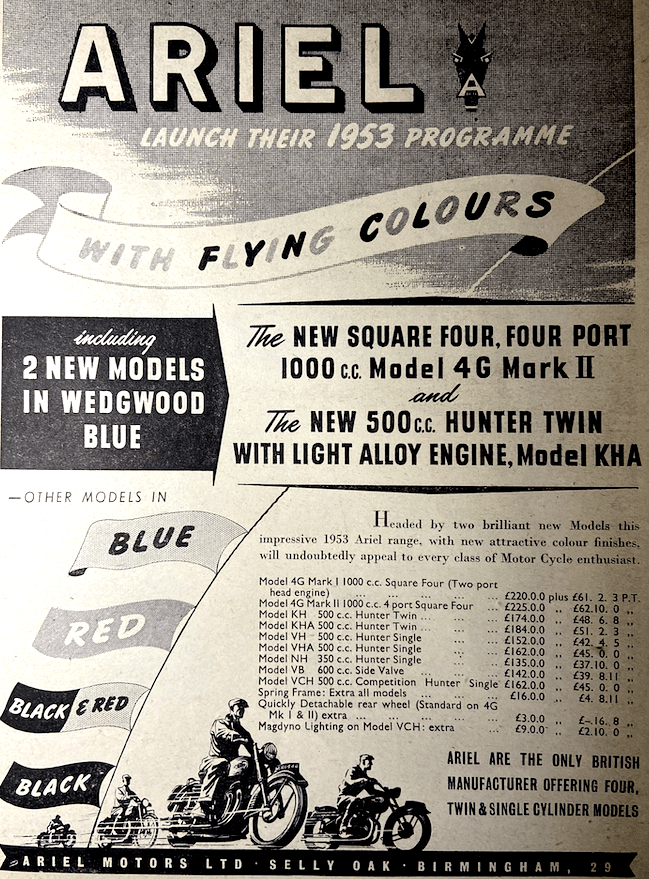
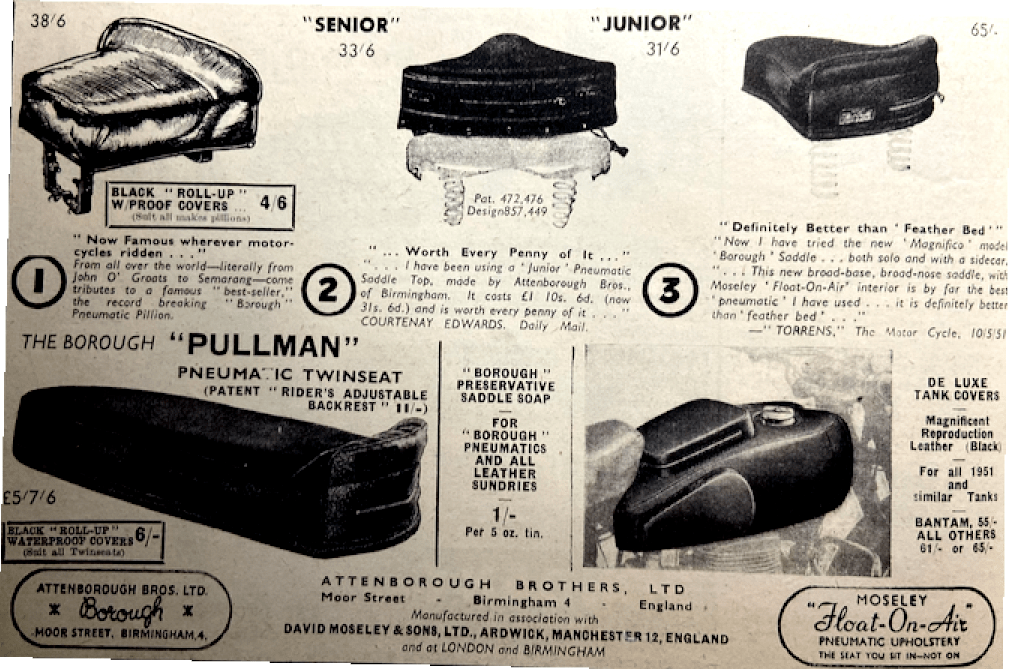
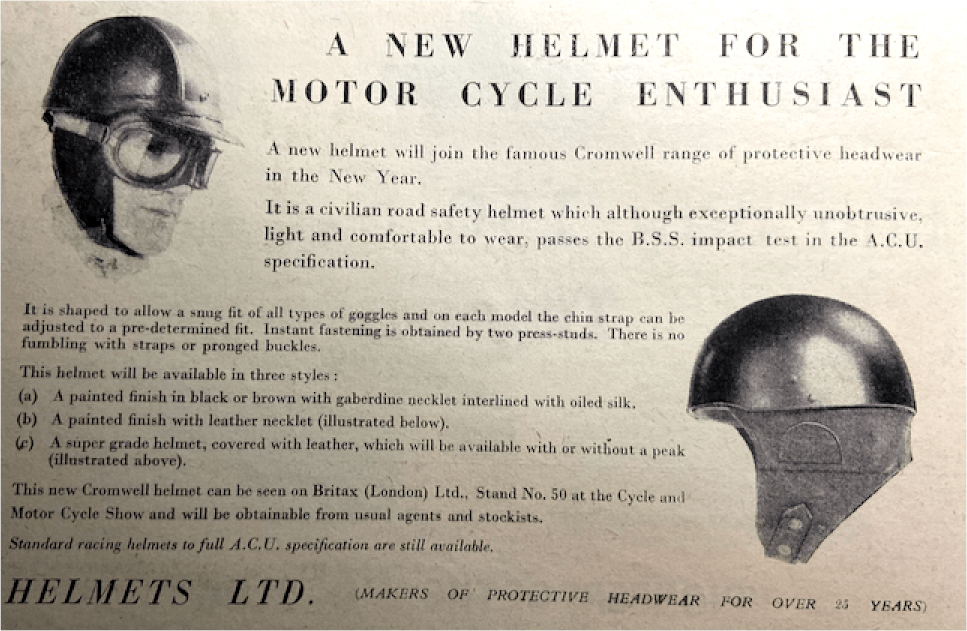
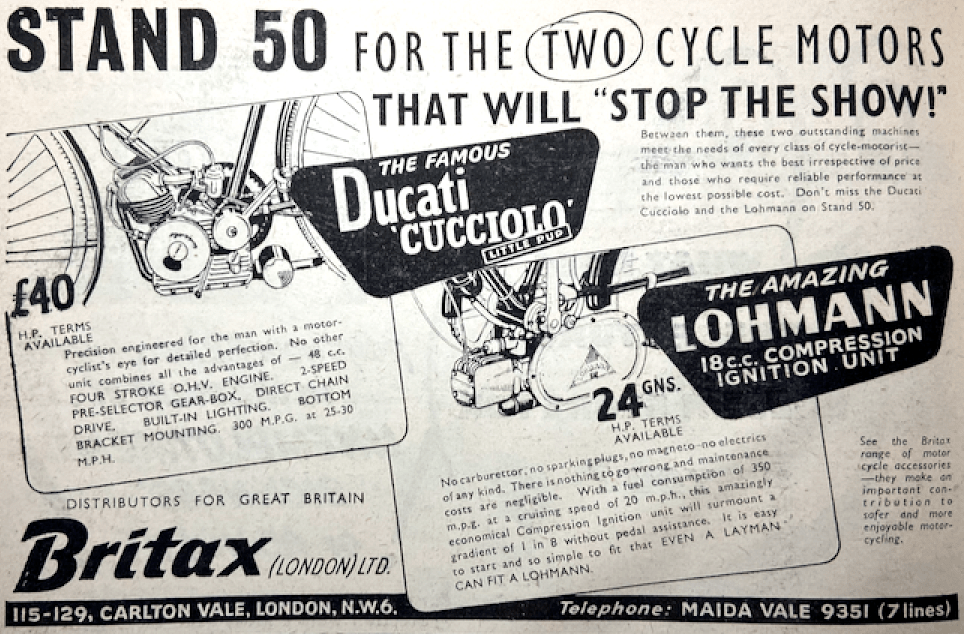
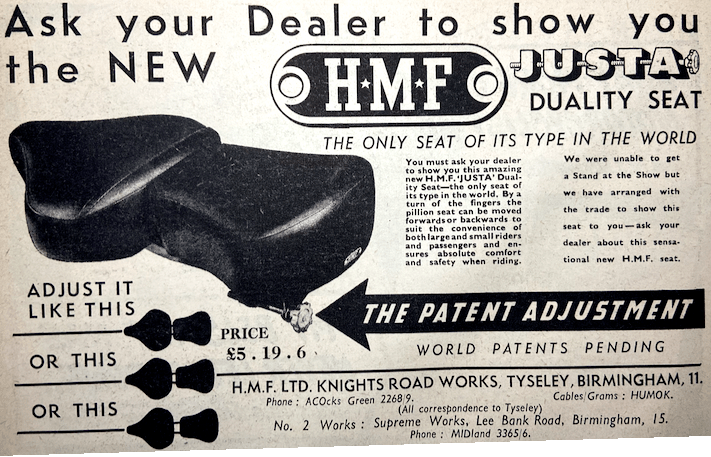
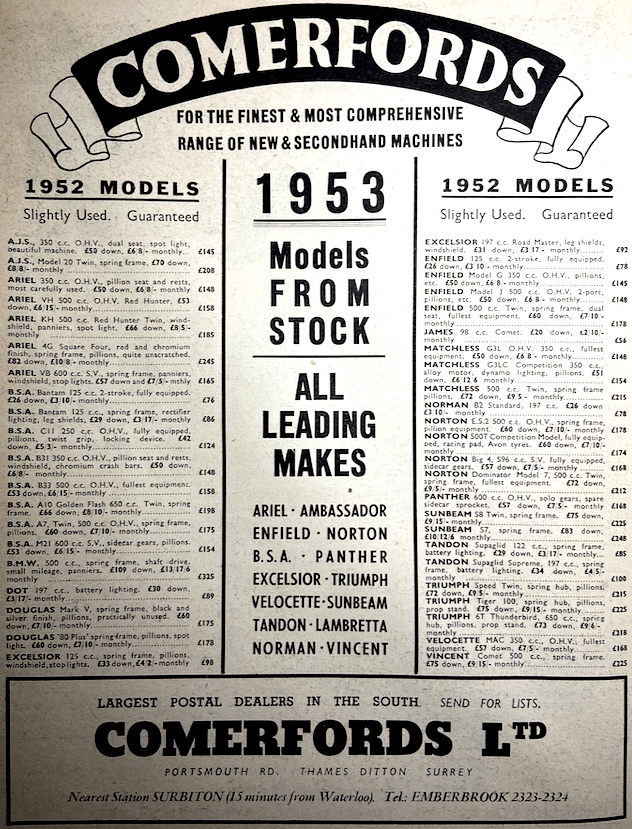
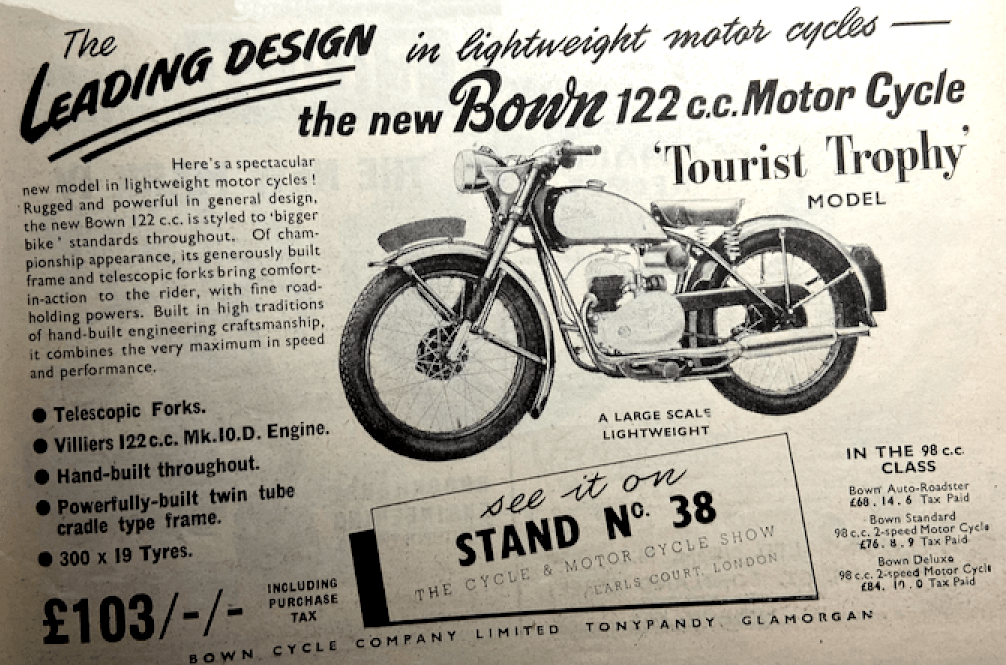

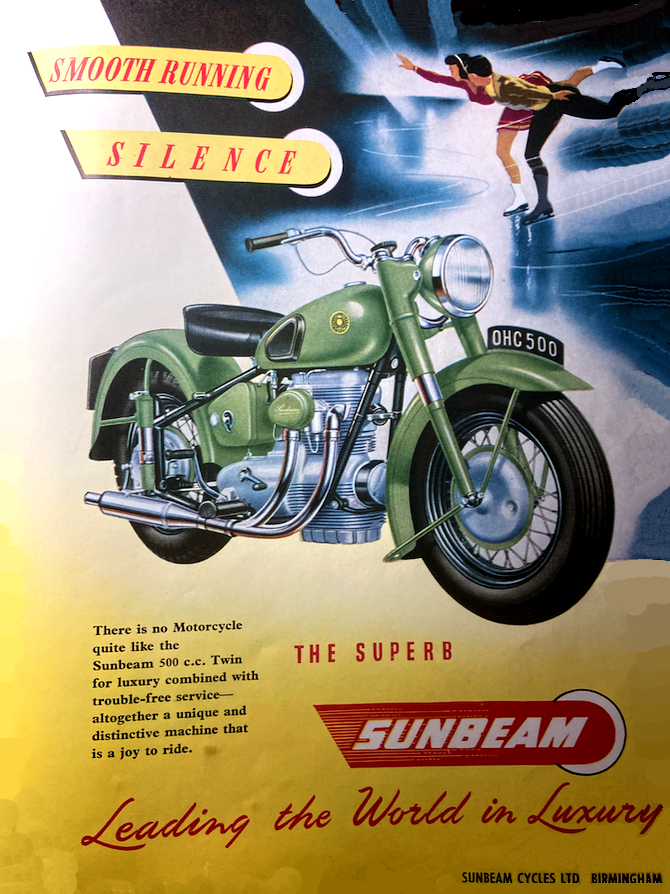
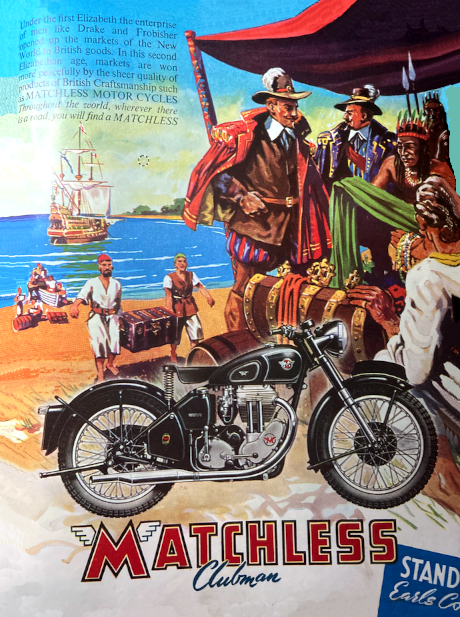
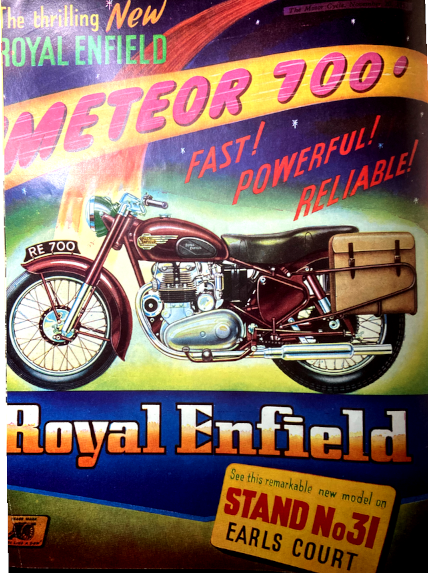
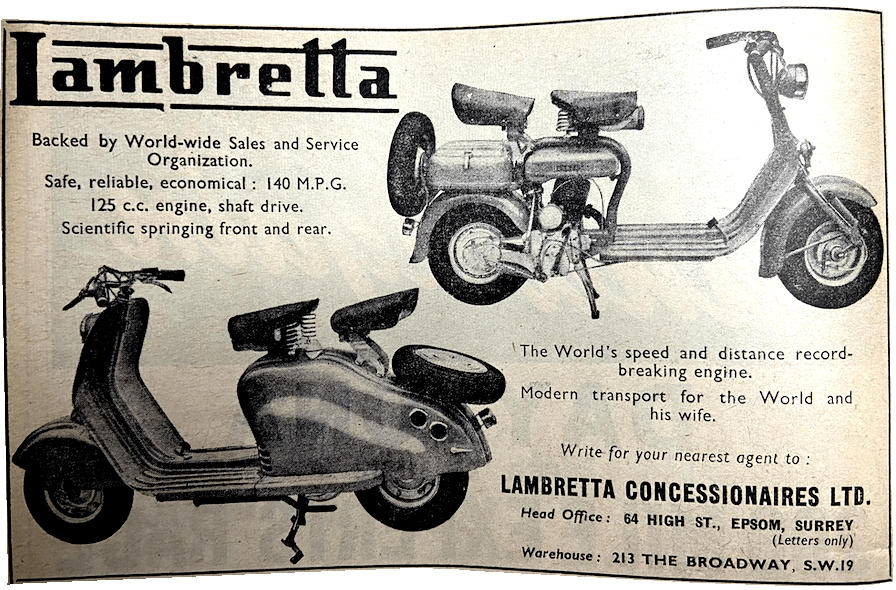
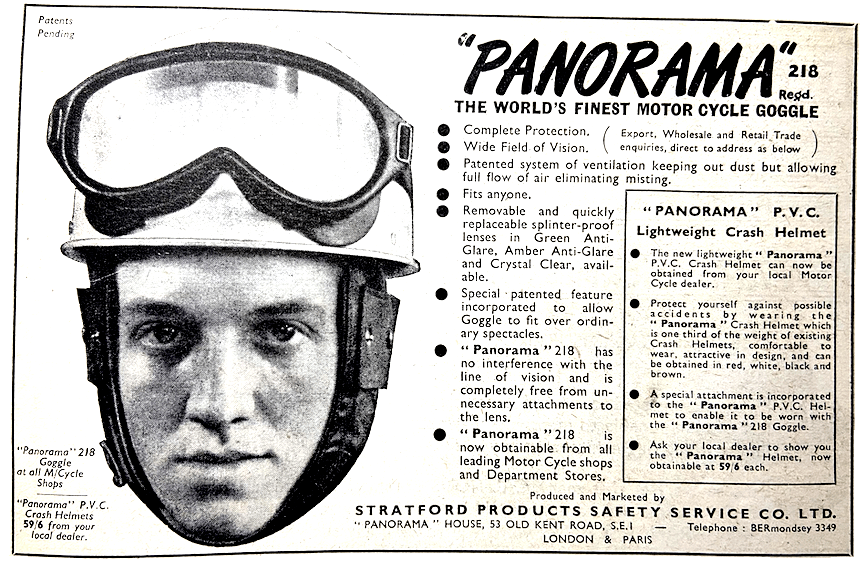
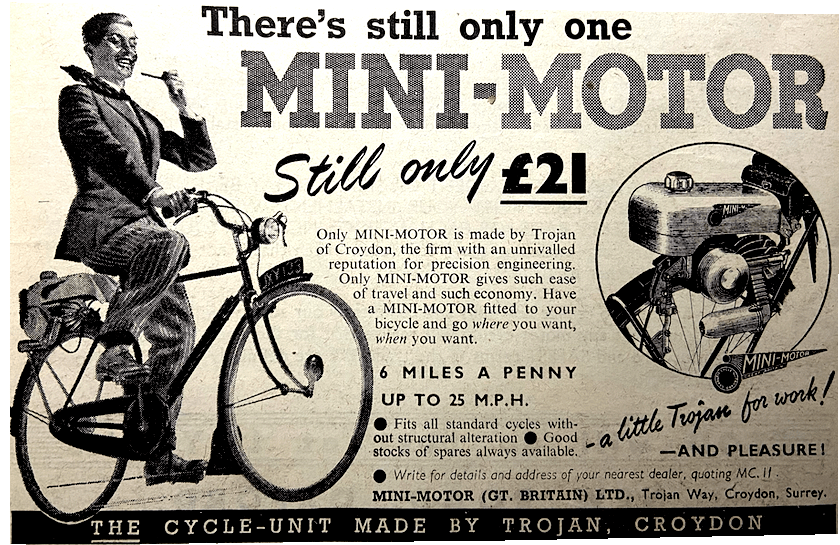
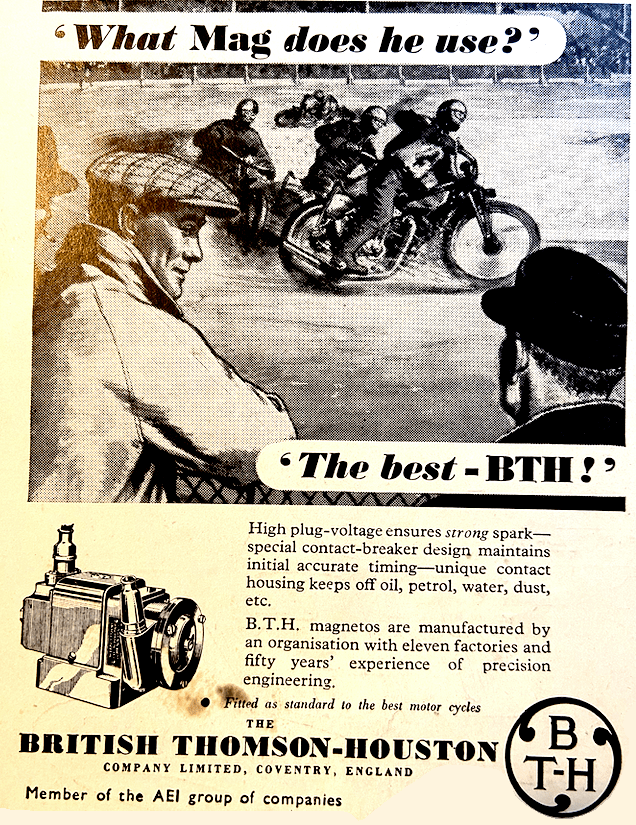
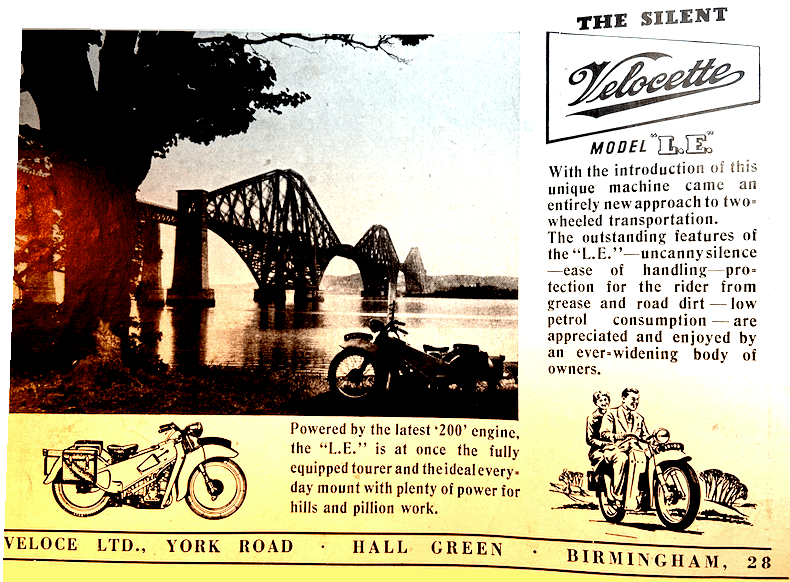
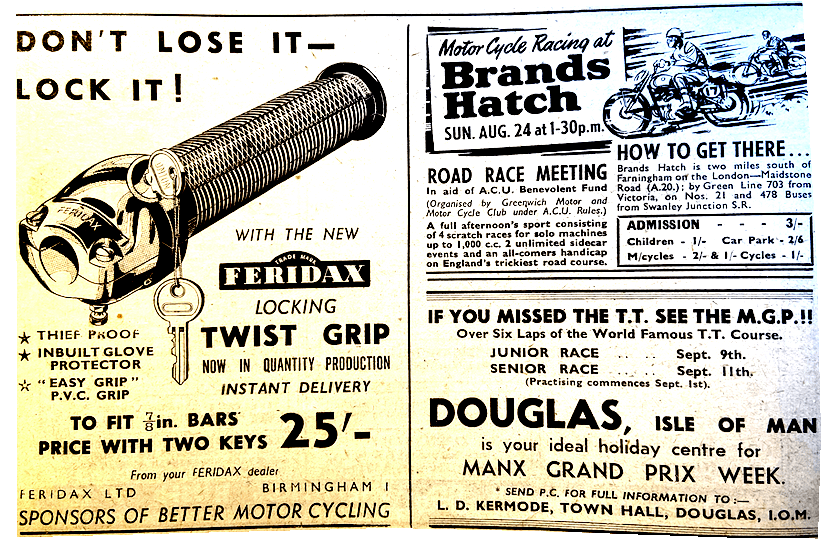
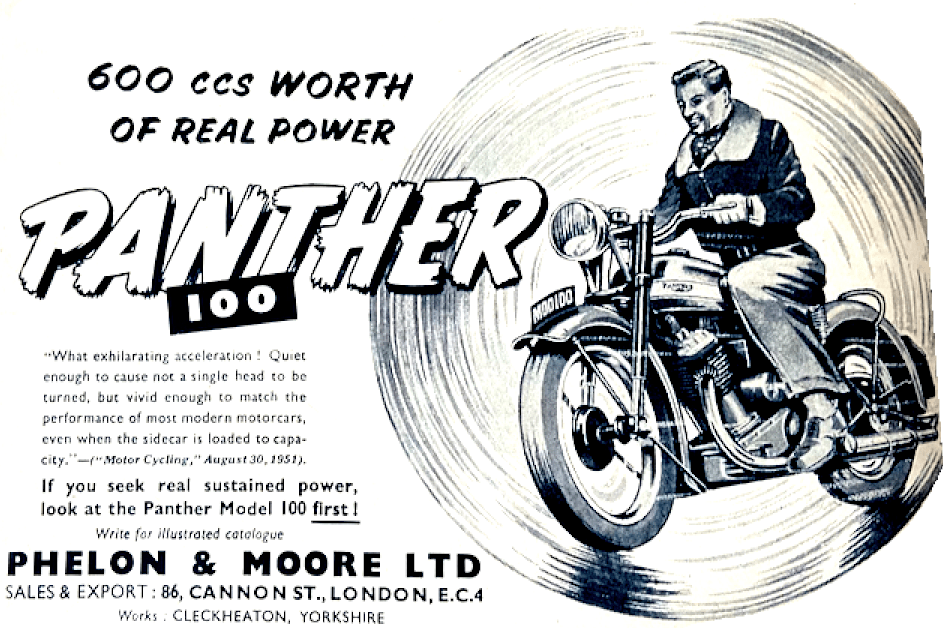
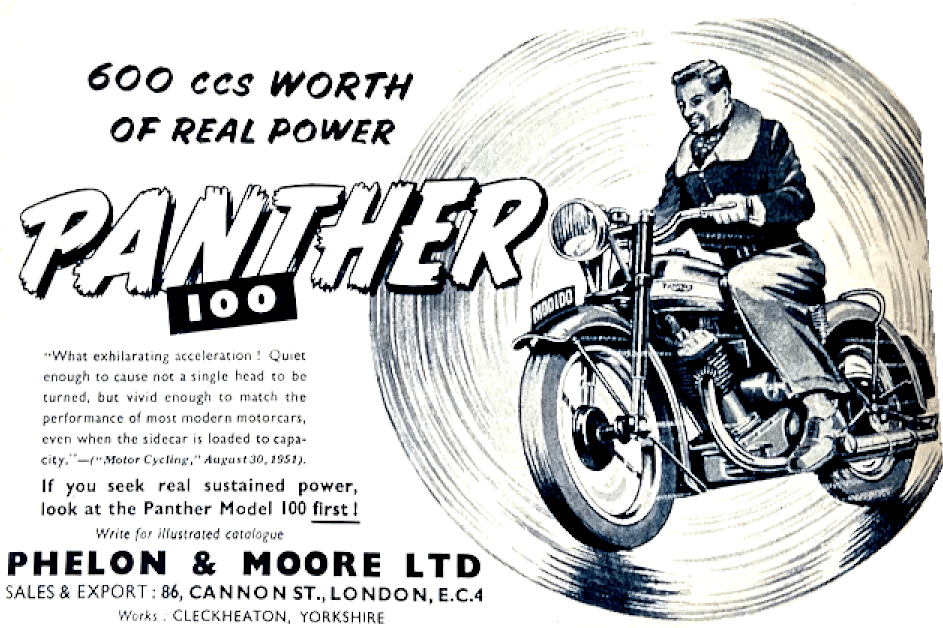
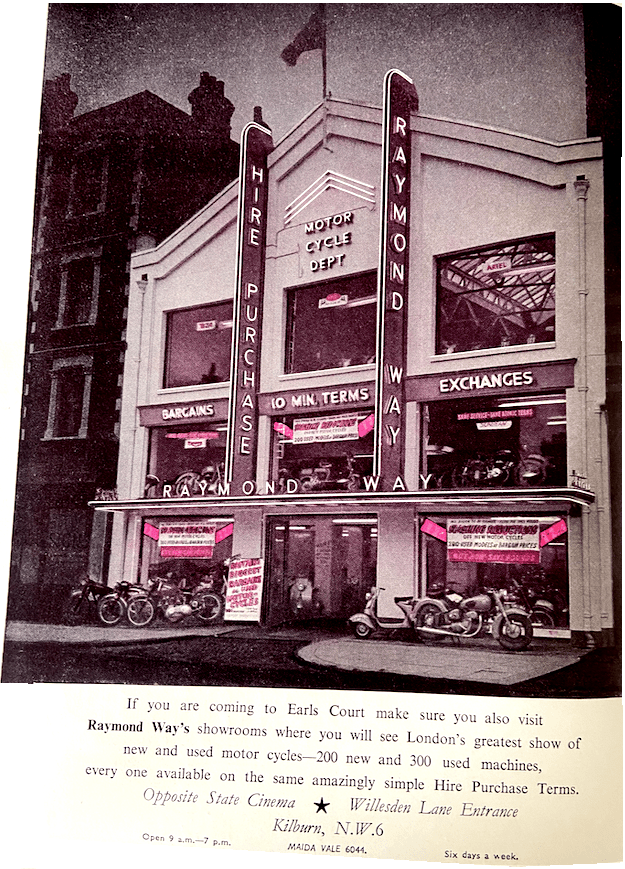
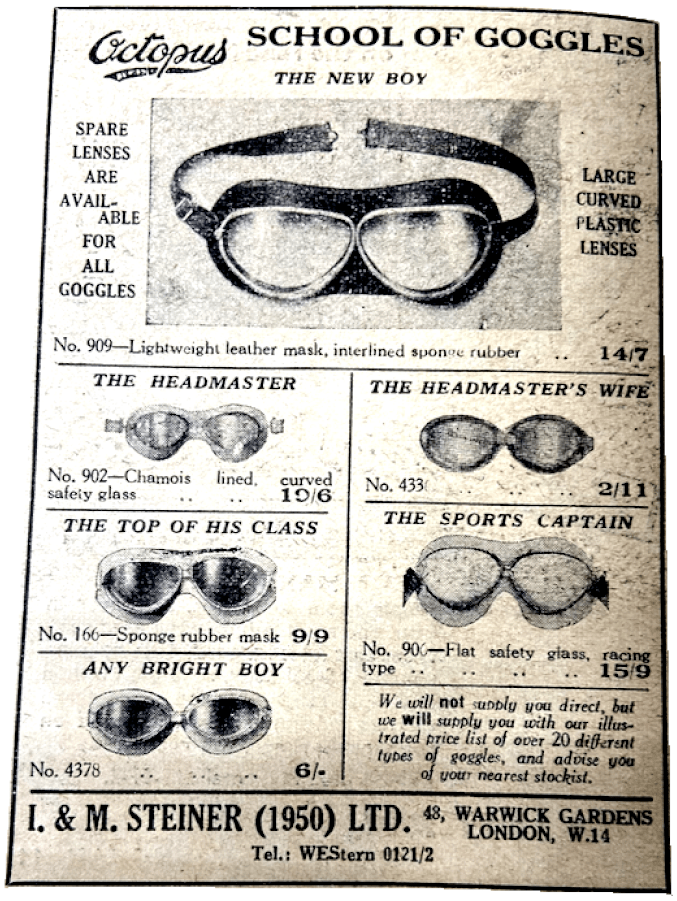
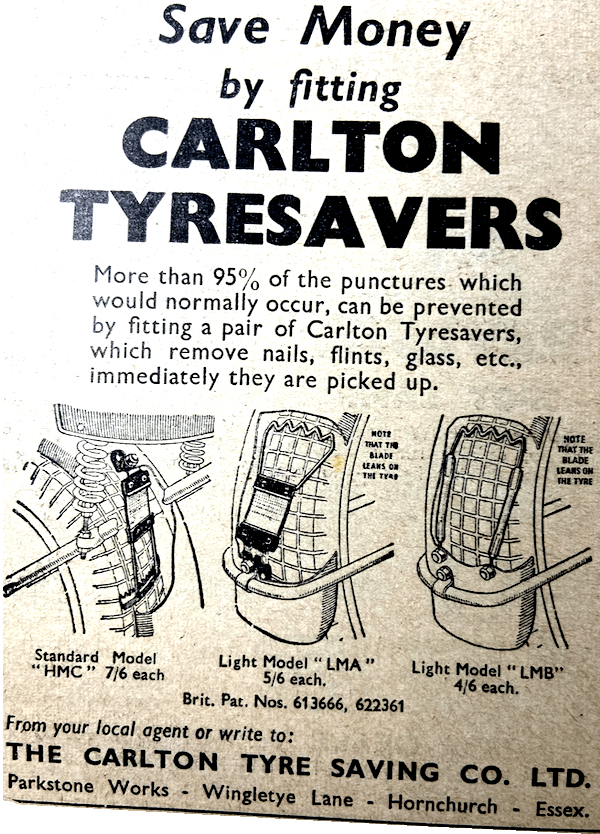
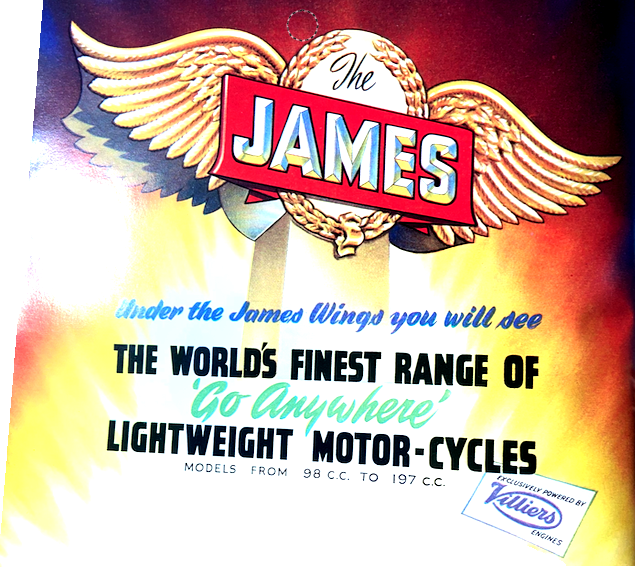
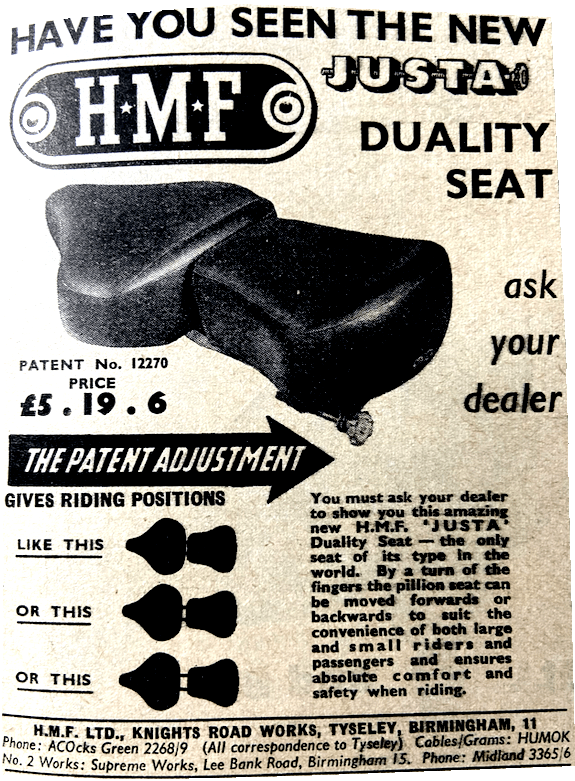
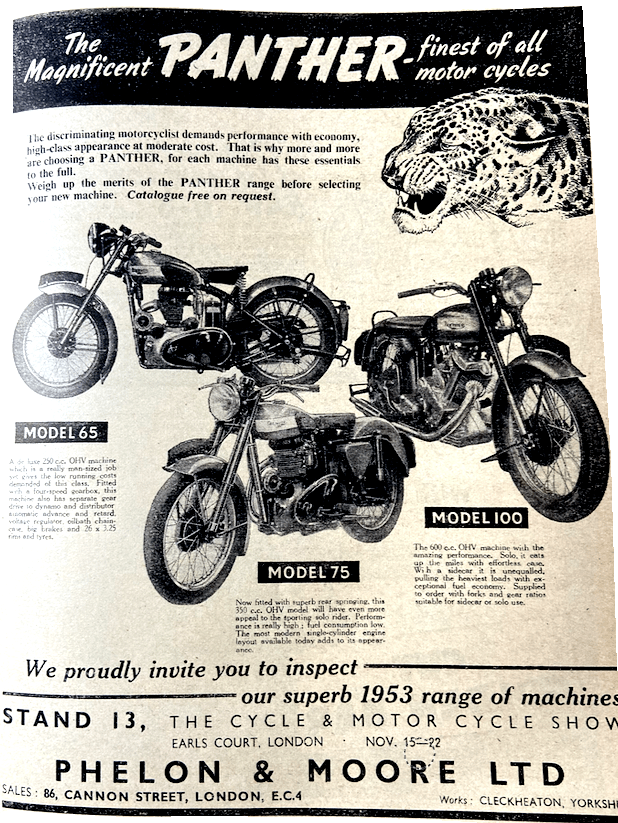
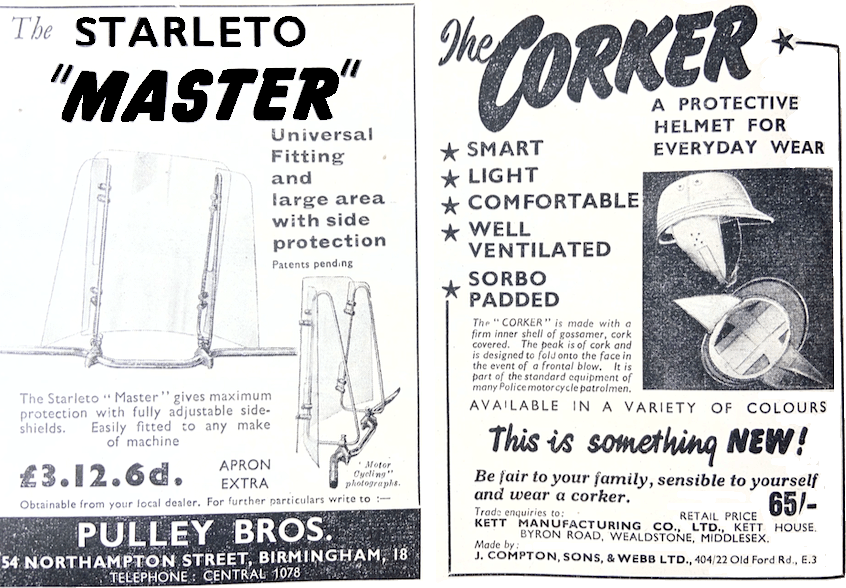
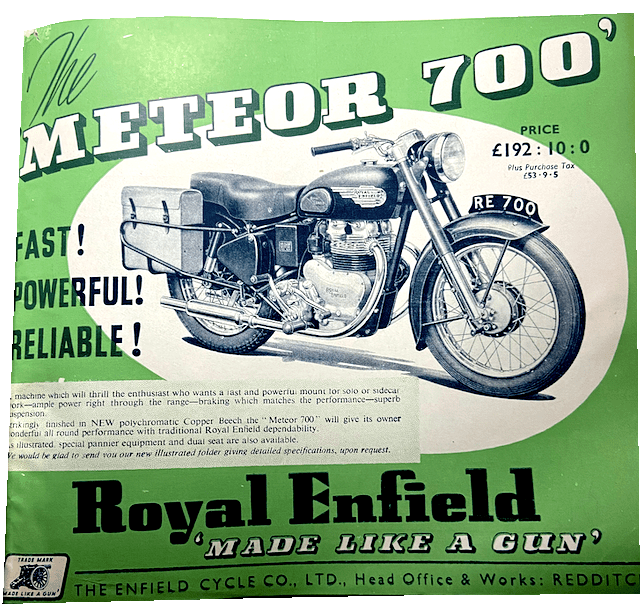

 Motorcycle Timeline