“ARIELS ARE HERALDING a trend which is influenced by the imminent (within a few years I would say at a guess) change-over from magneto-dynamo to AC-generator ignition and lighting equipment. Because of the character of its construction, the AC-generator requires a positive earth return, and by making the polarity change now, Lucas feel that people will be taking positive earth for granted when the time comes for it to be all but standardised. So far as coil-ignition multis are concerned, of course, the positive earth has definite advantages. It means, for instance, that there is a negative polarity spark at the plug (which tends to give lower plug voltages) and burning in the distributor is spread over the separate brass electrodes instead of being confined to the rotor arm…Ariels are already using the new coloured harness. It is an obvious improvement on the more common type with coloured rings, because these ‘idents’ are for ever being pulled off and lost. Personally, I look forward to the day when the new harness is universally adopted.”—Nitor
“PITY THE POOR Pathfinders & Derby Club, for assuredly the words ‘snow’ and ‘Bemrose’ are synonymous. As usual, last Saturday’s Bemrose Trial was held ‘mid the Derbyshire hills and dales. At 10am, when the first competitor was scheduled to start, snow was falling in petulant spasms, and the strong wind on which it rode had a cutting edge—and then some! The clouds were so low that they blanketed down to road level only a mile from the Bull i’ th’ Thorn, the headquarters hotel. On the roads the snow lay in an off-white carpet, effectively concealing the marking dye. Consultations were held. What was to be done? Course-finding, it was decided, would not prove too difficult because marking had been carried out with cards as well as with dye. But would the 150 competitors be able to complete the 72-mile course before dark? In order to overcome the difficulty, the course was shortened by 20 miles (leaving 10 of the planned 15 sections). And at approximately 10.20 the first man set out in a howling storm, heading for the first section, Dow Low. This hazard deservedly has the reputation of being a severe marks snatcher. In the first few yards there is a
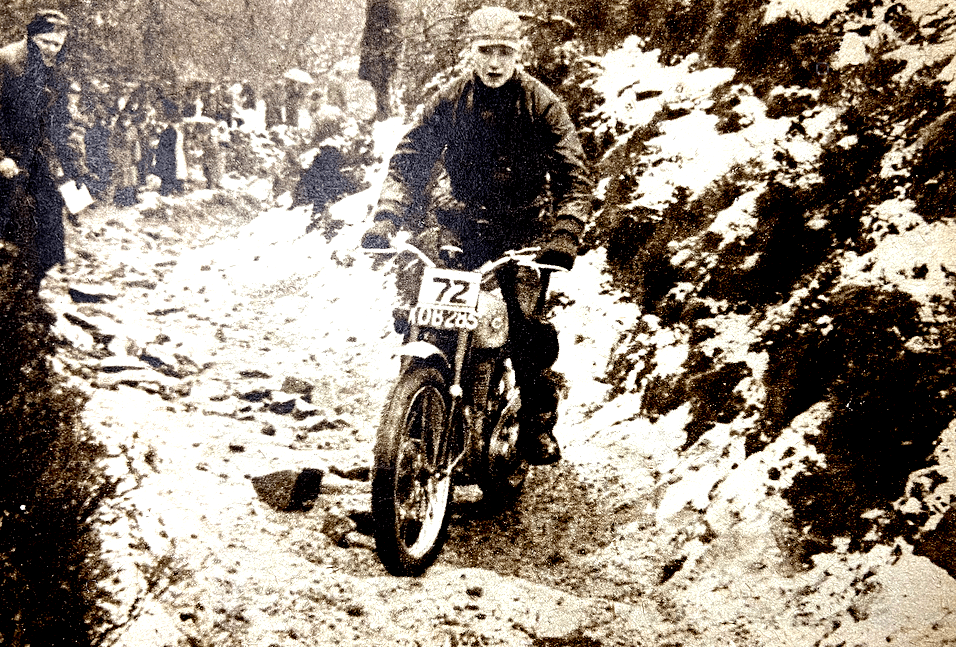
right-left S-bend over an irregular, slimy, rocky surface. Path-picking round the S is important because of an awkward camber, but selecting a line was made very difficult on this occasion because of the carpet of snow, and the falling snow which was stinging competitors’ eyes. The rocky S dealt with, the worst of the section is past. All that remains is (or was last Saturday) an easyish climb over a mixture of earth and grass. Among the first 30-odd riders to tackle the hill, only one was clean. He was R Clayton (490 Norton). Whereas all others followed the most obvious path, Clayton went very wide on the first turn of the S. This allowed him to enter the short straight between the two corners with his Norton upright and the wheels in line. It was the perfect tactic, and Clayton’s demonstration made the section look absurdly easy. Yet, the difficulty experienced by the vast majority of the entry proved that this was far from so. The next section was Washgates and it, in turn, was followed by Hollinsclough, probably one of the most famous of trials hills. Heavy rains before the Bemrose, however, had washed most of the slime from the rocks rendering the hill much easier

than usual. Nevertheless, it proved sufficiently difficult to take a toll of marks on a grand scale. Among the most impressive machines on the hill were the rear-sprung Royal Enfield Bullets and the VCH Ariels. Both R Chidgey and GW Fletcher, for instance, on Bullets, made most spirited attacks which came within an ace of success. G0 Bridges (347 AJS) was impressive indeed, until he came to an abrupt halt near the top with a stone lodged under his crankcase. Three of the most impressive climbs up as far as could be seen from the second sub-section were those by D Tye (348 BSA), RB Young (490 Norton) and JE Breffitt (490 Norton). Breffitt’s machine, incidentally, was a works model which he will ride in open competitions, including the Scottish and International Six Days’ Trials, during this year. Another most impressive climb was that by KR Craggs (197 James) who was beautifully and effortlessly clean through the last and most difficult sub-section. H Wiley caused a stir by turning out on an Excelsior Talisman Twin which performed magnificently over the rocks. He had a stop in the third sub-section, yet he purred an effortless passage through the final one. Both Miss Ann Newton and Mrs. M Briggs, of the James ladies’ team, had stops. None of the sidecars seen
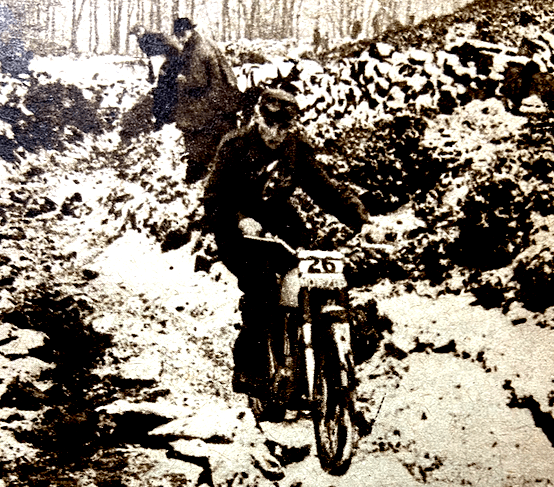
made non-stop passages farther than the end of the first sub-section. In each case, the outfit tended to overturn—either to one side or the other. After Hollinsclough came Pilsbury, which was fairly easy for early numbers but increased in severity as the entry passed through. There was a particularly nasty few feet just before the end of the section which, on Saturday, was just round to the left at the top of the hill. By midday the snow had changed to heavy sleet which soaked through gloves, numbed hands, and stung ungoggled eyes. From Pilsbury competitors rode to Manifold Quarries, then to Ryecroft, Netherhay, Blackbrook, and the old section at Cheeks Hill. Then there was a check at the Travellers Rest before the Bull th’ Thorn, where competitors signed off and had a cup of nice, hot TEA! RESULTS Bemrose Trophy (best performance): J Giles (348 BSA), 0 marks lost. News of the World Cup (best opposite class): CV Kemp (400 Norton sc), 10. Lapidosa Cup (next best solo): E Sellars (497 Ariel), 0. Green Cup (next best sc): GL Buck 497 Ariel sc), 15. Telford Trophy (best 150cc): BW Martin (122 Francis-Barnett), 6. Committee Cup (best 250cc): HW Thorne (197 James), 1. Alan Smith Cup (best 350cc): TH Wortley (348 Douglas), 0. Ian Robertson Cup (best 500cc): TU Ellis (499 BSA), 1. Best Club Team: Belper (Thorne, Lomas, Phillip), 13. Grantham Cup (best performance by an EM Centre resident, not winning a major trophy): W Lomas (197 James), 2. Souvenir Award (best performance by a lady): Mrs M Briggs (122 James).”
“THE FIRST FORT RALLY, open to members of ACU-affiliated clubs in the Midland Centre, held last Sunday, was christened with steady rain practically all day; short, bright periods were few and far between. Nevertheless, this did not deter the enthusiasm of both organisers and competitors. The 31 motor cycle entries ranged from a very old belt-drive Douglas, which had to retire with belt-slip owing to the wet weather, to the newest model Vincent Rapide. The Wolverhampton Club put up a very good show in winning the team award. A special merit award was presented to 16-year-old R. Bates, riding a solo BSA.”
“HOW MANY YEARS since the mileage on a trade-supported one-day trial has run into three figures? And how often has more than two-thirds of the entry retired? And when, if ever, was a big event, such as this, won by the rider of a 197cc two-stroke? Assuredly the 1951 Travers Trophy Trial, held last Saturday on the very back-bone of the Pennine Chain between Alston and Stanhope, was an event in the finest possible tradition. But equally it was one of the most remarkable, not only because of the fact that 68 out of the 98 starters retired (owing largely to a snow blizzard which descended upon the wild Cumberland countryside at about 4.30pm), but also because Bill Lomas has now conclusively established that—even under the toughest conditions—a 197cc two-stroke can more than hold its own against what have hitherto been accepted as the finest trials machines in the world. More than a hint of this was provided by Jack Rotting and his Francis-Barnett in the ‘open’ Beggar’s Roost Trial at Easter, when he and Bob Ray (497 Ariel) returned the only clean sheets of the day. And now popular Bill Lomas, better known for his prowess in road racing, has clinched the deal in a manner so positive as to prove beyond doubt that the two-stroke in trials has well and truly arrived. By way of a change, this year’s Travers had its headquarters at the sleepy little village of St. John’s Chapel, in the picturesque Wear valley. The move from Alston was anything but popular with competitors. What was popular, however, was the complete absence of tape on any of the observed sections—confirming the opinion that the Newcastle &DMC need have recourse to no such ‘artificiality’ when running an event in what must surely be the finest natural trials country in England. Unfortunately the weather took a hand in proceedings, and towards the end of the afternoon there occurred a
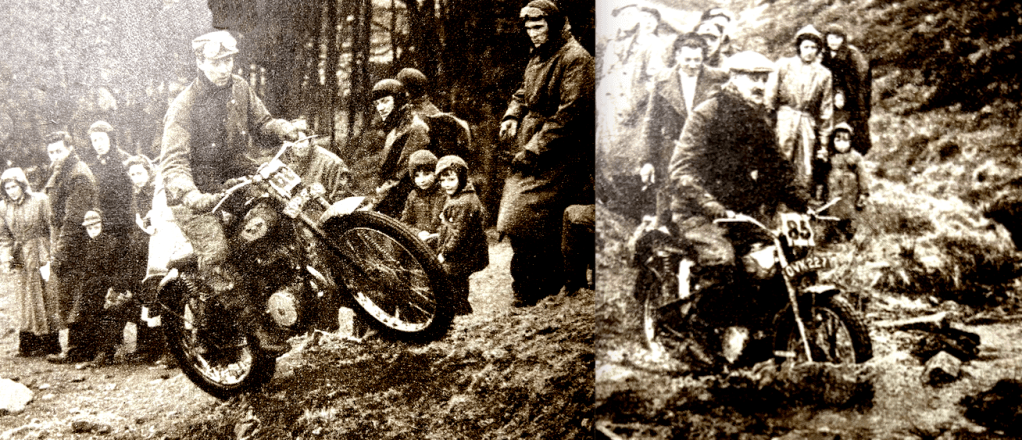
blizzard of such magnitude that the later numbers were almost literally forced to retire. Those who did complete the course (two laps of 50 miles each) lost many marks on time, and, all in all, it must be admitted that the 1951 Travers was the toughest trial for a considerable number of years. The first observed section, Irreshope Burn, lay little more than a couple of miles from the start, and certainly gave no indication of the severe obstacles which were to follow. The five sections at Jackson’s Pastures, though, took a heavy toll of marks, the combination of mud, rocks and acute undulations proving more than a match for most competitors. Blagill, in contrast, caused considerably less havoc than of yore; its rocks seeming smaller than they have in the past. Even so, Hugh Viney came to a standstill with the front wheel of his 347cc AJS crabbed against the slimy right-hand bank, but he redeemed himself shortly afterwards by ascending the second half of Blagill (a muddy climb on the opposite side of the road) in masterly fashion—albeit a trifle too fast. GL Jackson (498 Matchless), who followed close behind the Maestro, was much slower but every bit as sure. Riders were arriving at Blagill very much out of numerical sequence—and very much out of breath, too! Explanation for this was to be found in the six-mile timed section, and in the alarming depth of the snowdrifts which existed there. This part of the course was more than 2,200ft above sea level, and the earlier numbers, such as PH Alves (498 Triumph), E Watkinson (348 BSA) and SB Manns (347 AJS) reported having dropped their machines into deep holes concealed by 4ft drifts. Tom Ellis almost lost his machine altogether, and Johnnie Brittain complained that the wheels of his Royal Enfield were completely clogged with snow. Five miles beyond Blagill came that old Travers favourite—the twisty, rocky, four-section climb known as Haggs Mine. James riders seemed particularly at home here, Miss Olga Kevelos getting through the first section without fault (in contrast to many mere males!) and Mrs Molly Briggs putting up quite the best show at the next obstacle. Bill Lomas completed all four sections with a confident ease which caused a spectator to remark: That looks like the winner,’ and how right he was! With a few yards of the main Alston-Stanhope road were two sections called Burn Bottom, crafty placing of the ‘Section Ends’ cards causing considerable trouble at both places. Among some really outstanding demonstrations of throttle control on the muddy second section, probably the finest was that of young John Giles (348 BSA), fresh from his Bemrose win of a week before. Came a fairly innocuous Racehead, then the
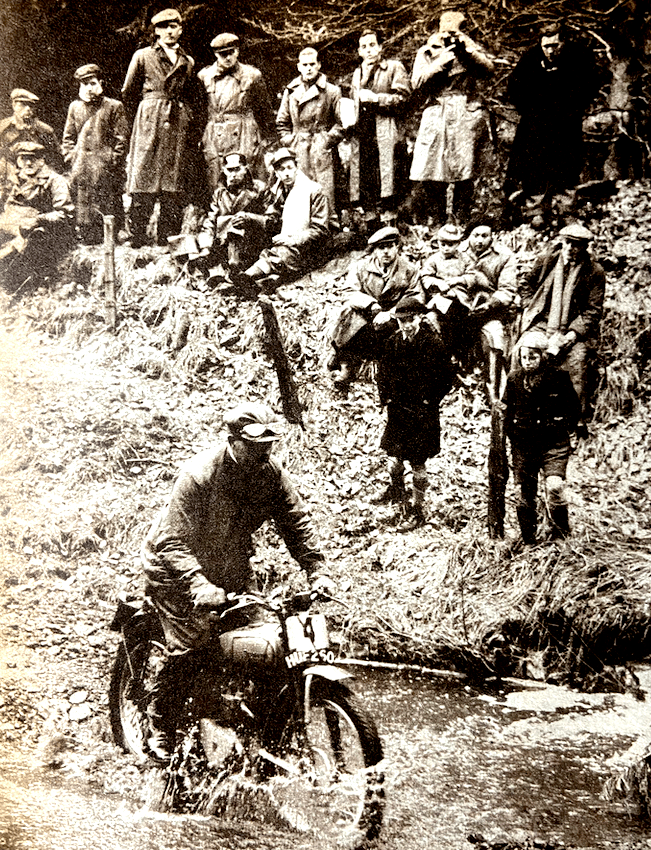
notorious Slit Mines—a slimy drop down a steep hillside, up the equally slimy opposite face of the valley, and, by way of a change, through some adversely cambered stone-pits at the top. First to arrive was PH Alves, whose performance on the ascent was pluperfect. Some 17 other competitors equalled Alves’ achievement here, but the tow-rope was much in demand. Miss Anne Newton, looking very trim and attractive in her dark red riding attire (to match her 197cc James), showed a fine sense of balance, and needed only an occasional dab to see her safely to the top of the hill. Wheelgrip was almost non-existent, however, and it was fortunate that this year’s Travers was a ‘solos only’ affair. There remained only the two muddy sections at Dike House, where, on the second circuit, conditions had deteriorated to such an extent that only Alves, Viney, Tye, Jackson, Lomas and Ray were clean. But there also remained the snow. And such snow! As darkness descended upon the wild Cumberland countryside the roads were rapidly becoming impassable, and competitors were scurrying away towards their various destinations, just as fast as their slithering wheels would carry them. A remarkable trial indeed, and one to be long remembered. RESULTS Travers Trophy (best performance): W Lomas (197 James), 9 marks lost (5 on performance, 4 on time). NUT Trophy (runner-up): CM Ray (497 Ariel), 12 marks lost (5 on performance, 7 on time). 150 Cup: KH Holloway (122 James), 143. 250 Cup: Not awarded. 350 Cup: NS Holmes (348 Royal Enfield), 28. 500 Cup: RB Young (490 Norton), 27. Manufacturers’ Team Prize: Royal Enfield (NS Holmes, GE Broadbent, JV Brittain), 134. Club Team Prize: Middlesbrough &DMC (RB Young, D Connett, W Young), 166.”
“IT IS EASY—in some directions, perhaps too easy—to draw conclusions from the figures for new registrations in 1950, now complete following the issue last week of the Ministry of Transport’s returns for the final month, December. Transcending everything, however, is the fact that in the 12 months no fewer than 131,476 vehicles in the motor cycle classes were registered for the first time. This compares with 89,255 for 1949, the record post-war year, and easily beats the boom year, 1927. Having regard to the industry’s magnificent export achievements over the past year, the figure is especially striking and proof indeed of the rapidly increasing popularity of motor cycling in Great Britain. What may surprise many is how the figure breaks down into engine sizes. Whereas in 1938, the last full pre-war year, the number of over-250cc motor cycles sold was five times greater than that of machines under 150cc, today the latter class reigns supreme—67,521 against 49,504. The ascendancy of the lightweight does not rest there, since 78,233 come within 250cc, the accepted limit for lightweights. The comparison is not entirely fair to the larger machines for two reasons. First, bicycles with motor attachments come within the under-150cc category; as yet, the county councils and the Ministry have not attempted to segregate this class of machine. Secondly, the main demand from oversea has been for motor cycles with medium-size or large engines, and therefore some of the larger-capacity models have reached the home market in only small numbers. It is estimated that in 1950, nearly half the under-150cc machines were bicycles with motor attachments. Allowing for this, the swing towards lightweights is still remarkable. Sidecar outfits number only 1 in 18 of all the new registrations, or roughly 1 in 14 if allowance be made for bicycles with motor attachments. This compares with 1 in 10 for 1938, but, once again, figures can mislead, because today there is a dearth of sidecars. However, what can be stated is that motor cycling was never more popular, and the 1929 record of 731,298 motor cycles registered is certain to be beaten this year.”

“THE SPANISH GRAND PRIX, held in Barcelona last week-end, proved an uninspiring start to the year’s classic road races. So many misfortunes beset machines and riders that, certainly in the 350 and 500cc classes, if not to the same extent in the 125cc and sidecar classes, it would be unwise to use the results as a basis for assessing future form. Outstandingly successful was TL Wood who won the Saturday’s 350cc class on his Velocette in convincing style and, riding a Norton on the Sunday, was second in the 500cc class to U Masetti (Gilera); Wood also rode extremely well on a Morini in Sunday’s 125cc class until, after being among the leaders for seven laps, he was forced to retire owing to engine trouble. In Saturday’s sidecar event, the winner with an easy mastery over the field was the redoubtable Eric Oliver, driving a 499cc Norton fitted with a Watsonian sidecar. The 125cc winner was Guido Leoni riding a Mondial. As the Spanish meeting was accorded classic status for 1951, the organisers, the Real Moto Club de Cataluna, extended the Montjuich Park circuit to slightly over six kilometres to comply with FIM regulations. The result was an uncommonly twisty course for which top gear could be employed only once for a very short period—this with 350s and 500s geared down as low as reasonably practicable. At 3.30 on Saturday afternoon, when the 350cc race was due to start, bright sunshine, only occasionally obscured by clouds, kept the temperature pleasingly warm for racing. Of the 21 competitors, W. Gerber (AJS), made the best start and flashed into the first bend a few yards ahead of TL Wood (Velocette). After, a 100-yard push W Beevers (AJS) stopped and was still fiddling when Wood reappeared with a clear 200-yard lead over Gerber. Amateur timing made Wood’s figure 3min 59sec, which suggested he meant business. There was no doubt about
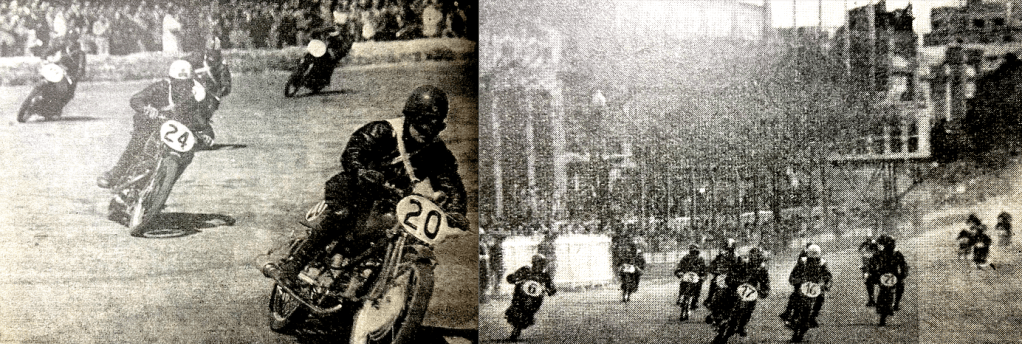
it on the second and third laps, both completed in 3min 47sec, which proved to be the fastest of the race. These two spirited laps gave Wood a half-minute advantage over the second man, Les Graham. Riding Reg Dearden’s Velocette, Graham was in second place from Lap 2 onward, and, with Wood, was pulling away from the field in spite of slight clutch-slip, which persisted for about eight laps. The race was over so far as the first two places were concerned. CW Petch, on what was said to be the first 1951 model 7R AJS to be raced, was holding a comfortable third place, and fourth, although unable to use third gear, was AL Parry (Velocette). Undoubtedly the most zestful riding was being put in by the Spaniard, F Aranda, on a 248cc Moto Guzzi. From 16th place on the first lap he cut through the field to displace Petch for third on Lap 9. But in the last five laps a broken valve spring slowed him and Petch managed to get ahead again. Retirements were heavy and included the two Germans, R Schnell and V Gablenz with their businesslike-looking Parillas. Wood’s victory completed a hat-trick—he trick—he had won the 350cc class of the Spanish GP in three consecutive years. 350cc Class—25 laps, 93 miles: 1, TL Wood (Velocette), 58 3mph; 2, RL Graham (Velocette). For the sidecar race, which followed the 350cc event on the Saturday, Eric Oliver was opposed by 11 competitors representing Austria, Belgium, Spain and Switzerland. The new FIM ruling meant that all machines were of 500cc capacity instead of 600cc as in the past. Oliver’s Norton had a works-type dohc engine in a TT-type frame with a telescopic front fork. Any doubts about how the outfit would handle were dispelled as soon as the first corner was turned. Oliver led in the screaming rush from the starting grid and swept into the corner noticeably faster than the rest. After three laps he had a 40-second lead over his usual challenger, E Frigerio, on the four-cylinder Gilera. A. Vervroegen, of Belgium, driving an FN, was third, but he was soon ousted by Albino Milani (Gilera single). Thereafter the race was a procession with Oliver increasing his advantage, although frequently lapping l0sec slower than he had managed in practice. Sidecar Class—17 laps, 63 miles: 1, ES Oliver (Norton), 50.2mph; 2, E Frigerio (Gilera); 3, A Milani (Gilera). Far more spectators gathered round the circuit for Sunday’s races. Many wore rain-coats in deference to ominous clouds drifting across the sky. But the expected rain did not come, and before noon conditions were again ideal. The 21 starters in the 125cc class included Mondial, Morini, MV, Montesa and Eysink teams, and provided the most keenly fought racing of the week-end. For the first five laps Guido Leoni (Mondial), C Ubbiali (Mondial), V Zanzi (Morini) and TL Wood ( Morini), riding in a 125cc race for the first time in his career, were separated only by yards. Leoni led for two laps; Wood for one; Ubbiali for two; then Leoni again for a lap; then Ubbiali for two more. Small-capacity machines can provide very tame racing in contrast with 350s and 500s on high-speed circuits. But round the serpentine Montjuich Park roads it was another matter. Wood’s popularity in Barcelona is boundless. A sigh of sympathy greeted his arrival at the pits with a sick engine (no compression) at the end of the seventh lap. Then Ubbiali dropped from a very close third to 30sec behind Zanzi and Leoni; his rear chain had jumped the sprockets and the price was the 30sec delay. Another mishap was to Denis Jenkinson (Montesa) who, when in 12th place, had to retire with a seized piston. R Alberti (Mondial) was fourth, but too far behind to rob Ubbiali of third place when the latter had his chain stop. For lap after lap Zanzi remained in front with Leoni about 50 yards away, and the thought arose that perhaps Morinis were now as fast as the world-champion
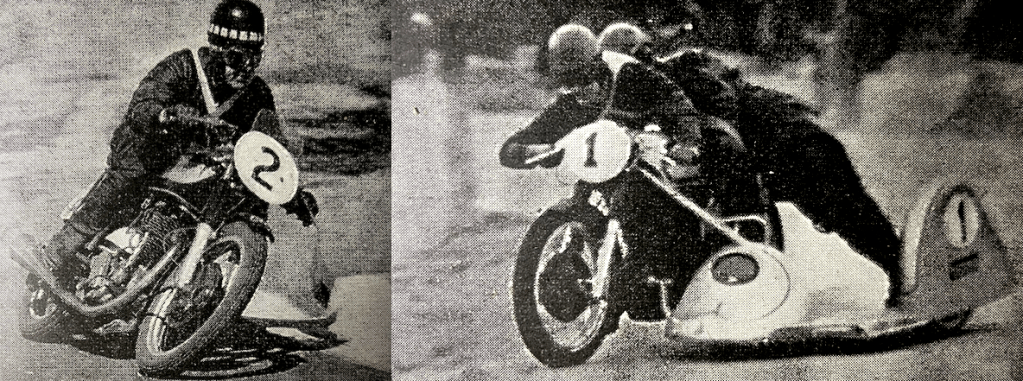
Mondials. Ubbiali was riding like a demon, trying most successfully to close the gap between himself and the leaders. Lap by lap he got closer. Climax came when, ceasing to play cat and mouse, Leoni headed Zanzi on the next-to-last lap. Ubbiali then had them both in sight, and made a final lap in the best time of the race to pass Zanzi and give Mondials a one-two win. 125cc Class—17 laps, 63 miles: 1, Guido Leoni (Mondial), 53.5mph; 2, C Ubbiali (Mondial); 3, V Zanzi (Morini); 4, R Alberti (Mondial); 5, J Soler Bulto (Montesa); 6, A Elizalde (Montesa). Misfortunes brought the 500cc class almost to the stage of farce. With Gilera, Moto Guzzi and MV factory teams in the field, the prospects of good racing were bright. But on the first bend after the start five or six of the 27 competitors were involved in a multiple crash. Fortunately, no more than bruises and scratches were suffered by riders, but at once the race became falsified. Alfredo Milani, riding a single-cylinder Gilera, gained the lead from N Pagani (Gilera four), S Geminiani (Moto Guzzi), C Bandirola (MV), U Masetti (Gilera four) and TL Wood (Norton). In 7th place, on an MV four, was Les Graham. Bandirola was in trouble with misfiring and made the first of many pit stops. Pagani and Gerniniani dropped back, while Graham and Wood gobbled up places. After seven laps, Milani had a 16-second lead over Masetti; then came Graham and Wood. Gear-box selector trouble put Graham out. Fergus Anderson (Moto Guzzi), one of those in the crash, called at his pit frequently and later retired. Other retirements removed half the starters and included the leader, Milani, who reported valve-gear bother. Masetti thus went into the lead, with Wood, handicapped by fading brakes, riding wonderfully in second place. But Wood was a minute or so behind Masetti, and third man, A Artesiani, was well out of the picture. Lap after monotonous lap the procession continued. Sixth man, E Vidal (Gilera single), walked his silent machine to the line to qualify as a finisher although nine laps short of the distance—a pathetic finish epitomising the week-end’s racing and in sharp contrast to the excellent organisation. 500cc Class—34 laps, 127 miles: 1, U Masetti (Gilera) 58.3mph; 2, TL Wood (Norton).
“EVERY NOW AND THEN I get an irate letter from some reader who claims to observe that the police treat pedestrians and cyclists with far more indulgence that they display towards motor cyclists. His generalisation is sweeping. It applies to the entire field of road crimes—lamps, Halt signs, turning to the right, and all the rest. I frankly admit that the village cop is lenient to low-income road-users. He is the sole representative of law and order in his wee community, by which he would rapidly be ostracised if he seized every chance of hauling his neighbours into court. As he relishes a quiet life as much as the rest of us, he seldom pounces on the local cyclists or peds. I have never noticed such lenience in the towns. On reading the letter I went down to the local court, where cyclist offenders that morning easily outnumbered motor cases. The cyclists were mostly on parade for ignoring Halt signs or riding without lamps.”—Ixion
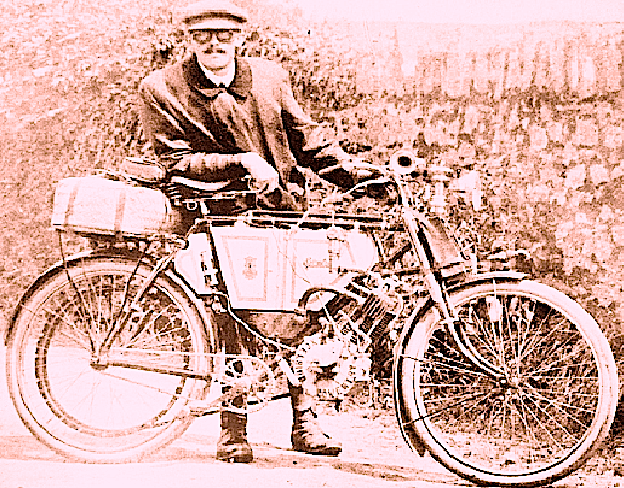
“BETWEEN 1901 AND 1905 I rode five Ormonde machines, equipped with Kelecom engines. But I have only just discovered that their frames were designed by PJ Goodman, of Veloce, Ltd. His employer was Arthur Goodwin, later famous with Vandervell. Goodman wanted to scrap the pedal gear and to build the Ormonde frame so low that the rider could drop his feet on the road while firmly seated in the saddle. Goodwin rejected this layout on the grounds of appearance He held that beauty depended upon the frame tubes being kept to a minimum number of angles. The top tube and chain-stays should be parallel to the ground line. The front down-tube and the backstays should be parallel with each other. I wonder who was responsible for the Ormonde experimental transmission? It employed pulleys with notched edges, conjoined with a belt carrying short, steel cross-pins on its upper side. The pins fitted into the notches and the leather between the pins bestowed flexibility. The designer lost heart when one of these belts broke and the tips of the cross-pins ripped hunks of meat out of his calf!”—Ixion
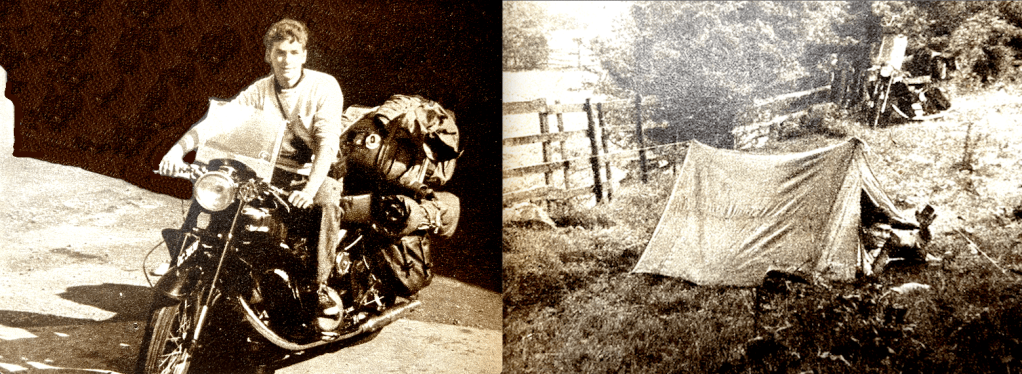
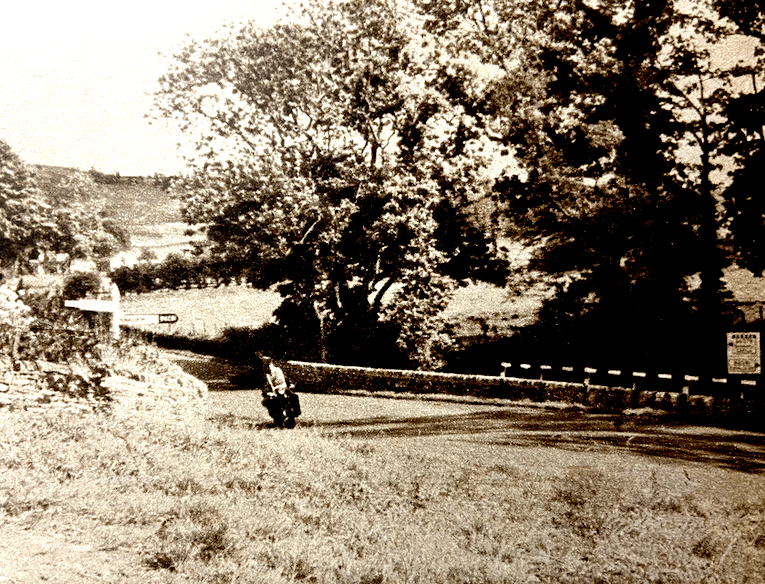
“IT IS QUITE IMPOSSIBLE for Britain to be a strange and unknown land to anyone who has been a reader of The Motor Cycle for any length of time. Nevertheless, we feel that an account of our impressions of motor cycling in these islands would be not only of interest to oversea readers who have not had our good fortune to visit in person, but could even attract the attention of those who view their homeland only with the jaded eye of a native. Similarly, we hope that comparisons made with motor cycling in America may be interesting to British readers. Please note that whenever we say ‘America’, we refer to both the United States and Canada, unless stated otherwise. Before we really get going, we want to pay official homage to those two paragons of British engineering skill, without which our visit to this country would be dull indeed. We refer, of course, to our respective steeds. The one, belonging to DH, is a three-year-old 600cc Panther, recently enriched by the addition of a Clamil spring wheel. The other is a 1950 500cc BSA springer. A good pair of friends to have! Naturally enough, arriving in England as we did after a lengthy stay in Scandinavia, it was a pleasure to be again surrounded by people speaking our own language, Of course, it is pressing the point a little to call it our own language, but, at any rate, we can understand and be understood more easily than on the Continent! We still tend to call petrol ‘gas’, and a gudgeon-pin a ‘wrist-pin’! In the same way, as we had come over from France, it was inevitable to drive off neatly down the right-hand side of the road, and feel indignation at other vehicles driving madly on the ‘wrong’ side This occurred in spite of our having lived and driven in Sweden for the past year, where left-hand drive is the rule. A very short while on the Continent had sufficed to get us back into our lifetime habits of right-hand driving. Generally, we haven’t found it much of a chore to change sides. One of our earliest impressions was of the excellent quality of the road surfacing. Sighs of relief were heaved, for our sit-upons sadly needed recuperation from the bruisings received on the atrocious pavé of Belgium and France. It is only fair to add that this fine impression only lasted until we got to London, where it was at once rudely shattered. However, subsequent wanderings about England have restored our original favourable opinion. There is an ordered and restful character to the green beauty of the English countryside. It is quite unlike anything we have seen before. The meandering nature of your roads is admirably suited to this type of landscape, and contributes greatly to the enjoyment of motor cycling. There is an intimate communion of road with countryside which is pleasant indeed. Here, the road is not something added lately, but has always been there, accommodating itself to hill and dale, growing up with and serving the land around it. There is nothing in all this which is incompatible with a good road surface, and the standard of surfacing is certainly high, even on secondary roads. One of us (DH) still breaks out in a cold sweat when he recalls negotiating the treacherous combination of pot-holes and shifting gravel on the back roads of the Province of Quebec (in his rigid-frame days, too!). Pleasant as it is to wander among the roads and villages of old England, the curving nature of the roads, plus the frequency of towns and villages (to say nothing of buses and trucks) combine to make life difficult for the man who wants to get from point A to point B with a minimum of fuss and bother. The great arterial highways and expressways now springing up in the United States and Canada, like the autobahnen of Germany, seem to be the solution to this, as are the by-passes on some highways in this country (such as on A3 from London to Portsmouth). Four-lane (or more) expressways can be made to look very beautiful, and certainly they can carry a large volume of traffic efficiently. It is possible to drive right into downtown New York on an expressway, paying a couple of small tolls on the way. Contrast this with the problem of getting in or out of central London! It is nice to observe that English highways are not disfigured by large advertising billboards. These are still all too common in some parts of America, where the approach to many a city is thus ruined. Of course, nothing in England or America can compare to the constant scream of day and night advertising assaulting the eyes of the traveller on an Italian autostrada. We find that road directional markings on main and secondary routes in rural areas, towns, and villages are excellent indeed, as they are generally in America (some parts of Canada fall down in this respect, however). However, on entering the big cities, especially London, one is at once plunged into a maze of un-named streets. The first time we arrived in London we got lost almost immediately, and this became a frequent occurrence thereafter. The finding of a given address is often a problem, even when one knows roughly where it is, as the authorities evidently consider it superfluous in the majority of cases to put up signs giving the name of the
street. When a signboard is put up, it is often cleverly blended with a few cigarette advertisements halfway up the side-of a nearby building, or even more ingeniously placed on side walk level, so that passing pedestrians and baby-carriages completely obscure it. In America, city street and direction signs are usually given much more often and in a clearer manner than in England. Even better are the cities of Sweden, where the names of both intersecting streets are given clearly at each of the intersection’s four corners. From the beginning we were both very favourably impressed with the general high standard of road manners and sense in English motorists and motor cyclists. Specifically, we think you are very conscientious in the giving of clear and correct hand signals. The automatic trafficators fitted to vehicles can sometimes be a menace. One of us has encountered two cases where the indicator on one side was put up, then the vehicle swung smartly in the other direction! In each case (Terry Saunders and Co, please note) the driver was a middle-aged woman. These instances are certainly not representative, though. In common with all visitors to this country, we think your police are the world’s finest. Their courtesy, good humour and willingness to help the stranger have become proverbial among travellers. May they ever remain thus. It was a pleasant discovery to note that the motor cyclist is treated with far more respect in England than in America. Here he is accepted as a regular and ordinary user of the road. This must be due largely to the fact that a much greater proportion of motor cycles here are utility vehicles, while in America the over-whelming majority are used for purely pleasure purposes. Furthermore, the immature behaviour of a small but active number of American motor cyclists has created an atmosphere of intolerance on the part of car drivers towards motor cyclists in general. In some extreme cases this can amount to a surprising bitterness. Among the elements contributing to this bad feeling is the uniquely American institution of the ‘motor cycle cowboy’. This is our personal label for the strange, glittering breed which infests the highways of the United States, Canada, and parts of Latin America. We hope that Texans and other Westerners won’t take offence, but we call the type the ‘cowboy’ because of the several resemblances to the Hollywood type of cowboy. Like this latter type, he also appeals mostly to the juvenile mentality. Furthermore, the frequent removal of the silencer from the machine makes the engine sound like the rattle of six-guns in a Grade ‘B’ Western film. Add to this the wide, jewelled and studded, leather ‘kidney-belt’ (also worn by the pillion passenger); beautifully-tooled and often high-heeled riding boots; coloured streamers from the twistgrip ends; fox-tail a-flutter in the breeze—and the picture is completed. But really not quite complete: the things we have omitted in the line of glittering and useless chrome fitments are really too numerous to mention. The gaudy appearance of this type of fellow, with his (often) noisy machine, inconsiderate and thoughtless driving methods, and generally childish and show-off behaviour, have been important factors in the adverse American attitude towards motor cycling. Though we do not know the exact figures, we are certain that they represent a minority of American motor cyclists, yet it is a sad fact that the damage they have caused to all of us is quite out of proportion to their numbers. After this small digression to the New World, we return to Merrie England, and launch off into that ever popular topic of conversation and object of abuse—the famous (or infamous) British weather. We come from two regions with widely differing climates, but we both combine in finding the English climate about the most treacherous we have ever encountered. Early on, we often made the silly mistake of accepting the weather at its existing face value. In other words, say on a beautiful cloudless Sunday morning (all too rare an event), we would gaily set out for a country ramble on our machines without deeming it necessary to carry rain equipment. This doubtless sounds incredibly foolish to you who live here, but we learned the hard way, by getting drenched to the skin a few times. The sheer perfidy of those rapid weather changes seems almost beyond belief. Of course, we understand that we have been here during a period of unparalleled bad weather (or so they tell us), but we give our impressions, anyway. Our experience of Scottish weather has been that it is quite dependable. You know it will rain! Naturally enough, the greater proportion of utility drivers here results in a correspondingly greater number of all-weather drivers. These bold fellows ride cheerfully on through rain, fog, sleet or snow, any of which would be enough to keep the majority of American drivers at home. Their ranks include some of the
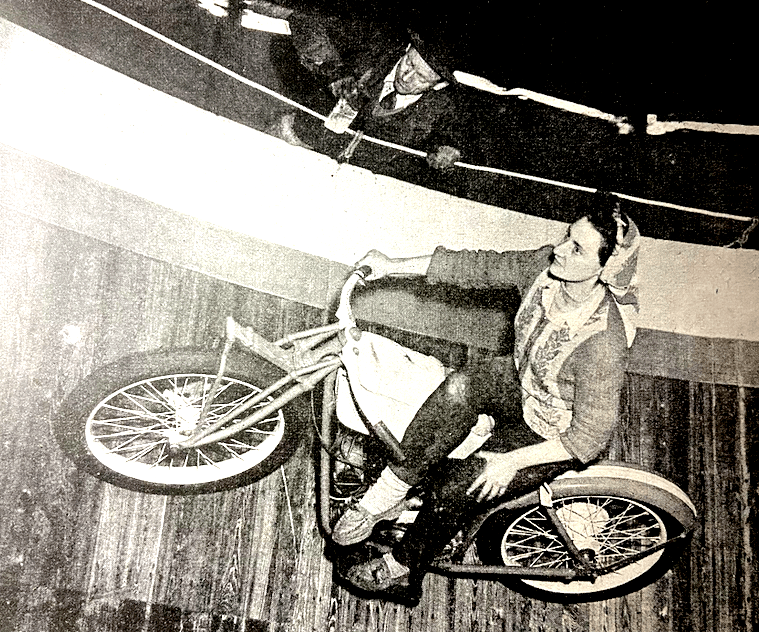
most unobtrusively expert and courteous drivers it has been our pleasure to encounter. They represent the backbone of British motor cycling, in our opinion, and no praise is too high for them. While we’re still in a complimentary mood, we’ll add a plug for the ‘greybeards’; those of middle years or older who for whatever reasons (economy or obstinacy!) still cling to their two- or three-wheelers for sport or transport. The same goes for family men, always a pleasant sight with the chair full of wife and kids. Both belong to a genus almost unknown. in America. They lend dignity and solidity to a hobby too often characterised by youthful abandon, and, furthermore, they keep of spark of youth alive in themselves. More power to them. Talking about family men brings up the whole subject of sidecars. A motor cycle and sidecar is an unusual sight in America, and a British-made outfit rare indeed. The only extensive use of sidecars is in police work. In the city of Montreal police motor cycles are 1,200cc Harley outfits. Neither of us has ever seen a family-type two-seater sidecar in America, which is really a pity, as an American big-twin is superlative for this type of work. It would be perhaps a little heavy on the gas (petrol!), but skill a good deal cheaper to run than a car. We are repeatedly being impressed by the knowledge and interest the English motor cyclist has in what goes on in the ‘innards’ of his machine. It is dangerous to generalise on such a point, but we feel that the ‘average Joe’ here is more mechanically knowledgeable than his counterpart on the other side. If he develops a fondness for an elderly machine (or can’t afford a new one) he will take the trouble to keep it on the road for an incredible length of time. A 20- or 25-year-old motor cycle in good road condition is not much of a rarity here, but is most unusual in America. On the other side of the ledger, the American enthusiast, undertaking trips of great length, as he frequently does, considers comfort and convenience more than his British cousin. Also, he is more gadget-minded. With almost 100% of buyers of new machines in America the first act is to fit an adequate pair of sturdy, leather pannier-bags (called ‘saddle-bags’). These are not regarded as an accessory, but as a necessity, and we would no more drive without them than we would consider buying a model with no mudguards. Windscreens are also popular, though not so universal as panniers. Safety-bars are perhaps a bit more common than here. At the time we left America (summer, 1949), legshields had not yet attained much popularity, but that may be changed by now. Many riders fit American-type ‘buddy-seats’ to British models. These are well made and ride quite well, though they tend to be more comfortable for the pillion-rider than for the driver. You have doubtless noticed that we have had very. little to say about the sporting aspects of motor cycling. The fact is that we are both essentially touring riders, not clubmen, and though we follow the sporting news with interest, we do not feel competent to give a fair comparison. Suffice it to say that trials and scramble-type events are quite popular with enthusiasts in America, while dirt-track (speedway) racing often attracts good-size sections of the non-motor cycling public as well. Lack of circuits has hindered any efforts to popularise road-racing. A pleasant and interesting habit, occurring throughout the United States and Canada, is that, whenever one motor cyclist encounters another on the road, a cheery wave of the hand is exchanged. When travelling two-up, this duty can be effectively delegated to the girl-friend on the pillion. This is a custom which helps to create an atmosphere of camaraderie among all American motor cyclists, an atmosphere to which not even the extreme cowboy-types previously mentioned are immune. Also contributing to this is the almost equally universal custom of stopping to see if a motor cyclist halted by the roadside needs any assistance. One of us recently had the annoying experience of a broken throttle-cable in Surrey at night. He was very pleased to find that he had only been stopped a few minutes when a sidecarrist drew up alongside and rendered valuable assistance. This is the kind of thing that makes our hobby the fine thing it is—in this or any other country. The writers realise that throughout this article they have been guilty of generalisation, with all its inherent dangers. We have tried to express, as honestly as possible, our impressions of motor cycling in Great Britain, and to couple these, wherever possible, with comparisons drawn between the hobby here and in America. It is obvious that not everyone will agree with our findings, in fact, we were often unable to come to agreement among ourselves. In conclusion, let us state that we have both wandered quite considerably on two wheels, both in Europe and America, and we think that Britain is the country for motor cycling. If any US or Canadian readers are thinking of visiting this country, we advise them by all means to bring their machines with them, if at all possible, and ‘have a go’. They won’t regret it. There are more miles of happy motor cycling in the small space of these islands than any stranger would believe possible.”
“AS PRODUCTION FIGURES and international exhibitions clearly indicate, the world trend is towards small-capacity machines. Even in Great Britain, the traditional fountain of medium- and larger-capacity machines, more and more attention is being given to lightweight motor cycles and to bicycle-propulsion units. The reason for this trend is two-fold. Throughout the world the cost of living is rising and economy is to the forefront of everyday thinking. Hence, the economical lightweight appeals to the rider who, by the use of his machine, can cut down on his former travelling expenses by public transport, or to the rider who finds a larger machine strains his resources. But there is another aspect; in recent years, the improvement in efficiency and reliability of small-capacity machines has been such that their usefulnesS, and therefore their appeal, is notably broadened. Even motor-assisted cycles, though not designed for such work, have been tested by very lengthy trips such as nearly 2,000 miles in 12 days; and many owners who fitted micro-motors in the first place simply to ease the labour of pedalling to and from work have subsequently realised the full possibilities of powered cycling and become enthusiastic tourists at week-ends. It is not only in the touring sphere that the lightweight is gaining ground. More and more small-capacity machines are appearing in competitive events. An indication is that in the first British national trial of this year the entry list of 138 solos included 28 under-250cc machines; in the Victory Trial, the solo entry of 133 included 15 machines of 125cc, 14 of 200cc and 10 of 250cc. Another pointer is that for the first time in its long history, a class for 125cc machines is included in the programme for the next Isle of Man TT meeting. There are around 100 British models in the under-250cc category of motor cycles, scooters, autocycles and bicycle-propulsion units. Motor cycle capacities from which to choose are of 250cc, 200cc, 125cc and 100cc; the autocycles are of 100cc, and the cyclemotor units from 50cc down to 25cc. No country in the world offers a wider or finer range from which to choose.”

“THE TWO ABJ MODELS listed are almost identical except that the autocycle is fitted with the 98c. Villiers Mark 2F single-speed engine and with pedalling gear, whereas the motor cycle has the 98cc Mark 1F power unit which incorporates a two-speed gear with handle-bar control. Specification details are a loop-type tubular frame, a telescopic fork, deeply valanced front mudguard, 4in-diameter brakes and 2.25x21in tyres. The motor cycle is fitted with rectifier-battery lighting. Though there is a basic similarity between the four Ambassador models—all have the 197cc Villiers engine-gear unit—the appeal of the range is unusually wide. At one end of the scale, the Supreme model introduced for 1951 is a true luxury machine, and at the other end the well-proved Popular model is outstanding value for money. With its very neat telescopic front fork and plunger-type rear suspension giving 2½in deflection, the Supreme appeals to the
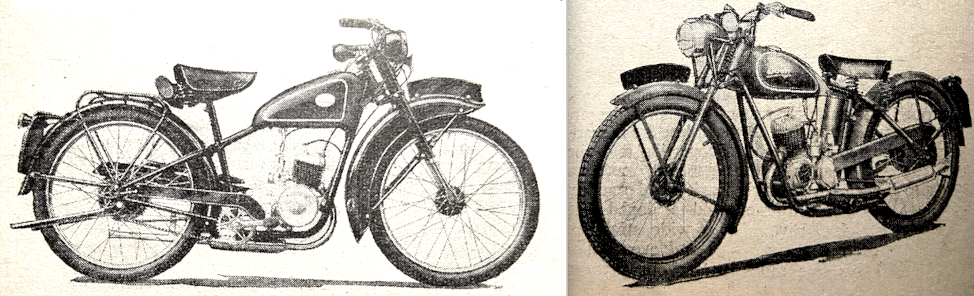
rider who has connoisseur inclinations. Equipment includes lighting with rectifier and battery, a deeply valenced rear mudguard and a specially attractive finish. The colour is light grey and the knee-grips, footrest rubbers, handlebar grips, brake-pedal and Vynide saddle cover match this colour. A telescopic fork is fitted to the Embassy and a Webb link fork with pressed-steel blades is employed on the Courier. The keen-priced Popular is a business-like model with the fork and frame of the Courier, and direct lighting. Yet another machine to be fitted with the lively 98cc two-speed Villiers Mark 1F engine is the BAC Lilliput. Welding is employed for the joints of the loop-type frame and the fork is of the telescopic pattern. As the name implies, the machine is of small dimensions with a 45in wheelbase and 25½in saddle height; it is also light in weight—the figure quoted by the manufacturers is 891b. Finish is in polychromatic bronze. One of the main attractions of the unusual construction employed for Bond machines is that it results in weight saving. The smaller model fitted with the 98cc Villiers two-speed unit scales, according to the manufacturers, no more than 961b, and the larger machine, which has the JAP 125cc two-stroke engine with three-speed gear box, weighs 100lb. The unorthodox frame takes the form of a light-alloy, stressed-skin backbone with a tubular loop supporting the engine unit. Both models have telescopic front forks, 4in-diameter brakes, 4in-section tyres and 1½-gallon fuel tanks. The Bown Autocycle is notable for its lavish specification, which includes a very sturdy duplex cradle frame; a spring fork with
pressed-steel blades; elegant side-shields for the engine, and deep shields over both the pedalling-gear chain and the final-drive chain; a 1½-gallon petroil tank; rubber-cushion pedals and ample saddle; and a large tubular carrier. The engine is the 98cc Villiers. A duplex cradle frame is also employed for the Bown 98cc two-speed motor cycle which, it is expected, will be in production shortly. In the very wide BSA range, the D and C models come within the category of lightweights and give the choice of a two-stroke and side-valve and overhead-valve four-strokes. The widely known name of the D models is ‘Bantam’. Immediate success greeted this machine when it was introduced in 1948. The two-stroke engine with three-speed gear box in unit is highly efficient; it gives a very lively performance and is light on petrol. Positive-stop foot-gear change is fitted. For an additional £5 over the price of the Standard model (£6 7s with Purchase tax) plunger-type rear springing may be obtained. There is also a Competition Bantam with an appropriate specification. C models are 249cc four-strokes. The C10 has a side-valve engine with dry-sump lubrication, coil ignition and three-speed gear box. Similar, except for the obvious differences arising from overhead valves, is the Cll. The same type of neat, diamond frame and telescopic fork is employed for both models and for the C11 de luxe which differs from the C11 standard in finish. All C models may be obtained with a four-speed gear box and with plunger-type rear springing. A point of interest is that the C10 is the only 250cc side-valve machine at present available on the British market. Basically the 98cc two-stroke, single-speed Corgi remains unchanged as a runabout of special appeal because
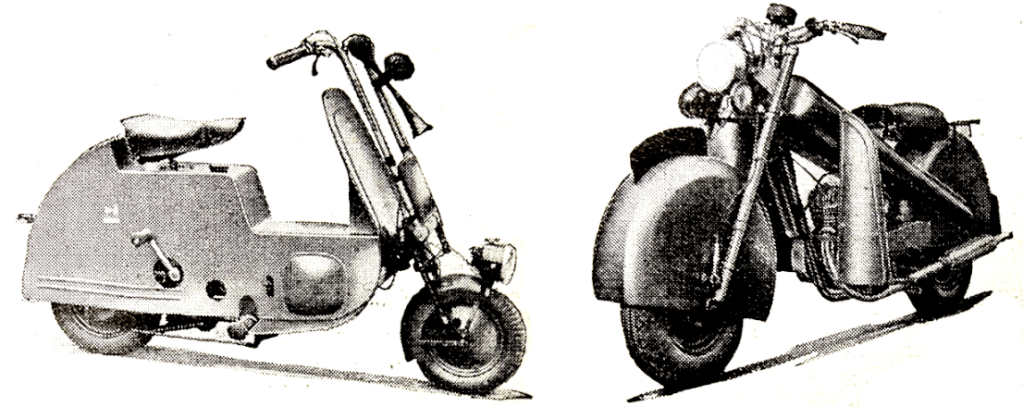
of its light weight and portability (the-handlebars fold back along the tank and the saddle pillar telescopes down). However, there are now available a number of conversions which broaden the appeal of this little machine very considerably. This is especially true of the JO Conversion Set which comprises a sheet-steel body; this encloses the engine and rear wheel and also provides an ample weather shield. One of the first autocycles to be introduced, the Cyc–Auto, remains essentially a mechanically propelled cycle in the sense that although a sprung fork is fitted and the frame is of very sturdy construction, the riding position is such that the machine can be used comfortably as an ordinary cycle. The engine is mounted in front of the bottom bracket of the frame, and drives through a worm shaft and bronze worm wheel; final drive is by a chain on the left-hand side. The multi-plate clutch is operated in the orthodox manner, but the handlebar lever, when it is pulled to the limit of its travel, actuates a powerful transmission brake. There are two basic models in the Dot range, one intended for normal road riding and the other for competition work. Both are fitted with the Villiers 197cc two-stroke engine with three-speed gear in unit. The road model may be obtained in two forms, the DST, which has Villiers direct lighting, and the RST, which has lighting incorporating a rectifier and battery. A sturdy loop-type frame is employed, and the front telescopic fork is of outstandingly robust construction incorporating forged steel lugs. The Competition model may also be obtained in two forms, equipped for scrambles or trials. The frame has been specially developed for high-speed rough riding and is braced for lateral rigidity and strutted for impact loadings.
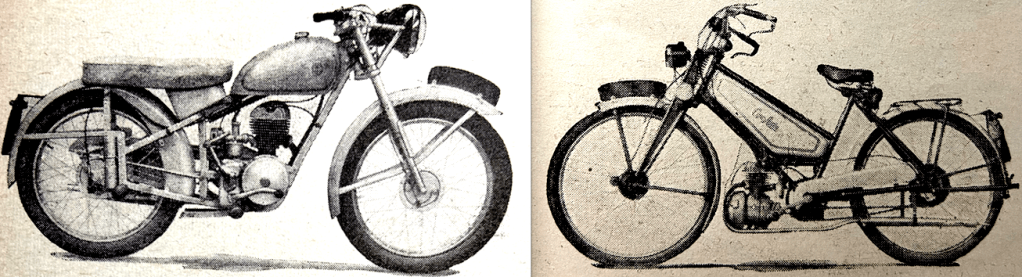
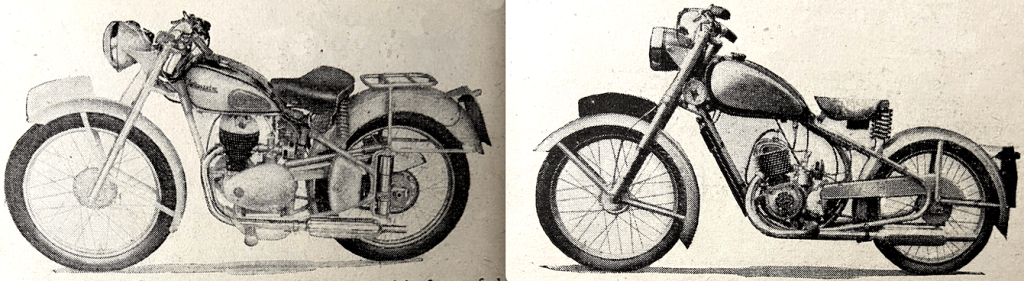
Latest development in connection with DMW models is that they may now be obtained with a novel frame made up of rectangular-section tube, welded at the joints and incorporating plunger-type rear springing. This frame is employed for the de luxe models. Standard models have an orthodox frame without springing, but have the same type of telescopic front fork that is fitted to the de luxe models. Direct lighting is employed. In addition to these four road machines there are competition models of 122 and 197cc, available with the solid frame or the rectangular-section tube spring frame. The appealing Excelsior range includes two 98cc autocycles and five motor cycles—two 122cc two-strokes, two 197cc two-strokes and, finally, a 244cc two-stroke twin. The autocycles are fitted with Excelsior engines, one has the Sptyt and is a single-speeder on orthodox lines, while the other is fitted with the Goblin, which has a two-speed gear in unit. Apart from these differences, the two models, which are respectively known as the Autobyk Sl and the Autobyk G2, are similar; they have a sturdy frame and a front fork controlled by rubber rings. Plunger-type rear springing is standard on all the other models. The frames are of the tubular loop-type, and a telescopic fork incorporating double-action coil springs is employed. Engines in the 122cc Universal models and the 197cc Roadmaster models are the famous Villiers units with three-speed gear box and positive-stop foot control. An outstanding model is the Talisman which is a 244cc parallel-twin Excelsior power unit with the four-speed gear box in unit. The light-alloy cylinder heads are separate
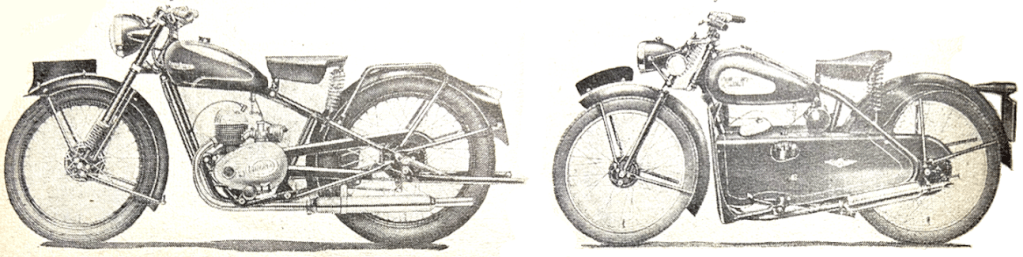
castings, as are the cast-iron cylinders. The crankshaft is supported by five bearings which ensures absolute rigidity and contributes to the inherent smoothness of the twin-cylinder two-stroke. A new lightweight motor cycle, the FLM, is coming on the market. The two models of which advance details are available are fitted with the 125cc JAP two-stroke engine gear unit. On is the Mark I Utility and the other is called the Mark I Glideride which has a channel-section frame with rear springing of pivoted-fork design providing instant adjustment to meet the conditions of usage. A twin-seat and pillion footrests are standard. There is an emphasis on quality and on ‘riders’ points’ with all Francis-Barnett machines. For instance, the all-black finish (azure blue to order) is not only becoming but is also beyond reproach; the silencers are most effective and are readily detachable for cleaning; the saddle is adjustable not only at the springs but also at the nose. A sturdy loop-type frame is employed, and the telescopic fork has three-rate springs which give a range of movement exceeding 5in. Other details are 3.00x19in tyres, a 2¼-gallon tank fitted with a reserve-type tap, and 5in-diameter brakes front and rear. The Merlin models are fitted with the 122cc Villiers engine, the 52 with direct lighting and the 53 with rectifier-battery lighting. The 197cc Villiers engine is fitted to the Falcon 54 model (direct lighting) and the Falcon 55 (rectifier-battery lighting). An autocycle is also included in the Francis-Barnett range. This is the Power-bike 56 which is fitted with the 98cc Villiers engine. Though the Indian Brave is produced in Great Britain, the entire output is exported to the United States. However, there is a chance that later on the machine will be available for other
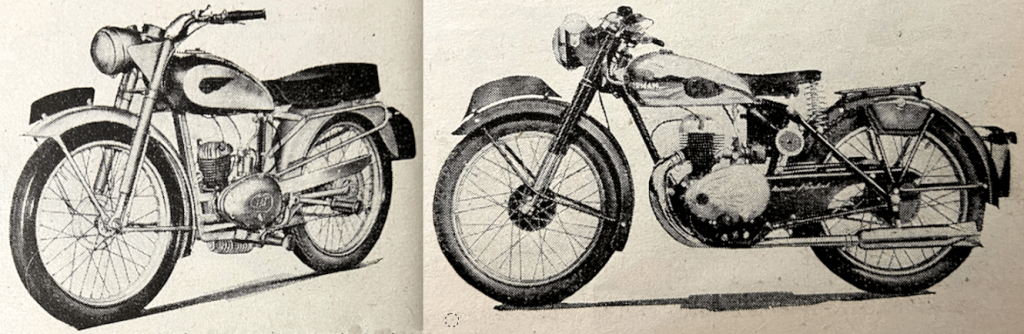
markets, including Britain. The Brave is particularly outstanding for its man-sized dimensions and for its lively performance. The engine is a 248cc side-valve, with a three-speed gear box in unit. Incorporated in the crankcase-cum-gear box casting is a sump, and lubrication is by means of a submerged gear pump. Another feature is that a Lucas 45-watt alternator is fitted on the crankshaft, and ignition is by coil. All James motor cycles are in the lightweight category. For 1951 the nine-model range was increased to 10 by the addition of a most interesting newcomer, the Commodore. This model, fitted with the 98cc two-speed Villiers engine-gear unit, makes a special appeal to the utility rider who requires good weather protection and prefers to ride in everyday clothing. The basis of the machine is the 98cc Comet but the engine unit, from the cylinder head down, and the transmission are shrouded by sheet-metal covers. Safety bars incorporate leg-shields. Fitted with the 122cc Villiers engine-gear unit, the Cadets may be obtained in standard form with direct lighting and in de luxe form with rectifier and battery lighting. For those who require a slightly more powerful machine there are the Captain Standard and the Captain de Luxe, with direct and rectifier-battery lighting respectively, which have the Villiers 197cc engine-gear units. Finally, there are two most attractive competition models developed from experience gained over a long period in all the important trials, including the ISDT. Cadet, Captain and competition models have a robust, tubular, loop-type frame and a telescopic front fork. Plunger-type rear springing is fitted on the Captain de Luxe model. James also market an attractive auto-cycle. An old favourite among autocycle riders, the New Hudson is a business-like little machine with a sturdy loop-type frame and a link fork with pressed-steel blades. The engine is the 98cc Villiers unit. Identical except for the engine-gear units, the Norman models Bl and B2 have a straight-tube frame with malleable-iron lugs. A specially, interesting feature is the Norman telescopic fork,
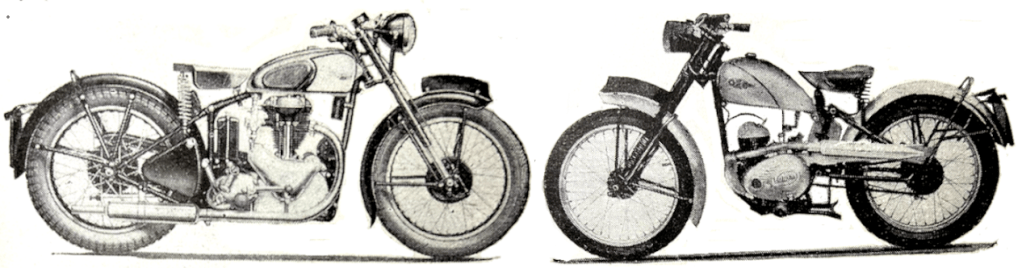
which utilises hydraulic damping balanced be-tween the two legs. This is achieved by a cylinder above the top lug which communicates with the two oil chambers. The 122cc Villiers engine is employed for the Bl and the 197cc for the B2. Other Norman models are the model D which has the 98cc Villiers two-speed engine-gear unit—and also a telescopic front fork—and the model C autocycle. Villiers 122 and 197cc engine-gear units are fitted to OEC machines. The loop-type frame is of welded and bolted-up construction and a telescopic front fork is employed. At an extra charge, a frame with pivoting-fork rear-springing is available. Special competition models are available fitted with either 122 or 197cc engine-gear units. Both frame and fork are specially designed. Though the 248cc ohv Panthers are in the lightweight category, they are full-scale machines in every way; indeed, the engine is similar in many respects to the 350cc Panther power unit and some components are interchangeable. A feature of the design is that, to ensure long life and reliability, special attention has been given to providing adequate working surfaces. The Model 65 and the 65 de luxe are similar except that the latter has the four-speed Burman gear box and a slightly different finish. Ignition is by coil. The Stroud Competition model has a modified frame resulting in a ground clearance of 6¾in, a 1½-gallon tank, a high-level silencer, strengthened footrests, a Lucas ‘Wading’ magneto and various other detail modifications. Completely redesigned for 1951, Royal Enfield’s famous Model RE has a welded, tubular frame of the loop-type and a telescopic front fork. The 125cc two-stroke engine-gear unit is attached at four points and is of advanced design with a light-alloy cylinder head, twin transfer ports, and the single-plate clutch mounted on the crankshaft. The three-speed gear box has fully enclosed, positive-stop foot-change. Coil ignition is by a crankshaft-mounted Miller AC generator. Output of this new engine is said to be 4½bhp at 4,500rpm; this is about ¾bhp higher than the earlier engine. Plunger-type rear-springing is fitted to the 122 and 197cc Sun models. The loop-type frame is specially robust and gives a man-size riding position With a saddle height of 29in. The telescopic fork is fitted with double-action springs and the fork lugs are steel forgings. Engines are the famous Villiers units with three-speed gear boxes incorporating positive-stop foot change. The three-model range is completed by the attractive 98cc de luxe model which has the Villiers two-speed
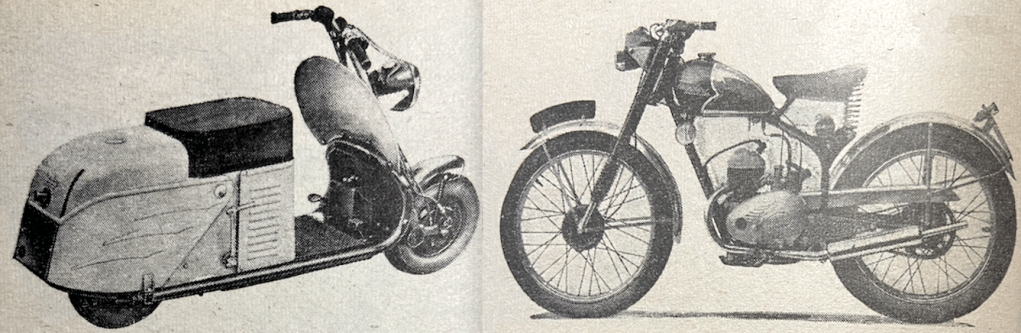
unit. All models are finished in maroon. Solo and sidecarrier Swallow Gadabout models are available. The solo machine has the Villiers 122cc unit and the sidecarrier machine, which is intended for commercial purposes, has the Villiers 197cc unit. Both are equipped with a large weather shield and a bonnet which enshrouds the engine, transmission and rear wheel, and which provides a very large and comfortable seat. Latest addition to the Tandon range is a competition model named the Kangaroo. This model has a specially stiffened-up frame and fork, an under-shield, a smaller-than-standard (1 gallon) petroil tank, light-alloy mudguards, a quickly detachable headlamp, and tyres of 2.75x21in (front) and 2.25x19in (rear). The established 122cc Supaglid and 197cc Supaglid Supreme models are specially attractive for the pivoting-fork rear suspension controlled by a rubber cartridge and a long-action telescopic fork, and for their elegant lines. Also marketed is the Milemaster, which has the 122cc Villiers engine with hand change. The frame is specially interesting. It is of the duplex type made up from straight tubes clamped in Elektron lugs. The telescopic front fork has pre-loaded springs, the tension of which may be varied according to road conditions. Though the VeloSolex with its 45cc two-stroke engine driving the front wheel by Carborundurn-faced roller might well be considered in the motor-assisted cycle category, it is sold as a complete machine. For 1951, engine modifications resulted in increased power output and better low-speed two-stroking, and lubrication has been improved. Specification includes direct lighting. Few motor cycles have aroused more interest throughout the world than the Velocette Model LE. The machine is of most advanced design, with a horizontally opposed, twin-cylinder, water-cooled, side-valve engine in unit with a three-speed gear box, shaft-drive to the rear wheel, pivoting-fork rear suspension (adjustable for load), and a telescopic front fork. The backbone of the frame is a steel pressing, to which is welded the rear mudguard. For 1951 the engine size was increased from 149 to 192cc, and necessary modifications were made to the engine to withstand the increased power output, which gives the latest LE livelier acceleration and better hill-climbing properties.”
“FEBRUARY, BRITISH READERS will recall without much pleasure, justified its ominous title of fill-dyke. And Tuesday, February 20, made a worthy contribution to the month’s rainfall. In Surrey at 10am the rain pelted down; relentlessly it continued at 11am, at 12, at 1pm, at 2…No occasion for buzzing around Box Hill on motor-assisted cycles (MACs)—at least, not the most propitious of occasions. Some weeks earlier in the office we had this line of thought: bicycle propulsion units—micromotors or clip-ons to those who are fascinated by an expressive, single word—are being produced in ever-increasing quantities; the number of makes in the list creeps up until, if we cheat just a wee bit, we can call it a round dozen (‘cheat’ because our list includes the VeloSolex, sold as a specially designed cycle complete with engine, and therefore not in precisely the same category as all the others which are engines for fitting to a normal pedal-cycle); the variety in design, in methods of attachment, and in drives employed, provides plenty of material for thoughtful study; the appeal of the micromotor has been established and power-propelled cycles are nowadays common on British roads; hence why not ask the manufacturers to join us in a gossip on powered cycles and to bring with them at least one of their models for members of the Staff to gallop around the lanes? At 11am on that Tuesday, more than 20 members of the industry with five of The Motor Cycle Staff were drinking coffee in the lounge of the Burford Bridge Hotel. The bicycles were in the garage. Every make was there except the Bikotor, which is not yet quite ready for production. Since the programme included discussion as well as riding, the obvious thing to do was to talk first and ride later—by then the weather could not be worse. Discussion ranged over such varied topics as the best type of cycle for attachments, speeds, service, decarbonising, lubrication, insurance, taxation, driving licences, and free-wheels. Here are some of the broad conclusions. Any cycle in reasonably good mechanical condition, except the few ultra-lightweight racing types, is deemed suitable for a micromotor. Some frames are better than others and perhaps the best is the fairly sturdy roadster with its longish fork trail. Brakes should be in first-class condition to cope with the slightly higher speeds usually employed when an engine is fitted. Internal-expanding hub brakes are better than rim brakes, mainly because the latter lose efficiency in wet weather. If the drive is by roller on a tyre, the driven wheel should run true. Should special cycles be developed for attachments? The conclusion was ‘no’ for a number of reasons, but mainly because, (a) the attraction of being able to add an engine to a cycle already in use was lost and (b), the special powered cycle with fittings such as a spring fork and bigger tyres and saddle, was already a long-established type—the autocycle. However, experience in Continental countries suggests that there might well be a market for sprung forks, larger saddles and other fittings as accessories to appeal to the type of owner who had the inclination to make his machine more luxurious. Speeds have a bearing on the suitability of the average cycle. If habitual speeds are far in excess of those usual when pedalling, then the stresses on wheels, frame and brakes could be higher than envisaged by the cycle designer. With the possible exception of two units, both imported from the Continent, the micromotors are designed to provide speeds only slightly above those usually accomplished by the average sporting cyclist. In any case, the standard cycle with its unsprung frame and fork, small-section tyres and small saddle is inclined to be uncomfortable when travelling fast. Statistics indicate that about 60% of purchasers of micro-motors are completely unfamiliar with any form of internal-combustion engine. Instances were given of owners who called for help when a plug lead became detached, or when they had forgotten to turn on the petrol tap. The two-stroke micromotors are extremely simple and only the most rudimentary knowledge is required to deal with all likely stoppages. Periodic maintenance is largely a matter of decarbonising the engine and exhaust system, and a general check-over of the ignition and the carburettor. Decarbonising is usually required at 1,000-2,000-mile intervals, though much depends on running conditions and the amount of oil used in the petroil mixture. An engine used for longish journeys on fairly wide throttle openings will carbon up less quickly than one which spends its life on short trips and thus rarely gets more than warm. Indeed, instances were given of mileages well in excess of 2,000 between decarbonising. Charges for this periodic work range from about 7s 6d to 15s, depending
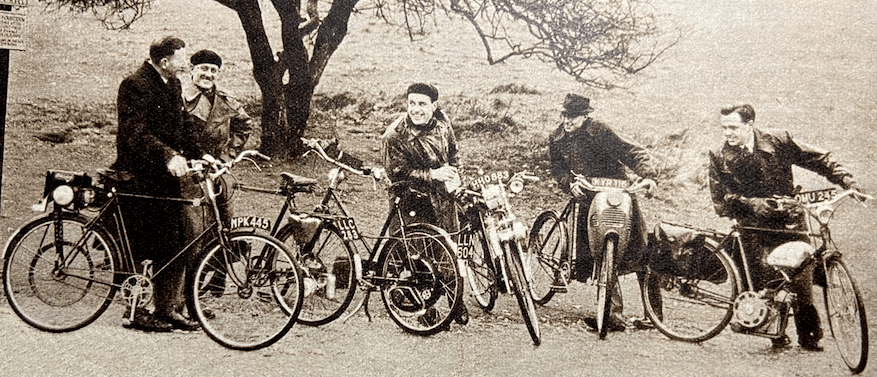
on how much attention is necessary. The makers’ recommendation on the petrol to oil ratio must be followed—for the two-stroke engines on the British market the ratio varies from 16 to 1 to 30 to 1. But a fairly common tendency among owners is to be liberal with the oil; to add a bit more ‘just for luck’. There is no merit in this practice, because the additional oil carbons up the engine more quickly and often aggravates four-stroking. Another point is that the oil should be of the correct grade because a heavier oil (thicker, and with a higher SAE number) also causes quicker carbon formation. It is recognised that the variety of petrol to oil ratios and of oil grades recommended is an undesirable complication and can be a headache to filling-stations. Efforts are being made to standardise ratios and grades of oil. The ideal would be the standardisation of, say, 25 to 1 petrol to oil, and this to be available ready mixed straight from a pump in quantities from a quart up. More might be heard of this scheme before very long. Just as with decarbonisation periods, so running conditions have a big influence on petroil consumption. Anything from 150-300mpg can be expected with an engine in good condition. Insurance rates range from as low as 7s 6d a year for third-party cover up to £2 for a comprehensive policy; one particularly attractive comprehensive policy at £1 17s 6d covers any rider, so that the MAC could be a maid of all work for every member of a family with a driving licence. As might be expected, driving licences came in for a good deal of discussion. There is a strong case for those who argue that a motor-assisted cycle is essentially a cycle and that the rider should be treated as a cyclist—no driving licence, road tax or insurance. On the other hand, there is the view that cyclists should be treated as other vehicle owners and comply with all the formalities, and charges. Perhaps a typical British compromise would be a solution—a fixed annual fee to cover licence, tax and third-party insurance to apply to both macs and cycles. No ‘L’ plates and driving tests, because the value of the tests would be doubtful and in any case it would be impracticable m test the 12-14 million cyclists in Great Britain without a veritable army of examiners. Even with things as they are today, the cost of buying and running a micromotor is remarkably low. For the two-strokes, prices range from £18 18s to just over £27, with the majority in the £20-25 range. Exceptions are the four-stroke Cucciolo with two-speed gear at £40, and the VeloSolex sold as a complete machine at £48 odd…a driving licence costs 5s a year and the driving test fee is 10s. Road Tax is 17s 6d a year; third-party insurance, say, 10s a year; petrol consumption, say, 200mpg. The return for the outlay is no more hard pedalling. True, in hilly country, the pedals will have to be used to assist the engine, but with nothing approaching the energy needed for an ‘un-assisted’ cycle. Or it may be necessary on very steep hills to dismount and push; the only disadvantage compared with doing the same thing with an ordinary cycle is the additional weight of the engine and fuel—say, 20lb. Another advantage is that because the hard work is taken out of cycling the owner of an MAC is almost certain to travel farther afield than he did when he had to pedal all the time. Many a newcomer has bought a clip-on solely with the idea of easing the labour of his cycle ride to and from work and then became an enthusiast for week-end trips out of town on his new-found means of easy, pleasant, cheap transport. All these aspects were informally discussed as the rain sheeted down. As we had lunch, the weather brightened. Well, good or bad weather, we of The Motor Cycle Staff—Arthur Bourne, Roy Morton, Hugh Burton, John Mills and I—were determined to gallop the 11 macs around the Surrey roads. The makes represented were Bantamoto, Cucciolo, Cycloid, Cyclemaster, Cymota, GYS Motomite, Mini-Motor, Mosquito, Power Pak, VAP and VeloSolex. Some manufacturers had brought more than one example of their products and there were well over a dozen machines available. We buzzed along the Dorking-Leatherhead by-pass, round the islands and turned circles in the road to get the feel of low-speed pulling and manoeuvrability; and up the Box Hill zig-zag road, with its gradient ranging from 1i in 25 to 1 in 8 to see how much pedalling, if any, would be necessary. Repeated swops of machines were made and it is a compliment to the simplicity of macs that no one seemed to want more than the most sketchy instructions on which control did what. Though the rain eased off and stopped entirely at times, the roads were almost awash. Do drive rollers slip on wet tyres? The answer is ‘no’ so far as my experience showed. I tried every roller-drive attachment and never once obtained slip even when I endeavoured to provoke it. Another point that impressed itself on me was that there is a fair difference in the type of performance given by the various units. Some are supremely happy pulling hard at low speeds, while others are at their best when nipping along. This impression. emphasised an aspect brought out by a dealer (who is also an importer) that the wide variety of makes available is a good thing because there is the opportunity for a buyer to be recommended the unit best suited to his or her needs. The extreme example would be a middle-aged lady who wanted shopping transport compared with the hardened motor cyclist who was interested in a MAC as an addition to his stable. The former would be recommended the most simple and docile unit, while the latter would probably not require advice—he would probably choose a ‘peppy’ job. But my colleagues also have their impressions and this is what they say: Arthur Bourne writes, ‘In youth and in the recent periods of no petrol except for essential purposes, I frequently bicycled in the Dorking-Leatherhead area, in which
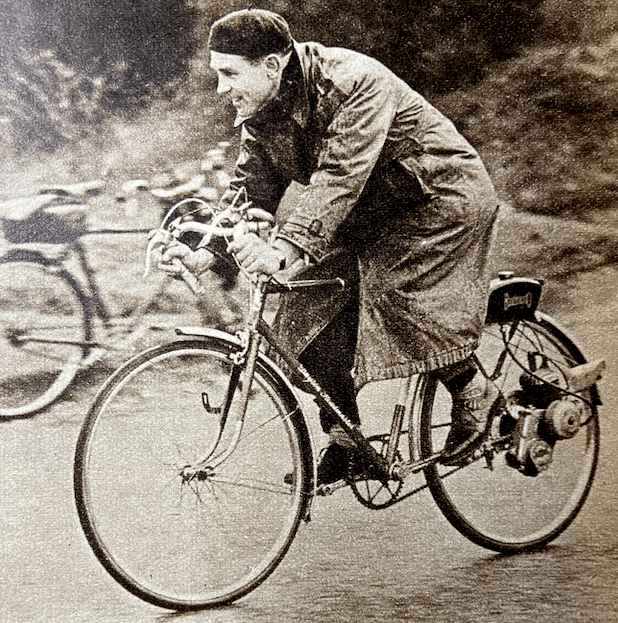
Burford Bridge lies. With the power-assisted bicycles, instead of having to slog up the hill or against the wind, I was either freewheeling or gently twirling the pedals to enable the engines to maintain their power and gait. This was as expected, but. what proved a surprise was that, not having to dissipate any appreciable amount of energy, I found myself able to take an interest in everything around to an extent I had never previously known. There and then I decided that I should like to have a machine—one of the several really quiet ones—for exploring the byways near my home. With it I should be able to see more and to learn more than by any other means. How quiet some of the latest models are was revealed by Harry Louis and I chatting away as we rode along side by side and, perhaps more forcibly, by my hearing the songs of the birds in the woodlands —yes, and the drip of water from the trees. . .’ Roy Morton writes: ‘I never had a cycle as a kid. In fact, I rode a motor cycle for several years before the chance of sampling a pedal. cycle came my way. My approach to these clip-ons, therefore, was essentially that of a motor cyclist with but dim recollections of the hard work and comparative discomfort of pedal-cycling. First impression was the length of time required to cover a given stretch of road compared with the potent 500 that had borne me up Box Hill. However, on uncoupling the motor drive and using my two shanks as motive power, I was very surprised how comparatively fast had been the gait when engine-propelled. Impression No 2 was, and is, amazement at the climbing powers of these tiny engines. Gradient of the Alpine road up Box Hill is such that, when freewheeling down, a speed approaching 40mph is attained if the brakes are not applied to check it. When going up, only an occasions twirl of the pedals was required to keep the engine happy. Even when the speed was allowed to drop to little more than a walking pace, so that the engine was on the point of stalling, only the lightest of pedal assistance was required to pick up speed again, this on a gradient almost impossible to climb by pedalling alone. Climbing the Alpine road with a clip-on was like cycling along the level with a strong following wind. These little units take all the work out of cycling, leaving only the pleasure.’ Hugh Burton writes: ‘It was what the Irish euphemistically call “a soft day”—wet and blustery; but I must say I thoroughly enjoyed it. These mustard-hot engines took us up the winding Surrey lanes with great gusto, and one added little to one’s knowledge of ankling. Indeed, my main criticism of some of the clip-ons is that they are too powerful. After all, a bicycle frame (especially a ladies’ open-frame model) is none too rigid. It is not designed for power propulsion over the 20mph mark. No, I feel that the ideal clip-on must have plenty of urge low down. Low-speed pulling, especially if the owner is a town-dweller, is of greater importance than a comparatively high maximum speed or even startling hill-climbing. For the clip-on owner should, I feel, be prepared to help his little engine on dragging gradients. If he requires greater performance he should graduate to the autocycle or light motor cycle. At present, the little engines are, in the main, designed on the right lines. They are simple and light and they pull well. There should be no attempt to provide luxury features. The fact that, in the event of trouble, the owner may disconnect the drive and pedal to a garage or to his home, is confidence inspiring. He is his own ‘get-you-home’ service. I think the controls of some clip-ons could be simplified. The best I tried consisted of a single twistgrip. Turned one way, the decompressor was brought into action, when one could pedal the machine from a
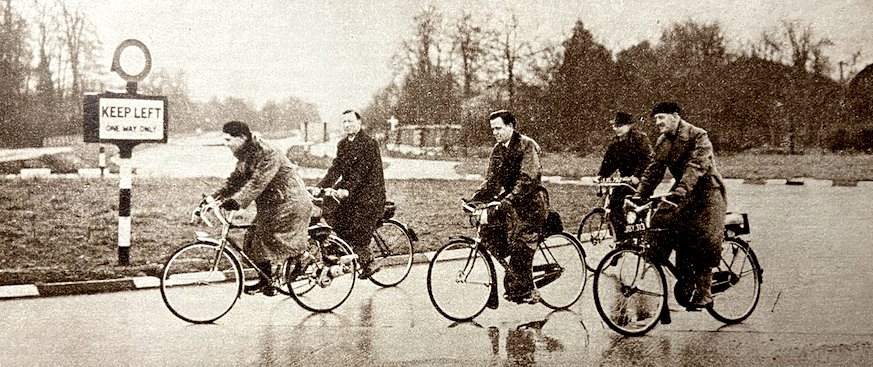
standstill. Once under way, the twistgrip was opened, whereupon the engine fired end got going.’ John Mills writes: ‘Nobody would ever suggest that I was an enthusiastic pedal-cyclist, and any form of device that relieves effort meets with my approval. Box Hill in pouring rain is perhaps not an ideal place for testing clip-ons, but rather to my surprise the bicycles did not suffer from any feeling of instability. Mostly because of the smooth running and quietness of the power units, it was not until I tried pedalling that I realised just how easily the ground was being covered. It was my luck that my first pick was a machine with very little petrol in the tank, and about a mile from base the engine died. The effort necessary to ride back, with the engine disconnected from the wheel, was sufficient to convince me of the value of a micromotor. Hill-climbing capabilities.of the machines were quite extraordinary—very little lpa was necessary at any time. In fact, the only drawback I found on some machines was the poor brakes. This was due mostly to the wet weather and, of course, being used to first-class motor cycle ‘stoppers’, I tended to leave braking a little late. To sum up, I spent a most enjoyable day riding these machines and would not hesitate to recommend their use to anyone who wants to take the ‘pedal’ out of pedal-cycle.’ SPECIFICATION SUMMARIES. Bantamoto: 40cc two-stroke mounted on an extension on the rear wheel spindle at the left side and driving the wheel by gears. Weight 181b. Price £21. Makers, Cyc-Auto, Brunel Road, East Acton. London W3. Bikotor: 47cc two-stroke mounted across the rear wheel and driving by roller on the tyre. Production expected to start shortly. Marketed by Dennis R Mead, 190-195, Picadilly, London, W1. Cucilolo: 48cc ohv with a two-speed pre-selector gear box in unit. Attachment is to the cycle bottom-bracket and down tube; drive is via the cycle pedalling chain. Weight 17½lb. Price £40. Concessionaires, Britax (London), NW6. Cyclaid: 31cc two-stroke mounted above the rear wheel which it drives by V-belt. Weight, 151b. Price £20. Makers, British Salmson Aero Engines, London SW20. Cyclemaster: 25cc two-stroke housed in a special rear-wheel hub. Enshrouded chain drive. Weight 34½lb including wheel. Price £25. Marketed by Cyclemaster, London SW7. Cymota: 45cc two-stroke mounted across the front wheel which it drives by roller. The unit is enclosed by a pressed-steel cowl. Weight 221b. Price £19 19s. Distributors for UK, Blue Star Garages, London WI4. GYS Motamite: 49cc two-stroke mounted across the front wheel and driving by roller on the tyre. Weight 221b. Price £22 1s. Makers, GYS Engineering, Bournemouth, Hants. Mini-Motor: 49cc two-stroke mounted over the rear wheel and driving by roller on the tyre. Weight 221b. Price £21. Makers, Mini-Motor, Trojan Way, Croydon, Surrey. Mosquito: 38cc two-stroke attached below the cycle bottom-bracket and driving the rear wheel by roller on the tyre. Weight 211b. Price £25. Marketed by Mosquito Motors, Liverpool 2. Power Pak: 49cc two-stroke mounted across the rear wheel with the cylinder inverted and driving by roller on the tyre. Weight 221b. Price £25. Distributors: Sinclair Goddard & Co, London W2. VAP: 48cc two-stroke mounted on an extension of the rear-wheel spindle on the left side and driving by chain. Weight 201b. Price £28 7s. Concessionaires: Frank Lawrence Motor Cycles, London SW11. VeloSolex: 45cc two-stroke mounted across the front wheel and driving by means of a roller. Machine is sold complete as a motor-assisted cycle. Price £48 5s 2d. Makers, Solex (Cycles), London NW1.”
“THE ORIGIN OF the term petrol has now been doubly solved. In quite another connection I reported recently how a bibliophile reader has discovered that Edward Butler, designer of the first British motor tricycle, wrote books, one dealing with carburation. This happy student finally unearthed a copy of the carburation book in its second (1919) edition. In it Butler says: ‘The designation “petrol” was first used and registered by the writer in 1887, which term has been adopted in this country to include all brands of motor spirit.’ Later, on the same page, Butler describes a Lenoir carburettor, in which ‘essence de petrole was fed into a revolving cage, containing a sponge’. The second quotation appears to explain where Butler found his word, and further suggests how the French cut the three-word term to the single word ‘essence’, which they still use to-day.”—Ixion
“I IMAGINE THAT the vendors of windscreens are pleased with their turnovers. Time was when you pilloried yourself when you fitted a screen. That nonsense is a thing of the past. Lads who do not wish to look fast or to burn the tar off the road surface even retain their screens through the summer without a blush. In the January cold snap I saw several very ‘warm’ speedmen riding behind windscreens even in town use. We are growing more sensible, and the increased sale of screens is partly due to the fact that screens are more rigid than they used to be, and no longer flap. I even see some owners of clip-ons using screens. If and when somebody introduces really good legshields, easily attached and detached, I think they, too, will grow more popular.”—Ixion
“100-MILE AMATEUR RACE: With feverish haste and anticipation that extended into the wee small hours of the morning, preparations were being made to provide the day’s excitement. This amateur 100-miler on Saturday was to go down in the annals of racing sport for two reasons—the old record was to be broken again, and the majority of winning places were to go to British machines. The entry list showed 115 machines—16 Nortons, 16 Triumphs, 17 BSAs, 20 Indians, one AJS, one Rudge and 44 Harley-Davidsons. The Amateur Race may be likened to the Clubman’s TT. The rider has to graduate from novice by obtaining points during a year of racing. This is determined by the governing body, the American Motorcycle Association. If a rider comes within the first three places in the Amateur race he automatically becomes an ‘expert’, and from then on will have to ride in the expert-class races. With nary a cloud in the sky, the sun rose over the shimmering Atlantic. It was high tide and next to impossible to get on the beach. Part of the course laid out by nature provides both riders and spectators with many an alarming moment, for high-speed snaking is visibly apparent. The course is 4.2 miles in circumference. Two miles of beach, two miles of asphalt paving, with a series of
ripples that keep front forks and rear springing busy! These two stretches are joined by steeply banked man-made turns. Starting was different this year. Previously the riders were sent off in groups of 10, 10 seconds apart, and allowed 10 seconds or more at the finish. This, however, made the placings indefinite at the end of the race. To avoid this confusion, riders drew for their positions as before, but if they were unfortunate enough to draw the 10th row, then they started with a deficit of 50sec because each row started 1sec apart. Those 50sec had to be made up. There is a procession of machines as the riders warm up, then a hasty swapping of plugs. Engines are roaring for it is to be a clutch start. The flag is dropped and 10 wildly twisting machines start on their 100-mile grind. Another 10, and another. Soon they are just a drone in the distance. Necks are craned to see who will come out of the south turn the first. What a scramble when they do! From the mêlée, No 2 Marion Farr (Norton) forges ahead closely followed by James Dottellis (Harley-Davidson). On the third lap the leaders are as follows: Farr (Norton), Dottellis (H-D), Bullock (BSA), Nelson (Triumph), and Gunter (BSA). They are so closely knit together that their positions could easily change. They do, for on the next lap Bullock has moved up into second place with Gunter and Nelson trying to pass Dottellis. In the meantime, a shuffling of riders has been going on behind the leaders, and the race is beginning to take shape. Bullock (BSA) in second place fails to make an appearance; he is out with a seized piston. So now it’s Farr (Norton), Gunter (BSA) and Nelson (Triumph). Farr is being pressed hard by Gunter and eventually yields to the determined BSA rider. Gunter is clocked at a steady 2min 48sec. Michael (Norton), in the meantime, has overcome his 25sec deficit by clocking 2min 45sec per lap; in the ninth lap he passes Gunter and takes the lead. Ted Kales (Norton), Fullerton (Norton) and Freytag (Triumph) follow in that order. Michael increases his lead by 25 seconds as Lap 15 is completed. Gunter still occupies second place Meantime, Freytag (Triumph) has forged into third place and is worrying Gunter, who, as he approaches the north turn, fails to brake soon enough; he goes into a broadside and slithers over the edge. Unhurt, Gunter picks himself up and returns to the fray, but the miscalculation loses him the coveted second place. This puts Freytag in second, then Kales. Could Freytag hold his lead over Gunter who has already passed Kales? Crashes and mechanical trouble have eliminated two-thirds of the field. All three of the leaders hold their positions until the chequered flag drops. Try as he may, Gunter could not make up what he lost. None of the three riders made a pit stop. Michael’s winning time was lhr 12min 41.22sec, an average speed of 82.54mph which easily beat the record of 81.24mph made last year by Rod Coates. Peter Freytag’s Triumph was 28sec behind Michael. Albert Gunter (BSA) was 40 seconds behind Freytag. RESULT 1, Robert Michael (Norton); 2, Peter Freytag (Triumph); 3, Albert Gunter (BSA); 4, J Clear (Harley-Davidson); 5, P Knight (Norton); 6, M Farr (Norton); 7, B Skoglund (BSA); 8, J Alger (Norton); 9, M Risser (Triumph); 10, E Kales (Norton). FOR SUNDAY’S 200-MILE EXPERT RACE the sun shone brightly, and there was a slight breeze off the sea. Checking in of the machines was in progress at 8am. This was done at the south turn of the course, under the watchful eyes of the AMA officials. Compression ratio allowed on any ohv 500cc machine must not exceed 8 to 1, an increase over last year’s 7 to 1.
In consequence, speeds were likely to be appreciably higher. With an hour-and-a-half to go all riders are informed that they must take their places on the starting line. Absent from the line-up was Bill Mathews, last year’s winner, who was unable to get his entry visa from Canada to the USA. There is a formidable array of racing talent. Riders have come from every one of the 48 States and represent the cream of U.S. speed-men. The entry is as follows: 8 Nortons, 15 BSAs, 44 Harley-Davidsons, 16 Triumphs, 9 Indians, 3 AJSs, one Vincent, one BMW—a total of 107, of whom six did not start. The course marshal has just driven off to clear the course—so that means that there is just five minutes to go. A maroon goes off every minute—three, two, one. Ten engines roar—hold it! Johnny Long (BSA) has held his clutch out too long and his machine moves forward. He drags his feet, pulls off to the side, and the pack gets away. Johnny, too, somewhat later. Starter Jim Davis gets them all away in 25 seconds, quite a feat consider-ing that there were 101 aspirants. First man to reach the north turn is Dick Klamfoth (Norton), who started in the second row. it seems but a scant few seconds until the healthy crackle of a well-tuned Norton heralds the approach of Klamfoth at the South turn. He has gained five seconds over George Sabine (H.D) in one lap! At the end of six laps the position remains practically unchanged except that Klamfoth’s lead has been increased to 25 seconds. He is followed by Sabine (HD), Tex Luse (Triumph), Albrecht (Triumph) and Bobby Hill (Norton). Luse, a very colourful rider, keeps the spectators gasping as he broadsides his Triumph all the way round the turns. Sabine (HD) is in trouble and gives way to Luse, who is soon being hounded by Hill. Then, on the 18th lap, Hill passes Luse. The Norton rider has set his cap for the fleet Klamfoth, a good 30sec ahead. Still within striking distance are Luse and Don Bishop (Triumph), who has worked his way up and is running neck acid neck with Don Evans (Norton). Pressing close upon their heels is Ed Kretz Snr (Triumph) and Jim Garber (BSA). It is a real battle. Not once could the leaders ease off. Hill, fighting desperately to catch Klamfoth, puts in a 92mph lap and succeeds in cutting down Klamfoth’s lead to 16 seconds. Luse, despite his best efforts to overtake Hill, finds himself being ousted by Kretz Snr. Then Kretz is blocked by a slower rider on the north turn and goes down heavily. He is not hurt, but
precious seconds have slipped by. Klamfoth comes in for his pit stop and is away in 15sec. Hill (Norton) now has the lead, but he has not yet taken on fuel and oil. Dick Curtner (Norton), who has been making his presence felt, is signalled for a pit stop. He comes in; petrol is half in the tank when flames mushroom up from the Norton. The pit attendant drops the remainder of the can, and the flames spread over a large area. An extinguisher is used on the Norton and the fire put out. Curtner remounts but later retires through running out of petrol. Hill makes his stop and is away in 18 seconds. Bill Tuman (Norton) has worked his way up to third place. At the end of 30 laps the positions are Klamfoth (Norton), first; Hill (Norton), second; Tuman (Norton), third; Luse (Triumph), fourth; Bishop (Triumph), fifth; and Evans (Norton), sixth. It looks like a one-two-three victory for Nortons, but on the 31st lap Tuman under-estimates his speed when approaching the turn. Out of control, he comes to an abrupt halt in a sandbank. He joins Curtner in a walk to the pits. Luse (Triumph) now has third position. Klamfoth had increased his lead to 27sec over Bobby Hill. All is not so cut and dried for the riders who follow in their wake. Luse seems to be having difficulty with his gear-change, and Bishop (Triumph), not far behind, is having his work cut out to keep Evans (Norton) from copping his place. Young Ed Kretz Jnr (Triumph) is forced out by a split petrol tank. Klamfoth receives the chequered flag and starts his safety lap. He is followed by Hill, 22sec behind. Luse, a broad grin on his face, nods to the flagger. He is 30sec behind Hill. Klamfoth has set another record of 2hr 9min 15.71sec; average speed, 92.81mph. RESULT 1, Dick Klamfoth (Norton); 2, Bobby Hill (Norton); 3, Tex Luse (Triumph); 4, D Bishop (Triumph); 5, D Evans (Norton); 6, E Kretz (Triumph); 7, J Garber (BSA); 8, E Conley (Harley-Davidson); 9, R Heinzman (Triumph); 10, E Carr (Harley-Davidson).
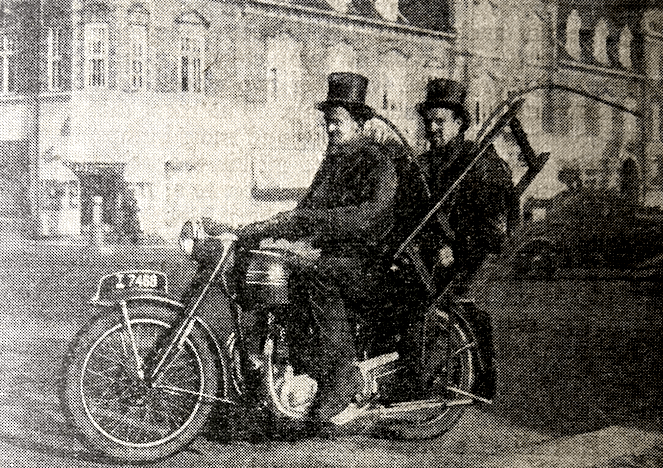
RESULTS OF THE Eilenriede-Rennen held at Hanover, Germany on April 29—250cc Race: 1, H Gablenz (Parilla), 72.3mph; 2, H. Thorn-Prikker (Guzzi); 3, S Wunsche (DKW). 350cc Race: 1, R Schnell (Parilla), 77.6mph; 2, H Baltisberger (AJS); 3, R Knees (AJS). 500cc Race: 1, W Zeller (BMW), 80.8mph; 2, G Meier; 3, H Baltisberger (Norton). 500cc Sidecar Race: 1, Kraus (BMW), 67.2mph; 2, Bohm (NSU); 3, Noll (BMW).”
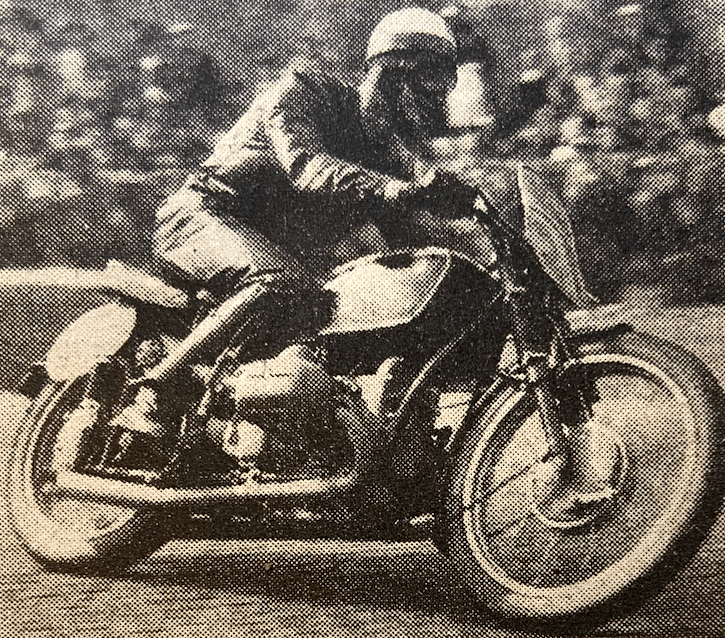
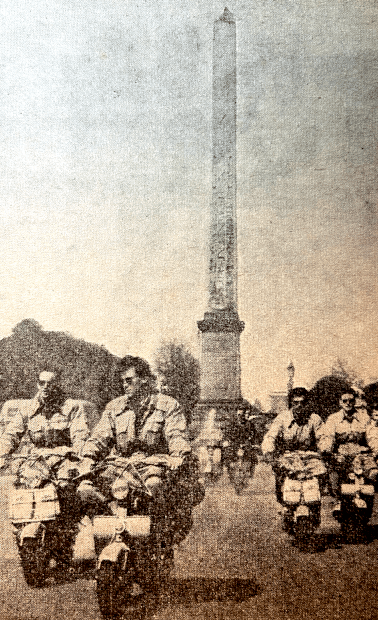
A NETWORK OF 44 clubs, from Aldershot to Wolverhampton, participated in the ‘Youth Training Scheme’ in which experienced clubmen showed nipper the ropes; the Blue ‘Un noted the syllabus: “THEORY: 1. Components of motor cycle—frame. wheels, tyres, brakes, engine, gear box, magneto, carburettor. (Brief description of working principles.) 2. Driving in theory. Use of controls. 3. The transmission system, clutch and brakes. 4. Carburation. 5. Air and ignition controls. 6. The gear box. 7. Ignition. 8. The cycle parts and brakes, with emphasis on the importance of correct adjustment. 9. Riding methods, signals, the Highway Code. 10. The Highway Code, with special emphasis on roadcraft. 11. Insurance and legal responsibilities. 12. Revision. PRACTICAL TUITION: 1. Starting engine and manipulation of throttle and brakes on stand. 2. Wheeling machine, placing on stand, ‘driving’ and manipulating all controls except gear lever. 3. Ride on motor cycle in bottom gear only. Practice in letting in clutch and stopping. 4. Practical riding, controlling speed by throttle only. 5. Practical riding, utilising throttle and, where fitted, air and ignition controls. 6. Machine on stand. Practice in changing gear. Riding and changing gear. 8. Riding, changing gear, use of brakes, and ‘Halt’ test. 9. Practice in riding, using correct hand signals on test course. 10. Riding instruction simulating traffic conditions, (signals, road signs, pedestrian crossings, camber, etc). 11. Roadcraft and roadmanship. 12. Revision.”
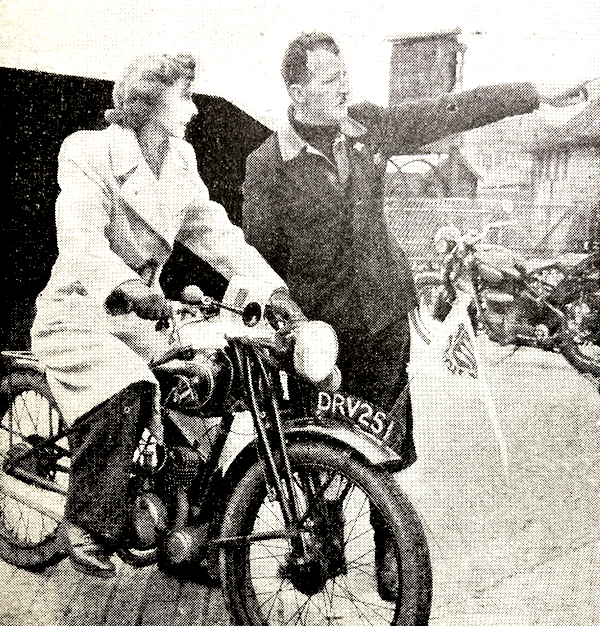
“A CORRESPONDENT MENTIONS a record better than 100mph in 1919 in America. We have to be careful in claiming these things, and I am open to correction; but I believe that the first machine of under 1,000cc to do 100mph in America was the American Excelsior in 1913. On February 3, 1922, a standard, side-valve Henderson on the Roosevelt Road, west of Chicago, did 98mph. This particular machine already had more than 10,000 miles to its credit, and, it did this speed with full touring equipment, electric lights, battery, etc.
HAROLD W EDDY, Falmouth.”
“”AJ DUDLEY-WARD, riding his DW Special, won one of the two 500cc solo races in Finland’s Grand Prix meeting last Sunday. He covered the 25 laps (about 31 miles) in 29min 1.5sec, average speed 64mph. Second was R. Lampinen (Triumph) of Finland, and another Finnish Triumph rider W Berastroem, was third. The second 500cc race was won by 0lle Nygren (AJS), the well-known Swedish moto-cross star; the time for the 25 laps was 28min 59.2sec. Second was Leon Martin (Norton) of Belgium, and third Bjoern Bergstreoem (AJS) of Finland.”
“THREE WEEKS AFTER buying Oppy (my BSA Bantam’s registration letters are OPE), I quaked down the road to take my test. Half an hour later I was amazed to hear the examiner tell me that I’d passed. I tore up my ‘L’ plates, joyfully scattered them in the gutter, and felt superior all the way home as I passed other ‘L’ drivers. I celebrated by taking a girl-friend on the pillion to Somerset, and even managed to coax Oppy up Porlock Hill. I had passed my test just in time, for my Australian girl-friend and I wanted to go camping in Scandinavia for six weeks, and it was getting late in the year. Very early one August morning we travelled up the Ewell by-pass on our way to Dover. Strapped to the pannier frames on each side of the machine were two enormous bags stuffed with food, cooking pots, stove, tools, emergency petrol, etc. Behind Pru, on the pillion seat, we bad our tent and sleeping-bags, with my rucksack on top; and resting on all this was. Pru’s rucksack. Everything seemed to stick out a mile and I hoped that nothing would slip to hide our new and shiny rear GB plate. General advice had been, ‘Oh, well, it will be a nice trip to Dover, anyway!’ After a few miles I got used to the weight, so that by the time we joined the main Dover road the BSA was skipping along quite steadily. Going up Folkestone Hill, which is long and steep, was quite a test, but we chugged up sedately in first, much to the amusement of owners of superior-looking GB cars, also on their way to catch the cross-Channel boat. We joined the queue on Dover quayside with lots of other motor cycle types, and soon got through the necessary document formalities and drove aboard. Oppy looked a little lost lashed to the bulkhead close to bigger Nortons and Triumph Twins; and these machines seemed to carry half the amount of luggage we had. A rather glamorous pillion-rider off one of these mounts was most encouraging and said, ‘Well, of course, the first thing to go will be the frame.’ Driving through Dunkerque that afternoon consisted of jumping from one pot-hole to another; and even the cobbled road to the Belgian border seemed luxury after leaving the town. Oh, those dear old cobbles! They gave us many a bruise and now, when I look at my tyres, I can hardly believe all the surfaces they have rolled over: pot-holes, cobbles, dirt and gravel, not to mention the odd forest glade and field when in search of camping spots. We always seemed to sense when there was a concrete or tarmac surface coming up and got all ready to cheer lustily as we felt, after cobbles or gravel, its satin-softness beneath our aching seats. We camped in Belgium on our first night. Of course, it poured with rain, so about midnight I had to get out
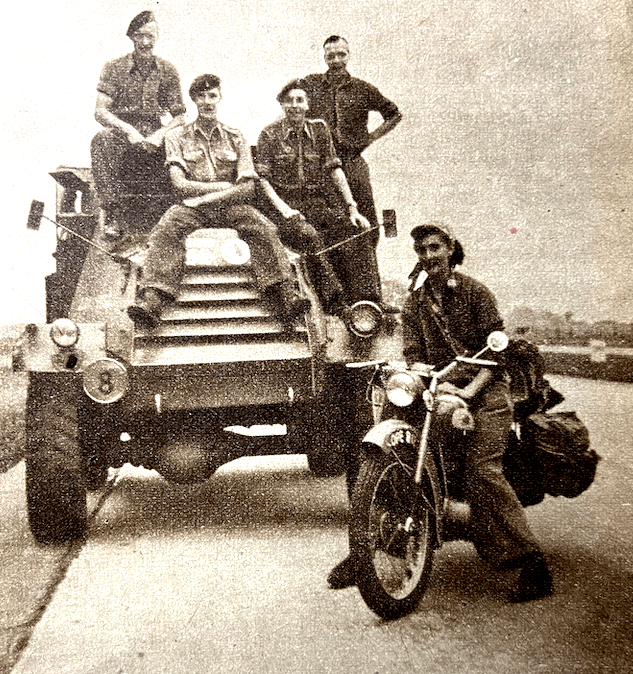
of the tent and push Oppy under a haystack, getting black grease over my pyjamas in the process. I won’t go into the joys of cooking breakfast and packing kit in the rain. We arrived in Bruges looking like an Arctic expedition and hurried on to the Dutch border at Sluis, in Zeeland. By this time it had cleared up, so we crawled out of our oilskins and got back to normal with lipstick and comb. The sun came out and it was wonderful driving along the straight Dutch roads. Most of the roads in Holland are cobbled, though far superior to those we drove over in France and Belgium. We stopped and had lunch by the side of a canal and then got the ferry-boat across to Vlissingen (Flushing). We were now on one of the many islands that make up Zeeland, the south of Holland. Everybody thought we were a huge joke and we spent much time waving at people. Each time we stopped to make a cup of coffee or fry an egg, a little crowd gathered to take a better look at the apparently incredible sight of two foreign girls on a motor cycle. I had to answer innumerable questions about Oppy’s speed, engine capacity, etc. Several times I had to try to prove that she was only a 125cc two-stroke, bemuse with our mountains of luggage, people thought she must be at least a 500cc. We started to look for an early camp, for Pru was suffering from pillion rider’s stiffness. We got permission from the owner of a windmill to camp in his orchard. However, next morning we found that this was a bad move—the grass was very long and thick. It seemed so romantic to camp beneath a windmill and to gossip with all the locals who came over to watch us pitch camp and cook our supper; but embarrassment lay in how to get rid of them so that we could clean our teeth and go to bed! No one made a move until we went inside the tent and firmly shut the flaps. Half an hour later we heard footsteps through the orchard, and there was a lot of rustling outside our tent. I poked my held out—to see one of our kind Hollanders covering the bags with an enormous ex-German Army gas cape. The weather was still warm and beautiful next day as we bounced along to Rotterdam. We had the somewhat shaking experience of driving through the underground tunnel which brings one into the centre of the city. The traffic seemed to be going quite fast, and when Pru leant forward and shouted, ‘Aren’t you going a bit fast?’, I yelled back, ‘No, that last notice said we shouldn’t drive at less then 40kph through the tunnel.’ Pru nearly fell off the back yelling that the notice said that one must not drive at more than 40kph through the tunnel! To this day I don’t know who was right. We drove through the centre of Rotterdam (what is left of it after the terrible bombing) and made for Scheidam in order to visit some Dutch friends whose house is built on the side of an old dyke. We were not surprised when Frau Poels, after one look at our dusty and windswept appearance, said, ‘You’d better go down the dyke and take a bath!’ Our next port of call was the Rotterdam Dry-dock, where we got a great welcome from a friend of Pru’s whose ship had just arrived from London. We were just in time for a really civilised dinner and, as there was no possibility of pitching a tent in the middle of the dockyard, we were smuggled down to the hospital to sleep. Getting ashore next morning was a bit tricky, for the captain was on the bridge; so we had to use a back gang-plank and walk right under the hull of the ship in the dry-dock. I spent the morning giving the ship’s officers rides round the dockyard amid cheers from the other ships tied up alongside. That night we rode through beautiful Arnhem forest and eventually found the camper’s ideal spot. We bad just got the tent up and started cooking our staple diet of fried onions and cheese when a forest guard came along to say that camping was forbidden. We looked so woebegone that, when he heard we were English, he said he hadn’t the heart to turn us away. The weather was very hot as we continued northwards towards Germany. When we arrived at the frontier we encountered a large crowd; two minutes later, round the corner rumbled four London double-decker buses. These vehicles had just come from Scandinavia, where they had been advertising the Festival of Britain. It was great fun to talk to the good old Cockney drivers, and to hear how difficult it had been to drive on the narrow mountain roads of Norway. The Dutch crowd looked from the towering red buses to our little green BSA—and were quite convinced the English were mad! It was dusk as we sped along the uneven road to Leer, where we planned to spend the night in a Youth Hostel. Of course, we missed the road and I had to summon up my best German to find out where we’d gone wrong. We had to take a little ferry across the River Ems and, to my horror, I couldn’t start up Oppy to disembark. The only way was to push her up a steep slope through six inches of water—and were my feet wet ! That evening we camped in a little wood by the side of the Bremen-Hamburg autobahn. Pru, cooking onions, waved her fork at a passing British armoured car and there was a
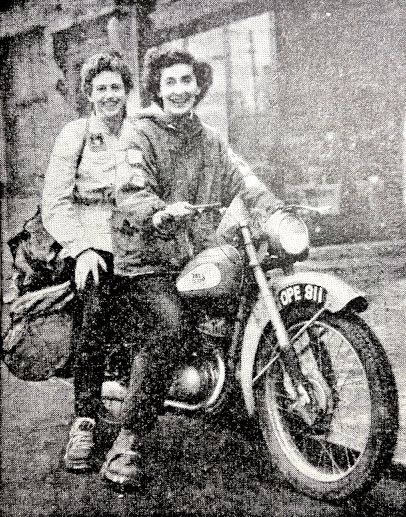
shriek of brakes. A minute later the ‘blitz buggy’ roared and bumped its way over the ditch and stopped about a foot from our camp fire. Needless to say, Pru burnt the onions! Out piled Fred, Jock and Donald, of the REME, very pleased to see a little bit of Britain in the form of Oppy and us. From a nearby farm they rustled up a dozen eggs, and we made piles of omelettes and drank lashings of coffee. Afterwards, Fred sang us some songs of the Eighth Army —memories of his Desert Rat days. Jock, an ex-Scout, made us the sort of camp-fire I’d always dreamt about, and we fairly lit up the surrounding countryside. I nearly went to sleep on the autobahn to Hamburg, for it is practically dead straight for about 95 kilometres. Two days later we drove along the west coast of Denmark; the weather became so wet that we branched south of Fuen. We passed through Odense where, we were ashamed to learn later, Hans Christian Andersen was born. On the lovely little island of Langeland we met Chris and his charming Danish family, who gave us hospitality for the night. Making a tour of Denmark entails continuously popping on and off little ferries. We found this great fun, except when we missed a ferry by about two minutes and found there were only two or three boats a day. We whizzed over the longest bridge in Europe, which brought us on to the island of Sjaelland, and went on to Copenhagen. This is a lovely city, though wending Oppy between cyclists was sheer torture. I feel sure there are at least two bicycles a head in the Danish capital. We crossed to Sweden from Helsingor; the view of Kronborg Castle from the ship is like a fairy-tale. In Helsingborg we met two Oxford undergraduates on two 17-year-old motor cycles, each with a Danish girl-friend on the pillion. They had just come from Stockholm and they told us how bad some of the roads were. Up the west coast of Sweden, we found the roads good, and we made excellent time to Gothenburg, in spite of a long ride in pouring rein. We arrived soaked to the skin and went on to the Svenska Turits log-cabin camping-ground. At a garage we met an Englishman living in Sweden who the year before had been right up into Lapland on a 500cc machine ; he told as how poor he had found the roads. This damped our enthusiasm for going over to Stockholm and then north into Lapland. We decided to carry on due north through Bohusland to the Norwegian border and Oslo. We loved Oslo, with its friendly, holiday atmosphere and beautiful, clean harbour right in the centre of the city. At the Vanderheim, where we stayed, we met a 500cc type, who warned us about the gravel and dirt roads north of Oslo, so we decided to park Oppy in Oslo and take to hiking. That is how I visited Lapland and stayed in Hammerfest, which is about 350 miles inside the Arctic circle. At the end of October I hitch-hiked and travelled by coastal steamer back to Oslo; I was alone during the last three weeks, for Pru had to go back to London. I didn’t want to leave Norway, and I came to a quick decision to depart as I finished packing up Oppy at a Youth Hostel at about 1.30pm, when the boat sailed at 2pm I got to the harbour at 1.45, and just before they pulled up the gang-plank I raced aboard and watched my faithful steed being gently lowered into the hold of the SS Bretagne. It was cold and misty when I arrived at Newcastle, and as I wobbled through the dockyard I longed for the comparative warmth of the Arctic! I disappeared into a thick black fog and crawled behind an enormous lorry for miles. Eventually things cleared up, and when I asked an AA man the way, he roared with laughter and said, ‘Have you seen your face, Madam?’ One glance was enough; I looked as though I had been down a coal mine, with all the particles of black fog clinging to me. I must have looked a funny sight driving through London later with a pair of reindeer horns sticking out of the top of my rucksack from which fluttered the flags of seven countries. On my next trip I intend to drive right across Canada; this time the pillion passenger will be my Airedale dog, which just adores pillion-riding.”
“AT A GUESS, what mileage would you credit to a Service despatch rider who was mobilised in 1939 and who did not regain the key to Civvy Street until 1946? To hand, a letter claiming 175,000 miles during that period, ie, an average of 25,000 per annum. This mileage was recorded in the log pages of a copy of The Motor Cycle Diary, as a DR cannot rely on the millimetre portion of a speedometer owing to frequent changes of machine. It is sad to hear that the DR in question has had to trade off his post-war model in order to furnish a newly obtained flat, since he has at last reached top place in the local housing rota. But he still contrives to motor cycle quite a nice annual mileage. How? Why, he has rejoined his old Territorial unit, which provides him with a model for part of the year.”—Ixion

“IF YOU LIVE in the country, some of your roads may be little more than lanes, with potholes, uneven surfaces, and loose stones. If you add dust in place of tar, you have some idea of the course for the first TT race. It was in 1907, and Charlie Collier was one of the redoubtable contestants. If you don’t know Charlie you don’t deserve to have a motor cycle to ride, for his name has been associated with motor cycling for over half a century. Of course, road racing started before 1907. There had, in fact, been several International Cup contests held on the Continent, in which England was represented by the Collier brothers and others. But these races called for specifications of little use for touring machines such as, for example, an unladen-weight limit (including compulsory pedalling gear) of 50kg (110lb). These International Races terminated with the 1906 fiasco, which followed a serious protest by the English RAC team representative, Marquis de Mouzilly St Mars, whose charges of glaring and impudent breaches of the regulations on the part of officials and riders of the promoting country were sustained. It was during the tedious return journey from the 1906 meeting (travel was anything but brisk in those days) that the first suggestion was made which led to the now world-famous TT Races.
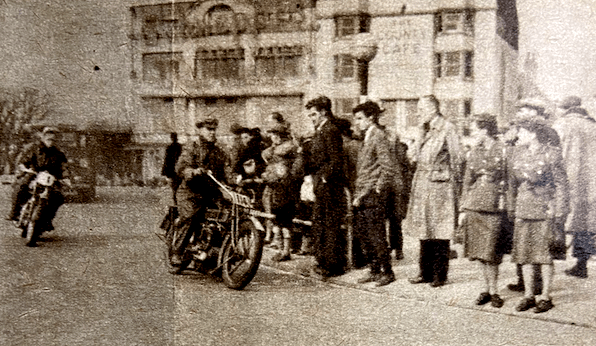
Among the party was Freddie Straight, the then ACC (Auto Cycle Club, forerunner of the Auto Cycle Union) secretary, to whom it was suggested that the responsibility of organising a race under English regulations and officials be explored; the Marquis generously offered to provide a suitable trophy. Later, after a suggestion by HW Staner, one-time Editor of The Autocar, and many conferences at the ACC, with letters in the Press and backing by the RAC, a decision to run a race for touring machines was taken. The British Government would not approve closure of the roads for racing, so Isle of Man approval was requested and granted. This was not the first occasion on which motor cycles had raced in. the Island, for in 1905 a race to select English riders for the International Race had been held there, the Collier brothers being among those competing. The writer had occasion to visit the Matchless works recently, in connection with the compilation of AMC history for the British Manufacturers’ Union, but Charlie Collier, surviving member of the family which started Matchless motorcycles on their way in 1898, would have none of it. He said the staff could do the work and we would have a chat over old times. What else was there but racing, and, in racing, what else but the TT? So we were off to a good start. The 65-year-old Charlie went very bright in the eye and I went all stuttery as we recalled those exciting days, with the weeks of preparation of machines; Charlie’s late brother, Harry, was also riding. ‘There were two classes,’ explained Charlie, ‘one for single- and the other for twin-cylinder machines, and we chose singles. The Trophy was to go to the rider of the fastest machine to finish irrespective of class. As change-speed gears were not in common use then, and not reliable anyway, we rode single gear, with pedalling gear permitted by the regulations. The course was a triangular one including St. John’s (start), Ballacraine, Glen Helen with Creg Willeys Hill at the end, Kirkmichael, Peel, and St. John’s. This 16-mile circuit had to be covered 10 times, with a rest of 10 minutes half-way for a fill-up. Petrol allowance for singles was on the basis of 90 miles to the gallon.’ ‘How did you feel about the opposition?’ I asked. A queer
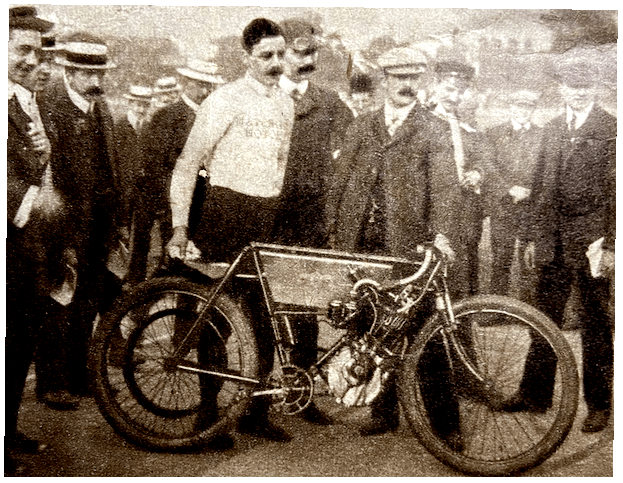
look came over Charlie’s face as he replied. ‘The Triumphs, we knew, were hot stuff for 1907, and we did not under-rate them.’ Then Charlie really got going as he described practising, checking over every detail of the machines, personal care over food, sleep and clothing. (Here you note the experienced, trained mind.) ‘Riders were started in pairs,’ went on Charlie, ‘and with Jack Marshall and F Hulbert the first pair off, we—my brother, Harry, and I—were nicely placed as second pair, one minute later. It was a dull, cold, miserable May morning, and I steadily made up on the Triumph riders, to gain the lead in the first circuit. I retained this lead till the finish, and won by a comfortable margin of nearly 12 minutes from Marshall. During the race my brother Harry made the fastest lap at 41.81mph. I had an uneventful ride, apart from being obliged to use the pedals vigorously in negotiating Creg Willeys Hill on every circuit, and a very near failure to restart after the midway interval. Having earlier been the champion of the Woolwich Cycling Club I was able to give pedal assistance to good effect. This subsequently led to considerable controversy, and for later races, pedalling gear was barred. My winning speed of 38.22mph now seems insignificant, but in mitigation it must be remembered that a petrol consumption heavier than 90mpg entailed disqualification. To accomplish this figure meant very careful use of the throttle, and economising by such expedients as negotiating down gradients on a whiff of gas. Imagine the consternation that such a limit would create if imposed today. Modern riders with their five to six gallon tanks might give it a thought, and then perhaps an average of 38.22mph at 95mpg (which my consumption was measured to be) will
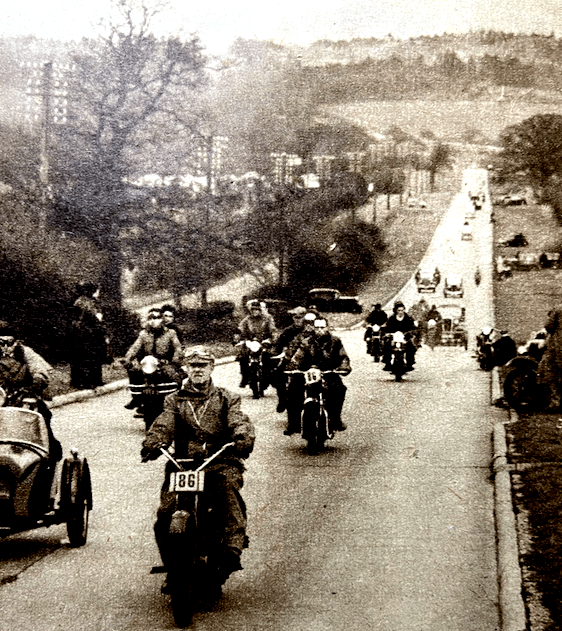
not appear quite so ludicrous. The extent to which modem TT machines have departed from touring standards, for which the race was promoted, perhaps had best not be mentioned. And perhaps we should not dwell too long on the small progress in petrol economy in 44 years of development since the first Tourist Trophy Race was run. How the winners of today manage their phenomenal speeds is, I consider, one of the marvels of this age, even to an old-timer like myself, and I take off my hat to these boys for their wonderful skill. Quite frankly, I never envisaged such speeds in those far-off days of the first TT, even making full allowance for the better roads, gear boxes, spring-frames, and the like.’ Then Charlie sat back while I reminded him of some of the other difficulties and drawbacks of 1907 racing machines. Tyres loomed largely in the list; they were of regulation 2in-section with near-bald treads, and of poor quality by present-day standards. Far too often, the winner in those days was he who had a no-tyre-trouble run. Add to that roads strewn with loose stones and deep dust, with greasy patches where the organisers and others had been spraying water to keep the dust down. But I had to drag it out of Charlie that he and his brother collected three firsts and one second in the first four TT races. We have to come forward to 1931-1934 before we find a record to beat theirs, by any one make Norton did it in the Senior. It is agreed, of course, that competition was by then terrific. I had to chide Charlie about his suggestion that 38mph for 160 miles on a 1907 “bone-shaker” might appear “insignificant”. But was it? It was not long afterwards that he was crowding 60 miles into the hour, and casting envious eyes on a sprint at 100mph, for Brooklands was opened soon after the first TT was run, and motor cyclists had to adjust their ideas on speeds. Look up your back numbers of The Motor Cycle and give yourself a shock. Another feat was when brother Harry did over 700 miles in 24 hours on a track built for pedal-cycle racing. But how grand to have lived right through it all from the start, to be regarded as one of the finest sportsmen of the Old Brigade, as well as a well-loved boss of the magnificent business and works at Plumstead. Truly Matchless!”
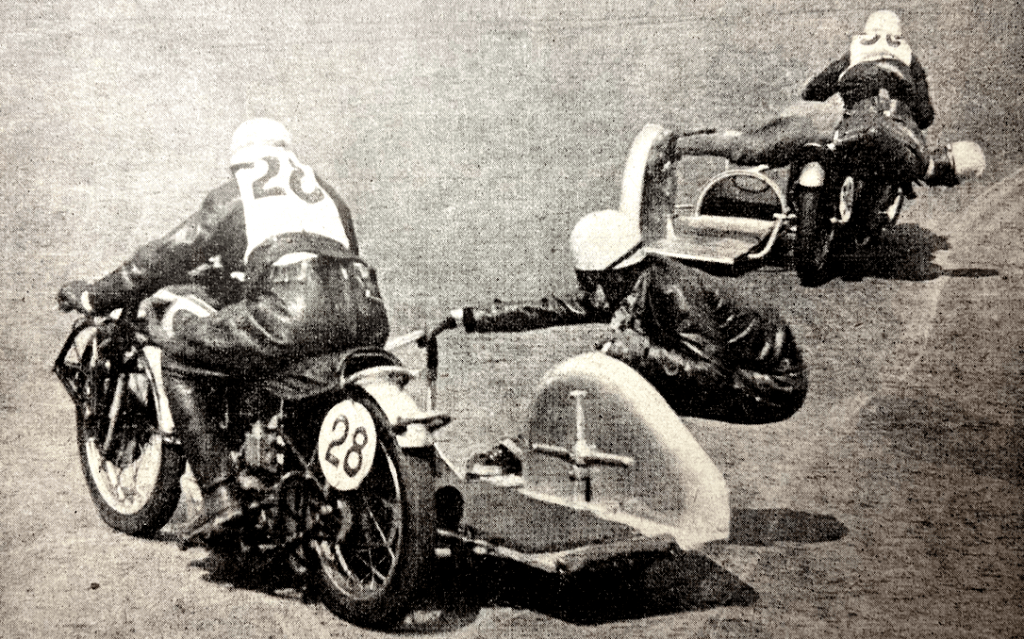
“AN AMERICAN CORRESPONDENT recently said that riders in his country were largely in their teens or early twenties. In this country I should say that the average was considerably higher, and perhaps a good average would be 35. Can anyone confirm this? I myself am in the middle forties. Before the war I was a car owner, but sold the vehicle in 1941 on going into the Forces, and, of course, on coming back to civilian life the price of a car was prohibitive and the cost of running excessive. So I returned to a motor cycle. I bought a Speed Twin six months old (for power and quietness) which had only done 2,000 miles and which was in excellent trim. It has given we many miles of pleasure and many delightful days in the open air. I am a leisurely rider and speed is usually around 35mph. With a dualseat I find I can do 100 miles at a stretch without soreness or fatigue. As for clothing—in summer I wax an exWD tank suit (or overall), which is waterproof, and a beret. In winter I wear the same suit with Irvin jacket and trousers underneath, a flying helmet, leather gloves with silk inners, and leather knee-boots. In my opinion, this outfit takes a lot of beating. As I ride for pleasure solely, I usually choose dry days for my outings, and that means less cleaning to do on getting home.
AGB, Glasgow.”
“RECENT CORRESPONDENCE prompts me to remark that in my experience modern machines show no improvement over those produced two or three decades ago, the main reason, no doubt, being concerned with weight. I have in mind a 292cc Alldays-Allon two-speed, belt-drive, two-stroke, circa 1920; a 348cc side-valve Raleigh with outside flywheel, 1923; a 250cc twin ohv Panthette with four speeds; followed by a James 498cc side-valve V-twin (1928), ridden solo and sidecar; then a BSA 770cc V-twin side-valve, 1930; and a 1934 BSA V-twin ohv, with sidecar. Practically all the riding was done with my wife as pillion passenger. In attempts from time to time on many of the better-known trials hills, during holidays and week-ends, a passenger never seemed to be a handicap. The Allon was not much good on hills until the gear box was changed for a three-speed, and then it would tackle Kirkstone Pass from Ambleside without a falter. In Wales it kept going on a hill where the old ‘T’ model Ford cars conked out. The Raleigh climbed Mill Lane, near Cheltenham, still used in trials, two-up; and, of course, West Country hills like Porlock and Lynton (the surfaces were quite different from to-day). The James 498cc twin could not be stopped anywhere, even with sidecar. A Scottish Six Days’ hill at Drumnadrochit, climbing corkscrew fashion through a wood, did not stop the James, ridden without sidecar two-up. The little 250cc Panthette would tear up. Porlock on second gear with a 10-stone passenger; and also up Doverhay on first gear. With some club friends we paid a visit to Alms Hill, near Henley (now closed). The Panthette toured up this steep hill with wife on pillion. Again referring to Doverhay, some 20 years ago I watched a lady driver with her girl friend in the chair take an Ariel 500cc sidecar up this one-in-four affair standing on the saddle; the lady in question was obviously not unacquainted with trials. All the above seems to show that standard modern machines have nothing on the old ‘uns when it comes to dealing with steep stuff. I have not done any serious riding for several years, and I should just hate to ride any of the modern 4cwt stuff up Doverhay in cold blood, but no doubt anno domini has a lot to do with this. Happy days. By the way, how many visitors to Porlock know that there are five different routes from the village emerging to the main Lynmouth road further on, all being rideable. Incidental to the subject of hill-climbing, I have always favoured lever carburettor controls instead of twist grips when it is a question of crafty methods on tricky gradients.
CECIL COX, Leamington Spa.”
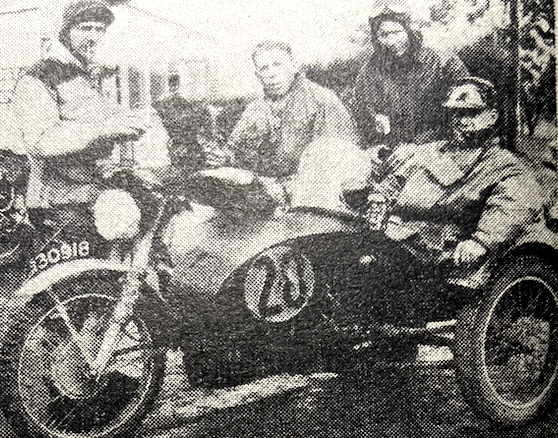
“THERE IS NO DOUBT that all machines today are good. The test is to find one that has all the essential features and most of the desirable ones. I think that my list of necessities in a good machine are fairly average and sum up as follows: Reasonable first cost, reliability, low running costs, really quiet engine, comfort, power in plenty, powerful brakes, speed when wanted, really good enamel and general finish, reasonably priced spares, low depreciation, spring frame that really works, ease of stand operation, good steering and road-holding quality, easy starting; and backed by an excellent and efficient service department. I claim to have found all this and more in one machine—the Matchless 500 G805. I cannot be accused of not having tried various machines, as I have been riding for some 27 years, am a professional motor cycle mechanic, have toured and ridden in several foreign countries and ridden quite a few foreign. machines, and normally ride hundreds of different machines in the course of a year. I have no connection whatever with Messrs. AMC, but have a great respect for their products.
JF MAY, Berkhamted, Herts.”
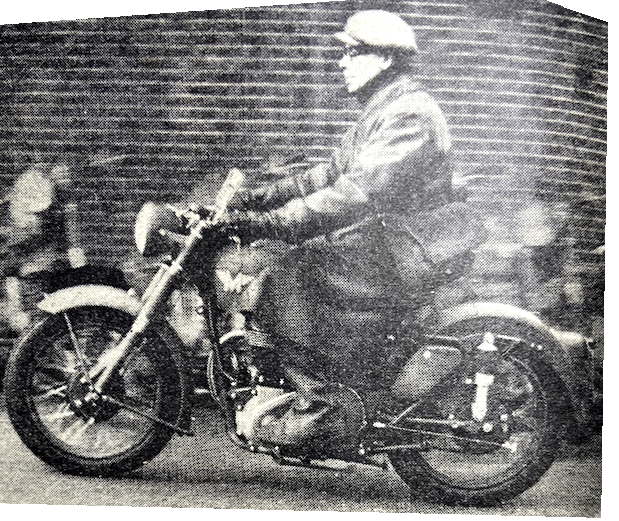
“I SHOULD LIKE to make an attempt to answer some of the queries put by NHG on Scotts in a recent issue. First of all we should admit that no motor cycle is perfect and that any mount is bound to be a compromise. Let us take a look at some of the outstanding features of the Scott. Excellent torque is developed at low rpm rendering more than three gears superfluous; acceleration is rapid and a high average may be maintained for long periods with a marked absence of fuss and such distractions as valve-gear clatter. My own Scott, which old and has hand gear change, is quite capable of leaving behind many post-war 500s (mulltis included) over a standing-start half mile. I should like to point out that the Scott engine has a very short stroke (7lmm) resulting in a mean piston speed of less than 2,500 ft/min at 5,000rpm, or 80mph, in top gear; the reciprocating masses balance one another and it may be seen that, together with the absence of valve gear, high rpm need cause no anxiety. The rotating masses are also very light, a factor contributing to the good acceleration. The steering of the Scott is exceptionally good due, in no small part, to the very rigid duplex frame. If the engine is in correct tune, two-stroke rattle only occurs at tick-over speed—I admit that to some this may be irritating. The radiator does not leak but, of course, must be drained or filled with anti-freeze. These I consider to be very small disadvantages. To the best of my knowledge, petroil is not used except for racing. Three more good points: the standard of workmanship and finish of a Scott are without doubt above average; the machine is unique in more than one respect (and I, for one, delight in running a unique machine); the spares service offered by the makers even for the oldest models is first class. If you have never owned or ridden a Scott, you have missed something. There is just one more thing I should like and that is a spring frame.
VINTAGE 596 SQUIRREL, Malvern, Worcs.”
“I HAVE BEEN reading with much interest the letters written about clothes for motor cycling, particularly on plastics versus leather. I agree that leather is very uncomfortable when wet, but I do not think plastics are the answer. The reasons are: When cold weather comes around, plastic hardens up, becoming very brittle, and is subject to cracking and peeling even when backed by a fabric. Also, in case of a spill, a rider in a plastic suit would find the heat generated by friction in a long slide would melt the plastic—or the plastic would wear away with the speed of light (well, almost), leaving very little to protect his own anatomy. There may be some plastics which do not have the unwanted qualities explained above, but leather seems to be the best all-round protective clothing there is. To make leathers more comfortable, I would suggest wearing tighter-fitting suits. It is a fact that a tight leather suit which fits well is more comfortable and actually allows more freedom of movement than a suit of leathers which is very roomy and baggy, but which is not a proper fit for the wearer of the suit. Wet leathers are not uncomfortable if they fit tightly; also, the use of zipper closures enables the rider to put on and remove the tight-fitting leathers quite easily. The only hitch is that it is necessary for the rider to have the skin-tight leather suit made to his exact measure to ensure proper and comfortable fit. Although I don’t race (competition, that is) my motor cycle, I wear a tight-fitting leather suit most of the time am riding, It can’t be beaten for cold-weather riding, and it is very comfortable except on only the hottest days of summer. The pants are a leather version of the tight Levi-denims worn by the cowboys, actually a pair of leather Levi’s—narrow legs, low-waisted, with zipp (sic) front and pockets. With these I wear a leather shirt with zipp openings and with a lacing adjustment on each side so that I can allow for woollen clothes underneath in the wintertime. Having very long legs, it takes a 21in pair of boots to reach up over my calf, and I haven’t found anything higher than 17in. But I am still looking. I would like to hear from other riders and their ideas on riding clothes. Incidentally, I have a collection of all kinds of motor cycle pictures, particularly different kinds of dress and clothes and machines. You have a wonderful magazine—I look forward to its coming each week.
JOHN PHILIPS, Connecticut, USA.”

“AFTER READING VARIOUS suggestions of how to triumph over the luggage-carrying problem, I feel I must have my say. I am the owner of a 1949 346cc ohv CO Royal Enfield. The provision for attachment of pannier equipment on this machine is excellent. A matter of a few moments either attaches or detaches the equipment to the built-in fittings, and the machine looks tidy with or without luggage. Most makers seem more concerned to streamline their machines equip it to suit the tourist. to salt the ‘speed merchant’ than to equip it to suit the tourist.
DGF MURRAY, Dundee.”
THE FIRST ZEBRA crossing in the world was installed, in Slough. The black-and-white crossing design has been adopted internationally. Wise motor cyclists used to make a point of avoiding thye white stripes which could be slippery. I once forgot this rule and dropped a GS750 when turning across a zebra into an alley. —Ed
“SCORNERS OF ULTRA-LIGHTWEIGHTS seem more inclined to respect my 98cc when I tell them that it took me nearly 100 miles beyond Cologne and back, for a running cost of well under £1. I am no novice with motor cycles. I caught the fever in the Army after being forced for weeks to try to break my neck on rugged courses. The first throttle I turned was that of a 350cc BSA. I had been asking to be taught to ride and, typical of the Army, was one day asked if I could. Lessons were unlikely, and I knew the theory of control, so I said ‘Yes,’ and was forthwith sent on a scheme from which I returned after three falls and 400 miles of convoying and despatches. But I could ride! After that I selected my fancy for outings. My favourite mount was a 500cc Norton. That was all a long time ago, and in the elevated status of a poor civilian I gave very serious consideration to the model I should purchase. Although I had enjoyed several outings with a friend on his Norton, my mind became set on trying a small machine, and it was with something approaching disgust that my friend found I had bought the smallest—a 98cc James Comet. I bought the Comet primarily for handy transport in London; also, it was a mount that could be pushed away in corners without causing inconvenience by its bulk. And it was a wise choice, for the little machine cruises through busy streets with an ease and speed superior to that of many of its big brothers. In addition, it saves me about 4s a day. However, little did I imagine that I should ever want it to take me on a continental jaunt. At the time I had to get to Siegen, in German Westphalia, quicker than was possible by normal reservations. So I joined the RAC and asked them to squeeze me and the Comet on one of the cross-Channel steamers.
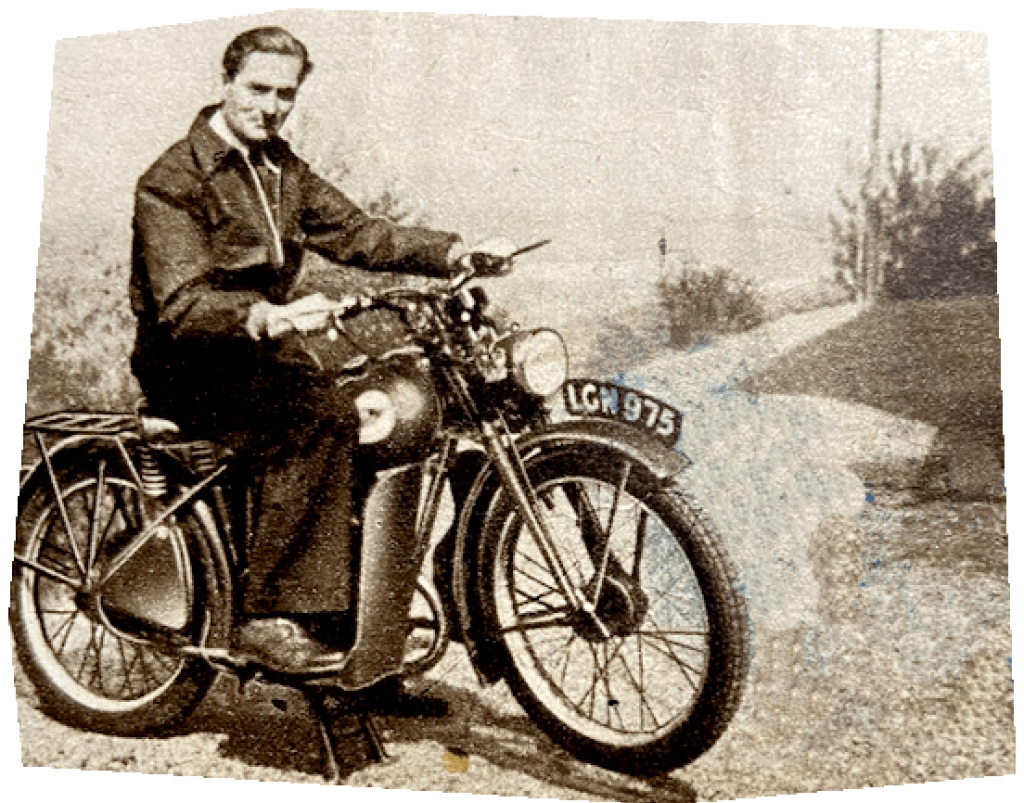
At 5.30 one morning, after no great preparation, I left London for Dover. My only spares were a control cable and a sparking plug. About 11am a Dover Customs officer was telling me of his intentions to buy a similar machine. However it was not until 4.30pm that I was cleared at Ostend. At 6.15pm I was knocking at the door of war-time friends in Ghent. After the welcome I knew I could expect, a meal bigger than I could master, and an invitation to stay the night, I sat to wine and reminiscences, and then turned in. Early in the morning, one of the family—a motor cyclist who was quite overcome by the size of my machine—accompanied me to the main Brussels road. The new Belgian roads have surfaces as notable for their smoothness, as their cobbled predecessors were for their bumps. When I reached St Trond it was market day, so I had a walk around the stalls and watched disgruntled beasts being coaxed on to carts and lorries. Then I continued towards Liège. Because of road reconstructions there was a diversion some miles before the city. It was a diversion which turned you off the main road but gave no further information, and after a couple of miles of rough riding I came to a village where there was a small accumulation of vehicles and bewildered drivers all asking, ‘Where do we go from here?’ One was a Hollander on a ‘Thunderbird’ who suggested that he and I searched our way together along what likely roads we found. He travelled with me to his destination—proud of his British machine, and amazed by the performance of mine. Our journey through the suburbs of Liège was over the very worst of road surfaces, and shortly after I cleared the city my chain case rattled loose. Those last miles had been so incredibly bad that, when I tightened it, I checked over every bolt on the bike, but everything else was firm. Less than an hour later I was at the German frontier.
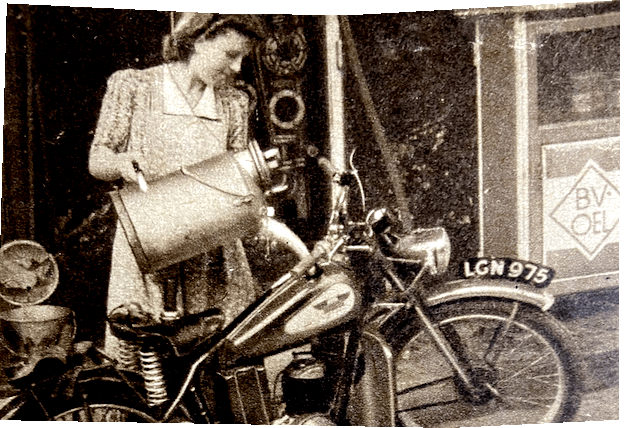
I had gone through Belgium on British petrol and reckoned on refilling at Aachen, but when I got there it was Saturday and four in the afternoon, and that is a time when German banks are shut! I had no money and my travellers’ cheques were useless. Worse than that, I had very little fuel. After one or two inquiries, I entered a building with the Union Jack outside, and called to a gentleman in shirt-sleeves, a peak hat, and blue trousers, who was making his way up some inside stairs. ‘I must get to Siegen tonight,’ I said, ‘and I’m stranded without money’ ‘Must! Must?’ he retorted. ‘We can’t do much for people who say “Must.”‘ After I had explained that the urgency was from my angle, and that I only hoped for his co-operation, the gentleman with some condescension invited me to follow him upstairs. He had the sort of huge office in which most people feel small, and I realised that he was a Colonel of the ‘Public Safety’, probably quite unfamiliar with the undignified approach that had attracted his attention! Staff Officers were assembled for a meeting and their business was delayed during the deadlock in which we faced the fact that there was no official way of providing me with fuel. Perhaps I was indiscreet in suggesting that policemen could surely transfer an odd gallon from a vehicle somewhere but a Major beamed a broad smile and asked me to accompany him to a garage. There he asked me in a puzzled tone how I had come to meet the Colonel. ‘I simply saw him going up the stairs,’ I said, ‘and shouted!’ The German pump-attendant was told to ‘fill it up’, and for the first time I experienced the delight of German garage service. Seven litres of fuel were mixed carefully with oil in a pump-equipped can. The petroil was then tipped through a filtered funnel into my machine, the cap replaced, and a duster run over the frame. After thanking the Major, I was on my way. I had not moved a hundred yards when there was a tooting behind and another ‘GB’ motor cyclist pulled alongside. ‘Where are you off to?’ he asked. ‘Siegen—’ I said, ‘and you?’ ‘Not far from here—to my family.’ ‘Aren’t you from England?’ I asked. ‘From Croydon. That’s where I live. But my family is here, I am German.’ He was an ex-POW who had stayed in England; riding his Ariel, he proved a happy travelling companion for the next 20 miles. I declined his offer of hospitality, for I wanted to reach Siegen before dark. At Cologne there was a frightening clatter behind me. I stopped and turned to see a civilian waving my ‘GB’ plate at me, though we searched in vain for the missing bolt. The bolt also located my mudguard, number plate and rear light, and it was impossible to travel without it. So I pulled into the first garage I saw and explained that I had no money. It did not matter. The mechanic spent a quarter of an hour finding a suitable replacement, fitted it, and waved me on my way with the words, ‘Happy travelling!’ I reached Siegen at dusk. After about a week there was a visitor to the house at which I was staying. This man had seen me on the Comet in town and wanted me to tell the local ‘Motorsports Club’ about it. The German language was a deterrent, but after persuasion I agreed and, as honorary guest at their meeting, was filled with beer and food! They also asked me to demonstrate
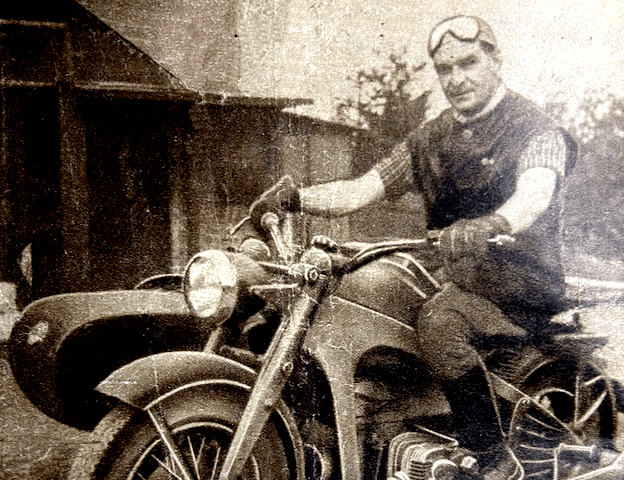
British road habits on a magnetic blackboard to which little metal vehicles attached themselves just where they were placed amid the streets chalked around them. There was a universal utterance of ‘links!’ (left) as I put the first on the left of the road. Next day the local Press appeared with a lengthy article, ‘From London to Siegen on 98cc!’ I did some 500 miles of touring in the hilly Siegerland, and interest in the machine was general. Germans often remarked upon the greater sturdiness of the frame compared with those of their own small machines. The stop-light was also noted with interest. However, they deprecated the exposed flywheel: that was unforgivable, even though it was agreed that only a contortionist could touch it while riding. There was as much petrol on ration as I needed. Any number of 10-litre coupons could be obtained at a bank, and one I sent to the Major in Aachen. Five litres of petrol (about a gallon) cost three marks, and every garage at which I filled showed the same painstaking service to petroil users— in contrast with some English garages. Members of the Siegerland Motorsports Club, who made me a permanent member of their Club and the DMV, took me round the local suppliers of motor cycles on a Zündapp 750cc outfit—an ex-Army machine which we called ‘Red Devil’ which apparently did everything except climb a vertical wall. I was impressed in the lightweight class by a 98cc a NSU Fox, a machine with four gears and fully sprung. The Fox is able take a pillion passenger up the steepest slopes in Siegerland. When I finally departed from Siegen I made only slight variations from the route I bad taken to get there. Some of the scenes around Frieshagen, Morsbach and Wissen, on the way to the way to Bonn were the prettiest passed through on the way to Bonn, were the prettiest passed through. Incidentally, when I refuelled at Wissen, the service included inspection of my tyres—a half-inch nail was extracted! I had a quick look round Bonn and visited Beethoven’s House. I spent one night with friends at Cologne, and another with those at Ghent. Next day I back in London. There had been no mishap of any kind, and I was surprised how very few vehicles passed me on the road. The Comet covered a total of 1,299 miles and was near the end of its seventh gallon of fuel. A speed of 35mph could be maintained without difficulty. Unless you are in a hurry you can certainly tour on a 98cc. You may thoroughly enjoy the scenery and have the fullest confidence in your mount. ‘LGN 975’ is back on its London routine. It has covered another 1,000 miles, burnt out its plug, and with the new one is giving better performance overall. Haters of lightweights—you may keep your large machines. I’m satisfied!”

COMMENTS ON THE changed attitude of motor cyclists towards all-weather equipment such as handlebar windscreens and legshields have been numerous. But as yet few motor cycle manufacturers appear to have linked up with accessory firms with a view to offering screens and shields which are designed for the particular models and mate perfectly with them. Today there are tens of thousands of motor cycles equipped with windscreens, the majority of which look what they are: tacked-on after-thoughts. There is no need to emphasise that motor cycle manufacturers and accessory makers, in concert, should be able to go one better than almost any private owner. What is needed is a lead by one of the big factories—a real lead with the design department not merely seeing that there are means of attachment for the screen and legshields, but that these latter are effective and tend to enhance the lines of the machine to which they are fitted instead of, as is frequent, detracting from them. Gone are the days when motor cycles, in the main, were used only in the summer. The Ministry of Transport’s recent official figures showed that on 30 November, 1,950, no fewer than 715,000 motor cycles were licensed, which is almost exactly twice the number on the same date in 1938. Over legshields, wearing waders was customary in pre-war times; how often are waders to be seen today? And while designers are busy on the problem of protection, might not a little thought be bestowed on luggage carrying?”
“I SUPPOSE I AM the member of the Staff who knew Geoffrey SmithC longer than all the others, and who probably owed him the greatest personal debt, both as an intimate friend, and as a wise and kindly mentor in journalism. My first definite memory of him is as a slim youth, little more than a boy, riding a Singer lightweight to victory in the annual Coventry Club’s hill-climb at Newnham, near Daventry. During a term of nearly 47 years, we never had a wry word. Never once was he even mordant about any of my juvenile blunders. His wealth of knowledge and information enabled him to found his judgments and frame his policies on the broadest bases, and he seldom put a foot wrong. During his absence on military service in the Kaiser War his heart was still in the office, and I doubt if any single issue of The Motor Cycle during that period missed his eye, or failed to evoke a letter of praise or suggestion. His considerable ability moved many magnates in the trade to covet his services, but his heart was in the Iliffe papers. Versatility was not the least of his accomplishments, and he distributed his gifts evenly over a wide range of technical journals, though in his later years jet propulsion in part seduced him from the motor cycle which had been his first love. RIP.”—Ixion
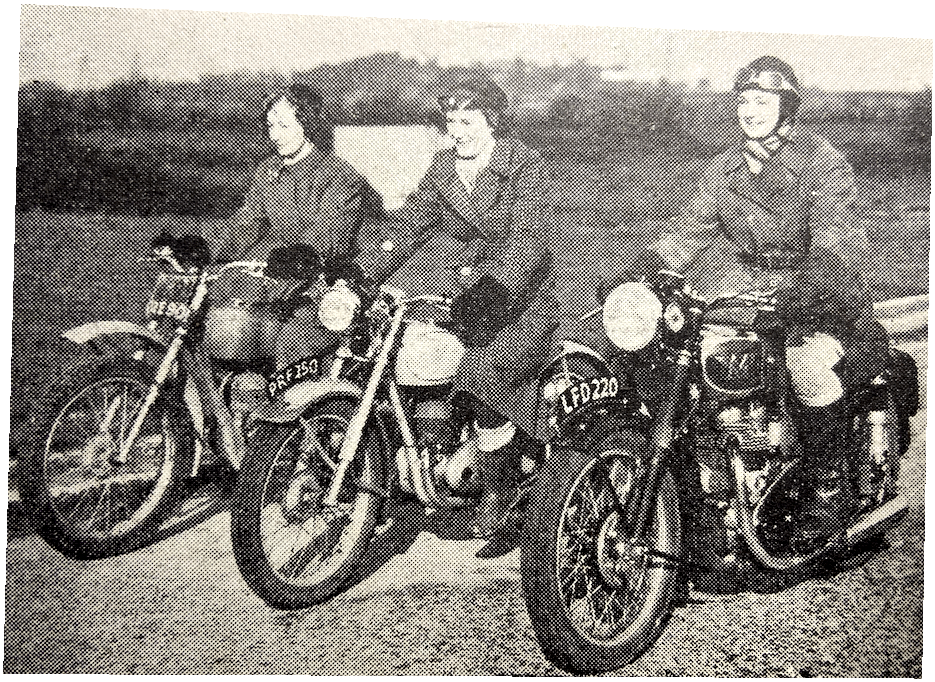
“I SYMPATHISE with all complaints anent the packing of tools on a machine. In this respect a wide gulf separates cars from motor cycles. Tools will come to no harm in a car if placed in a cloth or leather roll, and left to lie in any receptacle under a seat or in the boot. But, in spite of what readers say about sponge-rubber linings for tool-boxes, motor cycle tools need more than that. I have never tried a sponge-rubber lining in the tool-box of a four-cylinder Ariel with spring heel. The vibration on all rigid-frame models is amazingly penetrative. I am not physically sensitive to it. My no-longer-young body absorbs it almost unconsciously, and is not aware of any unpleasant results. But that same vibration, which my accustomed senses ignore, can swiftly remove the control screw-cylinder from a King Dick, or rub two steel tool surfaces against each other through their cloth coverings with such force as to produce substantial wear. The one and only remedy which is proof against it is to embed each tool in a closely fitting shaped bed of soft wood or other suitable material.”—Ixion
* Geoffrey Smith joined The Motor Cycle in 1904 and became editor in 1912, on the retirement of launch editor Walter Grew (who remained a correspondent for many years after). Smith was appointed managing editor in 1916 and was editorial director until his death, having been a Blue Un staffer for 47 years.
“FROM THE YARD at the back of the hotel a voice floats up to my window, ‘I luv you, ducks. Do you know what that means?’ The blonde girl ceases beating her mat for a moment and now come a few sentences of Dutch. What she says I shall never know. But the English voice with more than a hint of Lancashire continues, and as I lean out of the window I see the man’s expressive gestures as he adds, ‘We’ll walk arm in arm down the road—like this, see?’ It is all innocent fun: the typical Englishman’s love of a joke. For the man—the cheeky chappie in foreign parts—is a member of the Continental Circus, and certainly has no time to take the girl for a walk through the gloaming. It is the morning of the Dutch TT, and next day he will be travelling southwards, making the long trek by lorry down to the South of France and Albi. The Anglo-Dutch banter continues and I move away from the window. I too must be on the way—down to the hotel’s front steps and along the streets of Assen. It is about nine o’clock—a golden morning—and already the traffic is passing through the town along towards the course. I stand beneath the shadow of the tall, handsome church by the cross-roads and watch for a few moments. The cyclists float by in their hundreds; the motor cyclists, mostly on solos, with silencers singularly innocent of internals, come through steadily; the cars bounce past on the uneven paving. I have seen similar streams of motor cycles and cars in England; I have not seen such streams of cyclists. Think of a large number of cyclists. Then think of an impossible fantasia of cyclists and you are somewhere near imagining the scene. These cyclists don’t ride along; they float along pair by pair as though born on two wheels. A fair number of
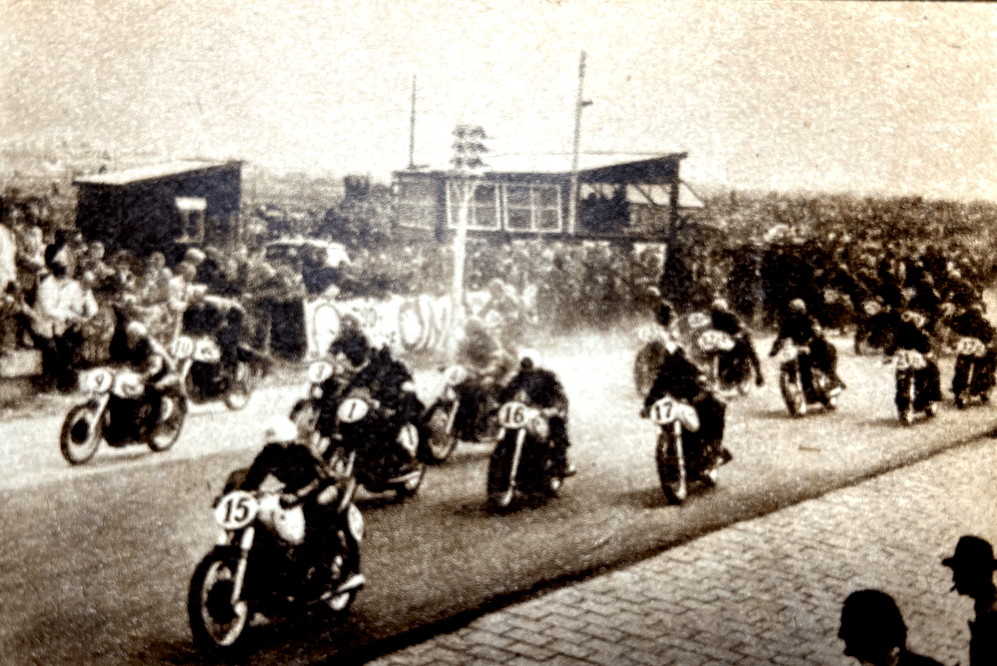
cycles have engines: Solex machines or bicycles fitted with Berini and other attachments. They, too, glide along, though slightly faster than the pedallers. Normally, in Holland, these cyclists will be of all ages—from five years old to 70 or older. This morning the crowd is young; they are mostly youths and girls, many of them blonde. Now notice another peculiarity of the merry throng—they are all neatly and well dressed: members, it would seem, at least to the superficial observer, of a class-less society. The bicycles each have a shielded chain and rear wheel, so that the men dispense with trouser clips, and the girls glide by in flowing summer dresses. Now I walk up the red-brick surfaced road towards the hairpin known as Bartelds Bocht. Sometimes the cyclists as they pass almost flick my elbow. In England I should probably jump sideways like a startled chamois; after a day or two in Holland I have such confidence in these remarkable cyclists that I walk unperturbed. The curving road ahead passes between gracious houses, smooth lawns, and cool, green woods. At last I come to a pole barrier across the road; I show Press passes and walk through. Up on the road to Hooghalen I sit under a tree and wait for the 350cc race to start. Although flat, the countryside here is English in character. The freshening breeze ripples the still-green cornfields and stirs the leaves in the coppices. There are many farmsteads along the road, for Holland is thickly populated (the 1,029 square miles of Drenthe, where the circuit is situated, carry nearly 270,000 people). And this is a holiday for the people of this fertile province. They sit on chairs and on grassy banks along the course; some have towed a cart out to a field bordering the circuit and thus provided themselves with an excellent grand-stand; while children frolic in freshly cut mounds of hay. You will notice that these
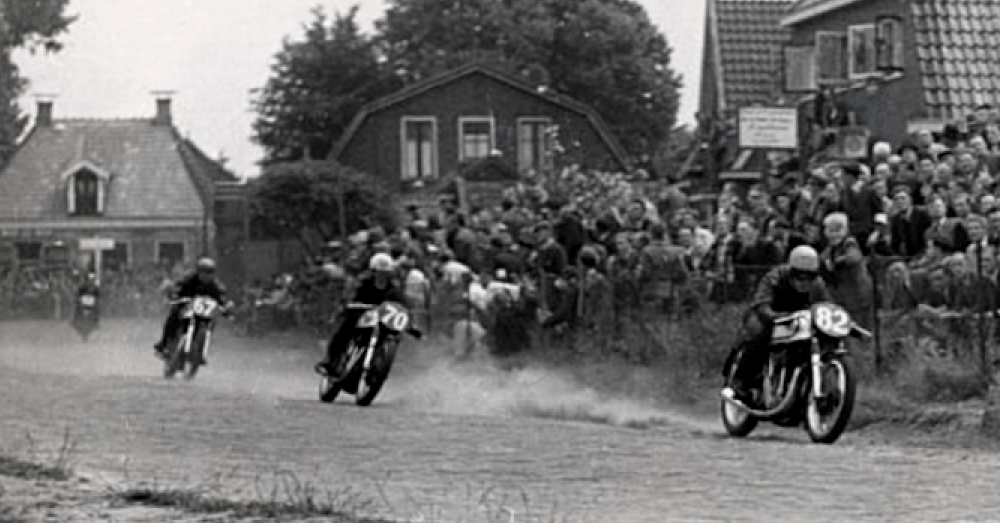
farming folk are not toilworn; they are well–fed and well set-up. Many of the men are puffing away contentedly at cigars. Away down the road, Dutch police acting as marshals stand or pace up and down a few yards. In a farmstead away to the right a blonde girl dressed in a green summer dress is learning to ride a small two-stroke motor cycle. Motor cycling—like cycling—seems to come easily to the Dutch. The boy friend pushes the motor cycle and away she goes; he leaps on the back and rides pillion. I can see their heads bobbing up and down as they ride along a rough farm-track away across a field. This ride to and fro is performed several times until the girl and the machine disappear into an orchard. Our attention is momentarily diverted as a jet plane screams over, following the road to Hooghalen. Then, later, a big petrol tanker garlanded with flowers passes through, followed by Cyclemaster and Berini riders on a demonstration run. Finally, a cortege of police cars and, soon after, an official car opening up the circuit for racing, pass through. Now, far across the fields towards De Haar, the breeze bears the great roaring orchestra of machines being warmed up. Attention quickens—the race is about to start. The orchestra swells suddenly, and we know that the battle royal over the quiet, sun-shadowed roads has begun. Just up the road is a slight bend. Soon the sound of the approaching pack is heard…Duke is in the lead…he heels over momentarily to take the fast bend…is gone, in close company with Ben and Lockett. The crack as they and the rest of the field pass assaults the ear-drums savagely. Then the roads are strangely silent again, with only the sound of the wind rustling the trees. Thereafter, owing to mishaps to the first-lap leaders, the race is Doran’s and round and round he comes at the head of the snarling procession as I slowly make my way back to the start. After a period of dull skies the day is golden again before the start of the 500cc race. Sunlight gleams on leathers as the men ease their machines back ready to bump over compression…the starting light flickers red-orange-green…the crowd shouts…and the brief clatter of running men precedes the mighty bellow of 32 machines. Now we witness another epic battle between the singles and the twins and the fours. For the first nine laps the 95mph fight between the leading quartet provides a magnificent spectacle. Just imagine that, on this sunny day in
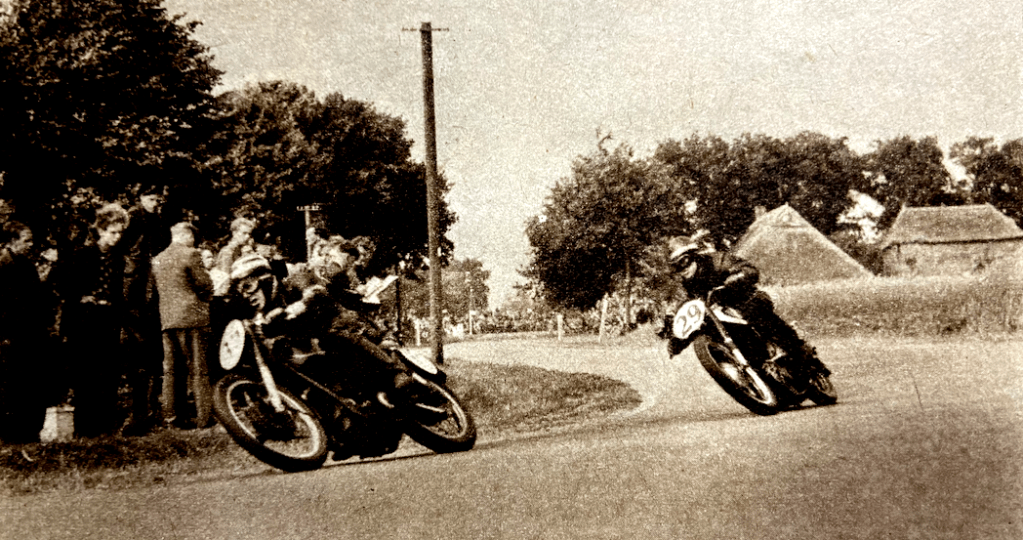
Drenthe, you are lying on the grass, one of many thousands, seeing this international struggle. Looking at the leaders on the scoreboard, the numbers would have this significance: Lap 1, Anderson, Duke. Ruffo, Pagani; Lap 2, Duke, Anderson. Pagani, Masetti; Lap 3, Duke, Masetti, Pagani, Anderson; Lap 4, Duke, Masetti, Pagani, Anderson; Lap 5, Masetti, Pagani, Duke, Anderson; Lap 6, Duke, Pagani, Masetti, Anderson; Lap 7, Masetti, Duke, Pagani, Anderson; Lap 8, Duke, Pagani, Masetti, Anderson; Lap 9, Duke, Pagani, Masetti, Anderson; Lap 9, Duke, Pagani, Masetti, Anderson. After that, this wonderful line-ahead racing breaks up; but the nine-lap tussle along the shadowed lanes of the Netherlands has been worth coming many miles to see. And as Duke finally flashes over the finishing line the crowds rise to their feet and raise a mighty cheer. That evening the cyclists and motor cyclists ride into Assen in their thousands. The town is en fête. The milling crowds pass beneath the coloured lights and lanterns strung along the streets. Even the police-station is floodlit (just imagine Brixton police-station being flood-lit for the Grand Prix of Clapham!). There is a fair with roundabouts and swings in the square, and itinerant fiddlers and singers have come into the town to entertain and pass round the hat. Youth is intent on enjoying itself, and the more solid old burghers stand with smiles on their faces watching with a certain pride and admiration the younger generation. This junketing takes place on the night before the race and the night after. The first night is the noisier. But on the second night the evening is rounded off with a fireworks display. Rockets rise into the mellow sky of evening and send out their golden showers of rain; and the crowd, enraptured, gaze upwards and know that one more race-day has ended.”—Cambrian
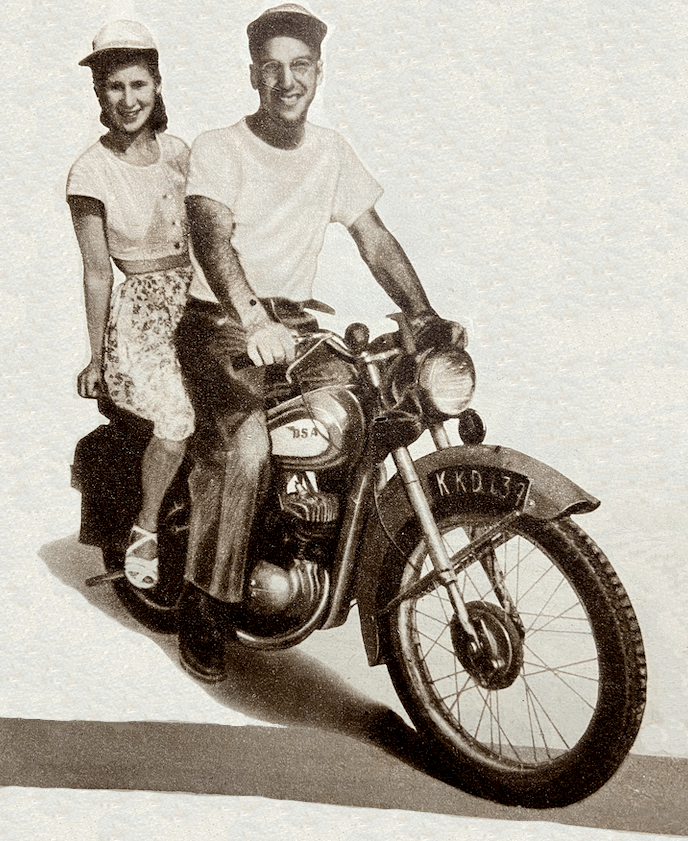
“ALL THE DESIGNS of the machines I have had have been a compromise, just as hedge plants are; for, after all, human designs enter largely into nature today. While I hesitate to cross swords with fellow nurserymen, I do not agree with their choice of plants suitable far roadside planting. Lonicera nitida requires too much clipping, but consequently grows quickly, while fagus sylvaticus (beech to you) is, I think, much too slow, though admittedly eminently suitable otherwise. Macrocarpa, we all agree, is useless. Our old friend Ixion has, in my opinion, named the most suitable subject, escallonia, which will withstand wind and does not look too bad if neglected. However, its constitution prevents its use in northern districts, where they must, I fear, remain hedgeless until such time as further research has produced a shrub which is hardy, quick-growing (though not requiring clipping), and ornamental. A tough job!
S CHANDLER,. Ivybridge, S Devon.”
“I SHOULD LIKE to put forward the following facts in support of the theory that motor cycling has a definitely beneficial effect upon the health of riders. During the influenza epidemic about 20% of the inmates of this College were afflicted, though the motor cyclists (about a dozen in all) were, at time of writing, all quite fit. It is also noticeable that all regular pillion passengers were in good health. One of the biology students, Mr N Trowbridge, has put forward the following theory to account for this. His first point is that regular riding means that the total air content of the lungs is changed regularly. Motor cyclists have similar advantages in this respect as athletes in training, but without the strain on the heart. His second point is that movement through the air is good for the skin and may promote the formation of vitamin D. Sunlight is even better, and most motor cyclists are ‘open-air types’. The slight vibration of the motor cycle has a tonic effect on the human body. Lastly, he considers that riding keeps the brain alert and the mind active, and that an interesting hobby is always an aid to health.
JA CHILCOTT, King Alfred’s College, Winchester.”
“MAY I JOIN in the luggage-carrying debate? When cornered, the designer’s usual excuse for complaints is (a), the public as a whole don’t want it or (b), it would add to the cost. Counting the machines with bits and pieces added will soon prove that most riders do want it; and it is doubtful if the extra charged by the maker would be more than we now pay for the equipment we buy after delivery. Included in the design, the cases or bags should be neater and safer, and we might be saved the tentative, costly experiments we now make, and also the touring agony of wondering, ‘if it’ll hold’. Correspondence and leading articles have been commenting on this grouse for some time. So little notice is taken of it that it looks as if we were right first time—the manufacturer just doesn’t care.”
WE GIBSON, London, NW4.”
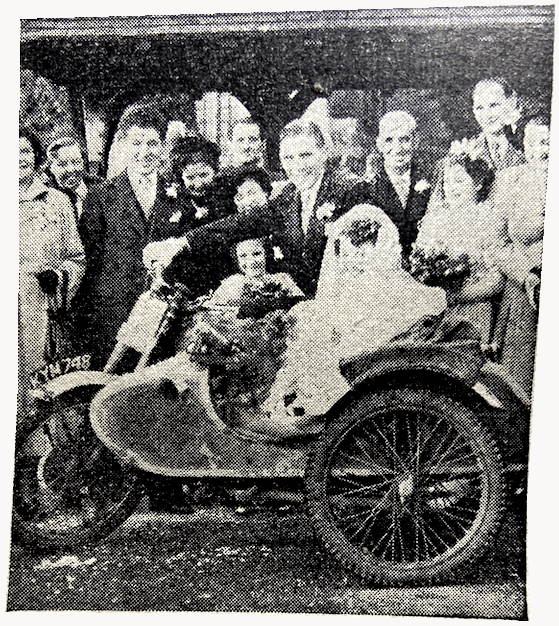
“STARTING LAST OCTOBER, Ray Petty. who is Francis Beart’s right hand and whose hobby and spare-time work is tuning two-strokes, has produced a most Interesting 122cc machine weighing 126lb for this year’s 125cc-class road racing. It is called the ‘Petsmith Special’ with the ‘smith’ redounding to the credit of John Smith, who has done much of the donkey-work, including nearly all the machining. ‘Spare-time’, in Ray Petty’s case, has meant 8.30pm onward and, on Sundays, 9 to 9. A 122cc Villiers engine-gear unit, vintage 1939, with close-ratio gears of approximately 7, 8 and 10½ to 1, is mounted in a neat, loop-type spring frame. Like the pressed steel, link-type front fork, the loop portion of the frame was picked up second-hand and the make is not known for certain. From the bottom of the loop, the chainstays sweep under the gear box to the plunger-type rear-springing. At first glance, the chainstays and seat stays would appear to be welded to the frame centre. Petty would have preferred a welded frame, but in this case the whole frame—tubing, fish-plates. etc—is brazed. The reasons are solely speed in manufacture—the work was being carried out at home in his spare time—and, secondly, the lack of distortion as compared with welding.”
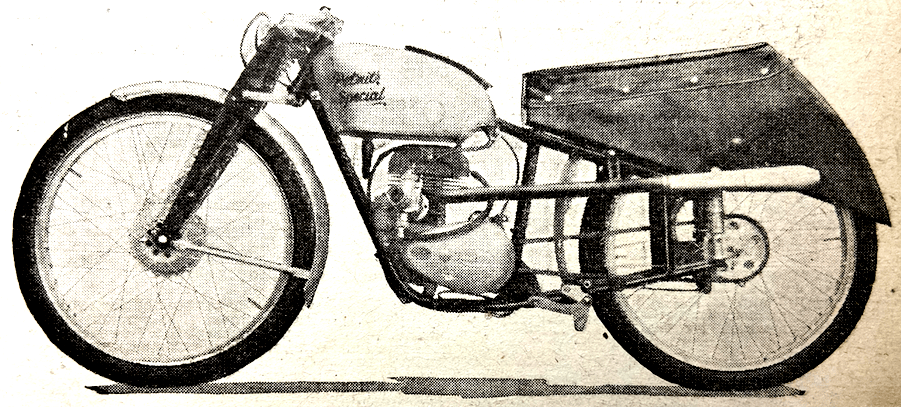
“FRESH FROM HIS Victory Trial success, W Nicholson (499 BSA) won his fourth Hurst Cup Trial last Saturday over 16 laps of a six-mile course at Clandeboye Estate, County Down. There was an entry of 68, of whom 43 finished. It was conceded by nearly every rider in the event that it was a less hazardous Hurst than any previous in the series. One contributing feature was the fact that the Knock Club, the organisers, were unable this year to use portions of the estate which include some of the better-known Hurst features. The weather, too, had a lot to do with it, for the days preceding were dry, and on Saturday there was a biting, drying, east wind. There was not the usual ‘porridgy’, glutinous mud in the recognised soft sections.”
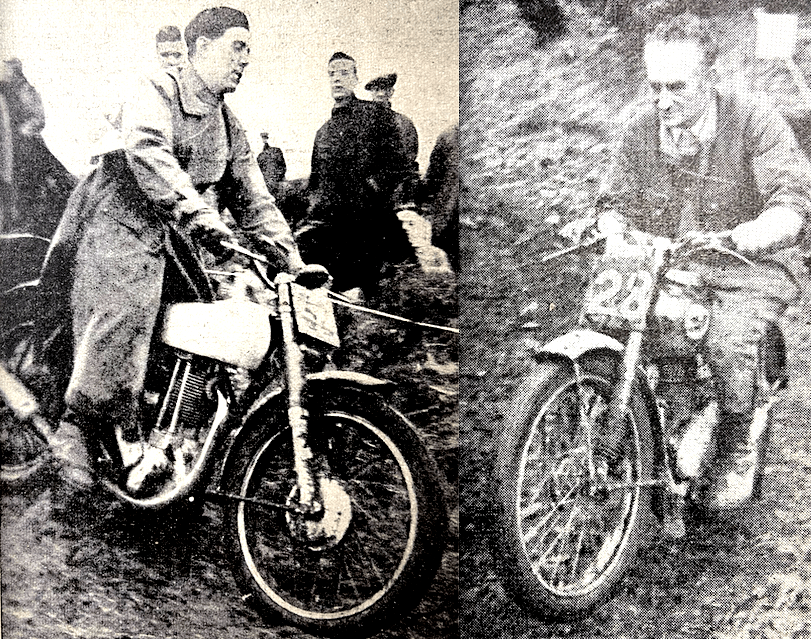
“IN DECEMBER, 1950, there were 3,134 machines of less than 150cc registered. Four sidecar outfits in this category were taxed for the first time. In the 150-250cc category 500 solo and 18 sidecars were taxed, and the over-250cc registrations for the month totalled 1,973 machines, of which 367 were sidecars. Three-wheelers numbering 255 were taxed for the first time. With these figures, it is now possible to analyse the total registrations for the whole of 1950. The under-150cc machines totalled 67,237 in solo form and there were 284 sidecar outfits in the same capacity category. Motor cycles of 150-250cc taxed for the first time last year came to 10,584 solos and 128 sidecars. In the over-250cc range, there was a total of 49,504 models, including 6,815 sidecar outfits. The three-wheelers registered numbered 3,734 in 1950.”
“I HAVE PUT A ROD in pickle for my own back by singing the praises of celluloid collars for motor cycling wear, because they do not wilt, and because even such stains as burnt oil and carbon can be removed by a spit and a lick. Numerous irate readers now complain that the local gent’s outfitter cannot supply. Subsisting on my pre-war stock, I was quite unaware of this problem. I have tried the neighbouring dealers, who variously report that (a), they are no longer made; (b), there is no demand for them, since young men of today are far too well paid to wear such revolting objects; (c), they are made, but only in the clerical style, which studs at the back and needs no tie (because padres never get rises in wages, because they never strike). As they say in Parliament, I am exploring the situation energetically, and will report further in due course.”—Ixion
“WHAT IS THERE about vintage motor cycles which makes their owners love them? RG Chawner, national secretary, at the Vintage MCC’s annual lunch, said that there was no clear-cut answer. Such machines, he maintained, appealed to so many senses that analysis was difficult. There was a distinct smell, even if one did not use Castrol ‘R’ then there was eye appeal, the majority of vintage machines having a real functional beauty—they were simple, straightforward and effective in their lines: and was there anything quite so inspiring as the sound of a two-speed Scott as it negotiated a series of bends, or the tick-over of an 8-40 JAP? Mr Chawner made an excellent point, too, when he suggested that, but for the Vintage Club, fewer vintage machines would be in existence to-day. Later in the speeches this point was taken up and developed, for the questions were asked what modern machines would be likely to be construed as true vintage 20 years hence, and which of the models produced in the 1930s might even now be termed ‘vintage’: further, what would the Vintage MCC do—would it cleave to the receding past or move onward, step by step, and thus help to preserve the really worthwhile motor cycles of each era? As usual at these gatherings, many famous old-timers and others of more modern fame were gathered together. In the chair was Rex Judd, the president, while among the guests and members were WH (Billy) Wells, of Indian fame—he was leading the twin-cylinder class of the first TT on a Vindec until tyre trouble intervened—Arthur Butterfield (whose name will forever be linked with the manufacture of the Levis), JJ Hall, ECE Baragwanath, who lapped Brooklands on innumerable occasions at 100mph with a sidecar, Harold Karslake, Jock Wes, Cliff Lewis (who revived Bemsee and, until recently, has been the post-war secretary) and someone known to many old-time enthusiasts, P Brewster.—THE CLUBMAN“
“FESTIVAL YEAR—there was a true festival atmosphere at the National Rally which was held last week-end. The revival, after a 10-year lapse, of the great ACU-organised event was a big success. The mileage competition attracted 1,100 entries from all over the British Isles and was blessed with excellent, if not-quite-perfect weather. On Sunday, when the competitors converged on Billing Aquadrome near Northampton, where a varied programme of events was staged, thousands of enthusiasts rolled up, seemingly, from everywhere. It was a joyous gathering, an informal one, at which everyone was pals with everyone else; it was, in short, just the sort of gathering to appeal to motor cyclists. All but the youngest enthusiasts will remember the National Rally, so popular a fixture on the pre-war calendar. It was first held in 1933 and suspended, because of the war, in 1939. For the 1939 event there was an entry of 891 for the mileage competition which, to that date, was an all-time record. The rules for the mileage competition have remained unchanged in principle. That is to say, innumerable controls—130 in last week-end’s event—are situated throughout the country. Competitors start, from 9am onward on the Saturday, from any control they care to select, and the route they follow to the venue is entirely of their own choosing. Provided that not more than 50 miles are covered before checking in at the next control, the contestants may travel along any point on the compass. Every mile covered means one mark gained, and two marks are awarded for every control visited. The only proviso as regards speed is that the average from start to finish must not exceed 27mph. This means that if one starts at 9am on Saturday and uses the total time on the roads, 702 miles is the maximum permissible distance. It was evident early on Sunday morning that many riders were attempting to cover the maximum mileage. At 8am, an hour before the Billing Aquadrome control was due to open, only
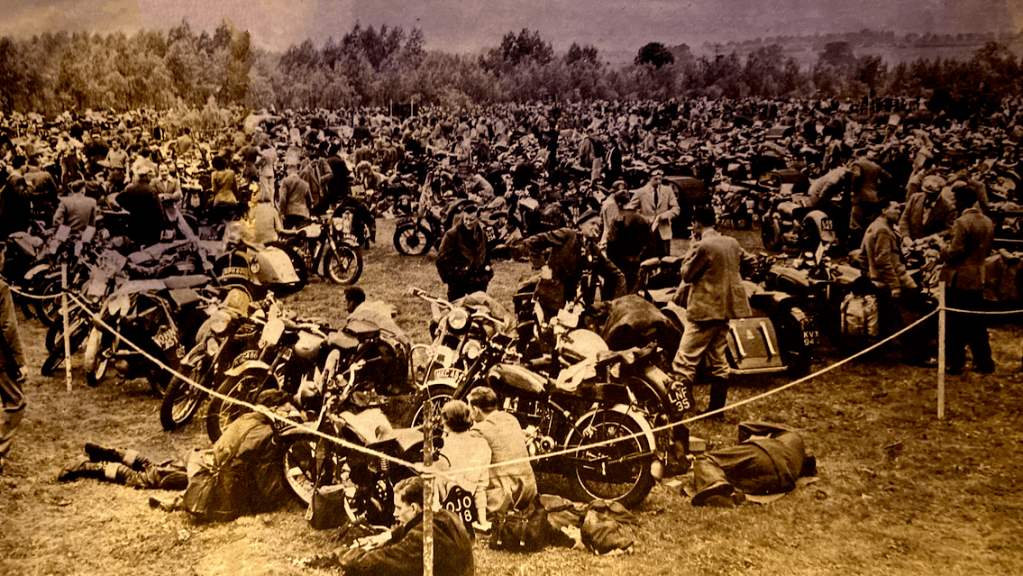
a few competitors were assembled waiting to check in. At 9am the number of arrivals was still small, but half an hour later the area was packed. The sun rose, the day warmed; the ACU organisation had not gone rusty with its eleven years’ lapse and, in magnificent style, competitors were checked in and passed through to their parking areas. Shortly after 9.30am, the rush period began. Machines were arriving by the half-dozen, the long-distance men easily distinguishable by their grimy faces and tired eyes; those who were content with a silver or a bronze plaque—and had spent the night in bed!—were equally easily identified because of the clean, soapy freshness of their skin. As the morning wore on towards 11am, when the control was due to close, the numbers in the first group increased considerably in ratio to those who were washed and rested. One of the elite long-distance competitors was Mrs Doris Taylor (Ariel Twin) who covered 702 miles and visited 36 controls. A pre-war Rally competitor with a silver and a bronze plaque to her credit, Mrs Taylor—her husband navigating (not driving!) from the pillion—left from Birmingham, travelled north to Leeds, south to Winchester, ran around the south of England and thence to Billing. She had no trouble and said that she did not feel at all as though she had been travelling all night. Mrs Taylor, incidentally, is an active enthusiast in the world of club life. She is an
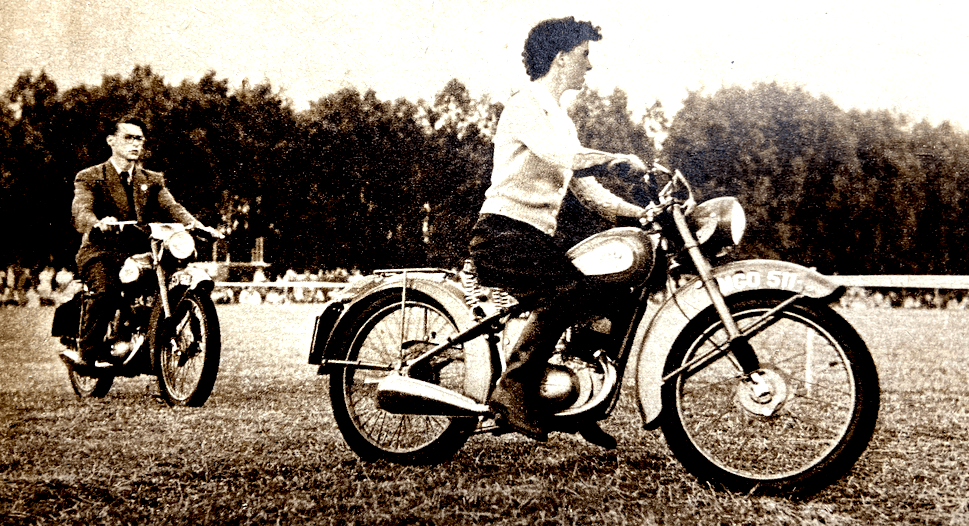
honorary member of the ACU, ACU Midland Centre delegate to the General Council, treasurer of the South Birmingham Club and secretary of the S Birmingham Club’s Youth Training scheme. A feature of the Rally was the excellent mechanical condition of the machines which finished the mileage test, and their cleanliness. It was obvious that few had encountered more than the briefest shower. The medal—had there been one—for the quietest machines, LE Velocettes excepted, would have gone to the BSA twins. As usual, there was a greater variety of style of dress than could have been conjured up at a motor cyclists’ fashion parade. The medal—again, had there been one!—for the best-dressed rider would have one to the pillion rider of a long-distance man. She wore a beautiful white mackintosh and a white helmet—both of which were grime bespattered because her beau’s machine was inadequately mudguarded. Verb sap, nearly all manufacturers! The Army were out in impressive force, fielding, among many others, those who have been selected as ‘possibles’ for the International Six Days’ Trial. The Army teams checked in before 11am and had obviously been out for blood. At least one machine sounded like an item of badly worn agricultural machinery; but, in addition to covering maximum mileage, the Army riders had visited 41 controls! The task of calculating the most profitable run, on a basis of miles plus controls, is a most complicated one, which many likened to that known in football circles as pools permutations. The Army riders, therefore, must have permuted with electric-efficiency brains. Certainly they deserve hearty congratulations. The rally is an event which is open to young and old, clubmen or unattached riders, and

enthusiasts from overseas. One famous old-timer to be attracted back to two wheels, though perhaps he should have used a sidecar outfit, was HS Perrey (BSA). He covered 325 miles and visited, he said, 13 official controls and one unofficial one—the latter his home where he spent the night! The event also attracts clubs in great strength, a fact which is exemplified by the NE London club, which provided nearly 50 of the 1,500 entries, among them all the club committee and all the officers! They won the ACU Inter-Club Rally Challenge Trophy. Where motor cycles are concerned, it is always difficult to say which type, vintage or modern, receives most attention from enthusiasts. A 1927 247cc Model K Levis which had covered 341 miles and called at 14 controls (and been in the garage while D. Bagnell, its owner since 1931, slept) formed the nucleus of a small rally of its own. So did an old Royal Enfield V-twin with coffee- grinder, selective-clutch gear change and glass oil tank. Then there was R Pinnock’s single-cylinder Bradbury with a Phillipson pulley. Attracting as much excitement as any were the 1921 Longstroke Sunbeam ridden by F Elliott and the 1922 Raleigh in the hands of LM Bell. Both had covered 346 miles and, immediately after checking in, set off on their return journey to Carlisle. Inevitably there was a tremendous last-minute rush just before the Billing control closed, but
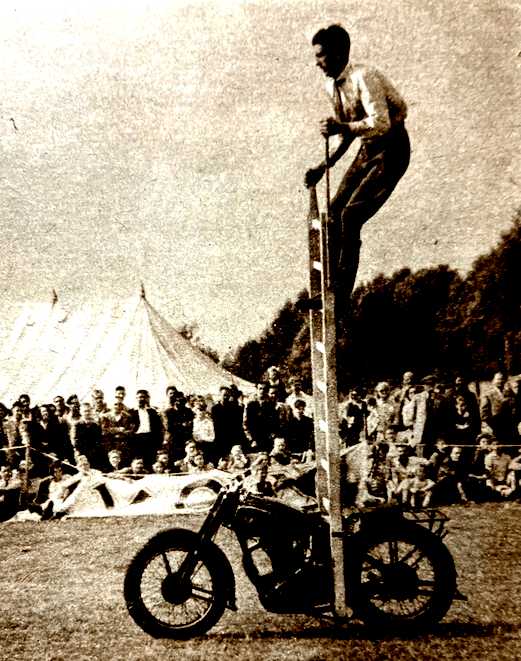
strangely none of those riding up to the last minute appeared to be in the maximum-mileage class. 0F Berry (Triumph) and RD Lee (Triumph) just squeezed in before the barrier went up. So did C Fowle (BSA). Another was CA Sweet (Ariel), a learner rider who had covered 528 miles and visited 24 controls. Among the last in were two members of the London Ladies club, Miss W Coleman (BSA) and Miss M. Hiscutt (OEC), who braked on the gravel surface and, to her dismay, dropped the model. The crowd grew and grew as the day progressed. The sun strengthened and bathed the Aquadrome, a beautiful 50-acre park which was once a disused gravel pit, in gorgeous warmth. Motor cyclists disported themselves is all sorts of positions, many tired out after their long hours in the saddle. Other mileage men, not so tired, had lunch; many attended the short, open-air service. There were pleasure flights in a private aircraft; fishing; a demonstration of the private Youth Training scheme; a magnificent display of trick-riding by the Cytrix team; a water polo match in the swimming pool; and an excellent gymkhana organised by the CSMA. And the 175 marshals and officials toiled and toiled to make the day a success. Incidentally, in all, it is estimated that some 1,500 officials were engaged on the Rally.
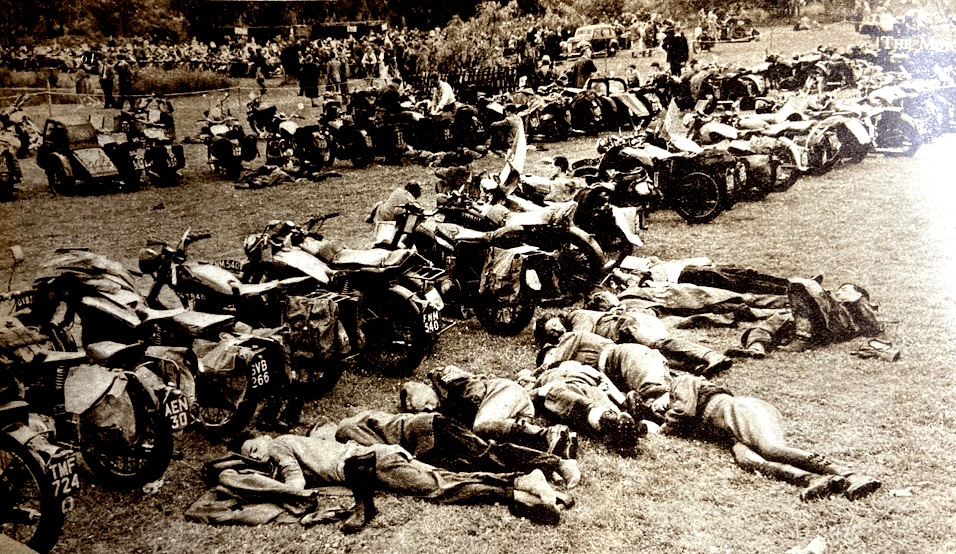
Full marks must go to all of them, for nearly everyone remarked on the excellent receptions at the controls, and on the pleasant, efficient informality of the ACU organisation at Billing. The event, incidentally, was sponsored by the News Chronicle. When the results were worked out it transpired that 19 competitors tied with a total of 784 marks. The tie could not be settled on a basis of the maximum number of controls visited because all, it seemed, had passed through no fewer than 41. Then it was found that three Army teams—the ISDT ‘possibles’ and the team from the Army MT School (Bordon)—had all gained 2,352 marks. There were ties for other awards and, as set out in the regulations, in each case a ballot had to be resorted to in order to decide the winner. One hundred and seventy-three failed to complete the course within the prescribed time limit. Approximately 400 gained gilt plaques for maximum mileage; a tremendous increase over any previous year. RESULTS The News Chronicle Trophy (holder of RAC-ACU proficiency certificate with best
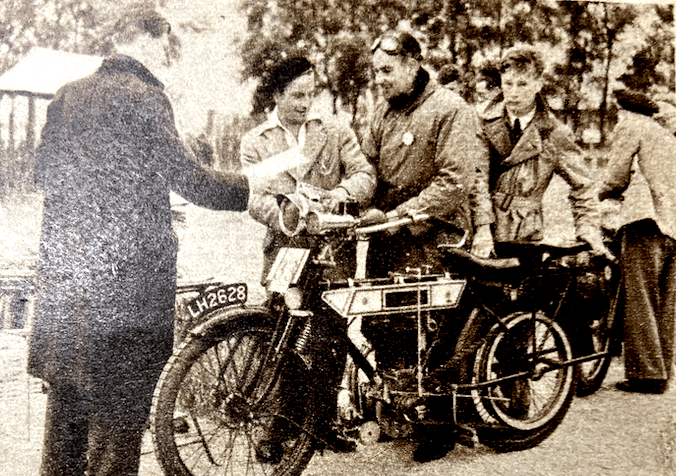
marking), EW Rose (BSA), 755 marks. Varley Challenge Trophy (best performance), F Wisbey (Vincent), 784 marks. Basic Challenge Trophy (best sidecar), JW Manley (BSA sc), 784; ACU Inter-Club Rally Challenge Trophy (highest figure of merit on basis of marks won in rally and percentage of members at venue), NE London MCC; figure of merit, 974,201; Manufacturers’ Club Challenge Vase (second best figure of merit), Lea Bridge &DMCC, 809,210; Belstaff Challenge Cup (third highest figure of merit), Bulldog (SM Centre) MCC, 286,444; Dunlop Challenge Cup (fourth highest figure of merit), Ravensbury MCC, 260,710; South Midland Centre Trophy (S-M Centre Club gaining highest figure of merit), NE London MCC; South-Eastern Centre Trophy (SE Centre Club with largest entry in road competition), Ravensbury MCC; Motorcycling Perpetual Challenge Trophy (best Army Team), Army MT School (Gordon), 2.352; Manufacturers’ Special Awards (best rider of one make), AJS, L Starr, 780; BSA, JW Manley, 784; Francis-Barnet, PJ Orton, 742; Royal Enfield, D Bull, 782; Matchless, Capt DG Miles, 784; Morgan, H Pass, 759; Norton, J Havers, 784: Panther, AG Stevens, 784; Sunbeam, CE Bland, 779; Triumph, LTN Gardiner, 784; Velocette, EA Lavington, 779; Vincent, P Le Courteur, 784; Ariel (for best kept machine), BJ Fazen, 755. Special Awards: Morgan, H Pass, 759; London Douglas MC, LD Rudland (Douglas), 764. Class Awards: 125cc, FW Osborne (James), 784; 125-250cc, JR Walton (James), 784; 250-350cc, Sgt VE Monk (Matchless), 784; Over 350cc, PJ Madle (Matchless), 784; Sidecar, AG Stevens (Panther sc), 784; three-wheelers, H Pass (Morgan), 758.
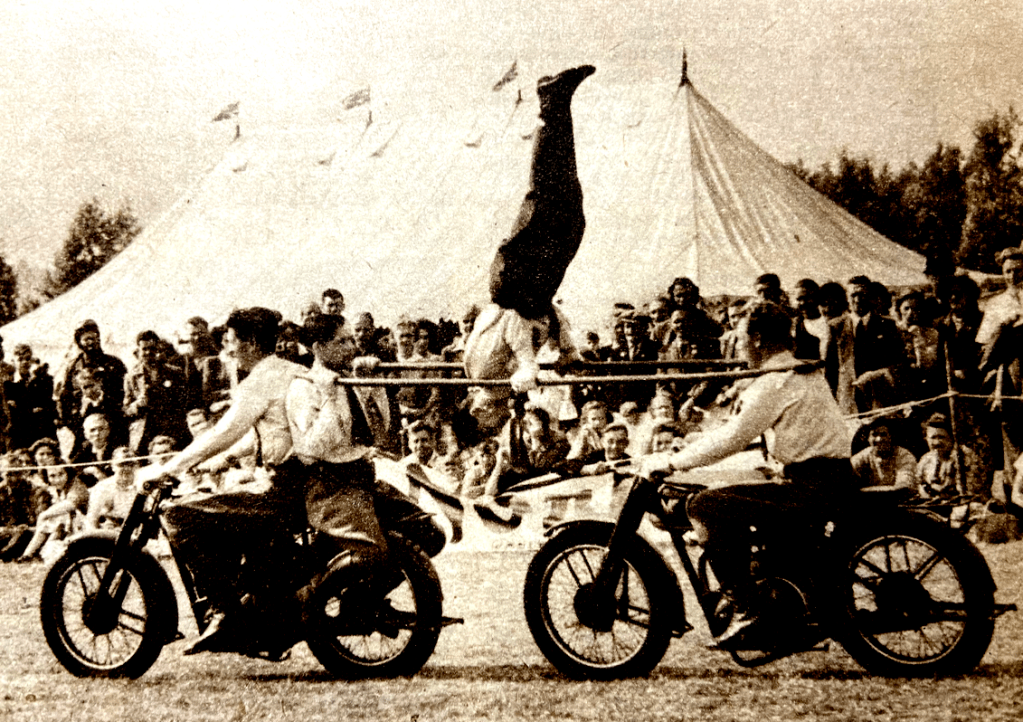
“SEVERAL RECORDS were broken by last week-end’s Festival of Britain National Rally organised by the Auto Cycle Union. No fewer than 1,100 motor cyclists, clubmen and others, entered for the mileage competition and of the 927 who checked in at the finish, some 400 qualified for a gilt plaque by gaining 700 or more mileage marks. This is a remarkable feat and a telling testimony to the comfort and good handling of the modern motor cycle. Nineteen riders tied for best performance and, under the regulations, this—as well as some other awards—had to be decided by ballot, not a very satisfactory arrangement, though convenient. The good weather this year was probably a big factor, but even so, some better means of deciding is obviously desirable. It is possible that the terms of the competition may be modified in other directions. In some minds there is doubt whether it is wise for all and sundry to attempt to ride continuously for 26 hours. As a finishing point and venue for the gymkhana and other events, the centrally situated Billing Aquadrome, near Northampton, could hardly be equalled. It was a most interesting day. Faults were few, and those were mainly inadequate route-marking in the vicinity and a hiatus in the programme of events. Only about 10,000 attended, which was disappointing; next year there should be treble that number.”
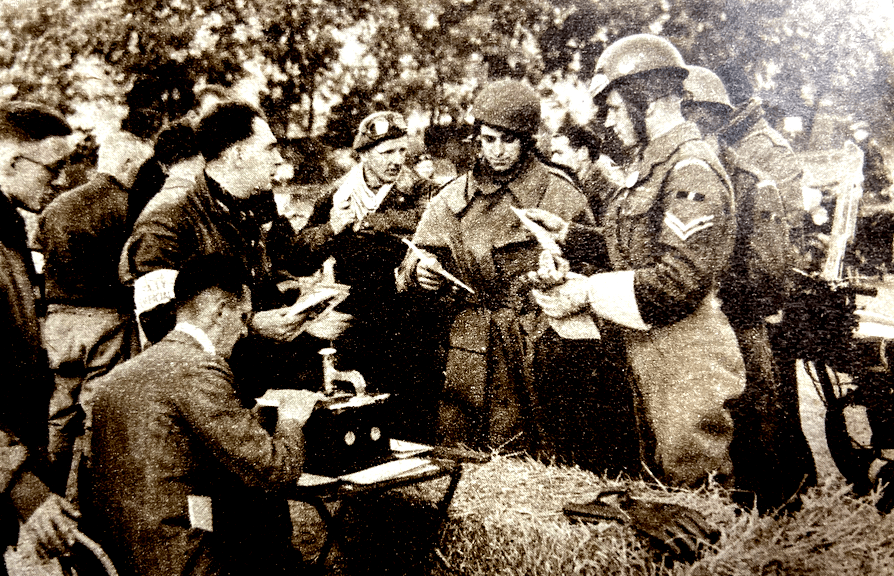
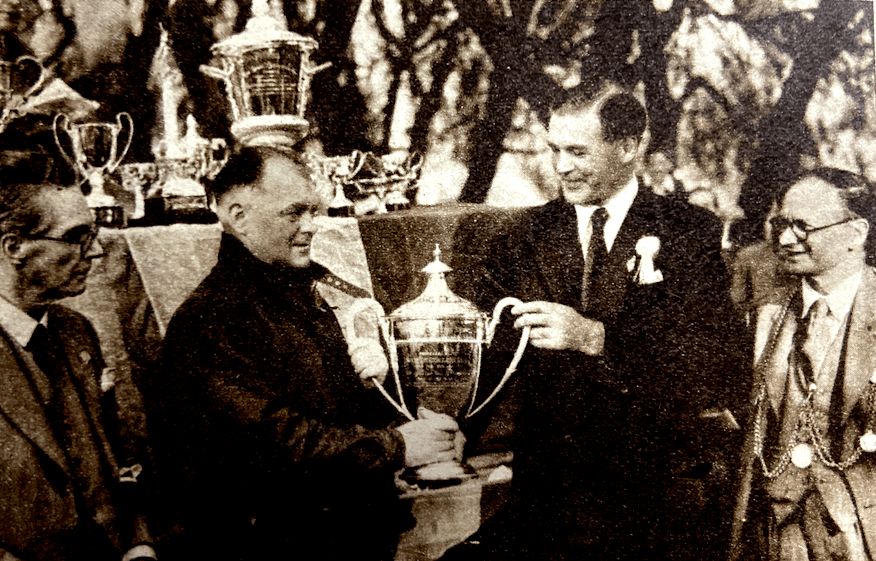

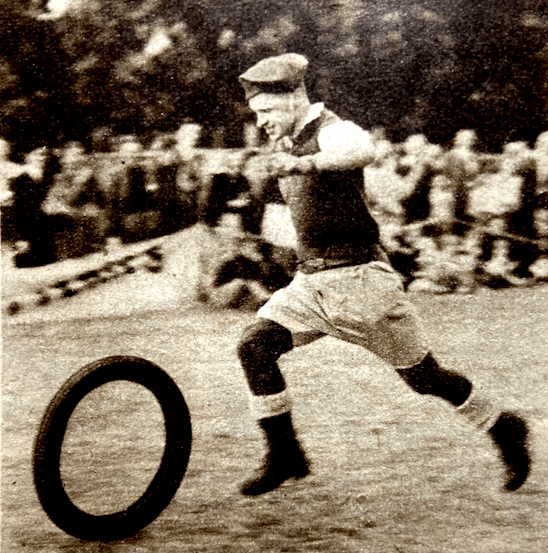
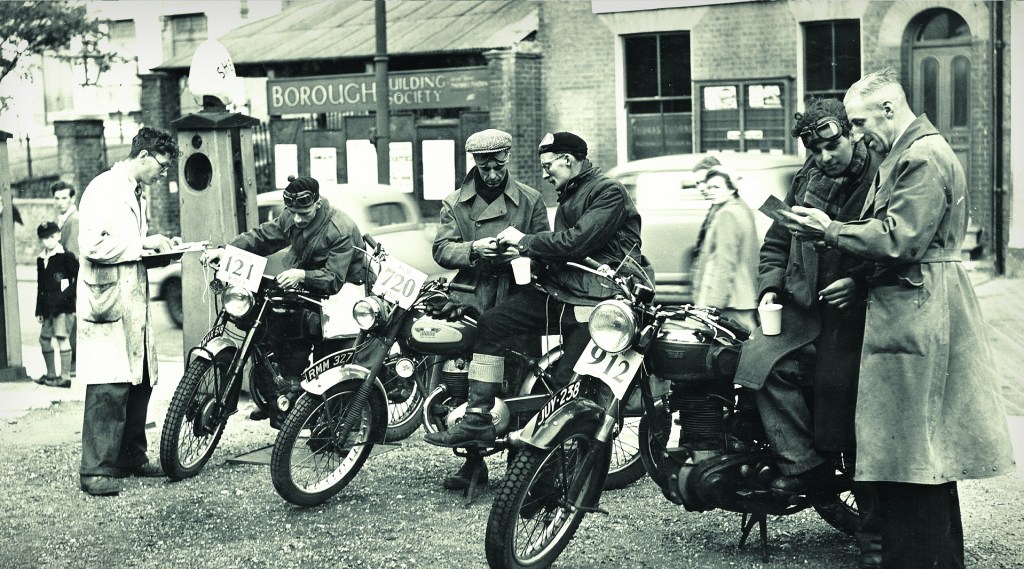
“GLOBE-TROTTERS John Lennox-Cook, Wimbledon schoolmaster, and Tim Hamilton-Fletcher, Dorset farmer, have arrived in Melbourne (writes George Lynn). Riding Norton Dominator twins, both have covered some 14,000 miles and crossed 15 countries since leaving London some four months ago. As I write, they hope within a few days to catch a ship from Sydney to Canada on their way back to England. Their machines, which needed no more than a general check-over by Disney’s, Melbourne Norton agents, are both standard; normal camping gear is carried. Neither machine has suffered any mechanical trouble, and only once were they stopped by a puncture—after many thousands of miles of rough going. Only item not standard is the ‘double’ two-book passport which both carry and which are already heavily stamped by the frontier seals of many countries. Mr Lennox-Cook remarked that while several of the 20 visas and permits necessary before leaving England were free, the permit to cross one of the smallest countries was actually the most expensive—17s 6d sterling! Both are ex-Servicemen; Lennox-Cook was in the RAF and Hamilton-Fletcher in the Navy. They got the idea of travelling after serving oversea during the war. Hamilton-Fletcher already owned a Norton Dominator which had 9,000 miles up, but his partner had never ridden a motor cycle before. Both said they had enjoyed every minute of their tour. Leaving London on 12 February, the Norton riders crossed to Dunkirk and headed south across France via Lyons to Nice on the Mediterranean coast, using the splendid French route nationale highways. From there they followed the coast into Italy and down to Naples via Genoa, Pisa and Rome. Eight days out from London, they reached Naples and took an Italian ship to Piraeus, the port of Athens. It was the original intention to cross the north of Italy into Yugoslavia, but due to the time of the year (winter) and the heavy snow on the mountain crossings the route had to be changed to the sea trip from Italy to Greece. This cost £12 in passage fares and £13 for the two machines. After seeing the world famous sights in Athens the Norton riders drove north over very bad roads to Salonika. Here an accident overtook Lennox-Cook, who collided with a lorry. The result was a month’s delay in hospital for Lennox-Cook; meanwhile, Hamilton-Fletcher successfully claimed for damages and had the Norton repaired with parts flown out from England. From Salonika the riders crossed to Istanbul in Turkey. The trip included sections of unbelievably bad roads which Lennox-Cook said ‘made it a nightmare journey’. Over one section it took seven hours to cover 60 miles. The highway was actually an old Roman road with the original flag-stones displaced and lying across the route like boulders. At times it was necessary to ride along railway embankments to regain the road. Rivers, unbridged, had to be forded, but never once did the machines give trouble. Ankara, the capital in Asia Minor, was reached on 30 March. Turkish highways varied from good tarred roads to loose gravel and sand. The route took them over the 7,000ft snow-capped Taurus mountains before they reached Syria. From here the route south included stops at Aleppo, Beirut (Lebanon) and through the famous gate into Damascus. Lennox-Cook said he was most fascinated by this near-Oriental part of the world—’dirty, savage, but rich with colour’. From here the riders faced the 600-mile desert crossing to Baghdad (Iran); they came through the journey without trouble. Sections of the journey, up to 8o miles at times, were devoid of any life whatsoever. Occasionally nomad tribes encountered showed great amazement and curiosity at the sight of men riding motor cycles. On this journey, the Nortons, fitted to carry two extra gallons of petrol, carried nine gallons in case of emergency. After crossing more wild country into Iran the two Nortons reached the small Anglo-Iranian Oil depot at Kermanshah. The Norton riders said they were in Kermanshah when rioting broke out, but they were not molested. It was here one evening, seeking replenishment of petrol, that an oil company employee lowered a bucket into one of the huge 500,000-gallon storage tanks to fill the Norton tanks. The petrol was of approximately 70
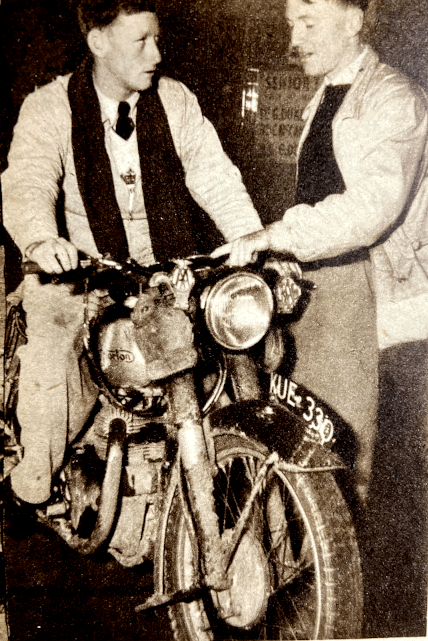
octane. Next stop was the capital, Tehran, and afterwards there was another long trek across wild, deserted country to Meshed, in the north-eastern corner of Iran—No 2 Mecca of the Moslem world. The exciting feature of this journey was the stampede of passing camel trains, donkeys and sheep. Nothing mechanical had ever intruded on the serenity of this wild but quiet part of the world. Naturally, the owners were much displeased, having to chase for miles in order to round up their animals. With only ex-Army maps to guide them (and these by no means accurate), the two Norton riders were discouraged from entering Afghanistan but pressed on with Kabul as their objective. The route ‘over roads if you could call them roads’ meant hard, rough going for miles on end. Rivers were never bridged, and deep crossings had to be made with 420lb of Norton motor cycle loaded on the backs of camels! Obtaining petrol in Afghanistan was a major problem. A special permit issued by the ‘Governor’ was necessary, and the natives seemed to be reluctant to have any dealings with this gentleman. For the most part the petrol was of Russian origin and red in colour. ‘It was of poor, watery-paraffin nature, and about 50-octane value’, said Lennox-Cook. In the absence of road maps, travel was done on the ‘direction and mileage basis’. Failure of both speedometers caused some hardship. By map calculation the approximate mileage of any section was arrived at, and if the figure was exceeded before the objective was reached ‘you knew you were on the wrong track’, said Hamilton-Fletcher. It was a great relief to the riders to find at the Pakistan border paved highways and people able to speak English. After a fast passage through the historic Khyber Pass, Peshawar was reached. No tyre trouble had occurred to either machine since the tour began, but about 50 miles from Peshawar, on good, tarred roads, Hamilton-Fletcher’s machine picked up a nail from a bullock’s shoe and the first ‘flat’ was experienced. Crossing India south to Lahore, Delhi, Bombay and Bangalore, the final route took them to Colombo, in Ceylon. Here they joined the 27,000-ton Orient liner Oronsay on her maiden voyage to Australia, disembarking at Fremantle (Perth). The Englishmen made the 2,000-mile trans-Australian crossing via Kalgoorlie, Norseman, Ceduna and Ecula to Adelaide, and so to Melbourne. The six-day ride was far more arduous than usual due to recent heavy rain, so that often wheels were bogged in deep mud. It was during this journey between Port Pixie and Port Augusta that cars had to be hauled across a swollen creek by a tractor. ‘We put our Nortons into bottom gear and drove across, both doing it ‘clean’. After three days in Melbourne staying with friends, Lennox-Cook hurried to Sydney (NSW) where he hoped to obtain passages on the Pacific liner Arangi bound for Vancouver. ‘We intend to cross Canada on our machines, or even cross the United States, before we leave for home,’ he concluded.”
“THIS YEAR’S SCOTTISH SIX DAYS’ TRIAL will be remembered especially for the magnificence of the weather in the Highlands and the size of the entry. According to those with experience of the Edinburgh Motor Club’s event going back nearly 40 years, conditions had rarely, if ever, been better. Further, because the heavy snows of a hard winter still remained on so many of the hill and mountain tops, the beauties of the countryside were at their best. Although there was this year no sidecar class, the entry of 154 was a record. With 28 separate observed sections, nearly 90 sub-sections and many arduous runs against time over rough tracks, the course of slightly over 900 miles was sporting enough to satisfy the most ardent enthusiast. Best performance, with 22 marks lost, was made by GJ Draper, riding a 348cc BSA. Some idea of the closeness of the struggle to win can be gathered from the fact that his lead over PH Alves (498 Triumph), who made second-best performance, was only four marks. In third place was DJ Ratcliffe (347 Matchless) with 27 marks lost. Seldom have so few marks separated the leading men. Winners of the manufacturers’ team prize were the Matchless team comprising DJ Ratcliffe (27 marks lost), LA Ratcliffe (34) and E Usher (40), with a total of 101 marks lost. This team were also successful in last year’s event. Runners-up were BSA (GJ Draper, D Tye and TU Ellis) with a total of 123 marks lost. Sunbeam won the club team prize; the riders were Draper, Alves and FM Rist (499 BSA), with a total of 94 marks lost. The first day’s run from Edinburgh to Fort William kept riders very busy. Included in the 182-mile route were seven observed sections divided into 24 sub-sections and a special test to decide ties. Weather on leaving Edinburgh at 8am was wet, cold and miserable, but within a few hours conditions had improved so much that
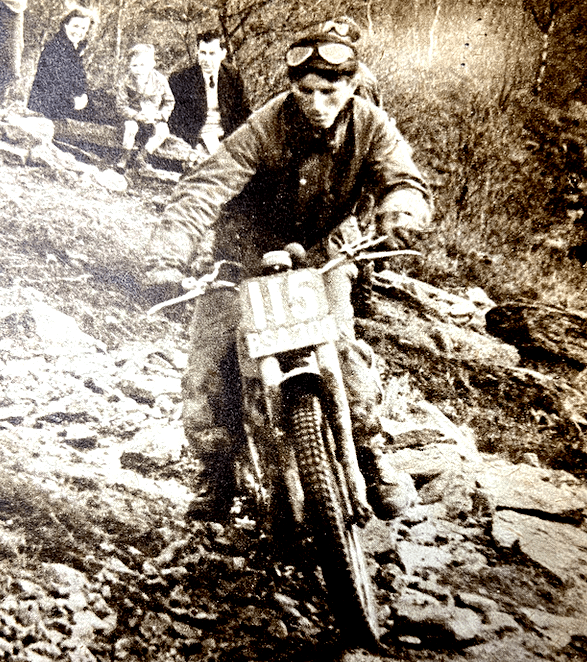
the observed sections were for the most part dry and the Highland scenery was inspiring. Such famous hills as Stoney Brae, Camushurich and Mamore were tackled and only three riders finished the day without losing marks on observation; but one of them, DJ Crennell (490 Norton), was penalised 10 marks for lateness at a time check. Tuesday—Second Day: A cloud-packed sky enshrouding the hills, sizeable white-crested waves on Loch Linnhe and rain tossed haphazardly by a boisterous wind greeted competitors at 9am when the first man left the official garage. In spite of the uninviting conditions many Fort Williamites had assembled at the first observed section M&D, one of two sections (the other is Town Hall Brae) right in the town. M&D is a short steep track with a rock-slab surface plus a little mud and an S-bend; it culminates in a flight of steps boarded over for the occasion. On Tuesday the rocks were covered with a film of treacherous slime. Within 50 yards of the start, M&D was a fitting livener—or perhaps a rude awakening—for the day’s run of 537 miles. Many of the riders of lightweights were in difficulties, and the majority either footed or stopped. Yet all three Francis-Barnetts in the trial—ridden by BW Martin (122cc), A Greenaway (122cc) and J Botting (197cc)—were taken up neatly and without loss of marks. The most ‘gentlemanly’ performance seen was by AC Gordon (348 Douglas). From Fort William the route led along the famous Mallaig Road to Lochailort. The section from Glenfinnan onward is rarely straight or level and it demands unmitigated concentration from the rider. Yet it is a road which seems to encourage competitors to zestful hurrying. Each year there are usually a few who find themselves in awkward situations. This occasion was no exception, and many ‘took to the gravel'” as Australian racing men are wont to remark. At least four riders left the road completely. They were AD Rawnsley (347 Matchless), RS Sneath (498 Triumph), WD Young (490 Norton) and PJ Dolphin (490 Norton), but all were able to continue after sorting themselves out. The section at Camp gave no one except CH Chapman any real bother. Unfortunately Chapman allowed his Douglas to wander over the edge of the track in the direction of the Loch below. He fell against a rock and suffered slight concussion, but after hospital treatment was well enough to return to his hotel. It was near the foot of Gordon that GL Cormack, involved in a sporting ‘dice’ with two other competitors, fell and bent the left-side footrest of his BSA into the clutch. Stripped centre-unit studs resulted. He became the pillion passenger on this scribe’s Matchless twin for the remainder of the day’s course. Two-up on the rough stuff provoked the Matchless to some entertaining evolutions which exerted the ‘unmatched’ crew in no mean manner. It was great fun; there ought to be a pillion class in next year’s Scottish. The tight S-bend of Ravine was in vicious condition. The greasy slabs and diagonal ledges would be a severe test if the path were straight; when, in addition, it is necessary to make full-lock turns, the task is almost impossible. On Tuesday no rider got through without at least one foot, although AA Kirk (490 Norton) accomplished the more difficult second sub-section clean after a dab in the first. He was the only rider to do so. Miss Olga Kevelos (197 James) caused a stir by turning completely round and heading smartly downhill, and JD Brown (347 AJS) almost immediately followed by M Hall (490 Norton) found themselves about to leave the track where it sloped down steeply to the Loch. Advance information was that Bay, which, owing to its severity has caused lengthy delays in the past, was less of a stopper because many of its countless loose rocks had been fixed by concrete foundations. Apparently efforts had been made to key the rocks without concrete, in the manner practised in the locality. Spinning wheels soon unmade the good work and Bay was as frightful as ever. There was some delay and riders took the opportunity to watch others in order to try to decide on tactics. It was a happy scene. Now afternoon, the weather had cleared and the Loch and hillsides were often bathed in sun-light. Riders sat on the banks wisecracking and cooling off after their earlier exertions. But when it came to the point, even
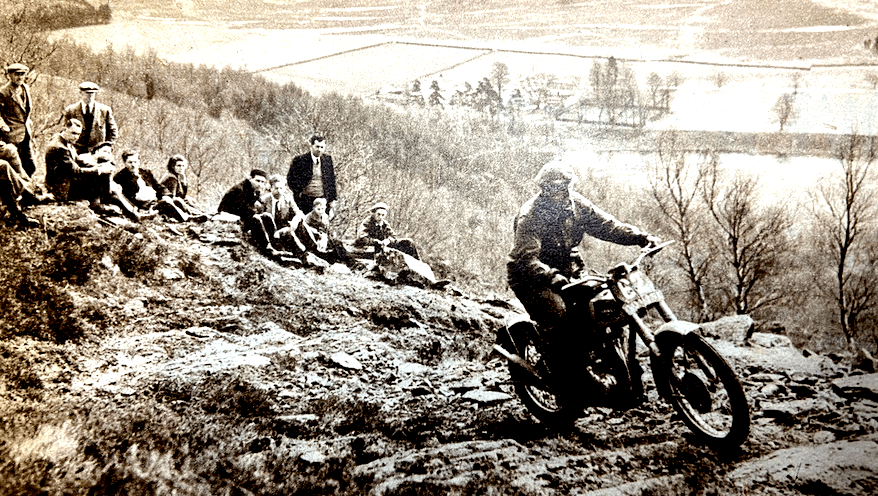
with the most definite preconceived ideas, they found the hill was master. No one was successful in all three sub-sections. Easily the best were NS Holmes (346 Royal Enfield), E Usher (347 Matchless) and HR Kemp (346 Royal Enfield), who were unpenalised until the last sub-section where they had to foot. After the unobserved descent of the almost frightening Devil’s Staircase, there was a run of nearly 100 miles to Fort William. A gale-force wind lashed the waters of Loch Linnhe to such effect that Conran ferry was not operating, and spray from the waves clouded riders’ goggles as they passed along the loch-side road. When one had to nuke a conscious effort to lean into the wind. As Olga Kevelos expressively observed, it was the first experience she had had of leaning her machine to the right on left-hand bends! The day’s route finished with the ascent of Town Hall Brae in Fort William. This almost straight hill has a surface of smooth rock slabs and presents no real difficulty. Nevertheless a few riders had to foot and the odd two or three stopped. It had been an arduous day. Wednesday—Third Day: Of all the famous Scottish hills; the Devil’s Staircase has a reputation that is supreme. So often this hill has decided the winner of the Trial. Comparatively few riders over the years have climbed the Staircase without penalty; those who have done so are remembered for their prowess and are called to mind by enthusiasts, though their achievement may have been a decade and more earlier. As an attractive location for watching a trial none could be better. The hillside from the shores of Loch Moidart, craggy and lightly wooded, stretches steeply skyward. The narrow, rock-strewn track slashes the hillside in a left 90° turn, three hairpins in close succession and, finally, another left 90° turn, and has an average gradient, in parts, steeper than 1 in 2. Rock outcrops and trees provide natural seats for the hundreds of spectators who invariably gather. The visit to Devil’s Staircase is an ‘occasion’ which brings out young and old and always has a mildly festive touch about it. The run from Fort William had been the reverse of Tuesday’s route. With lakes ruffled by wind, and glens and hills made colourful by sunshine, the 8o-mile ride in the clear, sweet air was magnificently invigorating. First man at the foot of the Staircase was EW Smith (197 DMW) and he mounted the rocks and ledges steadily on a fixed throttle opening. About half-way up
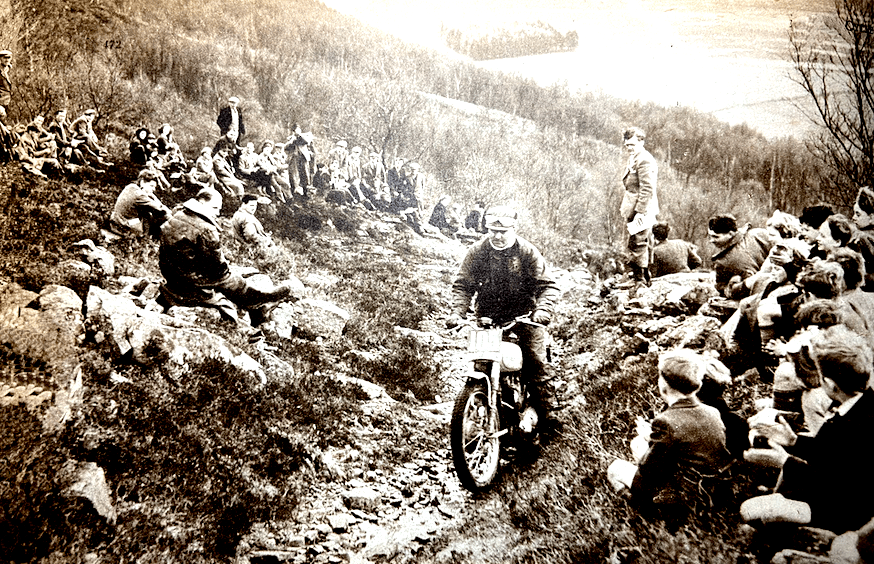
a ledge almost stopped him and there-after he had to use his feet. Team-mate Michael Riley followed and prodded with his feet now and again all the way through. In last year’s Trial, he established what was thought to be a record by ascending without penalty on a 125cc DMW with Villiers engine. Of the 140-odd who tackled the climb 10 lost no marks. Of the riders of two-strokes, the outstanding performance was made by Paul Jarman (197 James), who fought the leaps and lurches of his machine every inch of the way and was feet-up until within a yard or so of the end of the section. HP Williamson (197 Dot) was almost as good at first, but had to foot sooner than Jarman. Mrs. Betty Briggs (123 BSA) stopped momentarily when she bumped the bank on the first hairpin; she carried on sedately afterwards, footing as necessary. Without undue effort, Miss Olga Kevelos (197 James) kept going but footed in all sub-sections, and Mrs Mollie Briggs, also riding a 197cc James, had a stop before she saw the wisdom of similar safe tactics. BHM Viney (347AJS) dropped six marks he could ill afford by a dab—just one , for balance—in both first and third sub-sections, and another who must have been especially grieved to have to foot was CM Ray (497 Ariel), who thus lost his Tuesday’s lead to Draper. On the first hairpin, Ray’s front wheel climbed the slab of rock that forms the bank on the left; he yanked the wheel down a trifle too hard and found himself about to hit the low wall on the other side of the track. How he managed to keep. going is probably as much a mystery to him as it was to onlookers. A most unfortunate mishap befell R Chidgey on the narrow approach track to Devil’s Staircase. At a point when the hillside is sheer he lost control, it seems, and hurtled down 30 feet. The resulting head injuries were thought to be serious. His machine tumbled ahead of him and finished up a few yards from the water some 100 feet below. The fifth sub-section of Camp caused a good deal of trouble and cost Ray, Usher, LA Ratcliffe, Holmes and FM Rist (499 BSA) five marks each. Yet there were quite a few lesser-known riders who were without blemish. Final observed section on the 137-mile route was Town Hall Brae. Only GJ Draper was clean on every section throughout the run, and this brought him up from third place on Tuesday to a clear-cut first with a four-mark lead over Alves. Thursday—Fourth Day: In the small hours of Thursday, the stewards decided that over the 34-mile. section, Yetts of Muckart to Rumbling Bridge , on Monday’s route, allowance of up to 15 minutes late would be permitted. This resulted in a number of riders having time-marks cancelled, but the only effect it had among the leaders was that the young Manx rider, DJ Crennell (490 Norton), who on Monday lost no marks on observation, but was penalised 10 on time, had them expunged. Crennell is a remarkably able newcomer in his early
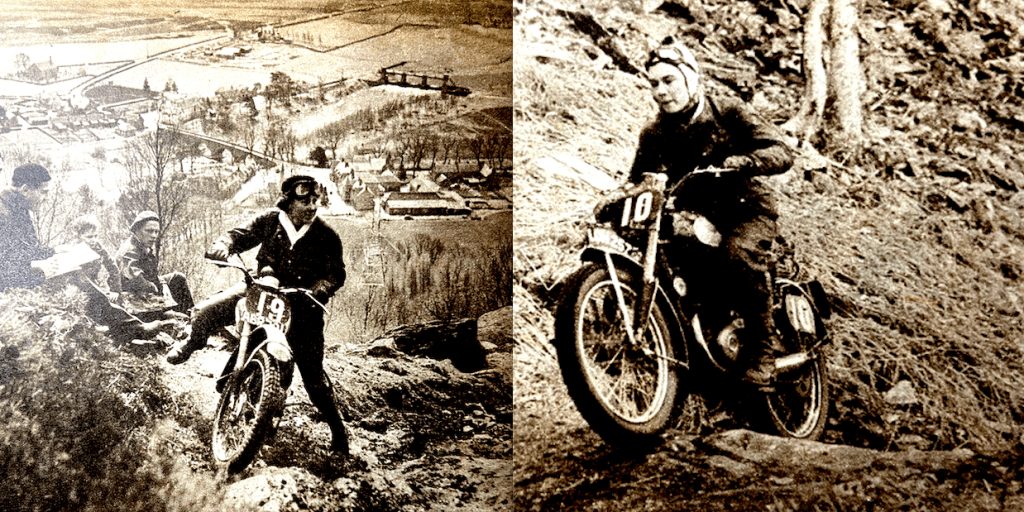
20s; he is competing in his first important trial and, although by Thursday he had lost 37 marks, is obviously a rider with a bright future. Report on R Chidgey, who is in Fort William Hospital, was encouraging. Although his head injuries were serious, his condition was not considered to be critical. First observed hill of the day was Kinlochourn. With its total of 10, it holds a record among all the Scottish hills for sub-sections. The climb is long and mounts steeply in a colourful glen, with, on Thursday, snow-flecked hilltops at the flanks. For the most part the narrow track is virgin earth, but there are patches of loose rock or rocky ledges, and there are two shallow rocky crossings of a musical burn. The very length of the hill—the need to concentrate meticulously for so long—is an obstacle in itself and there are three particular portions where the terrain is especially atrocious. Brilliant sunshine lit up the beauty of the glens and lochs on the 54-mile route from Fort William along Loch Lochy, Loch Garry and Loch Quoich. During the first few miles, the white majesty of Ben Nevis and the Anoachs held the eyes with a compelling magnetism. And from Tomdoun, on for 17 miles, the browns, greens and purples of the Highland scenery, the swirling streams and the quiet pools were, in a different way, equally impressive, though probably given only fleeting glances by competitors with a time schedule on their minds. This road from Tomdoun to Kinlochourn is, for the most part, loose surface two-ply and of the usual Highland wriggly variety. It keeps a rider ‘busy’. Many of the small two-strokes appeared to be slightly over-geared for the relentless gradient of the hill. Most riders footslogged occasionally, and a few put in spells of walking beside their flagging machines. It was here that the four-speed gear box of EW Smith (197 DMW) showed to advantage. He buzzed up steadily and, moreover, displayed the best of his skill on the tricky patches. The result was a climb with only a dab on the adversely cambered S-bend of the fifth sub-section. One other lightweight machine crested the summit with no greater penalty. It was the 197cc James ridden by Paul Jarman. Many valiant attempts were made by riders of 35) and 500cc machines. Outstanding were GJ Draper (348 BSA), who merely brushed the ground with his left foot at the inside of the corner at the seventh sub-section; L. A. Ratcliffe (347 Matchless) who dabbed in the fifth, and D Tye (348 BSA), who was impeccable through the difficult fifth, sixth and seventh sub-sections, although he had the un-nerving experience of seeing the rider ahead, JMT Harris (490 Norton), topple over the steep side of the track in the sixth. Later it was learned that Tye had footed lower down, when out of sight, and in the third section which was comparatively easy. The star performance of the day was by the incredible Crennell. He was clean the full length of the hill, an achievement which no other rider emulated. After a seven-mile run over the variegated track across the moors came Bridge Hill, situated between Falls and Corran, which, on occasions in the past when the track has been used in the opposite direction, have provided very difficult sections. At the foot of Bridge are massive rocks, a section of small stone or shale and then, after a right-angle turn, a steep climb. The shale was deep and took a heavy toll of marks. The Matchless team, comprising the two Ratcliffes and E Usher, led in the manufacturers’ team contest with a total of 83 points. Sunbeam
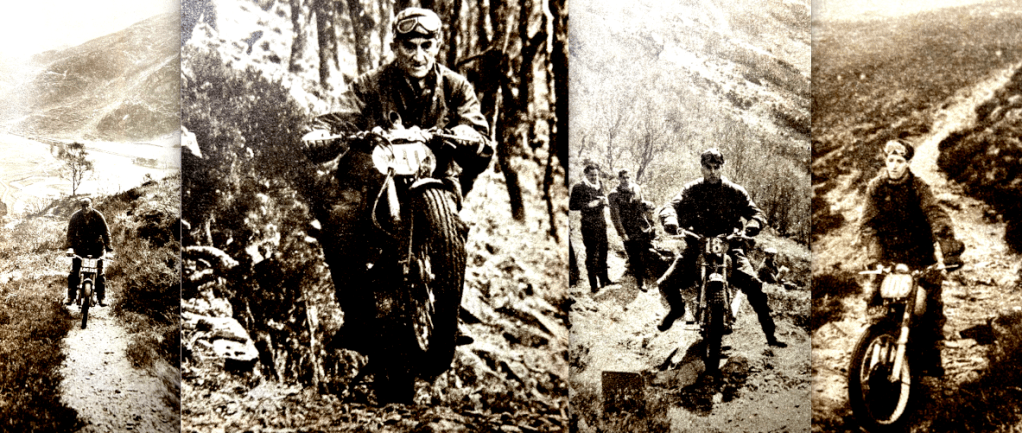
(Draper, Alves and Rist) with 83 points, the same as the Matchless team, were firmly in front among the club teams. It had been a magnificent day’s sport—stiff but fair observed sections, good fun on the miles of third-rate road and moorland track, and sparkling weather to grace the memorable scenery. Friday—Fifth Day: Though the weather in the Highlands had been consistently bright—and Friday, with unclouded sunshine from morning till evening was no exception—snows on the high ground were melting tardily. The day’s route of 177 miles was planned to take in the old military road from Kinlochleven to Altnafeadh, which provides two sections, Conduit and Martuim, but as the snow on the craggy heights of Martuim was still four-feet deep in places, the route was changed (alternative route cards were ready printed!) to include Mamore Hill and thence by main road to link up with the intended course at Altnafeadh. The start was at 7.30am. Mamore was in its usual venomous mood. With this the last day during which marks could be lost on observation, and with only four marks difference covering the first four men, it was inevitable that interest should centre particularly on those four. At Mamore, the leader, GJ Draper (348 BSA) footed (three marks down), and CM Ray (497 Ariel) stopped (five marks). PH Alves (498 Triumph) and DJ Ratcliffe (347 Matchless) were clean. Draper led by one mark over Alves! At the next observed section, Camushurich, Draper, Alves and Ray were unpenalised, but DI Ratcliffe lost three marks. Then, some 13 miles farther on, there was Meall Glas (the grey mountain), a long, meandering ascent from wooded Glen Lyon up over the shoulder of Ben Dearg. ‘Footpath to Kinlochrannoch’ said a signpost at the foot of the climb, but few pedestrians in their right minds would wish to venture up such a track. It was more like the bed of a stream than a footpath. Sub-divided into eight sections, Meall Glas called for that mixture of skill, strength and prolonged concentration so frequently necessary on Scottish hills. Its many big boulders proved especially tiresome to riders of small-capacity machines. However, BW Martin and J Boning took their Francis-Barnetts up in effortless fashion, but Paul Jarman (197 James), who had been riding brilliantly throughout the week, came to a sudden and unexpected stop on a grassy hummock which appeared to be one of the easiest parts of the climb. CM Ray ‘piled on the agony’ occasioned by his stop on Mamore when his crankcase lodged on a rock and brought about the loss of a further five marks. PH Alves, too, was in trouble here with a lusty ‘foot’ in the second sub-section—this was his only loss of marks during the day. Both Draper and DJ Ratcliffe were clean. Next observed Section was Kinlochrannoch. It is a winding track up the moorland. Low down, where the first sub-section was situated, the surface is earth and inclined to be boggy. Much higher there were two sub-sections embracing the track where it is rock-strewn and has a left bend followed immediately by huge rock slabs and ledges. Before the first man arrived, a trickle of water tinkled innocently among the loose rocks at the side of the bend. It was not long before spinning rear wheels had spread the dampness and made some of the ledges treacherous. Of the protagonists, Draper, Alves and Ray were clean, but all made hard work of it as it as if suffering from over-anxiousness. DJ Ratcliffe was supremely confident and sure: and many other climbs could be classed equally high, among them those by E. Usher (347 Matchless), R. MacGregor (346 Royal Enfield), BHM Viney
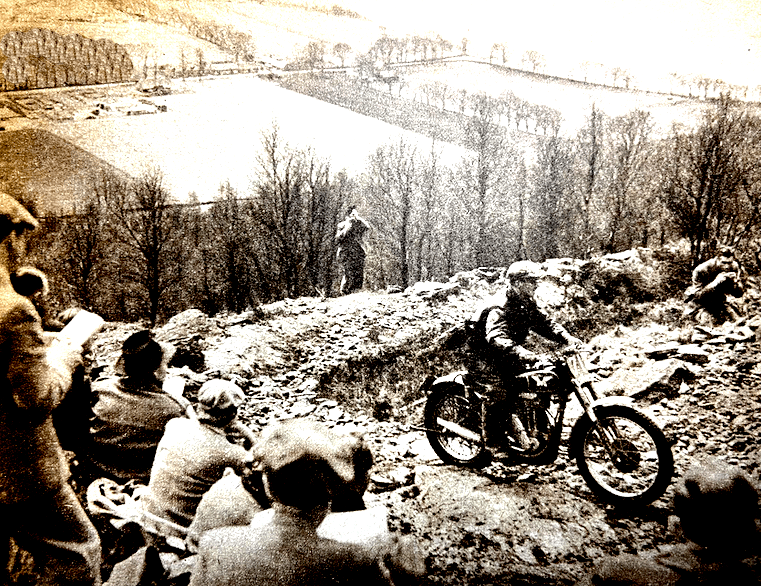
(347 AJS), R. Clayton (490 Norton), JV Brittain (346 Royal Enfield) and RT Hill (499 BSA). Riding No 1 in the list, TP Oliver (123 BSA) was stopped by a magneto failure which resulted in his retirement. On the last occasion he rode in a Scottish—in 1934—he also retired on the last day; also at the last section! And Kinlochrannoch could be termed the last section because afterwards there remained only Town Hall Brae in Fort William. But perhaps on this occasion the status of the Brae could justifiably be raised slightly because it had been doctored and it could decide the winner if Draper stopped and Alves were clean. But, in fact, both were unpenalised and, so far as observation was concerned, Draper had won. Viney, of all people, dropped a foot and spoilt what would have been a clean sheet for the day. Matchless and the Sunbeam Club still held commanding positions in the team contests. Saturday—Sixth Day: It is always the same. Whatever the rigours of terrain or weather, everyone feels a reluctance to leave the Highlands on the last day of the ‘Scottish’. Throughout the preceding five days the weather had been remarkably kind, to the astonishment of those who had had news from home, be it 100 or 600 miles to the south, where rain and low temperatures were the rule. And at 8am on Saturday when the first pair of riders set out, the countryside was again alive with colours under a brilliant sun, the limpid waters of the becalmed lochs were a deep blue, and the temperature was so high that car drivers were in shirtsleeve order. It seemed irrational to be heading south to bad weather. Except for the rough stuff of the 11-mile Mamore Road, first-class highways led to Edinburgh. Average running speeds were no higher than around 30mph, and the long cavalcade of riders had only to keep going in order to finish. Yet, understandably, those with much to lose could not escape a sensation of worry that fate would be unkind. This had its humorous side. The certain winner, given a clear run to Edinburgh, was young John Draper. Riding with him was that experienced ISDT Trophy Team member Jack Stocker, who was ‘ordered’ to see that Draper’s possible exuberance should be curbed. The stories of Stocker’s imaginary worries in ‘looking after the man raised contagious merriment during the final inspection of machines at Blackford Hill. In its usual slick style, the Edinburgh Club had printed result sheets and engraved awards ready by 7.3o p.m. The Gorgie Markets Restaurant was packed when Bailie WD Gerrard, DSO, DL, made the presentations. Among the loudest acclamations was that for H Dukes, who was awarded the Albert Trophy for overcoming difficulties. It was the first time the Trophy had been presented since 1937. In a spill during Wednesday’s run, the foot-change mechanism of Dukes’ Norton had been torn off. Undaunted, he had rigged up a foot-operated clutch and a hand-operated gear lever and had completed the course. Amid a welter of speeches, cheers and high spirited fun, yet another ‘Scottish’ came to an end. RESULTS Best Individual Performance (Alexander Trophy): GJ Draper (348 BSA), 22 marks lost. Second-best Performance (Lochaber Trophy): PH Alves (493 Triumph), 26. Third-best Performance (Nelson Trophy): DJ Ratcliffe (347 Matchless), 27. Best 125cc: M Riley (122 DMW), 88. Best 200cc: WA Lomas (197 James), 58. Best 250cc: EJ Bridges (247 Matchless), 106. Best 350cc: GJ Draper. Best 500cc: PH Alves. Manufacturers’ Team Prize: Matchless (DJ Ratcliffe. LA Ratcliffe, E Usher), 101. Club Tram Prize: Sunbeam (FM Rist, PH Alves, GJ Draper), 94. PS Chamberlain Trophy: AA Kirk (490 Norton), 60. Ben Nevis Qualeh: DJ Crennell (490 Norton), 61. Albert Trophy: H Dukes (490 Norton), 143, Allan Hay Trophy: JD Williamson (347 AJS), 85. Jimmy Beck Cup: CM Ray (497 Ariel), 32. Latimer Trophy: FM Rist (499 BSA), 46; Henderson Trophy: G Smith (347 AJS), 114. Edinburgh Trophy: DF Ryder (497 Ariel), 65.”
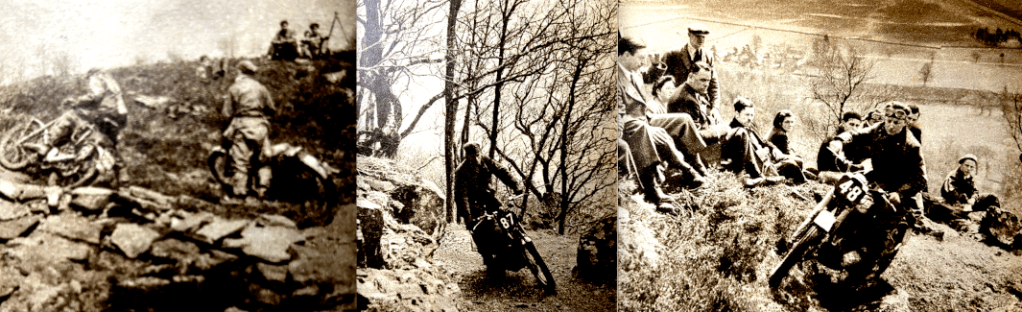
“THE TITLE OF ‘A Sporting Holiday in the Highlands’, which has been dropped in recent years, could well be revived for last week’s Scottish Six Days’ Trial. With a course of little more than 900 miles, an abundance of observed sections, reasonable time schedules for covering the stretches of rough track and ideal weather, the trial provided almost everything the sporting rider could desire. For the 1950 event the total distance was longer and the ratio of classified-road mileage to cross-country mileage was higher than customary. An attempt was made to introduce relatively high speed road riding on the lines of the International Six Days’ Trial. The experiment was worth making, for it proved that the two types of trial—the ‘Scottish’, with its emphasis on observed sections, and the ‘International’, with its emphasis on riding to time on roads—were incompatible. Wisely the Edinburgh Club has reverted to a traditional-type ‘Scottish’. One of the outstanding aspects of the event just concluded was the high proportion of small-capacity machines entered. In the list of 147 starters, 33 were mounted on machines of under 200cc and all these machines were two-strokes. Results show that only six competitors in the under-200cc category achieved special first-class awards, yet among the remaining 114 starters, mounted on larger machines, there were 39 special first-class award winners. It is true that most of the recognised top-flight competition riders were on 350 or 500cc machines, but this is not the only reason for the disparity in the results. The fact is that on most of the long, steep rock-strewn Highland observed hills, the small-capacity machines are at some disadvantage. With the growing importance and popularity of lightweights it is desirable that these machines should have an equal chance of gaining awards. Since it would be almost impracticable to plan a course to provide this equality, the best compromise might be to allocate special first-class and lower-category awards on the basis of a percentage of starters in each capacity class instead of, as at present, on the total number of starters in the trial. Though there are no facts to back the conclusion, it was the opinion of experienced observers that the condition of machines at the finish was higher than ever before. Further, the number of riders who encountered mechanical troubles was well below usual.”

ITOM CYCLEMOTOR
“PERHAPS THE FIRST impression conveyed by the Italian-made Itom Cyclemotor is one of elegance. The particular engine tested was fixed to a Norman sports cycle of roughly the same colour scheme of blue-green with cream panels, and it was generally agreed that it was one of the smartest cyclemotors ever to grace the Dorset House car park. A number of points about the Itom show that the designers have not spared any efforts to supply an engine that will appeal to the discerning rider. For example, the compression-release valve has a small pipe fixed to it so that blowback is led into the silencer; there is a neat chromium-plated safety-bar round the left side of the engine to protect the light-alloy cylinder barrel in the event of a fall, and an ingenious quick-release plastic cover is fitted to the plug. To remove this cover it is only necessary to give a slight tug on the ht lead. Starting the horn was simple provided the Dellorto carburettor was copiously flooded by means of the pump on the float chamber, and provided the air lever was closed. Then, with the throttle lever about one-third open, it was possible to achieve a start in about 10 feet of pedalling. After a quarter of a mile had been covered the air lever could be opened and ignored until the next cold start. Two-stroking was erratic until about 7mph was reached, when the motor two-stroked perfectly until nearly full throttle. Although the engine would pull the cycle at speeds below 7mph, it was not possible to accelerate away readily unless assistance was given from the pedals to bring up the revs. Above 7mph the engine would respond to the throttle briskly and was so lively that first experience in thick traffic prompted caution to avoid catching up with the next vehicle too quickly. For very low speeds it was found that the best way to keep the machine under way was to pedal with the compression release open and, when circumstances permitted, to release the valve and use the engine. When the engine was hot, starting was simplicity itself. It was necessary to pedal only a very short distance with the decompressor raised, and with the throttle just off the fully closed position the motor would start with very little effort immediately the decompression control was released. After about 50 miles had been covered the Italian sparking plug failed completely and a Lodge H14 was substituted. This plug improved the starting and also resulted in a smoother-running engine. The Itom excelled in fairly fast running on level roads, and was quite capable of holding its own with average slower-moving traffic. With
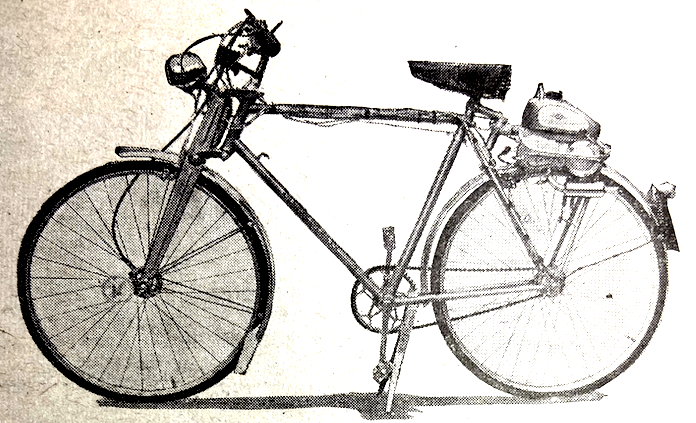
20mph on the speedometer the engine appeared to be running well within its limits. At speeds much in excess of this the exhaust note tended to be on the ‘hearty’ side and the engine would start to ‘fuss’. Fairly long runs did not affect the tune of the engine at all; at one time the machine was cruised for 10 miles at about 20mph, and at the end of this trip, although the barrel was very hot, there were no signs of fading. Hill-climbing capabilities, while not outstanding, were quite good, provided a run with the engine turning over rapidly could be made. One hill, which causes most cyclists to select their lowest gear, was tackled by the Itom at just over 10mph with no assistance from the rider. Mention must be made of the spring fork supplied with the machine. The effects of all minor corrugations in the road surface, such as cobbles and small depressions, were eliminated most satisfactorily and the fork proved to be of great benefit for town riding. Anything in the nature of a pot-hole would cause the fork to bottom, but even in such a case there was not the violent shock that one associates with a solid front fork. Another benefit derived from this fork was improved braking. Both brakes could be jammed on as hard as possible, yet there was no trace of deviation from line or any other indication of instability. In the initial stages a close watch on the friction-type shock-absorbers was desirable, for after about 50 miles they tended to bed down to some extent, and then the fork would clash readily. It was, however, the work of a minute to tighten these adjusters to the correct extent. A potential source of worry to owners of foreign machines is the supply of spares. In the case of the Itom it is stated by George Grose that ample stocks of replacements are available.”
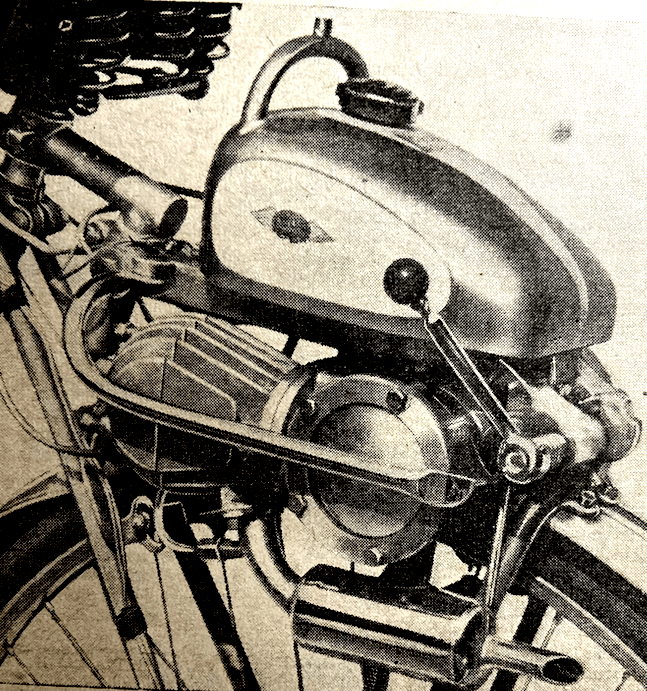
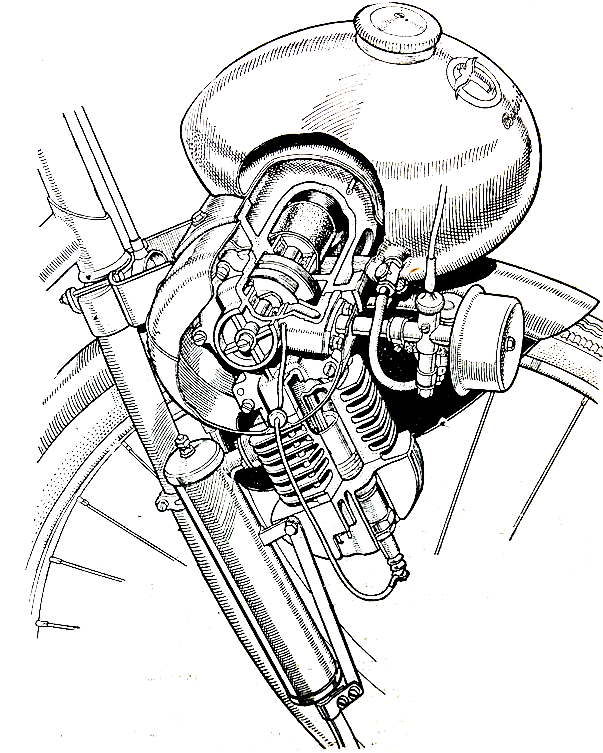


“WHERE ECONOMY AND CLEANLINESS from the riding aspect are among the chief requirements, thoughts inevitably turn to the 98cc James Commodore, which costs £60, plus Purchase Tax, is taxed at I7s 6d a year; will cover at a speed of 30mph over 140 mpg of petroil and which, with its shielded engine and large-area legshields, requires the use of no special motor cycle clothing. The 98cc Villiers engine is inherently clean and, in the case of the Commodore, it is enclosed. Throughout the test the tools were never required; and, because of the robust and simple character of the engine and cycle parts, there was every indication that trouble-free running over long periods could be confidently expected. All-round performance had not reached its peak at the end of the test and undoubtedly the fuel consumption and speed figures would have been improved had an additional 1,000 miles been possible. Starting from cold was at all times easily accomplished at the third or fourth kick-starter depression—with a warm engine starring was certain at the first kick. The cold-starting procedure was quite simple, involving merely flooding the carburettor, closing the strangler by lowering the lever on the side of the air filter and, with the throttle approximately half open depressing the kick-starter. ‘Depressing’ is the operative term, since starting proved so effortless that ‘spinning’ the engine was quite unnecessary. After a cold start the strangler required to be opened partially and left thus for roughly a quarter of a mile.
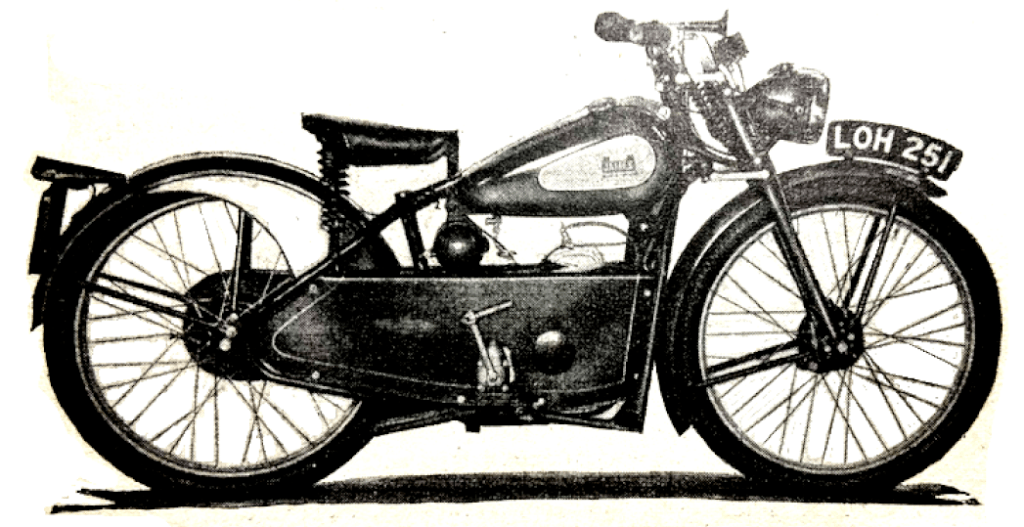
Then it could be opened fully and forgotten about till the next cold start was required. As soon as it had reached its normal working temperature the engine would idle slowly and reliably with the twistgrip turned the merest fraction off its closed stop. The two-speed gear is operated by means of a lever on the right handlebar connected to the gear box through a Bowden cable. Moving the lever forward to the limit of its travel engages bottom gear, and top gear is selected by drawing the lever backwards with a leisurely movement of the right forefinger. Only light pressure and no special skill was required to make clean, sweet, upward or downward gear changes. Because of slight clutch drag bottom gear generally engaged with an audible ‘clonk’ when the machine was stationary with the engine idling. Clutch drag, it was felt, was due to inadequate movement at the handlebar lever—movement which was such that the cable had to be adjusted without free play if excessive drag was to be avoided. No trouble from clutch slip was, however, experienced during the test. Light enough in operation to be easily disengaged by an eight-year-old boy, the clutch was silky-sweet in its take-up of the drive. All controls were light and smooth and well placed for ease of employment. The clutch and front-brake levers required unusually little hand reach. In its position close to the twistgrip, the gear control could be operated by the forefinger and thumb of the right hand—there was no need to take a hand off the bar. Neutral, though not ‘positive’ was easily selected from bottom or top gear. The brake pedal could be depressed by pivoting the left foot on the footrest—there was no need to lift the foot in order to apply it. James machines are, of course, noted for their comfortable riding position. The Commodore is no exception, the test mount proving outstandingly comfortable for a machine in this capacity class. The saddle height is 28½in and the relationship between the saddle and footrests was such as to permit a satisfactory knee angle for riders of average stature. Footrests on the Commodore are non-adjustable. The handlebars are carried in split clamps which provide adjustment for height, fore-and-aft position (or ‘reach’), and angle of the grips. Scaling little over 15Olb, the Commodore is the type of machine which instils confidence in the veriest novice. All manner of vile road surfaces were encountered during. the test. Stability on greasy surfaces was exceptionally good. Wood blocks and slippery tramlines could be traversed with complete confidence. Traffic threading on wet roads could be indulged in almost with impunity just as it could when it was dry. The Commodore is easily manoeuvred in traffic and, with its low weight and excellent turning lock, it can be pushed in and out of awkward garages or passages with ease. In the wet, the measure of protection from water and road dirt proved entirely adequate. Waders or any other form of waterproof leggings were never required. Goggles and gauntlet gloves were the only items of out-of-the-ordinary wear that were indulged in when the machine was used as a ride-to-work ‘hack’. Front suspension is by means of a link-type fork with a single compression spring. The degree of comfort provided was adequate on roads of average poor surface; on very bad city cobbles, severe jolting was experienced unless the speed was kept down to, say, 15mph. At this speed in top gear the engine is entirely happy, whether it is pulling hard or running under only light load. The engine’s flexibility, indeed, was such that bottom gear was seldom required except for starting away from rest or when the speed had to be dropped very low because of traffic conditions on severe gradients. All main-road hills encountered during the test, irrespective of head winds, were surmounted (given a no-
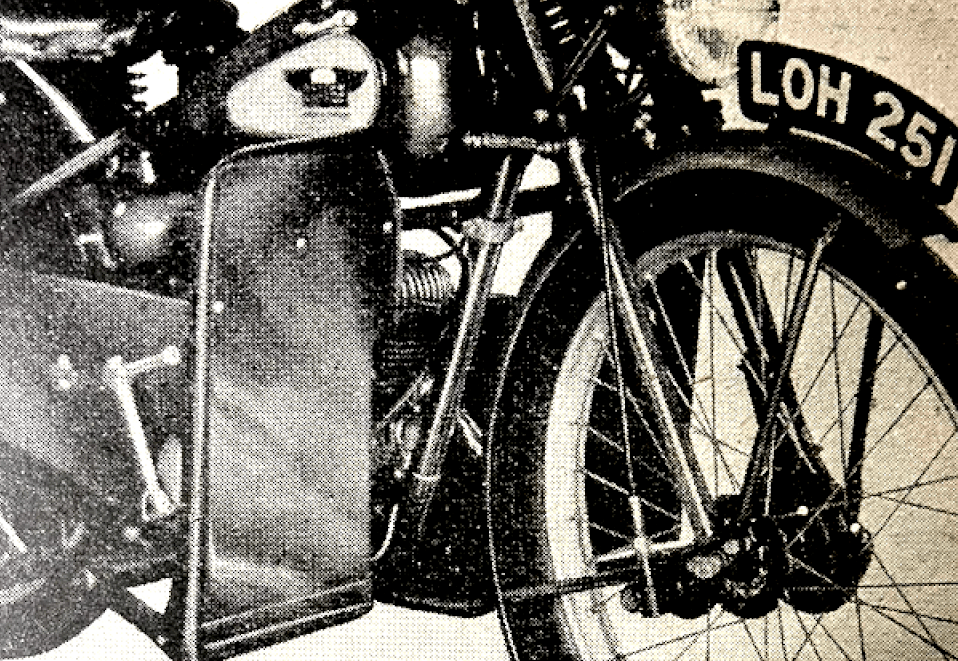
baulk run) on top gear. The average up-grade would be topped at 28-30mph, and the more severe gradients at seldom below 20-25mph. Restarts were made on an estimated 1 in 10 gradient without difficulty. Throughout the test circumstances generally demanded that the model had to be driven flat-out or all but flat-out. It gave no indication of being unduly stressed even with this treatment and the engine never became really hot. Maximum comfortable cruising speed was in the region of 35mph, at which gait the engine was buzzing quickly, but not to an extent which suggested unduly high revs or fuss. Minimum practicable cruising speed in top gear was about 14-15mph. At the beginning of the test both brakes proved to be spongy in operation and lacking in real power. They improved steadily with use, however, and at the conclusion of the test they were satisfactorily in keeping with the machine’s performance. A particularly pleasing feature of the James is the fact that the exhaust is subdued to a degree in excess of average standards. At speed on the open road it was no more than a pleasant purr. Even when the machine was running downhill on a small throttle opening (and there was firing in the silencer) the exhaust noise was not at all objectionable. For parking purposes—or for use when removing either wheel—a centre stand is provided. It was extremely easy to operate, but unless the joint at the detachable part of the silencer was kept clean, a spot of oil was liable to find its way on to one’s shoe each time the stand was used. The petroil filler cap was liquid-tight even when the tank was filled almost brimful, which is, of course, as it should be on a machine of this type. So that the oily exhaust gases are not ejected on to the rear tyre and rim, the silencer outlet is turned outward; a measure which proved most effective. Tools are carried in a neat, easily-accessible, cylindrical container under the rear of the tank, and the pump is carried on clips on the top of the safety bars. The finish is in James maroon and chromium (though the wheel rims are argenized silver), and the tank panel is blue with gold lining.”
“A NEW 500CC OHC vertical-twin Horex has made its debut in a German road race, the Waiblinger Dreiechsrennen. According to the factory it was competing solely as part of its trials, and development work is not yet complete, nor indeed has the final specification of the machine been definitely decided. Reports are that the new model created an excellent impression. The machine is apparently designed as a fast tourer, since the engine’s output is stated to be 30hp and the maximum speed of the machine approximately 95mph. Wide use is made of light alloys. The cylinder heads, it will be noted, are well out into the air stream. Other features of the machine are unit construction of the engine and gear box, a duplex cradle frame, pivot-fork rear suspension with dashpot damping, hydraulically controlled telescopic front fork and—perhaps not unimportant as a modern trend—a streamlined tail which, in addition to mounting a long, deep seat, houses the battery and tool-kit.”
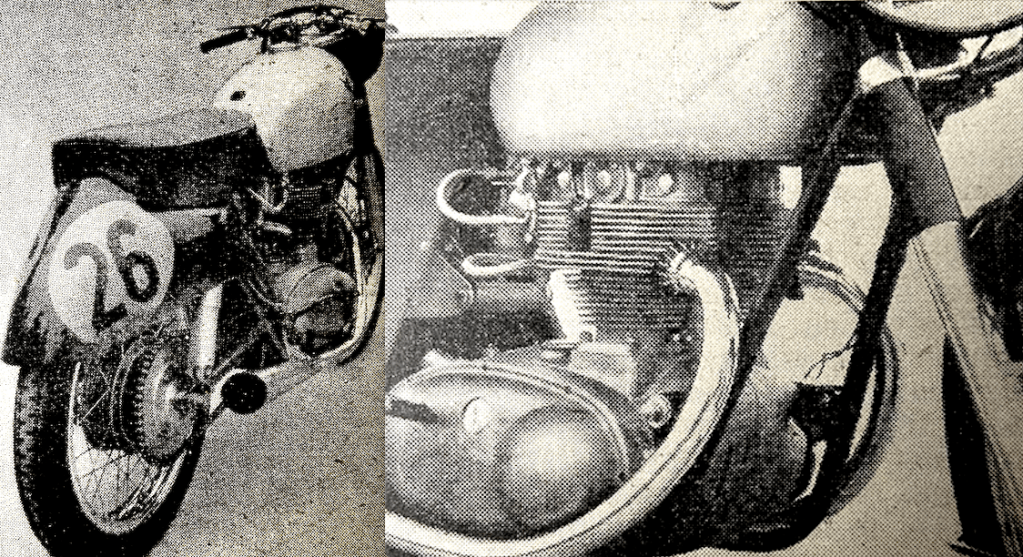
“LATER, PERHAPS TOWARDS the end of this year, the makers of the Invacar hope to market a lightweight motor cycle. In order to prove the various interesting constructional features it is proposed to incorporate, an experimental model has been built up and used in various scramble-type events. The machine is the prototype Greeves which aims at providing the knowledge on which groomed, production-type models are to be based. The Greeves lightweight employs a new-type frame, and uses rubber bushes in torsion as part of a most ingenious suspension system. The frame, which follows modern racing practice, has no lugs in its construction and is nickel-bronze welded throughout. The front down tubes of the duplex cradle frame are brought up to the top of the head tube and an exceptionally large-diameter top frame tube is welded to the bottom of the head tube. At the rear of the cradle frame are two rubber bushes which act as the pivot for the fork of the rear suspension. The rubber bushes in torsion which constitute the suspension medium are mounted under the saddle at the rear of the top tube, and the load is transmitted to them by links running from pivots above the rear-wheel spindle. Rubber bushes in torsion are also used for the trailing-link fork which carries the front wheel. The various tubes are of light gauge and, in spite of the apparent massiveness of the frame, the machine shown, which has a 197cc Villiers engine, weighs only 200lb. Among the advantages claimed for this type of suspension are that the rubber-bushed pivots are unaffected by grit or moisture and require no maintenance, and that no shock absorbers are needed as rubber is self-damping. The frame appears to possess great lateral rigidity. Six inches of movement are provided by the front suspension and 4in movement at the rear. Bottoming of the rear end is virtually impossible owing to the leverage on the rubber bushes decreasing, with large deflections. The rubber stops for the front fork have only been found necessary on trials-type going. Many details of the machine have been fully proved on the Invacar, the well-known Villiers-engine invalid three-wheeler. The machines will be fitted with tuned 197 or 122cc Villiers engines. Road and scramble versions are envisaged. Finish will be in smoke blue and aluminium. The prices are expected to be about £110 plus tax.”
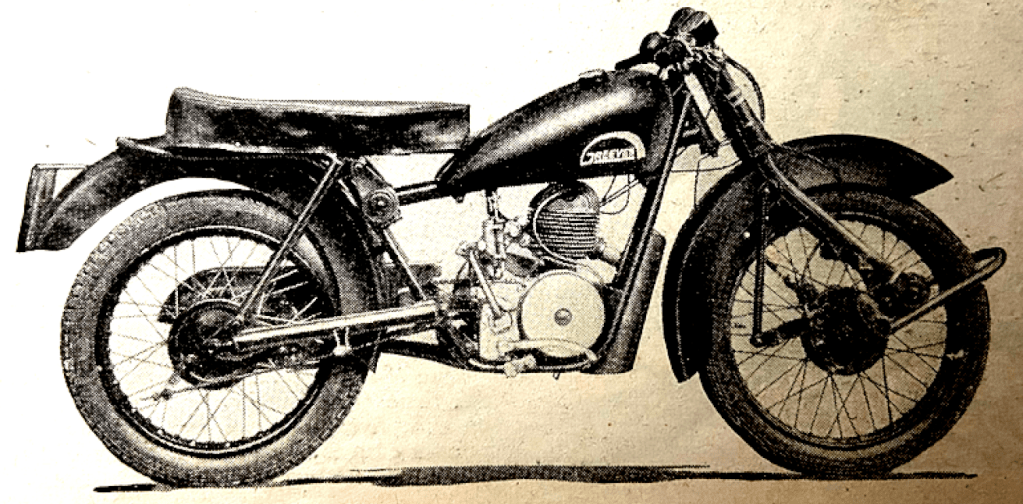
“A RECORD ENTRY of 292 has been received for the International TT Races to be held in the Isle of Man on June 4, 6 and 8. This is in addition to the big entry for the Clubman’s Races. The total for the International events is 42 greater than last year. No fewer than 98 entries have been received for the 500cc race. The Junior (350cc) event has 22 more than the permitted limit of 100. In the Lightweight Race there are 32 in the 125cc class and 40 in the 250cc class…each of the four capacity classes has an entry of remarkable calibre. The Isle of Man week promises well!”
HERE’S A SUMMARY of the 1951 TT: MV Agusta factory entered the fray and lured Les Graham away from AJS to ride the four-pot 500 in the Senior and the single-cylinder 125 in the new two-lap Ultra Lightweight race. Bill Doran replaced Graham in the AJS team, but it was once again Geoff Duke who stole all the headlines with a memorable double. He led the Senior throughout the seven laps, destroying race and lap records. Earlier in the week Duke had become the first rider of a Junior machine to lap the Mountain Course at over 90mph. Once again he led from start to finish, and on his second lap he established a new record of 91.38mph. Despite the new dohc Velo in the Lightweight race, which was reduced to four laps, it was dominated by Italian machinery. The Guzzis of Fergus Anderson and Tommy Wood, sporting a new half-fairing, held the advantage at the end of the opening lap. On the second lap Anderson upped the lap record, but retired on the third lap at Ballig with engine trouble. Wood moved to the front and went on to win by over eight seconds. Despite having only 18 starters, the new 125cc race was a great success, with Cromie McCandless’ s little Mondial averaging 74.85mph on its way to victory. Carlo Ubbiali and Gianni Leoni made it a one-two-three for the Italian factory. And here’s a comprehensive report courtesy of the Isle of Man Weekly Times…JUNIOR TT Wonder man of motor cycle road racing, Geoff Duke, led the Norton team to a record breaking victory in the Junior TT on Monday, during which the St Helens ace won at a speed of nearly 90mph, faster than last year’s record, and smashed everything there was to smash except the amazing Norton. We regret to report that No 5, JF Wenman (Norton) crashed at Birkin’s Corner (between Michael and Bishopscourt) on his third circuit, and died later from injuries. Duke took the lead in the first lap with a breathtaking effort of 25min 14sec (which beat Artie Bell’s 1950 record by 42 seconds), and thereafter the St Helens lad did not slip up. He never lost the lead; the spectators crowded round the course had faith in him, and the only question which troubled them was who was to fill the remaining five places on the leader board. At the end of the first lap Duke was 33 seconds ahead of the next man, Harry Hinton, redoubtable driver from Australia, but on the second lap Duke went ‘like a bomb’ and put up a fresh record of 24mins 47sec, and average speed of 91.38mph and that record
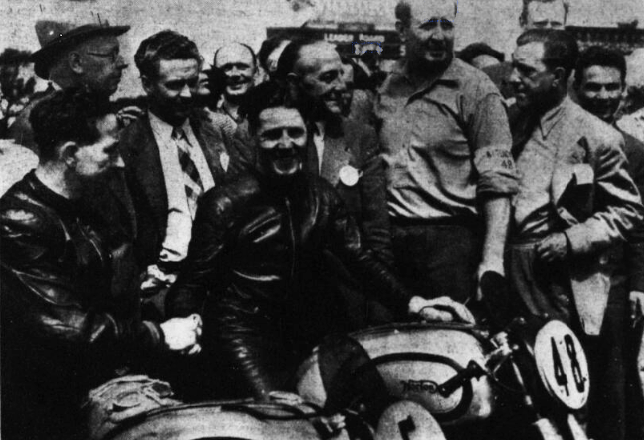
stood for the race, although the first three men (Duke, Hinton and Johnny Lockett) had in the first lap beaten Bell’s 1950 record and the fourth man (Doran, of AJS) had equalled it with a lap of 25.56. In the second lap Hinton went round in 25.14, thereby equalling Duke’s first lap record, but nobody seemed to realise his achievement. Times were so fast, and Duke’s performance so positively glamorous that his performance was apt to take the spectators’ whole attention. Yet the shows being put up by the succeeding five men were worthy of attention too. They were Hinton, Johnny Lockett (both on Nortons), Doran (AJS), Brett (Norton) and Armstrong (AJS). A hard luck story gave the trials and tribulations of EVC Hardy (Norton). He retired at the pits, having travelled in from Sulby with a loose exhaust pipe, which he held up with his boot. The boot was burnt almost through, and the rider decided to call it a day before his foot followed. News was later given of a particularly courageous performance by L Williams, who ran out of petrol at Kate’s Cottage and pushed his Velocette into the pits to refuel and continue the race. Geoffrey Duke, 28 year old St Helens ace, has had a phenomenal rise to road racing fame. He won the Clubman’s Senior TT at the meeting two years ago, won the Senior Manx Grand Prix the same year, the Senior TT last year, all at record speed, and has capped that remarkable record by winning the Junior TT. He has also had an impressive record of successes on the Continent and leading events in the
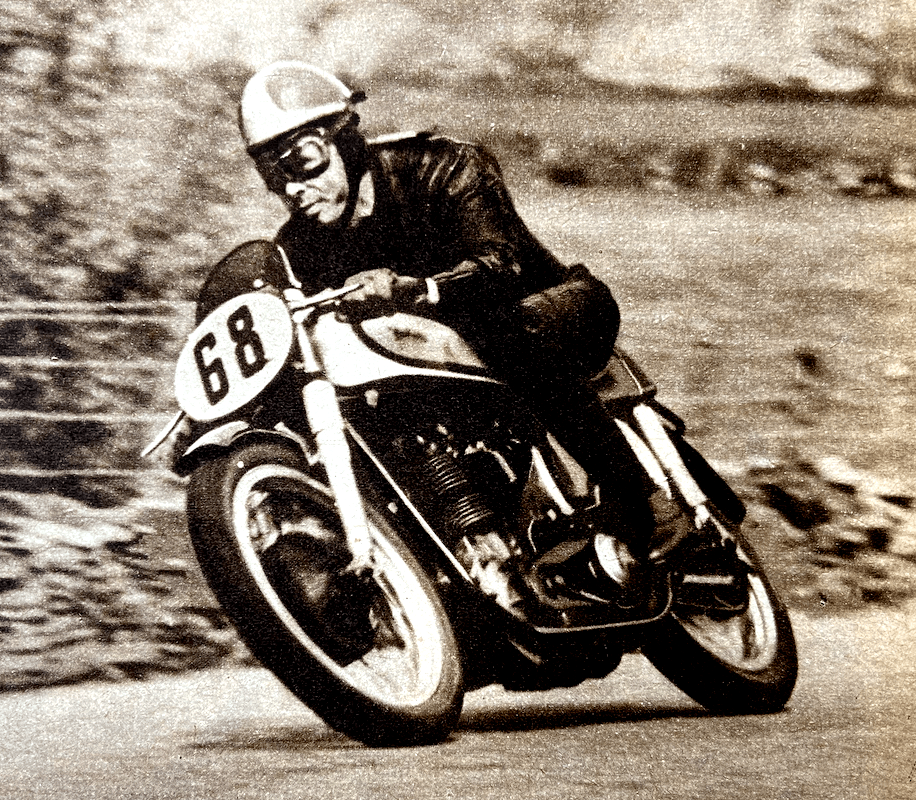
British Isles. Crombie McCandless and Manx rider Tommy McEwan had been sticking ‘closer than brothers’ for two laps, having a little race of their own. Mr David Lay, at Cronk-ny-Mona, said they were pretty well together at that point. He also reported that Duke was riding with masterly precision as he flew through after the mountain descent. The third lap spelt disaster to No 56 JT Wenman (Norton), who crashed at Birkin’s Corner, between Kirk Michael and Bishopscourt, and died from his injuries shortly after the race concluded. His wife was on the Grandstand, and the news was broken to her. This lap also put paid to the hopes of Harry Hinton. He crashed at Laurel Bank, and subsequent news was that he had a lacerated hand and an injured knee. No 108, RED Harrison, also had a spill at Birkin’s Corner in a later lap and sustained a broken finger. Another rider to have a spill was DG Lashmar, but he was not hurt. By the end of the third circuit Nortons were running first, second and third, and all riders were members of the Norton team. Curiously enough, the official AJS team were in fourth, fifth and sixth places. The Norton performance was all the more commendable because literally at the last moment Brett had taken the place of Dickie Dale, ill in hospital with pleurisy. AJS hopes were dashed first by the enforced retirement of Doran due to mechanical trouble and later by the hard luck which
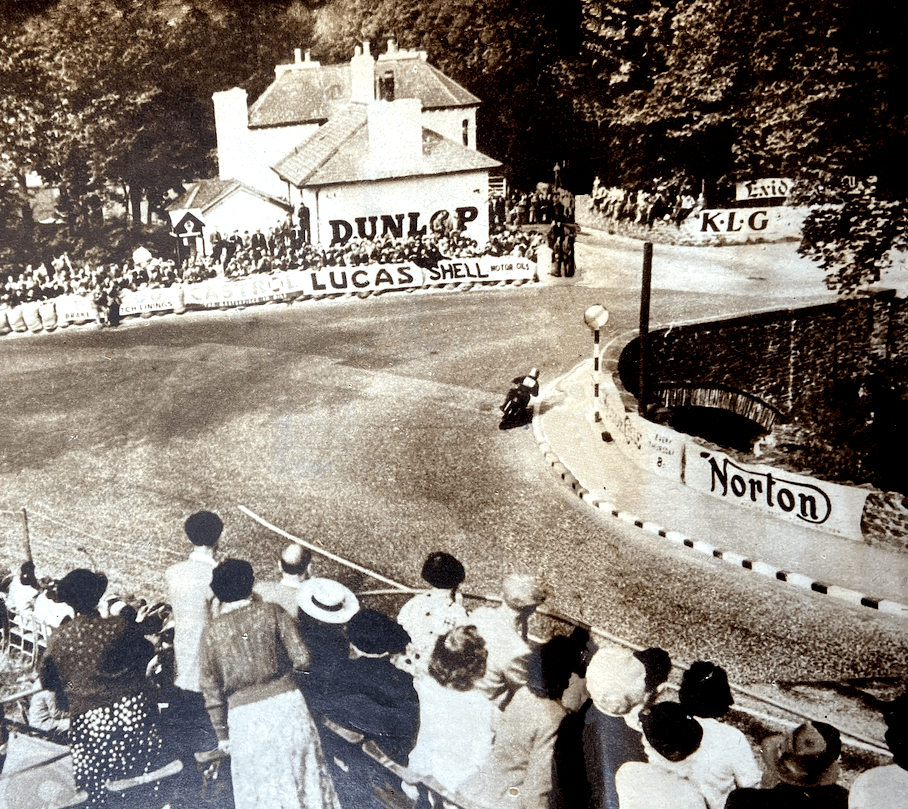
overtook Armstrong. He was reported from Cronk-ny-Mona as pushing his machine, and at 1 o’clock he came over the finishing line still pushing. Armstrong, intrepid rider from Dublin, was cheered as he completed the distance; at all events, his pluck and endurance gained him a replica. Ere this Duke and company had captured first three places (manufacturers’ and team prize) for Norton Motors. A word of praise must be given to the men who came from overseas to compete. Harry Hinton, though luckless because of his crash, was the ace among them, and K Kavanagh, also from Australia, had done very well in the practices. His good fortune deserted him on race day; he packed up with engine trouble at the Quarry Bends (near Sulby). The remaining of our overseas friends finished the race and gained replicas. Of the 98 starters, 61 finished, and of these 20 got first class replicas, 36 qualified for bronze replicas, and only the last four got no award. Norton’s team won the manufacturers’ team prize. The club team prize went to the British Motor Cycle Racing Club. Members of the team were WR Amm (of Rhodesia), HB Rawson, and S Lawton. RESULTS: 1, Geoff Duke (Norton) 89.9mph; 2, Johnny Lockett (Norton); 3, Jack Brett (Norton); 4, Mick Featherstone (AJS); 5, Bill Lomas (Velocette); 6, Bob Foster (Velocette); 7, Cromie McCandless (Norton); 8, Rod Coleman (AJS); 9, Ray Amm (Norton); 10, Les Graham (Velocette). Geoff Duke had a no-trouble ride. Naturally he was delighted to have his first win in a Junior TT and even more delighted that he seemed at last to have overcome the ill-luck which has dogged him during the earlier races this year. He said that he had ridden to orders, changing up at between 6,800 and 7,000rpm, whereas the engine peak is in the region of 7,500rpm. Not only that, but he had been rolling the grip back when passing the pits and on several other sections of the course. Aged 28, Geoff is employed by Norton Motors. Johnny Lockett had enjoyed freedom from both trouble and near misses. He mentioned that the tar had been wet at Birkin’s Bend, but that he had taken care there and had no difficulty. His fly-screen, he reported, had provided adequate protection against the fly menace. Lockett is an electrical research engineer hailing from Oxshott, Surrey. He is 35 years of age. Jack Brett, third man home, is 32 and a motor engineer with Frank Leach, of Leeds. Brett is married and has two children. He had had a perfect ride and said that he would gladly go out again with the clubmen in the afternoon. He was entered in the race by Les Hallen, of Cambridge, but took over the works’ Norton at the last minute when Dale was unfit to ride. LIGHTWEIGHT TT Tommy Wood, British rider of a Guzzi, with many Continental successes to his name, on Wednesday won the International Lightweight TT at record speed after a great duel with Dario Ambrosini, last year’s winner, almost nine seconds behind. A Guzzi rider, Fergus Anderson, had set a hot pace up to his retirement, and annexed the lap record at over 84mph. Fergus Anderson’s Guzzi roared round the course on the first lap and he knocked 43 seconds off Ambrosini’s lap record by doing the circuit in 27min 16sec at a speed of just over 83mph. He then had a 44 seconds lead on Tommy Wood. Ambrosini was third, 10 seconds behind Wood. We expected fireworks after that. We got it!Anderson put the lap record op to 27min 3sec (84.37mph) and his average speed for the two laps was 1mph slower—over 5mph faster than Ambrosini’s winning speed last year. Wood was then 1min 31sec behind, and he was three
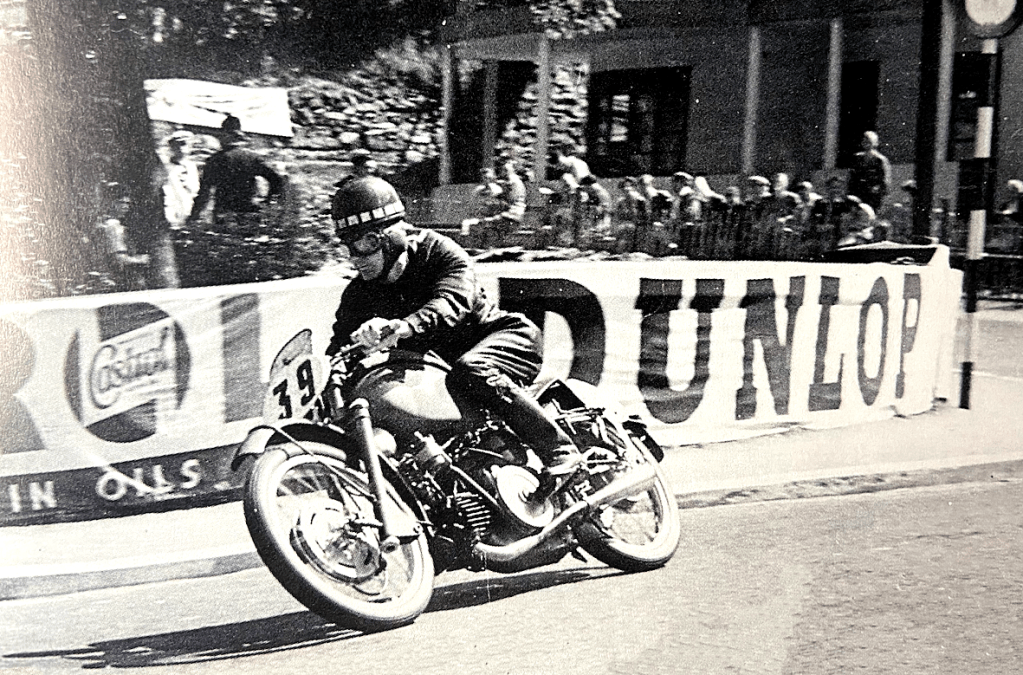
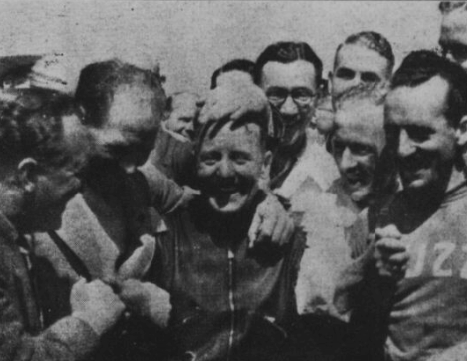
seconds in front of Ambrosini. At 9:30 No 1, H Hartley (Rudge), pushed his machine away from the starting square and the engine barked into life immediately. Thereafter the men were dispatched at 10 second intervals, the last man, HW Billington (Guzzi) being bothered with a spluttering engine until the top of Bray Hill was reached. Anderson rode on his way round the course, and his Guzzi performed wonders. He gave the thumbs-up signal to his pit attendant as he passed the stands. TL Wood (Guzzi) was second, 28min 0sec, with Ambrosini (Benelli) third in 28min 10sec. Ambrosini accomplished the second circuit in 27min 43sec. Wood took the comparatively longer time of 27min 30sec. Bob Foster pulled in at the pits to report that he had driven from the Guthrie Memorial with only one gear, and his growing time was 59min 55sec—not good enough to be in the first six. Ultimately he retired. Lorenzetti was still running fourth, with the growing time of 56min 43sec with Pike fifth, in 59min 17sec, and WG Hutt (Guzzi) sixth in 59min 17sec. In the third circuit came the most unfortunate and unpredictable shock of the race—Anderson had parked up with engine trouble at Ballig Bridge. Anderson’s retirement meant that the Guzzi team’s hopes were dashed to the ground and the race for victory was a struggle between TL Wood’s Guzzi and Ambrosioni’s Benelli, with only three seconds dividing them at the start of the lap. WG. Hutt (Guzzi), entered by his club and not by a manufacturing firm, was lying fourth. RH Pike (Pike Rudge) was fifth, and A Wheeler (Excelsior) was sixth. With only 9sec between the first two men, the last lap of the race had that sense of excitement inseparable from a hard struggle for supremacy. With perfectly miraculous driving both Wood and Ambrosini climbed the mountain for the last time and at 11:26 Ambrosini flashed past the finishing post, the first man to do so. Tommy Wood finished the race the winner, with about the same margin as he started the fourth circuit—almost nine seconds. After his win, Tommy Wood said that he had one bad moment during the race. He developed a terrific wobble while going down Bray Hill on his second lap. The cause was an Ultra-Lightweight machine which, although on its correct racing line, was going more slowly than Wood’s 107mph. Wood had to take a different racing line, with the result that the model developed a wobble and the driver had a job correcting it. Only 15 of the 29 starters finished the race. No manufacturers’ or club team finished (there was only one of each in the race). RESULTS: 1, Tommy L Wood (Moto Guzzi) 81.39mph; 2, Dario Ambrosini (Benelli); 3, Enrico Lorenzetti (Moto Guzzi); 4, WG Hutt (Moto Guzzi); 5, Arthur Wheeler (Velocette); 6, Fron Purslow (Norton); 7, Sven Sorensen (Excelsior); 8, Frank Cope (AJS); 9, AW Jones (Excelsior); 10, Harold Hartley (Rudge). ULTRA LIGHTWEIGHT TT Cromie McCandless, the young Belfast man who won the 1949 Junior Manx Grand Prix and is married to a Douglas girl, formerly Miss Phoebe Cubbon, on Wednesday won the first 125cc event ever run on the course at an average speed of 74.85mph. He led the race throughout, finishing the first lap at 74.37mph, an amazing speed for an engine of this capacity. Ten seconds after him came Carlo Ubbiali, the Italian ace, also on a Mondial, with Gianni Leoni, making Mondials first, second and third. Six of the 18 starters were Continentals. 0f these, three were Italians, and three Spanish, and there were also two British riders astride Italian machines. RL Graham had replaced an Italian rider on the only Agusta entry, and C McCandless was riding a Mondial. As the machines warmed up for the start, the miracle Mondials from Italy sounded more powerful than the other machines. The healthy roar from Graham’s Agusta was misleading as while the clocks of the other
competitors showed that they were making steady progress round the course on their first lap his stuck ominously at zero. Then came the news that he was out of the race, engine trouble being the cause, and that he had called it a day on Bray Hill, less than a mile from the Start. An Italian rider, G Leoni, a last-minute substitute, also riding a Mondial, was in third place with a time of 31min 51sec, an average speed of 71.09mph at the end of the first lap. Another Italian, Pagani (Mondial) held fourth place with a lap time of 32min 30sec, and a speed of 69.68mph. The Spanish challengers held fifth and sixth places, Bulto lapping in 35min 30sec, his speed being 63.79mph, and Liobet, the sixth man, returning a time of 37min 2sec, and a speed of 61.14mph. Both were riding Montesas. McCandless, holding off the challenge of Ubbiali, covered the second lap in 30min 3sec, which gave him an average speed for the lap of 75.34mph and premier honours. The first four places were gained by Italian Mondials, all of which had covered the 75½ miles of the race at an average speed of over 70mph. The remarkable features were the speed of the Italian Mondials and their reliability. There were four of these amazing little machines in the race, and they finished in the first four places—a record which has probably never been equalled in the history of TT racing. There was never any doubt about them winning the manufacturers’ team prize. The Spanish Montesas occupied the next two places, and then came the first British machine, EVC Hardy’s Dot. But every British machine which started finished the course. In the last place was veteran rider Paddy Johnston, who won the Lightweight TT away back in 1926. He helped the Leinster Club to win the Club Team Prize along with HA
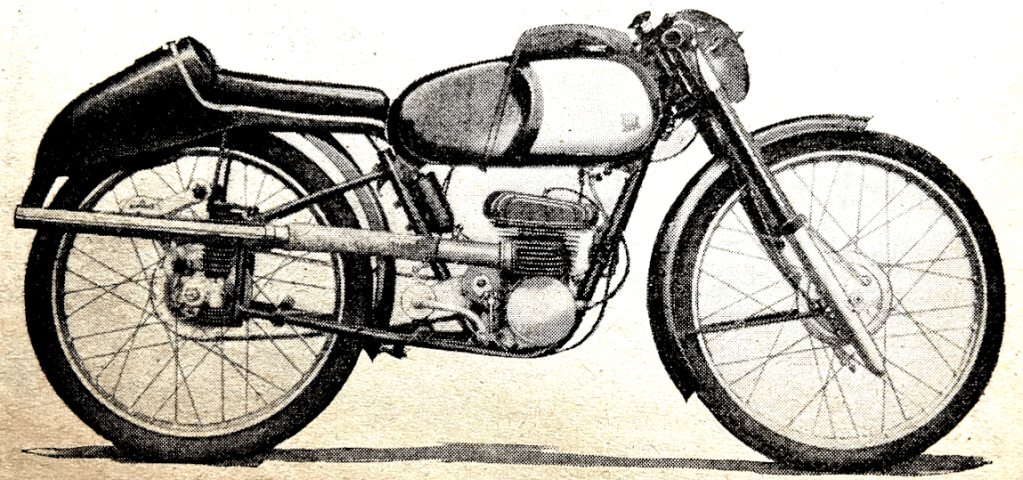
Grindley and WG Dehany. Only two of the 18 starters failed to finish. The winner, 31-year- old Cromie McCandless, a Belfast engineer, is one of the most popular men in the race and is married to a Manx girl. They have one child. He is a member of the Ards Club and has many racing successes to his credit in Ireland. One of his biggest successes was in Junior MGP in 1949, when he broke the record by six minutes and won at an average speed of 81.82mph, beating Geoff Duke by 35 seconds. The latter had a spill in the filth lap. RESULTS 1, Cromie McCandless (Mondial) 74.85mph; 2, Carlo Ubbiali (Mondial); 3, G Leoni (Mondial); 4, Nello Pagani (Mondial); 5, JS Bulto (Montesa); 6, JM Llobet (Montesa); 7, EVC Hardy (Dot); 8, HA Grindley (DMW); 9, LD Caldecutt (BSA); 10, RC Holton (Pankhurst Special). SENIOR TT Geoffrey Duke, the ‘unapproachable’ Norton star, put up another amazing performance in the Senior TT when he broke the records for lap and race in winning hands down at a speed of 93.826mph. Duke started off with a ‘quiet’ lap of 24min 19sec (93.14mph) three seconds outside his last year’s record, but this was sufficient to give him the comfortable lead of 41sec from team mate Johnny Lockett, and Bill Doran, the AJS ace, who tied for second place. In the second lap Jack Brett, of the Norton team, who had been lying fourth, one second behind Doran, had a spill and was out of the race, but Les Graham’s Agusta also packed up, and Cromie McCandless took his Norton into fourth position. On the next circuit Duke really got down to it and lapped in 23min 47sec, a speed of over 95mph. Once again Geoff was making TT history. Gradually he drew away from the field. No one else could live with him at this speed, and with Lockett still in front of Doran, Norton hopes ran high. After three laps Duke led by nearly two minutes from Lockett and Doran was 16sec
behind the Norton second string. So hot was the pace that Duke’s average speed for the three laps was over 1mph faster than his record lap last year, and over 2mph faster than his average speed for the whole race last year. The race was married by a fatal accident to C Horn. a former Manx Grand Prix rider, who crashed at Laurel Bank, the third fatality in the week’s racing, following two in the practices. A brightly shining blue sky; a cooling wind (which would prevent some of the tar on the road melting); crowds round the course; an immense concourse of people gathered round the official stands—these were_the conditions which faced the 80 racing motor cyclists whose job it was to fight out the honours attached co the International Senior TT—blue riband of the motor cycling racing calendar—and Geoff Duke, Norton ace and world’s motor cycling star, was to start No 1 in honour of his meteoric drive to victory in 1950. Duke would be out to smash the record speed he put up for the lap and race last year, when he lapped the course in 24min 19sec, a speed of 93.33mph. Already in practice this year he had clipped off three seconds from that time. He started favourite to-day, but there were many other good men to follow him, and if the Duke ‘walked away’ with the race in his pocket, then the thousands round the course would find other thrills in watching the performance of men who would fight for positions on the leader board. The international challenge was slight. Les Graham, former AJS ace and world 500cc champion two years ago, who has been robbed of victory in the Senior TT on two occasions within a few miles of the finish, was astride an MV Agusta—a stranger to the TT course, but in which the Italians have much faith—and the Australian rider WA McAlpine was to drive a Gilera—another stranger. Both or one of these might—just might —offer a serious challenge to British supremacy, but in the main people were content to acknowledge that it was to be another Norton day. Before the start of the race, the Lieut Governor, Sir 0 Bromet, with Professor AM Low, ACU chairman, had a word with many of the riders as they lined up on the starting square. Then promptly at 10:30 the starting flag fell. Geoff. Duke, Winner of Monday’s Junior, and the chief Norton hope, was away. The engine of his machine came to life with a
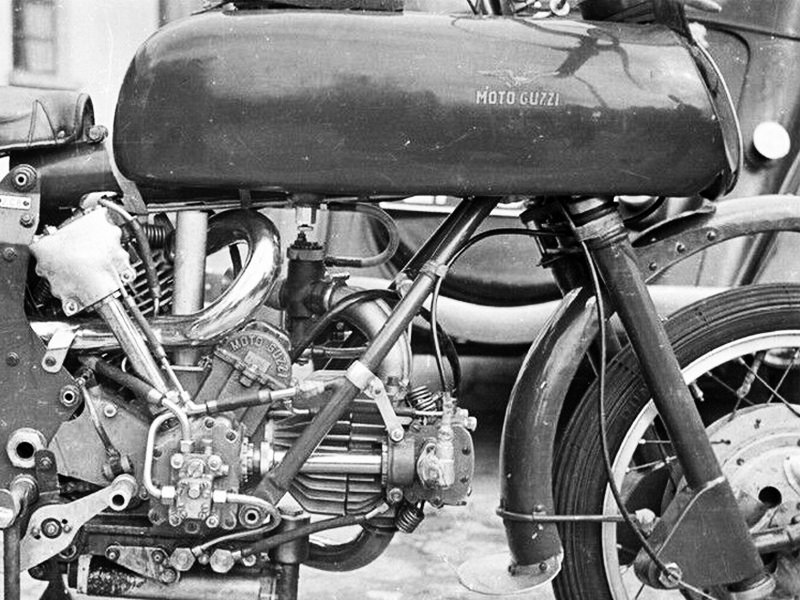
mighty roar, and his turquoise helmet gleamed in the sunshine as he shot away from the Start towards Bray Hill. Not so fortunate was CF Brett, No 2 in the race, who was held up for about 20 seconds before he could get his motor going, and CA Stevens had to change two plugs before he could get away. A Mulee was held up between Quarter Bridge and Braddan Bridge after having trouble at the start. At 10-second intervals the competitors were despatched, and with some fast men back-markers all eyes were on the clocks of the first men on the road. Then came the news that Duke had reached Ballacraine on his first lap within five minutes of his leaving the start. Thus he was well away on what is to him the fastest stretch of the course, between the top of Creg Willeys Hill and Barregarrow, as No 45 was leaving the Start. As Johnny Lockett was reported at Ballacraine, came the news that Duke was at Michael, having taken 8½ minutes to get there, and at 10:45 he was reported at Ramsey. Then Bill Doran, the principal AJS hope, was away with an almighty roar from his engine as he streaked away towards the top of Bray Hill. Last of the cracks to start was Graham.on the mystery Agusta, whose engine whined into life, and with a high-pitched scream streaked away towards the steep descent of Bray Bill. Commentator David Lay at Cronk-ny-Mona, described Duke as lying flat over his tank and going beautifully. He did not show a semblance of cutting his engine out on the corner and his bike was holding the road like glue. Certainly as he flashed along the Glencratchery straight he was going like greased lightning. He looked as though he had not a care in the world. From a standing star he had put up a lap of 24min 19sec—three seconds outside last yer’s record. R St J Lockett (Norton) was going great guns and completed the lap in 25min dead. Les Graham on the Agusta made up four places and was at Ramsey, but J Brett (Norton) had made up six places. In the meantime Bill Doran (AJS) came through with a tremendous burst of speed and it was expected that he would be on the leader board. Les Graham with his Agusta still retaining that high pitched note which heralded his approach from Governor’s Bridge, was chased past the Start by another competitor, and it looked as if they would fight it out on Bray Hill. It was on this
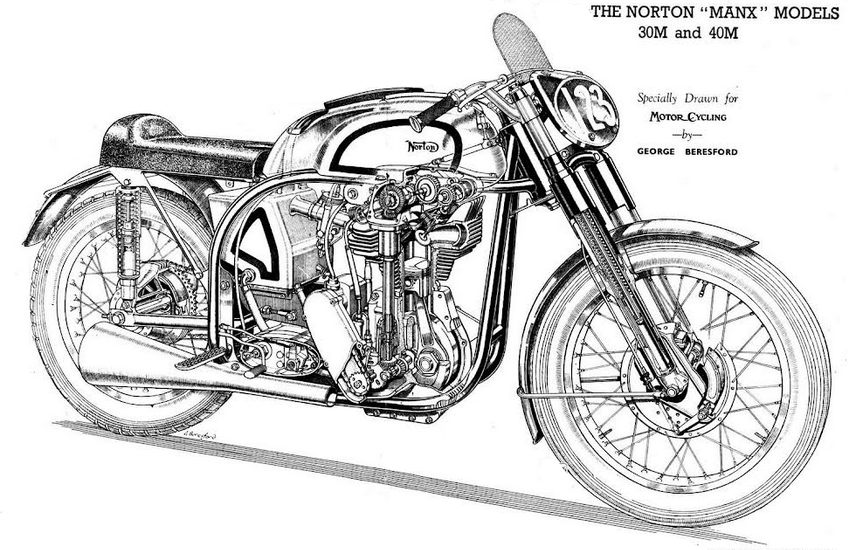
circuit that Geoffrey Duke opened the taps, and for the first time in motor cycling history in the Isle of Man lapped the course in under 24 minutes. His actual time was 23min 43sec, an average speed of 95.22mph, and his average for the two circuits was 94.14mph. He was away ahead of the field but there were many other interesting performances to watch. The lone Gilera entry, driven by McAlpine (Australia), did not last long on the TT course. He retired on this circuit somewhere between the Start and Ballacraine with valve trouble. He must have had a hectic drive, because the soles of his shoes were worn and scraped through contact with the roadway—hard luck. McAlpine. There was a fight going on for second place between Doran and Lockett, and only two seconds divided the last two men on the leader board. Several retirements had come in with the welcome additional announcement that the riders were OK. These remarks went for KH Mudford (AJS), the New Zealander, who had to pack up the race at Hillberry. Lockett had put up the individual lap time of 24min 24sec, and Doran 24min 28sec, so it was obvious that Doran had been relegated to third place. First unexpected sensation of the race came with the announcement that J Brett had come off at the Gooseneck, but the rider was ok. His retirement dashed the Norton team hopes to the ground. Then the Agusta, driven by Les Graham appeared, but on this occasion there was no high-pitched screaming note from the engine. Instead, Graham, his face set, toured silently past and turned into the paddock. AJS team hopes were also dashed when the news came through that M Featherstone had parted company with his mount at Signpost Corner, sustaining leg injuries which were not thought to be serious. On the third lap Geoff Duke fled round the course in 23min 52sec, a speed of 94.88mph, and it must be remembered that this included slowing down along the Glencrutchery straight to pull in for
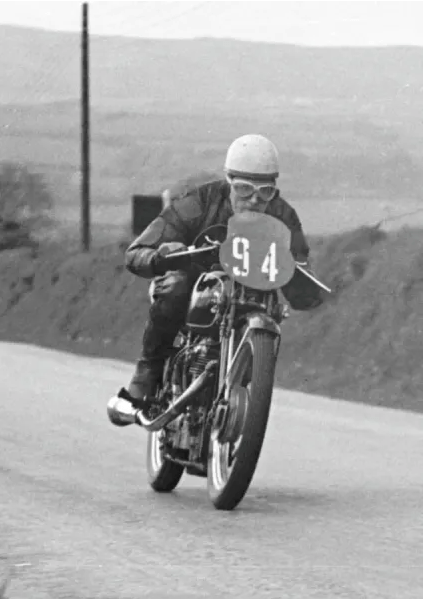
replenishments, a job for which he took 25sec. His stable companion, Lockett, also took 25sec. Norton organisation was perfect there, too. The retirements of Brett and Graham meant changes on the leader board. The individual times of Duke’s followers were as follows: Lockett, 24min 22sec; Doran, 23min 34sec; McCandless, 24min 33sec; Coleman, 25min 14sec; and M Barrington (Norton), 25min 57sec. The fatal accident to C Horn (Velocette) gave spectators at Quarter Bridge an unpleasant shock when he came off there in the middle of the bridge. He remounted, however, and carried on, but later packed up the race at Braddan Bridge with throttle control trouble. Lockett’s time for lap four was 25min dead, similar to his first lap, and Doran lapped in 25min 13sec. McCandless had returned a time of 26min 2sec, and was closely followed by the New Zealander, Colman, whose time was 26min 4sec. It was with pleasure that we noted that local man T McEwan (Norton) had ‘crept’ on to the leader board and was in sixth place, his lap time being 26min. 30sec. Retirements came in thick and fast as men and machines found that the course and the hot pace of the race was too much for them. Duke did the fifth lap in 23min 54sec, Lockett 24min 32sec, and Doran 24min 36sec. At the start of the circuit there was a time lag between the first and sixth men of over eight minutes, and this gave us the opportunity to view the overseas riders’ performances. LV Perry, the New Zealander, who last rode here before the war, was finding his way round the course quite easily. His time for the first four laps was 1hr 47min 46sec, only five minutes slower than his compatriot, Coleman, who had earlier got a place on the leader board. For some reason WR Amm, the only Rhodesian, and a very competent rider, recorded a slow third lap time of about 44min, and at the end of the fourth lap his growing time was 2hr 3min 20sec. The lone Canadian, FE Stidolph, was putting up a better performance in his first Senior TT, having completed the first four laps in 1hr 57min 39sec. The only Australian left in the race, K Kavanagh, was not so very far behind the leaders, and his time at the end of the fourth lap was 1hr 35min 6sec, and he started his sixth lap just

as Duke had started his last. The two foreigners had not challenged the supremacy of the British riders; in fact, we had not heard of them since the start. The Italian, F Benasedo, on a Guzzi, had taken 1hr 56min 30sec to complete his first four laps, nearly 20 minutes slower than Duke, while SA Sorensen (Denmark), on a Norton, had taken 1hr 52min 40sec. The Spanish rider, J de Ortueta, astride a Norton, retired on the fifth lap with engine trouble. By 1pm and lap six the ominous ‘R’ denoting retirements had been painted up under the numbers of 23 men, and there were several laggards on the course of whom news was awaited. The first men were completing the circuit ere this: in fact, Duke had gone on to complete his last 37¾ miles of the race. He was riding imperturbably as ever. Lockett, too, had nothing to grumble about. If only Brett had not parted company with his machine at the Gooseneck, Nortons would have had the team price to-day, as in the Junior on Monday. Unfortunately, the leader-board would change again this trip. Coleman, who had been on the board since the second lap, had had to pack up with a broken chain between Ballacraine and Michael. Very few expected that the race would be over bar the shouting before 1:20, but by that time Duke had finished the distance. Yells of ‘Here he is!’ greeted the signalling of his arrival at Governor’s bridge, and the crowd on the Grandstand rose en masse to greet the winner as he came along the Glencrutchery Straight. The wonder man had done it again, and had achieved a double win for only the fifth time in TT history. His time for the race was 2hr 48min 56.8sec, and he had completed the last lap in 24min 16.8sec, at an average speed of 93.26mph. Something had happened to Lockett! Then came news of his bad luck. The intrepid Nortonite had been compelled to give up the rare at Ramsey with a broken chain. At this time Doran, who would take second place, was coming along the mountain for the last time, and Geoffrey Duke, the winner, was receiving the congratulations those in the royal box. Duke did not ascend the steps to the box in any dignified manner . He ran up them two at a time, and this after a record breaking race of 264 miles. Duke reported that the rear of his machine was covered in oil, and from the 33rd milestone he had hardly been able to keep his feet on the rests, otherwise he had had a good ride. Doran finished the race over 15 minutes after Duke, and although driving No 68 was the third man to complete the distance—a creditable performance—Cromie McCandless driving No 42 having preceded him. RESULTS 1, Geoff Duke (Norton) 93.83mph; 2, Bill Doran (AJS); 3, Cromie McCandless (Norton); 4, Tommy McEwan (Norton); 5, Manliffe Barrington (Norton); 6, A Len Parry (Norton); 7, Eric Briggs (Norton); 8, Albert E Moule (Norton); 9, LV Perry (Norton); 10, Les A Dear (Norton). JUNIOR CLUBMANS TT Riding in his first big rare, BG Purslow, 18-year-old Shrewsbury shop assistant, won the Junior Clubman’s TT in record time on Monday. His time of 2hr 0min 10sec smashed the record set up by BA Jackson last year by 1min 48.2sec. His average speed for the four-lap race over a distance of 150.933 miles was 75.36mph. which bettered Jackson’s record by over one mile an hour. Purslow was not alone in his record-breaking feat. The first five men also beat Jackson’s best. Thirty-one-year-old Wolverhampton
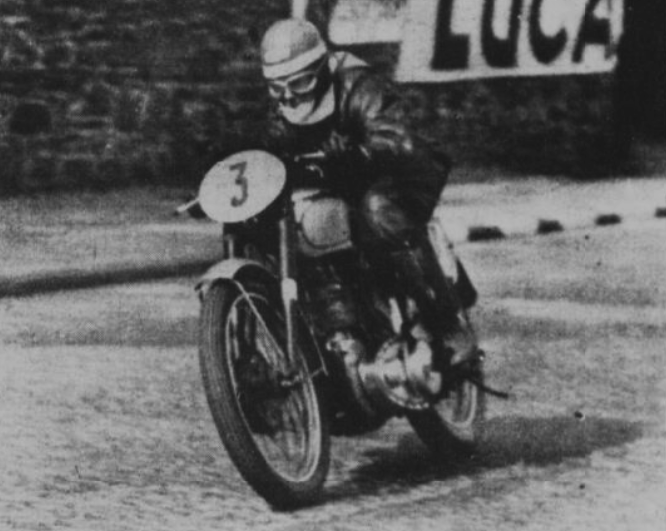
garage mechanic GE Read took his Norton round at 74.87mph in 2hr Omin 56.6sec to capture second place, while GJ Draper, 22-year-old Cheltenham farmer, also astride a Norton, was third with a time of 2hr 1min 10.8sec, an average speed of 74.73mph. It is with regret that we have to add that one competitor, DL Parris, crashed at the Bungalow and sustained injuries from which he died in Noble’s Hospital during the evening. It was the first time the unfortunate rider had raced the TT course, He was 23 years of age, single, and Belonged to Croydon, Surrey. By trade he was a toolmaker. There were several spills, and the high speeds caused many to retire, some through mechanical trouble and others for neglecting the pull of gravity. Only 41 of the 75 starters completed the course. Only Manx entrant to finish was JW Moore, of Douglas, whose competent riding on his BSA brought him eighth place in 2hr 5min 18.4sec, at a speed of 72.28mph. MR McGeagh, of Ramsey, the only other Local rider, retired halfway through the rare with a broken foot-rest. Interesting point is that McGeagh and Moore, whose numbers were 80 and 81 respectively, covered the first lap in the snow time— 32min 45sec. A conspiracy, perhaps? Only other rider with local connections was B Duffy who parted with his Norton on his first lap at Laurel Bank. The Norton, which was extensively damaged, came off worst. The rider emerged unscathed. Southerners may remember Duffy. He lived on the Island until he reached the age of 11, and received his early education at Castletown school. Not to be outdone by the International men. the ‘amateurs’ shot round the course like veterans. So fast did they go that we didn’t have to wait long for that now familiar cry, ‘He’s broken the record!’ And the man in this case was KRV. James (Norton) who caused the first sensation by smashing the lap record—set up by Jackson last year—by 10 seconds. And this on his first lap from a standing start! His time was 29min 35sec, a speed of 76.55mph. Not far behind came BJ Hargreaves astride a BSA with a lap of 29min 57sec. But it does not pay to tempt the gods too much, and first hard luck story had James as its main character. He stopped at the Hawthorne on his second lap and feverishly tinkered with his mount in an attempt to start. This lapse cost him 20 valuable minutes, and he was last to finish. Hargreaves’ clock stopped with its finger pointing to Ramsey, so it was apparent that he too had encountered trouble. This left the way clear for Purslow, who crept— if you will excuse the word—from third to first place on the leader board and retained that position to the end. RESULTS 1, Brian Purslow (BSA) 75.36mph; 2, GE Read (Norton); 3, GJ Draper (Norton); 4, DN Bradshaw (Norton); 5, Derek Farrant (BSA); 6, P Carr (Norton); 7, ST Cooper (Douglas); 8, JW Moore (BSA); 9, CE Staley (BSA); 10, DK Morley (BSA). (Among the DNFs was one Franco Sheene (Royal Enfield) whose son Barry went on to win the odd race. SENIOR CLUBMANS TT After he received a misleading signal from his time-keeper on his last lap, Ivan Wickstead slowed down and lost the Senior Clubman’s Race on Wednesday by only 20 seconds. He had led the field for over three laps. Thirty- four-year-old Kenneth Arbure, astride a Norton, won a few seconds after he crashed at Governor’s Bridge on his last lap. He dogged Wickstead from the start and completed the four-lap 151 miles race in 1hr 53min 37.6sec, over a minute slower than the record of 1hr 52 min 29.6sec, returned by JD Daniels in 1948. Record speed for the race when it was a three-lap event in 1949 was put up by Geoff Duke (82.97mph). Arber’s speed was 79.70mph. Wickstead (32 years), a married man with two children, at the third lap, astride his Triumph was leading by 63 seconds. But helpers waved a board with the cryptic message ‘plus 90’ and this
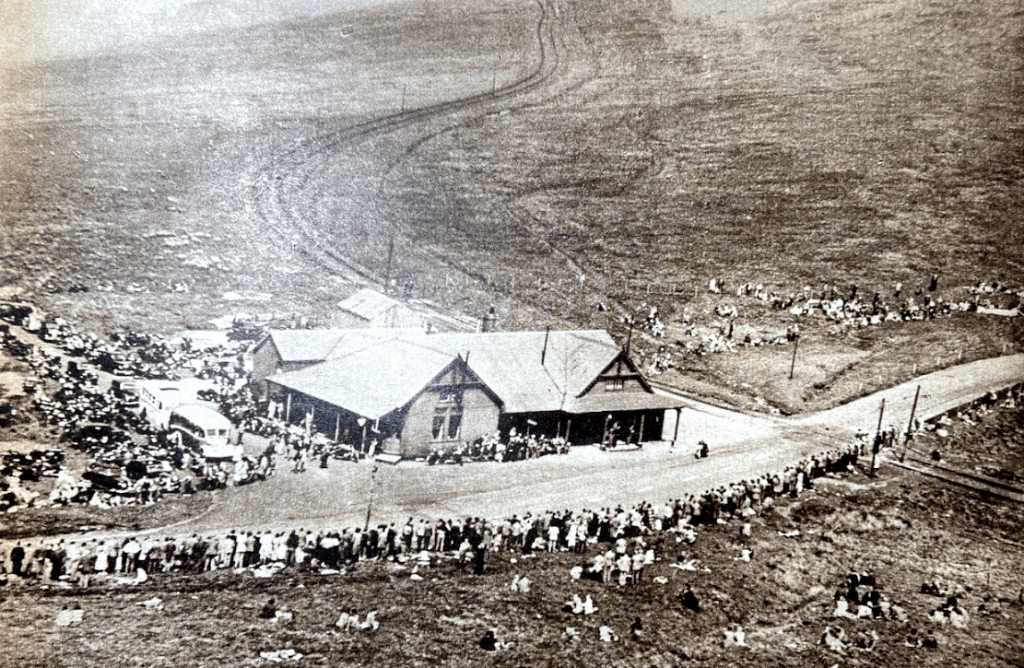
misled him to believe he was 90 seconds ahead. Third man was George Draper (Triumph), a 22-years-old unmarried farmer, of Cheltenham. He finished in 1hr 55min 17sec at a speed of 78.56mph to bring of a double third in one week. He took third place in the Junior Clubman’s Race on Monday. Draper won the Scottish Six Days,’ Trial this year. Fastest lap of the race went to Wickstead, who failed to smash the record—set up by Duke in 1949—by 53 seconds from a standing start. His time for this lap was 27min 56sec. Three Manxmen competed, and one of them, John Wood, 21, of Peel Road, Douglas, captured sixth place on a Norton in 1hr 56min 53sec, only 3min 15.4sec slower than the winner. Twelfth man was WA. Harding, also of Douglas, (Harding’s blue helmet with silver wings was one of the most striking in the race), while the third local rider, R Mawson (Norton) was 38th. Although many crashes took place only one rider needed hospital attention. So tar as visibility was concerned, conditions were perfect. Of the 69 starters, 45 completed the course. DA Gadd (Norton) crashed at Governor’s Bridge, remounted and continued. He later dropped his mount at the pits, but persistent fellow that he is, had the handlebars straightened and set off again. He finished 20th. When two bikes converged at Greeba the handlebars touched. Both riders were thrown but neither suffered. They were AJ Hart (Norton) and P Shepley-Taylor (Norton). Both retired. Clouds of smoke and shouts of ‘Fire!’ from the pit brought spectators to their feet on the Grandstand at the end of the second lap. Firemen rushed to a blazing BSA and extinguished the flames quickly and without fuss with portable extinguishers. Cause of the fire was a burst tank, and the rider of the machine, A. Bates. was burnt out of the race, so to speak. Lap four brought surprises with the damaging message for Wickstead and Arber’s last-minute spill). Despite his mishap Arber pipped Wickstead on the post to win the race. Among those who came off was DRA James (Triumph) whose scene of misfortune was Kate’s Cottage. He suffered minor abrasions and retired. EJ Bowman (Triumph) sustained scratches in a spill at Laurel Bank and retired. Staff of Ramsey Cottage Hospital treated W Wilshere (Norton) for a cut nose after he crashed at Ramsey. RESULTS 1, Ken Arber (Triumph) 79.7mph; 2, IB Wickstead (Triumph); 3, GJ Draper (Triumph); 4, RWC Ritchie (Norton); 5, Harry Plews (Norton); 6, Jack Wood (Norton); 7, RA Rowbottom (Matchless); 8, WR Oldfield (Triumph); 9, 0DC Birrell (Triumph); 10, JNP Wright (BSA).
“RECORD ARRIVALS FOR SENIOR TT: Biggest thrill of the races, the Senior TT, and ideal weather brought 15,000 last-minute arrivals to the Island in the Isle of Man Steam Packet Company’s vessels on Thursday. There were five steamers from Liverpool, three of them after midnight, and two from Fleetwood, including one midnight sailing. An official of the company describes this figure, which is 1,000 more than last year, as a record. Ronaldsway handled 70 planes, bringing in 700, and Jurby 48 planes with 191 people.”
“VETERAN TT RIDERS HERE: Founder members of the TT Rider Association formed in May last year are 25 famous TT riders. Only those who have ridden in the TT races are eligible to join, and there are row 50 members. The founders stipulate that the Association shall not interfere with the running of the races…Over the loud speaker on Senior TT Day came the message welcoming the 25 members of the Association, some of whom arc over 70 years of age. ‘We are all delighted to see them,’ said the broadcaster, ‘and hope we will have them with us for many years yet.”
“HOW WELL I REMEMBER standing almost dazed before the trim, convincing beauty of an early KTT Velocette in the Island! Engineers used to say, ‘If it looks right, it is right.’ Certainly, no racer ever looked lovelier than that little ‘Cette. The model was cobby, with fine lines and perfect proportions. The engine, born before the days when low-gear rpm on the meg up Snaefell accentuated cooling problems, was devoid of those huge finnings which look frightful, but are essential to sustained speed. The valve-gear looked almost as if it had been designed and built by a watchmaker. I almost felt that even I might win a TT on her back. But today, an isolated TT model looks really frightful. Its tank is almost the size of a family bath-tub, lying rather the worse for wear in a marine store. Its more visible works remind one of a disembowelled cuttle fish. Its tail is decorated with an object which looks like a dilapidated church hassock. It has no beauty to make one desire it—until you behold it in ferocious, triumphant motion with a Duke or a Graham aboard. You are then reminded that motor cycles designed to be ridden, not to be exhibited on plinths. With a small, lithe, black figure nestling down along its backbone, with the engine disgorging thunder and stinks astern, the model suddenly becomes transfigured and acquires unsuspected dignity and power.”—Ixion
“WE CANNOT, OF COURSE, expect American machines (ie, Indians or Harleys) to compete in the TT just yet. The USA, after a period of incredulous study of our 500s, are busy experimenting with the smaller engine sizes, but are not yet ready to race on them, whatever may happen anon. But I am rather disappointed that hardly a single American enthusiast has come over to have a look-see, for our transatlantic cousins are not poverty-stricken, as we are, and many could easily afford the trip. Indeed, a trip to Yurrup is supposed to bestow a certain cachet. They need have no inferiority complex about such an experience, for a triple Indian Senior Race victory in 1911 on chain-driven two-speeders was a mighty factor in putting us Britons wise about the whole trend of design, both for road and track. I feel that in the USA they waste their time playing about with small tracks on ‘show business’ lines, whereas a national championship on a fine road circuit would accomplish far more for their designs. If a dozen of their leading men came over for TT Week, I am sure they would never regret it.”—Ixion
OK, the following review and ads from the Isle of Man Weekly Times have bugger all to do with the TT. But they were in the TT report issue and they do give a taste of life on The Island…
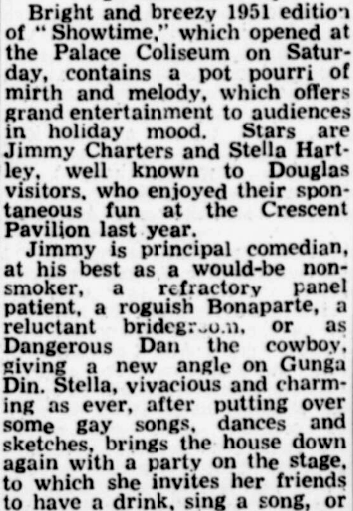
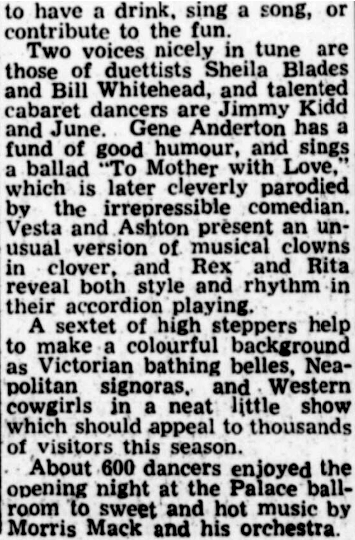

“IT IS REGRETTABLE for an old motor cyclist to have to admit that he feels that motor cyclists in general, and one type of rider in particular, are held in very low esteem by the general public. While in the Island for the TT Races, I was shocked and appalled at the conduct of some of the visiting riders, who appeared to have take their machines over with the one object of ignoring all the laws and common decencies one is justified in expecting from visitors. As of yore, it can truly be said that ‘a big noise denotes an empty head’, and it was disgusting to see some of these mad-headed, and, in many cases, thoroughly incapable riders careering up and down the Promenade showing a total disregard for anyone else. Why the IoM authorities should be so tolerant with these blatant law-breakers I am at a loss to understand, for they are normally very keen to enforce the speeding and parking laws with their local residents. The most regrettable aspect of the matter is, to me, the fact that is some quarters it was taken for granted that the racing boys were responsible, and a letter in the IoM Times referring to this subject was obviously in criticism of the racing riders. As I was staying on the Promenade, I was able to watch very carefully, and it was clear that the real ‘he-men’ when riding on the Prom, or elsewhere in Douglas, showed the usual restraint of men who could ride. The worst offenders were found on the most unlikely mounts, and riders of the really fast machines, such as the big Vincents and the pukka racing jobs, displayed the commonsense usually exhibited by the man who rides the best and fastest type of machine. I feel that if something drastic is not done the stock of motor cyclists will fall to an even lower level, and the sort of conduct mentioned above, coupled with the almost daily reports of inquests on motor cyclists, does undoubtedly give the man in the street a very false impression. One can hear the results of this wrong idea in company, where one generally finds that the motor cycle movement as a whole is condemned out of hand. After so much drastic criticism, I can only suggest (a) that the Douglas authorities should introduce a speed limit of 20-25mph on the Promenade. I’m sure the real lads would not grouse at this; then the first six speed merchants should be caught and fined a minimum of £10; (b) that there should be a reversion to the old idea of 1920 when pillion riding on the Promenade was absolutely prohibited; (c) that any rider found to be making a practice of riding up and down the Promenade more than a certain number of times, unless he could prove that his journey was strictly necessary, should be warned, and if he continued, he should be fined a sufficient amount to curb his holiday spending.
BERT HOULDING, MIMI, Preston, Lancs.”
“I WAS VERY interested in Mr T Berkeley’s remarks on the Panther and sidecar. I, too, find the automatic ignition control a mixed blessing, but as I am ready to make full use of the gear box (it is surely there to be used), I am not worried by too much pinking. I considered changing over to manual ignition only because it would possibly make winter starting easier, as I am more than satisfied with an accurately measured petrol consumption of not less than 70mpg with two-seater sidecar. All settings are standard, and my usual running speed is approximately 43mph, with vigorous acceleration. The stiff Dorset hills give no trouble. I have had no recent Panther experience prior to that with my present machine, but had one of their first four-speed machines in 1922. I suggest Mr Berkeley gets in touch with owners of similar machines and picks up economy tips from them.
JHK LOSH, Canford Cliffs, Dorset.”
“I TRUST FASHION expert Mr Leo Starr will agree with me that the following mode is the most practical for pillion riding. Owing to the vagaries of the British climate I find that a swim-suit and a fur wrap are much the best attire, as one is well equipped for summer or winter with the minimum of effort. For headgear I am sure one of the new eye veils would add a glamour note to this otherwise utilitarian outfit.
S SPINDLES (Miss), London, SW16.”
“THE GENERAL MOTORS research laboratories in America have been experimenting with high-compression engines using suitable high-octane fuel. A V8 Cadillac car engine with 12 to 1 compression has registered 29 miles per US gallon (one imperial gallon equals 1.2 US gallons) at 30mph and about 20mp US gallon at 70mph. Fuel saving is in the region of 30%. This would mean a reduction of 10,500,000,000 gallons in fuel consumed in the US alone. Think what that means in terms of world economy. Yes, we in Britain would like higher-octane fuel—we would be content with, say, 80 octane and think about higher compression ratios for economy at a later stage. Sad tail-end to my reading about the US experiments came when, a day later, I saw a report that a possible outcome of the bother in Persia will be lower-quality fuel. To make up for the cutting-off of Persian supplies, refineries may have to increase the production of lower-octane petrols to maintain present levels of total output. Point is that the higher the quality of the petrol produced the less there is of it from a given quantity of crude oil.”—Nitor
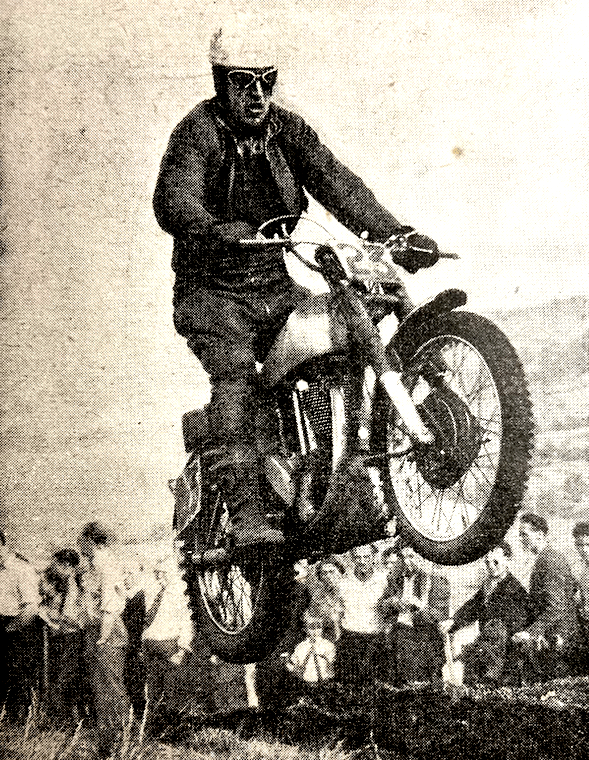
“WRITING FROM CAPE TOWN, AJ Bezuidenhout suggests that the LE Velocette lends itself particularly well to luggage carrying. His modifications to this end were undertaken for an extended tour of the Union. He had envisaged using a suitcase on the pillion, the standard panniers, and a rucksack on his back. However, he fabricated a set of carriers from light rod and heavy-gauge wire mesh, and was able to employ three Army packs and a Gladstone bag as well as the panniers, leaving nothing to be carried on his back, which greatly increased his riding comfort. The tank and pillion are equipped with heavy wire grids with retaining ‘ears’ and the pillion footboards form the bases for baskets in which the supplementary Army pack panniers are retained. The cage is fastened to the pillion platform with four bolts, holding through the platform and through metal straps above the wire mesh. Side-carrier frames are open box-frames of spot-welded construction. Tabs spot-welded down members take the bolts to the machine’s frame.”

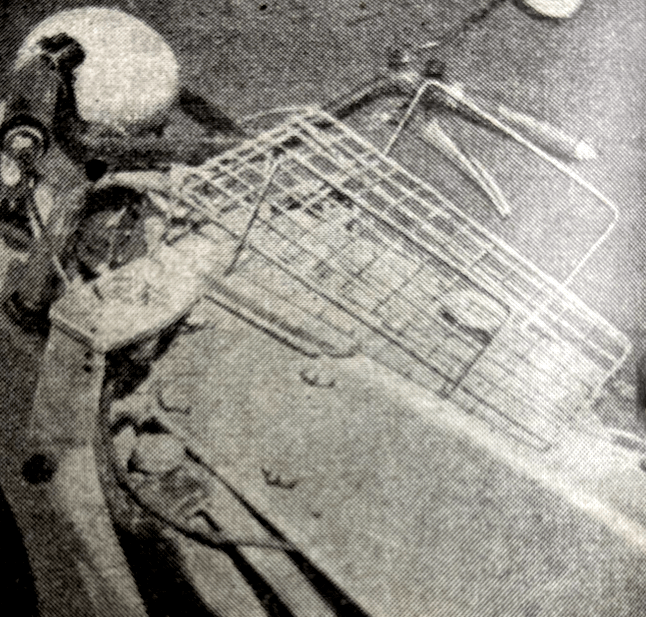
“COLLEAGUE ‘NITOR’ has tackled the question of uninsured pillion riders. Methought he handled it rather casually. If you carry an uninsured pillion rider and become involved in a crash which kills or seriously injures your companion you may be sued; and, if you are legally to blame for the accident the damages may be set at a very high figure. You are reasonably safe financially if you are a youngster on a weekly wage with no funds at your back. No lawyer would then deem you worth powder and shot. But if you have any capital, from a small business upwards, it is quite possible that a case might be brought against you, when costs and damages could easily absorb all that you possess. The only wise course is to accept no pillion passenger except a person (eg, your wife or fiancée) who is unlikely to sue you. There is, of course, a second aspect, viz, that any sensitive man would desire to be able to compensate any passenger injured through his default. In neither case is the risk one to be taken lightly, even if its incidence is not very common.”—Ixion

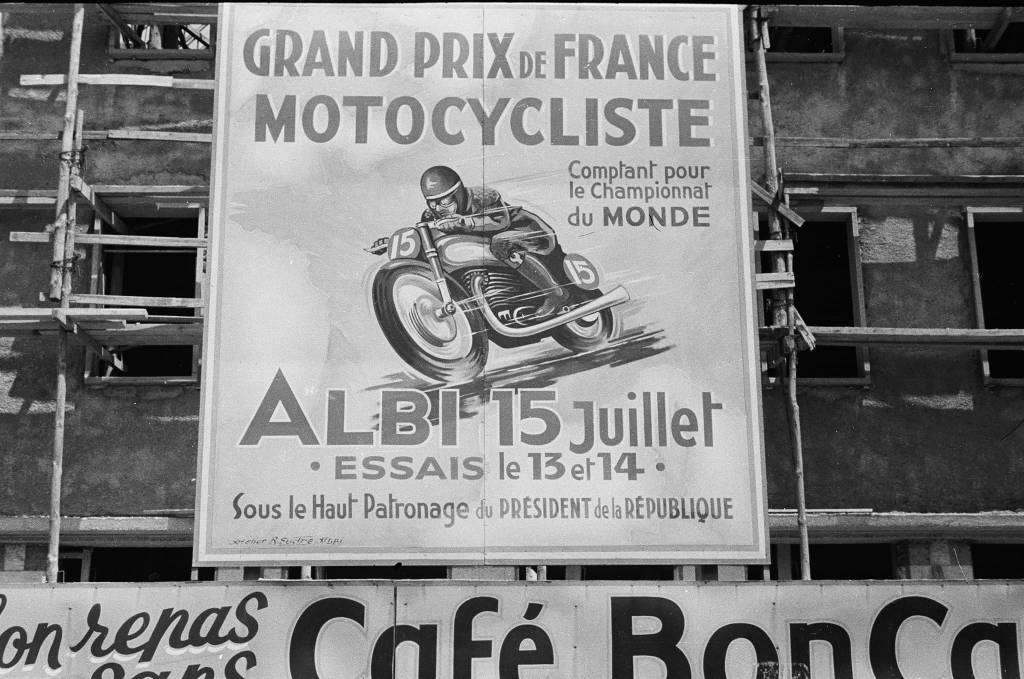
“NEARLY 20 YEARS have elapsed since a road-race meeting with FIM classic status has been held in France. The quiescent period was brought to an end last Sunday when the French Grand Prix took place over the 5½-mile Albi circuit. Successes were divided between Italy and Great Britain. In the 500cc class the Italian Alfredo Milani (Gilera) was the winner, and his compatriot B Ruffo, riding a Moto-Guzzi, was first home in the 250cc event. GE Duke (Norton) won the 350cc class and E Oliver (Norton sc) was successful in the sidecar race. A serious contretemps over fuel arose during the practising. For the first period on Thursday of last week, the fuel supplied was found to contain tetraethyl lead. The performance of British works’ racing engines was considerably reduced, and AJS 350cc engines in particular suffered some damage owing to detonation. Protests and protracted negotiations with the organisers during Thursday night, and into the early hours of Friday morning, elicited the information that the fuel, instead of being the aircraft specification 75 to 80-octane clear, as required by F.I.M. rules, was a mixture of about 80% super-carburant, which contained a small
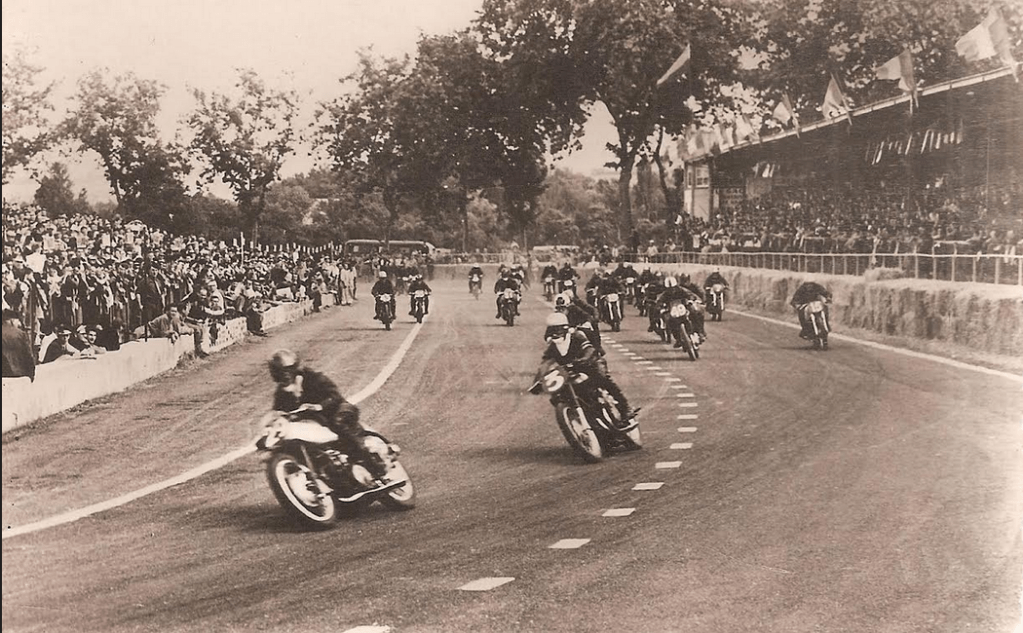
quantity of tetra-ethyl lead, plus 20% petrol of very high octane. Meanwhile, mechanics were busy modifying engines for this irregular fuel. However, by the practising period on Friday afternoon the correct 75-80-octane unadulterated fuel had been obtained. This appeared to have settled the problem satisfactorily. Unfortunately, however, there were machines already prepared at considerable trouble for the leaded fuel and others, such as the Italian fours, for which the entrants preferred not to use the 80-octane clear. The result was a compromise—mixed or clear fuel available to choice. In view of the precise FIM ruling on the subject, the compromise, though perhaps inevitable, could not be regarded as any-thing but unfortunate. Added to the confusion during the day preceding the meeting was the deep sorrow caused by the death of world’s champion in the 250cc class, Dario Ambrosini, of Italy. During Saturday’s practising, he skidded on tar made liquid by scorching sunshine, collided with a telegraph pole and died almost instantly. This catastrophe to a rider of world renown, popular for his vigorous, sporting riding in every country in which he competed, is a profound blow to motor cycle racing. The triangular. Albi circuit comprises, in the main, very fast straights and very slow corners; there are few high-speed bends. An inexplicable and potentially dangerous feature is the finishing line immediately after the first of two right-hand corners so close together as to be, in effect, one longish, sweep-ing curve. Before the meeting the record lap was held by RL Graham, who established 95.4mph in 1950 when riding a twin-cylinder AJS. During the first period of practising this figure was frequently bettered; Gilera riders were lapping at over 99mph. A
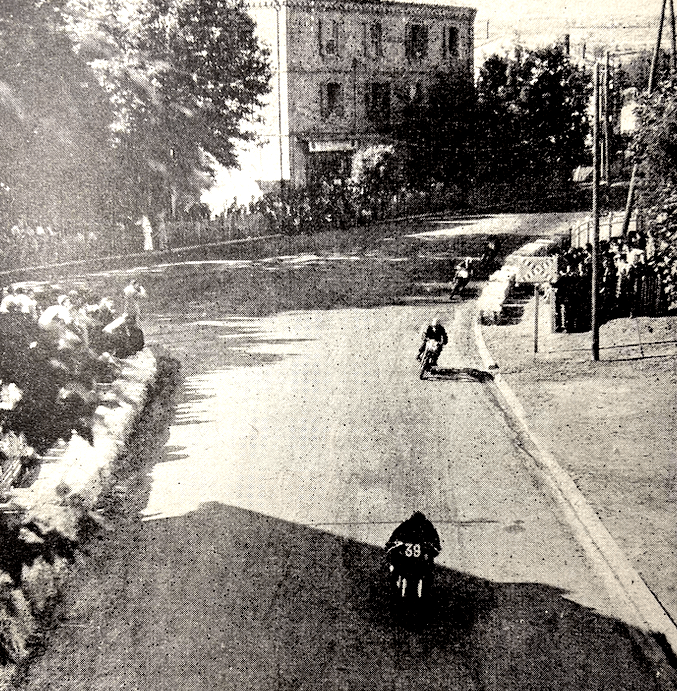
violent thunderstorm on Saturday night, with rain so heavy that roads were temporarily flooded, reduced the torrid heat experienced during previous days. Early Sunday morning the rain spasmodically lashed down. The sky was a mass of high, grey cloud. A warm dampness pervaded everything. Road surfaces had a vicious glisten. Crowds were noticeably thin and those who had braved the elements concealed their summer attire under raincoats. Large, black umbrellas were popular. A 10-lap race for French nationals on 350 and 500cc machines opened the programme. Their rather forlorn lapping served only to accentuate the effect of the unkind weather. When machines were being warmed-up just before 10.30 for the first of the international events, the 350cc class, the rain beat down heavily. The air was still. Flags hung wet and limp against their poles. On the front line of the 27 starters was the brilliant New Zealander Rod Coleman (AJS) in company with the elite works’ Norton team—Geoff Duke, Johnny Lockett and Jack Brett. But all four on the front line seemed to be caught slightly by surprise as the flag fell; it was young Pierre Monneret (AJS) off the second line who led into the first corner. Tardiest starter was TL Wood (Velocette) who, after a few yards of abortive pushing, stopped to reflood the carburettor and then was off to chase the field thundering along the glistening road towards St Juéry But the star men were soon overhauling Pierre Monneret. All three works’ Nortons—Duke, Brett and Lockett, in
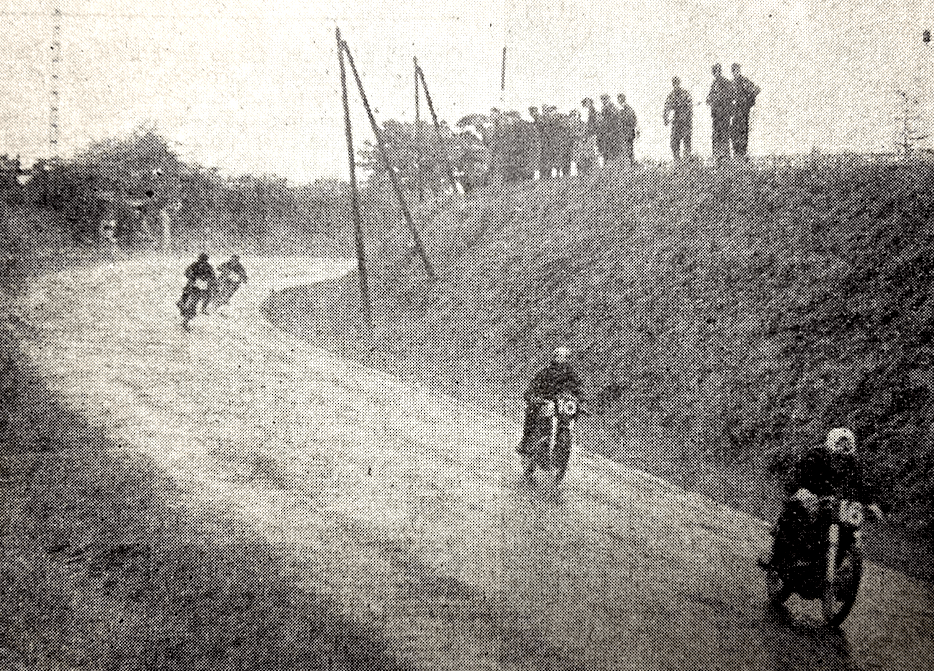
that order—as well as HR Armstrong (AJS) swept past him before the end of the first lap. Duke’s time was 4min 6sec (about 81mph). His second-lap time of 3min 50.8sec gave him a 200-yard lead which he increased to a long gap—15sec in time—after three laps. Lap speeds were over 86mph. The rain had stopped—indeed a gap or two in the clouds had appeared—but roads were still water covered. Speeds were going up, and Duke was already lapping the tail-enders. At one-third distance Duke had a 32sec lead over Brett and a 42sec lead over Lockett. Chasing Lockett hard were Armstrong and Doran, and a second or so behind them came Petch. In seventh place was Rod Coleman (AJS), eighth WA Lomas—the first of the works’ Velocettes—followed by his team-mates AR Foster and CC Sandford. RL Graham, who, in fact, arrived before Foster, free-wheeled into the pits to retire owing to water affecting the ignition; and Lomas, followed by AF Wheeler, coasted in with engine trouble as Duke came past the pits in his impeccable style to complete 10 laps and at the same time equal the 350cc class lap record of 3min 43.2sec made by Graham in 1950—a speed of 89.15mph on wet roads! Next time round he recorded 89.54mph. Would he beat 90mph was the query in everyone’s mind. Meanwhile the battle for third place was still raging between Lockett, Doran and Armstrong, with Doran, after
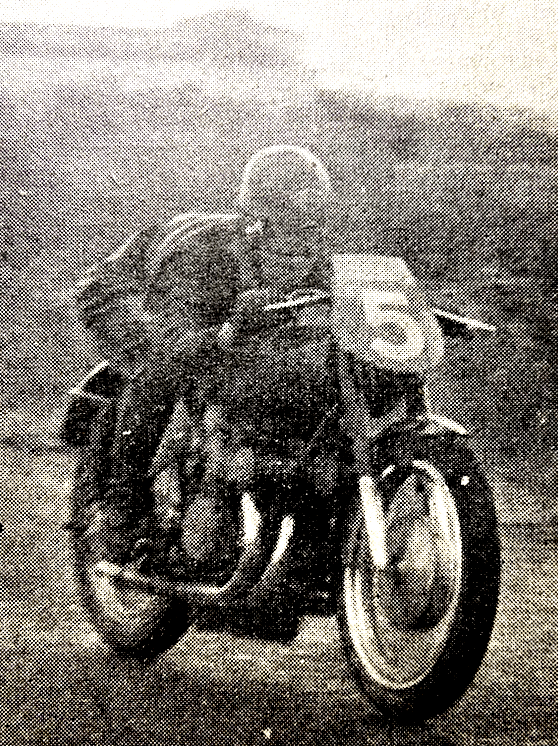
displacing Armstrong, making an obviously determined effort to nip past Lockett. This tussle was providing the highlight of the race which in other respects was relatively tame. By the end of Lap 15 these three were riding with only feet separating them. Duke and Brett were way out in front and had only to keep going steadily to be placed first and second. A couple of laps earlier Foster retired after having fallen on the greasy road following the hairpin at St Juéry. Others, including Amm, also skidded down here where the surface was like a skating rink. No personal damage was suffered. And then Petch, whose engine had been misfiring on Lap 14, free-wheeled to the paddock at the end of the 15th. Way back in the field, three Frenchmen, Georges Monneret, father, and Pierre Monneret, son, on their AJSs, and Georges Houel (Velocette), were scrapping and delighting those with a high sense of national enthusiasm. Houel was a lap in arrears but, well… In spite of his commanding position, Duke went faster and faster lap by lap. Roads were beginning to dry, but no more. Would he beat 90mph? Yes; on the last lap he circled in 3min 38.6sec, which meant 91.02mph—a wonderful show under the conditions. Brett received the flag as the trio disputing third place were thundering along the Route Nationale to the finishing line. As they neared the corner they were about to lap the Rhodesian WR Amm (Norton) and New Zealander LV Perry (Norton). Five machines in close formation approached. A crash seemed inevitable. Doran swept wide as he kept the throttle open that second or so longer than Lockett. He just avoided the straw bales, but reached the line first by feet only; third place to AJS and ringing cheers for the courageous Doran. And more cheers when it was announced that on that searing last lap he had made best time of the race—a lap in 3min 38sec (91.28mph). Duke’s average speed of 87.97mph just bettered Leslie Graham’s speed last year—when the
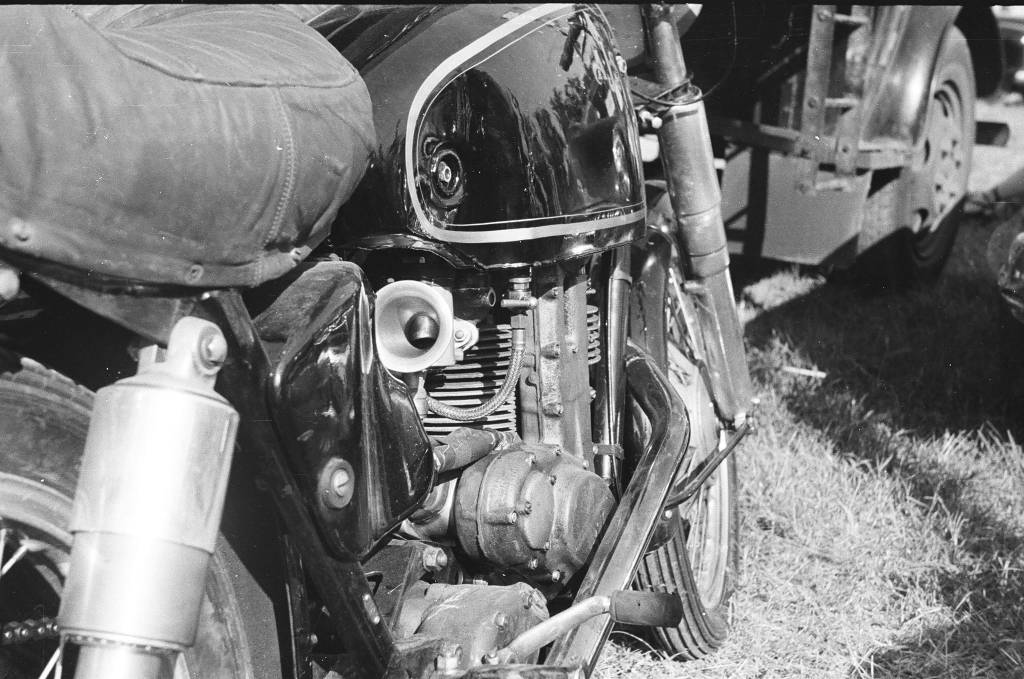
roads were dry. RESULT 350cc Class—17 laps, 94 miles: 1, GE Duke (Norton); 2, J Brett (Norton); 3, W Doran (AJS); 4, J Lockett (Norton); 5, HR Armstrong (AJS); 6, RW Coleman (AJS). During a two-hour lunch interval the roads dried. There was no shine, but the sun’s rays behind thinning clouds brightened the scene. The heat was oppressive and the atmosphere humid. There were 13 starters in the 250cc race. Three works’ Velocettes opposed a team of Moto-Guzzis. But Velocette hopes received a setback when AR Foster’s machine refused to start owing to a wetted sparking plug. The delay cost him about two minutes. The Moto-Guzzis were soon dominating the race. Gianni Leoni established a 100-yard lead over Bruno Ruffo, and TL Wood held third place. Fergus Anderson and AF Wheeler (Velocette) were within a few yards of Wood. On the second lap Ruffo reduced Leoni’s lead very noticeably and Wheeler brought up his modified KTT Velocette to pass Anderson. The works’ Velocettes ridden by CC Sandford and WA Lomas were in seventh and
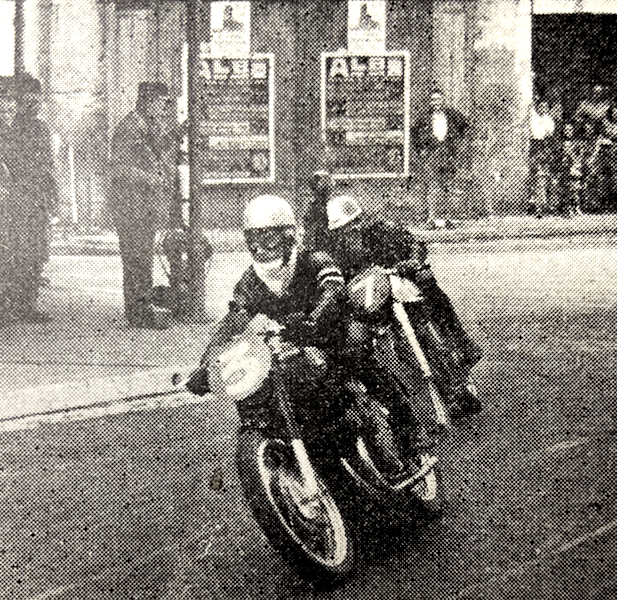
eighth positions; Foster stopped momentarily at the end of Lap 1 and lost more time to add to the plug-changing delay at the start. Buffo lapped in 3min 48.4sec (87mph) and nipped ahead of Leoni. Not content with that, he got round in 3min 40.8sec on Lap 3 and increased his lead. But Leoni also speeded up and after five laps was in an apparent fight with his compatriot. They had a 45sec lead over Anderson who by then was in third place a few yards in front of Wood. Wheeler was fifth. Sandford was slowed by plug trouble and called at his pit for assistance. Then on Lap 6 Wheeler retitled. The race appeared set, with the two pairs of Moto-Guzzis holding the first four places. Why Ruffo and Leoni of the same stable should duel so vigorously was inexplicable, but in racing nothing is certain till the finishing flag has fallen. On Lap 7 Anderson lost a lot of ground to Wood—about mile—hanging back to have a run with another competitor to see how fast the latter’s machine would go! Later he set about catching up, riding in thrilling style. The task took him two laps. But Wood, too, got the urge and recovered third place after one more lap. Lomas was holding fifth place and was indulging in a friendly scrap with Sandford, who was a lap down. The average speed of the leaders Leoni and Ruffo was just over 85mph. Ruffo led at the start of the last lap—by two yards. Wood led Anderson, also by a few yards, in the scrap for third place. And Lomas was just ahead of Sandford in their abortive but stimulating battle. All except two of the starters were still circulating. No changes took place on the last lap. The leaders appeared to fight it out to the last, but Anderson, on Wood’s tail, crossed the finishing line on the overrun. Actually, as the contrast between average speed and fastest-lap speed shows, not even the leading pair had tried overmuch. RESULT 250cc Class—15 laps, 83 miles: 1, B Ruffo (Moto-Guzzi); 2, Gianni Leoni (Motor-Guzzi); 3 TL Wood (Moto-Guzzi); 4, Fergus Anderson (Moto-Guzzi); 5, W, Lomas (Velocette); 6, W Gerber (Moto-Guzzi); 7, G Houel (Moto-Guzzi). The rain had held off since well before noon, though the
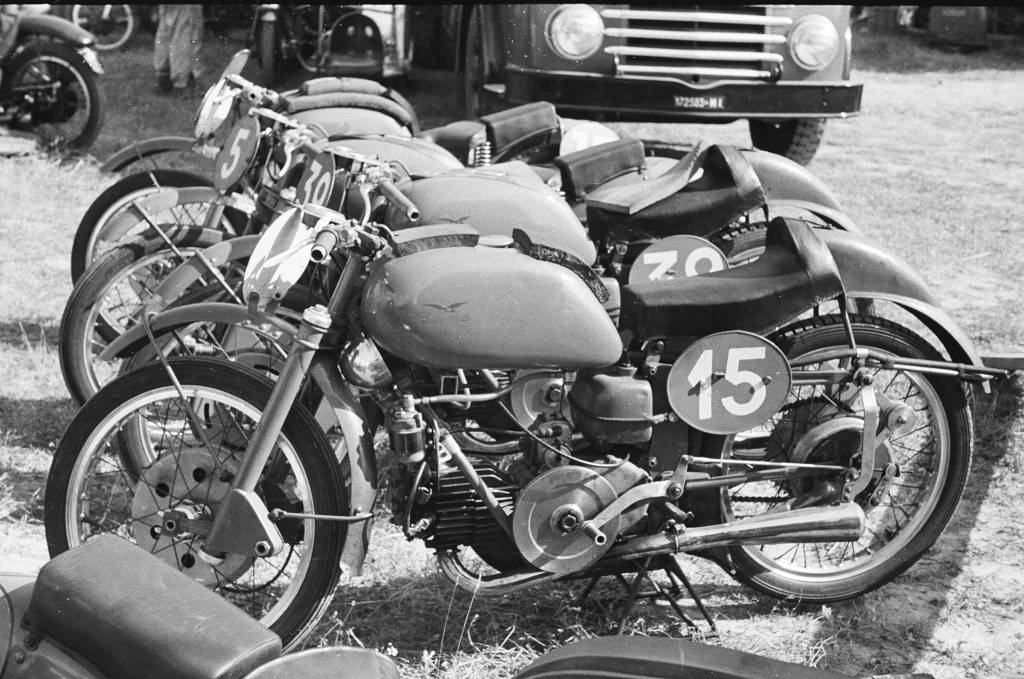
clouds occasionally looked dark and threatening. By the time the sidecar race started, soon after 3.30, much larger crowds had gathered. Umbrellas had been closed and coats were abandoned. The scene had the touch of colour and gaiety expected in a southern province of France. Off the front line with E Oliver (Norton sc) and Albino Milani (Gilera sc), E Frigerio on the four-cylinder Gilera gained a few yards before the first corner. But soon there were reports from round the circuit of Oliver’s forceful driving as he first overtook Milani and then his old rival Frigerio. He came through at the end of the first lap, his outfit snaking and sliding yet perfectly controlled, to lead by 10 seconds. Milani was only about 50 yards behind Frigerio, but the rest were over 400 yards away. On Lap 2 Frigerio reduced Oliver’s lead to 8sec. On Lap 3 to 6sec. On Lap 4 to 5sec. The Gilera driver was going faster and faster and lapping at just over 80mph. Milani in third place was neatly a minute behind. A magnificent, changing, four-sided scrap was being fought out for fourth place among M Masuy (Norton), Drion (Norton), Murit (Norton) and Betemps (Triumph)—a Belgian and three Frenchmen. Farther back, Beauvais (Triumph), Galbiati (Gilela) and R Prati (Moto-Guzzi) were having a gay tussle. After five laps the advantage of four to five seconds which Oliver held over Frigerio remained more or less constant. The sun shone hard and bright for the first time and the crowds became restive with excitement as the screaming Gilera chased the thundering Norton and the Belgian, Masuy, tried to keep ahead of the Frenchmen. Albino Milani’s engine sounded sick and he was slowing, and Betemps lost ground to Masuy, Drion and Murit, who in a tight bunch got ahead of Milani on Lap 9. Then Masuy crashed on entering the Route Nationale—neither he nor his passenger, Denis Jenkinson, suffered anything worse than bruises and abrasions. The order thus became Oliver, Frigerio, Drion, Murit and Milani. On the ninth lap Oliver’s time was 3min 59.1sec, a speed of over 83mph. Amateur watches showed he was gaining about half a second a lap on his rival. His average speed so far was 82mph. Nothing untoward happened to the leaders. Oliver went
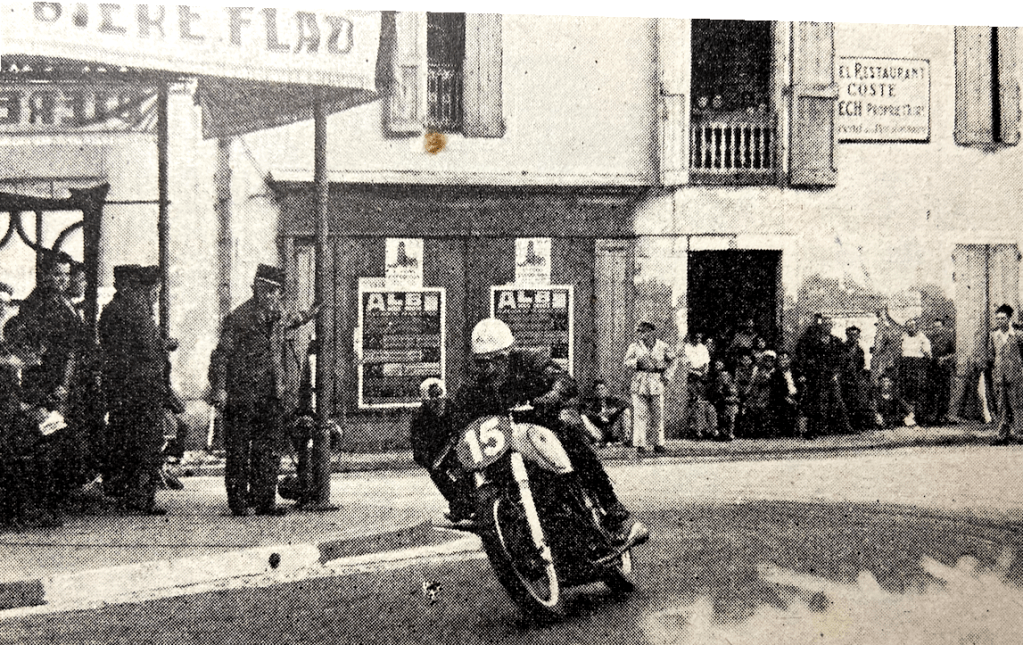
on and on as decisively as ever and, before the chequered flag fell, lapped everyone except Frigerio. His win brought him level with Frigerio in the World’s Championship with 26 points each. Next and final event to count, the Grand Prix des Nations, Italy, should be a needle contest! RESULT SIDECAR CLASS—12W laps, 66 miles: 1, E Oliver (Norton); 2, E Frigerio (Gilera). The welcome blue of sky could be seen in patches between billowy clouds as the 26 starters in the 500cc class got away. No works’ MV Agustas had arrived and Les Graham was a spectator. Though the three works’ Gileras and W Doran (AJS) were on the front line of the starting grid, it was Fergus Anderson who got his Moto-Guzzi firing first; he was away and into the lead by five yards. On the way round, N Pagani and Alfredo Milani forced their Gileras ahead. Pagani’s time was 3min 33.3sec from the standing start (93.1mph). Duke, in fourth place, was close behind Anderson. On Lap 2 Milani gained the lead, and on Lap 3 Duke displaced Anderson. The two Gileras, up front, were going extraordinarily fast. Milani’s fourth-tap speed was 100.15mph! Both Gileras ahead of Duke were pulling away slightly to make the gap 50 yards. And U Masetti, on a third Gilera, in fifth place was creeping up on Anderson. W Doran (AJS) was sixth. HR Armstrong’s Porcupine AJS was misfiring and he had already had two pit stops. S Geminiani (Moto-Guzzi) was seventh, J Brett (Norton) was eighth and E Lorenzetti (Moto-Guzzi) was ninth. J Lockett, on the third works’ Norton, was 11th, behind CW Petch on the twin-cylinder AJS. On Lap 6 Anderson got ahead of Duke for third place. The big
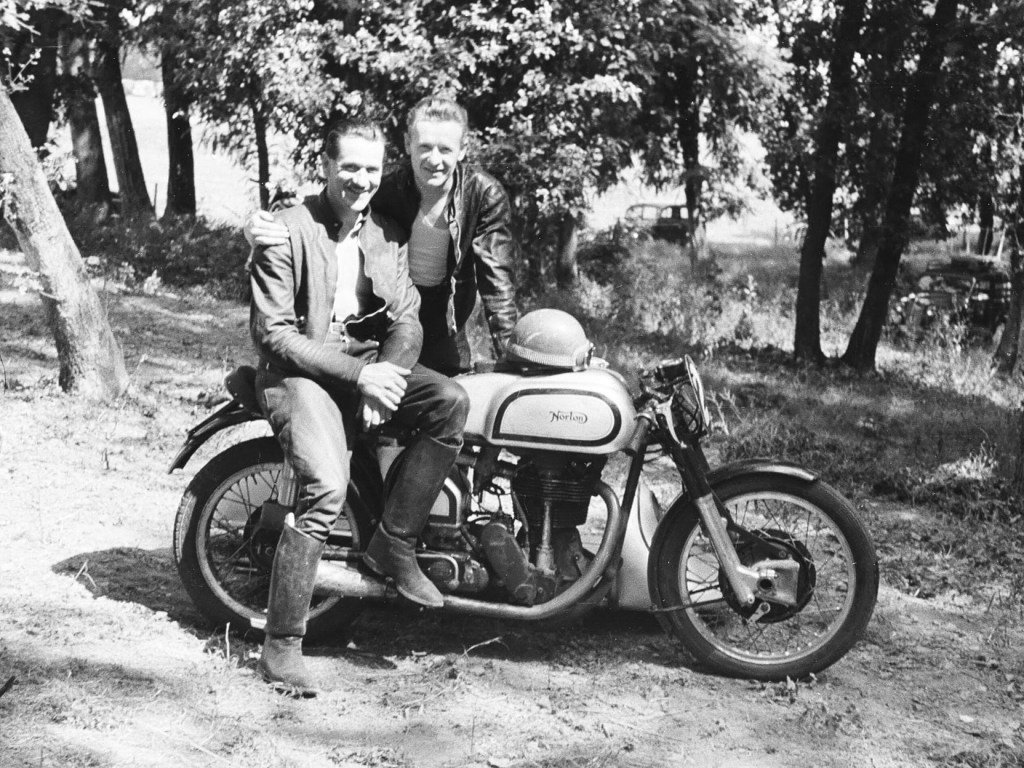
Nortons did not seem to be going with quite their usual zest; but on the other hand Milani was going amazingly fast. His sixth lap was completed at 100.7mph—over 5mph faster than the 1950 lap record. More than that, Masetti was spurting and came up to third place ahead of Duke, Doran and Anderson, who were riding in close formation. Doran had the ‘frenzy’ next lap—the ninth. He forced his way past both Duke and Masetti to annex third place. But he was 16sec from the two ahead, who had a clear. road. Not that the clear road lasted long, because by 10 laps the Gilera men were lapping the stragglers. The order was: Milani, Pagani, Doran, Duke, Masetti, Anderson, Geminiani, Brett, Petch, Lorenzetti, Lockett and Rod Coleman (Norton), who, as usual, was leading the private owners. The mixed, leaded fuel seemed to be suiting the four-cylinder Gileras. Milani’s lead over Doran was 16sec and he was increasing fractionally his lap speeds—100.85
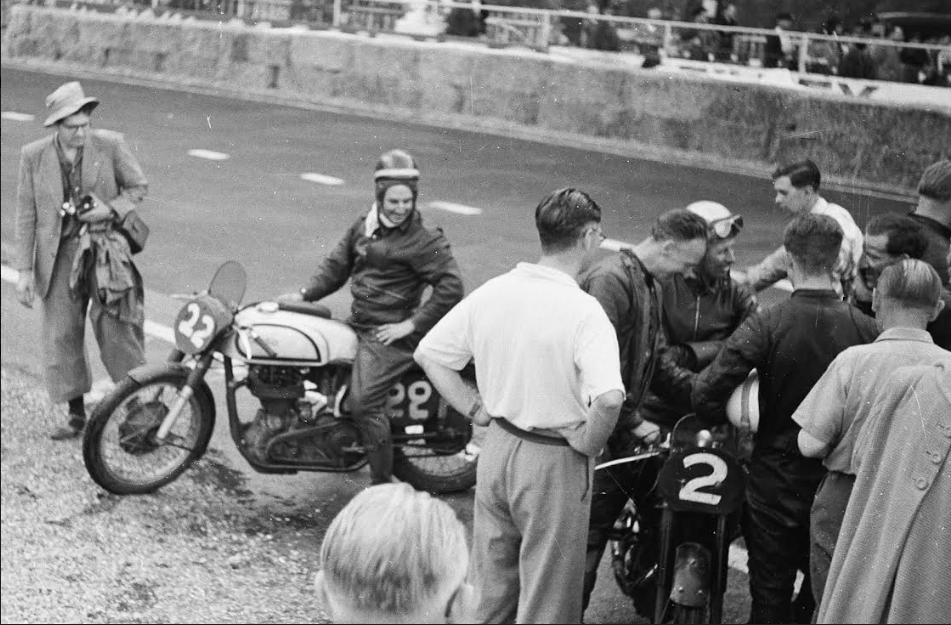
on Lap 13. Brett was riding magnificently and by Lap 13 was sixth, only about 50 yards behind Duke, who was unable to make any impression on Masetti in fourth place. After 16 laps Milani was 15sec ahead of Pagani and 19sec ahead of Doran. Masetti and Duke, riding on a string, were 43sec away. Brett and Anderson were a couple of seconds behind them. A stir fluttered through the crowds during Lap 17 as Doran came through only five yards behind Pagani. But Milani’s lead was still 19sec. Duke appeared to be slowing fractionally. A tight bunch comprised Brett, Anderson, Duke and Masetti—note Brett ahead of Duke, said the pundits. A couple more laps and the order was Anderson, Duke, Brett and Masetti—they were changing places frequently around the circuit. With two laps to go, amateur timing showed Milani slowing by about 2sec a, lap and Doran speeding up by almost as much. Was there a chance for the Englishman from Lancashire? At the start of the last lap Doran was 14sec down. And at the start of the last lap, Masetti was heading the bunch battling for fourth place. Milani came home safely, Doran, whom Pagani could not catch, try as he might, was a clear second. We waited, tensed, to see the victor in the quartette striving for fourth. place. Masetti led going into the curve. Duke was on the outside and overtaking. Duke leads! But too late. The Norton is in front—but only when they are past the flag. RESULT 500cc Class—23 laps, 127 miles: 1, Alfredo Milani (Gilera); 2, W Doran (AJS); 3, N Pagani (Gilera); 4, U Masetti (Gilera); 5, GE Duke (Norton); 6, J Brett (Norton); 7, FK Anderson (Moto-Guzzi); 8, CW Petch (AJS); 9, E Lorenzetti (Moto-Guzzi); 10, J Lockett (Norton).”

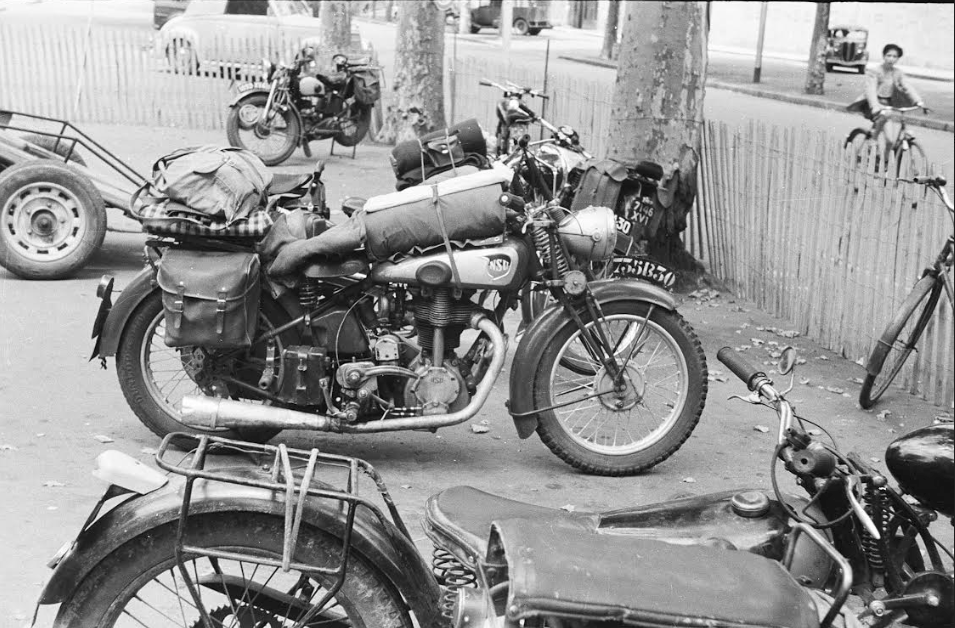

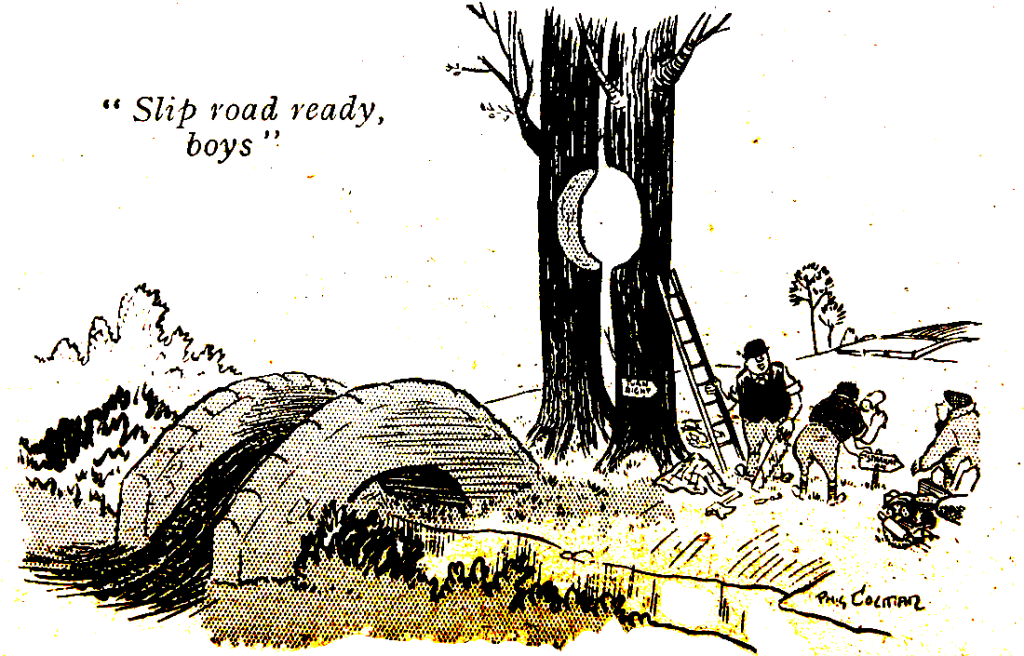
“THE FOLLOWING QUESTIONNAIRE is issued by the Royal Society for the Prevention of Accidents. My sole objection to it is that it is formally and exclusively addressed to motor cyclists, though the whole of it is at least equally applicable to a very large section of car owners (and to pedal-cyclists). However, its questions are both fair and searching, so they are worth our attention. Give yourself two marks for an A; one for a B; and none for a C. 1. How often do you lose your temper? Answer: A, Very seldom. B, Fairly often. C, Often. (What do I get for ‘Never’?) 2. Do you get taken by surprise by slippery road surfaces? Answer: A, Hardly ever. B, Fairly often. C, Often. (Never except in the dark—any bonus?) 3, Do you drive on your brakes? Answer: A, Hardly ever. B, Fairly often. C. Often. (What debit do I get for answering ‘practically always’?) 4. Do you give ample warning of your intention to the driver behind, especially when turning? Answer: A, Always. B, Generally. C. Sometimes. (This is where I get full marks.) 5. Do you keep a special look-out for very young and old pedestrians. and teenage cyclists? Answer: A, Yes. B, More or less. C, Never thought of it. (I shiver when I see any of them.) 6. Do you ever start to overtake and then find you have to brake back or accelerate fiercely? Answer: A, Hardly ever. D, Occasionally. C, Often. (I accept a C minus here.) 7. Do you like showing off? Answer: A, No. B, Sometimes. C, Yes. (This is a nasty one. We all like it. I never do it—well, hardly ever.) 8. Do you drive in a spirit of competition with other road users? Answer: A, No. B, Sometimes. C, Often. (I would if I dared.) 9. Do you realise the danger of becoming too familiar with your local roads or a regular route? Answer: A, Yes. B, Not really. C, Never thought of it. (This is a bad question. I can’t be too familiar. I know all the blind turnings. I know every gate from which large dogs may emerge. I am always safest on my most familiar roads.) 10. Do you find yourself taking corners too fast? Answer: A, Practically never. B, Sometimes. C, Often. (Not if they’re blind). Award. If your score is 16 or over you are probably a good motor cyclist. (Or a shameless liar!). A score of 10-15 is fair. If you score less than 10 you would be wise to do some revision. I give myself 15, including a plea for a bonus on question No 2 and a willingness to accept a heavy minus on question No 3. I am ashamed to find that I am only a ‘fair’ motor cyclist.”—Ixion
“IT WAS A DULL DAY, with a coolish breeze for the Middlesbrough Club’s annual race meeting on Redcar Sands, last Saturday. The crowd, a record, witnessed some very good racing. There was an entry of 85 in the motor cycle classes. Apart from a little water on the seaward side the beach was in a good state, and the programme ran smoothly to time. One exciting—and sad—incident was when EF Hall’s OK Supreme caught fire and was more or less burnt out. Since the wind was against the competitors the conditions were not ideal for an attempt on the flying kilometre. However, both A Roddam (998cc Vincent) and FM Rist (646cc BSA) had a go. Roddam registered 107.55mph and Rist, 103.56. In the 20-mile East Yorkshire Championships there was keen rivalry. The 350cc championship started well and promised a fine duel between Rex Young (Norton) and JP Bean (BSA). Young, however, had plug trouble and the battle then was between Rist, Bean and JK Becton (BSA), who finished in that order. Next there was the 600cc championship. Rex Young (Norton) got away all right and was challenged only by Rist (BSA). It was a ding-dong battle with some beautiful cornering. Young, whose wrist was in plaster owing to a broken bone, not only won, but at a speed of 74.3mph, as against his winning speed last year of 71.9.”
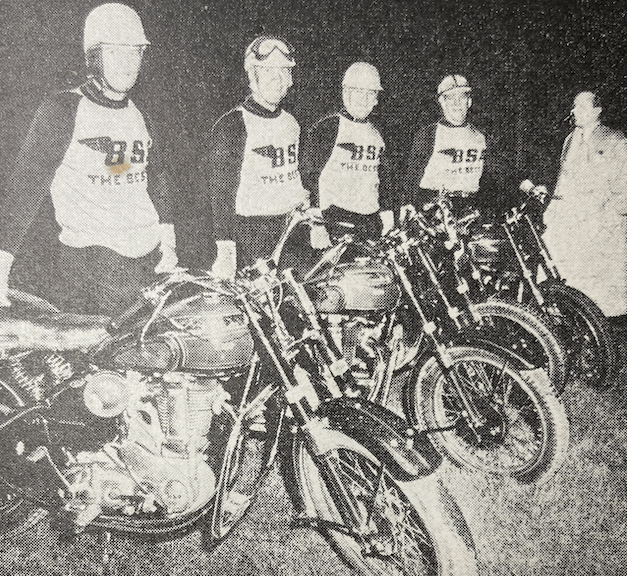
“A £700-A-YEAR salesman, who said he was a motor cycle enthusiast. stopped to examine a solo AJS parked at the kerb. His interest had a sequel at Bow Street Magistrate’s Court when he was fined £10 for ‘without authority or reasonable excuse tampering with the. mechanism of a motor cycle’. He was Robert John Anson Ashley, aged 34, of Gunter Grove, Chelsea, London, SW. He pleaded ‘not guilty’. PC Mould, owner of the AJS, said that at 11.15pm he was off-duty in plain clothes and saw Ashley walk across to the model. He walked round it, then moved some handlebar control, sat astride the mount, and tried the kick-starter. He was tickling the carburettor when PC Mould came up. Ashley gave evidence that he had been to a Naval reunion party, where there had been more wine than conversation, and was on his way to his car when he spotted the AJS. ‘I am an enthusiastic motor cyclist—do some trials riding,’ he said. ‘I knew I was on an inoperable machine before I kicked it, because when I looked down to ‘tickle’ the carburettor I saw that the high-tension lead was off. I kicked it over just to feel the compression.’ Said Mr Leo Gradwell, the magistrate: ‘I do not believe you had any intent to take and drive away this motor cycle. But on your own admission I find this case proved. Tampering with a motor cycle in the centre of London cannot be passed over lightly.'”
“IN THE HOUSE OF COMMONS on Monday of last week Mr W Deedes asked the Minister of Transport if he was prepared to take the necessary steps to make compulsory the wearing of crash helmets by motor cyclists and pillion riders. Mr Barnes said that the British Standards Institution had set up a working party, on which his Department and the Road Research Board were represented, to consider the specification of a crash helmet suitable for civilian use. Legislation would be necessary to make the use of crash helmets compulsory, and he was not at that stage in a position to consider this. Mr Deedes: ‘Can the Minister say whether he has had a recommendation to introduce it, and is he aware that doctors and hospitals are viewing with increasing concern the number of motor cyclists with head injuries that they are having to deal with?’ Mr Barnes: ‘Yes. The action that is being taken indicates an appreciation of the value of such a helmet, but the question of making any article of wear compulsory is rather a difficult matter.”
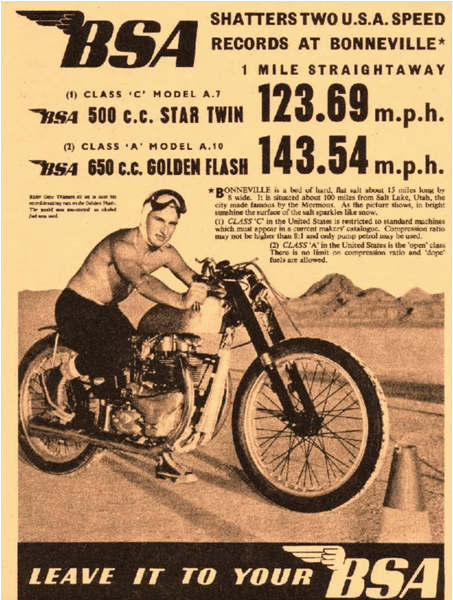
THE GREEN ‘UN was worried that peds using the new zebra crossings would leap in front of traffic causing multiple pile-ups: “That something must be done—and quickly—about this new traffic problem is evidently realised by the authorities for there is already talk of fresh legislation concerning the ‘zebras’. Beacons [still alliteratively known as Belisha beacons among old-timers for the entrancingly named transport minister Hore-Belisha] are to be illuminated—which may help at night. Also it is suggested that there shall be established on each side of every crossing a ‘no man’s land’ over which a speed limit of 12mph shall apply. But how are speeds over these zones to be checked? Another obvious measure—and we have not yet seen it mooted officially—is that all motor vehicles shall be equipped with brake-operated stop lamps. To expect riders and drivers, faced with the necessity for making rapid, and even violent, halts, to give hand signals of their intention to slow down, is patently absurd.”
THIS PLEA FOR better training of young motorcyclists was published in the Aussie Daily News and preserved in the excellent Vintage Chatter (magazine of the Vintage MCC of Western Australia): “He’s the one who has asbestos ears held apart by a head full of wet feathers, handlebars grinning sardonically and the power of death between his knees. He’s on the road because the roads are more or less free and he has as much right on it as anyone else. But no one in the world is more hated or grudged his right to the road than he. He’s called a ‘goon’ or a remanded accident going somewhere to happen. He’s the irresponsible youth on a motor cycle. Even death was almost holiday-minded this Easter just past and the National Safety Council felt it was getting somewhere in its years of hammering safety-consciousness into the road-using public. But the wonder was that more handlebar hams didn’t kill themselves as they skite-rode, swooped and cut in through traffic streams. You can’t call it the motor-cycle menace. It’s a percentage of motor-cyclists who are the menace; and I doubt that there’s a motorist or pedestrian in the world who won’t say these types are the worst menace on the road. They make up too great a proportion of the almost 12,500 other motor cyclists licensed in this State. The very sight of a really stylish, fully-dentured, chromium-finished machine with everything on it but the kitchen sink turns the average mature, motorist purple. He wants to put the kitchen sink on it—a governor—and give it the same lethal possibilities as a perambulator. The holder of motor cycle licence plate No 1 in this State has ridden his machine daily for 33 years, has never had an accident, a traffic prosecution or an insurance claim. So I thought he should have some ideas on dangerous riding and how to avoid it. He has plenty. This AG Melrose would make it hard for a boy to get a motor cycle licence. You know of him as a veteran speed-track rider, scramble-track artist who has ridden in most countries of the world, but he worries much about the wizard handlebar boys. He was a civilian instructor to military riders and drivers during the war, and when those boys had taken a great gruelling over scramble courses, heavy sand and mud and learned how to crash, he felt their expectancy of life was a bit longer — in fact, that they had learnt to ride. And when we kill off many more riders and drivers in peacetime than in war, he considers that civilian motor cyclists should be as well taught in peacetime. He would have applicants for licences certified as being mentally as well as physically fit before going before a board, before getting a licence, subject to confirmation, in, say, 90 days. And during that confirmation time the boy would have to go to a school and pass tests before having his licence confirmed. As the law stands the boy does not have to ‘go to school’ before he gets his licence. He has to have a learner’s permit and an instructor who has held a licence for 12 months—and that may be just another young goon who hasn’t had an accident yet. He doesn’t have to have his parent’s consent, but has to produce his birth certificate if he is just 17. But parents have some influence. If a boy of 17 has £200 cash for a new bike or less for a secondhand one, he can get it without reference to you. But many a boy, not having a large lump of cash, has to buy his bike on terms; and his parents must sign the agreement or guarantee it. So make it a condition that he attends the National Safety Council riding school and joins a club afterwards. The NSC is proud of this school, which operates Saturday afternoons at the markets. It has put through about 250 students in two years and as far as the records show, none of those students has been involved in an accident where he has been held blameworthy. A lack of road courtesy is point one in Aubrey Melrose’s idea of accident causes, and comes before straight speeding. So if you parents drill your boy’s manners while he is young, and plug the school attendance and club membership, you can improve his popularity and lengthen his life.”
“THE MANVILLE CUP TRIAL, event of the year in the calendar of the Coventry and Warwickshire MC and celebrating its fourth anniversary as an open event, took place on Saturday last. In the face of formidable opposition the principal award was gained by Don Evans (500 Ariel), with Harold Tozer (500 BSA sc) heading the list of ‘chair’ entries. After many days of continuous rain the trial opened under ideal weather conditions with an entry of 142, of which 10 were non-starters. The course covered 47 miles of Warwickshire countryside and contained nine hazards divided into no fewer than 34 ‘subs’. Praise must be given to both the riders and machines in that there were only three retirements in the 2½-hour battle against glutinous mud, deep water and greasy, leaf-covered climbs for which this part of the country is well known. Starting and finishing at the Red Lion Hotel, Atherstone, the route included such old Midland favourites as Oldbury Roughs, Hobgoblin and Meriden Shafts, while the inclusion of the new and untried Kimberley Hall section at the end added to the prolonged mud bath.”
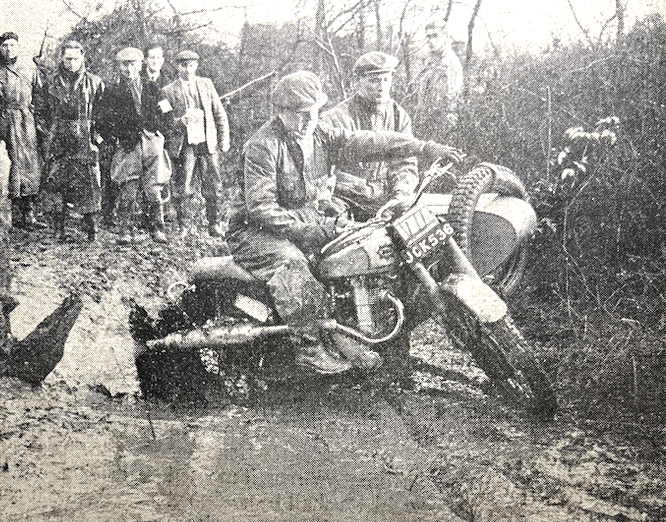
“IN THE CLEAR SUNLIGHT and crisp air of a perfect winter day—conditions ideal for trials riding—the Waterlooville MCC’s National (Open) Hoad Trophies Trial on Sunday last was won by RB Young (500 Norton) with a loss of 12 marks. Setting off from the Brewer’s Arms, Horndean, Hants, the 87 starters were faced with a course 45 miles in length, containing 12 sections sub-divided into 33 hazards and a special test. The first two sections were at Catherington Lane. A victim on the earlier of these was TS Gilfillan (250 Ariel), who parted company with the model in a most spectacular fashion just before the ‘ends’ card. PF Richards (350 AJS) and GE Duke (500 Norton) both departed the poorer by a ‘foot’. Four sections were located at Eastland Gate, a long, gently climbing mud lane, parts of which displayed quagmire characteristics. The two middle sections were the trickiest. On No 4, only 11 soloists were unpenalised, this elite company being reduced to six on the next hazard. W Nicholson (500 BSA) was among the fallen. Travelling fast, he used all the width of the course to ‘clean’ No 4, but in No 5 he was forced to foot.”
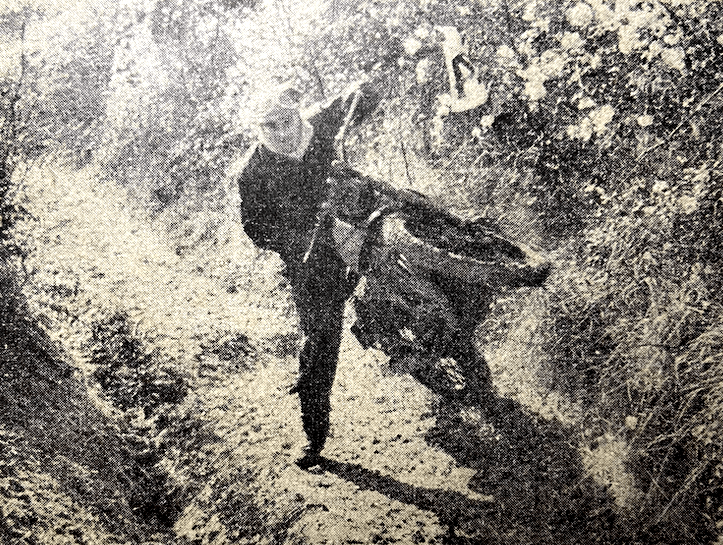
“KEN KAVANAGH, the Australian road-racing star who distinguished himself in recent English international events and in Europe, ‘toyed with champions from South Australia, New South Wales and Tasmania’ by scoring easy victories in both Junior and Senior Jubilee TT races at Ballarat airstrip, Victoria. Riding his ‘featherbed’ Manx Nortons in both principal events, Kavanagh held off Ernie Ring (NSW, Velocette) and Matirice Quincey (Vic, Velocette) in the 350cc race, while in the Senior race he ran away from Jack Forrest (NSW, Norton) and Ring (Velocette) to establish an absolute lap record for the three-mile circuit in 2min 16sec (82mph). Following his victories at this meeting, Kavanagh’s nomination as a representative of Australia in the 1952 Isle of Man TT races was confirmed. Other nominations were Ring, Willis, Gordon Laing (Vic), Forrest and Quincey. The two last-named have notified their inability to accept.”
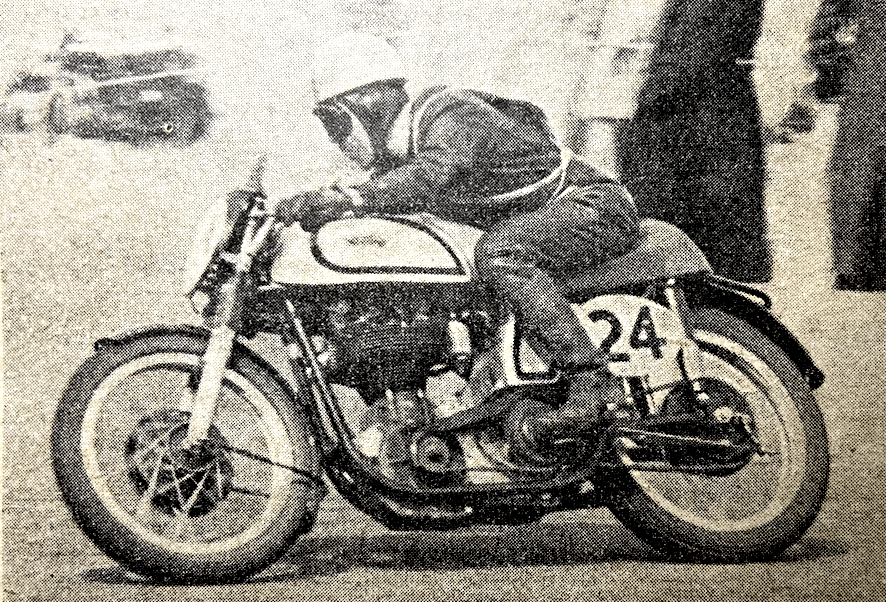
“THE TRIUMPH PEOPLE are to be congratulated upon having recently netted an order for 37 ‘Thunderbirds’, finished in black, which have been supplied to the Paris Police authorities, particularly as the order was subject to some very exacting requirements. The machines had to be of 500cc or over with ohv twin-cylinder engines, sprung at both ends and capable of a speed of 87½mph. The most interesting item in the necessary specification, however, was the insistence upon a very definite degree of silence.”
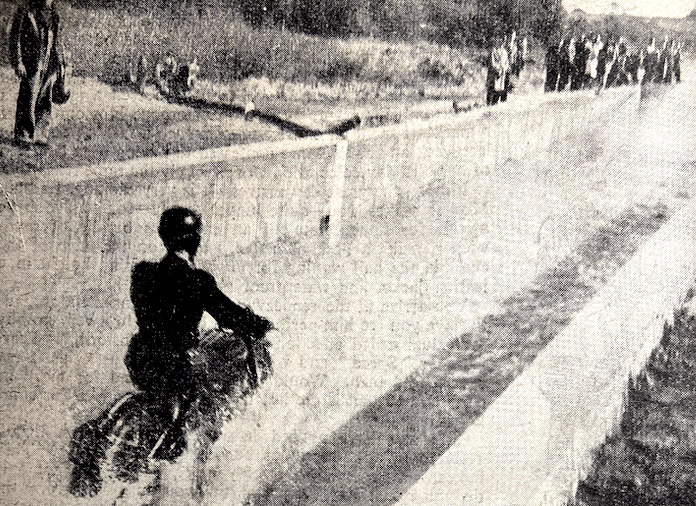
“LAST YEAR IT WAS suggested that the Lancashire Grand National (organised by the North-Western Centre) was easier than of yore. But on Saturday last the organisers’ claim that the three-mile circuit on Holcombe Moor, near Bury, provides some of the toughest going to be found on any sporting course in the country proved to be justified. This was in some measure due to the vile weather conditions which persisted throughout, and turned the peaty moorland earth into a quagmire in many places. Brian Stonebridge (498 Matchless), who won the 1950 event, rode magnificently and led throughout the 10 laps. His time of lhr 19min 21.4sec was 4min longer than his previous winning time. FG Richardson (499 BSA), who last time won the ‘War of the Roses’ Ashes Casket for Lancashire, nearly brought off the double, but was finally outridden by GE Broadbent (346 Royal Enfield), the Yorkshireman, who thus won the coveted trophy for his county. The amazing performance that is now expected when one or two Dot two-strokes are entered in a scramble materialised from a 197cc model of this marque in the hands of W Barugh, who finished well up among the large-capacity machines—in ninth place, in fact. This is particularly creditable when it is remembered that the nature of the course called for power nearly all the time; the braking effect of grass-tufts and semi-bog was not inconsiderable, while the ascent of Arcles Hill called for all the ‘horses’ that could be mustered. Out of the entry of 69 there were only 22 finishers. No manufacturer’s or club team finished complete, but it was decided to award the one-make team prize to the BSA team, which numbered two finishers. The rain eased off slightly when the crack of the maroon sent riders running to their machines for the start, but the minute section of blue sky which appeared turned out to be a false hope. GC Cordingly (348 BSA) was left on the line and was one minute late when his engine eventually burst into song. Meanwhile, the huge pack was gradually stringing out as the leaping, plunging machines roared on over the inhospitable moor, down into the ditch crossings, up the hill, and through the quarry which lies approximately three-quarters of the way round the circuit. First at the quarry was that determined young rider Stonebridge. As he came past the start-line he was closely followed by LR Archer (490 Norton), and behind him were strung out a line of BSAs carrying FG Richardson, PA Nex, DS Tye and GP Walker. Hangers-on were J Cox (498 AJS), FH Bentham (490 Norton), HD

Halsey (498 Matchless), MT Wilkinson (343 Triumph), GE Broadbent (346 Royal Enfield), and the Dot surmounted by a grinning Barugh. Among the rearguard was Dent Oliver (499 Rudge), the speedway rider, who would probably have been grateful for a handful of cinders here and there. To make things a bit more difficult, a thick mist now enveloped the moor, reducing practical visibility for the riders to about 10 yards. During the next two laps the leader was gradually outpacing his nearest rival, Archer, while some slight reshuffling was going on among the followers-on. It was quite clear now that Barugh on the Dot was well in the lead for the 250cc class award. Came news that J Avery (499 BSA) had taken a heavy toss at the quarry and was being removed to the infirmary for attention to cuts and abrasions (fortunately the injuries were not thought to be serious). By Lap 4 Stonebridge was lmin 35sec ahead of Archer. Next in order were Tye, Richardson, Nex and Broadbent. A pause before the Barugh Dot buzzed into view, followed by none other than GH Ward (498 AJS) who, after being well back on the first lap, had been industriously slicing his way through the field. A couple of laps later and the Stonebridge lead was 2min 25sec—quite unassailable assuming rider or machine did not give way under the strain. Both Tye and Richardson had overtaken Archer, and Nex was ‘missing, presumed sunk’. Bentham had retired with a burnt-out clutch. Various others had also retired; the field was getting thinned out considerably. E Ogden (490 Norton) stopped with a broken chain, and RK Pilling (498 AJS) retired after a fall. The field was not the only thing that was getting thin; so was the weather! What had previously been drenching rain was now biting sleet and at times even hail. Richardson (Lancashire), who had been leading the ‘War of the Roses’ battle, now found himself displaced by Broadbent (Yorkshire). MT Wilkinson found time to stop for refuelling, and JS Hyslop (347 Matchless) to throw a clod of earth at some officials as he went by. As the final lap started for the leaders Archer recaptured third place and Broadbent found he had Ward hot on his tail. A cheer went up as Stonebridge took the chequered flag, almost a complete lap it front of Tye, the second man home. Archer had held on to third place and Ward had jumped into fourth position. The rain continued unabated as the mud-bespattered remnants of the entry straggled in to receive the chequered flag. For those who required them, hot baths in Bury ha( thoughtfully been laid on by the organisers. RESULTS Motor Cycling Cup (best time): BG Stonebridge (498 Matchless), lhr 19min 21.4sec. Ashes Casket (fastest Yorks or Lanes resident): GE. Broadbent (346 Royal Enfield), Yorks, 1hr 26min 44sec. Raymond Bailey Trophy (fastest NW Centre member): FG Richardson (499 BSA), lhr 29min 6.6sec. 500cc: LR Archer (490 Norton). 350cc: DS Tye (348 BSA). 250cc: W Barugi (197 Dot). Best Newcomer: MT Wilkinson (348 Triumph). Manufacturers’ Team Award: BSA (FM Rist and DS Tye).”

“I DIMLY REMEMBER the first British motor show. It was held in a park at, I think, Tunbridge Wells. Marquees were the sole cover. But most of the few exhibits gambolled about under trees, superciliously eyed through monocles by men in toppers and frockcoats or by ladies through lorgnettes. I recall that the vehicles looked like Emett caricatures of the handsome horse carriages of the day. The absence of a horse and shafts impressed one after the fashion of a headless corpse on a battlefield. They stank—how they stank. They shivered perpetually—compared with them an aspen leaf was a symbol of immobility. The white-haired uncle who dragged me to the Show bought an exhibit, which had a crankshaft apparently made from Brighton rock, for it snapped in half almost every time he went out. The idea of a park as a venue was logical. No eccentric, however amiable, was likely to buy a prehistoric car without a road trial. Therefore the Crystal Palace soon became a popular site for early shows, the eager client could be given a run round the grounds So indispensable was the road trial that when the shows moved to Islington and Olympia, tickets for trials runs were sparsely dealt out to ‘genuine’ inquirers at the stands. The victim was then led round the corner to a giant garage, and the firm’s tester joggled him round a block in a sidecar. We were never allowed to test two-wheelers, as we might skid them under a three-horse bus on the greasy setts, while the models were not sturdy enough to take a possible purchaser on the carrier—if any. At the earlier shows we were tolerated by the pedal-cycle manufacturers, who claimed the bulk of the exhibits, though the cyclists regarded us as lunatics. Similarly, the parson at my ancestral home was suspect, because he spent all his leisure building gliders in his back garden, or jumping in them off the brow of a hill. The parishioners swiftly reported him to his bishop, who had him out pronto. Otherwise he might have shared laurels with the Wright brothers. Alfred Harmsworth—later Lord Northcliffe—probably did as much as anybody to convince Britain that ‘motors had come to stay’—the popular taunt hurled at us when we squatted by the roadside, peering anxiously at a dead engine. So the whole atmosphere of the shows changed within a year or two. The exhibitor ceased to be a plausible suppliant, humbling himself before a cynical public. He lounged in a huge padded armchair on the dais of his stand. When at last he deigned to notice us, he demanded a cash deposit of 25%, regretted that his trial sidecar was fully booked for the show period, and refused to guarantee or even to name a delivery date. Later, when the public awoke to the capricious character of the new transport, the exhibitor once more became the suppliant. Nobody any longer dreamed of paying a deposit, or even of paying catalogue price until after prolonged chaffering. I recall how Pennington demonstrated his air-cooled tricycle in a field at Coventry. As its cylinder consisted of plain cast-iron piping devoid of fins, he circled the field once, and then paused to harangue the assembled engineers while the cylinder cooled. Nevertheless, I believe he sold three that afternoon! But a year or two later, every exhibitor connected with a dozen promising ‘contacts’ on the opening day, and chaffered with them till the closing day. At that period factories preferred to sell direct and so save retailers’ commission. The modern agency system was still unborn. No provincial dealer was yet prepared to contract to take a dozen machines, or even one, for he might never get a single sale. Still less would he stock spares, and he was seldom mechanic enough to service a model properly. On the other hand, an agent would accept a machine ‘on sale or return’, ride it all summer, and return it unsold and practically worn out in the late autumn. So some factories—you’d be surprised to learn their names—actually appointed rider-agents, and offered their existing customers 15% or so on any business resulting from their recommendations. It was, therefore, every maker’s ambition to festoon his show machines by noon on the opening day with large gilt-edge tickets, ‘sold to Lord X’, or to Captain Y, or even to plain Mr Z. Self-respect demanded that by the third day every machine on the stand should bristle with tickets like a draper’s windows at the annual sale. There were some poor wights who took their cards back to Coventry and
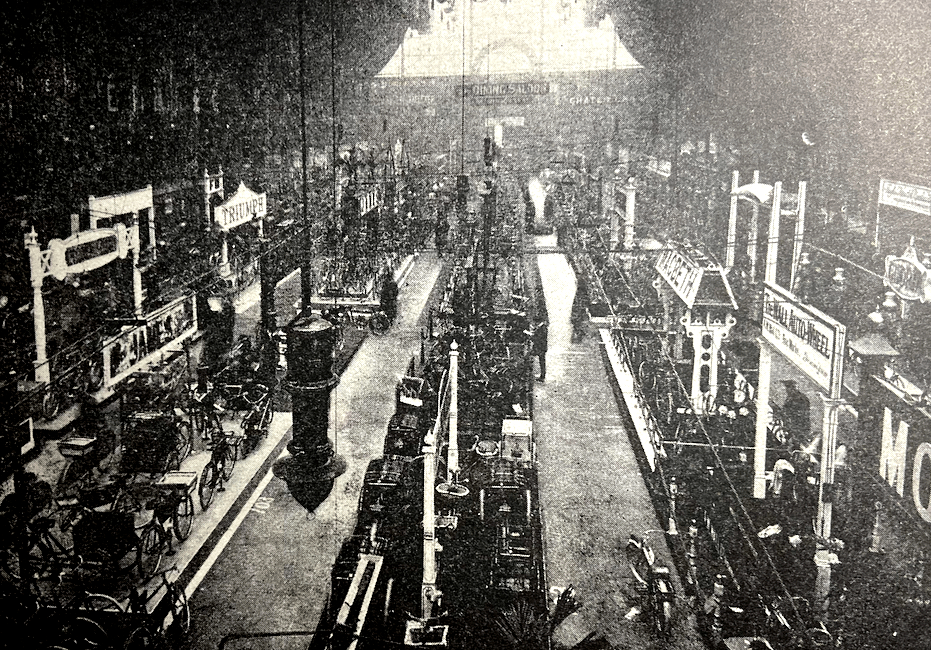
stored them for next year. While the best machines were still barely roadworthy, the show furnished a disgruntled customer with magnificent opportunities for revenge. He would haunt the neighbourhood of his maker’s stand. As soon as he saw the chief salesman in charming but mendacious conversation with an opulent contact, he would creep up, and join in the dialogue. Thus—Salesmn: ‘I assure you, sir, we can absolutely guarantee our sports model to touch 75 on the flat, and to climb Sutton Bank at 40.’ Customer (rapturously): ‘You can?’ Disgruntled One: ‘He can, heck! That’s what he said to me last year. Mine couldn’t beat 40, even when it went.’ Part of the joy of the show was to spot such a fracas, readily identifiable by the red faces and popping eyes of the protagonists, to join the small crowd around them and to keep heaping fresh fuel on the flames. Another good turn was to see the boys baiting an ignorant show attendant. Some cheeseparing factories would staff a stand with one competent salesman and a squad of tailors’ dummies recruited from the Coventry office staff—anybody who had a good lounge suit. The boys would spot one of these innocents and, assuming the rapt expression of eager novices, would put him under a quickfire technical catechism. Simultaneously, makers were absurdly prone to exhibit completely untried novelties—I have even caught them out exhibiting engines which consisted of little but an empty cylinder and a crankcase. A famous instance of this type concerned a firm which realised on the eve of the show that their customers were bound to turn nasty about the past year’s transmission (a ⅝in all-leather belt behind a really potent 500cc engine). So about a week before the show they dreamed up ‘our new patent armoured belt’. This consisted of the same old belt, adorned by a series of small rectangular steel plates riveted to the top of the belt, and hinged every inch or so. This fantastic abomination was loudly advertised as combining the feminine smoothness of the belt with the masculine sturdiness of the chain! Each hinge-pin projected outward about ¼in, and the ends registered with crescent-shaped nicks in the rims of the pulley. The firm had just five machines in the world. All were fitted with the armoured belt. Four went to the show. The head tester took the fifth down into the country to see how it behaved in practice. It had not dawned on the inventor that steel and leather do not wear equally, so that very soon the pins would no longer register with the pulley nicks, and the model would proceed to a merry jingling accompaniment. Providence, however, saved the firm from actually saddling any wretched customer with an armoured belt. Early in the test the belt fastener broke. The writhing belt ripped off half the tester’s stocking, chewed large gobbets of flesh out of his calf and, tangling itself up round the rear hub, despoked the wheel and cast the tester into a nettlesome ditch. All’s well that ends well. Within a week they found that a lin-wide belt solved their transmission problem cheaply and simply. Believe it or not, as Ripley says, too many orders may prove worse than no orders at all. One famous factory had been joggling along quietly and happily for some years on a small but steady order book. At one show they perpetrated the frightful blunder of staging a machine which won all hearts, and accepting innumerable orders, although they had only prepared for quite a small output. They booked and booked and BOOKED! The directors walked about like a £75,000 pools winner. They celebrated in champagne. Then they went home and studied production. They had neither the space, not the machines, nor the materials, nor the skilled labour for such an output. So they cheerfully decided to ‘put out’ all the simpler components to sub-contractors. This achieved, they rented bigger homes, and began buying champagne weekly by the case, instead of annually by the bottle. Alas! as the hastily assembled and hardly tested models went out to the public, the ‘phone wires fused as angry men spoke words of flame. The sub-contractors had let the firm down. Tanks were porous, or leaked at every seam. Spokes fell out of the rims and hubs. Nothing was right. I doubt if the firm ever quite regained its original reputation after that catastrophe. The famous 400cc ABC of 1919 met a somewhat similar fate, though its snag was mainly due to inflation, coupled with a premature announcement and subsequent production delays. So much for the past. Today sterling quality is as basic an assumption as the axioms of Euclid. The modern show derives its two main joys from contemplation of this quality plus meeting all the boys. For the time being, its other aspects are rather mournful. We are slightly more fortunate than the car folk, for if some motor cycle exhibits are earmarked for export, we can usually get a new post-war model without waiting very long, though the armament effect on the steel market may now prolong our delays. But the prices are formidable indeed. After the Kaiser War a brief wave of inflation hoisted prices for a few months. But the peak was shortlived. A friend of mine bought a motor cycle and sidecar in 1919 for £340, and ultimately sold the outfit for £45. Another friend paid £650 for a light car, spotted the red light three months later, and sold it just in time; a few weeks after the price had dropped to £300. But this time prices are obstinately staying up. The basic degree of inflation is round about 300%, but is raised to almost 400% by Purchase Tax. We are asked about £250 for a model which would have been listed at £70 in 1939. Many old-timers were accustomed to maintain a wife and family for twelve months on the current value of a first-class roadster! I have done as much myself. There is no sign of imminent deflation on the horizon. It is obvious that the real value of the £ cannot take a sudden upward jump, nor can our export prices stand further inflation. The outlook at the moment is as dark as it is doubtful. However, at least we know that when we have weathered our present troubles, the best motor cycles in unparalleled variety will be awaiting our pleasure. Nowhere else in the world does any industry offer a similar combination of superb quality in superb variety.”—Ixion
“A SHORT TIME back I described how pals credited me with having, some 40 years ago, achieved a 180° skid, retained my saddle and my verticality, and ridden nonchalantly on. A London reader informs me that in 1948 he saw a Matchless tester perform that identical stunt with a springer in Beresford Square, Woolwich. I gather the tester was surprised more than somewhat. Which reminds me of an untruthful friend who, years ago, went to Nottingham with notions of buying a Brufsup. Because the customer was slightly scared of attempting 100 per on a works’ model, George Brough sent him out in a sidecar with the foreman at the helm. My friend stammered his admiration after the outfit had touched 94 per by speedometer. He surmised that one wouldn’t think it was safe. ‘Safe?’ snarled the indignant foreman, ‘Why it’s as safe as a bathchair! Even hands off!’ He proceeded to accelerate up to the nineties again and then to lift both palms shoulder high. My friend swooned, and had to be revived with cognac on return to the Brough office. At least, that is the tale.” —Ixion
“SOME OF OUR READERS seem unjustifiably concerned at certain recent prosecutions. When the road services were nationalised, the new controllers were not fully conversant with the regulations which limit a driver’s hours at the wheel. Nearly 600 men were charged, either with exceeding the statutory limit of 54 continuous hours at the wheel, or with driving for more than 11 hours out of 24. (In these days it is rather inspiriting to read of anybody working more than a statutory minimum.) It is true, as readers say, that many of us have driven a far larger slab of the day than these regulations permit to lorry drivers and we have often done it on two wheels. But the rules are framed to prevent bosses from exploiting employees, and to prevent eager earners from tiring themselves by working till their faculties become blurred. The law is simply aimed at compulsory and continuous overdriving. Nevertheless, if any of us become involved in a crash after an absurdly long spell in the saddle, he would unquestionably be punished under those broad regulations which forbid us to ride unless we are fit to ride.”—Ixion
“WHAT, NO CHROME? Well, a good deal less of it anyhow! But is this really such a terrible catastrophe? I am well aware that there are riders who tend their chromium plate with loving care, but even from them there have been complaints of the short life of some present-day plating. Only the very best stands up to our weather conditions plus average neglect. On the whole, our new enamel finishes look very smart and they are likely to be more durable than any but the most excellent plating. As for appearance, what could be better than a neat enamel finish, lightened, if necessary, by a polished aluminium chaincase, timing cover, crankcase or what have you? And does not polished aluminium help to ease the cleaning situation? Sad to say, there are far more important shortages than that of materials for plating. Steel shortage, for instance, has held up more than one interesting development which might otherwise have appeared at Earls Court, and general shortages have had a serious delaying effect on production lines. Nineteen-fifty-one has been a year of steady but unobtrusive progress, though many improvements are internal and therefore invisible from the outside. For instance, several firms have gone to a great deal of trouble to improve the balance of engines. It is, in fact, remarkable that they have achieved such excellent results from types of engine which are inherently unbalanced. Road racing has had an important effect on this matter since, apart from the tiring effect of vibration on the rider, the better the balance the less the load on the bearings, and the less the power wasted in overcoming friction. Perhaps the most important trend of the whole year has been the steady development of AC generators. The full import of this is not yet obvious on Show exhibits, since it is apt to involve the complete redesign of major engine parts, and redesigning has not been possible under present-day conditions. The underlying principle is anything but new. Many two-strokes have
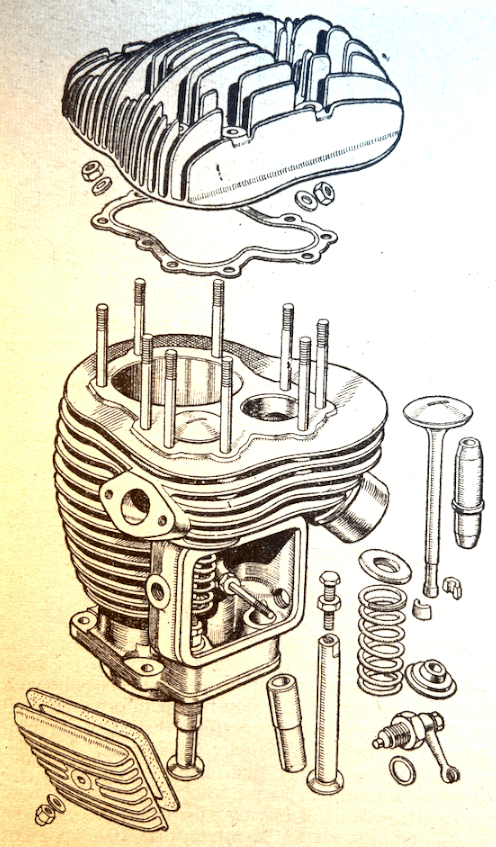
employed it in its simplest form, and I well remember one of our best-known designers showing me a layout for a big four-stroke with AC equipment in the early part of the war. When fully developed for motor cycles, the AC generator will relieve us of costly, unsightly and noisy auxiliary drives. There will be no need for external voltage regulators, no rotating wire-wound coils and no brush gear to give trouble. Nor need we fear the effects of a run-down battery, since a starting-size spark will be available at quite low crankshaft revolutions. Since modern insulation can be proof even against hot oil, it would not be in the least surprising to find the generator enclosed within the crankcase, with the armature adapted to form at least part of the flywheel. Indeed, a patent for such an arrangement has already been filed. It is a striking fact that all our best-known electrical suppliers are concentrating on generators of this type. Seldom has there been a year with so little visible alteration to engine design. We all know that the main reason is shortage of materials owing to rearmament, but we need not be downhearted as to the future, for there is plenty of advanced thought among our designers and plenty of novelty hatching. Meanwhile, we have reason to be fairly satisfied with the choice of machines available at the present time, for there is something good to be found in every class, from 1,000cc to the tiny ‘clip-ons’ (I hate the term but it is catching). As was the case last year, the parallel-twin holds a very important position in the field, and it has already conferred on us the benefits of power with less noise, and far more even torque, than the single. So far, it has not had the whole-hearted support of a manufacturer in the racing world, but Earls Count reveals a parallel-twin in what has been regarded, up to now, as a purely racing frame. Is this a case of coming events casting their shadows before? I don’t know, and only time will tell. There seems to be every reason to hope that when the parallel-twin has received as much concentrated attention as the single, it will prove to be even better than the
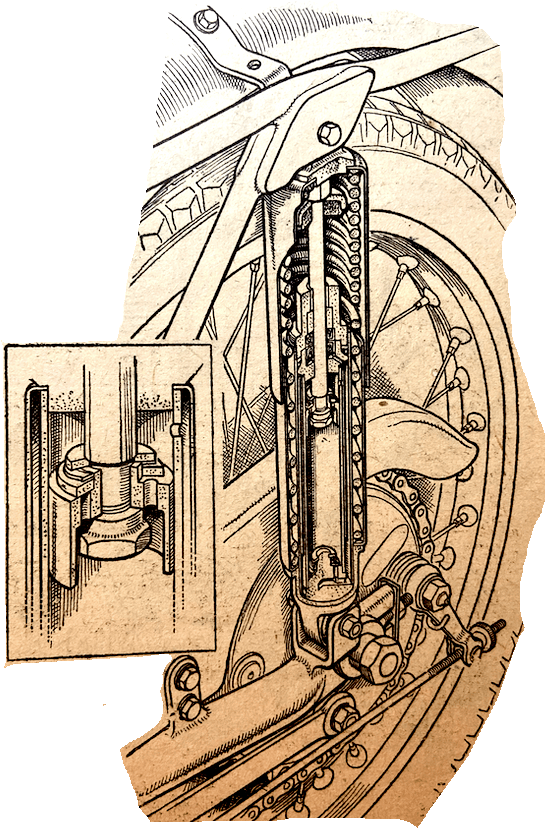
present examples. Before leaving the subject of parallel-twins, some mention must be made of the side-valve example which is on show but not, alas, on sale. It is well known that the Ministry of Supply has always favoured the side-valve, and this is the raison d’etre of the present exhibit. Nevertheless, there are many other folk who have a weakness for side-valve gear, and there might well be room for such a model on the market. There have been spasmodic examples of side-valve parallel-twins from other quarters but they do not seem to have materialised. Of other twins, there is a superb example of what can be done with the V-type in the largest class, and there are two British makes of flat-twin. These two, with a geared-crank four-cylinder unit, are the only British examples of engines with intrinsically well-balanced layouts. The single remains ever-popular, and will continue to do so for some time: It has, in the case of our best-known racing stable, justified its existence in no uncertain manner during the past year. Yet, from the tourist’s point of view, and also that of the technician, its strongest claim to continuance lies solely in the fact that it costs less than a twin. That, unfortunately, is a matter of prime importance just now….Side-valves do not appear to be on the increase. Some famous, indeed almost legendary, side-valve models remain in up-to-date dressing for the excellent reason that nothing better suited to their particular sphere of activity has yet been devised. This statement applies mainly, but not entirely, to big singles which are ever popular for passenger work. It seems odd that the 250cc engine has declined so much in popularity in this country, and I sometimes puzzle over a satisfactory reason. Perhaps the modern 150-200cc two-stroke, with its lighter weight, low cost and good all-round performance, has cut into the market to a considerable degree. The fact remains that there are only four British makes of 250cc single and one two-stroke twin of this capacity at present on the British market. This brings us to the subject of the two-strokes, which have made such tremendous advances in popularity in the past decade. No one has yet eliminated the bug-bear of four-stroking at small throttle openings, though some types are better than others. For those who are prepared to put up with this mechanically unimportant drawback, the two-stroke, with its utter simplicity, light weight and admirable slogging capabilities, is a very sound proposition. Though not yet so popular in this country as on the Continent, it has a very large following which is likely to increase. Continental manufacturers have a habit of making their engine and gear units look extremely attractive by the careful enclosure of various parts. A smooth exterior is a great attraction especially to those who like to maintain their machines in clean condition. So far only one British manufacturer has followed suit, but I should not be surprised if others fall into line before long. Maximum cylinder capacity for modern two-strokes remains at under 200cc and, of course, taxation in various countries has had a considerable bearing on this matter. There are only two British twin two-strokes and, at the moment, no British
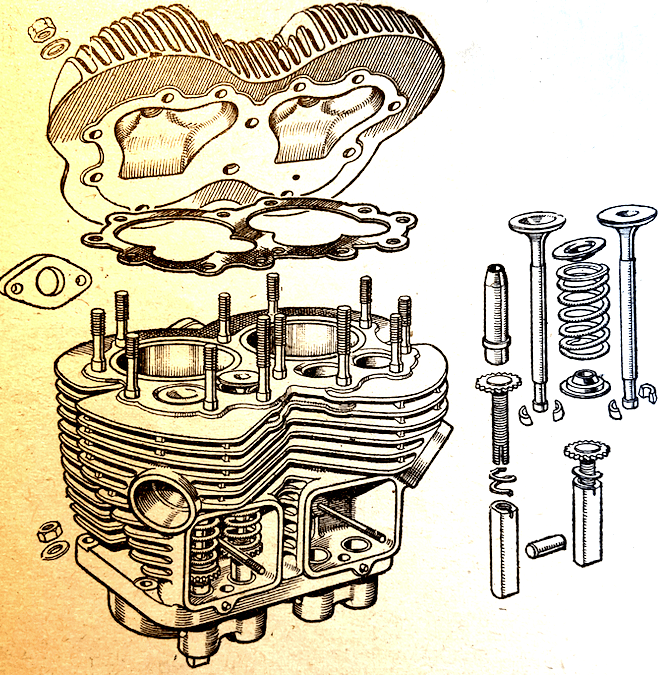
double-single. The latter variant, which has had considerable success abroad, has the great advantage of providing much better port timing with a consequent improvement in performance and fuel economy. On the other hand, it adds to both weight and cost. The bulk of the British two-stroke engine market is supplied by one firm whose experience is unrivalled. I do not know which model to admire most, but I am intrigued to see that the 197s are appearing in competitions with no little success. I must add a word of praise for the performance of those tiny engines which propel cycles with such verve. The two-stroke appears to shine particularly brightly in this galaxy. Some considerable attention has been paid to gear boxes, and shafts tend to become shorter and more rigid. This is all to the good since there is likely to be less whip, and consequently less noise and loss of power. Foot-change mechanism also has been improved in detail. It seems odd to find that there are still many folk who prefer hand change when foot operation appears to have so many advantages. There is not much to be said about transmission since there no marked change in this line. Chains can be very efficient if correctly maintained and properly protected; yet I doubt if owners of the two existing British shaft-driven machines would revert to chain drive if they could possibly avoid it. Shaft drive may add slightly to the initial cost, but the complete absence of mess and maintenance is a very real joy. New Continental models show a marked trend toward total chain enclosure and if chain drive is to survive this country may find it necessary to follow suit. Now that the flexible suspension of both ends of the machine is almost universal, a great deal of thought and ingenuity is being expended on this subject. Not every manufacturer who changed over to telescopic front forks made a perfect job of it at the first attempt, and whether the suspension system be dependent on springs, air, oil, rubber or a combination of more than one of these media, it is important to remember that to obtain the best results front and rear suspension characteristics most be considered together. Many telescopic front forks are hydraulically damped and many and various are the degrees of hydraulic damping. In some systems only the rebound is damped; in others, both load and recoil are progressively checked…As to rear suspension, the trend appears to be toward pivoted rear forks. Plunger springing has confounded its critics, and in many instances provides a first-class ride, but there is a slight swing towards pivoted forks which I am inclined to think will increase. Whichever type becomes the more popular, there will always be fluctuations in chain tension. However, these fluctuations can be minimised by keeping the sprockets (driving and driven) as nearly equal in diameter as circumstances
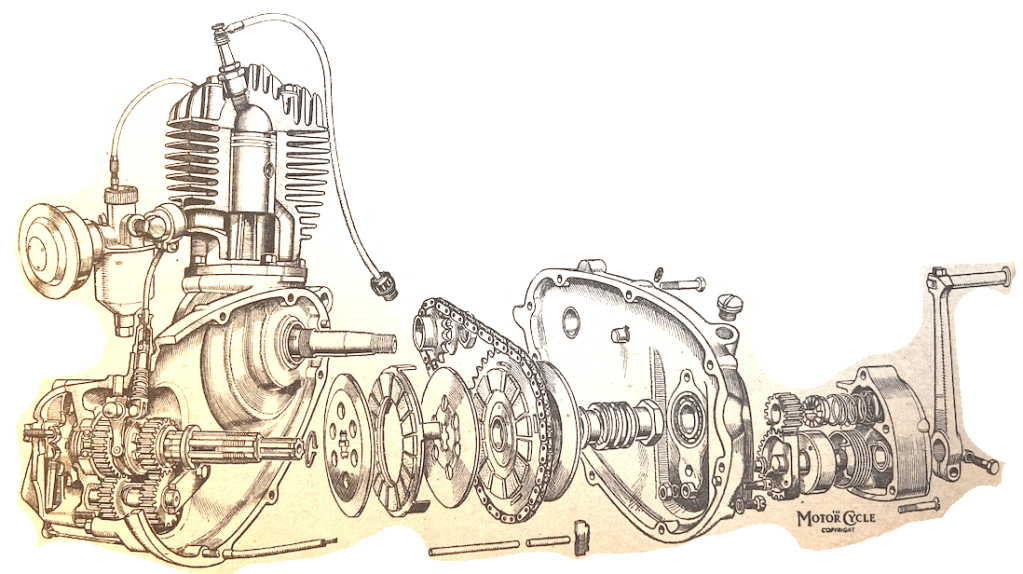
permit. It is good to see an increase in rear-sprung lightweights. The little ‘uns need this form of luxury as least as much as their bigger brothers, and only the matter of cost prevents universality. Bulbous saddle tanks are still the correct wear, and I suppose that they are with us for keeps. They are inclined to be heavy, expensive and space-wasters. In many, perhaps in most, cases they must be removed before a top overhaul can be undertaken, and for this reason they simply must be easily removable, with a minimum of loose parts to roll about the garage (or kitchen) floor (designers, please note). The combined seat for rider and passenger is steadily growing in favour. It is immensely practical and I can think of nothing better suited to its purpose. I wish that I could, for, to my eye, it is ugly and spoils the appearance of many a smart machine. Perhaps I shall get steadily more accustomed to these seats. There is a tendency towards fitting proper luggage-carrying equipment, made for the model. On with the good work! But I see few signs of manufacturer-designed legshields and screens. Proprietary concerns are doing their best, but they just cannot turn out the best possible for every touring model. This is not just the cry of a poor old man in his dotage. There are hundreds of tourists and daily ride-to-workers who would be only too thankful to dispense with waders and clumsy togs. It can be done, but it is done only by a very select few. And now we have another car-type carburettor on a motor cycle. At present it appears to be limited to one marque only. It is a good car carburettor, and I do not see why it should not be equally good on motor cycles. It is excellent news that perhaps the best-known motor cycle racing carburettor is to be progressively available to the sporting public. In these days of rapid technical progress I am always on the look-out for new materials, particularly for the adaptation of plastics to motor cycle use. This year there is a new transparent material for petrol pipes. Not an epoch-making novelty but interesting all the same. I believe that there is room for plastics in many lightly stressed parts, if only to save precious metals—and, incidentally, weight. The use of light alloys is steadily increasing, especially for cylinders and heads, and a new engine from a famous factory uses light alloy for both parts. Alloy heads are now fashionable for all sizes of engine from the smallest of two-strokes to the hottest of hot
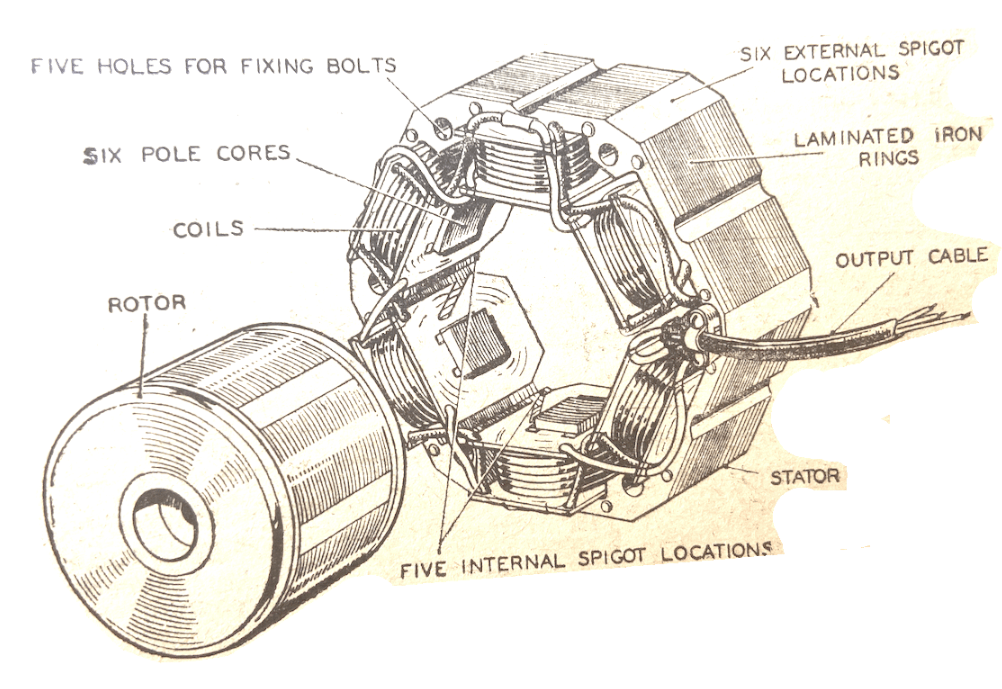
racing engines. After all, it is in the head that high-conductivity light alloys are of the greatest importance. There has been quite a lot of discussion about wheel sizes. Are we to have smaller wheels? I can see the point of small front wheels for racing machines, where the reduction of head resistance is all-important and where road or track surfaces are smooth. But small wheels have been suggested in order to facilitate long spring movement. I can only suggest caution in this direction because on poor road surfaces, the smaller the wheel the rougher the ride. There may be a happy medium, but to go to extremes would be out of the frying pan into the fire. I do not think that small wheels will appeal to oversea riders. Scooters have not yet caught on in this country to the same extent as abroad, but a new one makes its bow at Earls Court and it will be interesting to watch the reaction of the public. Sidecar manufacturers continue to improve on the comfort and appearance of their models, but considering the large number of people who are interested in this form of transport there appears, in certain quarters, to be a mild lack of imagination as to outward appearance. Comfort, practical utility and moderate price are the acknowledged first essentials. But in view of modern car styling, cannot something be done to provide a rather more exciting exterior? Most of us will miss the classic three-wheeler at Earls Court. I do not think I can remember a Show without it, but we have two other three-wheelers, both with a single wheel in front and two wheels behind. Is this the shape of things to come? Both these three-wheelers have interesting suspension features, and the newest (to passenger work) is quite a family affair with a very car-like specification. Yes, an interesting Show.”

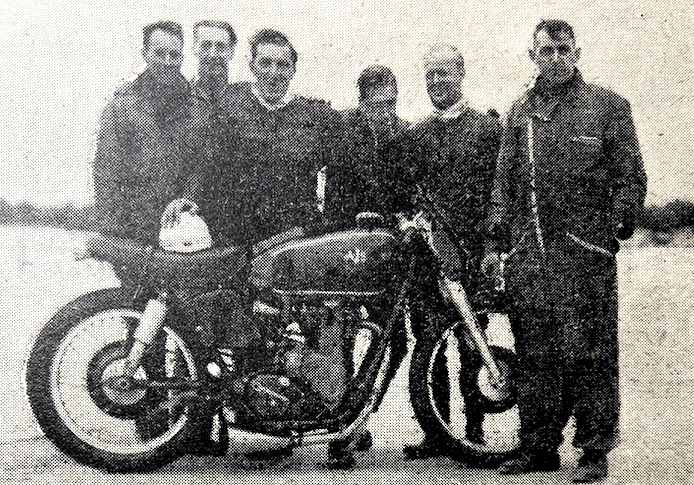
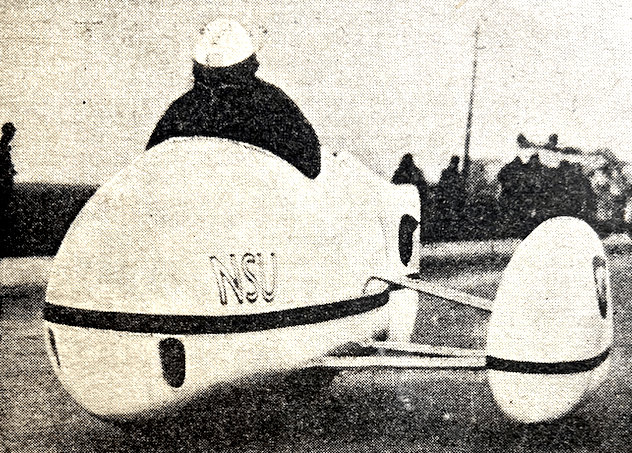
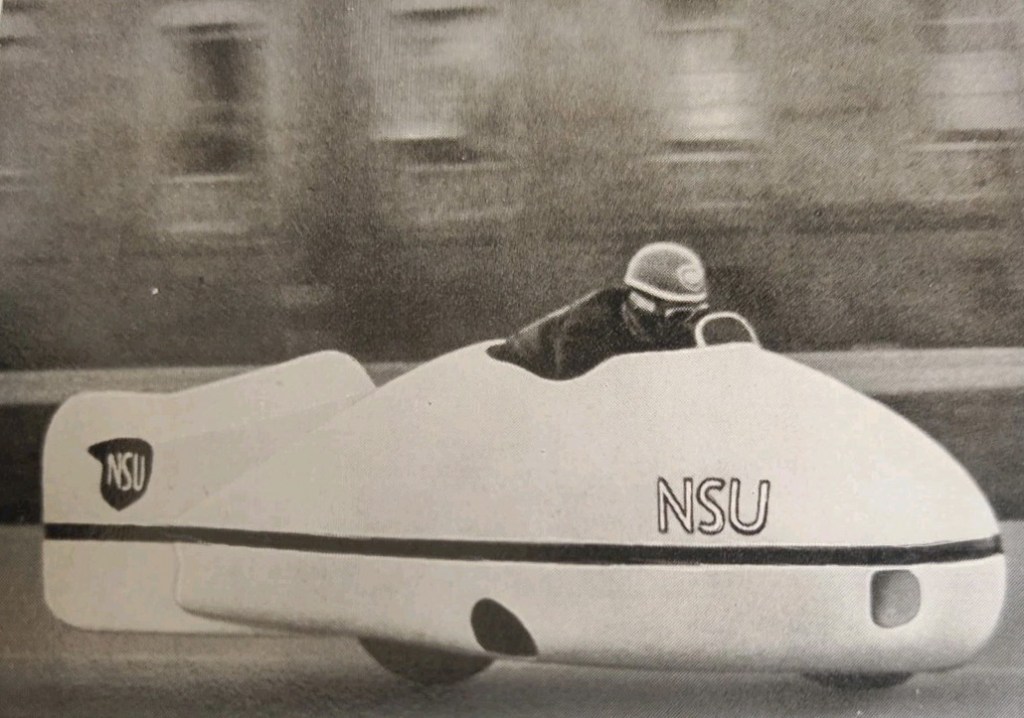
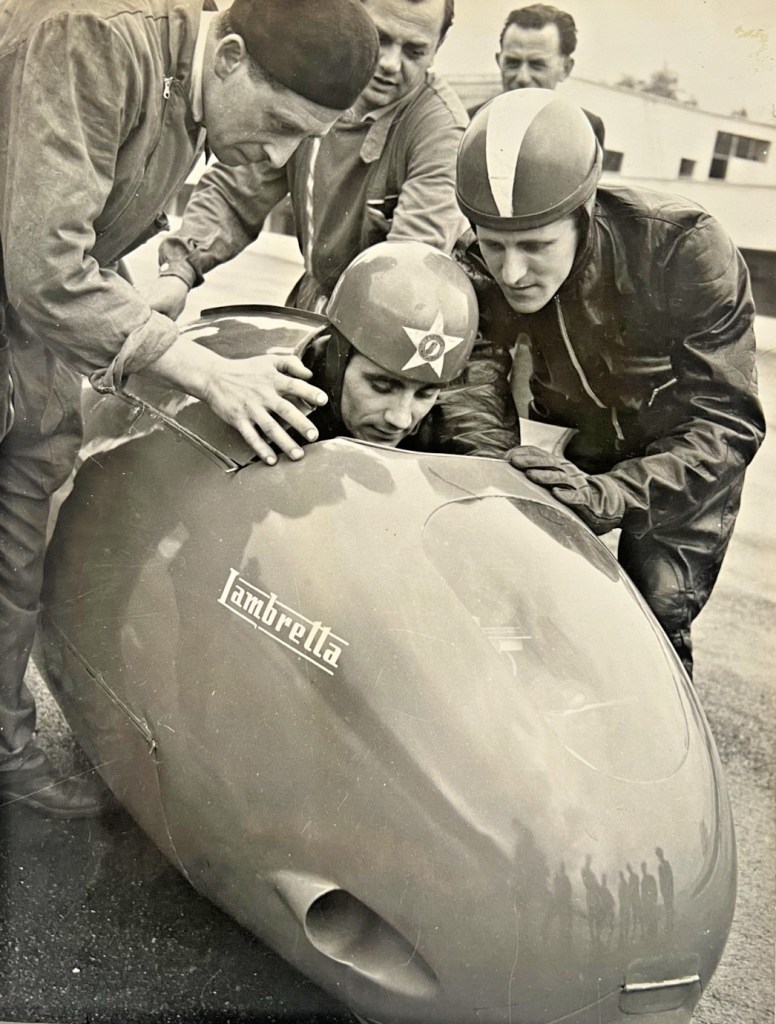
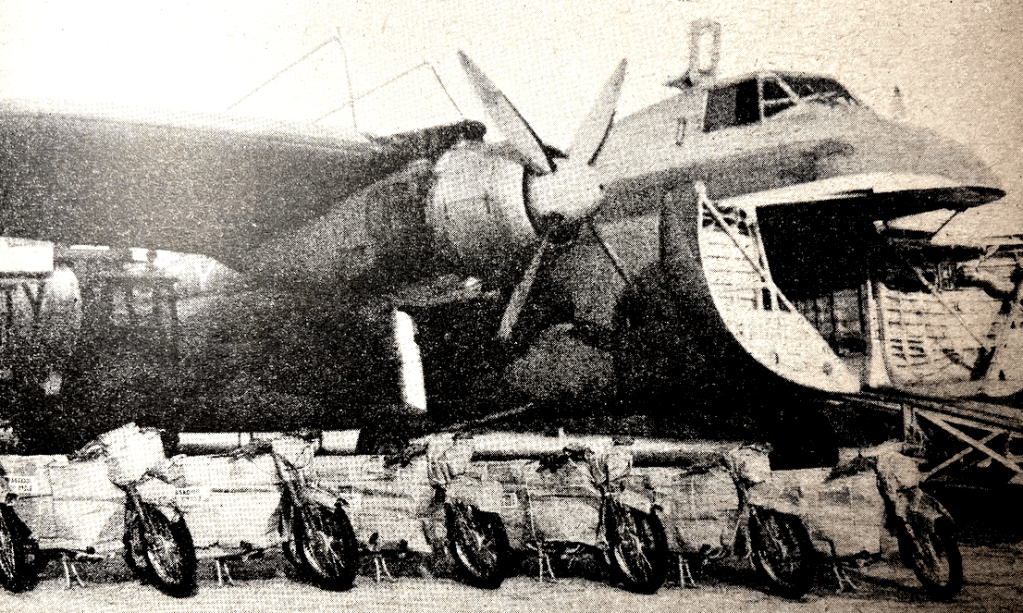
TRANSPORT MINISTER John Maclay opened the Earls Court motor cycle show. “A sea of upturned faces greeted the Minister as he spoke into the microphone on the balcony. Earlier, long queues had formed awaiting the time for the turnstiles to click at 10am…there had never been a more promising start for the London Show. Mr FA Kimberley, president of the Manufacturers’ Union, stressed that in spite of the very difficult economic period following the end of World War II, the industry had risen to the requirements of the times…in 1938, 20,000 motor cycles had been exported. In 1950 the figure was 74,000. Mr Maclay said that the industry was producing motor cycles at the rate of 180,000 a year and that 58% of that output went into foreign markets: “It is comforting to think that in all corners of the world an increasing number of people are going about their business or pleasure on such typical British products.” He referred to competition successes—the 350cc, 500cc and sidecar World’s Road Racing Championships…the Minister introduced the subject of road safety: “There is a good deal of criticism, some a irresponsible, of the motor cyclist…while there may be irresponsible elements…I think the motor cyclist is as much sinned against as sinning.” It was desirable for a learner to be instructed by an experienced motor cyclist; the Minister said he thought the RAC-ACU Training Scheme should be given every possible encouragement.”
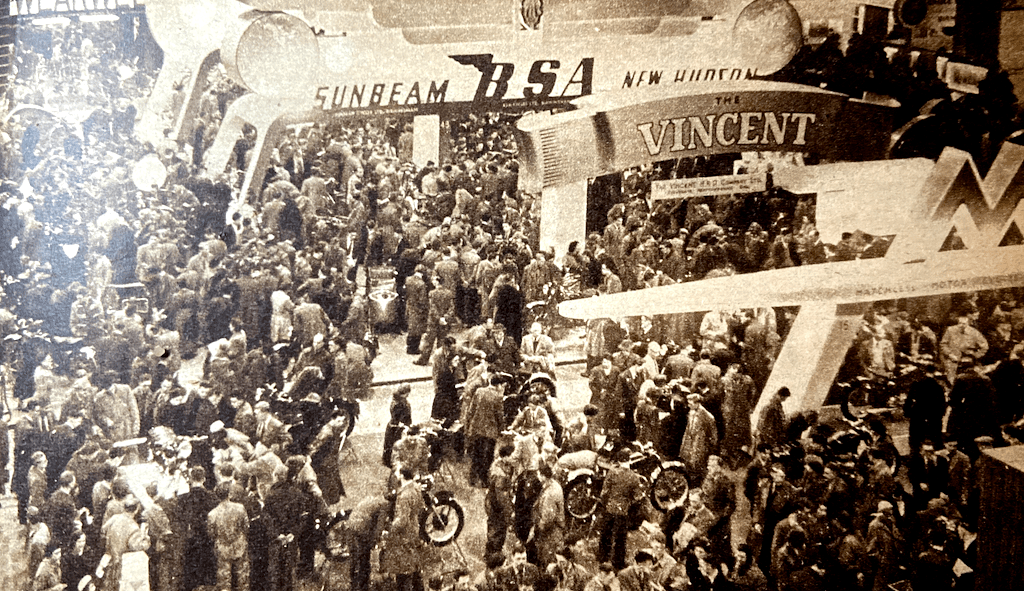
“SPORTING ENTHUSIASTS are well catered for at the AJS stand, where there are on show three types of machines which have won many honours both for the marque and for Britain. These are the 7R 348cc production racer, the 498cc Porcupine racing twin, and—another machine which is creating considerable interest—the 498cc special Springtwin ridden by BHM Viney as a member of the successful British Trophy Team in the International Six Days’ Trial. A brand-new exhibit on the stand is an attractive mattress pillion seat with raised i back. This has generous dimensions, and is linked to the rear of the saddle to co-ordinate the movement of rider and passenger. There are long, supporting coil-springs at the rear attachment. There is also, of course, the full range of standard and competition AJS models. Perhaps foremost among these is the 498cc Springtwin, which is equipped as standard with pivoting-fork rear suspension; a newly designed crankcase breather has been fitted to the 1952 engines. The 347cc and 498cc single-cylinder road models are available in either solid or spring-frame form; their competition-model counterparts are similarly available. The new Burman gear box, developed from the 7R racing-type box, which has been adopted on all AJS models, will undoubtedly make a strong appeal to future owners. Finish of all AJS production models is particularly good, and although chromium-plating can only be used for such items as handlebars, exhaust systems and control levers, the
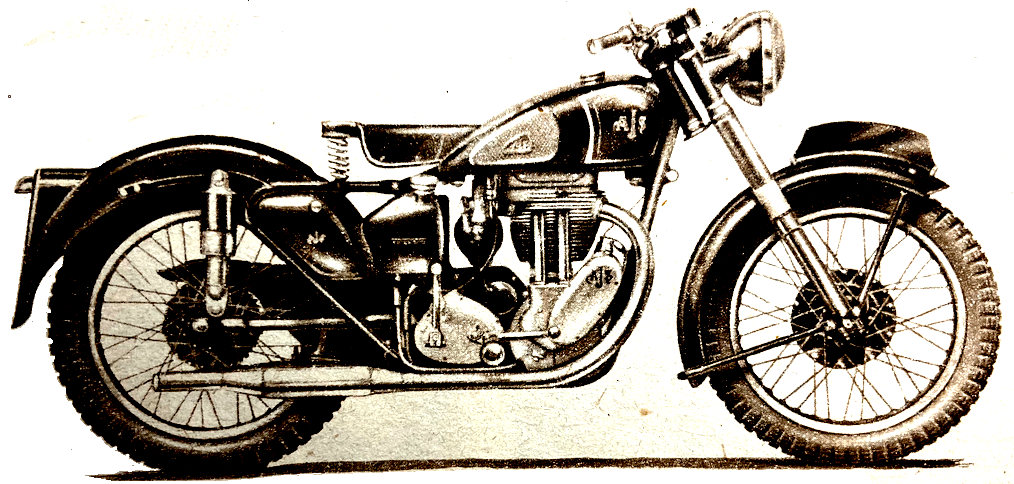
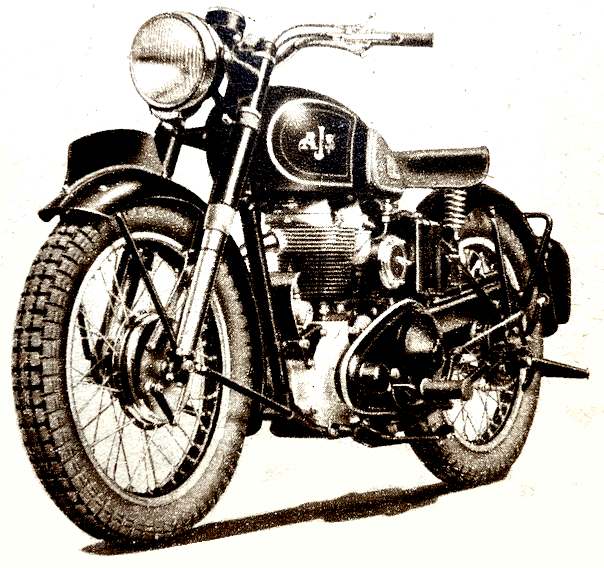
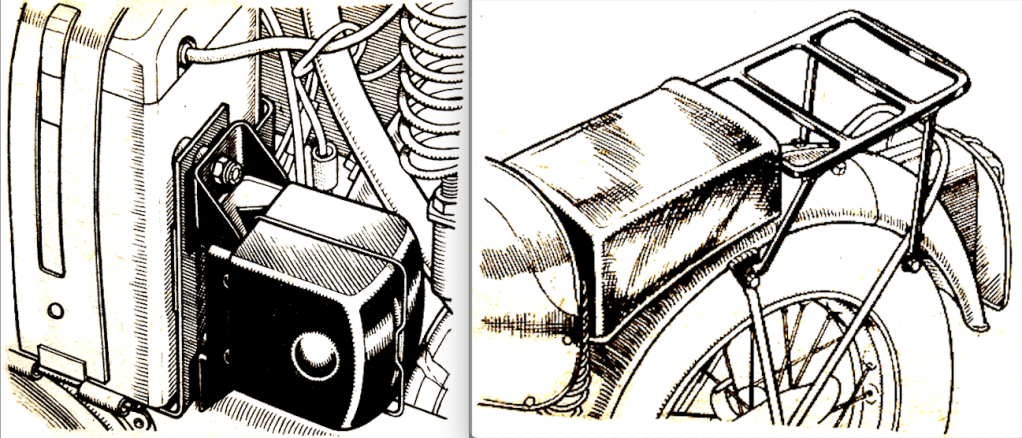
general appearance is anything but dull. The AJS tank insignia has a gold anodised finish. Lower portions of the Teledraulic front fork legs are in polished light-alloy. Bonderized against rust, the wheel rims have a smart matt, aluminised finish. Push-rod cover tubes, steering-crown dome nuts and fork nuts are some of the fittings which are bright cadmium-plated. Several nuts and bolts are Parkerized. The magneto shield on all the singles has been cleaned up and redesigned; the clips and bolts have disappeared, the shield being retained, from underneath the platform—only a small point, but one which typifies the trouble that has been taken to enhance the general neat appearance of these models.” The glistening array of 197cc two-strokes on the Ambassador Stand is especially attractive to lightweight machine enthusiasts. There are three separate models, the Popular, the Embassy and the Supreme, and, as the names imply, the degree of refinement varies on each model. The Popular, lowest-price machine in the range, has a Webb girder-type front fork and direct flywheel-generator lighting. Tank finish is an attractive mottled silver-grey. Similar in general appearance except for a Metal Profiles telescopic front fork, the Embassy is fitted with a rectifier-battery lighting

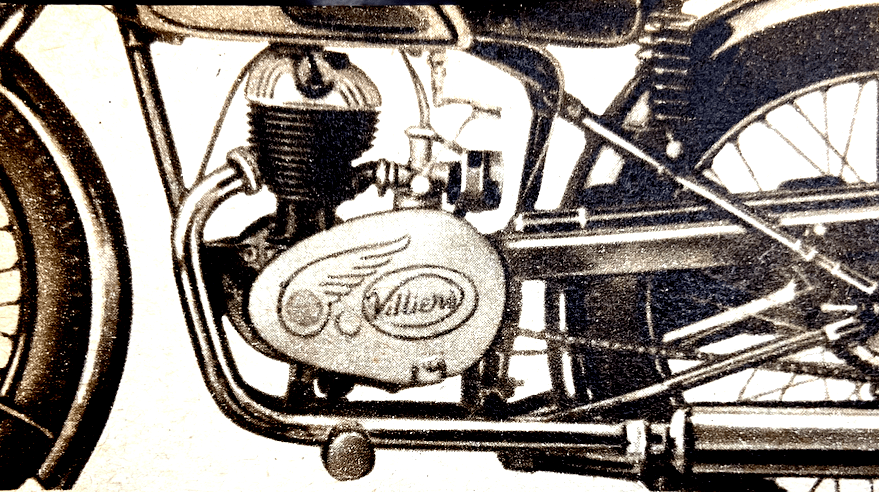
set. Those with an eye for luxury are, of course, attracted by the Supreme. General finish is light grey for the tank and the frame. The tank is relieved by chromium plating, though later, when present stocks are exhausted, an all-enamel finish will have to be adopted. The MP telescopic fork and rectifier-battery lighting are standard. This model is fitted with a particularly sturdy plunger-type rear suspension which gives a movement of 2½in. As might be expected, the illustrious 997cc Square Four is one of the outstanding exhibits on the Ariel stand. Many consider the machine is more handsome than ever before; the red-enamelled, gold-lined, tank with winged motif is a perfect blend with the brightly polished light-alloy engine unit. The lines of the model are enhanced by the increased depth given to the rear of the fuel tank, a feature which applies to some of the other models. The Square Four machine is fitted as standard with the quickly detachable rear wheel which is an optional extra on other models. Ariel rear suspension gives an arcuate [curved—Ed] movement to the wheel spindle and thus provides near-constant chain tension; total movement is 3½in. The Ariel telescopic front fork, which is hydraulically damped, permits 6¼in movement for the front wheel. The Solex carburettor has an in-built bi-starter. For those who wish to see the internals at work there is a particularly interesting motor-driven, sectioned engine. Making their first appearance are the 1952 497cc Red Hunter competition model and the new version of the 497cc Red Hunter road machine. Both have a light-alloy cylinder and cylinder head; greater depth has been given to the finning. Low-expansion silicon light-alloy with pressed-in iron liner is used for the barrel and the head is cast in ‘Y’-alloy. The pressed-in valve inserts are of stainless steel. The iron-engine version of the 500 Red Hunter also has deeper finning, as have the 350 Red Hunter and the 598cc side-valve. The entirely new light-alloy cylinder head which appears on the side-valve engine is said to have lowered running temperatures to a marked extent.
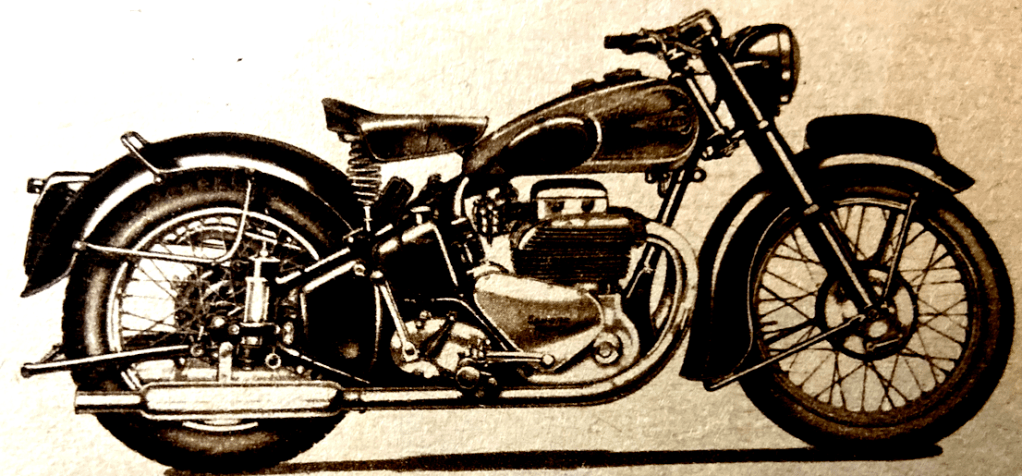

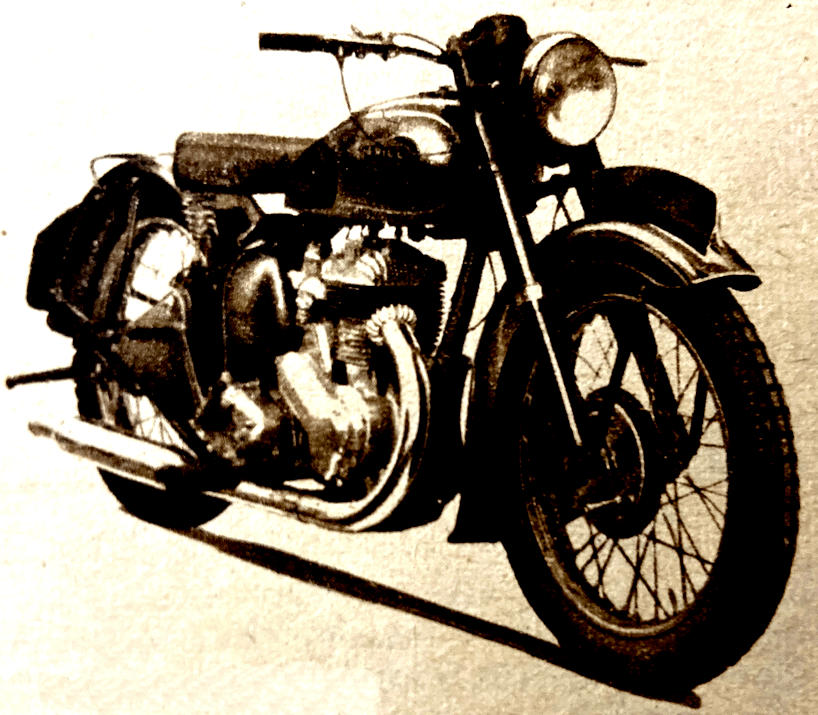
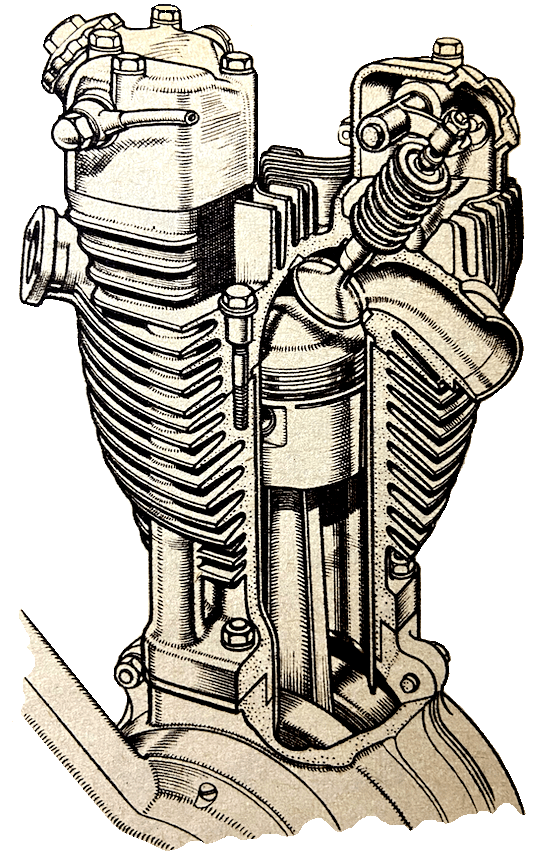
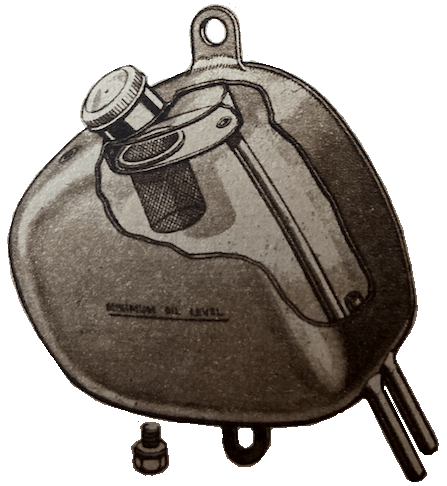
On the competition Hunter the ground clearance has been increased by 1in to a total of 6½in. The lower position of the rear fork ends is the answer to how this was achieved. Completing the range on show is the 498cc Red Hunter twin; a hand-operated sectioned model of the engine unit can be inspected. The high-tensile cast-iron pinions employed for the magneto and dynamo drives are said to run as quietly as the fibre pinions previously fitted, while at the same time they are more robust. The new oil tanks fitted to the four Red Hunter road machines and the side-valve models are so designed that they do not obstruct the fitting of a sidecar on the offside. Formerly the oil-tank filler cap did not allow sufficient clearance for the sidecar fixing below the saddle, and an extension bracket had to be used. In addition to having the filler cap located more to the rear, the new oil tank has rounded corners which give a ‘streamlined’ appearance. Capacity is three-quarters of a gallon. Other exhibits on the Ariel Stand are a handsome sidecar outfit comprising a Square Four and Garrard S90 sidecar, and the special competition version of the Red Hunter twin, as used by CM Ray when a member of the successful British Trophy team in this year’s International Six Days’ Trial. “That interest in scooter-type machines is, in these days, tremendously on the increase is obvious from the continual clack and clamour surrounding the new BAC Gazelle. Easily the most straight-forward of any design shown at Earls Court, the


new model combines simplicity and elegance in a most marked degree. Comprising the entire frame are three tubes only—two forming the down- and cradle-members, and the third the steering head. The seat, fuel tank and two engine bolts are all fitted very simply to a vertical loop tube. Under the 125cc Villiers engine-gear unit the cradle tubes are braced by the steel silencer, which consists of ribbed steel plates top and bottom, and tubular ends. BMW, this famous German marque, winner of the 1939 Senior TT, has always had a keen following among British connoisseurs. For the first time since the war, models are displayed at Earls Court. Highlight is the recently introduced super-sports model R68. Fundamentally, this 100mph road machine

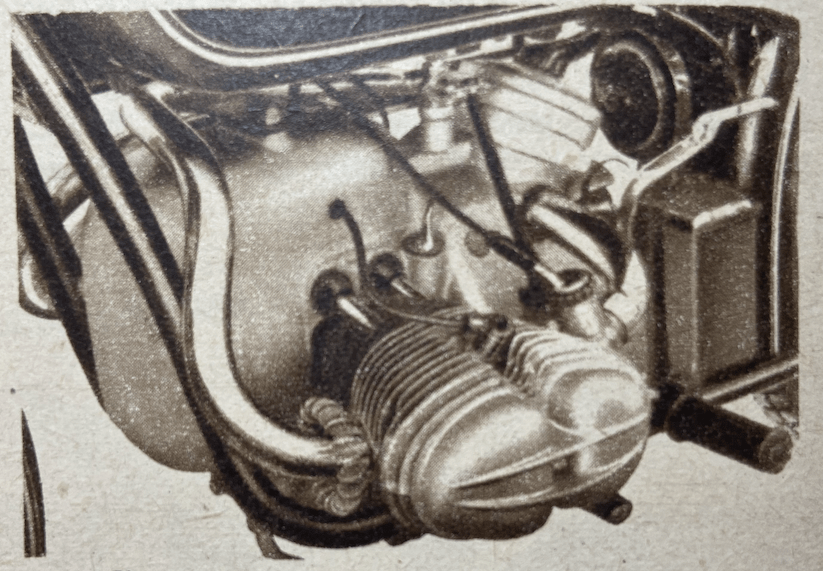
follows well-tried BMW practice with its transverse, horizontally-opposed twin-cylinder engine, shaft-drive, telescopic fork and plunger rear-springing, but its detail conception is new. The 600cc ohv engine is said to develop 38bhp. Unusual features for BMWs are a high-level two-in-one exhaust system and a twin-leading-shoe front brake. Other models on the stand include the well-known 500cc and 600cc ohv twins, and the 250cc ohv single. Two of the most complete of the show surprises are to be found on the Bond Minicar stand. The Bond Minicar itself is in a vastly modified form, and there is an entirely new commercial model called the Sharpe’s 3cwt Utility. The new Minicar has sleek, dummy front wings with inbuilt headlamps. The increased width which results is to allow the front wheel to turn through approximately 160°. Like a fairground ‘Dodgem’ car, the model is said to possess manoeuvrability bordering on the incredulous! There is also a redesigned front suspension unit with a hydraulically controlled trailing arm. The body bulkhead is now a light-alloy
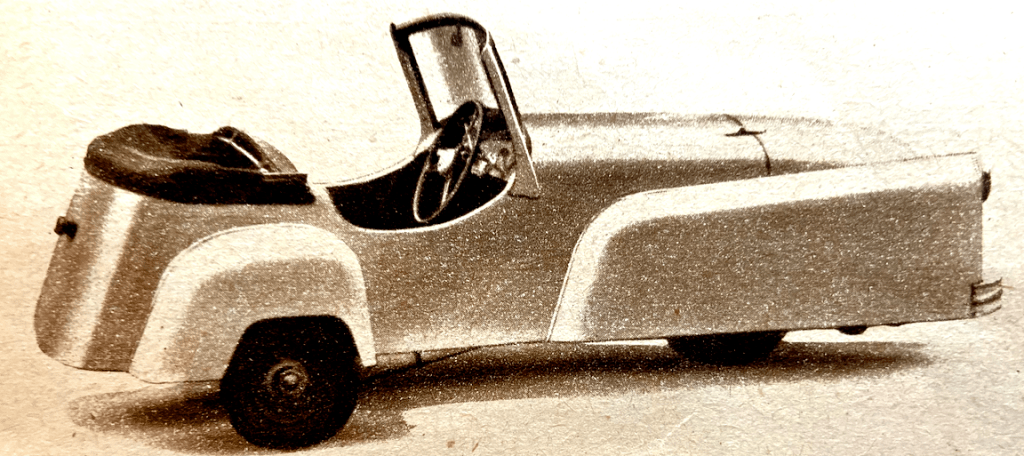
casting, and bolted to it is a cast, light-alloy, steering-headlug. This latter houses two simple plain bushes for the steering column, and provides another housing for the eccentric sleeve locating the worm on the end of the shaft from the steering wheel. Meshing with the worm-wheel is a skew-gear which rotates the main steering tube carrying the wheel arm. As before, tyres are 4.00x8in and fitted to split-rim type wheels. The Villiers engine-gear unit is carried forward of the main steering arm by orthodox-type engine plates. Designed by Granville Bradshaw, the ‘Utility’ exudes ingenuity! Forming the basis of the model is a T-shaped, box-section, light-alloy chassis. The engine used is a Brockhouse 250cc side-valve unit, but it differs from the standard one in that it drives through a separate Albion gear box; the latter provides three forward speeds and a reverse gear. Both models are, of course, fitted with new rear-springing which incorporates coil springs for compression and rebound. The big range of models shown by BSA is distributed over two stands, covering export models and those available to the home market. One of the main attractions on the home-market stand is the working sectioned model of a 495cc Star Twin. This, together with a similarly sectioned exhibit of the A10 engine, gives enthusiasts with technical inclinations an insight into the operation of two units of the most up-to-date design. Almost all tastes are catered for. The 650cc A10 Golden Flash, with its 35bhp engine, makes a magnificent fast solo and also has good pulling power which makes it suitable for sidecar work. An

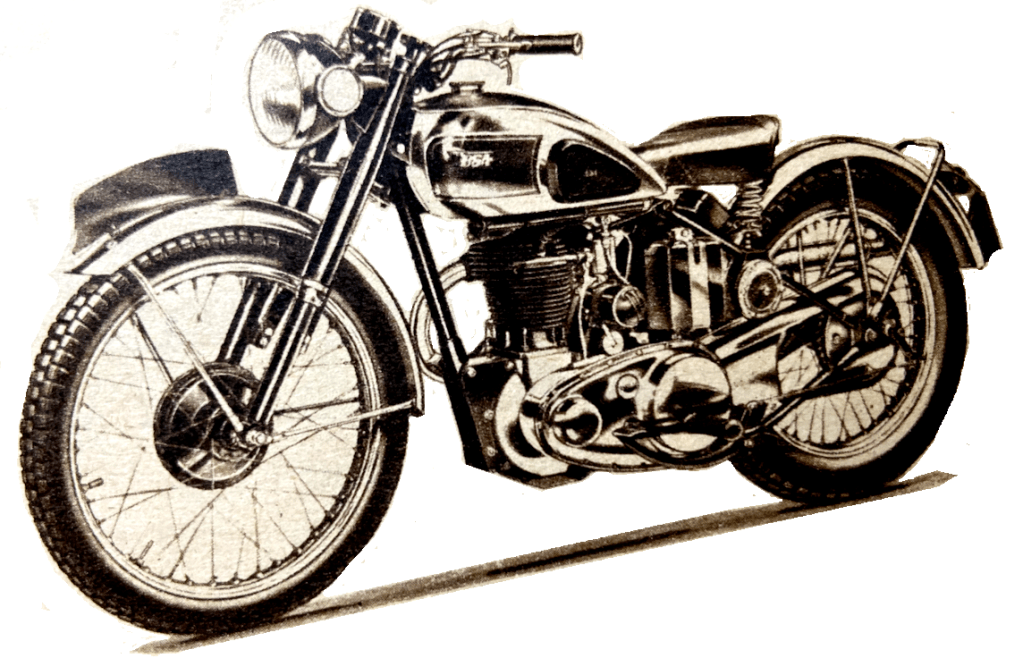
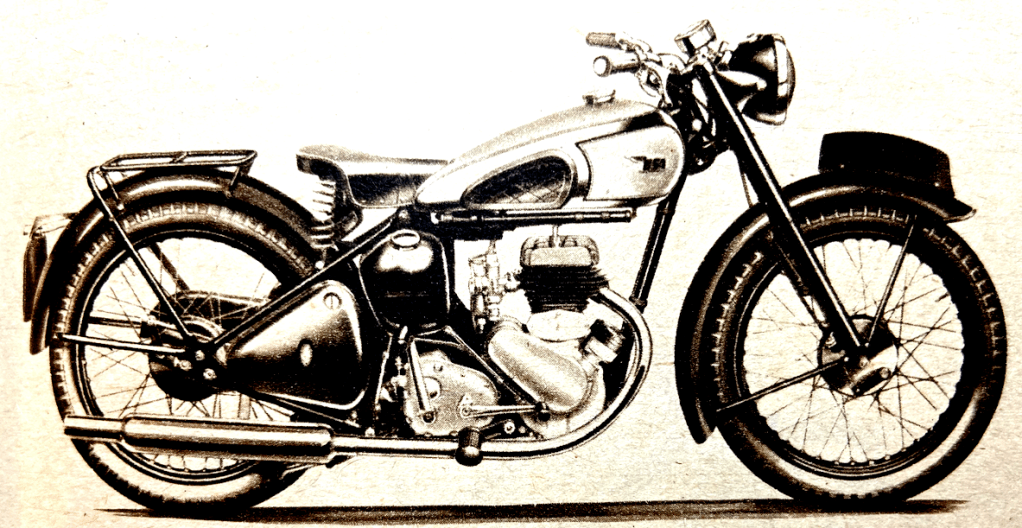
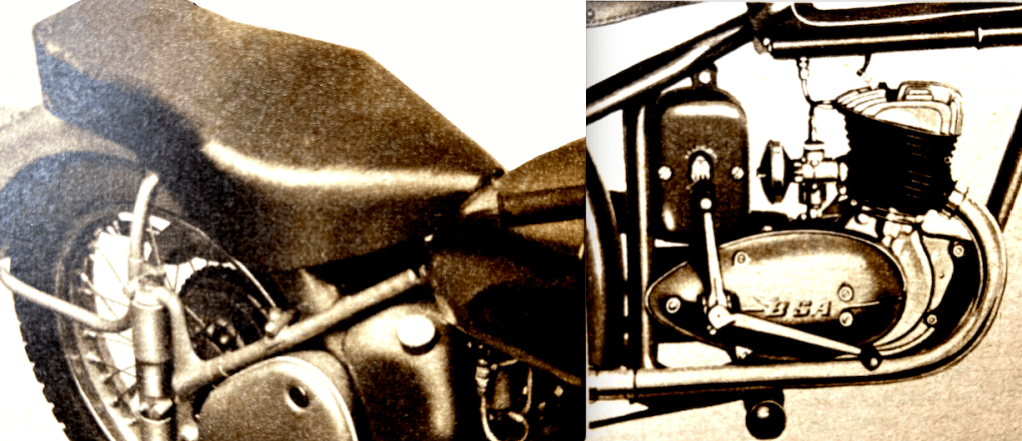
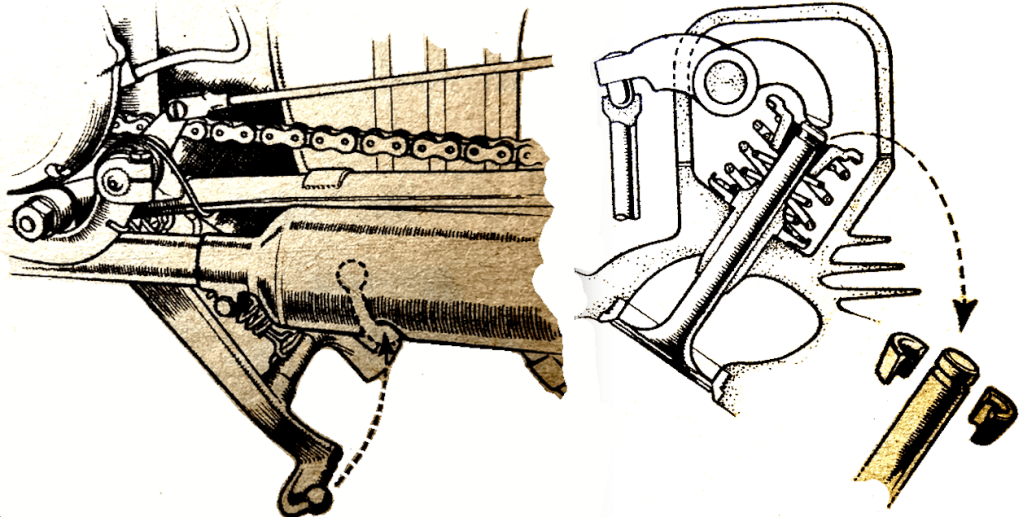
alternative finish for the A10 is beige, and it is in this form that an A10 with a similarly finished two-seat BSA sidecar appears; it is a most attractive outfit. Another A10 on view is equipped in the manner required by oversea Police Forces; it has American-style safety bars and handlebar. A feature to be noted on the twins is the new centre stand with its neat extension which makes it accessible to the foot. Examples of the very popular Model D1 Bantam are, of course, on view. For export buyers the Bantam is available with black finish. The tank is black with cream panels; a chromium-plated central band covers the portion of the tank between the seams. Safety bars and leg-shields are standard on this model. The highly successful competition Bantam is one of the highlights on the home-market stand. Among the many single-cylinder models is one with the 500cc light-alloy engine incorporating a die-cast cylinder and cylinder head. The 500cc Competition model shown has a reshaped exhaust pipe. The well-known Gold Star model so popular for Clubman’s TT races and other competition work is also on view. Separately displayed are petrol tanks showing the new finishes which will be used when plating restrictions prevent the present finishes being continued. Now standard on the twin-cylinder and Gold Star models, BSA plunger-type rear-springing is available as an extra on all other models. Many of the single-cylinder machines on the Stand are equipped with this suspension. There are also several examples of the new

dual-seat. Main item of interest on the Corgi stand is undoubtedly the new Mark IV model. Although it is similar basically to its predecessors, there are numerous refinements giving a more comfortable and effortless ride. Most obvious improvement is the large, metal weatherscreen, which extends from nearly the top of the handlebars down to the valanced front mudguard. It then sweeps back to act as a flap to protect the rider’s feet from water and dirt. A sprung front fork is fitted, and also a foot-operated two-speed gear box. For the man (or woman) who uses the little machine purely as a runabout, the Mark II Corgi is still available; it is basically unaltered. The 98cc Cyc-Auto is unique in its class
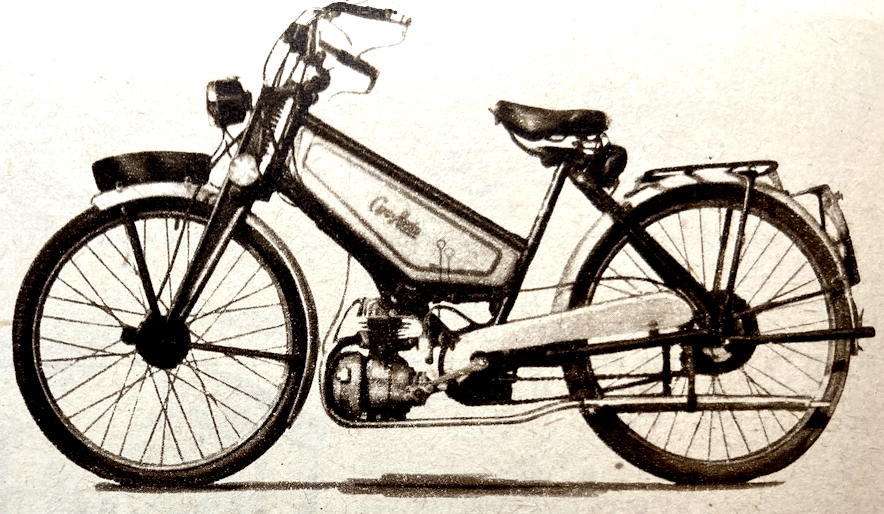
in that the design incorporates primary drive by shaft and a clever transmission brake on the multi-plate clutch. The ‘square’ (50x50mm) engine has an aluminium-alloy cylinder head with two exhaust ports, pipes and silencers. Finished in silver, the petroil tank has a capacity of 1½ gallons. The 3in mudguards are also finished in silver; the frame and Webb girder-type fork are in black. Of interest to tradesmen, the Carrier model has the same general specification. Memories of the past crowd back on the Dot stand. Nostalgic old-timers recall the 1920s when they see the cerise and silver finish, and the younger generation agree that the choice has much to recommend it. Something of a problem arises on this stand—what to see first. Shall it be the renowned 197cc scrambler? Or one of the first British machines home in the last 125cc TT? Or perhaps the smart 250 side-valve ? Whatever the choice, and the honours seem to be fairly evenly divided, there is much to appeal to the enthusiast. An interesting addition to the normal range is a Scrambler SC model in road-
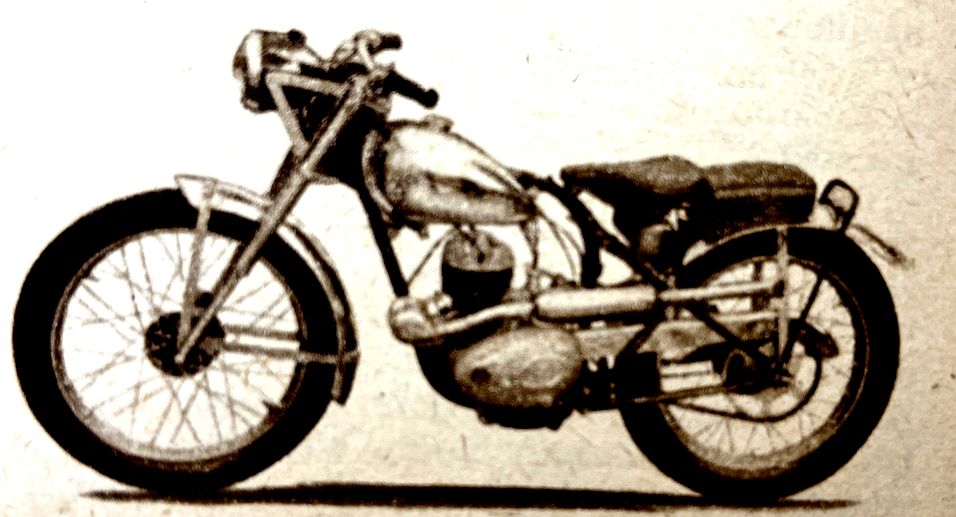
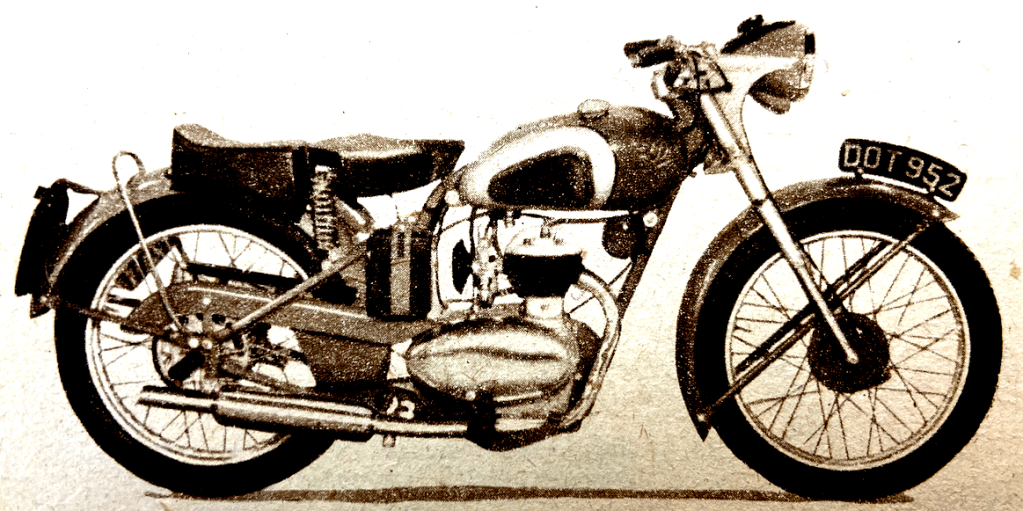
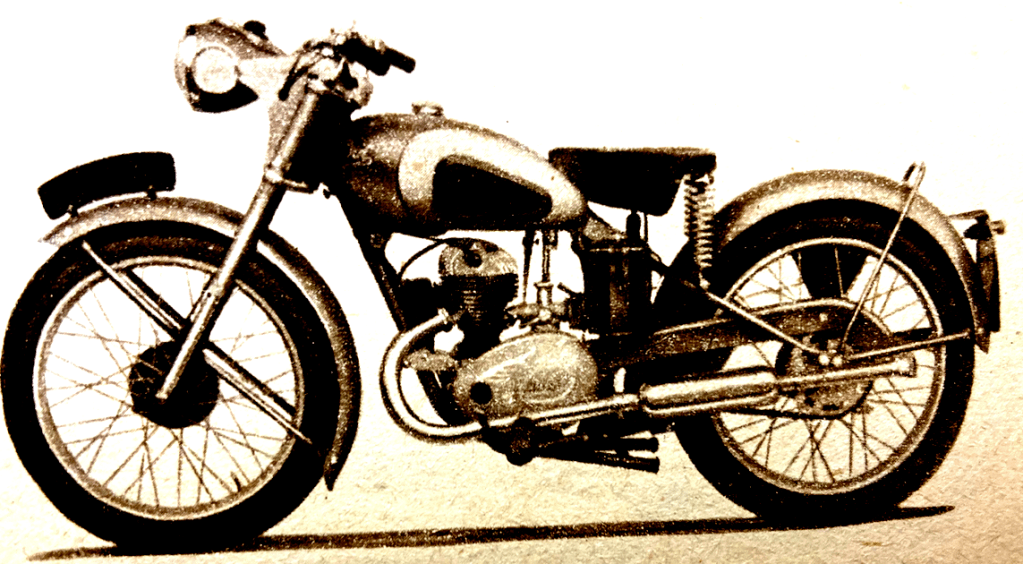
racing trim; racing men are speculating whether it can hold its own with the orthodox 250 four-strokes on short-circuit tracks. The trials and scrambler Dots are, of course, so well known now that they need little description; an interesting point is that a factory tuning service is available. For the tourist there are two models, the 197cc two-stroke—all the two-strokes have Villiers engines—and the 248cc side-valve with the Brockhouse engine unit. The 197 model is available in two forms; these are basically similar, but a rectifier set is fitted on the R model. Simmonds lock-nuts are widely used on both versions. What is causing such crowds round the Douglas stand? When you force a way through, you will be able to see what many enthusiasts claim to be the smartest outfit at the Show—the new 500cc Douglas with Watsonian Avon sidecar. The whole outfit is finished in a delightful polychromatic pale green. Except for the cylinders, the engine-gear box unit is completely covered with a highly polished aluminium cowl which gives clean, sweeping lines. A detail is that the sidecar front fixing is on to both the front-down tubes. Although the new model is naturally usurping a great
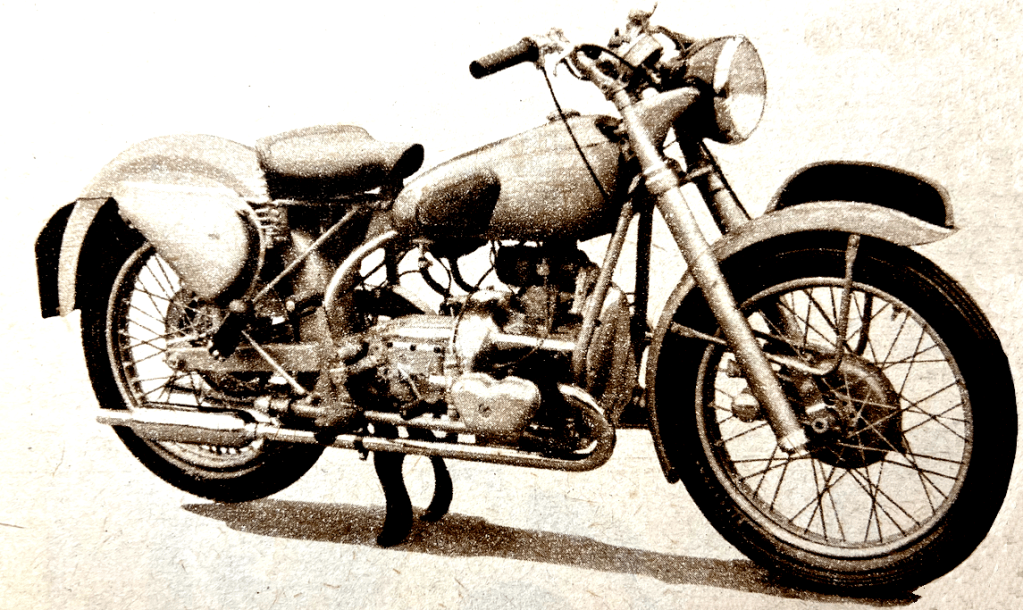
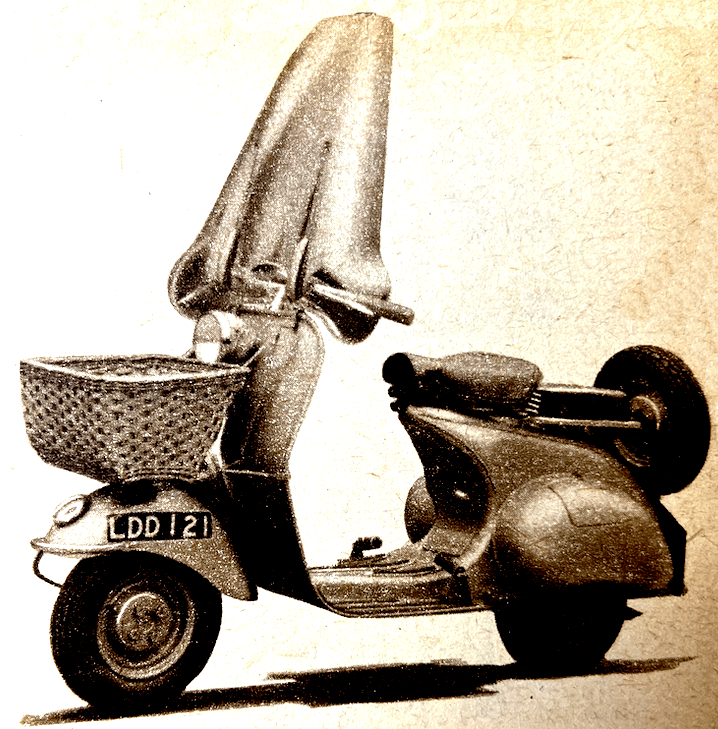
deal of the attention, the other machines on the stand are surrounded by connoisseurs mentally dissecting the components. The Douglas Vespa scooter, too, is arousing a great deal of comment, particularly the model that is slowly revolving on a turntable while cute miniature scooters are being carried round in the opposite direction on a concentric rim. A most attractive polychromatic green finish is a feature of the Mark V roadster, but for more conservative riders there is a black model also on view. The racing fraternity are naturally clustered round the exciting Plus models. Two versions are available—the 8) Plus and the 90 Plus. The 80 Plus is finished in maroon and the 90 Plus in beige. Several optional items of equipment are available for the Plus models, to convert them to really potent racers, or they can be used in standard form for high-speed cruising on the road. The massive 9in-diameter front brake, which is also a feature of the 500cc machine, ensures that the stopping power of these models is fully in keeping with their performance. One of the most novel designs at the Show can be seen on the Britax Stand. It is the lowest capacity motor cycle at Earls Court—the 60cc Ducati, which, it will be remembered, put up such a good show in the last International
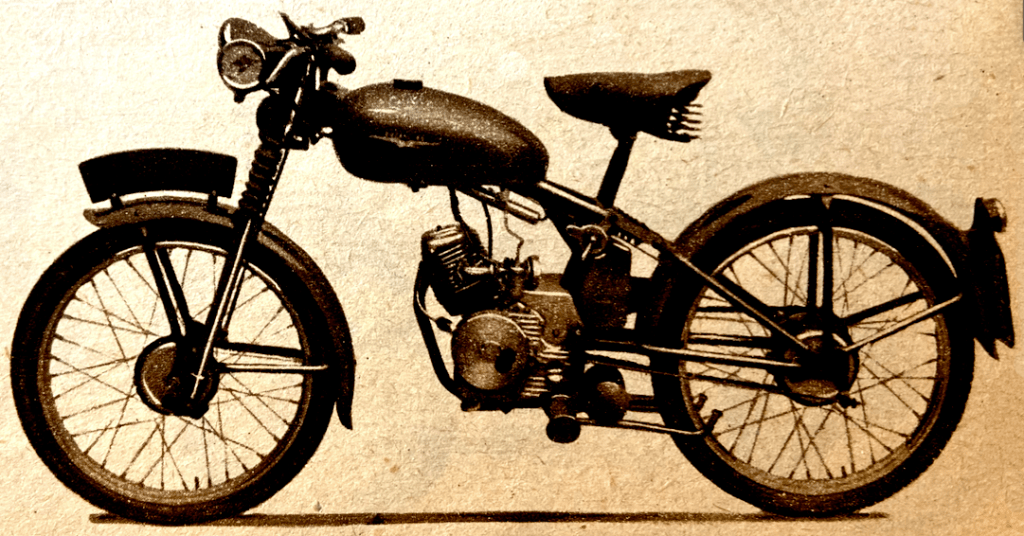
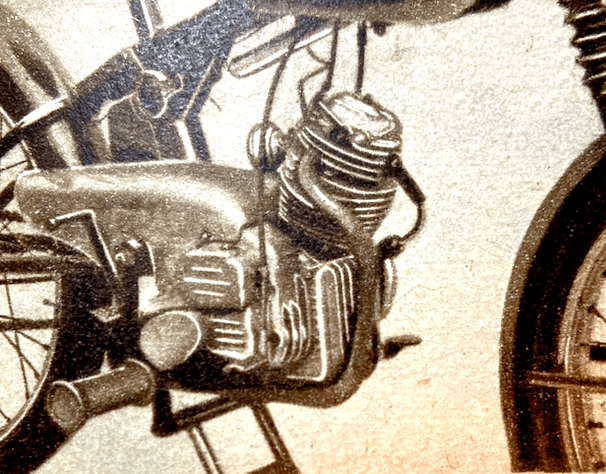
Six Days’ Trial. The engine has overhead valves operated by pull-rods. Engine and three-speed gear box are in unit. As one expects with Italian machines, the finish is in flaming red enamel and chromium plating. Perhaps the most out-standing feature of the design is the absence of a front down tube—the frame is a simple cantilever ‘back-bone’ construction. Favourable comment among lightweight enthusiasts is aroused by the neat and effective pivoting-fork rear suspension with hand-adjustable friction dampers. There is a movement of about 2in on the suspension. Unusual to British eyes is the heel-and-toe gear-change lever on the right-hand side. The advantage of this type of lever is that the rider’s boot or shoe is not blemished in any way when changing gear. Tucked away under the headlamp is a small alternating-current horn working directly from the flywheel generator. Among the riders’ points are the provision of a neat aluminium-alloy cover over the gear box, and the easily operated centre stand. With its gleaming beige and chromium colour scheme, twin Amal carburettors, and its touring-cum-racing dual-seat, there is little wonder that the sports edition of the Excelsior Talisman Twin forms one of the main centres of interest. It is shown in company with eight other models: two autocycles, two 125s and 197s, one standard
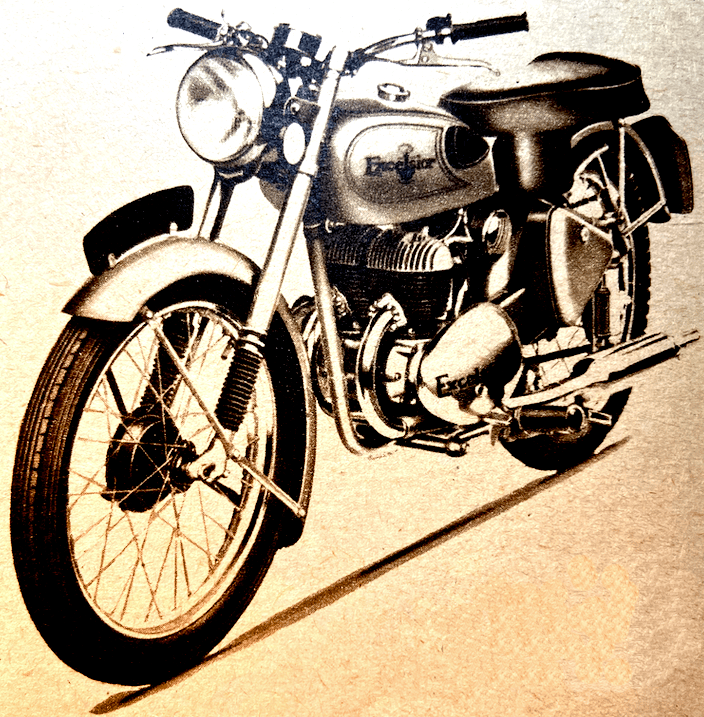

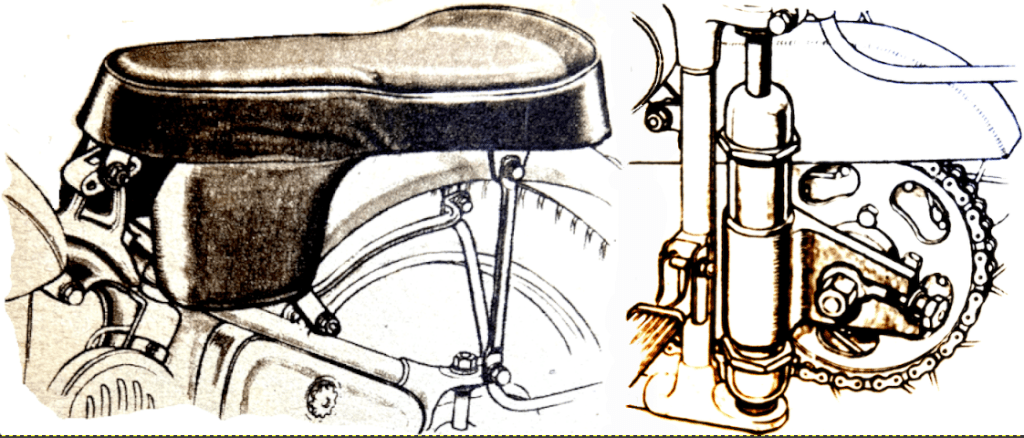
Talisman and one gleaming JAP-engined speedway machine. The Sports Talisman is pedestal-mounted; the other models are grouped round the floor space. Also on a pedestal there is a sectioned Talisman engine and gear box which is drawing the crowds—and how! The only twin-cylinder two-stroke model in Earls Court, the Talisman is exhibited in both its forms with several minor modifications. For instance, the frame has been altered to give a wheelbase 1½in longer than it was before; the tank capacity has been increased by three pints (it is now rather more than three gallons), and the knee grips have been placed higher to provide greater comfort. Offside front fork ends have been re designed to simplify wheel removal. Rear fork ends are now malleable castings which incorporate a vertical slot in the bottom edges of the spindle grooves, so when the flanged adjusting nut is unscrewed it draws the wheel backward, and as it is screwed up it pushes the wheel forward. Handlebars are fitted into a new head lug which allows them to be widely adjustable for angle of the grips. Probably the most striking change in the Talisman, however, lies in the cleaning up of the gear-box end-cover. The new cover permits the use of a shorter gear lever, which has an improved action over the previous one. Appearance is also very much better. Inside the end-cover there is a clutch adjuster of the barrel type. Universal and Roadmaster models are exhibited in their known form. Can an enthusiast be caught napping when it is a question of spotting technical changes? The answer is No—an emphatic No—or so it would seem! Francis-Barnetts are exhibiting a new 122cc Villiers competition engine in one of their Merlin Competition mounts and, although there are only minor external differences from standard, most people seem to spot them. Said to develop 6.5bhp at 5,000rpm and
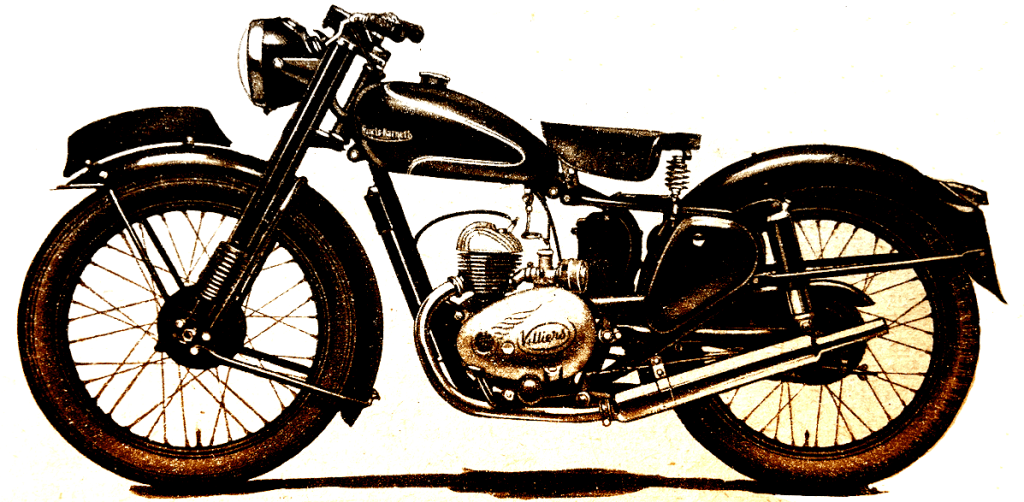
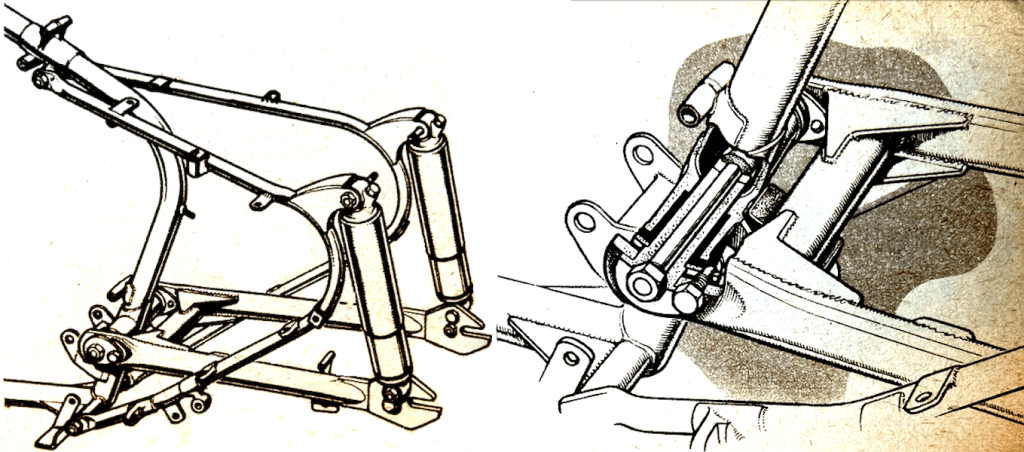
to be capable of propelling a machine at 52mph on a 9 to 1 gear, the new engine has the same bore and stroke as the standard unit, but the compression ratio is higher. The differences apparent externally are that the carburettor is a ⅞in-bore Amal and there is a compression-release valve in the head. Two plugs, Lodge HHI4 and an R49, will be supplied with machines fitted with the new engine. Pivoting-fork rear-springing, too, still a rarity among British lightweights, is causing a stir on the Francis-Barnett stand. Fitted to the 197cc Falcon 58 and 125cc Merlin 57 models, the suspension is extremely neat, clearly gives the impression of being rigid laterally, and provides no less than 3¼in of up and down movement at the wheel spindle. The fork pivots on a Harrisflex bonded-rubber bush which is housed in a malleable lug welded in the frame seat-pillar tube. This type of bearing has many advantages, not the least of which is that it requires no maintenance whatsoever. Incidentally, the only malleable lugs used in all these latest frames are the lugs just mentioned, the steering-head lug, the small saddle-nose lug and that for the footrest rod. Controlling the rear fork are two neat, telescopic spring boxes which employ two-rate springs and have hydraulic cut-off to prevent bottoming on full shock loadings. The method of controlling the rebound—by means of a rubber block under the fork bridge—is providing sufficient novelty to bring numerous enthusiasts to their knees—hands and knees!—as they peer under-neath to see how it works. What happens is that at the static position of the fork, the bridge tube rests lightly on the rubber block. On bump, the bridge is raised clear of the block, and on rebound it presses down into it; thus is provided a gradual build-up of resistance over 1½in of recoil movement. On the Brockhouse Stand, in company with the diminutive Corgis, can be seen the cobby 248cc side-valve Indian Brave, designed for the American market. Its layout, nevertheless, is typically British except for the left-hand gear change and kick-starter, and right-hand brake pedal. The Brockhouse engine-gear unit is notable for its businesslike design and very clean exterior. Tank, mudguards and tool-box are attractively finished in familiar ‘Indian’ red. The cradle frame is of welded construction, and the telescopic fork is fitted with progressive-rate springs. A large air filter is attached to the Amal carburettor and the side valves are fully enclosed
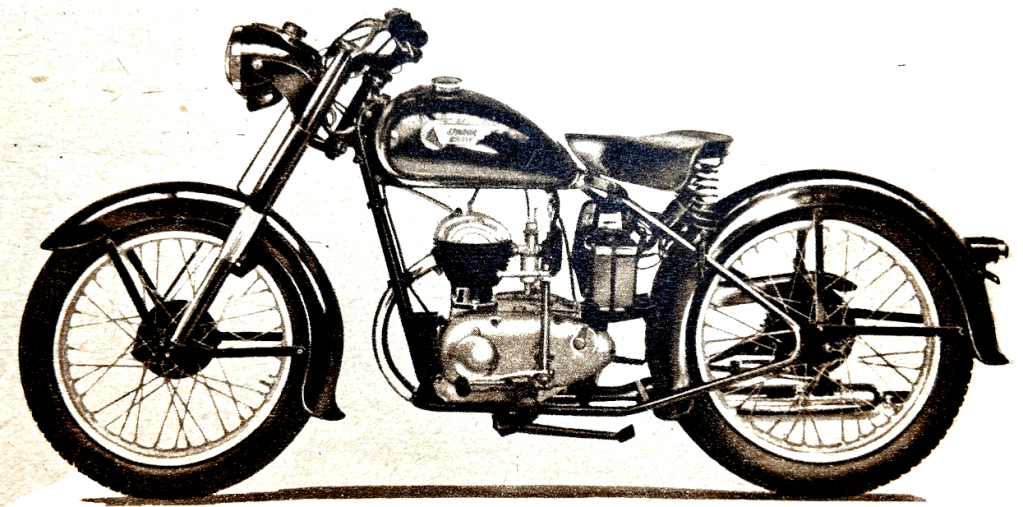
and lubricated. The kick-starter on the left-hand side is of the folding variety, and a neat prop stand is attached to the left-hand frame-cradle tube. A range of two-strokes large enough to satisfy all tastes is shown on the James stand, from the handy little 98cc autocycle to the 197cc Captain de luxe. For the ride-to-work user and for the modest tourist there is a choice between the Superlux autocycle and three lightweight motor cycles. The autocycle, with its open-type frame, has a big appeal, particularly to ladies. Its generous engine-cum-legshields provide an adequate measure of protection from rain and road filth, and it is, of course, extremely easy to ride. Basically similar, the two 98cc Comets and 98cc Commodore differ only in the degree of luxury in the specification. The Commodore, for example, has nearly all the engine-gear unit and transmission system enclosed, and combined legshields and safety bars are fitted as standard. Each of these models has a two-speed gear box with handlebar control. Those who wish to travel farther and faster are inspecting the 122cc Cadet models shown in Standard and de Luxe form. These are ‘man-size’ machines, and in the case of the de luxe version there is plunger-type rear springing and rectifier-battery lighting; the standard model has direct lighting. Both have three-speed foot-change gear boxes. At the top of the tree are the 197cc Captain models in Standard and de Luxe form. Both employ the Villiers’ three-speed engine-gear unit with foot-change. The Standard has
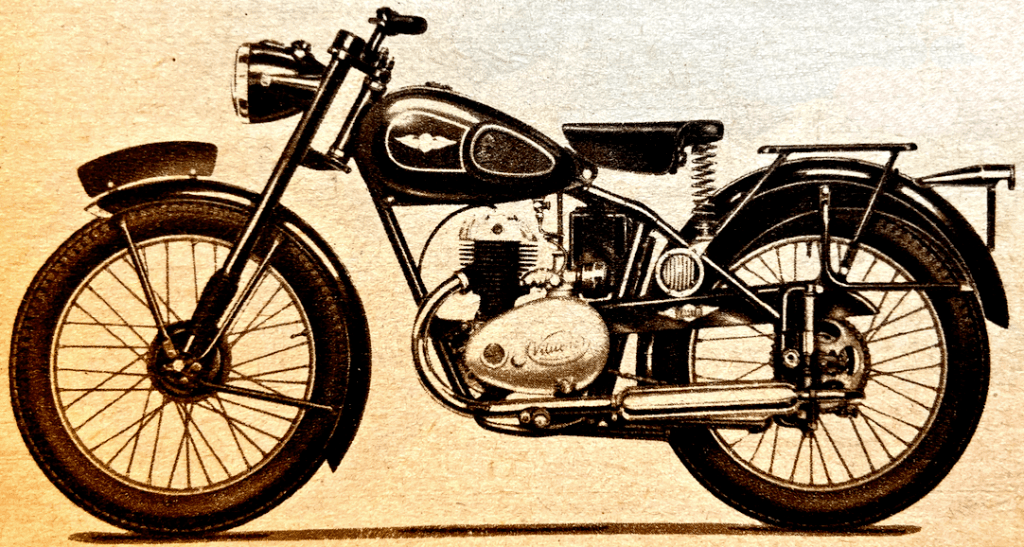

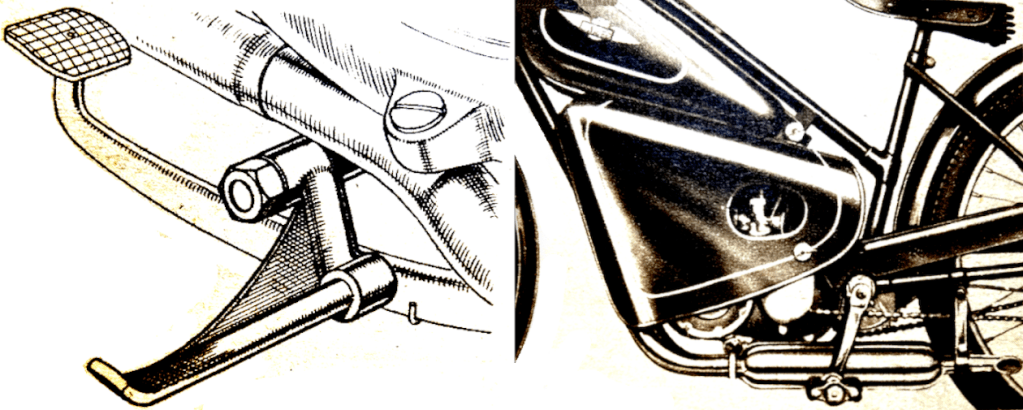
direct lighting. The de Luxe has rectifier lighting and rear springing; it can also be equipped with a new twin-seat, which makes the model an admirable passenger machine. Probably the biggest draw on the Stand is the new 197cc Colonel—an out-and-out sports machine intended for trials work. This machine is a replica of the model ridden with such success by WA Lomas, and its specially prepared engine is stated to develop over 8bhp at 4,000rpm. Most fittingly, an illuminated board carrying photographs of the Colonel in action is mounted over the model. On the Continent scooters are rapidly increasing in numbers. One of the earliest and best-known post-war designs, the Lambretta, has achieved nation-wide popularity in Italy (the country of its birth) and is also being made under licence by the vast NSU concern in Germany. Particular interest, therefore, attaches to the Lambretta scooters exhibited at Earls Court—quite
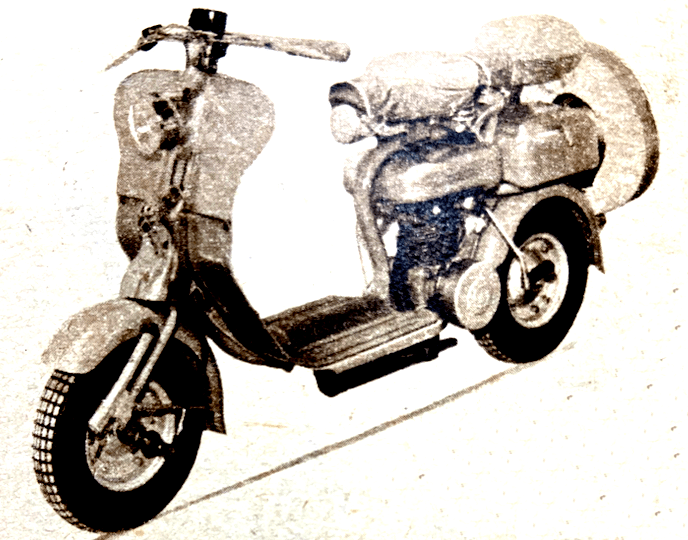
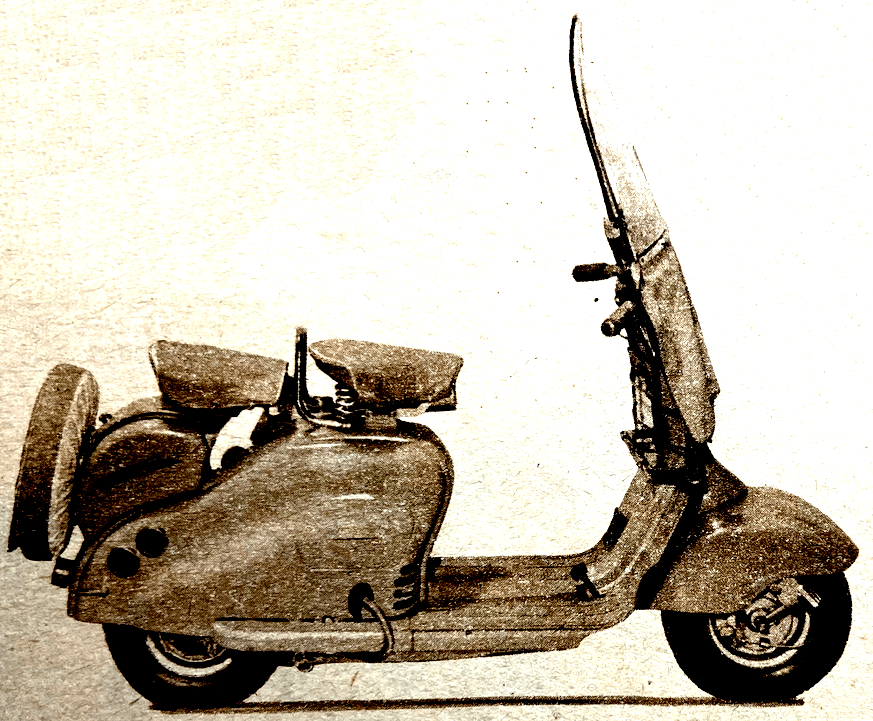
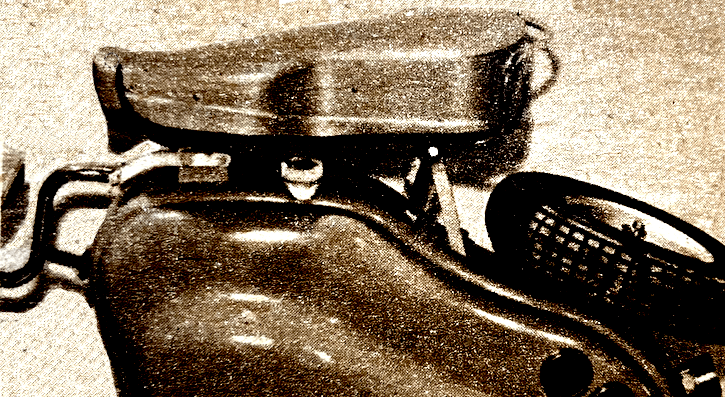
apart from the streamlined 125cc World’s record-breaker, which is also on view. Two types of scooter—one with the engine enclosed and fan-cooled—are shown and one of the enclosed models has an attractive sidecar attached. The 123cc two-stroke engine is in unit with a three-speed gear box. Front suspension is of the trailing-link type, and there is torsion bar-controlled pivoted-arm suspension at the rear. Both wheels run on stub axles and are interchangeable. A spare wheel is carried. A topical, if somewhat sad, note is struck by the 498cc Super Clubman which, on the Matchless stand, is partially dismantled and stowed in its packing-case all ready for export to a hard-currency area. The machine is held immovable inside the case. In more cheerful vein, however, is the completely sectioned and electrically-driven twin unit. The ingenious, eccentric adjustment for rocker clearance can be seen, as can the massive flywheel assembly with its three bearings. For 1952 an entirely new crankcase pressure release valve has been incorporated in the drive-side end of the crankshaft; the outlet is to the primary-chain case. The valve formerly fitted in the rear of the crankcase and the flexible pipe to the oil tank are thus eliminated. The new valve is designed to maintain a more even crankcase depression at high rpm. A fleet and comfortable roadster, the Super Clubman is fitted as standard with pivoting-fork rear suspension and large dual-seat.

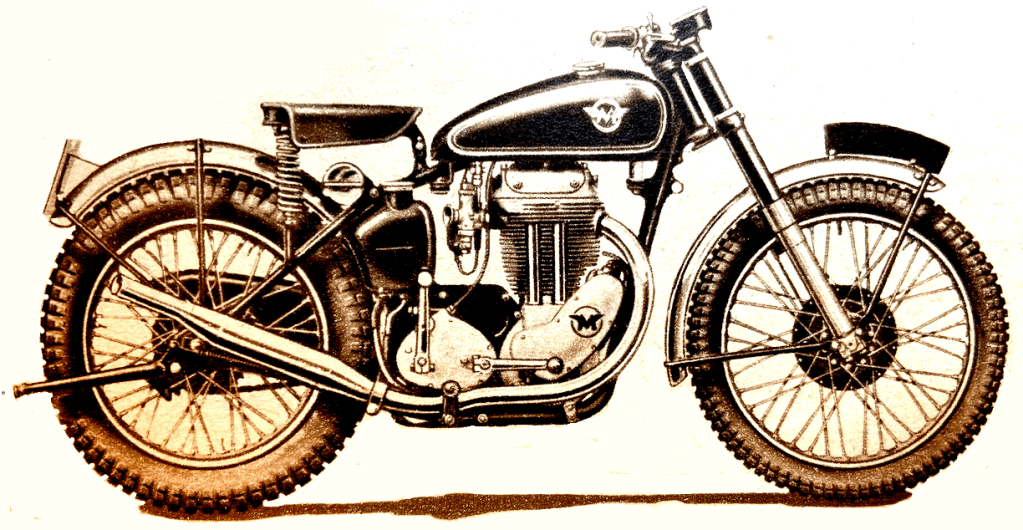
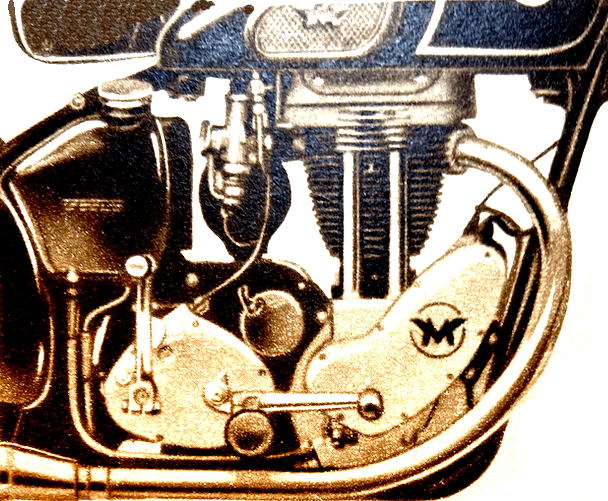
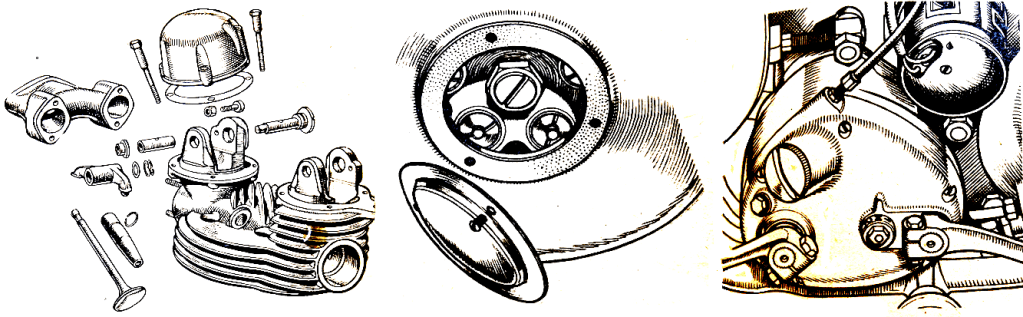
The full range of Matchless machines is exhibited; the remainder comprise the 347 and 498cc single-cylinder models, available in both solid and spring-frame form, and their Competition counterparts, also with and without spring frame. The 498cc spring-frame Competition mount has become a favourite in the export market and with one of these models the Belgian rider Auguste Mingels has obtained no fewer than 23 international-class successes . during the 1951 moto-cross season. A crank-operated, sectioned model of the 498cc single is also on view. A very noticeable alteration to machines in the single-cylinder range is the redesigned timing case, and the mounting of the magneto forward of the engine. This greatly facilitates inspection or removal of the dynamo. The new Burman gear box, with its shorter, more rigid shafts and improved gear change movement, is naturally a major point of interest on all the new Matchless models. A repositioned clutch adjustment screw is more readily accessible, while attention to the clutch thrust-rod adjustment may now be given via an inspection cover in the primary-chain case. A most attractive finish has been attained despite plating restrictions. Some of the works’ people consider that the 1952 Matchlesses are the most eye-appealing post-war models turned out by the factory, and certainly the machines are quite as bright-looking as their predecessors. The Teledraulic front fork sliders are no longer enamelled; instead the light-alloy is polished. Several small fitments such as dome nuts, fork nuts, etc, are bright cadmium-plated. The smaller winged ‘M’ tank motif, which is a light-alloy die-casting, is mounted on a circular red back-ground. Against the velvety black enamel of the tank it produces a most pleasing effect. The tanks are double-lined in silver and red with a fine inner line. Wheel rims are Argenized, which pro-duces a matt, aluminium-like finish.The New Hudson exhibit this year has been combined with those of the BSA and Sunbeam. There are two stands: one for models available to buyers in Great Britain and the other
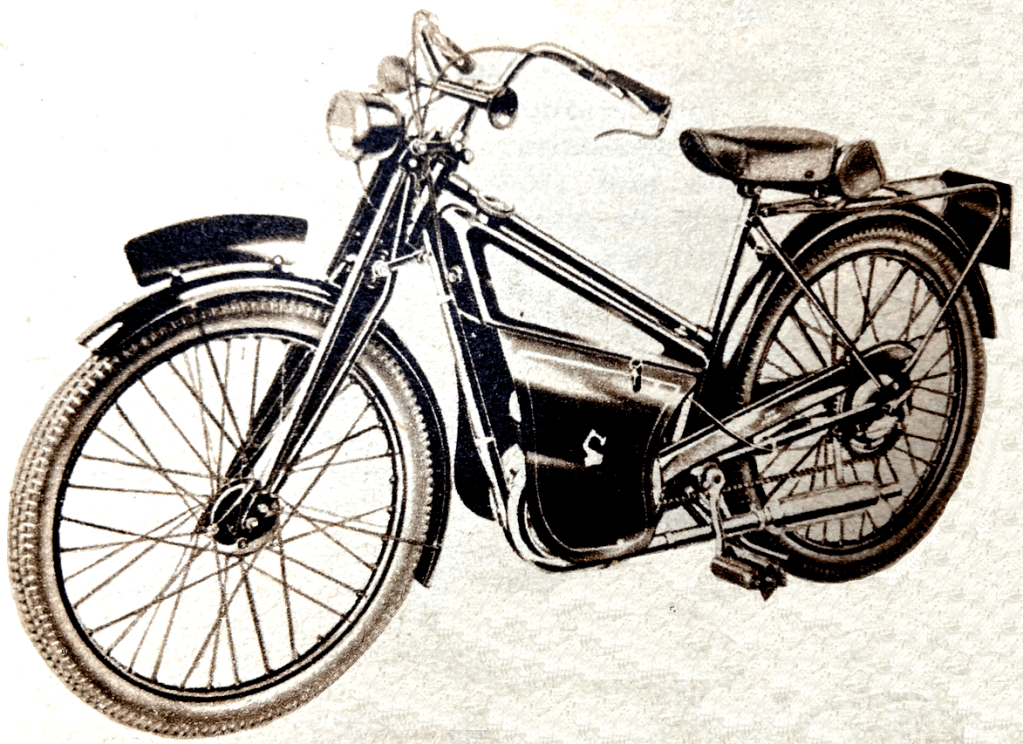
devoted to export models. On the home stand is one of the standard 98cc New Hudson autocycles powered by the Villiers Mark 2F engine-clutch unit. A notable feature of the New Hudson is its commendably quiet exhaust. In this connection it is interesting to find that an exhaust pipe and silencer of normal motor cycle shape are fitted. On the export stand is displayed a similar model, but in a new export colour. The machine is enamelled in dark green. For more reasons than one is the Norton stand an immediate mecca for many Show visitors. There is so much of interest to see that enthusiasts cannot seem to pause for long at any one exhibit. They dash from one model to the next—talking excitedly—unable in their excitement to spend much time on any one feature. Pride of place is shared by the new Dominator de Luxe (designated the Model 88), the 500cc World’s Champion machine and a magnificent array of silverware ware representing Norton successes in trials and racing throughout The term race-breeding as it applies to to standard machines has never been more truly exemplified than it is by the similarity between the Model 88 and the pure racing machines. Frames and forks in each case are identical to the nth degree; and, indeed, according to the willing Norton staffmen on the stand, it was an actual racing frame which was used throughout the new model’s testing period. Incidentally, the new Dominator de Luxe is becoming rather finger-marked in the region of the front mudguard. On the tip of the blade there is a reverse lip, and on the inside of each edge there is a channel to lead water back to the bottom of the blade. The guard is carried on the front fork by means of a pair of saddles welded to the outer covers of the fixed members, and the resulting absence of stays cleans up the front of the machine beautifully. In addition to its practical asset of keeping road filth away from the machine and rider, the gutter has the incidental advantage of strengthening the blade. In their polychromatic grey finish and with their sleek lines, the new Dominators may be said to be stealing the show so far as the motor cycle exhibits are concerned. Also on display are, of course, examples of all the other Norton models: sleek Manx models, Internationals, ES2s, 16Hs.
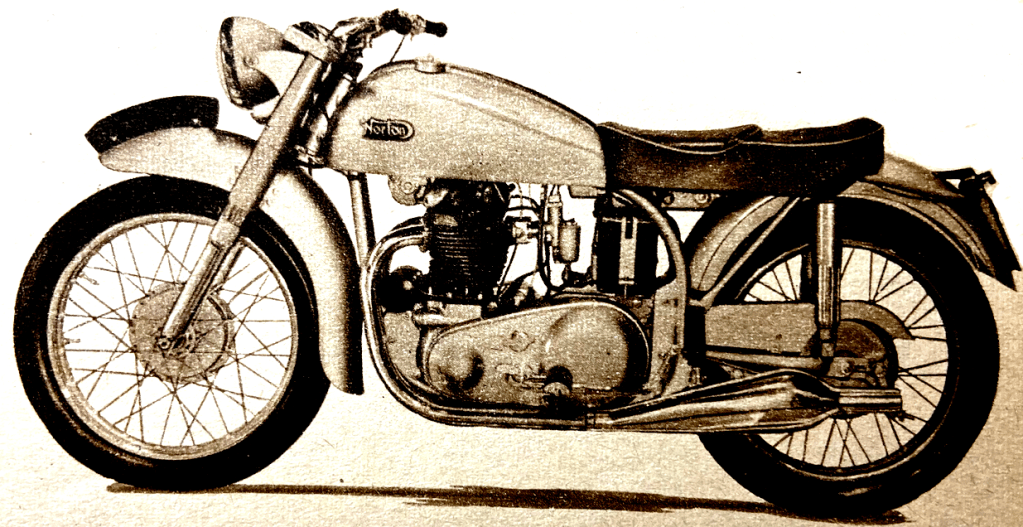
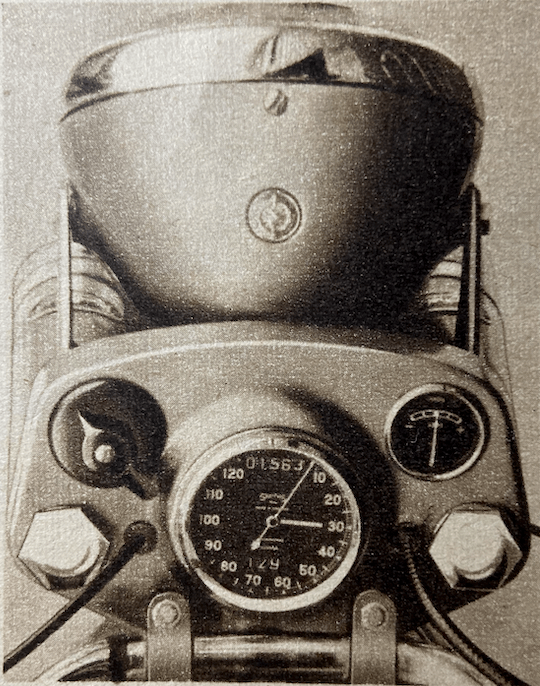
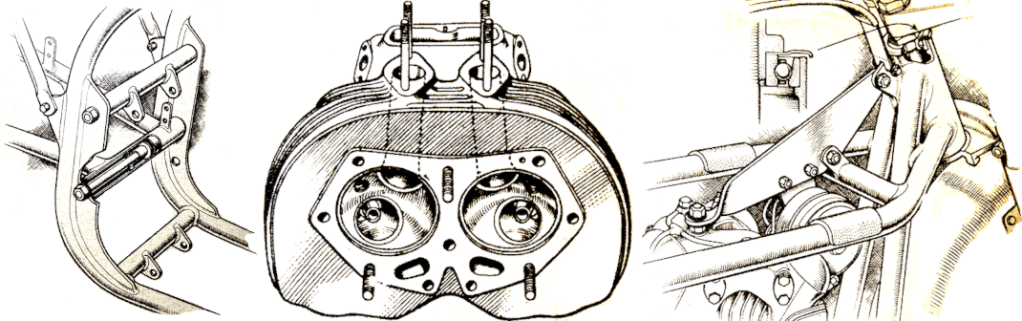

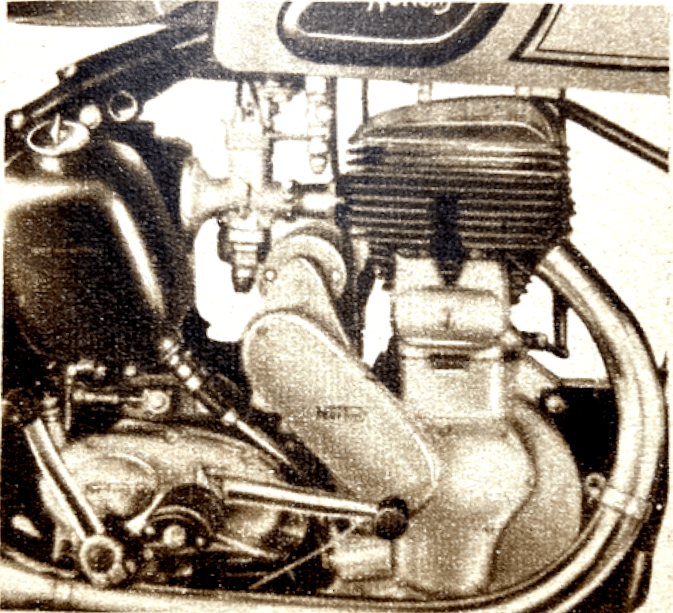
A display of neat lightweights is to be seen on the OEC stand; all machines have a pleasing finish in polychromatic grey. Pride of place on the central dais is given to the new 248cc side-valve model. Apart from its eye appeal, this newcomer incorporates many attractive features. It will be seen how readily the square-section frame tubing lends itself to the bolting on of engine plates and other fitments. The bottom half of the engine-gear unit has a commendably smooth exterior, and the new Dunlop rubber-sprung fork is neat, as well as effective. On the top fork bridge is mounted the D-shape Smiths 65mph speedometer; the headlamp of the Lucas rectifier lighting set features the underslung pilot light. The rectifier is safely tucked away under the tank, and the ignition coil is equally well protected beneath the saddle. The surrounding display of two-strokes includes models with solid and spring-frames, with direct and rectified lighting
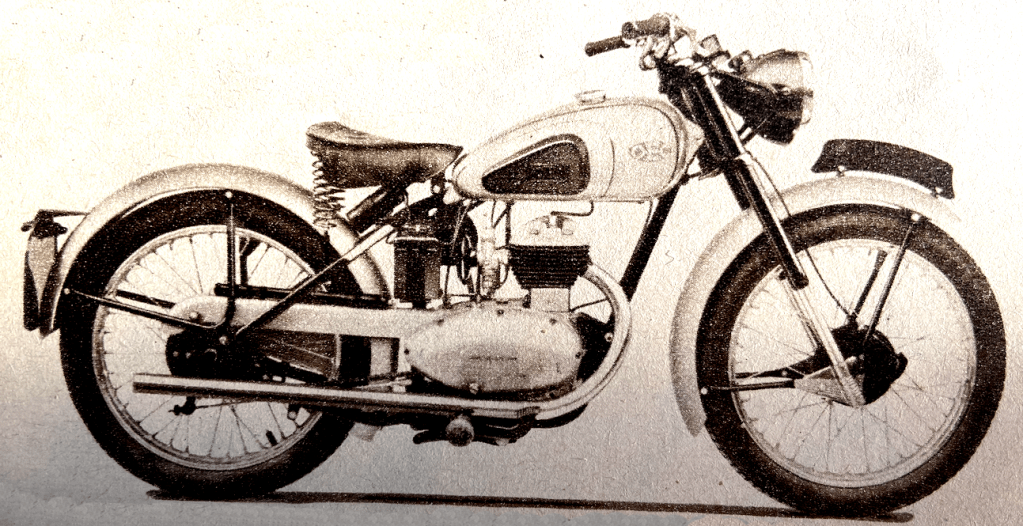


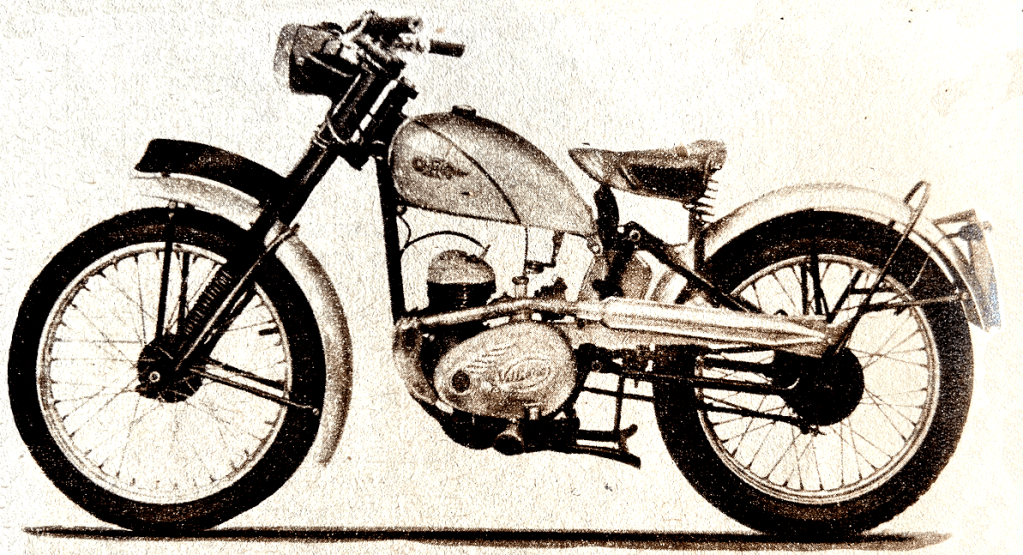
equipment and with engine capacities of 122 and 197cc. All two-stroke machines have Villiers engines. Noteworthy features include carriers on solid-frame models, and the well valanced rear mudguards on the springers. Competition mounts with 122 and 197cc units arc included in the range. The display includes a chromium-plated speedway machine with the famous JAPengine, and a sidecar and chassis both of which are of welded tubular construction. Pashleys are exhibiting three lightweight motor delivery vehicles, all with channel-section chassis in front and a tubular frame at the rear. In each case the single wheel is at the back, fitted to a rigidly mounted spindle and shod with a 3.00x19in tyre. The front wheels have 8in-diameter split rims and 4in-section tyres; they are mounted to the chassis through leaf or coil

springs. Steering is by means of a car-type wheel. Powering the models are 197cc Villiers engine-gear units, one of which is enclosed in a Perspex shield so that it can be examined by show visitors. Polychromatic silver-grey and polychromatic blue colour schemes, tastefully relieved by attractive tank and wheel-rim markings—these finishes, resulting from the plating restrictions, have undoubtedly enhanced the appearance of the range of single-cylinder ohv Panthers. Budding and prospective trials men are attracted by the functional-looking Stroud competition models of 250 and 350cc. Keen solo riders are examining closely the robust 350cc Model 75, and many are the regrets that the coil-ignition 250s, three-speed and four-speed Models 65 and 65 de luxe respectively, are at present for export only. But the

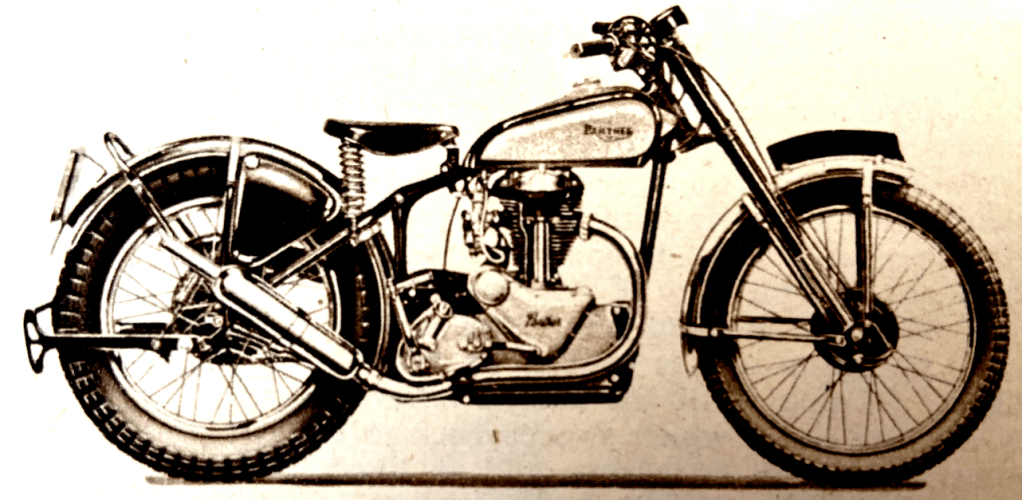
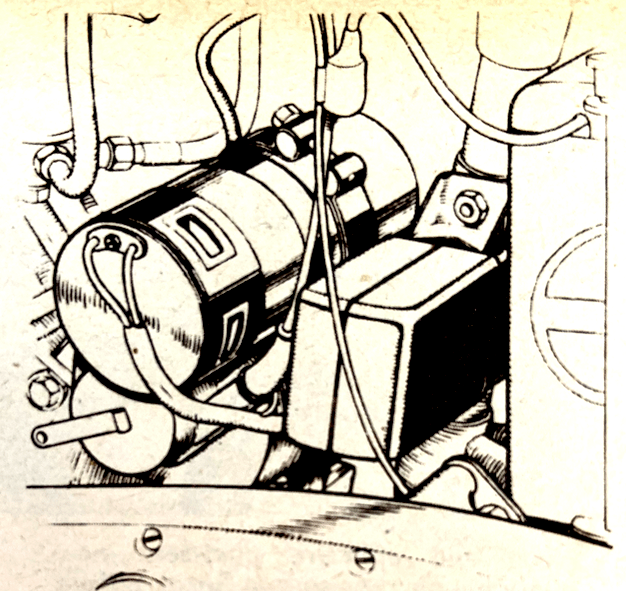
lion’s share of attention is being bestowed upon the five 600cc Model l00s on view. Solo riders, particularly those who want to add a sidecar later, are viewing the Model 100 as an ideal dual-purpose mount. A cardinal point in this connection is that the Dowty telescopic fork is readily adjustable to give solo or sidecar steering; furthermore, since air is the suspension medium, it is the work of moments only—with the tyre pump—to adjust the air pressure to suit the static load. Highlight of the Reliant stand is, of course, the gleaming new Regal four-seater three-wheeler. Powered by the well-known 747cc side-valve water-cooled four, and with torsion-bar front springing, the Regal is being said by many to set an entirely new standard in passenger three-wheeled transport. Certainly, rotating slowly on a turntable so that all can see its trim lines from every angle, it is one of the most provocative designs in the great exhibition hall. Nine-inch diameter hydraulic brakes operate on all three wheels. The front wheel is carried on a normal stub-axle which is, in turn, attached to a single king-pin on the right of the wheel. The swinging arm which carries the wheel is controlled by a torsion bar housed in the forward part of the box-section chassis. Rear suspension is by semi-elliptic leaf
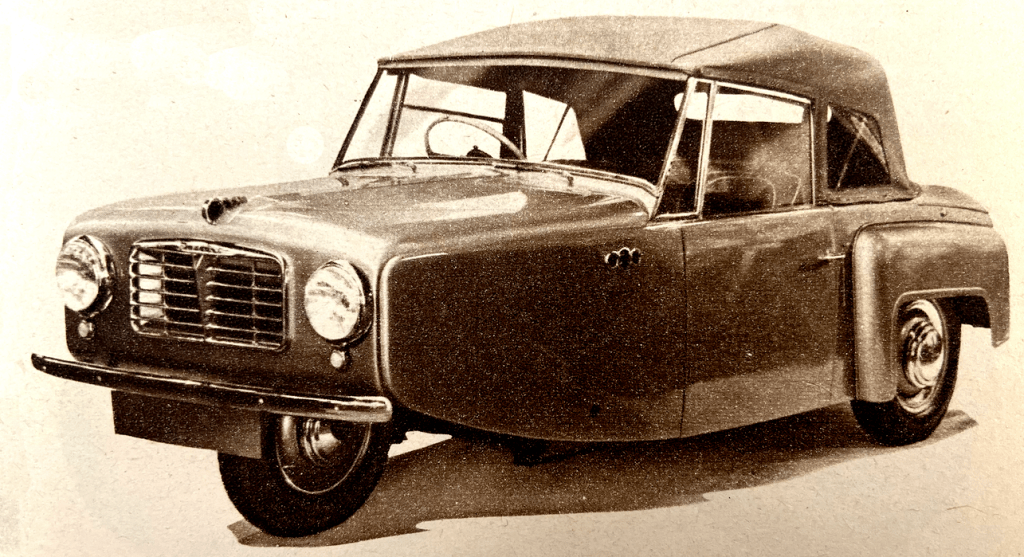
springs controlled by double-acting hydraulic shock absorbers. When not required, the hood folds away into a recess behind the seats. “Cynosure on the Royal Enfield stand is the elegant 496cc parallel twin. The polychromatic grey finish is extremely handsome, and the new dual-seat, which is available with all the rear-sprung models, blends harmoniously with the lines of the machine. Specially designed, in fact, to form an integral part of the machine, it comprises a deep Dunlopillo cushion on a metal baseplate and is covered in Vynide plastic. The grey of the tank is relieved by a silver panel which sweeps back to a point above the kneegrips, and is lined in gold and red; tank lettering is also in red. Detail construction of the twin is well illustrated by a motor-driven sectional engine and gear unit. It will be noted that separate cylinders and light-alloy heads are employed. The crankshaft is of massive one-piece design, and the high-level camshafts are chain driven. Another novelty is a working model demonstrating the Royal Enfield front and rear suspension; the latter is on the pivoting-fork principle with hydraulic damping. The remaining models exhibited complete the range. These are the 346cc standard and competition single-cylinder Bullets, the 350 and 500 roadsters, and the 125cc two-stroke lightweight. Finish on the roadster models is black enamel; the lustrous black of the


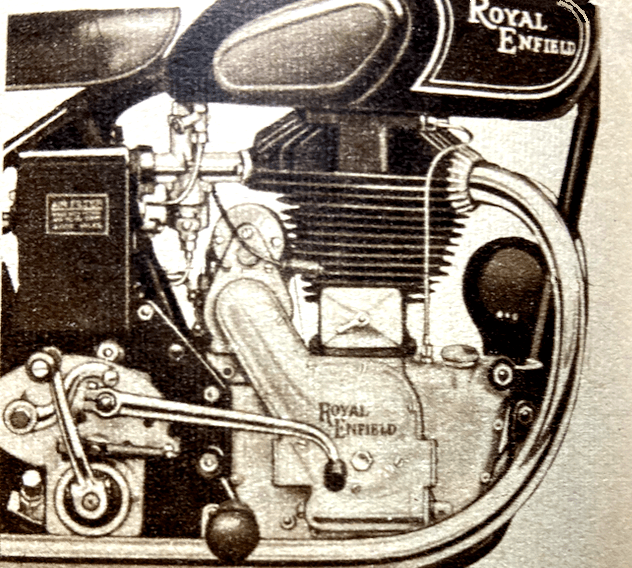
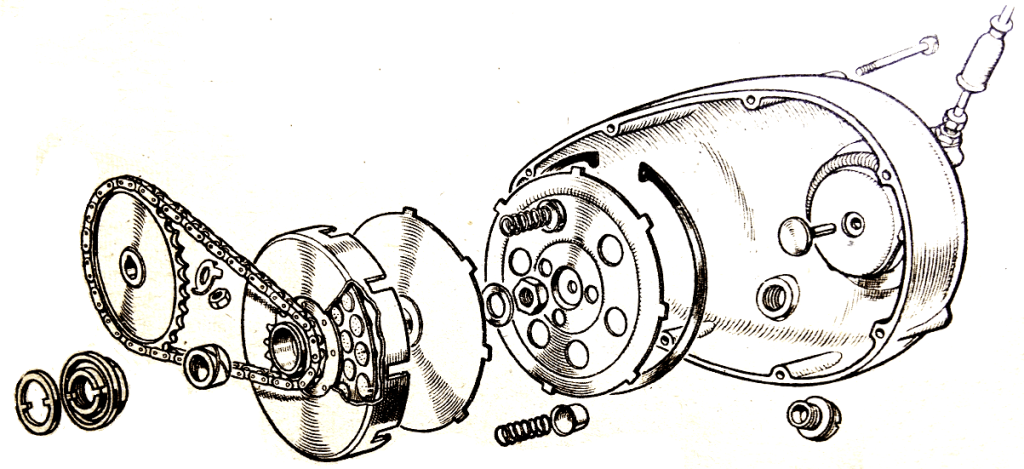

tank is relieved by gold lining and lettering, and by a narrow, chromium-plated strip running down the middle of the tank top. Wheel rims are enamelled frosted silver with gold lining. The whole effect is most attractive. The Bullets, which are in polychromatic grey, are noted for their good steering and road-holding characteristics, and for their excellent all-round engine performance. Light-alloy cylinder heads and light-alloy connecting rods with plain big-end bearings are employed. The 125cc two-stroke model, redesigned last year, has an all-welded frame. The forged crankshaft of the engine-gear unit is supported by four large-diameter ball-bearings located in pairs at each end of the crankshaft. A roller-type big-end bearing is employed. A useful Royal Enfield extra is a pannier set designed for attachment to the spring-frame models. Fabricated from leather-cloth, the panniers measure 12x12x5in and are fitted with handles for easy carrying when removed from the machine. Also on display is the special competition version of the twin ridden by WJ Stocker in the International Six Days’ Trial; he was a member of the British Trophy Team. This year the Sunbeam, New Hudson and BSA exhibits have been combined and then sub-divided into two stands showing export and home models. Although five years have passed since its inception, the Sunbeam is undoubtedly one of the
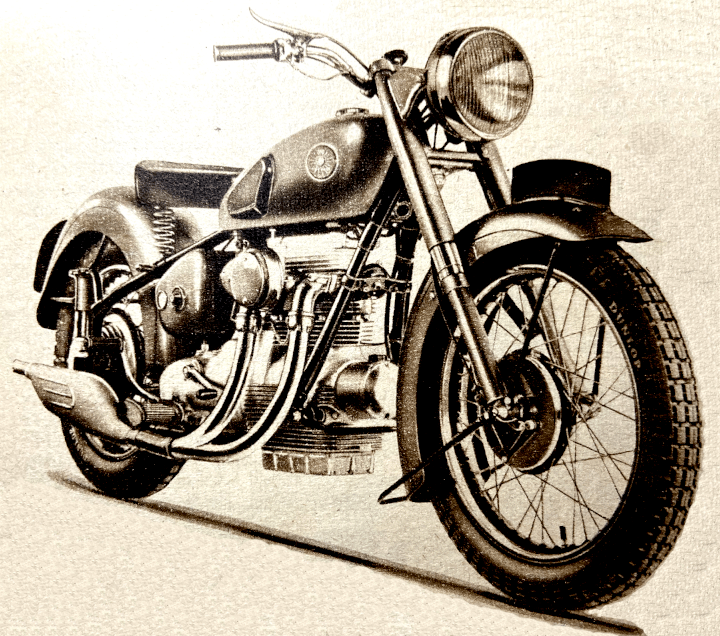
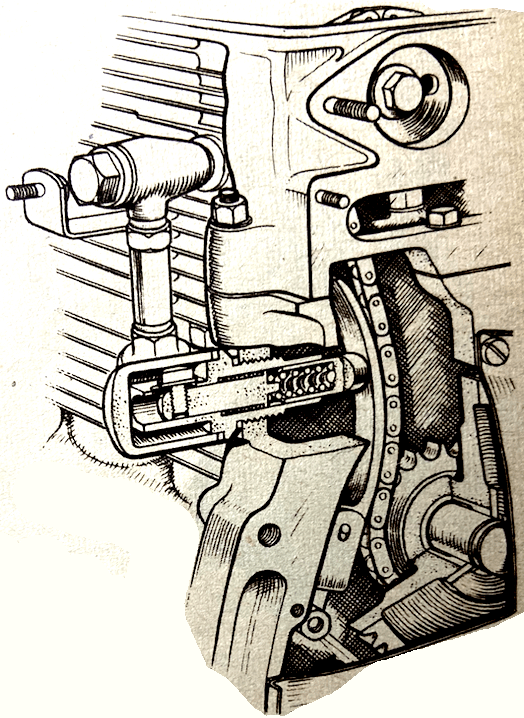
most modern designs in the Show. The sectioned model of the S7 on the export stand is surrounded by admiring enthusiasts. This showpiece not only has all its engine and transmission working and the wheels rising and falling on eccentrics, but it is also rotating, so that the maximum number of enthusiasts can view the machine at the same time. This beautiful sectioned model shows the operation of every part of the machine and gives an insight into the clever design work necessary to achieve such smooth exteriors. Combining almost car silence and smoothness with motor cycle running costs, the Sunbeam makes an attractive sidecar machine. On the ‘home’ stand is an S7 fitted with a single-seat sidecar finished in matching mist-green. For those who require speed with their luxury, the S8, with high-compression pistons and lighter guards and wheels, is a delight to behold. Normal finish on the S8 is black, but it may be obtained with a metallized grey finish. Unusually wide experience in the production of lightweights is possessed by the manufacturers of Sun machines, for they started making Villiers-engine models before the First World War. The fruits
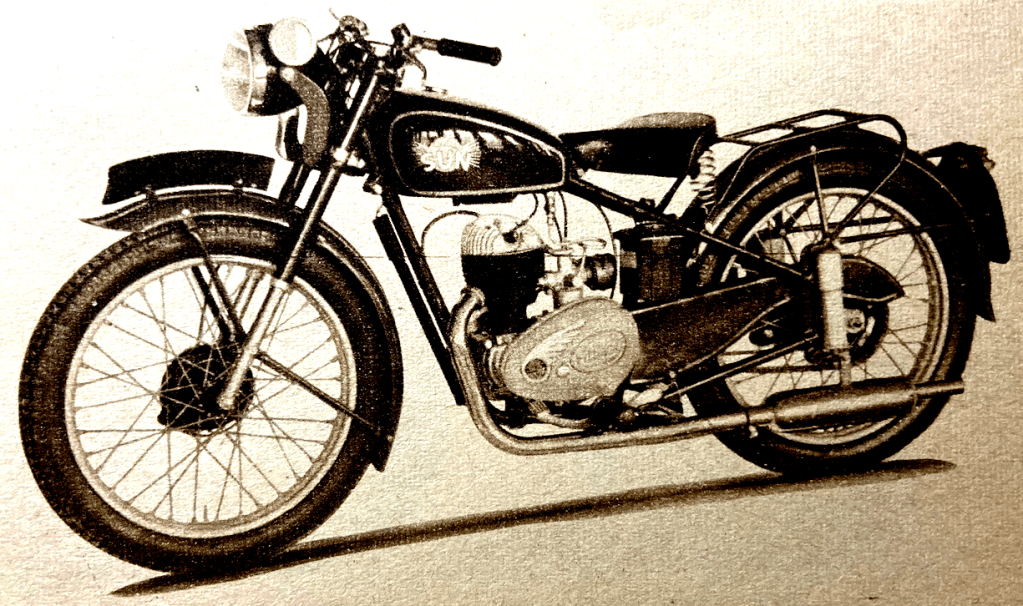
of this experience are well shown in the attractive maroon-coloured 98, 122 and 197cc models for 1952. The two larger machines are luxury mounts. Weighing less than 130lb, the smallest model has the two-speed Villiers IF engine with, of course, handlebar gear control, direct lighting and a girder-type spring fork. Frames of the larger mounts have been strengthened for 1952. Villiers three-speed, engine-gear units, with foot-change, are employed. Both models have Metal Profiles telescopic front forks and plunger-type rear-springing. Lighting is by rectifier and battery, and the equipment in each case includes an electric horn and twin stop-lights. Chief attraction on the Triumph stand is this year divided between the SU carburettor-equipped Thunderbird and the TRW side-valve twin. Anyone doubting whether a machine powered by an engine on TRW lines would be a success if produced for the general public should note the crowds surrounding the Forces’ machine! The TRW is in full battle order, with panniers fitted (squared-up by packing on the inside) and it is as spick and span as any inspecting officer would wish. Many are surprised that the
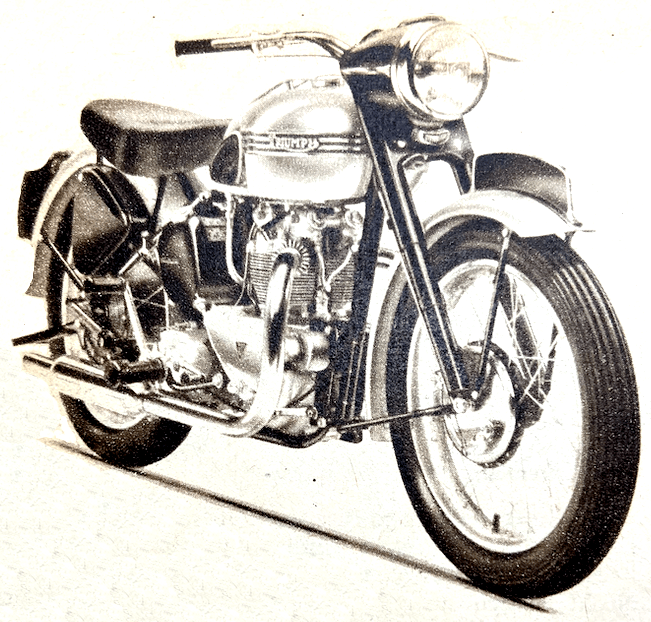

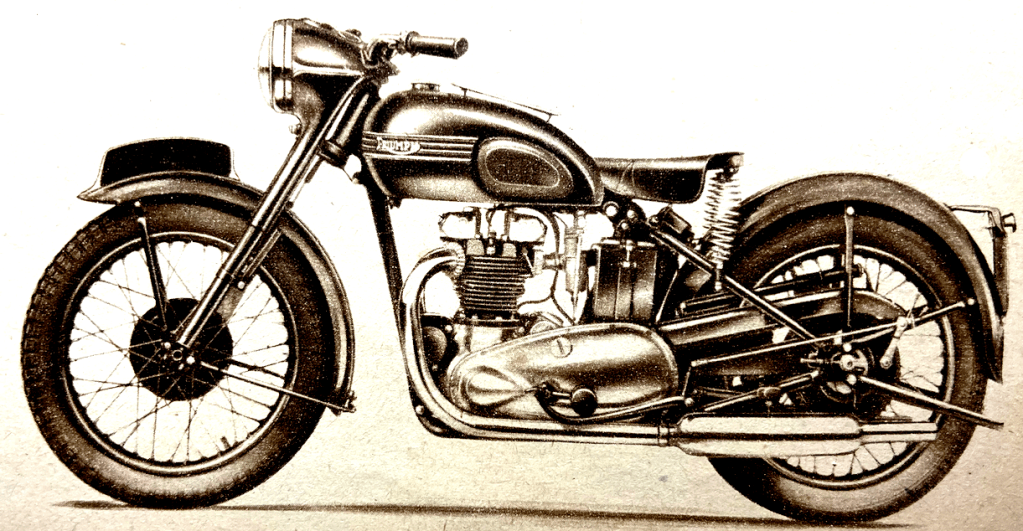


machine is fitted with a magneto as well as the BTH alternating-current generator. In this case the generator supplies current for the lights and horn only, but it could, of course, also feed an ignition coil. Features of the TRW include light-alloy cylinders and heads, a Solex carburettor (although it is understood that this type of carburettor is likely to be replaced later by an SU instrument) and a frame identical with that used for the Trophy model. Total weight, incidentally, is said to be in the region of 320lb. Another interesting feature of the Triumphs exhibited is that the speedometer figures are now ‘the other way round’ with ’60’ and ’70’ at the top of the dial instead of at the bottom. The reason behind the change is to make the figures easier to read; there was some difficulty before because of the flat angle at which the 120mph speedometer lies in the nacelle. Many appreciative comments are to be overheard in the vicinity of the sectioned Triumph engines and the sectioned gear box. The gear box has, of course, a most illustrious reputation for its light, effortless gear change and high standard of reliability. The clutch also has a reputation for reliability—but it is probably chiefly famous for its finger-light operation—an important riders’ point on a cross-city trip calling for endless gear changing, or during a long ride. There is also a sectioned Spring Hub and there are probably more friendly arguments concerning how it works than there are about any other single exhibit! Racing and trials enthusiasts naturally spend most of their time rapturously eyeing the Tiger 100 and Trophy models. In spite of the notable absence from the Velocette stand of that almost legendary racing model, the KTT, the machines
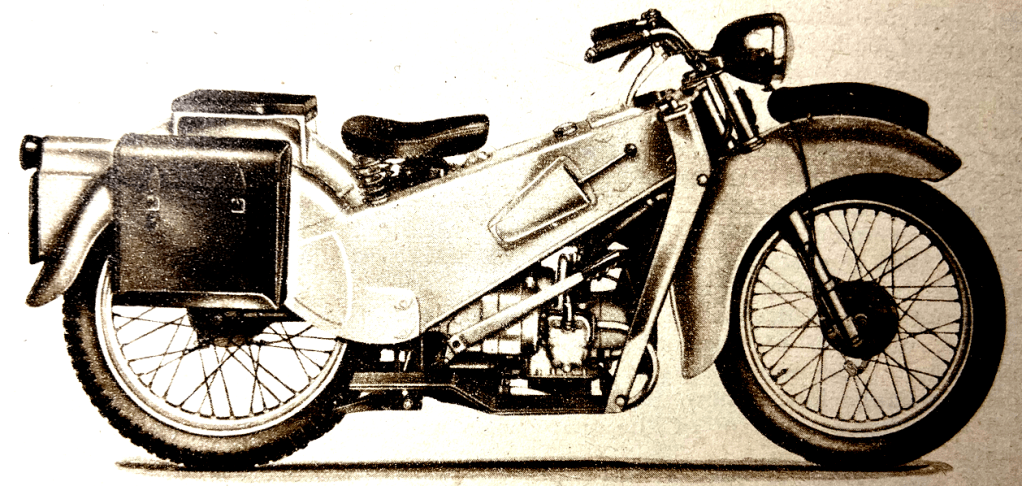
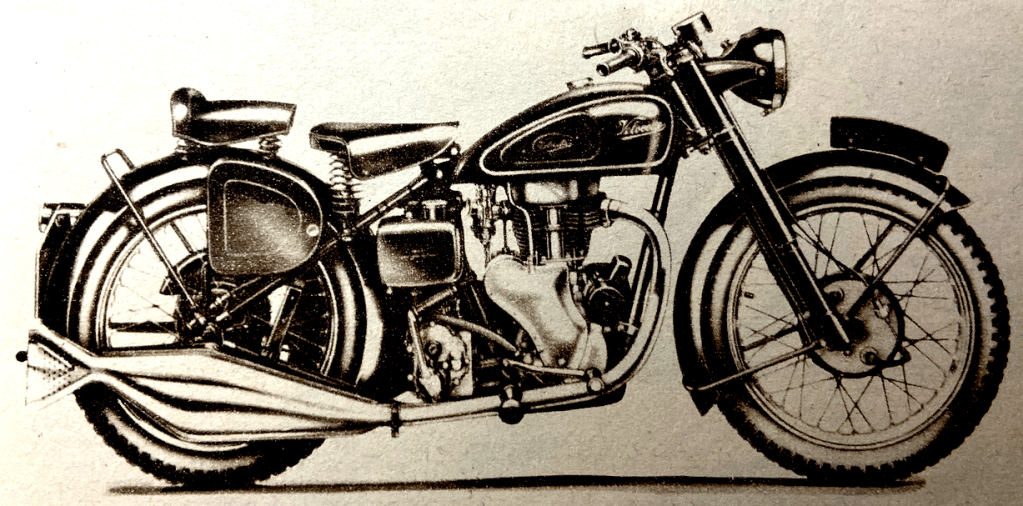
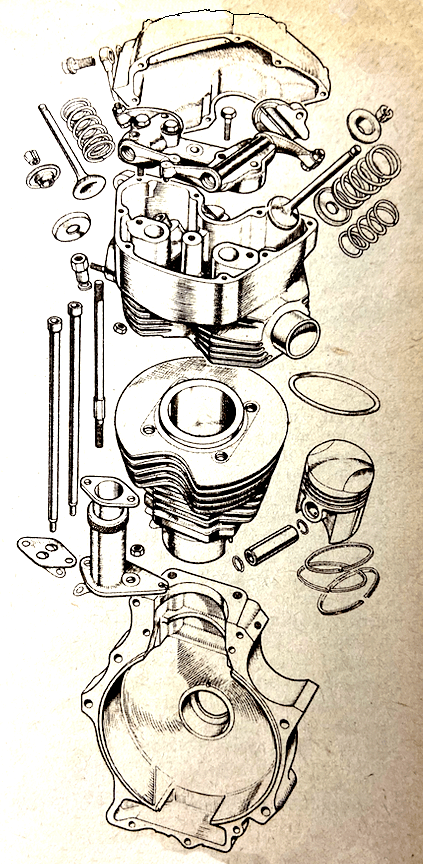
on Stand 76 are attracting the interest of many enthusiasts and prospective riders. The unique Model LE appears for the first time at Earls Court in its larger (192cc) capacity and, by virtue of the increased reserve of power for hill-climbing and pillion riding, now extends its appeal still more widely. For luxury, utilitarian transport, it continues to set an unsurpassed standard. Silence, comfort, cleanliness, economy, and an absolute minimum of maintenance are outstanding features of this conception. Many are trying the armchair riding position and noting the ample mudguarding and legshields—the latter incorporating instrument panels at their upper ends—and the almost absurdly easy-to-operate centre stand. For the technically interested, the beautifully sectioned units show the inner details of the water-cooled, horizontally opposed, twin-cylinder, side-valve engine in unit with its three-speed gear box. The shaft-drive is neatly enclosed in the rear pivoting fork, while the combined 30-watt generator and ignition unit is mounted at the front of the engine. More orthodox in layout is the latest version of the popular 350cc ohv MAC. The engine of this model has been largely redesigned and now boasts an Al-Fin cylinder barrel and an aluminium-alloy cylinder head. This latter casting also houses the completely enclosed overhead-valve gear. The Vincent stand, as ever, is proving the Mecca of those enthusiastic connoisseurs to whom ultra-high-speed safe travel represents the ultimate form of motor cycling. And judging from the size of the crowds thronging the stand their numbers include many who at present no more than aspire to the ownership of a ‘Stevenage Special’. All four models
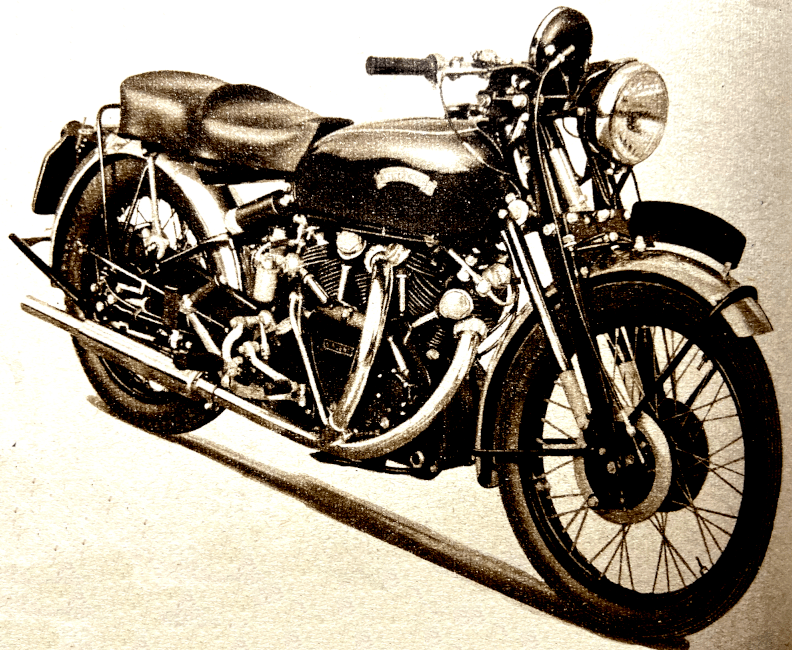
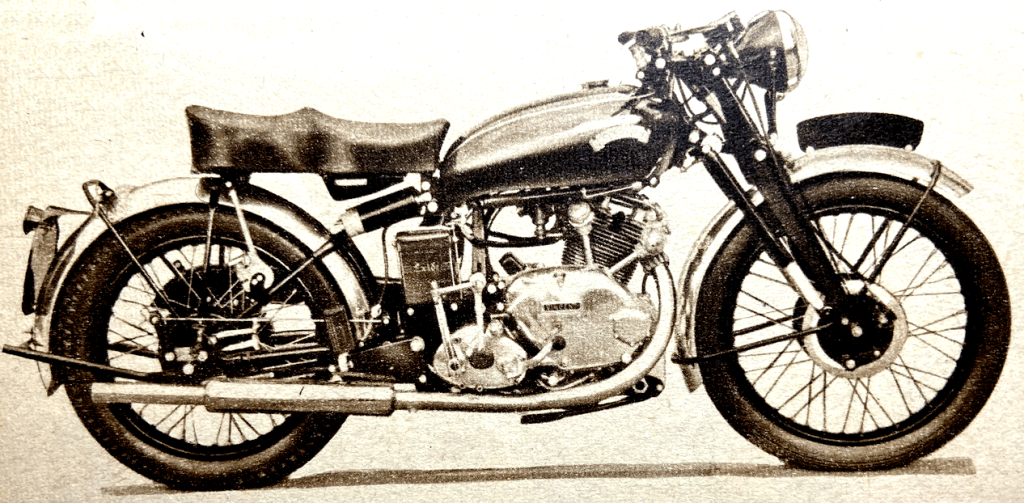
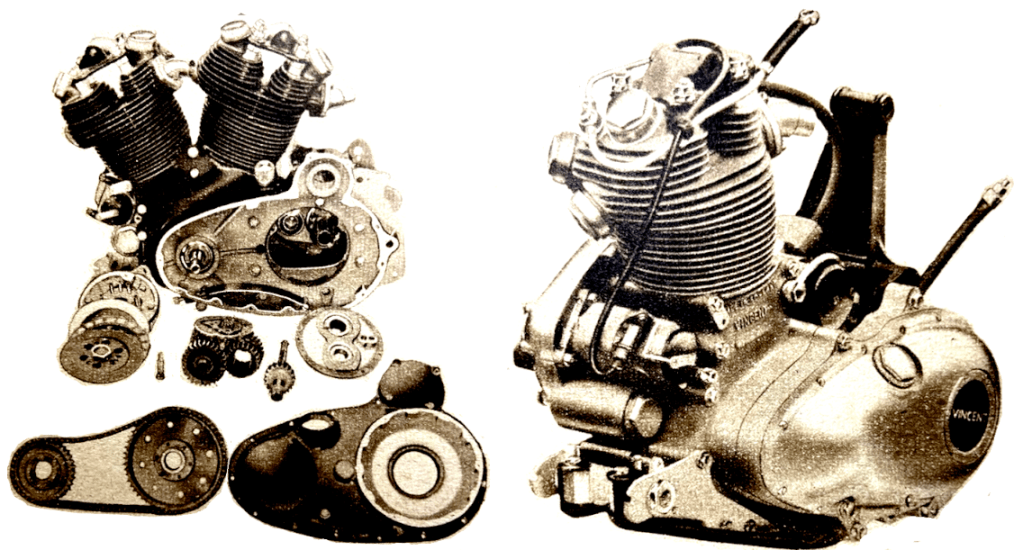
of the range are prominently displayed in both sports and touring versions. The former is the type more usually found in this country, with its polished-aluminium mudguards, famous near-straight handlebar and 3.00in- and 3.5in-section front and rear tyres respectively. The deeply valanced black mudguards, upswept handlebar and larger-section tyres of the touring versions appeal more specifically to oversea customers and sidecar men. Four of the twins are shown wedded to various sidecars of Blacknell and Garrard manufacture, and make extremely handsome high-performance outfits. The twin-cylinder Vincents represent one of the most outstanding British conceptions of the post-war era, and show evidence, not only of design by practical enthusiasts, but also of constant detail advancements. The unique hydraulically damped Girdraulic fork is now universal, as also is hydraulic control of the rear springing. Recent improvements which Vincent riders are quick to observe concern the gear-change and front-brake control. The former eliminates the previous linkage; a forged, light-alloy pedal now runs direct to the gear box. Lighter and more positive gear selection is thus achieved, while an uncommonly large range of adjustment is retained by means of splines at the rear end of the lever, plus five optional pedal-mounting holes at the front end. Most enviable in reputation and hand-some in appearance, with the glossy black finish of its power-unit castings, is the Black Shadow—sports edition of the Rapide. Dispensing 55bhp and capable of cruising at any speed of which a rider is capable, with a maximum in excess of 120mph, it represents, for many a truly hard rider, the ideal mile-eater. Also on view are manually operated, sectioned models of both single- and twin-cylinder engines, and of the Girdraulic fork and front brakes, and displayed in showcases is a variety of standard components straight from the assembly .line; no special Show finish has been applied.
“CYCLE ENGINE ATTACHMENT units of 12 makes are on view, and a 13th make exhibited is available only as a complete power cycle. Of the 13, 12 are two-strokes and one an ohv. four-stroke. Engine capacities range from 25.7 to 49.9cc. Seven models drive by friction roller direct on to the tyre—four on to the front wheel and three on to the rear. Of the remaining six makes, five give positive drive to the rear wheel and one provides friction-drive by V-belt and pulleys. Three of the positive drives are through clutch and roller chain, and two are through clutch and pinions. Two of these units have two-speed gear boxes.” The clip-ons were exhibited by Banamoto, Berini, Cuciolo, Cyclaid, Cyclemaster, Cymotam Mini-Motor, Mosquito, Power Pak, Power Wheel, VAP and Velosolex. “One of the Show sensations, the Power Wheel consists of a 40cc two-stroke rotary engine which spins around a fixed crankshaft (the wheel spindle) and is enclosed within the wheel hub—a 10in-diameter drum. The engine rotates approximately 14 times as fast as the wheel. Gear primary and secondary drives, and a five-plate clutch, are employed. The carburettor is mounted on one end of the crank-shaft, which is hollow. Mixture inlet is controlled by a rotary valve actuated by the connecting rod. Coil and contact-breaker rotate with the engine; the magnet plate is stationary. A gear-driven alternator supplies current for the lights. As to cooling, the rotating engine acts virtually as the impeller of a centrifugal pump.”

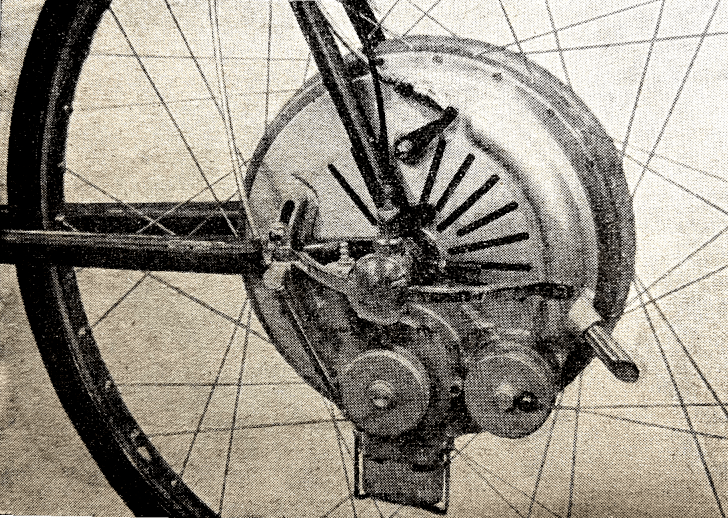
“RANGES OF SIDECARS by seven specialist manufacturers are exhibited at Earls Court. Six are British [Blacknell, Garrard, Laxton, Matheson, Swallow and Watsonian] and one is German [Steib]. The number of different models approaches 50. In addition to these ranges some motor cycle manufacturers such as BSA, Norton, OEC and Sunbeam list sidecars.”
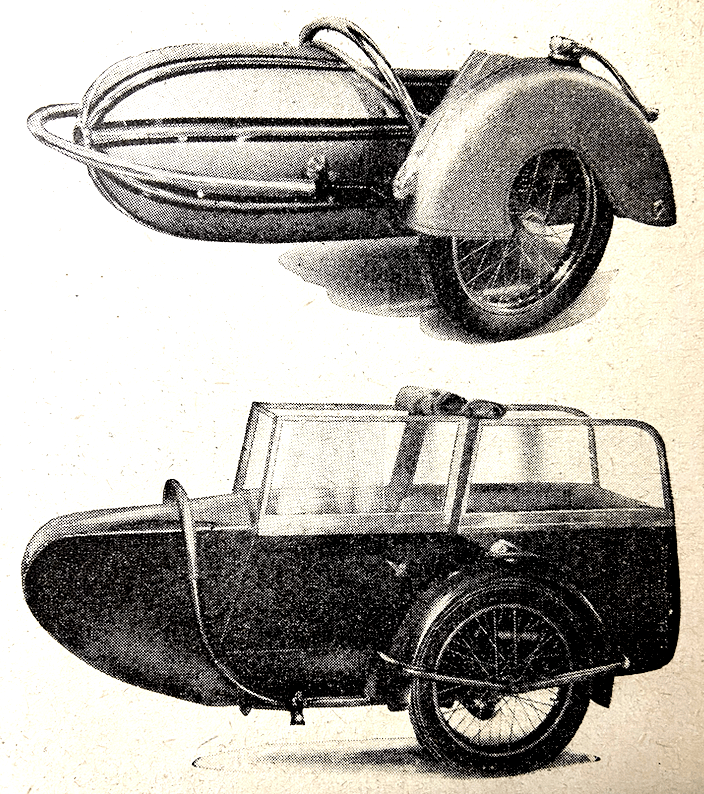
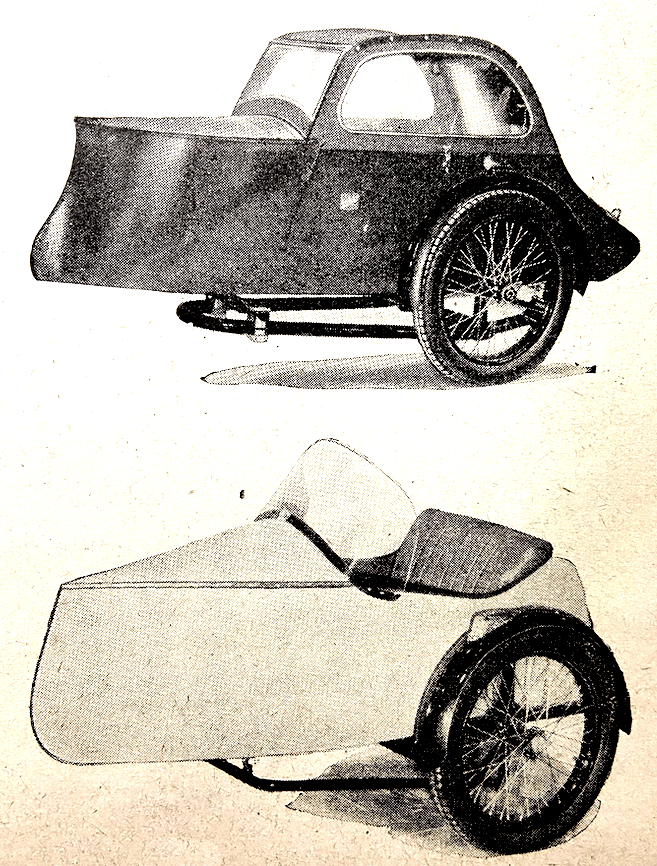
“…WHAT’S THE NAME of this handlebar screen material? Roadoid? It looks like Perspex except that it has a very slight and just perceptible bluish tint. But it makes a smart windscreen. Note how flexible it is; certainly, as our obliging HMF Stand attendant says, it ought not shatter in the event of the machine’s toppling over, nor should vibration cause it to split. At £3 14s the screen is £1 dearer than the HMF Giant Screen which is sold in such large quantities both at home and abroad. An eye-catcher is the new BSA Bantam pannier frame with integral, twin stop lights at the rear. There are no bags supplied with the frames but they are just right dimensionally to be fitted with a pair of ex-Army packs. A seething crowd appears to want to see the locking twistgrip introduced by Feridax. Enthusiasts take it in turn to sit on the rig and feel the oval-section grip. Here comes Mr Ferriday himself to explain the reason for the oval shape. It is the old trials dodge, except that instead of putting a length of ³⁄₁₆in or ⅛in rod inside a round grip to make it oval, this one is moulded in this section. There is a range of attractive riding coats—can that material really be PVC? It looks just like leather but it should be superior since PVC is impervious to oil, acid, petrol, and what have you. You might prefer the competition, collarless style, or the touring design which has an especially neat collar. You can have a coat in any colour you can think of—and the same goes for the new luxury Dualseat which is PVC covered! Plastics are indeed very much in evidence. If crash helmets ever become a la mode for motor cyclists, the 16oz Panorama plastic job on the Feridax stand looks as though it will be fairly comfortable as ‘battle bowlers’ go. The Britax stand: this is rather neat, is it not? A safety bar with tiny parking lights in each end—red facing to the rear and white to the front; and just feel the weight of it—must be 14-gauge tube at least. Fitting as it does through the top sidecar lug, installation could not be very much simpler. What? your machine has no sidecar lug? Well, no matter; a lug for clamping to the frame down tube can be supplied. Springs—helical and hairpin, tension and compression, large, medium, small and tiny—we can see them all on the Terry and Tempered Spring Co Stands. And clutch-spring cups; perhaps we can learn something of their manufacture. What? Seven operations. Well, well. Some of these spring cups are brass and some are steel because sheet-steel is in short supply.”
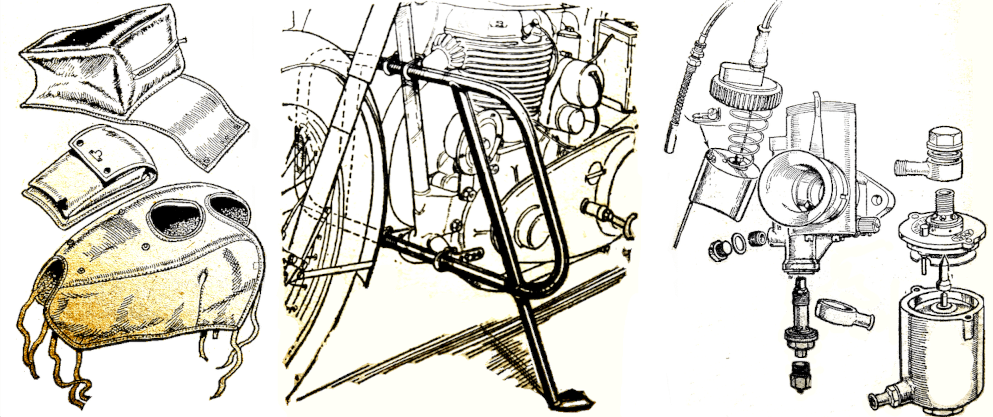
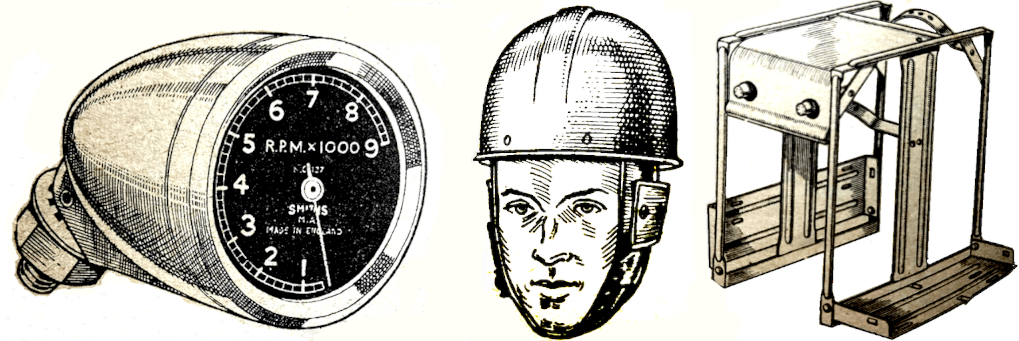
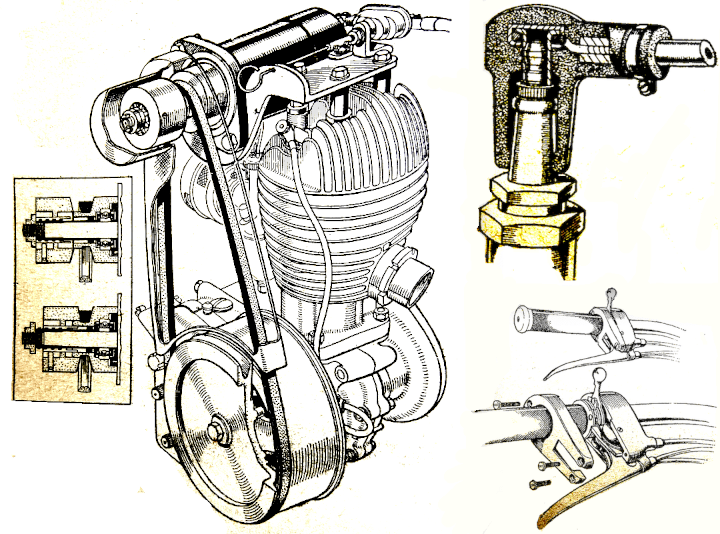
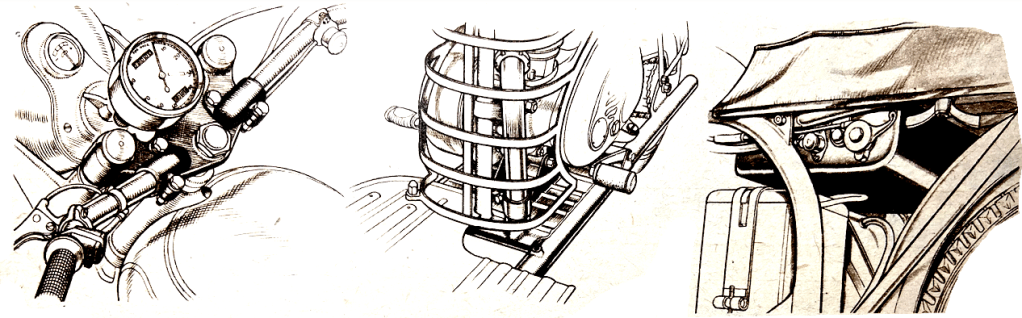

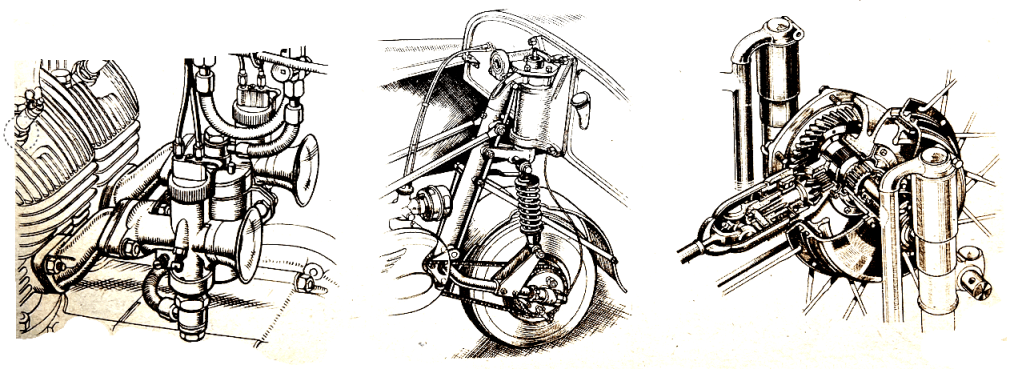
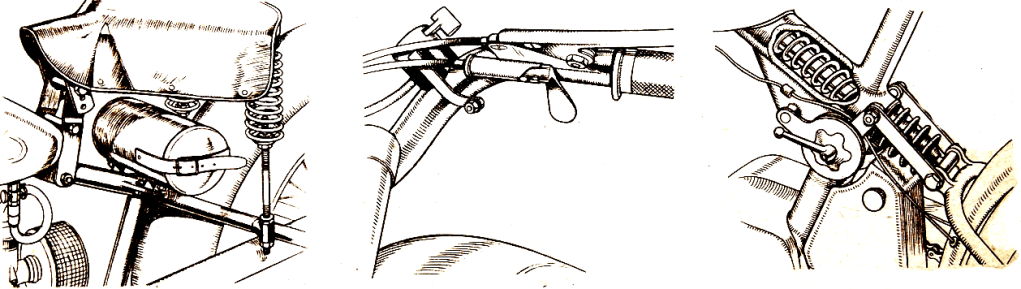
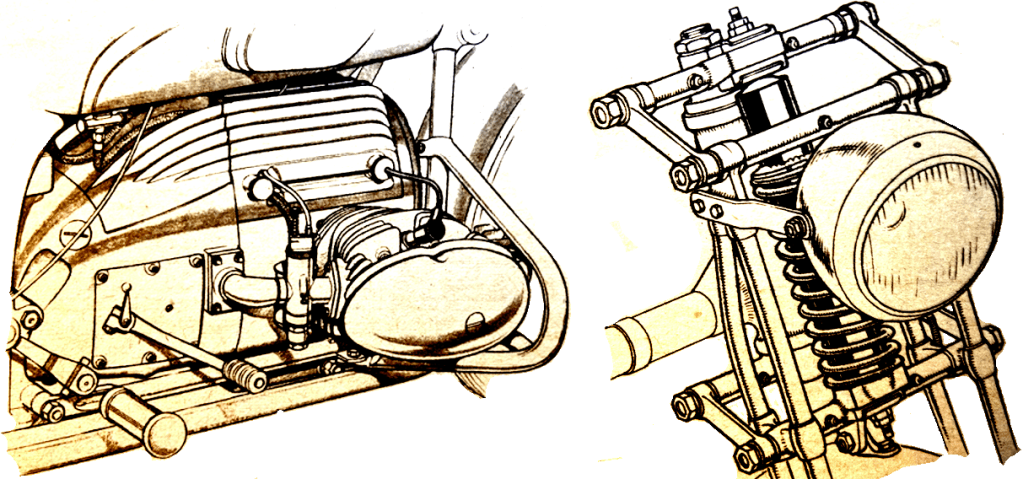
BRITISH MOTORCYCLE PRODUCTION rose to 171,730, of which 10% were autocycles under 100cc; 19% were 125s; 7% were 200s; 6% were 250s; 20% were 350s; leaving 38% at 50cc and above. Exports hit 91,600. Britain also produced some 15,000 sidecars, of which 1,000 were exported, and more than 63,000 ‘clip-on’ bicycle engines. Bicycle and motorcycle exports were worth £42m.
“TOTAL NUMBER OF production motorised cycles, autocycles, scooters, motor cycles and three-wheelers (including commercial vehicles) on show at Earls Court is 364. In addition, 13 makes of engine attachment units for cycles are displayed. Value of the 364 machines, at basic prices, is £55,092 17s 8d. Purchase Tax on this figure would amount to £15,303 11s 7d. Lowest-price machine in the Show is the 49cc. Mocyc motorised cycle at £34 12s 6d (basic). The lowest-price autocycle is the 98cc New Hudson at £50, and £58 lOs is the lowest figure for a motor cycle—the 98cc two-speed BAC Lilliput.There are 29 British and five foreign makes at Earls Court. The following figures are, of course, based on the total number of distinct and separate models. TYPE: Two wheels, 152; three wheels, 11. CAPACITY: Under 50cc, 6; Under 75cc, 1; 100cc, 13; 125cc, 21; 200cc, 29; 250cc, 11; 350cc, 23; 500cc, 43; 600cc, 6; 650cc, 3; 750cc, 3; 1,000cc, 4. ENGINE: Two-stroke, 70; side-valve, 14; push-rod ohv, 72; ohc, 7. CYLINDERS: One, 128; two, 31; four, 4. IGNITION: Magneto, 146; coil, 17. LIGHTING: DC dynamo, 71; AC direct, 28; AC rectified, 26; Nil, 38. TRANSMISSION: Unit construction, 94; separate gear box, 67; direct drive, 2; gear primary, 25; chain primary, 136; shaft final, 14; chain final 144 Friction final 3 GEAR BOX Fixed gear, 12; hand-change, 13; foot-change, 136; two-speed, 7; three-speed, 62; four-speed, 80. FRONT SUSPENSION: Girder fork, 22 ; telescopic, 123; bottom-link, 10; other, 8. REAR SUSPENSION: Solid frame, 88; Spring frame, 75; plunger-type, 36; pivoted fork, 29; pivoted arm, 3; spring hub, 4; leaf springs, 3.”
“THE 1951 SHOW displays two main features—superb quality in superb variety. Novelty in the sensational sense is practically conspicuous by its absence, except for a very few timid débutantes. Necessarily so. Certainly, it is six years since the war ended. But there are many discouragements to those who want to bring out new designs. There are shortages of materials and labour, both likely to become more acute as rearmament gathers momentum. Factories continue to improve specifications in detail—to paint the lily and to gild the gold. But the moment for resolute seeking after newness is still far away. I need not underline quality. On road and track we maintain our traditional supremacy. Many foreign designers are in some sense our copyists. Other nations greedily import our machines. Football pools enthusiasts treasure their ‘bankers’—selections which they regard as sure and automatic winners. Here is a brief list of the industry’s bankers, all articles of unquestioned quality, eagerly sought everywhere in their several spheres: Ariel Square Four; BSA Bantam; Royal Enfield Bullet; Excelsior Talisman Twin; Francis-Barnett range of lightweights; JAP speedway engines; Matchless and AJS Twins; Norton ‘featherbed’ Dominator; 600cc Panther for sidecar work; Sunbeam Twins; Triumph Thunderbird; Villiers range of small two-stroke engines; Vincent Big Twins. This abbreviated catalogue omits literally dozens of machines passionately beloved by owners all over the world. I have merely sifted out a few which in popular esteem rank just about top in their respective classes. Most of them are different and distinct types, illustrating the lavish variety of inventors. Let me add that not one of these models is static. Every single one of them is still undergoing perpetual improvement. The Dominator itself is merely an unusually brilliant development of an earlier

model which was ‘ordinary’ by comparison, yet contained the embryo germ of its proud progeny. Ask many a stand attendant to exhibit in detail the 1952 modifications which distinguish the staged models from last year’s and you must be prepared to listen quite awhile. In accessories there are two exciting novelties, which may be destined to sweep the world in due course—it is early yet to be sure. One is the AC generator, which makes us many promises. As a source of electricity it easily tops all its fore-goers. It banishes the Achilles’ heel of coil ignition—the stalling of an otherwise perfect projectile by the accident of a dead battery—for with this installation we can start and run if the battery is not only flat, but practically crumbling. It abolishes auxiliary drives, of which the gears or chains will presently cease to swell that unwelcome obbligato of small parts which contribute their noises to a mechanical orchestra. (Incidentally, if the diamond of a frame is rather crowded, this generator can liberate quite a lot of space.) Of perhaps slightly less outstanding merit is the adaptation of one of the more famous car vapourisers for motor cycles. The new SU instrument will remain a Triumph monopoly for some time to come. We cannot yet say whether it is going to bestow smoother tickovers and better acceleration than more familiar instruments, but at least we know that its resetting for varying conditions is at once easy and effective. An amateur can almost instantaneously adjust it to run in the Dead Sea valley or on the Grossglockner. Rear-springing, once regarded as a costly freak, is now a ‘must’ on all first-class mounts. It adds about £20 to their price (except where the simplest lightweights are concerned), but is thought indispensable. Simpler systems appear on such inexpensive lightweights as the BSA Bantam, the James, Excelsior and others. There are also three complete novelties, as yet mere prototypes without any public ‘form’, but possibly with considerable destinies.
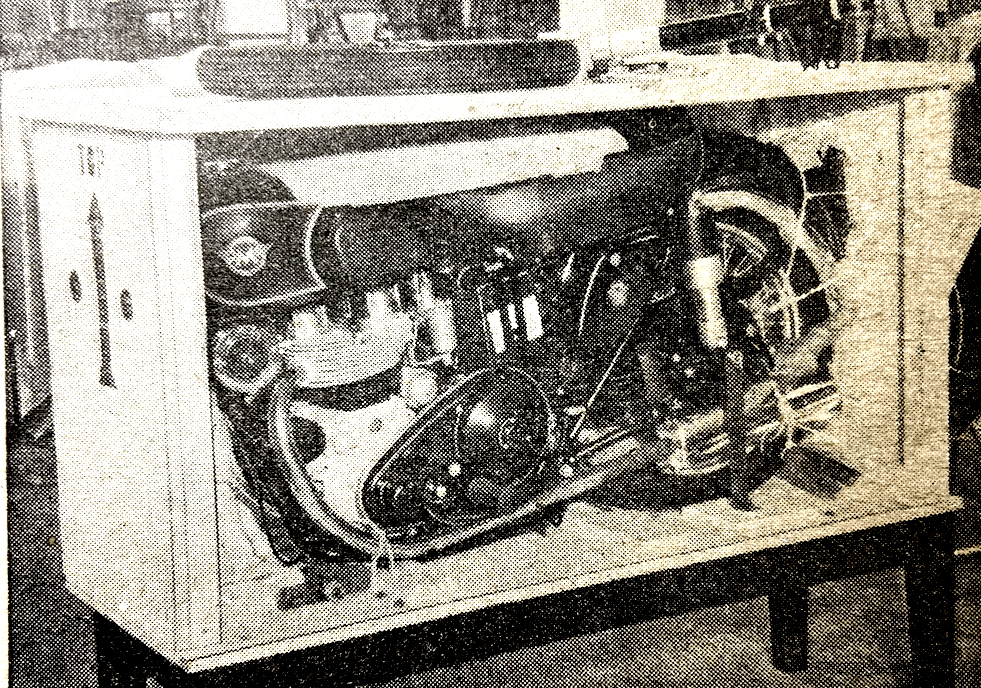
They are the 500cc Douglas, intended primarily for sidecar work; the 747cc four-cylinder Reliant Regal three-wheeler; and the TI ‘Power Wheel’. The Douglas is an exceedingly handsome model in slightly greyer sea-green than the Sunbeams, with two carburettors and a myriad interesting details, worth prolonged study. The Reliant is the-best-looking three-wheeler ever staged, resembling a film star’s convertible, complete with ‘dollar grin’. Its price is daunting until we recall that all 1951 prices display about 300% inflation. The third novelty is a mini-cycle wheel designed by Cyril Pullin and fathered by Tube Investments. Startlingly original in every detail, it adds 16lb to the weight of any pedal cycle and forms a hub to the rear wheel. The hub contains a 40cc rotary two-stroke engine. On paper it is at once the most novel and the most plausible micromotor design on earth. Perhaps the BAC Gazelle scooter should be ranked with the real novelties. Its design is largely conventional, but it weighs about 50lb less than the Italian scooters and is proportionately cheaper. Its frame consists mainly of two long tubes which start under the steering head, pass down under the platform and finish astern of the rear wheel; the tubes are cross-braced by the steel silencer. Villiers engines are the modest violets of the industry. About 1,250,000 of them are in service all over the globe. They have obviously made a greater contribution of happy man-hours to our race than any other motor cycle engine. The Royal Enfields appear in the famous quintette, with my heart clinging to the 350cc Bullet. You can safely chuck it about on any kind of road, as a fighter pilot handles his aircraft. With a 33% bigger engine the LE Velocette takes rank among the real champions. For a fastidious, all-weather utilitarian rider it is quite invincible. Its sole surviving sister, the 349 c.c. four-stroke ohv MAC, is a top-class modern roadster, for those who need something bigger and faster than the LE. I bought my first Squariel before the design had fully attained the designer’s ideal of mechanical silence, and a ride on the current model creates a remarkable contrast. Here speed and manners are wedded in astonishing fashion. All the Ariel engines might be termed ‘autobahn models’—they have been retailored to withstand continuous high speed. For example, with its new light-alloy head the side-valve VB unit is said to run much cooler than its forerunner. The whole
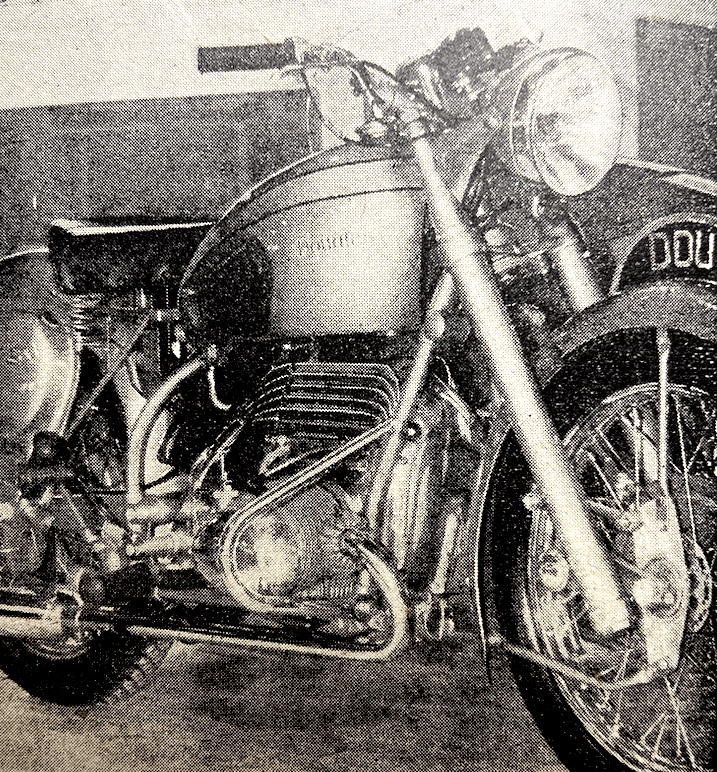
exhibit wears an air of rugged majesty. It is hard to realise that the Panther clan is now more than half a century old. While many fell by the way, they have steadily woffled on to interpret robust reliability in a crescendo vein. The Model 100 is a very fine sidecar puller, and its Dowty fork offers instant variation for solo or- sidecar work. The Model 65 is one of our few surviving four-stroke 250s, and silently reminds as how much extra sturdiness we can get by stepping out of the under-200cc class. As factories simplify their production programmes many a. beloved 350 has vanished, possibly for ever; no absentee will be more sincerely mourned than the Triumph 3T. The issue between the Triumph spring hub and more ostentatious forms of rear-springing has yet to be determined. I imagine that AMC and Triumph run each other very close at the top of the class on the basis of who silently effects most detail improvements in current models during any 12 months. Note how beautifully the air-cleaner is accommodated on these models. The ‘Thirty-model Group’, generally known as BSA, is the most portentous block in our industry. They could fit every age group in Shakespeare’s famous seven ages of man, and still have a few models left over. T nor know of which the directors are most proud? Possibly of the tough little fully sprung Bantam—it is most difficult to breed a genuine aristocrat in that class, yet they have done it. But then a standard Golden Flash went out the other day and had the impudence to register 143.44mph on Bonneville Flats. The simple fact is that all the models are jolly good, and choice is a matter of personal faddishness. At Frankfurt several models were staged with shaft drive; at Earls Court the British examples numbered TWO! I am now practically a 100% convert to shaft drive. The men who cover big mileages riding to and from work every day have converted me. A wet, gritty chain should be cleaned and lubricated every time it comes in. However, a general switch to the shaft is unlikely—such wholesale revisions are impossible at this moment. So the Sunbeam and the Velocette must reign alone till easier times come. The Sunbeam somehow wears rather a queenly air, and I cannot blame her in the least. Vincent’s, being a comparatively small concern, can afford to introduce improvements as they come to mind and so ignore the wave of change which infects larger factories at Show time. They are selling their output in the following percentages—Black Shadow, 40; Rapide, 40; and Comet, 20. The supremacy of the big ‘uns is almost wholly due to demand from the American continent. Ten minutes after the Show opened I spotted two distinct surging crowds. That on the AJS stand was partly inspired by a desire to inspect a naked Porcupine at short range, and partly by passion for Doran’s autograph. That on the Norton stand was due to the debut of the standard featherbed Dominator. I honestly suspect this very modern specification desires to rank as the best motor cycle in the world. It certainly turned all the other Norton models peagreen with envy and no wonder. It is a real neverwozzer—and it shows the stress we tough motor cyclists still put on comfort and roadholding. On the Matchless and AJS stands I noticed two traits characteristic of AMC. If they are ever so slightly dissatisfied with an item, they grudge no cost to correct it; access to clutch and dynamo has been quite expensively transfigured during the past year. In addition, they take pains to supply their customers with simply fitted accessories. They supply strong and capacious panniers, carriers and pillion seats. All snick straight into place without drilling or faking. Such forethought saves a lot of trouble and expense, and explains why these two makes are such favourites with hard-riding enthusiasts. Practically all the more luxurious two-strokes now boast rear suspension. A few timid experiments in colour are visible, ranging from cream to maroon, but black is still the favourite stand-by, though a few coquet with iridescent greeny-greys and such-like. I heard nobody lament the scarcity of chromium plating, and I for one do not like too much glitter. I found such lightweight fleets as the James, Excelsior, Francis-Barnett, OEC, Dot, Ambassador and others most impressive. Ranges of eight different models are quite common. So far they easily hold their own against such scooters as the Corgi, the Vespa or Lambretta, but they do not tap new markets quite so freely as the clip-ons. It is naturally hard to say how far the shortage of £ s d explains this situation. Of course, even the simplest 98cc autocycle is a deal costlier than buying a clip-on for an existing push-bike. Within a measurable future the scooter and the clip-on may literally swamp our roads.” —Ixion
JAPANESE RIDERS LOOKING for something more comfortable than their powered bicycles snapped up Tohatsu’s 98cc Bumble Bee ‘luxury’ model. Tohatsu was just one of up to 80 small manufacturers taking full advantage of Japan’s US-backed economic revival in a ferociously competitive domestic market. Between them they made a total of 24,309 lightweights and, let it be noted, they exported 318 of them. A loom manufacturer named Suzuki joined the fun with a 36cc two-stroke motorised bicycle marketed as the Power Free. It featured a double-sprocket gear system that allowed a rider to pedal with engine assistance, pedal without assistance, or disconnect the pedals and run solely on engine power. The Japanese patent office was impressed by this and subsidised Suzuki’s R&D. A decline in the cotton market prompted Suzuki to shift its focus toward motor vehicles.
CHINA NEEDED military motor cycles for the Korean war. The People’s Liberation Army Beijing No 6 Automotive Works (not as catchy as ‘Small Heath’) duly back-engineered the pre-WW2 Zündapp KS500 side-valve flat-twin and named it the Chang Zing.
“SPEAKING PRESUMABLY IN his official capacity as permanent under-secretary to the Home Office, Sir Frank Newsam, at the annual conference of the Chief Constables’ Association last week, stated that he could see nothing against the use of plain-clothes police as traffic patrols. He had, he said, seen statements by some chief constables that appeared to suggest that there was something repugnant in employing men in plain clothes for the purpose; such men were used to bring law-breakers in other fields to book and he saw no reason why they should not be used to deal with drivers whose conduct on the road was equally criminal. It would be interesting to know precisely what Sir Frank Newsam means by ‘equally criminal’. To sweep the tiny minority of dangerous road-hogs from the road would be excellent, but will plain-clothes men be confined solely to this? Might it not be found that they spent some of their time patrolling straight, open stretches of road which never should have been limited to 30mph but are restricted because they have street lighting—that they sought prosecutions for exceeding the speed limit in circumstances where there was no question of danger? Education is the need, not persecution.”
“PERHAPS YOU NOTICED the phrase ‘inches wide’ in our report of the BMCRC meet at Goodwood. It related to the extreme narrowness of the perfect steering line, even on so broad a track as the Goodwood perimeter. Experts have often debated about the factual width of such a line on many circuits. By the end of TT Week the lap surface displays a polished strip, varying from perhaps lft to 5ft at various points. General agreement, is that if by the ‘perfect’ line you mean a steering path which combines maximum speed with faultless style, the phrase ‘inches wide’ is correct on all circumbendibuses. A Hercules who contorts himself and rides in ugly fashion may equal the ace’s speed on a dangerous bend. But he will be slower than the ace when the path out of one bend governs the perfect path into another bend; and at over 100mph two bends thus connected need not be very close to each other.”—Ixion
“IN JANUARY, 1921, fitted to my 7hp AJS outfit a spring-loaded handlebar made by the Royal Enfield company, of Redditch. The headlamp was fitted to the bar and, when oncoming traffic approached, I gradually lifted the bar and the light beam dipped. Can any person claim to have dipped before this?
FIFTY YEARS A MOTOR CYCLIST.”
“I PAINT MY MACHINE all over with a mixture of engine oil and paraffin, using a small paint-brush for the job and taking care, of course, to keep clear of tyres, bearings, etc. This proofs the machine against rain, snow, and all the rest, and is guaranteed to keep a new machine, new indefinitely. When you have to do a maintenance job, you simply clean off the required area with the paint-brush and paraffin. If you want to sell the machine you do the same over the whole area when you discover the pristine polish of the enamel (a polish which more orthodox chappies have long since polished away) and no rust. Naturally, I get a few facetious remarks from young lads who stay up o’ nights furbishing their models and then wait for the sun to shine before going out. ‘Has someone chucked a bucket of over your bike?’ or ‘Have you been in for the trials, mister?’ I reply curtly that life itself is a trial, and I console myself with the knowledge that under its protective coat my motor cycle is better shape than theirs. Well, there you are. I know it’s a bit messy, but I’ve done it for nearly 20 years; and I expect I’ll go on doing it until I go to live in a climate where heat and not moisture will be the thing to guard against.
C HENDERSON, Clevedan, Somerset.”
“SOME TIME AGO I was reading a yarn by CS Forester in which a murderer got to work on a motor cyclist. When the unsuspecting victim went to the murderer’s house for tea, the villain slipped quietly out to the man’s machine, slackened off the brakes and took the spring link off the secondary chain. The unfortunate rider went home a little later, and just as he reached the top of a steep hill the chain flew off. By the time he had shut off, and got round to thinking of stopping the machine, he was moving down the hill quite rapidly, and the brakes, of course, were out of action. When the wreckage was cleared away, nobody noticed the doctored brakes among the rest of the damage, and it was a long time before the murderer was brought to book. This tale started a morbid train of thought in my mind, and in less than no time I had worked out a most ingenious plot for disposing of an unwanted person. The scheme is so simple and fool-proof (I think) that I will refrain from printing it!”—Nitor
“EVERY TIME the Ministry of Transport licence returns reach the office I get another surprise. Before me as I write are the figures for the number of motor cycles (including three-wheelers, autocycles, etc) with current licences on 30 November 1950. The total is 715,100. My little black book of statistics shows that the figure is higher than since 1927 when my records started, and the chances are that the 1950 figure is a record. For the end of November; over 500,000 was usual up to 1931; thereafter until the war 300,000 to 400,000 was the rule. Since the war, registrations have climbed steeply and the absolute peak figure for licences current—always in August each year—is likely to be well over 720,000 for 1950; official details have not yet been issued. In the 1930s there was always a very marked difference between the number of machines on the roads during the summer quarters and the winter quarters. Far more owners these days are all-the-year-round riders. It’s a healthy sign, gentlemen.” Nitor
“TWO MEMBERS OF the Ceylon MCC, William Sparling (21), a tea planter, and Vernon Crouch (27), a teacher, have set out for Europe via the overland route. Sparling is riding a KSS Velocette, and Crouch an ES2 Norton. They are carrying specially constructed, heavy pannier bags that accommodate four two-gallon containers or petrol and one gallon or oil. Equipment includes chemicals for purifying water, tools, spares, spare tyres and tubes, besides clothing, sleeping-bags and maps. They planned to cross to India by boat and from Madras to travel on to the notorious Khyber Pass via Bombay and Delhi, through Afghanistan to Persia, and then on to Alexandria. The two riders will be together until they reach France, where Sparling will remain for some time. Crouch will then proceed to England where he hopes to enter a university to further his studies. According to reports received so far, they have reached Indore, in India, and had covered 2,400 miles from the time they left Colombo. Here Sparling had bad luck when he collided with a building. They had to go back 250 miles to Bombay to get his ankle X-rayed, and it was on this eventful day that Crouch encountered his share of ill-luck when he had 14 punctures in eight hours.”
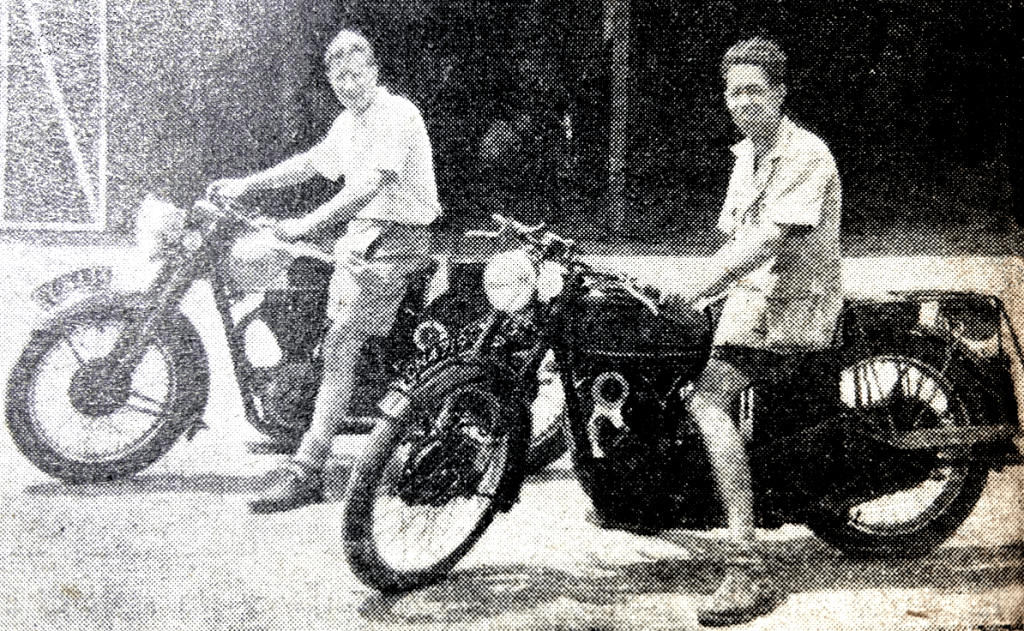
“WALSALL ‘EVERYMAN’ RALLY, held in brilliant sunshine on Sunday, received a record entry of 49 solo motor cycles and nine sidecars, ranging from a Vincent Black Shadow to a 50cc Mini-Motor; and because the Rally could not be won on the special test, the Mini-Motor stood just as great a chance of winning as its more powerful cousin. Several vintage machines took part, pride of place in seniority going to a 1920 BSA Its rider, PH Cresswell, had a trouble-free ride over the 32-mile course, which included two very steep ascents, one over loose stones with a stop and re-start in the middle, and the other consisting of a series of three hairpin bends. The Walsall Club’s Rally was essentially a test of roadmanship, road courtesy and adaptability, with a definite accent on road courtesy. The Walsall Police bore the main burden of the organisation and every competitor, very few of whom had ever before taken part in a competition event, was anxious for a repeat next year. The sporting side was not forgotten, and at the end of the road section competitors took part in four special tests against the stop-watch. It was here that the solos beat the cars when DJ Ingram, on the only Scott, performed the acceleration and braking test in 8 seconds, three-fifths of a second faster than any of the four-wheelers. Second to the Flying Squirrel was Geoffrey Futton, on a Black Shadow, who finished the 75-yard clutch-start run astride the line, though lying on his side, in 8⅕ seconds. RH Goodwin (500 AJS) was third, ⅕ of a second slower. Another intriguing test took the shape of a spiral which competitors rode round anti-clockwise in ever-decreasing circles, moving right every time a wood block was knocked over. The sidecars came into their own in another test where three rows of three pylons were circled anti-clockwise.”
“FIRST BRITISH ARMY Championship Trial to be held since 1939 took place in the Aldershot area on Wednesday of last week. The team championship was won by 4 Trg Bn, RAOC, Southern Command, and the winner of the individual championship was Sg. Nicholson of 7 Armd Div, Signals, BAOR. The runner-up in the individual championship was a Territorial Army rider, Pte Sanders, of 5 AA Gp Coln, RASC (TA), Northern Command. The 45-mile course, which had to be covered twice, furnished an eminently suitable test for men and machines (all standard WD types). Some of the ‘tween-section going was slightly tricky to say the least, and quite early on one competitor was encountered with his machine submerged in a quagmire up to the level of the top run of the rear chain. An average speed of 22.5mph was scheduled, with two time-checks; marks were deducted only for late arrival at a check. Up to 10 marks per competitor were awarded at each of two scrutinies, one at the start and one at the finish of the trial; in the former case marks were awarded for turnout of rider, machine, and equipment, and in the latter for absence of damage to the bicycle!”
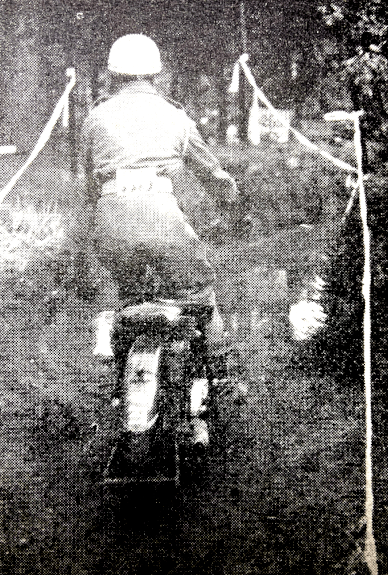
“CONTRARY TO POPULAR BELIEF, the organisers of the Scott Trial are not entirely inhuman! ‘When I heard it raining,’ said Clerk-of-the-Course Williamson early last Saturday morning, ‘I didn’t get a wink of sleep all night.’ He was thinking of his carefully planned course (nearer 60 miles than 50) which meandered over the moors and dales of north Yorkshire—across the 1,500ft heights above Storthwaite and Kexwith—down through the yellow, foaming gills and becks. Especially was he thinking of those gills and becks, swollen to not far short of wheel-top depth, and of the fate of those 185 bold spirits who had entered for what the supplementary regulations modestly describe as ‘the world’s premier rough-riding event’. A justified claim? Who would dare dispute it! First held in 1913, the ‘Scott’ has long been a classic of the motor cycle sporting calendar, and not one of those 185 competitors would be likely to suggest that this year’s contest was not in the finest tradition of the event. A mere 40 finished within the time limit, and Bill Nicholson (who for the third year in succession made best performance on time and observation) lost no fewer than 96 marks on the 60-odd observed sections. Unlike many things nowadays, the ‘Scott’ is quite definitely not a shadow of its former self! Neither, almost needless to say, is Bill Nicholson, who certainly seems to have the Scott Trial more completely ‘buttoned up’ than any other rider in history. Last week’s win was his fifth in six years, and certainly lends emphasis to his present leading position in the 1951 ACU Trials Drivers’ Championship. The night’s ceaseless rain went a long way towards making this the most slippery—if not actually the toughest—Scott Trial since well before the war, and hard-working Eddie Williamson was compelled to modify certain parts of the route. Even so, the depth of several river-crossings was sufficient to cause havoc among the less experienced competitors, and, even such old hands as Rex
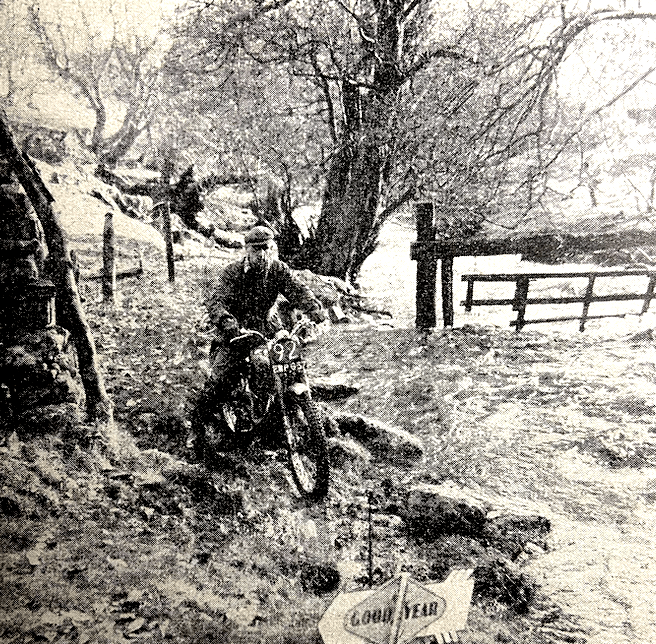
Young (490 Norton), several times runner-up in the ‘Scott’, were seen to be squandering many precious minutes in reviving drowned engines at the first of many such hazards. The start, delayed some 15 minutes, was at the top of a muddy field just off the Richmond-Reeth road, and within a couple of hundred yards riders were confronted with an extremely slippery little ‘curtain raiser’ known as Rock Bottom. Wheelgrip was at a premium, and, of the early numbers, A’. Markham (490 Nor’-ton), RW Pipe (490 Norton) and JM Brighton (347 Matchless) were the only ones to show that the section could be ridden feet-up. Across a field (in the middle of which was erected a great gruesome notice informing competitors that there were ‘Only 50 More Miles’!), a section was soon encountered which was rockier and wetter and altogether more typical of the Scott Trial. KG Holloway (197 James) was the first to make a serious attempt at a clean performance here, but it was left to the ninth arrival, GW Boyd (on a similar machine), to achieve an unpenalised passage. This section, like the first one, was tackled on the return trip also, and on this occasion David Tye (348 BSA) was seen to travel a considerable distance down the slippery bank without his machine—an incident which aroused a volume of good-natured Yorkshire chaff! Though not observed, the long climb up through the muddy woods from the second section caused as much delay as any other point on the entire course, and riders were well on the way towards exhaustion when they finally cleared this area and devoted their attentions to Clapgate Springs, Clapgate Gorge and Throstle Gill. Then came about a quarter of an hour’s exhilarating ride to Hell Holes—two alarming sections alongside the tumbling Marske Beck. On neither of these atrocities was there an unpenalised performance, but by now the sun was shining brightly and riders were becoming resigned to the worst which rugged Arkengarthdale had to offer.

Though riding number 64, R Clayton had already forced his 490cc Norton through to eighth place by the time Hell Holes were reached, and another Norton stalwart, JE Breffitt, was not far behind. Geoff Duke, however, was very late in arriving here, having had to go back to the start to replace a broken foot-rest. His side-valve Norton seemed to pull strongly, but he had a mass of slower men in front of him and appeared to be in no real hurry. Such riders as Nicholson and Rist (BSAs) however, were evidently bent on establishing ‘standard time’—though both came to a standstill in Hell Holes 2. Nicholson actually got farther ‘feet up’ than anyone, and may have tried to hang on too long. He baulked E Usher (347 Matchless), who thereupon took to a seemingly more difficult path on the extreme left-hand side and romped to the top with but little recourse to foot-work. There followed section after section, relentless in their frequency and severity. Crag Willie, the most remote point on the course, was situated by the disused lead mines below Barras Top; then came a new horror titled ‘I Surrender’, followed by the deep Heggs Splash and the difficult Storthwaite Folly a few minutes later. On the well-known Underbanks, a long muddy climb, Rex Young (490 Norton) came through in close company with Bill Nicholson (499 BSA). The Norton rider footed, in contrast to a faultless performance by Nicholson—but on The Steps it was the other way around. Then came a fairly simple new section christened ‘Down-Upsy’, a sharp descent and ascent among the old pits on Marrick Moor. The first rider here, ES Palmer (197 Dot), was almost 1½ hours behind schedule—striking proof of the severity of this year’s ‘Scott’. A little farther on, Shaw Gill caught the entire entry, its rock steps and liquid mud proving more.than a match for the by now weary competitors. David Tye (348 BSA) with flat rear tyre (Clayton had already retired with this same trouble) was magnificent to watch, and among other good attempts were those of AF Gaymer (498 Triumph) and E Usher (347 Matchless). CM Ray and DS Evans—both on 497cc Ariels—came to a

standstill, and EW Smith all but turned his 197cc DMW over backward. There was an even larger gallery of spectators here than on most of the other sections, and brave.tries were rewarded with enthusiastic applause. Sometimes the cheers were acknowledged, but occasionally a competitor was almost too exhausted to care whether he got to the top or simply lay where he fell! But this was ever the way of the Scott Trial—and doubtless always will be. The 1951 event left little to be desired as regards weather, route-marking and organisation in general, and there seems every reason to suppose that this fine circuit in the magnificent Arkengarthdale country will remain essentially unchanged for many years to come. It is curious to note how Nicholson, Alves, Young and Ray have virtually monopolised the first four positions in every post-war Scott Trial—a fact which caused one person present at the prize distribution to remark: ‘It can’t always be coincidence!’ RESULTS Scott Trophy (best performance on time and observation): W Nicholson (499 BSA), 96 marks lost. Raymond Bailey Trophy (second best): RB Young (490 Norton), 109. Darlington Trophy (third best): CM Ray (497 Ariel), 112. President’s Rose Bowl (best on time other than the above): PH Alves (498 Triumph), 120. Unnamed Trophy (second best on time): JE Breffitt (490 Norton), 125. Raspin Bowl (best on observation): SB Manns (347 AJS), 138. Pickering Trophy (second best on observation): WA Limas (197 James). 139. Galloway Cup (best up to 200cc): EW Smith (197 DMW), 154. Second Best: S Woods (197 James), 157. Third Best: ES Palmer (197 Dot), 165. Herbert Scott Cup (best newcomer): PF Hammond (498 Triumph), 150. Eddie Flintoll Trophy (rider creating standard time): W Nicholson (499 BSA), 3hr 54min 20sec. Billy Moore Cup (best Yorkshireman): B Young (490 Norton), 109. Veterans Tankard (best rider who competed in 1938 or earlier): JE Breffitt (490 Norton), 125. Manufacturers’ Team Prize: Norton—RB Young, JE Breffitt, GE Duke, 426. Club Team Prize: Sunbeam—W Nicholson, CM Ray, PH Alves, 328. Inter-District Award: South—CM Ray, PH Alves, SB Manns, 370.”

THE 26th INTERNATIONAL SIX DAYS’ TRIAL was based on Varese, in the Lombardy region of Italy. There were 220 starters and 146 finishers, who won 89 gold medals, 26 silvers and 17 bronzes. The Italians fielded 15 Vespa and Lambretta scooters, a number of which not only finished but won gold medals. And, as The Motor Cycle reported: “Once more a British team has won the ISDT. This success brings the number of British wins to 15 of the total of 26 Trials that have been held. The British quintet completed the six-day course of some 1,200 road miles and the final hour’s speedtest without loss of marks to beat the Austrian team by one mark. Although there were only three teams competing for the International Trophy—the third was Italy—the lustre of the success is not diminished, since no team could have done better. In the Silver Vase contest, at the conclusion of the road mileage a Netherlands team, mounted on Czechoslovak machines, was tying with the British ‘A’ team with no marks lost. During the speedtest the Netherlands men were able to improve on their schedule by a higher percentage than the British riders on larger-capacity machines. Four of the seven teams to finish unpenalised in the manufacturers’ contest were from Britain and the riders of one of the remaining teams were mounted on British machines. A Swedish team was first in the club contest. The event, while being regarded as successful, disclosed shortcomings on the organisation side. A further point is that, on the whole, time schedules were easy to maintain, yet for those riding on the higher speed schedules—members of International, Silver Vase and Manufacturers’ teams—there were a few sections where almost super human efforts were required to avoid losing marks. It is desirable that, as far as possible, the ‘International’ should be a test in virtue of sustained hard riding rather than an extremely severe test for a relatively short portion of the total mileage. Time schedules for those not in one of the teams mentioned earlier were not too difficult to maintain, as indicated by the large number of gold medals won for finishing the trial without loss of marks.”
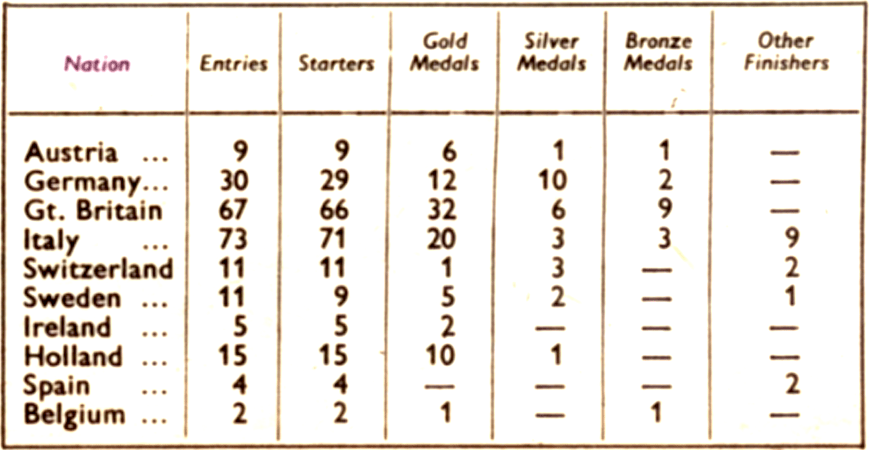
GEORGE WILSON, the Blue ‘Un’s deputy editor, rode the course on a Royal Enfield twin. When he got home he produced a thoughtful review of the trial…”Where do we go from here? A Backward Glance at the 26th International Six Days’ Trial—and a Thought for the Future. It is inevitable that after each International one seeks to compare it with previous events. One recalls the reports of the lurid 1932 Merano ‘GrandPrix’, the Oberstdorf event in 1935, the San Remo event in 1948. One might even add to the list last year’s trial at Llandrindod Wells. And, so far as severity is concerned, the event just concluded in northern Italy was, by comparison, fairly easy. However, this in no way detracts from the British win in the major contest—that for the International Trophy. Neither does it diminish the brilliance of the Netherlands victory in the Silver Vase contest. Recalling the Anglo-Dutch Trials, which began before the first World War, and were forerunners of arduous long-distance events, I am as pleased about the Netherlands success as I should have been about a British Vase victory. The team, comprising P Haaker, C van Rijssel, and H Veer, all experienced ISDT men, were mounted on 250cc

Jawas. In a review of last year’s event, I made the point that British riders are the best in the world. That statement was made in no sudden flush of patriotic pride; it was, and still is, a clear-cut, indisputable asseveration of truth, clearly borne out by the fact that our Trophy Teams have never been beaten in a post-war International. This year they won against great odds, with the scales weighted against them from the outset. They arrived, as I mentioned in the report of the opening stages, to find that they were installed in an hotel crowning a 4,000ft mountain. The nine-mile route to the start was a writhing, narrow horror which had be to covered morning and evening. They had to be off early in order to reach the start in time and, in the evening, tired and disheveled, they had to wait about at the finish for transport to take them back. This is by no means a minor detail and was one of the many minutiae which combined to increase the mental stress of riders engaged upon an Herculean task—and representing their country while doing so. In case it should be thought that this ‘worrying’ business is being overstressed, I might mention that two riders—one of them a

member of the British Trophy Team—were violently sick on the way to the start on the first day. This sickness they themselves attributed purely to ‘first-day jitters’. To quote another instance—Fred Rist, Trophy Team captain, arrived at Varese in a neatly fitting suit which, at the prize-giving, looked as though it had been made for some one twice his size—so much weight had he shed during the six hectic days. Another nerve-racking aspect for our teams was that they were billeted so far away from the headquarters hotel, where the day-by-day results were calculated and issued, and where the jury met each night to discuss protests and any other irregularities. By Friday, team manager Len Heath had covered 400 miles travelling between the Campo dei Fiori (the riders’ hotel) and Varese. Major Watling, representing British interests on the jury, was at the headquarters hotel and, in a way, cut off from the riders whose interests he was safeguarding. He was one of the most severely harassed of all officials at Varese! Do not let it be imagined, however, that a dog-in-the-manger attitude was adopted in the face of this and many other onerous difficulties. On the contrary, once they were accepted and the trial was underway, the snags were taken for granted as part of a tough itinerary. The whole question of the inadequacy of the accommodation, incidentally, boils down to the plain fact that Varese, picturesque Italian parish though it is, was not at all well-suited to quartering, compactly, the numbers involved in a large-scale

ISDT. However, as to the course itself: in nearly all respects it was excellent, embracing for the most part little-used, loosely surfaced tracks well away from other vehicular traffic. Italy, incidentally, is an excellent country in which to hold the International Trial because excited towns people and villagers line the streets directing competitors on corners and holding up traffic travelling in the opposite direction to the course. No one seems to mind being held up in this way. On the contrary, it is all regarded as part of the fun! A surprise was that this year’s route was extremely flat. True, heights in the region of over 4,000ft. above sea-level were encountered, but in the main, heights varied between about 1,000 and 2,000ft. Varese itself is 382 metres (approximately 1,260ft) above sea-level. Since one of the aims behind the ISDT is to put riders and machines to as severe a test as can possibly be devised in six days, the Varese event cannot be described as successful. Time sections (or checks) throughout the week, one after the other, should be so tight that engines and transmission systems, frames and everything else, must be mercilessly thrashed without let-up. Apart from the 15 minutes allowed in the morning the only time for maintenance should be that achieved by riders increasing on the schedule between controls. These conditions in this year’s event were only achieved in part by the Federazione Motociclistica Italiana. Where the going was sticky it was extraordinarily so, and it was in these really tight sections that the bulk of the retirements and spills took place. Even so, they could have been tighter, because SB Manns, of the Vase ‘A’ Team, had a throttle wire break and still checked in on time in the tightest section of the entire week. The
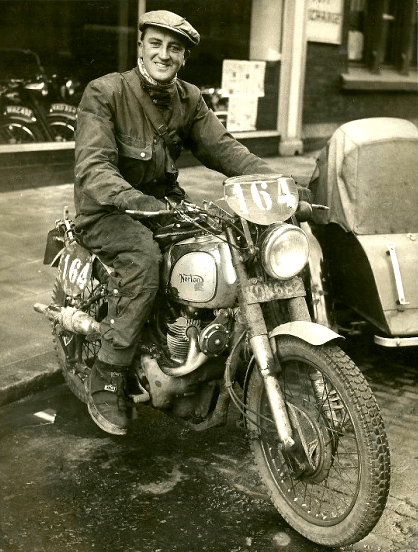
speed-test schedules (at Monza Autodrome)were, once again, a favourite topic of discussion at Varase, and there is no question that the trial was easier for riders of small-capacity machines than it was for those using mounts of 350cc and over. The degree of difficulty of the event in relation to capacities may be set on a sliding scale, viz: easy for 125s and 175s; almost equally easy for 250s (but rather hard on 197s, which were on the same schedule); and very tough for machines of 350cc and over (especially for those on the 10% team schedule). So tight, in fact, was the event for the 350s that only two on the faster schedule finished. (Both, incidentally, were British Royal Enfields; they were ridden by W Clark and BI Gibson of Ireland.) The wisdom behind mounting our team-men on 500s and 650s was therefore well-founded, since, if our riders prefer to ride large-capacity mounts, or if they are forced to do so by our lack of suitable lightweights, their engines should be as big as possible within reason. Reviewing the ISDT two years ago, when the Vase contest was fought out in the speed test and won by Czechoslovakia, I made the point that unless the speed schedules were altered the stage could be reached where we should have to mount our national teams on lightweights if we were really serious about winning. On the face of things, while some might say that the answer is to alter the schedules to make them fair for all classes, I would reiterate my point. With the tremendous and ever-growing popularity of machines of under 250cc capacity in Europe, Continental countries will oppose fiercely any suggestion for increasing lightweight schedules (or decreasing the schedules for larger machines). If next year’s event is held on the Continent, and it is a well-organised trial with tight time sections throughout the week, we shall, I am certain, be extremely lucky to win, for the schedules will be anything but in our favour. Only by getting the event back to Britain next year can we guarantee speed schedules which will give us a fighting chance – and it is not certain by any means that next year’s event will be held here. So, gentlemen, if altering schedules is not possible, and we have no super lightweights to put in the field, where do we go from here? But enough of ‘politics’. What about the ISDT machines? That the British mounts performed magnificently there is no doubt. While it is perfectly true that in some cases machines at the end of the week

were smothered in oil from stem to stern, the majority were clean enough. The BMWs and Zündapps were by far the cleanest machines in the whole entry, and with their shaft-drive and enclosed unit construction were provocatively tantalising. Several up-and-coming young Britishers merit special praise. The first is 19-year-old JV Brittain, son of a famous father, who rode a works’ Royal Enfield at the fast schedule and gained a gold medal. The second is 17-year-old JV Smith Jnr, who rode one of last year’s ISDT Norton Dominators; and the third is Brian W Martin (122 Francis-Barnett). All three behaved with the sang-froid, and rode with the speed and dash, of veterans, and I predict a brilliant future for them…My personal mount for the trial was a standard 1952-type Royal Enfield twin. The engine was absolutely magnificent and the experience confirmed my belief that it is one of the best twins in production. Like the competitors, I was using 80-octane-quality fuel, which undoubtedly helped matters and it was just impossible to make the engine pink even with really brutal treatment on the occasions when I wanted dynamic acceleration on short straights. Low-speed engine torque was quite remarkable and particularly appreciated when coming out of loosely surfaced hairpins where too-high rpm causes wheel spin and too rapid opening-up tends to cause the front wheel to slide away. Except on the very tightest of such hairpins, on the steepest of gradients encountered during the week, I could use second gear and accelerate just as hard as necessary. Far from experiencing engine overheating during the week, I found that the exhaust pipes all but entirely retained their pristine brilliance—although quite often the machine was thrashed without mercy. And far from complaining about its treatment, the engine became better and better with every kilometre covered. The tools were used only to top up the rear legs, which were lacking in damping, and to adjust the rear chain twice. And what more can one ask than that?”

Here’s a final assortment of motor cycling images from 1951…
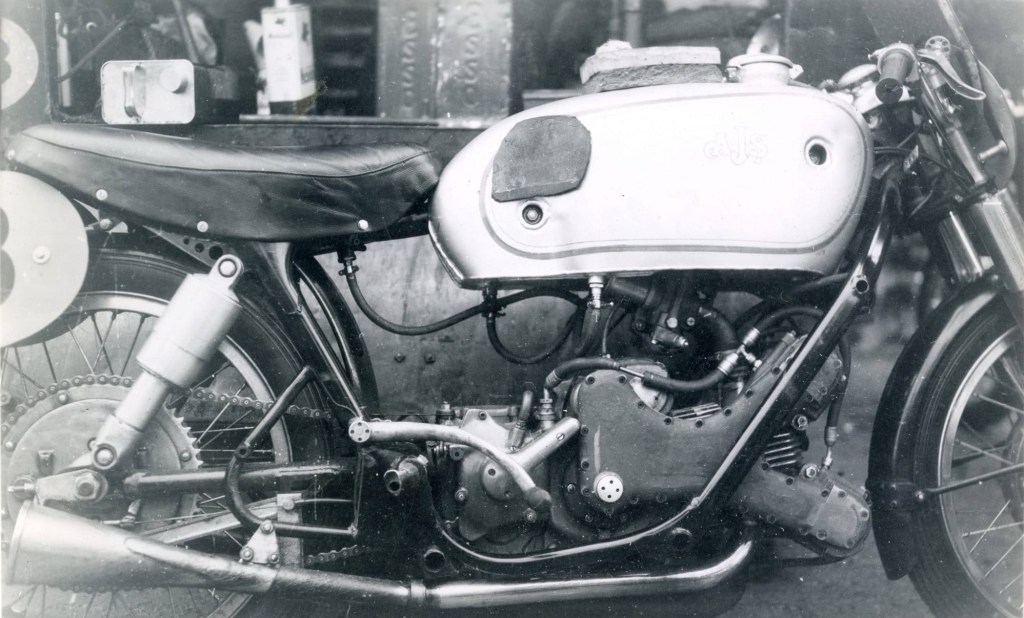
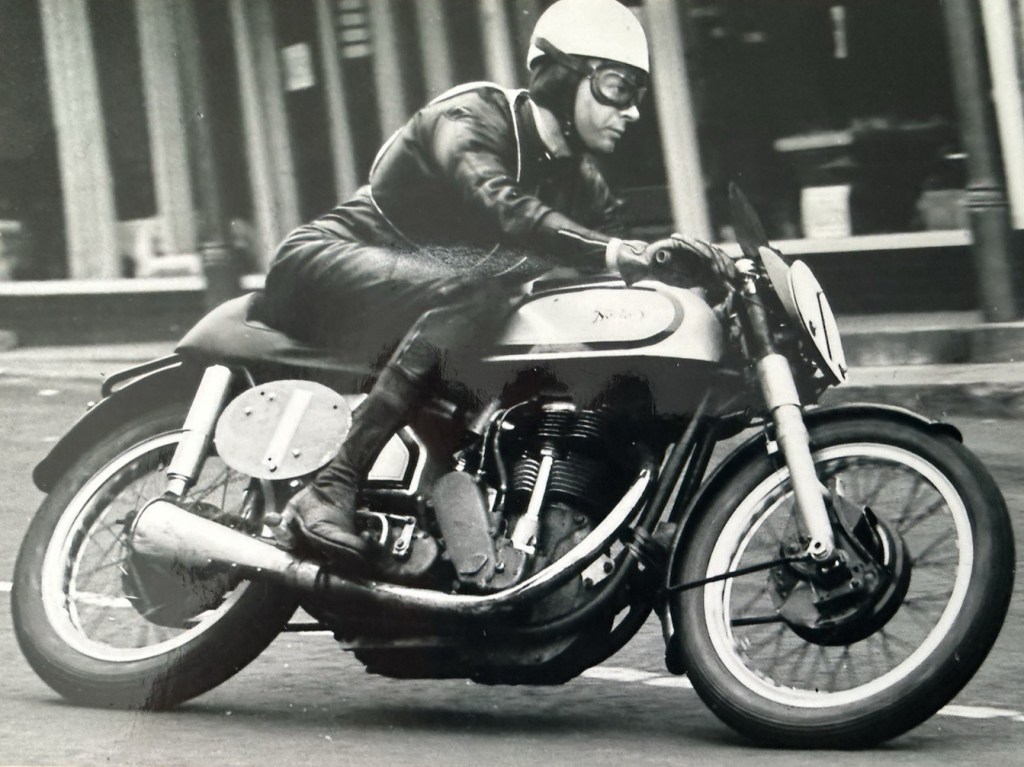
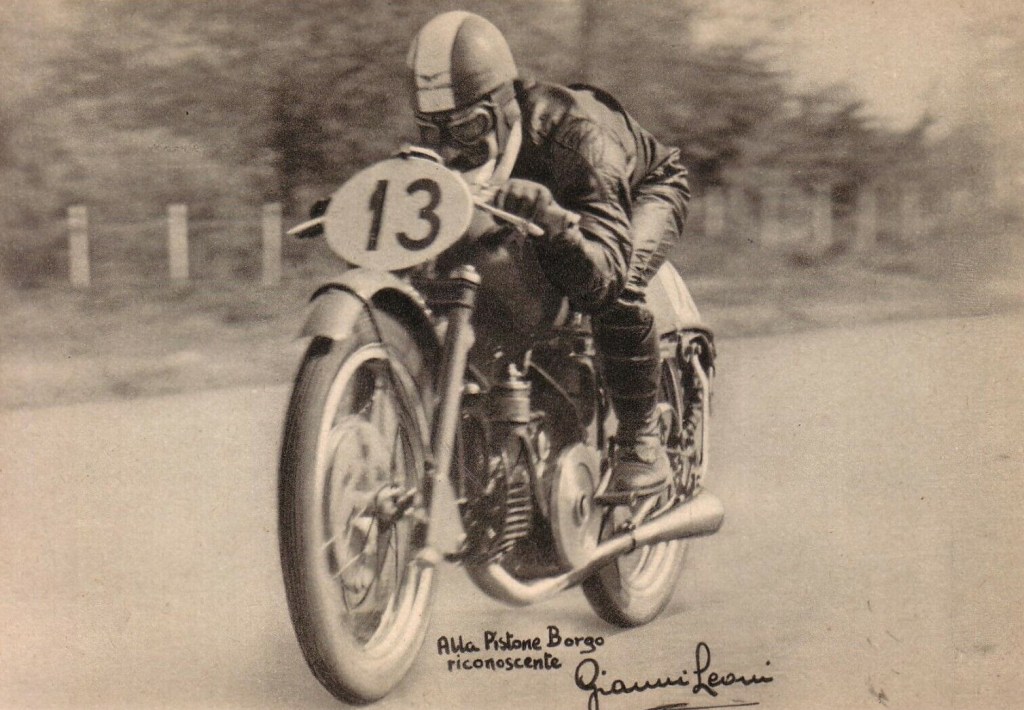
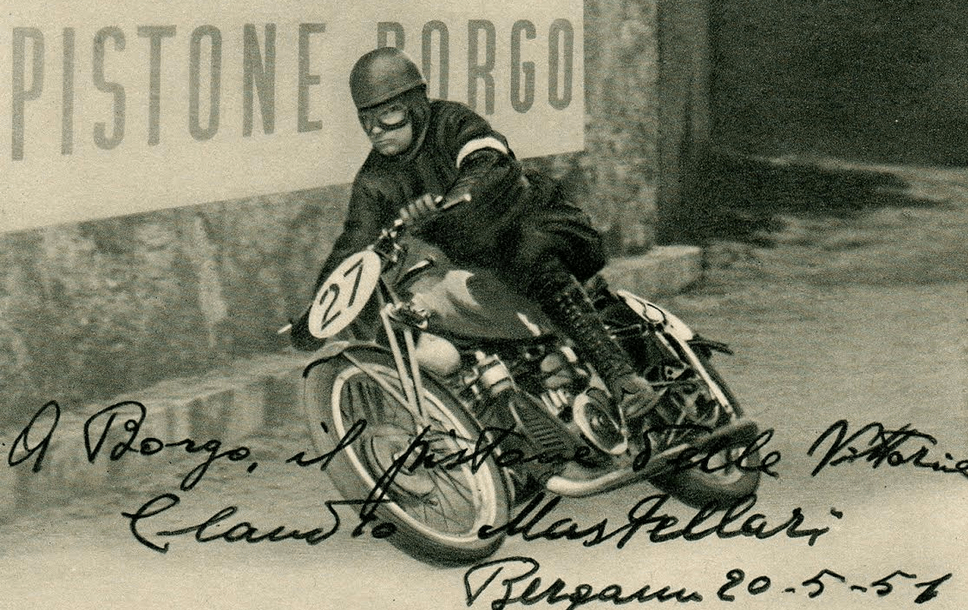
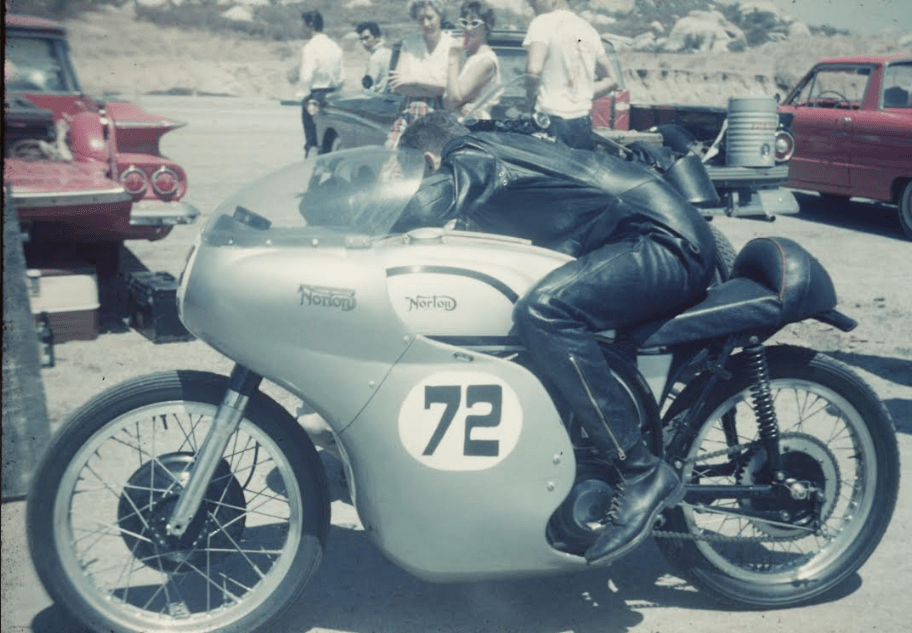


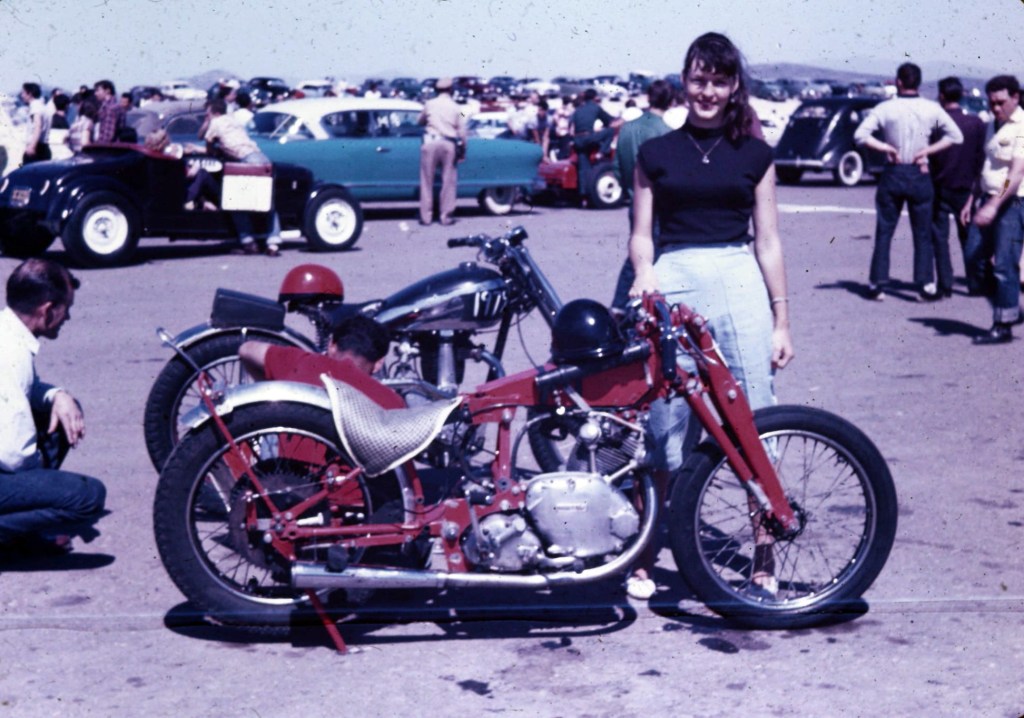
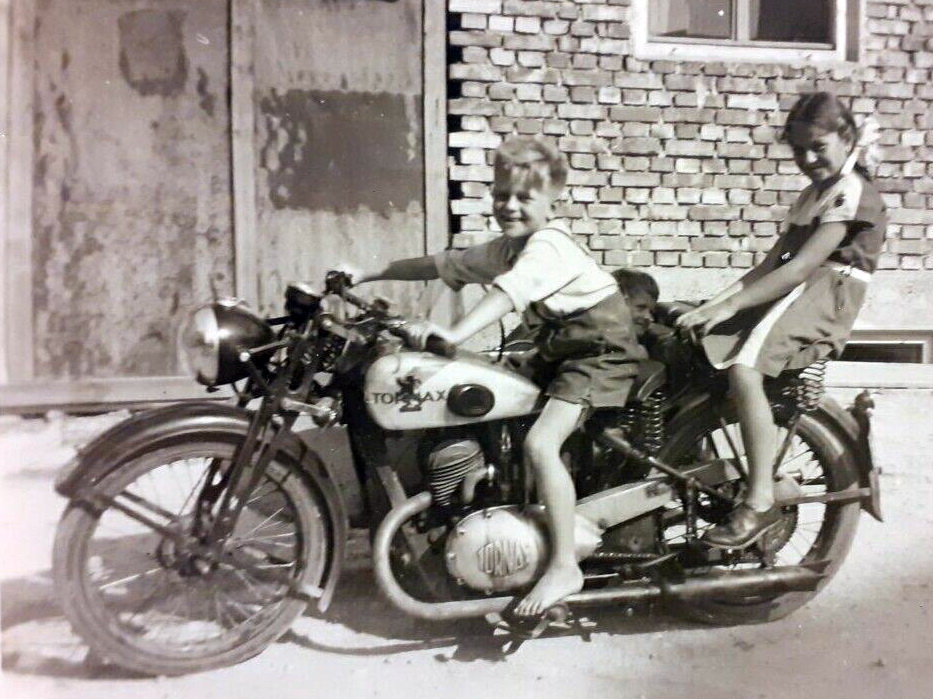
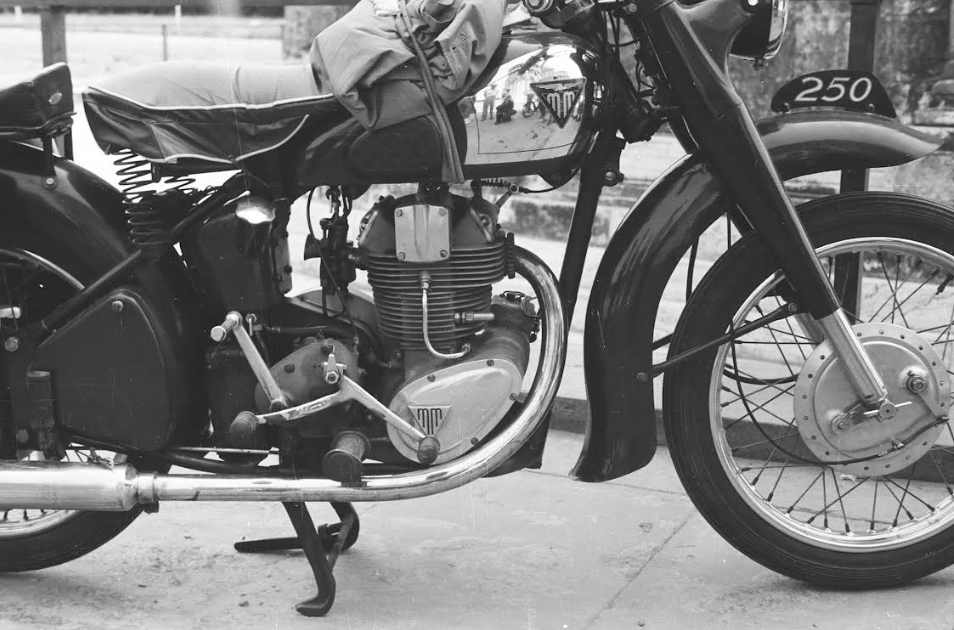
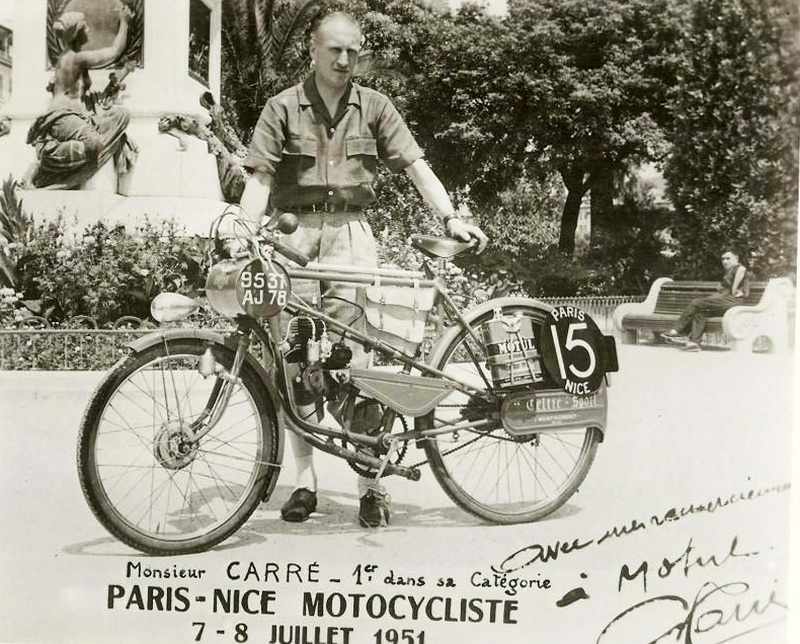
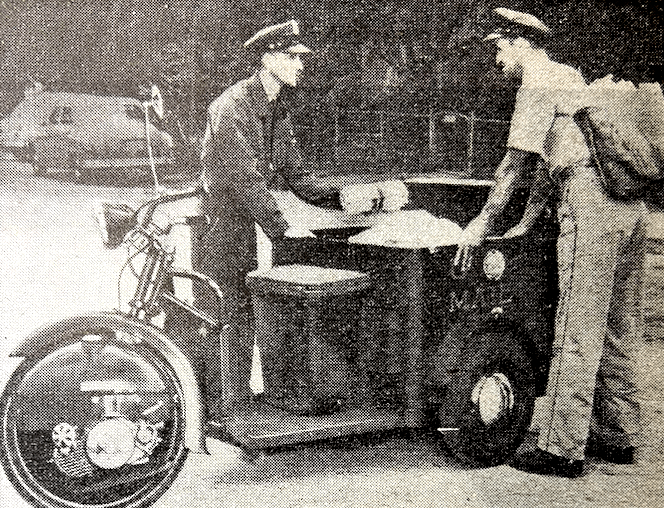
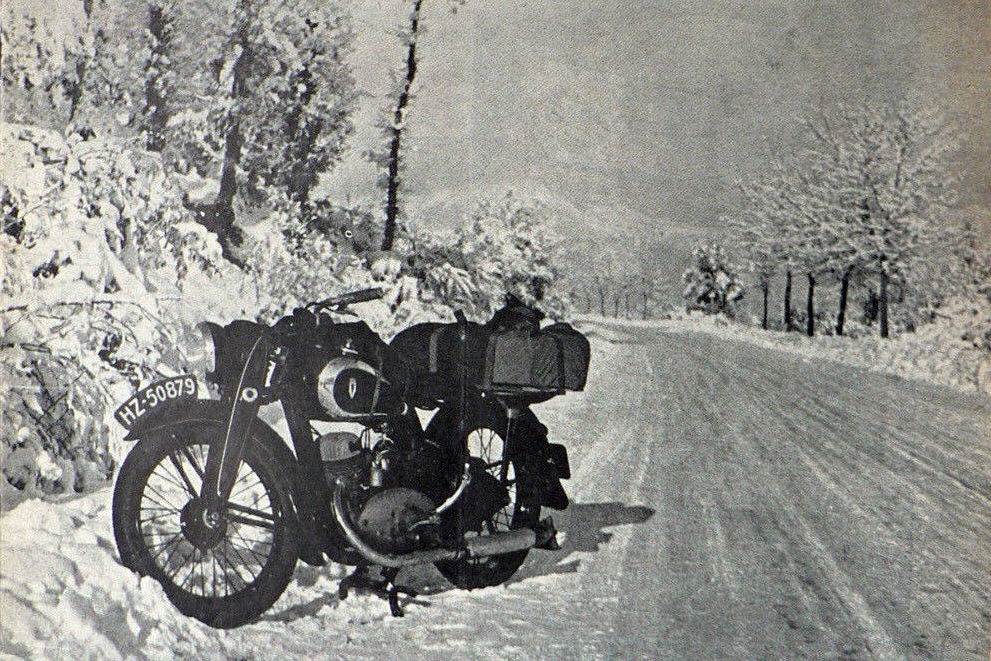
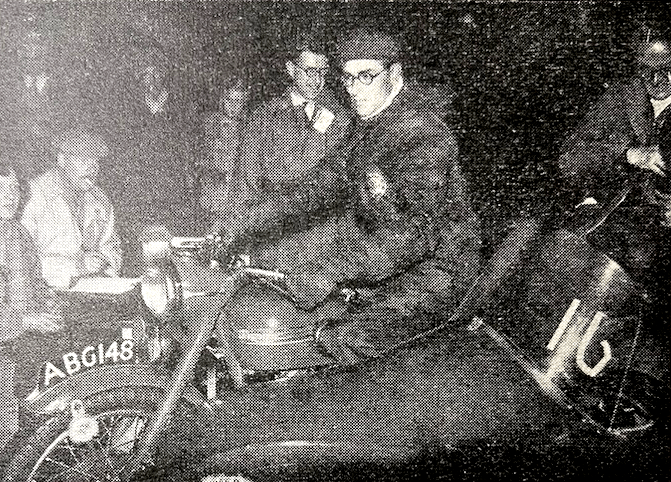

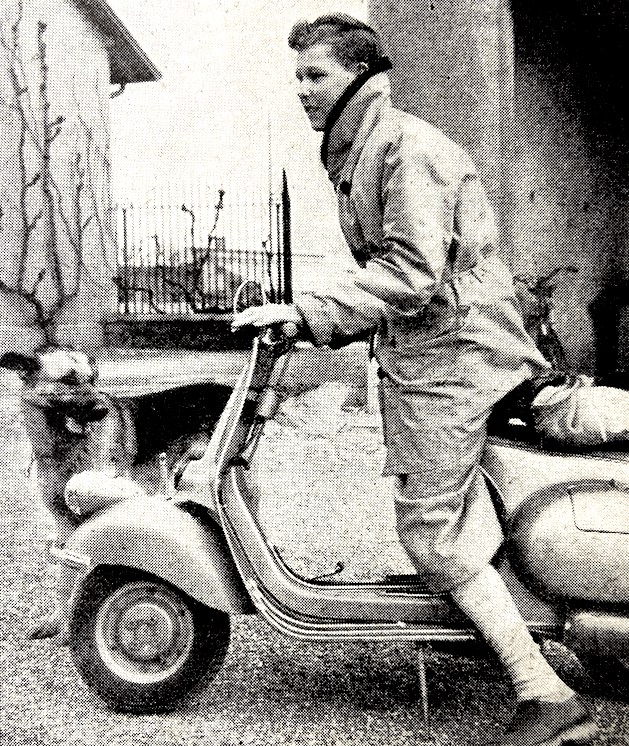
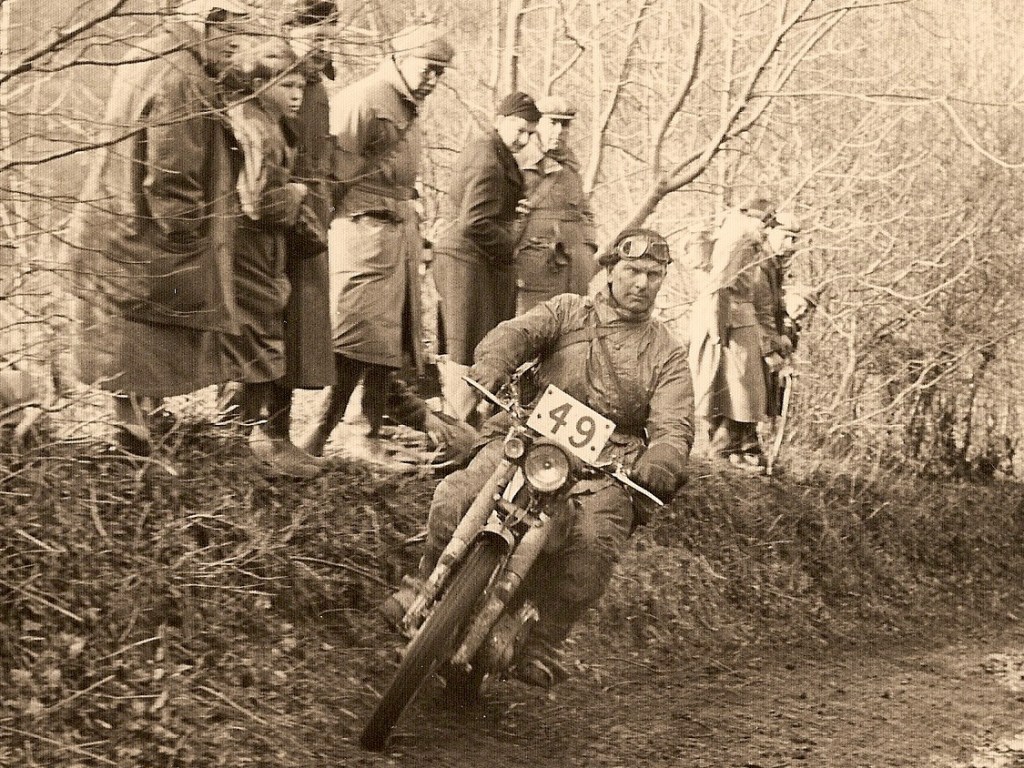
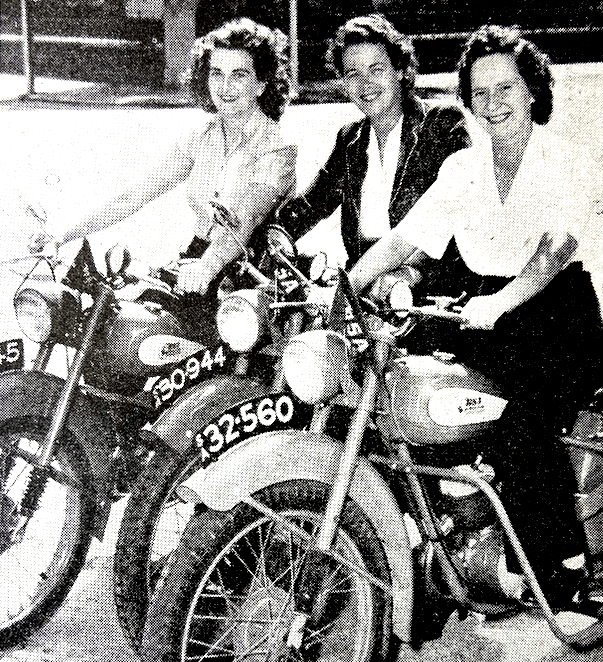
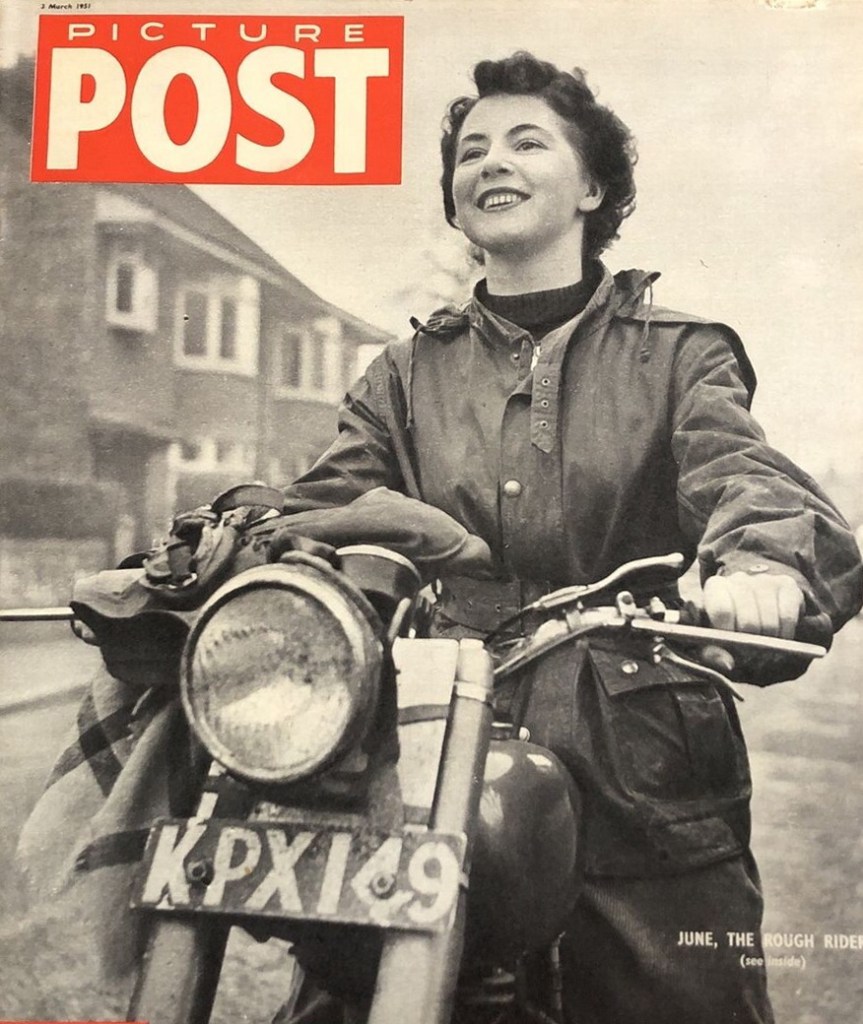
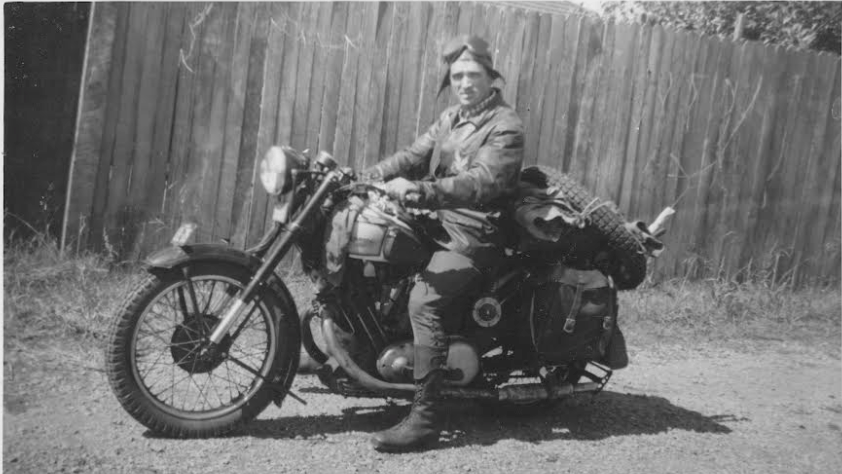
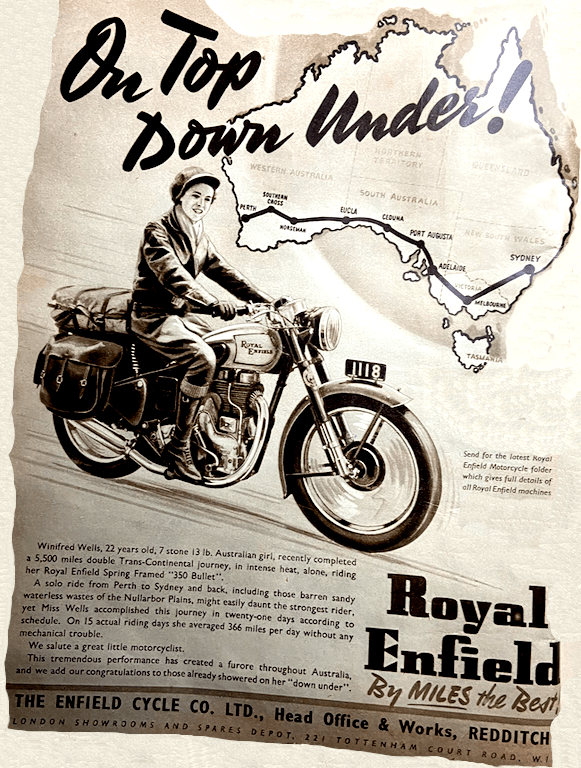
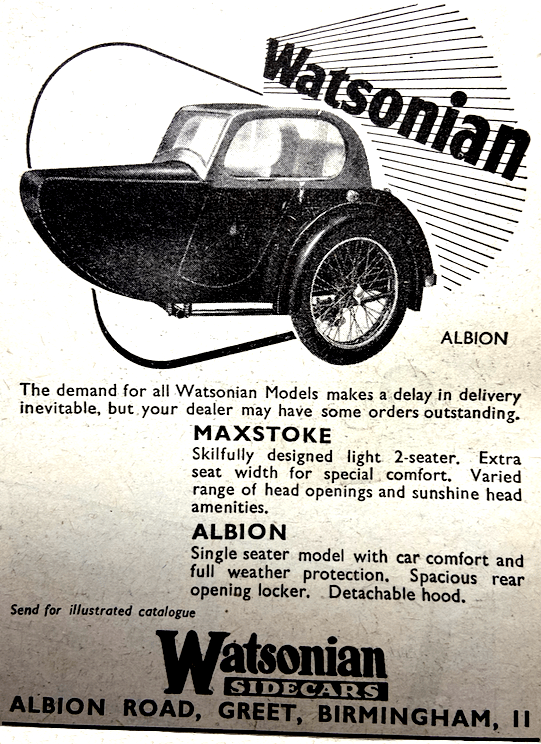
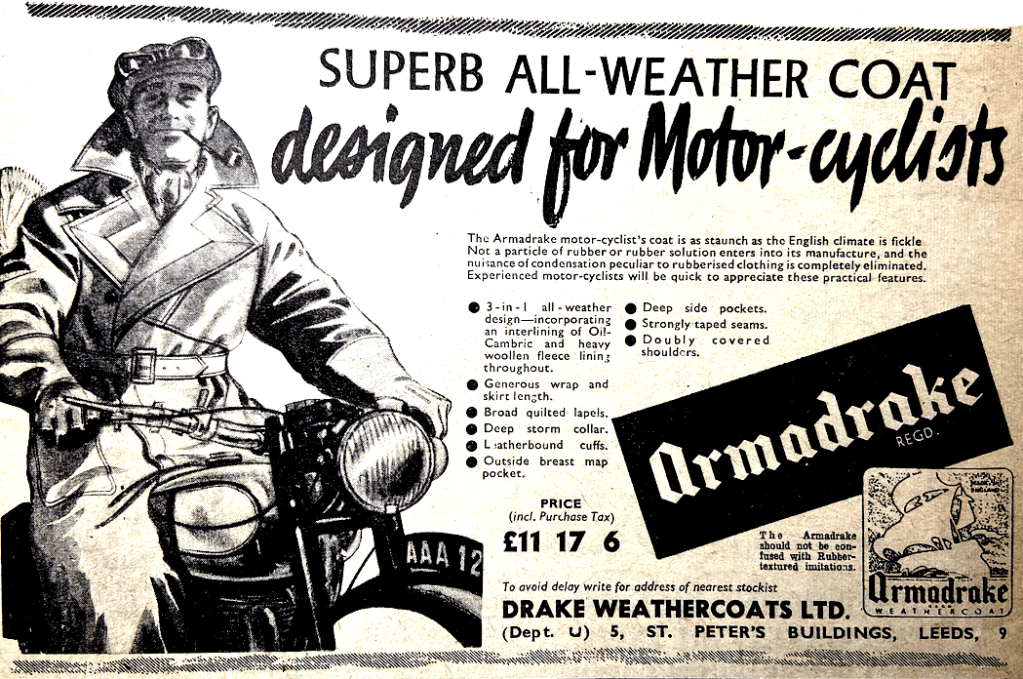
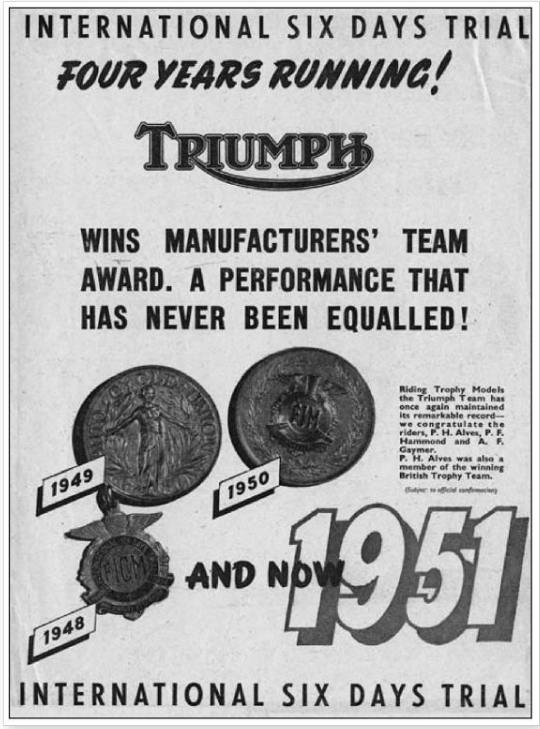
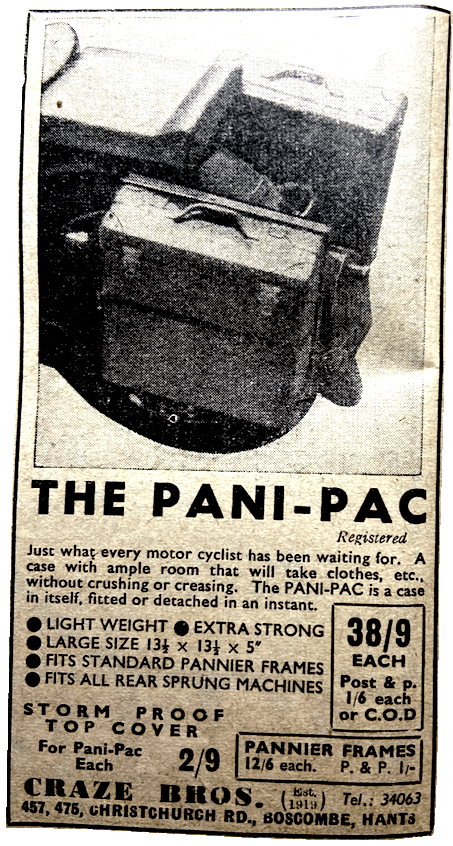


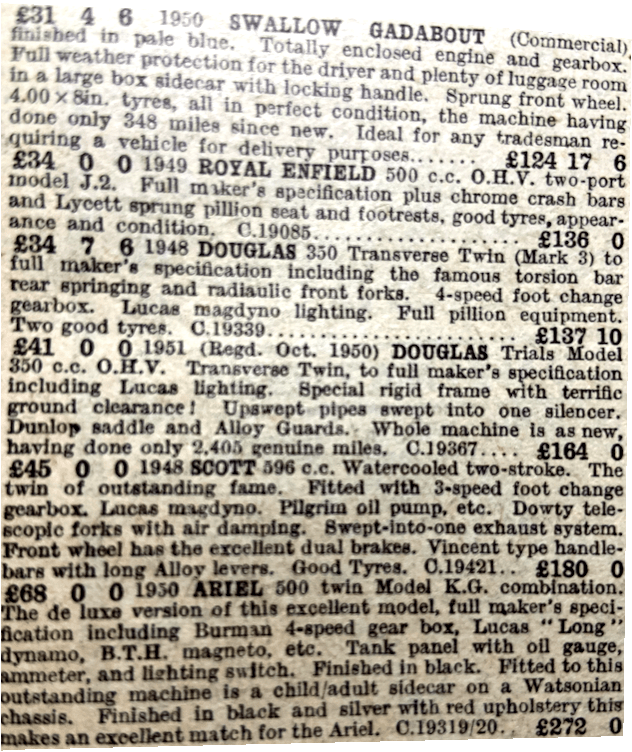



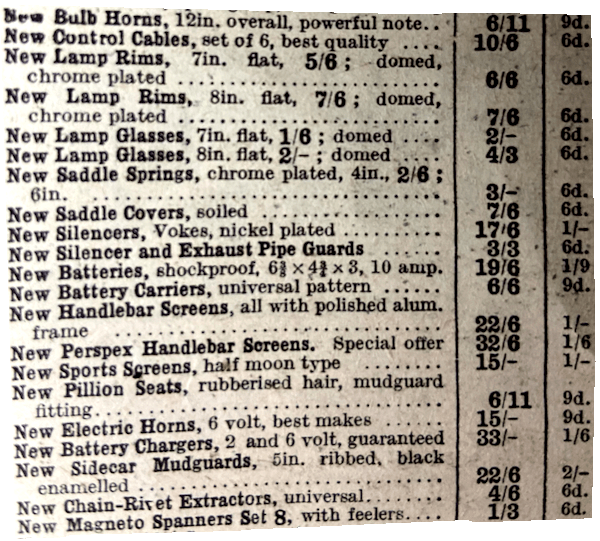

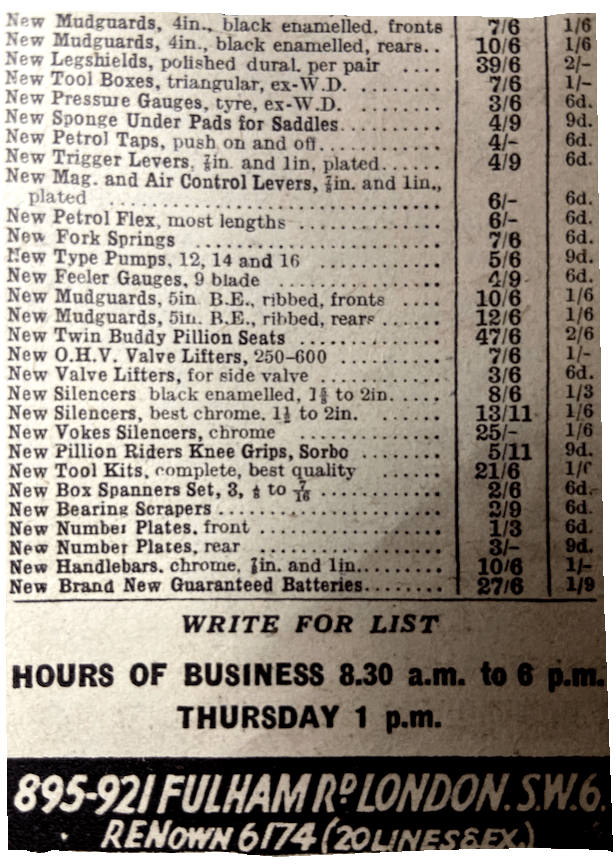
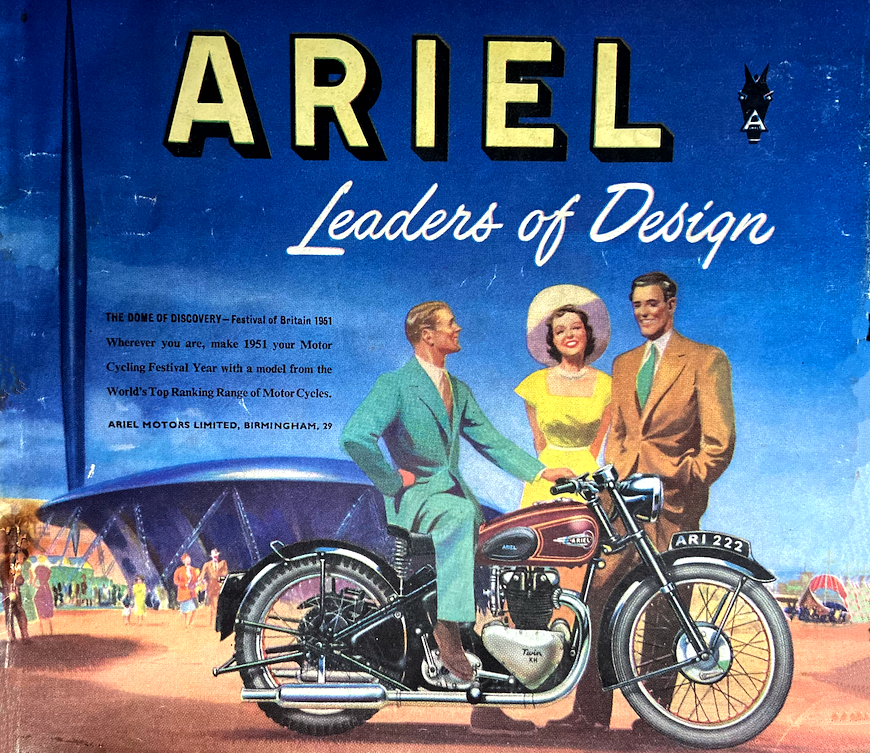
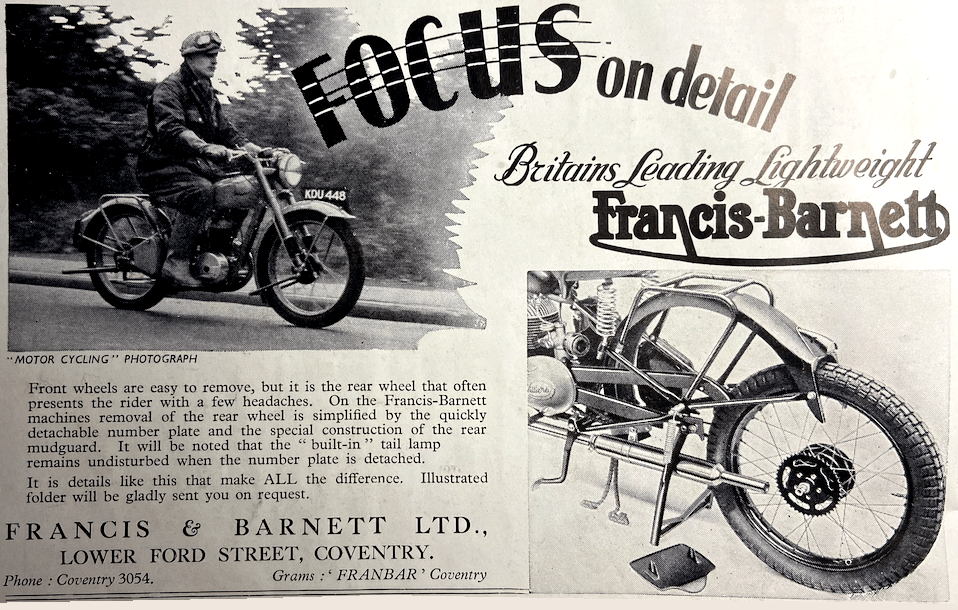

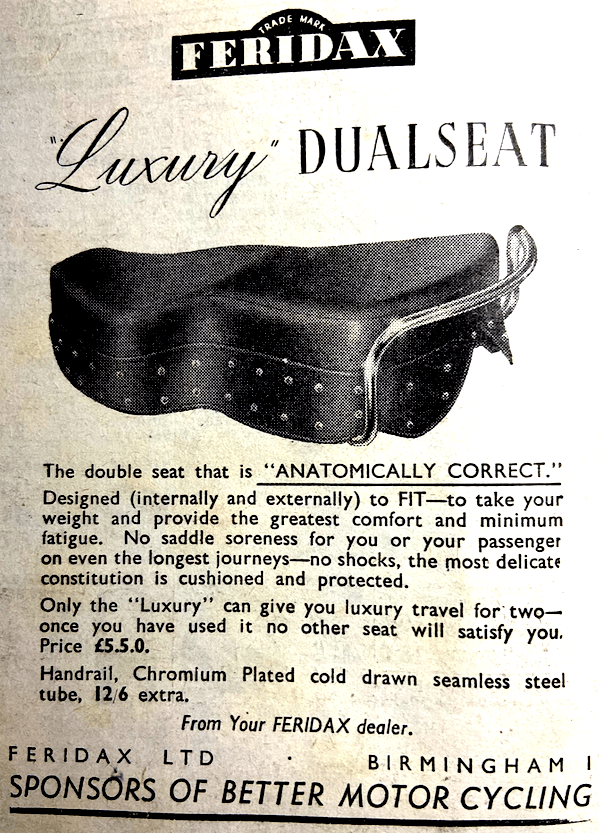

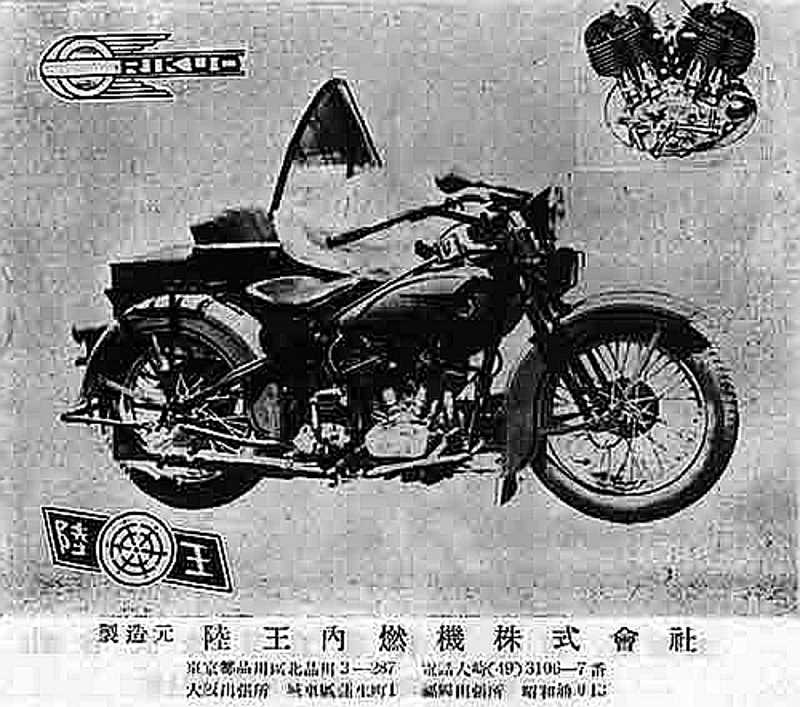
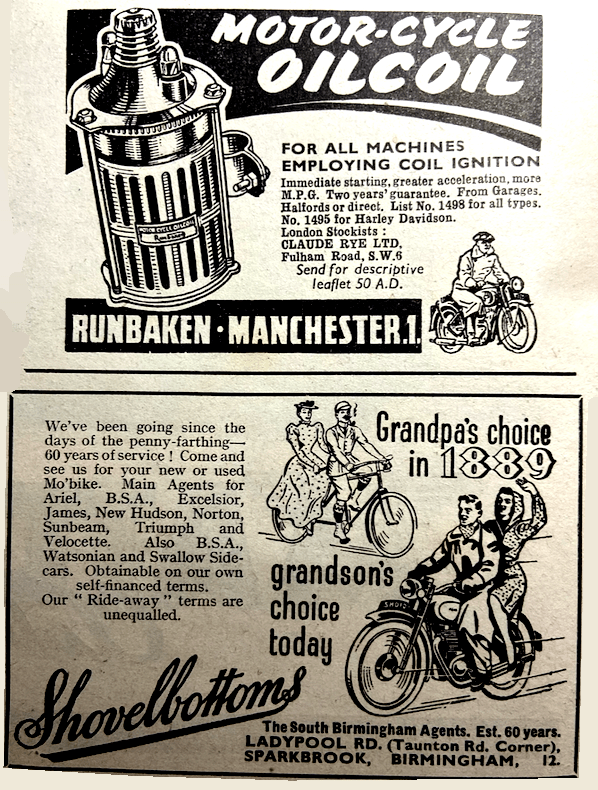
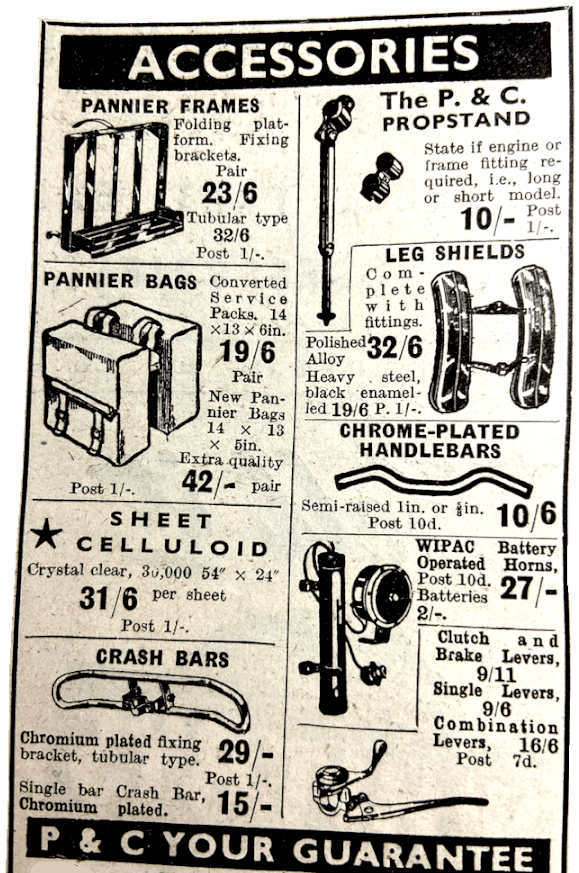
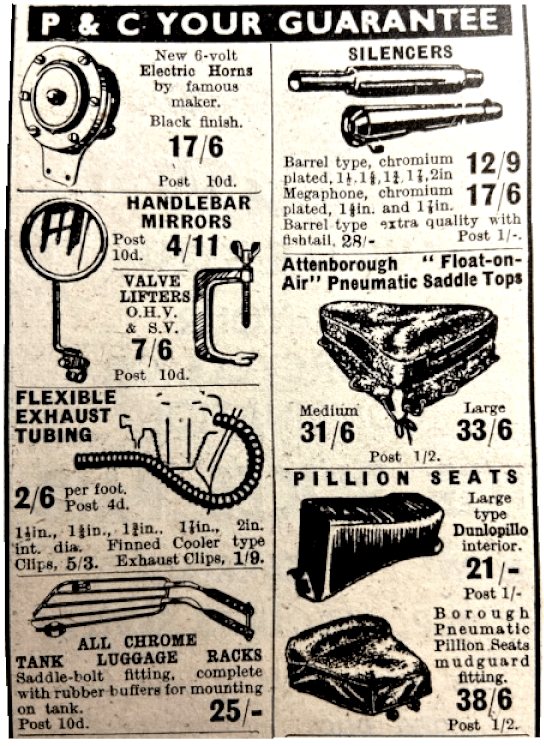
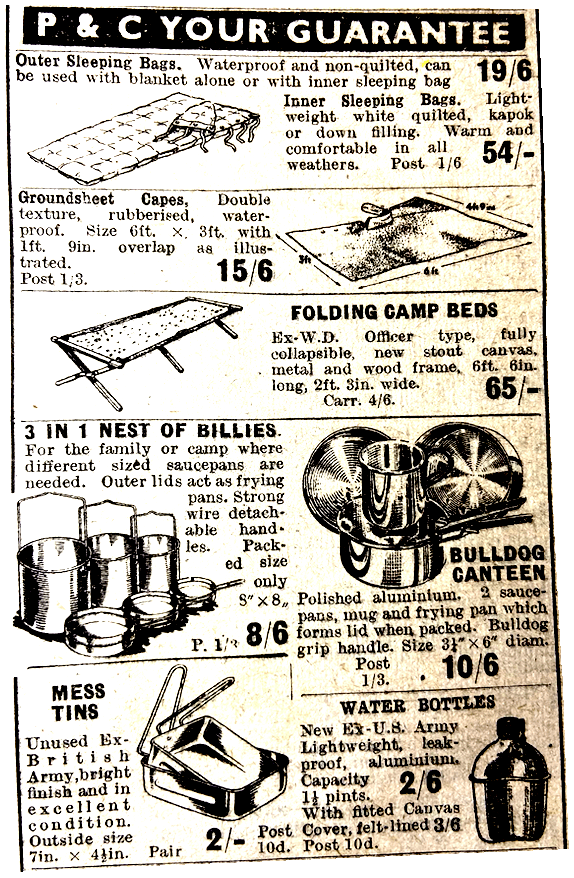

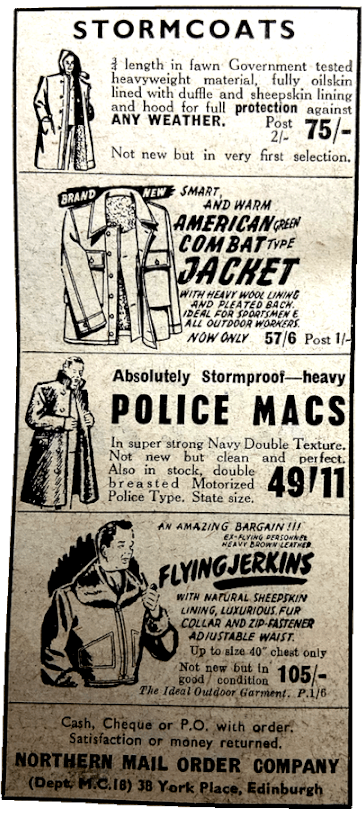
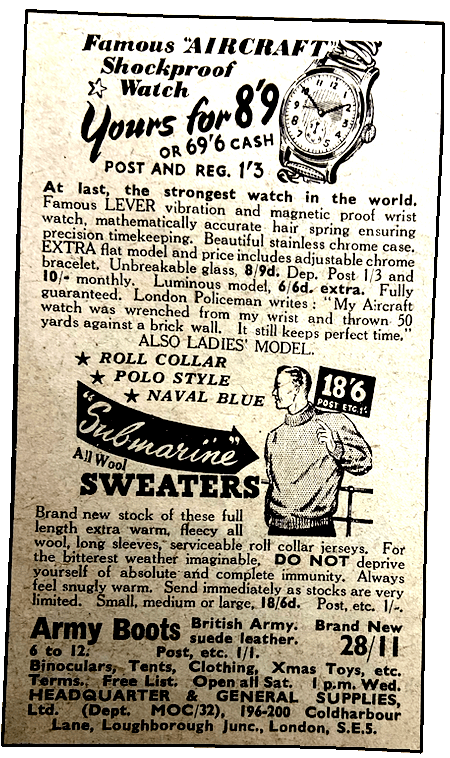

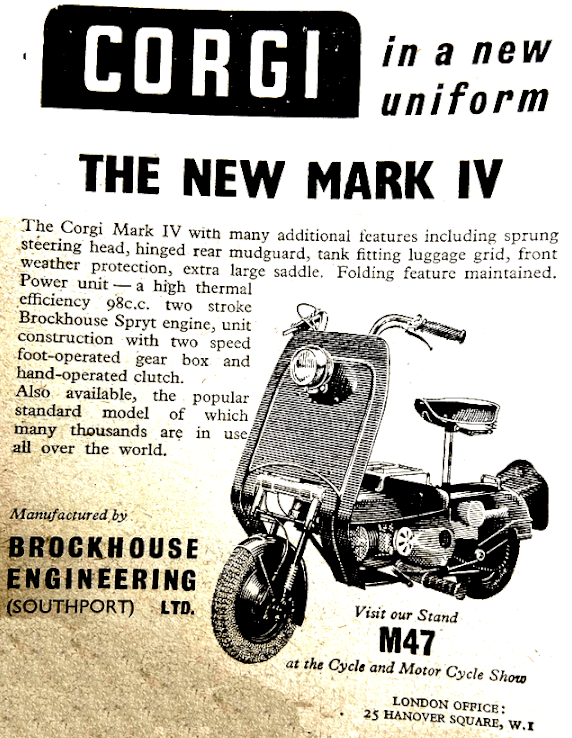
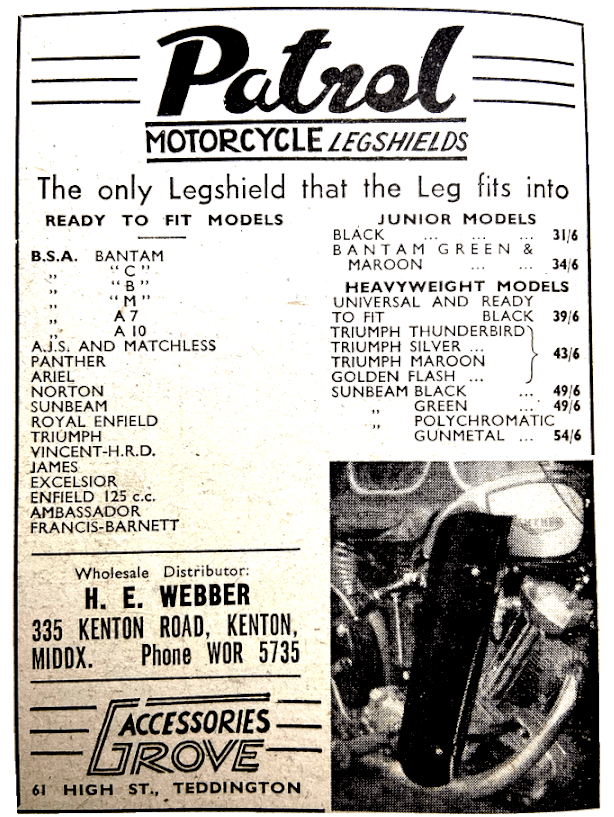

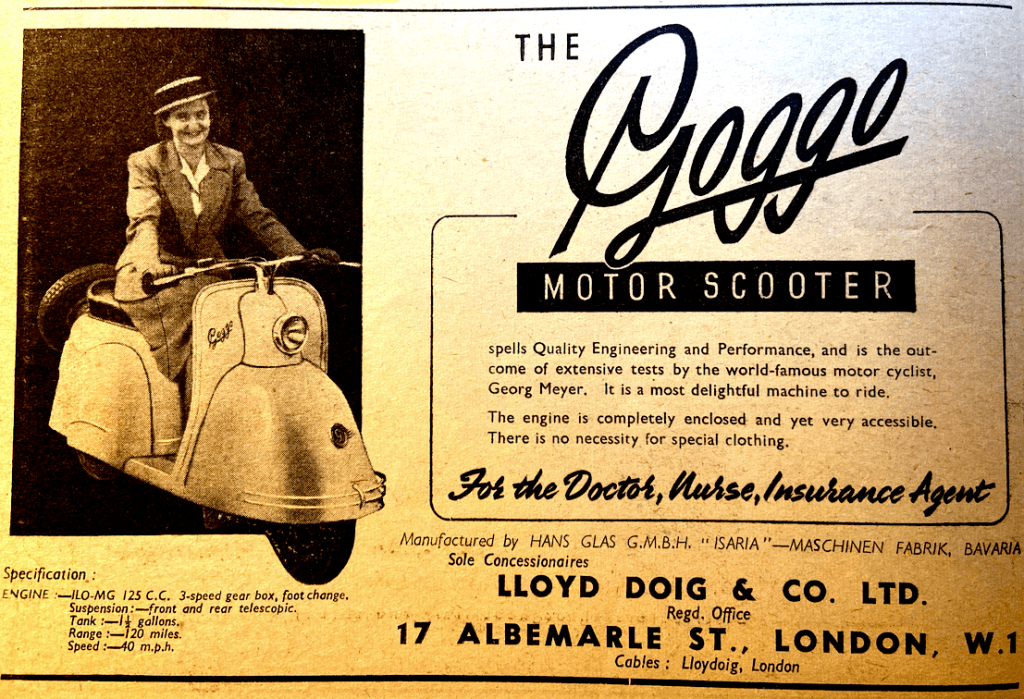
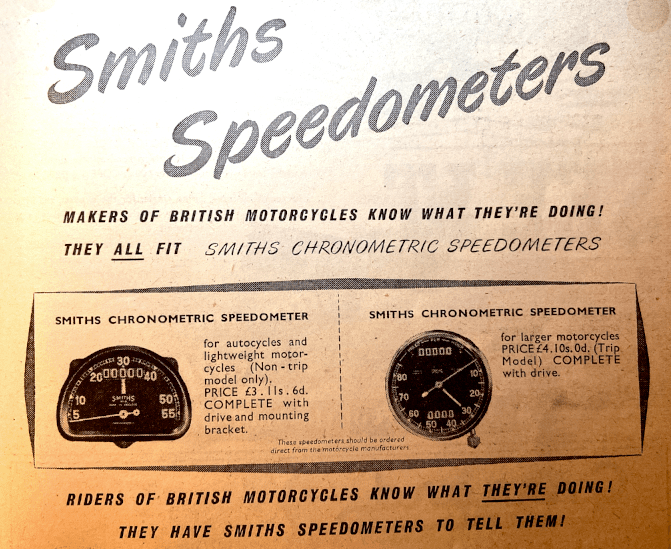
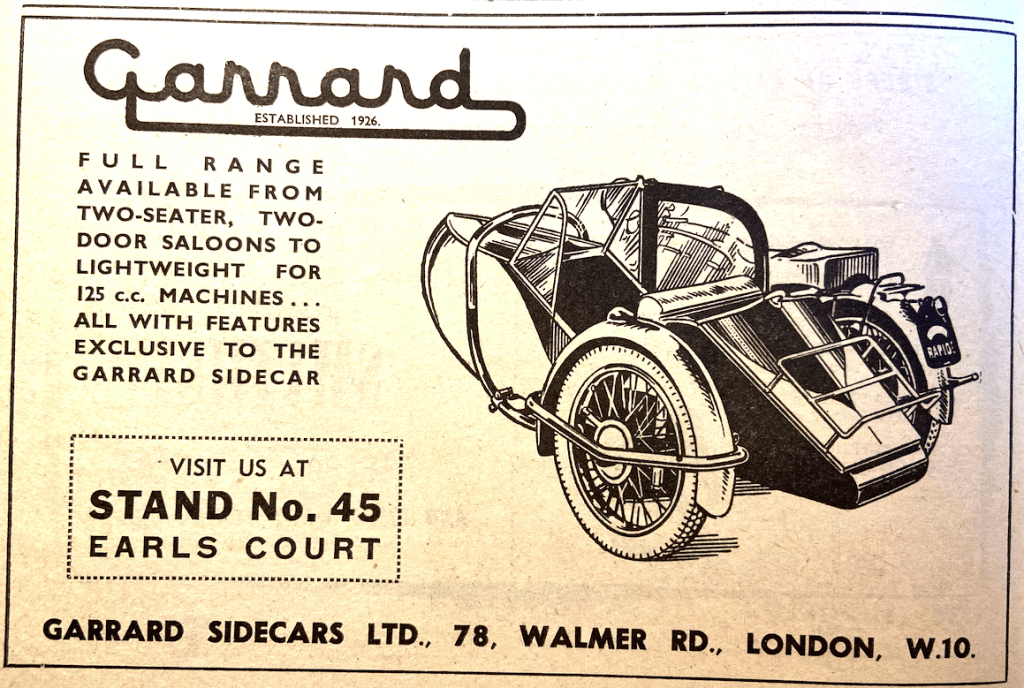
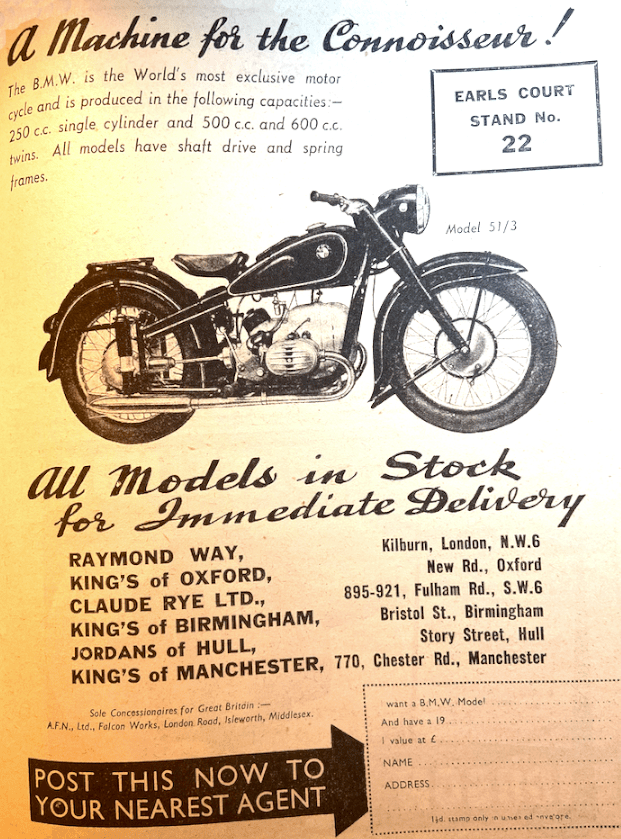
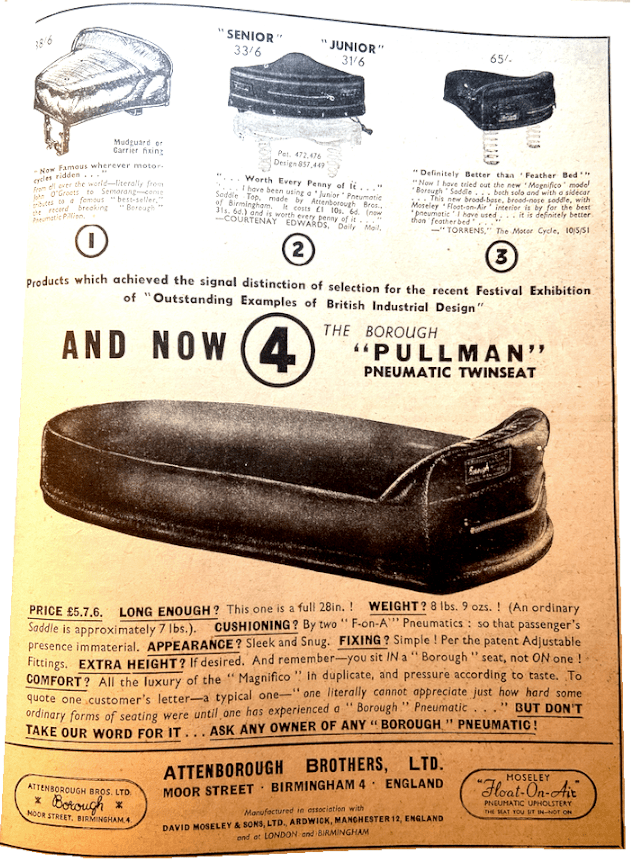

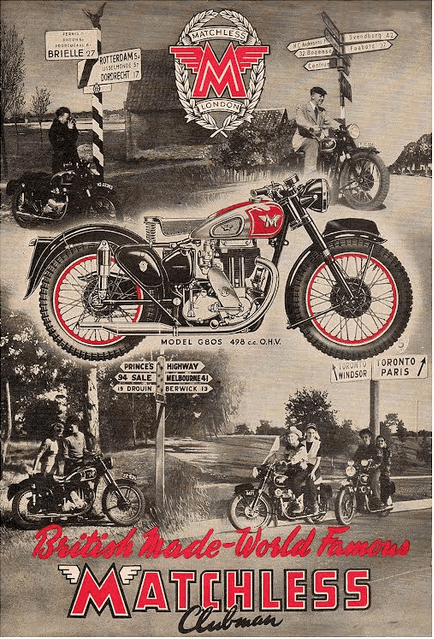

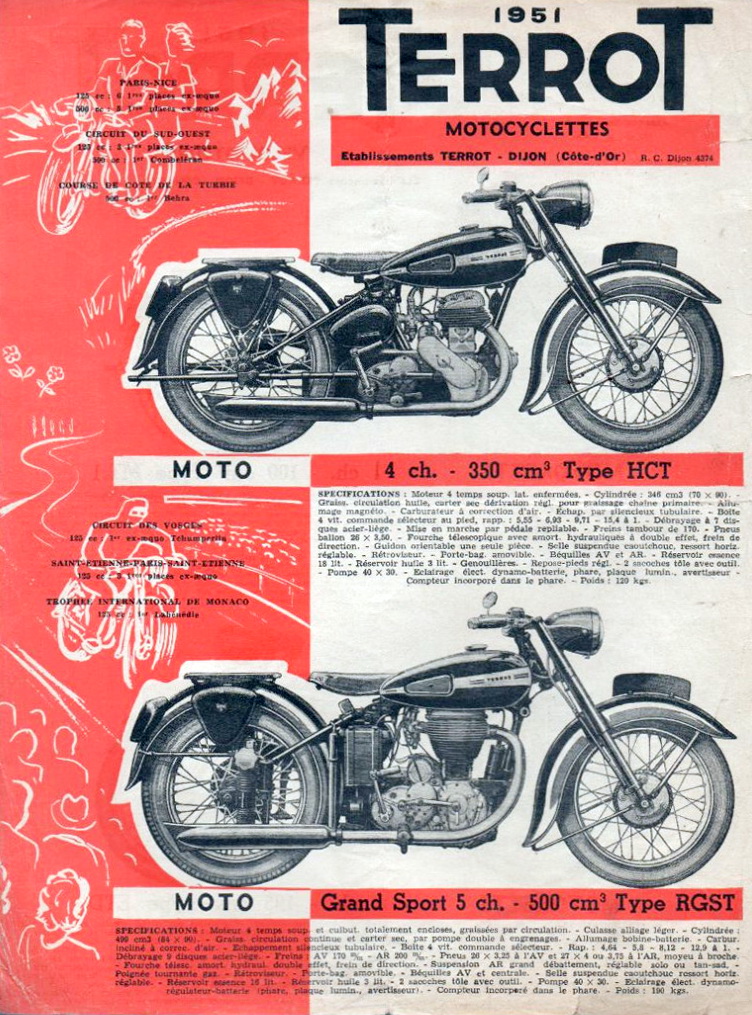


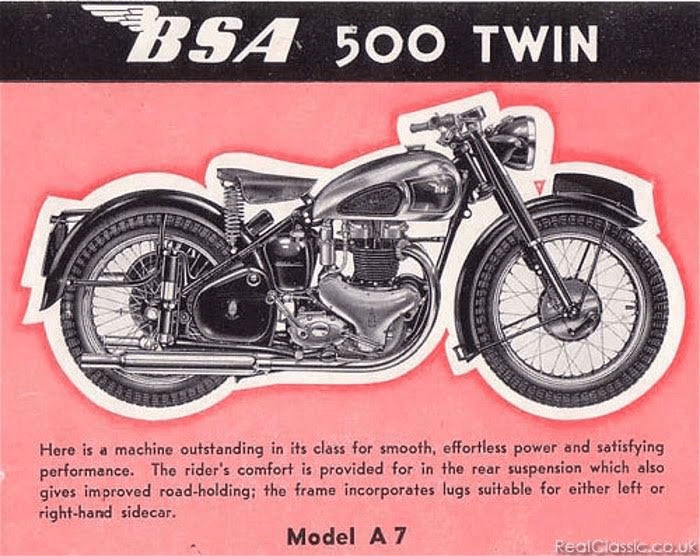
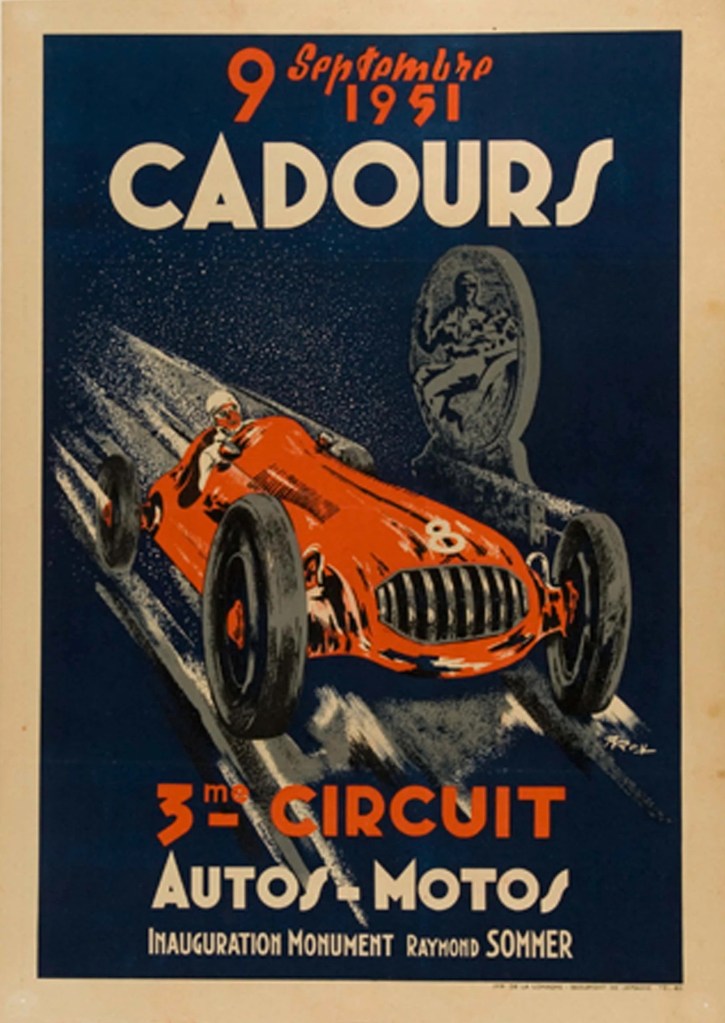

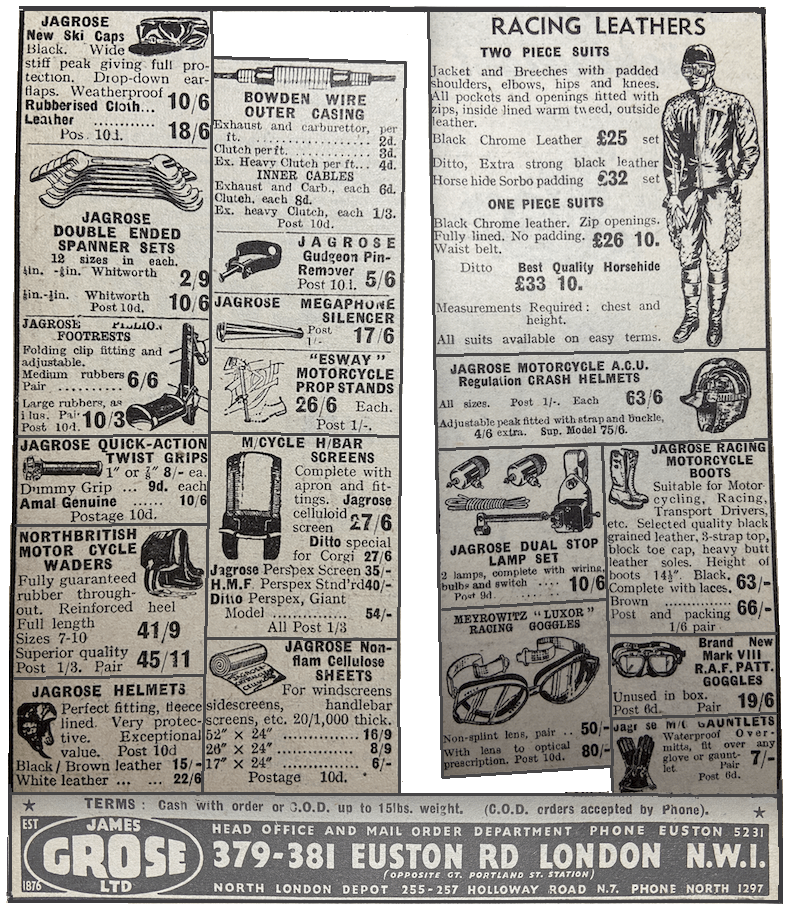
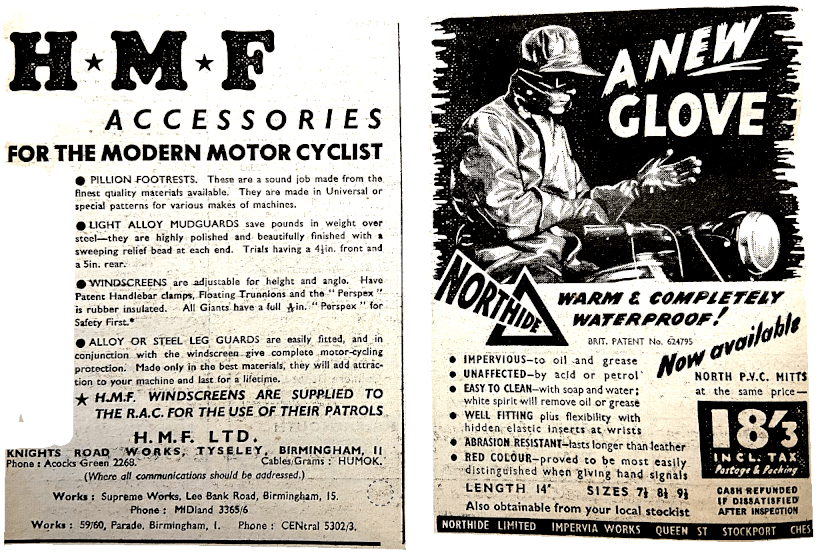
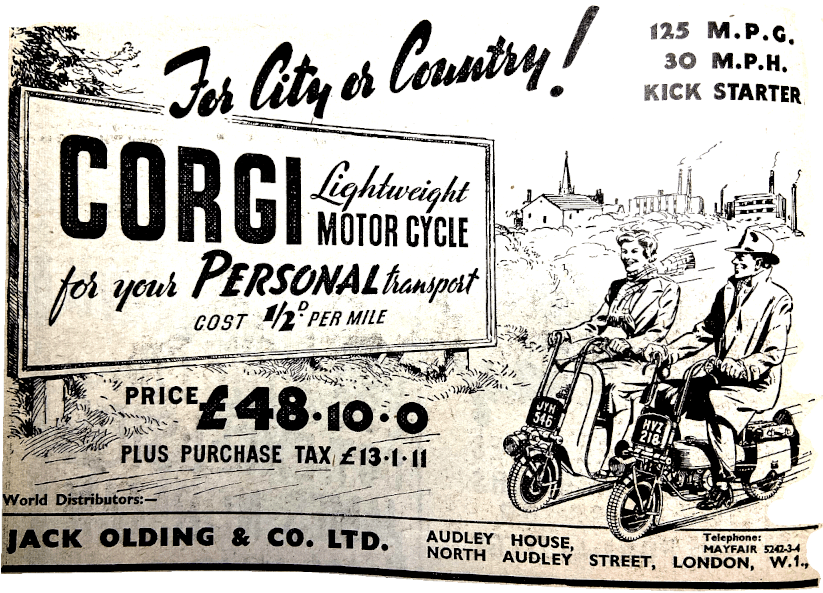
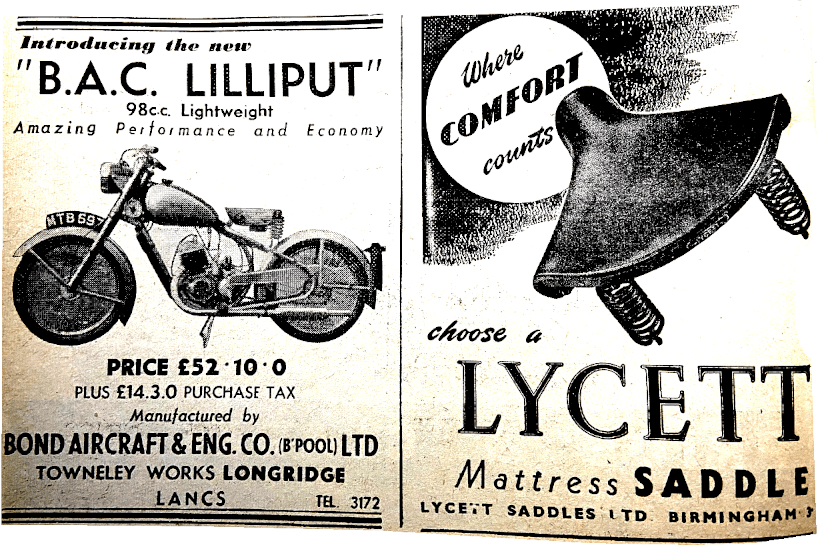
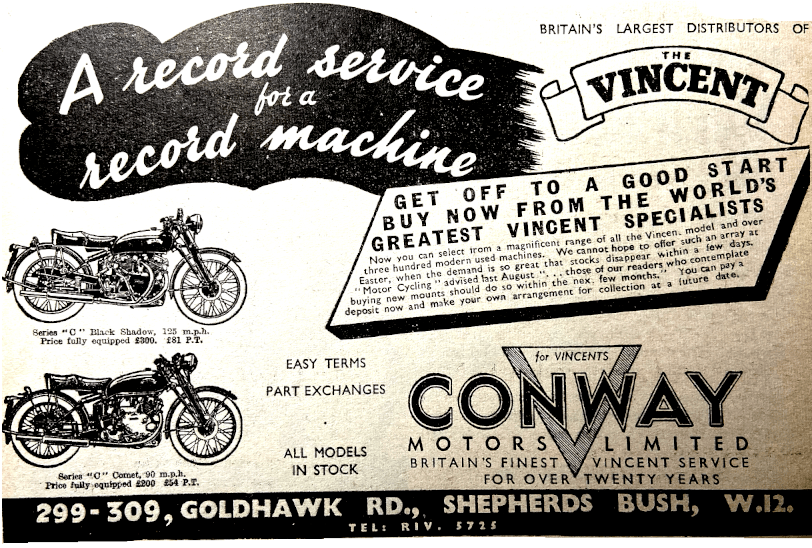
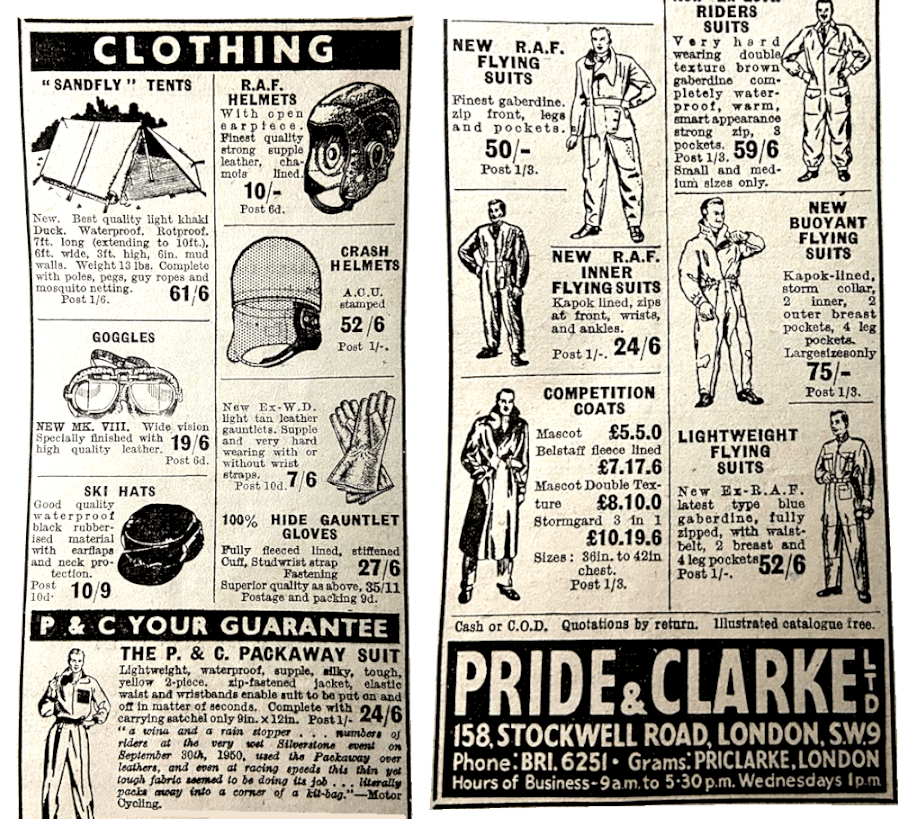
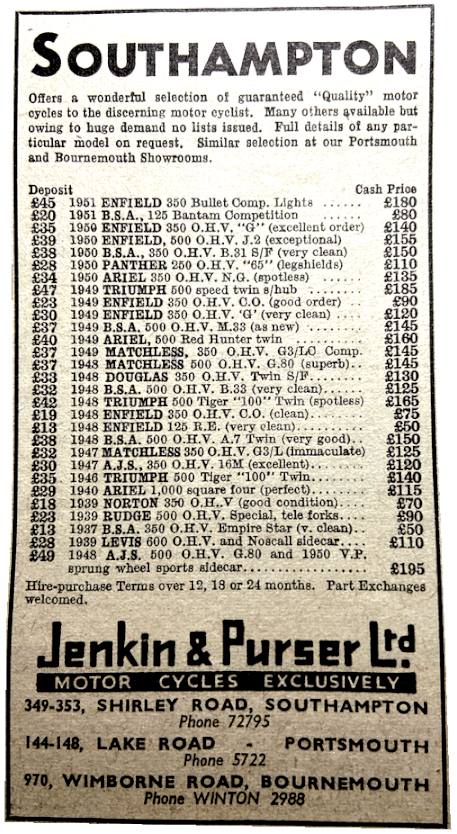
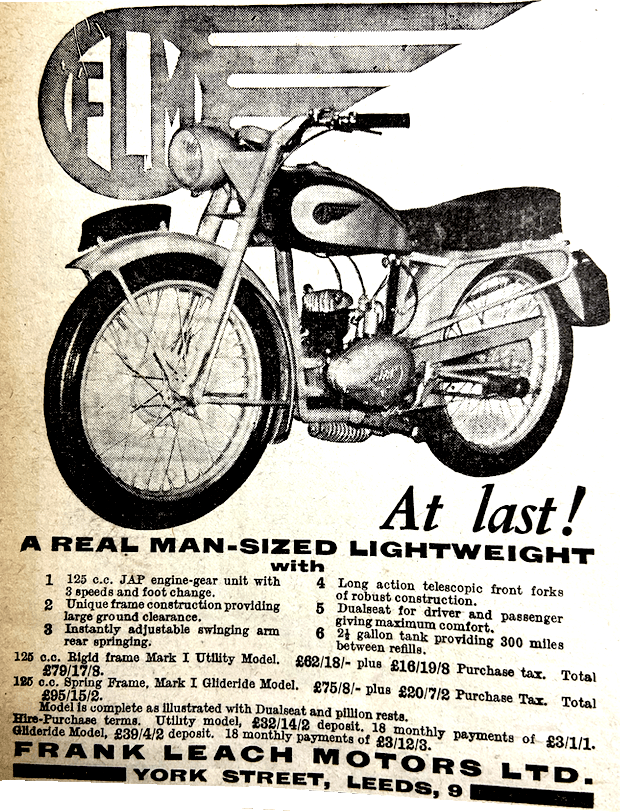
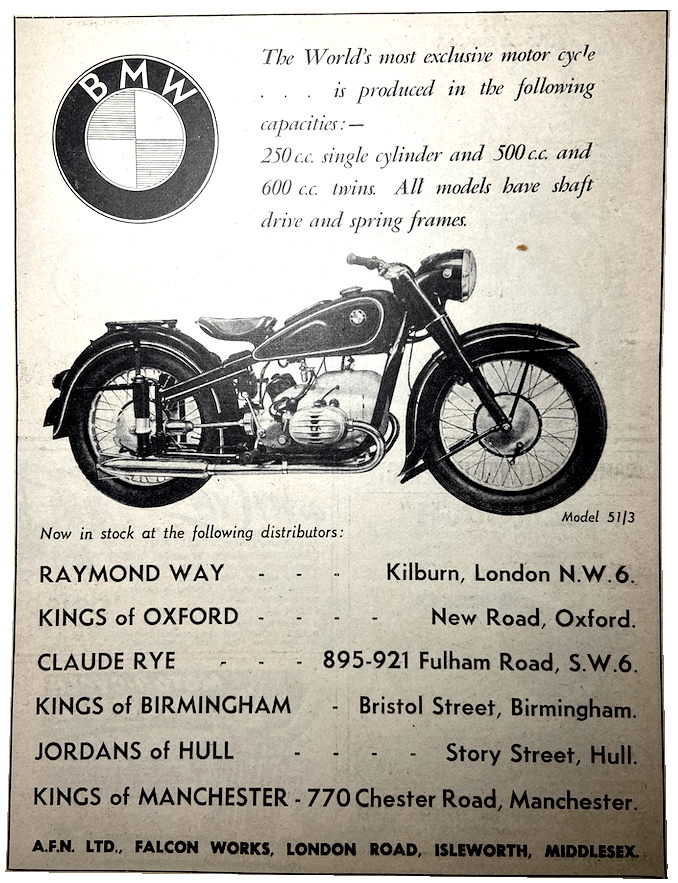
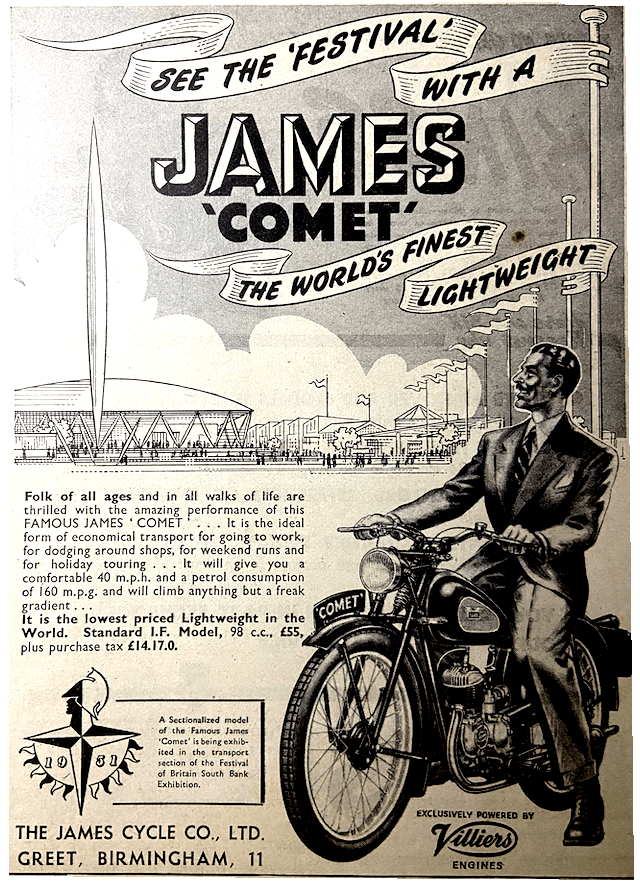
 Motorcycle Timeline