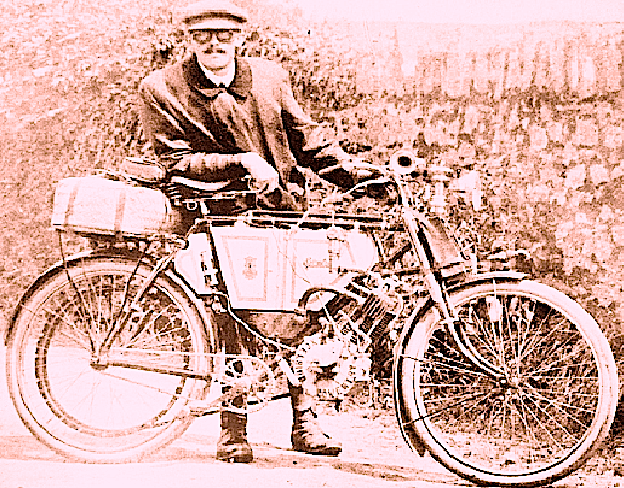

“SOME 40 DIFFERENT MOTOR CYCLES ridden, over 10,000 miles covered—it sounds very peace-time! It also seems that I have been very, very lucky during the year that has drawn to its close. Need it be added that by no means all the miles were in this country? In spite of test machines, there was not a hope of anything like an average of 200 miles a week on the fuel allotted to me at home. What made the odds were visits to the Continent. There has been day after day with its 300 or more miles on the speedometer and then, maybe, a period of weeks when I would be trainborne and chairborne except for the odd flip. However, I am not exactly grumbling! And it has been a not uninteresting year in the matter of machines ridden. They have varied from bicycles with motor attachments and a Corgi with banking sidecar—yes, banking—to racing mounts and 1,000cc twins and fours. Of course, as is so apt to occur, the machine which I class as being as interesting as any is on the secret list. It was built up as an experiment. Perhaps it is the shape of motor cycles to come. I hope so, because I could do with something on those lines myself.

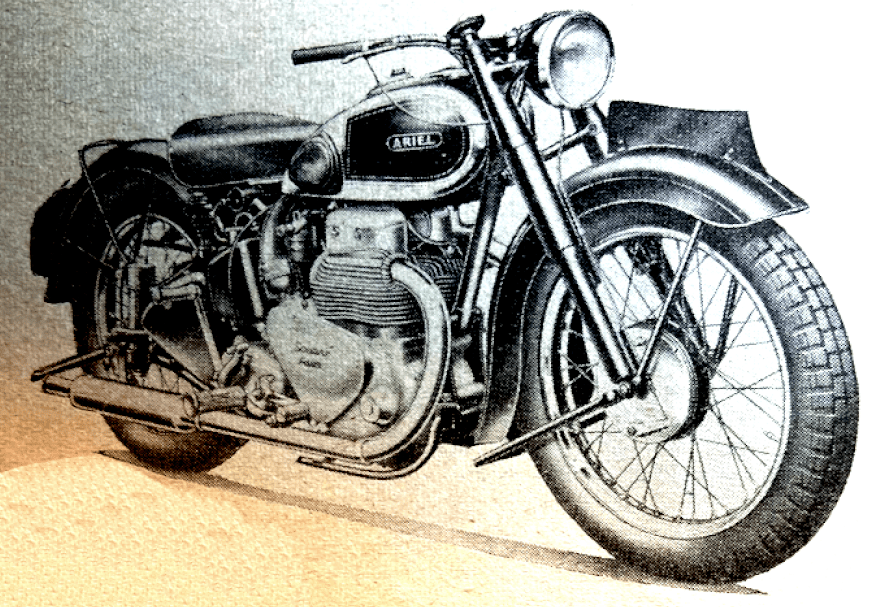
All I can say here is that it has more than one cylinder, it drones, it zooms, it has liquid-cooling. I apologise for being tantalising, but what can I do when it was built secretly as a means of trying out a series of ideas and there are, I understand, no plans for making it even in 1950? But there are at least two mounts no longer secret that were experimental, or rather, were in experimental form, when I originally tried them. These are the new 500cc Matchless and AJS twins. One expects something pretty good from the AMC factory and, if my canters on prototypes give an inkling as to the way the production machines will behave, the new machines will be as lively sports 500s as will be found the world over. One of the prototypes I rode was said to be good for 100mph. Even so, it was far from being intractable in spite of our low-octane value petrol. While new to the market, the twins have been on the go in experimental form for a long time. A glance at my log reveals that I rode one almost exactly two years ago. I like the power unit, with its three-bearing crankshaft, and the rear-wheel suspension lines up with my idea of what tail-end springing should be. A large slice of my mileage, of course, has been covered on my faithful 1,000cc four-cylinder Ariel. It feels a bit cumbrous after a ride on the new light-alloy four which is being marketed for 1949. The half a hundredweight in top-hamper which has been saved by the changes to light-alloy block, light-alloy head casting and coil-ignition unit have made the handling of the new model appreciably better. What are the gains as determined by direct comparison? First, as I have suggested, the machine is altogether more
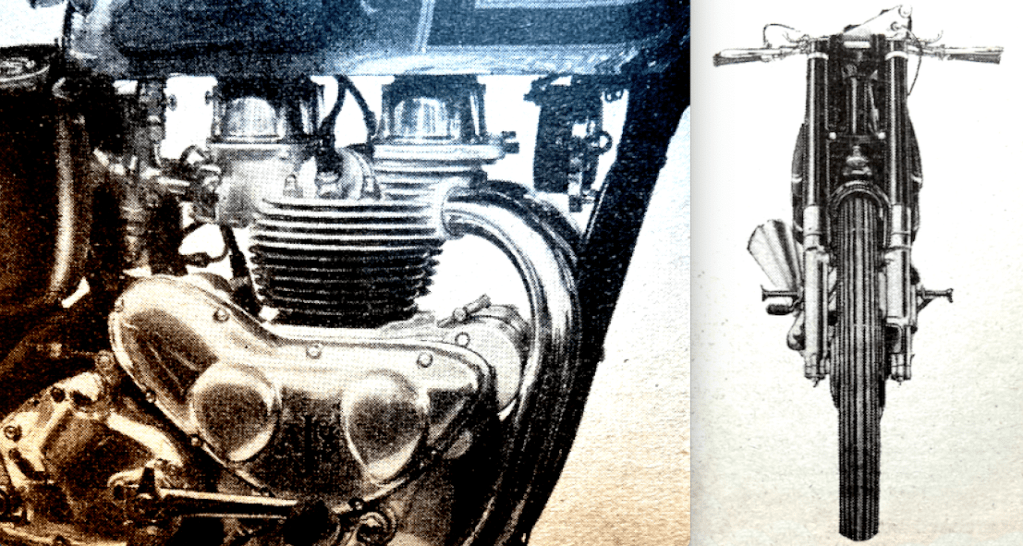
handleable. There is a conscious effort in laying down the cast-iron model for a fastish bend. With the new mount one swirls round without that cant-her-over thigh work. I cannot say that my own machine has ever been a tiring one to ride. On a number of occasions there have been long days in the saddle and, and even one when it took a big share of a 495-mile day. But your big, heavy motor cycle never seems to tuck quite the expected number of miles into each hour, and the reason, I think, is simply that it is unwieldy on bends and corners. The new Ariel four has lost this failing. Why I, no longer a youngster, ride a machine of this size is because of the power-weight ratio—the way one can cruise along at any speed one likes, even at 80mph, without over-stressing the machine. To be climbing a steepish, main-road hill at 60mph and shoot forward at a flick of the right wrist is joy indeed. And I like the swish that is akin to silence, the genteel performance and the way, if one be in the mood, one can stay in top gear almost all day long. Perhaps, most of all, I revel in the reliability of my machine. It is the most reliable motor cycle I have ever owned. Having made the last remark, it would not be unexpected if the day this article goes to press there were a spot of roadside bother. But even if there were, I could not grumble. My machine has not the enthralling flexibility of the new light-alloy Ariel, which has an automatic advance-and-retard. The latter, I found, has a top-gear speed of a bare 8mph, which one uses automatically since there is no transmission snatch. Therefore the fact that the machine had a better gear change than any Ariel I have ridden over the
past 20 years carries less weight than it might have done! The engine of the light-alloy job I rode was not so smooth as my own, nor was the fuel consumption as good. I gather that immediately the machine was back at the works the engine was stripped to determine why I grumbled at lack of smoothness, and it was found that the static balance was slightly out. Occasionally, enthusiasts remark that, while I mention my machine, I never give performance data. Do you take out your machine—your own machine—and see what you can do in a tyre-smoking, tarmac-burning, standing start to 60mph? I don’t, and also I have not the slightest interest in whether my present machine will do 90, 95 or 100mph. I know it will keep its so-called ‘Police test’ speedometer at 80 plus on the Holyhead road and have a useful amount in hand; I know it will accelerate up to just on 80mph on my pet main-road climb; I know it betters 60mpg even at averages of 45, so what do I care? Lately the machine has, as you may know, taken unto itself a sidecar which is slipped on and off. I am still using the highest set of solo gears…What will happen if I attempt to restart on a really steep hill I do not know, but for the work so far the plot has worked. In any case, changing from solo to sidecar is a task of minutes, while swopping engine sprockets, particularly with the Ariel chain case arrangement, means more like half a day. The sidecar steering is heavy, there being the standard Ariel telescopic fork and, therefore, solo fork trail. One day, all makers of machines suitable for passenger work will have to do some serious thinking about the needs of sidecarrists; there must be sidecar trail for those who fit sidecars. The brakes, even with the machine solo, require too-frequent adjustment and that undamped rear-springing, while all right on our good British roads, can result, in a bouncing-ball effect if a series of hefty waves in the road is encountered. Let us pass on to another thousand, the Vincent-HRD. This is a very different type of machine from the four-cylinder job we have been discussing; it has been described as ‘rorty and naughty’. There is a great deal to be said for a 1,000cc V-twin pulling a gear ratio of 3½ to 1. There is an easy, loping gait, and the way this machine gathers itself together under one when
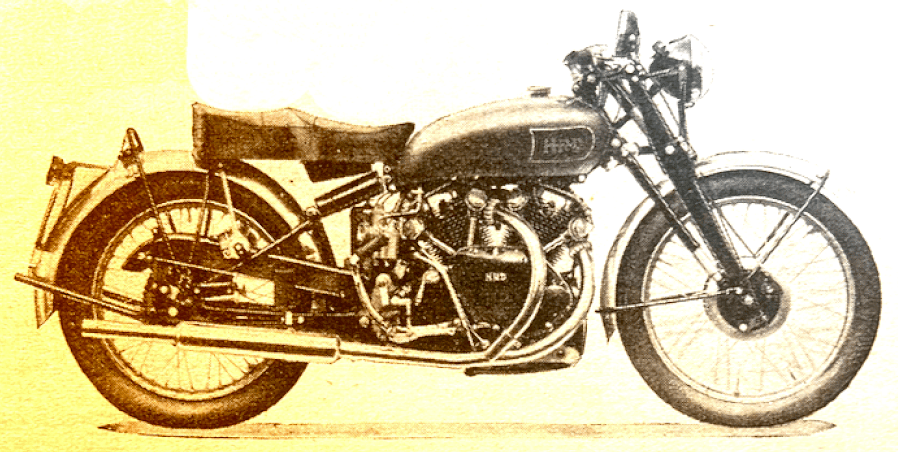
one takes a fistful of grip is great. Here, if ever there was one, is a man’s motor cycle, and it is a machine which is essentially masculine in both outline and behaviour. I was delighted with the flexibility of the machine—the way one trickles along in top gear in 30mph limits—and, of course, in the outstandingly good power output and braking. And the machine is so much more handleable on bends and corners and in the rough than the old Series ‘A’ Rapide. But what about the riding position on which Stevenage prided itself so much, and so rightly, in the past? With the now necessarily high-up foot-rests I, who am no more than 5ft 10½in, find I am hunched on the machine, legs crooked at the knees, and a passenger instead of feeling master. On one occasion, a result of my being thrown about, and not part and parcel of the model, was that on a series of humps I started the steering going from one lock to the other—on a Vincent-HRD, the most rock-like steering machine in the world! There are too many machines to-day which have been designed, it seems, for small men My criticism that the springing could result in the bonny-bouncing-baby act on hummocky going appears to have been met for 1949. Maybe before many weeks have passed I shall have an opportunity of finding out for myself. What I will say here and now is that if you want a thrilling, zestful mount that is unique in performance of the variety that should have a capital ‘P’, the Rapide provides the answer—and a very good answer, too. Now let us shoot to the opposite end of the engine-capacity scale—to Mosquitos, Fleas and that canine, the Corgi. Lately, as you know, the autocycle, which was to have given little more than cycling without effort, has grown up and, except for its single gear and the retention of pedals, has become in general very much a motor cycle. So it seems that it will be a case of starting at the bottom again, and the bottom this time is likely to be an engine unit that you buy in a carton about the size of that for a small wireless set and clamp on your pedal-cycle in 20 or 30
minutes. The idea is as old as the century and some manufacturers are appalled at its resurrection, holding that it is utterly wrong to apply engine power to a bicycle, which was never designed for the purpose and may already be very second-hand. I should be equally appalled were it not that it is possible—has been proved so—to provide satisfactory units which develop no more power than a couple of ordinarily lusty legs and which, owing to smooth torque, are calculated in various directions to stress the bicycle less, and not more, than those legs. The mass market lies in the cartoned unit that will fit on any bicycle; because then alone will the all-in cost be low. Besides, no one wants to have to throw away his or her pedal-cycle and have, in effect, to buy another. Where trouble has arisen in the past is that satisfactory units have not been available and that some who have set about making engines to provide cycling without effort have failed to produce engines that merely give ordinary bicycle speeds. My experience with the 38cc Mosquito, made at the rate of 600 or more a week by the famous Italian Garelli company, is that to-day there is the answer. With such a unit one ambles along at 10 to 15mph, and ordinary main-road grades are surmounted with light pedal assistance to the engine—the pedalling gear ratio remains that of the bicycle so the pedalling really does help the power unit. Mind you, the Mosquito is in every way a real job, and most beautifully made. If there is a criticism it is that the engine turns over at high speeds. Dispensing with a reduction gear would save money, and this has been done with some of the other units developed on the Continent. Considerable interest is being displayed in this country in these motor attachments, which can make a most valuable stepping-stone to a motor cycle. A fear is that some people may rush into production with partially tried units and kill the whole idea, just as happened with scooters immediately after the 1914-18 war. In one of the photographs you see BH Kimberley, erstwhile competition rider, with a prototype of a banking sidecar he designed for a Corgi. Originally he made up the little outfit chiefly for amusement, but so successful did the idea prove that you may be hearing a lot about such chassis. What intrigued me when first I handled the machine was that here was a sidecar outfit that was controlled exactly like a solo; there was no sidecar-driving technique to be learnt and no tipping up. At least, this was the impression I gained, but in the back of my mind was the thought that perhaps I was driving the machine like a normal sidecar outfit, although doing so subconsciously. To satisfy myself I borrowed the use of a friend’s tennis court and threw a Corgi party. The tiny sidecar outfit
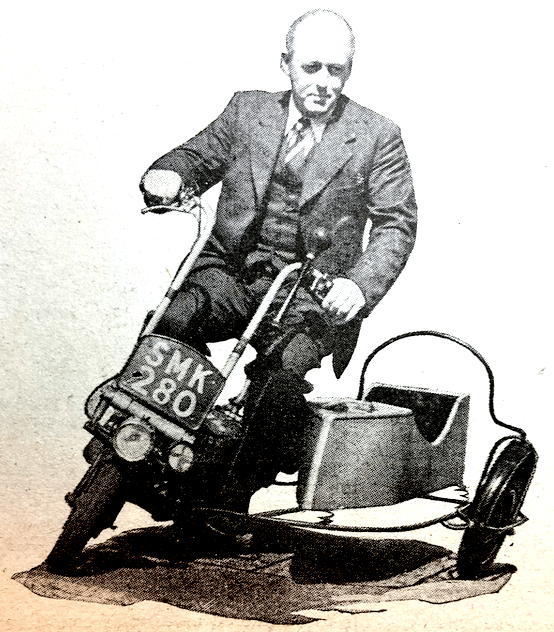
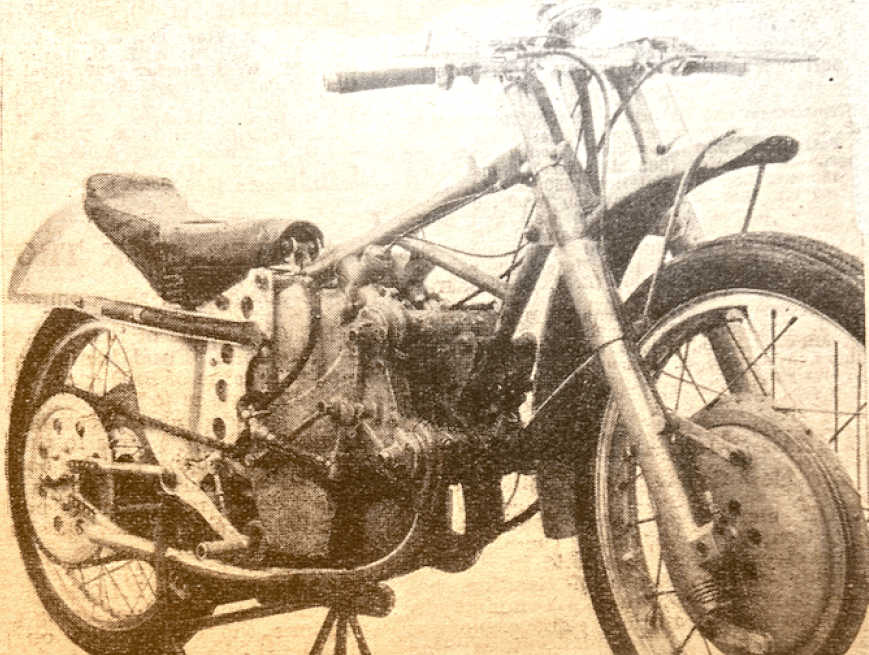
was entrusted to my boy of, then, barely eight years of age, to his friends of both sexes, to the parents of the said friends, to a grannie, and to a number of other folk, none of whom had sidecar experience. In every case they were immediately at home with the outfit. Good enough! What I am looking forward to doing now is trying (a) the finalised version of the Corgi banking outfit and (b) a sidecar of similar design on a motor cycle of large capacity. A very different type of machine is the so-called ‘Boy’s Racer’ AJS, the racing 350cc ohc 7R. I happened to be at the AMC factory as the pre-TT batch was coming through and snaffled one that was just back from its road test. Fancy, in these days, being able to pick up a pukka racing 350 with a silencer end to its megaphone and waffle through the streets of Woolwich! Of course, these machines are not being turned out for road work and won’t be—how road-racing they are has been proved in many of the races, here and abroad, that have been held over the six or eight months since the machines reached the market. The remarkable thing about this production racer is its success right from the start. There have been short flips on other racing machines—Nortons, a Velocette and Guzzis. I marvel at these modern racing jobs with all their top-end power, but somehow still hanker for the days when I could, and often did, pick up a TT winner at Euston Station in London, fill up with 50/50 petrol-benzole, and slip off on a 400-mile day to Exmoor—this with the fitting of silencers, number plates, licence, and a smaller main jet as the only alterations from TT trim. However, when your 250 Guzzi twin is as fast as, if not faster than, Charlie Dodson’s Senior TT-winning Sunbeams and Alec Bennett’s 1927 Senior Norton, I suppose one ought not to grumble. What I liked about those old days was that your TT machines were but
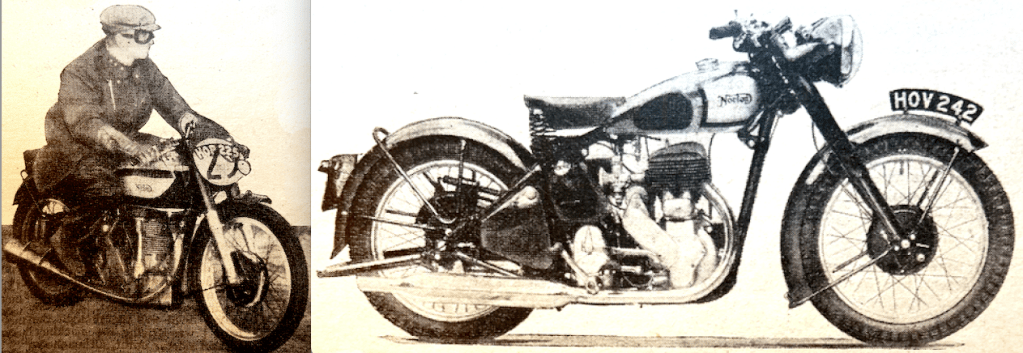
specially tuned and furbished editions of the standard, super-sports roadsters. At Sunbeams, for example, early in the New Year, the racing department would ask the works for a series of specials for the TT, and Mr FT Jones, then Sunbeamland’s works manager, would hand over a number of standard Model 80s and 90s, being keen to know just what the standard production machines would do and could be made to do! A pity the TT has become no specialised…Before this long article is brought to an end there are two other machines on which I want to touch. The first is the Continental-looking 125cc BSA two-stroke ‘Bantam’. Even at a maintained 30mph the machine we had for Road Test did 160mpg and it had a top speed of 47mpg. This is a remarkable motor cycle which promises to become extremely. popular. Like everything else, it is not, of course, perfect. The two crabs I had against the model I tried were that it was much noisier than it should have been, and the transmission was harsh at low speeds. Both failings can be overcome, though transmission roughness is not always amenable to ‘treatment’, by which I mean that one machine which was launched on the market last year was endowed with a whole series of modified transmission shock-absorbers before the works were satisfied (and I was still not unduly impressed!). Lastly, there is a machine which gave me as much pleasure as anything I rode in 1948, namely, the new 490cc side-valve 16H Norton. Perhaps my pleasure was tinged with the roseate hue which can result when one believes something is possible and then personal experience proves it to be so. I, with tens of thousands of miles on side-valve Sunbeams—the 492cc Longstroke and the 499cc Light Solo—and the old side-valve Norton, have known that the side-valve has been a Cinderella and, instead of improving over the years, has become worse. I have not loved detachable cylinder heads, with the resultant break in the heat path, nor the shrouding caused by valve enclosure. The new 16H showed me that a really super, yet modern-type side-valve, can be and is being manufactured—a sweet, supple engine which gives one effortless touring, is economical, and gives one comfortable 40mph averages on the open road. I say ‘effortless’, but there was one direction in which the machine failed, and that was that the balance was not up to modern-day standards. This, I gather, has been attended to and, if the results are what they can be, you have in the latest 16H a most delightful motor cycle. And the new 596cc model ‘Big Four’ is, I am told, equally outstanding. Perhaps I shall know more before this New Year is much older.”
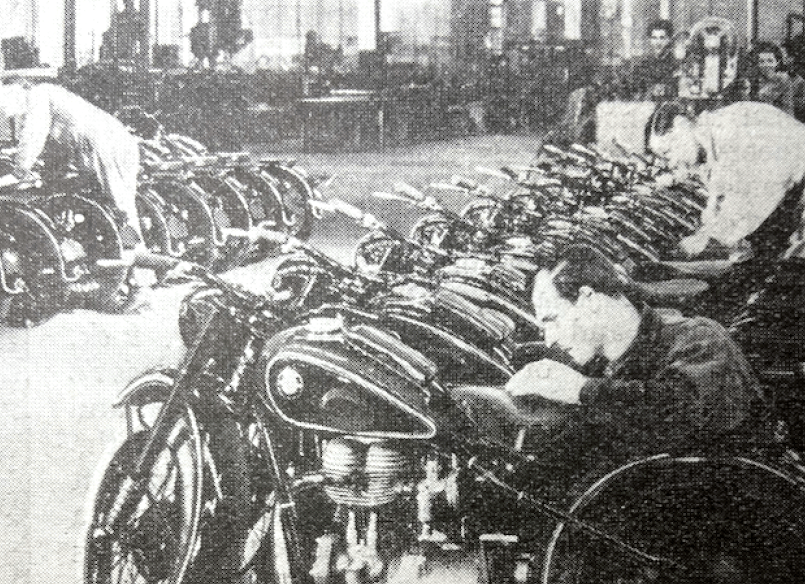

“MERE MENTION OF THE NAME ‘Black Shadow’ is enough to speed the pulse. Since the machine’s introduction last year as a super-sports brother to the already famous Rapide, the sombrely finished Shadow has achieved wide distinction. It is a connoisseur’s machine: one with speed and acceleration far greater than those of any other standard motor cycle; and it is a motor cycle with unique and ingenious features which make it one of the outstanding designs of all time. So far as the standards of engine performance, handling and braking are concerned—the chief features which can make or mar an otherwise perfect mount—the mighty Black Shadow must be awarded 99 out of 100 marks because nothing, it is said, is perfect. The machine has all the performance at the top end of the scale of a Senior TT mount. At the opposite end of the range, notwithstanding the combination of a 3.5 to 1 gear ratio, 7.3 to 1 compression ratio and pool quality fuel, it will ‘chuff’ happily in top at 29-30mph. Indeed, in top gear without fuss, and with the throttle turned the merest fraction off its closed stop, it will surmount average gradients at 30mph. In Britain the machine’s cruising speed is not only limited by road conditions, it is severely restricted. It is difficult for the average rider in this country to visualise a route on which the Black Shadow could be driven for any length of time at its limit or near limit. During the test runs speeds of 85-90mph were commonplace; 100mph was held on brief stretches and, occasionally, the needle of the special 150mph Smith’s speedometer would indicate 110. No airfield or stretch of road could be found which would allow absolute maximum speed to be obtained in two directions, against the watch. Flash readings in two directions of
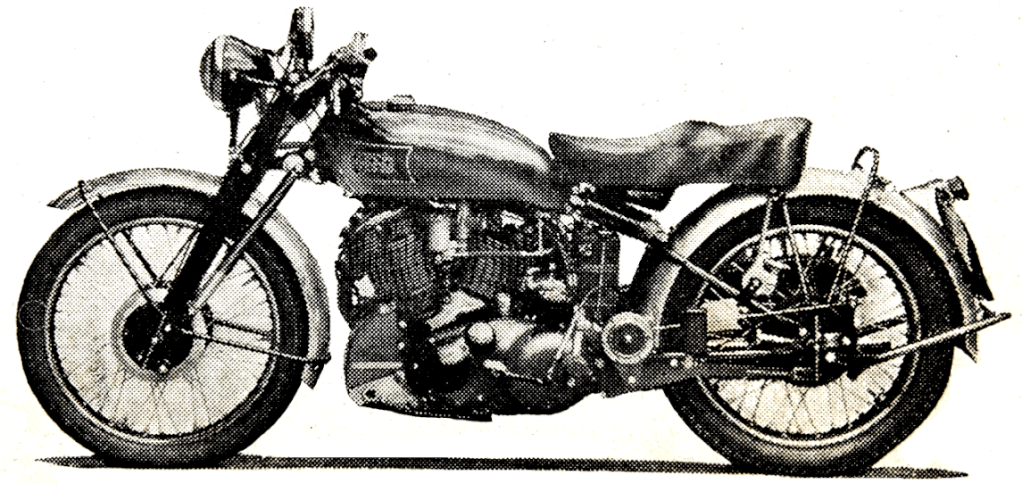
118 and 114 were obtained, and in neither case had the machine attained its maximum. Acceleration from 100mph, though not vivid, was markedly good. The compression ratio of the test model, as has been remarked, was 7.3 to 1. This is the standard ratio but models for the home market and low-octane fuel are generally fitted with compression plates which reduce the ratio to 6.5 to 1. The greater part of the test was carried out on ‘pool’, though petrol-benzole was used when the attempts were made to obtain the maximum speed figures. Steering and road-holding’ were fully in keeping with the exceptionally high engine performance. A soft yet positive movement is provided by the massively proportioned Girdraulic fork. There is a ‘tautness’ and solid feeling about the steering which engenders confidence no matter what the speed and almost irrespective of the condition of the road surface. Corners and bends can be taken stylishly and safely at ultra-high speeds. There was no chopping, no ‘sawing’; not one of the faults which are sometimes apparent on high-speed machines. Bottoming and consequent clashing of the front fork were, however, experienced once or twice. Low-speed steering was rather heavy. Any grumble the critics may have had with regard to the Vincent rear suspension has been met by the fitting of the hydraulic damper between the spring plunger units. So efficient is the rear springing now, that never once was the rider bumped off the Dualseat or forced to poise on the rests. Even at speeds around the 100mph mark, only the absence of road shocks gave indication that there was any form of rear-springing, such was the smoothness and lateral rigidity. Straight-ahead steering was in a class by itself. The model could be steered hands off at 15mph with engine barely pulling or just as easily at 95 to 100mph. The steering damper was required only at speeds over 115mph. Used in unison, the four brakes (two per wheel) provided immense stopping power. Light pressure of two fingers on the front-brake lever was sufficient to provide all the braking the front wheel would permit. One of the front brakes, incidentally, squealed when in use. The leverage provided at the rear brake is small, and the brake operation was heavy. Engine starting from cold was found difficult at first. Cold starting was certain, however, provided that only the front carburettor was flooded and the throttle control was closed. When the engine was hot, there was no difficulty. After a cold or warm start the engine would immediately settle down to a true chuff-chuff tickover. Throughout the course of the test the tickover remained slow, certain and 100% reliable. No matter how hard the previous miles had been, the twistgrip could always be rolled back against its closed stop with a positive assurance that a consistent tickover would result. The engine was only tolerably quiet mechanically. At idling speeds, there was a fair amount of clatter, particularly from the valve gear. But so far as the rider was concerned all mechanical noise disappeared at anything over 40mph. All that remained audible was the pleasant low-toned burble of the exhaust and the sound of the wind. Bottom gear on the Black Shadow is 7.25 to 1. Starting away from rest can seem at first to require a certain amount of skill in handling the throttle and clutch. The servo-assisted clutch had a tendency to bite quickly as it began to engage. The riding position for the 5ft 7in rider who carried out the greater part of the test proved to be first-
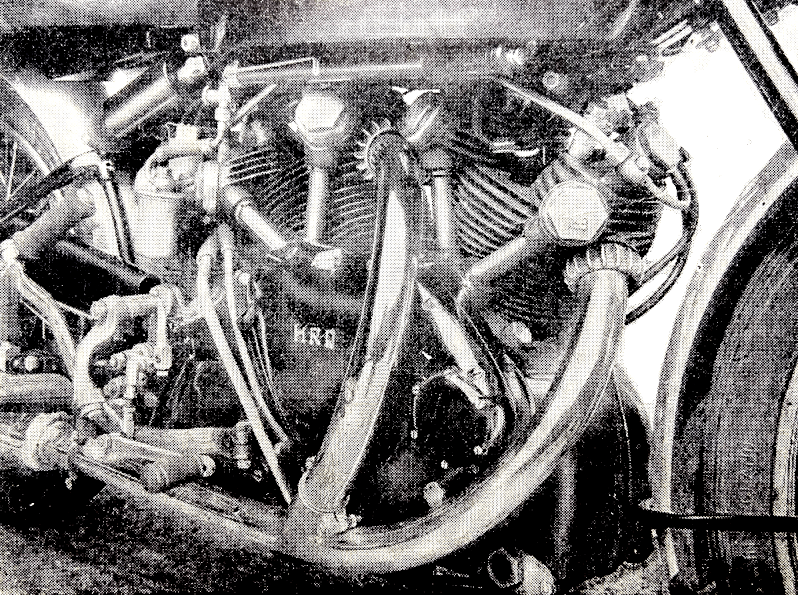
class. The saddle height is 31in which is comfortable for the majority of riders. The footrests are sufficiently high to allow the rider complete peace of mind when the machine is heeled over to the limit, and were sufficiently low to provide a comfortable position for the 5ft 7in rider’s legs. Now famous, the 25½in from tip to tip, almost straight, Vincent-HRD handlebar provides a most comfortable wrist angle and a straight-arm posture se. All controls are widely adjustable—the gear pedal and brake pedal for both height and length. Both these controls, incidentally, move with the foot-rests when the latter are adjusted. The gear change was instantaneous but slightly heavy in operation. Snap gear changes could be made as rapidly as the controls could be operated. The clutch freed perfectly throughout the test and bottom gear could be noiselessly selected when the machine was at a standstill with the engine idling. However, because of the pressure required to raise the pedal it was sometimes necessary to select neutral by means of the hand lever on the side of the gear box; and also to engage bottom gear by hand. In the 700 miles of the road test the tools were never required. In spite of the high speeds there was no apparent sign of stress. Primary and rear chains remained properly adjusted. There was very slight discolouring of the front exhaust pipe close to the port and a smear of oil from the base of one of the push rod tubes on the rear cylinder. The ammeter showed a charge at 30mph in top gear when all the lights were switched on and the road illumination was better than average. An excellent tool-kit is provided and carried in a special tray under the Feridax Dualseat. There are many ingenious features of the Vincent-HRD which brand it as a luxury mount built by highly skilled engineers who at the same time are knowledgeable motor cycle enthusiasts. The Black Shadow finish is distinctive, obviously durable and very smart; and only a minor reasons why the Shadow attracts a crowd of interested passers-by wherever it is seen!”
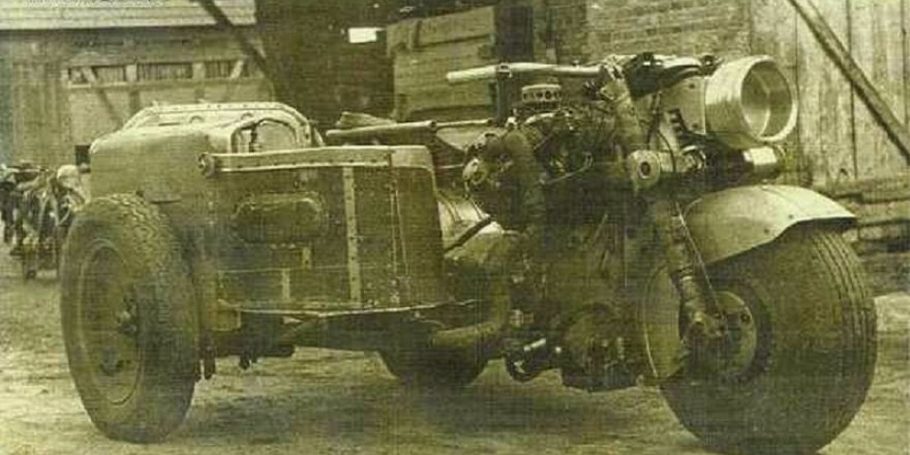
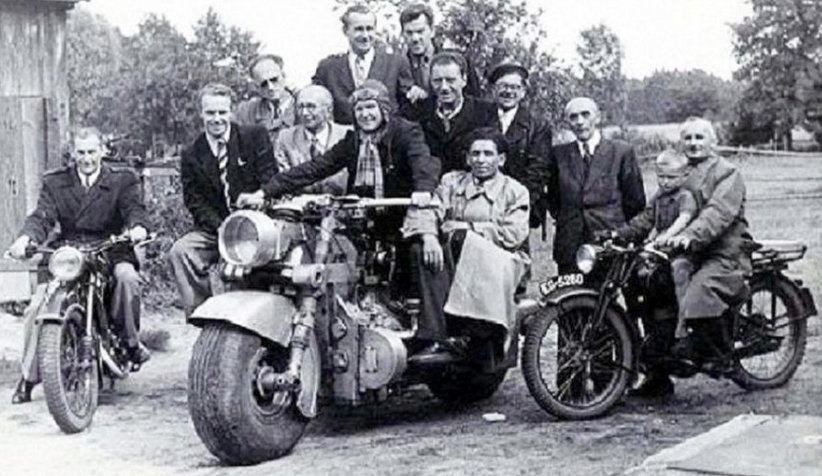
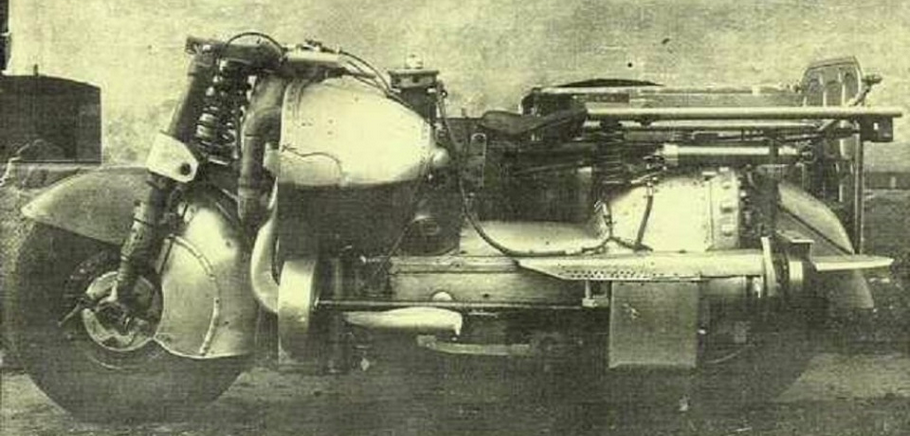
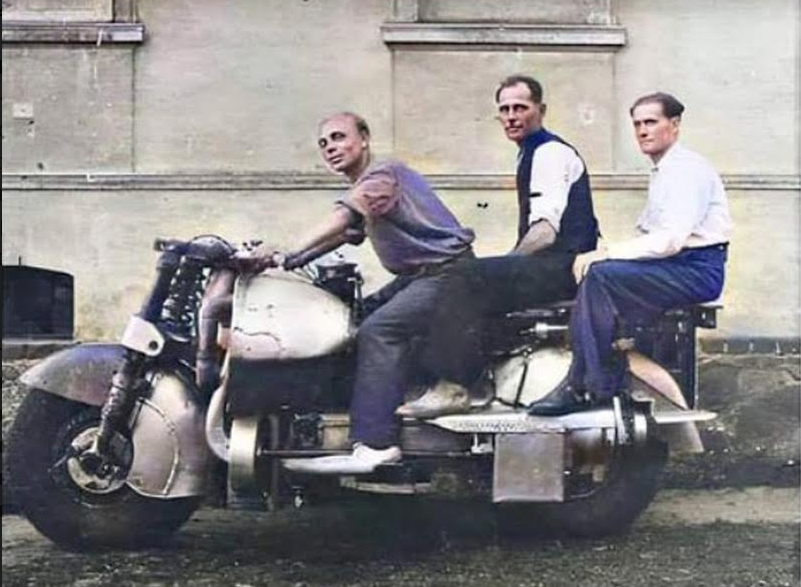
THE MSS (MOTOCYKL STANISŁAW SKURA) was an extraordinary motor cycle handmade by Polish genius Stanisław Skura. He worked at a military airbase and clearly made good use of his access to equipment and materials, particularly aluminium. Power was provided by a V-twin engine with a capacity of some 4,500cc. One source claims that Skura made his V-twin from part of an Me109 engine. If so its capacity would have been nearer 5.6 litres —in either case, Skura clearly wasn’t messing about. It drove through a three-speed box and was designed for eight passengers including the driver (three on the bike, two in the sidecar and three standing on the rear platform). Word has it (on a Polish enthusiasts’ site, and they should know) that the authorities were impressed enough that they wanted to buy the MSS1 but Skura didn’t want to sell the beast until it was legally registered in his name. The cops retaliated by ordering its destruction on the grounds that he’d used military equipment and parts including cylinders (from generator sets), conrods, gears, magneto, headlight, carbs, wheels and tyres (from aircraft), bearings, etc. Many of these parts dated from the Nazi occupation. So I reckon that was a pieprzona hańba. It seems he might well have got away with taking the MSS apart and reassembling it when the heat died down. But, like so many motor cycle obsessives, that wasn’t his style. Skura lost his rag and smashed it with a hammer in front of the Security Service men. Years later he melted down the aluminium and used it cast components for another project, the MSS500. For more on that turn to 1957.
“IF THE VERTICAL TRANSVERSE-TWIN is to dominate the industry for maybe a decade, the pros and cons of the single casting vs separate pots are tolerably obvious. The single casting endows the upper half of the engine with the same rigidity which the lower half obtains from a stiff crankcase and a sturdy crankshaft. But the two-pot type can secure practically equal rigidity, provided its pots are deeply spigoted into a really stiff crankcase. On the other hand, the two-pot type should ensure slightly better cooling. Maintenance and repair should be simplified by separate pots, while a factory may save the cost of new machine tools for handling the more complex casting. It is only fair to point out that there are other methods of obtaining the extra cooling, such as the Norton splaying of the valve chests, or the light-alloy heads used by other firms. All these engines are delightfully accessible—probably more accessible than V-twins, though perhaps slightly less accessible than transverse flat-twins. On the other hand, an overhead-valve 500cc flat-twin makes an awful wide engine to set across a frame; and a 500cc longitudinal flat-twin is neither easy to house nor accessible. Worse still, its carburation is by no means easy to balance.”—Ixion
“MY LOCAL PAPER reports that a REME unit contributes a novel turn to Service displays. The squad are handed a motor bicycle reduced to its component parts, down to the tiniest nut. They assemble it coram populo* in precisely eight and a half minutes. (The reporter does not state whether the machine is a Corgi or a Black Shadow.)”—Ixion
*in public
“THE LETTERS ABOUT the BSA Sloper—why was it dropped?—caused myself and several of my friends considerable amusement. One night recently, we were coming home from the Motor Cycle Show. The roads were very wet, and my Sloper was sporting a very bad back tyre. I applied my brakes very cautiously, whereupon the bike fell rather heavily on the deck. After that, she seemed to run much sweeter, and pulled up a fairly stiff gradient at 50mph with no effort. The bike has had more knocks than a tin full of stones, and yet on four separate speedometers I have been clocked at 65mph. In conclusion, I should like to say that I would like to see BSAs make a modern Sloper, as the long-stroke, in my opinion, gives a much better performance; apologies to short-stroke fans.
GA Marskell, Greenford, Middlesex.”
“THE BRIEF LETTER from KOR/A, with its reference to ‘Nickel Tank’ and ‘Ermyntrude’, brought back memories of their delightful correspondence in your columns around the 1920s. It so happens that I was looking through a bound volume of The Motor Cycle, dated 1929-30, just a few months ago, and in it was (if my memory is correct) a letter from ‘Nickel Tank’, in which he said that ‘Ermyntrude’ had gone out to Malaya. All this may be comparatively uninteresting to the younger generation of readers, but to those like KOR/A, these ghosts from the past are very real—breathing, as they do, the great days of motor cycling. Yes, your Correspondence columns of those years were the arena for some titanic battles on average speeds, design, the perfect bike, etc.
W Dennis Griffin, Kenilworth.”
“IXION’S NOTES ARE NOT CORRECT. The wasp, when attacking, does not leave his sting in his victim; the sting is used time and time again. The bee, on the other hand, does leave his sting in his very first victim (and thereby signs his own death certificate!), and the instructions regarding the removal of the sting by means of a knife blade should refer to the bee’s sting only. A razor blade is preferable to a knife blade. Readers interested in the wasp’s methods should read The Hunting Wasp, a most interesting book (recently published) dealing with the different varieties of the wasp family.
Percy W Holmes, London, W3.”
“CAN YOU OR ANYONE prove or refute this claim—that I am present the rider of the oldest taxed and insured motor cycle in general use on the roads of the British Isles to-day? My machine is a 1921 Model SD 550cc Triumph. This machine is still working as well as ever, and has had only one new part in its 27 years service to wit, one exhaust valve. This machine still averages 100mpg. Can anyone better this?
Brian BV Crowhurst, Londonderry.”
“YOUR CORRESPONDENT, Mr Fisher, may be interested to know that the rider of the Vincent he spoke to on the Hull-New Holland Ferry was my humble self, and that I arrived back in Somerset around 11pm. Total, 723 miles since 10am. on the Thursday; 25 hours; petrol consumption, approximately 68mpg; average speed running time only), just under 41. As for the heading to the letter—’Endurance’—it was far from that. Every mile was sheer pleasure, although the trip was actually a business one. The whole point is the comfort and all-round excellence of the Series B Vincent-HRD—’ just the machine for the job’, to quote Mr. Fisher.
GT Takle, Washford, Somerset.”
“I SHOULD LIKE to reply to the detractors of the Sunbeam S7. The Sunbeam works, by putting in production the S8, will meet all the requirements of those who dislike the heavy appearance of the S7. Secondly, I should like to reply to Miss Marianne Weber, of Brussels. I have seen Miss Weber several times in Brussels riding her Ariel. I agree with her on the performance, beauty and speed of the 600cc R66 BMW. But what about the price? In 1939 this model sold in Belgium at twice the price of the Triumph T100 with the girder fork. This young lady had better leave the technical discussions to the technically minded people—the advertisers of a lightweight put it so well: ‘We do the thinking, you enjoy the fruits.’—90% of riders ignore the engines, and, as regards speed, are satisfied with less than 50mph cruising speed. The Rapide is a marvel, but not to be left in anybody’s hands, the same applies to the fast Velocettes and Norton 30 and 40 models. But the Ariel Four is like a car on two wheels, and the makers purposely did not endow this model with a high performance at the expense of good pulling is at low revs. That is all the charm of the Square Four. Nothing could be better, except, maybe, shaft-drive.
JP Simonson, Liege, Belgium.”

“I WAS INTERESTED in the leader, ‘A Neglected Market’. I have been a keen motor cyclist and a regular reader of The Motor Cycle for the past 20 years. I agree, a 750cc vertical-twin is overdue. After visiting the Motor Cycle Show I was disappointed not to find a sidecar machine to my liking. Since the war I have bought two new machines. The first one, a modern 500cc twin, proved unsuitable when in use with my large single-seater saloon sidecar and with my son as pillion passenger. The second machine is a 600cc side-valve, which is able to stand up to plenty of hard work. The first manufacturer that can produce a 750cc modern version of the 500cc twin can be assured of my order. This is the first time I have written to the Blue ‘Un. Wishing you every success.
Gwentlander, Newport, Mon.”
“I AM OF THE same opinion as Mr. Reid and other riders of the S7 Sunbeam. After riding a Model 9 Sunbeam with enclosed chains for 18 years, and being very satisfied with the good service, I placed as order for a S7 without ever seeing one, as I had such good faith in the name ‘Sunbeam’. Last August I took delivery of my S7 Sunbeam. I was delighted with its performance. The comfort, silence and smooth running was unbelievable; the way this model holds the road makes motor cycling a real pleasure. As regards ‘XT80’s’ remarks about speed, the S7 has more speed than I can use on our dusty roads. The air filter, rear-springing and shaft-drive are more important to me than speed. Past experience showed that exposed rear-chain drives soon wear on our dusty roads. During the past 24 years I have owned. two Triumphs and three Sunbeams, the latter Model 9s with totally enclosed chains. And now Mr Wray and ‘Ex-250 Sports’ consider the Douglas and Twin Triumphs better than the Sunbeam. I consider both the Douglas and Triumph are behind the times with their exposed back chains, and this is one of the reasons why in 1928 I changed from Triumphs to Sunbeams. Wishing’ all the best to The Motor Cycle, which I enjoy.
RS Gordon-Hughes, Transvaal, South Africa.”
“AS A FORMER OWNER of a Sunbeam S7, may I contribute to the fray? I covered over 5,000 miles on my model between October 1947 and May 1948, and was left with mixed feelings when I sold it. The S7 was superlative in many respects, but had several drawbacks from my point of view. Comfort, silence, design, ease of cleaning, and finish, were among its endearing features, but at the other end of the scale were snags like the following: Average mpg, 55; maximum speed, 70mph; heavy oil consumption; poor starting in cold weather (due to insufficient kickstart leverage); oil leaks; mediocre acceleration; and poor steering due to the upright angle and staccato action of the front forks. In conclusion, I would say that, in my opinion, the S7 has not been influenced sufficiently, in its design and development, by the views and criticisms of the most critical and knowledgeable of all motor cyclists, the works’ testers.
JR Hawkes, Birmingham, 8.”
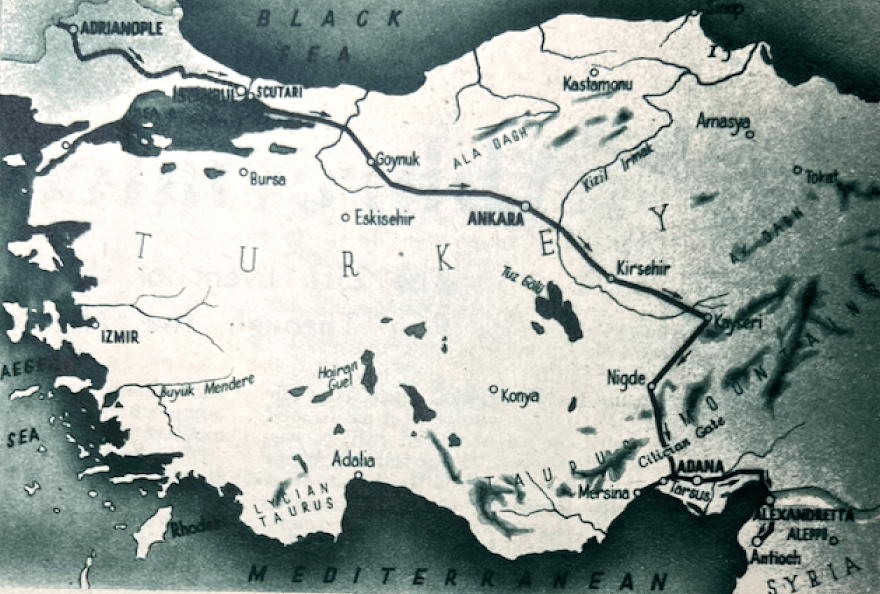
“ONE RARELY ASSOCIATES Turkey with a motor cycle journey. I was fortunate in being able, in the course of some three weeks, to make a complete road crossing of the country from Adrianople, in the north-west, to Antioch, down on the Syrian frontier. The capacity of my mount was only 250cc, but this had the advantage of giving a greater fuel range, a most desirable feature in a country where petrol stations are few and far between. I entered Turkey by way of the Balkan ‘backdoor’. First of all, the frontier guards had to man an impressive fortification, then I had to wait while they patrolled ‘no-man’s-land’, and finally I was given an armed escort with whom I had to travel at walking pace to the customs house. Here an official in immaculate white dress awaited me. I was asked to declare all my gold and silver and valuables. The completion of this operation was almost instantaneous, whereupon I was allowed to continue over the worst road ever, to Adrianople, in order to introduce myself to the police—a most necessary proceeding. A motor cyclist from Bulgaria was a completely unknown factor. I was told that I must continue at once some unspecified distance to a place which would be indicated to me, in order to catch a train which would carry me to Istanbul, as my road route traversed a military area and this was absolutely forbidden. I protested that I had no money or petrol, whereupon a local garage was ordered to supply me gratis. The Oriental spires and domes of Edirne intrigued me, and I sought any excuse which would delay action. But the police were adamant—I must catch the train that night. The journey was a nightmare. I was delayed by other police and military, but this was not so serious as the state of the road; and once I met a lorry driver
who made me understand that I would never reach the railroad that night. I told him of my orders and grimly carried on. A minor track led me into the wilderness. Dogs came rushing at me with savage intent, then, as the light failed, a military outpost stopped me. Trying to convey my mission, I attempted to proceed, but was roughly detained. All my luggage was pulled out and thrown into the road; the men pointed to the unadorned shoulders of my leather tunic. Did they suppose me to be a fugitive from Greece? Then they discovered my camera; it was fortunate that there was no film in it. I was led into the most primitive mud and wattle hut. By this time I was so completely fatigued, having been on the road since an early hour, that I took off my boots and leggings, ate some dry bread, and lay down on a rough bed. No sooner, so it seemed, had I fallen off to sleep than I was roughly awakened and made to dress and proceed. I remonstrated, saying that the train had now gone. So I drove, in a trance, through the silent Turkish night. Night driving was not part of my plan, but the play of light and shadow set up by my head lamp clearly indicated the deeper pot-holes and dictated my course. In the far-spaced villages the police had turned out to meet me. They ceremoniously saluted, waving me on. Still I continued, often considering sleeping by the road. Then suddenly I came upon the railroad and slowed down. Police and a man came running towards me. ‘This way please,’ directed the man, in English. After I had supervised the loading of my machine the man took me into a nearby cafe and treated me to my first Turkish coffee. It was hot and sweet and strong, but the cup was truly minute and one had to be careful not to drink the dregs comprising the lower third of the cup. Once in the train, I had a personal guard who lost no time in securely locking me into my compartment. Not that I wished to escape, for, as my host had smilingly told me, my road—that is the railroad—was unquestionably the best. A faint wisp of beautifully brilliant, Turkish crescent moon, set in the velvety vault of outer space, enabled me to see little of the forbidden wilderness, and next day I was bumped and jolted along the coast of the Sea of Marmara to Istanbul—

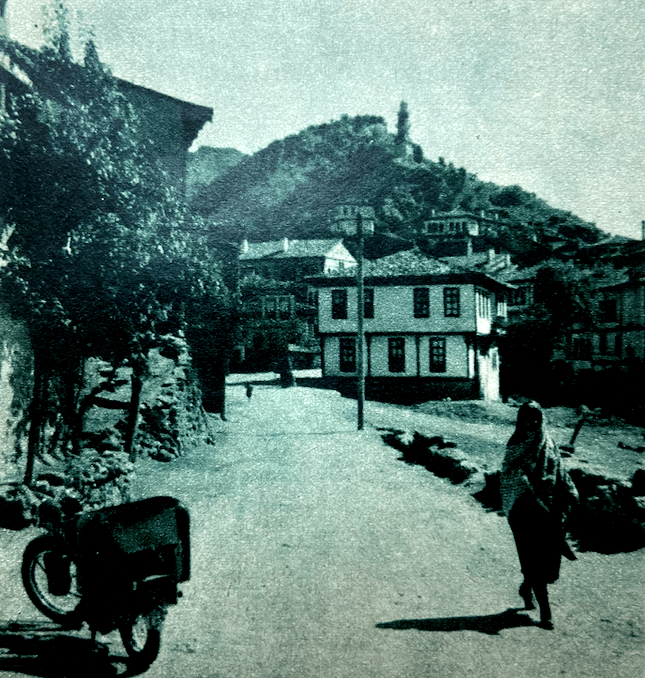
Constantinople—star city of the Near East. Here, having passed through the military area, I found freedom again. In this city, which stands between east and west, where Oriental splendour and Western civilisation meet, I had new experiences and made all kinds of contacts. It was a revelation. Soon I met some Englishmen and quickly learnt that if I wanted a gallon of petrol, all I had to do was to point to my tank and say ‘dirt’, or if a litre of oil was required, to point appropriately and say ‘beer’. Here butter became ‘terry air’, and if one wanted eleven of anything one simply said, ‘on beer’. It was all very quaint. The open road lured me on towards the heart of the land of the rising sun—Anatolia. First a tarmac road led me from the Bosphorus peninsula to some low hills. Then there was a shocking stretch of pot-holed track where speed was reduced to some 5mph. But later I entered upon really mountainous terrain, stony hairpin bends taking me ever farther from civilisation. When the light failed I camped for the night. At 5am I was awakened. The police had come to investigate my presence in the mountains. My passport satisfied them, and when we had all shaken hands, the will of Allah was invoked and we parted most friendly. When the sun was still below its zenith I reached Goynuk. Here veiled women still silently walk the narrow, cobbled main street; the mountain setting, the eastern architecture, and the stately spires of a mosque set on a hill, complete the picture of a perfect Turkish village. The colours are vivid, and the contrast between light and shade makes everything stand out in bold relief. Beyond Goynuk one enters upon a tract of and country that is uniquely Turkish, an area where Nature’s artist has, as it were, been given a free hand and man cannot mar his efforts. For entire hills and mountains are splashed with every conceivable shade of colour, and even the scant vegetation harmonises with the wild scheme. The road is no less bold in its convolutions, taking one to dizzy heights only to zig-zag dangerously into the neighbouring valley. Then the traveller sees the silky coats of the famous Angora sheep and knows that he has almost reached the capital. Ankara is a strangely isolated city, like an oasis in the desert, yet it knows no isolation to-day. Flashy taxis glide noiselessly past, electric trolley-buses carry well-dressed city workers to the suburbs, and everywhere the ancient is giving place to the modern. Even the Orient is becoming westernised. Yet the traditional hospitality and the long drawn-out processes of bargaining still linger on. It was hot in July, and I was glad to make for the open road once again. The folds of the mountains soon reclaimed me. Always I travelled with a smoky white wisp, extending to an all-pervading cloud, of dust in my wake. One had to be constantly on the alert for tortoises, sometimes large ones, on the road. I travelled 70km off my route before I discovered my error, due to a signpost being blown out of place; and on the return journey one of my luggage-locker bolts sheared. Only a hundred yards away there was a dead horse now well decayed and, as I struggled unprotected in the merciless sun, a caravan of camels sailed silently past. Out in the wilds, about halfway between Ankara and Adana, my last luggage spring snapped, so I drew into a
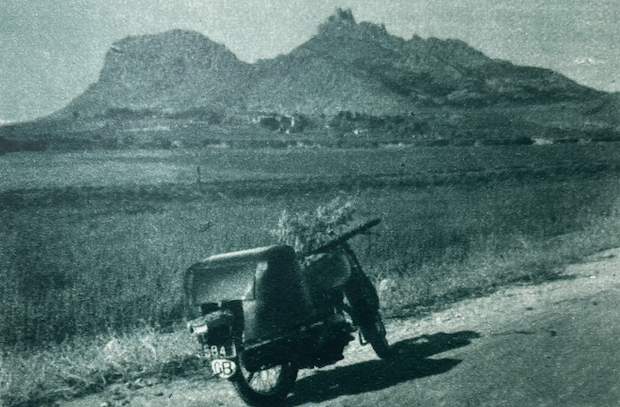
small village for coffee. Of course, everyone must see the strange traveller, know his complete history, and handle his passport to see for themselves. I was used to this. The item which interested them most was the fact that I was described as an ‘electrical engineer’. Now the proprietor of the café had a radio which would not function properly, so they indicated that I should repair it. Eventually the set was placed before me, I was provided with food and fruit, and all the village assembled to watch the English engineer perform. I found one or two minor faults, but the reception of Ankara Radio was not greatly improved. So I told them to take down their aerial and to climb up and attach it to the ramparts of some ancient building, which I hoped was not sacred. They carried out my minute instruction, whereupon the strains of Oriental music burst forth with renewed volume, the awed silence of my audience changed to universal applause, and I was invited to become their guest for the night. After a night in a mud hotel with a woven-grass ceiling and an ancient lock on the door, I was bumped and shaken for four hours on my way to Nigde. Then a good tarmac road took me into the snow-capped Taurus Mountains. I stopped to change a plug. I had almost finished putting my tools away when a lorry-load of Turks came to investigate my stoppage, wanted to pack all my gear in quickly and load me on to their lorry without delay, for were we not all bound for Mersin, they reasoned? I protested and showed them that my machine was still very much alive, whereupon they continued, quite crestfallen. Later I became their honoured guest. They stopped me on the road, directed me to a gushing spring to wash, and bade me be seated. They all squatted round, some almost in the river which ran alongside. Bread and tins of delicacies were produced; then apricots, water-melons and grapes. I was pressed to eat until I could take no more. The comradeship, the perfect evening, and the matchless scenery, are experiences never to be forgotten. They were honouring the stranger whom Allah had sent! Next day I met the nomads, then passed through the Cilician Gates, in the steps of Alexander the Great, on the way to ancient Tarsus. As I descended from the heights the heat became almost unbearable, and the uneven tarmac road performed the most unbelievable antics. Suddenly, I was almost hurled down the mountainside. My rear tyre had succumbed to the heat. No sooner had I stopped than a lorry was beside me. Next we were man-handling the heavily-laden machine on to the lorry, which was already loaded with rock from the nearby quarry. I was given a seat in the cab and a slice of water-melon to refresh me. That is the Turkish spirit of the road. While my tube was being repaired I went to see the ruins of Tarsus; then I drove to Adana, Alexandretta, and on to Antioch. My Anatolian adventure had ended.”—R Hunt
“FOR THE OPEN-TO-CENTRE Tottenham and Barnsbury MCC Team Trial, held over an approximately 16-mile course in the Hoddesdon area of Hertfordshire last Sunday, the New Year weather was pleasantly mild. The course was in ripe condition after the gales of last week. There was mud and to spare and this, in conjunction with the rather flat nature of the countryside, gives a clue as to why the trial was won by a sidecar. There were 131 starters. On Roman Road, one of the choicest sections over slithery three-ply mud, there was little trouble for the three-wheelers. Under the mud there was ample wheelgrip and the third wheel served as a useful ‘prop’. For the solos, however, it was a different proposition. Even BW Hall (350 Matchless), of scrambles fame, had to foot; and, on a 350cc Special, George Brown, intrepid road racer, appeared extremely timid! RESULTS: Tottenham and Barnsbury Trophy (best perf), PC Mead (490 Norton sc), 6 marks lost; Tottenham and Barnsbury Trophy (best opp perf), J Manning (500 Matchless), 6; 250cc Cup, C Pattriek (250 AJS), 15; 350cc Cup, M Banks (350 Ariel), 9; Senior Cup (best over 350cc) and Novice Award, FJ Agar (490 Norton sc), 15; Griffiths Bunyan Cup and Award (best club member), R Leonard (350 Matchless), 34; Team Award, Dunstable (LJ Bowden, BW Hall, CW Wright), 33.”
“AT THE SECOND South African Hill-climb, held on Burman Drive, a crowd of nearly 6,000 saw records fall in the 250cc and sidecar classes. The course, which consists of a mile of 30ft-wide tarmac road, starts on a gradient of 1 in 20. Initially, the road curves gently for one-third of a mile, and afterwards there are four acute right and left bends encountered in about 300 yards. The course then bends gradually round to the left, and the gradient stiffens to about 1 in 15 near the finish. A rolling start of about 75 yards preceded the time section. Competitors were allowed three runs over the course (without any practice) and the best times put up counted for the championships. There were also general handicaps for solos and sidecars, without which no South African race meeting seems to be complete. The first runs were notable for a climb by R Millbank (499 BSA) who ascended in hectic fashion in 1min 8.9sec; he followed by taking up a 495cc Velocette in lmin 9.6sec. The scratch man, W Duxbury of Johannesburg, riding an ex-works 490cc Norton brought back to South Africa in 1936 by Johnny Galway, made an ascent in lmin 10.1sec—an excellent effort in view of the fact that Duxbury had never ridden on the hill before. At the second attempt most riders improved on their first times. Duxbury brought his time down to lmin 8sec which, while good,
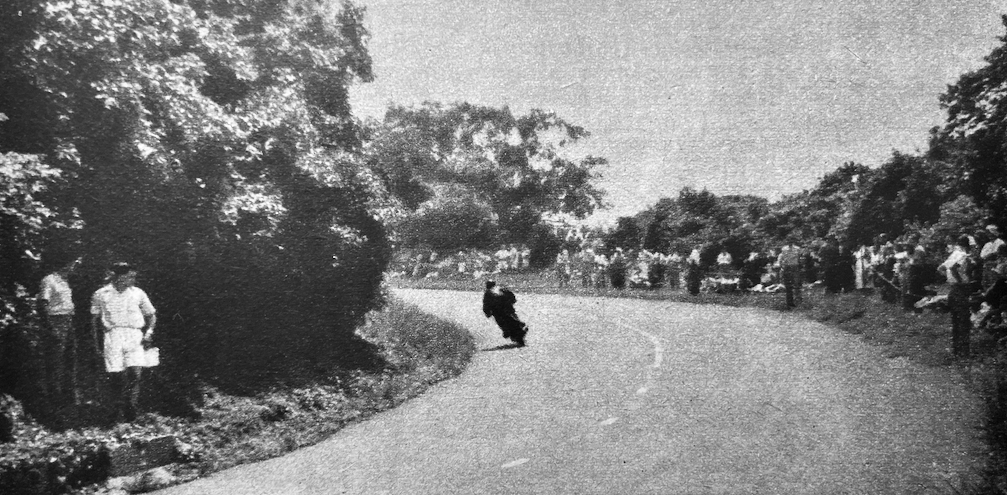
was not fast enough to match the adventurous Millbank, who achieved 1min 7.5sec on his Velocette and lmin 7.1sc on the BSA. The third runs were, as might have been expected in the absence of any practising, fastest of all, and Duxbury’s polished ascent in lmin 6.2sec was good enough to secure for him the best time of the day and the 500cc National Championship. Millbank ran him very close on the Velocette, however, and was only 0.2sec slower. An astonishing performance was put up in the 250cc class by RJ Schroeder (248 Velocette), who climbed in lmin 10.2sec, thus winning the 250cc National Championship for the second year running and breaking his own record for the hill in this class, which he set at lmin 11.9sec in 1947. The sidecar record for the hill (held by the late JE van Tilburg) was broken by AE Norcott (490 Norton sc), a scratch man who recorded 1min 10.6sec. For the 350cc National Championship there was a tie between D Sutherland and WA Gwillam, both of whom rode Velocettes and ascended in 1min 8.5sec. In the general solo handicap R Millbank took both first and second places on the two machines he was riding, and in third place was RJ Schroeder on his amazing little MOV Velocette. J Fuller, riding a 1,200cc, Harley-Davidson, won the sidecar handicap. RESULTS: National Championship, 250cc, RJS Schroeder (249 Velocette); 350cc, DU Sutherland and WA Gwillam (348 Velocettes), tied; 500cc, WH Duxbury (490 Norton); Solo Handicap, R Millbank (495 Velocette); Sidecar Handicap, J Fuller (1,200 Harley-Davidson).”
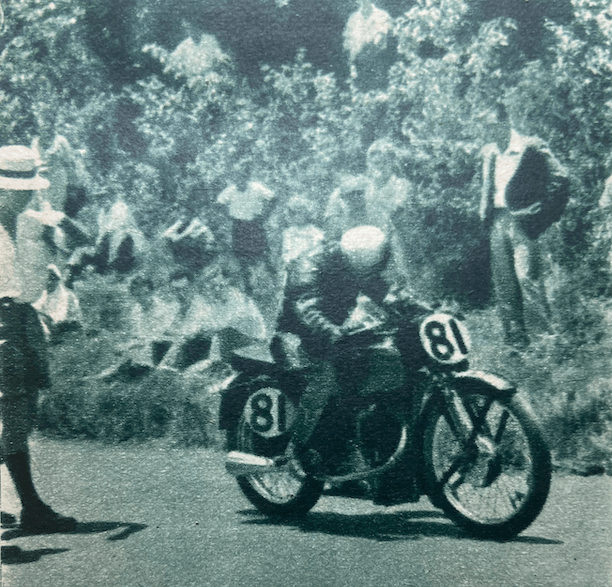
“OFFICIAL RIDERS OF Norton machines in 1949 trials and scrambles will be GE Duke, AJ Blackwell and RB Young, solos, and AJ Humphries, sidecar.”
“SIR MALCOLM CAMPBELL, MBE, who died on December 31st, started his career of speed on a motor cycle. At the outbreak of the last war he was responsible for forming a company of special motor-cycle mounted military police.”
“FOR MANY YEARS that South-Eastern Centre favourite, the ‘Three Musketeers’. has been held in the flat, muddy country south of Reading, but last Sunday’s trial was a complete departure from tradition. The scene was shifted north, to the pleasant, wooded slopes of the Chilterns, and despite an increasingly wet day the move was universally popular. Over 150 competitors converged on the Lambert Arms, Aston Rowant, and the 25-mile route (excellently marked) soon brought difficulty in the form of Icknield Way and Crowell Hill; and neither section was negotiated clean by any of the solos. Later, New Copse, Turville Heath and Pyrton Hill all took their toll, with only about half a dozen clean on each. Despite the rain, the trial was finished in good time, and the South Reading MCC are to be congratulated on an excellent event. RESULTS: Best Solo, GM Berry (499 Royal Enfield), 16 marks lost; Best Sidecar, F. Wilkins (497 Ariel sc), 23; Best 250cc, CH Jennings (249 Velocette), 39; Best 350cc, AF Gaymer (349 Triumph), 23; Best 500cc, AJ Blackwell (490 Norton), 35;Best Novice, K Bond (497 Ariel), 46; Best Team, Weyburn (GM Berry, AF Gaymer and PJ Mellers), 92.
“WHILE I DO NOT WISH to shoot any lines other than those which concern our grand paper and (I was going to say) my even grander model, I do feel someone should refute ‘MP’s’ assertion that ‘very few could ride a machine at over 90’. Although only a ride-to-work merchant, I feel very disappointed if we reach our destination without clocking 90 at least once! Let’s have less namby-pamby adulation of silence and comfort—what’s happened to the post-war rider?
MPA 424, London, W11.”
“I AM CONSIDERING selling my old ‘cammy’ Norton shortly. If DFR, of Blackpool, would care to lend me the speedometer off his Tiger 100, I am sure I could make a better price for my machine!
Douglas Rose, Corby, Northants (Stewarts and Lloyds MCC).”
“IN PREVIOUS EXETER TRIALS, right from the first in 1910, if a competitor cannoned into the bank on an observed hill, it was always possible to say, ‘Poor fellow! What else can you expect? He’s tired out after his long ride through the wild, winter night.’ But there was no such ready excuse on last Saturday’s ‘Exeter’. For reasons of petrol economy the trial began and finished at Exeter and embraced barely 60 miles. In that distance there were the two chief ‘teasers’ of the pre-war events, Fingle Bridge, near Drewsteignton, and Simms Hill, near Ilsington, and five lesser acclivities. The entry of 90—53 cars and 37 motor cycles—was made up in large measure by folk living in the West Country. As is usual with the Motor Cycling Club’s (normally) long-distance trials, a fairly big proportion of the entry, to judge from performances on the hills, were comparative novices. And the course, in the condition it was last Saturday, was probably sufficiently difficult, although by modern trials standards, it was easy. Windout was the first hill. At the foot there was a muddy torrent, which, from its appearance, might have been anything up to 18in deep. It was not half that depth and, anyway, was unobserved. Possibly it would have been kinder to competitors if the observed section had started previous to the splash, because, as it was, riders were forced to restart on a muddy upgrade. The hill looked at its worst—first, leaves, soggy mud, small rocks firmly ensconced and others loose; then two hairpin bends with shale, mud and a meandering gully down which water was flowing and, finally, more roughish, muddy going. The first arrival was the ACU-registered owner of the nom-de-guerre ‘Jimmy Green’, on a 497cc Ariel. He was happy in both method and mien, and used the banks at the hairpins. Next came AT Robinson (349 Triumph), who stopped very early on, restarted and was just making a running commentary to the Press about his clutch being finished when he stopped again. Mrs ML Anning (347 Matchless) made a fairly fast climb, but even she with all her ‘local’s knowledge’ (or because of it) dabbed with one foot between the bends. So far there had been one failure, one foot and one clean…A minute later there was another failure, CE Dawkins’ 249cc Rudge being unable to pull what seemed to be a hopelessly high bottom gear. A very old hand on a very new motor cycle came next—SH
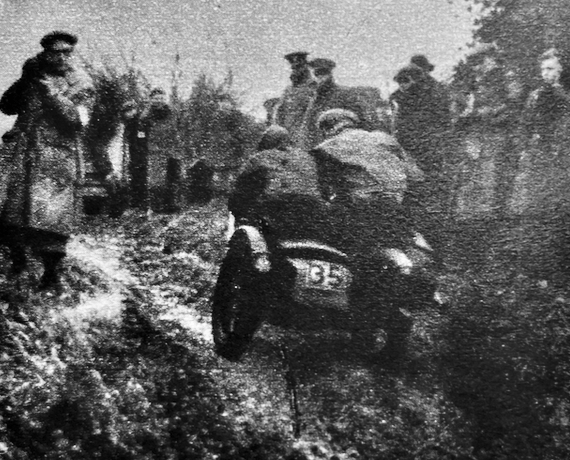
Goddard with a 197cc Ambassador. He shot round the first bend with a sideways flick of his rear wheel. So good was he that he caused spectators hurriedly to examine their programmes to find out the name of the maestro. EJ Bores (348 BSA) was also excellent. En route from Windout to Fingle Bridge there was the first of the two special tests—a simple, timed roll-downhill-cum-brake test included in case of ties for the team awards. Fingle has an entirely different appearance from pre-war. Gone are all the big trees that flanked the zig-zag track of many hairpins. Gone, too, are many of the rocks and, for a solo machine, there was a good. hard and fairly smooth track nearly all the way up. Even the ‘loose’ was comparatively innocuous. There were two observed sections with a restart in between. The first included the sharp right turn near the bottom which is apt to fail car drivers—this and the long easy stretch. The only difficulty here for the motor cycle entry was that for a few minutes the sun was out and glaring straight into competitors’ eyes as they approached the hairpin. There were occasional minutes of sun, but a far larger proportion of storm, including gale-borne hail. Higher up, at the succession of hairpin bends, the method was to cross and recross the track so as to round each hairpin on the hard, easy grade outside. Goddard had reason to bless the gap between the observed sections: he was able to stop and tighten up a footrest. Mrs Anning was excellent and so close to the side in places that her riding coat brushed the twigs. A small stone diverted the front wheel of FC Bray’s single-cylinder Triumph. He was high on the rests and, in endeavouring to correct the plunge, smote the bank and fell off. WA White (498 Matchless) was so good that from the ranks of the spectators, in good Devonian, came the remark that he had been up before! DS Ham (490 Norton) also made a neat climb, but took a peculiar path towards the summit, straying into the loose. FW House (349 Triumph) was perfection, and W Bray with his 125cc Royal Enfield had plenty of power in hand, his engine four-stroking at times. AC Hosking (498 Triumph) toured up effortlessly. D Witney Jones (348 BSA) touched the left bank with one foot for no very apparent reason. Then there was a particularly clever exhibition of riding by WG Arthur (498 Matchless). His rear wheel indulged in a trio of sideways hops, which he corrected by deft handling. Two others who were especially good were 0S Jose (498 AJS) and RHB Jones (348 Norton). Next on the list of famous hills was Simms, but in between were three lesser acclivities. The first was Knowle, which accounted for three ‘foots’ and no failures, W Bray, AT Clark (250 Rudge) and HW Tucker (348 Ariel), each putting out a foot. Stonelands, too, was a very easy
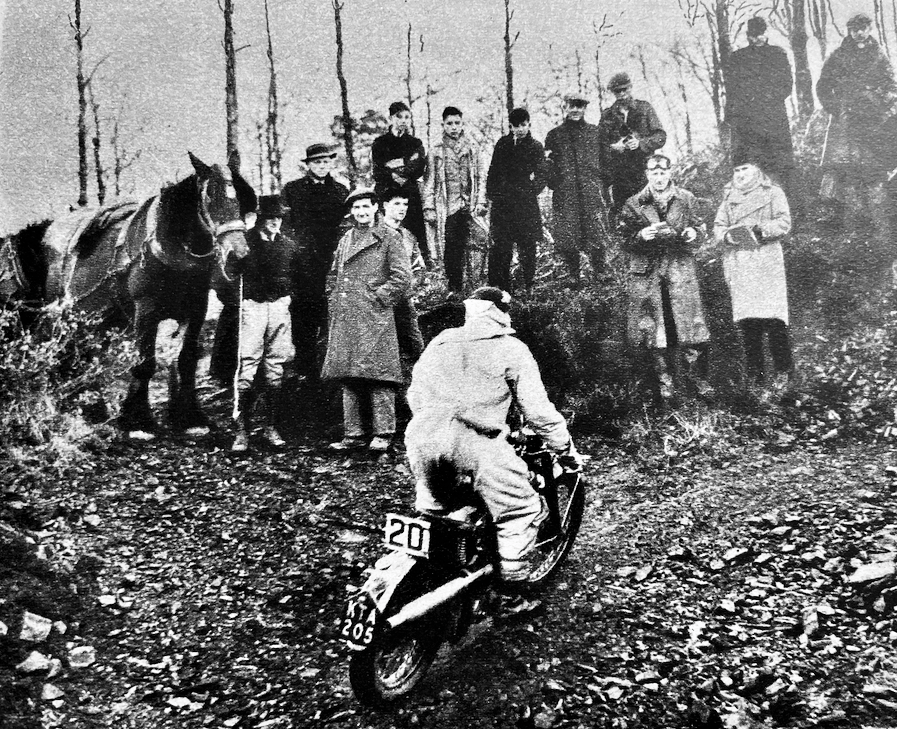
proposition, there being a well-washed track down the middle. Even Simms Hill, of 1 in 3½ average gradient was in very easy mood. Pre-war there was usually a good, hard path on the right and to eschew this in favour of the left was to court wheelspin, skids and failure. Now there is grass on the right and, for solos, an easy path on the left with merely one small rock ledge as a hazard (other than the towering gradient!). Goddard, with the Ambassador, again made a good climb, so did ‘Jimmy Green’ and Bray. Mrs Anning got rather too close to the left and had some wheelspin. RW Knox (elderly 584cc Douglas) rounded the bend at the foot very slowly and stopped. Touring climbs were frequent. AC Hosking was an exception—petrol tap off, it seemed! The Scott ridden by FT Hosking ‘wowed’ up, its exhaust rising and falling in thrilling fashion. RH Litton (349 Triumph) stopped after plaintive comments from his engine. A minute or two later the first sidecar arrived—JW Smith (490 Norton), who was both fast and excellent. WAC Goddard (Triumph sc) seemed likely to be equally good, but suddenly his engine cut out, leaving the onlookers wondering why. FW Osborne (592 Levis sc) was good, but neither Morgan exponent, WD Griffin nor WE Wonnacott, escaped the attention of the tractor and its tow-rope. So to Green Lanes, which had hundreds of gallons of water an hour swilling its surface, and was therefore easy, and to the finish just outside Exeter—the finish of an ‘Exeter’ that was ‘different’ but, in spite of all the hail, a most enjoyable trial. RESULTS: Premier Awards, ‘Jimmy Green’ (497 Aerial), Mrs ML Anning (347 Matchless), EJ Bores (348 BSA), WA White (498 Matchless), DS Ham (490 Norton), FW House (349 Triumph), 0S Jose (498 AJS), RHB Jones (348 Norton), JM Bowen (349 Triumph), WF Martin (348 BSA), AN Cornell (350 Martin), JW Smith (490 Norton sc); Team Prize, FC Bray (498 Triumph), DS Ham (490 Norton), FW House (349 Triumph).”
“FOR MANY YEARS ‘spring heels’ has been in common use to describe rear-springing. It has always seemed to me to be a most expressive term for plunger-type suspension, and a slight modification to ‘spring heel’ fitted the pivot-action type, à la Vincent-HRD, with tolerable accuracy. However, now that there are other types such as the Triumph spring hub (or should it be spring wheel ?), the pivoting rear fork with telescopic legs or with torsion bars (or, perhaps later, with rubber in shear), I am beginning to wonder whether we ought to scrap ‘spring heel(s)’ and think up another generic term which is more accurate. Anyone feel like making a suggestion?”—Nitor
“LATELY I HAVE been very sidecar conscious after a visit to an old friend who specialises in sidecar fitting. He told me many interesting stories about the malalignments he is called upon to cure and, ‘I dunno how the lads drive ’em’, was a frequent interpolation. In the past few weeks I have purposely followed at least a couple of dozen outfits and I should say that some 50% were badly aligned—machine leaning in towards the sidecar was the most common fault. I am sure those drivers do not realise how much more pleasurable their riding would be if their outfits handled properly—for malalignment can always be felt at the steering. The standard recommendation is that on level ground the machine should be vertical or lean away from the sidecar slightly (up to 1in from the vertical measured at the steering head), and the sidecar wheel should toe in ⅜ to ½in—this measurement taken at the front end of boards laid alongside the machine wheels and the sidecar wheel. If difficulty is experienced in obtaining these settings, or if the settings are correct and the handling of an outfit remains below par, then a visit to a pukka sidecar specialist is well worth while.”—Nitor
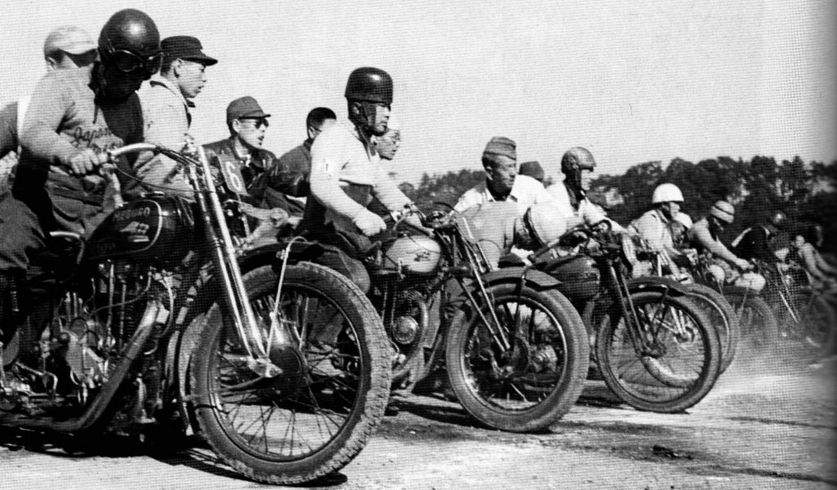
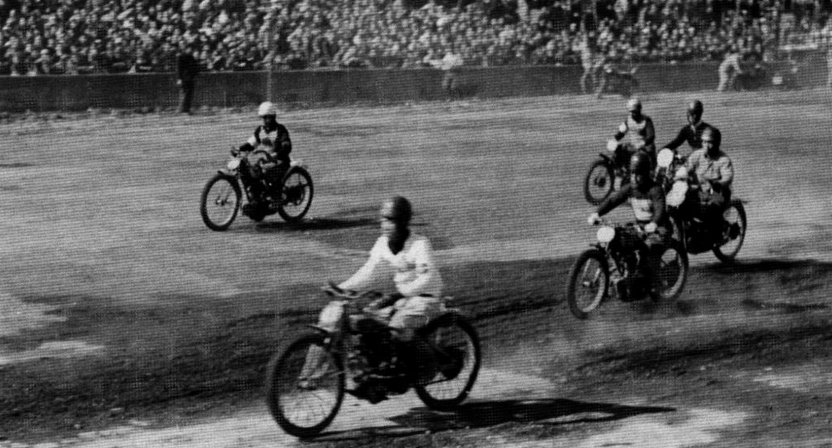
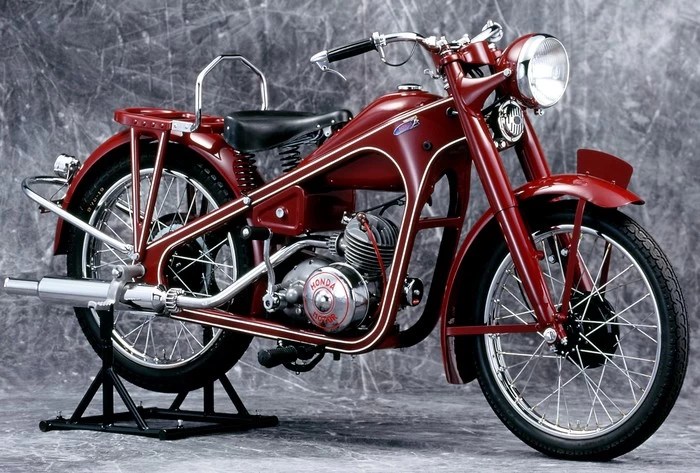
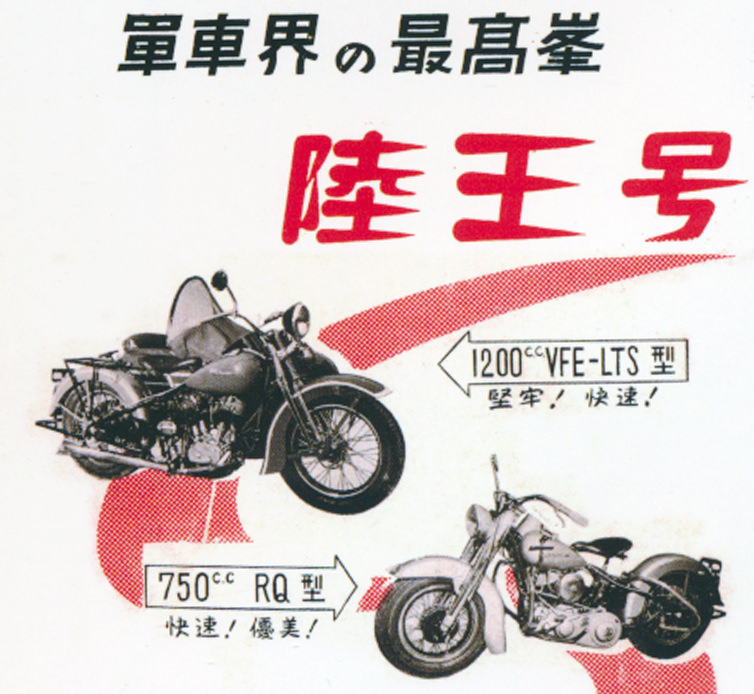
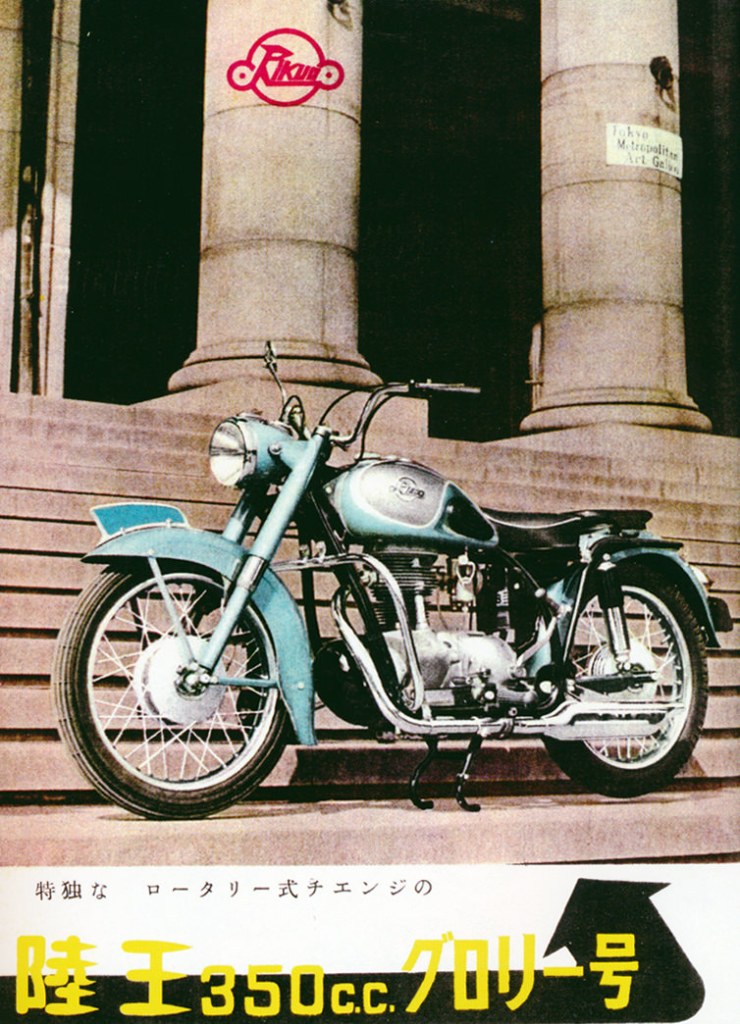
RIKUO INTERNAL COMBUSTION COMPANY, which was producing Harley clones following the Japanese government’s forced buyout of Harley Davidson’s Japanese operation, went to the wall, only to resurface as the Rikuo Motorcycle Co. The big pre-war flat head twins used by the Japanese army as the Type-95, were joined by small one-lungers which was clearly inspired by BMWs and Beezas.
KAWASAKI EXPANDED into motor cycling, initiating devlopement of a 148cc four-stroke engine rated at 4hp.
“IT WILL BE RECALLED that at the Autumn Congress of the FICM it was decided to reintroduce the road-racing championships and to scrap the Grand Prix of Europe, which has had no higher status than a name applied to the usual classic races in turn. It now transpires that instead of as pre-war, when the winners in the various classes were called the European champions, the title World’s Champion will be used. It is considered that as an international permit allows entries to be received from any part of the world where the governing body is affiliated to the FICM, the title World’s Champion is justified. Unfortunately, this will not include American riders, because the US motor cycle clubs, controlled as they are by the AMA, are not affiliated to the FICM. The inclusion of the AMA under the banner of the FICM is something that we must hope for; it has been talked about for a long time and nothing would please British sporting motor cyclists more than to have their American cousins rowing in the same boat.”—Nitor The World Motorcycle Road Racing Championships was established with six rounds and classes for 125, 250, 350 and 500cc. The opening round of the new series was the TT, and quite right too.
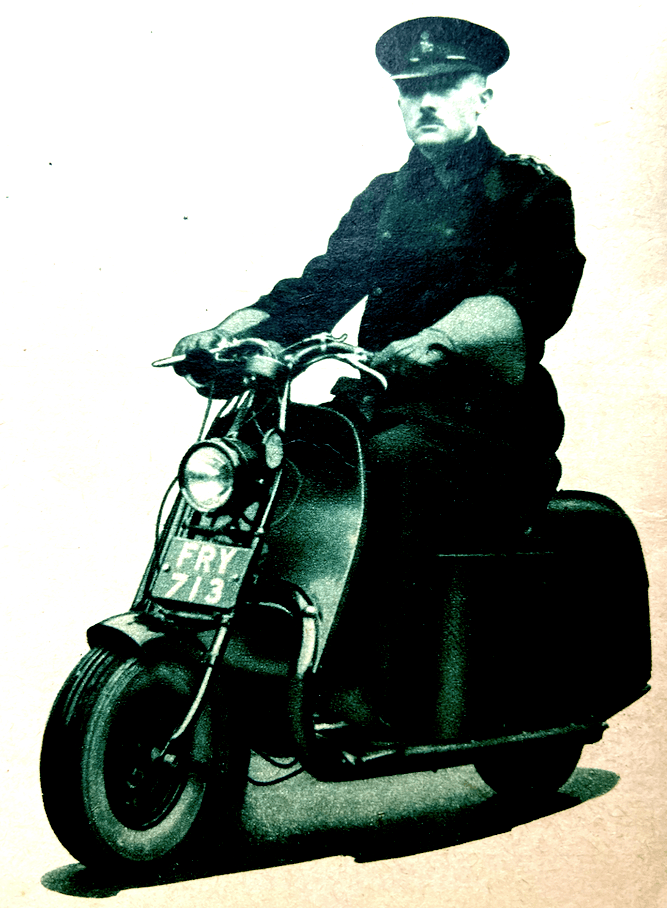
“ASKED TO NAME the two road improvements that benefit them most, the majority of motor cyclists would refer to the elimination of trams with their tracks and the replacement of wood paving with safer road surfaces. But while many provincial cities have long since discarded their tramway systems and torn up those death traps, the tracks, London has persisted with them, more especially south of the Thames. At long last, there is good news. Lord Latham, chairman of London Transport, stated last Friday that there was now ‘permission to go full-steam ahead’. The conversion from trams to omnibuses is to be a nine-stage project…the total operation should be completed by 1954.”
“ANALYSIS OF LETTERS from Canada and the United States reveals a frequent demand for greater machine comfort. The employment of large-section, low-pressure tyres is urged, also the development of more comfortable saddles mounted, American style, on sprung seat pillars. Occasionally a reader on the other side of the Atlantic will mention that swept-back handlebars for fitting to British machines are available from American accessory firms. The last point tends to stress the different outlook on the subject of the best riding position. In Great Britain it is widely held that a motor cyclist should ride his machine—not just sit, with the saddle bearing the vast proportion of his weight. Footrests, it is generally considered, should take some of the weight and the riding position be such that when the machine hits a bump the rider automatically poises on the footrests, the springiness of his legs taking any shock that might otherwise be transmitted to his body. It is an axiom that solid shock on the body, and particularly the spine, soon causes fatigue. Which is preferable—a motor cycle so designed that the man in the saddle rides or merely sits in so-called ‘sit-up-and-beg’ fashion? On the tyre question, many designers maintain that it is ill-advised to employ large, heavy tyres and wheels with their corollary, greater unsprung weight, a far better practice being to have comparatively light wheels and develop still further the front- and rear-wheel springing.”
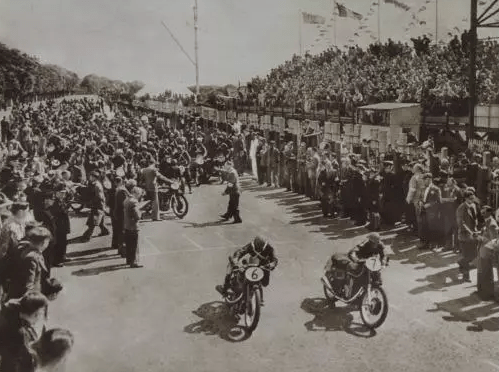
The FIM established the World Motorcycle Road Racing Championships, initially with six rounds and classes for 125, 250, 350 and 500cc. The opening round of the new series was the TT. As always, Geoffrey Davison, editor of the TT Special, was on hand to record the action. Over to you, Geoff:
“IN 1948 THERE WAS considerable ‘feeling’ about the Clubman’s TT races. It was urged that more of the boys should be given a chance to have a ride and that 500cc models should not have to compete on equal terms with 1,000s. Much was said and written on these matters and in the winter a meeting was held in Birmingham between officials of the A-CU, prominent personalities from the Isle of Man and a few—a very few—riders. The absence of many of those who had said and written so much was regrettable, but the meeting bore fruit in that for 1949 it was decided that four Clubman’s races should be held, two in the morning and two in the afternoon, with a maximum of 100 competitors in each period—ie, a total of 200 in all as against the 100 of the previous year. The additional race was, of course, for 1,000cc machines. In 1948 the Junior and Senior Clubmen had covered four laps and the Lightweights three, but in 1949, with the two sessions, it was felt that there would not be time for races of this length. The Lightweights, therefore, were required to cover two laps only and the other classes three each…the total entry was 174, made up of 12 in the ‘1,000’ and 85 in the Junior, run concurrently in the morning; with 55 in the Senior and 22 in the Lightweight in the afternoon. The Supplementary Regulations read: ‘Every motorcycle entered for these races shall be a fully-equipped model…according to the manufacturer’s catalogue or a complete published specification, which shall have been published before 24th November, 1948, and a copy of such catalogue or specification shall have been deposited with the A-CU nor later than the 1st March, 1949. At least 50 of each model entered shall have been produced by the manufacturer and sold and delivered to the general public in the United Kingdom before the closing date of entries. No motorcycle manufactured before the 1st September, 1937 shall be eligible. The standard equipment of every motorcycle entered for these races must include dynamo, electric lighting, kickstarter, silencer(s) and fully enclosed primary drive except in the cases of motorcycles having external flywheel(s) or where
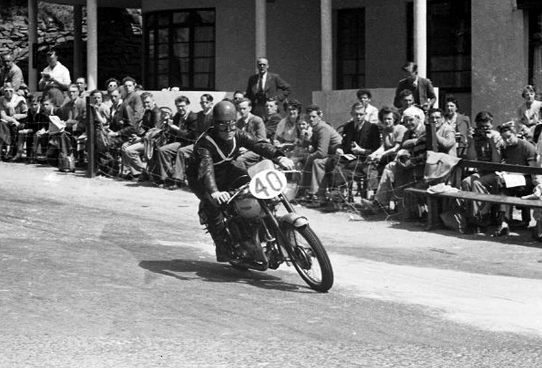
the primary drive is taken from between its crankcases.’ Broadly speaking, therefore, competing machines had to be ‘the same as you can buy’. It was compulsory for lamps, dynamos, accumulators, stands, registration plates and licence holders to be removed, whilst other things such as air cleaners, silencers, speedometer heads, luggage carriers and tool boxes might be removed. ‘Permitted additions to equipment’ included flyscreens, engine revolution counters, steering dampers, security bolts, rear springing, air vents and water excluders to brakes and mudguard pads, and there were 17 ‘optional modifications to equipment’, including any make or type of sparking plug, brake and clutch lining, flexible oil and petrol pipes and any desired alteration to valve and ignition settings, compression and gear ratios. Boiled down, the whole thing meant that machines had to be ‘bought off the peg’ non-racing models with modifications which could be carried out by the ordinary rider. Racing machines such as the 7R AJS, the Manx Norton and the KTT Velocette were barred. THE CLUBMAN’S ‘1,000’ had 10 starters only. Of these, C Howkins rode an Ariel Square Four, all the remainder being on Vincent HRDs. The curious feature about this race was that whereas in 1948, when 500s and I,000s were run in one event, the first 500 to finish—CA Stevens (Norton)—was third at a speed of 4½mph slower than the winner, in 1949 the winning Senior was over 6mph faster than the winning 1,000, while no few than nine Senior riders were faster than the second 1,000! The reason for this, probably, was the regulation which prohibited refuelling. In 1948, every competitor had to make a compulsory stop at the end of the second lap and could take in petrol if he desired. In 1949, however, with one less lap to do, no replenishments were permitted and the tanks of the Vincent HRDs were too small to allow their riders to go full bore for the three laps, or even in fact, to use the desired jet sizes. Two of the Vincent riders had covered three laps in practice, but only on such lean mixtures that the engines tended to overheat. The event was, therefore, more of a petrol consumption test than a race, which was unfortunate. It seems somewhat paradoxical that the regulations should insist that riders should cover the race on a tankful, but should at the same time prevent them from fitting larger or spare tanks to enable them to do so. However, there it was. In perfect weather—indeed the weather was perfect for each of the seven 1949 TT Races—the 10 Clubmen set off, kick-starting in pairs at 20sec intervals. Contrary to expectations, George Brown, the 1948 lap record holder, did not net the
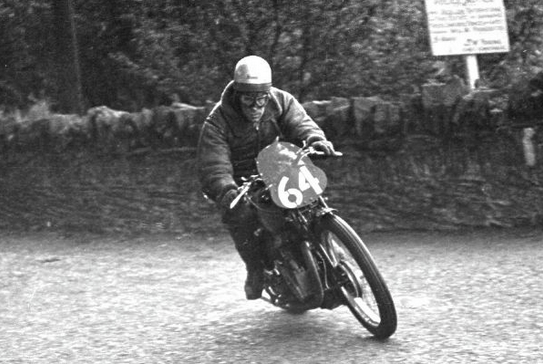
pace, being content to be second on the first lap, 22sec behind C Horn; G Manning, A Philips, J Harding and DG Lashmar, all on Vincent HRDs, completed the first six. In the second lap Horn put in a time of 26min 28sec (85.57mph) which was actually the fastest of the day and 56sec better than Brown’s record of the previous year. George himself had struck trouble and had dropped back to 6th place, Lashmar having picked up to second. Manning, Phillip and Harding had all disappeared from the Leader Board. In the third and last lap Horn paid the penalty for his early high speed he retired—out of petrol—at Glentrammon between Sulby and Ramsey; Lashmar went on to win with Wright and Wilson second and third. Charles Hawkins, 48-year-old rider of the Squariel, was fourth and George Brown, finishing on one cylinder, came in fifth at 49.67mph.—a fraction of a mile an hour slower than the speed at which I completed five laps on a machine of a quarter the size twenty-seven years ago! Yes, the Clubman’s ‘1,000’ was rather a farce. THE JUNIOR CLUBMAN’S. Two minutes after the last of the 1,000s had left, the first Junior Clubman—G Milner (BSA)—was away. Actually, he went off alone for he was paired with No 13 which, in a TT Race, is never drawn. After Milner had gone they were despatched in couples at 20-sec intervals… Whereas in the International Junior TT only three makes were represented—AJS, Norton and Velocette—in the Clubman’s event there were no fewer than eight makes. The 74 starters were headed by 21 BSAs. There were 15 Nortons, 13 AJSs and single-figure numbers of Douglas, Enfields, Matchless, Triumphs and Velocettes…In practice the fastest lap had been made by Alan Taylor (Norton), 19-year-old student, of Oldham, Lancs. The event was Taylor’s first race or competition of any sort but nevertheless his best practice lap of 30min 42sec equalled the record lap put up in the race last year by Pratt on a similar machine. Next best was Harold Clark (BSA), just 2sec behind Taylor, and third was Ray Hallet—also BSA—in 31min 11sec. It looked as if the race would lie between these three and on the first lap Taylor led
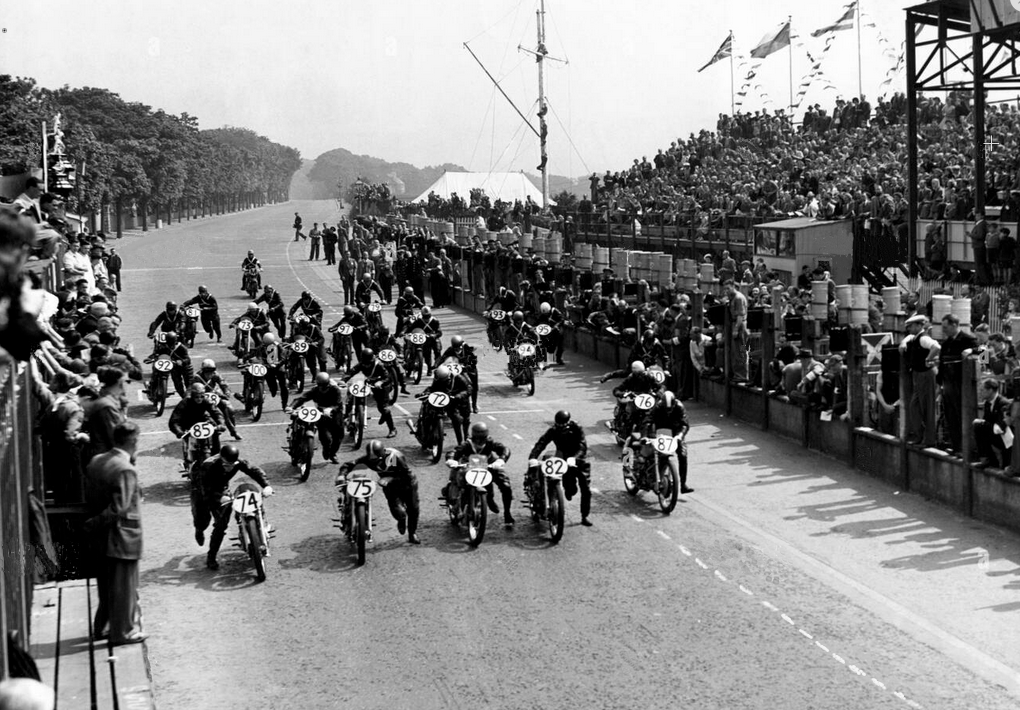
the field with a time of 30min 26sec, Haller and Clark being bracketed second in 30min 34sec. In the second lap Clark increased his speed, completed the circuit in 29min 52sec—which proved to be the record for the race—and came into the lead 24sec ahead of E Harvey on another BSA, who had been lying 6th. Taylor had dropped back to third place just one second behind Harvey and John Sinister of Macclesfield on another Norton was 5sec behind him. Haller with a relatively slow lap, had dropped back to 5th. Harvey’s challenge was short-lived, however, for at Handley’s Corner on the last lap he retired with a broken chain. Taylor’s third lap took 30min 53sec—both his second and third circuits were slower than his first one from a standing start—whilst Simister put in a last lap of 30min 15sec and slipped into 2nd place, 50sec behind Clark, who won at 75.18mph. Fifty-eight riders finished the race—over 78% of the starters—and 57 of them were home whilst poor George Brown was still plodding around on his single-cylinder Vincent. THE CLUBMAN’S LIGHTWEIGHT. Like the 1,000cc event, the Clubman’s Lightweight was almost in the nature of a fiasco. This was not because of any lack of entries—there were 17 starters as against 15 I948—but because the event was so extremely short. At Ansty, Haddenham and other short-circuit meetings a 75-mile race would be a long event, but when one is accustomed to thinking in terms of 264 miles, it becomes so short as to be almost negligible. In fact, most of the riders had covered the distance of the race each day in practice. The afternoon session began with the Senior event, the Lightweights following two minutes after the last 500 had gone. This meant, of course, that all the faster machines, who had three laps to do, were out of the way before the 250s set off on their little race. The 17
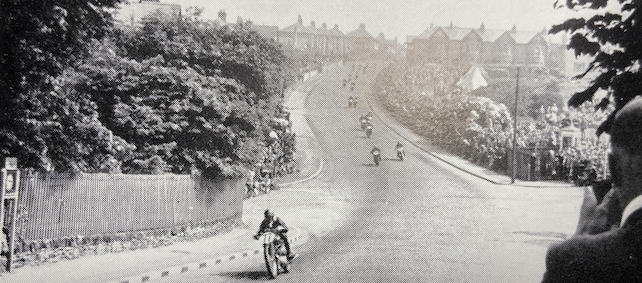
riders were mounted on a mixed bag of Excelsiors, Triumphs and Velocettes, with one solitary BSA. Forty-six-year-old Cyril Taft—’nine children, never a dull moment!’—took the lead on his Excelsior at the end of the first lap, which he covered at 67.5mph in 33min 33sec, over half-a-minute faster than the previous year’s record. BJ Hargreaves and DA Ritchie (Velocettes) were 2nd and 3rd and GS Wakefield (Triumph) 4th; 14 of the 17 starters completed the lap. Almost forgotten in the excitement of the Senior race, the 14 went off on their second and last lap and 13 of them finished it, the only change among the four leaders being that Ritchie overtook Hargreaves and finished 40sec behind Taft, who put up a new record lap in 32min 57sec (68.7mph) and won The Handley Trophy at 68.1mph. THE CLUBMAN’S SENIOR. There were 44 starters in the Senior event—batches of BSAs, Norton and Triumphs, with one AJS, one Ariel and one Vincent HRD. Allan Jefferies and Tom Crebbin (Triumphs) and Geoff Duke (Norton) were the favourites for the race and true to form at the end of Lap 1 they occupied the first three positions, Geoff Duke leading Allan by 29sec, with Allan three-quarters of a minute ahead of Tom. Geoff’s firs lap from a standing start took 27min 32sec—only 8sec outside the 1948 record lap, established on a 1,000cc machine. The second lap saw no change amongst the riders, but there were wider spaces between them. Geoff had put in a time of 27min 3sec (83.7mph), handsomely beating the existing record. Leo Starr

(Triumph) had moved up from 5th place on the 1st lap to fourth on the 2nd, so a Norton was leading with three Triumphs well and truly after it. They were no match, however, for the imperturbable Duke, who went on riding magnificently to win by over 2min, his last lap in 27min 18sec also being well inside the 1948 record. Allan Jeffries went on untroubled into 2nd place, but Crebbin came off at the Guthrie Memorial, 10 miles from home and although able to continue, dropped back to 5th. Leo Starr (Triumph) was 3rd, over 5min behind Jefferies and Phil Carter (Norton) was fourth, half-a-minute behind Starr. The Junior race was, of course, run by itself as usual, on Monday, 13th June, the Senior and Lightweight being run concurrently on the following Friday. The Regulation went on to read: “Should it be necessary to reduce the number of entries…Priority of acceptance of entries will be in the order, (a) From entrants from overseas, who are in receipt of financial aid from the A-CU…(b) From manufacturers of motorcycles, limited in each case to six of each proprietary make of motorcycle. (c) From entrants or drivers who have been awarded a TT replica in any International TT Race since 1945. (d) From other entrants…THE JUNIOR TT. The 100 machines were all British—AJS 42, Norton 26 and Velocette 32. The only foreign element that was seen in the Junior Race was during the practice period, when Enrico Lorenzetti turned out on a 350 Guzzi. There was, however, no question of him riding in the race itself, for the machine had not been
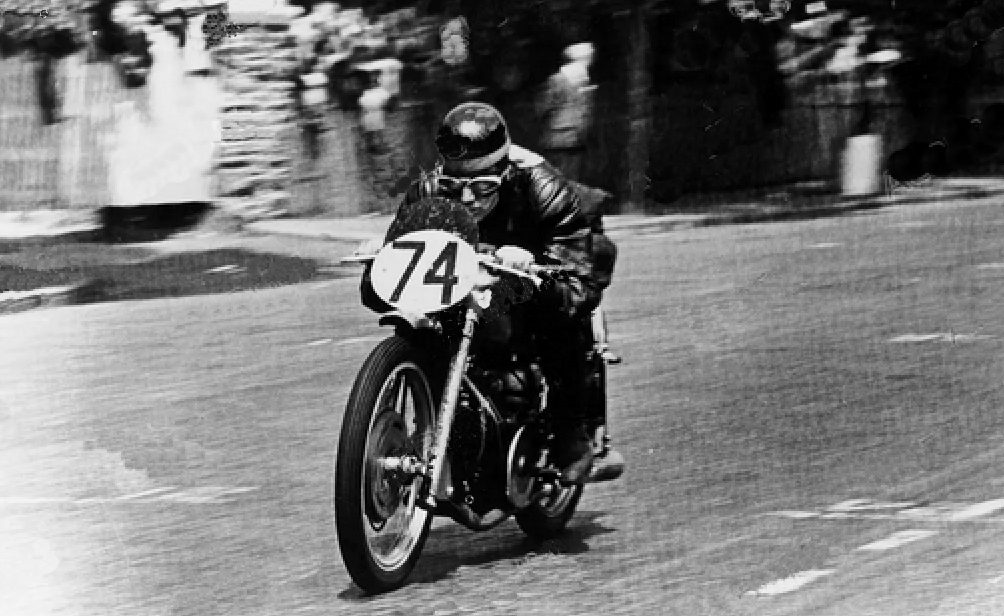
entered and the regulations definitely prohibited any change in the make of a machine after the closing date of entries…There was a strong wind, but it was northerly and therefore helped on the mountain climb—just the opposite to 1948 when a strong southerly wind upset the calculations of many riders. It was an extremely open race with any one of ten men a possible winner…For the first time in the history of the International Races, since riders were despatched from St Johns on the old, short course in couples, a ‘pair start’ was used…Freddie Frith, winner of the 1948 Junior, was therefore despatched alone, the others following in pairs behind him…First lap saw Les Graham (AJS) in front. From a standing start he lapped in 27min 1sec—27sec and over a mile an hour faster than the post-war lap record of 27min 28sec—and this terrific opening circuit gave him a lead of 19sec on the next man, team-mate Bill Doran. Fred was third in 27min 24sec and close behind him were the three works Nortons—Daniell (27min 29sec), Bell (27min 33sec) and Lockett (27min 34sec). Les Graham, however, was in trouble early in the second lap. He stopped at Ballacraine to adjust his clutch and retired soon afterwards. Bill Doran then came to the front and with a second lap in 26min 55sec—his fastest of the day so far, and a post-war record—led Fred Frith by 16sec, as against 4sec on the first circuit. Artie Bell slipped past Harold Daniell into 3rd place and Ernie
Lyons (Velocette) also passed Harold and ran 4th, whilst Bob Foster (Velocette) picked up to 6th. An AJS first, Velocettes second, fourth and sixth and Norton third and fifth On the third lap, Bill and Fred each took 27min 4sec so there were still 16 seconds between them and both had drawn away from Artie Bell and the others. But on the fourth lap—which included a it stop for each, Fred was 8sec quicker than Bill, so only 8sec behind him. For the 5th and 6th laps there was no change in the placings, except that Lyonsslipped into 3rd place ahead of Bell. On the fifth Bill was 12sec ahead of Fred and on the 6th 11sec, with Lyons 20sec behind Fred. The only manufacturers team left in the race was the Norton, Bell 4th, Daniel 5th and Lockett 7th. On the 7th and last lap Fred really gave it the gun and lapped in 26min 53sec, 2sec faster than Bill Doran’s earlier record. Fred was 8min ahead of Bill on the roads, and stop watches on their indicators at Ramsey showed just eight minutes between them. Fred flashed past the finish before Doran was recorded at the Mountain Box, but that was only to be expected for the stretch from the Mountain Box to the finish was taking them less than 7min. The seven minutes came, however, and the six—and there was no sign of Bill Doran; and then came the news that he had retired at the Gooseneck with gear trouble. So Fred won his third Junior and his fourth TT race, and Velocettes came second too, with Ernie Lyons. Artie Bell, as last year, was third and Harold Daniel fourth, less than four seconds separating the Norton pair. Reg Armstrong, who had gradually been increasing his speed, overtook Foster and drew into 5th place. A gloom was cast over the race by the death of Ben Drinkwater, as the result of a crash at
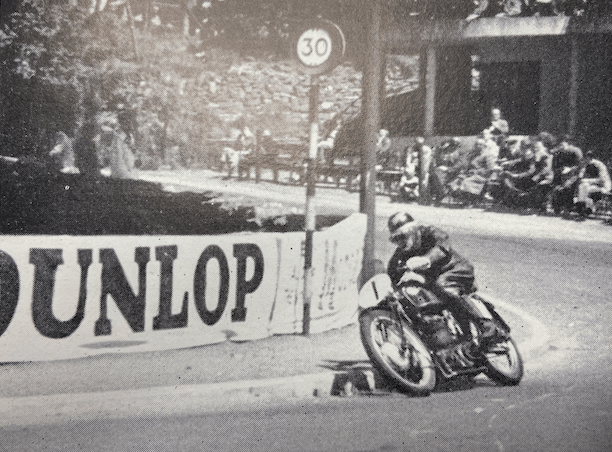
the 11th Milestone on the 4th lap. Fastest Lap, FL Frith’s last lap, 26min 53sec (84.23mph). Manufacturers’ Team Prize: Norton (AJ Bell, HL Daniell, J Lockett). THE LIGHTWEIGHT TT. As in 1948, the Senior and the Lightweight races were run concurrently, with a massed start for the Lightweights. Seventy entries were accepted for the Senior—as against the 75 anticipated in the Supplementary Regulations—and this limit was arrived at by refusing 350s, as in the Manx Grand Prix last year. There were no reserves in the Senior Race, but 39 entries were received for the Lightweight—nine over the permitted 30—so there were nine reserves. Fortunately, by one means or another, they all got a ride and there were, in fact, only 29 starters, one of the 30 accepted entries being that of poor Ben Drinkwater who, as recorded, had been killed in the Junior Race. Although the Senior started—and, of course, finished—before the Lightweight, I will deal with the latter first and finish, as usual, with the Big Race of the Week. From the reporter’s point of view there is much to be said for a massed start. There is no complicated stop-watch work, no calculations, no possibility of error on the ‘clock’. First past the post each lap is
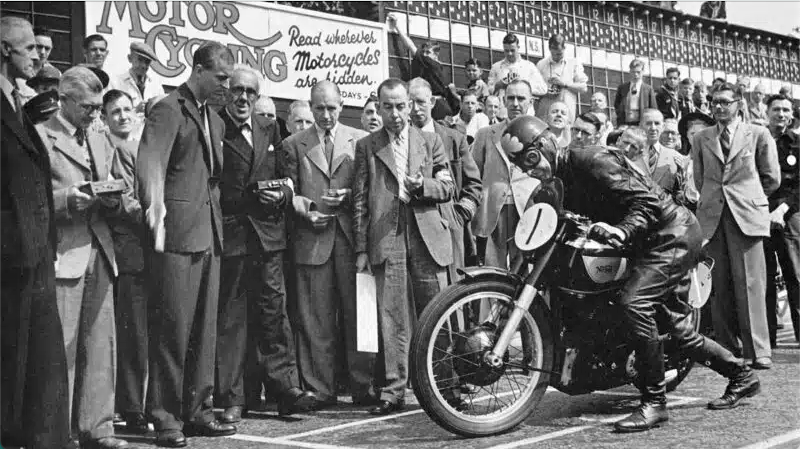
leader and everyone knows where he is. The Practices Leader Board showed that there was little hope of a British win. Here are the five fastest: 1, E Lorenzetti (Guzzi), 29min 11sec; 2, TL Wood (Guzzi), 29min 16sec; 3, D Ambrosini (Benelli), 29min 23sec; 4, RH Dale (Guzzi), 29min 30ec; 5, M Barrington (Guzzi), 29min 38sec. All Italian machines—and the first four had beaten the post-war lap record of 29min 31sec. The fastest man, too, was only one minute exactly outside the real record, standing to E Kluge (DKW) since 1938. At 1115am, 3min after the last Senior was out of earshot, off went the Lightweights with a mighty roar. They started in lines of five, with the fastest practice men in front and so on down the ranks. Quite the best getaway I saw was that of Les Martin (CTS) who shot out from the crowd and led at the top of Bray Hill. He was still ahead at Quarter Bridge, but then the faster Italian machines began to overtake him and by Ballacraine Lorenzetti was in the lead, followed by Wood, Ambrosini and Barrington. There was little change in the order at Kirkmichael and Ramsey, but when they flashed past the pits Barrington was in the lead, 1sec ahead of Wood. Lorenzetti was 4sec behind Wood and Dale 1sec behind the Italian—four Guzzis with only 6sec separating them. There was no sign of Ambrosini on the Benelli, and later it
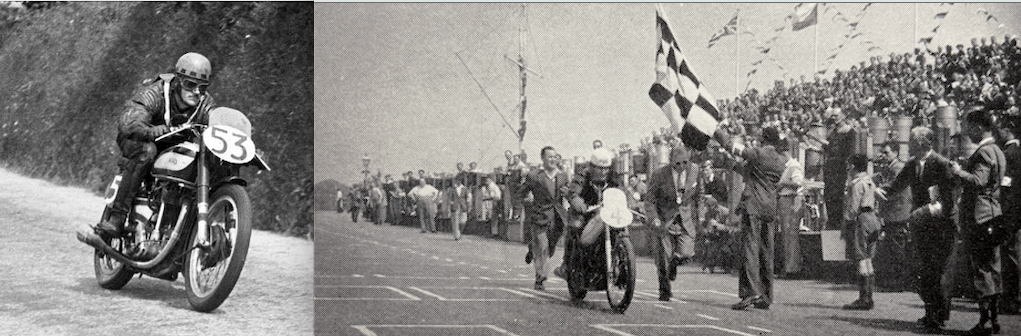
transpired that he had come off at Governor’s Bridge and had retired. Ernie Thomas on another Guzzi was a bad 5th and Les Martin (CTS) 6th. Off they went on the second lap—and round they came again, Barrington still leading, 5sec in front of Dale, who had overtaken both Wood and Lorenzeni, bracketed third 5sec behind Dale. Ten seconds between the four! And Dickie Dale had lapped in 28min 9sec and had beaten the existing lap record—on ‘pool’ petrol—by 2sec! This was the first real TT lap record to be beaten since 1938, for none of the 1939 fastest laps was as good as the previous year’s. On the third lap Lorenzetti retired at Sulby and 7sec divided the other three, Barrington still leading but Wood this time ahead of Dale. And when the times went up it was seen that Wood had equalled Dale’s new record, their laps being, actually, the fastest in the race. Barrington slowed down a little on the fourth lap, doubtless due to a broken valve spring which he replaced at the pits whilst replenishing, and Woods came into the lead. There were 52sec only between the first three, but the fourth man was nearly 6min behind and the first British machine, running 5th, was over 10min behind the leader. Dale, who had filled up a lap earlier than Barrington and Wood, put in his fifth lap in 28min 9sec for the second time and led Barrington by nearly 2min , which he increased to nearly 4min on the 6th. And then on the last lap, when he appeared an
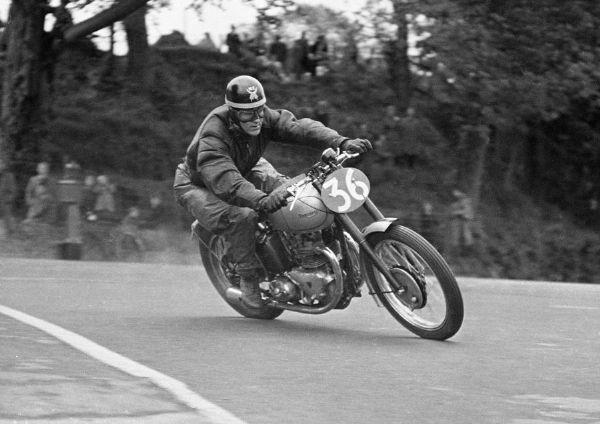
easy winner, he retired with engine trouble at Cruckshank’s Corner and Manliff Barrington came in to win with Tommy Wood 12.6sec behind him. Ernie Thomas slowed down and Roland Pike brought his veteran Rudge into third place14 minutes after the second man, but third all the same! [British bikes were 4th and 5th: RA Mead (Mead Norton) and SA Soresen (Excelsior) with ER Thomas 6th on another Guzzi.] THE SENIOR TT. What a race! For breathless excitement I have known nothing to touch it and I have ridden in or reported 80 T.T. races. There was a dead heat for second place in 1919, but never have three men dead-heated for the lead as they did on the second lap of this 1949 Senior. There have been closer finishes but never, perhaps, anything so unexpectedly thrilling as the finish of the 1949 Senior. There were 70 entries, but only 59 starters. Two out of the three Guzzi entries were non-starters, so there was only one ‘foreign menace’, Bob Foster—and how he menaced!—the remaining 58 being made up of 36 Nortons, 14 Triumphs, five AJSs and three Velocettes. The Ajays were composed of three ‘Porcupines’, ridden by Les Graham, Ted Frend and Bill Doran, and two ‘out-size 350s’ (358cc actually) in the hands of Reg Armstrong and Australian Eric McPherson. Charlie Brett’s Velocette was a bored-out model (354cc),
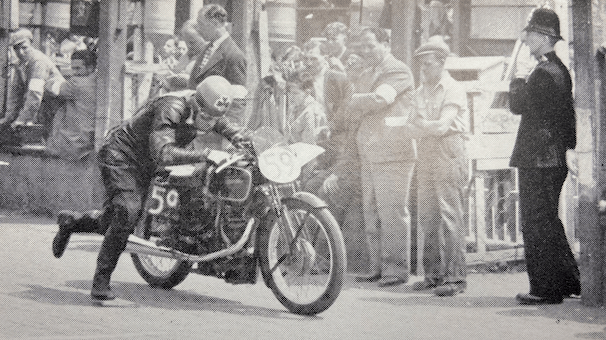
the other two Velos being the new double-knocker 500s ridden by Fred Frith and Ernie Lyons. The Nortons were headed by the works team of Bell, Daniell, Lockett, whilst the Triumphs, all overseas, private or agent entries, had as their ‘stars’ SH Jensen of New Zealand, CA. Stevens, Albert Motile, Tommy McEwan and Arthur Wheeler. AJS, Guzzi, Norton and Velocette had all figured on the Practices Leader Board, the first six being: 1, AJ Bell (Norton) 25min 52sec; 2, RL Graham (AJS), 25min 59sec; 3, EJ Frend (AJS), 26min 10sec; 4, AR Foster (Guzzi) 26min 12sec; 5, FL Frith (Velocette), 26min 19sec; 6, J Lockett (Norton), 26min 30sec. Harold Daniell, Ernie Lyons and Bill Doran were not even on the Leader Board, but they were certainly to be reckoned with…The Seniors were started in the same way as the Juniors, last year’s winner, Artie Bell, being despatched on his own and the remainder in pairs at 20sec intervals. It was a Royal Race, that 1949 Senior, for the Duke of Edinburgh attended it and dropped the Starter’s Flag for the first man. Artie Bell was away. Excitement ran high from the first lap, for Les Graham, starting No 4, had picked up 40sec on Arne Bell (No 1) by Creg-ny-Baa and was actually leading the 1948 winner at Cronk-ny-Mona. He came past the pits some 50 yards ahead of Artie, flat down to it and with the thumbs up signal. Meanwhile Ted Frend had drawn away from Harold Daniell who started level with him and when the times were posted it was seen that the two Porcupine riders were bracketed in the lead, with Harold lying third, 21sec behind them. Bob Foster was fourth, 9sec behind Harold and Bill Doran and John Lockett tied for fifth place, 6sec behind Bob. Thrills in the second lap—Bob Foster turned in a time of 25min 14sec, fastest of the day as it happened, and was bracketed first with Graham and Frend, all three having covered the two laps in 51min 5sec at 88.67mph. Bob’s lap was 29sec faster than Omoboni Tenni’s post-war record and only 21.4sec outside Harold Daniell’s meteoric last lap in 1938. Harold himself lay 4th, 16sec behind the leading trio, Bill Doran 5th and Johnnie Lockett 6th; Artie Bell was 7th and Fred Frith and Ernie Lyons, on the new Velocettes, 8th and 9th. Foster’s third lap, including the loss of speed on pulling in for replenishments, was only 2sec slower than his second—25min 16sec—against Frend’s 25min 24sec and Graham’s 25min 36sec. Bill Doran had put in a lap in 25min 32sec and so drawn into 4th place. The ‘foreign menace’ was leading the three Porcupines, who in turn were followed by the works Nortons—Daniell, Lockett, Bell. In the fourth lap, Ted Frond crashed at Glen Helen. He was unhurt, but his machine was damaged and he retired. Bell also experienced trouble—his lap took over 32min—and dropped well back, allowing Ernie Lyons into 6th place, Fred Frith on the other Velo having retired on the previous lap.
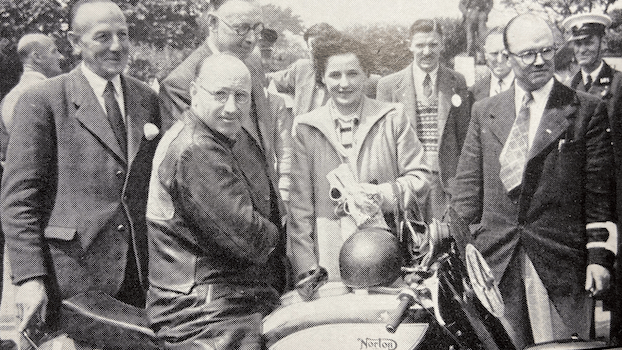
CA Stevens, G Morrison and SH Jensen, all on Triumphs, lay 7th, 8th and 9th. Bob increased his lead in the 5th lap to 57sec over Les, their times respectively being 25min 21sec and 25min 43sec. There was no change in the order of the first six, who were Foster (Guzzi), Graham (AJS), Doran (AJS), Daniell (Norton),Lockett (Norton) , Lyons (Velocette). The race looked like a certainty for Foster. Since he was bracketed first on the 2nd lap he had gradually increased his lead on the 2nd man—8sec on the 3rd lap, 35 on the 4th and 57 on the 5th. And then, with less than a lap-and-a-half to go, he retired at Sulby with clutch trouble. At once there was a new aspect. Bill Doran had dropped back, but Les Graham, riding magnificently as ever, had a comfortable lead over Harold Daniell and, barring accidents, must bring home the Senior trophy to the AJS camp for the first time since 1921—when they won it on a 350! AJ Bell came back on to the Leader Board from out of the blue with a lap in 25min 53sec, actually the fastest of all the 6th laps except that of Graham, who had clocked 25min 44sec. Lyons had worked steadily up to 4th place—AJS first and 5th, Norton 2nd, 3rd and 6th, Velocettes 4th. The leader was 1min 38sec ahead—he could take it easy and win hands down—barring accidents. But the accident happened. Round the course they went on the last lap. At Ballacraine, Kirmichael, Ramsey, the Mountain, Creg-ny-Baa, the indicators showed that Graham was more than holding his own. We got ready to cheer him when the announcer at Cronk-ny-Mona said ‘Here’s Graham pushing up from Hilberry.’ Once again the cup had been dashed from the lip; once again a fine rider had been robbed of victory in the last few miles; and once again that brilliant old-stager Harold Daniell who, to use his own words at the Prize Distribution that night, ‘just kept plodding along’ had won the Senior TT Race. Poor Les Graham pushed his Porcupine up the long Cronk-ny-Mona stretch, coasted to Governor’s Bridge and pushed again to the pits, to finish gasping but still smiling, in 10th place. Johnnie Lockett was 2nd to Harold Daniell, Ernie Lyons 3rd and Artie Bell with another quick lap, fourth, SH Jensen from New Zealand and CA Stevens on their Grand Prix Triumphs were 5th and 6th, the former winning the Visitors’ Cup for the best performance of the week by an overseas rider.”
“AN EXTRAORDINARILY HIGH proportion of the motor cyclists seen on the roads last Sunday were riding under ‘L’ plates. Was it that learners felt that the bitter weather and, in places, snow or slush would result in the roads being unusually free from traffic and, therefore, that the day was especially suitable for riding practice? Was it that road conditions gave promise of particularly valuable experience or solely enthusiasm? The general standard of riding seen was very high. But it was surprising how ill-clad many were for such cold weather. Thanks to War surplus, warm clothing is inexpensive and readily obtainable. Not only is it a pity to ride unsuitably clothed because so much of the pleasure of motor cycling is lost, but also no one perished with cold can have the best possible control of his or her vehicle, a point which came very much to the fore on last Saturday’s arctic Kickham Trial.”—Ixion
“WIDELY EXPERIENCED Continental tourist Ken Craven is about to put into production luggage-carrying equipment for solo machines which sets a high standard in utility and appearance. The equipment consists of two pannier boxes and a saddle box across the top. All the boxes are readily detachable and the panniers may then be used as ordinary travelling cases. In a test, it was found that the panniers could, in fact, be taken off or replaced in a matter of seconds. The equipment seen was fitted to a 500cc Matchless, Hetty II, which has featured in some of Ken Craven’s articles. Special bolts with wing nuts are fitted in place of the standard bolts used for attaching the rear mudguard to its vertical stay, and to the lifting-handle stay. Attached by these bolts is a strip-steel framework supporting the saddle box; the ends of the framework legs have hook-shape holes so that the wing nuts have simply to be loosened to release the legs. The framework and boxes are well to the rear and do not interfere with the pillion rider’s comfort.
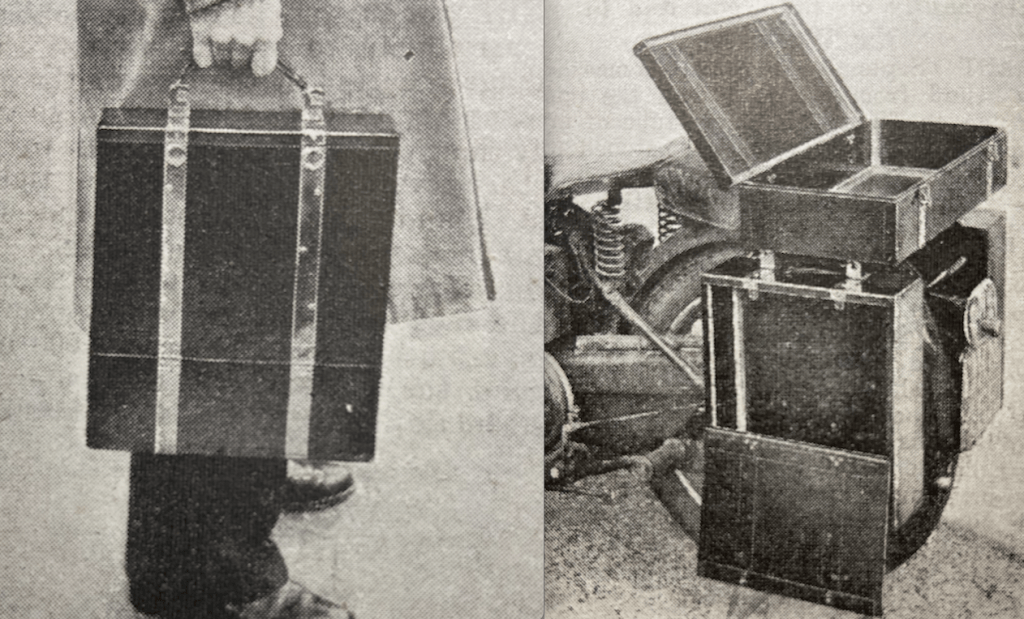
On the cross-members of the framework, which support the saddle box each side, are a pair of bolts with wing nuts which clamp. the hook lugs on the top of the panniers At the back of each pannier is a special quick-release clip; this fits in a bracket clamped on the leg of the lifting-handle stay. The boxes are made of strong plastic material, part laminated and part moulded, on a wood framework. Corners are reinforced, and each box has two metal strengthening bands which line up with the hinges and the fasteners of the lid. Measurements of the saddle box are 20x10x5in and the lid and fasteners follow attaché-case practice. The pannier box dimensions are 14½x13x4½n; the lid takes the form of a flap 9⅜in deep in the outer face, with captive, screw-type fasteners. Both pannier boxes are supplied with leather handles. The plastic material of the boxes has a smooth black, glossy finish which contrasts handsomely with the metal binding bands and fittings; the smooth finish means that the boxes can be cleaned simply and very quickly. Prices are: Three box equipment with aluminium binding bands and cadmium plated fittings (for AJS and Matchless and shortly for Triumph twin-cylinder models), £9; de luxe edition with chromium-plated fittings, £10 15s. Two-piece set with universal fitting for most makes of machine and, standard fittings, £7 10s; de-luxe finish, £8 15s. The maker is Ken Craven, St Vincent Farm, Broadley Common, Nazeing, Essex.”

“”THE WAR SEEMS to have left us all a trifle bad-tempered and hypercritical. The Editor is an ardent believer in free speech, and so far as space permits be gives us all a chance to express ourselves in the Correspondence pages. These have lately been heavily padded with fault-finding letters, especially in reference to the Earls Court exhibits. The burden of the indictment mainly concerns two charges—’too much same-ness’, and its corollary—insufficient originality’. My paragraphs lack the space to describe the thorny path of the manufacturer. But I wish these critics would compare the actual status of the British motor cycle industry with the motor cycle industries of other nations. Earls Court staged a large number of machines and a vast legion of components and accessories, all of which develop annually and enjoy a long-standing market all over the world. Compare those hard facts with the parallel industries of other nations in 1939. The US industry dwindled to two makes, both largely static until recently. The French industry, apart from a big pre-war output of ultra-lightweights, had no marques of international standing. Germany at her peak could only produce a couple in the top rank—BMW and DKW. Italy possessed one of the world’s best dozen—the Guzzi—and produced two other makes eminent in the speed field (Benelli and Gilera), though none which penetrated freely in quantities into the world market. Our own industry is not perfect, but it remains both supreme and incomparable, and has every claim to our gratitude and our admiration. At the moment it seems to inspire more appreciation abroad than in certain circles at home.”—Ixion
“ADLER, THE FAMOUS German manufacturers of front-wheel-drive motor cars, have re-entered the motor cycle field with a new 98cc (50x5Omm bore and stroke) two-stroke machine. Production at the Frankfurt works is reported to have started. Before the first World War Adler built motor cycles, but afterwards concentrated solely on motor cars. Plunger rear-springing is incorporated with the brazed, duplex-cradle frame. The pressed-steel front fork is of the bottom-link type, with flat coil springs (‘clock’ springs) in the housings at the base of the fork legs. Fitted with a flat-top piston, the engine has a cast-iron cylinder fitted with a shrunk-in sleeve in special wear-and-corrosion-resisting iron. There is a light-alloy cylinder head, retained by four bolts, and with the sparking plug situated approximately in the middle. Roller bearings at the big-end and ball bearings at the mainshafts are employed. Lubrication is by petroil.

The carburettor is of Bing manufacture. Layout of the engine-gear unit is unorthodox. The gear box is housed at the left-hand side of the crankcase, and the rear-drive sprocket is between the two units. Drive between the engine and gear box is by gears. On the outer face of the gear box casing are the pedal of the positive-stop gear change (three ratios) and the kick-starter pedal. On the right-hand side of the crankcase is a Bosch 30-watt flywheel generator. A minor feature of outstanding interest is the fitting of propstands to the footrests. Hinged at the ends of the footrests are props which, when swung down vertically, serve the function of prop-stands. When not required, each prop hinges inward, and is held under control by its spring, to fit snugly under the footrest. The footrests are not adjustable; if they were, obviously it would be difficult for the propstands to be effective. Tyres are 2.50x19in. Petroil capacity of the two-piece tank is 1½ gallons. Dry weight of the machine is said to be 1071b. Performance figures claimed are bhp, 3.5; maximum speed, 43mph; and fuel consumption, 130mpg.”
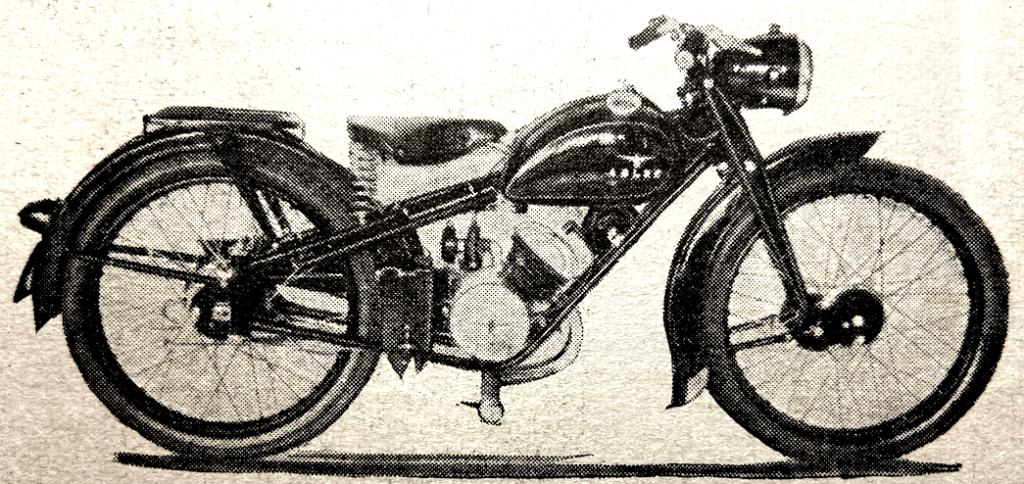
“A CORRESPONDENT IS ‘quite satisfied’ because he has covered 9,000 successful miles on his 350. He is certainly very easily pleased, but, at the same time, be must surely realise that, as far as reputable manufacturers are concerned, there is not a motor cycle made in this country that will not (with no real abuse) cover that mileage and more with no trouble worthy of the name. My machine is a 16H Norton which, so far, has covered 35,000 miles without difficulty hitched to a two-seater Swallow Bedford sidecar. It is left out every night and, since purchased new 21 years ago, bee been caned unmercifully. So far, I am pleased with the machine, but until the speedometer registers 100,000 trouble-free miles, there will be no ‘quite satisfied’ verdicts from me. Even then I shall expect a few more years’ wear! So let us not be too free with our praise, or the makers may consider us to be quite satisfied when our machines are considered to be worn out after a mere 10,000 miles, and that we are then ready to purchase another £200 worth.
AV Harper, Nr Newbury, Berks.”
“I SHOULD LIKE to congratulate Molly and Ken Craven on their very interesting articles. The last article ‘rang a bell’, because it revealed a coincidence which seems to link their adventure with that of my friend, Frank Luke, and myself. We had reached Marseilles, and decided to have a look at dockland. The bikes were parked on the quay-side and we strolled around viewing the motley collection of craft in the harbour. When we returned to the bikes we were surprised to see a third machine alongside. The newcomer was an extraordinary Bitza (mostly Ariel) piled high with gear. Standing engrossed in Frank’s spring-hub Tiger 100 was a young man, dressed in riding boots, corduroys, an Army tunic, and a bush hat. Yes, our ‘Fellow Countryman’, Peter Ward, Garage Proprietor of Benghazi. We had lunch together and related our experiences. It transpired that Mr Ward was returning from holiday in England, and had journeyed through France with a quick detour into Switzerland, down to Nice, where he hoped to get a boat to Algiers. Then he would proceed to Benghazi. What a feat on a machine that looked for all the world as though it had been rescued from a breaker’s yard! But I gathered that Peter cared more for mechanical perfection than good looks. Best of luck to the Blue ‘Un.
AMN Bush, Arborfield, Berks.”
“EVERY now and then some firm bursts out into bright colours. Readers will particularly recall the red Indians, the purple Scotts, the cream Calthorpes, the dark-green Royal Enfields, and a few others. But by and large both the motor cycle and cycle industries invariably return to the good old black. Why? Cream is a tint especially calculated to show the dirt which must ever be inseparable from roadwork. Perhaps any light or bright colour betrays its shabbiness more obviously than plain sable, when age and rough handling have toned down a once brilliant and flawless exterior. I should single out Scott purple as the most successful and durable of the brighter departures. The verdict of cyclists has been largely confirmed by the car world, which once upon a time coquetted with various tints of ‘stone grey’, but eventually identified black as the most popular British choice. This winter, alike in the car world and with our own Sunbeam Co, there have been signs of impatience with the funereal and almost universal black, with a particularly lovely pale green as the protagonist for more brightness. I hope that the durability of such merrier hues may secure their wider adoption. Austerity Britain can do with every available spot of cheer—be it colour, wit, liquor, sport or eats.”—Ixion
“FRANCE, THROUGH OUR EYES, proved to be a country of contrasts. In the frontier areas the roads are appalling, and in places would tax the resources of a first-class scrambler! Yet much of our journey from the Floreffe circuit, in Belgium, to Barcelona, in Spain, took us over magnificent Routes Nationales, where well-surfaced highways run straight ahead for unbelievable distances, often between long avenues of tall trees, and, farther south, through seemingly endless vineyards. In this apparent paradise for roadburners the only motor cycles we saw were tiny two-strokes, whereas the majority of cars were in the modem American style, and all fitted with the shattering horns beloved of the Continental driver. We passed through Reims, with but a glance at its famous Gothic cathedral, then halted at the Banque du France, in Chalons, as Beevers was in need of fuel. Here we received a rude shock. We were informed that only the previous day the Government had slashed the tourist ration to one-third of its old value, so now we had to cash cheques for three times the value of the coupons required. A quick reckoning showed that the most stringent economy would be necessary, and for three days we knew the true meaning of austerity. We confined ourselves to one good meal per day, filling in with long, dry French loaves and tea brewed by the wayside. We slept in the van and, with characteristic determination, Bill stuck to his wheel from early morning till well after dark. Our first night was spent in the railway yard at Dijon, and next morning Bill Beevers’ companion astounded the inquisitive locals by insisting on washing his feet, using the very primitive toilet facilities available at the station! That afternoon brought a more embarrassing situation. When half a mile ahead of Beevers’ outfit, Bill stopped our van for fuel. Fifteen gallons were going into the tank when, to our consternation, Beevers steamed by unseeing—with all the French money! Frantically we yelled—but to no avail. We tried to explain and offered to pay in Belgian currency, but the garage folk would have none of it. Then, just as things were getting decidedly awkward, along came Ernie Thomas’s van, and Ernie soon had us out of trouble. That evening all three outfits pulled in together for a meal, and we experienced for the first time the tonic effect of Ernie’s almost legendary’ personality. With a dry wit and sense of humour rivalled only by the best music-hall stars, Ernie Thomas deserves an article all to
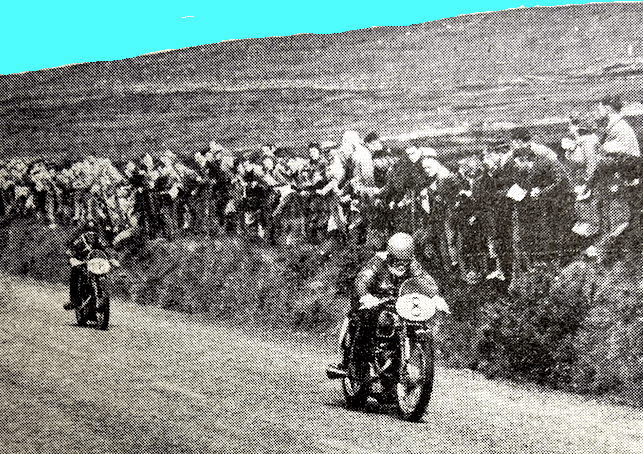
himself. It is quite impossible to be glum in his presence, however trying the circumstances. In addition to his infections good humour, Ernie is ever-ready with advice and help, and inspires confidence by his unfailing ability to deal promptly and effectively with any situation which arises. A grand type. We made Avignon that night. Next day we got our first sight of the lovely blue waters of the Mediterranean, but as we crossed the Eastern Pyrenees dusk was falling, to rob us of much of their beauty. It was quite dark when we made the border, and we were pleased to find that the Barcelona Club had arranged for a representative to meet us at the Spanish Customs to expedite our passage. There followed the last hundred miles of our journey, over roads which were often very poor, and with several stops by armed military. By the time we had located the club HQ it was around 2am; but with a degree of hospitality which was to prove almost embarrassing, we were escorted away and quickly installed in the luxurious Hotel Regina. How we slept that night! After three days’ grim austerity there was an atmosphere of unreality about our new circumstances. Our bedroom had its own private bathroom, sun balcony, and what-have-you. Coffee was brought to our bedside each morning by a charming senorita, and the meals were something we had hitherto only dreamed of. The weather was hot and dry, and from first sight Barcelona impressed us. Its streets are very wide, and its buildings are large. The pattern of its roads resembles a giant chessboard, with only one or two diagonal thoroughfares to break the symmetry; strange trees ornament its verges and islands. Next morning, when driving the van to the garage had been allocated, Bill created a record by engaging the attentions of the police three times in the first ten minutes! First for using the centre carriageway, apparently reserved for non-commercial vehicles; then for crossing an absurdly placed red traffic signal; and finally for dashing the wrong way up a one-way street! Shrill whistles halted our progress, but, as neither party could understand the other’s language, we soon parted—all smiles. The day was spent preparing our machines for evening practice. We had missed the first evening, and naturally were keen to make full use of the two remaining sessions. The course, measuring about 2½ miles, is laid out in the beautiful grounds of the large exhibition park at Montjuich. It seems to have been plotted by an inebriated snake-charmer, and tests clutches and gears to the full. Much sprocket changing was indulged in, particularly by the Ajay riders, who had the advantage of being able to juggle both engine-shaft and rear-wheel cogs to get the best gearing. The noise in the small paddock was deafening, for there was a 125cc class with a fair entry—and all were ear-splitting two-strokes! As ever, the scene would not have been complete without Eric Briggs’ fair lady and her welcome brew for the lads. Friday’s practice saw much purposeful riding by competitors, but yours truly managed only one slow lap, for the gear box lock-ring came adrift and rendered the clutch inoperative, which kept me busy with the spanners for the remainder of the session. On Saturday afternoon there was a civic reception for the runners. We were conducted through buildings of historic and architectural interest with the most ornate interior decorations.The bearded ‘Jenks’ was soon pounced upon by Pressmen and caricaturists who, describing him as the ‘English philosopher’, plied him with all manner of questions. All went well till ‘Jenks’

expressed his views on the incompatibility of marriage and racing, when he immediately found himself in wordy conflict with Fergus Anderson! Returning to our hotel we learnt that someone had thoughtfully obtained some tickets for us to visit a bullfight; and, as we could scarcely dare to show our faces again in England if we failed to see one, we gladly went along. But we soon decided it hardly conformed to our British ideas of sport, and, with our sympathies all with the bull, we left long before the programme was completed. Race day was a scorcher. Leathers were worn next to birthday suits! Yesterday’s caricaturist could have found good material in the 125cc race, for the sight of tall Fergus Anderson draped, around a diminutive ‘baby’ was nothing if not amusing. If ever a start was jumped, it was that of the 350cc class. Some runners were not only on the move, but had their clutches home by the time the starter dropped his flag. I then realised why some more experienced riders prefer to watch their opponents rather than the man with the flag. For, expecting him to haul back the ‘jumpers’ I hesitated —only to see him drop his flag once he realised that several competitors had decided to dispense with his services! The remedy for this sort of thing lies entirely in the hands of the starter, who should not only have the courage to call back any offenders, but should not hold his flag aloft for more than a very few seconds. Once under way, Tommy Wood and Fergus Anderson quickly wept ahead and battled for the lead for 30 laps in a thrilling exhibition of short-circuit riding. Tommy won by short distance. Of our own party, Bill circled very consistently to bring his AJS home in 5th place, while I managed 6th. The 500cc event was notable for the almost incredible riding of the Spanish star, Ortueta. Banking his Norton over at fantastic angles, and snaking perilously, he yet managed to stay in the saddle and ran second to Anderson, whose Gambalunga Guzzi seemed a much more suitable tool for the course. Again Bill rode a fine race, this time Norton mounted, and in spite of fading brakes, finished 4th. The prizegiving that evening was of the same high standard as the rest of the Spanish organisation, and after the distribution of the most attractive ‘silverware’ a merry atmosphere was maintained by a seemingly unending supply of wines and tasty delicacies. Yes, we must certainly visit Barcelona again.”
…and there’s more…
“IMMEDIATELY THE 1938 SEASON was over, prospects were reviewed for 1939. While the faithful old Velocette Mark 4 could doubtless be made to hold its own at Brooklands, using dope, road racing at Donington was quite another kettle of fish. Here, on petrol/benzole, the bicycle was outclassed, as also was its rider. I had painful recollections of proceeding down the long straight at full chat, to be passed, among others, by one Peter Goodman on the now familiar rear-sprung, square-head racer, at a speed which made me feel I must be in reverse. So when the famous Mark 8 KTT made its proud appearance on the Velocette stand at the 1938 Show, at the then exalted price of £120, I decided that by hook or by crook I must have one—though, quite frankly, I’d no idea where all that cash was coming from. I hawked ‘old faithful’ around to all the agents at the Show, and finally received an offer of £45 against a new Mark 8 from a well-known dealer, who was himself a highly successful competitor at Brooklands Track. The Mark 4 was duly trundled along to his premises and exchanged for a credit note—delivery of the new model being promised for February, 1939. Meanwhile, an intensive ‘savings campaign’ enabled me to purchase for £10 a lusty old 976cc Royal Enfield twin with box-float for transport purposes. The eagerly anticipated new model failed to appear in February, and, in fact, did not arrive until May. By this time I had scraped together another £15 in hard cash, which I took along to the dealer, together with the £48 credit note. He, of course, was quick to point out that this totalled only £60, exactly half the price of the Mark 8.
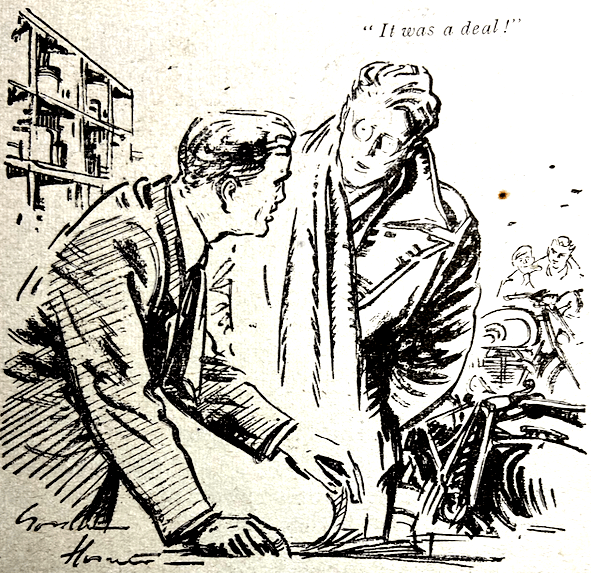
Tentatively, I broached the subject of ‘never-never’ terms, only to be told that finance companies took a pretty dim view of negotiating hire-purchase agreements on racing machines. However, acknowledging the impossibility of extracting blood from a stone, he eventually quoted terms for twelve months! Thirty-odd shillings a week. Impossible—that was half my wage packet! Reluctantly he quoted for 18 months—about 22s 6d. Again I couldn’t manage it. ‘Can’t possibly go over two years,’ he protested. ‘What’s two years?’ I asked hopefully.’ ‘Fifteen bob.’ It was a deal! Looking back, I can’t help wondering what the finance company would have thought if they had seen their beautiful motor cycle tearing round Brooklands and Donington in the hands of an over-enthusiastic second-year man, for, of course, it was 1941 before it became ‘mine, all mine’! The treasured acquisition was trundled home on the old Royal Enfield, and this was destined to be its regular means of transport during 1939, or, at least, until the time of the old twin’s untimely demise later in the season. It was subsequently rebuilt in RAF leave periods during the war. To return to the Velocette; at the first practice try-out on the Donington course I learned the true meaning of ‘megaphonitis’. I stalled the engine four or five times on my first attempt to get away, before I mastered the art of being sufficiently brutal to the clutch. The Whitsun meeting there was not particularly joyful, for a faulty oil return banjo union swamped the rear end with oil, and reduced the race to a skating match for me. Next we turned our attentions to Brooklands. It seemed sheer sacrilege to substitute a regulation silencer for the pukka megaphone exhaust system, but there was no alternative. I
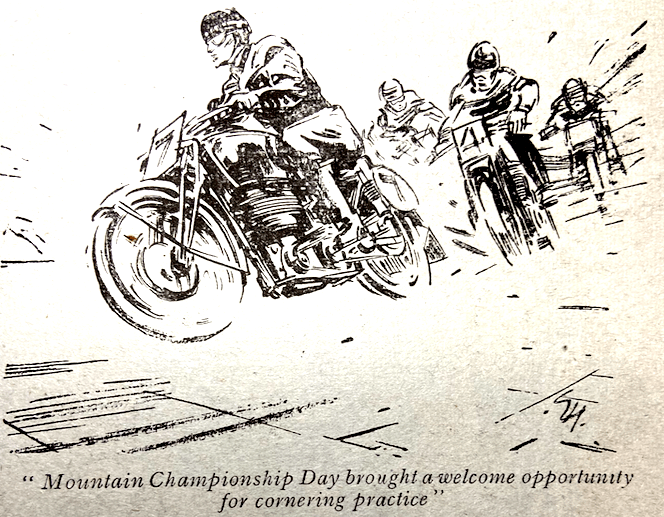
still coveted a Gold Star, and, besides, the Mountain and Campbell circuits offered road-racing practice, which I sorely needed. A little experimenting with carburettor settings and exhaust pipe lengths soon gave a fair compromise. First event was the Ford Rally in June. This was a mixed meeting, laid on by the Ford Motor Company, to which all Ford owners were admitted free. Never had I seen such large crowds at the Track, such was the attraction of something for nothing. My own event was a 5-lap Bemsee Handicap race over the Campbell circuit. But, just as in my first race twelve months previously, the handicappers were too kind, and I romped home with time to spare. I. collected fifteen whole guineas, and felt like a millionaire! The race was in the nature of a gift, though, for it must be remembered that the opposition was weakened by the absence of many fast men in the Isle of Man. Only seven days later came a genuine ‘pay-at-the-gate’ Bemsee meeting, and the Goddess who watches over Mark 8s must surely have been among those present. For the Velocette earned itself a rehandicapping every time it was taken to the line, by gaining four consecutive second places. It was finally handicapped right ‘off the map’, to finish fourth in its last event. Previous to this meeting I had been hoping for an outer circuit lap speed of about 96 (on 50/50), which would have justified the purchase of a special Martlett dope piston to try for the ‘Gold’. But I was very pleasantly surprised in the first outer circuit race to find the Velocette had lapped in excess of 102mph to bring me (I believe) the only 350cc Gold Star to be won on petrol/benzole. A record afternoon’s bag of 73 points towards the Aggregate Competition completed the afternoon’s blessings, and I concluded that .a Brookland’s ‘can’ fitted to the appropriate length of pipe wasn’t, after all, such a terrible thief of mph, though acceleration seemed to suffer. Mountain Championship Day, next month, brought a welcome opportunity for cornering practice, with two 25-lap scratch races round that circuit, and a couple of short handicaps thrown in. Of course, the usual starting method, with two pushers apiece and a rider seated, gave everybody a very equal chance from the ‘off’—a system which finds great favour with your biased writer, since he can never make a good getaway single-handed! (Must speak nicely to the FICM about this, for the monotony of being last away every time gets boring, to say the least!) Anyway, my pushers in the 350cc race enabled me to take second place at the start, which position I held for several laps till I found trouble in engaging bottom gear at the hairpin. (This was a teething trouble with the Mark 8s—since remedied.) It eventually dropped the Velocette to fifth place by the finish. Among the five-hundreds, particular care was given to the selection of bottom cog, and the cheeky three-fifty held third place for 23 laps. Then, of all things, my goggle elastic broke (1s 6d, fur-edged celluloid!), with the painful result that my spectacles were blown against my eyeballs, and once again we finished fifth. For some peculiar reason this brought forth a free Manx GP entry. However, for the painfully obvious reason that I couldn’t afford the Manx, I sent it back! Maybe I was psychic, for Adolf Shickelgruber effectively cancelled
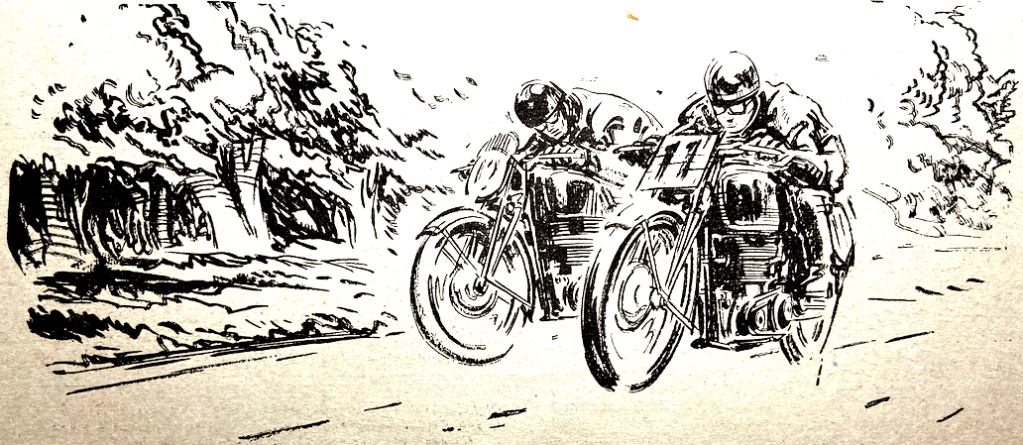
that year’s MGP. Off with the ‘can’, on with the mega, and up to Donington for August Monday. But a battle royal with another Velocette, ridden by Frank Fry, in the 500cc class, was rudely terminated when the exhaust valve head quietly dropped into the pot of my engine at about 6,800rpm. That locked the works up very rapidly, but not before it had redesigned the cylinder-head in the likeness of a pepper-pot! That contretemps all but liquidated the exchequer, but didn’t quite spoil my plot to do a pukka road race before the season ended. For, though it is difficult to believe in these inflated times, I competed in the 1939 Ulster GP during my week’s holiday for an all-in cost of £10—inclusive of entry fee, travelling, digs, etc. To-day that sum will only just about buy you a new riding coat. By the wisdom of Billy McMaster and his Irish stalwarts, payment of the four-guinea entry fee brought vouchers entitling entrants to greatly reduced rail and boat fares. Digs for the week cost only 25s, and, of course, trade support practically eliminated the cost of fuel, oil, tyres and plugs. Yes, ten quid the lot! But by the end of the week I wasn’t too sure it had been a wise venture. Not only had the dropped valve slowed the motor quite a bit, but nearly everything fell off in practice, limiting my outings to three laps. On race day I further blotted my copybook by throwing the model away with great gusto on two occasions—a result of trying to corner with the brakes hard on! I then cooked every plug I possessed, and finally retired with a neat hole burnt through the piston crown. But we live and learn (I hope!), and it was worth it—if only to see Freddy Frith’s truly magnificent effort on the Norton, to witness Stanley Woods’ masterly ease as 350cc winner, and to gasp at the prodigious performance of the blown Gilera four.”

“AS WE HAVEN’T seen any letters in the Blue ‘Un from the Don Rs of late, we thought we’d drop you a line to let you know that the Bitzas are still surviving, although spares seem to be harder to obtain every day. Our Ariel boys have resorted to going out at night (seemingly to the pictures) armed with all sorts of spanners, etc, and returning with that 20-over piston that Titch has been wanting badly these past few weeks. However, we have to live…We have just successfully built a Match-Norton. Many of the lads will remember these as being ‘some’ models. After much knocking off of barrel fins, etc, it gets a trifle hot. However, it hasn’t seized yet—so here’s hoping. Young —, our club sorounger, found a tele dump a few weeks back, and nowadays we are all sporting teles. Believe me when I say they’re a great asset on some of the bumps around here. Two of our models recently got 2nd and 4th places in the BAOR Championship Scramble, the riders being L/Cp1 Dyson and Sgm Norton. Sgm Moss saw fit to snap a chain in the heats, and we haven’t heard the last of it yet—much griping that night over many cups of the ill-famous ‘Naffy’ tea. Best of luck to the Blue ‘Un and to all the ex-Bitza pushers (or should I say Continental dicers?) of BAOR. We have received the Show Numbers. Thanks a lot to all the Staff for a wizard publication.
The Hounds, BAOR, 15.”
“THERE IS NOTHING unorthodox about the Stroud Panther. It is not, in other words, a trials machine bristling with new and exciting technical features. It is a straightforward, honest-to-goodness example of sound, experienced design and manufacture with engine characteristics well suited to competition work. The machine I borrowed was a 250 and was in fact that ridden by Morris Laidlaw in the Colmore Cup Trial. I had a fairly full day with it, covering about 100 miles over main roads and rough stuff. I said that the Panther has engine characteristics well suited to the job in hand. I mean that it is not a sports engine with a rip-snorting ‘tangy’ performance achieved as a result of employing an overlap valve-timing and lightened flywheels. On the contrary, the valve-timing is ‘easy’ and the flywheels are identical with those used in the 350cc machine. I won’t say that the engine will actually ‘plonk’—no 250cc job can be made to ‘plonk’ in the sense most of us understand the term—but low-speed pulling was streets ahead of that generally associated with 250cc trials mounts. For example, the greater part of the slipway which runs up Box Hill, Surrey, was climbed slowly and effortlessly in second gear with the ignition lever on about half retard. Bottom gear was used on the steep part near the top where there is a sprinkling of loose stones strewn over the surface. The gradient over the hump at the top is in the region of one in five. Total weight of the Stroud is claimed to be 297lb which means that it is one of the very few trials mount in production today scaling under 300lb. What I liked especially about it was that it was light, without ‘feeling too light’. For example, when the model was ridden over rocks there was no pronounced body-jarring wheel, hop as a fast climb over stones and boulders proved, though the rear wheel naturally did a fair amount of ‘grabbing’ each time it touched down in the midst of a neck-and-crop charge. The handling was at all times beautifully positive. Steering and handling deserve full marks. This was specially so at speed on slithery, cut up, though not too-deep leaf mould. On mud, stability was very good. Fast charges in three-ply ruts proved the steering to be taut and satisfyingly ‘solid’. On deep, buttery mud the model gave no indication that it had any marked tendency to lie down. On the occasions when it did the fault was mine! On some Sussex mud which had a peculiar gluey consistency I found the rear tyre and chain tended to become clogged. For the Colmore, however, Morris Laidlaw removed the toolbox which was fitted between the seat and chain and had no similar trouble. Good average speed could be maintained safely and comfortably on lanes and tracks. I say ‘safely’ because the handling made it so, and ‘comfortably’ because the third and top gears are well chosen for this particular work. Though the gear ratios are widely spaced gear changes be made quickly and noiselessly. In bottom gear, the engine pick-up was zestfully rapid. I tackled two gradients of about one and three. At the bottom the surface was of wet grass and led to wet, soft, wheelgrip-defeating chalk at the top. Starting on the gentler gradient at the foot I had the engine peaking in bottom gear…there was power to hand until, near the top wheelspin set in. Easing the throttle helped, of course, but on such a slope at less speeds the 250 was a shade short of horses. Braking on the engine with the 14 to one bottom gear engaged was especially good. The rear brake was smooth and progressive in action and powerful but the front brake was poor. For main road work the riding position suited me quite well without any changes from Morris Laidlaw’s position; he, incidentally, is six feet tall and I am 5ft 7in. For my own part, however, I like to be able to poise on the rests by making only the merest suggestion of a pull on the handlebars. I would have preferred the saddle to have been an inch or so higher for this reason. Riding slowly, feet-up, in tight full-lock turns was commendably simple. The steering lock is entirely adequate for trials work anywhere and the combination of exceptionally smooth low-speed torque and low gearing is such that full-lock circles can be made with the clutch fully home and hardly any trace of snatch. On full-lock the bars are high enough above the tank to obviate any danger of the rider’s nipping his fingers. Ground clearance under the engine is adequate for most sections. The roller-type rear stand that was fitted decreased ground clearance somewhat at the extreme tail of the machine. There was also a prop stand which, however, was a little use on soft ground or where there was a steep camber. The general finish, with cream and chromium-plated tank, light-alloy mudguards and black frame is very smart. To sum up my impressions of the Panther is easy. I regard it as a very strong potential 250cc cup winner and machine which, with its simple layout and a robust construction, is likely to give the competition man exceptionally good service.”—The Clubman
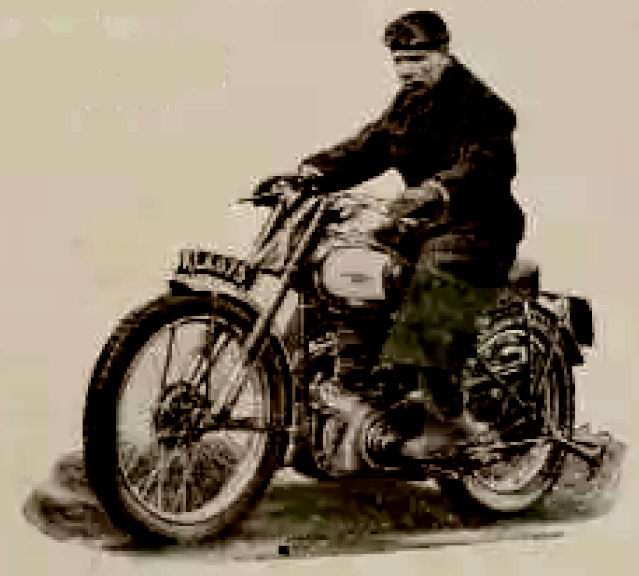
“‘198 SCOTT’ ASSUMES a rather provincial attitude in stating that a motor cyclist’s chief joy should be in pottering about ‘little olde-worlds country lanes’, enjoying the beauties of the English countryside. Unfortunately, we over here in the US don’t have pretty English lanes to potter about. In their place, we have hard, fast super-highways where even Fords whiz along at 70. We need machines to match this pace, and if we can’t get them from Britain, we’ll buy American. Don’t misunderstand me, friend, I also enjoy pottering about, but that represents about 5% of my riding. In March, I’m riding down to Daytona for the races. I live in Jersey, which is 1,200 miles from Daytona. Although my RE 500 has a top speed of 81mph with a windshield and travelling equipment, I feel it is definitely under a strain when cruising at 65 to 70. Being an engineer, I have a very sympathetic feeling for metals when they approach their limits of endurance. And in my humble opinion, reliability rapidly diminishes past 60mph on a 500cc road model—regardless of make. (Let’s exclude all specially tuned jobs.) Why doesn’t the British motor cycle industry have a wider choice of engine sizes? Why not a V-twin 750cc ohv model, of the same relative high hp output as the 500cc singles? Let the weight be approximately 450 pounds. This will give sufficient size for a twin seat as well as pannier. bags and a luggage rack. Let’s also have rear-springing and a high-ratio top gear for fast, effortless cruising. I am quite certain that this would be one of the most popular models produced, and I am equally certain it would capture the American market. Won’t you prevail on your manufacturers to explore the potential market for such a model? Oh, and I nearly forgot to mention that for those who wish to potter, this machine would suit them most admirably.
Subscriber, New Jersey, US.’
“THE ORCHIDS GO to your correspondent ‘Multi’, of Paris, for his excellent letter, giving exact specifications for a hoped-for and much-improved British multi of 750-1,000cc capacity. It is my emphatic opinion that such a model, when and if it ever gets into production, would make a clean sweep of the motor cycle market in the USA. It seems clear that British manufacturers, while making machines far superior to anything of original US design, have based their ideas of the kind of machine the American rider wants on experience gained on the terrain of Britain and the Continent, instead of on the desires of the US rider and the wholly different topography available for his travels. For narrow, winding roads and lanes (with few mountains of steep gradient), frequent stops, heavy traffic, and fuel of high price and low octane rating, they have designed the ideal machine: Small cc (to us 500cc is small) and consequent economy, high performance for its size, and with all the top usable for 95% of the roads the model encounters. Unfortunately, this is not the machine the majority of riders here dream of. British machines sell well here because they are superior to the US product ‘inch for inch’ of cc. But the ideal machine is not yet available. Roads (of which California alone has 80,000 paved miles) are wide and smooth and fast. My favourite run is 80 miles over a four-lane highway from the sea (at 40°F) to the desert edge (near 100°F), then up 17 miles of sweeping curves of banked pavement to Lake Arrowhead, at 5 000-6,000ft elevation and cool temperature again. Another run consists of the 140 miles along the Pacific on a four-to six-lane super-highway where the average speed of cars reaches 70mph; or the Yosemite Valley, 400 miles through farming valleys and with mountain climbs—all paved, all excellent roads. Trips of 3,000 miles to New York are not unusual. To paraphrase ‘Multi’ then, what we riders in the USA want is a machine with (a) multiple cylinders (let the designer decide how many); (b) 750 to 1,000cc—British 500s are fine, but if you can do that with 500cc, think of the zip you can get from more cc (petrol is cheap here; sidecars are almost out of use, but pillion passengers or camping gear is the order of the day); (c) telescopic forks—excellent, especially those with hydraulic dampers; (d) rear suspension (how is it that most makers have ignored for so long what every rider screams for?); (e) chainless transmission, a ‘must’ for modern machines (who drives a chain-drive automobile?); don’t worry about the side torque, we’ll get used to it, and we never ride in the rain, anyway; (f) maximum speed, not less than 100mph; no one wants to cruise at this speed, but all want the extra zip when it is needed (disregard the Gallup Poll on this and most other things—FDR was elected many times, and Dewey is still wishing, contrary to their ‘researches’.) So, to sum up: Give us the clean design and excellent springing of the Sunbeam and BMW; the light weight, fine acceleration and good brakes of the Triumph; the high top and cruising speed of the Vincent-HRD; tyres of 4in minimum section; smooth shifting gears and strong clutches; a form-fitting saddle with 1in foam rubber and a frame tube spring like the Harley-Davidson has; magneto ignition; sealed beam lights—and generators large enough for ’em; and handlebars raised and close to the rider, available here only as an extra from speciality manufacturers. Well buy it. Last, but not least, we can get on without a good US magazine covering the sport became most of us read the ‘Blue and the Green’.
Barclay, Hollywood, California.”
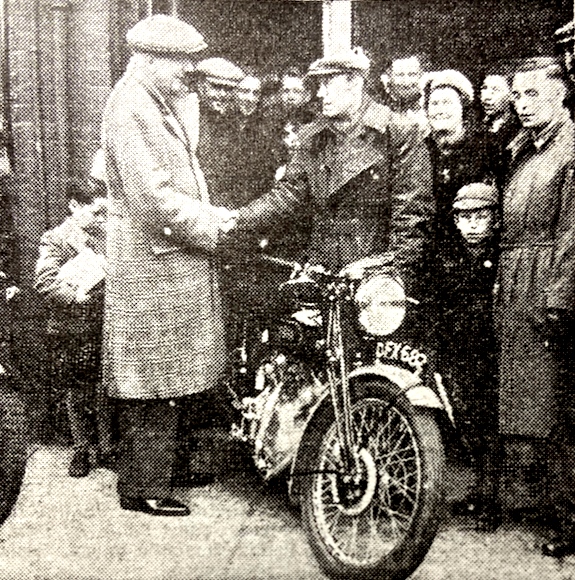
“WHEN ‘Gwentlander’ agrees that a 750cc vertical-twin is long overdue, he is only speaking for many keen motor cyclists I know—including myself. Riding a 500cc in the Transvaal altitude is comparable to riding a 350cc at the coast. It’s OK while you’re at the coast, but the performance isn’t good enough when you’re touring inland, especially two-up. So let’s have, say, two 350cc pots side by side, and see how they perform. Thanking The Motor Cycle for happy reading always.
George Nurse, Pretoria, Transvaal, S Africa.”
“IF EVER A GOOD example of the vagaries of English weather should be required, the post-war dates of the Kickham Trial would suffice. In 1947, a snowbound countryside and a snowstorm to cap it; in 1948, bright sunshine and temperatures which allowed competitors to discard coats. In 1949—last Saturday—damp mist in the morning and a raging blizzard in the afternoon so severe that the organisers wisely decided to stop the trial and make the awards on performances during the first circuit. Thus the trial was decided over a route of 30 miles, embracing 10 observed sections divided into 26 sub-sections. The start was from Farleigh Hungerford, near Trowbridge, Wiltshire. There were 125 entries. Best performance, with 11 marks lost, was made by G Collins, riding a solo 347cc AJS machine. Collins is a Bristol man and is a newcomer to top honours in trade-supported trials. The winner of the opposite class best performance award was H Tozer, driving a 496cc BSA sidecar outfit. It had been a hard trial, and, even without the capriciousness of the day’s weather, would have ranked as easily the most difficult trade-supported event this year. While competitors and officials slowly left for home or hotels, the Wiltshire countryside became whiter and whiter as the layer of snow thickened…”
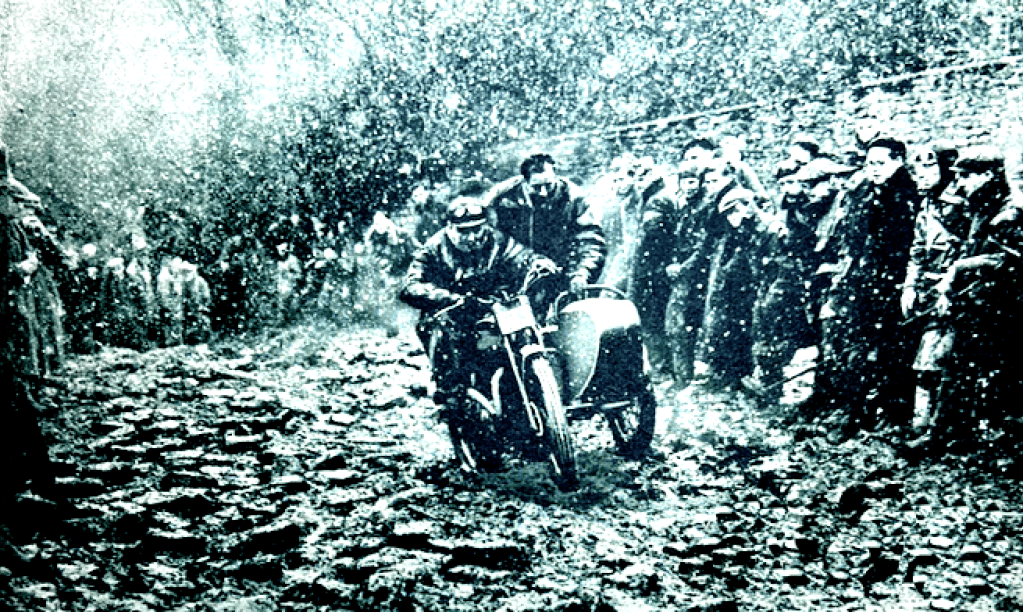
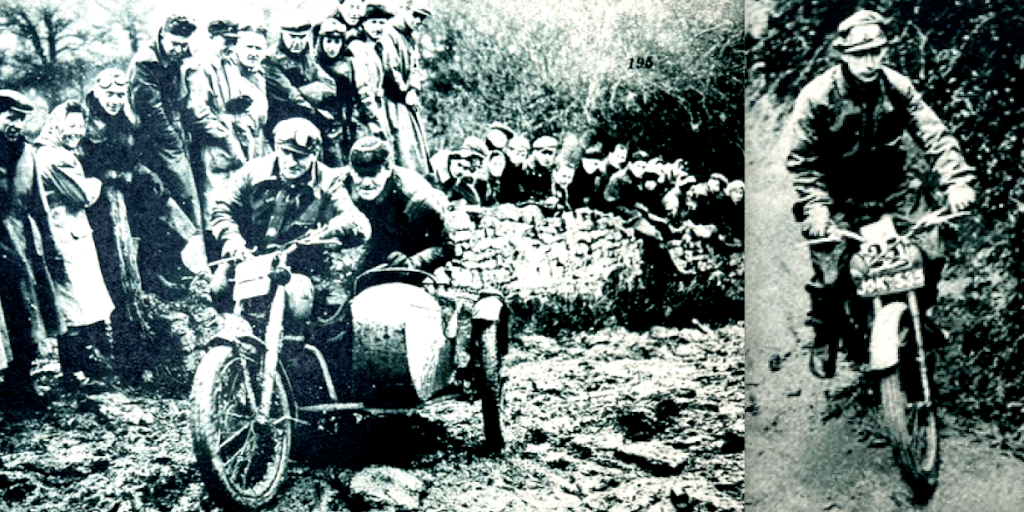
“IN REPLY TO ‘Multi’ (of Paris), I should hardly call the Guzzi ‘a horrible sight’. In fact, I consider it to be a mechanical masterpiece. As to ‘many’ cars being faster than the ‘Squariel’, well, I don’t know of more than two post-war standard British cars that are any faster. In fact, I think ‘Multi’ should reconsider things and purchase a 98cc job with a V8 engine!
D Rogerson, Orrell Post, Nr Wigan.”
“MR S MILLIS-CLARKE should forget his worries. I have a 1946 Model 18 Norton and sidecar, and although I ride just five miles each way to work every day, with at least a set of lights to every mile, I should be annoyed if my machine did not give her 65mpg. It is speed that spoils mpg. Recently, I had the bus sleeved at 23,000 miles, and, while running-in at 30mph, got a steady 75mpg on long runs. The outfit always carries three adults, each weighing 11-12 stone.
TA Thorn, London, W3.”
“I WAS PLEASED to read the letter from Mr Kendle on the fuel consumption of his 350. I, too, own a 1947 350cc BSA. On several occasions I rode from Warrington to Oswestry, a distance of 60 miles, and the return journey as well, to find that I’d used very little over one gallon of petrol. Each run used to verify the fact, and inspection of the plug showed that the engine had not been running on an excessively weak mixture. One last word: Thanks to the Blue ‘Un. I look forward to it each week out here in Germany—it makes one feel much more at home.
Sgmn Bibby, BAOR, 1.”
“I HAVE A 1935 600cc Panther and sidecar which last year was used for a holiday in the Lake District. Using my 13 gallons allowance, I covered 892 miles, a performance of over 68mpg with 10-stone pillion passenger, myself 9st 4lb, and sidecar loaded to the top with camping gear (including every comfort—camp beds, eight blankets, radio set, etc). We averaged 40mph on each journey and followed a route given in The Motor Cycle; it included Wrynose and Honister. Considering the amount of low gear work necessary on this type of tour, I consider it an amazing performance for this machine. Needless to say, no trouble was experienced. I am awaiting the day when I can purchase a new machine—which will be a Panther every time.
SM Henry, London, SW15.”


“WITH ITS FULL-BLOODED engine performance and first-class steering and road-holding, the new 495cc BSA Star Twin fully justifies the promise behind the general lay-out. It is a machine to thrill the man with a penchant for packing a large number of miles into each hour. In Britain, at least, cruising speed is limited only by road conditions. The combination of sturdy, full duplex cradle frame, oil-damped telescopic fork and plunger-type rear-springing, endows the machine with steering and road-holding second to none. Indeed, the general handling properties of the BSA, and the compact feel of the model, are among its especially appealing features. It is a 500 that can be swept round corners and bends with the facility of a racing mount. Fast, spirited cornering could be indulged in with the utmost confidence. The BSA fork has a very long, soft movement (approx 7in) which, whether the model is upright or heeled over almost to the limit of tyre adhesion, smooths out road irregularities in the most satisfactory manner. Round the static load position, the movement of the fork is extremely light so that care is taken of even the most minor of road ripples. Even at high speed there was never at any time any trace of jarring, and the fork never bottomed. Of the rear suspension, it can be said that it was unobtrusive—apparent only by the marked absence of wheel hop. One of the most telling tests for suspension systems lies in riding the machine over the regularly placed, tram-track inspection covers, set in cobbles. Even in these circumstances the suspension earned full marks. As for cruising speed, 60, 70 or 75-80mph, it made no difference. There was never the slightest indication that the machine was being over-driven, not even to the extent of slightly discoloured exhaust pipes. In traffic, the engine was extremely docile and gave no indication of the high power output available. The all-round engine performance of the Star Twin is definitely above average in the 500cc class. At low traffic speeds the engine is as quiet and tractable as that of almost any twin of to-day. The two carburettors, in delivery tune, were perfectly synchronised to give a clean, rapid
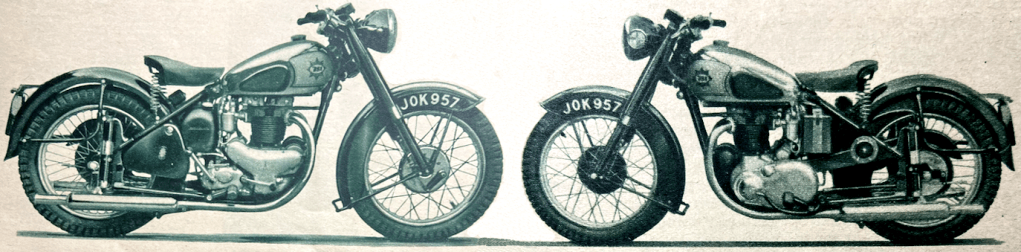
pick-up from idling speeds to full throttle. A tickover that was slow, smooth, and 100% reliable was, however, never achieved. Engine balance is exceptionally good and, except for a slight ‘period’ at exactly 50mph in top gear, unimpaired up to speeds in the region of 70mph. Above 70mph vibration could be felt at the handlebars and footrests. It is, of course, when an engine has been driven very bard that any oil leaks begin to manifest themselves. The BSA was ridden just as hard as it possibly could be over much of the of 500-mile test, yet not the slightest oil stain appeared on any part the engine or gear box. The only trace of oil that showed externally was a little that was flung from the chain on to the rear tyre and rim. The clutch took up the drive smoothly. The gear ratios are admirably suited to the engine characteristics and, if the full engine performance is used, acceleration is rapid in the extreme. All the indirect ratios, and third gear especially, were audible, and clean, sweet gear changes were not too certain. Although the clutch appeared to free perfectly, it was not possible to select bottom gear with the machine stationary and the engine idling without a distinct ‘scrunch’. Engine starting is very easy indeed, and because of the leverage of the kick-starter pedal and its gearing, only slight physical effort is required. Flooding of both carburettors was, of course, necessary when the engine was cold and the handlebar-lever-operated air slides had to be closed. There is a separate feed to each carburettor, and both petrol taps and ticklers are easily accessible. Provided that the throttle was opened only the merest fraction, starting was certain at the second kick if the engine was cold, and first kick if it was hot. After a cold start, the air lever required to be left in the closed position for a mile or so; then it could be opened fully and forgotten until the next cold start was necessary. Mechanically, the engine was reasonably quiet. After a cold start there was a fair amount of piston slap and noise from the valve gear. These decreased, of course, after the engine was
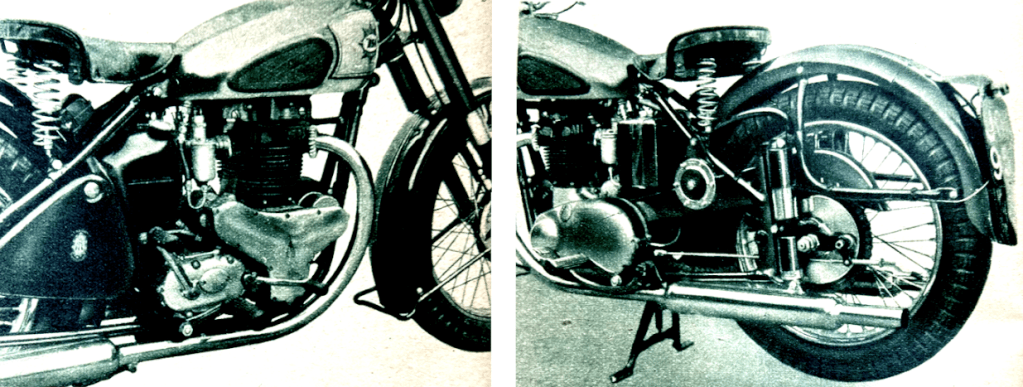
hot. The exhaust was a pleasant, unobtrusive hum—so unobtrusive that it in no way interfered with using to the full the machine’s nippy acceleration. On ‘Pool’ petrol the twistgrip had to be handled carefully to avoid pinking during hard acceleration. What was especially appreciated about the Star Twin was the excellence of the riding position. In delivery trim it was of the sit-up-and-beg variety so popular with many riders. An even better and more individual position was obtained after a few minutes’ work with the tools. With the footrests raised so that the hangers were in a higher-than-horizontal position, and the bars turned slightly in their split clamps so that the grips were approximately horizontal, the riding position became one that allowed the rider to sit over the machine in a way that assured absolute control at all speeds. The saddle height of 31in is one that is ‘just right’ for the majority of riders. All the controls are well placed and, with the exception of the throttle, which was slightly heavy, light in operation. The horn button and dipper are carried on the front brake and clutch lever clamps respectively and are easily reached by thumb. Both brakes were smooth and progressive in action, but with advantage could have been more powerful. The steering lock (which gives a 12-foot turning circle) is worthy of employment on a works’ trials mount, and is a most useful feature. Several other points of the Star Twin merit special mention. There is the deeply valanced front mudguard, which has the registration numbers painted on the sides. The wheels are really quickly detachable and interchangeable. Centre and front stands are provided, and a special lifting handle is fitted above the nearside seat stay to facilitate operating the centre stand. The exhaust pipes are neatly tucked in under the primary chain case and timing chest. Of black, silver and chromium, and with the primary chaincase, timing chest and gear-box end cover all highly polished, the general finish is very attractive. Driving light from the 7in head lamp is adequate at speeds up to 60-65mph. The tool-box, mounted below the offside seat stay, is of ample dimensions to carry comfortably the tool-kit, spare plugs and a repair outfit. Both petrol and oil filler caps were liquid-tight, the former to the extent that there was no fear of spilling even when the tank was filled absolutely brim-full. Carried on the top fork bridge, the speedometer is mounted at such an angle that it can be easily read from the saddle. There are so many genuinely worthwhile features about the BSA that the list could go on almost indefinitely. The Star Twin is a machine to make a wide appeal to the sporting fraternity—to all who want a high cruising speed and handling that is as good as the best available to-day.”

“THOSE WHO MIGHT be considering a polar tour may like to know of a trip by two Swedes. Bärnt Hakansson and his friend Carl-Henrik Henriksson took their Tiger 100 Triumphs from Stockholm to the north of Scandinavia well inside the Polar Circle. They covered 3,300 miles in 20 days and went beyond Syysjärvi, the point where the German mechanical transport had to turn back during the war. Near this point, among the Lapps, a man and his wife were so frightened at the sight of the machines that they fled as fast as they could run. Apparently they had never before seen motor cycles! Sometimes the Swedes had to transport their machines across lakes and rivers by means of small boats—tiny boats intended for one or two people only. On the boats they had a hectic time; they could never have made the water transport part of their journey but for the help of the sturdy, knowledgeable Lapps. Progress by land and water was sometimes painfully slow—around 20 miles a day. They were frequently tired, hungry, wet and cold. On such occasions, their report says, their thoughts turned to beefsteaks and Hawaii! While doffing my hat to the Swedes, methinks I would choose the WTA tour.”
“AN AMUSING STORY comes from a reader who was sidecarring on the Bournemouth road. Beside his solo machine propped up on the grass verge, was a rider who gave the impression of being in trouble. Our sidecar man stopped and inquired, “Machine all right—can I help?” Back came the sour reply, “Does it look all right? When I want help I’ll ask for it.” Crestfallen, our man continued his journey. Two hours later he was returning on the same road and encountered the soloist still at the roadside. This time the slowing down of the sidecar outfit was greeted with winning smiles and the driver with many apologies. Yes, the machine was far from all right and the rider could use a little help. In more than two hours he had failed to locate the reason for his silent engine. The bother? The good samaritan sidecarrist found that the petrol tap had in some way got turned off!”
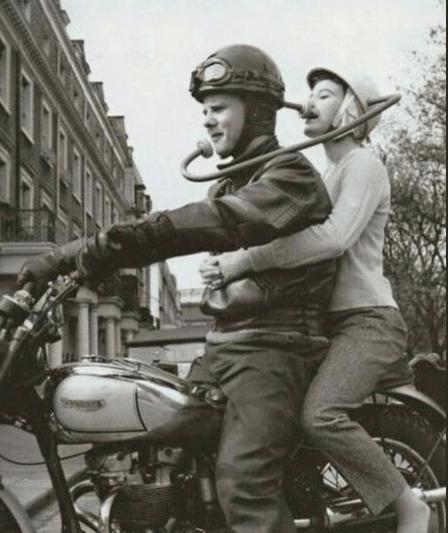
“SINCE THE WAR DAYS Britain has been blighted by shortage of petrol—among many other shortages. Hence the owner of a motor cycle (or car) is allowed no more petrol for private purposes than enough for around 100 miles a month. On the face of it, the ration is ludicrous and stringent enough to throttle motor cycling as a virile pastime. Nevertheless, the number of machines licensed in Britain exceeds half a million, and without doubt those half a million owners (as well as the two million motorists) are taking a harsher restriction on their liberties than the situation warrants. Rational reasoning suggests that twice or three times the present ration would not be an excessive burden on our improving economic health, bearing in mind the many benefits that would accrue to a large section of the community.”
“MOST SIGNIFICANT FEATURE of the Geneva Show now in progress is the large number of German motor cycle exhibits. Hitherto post-war Germany has been limited to the production of machines under 250cc. This was ruled by the Allies on the score that larger capacity motor cycles might constitute war potential. Now, it seems, machines of any capacity may be manufactured. At all events, a 350cc German mount is exhibited and also a 500cc transverse-twin engine-gear unit which is to form the basis of a model for I950. Thus Germany must henceforward be reckoned with as a competitor in motor cycle markets. When it is realised that the population of Switzerland is but four millions it seems extraordinary that over 50 motor cycle and sidecar manufacturers should exhibit at Geneva—the motor cycles and sidecars of nine countries can be examined and compared. Why the nations flock to Switzerland is that it is one market in Europe that is completely open: any country can send in its cars and motor cycle and, of course, it is for hard currency, the form of money which nearly all of them need. In 1948, over 11,000 motor cycles were
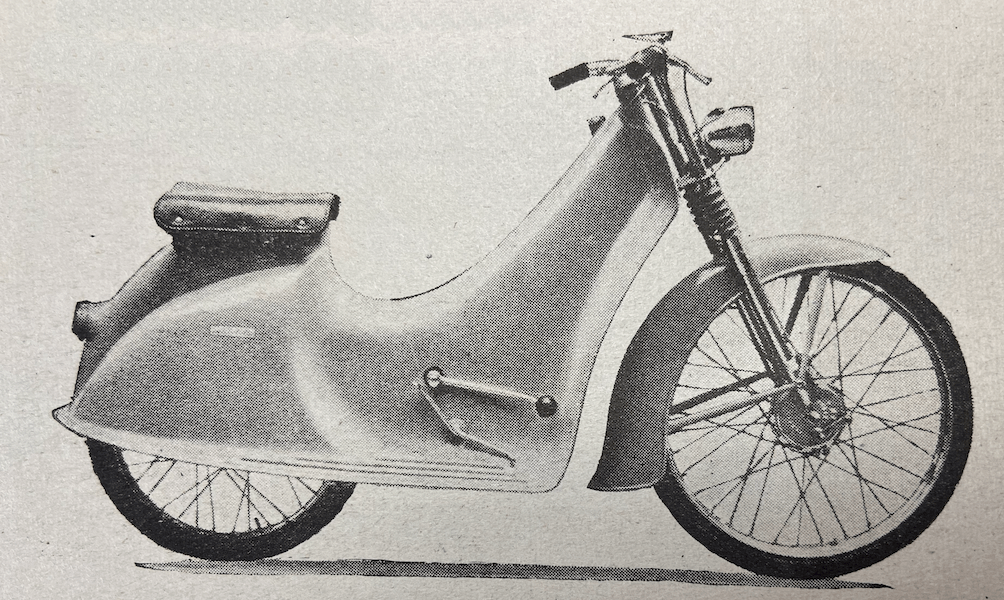
imported into Switzerland against 7,244 in 1947, though at least one in three were motor attachments or autocycles. Great Britain displays the largest number of makes. Her machines are AJS, BSA, Douglas, Francis-Barnett, James, Matchless, Norton, Royal Enfield, Sunbeam, Triumph, Velocette and Vincent-HRD, and there are numerous British components such as. Amal carburettors, Villiers engines, Smiths speedometers, Dunlop tyres, and Lucas, Miller and Wico-Pacy lighting. There is also what is adjudged by many the prettiest sidecar in the exhibition, a Swallow Jet 80. Incidentally, a Swallow factory representative drove a Norton with Jet 80 over from England. But while Great Britain has the largest number of individual makes, Germany comes a close second. The pre-war Berlin Shows boasted few additional makes. The DKW is absent, and so is the Stoye, which was probably Germany’s best sidecar, but there are Ardie, Golbi (the Imme), Horex, NSU, Steib, TWN and Zündapp, while Austria has the Püch and also Rekord sidecars; other sidecars, exhibited by local dealers, also suggest German origin. Czechoslovakia displays her four makes—the 90cc two-piston Manet, the 125cc CZ, the 250cc Jawa and the 350cc Ogar. A11 are two-strokes, with the last a parallel twin, and all bear little identification plates marked ‘1948’. But whereas these, the British machines, all the French, and the majority of the German

mounts can be dismissed as old friends, the Geneva Show offers Europe her first opportunity of poring over the new Indians—the 220cc single and the 440cc parallel twin. These are essentially on British lines. An aim behind the design is standardisation. The twin-cylinder engine, it will be noticed, is double the size of the single. It is anticipated that later there will be an 880cc four. While the general lay-out—riding position, telescopic forks, plunger rear-springing (fitted to the twin), foot gear change (on the left), hand clutch, footrests (in place of America’s usual foot-boards), right-hand twistgrip, etc—is British, and special attention has been paid to low weight and handleability, the cylinder and cylinder-head design smacks of aircraft practice. On the twin there is a die-cast, light-alloy cylinder block and a one-piece light-alloy cylinder head casting with pinned rocker housings protruding front and rear. In spite of footrests being fitted, the twin has both front and rear crash-bars. Rubber grummets carry the handlebars. These appeared to be flexible to an extent that might hamper skid correction. An excellent feature is the wide use of Simmonds-type lock-nuts. Socket screws, too, are much in evidence. Another interesting point is that the voltage-control unit is mounted on a laminated rubber sheet to insulate it from vibration. A pump-type carburettor is fitted; this has a tommy-bar adjuster for low-speed mixture, at the base of the jet plug.
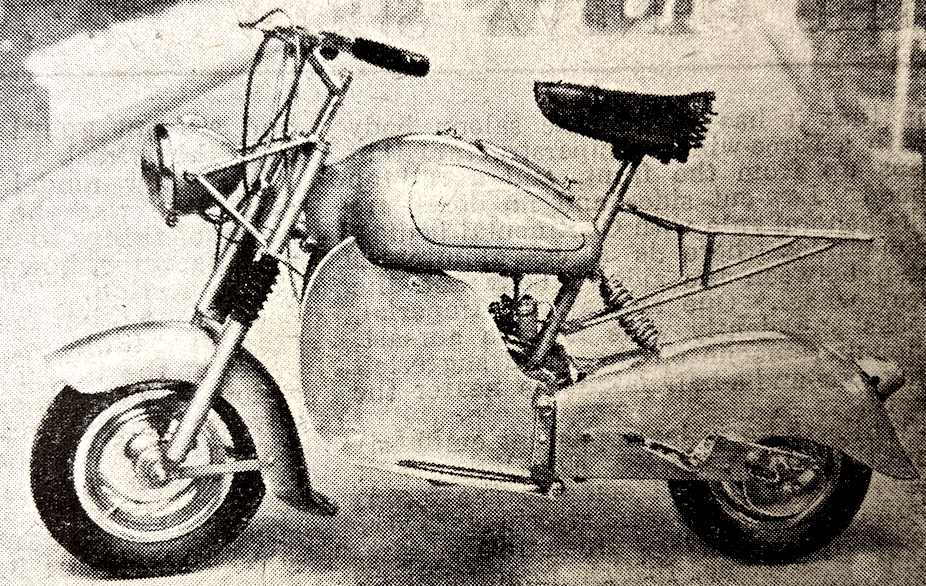
Tyres are 3.25x18in. The price announced for the twin is 3,975 Swiss francs, whereas that for the BSA twin is 3,450. Swiss francs are roughly 17 to the £. Another American exhibit is the massive-looking all-enclosed Salsbury Super-Scooter. This has a 318cc fan-cooled side-valve engine beneath the bucket seat. Primary drive is by belt operating between expanding pulleys—an infinitely variable gear operated by pedal. Both wheels are carried stub-axle fashion, an arrangement that is gaining ground. Cars employ it universally and, as a British manufacturer remarked at Geneva, this practice is employed on the landing gear of a Spitfire. Apart from reduced cost, there is the advantage that the wheels are quickly detachable and without the usual added expense. But the weight of the Salsbury comes out at over 3001b. What with this mass and the appearance of weight, is the prospective non-motor cyclist customer going to exclaim, ‘Why, I could ride that?’ Much the same might be remarked of the Bernardet scooter, described at the last Paris Show—a scoter with total enclosure and a long tail on which, it seems, could be carried father, mother and a couple of children. Surely the need is a vehicle that achieves an initial appeal of obvious handiness and low weight? The two Italian scooters, the Vespa and the Lambretta, look much more handleable than the over-3001b Salsbury. The Vespa this time is offered with a shoe-like sidecar connected to the machine by a single tube of about ¾in diameter—one welded-to-the-chassis tube. The Lambrettas on view look less jewel-like than those exhibited last year or even those seen at the factory last year. Finish of the Geneva Show exhibits as a whole is not superb—enamelling, plating and polishing in
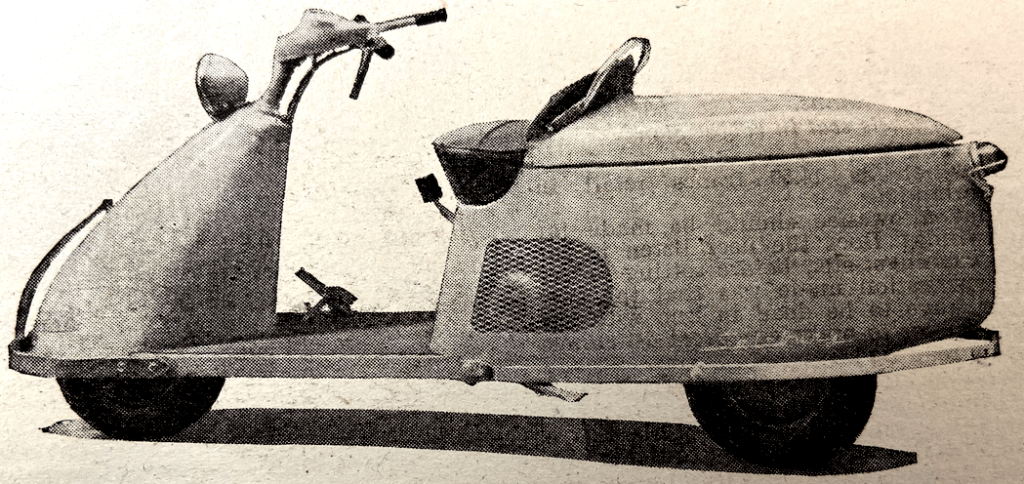
many instances is poor and, especially with Great Britain, whose products have always carried the tag ‘British and best’, the question of finish can make a lot of odds in a buyers’ market such as this. Germany’s return in strength was expected by all who have followed the vast changes in German industry over recent months and especially since the currency reform. But what surprised many is that the limitation of German motor cycle production to engines of 250cc is apparently either at an end or about to be ended. Originally a capacity limit was set on the score of curbing war potential, or so it was said, though quite what difference 250 and 350 or even 500cc makes is perhaps a moot point. Anyhow, BMW flank their 250cc shaft-drive ohv single with a 500cc R51 transverse-twin engine-gear unit: the basis of the machine which those who, like the writer, have ridden all models of this make, consider the best BMW ever. Also, Horex exhibit an ohv single of 350cc. TWN, Ardie, Zündapp, etc, at present are of 250 c.c. or less. The 250cc BMW has a new cylinder head and an improved four-speed gear box, but is otherwise unaltered. Production started at the beginning of the year and at present 100 a month, it is stated, are being made, a number that increases week by week. Manufacture of the 500cc twin is scheduled for 1950, and the machine is to be the pre-war R51 with the new cylinder heads and modified gear box. The kick-starter, as on the single, will still operate at right angles to the wheelbase. Much of the German design is pre-war. The 250cc TWN might be construed as a cheaper version of the model exhibited at the 1939 Berlin Show, with the forked connecting-rod re-placing the twin rods. It is notable, however, that this machine, like the Horex, retains total enclosure of the rear chain. A trend in Germany today, it is stated, is to discard 100cc in favour of 125cc on the score that the additional capacity results in a much more practical lightweight
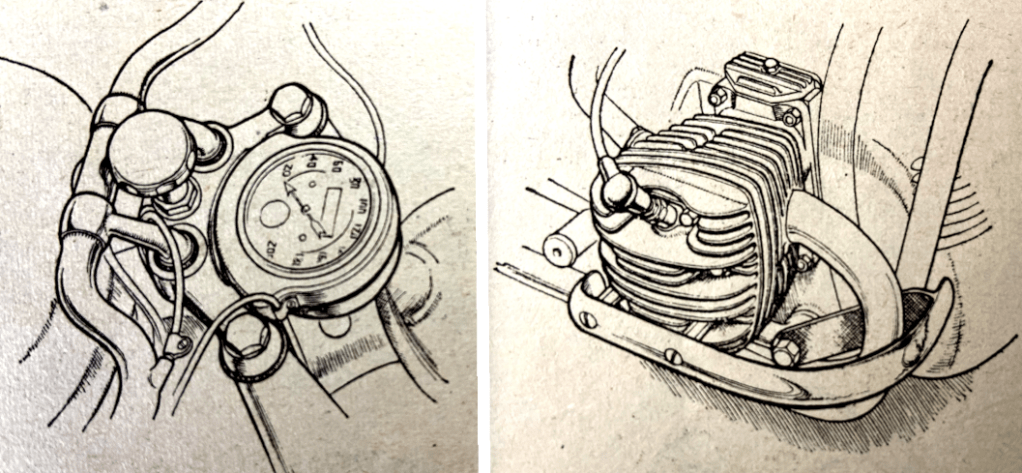
motor cycle. Britain during the war standardised 125cc for her ‘Flying Fleas’ and Germany, just previous to the war ending, followed suit by adopting a 125cc DKW as one of her two official Army mounts. German sidecars, too, display little change front pre-war. The chassis are usually of large-diameter tubing in the form, in plan view, of an inverted U with U-shaped members running transversely and the bodies pivot-mounted at the front and suspended by tension springs at the rear. Link-type wheel suspension with compression springs is widely used. An Austrian design, the Rekord, is unusual in that it has a sunshine saloon body with a three-window superstructure that tips up from the front, and a roll-top hood. Low-cut sides and no doors are the general rule with Continental bodies. Sometimes there is a cast-aluminium step between the sidecar body and the rear wheel. One sidecar, an Imperial, looks sufficiently wide for two abreast, though someone on the stand suggested that one-and-a-half might be nearer the mark. While there is less apparent emphasis on the 100 and 125cc lightweight motor cycle than at some of the recent shows, the 38-50cc attachments for pedal-cycles are very much to the fore. It puzzles some British manufacturer-visitors why Great Britain has not shown more interest in this type of unit or, the alternative, the ultra-light, bicycle-like autocycle. The Italian Cucciolo unit is seen on many stands; there are also the Velosolex, the Mosquito, the ABG and the. VAP. On Cucciolo’s own stand there is an all-enclosed Cuccioletta with the usual 48cc pull-type ‘push-rod’ ohv unit, two-speed hub gear, plus two-speed gear in the unit, telescopic front fork, and pivot-action rear suspension. Everything but the wheels is hidden and the machine, while looking tiny, has a well-tailored riding position. A novelty on this stand is a wind-operated Italian-made speedometer, a little plastic-cased Ciclon that appeals by reason of its low cost—which is 14.50 francs retail in Switzerland. What allowance should be made for headwinds? Does the user listen in for gale warnings, etc, before setting forth? The suggestion made was that the gale would have to be dead in line with the speedometer to make any great difference to the reading! Although not new, the sleek 250cc ohv Miller-Balsamo Jupiter caused a good impression. This has a sheet-steel frame with
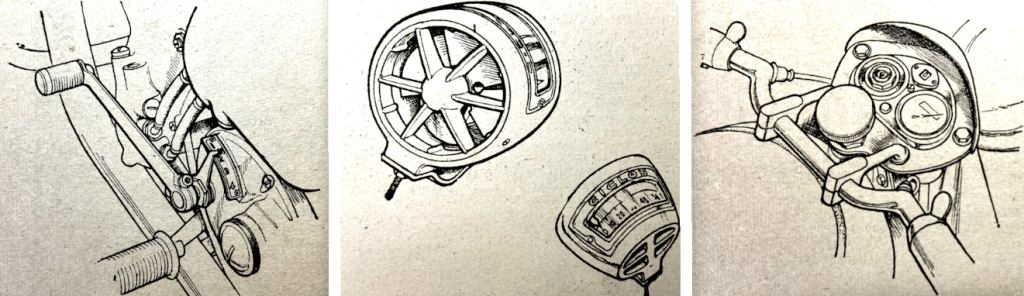
large quickly detachable side-panels and a quickly detachable fuel tank with bayonet-type fixings; built-in legshields that mate with the design; a sweeping rear-mudguard which blends with the centre portion; and a front guard that encloses nearly half the wheel. The show model is superbly finished and there was the query, ‘Is this the shape of things to come?’ A motor cycle manufacturer, however flanked this with the question, ‘What about cost?’ Among the other features of the machine are a gear indicator in a neat instrument panel at the top of the front fork, pivot-action rear suspension with a hydraulically controlled spring unit beneath the engine and pillion footrests flush mounted in recesses in the streamlined shell. On the same stand are a fully sprung 65cc open-frame Breda and a tiny Swiss Piccolo’ scooter with a 48cc Cucciolo unit and a swinging-arm rear-wheel. A more starkly simple Cucciolo-engine scooter is the Cilo, which has merely a bicycle front fork. Owing to her high production costs and the open nature of her market, Switzerland herself has only a very small motor cycle industry. There are, apart from scooters, the Condor and the Universal, with their BMW-like shaft-drive transverse twins. In each case one or more of their twins has a crash-bar designed in the hope of preventing a cylinder from being knocked off. The Condorette has a 125cc Villiers engine, and there is also a Condor with an overhead inlet-valve MAG engine. Motosacoche, famed for their MAG engines, are no longer exhibiting motor cycles, however. Last year they stated that very high production costs were a bar. Among the lesser features of the show are the many saddles with adjustable springing, the employment on several models of a single compression saddle spring mounted roughly halfway rearward from the pivoted nose, the mounting of saddle springs inside the top frame member, numerous mighty saddle-like pillion seats, the square yards of horizontal rubber mattress on Hans Starkle’s Black Lightning Vincent-HRD’s racing sidecar chassis, the smartness of the bluey grey and chrome Norton twin, the new and much needed form of outrigger front suspension of the FN (which now is somewhat ‘telescopic’ in appearance) and an improved dualseat on the Matchless twin. Above all is the fact that Geneva provides a motor cycle shop window un-paralleled post-war.”
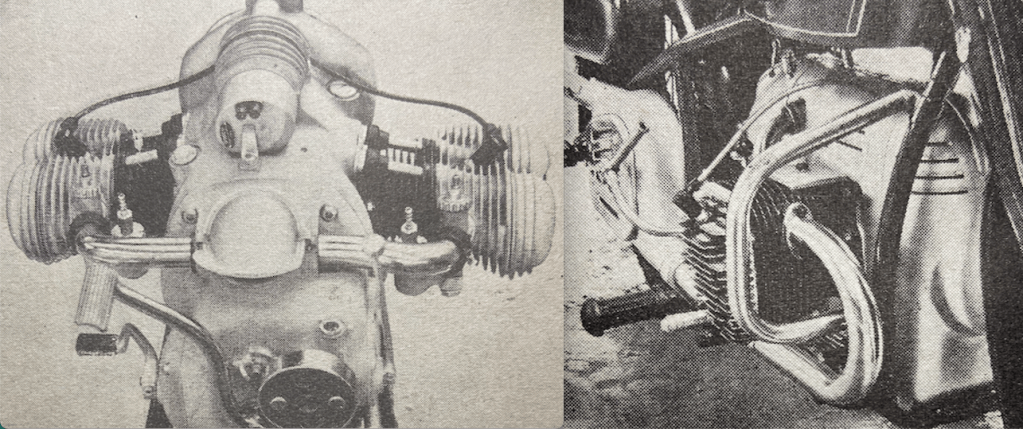
“MY MACHINE IS a 1934 Douglas Endeavour, purchased in that year and since 1939 fitted with a 600cc unit. It had covered well over 140,000 miles, having never been off the road for more than a fortnight and seeing NFS service from 1939-1945 in addition to to-and-from work riding. It is fitted with a sidecar and, as we are a camping family, has carried three of us and camping kit annually for our holidays. Its repertoire includes the Island for TT week; Donington (pre-war); ISDT, 1938; National Rally, 1938-39; Silverstone, 1948; and tours of Wales, Derbyshire, Kent, Devon and Cornwall. It once crossed the Hirnant Pass to Lake Bala with three-up. and with 2cwt of camping kit. I put its good service down to the fact that the only person who has ever been allowed to touch it with a spanner is ‘yours truly’. (I say this not as a boast, but as a good principle to adhere to.) The shaft-drive gear is as good as new and requires topping up with grease only about every three months. When I have rigged up new front suspension, the old Duggie will have to give another five or six years of good service before present designs have advanced sufficiently to encourage me to make a change. I should like to let you know that in all my 25 years’ experience of our grand sport, the Blue ‘Un has been my constant guiding star and ‘sheet anchor’. Wishing you and the Staff all the pleasure and joy in the future that you have given us readers in the past.
JG Webb, Haughton, Staffs.”
“I HAVE TWO COMMENTS to pass on the Wakefield effort to gauge motor cycle opinion. The fact that only a third of our fraternity are under 25 years of age does not smash the old adage that motor cycling is a young man’s sport. Shortage of funds is the sole reason why this age group is not immensely larger. Secondly, I regret that the organisers did not poll their contacts on the question of easier starting. They were content to ask for the most desired technical improvement.”—Ixion
“THE DAYTONA BEACH motor cycle classics, rated as the outstanding motor cycle events of the year in the United States, turned out to be a British field day for the first time in history. American riders, astride British Norton machines, monopolised honours in both the 100-mile National Amateur Championship race and the 200-mile National Expert Championship event. The Nortons obtained first and second places in the first event, and all three leading positions in the latter. Dick Klamfoth, 20-year-old Groveport, Ohio, star, roared to victory in the 200-miler. This was his first appearance as an expert, and, astride his 499cc Norton with which he obtained second place in the 100-mile amateur event a year ago, he established a new record for the famous four-mile Daytona Beach course. His time was 2hr 18min 53.05sec, an average speed of 86.42mph, which bettered the speed set last year by Floyd Emde, of National City, Calif, by more than 2mph. Second place went to Billy Mathews, of Hamilton, Ontario, popular Canadian rider who finished in this same position a year ago, and who won the race in 1941; while third place went to Tex Luse, of Burbank. California.” In the 100-mile amateur race, Don Evans (499 Norton), 19-year-old San Bernardino, California, rider, won top honours for the second year in succession, in the most sensational finish ever seen in American motor cycling. Second place in the 100-miler also went to another Norton rider, Ted Totoraitis, of Grand Rapids, Michigan. His time was but six seconds longer than the leader. Third place went to Robert Chaves, riding a Harley-Davidson machine. Some 30,000 spectators were attracted to Daytona for the two days’ racing. The course extends two miles along the wide, hard-packed, sand beach, and two miles over a paved road running parallel to the ocean front and joined by two high-bank turns created by bulldozing up the sand. In the amateur classic, 103 of the original 124 entries started the
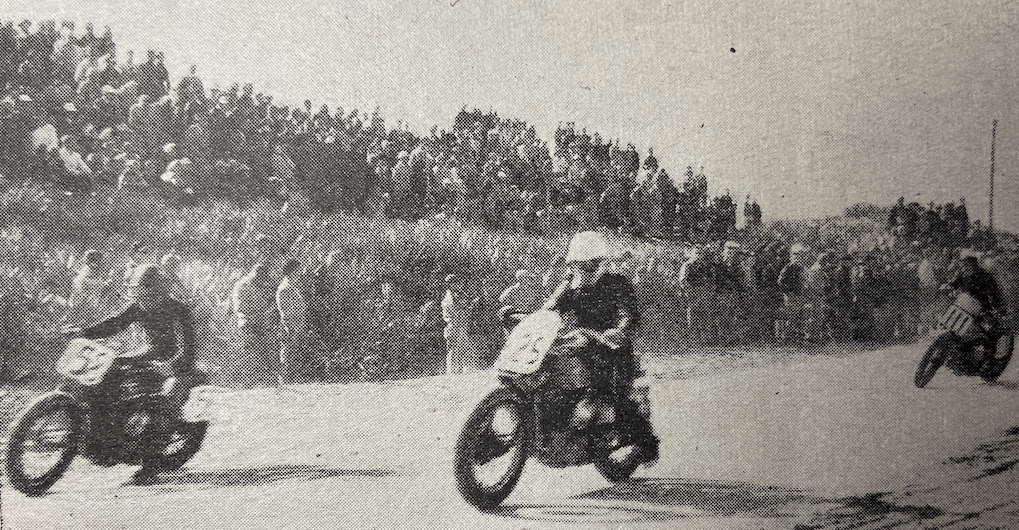
race, but only 41 of the starters survived the gruelling test to receive the chequered flag. The most sensational part of- the 100-miler was at the end. As Evans came down the back stretch over the paved road that extends 20 feet in width, his machine roared into the turn, then began a slide just as the referee was waving his chequered flag for the finish. The machine skidded over the finishing line and plunged straight for the referee, who tried to get out of the way. The Norton clipped the referee’s leg, then rolled over the bank. But officials ruled that the young California star had completed his 25 laps and he was declared the winner, finishing just 30sec ahead of the second-place man. Evans also established a new record for the 100-mile race with a time of 1hr 15min 14.38sec which gave an average speed of 79.73mph. This compares with the record speed of 78.6mph which he established last year. The 200-mile expert classic got under way with 135 machines starting in rows of 15 at 10-second intervals. For 35 laps it looked as if Jack Horn, of El Monte, California, riding a British Triumph Grand Prix model, was well on his way to victory. This young star set a terrific pace in leading the entire field of old timers and newcomers, but engine trouble developed and he was forced out with 12 laps to go. Ed Kretz, veteran rider and winner of the 1948 most-popular-rider award, then started another terrific race, as he rode his Indian machine like a newcomer seeking his first honours; but Kretz, too, was forced out with engine trouble. However, Klamfoth was in the lead immediately Horn retired. During the last 10 laps the race developed into a real battle between the two riding partners, Klamfoth and Mathews, on their Nortons. With three laps to go, Mathews came over the south turn just 3sec behind the leader, but he lost more time and finally he got the flag to finish, 16sec after the winner. Third place went to Luse, but he was 2min 8sec behind Klamfoth. Incidentally, Klamfoth made one stop for fuel and the pit work was so well organised that he took only 18sec—probably a record for the Daytona races. Mathews, who lost last year’s 200-miler solely through a dilatory pit stop, was much quicker this year, but even so was not so fast as Klamfoth’s team. Mathews made a record lap at 88.3mph. Young Klamfoth, sporting a three-month’s growth of beard as a goatee, was presented with 2,500 dollars as first-place money at the meeting following the race. Other riders of British machines who finished well up in the races were Warren Sherwood at 6th and John Gibson at 12thon AJSs in the 100-mile event. A BSA ridden by Tom McDermott was 6th in the 200-mile race, Russ Peterson (Norton) was. 15th, and Ted Hughes (AJS) was 18th.
“THE PRESENT COULD hardly be brighter, if we can screw ourselves up to be genuinely unselfish. Nothing but concentration on exports can hasten the day when Britain shall once more be solvent—solvent with ‘full employment for all’, as the modern slogan has it. Our entry into the rich American market, already so surprisingly successful, has been crowned by a triumph wholly unexpected in its scope and scale. The Daytona ‘200’ and ‘100’ may fairly be compared with our IoM TT Races. We can imagine what a shock we should sustain if some previously unknown foreign machines came over to Douglas and scooped 1, 2, 3 in the Senior and 1, 2 in the Junior, and setting up a new speed record in both. Even if the riders happened to be Britons, we should trudge back to the steamers with long faces. Well, the incomparable Nortons have accomplished just that at Daytona—a victory which will doubtless exert a galvanic effect on American manufacturers. They have been caught on the wrong foot, as Meier caught us with his supercharger in 1939. They will react with extreme violence. Considering how American riders will view the results, plus the distance between Britain and Daytona, we shall in all probability have to sing remarkably small in March, 1950. Meanwhile, the export market, which is the key to our shrinking troubles, should enjoy at least one more profitable year.”—Ixion
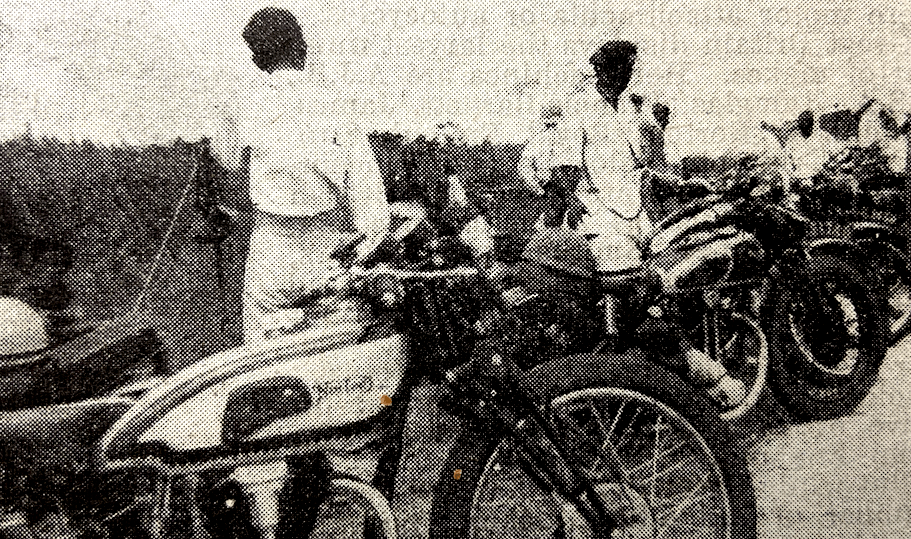
“THE TEMPORARY AMERICAN eclipse at Daytona enshrines a valuable lesson for us. Crowded by the nationwide sales of cheap, mass-production cars, the two big American motor cycle factories have long had little local competition to face from two-wheelers. They secured an iron control of the sport, the hobby, and national sales. They were thus fenced against live competition. From now on British importers will have to face a double threat in the US Threat No 1 will be a growing flood of cheap, family cars—smooth, fast, comfortable and durable. Threat No 2 will be an energetic output of vastly changed Harleys and Indians. Exports both to the USA and other countries will tend to shrink. Our own factories will have to face a very different type of market abroad, and will simultaneously be forced to tackle a home market wholly unlike any which they have known in the past. No man can thus early define that home market of tomorrow. If we plug our financial gap, and climb back to something approaching our ancient solvency, the removal of Purchase Tax, coupled with more scientific production and a check of inflation, might restore the old atmosphere. Alternatively, a measure of austerity may linger for years to come. In that event the industry would largely have to jettison the rather splendid models of 1948-49 and devise a simpler, cheaper range. Hence the complacency which tended to freeze the American industry in the past must at all costs be averted here. Trying times are in store and only great intelligence and astute judgment can solve the many problems which will confront us in the next five years.”—Ixion
“IT IS REPORTED from New Zealand that John Dale, riding a London Show model 350cc Matchless, achieved 205.243mpg in an officially observed run. For the test, Dale covered the 454-mile trip from Auckland to Wellington.”
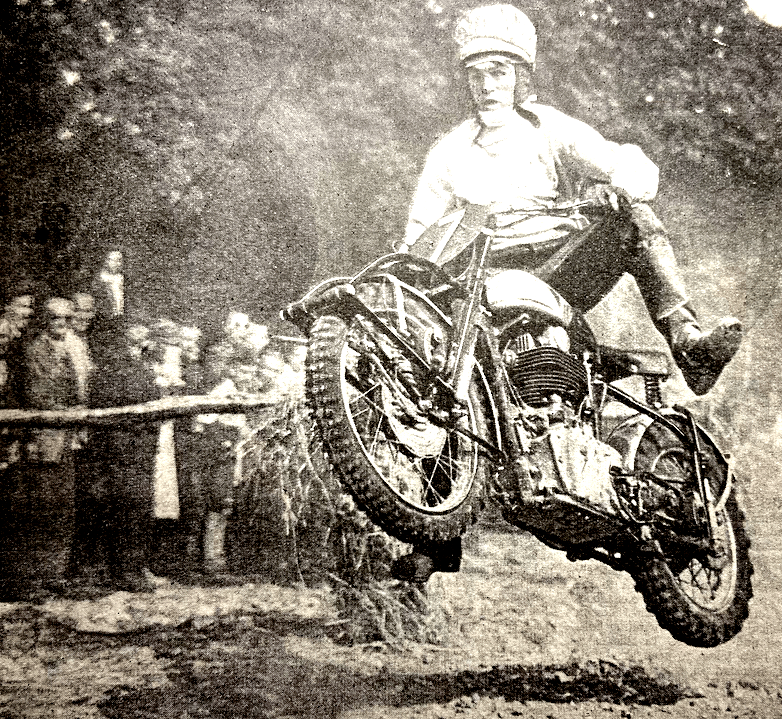
“THE RAC Guide and Handbook for 1949-50 is now available to members, price 3s, post free. The new issue runs to 732 pages and contains particulars of hotels, garages, repairers, parking places and other local information relating to more than 3,000 towns and villages. In addition, there is a 32-page coloured map section.”
“IT WAS ANNOUNCED last week that a special summer holiday bonus of petrol for private purposes will be available. This will be done by doubling the value of standard ration coupons for June, July and August in the next ration book. Coupons for those months will be worth their face value instead of half their value as at present. New ration books will be available in May and will be valid from date of issue. All coupons may be used for the five months follow ing the month shown on them.”
“IN VIEW OF the importance of observers in the running of trials, the South Liverpool MC is inaugurating an Observers’ Section which, it is hoped, will receive strong support from ladies, social members, and the younger element still without machines.”
“ENGLAND MY ENGLAND! For the Kickham Trial, held two weeks earlier, a blizzard raged; for the Cotswold Cups Trial, fourth of this year’s trade-supported events and held last Saturday, a warm, cheerful sun smiled contentedly over the Cotswold countryside in Gloucestershire. There was an entry of 137 solos and 18 sidecars for the event. The solo winner was AJ Blackwell, on a 490cc Norton, who rode all 45 sub-sections in the 50-mile course without any loss of marks. It was a clear-cut win with the next best solo rider, RB Young, also Norton-mounted, losing six marks. Sidecar winner was FH Whittle, driving a 490cc Panther outfit, who lost only nine marks. His win, too, was decisive as Harold Tozer (496 BSA sc) who made next best performance in the sidecar class, was- six marks behind with a loss of 15.”
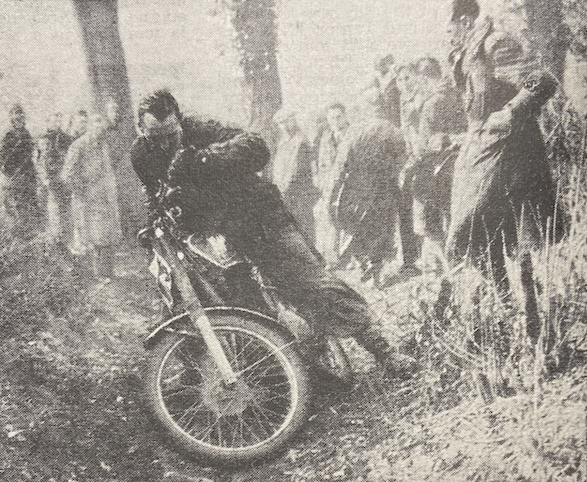
“EPSOM DOWNS, SURREY, famous setting of the Derby horse race meeting, had the appearance last Sunday of a Derby day out of season. Motor cycles and cars in their thousands and spectators in their tens of thousands crowded the Tattenham Corner area to see the start of the Sunbeam Club’s 13th Pioneer Run. Over 130 historic motor cycles, sidecar outfits, and forecars started the 40-mile journey to Brighton, Sussex: the oldest machines dated 1899 and the youngest 1914. The representation was international, with models from Belgium, France, Germany, Switzerland, and USA, as well as from Great Britain. Some of the names died years ago; others are now famous in other spheres of engineering; and others are still associated with machines in production today. Variety in design was the keynote 30 to 50 years back. Single-cylinder engines, twins, fours; two-strokes and four-strokes, the latter with side valves or overhead valves, or with the inlet valve over the exhaust; belt-drive (in many varieties), chain drive, shaft drive; front-wheel drive and rear-wheel drive; single-speed models (some with pedals), two speeds, three speeds; separate gear boxes and engines with the gear box in unit. But all have a common trait.
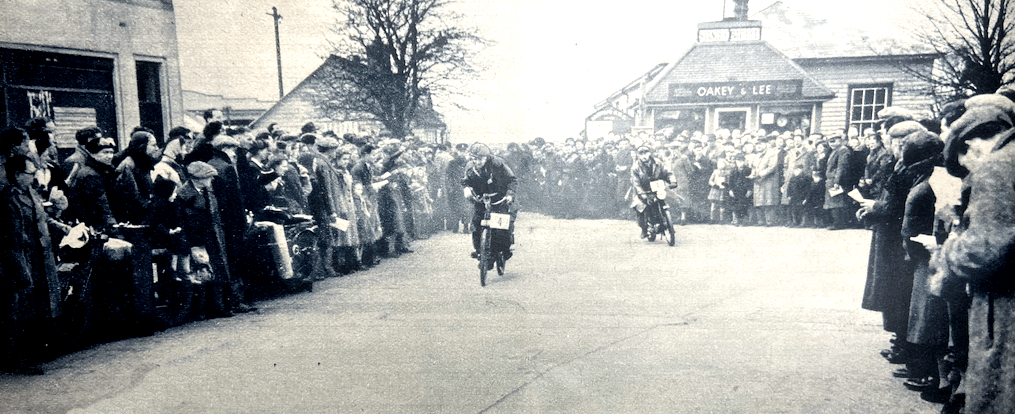
They all chuff-chuff, phut-phut, hiss-hiss, or bang-bang or make some other noise quite foreign to the sound of the internal combustion engine of today. Along crowd-lined roads, in the brilliance of a sunny March day, they all chuffed, phutted, hissed, or banged their merry way through Reigate, Crawley, Handcross, Bolney, and Albourne Green to the sea at Brighton. Some went so fast that their observers on modem machines found it none too easy to keep up. Others bowled along sedately. A few had to be coaxed with pedals or by pushing up the hills. But with a show of remarkable reliability, only nine starters failed to reach Brighton for the welcome by the Mayor and a mighty throng of spectators, who variously viewed the scene humorously, seriously, with perplexity, or with downright incredulity! RESULTS Pioneer Run Plaques (awarded to those competitors who maintained their scheduled speeds—Class 1, 12mph; Class 2, 18mph; Class 3, 24mph; with an allowance of 20 minutes late or early): Class 1—JF Kentish (142cc Peugeot, manufactured 1902); EV Bell (317 Swift, 1903); HK Cohen (250 Alldays and Onions, 1903); JF Sloan (293 Triumph, 1903); FC Dimond-Hoff (402 Buchet, 1903; MF Walker (142 Clement Victoria, 1902). Class 2—DB Sherlock (500 Zenith, 1908); ER Winter (500 FN, 1909); EL Taylor (500 Brown, 1909); D Coleman (500 Rudge, 1909); EH. Gawn (4I2 Minerva, 1909). Class 3—GW Walker (350 Sunbeam, 1913); RS O’Neill (348 Douglas, 1913); RD Thomas (495 ABC, 1913); E Marshall (499 Triumph, 1911); H Lowing
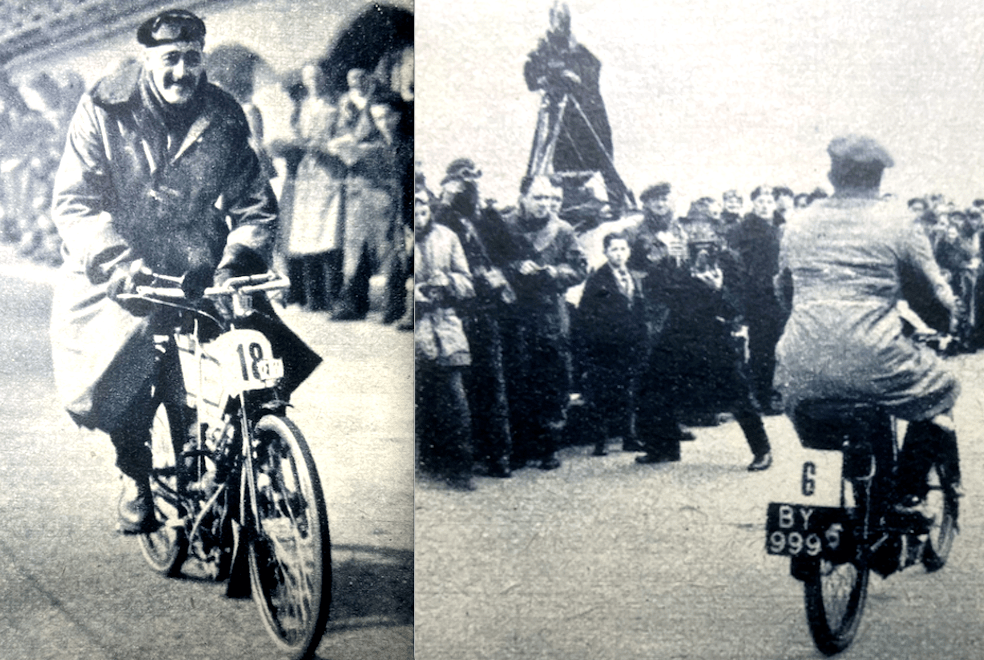
(532 Scott, 1912); HA Appleby (498 Humber, 1911); H0 Twitchen (499 Triumph, 1911); JR Clew (55) Triumph, 1914); RG Effamy (224 Motosacoche, 1910); JR MacDougall (550 Triumph, 1914); CJH Day (550 Triumph, 1914); CW Rowe (400 NUT, 1914); W Fruin (499 Triumph, 1910); GR Yeardye (269 Revere, 1914); DE Whitebread (532 Scott, 1912); AI Targett (499 Rudge-Whitworth, 1912); LA Davis (490 P&M, 1911); VH Willoughby (770 New, Hudson, 1914); JD McKay (BAT, 1913); FJB Budgett (770 Zenith, 1912); E. Damadian (292 Veloce, 1913); EH Harrison (350 Douglas, 1914); AJ Dolphin (790 Pierce Arrow, 1911); EA0 Bussey (499 Rudge, 1912); C Stanley (350 Douglas, 1914); LA Lucas (550 Triumph, 1914); WW Swait (465 P&M, 1912); E Kennard (BAT, 1914); M Banks (499 Humber, 1912); GC Hulbert (630 AC, 1910); M Whitebread (750 New Hudson, 1914); BH Budgett (348 Douglas, 1913); JF Kelleher (998 Matchless, 1914); FA McNab (498 Rudge-Multi, 1914); G Southon (499 Rudge, 1911); S Gilks (800 Chater Lea, 1913); ER Jay (499 Coventry Premier, 1911); CE Allen (499 Humber, 1912); RJ Fisher (499 Humber, 1911); JJ Allen (318 Symplex, 1914); K Cobbing (500 Humber, 1913); A Phillips (348 Douglas, 1913); JH Wright (500 Rudge, 1914); E Heward (554 Bradbury, 1912); LC Newman (499 Rudge-Multi, 1914); DG Turley (350 Royal

Enfield, 1914); GM Walker (490 Norton, 1912); AM Bush (200 Sharkbrook, 1914); WH Lewis (200 OK, 1914); EN Adlington (348 Douglas, 1913); CR Collier (998 Matchless, 1912); Mrs M Savage (350 Douglas, 1913); AL Savage (498 BSA, 1912); J Hammond (344 Douglas, 1911); GW MacIlwinne (499 Triumph, 1912); WT Mansbridge (498 Triumph, 1912); H Long (550 Triumph, 1914); 0 Tyler (532 Scott, 1913). Team Awards—Class 1: Sunbeam B (HN Ryan, EV Bell, HE Cohen). Class 2: Multis (SW Simes, PA Seymour, C. Quantri11). Class 3: Vintage No 1 (JD McKay, WW Swait, CE Allen).”
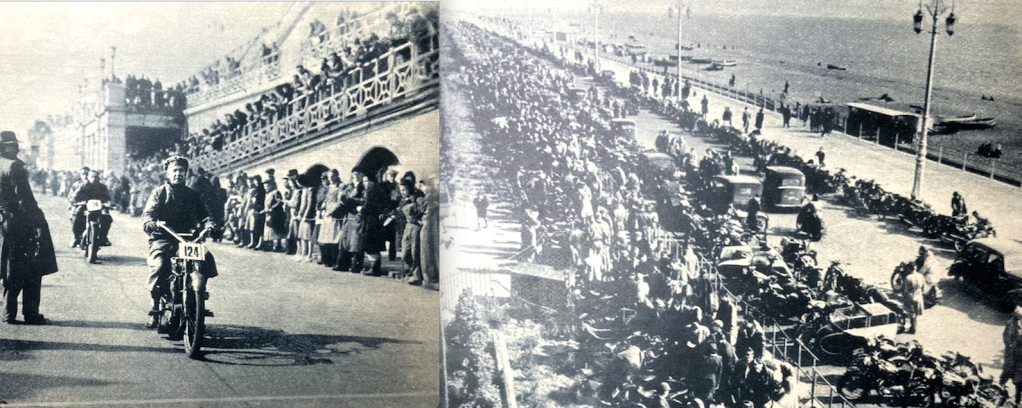
“MECHANICAL FAILURES HAVE been eliminated. During the three years since I discarded khaki, I’ve covered a fairly hefty mileage, thanks to ‘E’ coupons. I have never experienced any machine bother on the road. Of the very few lads I have met at the roadside tinkering, not one has had anything more serious to cope with than a puncture, a disconnected lighting lead, a stoppage in a petrol tap, or a dry tank. I regard the implication as a supreme achievement of the motor cycle industry. The machines on offer these days are thoroughly sound engineering jobs. If there is a certain amount of sameness in the various designs and unorthodoxy no longer flourishes as it did when the Pioneer models were on the market, the answer is simple. Within the framework of up-to-date design and production knowledge, and on the basis of accepted price levels, the unorthodox does not prove so good as the orthodox. But steadily the former catches up and merges into the latter. It catches up in the experimental and development departments at the factories—not in customers’ hands and at their expense. And that is real progress.”
“SOME 20,000 SPECTATORS saw the South Australia TT races held on the triangular, 3-mile, Woodside circuit situated about 25 miles from Adelaide. The meeting was organised by the AJS Motor Cycle Club of South Australia, and the programme consisted of five motor cycle races as well as two car events. Weather conditions were ideal, with a very light breeze blowing and a comfortable temperature. The first event of the day was the combined Lightweight and Junior TTs over seven laps. There were 21 starters. In the Lightweight class. L Diener’s much-modified 248cc MOV Velocette proved considerably faster than Fergus Anderson’s Guzzi, and the Englishman had to take second place. Harry Hinton (348 Norton) won the Junior class; in third place was Eric McPherson on a 7R AJS; he will be remembered as the Australian who entered last year’s TT Races. but who was unable to start owing to a practice crash. Major event of the day was the Senior TT over nine laps; 31 men got away in the massed start and L Boulter (490 Norton) was quickly in the lead followed by Hinton (Norton) and Anderson (Guzzi). Hinton overtook Boulton, who was experiencing slight clutch trouble, on the fourth lap and two laps later C Walker (499 Norton) challenged Anderson for third place. Anderson got the better of the scrap, but both Hinton and Walker pulled well away from him on the final lap.”

“AS AN AMERICAN feminine enthusiast, I have felt that readers might be interested to hear about what we girl motor cyclists do here in America. I have often been inclined to answer letters appearing in The Motor Cycle from girls who want motor cycles, but who are told by some all-knowing male that ‘she’ is too small and light to ride. This always tickles my funny-bone, because the males are, of course, referring to English machines, which, by American standards, are considered to be in the ‘lightweight’ class. This is in comparison with what, out here, they call our big ‘honkies’—in other words, our 74 ohv Harleys. It is true that the majority of girls riding in Southern California have British machines, but this is not because they cannot handle the bigger ones. It is because of the type of riding they indulge in—to the almost complete exclusion of travelling, favourite pastime of the Middle Western and Eastern riders. I have lived in California only a little over two years, for I was at Rhode Island, on the eastern seaboard, up to then. I began riding with my husband before we were married in 1932. Although he taught me to drive a sidecar, I never got a licence to drive until 1939, as we were too broke to have two machines until then! I am barely 5ft tall and weigh about 120lb. At first I had trouble in reaching the ground with my feet with the big machines. This made it awkward to learn to ride. At that period there were hardly any British models over here, and we used to stare at them as something quite incredible. The only small American motor cycle at that time was a 500cc V-twin. I got one, and, after barely learning ‘to make it go’, took off on a trip to Canada, on to Milwaukee US, and back home via the World’s Fair in New York. The machine seized up on me regularly; the generator belt broke a dozen times; I was using a quart of oil to a hundred miles; and I fell off with monotonous regularity on a 500-mile stretch of loose gravel encountered in the wilds of Canada. Still, I thought it was a marvellous vacation, with little rain to prevent my sleeping out; and I spent only $40 for a fortnight’s 3,500-mile trip. However, by the time I got home I was dead sick of such a small machine, and I informed my husband that I wanted a Harley 45 right away! Money was still short at that time, so I thought I’d have to wait until next Spring. But, as usual, luck was with me. Fate, in the shape of a rather stupid driver, hit me while I struggled at the side of the road one night (trying to extricate the rear chain from the wheel where it had become lodged when the chain broke). My leg was broken. After a couple of months hospital, and a short time on crutches, I graduated to a cane, and we collected $1,500 and other damages from the man who hit me, and $650 from my own accident policy. Never had we had so much cash in
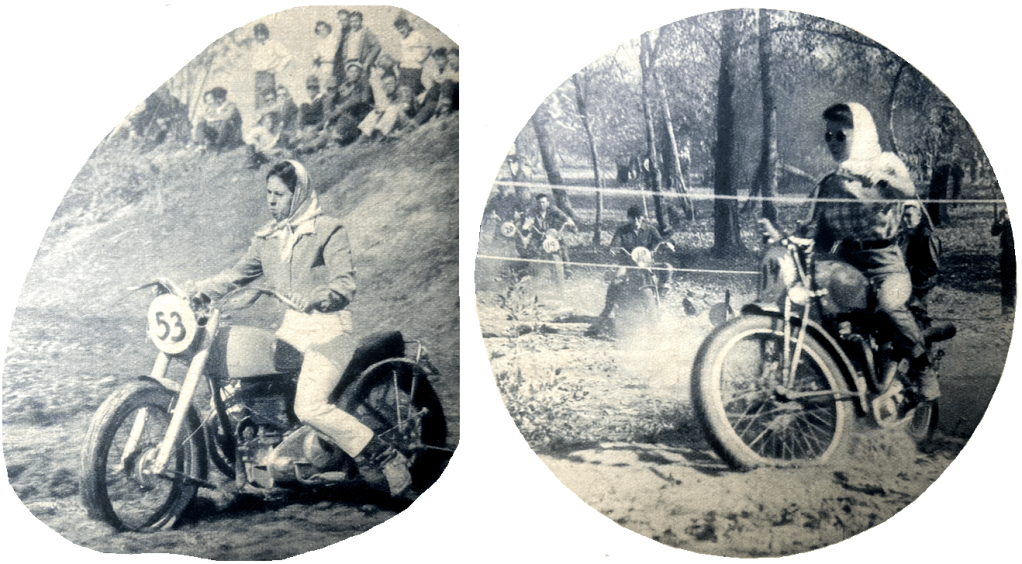
hand at one time before, and it fairly burnt holes in our pockets. While still with crutches, I rode my old machine some 40 miles to the next big town, where we traded it in for a new H-D 45 for me and an HD 80 for my husband. We had never had brand-new machines before, and the thrill was unforgettable. My 45 was not delivered for three months, for my husband was afraid I would ride it too soon, on ice or something, and break my leg again. However, this deal accounted for only about $1,000. We still had some money left. So we bought an old side-hack for the H-D 80. Bud wrapped me well in my new leather suit and in blankets, shoved in the cane, and away we went to Florida. After a short time down there, we decided it was sort of dull, so we took the southern route out to Los Angeles in the hope that I could get secretarial work while Bud went to college. However, at that time they would employ no one in Los Angeles who couldn’t prove they had been there for six months, so when we came to our last hundred dollars, we left for home. We picked up my 45 at the H-D factory in Milwaukee on the way. After that I had another 45 model with a buddy-seat. Then, in 1943, my husband got me a Harley 61. He had a 74 ohv at the time, which was much better for sidecar work in winter on the snow and ice, but he put a chassis and box on mine for groceries, ice, chicken feed, etc. During those years after I had learnt to ride, I found other girls who rode, but they were all so far apart that you hardly ever met them except at gipsy tours, etc. Eventually, after writing to many of them and discussing the matter, I started the all-girl rider national organisation known as The Motor Maids of America. We started with 50 members, and now have close on 400. The organisation has been led from the first by that really extraordinary girl rider of Detroit, Dot Robinson, who so frequently beats the men in the endurance runs (like the Jack Pine, etc). In this locality alone we have over 40 members. We have local meetings every month. The majority of men in America are anxious to see the girls ride, and while some of the girls are extremely young, many are in their late twenties and thirties, and some even in their fifties and sixties. Furthermore, the majority of the girls, with
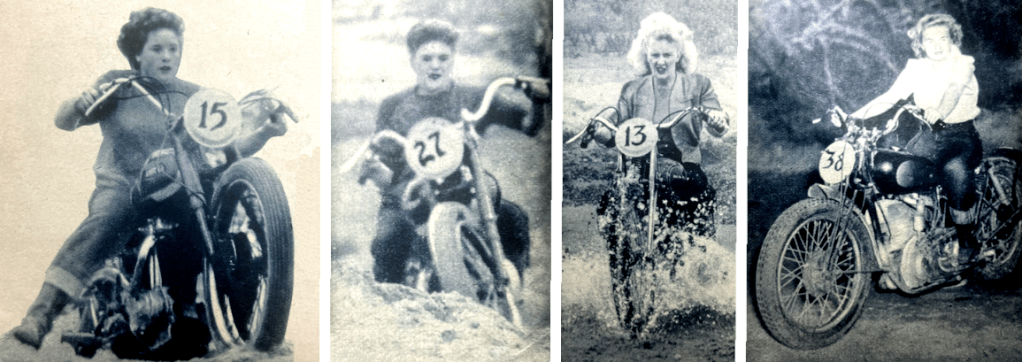
the exception of those here in Southern California, ride 61s and 74s. They generally use buddy-seats and windshields, and have their machines all decorated with other chrome gadgets, thus adding still further to the weight. But they have no trouble riding them. So I do wish Englishmen wouldn’t be quite so superior when they tell their women they should be satisfied with the pillion—how anyone rides on a little wedge of rubber without having permanent injury is beyond me! And don’t let the frequent sight of pillions on our California ‘chopped jobs’ lead you to suspect a large use of them here by anyone but the rider—to get more traction in the dirt. Nor should men enthusiasts tell English girls, who are often much bigger and huskier than some of us, that any English model is too heavy for them. It’s all in your head—if you think you can do it, you can do it, as I’ve drummed into the heads of all the girls I’ve taught to ride. All of which brings me to California in 1946. I decided that my long desired return to California should be effected, and this time we would be smart. I would go ahead, find a job, and get settled, and then my husband could join me after selling our property in the east. I took his 74 ohv with side-hack loaded to the gills, as transport charges were high even then. I set out on a very roundabout route west, trying to visit every Motor Maid I could possibly squeeze in. This netted me an 8,500-mile trip in six weeks, wandering here and there across the country. I arrived in Northern California in time for the Nation Motor Maid Convention, and then went south to Los Angeles, where, without more ado, I secured a job in the parts department of the biggest Harley dealer in the country, Rich Budelier. He said that when my husband came out, he could go to work in the shop. We were all set, and some six months later my husband arrived. I had bought a trailer caravan, and we parked in a private yard with people who like motor cycles. My last remaining cat was shipped out by air, and he thinks California is ‘the nuts’, because he seldom gets his feet wet and never has to go out into the snow! As soon as I had been here for a while, I looked up all the local Motor Maids. Soon we had ideas of a local ‘chapter’, which we now have, with new members coming in all the time. At the same tune, I thought it would be nice for the girls to have runs and meetings put on for them alone. I finally persuaded one club to put on an endurance run, and they had 18 entries. Everyone had such fun that several more runs were put on during the winter, each one becoming rougher and providing much more employment. I forgot to say that my husband had always wanted to own a Triumph. But back east it wasn’t practical, because we run side-hacks all winter, and at that time we couldn’t afford three machines. So when he got out here and found that about all the riding done is ‘in the hills, cow-trailing’, he thought it would be nice for me to have a Triumph, as it was so much lighter for roughstuff. We got one, and he was crazy about it and rode it all the time. But somehow I never could feel quite secure on such a light machine, and while I rode it quite a bit here and there. I always went back to my big honky with a sigh of
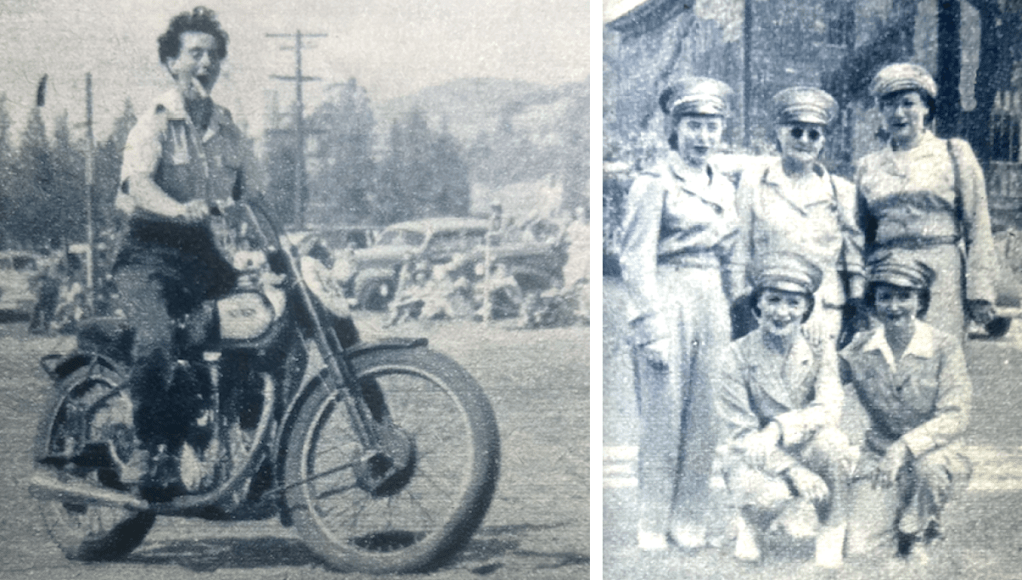
relief. However, last winter, I too began to go in ‘for dirt’ (roughstuff) in a big way, as I had so many girls to ride with; and every Saturday afternoon you’d find us out in the hills really having fun. All the girls had British machines, and, of course, they had to help when I got stuck. But it was great sport. Ixion recently remarked on the picture of Mackie Parks (Triumph), and laughed about her ‘peevish expression at the tough going ahead’. Actually, it wasn’t the tough going that made her screw up her face, but the mud and water thrown in her face because her machine was ‘chopped’ and she had no front fender (mudguard). Personally, even when I ‘chop’† a motor I want a small piece of fender to keep the sand, etc, out of my face, but owing to the rainless summers and almost rainless winters here, many of the riders simply remove their front fender completely. I think this is silly on the British jobs, because they are already as light as anyone needs for any kind of going. The observed section Mackie is going through was a good one. It was U-shape. You entered at the top of a deep sandbank (most Californian rivers are completely dry in summer and the dry, deep sand-beds are favourite roads for the riders). However, this one had a small stream about 3ft wide and 8in deep in the middle. Competitors rode down to the flat river-bed, crossed the water, made a sharp right turn in very deep sand, and, about 30ft farther on, made another sharp right turn across the water, went through the mud and up the nice, soft, sandy river-bank again. One girl, a 15-year-old entrant, made two of the three trips through this without a point against her. Her l3-year-old sister also did fine. Theresa Wallach*, from Britain, arrived in California some time ago and I introduced her around. She entered in the English-style trials. Later on, Theresa entered one of our field meets, and I believe took second place. I enjoy it when one of the girls is able to outride the men in an event, as Dot Robinson does, though there is no one more feminine than Dot. She rides so well that some of the men just haven’t a chance—she’s been at it some 20 years and yet her daughter, now 15, is often taken for her sister. Many of the girls here enter the men’s runs and we have fun—and the men encourage us. I wish they’d do the same for British girls. I don’t think sex has anything to do with good riding, and certainly just plain muscle hasn’t, so I really can’t see what all the to-do is about. I hope that when Britain has ‘free gas’ again there will be an increase in the number of girls riding. I had my first ride on a motor cycle when I was 11, given me by a woman rider in Stratford-on-Avon. I’ve never forgotten it. No doubt by this time readers are off in dreamland…I didn’t intend to write such a ‘book’, but when I get on to my favourite subject, it is hard to shut me off.”
* Teresa Wallach knew a bit about riding motorbikes in the rough—she and her chum Florence Blenkiron rode a Panther combo from London to Capetown. Read all about it in 1936.
† This is an early use of the word ‘chop’ in the sense of stripping excess bits from a bike.

“OUR QUERIES EDITOR, Roy Morton, has recently completed a painstaking research into the character of the early shows. His brief summary, set out below, will give the student some idea of the path traversed by the industry: 1897—First Show (Stanley)—eight motor cycles. 1898—Six motor cycles*. 1899—One motor cycle*. 1900—One motor cycle*. 1901—105 motor cycles; 10 trikes or quads. 1902—202 motor cycles; 12 trikes. 1903—361 motor cycles; 14 trikes; 1 quad. The jump from 1901 onward was mainly due to bled models, powered by imported engines (mostly Minervas). After 1903 the number of motor cycle exhibits fell away. Sales had been disappointing, chiefly owing to lack of comfort and unreliable ignition by coil and battery. This slumpette ended in 1908, when the high-tension magneto practically banished ignition troubles.”—Ixion
*plus a few tricycles
“TWO PRINCIPAL FEATURES distinguish the 1949 Show. The first is the contrast between it and the Car Show. The latter was cruelly tantalising, because hardly any home users could hope for delivery during 1950, or even 1951. A large percentage of the motor cycles will go abroad, but enough will remain for a determined buyer to start his ownership at no distant date. The second main feature is the triumphant character of the Show. It is in a sense the cock-a-doodle-doo of an industry which, after a prolonged struggle, has climbed to the very summit of international competition. If we had a standardised world currency and universal free trade, British machines would enjoy the same kind of monopoly market already won by Harris tweed, Scotch whisky, French wines, and Rolls-Royce cars. In other words, they would be the connoisseur’s choice for almost every purpose.”—Ixion
“SILVER JUBILEE SHOW To be the Largest of its Type in the World : 0pen for Eight Days Including Two Saturdays. There is every reason to expect that the London Show will be the most successful of the series. On the basis of the number of exhibitors of motor cycles and cycles, and allied products, and on the space allotted, the Show will be the largest ever held in any part of the world…The final list indicates that there will be 186 exhibitors occupying an area of 121,500 square feet. There will be over 30 different makes of machine and more than 200 motor cycles on view. Exhibits devoted to sidecars, engines, gear boxes, carburettors, ignition equipment, tyres and accessories will number about 60. This will be a Silver Jubilee occasion. It is the 25th of the series of Shows organised by the Manufacturers’ Union and some idea of the continued health of the motor cycle and cycle industries, despite the hindrances occasioned by the aftermath of the war, can be gauged by the record-breaking nature of the exhibition. As compared with last year, delivery delay on new machines is shorter except for a few, much-sought models. There is, therefore, the added attraction this year that a prospective purchaser can choose his machine and expect to obtain delivery within a reasonable time. Indications are that although there will be a number of entirely new models, and a few Show ‘surprises’ might well materialise, there will not be such a high proportion of completely new designs as for 1949. The intervening period has been widely employed for development and test. The prospects are bright and there will be a wealth of interest for all motor cyclists.”
“OVER 10,000 VISITED THE LONDON SHOW on the first day; the number on the second was 44,000. Thus, in two days the attendance was well over half the total for pre-war exhibitions. There is no doubt about the success of the Silver Jubilee Show either on the score of the number of visitors or on that of the enthusiasm the machines evoke. Motor cycles are gaining rapidly in popularity, not merely in Great Britain, but in the world as a whole. The British figures are telling. In 1947, the total number of motor cycles registered in England, Scotland and Wales was 528,415; last year the figure was no less than 559,513, an increase of over 30,000, and the official statistics for the present year will probably show an even larger increase. There is growing realisation that motor cycles are unique in their economy and that no other vehicle gives the same sense of freedom or offers the same exhilaration. And the modern machine, with its hairline steering, unique manoeuvrability and superb braking is, properly ridden, a thoroughly safe type of vehicle. The London Police prove this. In their case the merest touch, even damage to a leg-shield on a kerb, is an accident unless it be proved that there was no fault on their part. In spite of these stringent conditions, the ‘accidents’ of all the police motor cycles over the first eight months of this year numbered only one in 142,020 miles.”
“OUR BUYERS’ GUIDE issues have usually appeared in stimulating circumstances—never in so quaint a milieu as to-day. Never did the Show list contain more variety with better quality. Never did the industry contribute so magnificently to Britain’s treasury. Never was the position of British machines faced by so weak a foreign challenge. From the external and international angles everything in the garden is pretty good. The same is true of the technical position. Every essential problem of design and production has been well and truly met, so far as they relate to current demands by available customers. But every medal has an obverse. An industry exists primarily and normally for the home market. The British home market for motor cycles is at the moment throbbing with pride in the world sense, but reeking with frustration in the more personal sense. The percentage of output allotted to us is very small. Current prices have towered far higher than many of us can reach. Worst of all, we can only obtain the measliest dribble of petrol. No doubt the day is galloping towards us when the loathsome Purchase Tax will die amid a chorus of curses, and the petrol ration will be mightily multiplied. But the old merry insouciance has vanished for the time being. We find life grim so far as our pet hobby is concerned. All clouds lift or scamper away sooner or later. May ours pass away quickly!”—Ixion
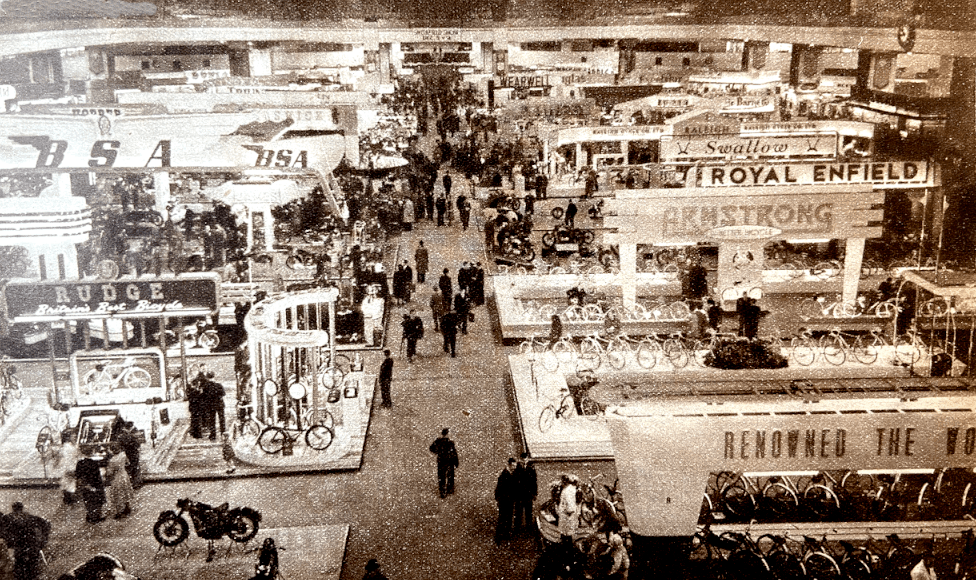
“TOTAL NUMBER OF autocycles, runabouts, motor cycles and three-wheelers (including commercial vehicles and the five Czechoslovakian machines) on show at Earls Court is 309. In the following analysis the five foreign machines mentioned are omitted, as they are not priced in this country, nor, at present, available. Value of the 304 machines, at basic retail prices is £40,236 5s 6d [about £1.8 million in 2026]. Cheapest machine in the show is the Corgi runabout at £43 6s [£1,900]. There is a tie for the cheapest autocycle between the Excelsior and the New Hudson at £45 each [£2,000]. Cheapest motor cycle on view is the 98cc James two-speed model at £48 10s [£2,200]. Most expensive machine shown is the Vincent Black Lightning 150mph racer at £420 [£19,000]. There are 29 British makes at Earls Court. The following figures are, of course, based on the total number of distinct and separate models exhibited, which is 140. Where spring-frame and rigid-frame machines of the same engine size are exhibited, these are counted as separate models. TYPE: Two wheels, 131; three wheels, 9. CAPACITY: 100cc, 14; 125cc, 20; 150cc, 1; 200cc, 15; 250cc, 5; 350cc, 27; 500cc, 40; 600cc, 5; 650cc, 4; 750cc, 2; 1,000cc, 7. ENGINE: Two-stroke, 51; sv, 10; ohv, 71; ohc, 8. CYLINDERS: One, 100; two, 34; four, 6. IGNITION: Magneto, 125; coil, 15. LIGHTING: DC dynamo, 69; AC direct,28; AC rectified, 22. TRANSMISSION: Unit construction: 69; separate gear box, 71; gear primary, 14; chain primary,126; shaft final, 7; chain final, 135. GEAR BOX: Fixed gear, 12; hand-change, 14; foot-change, 114; two-speed, 4; three-speed, 44; four-speed, 80. SUSPENSION: Sprung rear, 57; rigid rear, 83.
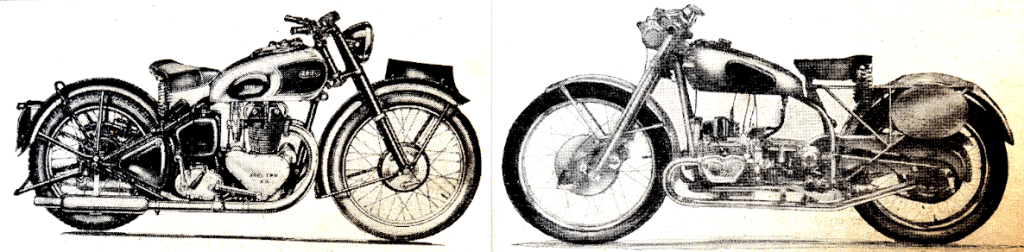
Twin-cylinder machines number 24% of all models exhibited. Three out of every eight motor cycles have sprung frames. No fewer than 50 of the 140 separate models are under-200cc two-strokes. Telescopic forks the general rule. Four gears universal on machines—other than speedway—of more than 250cc. A British Vespa scooter. Every big manufacturer now marketing competition. models. Advent of over-500cc vertical twins. Larger tyres and larger saddles on many lightweights…World champion Les Graham’s 500cc AJS ‘Porcupine’ racer and Hugh Viney’s International Six Days’ Trial model are two of the highlights on the AJS stand. There are also two springer twins, four standard 350 singles, two springer 350 singles, a 350 and a 500 Competition single, three standard 500 singles, two springer 500 singles, two 500 single sidecar outfits and a 7R racing machine. Two of the models have chromium-plated petrol tanks. What a galaxy of machines! Of great attraction are the two new Competition models. Based on the machines ridden by trials expert Hugh Viney, the new AJS Competition models both have an aluminium-alloy barrel and cylinder head. A cast-iron barrel liner is employed, and cast-iron valve seatings are cast into the head. Both cylinder and head are neatly retained by internal studs and sleeve nuts which are wholly invisible from the outside. Light-alloy mudguards are employed; and the petrol tank, made of steel, holds 2¼ gallons. The new Lucas ‘wading’-type magneto is fitted, which is fully waterproof. There is
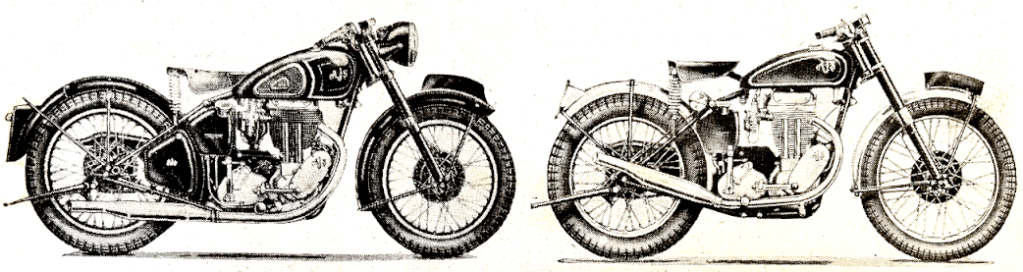
a screw-on, light-alloy cover to the contact-breaker, and this cover has a breather connected to a pipe which has its outlet at petrol-tank level. Another feature on the Competition models is a cylindrical tool-box with a quick-action ‘filler-cap’ lid. Weight of the 350 Competition model is 2981b and of the 500, 3041b. Many eyes will be looking longingly at the AJS vertical parallel twin 500. This model has two entirely separate cast-iron cylinder barrels spigoted deeply into the crankcase. Two entirely separate aluminium-alloy cylinder heads are used, joined by a single carburettor at the rear and by cylinder-head stays in front. Three bearings support the cast-iron crankshaft on this model. The Lucas ‘long’ dynamo is fitted, which gives an output of 8.5 amps. Unfortunately, this fine machine is still an export-only model. Four Series III 197cc Villiers-engine Ambassadors are to be seen, as well as two ‘Popular’ editions of the same model and two Series V models. The ‘Popular’ Series IV model sells at the low basic price of £66. Both Series III and IV machines are fitted with the Webb link-type front fork; Series V has a telescopic front fork. Series III and V are fitted with battery and rectifier
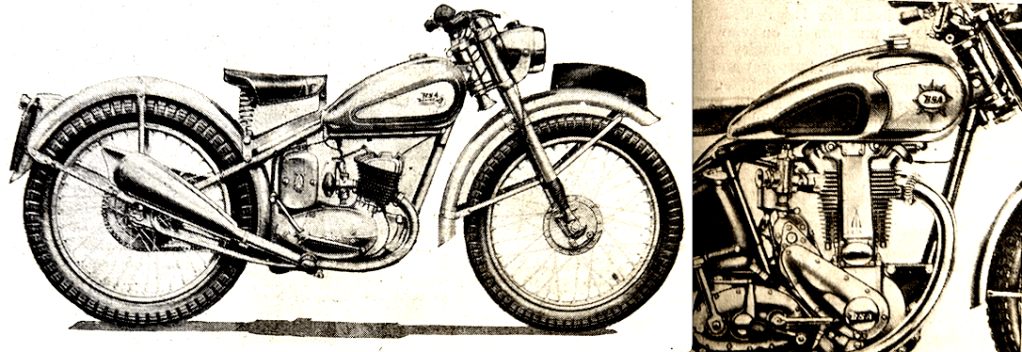
lighting sets. When you have thrust your way through the crowds round the Ariel stand—almost in the centre of the great hall—it is difficult to know what to do first. There is a sectioned model of a spring-frame fitted with counter-balance weights so that it can be easily operated by hand. It is fascinating to note that at no position of its travel is the slightest variation in chain tension apparent. There is also a sectioned gear box—you can see what goes on ‘inside’ when you change gear. But probably the tit-bit on the stand is the sectioned, working model of the ‘Monarch of the Multis’, the Ariel 997cc Square Four engine. It is driven by chain from a concealed electric motor and covered by a transparent cover (so that young men, pointing out interesting technical details to incredulous and awe-struck girl friends, will not have their fingers trapped beneath the pistons!). There is also a sectioned Ariel Twin engine which _can be ‘turned’ by means of a naval-type capstan wheel on the mainshaft…Trials enthusiasts are gazing almost reverently at the new VCH, alloy-engine, 497cc competition machine. It is a well-tailored job with all the wealth of experience of trials stars, Ray, Evans and Vanhouse, behind it. Several models on the stand are finished in the new green which is optional on all except the Red Hunter models. These of course, retain their traditional red, chromium, and black. The
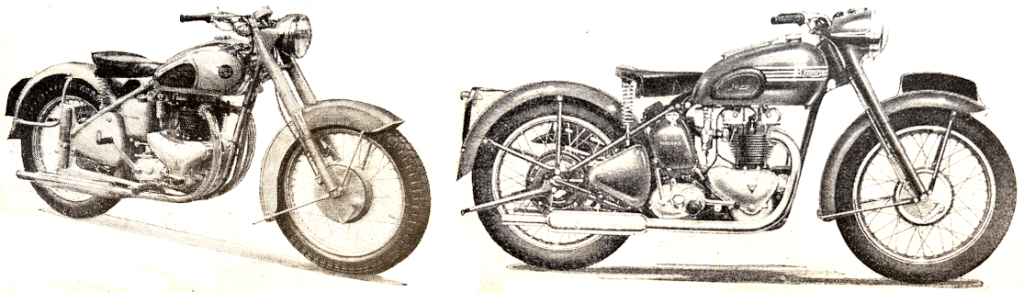
green colour has been made available because of popular demand—especially from oversea. On the Ariel stand there are fours, twins and singles—the only stand in the exhibition offering this variety. Capacities range from 350-1,000cc. For the first time the 650cc BSA Golden Flash is on display to the public. It is being widely referred to as one of the smartest machines in the mighty hall. The finish is polychromatic beige and chromium. On the tank is an attractive motif with red BSA lettering and a zig-zag flash of lightning. The engine design is very clean—similar to that of the A7 495cc twin, but with, possibly, a smarter timing-case cover. A feature of the model that is receiving almost as much attention as the engine is the new massively proportioned front brake. The drum is an 8in diameter Millenite casting, and the shoes and shoe plate are aluminium-alloy. Though the timing gear of the Golden Flash is fundamentally on A7 lines, the camshafts are not interchangeable…the cylinder head is of entirely new design and has a single rocker box in place of the pair of boxes used on the A7 Twin: ingenious fin design allows cooling air to pass almost right over the cylinder heads. Valve clearances are easily checked on the 650y, since access to the adjusters is gained through large, aluminium-alloy plates [but getting all four pushrods in place when reassembling the top end is a bugger—Ed]. Surrounding the 125cc Bantam there is a continuous throng of interested visitors. Chiefly interested seem the teenage riders, the elderly and the ladies! The rear-springing on the de luxe version has been very neatly carried out and, so that
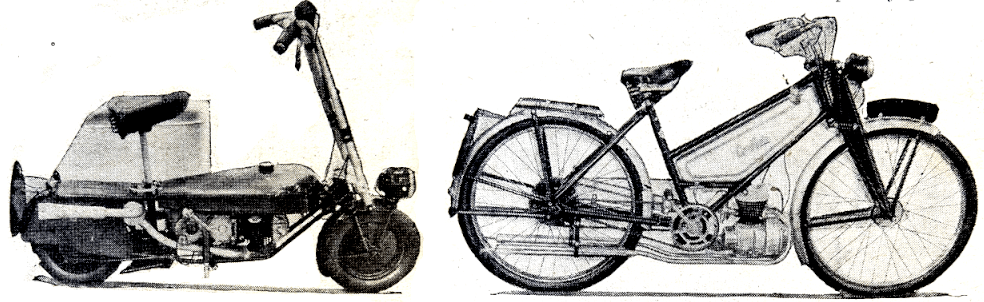
there is no gap between the mud-guard and tyre, the whole length of the rear mudguard is valanced. On the standard Bantam, only the forward part of the rear mudguard is valanced. A very clean external appearance has been given to the generator side of the de luxe model, which has a 45-watt Lucas AC generator and battery and rectifier lighting. Standard and Competition Bantams retain Wico-Pacy flywheel magnetos and direct lighting. BSA alloy-engine sports machines, the Gold Star 348cc B32 and the 499cc B34, are proving, as the 350 proved last year, to be among the most popular competition mounts on display. Though, at first sight, the CZ might appear to be similar to the 125cc models which have been exhibited at Earls Court before and have done so well in the International Six Days’ Trial (an actual ISDT machine is on view), it is, in fact, a new model. Capacity is 148cc (57x58mm) and the design incorporates a neat shield enclosing the carburettor. This shield mates in with the contours of the crankcase and is readily detachable after two screws have been removed…Other features are a three-speed gear box with positive-stop foot-change and a telescopic front fork. A most interesting exhibit is the three-wheeler for commercial use. Front part of the machine is almost identical with a standard motor cycle. At the rear of the saddle is a framework on small wheels (16x4in tyres) carrying a wooden open-
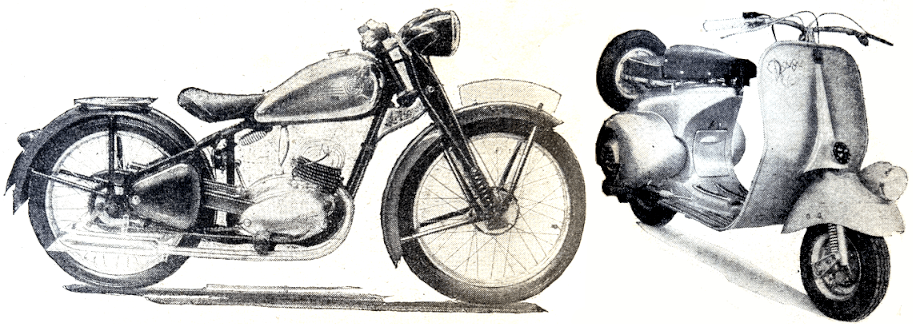
top body pivoted at the front and suspended by telescopic legs at the rear. Brilliant new models ranging from a hyper-sports mount in road-racing trim to Italian-designed 125cc two-strokes are causing more than usual congestion around the Douglas stand. A scooter-like vehicle [eg, a scooter—Ed] with all-enclosed works, a saddle and good weather protection, the Italian Vespa is being made under licence in Bristol and is named the Douglas Vespa. The engine (which is fan-cooled), three-speed gear box and rear wheel are in one unit. There is oil-damped rear-springing. The main frame is of pressed steel. Front suspension is by a tubular fork with bottom trailing links and helical springs. An output of 4bhp at 4,500rpm is claimed. Five distinct models comprise the range of 350cc ohv Douglas transverse twins: Mark 3 De Luxe and Sports, Competition, 80 Plus and 90 Plus. The Mark 3 series is available, and shown, in polychromatic blue or black, chrome and silver-sheen tank-top. A modification is that the front mudguard now travels with the wheel on fork deflection. Improvements on all models include saddles adjustable for height and tilt, adjustable tank mountings to bring the knee-grips in the required position, pillion footrest lugs on a sprung part of the frame, streamlined toolboxes on both sides, and externally polished engine-gear units. Light-alloy heads and barrels, 8in ground clearance, 53in wheelbase, and a weight of 3001b are features of the competition model. The Plus 90 has an alloy engine with redesigned cylinder heads, racing cams, balanced cranks, a choice of compression ratios from 7.25-12 to 1, and many alternatives in equipment. Four 197cc Dot machines are on exhibition. Two are direct-lighting models and the others are fitted with battery and rectifier lighting. This is the new Dot’s first Show appearance, and it is causing wide interest, not least among old-timers who recall the Dot’s achievements in the TT. The power unit, of course, is the 197cc Villiers 6E engine, with three-speed gear in unit. A Webb girder fork, with pressed-steel blades and a central compression spring, provides front-end suspension. The completely chromium-plated petroil tank has a capacity of 2¾ gallons. As anticipated the new 244cc Excelsior Talisman two-stroke twin is drawing crowds in their thousands. Last Saturday, especially, it was at times almost impossible to get near the stand. Each cylinder is a separate casting with the fins cut off along their opposing edges. The finning is most generous and gives the engine the appearance of being larger than 250cc…the combustion chambers are roughly of half pear shape, tapering to the rear, where the sparking plugs are
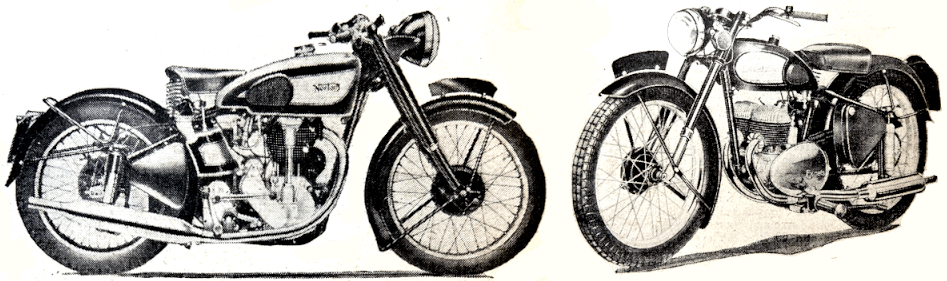
arranged, well protected, at an angle. Flat-top pistons are employed. The Talisman frame is similar to that used on the 197cc Roadmaster. It has neat plunger-type rear-suspension, which gives a total movement of l⅜in. Front suspension is by means of the Excelsior telescopic fork. However, the Talisman is only one of the motor cycles on the Excelsior stand to stimulate enthusiasm. There are also the 197cc Roadmaster models and the 122cc Universals, each available with direct lighting or with battery and rectifier lighting. On theFrancis-Barnett stand are shown two of the Merlin 53 models and three of each of the others. The 1950 range comprises the Villiers-engined 98cc. Powerbike 56 (an entirely new autocycle), the 122cc Villiers-engined Merlins 52 and 53, and the 197cc Villiers-engined Falcons 54 and 55. The difference between the two Merlins and that between the two Falcons is that Models 53 and 55 have battery-rectifier lighting sets. There are also on the stand three Villiers units, exhibited separately, and a sectional Francis-Barnett telescopic fork. This fork is notable in that it is fitted with long, three-rate springs. Features of the 1950 motor cycles are their larger saddles, which have a lin range of adjustment for height, and their ribbed front tyres, which help to provide good steering. A new loop-type, welded frame has been designed for the Powerbike 56 autocycle; the engine has three fixing points. Front suspension is provided by a parallel-ruler type front fork with welded, tubular blades and rubber-band ‘springing’. Dunlop tyres are fitted, size 2.25x21in. Capacity of the petroil tank is 1½ gallons. Attracting considerable attention on the James stand is the new 197cc Captain de luxe with plunger-type rear springing. This is a luxury mount which, apart from the rear springing, has the James ‘cushion’ telescopic front fork and battery rectifier lighting equipment. The rear springing is of orthodox type with enclosed coil springs to absorb impact and rebound. Other newcomers to the James range of nine machines are the two Competition models, which are based on the machines ridden by the ‘three Normans’ (Hooton, Moore and Palmer) in the year’s open trials and in the ISDT. Specification includes light-alloy mudguards with wide clearance, 2.75x19in front and 3.25x19in rear Dunlop tyres, high-level silencer, slightly raised handlebar and direct lighting with a small head lamp. Various sets of gear ratios can be obtained by fitting alternative rear-wheel sprockets available from the manufacturers. Though by no means a newcomer to Earls Court, the 248.5cc two-stroke Jawa continues to draw appreciative comments for its ‘designed-as-a-whole’ appearance. Frame is of the loop type, with the tubes welded at the joints; plunger-type rear springing is incorporated. A straightforward telescopic front fork, without hydraulic damping, is fitted; the covers merge at the top and form the
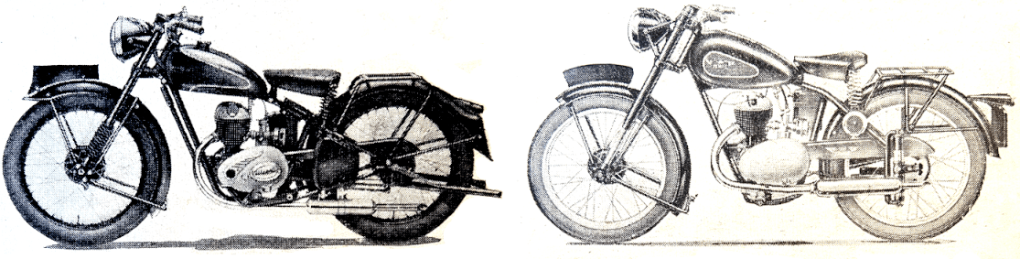
head lamp shell. By a simple mechanism in the gear box, the clutch is freed when the positive-stop foot-change lever is raised or depressed and is engaged when the lever is released; hence the handlebar lever need be employed only for starting or for deliberate slipping of the clutch. Connected with the gear-change mechanism is an electric indicator in the tank which shows when a gear is engaged. Other features are a quickly detachable rear wheel, very neat enclosure of the carburettor, and the battery housed in a box on the left-hand side matching the tool box, which is on the right. Similar in almost every respect, except for the engine-gear unit, is the 344cc model. This has a parallel-twin two-stroke engine, the design of which is as neat as that of the single. From almost any point in the Show is visible a gigantic, winged ‘M’ symbol which at once denotes the whereabouts of the Matchless stand. Arrived on the scene, one is undecided what to inspect first—the score of solos, the glittering sidecar outfit consisting of a 50/G80 with Swallow Jet 90, or the 498cc Matchless vertical-twin engine shown on a pillar in all its glory. The engine wins, for here is an opportunity to examine this beautiful unit from angles new. It is not sectioned, but there is quite a thrill in looking directly fore to aft (and vice versa) between the cylinder barrels and light-alloy heads. The great strength and rigidity of the crankcase are emphasised when its almost spherical shape is noted. The eccentric rocker spindle valve adjustment can be examined in some detail. It is worth waiting to reach the front row in order to inspect the redesigned competition models, which are proving a magnet to trials enthusiasts and casual observers alike. Very striking is the new engine with light-alloy cylinder barrel and head. The latter has cast-in iron valve seats, and the barrel is cast round an iron liner. Light-alloy mudguards, fully waterproof magneto, small petrol tank, high ground clearance, and 4in rear tyre with six-gauge spokes for the wheel make these models look extremely functional, as indeed they are, being based on the machines on which BHM Viney has gained such notable successes during the last few years. Several detail improvements have been incorporated on the standard road models. Both front and rear mudguards have a circumferential rib to give greater stiffness, and increased lateral rigidity for the front guard is achieved by provision of a one-piece tubular stay in place of the former strip variety. Smoother front-wheel braking results from incorporation of the long anchor arm, formerly found only on the twin; at its top end the arm is attached to the fork lug provided for the mudguard bridge-piece. Five-spring clutches are now fitted to the 500cc models; on the 350s, the four-spring variety is retained. To facilitate the fitting of panniers, if required, the tool-box position has been altered. Once again the Senior Tourist Trophy occupies a position in the Show which has become time-honoured; almost needless to say, it is given pride of place on the Norton stand. Other items on the ‘jewellery table’ (to quote Mr Gilbert Smith) include the Victory Cup, the North-West 200 Cup, numerous TT Replicas, and the Senior and Junior TT Team prizes. Also prominent in the exhibit is Harold Daniell’s Senior TT-winning Norton. Race-breeding is no idle term where Nortons are concerned. It has
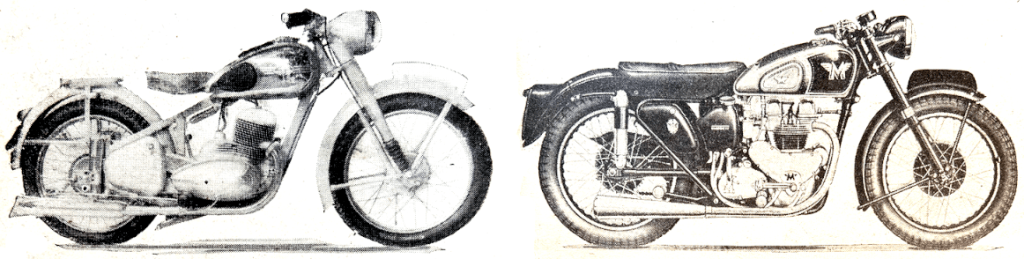
obvious meaning when one gazes at the 499cc and 348cc Manx 30 and Manx 40 models respectively, with their light-alloy engines and open megaphone exhausts; out-and-out racers, these. The term has little less meaning in the ohc International 490 and 348cc models 30 and 40, wonderful high-speed ‘batting irons’ which can be flogged all day and found to be as fast at dusk as they were at dawn. It has the same meaning in the 490cc push-rod ES2 and 497cc Dominator twin, with their superb handling and braking, The term still has considerable meaning when applied to the rigid-frame models—the 490cc ohv 18 and competition models and side-valve 16H and ‘Big 4’ models of 490 and 596cc respectively. All are imbued with-second-to-none steering and first-class handling and braking, and have a wonderful reputation for reliability. No fewer than five twins—in the true Norton colours—are shown, two ES2s, two trials mounts, and one each of the other models, including a Model 30 International with light-alloy cylinder barrel and head and central oil feed to the rocker box. One of the Dominator twins and the ‘Big 4’ are in double harness. On pedestals are a Dominator and an ES2 engine; the latter is sectioned. Among enthusiasts who require the exceptional economy of an autocycle with that little extra in the way of performance and comfort that an ultra-lightweight weight motor cycle can give, the 98cc two-speed newcomer to an already attractive range is creating much interest on the Norman stand. The new model D, of which three examples are shown, has the Villiers 98cc two-speed engine-gear unit. Front suspension is by telescopic fork. Each leg houses a long coil spring, the top and bottom ends of which are attached respectively to the main and sliding members by means of rubber blocks expanded into the coils at each end; this expansion takes place when the securing bolts are tightened. Owing to the rubber, there is a cushioning effect on compression and rebound.
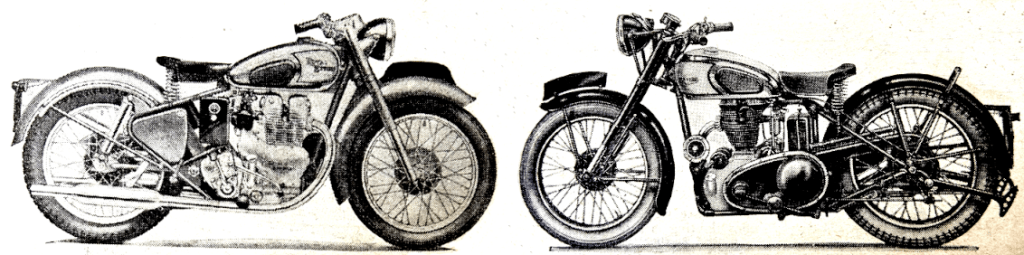
On the larger models, B1 and B2, equipped respectively with the Villiers 122 and 197cc three-speed engine-gear units with foot-change, the telescopic forks have a centrally disposed hydraulic damping unit which is common to both legs. No fewer than five B2s and three B1s are on show. Equipped with the Villiers 98cc 2F engine, an attractive autocycle, the Model C, completes the range. The machine has generous engine shielding and a sprung, link-action, tubular front fork. Among the pedal-cycles on the New Hudson stand are two autocycles of 98cc. The power-unit is the Villiers Mark 2F, held at three points in the loop frame. A motor cycle-type exhaust pipe and silencer are fitted. Ignition is supplied by Villiers flywheel magneto, and lighting is direct. The front fork is of the pressed steel, parallel-ruler type with a central compression spring. Handlebar levers are inverted. Dunlop tyres are fitted, size 2.25x21in. Brakes are internal-expanding. Mounted on rubber, the petroil tank holds 1¹⁄₁₆ gallons. Equipment includes a carrier and a central stand. Finish is black with red tank panels, gold lined. There are gold transfers on the engine shields. Seldom has such an enviable reputation for dual-purpose—solo and side-car—work been achieved as with the 600cc ohv Panther. It is a machine that can hold its own with the best when ridden solo, yet which, when pulling the heaviest sidecar load, is capable of a truly amazing performance, combining real flexibility and slogging power at low speeds with a high top-end performance and economical fuel consumption. It is not surprising, therefore. that a resplendent Model 100 with a coloured-to-match Watsonian sports side-car is the centre-piece of the Panther exhibit. Three other 600s are shown, one with Swallow sidecar and two in solo form. Of the latter, one has the standard colouring of cream, brown and chromium, while the other is very attractively finished in green, cream and chromium: this special finish is available on the Model 100 at a cost of £3 10s extra. For many years 250cc. Panthers have enjoyed wide popularity. Now solo riders are awakening to the fact that the range also provides a handsome 350, the Model 75, a machine of sparkling performance and a most attractive proposition for economical, yet purposeful, pillion work. Only a few pounds heavier than the 250s the Model 75 has magneto ignition, with the magneto mounted behind the cylinder and a separate dynamo in front; both units are very accessible. In the quarter-litre realm there is a new model, a de luxe edition of the coil-ignition, three-speed 250cc Model 65. This 65 de luxe has a four-speed Burman gear box and is lavishly chromium-
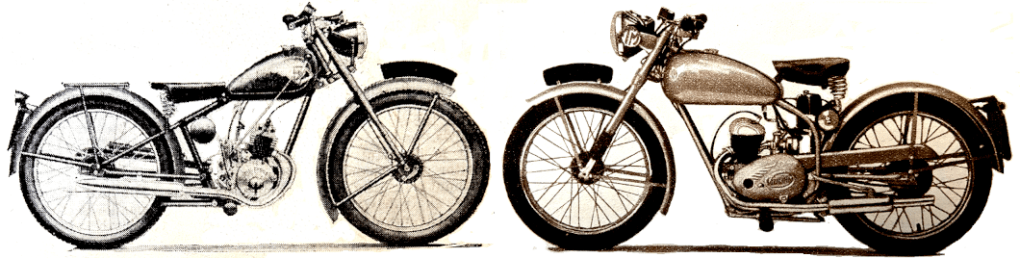
plated—petrol tank, wheel rims, chain-case rim and saddle springs. For the competition rider there is the 350cc Stroud model, built expressly for trials. As a result of experience gained in open events this year, the low-speed torque characteristics of the engine have been improved. Front suspension on all the Panthers is by Dowty Oleomatic telescopic fork which, as its name implies, has oil damping and employs air as the suspension medium. Among the attractions on the Panther stand are two very nicely prepared sectioned engines; these are of 350 and 600cc. In the middle of the Royal Enfield stand is a rig showing the action of the telescopic front fork and the pivoting-fork rear-wheel springing of the Twin. This type of front and rear suspension is also employed on the 346cc Bullet models, which are shown in three distinct specifications—Standard, Trials and Scrambles. As an ensemble, the Twin, with its silver-grey enamel finish, is of handsome appearance. This finish is standard on the Bullet models and for 1950 becomes standard on the 125cc RE model. The black enamel finish is retained for the Model G, 346cc ohv, and Model J2, 499cc ohv machines. Outstanding features of the 496cc vertical twin are the separate cast-iron cylinders and light-alloy cylinder heads with a clear air space between. Rocker boxes are cast integrally with the heads. Chain drive is employed for the timing gear and for the dynamo, which is the Lucas 3½in type with skew-gear drive to the distributor; ignition is by coil, and the ammeter and switch gear are carried on the offside of the seat tube in a neat box which matches the battery on the nearside. For 1950 the Twin is fitted with a polished light-alloy die-casting which bridges the tops of the fork legs; this die-casting carries the speedometer. Bullet models also have this type of speedometer mounting, which gives an extremely neat appearance to the steering head, The sporting rider is much attracted by the Bullet models. The high-efficiency engine has a light-alloy cylinder head with cast-in valve seats and sparking plug boss. Light-alloy is also employed for the connecting-rod. In standard form, the Bullet has 3.25x19in tyres and Magdyno lighting. As supplied for trials, tyre sizes are 3.00x2lin front and 4.00x19in rear, the magneto is a Lucas racing type and a special wide-ratio gear box is fitted. For scrambles a variety of specifications is available, including racing cams, high-compression pistons (ratios ranging up to 11 to 1), lightened valves, extra-strong valve springs, and standard or wide-ratio gears. A telescopic front fork is fitted to the 125cc Model RE for 1950. The lower sliding tubes of the fork operate outside the fixed upper tubes. Each leg encloses a single helical spring which controls impact and rebound. Oil for lubrication is inserted in the legs on assembly, and no maintenance is required. Total movement is 4½in (3in on compression and 3in on rebound). A deeper tank which is of larger capacity, and larger-section tyres are further changes for 1950. The Bullet model used by Charlie Rogers, who was a member of the victorious British Trophy Team in the ISDT, is shown exactly as it finished—except for the dirt it accumulated during those arduous miles in the Welsh mountains! For more than three decades Scotts have held a strong fascination for many two-stroke enthusiasts. ‘Once a
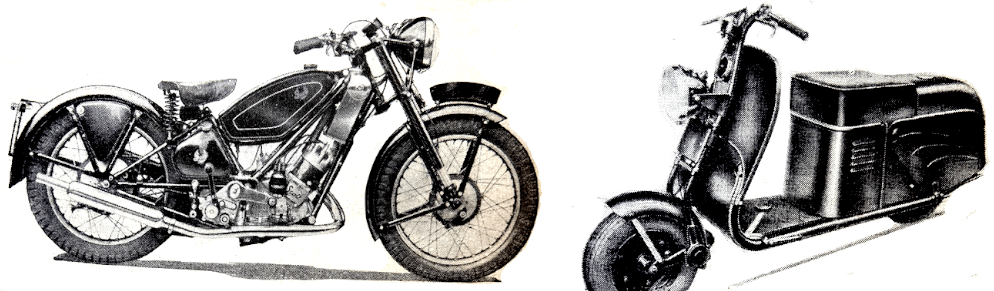
Scott fan, always a Scott fan’ is a phrase that has been voiced often over the years. The fact that a parallel twin two-stroke with the crank throws at 180° has the same smooth torque as a four-in-line engine undoubtedly contributes to Scott charm. There is one model only—a water-cooled 596cc. Four machines are shown on the Scott stand, three solos and one with Watsonian Maxtoke sidecar to match, a very smart outfit. Examination shows that the Scott is right up with the times. Dowty Oleomatic front fork; twin 6x⅞in front brakes; a single 8xlin rear brake; coil ignition, with a distributor driven off one end of the crankshaft and a 70-watt dynamo off the other. The present-day engine is said to develop no less than 30bhp. ‘This firm’ said a lightweight enthusiast at the Sun stand, ‘will be getting a name for its last-minute Show surprises!’ A year ago the 98cc auto-cycle and the 98cc two-speed motor cycle sprang out of the blue; this time there is the new 122cc Villiers-engine machine. The new model is more than just smart—it is one of the best-finished machines on display. The general arrangement of the machine is good. Saddle height is 27½in. A telescopic fork with very slim-looking legs carries the front wheel. Mounted neatly below the 5in headlamp is a lightweight electric horn. Current for the horn and lighting is supplied by a battery and rectifier in conjunction with an AC generator. Direct lighting will not be available on the new model, but is standard on the 98cc motor cycle and auto-cycle. Fuel capacity on both is l½ gallons. Tyres on the motor cycle are of 19×2.50in; those on the autocycle are 26×1¾in. They employ link-type front forks with pressed-steel blades. Still the most advanced in design; still the best-looking machines in the Show—such is the verdict of many regarding the Sunbeams. Two 88 models appear in new polychromatic finishes. One is in an attractive shade of grey and the other maroon. Frames and mudguard stays remain black, and the polychromatic finish is on tanks, forks, headlamps and mudguards. It is doubtful whether a single show visitor has passed the Sunbeam stand without a lengthy stop to admire the clean lines, shaft drive and the 101 up-to-the-minute design features. Since last year, the dynamo, which is of pancake design and mounted in front of the crankcase, has been lengthened to give increased output. Engines in both models are mounted on rubber to give added smoothness. The S7, of course, is the original post-war ‘Beam and retains the 4.50x16in and 4.75x16in front and rear tyres. The S8 has a 3.25x19in front tyre and a 4.00x18in tyre on the rear. The S8 is faster than the S7; it has a higher compression ratio. Mudguards are narrower in view of the smaller section tyres. Both models have plunger-type rear suspension and hydraulically controlled telescopic front forks. Should the machines be required for sidecar work, suitable gearing is achieved by a reduction in the worm drive ratio. A now very well-known scooter-type machine, the
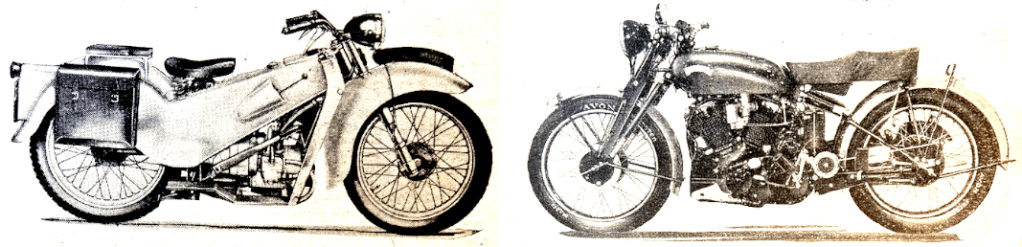
Swallow Gadabout continues to attract a wide following. In its 1950 Mark II guise at Earls Court it can be seen in both its two- and three-wheeler forms. Enthusiasts are especially intrigued with the way in which the rear panelling can be rapidly and easily removed in order to give access to the engine and rear wheel. The tubular, resilient front fork gives a soft, easy movement; the suspension medium is bonded rubber in tension, the rubber being ‘loaded’ when the front wheel takes an impact. Cooling of the 122cc Villiers unit is by fan. One of the most interesting lightweights at Earls Court is on the Tandon stand. This is the new ‘Supa-glid’ de luxe, which features rear suspension by means of rubber and a telescopic front fork which can be seen working on a special rig. Frame is of duplex type with, on each side, a single main tube forming the top, seat and cradle tubes; straight front down tubes connect the steering-head lug with the main tubes. Pivoting from lugs on the main tubes is the rear-wheel fork, which operates on a ¾in diameter duralumin bush fixed on the pivot spindle. Sif-bronze welded to the pivot is an arm which actuates a rod running through a 4in-long rubber cylinder that lies horizontally below the Villiers 122cc engine-gear unit. As the rear wheel moves upward the rubber is compressed and allows 2in of wheel movement. Elegant, bright finishes are available; models are shown in red, white and blue. The Mile Master remains substantially unchanged. Chief attraction on the Triumph stand is undoubtedly the new 650cc 6T Thunderbird. Tried out recently on the Montlhéry track, the first three production Thunderbirds averaged over 92mph for 500 miles and then did flying laps at over 100mph. Another point of interest is the new Triumph colour scheme with its small amount of chromium plating. There is also a mechanical rig which demonstrates the working of both the telescopic front fork and the rear spring hub. Machines on the stand include five Thunderbirds, one Grand Prix racing model, one Trophy trials model, four Tiger 100s, five Speed Twins, and two 350cc 3Ts. Another great attraction is the machine used by PH Alves in this year’s ISDT. The technically minded can study sectioned models of the Tiger 100 and Speed Twin engines; also on view are two sectioned gear boxes and two sectioned spring hubs. Triumphs have stopped chromium plating their petrol tanks for two main reasons. First, it is thought that the chromium-plating tends to weaken welded seams; and secondly there is the point that the salt-water atmosphere of a sea crossing is likely to cause rust. With so many machines being exported, this rusting tendency is to be avoided at all costs. Finish on the Thunderbird is grey-blue. The Triumph tank-top parcel grid is fitted as standard (as on all standard models this year); and the machine has the handlebar nacelle that was introduced last year for the other models. Frame layout, steering geometry, brakes, etc, are the same as on the 500cc Speed Twin and the 500cc Tiger 100.
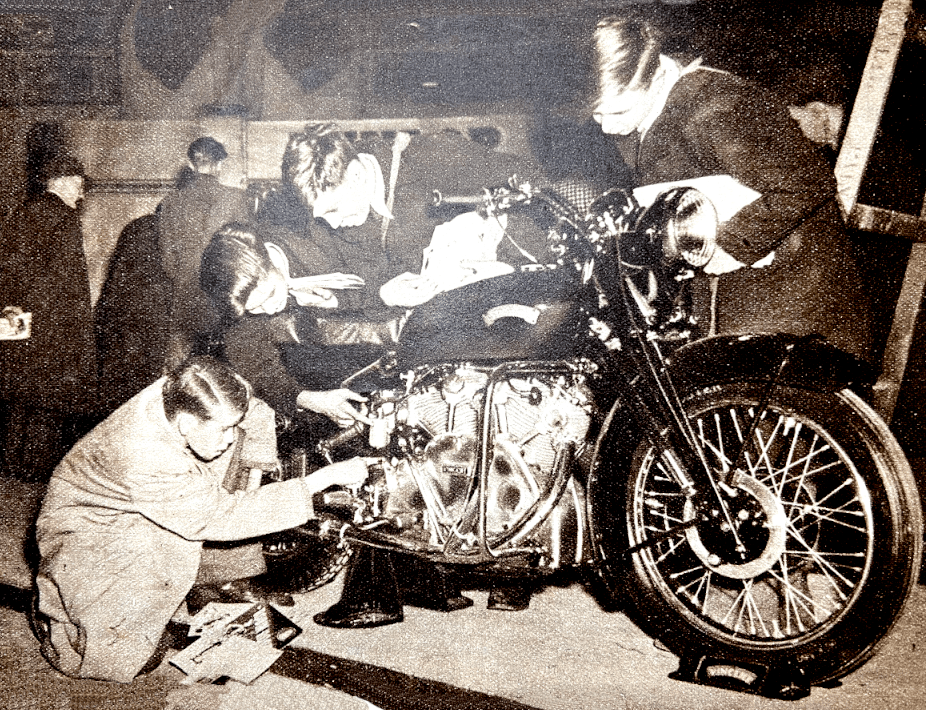
A last-minute innovation for the Triumph range is the employment of progressive, barrel-type saddle springs which are said to give a much more comfortable ride. Machines on the Velocette stand include 10 of the famous 149cc LE models, two 348cc MACs and two KTT racing models. There are also two complete LE engine units showing the layout from radiator to bevel-box. The actual Junior TT Trophy can be inspected. Introduced last year, the Model LE is designed for the utility rider and is intended to be ridden for 20,000 miles without major overhaul. The engine is a side-valve transverse twin and is water-cooled. Unit construction is employed for engine and gear box. Shaft-drive is used, and the shaft itself passes through the swinging arm member of the rear suspension. Layout includes a telescopic front fork, a pressed-steel frame backbone, footboards, hand gear-change, coil ignition and a hand lever that not only starts the engine but lifts the central stand as well. A popular 350, the MAC model has an ohv engine, a Dowty front fork and a rigid frame. Racing enthusiasts are crowding round the famous ohc 350, the KTT, with its Webb front fork and Dowty rear-springing. Chief interest on the Vincent stand is focused on the new racing model, the 499cc single-cylinder Grey Flash. Its stripped weight is under 300lb. Enthusiasts are specially impressed by the twin brakes with air scoops on front wheels and the ribbed brake drums. Almost equal with the Grey Flash in popularity is the sectioned model of the 998cc V-twin Rapide, engine. It can be operated by means of a handle on the crankshaft and the unusual method of valve operation can be noted through a cutaway rocker-box. Also on show is the famous ‘Gunga Din’ and sidecar which has established many world’s records. Naturally there are 998cc Black Lightnings. There are also 998cc Black Shadows, one solo 499cc Meteor, two solo 499cc Comets and a solo Rapide. There are two sidecar outfits which are making a tremendous appeal to the sporting ‘chairists’. One is a Comet model fitted with an elegant Swallow Jet 80; the other is a Rapide with a Blacknell Bullet.
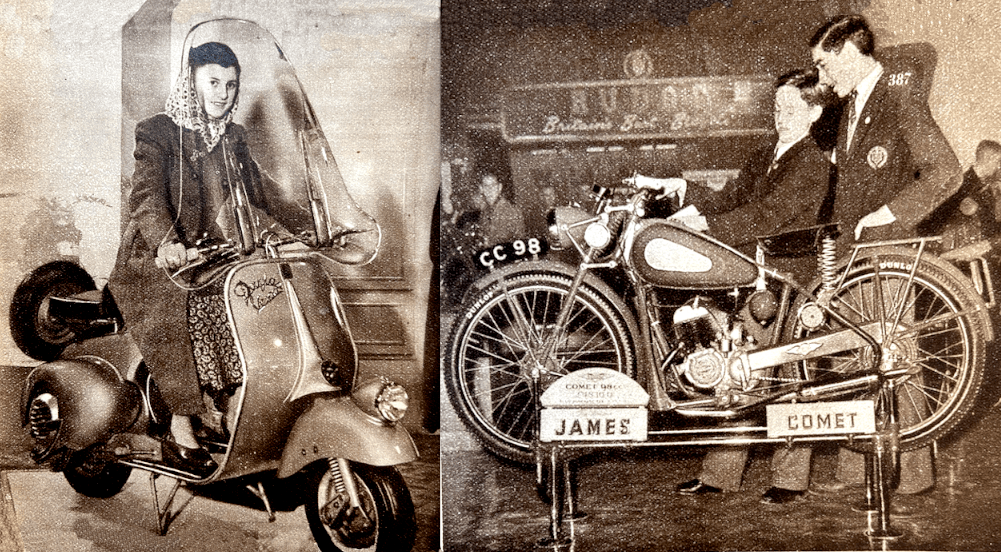
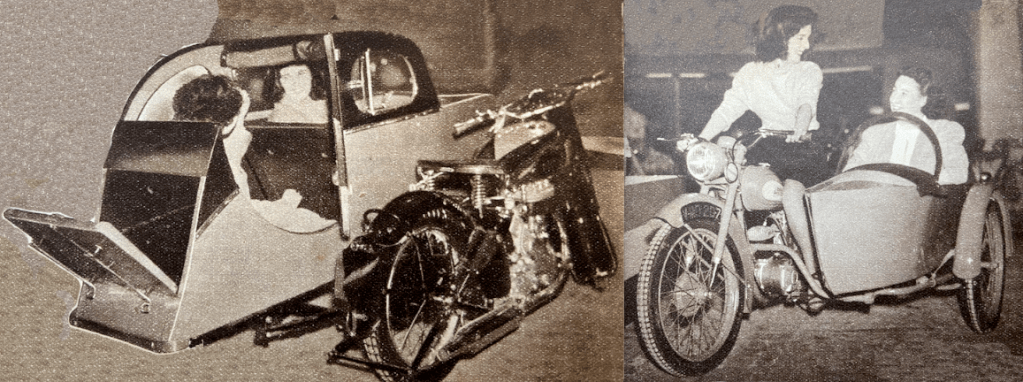
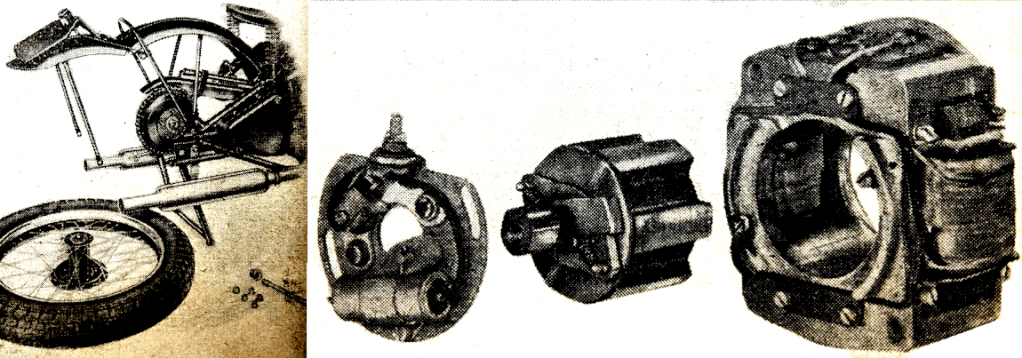
“ANOTHER PILGRIMAGE TO MECCA is over. I have made many in my time. I was there even when the haughty pedal-cycle ruled the land, and forbade more than 10 motor cycles to sully its pure company. Yet never have I made a pilgrimage like this. Whether one mingled with trade or public, the atmosphere was utterly different from any remembered year. The factories were mainly anxious to fulfil the State’s injunction, and by hook or crook dispose of their 75% to oversea customers—preferably to gentlemen with wallets full of bucks. Many amateur riders had long since expended their gratuities on some post-war pet (usually a parallel twin). They surveyed the long gleaming arrays in an oddly detached spirit. Secretly I thought they were probably glad that the parallel twins of 1950 are uncommonly like the parallel twins of 1949, and that—for example—Villiers had not made them feel all out of date by suddenly producing a liquid-cooled six-cylinder. It is astonishingly easy to adopt the pose of a disinterested engineer when (a) you have no money left, and (b) are perfectly aware that you cannot afford another £250 model until about 1954. Meanwhile, these are not days in which a factory, comforted by the consciousness of a walloping balance in its coffers, should produce a novelty. The main target is the American market—and the Americans are justifiably delighted with our 1949 models. During the past 12 months these machines have undergone a process comparable to the careful pats which a distrustful wife administers to her husband’s toilet before she takes him out to a party at which her bête noire, Mrs Jones, will exhibit her brand-new husband. In other words, the major 1949 models have all been nineteen-flftified, and any wee flaws revealed by the last season’s reports and repair jobs have been eliminated, so that the machines are now the very best on earth. Consequently there is practically nothing new. Either I do not know, or I must not say, what is brewing behind the scenes for that unknown day when production for the home market will be limited only by the number of our orders, when the accursed Purchase Tax will be just a bad smell in the past (like a dead rat behind the skirting board), and when designers will once more be full out to coax the last farthing out of our (full?) pockets.”—Ixion
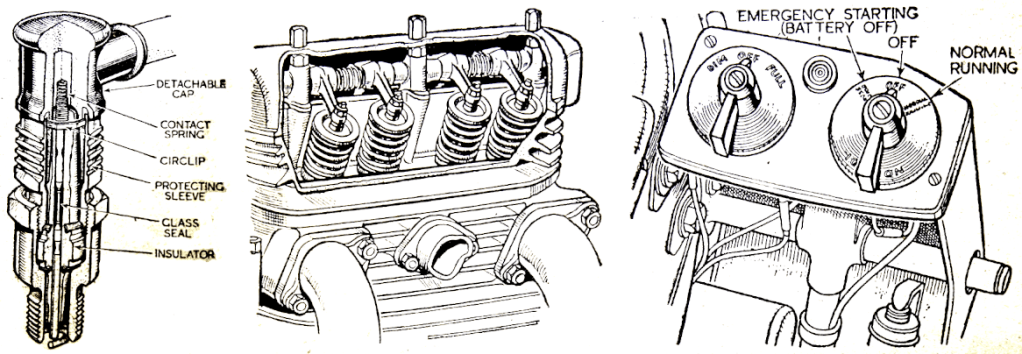
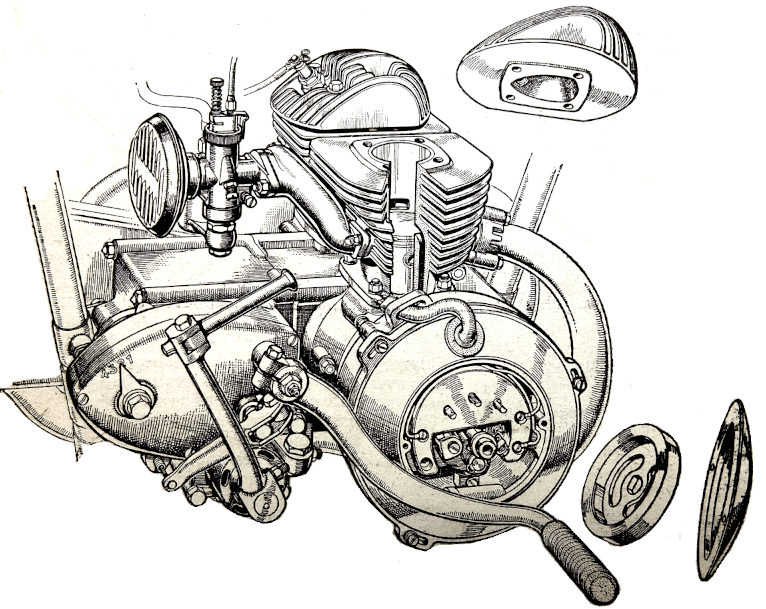
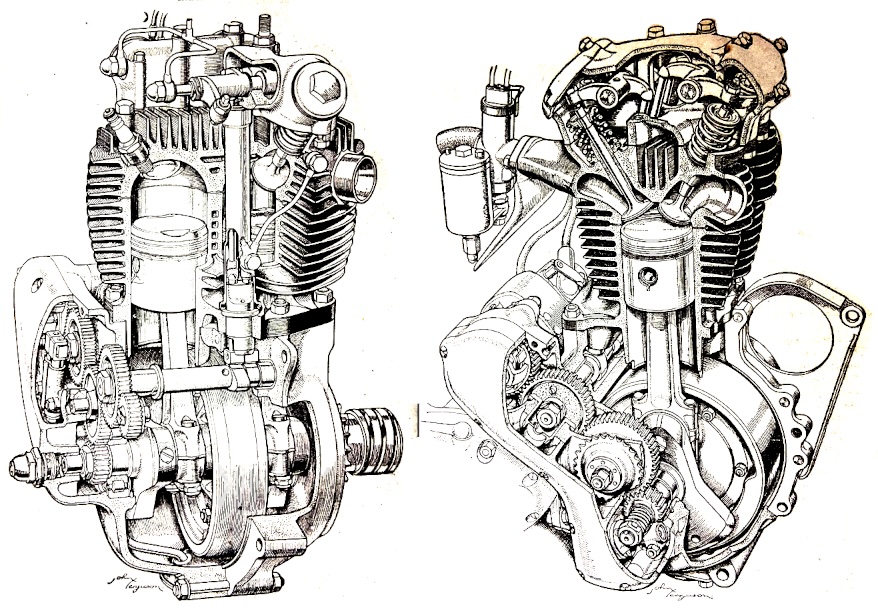
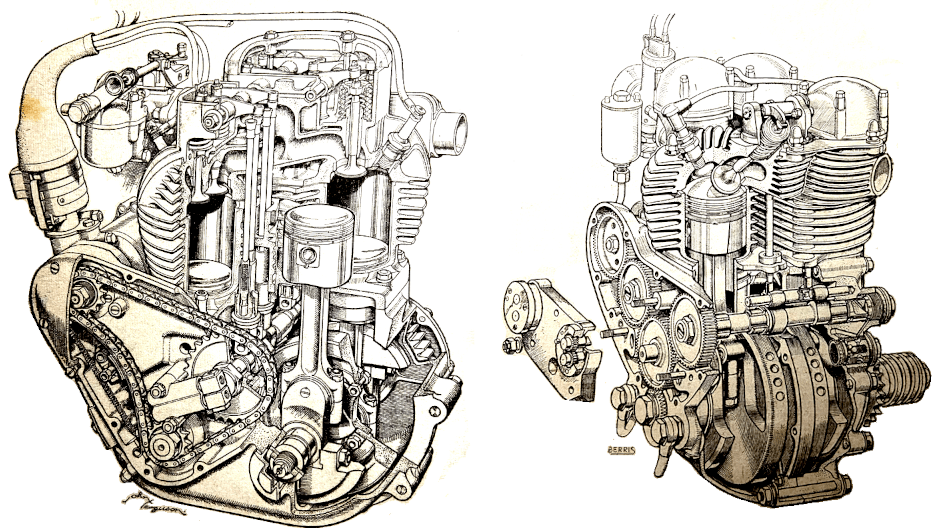
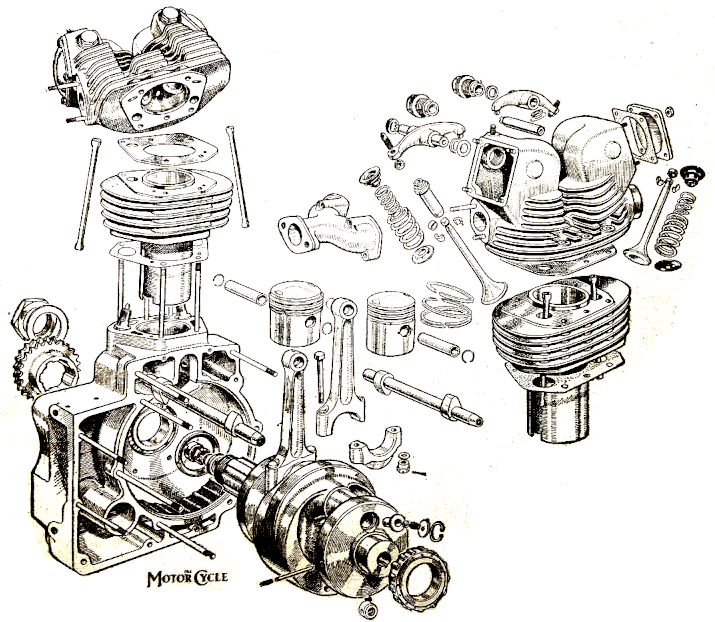
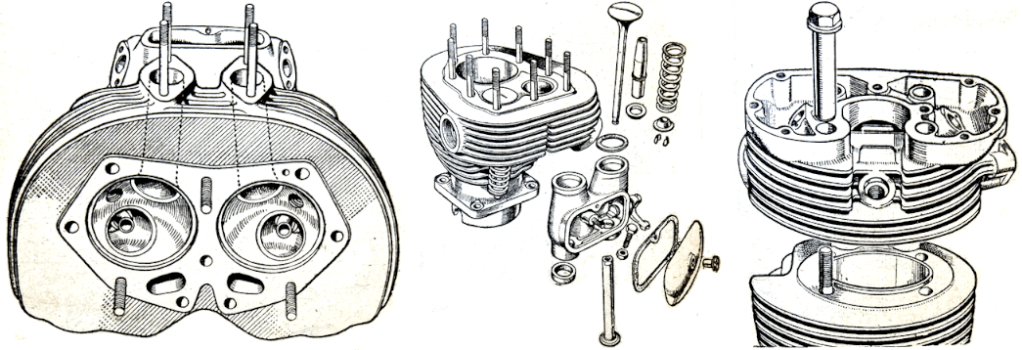
“Light alloy cylinder head and barrel are fitted to the Matchless Competition model. The combined cylinder and cylinder-head fixings are hidden within the castings.”
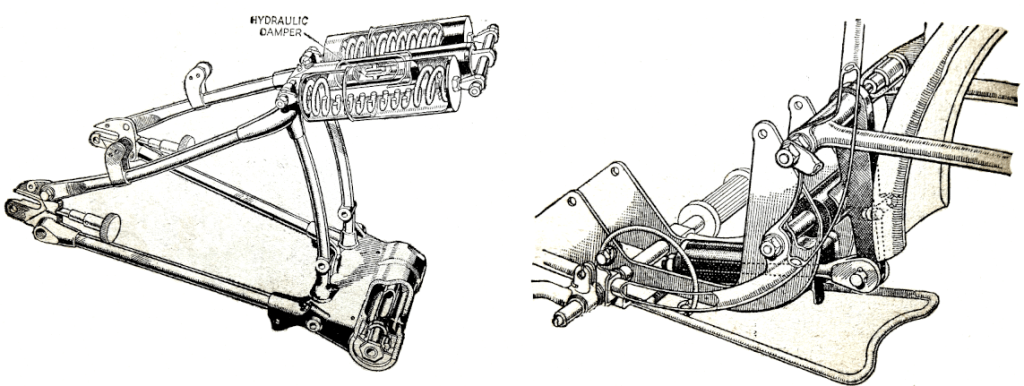
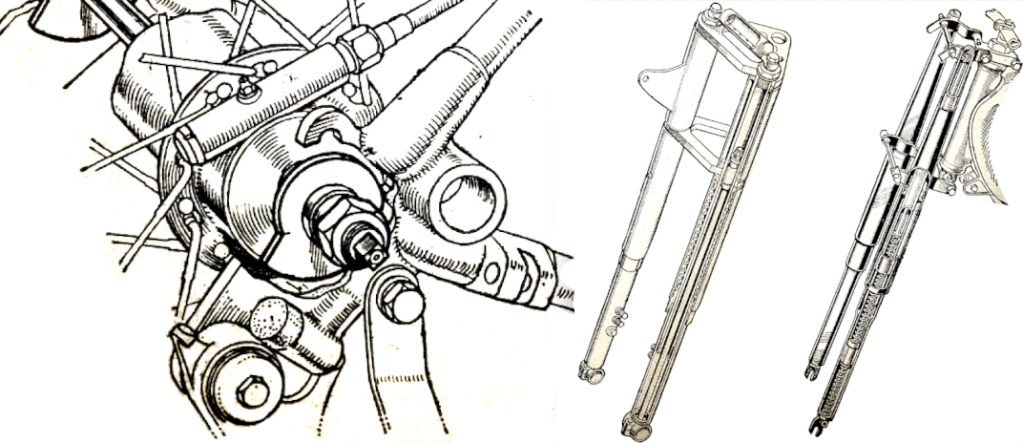
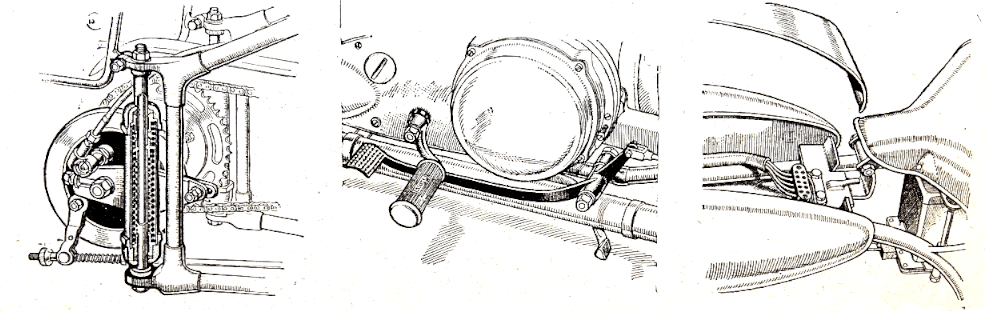
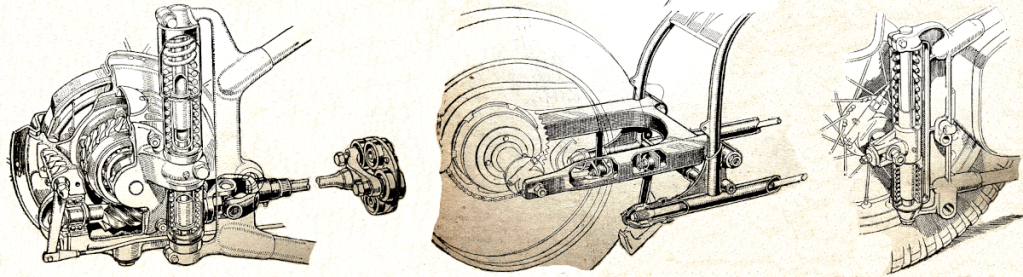
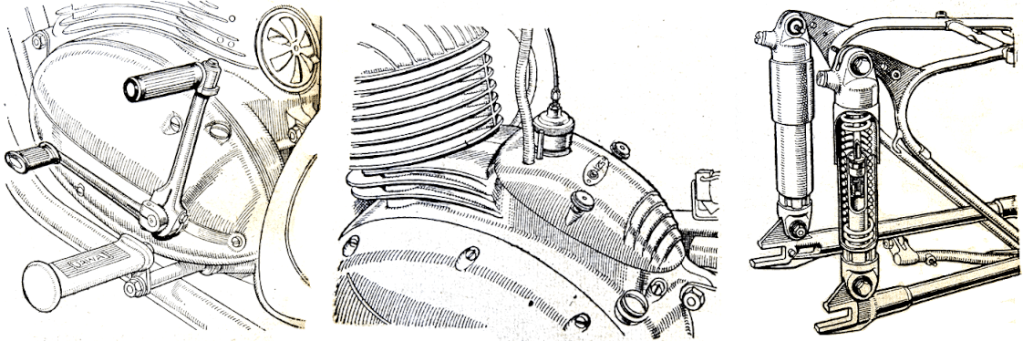
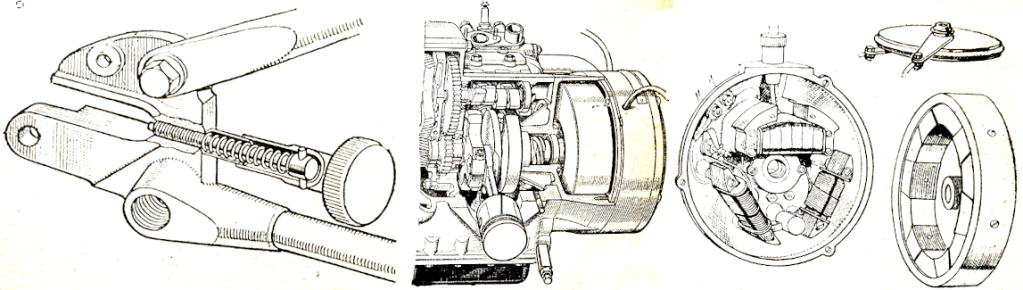
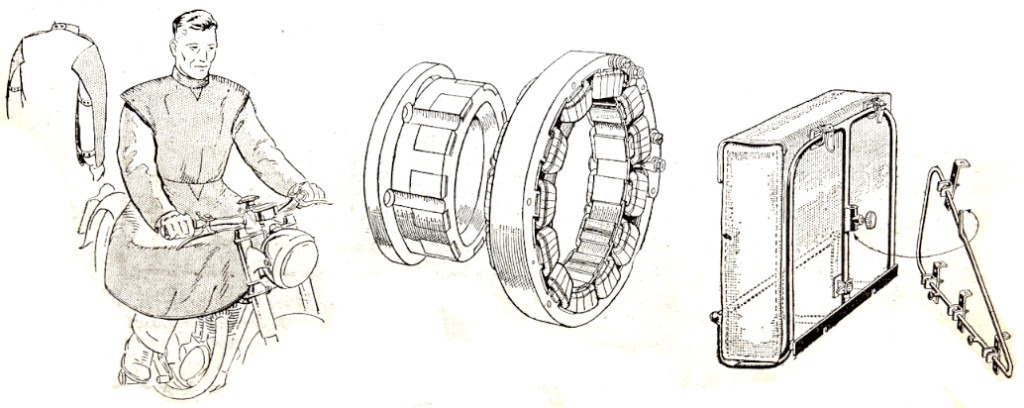
FROM THE MOTOR CYCLE’S annual Buyers’ Guide comes this overview of the British motor cycle industry four years after peace broke out…Aberdale, London N18: 98cc ts single. Ambassador, Ascot, Berks: 197cc ts single. AJW, Bournemouth, Dorset: 500cc ohv single and sv single. AJS (AMC), London SE18: 347 and 498cc ohv singles, 498cc ohv vertical twin, 348cc ohc. Ariel, Selly Oak, Birmingham 29: 997cc ohv square four, 498cc vertical twins, 347 and 497cc ohv singles, 598cc sv single. BSA, Small Heath, Birmingham 11 123cc ts single, 249cc ohv and sv singles, 348 and 499cc ohv singles, 499 and 591cc sv singles, 495cc ohv vertical twin. Corgi, Southport, Merseyside: 98cc ts single. Cyc-Auto, London W1: 98cc ts single. Douglas, Bristol: 348cc ohv flat twins. Excelsior, Birmingham 11: 98, 122 and 197cc ts singles. DOT, Manchester 15: 122 and 197cc ts singles. Francis-Barnett, Coventry: 98, 122 and 197cc ts singles. James, Birmingham: 98, 122 and 197cc ts singles. Matchless (AMC), London SE18: 347 and 498cc ohv singles, 498cc ohv vertical twin. New Hudson (BSA Cycles), Birmingham 11: 98cc ts single. Norman, Ashford, Kent: 98, 122 and 197cc ts singles. Norton, Birmingham 6: 490 and 596cc sv singles, 490cc ohv singles, 348, 490 and 499cc ohc singles, 497cc ohv vertical twins. Panther, London EC4 (but built in Cleckheaton, Yorks, ba gum!): 248, 348cc and 598cc ohv singles. Scott, Shipley, Yorks: 596cc ts wc parallel twin; Royal Enfield, Redditch, Worcs: 125cc ts single; 346 and 499cc ohv singles; 496cc ohv vertical twin; Sun, Birmingham: 98cc ts singles. Sunbeam (BSA), Small Heath, Birmingham 11: 487cc ohv in-line twins; Swallow Gadabout, Walsall, Staffs: 122cc ts singles. Tandon, London EC4: 125cc ts single. Triumph, Coventry: 349 and 498cc ohv vertical twins. Velocette, Hall Green, Birmingham: 149cc sv wc flat twin, 348cc ohc single, 349cc ohv single. Velosolex, London NW1: 45cc ts single. Vincent HRD, Stevenage, Herts: 499cc ohv singles, 998cc ohv V-twins. Wooller, London EC2: 500cc ohv flat four. Zenith, London, SE11: 750cc sv V-twin.
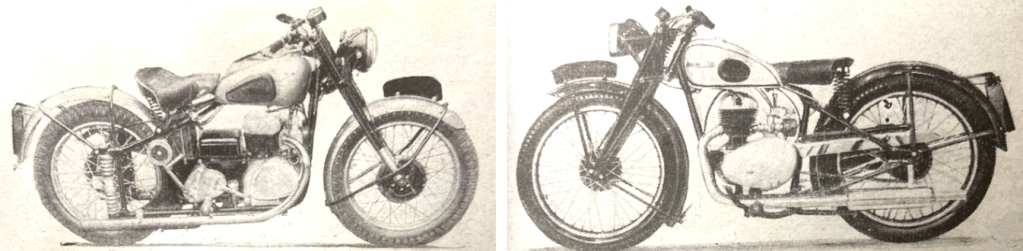

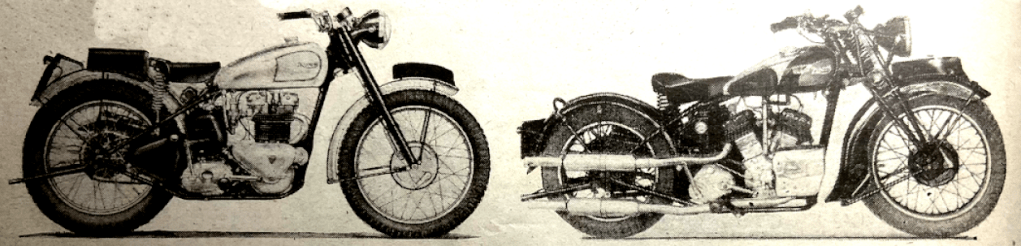
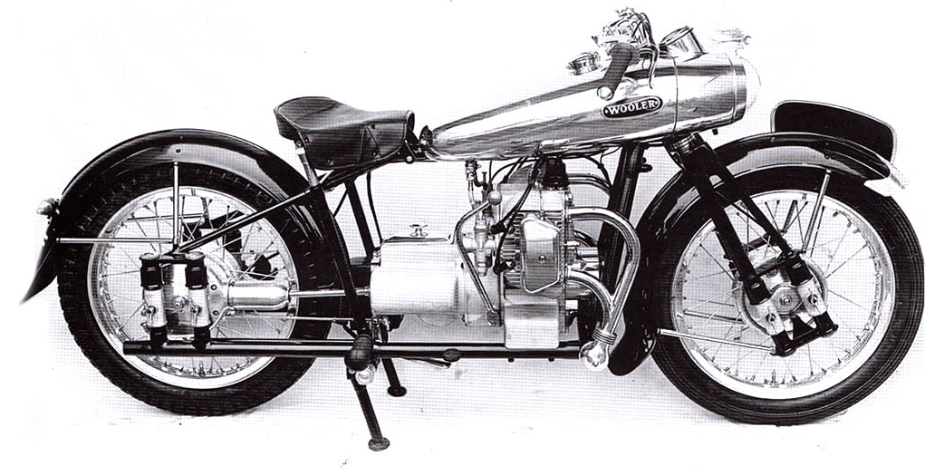
“THOUGH THE ROYAL ENFIELD range of machines for 1950 will be basically unchanged from that already in production, numerous detail modifications and improvements will be incorporated. Chief of these is the fitting of an entirely new Royal Enfield telescopic fork to the well-tried and ever-popular 125cc model RE. The fork is undamped and relies on a single helical spring for controlling both compression and rebound. In this case, steps have been taken to keep the lubricating oil, inserted in the fork during assembly, ‘inside’. To do this, departure has been made from the more common telescopic fork design practice in that the bottom sliding member works outside the top fixed member instead of, as is more usual, inside.”
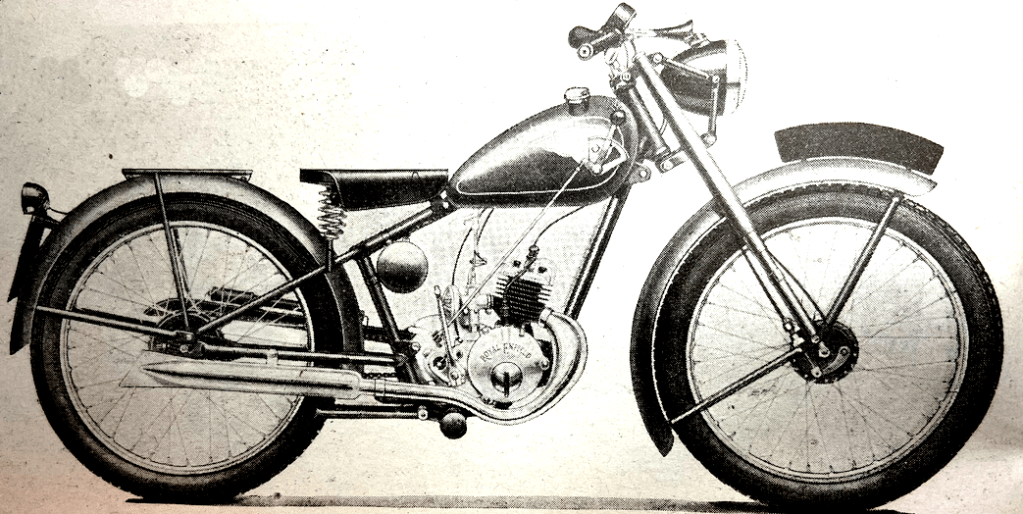
“BY THE END of the year, it is anticipated, a new BSA will be in production. What will it be? Nothing less than a 650cc vertical-twin! [Bert Hopwood had redesigned the Val Page ‘longstroke’ A7 as the A10 Golden Flash, arguably the finest motorcycle ever made—Ed].Though the new twin bears strong resemblance to the firmly established 495cc A7, and many of the same parts are employed in its manufacture, the engine has numerous wide departures from current A7 practice. The frame of the ‘Golden Flash’, as the new model is called, will be of the duplex cradle type identical to that of the A7. Dimensions, such as wheelbase and saddle height (55in and 31in respectively), are as on the A7. Instead of the A7’s pair of rocker boxes there is a single rocker box on the Al0. Access to the valve-clearance adjusters is gained by removing aluminium-alloy plates: one for the exhaust valves and one for the inlets. Another BSA pre-Show surprise is that the very popular 125cc two-stroke Bantam will be available for 1950 with plunger-type rear-springing of straight-forward design, battery and rectifier lighting, and coil ignition. The Bantam will also, of course, be obtainable in its 1949 guise as well as in Competition form.
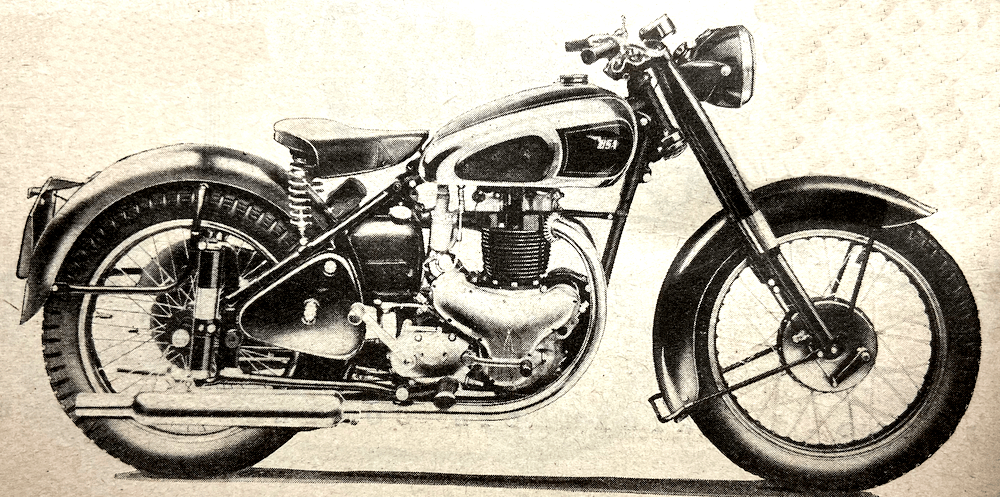
“DO THE TWO 650cc twins announced for 1950 indicate a trend? By that is meant, will more manufacturers introduce large-capacity multis during the next two or three years? To arrive at a basis on which to attempt an answer we must understand the reasons for providing larger engines. There is no secret about these reasons…These larger vertical-twins are intended primarily to appeal to oversea markets, such as the Americas, where, on long, broad, straightish highways, speeds near the maximum of 500s can be held long enough to make the greater stamina resulting from a few more cc desirable. In other words, our friends across the Atlantic are expected to welcome 40 cubic inch motors as against 30.5 cubic inch types. At about this time last year the announcements of British manufacturers’ programmes for 1949 revealed an unprecedented crop of vertical-twin spring-frame models. Why? Because of the world-wide success of the machine that pioneered this type of power unit and because world markets were being catered for. The new 650s can be considered a logical development in the world-market policy; they are not a trend as such, but rather the continuation of the trend clearly apparent for the first time 12 months ago. But since the 500cc capacity class has been overstepped, another aspect should be given thought. For very many years the average British motor cyclist has considered that 500cc gave all the performance he would be likely to require. Only the comparative few who had experienced the delights of power to spare and could afford that luxury, and the sidecar enthusiasts, supported the various over-500cc models available. Those manufacturers who introduced 500cc vertical-twins for 1949, though they had in mind export markets, also had the comforting knowledge that they were in step with the proved conventions of British buyers both in engine size and type. One make of 500cc vertical-twin had been in production since 1938 and had found enthusiastic acceptance on the British market. The new models were, therefore, not only, answering a demand from other lands, but were also a good proposition at home. Circumstances are not precisely similar for the 650cc models. Will British motor cyclists take to the larger engines? True, as with some of the 500cc twins new for 1949, British motor cyclists may have only limited opportunities of indicating their acceptance of the 650, because export markets will have high priority, but support from the home market is highly desirable to ensure that the bigger machines are a success as a long-term project.”
“AN EASILY FITTED prop stand is now available for all BSA models except the 125cc Bantam, D1. It springs back into position alongside the chainstay when not in use. If the stand is ordered with a new machine the price is 15s plus 4s purchase tax. Retail prices of various BSA accessories when supplied separately from a new machine and thus not subject to purchase tax are as follows: Legshields for models C10, C11, M20, M21, M33, B31 and B33, £4 10s; legshields for model Dl, £2 8s; for all models except Dl, pillion seat, £l 5s; carrier, £l 5s; pillion footrests, 12s; prop stand, 18s.”
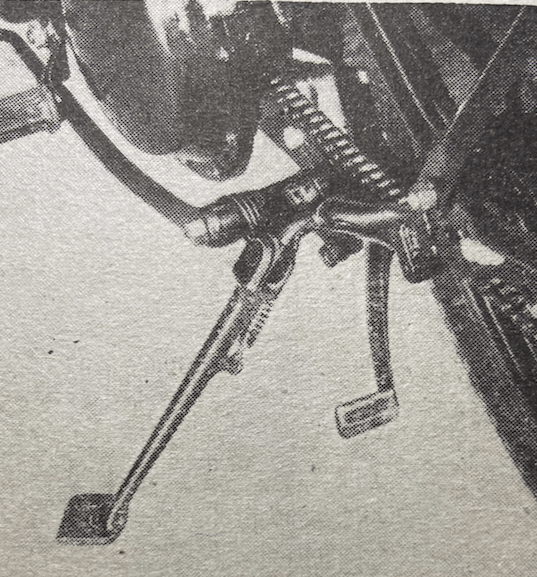
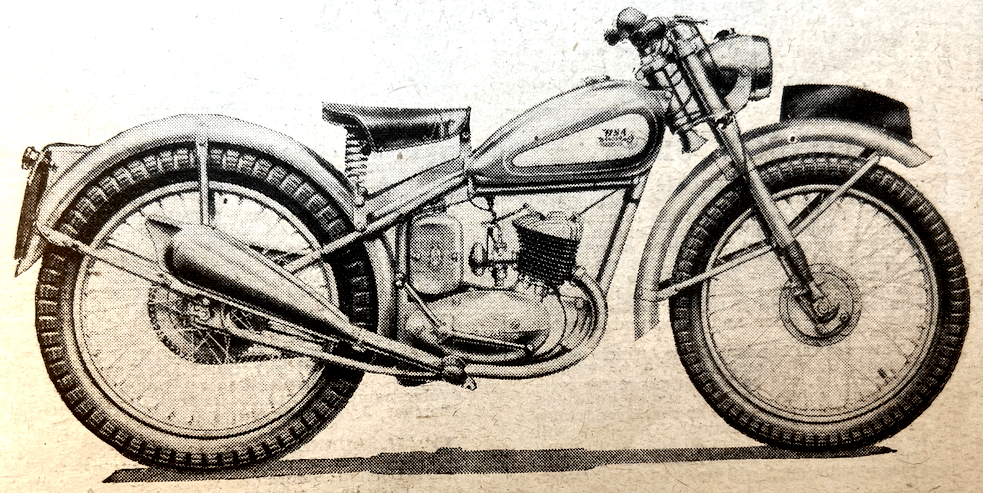
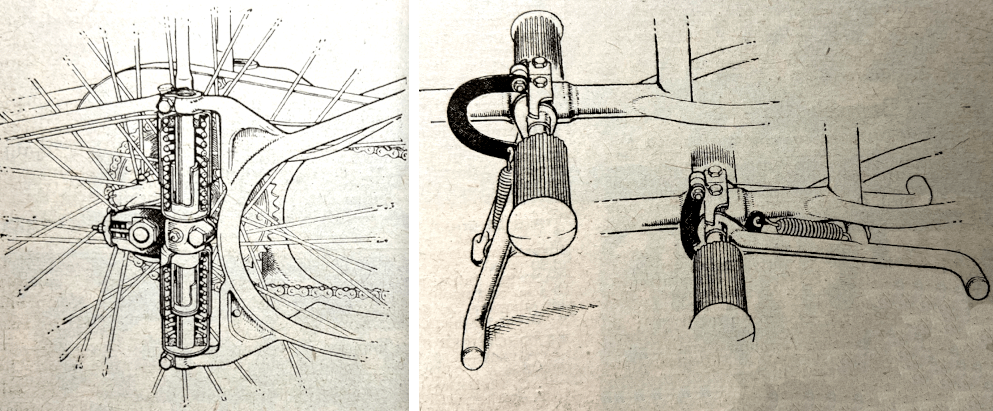
“THE NEW PANTHER Model 65 de luxe is a 250 with a specification worthy of a 350. The power unit is similar to that fitted to the Model 65, but the specification includes the Burman four-speed, foot-change gear box and chromium-plated tank, wheel rims, saddle springs and oilbath chaincase rim. Price is £107 plus (in Great Britain) Purchase Tax of £28 17s 10d—total, £135 17s 10d.”
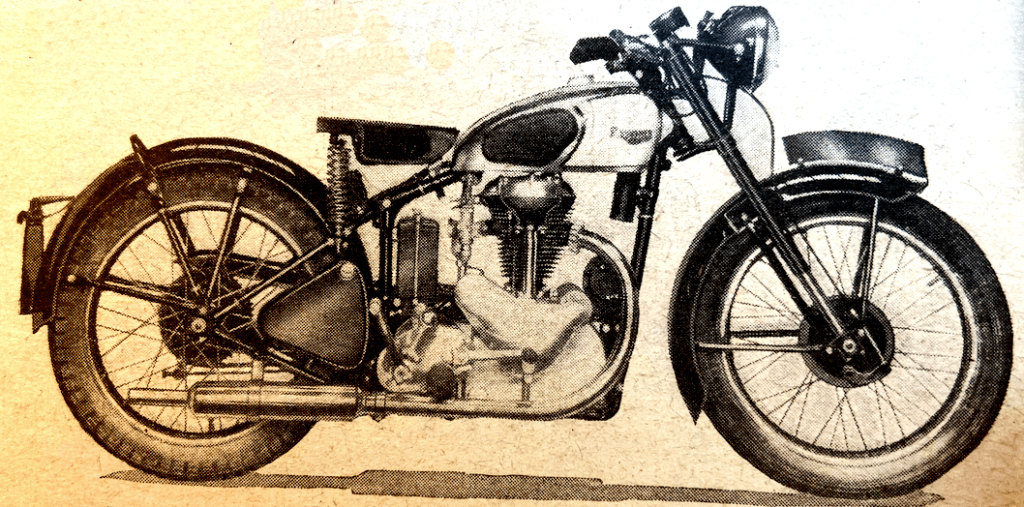
“LAST WEEK THE THREE Triumph 650cc Thunderbird models, each of which covered 500 miles at over 90mph at Montlhéry, were stripped down for examination. The engines of all machines were found to be in magnificent condition. Carbon deposit in combustion chambers was slight and could be cleaned off with a rag: there were no signs of undue heat: valves and valve- and cylinder-head seatings were perfect, as were pistons, rings. cylinder bores and bearings. Magneto and valve timings were checked and found to be as standard. Primary chains were in first-class condition on Nos 1 and 2 machines and did not need adjustment. On No 3 machine the chain was worn out due to its being run without sufficient oil in the chaincase; during a hurried pit stop (this machine was behind schedule as a result of a split fuel tank) a check on the chaincase oil level had been omitted. Clutches. gear boxes and rear chains were in good order. On all machines front brakes were in near-perfect condition. but rear brake linings were about half-worn. Batteries showed signs of spilling as a result of ‘boiling’: on machines Nos 1 and 2 the lights functioned normally, but on No 3 machine the lights were not working owing to a broken lead. While the machines were dismantled and checked, the ACU observer, Mr HR Taylor was present.”
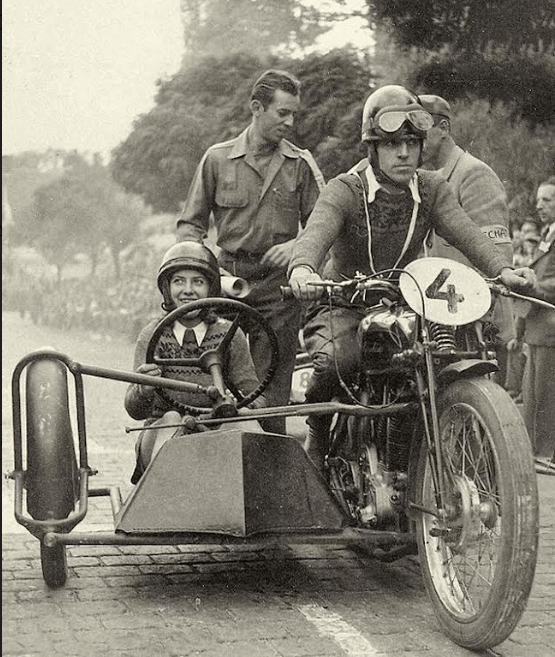
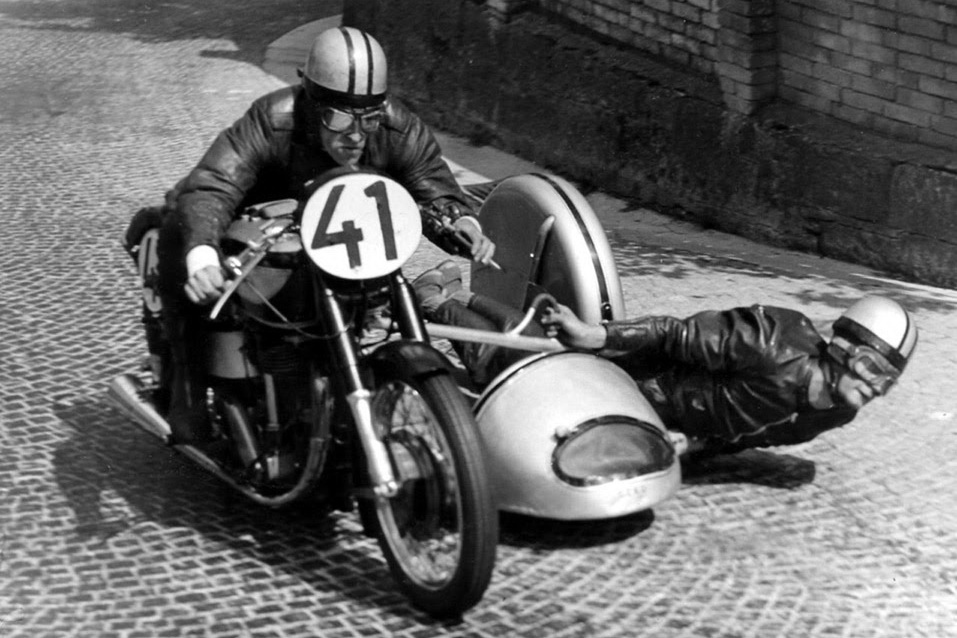
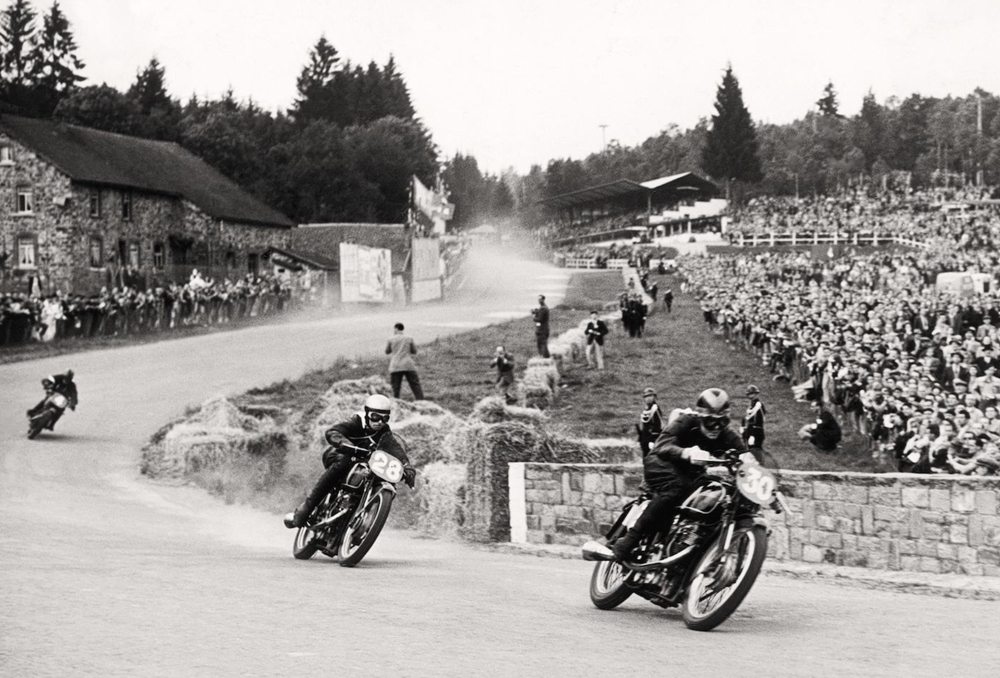
“WHY DO WE STILL have chains? In your article ‘Triumphs Introduce a 650cc Twin’ George Wilson tells us that after 500 miles at over 90mph, ‘rear chains were badly stretched’. Surely this is proof that the chain should be replaced by the shaft? Substitute gears in place of the primary chain, and shaft-drive in place of the rear chain, and there, in my opinion, would be another step towards the perfect steed.
Peter Buchanan, Rhyl, North Wales.”
“UNDOUBTEDLY THE NEW 650cc Triumph Thunderbird will be one of this year’s greatest Show attractions. No matter how much it takes the public fancy, however, it will not eclipse the other extremely attractive models in the range, basically unchanged though they are for 1950. For next year the complete range will comprise six models. These are: that scintillating performer, the new 650cc Thunderbird; the ever-popular 498cc Speed Twin; its sports brother, the Tiger 100; the docile 348cc 3T Tourer; the competition 500 (the Trophy model); and the 498cc Grand Prix racing machine. All models in the Triumph range are twins. Though last year’s models remain essentially unchanged, one thing that has been done is to discontinue the use of chromium plated tanks. All 1950 tanks, as in the case of that on the Thunderbird, will be finished entirely in the colour scheme used for the particular machine. For example, that on the Speed Twin will be amarenth red; that on the Tiger 100, silver sheen; and on the 3T, black. Silver-sheen tanks have always been standard on the Trophy and GP models. The motif used on the non-competition (or standard-sports and touring) machines in the range will take the form of a chromium-plated, ribbed band, containing within it the name of the manufacturer.”
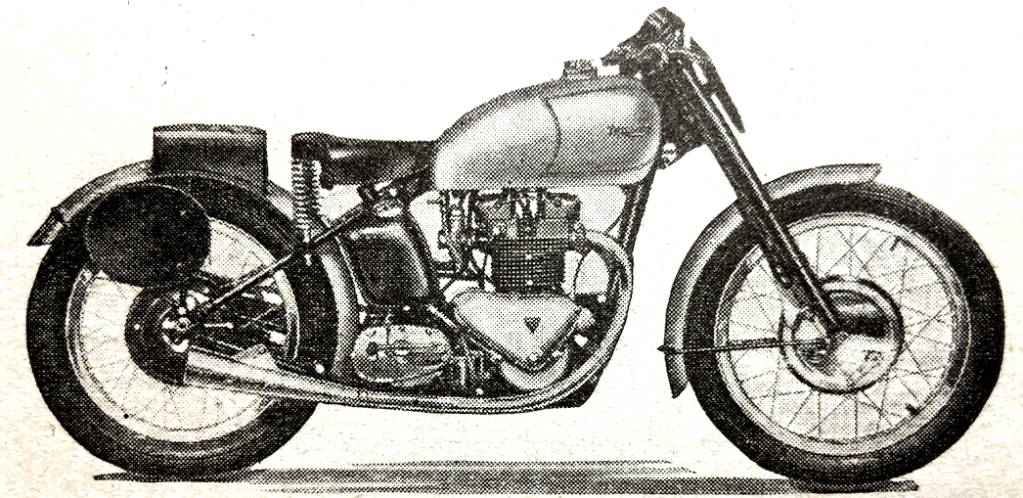
“NO MAJOR DEPARTURE from 1949 specification will be made in the 1950 Scott. Only one model—the Flying Squirrel—is being produced, and this will differ from its predecessor in having much larger mudguards and heavier mudguard stays. The power unit is the famous 596cc twin-cylinder, water-cooled, two-stroke engine, which retains the coil ignition system adopted last year. Lubrication is provided by a Pilgrim H2 twin pump, supplied from a separate 5pt oil tank. Solo- and sidecar-type, three-speed gear boxes are available, the former having ratios of 4.18, 5.50 and 8.90 to 1, and the latter ratios of 4.62, 6.72 and 13.30 to 1. Other features include Dowty Oleomatic front fork, twin 6in front brakes and a single 8in rear brake.”

FOR 1950, THE INITIALS HRD are to be dropped from the model-name Vincent-HRD. It has been decided merely to use the name Vincent in future because the longer title has tended to cause confusion between makes of machine in some oversea countries. Moreover, the new title is simpler and more compact, especially when referred to in some foreign languages. Vincent models for next year are: Series C 998cc Black Lightning Racing Rapide; Series C 998cc Black Shadow Sports Rapide; Series C 998cc Black Shadow Sports Rapide fitted with a modified Blacknell Bullet sidecar; Series B 998cc Black Shadow Sports Rapide; Series C 998cc Standard Rapide; Series C 998cc Standard Rapide fitted with a modified Blacknell Bullet sidecar; Series B 998cc Standard Rapide; Series C 499cc Standard Comet; Series B 499cc Standard Meteor; and the new Series C 499cc Grey Flash racing model. The last may be obtained in three different guises. All Series C models have the Vincent Girdraulic front fork, as well as a hydraulic shock absorber mounted between the spring units of the rear suspension. The Series B machines have a girder-type front fork and no rear hydraulic shock absorber.”

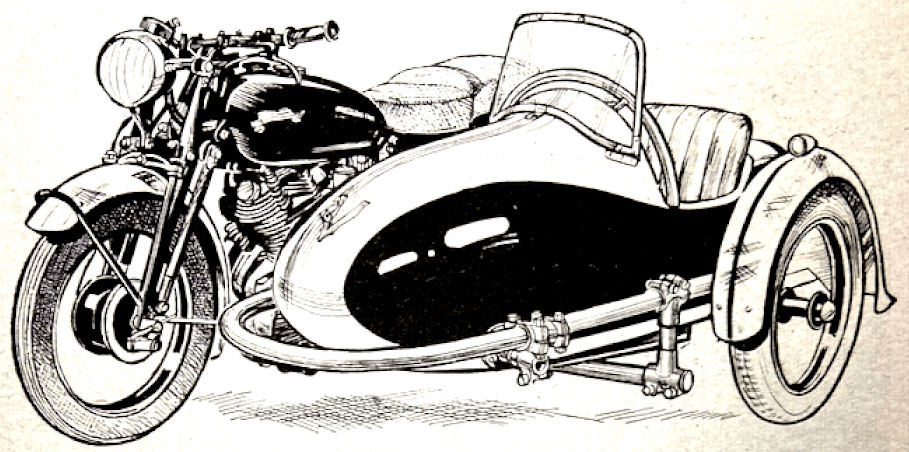
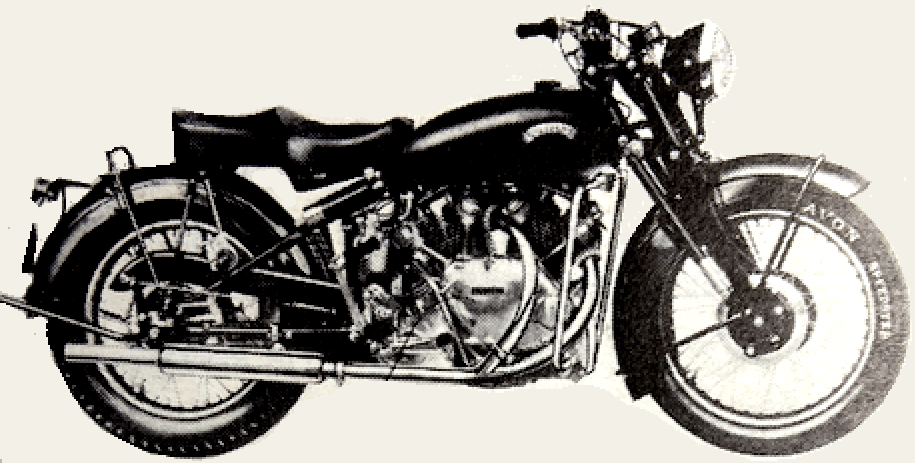
“AT THE VERNEUK PAN Vic Procter, riding a 998cc Black Lightning Vincent-HRD established four South African National records. The figures are: Flying mile, 136.26mph; standing mile, 101.839mph; flying kilometre, 136.444mph; standing kilometre, 88.919mph.”
NUMEROUS DETAIL MODIFICATIONS have been carried out to the Watsonian range of sidecars, though only one entirely new model will be introduced for 1950. In this way, the company feels, the record rate of production achieved for both home and export markets this year will be maintained. Comprising the range will be the sporty Avon single-seater; the single-seater Albion saloon; the child-adult saloon, the Maxstroke; the larger two-seater Clifton saloon; the smart two-door two-seater Warwick saloon; and the International Sports, an entirely new model with a light-alloy body.”
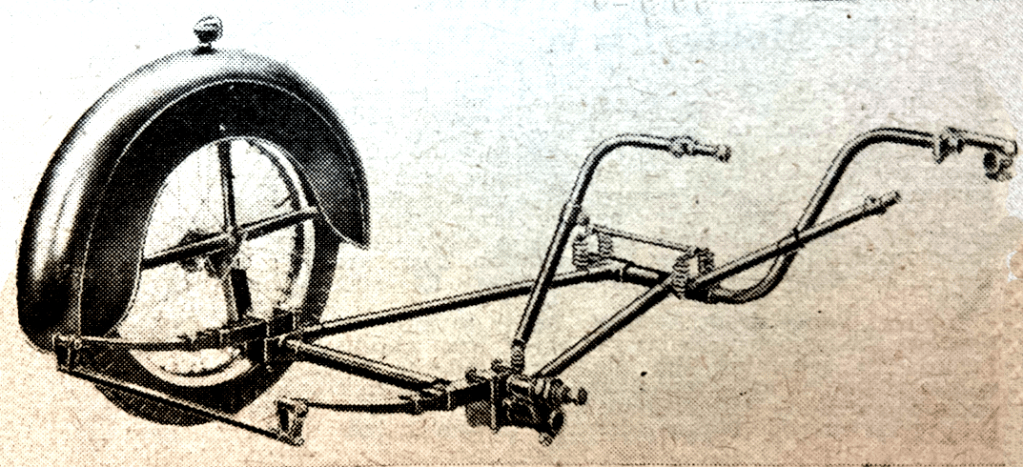
“THE VILLIERS RANGE of small-capacity two-stroke engines announced for 1950 shows virtually no change from that at present in production. So successful have the 1949 engines proved, that no drastic alterations have been deemed necessary, says the company. What modifications have taken place, can be summed up in a few sentences. The gear-box ratios of the 122 and 197cc units have been moved ‘closer together’. In these two models (the 10D and 6E) the gear-box ratios are now top 1 to 1, second 1.4 to 1 and bottom, 2.66 to 1. Previously the ratios were 1 to 1, 1.7 to 1 and 3.25 to 1. (What the overall ratios of any particular Villiers-engine machine are, of course, depends on the chain sprocket sizes employed by the machine manufacturer.)”
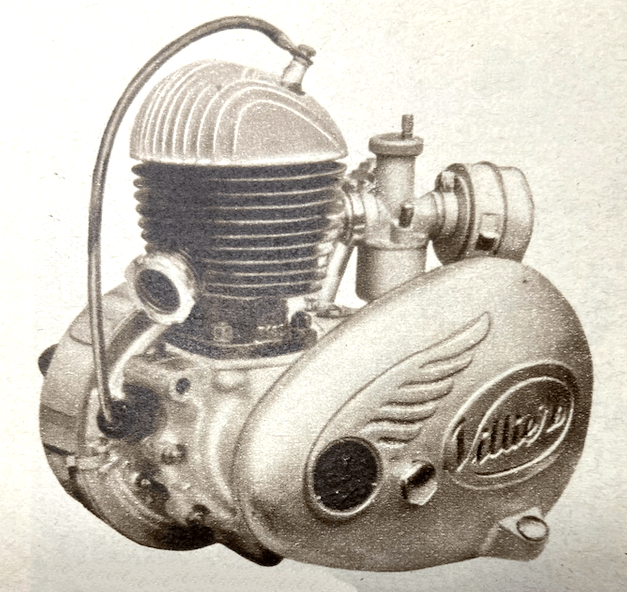
“AN ANNOUNCEMENT OF the lifting of control on the import of foreign motor cycles into Great Britain has thrilled many enthusiasts in this country. Paramount in their minds is the thought that soon, as in pre-war days, they will see samples of the latest Continental designs on the road. Italian racing machines will become readily obtainable over here, German transverse twins will be on the market again, or so some who have spoken or written to us have imagined. While few will fail to applaud any timely removal of controls, and all will welcome freer trade between the nations, the Board of Trade decision does not at present include Germany, nor are the inclusion of Switzerland and Belgium envisaged. The position of Western Germany is to be discussed in the near future. In this connection it should be recalled that Germany to date has been limited to the production of motor cycles of less than 250cc. In other words, manufacture of the medium- and large-capacity transverse twins is not yet permitted. Further, when import duty, purchase tax, freight and other charges are added to the cost of a foreign-made motor cycle, the final price can be high. British manufacturers have no peer in the art of producing first-class motor cycles at low cost. and it would seem that there is little likelihood of any foreign machines being marketed at a competitive price here. What many will hope is that Britain’s action will be followed by other nations—that there will be reciprocation and the day will soon dawn when the whole of Europe, and not merely Switzerland, is an open market for our machines. Incidentally, Czechoslovakia, under the new five-year trade agreement, is to supply Great Britain with motor cycles to the value of £20,000—£4,000 a year. Here, according to the Board of Trade, there is no reciprocal arrangement, Czechoslovakia being in Britain’s debt.”
At the end of the season Harry Louis, who was to become the formidable editor of The Motor Cycle, took a thoughtful look at the lessons to be learned.
A CAMMY NORTON in the hands of a British veteran had won the Senior TT—but the TT was only the first round in the new World Championship series. Round Two was the Swiss GP at Bern, where the Norton singles and Ajay and Guzzi twins were joined by the potent Gilera fours. The Gilera’s were the fastest bikes on the track but Graham made up for his TT disappointment by winning on his AJS ‘Porcupine’ ahead of Artesiani’s Gilera and Daniell’s Norton. Round three was the Dutch TT at Assen where Gilera factory rider Nello Pagani, who had ridden a Gilera Saturno single into 4th place at Bern, rode a Gilera four to a final-lap victory of Graham. Round four was the Belgian GP at Spa, where Graham was sidelined by a split fuel tank but his Ajay team-mate Bill Doran scraped home 0.2sec ahead of Artesiani’s Gilera and Enrico Lorenzetti’s Guzzi. Round five was the Ulster GP at Clady, where led from start to finish, ahead of Bell and Pagani, to become the first 500cc world champion. Having won the championship Norton stayed away from the final round, the Italian GP—possibly because on the ultra-fast Monza track the Gilera fours would have it all their own way. World-class rider and writer Mat Oxley, and a former colleague on MCW, summed up the race in his retrospective of the first World Championship: “The race was a classic Monza slipstreaming brawl, with Graham fighting with the Gileras of Pagani, Artesiani and Bandirola, nicknamed Bouncing Bandi. Once again Bandirola crashed out, while trying a mad move on leader Graham, who he took with him. Meanwhile Pagani romped home to win, eight tenths ahead of Artesiani. Doran completed the podium in a distant third. The final points count had Graham ahead of Pagani by one point in the riders championship and AJS one point ahead of Gilera in the constructors.”
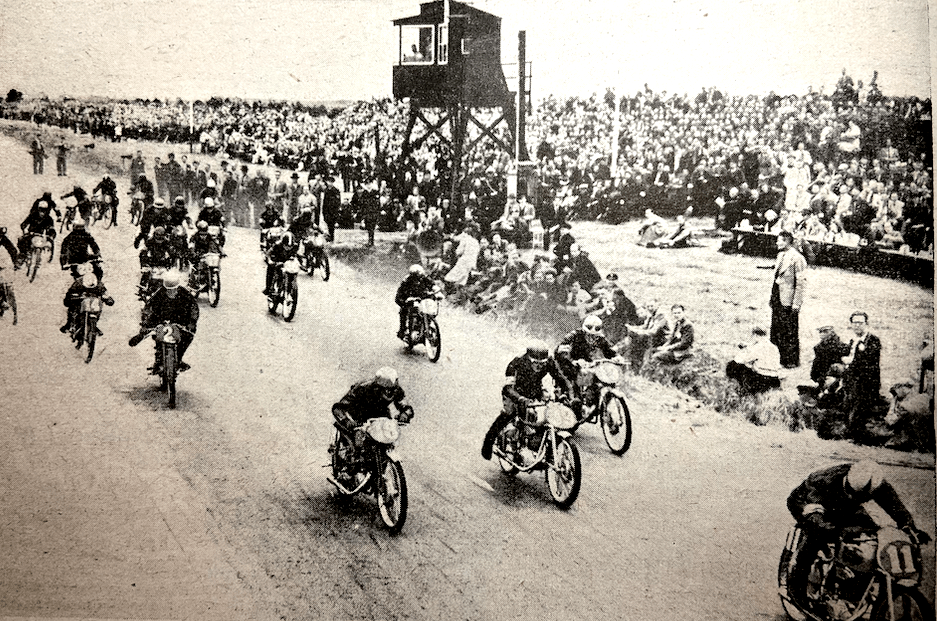
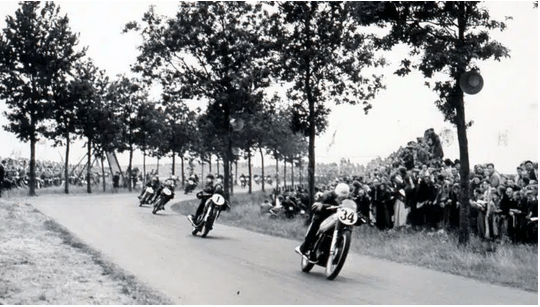
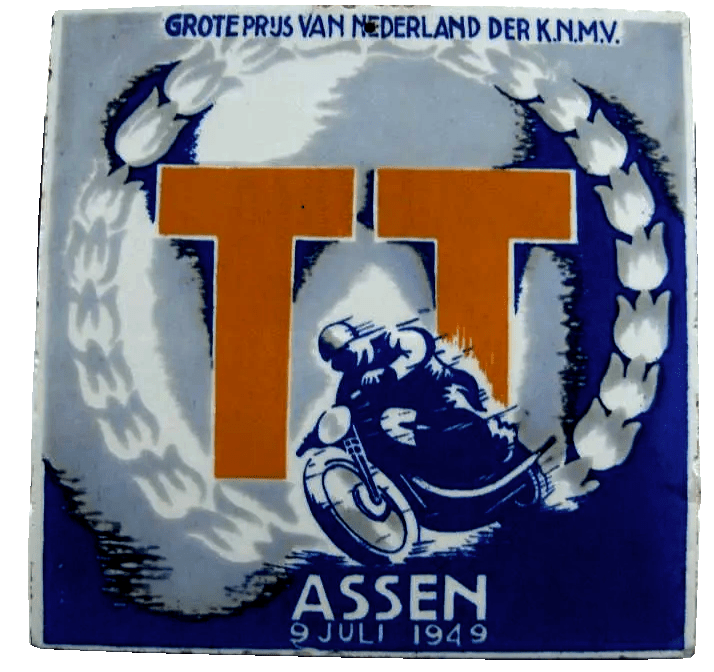
“CLASSIC ROAD RACES have rarely been so keenly fought as this year. Never before have riders had to ‘work so hard’ for victory, as Freddie Frith put it after the Belgian Grand Prix. A promise of what was in store came early on. Before the first of the classics there was the North-West ‘220’. Harold Daniell, it will be recalled, snatched a machine’s length win from Frith in the 350cc class. Then came the first classic meeting, the TT, and in the Senior Race there was a tie for first place on the second lap and a triple dead-heat a lap later. Frith won the 350cc Swiss GP by less than 4sec and won the Dutch GP by scraping past Bob Foster on the last corner, within sight of the finishing line. Bill Doran snatched victory in the 500cc Belgian GP by ⅕sec—about 300 yards from the flag he was in third place. In the Ulster GP, Artie Bell rode like a demon in contest with Artesiani to gain second place. At Monza, in the Grand Prix des Nations, only yards separated Les Graham, Pagani, Artesiani and Bandirola in their 100mph battle for first place, till Graham was brought down by Bandirola’s crash. Even more tigerish was the 32-lap dispute in the same race, with Bill Doran, Guido Leoni, and Bertacchini the protagonists, which Doran won to get third place. Machines nowadays are so closely matched. Races are won by fractions of a second. There is no room for the slightest easing up. Every stable is ‘scratching’ for the last ounce of performance. Peak power outputs, especially with single-cylinder engines, get higher and higher up the rpm range and extend over an ever-shortening length of that range. Gearing correctly for a circuit and for the wind conditions of the day is a supreme art. Riders keep an eye on revmeters more than ever before; they probably use gear boxes and clutches more than ever before; they are, as Ernie Thomas would say, ‘very busy’ throughout a race. They are very busy, too, before a race. Gone are the days when the star riders were served by an army of mechanics—when they did no more than ride machines carefully prepared down to the last detail.
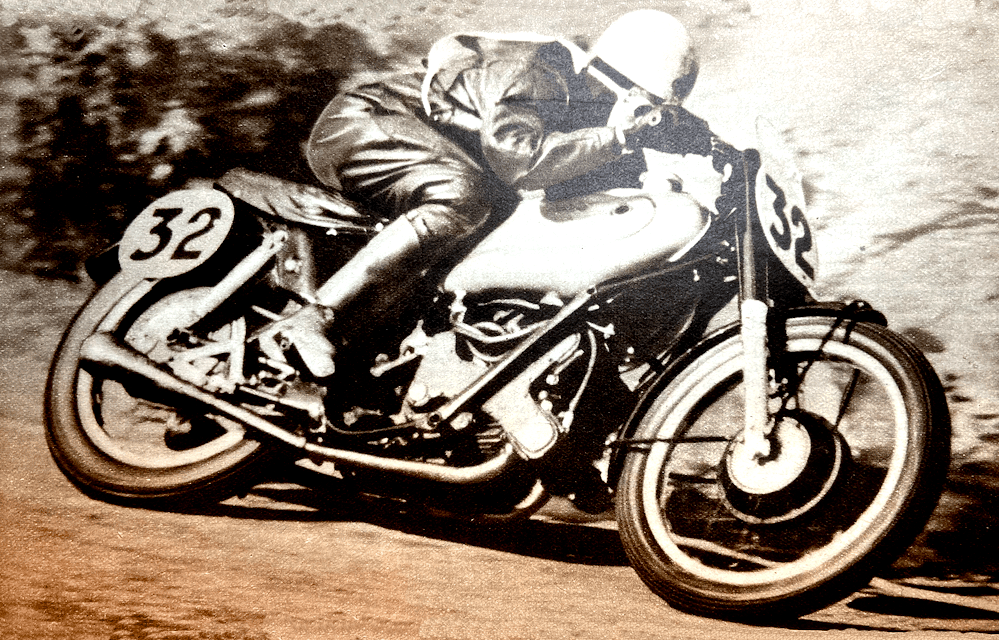
Especially when over for the Continental races, riders do a high proportion of the straightforward preparation; very often only the precision work, such as engine building, is done by the expert mechanics. This certainly applies to the British teams, though the grander style, with plenty of mechanics available is still common among some of the Italian stables. Of course, the true Continental circus rider of the Eric Oliver, Fergus Anderson, David Whitworth, Tommy Wood type has always expected to do his own machine preparation. What with moving from place to place, preparing his machines, practising and racing, he lives laborious days. To make ends meet he must race as often as possible—which means almost every week-end. Between races he may cover 500 miles in his van. The more classes he competes in the more starting money he is entitled to, so he has to have two and probably three sizes of machine. When the new FICM road-racing code comes into operation next year, machines will have to be of the capacity class for the race in which they are entered—it will not be possible to ride a 350, for example, in a 500cc race—so the burdens of the free-lance will be increased. ‘Circus’ life is no holiday. Closely fought races are ideal from every point of judgment, but one is forced to ask oneself how long the present high standard will last. First of all, consider the 500cc class. Multis have come into their own, no matter what conclusion may have been drawn from the Senior TT result. More than this—it may not be long before twins will be very hard-pressed to hold the Gilera four. On the showing in Switzerland, Holland, Belgium, Ulster and Italy, the Gileras were the fastest machines running. They have also the advantage of rocket-like acceleration from the slow corners—this advantage alone is sufficient to win races. British machines have been brought home ahead of the Italian fours mainly by superior riding skill on the swerves. Twins, and even singles, will no doubt continue to be successful, and the AJS twin, especially, with its superb road-holding and steering, and its engine into which still more horses can be packed, is likely to win frequently against the best foreseeable four-cylinder opposition. But there is little doubt that a designer laying down a new racing 500 would be unwise to consider a project with fewer than four cylinders. This thought raises the point of a class at the other end of the capacity range—the 125cc. class. Britain shows no interest in 125cc or, for that matter, 250cc racing machines. This policy is, I suggest, open to question. As 125cc is the cylinder size for a 500cc four, or a 250cc twin, there would be merit in developing the 125cc racing single if only as a guinea-pig for the larger types. Much of the experience gained—for example, valve-gear, port design, combustion chamber design—would be applicable in very large measure to multiples of the small single. In this country we may be inclined to laugh off the ‘baby’ class —and certainly the racing on the longish, classic circuits is dull by comparison with the thrills of the big stuff—but there are valuable lessons to be learned in the process of developing racing 125. It is a reasonable deduction that if the racing 500 of the future will be a four, then more than one cylinder will be the fashion for 350s. This is exactly the
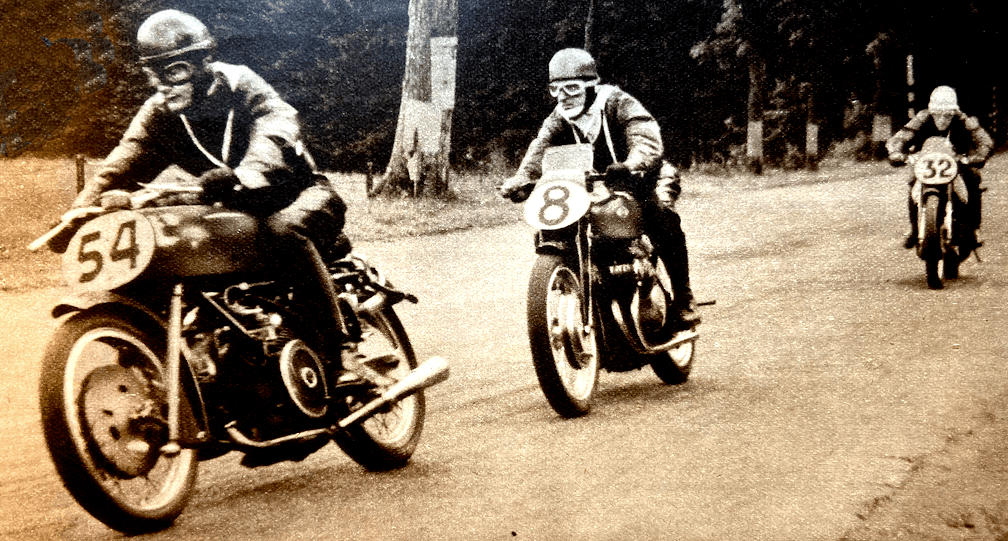
forecast of knowledgable followers of racing. Twins are suggested because a four-cylinder design would mean cylinders of about 87cc, which is considered by some, though only by some, to be rather too small by present-day standards, assuming we have in mind four-strokes And while restrictions on any means of forced induction remain in force, two-strokes are unlikely to be considered as serious competitors of the four-stroke. Whether 350cc twins will appear remains to be seen. As a racing type, the 350 may be losing favour slightly abroad though gaining popularity in Great Britain. Another factor is that Britain has a near monopoly in this field both as regards machines and successes. Monopoly does not usually encourage rapid development, and manufacturers might be influenced by the trend of world markets for production machines. This trend is towards machines of 500cc and above, and of 250cc and smaller capacities. The 350 falls between the two dominant demands. And what are we in Britain going to do about 125cc and
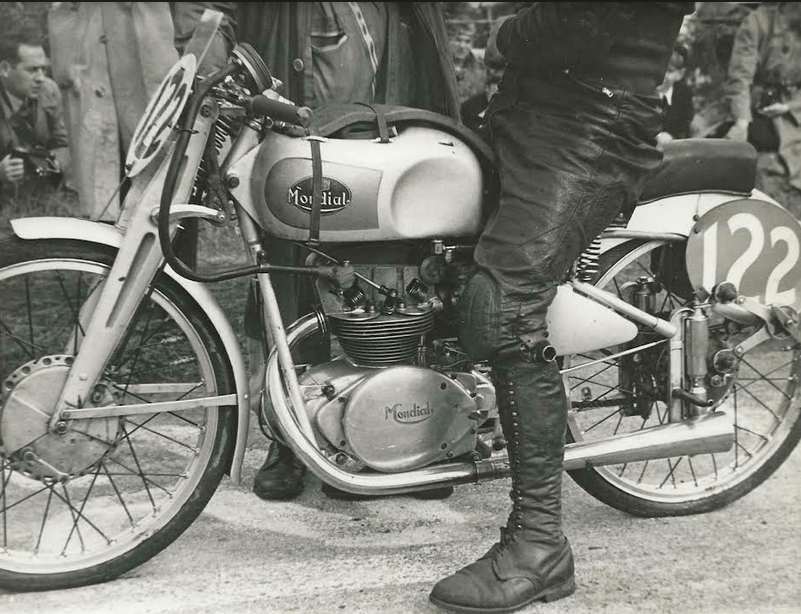
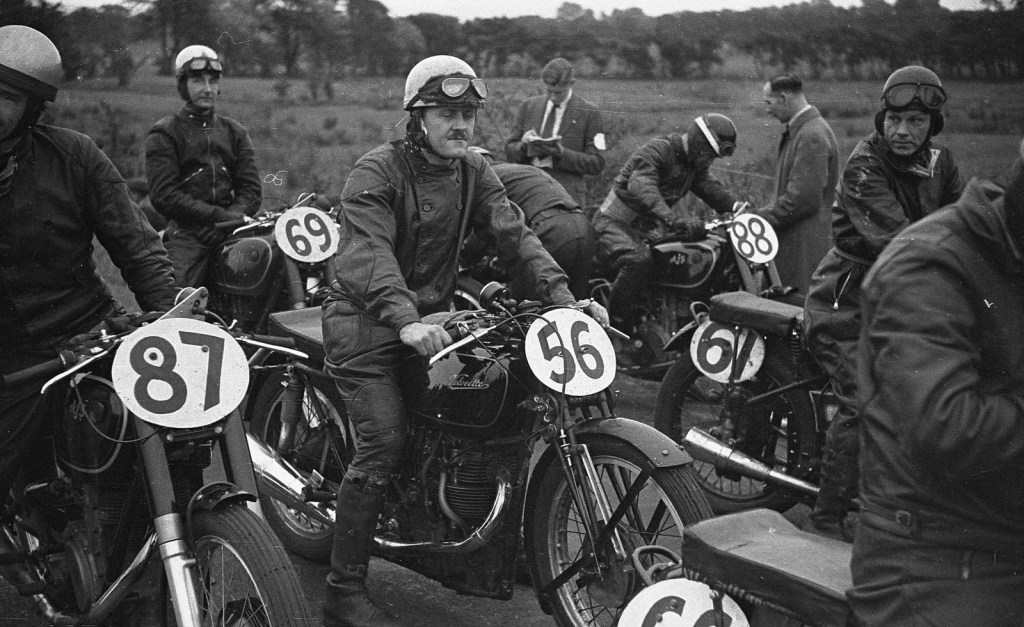
250cc racing machines? The former seems worth attention for the reasons mentioned earlier. Moreover, increasing interest in 125cc class racing is being shown on the Continent. Races for 250s—in the classic events, at any rate—are becoming fewer largely, one suspects, because of the overwhelming successes of the Guzzis. The only real challenger, and it is a worthy challenger, is the Benelli. As yet, there is no firm news of whether more of these wonderful little racing machines will be produced. Nor is it known how far the Gilera 250cc four is advanced. Possibly there will be renewed British interest in small-class racing when our manufacturers enter the markets for 250cc production machines more seriously; but history suggests this to be no more than a possibility. British racing successes this year have come in full measure. Our riders have won three of the five classes in the World’s Individual Championships; our manufacturers have also won three of the five classes. These successes are of inestimable value to the prestige of the industry. This praise might well be extended to include the wins at Daytona in March, although the Daytona events, run under American Motorcycle Association rules, are not at present recognised as among the so-called FICM classic meetings, the AMA not being linked with the FICM. There are a few special points about this year’s events which give food for thought. First, the fuel problem. As pointed out by Fergus Anderson some time ago, the FICM edict that fuel should be of commercial type with an octane rating between 70 and 75 has been openly broken by the organisers of some races. In the classics, the approximate figures were: TT, 72; Swiss, 74; Dutch, 70; Belgian, 78; Ulster, 74; Italian, 74.
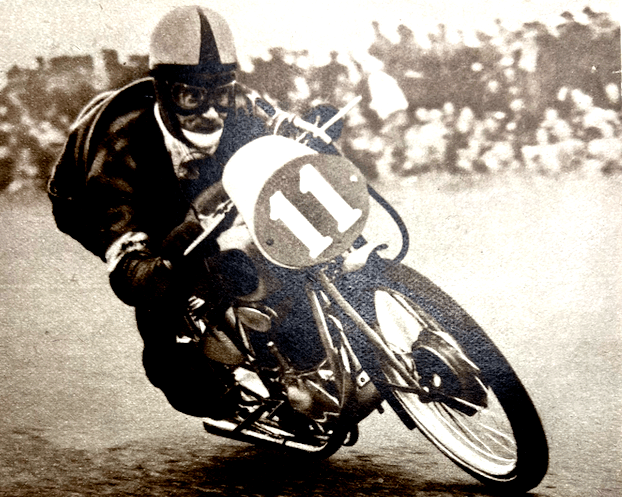
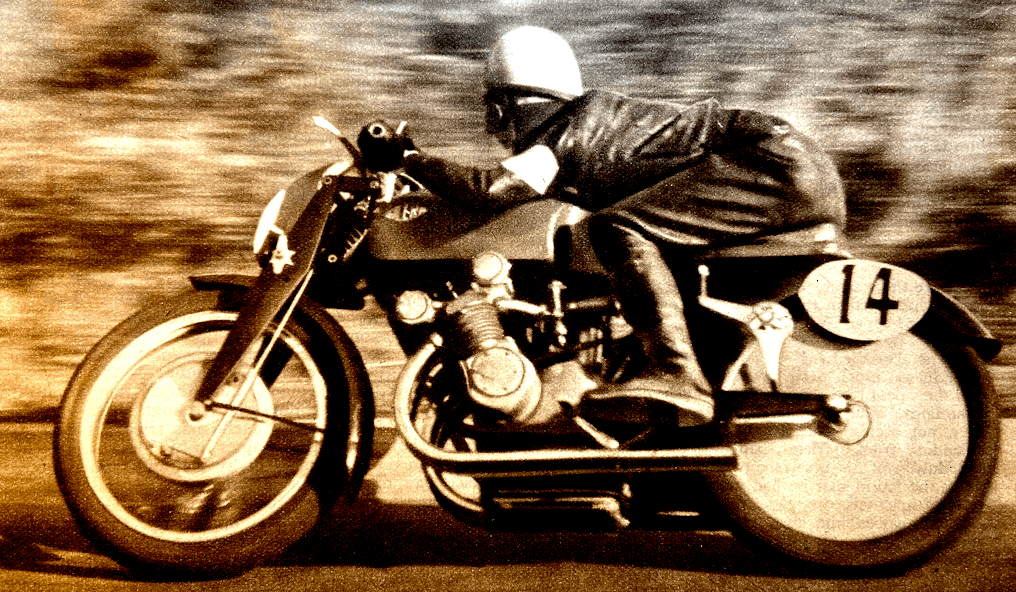
These variations arose fortuitously and only one, the Belgian 78-octane is contrary to the ruling; the Belgians were unable to obtain a lower octane petrol and gave due warning to the FICM. But octane rating is not the only factor that affects engine modifications to obtain maximum performance. There is also what might be termed the ‘quality’ of the fuel—for instance, the proportion of aromatics. On this basis the TT fuel ranked as good 72-octane and the Dutch as poor 70-octane. These fuel differences are a headache to those responsible for preparing racing machines. Between each meeting, compression ratios have to be altered. Often the best ratio is obtained not by reference to the data book as might be imagined, but by the trial and check method during the practising periods. This frequently involves stripping and rebuilding against time and with limited facilities. Hence anything that can be done to ensure a greater measure of consistency in the fuel for the various races would be a welcome step. The same bother of variation is not apparent with 50-50 petrol-benzole fuel. Adding to the difficulties of machine preparation this year was the closeness of the Swiss, Dutch and Belgian Grands Prix—and the inconvenient order. These three meetings took place on successive weekends. Racing camps had to travel from Berne in Switzerland and cover around 600 miles to Assen, in the north of Holland. On the way they passed within a few miles of Francorchamps circuit, whence they would have to return the following week for the Belgian meeting. They could not leave Berne till the Monday. Practising for the Dutch meeting started on the Wednesday and racing was on the Saturday. In addition to the long journey in sweltering weather, machines had to be prepared for the Dutch races. Solid, hard work had to be put in, and plenty of midnight oil was burned. With the Dutch meeting over wheel tracks were retraced to Spa, its Belgium. Three big meetings as close together as this year is a far-from-ideal schedule. The main snag is that, to keep the fine edge on works’ racing machines, the facilities of a factory racing department are desirable and sometimes essential; obviously machines could not be returned to the factory between these three meetings. Arranging dates to suit all concerned is always a thorny problem. However, if, in future, these three Grands Prix must be dated on successive week-ends, then a real effort should be made to fix them
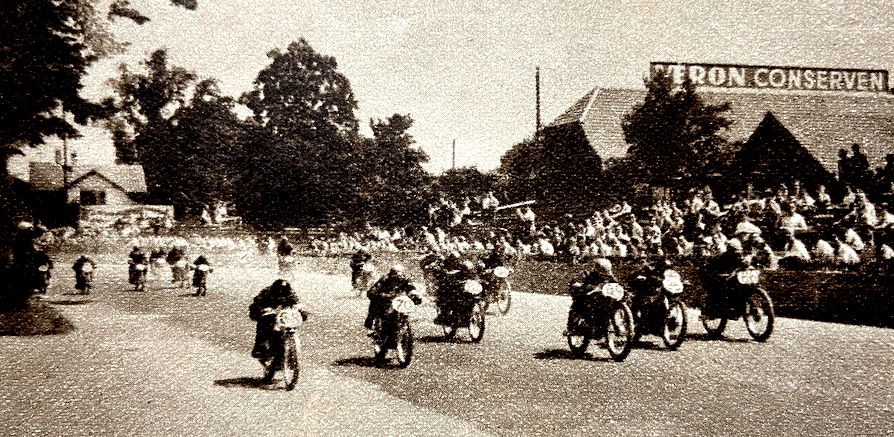
in the order, Dutch, Belgian, Swiss, or vice versa, to lessen the burden of transport. The FICM is, I know, hoping to arrange bigger gaps between the 1950 meetings. Time-keeping queries cropped up again this year, though not in relation to the TT events. But in the Continental Grands Prix, there were various fastest lap queries. In two instances the organisers changed their minds in a manner which shook one’s confidence, and in a third, the official result is difficult to believe. With all the modern timekeeping paraphernalia employed for big events, doubts come as a disconcerting surprise. There are indications that more attention is being given, and is going to be given, to reducing windage. Guzzis are installing a wind tunnel at their Mandello works, and the benefits of this equipment for determining the effects of wind resistance and methods of reducing it may well become apparent next year on Guzzi road-racing machines. Possibly a start has already been made. It is said that an aero-dynamics expert, when looking at the 500cc Guzzi twin of last year’s design, suggested the front number plate should be moved a few inches slightly forward. Hence the fuel tank surrounding the steering head and forming, at the front, the number plate. For the high-speed Grand Prix des Nations at Monza, a stream-lined 125cc Mondial was raced—it gained third place—and many machines, including the Gilera fours, had discs on the rear wheels. Here is yet another straw in the wind. On Fergus Anderson’s 250cc Guzzi will be found a second pair of footrests. These are placed well to the rear and high up so that when they are employed Fergus is adopting a near-prone riding position. He claims an increase of around 200 engine revs in top gear under favourable conditions. Many Italian riders have this second set of footrests on their 250s and almost without exception prone positions are the fashion on 125cc machines. Most racing machines bristle with bits and pieces sticking out in the breeze, and many riders are a bit half-hearted about tucking-in and employing neat, close-fitting leathers. We are likely to see designers and racing men much more ‘windage’ conscious before very long. A final point. Peter Chamberlain attended the Swiss and Belgian events and was a steward representing the ACU. Aside from the prestige value of a British official in attendance, it is a comfort for our riders to feel that they have a representative who would watch their interests should the need arise. For the Swiss trip, the organisers were the hosts. Peter Chamberlain made the Belgian trip at his own expense. Might it not be a thoroughly sound aim of the ACU to send a representative to all the Continental classic events where British representation is high? We suggested this in a leading article when the ACU 2½% levy was proposed. The cost would be money well spent.”—Harry Louis
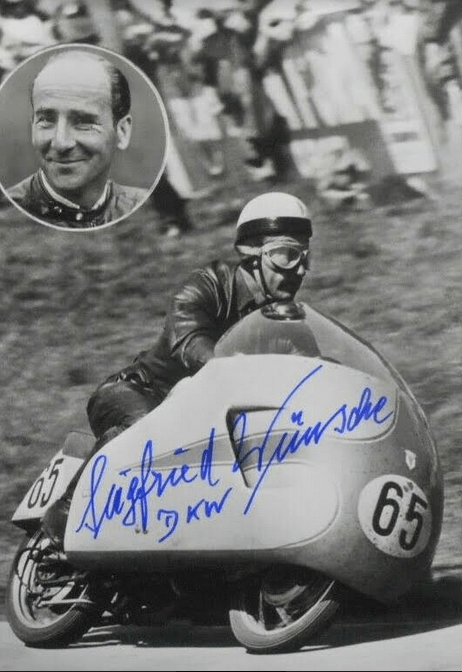
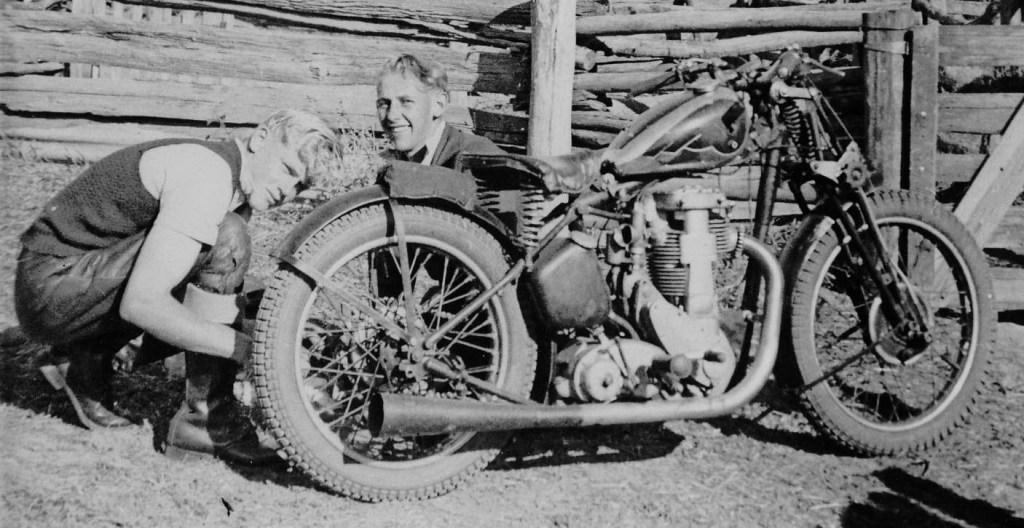
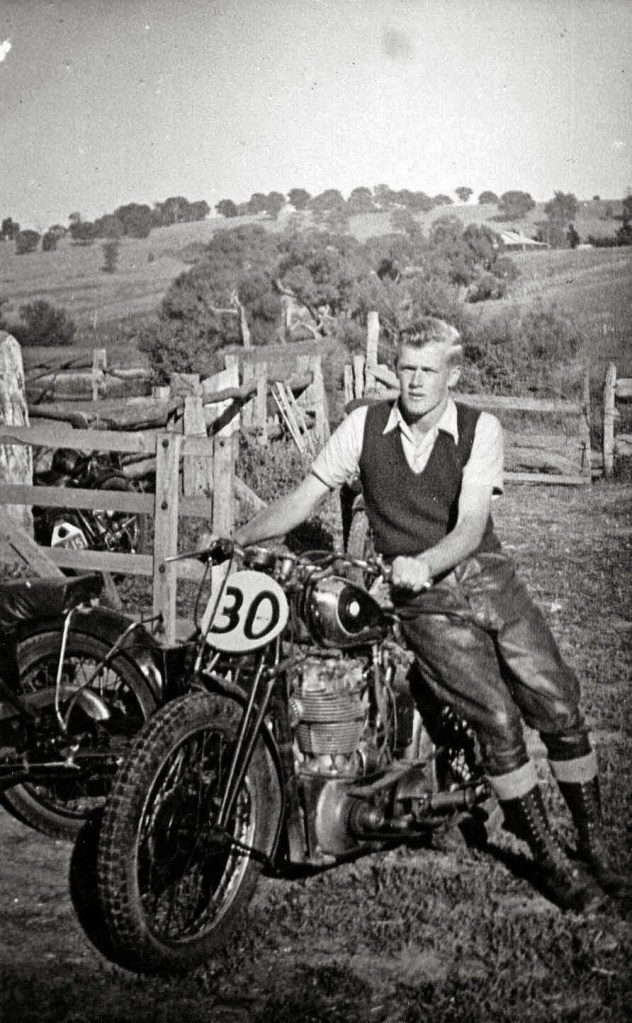
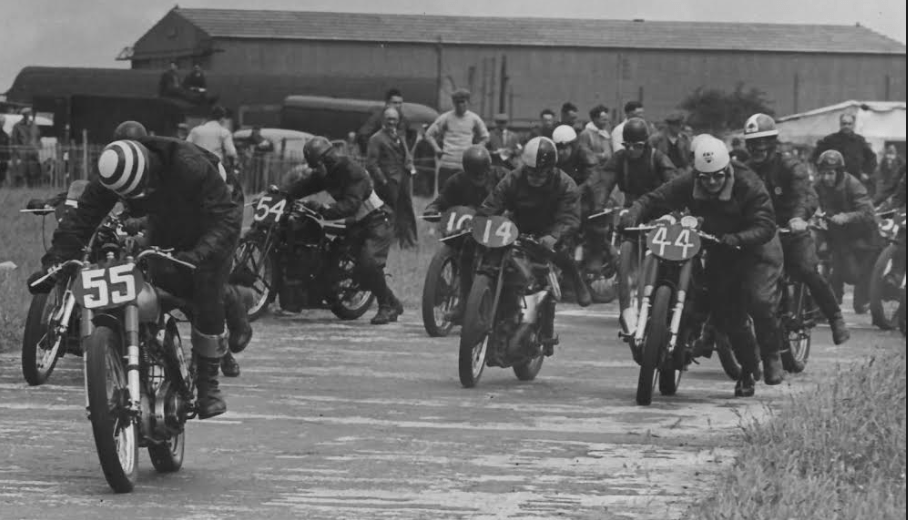
OVER 7,000 PEOPLE filled the ramps and grandstands along the promenade at Weston to watch the first motor cycle road race meeting to be held there. To call it road racing required a stretch of imagination, for the course was a length of the promenade with two tight hairpin turns at each end. One lap measured l¼ miles. Competitors rode in a clockwise direction, starting on the road and returning along the pavement. The change of surface from road to pavement, from rough to smooth. was the cause of a couple of minor spills. Approximately 75 feet was allowed for the turns at the hairpins, which slowed the riders down to a crawl, and it became a race from corner to corner, the first man into a bend having the advantage. Among the 62 entrants was an impressive array of star riders including Maurice Cann, LR Archer, WA Lomas, Bob Foster and W Sleightholme. WA Lomas, the Derbyshire rider, took the honours of the day in the three classes. In the 250cc class Maurice Cann (Guzzi), after a bad start, pulled up from fourth place to win his heat comfortably in the four laps. In the final (5 laps) Lomas (Royal Enfield) went out in front and stayed there, while LJ Bayliss (Ellbee Special) and Cann fought it out for second place. The final of the Junior Race was the most exciting event of the day. After a hot duel throughout the five laps. Lomas (Velocette) crossed the line not more than a machine’s length ahead of Bayliss. Bob Foster had to scratch from the race owing to gear box trouble, and R Hammond’s BSA had to receive the attention of the fire brigade soon after the start of his heat. In the Senior Race. Bob Foster (Triumph) clocked the best time of the day for four laps at 4min 27sec in his heat. But it was Lomas (Royal Enfield-JAP), who collected the laurel wreath and the Weston-Super-Mare Hotels’ Association Trophy in the 5-lap final.”
THE ROYAL ARTILLERY formed a motorcycle display team and mounted them on Matchless G3s (later replaced by BSA Gold Stars). Mind you, the first post-war Gold Star but it wasn’t a 500. The original Goldie was based on the 498cc Empire Star but the ZB32 Gold Star was based on the 348cc B31 so this was a Goldie 350, complete with teles and optional plunger rear suspension. It was primarily designed as a competition mount.
MOTO GUZZI SUPERCHARGED and streamlined one of its 250cc racers, bolted on a sidecar and works rider Cavanna piloted it along the Milana autostrada at better than 209km/h (130mph).
“DARTMOOR, ITS WILDS, vistas and rocks—yes, and some of its bog; a fine day in autumn; 19 observed hills, several on private property and mere pack-horse tracks; at the finish, unexpected pleasures, demonstrations of cider-making at a near-by farm, plus free samples—these are a few of the ingredients of last Saturday’s West of England Trial for The Motor Cycle Trophies. To state that the 126 entries, or, rather, the 114 starters, saw Dartmoor at its best would be an exaggeration, apart from the fact that, at times, riders were fully occupied in noting where their front wheels should be placed and in endeavouring to put them there. For one thing, the morning was grey, though later there were periods when the sun blazed down. But the trial did show competitors many parts of the Moor which no tourist, not even the rambler, normally sees. RESULTS: The Motor Cycle Trophy and Souvenir (best solo), L A. Ratcliffe (347 Matchless), 8 marks lost. The Motor Cycle Trophy and Souvenir (best sidecar): H Tozer (499 BSA sc ), 37.”
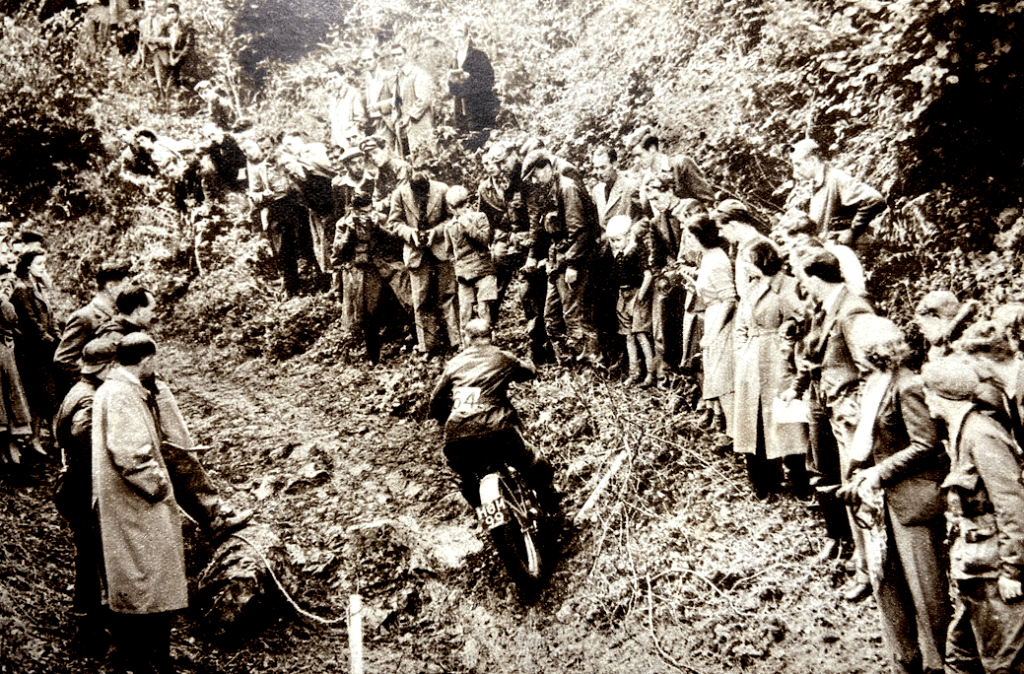
“I NOTICE A TENDENCY on the part of the 350 and 500cc men to regard the new—or should I say, ‘revived’?—650cc class as a sop flung to the sidecar fans in Britain, and to the quondam big Indian-Harley crowd in the USA. I have not yet sampled either of these 650cc newcomers, and, of course, it is true that their sponsors have one eye cocked at the USA and at sidecars. But friends who have ridden both are indignant that those two motives should be regarded as the sole inspiration of the newcomers. The nuance which separates a 650cc from a 500cc is hard to define in words. One of the expert analysts used the word ‘fussy’ in conversation, as suggesting an element in the comparison which a fan of the 1949 500s might recognise. If I try to expand that point, I should begin by saying that there is no perceptible weight increase, and there is a genuine advance in speed and climb. I should then go on to recall the contrast between a wee baby car which attained its 60mph maximum by a very high rpm, as compared with a far bigger chassis, depending much less on rpm, and getting its 60mph with much lower revs and with a higher gear. To express the contrast in two such words as ‘burble’ and ‘buzz’ would be unfair to the 500cc, yet they unquestionably lead the mind towards the intrinsic difference in solo work.”—Ixion
“A NEW ENGLISH DICTIONARY will be needed shortly if readers continue to invent new collective nouns at the existing rates. Samples are: A rumble of Vincents. A hurry of Triumphs. A squeak of motor-assisted bicycles. A whisper of Velocettes (Model LE). A snarl of Velocettes (Model KTT). A yowl or moan of Scotts. A skein of AJS. Only the last requires exposition. The term ‘skein’ already applied to a flock of wild geese flying in their perfect V formations. A reader considers that Graham, Doran and Frend formated beautifully at Silverstone last month.”—Ixion
“ONE OF THE REMARKABLE things about the little vehicle we clumsily call the ‘sidecar outfit’ is that it is actually alive and kicking today—indeed, very much alive. Rather a strange statement to make, some may think! But not many of the younger generation know that the sidecar was condemned to death almost as soon as it was born more than 40 years ago; that its demise was confidently predicted later on when cheap cars made their appearance; and that it has many times been condemned as ‘unmechanical’ and therefore unsound. I thought of these lamentations of old when I walked round the sidecars at the recent Show, and I decided in my mind that while motor cycles exist there will always be sidecars. Of course, one
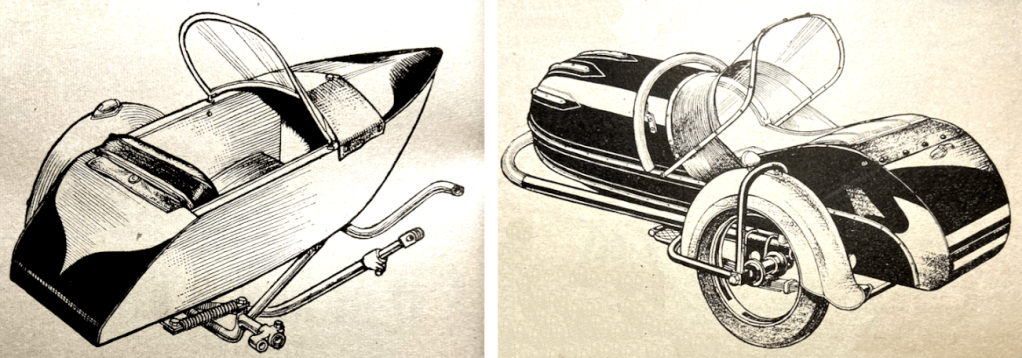
never hears adverse criticism, in these days, of the most economical and the safest motor vehicle on the road. The comfort, too, of these little vehicles is taken for granted. We are given rubber suspension for the body, rubber mounting or plunger-type springing for the sidecar wheel, fine upholstery—and we take it all as a matter of course. One could order any touring model without previous examination and be sure of obtaining satisfaction. It was many years ago when I ordered my first coachbuilt sidecar after examination at Olympia. I thought it a lovely job, but found to my amazement that the passenger preferred her old, woven, cane body. And, ye gods, she was justified in her preference! I suppose the cane body was in itself a cushion to all sorts of vibration…Well, there was not a big number of sidecars. on show, but those exhibited were good. There were no masses of chromium and vermilion; every body and certainly every chassis was a sound, practical proposition. Among the entirely new designs the Garrard Latimer took my
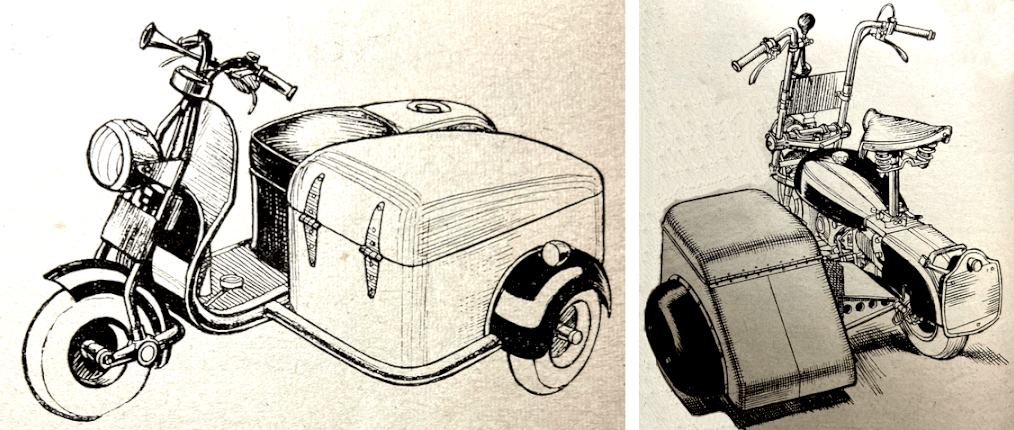
fancy as much as any—as a family model, I mean. I liked the idea of being able to slide the front seat forward and lock it in position. This permits Junior to have a change of sitting position; he can occupy front or rear seat, because the rear seat both in size and upholstery is quite satisfactory for an adult—when, of course, the front seat is moved forward. Not only is the change-over of seats a good idea, but the child receives better protection from the wind when seated in front, especially when the hood is rolled up. The light-alloy frames carrying the front and side screens are particularly substantial—a good feature. Incidentally, the door can be locked. This body, fitted on the new Mark I chassis with rubber-mounted front pivots and rear body-springing that can be adjusted to suit the load, is good-looking and practical. If you want still more luxury, a sprung wheel can be fitted at extra cost. I noticed the S90 de luxe sports model received much attention; it was one of the original Garrard designs and is still one of the best-looking sports sidecars made today. It has, naturally, received many detail improvements over the years—the hood fixing is better and the side-screens are extra large. The size and shape of side-screens are
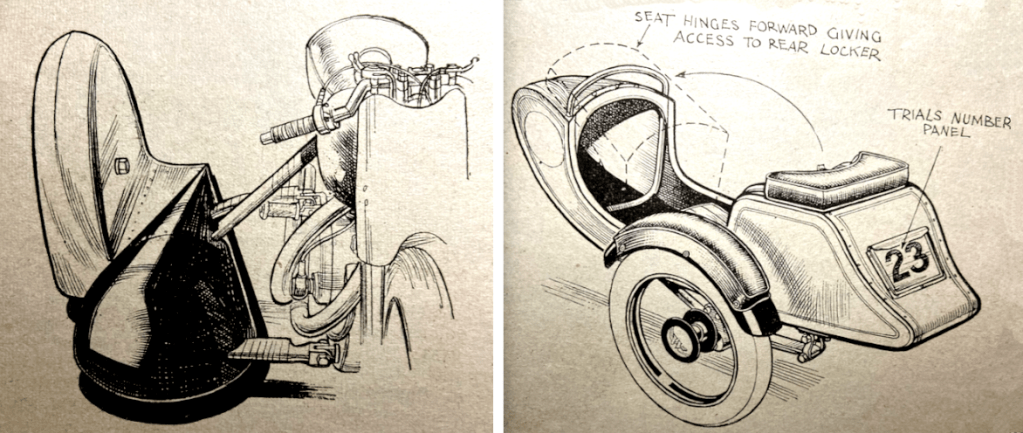
more important points than the average rider imagines. He does not know what it means to have a draught cutting across the eyes because of the side-screens being too low. This can completely spoil the pleasure of a ride and, speaking from experience, I would rather tolerate hard upholstery and bad springing than this annoyance. Many owners of 125cc lightweight mounts have probably wondered whether their machine could pull a light sidecar satisfactorily. Garrards have answered that question, for their little Gazelle weighs only 50lb. Its size tickled the youngsters immensely; however, it is no toy, but a soundly made miniature. The mention of youngsters reminds me of the family I saw on the Watsonian stand—mother, father, girl and a friend. They had a big bag with the cork of the vacuum flask protruding, and they were ‘doing’ the sidecars thoroughly. They started with the Clifton. First, the wife seated herself in the saloon, then the husband with the child in the back seat. But it was the wife who knowingly snuggled herself down and noted the width of the body, height of the backrest, and position of the footrest. The husband examined the hanging of the door, the fitting of the body on the chassis, and the
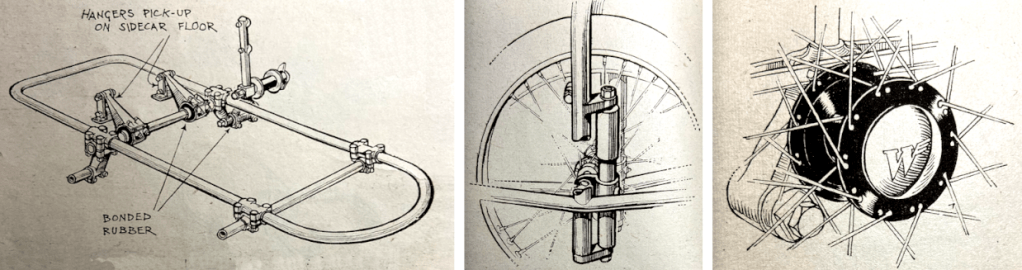
hood. Very little escaped his scrutiny—but the Clifton can stand careful examination! Weren’t they grim and serious about it! I saw them again on the Swallow stand—still carefully examining. I think they came from the North. Watsonians have a grand range. I gravitated naturally to the Warwick, that superlative piece of sidecar craftsmanship. I noticed that the side windows are now made to open, a good point; and that there is more headroom than with last year’s models. A separate door is provided for both front and back seats, the latter being on the right-hand side. Luggage capacity is good, and the grid of a strength capable of carrying a useful-size case. I much prefer, myself. to fill the boot with luggage, lock it up, and carry a case on the grid rather than drop the hack and carry the luggage on the platform. A favourite Watsonian model is the Albion. It has always seemed to me a sound job from every angle. It looks right and is right—with its big door, wide-vision screening, very deep seat and backrest, ample luggage space, and strong luggage carrier and bumper. It has real grace of design, too. The Watsonian Silentbloc method of wheel mounting is taken for granted now, but it is a valuable asset…I asked Swallows what part of the country showed the biggest interest in large saloons. The reply was: the north of England, without doubt; frills and too much chromium are not wanted there. What a lovely job is the Swallow Jet 80! It is so
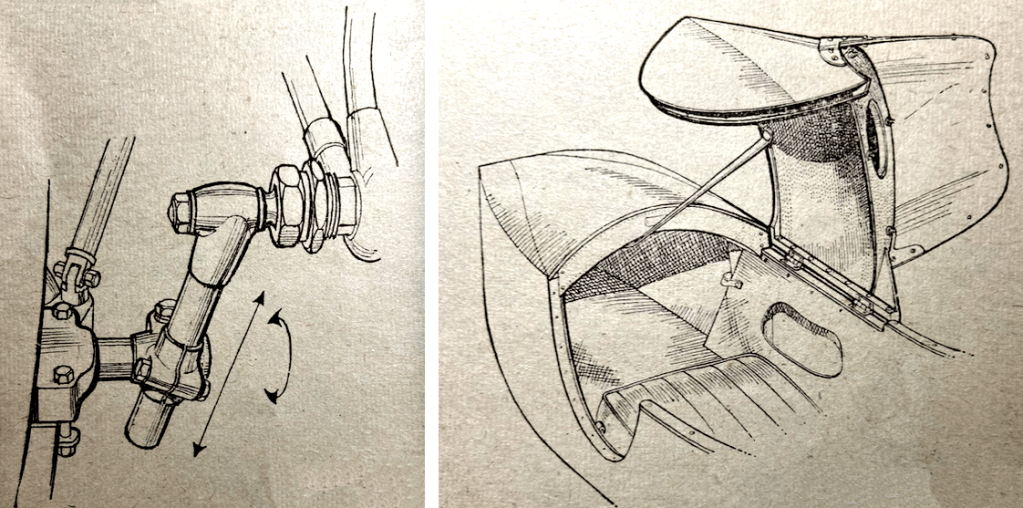
beautifully streamlines and is essentially sporting; yet by using the quickly erected hood the passenger can be as completely protected as in a saloon, and the large luggage boot will hold all the luggage necessary for a longish tour. It is a fine example of the sidecar maker’s craft. Another fine sporting sidecar is the Blacknell Continental Bullett. Its special points are the well-placed screen, exceptionally large locker, and attractive body design, but the ensemble takes everyone’s fancy, especially when it is fitted on the de luxe chassis. Mr Blacknell told me that they were marketing a Bullett saloon on which the canopy is ingeniously, hinged at the rear; there is a clever self-locking devise which permits the passenger to fold the whole top back and enter without gymnastics. On this model, exceptionally fine vision is provided for the passenger because the screen and side-windows are moulded in one piece. This struck me as a very good point. Incidentally, Mr Blacknell told me he won’t have sprung wheels, but prefers to rely on soft, long-travel body springs such as are used on the Safety chassis. This chassis, by the way, has been tested over long distances on Continental pave at gruelling speeds attached, I believe, to a Vincent machine. Another of the Blacknell range is the new Sherwood saloon—a handsome job. Then there is the Derby, which has a commendably large luggage boot. As I said at the outset, the keynote for 1950 seems to be ‘practicability’, with the emphasis on elbow room; depth of seating; clean, attractive body lines; and, of course, . chassis design undreamed of only a few years ago.”—‘Friar John’
“AFTER STUDYING THE wide range of modem sidecars, I am full of enthusiasm for their lovely lines, but full of doubt as to whether the designers (or their ladies) ever ride in them. My chief bone of contention is that instructions for getting in and out are not printed on the wee door. I have a modem touring sidecar and it most embarrassing, if carrying any one over 4ft 6in tall, to have to detail the exact sequence of moves in order to get the passenger in and out. I do not think that a lady ever looks her best with one foot behind her left ear. One other small grouse: when will sidecar screens be designed to screen, instead of only to conform to the designers’ aesthetic sense? I know that one can always have a saloon, but my usual passenger likes fresh air, though not a concentrated blast across her eyes and dawn the back of her neck.
EG Stockwin, Shirley, Nr Birmingham.”
“I HAVE LONG been pleading for more concentrated attention on the 250cc class of motor cycle. The motive for such a change of attitude is not merely our racing inferiority in that field. There are as yet no signs that motor cycle prices in general are on the downgrade. There is no hint that Purchase Tax will be short-lived. At the moment, a first-class TT Replica costs round about £350, and a top-notch roadster seldom leaves much change out of £200. Sidecar prices are proportionate. Taxes are more likely to rise than fall. In such a situation the stress laid on the smaller engines by such firms as BSA (with their modern Bantams) and Excelsior (with their twin Talisman two- stroke) is eloquent and statesmanlike. We could probably top this class in the touring field without spending a penny on racing. The motor cycle has attained a point in its development when racing becomes largely a matter of prestige and sales publicity, apart from furnishing fun, fame and fortune for its exponents.”—Ixion
“EVERY SOLDIER KNOWS that though the head of a long military column may march steadily at 3½mph the rear-guard are always breathlessly doubling to keep up. When this tradition is ventilated in quarters, some barrack-room lawyer always gets indignant, and denounces it as incredible. ‘If platoon A in the lead,’ he insists, ‘keeps going at 3½mph, platoon D at the tail must be slacking to fall behind, etc, etc.’ Some old sweat dissents in Army language. The BRL repeats his syllogism, and finally the Old Sweat dots him on the boko, and there is some bloodthirsty bickering. I scented faint hints of this phenomenon in George Wilson’s report of the recent International Six Days’ Trial. Logical analysis suggests that we are much slower than we imagine over certain ferocious types of going. I well remember in some long-ago trial striking a mile of wet, moorland three-ply—the type along which the ruts vary in depth from plain, shallow, skidsome trenchlets to the hard, deep, narrow type which may render steerage impossible if you let the front wheel drop into them. At the end of it I was appalled to find how long it had taken me to cover that mile. Is that the true explanation—that time trickles away deceptively if you don’t keep a tight watch on it?”—Ixion
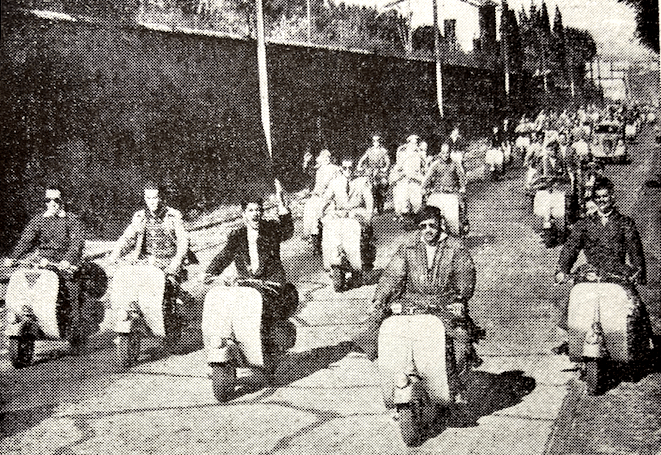
“MANY CORRESPONDENTS HAVE decried the parallel twin as being merely a double single with no better balance than a ‘one-lunger’. My brother and I have done over 100,000 miles on three 5Ts and an Ariel KH springer since 1946 including, between us, 14 trips to South Africa. My best day’s run was from East London to Capetown, 720 miles, of which less than 300 miles are tarred. The rest is known as ‘a prepared surface’. One must certainly be prepared, as South Africa’s corrugations have to be seen to be believed. A motorist charged with injuring a donkey pleaded that he could not see it in time, as it was lying in a corrugation! To be slowed below 35mph is sheer agony, even in a Buick. I have been riding since 1928, but my brother started in 1946, and, having done 32 miles on his 5T, set out for Jo’burg, 711 miles away, and did the trip in a day and a half. On my last long trip I changed mounts for 150 miles with the rider of a 1948 world-famous race-bred rigid-frame single. At over 65mph vibration was marked, the staccato exhaust was trying to the nerves (I had already done 310 miles that day), and the back wheel kicked violently over bumps and pot-holes. The owner handed back my Ariel twin with a shake of the head and murmured, ‘Thanks a lot—what a difference!’ His name is now on the agency’s list for the rear-sprung twin just introduced by his pet firm Never at any time on lengthy trips have I had cause to complain of any lack of smoothness in my twins. It is when one has covered over 500 miles per day on indifferent roads that one is most acutely conscious of lack of balance, poor riding position, or not-so-clever suspension. I, for one, will never buy another vehicle without two or more cylinders, rear suspension and air cleaner. Score of machines are still being exported to Africa without the latter fitting available, even as an extra. As a result I know of numerous 125s that have needed reboring after 2,000 miles, and 350s and 500s after 4/5,000 miles. Even with air-cleaners, far too many models need a rebore after 9/12,000 miles, which cannot be considered satisfactory. I have done over 500,000 miles in Chevs, Buicks, V8s, Studs, and Hudsons, and I know the value of a full-flow oil-filter. I should like to see these filters available as a built-in fitment on all four-strokes. At present. the problem of fitting one by the owner is considerable, and results in loss of accessibility to one or more components. Another of my pet moans is oil-tightness—or lack of it. While most machines are passable in this respect if they never leave tarred roads, cleaning a machine after 60-odd miles on a dusty road can be a heartbreaking job. The timing case and chaincase joints and rear chain bleeds are particular offenders in this respect, np matter how carefully the joints are made and tightened. I loathe the. present type of saddle, and consider the Hughes spring seat a step in the right direction. A 700 or 750cc version of the S7, with improved forks and front brakes, should make a most attractive fast tourer; if only for the fact that it has no chains. Out here, rear chains need replacing after 5/6,000 miles, and start to jump off the sprocket: at 7/8,000.
CDL Vorartt, Salisbury, S Rhodesia.”
“THE QUESTION, ‘WHAT to do with the Wednesday in TT week?’ seems to be worrying a great many people at the present time. For some unknown reason all the speculations and suggestions have omitted to give what, to many oversee riders, seems an obvious answer, viz, a race with no limitations on capacity, superchargers, fuel, or streamlining. A race of this type would (1) Give the manufacturers the choice of modifying their present engines for methanol or other fuel; supercharging their present design; building new engines with with supercharging in view; building larger engines of 1,000cc or more. (2) Give US manufacturers a chance to enter their large-capacity machines without undue modifications. (3) Give the spectators the thrill that seems to be lacking in the present Clubman’s series and Lightweight TT. The entry of the US in the Isle of Man event would be acclaimed by all, and should be particularly attractive to Americans in view of the currency advantage. The thoughts of a TT Race with a truly international entry should be sufficient to make even the most phlegmatic motor cyclist thrill to the marrow! To summarise: such a change in TT week would (1) give manufacturers much latitude for experiment in engines and fuel; (2) capture the imagination of US enthusiasts; (3) give spectators the greatest thrill value; (4) develop the really high-power manoeuvrable machines no desired by most overseas riders.
JH Marshall, Nigeria.”
“NO BETTER EXAMPLE of the ideal scramble course could be offered than the circuit on Holcombe Moor, near Bury. It has been used so long now for the NW Centre Lancashire Grand National that few people are aware of the fact that it is not the original venue. But it was the Lancashire Grand National on Holcombe Moor that quite possibly originated the mass-start cross-country race of the type that is now receiving international support. This year’s course was extended from two miles to three miles ‘or thereabouts’. No new obstacles were included however, the addition to the circuit being just a bit more of the tufty, hummocky moorland beyond the summit of Harcles Hill which hitherto had been visited merely to circle a flag pole at the top. Other changes were a very private enclosure around the finishing line area whereby the idly curious, the fans, the small boys and, above all, the vociferously protesting mechanics and helpers were excluded. The mechanics and helpers, who have so often raised their voices regarding the lap positions of their own riders as against the official reckoning, were doubly confounded because the lap scoring was organised to be beyond criticism, thanks to a watertight system of checks and cross-checks. The problem was made easier by the aforesaid enclosure, the extra course length and by a very rough and bumpy approach to the finish, which discouraged neck and neck dashes to the line. Add to all this organisational forethought a night and morning of deluge which made the moorland like a saturated sponge, and a tolerably pleasant afternoon—everything contrived to produce a first-rate event. The competitors contributed, of course, and the 70 who started thoroughly enjoyed themselves even though only 21 of them finished within the time allowed. Interest was sustained throughout because the lead kept changing. First of all HH Lines (497 Ariel) ran away from the field, but he was overhauled by PH Alves (498 Triumph) who, in turn, was displaced by CM Ray (497 Ariel) who eventually won by a minute and a half from BHM Viney (247 AJS) whose achievement in remaining with the leading bunch throughout the 10 laps was astounding considering the size of his engine. Last year, the attendance from Yorkshire did not constitute a worthy challenge for the Battle of the Roses. This time some 15 came from beyond the Pennines, but they returned empty-handed, for RK Pilling (490 Norton), third man home, with five minutes in hand from the leading Yorkshireman, secured the retention of the Ashes Cashet for yet another 12 months in Lancashire. So much for the broad picture.”
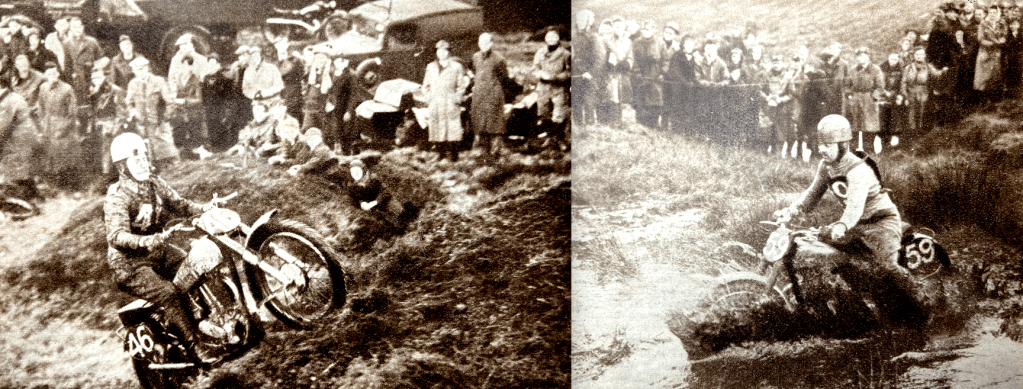
“MOTOR-CYCLE FOOTBALL is played on the standard Association football pitch with the normal-size ball. All the players are mounted on solo motor cycles of any capacity. Each opposing team consists of five players, made up of three forwards, a back and a goal-keeper. In each team there are two substitutes, either of whom may take over at a moment’s notice from a player incapacitated by machine trouble or other cause. Although the rules of the game are much the same as in Association football, it is impossible for a player to be off-side. Goals may be scored from any part of the field except from within a six-yards area at the goal-mouth. Obviously this scoring rule is laid down in the interest of the goal-keeper, who could otherwise be put in an impossible position, if not in actual danger, by an attacking player. Duration of a match is 35 minutes each way. The referee is on foot. In this country, the controlling body of the game is the Motor Cycle Football Club’s Combined Committee, which is affiliated to the ACU. The following six playing clubs are controlled by the Committee: Stroud, Gloucester & Cotswold, Coventry, Cheltenham, North Hants and Cheltenham Home Guard. Rider with the self-confessed longest playing experience in the game is. Eric Little, who started at the age of I4 in 1925. According to him, the game was first played a year earlier at a hospital gymkhana in Coventry. The ACU later gave a cup, which is still in existence, but which, owing to the small number of clubs now playing, is not at present offered for competition. In the late 1920s, there must have been about 20 clubs that took an active part in motor cycle football. What of the machines used? Vintage or modern—it does not seem to matter. One sees perhaps a ’22 AJS, a ’28 New Hudson, a ’39 Norton and a 48 BSA, all in the same match with other machines of various ages. In general, short, stubby footrests are used, in order to provide plenty of room for kicking with either foot. Competition tyres are fitted, and brakes must be in first-rate condition. The bikes are, of course, stripped of lights, horn and front number plate, but no special tuning is necessary, and gear ratios are usually standard. Obviously it pays to use a light machine possessing good acceleration and plenty of power low down. Bottom gear is the usual cog, but second is sometimes engaged for short bursts. A fairly high saddle position seems desirable for kicking. A good turning circle is another obvious attribute. No special mechanical device is allowed on the machine to aid the player. Very skilful manipulation is necessary to avoid burning out a clutch; and the expert will try to have his clutch either right in or right out—never half-way and slipping.
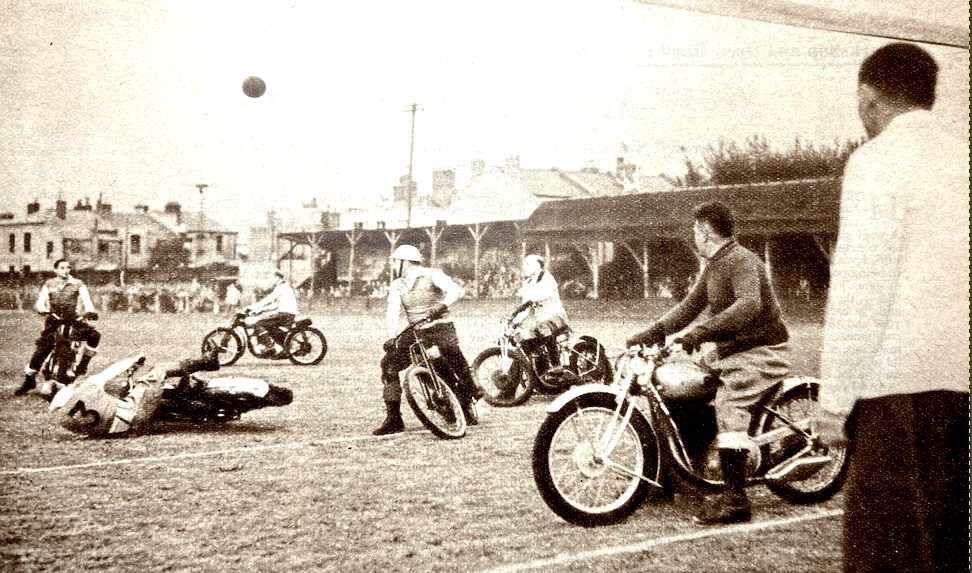
Certainly the game is a strain on clutches. The season for motor cycle football is from May to August, the intention being to finish before Association football begins. A few months ago, 17 expert British players toured Sweden in order to demonstrate the game. According to FW Chandler, team manager, and chairman of the Stroud Club, the tour was an outstanding success; so much so that the Swedes want to take up the game and come over and play against us. Mr. Chandler said: ‘The Swedes told me that not for years had they seen such a wonderful example of British sportsmanship. We got front-page publicity over there, which built up our gates from about 5,000 to about 15,000 during the tour. The Swedes were very hospitable, and one of my biggest problems was regulating the diet of the players, as there were such tons and tons of food!’ What is the public reaction over here? At the match on Cheltenham Athletic Ground recently, when Cheltenham drew with a score of two-all against the Rest of England, there was a gate of 1,800. Reasons given for the comparatively small public interest over here are shortage of teams, lack of suitable grounds, and high cost of machines. Incidentally, experts say that motor cycle football is a tonic for the grass on which it is played. Accidents? —two with broken bones in 55 years. Age limit ?—Average age of the Cheltenham team was 41!”
“THE NETHERLANDS FIRM Kaptein, which has for some time been producing French Motobécane models under licence, is introducing two new models for 1950. The first is an autocycle, and the second. is a 100cc two-stroke designed to appeal in competitive markets. Constructed of high-quality steel tubing, the frame of the Kaptein autocycle is notable for its rigidity; the fork follows cycle practice, but is specially built to allow a certain amount of flexing. The 49.9cc Motobécane ‘Poney’ engine is mounted in front of the bottom bracket of the frame, and has a light-alloy cylinder barrel and cylinder head. The steel cylinder liner is cast in position. A single-slide Gürtner carburettor is employed, and ignition is by flywheel magneto. Power output of the engine is stated to be 0.6bhp at 2,800rpm, and the speed range of the machine is given as 4-18mph. Lubrication is by petroil, and fuel consumption is in the region of 200mpg. Of special interest is the transmission system. There is a V-belt drive from a small pulley on the engine crankshaft to a larger pulley mounted on a needle bearing carried at the bottom bracket of the frame. Three pins connect this larger pulley with a small sprocket which is coupled to the rear wheel sprocket by a roller chain. By disengaging the three pins, the pulley is disconnected from the sprocket so that the cycle may be propelled easily by means of the normal pedalling gear. The engine driving chain is adjusted by moving the rear wheel in the normal way, and the pedal gear chain is automatically tensioned by a jockey pulley. Total weight of the Kaptein autocycle, including the direct lighting system, is about 551b. The price in Holland is 375 florins which, at the present rate of exchange, is about £35. The second new product from the Kaptein factory is a 100cc two-stroke lightweight motor cycle, which has a telescopic front fork and plunger-type rear suspension. This sells at 659 florins (about £60), which is by, far the lowest figure for any similar motor cycle offered in Holland in post-war years. The engine has a bore and stroke of 46x60mm and the output claimed is 3½bhp at 3,000rpm. Primary drive is by chain through a cork clutch to a separate three-speed gear box with hand change. Tyres are 2.375x24in. Other details are a 2-gallon petroil tank, 5in diameter brakes, and handlebars incorporating built-in controls. The flywheel magneto includes lighting coils, and the lighting equipment incorporates a rectifier and a battery. Petroil consumption is claimed to be 140mpg. Maximum speed is approximately 40mph. Total weight of the machine is around 1251b.”
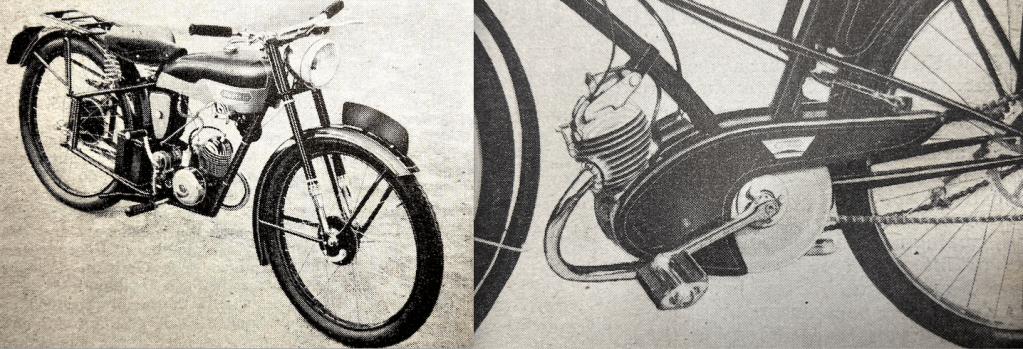
“VARIOUS REFINEMENTS HAVE been incorporated in the 1950 Harley-Davidsons. The telescopic front fork, called the Hydra-Glide, is continued on the twin-cylinder models. Inlet port redesign of the Big Twin ohv engines has resulted in, it is claimed, approximately 10% higher power output. These engines also have a new carburettor with a fixed jet and an adjustable jet needle. On the 74 (1,200cc) cubic inch engines, the carburettor bore has been increased in diameter from l⅛in to 1⁵⁄₁₆in. A new silencer giving quieter exhaust is fitted to the 45 (750cc) cubic inch and Big Twin models. The frame of the 125cc two-stroke has been modified to include a dropped forged steering head. Another change is a redesigned flywheel generator which now has four brushes and an increase of ⅛in in the length of the six pole pieces and larger field coils. These changes give a lower cutting-in speed and a total output of nine amperes; it is claimed that the full lighting and ignition load are balanced at about 15mph in top gear. A strong ‘Jiffy’ stand is fitted. Various attractive colour schemes are available on all models.”
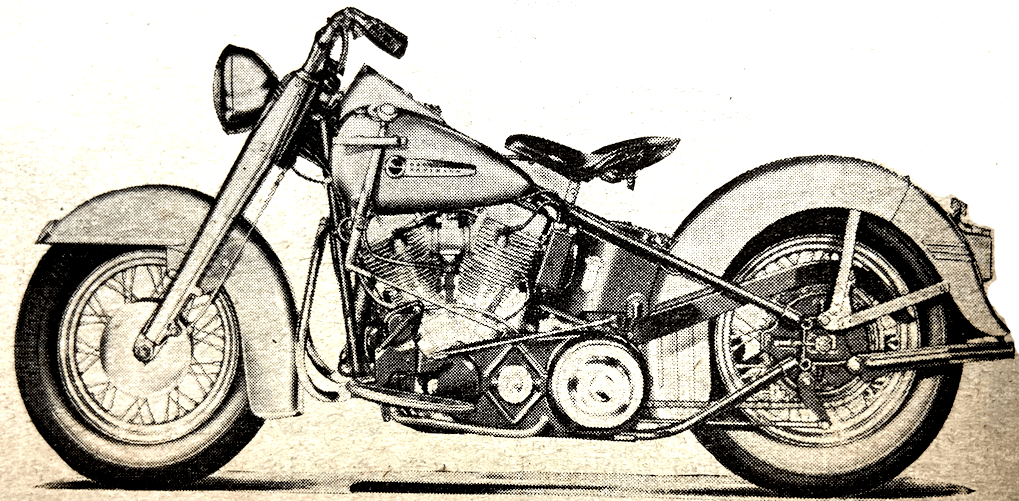
“MACHINES EXCEEDING 250cc for sale to the public are now being produced in Germany. As a result, BMW have re-introduced the famous 494cc horizontally opposed twin model now designated the R51/2. Though essentially similar to the pre-war model, the R51/2 incorporates two features which have been employed on the single-cylinder 250 at present in comparatively large-scale production. There is a new design of light-alloy cylinder head which permits the rocker spindles to be carried by hexagon steel pillars fitted in the cast-iron cylinder barrel. The advantage claimed is that there is less heat transference and thus not so much variation in valve clearance as when the rocker spindles are mounted in the light-alloy head. The new gear box has a spring-loaded cam-type shock-absorber on the input shaft inside the box. Other minor modifications have resulted in better gear changing, a point that was commented on by the Editor when he tried a 250cc model at the Munich factory last April. Another change is that the telescopic front fork has two-way hydraulic damping. Each cylinder of the R51/2 is fitted with a Bing carburettor which is in a slightly ‘downdraught’ position—the new cylinder head has different port angles from the pre-war head. As in the past, the intake pipes are connected to an air cleaner accommodated in the top of the gearbox casing. Specification details are: Bore/stroke 68x68mm; output, 24bhp at 5,800rpm; single plate clutch; four-speed, foot-change gear box; shaft drive with rubber couplings to a spiral-tooth bevel gear; oval-tube frame electrically welded at the joints, and plunger-type rear-springing; 8in-diameter brakes; fuel tank capacity, 3gal, oil 4pt; maximum speed, 87mph; approximate fuel consumption, 70mpg.”
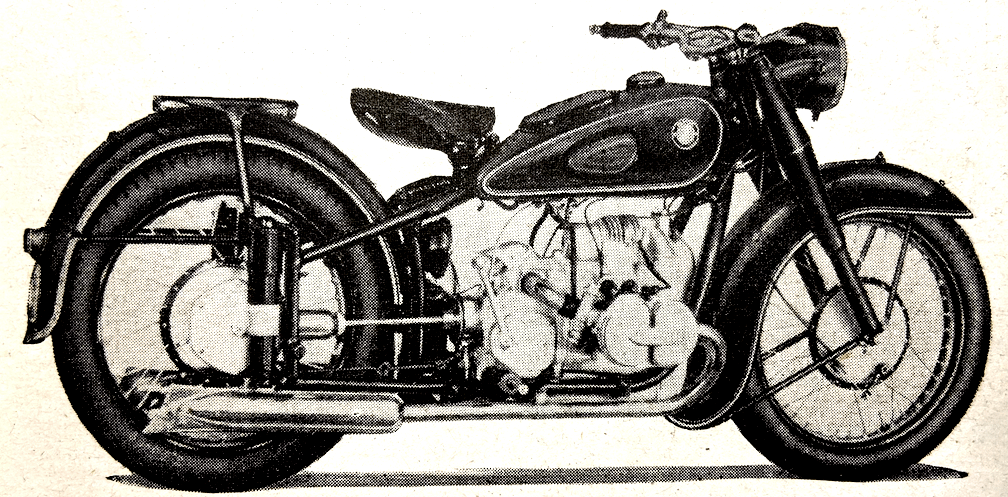
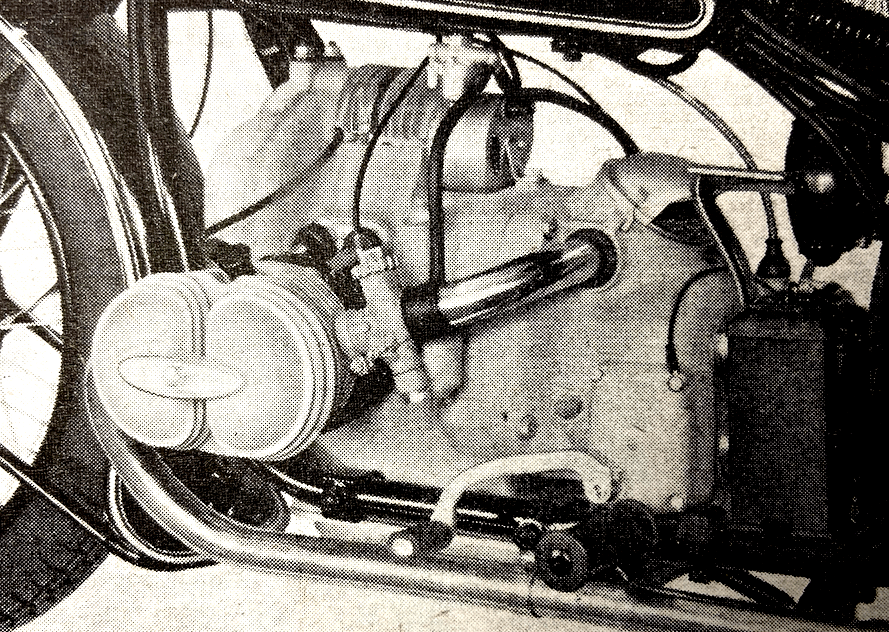
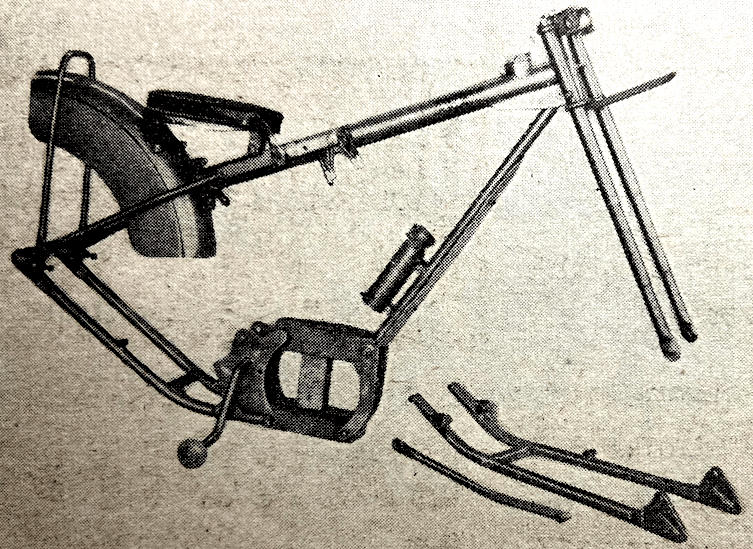
“I WAS INTERESTED in the illustration that shows how the top tube of the frame of an AIW speedway machine has been utilised as a petrol tank. The idea, however, is far from novel, for as long ago as 1903-4 I actually rode a tankless machine. Petrol and oil were carried in the frame tubes, and the carburettor was mounted under the bottom bracket. Two of these machines were constructed—I helped to build them—by Stretton’s in Cheltenham; they were made to the special design of a local gunsmith, Mr E Green. One had a 2hp Minerva engine, and the other was powered with a 3½hp Aster. The same firm, incidentally, were the first in the country to produce a lady’s motor cycle at about the same period. It was a Millionmobile, with a 1½hp Minerva engine, and was ridden by the designer’s wife, Mrs Stretton. They also produced trailers which were exhibited at the early motor cycle shows.
JN Bennett, London, WC2.”
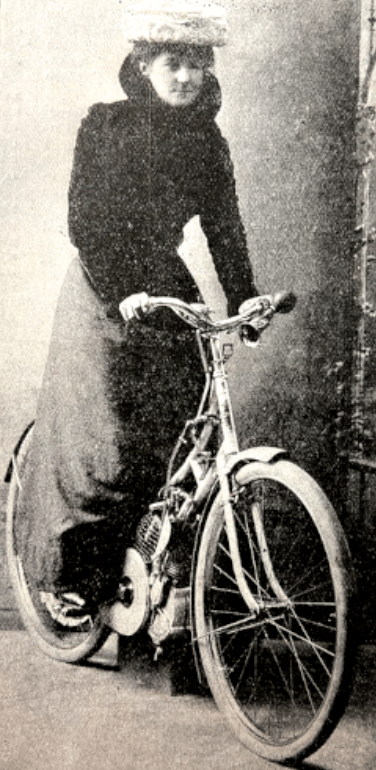
DURING SEPTEMBER THE total value of motor cycles, three-wheelers and under-100cc machines exported was £427,.286. Total number of machines sent overseas during the month was 5,087.”
“AUTOCYCLES, MOTOR SCOOTERS, motor attachments for pedal cycles—each of these three types will be making an increasing bid for public favour over the next year or two. History is repeating itself, but with the difference that to-day there are the materials and in various quarters, the knowledge, to ensure the success that was beyond the grasp of manufacturers in earlier days. The emphasis on the three types is, of course, a sign of the times—the desire for simple, low-cost, economical powered transport. There are some people who, even to-day, think back to the motor scooter boom immediately following the 1914-18 war and how the scooter died almost overnight. Will history repeat itself in this respect, too? The signs are not wanting that the economy era will last a considerable period. Further, by no means all the motor scooters in 1919 and 1920 were sound mechanical propositions. There was a tendency for ‘finance’ to endeavour to cash in on what appeared to be a ready-made market. A similar state of affairs could, of course, occur to-day, but there is the valuable safeguard that already there are various tried, proved types. Undoubtedly more than one market exists. In Italy, for example, motor-attachment manufacture is flanked by the production of expensive types of motor scooter. The really big market is naturally based on price—on Henry Ford’s famous saying, ‘There are more people with short purses than with long ones’. The little engine unit which can be attached in minutes to a pedal cycle would seem to offer the big sales prospect. Its appeal needs no emphasis. It is most important, however, that those who enter this market fully realise the limitations of the ordinary, used pedal cycle; in short, the bicycle must be propelled at no more than normal cycling speeds. In this country, the bicycle with a motor attachment suffers the handicaps of licences, driving test, compulsory insurance, etc, in the same manner as an autocycle or a fully fledged motor cycle. Nevertheless, the type is making headway and there are many who prophesy that this, rather than the autocycle, as known to-day, will provide the true stepping-stone from a bicycle to a motor cycle. Such may well prove to be the case, but there is good reason to believe that scooter-type runabouts will make their mark in this country and be an important rival to the autocycle in the latter’s price category. Among the advantages of this type of machine are the general air of simplicity that can be conveyed, resulting in the automatic reaction on the part of the novice, ‘Why, I could ride that!’; the low build; and the excellent mud-shielding that is possible. But how large the market proves will depend upon price—and the soundness of both conception and construction.”—Ixion
“I CAN HONESTLY SAY that I have never used the pedals for assisting the engine of my de luxe, single-speed, Excelsior autocycle (and in Stockport we do possess a few hills). Since last December, when I bought the machine, I have travelled 9,600 miles. Each week, on an average, I cover 200 miles and make about 250 stops and re-starts. I have not yet spent a penny on spare parts. On this model the pedals are used as a back-pedalling brake; and to start the engine in all weathers I merely walk two yards, release the clutch and away she goes. To keep the engine in tip-top condition I decarbonise every thousand miles and do the rounds of the bike before the kettle has boiled for a cup of tea. Although I should not like to be without my present machine, I should like to see a two-speed autocycle with a kick-starter instead of pedals.
PW Boast, Stockport.”
“SURELY, SAID IXION last week, more attention should be given to suppressing the suggestion that a motor cycle is a frightfully complicated piece of mechanism. He referred, of course, to the manner in which a motor cycle displays its mechanism instead of hiding it, car fashion, and wondered how many potential motor cyclists have been lost to the ranks by reason of the seeming complexity of the modern machine. This is no new theme. There have been numerous, perhaps premature, attempts at enclosure—old-time Rudges and New Hudsons and the oft-praised Francis-Barnett Cruiser will occur to many minds. Will the trend be in this direction or towards providing sleek engine-units?”
“ODD THAT THOUGH there is such a flutter in cycling circles anent the under-50cc motor-assisted cycles, there was not a single sample at Earls Court. One agency is advertising in the provinces that the sales of its pet mac now exceed 300,000! A lot of noughts! Of course, sales of these units on the Continent are known to have reached astronomical figures, but still…? The motor-assisted cycles have their merits. Recently I saw one shoot up alongside a lovely brunette on a pedal-cycle; its owner promptly throttled down and pobbled alongside her at about 6mph, chatting happily, since the exhaust at that gait was practically inaudible. Another elderly mac owner of my acquaintance, whose calves no longer enjoy pedal-cycling, continues membership of his cycling club, and joins in their runs. Maybe by the end of next summer many of the pusher members will have been converted to power.”—Ixion
“ONE OF THE most famous makes on the European continent by virtue of consistent racing success is the Guzzi which this year won the manufacturers’ World’s Championship in the 250cc class. The production 250cc model intended for the sporting tourist is the Airone Sport which, in general layout, such as the horizontal single cylinder, unit-construction of engine and gear box, and pivot-action rear suspension follows characteristic Guzzi design of the racing singles. Unquestionably, this sports machine bears the influence of a racing pedigree. If one attribute had to be singled out among the many with which this machine is endowed, it would be its suitability for maintaining high average speeds over long distances. The engine is tireless and belies its comparatively small size; steering and road-holding in the higher speed ranges are faultless. The mean maximum speed is good, but not remarkable for a 250cc machine, though here it might be noted that under only slightly favourable
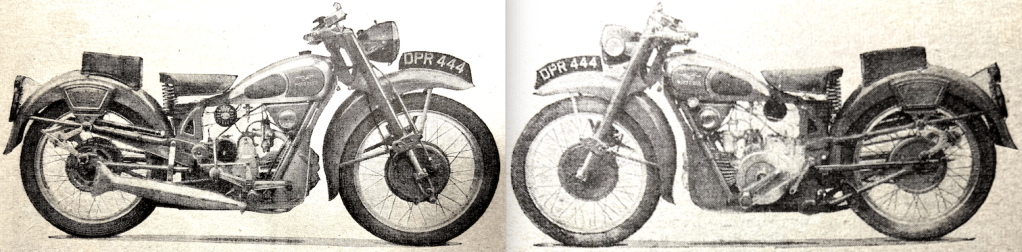
conditions a maximum of well over 70mph can be achieved. The top gear ratio of 6 to 1 is on the high side, which in itself is an attractive point, though it does militate against the mean maximum figure. But out-and-out speed is unimportant. Much more to the point that speeds higher than 60mph can be held, it seemed indefinitely, as often as road conditions allow a machine which can be driven on full throttle for mile after mile with the certain knowledge that the engine will not tire. Under all high-speed conditions the engine produces its power smoothly, effortlessly and it should said smoothly, effortlessly and, it should be noted, economically. No matter how hard the driving conditions, the engine remains noticeably cool; in fact, on some occasions when temperatures were low, the impression was gained that the result of a light alloy cylinder head and barrel with the head forward and receiving the major effect of the air stream, was over-cooling—this in spite of the fact that the carburettor settings gave a mixture slightly on the lean side. Acceleration is sprightly, and although the engine has very good pulling powers, it very freely reached high revolutions in the indirect gears. Valve float was not too easy to identify and, when it had started, the revs would continue to mount. Both front and rear suspensions are near perfect for high speeds. When travelling fast on average main roads, the Guzzi was comfortable to a marked degree, and with a 12-stone rider there seemed to be no advantage in restricting the rear-springing by means of the adjustable friction dampers provided. The suspension gives that ‘tight’, precise sensation more usually associated with the road-holding of racing machines.
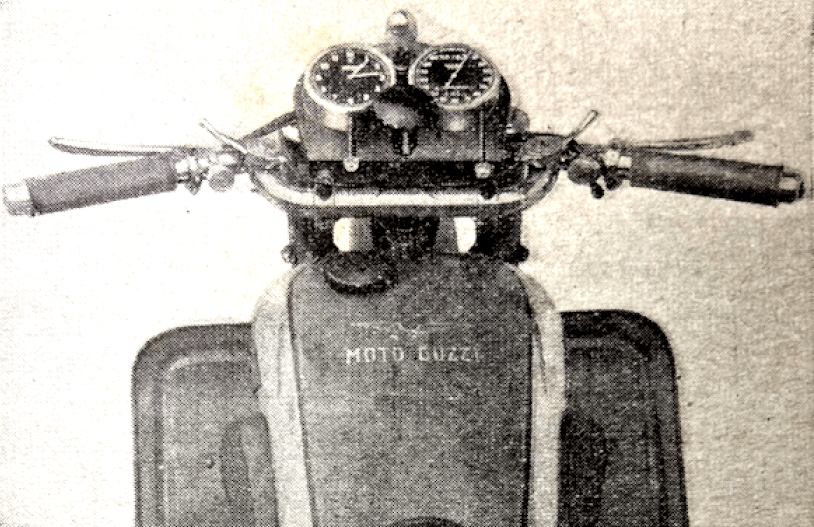
This is achieved by springing which is rather too hard to give maximum comfort at low speeds. For instance, at around 15mph it was possible to traverse minor road bumps and find that the suspension was absorbing few of the shocks. In the front fork characteristics contrasted sharply with the soft static-load position springing of the average telescopic fork of to-day. Steering is first-class in all circumstances, and it was never necessary to employ the steering damper. The steering is light and positive; it consistently retains these features from a slow walking pace up to maximum speed and is unaffected by road conditions. Handleable in the full sense of the term, the Guzzi is a sheer delight when the mood is one for cornering zestfully on an accurate line. The impression gained is that the machine is lighter than the scales indicate and stability is markedly good on wet, slippery road surfaces. Whether cold or not, the engine fired readily provided that, under cold conditions, the carburettor was flooded and the air control closed. The kick-starter is on the left-hand side and did not seem so easy to operate as a right-band side pedal; this should not, however, be regarded as a criticism, since many years of experience with the orthodox British layout may be expected to have resulted in prejudice as well as the acquisition of knack. Engine idling was always regular and reliable, and if the twistgrip throttle was set carefully and the ignition control retarded, a very slow tickover could be obtained. The carburettor is not fitted with a throttle stop, and lost motion in the rather slow-action twistgrip, and in the cable, did not allow an accurate setting to give slow idling with the grip rolled right back. The clutch freed perfectly and took up the drive smoothly; operation was inclined to be heavy. Gear changes with the rocking pedal could be accomplished quickly and cleanly at all speeds, but this control also required more pressure than expected; for example, although downward changes could be made with the toe as on the majority of British machines, the effort required was considerable and it was easier to employ the heel pedal which involved moving the foot back from its normal position on the rest. The gear box was quiet in the first and second ratios, but slightly audible in third. So far as could be ascertained, the gear primary drive was noiseless. Transmission lacked the slight flexibility usually associated with full chain drive incorporating a good shock-absorber. Operation of the valve gear was audible, but in all other respects the engine was quiet. The silencer gives a deep tone which, at low
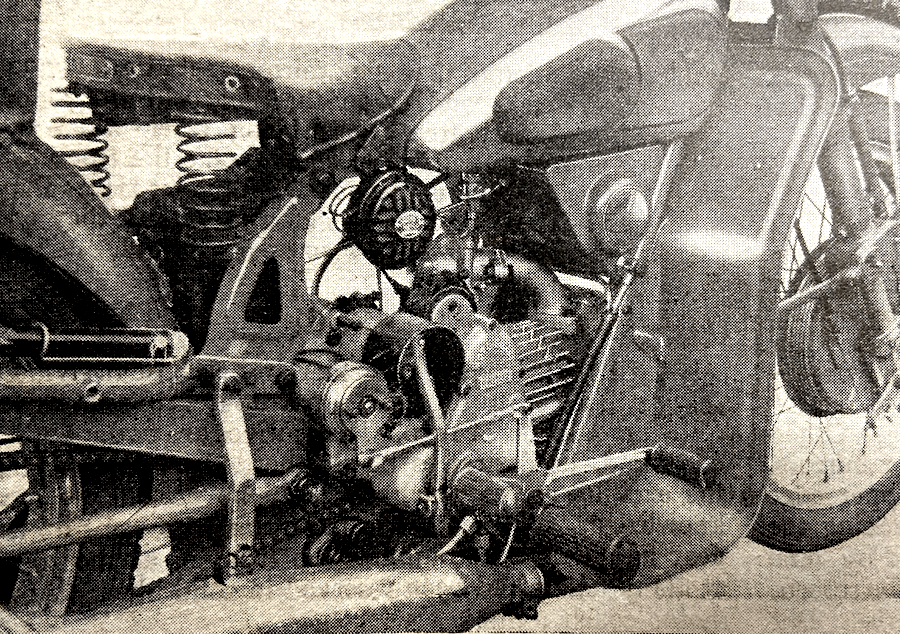
speeds. is perhaps rather loud by British single-cylinder standards. However, the silencer is equally effective when the engine is revving fast; at highish speeds exhaust noise is not obtrusive and is commendably free from high-pitch frequencies. Brakes are of large diameter and, towards the end of the mileage of the test, became smooth and powerful. When the machine was received it had covered fewer than 100 miles, and the front brake required heavy lever pressure before it was effective. Later this brake improved markedly, and a second set of stopping-distance tests was carried out which showed a decrease of nearly 3ft over the earlier figure achieved. Rear-brake operation is by heel on the left side; to apply the brake the foot had to be moved back on the footrest and it was difficult to achieve the delicacy usual with toe operation. An impression of ‘compactness’ is given by the riding position, which is very well suited to riders of varying stature. A range of adjustment is provided at the handlebar and the footrests. The mudguards have deep valances, and legshields are fitted; the protection given proved highly elective under dirty road conditions. The beam from the head lamp provides an excellent driving light; when the out-of-focus filament is brought into use by the handlebar switch there is a distinct cut-off of light above the horizontal plane which satisfies the most stringent anti-dazzle criterion, yet the light on the road is adequate. No praise can be too high for the head lamp fitted. A central stand with very large roll-on feet is fitted. Next to no effort was required to bring the stand into use—foot pressure on the left-side of the stand was sufficient. There is no front stand, and considerable weight on the rear was necessary to pivot the machine about the central stand and bring the front wheel clear of the ground. The Guzzi design is strictly functional and by British standards might be regarded as untidy. For example, the kick-starter and foot-change mechanisms are external, and no effort is made to conceal linkages and pipes or to harmonise the machine’s lines. However, of its robustness and suitability for sustained hard work there can be no doubt.
“AT THE SHOW many riders applauded the short twin rails on the Triumph tank-top as the ideal method of carrying rainproof overalls. (If your Machine has a stern carrier—rather an uncommon fitting in these days—a slack strap may shed one’s riding kit without your knowledge.) But a keen girl visitor dissented. She suggested that a motor cycle lacks the immense convenience of the cubby-holes found in every car dashboard. Provided one does not want to flatten the abdomen on the tank for the sake of speed, a small metal box with Yale lock is the ideal fitting on a tank-top. Every traveller takes a number of small items which he or she does not wish to pocket or store in the tool-box (which, anyhow, is too small to accept any extras). She thought that such a box would be very popular, and could easily be made detachable. (At one time accessory dealers did fair business with metal tool-boxes mounted in this position.) An odd feature of current design is the scrapping of the carrier over the rear wheel. One may flick the pages of most issues of The Motor Cycle without seeing more than two or three photographs of a machine with a full stern carrier. Why? I am old enough to remember days when not a model on the market boasted a carrier, and how eagerly we bought accessory contraptions. Admittedly, machines look better without them. If luggage has to be conveyed, panniers are far more convenient. A large case on the carrier was always apt to jab the rider’s lower vertebrae, and this snag became more pronounced when we began to mount our girl friends on the pillion—there was never much space available astern of her spine. This aspect is clear enough when we eye the side silhouette of the Vincent…Indeed, such a view makes one wonder where to stack wet-weather kit on a fine day, much less the night luggage. I fancy the real answer is that if we scrap the carrier we shall presently demand that every maker supplies a fitted pair of panniers, preferably of the quickly detachable type. Except on fair-weather speed runs I want to pack storm wear on every ride, and often have some articles of medium bulk which I propose to dump somewhere, quite apart from night gear or spare clothing. On too many standard 1950 mounts there is literally no provision for any such purposes, and the lot has to go round my neck in a haversack, or be lashed round the rear half of a Feridax, or be fixed across the lifting handle.”—Ixion
“A LONG POW-WOW with a rider whose income h shrunk to a point at which he can no longer afford anything over 98cc, though his main mileage has been registered in the past on fast 500s. first the change inflicted great bitterness of spirit. Gradually he re-educated himself. His chagrin, he decided, was mostly a matter of false pride. His travel range was not cut by the change-over, though his average speed was naturally far lower. He developed a keen interest in the finer points of driving, especially in hilly country. At the reduced speed he was able to observe people and places in much greater detail. He describes himself now as completely reconciled, and doubts if any sudden access of fortune would inspire a bigger purchase than a three-speed 150cc. He wonders whether swank motives do not bulk far too large in the desire to ride only the biggest and the best.” —Ixion
“I SUPPOSE that by now you have all seen the 1950 model Feridax windscreen. In most respects it follows familiar practice—and, by the way, how I hate staring at a lovely landscape framed in a plated rim. The frameless Perspex motor cycle windscreens are infinitely preferable to any car types. It is, of course, designed not to flap or bend against a stiff gale. Otherwise, its twin novelties consist of a pair of reflex mirrors, one on each side, and a dark strip at the upper edge behind which one can duck the eyes when facing the blaze of a couple of P100 head lamps undimmed by some caddish driver. I have not yet ridden behind the screen, and feel a shade dubious about that coloured strip. But I adore the notion of the reflex mirrors, set at a far more convenient height and angle than the old handlebar types, quite apart from their being safer when the machine is propped against a kerb. Like the Roe ideal seat, they will be more effective with midget riders than with a broadshouldered tough like myself; but they will assist even me to know what may be on my tail.”—Ixion
“I NOTE THAT Mr CR Collier, of Matchless fame, is of the opinion that one can motor cycle to good health. With this statement I fully concur. I was shot down in an air fight in 1916, a bullet entering my left lung, where it remains. I fell into the sea and was rescued about an hour later. Clad only in vest and pants, I was flown to Dunkirk in an open cockpit. I was in hospital for many months. Finally, I was discharged with 100% pension, suffering from the bullet in my lung, neurasthenia, and rheumatism. Three months later I contracted pleurisy. I looked and felt a complete wreck. Specialists told me not to attempt to run or play games. Being a keen pre-1916 motor cyclist, I purchased a spring-frame Indian, but had to sell it as the vibration affected my lung. Later, I bought a 3hp ABC and rode it on every available occasion. Having sold the ABC, I bought one of the first of the 2¾hp ohv AJSs. As my health was improving, my thoughts turned to faster motoring, and I bought one of the first 3½hp ohv Sunbeams and became one of the founder members of the Sunbeam Club. I appeared at Brooklands with the West Kent and Streatham & District Clubs; rode in the Sunbeam vs Norton team race; joined BMCRC. In 1929 I gained the Private Owner’s Aggregate Trophy. At 56 years of age I am perfectly fit and at the moment am buying a Model 95 Sunbeam. It occurs to me that there must be many ex-Service men and others who are ‘afraid’ to take the step, but whose health would materially improve provided that their method of approach was as mine was. Start small, and, as the health progresses, purchase a larger machine if so inclined.
FC Kirby, Potters Bar, Middlesex.”
“I THINK IT IS TRUE to say that the originator of scrambles as we know them in the North was the late EO Spence who had paved the way at Camberley. When Spence came to live in Manchester (1926) he soon developed the idea, and I well remember walking round a prospective course at Hawkshaw Lane Ends, not far from the present Holcombe Moor site of the Lancashire Grand National. Spence, Norman Jackman (the then NW Centre secretary) and myself made up the party, and the circuit selected was much rougher than the present one. According to The Motor Cycle of November 18, 1926, Spence believed it would ‘out-Camberley Camberley’, while I summed it up as a ‘he-man’s playground for those who think a motor cycle is not a hindrance when cross-country running’. The Idea of a ‘scramble’ was to use a course embodying sections such as would be found in a strenuous trial but instead of observation taking time only as the deciding factor; in short, permitting scrambling through as against riding through. This bit of history may help to define scrambles as the term has been understood in the North for more than 20 years…Having personally attended every Lancashire Grand National since its inception I am definitely of the opinion that the 1949 event provided an easier ride than the 1948 and several other previous occasions. An easier ride means that the star men are quicker, with the result that fewer ‘also rans’ finish within the time allowance. It also means that machines are punished relatively more than the riders, and this state of affairs was obvious on November 5. Finally, several of the most successful finishers assured me that they had had an easier run than in 1948. By the way, Holcombe is famous for the Holcombe Hunt, surely the only place where one may ride to hounds within sight of mill chimneys. There is an annual Point-to-Point Meeting on Holcombe Moor…I seem to have heard of motor cycle scrambles of the Lancashire Grand National type being described as the ‘Ordinary Chaps’ Point-to-Point Racing’. In the best north-country tradition, I might add, these affairs always favour a ‘muck or nettles’ outlook on life!
‘Wharfedale’.”
“A VERY LARGE NUMBER of motor cyclists are too young to remember the doldrums of motor cycle sport in the years 1929-1934. I joined the Bradford Club in 1923. At that time the membership stood at over 800. During the depression we had only eleven members. Many famous clubs went out of existence, some never to be reborn. In 1923, more or less standard bikes were ridden in trials. By 1929 Graham Goodman and others had evolved the modern mud-plugger, and the standard machine was useless. To rub it in further, Graham thought up the first Experts’ Trial—a trial with deeper and deeper mud, to fit the new idea of a competition machine. And deeper into the morass followed all the opens, with entries in some cases down to 30. The sidecar class received a blow from which it never recovered. By 1934, almost every manufacturer listed a competition model and entries gradually improved as the ordinary lad could buy a bike off the peg suitable for the events. But in 1949, despite a booming solo entry, the Scottish Six Days’ received insufficient sidecar entries to justify their inclusion…There are certain common factors running through the years of trials. The nearer to standard the machines in trials, the greater the public interest.

The greater the difference between the price of a motor cycle and the price of a car, the more motor cycles used. Immediately after the 1914-18 War we had both advantages. From 1945 till now we are fortunate to have the latter…I so well remember the days of our Bradford Club’s eleven members (we had that many in this year’s ‘Experts’)…The point in issue is the importance of open trials and how best to assure their continuity in a useful form. I don’t want to see a repetition of the 1930 blight, and I think that with a few modifications not only will benefit be derived from trials, but increased entries and interest would result from the wider scope of the entries. Some variety in the open trials would be a step in the right direction. Certain organising clubs, by virtue of their geographical position, could run trials of greater length than the fashionable 50 miles. If the trials are supported with the idea of improvement of the breed by test, then there is one item of British equipment, to wit, the lighting, which is languishing behind the rest of the metal work in reliability. ‘You can’t run a trial in the dark!’ some will say. Don’t be silly; I remember a lunch stop of the Colmore in the dark. And I understand I was fortunate to be still in the Army when competitors were groping their way round Matlock in pitch blackness in the 1946 Bemrose. What a difference it might have made if manufacturers had supported the MCC 24-hour events in place of some of the one-day trials. These events demand the use of lights. The observation of hills in the dark appeared to present no difficulty to the MCC, and the riders did not wear phosphorescent footwear, The organisers did not think that footing should be penalised, and although there is bound to be a howl of anguish from the die-hards at the idea in daylight, it is surely possible to use the system in the darkness. Whether the 1950 ‘Competition Riders’ Union’ like it or not there is going to be part of the next International Trial during the night. A little practice could easily be arranged by some far-seeing trials organiser between now and September. Having got the lighting part off my chest I shall endeavour to find a way of putting a test of reliability back into the events. It would not be impossible in any of the opens, even using the 1949 routes, to incorporate a tight time-section, preferably without observed sections, between checks. Motor cycles are rather capricious and they invariably choose the awkwardest places to have troubles. A tight section would sort out the wheat from the chaff. All motor cycles entered for the TT are required to be equipped with mudguards of a certain guaranteed efficiency by measurement. A glance at some of the competitors’ machines at an open trial would show the necessity for some such rule in trials. Prior to the compulsory use of standard tyres, mudguard-clogging mud was the favourite type of section chosen by organisers.

Mudguards became smaller and smaller. As there is no need for such sections now competition tyres are barred, surely mudguards with some semblance of legality could be made compulsory. Silencers occasionally are very ineffective, and although it is difficult to set a standard, something should be done to deter the noisy ones making the sport unpopular with the outsider. From time to time the Southern Trial has used some out-of-the-ordinary tests. These proved unpopular with the riders, not so much because of their originality, but mainly through over-elaboration allowing a certain amount of diddling to be possible. The idea of the tests was first-class, as they were used not only to decide ties, but also marks were allotted for each test. Assuming that some forms of tests can assist, the following all incorporate features which portray the capabilities of a machine as well as the rider. Suggested Tests. Brake test using the Colmore formula. This type tests not only the brakes, but also the transmission friction. Stop and Restart. Dead engine. This tests easy starting, easy selectivity of gears, and acceleration. Flexibility test on the lines of the Lennox type. Good steering and carburation at all throttle openings are essential for this. A timed hill-climb on similar ground to Pen-y-Ball in the Reliance and Killhope in the Travers. There is no difficulty in making this fair for all classes, as was shown in the 1936 ISDT in Germany, during which there was at least one timed hill per day. Every competitor had to climb the hill in less than eleven-tenths of the fastest time in his class. For a one-day event, I should recommend that the fastest time in each class should lose no marks and others one mark for each 1% more time they took to climb the hill. Fuel consumption has risen enormously since the early days, principally on account of the increasing weights of machines. It would be a gesture to the ordinary man-in-the-street if some check on consumption could be fitted in. With rough ground to cover, I am not losing sight of the fact that more fuel is needed than is the case when a motor cycle is used for touring, but it would not be too much to expect machines to average the following mpg: 500cc, 50mpg; 350cc, 60; 250cc, 70; and 125cc, 80. This would make the present allocation of fuel for open trials ample for a trial of real length. Away to the Lakes again with the Alan Trial to some genuine hills. Roll on Reliance!—with your two-day project; and let us see in 1950 a breakaway from the stereotyped trial of the past 15 years.”—Allan Jefferies
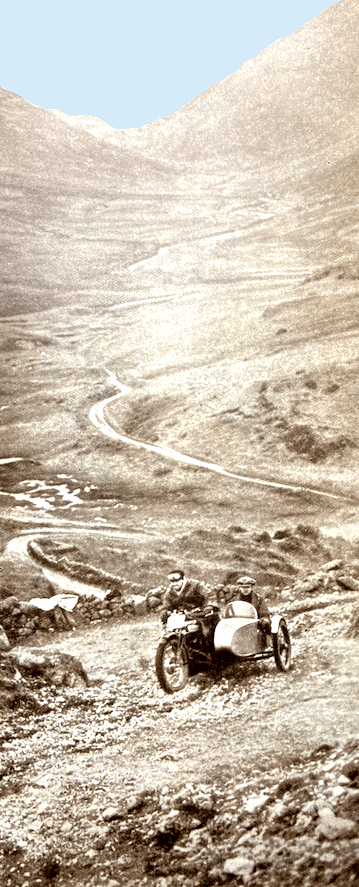
“ALLAN JEFFERIES’ LOW OPINION of open one-day trials will undoubtedly surprise many oversee riders of British machines. Here in America we are accepting ‘English Trials’ as a welcome relief from the drawn-out Turkey runs and Enduros which have long dominated our fall club activities. Some interesting variations of trials have evolved: The first Adirondack Trial was a one-field event, while the Hell Mountain Trial, run off in New Jersey, was much longer and combined enduro riding against time with observed sections. Both events proved very popular and will be repeated this year with much larger entries. It seems natural that the patent-expired single should prove to be the favourite winner in Britain as well as in any other country where trials are held. Mr. Jefferies would be shocked to learn how many vertical-twin owners in America have reverted to the old, tried-and-true one-lunger. For comfort? Smoothness? Easier starting? Heck, no;
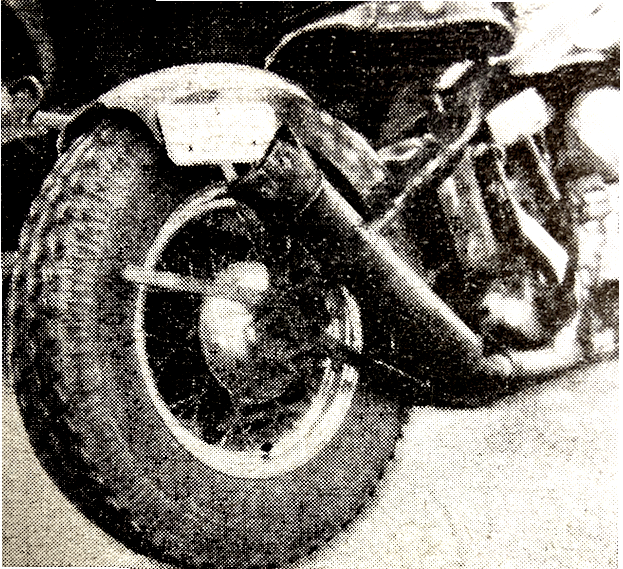
for fun! Yessir, here in our land of crowded, auto-laden highways, where traffic moves at a dangerous pace, the wise motor cyclist takes to the woods for fun. Full marks should go to the British single for advertising value. Note carefully that it is the single that wins many of our track races as well as most of our endurance runs. It is not unusual to see a hard-shelled Harley lad completely convinced of the merits of the imported product during the fall Turkey run season. So, Mr. Jefferies, go easy on our baby. We don’t care how few spectators view your one-day open trials. We don’t care how little is contributed to fresh design. We agree with your theory but we disagree with your conclusions. Don’t spoil the reading fun of the many oversee readers. One point in closing: all of the bikes are trailer-borne over here. I am enclosing a snap of what we ‘wood nuts’ consider a ‘monstrosity’, a trials Harley with a rear tyre of 6.00 section x l6in! This ohv 1,250cc machine finished in the Wagon Wheel Enduro held a few weeks ago in Springfield, Mass. Top finisher in the 225-mile. event went to a Triumph; Class A to a Matchless; Dealer prize to a Stroud Panther. Open admission was made by all who entered the run that the ideal bike for the job was an imported machine—preferably a single.
Jack B Mercer, New York.”
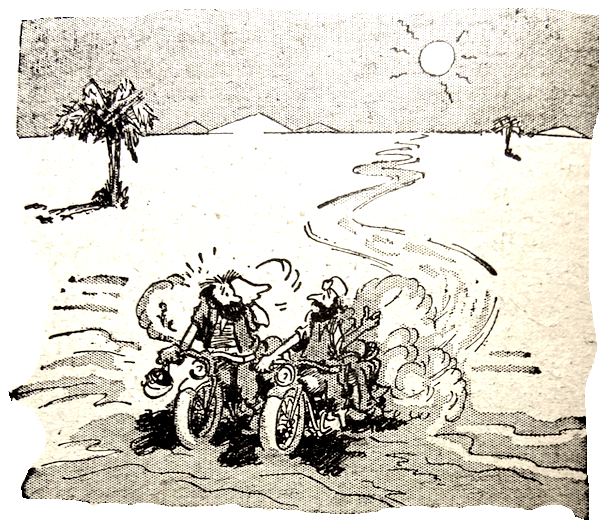
“THE ORGANISATION OF THE Welsh Inter-centre Team Trial, an annual contest between teams representing the East and West South Wales Centres, was this year entrusted to the Neath Club. Undaunted by the fact that two attempts to use the mountains between Glynneath and Neath in the St. David’s Trial had been frustrated by the weather, it was decided to include this section—and once again the weather intervened. The course was marked out on Thursday and forthwith the snow descended. The stewards met on Sunday morning before the trial started and decided that under the conditions prevailing the mountain course would be dangerous; therefore a conducted trial to the sections which could be reached by road was substituted. A team of eight riders was nominated by each Centre, the six lowest scores on each side to count. East again won with a. score of 171 against 198. The first section, Forest Cottage consisted of thick, clayey mud. Speed was the recipe. A long journey was then made to Cefn Celfi, where there were two sections, the first down a steep bank and the second up a similar bank. Both were strewn with leaves and had many tree-roots jutting out. A fair number of clean descents were made, but the ascent caused all competitors at least to use their feet. The trial ended with Dinas Rock. It proved the organisers’ ideal—one clean, one foot, and all the rest failures. The clean climb was made by IJ Williams (498 Triumph), who went up like a rocket. RESULTS Carmarthen Cup: East South Wales Centre (D Regan, 22; M Allan, 23; LJ Packer, 27; C Jayne; 28; R Gilchrist, 35; DR Evans, 36; total, 171. Arned’s Cup (best individual performance): S Selwood (348 Triumph), 21. 250cc Cup: C Jayne (125cc BSA), 28. Over-250cc Cup: D Regan (499 BSA), 22. First-class Awards: M Allan (498 Matchless), 23: GV Munday (348 Ariel), 25: WR Williams (498 Matchless), 27; LJ Packer (499 BSA), 27: TH Edwards (498 Triumph), 27.”
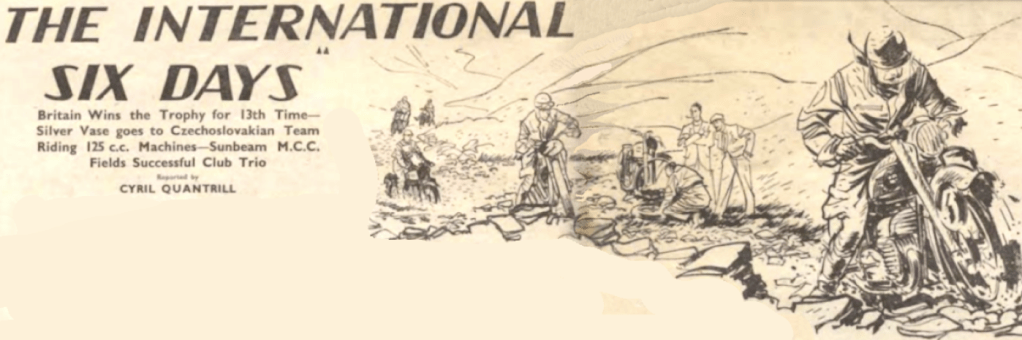
“HARD THOUGH IT IS to beat a Briton it is even harder to beat him in his own island! That sentiment expressed by the popular President of the Commission Sportive Internationale of the FICM—Holland’s Piet Nortier—when speaking at last Saturday’s prize presentation at Llandrindod Wells, which concluded he 24th International Six Days Trial, is certainly borne out by the results of previous events. Since the first trial in the series was organised by the A-CU in 1913, Great Britain has won the International Trophy on 13 occasions, and only once has a foreign team collected the Trophy on British soil. With a margin of 28 marks over the Jawa and CZ-mounted Czech team, Britain has scored a second successive victory. It should not he thought that there was anything about the 1,250 miles course, plotted in the mountainous districts of Wales and the ‘Marches’ Counties by HP Baughan, which automatically gave an advantage to the home team. In fact the absence of rain produced a route on which Continental riders were probably more at home than were the natives of this normally damp land. Great credit is due, therefore, to PH Alves, CM Ray, FM Rist, CN Rogers and BHM Viney, of the winning Trophy team, and to the manufacturers of the Triumph, Ariel, BSA, Royal Enfield and AJS machines which they rode. Right up to the start of the penultimate day of the competition neither the British Trophy team nor the Czechoslovakians had been penalised, whilst an ever-present menace uas provided by the highly competent Italian quintet which relied upon Sertum and Guzzi four]strokes. Then, however, bad luck intervened in the fortunes of both British and Czech teams, Ray having to finish nearly a third of a very difficult course without brakes, and the Czech, J Pastika, struggling to complete the mileage on a CZ which had developed a bad ignition fault. A very game effort by Bob Ray resulted in Great Britain losing one mark only; Czechoslovakia, on the other hand, lost 29s. There was, therefore, no race against the clock during the final speed test at Eppynt, to
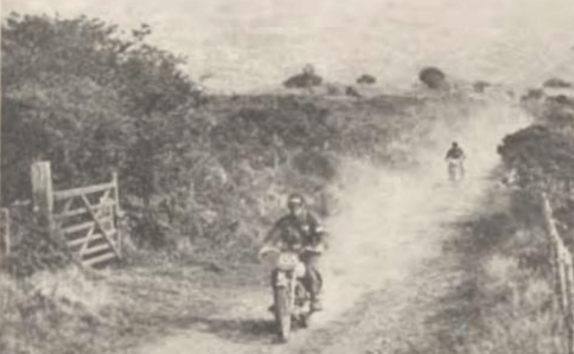
decide which country would be the 1949 Trophy winner. In the Vase Competition, there was even keener rivalry and although, when Eppynt was reached, only two teams were still clean—again British and Czech—other trios, notably Dutch, Swiss and Italian, were still only a few marks behind. The race against time which decided the destination of the Vase proved that the 125cc CZ two-strokes ridden by E Marha, F Blaha and J Kremar had a distinct advantage on class schedules, over the 498cc Triumph twins used by SB Manns and AF Gaymer and WJ Stocker’s 346 Royal Enfield. All three British riders lapped at speeds which would have been creditable in a road ram but the Czechs still made the best score despite a 3min stop by one of them. Owing to the dry conditions, the time schedules for individual competitors were not particularly severe and over a third of the starters collected ‘golds’ another third completing the course. DAY ONE Of the 237 competitors entered in the trial a total of 230 came under the starter’s orders on the opening day, and not one suffered the one-mark penalty which would have resulted from failing to kickstart the engine within three minutes. The 243½-mile route ran north to Sarn in the Clun Forest, then south to the lunch check at Crickhowell. From there there was a westward loop, taking in the descent of Dinas Rock, a severe observed hill in one-day sporting trials which lies to the north of Rhigos on the Merthyr-Neath Road. Having fallen within a few yards of commencing the Rocky descent a good half of the foreign riders—and a surprising number of the British!—dismounted and walked their machines down the hill. Most of the sidecars were in difficulty and there was often a queue waiting for the path to clear. After the Black Mountains had been recrossed there was a stamp check near Trecastle which a few competitors overshot and in retracing his course one of these, H Veer (248 Jawa), of the Dutch Vase ‘B’
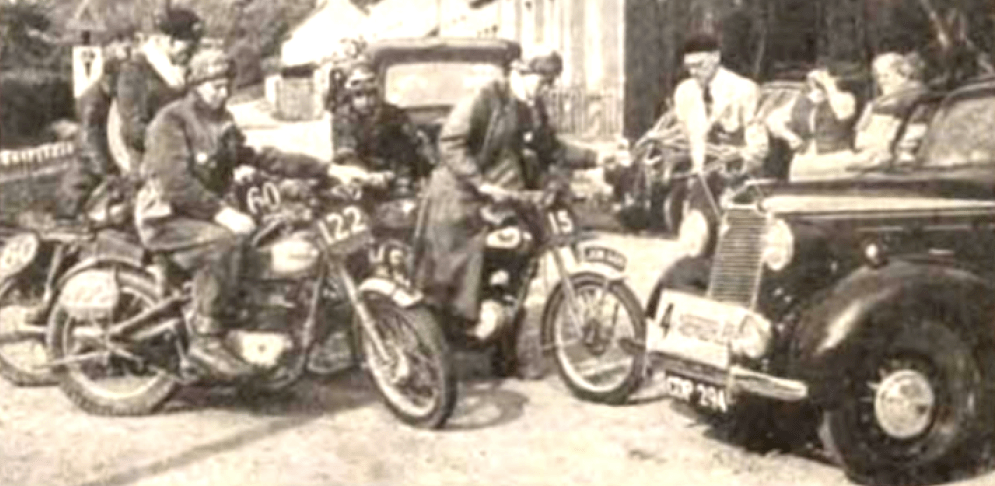
team collided with JE Breffitt (490 Norton) of the British ‘B’ team, causing mutual retirements, but fortunately no serious injuries. The Swiss Vase ‘A’ team also suffered a first-day retirement—W Hurni (344 Jawa-Ogar), coming in late to the finish with only half a handlebar, following a brush with a stone wall. Switzerland also had suffered retirement in the Trophy team, when JP Roth dropped his big Condor twin within a few miles of the start and dislocated his shoulder. Both Britain and Czechoslovakia remain unpenalised in the Trophy competition, but Italy had lost one mark—P Ghiazza (500 Guzzi) being unable to repair a puncture and still reach the next check within the three-minute margin, while Switzerland were 155 marks down with 11 and 44 marks lost by M Müller and E Fell respectively, in addition to Roth’s 100—the penalty for retiring. Of the 14 teams only five completed the first day unpenalised—Great Britain ‘A’, Czechoslovakia ‘B’, Switzerland ‘B’, Italy ‘A’ and Hungary ‘A’. DAY TWO To-day’s 232-mile route in which the strenuous crossing of the Tregaron Pass, running westward over the mountains from Abergwesyn, came early in the programme, has caused a wholesale loss of marks and 31 retirements. As a result the Italian Trophy team now has a 29-mark deficit and the Swiss trophy team has been virtually liquidated, leaving Britain and Czechoslovakia still level pegging with clean sheets. In the Silver Vase competition the Italian ‘A’ and Swiss ‘B’ trios make it a four-cornered match with the British ‘A and Czech ‘B’ teams as the other leaders, although neither the Dutch ‘A’ nor Hungarian ‘B’ teams who lost two and three marks respectively on the first day, have had any further trouble. With the retirement of Bill Nicholson (499cc BSA), who had to step off sharply to avoid a foreign competitor, the British ‘B’ trio is at the bottom of the list with 300 marks lost. Ten of the manufacturers’ teams have lost no marks and likewise six clubs. The
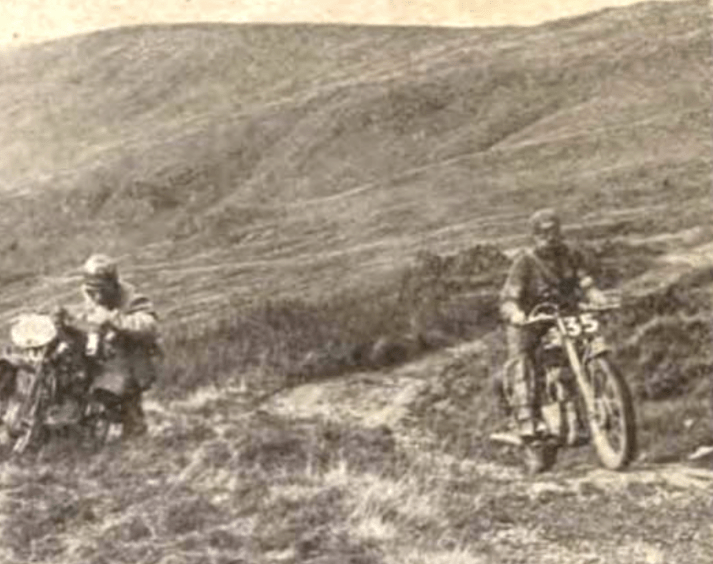
weather has been much the same as yesterday—cold and dull in the morning, brightening in the afternoon. With the absence of rain the course is dusty and the surface extremely hard. Many of the retirements and failure to maintain schedule can be attributed to frame or fork breakages and concussion tyre bursts. From the ammunition park, where the starting grid is marked, the exit is through a gap in the hedge and then sharp right and up a steep, loose-surfaced bank to the road. I was there this morning to see C Ubtali (125 MV) and G Strada (250 Sertum) both have their first tumble of the day within 100 yards of the start. It is most noticeable that the Italian machines—particularly the Sertums— are very high geared and their riders will be needing a boot change, as well as a tyre change, before the week is out! SJ Christensen (499 Royal Enfield sc) stopped for some 20 minutes behind the hedge to lash the sidecar nose to the chassis with wire. Ray (Ariel) took just seven minutes for the complete operation of removing the rear wheel and refitting it after changing a cover. Poor J Novotny (344 Jawa-Ogar), watched very closely by his team manager, got another five black marks this morning—not for failing to start, as yesterday, but by starting too soon! Actually the system of bringing three pairs of riders to the grid is rather confusing for foreigners. SH Goddard (197 and Ambassador), who damaged his elbow yesterday, and SG Plumb, similarly mounted, whose eyes were inflamed by the dust, decided not to start. Probably the toughest part of to-day’s run, the section from the first to the second check across the rocky Tregaron Pass, climbs swiftly to 1,500 feet above sea level. After a spill on one of the innumerable sharp bends WJM Clark (498 Matchless), of the Irish Vase ‘B’ trio had to retire, and imped back to the start with one leg of his ‘teles’ snapped clean off! The engine of M Hajdu’s 98 Csepel gave up struggling on almost the last of the several long climbs in the section, putting a 100-mark break in the progress of Hungary’s ‘A’ team. Murray Walker (490 Norton) smashed his spectacles when he dropped the model but carried on gamely without them, finishing the day still unpenalised. Before continuing the next leg to Llanllwni , GG Littleford (348 BSA) spent many vital minutes changing a throttle cable. The control was perched 1,200 feet up and to this point an ambulance has been driven to pick up M Vola, a member of the Italian Morini team, who had looped his 125 just before the check. Dennis Hardwick, who was there, reports that Vola insisted that his model should accompany him in the ambulance! Close to Abergorlech, a steep climb gave riders with narrow-section rear tyres considerable bother. I hear that the surviving Condor riders
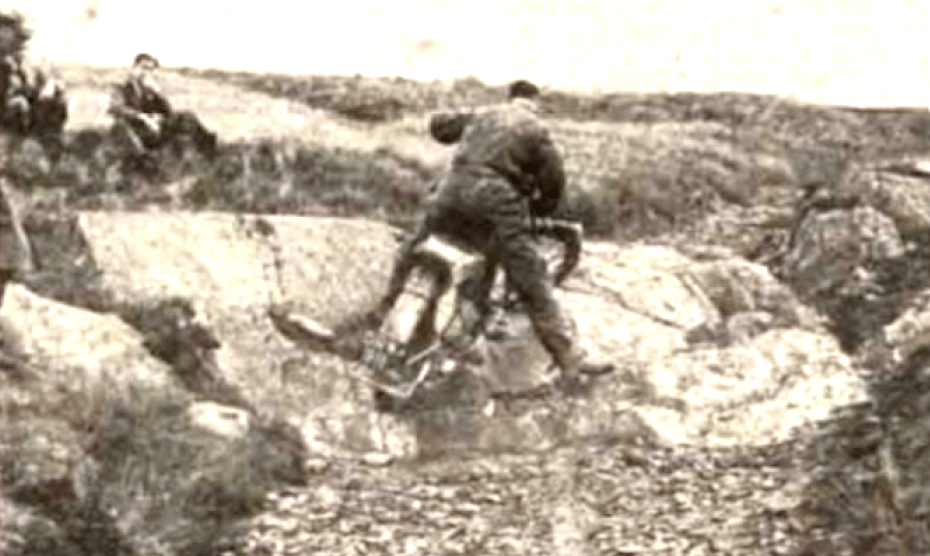
stopped to fit chains before tackling the hill, for it was muddy. A sudden right hand-hand hairpin on Myndd Llansadurn, between Abergorlech and the lunch check at Llandovery, had right after rider oversliding and SJ Christiansen (499 Royal Enfield sc) went right off the road and damaged himself sufficiently to warrant a ride in the ambulance. His passenger took over and completed the course with an empty chair. At the lunch check RS O’Neill (248 Velocette) had to retire with damaged. Front forks. H Juni’s Condor outfit failed to appear, the sidecar having parted company from the machine. Nearing the first after lunch check at Pont Amman, GC Wheeler (498 Triumph) had a nasty tumble which put him in hospital with head and leg injuries. Off the main A40 road at Trecastle there is a long earth hill approached through a shallow splash and round a left hairpin. Many of the riders of 125s were running alongside before the top was reached but both J Reisz and G Csepregi buzzed up happily on their 98 CZs. Nearly all the riders had to foot and one of them, G Strada of the Italian Vase ‘A’ trio, had to push hard. It took LF Clouder (497 Ariel sc) a long time to get to the top, but SJ Atkinson, who has a full touring sidecar attached to a Trophy Triumph, got away again despite being baulked. Running very late, E Fell (578.5 Condor crept up on one cylinder. Despite the fact that he had broken his front forks FC Moldenhauer (998 Vincent-HRD sc) got into the finish. Others in trouble at the end of the run were M Ventura (250 Sertum) who, after covering some 12 miles on a burst rear tyre, arrived in such a hurry that he all but crashed into timekeeper AL Ebblewhite’s table and GG Littleford (348 BSA), who came off near Builth Wells and had the mortification of seeing his machine burst into flames. Captain HG Little (490 Norton) came in on time but with a badly leaking petrol tank. JHC Daniels (498 Triumph sc) had driven into retire from Carn Lloyd with a coach bolt as a temporary replacement for a broken front spindle. DAY THREE No change in the weather! Again, today, there was every indication at dawn of rain to come, yet by midday the Sun was beginning to break through and the ground remains as dusty and hard as ever. The routine today has been a repetition of yesterday’s tackled in the reverse direction, and with the muddy hill near Abergorlech by-passed. Much less havoc has been caused, however, and only 10 retirements are reported, including that of Captain Little, who was unable to start this morning with his damaged tank. Although by now CM Ray (497 Ariel) is probably the only rider who hasn’t hit the deck at least once—his Trophy teammate BHM Viney (498 AJS) did so right in front of me this afternoon on one of the hairpins leading down to the Abergweryn water splashes—few of the star riders are having difficulty in maintaining schedule. J Pastika (123 CZ) of the Czech Trophy team had a puncture on the pass but repaired it without loss of marks, and both Britain and Czechoslovakia still have clean sheets. These two countries, with their ‘A’ and ‘B’ trios respectively, also have the only unpenalised teams in the Silver Vase competitions. It has been an unlucky day for RWM Tamplin (498 Matchless). He lost one mark as a result of just overstepping the three-minute allowance for kick-starting and had quite a nasty tumble on an unexpected wet patch on the Abergwesyn descent but remounted quickly and proceeded. The last of the Condors retired today, but the Italian Vase team has lost only one more mark, M Ventura losing a minute over his tyre replacement this morning.
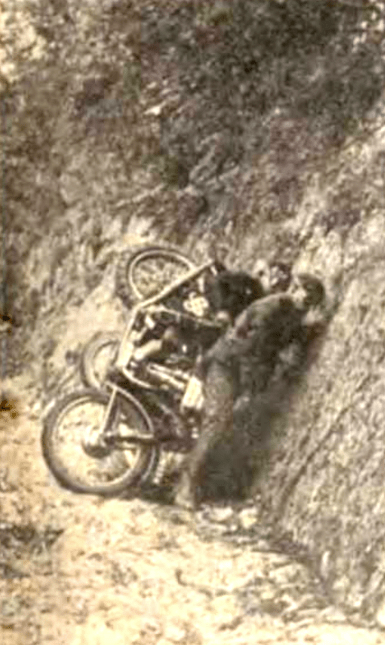
There was excitement at the Llanllwni time check, the first one after lunch, when J Kubes (344 Jawa-Ogar), a Czech Vase ‘A’ man, rushed in, only just on time, braked hard and promptly snapped one leg of his forks! A mile or so from here, DD Jones (348 BSA) hit a jeep and also had to retire. The ‘gallery’ at the Abergwesyn splashes and up the side of the Mountain must have numbered several hundreds And as the first man approached after the hard ‘bash’ over the heights from Tregaran he received a chorus of encouraging shouts. It was a British ‘Trophy’ man FM Rist, and he was followed closely by T Wortley (498cc AJS). There were cheers too for Harold Taylor, whose pale green Sunbeam sidecar outfit looked and performed magnificently; for Olga Kevelos (490 Norton)—still on time despite chain trouble—for Frank Whittle (598cc Panther sc), battling on with the machine leaning on the sidecar at the most alarming angle, and for J Reisz, first arrival on one of the amazing little 98cc Csepels. It was notable that James and BSA 125s were cracking along every bit as well as the small foreign two-strokes; it is to be hoped that their performance will encourage less bold manufactures in this field to compete against the Continentals. Quite the quietest machine in the trial is the Ministry of Supply side-valve twin cylinder Triumph, which is being handled most capably by WA Randall, while quite the noisiest is EB Stott’s 346cc EMC two-stroke. Stott, who had a clean sheet, lost a lot of time repairing a broken primary chain at Tregaron, but regained most of it in the mountain crossing. WH Hemsley (498 Triumph) was today’s unluckiest man, for he went over the edge of the path near Abergwevyn and fractured his thigh. Dr RL Galloway stopped for several minutes to render first aid and lost some marks on time—a penalty which was cancelled by the organisers with the full approval of the stewards. DAY FOUR With today already almost tomorrow we know that the British and Czech Trophy teams remain penalised at the conclusion of the fourth day’s run. And it seems as if the British Vase ‘A’ trio and one member of the only clean Vase trio, the CZ-mounted Czech ‘B’ has apparently lost two marks in the course of a run which has been particularly severe for 125s. On the other hand, the two marks lost in the first afternoon by J Flintermann (499 BSA), of the Dutch ‘B’ trio, has been remitted following an appeal. Today, however, he has lost five. The complication of the times schedule for team men who have to maintain a 10% higher average than that of other competitors, but whose marks must be adjusted each day for assessment of their individual performances, has caused the results team so many headaches that we are still getting corrections to the results of earlier days. Today’s run route is run almost due north covering 120 miles over the mountains to Denbigh, taking in the long stony climb of Bwlch-y-Groes and another 120 miles back with the course skirting Llangollen and climbing Alt-y-Badi. Having successfully rebuilt the mudguard assembly of his MV, F Bertoni was away again this morning keeping the Italian Vase ‘A’ trio intact and Frank Whittle (598cc Panther sc) managed to sustain his sidecar
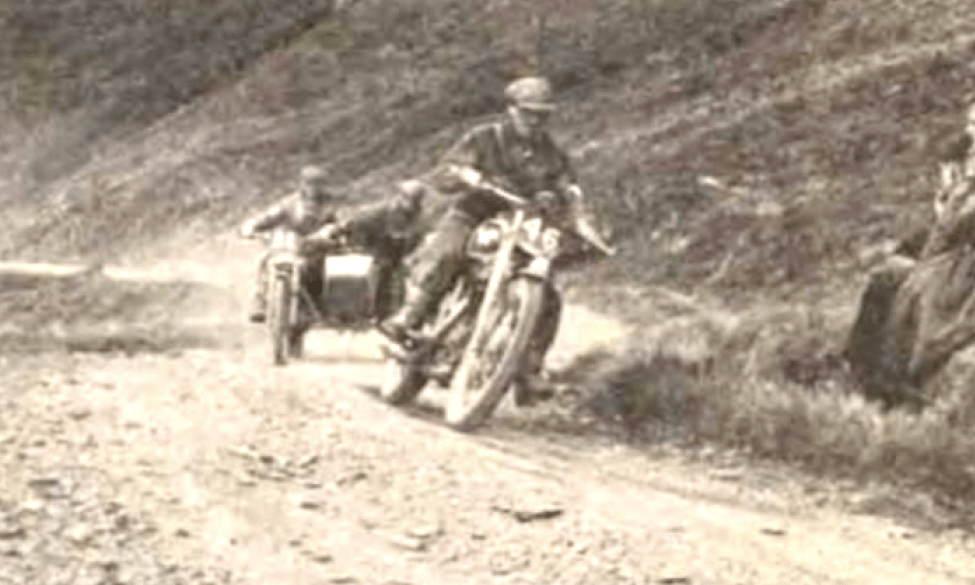
connection and to lash the broken side rail with a U-bolt and strips. DW Spencer (498 AJS) got off the starting grid, then pulled into the side of the road to carry out major overhaul of his front forks. He was there for nearly an hour! J Pastika (125 CZ) came into the second check of Bidno with a puncture and had just 10 seconds in hand by the time he repaired it. This is the second consecutive day that he has had a go like that. At Bwlch-y-Groes almost all the riders of small two-strokes had to foot their way over the steeper parts of the tiring climb and they were flat down to it on the long descent to Lake Vyrnwy in order to get back to schedule. It was around here that H Zuur (498 Matchless sc) who had already rebuilt his front wheel on Monday had it collapse again. By the time he had rebuilt it once more, over an hour had passed and he retired. Another man effecting wheel repairs was GW Beamish (123 BSA) and he is now out of the trial. Shortly before he got to the lunch check at Denbigh, Koksis (124 Csepel) had a burst petrol tank. It is possible that, from to-morrow, the Hungarians will withdraw from the competition and compete as individuals at the lower schedule. The riders are all in their teens and their team manager ruled that it is unfair to expect them to continue the quick dicing through the lanes which the team average demands. One of the toughest sections of all to-day was after lunch on the run from Minera to Barbers. For some distance the track curved around the base of a cliff. The surface was loose and there was every possibility, in the event of a spill, of going off the edge—’just like sliding off the bar counter’—as James team-man Norman Hooton put it! Alt-y-Bady, the once dreaded hill near Llangollen, caused very little trouble but, on the long run from Llwant to B-Cedewain, the veteran Swiss sidecarist E Haller was found sitting by the roadside by Ron Watson, who told the enormous Harley Davidson outfit back to Llandrindod. Having already shed both exhaust pipes and several other non-vital parts, the Harley had expired with dynamo trouble. At one point in this stretch—at Dolanog, just after crossing the Afon Vyrnwy—the course as marked made a slight deviation from that shown on the master map in the A-CU office. It seems that the detour increased the mileage by two miles and, being confident that their speedometers were accurate, some of the Czechs, including a Vase man, arrived late at B-Cedewain. The stewards are considering the
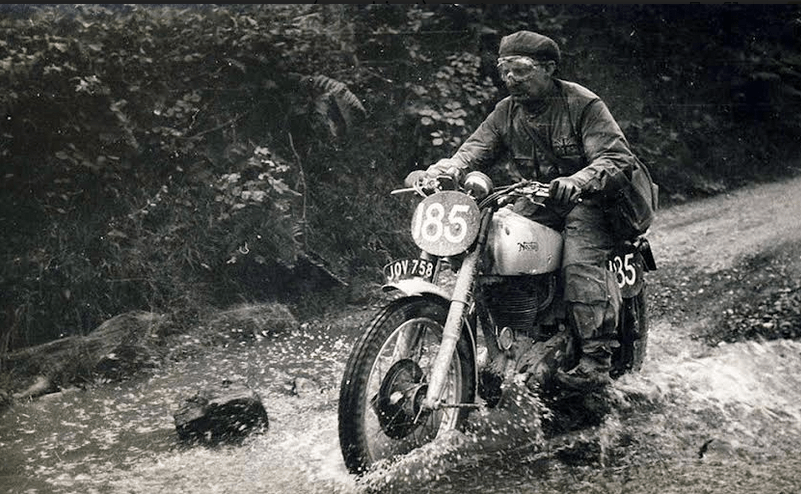
matter of the lost marks. The scene at the finish was quieter than yesterday when the oil barons were busy organising oil changes for most of the runners. When P Ghiazza (500 Guzzi) came in he grabbed a large hammer and straightened his long suffering foot rest, to the accompaniment of a ringing echo from the flywheel. Olga Kevelos, still on time, commenced the work of changing her primary chain and will finish it in the morning. J Heanes (347 Matchless), a member of the South Reading team, one of the club teams still unpenalised, tried to change a tyre in six minutes and was late handing in as a result. Harold Tozer (496 BSA sc) came in like a projectile—straight to the timekeeper’s table in a cloud of dust—and then discovered that he was actually early! Whittle’s outfit had collapsed again and he decided to leave repairs until the morning and to change the badly scrubbed rear tyre, and RU Holoway’s BSA outfit also had a nasty list due to a broken chassis. On the other hand SJ Atkinson’s touring Leyton sidecar, on a Triumph, still looks as if it has been no further than a mild afternoon’s potter! DAY FIVE Having spent some hours inspecting and measuring the course diversion at Dolanog the stewards decided this morning that the Czech protest should be upheld, and with neither the British Vase ‘A’ trio nor the Czech ‘B’ losing any marks to-day, it looks as if there may be a race against time over the Eppynt circuit to-morrow afternoon to decide the destination of the Silver Vase. But, barring accidents, Britain will have the Trophy for the second year in succession. For, while both Czechoslovakians and Britons have had their share of bad luck during the course of to-day’s run—which was a reversal of Thursday’s route—the foreign team has suffered a loss of 29 marks compared with Britain’s one. The fifth day of the trial started in rain, and later on there were one or two slight showers, but never enough to lay the dust on the mountain roads. Neither FH Whittle (598 Panther sc) nor F Wilkins (497 Ariel sc) had much opportunity to find that out, however, for within the first hour the former’s sidecar chassis had finally collapsed and the latter’s engine had run out of compression. DE Bennett’s solo Ariel also broke down, ending an unpenalised first venture into the ISDT. There was an atmosphere at the time towards the end of the morning run. Bennett solo also broke down ending unpenalised first venture into IST. There was a tense atmosphere at the Barbers time check, towards the end of the morning run, when J Pastika, of the Czech Trophy team, arrived—seconds only within his three-minute time allowance, and with his 125 CZ misfiring. He has stripped and rebuilt the
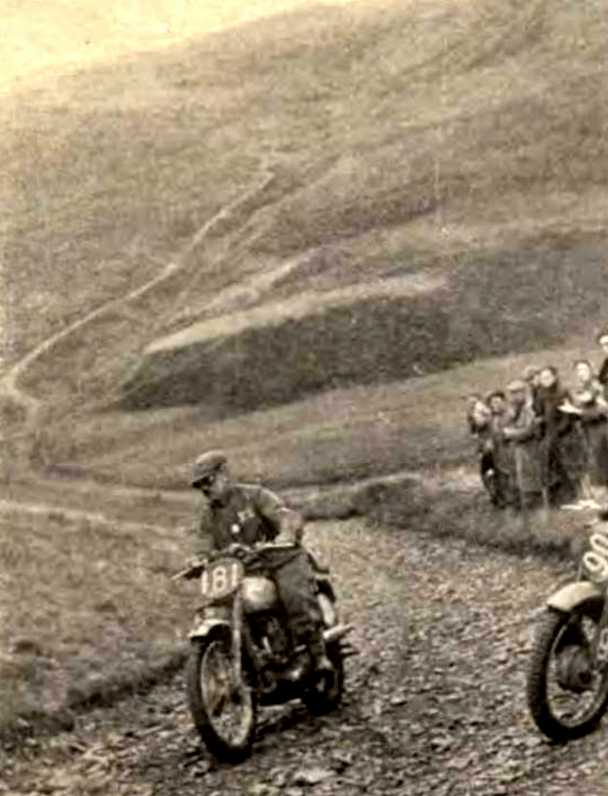
magneto within a quarter of an hour, but, when he finally left, it was obvious that he would have difficulty in maintaining schedule over the 40 miles between there and the lunch check. His engine was still misfiring, but nevertheless he saved three minutes on the first short but distinctly hazardous run to Minera. On this section the track runs unfenced down the side of the mountain with a sheer drop on one side and a vertical rock face on the other and there are loose stones on almost every corner. GA Morrow (348 BSA), an Irishman—the Irish seem to have the most wretched luck in the ISDT—dropped from 0 to 100 marks lost when his frame broke and he finished the day’s journey as a travelling marshal’s passenger. Then, after lunch, luck of the wrong sort—in the shape of a large rock on the Aber Hirnant Pass, which fractured the rear-brake rod of Bob Ray’s Ariel—began to play a part in the fortunes of the British Trophy team. And because such things always do happen together, Bob then missed a turning and found himself five miles off course, and in the ‘tight’ time section from Bwlch-y-Groes at that! It wasn’t long before his front anchor had ‘faded’, but despite the fact that he was without brakes and not withstanding five excursions through hedges in consequence, he had just about regained the lost time by the next check, at Bidno. But, coming into the control, he got into a slide, hit a car and dropped his card which he was carrying in his teeth. By the time it had been picked up and banged into the time clock the last of his three ‘bonus’ minutes had just ticked away! One mark was lost, but Ray completed the remaining 30 miles on time. It was above Bidno in the bleak area of Dylife—where the narrow road crosses a shale ridge between two mountains—that the AJS team’s hopes of winning a manufacturer’s award were spoilt when Tom Wortley took a spectacular dive over the edge. By a miracle he escaped almost unhurt, but his front wheel was completely wrecked. THE LAST DAY The last day of the ISDT has seen the most perfect weather of all and there was a crowd of several thousands up on the Myndd Eppynt to see the speed test—the closing stage of an event which certainly seems to fired the imagination of the whole population of Wales. Before the competitors proceeded to the 5.2-mile mountain road circuit they had to cover the final section of the trial—a 40 mile route with only one time check, at Upper Chapel, near Builth Wells. One more lost mark was added to Dr RL Galloway’s collection when he took 58sec to kick-start his Triumph outfit, but everyone else got away on time, despite the fact that there were one or two very lame ducks on the field. Of these, AS Campbell’s 499 BSA was 19min adrift on the run to Upper Chapel, which meant a loss of 16 marks; another—FH Barnes’s 349 Ariel outfit seized just outside the gates but freed before his time limit
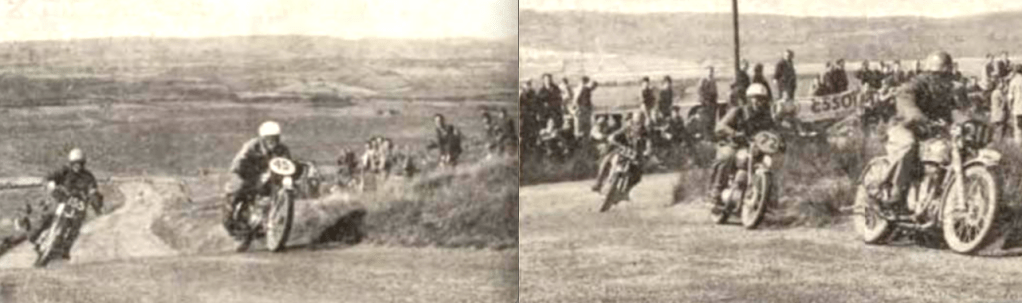
was up. Only one man who left Llandrindod Wells failed to reach Eppynt; he was T Hankins (348 AJS), who actually got within sight of the circuit before he suffered a final breakdown. After Mr Norton’s cold lunch—leading manufacturers had taken turns during the week to act as hosts to competitors and officials—the speed tests commenced. In these, competitors had to circulate the 5.2 miles Eppynt road circuit—narrow, winding and undulating—for an hour, with a minimum number of laps to be covered, depending upon class, if a clean sheet was to be retained. However, provided his machine came under starter’s orders, any competitor who failed in the speed test would still be regarded as a finisher, losing marks—up to a maximum of 60—in proportion to the number of lapse uncompleted. The required distances ranged from five laps to be covered in 52min by the ’98s’ and 350cc sidecars, to the nine laps in 63min demanded of the 500cc solos. Only four of those who reached the speed test lost any further marks. The worst sufferer was WT Tiffin (248 Velocette) whose model ‘died’ almost as soon as he got under way, losing him 51 marks—extremely bad luck in view of the fact that he had retained a clean sheet throughout the trial. JR Lloyd (498 Matchless) and EW Jones (499 BSA) both lost 6.66 mark through failing to maintain the average for their class and DG Miles (498 Triumph) lost 20. Competitors circulated the course in five separate schools. These were the 98s and all the 125s except the Czech Vase ‘B’ trio; the 250s and 350s together; the sidecars; the 500s; and, in a class of their own, the Czech Vase ‘B’ men and the British ‘A’ team—Jack Stocker (396 Royal Enfield), SB Manns and AF Gaymer on 498 Triumphs. The Czechs—E Marha, F Biaha and J Kremar, all on CZs, had to improve upon a standard of five laps in 52min; Stocker upon eight laps in 60min, Gaymer and Manns upon nine laps in 63min. It was almost foregone conclusion that the 125s would have the advantage and despite the very final effort of the Britishers, such was the case, even though Marha, who had been lapping faster than his compatriots, had a three-minute delay for a plug change towards the end of the hour. The only tie for an award was between the Sunbeam Club’s ‘A’ and ‘B’ teams, the latter achieving the victory in the Speed test by a very small margin, despite the fact that one member, AA Sanders (498 Triumph) finished the distance with a flat tyre! In the evening there was a presentation of awards at the pavilion in Llandrindod Wells which was honoured by the presence of the Lord Lieutenant of the County of Radnorshire and of Piet Nortier, President of the CommissionSportive Internationale of the FICM.” —Cyril Quantrill [of the Green ‘Un]. RESULTS International Trophy: Great Britain, no marks lost; Czechoslovakia, 29; Italy, 44. Silver Vase: Czechoslovakia ‘B’, no marks lost; Great Britain ‘B’, no marks lost—decided by speed test; Netherlands ‘A’, 5; Italy ‘A’, 2½; Ireland ‘A’ 12; Czechoslovakia ‘A’ 429; Italy ‘B’ 457; Switzerland ‘A’ 612; Netherlands ‘B’ 634; Great Britain ‘B’ 1,100; Ireland ‘B’ 1,338. Manufacturers’ teams: Matchless, Norton, Royal Enfield and Triumph, no marks lost. Club teams: Sunbeam ‘B’, Sunbeam ‘A’—decided by speed test.
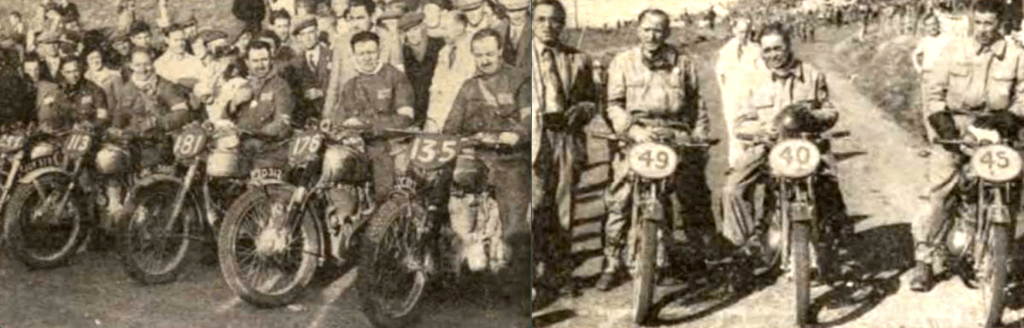
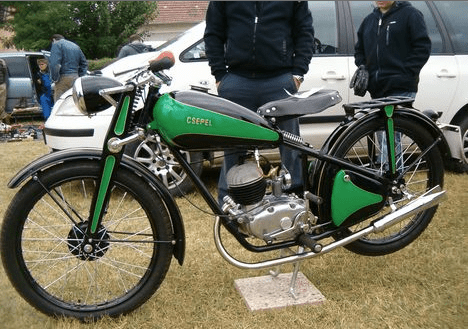
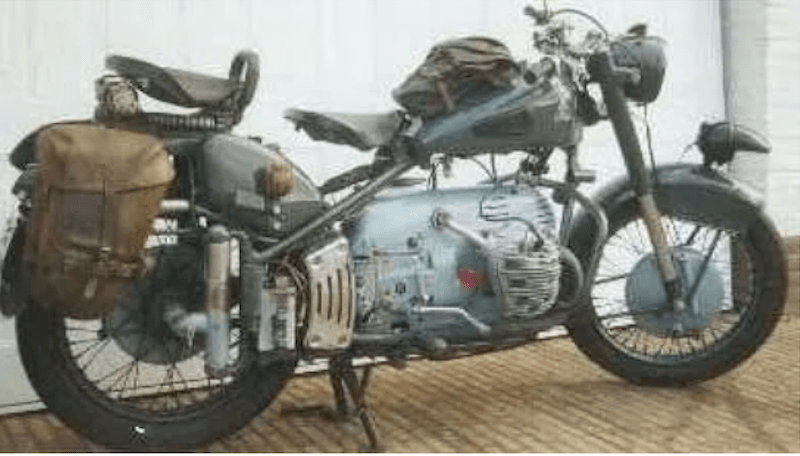
“FROM WHATEVER ANGLE it is examined, last week’s 24th International Six Days Trial must be classed as a very successful event. It would be excusable if, after a lapse of 11 years since this great test was last staged in the British Isles, the Auto-Cycle Union had shown some weaknesses in its organisation. As it was, a generally high standard of efficiency was displayed. Llandrindod Wells again proved an excellent centre and the Eppynt circuit was ideal for the final speed test. The only serious criticism concerned the delay in publishing daily results, a matter of great inconvenience to the competitors and the Press. The greatest credit is due to Mr HP Baughan and his assistants for the selection of a route which combined the essential degree of severity with complete fairness to the riders. How well it served its purpose can be judged by the fact that approximately one-third of the entry retired whilst more than one-third gained first-class awards. Had the weather been other than fine throughout the week the relatively large number of gold medallists would base been considerably reduced, but that the conditions were really difficult was proved by the small number of teams which remained unpenalised at the finish—two Vase, four British Manufacturers’ and two Club from a total of 60—and the failure of over 60% of the sidecar entry. The
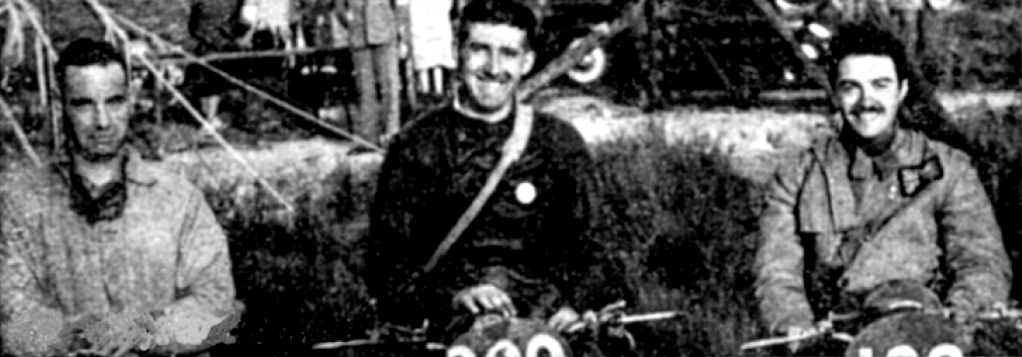
results of the two major competitions provided a fair commentary on the week’s work. Great Britain tends to concentrate on the production of medium-capacity four-stroke machines, the Continental countries to specialise to a far greater degree on small-capacity two-stroke designs. It was fitting, therefore, that the British team should win the Trophy for the 11th time and that the Czechoslovakians should win the Vase. It is fair to state that the performance of the little Czech machines in relation to their speed schedule at Eppynt was such that our Vase team men stood no real chance of victory despite the magnificent effort made to overcome an excessive time handicap. Among many interesting points raised by the more experienced riders after the trial were suggestions that the ‘three minutes late’ allowance at checks was too liberal in view of the weather, that the FICM might well reinstate the rule which demanded the inclusion of a combination in each Trophy team, and that the speed schedules for the final test call for some revision. Admiration was widely expressed by British competitors for the capabilities of the foreign two-strokes. In view of the devaluation of sterling and the relaxation of tariffs and import restrictions now being discussed by the American and Western European Governments, it seems highly desirable that British manufacturers should give serious thought to the further development of machines—and more particularly power units—in this class, which shows every sign of becoming more popular in the world’s markets. We take this opportunity to offer our congratulations to the British Trophy team, under the able management of Mr Len Heath, the successful manufacturers and club teams, and the British Vase ‘A’ and Czech ‘B’ team on their splendid performances.”
“IN LAST SATURDAY’S TVTC-organised open Southern Trial, LA Ratcliffe (347 Matchless) won The Motor Cycle Trophy for the best solo, losing five marks. H Tozer (496 BSA sc), losing 10 marks, gained The Motor Cycle Trophy for the best sidecar. Manufacturers’ Team Prize went to the Matchless trio; Club honours were taken home by the Weyburn ‘A’ team. The event was held in fine weather over two laps of a roughly 28-mile circuit. Lack of rain had rendered most of the sections comparatively easy. Before the first observed section was reached, a special engine-starting and acceleration test was held, and this decided what would otherwise have been a tie between sidecar men Tozer and F Wilkins (497 Ariel sc). Test figures were: Tozer 11sec; Wilkins 13.8sec. Total number of entries in the trial was 95.”
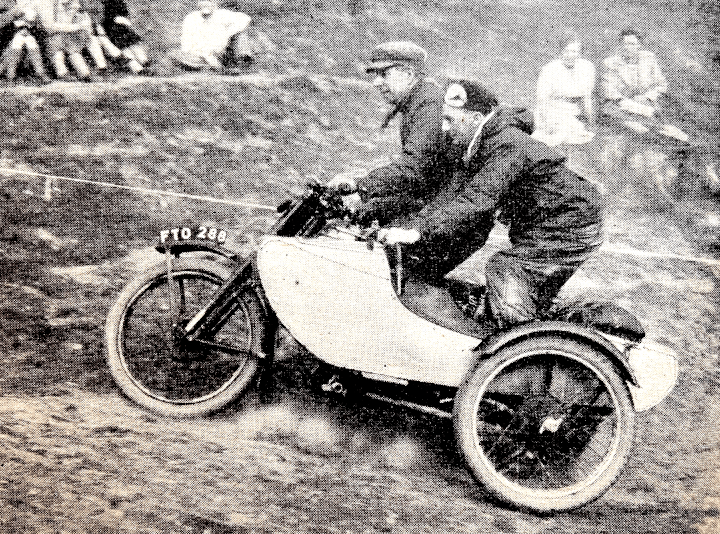
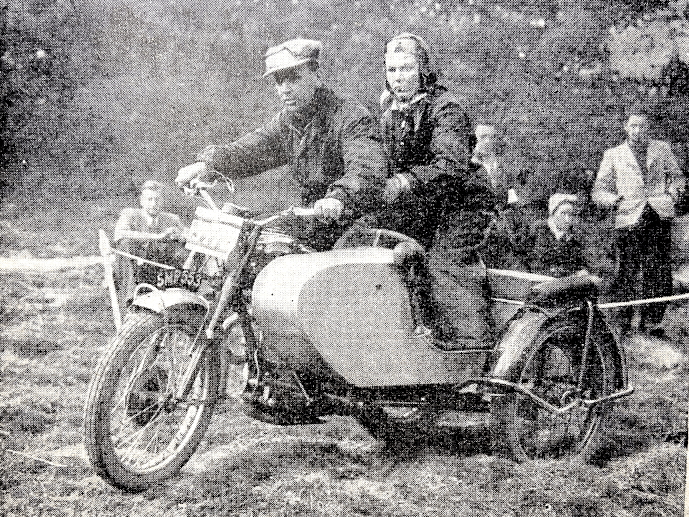
AFTER WHAT SEEMED LIKE a greater rain-fall during the previous week than throughout the whole of the past year, the Bristol club were able to offer an exceptionally ‘ripe’ course for their open, trade-supported John Douglas Trial on Saturday last. Evidently not too ripe for BHM Viney, however, who regained his form with a vengeance and completed the eight observed sections with a loss of only six marks—no less than 11 fewer than that of LA Ratcliffe, his closest rival. In the sidecar class there was an unfortunate occurrence which not only had a considerable bearing on the results, but which tended to mar the general good impression of what was otherwise an admirable trial Apparently the trouble originated with confusion over the route-marking of the sidecar course (confusion, incidentally, in which many of the solos, too, seemed to be involved). As a result of this misunderstanding, coupled with an obviously justifiable belief that they were being required to attempt the impossible, most of the sidecar entry did not even try to climb the notorious Hanging Hill. For their sins they were deemed not to have completed the course, and were accordingly excluded from the awards. An entry of 124 had been received (12 of which were sidecar outfits). First man left The Griffin Inn, Bridge Yate, at half past nine, and within a few miles came Clee Hill—a slippery, rocky ascent with a cunningly taped ‘diversion’ near the bottom. This unexpected obstacle was too much for DJ Ratcliffe (347 Matchless), W Nicholson (499 BSA), and many others, but of the early arrivals, CA Mein (498 AJS), Hugh Viney (347 AJS), LA Ratcliffe (347 Matchless), and E Usher (347 Matchless) were all consistently excellent. Less than five minutes distant was Doynton Hill, a long, narrow climb which had been suitably ‘gingered up’ with another diversion up the bank and sharply down again. This chicanery resulted in wholesale loss of marks. On Hanging Hill, scene of the sidecar confusion, several riders appeared to receive inadequate instruction from the marshal in charge, and PH Alves was not allowed the benefit of a successful re-run after mistaking the point at which observation actually commenced. There was no such cause for misunderstanding on Pipley Bottom, however, and this famous acclivity defeated everyone. A brief lunch check, up on the pleasant heights of Lansdown Hill, and riders were then confronted with muddy Cowsh—another ascent which was not ridden clean by anybody. Jack Batting’s 196cc Excelsior was outstanding, and of the sidecar entry, EA White (499 BSA) and GL Buck (497 Ariel) got farthest up before failing with spin. On Manor Hill, and Hamswell, which followed, a happier story was being unfolded. There remained only Marshfield Hill, a long and slippery ‘one-rut’ climb, better known as Green Lane, where the afternoon’s welcome sunshine had done a lot to ease conditions. RESULTS John Douglas Solo Trophy (best solo): BHM Viney (347 AJS), 6 marks lost. John Douglas Sidecar Trophy (best sidecar): RU Holoway (499 BSA sc), 26. Bristol 150 Cup: DER Morgan (122 James), 48. Bristol 250 Cup: J Botting (196 Excelsior), 29. Bristol 350 Cup: EA Ratcliffe (347 Matchless), 17. Bristol 1,000 Cup: W Nicholson (499 BSA), 20. Manufacturers’ Team Award: AJS (BHM Viney, 6; CA Mein, 22; TH. Wortley, 32). Club Team Award: Sunbeam ‘B’ (W Nicholson, 20; CA Mein, 22; PH Alves, 33).
“THREE MONTHS HAVE PASSED since it was announced that an Anglo-American sales corporation, financed jointly by Great Britain and America, had been formed in order to market British motor cycles and allied goods through one of the two big chains of United States motor cycle dealers. For a time it seemed that the whole scheme might founder. The prime movers on this side of the Atlantic, the Brockhouse concern, do not make complete motor cycles other than the Corgi, so everything depended on British motor cycle manufacturers joining in—quickly. Obviously a network of dealers will not exist for long without goods to sell, and unless 1950 model motor cycles became available, and in adequate numbers, the nearly 1,000 dealers might soon he whittled down. Following a meeting held immediately after the International Six Days’ Trial events have moved swiftly. No fewer than seven motor cycle manufacturers and one maker of three-wheel commercial vehicles are now linked with the scheme—AJS, Douglas, Excelsior, Matchless, Norton, Reliant, Royal Enfield, and Vincent. Thus the network of dealers previously devoted to the sale of Indian machines will henceforth have an extremely comprehensive range to offer. Great Britain on her part should have a distribution system in the USA of substance and efficiency. The enterprise promises well and, at this juncture especially, is most welcome.”
“IT IS DIFFICULT to find an appropriate slogan for this year’s Milan Show, the 27th of the series, but there is no question that somewhere in the slogan should appear the word ‘economy’. The emphasis is on small two-stroke machines and on attachments for pedal-cycles. Another straw in the wind is an all-round reduction in prices. Nevertheless, the need for economical machines and for reducing prices has not thwarted the well-known Italian fiair for introducing novelties and new models, some of which, especially the racing types, must have a small market. Lambretta exhibited models in both categories. Following on their successes in breaking many long-distance 125cc world’s records at Montlhéry—one of the records was at a speed of over 60mph for 48 hours—a 125cc two-stroke racing model has been introduced. This is a motor cycle as distinct from a scooter with which the name Lambretta is so closely linked. The 125cc
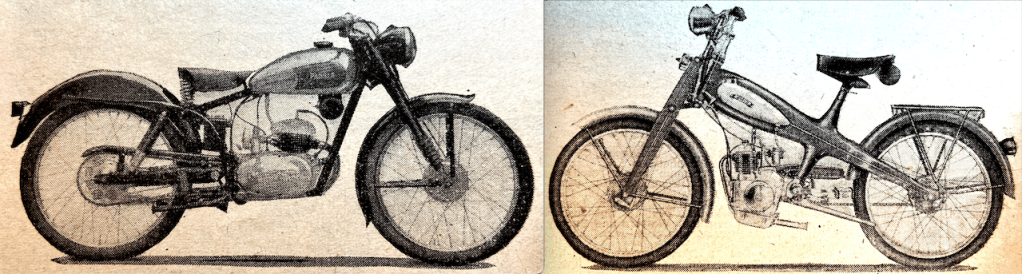
engine has a four-speed foot-controlled gear box in unit. Outstanding features include pivoting-fork rear suspension with a torsion-bar parallel to the pivot bearing, and shaft-drive through the right-hand side tube of the fork. The torsion bar is situated a few inches below the pivot and is connected to the fork by a parallelogram linkage. Front fork is of the telescopic type with coil springs and hydraulic damping. Ignition is by flywheel magneto and the carburettor has a float chamber remote-mounted on the saddle tube of the frame. A second newcomer announced by Lambretta is known as the Motocab, a three-wheeler with seating accommodation for two persons behind the rider. The 125cc two-stroke engine has a three-speed gear box in unit and gear changing is by hand. Drive to the rear wheels is by shaft through a differential, and the rear suspension is by half-elliptic springs. Tubular members are employed for the chassis; wheels are fitted with 4.00×8.00in tyres. A welcome ‘come-back’ has been made by Benelli, of Pesaro. Since the war Benelli output has been very small owing to the factory having been badly damaged when Pesaro was in the Gothic line. For 1950 there is a new and very modernistic 98cc model in addition to the known 500cc side-valve and 250cc sports models. The new machine follows latest German practice in that the
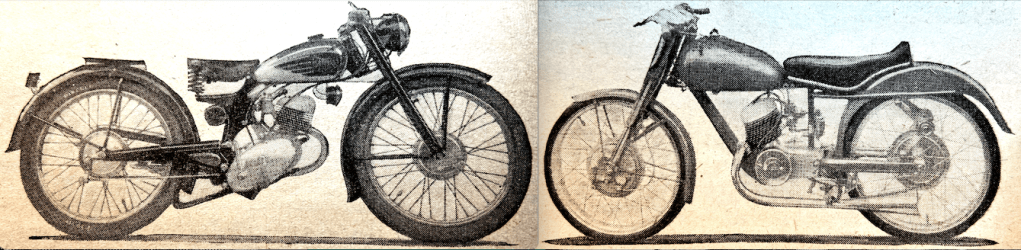
frame has no front down tube; indeed, the frame comprises only a fabricated channel-section member curving from the steering head down to the rear of the engine-gear unit, and a pivoting rear fork. A telescopic front fork is fitted. The 98cc two-stroke engine incorporates a three-speed gear box with gear-change control on the handlebar. Dry weight of the machine is said to be 1401b, and the maximum speed claimed is 45mph. A new Guzzi is the 75cc two-stroke, which is the famous Motoleggera 65 with a larger engine and strengthened frame to make it more suitable for Italian riders who persist in carrying a pillion passenger no matter how small and light the machine they possess. The 75cc model will supersede the smaller machine, which it follows almost precisely in design. Other Guzzi models shown include the Airone Sport 250cc ohv in unchanged form, and its larger sister, the Astore. The 500cc ohv engine of this latter model has been modified by the fitting of a light-alloy cylinder head providing full enclosure of the valve gear in the same manner as on the Airone. A couple of two-strokes have been added to the range of Parilla 250cc ohc models. One is a 250 and the other has a 98cc engine; both are fitted with four-speed

gear boxes controlled by the left-hand twistgrip in the style of the Vespa and Lambretta scooters. The smaller model is particularly neat in external appearance; front fork is of telescopic type, and at the rear there is a pivot-action fork controlled by telescopic legs, one each side. Minor alterations have been made to the 48cc ohv Motom for 1950, but the machine remains essentially similar to its predecessors. Its fabricated box-girder frame comprising a beam from steering head to rear spindle and incorporating the engine support and bottom bracket lug, and the saddle support, is unique among present-day designs. All the other well-known Italian manufacturers—Mondial, MN, Vespa, MAS, Nibio, Sertum and Gilera—were exhibiting at the Palazzo dell’Arte al Parco, Milan. The Sertum display included the 500cc side-valve vertical-twin seen for the first time at the Paris Salon last month, and on the Gilera stand was the new 125cc ohv model. Auxiliary engines included the Mosquito and Mini-motor two-strokes and the ohv Cucciolo. There were also a few British makes on view such as Ariel, BSA, Matchless, Norton and Sunbeam, although the normal importing of British machines is not permitted. Among the accessory exhibits were several special fittings for scooters and lightweights, many of which, though ingenious, might well be compared with the frills and gadgets beloved by American riders.”
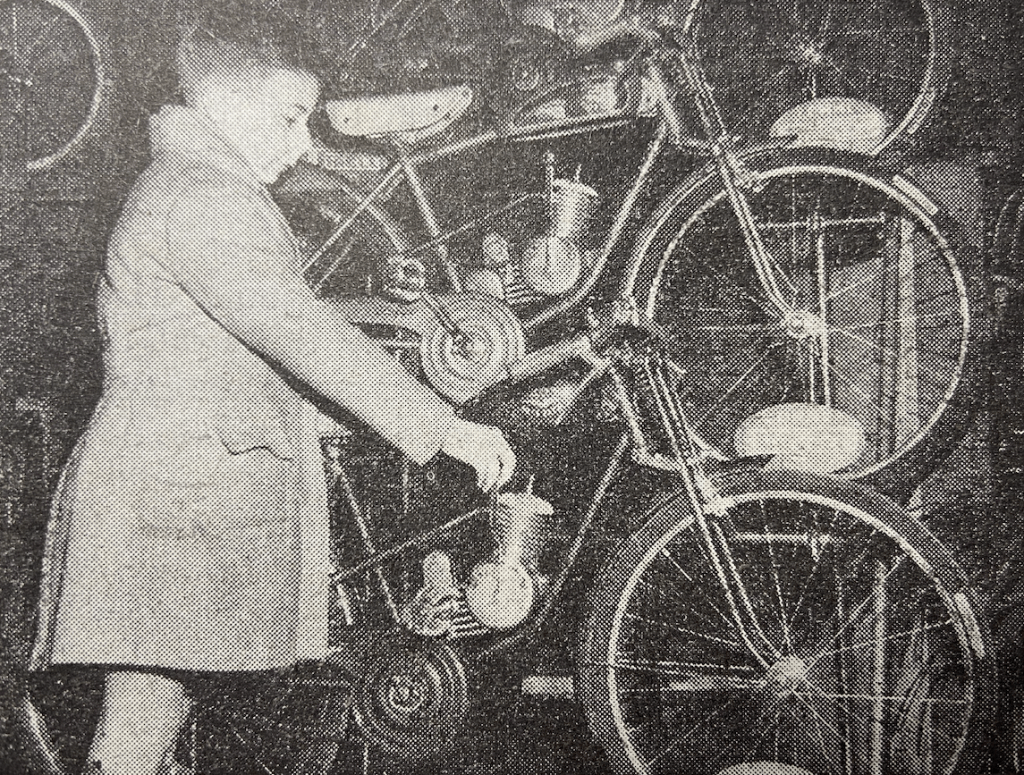
“BROOKLYN — THAT UNIQUE CITY within a city that forms a picturesque part of New York—has come up with a new pastime which police from coast to coast are afraid will spread like wildfire. It’s an improvement, on ‘super hot rods’: it’s a thrill like no jet fighter plane can provide; and it’s a danger to all concerned. That’s why police are worried. A ‘super hot rod’, to reduce Brooklynese to English, is a motor-car stripped of excess baggage, such as fenders, and provided with an owner-built super-charged engine, making it capable of; extreme speeds. Now a group of Brooklyn ‘hot-rod jockeys’, or youths who like to drive these cars, have turned their talents to motor-cycles. They have been racing through the crowded streets of Brooklyn at night at speeds of 125 miles an hour and more, laughing at the vain attempts of, police to catch them. Going 125mph through these streets, narrow, dark and beset with pedestrians, traffic and corners, takes genuine daring—and as genuine a disregard for the lives of others. It’s no wonder that American police fear that youths in other cities soon may take up this newest ‘sport’ which, its devotees claim, provides a thrill no other can equal. The youths gather at night, in one of the most crowded sections of Brooklyn, wearing ‘men from Mars’ helmets, jackets and riding trousers. The general technique is for them to split up into couples and roar off in different directions. Each one watches for motor-cycle or automobile police. As soon as one of these ‘speed’ policemen is sighted, the youth deliberately roars past a red stop light and laughs in the cop’s face. That’s the signal for the chase to begin. Off they go, the policeman on his motor-cycle or in his squad car, sirens wailing, red lights blinking, and the youth calmly leading him on to higher and higher speeds. Since the police can’t travel faster than 90mph, the result is a foregone conclusion. But that’s no consolation to the pedestrians and other drivers who scurry for cover as the pursuit races past them. There have been plenty of accidents from these ‘super-hot-rod jockeys’. Police claim that one electric light pole still has a rider’s shin bone embedded in it as the result of a head-on crash. However, the police harbour no resentment against these speed demons who bedevil and laugh at them. They regard them as extremely good drivers who should be professional racers, and they realise that since they cannot catch them, some other method of wiping out the menace must be found. Incidentally they cannot shoot at the jockeys, either, because the youths are not committing felonies. The acknowledged champion of these super-hot-rod jockeys” is a youth identified as Billy the Kid, who frequently drives past moving buses at high speed, standing erect on the seat of his machine and rapping on the windows of the bus to frighten passengers. Police would give a good deal to talk to him. One 17-year-old youth told a reporter, ‘You can’t ride our machines at 35mph, and that’s the speed limit. Our wheels are made to cruise at 55. So we’re already breaking the law, and if a cop comes, we just take off.’ Not long ago one motor-cycle policeman was racing in pursuit of a hot-rodder when he hit a hole in the street. Head over heels he flew off his machine—and he came-to five days later in hospital. The first thing he saw when his eyes focused were four hot-rudders at the end of his bed—all with flowers in their hands! ‘I’ve got no grudge against them,’ this officer said. ‘They’re good riders and they can handle those wheels. But sometimes they get a bit out of hand.’ That’s what police in other cities and towns are worried about to-day. Suppose the youths in their localities also ‘get a bit out of hand’. How would London’s policemen cope with an epidemic of this sort? But it’s unlikely they’ll ever get the chance to find out.”—Daily Express
“ALL VEHICLE LICENSES expire on December 3l. As there are now over 4,000,000 vehicles licensed, early renewal is advised to avoid delay. Renewal can be effected on or after next Saturday at local Taxation Offices (by post or personal application) or at principal Post Offices (personal application only) In the area of the Council with whom the machine Is registered.”
“TWO HOLIDAY TOURS on the Continent next year are being planned by the Motor Cycling club for its members. This was revealed by the Club’s chairman. Mr VL Freeman. at the MCC’s 38th annual dinner, held at the Criterion Restaurant. London, W1 last Thursday with the Club captain, Major RI Marians, 0BE, in the chair. The first of these go-as-you-please holiday tours will be to Spain and is to be held in the first two weeks of May; the second, like this year’s most successful holiday in Switzerland, will be to Lugano, and is fixed for the last two weeks of September. Full particulars will be available shortly. Mr. Freeman also announced that 95 entries have been received for the Exeter Trial on December 31—of this number 32 are motor cyclists—and that included in the Club’s big programme for 1950, will be a revived Opening Run and other social events. During the evening—a very jolly one incidentally—The Motor Cycle Inter-Club Team Challenge Trophy was presented to this year’s winners, the Weyburn MCC.”
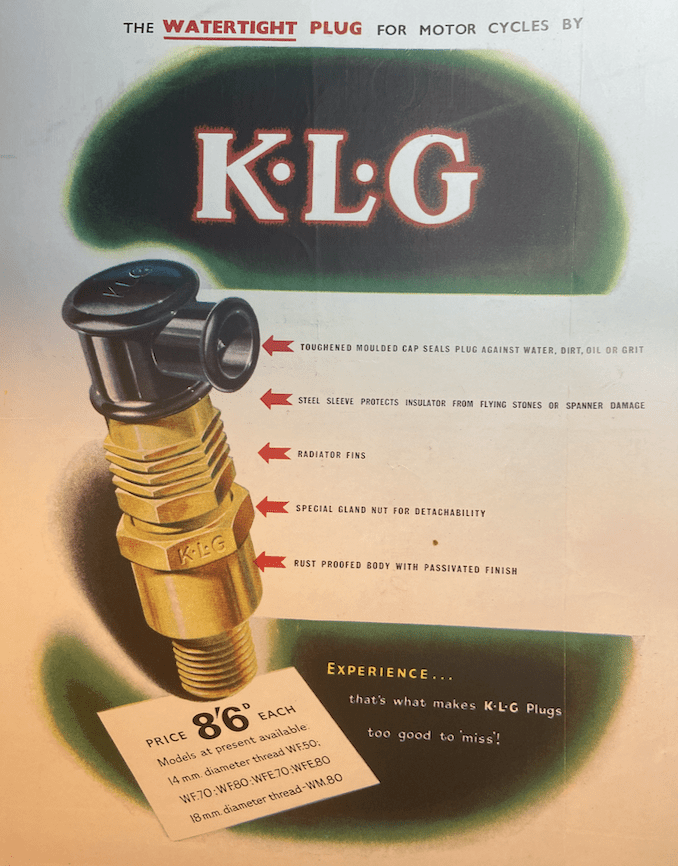
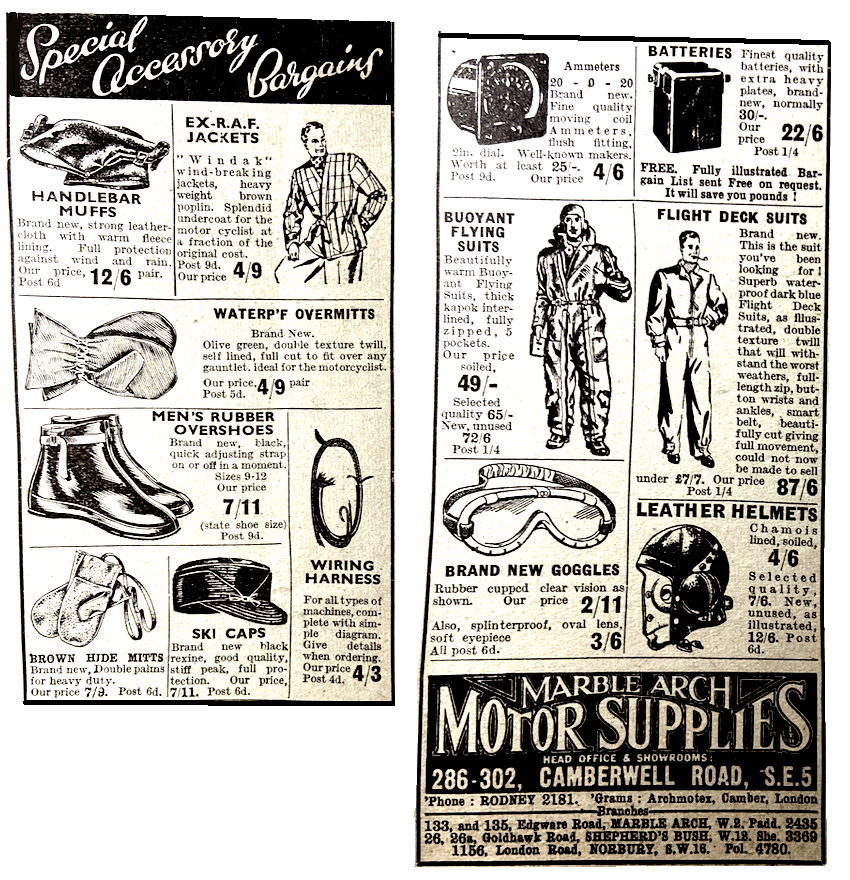
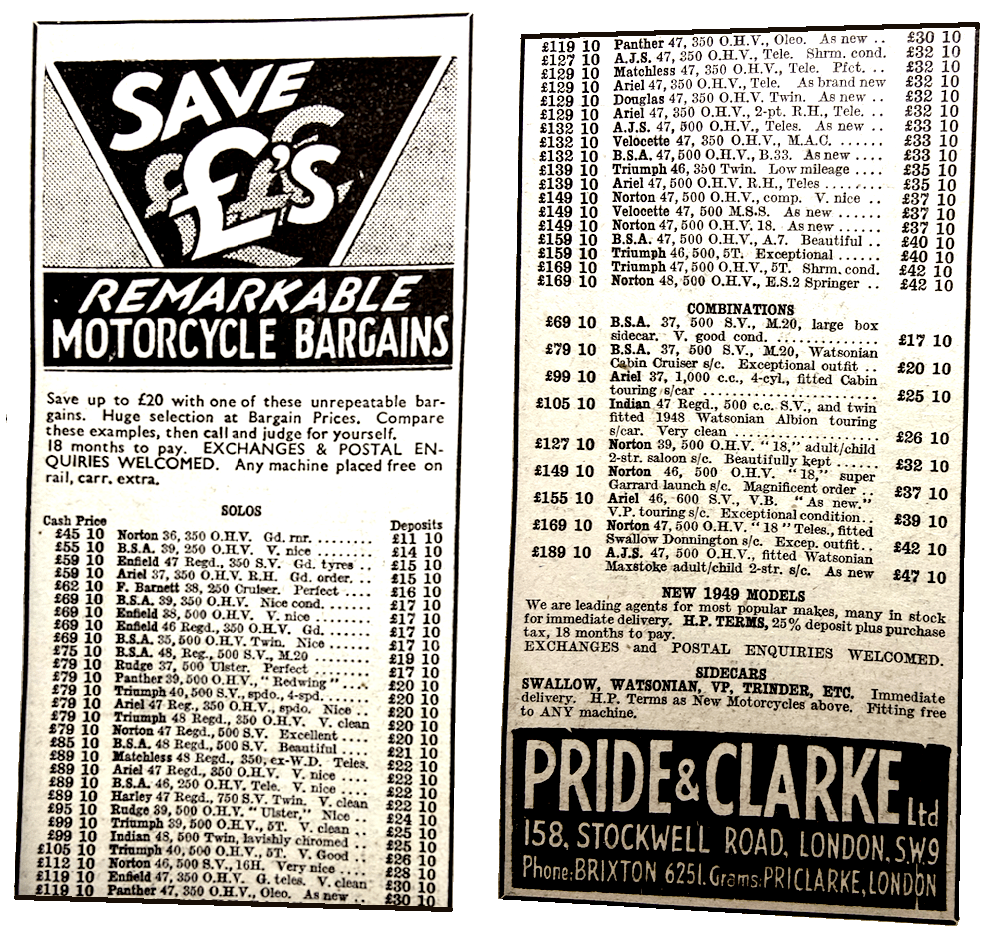
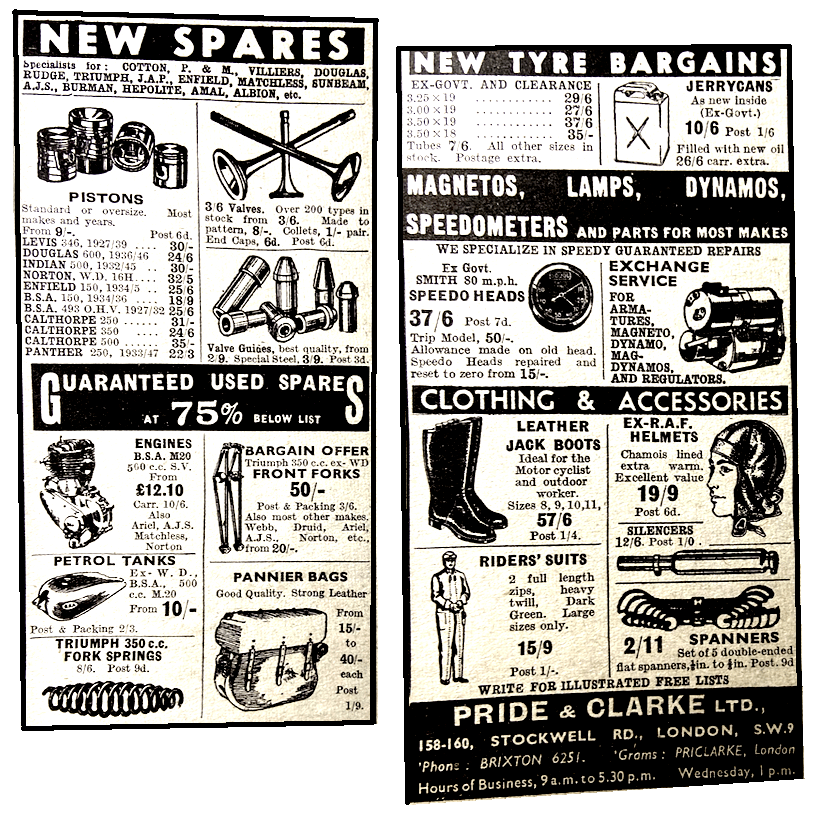
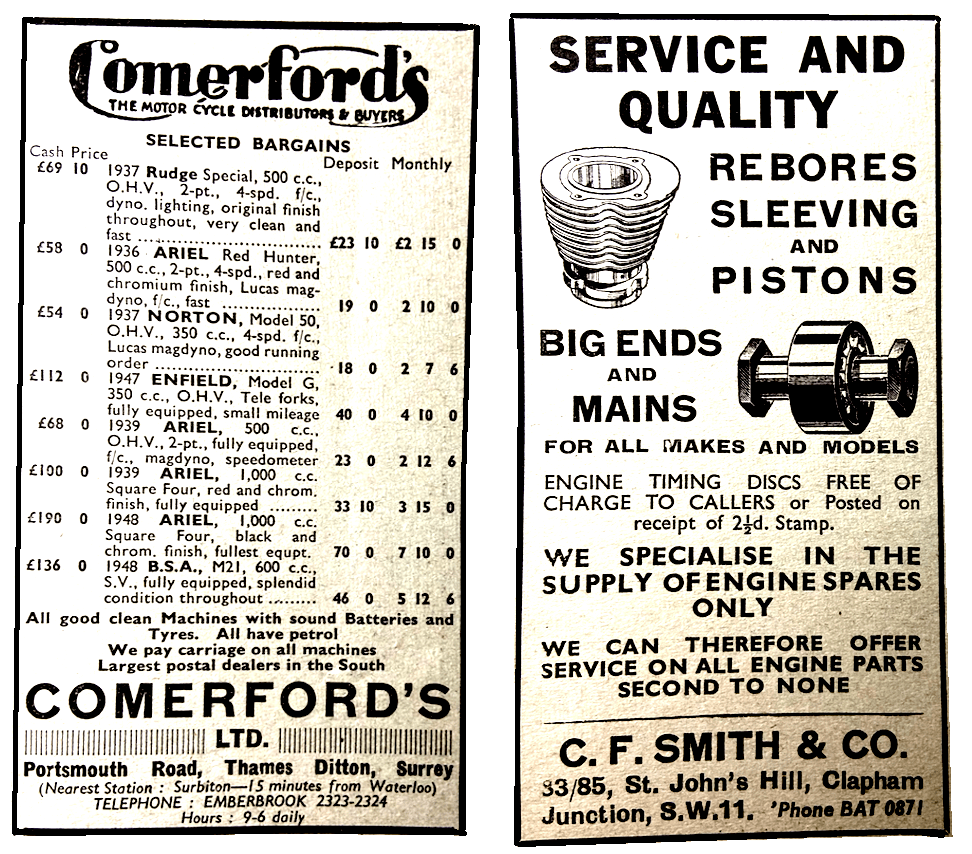
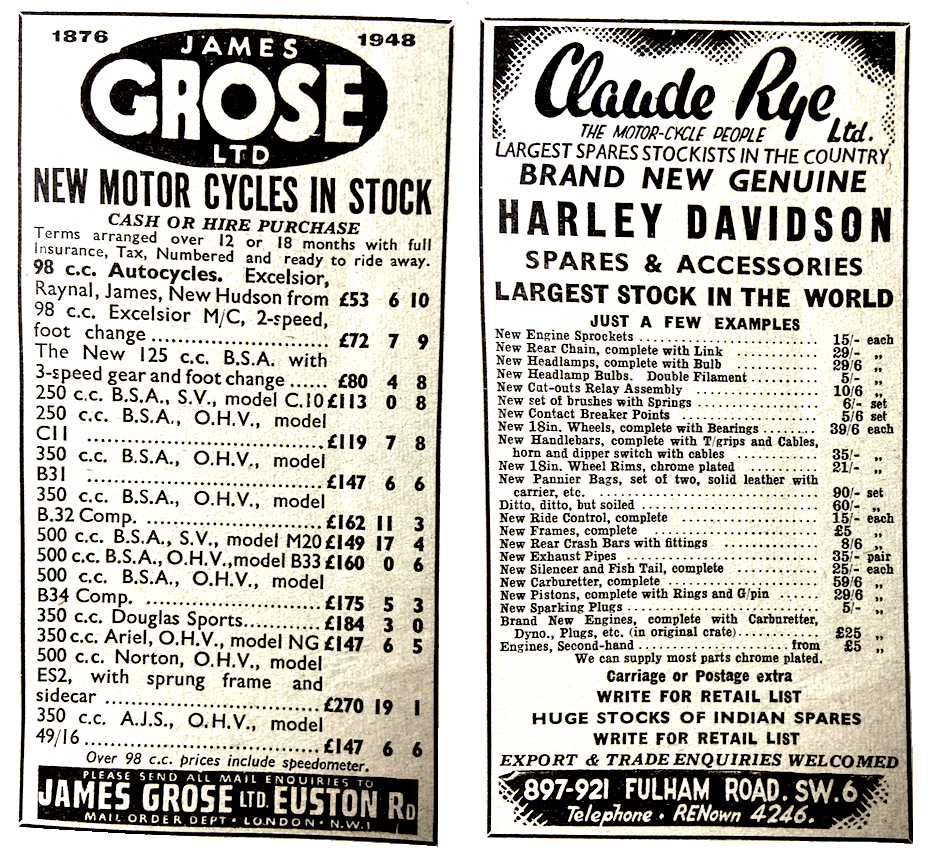
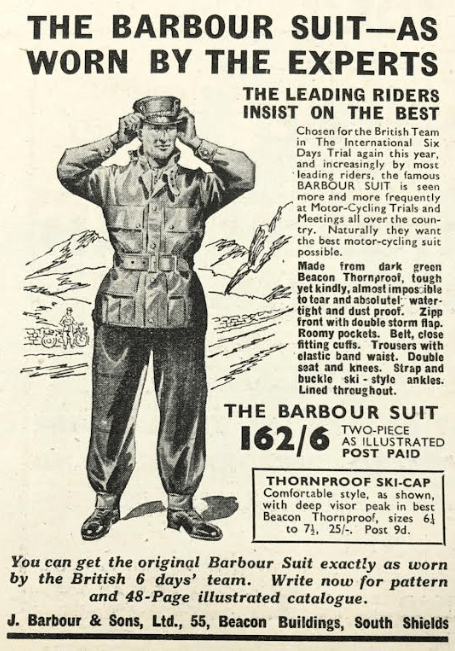
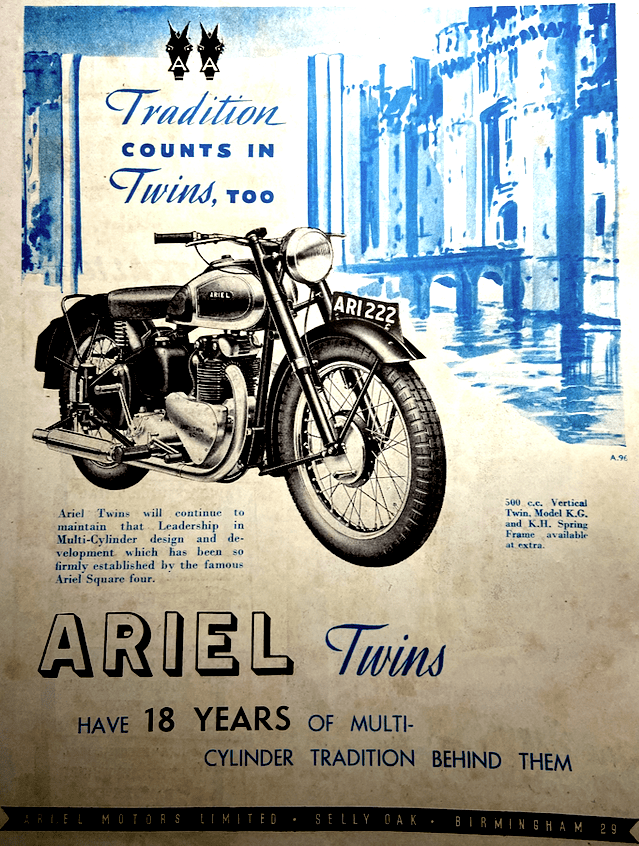
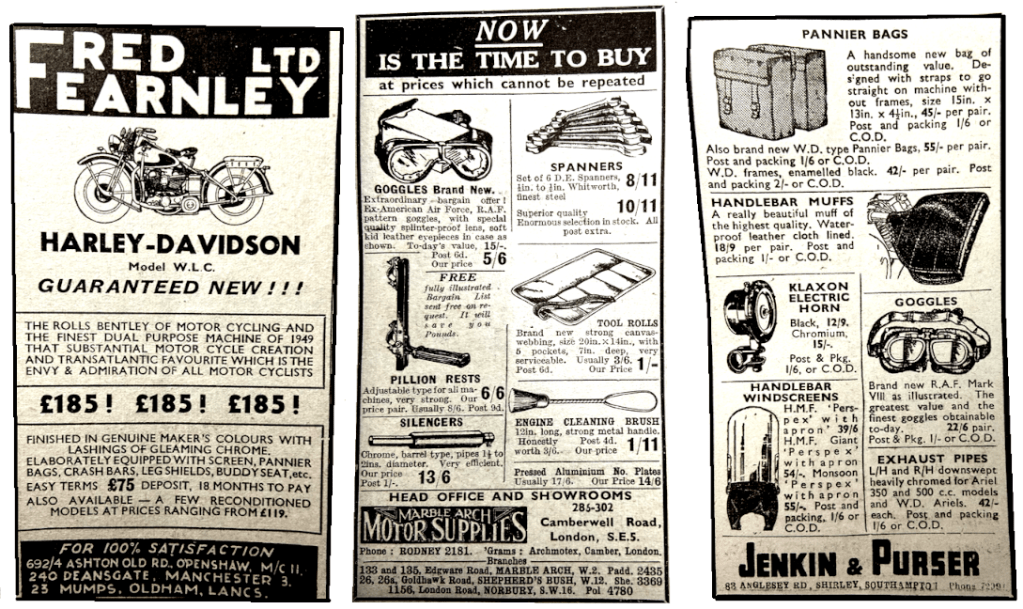
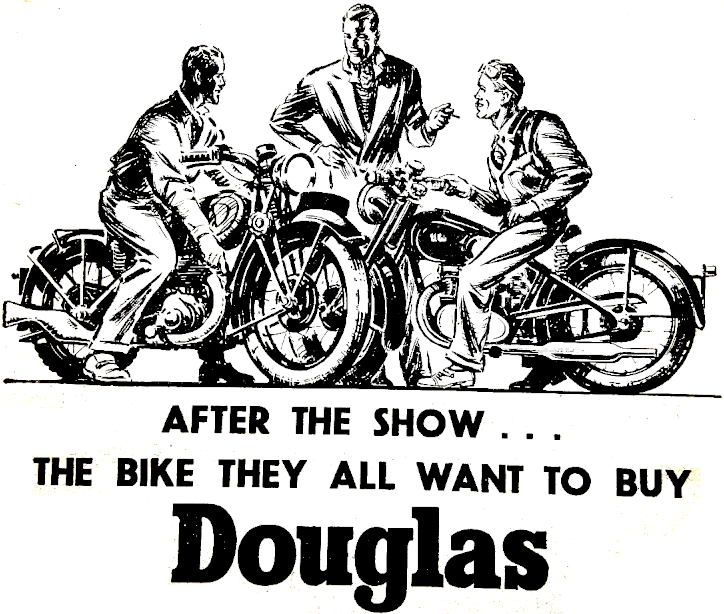

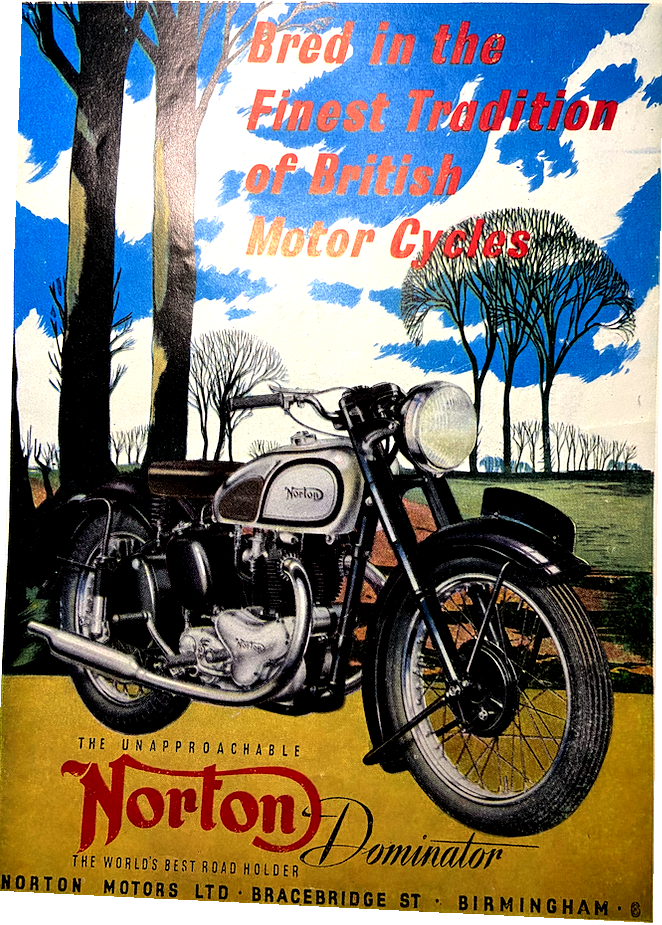
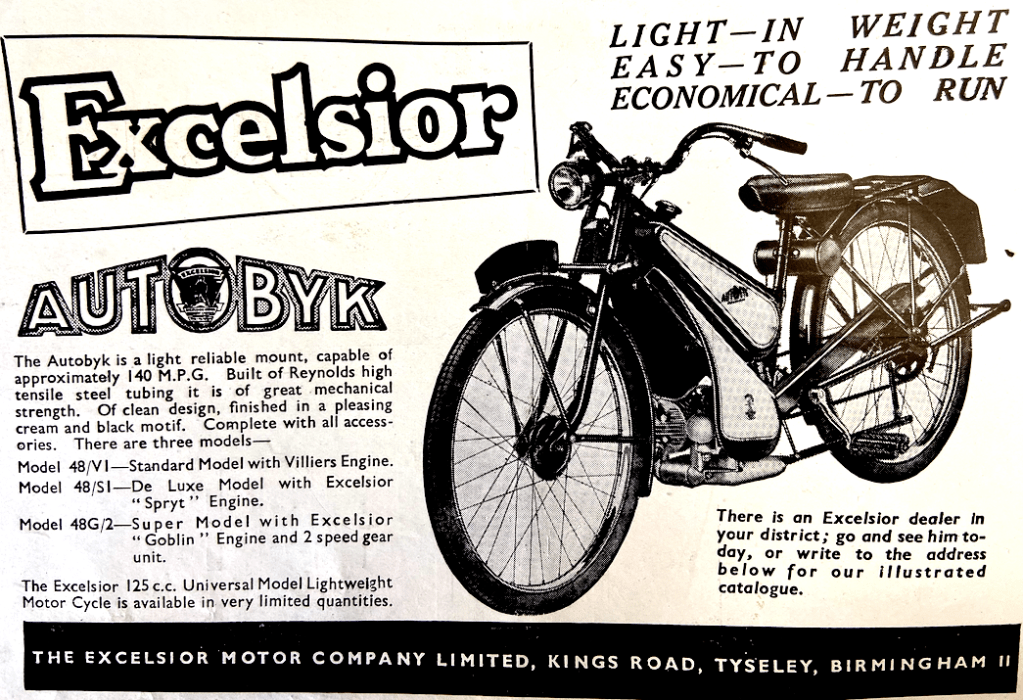
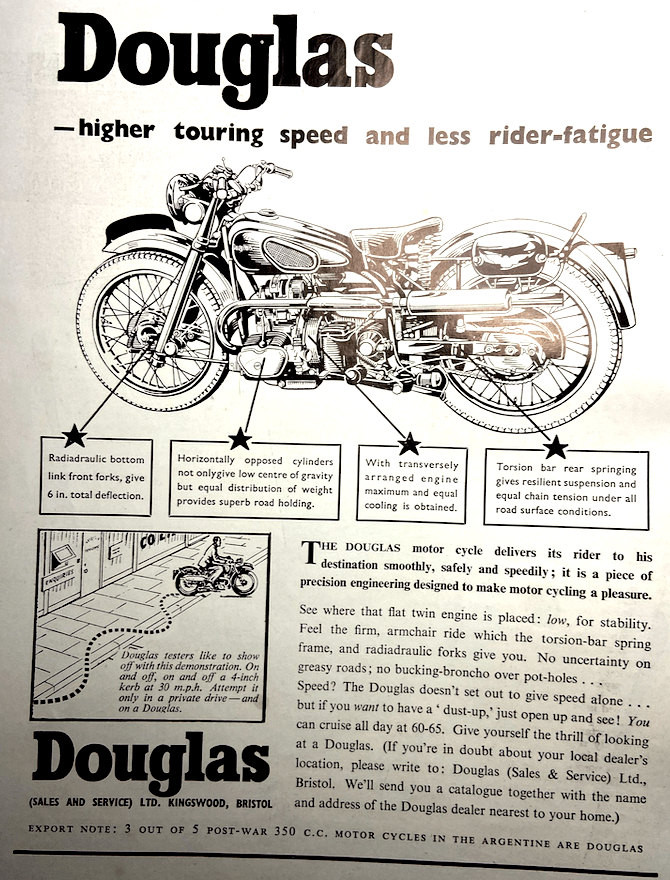
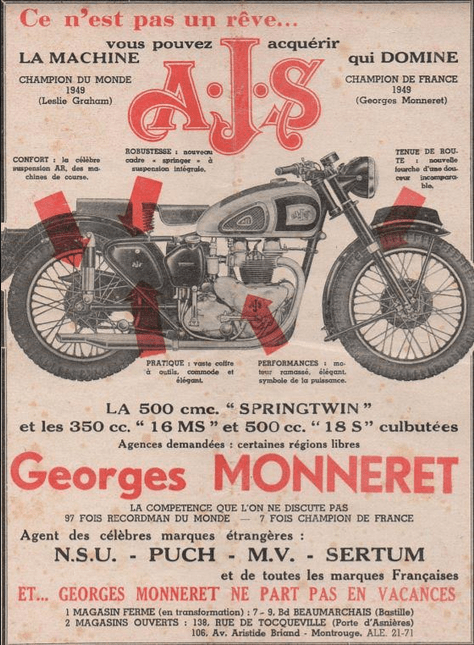
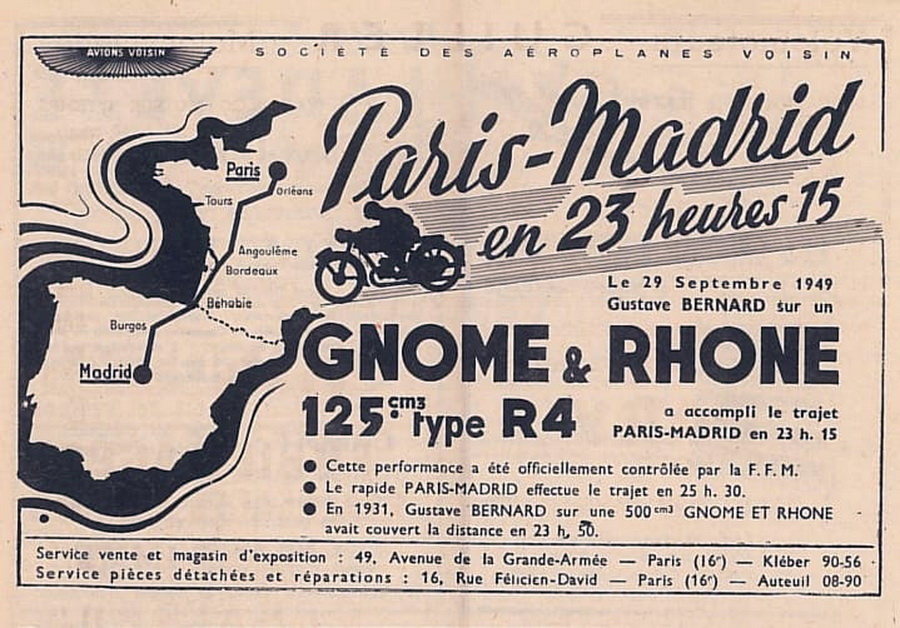
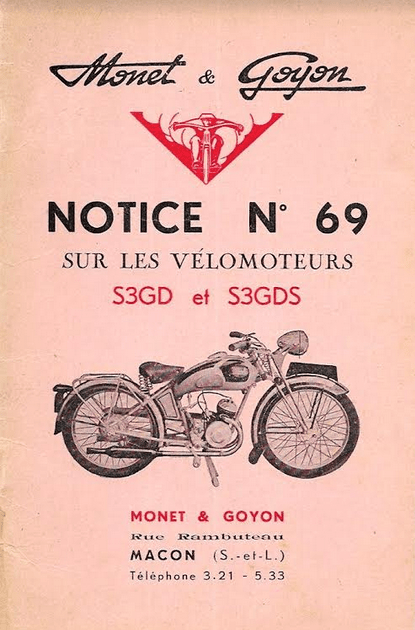
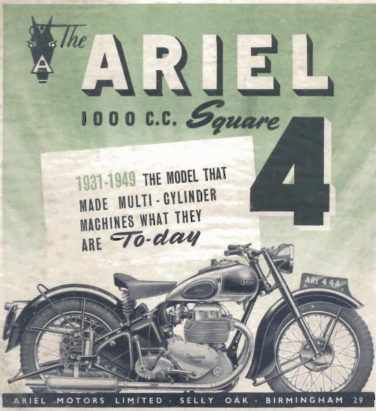

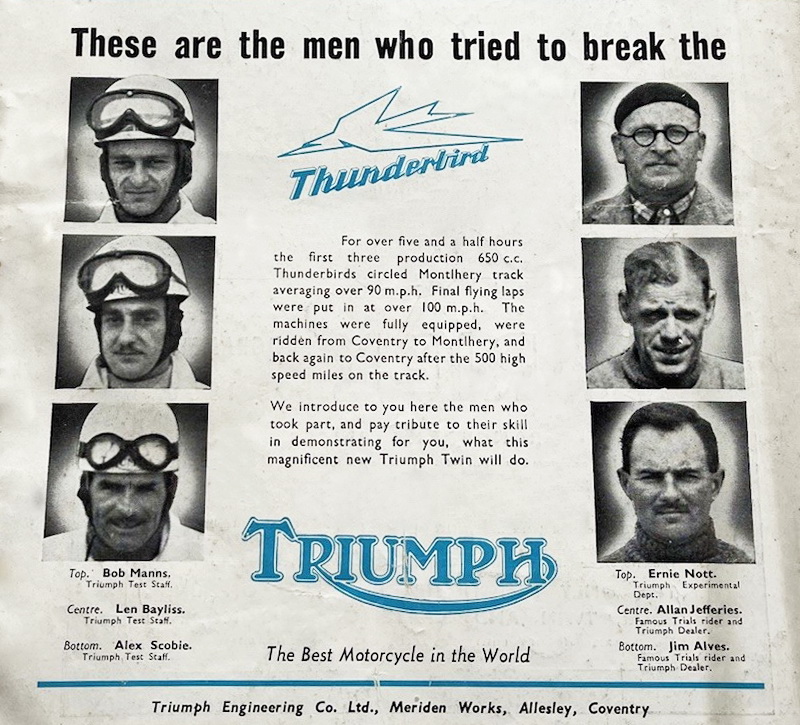
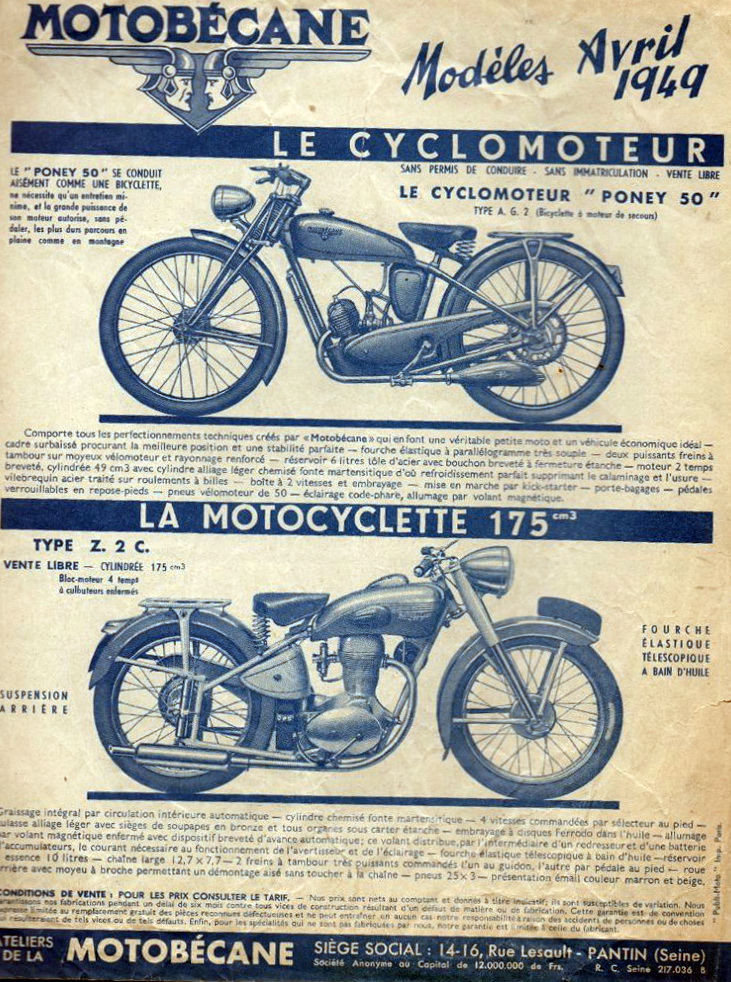
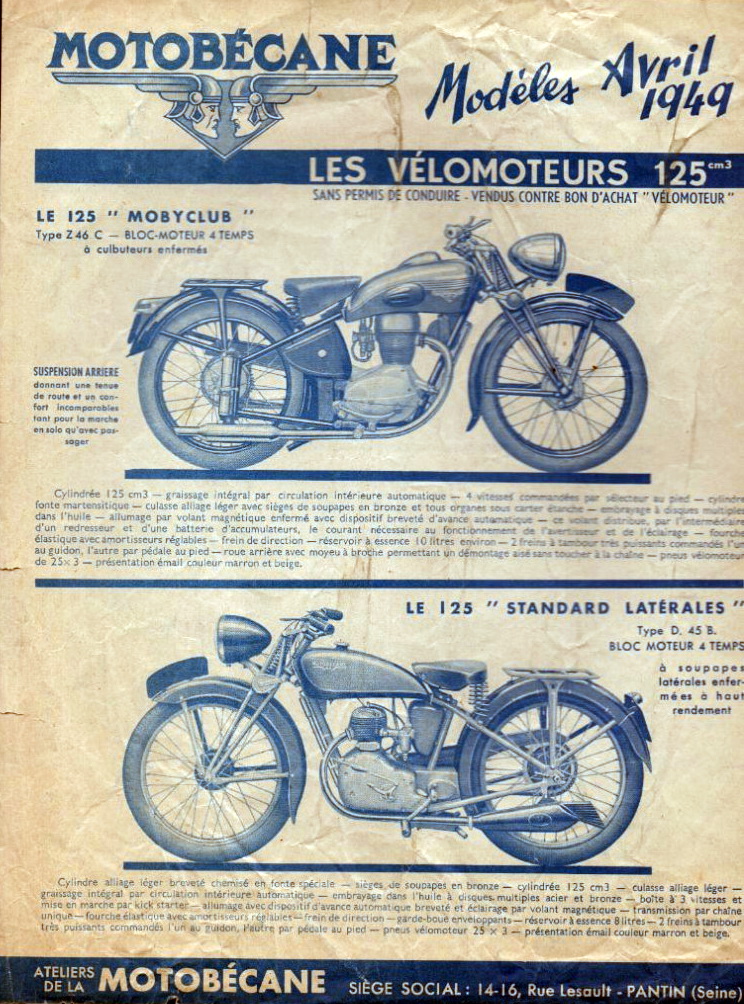
 Motorcycle Timeline