“THE BASIC FUEL RATION represented 267 million gallons a year. Allowing for the increase in supplementary allowances, the ministry of fuel estimated in November that the net saving will be about 240 million gallons. There is every reason to believe that applications for supplementary have exceeded all expectations. It is thought that when figures can be obtained it will be found that the actual saving of fuel to set against the disruption and discontent caused by the withdrawal of ‘basic’ will be far, far less than the estimates. Let us suppose that the figure is around 200 million. Could that supply of petrol or its equivalent be obtained on an economic basis by encouraging home produced fuel? First thought to come to mind is benzole, produced by the extracting plants at gasworks. In 1946 the output was 87 million gallons, most of which found its way into our pool petrol. How far can this figure be improved upon? Well, the peak was 1943 when 103 million gallons were produced. The gas companies would be only two glad to produce more benzole. It is a by-product in the extraction of gas from coal and in the process they would have more gas, which is what industry and private consumers want. But that means more coal and more special equipment in the gas works—both are scarce. How about the hydrogenation process? First use successfully in Britain in the ’30s, good fuel is produced but unfortunately the process uses a lot of cold and, even whe gn developed to the stage achieved by the germans during the war, the method results in fuel considerably more expensive than petrol from natural oils. Two possibilities hold out at least some hope. The first is that many of the small gas companies do not extract benzole when producing gas because the installation of the plants has not been considered a worthwhile proposition. Whether our present economic position would warrant a change in policy (assuming the plant could be obtained) remains to be seen. The second is alcohol from bread baking…which seems to offer possibilities if tackled and energetically. Nevertheless…we have a long way to go before we could look to home produced fuel to ease our problems.” [Making our own fuel from our own coal…developing bio-fuels…best not to think about it—Ed.]
“IN ARTICLES WHICH appear in last week’s and in this issue, practical advice is given on how to obtain more miles per gallon. Figures produced after careful tests on the road with a standard type of twin-cylinder machine show that it is possible to vary the petrol consumption from 75.8mpg to over 150mpg. Extreme though these figures are, they do show in striking fashion that careful maintenance, carburettor adjustments and thoughtful driving can produce an impressive increase in the miles per gallon performance; and in these days of a minute petrol ration the accent is obviously on mpg.”
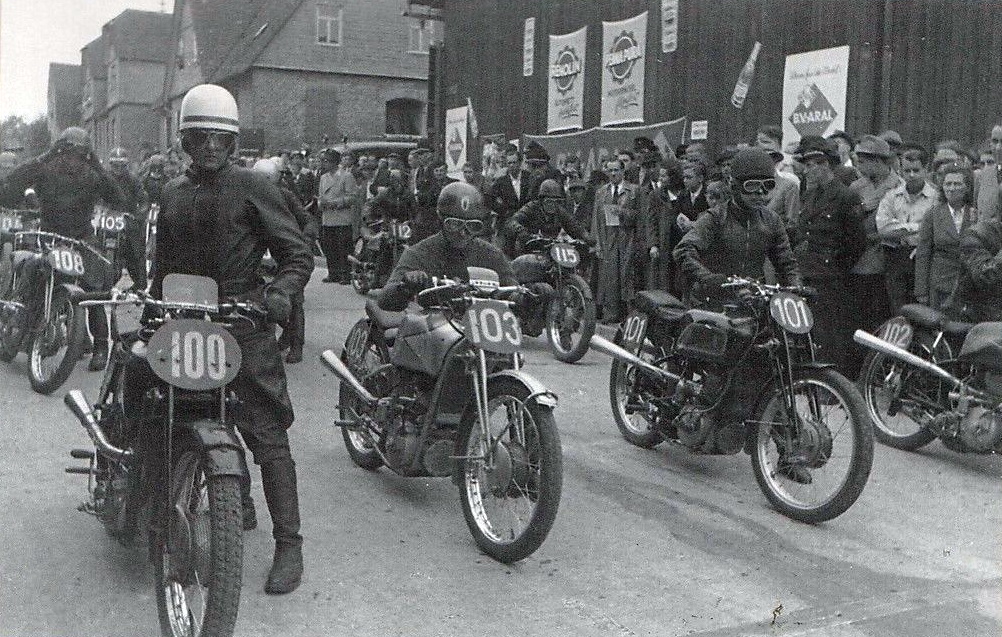
GEOFFREY DAVISON, EDITOR OF the TT Special, was uniquely placed to record the action at the 1948 TT; his passion shines through. Over to you, Mr Davison: “The most notable thing about the 1948 TT Races was the vast number of entries which was received by the Auto-Cycle Union. In 1936, full ebb of the TT tide, there was a total of 85 only; 12 years later over 400 persons over 18 years of age and of the male sex (vide Regulation No 19) wanted to have a go, not to mention a few of the female sex who weren’t eligible anyway. The A-CU decided that this would be too much of a good thing, and restricted entries to 100 on each day’s racing, ie, 100 for the Junior on Monday, 7th June, 100 for the three Clubman’s events on Wednesday, 9th June, and 100 for the concurrently-run Senior and Lightweight on Friday, 11th June. There was much disappointment and much grousing ; many chaps got hot under the collar and many more got up and said things at meetings. And whilst, as in almost every case of disagreement the world
over, there was something to be said on both sides, there was one little regulation which most of the malcontents seemed to have missed. This was Regulation No 7, brief and to the point; as follows: ‘Refusal of Entries: The A-CU reserves the right to refuse any entrant or driver or any team nomination without assigning any reason.’ So there they all were—and that was that. Twelve practice periods were allotted—one more than in 1947—of which eight were for the Internationals and four for the Clubmen. Eight of the periods were in the early morning—4.45am—and four in the evening—6.30pm. Practising for the Clubman’s races was confined to the second week. Their first period was on the evening of Monday, 31st May, the other three being on the mornings of the following Tuesday, Thursday and Friday. The Internationals began practising on the morning of Thursday, 27th May, and had in all five morning and three evening periods. And now to the races themselves. I will begin with the three Clubman’s, continue with the Junior and Lightweight, and end with the piece de resistance of the week, the mighty Senior. The 100 Clubman’s entries were composed of 16 in the Lightweight, 40 in the Junior and 44 in the Senior…In 1947 any rider who was not actually competing in the 1947 International TT was eligible. In 1948, however, any rider who had gained a replica in any International TT, or who had finished in the first three in any
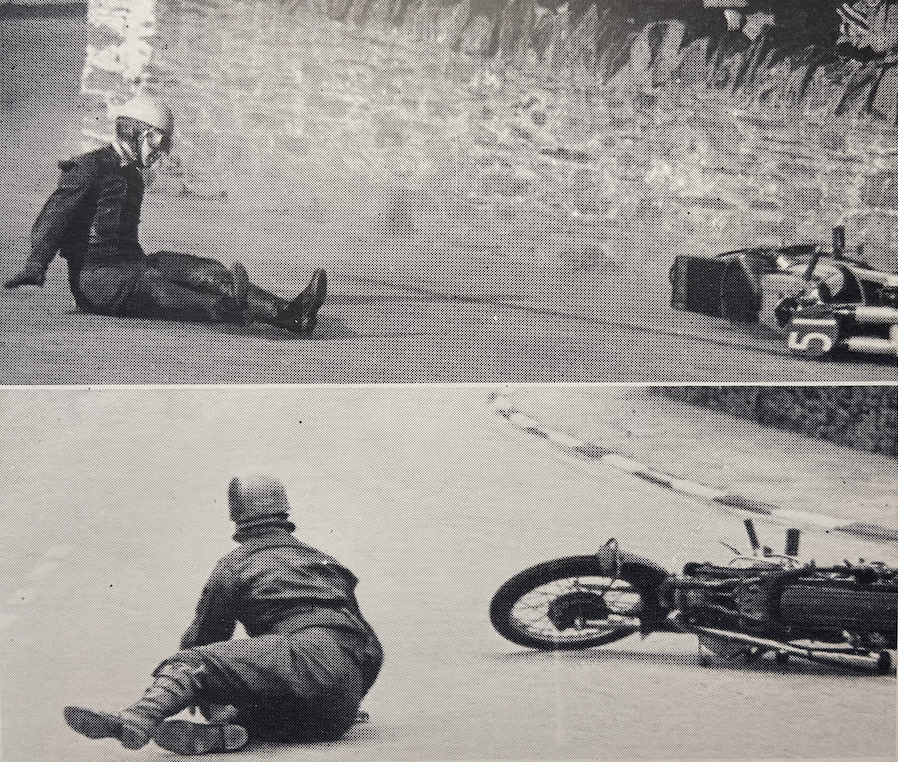
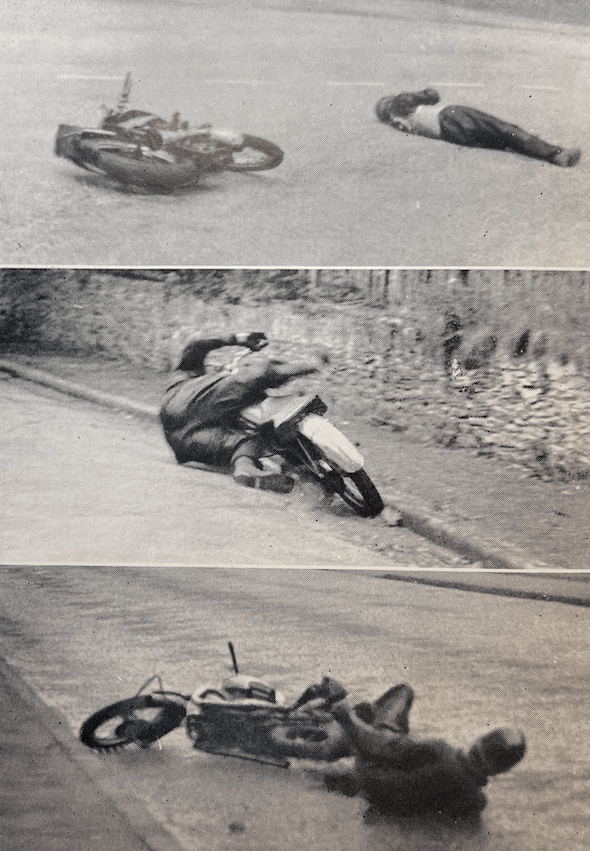
post-war Manx Grand Prix, was barred. The races were over the some number of laps as the previous year—three for the Lightweights and four for the Juniors and Seniors—and machines had to be started by kick-starter only at the beginning of the race and after the compulsory pit stop at the end of Lap 2. The weather was none too good for the four Clubman’s practice periods. On the first—and only—evening, torrential rain fell and it is safe to say that every one of the 79 riders who turned out was drenched to the skin. Nevertheless, 77 of them faced the starter in the rain again next morning—less than eight hours after they had returned from the previous evening’s soaking. Two days later, in clear but blustery conditions, there were 103 on the roads (including reserves), and on the last period the following morning—best weather of all—130 laps or nearly 5,000 miles were covered by the 80 odd riders who turned out. Thursday’s practice was marred by a fatal accident to TR Bryant, who crashed at Brandish Corner and died shortly after admission to Noble’s Hospital. I saw the crash myself through field-glasses from Hilberry, and wrote at the time ‘…a nasty crash visible at Brandish Corner in the distance. A rider—later known to be T Bryant (Lightweight Velocette)—came round fast and wide, apparently touched the right-hand bank, was thrown, and rolled and rolled and rolled down the road with his machine after him. Luckily, he and his bike were just clear of the riding line and a batch of five or six following him got through without incident. Bryant was then drawn to the side of the road and was later taken to Noble’s Hospital.’ In view of the poor weather and the consequent lack of time to learn the Course properly, no spectacular speeds were put up in practice. In the Senior class the best lap was made by Phil Heath (Vincent HRD ‘1,000’) in
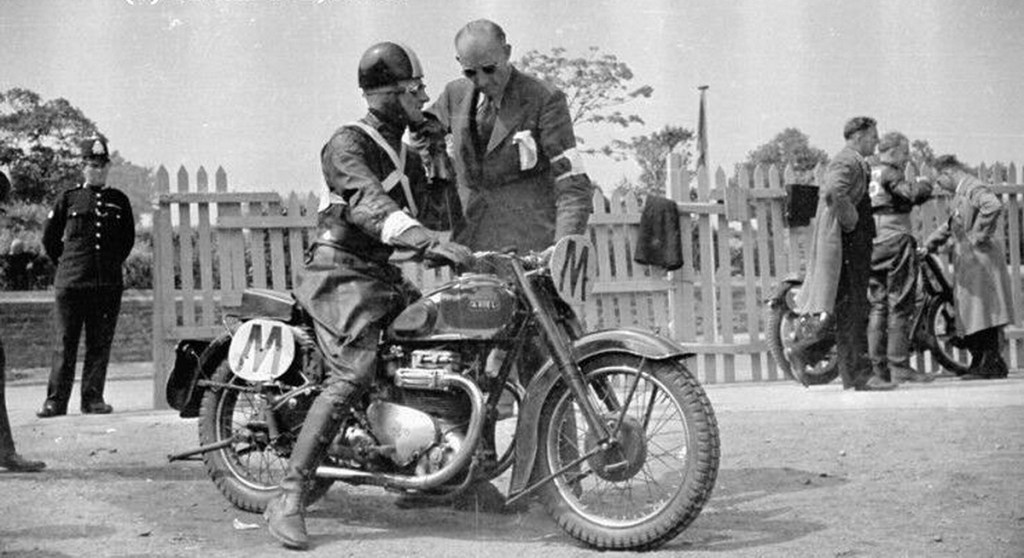
30min 7sec, but Allan Jefferies, on a Triumph of half the size, lapped in 30min 20sec. R Pennycook (Norton) was the best Junior, in 32min 42sec and F Fletcher (Excelsior) the best Lightweight in 36min 26sec. All were well outside the Clubman’s record laps of the previous year. The Lightweight race, for which the Wal Handley Trophy was the Premier award, was the first of the three Clubman’s events. Of the 16 entries there was only one non-starter—poor Bryant. As in the other races, competitors were sent off in pairs, at 20 second intervals, starting necessarily being by means of the kick-starter. M Lockwood (Excelsior), whose best practice lap had taken 37min 6sec, surprised everyone by leading on the first lap with a time of 34min 45sec. JJ McVeigh (Triumph) was second in 35min 2sec and F Fletcher (Excelsior) third in 35min 23sec. Lockwood maintained his lead on Lap 2, but the four men behind him slowed down and WG Dehany (Excelsior), who had been 6th on the first lap, drew up into second place over two minutes behind the leader, R Carvill (Triumph) being 3rd. In this order they continued to the end of the 3rd—and last—lap. Only eight of the 15 starters completed the 113 miles. Result: 1, M Lockwood (Excelsior), 64.93mph; 2, WG Dehany (Excelsior); 3, R Carvill (Triumph); 4, AG Crighton (Velocette); 5, J Smith (Velocette); 6, EF Cope (Velocette); 7, HJ Downing (Velocette); 8, A Henthorn (Velocette). The Junior race, which started two minutes after the last Lightweight competitor had got away, was a very different
affair. There were five non-starters, out of the field of 40, and the event was obviously an extremely open one. On the whole the 350s responded well to their kick-starters, though not so well, perhaps, as the smaller machines. At the outset it looked as if it were to be a Norton-AJS battle, for at the end of the first lap Norton were 1st, 3rd and 6th, with Ajays 2nd and 5th, a BSA in the hands of J Difazio running 4th. R Pratt, second in the 1947 Junior Clubman’s, led the field with a lap in 31min 43sec—59sec better than the best practice lap, but 40sec outside Denis Parkinson’s fastest of the year before. W. Sleightholme (AJS) was only two seconds longer than Pratt with M Sunderland, on another Norton, 10 seconds behind him. There was not a Velocette amongst the first six—but many things were to happen in this race of surprises. On the second lap, Pratt increased his lead to 21sec over Sunderland, who had beaten Sleightholme into 2nd place. Pratt’s lap time, incidentally, was 30min 42sec, just 21sec faster than Parkinson’s 1947 record, and actually the fastest of the race. Difazio packed up at Hilberry, allowing the 5th and 6th men to move up one, and RJ Hazlehurst brought his Velocette into 6th place. Having run into 3rd place, Sleightholme retired at the pits. Pratt continued to draw ahead and on the 3rd lap had a lead of over 2½min on Sunderland. Hazelhurst, with a lap in 32min 27sec (including the compulsory stop) had drawn into 3rd place, 11min behind Sunderland. And then, on the last lap, as so often happens in a TT race, whether it be
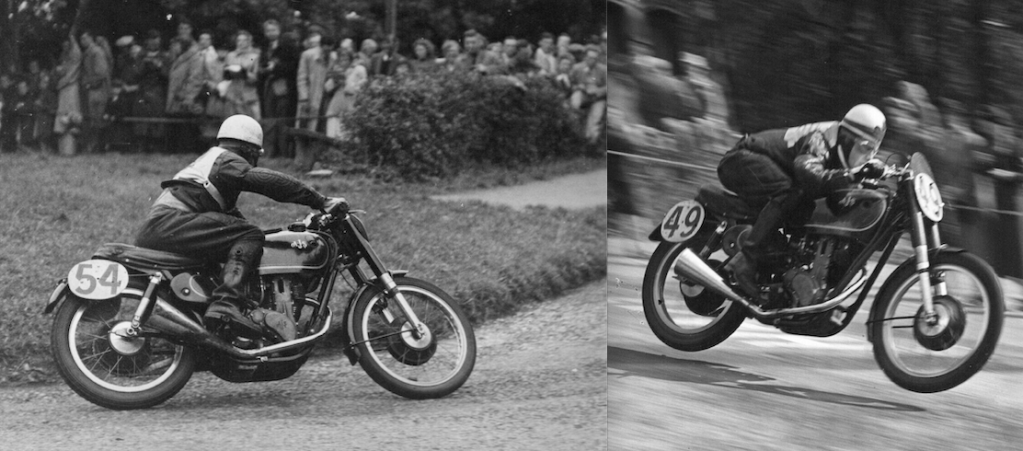
International or Clubman’s, things began to happen. Pratt had gone past the pits with the ‘thumbs down’ signal—although he had lapped in 31min 11sec, fastest 3rd lap of the race—and at Union Mills he retired with a split tank. Sunderland, who then seemed an easy winner, slowed down, his last lap taking 35min 3sec and Hazelhurst, with a lap in 31min 52sec, came home winner by nearly a minute-and-a-half. So although there was not a Velocette in the first six on Lap 1, a Velocette won the 1948 Clubman’s Junior, Hazelhurst having risen from 7th to 1st place in the last three laps. Result: 1, RJ Hazelhurst (Velocette), 70.33mph; 2. GW Robinson (AJS); 3, M Sunderland (Norton); 4, JF Jackson (Velocette); 5, ID Drysdale (AJS); 6, 0P Hartree (Velocette); 7, AF Wheeler (Velocette); 8, C Julian (Velocette); 9, DE Morgan (AJS); 10, L Peverett (AJS); 11, EN Peterkin (AJS); 12, JK Beckon; 13, AS Herbert (Matchless); 14, WM McLeod (AJS); 15, J Fisher (Ariel); 16, H Roberts (AJS); 17, SA Milne (EMC); 18, A. Peatman (AJS);19, J Terry (Ariel); 20, A Broadey (Norton); 21, A Klinge (BSA). Eighteen riders received free entries to the Manx Grand Prix, and 21 of the 35 starters finished the race. The Senior race, which was even fuller of excitements than the Junior, was notable for the large fleet of 1,000cc machines which faced the starter. In 1947 only two ‘big ‘uns’ were entered—and neither started! In 1948 there were 11—10 Vincent HRDs and a Square-Four Ariel, and all of them started. Nine of the Vincent HRDs finished, 1st, 2nd, 5th, 6th, 8th, 9th, 13th, 19th and 26th—90% finishers—a remarkable tribute to their reliability, manoeuvrability and speed. In addition, the only
single-cylinder Vincent entered finished 11th, so the Stevenage firm can be congratulated on a real day out. It was a bit tough, of course, on the fleets of Nortons, Triumphs and others of half the size who competed, but there it was. The Rules and Regulations allowed machines of up to 1,000cc, so no one can blame the clubs and riders for entering the biggest machines permissible. And in practice, as already recorded, there did not seem to be much in it, for the first four positions on the practice leader board were divided amongst the big ‘uns and the little ‘uns, with Vincent HRDs 1st and 3rd, and Triumphs 2nd and 4th, and only 41sec between them all. It was quite different in the race itself. George Brown (Vincent HRD), whose fastest practice lap was 30min 58sec, set off with a lap in 28min 10sec and from a standing, kick-start at that! Allan Jefferies (Triumph), most formidable member of the little ‘uns, overtook several riders in the early stages, but he retired with tank trouble at Ballaugh, and JD Daniels (Vincent HRD) was a close 2nd to Brown, with Phil Heath on a similar machine third. Bill McVeigh (Triumph) was 4th, and Norton in the hands of CA Stevens and H Clark were 5th and 6th. On his 2nd lap Daniels beat the 28min mark by 1sec, but Brown was faster still, with a lap in 27min 24sec, at 82.65mph; this was actually the fastest lap of the day and constituted the Clubman’s Senior record, being 54sec better than Eric Briggs’ record of 1947. Brown was therefore comfortably in the lead and there was no change in the positions of the next four men. H Clark, however, dropped back and RJ Vernon, on another Vincent HRD, drew into 6th place. Brown kept forging ahead and at the end of the 3rd lap was over a minute-and-a-half ahead of Daniels who in turn was over a minute in front of Heath. Daniels was No 62, Heath No 68 and Brown No. 93. Daniels came past the pits, the first Senior to finish, whilst Heath and Brown were shown at Creg-ny-baa. Then Heath finished—but there was no sign of Brown. And suddenly came the news from Hilberry that he was pushing—pushing that massive machine up the rise to Cronk-ny-Mona, with the further rise from Governor’s Bridge to tackle, and then the long straight-and-level to the pits. The reason?—too quick a ‘fill-up’ at the end of the second lap, and out of petrol. So from being what looked like an easy winner poor George dropped back to 6th place, with a last lap of nearly forty minutes, as against his best of 27min 24sec. Result: 1, Jack Daniels (Vincent HRD), 80.51mph; 2, Phil Heath (Vincent HRD); 3, CA Stevens (Norton); 4, W McVeigh (Triumph); 5, EJ Davis (Vincent HRD); 6, G Brown (Vincent HRD); 7, H Clark (Norton); 8, C Horn (Vincent HRD); 9, F Fairbairn (Vincent HRD); 10, E Andrew (Norton); 11, JE Carr (Vincent HRD); 12, AA Sanders (Triumph); 13, RJ Vernon (Vincent HRD); 14, RF Walker (Norton); 15, AMS Smith (Norton); 16, DG Crossley (Triumph); 17, WJ Netherwood (Norton); 18, J Harrison (Ariel); 19, WF Beckett (Vincent HRD); 20, JH Colver (Matchless); 21, TG Wycherley (Ariel); 22, TH Hodgson (Triumph); 23, N Osborne (Triumph); 24, JT Wenman (Norton); 25, HF Hunter (Triumph); 26, A Crocker (Vincent HRD); 27, PH Carter (Norton); 28, AR King (Triumph); 29, D Whelan (Rudge); 30, LJBR French (Norton); 31, S. Parsons (Triumph). Twenty-three riders received free entries for the Manx Grand Prix, and 31 of the 41 starters finished the race. The 1948 Junior TT with its entry of 100 riders was easily the biggest Junior up to date, the previous record for entries being 72, in 1923—a quarter of a century before. There were 10 non-starters, but the only ‘possible winner’ amongst them was David Whitworth (Velocette) who had crashed in a Continental race earlier in the season and was not fit to ride. Practice form indicated that the race would be a scrap between Nortons and Velocettes, for these makes occupied the first six positions on the Practice Leader Board…Practice form, however, does not show everything, for there was one who did not even appear in the first six—none other than grey-haired ‘veteran’ Fred Frith (Velocette). After a Sunday when the weather was so dreadful that the Peveril Club’s Scramble had to be abandoned—and scramble promotors usually like bad weather!—the Monday of the Junior race dawned clear and bright, but with a very strong wind. The 90 men who faced the starter were mounted on five makes only—36 on Nortons, 27 on Velocettes, 23 on AJS ‘Boys’ Racers’, three on Excelsiors, and one on an OK Supreme. The ‘Boys’ Racers’, promising as they seemed, were too new and untried to constitute a serious menace to the Nortons and Velocettes, and the Excelsiors and the OK Supreme were in the ‘veteran’ class. A Norton or a Velocette would obviously be the winner—Bracebridge Street or Hall Green—which?…Fred Frith, in his first TT for nine years—he was injured in practice in 1947 and did not ride in race week—riding as well as ever, was 3rd on the roads at Ballacraine and 1st at Kirkmichael, only 14 miles from the start. And whilst Bob Foster and many others of the back-numbers were on the Kirkmichael-Ramsey stretch, Fred tore past the pits, having completed his first lap in 28min 8sec. This was 32 seconds outside Artie Bell’s best practice lap, but the strong wind, blowing mainly against riders on the mountain climb, spoilt all chances of very high speeds. Fred’s time, however, was 6sec better than that of the next man—Bob Foster from the back end of the ‘possibles’ list—and 19sec better than that of Harold Daniell (Norton)…True to form five of the ‘famous seven’ occupied the first five places—Frith, Foster, Daniell, Lockett and Bell. Eric Briggs was 7th, 2sec behind Miller, but Les Archer was obviously in trouble, for when he did complete his first lap it had
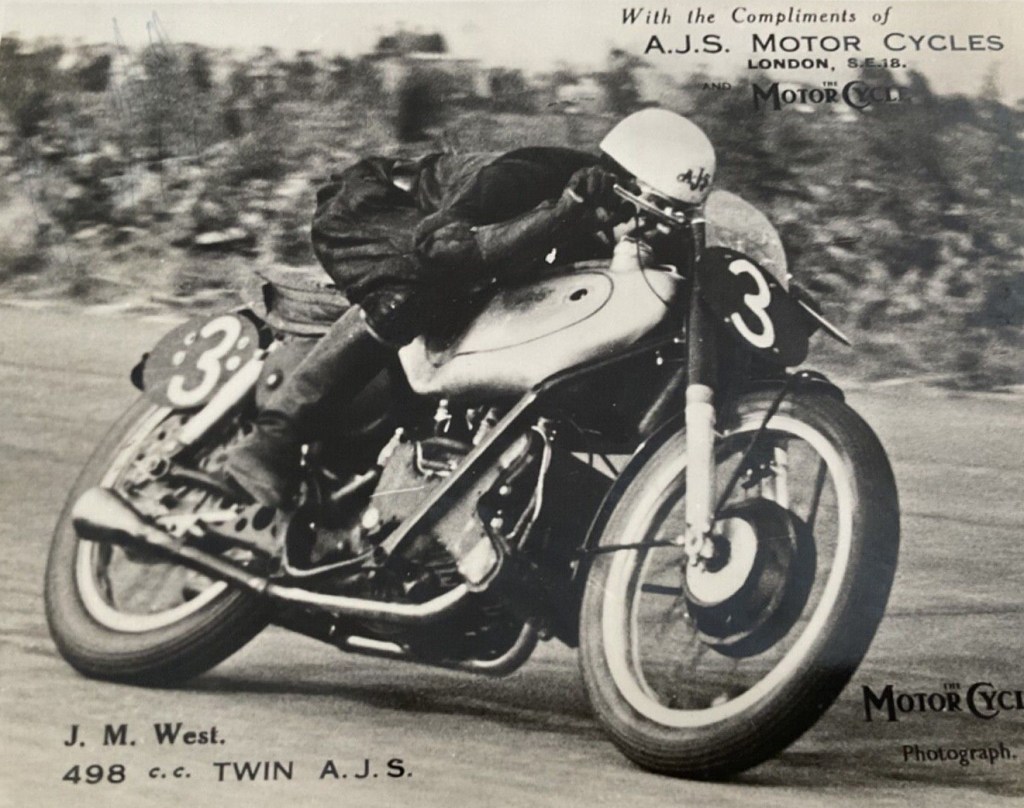
taken him—over two hours! There was no change amongst the leaders on the second lap, except that Briggs displaced Miller. Frith increased his lead on Foster to 20sec and Foster was 35sec ahead of Daniell. Velocettes first and second, the four ‘official’ Norton entries 3rd, 4th, 5th and 6th. No change again on Lap 3. Frith came in to refuel, but Foster went straight through. Fred’s ‘slow-down’ for the pit stop dropped his lead from 20sec to 15sec, with Bob one minute clear ahead of Harold Daniell—3min 20sec separated the 1st from the 6th. On the 4th lap Bob Foster came temporarily into the lead—due to Fred’s 3rd lap stop—and Harold Daniell slowed down, to tour in and retire at the end of the circuit with tank trouble. Foster’s position as leader did not last long, for he was filling up at his pits whilst Frith was tearing on somewhere along the far side of the Course. Fred’s 5th lap took 27min 35sec only—fastest of the day so far—whereas Bob’s, including the time spent at his pits, took 28min 44sec. The result was that by the end of the 5th lap Fred had the ‘comfortable’ lead of 55sec. Bell and Lockett were still 3rd and 4th, with only 6sec between them, but Bell was over 3min behind Foster. Maurice Cann, on the ‘Boys’ Racer’, had slipped past Eric Briggs, and was now in 5th position, just over half-a-minute ahead of the 3rd Norton rider. And so it continued to the end, Foster slowed down on the last lap but had sufficient lead over Bell to retain second place. Result: 1, FL Frith (Velocette), 81.45mph; 2, AR Foster (Velocette); 3, AJ Bell (Norton); 4, J Lockett (Norton); 5, M Cann (AJS);. 6, EE Briggs (Norton); 7, RL Graham (AJS); 8, ES Oliver (Velocette); 9, SM Miller (Norton); 10, GL Paterson (AJS); 11, LG Martin (AJS); 12, LA Dear (AJS); 13, JM West (AJS); 14, G Newman (AJS); 15, H Carter (AJS); 16, E Lyons (AJS); 17, AE Moule (Norton); 18, W Maddrick (Velocette); 19, 0S Scott (Velocette); 20, S Lawton (AJS). The above received replicas of the trophy and 28other riders finished the race…The Club Team Prize was won by the Cambridge Centaur MCC, consisting of M Cann and G Newman (AJSs) and AE Moule (Norton). No Manufacturer’s Team Prize was awarded. The 1948 Senior race was actually run and won before the Lightweight held on the same day, but in accordance with my usual practice of finishing with the ‘Big Race’ I will describe the Lightweight first. Entries for the two events, as on the other race days, were limited to a total of 100, these being made up of 31 in the Lightweight, and 69 in the Senior, and for the first time since 1924, when a massed start was used for the Ultra-Lightweight race, and the second time only in the history of the race, the Lightweights were despatched ‘en masse’. The Seniors started at 11am at ten second intervals, the last of them getting away at 11.11½am. There was then a lull of 3½min, and at a quarter past eleven the 26 Lightweights—there were five non-starters—tore down Bray Hill together. There were six makes amongst the 26—five Guzzis in the hands of Maurice Cann, Manliff Barrington, Tommy Wood, Leon Martin and Ben Drinkwater, and 21 nine, 10 and 12-year-old British models—nine Excelsiors, five New Imperials and Rudges, one ‘Ellbee Special’ and one Velocette. The fastest rider in practice had been Barrington, with a lap in 30min 47sec, but Maurice Cann had lapped in only 14sec more, and after these two came four Excelsior riders, Hawken,
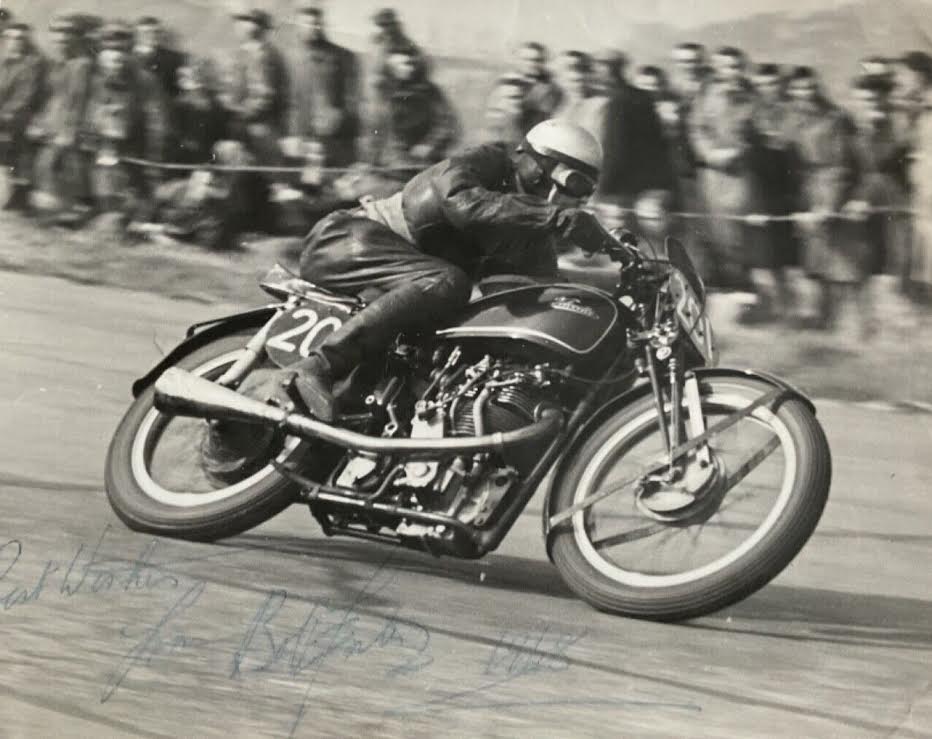
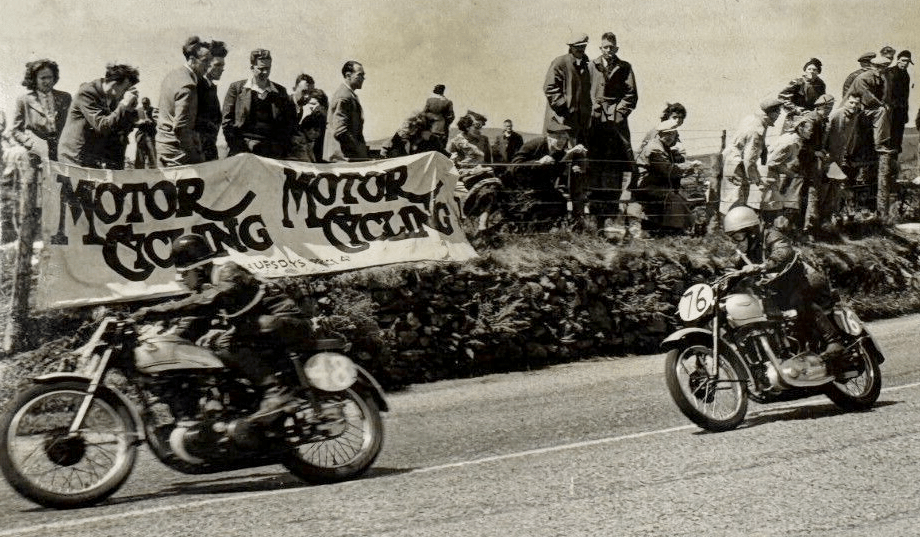
Carter, Higgins and Webster. Roland Pike (Rudge) who, as it happened, was the main British ‘hope’, was not even on the Practice Leader Board. Off they went with a terrific roar, and—contrary to the pessimists’ prophecies—there were no ‘fearful melees’ or ‘blood baths’ on Bray Hill. Then at the Grand Stand there was silence, and we glued our eyes on the clocks. Barrington was in the lead at Ballacraine, with Pike second and Carter third. There was no sign of Cann, who must have been missed in a bunch, for it was announced that at Ballaugh—just under halfway round—Cann was on Barrington’s tail. Same order at Ramsey, with Pike and Tommy Wood in close attendance. Sixty odd Seniors passed the pits before the Lightweight riders reappeared, and the order was then seen to be: Barrington, Cann, Wood, Pike, Drinkwater and, 6th, RA Mead (New Imperial). And off they all went again, and once more there was silence except for an occasional straggler. On the second lap the order of the first three was the same, but Maurice had reduced Manliff’s lead from 12sec to nine, and both were drawing away from Tommy Wood. Ben Drinkwater had slipped past Roland Pike and was second ahead of him in 4th place, with Mead still 6th. Guzzis 1, 2, 3 and 4! But things began to happen in the 3rd lap. To start with, Tommy Wood retired at Quarter Bridge; then it was seen that Barrington had stopped, and soon after came the news that he had retired near Kirkmichael; and finally Drinkwater slowed down—his 3rd lap took him about six minutes longer than his first or second—and dropped off the Leader Board. So from holding the first four positions on Lap 2, Guzzis held only one—1st—on Lap 3. British hopes began to rise a little. Maurice Cann, however, had the very substantial lead of 41min over Roland Pike, who was second. Mead was third, half-a-minute behind Pike, and Excelsiors in the hands of Sorensen the Dane, Hawken and Beasley were 4th, 5th and
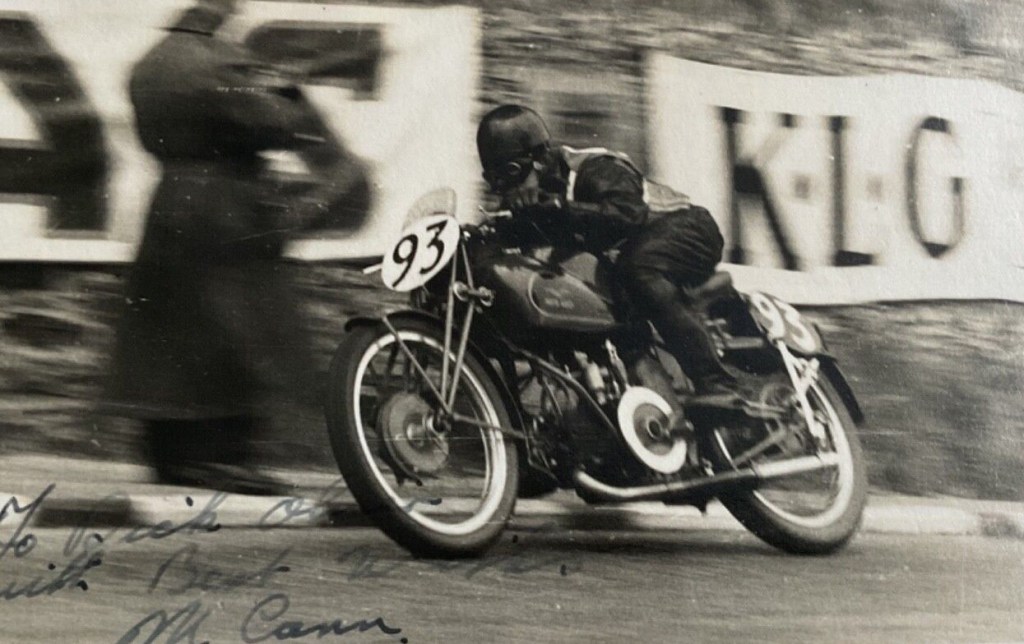
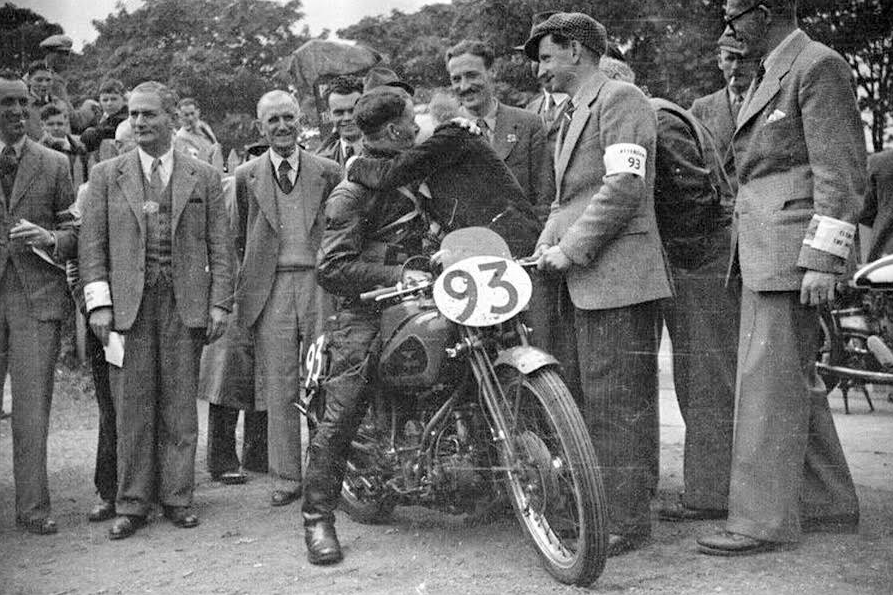
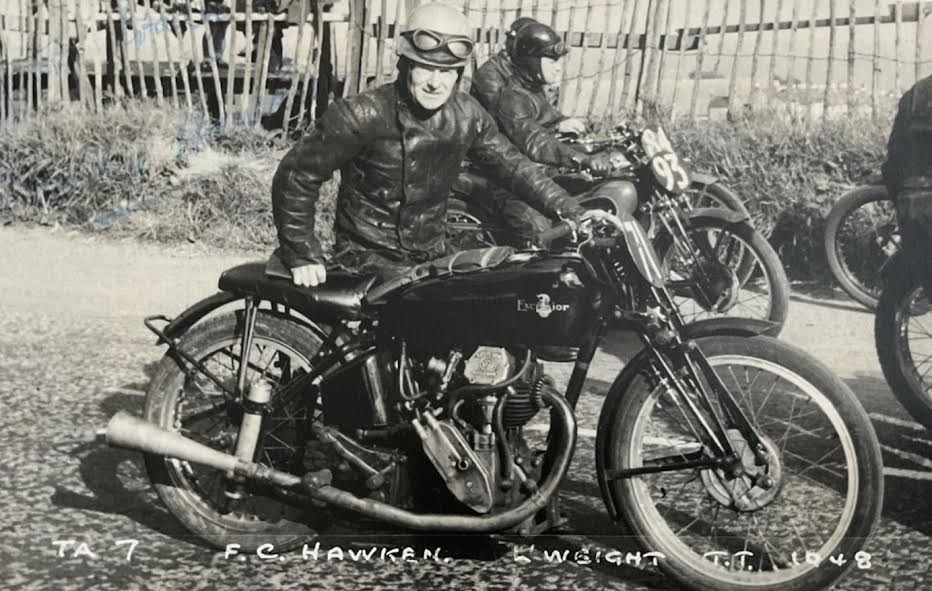
6th. Cann continued to draw away in the fourth lap…There was no change in the fifth lap, except that Ben Drinkwater came back into the picture, to displace Petty from 6th position. Next lap saw the retirement of Mead, who had put up a gallant show on his veteran New Imperial. This allowed Hawken into 3rd place for a lap, and then he too retired, at Ballaugh, 20 miles from the end. And Maurice Cann, never challenged in the later stages of the race, won by nearly 10 minutes. Result: 1, M Cann (Guzzi), 75.18mph; 2, RH Pike (Rudge); 3, D St J Beasley (Excelsior); 4, B Drinkwater (Guzzi); 5, RJ Petty (New Imperial); 6, J McCredie (Excelsior). Only six riders finished and all received replicas. No Manufacturer’s or Club Team Prize was awarded. As mentioned earlier there was an entry of 69 for the 1948 Senior, as against 33 only the year before. The entry of 69 did not constitute an absolute record, for in 1914 there were 111, but it was the highest since that race of 34 years ago. The original entries comprised six makes, in alphabetical order as follows: AJS (6), Gilera (3), Guzzi (4), Norton (41), Triumph (9) and Velocette (6). The three Gileras, however, failed to materialise, and their numbers were handed over to riders of British machines—one AJS and two Nortons. There were 13 non-starters, reducing the total to 56, made up of seven AJSs, three
Guzzis, 33 Norton, seven Triumphs and six Velocettes; 16 of them were 350cc models—four of the AJSs, six of the Nortons and all the Velocettes. No one can deny that the favourite for the race was that grand little Italian rider Omobono Tenni, who was killed a few weeks later when practising for the Swiss Grand Prix. By his friendliness, his cheerfulness and, above all, by his terrific riding Omobono endeared himself to all of us, and his loss to motor cycle sport will be felt in the same way as the loss of Jim Guthrie and of Wal Handley. Omobono had put up the fastest practice lap in 26min 44 seconds—12sec better than the fastest 1947 lap, and 11sec better than the next best practice lap, that of Ernie Lyons on another Guzzi.The Practices Leader Board read as follows: 1, O Tenni (Guzzi), 26min 44sec; 2, E Lyons (Guzzi), 26min 55sec; 3, AR Foster (Triumph), 26min 58sec; 4, K Bills (Triumph) 27min 8sec; 5, RL Graham (AJS), 27min 22sec; 6, EJ Frend (AJS), 27min 23sec. Two Guzzis, two Triumphs and two Ajays—not a Norton amongst the first six, though Norton had won the 1947 Senior and, indeed, eight out of the last 10 Seniors! Truly one cannot rely too much on form in practice. In compiling a list of ‘possibles’, however, I must add the four ‘official’ Norton riders—Bell, Briggs, Daniell and Lockett—Jock West, third of the ‘official’ AJS team, and, of course, Fred Frith on his Triumph…Friday, 11th June, 1948, dawned wet and misty, but by 9am the rain had stopped and the clouds were lifting. It was far from an ideal day for the Big Race, but conditions improved and by 10.30am—half-an-hour before the scheduled start—visibility on the mountain was just about good
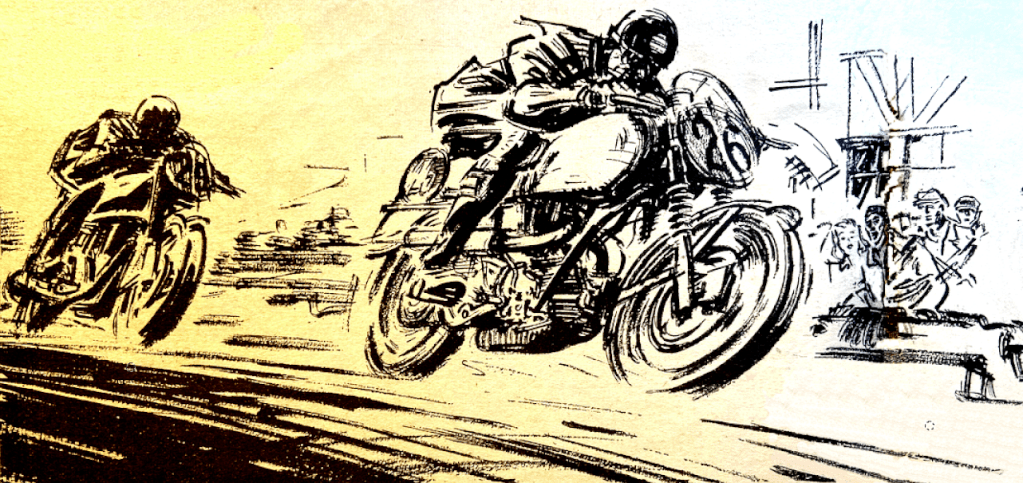
enough. There was no question of a postponement. All the 56 got away without trouble, and Ernie Lyons was leading the field on the Kirkmichael-Ramsey stretch as the last man, No 70, JEC Purnell (Norton), was despatched. First rider to retire was Vic Willoughby (Triumph) as early as Quarter Bridge, whilst W Maddrick (Velocette) crashed at the same spot but was able to continue. Lyons had a substantial lead at Ramsey and at the Mountain Box, but by Creg-ny-baa Tommy McEwan (Norton—No 3) had overtaken him and then there was news that Ernie had crashed at the Bungalow, and had retired…Past the pits at the end of the first lap they came as follows: 1st, No 3, McEwan; second, No 9, Frith; third, No 1, LP Hill (Norton); and 4th, No 26—0mobono Tenni going, as I described it at the time, ‘faster than any scalded cat’. His lap, from a standing start in worse than average weather conditions, had taken 25min 51sec only. This was 1min 5sec faster than 1947’s best, and represented a speed of 87.60mph! Ted Frend retired at Ballig Bridge and Eric Briggs at Barrowgarrow on the 1st lap; Johnnie Lockett and Fred Frith packed up in the second lap. Meanwhile Omobono Tenni kept cracking along. His second lap was not quite so fast as his first—26min 19sec—but it was 10sec better than Les Graham’s, so Omobono had increased his lead to 39sec, with Harold Daniell 10 seconds behind Graham…Except for the fact that the times were widening there were only two changes on the Leader Board. Artie Bell now figured in 4th place and Ken Bills in 6th, Bob Foster, previously sixth, had stopped at Creg-ny-baa, reported tank trouble and continued to the pits to retire. Lots of things happened in the 3rd lap. To begin with, Omobono drew into his pit and spent a long
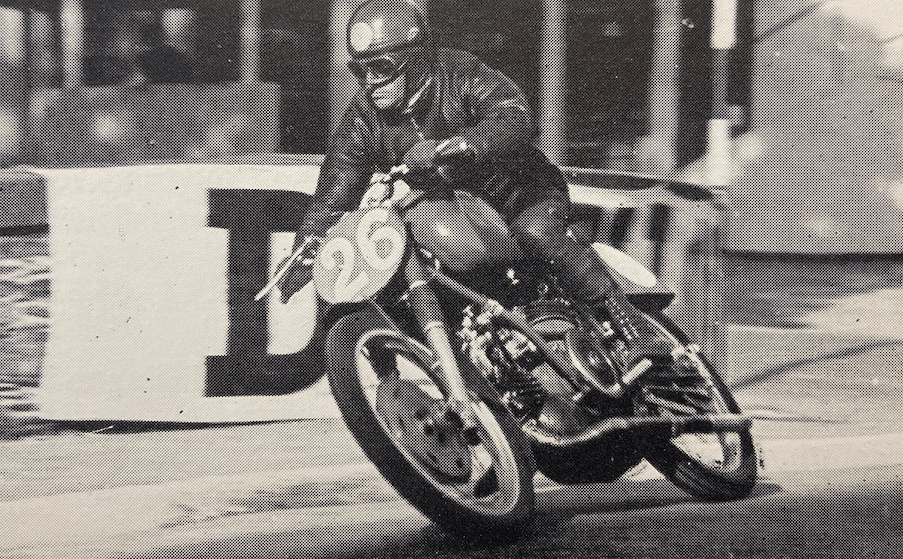
time refuelling and adjusting—1min 35sec, I made it. This temporarily put Les Graham into the lead, but he in turn retired at Ballig Bridge. Harold Daniell must have been leading for a spell but Artie Bell had got cracking—his third lap, in 25min 56sec, was his fastest of the day—and Omobono was making up for lost time. In spite of a 1min 35sec pit stop, and the time lost in pulling up and restarting, he lapped in 27min 20sec. This might well have been a 25½min lap, had it been non-stop, but even as it was it got him back into the lead at the end of Lap 3, by the margin of just 1sec over Bell…Tenni increased his lead substantially, first because he had a non-stop 4th lap in the post-war record time of 25min 43sec and secondly became Bell had refuelled at the beginning of the lap. More excitement in the 5th lap. That terrific 4th circuit had had its effect on the Guzzi mechanism, for Tenni was forced to stop at Union Mills ‘for adjustments’. Bell, who had started half-a-minute behind the Italian, had caught him on the roads and the pair were signalled at Kirkmichael together—ie, Bell had a half minute lead; somewhere near Kirkmichael Tenni stopped again and at Ramsey the Irishman was signalled fully a minute ahead of the Italian. Starting No. 29 he was leading on the road; Tenni (No 26) was 2nd on the road and Harold Daniell (No 66) 3rd, having overtaken Omobono on time. In the 5th and 6th laps there were two more retirements in the ‘big 12’—Ken Bills at the Bungalow in the 5th and Jock West at Ballacraine in the 6th; and then there were three. And these three were running 1st, 2nd and 3rd. Both Nortons had a fair lead on the Guzzi, but
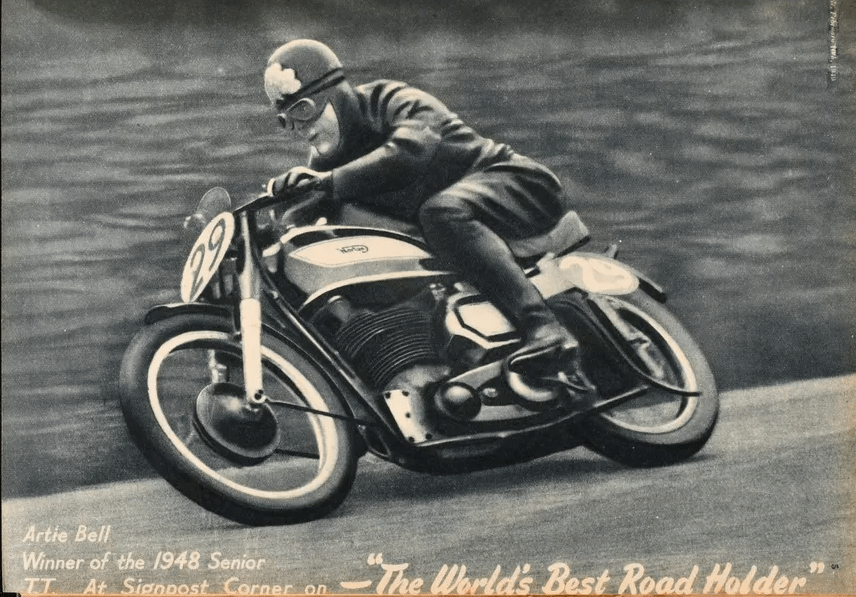
in view of Tenni’s previous terrific laps it was too early to say that the race was in the bag. The 6th lap, however, decided it—bar accidents. Tenni’s time for it was better than that for his 5th, but even so it was over a minute slower than those of both Norton riders. The Irishman led the Italian by over 31min and Harold Daniell was 2min 50sec ahead of him—too much for even Omobono to pick up, on a clear run, against two such brilliant riders. So the race drew swiftly to its close. A meteoric lap by Harold Daniell might have given him victory again. In 1947, in similar circumstances, Harold pulled up 23sec on Artie on the last lap—but 41sec seemed too much to expect. And as it was, on the last lap, Harold stopped at the Highlander, got going again but finally retired at the 13th milestone; and then there were two; and Artie avenged his 1947 defeat and went on to win his first TT. Meanwhile, what had happened to the 2nd—and last—of the Big 12? Artie had crossed the finishing line whilst Omobono was still shown at Ramsey. Long, long after, he was signalled at the Mountain and finally. at Creg-ny-baa. W Doran and JA Weddell (Nortons) and G Murdoch on a Junior AJS had all overtaken him as also, it appeared, had several others. And then came the news that Tenni was running on one cylinder only—the reason for the touring finish to his brilliant ride. We were proud of our British victory, proud of the fact that Artie Bell scored the 21st Norton TT win; but if it had had to be a foreigner there is no one we would have greeted more warmly than that gallant little Italian rider, Omobono Tenni. Result: 1, AJ Bell (Norton), 84.969mph; 2, W Doran (Norton); 3, JA. Weddell (Norton); 4, GG Murdoch (AJS); 5, NB Pope (Norton); 6, CW Petch (Norton); 7, H Pinnington (Norton); 8, J Brett (Norton); 9, 0 Tenni (Guzzi); 10, ES Oliver (Velocette); 11, SM Miller (Norton); 12, N Croft (AJS); 13, LP Hill (Norton); 14, LA Dear (AJS); 15, B Meli (Norton); 16, WJ Maddrick (Velocette); 17, IM Hay (Norton); 18, RJ Weston (Norton); 19, AA Fenn (Norton); 20, HB Ranson (Norton). The above received replicas. 21, M Klein (Norton); 22, H Hayden (Guzzi); 2,. E Braine (Norton). Fastest lap and winner of the Jim Simpson Trophy, 0 Tenni, 25min 43sec, 88.06mph. No Manufacturer’s or Club Team Prize was awarded.”
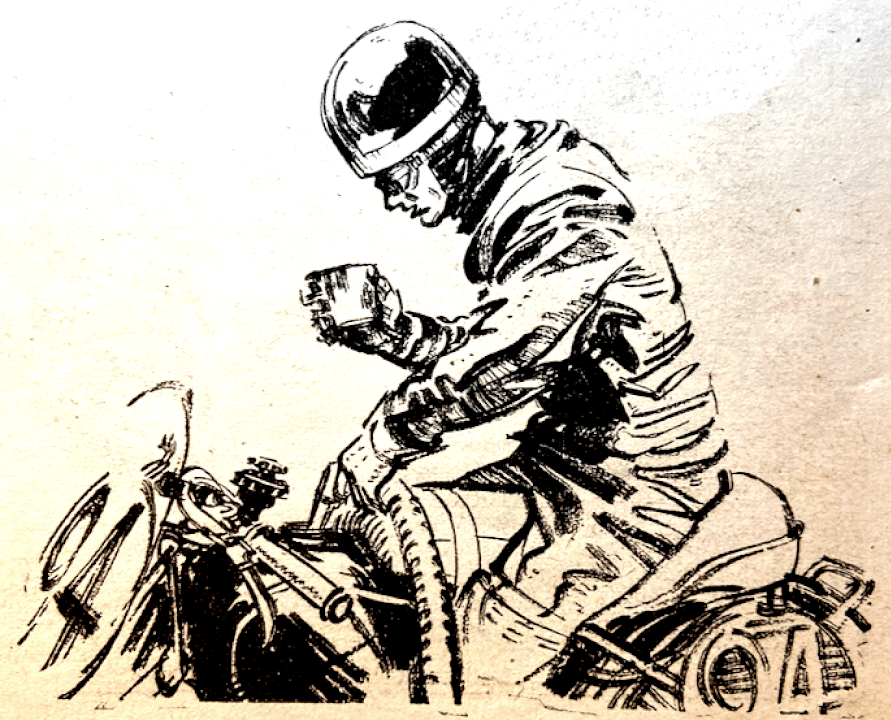
“SUNDAY’S GRAND PRIX Des Nations was the last of the 1948 classic road races. No British manufacturer is officially represented in the entry lists. This might seem strange, bearing in mind that the number of top ranking racing events is far fewer than pre-war. The reasons why our works riders are not competing are worth consideration. In the first place the circuit of Faenza, near Bologna, is not known to most British riders and is very short by accepted standards for classic contests. Secondly, there was no race for 350cc machines. Thirdly, the date was unfortunately placed between the Manx Grand Prix week and the International Six Days’ Trial; both these events make considerable demands on the resources of our manufacturers…It would appear that the time has come for the FICM to require the principal road race of each nation—the so-called classic races—to conform to closer standards than in the recent past.”
“THERE WAS MUCH about last Saturday‘s Cotswold Cup Trial that reminded one of the 1947 event. Apart from one new section the course was essentially the same and weather conditions gave it very similar characteristics: many easy hazards with one real corker, Henwood. Once again J Nicholson (499 BSA) was the winner and, as last year, he was the only competitor to lose no marks on Saturday. He rode a single-cylinder model for the first time in the open trials; his riding was impeccable throughout and it was an education to watch. In the sidecar class DK Mansell (497 Ariel) was the winner, with 22 marks lost. As this total suggests many parts of the course…were very difficult for sidecars. Mansel lost points only on Henwood, whereas the best of the other sidecar men lost at least eight marks. There were 131 starters.”
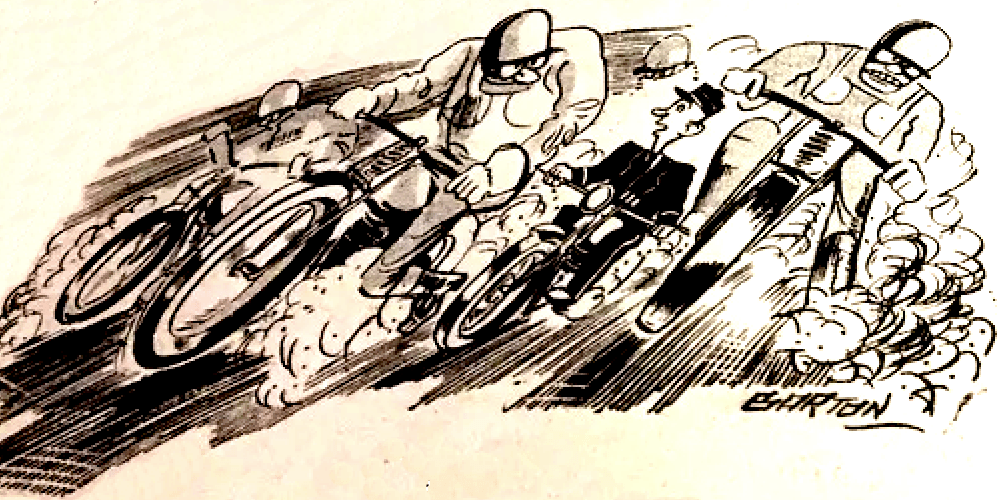
“AVERAGING MORE THAN 67mph over a 152-mile course S Jensen of Palmerston North won his second Senior New Zealand Grand Prix at Christchurch on Easter Monday. His riding on the square-shaped course was the greatest thrill for the crowd—he led practically all the way. Almost all parts of the six-mile circuit were lined with spectators; some watching the 46 starters roaring along the straights at over 100mph, others watching them negotiate the tricky sunken bridges where riders were aviated for yards at a time. The racing for the four events (senior, junior and lightweight) justified the enthusiasm evidenced by the crowd. Many machines failed to complete the course which was, in spite of the hot dry windy weather, less dusty than the other races.”
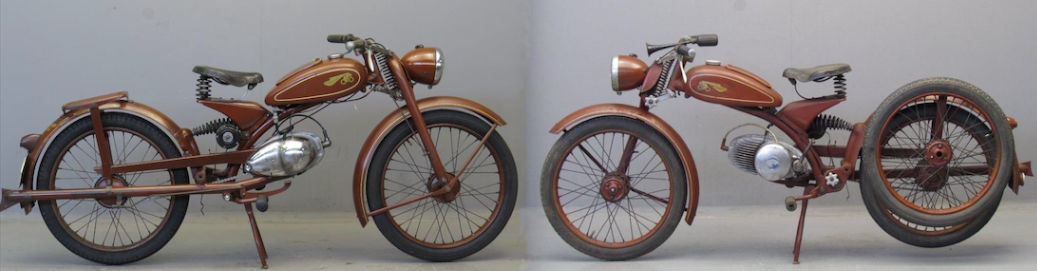
THE 98CC IMME R100 was only made (in Germany, by Norbert Riedel, who had built a starter motor for the ME262 based on the 98cc Victoria two-stroke) for three years which is a shame because this tiddler was packed with innovative features. The two-stroke horizontal ‘power-egg’ engine swung together with the rear wheel, which was connected to the centre of the machine by the exhaust pipe which doubled as one side of the frame. And there was only one fork leg. The single-sided layout facilitated wheel changes; the wheels were interchangeable and a spare could be bolted next to the rear wheel. Just before the factory closed a few 148cc examples were made.
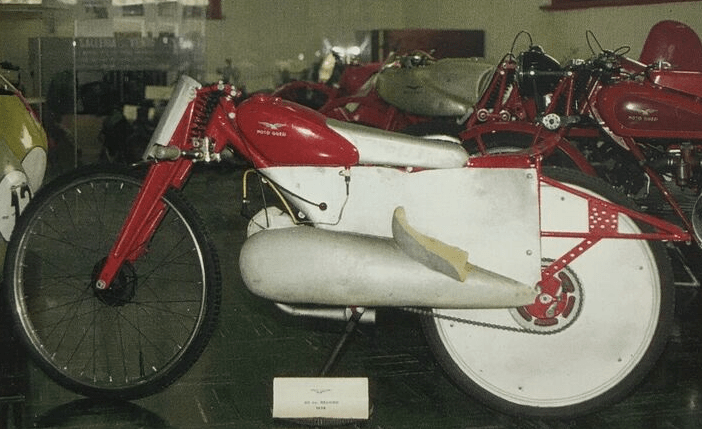
LIKE A NUMBER of British manufacturers Moto Guzzi offered a cyclemotor. Unlike the Brits the Italians came up with a racing version. The 73cc/2hp Guzzino 65 was tuned to produce 3.6hp at 6,300rom. Wrapped in a streamlined shell and weighing just 88lb it topped out at 62mph. Raffaele Alberti folded himself round the diminutive Guzzino to set 19 records at Monza, including a flying kilometre at almost 60mph and 1,000km at 47mph. The Guzzini became Italy’s top-selling tiddler; almost 72,000 were sold.
“THE 498cc VESTA UNION racing car…has a four-cylinder in-line engine. The cylinders are cast steel barrels round which are brazed the jackets for water-cooling. The head is integral with each cylinder and has four valves…set pent-roof fashion at 60°. A train of gears drives two overhead camshaft and the crankshaft is in sections bolted together. It is anticipated that with an 8 to 1 compression ratio and normal induction the power output will be 40bhp at 8000rpm. This unit, suitably modified, seems to be the type for racing motorcycles of the not-too-distant future. The supercharged four-cylinder Gilera was quite the fleetest racing machine just before the war. It is now rumoured that an unblown model is likely to make its appearance in the TT next June. If past experience is anything to go by, singles and twins will have a tough task to hold the Italian multi.”
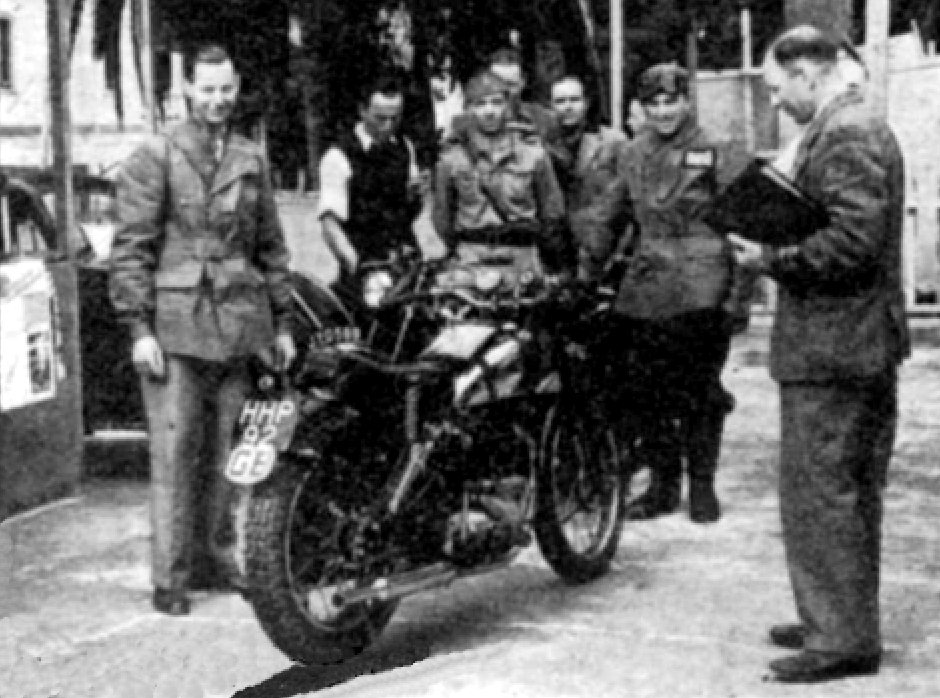
ISDT SELECTION TRIALS at Llandrindod Wells went ahead despite government restrictions on the amount of petrol issued to the ACU. The excellent ISDT website speedtracktales.com reports: “This Mid Wales location had been selected directly since many sections still remained of the 1938 ISDT which had been held there. Course plotter was Harry P Baughan, who built his own trials sidecar outfit with a Stephens motor, called The Stag…[he] had been instructed to plan a course to find weaknesses in men or machines, now bearing things like improved suspension layouts and WD-type air cleaners. Jack Stocker’s rigid frame Royal Enfield J-model seems to have been a link with the past.” The two-day trial was notable for “…neat Triumphs, plunger Ariels, alloy engined BSA, pre-Featherbed framed cammy Nortons, batteries to help lighting…KLG plugs expert Rex Mundy was present plus Dunlop tyres man Dickie Davies. Even a Manufacturer’s Union Director, Major HR Watling was prominent; the ACU’s Harry Cornwell too. Private entries included Miss Olga Kevelos (347 AJS), Australian DB Williams (498 AJS) plus a three-man BAOR team on 498 Matchlesses: Sgts A Hanson and JW Ward, plus Pte J Hall.” Selected for the Trophy were A Jefferies (498 Triumph), VN Brittain (346 Royal Enfield), CN Rogers, (346 Royal Enfield), BH Viney (498 AJS) and J Williams (499 Norton).Vase ‘A’ Team: PH Alves (498 Triumph), CM Ray (497 Ariel) and J Stocker (499 Royal Enfield). Vase ‘B’ Team: J Blackwell (499 Norton), AF Gaymer (498 Triumph), FM Rist (348 BSA). Reserves: EJ Breffitt (348 Norton), G Eighteen (498 Matchless) and TU Ellis (346 Royal Enfield). The Blue ‘Un summed it up nicely: “While there have been International Six Days’ Trials over even
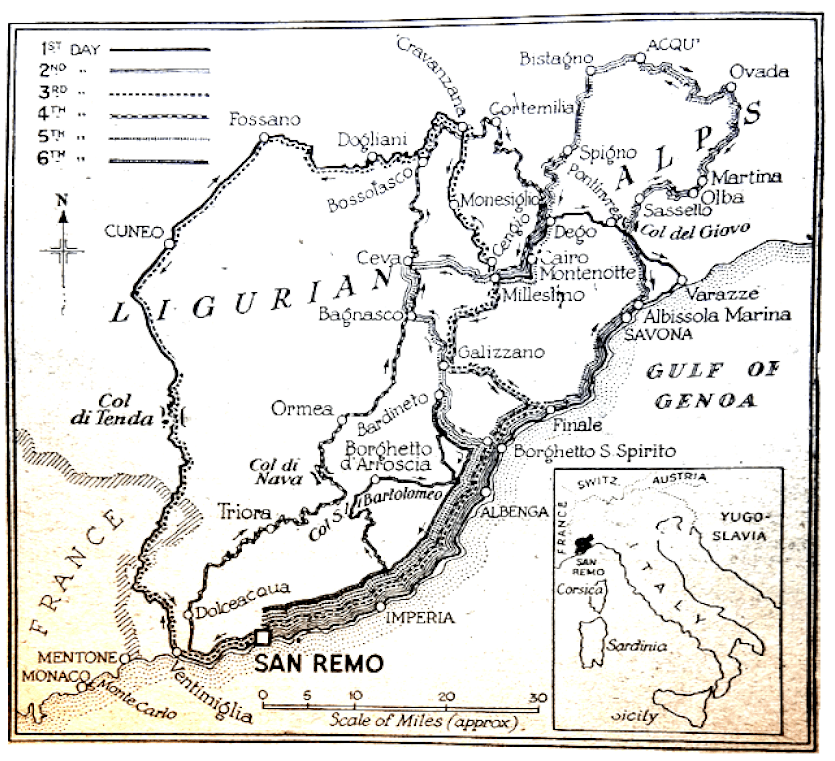
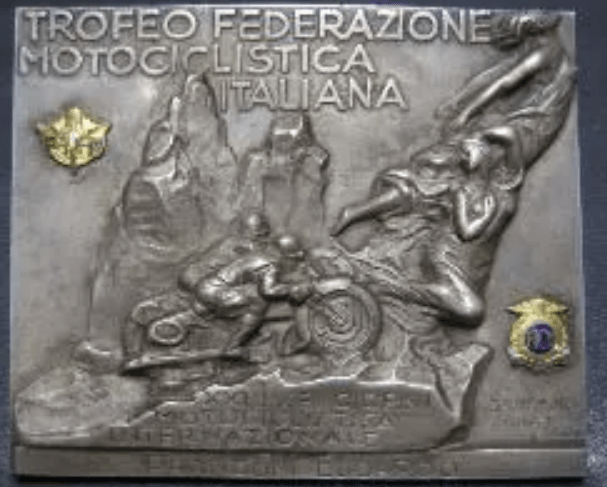
worse road surfaces than those included in the event which ended last Sunday at San Remo, there has never been a more gruelling event. The fact that 81 of the 151 who started retired during the week is a commentary in itself. Any rider who retained a clean sheet and thus gained his gold medal can be very proud of himself. Not only has he shown outstanding skill, but a high degree of courage. The maker of his machine can be proud, too, because the ‘International’ is a test of destruction—just that. What makes it so is the average speeds demanded. Even the most famous riders in the world had the utmost difficulty in achieving the time schedule. They were riding beyond the safety limit over many of the 1,272 road miles. Special congratulations go out to the British Trophy Team which, by losing no marks, won the contest among national teams easily, and to the manufacturers of their machines: A Jeffries (Triumph), CN Rogers (Royal Enfield), VN Brittain (Royal Enfield), BHM Viney (AJS) and J Williams (Norton). No fewer than seven nations competed for this coveted award. In the Silver Vase competition Britain, too, was the winner with her No 1 team which also lost no marks: PH Alves (Triumph), CM Ray (Ariel) and WJ Stocker (Royal Enfield). For this there were eight countries competing and no fewer than 15 teams. In addition a British manufacturers’ team was one of the only two of such teams to finish without loss of marks and the British Sunbeam Club gained the first and second places in the club team contest. Of the 26 Gold Medals awarded to riders who completed the course without loss of marks, 11 of those medals were won by British riders and machines. A word must be said, also, of the many who journeyed from England to help as team officials and assist our riders. Finally, congratulations to the Federazione Motociclistica Italiana whose organisation of the event, while not flawless, was extraordinarily efficient having regard to their being given the task only some four months ago.” ISDT Committee Chairman Harry Baughan kept his own record of the event. ISDT Day 1: All OK other than Jack Blackwell who lost 3 marks and the Czechs were all clear. ISDT Day 2: All start OK before lunch Jimmy Simpson appeared with George Eighteen who had
retired after a crash…also carrying Vic Brittain’s rear mudguard with broken stays reg and GB plates plus lamp assembly. Repair and refit after welding and brazing rapidly judiciously arranged. ISDT Day 3: Vic’s mudguard fixed aboard all away OK, Jack Williams reported to have bent front wheel and forks as result of running into Jim Alves’ rear end at a time check but he can keep going. ISDT Day 4: Charlie Rogers’ rear mudguard stays cracked and bracket needed to support, Blackwell retires with engine trouble, Jack Stocker’s fork broken across head stem lug, Viney, Alves, Rist, Bert Gaymer, and Allan Jefferies going well caring for their machines, Brittain comes in on a flat tyre which gets done without time loss. Czech team loses Pastika! So a clear 18 points lead for Britain emerges over Austria and Harry Baughan warns Teams to take care! ISDT Day 5: Tyres get changed, Rogers reported to have had a serious crash but he and machine do finish even if poorly, Doctor arranged plus car to hotel. Allan Jefferies sends message to Harry via Arthur Bourne to have large hammer and chisel ready when he arrives, message reached Harry 2 mins prior to Allan’s arrival and cussing of all followed whilst the bits were somehow obtained and front fork nuts removed, oil added to undamped teles. Instructions go out not to race the Czechs who have an unpenalised Club Team in the Hunt along with UK’s Sunbeam ‘A’ and Sunbeam ‘B’. ISDT Day 6: Jim Alves finds starting difficult with a slipping clutch! but gets away OK, all continues well. Jack Stocker keeps going with well wrecked forks with a nearside leg BROKEN—a clamp is fashioned to try to hold this by Jack Stocker, Bert Perrigo and Harry Baughan using a similar bike they found in San Remo as a template! Jack had to officially start then fit the clamp, Jack had two sets of leathers on throughout the speed test in case of a crash resulting! He kept going to the average speed required too. Trophy, Vase, and Club Team Contests all brought Champagne and congratulations and a Party became arranged at the Casino.” And here are some excerpts from the The Motor Cycle‘s report, courtesy of ‘Torrens’, aka the editor, Arthur Bourne: “Of the 151 who started the day’s run, only 52 ended with clean sheets and thus were still eligible for gold medals. Sixteen retired, seven finished so late that, under the rules, they were automatically out of the trial, and 66 lost marks. Put briefly and bluntly like this, and given realisation that the trial numbers in its entry many of the finest riders in the world, what other conclusions are possible than that the day had been stiff and that the International is the trial of trials? The first part of the day was a glorious coastal run on a road bordered by cactus, palms, mimosa, and geraniums, through Imperia and Alassio to Albenga.
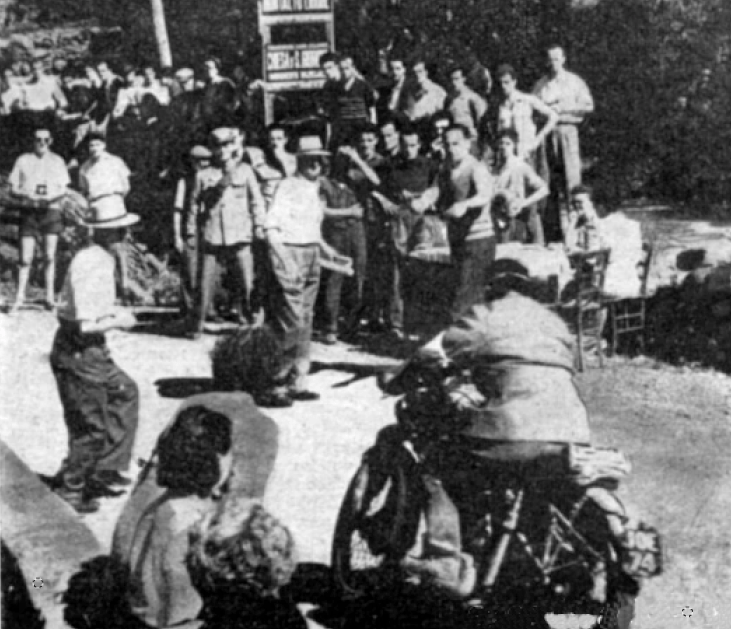
Then the trial struck inwards towards the mountains. Down in the Riviera of Flowers the weather became sunny and even hot. In the Ligurian Alps it was very different. On the Colla di Casotto there was mist–this on a 25.4 mile stretch which all machines over 250cc had to cover in 50 minutes. Twists, turns, up to 5,500 feet from 1900, down to 2,670, up again, down to 1,450 and mist. Worse still, there was 1½–2 miles of Colmore-like mud: rutted, puddingy stuff. The British team men shot through it at 30mph with one foot out every now and then for safety’s sake. They were riding on the danger line. One toss and they would almost certainly be late at the next check. Also, their machines might be damaged. The Italians, magnificent in the loose, were unhappy in the mud. Lunch, indicated by a fork and spoon on the route card, consisted of three rolls, meat, cheese and fruit in a paper bag, and wine or beer, as the individual preferred. But assuredly it was not the lunch that caused so many, shortly afterwards, to run slap into another relic of Sunday’s great storm. There was some 25 yards of 4in-deep flood-water which looked precisely like the rest of the road. What a day! It began with a 40.6-mile circular tour (!) to the north of San Remo. For this the biggest machines were allowed 1hr 19min, which meant driving on the danger line throughout. Many riders decided that there was no alternative to being late at the check. There were five miles of fast going to Bordighera and then immediately the competitors were on rough, trysting roads that climbed and climbed. Hairpin bend followed hairpin bend, bringing one nearer to a village pinnacled, it seemed, in the sky. Here at Perinaldo there was a rough climb—rocks, earth, a drop on the right—lined by hundreds of cheering villagers. it was sufficiently steep to cause N Biasci (125 Vespa) to get off and run beside his machine. The climb was very similar to some of the hills around Cheshire included in the ACU’s 1925 International. As for what followed there was real Exmore-like track, except that Exmoor does not boast sheer unguarded drops at her roadside. Ugh! The 29.2 miles from Pieve di Teco to Molini di Triora, which machines over 250cc had to cover in 58 minutes, can be described at such a schedule, as being close to madness. As on so much of the International, speeds convey very little—unless one has actually traversed the stretches. Even the fact that on these 29.2 miles there was a climb from 700 feet to 4,000 feet followed by a drop and another climb failed to give an adequate picture. But when it is mentioned that in 5½ miles of zigzag ascent there are 176 hairpin bends, some semblance of an idea is gained that a 30mph average can be almost suicidal. The track was narrow in places; sometimes it was muddy; often there was deep loose stone and at point after point there was a sheer unguarded drop on the left. As Alan Jeffries remarked concerning these frightening stretches, there is no return ticket. Harold Taylor (Vincent-HRD sc) used different words: he said he had never felt closer to Kingdom Come. Riding to schedule
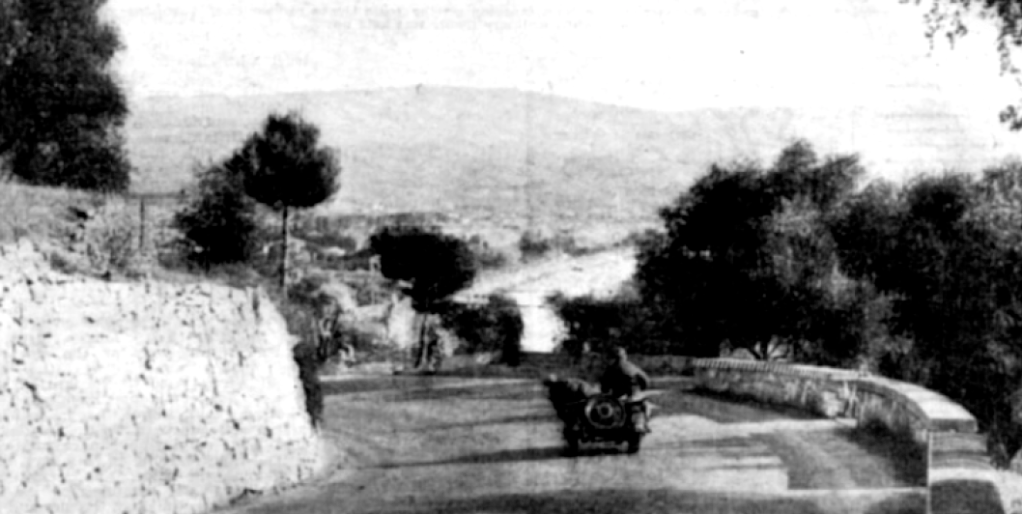
meant riding as hard as humanly possible—brakes, acceleration, sliding bends, applying every trick of the trade and, almost needless to say, thrashing machines unmercifully. The aim of the international was being achieved, but at very considerable risk to the riders. The 250cc machines with their lightness and their lower speed schedule—an additional five minutes —were undoubtedly much better off than the 350s and 500s on such going. However, all Britain’s trophy team and her Silver Vase teams won through. A sad blow was that Ron Watson (Ariel sc) who had not lost a single mark up to this point, one of only three sidecar men to achieve this, had a retire two-thirds of the way through the section owing to a sheared sidecar-wheel spindle sleeve. Another sidecar man, Dr Galloway (Triumph), was out, and so was Capt Beatham of the BAOR, whose clutch was revolving idly on its shaft, the splines having sheared. Of the 151 who had started the trial 114 was still running on the third day and, of these, nearly 46 were unpenalised and, therefore, still eligible for their Gold Medals…British machines were certainly keeping the old flag flying. Incidentally, RJ Harris (500 BSA) was the one British private entry with a clean sheet. The day ended with Czechoslovakia and Britain still equal and leading in the Trophy competition. There were also two teams unpenalised in the Silver Vase contest. These were Holland number 1 and Britain number 1. Fourteen further competitors retired leaving, 96 still running. Over one third of the entry dropped out in the first three days. The nearly three-hours long cavalcade set off in its twos and, owing to retirement, sometime ones, from the starting point at Osnedaletti, with the first, as usual, signalled out at 6am, British time, just before dawn. It was more like sunset than dawn. The sun peeped up above the sea tingeing the clouds and the Mediterranean with all the colours of the rainbow. No picture postcard was ever more colourful. Whether this forecast a good day or a bad one was a matter for the locals. It was certainly a bad day for the Czechoslovak Trophy team which was running level with Britain. At the very first check J Pastika (125 CZ) retired, apparently with gearbox trouble. This meant 100 marks automatically lost for the day, and for each succeeding day, so if only Britain and, in particular, Jack Williams with his damage Norton, could keep going, all should be well…Saturday’s run was more a matter of mileage than of great difficulty. There
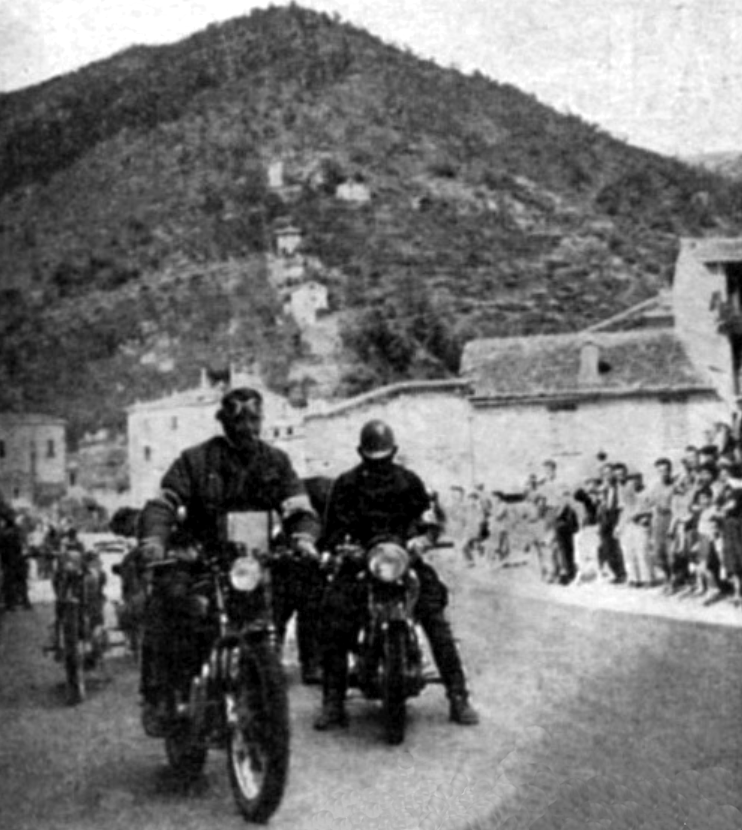
were 245 miles to be covered, with nearly 30 of them on the coast road. But with the heat, the dust, and still further hammering of tired bodies, it was very far from a picnic. The one really vile portion was a stretch of some six miles near Monesiglio—hairpin bends roughly 15 yards apart and the road surfaced with what seemed to be cricket balls made of stone. And just before Albenga and the final run home there were downhill hairpins that appeared to be numbered in millions. As one competitor remarked, on this stretch one looked down the chimneys of villages far below and, with glasses, could have seen what the villages were cooking. The day was a worrying one for Britain. Paul Stocker was in trouble with a front fork bridge. Ray found the heat overpowering; like many others, he started to feel sleepy and, cutting things too fine, bent to footrest and his brake pedal in a near miss with a lorry. Cunningham, charging through a crowd, found a car head-on coming from the reverse direction, hit the car so hard that it was turned round and, although writing off his AJS, miraculously was himself unharmed. Worse still, particularly as the British Trophy Team was still leading, Charlie Rogers took a very heavy toss. Cruising at 50mph with hardly a care in the world he shot into a mud patch. There was an unseen hump in it. Machine and rider shot into the air cleared a typically low wall of about 1ft 6in, and ended in a field, where Charlie passed out for a bit. By great good fortune the machine was all right. After a while he carried on and kept to time. At Albenga he all but fainted, and Red Cross nurses plied him with wet sponges and brandy. Such are his guts that he got through to the finish still on time. Breffitt hit the same bump but was luckier…Jack Williams was continuing to nurse his bent machine successfully, but had a nasty gash on his front cover. More work to be done before the final check. Hugh Viny, who spent his spare minutes at Albenga in checking over his machine, found out what was causing the noise that had been worrying him for miles. The front brake cable, with taped up spare, was tapping the back of his headlamp! Incidentally, everyone was now used to the fact that many of the insects at the roadside make a horrid sort of noise suggestive of machine trouble. DB Williams, all the way from Australia and putting up a stout show, allege that his bag to date was two chickens, three cats and one Italian. Frequently in the mountains, villages will be seen watching the trial with the hand safely under each arm. Another who was impressing all was a private owner of an ohc
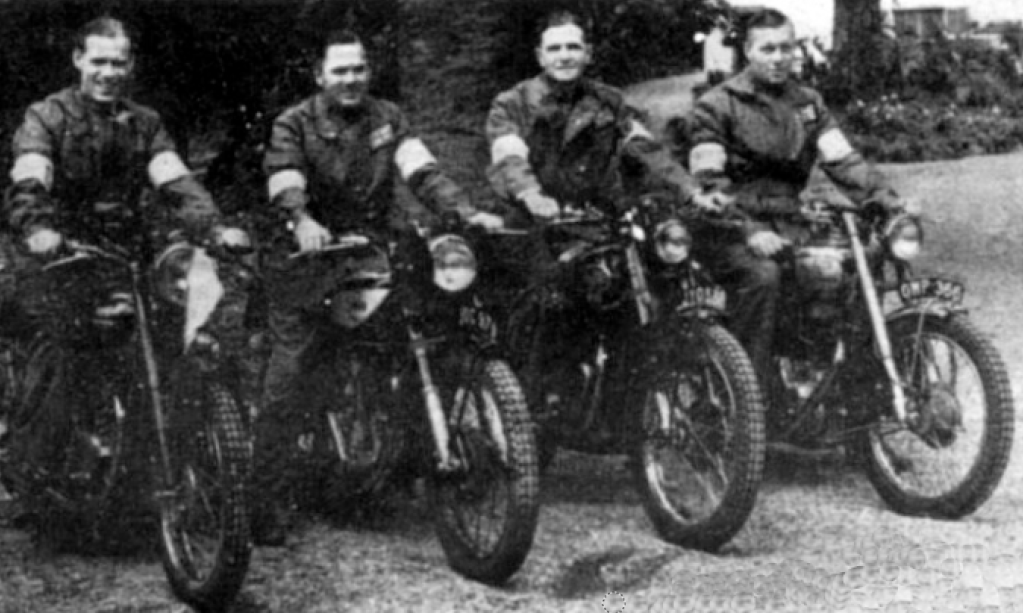
Norton, RW Tamplin. This was the last and perhaps most dramatic day. What of Charlie Rogers, of Jack Williams’ machine and, in the Vase competition, Jack Stocker’s? Would Alan Jeffries machine handle all right now he had added oil to each fork leg? On the 53.5 miles that were to precede the speed test? A portion of the roots was marked on the official maps—there was no road shown… Rogers was not in good shape but was carrying on. Harold Taylor (Vincent HRD sc) had tummy trouble, a second bout, and had been up all night but was equally determined to have a crack at finishing. The start was at 6:30am (4.30 GMT) in the twilight. There were all the fresh smells of dawn: very different smells from those at home. It was near Radalucco that the bad stretch began—10½ miles of continuous climbing with the road swinging around mountain after mountain, ever upwards. On the left on stretch after stretch there was merely eternity—no wall, but a sheer drop. Go over the edge and unless you were very very lucky you were a ‘gonner’. TU Ellis did go over but landed on a tiny patch of grass, the only patch there was anywhere around….Rist pulled the nail out of his rear tire and was relieved to find that the Dunlop puncture seal caulked the hole…He said gratefully, ‘That’s wonderful stuff, isn’t it?’ Charlie Rogers came in on time, a magnificent show…Harold Taylor looked done in, as well as he might. Then a police jeep arrived with Decat (350 FN), of the Belgian trophy team. Hardly had the car gone than No 34 free-wheeled into the control with his jacket off—E Beranek (125 Puch), of the Austrian Trophy team, the team was second of Britain…Beranek’s rear chain and chain wheel were adrift on the hub. The trial was far from over. There followed 7.1 miles downhill with unguarded precipices for what seems to be nearly the whole way. Yes, downhill. The road surface? It was smoothish but dusty, loose waterbound macadam. Ugh! And then there was the Peraldo stretch again and still more—many more—but safer downhill hairpins. It was on this that Stocker had a fork leg come adrift and held only by juryrigging, yet he finished on time and was complete the speed test. What dauntless courage! You should have heard how the other riders cheered him at the presentation that night. The British riders all went through to the finish of the road section. Since both the
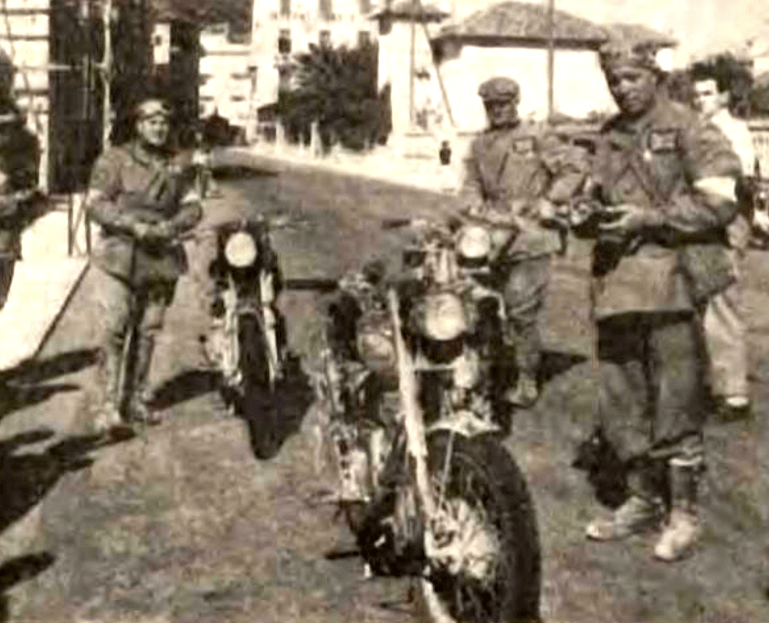
British Trophy and No a Vase teams and lost no marks and all other nations had lost marks there was no question of the speed test being turned into a race, each team striving for bonus marks. It was a matter of keeping going—of trying to keep going—and that, as related, Stocker did, so did Rogers, and so did the only British sidecar driver still in, Harold Taylor, one of only three sidecar men to win through. Harold finished and, on stopping his machine, fainted. Foreign riders around him instantly lifted him to the pathway and he soon came round. And the greatest of all trials ended with Britain gaining all the cherished awards. Mr Nortier, of Holland, when making the awards in the great ballroom at the San Remo Casino that evening, said, ‘You may have thought after the Grand Prix of Europe that British supremacy was over; it is very far from being so.’ Special cups were presented by count Lurani to the Trophy and Vase team members; to Mazzoncini, who, for four days, lost no marks on his 125cc Vespa scooter; to Barrington, who so gallantly finished the fourth day unpenalised in spite of a fractured shoulder; and to Miss Kevelos, who had ridden from England and, the one lady in the trial, carried on until outed by a tumble.” RESULTS International Trophy: 1, England, 0 penalty points; 2, Austria, 125; 3, Czechoslovakia, 500; 4, Italy, 904; 5, Netherlands, 1,014; 6, Belgium, 1,148; 7, Hungary, 2,517. Silver Vase: 1, England ‘A’, 0; 2, Czechoslovakia ‘A’, 2; 3, Netherlands ‘A’, 16; 4, England ‘B’, 320; 6, Hungary, 338; 7, Switzerland ‘B’, 399; 8, Switzerland ‘A’, 516; 9, Hungary ‘B’, 614; 10, Italy ‘B’, 625; 11, Belgium ‘A’, 946; 12, Italy ‘A’, 1,916. FMI Trophy (manufacturer’s team award): 1, Jawa ‘B’ (Czechoslovakia) 250cc; 2, Triumph (England) 500cc; 3, Royal Enfield (England) 350cc; 4, Jawa ‘B’ (Czechoslovakia) 250cc; 5, Gilera (Italy) 250cc.
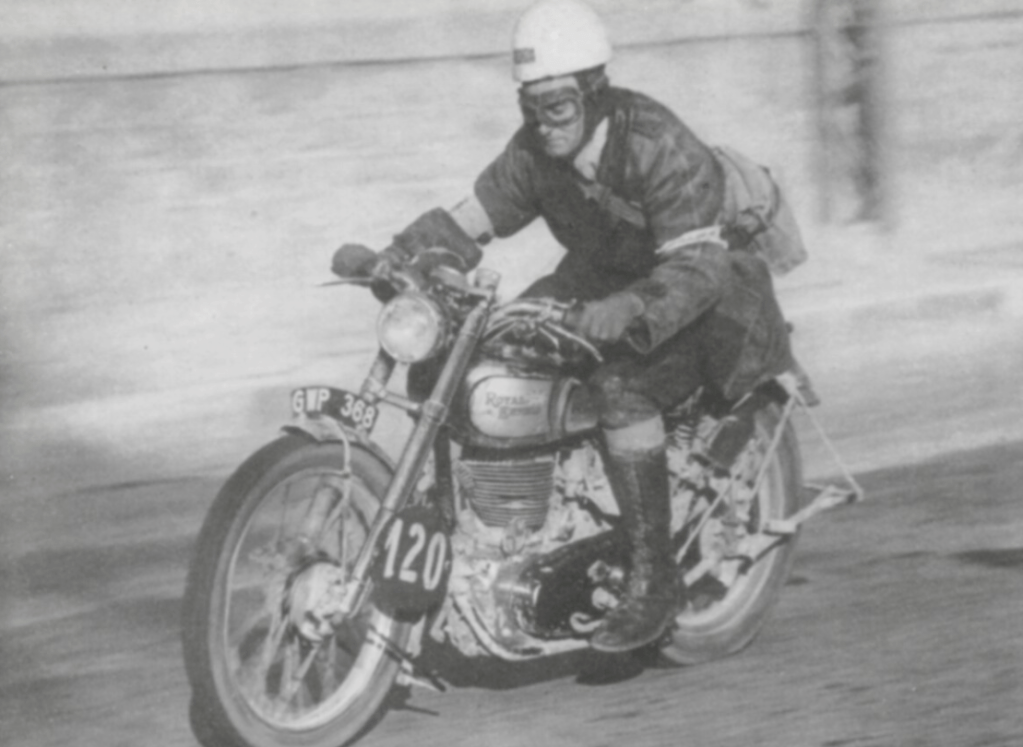
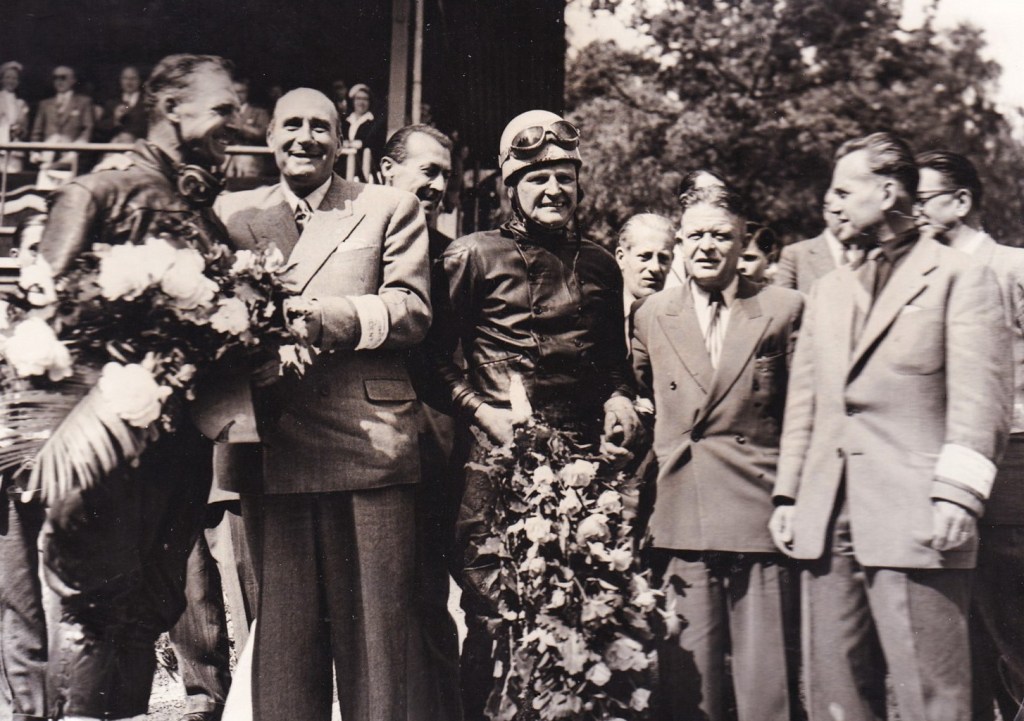
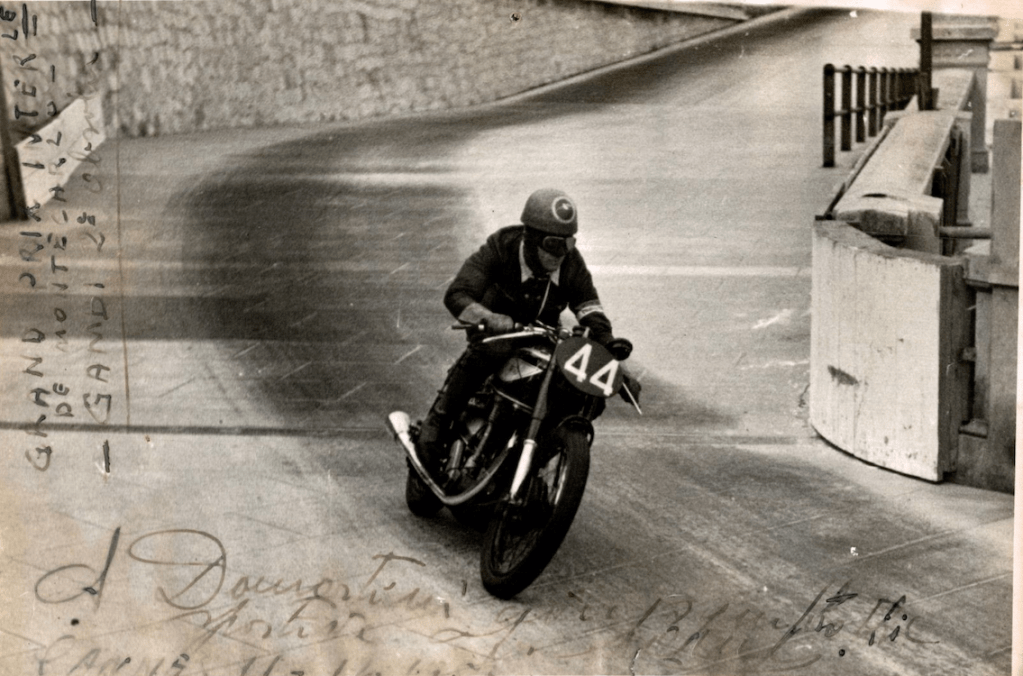
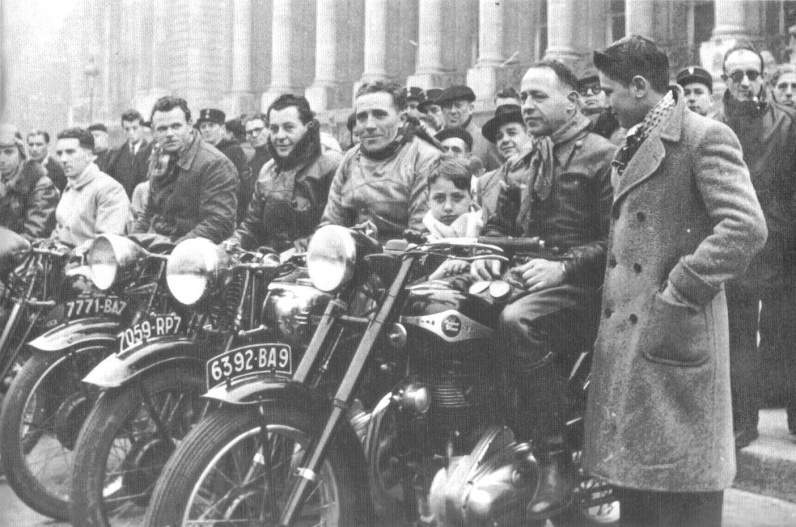
Motor cycle competition was flourishing all over post-war Europe…
THE LETTER IN OUR Correspondence columns from Professor Low comes at an opportune time. Professor Low suggests that as we do not yet know as much as is desirable about supercharging, it is necessary that the testing opportunities afforded by the Tourist Trophy and other races should be used to gain more experience. It is, of course, not impossible that the development of the gas turbine may reduce discussion of piston-engine development down to the academic level in a few years time. Meanwhile, however, nothing should bar the intensive improvement of the type of engine with which we are familiar to-day. In pre-war days, superchargers were permitted in international motor cycle races, and by 1939 multi-cylinder engines with forced induction were making the pace in the classic events. With the start of racing after the war, the FICM decided to ban superchargers and to make the use of commercial fuel compulsory. In 1946, when the decision was made, conditions were such that both rules were in the interests of getting racing under way again. The war years had made it difficult to develop new designs—hence the predominance of pre-war designs in the races of to-day—and, at least so far as Britain was concerned, only commercial fuel was available. It would seem that the time has arrived for further thought to be given to these rules. If racing is to serve its full purpose, development must be given reign and as much knowledge as possible gleaned therefrom. Those who are critical of supercharging on the score that it will entail still greater divergence between racing and the ordinary man-in-the-street models will at least have the satisfaction of knowing that supercharging spells multis. Permitting super-chargers in races may in the long run have a good effect on standard design. Some new racing engines are in the drawing board stage, and others are in the initial prototype form. Designers require to know well ahead the broad rules under which racing will be conducted in the future. It was thought that at the Spring Congress the FICM might give some intimation of the feelings of the represented nations on the question. This did not materialise. Undoubtedly, therefore, the subject should be considered at the Autumn Congress which it is anticipated will be held in London. A lead from the FICM that the banning of superchargers and the insistence on commercial fuel in international racing will be lifted for events in, say, 1950, will do much to help along the plans of technicians. It is, of course, imperative that the rules should not be altered without fairly lengthy notice.”
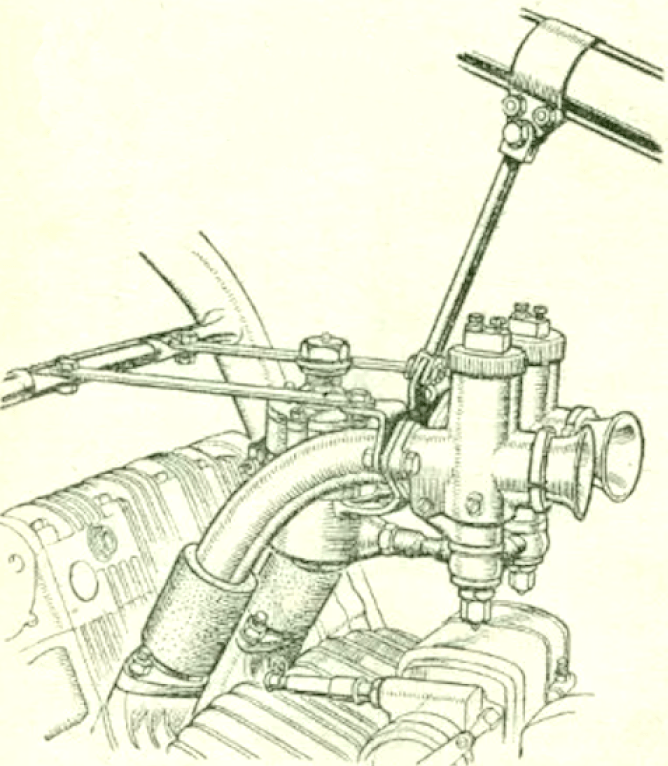
“SEVERAL DETAIL MODIFICATIONS have been carried out on the AJS twin-cylinder racers. Nothing drastic or revolutionary has been attempted, bus a good deal of thought is obviously behind the changes that have taken place. These changes apply to all four machines (there is now a fourth which is a spare). A completely new rear hub assembly is fitted. The two-bolt form of brake anchorage used last year has been replaced by a long Duralumin rod, bolted at the forward end to the chain stay. For the anchor-plate end fixing a ⅜in diameter bolt passes through the anchor plate from the inside. The bolt has a large, flat head which is secured by a series of Allan screws. The rear chain sprocket is drilled for tight-ness. The weight saving, it is claimed, is over 31b. The reduction in size of the chain sprocket (which, of course, raises the gearing) is permissible because of engine modifications which are, as yet, undisclosed. A new and simpler form of rear brake pedal has also been fitted. A new finned oil-filter, which is turned from solid Duralumin, is anodised and dyed black. The oil-tank is similarly treated. A new-type Lucas racing magneto is employed.”
“LAST WEEK’S VISIT to the BSA works by 43 journalists representing the press of the world coincided by chance with a visit of Mr E Friar, Secretary of the AA. Mr Friar was officially taking delivery of the 1,000th postwar sidecar outfit made by BSA. About 60 shining yellow road patrol outfits lined the route from the police gate to the offices. It was an impressive site for the 43 world’s newspaper representatives, among them was a Russian from the TASS agency.”
DURING THE WAR occupied France had no use for big bikes and that set a pattern that affected the peacetime industry. Of 21 manufacturers only five made anything over 125cc.
“A CROWD OF NEARLY 3,000 watched exciting sport during last Sunday’s Mortimer Scramble open to Southern Centre riders. The course was slightly over half a mile a lap. It included a very fast straight and two boggy patches which got deeper and more difficult as the programme progressed. Star of the meeting was WJ Stocker, who was again trying out rear springing on his Ariel. He won the unlimited cc and ‘fastest eight’ races.”
“A SHOW OF SHOWS—Scintillating, Fascinating and Satisfying. The London Show which ended last night achieved much more than merely attendance records. If ever there was a motor cycle exhibition that enheartened, thrilled and satisfied, it was Earls Court of the past week. Right from the turnstiles starting to click last Thursday morning, it was obvious that here was the Show. Inside the great exhibition hall was a variety in both stands and exhibits, and to eyes and minds accustomed to austerity, what a scintillating display! With many enthusiasts, anticipation dated back to war years, to nights in desert, in jungle, or, maybe, fire-watching in Liverpool or London. What thoughts the words ‘The next Show’ conjured up. Realisation, for once, has proved even greater than anticipation. In every sense it has been a great exhibition: in the attendances it has drawn (over 70,000 on the Saturday), the excellence of the latest designs, the variety of types, and in the craftsmanship and finish that were such notable attributes of the exhibits. The Show has revealed that British and best is not just a slogan, but a fact. Of course, a raison d’être of the Manufacturers’ Union’s mighty display is to provide a ‘shop window’—to focus attention on its members’ products and attract buyers, in these days mainly from abroad. Actually, much of the business is negotiated in advance of the Show, but few enthusiasts can have walked around the great hall without noticing many obvious visitors from countries oversea. Considerable unheralded business has resulted. By ill fortune the exhibition coincided with a period of ‘big’ news in the journalistic sense which usurped much of the space in the newsprint-starved daily and evening papers of this country, and prevented the Show receiving the publicity it merited. Nevertheless, the attendances were even greater than many expected, and the thousands who visited the exhibition, unlike those at the recent automobile show, had the comfortable knowledge that, though they might have to wait in order to obtain a particular make and model, they could buy and enjoy a new motor cycle.”
“WHEN OPENING THE London Show, Field Marshal the Viscount Montgomery of Alamein praised highly the motor cycle and cycle industry. He referred to the industry’s splendid contribution to national recovery by its high level of exports, to the excellent standard of workmanship and design embodied in the products, and went on to assert that the nation can be proud of one of the few United Kingdom industries which is recognised throughout the world to be supreme in its particular sphere. Self-satisfaction is a characteristic never strongly evinced among the British. We maintain the tradition of cautious reserve about our own achievements. We are quick to recognise the success of others, while grudging ourselves the slightest liberty in congratulation. It is therefore appropriate that praise for the industry should come from so distinguished a source, a soldier of illustrious achievement, whose profession is highly specialised and ‘remote’ and has no direct connections with commerce and politics. Why praise and even self-congratulation are justified can he stated simply. In 1947 55,367 British motor cycles valued at £4,395,542 were exported in spite of the post-war production difficulties. Our nearest competitor was the USA with 10,159 machines valued at £969,598. British machines are easily supreme in competitive events—witness the results of the classic international road races and the great International Six Days’ Trial. For 1949, British manufacturers offer such a wide range of types of first-class machines that the ranges of other nations do not bear direct comparison. A quiet toast to the industry would certainly not be out of place.”
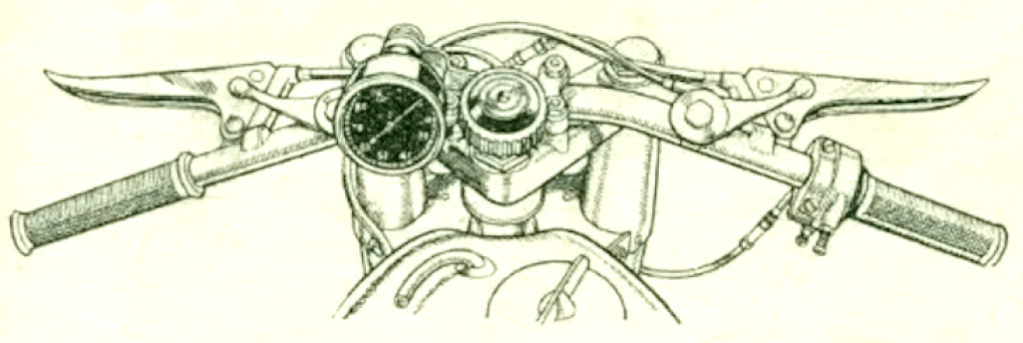
“STUDYING THE NEW VELOCETTE makes me realise how far we have travelled in simplifying motor cycle controls. We shall never know to what extent a horde of spiky levers has scared women and oldish men from joining our ranks. I can recall a day when my earlier machines had three chess bishops mounted on the top tube, a tank float control, a twist-grip ignition switch, an electric interrupter block, a valve-lifter and a couple of brake levers. In time were added a lamp switch, a horn switch and a dipper! Quite a formidable forest to non-mechanical minds, ignorant of the elements of the i/c engine. As the Show reminded us, on modern machine there may not be an air lever, an automatic ignition control is, perhaps, fitted and maybe there will be no valve-lifter. Such design reduces engine controls to the twist-grip throttle once the machine is in motion, plus, maybe, an ignition switch and a choke for starting up. The novice has next to nothing to learn. I have taught a number of novices who actually prefer our controls to car controls. Most of them fall swiftly in love with the manual front-brake control, which is always literally ‘to hand’.”—Ixion
“AN INNOVATION IS AN engine which is not only practically inaudible to others but even to the rider himself. A few years ago, when serious traffic congestion was limited to big urban centres, such inaudibility was both a nuisance and a peril. Folk based their awareness of traffic by ear rather than by eye. This had the result that anyone driving a quiet car had to make much use of the horn, failing which pedestrians seemed.to be bent on suicide. Even to-day most of our pedestrians have many more narrow escapes from being bowled over by pedal cycles than by motor vehicles. However, modern congestion is so formidable that we are all being educated to relying on our eyes more than our ears. Therefore, I doubt if a reasonably silent motor cycle can any longer rank as dangerous. But it is just possible that within a year or so we shall hear clamour for an instrument-panel device to tell us whether our engines are running or not because noisier traffic drowns the quiet breathing of a well-throttled twin. Astonished pedestrians have recently inquired whether a certain motor cycle is propelled by electricity or steam!” —Ixion
“I SPEND a lot of time nowadays in the effort to reconcile startled old-timers to the prices of modern motor cycles. At the moment three temporary and transient factors have steepled all our costs, namely, inflation, purchase tax and the compulsory limitation of home sales by the Government. (In any industry a main basis of cheap products is a large home market—which explains why in normal times American cars are so much cheaper than our own.) When those three passing handicaps go by the board, we shall unquestionably see motor cycle prices heavily slashed. In the interim thoughtless enthusiasts resent being asked to pay up to £250 for a high-class motor cycle. They compare this figure with those of 1938, when there was no inflation, no limitation of home sales and no purchase tax. They ought, of course, to compare such prices with the current prices of non-subsidised commodities, such as beer or Harris tweed. I have just bought myself a jacket and-waistcoat of Harris tweed, plus grey flannel slacks. In 1938 I could have bought this outfit for about £8 from a tailor of medium standing. The flannel trousers would have cost me 2Is. To-day the flannel trousers alone cost me £6 6s! On a similar scale a typical £50 1938 motor bicYcle might well be listed at £300. Certain special commodities display a far worse jump. I can remember being sent to buy my father a bottle of whisky at 3s 6d. To-day it costs nearly ten times as much. In 1938 an autocycle cost-round about £19 I9s. To-day its price is thrice as much. But the industry are not profiteering. We can only hope that the inevitable reductions will come as quickly as they did after the first World War and prices drop similarly. For simple minds the puzzle is not eased by the fact that subsidised foods are not a great deal more costly than they were (unsubsidised) in 1938.”—Ixion
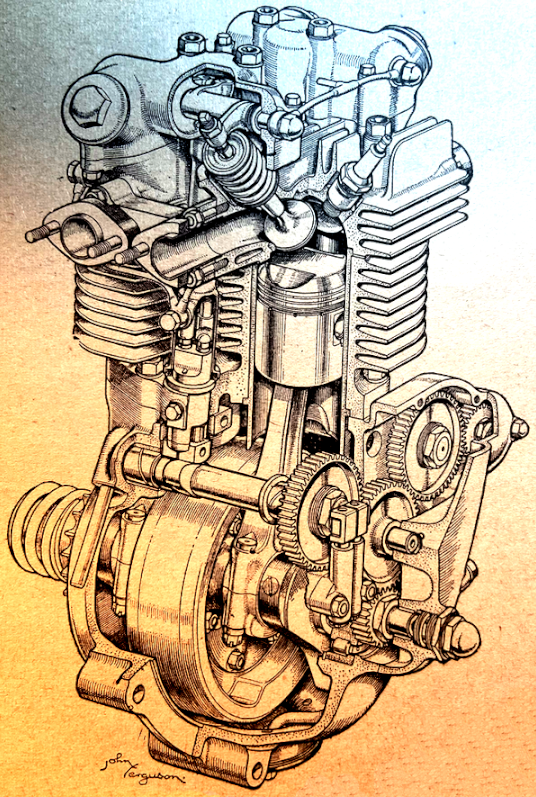
“EVERY BIG MANUFACTURER marketing motor cycles in the larger-capacity classes has a vertical-twin in his range. Thus, 1949 marks at least one major and outstanding development in motor cycle evolution. Eight makes of vertical-twin are available. Seven of these machines are of 500cc capacity only, and the last (though first in the field) is produced in both 350 and 500cc sizes. Since these manufacturers together produce each year a very high proportion of the total of British machines made, there must be important reasons for this marked trend which, incidentally, was forecast before the war and, even discounting the war years, has taken a considerable time to mature. These reasons illustrate compromise rather than technical idealism; compromise with the notorious conservatism of motor cyclists, with the high expense of pioneering, and with production costs. Students of design will propound the advantages of horizontally opposed twins, will say the in-line three-cylinder is approaching the ideal, and so on. But experience has taught manufacturers that the average motor cyclist approves conventional appearance, and he shows, by his orders, that he prefers steady progress to unorthodoxy. The vertical-twin with the crankshaft set across the frame (and all except one design have this arrangement) has an appearance very similar to the single to which motor cyclists have been accustomed for many, many years. Relatively few alterations are necessary to frame and transmission designed for a single-cylinder machine in order to
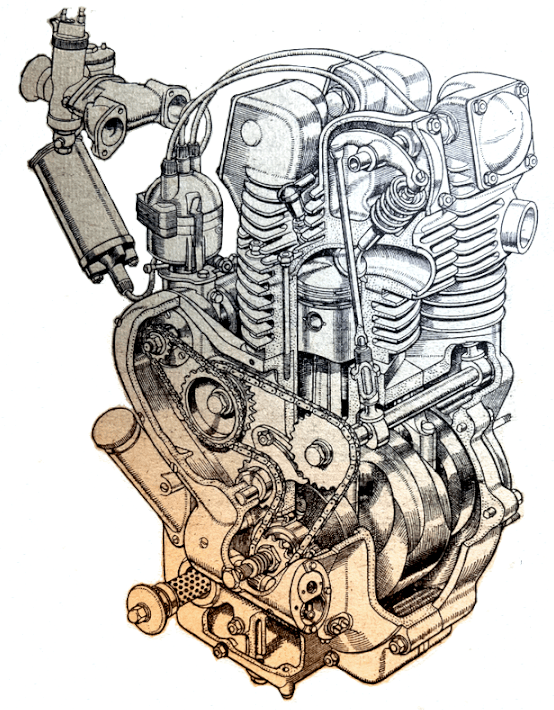
accommodate a vertical-twin with lateral crankshaft. Hence development and re-tooling can be concerned almost solely with the power unit—a considerable saving over the cost of producing an absolutely new engine, transmission, frame, and so on, necessary for the design the idealist might advocate. More than ten years have passed since the first of the modern, even-firing, vertical twins was placed on the market. With the exception mentioned earlier, in which the crankshaft is in line with the frame of the machine, all the designs that have emerged bear a flattering external resemblance to the originator of the fashion. But detail variations are worthy of close examination. Just as in the development of single-cylinder engines, so in the vertical-twins, more and more emphasis is put on rigidity of the flywheel assembly. Some designs incorporate a one-piece crankshaft and one has its shaft supported by three bearings. Another interesting aspect of crankshafts is that in two engines the material employed is cast-iron, whereas the others use steel forgings. The attractions of cast-iron are largely related to the fact that a fairly complicated design can be moulded, whereas with forgings the limitations are more severe. For example, with the forgings, a bolted-on flywheel is employed; castings can include an integral flywheel. Cooling between the cylinder bores of the vertical-twin type engine is given much thought by designers. Some employ a single-block casting embracing the two cylinders and others go the whole keg and have two separate castings with a clear gap between them. In the former layouts, however,
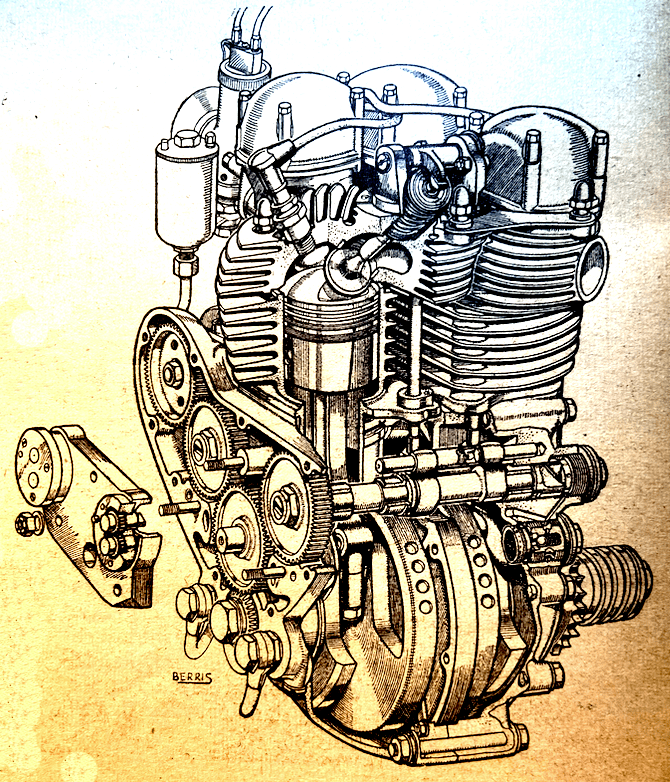
exceptional care is taken to ensure air inlets and outlets through the block and between the bores and also round any masses of metal such as push-rod tunnels. In one design the cooling between the bores is facilitated by having four separate cast-in push-rod tunnels at the ‘corners’ of the cylinder block. Though separate cylinders have attractions related to cooling, the top-half rigidity automatically obtained with a cylinder block is lost. Hence the separate cylinders are deeply sunk in the crankcase mouths and, in one design, the cylinder heads are tied by a plate above the exhaust ports to balance the constraining effect of the manifold at the inlet ports. A single camshaft operating both inlet and exhaust push-rods, as against two camshafts, one for inlets and one for exhausts, offers the advantage of a simplified timing gear and saves space. But it is usually easier to get cooling air round smaller push-rod tunnels than round one larger tunnel. Owing to the greater heat conductivity, lower running temperatures can obviously be obtained by the use of light-alloys in place of cast-iron. However, cast-iron is less costly, mainly because light-alloy cylinders need iron liners and light-alloy heads require hard metal valve-seat inserts. One design with light-alloy cylinder heads has cast-in iron hemispheres for the combustion chambers, a practice rarely encountered outside racing power units. Before the war, it seemed that there would be a fairly rapid changeover to chain-drives for timing mechanism and for driving auxiliaries such as magneto
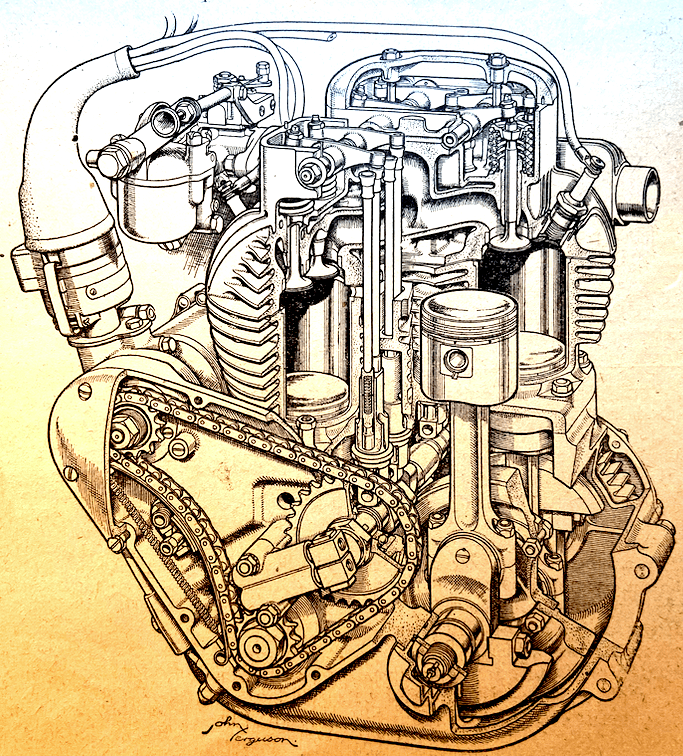
and dynamo. This, however, is still no more than a tendency, and both chain and spur-gear drives appear on the new designs of the vertical-twin. Chain-drive has the attraction of quietness achieved without the higher cost of the precision work necessary though it is none too easy to design a neat timing-gear layout for all-chain drive. The vertical-twin rightly claims much attention, but the new designs, of course, are by no means all of this type. The most enterprising design of the year is a horizontally opposed twin. Better balance is obtained with the cylinders opposed, yet the advantage of even firing is retained. Furthermore, the crankshaft disposition encourages integral unit construction of engine and gear box as well as shaft drive to the rear wheel. An unusual feature (on motor cycles) of the new horizontally opposed twin is the use of water-cooling. This has the merits of deadening mechanical noise and keeping temperatures down, thus lengthening decarbonisation periods and, in some respects, reducing wear; finally, water-cooling demands no intricately finned castings to ensure that the cooling medium gets to the right places. Many technicians maintain that water-cooling for motor cycle engines is overdue and would come if buyers were known to be ready to accept it. Yet another newcomer, at least to public gaze, is an opposed four-cylinder with a rocking beam interposed between the connecting rod big-ends and the crankshaft. The attractions are near-perfect balance and economy in overall width of the engine—the latter a powerful consideration with an engine of largish capacity and overhead-valve gear. Most British two-stroke engines are, of course, made by one proprietary manufacturer. The entire range of engines has been redesigned and
they now give more power. There is a comparatively new engine of this type from a very famous factory which, although already sent overseas in large numbers, is for the first time available to the British public. It was thought that some attention would be given by two-stroke engine manufacturers to carburettor enclosure, with the purpose of concealing the oiliness inseparable from petroil lubrication and of protecting the rider, but this step has not yet been taken. There are no indications of renewed interest in side-valve engines. Comparatively few engines of this type are made and no real clamour for more is discernible. A widespread view among manufacturers is that modern ohvs are so reliable and quiet mechanically that there is little to recommend the side-valve which, while produced in comparatively small numbers, cannot be much cheaper to buy than an ohv of equivalent capacity, and will usually be heavier on fuel. The query arises whether our designers could not with advantage give more attention to the development of side-valve engines. It is not without significance that the designers of the new horizontally opposed water-cooled twin decided to employ side-by-side valves. Though two designers responsible for engines with the crankshaft in line with the frame have taken advantage of the fact and provided the natural corollary, full unit construction and shaft final drive, all-chain drive remains far and away the most popular. This form of drive is likely to continue while engines with the crankshaft across the frame predominate. There is, however, a steady trend towards providing fixed centres between engine and gear box. If the crankcase and gear case are not an integral casting then, in a number of instances, separate castings are bolted together. Primary chains may then be of the non-adjustable type, or have a manually or automatically adjusted slipper. Duplex chains are employed on a few engines and a triple row chain on the only I,000cc twin at present marketed. Integral and bolted-up unit construction might seem an obvious and worthwhile development. But sometimes noise accentuation and too much heat transference to the clutch provide the designer with problems which, while not insuperable, can take time to overcome. Gear boxes and clutches have reached a stage of such high reliability that they are often taken for granted. Four gear ratios are provided on all except small-capacity machines, and gear-changing by a foot-operated positive-stop mechanism is almost universal. Development is likely to be directed to
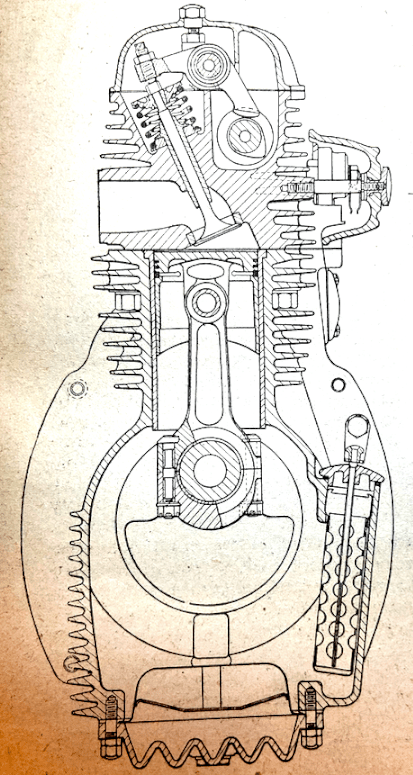
providing lower inertia clutches and designs which incorporate some form of torque assistance to increase plate pressure above that readily practicable with springs alone, if easy operation is to be retained. By this latter means, employment of a large number of heavy plates can be avoided and inertia problems side-stepped. There are also indications that to obtain greater stiffness and thereby minimise gear noise, overall lengths of shafts will be reduced. This can result in machines narrower at footrest level, an important consideration. Though these developments have not materialised for 1949, they air being actively pursued. It is significant that all the multi-cylinder machines in production can be obtained with rear-springing. Forms of resilient suspension for the rear wheel have been with us for almost as long as motor cycles have been made. But it has taken the insistent demands of oversea buyers to bring about a definite trend that suggests the doom of solid frames for any machines except those in the low-price market. There is boundless ingenuity and variety in the rear-springing systems so far available. At one end of the scale is a design which results in the wheel hub enclosing all the mechanism. At the other are the pivot fork layouts with telescopic legs that incorporate springs and hydraulic damping. The various designs have their especial merits. In brief, the aims are to achieve lateral rigidity, low unsprung weight, an adequate range of controlled wheel movement and an efficient final drive. Compromises, chiefly concerned with production, cost and appearance, have to be faced and accepted. In many quarters it is thought that some of the systems do not give sufficient range of movement, and it is expected that redesigns or changes are likely to be effected before very long. Experiments are being made with bonded rubber in shear as the resilient medium. Simplicity and low cost are the attractions, and it is not unlikely that rear suspension of this type will be seriously considered by manufacturers, especially for machines in the low-price field. A development on Continental machines which is adopted on only one British design is the provision of means of adjusting the rear suspension according to load. The need does not normally
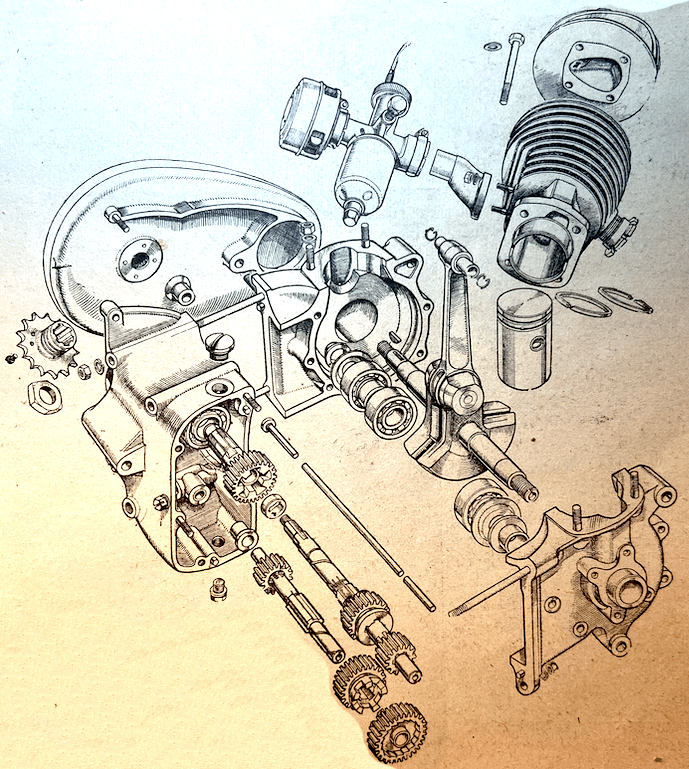
arise where the movement provided is long and is controlled by hydraulic damping. But if the range of movement is on the short side and is governed entirely by springs, there seems much to commend some form of quick adjustment. The telescopic type of front fork has almost completely ousted the girder-type fork. For larger machines, the telescopic design incorporates hydraulic damping; the practical merits of greater comfort, reduced maintenance and neater appearance will convince riders of a big step forward. There are also technical advantages. The average telescopic fork is stronger longitudinally and laterally, and gives less trail variation than a comparable girder fork. Simple designs of telescopic fork, usually without hydraulic damping, are appearing on many lightweight machines. The simplicity has overcome the earlier objection of high cost, and large-scale production can result in the telescopics showing a saving over some girder types. Lighting and ignition equipment has marched forward with higher-output dynamos, inductor generators, fixed-focus bulbs and higher current output from the lighting coils of
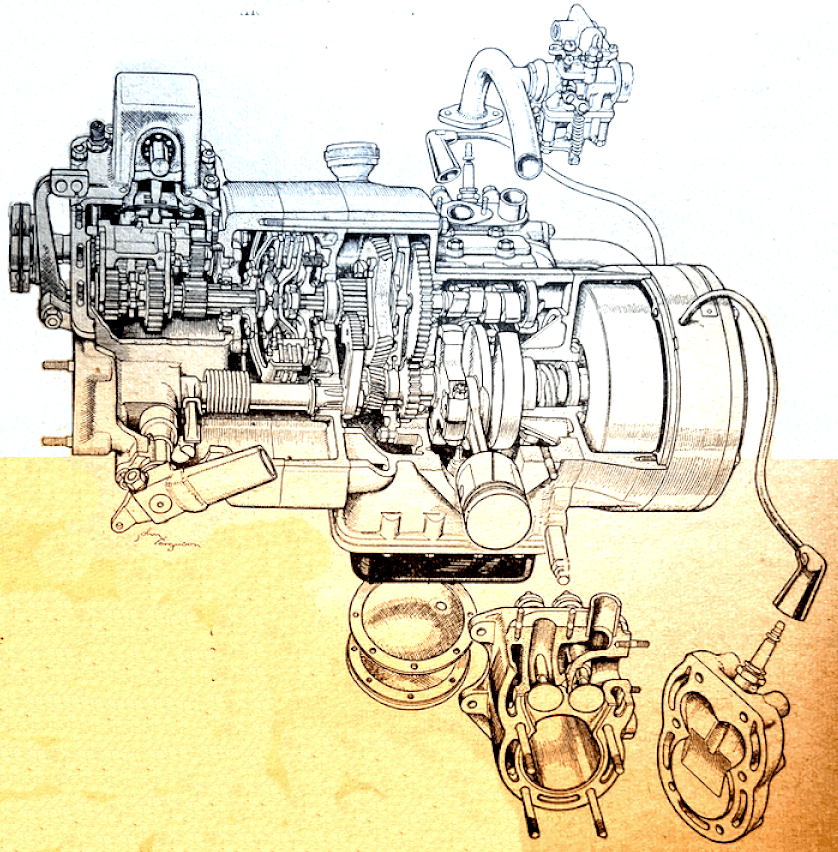
flywheel magnetos. Dynamos are now available which give sufficient output to permit the use of a 36-watt head-lamp bulb; this, coupled with accurate focusing, will answer the cry for improved driving light. Higher-output dynamos and inductor generators raise thoughts of coil ignition, and it is significant that a proven four-cylinder design and two new twins appear with this form of ignition. Past experience with coil ignition may have been unhappy, but there is no dismissing the good features of the system. With the elimination of the magneto, there is a saving in weight and cost there is also one less auxiliary to absorb engine power, and one less auxiliary means a neater engine and often simplified timing gear. Further, coil ignition usually results in improved engine starting and better idling. An old-time objection of reliance on a battery is minimised by improved batteries and generators which charge at low speeds so that, if the battery is flat, the engine can be run-started. On one new machine, a switch eliminates from the circuit both battery and cut-out, and is brought into use should the battery fail. As was shown when the machine was road tested by The Motor Cycle, the scheme works admirably. The technical advances in the ten years since the last London Show represent marked progress. Most of these advances, although thought out and worked on as opportunity offered during the decade, have had to wait till now for fruition. This makes 1949 a truly notable year.”—Harry Louis
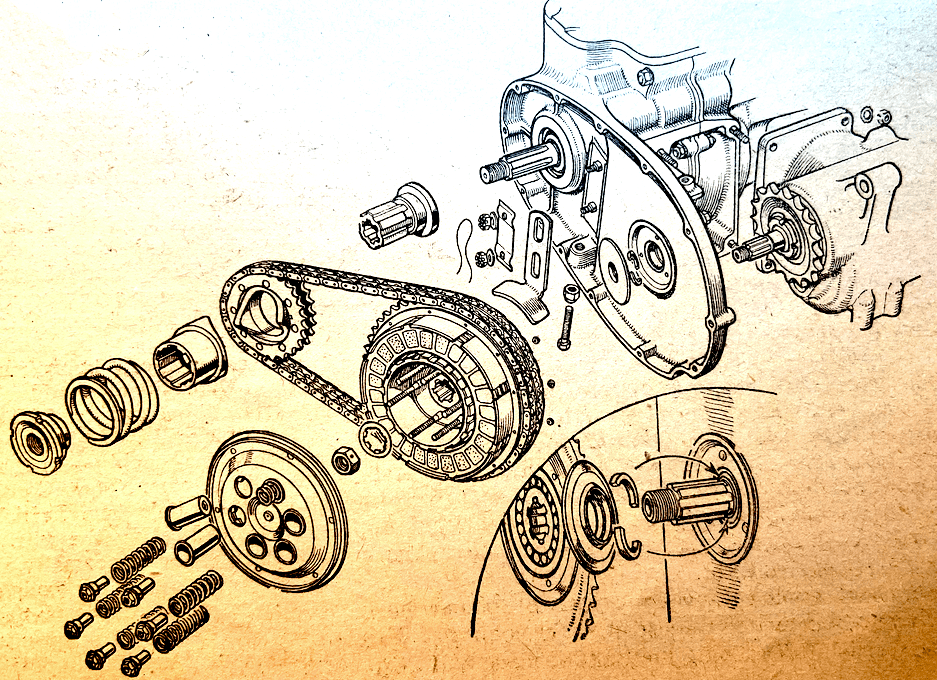
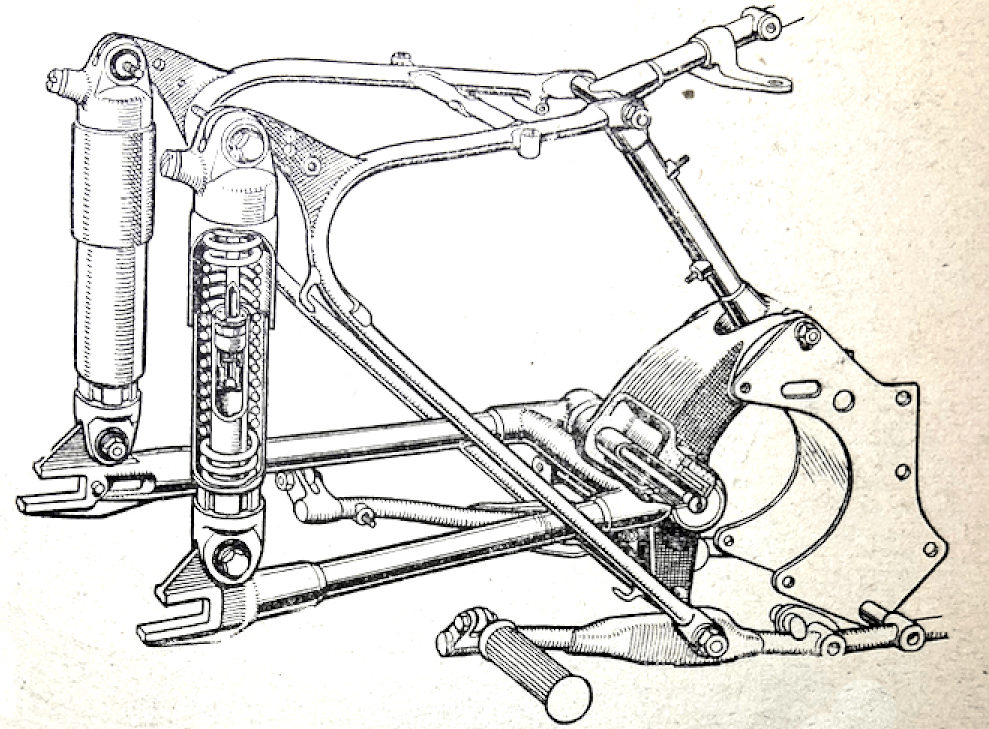
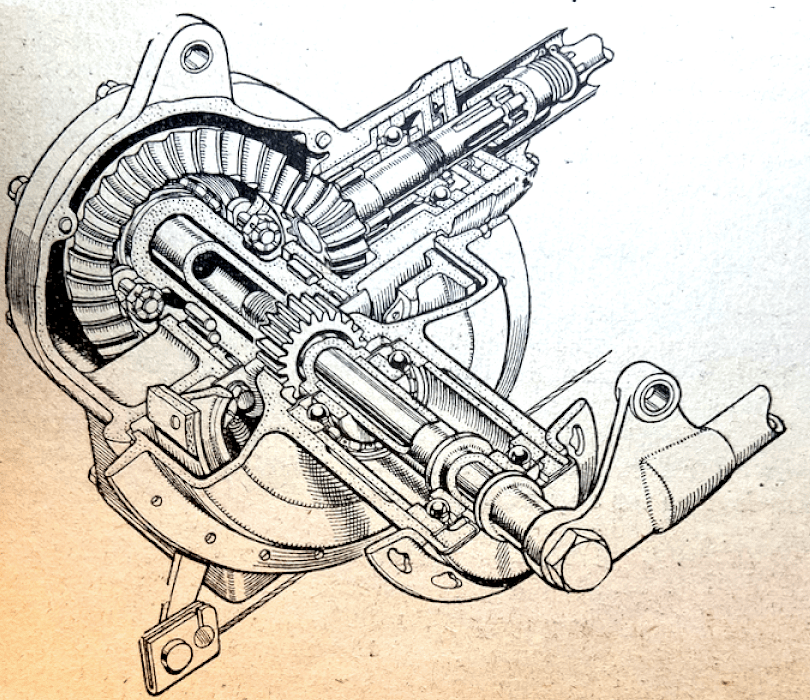
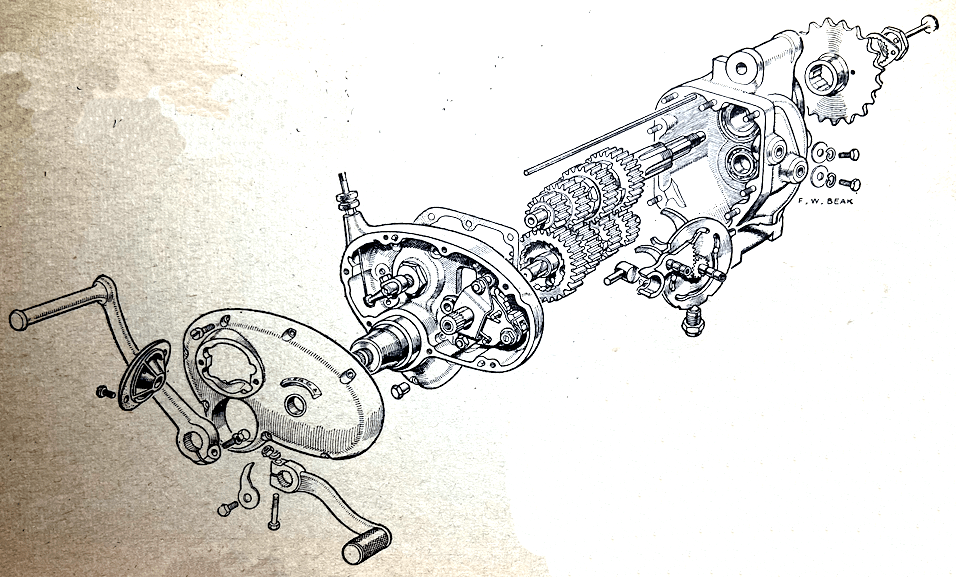
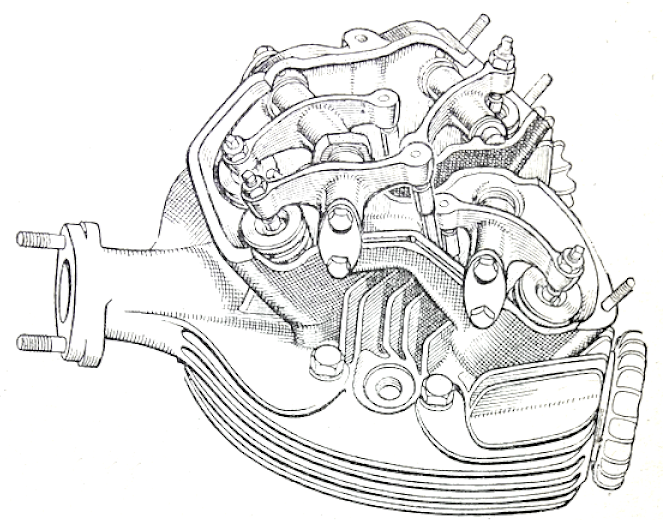
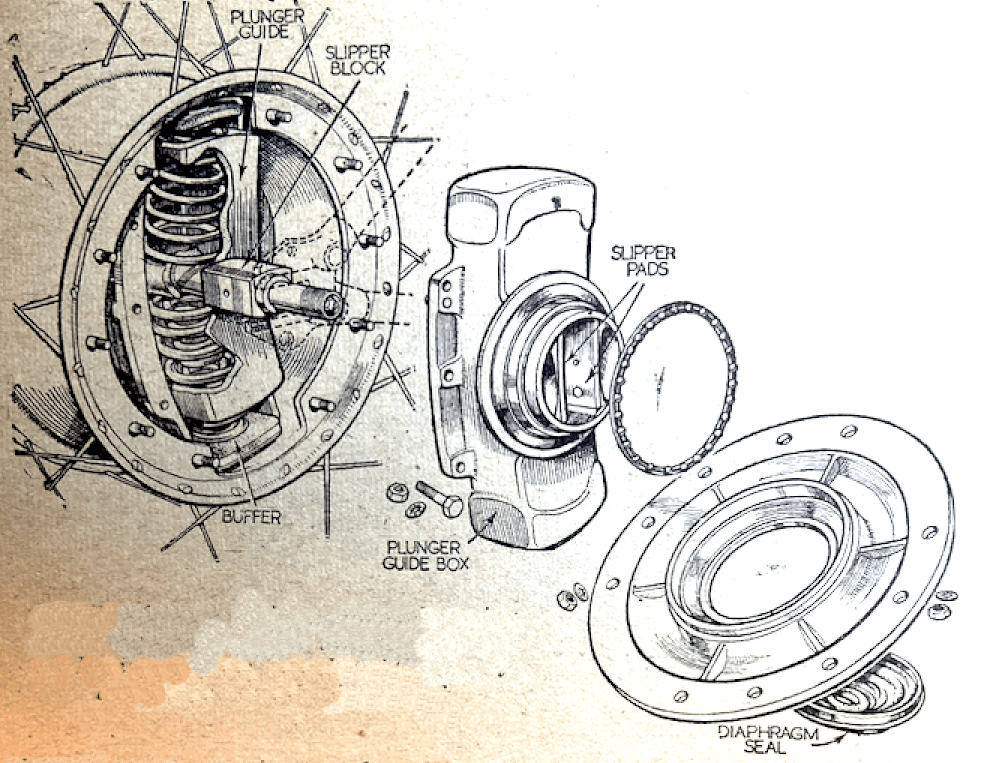
Harry Louis, who wrote that superb technical review went on to edit The Motor Cycle. I’m told he had a dry sense of humour and he was certainly liked as well as respected throughout the industry. I encountered him as a wet-behind-the-ears classified ad rep and was in awe of the great man. Years later I heard that he routinely read copy from his team before it went to the subs’ desk and was not shy about calling writers into his office to discuss anything that displeased him. An editor of the old school and a dedicated, skilled motor cyclist. And now for a treat: a walk round the show with Ixion, observing and writing at the top of his game. Enjoy!—Ed
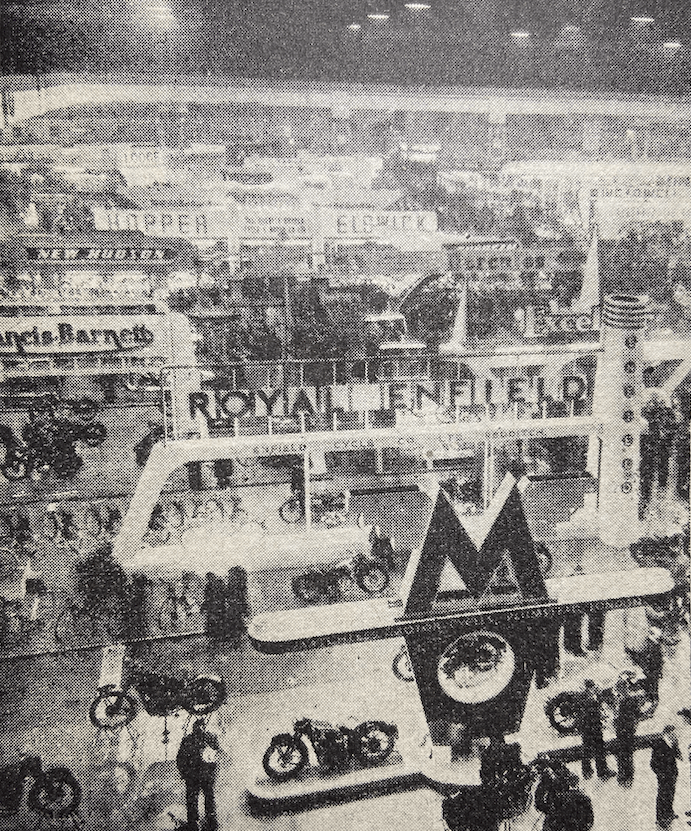
“TRIUMPH AND FRUSTRATION are two violently contrasted emotions, as far asunder as the poles. They mingle in quaint discord at Earls Court, 1948. Triumph, because we have emerged from what Winston called Britain’s ‘finest hour’ to stage the most superb show in our half-century of motor cycle history—a show which makes all foreigners rub incredulous eyes. Frustration, because we, the inventors, the designers, the exhibitors, the manufacturers, the mechanics, can buy but a small quota of the motor cycles we make—merely one in four—and have to pay exorbitant Purchase Tax (from which our lucky customers are exempt), and can then ride a beggarly 1,500 miles per annum because petrol is doled out to us in thimblefuls. Ten exclamation marks, please, Mr. Printer, to indicate our suppressed profanity and helpless rage at such a fantastic situation. !!!!!!!!!! (Thank you!). Paper, like petrol, is controlled. So I cannot define in detail the delight which (almost) every exhibit gave me. Technically, the dominant aspect is the Arrival of the Twins. Triumphs got in first with the vertical-twin well before the war. To-day a large pack of semi-dittoes are yowling at the Triumph heels. The flat-twin is temporarily démodé (in spite of the Douglas
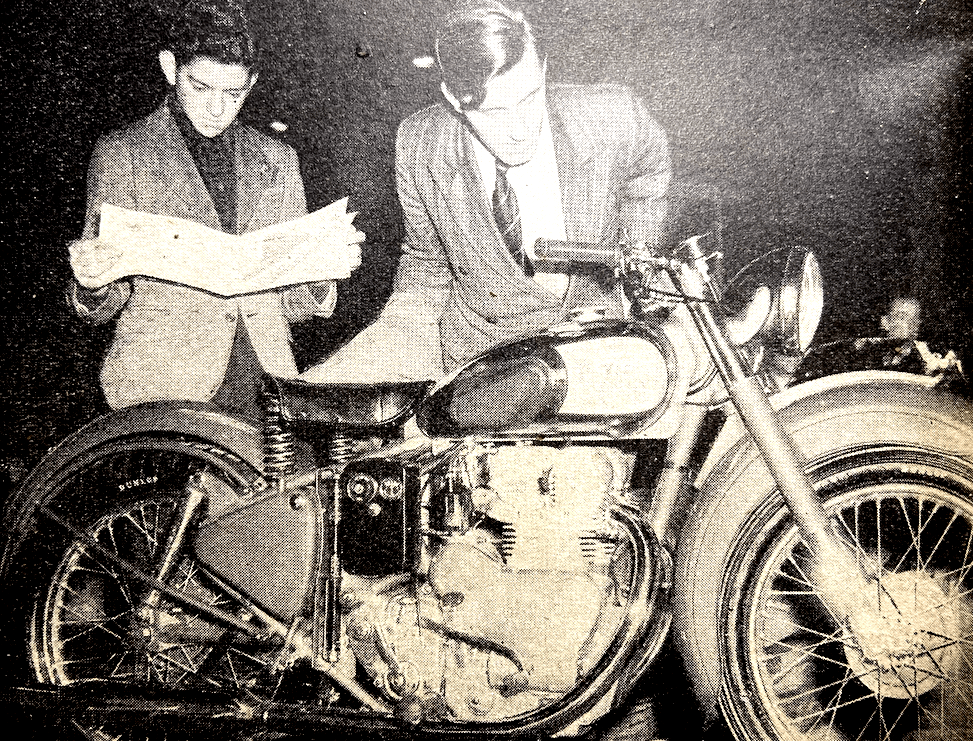
and the Velocette). The V-twin is apparently moribund in its spiritual home (USA), though rampant and record-breaking in Vincent guise. Shoals of devotees of the new ‘verts’ wandered bewildered from stand to stand. Triumph, they know. Sunbeam they have seen and heard of. But Ariel, Norton, Royal Enfield, BSA, AJS, Matchless—what are they to think of these? They recall past reputations. They study tele forks and spring heels slowly responding to giant cams, electrically humping to mechanism concealed under the stages. They nip rash fingers in sectioned engines. At the moment, the Sunbeam is easily the handsomest of the lot. Colours come and go, yet black always wins in the long run. I wonder if the greeny-grey of the ‘Beam will burst tradition. The curved surfaces of this lovely model enthral like Betty Grable. On the rest, we can pass two dogmatic judgments. Each designer knows he has to do better than Triumph or Sunbeam. By the summer’s end we shall know which has succeeded in that audacity. Meanwhile, a shrewd eye may note that most of the designers are preoccupied with cooling. Norton splays the valve
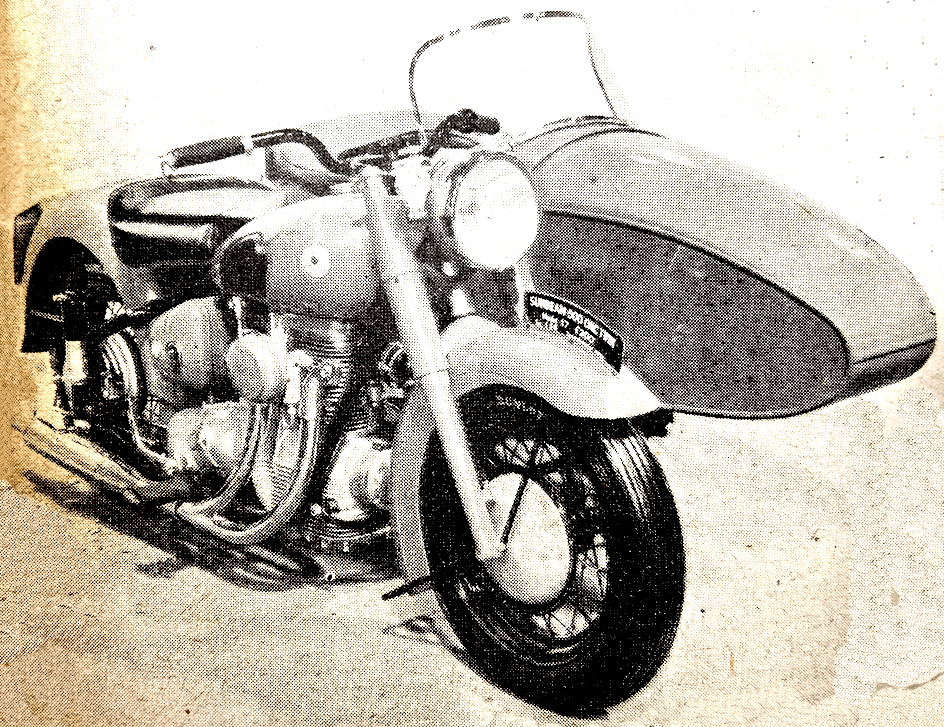
boxes. Royal Enfield prefers separate pots. AJS and Matchless use light alloy heads. Why? I wouldn’t know. Maybe they are thinking of a sustained 90mph on Mr Barnes’s** motorways in 19?? or 20??. Perhaps they consider the USA market, where a mechanic lives 60 miles from his work and quits home daily at 7am to clock in at 8am per Highway No X. (I wouldn’t know). But they are thinking of cooling. Must be summat to do with sustained revs, eh? Of the outstanding exhibits, the ‘Beam seized pride of place for sheer looks, and the 149cc Velocette as ‘the only really gentlemanly motor cycle ever made’. The new Squariel ran them each close in their special fields. The Wooler shattered an old illusion of mine. I have always said in innocent simplicity that if you want a four-cylinder the ‘flat four’ should be the goods. Mr Wooler has designed several such. His ‘beam’-type engine furnishes the lowest imaginable crankcase line, and eliminates all cooling problems by thrusting all four pots into the air-stream. But even if he employs a longish wheelbase, it will be difficult to move those pots sufficiently far forrard to clear a pair of well-grown knees. Unluckily, you can’t bend exhaust pipes at right angles close to their ports.
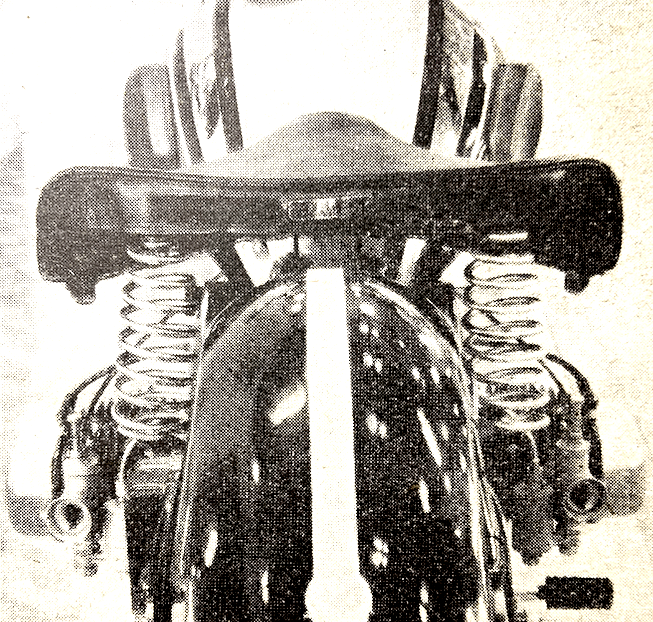
Nevertheless, a most wheedling design. Somebody once said that all baby motor cycles require huge saddles, balloon tyres and super forks. Obviously, they would cease to be babies with any such specification. But it heartens me to see that many of them, eg, Francis-Barnett, Norman and Excelsior, at last boast first-class forks. It has long been an axiom that any wee engine should have a very shrill exhaust. The public dislikes that particular noise. The new. Velocette is a wee engine, and even at 5,000rpm is not shrill. A bad exhaust always annoys the public. It also annoys the rider on a slow machine, because he can’t leave it astern as on a 500. Sidecar designs were remarkably good-looking and
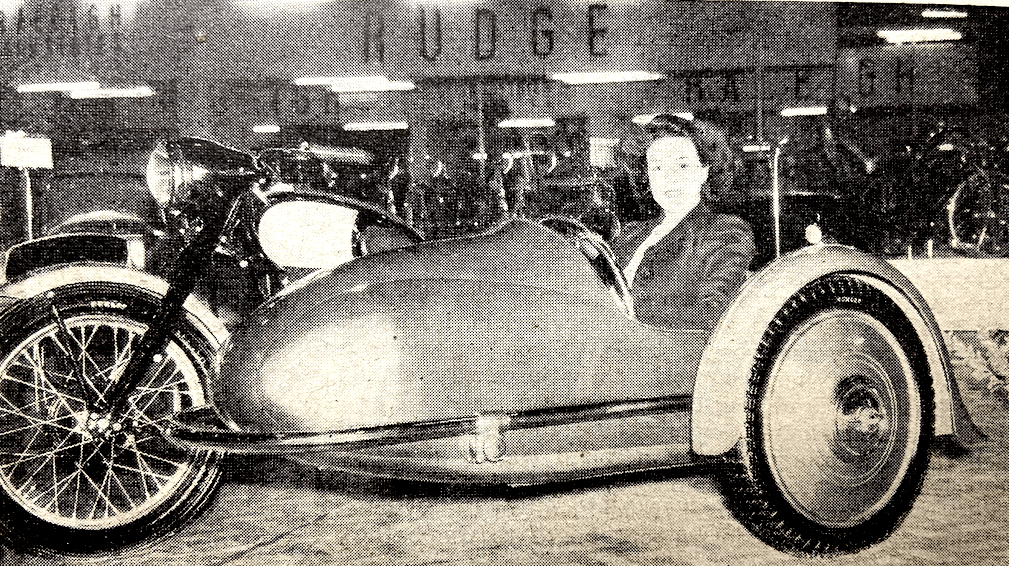
practical. Their Metalastik bushings, which need no grease, are a marked advance. Upholstery was not particularly luxurious. I imagine their costs are too high already for them to face deep-bottomed cushioning. It is said that ‘rationalising’ is close ahead, ie, the acme of scientific production attainable by concentration on a single model. In the USA, Indians, for example, are busy on a ‘single-pot basis (200cc for a lightweight, 200cc by 2 for a medium mount, and 200cc by 4 for a four-cylinder). No parallel symptoms are actually identifiable here, though I have my suspicions. Actually, the system does not offer us the attractions visible in the car world. I regret to report that stop-lamps are conspicuous chiefly by their absence. Trafficators are an elaboration out of place aboard motor cycles; but a stop-lamp is an asset. Does Mr Gaitskell* realise that his controls are affecting design? I met a number of lads who can claim no ‘E’ petrol, and don’t want any more batteries until we have enough fuel to keep them well charged. ‘Back to the squawk-horn and the gas lamp’ is the unwilling slogan of such rural residents. Now that three factories market racing models the catalogues of 1950 may announce just three models per factory, viz: 1. Our roadster. 2. Our trials bus. 3, Our racer. The evergreen Morgan is now practically the sole survivor of a quondam battalion of three-wheelers, for which the ACU once ran special trials. Since
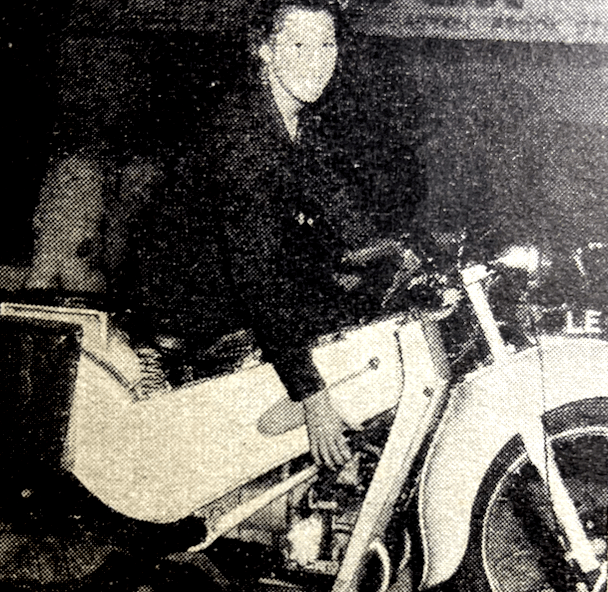
big V-twin engines are now unprocurable, their inspiredly simple chassis houses a Ford four-cylinder 10hp. Villiers are deservedly approaching the festal day on which they can announce that a round million of happy lightweight owners daily sample the VEC brand of joy. Did you approve the Royal Enfield shift of the switches and ammeter from an instrument board to the battery case? I liked it. On the new AMC twins, a gospel is propounded. If you put a lightly sprung saddle on top of spring heels your springs are liable to get ‘out of phase’, and the total comfort may not be quite all you’d expect. So Matchless have hassock seating with twin runnels to drain off water in wet weather. The new Norton twin, credited with the ability to ‘cruise’ at 90mph (on autobahnen or the Pennsylvania Highway) is finished in a rather attractive shade of leaden grey. I find that these lighter colours render those horrible battery and tool-cases definitely less obtrusive. The Douglas torsion rod rear-springing won very lavish praise. It is simple, light in weight, durable in use, neat to the eye, and well spoken of on the road. Coupled to a suitable fork it may even yet
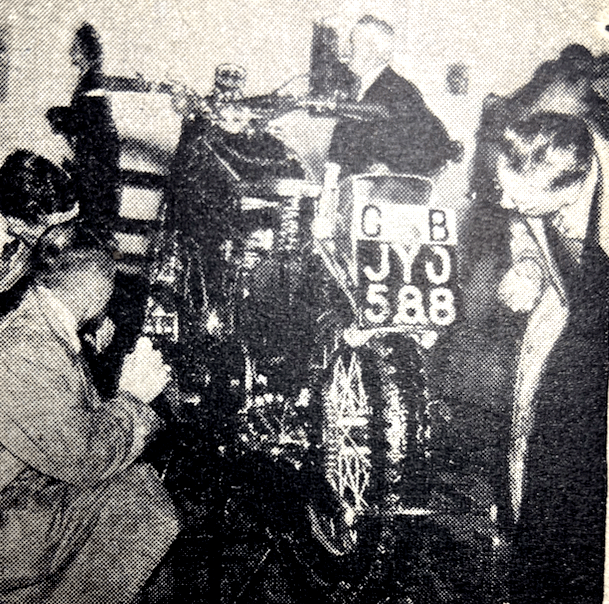
have many imitators. The twin-piston types, so common nowadays, clutter up the back wheels rather noticeably. One of the cleverest exhibits in the entire Show was the Invacar motor bath chair for disabled riders. Believe it or not, it can be devised for safe use, by a man with one arm and no legs! Monty shook hands with one of its exponents who lost both legs in the war. The latest enquirer has two legs but no arms, and they actually hope to design safe controls for him. It is cruel luck that the Ministry of Health, now pledged to cater for all the disabled men, will probably have to bypass the comparatively small firms who composed this industry in the past in favour of negotiating with car factories to mass-produce an output beyond the compass of the small firms. Several very pleasant detachable wheels on exhibition. The rubber people forecast that new processes involving low temperature treatments of rubber may ultimately give us tyres capable of no less than 75,000 miles duration. (They are not joking—they actually accept this as a technical possibility.) But for the moment a quickly detachable wheel is a very pleasant help in trouble. Finally, salaams to Major Watling and his henchmen who organised Earls Court.
*Tranport Minister Alfred Barnes
**Fuel and Power Minister Hugh Gaitskell
“TOTAL NUMBER OF British auto-cycles, motor cycles and three-wheeled runabouts (including invalid carriages) exhibited at Earls Court was 293. Their value, at the basic price and including speedometer on ordinary road machines over 100cc, was £37,326 8s 6d [£1.7 million today]. Cheapest machine in the Show was the Aberdale autocycle at £39 14s 9d; most expensive was the 1,000cc Vincent-HRD Black Lightning 150mph racing twin at £400. There were 29 British makes. The following figures are, of course, based on the total number of distinct and separate models shown, which was 122. TYPE: Two wheels, 111; Three wheels, 11. ENGINE: Two-stroke, 44; Side-valve, 9; Push-rod ohv, 61; Overhead-camshaft, 8. CYLINDERS: One, 92; Two, 24; Four, 6. CAPACITY: 100cc, 16; 150cc, 18; 200cc, 10; 250cc, 4; 350cc, 23; 500cc, 38; 600cc, 4; 1,000cc, 9; IGNITION: Magneto, 112; Coil, 10. LIGHTING: DC dynamo, 69; AC direct, 35; AC rectified, 11. TRANSMISSION: Unit construction, 59; Separate box, 63; Gear primary, 15; Chain primary, 107; Shaft final, 7; Chain final, 115. GEAR BOX: Fixed gear, 13; Hand-change, 15; Foot change, 94; Two-speed, 5; Three-speed; 34; Four-speed, 70. SUSPENSION: Sprung rear, 39; Rigid rear, 83.”
“ALTHOUGH BRITISH MOTOR CYCLISTS have no chance of buying an AJS vertical-twin, these models capture the attention of the crowds on the AJS stand. This is not surprising, because the design embodies the most advanced technical features, including a three-bearing cast-iron crankshaft, separate cylinder castings and light-alloy cylinder heads. Many favourable comments were to be overheard regarding the attention given to detail points, such as the absence of external oil pipes, the use of chromium plated domed units, and the general neatness of the power unit. Wide interest was also aroused by the spring-
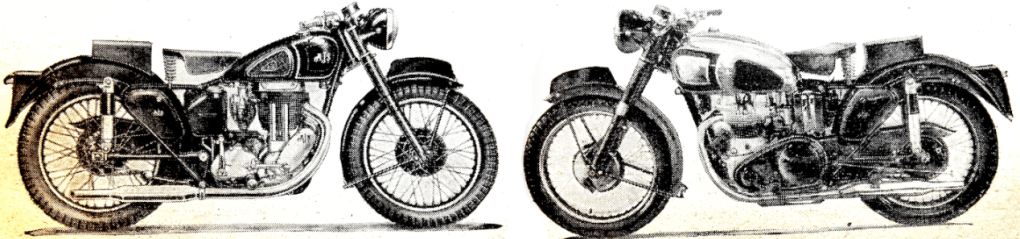
frame which, fitted as standard on the twin and available as an extra for the single-cylinder models, is also in the ‘export only’ category. The layout of the swinging rear fork with Teledraulic legs for controlling. the 3in of wheel movement follows racing practice. The well-known single-cylinder, solid-frame models have been improved in many respects. There are four models: 16M (350cc) and 18 (500cc), and both are available in competition form (16MC and18C respectively); all have ohv engines. Most noteworthy change for 1949 is a new cylinder head, and valve gear fitted with duplex overlapping valve springs of the hairpin type. A redesigned frame has given a number of advantages—the engine is slightly lower, which drops the centre of gravity; a wider rear chain line makes. possible the use of a 4in section rear tyre if desired; a seat tube farther back gives more clearance at the carburettor so that an air-filter may be fitted; a larger oil-tank is accommodated. More obvious changes are a robust yet very neat rear lamp (heavily chromium plated on brass, incidentally), handlebars with unusually long straight portions so that all controls can be fitted between the ends and the curves, and bayonet-fitting tank caps. That highly successful production racing machine, the Model 7R ohc 350, was surrounded by the usual crowds of worshippers—and even bigger crowds swarmed around the racing twin with its elegant Show finish. Paramount among the models on the Ariel stand was the redesigned Square Four. Crowds packed round a beautiful sectional model of
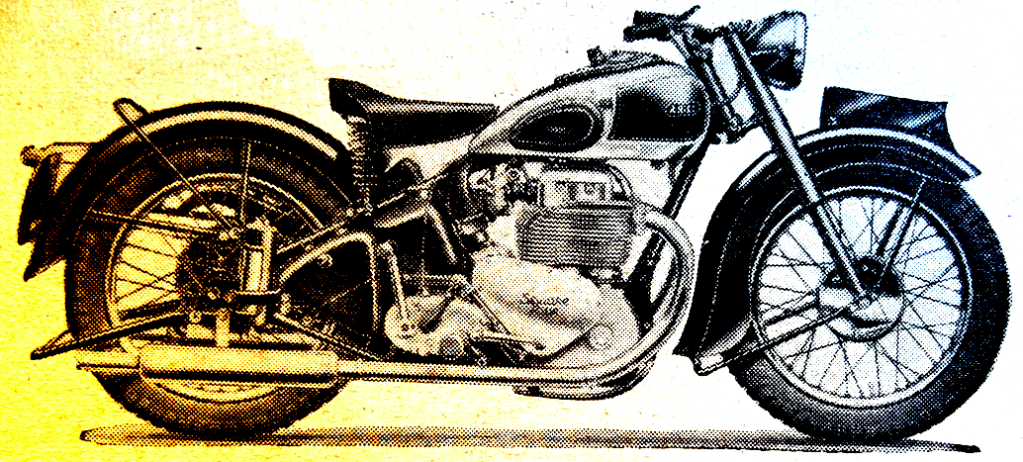
this new engine, which, with its light-alloy cylinder block and cylinder head, is nearly ½-cwt lighter than its predecessor. Iron-alloy cylinder liners are used; and there are nickel-chrome steel valve inserts in the cylinder head. Cylinder block, pistons and liners all have the same rate of expansion under heat, so that very small piston clearances can be used, which should obviate piston slap. Of 997cc, the engine has a single camshaft which operates push-rods for the overhead rockers. The twin crankshafts are coupled by gears. For the front crankshaft a roller bearing is used on the drive-side, and a white-metal-lined bronze bush on the timing side. Drive-side of the rear crankshaft has two roller bearings, one of which is an outrigger, and the timing side has a white-metal-lined bush. Replaceable, white-metal-lined steel shells are fitted to the big-ends of the con-rods. Coil ignition is employed, with a car-type distributor and automatic advance-and-retard mechanism. Second, probably, in crowd-drawing was the 498cc ohv vertical-twin. Twin camshafts operate the push-rods in this engine, of which a cut-away model was on view. A one-piece forged crankshaft is used. Both de Luxe and Red Hunter versions of the Twin are available. The Ariel spring-frame was shown, complete with a sectioned gear box; and there was a sectioned Ariel telescopic hydraulically damped front fork. Other models in the Ariel range include ohv singles of 497 and 347cc in de luxe and Red Hunter forms, and a side-valve de luxe single of 598cc. Green, black and red were the colours used for petrol tanks, and down on to this array of shining machines gazed the sharp features of the well-known Ariel ‘horse’. One of the smartest autocycles at Earls Court was the new Aberdale with 98cc Villiers engine. The frame is of the full duplex cradle type and a link fork is fitted. Finish is an attractive shade of maroon with gold lines and the usual bright parts are chromium-plated. Production is expected to begin about March 1949. Also on the stand was the
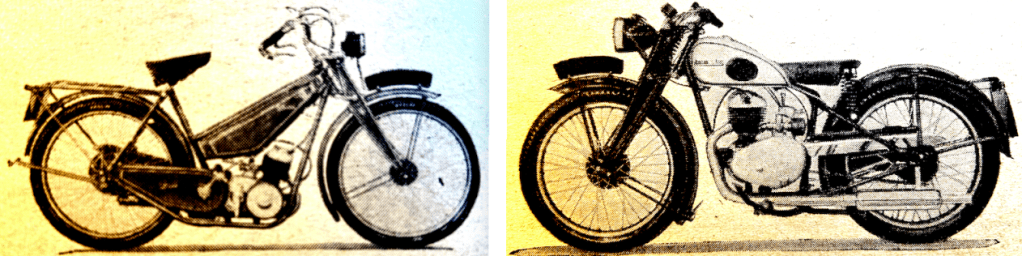
successful standard 98cc Aberdale Auto which is unchanged. No wonder crowds thronged the Ambassador stand from the opening last Thursday till yesterday! The display presented what must have been just about the, ultimate in gay colour schemes. One model was entirely chromium-plated, and there were others in pale blue, maroon and plain black. In its new guise and with the new Villiers 197cc (59x72mm) two-stroke engine-gear unit, the Series III Ambassador appears even cobbier and smarter than before. As those who tried the riding position found, the machine is fully man’s-size. An excellent detail feature is the front stand clip on the front mudguard: slight finger pressure on the clip allows the stand to swing downward ready for use. On the BSA stand was exhibited what must be one of the most comprehensive ranges ever staged by one maker. First, there was the new 125cc two-stroke, the unit-construction Bantam [The Bantam design came from DKW as part of Germany’s way of saying sorry; it was made in a number of countries including East Germany (MZ), the US (Harley 125), Hungary (Czepel), Poland (Sokol)Japan (Yamaha YS-1) and Russia (Moskva M1A). The humble Bantam would become the best selling British bike of all time.—Ed], then a group of side-valve and ohv 250cc models. Next was the ‘B’ group,
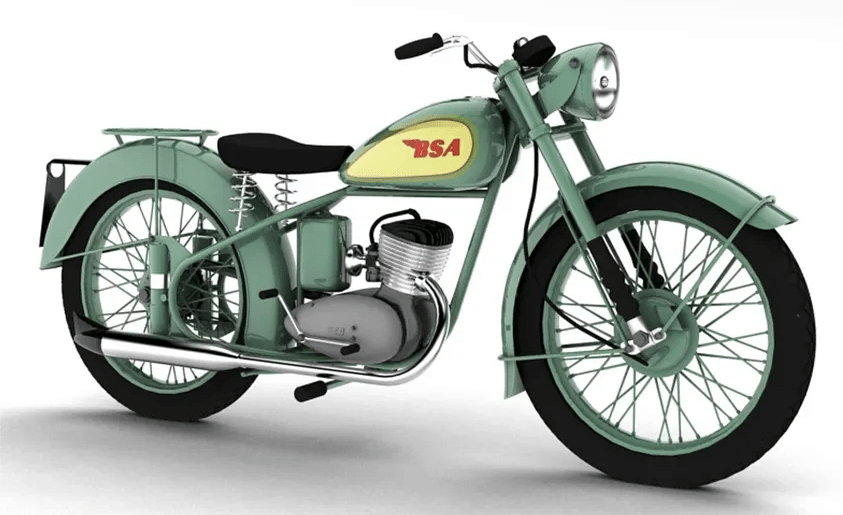
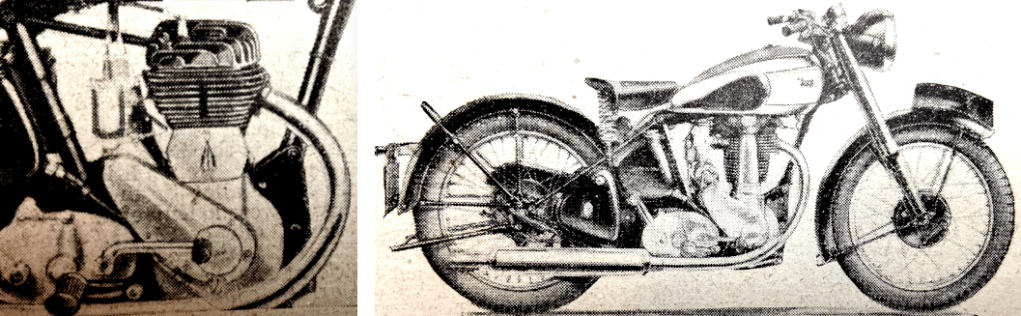
the largest in the range, comprising 350 and 500cc sports and competition models; and following them the ‘M’ group (500 and 600cc side-valve and 500cc ohv types suitable for sidecar work and with integral sidecar lugs in their frames). Finally, there were the vertical-twins, both the standard A7 and a new A7 Star, which has a specially tuned twin-carburettor engine with high-compression pistons. The ‘M’ group are fitted with telescopic forks and so brought into line with the rest of the range; these models have a strong appeal as substantial dual-purpose models. Among oversea buyers the two extreme models, the two-stroke Bantam and the vertical-twin A7, appeared to be the most attractive types. Those both at home and oversea who demand rear-springing were able to see this addition to the specification of both the B32 350cc competition model and the A7 Star. As an extra this plunger-type rear suspension system can be fitted to any of the ‘B’ group and also to the standard A7 vertical-twin, with the proviso that on the B32 and B34 competition models only downswept exhaust pipes can be, fitted. Apart from the rear-springing,
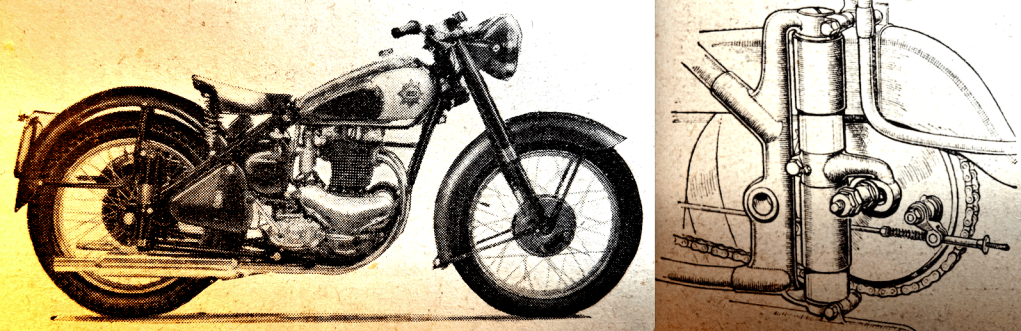
however, the standard rigid-frame B32 and B34 models have their upturned exhaust pipes much more compactly tucked in, the oil-tank being recessed to make this possible. Another improvement that was not obvious to the casual glance was that the ‘M’ type gear box has now been applied to the ‘B’ range. A point noted was that dynamo output has been increased throughout the range by the adoption of a slightly longer dynamo; this permits the wattage of head-lamp bulbs in the 250cc range (‘C’ group) to be increased from 18 to 24. Great interest was displayed by both cycling enthusiasts and motor cyclists in the novel little 98cc two-stroke Corgis. These little vehicles are growing up. On the stand was a number of models with side carriers attached: small, handy sidecar outfits for shopping or for tradesmen. Colours, too, have changed, and in addition to the red and black models of the past, there were others on display in cream, turquoise blue, and one with a cream frame and turquoise blue tank and wheels. The Corgi, of course, is a thoroughly useful little runabout which can be folded so that it occupies only 4ft 5in by 20in by 13in and can be carried in a holdall. The engine is a 98cc ‘Spryt’, a single-cylinder two-stroke in unit with a countershaft clutch. What caused the greatest stir among the crowds round the Douglas stand was the. working, sectioned model of a complete Mark III machine. The wheels were driven by giant cams giving a lift of some 3in yet, so good is the fore and aft suspension, the machine remained perfectly steady. The lower frame tubes were cut away to expose the torsion bars for the rear springing, and by watching a red line painted on the torsion bars one could see the bars twisting. The fork legs were also sectioned to show the working of the now famous Radiadraulic fork, which has long, enclosed, variable-rate springs and a bottom-link action. The Douglas engine is, of course, a 348cc ohv horizontally opposed
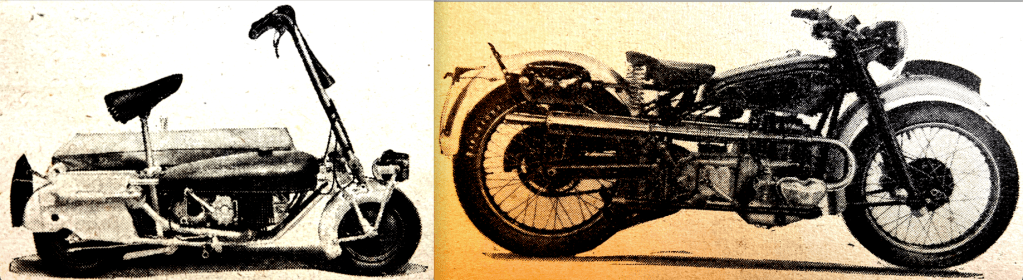
transverse flat-twin. Each cylinder has its own Amal carburettor and, in the case of the new Competition model, an air-cleaner is fitted on top of the gear box. The engine-gear unit is extremely clean externally; there are no visible oil pipes. Lubrication is on the wet-sump principle, with the oil sump cast integrally with the crankcase. A vane-type oil pump is used, which supplies oil directly to the crankshaft. As the crankshaft and gear box shafts are in line with the frame, a bevel gear is employed for the drive to the gear box sprocket. A large coterie of trials enthusiasts could generally be found inspecting the new Competition model, which has no lighting set and which is intended purely for trials and scrambles. Main news at the Excelsior stand was the telescopic front fork fitted to the Universal and Roadmaster models. Springing is effected by a dual spring in each leg, and the movement is 5in. Adjustment is provided by a control rod which is accessible when the caps are removed from the tops of the fork members. Phosphor-bronze bearings are used, and each leg is injected with a small quantity of oil. Primarily for lubrication, the oil allows the bearing at the top of each sliding member to act as a piston, and slight air compression occurs in the static tube, thus a small damping effect is produced. Other exhibits especially to intrigue the crowds were chromium-plated Excelsior Speedway machines with JAP engines, a sectional Villiers 122cc engine and a sectioned Excelsior 98cc Goblin 2-speed engine. Latest model in the Excelsior range of two-

strokes is the Roadmaster, fitted with the new 197cc Villiers engine-gear unit. Its smaller brother is the 122cc Villiers-powered Universal. Two Minors are listed, one of 98cc and the other of 125cc. Both are fitted with the Mark II Goblin engine-gear unit. Three 98cc Autocycles complete the range. These have respectively Villiers, Spryt and Goblin power-units.Only 125cc Czechoslovak machine in production, the CZ has the neat lines that characterise all the Czech machines (all Czech makes were on the same stand, incidentally). The tubular loop-type frame is welded at the joints and the front fork is of simple telescopic pattern with coil springs. Full unit construction is employed, with the three-speed gear box mechanism housed in a rear extension formed by the crankcase halves. The group of lightweights and auto-cycles on the Francis-Barnett stand were as attractive as any models in the Exhibition building. The fact that the firm has been producing lightweights for a quarter of a century and more is clearly reflected by the present-day models, which have Villiers engines of 98, 122 and 197cc and, in the case of the motor cycles, a new telescopic front fork. A single 20in three-rate spring in each fork leg provides a total movement of 5in and, so that wear on the sliding members will not be caused by the ingress of dirt and water, rubber bellows are fitted round the lower fork members. What is especially neat about the fork is the chromium-plated bridge-piece at the top of the legs which forms a mounting for the speedometer. ‘Ingenious’ was the word that was heard when enthusiasts examined the detachable rear number plate. After two bolts
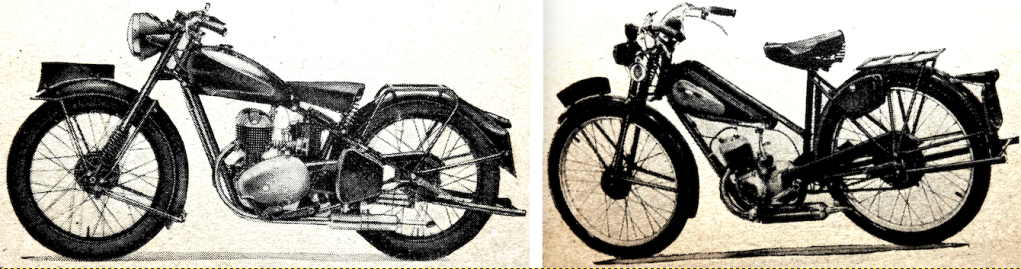
have been withdrawn the number plate can be taken off, revealing an opening the shape of an inverted U in the rear mudguard, which gives clearance for easy wheel removal. An excellent ‘rider’s point’ is the fitting of the separate, three-pint oil tank which is provided so that it is not necessary to buy very small quantities of oil each time petrol is put into the tank. Except for a reinforcing stay that has been added to the front fork, the Power-bike remains as it was for 1948. The fork, incidentally, has a link action and rubber ‘springing’. The exhaust system is impressive there are large expansion chambers which allow triple expansion of the gases before they pass into the open air. There was everything for the two-stroke enthusiast on the James stand. Two autocycles were shown (one of which is an entirely new model), and three sizes of lightweight motor cycles (98, 122 and 197cc). The 98 and 122cc lightweight motor cycles can be ordered with an alternative de luxe specification that includes a rectifier and battery. Visitors to the stand were interested in the new protection bars cum legshields that can be fitted as an extra on the motor cycles. Fitted with the same type of front fork and steering head lug as employed on the motor cycles, the new Superlux autocycle has the latest 98cc Villiers 2F single-speed engine. Each of the lightweight motor cycles has one of the latest Villiers two-stroke engine-gear units. The same frame and front fork pattern is used for all the motor cycles. Of full loop type, the frame is made up of four separate tubes. Brazed or welded lugs are used, one of which provides mountings for the footrests, central stand and rear brake pedal. Working on the parallel-ruler principle, the front fork consists of two brazed-up, weldless-steel, straight tapered tubes. Also to be seen on the James stand were complete Villiers engine-gear units of the three sizes—98, 122 and 197cc. Most widely known name among Czechoslovak motor cycles, the Jawa now represents only one model—a 250cc two-stroke which, in competitive events such as the International Six Days’ Trial, has proved itself as a thoroughly sound machine. Many of the features
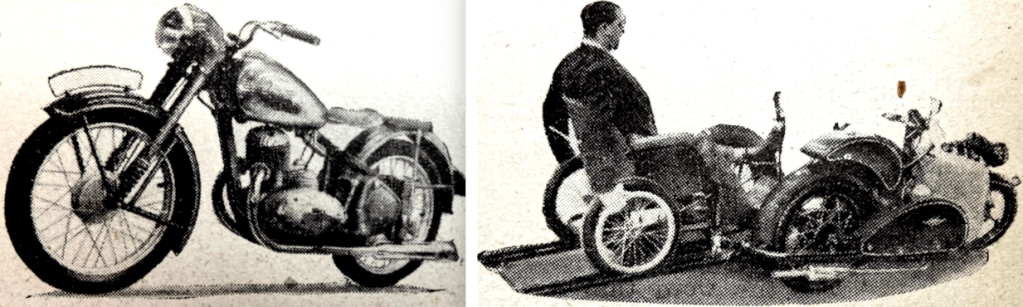
which add to the elegant appearance of this machine have practical merit. For example, the top covers of the telescopic fork legs merge into the headlamp shell and obviate headlamp brackets; a light-alloy cover enshrouds the carburettor, with its oily overflow, and is finned to match the cylinder and crankcase finning; shapely side covers of the crankcase casting (which embraces the gear box) enclose the primary drive on the near side and the flywheel generator on the off side. Other features include plunger-type rear springing and a saddle pivoting at the nose with adjustment for spring tension. The results of such wide practical experience have been embodied in the Invacar vehicles marketed in the past that improvement seemed almost unnecessary. But, by introducing a new model designed to carry a house chair, a fresh market is embraced. Some invalids are so seriously incapacitated that the aid of two or three strong attendants is required for a move from one seat to another—aid which may not always be available. With the New Era Invacar the difficulty is overcome because the invalid can wheel himself in his mobile house chair up the ramps on to the chassis. New Era models are available for one- or two-arm control and with 122cc or 197cc Villiers engine-gear units. The range also includes normal-type invalid carriages with similar variety in control layout and engines. In spite of attractive new Matchless features, it was not surprising that the sleek-looking singles had some of their thunder stolen by the new 498cc vertical-twin,
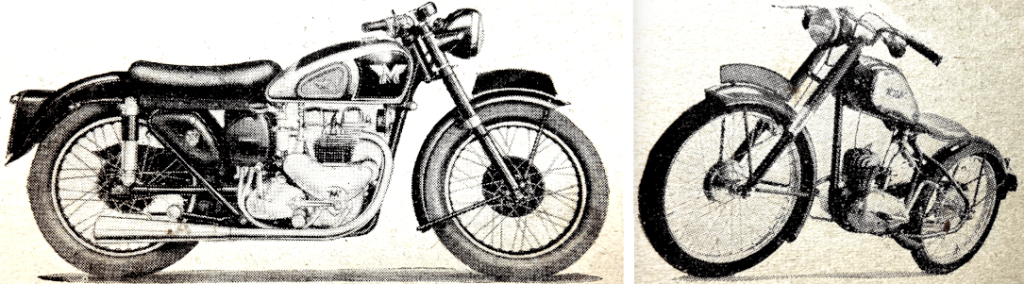
the Super Clubman model G9, two examples of which were on view—when one could get near enough! Chief interest centred in the extremely clean power unit, with its three-bearing crankshaft, separate cylinder barrels, aluminium-alloy heads and totally enclosed valve gear. Even the push-rod tunnels could not be seen without going down on all fours. A somewhat racy appearance is given by the integral Dunlopillo upholstery in place of a normal saddle; there is ample room for a passenger (pillion footrests are fitted), or for getting down to it. There were whispers that the fleetness of the model is in keeping with such looks. Next to the new engine, the Teledraulic rear suspension claimed a lion’s share of attention. Redesigned cylinder heads with fully enclosed, duplex, overlapping hairpin valve-springs characterise the new singles, comprising rigid frame (G3L), spring-frame (G3LS) and competition (G3LC) 350s, and similar 500cc models respectively, G80, G80S and G80C. Chromium and maroon tanks and rims are available at extra cost. Among the 20 machines on the stand were a 1902 2¼hp single with automatic inlet valve and a 1912 6hp V-twin with pedalling gear—a cunning contrast between ancient and modern. Over the years, three-wheelers have come and gone, but the Morgan is always with us. A flaming red, rorty looking two-seater (the F Super), a blue and black four-seater (F4) and a four-seater chassis comprised the Morgan exhibit. The chassis had part of the gear box shell cut away to give a full view of the innards. So simple is the Morgan layout that it was unnecessary to section any other components to show how everything
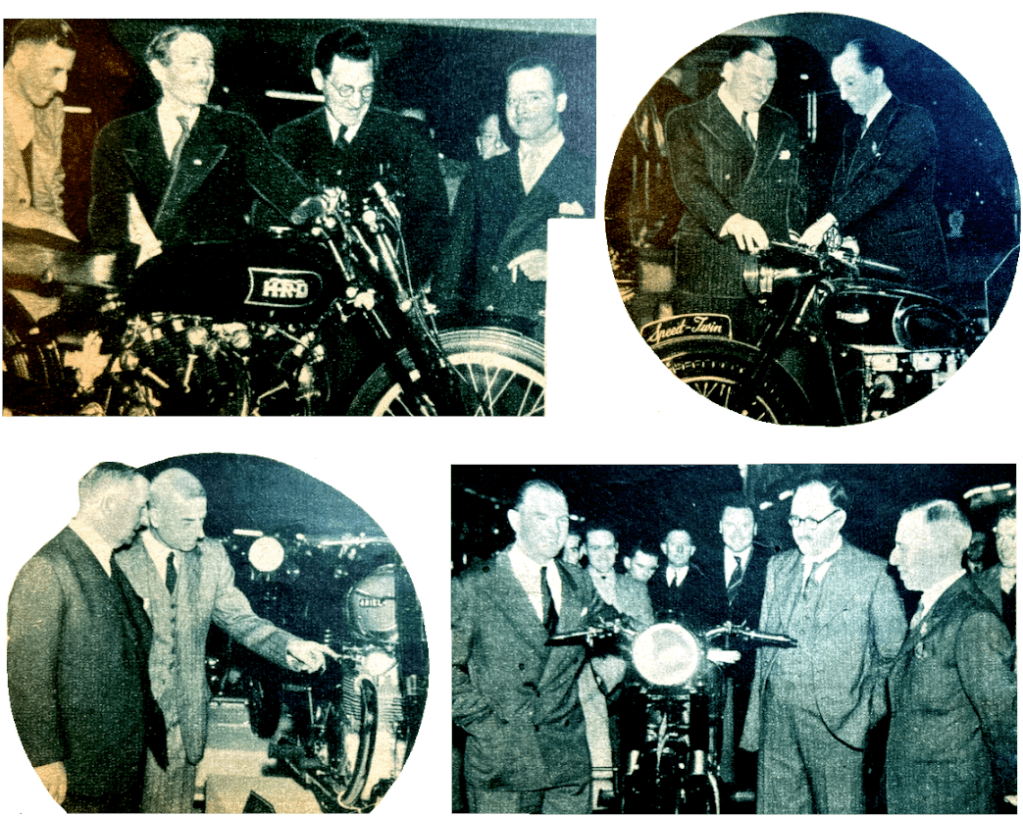
works. Both models are powered by the Ford Ten (1,172cc) four-cylinder, water-cooled car engine, a lively unit which, with the excellent power-weight ratio of the Morgan, results in a most interesting performance. Both have independent front wheel suspension by means of coil springs, and on both models the rear wheel is carried in a pivoted horizontal fork controlled by quarter-elliptic leaf springs. Final drive is by roller chain. Longer gear and brake levers, which come more readily to hand, have been installed and the radiator mounting improved. Many eyes looked longingly at the snug cockpit of the F Super, and many a family man displayed equal interest in the four-seater, the weather protection of which is well carried out with ample hood and side-screens; when not in use, the latter, it was noted, stow away neatly on a shelf provided under the facia board. Amid a sea of gleaming pedal cycles on the spacious Stand 24 posed one modest and lonely autocycle, the New Hudson, finished in sombre black. Enquiries elicited the information that an entirely new model, with the latest Villiers 2F autocycle engine, is on the way, but it is likely to be a month or two before details are available. Meantime the existing model was left to hold the
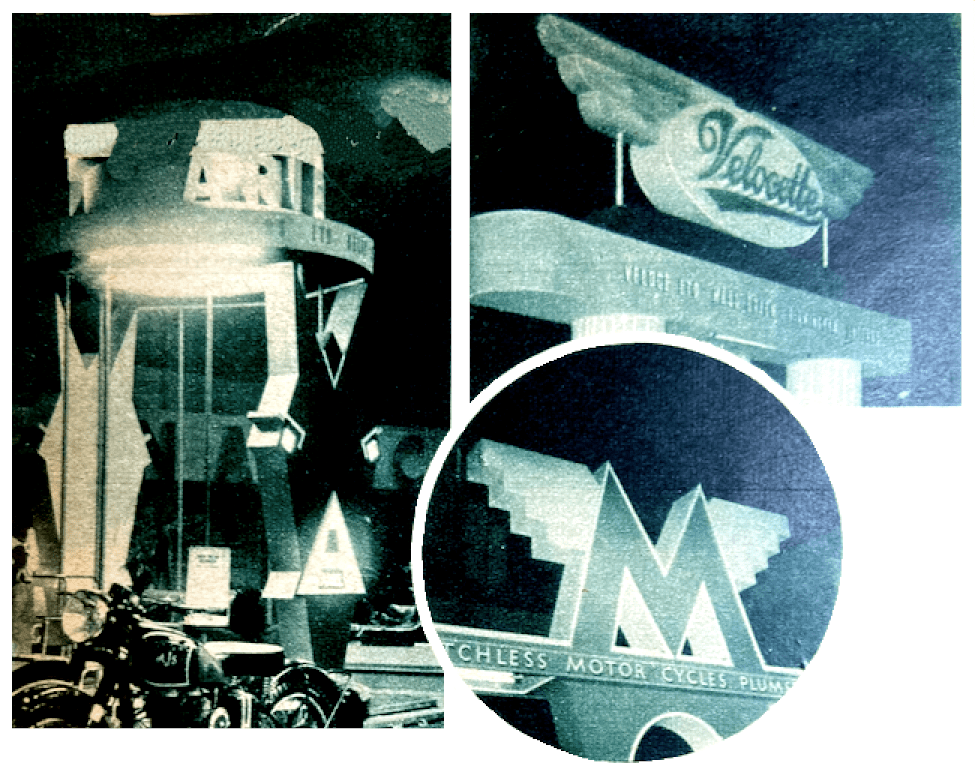
fort alone. Incorporating the Villiers 98cc Junior de luxe engine, the New Hudson auto-cycle is a sturdy machine equipped with a Webb girder-type spring fork of pressed steel, and very efficient-looking internal expanding brakes front and rear. A feature of the machine is the quickly detachable side-shields for the engine unit. Introduced about a year ago, the Manet is the smallest Czechoslovak machine in production. The 90cc two-stroke engine is unusual in that it is of the two-piston single-combustion chamber type. The three-speed gear box is in unit with the engine and operated by hand or by pedal—there is, however, no positive-stop mechanism. Frame is of simple, tubular, loop pattern and there is a telescopic fork; the latter is provided with hydraulic damping. There were so many exhibits of exceptional interest on the Norton stand that it is difficult to know which to mention first. Probably the vertical twin deserves pride of place, because it is new. Much attention has been paid to cooling, and the exhaust ports are widely placed in order to embrace the incoming flow of air. With its large petrol tank, semi-gothic mudguards and clean power-unit, the new twin is a good-looking machine. Bell’s TT-winning Norton was on view, and, also for those who liked looking at machines that had given battle, there was Jack Williams’ ISDT machine, still coated with its Italian mud. The crowds seemed very pleased that real Italian mud could be seen and touched on an Earls Court exhibit! Sectioned Model 18 and 16H engines were on show, and a sectioned Road-holder fork. The engine of the Twin was displayed on its own as well. Norton general colour-scheme is, of course, silver-grey, chromium and black, but one of the twins on show was finished in a beautiful polychromatic blue. This it is understood, is a purely experimental colour-scheme at present. The crowds
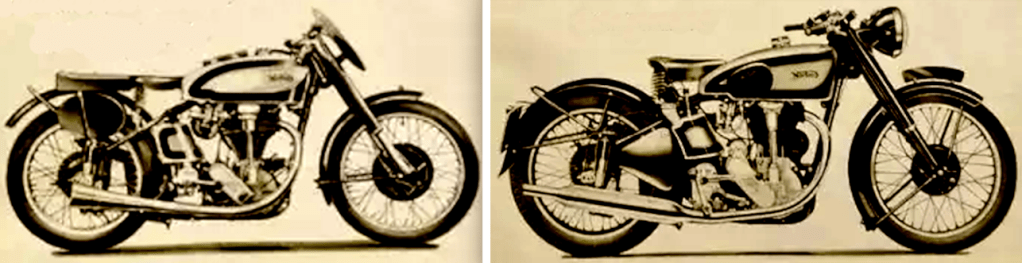
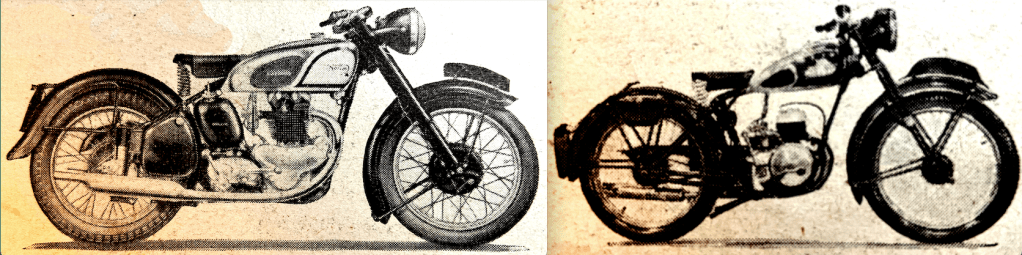
could also see a collection of silverware that included the Senior TT Trophy. Other interesting Norton exhibits were a Model 30 (International 500) with an aluminium-alloy cylinder head and barrel, and the ohv 500 competition model. The full range of Norton motor cycles is as follows: 16H 490cc side-valve, No 1 (Big 4) 596cc side-valve, 18 490cc ohv, ES2 490cc ohv, 30 490cc ohc, 40 348cc ohc, 30 Manx 499cc ohc, 40 Manx 348cc ohc, Comp model 490cc ohv, and the new 497cc ohv Twin. There is also a Model G sidecar. Plunger rear springing is fitted, to all except the side-valves and Model 18. Three attractive new models were examined with interest on the Norman stand. They were B1 and B2 lightweights, incorporating respectively the new Villiers 122cc and 197cc engine-gear units with foot-change, and the model C, a new autocycle housing the latest Villiers (2F) 98cc ‘upright’ autocycle engine. The B1 and B2 have straight-tube frames with the engine plates forming a cradle, new oil-damped telescopic spring forks and adjustable footrests and brake pedal mounting. Visitors to the Ongar stand might well have been excused for glancing at the exhibit and imagining it was another Jawa with a finish in an alternative colour. In fact, the Ogar is a side-by-side twin two-stroke with the characteristically clean design which distinguishes the Jawa. Difference between the machines is confined to the engine which for the Ogar has a capacity of 344cc. For most people the Show provided the first opportunity of seeing the vertical engine
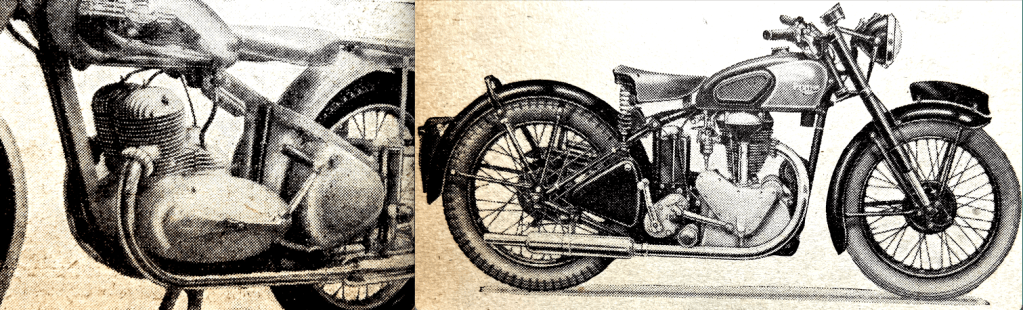
250cc and 350cc Panthers which have been observed from time to time in trials during recent years. Undoubtedly they made a very good impression, their neat and workmanlike lines being enhanced by their Dowty telescopic forks. Other points to be noted were the frame, which is now a complete cradle loop, and the use of the well-tried Panther roll-on rear stand for the 350cc model. The raising of the cylinder from its previous forward slope to the vertical position has not involved other engine changes, and the long-established semi-dry sump lubrication system is retained, the oil reaching the sump by being flung centrifugally off the flywheel rims. To improve sweetness of running and to reduce mechanical noise, lead-bronze plain bushes are substitutes for the ball and roller main bearings formerly employed in the 250 and 350cc sloping cylinder engines. All electrical equipment is now of Lucas make, the 250cc model having coil ignition, while the other models have magneto. A Lucas 40-watt dynamo is fitted at the front of the crankcase and is gear-driven; the coil ignition contact-breaker (or magneto) is flange fitted to the timing case behind the cylinder. In addition to the normal machines, ‘Stroud’ competition models were also shown, and the famous 600cc Model 100 appeared in its well-established and familiar form. A Model 80 (490cc) was also shown. In these two last machines the engine is inclined and cylinder head, cylinder barrel and crank case are held together by long rods which, in effect, act as the down tube of a normal frame. For export only, and designed for the Chinese, Indian and Malayan markets, the Pashley Rickshaw attracted the attention of numerous interested motor cyclists. The vehicle (supplied in chassis form only) i
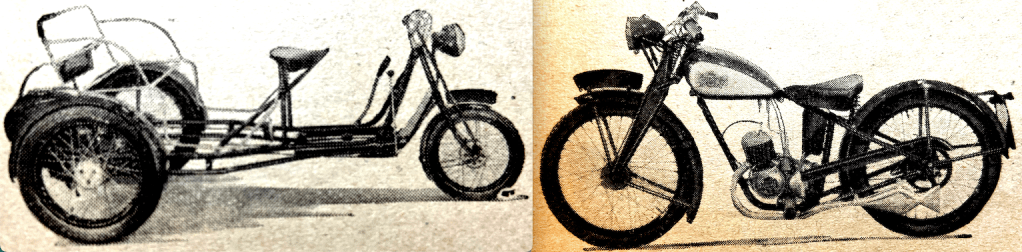
s a three-wheeler with a saddle, handlebars and controls for the driver at the front and a seat for, say, three persons at the rear over the engine. Fan-cooled the special 250cc Villiers engine has coil ignition and drives the rear axle through a three-speed gear box and a differential. There were two attractive Show surprises on the Sun stand—a neat 98cc autocycle and a smart 98cc light-weight two-speed motor cycle. Villiers engines are employed. Finish is brown, with cream tank panels. For traders whose business involves carriage of goods, one of the best attractions in the Show was the Reliant 8cwt three-wheeler van. Also shown was a chassis. Powered by a 747.5cc four-cylinder water-cooled Reliant engine and incorporating Hardy Spicer transmission features, Girling brakes and Burman Douglas steering, the extremely sturdy layout has a single wheel at the front suspended in a girder-type tubular fork. The van model shown has a capacity of 74 cu ft. This vehicle is also available as an open truck. There were three special attractions on the Royal Enfield stand. First, there was the new 500 Twin, secondly the new 350 Bullet and thirdly the actual machine on which Charlie Rogers took part in the ISDT. Other attractions were the well-known 125cc ‘Flea’ (Model RE), the standard ohv 350 (Model G) and the export ohv 500 (Model J2). Feature of the new vertical-twin is that it has two entirely separate cylinder barrels and heads. Thus

each cylinder and head should receive a particularly effective flow of cooling air to circulate among the fins. The aluminium-alloy cylinder heads each have two integral rocker boxes. Oil-damped, swinging-arm type rear springing is used. Ignition is by coil, through a distributor driven by a skew-gear off the dynamo shaft. The dynamo itself is driven by a chain. Developed from the trials machine announced last March, and from the machines that were so successful in the 1948 ISDT, the new 350 Bullet is an ohv sports model that is equally suitable for fast touring, trials or scrambles. Alternative specifications are available to suit the purpose for which the Bullet is required. On view was one in scrambles dress, with knobbly tyres and straight-through exhaust pipe. Before the war, the Bullet was a well-known name for sports Royal Enfields, and it is pleasant to find the name re-introduced for 1949. Both the Twin and the Bullet are finished in a business-like but attractive naval grey. With the same spring-frame as employed on the Twin, the Bullet is a handsome and comfortable motor cycle. It has a wide-ratio gear box as standard. Now finished in maroon, the ‘Flea’ has a rubber-sprung girder-type front fork, and is specially designed to keep weight down to a minimum. It is noteworthy that the Royal Enfield spring frame is not listed as an extra, but is built into the twin and the Bullet as part of the basic specification. Although the Swallow Gadabout with box sidecar is a commercial vehicle, it lacks nothing in eye-appeal. The tubular chassis of the sidecar forms a unit with the frame of the machine; all joints are welded. Capacity of the box: 11 cubic feet. Maximum payload: 2 cwt. The Villiers 122cc Mark 10D engine-gear unit is fitted, on which the three gear
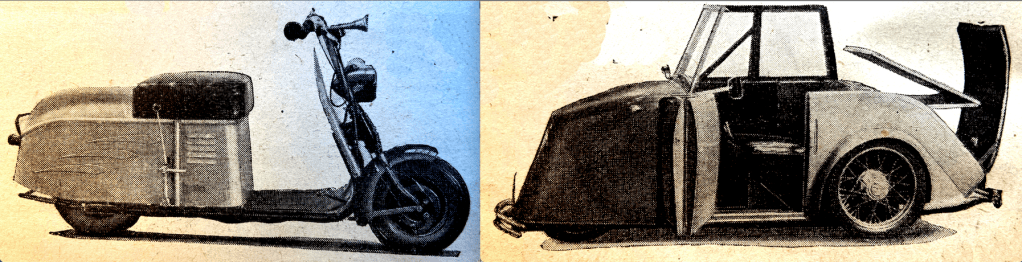
ratios are selected by a foot control. To assist cooling a fan is mounted beside the engine. The gay colours of the familiar Mark I Gadabout heightened the commendable general brightness of the stand. Machines were shown finished in cream, pale blue, amaranth red, and black. This solo model is continued unchanged. Invalid carriages with Villiers engines or electrically driven are in the Argson range. Considerable interest was aroused by the new all-weather model which has a saloon body of streamline design. The very wide door hinges in the middle and the roof can be folded back into the luggage boot. The operation of opening the roof can be accomplished by the driver when seated because the boot lid is raised and lowered by a lever at the side of the seat squab. This model is electrically propelled. Villiers 147cc fan-cooled engines are fitted to the petrol-driven models. The 33M has a two-speed gear incorporated with the differential; the Victory model is fitted with a separate two-speed chain-driven Albion gear box and chain drive to the near-side wheel. The 1950 models of the 98cc Sun will have
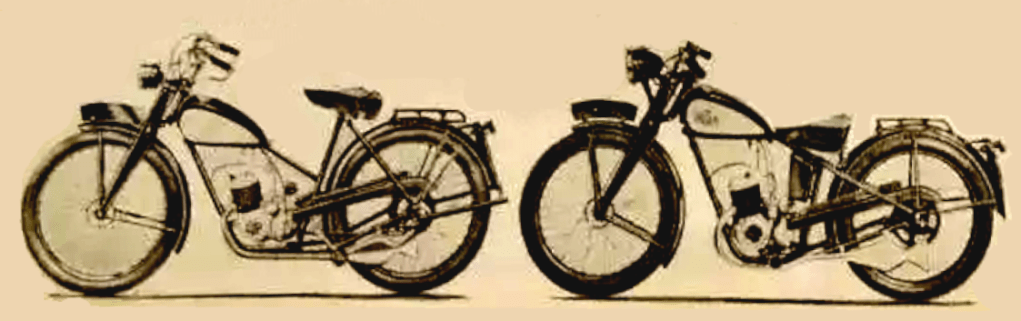
frames built up entirely of separate tubes and cast lugs instead of the part welded method of construction used in 1949 models. This new method will enable damaged frame tubes to be replaced without the necessity for replacing the complete frame. The specification of the autocycle remains unchanged. The motor cycle has the Villiers 1F 98cc two-stroke engine, incorporating a two-speed gear with handlebar gear change control; ignition and lighting are by the Villiers flywheel system. The Mark 21 98cc single-speed Villiers engine and a similar for and tank to those fitted to the motor cycle are included in the autocycle specification.” For decades the name Sunbeam has been synonymous with all that is best in motor cycles. There was hardly a visitor to Earls Court who did not pause at Stand 25 to pay homage to the modern ‘Beam, with its 487cc in-line twin-cylinder ohc engine in light alloy, unit-construction, shaft-drive and telescopic fore and aft suspension, and to study the sectional S7 model which showed details of the engine, gear box, worm drive and front fork. Familiar black finish of the large-tyred S7 had given place to a new look, a tasteful ‘mist green’. Much interest was shown in the new S8 and in a sidecar outfit. The S8 is faster and lighter than the S7, has smaller-section tyres, narrower mudguards, oil-damped front fork, handlebars with conventional controls, and a higher
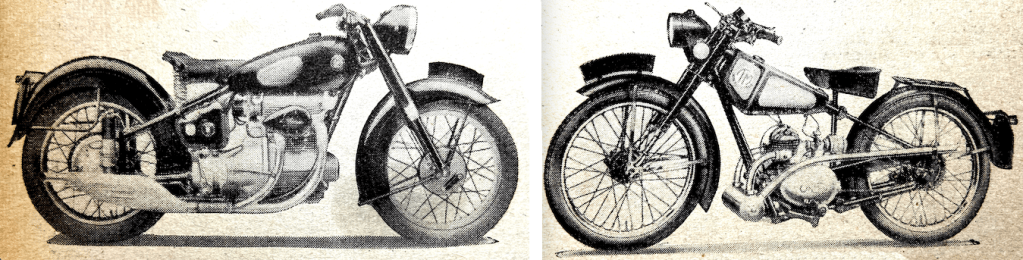
compression ratio. Suitable gearing for the sidecar outfit is achieved by a reduction in the worm drive. ratio. Unusual frame construction is employed for the Tandon. The frame is of the duplex cradle type and all tubes are straight. Light alloy is used for the steering head and other lugs which are of the clamp type. An all-chromium model with cut-away front fork was on the stand. The neat telescopic front fork has knurled, chromium-plated hand adjusters for spring tension at the top of the legs. Another feature is the commendably long tool compartment in the top of the fuel tank, above the frame tubes. A Villiers 122cc Mark 9D engine-gear unit is fitted and the exhaust system incorporates a cylindrical expansion chamber across the down tubes of the frame. Undoubtedly one of the highlights of the Show was the Triumph Speed Twin. Yet this was not a new model making its first public appearance. It was introduced in 1937 as a 1938 model and has since then earned for itself an almost legendary reputation. The new handlebar nacelle came in for especial attention from the lynx-eyed, critical enthusiasts. Comment generally was
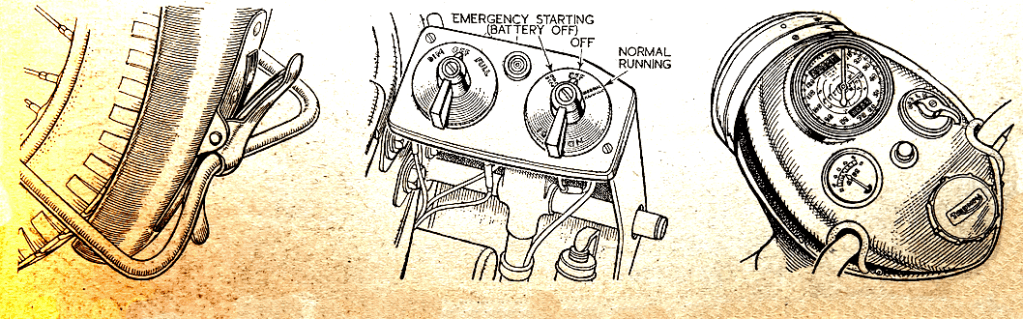
more than favourable, and the opinion was that the appearance of the already trim Triumphs is most certainly improved. The riding position, too, is improved (especially for riders of small stature) by the new handlebar bend, which has reduced the ‘reach’ between saddle and handlebars. Another feature of the 1949 Triumphs is the useful and extremely neat tank-top luggage grid*. Trials enthusiasts, particularly, were loud in their praise for the new 498cc Trophy model which made its first public appearance last week. The new model is developed from the successful Triumphs used by Allan Jefferies and PH Alves in the International Trial. Except for the cam form the engine ‘basement’ is identical with that used in the Tiger 100, and the top half is similar to that used in the racing GP models (except that there is only one carburettor). Total weight is 3041b—very good for a 500. Also on the stand was a working model of a spring hub*, two sectioned spring hubs, and two sectioned engines and gear boxes. And not the least interesting exhibit was Allan Jefferies’ actual ISDT. machine. [*Riders in my age group will know all about those tank-top grids and sprung-hubs (as we called them). The grids were fine until you hit something and slid forward, in which case any dangly bits could be painfully modified. The sprung hub, with about 2in of undamped suspension, wasn’t much cop but came into its own when being stripped down by enthusiastic amateurs. A chum of mine clearly heard the buzz as a spring just missed his ear before
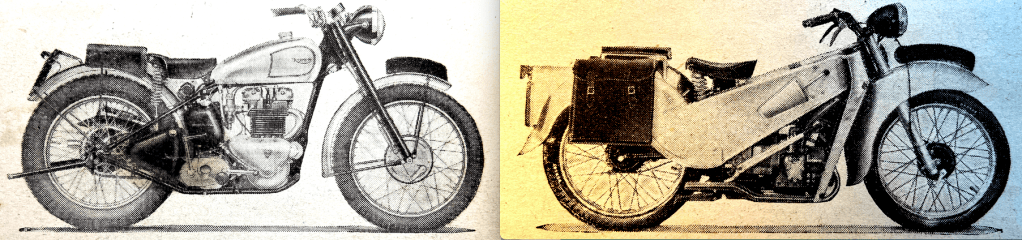
smacking loudly against the shed roof.—Ed] Full opportunity was given to the visitors on the Velocette stand to see the new Model LE 149cc Twin. There were 10 of these revolutionary models on show, and two engine-gear, shaft-drive units. Judging from the crowds that packed round the machines, the interest was very great. People could also see the Junior TT Trophy. Designed as an ‘Everyman’ model, the new Velocette is a water-cooled, horizontally opposed, transverse, side-valve twin with rear springing and a telescopic front fork. The gear box is in unit with the engine and the drive is taken to the rear wheel by a shaft running inside the left-hand swinging-arm member of the spring frame. There is a hand starting lever, which also pulls up the central double-sided prop stand of the machine. Mudguarding is exceptionally efficient, and the rear guard is welded to the steel pressing that forms the main backbone of the frame. The whole machine bristles with novelties. For instance, the battery is carried underneath the saddle, and may be reached merely by disconnecting the saddle springs and tilting the saddle forward. Footboards are used, which provide two foot-levels for the rider. Large pannier bags are fitted as standard. The spring frame tension may be adjusted by moving the spring anchorage through slots in the rear mudguard. There is a neat tank-top tool box with two compartments. A gate-change hand lever controls the three-speed gear box. Mounted at the front of the engine is a BTH generator for both lighting and ignition. Two other models were on view at the Velocette stand: the famous Model KTT 350cc ohc racing machine, and Model MAC, the standard ohv 350. The MAC is fitted with a Dowty air-spring, oil-damped front fork, and is, for 1949, the sole representative of the Velocette push-rod class. Ten sleek Vincent HRDs—no wonder Stand 10 was a Mecca for enthusiasts from all over the country! Of the seven
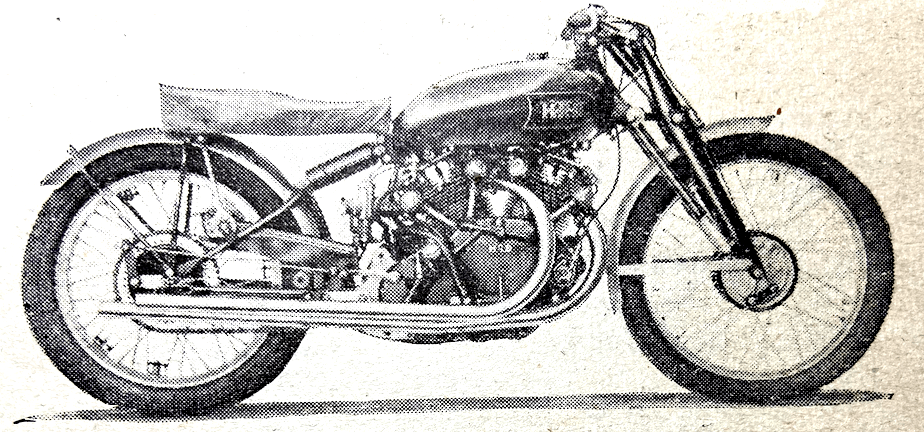
models in the range, it was impossible to choose one that was the most interesting; but the majority voted the 998cc Rapide the popular favourite. Since its inception as one of the first true post-war designs, the Rapide, with its powerful 998cc engine and comparatively light weight, has established itself as undoubtedly the world’s fastest standard machine. Now, its dark sister, the Black Shadow, is even faster! In order to keep fully in step with the phenomenal performance of the big-twins, the new Girdraulic front fork has been designed. What impressed those visiting the stand who tried the fork were its soft easy action both on compression and rebound, and the massive proportions of the light-alloy fork blades. A point that emphasises the ingenuity behind the design is that should the machine be wanted for sidecar work, the fork trail can be altered merely by turning the eccentric top mounting for the spring units through 180°. The single-cylinder models are very much ‘half a Rapide’. The Comet in particular embodies the majority of the well-known luxury features of the make: the new fork, Feridax Dualseat, spring-frame, 50-watt dynamo, and four brakes. The rear brake pedal, incidentally, can be adjusted for both height and length without interfering with the brake adjustment. Also on the stand was a sectioned Rapide engine. Enthusiasts crowding round praised the clever method of valve operation. There was also a speedway engine which has what is basically a pre-war Comet crankcase and timing gear, and a Rapide cylinder and head. As with most speedway engines, this one has total-loss lubrication and a clearly functional appearance. This horizontally opposed four-cylinder Wooler was one of the most unusual and striking
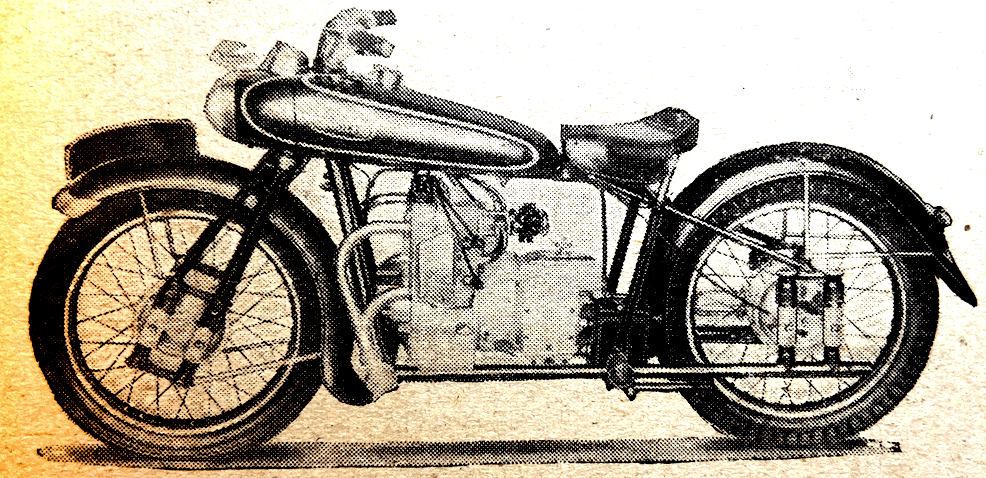
designs in the Show. Not only the engine, but the whole general design is unconventional. The engine is unorthodox in having a beam motion. The pistons are directly opposed in two pairs, with the horizontal cylinders lying vertically above each other. Piston movement is applied to a rocking beam, which in turn drives a normal connecting rod. A four-speed gear box is incorporated in the engine. Transmission is by shaft to a spiral bevel hub. Duplex plunger type springing is incorporated at both the front and rear. Twin Amal carburettors are employed on the semi-sports model. Lighting and ignition are provided by Wico-Pacy magneto-generator at the front of the engine and driven from the crankshaft. Other novel details are the use of the lower frame tubes as exhaust pipes, and the carrying of the tyre pump in the transverse frame member on which the footrest brackets are mounted.
ACCESSORIES: IT IS, OF COURSE, an age-old custom to display one’s wares. When, however, the practice is carried out in an orgy of mass exhibitionism, then indeed is a pervading influence conjured. The London Motor Cycle Show at Earls Court was dusty, tiring, noisy, happy, brilliant, brittle and exciting. Moreover, the great hall, of which the roof is like a sky, seemed to possess an air of fairgrounds and sideshows. The long aisles of accessory stands that skirted the models glittering in the middle of the hall were, if one took notice of their position, sideshows; but the accessory manufacturers are all-important: without them motor cycles would be skeletons, or less. Not far down the left-hand aisle of these accessory exhibits was the stand of the Albion Engineering Co. Here one could see a heavyweight 4-speed gear box with a new neutral-selector that is operated by the kickstarter crank. Located on the kickstarter-crank spindle housing (inside) and pegged to the kick-starter return-spring cap is a double cam, which moves round with the spindle as the crank is depressed. One cam engages with one end of a bell crank located on the squared shaft that works the operating spoon and thereby the gear selector. Which cam is brought into play depends on whether bottom gear is engaged or one of the three higher ones. It is impossible to overshoot neutral into bottom gear because of the wedging effect of the double cam on the bell crank. Albions were also showing a new device on their racing gear box. This innovation is a rearward extension to the end cover, for mounting an outrigger fulcrum-pin that provides a set-back position for the foot-change lever. Two holes in the fulcrum-pin arm provide adjustment for length of lever movement. For grass-tracking and ordinary work, the lever can he changed over to the normal forward fulcrum-pin. A visit was next paid to the stand of Feridax. Relentlessly, a large cam-shape wheel was pushing up and down the rear wheel of a model equipped with the latest Feridax bonded rubber suspension. Designer Bob Collier was in attendance, explaining that the rubber-bush swinging arm is of
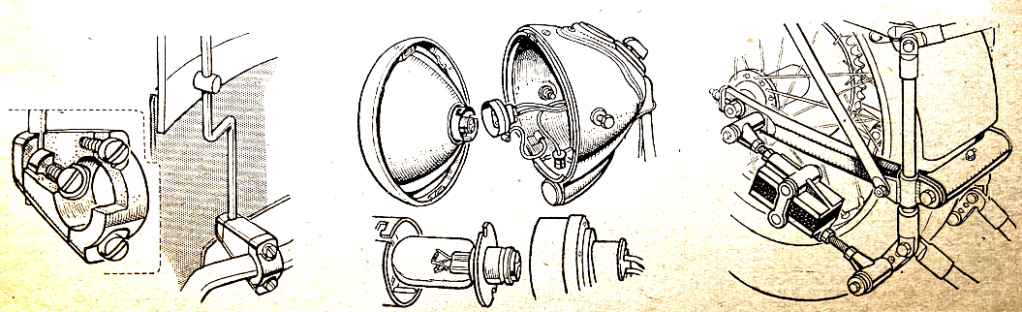
the Feridax-McCandless type and that the normal movement of the rubber in shear is in the ratio of 1 to 3 with the up and down movement of the rear wheel. Alteration of ground and mudguard clearance is made possible by draw-bar adjustment to the top and bottom mountings of the bonded rubber. For their psychological effect, safety links are incorporated in the bonded rubber unit, but it is stressed that these are not necessary in practice. Weight of the bonded unit is about the same as that of a Feridax-McCandless hydraulic spring-member. The rear part of the frame is fully lugged. Also shown was a tubular, parallel-link-action front fork, with the bonded rubber unit taking the place of a normal central compression spring. Among the other Feridax exhibits was a Perspex racing windscreen braced in front with high-tensile wire struts. This has been tried out successfully at very high speeds on a Vincent-HRD Black Lightning. There was also a pair of adjustable security grips for bracing the knees in a racing position when getting down to it on the Dualseat. New on the stand of Bowden (Engineers) was a single-ratchet type front brake lever useful for sidecar outfits. A button protruding through the lever handle releases the ratchet. Highlight of the British-Thomson-Houston stand was the PEC combined generator and ignition unit specially developed for the new 149cc Velocette Twin. The PEC unit provides coil ignition (and emergency starting if the battery is run down) for an engine capable of 6,500rpm. There is also ample power for lighting. A new tyre was seen on the Goodyear stand. It is called the Grasshopper and is designed for competitions. Approved by the ACU for trials, the tread has rugged spear-head blocks said to be self-cleaning. Sharp-edge side-buttresses help the tyre to grip in mud. Dunlops gave details of a new tyre (size 2.25x2lin) and a special motor cycle type wheel rim, both designed for use on autocycles. On the Avon India Rubber Co’s stand was another new tyre, the Avon Supreme Special. One learned that the ACU had also approved of this tyre’s rugged tread for trials. Lucas were displaying their new sealed glass-and-reflector unit, together with the fixed-focus bulb. Vincent-HRD machines and the racing AJS Twins are examples of motor cycles now using the new full-flow Tecalemit oil filter that has been developed from a similar filter already employed in car, lorry and aero engines. Of special felt, the replaceable element is mounted on tinned, coarse-mesh gauze and has a star-section formation. Oil-flow
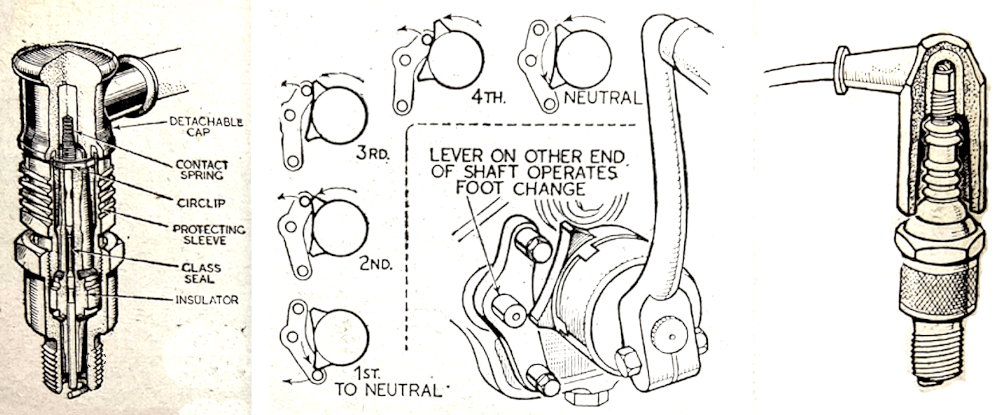
is from the outside to the inside of the filter. Size for 1,000cc machines is 4xl¾in. Set to a predetermined pressure, a spring loaded, mushroom-type by-pass valve acts in emergencies caused by extreme neglect or ultra cold weather. Wellworthy Piston Rings possess the sole British rights to operate the American Al-fin process of chemically bonding light-alloys and ferrous metals. The process results in complete chemical fusion. Advantage from the motor cycle point of view—in bi-metal cylinders, brake drums, etc—is that there is no heat break at the junction of the materials. Defence against water has been studied by the plug people. Champions were showing a push-on, elbow-type plastic waterproof cover for 14 or 18mm plugs. Lodge had one also, and exhibited one also, and exhibited four completely waterproof plugs working with all but their electrode ends immersed in water. Incidentally, a Lodge racing plug can be used to start from cold, warm up and race! Featured on the KLG stand was the new Watertight plug with its attractive Passivated finish. Among the new accessories shown by John Milverton were a chromium-plated bumper-and-badge bar, a stream-lined, die-cast, aluminium-alloy front number plate, an aluminium-alloy finned exhaust nut, and a pillion seat specially designed for the S7 Sunbeam. Hughes Motor Fitments were displaying a new die-cast, light-alloy clip adjustable in all planes and available to suit in or lin handlebars. There are a new Hughes racing seat, 18½ix10½in, with a Dunlopillo interior, and new Hughes handlebar muffs with brass eye-lets and rubber grommets for the control cables. On the Herbert Terry stand could be seen the actual hairpin valve springs used by the successful AJ Bell, M Cann and FL Frith in this year’s TT races. Large crowds round the Sackville stand paid tribute to the ingenuity of Mr E Alec Lawson, who designed solely for his own pleasure the ‘Ner-a-Car, With a Difference’ described in The Motor Cycle of November 4th. Brown Bros were showing the clever Oddie nut that has small resilient locking tongues which effectively prevent the nut from working loose under vibration. Many other exhibits were seen and noted, including the injection-moulded plastic oilers of Dover, the Varley ‘dry’ accumulator with porous separators, the Triumph tank-top luggage grid, the new James legshields and the latest Amal carburettor developments. One would have to write an encyclopaedia to record it all!”

“THREE BRITISH HERCULES cycles with 49cc Mini Motor attachments arrived in London last Sunday. The machines had been ridden 800 odd miles from Milan, Italy, through Switzerland and France by V Piatti, the designer, M Coco, a technical artist, and C Garbardi-Brocch, a journalist, and were brought to a Press gathering on Monday. No mechanical troubles were experienced throughout the run, which lasted five days: the longest mileage covered in any one day was nearly 200 from Paris to Calais. Still travel-stained, the little machines were demonstrated high up on Selfridge’s roof. I had the opportunity of riding one. In spite of the arduous journey the engine still retained its pep—it was definitely too lively to be given its head in the confined space available. No roller slip could be provoked and the silencing of the exhaust was commendably good.”—Harry Louis
“MOTOR CYCLISTS WHOSE names were famous 40 years ago gathered last Friday evening for dinner at the Aldwych Brasserie. The Association of Pioneer Motor Cyclists—for such is the name of the club—mustered some 60 members and guests. TT winners, trials exponents, hill-climbing champions of the old days, were there looking naturally enough greyer and balder than in their heyday of youth, but still enthusiastic for the greatest sport on earth. The speeches mostly recalled interesting experiences of early trials days, and a photographic album is being prepared for historical purposes. Everyone present enjoyed this first Dinner reunion. Cecil S Burney was in the chair and now gives way to Harold Kerslake, the president for 1949. The hon sec is Ernest J Bass.”
ROLLIE FREE WAS a veteran speed merchant, tuning and riding Indians to great effect, regularly outpacing Harleys while setting AMA records including a 1938 record run at 111.55mph on a Chief he’d tuned himself. Meanwhile, back in the old country, The Motor Cycle noted in its Earls Court Show report, “The V-twin is apparently moribund in its spiritual home (USA), though rampant and record-breaking in Vincent guise.” Phil Vincent, while touring stateside Vincent dealers, met John Edgar, a sporting writer who suggested that a Vincent might have the legs to take the American speed record, which had stood since 1937 when ‘Smokin”Joe Petrali had done 136.183mph on a streamlined Harley Knucklehead. Vincent didn’t need to be asked twice. Works tester and latterly racer George Brown had been winning races left right and centre (including the first post-war race at Silverstone) aboard a Vincent twin he dubbed Gunga Din. Decades later he recalled: “Gunga started life as one of the first Rapides and was a throw-out from the test department in 1947 as a rattler with a noisy engine lacking power with poor steering etc. Cliff (George’s brother, who spannered for Vincent) and I used to work on it during our spare time and Phil Irving used to turn up around tea-time and work all night…Gunga eventually went very fast—it was clocked at 140mph running on Methanol. It was also breaking every lap record wherever it went. It became a real menace, so much so that in the end I found it hard to get an entry.” The first special spawned from Gunga Din was a Black Shadow with 32mm carbs, bored out ports, TT camshafts and open pipes. Phil Irving designed and made cams. The Shad’s peak power rose 25hp and its top speed rose from 125mph to 143mph (as tested by George Brown at Gransden aerodrome, where only a shortage of runway stopped it going even faster). In effect it was the prototype for the Black Lightning racer. Rollie Free rode it at the Bonneville Salt Flats to set a US record of 150.313mph. What’s more, to reduce drag he took off his leathers and made the runs lying along the bike with his legs hanging off the back, clad in swimming trunks, plimsoles and a swimming cap. Vincent cleefully used the slogan “The world’s fastest standard motorcycle: This is a FACT–NOT a Slogan!”
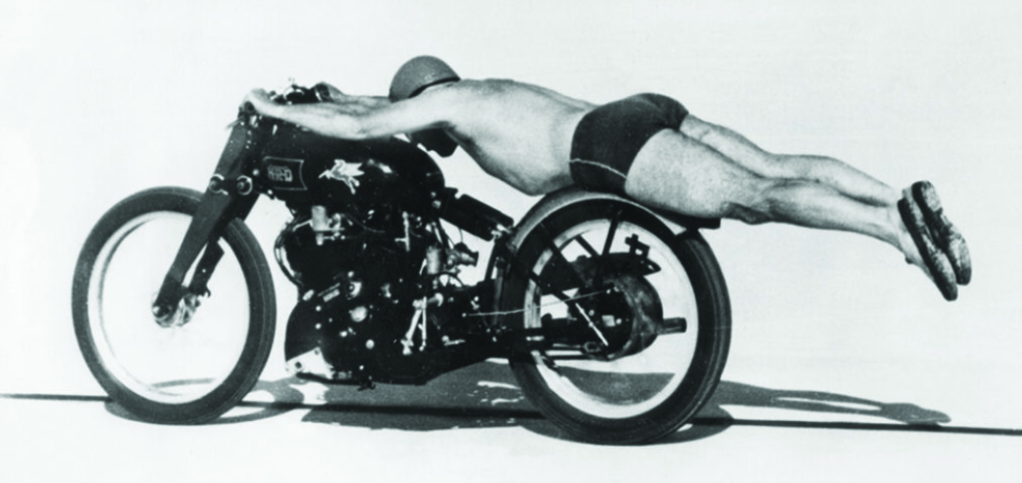
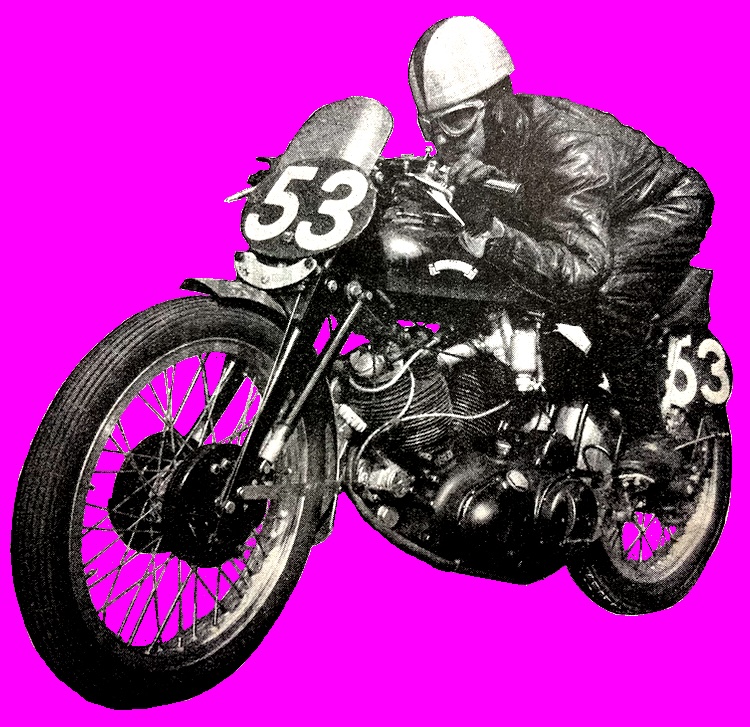
INDIAN HAD CHANGED hands at the end of World War 2, having supplied more than 35,000 Scouts to the US army. The new owners decided the future lay in smaller bikes for younger riders and launched two new ‘modular’ models, one of which retained the Scout name. But this Scout was a 490cc ohv vertical twin with a plunger frame and claimed top speed of 85mph (a Super Scout came with saddle bags, crashbars and a centre stand). Its stablemate, the Arrow, was a 218cc single sharing many components with the twin. There were plans for an 860cc four but it never materialised. Indian also sent an ’empty’ Chief to the Vincent factory and asked if the number 8 hats at Stevenage could equip it with one of their engines. This was done, but nothing came of it.

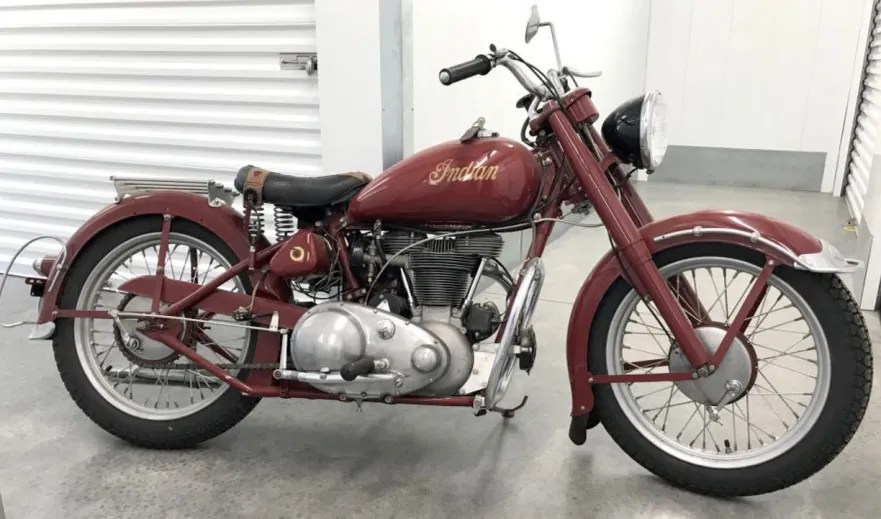
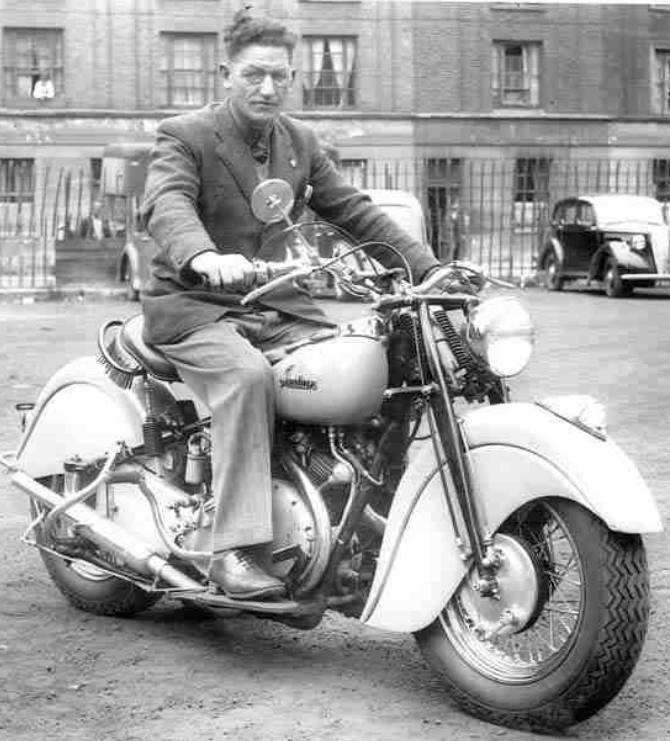
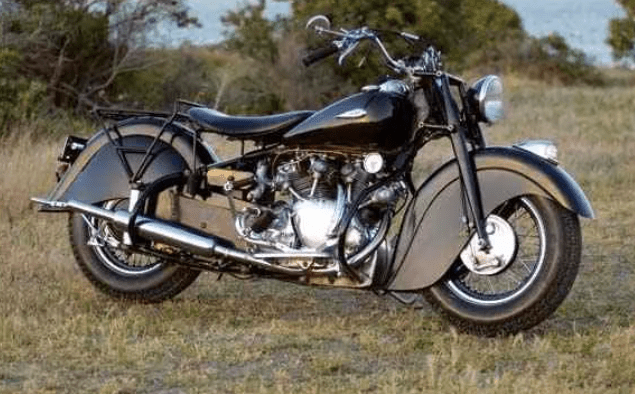
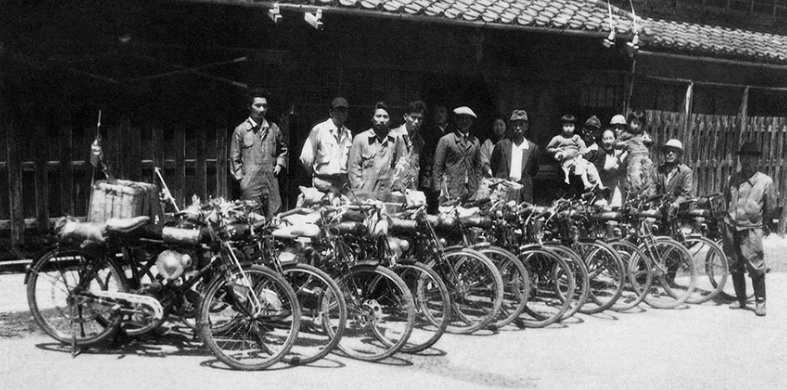
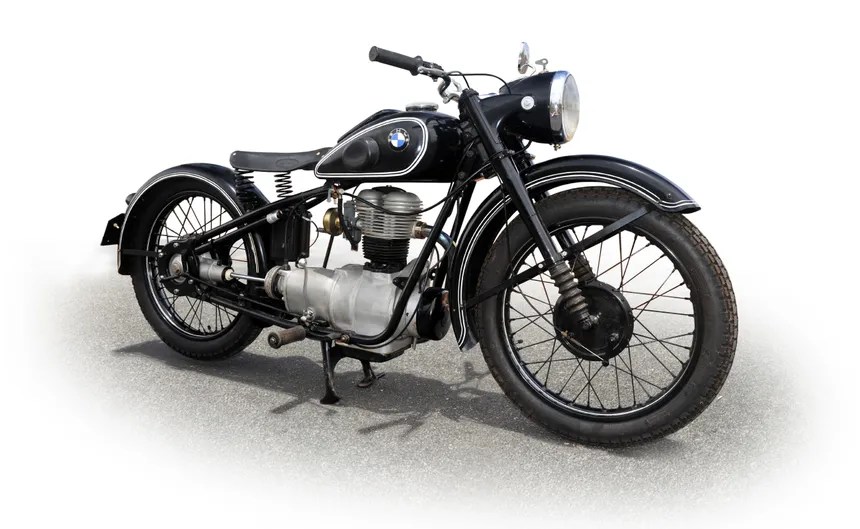
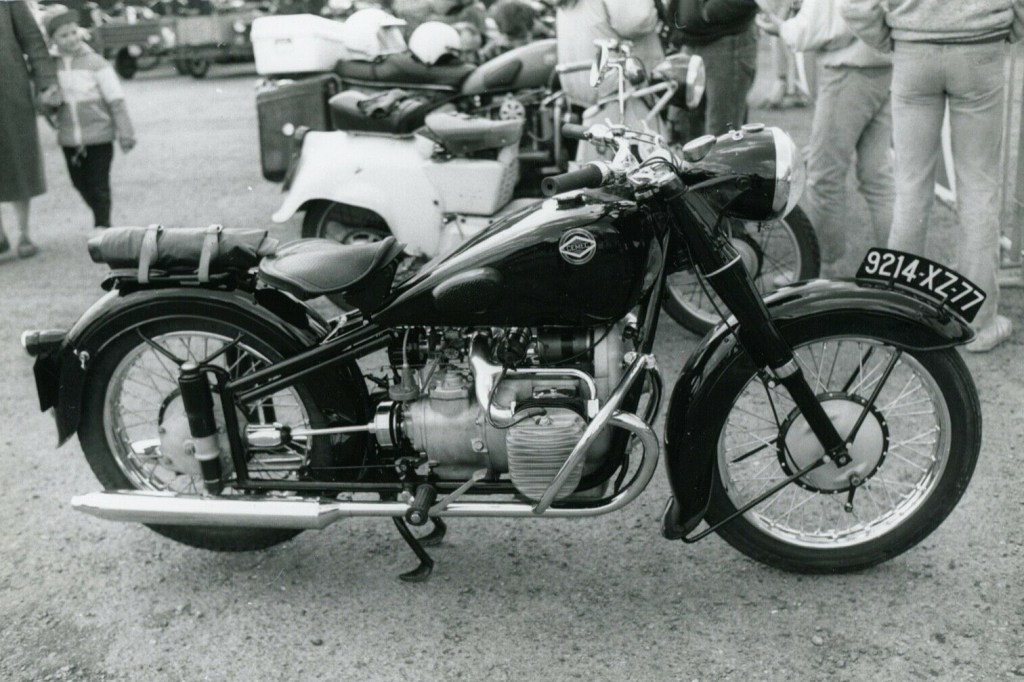
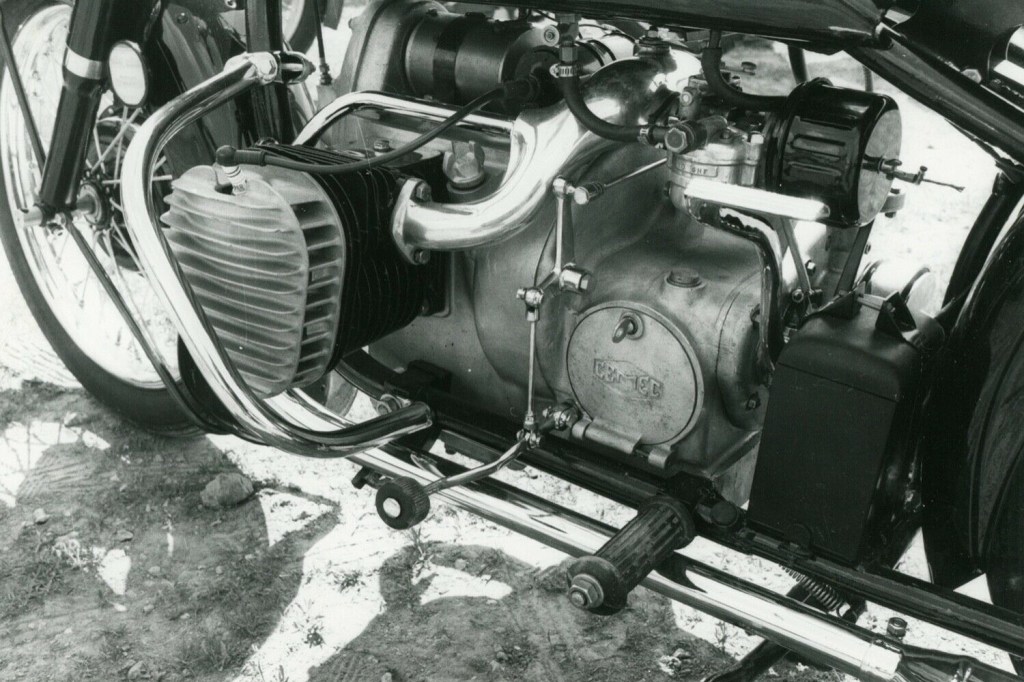
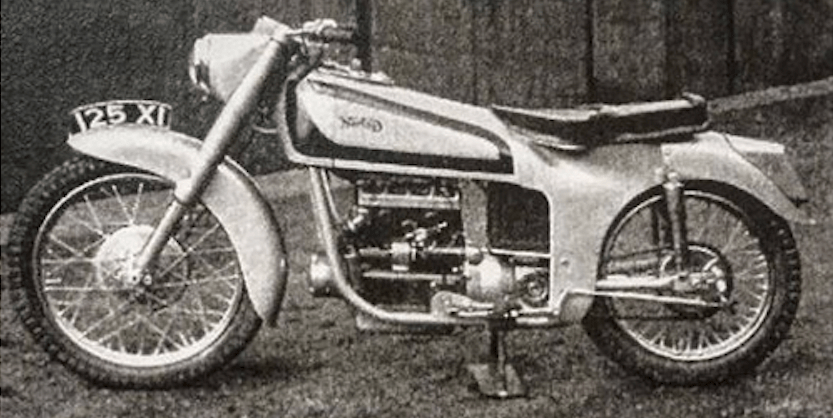
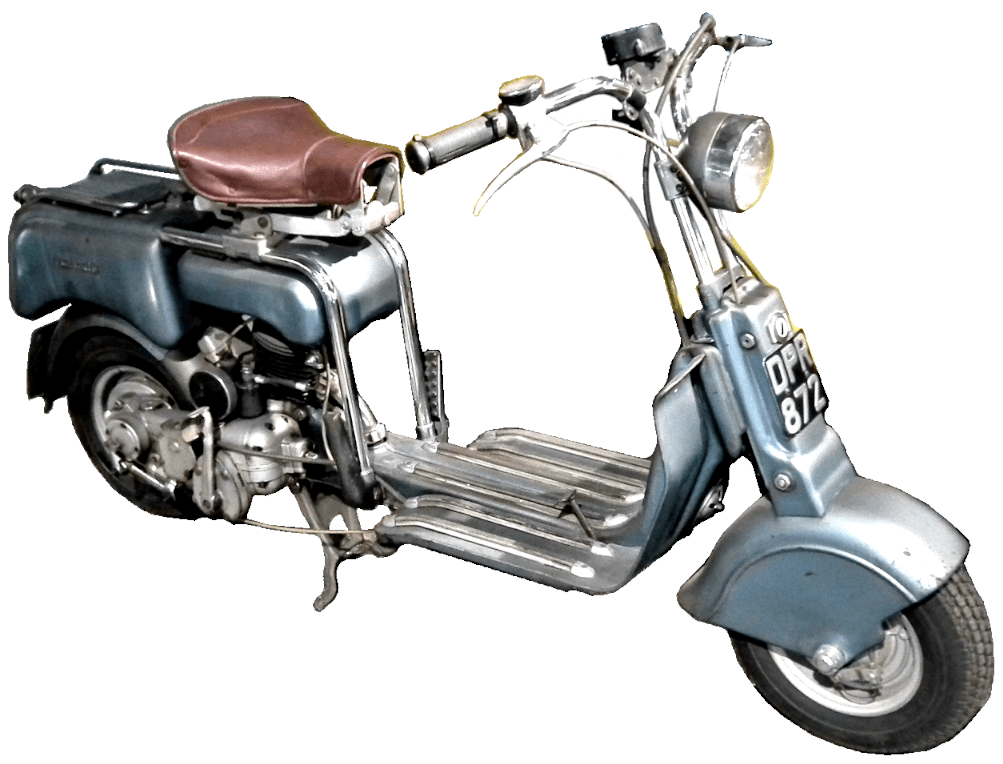
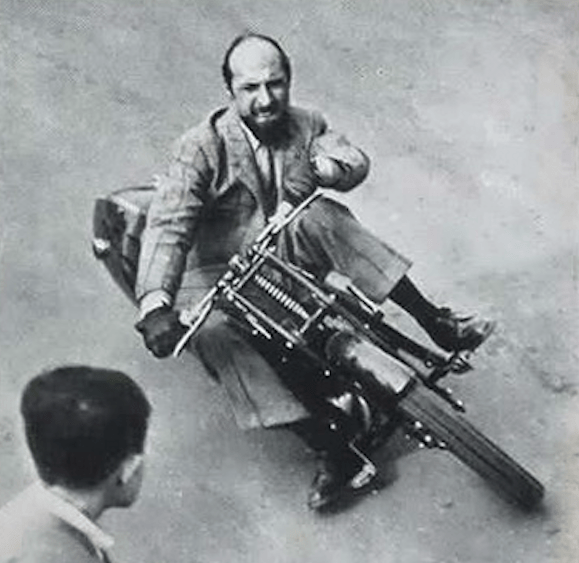
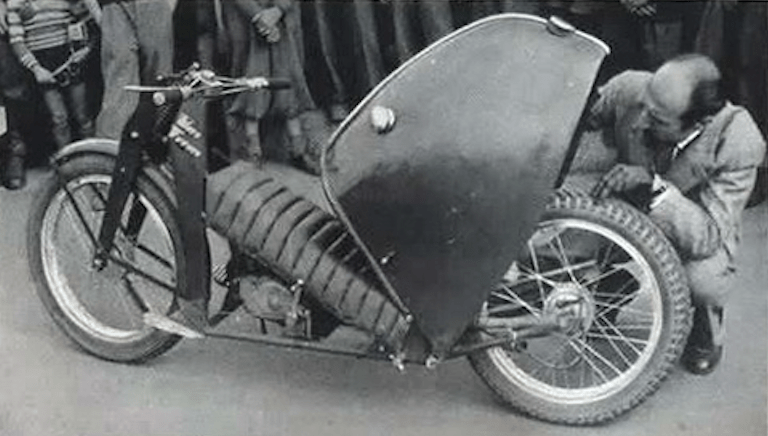
FERGUS ANDERSON WON the 500 class in the French Circuit de Pau but he did it on a Guzzi. He rode the first 7R off the production line in the 350 race and was doing well when the clutch failed.
“BY AND LARGE, I’d like to bespeak the sympathy of riders for any manufacturer who does his best to ensure prompt supply of spare parts at reasonable prices. From every angle it is a teasy business. The war came. Many stores were destroyed. by enemy action. Others had to be hurriedly cleared in the urgent interests of large-scale rearmament: Meanwhile, bikes which would normally have gone to the junk-heap years ago were furbished up, and kept on the road. Patterns and drawings vanished. But the demand continued and increased. Inevitably there have been many grumbles. Obviously when a bomb and a fire have destroyed an entire store, there are limits to what a maker can do for his old clients. For example, he cannot be expected to tackle the manufacture of spare crankcases for a 1929 model. But he can and should improvise a supply of small parts for, say, a 1935 model. So should the subsidiary firms who supply him with minor components. If such provision amounts to a serious nuisance, some small workshop should be asked to tackle jobs of this sort, so that the client may not be left with an incomplete and useless machine. (I wonder how many motor vehicles are rusting idly at this moment for want of spares?) The customer is usually a reasonable man, and is prepared to pay the true cost for the part when he knows the facts. In this sphere I have found some cause for complaint. For example, we occasionally encounter private owners who have combed every imaginable source for some quite small and simple part, just too awkward to be roughed up by any independent mechanic. Neither the manufacturer of the model, nor the firm who originally supplied that part to the parent factory, will lift a finger. The industry is going through an incredibly difficult period; but it should nevertheless put itself out to keep old customers on the road.”—Ixion
“A GIRL ENTHUSIAST in the Island proposed that feminine entries might be accepted for either a Lightweight or an Ultra-Lightweight TT in 1949. On discussion, she amplified the proposal to setting one day apart for machines under 250cc and perhaps splitting the day’s programme into (a), an open-to-the-male-world 250cc event over three laps before lunch, followed by (b), a 125cc clubman event over three laps after lunch, open to club members of both sexes. I make no comment. At the moment I doubt whether there are enough girl speedsters in our Islands to fill such a section. But things are galloping in that direction in the USA, where the imports of light foreign machines are proving a great attraction to the girls.”—Ixion
“YES, INDEED, BELIEVE it, or not. ACU, please take note! The first scooter TT was held near Los Angeles on April 25th, and attracted 75 entries. The programme comprised a dozen events, two of which ranked as TTs, the remainder including a ‘pie’ race, a slow race, a relay race, and so forth. The term ‘scooter’ receives a different interpretation in the US, since most of the events were won by Powell or Mustang machines, both of which are advertised to do 60mph on demand. The sole British competitors were Royal Enfield and James ‘Flying Fleas’, which secured a first, a second and a third between them. Apparently the ‘scooter’ is any lightweight designed for purely local transport—preferably an open-framed bus with small wheels, suited for serving as a dinghy or tender to your car. But the word evidently awaits more precise definition.”—Ixion
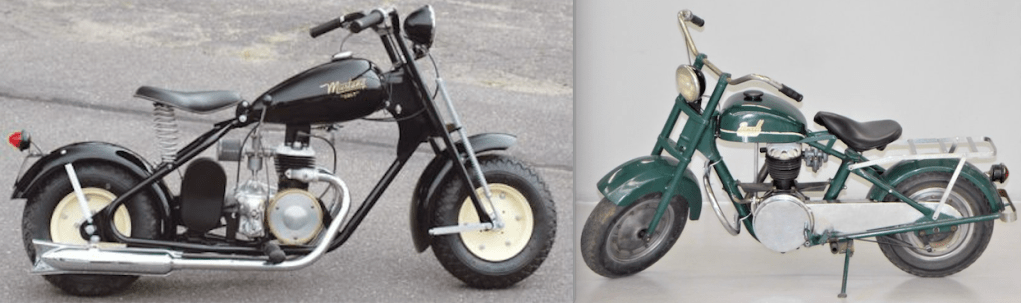
“AMERICAN girls do not yet clamour for admission to Daytona championships, but are already organising ‘all-girl’ scrambles. Thirty of them (including Dottie, Si, Thelma and Lola) recently entered for an ‘English type’ half-day’s rough stuff in California. Fifteen of them rode British machines—maybe our light cobbiness appeals to them. Cecilia Adams, the winner, rode a ‘Royal Indianfield’, ie, an Enfield powered by a twin Indian engine with Amal carburettor, a Bitza created by her ever-loving husband. One lady, lightly attired, sat on her red-hot exhaust pipe when she fell off. (Exclamation censored.) The monthly Californian Motorcyclist featured Mackie Parks (Triumph) as its ‘cover girl’. The cameraman snapped Mackie plunging off deep sand into muskeg, gumbo or some other local abomination. Mackie is a plump, pretty blonde, but her peevish expression at the tough going ahead made one of the funniest motor cycling photographs I have ever seen.”—Ixion
“WITH ITS DE LUXE SPECIFICATION, telescopic front fork and straightforward general layout, the new 125cc Tandon is an appealing machine. Now in production at Watford, Hertfordshire, it is made by Tandon Motors, and has been in the prototype stages for two and a half years. Although a lightweight in the true sense—the machine scales 1641b—the Tandon is a man-size machine. The saddle is adjustable for height and angle. It can be varied from 29in height to 27½in. A straight-tube, full duplex, cradle frame is employed. Extensive use has been made of Elektron (magnesium alloy) in the frame assembly. This alloy, for example, is used for such parts as the steering-head lug casting, engine mounting lugs, handlebar clamps, and even for the brake pedal. The engine itself is carried in a ⅜in steel cradle, which is flame-cut to shape. A total movement of 2½ to 3in is given by the telescopic fork. The design is not complicated. There is no hydraulic damping. Springs are used both on compression and rebound. The preloading of the top springs is adjustable by means of a pair of knurled knobs which raise or lower a collar on top of the springs inside the fork-cover tubes. They can be unscrewed to allow a softer fork action or vice versa. The bright mild-steel main fork slider works in a phosphor-bronze bush at the lower end of the -fork tubes, and carries a solid light-alloy piston at the top end. This sliding piston bears directly on the lower ends of the main and secondary compression springs. It has grooves cut longitudinally in the sides which prevent its acting as a pump on the grease with which the fork legs are packed during assembly. A graphite-treated felt washer is fitted in the bearing at the lower end of the- fork tubes. Neat head-lamp stays are brazed in position, and to one of these the licence disc is bolted. The fuel tank has a 2½-gallon capacity,
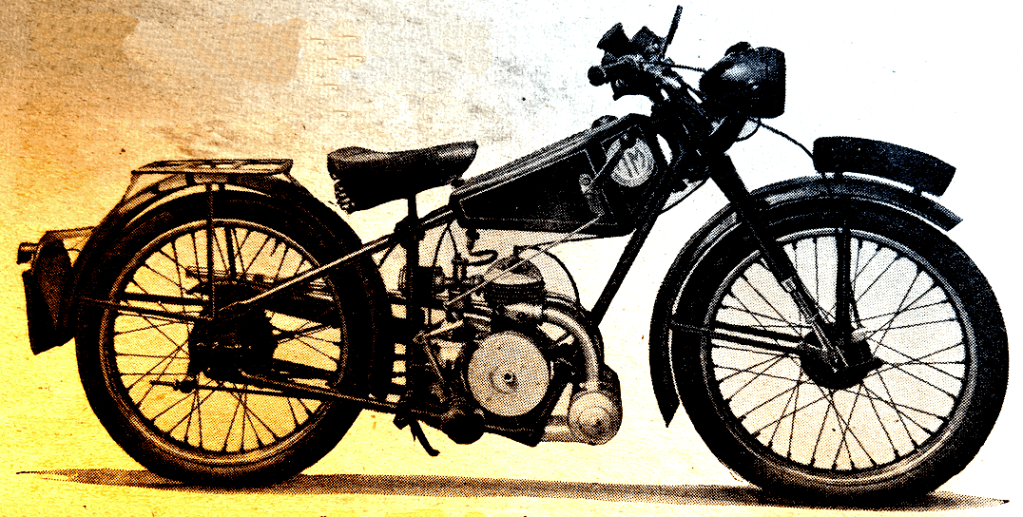
and is rubber-mounted. A channel in the top of the tank conceals the top frame tubes. This space is utilised as a tool box, which has a smart chromium-plated lid, secured in position and made easily detachable by means of a pair of knurled nuts. The power unit is the renowned Villiers 125cc Mark 9D two-stroke, with three-speed gear in unit. Notwithstanding the small engine size, the Tandon is far more than a runabout. Even 37-38mph was a happy cruising speed, and average gradients could be breasted at 35mph. Indeed, on one occasion 40-42mph was held over a distance of 15 miles without causing the engine to display any sign of stress. Maximum speed was 45mph, and on several occasions 50mph was exceeded on slight down grades where the wind was favourable. The engine tickover was slow and reliable, though, of course, at low revs the firing was irregular. The pick-up from tick-over was good. There was no flat spot and no spitting back. Acceleration was particularly lively. This was a very potent little engine, and the good power-weight ratio paid dividends. In its delivery tune the engine was inclined to four-stroke when running light at speeds below 35mph. Resetting of the external throttle needle adjustment, however, was found to help matters, although the tendency to four-stroke when running light was never completely removed. No vibration was felt on any part of the machine at any speed. Low-speed pulling was exceptionally good; the machine could be ridden down to speeds as low as 11mph in top gear. From 13mph it would accelerate happily and quite smartly. At the beginning of the test, when the transversely mounted silencer was new and free from oil and carbon, the exhaust was rather too noisy. It quietened with the passing of the miles, and later was not objectionable to rider or, it seemed, to pedestrians. Steering, at all times, was very good. Wet wood blocks and cobbles, as well as country lanes and trials-type going, were encountered during the test. There was at no time any basis for criticism. In traffic, too, low-speed handling was first class, and the machine could be ridden feet-up at the slowest crawl without special effort on the part of the rider. At maximum speed on the open road, any chosen line could be held effortlessly. The telescopic fork, rigid laterally, takes care of normal road shocks in a satisfactory manner. The impression gained, however, was that softer top springs would be an advantage. The control layout is perfectly straightforward, and all controls on the model tested were light in operation and well placed. One of the Tandon’s most attractive features is its riding position., It is of the type that gives an immediate feeling of confidence. The positions of handlebars, saddle and footrests relative to each other are well chosen, but the saddle, when long distances have to be covered, is rather too small. The handlebars, which are of ⅞in diameter, are adjustable for angle, and allow a natural position for the wrists. The footrests are non-adjustable. The gear-change lever is mounted on a pivot at the forward end of the right-hand side of the tank. The position of the lever was excellent for a 5ft 7in rider, but a larger person might find his knee coming into contact with the pivot ‘bracket. The change was both light and
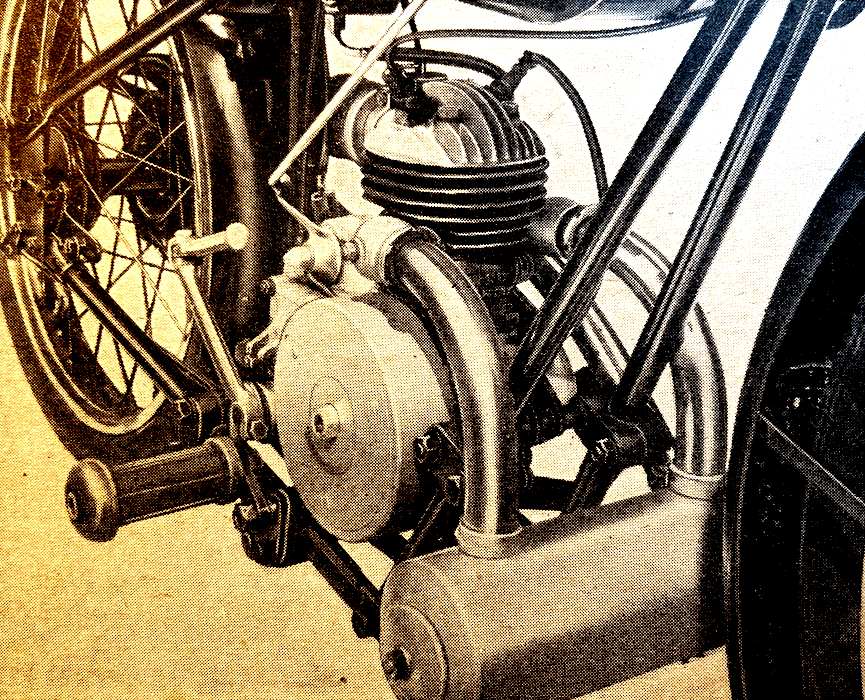
positive. The clutch, too, was light in operation. It freed perfectly at all times, and took up the drive smoothly and sweetly. A fault with some unit-construction lightweights is that it is difficult to use the kickstarter without hitting one’s foot against the footrest or some other projection. With the Tandon, even if the arch of the foot were used in kickstarting, there was ample movement for a full swing—not that a ‘swing’ in the true sense of the term was necessary. Kickstarting required very little physical effort. Four-inch brakes are fitted front and rear. Used in unison, they were well up to their task, but the front brake was spongy. This was due, in part, to a certain amount of flexibility at the brake anchor mounting. Several features of the Tandon are worthy of special mention. Chain adjusters are fitted in a lug welded to the rear frame member, and are fully accessible. The mudguards are of deep section. A useful lock—the turning circle is 11ft 3in—makes manoeuvring easy, and parking was made particularly simple by the provision of a light, sturdy propstand of just the right length. The exhaust pipe is nicely tucked away. The finish, in black and chromium, is attractive. The only criticism, apart from those mentioned, was that there was insufficient clearance between the filler cap and the toolbox cover, so that the filler cap was difficult to remove and replace. This fault, however, it is stated, will not exist on the machines delivered. In short, the Tandon appears to be a thoroughly sound proposition for the man looking for a first-class lightweight machine.”
KEEN TO WIN export dollars, Triumph and Norton sent bikes to the prestigious Daytona Beach races in Florida to challenge Harley Davidson and Indian on their home ground. A Norton International ridden by Canadian Billy Matthews came a creditable second in the 200-mile Experts race (behind an Indian but ahead of a Harley; a GP Triumph placed 6th). Norton Inters were 1st and 2nd in the 100-mile Amateur race.
THE WEATHER FOR the open, trade-supported Cotswold Scramble—the ninth of the series—held last Saturday, was ideal for spectators. But the course was dry and hard, and would have been the better for a spell of rain before the event. On Saturday it was more of a mountain grass-track circuit than a scramble course. There was lots of sporting going: ups and downs, tree-lined paths, open fields, streams to cross, some rocks, and a patch of mud. Sporting certainly, but hardly scrambling…There were large numbers of spectators and, dressed suitably for the weather (organised, too, by Mr. Baughan?), they added a gay splash of colour to the Cotswold countryside. A total of 45 entries in each event was the limit that could be accepted by the Stroud Valley MC. About 15 entries had to be refused because of this, and others were told they could ride in either the Senior (500cc) or Junior (350cc) event, but not in both. There were four races. The first—the Junior—was won by FM Rist (350 BSA). It looked at first as though it was to be a walkaway win for the redoubtable W Nicholson (350 BSA), but a few seconds’ stop cost him many places. He eventually finished third. ‘Nick’ won the 250cc race, and looked like winning the 500cc event as well, but he retired with gear-box trouble towards the end of the race. This allowed BW Hall (500 Matchless), who had been shadowing him, to take the lead. He went on to win by nearly a minute from PH Alves (498 Triumph). The Junior Race, over eight laps of the 2½-mile circuit, was run first. The competitors were lined up on the wide starting grid and, an innovation, were split up into lanes in order to avoid bunching as they
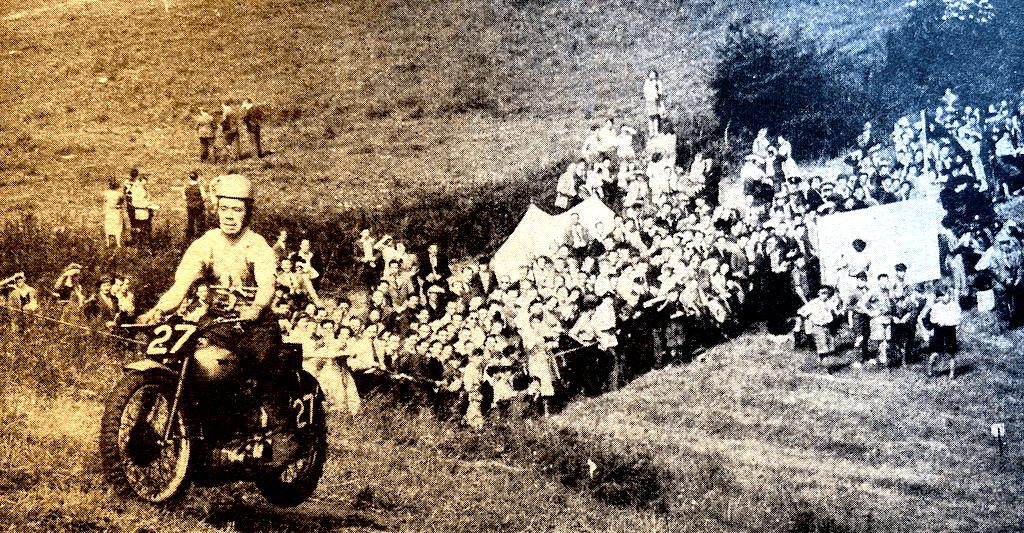
crossed the ditch where the course swept off to the left. Meanwhile, the radio commentator described the scene to the British public. W Nicholson (350 BSA) took the lead at the start. He was closely followed by his team-mate FM Rist (350 BSA). CM May, the sole Ariel works rider, ‘lost the prop’ at the ditch; as he got going again he was overtaken by PH Alves, who had trouble in starting and was last away. At the end of the first lap the leading six were Nicholson, Rist, Draper, Ogden—four BSAs—G Eighteen (350 AJS), and R. Wise (350 Royal Enfield). BW Hall (350 Matchless), who had been tipped as a probable challenger to ‘Nick’, was out; he came off’ his machine in a melee. Alves, on the single-cylinder Triumph, was rapidly picking up places. The field was already well strung out. On the next lap Nicholson had a momentary stop to adjust his clutch, and G Draper (350 BSA)—an up and corning scrambles rider without a doubt—was leading Rist! Soon afterwards Nicholson passed, riding with tremendous verve and skill. Draper increased his lead from Rist, who rocketed up the grass staircase as though devils were at his heels. In third place was Ogden, and a Triumph twin ridden by SB Manns was fourth. Wise was next, and sixth already—Nicholson! Alves was eighth, and chasing George Eighteen. And holding his own not far in the rear was one of the oldest men scrambling to-day: Colin Edge, who was faster on the staircase than many of the youngsters. A scrap developed between Draper, still leading, Rist and Ogden. At the end of Lap 5 Rist was in the lead, Draper was second, and Ogden was hanging grimly to third place. On the next circuit the wiry Irishman was third and Ogden fourth. They finished in that order.”
“BRITISH RIDERS AND MACHINES repeated last year’s successes by winning both 500cc and 350cc classes in last Saturday’s Dutch Grand Prix. The remaining race was for 125cc machines, no British riders or machines were entered in this class but the winning Dutch machine was equipped with a Villiers engine. The Senior race was won by a margin of about 2½ minutes by AI Bell (499 Norton) from N Pagani (Gilera) with JM West (AJS) third. In the Junior race, the Velocette pair F.L Frith and K Bills, were ahead of the field throughout the distance with the former leading till the last lap when Bills came up to win by less than a machine’s length; third man home was EE Briggs (Norton). After a lapse since 1934 a 125cc race was provided; it was won by a comfortable margin by D Renooy riding a Dutch Eysink. Second was N Pagani (Morini) and third T Heineman also riding a Villiers-engine Eysink. In the Netherlands the Dutch Grand Prix is by far the most popular motor cycle event of the year and enormous crowds gather at Assen in the North to see the day’s racing. Reliable estimates suggest that well over 100,000 people were present on Saturday and the fame of this event is such that it commands an enthusiastic following throughout the country. The 10¼-mile van Drenthe circuit near Asses is roughly pear shape. Though there are four sharp corners and a number of bends, it is a decidedly fast course and pre-war when superchargers and petrol-benzole fuel were permitted, was lapped at over 95mph. Except for a section of stone setts which measures about a mile, the surface is smooth tar-Macadam excellent in dry weather but treacherous when wet. Flags of all nations fluttered in the breeze, bands played, announcements over the public address system came thick and fast; above this intermingled noise was heard the roar of exhausts as the
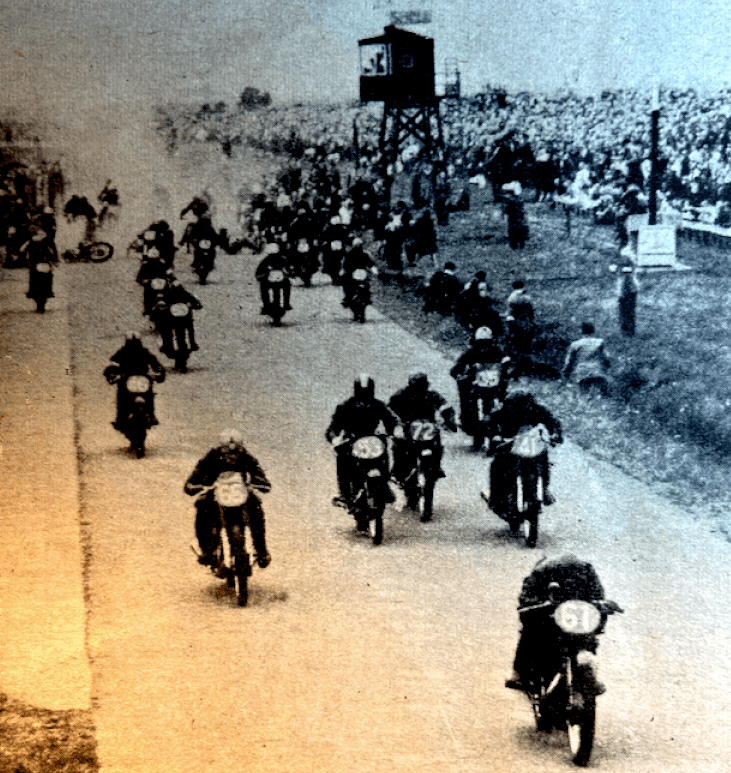
machines in the first race—the 350cc or Junior event—were warmed up. There was an expectancy in the air and a comparative quietness as riders took their places on the road ready for the massed start. The 350cc Race: In virtue of slick practice laps, K Bills (Velocette), FL’ Frith (Velocette) and AJ Bell (Norton) occupied the three positions in the, front row. Behind them were 35 more starters and of the total of 38 no fewer than 17 were Britishers. There was no obviously serious opposition to a British win; the speculation of the moment was centred round the probability of a Velocette-Norton scrap with the former favourites. There was a slight query against Frith’s chances. In practice during Friday morning a big-end bearing had failed. Frantic searches were made and it was not till evening that a replacement was located. All-night work had been necessary to get the machine ready. The announcer was counting out the seconds; the crowd was hushed; down went the flag and for a few seconds only the patter of riding boots on tarmac disturbed the unnatural calm. Then came the full-blooded bellow of racing engines. Frith and Bills got away smartly but not so rapidly as TL. Wood (Velocette) who has an indisputable flair for quick starting. Bell’s engine was sluggish and through the gap he left went Wood to snatch a few yards’ advantage over the front-row men. In the same second or two came a minor calamity. Riders were nipping Past the struggling Bell, on both sides. Shoulders touched and in a flash, WS Humphrey and N Croft with their AJSs and B Maltha (Norton) were in a confused heap on the road as other riders wriggled their machines past with fractions of an inch to spare. Miraculously, none of the fallen men was hurt and the two AJSs were soon bellowing defiance in the distance. Maltha’s machine, however, was damaged and after a hurried inspection at the pits, he gave up. Meanwhile, Bell was still pushing a lifeless Norton. At last he changed a sparking plug, pushed again, and was off but by then the leaders were miles away. At Hooghalen, which is approximately half-way round the circuit, Frith led Bills by a few yards and some distance away was Lockett. By the time they reached the end of the lap the two Velocette men had a 100-yard lead over Lockett. Frith’s standing-start lap took 7min 37.7sec (82.3mph) which suggested he had ample confidence in the replacement big-end! This, too, in spite of a stray cow on the course which
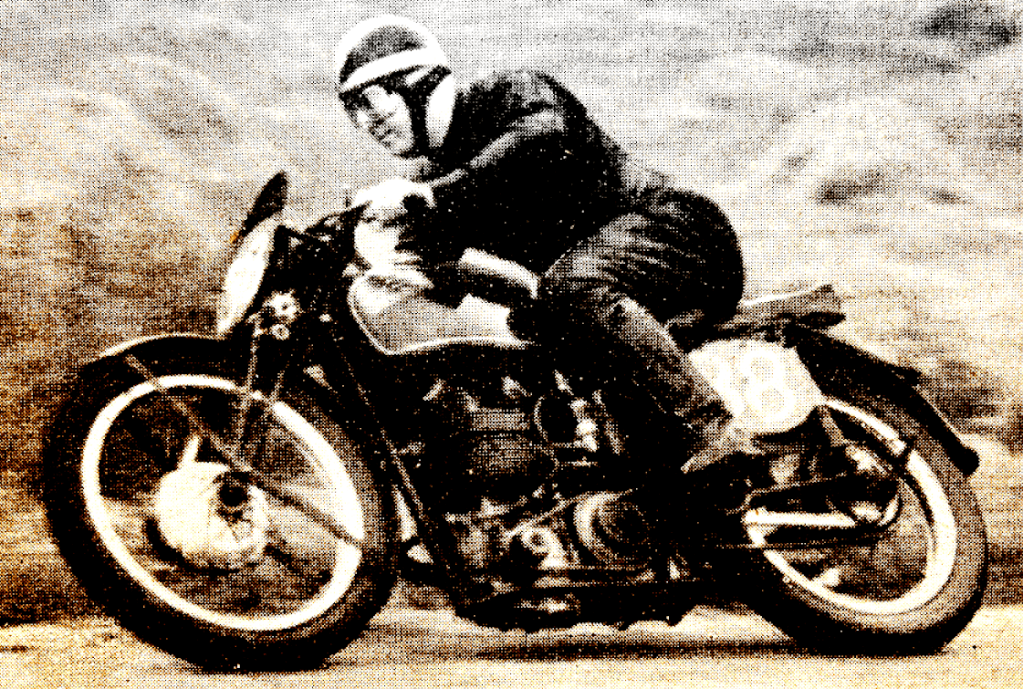
slowed Frith and many other riders on the first lap. Behind Lockett—yards only separated them—came F Juhan (Velocette), P. Knijnenburg (Velocette), EJ Frend (AJS), LH van Rijswijk (Velocette), MD Whitworth (Velocette) and EE Briggs (Norton). During the second lap, Frith put 200 yards between himself and Bills and the pair pulled well away from the field. Thus early in the race it looked as if the two Velocettes, running like oiled silk and handled with polished mastery, were going to have no difficulty in staying in front. The pack was now led by Juhan who had Frend on his tail, then came van Rijswijk, Knijnenburg, Whitworth, Briggs and FW Fry (Velocette). Where was Lockett who had looked like the Norton hope on Lap 1? Along he came, slowly, to stop at the pits, consult with Joe Craig and push his machine into the paddock. A split oil tank had put him out of the race. On and on relentlessly went the Velocettes. By five laps—half distance—Frith was about a mile ahead of Bills and they had a commanding lead over the rest. The popular Dutch rider, L van Rijswijk had battled his way into third position and the crowd were in ecstasies; but there was only feet between him and Frend and Briggs, a Velocette—AJS—Norton scrap in the best tradition. The unfortunate Artie Bell was trying gamely to make up the minutes lost at the start. From last position after one lap he was in 22nd place on the third lap and in 15th place at the end of five laps. But the handicap was much too great for him ever to challenge the leaders, well as his Norton was going. Interest centred on the stirring riding of van Rijswijk, Frend and Briggs. At six laps, Briggs was inches ahead of Frend and van Rijswijk was just behind. Next time around Juhan got ahead of Van Rijswijk but could not catch the Norton or AJS in front. Briggs and Frend pulled away slightly from Juhan and van Rijswijk and two duels emerged. They continued while Frith and Bills circled steadily about half a mile ahead. The last lap started. The result was a foregone conclusion. But was it? Reports came through that Bills was rapidly closing the gap. At Laaghalerveen, some three miles from the finish, the gap was less than 100 yards and when Frith appeared at the last corner Bills followed almost immediately. They came abreast a yard or so before the line, and Bills flashed across with his front wheel just ahead. Frith had slowed to give his team mate a chance to draw alongside for a chat, maybe? Briggs and Frend were fighting doggedly, for third place with the former just in the lead. At the last corner Frend tried to overtake, slid out and left the road. He was knocked unconscious for a few minutes but not seriously injured and Briggs brought his Norton home safely in third position. The 125cc Race: Two riders from Italy and four from Spain opposed 24 from the Netherlands. In clouds of smoke and with ear-splitting buzzing all got away from the line well, but with what seemed a strange slowness in contrast to the start of the 350cc race. D Renooy on an Eysink machine fitted with a Villiers engine-gear unit was soon in the lead hotly chased by N Pagani (Morini). At the end of the lap Renooy had an advantage of about 50 yards. Behind Pagani came T Heineman (Eysink) and then R Alberta (Morini) who on the straights placed his legs horizontally along the sides of the rear wheel. Alberti, it will be remembered, handled the streamlined 65cc two-stroke Guzzi which broke world records earlier in the year. After three laps Renooy was about 250 yards ahead of Pagani; who in turn had a lead over Heineman. These positions were held to the end with the gaps steadily increasing and the race was a straightforward procession. The 500cc Race: As machines were warmed-up the clouds thickened and a few splashes of rain were felt. The clouds looked ominous and many anxious eyes glanced towards the sky. Notable absentees from the 51 entries were Frith and Bills whose Triumphs were not ready and who decided not to use their 350 Velocettes again that day. AJ Bell and Harold Daniell were entered on the 500cc Nortons. JM West and RL Graham were on the twin AJSs and among the Gilera entries were a couple of the new four-cylinder models. Trouble had been experienced in practice, and only one multi—ridden by M Masserini—was on the starting grid. The other Gilera men rode singles. Down goes the flag and 39 starter heave their machines forward. Masserini’s four-cylinder Gilera starts immediately and he swoops ahead of Bell, who tucks in behind the Italian on the way up to the bends before De Haar corner. Masserini is still in the lead at Hooghalen and at Laaghalerveen and when he screams through to start the second lap. But Artie Bell is only a yard or two in rear and very nicely positioned to watch for his opportunity. Forty yards behind is Jock West (AJS) followed by Harold Daniell (Norton), F Juhan (Guzzi) and E Lorenzetti (Guzzi) in a tight bunch. Retirements have started already. N van Rijswijk (Norton) tours into the pits and a groan is heard from his Dutch supporters. TB Fortune (Triumph) also tours in and retires. A report comes through that Bell is in the lead! Yes, it is correct—at the end of Lap 2 he is 50 yards to the good and in gaining that lead has made what proves to be the fastest lap of the race (87.75mph). Daniell, too, has pushed his Norton a bit harder and is now in third place. West has dropped back to seventh behind Lorenzetti, H Veer (Triumph) and Juhan. RL Graham on the second twin-cylinder AJS turns into the pits and retires with a punctured carburettor float;
LA Dear (348 AJS) also retires. Now the rain starts in earnest. The roads become as slippery as ice and reports of crashes come in almost immediately. One of the first victims is Masserini who slides off at Laaghalen. He dents the tank of the Gilera but continues almost immediately. Veer falls at Laaghalerveen and rides slowly to the pits where he retires. Bell and Daniell are now first and second. But Daniell’s luck is out again to-day. On the fourth lap, he suffers the same trouble—a split oil tank—as did Lockett in the Junior race. Lorenzetti thus gets into second place 300 yards or so behind Bell. D Ambrosini (Gilera), N Pagani (Gilera) and West are in third, fourth and fifth positions respectively. The rain ceases at the De Haar end of the course but is still heavy in the Hooghalen area. Lap speeds are down by about 5mph on what might be expected over dry roads. Lorenzetti is steadily reducing Bell’s lead and even gets a two-yard advantage by the end of Lap 6. But next time they appear, Bell is 20 yards ahead and on the eighth lap Lorenzetti retires at Laaghalen. Bell is now out by himself, with more than a minute advantage over Pagani and about 2½ minutes in hand over West in third place. After another fall, Masserini finally retires. As a good fourth, only a couple of seconds behind West, comes MD Whitworth (Triumph) who has steadily worked up from eighth place on the second lap, and in fifth place is JA Weddell (Norton). From this point the race settled down and the first five positions remained the same till the end; in fact, all other finishers were flagged off before they had completed the 20 laps. In the later stages the race was enlivened by Whitworth who caught West and for a couple of laps did doughty battle, but West pulled away again and finished with an advantage of more than a minute. Desultory. showers of rain kept the roads treacherous most of the time but Bell was going beautifully in spite of the difficulties. He emerged a well deserved victor of an uninspiring race.”
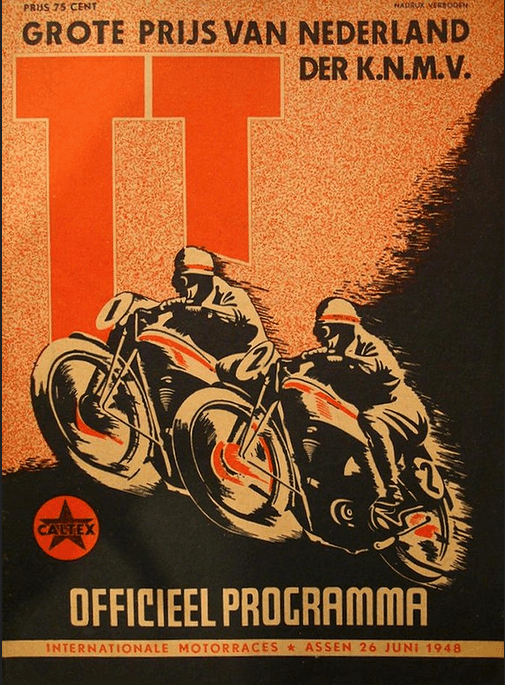
Here’s a gallery of riders competing on the Continent…
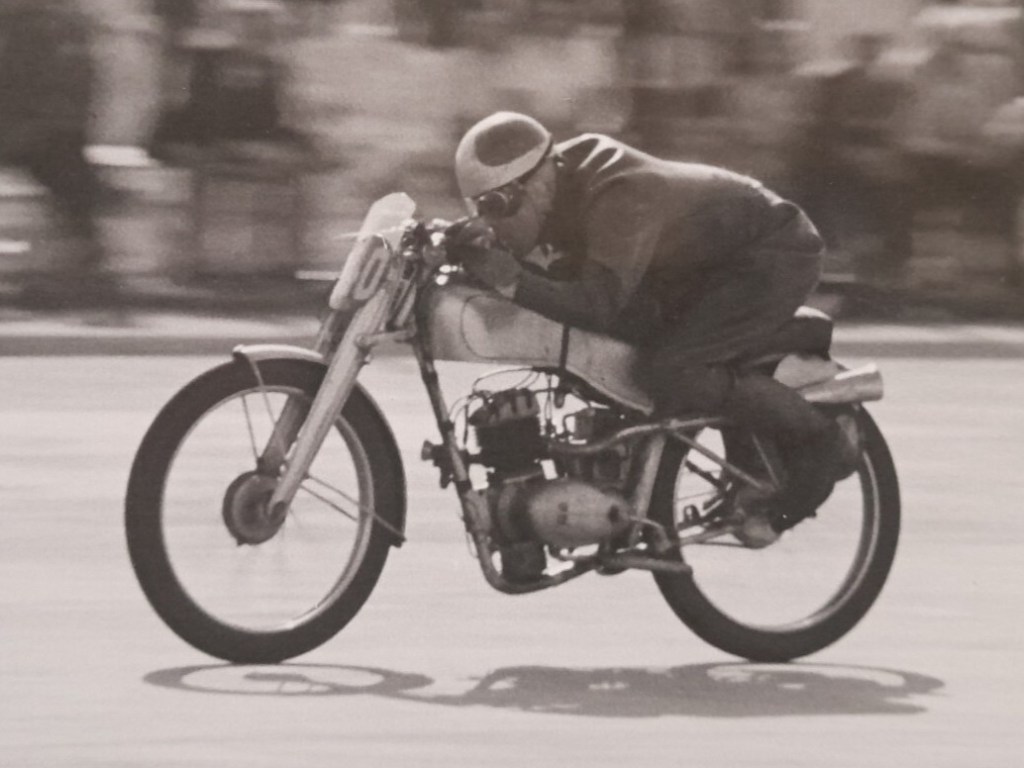
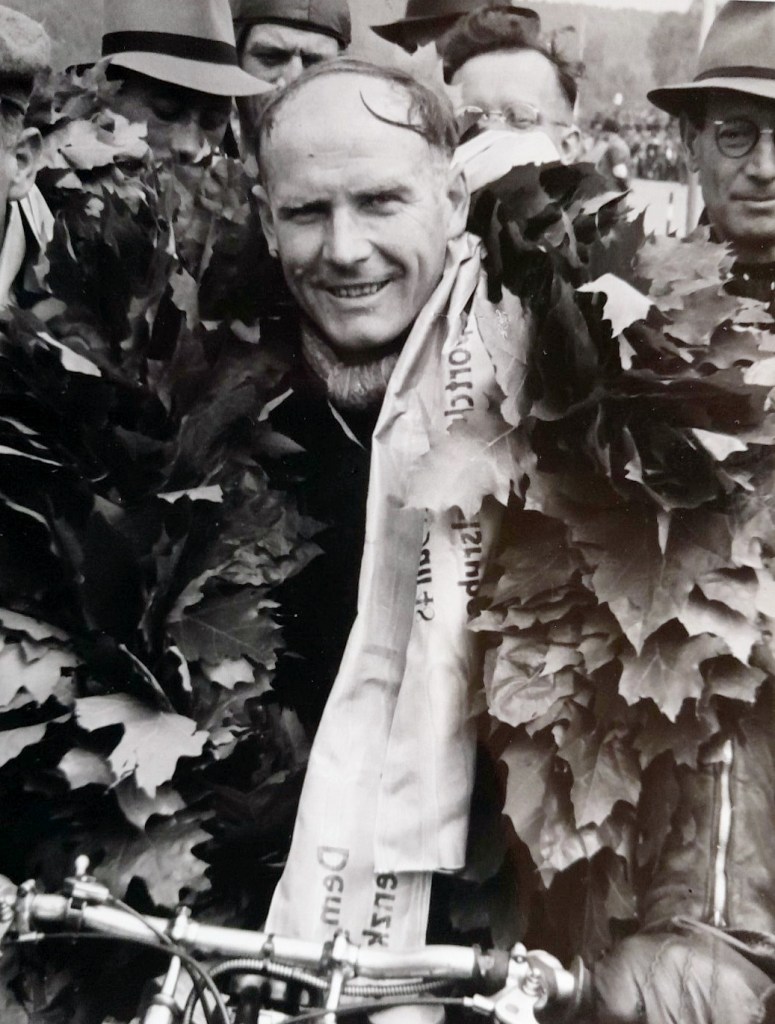
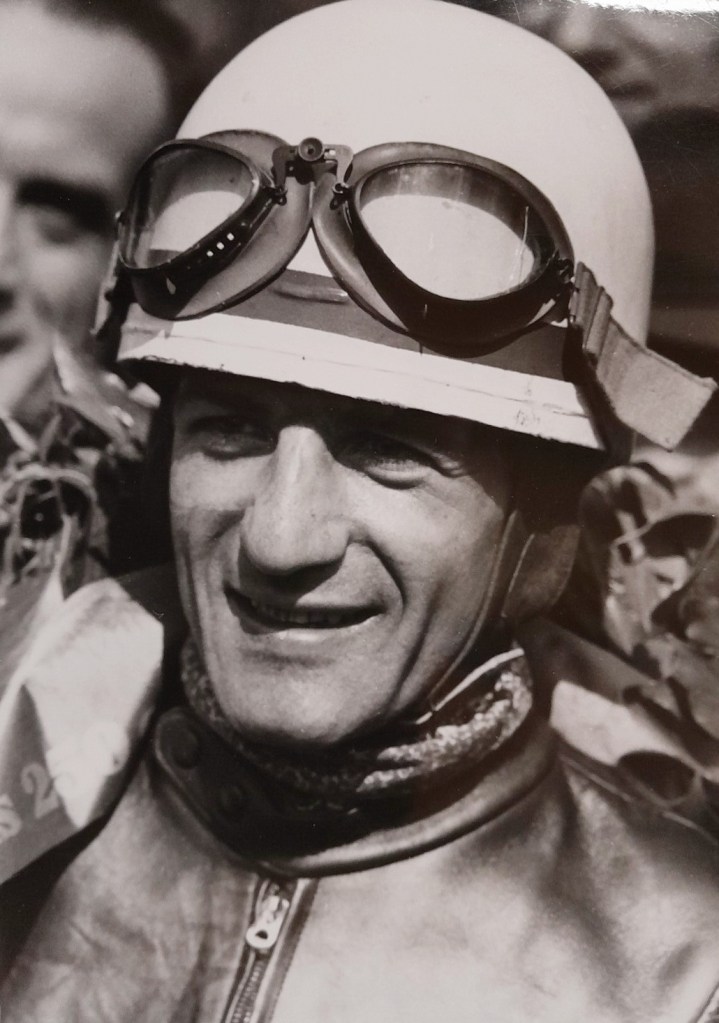
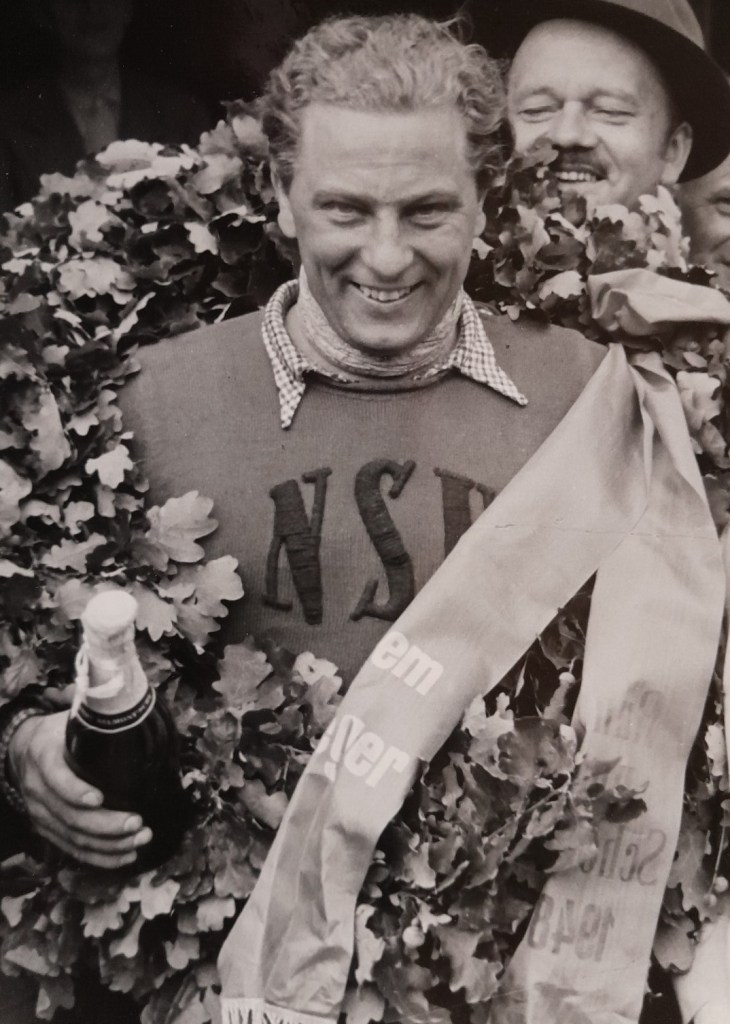
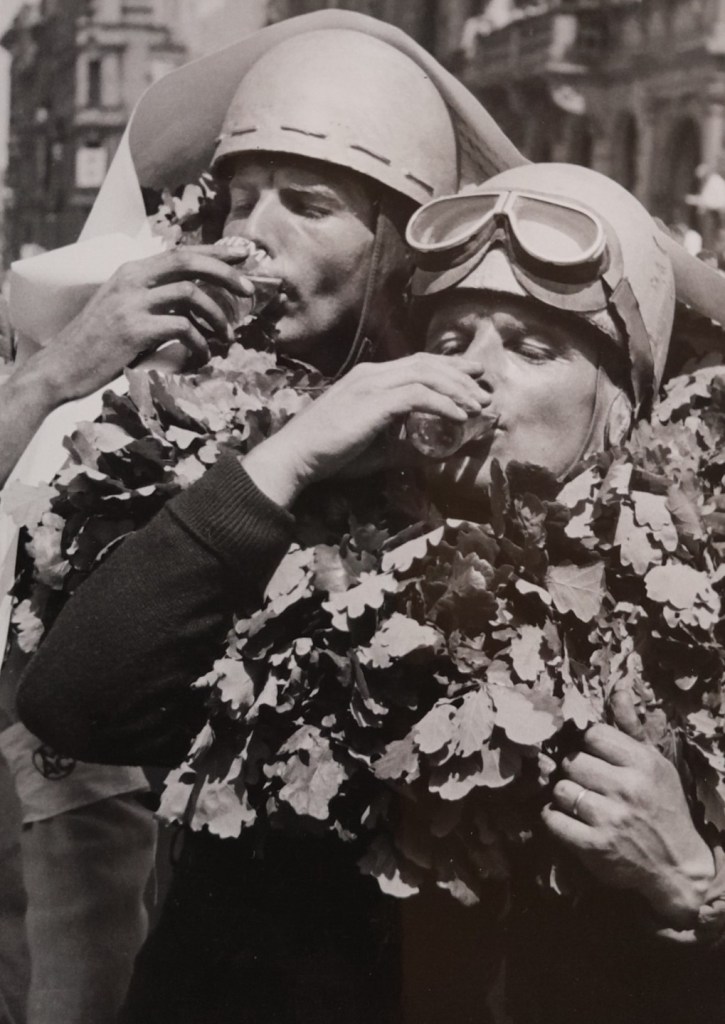
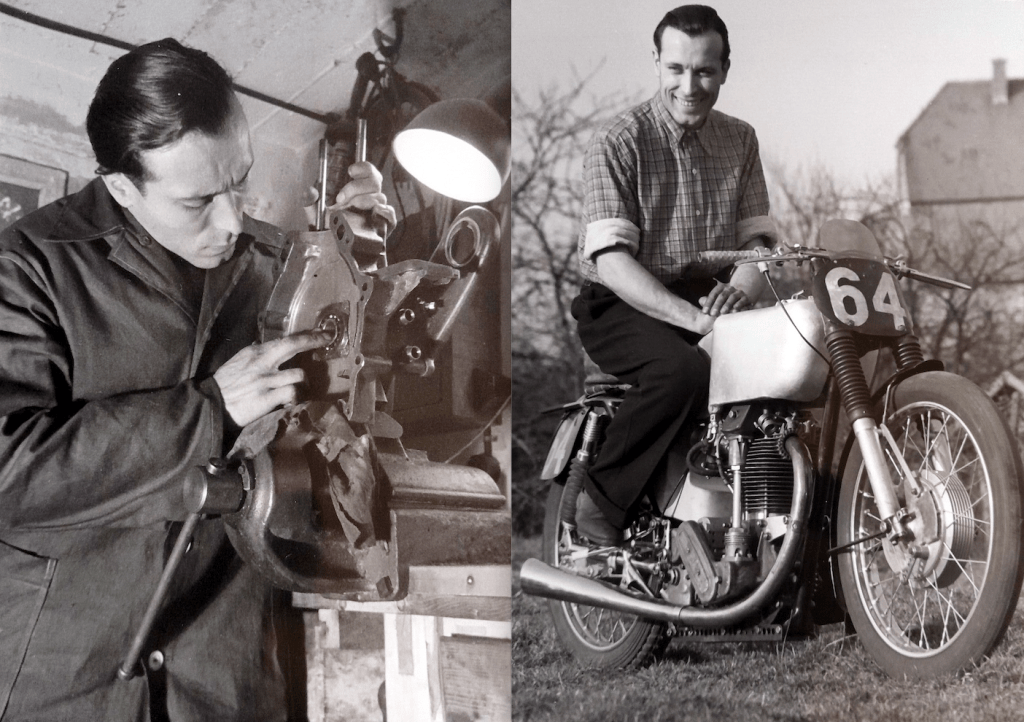

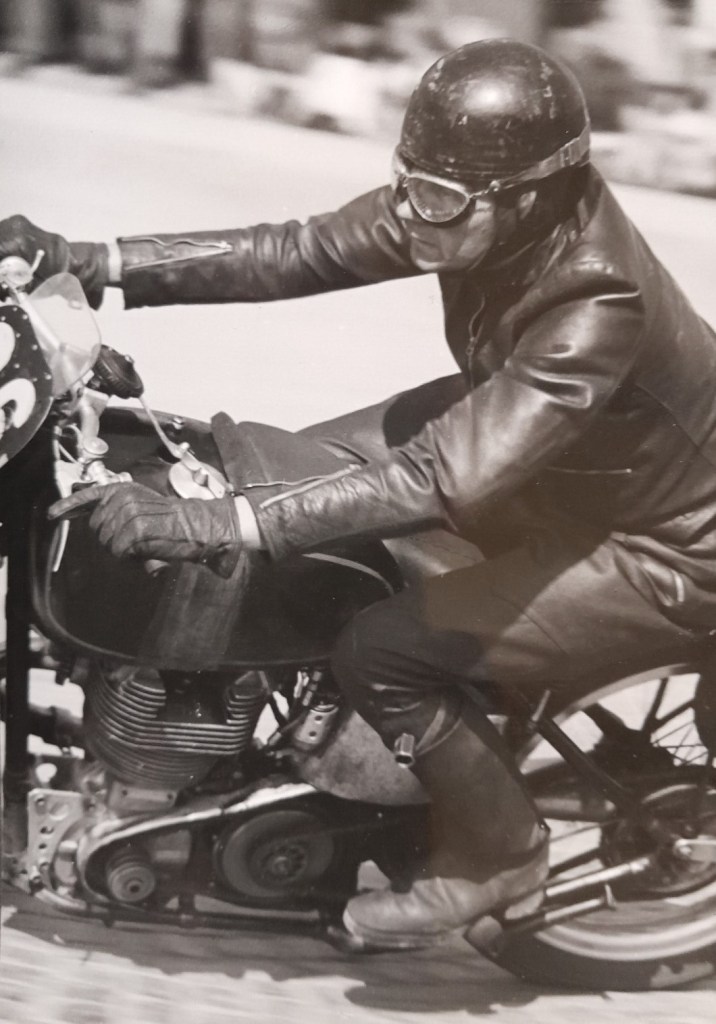
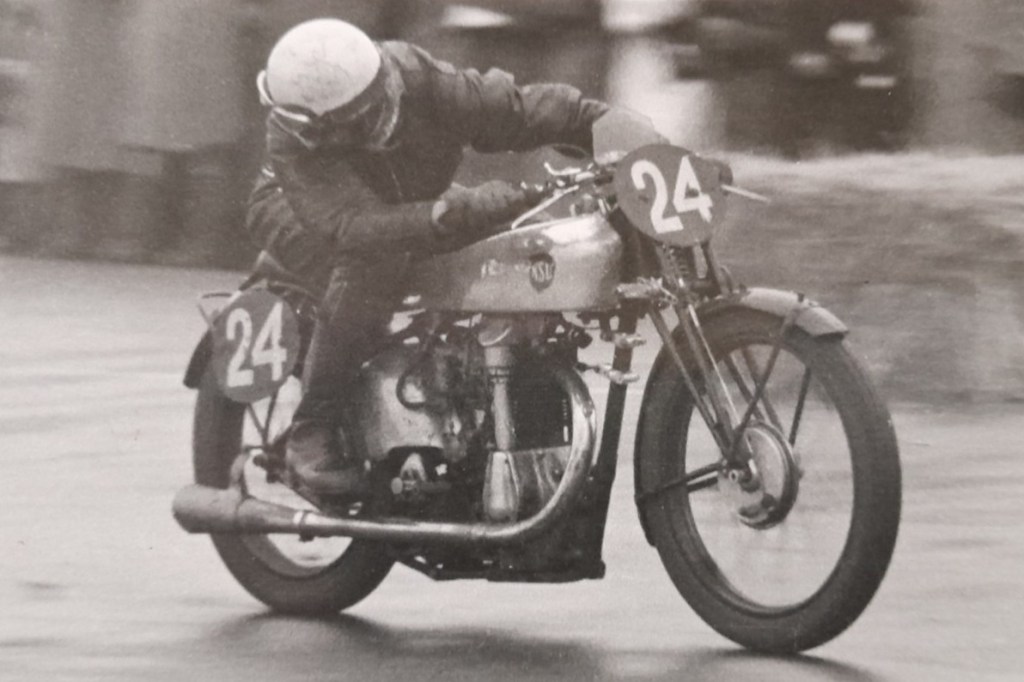
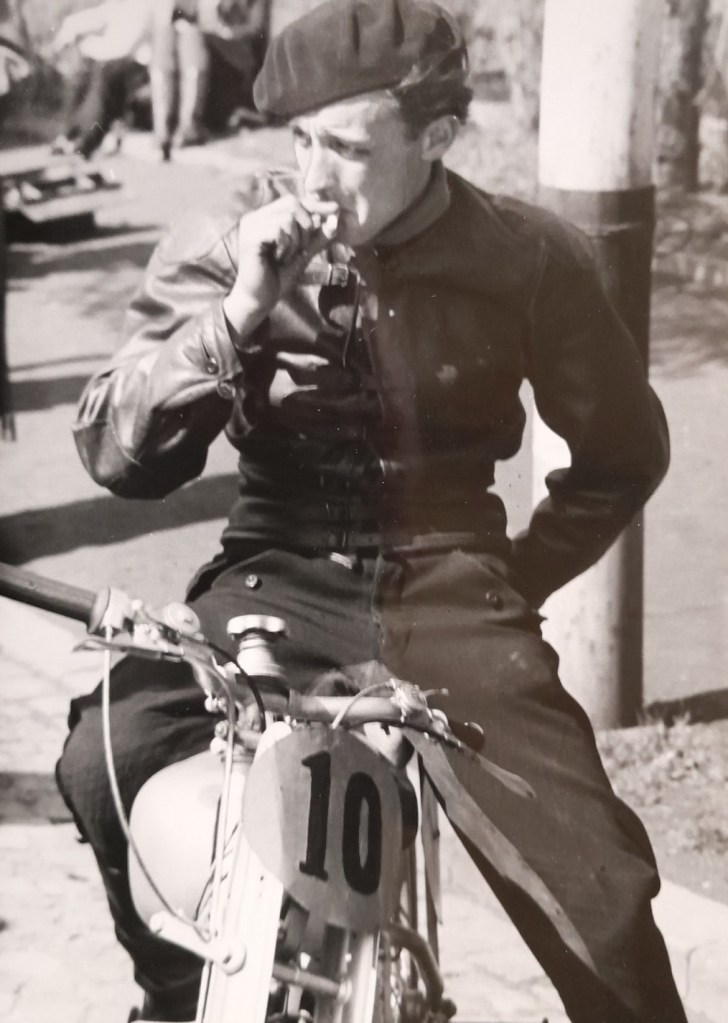
“FOR NEARLY TWO YEARS I have read your periodical find had it very interesting, particularly as I was formerly reading the parallel periodical for Germany—Das Motorad (Edition Poessneck, Thuringia). In the April 1st issue Ixion’s comment, ‘Best TT Ever?’ stated ‘The BMW 1st and 2nd position in 1939 were admittedly due to the superchargers.’ This may be true. But it is not the first time that I have read something about the BMW victory in the 1939 Senior TT. It is at least the fourth or fifth time and I am not able to read every single one. So I get the impression that the British enthusiasts can never sleep about the fact—that a German machine once won the most famous British race. This made me think over the matter, and can’t find anything unfair in the fact that BMW and DKW supercharged their racing machines because every other manufacturer (or nation) had the chance and right to do the same. But, reading The Motor Cycle, I can’t help getting the impression that among British enthusiasts there is a good deal of super-patriotism, which in our present time is going to become old-fashioned. My recollections in this connection go back to 1924 when, as a boy of ten, I watched the racing men using for the most part British motor cycles; and at car races hardly another racing car besides the famous Bugatti had any chance to be placed in a top position. This went on for years, and I enjoyed it and did not ask about national origin of machines, but was just intoxicated by the speed. But even when later on I could realise the national issues involved I never minded seeing British or French or Italian cars and motor cycles, or foreign racers, winning on the racing circuits. I remember Bullus, who predominated for two years in nearly every big race (particularly in Germany) on the Moore-designed NSU and the many. German riders who used Nortons, Rudges and Velocettes up to the beginning of the last war (and, if they can, at the present time as weIl). I saw Major Gardner in his MG at Frankfurt on his record-speed trial. And I remember that the MG was always one of the best liked small sports ears in Germany; that is, of course, up to the time when the BMW appeared on the market. But German and Italian design (particularly car design) developed greatly in the six years before the war, and all the real enthusiasts thought this a pity, because races, being less international, became less interesting. This development, however, was not so much because of German or Italian activity, but because of British and French passivity. This leads me to the present situation. The British and French were not active in producing really new designs following the economic crisis in the late ‘twenties. But they are the more active now—not only in their own designs, but under the pretext of liquidating war industries, they cash in on German factories and German patents. Of course, the present time is very favourable to get things which are very difficult to obtain in normal times. The reason why I mention these unpleasant matters is the following: Being in this country for more than 3½ years, I have obtained a certain knowledge of British mentality and opinions, and know that there are many people who want after this disaster a real understanding. I should like to assure you that the Germans are to-day more willing to build up a state on the basis of work and trade only than ever before. But, in the situation of my country, this does mean working together—and not against each other. Our last hope is the Marshall Plan and, as it is based on closer co-operation, I do hope that all these questions concerning motoring will be settled in the course of the next few years, and that the result will be that future ‘pre-fights’ for racing prestige will no more take place in the administration offices of the big trusts and concerns, but in the designing rooms of all the factories. I hope you will not take amiss my frankly expressed opinions. I don’t want to say that my opinions are the only correct ones. Quite the contrary—perhaps there are enough things which I see wrong from my position. Therefore, I should be very grateful to readers if they would help me in judging all these things correctly. I should be very glad to hear the opinions of British racing enthusiasts.
Hermann Clausius (A PoW Racing Enthusiast), Trumpington, Cambridge.”
“THERE HAVE BEEN many exciting races over the famous Clady Circuit during the past 26 years but never before one with so unexpected a result as that recorded in the Senior class of last Saturday’s Grand Prix d’Europe. It was confidently anticipated that the battle would be between British singles and multis, with the future of the former type in international racing largely dependent upon the outcome. Instead, the race was won by a single-cylinder Italian machine and one, moreover, With an ohv power unit, the first occasion, we believe, since 1930 when an ohc engine has failed to gain first place in the 500cc class of an international event. No praise can be too high for the splendid display put up by Enrico Lorenzetti. A newcomer to the course and faced with the most appalling weather conditions, he rode a beautifully judged race, consolidating his position in the closing stages with the fastest lap of the day. It must not be thought, however, that this foreign success indicates British designers have been caught napping and that they must now start thinking in terms of push rods in place of overhead camshafts. There was a reason for this surprising result—one which in no way detracts from its merit but, nevertheless, one which suggests there is no justification for pessimism in our racing camps. It is the considered opinion of the leading British riders that the successful ‘Gambalunga’ Guzzi, although very much faster than other examples of the type with which our men have come in contact during the 1948 season, was not so speedy as one of our twin-cylinder designs although, perhaps, fractionally faster than our singles. Why, then, did it win? In two words, their explanation was ‘the weather’. The faster twins were afflicted with misfiring due to the torrential downpour, whilst our high-revving singles were seriously affected by the terrific head wind along the seven-mile straight. It was on this section of the course that the Guzzi showed up to advantage. The Gambalunga has remarkable slogging capabilities and is exceptionally light in weight, a combination which enabled it to pull top gear against the gale when our machines were often forced to remain in third for long distances. Had the weather been normal—and again we quote our leading riders—the result would probably have been different, but those riders were the first to acknowledge the merits in the Italian design and to praise the performance of Lorenzetti, whom they regard as the best Italian rider they have yet met. The element of surprise was confined to the Senior Race. Freddie Frith, on his Velocette, and Maurice Cann, on his Guzzi, did precisely what was expected of them when adding respectively to their Junior and Lightweight TT Trophies the same class awards in the Grand Prix of Europe. They, and indeed all the other finishers, deserve sincere congratulations on a magnificent display of courage in a race which made tremendous demands upon the physical and mental powers of the riders. If the Ulster Grand Prix has temporarily lost to Belgium, by a mere fraction of a mile per hour, the post-war ‘World’s Fastest’ title, the 1948 event certainly earned a new one—that of world’s wettest race! The last international race of the season will be held on September 12 at Faenza, in Italy. It is sincerely to be hoped that the British stars will be sent to the Grand Prix of Nations so that our racing manufacturers may have the opportunity to assess in better weather conditions the true strength of Italy’s challenge to British supremacy before planning their winter development programmes.”
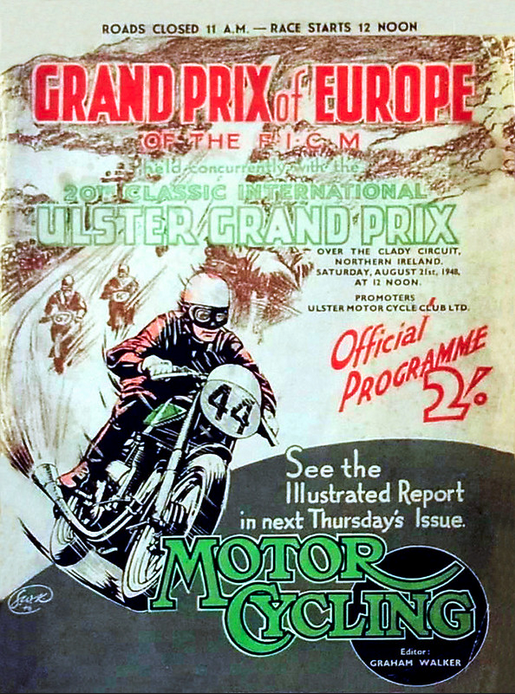
“I SHOULD LIKE to join the ‘new Douglas’ fans in expressing my admiration and approval of the T35. doubt the sweetest 350 on the road. Rough roads are ironed out by its well-thought-out rear-springing. The neat little motor will hum along at 55 without any fuss at all, and the brakes are perfection. Yes, the Douglas twin is real motor cycle. A higher petrol consumption than most 350s is the only drawback, but to offset this is a decent maximum speed of 75. I should like to see a 500 added to the Douglas range next year. Also, what about a racing model? A 500 ohc twin Duggie would just fill the bill. What a rival for the BMW!
E Lindon Harris, Merthyr Tydfil, Glam.”
“WHY IS IT THAT the BBC spend, seemingly, hours a day broadcasting cricket and tennis commentaries and summaries, and yet give so little time to our sport? On Junior TT Monday, a total of 35 minutes was set aside for the Race, and what seemed like 10 minutes of it was wasted on a description of the course. I say ‘wasted’ because I think most of us know what the course is like, so what we want from the-eye-witness is to know how the boys are coping. On Wednesday we had an hour on the Northern, but this was not mentioned in the London Radio Times. On Friday, we had 35 minutes for the Senior and Lightweight at opposed to 55 minutes tennis on the same day. Maybe the BBC consider our sport too dangerous to publicise; maybe I don’t understand the circumstances; maybe I’m too selfish; maybe I’m just dumb! I wish someone would explain.
Best of luck to the Blue ‘Un.
PF Willmore, Berkhamsted, Herts.”
“WITH REFERENCE TO Miss Theresa Wallach’s letter, I should like to add some comments. By all means let women ride in the TT, but not in the same race as men. An extra attraction could be added to Race Week in the Island by having an ‘all-women’s’ race. As the number of entries would not be very large, all the races could be run concurrently. A massed start would add greatly to the interest. Personally, there is nothing I should like to see better than women racing over the T.T. course under exactly the same conditions as men. It would be highly amusing to watch the race at Ramsey Hairpin, Waterworks Corner or the Gooseneck, and to witness the attempts to restart up the gradient after a plug change. My antagonism towards women in connection with racing is based upon my experience in the 1947 North-West ‘200’. When braking for a pit stop I skidded and fell off my machine. Subsequent enquiries revealed that the female pit attendant in an adjoining pit had been allowing oil to leak from her quick filler on to the wet road. She thought it was rather funny.
RG Bethell, Nr Liverpool.”
“ONE HUNDRED AND THIRTY competitors—three clean sheets; that was the story of last Sunday’s Home Counties Team Trial, organised by the Southern Sporting MCC. For an expert, the dry sections of Pirbright, Frith Hill and Bagshot were unquestionably on the easy side, but it should be realised that at least 50% of the entry was very much in the ‘rabbit’ class, and at the end of the day it was only Hugh Viney (350 AJS), GM Berry (500 Royal Enfield), and Peter Brown (350 Matchless) who could claim successfully to have coped with every section. As last year, Witley MCC fielded the winning team, but this time they won by only one mark (in contrast to their 21 ‘safety margin’ of 1947). This year, virtually their only challengers were the Weyburn teamsters, with a loss of 31 against Witley’s 30; all others were far behind. Of 26 teams, 18 finished intact. There were two laps to be covered, with 10 observed sections on each, and probably the cause of most lost marks was a twisty little obstacle entitled ‘Walker’s Wriggle’, somewhere in the wilds of sandy Frith Hill. Winners: Witley MCC (BHM Viney, RC May, DC Hull, J Hotting, HH Benton), lost 30. Second: Weyburn MCC (AF Gaymer, GM Berry, PJ Metiers, GP Edmead, FH Neal), 31. Third: Ravensbory MCC, 77. Fourth: Windlesham MCC, 110. Fifth: Weybridge MCC, 113. Sixth: West London MCC, 116.”
“THREE MORE CLUBS have received motor cycles in connection with the RAC-ACU learning-to-ride scheme, making a total of 53 with machines, five of them with motor cycles on loan, and the remainder with official issue machines. Of this total, 35 clubs have the scheme in operation on official petrol issues, nine have not yet asked for petrol, four have only recently received their training machines, and five are in difficulty over training grounds. The three latest clubs to receive machines are Grantham Pegasus MCC, Newport and Gwent MC, Merthyr &DMC. The Furness Club is now out of the scheme, but the number is made up by the Cambridge Centaur MCC.”
“FOR A QUARTER of a century and more it has seemed that the spring-frame era was about to be ushered in. What old-timer, for instance, will forget the many spring frames exhibited at the 1919 Show—the 398cc ABC included? This time, however, it has seemed safe to prophesy, largely because manufacturers have endowed, or are prepared to endow, their light, utility models with rear suspension. After all, if 125cc mounts have spring frames, it it not obvious that purchasers of larger machines costing half as much again, or, perhaps, twice as much, will expect their machines to be so fitted? Enhanced comfort is only one of the attributes of efficient rear suspension. the improved roadholding results in better braking. better steering and greater safety. The development is to he wholeheartedly commended.
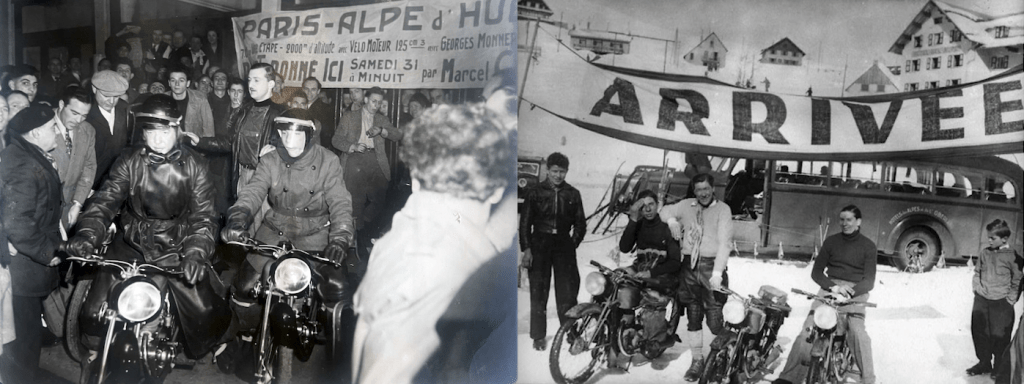
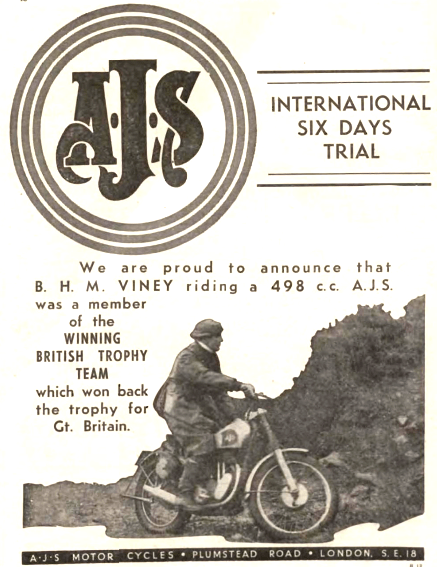
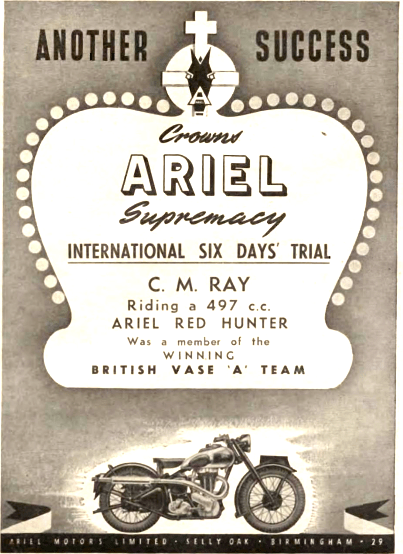
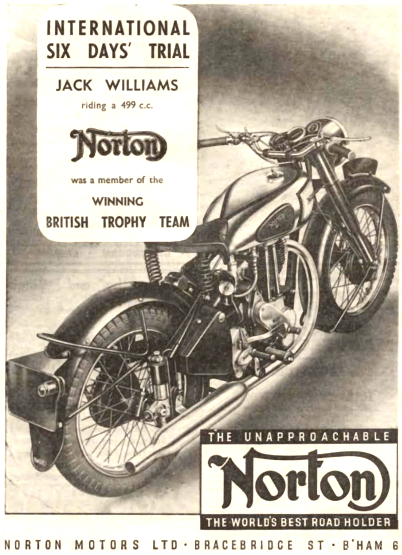
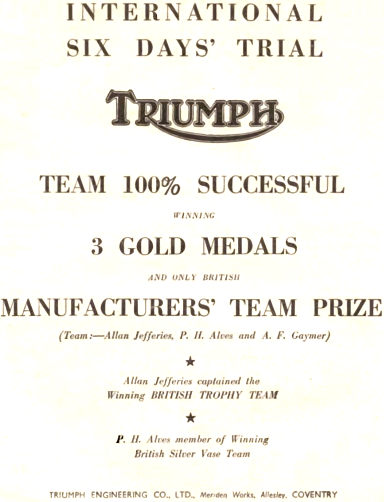
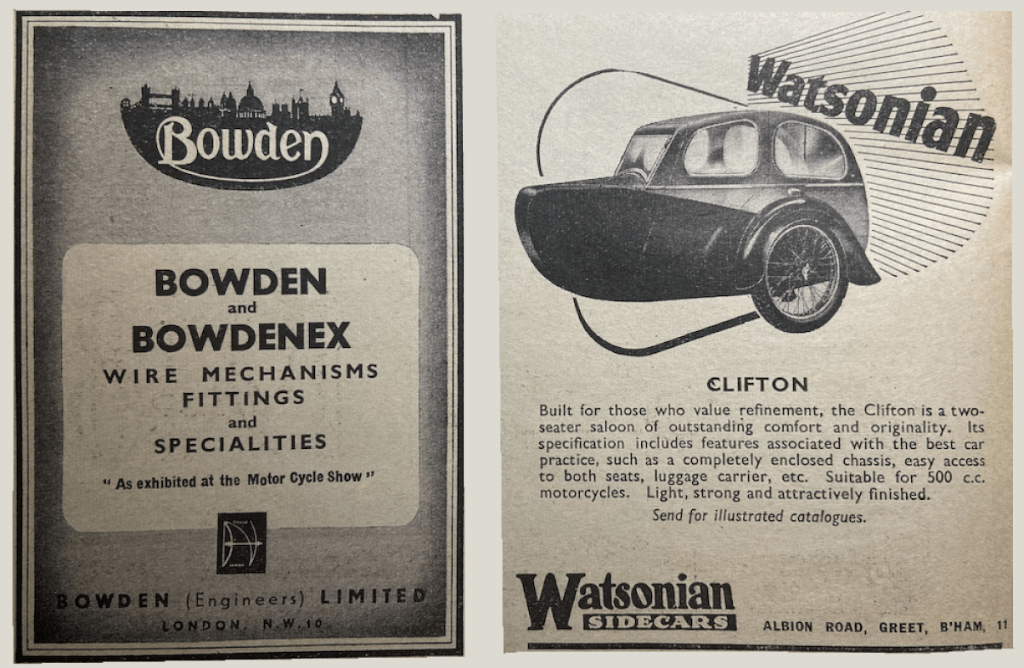
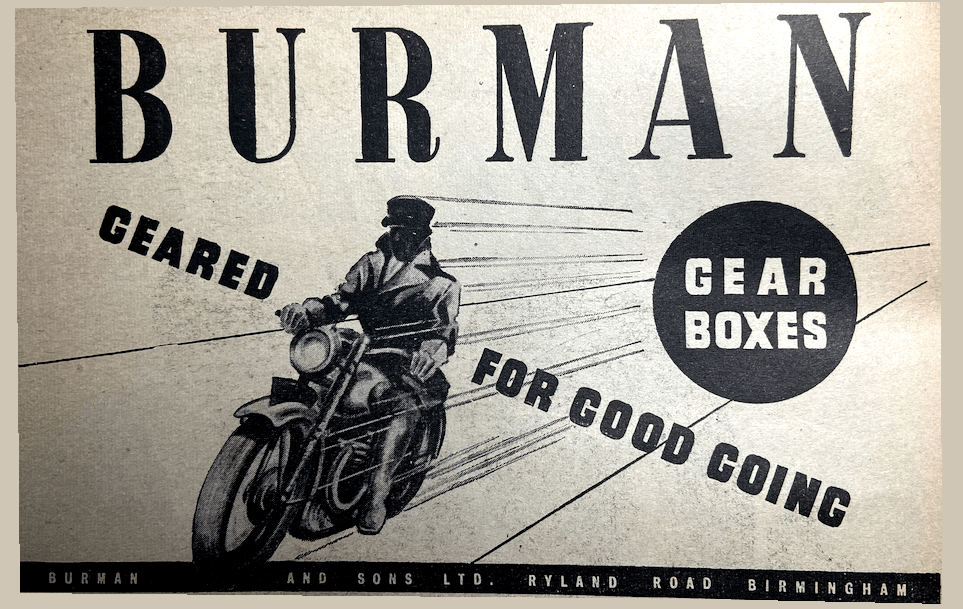
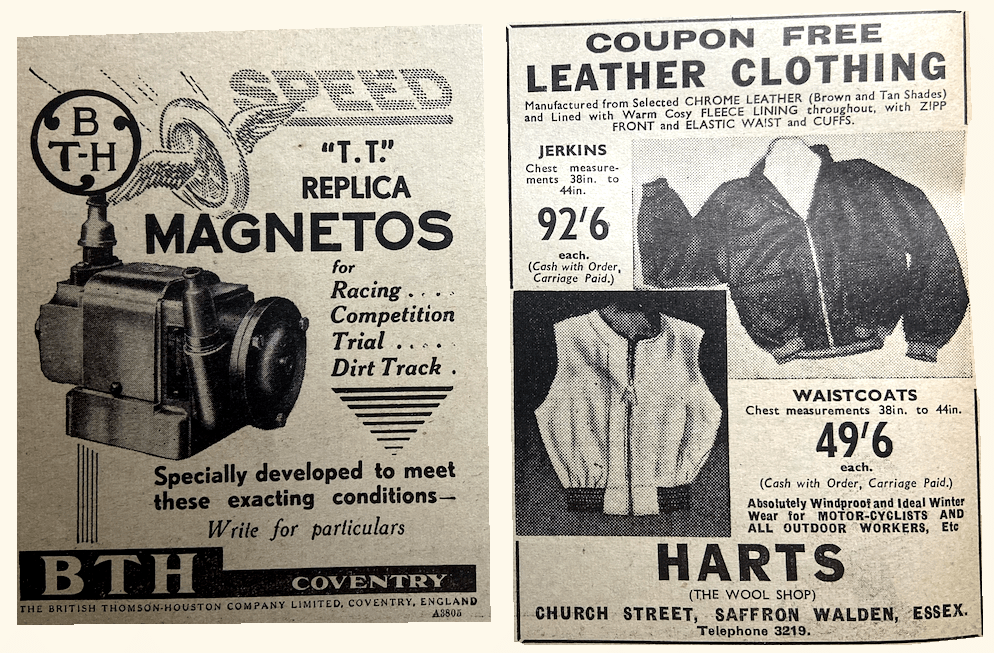
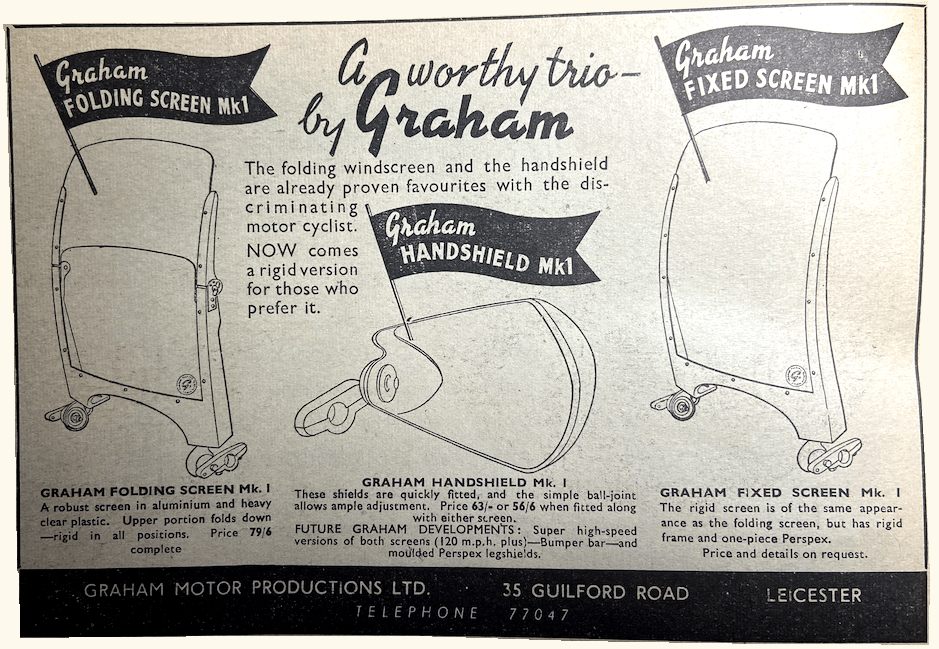
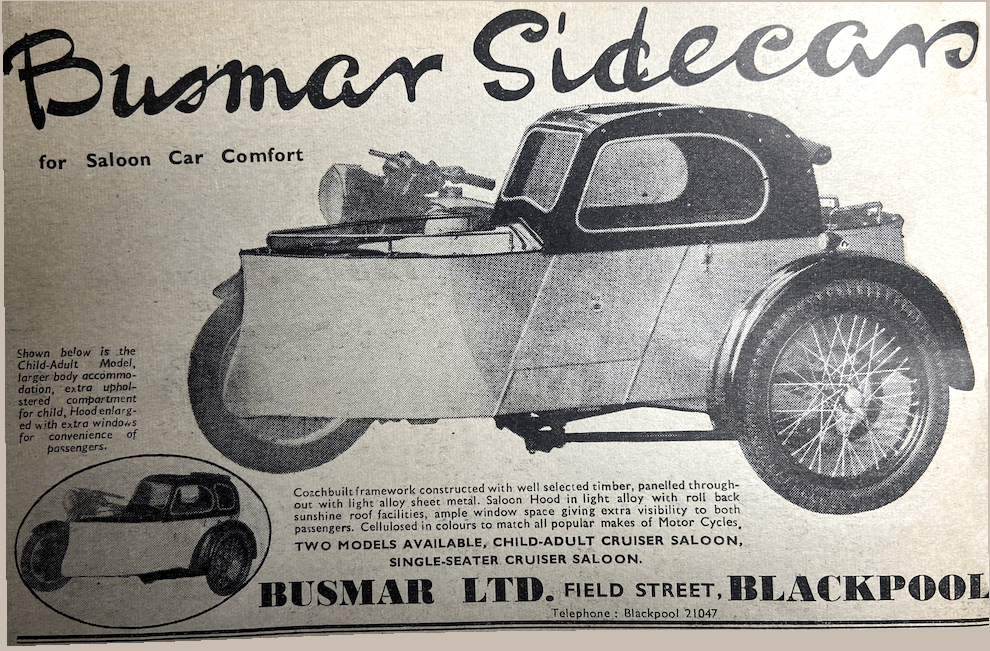
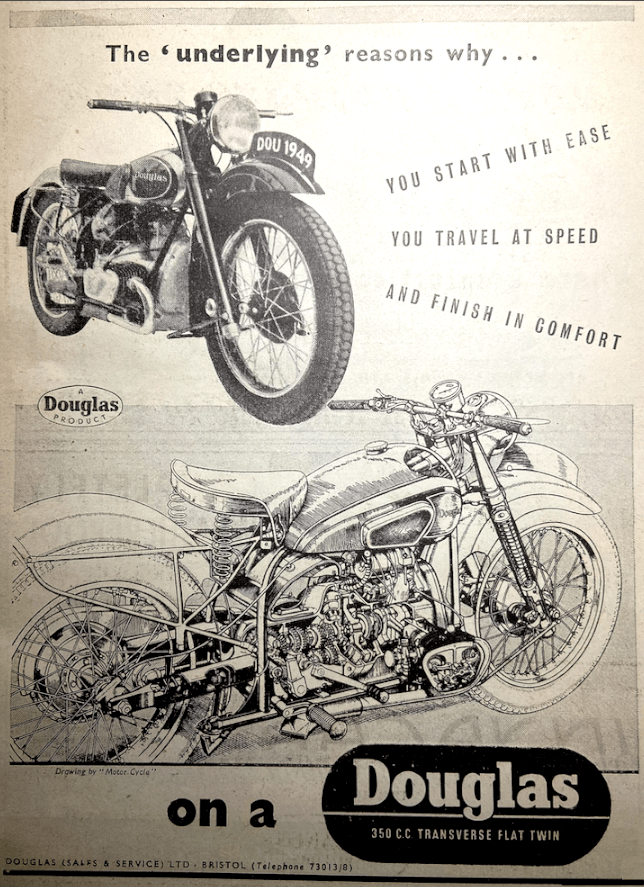
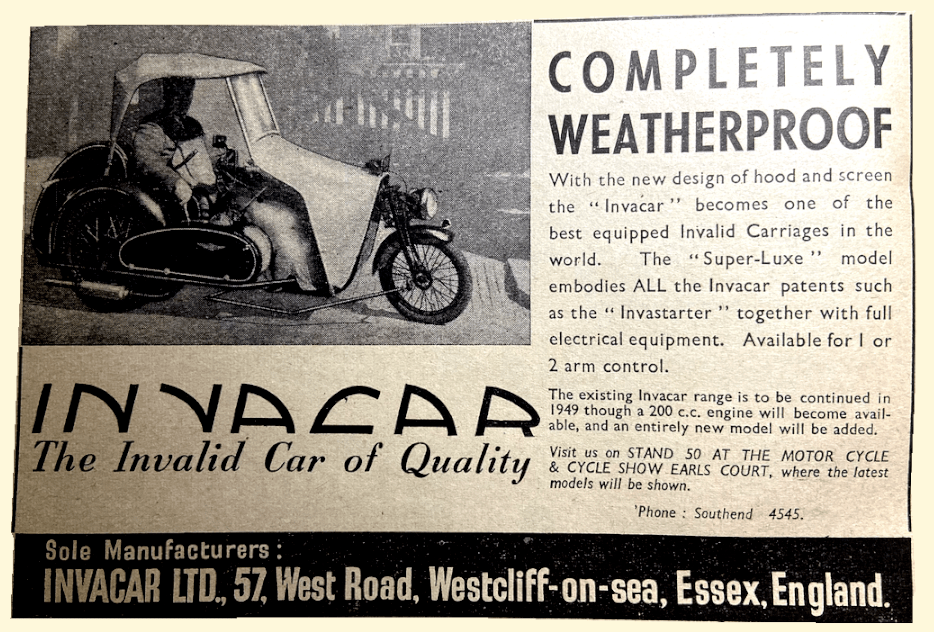
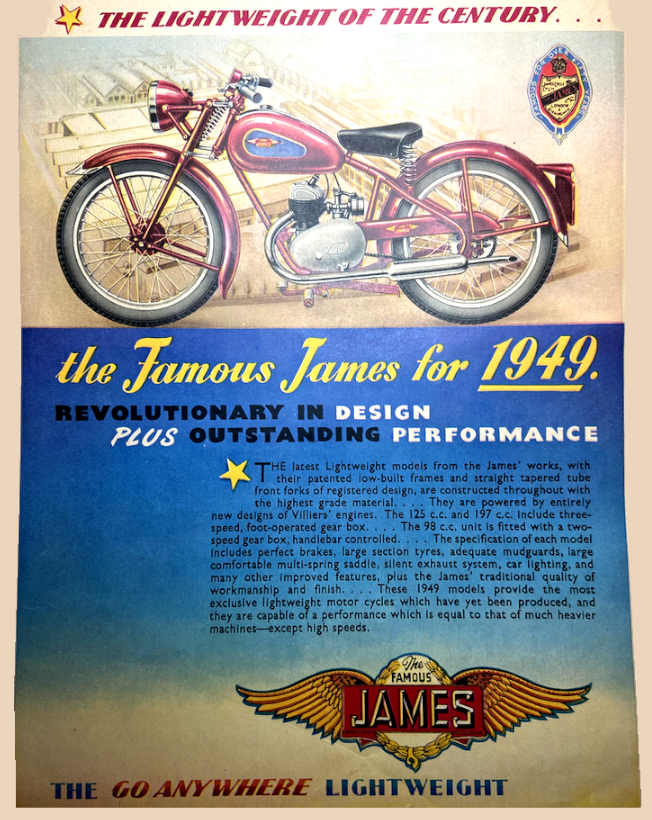
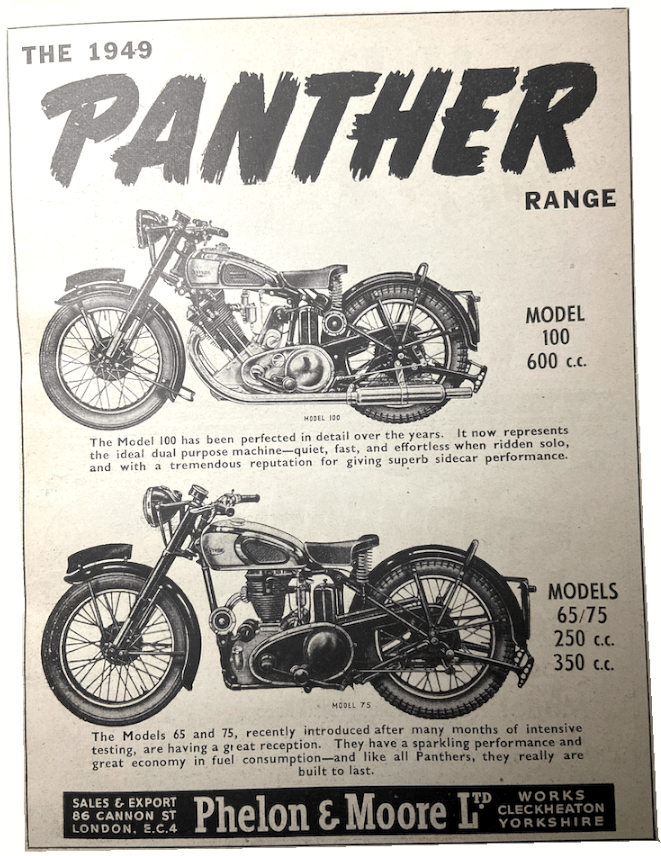
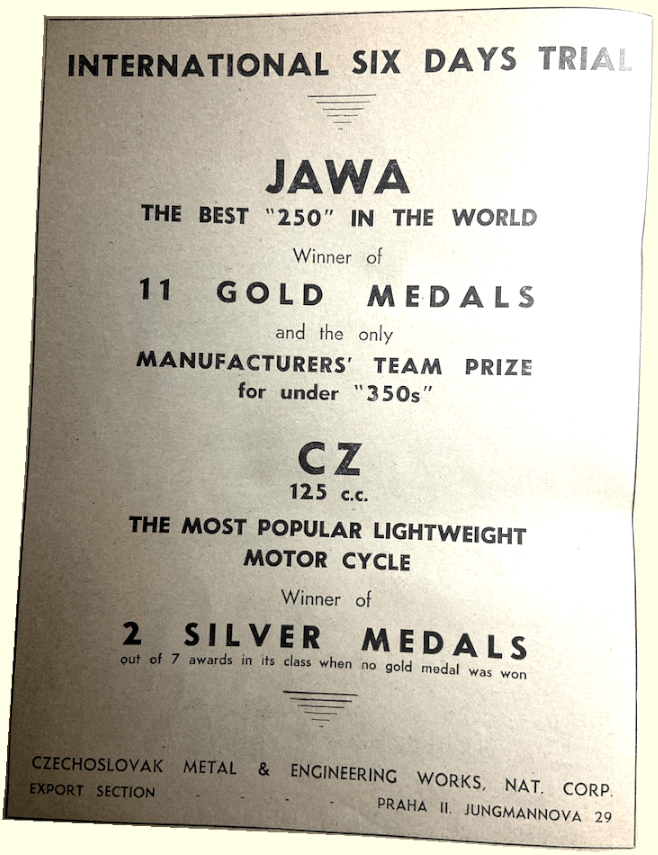
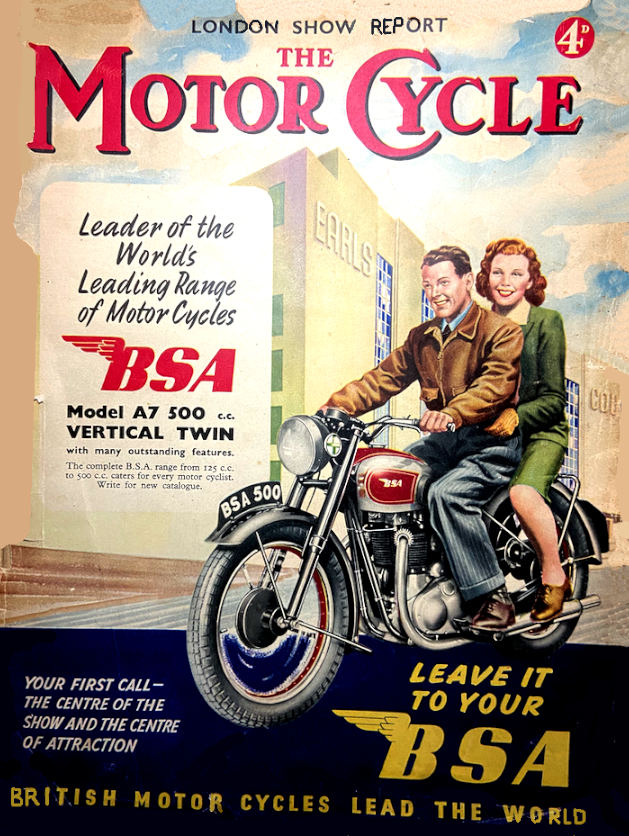

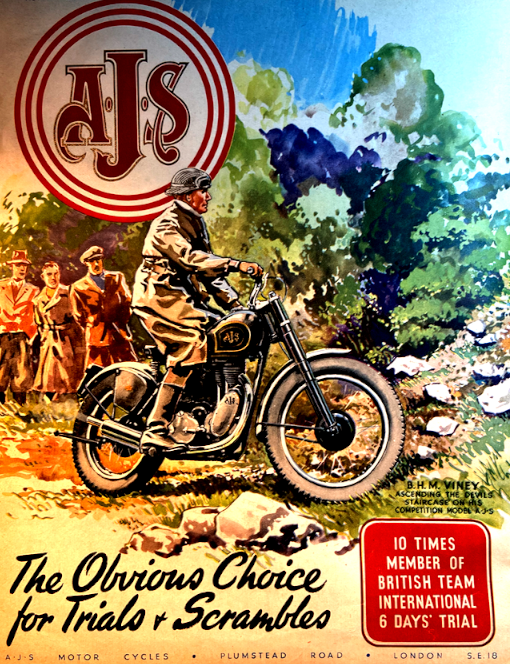
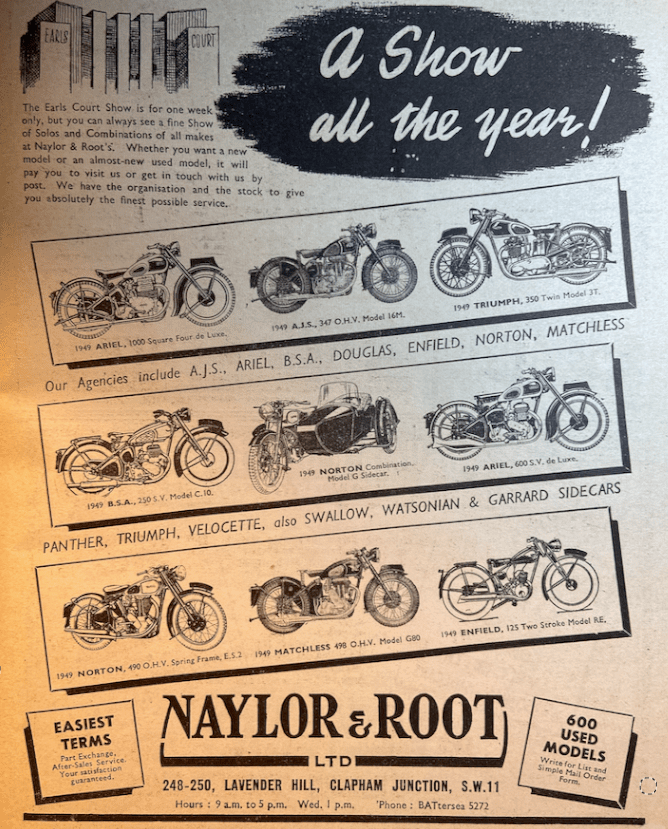
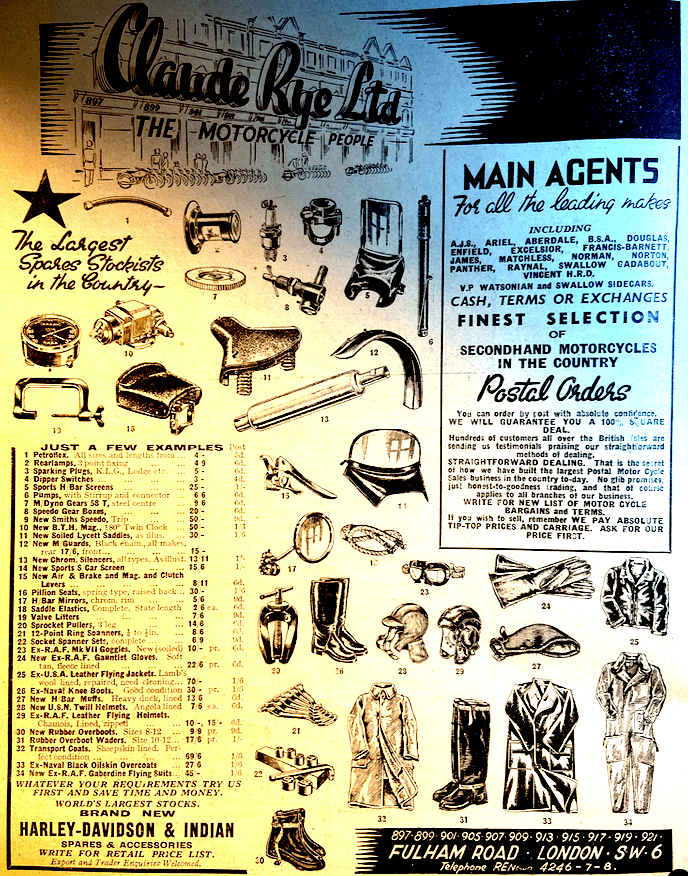
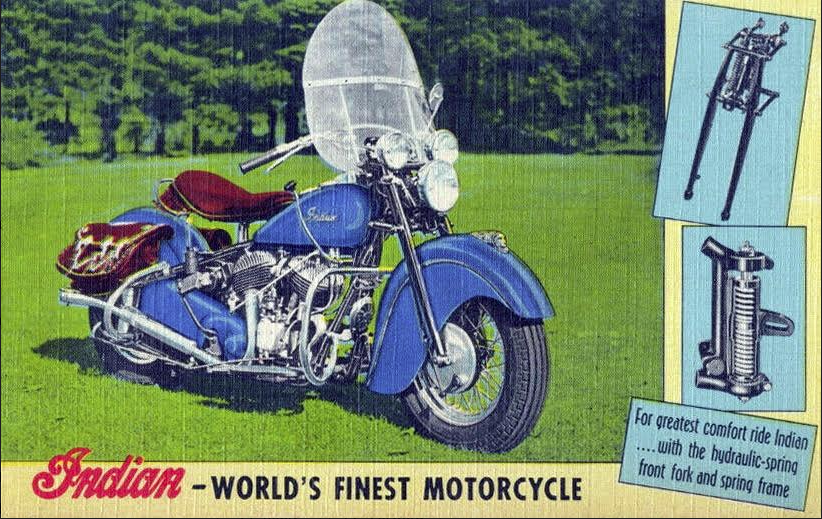
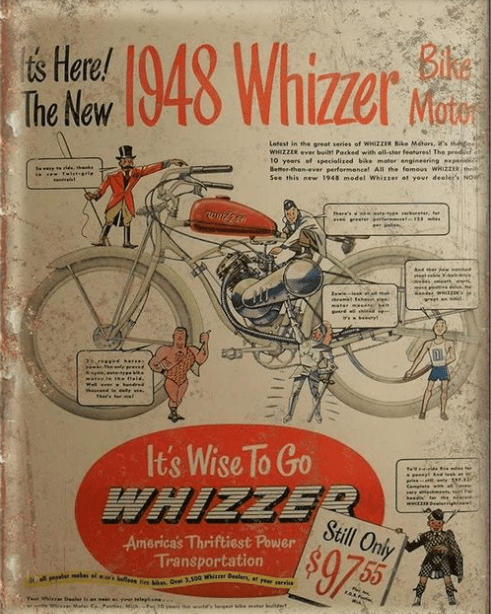
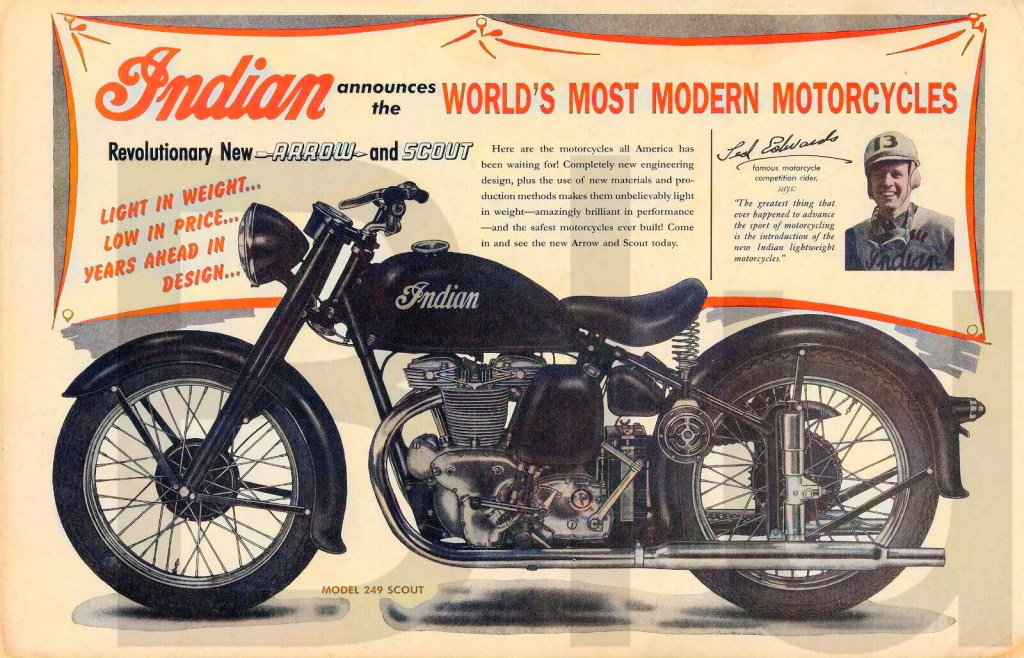
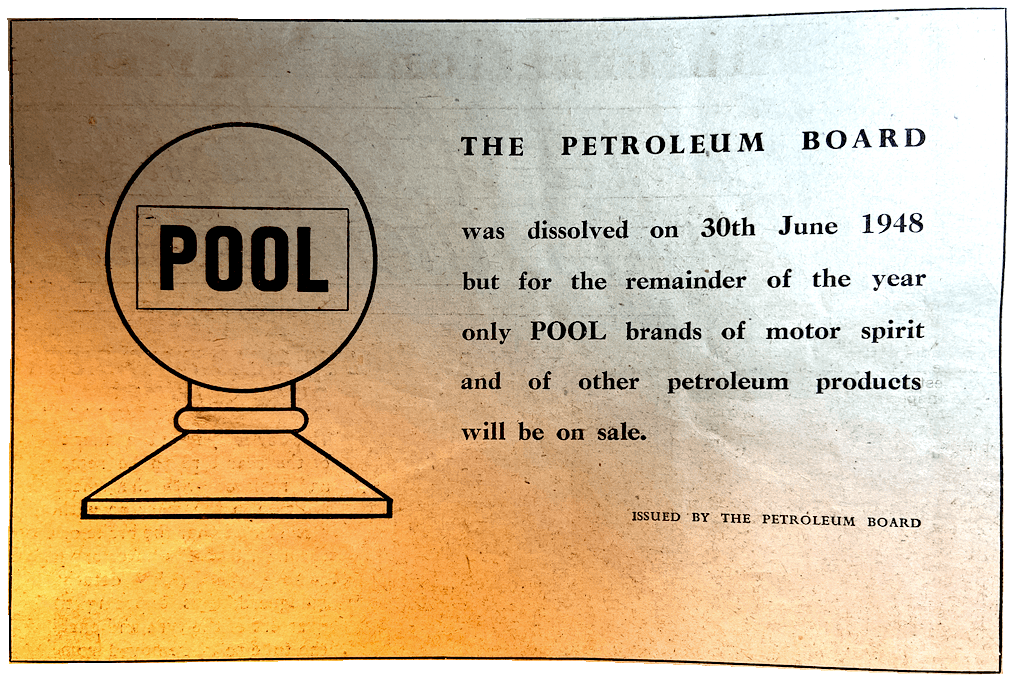
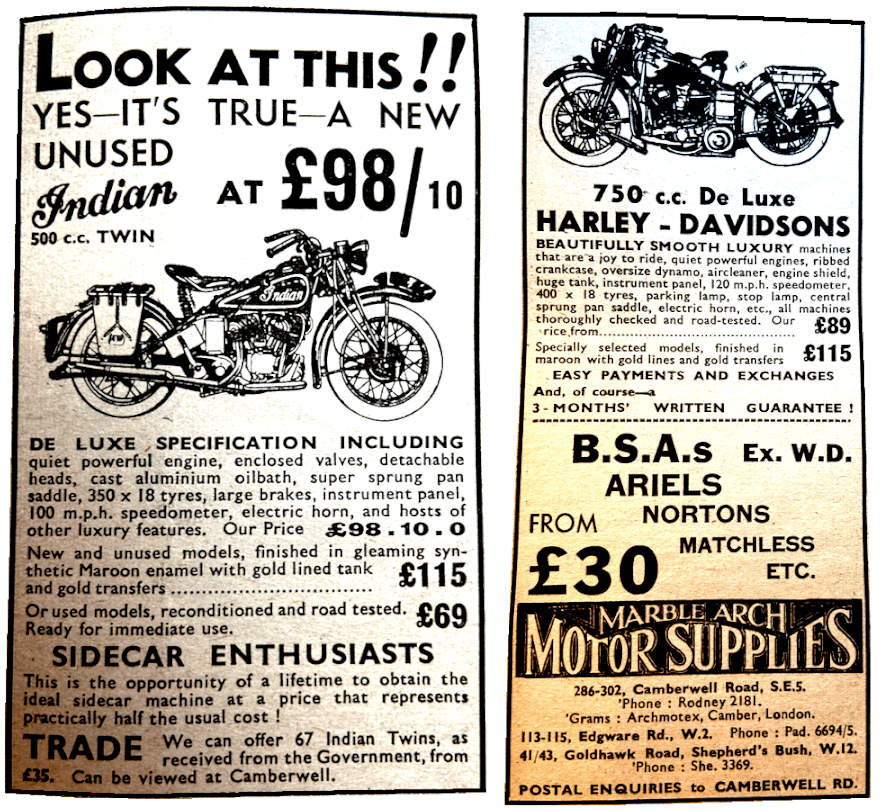
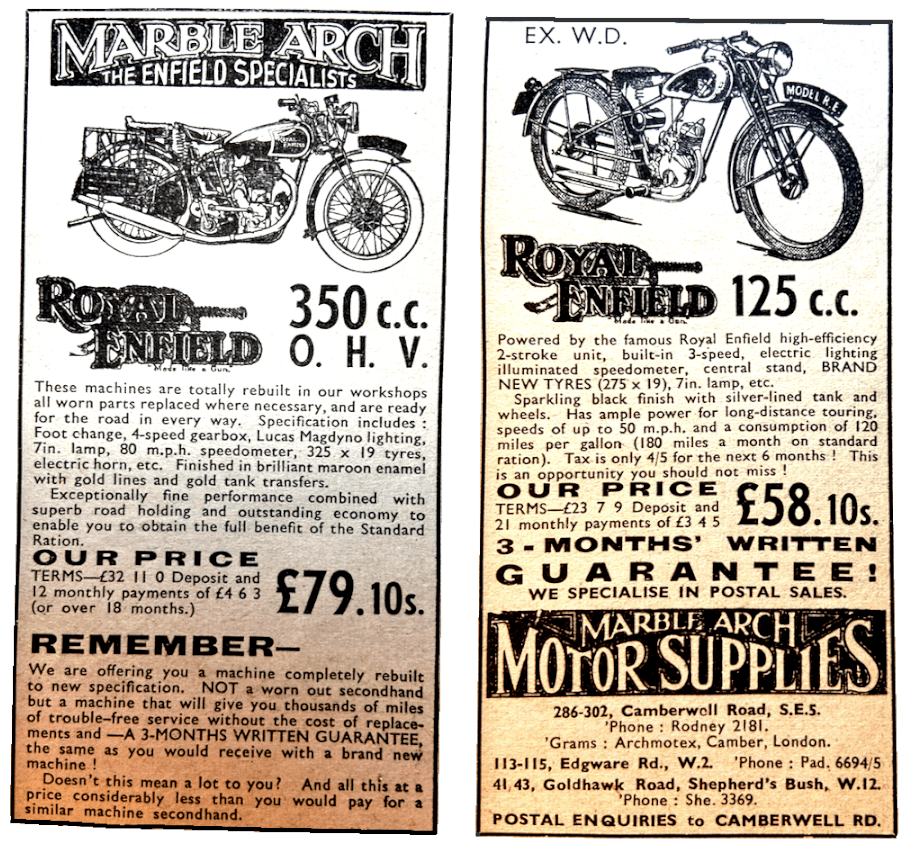
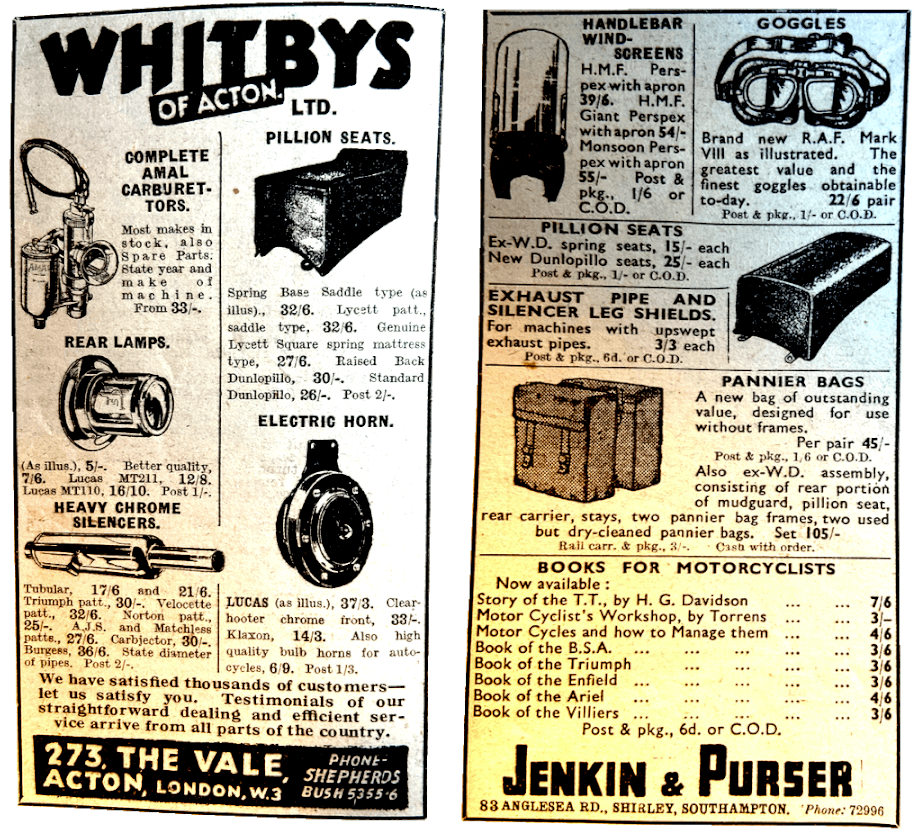
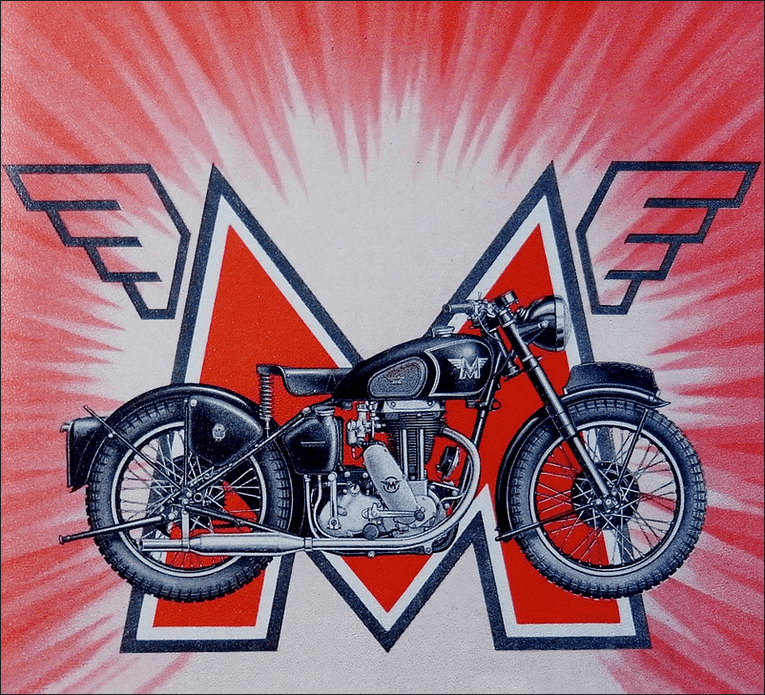
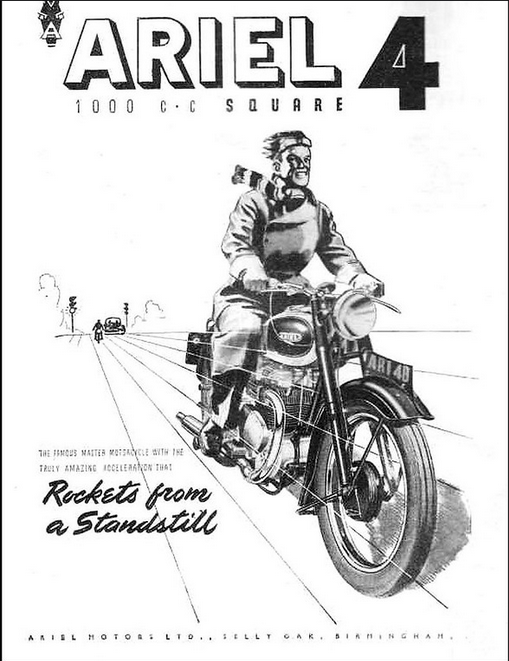
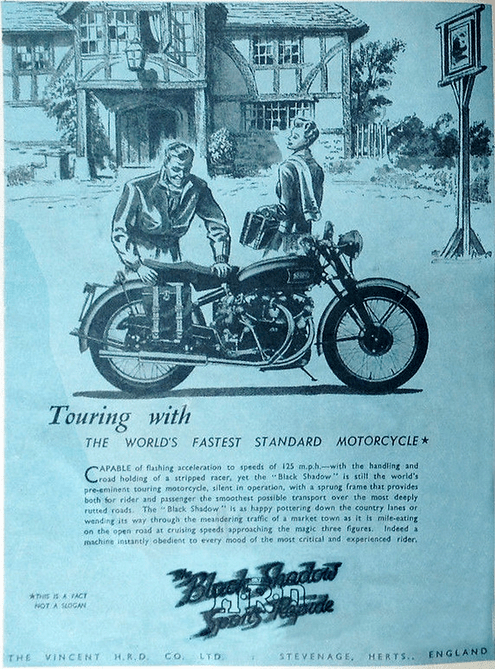

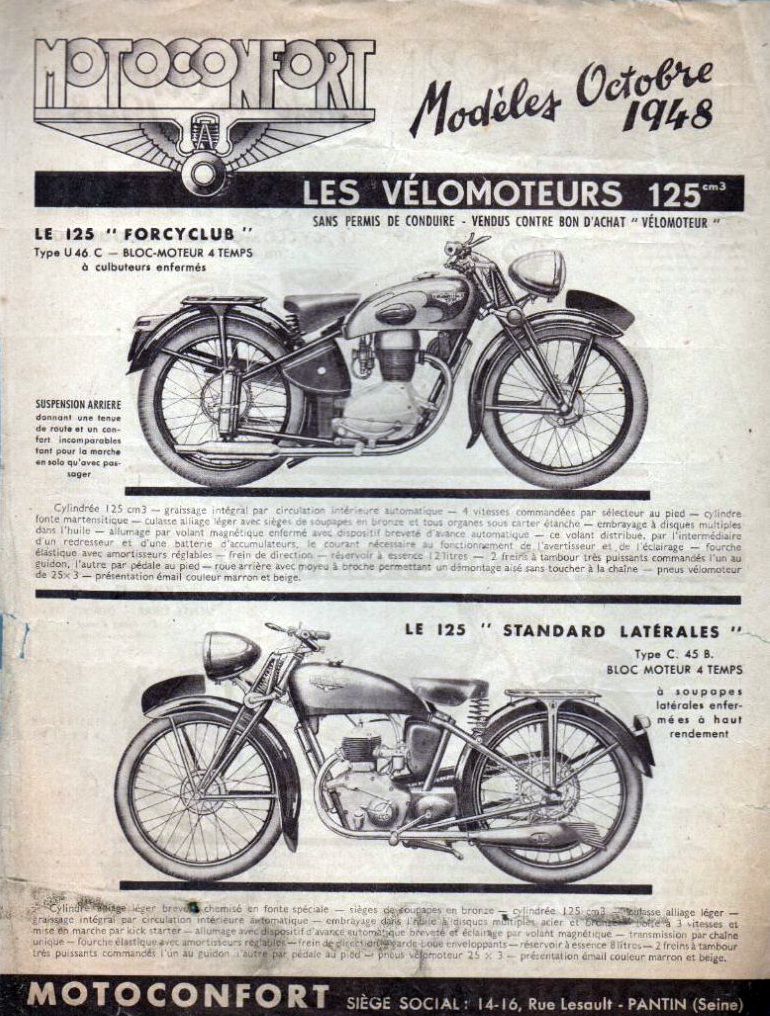
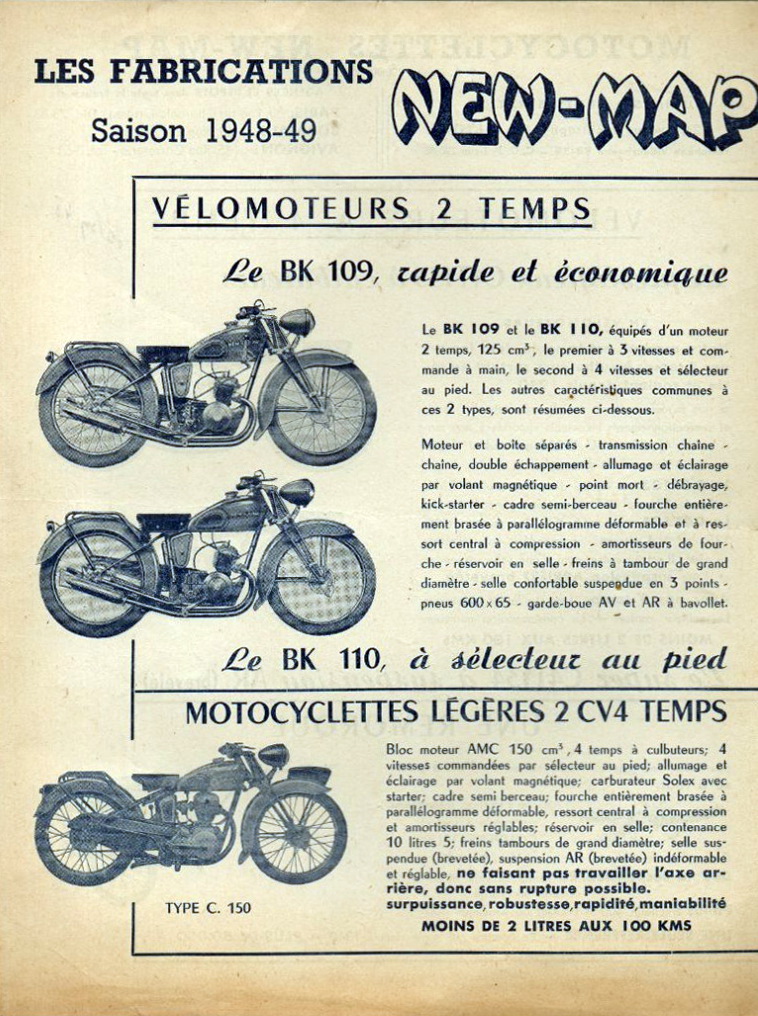
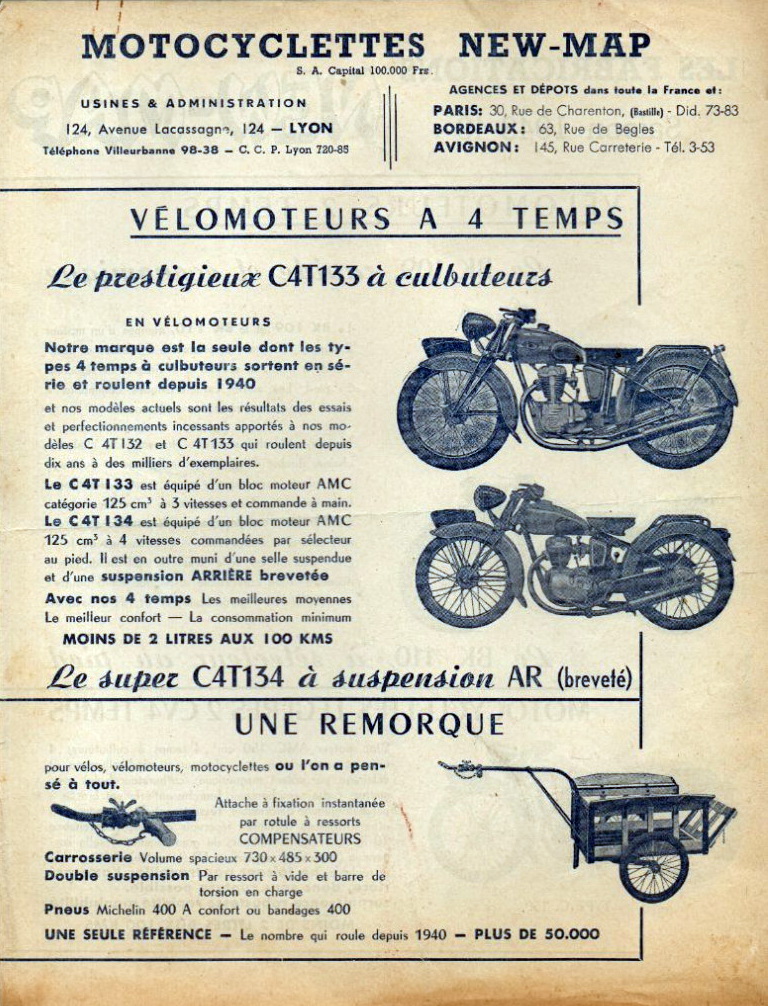
 Motorcycle Timeline