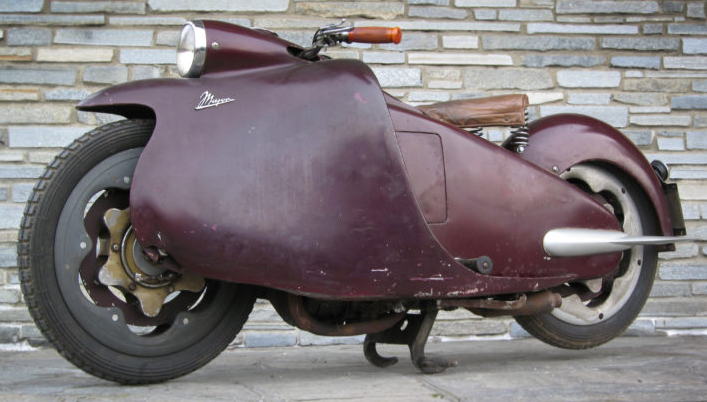
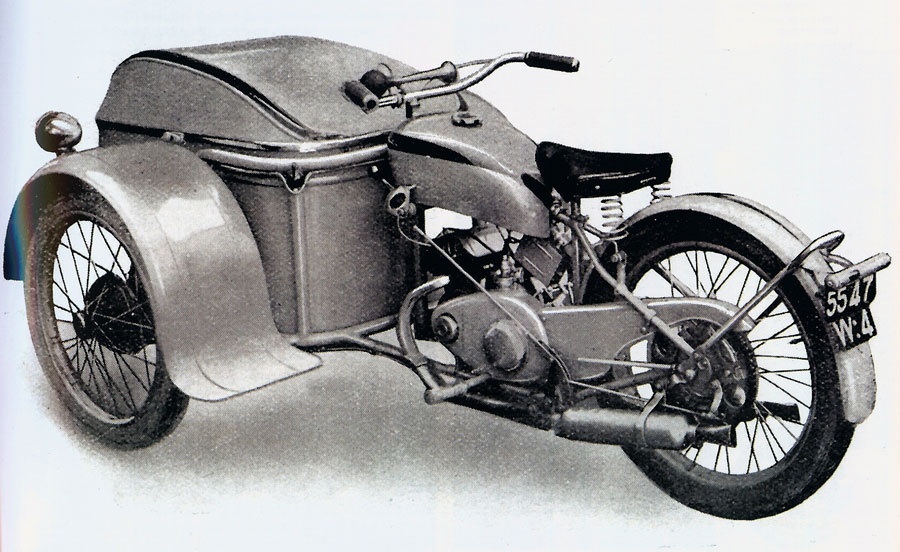
THE MOTO MAJOR 350 WAS A futuristic monocoque streamliner designed by Turin engineer Salvatore Maiorca and funded by aerodynamic research specialist Fiat Aeritalia. It was part of Fiat’s exploration of the motor cycle market (just before the war Fiat had produced a prototype scooter). The radical streamliner was designed for a 350cc water-cooled vertical twin featuring two radiators in the fairing. The prototype had to make do with a 350 single but an extra dummy exhaust was fitted. To save space the suspension was built into the wheels, harking back to the ‘elastic wheels’ that appeared briefly at the turn of the 20th century. Fiat planned to collaborate with Pirelli in a purpose-built factory; the Major created a stir at the Milan Show but the project fizzled out though the prototype survives at the Hockenheim Museum. (There’s a report on the Milan Show further down the page.)

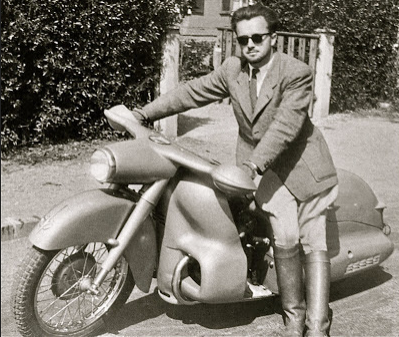
ANOTHER MIGHT-HAVE-BEEN STREAMLINER: this time based on a 1935 BMW R12 750cc sidevalve flat-twin. It was designed by French-born but German-based industrial designer Louis Lucien Lepoix who bought the Beemer at an auction held by the French Military in Baden-Baden. This one remained only a concept vehicle, but Lepoix went on to work for majopr manufacturers including Kreidler, Hercules, Horex, Puch, Maico and Triumph.
“READERS OFTEN DECLAIM about the shortage of new machines. What are the facts? In spite of the British motor cycle industry in 1946 almost trebling its 1938 exports—the percentage was no less than 270 and the White Paper figure for 1947 is 140—more new (and ex-WD) motor cycles were registered in Great Britain during 1946 than in any year since 1930. The figure was 75,274, which has only been exceeded five times since the 1914-18 war. An interesting point is that immediately following that war, although there were almost literally hundreds of motor cycle manufacturers and assemblers, the 1946 figure was exceeded but once and that was in 1920, when the total was 84,00. When the many difficulties of 1946 are recalled, the industry’s achievement is very remarkable indeed. Analysis of the figures reveals that of the 1946 total almost exactly 14,000 were machines of under 150cc—mainly motor cycles of 125cc, the so-called ‘Flying Fleas’ which earned fame during the war. These greatly outnumbered the motor cycles in the 250cc class. The latter totalled 8,248. Of course, the bulk of the registrations were of 350cc and over—a total of no fewer than 47,645. Sidecar outfits numbered a bare 4,000. The smallness of the number was, of course, due to the difficulty of obtaining sidecars. The ratio of 1 in 20 between sidecars and total new registrations is very different from the pre-war 1 in 5, which was the position the sidecar occupied in relation to all the motor cycles on the road. To-day’s prices of cars place a great, premium on the sidecar machine, a fact that the industry might well bear in mind.”
“A CHESHIRE READER, unable to obtain factory-made legshields for this past winter, designed and made his own. His principle may appeal to readers who plan to do ditto next autumn. He bolts footboards over the standard footrests. His shields, of approximately U-section, are made of patent leather, stiffened with steel wire, and fixed to the footboards. They are steadied at base and summit by very light stay rods attached to the frame. Legshields, he maintains, are illogical with footrests, since if there is enough liquid filth about to make shields desirable, the entire foot needs protection. The weight is low; and when summer tardily appears five minutes with a spanner detaches the entire caboodle.”—Ixion
“SOME SURPRISE IS being expressed at the ACU decision to run the Senior and Lightweight Races concurrently. It is urged in some club circles that the Manx course bristles with tricky corners on which a precise line must be taken to maintain a winning average of 90mph, and in any case the presence of many slow machines will be a nuisance and a handicap to the 500cc aces. (The approximate averages of the three Races are Lightweight, 75; Junior, 85; Senior, 90. Since by previous decision three races have to be crammed into two days, the interests of the greatest number must be considered, and opinion is that Junior entries will be numerous, with Senior and Lightweight entries comparatively small. Will the presence of 75mph Lightweights among the 90mph Senior leaders really bother the big ‘uns more than a crowd of second-rate entrants on 500cc machines have done in previous races confined to 500cc and securing a huge entry?”—Ixion
“A VETERAN READER asks me to compare the typical modern 98cc autocycle with the small single-cylinder Minerva and Kelecom motor cycles of 1902 or thereabouts. If he refers to reliability, the modern wins by streets. In speed and climb there is probably no substantial difference. The pioneer engines wore much faster. The lack of clutches and the crudity of the carburation were serious defects. Modem transmissions stand in a far higher class. Financial contrasts are difficult, seeing that at the moment we suffer from inflation. In 1939 a good autocycle cost round about £20, whereas I seem to remember paying £45 for a 1¾hp Ormonde and for a 2hp Minerva.”—Ixion
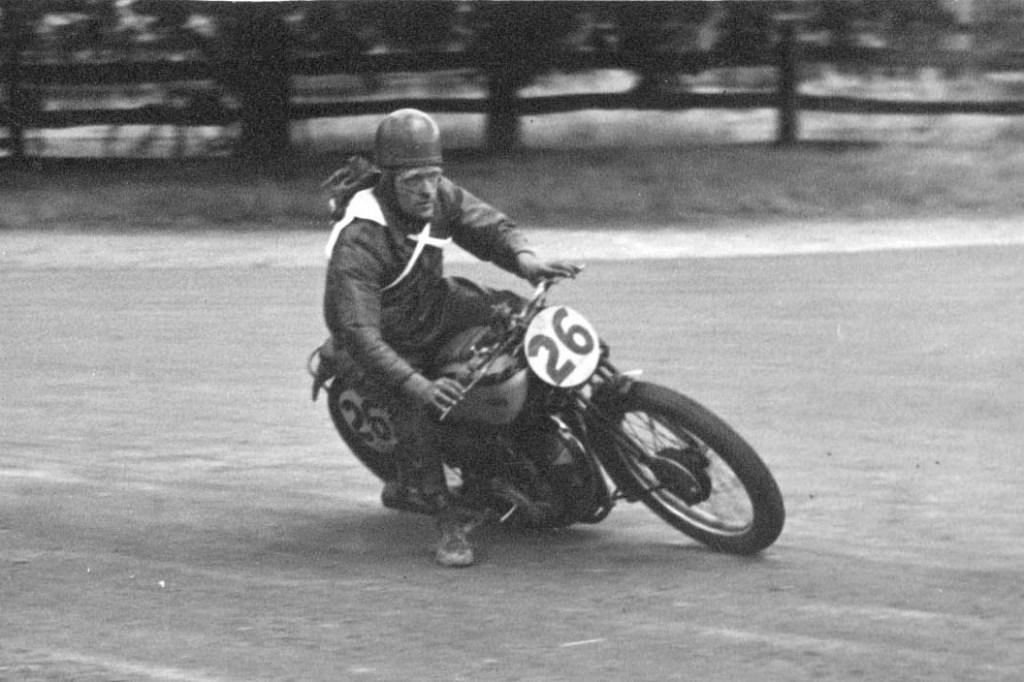
“RACING AT STAPLEFORD Tawney Airfield, near Abridge, last Saturday, was scheduled to start at three o’clock. Yet at 3.25 vast crowds were still flocking into the airfield. The weather was truly spring-like and the atmosphere distinctly Cadwell-like as the North-East London Club worked to get the spectators into the inside of the racing perimeter, where the only possible parking space was available—nearby fields had become flooded. In the pits, eager, perspiring competitors were working furiously, and some very interesting motors were to be seen. Many were disappointed to learn that RL Graham’s push-rod AJS was to be a non-starter. He had broken a valve spring in practising, and as it was of the enclosed hairpin type, a replacement could not be obtained in time. As usual, a trio of Rapides was a focus of interest. The course, shaped roughly like an egg with one flat side, proved to be almost a natural road-racing circuit. The surface on the far side from the timekeeper’s table was rather bumpy, and the wide curve culminated in a goose neck, before swooping downhill to the right-hand turn and into the finishing straight. The first race—a four-lap novice event for solos of unlimited capacity—started at 3.30. Competitors’ machines were lined up diagonally along one side of the track, and at the drop of the flag the riders ran to their machines and were off. A laugh was raised when D Gregory was found holding his Norton, and his mechanic was lined up with the riders! Girder-forked machines seemed to pre-dominate in this event, and with a roar and a bellow LR Archer (250cc Velocette) was first off the mark. He was hotly pursued, and when riders came round on Lap 2, D Gregory (490cc Norton) was the first to be seen. He was followed by L Peverett (498cc
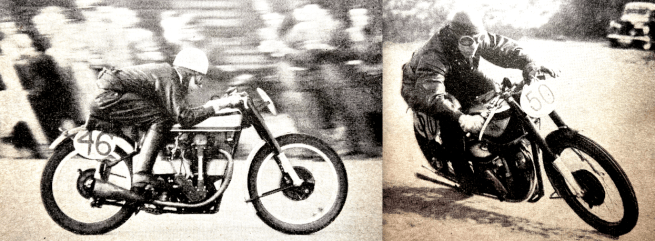
Triumph). Fighting hard for third place were J Medlock (500cc Ariel), G Monty (499cc Norton) and RH Buxton (490cc Norton). Speeds seemed to be very high. On the next lap Gregory was leading by a considerable distance, and with a roar Peverett and Monty flashed past together. DH Glover (249cc Rudge) seemed to be a shade overgeared. Gregory was the first man home at 56.8mph with Monty second (56.5mph and Peverett third (56.3mph). The second event was of six laps for solos under 250cc. Rudges were very much in evidence at the start, but JH Colver (247cc Matchless) was first away. At the end of the first lap RH Pike (249cc Rudge) was using every inch of the road as he swept into the straight in the lead. Riding with great skill, he maintained his lead throughout and won easily, at 57.87mph. A Hiscock (248cc Velocette) was runner up at 57.2mph—LR Archer (250cc Velocette) was third at 56.4mph. The third race was run in two heats, and was a six-lap event for under-350s, the eight fastest in each heat qualifying for the final. In the first lap S West led all the way. With his DKW howling its ear-splitting war-cry he was riding in masterly fashion, but he was hard pressed by CE Beischer (350cc Norton)—the ultimate winner. West came off on the gooseneck, and Beischer’s win—at nearly 2mph faster than the second man—proved his riding ability to the full. Third place went to CW Petch (348cc Norton). The second heat was closely contested. TL Wood, on his old 348cc Velocette, made—in comparison with his usual rapid get-away—a leisurely start. When he came round later, however, he was obviously in a hurry, and led WT O’Rourke (348cc Velocette) and D Parkinson (348cc Norton), who were very close. The telescopics of the leading machine on Lap 2 were obviously not Wood’s; no, Parkinson was leading. The winning pair were scrapping hard, but the Norton was a shade too fast for Wood’s Velocette; Parkinson won at 59.82mph.The final was delayed to allow TL Wood to change a tyre. Then, at the starting signal, his 348cc Velocette streaked away and was first into the bend before the gooseneck. He was leading the field until
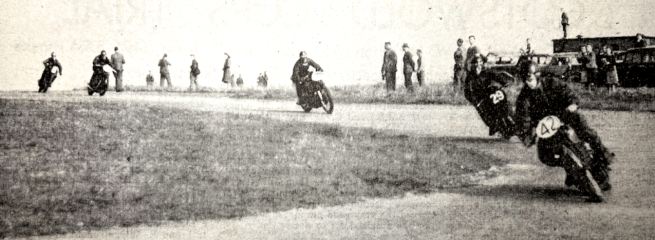
the fourth lap, when he hit a nasty hole while heeled over on the bend leading to the straight. He was only shaken, but his untimely exit allowed Parkinson an easy win at 60.64mph ahead of EE Briggs (348cc Norton) at 59.73mph and O’Rourke (59.5mph). Wood made the fastest lap at 65.45mph. The fourth race was for solos up to 1,000cc, and a stir of interest was caused when George Brown wheeled his Rapide to the start. He was first away, but close on his tail was D Gregory (490cc Norton), who was leading on the second and third laps. Throughout the race there was nothing between the leading trio—D Gregory (490cc Norton), G Brown (1,000cc Vincent-HRD) and EE Briggs (490cc Norton). But it was the Rapide that was first to get the flag (61.52mph) with Gregory second (61.51mph) and Briggs (61.1mph). The second heat was as exciting as the first, with J Lockett (490cc Norton) dominating the whole race and Crow scrapping with Heath for second place. Lockett won at 63.93mph, followed by Crow 60.72mph and Heath (58.05mph). A sidecar event, not on the programme, was run before the final of the 1,000cc class. There were four starters; the most notable were Surtees, with a Rapide and Oliver (596cc Norton). Surtees retired to the pits after only one lap, and Oliver, ahead of the others the whole way, won at 56.4mph—almost as fast as some of the solos. The final of the 1,000cc class was fast and furious. Brown got away clean and fast, but was closely pursued. The Rapide locked solid on the gooseneck (Brown was uninjured). Lockett made a lap record at 67.14mph and increased his lead rapidly to win an exciting race at 65.22mph with D Gregory second at 63.1mph and Crow third at 62.62mph.”
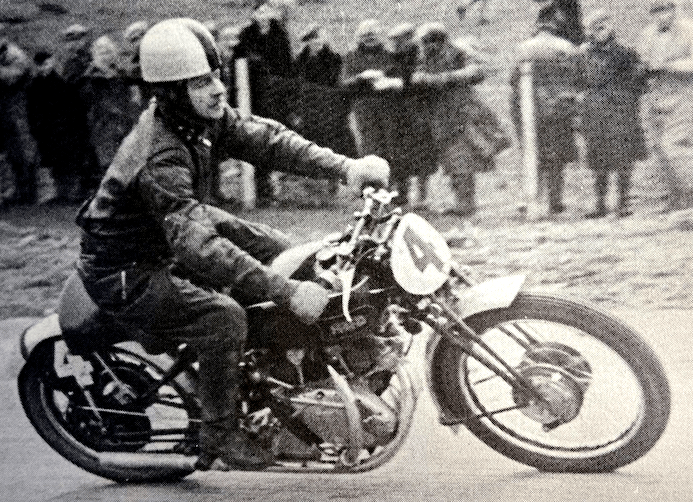
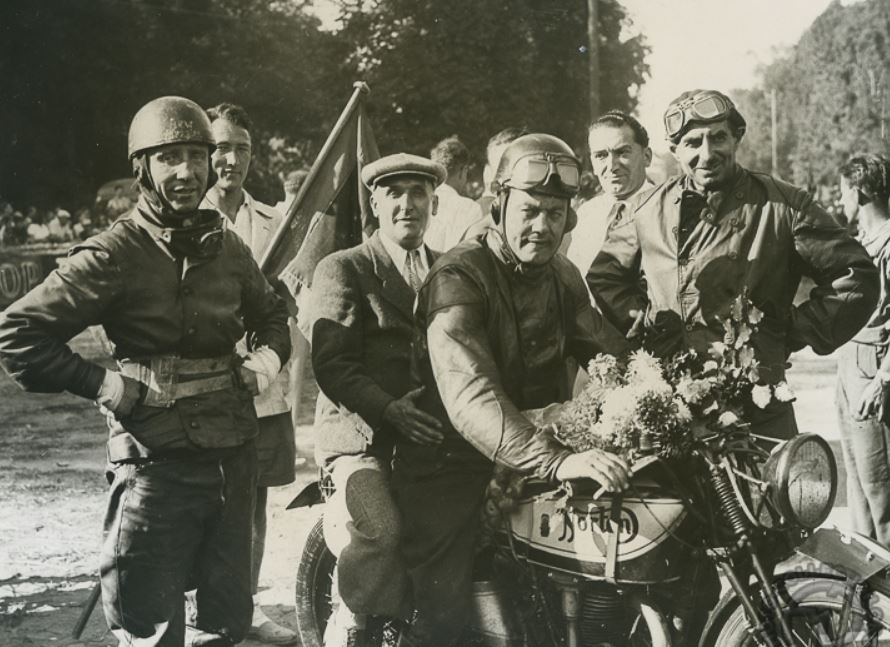
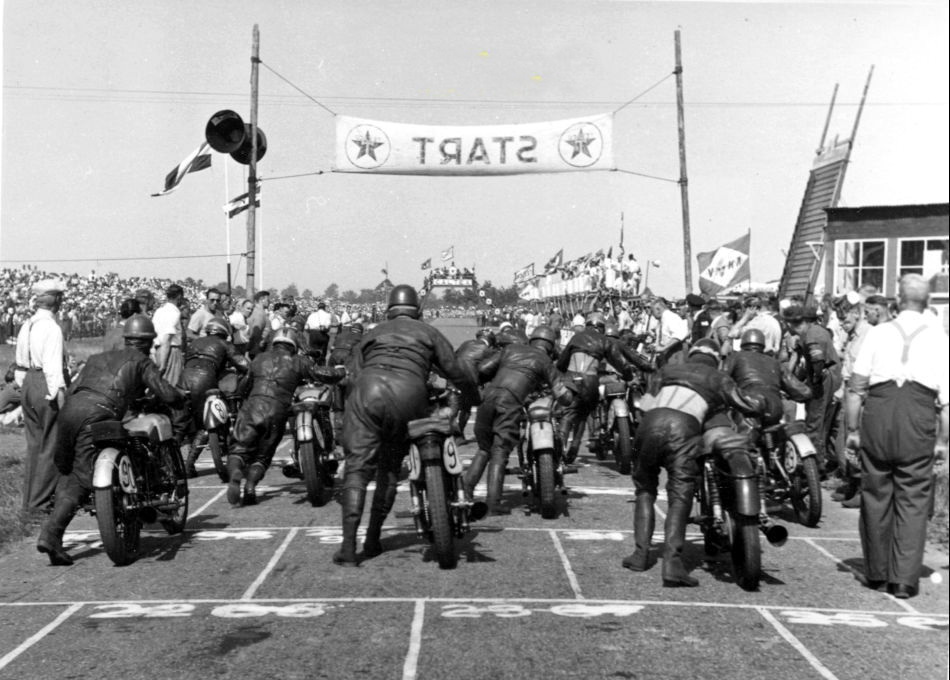
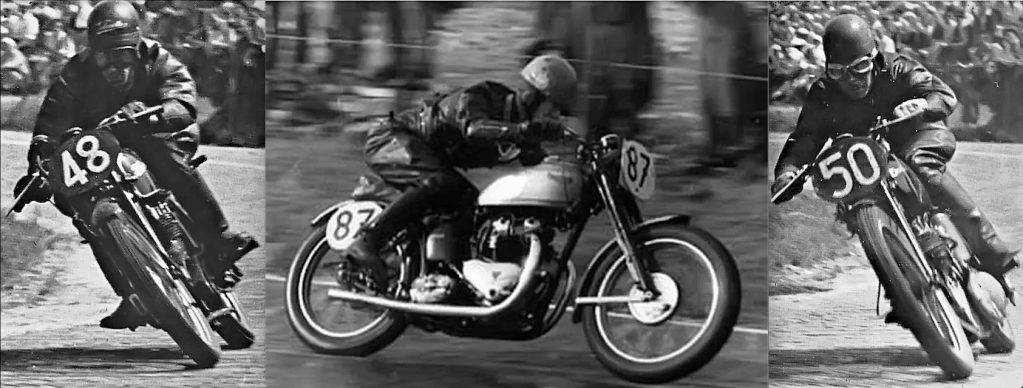
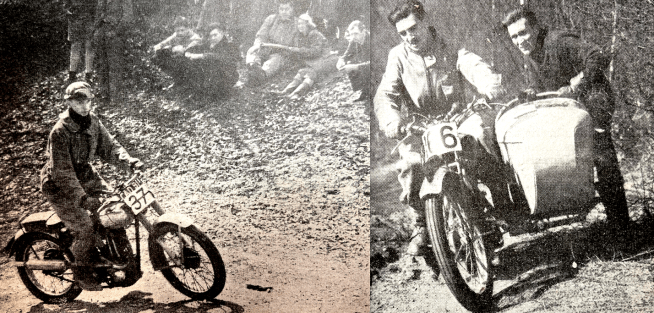
“NO EVENT COULD HAVE been a more fitting fiftieth for the Clerk of the Course, Mr HP Baughan, than the Cotswold Cups Trial. First, the winners were decided entirely by performance without resort to the special tests; second, the course was rideable clean throughout, except for sidecars in one sub-section; third, there were no delays and, finally, even the weather co-operated to provide the first ‘all-sunshine’ open trial of the year. So delightful was the weather that, however inconvenient at the time, no one could possibly have regretted the postponement—enforced by the snows—from March 8th; indeed, the thought was inescapable that perhaps the April-May period would be a more suitable time of the year for the important ‘opens’ than the habitual earlier months. In winning the solo cup, W Nicholson (348cc BSA) rode confidently and skilfully to remain unpenalised throughout the course; he was the only competitor to do so. The sidecar winner, H Tozer (496cc BSA), continuing to ride in the first-class style he has shown post-war, was a clear six marks—one stop or three foots under the marking for this trial—ahead of the next competitor in this class. Sunbeam MCC, represented by J Blackwell (49cc Norton), BHM Viney (347cc AJS) and CM Ray (497cc Ariel), won the team award, thus proving superior not only to other club entries, but also to manufacturers’ teams. The bright weather of the few days preceding Saturday had taken the sting out of some of the sections. Ham Mill, though rarely severe was a meek and mild first observed section on the route card, but it served the very good purpose of a setting for the special tests to decide ties. Similarly, Leigh, which followed, was innocuous except for a mud hole in the second sub-section. Here the mud was of watery consistency and the run-out of surprising slipperiness. It was a matter of fine judgment to gauge the highest safe speed through the liquid mud in order to pass over the three yards of ‘slither’ without undue wheelspin. M Laidlaw (347cc Matchless) was not quite fast enough and, while fighting wheelspin valiantly, had to dab just once. Afterwards he ran back to warn his team-mate, AW Burnard on a similar Matchless, who zipped through without trouble. Surprisingly, Colin Edge, on another Matchless, was caught out; he had a front wheel slide so severe that to avoid climb-ing the bank he had to foot in most determined fashion. JE Breffitt (490cc Norton), though he seemed fast enough, was almost stopped by wheelspin, and Jackie White (248cc Ariel) who tried slow, body-leaning tactics, fell in the deepest of the mud. Loud applause from spectators followed B Holland (349cc Triumph Twin), who gave a consummate exhibition of throttle control, and E Wiggall motored his 348cc BSA through with equal skill. Frank Fletcher’s spring-frame 125cc Excelsior buzzed gaily, but he had to bounce in the saddle, and later to foot, to keep going. The long climb which constitutes Camp 1 and 2 was difficult only in the deep ruts of the three-ply towards the end of the former. Rider after rider had to dab occasionally for balance as front wheels refused to remain down on the hard base of the middle rut—that selected by almost everyone. In roughly the first 50 competitors to arrive only Burnard, TV Ellis (498cc Matchless), CN Rogers (250cc Royal Enfield) and NE Vanhouse (347cc Ariel) were feet-up throughout Camp 1. Later numbers had to contend with a rut that got deeper and deeper as the base was worn down by biting tyres—RW Sutton had to foot forcefully as be footrests of his 497cc Ariel grounded.”
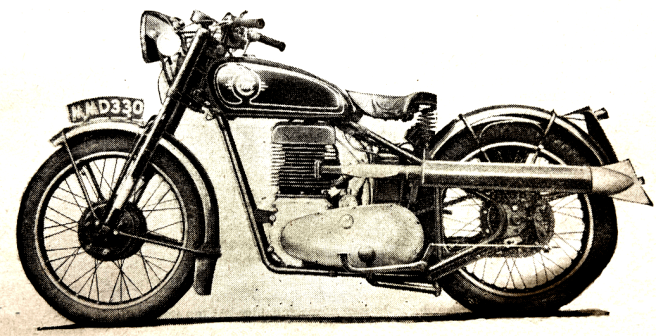
“TRIALS ENTHUSIASTS will be pleased to learn that there is a new 499cc competition model BSA, to be known as the B34. Deliveries of the machine are not expected to begin until about June of this year. Very similar in looks to the 350cc trials mount (B32), the new 500ohv single has a larger carburettor; this is the only obvious-to-the-eye point of external difference between the two trials machines. Bore and stroke of the B34 are 85 and 88mm respectively, and the compression ratio is 6.8 to 1—in fact, the engine is the same as that of the recently announced standard 500 B33. Gear ratios of the new competition model are naturally lower than on the standard 500, being 5.6, 7.3, 11.1 and 15.9 to 1. These are identical with the ratios on the standard 350 B31. Tyres are 4.00×19 rear and 2.75×21 front. An upswept exhaust pipe is fitted. A brief flip up the road, on a prototype, revealed that the B34 is a lively, extremely pleasant machine to ride, handles well, and has an excellent riding position. The brakes on the model ridden were particularly impressive, being spongy, yet powerful and progressively smooth in action. Price of the machine, fully equipped except for a speedometer, is £134, plus P[urchase] T[ax] £36 3s 7d, totalling £170 3s 7d. Makers are BSA Cycles, Birmingham, 11.”
“THERE WERE 30 entries for the Stamford Bridge April Scramble on Bagshot Heath last Sunday, a programme of four races being run off with commendable efficiency. The course, just over a mile in length, was almost all visible from the starting point, and an unusually large crowd enjoyed an afternoon’s sport in perfect weather. High-spots included George Eighteen’s doggedly holding the lead from Bessant throughout the first half of the Unlimited race, and a neck-and-neck finish by Hall and Cullford in the Non-winners event.”
“NEWS FROM BELGIUM is that in national scrambles not more than five foreign riders may compete, and in national road races there may not be more than six foreign entries with a maximum of two from any one country. On the face of it this new ruling is reasonable enough, but it does preclude a party visit on the lines of the Sunbeam Club’s trip to the Grand Prix du Zoute last July. That is a pity, I think. Much of the fun and much of the encouragement to ride in Continental events is wrapped up in an organised visit with fellow enthusiasts. It is no answer that there is no restriction on the number of foreign entries in International events. Many of the riders who would join a party to support a Belgian race are still anxious to retain their eligibility for the Manx Grand Prix. Last year our friends in Belgium were most anxious to get British entries and I know the new rule will strike a dull note in many quarters.”
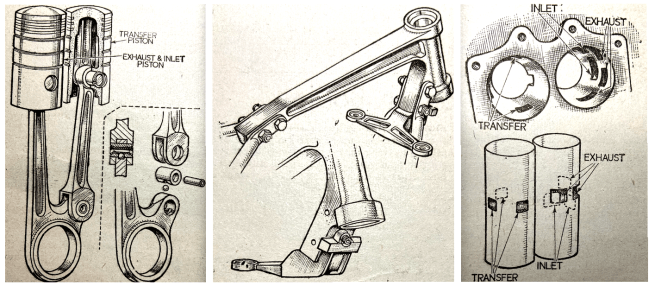
“TWO-STROKE ENGINES of the ‘double-single’ type have been used successfully by Puch and TWN (German Triumph) for a number of years. There is now being produced in England a machine, the EMC, with a 350cc engine employing the familiar layout of two cylinders with a common combustion chamber and a forked connecting rod. Two of these machines, one with a side-car, competed in the Land’s End Trial at Easter. Running in single ball races, the steel flywheel assembly has a 1³⁄₁₆in diameter crankpin that is a press-fit in the fly-wheels. Caged rollers ½x¼in are used in the big-end of the steel connecting rod, which is forked just above the big-end eye and fitted at this point in the front branch of the fork with a wristpin. It will be remembered that the German engines use a rectangular gudgeon pin and a sliding small-end eye to accommodate the variation in gudgeon-pin centres which occurs during each revolution of the fly-wheels. Exceptionally long—in comparison with a bore of 50mm—Specialloid aluminium-alloy pistons are used; in point of fact, the rear (exhaust, and inlet) piston is 111mm. and the front (transfer) piston is 99mm. Each piston is fitted with three pegged compression rings and has, between the lower ring and the gudgeon-pin boss, situated well below the midway point, three circumferential oil grooves.
The bottom groove feeds oil to the gudgeon pin through the piston bosses. The gudgeon pins are 16mm in diameter, are located in the pistons by circlips, and operate direct in the small-end bosses of the connecting rod. The cast-iron cylinder block is retained…The duplex cradle frame has a manganese-bronze backbone embracing the steering head and the steering stops; bolted to the backbone is a casting in similar material which forms the front tank supports. The twin front down tubes of the frame and the two seat stays are joined to the backbone by being strengthened with inserted smaller-diameter tubes, flattened at the ends and bolted in position. The frame has no seat pillar, but has vertical supports between the rear fork tubes. Heavyweight Dowty air-suspension forks are fitted. The front wheel has twin 7x⅞in brakes, compensated by an arm anchored on a stay. This stay is, of course, bolted to the unsprung tubes of the forks and curves above the mud-guard. A single brake of similar size is fitted to the rear wheel. The tyres are Dunlop 3.00x20in on the front, with a ribbed tread, and 3.25x19in studded tread on the rear. Journal ball bearings, 47×20 mm, are used in the aluminium-alloy wheel hubs. The welded steel petrol tank is fitted with a reserve tap and has a capacity of three gallons. The oil tank holds three pints. Footrests and handlebars are adjustable. Other features are a centre stand, a Lycett saddle and a 6in Lucas headlamp incorporating the switch and ammeter. Speedometer drive is from the rear wheel. A short road test of the EMC showed that its steering and road-holding qualities are of a very high order, and the Dowty forks eliminate road shocks with a noticeable absence of pitching. The twin front brakes are extremely powerful, with light action. The engine starts easily, has a ‘well-oiled’ quietness at all times, and pulls so well that a three-speed gear box would be perfectly adequate. Under all conditions except very low speed idling, the engine two-strokes and is free from vibration. The general finish is black enamel with silver tank lining; wheel rims, exhaust system and other bright parts are chromium-plated. It is stated by the makers, the Ehrlich Motor Co, Twyford Abbey Road, NW10, that the power output is 18bhp at 4,000rpm, that the top speed is 70-74mph, and that petrol consumption is better than 100mpg. The price, including speedometer, is £150 10s, plus £40 10s Purchase Tax. The machine described is the Mark I touring model. Later a Mark II sports model and a Mark III super sports model will be introduced; both will have water-cooled engines.”

“SEVEN CLUBS—CHELTENHAM, Antelope, Stroud, Cotswold, King’s Norton, Castle Bromwich and Union Auto—have indicated that they are definitely playing motor cycle football this season. Friendly matches between these teams are now being arranged. Since the Antelope meeting last month, Vernon Muslin, the secretary of the general committee, has got cracking and Bulletin No 1 has just been issued. The Referees Panel has been formed, the suggested amendments to the rules of the game have been ratified by the ACU Competitions Committee. A happy gesture has been made by the Cheltenham Club. To foster enthusiasm among inexperienced teams Cheltenham is willing to provide a challenge cup for ‘B’ teams and others just starting the game to be won in a knock-out competition. Another trophy is the Antelope vice-president’s cup to be awarded to the runners-up in the final of the ACU Challenge Cup competition which will be decided later in the season. I should like to see more clubs get interested in motor cycle football, because it offers good, clean sport and is easily staged.”

“POLICE MOTOR CYCLISTS are not eligible for the Services trial on April 27th. However, in co-operation with the CSMA responsible for organisation, members of the Surrey Joint Police are to follow the Services entry and have their own training trial; they will be riding in uniform and on Police models. Such keenness deserves consideration—would it not be possible for the Police to be recognised as a ‘Service’ by the time next year’s event comes round?”
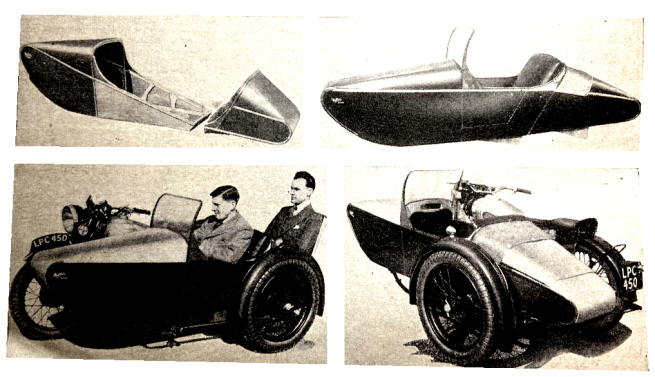
“IT WILL BE RECALLED that in the autumn of last year Millar’s Motors introduced a sidecar body with frame-work and panels in aluminium alloy. The range has now been extended to five bodies; there are the Competition, the single-seater Sports, the single-seater Tourer, the Occasional Two-seater, and the Adult Two-seater. All these bodies are constructed on the now well-tried principle of using 1x¾x³⁄₁₆in extruded angle-section aluminium alloy for the framework with castings in similar material for all main supports, door frames, dash frames, lid frames and windscreen frames. Panels are in 20-gauge sheet aluminium attached by Chobert self-expanding rivets, and fluted sheeting is used for the floors. Seat squabs are spring upholstered and Rexine covered; body lining is board-backed Rexine. The makers are Millar’s Motors, 365, London Road, Mitcham, Surrey…Standard finish is polished aluminium; anodised colours, black, red, blue and black and silver at an extra charge.”
NORTON’S POST-WAR RACERS appeared under the Manx banner: the Manx 30 (500) and Manx 40 (350). They featured light-alloy top-ends and plunger (‘garden gate’) rear suspension with ‘Roadholder’ teles up front. (No need for a pic here; you’ll find Manx Nortons in the TT report which follows.)
Having been so rudely interrupted the TT bounced back and, as so often before, we can do no better than turn to Geoff Davison, editor of the TT Special, for an insider’s report. Mr Davison, you have the floor.
“PEACE BROKE OUT in 1945. But, as in the case of the previous peace, it was not found possible to run the TT in the year which immediately followed it. Manufacturers had discarded their racing designs and had been concentrating on the production of sturdy, go-anywhere motor cycles for Services use. By 1947 we were ready and the A-CU, fresh after eight years’ leave of absence, returned to the game with an energetic programme. During the 14 pre-war years—1926 to 1939—there had been three annual TT races; for 1947—perhaps to make up for lost time?—there were to be six. The three old-stagers, Senior, Junior and Lightweight, were continued as in the past, but three ‘new boys’ had joined the TT school—Clubman Senior, Junior and Lightweight [the Clubmen bikes were essentially roadsters stripped of their lights and silencers—Ed]. Clubman Senior was a really ‘big boy’—the biggest in capacity that the TT course had ever seen. Brothers Junior and Lightweight were limited to 350 and 250cc capacity, as in the International races, but in the Senior machines of up to 1,000cc could compete. Actually only two of the real ‘big ‘uns’ entered and, as it happened, neither started, the largest machine in the race being a 600cc Scott. But back to the beginning…When the A-CU. announced the 1947 Clubman’s races, there were many misgivings and shakings of heads. Very wisely, separate practice periods were allowed for clubmen, so that their slower machines and presumably less skilled riders should not get in the way of the real racers. Unfortunately there is a limit to the number of days on which the Manx roads can be closed and the clubmen had therefore to be content with four periods only. These, however, passed off without serious mishap and the pessimists, finding that their worst hopes had not materialised, became gloomier than ever. Before starting to describe the Clubman’s races, I must make some mention of the rules which governed them. Generally speaking, the regulations were similar to those of the International TT races, but there were a number of important exceptions. Chief of these was that which applied to the specification of the machine. The paragraph in the supplementary regulations which defined eligibility of machines—ironically enough, it was No 13—read as follows: ‘Definition and Specifications. Every motor cycle entered for these Races shall be a two-wheeled vehicle propelled by an engine and shall be a fully equipped model according to manufacturer’s catalogue which shall have been published before the 28th February, 1947, such catalogue to be submitted to The Union by the entrant not later than 3rd May, 1947. At least 25 of each model entered shall have been produced by the makers and such motor cycles shall include in their equipment, kick starters and full lighting equipment.’ The essence of this rule was that Manx model Nortons and KTT Velocettes were barred. Although machines had to be catalogued with electrical equipment, head and tail lamps, horns, wiring harness, wheel stands and registration number-plates, it was compulsory for these to be removed both for the practising and the races. It was also permissible (but not compulsory) for accumulators, luggage carriers, speedometers and dynamos to be removed and riders were allowed to alter the positions of footrests and brake operating mechanism to suit their requirements. The lightening of the machine by filing, drilling or by the substitution of lighter metal was barred and exhaust-pipes had to be ‘approximately the same diameter throughout’, ie, megaphones were barred. As in the TT proper, Pool petrol only was available. One of the biggest differences between the
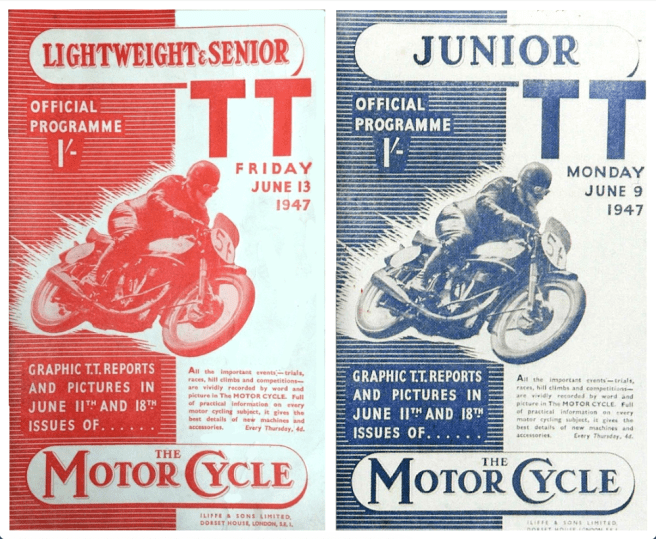
Clubman’s and the International events was in the matter of kick-starters. All Clubman’s machines had to be started at the beginning of the race by the kick-starter—not by pushing. There was a compulsory pit-stop at the end of the second lap, after which the engines again had to be re-started by kick-starter. Run-and-jump starts were only permitted after a voluntary or involuntary stop during the race itself. The Clubman’s TT was in no sense an amateur event, for cash prizes were offered and any rider was eligible provided that he was not competing in the 1947 TT itself. Incidentally, the cash prizes in each event were as follows: First, £50; Second, £40; Third, £30; Fourth, £20. In addition, all entrants, including the above, whose drivers finished within six-fifths of the winner’s time, received a free entry in the 1947 Manx Grand Prix. Note that it was the entrant who received this free entry, not the rider. Actually no rider could enter himself, for entries were restricted to clubs of the Auto-Cycle Union or Scottish Auto-Cycle Union. Stanley Woods would have been eligible to ride as a member of the club entering him, but, had he finished within six-fifths of the winner’s time (as would have been highly probable!), he would not have been eligible to ride in the Manx Grand Prix owing to the rules and regulations of that event. The free entry would therefore, presumably, have been given to another member of the club. The three Clubman’s races were scheduled to be run off concurrently, this being the first time in TT history that more than two races have been run together. Senior and Junior riders had to cover four laps of the course (150.92 miles) and Lightweight riders three only (113.19 miles). The A-CU reserved the right to restrict the total number participating in the Clubman’s races to the maximum of 80, but actually this number was not reached. There were, however, 64 entries—a very satisfactory number for a ‘new boys” event—33 in the Senior, 23 in the Junior and eight in the Lightweight. Competitors were started at 15-second intervals, with the Lightweights first, the Juniors second and the Seniors last. Doubtless this was arranged in order that the races might present more of a spectacle, ie, so that the winners might come in more or less together, but my own view is that it was the wrong way round, for the juniors had to overtake all the Lightweights, and many of the Seniors had to overtake the whole field of Lightweights and Juniors. It would be safer, I think—if less spectacular—to start the fastest machines first, so that they had more or less clear roads, as was done in the Manx Grand Prix of the following September. However, the Lightweights started first and, as they only had three laps to cover, they finished first. I will therefore describe the little race—little in entries as well as in capacity—before turning to the two more keenly contested events.”
Clubman Lightweight
“THE EIGHT ENTRIES in the Lightweight race were composed of an AJS, a Triumph, three Excelsiors and three Velocettes. All eight riders presented themselves at the final examination, but one of them, RJ Edwards (Excelsior), was not allowed to start as he had not covered a sufficient number of practice laps. The 1947 Clubman’s Lightweight, therefore, ties with the 1925 Ultra-lightweight, which also had seven starters, for the doubtful honour of being the smallest TT race in history. LR Archer (Velocette), W McVeigh (Triumph) and BE Keys (AJS) had made the best times in practice, all having lapped in under 37 minutes, and it was they who occupied the first three places at the end of Lap 1. McVeigh was in the lead, with a lap of 34min 31sec (65.61mph)…the first four riders were all on different makes of machine. McVeigh increased his lead in the second lap, as did Keys, but Wheeler retired, letting DG Crossley (Velocette) into fourth place. Whilst the Juniors and Seniors were still chasing round on their fourth laps, McVeigh completed his third and last in 1hr 44min 2sec. He was therefore acclaimed the winner, with Keys second and Archer third. Four hours later came sensation, for the following announcement was made: ‘The Stewards have decided with great regret to disqualify No 2, W McVeigh, entered by the Pathfinders Club for having an engine with a capacity greater than permitted for the Lightweight race…’ Keys was named the winner, with Archer second and Crossley third, and at the prize distribution that night the appropriate cheques were duly handed out. McVeigh, however, was not satisfied. Apparently his engine had been rebored and was therefore a shade over the permitted capacity. He appealed to the Stewards of the RAC, who reversed the decision of the TT Stewards and awarded the race to McVeigh. Results: (not known until over two months after the event had been run): 1, W McVeigh (Triumph), 65.30mph; 2, BE Keys (AJS); 3, LR Archer (Velocette); 4, DG Crossley (Velocette); 5, RW Fish (Velocette); 6, WJ Jenness (Excelsior); fastest lap, W McVeigh, 34min 20sec, 65.96mph.”
Clubman Junior
“THE JUNIOR WAS a somewhat more interesting race than the Lightweight, for 21 of the 23 entries started, and eight makes were represented—AJS (1), Ariel (2), BSA (4), Excelsior (2), Matchless (1), Norton (7), Triumph (3) and Velocette (1). Denis Parkinson (Norton) had put up the best practice lap in 31min 40sec, nearly two minutes faster than the next best, ET Pink (Norton). Denis was therefore a hot favourite,
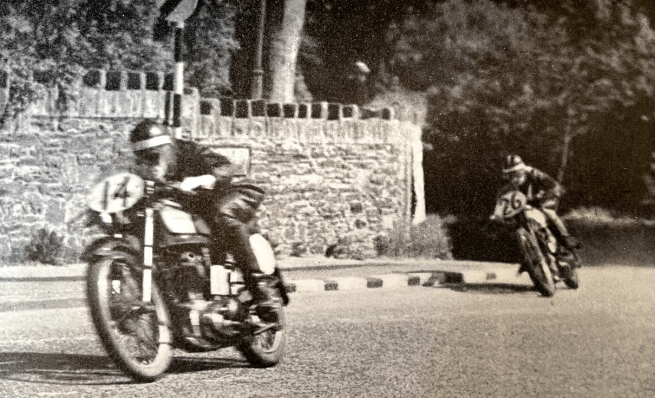
and from the very start he proved that his supporters’ confidence was not misplaced. The first lap showed Denis in the lead by 1min 2sec. Next to him was JW Moore (BSA), third was W Sleightholme (AJS) and fourth W Evans (Matchless)—all different makes in the first four, as in the Lightweight race. In the second lap, however, Parkinson slowed down slightly, and Moore drew to within 34sec of him. Evans displaced Sleightholme in third position, and it looked as if it might be anyone’s race. The excitement, however, was short-lived, for Moore retired two miles later with gearbox trouble, and Evans broke down at Ballacraine. R Pratt (Norton), who was lying sixth at half distance, put in a third lap in 32min 55sec (including the compulsory pit-stop and kick-start) and ran through the field into second place, which he held to the finish, but, except for Moore’s challenge in the second lap, Parkinson’s lead was never really disputed, and he won by the comfortable margin of three-and-a-half minutes. Results: 1, D Parkinson (Norton), 70.74mph; 2, R Pratt (Norton); 3, W Sleightholme (AJS); 4, J Simister (Norton); 5, F Purslow (AJS); 6, R Pennycook (Norton); fastest lap, D Parkinson, 31min 3sec, 72.92mph;13 of the 21 starters finished the race.”
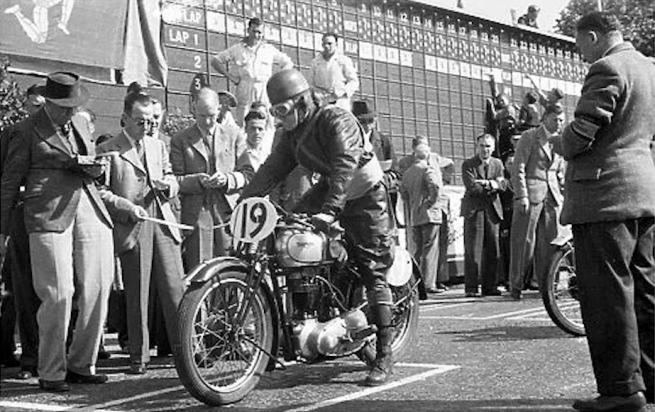
Clubman Senior
“THE ‘BIG RACE’ was not so big as had been hoped, for of the 33 entries there were no fewer than 10 non-starters. As already mentioned, these included both the ‘1,000’ Vincent HRDs, so that the only machine over the ‘International’ limit of 500cc was JH Marshall’s 600cc Scott. Still, a field of 23 was not so bad, particularly as there was a representative entry of makes—nine of them, in fact, composed of six Norton, five Triumphs, three Ariels, two AJSs, BSAs and Rudges and one Excelsior, Scott and Sunbeam. Perhaps weight tells, but that was the way they finished—Norton, Triumph, Ariel and AJS! Jack Cannell and Allan Jefferies (Triumphs) and Eric Briggs (Norton) were the joint favourites, Jack having put in a practice lap in 29min 90sec—the only rider to have lapped in under the half-hour. But one swallow doesn’t make a summer, and one fast lap doesn’t make a winner. Particularly in the big race, brakes would count almost as much as engines. Would the brakes hold out? That was the question we were all asking, for catalogue-type brakes, though sound enough for ordinary road use, had found the TT course a little trying! Curiously enough, the three favourites were each separated by three minutes on starting time, for Allan was No 36, Eric No 48 and Jack No 60, and riders were being despatched at 15sec intervals. Jack was soon in trouble—a broken petrol pipe at Ballacraine, first lap—but Eric showed that he had been keeping something up his sleeve by lapping in 28min 38sec. FP Heath (Norton) was second in 30min
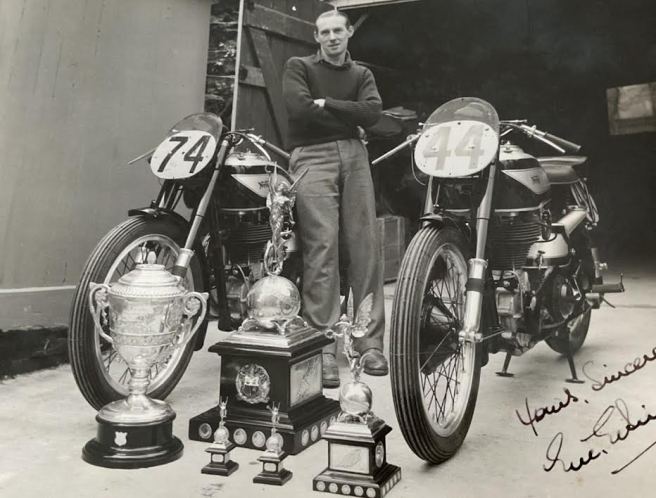
22sec and Allan Jefferies third in 30min 32sec. The next three places were occupied by JE Stevens (BSA), R Tolley (Ariel) and S Lawton (Rudge)—five different makes in the first six. To make things more exciting, the three leaders were now very close together on the roads. At Kirk Michael, on the second lap Jefferies (No 36) was recorded two seconds ahead of Heath (No 39), who in turn was three seconds ahead of Briggs (No 48). (This meant, of course, that on time the order was exactly reversed, with Briggs a comfortable leader.) At the Mountain Box, Briggs was three seconds ahead of Jefferies, but Heath had dropped back, letting Allan into second position. In the second lap Stevens (BSA) and Tolley (Ariel) retired, Lawton (Rudge) moved up into fourth place behind Heath, another Ariel rider (GF Parsons) was fifth and PH Waterman (AJS) sixth—still five makes in the first six! There was no change of positions on the leaden-board in the third lap, but Eric Briggs was steadily increasing his lead, and was now 4min 1sec ahead of Allan Jeffries, over 10 minutes dividing the first six men. By the beginning of the fourth lap it was clear that, barring accidents, Briggs was the winner, with Jefferies second and Heath third. Eric made no mistake about it, and nor did Allan. But Heath ran out of petrol at the Bungalow, Lawton was delayed and Parsons brought his Ariel into third place, with Waterman (AJS) fourth. Poor Heath pushed his machine in—a distance of over seven miles—and finished—last. Results: 1, EE Briggs (Norton), 78.67mph; 2, A Jefferies (Triumph); 3, GF Parsons (Ariel); 4, PH Waterman (AJS); 5, GE Leigh (Norton); 6. F Fairbairn (Norton). Entrants of the first nine qualified for free MGP; 15 riders completed the course. Fastest lap: Eric Briggs, 80.02mph.”
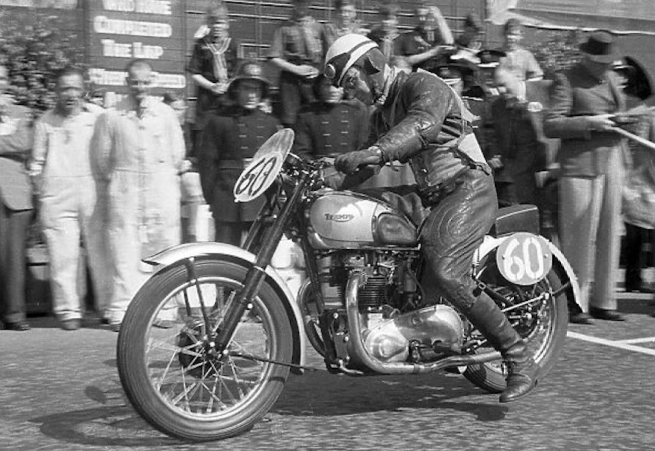
Junior TT
“‘BRIGHT SUNSHINE, A FIERCE Sou’ Westerly wind, perfect visibility.’ That was the weather for the 1947 Junior, the first TT race to be run since 1939. Despite gloomy prophecies that the race would be poorly supported, there were no fewer than 50 entries, mainly composed of Nortons and Velocettes. It was, in fact, a two-make TT apart from the entries of one AJS and one Excelsior. There were 28 Nortons and twenty Velocettes. The practice period had shown that any one of the leading Norton and Velocette riders might be the winner. No fast laps were put up the first morning, but on the second day out Ken Bills (Norton) recorded 29min 53sec, the only rider to do the lap in under the half-hour. This stood until the fourth period, when Bob Foster (Velocette) clocked 28min 26sec, with Harold Daniell and Artie Bell (Nortons) bracketed second at 29min 25sec, Bob’s lap being, indeed, the fastest junior of the whole practices. In the fifth period came a lap by MD Whitworth (Velocette) in 28min 38sec. Bell and Daniell were then bracketed third, while Maurice Cann and Ernie Lyons (Norton) were fifth and sixth with laps of 29min 33sec and 29min 41sec. Velocettes first and second, Norton third to sixth! In the sixth period Artie
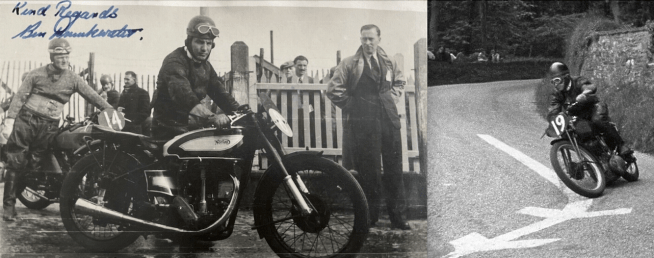
Bell became undisputed third with a lap of 29min 13sec, but Freddie Frith and Peter Goodman (Velocettes) lapped in 29min 15sec and 29min 18sec, so pushing Harold Daniell into sixth place. Cann and Lyons were seventh and eighth. There was no change in the seventh and last practice period, so the eight fastest Juniors were Velocettes at 1, 2, 4 and 5 with Nortons at 3, 6, 7 and 8. Bob Foster led the field at 28min 26sec. It is old history now that Foster’s luck held and he had a run-away win; and, in fact, that Velocettes’ luck was in and Nortons’ was definitely out. But though Foster held the lead throughout, the race was by no means a procession. Whitworth did not reach second place until halfway through the race, while the third, fifth and sixth men home had not been within the first eight in practice. At the end of the first lap only three of these eight were on the leader-board. They were I-2-3—Foster 28min 31sec, Daniell 28min 51sec, and Cann 29min 6sec. Then came FW Fry (Velocette), T. McEwan (Norton) and J Brett (Velocette). What had happened to the other Velocette and Norton stars? Whitworth had stopped for adjustments at Ballacraine; Bell had retired at the Bungalow with chain trouble; Frith was a non-starter, due to a practice crash; Lyons had crashed at Waterworks Corner; Bills and Goodman were seventh and eighth. So in the first lap Foster led Daniell by 20 seconds, and there was just one minute dividing the first six men. In the second lap, Maurice Cann put in a time of 28min 4sec, the fastest of the day so far, and 22sec better than Foster’s best in practice. But Bob pipped it two minutes later with a lap in 27min 58sec, and for the two laps had a lead of 41sec over Maurice. Harold Daniell lay third, 18sec behind Maurice, and Fry, Brett and McEwan came next—2min 14sec between the first six men. Meanwhile Whitworth was making up for lost time, and with a terrific third lap in 27min 45sec was on the leader-board for the first
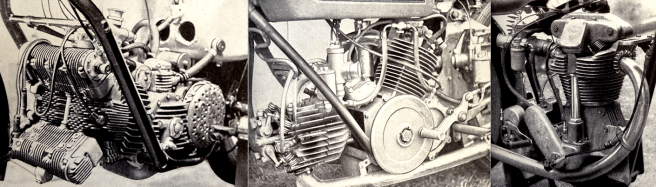
time. And not only on it, but third, out of the blue! Harold had picked up on Maurice and lay second, 1min 43sec behind. Cann was fourth and Brett was still fifth. Fry and McEwan had faded out and Peter Goodman was sixth. There were more surprises in the fourth lap. Nortons’ hopes, which lay in Daniell and Cann, were shattered when both of them packed up—Harold at Kirk Michael and Maurice at Creg-ny-Baa. Whitworth automatically moved up into second place, and third, through the field, came Scotsman JA Weddell on another Velocette. Peter Goodman was fourth—Velocettes 1-2-3 and 4. The Norton banner was taken up by Les Martin and FJ Hudson, who figured on the leader-board for the first time. And in this order they finished, without further incident except that Goodman displaced Weddell on the fifth and sixth laps, only to drop back to fourth place again in the last lap—and I had drawn him in the Hotel Sweep! Foster won by over four minutes and nearly 17 minutes separated the first six. Whitworth’s third lap in 27min 45sec (81.61mph) was the fastest of the day. Results: 1, AR Foster (Velocette), 80.31mph; 2, MD Whitworth (Velocette); 3, JA Weddell (Velocette); 4, P Goodman (Velocette); 5, LG Martin (Norton); 6, FJ Hudson (Norton); 7, G Newman (Velocette); 8, TL Wood (Velocette); (the above received first-class replicas); 9, ES Oliver (Norton); 10, GG Murdoch (Norton); 11, A0 Roger (Velocette); 12, H Hartley (Velocette); 13, R Pike (Norton); 14, HB Waddington (Norton); 15, SA Sorensen (Excelsior); 16, GH Briggs (Norton); 17, F Juhan (Velocette); 18, JW Beevers (Norton); 19, LP Hill (Norton); 20, AG Home (Norton); 21, K Bills (Norton); 22, CW Johnston (Norton); 23, F Shillings (Norton); 24, SH Goddard (Velocette); (the above received second-class replicas); 25, NB Pope (Norton); 26, WM Webster (Norton); fastest lap, D Whitworth, 27min 45sec, 81.61mph. No team qualified for either the Manufacturers’ or the
Club Team Prize.”
Lightweight TT
“ALTHOUGH THERE were only 22 entries for the 1947 Lightweight TT, five makes were represented. Exactly half the field were on Excelsiors, the remaining eleven machines being made up of four Rudges, three CTSs, two Guzzis and two New Imperials. There were two Excelsior non-starters, so of the 20 machines which started 18 were British and two were Italians. These two, however, ridden by Manliff Barrington and Maurice Cann, were undoubtedly the fastest in the race. In practice Barrington had lapped in 31min 20sec, slow by comparison with Kluge’s 1938 Lightweight record of 28min 11sec, but 59sec better than the best British lap—put up by Roland Pike (Rudge). Cann, also, had lapped in 42sec less than Pike, and, as both their machines had seemed reliable in practice, it looked as if, barring accidents, the Lightweight Trophy would once again go to an Italian machine. And so, of course, it did, but when it comes
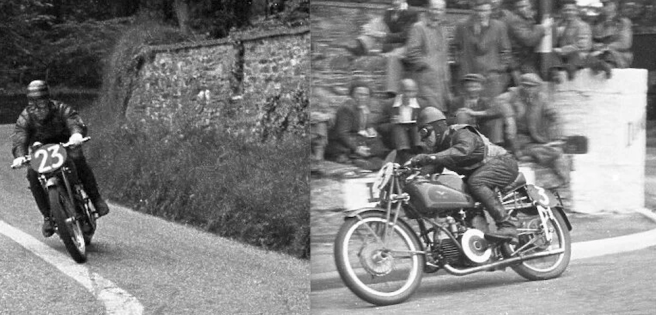
to saying which Guzzi rider won it, I can only refer to the official records which state ‘1st M Barrington…’ The argument as to which man really won will doubtless continue as long as the TT races are remembered. The story of the race is the story of Cann and Barrington, and the also-rans. Mind you, they ran well—magnificently, some of them. I think I am right in saying that every one of the 18 British machines was at least eight years old, and that many were 10 years old and more. Against them were two superb pieces of Italian engineering, in the hands of two fine riders who knew they had the heels of the field. The only hope for the British machines was for Maurice and Manliff to break each other up—and they were for too wise to do that! Cann set off with a lap in 31 minutes dead, with Barrington 10sec behind and Les Archer (New Imperial) 58sec behind him. In the second lap Barrington was 7sec behind Cann, and in the third lap 3sec. But by the fourth lap he was 18sec behind and at the fifth lap 46sec. Les Archer was still running gamely third, but by then he was over 7min behind the leader. Then in the sixth lap, Cann had a stop, during which he fined a new valve-spring. His lap time was 31min 53sec, as against Barrington’s 31min 5sec. This let Manliff into the lead by the narrow margin of two seconds. Last lap, Maurice, to make up time lost by his stop, turned up the wick, but was recorded as lapping in 31min 31sec—only 22sec better than the sixth lap on which he stopped and, apart from this sixth lap, his slowest of the day—slower, indeed, than his replenishment lap All very odd…Barrington lapped in 30min 49sec, bringing his total time to 44sec less than Cann’s. Meanwhile Les Archer and Ben Drinkwater (Excelsior) were battling for third place. Les held it right up to the sixth lap, when he was leading Ben by 59sec. But Les was slow on the last lap (33min 15sec) and Ben was quick (31min 11sec). So Ben slipped into third place and Les dropped back to fourth. Results: 1, M Barrington (Guzzi) 73.22mph; 2. M. Can (Guzzi); 3, B Drinkwater (Excelsior); 4, LJ Archer (New Imperial); 5, WH Pike (Rudge); 6, GL Paterson (New Imperial); 7, SA Sorensen (Excelsior); 8, CW Johnston (CTS); 9, LG Martin (Excelsior); 10, J Brett (Excelsior); the above received first-class replicas; 11, WM Webster (Excelsior); fastest lap, M Cann, 30min 17sec (74.78mph).”
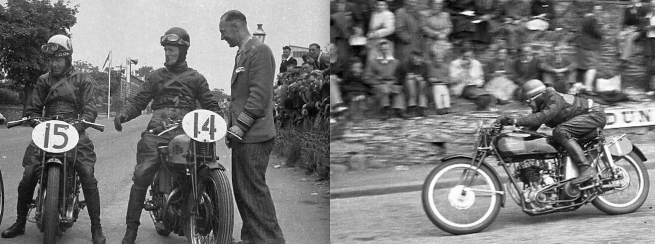
Senior TT
“AND SO TO THE HIGH-SPOT of the TT week—the 1947 Senior. There were only 33 entries, but we have had many fine Seniors with fewer than that. In fact, except for 1939, when there were 51 Seniors, the entry of 33 was the highest since 1935. So even the fact that there were no non-starters did not seem to matter very much. The entry of 33 was composed of 26 Norton, four Velocettes, two of the new AJS ‘parallel’ twins and Freddie Frith’s Guzzi. Unfortunately, Freddie was a non-starter, having crashed in practice. Further, two of the Velocettes were 350s. But Jock West and RL Graham on the ‘Ajays’ and Bob Foster and Peter Goodman on the pukka Velos could be relied upon to make a good race of it with the formidable Norton team, Bell, Bills and Daniell—Ernest Lyons being another non-starter, due to his crash in the Junior of the previous Monday. This was indeed a blow, for Ernie had put up fastest practice lap in 27min 8sec—forty-one seconds faster than anyone else. The practices leader-board showed the following times: 1, E Lyons (Norton) 27min 8sec; 2, AJ Bell (Norton), 27min 49sec; 3, K Bills (Norton) 27min 54sec; 4, AR Foster (Velocette) 28min 6sec; 5, JM West (AJS) 28min 9sec; 6, FL Frith (Guzzi) 28min 25sec. No sign of Harold Daniell? No, but Harold had put in a lap in 28min 43sec and had done several in under the 29min, so was obviously well in the picture. For a description of the 1947 Senior I can do no better than use the report from the TT Special, which I wrote myself on that ‘Friday the 13th’ when the leaders were changing places lap by lap, with seconds only dividing them. What a race at was, that first post-war Senior! This is what I wrote: ‘The Press Box, Friday. Since early morning the TT fans have been arriving. At 6am the weather was clear and fine, and large queues of night-voyagers were forming at the doors of restaurants.
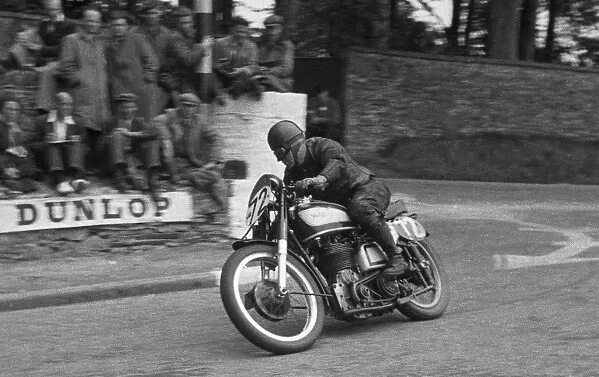
Now they have established themselves at all the main vantage points around the course, where record crowds are reported. 10.30am. Three blasts of the klaxon—a roar of engines from the enclosure, and one by one the riders set off on their warm-up ride towards Governor’s Bridge. A glance at the list of entries shows what terrific dog-fights (I hate the phrase, but can’t find anything better!) may be expected. For example, Nos 45 and 46—Jock West and Bob Foster—and Nos 62, 63 and 64—Bills, Whitworth and Graham. 10.45am. More blasts from the klaxon. The engines are silent now, and the riders are lined up and down the road, waiting for the signal to move forward to the Start. Now an announcement about the weather: General conditions excellent—roads dry, good visibility, a slight wind. Certainly everything seems excellent from here. The mountain is not so clear as it was on Wednesday, but that is due to a slight haze, which will not worry the riders in the slightest. ‘Friday the 13th’ looks as if it would be one of the finest days the Senior has ever had. 10.50am. The riders file forward to their squares at the Start—Lightweights to the fore. All of them will be despatched before the Seniors, the first of whom, No 40—ER Evans (Norton) will not be off the mark until 11hr 9min 45sec. The Seniors can be expected to lap four to five minutes faster than the Lightweights, so the Senior should finish well before the 250 class. The Governor of the Island is starting the first post-war Senior. He takes Ebby’s flag—raises it—drops it—and Evans is away. Artie Bell next off, to the accompaniment of loud cheers. Jock West’s AJS takes a bit of starting, and Bob Foster passes him whilst he is still pushing. Groans from the crowd—and then cheers. He’s off. But his slow start has cost him 25sec at least. All get away well, then, Bills and Whitworth (Norton) being particularly quick starters. Graham’s AJS starts much easier than Jock’s. What’s happened to Jock West and Bob Foster? They’ve both been overtaken by Beevers, Myers, Christmas and Newman before Ballacraine. Obviously both the stars are in early trouble. Then comes news of Foster—he has retired at the Highlander with a “broken piston”—bad luck, Bob. Here come some more at Ballacraine—Weddell (61) and Bills (62) are there together, with Whitworth (63) and Graham (64) only a few seconds after them. Meanwhile Jock West has also reached the first station, but some time behind Graham. Stop watches now on Weddell, Bills, Whitworth and Graham at Kirk Michael. Here they are—Bills first, Whitworth next, 18sec after, then Weddell, 20sec, and then Graham, 31sec. If the clocks are correct, Bills is leading Graham by one second, on time, and Whitworth by three seconds. A close thing, this! Now how are the leaders on the road faring? Evans, Bell and Pope are all at Ramsey, but Bell is there first, so is leading the Seniors, 70sec ahead of Evans, and obviously getting close to the back numbers of the Lightweights. Bills has retained his lead in the 62, 63, 64 trio, but Graham has closed in on Whitworth, for he is shown at Ramsey only 3sec after him. Bell is at the Creg, while Harold Daniell, the last starter, is at Ramsey. Now Artie Bell flies past at the end of his first lap, having covered it, from a standing start, in 27min 16sec—83.05mph. This is only 8sec over the best practice lap, made by Ernie Lyons (Norton). Temporarily, he is first on the leader board, and it is reported that the pit signal given to him is “Go Easy”. It seems early, yet, for signals such as these—but perhaps the announcer has got it wrong. Nortons know their job! No 55, G Newman (Norton) Hallens’ entry, is going well, for he comes past close to No 48—Bill Beevers. Jock West is reported as suffering from a slipping clutch. Bad luck, Jock. Harold Daniell has put in a good lap, for he flies past us in
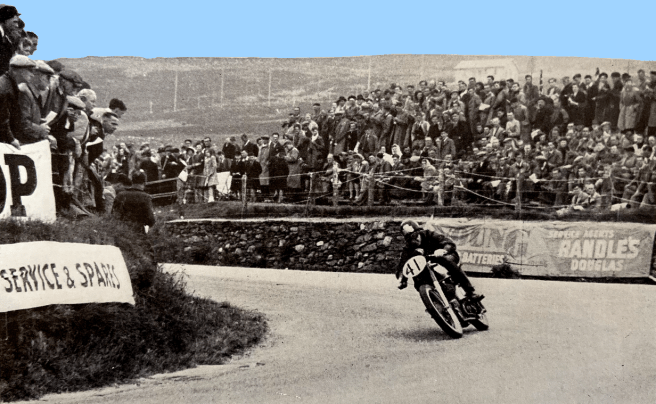
front of several men who started in front of him. Here are some more times—Bills 27min 35sec, Graham 27min 37sec and Whitworth 27min 56sec. Now for Harold’s time—here it is, 27min 20sec. So Bell is leading the field by four seconds—and Norton are at it again, with 1-2-3, and only 42 seconds dividing the first six men…News from Ballaugh—Clift (Norton) has passed through, presumably slowly, and says that he will be retiring at Ramsey. Ramsey reports that Waddington has proceeded off the course towards Laxey. Obviously he has retired and is coming home by the coast road. Bell is still leading the field and is now well amongst the Lightweights—in fact he is now third on the roads, for only Nos 1 and 3 in the Lightweight race are shown at the Mountain when Artie reaches it, nearly 3min ahead of Evans, who started 15sec ahead of him. Now Artie is at the Creg, having overtaken all the Lightweights except Maurice Cann (No 3), and is lying second on the roads. Then comes news that Graham (AJS) has come off at Glen Helen, but is proceeding and that Gregory (Norton) is trying to repair a trailing exhaust pipe. Here’s Artie at the end of his second lap, motor sounding fine, whilst Harold, who started 7¾min behind him, is at the Mountain. Bills is at the Creg, having drawn away from Whitworth. Artie’s second lap was done in 27min 28sec—so presumably that notice did say “Go easy”. Ken Bills (62) whizzes past as Harold (72) is shown at the Creg. And here’s Harold giving the OK sign as he passes. Bill’s second lap time is 27min 11sec—83.30mph—the fastest to be recorded so far…Only nine seconds separating the three “official” Norton riders…Graham’s crash has put him off the leader board…Meanwhile Bell must now be leading on the roads. He was recorded at the Mountain at the same time as Maurice Cann (No 3) on the Lightweight Guzzi, and should pass him by the Creg. This will be a distinct advantage to him, and if he knows that Harold has pipped him on the second lap we can expect some Irish fireworks! Here he is at the Greg—seven seconds ahead of Maurice, and has dear roads. Now Artie is at the pits for replenishments, mechanical and human, and is off again smiling, in 50sec…So Artie is back in the lead, and only five seconds separate the three now…News of Whitworth—he has retired at Ramsey, and is riding home via
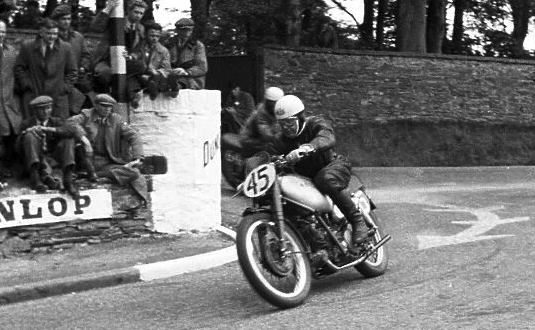
Laxey. Jock West comes in after a first lap in 1hr 24min 19sec, but after a longish stop at his pit sets off again. No hope, of course, but perhaps he’s going to make the most of the TT course for test purposes He says he’s going to have a run for his money, anyway. Now back to the leaders—Artie is at the Mountain and Ken and Harold are both on the Kirk Michael-Ramsey stretch. Clocks on Ken and Harold at Ramsey. As they are Nos 62 and 72 respectively there is, of course, two and a half minutes between them on time. Here’s Ken—click the watch—and here’s Harold, 2min 27sec after him, so leading him by 3sec at Ramsey as against 2sec at the end of the third lap. Some race, this ! Norton 1, 2, 3, and 4, Velocette 5, and AJS 6. Bell flies past the its at the end of his fourth lap, and is shown at Ballacraine as Bills comes past the pits. Bills is now lying third on the roads find—wait for it!—he is leading Bell on the four laps by two seconds! Meanwhile, Harold is at Governor’s Bridge—and here he is, thumbs up. Nortons are certainly avenging themselves to-day! What a race! Harold, partly due to his quick pit stop, is in the lead again, 18sec ahead of Ken, with a fourth lap in 27min 57sec, including a pit stop! Artie Bell’s fifth lap is the fastest of the day so far—26min 56sec—at 84.07mph. George Formby in the officials’ box: “It’s chompion up here!” ” Did they go as fast as you did, in No Limit “Oh, no, not quite.”…and lots of back chat. George was introduced in person whilst one of his own records (You’ve been a terrible, terrible long time gone) was being played. His last crack was—”I’d better let myself carry on singing!” (Roars of applause.) Ken Bills tears past—Harold tears past—only about 2min behind him. So Harold is leading Ken by half-a-minute odd—and—here’s news, Harold is leading the race by 9sec, with Artie in second place. Jock West is having a ride for his money! His third lap took 27min 5sec—second fastest of the day, so far. Good enough, Jock! Peter Goodman (Velocette) is coming up. He is now only 27sec behind the third Norton rider. Whereas on lap 4, when lying fifth, he was 1min 9sec behind. His last lap, 27min 7sec, is third fastest of the day, according to our reckoning. Here’s Artie at the end of his sixth lap. He draws in for supplies and is away in 30sec. And here’s Ken Bills—stop—fill-up—and off—in 17sec. And here’s Harold—13min after Ken, and even quicker on the getaway! So Artie is leading Harold by one second! And the point is—does Harold know? If he does—if his pit attendant has worked it out from Creg-ny-Baa times, and got it over to him—we can expect fireworks on the last lap. Artie’s at Ramsey, Harold’s at Kirk Michael. Stop watches on them at the Mountain Box. Here’s Artie—and, meanwhile, news that Ken Bills has retired at Union Mills with engine trouble. That puts Peter Goodman in third place. And here’s Harold at Ramsey. Wait for him at the Bungalow. Here he is just over seven minutes behind Artie, according to the clocks, and as he started 7¾min behind him he has half-a-minute’s lead. Here comes Artie—first man to finish a post-war Senior TT race. So it’s a Norton win—whether it’s Artie or Harold. And it looks like Harold! Anyway, it’s Norton’s 20th
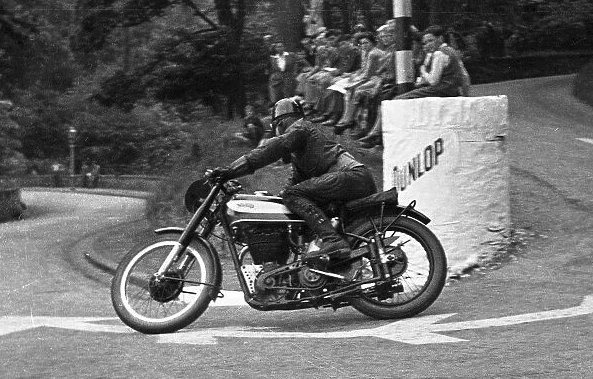
International TT victory! Here’s Harold’s red light at Governor’s Bridge, and here he is now flashing past the pits. According to our reckoning he’s the winner, but we wait anxiously for the official news. And when it comes—Harold has won by 22sec, at 82.81mph. His last lap, including a pit stop, has been covered in 27min 14sec. Results: 1, HL Daniell (Norton) 82.81mph; 2, AJ Bell (Norton); 3, P Goodman* (Velocette); 4, EJ Frend (Norton); 5, G Newman (Norton) 6, ER Evans (Norton); 7, N Christmas (Norton); 8, JW Beevers (Norton); 9, RL Graham (AJS); 10, LA Dear (Norton); 11, TL Wood (Velocette); (above received 1st class replicas); 12, FW Fry (Velocette); (above received a 2nd class replica); 13, HB Myers (Norton); 14, JM West (AJS). Fastest lap in the Senior was shared between Bell (Norton) and P Goodman (Velocette) with 26min 56sec (84.07mph).’ That ends my report of the race, written whilst it was being run. But a later review of the official results reveals some interesting facts. For example, Jock West’s third lap, mentioned in the report as “second fastest of the day so far”, was, in fact, the fastest of any up to and including the third lap. This was because Jock was so far behind, due to his very slow first lap, that Artie Bell had completed his fifth lap (in 26min 56sec) before Jock had completed his third! Jock’s fourth lap was better than his third—26min 59sec—and was the fastest of any up to the end of lap four. Again, Peter Goodman had a “slow” first lap—28min 16sec—if one can call 80mph on Pool petrol slow! But it was exactly a minute slower than Bell’s, and it put him out of the running for the trophy. Actually, Peter’s last six laps were the fastest six of the race—7sec faster than Harold’s and 33sec faster than Bell’s. Then it will be noticed that although Daniell, Bell and Bills occupied the first three places to the end of the sixth lap, they changed positions each lap, and indeed there was a change of leader each lap except in the fourth and fifth, which Daniell held until Bell displaced him in the sixth by one second; and that whereas they were 19sec apart on the first lap, they had closed up to 9sec on the second and only 5sec on the third—5sec between three riders after 113 miles at over 82mph. Truly it may be said that the 1947 Senior—run 40 years after that very first Senior—was a magnificent race, as vivid and exciting as any of a magnificent series.”
THE ONLY FOREIGN BIKE entered for the Senior TT was Freddie Frith’s Guzzi twin, which crashed out during practice, but three Guzzi singles entered the Lightweight, all with British riders. There were no foreign bikes in the Junior, though Czech ace Frans Juhan rode a Velo. The Senior, Junior and Lightweight TTs were run together (four laps for the 500s and 350s; three for the 250s). The Italians took over where they’d left off in 1939 with the wonderfully named Manliff Barrington and Maurice Cann riding their Guzzis to 1st and 2nd spots in the Lightweight TT, followed home by Ben Drinkwater’s Excelsior. It was also business as usual in the Junior with a hat-trick for Velocette, courtesy of Messrs Foster, Whitworth and Weddell. In fact there were six Velos in the top 10, with four Nortons to ram the home the British-is-best message. BMW, having won the 1939 Senior with its blown twin, was conspicuously absent leaving Harold Daniel to lead the 500s home on his Manx Norton with TT debutant Artie Bell just 22 seconds behind him on another Norton. Also racing on the Island for the first time was Peter Goodman, grandson of Velocette’s founder, who was third on his KTT. Nortons filled the rest of the top 10 places, apart from an Ajay in 9th spot. Brits also dominated the Clubman’s TT. First three home in the Senior were Norton, Triump and Ariel; Junior, Norton, Norton AJS; Lightweight, AJS, Velo, Velo. Clubman’s Senior TT winner Eric Briggs had a good year; he returned to the Island for the Manx where was managed a Senior/Junior double to win three Mountain Course races within three months.
* Peter Goodman, with a creditable third place in the Senior in his first TT appearance, was a grandson of Velocette’s founder.
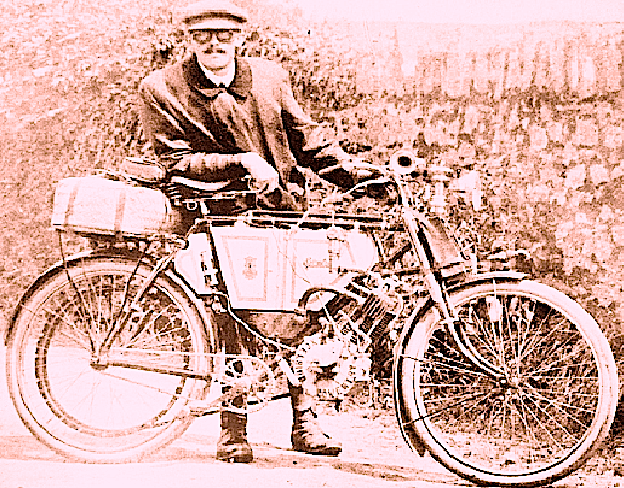
TT STARS WHO DIDN’T survive the war included aircrew Walter Rusk and Wal Handley; the blitz had done for Zenith Gradua rider Freddie Barnes, whose first race on the Isle of Man was the 1905 trial for the International Cup Race.
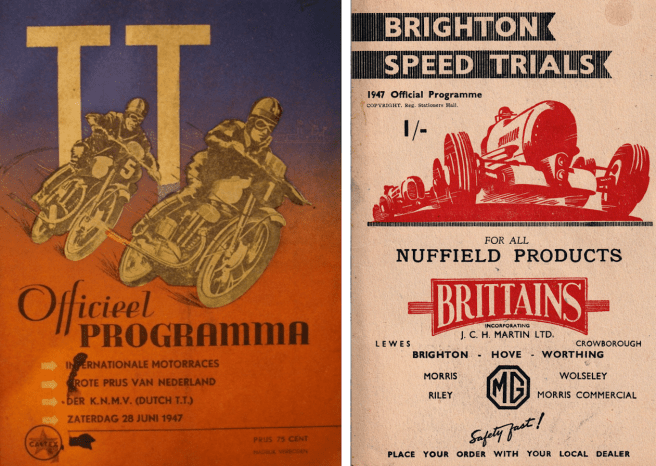
KIYOSHI KAWASHIMA BECAME the first Honda employee to boast an engineering degree—not that Honda could afford a salary to match his qualification. Years later Kawashima recalled: “Well, frankly, it was 1947, wasn’t it? It was the peak of unemployment. At that point, I didn’t care what the pay was. Just so I could do the work of an engineer, the company didn’t matter to me. The Old Man was a famous engineer in Hamamatsu, and this was a chance to work at his place. Also, my home was…only a five-minute walk to work…Then, when I came in, my first job was modifying wireless radio generator engines. About ten of them would be hauled in on Monday every week, and I would take off the generator mechanism and dismantle the engine. On Tuesday, I would clean all the pieces. On Wednesday, Thursday, and Friday, I would work on the parts, and on Saturday put them together. Saturday afternoon, I would attach the engines to the bicycles and take them for test rides. I say test rides, but all I did, really, was ride them up a hill in the neighbourhood…About the time that was done, a large group of peddlers…and even some very suspicious-looking black-market-type brokers would be waiting there. They would stuff about two engines each in their rucksacks and carry them away to Tokyo, Osaka, and all over the country. After paying in advance. I would see a wad of bills and think to myself, it looks like I’ll get paid this month, my wages won’t be delayed, and I’d feel very happy…”

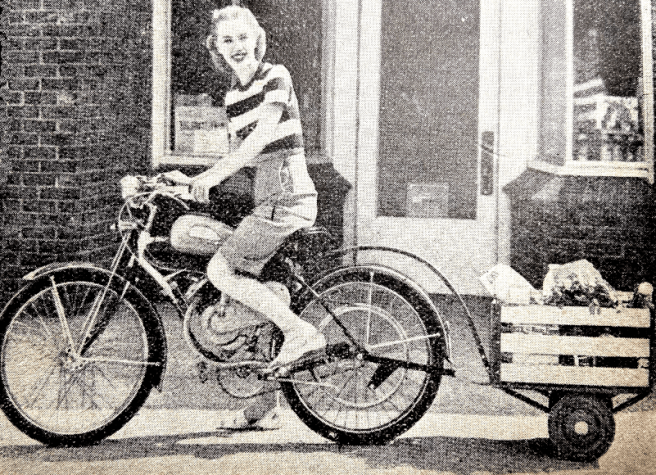
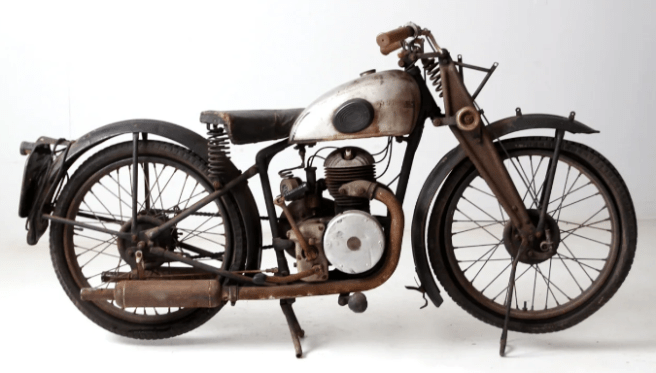
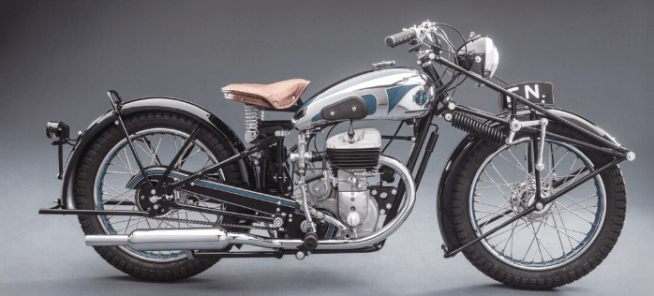
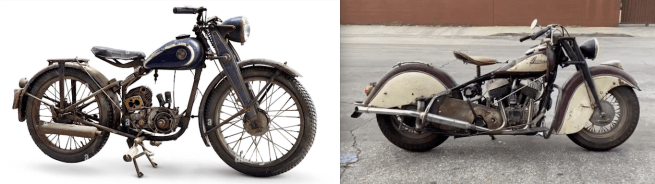
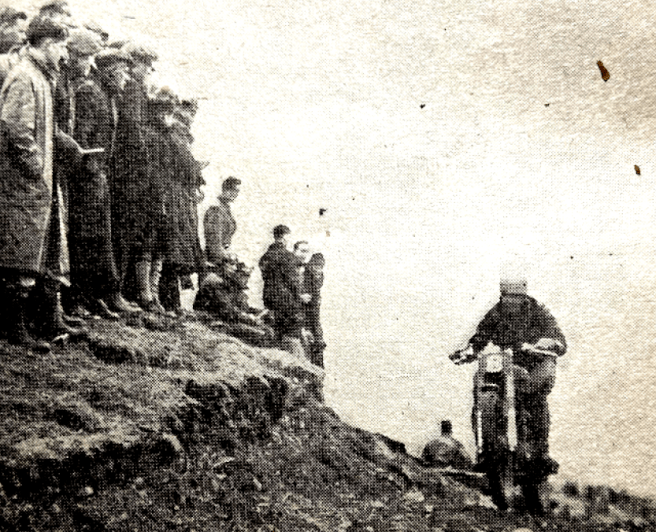
FUEL SHORTAGES RULED OUT running the traditional long-distance trials so the organisers ran truncated events with the London-Land’s End starting at Taunton and the Scottish Six Days Trial was based on Fort William rather than Edinburgh (Hugh Viney scored the first of thee consecutive SSDT victories for AJS).
“AS A MOTOR CYCLIST of 20 years ‘wheeling’ it is my considered opinion that the well-used expression, ‘Racing improves the Breed’, is 100% true. I have, with one or two small breaks, ridden Rudges since 1928, and my present mount, a ’37 Ulster, is the best of them all. It has inherent in its design all those attributes which proved their worth in the Island, and which are no less necessary on the road in all weathers for the average enthusiast. Roadholding, steering, braking and mechanical reliability are not just advertisements, they are the things which make all the difference between a motor cycle and a race-bred mount. Living in industrial Lancashire and travelling daily to Manchester, Salford or the surrounding districts, demands ‘handleability’ for peace of mind, and, believe me, a Rudge makes such tranquillity commonplace. What a tragedy that these grand machines are no more! What of the future? After seeing Ernie Lyons doing a spot of fast motoring last September on a Triumph, surely the Triumph Co are not going to rest on their laurels? This machine is good. Given that little extra, which can only be acquired in the IoM, it should become absolutely superb, and there is no doubt that the days of the single are numbered in the 500cc racing field. I believe that it is not necessary to win a TT for a make to be successful. The very fact that they are entered is sufficient to show that the manufacturers are alive to the benefits which racing can bestow on their products. And so I say to all British manufacturers—support a racing policy, end let us see once again annually that welcome copy of The Motor Cycle which had at the top, ‘British Supremacy Number’.
T Roy Pearson, Chadderton, Lancs.”
“I CANNOT RECALL having seen any letters on the subject of sidecar acrobatics from the gentleman mostly concerned, ie, the passenger himself. Well, apart from the possible effect on sidecar design, etc, which the banning of such a practice would have, I reckon that the sporting side should not be neglected. As an ex-performer of these acrobatics I say let those who want to do it, do it! I know I enjoyed every second that I spent in (and out!) of the the ‘chair’, and the thought of myself being replaced by sandbags horrifies me. However, perhaps other passengers will be taking up the pen soon in support (I hope) of my plea—keep it as it is! After all, these passengers needn’t do it, so they must like doing it. as I did.
V Morton, Tunbridge Wells.”
“I own a 250 side-valve, but at some time in the future I most certainly want a bigger machine. But it must be a side-valve. So I gaze longingly in shop windows looking for a new 500 or 600cc side-valve, and I am disappointed. Now I do not ask for much. I do not demand side-valve twins. But how about a few comfortable side-valves for those of us who do not take a joy in spending hours mucking about with valve-gear and suchlike?
D Reed, London, NW1.”
“PRICES OF BSA models have been increased: C10, 250cc sv, £107 19s 0d; C11, 250cc ohv, £114 6s 0d; B31, 350cc ohv, £142 4s 10d; B32, 350cc ohv, £157 9s 7d; B33, 500cc ohv, £154 18s 10d; B34, 500cc ohv, £170 3s 7d; M20, 500cc sv, £142 4s 10d; M21, 600cc sv, £146 1s 0d; A7, 500cc ohv Twin, £177 16s 0d; Speedometer, £5 1s 8d.”
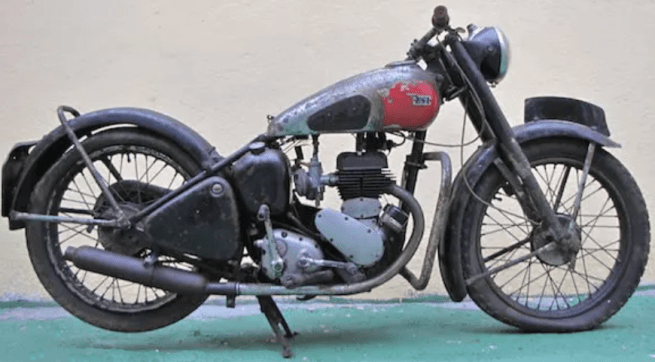
ANY WELL-HEELED 16-YEAR-OLD with a provisional licence could slap L-plates on a ton-up big twin so there was clearly a need for some form of rider training. The RAC-ACU Learner Training Scheme was set up with money from the government and the RAC but the training centres that sprang up all over the country were operated by local ACU clubmen. Novices were taught machine control, often on out-of-hours school playgrounds, using their own bikes or lightweights donated by an industry keen to be seen doing its bit for road safety. The enthusiasts who staffed the RAC/ACU scheme also brought newbies up to speed on everything from roadcraft and riding gear to basic maintenance.
AND JUST AS THE keen trainees were looking forward to their first taste of two-wheeled freedom the paltry petrol ration was withdrawn. Motor cycles being recommissioned by riders home from the war went back into storage unless their owners were lucky enough to qualify for ‘essential use’ petrol coupons. With no petrol it wasn’t easy to sell bikes and competition ground to a halt.
ICE RACING WAS REVIVED in Scandinavia but Russia took the lead in developing the sport, switching events from frozen lakes to pukka stadiums which were flooded and frozen for events. Initially they used modified road bikes but as the sport evolved specialised ice-racers were adopted powered by JAO and later Czech-made ESO lumps.
“THE CUMBERLAND COUNTY MCC organised their annual Easter open scramble on Lazonby Fell, near Penrith. In the final of the 350cc race over seven laps of the fast, undulating moorland course, EC Bessant (Matchless) streaked into the lead at the start, closely followed by E Ogden (Triumph), RB Young (BSA) and Sgmn RF Croft, of the R Sigs, riding an Army-type Matchless. Bessant held his lead of some 150 yards to the finish, although Ogden did his best to challenge him. The seven-lap 250cc race proved to be the most exciting event of the afternoon. AA Todd (Velocette) took the lead at the start, with J Carruthers (Velocette) and J Forster (Velocette) gradually forcing the pace. At half distance Carruthers passed Todd, who had an anxious moment in the deep, boggy section. Todd swept past both of his rivals on the straight section after the quarry. 250 Cup: AA Todd (Velocette); 2, J Forster (Velocette); 3, J Carruthers (Velocette). 350 Cup: 1, EC Bessant (Matchless); 2, E Ogden (Triumph); 3, RB Young (BSA.). There were 45 entries for the unlimited cc race over 12 laps but many entrants failed to turn up for the first two heats over three laps. In the final everyone was surprised to see Cliff Holden’s white crash helmet leading a howling bunch of machines towards the bog. Bessant, for once, made a bad start. E Ogden passed Holden after the first lap, and the crowd murmured with excitement when Bessant, going like the wind, passed 12 riders in the first lap. At quarter distance Bessant’s red-and-white chequered helmet was right behind Ogden, who desperately strove to resist the challenge. Bessant passed Ogden on the sixth lap, and steadily increased his lead to the end. Ivan Carr Cup and Unlimited Cup: EC Bessant (Matchless); 2, E Ogden (Triumph); 3, RB Young (BSA). Best Performance by Cumberland County Member: WH Millburn (BSA).
Most of the material in this timeline is culled from the pages of The Motor Cycle but I’ve also accumulated issues of Motor Cycling, whence comes the following:
“OUR MANUFACTURERS HAVE unanimously decided, albeit with regret, to withhold their support from the 1947 International Six Days’ Trial. Their regret will be shared by all sportsmen in this country for the decision implies the absence of a British team from the Trophy contest…In a statement issued by the Manufacturers’ Union it is made abundantly clear that its members had as their only alternative the production of machines which could not be adequately prepared in the time available. The decision will almost certainly be misinterpreted on the Continent. That is unfortunate, but the truth is the organisers have themselves to blame for the absence of official British entries. Had the Czech Auto Club refrained from modifying the basic regulations agreed upon last April at the FICM San Remo conference, or even had notification of the intention to make such modification been sent to the Auto-Cycle Union by a reasonably early date, all would have been well. Instead, an inexplicable delay in delivery of those regulations has placed the British industry under an unreasonable handicap and one which it has rightly declined to accept. It may be asked why absence of trade support should deny Great Britain official representation in this important event. The answer is simple; the Trophy competition by its very nature has always been regarded as a contest between national motorcycles rather than national motorcyclists [trivial typographical note: the Blue ‘Un saw ‘motor cycle’ as two words; the Green ‘Un saw ‘motorcycle’ as one word. As a former staffer of Motor Cycle Weekly, which was The Motor Cycle under another name, I have stuck to the old style that gave us MCC rather than MC; another seemingly trivial difference that has attained unexpected importance…but that’s another story, which traces its roots to the next story—Ed]. Thus it is essential that any team representing this country should be mounted upon the best machines we can produce most suited to the regulations. Therein lies the reason for our manufacturers’ decision. The modified regulations favour the 250cc mount and there is insufficient time to produce the best possible British machines of this capacity. To gain a true appreciation of the position it is only necessary to imagine that Great Britain had organised the trial and had evolved a set of rules favouring the 350cc machine. Had this been the case we believe that neither Czechoslovakia nor Italy would have found it simple to produce in the time available models comparable to our own, as machines of this capacity can be regarded as the Cinderellas of the Continental factories.”
“THE AMERICAN MOTORCYCLE ASSOCIATION is the A-CU’s opposite number in the United States. Apparently there was something sadly lacking in the way in which it handled the organisation of its 1947 Gypsy Tour. So much is strongly suggested in a report that has lately been sent in by one of our readers in California. This annual event, which is very roughly the equivalent of our own National Rally, although run on somewhat different lines, is a very old-established fixture, and the name was, no doubt, inspired by the Motor Cycling Gypsy Club, which was in its heyday in the period immediately preceding the 1914 war. This year, it seems, the Gypsy Tour finished at a town called Hollister, somewhere in the neighbourhood of San Francisco, and an account of the affair published in the local newspaper certainly makes most remarkable reading. One may, perhaps, make some allowance for the sensationalism of American reports, but even after doing so, it seems clear that the final stage of this event was allowed to degenerate into an orgy that was both disgusting and disgraceful. What appears to have happened was that the riders, who came from all over the United States, and are estimated to have numbered about 4,000, got completely out of hand and terrorised the entire town. Bars were wrecked and that kind of thing, while some enthusiasts thought it funny to ignore completely the local traffic regulations, which naturally led to a number of serious crashes. Getting on for 60 people had to receive hospital treatment, and after they had regained control of the situation the police made a number of arrests. One youth committed an offence which landed him in the county gaol for 90 days, which is just one indication of the kind of things that allegedly went on. The inevitable result of this affair will be that motorcycling will be branded as a rough-neck sport so far as that locality is concerned, and the news will doubtless spread to other parts of the country. Unless the AMA takes effective steps to tighten up its organisation, particularly as regards the discipline of competitors, it must expect severe repercussions from this outburst of hooliganism.”
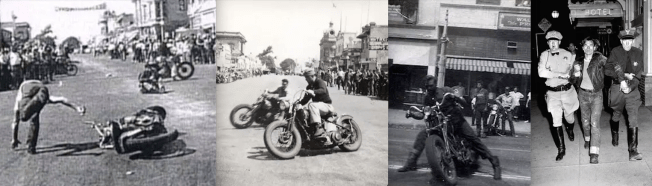
SEEMINGLY WELL-INFORMED US sources indicate that during the 1930s Hollister had hosted AMA sanctioned races organised by the Salinas Ramblers MC. Spectators participated in the ‘Gypsy Tour’ organised by the AMA and, as attendance grew, the Memorial Day races became as important to the local economy as the Hollister Livestock Show or the Hollister Rodeo. The races were discontinued after America’s entry into the war. When they returned in 1947 local merchants welcomed the event. Many more motor cyclists than expected poured into Hollister and things did get out of hand. About 60 riders were treated for injuries at the local hospital; 47 were charged with minor offences such as public drunkenness, disorderly conduct and reckless driving; most of them were held for only a few hours. There were no destruction of property, no arson, no looting; no citizens were harmed. On the Sunday 40 California Highway Patrol officers arrived with threats of tear gas; the motor cyclists went home. A City Council member stated, “Luckily, there appears to be no serious damage. These trick riders did more harm to themselves than the town.” It couldn’t have been that bad, five months later the town agreed to let the AMA and the Salinas Ramblers host the races again. But the San Francisco Chronicle used the headline “Havoc in Hollister”. Legend has it that he AMA released a statement saying that they had no involvement with the Hollister riot, and, “the trouble was caused by the 1% deviant that tarnishes the public image of both motorcycles and motorcyclists” and that the other 99% of motorcyclists are good, decent, law-abiding citizens”. The AMA denies saying any such thing but myth has overtaken reality and ‘bikers’ around the world wear 1% badges for no apparent reason. Six years later Marlon Brando and Lee Marvin starred in The Wild One which helped spread the image of the ‘outlaw biker’. Films, books, magazine all jumped on the bandwagon, doing incalculable harm to the image of motor cycles and motor cycling. Enough said; let’s get back to motor cycling.
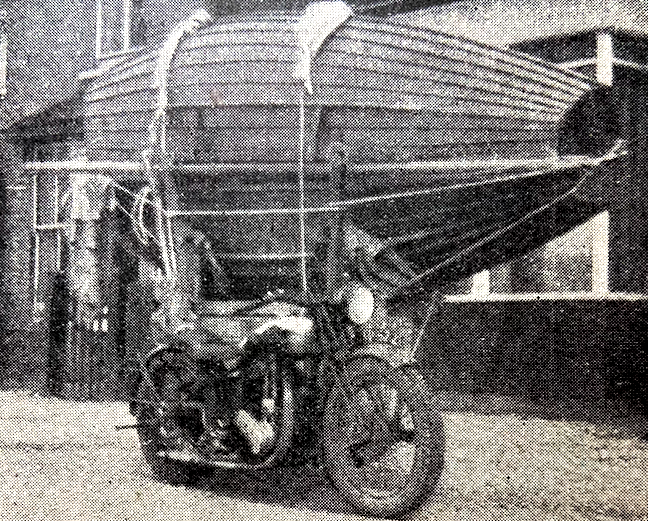
“UNTIL OUR OWN TIMES any road recognised as public was open to the use of all and sundry, by whatever means they cared to travel, and quite irrespective of its nature or condition. In recent years moves have been made, sometimes successfully and sometimes not, to close highways altogether, if not to the general public at any rate to motor users. Now the thing has started it is not easy to see where it is going to stop, unless every attempt of the kind is resisted to the utmost. Countless footpaths all over the country have been lost to ramblers for ever in the course of the past half-century or so, simply because people did not realise just what was happening, or did not care. Unless road users keep a watch on their privileges they are in danger of being barred from the use of many other pleasant by-ways.”
“THE ENFIELD CYCLE CO has produced a magnificent brochure containing a record of its war effort. The whole thing is done in photogravure in two colours, and to many of its recipients it will no doubt come as a revelation of the ramifications of the Redditch firm, and the variety of its wartime products. It had no fewer than five factories in operation, including one 90ft below the ground, away in Wiltshire, and besides cycles and motorcycles and engines of various types, it turned out such things as predictors for anti-aircraft work and gyroscopic sights for various guns, including the Oerlikon.”
“OCCASIONALLY ONE SEES registration numbers containing an unconscious element of humour. Recently, in London, I noticed an autocycle bearing plates with the letters LPA as part of the index number and to complete the picture the proud owner had his feet on a pair of old-style auxiliary footrests, fitted well forward, and was wearing one of those caps with the peak at the back. For the benefit of the uninitiated, of course, I had better explain that the letters quoted used, in the early days, to signify ‘Light Pedal Assistance’—which was, more often than not. anything but light.” [Ixion believed that the heating caused by LPA uphill, followed by rapid cooling on the reverse slope, wrecked the health of many pioneer motor cyclists—Ed.]
“TWO MINIATURE ROAD RACE meetings, a full-scale 100 miles road race and two grass-track meetings is a programme for one week which should satisfy any enthusiast. Such was the ‘menu’ served up by clubs affiliated to the MCUI during Ulster’s big holiday week, July 12 to July 19. The main attraction of the holiday week was the Wednesday’s Mid-Antrim ‘100’, held over a new 10.4-mile course outside Ballymena. The circuit, containing several long straights, gave every promise of high-speed lappery and the popularity of the race was such that 54 entries were received…The race was decided on a handicap basis, the limit rider, S Hodgin s (248cc OK Supreme) receiving 23 miles from WAC McCandless, who rode an AJ Bell 499 Norton from the scratch mark…From the outset, while the backmarkers were still awaiting the ‘off’, A McNeilly (490cc Norton) upset the handicap by turning a circuit at 69.98mph. He was in receipt of 16min 30sec and at his opening pace would be difficult to catch. His speed was reflected by his appearance in third place at the end of lap two, by which time McCandless was just pushing off the line, 20 miles astern. At the end of the next circuit McNeilly was in the lead, averaging 72.98mph, with T Morgan (246cc New Imperial) in second place well behind. G Reid (348 Velocette) was third…A scrap was
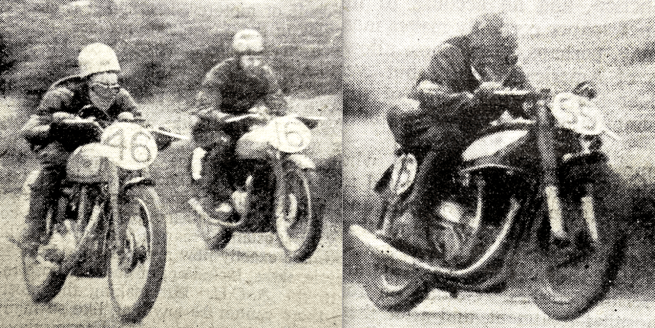
in progress between M Templeton (348cc Norton) and H Nicholl (490cc Norton), both averaging almost 76mph, but at this stage none of the faster men was in the first 10. Then came a lap by McCandless at 78.90mph despite a fall on his second circuit. On the fourth lap McCandless recorded 80mph as against 73.48mph by McNeilly, who was by now safely in the lead. At half-distance the order was McNeilly, Morgan, Reid, G Bell (348cc Norton), G Dummigan (249cc Rudge) and FG Kinning (348cc Norton). During the second half of the race the pace led to many retirements. The ultimate winner was a foregone conclusion, as by this time McNeilly led by almost half a lap. Interest, therefore, was centred on the efforts of the backmarkers to catch up. MW Baillie (348cc Velocette) was the first to appear among the leaders, being in eighth place on lap six, then seventh. fifth, third and into second place on the closing circuit. Templeton came from 10th place on the seventh lap into fourth on the final lap. The final four circuits by McCandless each established new lap records and brought him from 15th position to 12th, eighth and, with a shattering circuit in 7min 29sec (83.20mph), into third place on the last lap. McNeilly finished with over a lap in hand, having averaged 73.45mph for the journey. As he received the chequered flag he rashly cut across to the inside of the course, right in the path of Kinning. who was passing at high speed. Kinning’s subsequent avoidance of the timekeeper’s bus, some officials and Motor Cycling’s representative is worthy of mention. The runaway victory of McNeilly rather overshadowed some fine performances, notable among which were Billy Nicholson’s average of 71.72mph on a 348cc BSA and Peter Gill’s 75.20mph on a 348cc Velocette. No 250s finished the course in time, although S Hodgins was still running when flagged off. On July 12 the venue was Bangor Castle Grounds, where the Ards MCC held their second series of miniature road races for this season. The feature of the meeting was the new lap record established by Cromie McCandless, riding AJ Bell’s 499cc Norton. McCandless covered the mile circuit in 1min 9sec (53.48mph). Previous best was 1min 11sec (51.97mph) held jointly by E Lyons (498cc
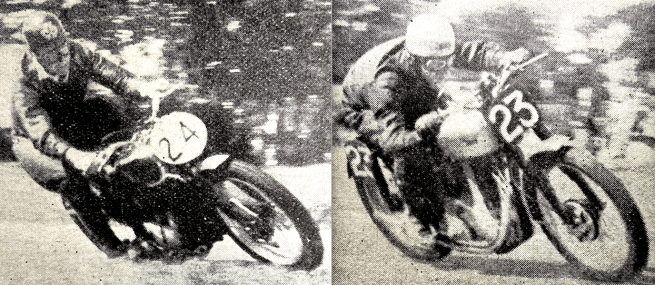
Triumph) and W Nicholson (348cc BSA). The venue was again Bangor Castle Grounds on Monday, July 14, and larger crowds than ever turned up to see the racing. A notable absentee was Cromie McCandless, who was preparing his 499cc Norton for Wednesday’s Mid-Antrim ‘100’. England was represented by AJ Glazebrook and CW Petch, both on 348cc Nortons. Petch dropped his model on a practice run and was unable to race. Speeds were lower than on Saturday, the best efforts being by AG McFarlane (498cc Triumph), Noel Hillis (348cc Norton) and Billy Nicholson (348cc BSA), all of whom had laps in 1min 12sec (51.25mph). The evening grass meeting staged by the Ards MCC on Thursday, July 17, at Bangor Castle Grounds, attracted large holiday crowds and was favoured with beautiful weather. Racing was keen and at times most exciting. A great scrap marked the final of the 500cc scratch race. The first heat had been won by Terry Hill (500 BSA), with AG McFarlane (498cc Triumph) in second place and the second heat by Billy Nicholson (500cc BSA), with 0H Jackson (498cc AJS) behind. The subsequent battle between these four was something to be remembered. Hill led for a time, then Nicholson got ahead with Jackson on his tail. Under this pressure Nicky really opened up and brought the crowds to their feet with excitement. He won by six seconds after a stiff fight. The remainder of the contests were equally keen.”
“HEAVY RAIN CAUSED the cancellation of the Belfast and District Club’s grass meeting, to have been held last Saturday, in aid of the Farmers’ Disaster Fund. Although large crowds turned up the organisers decided against holding the event as it was undesirable that damage should be caused to the Balmoral Showground venue. The meeting will take place at an early date.”
“LAST SUNDAY, A DAY of perfect weather, saw a huge crowd at Brands Hatch witness an excellent programme, including a series of match races between a Brands Hatch team and one from Wales. Commencing promptly at 1.30pm, the Grand Parade was led twice round the course by ‘chair’ expert Harold Taylor. Then came the combined heat and final of the 250cc Scratch Race. Cyril Clisby, being a non-starter and with D. Gregory (249cc Rudge) retiring at half-distance, after an exciting tussle, there was a clear field for Jack Colver, who romped home to win at a speed of 47.27mph on his amazing little Matchless. The special match races which came after the interval were somewhat dull to watch, with no opposition to the Brands Hatch team other than that which came from Angus Herbert (495cc AJS) who had been roped in to make up a depleted Welsh team. Brands Hatch won, 24-12. ES Oliver, however, had the time of his life and on his 500 Special proceeded to break as many of the track’s records as he could. In the third of the races, each of which was over four laps, he flew round to win in 4min 14.8sec, giving a speed of 56.51mph and making a new 650cc four-lap record. Not satisfied with this, he went on again in the fifth, to cover a flying lap in 1min 1.2sec, a speed of 58.82mph, a really marvellous ride. This is the fastest lap ever put up at ‘Brands’, beating even that of Ernie Lyons’s last year. The Grand Prix Handicap Final saw Angus Herbert (495cc AJS) and ES Oliver (500cc Oliver Special) with 65sec and 68sec handicaps respectively, but, undaunted, they set off to tear through the field. In close company, they whistled past one after another of the riders until, on the sixth and last lap, they had only two or three to pass. They changed places during this lap and were still flying on, although they could not beat JR Dunn (347cc Matchless) to the line. Oliver was satisfied, however, when it was announced that he had smashed the 650cc six-lap record in a time of 6min 16.6sec, a speed of 57.33mph!”
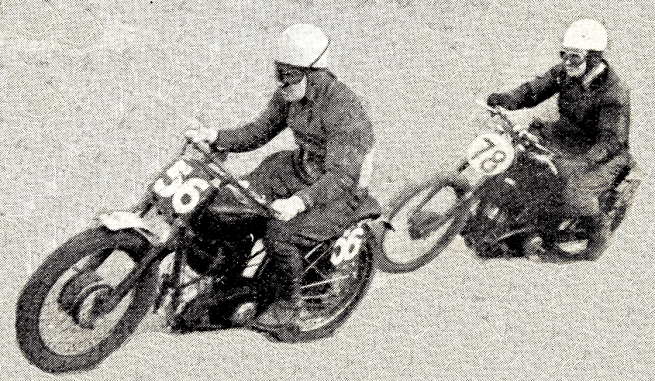
“‘BLOW ME DOWN! It’s Harry Tate Junior!’ As I ran into the car-park of the Lounge Café on Hog’s Back between Guildford and Farnham last Sunday, my attention was caught by the sight of an ancient and travel-stained motor cycle, positively staggering under the weight of two full panniers and an assortment of etceteras. As I had arrived on SS ‘Oildrag’—my 1929 Scott, which looks almost like a ’46 since it’s been to Yorkshire for a ‘look-over’ by Harry Langman—for the mid-summer rally of the Vintage MCC, there was nothing surprising about seeing an ancient machine. The car park was full of ’em. But few were at all travel-stained. Although many had come a long way—CJH Day’s 1921 ‘Beam, for example, had brought him down from Loughborough—these Vintage models nearly all looked as if they’d come straight out of the showroom. Who, then, had brought this rough old character into the company of the aged aristocrats of the two-wheeled machines? It wasn’t Harry Tate, Junior, after all, I discovered. Bill Fairburn is the name, a member of the club from Rochdale, Lancs. This 48-year-old fireman is devoting his fortnight’s annual leave to a 3,000-mile trip round the British Isles on his 1923 16H Norton. So far, he has ‘done’ the West Coast of Scotland and the East of England. He had ridden down from Northampton to attend the rally, and intended leaving that evening for Land’s End. Unless anything goes wrong with his plans, by the time this copy of Motor Cycling is on sale, Bill will have returned from Cornwall, visited Birmingham, where he’s calling at the Norton works, made a circuit of Wales and cracked smartly northwards in time to ‘clock on’ this morning for another 50 weeks of putting out fires.”
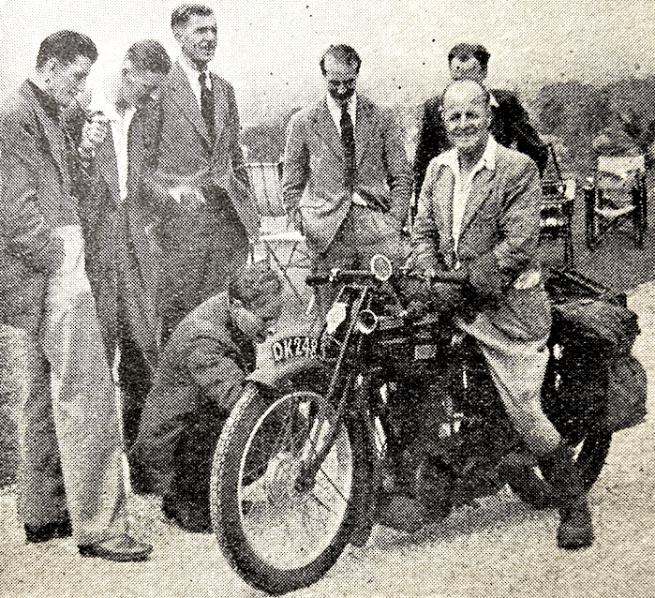
“EVEN AUTOCYCLE OWNERS will be catered for by the British Two Stroke Club when they run their road touring trial on August 10. Two-stroke riders from the South Eastern and South Midland Centres as well as members of the organising club may compete. The trial starts at noon from the Rambler’s Rest, Leaves Green, Kent (on the main Keston-Westerham road).”
“A NEW MOTORCYCLE, called the Typhoon, has been designed by a Swedish engineer. It is shortly to be placed on the market and is primarily intended for export, the South American countries heading the list. It has a Husqvarna type frame and a 7hp two-stroke engine, giving a maximum speed of 62mph. The price on the Swedish market is estimated at about 1,500 kroner (approximately £84).”
“THE FAMOUS NSU WORKS at Neckarsulm, in Germany, have now completed the construction of a small four-stroke machine equipped with a 60cc air-cooled engine with totally enclosed valve mechanism which gives an estimated maximum speed of about 50mph. Fuel consumption is claimed to be about 200mpg. The machine is fitted with rear springing, telescopic forks and a specially sprung saddle and has a three-speed foot-change gearbox.”
“MOTOR CYCLISTS ARE fully aware that commercialism cannot be eliminated from our pastime and, therefore, it must be accepted. But, so far as possible, it must also be kept in its proper place, which, surely, is that of a servant to the sport itself. So far this aim has been achieved. With the great majority of individual competitive riders, the sport always comes first; what can be made out of it is of relatively little importance. On the other hand, there is a small, but increasing, nucleus of businessmen in our clubs who, realising the entertainment value of organised sport, and with the example of the speedways before them, tend to favour the paying gate type of event. However, so long as the members are satisfied, the spectators pleased, and the sport is presented in such a manner as to instil enthusiasm for motorcycling generally, we can see nothing but good coming from these enterprises—always provided that the riders are not exploited and that the profits are ploughed back into the club so as to be of all-round benefit to the members. The danger, however, lies in the tendency for the business side of the undertaking to obliterate the sporting spirit which gave birth to the club, and it is for that reason, principally, that we consider the Auto-Cycle Union is acting wisely in pressing forward with the 2½% levy on paying gate takings which has lately been introduced to clubs throughout the country.”
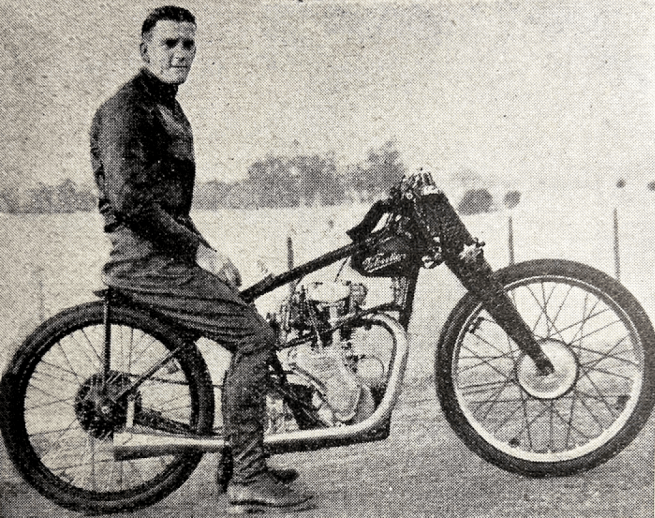
“WON AT NEARLY 98mph in 1939, when, for the first time, two 100mph laps were achieved in an international road race, the Ulster Grand Prix had enjoyed, almost uninterruptedly since 1928, the title of ‘The World’s Fastest Motorcycle Road Race’. Its nearest rival was the Belgian Grand Prix which takes place over the fast nine-mile circuit of Francorchamps. Last year the first big post-war event to be staged was the Ulster Road Race. It was not an international event, but it was run over part of the famous 20½-mile triangle of roads which lie between Belfast and Antrim. The whole seven miles of the Clady Straight were included and the section from Clady Corner through Ballyhill to Nutt’s Corner. But here war-time extensions to the Aldergrove airfield prevented a continuation down towards Crumlin and back up the old ‘colonial’ road to Muckamore. Instead, a right turn was taken and the course led along a secondary road through the little hamlet of Killead, with its several sharp turns and a hump-backed bridge, and along over an undulating road, to join the old circuit at Rectory corner, only half a mile from Muckamore and its right hairpin leading on to the world’s most punishing straight. The course had thereby been reduced to 16½ miles. Racing tyres were not in production and a great many of the faster men retired early in the race. The bare results, therefore, suggested that the new Ulster circuit might no longer hold its title when international racing was resumed. ‘Pool’ petrol was upon us, too, introducing a new, and unknown, factor into the sport. Various expert opinions put the reduction in maximum speeds at something. between 5% at the best, and 10% at the worst. Only VH Willoughby (348cc Velocette), the one really fast performer to finish the course, gave evidence, by averaging 87.27mph, compared with the pre-war Junior speed of 91.66mph, that the ‘UGP’ might still retain its laurels. Last Saturday an international race was held on the shortened circuit. The 19th Ulster Grand Prix was won by AJ Bell, of Belfast, on a ‘works’ 499cc Norton, at an average speed of 91.25mph. As the winning speed in the 1947 Dutch event was 83.95mph and in the Belgian 89357mph, the ‘Ulster’ is still the ‘World’s Fastest’. There was no foreign competition this year, and attention was, therefore, very largely centred upon the two manufacturers’ teams. In the 500cc class three Norton singles were matched against three AJS twins. One Norton was in the hands of the long-experienced Harold Daniell. Two Irishmen rode the others; AJ Bell, of Belfast, who promises to be one of the greatest riders since the late Jimmy Guthrie, and E Lyons, of Co Kildare. Jock West, winner of the ‘Ulster’ in 1937 and 1938, headed the AJS team. With him were RL Graham, famous short-circuit man, and EJ Frend. There was also Bob Foster to be reckoned with. Riding Peter Goodman’s 499cc Velocette, reputed to be one of the fastest ‘unblown’ machines in existence, and with a most successful year’s racing to his credit, he held the lead for several laps before mechanical trouble put him out of the contest. In the Junior race there were only two ‘works’ machines—the Nortons ridden by JJ Lockett and K Bills. The latter retired early on and it was left to Lockett to win the first event in which he has ridden as a manufacturer’s entry. But for the greater part of the race it was FL Frith, on a 348cc Velocette, who led the field in this class. M Cann and M Barrington on Italian Guzzis made a ‘two-man’ race of the Lightweight class, and, in winning it, Cann reversed the decision of the timekeepers in the Isle of Man. The first British machine across the line was an Excelsior, ridden by LG Martin, who finished third. One man won the Governor’s Trophy for the best performance in the Open Handicap, won the 350cc class handicap, and finished second in the scratch race for that class. He was LA Dear, riding a 348cc Velocette entered by George Bryant of Biggleswade. The race took place in blazing sunshine of a brilliance unusual for Ireland. As a result of the heat there were patches of liquid tar on several parts of the course—the same bother which reduced the speeds in this year’s ‘Dutch’—and the approach to Clady hairpin was so bad that riders could scarcely use their brakes. In the seven miles of the Clady straight, the course climbs, in a series of switchbacks, a full 600ft. It is this labouring, undulating and bumpy full-bore climb which has a lot to do with the high percentage of mechanical failures which always occurs in the ‘Ulster’. A bus strike on the Saturday morning did nothing to reduce the number of spectators. But it did result in many of them gathering at Muckamore, where they arrived by train, or Clady, which they had reached by walking most of the seven miles from Belfast. The congestion at these points caused the start of the race to be delayed from 2.30pm to 2.52pm, while the marshals were getting the crowds under control. In front were the Seniors, 21 of them, and all but four mounted on Nortons, the exceptions being Foster’s Velocette and the three ‘works’ AJSs. Behind them, due to start one minute later, were the nine Nortons, seven Velocettes and one AJS, which comprised the Junior class, and farther to the rear were the Lightweights—two Guzzis, two CTSs. two OK Supremes, five Excelsiors and one Rudge—the most mixed entry of all. At 2.45pm the official car returned from the final inspection of the course. The starter took up his position on the roof of the timekeeper’s hut, and the hands of the huge manually operated starting clock began to move. ‘One minute to go,’ 30 seconds..15..5, 4, 3, 2, 1—bang!—a scutter of feet, a bellowing cacophony of sound, and the first post-war Ulster Grand Prix had commenced!
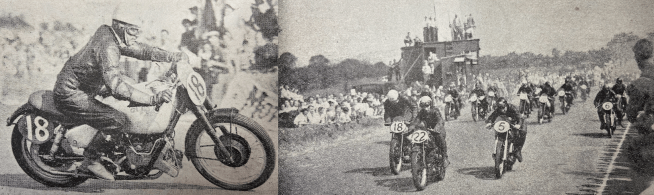
THE 500cc RACE: Jock West (AJS), Bob Foster (Velocette) and Artie Bell (499cc Norton) were first off the mark, but valuable seconds were lost by Jock as his twin spluttered on one cylinder before bursting into full power just past the pits. Last man to get his engine to fire was the promising new local rider Baldo Meli, but in all only 10sec had elapsed between the crack of the starter’s gun and the departure of the whole class. Ten anxious seconds, nevertheless, for the Belfast boy. There were only three non-starters. HB Myers and Jack Brett, both entered on Nortons, had failed to arrive from the mainland. GA Coulter, who had hoped to compete in his first big road race, had trouble during Thursday evening’s practising with the Rudge Ulster which he has rebuilt during the war years, and could not effect repairs in time. Very bad luck. That left 21 starters. Apart from the AJS team—West, Les Graham and Frend—and Foster on the 499cc Velocette which carried Peter Goodman into third place in this year’s Senior TT, the rest of the 500c. class were riding Nortons. With the exception of the three works models, the majority were square-finned 499cc ‘Manx’ springers, but S Arnold had an earlier model with rear springing and girder forks and BM Graham’s pre-war job was equipped with a McCandless rear end. It seemed that the 250s had scarcely departed before the loudspeakers were announcing that Bell, Foster, Lyons and Daniell had all rounded Muckamore Corner, 8½ miles away and at the start of the seven-mile straight. At Loan Ends, two-thirds of the way along the straight, the Velocette was in front; but the Nortons of Bell and Daniell were on its tail. The roar of the leading machines could now be heard across the open fields. Momentarily there was silence as the riders shut off for the bottom gear hairpin at Clady; then necks were craned in the grandstand for the first glimpse of the leaders hurtling over the crest of the slight hill between the corner and the start. There they were! It was the Ulsterman, Artie Bell, who led, and the crowd cheered loudly in appreciation. One second behind him were Daniell and Foster, riding abreast. Lyons came next—the Norton team holding three of the first four places —then Jock West (AJS) with his team-mates just astern, and Rex McCandless squeezed in between Ted Frend and Les Graham. The latter gave a very definite ‘thumbs-down’ as he passed the pits. Bell’s average speed from a standing start was 92.14mph, nearly 1mph faster than the best flying lap in this year’s Belgian Grand Prix. The second man had also bettered the 91.21mph recorded on that occasion, so it seemed already as if the ‘UGP’ could still claim to be the ‘World’s fastest’. At the end of the second lap the leading positions were the same. Bell still in front, Daniell and Foster together just a short way behind. This was Bell’s fastest lap and by averaging 94.79mph he had increased his lead to 5sec. Les Higgins (499cc Norton) had a short pit stop to check on a ‘faulty plug’. A second stop was made later in the race and it was only then that he discovered that the strap securing his tank-top chin pad was being sucked into the mouth of the carburetter! AV Carter, Bill Beevers and S Arnold all had more serious trouble and retired. Muckamore and Loan Ends both reported that the Velocette and the second Norton were now closing up on Bell; certainly Bob Foster had reduced his distance from the leader when they passed the grandstand, and at Muckamore on the fourth circuit he was reported to be only 15ft behind. Now came bad news. Harold Daniell had retired with a rear wheel puncture. Since 1934, when he last rode as a private entrant, Harold has been consistently unlucky in Northern Ireland and this made yet one more ‘Ulster’ in which he had failed to finish. At the same time there was a retirement in the AJS team, Les Graham’s foot-change mechanism having ceased to function. Noel Christmas had also retired, so that at this early stage of the race the 500cc field had already been reduced by one-third. Using every ounce of the Velocette’s performance—it was reported to have made the fastest speed of all, 111.23mph, over a measured kilometre by the timekeeper’s box—Foster took the lead from Bell on the fourth circuit. But he didn’t hold it for long; the Irishman was in front again at Muckamore. Just half a minute behind the leaders, Ernie Lyons was holding third place. Jock West’s AJS still lay fourth, Frend’s fifth. A steady sixth man was Rex McCandless on his Norton. There was great excitement at the end of the next lap, when the leading pair went by so close together that their times were announced as being equal. They were nearly a minute up on Lyons. Eventually Foster managed to get a slight lead once more, and increased it considerably when he roared past the pits at the end of the sixth lap, whilst the ‘works’ Nortons pulled in to refuel. By now the average speed had risen to 93.88mph. Both Bell and Lyons were at their pits for 31secs, but although the AJS pair postponed their stop, the Norton men still retained second and third places with several seconds in hand. Tommy McEwan retired with his Norton suffering from clutch trouble, and sand racer RJD Burnie was ‘black-flagged’ following a report that his machine was steering erratically. After he had been delayed for some time by the scrutineers, however, he was allowed to proceed. For the next three laps Foster held his lead, and by the end of the ninth he had an advantage of 19sec, despite a 31sec pit stop on the previous circuit. The Ajay people staggered their stops so that West refilled at the end of the seventh lap and Frend pulled in next time round. Then, with nearly two-thirds of the race completed, mechanical trouble hit the Velocette on its tenth circuit. A broken exhaust valve was reported to have put Bob Foster out of the running. Now Nortons—Bell and Lyons—held the first and second positions, with a comfortable lead of 95sec. Bell eased back his throttle. West and Frend came next. Rex McCandless was two minutes behind Frend and the Scotsman, J Seggie, lay sixth, half a minute in front of Meli. Frend, who had crashed at considerable speed during the practising, was still stiff and either fatigue or an unreported tumble lost him a place to McCandless on the 11th lap. But Rex’s gain was short-lived, for before the next circuit was completed his Norton had ‘packed in’. As Jock West was three minutes behind Bell by now, it looked as if nothing but very bad luck could rob Nortons of victory. Both Norton team-men, indeed, could afford to have a second pit stop on the 12th lap. Seggie, from being one of the ‘tail-enders’, suddenly found himself lying fourth with only two laps to go, whilst poor Frend had dropped back to sixth and Meli now lay fifth. Higgins and WJ Spratt were the only other Senior men still on the course. Seggie, however, after a very steady ride, ran into trouble on his final lap and failed to complete the distance, and Higgins and Spratt were both flagged off before they had covered the full 15 laps. Right at the end of the race Ernie Lyons made a very fine effort to get up with his team-mate. From being 45sec in arrears at the end of the 13th lap, he had reduced this deficit to 33sec as they started their last circuit, was almost on Bell’s tail at Muckamore, and finished only 15⅘sec behind him. Jock West and Ted Frend brought their AJS twins into third and fifth places, thus proving that this new machine has gained tenability in its first year, and private entrant, Baldo Meli, took a well-earned fourth place on his 1947 Manx Norton. Altogether an excellent race and one in which the average speed would have been considerably higher had the Bell-Foster battle gone the full 247 miles.
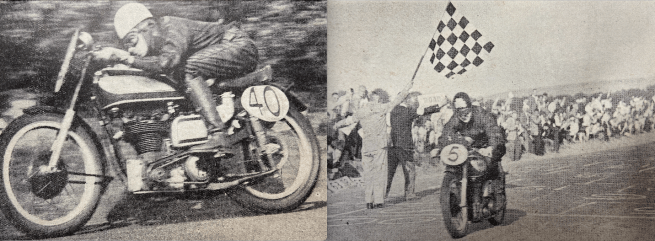
THE 350cc RACE: One minute after the Seniors had departed, the flag fell again and the seventeen 350cc machines were pushed off. It was an even better start than the Senior, and the riders disappeared down towards Ballyhill in a solid phalanx, with K Bills (Norton), FL Frith (348cc Velocette), JJ Lockett (349cc Norton) and BJ Goodman (348cc Velocette) at its head. There were only two non-starters, TF Tindle and F Shilling, who had been injured in a car crash on his way to the boat. Freddie Frith, whose machine has been built from those used by Stanley Woods and the late Ted Mellors just before the war, was in the lead at Muckamore. Thursday’s practice had already shown that he has completely recovered from the shoulder injury received when thrown from his Guzzi while practising for the TT, and he was riding with all his pre-war brilliance. He still led when Loan Ends was reached; and at this point Lockett and Bills, on their ‘works’ Nortons, and LA Dear (348cc Velocette) were riding abreast in second place. When they passed the stands, Frith still, had the advantage; Dear and Lockett were riding abreast in second place. When they passed the stands Frith still had the advantage; Dear and Lockett were still abreast, but Bills had dropped back slightly. The leader’s average was 84.78mph. It was nearly half a minute before the rest of the class appeared, when another bunch of three, FW Fry, BJ Goodman and H Andrews, all on Velocettes, dashed past. Another lap still hadn’t separated Dear and Lockett: it looked as if they would be going right through the race as a pair. Frith had increased his lead to 11sec, but poor Bills had dropped out, with a motor which no longer had compression. Fry was now just ahead of Goodman. There was one other retirement apart from Bills, that of Artie Bell’s namesake from ‘across the Border’, G Bell (Norton). MW Baillie (348cc Velocette) stopped at. Muckamore but managed to get going again. On the third lap Dear almost overshot Nutt’s Corner; as a result there was an appreciable gap between him and Lockett. Fry was having trouble and slipped back to 12th position. Bertie Goodman took fourth place and Andrews fifth. Coming up from ninth, WS Humphry had forced his Norton into sixth position. EN Millar, riding a Mark VII Velocette equipped with McCandless rear springing, retired and on the fourth lap his example was followed by Fry. At the end of the seventh lap, when he came in to fill, Freddie Frith had a lead of 26secs over Lockett, who pulled into his pit just as the Velocette rider was departing. About the same interval existed between Lockett and Les Dear, who also pulled in on this circuit. Bertie Goodman still lay fourth, but the fifth place was now filled by J Bailey (348cc Norton), Humphry lay sixth and H Pinnington (348cc Norton) occupied the seventh position he had held steadily throughout, despite a tumble on the wet tar at Clady. Just after half-distance, WM Webster (348cc Norton) and S Dalzell, on the lone ohc AJS, retired, and two laps later Humphry followed them out of the race. His disappearance was due to an unfortunate disregard of pit signals which caused him to run out of petrol half-way around the course. Lockett had made an extremely quick refuelling stop and on the eighth lap was only 5sec behind Frith. Making a tremendous effort, he was only 1sec behind the leader on the ninth lap. Things were getting hectic! The big excitement, however, occurred on the tenth lap, when, down by Ballyhill, Frith had a valve drop in! He had led right from the start, had pushed the lap speed for the class up to 86.62mph and appeared to be a certain winner, as he evidently had a little in hand over Lockett in the matter of speed. This left Lockett, a most stylish rider, leading the field on the remaining ‘works’ Norton. Les Dear’s Velocette was only 90sec to the rear, and Goodman sat safe in third position, some way behind. J Bailey now lay fourth, with MW Baillie fifth—still cracking well after that first-lap stop—and Pinnington now up one place to sixth. H Billington (348cc Norton), H Green (348cc Norton) and H Andrews completed the numbers of those still hoping to finish the 231 miles represented in 14 laps. Not a single change of position occurred in the concluding laps, the riders finishing in the order given, with the exception that the last three were ‘chopped’ by the finishing flag before they could commence their final laps.
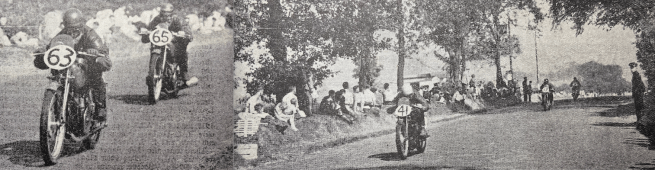
THE 250cc RACE: Four non-starters, CH Manders (Excelsior), GL Paterson (New Imperial), G Dummigan (Rudge) and C Tattersall (CTS) left 12 Lightweights at the back of the grid to wait until the departure of the Seniors and Juniors at minute intervals before they could commence their 214½-mile ride over 13 laps of the course. Maurice Cann took about 5secs. longer than anyone else to get under way, his engine ’16 stroking’, but well before the end of the lap his Guzzi was at the head of the field, where it stayed throughout. RH Pike’s Rudge was actually in the lead on the way down to Muckamore, but there he had to stop to change the plug. As soon as he tried to restart an exhaust valve collar broke (something which had happened to him only the previous week-end, at Abridge aerodrome) and that finished Roland’s ride in the 1947 ‘Ulster’. Veteran ‘Paddy’ Johnston, too (he finished second in the 1923 race!), got no farther than Muckamore, where his Rudge-engined CTS broke down. In one lap Cann and M Barrington—one second behind him—had established a lead, with their Italian Guzzis, of nearly a minute over the eight remaining lightweights. LG. Martin on a ‘spring-heel’ Excelsior lay third—where he remained for the entire race—and closely bunched behind him were SM Miller (249cc CTS), RA Mead, with his beautifully prepared and much-modified ‘Mechanical Marvel’ Excelsior, RT Drinkwater on another Excelsior ‘springer’, and J McCredie, riding a rigid-framed Excelsior. The one-second interval between Cann and Barrington lasted for six laps, with Cann always just in front. The average speed rose steadily from 78.10mph on the opening lap to 79.32mph. Barrington intended to pull in for refuelling after the sixth lap, but overshot his pit and carried on. He had lost the advantage of tailing Cann, and, before the lap was over, had suffered a broken valve spring which he changed in Killead village in 65sec, and had lost the enormous megaphone with which his machine had been equipped since the TT Lightweight Race—it had been noticed to be loose as he passed the pits. To increase the gap between them, Maurice Cann made a record circuit in 12min 13sec (81.08mph) and on the eighth lap he repeated the performance. By now Barrington was over four minutes in arrears. But he still had over three minutes in hand over LG Martin, who lay third. Only three other competitors were now motoring; Ben Drinkwater, fourth, less than a minute behind Martin; SM Miller (CTS) and, bringing up the rear, J McCredie. RA Mead had given up the fight on the previous lap when his little Excelsior started ‘drying-up’. After Maurice had pulled in for his pit stop he slightly reduced his rate of knots for the five remaining laps, despite which, however, his winning speed was 78.78mph.”
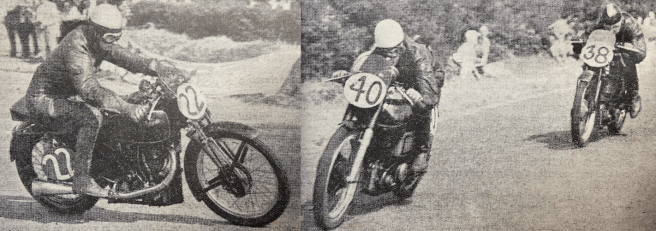
“IN THE OCTOBER 19, 1944, issue of Motor Cycling appeared an illustrated article dealing with the activities of a young Belfast engineer-cum-racing man who appeared to hold very decided views regarding rear-wheel springing and suspension generally. Following this introduction to Rex McCandless, riders on this side of the Irish Sea heard little of his name until a certain exponent by the name of Bill Nicholson suddenly leapt into prominence by winning the 1946 Cotswold Scramble. His BSA, which so deeply impressed fellow-competitors and spectators alike with its exceptional handling, wore a McCandless-produced ‘tail’—and remember that rear springing had always been frowned upon by our scrambling and trials fraternity, no matter how much the road-racers valued it! Following this public demonstration of the McCandless springing in very real action, many competition riders, mindful of the Irish rider’s effortless performance, began to put aside their deep-scored prejudice, and inquiries by the dozen were addressed to the Bell and McCandless establishment—for Rex is in partnership with the famous Norton exponent. ‘Ordinary everyday’ riders were not slow in observing that pictures of Irish road racers in action frequently portrayed standard sports machines wearing this desirable spring heel, and the McCandless post-bag quickly became so much the heavier. The increasing regard for this simple and comparatively inexpensive method of ‘idealising’ many a rigid-framed mount did not pass unnoticed by members of the trade in this country. Mr JR Ferriday, principal of the Feridax accessory concern,
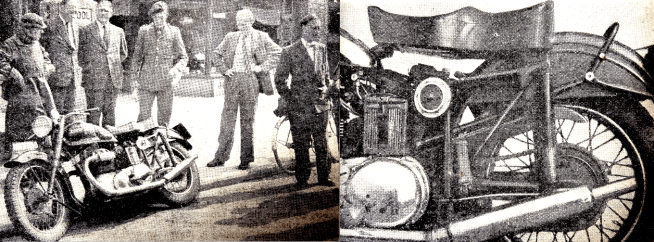
despatched his own Ariel 1000 to Belfast, and when it returned with its tail sprung he promptly proceeded to hammer The Beetle (as he so unkindly terms it) around the country at positively indecent speeds. Among other cruelties, The Beetle was called upon to suffer many hard and fast laps of the Scarborough racing circuit in the hands of course-marshal Arnold Moore. The latter’s efforts to buy the Ariel outright were laughed to scorn by Jim Ferriday, who had watched carefully the behaviour of The Beetle on its many rasping laps in the hands of Moore! In our July 17 issue appeared a brief announcement which proved that this new springing had created sufficient confidence for the formation of a manufacturing company in this country. Thus it came about that I received an invitation to attend an informal lunch party celebrating the formation of Feridax-McCandless, of Cheltenham, and to sup the health of joint managing directors, JR Ferriday and Fred Anning—one-time West Country trials specialist. The Beetle was present, too, which was just what I wanted, and the further requirement of a really bumpy un-metalled road was pointed out by ‘Cheltenham Flyer’ Jack Williams. Following a brief, but hearty celebration, our little party of the Press moved out of the town to the selected roughery. It was a 350-yard stretch of wide, unfrequented and completely neglected road, which the average car driver would negotiate at little more than 10-12mph, whilst an unsprung solo motor cycle would conceivably tackle it at 15-20mph. Glancing at the healthy proportions of the big Ariel as I proceeded to discard my riding coat, I’ll swear The Beetle sniggered as I became revealed in true proportion sans voluminous kit. I have never felt particularly inspired by rodeo artists, but this insolent 400lb of motor cycle was there to be diced, and, come what may, we would dice together! With thousands of miles-worth of experience on The Gent, I felt no misgiving on the question of steering; on the contrary, I have a great respect for Ariel ‘telescopics’ and felt quite happy about the navigational prospects. But when three and a half hundredweights of motorcycle begins ‘buck-jumping’, pictures of one’s murky past are apt to flit across the fear-stricken vision. ‘There’s a flat-spot on the carburation just above tick-over—haven’t cleaned the ‘gasworks’ out for ages—you’ll have to watch it, because she goes like a bomb when she cuts in again…” Jim Ferriday was talking, handing out a message of cheer, and I departed muttering vaguely about shocking maintenance. Twenty seconds later The Beetle and I, having arrived at a mutual understanding, were cruising over the worst hummocks at a steady 30mph. in third. ‘Too easy,’ I said to myself, and mentally arranged to wallop the same potholes at 35-40mph on the return trip. I wouldn’t pretend that my run back was good propaganda for anything short of showy suicide, but we kept ‘right side up with care’ and landed after every shattering bump with a pleasant cushioning effect in evidence at the rear. ‘Damping on the rebound only,’ the Ferriday man had said, and we had to admit that it worked well. The fact that my 10 stones had been perched well back on the Dualseat might have helped, of course—which thought produced The Very Idea! A quick turn around and back into the roughery—then up on the rests, and, just to find out how much I really would be thrown out of contact, the bars were released immediately the speed rose to 28-30mph. This was genuine rodeo stuff, and if things hadn’t worked out the way I had decided they should, it wouldn’t have been ‘no hands’—it would have been ‘no teeth’! Back among the group of interested spectators, I fell to pondering. If this springing was as well regulated as it seemed, surely a pillion rider
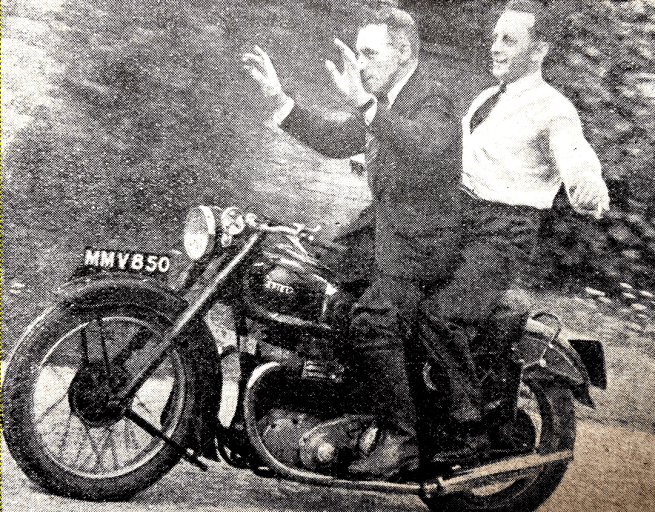
would be equally safe, despite a slightly more direct contact with the source of shocks. A tentative suggestion to those present brought incredulous looks and comments in the ‘Gertcher’ strain. Psychology was applied, however, and a couple of minutes later I set off with a pillion rider who has but the haziest idea of controlling a motorcycle and expressed himself as not particularly keen to become enlightened. As a partner in a thriving advertising agency business, however, Ted Underwood understands sales talk, and I managed to talk him into a temporary partnership aboard The Beetle Within a hundred yards, this ‘fully inexperienced’ passenger was demonstrating daring deeds in duo as we larruped gaily over the bumps with arms outstretched and nothing more than four size sevens in contact with the model. No fewer than six times we travelled this length of bumpery, with speedometer readings varying between 25 and 35mph. Let me record here my gratitude for the touching faith displayed by a non-rider in accompanying me on such circus tricks. It did not prove difficult, and I’m no Viney in the matter of accurate balance. To say that this specimen of McCandless springing works well on fast main-road bends and bumps would be stressing the obvious. Irish road races have proved the fact already and further confirmation should be to hand during Manx Grand Prix week, when more than one sample will be seen in urgent action on the Island circuit. The address of Feridax-McCandless is Feridax House, Frederick Street, Birmingham, 1.”

“THROUGH THE MEDIUM of your columns my club would like to thank the Chester MC for the way in which they looked after one of our members, providing him with lifts on club runs, when he was stationed in their area recently after being called up in the Army. Needless to say, any members of the Chester MC will find a hearty welcome should they find themselves able to give us a visit. At the same time, the invitation is extended to members of any other club situated away from their home towns and in our area—South London.
CR Bruguiere (Press Secretary, Streatham &DMCC), London, SE26.”
At the end of the war the basic petrol ration was designed to give private vehicle owners 150 miles a month. In 1946 it rose to 270 miles per month—but on 1 October, 1947 ‘basic’ was withdrawn; it was not restored until June 1948. Motor cyclists were not amused.

“A PARADE OF MOTOR CYCLISTS four and five deep, stretching for over two miles, formed the impressive finish to the petrol protest rally held at Brands Hatch last Sunday. In spite of dull, uninviting weather, with threatening clouds and a keen wind, motor cyclists rolled up in their thousands as the appointed hour approached. The meeting was to have been opened by Earl Howe, but he was prevented from coming by an unfortunate accident on the previous day. Mr. Dennis Strange, hon secretary of the Sanderstead Club and of the Motor Cyclists’ Petrol Appeal Committee, opened the proceedings with a resumé of the Committee’s activities to date, telling of ‘the other six rallies being held simultaneously throughout the country, and outlining the main points of the basic petrol drive, namely, the organisation of deputations to every Member of Parliament and to get every motor cyclist to take up the matter with his trade union, write to his MP, and write to the local and national Press; he was roundly applauded. Purchase Tax paid on new machines which would become merely a liability without petrol, was one of the points raised by Mr Harold Weir, the next speaker; there was no justification for playing around with the small man’s purse…After making everyone laugh heartily, Mr Harry Tate, the stage star, spoke seriously. He had been a motor cyclist from the earliest possible age and he felt that no good could come of motor cyclists having their life blood taken away. Mr Tate had journeyed from Folkestone to he present. FROME RALLY: Point after point emerged at the Frome meeting—once the ice had been broken by a member of the audience going up to the microphone. The area organiser, Mr Hodge, after opening the meeting, said that, speaking as secretary of a motor cycle club, the Frome & District, the ending of basic would mean the death of club life. He was followed by the local secretary of the RAF Association, who pointed out that without basic people would be unable to get to Association meetings. A motor cyclist of 40 years’ experience maintained that riders have ‘asked for it’ by not becoming organised—by not joining one of the bodies such as the RAC. WINGFIELD PARK: The first of the Midlands’ contingent arrived at Wingfield Park nearly an hour before the time scheduled for the Rally, and by 10.30am there must have been nearly 1,000 people at the venue. The sky was dull and overcast, yet still they came, those doughty enthusiasts to whom the basic ration is all-important. By 11am, although no accurate check was made, there were roughly 2,000 motor cyclists present. These 2,000 were representative of a much greater number. They brought signatures from fellow riders and workmates who, because of shift work in the factories and mines, or because of lack of petrol, could not themselves attend. The whole of the industrial Midlands of England was represented at the rally, and also there were representatives of the daily and national Press, and even a Gamma British photographer operating with a cine camera. NORTHERN PROTEST MEETING: From all parts of North-West England riders converged last Sunday morning on the little village of Greenfield, near Oldham (Lancs), in order to register their protest against the abolition of the basic petrol ration. And not only motor cyclists, but a considerable number of car owners, realising, no doubt, that this was a common fight, turned up to voice their protest also…From the conversation it was obvious that it was widely felt that this vexed topic had gone beyond normal realms, and many expressed the view that this was only the thin end of a very large wedge. From the owner of the Raynal Auto to the big Vincent-HRD, all were unanimous on one point, however, that all lawful means be tried in order to get ‘basic’ restored as soon as possible. Good work had already been achieved in the matter of petitions; Halifax & DMC collected over 1,000 names in less than a week, and other clubs reported similar progress—opportunity was also taken to get forms filled up as the spot. A very necessary item in view of the large attendance, namely, an amplifier unit, was fixed up, and over this Mr Jack Irwen, of the Manchester Ace MC…paid tribute to the Sanderstead &DMC for their lead in getting these meetings going, and it was as a result of attending the London meeting, in fact, that his club found itself t he organisers of this rally.”

“MANY THOUSANDS ATTENDED last Sunday’s meetings in different parts of the country to protest against the abolition of the basic petrol ration. Thousands more would have done so had it not been for scarcity of petrol—their need to conserve what little fuel remains to them. As expected, the largest protest rally was in the South, at Brands Hatch, near Farningham, Kent. Six thousand, it has been estimated, were at that protest meeting alone. The thanks go out to the Sanderstead club and to its little band of helpers who have striven magnificently on behalf of all and are determined to continue the fight. The Derby Pathfinders, too, must be mentioned for the part played in endeavouring to replace inaction with action. While motor cyclists are loud in their protests in private, they are still too inclined to be inarticulate publicly. At some of the meetings last Sunday it was difficult for members of the audience to reveal over the microphone the disgust they inwardly feel, and what the abolition of basic petrol means to them and to their families. Those who were willing to speak often showed that its denial spells very real hardship—hardship which they should bring to the notice of their MPs and trade unions. The time for apathy is past; motor cyclists need to get together—to be organised—each playing his or her part. The quantity of fuel asked for by motor cyclists is not large—a mere couple of gallons a month would make all the difference to willing workers and the lives of thousands. France, it will have been noticed, has decided on these lines. While the basic ration is being eliminated for other vehicles, a ration of five litres a month is being retained for motor cycles, the most economical of all motor vehicles.”
“THE MOTOR CYCLISTS’ PETROL Appeal Committee was elected at a meeting at the RAC, at which 113 clubs were represented. At that meeting were letters from a further 115 clubs (unable to be represented), pledging lull support for any measures passed. To start a fighting fund for the committee, the meeting resolved that every club should make a donation of not less than £1…Hundreds of thousands of appeal forms, posters, handbills, and other documents have been printed…Night after night a comparative few have bean working ungrudgingly into the small hours for the benefit of the many. Obviously the Appeal Committee’s fight cannot continue unless adequate funds are forthcoming. Donations from private individuals as well as clubs—however small—should be sent to the hon treasurer, Mr JA Simcocks, 48, Teevan Road, Croydon, Surrey.”
“I SHOULD LIKE to praise the Government for abolishing the basic ration. So many people have written about the disadvantages. What about the advantages of it? I can honestly say that the news was as good as the VE day news. Do readers realise that prices of secondhand and ex-WD bikes will fall by at least 50%? Even then the dealers will be making a reasonable profit. I used to be what the lads call an average rider. I shall be again, I hope, after I have obtained a reasonable bike at a reasonable price. On the other hand, I really sympathise with the average rider. I know what joys can be got from taking the ‘missus’ to a local grass-track meeting, or a Sunday afternoon down by the river. Well, I must close now, hoping that everybody’s dreams of unlimited petrol come true (after I have got my bike at my price, of course).
Another Ex-DR, Dudley, Worcs.”
“IN THE MIDST of all the letters of indignation at the withdrawing of the basic petrol ration, why not spare a thought for the smaller businesses specialising in motor cycle repairs? There must be many thousands like ourselves, who have put everything we possess, and a bit more, into our business, only to realise that by one Government decision the whole business is crumbling like a pack of cards. I do not doubt for one moment the necessity of the decision, but it is going to be hard for us and hard for the staff to find not only our pleasure stopped but our living as well. And what of our stock of accessories, bulbs, etc, on which we have paid Purchase Tax? By all means let us protest by every means we can think of. Let us all, as motor cyclists, have a good old British moan. It may not do a lot of good, but it will relieve our feelings.
JF May, Berkhampsted, Herts.”
“I READ THIS WEEK that the poor Germans can still motor 180 miles per month; do we Britishers appreciate that we won this war? As ‘Here’s Hoping’ states, the Labour voters are not helping the Government, but why should they? We have been led up the garden by false promises by those in power, and even if they promised a return date of the ‘basic’ I doubt if that promise would be kept. To Mr Roberts I would say: Let all sections of the community share these austerity cuts and leave us the open road, rain or shine, once or twice a month. Doubtless ‘Veteran Rider’ will take exception to the rain or shine, but at least he can return to his horse plus an umbrella. If this epistle seems barbed with venom, only blame the fact, that my Speed Twin” must very shortly hibernate. The best of luck to The Motor Cycle.
C Harris, London, SW4.”
“GRANTED THAT THE COUNTRY is in the throes of an immense and appalling. crisis (due, no doubt, to the futile and ignorant juggling of our ‘leaders’), but does this crisis mean that the motor cycling fraternity have to spend their time working hard during the week and looking forward during that same week to a Saturday and Sunday looking at the model and thinking where it (and they) could and should be—motoring down some open highway? After weighing the pros and cons, I say that we deserve our petrol—just enough to keep those ‘little men with hammers’ out of the pot at any rate. A small instance. At the garage where I work we do up a lot of RAF engines—lorries, cars and so forth. For a few weeks I took no notice of these engines when they were delivered, although something about them struck me as peculiar. One day I tumbled to what it was. Although they were coming in for overhaul, each engine was most scrupulously clean! I asked how this was, and the reply I got shook me, to put it mildly. ‘Oh, we simply turn a petrol hose on them1’ Crisis? Where? Among the working class, yes! But what about the bigger men?. Bus companies, for instance. Fifty- and 100-gallon coupons. If they want any more—ask for it, that’s all! How much pleasure service has been cut out? One-sixth! How are the motor cyclists (that were) to get to work? The Government evidently expect us to use buses. So in the long run it means more buses, more petrol for those buses, and less mpg. Crisis? Where? Certainly not on the buses. As the only healthy and uncommercialised sport left is motor cycling, I say to the people concerned, ‘Give its the petrol and we will finish the job.’ Just a reminder, before I close, of what an eminent MP said about motor bikes. “They are the most economical and cheap form of fast transport for work and pleasure that there is. I foresee a great increase in the number of machines on the road during the next year.’ Now that same man is allowed to take this last pleasure front us. Let’s hope that motor cyclists at the forthcoming rallies will say, ‘NO’.
Squariel, Lincoln.”
“UNLESS THERE IS AN 11th-hour reprieve this is the the last week of ‘basic’ petrol. After next Sunday no private motor vehicle is allowed on the road except for special purposes in accordance with the provisions of the Control of Motor Fuel, Order, 1947. This means that the purpose for which a vehicle is used must be that for which the Regional Petroleum Officer for the area has issued so-called ‘supplementary’ coupons. Even for the holder of supplementaries there may be no deviation from his route on the score that some ‘basic’ is still in hand. The motoring community is in the same position as it was when the submarine menace was at its height—the days when petrol was brought at the cost of men’s lives—and with a comparatively small saving of dollars as its sole satisfaction. What a contrast, and what an anti-climax to hard-earned victory! The struggle for petrol will and must go on. No by-election will be without question following question. Slowly but surely it will be brought home that this cut has a disruptive effect on every industry and hits all, rich and poor, travellers by public transport whose queues inevitably become longer, as well as owners of cars, motor cycles and autocycles. One extraordinary anomaly is that at the time we close for press there still appears to be nothing except cost to prevent the owner of a private vehicle using alcohol fuel of the type employed for speedway racing. Perhaps before next Monday there will be yet another Order. It has, of course, been stated in Parliament that there is no ban on the use of electric vehicles, cars or motor cycles.”
“THE FIRST OF SCARBOROUGH’S two race days last week-end was distinctive in many ways. First of all, Friday was graced with perfect weather, clear and bright throughout the long programme that went on without a break for nearly six hours. Sidecars were introduced to the course for the first time and there was also the inauguration of long-distance racing in the shape of a 56-mile (23-lap) event for the 16 fastest riders in the two previous short-distance 350cc races. The new starting point on the widened road on the low side of the course was also a great improvement. So much for the scene in general. In detail the outstanding episode of the day was the brilliant way in which W Doran (348cc Norton) wore down the stars in the 350cc 56-mile race by his perfectly judged riding. Parkinson, Bills, Briggs, Barnett and Cann were for once outclassed by a rider who rode so consistently that it seemed that the rest had either to win or bust. As soon as Doran realised how things stood he eased down slightly to win by a most comfortable margin, thereby establishing himself as one to be watched in future.”
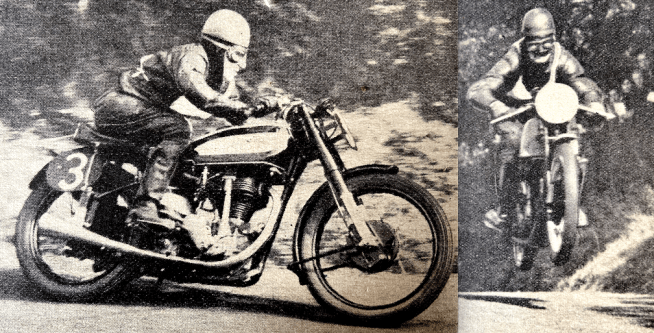

“THE TWO ROYAL ENFIELD models already available are being continued for 1948, but with a number of minor modifications. On the 125, wheel, rims, handlebars, saddle springs and contact-breaker cover are now chromium plated. The exhaust pipe, at its port end, incorporates a streamlined expansion chamber, which has the effect of improving two-stroking at low revs and of increasing the pulling power between 20 and 30mph. So much more power is noticeable that it has been found possible to use a rear sprocket containing one fewer teeth, thus raising the gear ratios…Now arranged at an angle on its bracket, the speedometer is easier for the rider to read; there is also a better sweep for the cable. The only alteration to the power unit is that deflectors in the piston are now absent. These deflectors had been carried on to suit an old type of cylinder in use at the beginning of the war. They are now redundant, and their removal has no effect, except perhaps to raise the compression ratio by a fraction. A longer tool box is fitted…of the same canister shape as before…beneath the saddle…The single-port two-stroke has a bore and stroke of 53.79x55mm. Compression ratio is 5.5 to 1. With its unladen weight of only 1351b, ground clearance of 6¾in, petrol consumption of 100-120mpg and its maximum speed of 40-45mph, this little machine is a handy, economical, go-anywhere mount has been tried out and proved sound under arduous battle
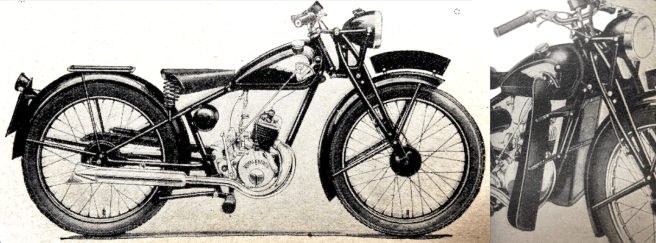
conditions. In peace the model has astounded many by its capable fund of power. Finish is black and chromium, with a frosted silver motif on the petrol tank—which, incidentally, holds 1½gal. The 350 has its rims, saddle springs and lower telescopic fork tubes chromium plated, and its timing and gear-box covers are polished. Rubber is now fitted to the brake pedal, foot-change lever and kickstarter crank…A snap-on, chromium-plated cap has now been fitted to the top of each fork leg. These rounded covers are neat and give the forks a more streamlined appearance. Bore and stroke…are 70x90mm. Valves, rocker gear and push rods are totally enclosed and automatically lubricated. A piston of heat-treated aluminium alloy is used and gives a compression ratio of 5.75 to 1. The cylinder head is, of course, detachable. The timing gear runs in an oil-bath. Lubrication is on the dry-sump system, but, instead of an oil-tank there is an oil compartment integral with the crankcase. By this means little time is taken for the oil to warm up, and the lubricant therefore reaches the vital parts of the engine more quickly after a cold start…A special feature of the foot-operated gear-change mechanism is the Enfield over-riding device, which enables a rider to slip into neutral from any of the gears other than bottom simply by pressing down on a pedal…On the gear-box casing is an adjustable stop which ensures a precise finding of neutral. The primary chain is enclosed in an oil-bath case…An efficient prop-stand is fitted. Finish is black, chromium plate and frosted aluminium…maximum speed claimed is 65-70mph. The legshields available as an extra may be fitted to either machine. Enfields for 1948, then, offer two machines, each fulfilling a definite purpose—and fulfilling it well.”
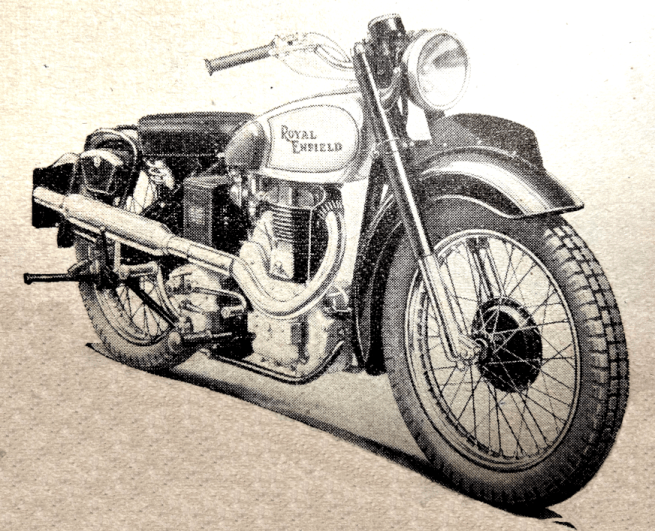
“WITH ONLY SMALL MODIFICATIONS. the present Excelsior range of machines is being continued for 1948. There are three autocycles of 98cc. One of these is the Autobyk, a single-speed model with a Villiers engine; the second is the Autobyk de Luxe, with the single-speed Excelsior Spryt engine introduced last May; and the third is the Super Autobyk, a machine that uses the two-speed Excelsior Goblin engine-gear unit. There are only two alterations to the Universal. A twist-grip for throttle control is being standardised in place of the lever hitherto used, and the head-lamp glass is to be domed—thus improving the looks and fanning out the beam…Fourth model in the range is the 125cc Universal, a three-speed lightweight motor cycle with a Villiers 125cc engine. All models are, of course, two-strokes…Bore and stroke are 50x62mm. Lubrication is on the petroil system from a tank that holds 2¾ gallons of the mixture. Made up of only three weldless steel tubes, the frame holds the engine-gear unit at three points Link-action forks of pressed steel are fitted, and these have the normal central compression spring. A Villiers flywheel magneto provides ignition and lighting, and a 24/24W main headlamp bulb is used. Finger adjustment is provided for the 4in brakes. Tyres are Dunlop, size 19×2.75. Weight of the machine is about 145lb. Gear changing is effected by a hand lever which protrudes through a gate in the top of the petrol tank. Finish is maroon with cream tank panels.”
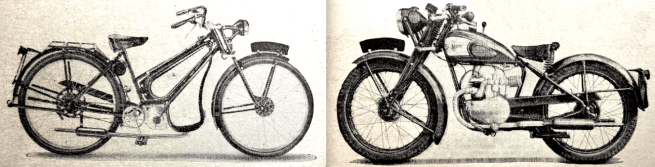
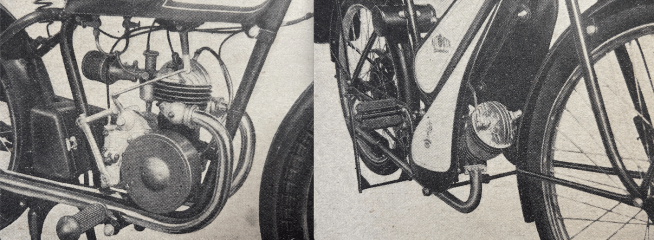
“ALMOST UNBELIEVABLE—A WEST of England Trial with four clean sheets! Two of the four men were Irishmen, Nicholson (500cc BSA) and RT Hill (500cc BSA), and the others, Alves (350cc Triumph Twin) and TH Wortley (347cc AJS). The deciding factor was the times in the special test. In this competitors had to freewheel downhill some 25 yards, get their engines going and ride as quickly as they could to the starting point. Nicholson beat Alves by 1½sec and thus won the trial—the 500cc single beat the light 350 twin. The start was from Newton Abbot and the course, as usual, lay on Dartmoor, which last Saturday morning was in its kindliest mood. There was glorious sunshine and the autumn colouring was superb. Nearly all the old favourites in the form of hills were included, among them Manaton, Wheelbarrow (Dark Lane), Manor, Ruggadon, Greystones, Gatcombe and Broadway. An innovation was the inclusion of the old Roman road at Totnes —Harpers Hill, it is called—and this was by far the most difficult hill in the trial. RESULTS: The Motor Cycle Trophy (best solo), W Nicholson (499cc BSA), 0 marks lost, 18sec special test; The Motor Cycle Trophy (best sidecar), H Tozer (496cc BSA sc), 34; Hosking Trophy (runner-up solo), PH Alves (349cc Triumph Twin), 0, 19⅓; 125cc Award, N Hooton (125cc James), 29; Excelsior Cup (up to 250cc solo), MJ Gray (250cc Matchless), 11; Snell Cup (up to 350cc solo), TH Wortley (347cc AJS) 0, 27⅕; Letchworth Cup (over 350cc solo), RT Hill (500cc BSA), 0, 26⅕; Pike Cup (runner-up sidecar), H Flook (490cc Norton sc), 38; Trade Team Trophy, BSA (W, Nicholson, PH Hewitt, FM Rist), 20; South-Western Award, GE Godber-Ford (490cc Norton); Club Team Trophy, Birmingham MC (PH Alves), PH Hewitt, VN Brittain), 23; Best West of England Member, J Plowright (346cc Royal Enfield), 7.”
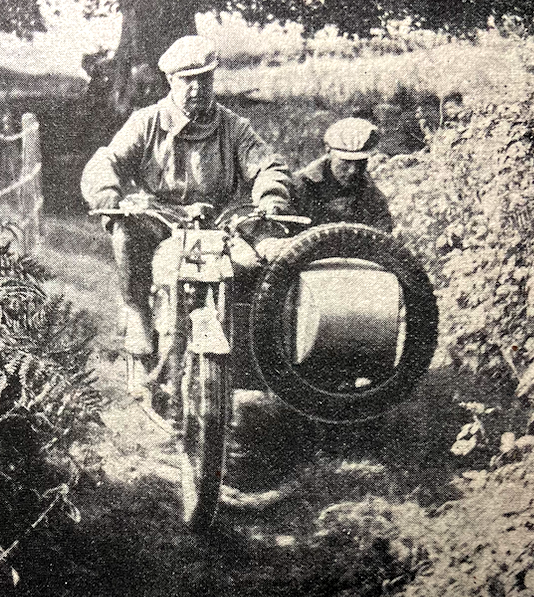
“WJ SMITH RODE HIS 500cc AJS to win the Scottish Grand National over a wet and gale-swept Roughrigg course on Sunday. Several hundred people endured the biting wind and battering hail and were well rewarded with as spectacular a display of riding as has ever been seen over the circuit. Sheltering behind shale bings, the crowd cheered and laughed as competitors skidded over wet grass; ploughed through a morass of mud, and splashed through 18 inches of water. Easy winner of the first heat was D Turner (BSA), who was first from the start and gradually increased his lead. In the second heat WJ Smith lay second to G Miller (350cc Matchless) for the first lap but, going through the ditch, Smith ran along the bank to take the lead. In the second lap Smith had increased his lead, but Miller, in second place, was closely followed by D Robertson (350cc BSA) and T Rankine. When they finished in that order, the riders were well separated.”
“I HAVE BEEN given a very unfair deal, for when I was in England last I succeeded in getting a brand new BSA B33. About a week after I bought the machine I read that the petrol ration would be cut. But now, with only six weeks more to go in the Army, I learnt that there would be no petrol at all. I have had only a few miles of pleasure for my £175, of which the Government quietly took £30. So now, when I am on my demob leave, I shall have plenty of walking to do, as I live in the country. I shall have to sit back and watch the damp slowly ruining my bike. This is a poor reward to have waited so long.
DLA, B33, BAOR.”
“I AM AN EX-NAVY MAN, who served in both wars and the interval between them. I was due to retire in 1941, but had to continue to the end of the last struggle. When I came out I looked around for a job, and found nothing unless I got away front my country village. I bought a motor cycle, giving the grateful Government £40 for the privilege. To show their gratitude, they now say, ‘Now put your machine in its shed; you have had it, but we have your money.'” That is not the end of it. I must now pay 18s a week bus fares and queue up for buses, which go every half an hour. I want my bike for work first, pleasure second—and there are thousands like me. Now a second angle which gets me is the reason put forward, ‘saving of dollars’, etc. Tripe! What about the TUC refusing to co-operate with the Government unless they stopped pleasure petrol and. hotel feasting? Why do people keep on with this rubbish about ‘food before petrol’, ‘save dollars’, etc. Ask the TUC what they know about it.
EA Turner, Effingham, Surrey.”
“MEET THE ‘MOTOR MAIDS’ of AMERICA. Linda Dugeau introduces the USA all-girl club of hard riding enthusiasts. ‘…I can’t understand people complaining that it is difficult to snake a heavy motor through congested traffic. I have ‘Flanders’ bars and risers on now, which take the bars out of your lap—and there is scarcely a hole too small for that ’74’ to squeeze into! Perhaps you may think I find it easy to handle because I am big, but that is not so. I am just barely over 5ft, and weigh around 115lb. I can pick the ’74’ up if I happen to drop it—which I haven’t done since I got the ‘Flanders’ bars—and push it anywhere necessary, except up a steep grade. And, after all, you don’t buy motors for their pushability! If only girls would stop thinking how much a motor weighs and just take off with it, they’d get along much better. There is no reason why any girl shouldn’t ride the biggest, heaviest motor made, if she just thinks she can! Of course, this riding would be limited to good roads. I am in entire agreement with the California riders, whose chief pastime is ‘cow-trailing’ in the hills and desert, that there is nothing better than the English motor for that game. Small tyres do better in heavy desert sand and hand clutch and foot gear-shift are fine on mountain roads, where sometimes it’s bad to take a hand off the bars, and they are less tiring in bad going if you have to get off and push a lot. That is one reason why so many girls out here ride English motors—they are brought up on ‘cow-trailing’ and don’t like pavement and traffic at all. I confess that I haven’t yet become an ardent cow-trailer, even though [my husband] Bud bought a 1946 Triumph Speed Twin last January so we both could take turns using it…Compared with America, riding conditions are very different in your country, of course. The small, light motors are completely suitable for England because distances are so short, roads (as I remember them when a child) are narrow and winding, and them is little incentive to tear off and burn up the road, because you’d reach your destination much too quickly and have nothing left but to come back! Our riding opportunities in the U.S.A. are so different with our long trips, super-highways, etc, especially in the West, that we need an entirely different kind of motor from yours. We want a good riding machine that takes bumps in its stride, has plenty of room for big saddlebags and other luggage and comfortable facilities for riding pillion. As you go East, you find more and more girls riding nothing but ’61s’ and ’74s’ and few of them are hefty. You should meet Dot Robinson of Detroit, for example, One of the most feminine of women, just 5ft, with a perfect, diminutive figure and magnetic personality, she has won some 50 trophies during the past 18 years, any one of which a man would give his eye-teeth to, possess, especially those for the Class A side-hacks in the Jack Pine Runs. Of course, she is unusual, but we have a considerable number of girls, competing with men on an equal basis, who come out in very enviable positions. Dot has a daughter, just 15 now, who has ridden some sort of two-wheeled vehicle since she was six and now has a Harley ’45’ painted to match her mother’s in blue and grey, the club colours of the Motor Maids of America, a national organisation, auxiliary to the AMA, which I founded in 1941 for girls who own and ride their own motorcycles. We have a national meeting every year as well as many local events, and the members certainly enjoy travelling around the country. I know 1 did last summer, I put in over 7,500 miles, just going here and there to visit friends. I would like very much to hear from other girl riders in England and find out what their problems are over there. As a matter of interest, I have recently heard from a girl in Holland who was fined in some small town there for riding on Sunday morning, during church time, in “unsuitable attire,” to wit, leather breeches! It must be tough to try to ride with such prejudice rampant.'”

“AT THE RECENT FICM Congress in Paris the decision was taken to introduce new regulations governing sidecar races. A majority of the delegates was in favour of standardising the design of racing sidecars in such a manner as to ensure that passengers shall remain normally seated. We consider this decision to be unwise. The average speed of such races will be reduced and the danger to passengers increased. The only means by which these snags might be overcome would lie in the development of banking sidecars which have no value as a commercial development and are, themselves, subject to especial dangers inherent in their use. Sidecar racing is a spectacle and can never be anything else. As a spectacle, the acrobatics of the passengers are thoroughly appreciated by the spectators. Why, then, attempt to restrict these activities? If the hope is entertained that the new regulations will enhance the sale of sidecars for everyday purposes, we believe that hope is foredoomed. The Sidecar TT Races exploded that particular theory more than 20 years ago. As races they were very enjoyable, but as propaganda for the combination they were a dismal failure.”
“THIS, CLEARLY, IS A ‘Nicholson year’. No surprise, therefore, need be occasioned by the announcement that the popular little Ulsterman, mounted on his 499cc BSA, won the North-Western Centre’s Lancashire Grand National last Saturday. That he won so easily and decisively did, however, rob the event of much interest as he had the race in his pocket long before the half-way stage. Local star Ted Ogden (499cc BSA) and a strong Southern contingent, which included Jack Stocker (497cc Ariel), Hugh Viney (347cc AJS), and Ted Frost (497cc Ariel) were all spectating by the eighth of the 20 laps! Last year’s ‘fastest 500’, Bob Foster, of Cheltenham, was an absentee, which was a further pity, because the AJS rider nearly monopolised proceedings in 1946.”
“TO THE HARD RIDERS whose preference is for three wheels, whose pockets dictate 500cc and whose temperament is inclined towards brisk travel, there is something lacking in the performance, however lusty, of a side-valve-engined combination. Whilst none would doubt the ability of such an outfit to provide reasonably quick transport, the accent would be on utter reliability, coupled with unhurried driving methods. Such lines of thought must have prompted the BSA company’s introduction of a new model into their M range, which, since the war, has featured two much-respected favourites in side-valve form—the 600cc M21 and that sturdy warhorse so well known to every Services DR, the M20 500cc edition. The newcomer to this M series retains all the attributes associated with its side-valve counterparts in terms of guaranteed reliability, but goes one step farther by possessing an overhead-valve engine which has acquitted itself notably in open competition work when housed in a lighter B33 frame layout. In such trim, Motor Cycling’s solo test, carried out earlier this year, showed that this 499cc engine was capable of 80mph performance, with good accelerative power and low speed ‘punch’. Therefore, it is not surprising that the factory, in seeking to supply the need for a lively, well-built combination machine with a lasting reserve of power, turned to this unit as an ultimate choice. It does not represent anything in the nature of a new departure for the BSA concern, and many readers will be struck by the close similarity of its specification to the pre-war 496cc ohv M23 Silver Star. Features of the M33 specification include a heavyweight pattern triangulated cradle frame, with integral sidecar lugs; central compression spring, girder-type forks with hand-controlled damper; quickly detachable rear wheel; 8in Lucas head lamp with sealed beam reflector and bulbous fluted glass, and a heavyweight four-speed gearbox. The 499cc engine measures 85mm bore and 88mm stroke—an excellent type for ‘pep’ at low rpm—while the
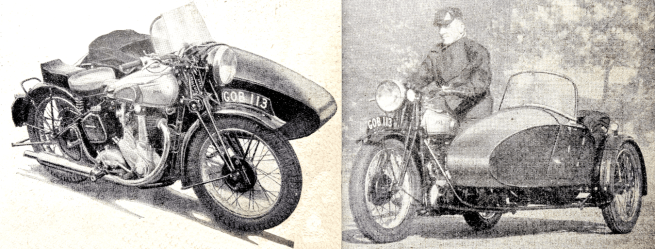
compression ratio is 6.6 to 1. Crankshaft rigidity is assured by double journal bearings on the drive side and a special outrigger on the timing side supporting the mainshaft pinion and the cam spindles. With a machine so suited and destined for sidecar work, a road test would hardly have been complete without the addition of an appropriate ‘chair’, and here a special word of commendation is due. As delivered for test, the M33 was attached to the latest BSA sidecar—which was described in our issue dated September 4 last and is designated in the catalogue as Model 22/47. Although referred to as a de luxe tourer, it lacks nothing of sleek line, and many favourable comments accompanied expert inspection of its construction and roomy accommodation. A l5-stone passenger, some 5ft 10in, in height, found no difficulty in seating himself comfortably with elbows set naturally—thanks to a body width of 19½in at the seat squab. With the hood raised, the same passenger found adequate headroom, while body width at usual knee location is 18in. The depth of the seat squab comes to 26in. The seat cushion is pneumatic and ingress and exit are tided by a hinged scuttle and a wide door. The roomy locker has a streamlined lid. retained by a metal strap, which locks down securely when not in use, and the hood is protected by a snap-fastened envelope cover. Complete enclosure is supplied by the hood, which snap-fastens to the body sides and is retained at the top by a wing-nut on the metal rim of the screen. Two quarter-elliptic springs at the rear and twin helical springs at the nose supply a high degree of immunity from road shocks without pitching, and the triangular-constructed chassis is attached to the machine at four points. Worth noting is the inclusion of a jack, enabling the sidecar wheel to be lifted for removal or tyre repair. Engine starting proved to be a very simple business, even when the outfit had been left standing under skimpy cover for some four or five cold autumn days. It was advisable, in such circumstances, to spin the engine with the exhaust valve lifted (the lever is mounted on a common control with the ignition lever beneath) for three easy swings, followed by a gentle flooding and two-thirds retarded ignition setting. One kick would then suffice every time. No use was made of the air lever throughout the test, but it was always necessary to retard the ignition for hot or cold starting. In this respect the engine was fairly sensitive, and sensible use of the lever control was needed to deal with the combination of a heavyish load and low-octane Pool spirit. Piston slap was evident with the unit cold, but while the valve gear could be heard at work, it was never really obtrusive unless one grossly over-revved, as when ascertaining maximum speeds in the intermediate gears with the rpm in the region of 6,000. When pulling strongly, the exhaust note was rather prominent but could not be said to cause offence at ordinary cruising speeds. The gear operation was inclined to be heavy, and it was necessary to shut the grip down for minimum tick-over to ensure silent engagement from rest. No sound of gear-whine was ever experienced and the clutch was reasonably light, yet progressive in action at all times (despite periods of deliberate abuse), thanks, no doubt, to its generous proportions. Split-second gear-changing demanded determined pressure on the pedal if revolutions were high in the intermediate gears—circumstances liable to occur on hilly twisting, secondary roads. The normal ‘change-up’ speeds were 10mph in bottom, 25mph in second and 40mph in third gear, while traffic driving showed that top gear could be usefully employed down to 18mph. Minimum non-snatch speed in this ratio was 14mph with half-retarded ignition setting. Frequent traffic halts supplied evidence of a quiet and reliable tick-over without need for ‘blipping’. Experiment throughout the 800-mile test proved that for most comfortable handling the fork damper gave best results when firmly tightened and with a front tyre pressure of 19-20lb. A fair degree of damping on the steerage eliminated a tendency for the front wheel to ‘waver’ on bumpy surfaces—a peculiarity that may have been due to the high and forward mounting of the large head lamp. An extreme test carried out with a 10-stone passenger and the outfit completely ‘flat out’ under favourable conditions of gently falling gradient showed that, with the speedometer reading 70mph, a slight flexing on the forward attachment tubes was noticeable. Long runs on the open road with this 10-stone sidecar load proved that a steady cruising speed of 50mph was easily attainable. Bearing in mind that use of the gears would normally produce this gait in 15 seconds from a standstill, it was a useful speed, obtained without fuss, and could be held on all but the steepest main-road hills. Averages in the region of 38-40mph could be plotted and achieved without ‘caning’ the motor. Third gear was useful in aiding snappy acceleration from 25 to 40mph whenever caravans of heavy transport had to be overtaken by ‘leap-frog’ tactics—and even in busy main-road conditions petrol consumption would comfortably top the 50mpg mark. Braking was good and the front tyre would squeal protest if the for’ard anchor was applied violently below 30mph—some care was necessary on wet roads, especially wood setts, if wheel-locking was to be avoided. Unfortunately, no adjustment is provided for the rear brake pedal and, in its normal position, it is necessary to lift the left foot clear of the rest in applying the brake. Setting the gear lever to individual requirements is aided by its mounting on a splined shaft, and the footrests are adjustable within generous limits. The handlebars may be adjusted for angle by slackening off two clamp bolts, and both brakes have hand-controlled adjusters. A non-stop 160-mile run which occupied a fraction over four hours failed to produce a vestige of fatigue, but there were signs that the right shoe had been in contact with the clutch pushrod adjusting locknut on the gearbox end cover. Oil-retaining qualities were splendid, and at the end of a full 500 miles hardly a single smear sullied the exterior of engine or gearbox, the latter, of course, being lubricated by engine oil via an accessible filler and level plug. Nor was there any trace of leakage from the oil-bath primary chaincase. Frequent night runs produced proof that the new 8in Lucas head lamp, with its concentrated ‘flat’ beam, enabled dark-garbed pedestrians to be distinguished readily even at 200 yards’ range and allowed a night-time average hardly less rapid than was possible by day. Thanks to rubber strip jointing on the scuttle and full hood enclosure, the sidecar
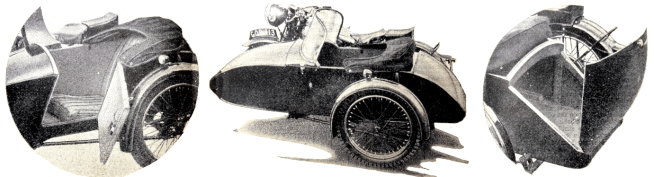
provided weatherproof travel in the heaviest downpour. A front mudguard valance would have been welcomed by the rider in tackling short runs over muddied city streets, but it is understood that present circumstances do not permit this luxury. A three-gallon fuel tank gives a minimum mileage of 150 without need for refuelling, and a two-level petrol tap affords a reserve supply. Central positioning of the filler cap makes it a little difficult to ascertain the true level of the petrol, but a sensibly located filler on the oil tank allows easy sighting and refilling. Maintenance tasks earned the M33 a high standard of marks. Removal of the quickly detachable rear wheel, which is effected by the BSA tube and tommy-bar combination spanners, is aided by a detachable rear mudguard portion and spring-up rear stand. Rear chain adjustment is simplified by a cam adjuster on the sprocket side, and a normal sleeve bolt on the off side. An accessible draw-bolt behind the gearbox on the timing side enables fine setting of the primary chain tension. No difficulty attends removal of the carburetter jet-well or the less frequent task of tappet adjustment. The voltage control unit is mounted beneath the saddle, but the tester was never conscious of contact between it and the mattress springs. Front-wheel removal is facilitated by the provision of a slit toggle for easy removal of the front brake cable. Deep guards to top and bottom runs of the rear chain prevent oil spray reaching the tyre. The finish and appearance of the whole outfit reaches a very high level and is deserving of favourable comment. Feminine appreciation naturally centred on the sensible layout and pleasing lines of the sidecar, cellulosed in shining, dignified black, while enthusiastic riders were apt to dwell on the many features of a machine so obviously built for a purposeful job. It offers a measure of reliability and snappy performance which underlines the claim of really satisfactory and economical ‘transport for two’.”
“‘A DESIGNER IS A MAN who can make a better article for a lower price.’ The words were those of the late Harry Collier, TT winner, designer and manufacturer, and his axiom was used by Mr AB Bourne, Editor of The Motor Cycle, when introducing a paper, Motorcycling Design of To-day and Tomorrow, to London Graduates of the Institution of Mechanical Engineers, Automobile Division, on October 29. The speaker’s opening theme dwelt on the degree to which present design has been consequent upon a gradually developed policy of blending the angularities of early machines into more pleasing lines. The indifferent eye appeal of the 1906 3hp Triumph was cited; in comparison were shown enlarged photographs of the rather more compact-looking Model H, and the 498cc Triumph TT model, which followed some 10 years later and featured an ohv engine, a mechanical oil pump and other characteristics of the modern school. Here was revealed the early tendency for artists, as well as development engineers, to play a part in planning design. On the technical side, this planning meant closer grouping of components within the frame and, indeed, Mr Bourne prophesied still greater homogeneity compatible with reasonable accessibility—the latter factor being relatively less important as reliability increases. Pressings, the increased use of welding, of ‘boneless wonder’ construction, opined the speaker, also would probably find increasing favour in the motorcycle world. His optimistic note concerning the future of the telescopic type of fork suspension did not match up with the shadow of doubt expressed over transmission questions. Here, said Mr Bourne, British design was in a cleft stick, particularly with regard to the complementary subject of rear suspension. The speaker’s experience with spring frames had led him to expect an average useful rear chain life of some 7,000 miles only. Improvement, it was thought, could be brought about by enclosure of the chain—primary chain drive, protected and working in oil, was already nearly 100% satisfactory—although costs might go up as a result, possibly raising prices to a level comparable with those of shaft-drive models. Where the disposition of the engine suited, as in the case of the post-war Sunbeam in-line twin-cylinder model, shaft drive was the obvious transmission solution.”
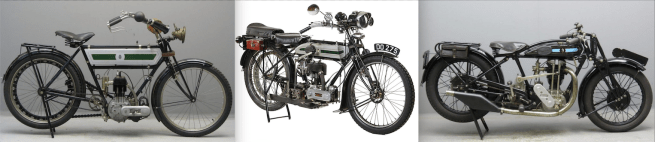
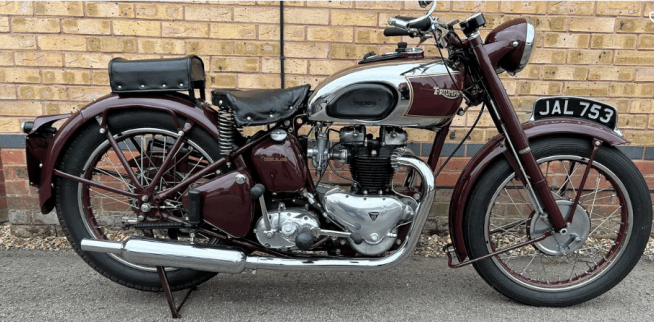
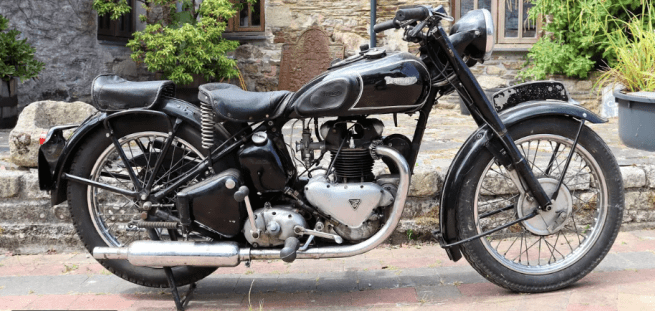
“FRONT BRAKES FIGURE in this week’s news. Two motor cycles, it will be seen, are now fitted with larger front-wheel than rear-wheel brakes. While it might be wrong to attach special significance to the change in this instance, and particularly to suggest that it marks the beginning of a new trend, there are many experienced riders who will acclaim the development. Thoughts on front-wheel brakes have been clouded by the old-time cry of the pedal cyclist that front-wheel brakes were dangerous. The stirrup front brakes on early motor cycles were dangerous, not because they were efficient—as a means of slowing down the machine they were singularly ineffective—but owing to their flimsy construction, which rendered them liable to catch in the spokes. Even to-day it is often difficult to make a novice realise that, since the effect of slowing down is to transfer weight from rear wheel to front wheel, the front wheel can offer the more effective braking. Perhaps because of this outlook there has been a tendency, particularly among manufacturers of lightweight motor cycles, to fit small front brakes of no great power. Indeed, some motor cycles would be far better from the braking angle were their makers to exchange the front brakes for the rear ones. If the change causes the subject to be pondered afresh it will have done motor cycling a good turn.”
“MOTOR CYCLE SPORT comes to its temporary close with a trial which has attracted over 300 entries. This is the open-to-South Eastern Centre event fixed for the last day for the use of ‘basic’. Never has there been such enthusiasm for motor cycle events as that displayed since the war. From the country’s aspect this is to the good; it reveals the virility of British youth of to-day, for of all sports there are few so manly or so educative as competitive motor cycling. Its elimination means more—much more—than mere hardship to the participant and the spectator. It spells loss to the nation in terms of skilled manhood. While the ban lasts, no longer will there be the automatic development by sporting motor cycling of men to pilot our aircraft, man our tanks, ride as despatch riders and constitute key personnel in factories. Have the lessons of war been forgotten so soon? Maybe there will be no war for years to come, but the loss remains. The qualities required in civilian life to-day are just those which competitive motor cycling develops—judgment and skill, initiative, quickness in thought and action, and the team spirit.”
“I PICK THIS WORD out of our description of the new Norton cam gears, designed to diminish the orchestra of mechanical noises which is generated by every petrol engine in the world. I suppose there are three separate elements in this orchestra—the ‘clack’ of impacts (as between valve and tappet, or valve and seat); the ‘churr’ of engaged pinions; and the ‘ring’ of outraged metal. I wonder if any experimental engineer has ever taken a mechanically silent water-cooled engine and, without altering any other item, substituted finned air-cooled pots for the original water-jacketed pots? I shall never forget the incredulous rage of a very famous, designer who in 1919 produced a small air-cooled multi-cylinder unit for a projected light car and utterly failed to secure a degree of mechanical silence which he deemed potential customers likely to tolerate. He was so impressed by the sound-damping effect of water jackets that he urged several motor cycle designers to copy Scott practice, and adopt some form of liquid cooling. He likened the damper action of the water to making a wine glass ring, and then suddenly stopping its vibrations with a touch of the finger.—Ixion”
“SEVERAL READERS, ESPECIALLY a voluble friend in N Ireland, grumble about equipment shortages. They have secured delivery of the ardently awaited bus, but are still minus some item which they regard as vital. Maybe a propstand, or a luggage carrier, or a pillion seat. I hate to exhort patience, but the blunt fact is that raw materials are as ferociously rationed as beef steak, and steel in particular is a permanent bottleneck. I am afraid that many of our readers still fail to grasp the ugly fact of our insolvency. We are at the moment probably worse off than Spain or pre-war Italy. Could any fact be more eloquent than the stopper laid upon building homes for the thousands of young couples who still have to ‘muck in’ with strangers or their in-laws?—Ixion”
“FOR 1948 VELOCETTES ARE continuing to market four standard machines and a racing model. But the standard models are being equipped with Dowty front suspension—on which the ‘springing’ is by air and the damping by oil. Racing model KTT is continued as before, with Webb, parallel ruler-type front forks. The standard models include the well-known high-camshaft, push-rod operated MOV, MAC and MSS (of 248, 349 and 495cc respectively), and the famous overhead-camshaft KSS, a 350 for long acknowledged to possess the punch normally attributed to a 500. Petrol tanks on these four models have had to be made slightly less bulbous in order to provide an adequate steering lock with the new fork arrangement. As the Dowty forks are depressed, a rising piston in each leg compresses a supply of air previously pumped into the legs. A tube feeding both legs at the top ensures that each contains the same quantity of air. Damping of each leg is effected by a plunger fitted with a washer, past which oil has to flow as the forks operate. A synthetic rubber buffer just above this washer prevents jarring at utmost re-bound; and extreme upward movement of the piston is checked by a cushion of oil (whose normal or static level is at the top of the piston), so that there is no unpleasant bottoming of the forks. The advantage of air ‘springing is that progressive action is ensured. Incidentally, the oil in the legs not only damps but lubricates as well. In order to reduce to a minimum variation in wheelbase, which must occur with movement in all sloping telescopic forks, it has been arranged that the fork legs are as upright as possible. They are, in fact, parallel with the steering column. Correct trail has been retained by placing the front wheel spindle in a forward position relative to the fork legs.”
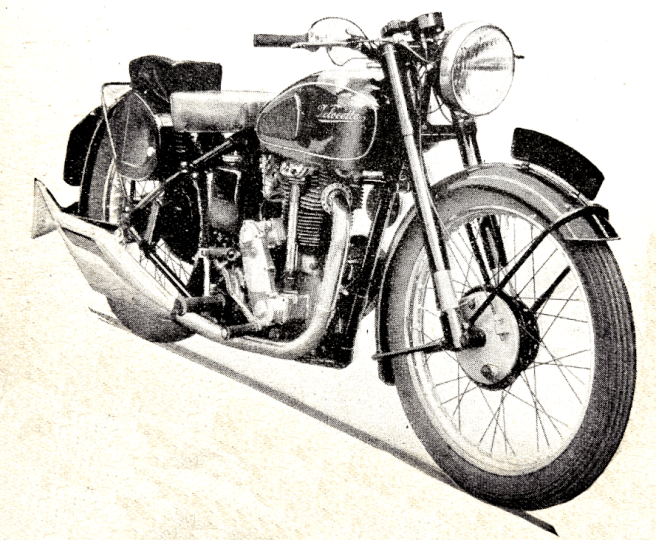
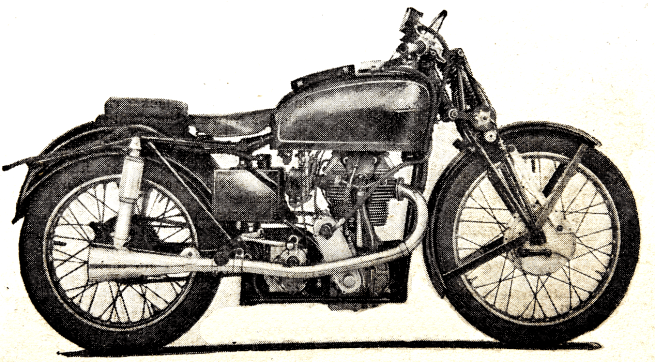
ARIEL FITTED TELESCOPIC forks to the Red Hunter one-lunger (not least to attract buyers in the US) and joined the vertical-twin fray with a 500, the Deluxe KG Red Hunter and the sportier KH Red Hunter. Yes, a Red Hunter twin. Confusing, ain’t it? The Blue ‘Un took a close look at Ariel’s twin: “The Ariel twin…becomes an even more attractive machine when the power unit is examined in detail. Mr Val Page, when at his drawing board, had in mind evolving an engine which would be quiet in operation, smooth and tractable, and lively in performance…An examination of the engine soon discloses technical features which contribute to this success…apart from the engine and the oil-tank the new Ariel- twin is almost exactly similar to the single-cylinder models…The specification…follows closely that of the 500cc VG de luxe model, except that the rear tyre is of 3.50in section. A minor frame alteration is that the front down tube is set slightly forward at the bottom to accommodate the dynamo and is fitted with a brazed-on sidecar connection lug. The model at present in production is the KG de luxe priced at £146 plus Purchase Tax of £39 8s 5d. As soon as possible a Red Hunter model will be available which will have the familiar red finish, with more chromium plating, and a specially assembled, tuned and bench-tested engine, polished ports and cylinder head. The front tyre will be a Dunlop ribbed, size 3x2lin. This model will be priced at £155 plus Purchase Tax of £41 17s. On both models the speedometer is an extra at £4 plus £1 1s 8d Purchase Tax. The makers are Ariel Motors, Selly Oak, Birmingham, 29, England.”
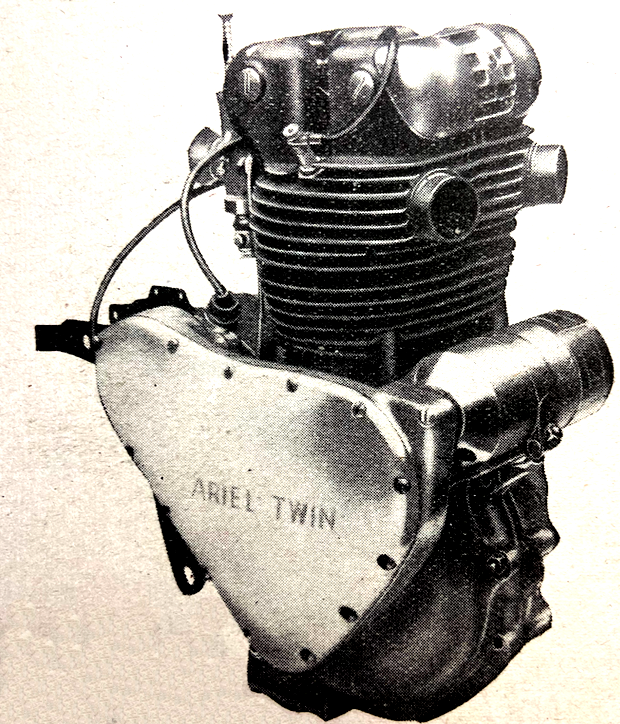
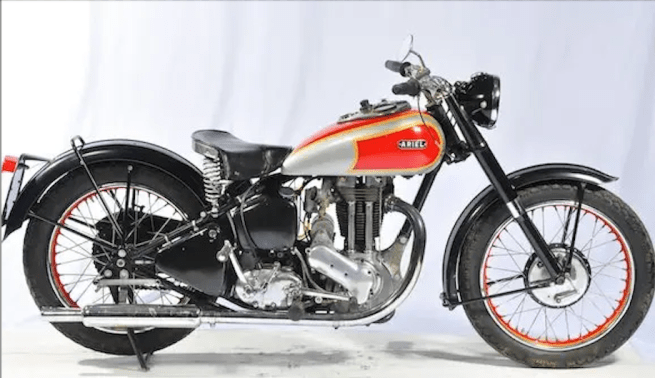
“NO CHANGE IS BEING MADE in the P&M Panther models for next year. That the incorporation of the Panther-Dowty Oleomatic forks in all three models included in the current programme has been successful has been demonstrated during this year, and they are now firmly established in the specification. The three models are the 250cc Model 60 with three-speed gear box; the 350cc Model 70 of similar design, but with four speeds; and the 600cc Model 100, the latter being recognised as primarily attractive because of its excellent characteristics as a sidecar machine. All three engines are single-cylinder, with push-rod operated overhead valves and completely enclosed overhead-valve mechanism. Both the smaller engines have forwardly inclined cylinders mounted on the crank-case in the usual way, the crankcase being carried in the frame between engine lugs and so forming a structural component.”
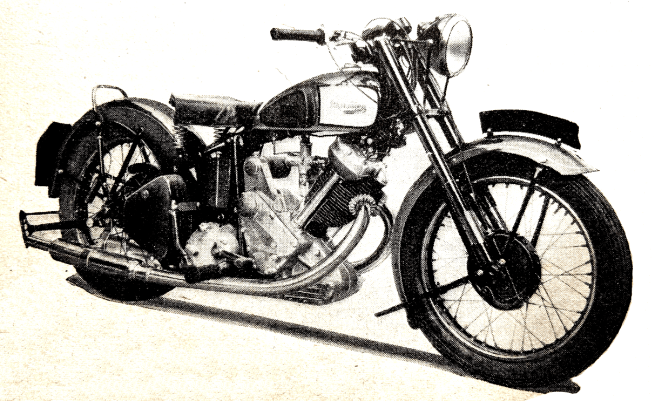
“THERE ARE NOW 30 clubs which have received machines under the RAC-ACU training scheme. Many of the clubs are giving practical and theoretical tuition as a regular part of club activities, and the others will be cracking shortly. In many cases, and especially in the South, the inquiries the clubs receive and the demand for training is almost overwhelming. More clubs with training sections are an urgent need. Under the scheme clubs are supplied with machines and with petrol coupons; they receive assistance and guidance in obtaining private land for riding instruction and on any other problem from the RAC and ACU. The accident prevention officers of the area give every aid and co-operation, and local police are as keen as mustard on the scheme. Now that so many other club activities are crabbed by lack of petrol, there is more time for experienced members to devote their energies to training newcomers. I can think of no better way for a club to he of service to itself and to the motor cycle game than to go out wholeheartedly for this training. Many clubs, I know, are nibbling at the idea. May I recommend to the committees of those clubs that a firm resolution to start would make a good entry in the minutes of the first New Year meeting? Full particulars from the Motor Cycle Manager, The Royal Automobile Club, Pall Mall, London, SW1.”
“WITH THE ABOLITION of our ‘basic’, discussion naturally turns to methods of propulsion whereby the models can be kept on the road without burning precious fluid. The most consistent method put forward is a starter motor driven by a fairly hefty battery, and then various suggestions follow to devise a method of charging other than by the nightly trickle charge. A dynamo run from the rear wheel is ruled out (why?), but what is wrong with a wind-driven propeller suitably mounted driving a dynamo? At 25-30mph the strength of wind should be sufficient to put something into the battery, unless, of course, the reverse happens to when one rides a pedal-cycle, ie, one would be riding constantly down-wind instead of pedalling invariably into wind! I wait to be thrown to the No 8 Hats.
350 Ajay, Warrington, Lancs.”
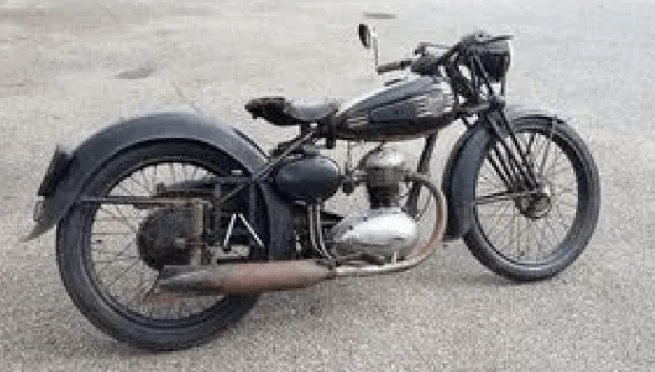
“PLEASE PERMIT ME after 20 year’s reading of the ‘Blue ‘Un’ to have a word about ‘basic’. Let’s stop all this mud-slinging. It is easy to say all these things now. Surely there are a lot of motor cyclists like myself who can remember a time not long ago when most of us had to lay up the bike because the pay packets wouldn’t run to all-the-year-round running. This also applied to car-owners. When September 30th came round it was finish till March 24th. But didn’t we have some times tinkering during those winters and saving up for that red-letter day, March 24th! There was that old Rudge bought for a cycle and 25s. Six of us learnt to ride on it over parts of what used to be included in the Travers Trophy course. What a host of memories! Then I recall the two-speed chain-driven Beardmore Precision I bought for 50s (what a hill-climber!), an old Norton, a Premier, an Excelsior, 2¾hp Raleigh and 3½hp P&M. Well, we did enjoy those winter evenings, even though the dole was a dark blot in Durham at that period; and well 1 remember the chairman of a ‘means test’ board telling me that as I owned a motor cycle I should look farther afield for work. At least this sort of thing is not on the present Government’s agenda, and, though petrol was 1s 2d a gallon it was still ‘rationed’ according to the pockets of those times. Well, many thousands of miles and hundreds of ‘Blue ‘Un’s’ have come and gone; and after what the ‘outfit’ has come to mean for the three of us over many years, I think we can at least claim to it being a ‘a great miss’. However, let us take our medicine as we have proved we can ‘take it’ and hope that it will all be for the best for everyone—more so for our sons. So let’s keep up the real ‘Blue ‘Un’ and let’s have some real letters of readers’ experiences, bikes discussed, and the general run of things, that makes the game last and helps the time nearer when we can have some ‘Square-Fouring’.
GW Robinson, Luton, Beds.”
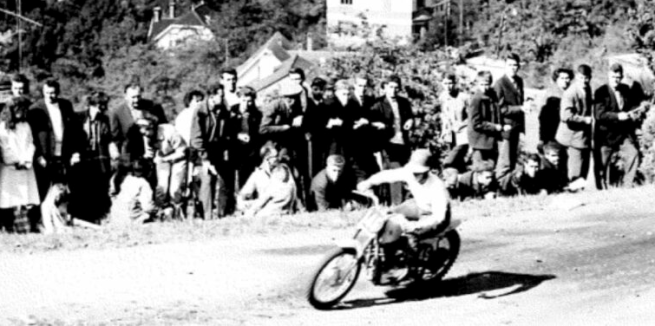
TECHNICALLY THE ISDT should have been hosted by Germany but while technically the Jerries had won in 1939 the Nazi-dominated 1939 event was a fiasco and it was only appropriate that the first post-war ISDT was instead held in Germany’s first vicim, Czechoslovakia. Britain was so skint that, for the first time in the event’s history, the ACU felt unable to send Trophy or Vase teams. The Czechs swept the board, relying on two Jawas 250s, a 350 and a 500 combo for the Trophy and CZ 125s for the Vase. The 22nd ISDT was based in Zlin, Monrovia; now part of the Czech Republic. The daily routes took in the Slovak, Moravian and Silesian mountain; following the 1,325-mile trial the final speed test was held over a 2.6-mile circuit in Zlin. Three privateers flew the flag for Britain: AA Saunders (500cc Triumph), of Coventry; IA Hitchcock (500cc Triumph), of Folkestone; and L Sheaf (250cc SOS), of Bromley. They were joined by Irishman A Tamplin on a 500cc Norton. Most of the 126 entrants were Czechs but they faced competition from the Netherlands, Hungary, Austria, Poland, Switzerland, Belgium, Italy and Finland—a good number of them rode British machines, notably AJS, Ariel, BSA, Excelsior, Matchless, Norton, Triumph and Velocette. Two Czech and two Italian teams competed for the International Trophy; two Czech, two Polish, two Dutch, two Hungarian and one Italian team were in the International Vase competition. There were also six manufacturers’ teams and 13 club teams including the three Brits, who rode under the ACU banner. Czechoslovakia won the Trophy, losing just nine points, ahead of Italy with 871. The Czech A-team won the Vase, ahead of the Dutch B-team and Polish B-team. The CZ-mounted Czech D-team had a perfect trial, with no points lost, to give CZ the manufacturers’ award. And to complete Czechoslovakia’s victory, the club team award went to MC Podebrady. Inevitably the Czech contingent dominated the medals, with 59; Hungary took 11, the Netherlands nine, Italy eight, Poland seven, Austria and Switzerland four apiece and Britain three (all bronze).
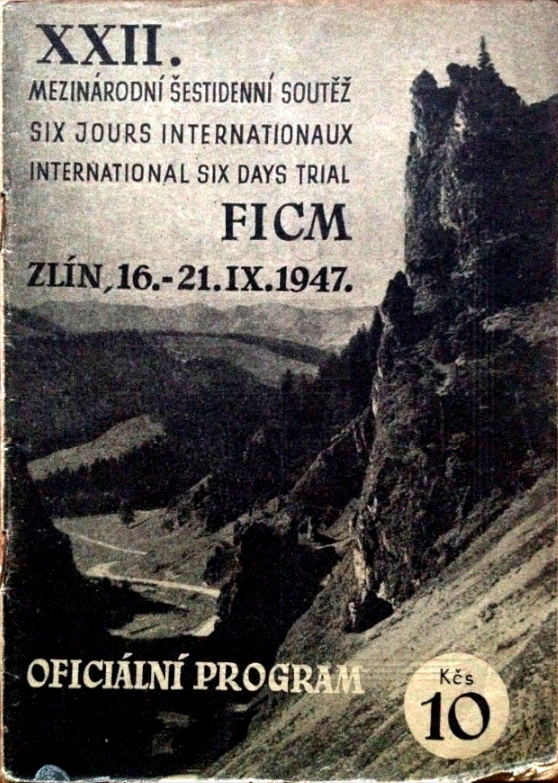

“INTEREST IN SCRAMBLE-TYPE events is steadily widening. When covering the International Six Days’ Trial, Harry Louis got the Czechs interested and since then has had requests for further details and specimen regulations. Way over the other side of the world, in the United States, Hare and Hound races are gaining in popularity. These events often take place over mountain rough stuff—the idea is to catch the ‘hare’, who is, in effect, the route marker, before he reaches the finish. As might be imagined, British machines show up well in these H and H frolics. I have just heard the result of the Little Bear Run held in California won by Dutch Sterner on his ‘scram’ AJS, who caught the hare 10 miles from the finish; second was A LeBard on an equally ‘scram’ Matchless. Apparently this race was in the nature of a practice for the national championship—the Big Bear Run. The Americans are encouraging-riders of foreign machines and in the Big Bear show there is a 3ft high trophy for the first man home on a foreign machine. Incidentally, Sterner also won the Cactus Derby—that was a 450-mile trial with a tough time schedule over desert sand and mountain trails.”
“I DO NOT CLAIM a record by any means, but can beat by six years the record claimed by ‘WW5449’, who purchased a new Excelsior in March, 1928, which is still giving him good service. I bought a new AJS 2¾hp B1 Sports model and registered it on March 1st, 1922. ‘Fanny’ cost £85 and doesn’t owe me anything. I got a ‘gold’ in the 1922 Scottish Six Days’. I had a very pleasant 1,600-mile tour this summer to Devon, Cornwall, Land’s End and back, via Wales and up to Aberdeen. It was a no-trouble run, but the rear chain required adjusting once. I have done 6,000 trouble-free miles this season and the model is in fine fettle. She’ll climb the new Rest and be Thankful on top gear (5.29 to 1), but needs second gear (three-speed box) for the old Rest.
Roy M Wilson, Glasgow.”
“I’VE BEEN A READER of The Motor Cycle since the middle ‘twenties, and still look forward to it every Thursday. My favourite items are ‘Make-Do and Mend’, and ‘Letters to the Editor’. Up to now I’ve never contributed to the latter, but I feel I must add my support to ‘Rudge Happy’. I ride a 1928 Rudge Special which I bought new that year. The gear box has never been out of the frame, and I’ve never seen inside it, the only replacements being one kick-start return spring and one set of clutch springs. The primary chain was replaced only this year. The engine, apart from piston rings, has cost me a mere £3 to £4. For real service and hard work the Rudge wants some beating. Since Easter this year I covered some 2,000 miles, just pottering around at week-ends, pulling a sidecar on solo gears more often than not—three up. Incidentally, the same inner tube is still in the front wheel and now only wants a few pump-fulls of air once in a while. The same main bulb in the head lamp is still doing its work. I wonder if that’s anything like a record. But I’ve got a grouse and a big one—the poor output of the Maglita. This time of the year the battery is always flat. I wonder if any of your readers have managed to overcome this by fitting a suitable Magdyno or have managed to drive a separate dynamo somewhere on this type of machine? After weeks of thought the problem has got me guessing. I should be glad to hear of any successful conversion.
RH Eves, Colchester, Essex.”
“MR TG MEETEN, AND MR LEN SHEAF, the rider of the one British two-stroke in this year’s International Six Days’ Trial, must surely be very pleased about the letter from ‘Sunbeam Lion’. But I am an ohv and ohc fan. As a newspaper man I had the opportunity to see this year’s event in Czechoslovakia and to notice everything connected with the Trial. I very closely watched the performance of all machines and riders—and I cannot agree with the opinion of ‘Sunbeam Lion’. Two-strokes won this event because of the following reasons. In Czechoslovakia it is impossible to buy a four-stroke. This was the reason that all the first-class riders used two-strokes. Of the four strokes used, some were old sports or de-tuned racing machines and were mainly in the hands of newcomers to such an event as the ‘International’. Although most of the Hungarians and a few of the Dutch riders used brand new four-strokes, they had not been prepared for the trial and some were not even run-in at the time the trial started. The reason they were not run-in is that they arrived very late from the manufacturers. Many riders retired or lost marks because the quality of the cycle parts on some machines was bad—not because the four-stroke engines failed. During the whole of the trial there was very good weather, but, given wind and rain and mud and other heavy going on some of the sections and, say, a Trophy team (on four-strokes) without lost marks at the start of the speed test, then the two-strokes would not have won the event. Everyone admired the fine performances of the CZ and Jawa two-strokes, but with the best British riders on four-strokes in this year’s event it is unlikely that the two-strokes would have won. I do hope ‘Sunbeam Lion’ will not now imagine that I am paid by British four-stroke manufacturers to praise their machines. I am not a British subject at all, but I have had a lot of experience with motor cycles—two-strokes and four-strokes—and if ‘Sunbeam Lion’ is so fond of two-strokes I am prepared to exchange my 250cc Jawa for a new ohv machine made in England.
‘Wheelbarrow’, Czechoslovakia.”
“THE MERE TRIP-WIRE of one slender week and a day was holding up the iron curtain of no ‘basic’. Yet there were 178 entries for the open John Douglas Trophy Trial, held last Saturday. And further applications were still being received after the closing day. That an event of this size could be held so near to the curtain’s fall is great tribute to the organisers (Bristol MC&LCC), who continued calmly with their preparations, in the face of difficulties. Real trials weather prevailed on Saturday: a soft, grey-skied hunting morn, if ever there was one. At 9.30am, when the first man was due away from the Griffin Inn, Bridge Yate, near Bristol, no rain was falling in that area. But heavy weather during the previous night had further muddied the observed sections and had given main roads a patent-leather shine. And rain fell later in the day—rain of the peculiarly’ English, misty type, that ‘sets in for the evening’. BHM Viney (347cc AJS), W Nicholson (499cc BSA), GE Duke (348cc BSA) and FM Rist (348cc BSA) each lost only six marks But the special tests came into action, and Viney won the Solo Trophy from that comparative newcomer to the ranks of the experts—GE Duke. Boyish-looking Duke’s devil-may-care style of riding suggests genius and reminds one of Nicholson the master. FH Whittle (598cc Panther) did well to lose only five marks in winning the Sidecar Trophy; but the sidecar route did not always coincide with that of the solos. First observed section was Glee (for solos only)—a banked, muddy track rising through the trees and divided into two sub-sections. Slithery rock outcrop on a slight left-hand bend added to the difficulties, and the first four competitors all footed. The fifth, PH Waterman (498cc AJS) subsided into the bank near the bottom. By keeping well to the left on the rock step, B Lacey (500cc Ariel), G Collins (347cc AJS) and LA Ratcliffe (347cc Matchless) were clean; but W Nicholson (499cc BSA) and BHM Viney (347cc AJS) both footed and thus lost thee of their six marks. So did Duke (348cc BSA). RESULTS John Douglas Solo Trophy (for best solo performance): BHM Viney (347cc AJS), 6 marks lost. John Douglas Sidecar Trophy (for best sidecar performance): FH Whittle (598cc Panther sc), 5. Bristol 150cc Cup: M Riley (125cc DMW), 27. Bristol 250cc Cup: NJ Gray (246cc Matchless), 28. Bristol 350cc Cup: GE Duke (348cc BSA), 6. Bristol Unlimited cc Cup: W Nicholson (499cc BSA), 6. Barton Motors Cup (for best solo performance by a member of the promoting club): J Douglas (499cc Royal Enfield), 20. Catherine Hicks Cup (for best solo performance by a member of a Wessex Centre club): H Fowler (348cc BSA), 15. Manufacturers’ Team Prize: BSA—FM Rist (348cc), W Nicholson (499cc) and GE Duke (348cc), 6 each.”

“THE BROMLEY MC organisers of Sunday’s Open-to-SE-Centre Campbell Cup Trial, took every precaution to avoid a repetition of last year’s ‘mud plug’—and went to the other extreme. Most of the 24 observed sections were easy, and many of the 242 competitors were heard expressing the opinion that they had come to the chalk hills of Kent in expectation of being confronted with a very much more sporting course. The first observed section was within a few yards of the start, at the Clearway Café, near Brands Hatch, and its tightly taped bends and undulating leafy surface was typical of all the other sections (every one of which had been manufactured or ‘improved’ with the aid of tape). To Viney (AJS) or Blackwell (Norton), with their works’ machines capable of plonking around the hairpin bends at almost 0rpm, these tortuous sections presented no problem, but it was surprising to see how numerous were the marks lost by quite experienced riders here—the third and fourth sections caught out even more than the first. But they were difficult only in a tricky sort of way, and at no point around the 30-mile course was any premium placed on dashing tactics.”
“SNEAK-THIEVES SEEM to be abroad again. Recently the Editor has received letters from readers who complain that their machines have been robbed while unattended in public car parks. One lad lost a front wheel and another a battery, a tool-roll and a steering damper. I remember there was a spate of this caddish thievery earlier in the year—it is the sort of meanness that makes one feel one would like to deal with the thief personally before handing him over to the police. Recent correspondents, who wrote from the Derby and Lancashire areas, report that the stealing occurred during darkness. After next week-end there will be far fewer machines left in dark public parking places, but those who are out on business and have to leave their models might be well advised to use garages—presumably the shortage of garage space for parking will not be so acute with so many cars and motor cycles off the road.”
“IT HAS BEEN DISCLOSED that there is the possibility of a road-racing circuit being developed in the Isle of Wight. However, when the subject was pursued by Mr C Lewis, secretary of the BMCRC, at the Council Meeting of the ACU, Prof. Low stated that it would be a number of years before the project would be realised.”
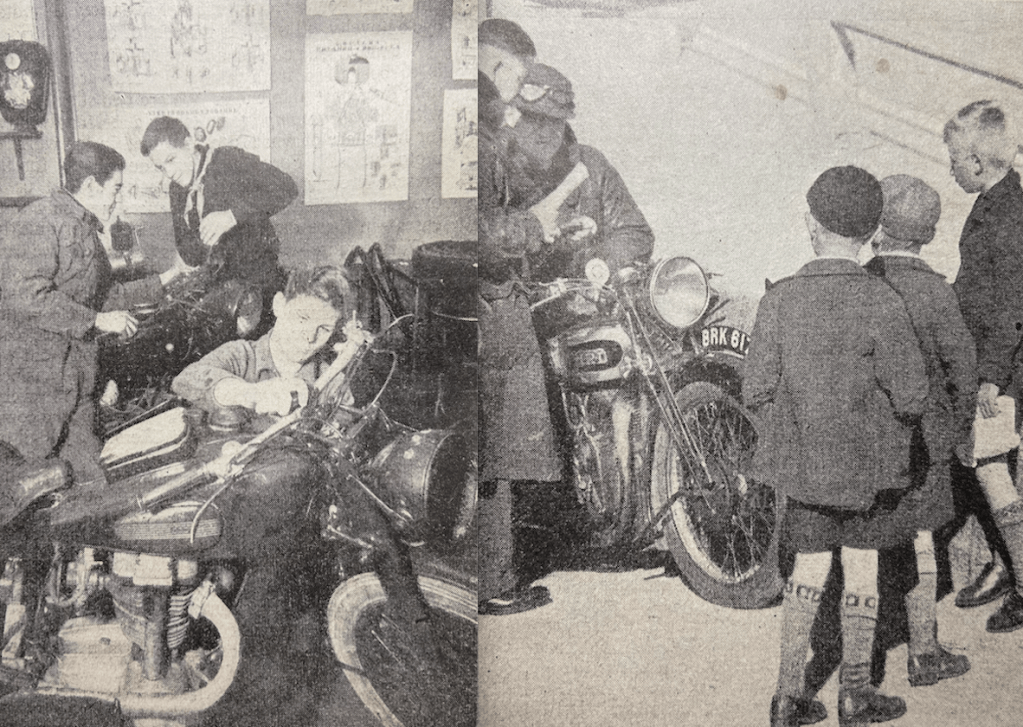
AS A MANUFACTURER of aircraft engines (hence the famous blue-and-white roundel) BMW’s Munich plant had come in for a lot of attention from the RAF but in 1947 permission was granted to resume motor cycle production. However all the plans and drawings were in the Eisenach factory which was on t’other side of the iron curtain. The first post-war BMW was the 247cc R 24 which had to be reverse-engineered from a pre-war R23, albeit with several improvements.
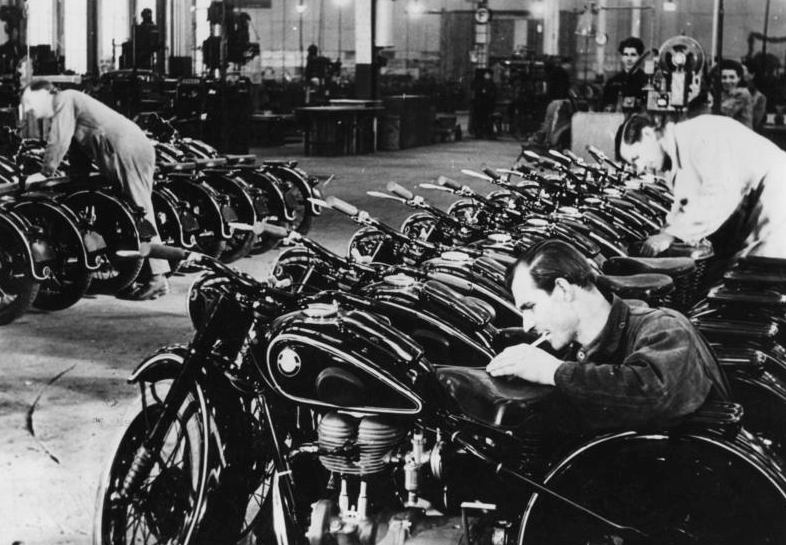
“IN OUR PAGES THIS WEEK are a challenge to the British motor cycle industry and a threat to our prestige in the sphere of sport. Our correspondent, Count Lurani, reveals in his description of the Milan Show such a wealth of ingenuity and technical advancement in Italian motor cycle construction that many of our own development engineers and designers may well feel that it would have been profitable to have paid this 25th anniversary exhibition a visit. We may feel, perhaps, a twinge of envy, but nothing is to be gained from taking a ‘sour grapes’ attitude over past differences. We are realistically faced with the fait accompli that Italy is a serious rival, out for her share of what is to be gained in the world of motorcycles…Whichever way the battle goes, the very prospect of it must surely raise a question in British minds and that is the ‘hoary annual’ of how much longer are our own motorcycle manufacturers to be condemned by the authorities to undertake these epic struggles at such a disadvantage? Even during the war the Italians were enjoying road races. Since the declaration of peace they have been through a gamut of events and hardly a week has gone by during the season when their factories have not been engaged in one or more speed events. Yet, here in Britain, even an attempt to find a substitute for Brooklands or Donington in an aerodrome circuit is fraught with every kind of negative interference from officialdom. So far as the forthcoming struggle for supremacy between the British and Italian camps is concerned there is little that we, as individual onlookers, can do save wish our men luck. On the other hand there is a tremendous task that the industry itself could under-take would it only unite in the belief that racing is not incidental to, but of pre-eminent necessity for, a sales reputation that will count as a hallmark everywhere.”

“THE 25th INTERNATIONAL MOTORCYCLE and Cycle Exhibition of Milan, inaugurated on November 29 for a 10-day run, has been a great success. No fewer than 316 exhibitors took part to make it practically an all-Italian affair, since, for obvious reasons, the import of foreign motor cycles to this country is still impossible. The only British exhibit was a lonely Square Four Ariel, with rear springing, while the only other foreign models on show were Indians and Harley-Davidsons, making a come-back after many years of absence. When these machines will be on sale in Italy is still a mystery. One’s first impression of the Show was that the bigger factories have practically left their models unchanged except for minor improvements, while a general and impressive tendency towards the very light (125cc two-stroke) model was noticeable. Of course, the typical Italian ultra-light models, auxiliary cycle engines, scooters, etc, were more favoured
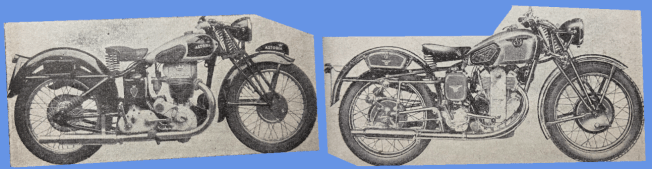
than ever. Also there were some outstanding prototypes forecasting interesting production models of the future. It was noticed, too, that the sport has had a great influence on the Italian market and practically all the exhibitors showed some form of racing machine, even in the smallest classes, many being equipped with rear springing. Virtually it was a single-cylinder exhibition, since only the little 125cc Aspi and the new 125cc MV came into the multi class in the lightweight field, with the twin Sertum 500cc model representing the larger Italian field. This 25th Show was a real anniversary exhibition and more than 80 would-be exhibitors had to be refused for lack of space. There is great enthusiasm in Italy, but unfortunately the business side is not so good, for the general situation is now very critical. Indeed, is feared that not a few of the exhibitors may fail to stand up to the oncoming crisis and that possibly only
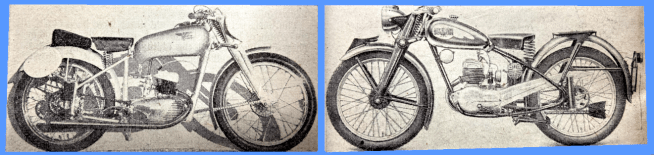
the bigger and sounder concerns will last through the difficult period which looms ahead. Prices are still very high, due to the rising labour costs, and export is practically down to nil. However, the Show revealed the extraordinary vitality of Italian technicians and factories and that all of them, big and small, have made a very great effort to revive the industry. Let us now go round the stands: Ariel, the one and only British model, was shown on the Astra stand, where machines built under Ariel licence in 250, 350 and 500cc capacities were also exhibited, as well as a very neat 125cc two-stroke with telescopic forks—one of the nicest machines in the Show. Guzzi, of course, had a very impressive stand displaying all the usual models, as well as a new version of the 500cc machine with ‘teles’. These machines are really all very ugly to look at, but are still the best models that can be bought in Italy. Also, the racing machines are on sale, in replica form of the winning 250 and 500cc jobs. The twin-cylinder and the ‘Gambalunga’ [‘Long Leg], however, are not on the market. Sertum featured the International Six Days’ Trial 250cc model, as well as the twin 500cc mount. Their great novelty, however, was the new sports 250, a very neat effort incorporating a
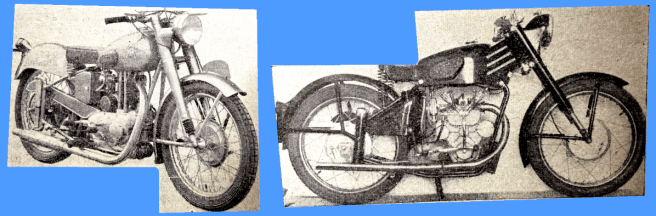
sturdy pressed-steel frame with welded members. Okra was another popular stand, and here could be seen the ‘Nettuno’ and ‘Saturno’ singles in normal, sports and racing form. One of the surprises of the Show was the Morini. This 125cc machine provoked much favourable comment on its fine construction. Described as a competition model and finished in ‘all-aluminium’, it weighs only 62kg and represents a very complete little racer that will undoubtedly be popular in 1948 Italian and Continental competition spheres. The old-established Mas concern broke new ground by concentrating on a remarkable single-cylinder four-stroke 125cc with air cooling arranged by forced draught round a jacketed, inclined cylinder. Parilla, a newcomer to the Italian industry, showed a beautiful array of various types of their 250cc machine that is very well laid out and finished. The weight of the racing model is only 98kg and a very handsome machine it looked in its bright red paint. Miller showed the well-known 200cc model and a really outstanding 250cc ‘Jupiter’ model. This all-enclosed machine embodies a number of interesting and

carefully studied details. The engine is an ohv of 62.5x51mm; the telescopic coil-sprung forks, with air dampers, also incorporate the instrument panel, while the fuel tank can be removed in less than a minute to make the engine very accessible. Duralumin hubs and air-damped rear springing are also features of the specification. Bianchi included with their standard 250cc model a new 125cc two-stroke that is one of the best-finished ultra-lightweights, and likely to be one of the best sellers. Breda had a little utility model, Musa an auxiliary two-stroke, Furetto a nice motor-scooter, and MM showed motor cycles of classic design in the 350 and 500cc classes. Aspi displayed the beautiful two-cylinder BMW-looking 125cc two-stroke. and Siata the famous 48cc four-stroke, three-speed auxiliary engine that is one of the most popular models, and which is fitted in no fewer than 23 special bicycles of different makes. Garelli exhibited the now world-famous 34cc ‘Mosquito’ two-stroke auxiliary engine, and Carda and Alpino had also auxiliaries to offer. Rapidly becoming renowned for its performance is the MV 98cc two-stroke with telescopic forks, but the company also had two novelties. One is a 125cc two-stroke side-by-side twin, a neat and clever model that is to be developed for racing. The other newcomer is a sturdy 250cc ohv of 63x80mm that is said to give 13bhp at 4,500rpm. Another striking ‘show hit’ was the prototype OMB of 350cc—a capacity most unusual in Italy. Designed by Signor Pedrini and built at considerable expense by the comparatively small concern of OMB at Bologna, it has front and rear telescopic suspension, while the
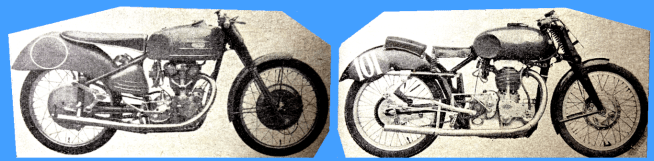
frame is unusual in that the tank forms part of it. By removing two nuts the machine can be virtually divided into two parts to make engine inspection a very easy job. The valve gear is quite novel and incorporates a large cam-wheel turning at ⅛th engine speed and having the cam profiling cut internally on the underside of the toothed ring. Thus, the push-rods do not ‘push’ but the ‘pull’ the rockers. All bearings are of the roller type with a bore and stroke of 76x76mm, 26bhp is developed at 7,000rpm. The carburetter is a Cozette, the brake drums and hubs are in duralumin, the gearbox has four speeds, and the complete weight is 135kg—a most interesting and unorthodox machine typifying the spirit of engineering adventure which is so strong among Italian technicians…The new air-cooled, four-cylinder Gilera racing engine has now been successfully tried [revamped to run without a supercharger in line with the FICM blower ban which killed off Benelli’s plans for a blown 250cc transverse-four producing 52hp at 10,000rpm. Pity.—Ed]. The complete machine (500cc) weighs 120 kg (approximately 265lb) and will be
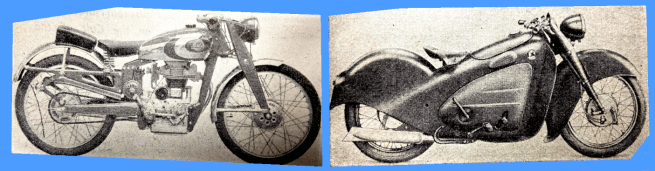
the leading Senior Italian machine in 1948. The great rider Serafini will probably ride for the factory next season and it is also probable that four Gileras will start in the TT race in June—two fours in the hands of Serafini and Pagani and two single-cylinder models as well. The much-talked-of newcomer, the ohv 250cc Parilla, is to be entered in big-time racing with a strong team of riders. The complete weight of this model is only 216lb. What with this and the inevitable Guzzis, it looks as though British circus artists who might still be game enough to ride our own pre-war ‘250s’ had better think again about the lightweight category!” The Motor Cycle’s correspondent could hardly be expected to cover every one of the 316 exhibitors at the Milan show. Among the machines he missed was the Lambretta, produced by Ferdinando Innocenti, who owned a scaffold steel tubing factory in Milan. Like Vespa the previous year, the Lambretta Model A was designed by aeronautical engineer Corradino D’Ascanio. It featured rigid tubular steel frame powered by a 123cc two-stroke engine via a three-speed box with foot-operated gearchange, shaft drive and ‘rubber anti-vibration block’ up front.
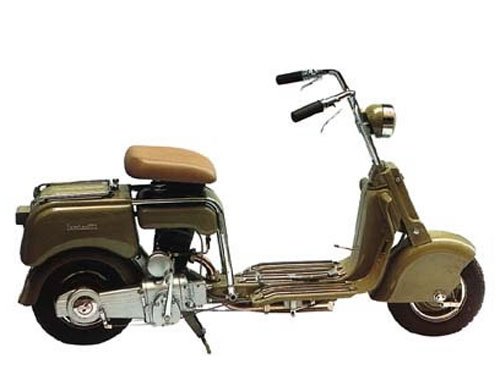
THE FOUR-POT GILERA racer that drew crowds at Milan had been revamped to run without a supercharger in line with the FICM blower ban. This ban also killed off the Velocette Roarer and AJS V4 racers, neither of which could be competitive without supercharging. Velo soldiered on with its naturally aspirated cam my singles, but AJS bounced back with a dohc parallel twin racer designed for a blower but was still fast without one. It featured cooling spikes rather than fins that earned it the sobriquet Porcupine.
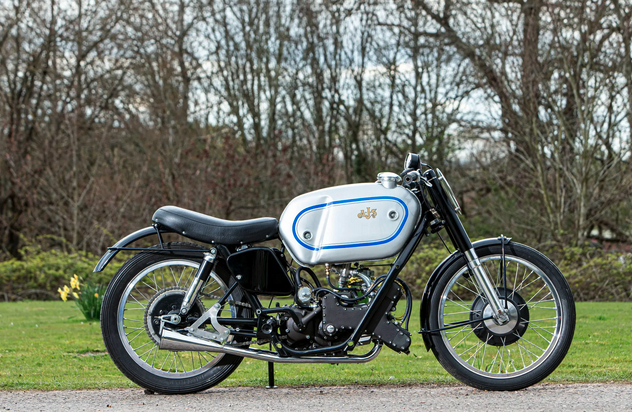
THE MANUFACTURERS’ UNION planned to revive the Earl’s Court Show, but coal shortages and problems with component supply were so severe that they cancelled it. Maintaining the supply of existing models was quite enough to keep hard-pressed manufacturers busy; resources could not be diverted to launching new models.
BETWEEN THEM THE bicycle and motorcycle industries earned £20m in desperately needed exports, compared with £4.5m in 1938.
ONE-DAY TRIALS had always been a peculiarly British pastime but a hardy band of Belgians, who might well have encountered the sport while in uniform, established the Lamborelle Trial along British lines.
“LETTERS FROM CANADA and the United States of America and the comments of recent visitors to North America stress that fresh thought should be applied to the question of the most suitable saddle or seat for a motor cycle. A widespread view is that the typical supple-topped saddle is outmoded. Whether the best arrangement is a saddle and pillion seat built in the form of two saddles linked together, a much longer saddle which provides a variety of positions for a solo rider or, by reason of its length, will accommodate a pillion passenger in addition to the rider, a built-in bucket-type seat, or some other form, is a subject for debate. One of the reasons why Britain has clung to the present type of saddle is because it mates in with the lines of the machine and looks neat. Some of the other types, including certain pan seats with spring seat pillars, afford greater comfort, but tend to ugliness. Our view is that eventually dual seats built into the rear mudguard assembly are likely to be the rule. What must never be overlooked is that with a solo motor cycle steering is largely effected by legs and thighs. Rigidity of the seat laterally is thus of paramount importance. Here is a problem for the New Year.”—Ixion
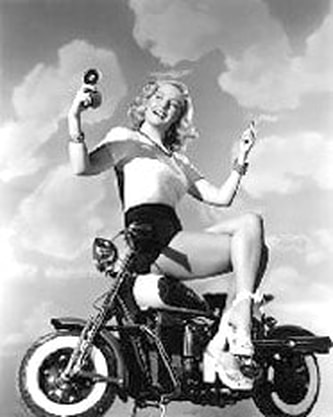

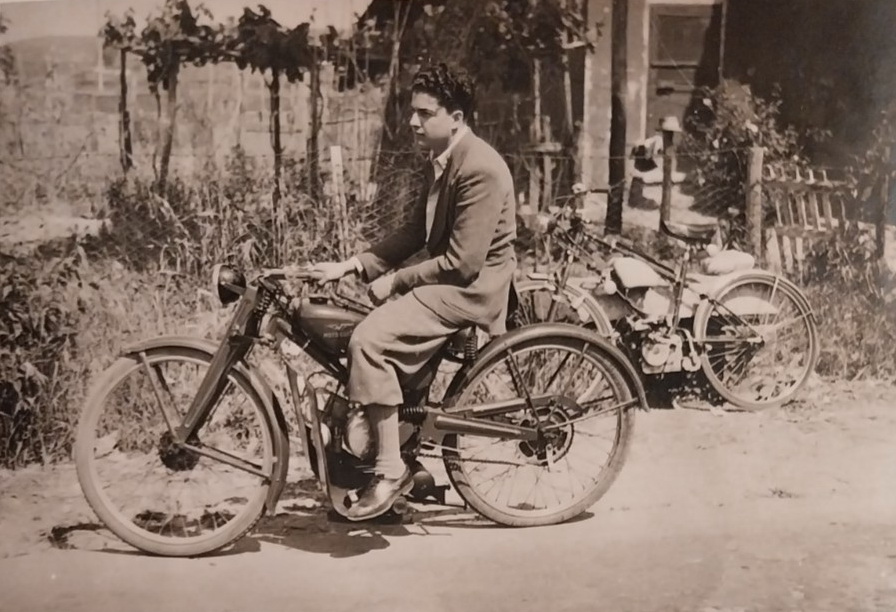
“GREETINGS TO ALL MOTOR CYCLISTS: to readers in Iceland, Borneo, Siam and the hundred other parts of the world to which The Motor Cycle travels week by week. The Editor and Staff join in wishing you a Happy Christmas and the best of New Years. May there be petrol for all in 1948, the money for a new model—and good riding. With this last number in the old year, it is right to count some of the blessings, grim though the picture, in Europe at least, may still appear. How many in Britain recall summer weather so perfect as this year’s for holiday tours and week-end runs? What a store of happy memories the majority of motor cyclists have. And never has there been such a full programme of motor cycle sport, nor such mighty entries. A basic petrol ration or not, Britain is not to be denied all its motor cycle sport in 1948. There is also to be a show next year. And manufacturers have much of interest on the stocks. The indications are that Britain is making steady headway—so much so that after uncertainty the nation can look forward to the future with confidence. There is good reason to be cheerful this Christmas, and may there be happiness and prosperity for all in the New Year.”—Ixion
“MAY I TAKE THIS OPPORTUNITY of wishing motor cyclists everywhere my hearty good wishes for Christmas and the New Year? Let us hope that 1948 brings us all petrol—and in reasonable quantities! May it also see this old country of ours once again steady on its feet, so that many of the petty restrictions and controls to which we are subject can be abolished. In the meantime, let us all resolve to pull together so that when petrol returns club-life will be more vigorous, healthy and progressive than ever before! Birchington: Dec 31st, New Year’s Eve Party. Bohemian: Dec 25th, Appetiser Hike for men only; meet at HQ at 11am. Dec 28th, Coach Trip to Robinson Crusoe Holiday Camp, leave at 10am. Castle Colchester: The Annual General Meeting will be held on Jan 2nd at the Plough Hotel, Colchester, at 7.30pm. Cricklewood: The Annual Dinner and Dance was held in the Silver Horseshoe, Neasden. Following an excellent meal there were the usual toasts and speeches. Mr G Arthur, secretary, who proposed The Club, welcomed the guests, among whom were Mr Waller, secretary of the Ace Group, members of the Bayswater Club, and several of the Bulldog MCC. Dublin & District: A record membership of 170 and a successful year’s working were reported at the AGM. Owing largely to the success of the Skerries ‘100’, which it is hoped to run again next year, the credit balance has substantially increased. Dublin University: The club’s handicap scramble for the Griffith Trophy, held in the Powerscourt Deerpark, Co Wicklow, was won by AEG Moore (343cc Triumph) off the 9min mark, who finished 32sec ahead of M Barrington (499cc BSA), the Lightweight TT winner, off 2½min…North-East London: The Revenge Cycle Trial was very successful. An extremely difficult course gave competitors, who included two ladies, a grand day’s amusement. Best performance was by D Morgan, who proved as capable aboard a bicycle as he is on his 350cc AJS. The best lady was Miss K Flynn and best committee member, AC Woollard…The club’s annual Christmas Party will be held at the Fishmongers Arms, Wood Green, Dec 28th. Club-nights are held every Thursday at the Victory, Chingford Rd, Walthamstow, E17; neighbouring clubs and unattached riders are welcome to attend. Portsmouth: The first post-war presentation of awards was held at the Kimberley Club Room. The awards were presented by Mrs WE Taylor, wife of the club’s president. When the awards had been distributed the prize winners were subjected to a quiz, and if one failed to answer correctly, had to pay some amusing forfeit. Southern Observers: Dec 31st, New Year’s Eve Party. South Reading: Dec 28th, Christmas Party (California at 4pm). Dec 29th, Club-night at HQ, at 7.30pm. Dec 31st, New Year Party (Peppard at 8pm). Stockton: Dec 31st, Club’s Christmas Party in the club-room at 7pm. Streatham: Dec 31st, New Year’s Eve Party; Coaches leave Davis Garage, Mitcham Rd, at 7.30pm. Tenterden: Dec 26th, Boxing Day Cross Country Cycle Run, starting from Pixies Lane, Rolvenden Hill, at 10.30am. West Middlesex Amateur: Dec 26th, there will be a meeting at the Vine, Stanmore Hill. West London: Dec 28th, Evening Social at HQ, at 7pm. Wickham: Dec 28th, the second of the monthly hikes, starting from East Croydon Station at 10am. Dec 31st Quiz-night at the club-room, 8pm.”—The Clubman
“JUST FANCY, FOUR DAYS’ holiday at Christmas! To some of us who have been in this game a year or two it seems unbelievable having to-day (Christmas Day), Boxing Day, Saturday and Sunday, all to our-selves And the reason is not just the abolition of the basic petrol ration, since the change that enabled us to be our own masters at Christmastime occurred before the war when there was petrol in plenty. Do you remember the Motor Cycling Club’s London-Exeter Trials starting on Boxing Day? The choice of date was alleged to have been due to a desire on the part of the 400 or more participants to get large gulps of air following the previous day’s festivities. Postponement of the event to the first week-end in January was supposed to be because many officials, being family men, were not too keen on dragging themselves away from home on Boxing Day. Whether this was correct or not, I felt that the great winter trials lost some of their romance when the date was changed. The fact that one ventured through the night on a 400-mile trek late on the Bank Holiday, leaving the majority of one’s fellow countrymen beside their fires or, if one had a late number, asleep in bed, gave one a feeling of derring-do. It was not that there was any sense of superiority, but merely of adventure. And adventure there often was. My habit was to go right through the trial. I would not have missed the night run from Staines or Slough or Virginia Water to Exeter for anything. Fog, ice, snow. hail, sleet, rain—was there any variety of weather which was not encountered on one or other of the ‘Exeters’? It might seem balmy at the start and, only a few miles beyond, the road would be coated with wet ice. Do you recall how dozens, gaily dropping down towards Camberley on the 1938-39 event, suddenly found themselves travelling at almost undiminished speed in what the Army calls the prone position? I was fortunate on that occasion, since experience on earlier Exeter Trials had shown me the wisdom of using a sidecar outfit. The incident which drove home the idea that three wheels can be better than two occurred the far side of Exeter. I was describing the event with the aid of my 593cc four-cylinder Silver Hawk Matchless. All had gone well on the night run. Breakfast had been one of those typical Exeter Trial breakfasts—Deller of Exeter’s bacon and eggs. Lovely crinkly bacon, I recall. Feeling at peace with the world, and omitting to remember that I was covering the entire event myself, I went gay on the twisty, twirly road that leads from Exeter to Fingle Bridge hill. One of the bends was entered at about 60, and whether it was merely slime or wet ice I do not know, but a two-wheel slide resulted and the machine and I ended up on a rough patch on the far side of the road—forks bent, head lamp smashed, wheels right out of line. There can be objections to having such a magnificent driving light that speeds of 60 and 70 can be indulged in. Somehow the machine had to be straightened ; somehow we had to get to Fingle Bridge, to all the other hills, to finish and home. It was managed all right—well over 200 miles—and
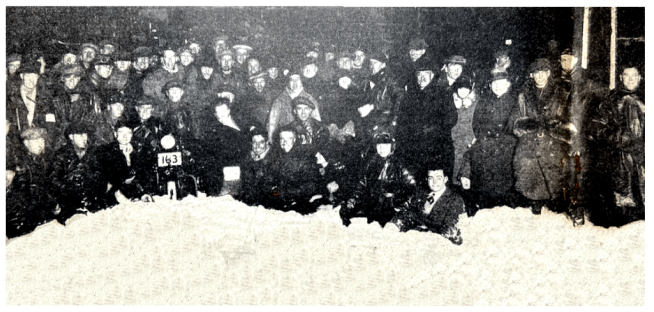
did I learn my lesson! Our job is to get through; whoever else may retire, it must not be us. That is why, on a trial such as this, you will generally find that we go to such lengths in preparing our machines. Everything is checked; a fog lamp is fitted and, quite likely, the electrical equipment manufacturers will be brought in to make sure that the whole lighting set is as near perfection as they can make it. And apart from fog, there is that little matter of water. More than once the route has had to be changed at the last moment because of impassable floods. Ugh! One is travelling along on good tarred or asphalt road; at one moment it is merely glisteningly wet and the next, the change imperceptible in the light from the head lamp, one has entered flood water. Sometimes there will be a highly desirable warning—perhaps a red light and a notice or an AA or RAC patrol waving a torch or storm lantern—but the number of times on ‘Exeters’ that the first one knew of a flooded section was the zipp of wheels through water followed by something akin, to a wall of water smiting the machine and oneself…Did I mention plug covers? But it is fog at night which has so often made the trials really arduous. Just think of it, Salisbury Plain, mile after mile of it, enveloped in swirling mist, with the visibility at times only a few yards and at others, perhaps 50 or more. The speed schedule may be only 20mph or, at the most, 26, but just try keeping to schedule on such a night, let alone wandering to and fro through the entry trying to see a large number of competitors and picking up information. And one cannot stop long at time checks otherwise one won’t see the entire entry on the hills. A part of the route I shall never forget is that which lies between Crewkerne and Chard, the 700 and more feet high stretch past Windwhistle Inn. And can’t the wind whistle on this exposed tree-girt section of road, tugging at one’s. machine and threatening to cast it and the rider off the highway. How often the wind has been laden with hail or stinging rain! But the greatest Exeter of all was one which ended at the starting point, Slough. Late on Christmas Day, 1927, snow began to fall. It was not just a few flakes, but fell for hour after hour and a mighty wind got up, to hurl it into drifts. Imagine, if you can, the feelings of one young journalist who had undertaken to cover the trial, going right through with the competitors. All he had was a solo motor cycle, his faithful 1925 16H Norton. There was nothing for it: somehow or other he must get hold of a sidecar. Kenneth Rae came to the rescue; he had an old Norton sidecar in stock. The whole of December 26th was spent getting the machine ready for the battle through the snow—the trial was to start on the evening of the 27th. I was living in West London in those days and thus a mere 20 miles from the Slough Trading Estate, but even covering that distance was an adventure. The wide Great West Road had merely a lane through the snow a couple of cars’ width. But getting to the starting point was nothing on a sidecar outfit compared with doing the same journey on a solo; and what of the hardy souls who made, or were endeavouring to make, their way there from points much farther afield? A hundred or more did get to the start. Some took to fields in places because the roads were impassable owing to drifts. Many had shovels and at times dug their way through. Some poor souls became marooned. Never have I found such an excited crowd at the starting point of a trial. All, it seemed, had some tale of adventure to tell. With this as prelude, what would happen on the actual trial? There was a band in the restaurant on the Estate. Muffled up as they were, many competitors fell to dancing to pass away the time while officials tried to get in touch with points along the route. Ponchos, waders, multifarious garments underneath—what a sight it was! After some hours came the announcement that the trial was off: there were drifts house-high in places and to get through to Exeter or even to Basingstoke, for that matter, was out of the question. Up went a second notice, signed by competitor after competitor—’We desire to start!’ But finally they took ‘No!’ for an answer; there- was nothing else for it. Then came the anti-climax (?)—the battle through the snow back to their homes. Do you wonder that those old Boxing Day ‘Exeters’ linger in people’s thoughts?”—Torrens
To finish the year The Motor Cycle offered its pedestrianised readers a rather charming fantasy, seasonal cartoons and its traditional ghost story; in this case with a wartime setting that would have been familiar to so many of its readers.
“IT WAS A LARGE and ostentatious garage, the latest post-war models glittered in the windows, beckoning siren-like to impecunious youth to sample their chromium loveliness. Behind this bright façade lay a stock of second-hand machines of varying pedigrees, and mostly in fair running order. One might compare this show-room with the second floor of a boarding house ; not, perhaps, the best rooms in the house, but at least adequate. Further back was the repair shop, and, to put it bluntly, the assembled junk of years. A harsh voice broke the stillness of the early morning. It was that of a camshaft 350: ‘I’m just about browned off with this place, and with my young man. Calls himself a rider. My foot-change! Can’t even decoke me himself, but has to leave me here. Afraid to soil his lily-white hands, I suppose.’ ‘Ah, things aren’t what they were, nor people either,’ replied a very elderly Zenith Gradua from the murk of a distant corner. ‘I shouldn’t be surprised if you were exchanged any day for one of those new-fangled twins. Not that I’ve got anything against twins being one myself, but what I say is that you young folk lack character, the same as your owners. Now look at me. I may not be a beauty, judged by modern standards, but I’ve got temperament, which is one thing you moderns lack.’ ‘Temperament?’ replied the camshaft tartly. ‘I don’t know so much about that, you old stringbag. I had a whale of a time last week. Oiled up a treat in the middle of Oxford Circus in the rush hour. Laugh! Never laughed so much in all my life as when my young man had to push me to a side turning and put in a soft plug. You should have heard the remarks the taxi drivers passed.’ ‘You young lassies don’t know the meaning of good honest-to-goodness laughter. You should have seen me smash up a belt twice in an hour. Not a mere rubber belt, either, but a hinged leather Whittle. Though I suppose it’s too much to expect you to know that name. Push you round a side turning, my dear! My boy had to push me five miles before breakfast on that occasion. But he loved me in a way your man will never love you. Look at my lines. Can you copy those curves?’ She coyly showed off a pair of delicately moulded Bramptons, and dropped ‘super-sports’ handlebars, liberally arrayed with throttle and air levers, exhaust-lifter and magneto control, and festooned with cables and gas-tubes like the head of a frowsy old female such as she had become. ‘You don’t understand modern conditions,’ said the camshaft model. ‘We stand for mechanical efficiency. You can’t blame me if my young fellow tries to get me through the West End on a hot plug, can you? And no one can show me a tail light on a blind in the country. Compare yourself with me? You drink too much. Always did, I reckon. Look at your tyres. Thin, beaded relics. No wonder you chucked them off unless they were kept on with security bolts!’ ‘What you don’t seem to realise, my dear,’ said the Zenith, sweetly blowing from the elevation of her 30 years’ experience, ‘is that it was all these things, the delightful uncertainty of every journey, that kept our young men true to us. You talk about a breakdown in Oxford Circus with pride! I call that bad manners. We used to break down regularly in the heart of the country, miles from anywhere, and that did us both a lot of good. No. I would run sometimes like a dream, sometimes like a nightmare. That was just a part of my attraction. Talking of comparisons, look at your own neat four-speed gear box—and then look carefully at my Gradua.’ The camshaft model did so, unwillingly, as though afraid to see some detail in which the old girl might be superior. She looked long and carefully, but could only make out a somewhat corroded mass, half concealed behind a mask of sludge. ‘Your box—so what?’ she asked cynically. ‘What about your old box?’ Don’t you see, my dear young thing,’ replied the Zenith, in an even sweeter tone, ‘don’t you know? Even this is infinitely variable.’ Away in a distant farmyard a rooster crowed, beckon-‘ing a new dawn. Silence descended on the garage, broken only by the rhythmic drip of oil from a broken sump.”
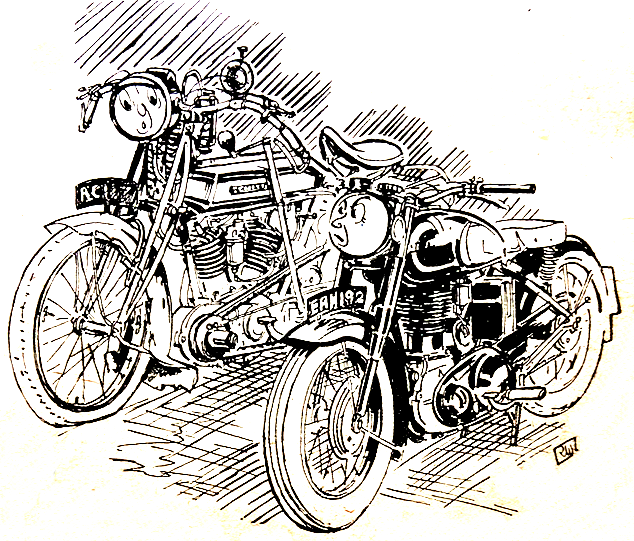

“CHRISTMAS EVE THOUGH IT WAS, the usual crowd thronged the clubroom around about eight. Most club-nights were organised, but this evening we sat around and chatted. Eventually and inevitably we began to reminisce, recalling pre-war days when the club had run the Centre’s most popular grass meetings. Jack Brown was wistfully wondering what might have been if our track had not gone under the plough when Ray Sharpe, who had been gazing into the fire, suddenly entered the conversation. ‘Say,’ he said, swivelling round in his chair, ‘did any-one ever come across Harry Chater during the war?’ Harry had been our star rider—and my particular pal. Beyond a general recollection that he had joined the Army through The Motor Cycle DR Scheme and gone oversew in the early days of the war, no one had much news of him. Ray looked across, at me. ‘Didn’t you ‘ever hear from him, Tom ?’ he asked, ‘you used to be pretty pally.’ ‘Well, I did meet him in Egypt a couple of times,’ I replied. I hadn’t felt like shooting any lines, but the lads seemed to sense a story and waited expectantly. And this was my story…
Being an RAF pen-pusher wasn’t much fun at first, but when the Squadron moved up into the desert I scrounged a 350 Triumph that the MT boys hadn’t much use for.I was roped in for convoy work during the advance; when we settled down Benghazi way I still managed to hang on to the bike. Later on there was a flap and one of those ‘strategic withdrawals’ began. We retreated towards El Adem. There’s a pretty tough escarpment in the last stretch. It’s a hard pull and the road twists like the devil, while dust-storms reduce visibility to yards; so I stopped the Triumph at a bend on the worst part of the climb to check the trucks past. The last one had just ground its way over the pimple when an Army DR on a Norton flicked up the hill and round that corner as though he were sprinting along Brighton front. As he disappeared from view I heard his motor cut. I started off and very soon found the Army type sorting over his tool-kit. I stopped again. It was Harry Chater. We recognised each other simultaneously, but Harry spoke first. He was in a

terrific stew, and although it was our first encounter for perhaps twelve months, he dispensed with a normal greeting. ‘Hey, Tom,’ he said urgently, ‘got a plug? Mine’s cooked.’ The Norton smelt like a fried-fish shop. Luckily I had a spare. Harry was off again after a brief explanation about a ‘tearing hurry’ and ‘dispatches’, and, as a concluding remark, ‘Thanks, Tom—do the same for you one of these days…’ ‘And did he?’ a voice asked. The interruption brought me back to earth. The memory of the old days had been so strong that I could almost feel the sand in my teeth; and a pull at my pint seemed to wash it out of my throat. I didn’t see Harry again fox a longtime (I continued). The Squadron moved to Gambut, and before we had settled down I was posted to the Delta on promotion. Soon after Monty started the Alamein business, I had a shift back to the “Blue”. My new unit wasn’t so easy with bikes, but eventually I acquired an ancient BSA and was happy again. Just before Christmas, ’42, we advanced to another landing ground. I heard that my old Squadron was over the way, and as things were slack on Christmas Eve decided to pop over and see the lads. It was a short run; three or four miles on a desert track, a good clean bat along the coast road, and another three or four miles to their landing ground. Most of my old pals were still with them and my timing was good—a truck load of “Stella” had arrived from Alex. Did that beer flow! Maybe it was the beer, or maybe swank, but when the time came to leave I announced I would cut across the wide open spaces instead of tooling right over to the coast road. Chiefy Kemp, i/c MT, told me not to be a fool. ‘There are more mines over there than pebbles on Whitstable beach,’ he exclaimed. ‘It’s “keep out” by day, let alone by night.’ ‘So what,’ the Stella I’d poured down my throat re-plied, ‘there’s a moon, isn’t there?’ There was, but after half an hour’s riding I knew I was lost and began to wish my route had included the coast road. I stopped hurriedly when a length of barbed wire coiled round the footrests. Then I sensed mines. When I saw the twisted remnants of a 3-ton Chev I knew I was in the middle of them. The moon was bright enough to read a newspaper; not that I wanted to read a newspaper in the middle of a minefield. I began to panic. I was scared to blink, let alone move off again. The cold began to cramp my legs, but I was afraid to get off the saddle. I was wondering what the blazes to do when suddenly I saw another motor cyclist alongside. I nearly fell off the BSA in amazement. It was uncanny. One instant I was alone and the next there was—Harry Chater. ‘Why…Harry…’ I stuttered, hardly believing my own eyes. Harry didn’t say a thing. Just grinned, kicked his bike into life, and motioned with his head for me to do likewise. Would you believe it? That Beeza wouldn’t fire. The sudden stop had oiled up the plug. Harry twigged the trouble, fumbled in one of his pockets and, after another of his odd smiles, fished out a plug.
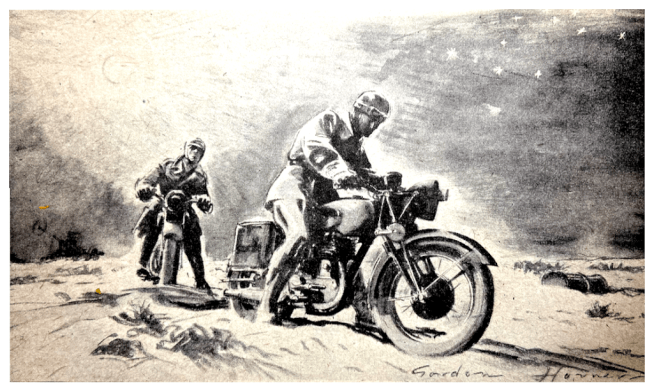
It did the trick and we set off, Harry leading. He went a roundabout way, twisting, turning, doubling back, veering one way and then another. I followed behind, feeling confident—and safe; Harry obviously knew a way through those mines. Presently I saw ahead a small cluster of tents sharply outlined by the moonlight against the darker background of the desert. The occupants were sitting outside—welcoming Christmas Day I reckoned. Then I realised I couldn’t see Chater. I glanced over my shoulder thinking he had dropped behind. But he hadn’t—there wasn’t a sign of him. Bewildered, I stopped. The tents weren’t far away, and by the time I had finished peering around looking for Harry one of the group had strolled over. He didn’t wait for me to speak. ‘You’re a lucky beggar,’ he said laconically, ‘do you know you’ve just left one of the thickest minefields Jerry ever laid? Our DR was killed there only this morning—a fellow called Chater.’
I looked around the table. There was an awkward silence until Ray Sharpe began to collect the empty glasses. When he reached my glass he hesitated. He was about to speak, but I forestalled him. ‘Yes, Ray, I’ve still got it,’ I said, as I took that plug out of my trousers pocket.”
As usual, some of the contemporary ads that tempted readers of the Blue ‘Un and Green ‘Un—which, considering the lack of petrol in the latter part of the year must have been a tad frustrating.
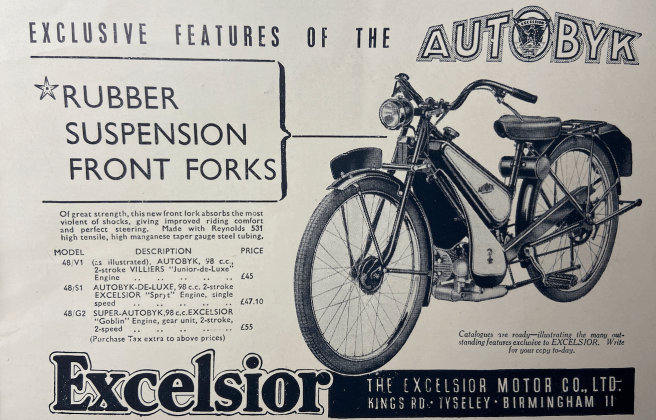
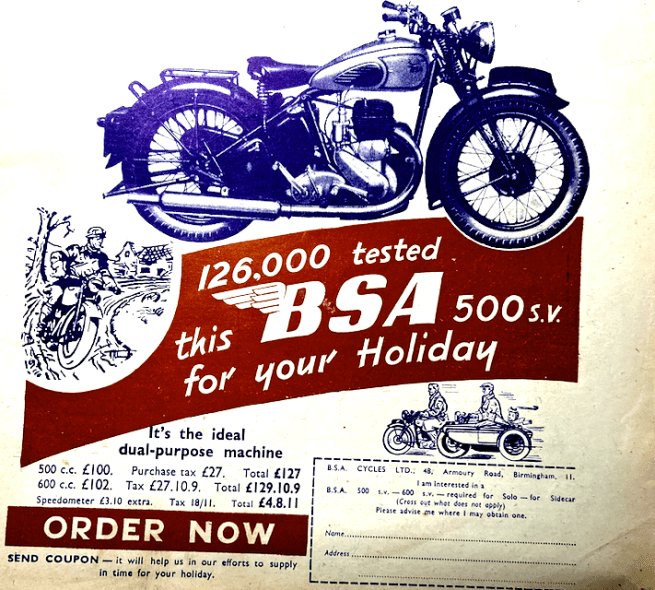
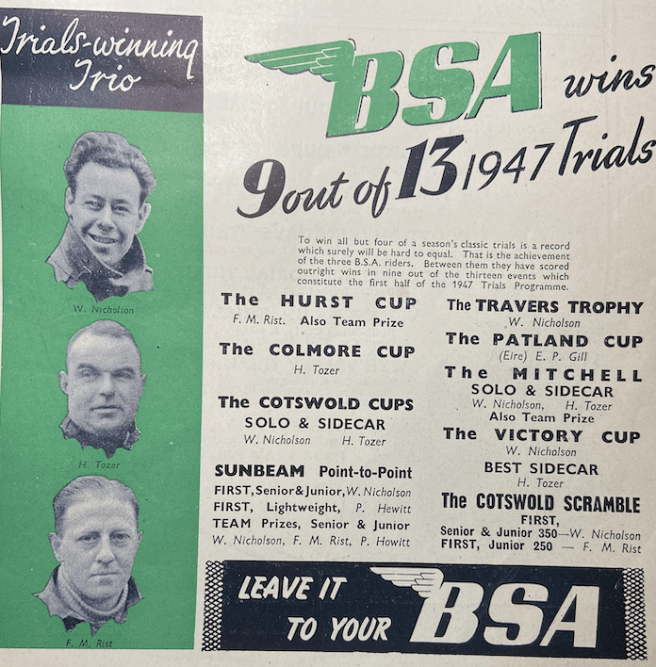
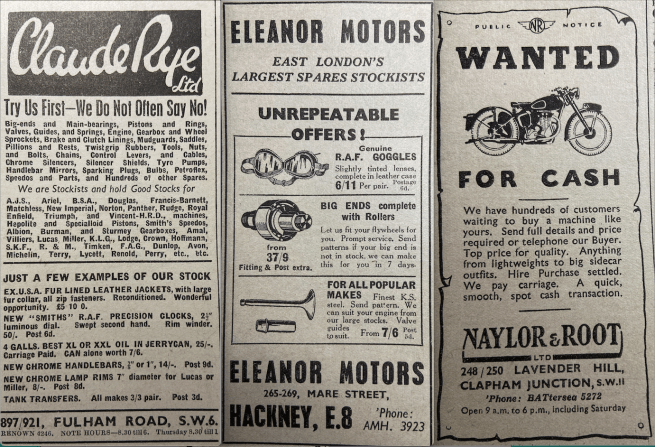
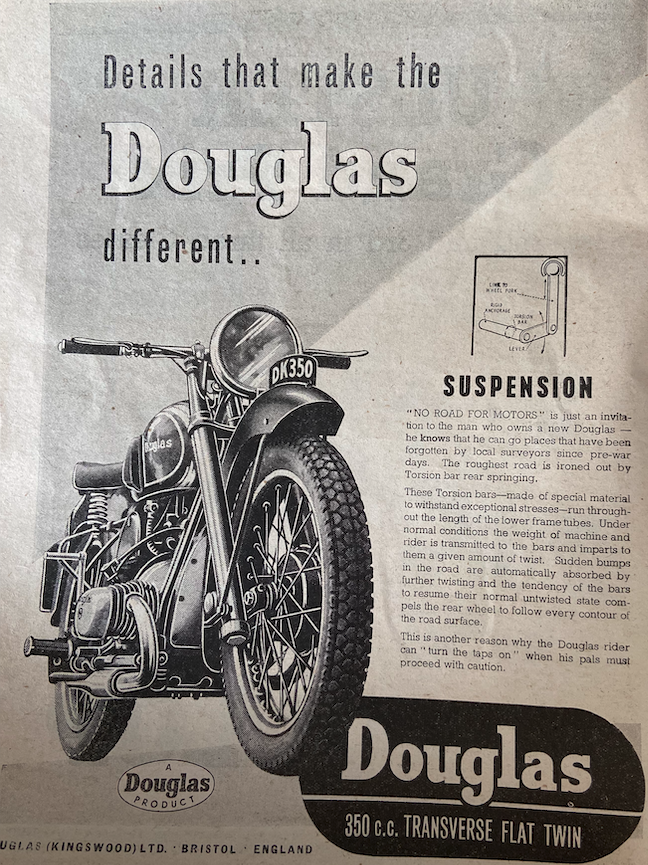
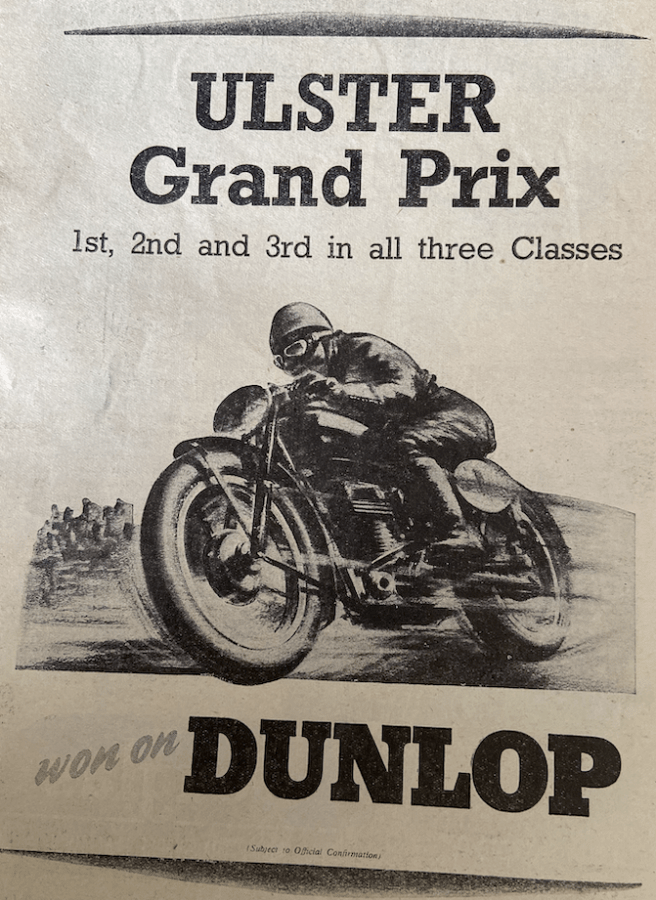
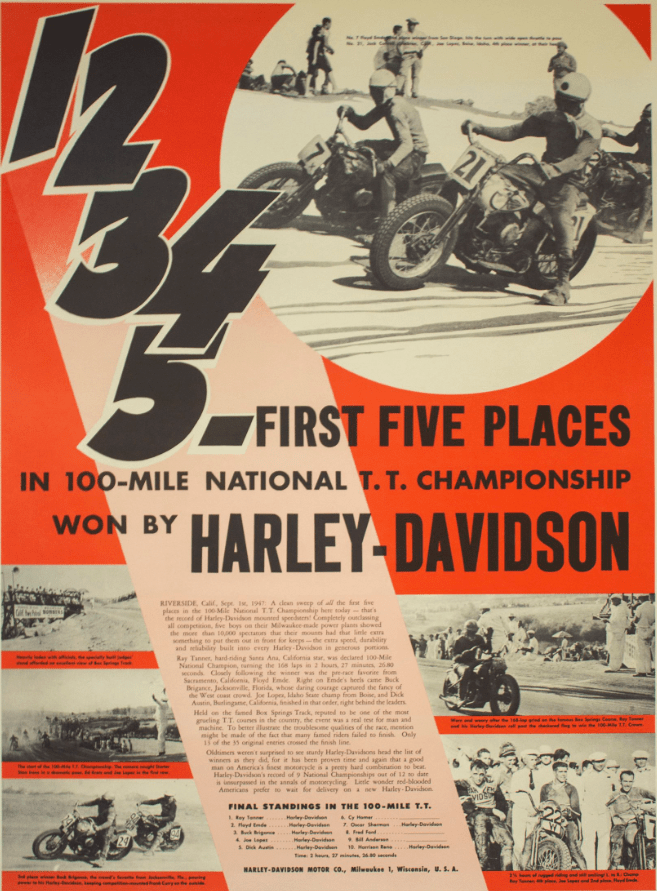
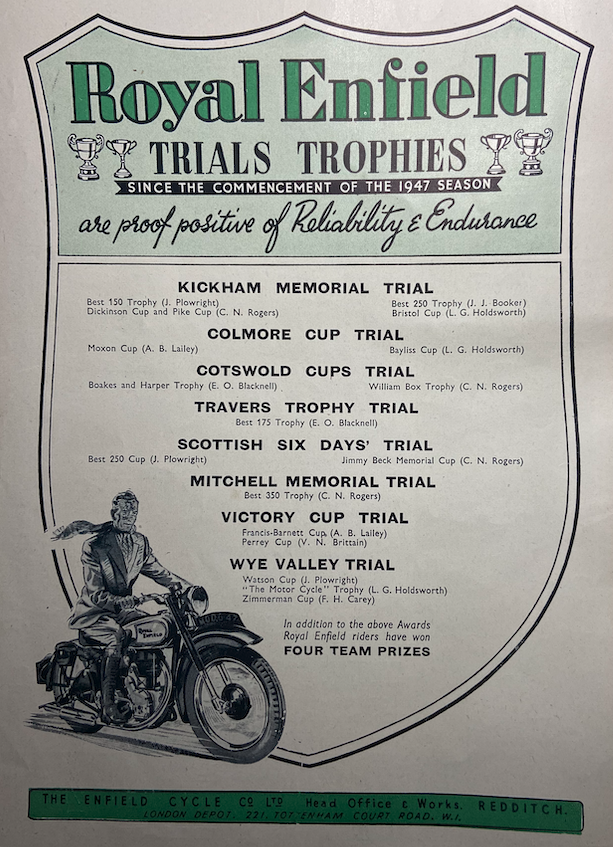
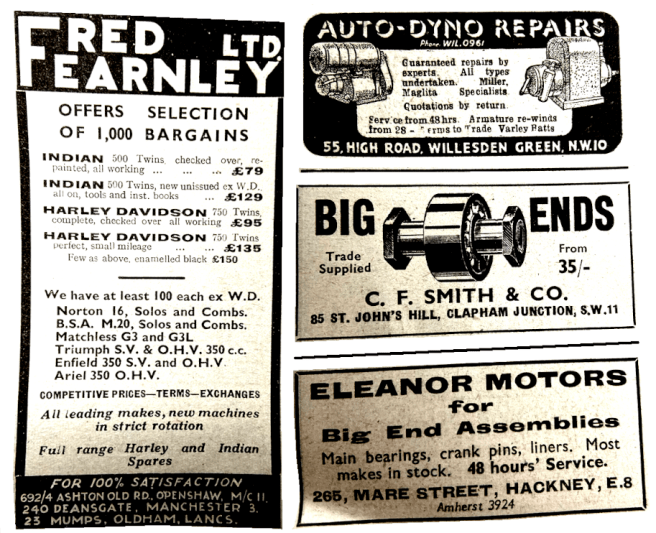
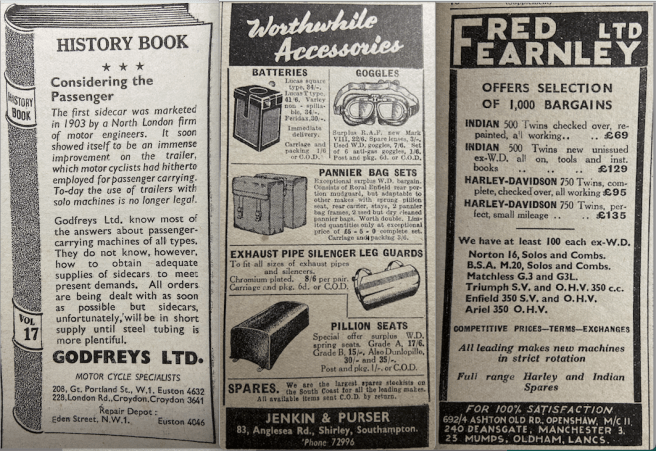
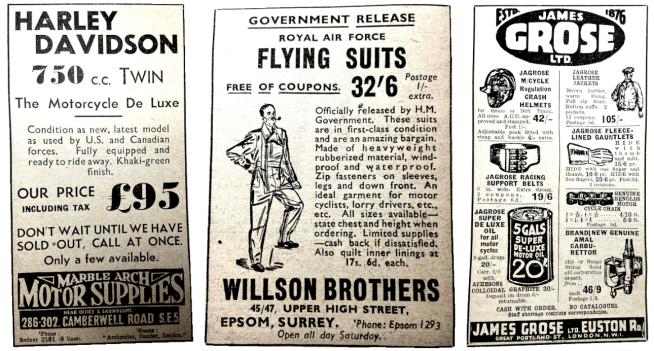
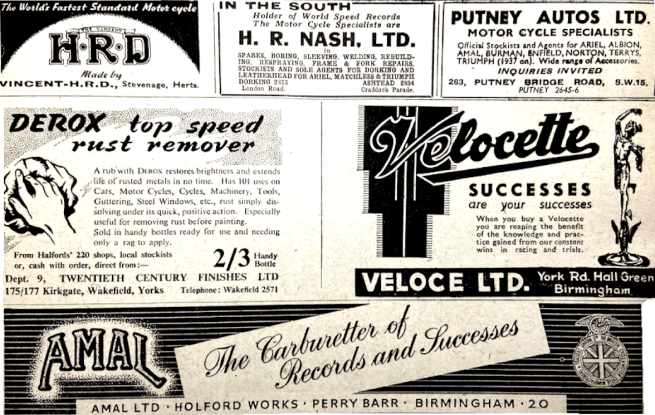
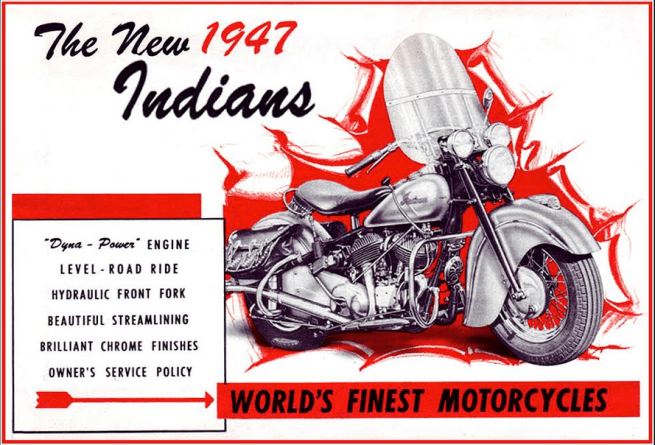
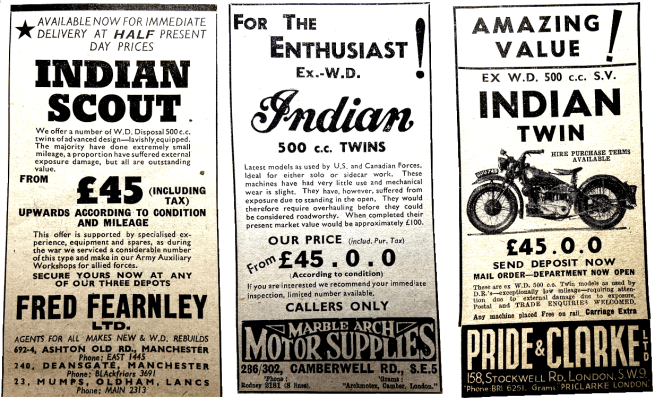
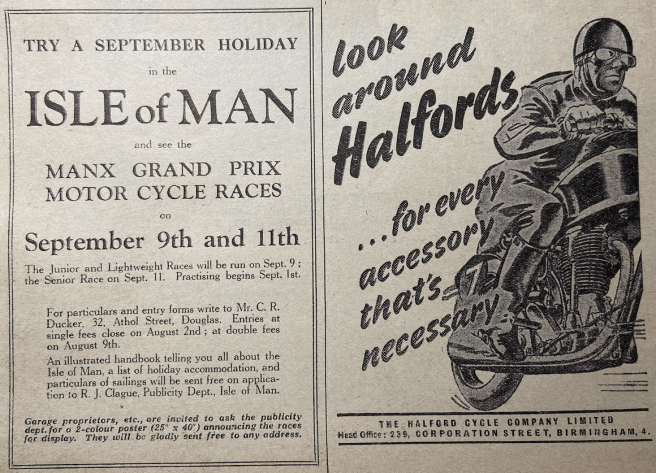
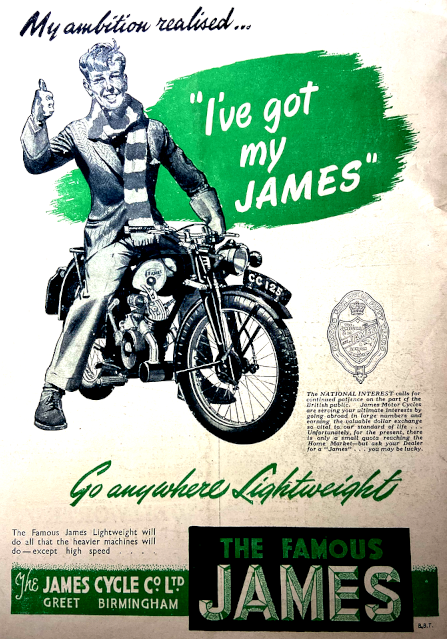
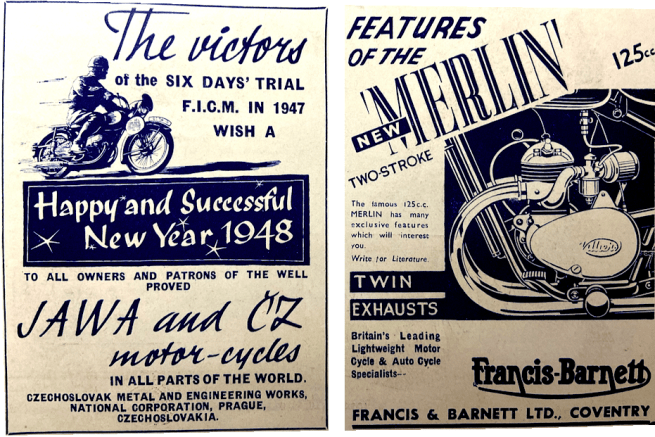
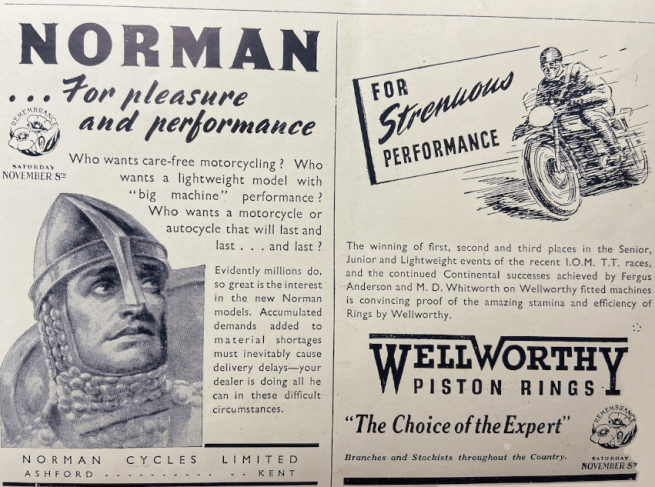
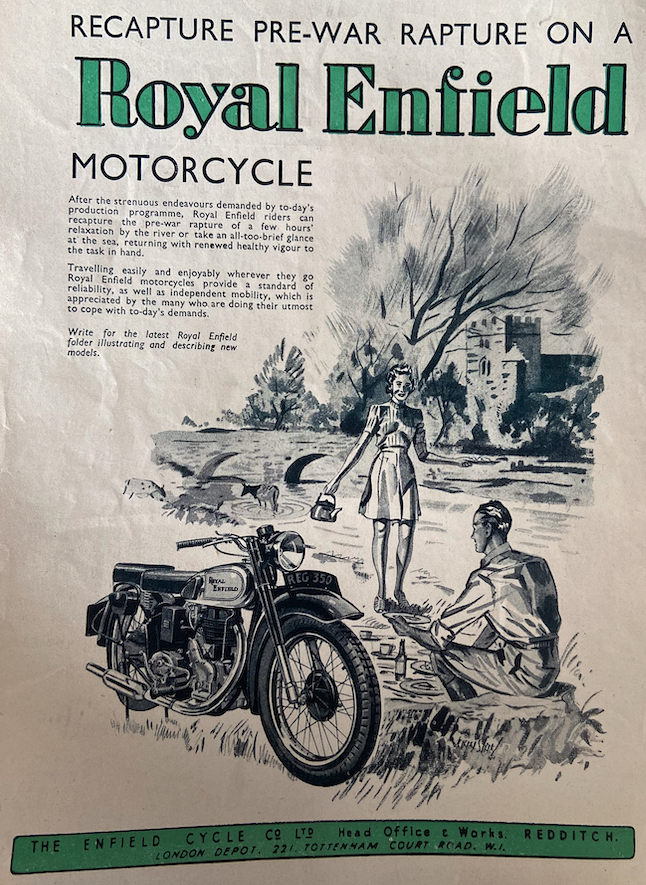
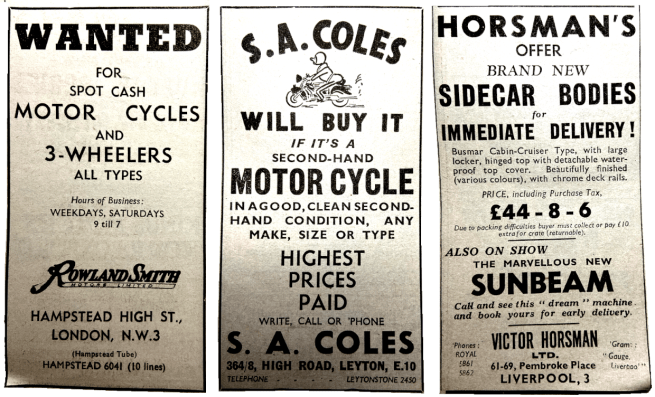
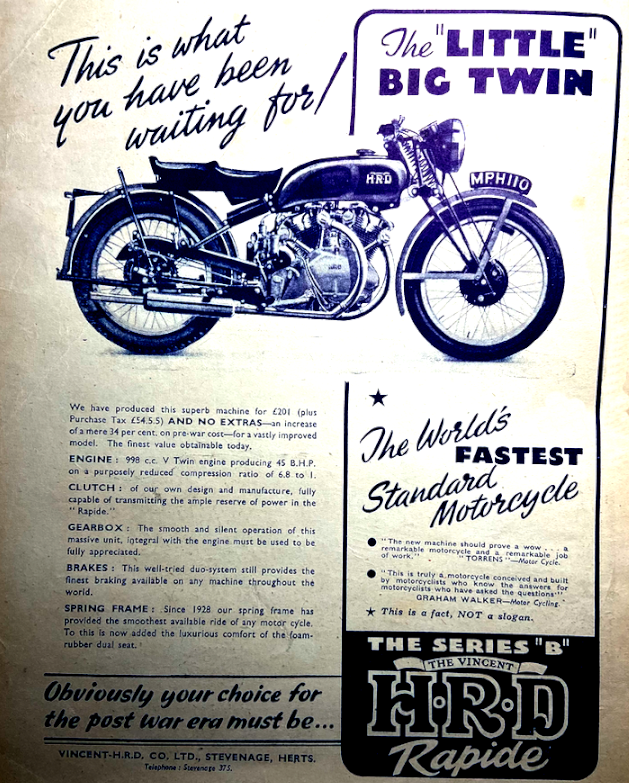
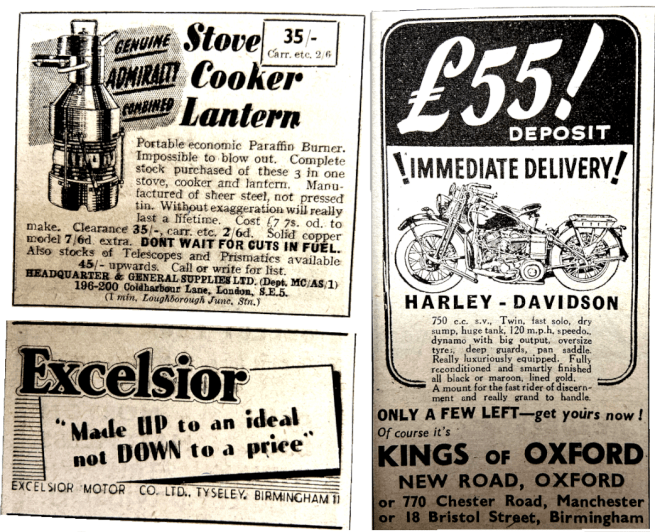
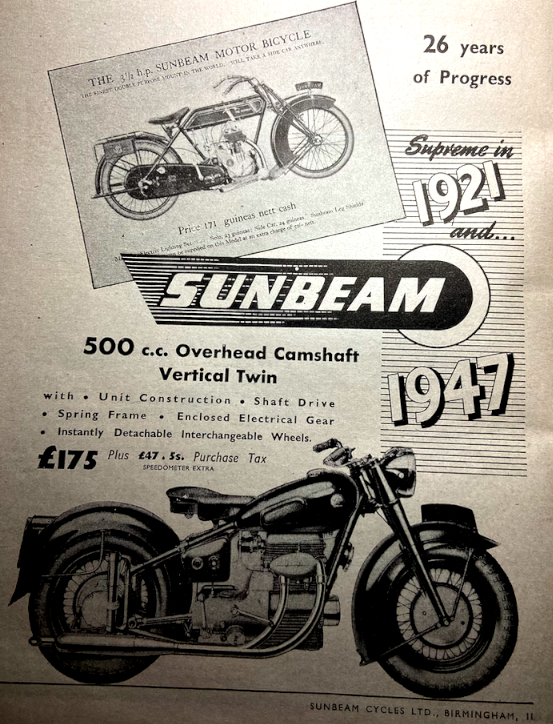
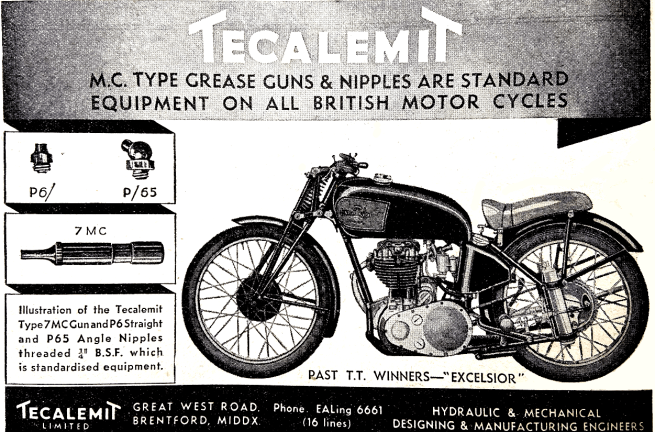
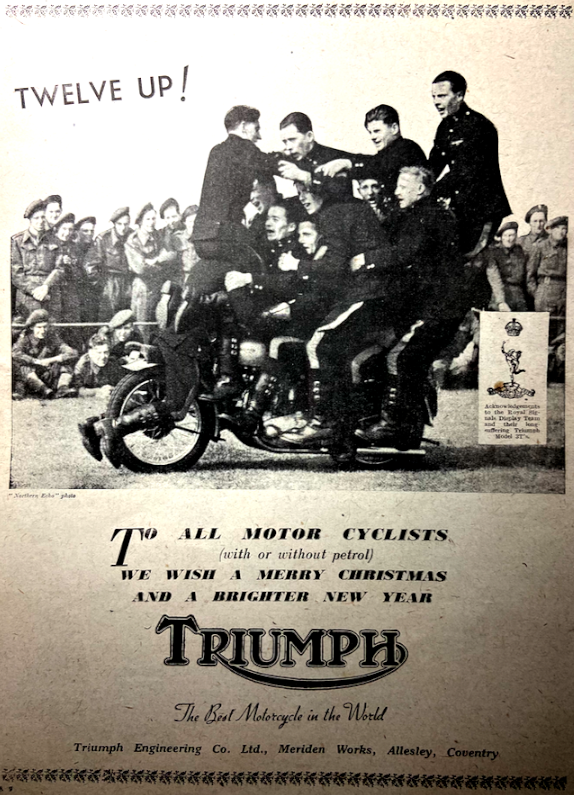
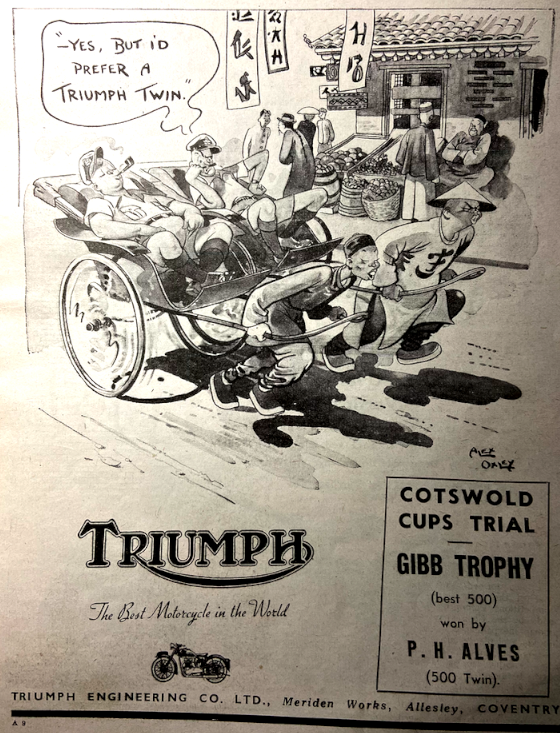
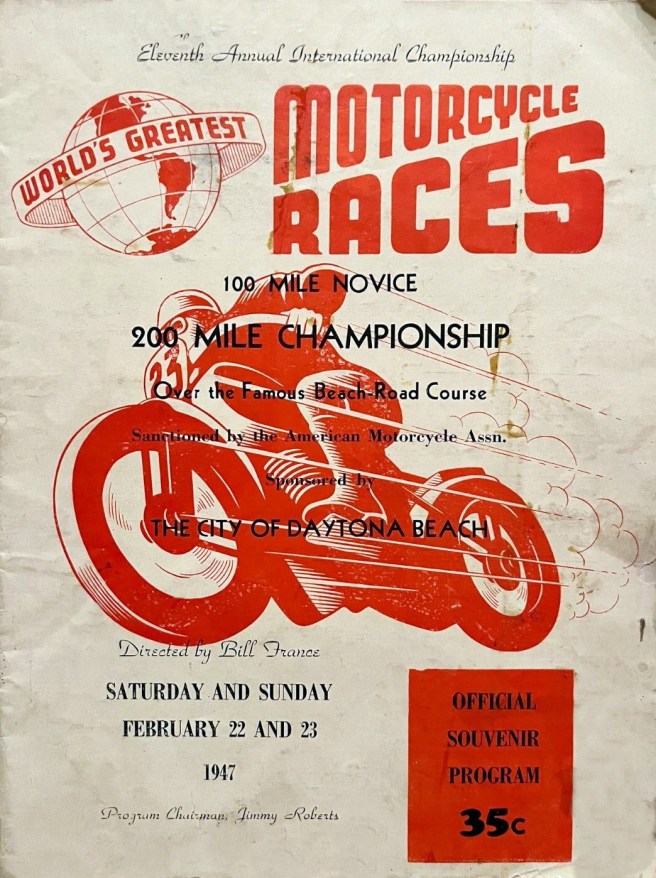
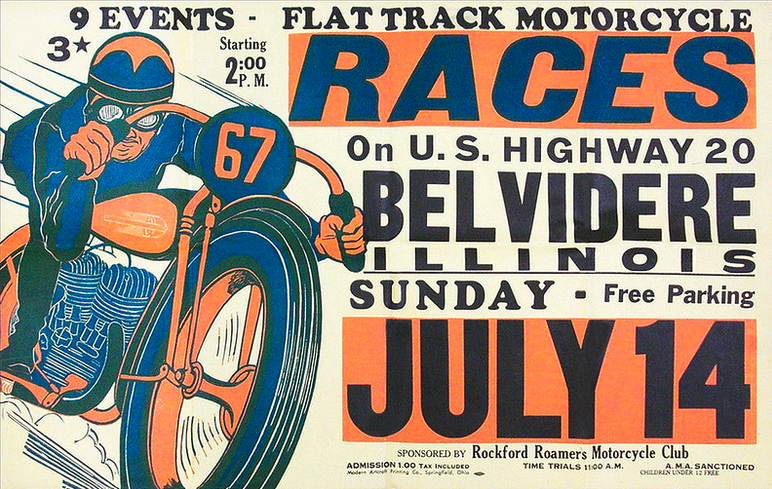
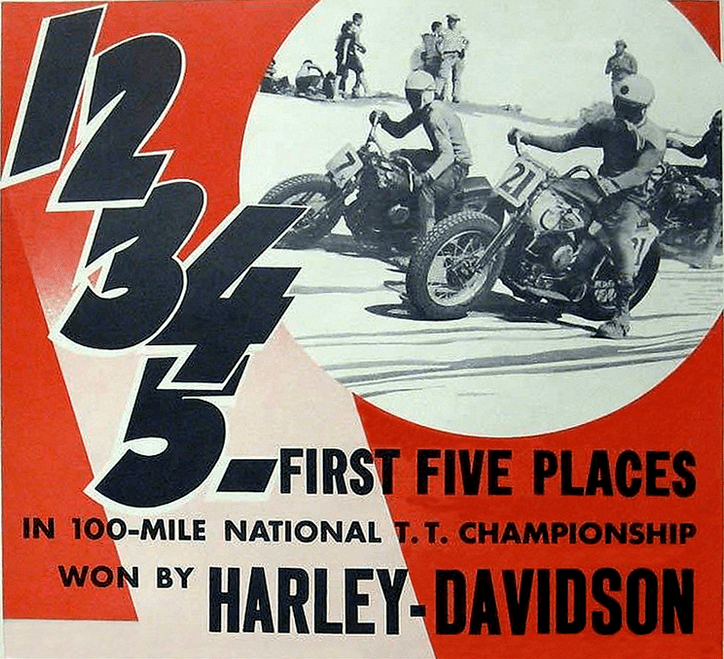
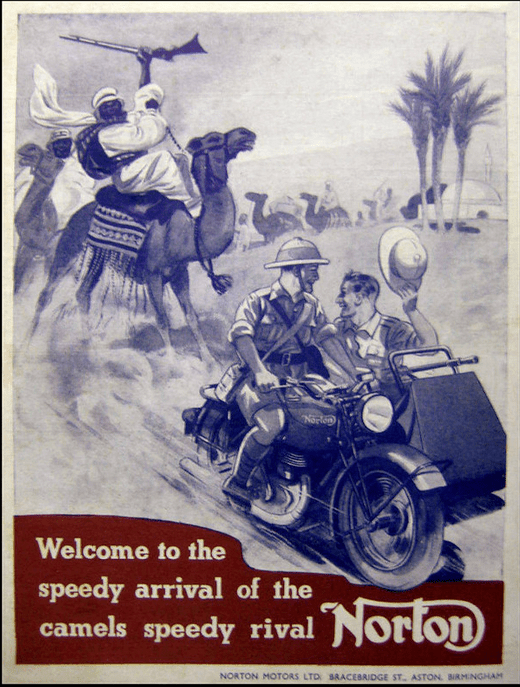
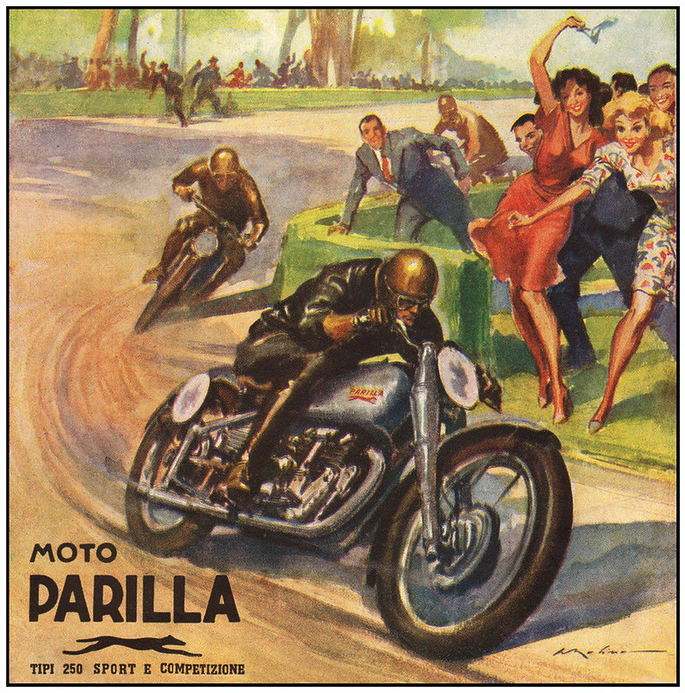
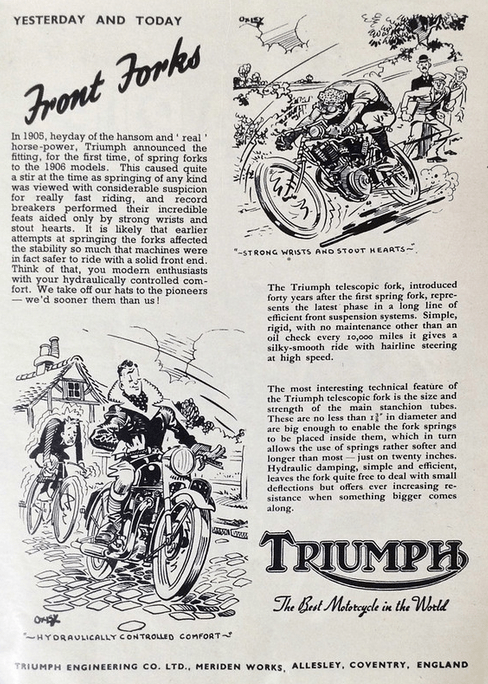
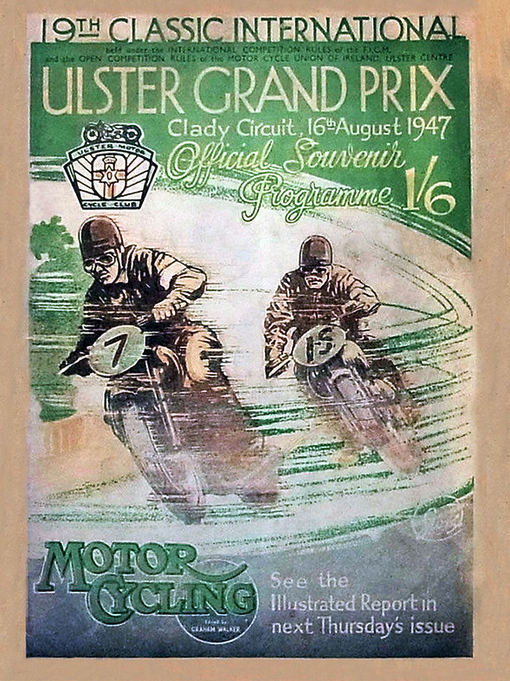
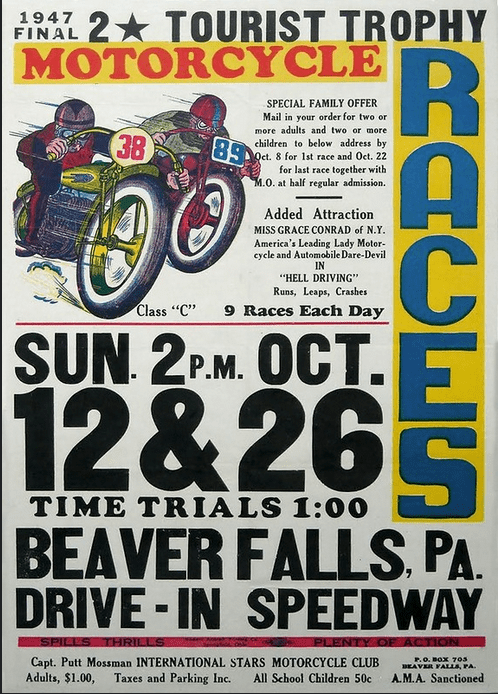
 Motorcycle Timeline