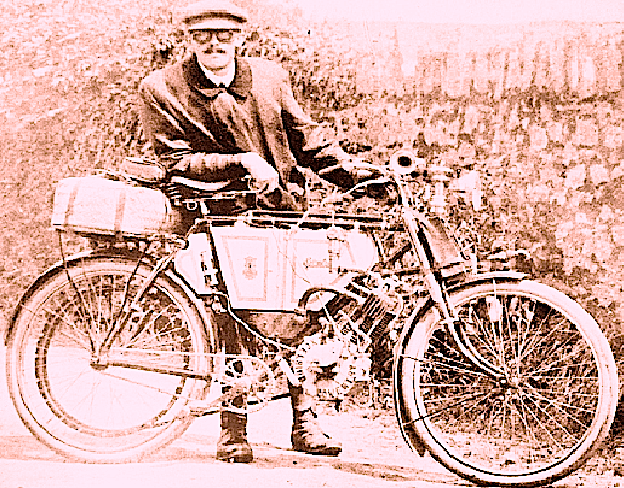
“LAST THURSDAY I SETTLED down to run through the New Year’s Honours…As my eyes roamed through the awards of the OBG (Military Division) to the members of the Royal Air Force I came to a halt. What brought me to a stop was the award of the OBE to Wing-Commander JM West, RAFVR. There could be more than one JM West with that rank in the RAF but it seemed very unlikely. Jock West, second in the last TT, new sales manager of Associated Motor Cycles, OBE—cheers! The Editor ‘phoned Jock to congratulate him. He had not heard—was completely taken aback. Just like Jock, he told no one about the honour At the AMC victory party and dance last Saturday evening—a mighty and cheery get-together of those who work at the factory, run by the AMC Entertainment Committee—no one knew until the Editor mentioned it. Incidentally, what an outstanding get-together that party was! And what an excellent band AMC boast. Why don’t more big firms have their cheery off-moments?”
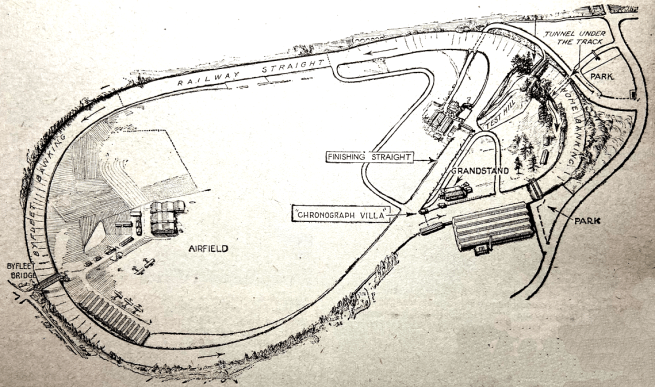
“SHAREHOLDERS OF BROOKLANDS (Weybridge), Ltd, last Monday approved the sale of Brooklands to Vickers-Armstrongs for £330,000. A proposal to adjourn the meeting in order that other lines of action might be explored was defeated The chairman, Mr CW Hayward, stated that the Ministry of Aircraft Production had declared that the present requisition would be continued for an indefinite number of years up to a maximum of five, and that they would feel bound during that period to consider compulsory acquisition. He was, he said, satisfied that there was no chance of Brooklands ever coming back to the company as a motor-racing course.”
“WITH BROOKLANDS SOLD and the track presumably no longer available, where will the British motor and motor cycle industries be able to carry out necessary research? In the past Brooklands has been Britain’s only track—the sole place where it has been possible to test vehicles at speed unimpeded by corners, bends and traffic. The sale and loss of the track therefore cannot be regarded with equanimity from the national aspect, especially to-day, with post-war designs in the offing. The fact that a great sporting venue will be lost is secondary and can weigh little, though even in that connection there can be grave regret, for Brooklands has been a great training medium, developing men—real men—as well as machines.”
“PERHAPS THE QUESTION which agitates most of us is whether the towering prices of 1945 are going to be permanent or not? We have lived so long in an era when £65 was a typical price for a tolerably good 500cc that we gasp and worry when the figure sticks at nearer £150. After the 1918 armistice prices steepled for a year or two but in due course slid down again until we could say we got better than pre-war value for less than pre-war prices. Will that process repeat itself? No man knows. Purchase tax will assuredly disappear in time. For the rest, prophecy is probably more of a gamble than at any time in our history. The American loan discussions have prepared us for a certain doubt, or even pessimism, concerning our financial future. For the moment only two remarks are sound and relevant. The first is that price and wages stand in a definite ratio. The symbol ‘£’ is in a sense a mere convention. A £50 bike when Jack’s weekly wage was £3 was no cheaper than a £100 bike when Jack’s weekly wage is £6. On paper we earn more to-day. On paper we spend more. The second is that if as a nation we work hard, are well governed, and are led by competent industrialists, we shall unquestionably emerge from the slough of being a ‘debtor’ nation, so embarrassing after many long decades as a world creditor. But those three ‘ifs’—work, government and technical leadership—are the conditions of prosperity. Them are no other conditions. As a profound believer in Britain, I expect to see a good £50 bike return (or its equivalent at some other financial level). But I do not expect it by to-morrow about this time. And as a buyer, I shall not wait so long to pick my post-war mount.”—Ixion
“IN THE FEW STARTLED DAYS since the sale of Brooklands was announced, three separate reactions have been noticeable amongst motor cyclists. The leading engineers bemoan the loss of what one of them called ‘the best test bench in the world’ available to the motor cycle industry at absurdly low cost. Riders feel bereft of the one place in the British Isles where on almost any day in the year they could travel as fast as all but freak bikes are capable of travelling. The general public, though not many of them visited Brooklands more than once or twice a year, regarded it affectionately in much the same light as Epsom or Lord’s or Wembley Stadium. In these three senses we all feel an acute sense of loss. On the other hand, if we assume that Britain’s recovery will ultimately include an even better track, more suited to ‘laboratory’ work, better adapted for pure sport, and designed with a shrewder eye to the spectacular side, our period of mourning would be definitely eased. One thing is certain. Britain cannot afford to remain trackless while Italy has Monza, France has Montlhèry and Germany has Avus and the Nurburg Ring.”—Ixion
“SO BROOKLANDS IS NO MORE! I trust an abler pen than mine will write a suitable lament, but just in case nobody else thinks of it, I’d like to say that here is one who will be everlastingly grateful to the track, and all connected with it, for presenting motor cycling at its best. I would hesitate to say that even the TT has given me more enjoyment—though more thrills, perhaps. At Brooklands you could (1) study the machines in the paddock to your heart’s content; (2) get a splendid view of the racing from half a dozen different places without taking up position long beforehand; (3) see the fastest machines in Britain. The Mountain formed a natural grandstand for the Campbell and Mountain circuits, and for another kind of thrill you could mount the stand at the paddock and look down on the rider’s bobbing heads as their handlebars swept the paint off the woodwork beneath. The ride to and from the track, too, could be very pleasant, taking one perhaps over rhododendron heaths or pine-clad hills, past half-timbered cottages and through typically bright south-country villages—even Chobham and Byfleet, quite close to the track, I thought very charming. Latterly I found admission quite cheap, but in the twenties it was well worth 3s charged, for those were the days of Le Vack and Temple, O’Donovan and Pullin, Horsman, Judd, Emerson, Marchant—when even scratch races were well supported and when nearly all world’s records were broken at the Track. Southern racing men will miss Brooklands. I hope it won’t be long before a new track is planned (with the co-operation of the car people)—one permitting two-wheeled speeds of 200mph or more.
Footboard Ferdie, Newport.”
“AS A VERY KEEN enthusiast in civilian life you can imagine my feelings when I was put in charge of the Inspections Repair of most of my Company’s motor cycles. What more could an enthusiast want but to be steeped in motor cycles every day? We have every one of the Army models on our strength so have plenty of opportunity of studying the good and bad points of each make. One thing stands out a mile—electrics certainly need redesigning. The number of batteries, dynamos and voltage regulators required to keep machines on the road is terrific. To find a machine which charges is an exception. With girder type forks, spindles and bushes constantly require renewing. The advent of the Teledraulic fork is a boon in this respect. It is peculiar how each make has its faults which crop up in every model, and one wonders how much Mr Manufacturer tests his models not to have corrected them before thousands are made. A lot can, of course, be put down to the terrible condition of the roads over here. Oh! Why has not that lovely Triumph Twin got shaft drive? What a bike if it had! And what a boon the Enfield neutral-finding device is. I am sure in a few years British motor cycles will he at the top for design and performance—a position they held for so long.
NJ Payne, Bromsgrove.”
“I WAS VERY INTERESTED in Brigadier TCW Bowen ‘s article, ‘Riding Position for Solo Work’ in which he mentions danger and discomfort. There will always be these factors while riders are forced ,to adopt the ‘monkey-up-the-stick’ position, and consequently get cramped and stiff and dither about feeling for the brake in an emergency. Out of a total of 20 machines, there were two only on which I could sit and ride comfortably and be sure of stamping rapidly on the brake. They were an Indian Scout and a Ner-a-Car. Both these machines had footboards well forward and ample leg-room unimpeded by kick-starters, gear boxes, battery cases and oil tanks. Most of the weight was taken on the saddles, which left the legs and feet free to move about and ready for an emergency. Incidentally, the saddle of the Indian Scout was mounted on a spring seat pillar and could be adjusted backwards and forwards and vertically. With the exception of speed, the modern machine is basically the same as the machine of 1912. Its high saddle tank makes it more top heavy, and its weather protection is still nil. How can it be reasonably safe? What impressed me during the war was the ease of handling and controllability of the American twins used by the Americans and Canadians. In spite of their immense weight and power they were as easy to handle in traffic as the smallest lightweight. Makers here might do well to study the American layout regarding comfort, handling, and weather protection.
Comfort, London, N4.”

“HE WOULD BE a poor motor cyclist who could not reflect with pleasure on a year that had included rides on a blown Scott, a special narrow-angle V4, a trio of new vertical twins, a ‘Civvy Street’ Guzzi, a Benelli, various Flying Fleas, sundry experimental models which should make their bow in production form at the next Show, a sidecar-wheel-drive Zündapp, and a score and more other motor cycles. In number and variety of machines I must class 1945 as a thoroughly good year, and—lucky me!—the mileage has been very nearly that of a true peacetime year. What shall I touch upon first? Those captured from the Hun and Itie machines I have discussed in a whole series of articles, so little need be said here. I do not rate any of them very highly. Nothing is perfect in this imperfect world (says he ponderously), and while the foreigner, in a few of his models, can show us a thing or two, he can ‘blob’ at least as much as we can, and generally does so in a greater number of directions. The Benelli, a 250cc overhead-camshaft single, I give many marks to on the score of its engine. It proved a superbly balanced single, and, while it delighted in revving, it was also endowed with beefy pulling power. It reminded me very much of the original Model A Levis engine, a 350 single-port job that was as sweet and as lively as any power unit marketed. The steering
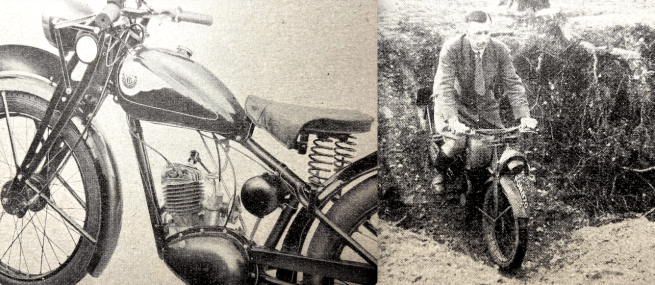
department was not too good, which is a failing of all the Italian machines I know. Of the BMWs two things may be said. The first is the patent fact that they have been designed as a whole instead of being a collection of bits and pieces. No 2 eulogy is that they do not leak oil—except that, in so far as those captured machines are concerned, oil had got into the rear brake from the bevel box and put paid to the brake linings. I have never had this trouble on civvy models, so it may have been a case of the German Army’s maintenance. My hope is that before many years are out we shall have a number of sleek, built-as-a-whole jobs, but one realises that there are snags. I am not referring to the fact that one may not be able to get at one’s clutch and at various other internals of a unit that is designed as a unit. Given the right design, the best possible material and high manufacturing skill, parts can be tucked away without it mattering. The snags, as I see them, are that once one has embarked upon the design one is hampered as regards making any serious changes. Secondly, such designs are expensive from the manufacturing aspect. The number of BMWs sold to Germans in pre-war days—sold to private owners—was small, in the same way that the number of Brough Superiors sold here pre-war was small. The reason was not that motor cyclists in this country did not yearn for Bruf-sups nor that Germans did not want BMWs, but that few could afford them. However, already I have ridden two built-as-a-whole British designs that incorporate just about everything the idealists have sought in the way of features, so we shall see. I am sorry if I am tantalising in this remark, but you will realise that discussing experimental machines is taboo. A reason why a motor cycle journalist is given prototypes to ride and comment upon, and thus has the opportunity of suggesting directions in which alterations seem to him desirable, is that those responsible for the model are sure he won’t go around talking. I love being asked along to try something new when it is in its initial stages, for then one can proffer criticisms and suggestions before things have gone too far. So often in the past, with the Show in the offing, it has been a case of ‘Sorry, but we can do nothing about it now; we shall have to see what can be done for the following year.’ Incidentally, it is not generally realised what a long-term process true development work is. With one factory I have an appointment every three
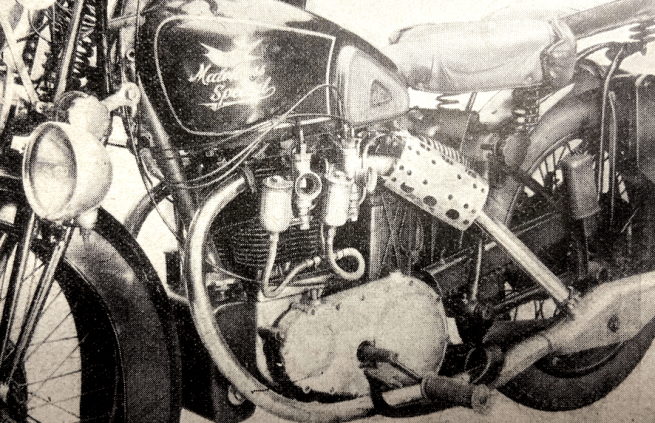
months to try out the new multi and see how far they have got. Each time, so far, there has been a marked improvement in the machine. When will it be ready for the motor cycle public? On the last occasion that I raised the matter, the answer was that it might be announced in some twelve months’ time. Thus I am likely to pay several more visits! The narrow-angle V4 I mentioned at the outset is a machine which, I understand, was once the property of Mr R0 Mitchell, who took it over to Merano, in Italy, for the 1932 International Six Days. Unless my memory is at fault, Mr Mitchell had the late Count Zborowski’s mechanic. Do you remember that famous car with a Zeppelin’s engine, ‘Chitty-Chitty-Bang-Bang’? Anyhow, Mr Mitchell was a great enthusiast with a fleet of super cars and this Four, a 593cc overhead-camshaft Silver Hawk Matchless that was much modified and generally hotted up. One of his favourite hobbies, I recall, was to slip down to Yeovil from London and back again just for the joy of a fast ride. And even on a standard Silver Hawk one could tuck many miles into the hour. My first experience on one was a trip exploring the Land’s End Trial course and tackling West Country hills that lasted the Saturday afternoon and the Sunday and involved 630 miles. So enthralled was I with the machine on this occasion that I bought a Silver Hawk—indeed, had one in 1932 and another in 1934. Although only of 593cc and gentlemanly withal, these machines gave me the highest averages of my life. They are the only machines on which I have found more than sixty miles went past in sixty minutes. Averages of over 50mph were almost commonplace, and I have often wondered why automatically one put so many miles in an hour. More than once I have urged Matchlesses to get hold of a really good Hawk and put it through its paces to-day. I would love to be taking delivery of a brand-new Silver Hawk to-morrow—would love to have a good second-hand one if only there were spares available. However, I have done the next best thing and had a ride on this two-carburettor, four exhaust pipes, special. You see the machine in a couple of the photographs. Mr. Babson, a metallurgist and very knowledgeable engineer, bought the machine in bits and spent a lot of time and money building it to his own ideas. I will not run through all the changes he made. They include the fitting of Webb front forks, a Burman four-speed gear box, new brakes—he shrunk stiffening-cum-cooling fins on the rear-brake drum—a modified lubrication system, and so on. Before he sold the machine he kindly brought it along to Dorset House for it to be examined. In addition, I rode it round the houses. He followed up by suggesting I had it for a week-end. We compromised by my dropping down to his home in Kent on Boxing Day and taking the machine out for a run. I found the two-carburettor engine had a snarl and a degree of snap about it that was thrilling. There is a very great deal to be said in favour of the narrow-angle V4. It is a compact engine and nicely balanced. There may not be the smooth
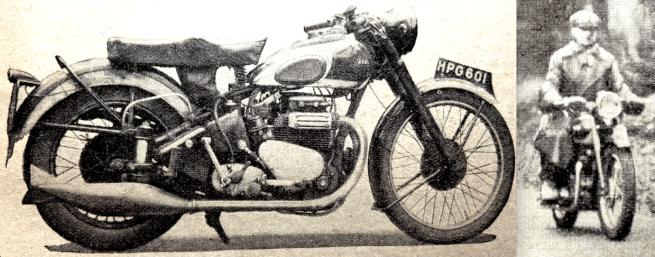
purr of, say, the straight four, but the exhaust is pleasant. In this case it was decidedly noisy—very super-sports-car—but what joy taking the machine up the scale in the gears! Maybe I have been spoiled somewhat by the steering of the very latest motor cycles, but there did not seem to me to be the light, yet thoroughly safe, feeling I had with standard Hawks, and the rear springing, instead of absorbing every road irregularity, large or small, gave a somewhat hard ride. On this latter point Mr Rabson mentioned that the pillion-seat arrangement was introducing a certain amount of solid friction—was imposing some pre-loading of the friction dampers. Also, there was a 3.25in-section rear tyre in place of the standard 4.00in. By the way I have remarked on the light, safe-feeling steering of the standard Hawks, that was true until the front-fork spring started to close up, whereupon the trail became on the small side and the steering might be rather too light. Whether it was the after-effects of Christmas or merely the fact that people were out for a pleasure run, I do not know, but those who were using the roads were not so punctilious in their road behaviour as to encourage one to go fast. Further, the brakes seemed a little on the spongy side. The standard Hawk brakes were on these lines. All I did, therefore, was to use around 60, employ the gears and once flick up to around 70. The run was sufficient to make me long to be taking delivery of a new Hawk. Of course, the most out-of-the-ordinary mount I lave ridden over the past twelve months is Mr Graham Kirk’s Scott, with its Colette blower and mighty SU carburettor. The final job is so simple-looking
in its conception that one marvels at it the more. Here is a rorty machine if ever there was one. ‘A thrilling, breath-taking beastie,’ I dubbed it. What Mr Kirk has done, you may recall, is to fit a blower of the positive-displacement type with a capacity of 560cc to his Stott which, at the time of my visit, had a 596cc engine. The kick-starterless machine, I found, started without difficulty; it two-strokes and does not four-stroke and is mild enough to be taken through traffic and winding lane without any difficulty. But open the throttle and the mild manners disappear with the increasing revs. The power builds up and builds up, and one has a sensation totally different from any I have had previously or since. And Mr Kirk told me that, with all this, he had had reliability. On trying the machine I wondered why more folk had not worked on similar lines; then I thought of the years Mr Kirk has been busy with two-strokes and the time spent before he developed this apparently simple layout. Shall we go from one extreme to the other? Over the year I have covered some thousands of miles on lightweight two-strokes. Often I have had my 1,000cc Ariel Four and a 125cc James or Royal Enfield out on the same day. I enjoy these Flying Fleas and have bought one as a runabout—as a sort of tender to the big machine. I shall not use it for long-distance work, but it will be useful for many a short journey and for rough stuff. Incidentally, I have a 40-tooth rear chainwheel which will give me a bottom gear of 25.7 to 1, which should be amusing in the rough, though with a top gear of as low as 8.9 to 1 I shall not want that ‘rough’ to be very far from home. Where these machines score is that one can take them out much as one would a bicycle. They are always ready, it seems, and cover over 100mpg even with the hardest driving. When the roads are treacherous there is nothing to equal these really light lightweights. As you know, they will average 30 and more miles an hour, and that means on runabout work that there are very few minutes’ difference between these machines and big ‘uns. They do not two-stroke so well as they might, and I consider that such machines, for runabout work, need built-in legshields that harmonise with the design. However, you will gather my feelings about them from the fact that I have invested in one of them—have done so after experience which now amounts to well over 6,000
miles. By the way, I am keeping the Army riding position, ie, the saddle set high. That Civvy Street Guzzi was a recently imported 500cc overhead-valve horizontal single. There was the mighty outside flywheel that gives, I believe, something like thrice the flywheel effect of the average single. It results in outstanding pulling and flexibility. The engine characteristics are very much those of the old ‘Sloper’ BSA, but without the latter’s delightful silence—far from it! Both mechanically and as regards the exhaust the Guzzi was decidedly noisy. The steering was a trifle wavering. With the close-ratio gears the gear change was not too much of a crash type. What pleased me a lot was the rolling-type central stand. One merely placed some of one’s weight on the protruding ‘ear’ and automatically the machine was on the stand, rear wheel in the air. One day, if life becomes a little less hectic, I am going to make up some-thing similar for my own mount—for the Thousand. Whenever I get on this latter machine following experience with something else, I revel in it. The previous occasion on which I rode it I may have felt critical, but coming back to it I praise its smoothness, its exhilarating surge of power and the effortlessness of its behaviour. Recently the Naval captain who bought my 1937 Square Four from the man to whom I sold it was in touch reminding me that I had promised to sell him the present one when the time came. I had to tell him that I had no idea when that time would be for there is nothing to wean me from it. It has now covered over 30,000 miles and soon, I suppose, I must decide whether to have the cylinders rebored or to fit ‘Simplex’ piston rings. The oil consumption is not wildly heavy—about 800mpg, at a guess—but the off-side rear cylinder has a fair amount of wear at the top of the travel of the upper-most piston ring and one day that ring may, of course, break up. So many enthusiasts of late have written to me about the Matchless ‘Teledraulic’ front forks fitted to my machine that I had better relate their history. These forks are one of the two pairs of special heavyweight ‘Teledraulics’ which Associated Motor Cycles made in 1941. They are not the forks fitted to the WD Matchless, nor those of the recently announced civilian Matchless and AJS models. One of the two pairs Associated Motor Cycles used themselves for test purposes and the other they fitted to my machine with the idea that I should have extended experience with ‘Teledraulics’. The mileage the

Thousand had covered when the forks were fitted was 10,350; the mileage now is 30,508. Thus the forks have been in use for just over 20,000 miles. During that period the forks have not been topped up with oil—there has been no leakage at all—nor have they been touched except for the fitting of a new light-alloy head clip. With these forks the steering has been something of a revelation. Contrary to a statement I read recently, I have found that the tyre wear with these telescopic forks is more even than with girder forks. With the long ‘soft’ movement the road-holding is super. My whole experience of telescopic forks is that they mark a big step forward, improving the steering, road-holding and safety in marked degree. How marked this is one finds when one tries out two machines that are similar except in regard to their forks. You may recall that I did this in the case of the 350cc Royal Enfield. The machine with the new Royal Enfield telescopics was almost incomparably superior. That it was an exceptionally nice 350 I had realised, but it was only when I swopped machines that I realised what a change the forks had wrought. Incidentally, the balance of the new Royal Enfield with its light-alloy con-rod is single-cylinder at its very best. A telescopic front fork with which I have had over 300 miles’ experience is the Ariel. These, I believe, will be available before very long. They were announced in connection with the 1945 Ariel programme. I have tried them in their final form; they, too, are the goods, so are the BSA ones….An interesting point

about the Triumph forks, which are delightfully soft in action and responsive, is the effect they have had on the rear end of the machine. One of the criticisms of the Triumph twins of the past was that their rear wheels were apt to hop. They now stay on the road to an almost spring frame-like degree. I tested the 350cc vertical-twin Triumph—the roadster type, the 3T, not the Tiger 85. It is a mount with magnificent traffic manners, yet really lively. After testing the machine I wrote to Mr. Turner, saying ‘I congratulate you.’ He has often said that one of his aims is to endeavour to give pleasure to youth; this machine, to judge from the one I had, is going to give immense pleasure and satisfaction to both the young and the not-so-young. My main hope is that Mr Manufacturer will provide a riding position that is as good as the remainder of the machine. From twins, let us pass to a single—to the latest 500cc overhead-valve AJS. When I took over the machine I was very much expecting an AMC 350 of the type I know so well, but with 150more cc and, consequently, rather more urge. I found that in the 500 there was a delightfully sweet engine, with a liveliness at medium revs I had never known in the 500cc models. The impression gained was that this was an engine built by some tuning wizard, every part fitted by a craftsman who proposed using the machine in competitions. The machine rustled along, eating up the miles in a most satisfying manner and even in the sixties darted ahead on the throttle being opened. A very nice motor cycle. That, since I must keep quiet regarding experimental models and experimental suspension systems, must, I suppose, be that. Altogether, from the machine angle, it was a most satisfying year. I wonder by how much 1946 will beat it.”
“THE GUZZI DRIVE via a rubber-faced roller to the back tyre of a lightweight seems to have been anticipated not by a Derby machine (as I fancied) but, according to Mr LF Parkes, by an ‘Ixion’! I had no part or lot in this machine, which was built at Loughborough in 1904 and sold with the friction drive or a round-belt-cum-jockey-pulley tensioner. The engine, according to the crankcase transfer, was made by the Ixion Co in Lille. Mr Parkes has the happiest memories of its lubrication system. A glass drip feed on the tank top fed the engine via a slot cut in the bearing and hollow crankshaft. This feed would not vary according to load or throttle opening, but at that date most engines approximated to the single-speed type, and a set drip probably served most conditions of travel.”—Ixion
ROAD IMPRESSIONS: BSA C11
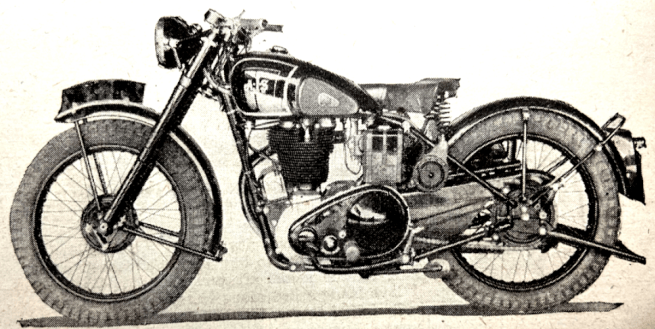
RIGHT FROM 1924, when the ’round-tanked’ two-speeder was introduced, BSAs have made first-class 250s—machines which invariably have been outstanding. To-day they are among the few making 250cc four-stroke motor cycles. There are two models, the side-valve, which is termed the C10 and the ohv mount, the C11. Except for the engine the specifications are the same. The machines are man-sized—built obviously with the fact in mind that large men are likely to ride 250s as well as small ones. On the C10 and C11 there is a wheelbase of some 52in, and a saddle height of approximately 29in, and the design is such that a man of a full 6ft can feel thoroughly comfortable. The machine I tested is a robust straightforward mount on which much care has been lavished in regard to the detail design. It is fitted with the BSA-Lucas coil-ignition set, which employs a combined contact breaker and automatic advance-and-retard mechanism, skew-gear driven from the timing gear. No air-control lever of any sort is employed, and there is no exhaust-valve lifter. Thus the controls of the machine are the twist-grip throttle, the clutch, the front-
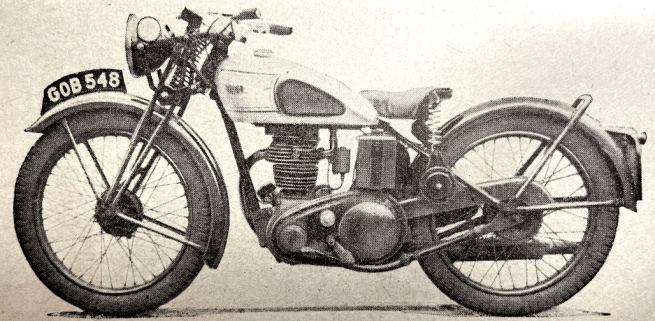
brake lever, the rear-brake pedal and the foot change of the three-speed gear box. Hence it is a machine to which a novice can count upon becoming accustomed very quickly indeed. Control is particularly easy, and the steering and cornering are such as to give the rider a real feeling of confidence. In the course of the test I rode from one side of London to the other on a day when road conditions. were bad owing to grease and also covered a number of miles on roads which here and there were coated with ice. Starting proved very good. Even when there was frost the lack of any air control was not felt. With the coil ignition it was not necessary to indulge in long, swinging kicks on the starter pedal. Push the pedal down with an approximately correct degree of throttle opening and the engine would start. It idled well and proved reasonably quiet both mechanically and in regard to the exhaust. An interesting little point about the silencer is a small hole at the bottom close to the rear end to enable condensate to drip away instead of remaining inside the silencer to cause corrosion. The machine is a lusty performer. Acceleration is good, and there is beefy pulling on upgrades. The maximum speed is comfortably up in the 60s and, at the other end of the scale, the machine would trickle along in top gear at any speed above about 14mph. Not until approximately 50mph on the very slightly pessimistic speedometer (a good fault!) is reached does the engine seem to be hard at work. And this speed is one which can be maintained, if desired, up main-road inclines. Moreover, there is the very useful speed of 40mph obtain-able in second gear 9.8 to 1). Thus this is a motor cycle which can be counted upon to put up very useful averages. With its liveliness, nippiness and ease of handling, there is no question of having to ‘remain in the queue’. Like the steering and handling, both brakes are very good indeed. The front brake is smooth, powerful and easy to operate—everything that it should be in these respects. The rear also proved powerful and smooth; it requires a fair amount of pressure to apply it hard, which, in my view, is as should be the case on such a machine. On wet, grit-laden roads, several times a speck of dirt got between the drum and the water-excluder of the front brake and caused a tinkling, scraping noise. Riding position is of the upright, touring type, with the ends of the 29in-wide handlebars set back. The footrest hangers have hexagonal holes that mate with hexagonal portions on the ends of the footrest rod. The Terry saddle is non-adjustable, but the bars can be swivelled in their clip. The foot-change pedal is serrated internally and, therefore, also adjustable. I found the riding position of the machine as it arrived very good indeed, and the brake pedal came exactly where it was wanted. My view has long been that BSAs have studied riding position better than almost anyone. Fuel consumption at 30mph over an undulating, give-and-take road worked out at 102mpg, while checked over a distance of 199 miles, which included almost every conceivable type of work and of weather—not excluding bottom-gear crawling in dense fog—the consumption was approximately 84mpg. Oil consumption was of the negligible variety, and what pleased me immensely was that there were no oil leaks from the engine in spite of it being at times driven really hard. At the end of the test there were merely two very small smears around the timing-case joint, shown up by dirt collecting there. The 7in diameter head lamp gave a first-class driving light—powerful, if a trifle narrow for cornering, on the main
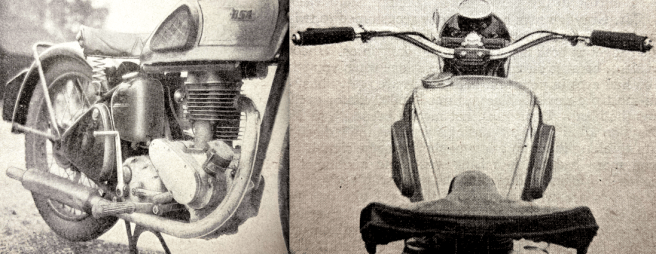
beam and well diffused, and without any obvious straying upward beams, on the ‘dipped’ filament. The weight of the machine, with roughly a gallon of petrol in the tank, was 294lb. It is an easy machine to wheel and to manhandle. It is also easy to put on the central stand if one sets oneself facing forward, one hand on the handlebar end, the other on the rear of the saddle, and, with the stand leg pressed on the ground with one foot, thrusts backwards on the cheek of the saddle, using the thigh for the thrust. Then there is no lifting nor any serious effort. Having regard to novices, a really easily operated stand seems desirable. Only one other point have I: the ignition warning light is rather too sombre in daylight, and may result in owners leaving the ignition switch on by mistake. There is no reserve tap for the fuel tank, but with no U-pipe between the two halves a small reserve is afforded—sufficient for two or three miles in my experience. To sum up, in the latest C11 ohv 250cc BSA there is a machine which one would use with pleasure and satisfaction on a lengthy, strenuous tour, for going to and from work, for pottering about the countryside or for putting up good averages of the A to B variety. It is economical, lively, robust and comfortable (the Dunlop tyres are 3.00-20, incidentally)—a machine one can very strongly recommend, as, indeed, I have done ever since these 250s were introduced.” —Torrens
“I FANCY THAT far more riders would avail themselves of special weather protective devices if these gadgets were instantaneously at- and de-tachable. In this category stand windscreens, legshields, and hand guards. The vast majority of such fittings are designed and sold as accessories—not an efficient method, since an unnecessarily wide range of clips becomes inevitable, with so many makes of machine to be fitted. But supposing that a large manufacturer worked hand-in-glove with an accessory firm, standardised a complete set, and built his machine with incorporated lugs for the several mountings? A rider could then whip the gadgets on and off to suit his fancy and the weather of the moment. Moreover, the gadgets would be firmer, since a multitude of clip-on items will never remain tight without regular attention. I am quite, quite sure that this prescription is invaluable for windshields. The demand for legshields and hand guards is less clamorous.”—Ixion
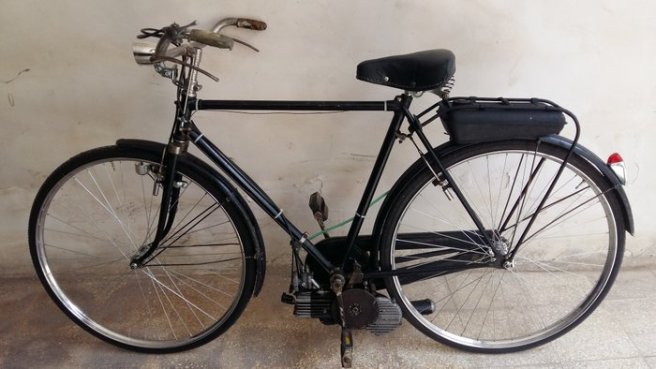
GARELLI RESUMED PRODUCTION of powered two-wheelers after an 18-year break. Instead of sporty 350cc two strokes the firm churned out diminutive clip-on ‘micromotori’ better suited to the needs of post-war austerity.
‘ORDINARY DAY DRESS for men on this occasion’. Thus runs a sentence in the Motor Cycling Club’s announcement of its dinner and dance to be held at the Porehester Hall, Bayswater, London W2. Why do not more clubs make a clear-cut statement on what one should wear? All too often the words on the ticket are ‘Evening dress optional’. It may be said that this leaves those who have evening dress and would like to wear it the opportunity of doing so and that those who do not possess it are thus told that it does not matter. My view is that where the statement is that dress is optional the thing is not to wear evening dress if you have it but to go in ordinary clothes—that is, I do not regard it as an option at all, at least in these days. Am I right or wrong?”
WITHIN A YEAR of its foundation Montesa won the 125cc class of the Grand Prix of Barcelona and went on to win theSpanish 100 and 125cc Championships.
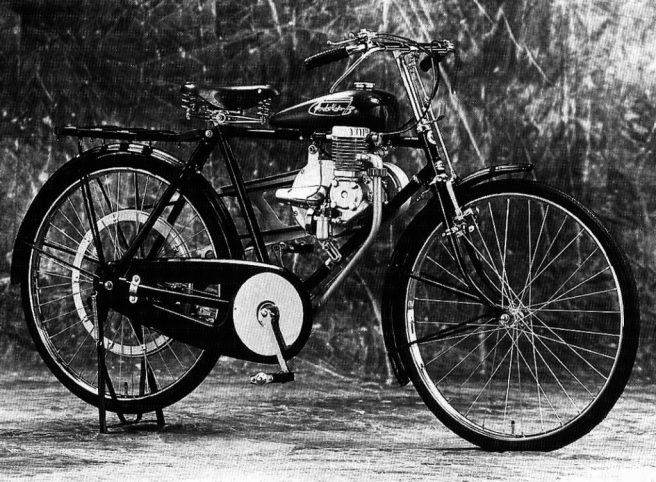
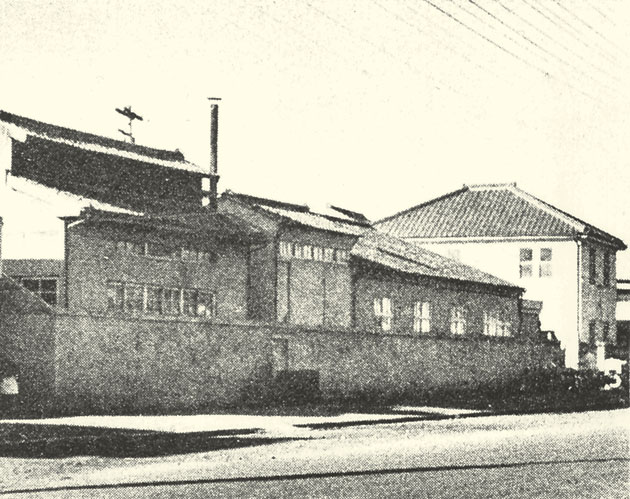
SOICHIRO HONDA acquired a batch of 500 ex-Japanese army 50cc two-stroke generator engines (designed to power radio sets) and fitted them to bicycles. The engines were produced by Mikuni Shoko which was, and is, famous for its carburetors—every engine was stripped, checked and reassembled before fitting. The prototype sported a hot water bottle as a fuel tank (legend has it that Soichiro found the bottle at home; it does not record Mrs Honda’s reaction). The engine was fitted over the front wheel which was driven via rubber friction roller a la French Velo Solex. The poor quality tyres available in post-war Japan couldn’t stand the strain so Honda quickly adopted a conventional engine layout with a V-belt driving the rear wheel. Soichiro Honda’s wife, Sachi, recalled: “‘I’ve made one of these, so you try riding it.’ That was what my husband said when he brought one of his machines to the house. Later, he claimed that he made it because he couldn’t stand to watch me working so hard at pedaling my bicycle when I went off looking for food to buy, but that was just a story he made up afterward to make it sound better – although that might have been a little part of it. Mainly, though, I think he really wanted to know whether a woman could handle his bike. I was his guinea pig. He made me drive all over the main streets that were crowded with people, so I wore my best monpe (baggy trousers worn by farm women and female laborers) when I took the bike…After riding around for a good while, I went back to the house, and my best monpe had gotten all covered with oil,” Mrs. Honda continued. “I told him, this is no good. Your customers will come back and scold you. His usual response was, ‘Oh, be quiet. Don’t fuss about it.’ But instead, this time he said, ‘Hmm, maybe so.’ He was unusually submissive about it.”
“OPINION IS VEERING in favour of automatic ignition controls. A number of those who maintained that manual operation was preferable are now admitting that even the most expert rider cannot hope to compete with an efficient automatic advance-and-retard. The emphasis should be on the word ‘efficient’. All automatic controls we have sampled to date have been of the centrifugal type. A few have conformed to the requirements of the engine with remarkable accuracy, which reveals that with some power units, particularly multis, such a device can be extraordinarily satisfactory—far more so than hand control. And it is an interesting fact that timed tests show an improvement in acceleration. Undoubtedly ‘auto-advance’ will become usual, and it is important that it should be widely realised that it is a device which ought never to call for any excuses. In short, something close to perfection has already been achieved by certain manufacturers and there is thus a standard to which others need to work. Over coil ignition, notwithstanding the promised sets that will enable the engine to be kick-started with the battery fully discharged, or with no battery at all, there are still grave doubts in many motor cyclists’, minds. Thoughts of the past are the reason. We favour coil ignition, believing that it has big advantages and that in its latest form, well made and properly fitted, it can be entirely satisfactory. Coincident with all the proposals for coil ignition, however, there have been important developments in magnetos…”
“A FEW MONTHS AGO in discussing machines for trials the Editor remarked on the fun to be obtained from riding a Flying Flea in competitions. It seems that quite a few intend to have a crack at trials on 125cc two-strokes. I have not seen the entries for Saturday week’s Colmore Trial yet—they do not close until to-day—but I heard the other day that AR Taylor was intending to use a 125cc Excelsior, and now I learn that Barry Smith, son of Major FW Smith, TD, JP, the managing director of Royal Enfields, will ride a 125cc Royal Enfield in the Colmore if he is still at home. Barry has taken a Flea through several trials of late, and on the Antelope MCC’s event the report was that no one enjoyed the trial more than he did. Apart from the kick there is to be obtained in piloting a machine of small cc through a trial, there is the fact that one’s trials model is inexpensive!”
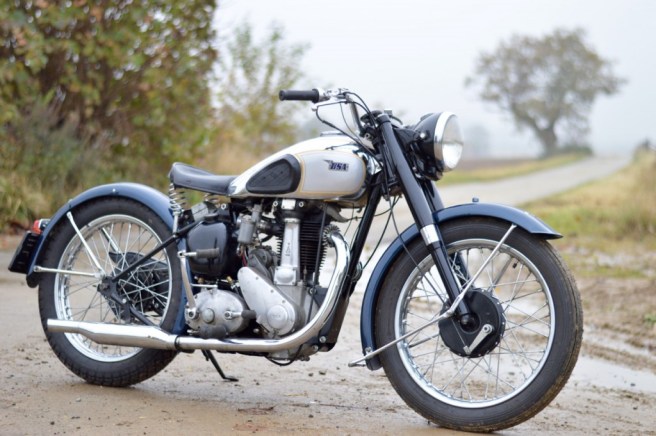
THE CLASSIC ONE-DAY TRIALS resumed in February with the Colmore Cup Trial; Fred Rist and Bill Nicholson came first and second, both riding competition versions of Beeza’s new B31 (effectively a pre-war B30 with Ariel telescopic forks. Judging by the popularity of the Matchless G3L, its Beeza counterpart would have made an excellent military mount. The B31 proved itself a dependable, lively all-rounder). Before the end of the year the British Experts Trial was back too; solo and sidecar honours went to Bob Ray (Ariel) and Harold Tozer (BSA).
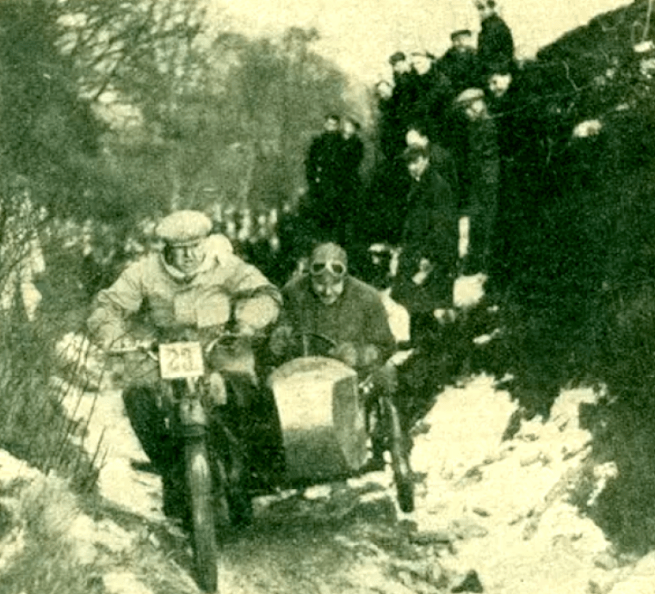
“ALTHOUGH NOT STRICTLY of the ‘North’, being more truly of the East Midlands, the Bemrose Trial nevertheless has a distinctly northern flavour. The Derby &DMCC takes the Bemrose route well up into the Peak District, and since that ‘North’ which comprises West Yorkshire. East Lancashire and East Cheshire is rather starved in the matter of classic open trials there is always a good ‘local’ entry both from those quarters as well as from the many clubs in the Derby and Nottingham districts. Hence the entry list of 160 last Saturday—a total that could easily have been exceeded had Mr Secretary Fred Craner dared to have accepted all who offered. But because it is not possible to get enough marshals and observers on a Saturday morning the start cannot be before 1230pm and the available daylight precludes the acceptance of a bigger number of competitors; as it was, the intermediate time checks were eliminated in order to save delay. But with the best will in the world, time loss extended the string of riders. A minute or two here, a quarter of an hour there, and a cumulative delay became apparent. The early members were on time according to programme at the many observed sections, but the later the numbers the later their appearance and the longer their passage through any one section. At the finishing point at Hartington O/C Craner was getting quite worried as the day went on. Messengers were sent out. ‘Could this or that hill be washed out?’ And each time the answer came back ‘No’, because already some of the early number. had been up and had been credited with clean performances. So it had to be. Only the last section of all, half a mile away from the finish, was cut out. And the upshot was that most of the late numbers climbed Pilsbury when the light had gone and they could not clearly see the path to follow. Naturally they finished well after the time when lights were put on and many without lamps were in a quandary about getting home. There was a run on the available stock of pocket torches in the village garage at Harlington. The contingent from West Yorkshire, always ready to throw a party. were speculating where to carry out such a project, while a team from Cambridge were speaking bravely of riding through the night to that home of learning. Nobody could quite weigh up why the lateness had crept in. Delays on any one hill had not been excessive, except perhaps at Hunger, early on. Route marking was excellent and marshalling on observed sections was generally expeditious. It just seemed that the entry was too big for the time allowed and tint the moving finger moves, and keeps on moving on. Starting from Cromford, near Matlock, on a bright and sunny, the prospects were only marred by the sight of snow on the hill tops and the thought that the deeply frozen ground might be thawed to a fairly treacherous state. The first section, Dethick Lane, confirmed the dread. Its mixture of semi-solid slime and rocks proved difficult. Fortunately for the many who had to foot, and much to the annoyance of the few who were clean, no observers turned up, so both failure and success went unrecorded. Twelve miles from the start, Hunger Hill, at Holymoorside, near Chesterfield, was reached. Hunger is not perhaps no difficult as it used to be, but the acute left bend on a shop gradient, with step-like rock ledges ‘running away’ from the line of travel, provide a fine test of steering control and engine pulling power from low revs, because the steps are too deep to take at speed with any certainty, although an occasional rider, if the luck is with him, may make a fast ascent. One thing differing from prewar trials was the outstanding superiority of telescopic forks in dealing with a rock staircase!”
“BEING DISINCLINED TO ALLOW themselves too much opportunity to become soft, the Bradford &DMC ran a decidedly sporting event at Altar Lane, Bingley, and sampled some astonishing observed sections all within a very small distance of the starting point. Few districts can he much better placed than this part of Airedale for rough and rugged hills, bleak and barren moorlands and the comforting thought that one can almost literally jump down off any piece of high ground and land on a bus route with the chance of getting home for twopence, no matter how the model has been bent. Altar Lane, the starting point, was itself once used as an observed section in the distant days, but now it merely provides a means of approach to certain rocky paths that wind through the woods that flank it. There were two parts of the first of these paths that spoiled most of the clean sheets within the first ten minutes…”
“HERE IS YET ANOTHER item which profoundly affects our individualistic passions anent motor cycling. I can remember a time when the number of firms exhibiting motor cycles at the annual Show climbed far into three figures. That was the age of the small shop and the tiny output. Henry Ford quickly taught the world that the day of the small craftsman was past, and that efficiency and cheapness pivoted on mass production by machinery. In the motor cycle world we have not quite reached the stage at which the British production is confined to a few factories, the Big Five, the Big Seven, or what you will. But we are getting quite near that stage. Such epochs are unwelcome to the sturdy individualists. Options and variations are anathema to the mass producer—they create eddies in the smooth flow of his output. He aims at a single standard model, and no options. This annoys his public and he is driven to a mild compromise, maybe lists more models than suit real efficiency, and catalogues a number of bolt-on options at the tail of his booklet. Hence mass production has its drawbacks for a faddy enthusiast. But let him not forget that thanks to mass production he is buying an extraordinarily good machine for about half what it would have cost him under the old ‘small shop’ regime. What we lose on the swings in respect of variety we more than recover on the roundabouts in the shape of value and economy.”—Ixion
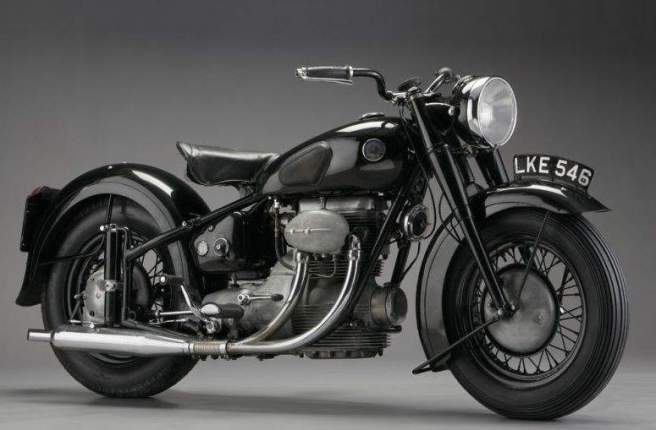
BSA CASHED IN ON ITS acquisition of Sunbeam with the launch of “a new kind of motorcycle”, the Sunbeam S7, built in the firm’s wartime ‘shadow’ factory in Redditch. The rolling chassis was pure BSA, including the latest telescopic forks and plunger rear suspension; rider comfort was further enhanced by 5.00×16 ‘balloon’ tyres. But the Erling Poppe-designed driveline comprised a unit-construction ohc 500cc in-line twin with car-style clutch and four-speed gearbox. The Blue ‘Un was impressed: “On the road, the new models display fresh and delightful characteristics. The gear change of the engine-speed gear box, for instance, is perfection: as good as, if not better than, the best that is provided by any countershaft gear box of to-day. The flexibility of the machine, too, is outstandingly good. In the recent past. harshness
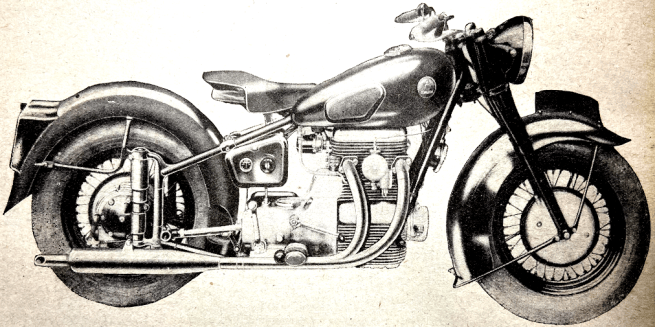
has been accounted inseparable from shaft drive. With the new Sunbeam a speed of 10mph in top gear can be used without a semblance of thrash or flutter. This is so with the prototype, which has now covered some 18,000 miles, ten thousand of them a duration test…Behind the design is that great driving force who has been seen on the recent big trials, and, incidentally, has ridden the prototype himself, Mr James Leek, CBE, managing director of Sunbeams. The engineer responsible for the conception of the sleek design with its many ingenious features is Mr E Poppe, the chief development engineer. No fewer than 30 patents are pending in regard to the whole machine. What were Mr Poppe’s aims? He has sought to produce a really reliable, smooth-running and comfortable motor cycle, which will have a long life, call for a minimum of attention and be clean to ride, a machine which has all these features without being in any way freak-ish. A civilised motor cycle, he says. A first glance at the machine suggests massiveness and great weight. The spring-framed 500cc model will come out at just under 400lb, it is expected. This is with the big tyres. The prototype weighs 4251b…The machine incorporates just about eery feature for which enthusiasts have been clamouring, plus many more. The brief specification is: Vertical twin
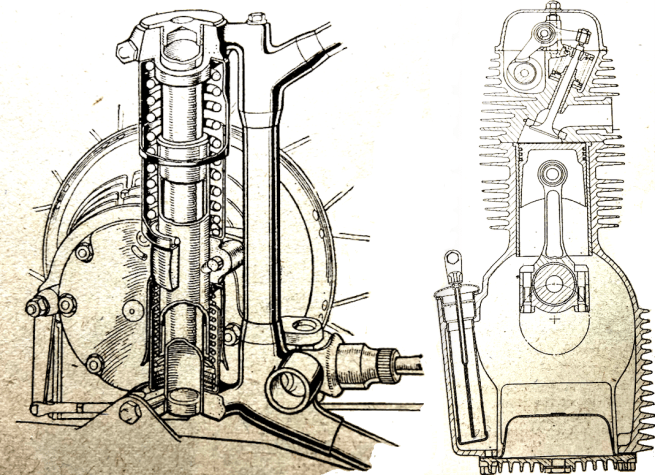
overhead-camshaft engine with the crankshaft in line with the frame, unit construction of the engine and gear box, shaft drive, telescopic front forks, plunger-type rear springing and quickly detachable—really quick to detach—wheels. No bald statement such as this, however, can do the slightest justice to the new design. One of the aims, implied in the word ‘cleanliness’ used by Mr Poppe, has been to ensure an engine that is oiltight and remains so. There are no oil pipes inside or outside the engine unit and no joints which, if broken during overhaul, are likely to seep oil later. A single finned light-alloy casting constitutes the cylinder block and crankcase. Beneath, there is a finned light-alloy sump plate, while above are the one-piece Y-alloy cylinder-head casting with its ten protruding-downwards, fixing studs and, at the very top, a polished-aluminium rocker-box cover…The engine, in its touring form, develops 23-24bhp at its peak, namely, 6,000rpm. It gives a very flat torque curve. Maximum bmep is 128psi at 4,000rpm…The front forks are not, as might be expected, hydraulically controlled, but they are, of course, telescopic forks. They are telescopics with the springs arranged centrally just in front of the steering head, which takes the load direct. In the spring box there is a variable-rated compression spring, with a rebound spring inside. The damping inherent in a plunger system has been found adequate, and this applies also to the rear suspension…Great attention has been paid to the electrical side. Beneath the saddle, mating one with the other, are two separate boxes. On the near side is a ventilated lead-lined box which contains the battery. A
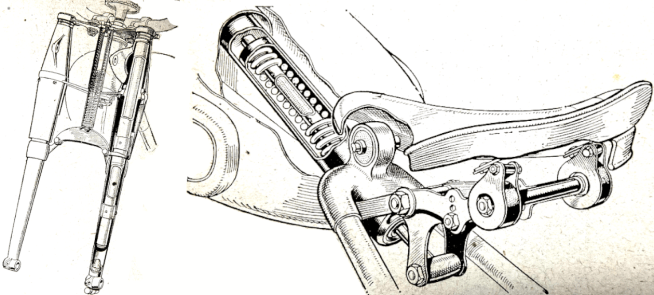
special arrangement of rubber buffers is used to support the latter. In the other box are the coil, regulator and cut-out, and on the outer face of it are mounted the ammeter and the lighting and ignition switch. This last will have a Yale lock. Since the distributor is on the rear end of the camshaft a very compact wiring arrangement results, and there is, of course, complete weather protection. A central rolling-type stand is fitted. This will be provided with a trigger release behind the tool-box. At present the ratchet which prevents the machine rolling forwards is operated by the initial movement of the brake pedal, but operating brake pedals, it has been decided, is something which holds a fascination for many! How does the prototype perform on the road? Already, something been said about its exceptionally good top-gear performance, the delightful gear change and the quiet running. Starting, idling, braking—all are first-class. There has been some roughness in the original engine, a matter that is being investigated. The handling of the machine can be judged from the fact that within minutes of taking over the model The Motor Cycle man was in the 70s. A rider lying down to it can obtain over 80mph. This is with the standard or touring engine. With the rider sitting up tourist-style the machine will hum along at a full 70mph. In view of the discussions on large tyres, the fact that the machine handles so excellently at high speeds is particularly interesting. The 4.75in section tyres…are special motor cycle ones and the rims wide. At low speeds the steering is a little heavier than usual; on the other hand, there is the superb feeling of confidence the large tyres give on icy or greasy roads and the comfort. The machine, with its fore-and-aft springing, is delightfully comfortable. Altogether, the new Sunbeam is a most remarkable design—a thrilling design.”
The first batch off the production line were sent out to the South African police who but returned them with complaints of vibration problems; BSA duly rubber-mounted the engine.
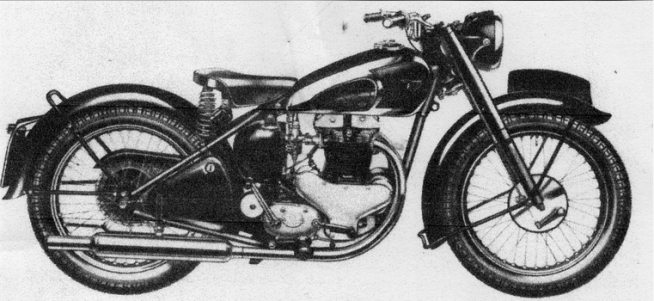
ALSO NEW FROM BSA was its reply to the Triumph Speed Twin: the 500c ohv vertical twin A7. Designed by Val Page, it had a number of features in common with the Triumph 6/1 he had built for Triumph in 1933. Having been delayed by the war, the A7 was launched in the autumn at the first major postwar show, the Paris Salon, where the Beeza twin was seen by more than 800,000 enthusiasts. Inevitably most of the exhibits were pre-war designs though FN did come up with an unusual front fork suspension incorporating steel springs and rubber bands.
TRIUMPH HAD LED the way with its vertical twins; now it led the way again by offering them with sprung-hub rear suspension. It was a clever way of incorporating rear suspensioninto a rigid frame but with only a couple of inches of undamped springing it was a blind alley (and stripping down a sprung hub has ben known to send springs through shed roofs).
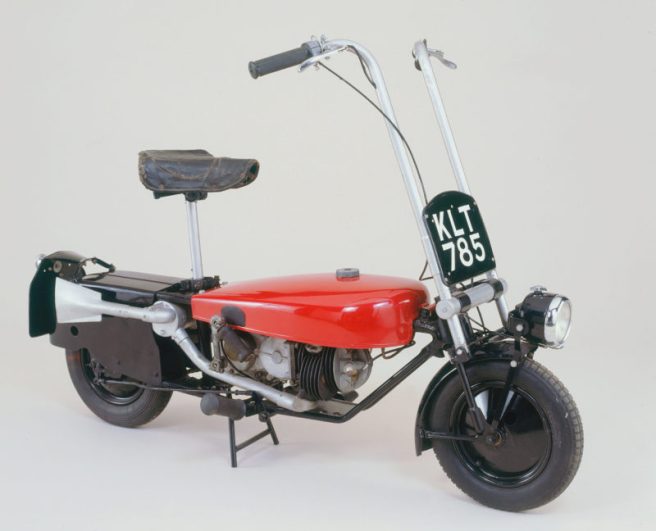
TITCH ALLEN CALLED A MEETING of enthusiasts to form the Vintage MCC, dedicated to the appreciation and preservation of old bikes. They classified machines as veteran (made before 31 December 1914) and vintage (made before 31 December 1930).
THE SUNBEAM MCC TEAMED up with the Belgian Motorcycle Federation to resume Continental road racing with a meeting at Le Zoute. A dozen Brits crossed the Channel and dominated the proceedings. Jack Brett headed the 250s on an Excelsior; Peter Goodman took 350 honours for Velocette (he was the grandson of the company’s founder) and Maurice Cann rode the fastest 500—but it was a Moto Guzzi.
THE NORMAN RANGE, launched in Ashford, Kent, used Villiers power; also new was the Swallow Gadabout scooter, with 4.00×18 tyes, made by Heliwells of Walsall, West Midlands.
IN THE US THE MONROE Auto Equipment Company was offering hydraulically damped telescopic forks; between them Indian and Harley Davidson snapped up the factory’s entire output.
BRANDS HATCH, STILL A grass track venue, hosted an Anglo-Irish match courtesy of the Bermondsey MCC. England’s honour was upheld by the likes of Eric Oliver and Jock West; Irish stars included Ernie Lyons, Artie Bell and Rex McCandless, who was using the swinging-arm frame he’d designed with his brother Cromie. The English scraped a 19-17 victory but the McCandless frame would win renown as the Norton Featherbed.
“THE BOARD OF TRADE are to issue ten additional clothing coupons to a wide range of manual workers in industry and agriculture. How about the motor cyclist with his often worn-out riding kit? Isn’t it time he was favoured with a few extra coupons? After all, motor cycles—and motor cycle kit—are necessities to many essential workers in the country.”
“‘WE HAD OUR FIRST SIGHT of a real post-war motor cycle at the Leinster trial, when Cromie McCandless turned up on a 350 Triumph Twin, complete with hydraulic plunger forks,'” reports the Dublin &DMCC.”
“SHOULD LADIES BE ALLOWED to join the Motor Cycling Club? You may say, ‘Why bring up that old, old question—hasn’t it been discussed time and again and the answer been, “No”?’ The fact is that the matter is to be debated again. Mr FG Eckett has put forward the motion that the ban the Club placed on ladies in 1918 be rescinded and a decision, one way or the other, will be reached at the MCC’s annual general meeting at the RAC next Saturday. Many, I believe, feel that, especially after their work in the war, ladies should very definitely be admitted. Other matters on the. agenda are two recommendations—one that the MCC should affiliate to the ACU in these days when the great need in the sport is unity, and the other that it should become an RAC associate club.”
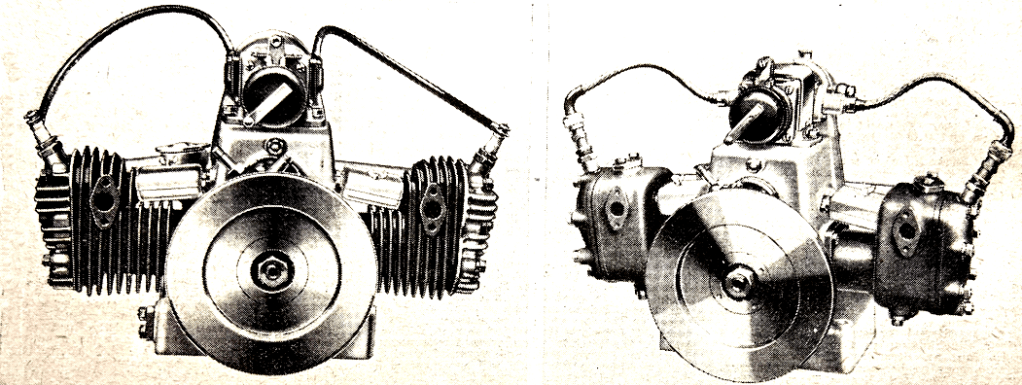
“FOR A TRUE ASSESSMENT of the importance of the decisions reached by the Motor Cycling Club last Saturday it is necessary to know a little of the Club’s history. The MCC, as it is generally termed, was founded in 1901. Even to-day, with its activities curbed by petrol restrictions, it has over 1,000 members. Thus, in addition to being one of the oldest clubs—if not the oldest—in the country, it is among the largest purely sporting car and motor cycle clubs. To the public at large its fame comes from the big Bank Holiday week-end events, the London-Exeter, London-Land’s End and London-Edinburgh trials. Being older than the Auto Cycle Union, which was founded as the Auto Cycle Club in 1903, the MCC did not take kindly to the idea of being ‘governed’ by the ACU. For a period of nearly forty years there was antagonism, which at times flared up into open warfare, even to the extent of the MCC having a ban imposed on a London-Edinburgh Trial. At last Saturday’s meeting the seemingly impossible happened. The MCC decided—not by a snap vote but with the matter announced far and wide well in advance—that it will affiliate to the ACU. The decision was unanimous, and all that remains is to settle minor points. An obvious question is why has there been this remarkable change of front? The answer is simply that all thinking men and women connected with the sport know that it is imperative that all sections of it pull together. On this small crowded island the probable alternative is that there will be no motor cycle sport except that confined solely to private property. That the MCC, in spite of its strength and its 45 years’ history, is no slave to tradition is further emphasised by its decision to admit lady members to its trials. This ban has been in existence since 1918—well. over a quarter of a century. However, the really important matter is the lead the MCC has set the sport by deciding to affiliate with the ACU.
“THERE HAS BEEN TALK of electrically heated clothing, naturally so in view of its employment for flying. A question that has always worried me, however, is whether with our small dynamo outputs there was any hope of adequate heat. Already at night—which is generally when one wants the electrical heating most—the average dynamo set does not provide more than a sufficiency of amps for a good driving light. If we add current-consuming circuits in our garments…A friend who has been into the matter of electrically heated clothing points out that it is not necessary to provide heating elements which keep one hot, but merely to arrange that one does not get cold. He maintains that very few amps are needed for this.”
“WEST AFRICA HAS HAD its first scramble, thanks to that old-time TT rider, Tommy Spann—now Colonel Spann. There were 97 European and African entries from the Gold Coast, Nigeria, Sierra Leone and the Gambia. Primarily it was an Army event, but the Royal Navy and the Gold Coast Police entered two teams each. Four laps of a l¾-mile course were covered…An all-African team, Nigeria’s ‘B’ team, made the best team performance, while Gold Coast won the Inter-Colony aggregate shield. Best individual performance was made by Capt JW Nelson (Sierra Leone), while Lieut W Blake, RN (Sierra Leone) made best time in 11min 36sec. The best African performance was by Sgmn Jabita (Nigeria). When distributing the awards, Lt-Gen Brocas Burrows, C-in-C, West Africa, stated that the event would be held at least once a year and that French competitors intend to take part next time.”
“THE SALE BY AUCTION of surplus vehicles at Great Missenden Depot, Bucks, which begins at 11am next Tuesday, is expected to last four weeks. Approximately 1,000 motor cycles are included in the 7,000 vehicles to be sold, but present indications are that the motor cycles will not come under the hammer until near the end of May or beginning of June; not, at all events, within the next fortnight.”
“CAIRO HAVE ASKED Mr C McEvoy to act as United Kingdom secretary of the famous Bar None MCC. Mr McEvoy (27, Kingsway, West Wickham, Kent) is endeavouring to contact old Bar None members now back in the UK, the idea being to hold an initial meeting as soon as possible. Among the proposals are a London area branch of the club. Possible clubrooms in the vicinity of Croydon have been found.”
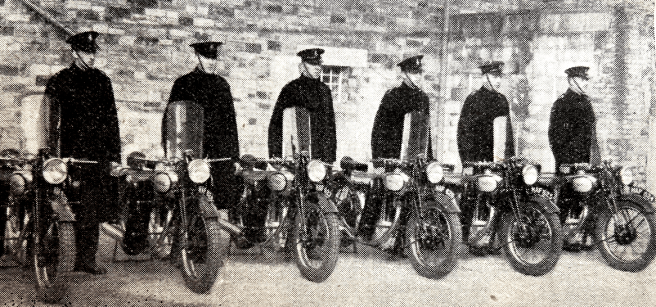
“COME HAIL, COME SNOW, come shine, the testing of experimental models goes on. You know as well as I do the hard weather we have had at times this winter, and how treacherous the roads have been. But during the whole of that time motor cycles have been out on experimental test covering their 200 and 25o miles in the day. A manufacturer remarked last week that even in the worst weather his man had been putting in 250 miles per day. Under good-weather conditions the mileage is around 300. It is extraordinary when you think of a normal working day as opposed to the very long day you and I normally make of it when we cover a big mileage. Three hundred miles a day, over 1,500 a week, 75,000 or more miles a year…”
CARS, HOUSES, AIRCRAFT—no matter what the amenity of life, excepting possibly in the realm of pure sport, the aim is to provide the maximum in comfort and convenience. Such is the age-old trend, and it is to be seen in motor cycles even as in the examples just cited. To-day motor cyclists are finding new front forks which call for no attention at all, not even lubrication, new brakes with click-type adjusters that can be operated in a moment, automatic ignition controls which vary the ignition timing as efficiently as, if not more efficiently than, the most expert can handle the old type of lever. The list can be lengthy, but it is questionable whether there is still sufficient realization by designers that motor cycles are not solely vehicles used for sport and that ownership is not merely the prerogative of the athletic youth in his late teens or early twenties. In these days a large proportion of motor cycles are owned by the middle-aged and others who seek a pleasurable form of transport within their means. The field of ownership has broadened considerably. Whether this is but a passing phase depends upon the industry; it depends upon whether manufacturers study convenience in use in all its aspects. Apart from producing motor cycles which will cover large mileages without calling for maintenance, providing accessible oil fillers, making engines quiet mechanically and as to their exhaust—directions in which big strides have been made—there are such matters as weatherproofing and easily operated stands. Can any motor cycle be termed modern which cannot be parked without effort and be counted upon not to fall over? And how is it that machines which are designed as runabouts are provided merely with narrow ineffective mudguards? It is high time that such machines were offered with efficient leg-shields that look part of the design. It is time, too, that there was a little research in the matter of mudguards which are eyeable yet efficient. If motor cycles are to make a long-term appeal to the many, less dressing-up by the rider is essential.”

“AFTER A LAPSE of seven years, the Ulster MCC staged its famous road race over the Clady circuit last Saturday. The race had a different name and a different course, but there was enough of the former Grand Prix spirit in the air to suggest that probably by next year the event will regain all its past glories. The new circuit turns to the right at Nutt’s Corner on the straight between Ballyhill and Thorn Cottage and leads up to Muckamore by way of Tully and Killead Bridge. From Muckamore the seven-mile straight to Clady Corner, one mile from the start, is included. The resulting 16½-mile circuit was thought to be as fast as the 20½-mile circuit used for the Grand Prix which in 1939 was lapped at over 100mph. But practising indicated that the halving of the fast straight from the start at Carnaughlis to Thorn Cottage, by the turn at Nutt’s Corner, and the comparative acuteness of the many bends in the Tully, Killead and Rectory area had resulted in the new circuit being appreciably slower than the Grand Prix circuit. Even if an entry of the calibre usual in pre-war days had been competing, it seems doubtful whether a ‘century’ lap would have been reached. Saturday’s race was notable for the retirement of all competitors except one in the 500cc class, and for the excellent riding of VH Willoughby, who won the 350cc class at a higher speed than the

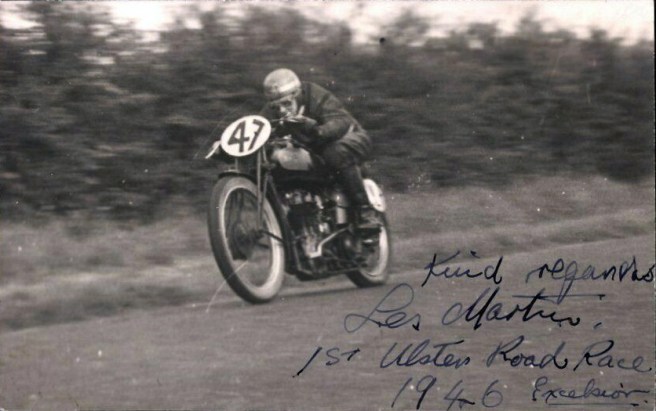
winner of the larger class and who also won the Governor’s Trophy for best performance on handicap. In the 250cc class, LC Martin, from the Isle of Man, repeated his 1939 win in this class. Crowds of spectators lined the course well before the start at 3pm. At mid-day there was a slight shower of rain though not enough to make the roads wet. Nevertheless, billowing clouds moved malevolently across the sky, blotting out the sun and promising rain for the race. By 2pm the sun peeped between the clouds occasionally and raised hopes that the threatened wetness would keep away. Keep away it did, and by late afternoon, when all racing was finished, the sun shone from a clear sky. After the Governor, HE the Earl of Granville, had chatted to riders, the hushed tenseness could almost be felt as the minutes ticked towards 3pm—a hush interrupted only by riders as they made certain bottom gears were engaged and carburettors were flooded. Zoom went the maroon and, after a short patter of boots, the 500s screamed away. One minute later, the 350cc class pushed off, and, after a further minute, the 250s started. As the sound of the last machine died in the distance, a flag-draped Norton, No 50, ‘entered’ by the Ulster MCC, was wheeled slowly past the start in memory of notable motor cyclists who had died on war service. THE 500cc RACE: 13 riders faced the starter, with R McCandless (Triumph), AJ Bell (Norton) and RT Hill. (BSA) in the front row. Hill’s engine fired instantly, and he shot away about two yards ahead of Bell and RLGraham (Norton). The rest went off in a screaming bunch, except J Hayes, who had to push some 50 yards before his Rudge finally got going. Within five minutes came news that RL Graham led from Bell. But at the end of the lap, Bell, riding to expected form, had passed Graham and was a couple of yards ahead. Bell’s time for the standing start lap was 11min 30sec (86.13mph), which promised well, and Graham was announced as
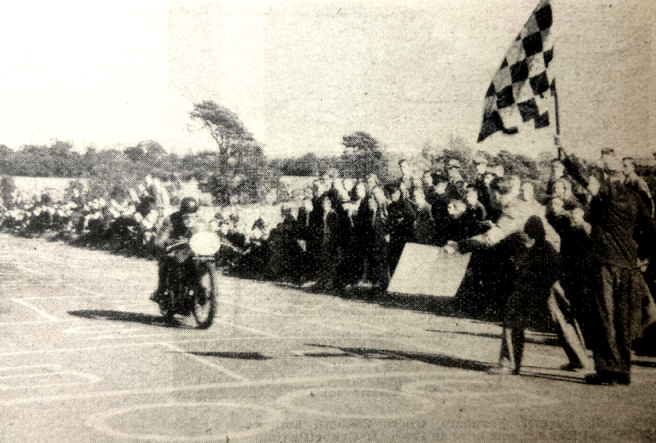
taking one second longer. Well over a quarter of a mile behind came JW Beevers (Norton) and Hill, separated by about 100 yards; then followed S Dalzell (Norton), Hayes, who had made remarkably good time after his tardy start, and R McCandless on his much-modified Triumph. Already retirements—which were to be the curse of this race—had started. S Brand (Triumph) was out within 10 miles due to a seized engine—poor recompense for spending the previous night fitting a replacement cylinder block. E Lyons took his Triumph into the pits after a slowish first lap to fit harder plugs and to make carburettor adjustments. His new Triumph, received less than 24 hours before the race, was fitted with the experimental Triumph spring hub and was on ‘Pool’ petrol. ‘Where are all the 500s,’ everyone asked as Bell streaked through to start his third lap—he was out by himself, which meant that RL Graham had been delayed. Something like two minutes elapsed, during which Willoughby, leading the 350s, passed and faded into the distance before Hayes and RL Graham came through in quick succession. As the hubbub of inquiring excitement mounted the loud-speakers blared, ‘Marshals—stop No 11—he has shed a piece of tyre tread.’ And No 11 was Bell! He was flagged off and forced to retire with only the minor mitigation that his second lap in 11min 9sec (88.84mph) was a record which remained unbeaten during the afternoon. By half-distance, RL Graham had retired, and only six riders were still going strong. Dalzell now led Hayes, and well behind came BM Graham (Norton)—far away were JJ McGovern (Norton) and B Meli (BMW). Hayes dropped out of the running with a flat rear tyre, which left BM Graham second some 3min behind Dalzell. These two were the only riders left in the race with any chance of finishing officially. But no; Dalzell was not to finish—on his last lap he retired with, it was said, a seized engine. THE 350cc RACE: As the sound of the 500s mellowed in the distance, 15 riders in the Junior race pushed off. Though not in the front row on the grid, RA Mead (Velocette) got the best of the start by about 10 yards from TH Turner (Norton) and FJA Nash, who was riding his streamlined Velocette. But it was not long before VH Willoughby (Velocette) had overhauled those who got the beat at the start. He led by 24sec at the end of Lap 1, and in the process of a standing start lap at almost 84mph he had passed many of the larger machines which went off one minute ahead. Second was Mead, and third Nash, followed closely by WS Humphry (Norton), R Lee (Velocette) and TF Tindle (Velocette). Humphry displaced Nash in third place on the second lap, and Lee also overtook the streamlined Velocette. JG Dixon (Norton), a local rider, retired with engine trouble. Meanwhile Willoughby, riding his very quick Velocette in extremely good style (Stanley Woods said so!) and lapping at well over 85mph, was out by himself and, indeed, had disposed of all the 500s to lead the entire field. At three laps he had almost 3min over the leader in the bigger class; and on the next lap, Mead followed Willoughby’s example. In the pits and changing a plug was TH Turner; and also there, but retired from the race, was H Taggart (Velocette). After holding eighth place on the second and third laps, R Armstrong (Norton) toured in to retire. Engine trouble at Tully was reported to have stopped Tindle. Willoughby was going faster and faster. At five laps his average speed was 85.96mph, and his fifth lap speed was 86.89mph—his fastest up to that time. Three minutes behind came Humphry, who had just caught Mead, and both were lapping at rather more than 82mph. Lee was fourth. Nash was fifth, and F Rogers (Velocette) and J Williamson (Norton) were close. Lee passed Mead, who had slowed appreciably, and took third place. Willoughby was still drawing ahead, and one lap from the finish had nearly 4min in hand over Humphry. As five minutes after the first man had crossed the line other competitors would be flagged off, it looked as if there might be no official placemen. With a time of 11min 21sec (87.27mph), Willoughby made his sixth the fastest lap of the race, and his last lap took only 1sec longer. Humphry came home second, and Lee third. Mead, Nash, Rodgers and Williamson followed. THE 250cc RACE: From his front row position, LG Martin (Excelsior) immediately took the lead a few yards in front of H. Hartley (Rudge), G. Dummigan (Rudge) and WM Webster (Excelsior). Long after the field had
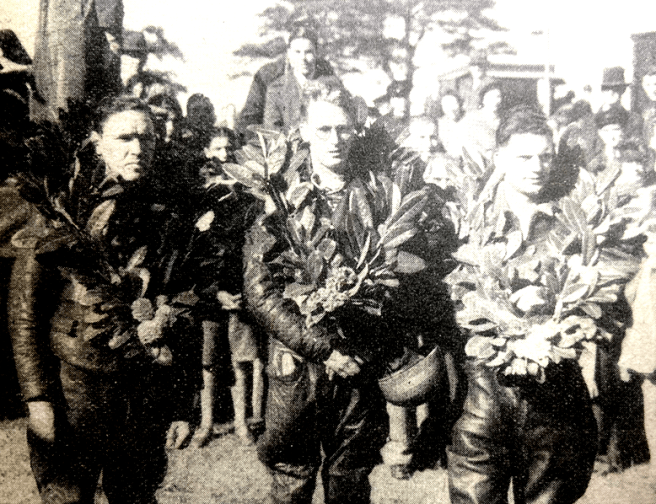
disappeared, W George (Excelsior) was still at the start changing a sparking plug. He got away eventually, but his engine sounded none too healthy. In what seemed to be quick time, but which was in fact 13min 37sec, Martin came through with one lap completed and a 16sec lead over Hartley. C Astbury on his MD Special—mainly New Imperial—was third. Dummigan was fourth, Webster fifth, and JA Dickson (Excelsior) sixth, the last three in very close company. On his second lap (which at 75.61mph was the fastest of the race) Martin had increased his advantage over Hartley to nearly a minute, and Astbury remained third. Dummigan, Webster and Dickson, in that order, were so close together that the order was of no importance. Actually Dummigan led the trio at three laps, and then Dickson was in front on the fourth lap. By then Webster had lost about 200yd, and the scrap ended with the retirement of Dummigan, who was reported to have fallen at Tully. On the fourth lap, too, Astbury stopped near Tully with what was probably a holed piston, and Dickson became third. Martin, Hartley and Dickson remained in that order till the end. Though continuing to slow, Webster finally finished fourth. RESULTS. 500cc Race—8 laps (132 miles): 1, BM Graham (Norton), 75.33mph; fastest lap, AJ Bell (Norton), 88.84mph. 350cc Race—7 laps (115½ miles): 1, VH Willoughby (Velocette), 86.32mph; 2, WS Humphry (Norton); 3, R Lee (Velocette); 4, RA Mead (Velocette); 5, FJA Nash (Velocette); 6, F Rodgers (Velocette); 7, J Williamson (Norton); fastest lap, VH Willoughby, 11min 21sec (87.27mph). 250cc Race—7 laps (115½ miles): 1, LG Martin (Excelsior), 74.71mph; 2, H Hartley (Rudge), 71.64mph, 3, JA Dickson (Excelsior), 67.91mph; 4, WM Webster (Excelsior) 66.31mph; Fastest lap, LG Martin, 13min 6sec (75 61mph). Ulster MCC War Memorial Trophy (best performance by a novice rider): F Rodgers (Velocette). The Wilson Trophy (best Ulster MCC member): FJA Nash (348cc Velocette).”
“WE MOTOR CYCLISTS are commonly supposed to be somewhat solitary and individualistic. Yet what do we find in the South Eastern Centre? Its small though populous territory now contains not far short of 65 separate clubs, all of which despite the heritages of war are at this moment alive and kicking strongly. Nowhere in the whole world has there ever been such a happy, intelligent and vigorous organization of so many motorists in so small a space. Organization of car owners is weak and pallid by comparison. Hats off to the men who run the SEC.”—Ixion.
“A MOTOR CYCLIST accused of dangerous driving was stated to have said when stopped, ‘That’s how I was taught to drive in the Army.’ He was fined £10 at West Ham court.”
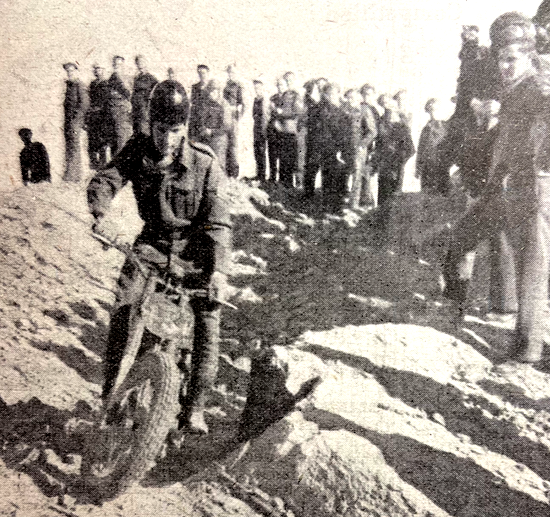
“LOSING ONLY FOUR POINTS out of a possible 120, Sgt Syd Hufton gained the Middle East reliability championship title at the Services Bar None MCC reliability trials. This event was held on the desert at Abbassia, near Cairo. Although the course was not one of the toughest, perhaps, the 12 observed sections included some typical rough country stuff—rocky gullies, steep soft sandy inclines, and real snorting hairpins. Hufton lost his points for footing when turning a sharp hairpin bend on to a loose rocky incline of about one in two. The field of about 70 experienced Army riders included men from the 6th Airborne Division now in Palestine, the Royal Air Force and Royal Navy.
“THE TWO DUTCH TEAMS which are to compete in the Newcastle &DMC’s Travers Trial will be mounted on two Triumphs, two Velocettes, an Eysink and a BMW sidecar.”
“ONE MP’S OPINION of the new Highway Code: ‘It is quite obvious that this pamphlet has been written by a rather intelligent office boy in a kind of language with which he is not quite familiar.’ In point of fact, the new Code is a workmanlike document, though the English could be tightened up here and there. A Welsh MP has asked for a Welsh edition of the Highway Code. He states, quite accurately, that many Welsh people do not understand English.”
“DISMANTLED PLANT will soon he coming from German factories to Britain. The procedure for disposing of this German reparations plant will normally follow the lines of the existing Government surplus disposal schemes.”
“TWENTY-SEVEN BOMBED SITES in Westminster, capable of accommodating more than 1,000 vehicles, are to be requisitioned by the MoT so that Westminster City Council can quickly turn them into temporary parking places.”
“IF RUBBLE IS DEPOSITED on a public highway it is a legal requirement that the use of the highway by the public should be safeguarded. Ordinarily this requires the provision of lights at night.”
“MISS PHYL COOPER, of the London Ladies’ Club, was recently mentioned in despatches. She went into a minefield and rescued a badly injured man. She was in Austria.”

“A KENT PARISH COUNCIL has decided to ask the local Chief Constable to replace the village policeman’s motor cycle with a pedal-cycle. The chairman of the council thought that a burglar would lie low if he heard a motor cycle approaching. The constable, according to report, has other ideas—he wants to keep his machine.”
“SCORES AND SCORES of lads back in Civvy Street from the Forces are finding that owing to the paper rationing they cannot get their copy of The Motor Cycle even now that they are back home. We are receiving letter after letter from such lads begging us to help. Until the paper ration increases it is, of course, quite impossible for us to help except with your help. Will you act the good Samaritan—will you do a real good turn by letting one of these lads have your weekly copy after you have read it? Just as with our Servicemen’s scheme, all you have to do is to drop me a postcard at Dorset House, giving your name and address and saying ‘I will’, and, after we have given you the address of a lad, put wrappers round the copies and post them off. The postage on a single copy open at the ends is 1d.”
“MR EDWARD TURNER, of Triumphs, considers that Great Britain manufactures a good 75% of the world output of motor cycles, now that France and Germany are no longer grinding out motor-assisted bicycles by the tens of thousands. Oddly enough, we are the biggest consumers (in a good sense), as well as the biggest producers. Still more interesting is the fact that of Britain’s exports few are intrinsically so beneficial to the nation as motor cycles. The ideal export is one which brings in the largest amount of cash for the smallest loss of raw materials. A small car brings in as 7d per lb of raw material. A motor bicycle brings in 5s 5d per lb of raw material. Naturally we are making hay while the sun shines, but a day is not far distant when all our motor exports will show marked shrinkage. These foreign markets are not insatiable. I wonder how home prices will fare when the brakes go on to exports?”—Ixion
“TWO HARROW BOYS pleaded guilty at Missenden (Bucks) court to stealing £10 of motor cycle parts from the surplus dump at Great Missenden. The cases were dismissed under the Probation of Offenders Act.”
“MR SHINWELL (MINISTER OF FUEL) said recently that the only forged petrol coupons in circulation were basic coupons, and the number was insignificant. During a forged coupon case at Hove, it was stated that a large number of forged petrol coupons were circulating. Asked whether he could improve the petrol ration, Mr Shinwell said: ‘With the greatest of pleasure, if circumstances justify it.'”
“A READER SENDS us an extract from a letter received from his brother in Burma: ‘Mother sent me The Motor Cycle in her parcel, and after I finished reading it I laid it on my bed and went to tea. On return, I found four or five Japs all reading it, and, by the excited chattering, I imagined they were very interested!’ The Japs were working on the Burma to Siam railway.”
“WHEN A MOTOR CYCLIST was fined £1 at a London court for riding a machine in a dangerous condition, a police officer stated that the clutch cable was broken and one end was held by a pillion passenger. When the rider wanted to change gear he shouted to the passenger. The Clerk: ‘Quite a Heath Robinson affair.'”
“ON JUNE 27TH AND 28th about 150 motor cycles will be sold by auction at the NFS Depot, Muller Road, Horfield, Bristol, starting at 11am. The machines include AJS, Ariel BSA, Douglas, Matchless, Norton, Royal Enfield, Sunbeam, Triumph and Velocette. View days are June 25th and 26th from 10am to 4pm. Admission to view and to the sale will be by catalogue obtainable, price 6d, from the auctioneers, Stanley Alder and Price, 7, St Stephen’s Street, Bristol, 1…Further auction sales of surplus motor cycles will be held in Sutton Coldfield (175 motor cycles, solo and sidecar, including AJS, Ariel, BSA, Matchless, Norton, Royal Enfield, Rudge, Triumph and Velocette… Sheffield (66 solos and sidecars) and Liverpool (28 solo motor cycles, including AJS, Ariel, BSA, Norton and Royal Enfield).”
“IMPRESSIONS OF THE AUCTION Sale of Government Surplus Machines at Great Missenden Last Week: A windblown soaking drizzle swept across the surplus vehicle fields at Great Missenden, making the grass sodden and turning the tracks into greasy quagmires. It takes more than mere rain, however, to discourage the true enthusiast from seeking a model (at a price within his purse) that will carry him for many happy miles over the winding roads of England. Along a muddy track, then, under the sullen skies, the would-be buyers trudged to the neat phalanx of machines parked in a fold in the ground. There, with the wet wind gusting round them, they bent down and examined models, tested compressions, made comments to their friends, and wrote notes in their catalogues. All the types that go to make, up the motor cycle world were there: a girl, wearing an azure-blue mack, with her young ma ; the young tousle-haired enthusiast, wearing an old Stormgard; the keen-eyed young man who subtly conveys the impression of
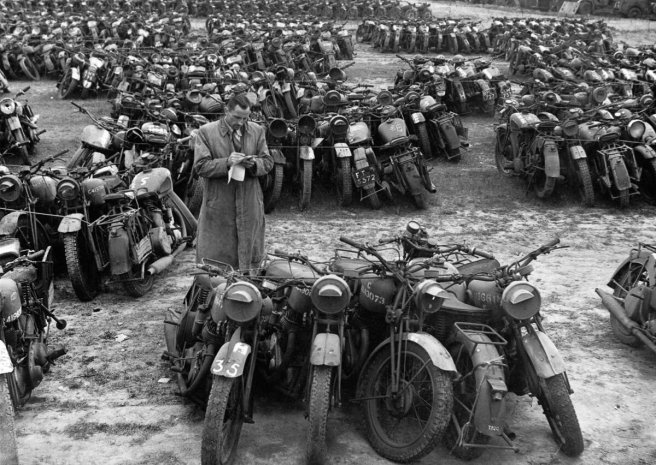
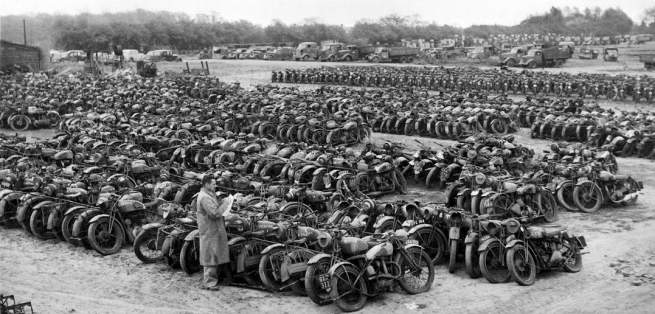
having covered big mileages in his time; the older man who is still under the spell of two wheels; and the shrewd, watchful dealers. Most noticeable of all, perhaps, was a blind man with a white stick. He was with a younger man, possibly his son, and they spoke softly together. What was this model? the blind man asked, and the other told him. The blind man gently praised the machine for its simplicity of design. He felt the wet metal carrier of a sidecar outfit, and ran his fingers over the saddle top. He asked its make. It was an Indian; perhaps the unusually smooth top of the American saddle puzzled him. The windy drizzle never stopped, but still the procession of would-be buyers slowly circulated among the dripping machines, making notes in sodden catalogues. Then the auction was due to begin, and the field was cleared. Damp men, and one or two women, assembled in a large double Nissen hut close by. At eleven o’clock precisely the observant auctioneer rapped sharply on the edge of his rostrum and started the sale. He reminded his audience of the conditions, and that the bidding was in guineas. The first two machines, 250 ohv BSAs, fetched 50 and 55 guineas. A side-valve ‘Lion’ Sunbeam ran up to 75 guineas. The staccato monologue of the auctioneer rarely seemed to cease. ‘A Rudge, gentlemen, anyone start me at 40? Then 30—I have 32½—35—37½—40 over there. Now 42½ over at the back—5—7½…47½, say 50 for it, 50 for it—in the middle at 50—in front here at 52½, 52½, 52½.’ The hammer fell. The buyer came forward to pay his 25% deposit at the table. There were over 300 machines on the list, mostly grey-painted models formerly used by the NFS. Slowly, relentlessly, the machines were sold—modern BSAs, New Imperials, Triumphs, Nortons, Matchlesses, Ajays, Velocettes, Panthers, Ariels, Indians. Though they had stood in the open for several months, the majority, it seemed, were in fair condition—but the buyer, not hearing them running, took his chance. The run of reasonable ohv models fell to the hammer at somewhere between £65 and £75, the less good machines and side-valves often at something round the £55 mark. A Triumph with twisted forks sold for 90 guineas; a springer Norton for 95; a springer Ariel for 87; an Ariel Four, somewhat rusty, for 105 guineas. After a big price a low murmur ran through the crowd. When about 170 machines were sold there came an adjournment for lunch. There was another auctioneer in the afternoon, with an amazingly quick-fire style and with the habit of dropping odd little remarks into the stream of his patter. A woman started to bid, and the auctioneer seized on the fact. At last she bought a BSA for 50 guineas. To an unlucky bidder, he remarked quickly, ‘I hope you get one in a minute.’ Once, in the heat of the fray, he mistook a bid—’Bloke blowing his nose—always dangerous!’ There were a few sidecar outfits under the hammer towards the end. BSAs, Triumphs and Ariels with box sidecars fetched around 85 guineas, but a surprise came when three Indian outfits reached 115, 112½ and 115 guineas apiece. Admittedly, they seemed to have covered only a small mileage. A Norton with the well-known battle-chair’ brought 77½ guineas for HM Government. The sale drew to a close. Outside, the dirty weather of the forenoon had blown itself out, and great golden galleons sailed in the sky. A little procession wended its way across the Missenden fields again. Some indulged in a true British grumble. Prices, they averred, had been. fantastic; it had been a dealer’s day, but how the aforesaid dealers hoped to make a profit after the prices paid was more than the critics could imagine. But others were exultant. After a long exile from the saddle, they owned machines again, and thoughts for the future were twirling in their heads. A few hours in the workshop, and it would be the open road again…Glorious!”
“THE DEMAND FOR motor cycles is so keen in some country districts that an auctioneer claimed that he could get double figure bids for ‘anything with two wheels which would make a ticking noise’!”
“THE HIGHEST PRICE paid at a sale of Government surplus machines at Newcastle was £115 for a 500cc Triumph Speed Twin.”
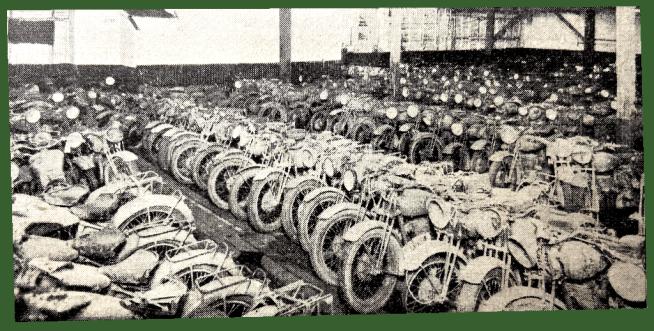
“ONLY 294 FRESH SIDECAR outfits were registered in March, the latest month for which official figures are available; the previous month the total was 164. The number of passenger three-wheelers for the two months was 33. From these figures the unknowledgeable might gather that the popularity of sidecars and three-wheeled runabouts has waned, especially when it is noticed that in one month the new registrations of motor cycles amounted to 4,746 and in the other, 6,996. Whereas sidecar outfits accounted for more than 1 in 5 of the total registrations pre-war, now, as regards new machines, the proportion is only one sidecar outfit to roughly 26 solo machines. The fact, of course, is that thousands want sidecars, but cannot obtain them. On the face of matters it is extraordinary that the production of sidecars lags so far behind. Over three-wheelers there is unlikely to be a market of the 100,000 category—the figure for sidecar registrations at the outbreak of war—unless some manufacturer comes forward with a simple, inexpensive runabout of wide appeal. There is, however, a small, but enthusiastic section which seeks connoisseur-type machines. Other than the ubiquitous pillion seat, the sidecar, it seems, must remain the mainstay of passenger motor cycling, and to-day, with the high prices of cars, there is emphasis upon the sidecar unknown since the 1920s. It would be folly not to capitalise the handy, safe and inexpensive sidecar. Analysis of the registration figures so far available for this year reveals how autocycles and especially 125cc motor cycles are striding ahead. In the first three months 2,994 machines below 150cc were registered, as against 1,533 of 150-250cc. By adding exports to new registrations it is found that over the three months—January to March—for which official figures are available, there was a total of 24,742 machines; an average of nearly 100,000 new motor cycles a year. Since then production has increased considerably.”—Ixion
“FROM MEN RELEASED from the Forces comes the heartcry, ‘Give us motor cycles at prices we can afford.’ From others comes the impatient query, ‘When, oh, when, will there be four-cylinder, shaft-drive motor cycles?’ There could hardly be two more divergent demands, but in these extremes lies in large measure the future of the motor cycle industry. Today many enthusiasts find that they cannot afford motor cycles of the type they desire, and prices, instead of showing signs of easing, are on the upgrade. All along the line there are increased costs—materials, components, accessories and in the motor cycle maker’s own factory. Added emphasis is thus being placed upon the design and manufacture of machines which people can afford to buy. On the other hand, there is a proportion of riders in this country—a much larger proportion of motor cyclists than was the case immediately before the war—who can afford luxury motor cycles of truly modern design. And such motor cycles can have an important sale overseas. Further, motor cycles which are better and more appealing than the best any other country has to offer are essential to Britain if she is to hold the position of the greatest motor cycle country in the world. Producing motor cycles on the same old lines, but with two cylinders instead of one will not be sufficient. This, bluntly, is the position. The present period of hungry markets could be dangerous with an industry less live than the British motor cycle industry. To-day is the time when, as it knows, research and development need to be at something close to fever pitch. It has been said that the successful manufacturers will be those who can offer inexpensive motor cycles with specifications which, in spite of low cost, are outstandingly attractive. Here, obviously, lie the big sales, but if there is to be a healthy motor cycle industry, backing them up must be motor cycles which are as modern as the hour.”
“THE FIRST RHINE ARMY trial to be organised by the Motor Cycle Sub-Committee of the BAOR Sports Board took place near Bielefeld. All keen Army motor cyclists had been looking forward to this event since the provisional date was fixed in January last. Units all over the British zone had spent much spare time at evenings and week-ends in steady practice which proved both interesting and instructive. Trials had been organised on a Divisional level for the purpose of giving riders experience and to enable representative teams to be selected. These motor cyclists of the Rhine Army are as keen as any clubmen at home.”
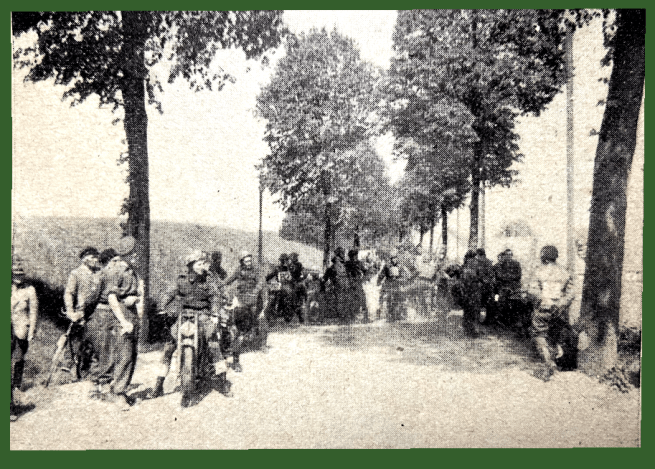
“IN THE LATEST Board of Trade list giving German industrial capital equipment available as reparations, I notice two BMW factories—No 1 at Munich and No 2 at Allach, near Munich. Both are listed as aircraft engine plants, but in quoting 1938 output figures No 2 factory is credited with motor cycles to the tune of RM 17,700,000. Off-hand, I do not know how many machines that figure represents, but I should think it must be well over 10,000. I wonder if any British firm will make a request for the plant? It does not follow, of course, that a request will result in the plant, or say the motor cycle part of it being obtained. Reparations are allocated to the Western Nations by the Inter-Allied Reparations Agency and the United Kingdom delegation, on the request of the MoS, has to bid against the other Western Powers.”
“AS I WENDED my way homewards from the office, first one whelp sought my calves, then a larger cur and, thirdly, a big dog. All this happened in under three miles. In the case of the first, it being small, I lashed out with my foot; finally, it was called off by its owner, who, I sincerely trust, duly cuffed it. For the second, I slowed clown and did a bit of man-hunts-dog, but the dog’s turning circle was appreciably smaller than that of my solo motor cycle…To beguile the big dog, Ixion’s pet hint was adopted: I pretended to throw a stone and the dog skidded all four paws. After this series of experiences, all in under three miles, one might decide that a whip is a desirable accessory, but how many miles had I covered previously without a single cur dashing out at me ? Probably, several hundred.”
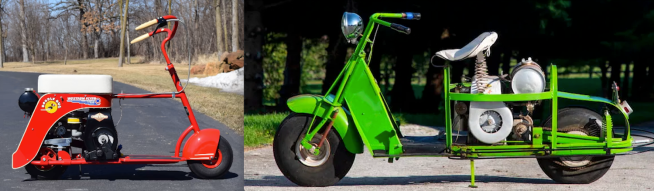
“NEXT MONDAY AT 5.45 in the morning the curtain lifts for one of the biggest series of road races ever held. The event, of course, is the Manx Grand Prix, the first post-war Isle of Man races, with its record total of 187 entries. The practising over the famous 37¾-mile Mountain circuit in the Isle of Man will be held from August 26th to September 2nd between 5.45 and 7.30am except on Sunday, September 1st, when there will be no practice period, and next Thursday, August 29th, when the practising will be in the afternoon, from 2.30 to 4.30. We are glad of this last innovation. For several years immediately pre-war there was afternoon practising for the Tourist Trophy Races, and it is only right that those in the ‘non-professional’ Isle of Man event should have the benefit of trying their machines at a period of the day when riding and atmospheric conditions are likely to be akin to those during the hours when the races are run. For the Senior, the 500cc race, which is to be run on Thursday, September 5th, there is the magnificent entry of 84 competitors. For the Lightweight (250cc) and Junior (350cc), which are to be held concurrently on Tuesday, September 3rd, there are respectively 40 and 63. Happily, the Isle of Man authorities have succeeded in overcoming the difficulty over the supply of fuel, but the petrol will only be standard ‘pool’, and, what will also reduce average speeds in the races, competitors will have to refuel from two-gallon tins. Is it not possible even at this late date to arrange for ‘Jerricans’, of which there must be thousands lying by in WD stores?”
THE MANX GRAND PRIX attracted 133 riders; most of the bikes were pre-war models detuned to run on low-octane pool petrol. As expected, Ken Bills won the Junior for Norton but in the Senior Ernie Lyons’ sprung-hub Triumph beat Bills’ Norton into second place. Lyons had teamed up with Freddie Clarke (who had been 350cc lap record holder at Brooklands on a Triumph) to graft an ally top-end from a wartime Triumph generator engine onto a Tiger 100 bottom end. Despite a broken downtube Lyons’ sprung-hub Triumph won by more than two minutes; in pouring rain he set a fastest lap of 78.8mph, compared with Bills’ 1938 record lap of 86.31mph. This was Triumph’s first Isle of Man victory since 1908. Triumph designer and MD Edward Turner said: “Triumph will now take an active interest in racing—provided it doesn’t interfere with normal production.” In the Lightweight race LW Parsons gave Rudge what would prove to be its final Manx victory.

“I WAS INTERESTED in Mr GP Abraham’s letter in which he says ‘there would appear to be a wide field for a good living for Army-trained mechanics.’ Well, I am an ex-RASC First Class Vehicle Mechanic with six years’ experience, and a pre-war driver mechanic, but I have found it impossible to secure employment as a mechanic. It seems as if the various firms I have tried have a poor opinion of Army-trained men because they nearly always reply to me, saying, ‘Sorry, not enough experience,’ which I translate as ‘we don’t want Army-trained men.’ I would like to add that this letter applies in general to the motor trade.
Disillusioned Army Mechanic, Liverpool.”
“I HAVE READ with great interest your Leader about the future of the German motor cycle industry. The official reason given for the 250cc engine capacity limit is to me rather out of date. I can hardly believe that modern jet-propelled aircraft can still benefit from motor cycle engine development when I consider the obsolete designs to which the motor cycle industry is sticking. There are, of course, infinitely better reasons, and I would not be surprised if British manufacturers have had their say in the matter. That is perhaps as it should be, but, does it mean that we, on the Continent, who otherwise have learned to appreciate British finish and quality, will have to ride on the obsolete chain-driven, rigid-framed, flimsy-saddled single-cylinder motor cycle for ever? Luckily, the Sunbeam concern is getting out of the rut and is to be congratulated for their wonderful new design. I only hope that other people will follow their lead (let them not forget the very poor road conditions we have to contend with as a whole on the Continent) and make motor cycles on which we can enjoy motor cycling without being shaken to pieces. By the way, let me congratulate you on your excellent magazine, which I have enjoyed since 1934.
H Turquin, Antwerp, Belgium.”
“AFTER 22 YEARS of motor cycling and car driving I have at last to write a letter re ‘our’ sport. Having been a pilot during the war 1 have now succumbed to the joys of a 1946 3T Triumph Twin. What a bike! Smooth and silent, with all the performance one desires and only one criticism to make—the omission of a prop stand. As I use the machine for business in all weathers, with frequent stops, I am constantly searching for kerbs of convenient height to rest the machine against, not being a superman. I wonder if anyone will be enterprising enough to found a club for Triumph Twin owners? I should imagine a club run mainly on social lines would score an instant success with the Twin owners.
C Harris, London, SW4.”

“I HOPE THAT by 1948 there will no longer be any need to ban superchargers—any more than to ban four-speed gearboxes or internal expanding brakes! If speeds are too high for the course, then the natural remedies are to reduce capacities or increase the distance. To ban superchargers is to encourage (1) the ‘thumping single’ and (2) domed pistons, which make the combustion chamber of inefficient shape and preclude adequate valve lift. With supercharging you can have a flat-topped, or even concave, piston, giving unimpeded flame travel, with no great hump of piston for the flame to negotiate.
NF Eady, Newport, Mon.”
“WHY DO SO MANY motor cyclists write nagging letters concerning features which just can’t be embodied on their machines? I think the British motor cycle to be the finest in the world in every way. I have had 20 machines of all types, and never did I find one that could not be made comfortable to ride. I suggest that the grousers do a little work on their machines for which they will be more than rewarded. Manufacturers cannot meet everyone’s requirements, but I do agree with Mr Pratt about mudguards and prop stands—these are simple items.
Speed Twin, Leeds.”
“THESE PICTURES SHOW how one club—the Furness and District MC—spend their annual holiday: loaded with tents, they converge upon Wallend Farm, below Langdale Fell, in the Lake District: there they thoroughly enjoy themselves.”
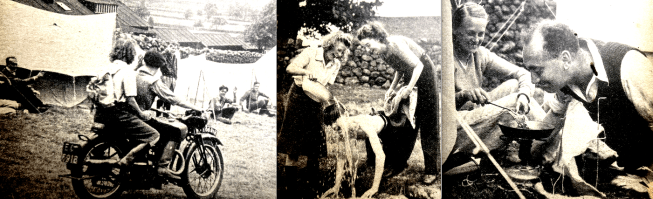

I FEAR THAT manufacturers will read such letters as that of Mr Henry Welsh and believe that the points contained therein is popular demand—and not just a craze of the few. I cannot guess the cost or the weight of a bike tilted with: Self-starter, plus the necessary large-capacity battery and bigger dynamo; footboards; handle grips for pillion rider; anti-thief device, etc, etc. So far none has asked for a pipe-rack or an ash-tray. Even Ixion pleads on behalf of the ham-footed and wants a gear-change on the handlebars—as if we don’t have both hands full. My advice is—leave improvements and modifications to the manufacturers, the racing men and the club enthusiasts. Thanks to them we have the masterpieces—motor cycles which are, in fact, the finest motor cycles in the world.
Notta Clubman, Comrie, Perthshire.”
“IN ANSWER TO Mr Welsh (this is the first time I have ever written to The Motor Cycle in the 32 years of being a reader), all the points he mentioned have been incorporated in various machines over the past 26 years. Surely his Norton fulfils his requirements to carry him safely to and from work, and tour in comfort. The extras he asks for can be supplied from the makers of his machine. As regards spring frames, the Royal Ruby, ABC, Coulson-B, H Matchless and Edmund-JAP are a few of the makes that had the over 20 years ago. FN, GSD and Douglas had shaft drive years ago. Footboards went out of date along with the petrol-gauge era. Oil gauges are not reliable. Electric starters are a washout—the weight and battery are against them. Pillion-seat handle-grips are a nuisance to the rider and get in the way of the passenger’s knees. Finally, what manufacturer is going to produce a machine to suit MrWelsh who has (he says) only a limited pocket? No, Mr Welsh, you are going to learn a lot now you have joined the finest ranks in the country.
P Webb, Maidstone, Kent.”
“MY COMMENTS LAST WEEK on fuel have raised a query or two about where all the henzole goes these days. The point made is that as benzole mixtures are not now sold from the pumps, does it mean that the output of benzole—produced at home, remember—is below pre-war? The short answer is ‘No’. In point of fact, benzole is being made in large quantities, but is blended in with Pool. Normally, therefore, the gas companies and other works with coke ovens send their benzole to the nearest petrol installation, where it goes in the mix. This accounts for the variations one sometimes notices in the anti-knock properties of Pool fuel. Generally, Pool is about 70-octane, but is sometimes raised to as high as 72-octane by the local benzole” [Yes, gentle reader, Britain used to produce its own ‘motor spirit’ from coal…don’t get me started—Ed.]
SUBARU, BEFORE LOSING its way and taking the four-wheeled path, came up with the Rabbit, based on the American wartime Powell scooter as issued to US airborne troops. Mitsubishi also dabbled in two-wheelers with the Silver Pigeon, based on the US Salisbury scooter.
IN A BID TO REDUCE production costs the FICM banned superchargers. This ended the development of blown racers from Britain (AJS, Velocette and Vincent); Germany (BMW and NSU); and Italy (Gilera and Moto Guzzi).
ACU SECRETARY TOM Loughborough stood down after 30 years, handing over to assistant secretary Tom Huggett. Loughborough stayed on as secretary-general of the FICM.
A CAMMY 250 in road or race trim came courtesy of Parilla, a new name on the Italian market. The racer was fast, but not as fast as Guzzi’s Albatross.
BY YEAR’S END there were nearly half a million machines on British roads: double the 1939 total.
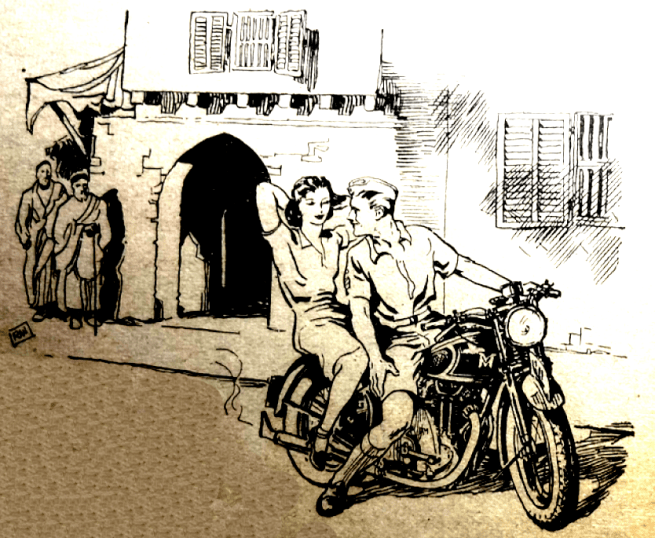
“JOE CRAIG, MSAE, MIAE, who was Norton team manager during the years in which Nortons had the most remarkable run of racing successes in the history of the game, is going back to Bracebridge Street. He has been appointed technical director…his success as a development engineer was reflected in the way year after year Nortons won nearly all the classic road races in which they competed, the unblown singles on many occasions beating blown twins. The future should be interesting…”
“W1TH THE DEVELOPMENT of more multi-cylinder designs the problem of noisy motor cycles diminishes. However, while modem twin- and four-cylinder engines are themselves commendably quiet, this very fact brings into prominence other sources of noise which can be equally irritating to the rider though perhaps not to the general public. The principal source of noise remaining for attention is the transmission; clutches, gear boxes and chains, particularly rear chains, on some otherwise quiet machines could well receive more attention from the designer. Fortunately, there are indications that the coming year will see designs which apart from being more efficient will cut dawn clutch and gear-box noise to a minimum. There remains the rear chain which, if it is to be retained in preference to shaft drive, requires to be given a better method of lubrication than is current practice.”
“BY USING SEWAGE gas—methane—in its fleet of municipal transport vehicles, Croydon Borough Council is saving 85,000 gallons of petrol a year. It is said that there is much less carbon formation in vehicles using methane.”
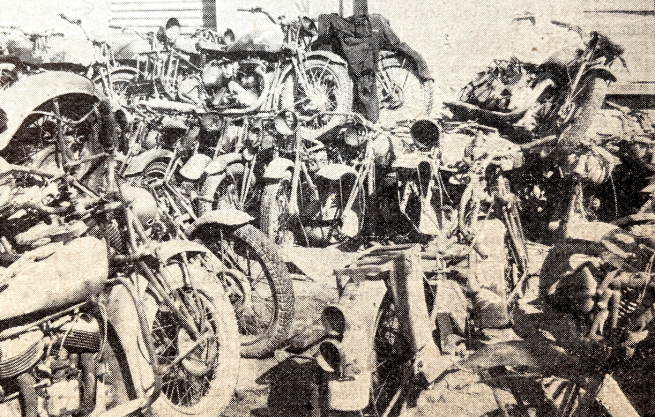
“THERE IS NOWADAYS, an almost club-like gathering of motor cyclists outside many of the dealers’ showrooms in the evenings and on Saturday afternoons.”
“AT AN ALLEGED poaching case in Suffolk, it was said that a motor cyclist drove his machine at night among some rabbits, while his companion on the pillion shot at them. The head lamp dazzled the rabbits, it was stated.”
“THERE WERE FEWER fatal road accidents in 1945 than in any year since 1926. Number killed in 1945 was 5,256; in 1926, 4,886. Next best year was 1927, with 5,329 deaths.”
THE BLUE ‘UN’S roadtester was impressed by the “cradle-framed” Norton ES2. The plunger-sprung, tele-forked ohv 500 (which, by the 1970s had acquired the soubriquet Easy Two) was not in the same performance lead as its cammy stablemates but The Motor Cycle scribe reported: “Not once but several times I found that the machine had tucked some 50 miles into 60 minutes—had done so without the rider seeking specially high averages. And it is a safe motor cycle in another aspect; the brakes are some of the best I have used. They are extremely light in operation, but relentless in action. There is no roughness, but retardation that is foreign to all but outstandingly well-braked spring-frame machines. When the brakes are applied there is no rear.wheel bounce. The wheel remains on the road to provide one with stopping power. Both the front and rear suspension are comparatively stiff and show their full value when the machine is driven hard…handling on corners and at high speeds has been remarked upon; at the walking speeds which are so often a feature of town work the steering is particularly good. The rider can trickle along feet-up at speeds which the speedometer will not register and, starting off from rest, he will have his feet on tho footrests immediately the clutch begins to bite…To put the machine on the stand, all that is necessary is to place the right thigh against the cheek of the saddle and give a quite-gentle push backwards. The weight of the machine with a ‘full’ oil tank and the fuel tank rather more than two-thirds full came out at 3991b. Twin feel taps are fitted to the tank, so there is no need to drain the tank should it be desired to remove it. This last is one of the many little refinements found on the machine. For instance, the rear brake pedal is adjustable for angle by means of a stop; there is a very neat speedometer panel mounted at the top of the telescopic front forks, with the speedometer dial in just about the ideal position; the control cables run through rubber-bushed holes in the panel; a rubber-mounted type of Lucas battery is fitted, which means that the cells are readily accessible for topping up; there are excellent ‘tommy bar’ filler caps; and hand adjusters of effective type for brakes and clutch; an unusually comprehensive tool-kit is provided; the rear-chain adjusters are really accessible, and the back portion of the rear mudguard is quickly detachable.”
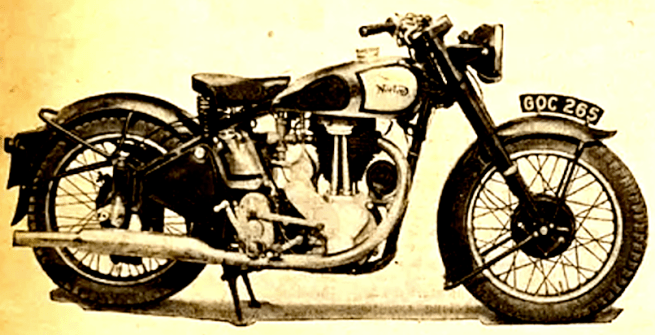
A YEAR AFTER THE END of the war motor cycle clubs were booming, despite the shortage of fuel and new bikes. A single issue of the Blue ‘Un included exactly 99 items of club news; here’s a selection. “Dittons MC: June 14th, Social evening, Swan, Hampton Wick, 8—all welcome; 16th, Whipsnade (Hampton Ct Stn, 10.30). Southport MC: June 16th, Rochdale hill-climb. Bexleyheath &DMCC: June 16th, Cricket match (Blendon, 2.30); 19th, Clubnight, Crook Log, Bexleyheath. East Lancs MC&LCC: June 16th, Competitive mystery run (Clubroom, 1.30); 19th, Quiz vs Bolton Club (Clubroom, 9). Scunthorpe MCC: June 16th, 2.30, Grasstrack meeting, Manor Farm Field, Burringham R., Ashby, Scunthorpe. Rochdale MC: June 16th, Hillclimb. Sunbury &DMC&LCC: June 16th, Grasstrack meeting (HQ, 1.30). South Reading MCC: June 16th, Main Road Trial. Clubnights: Mondays, 8. West of England MC: June 16th, at noon, One Day Trial. Start and finish: Bickleigh Bridge, nr Tiverton, 40-mile course. Pyramid Display Team: June 15th Sports meeting of Joseph Lucas. South Liverpool MC: June 17th, General meeting, Bradford Hotel, 7.30. Cambridge University AC: June 15th, noon, Road race meeting at Gransden Lodge Aerodrome. Clubs taking part: Louth, Derby, Cambridge Centaur, CUAC. Course: 2.15 miles. Each race—3 laps. Gransden Lodge airfield is near main Royston-Huntingdon rd, 1½ miles from village of Caxton (route marked from Caxton). North vs South Challenge Championship Scramble will be held on July 14th, 1pm, on private property nr Horsham owned by Horsham &DMCC. Dublin &DMCC’s Skerries ‘100’ handicap road race takes place at Skerries, Co Dublin, on July 6th, 3.30, 14 laps of 7.1-mile course. Any British competitors will be allowed a basic ration of petrol. North-East London MCC: June 16th, Run to Science Museum, S Kensington (outside Museum, 2.30). Wimbledon &DMC: June 16th, Southern Sporting scramble (What ‘0 Café, Shannon C, 10.30). Coventry & Warwickshire MC: About 4,000 spectators saw the Mountain hill-climb. The final of the 350cc event was a terrific race between J Lidgate (Velocette) and W Smith, R Carvill and ST Barnett, all bunched together. Lidgate won.Nearly 3,000 attended the event. Portsmouth MC&CC: June 16th, Six Months Cup competition (Bastion, 2); 18th, Monthly meeting (Tramways Hall, 7.30). Caterpillar MC: June 20th, Visit Tottenham Club’s Clubroom (arrive at 8). Otter Vale MC: W Mill (Ariel) won the novelty run, which was very enjoyable. Club team was third in the SW Centre Team Trial. Southern Sporting MCC: June 16th, Club’s O/C scramble, Bagshot (all officials, etc, at Lupin Cafe, Bagshot, by 8.30). These scrambles are being held by the club on dates originally allotted for grasstrack events. The club was debarred from using the grasstrack venue intended, and an alternative site has yet to be found. Canadian Motor Cycle Association: This newly formed Association is intended to be a kind of ACU of Canada. All rules passed must be approved by a majority vote of affiliated clubs. Officers are voted to their positions by representatives of affiliated clubs, and all work is voluntary. Started by pre-war competition riders, it is stated that the Association now represents the majority of clubs. It is hoped the CMA will eventually represent all Canadian clubs and riders, with local Centres in each Province. A summer programme is being completed, and US riders have been cordially invited to compete in any of the CMA competitions. Scott MCC (Manchester): A club for all Scott enthusiasts is being formed. The first meeting will be held on June 19th, 7.30pm, at the Scott Depot, 47, Chester Road, Deansgate, Manchester. British Two-Stroke Club (Manchester Section): Resumption of activity is indicated by a general meeting to be held on June 20th, 7.30pm, at the Scott Depot, 47, Chester Read; Deansgate, Manchester. The Manchester Section of the BTSC has been kept in being throughout the war by means of correspondence and lengthy bulletins issued at intervals by sec A Olerenshaw. 1st Glos Battalion HGA MC&LCC: June 22nd, 3, 0/C scramble, Prestbury Hill, Upper Hill Farm, Mill Lane, Prestbury, nr Cheltenham. Usual classes, and standard-machine race. Moseley &DMCC: Clubnights, Thursdays, 8.30, at Kings Arms, Alcester Lanes End. Next grasstrack meeting on June 30th. Sidcup &DMCC: June 16th, Closed Conducted Trial starts from Johnson’s Café, Kingsdown, 10.30.Tea at Fawkham Green. Club’s meeting at Brands Hatch on June 23rd will start at 1.30, and not 2pm. On June 21st, at H.Q, SS Lancefield will talk on ‘Tuning’. Sheffield Ace MC: June 16th, Birchover (10.30). Main Road Trial on 23rd. Isle of Wight MCC: June 16th, Sports event (practice); Newport Car Park, 10. Grantham Pegasus MC&LCC: Membership now totals 78. June 16th, Club’s first 0/C scramble on field adjoining Roman Garage, Bridge-end Rd (6 miles east of Grantham). The event is specially devised to attract the young amateur. Mont’ Christie MCC: June 16th. Tottenbam Club’s ‘Country Quiz’ (Walthamstow Billet, 10.30). California MCC is now affiliated to South Midland Centre. Bayswater MCC: Clubnight, 8, Queens Head; 16th, Littlehampton (Marble Arch, 10; tea Billingshurst. Sunbeam MCC: Belgian road races in which British riders will compete on July 14th are the FMB’s GP de Zoute. Participation in the meeting will not debar riders from competing in the 1946 Manx Races, 40-50 miles in length. over course about 2 miles round. 250, 350 and 500cc races, but no novice event. Riders wishing to enter will he required to state what experience they have had of road racing. Entries, will be submitted to the FMB for approval and acceptance. The Sunbeam Club will make transport arrangements. Riders and machines will cross from Folkestone to Ostend on July 13th, and return on July 15th. Hotel accommodation will be provided by the FMB, and will be covered by charge made, as will transport to Belgium, etc. The inclusive charge will be approximately £11. Passports are essential. Eagle MC: June 15th, Victory hot-pot and social evening. Streatham &DMCC: June 16th, afternoon run to Ashstead swimming pool (Cricketers, 2.30). Luton ex-Don Robert MCC: June 13th, Clubnight, Griffin. 8; 15th, Gymkhana, Ringstead (Griffin, 2.30); 16th, Beaconsfield (Griffin. 10). Craven &DMC: June 16th, Blackpool (10). Chelmsford &DAC: June 15th, Visit to AMC factory (Market Pl. 8.45); 16th, Treasure hunt (Rose’s Cafe. Widford, 2). Lewes Unity MCC: June 16th. Boating, etc. (P of Wales car park, 2.30). Eltham &DMCC: June 16th, Captain’s Run (Archery Rd, 9.30). Filmshow on 20th. Bar None MCC (HQ Branch, London): June 16th, Run (Scotch Café, 156, Addington Rd., Selsdon). Meetings every fortnight thereafter.—The Clubman.”
TOWARDS THE END of the war Piaggio produced a prototype scooter nicknamed ‘Paperino’ (‘Donald Duck’). Enrico Piaggio didn’t like it and called in aeronautical engineer Corradino D’Ascanio who moved the 98cc two-stroke engine next to the rear wheel, eliminating the drive chain. The step-through prototype MP6 also featured single-sided front suspension, interchangeable front and rear wheels on stub axles, and a spare wheel. Like its MP5 predecessor the MP6 picked up a nickname—Piaggio remarked: ‘Sembra una vespa!’ (‘It looks like a wasp!’)*. Piaggio immediately patented “a motor cycle with a rational complex of organs and elements with body combined with the mudguards and bonnet covering all the mechanical parts…the whole constitutes a rational, comfortable motorcycle offering protection from mud and dust without jeopardizing requirements of appearance and elegance”. The ‘0 Series’ Vespa, launched at the Milan Fair, had a production run of 60—within a decade the one millionth scooter had rolled off the production line at the Pontedera factory in Pisa.
*This came as news to me; I’d heard was that the Vespa got its name from the sound of a wasp rather than its shape—Ed.
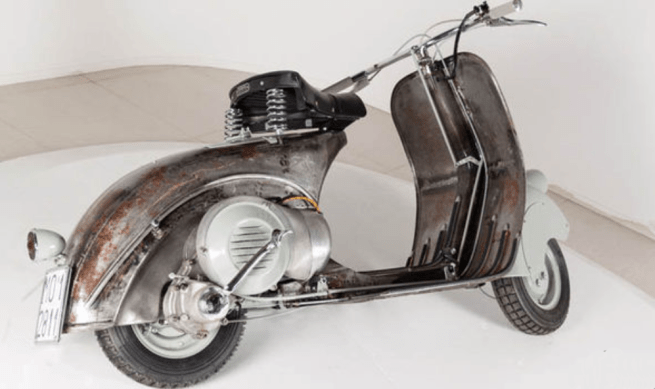
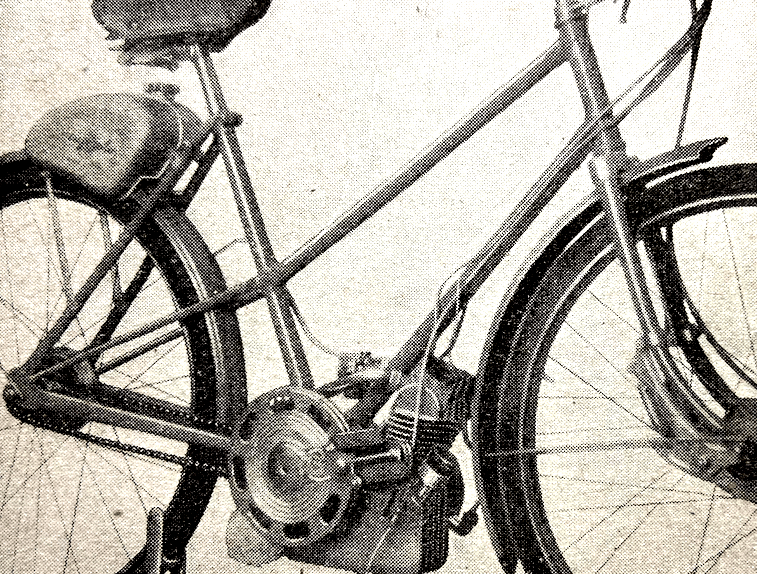
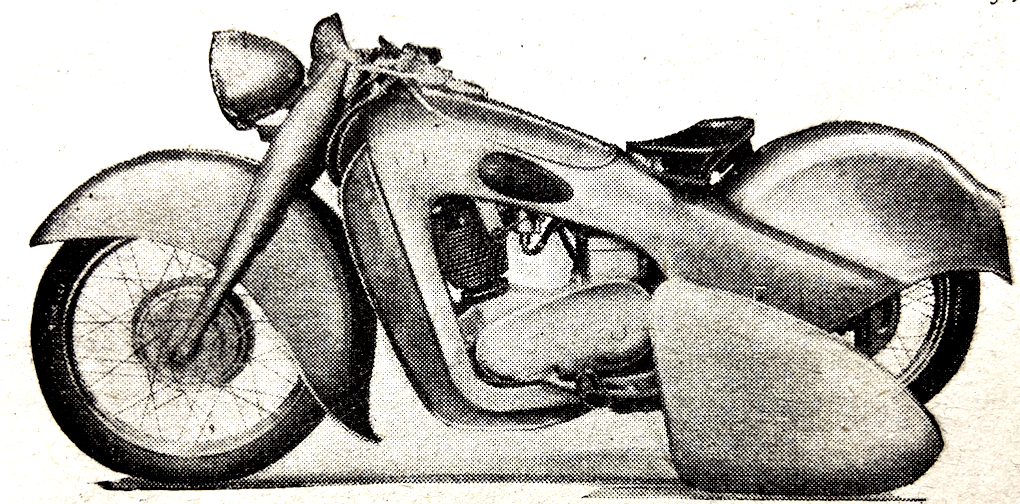
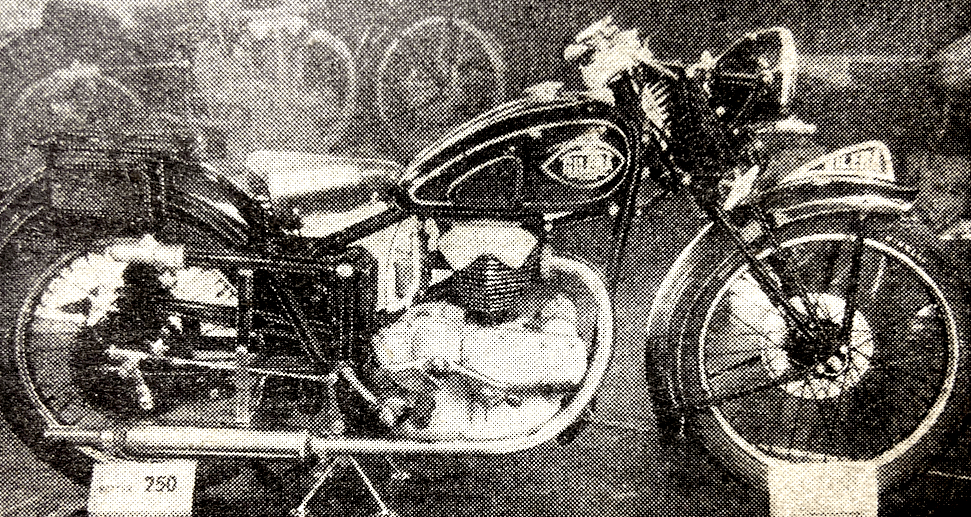
“FROM THE SYMPOSIUM on trials and scrambles we published a fortnight ago it was obvious that many keen riders feel that the value of the big open trials has waned and manufacturers would be wise to transfer their support to scrambles. These races over rough going, it is suggested, have many lessons to offer, whereas reliability trials to-day have few. Some riders go so far as to state that scrambles nowadays constitute the acid test…A further point is that it may become increasingly difficult to run trials on the public highway, and scrambles, of course, are held on private land. Is our sport to be, to a large degree, recast?”
TORRENS’ PLUNGER-FRAMED Ariel Square Four boasted a “pillion seat in one piece with the saddle”—an early example of the dual seat.
“AN OLD EPIGRAM SAYS that the first casualty in war is truth. The second casualty is morality. May I warn any new riders that even ” Nitor’s,” recommendation of a strong chain and padlock for a machine parked in the open is inadequate nowadays? The sneak thieves of the moment will pilfer anything—your lamps, your saddle, your hooter, the contents of your toolbag. It is simpler and cheaper to pay garage fees, and to observe a rule never to leave the machine unattended, even With a chain of good steel and an expensive pad-lock. I am afraid that this applies even to the rather superficially guarded parks at cinemas and football grounds.”—Ixion
“IN ACHIEVING 39.44 SECONDS at the Shelsley Walsh Hill Climb last Saturday, Ernie Lyons made motor cycle history. The long-standing query as to whether a motor cycle could ascend the hill in times comparable with the expert driven cars was decided and all doubt dispelled…With a snarl from the Twin Triumph, Lyons, in his first event since him wis in the Senior Manx Grand Prix, opened the 500cc class. He used the offside of the road at the start—the first man to do so—to get the best line for the slight left bend just beyond, and was obviously hurrying. He waked through the S-bends considerably faster, it appeared, than any earlier cars or motor cycles, but his upward gear changing on the finishing straight could perhaps have been smarter. His characteristic ‘I-am-master-of-this-puny-maehine’ style pleased the closely parked crowd who cheered vociferously a few seconds later when 36.44sec (approx 52mph) was announced—the first climb under 40sec since 1939!
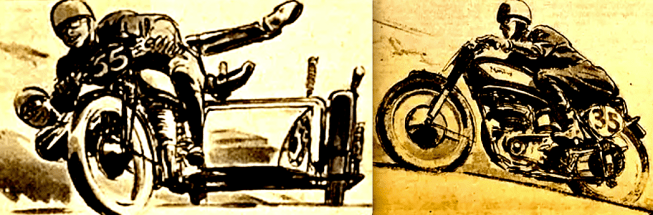
“A CONUNDRUM WHICH is exercising official minds is, ‘When is a scramble not a scramble?’ The general view has been that a scramble is any race held over rough going, as opposed to speed events on roads, tracks or paths. Lately, the South has had many so-called scrambles which are, in fact, largely path races, and a suggestion is that there should be a more definite classification of events. Some go so far as to urge that there should be an end to the path-race type of event with its speed and the specialisation involved and a return to the true scramble in which machines count for little. It is well, therefore, to remember that the term ‘scramble’ Was introduced to cover an event in which competitors had to scramble—to go as best they could through ditches and bog, heather and bracken and over hills which it was impossible, or nearly impossible, to climb without footing hard or getting off the machine. The rider of an elderly mount which was light stood an excellent chance, since all, or nearly all, depended upon his skill, determination and physical fitness. It was clubman’s sport at its best—manly sport.”
“UNSUNG AND PROBABLY UNMOURNED, the up-swept exhaust pipe, it seems, is a thing of the past. On the new models, low-level exhaust systems are the rule, and even on competition models there is the sensible practice of keeping the weight low and merely the exhaust outlet high. Many have declaimed about the folly of a fashion which causes exhaust pipes to be level with the rider’s calves and the silencers a little below the carrier or pillion seat. Scorched clothing, rider’s and pillion passenger’s legs forced uncomfortably wide apart and inaccessibility of the machine, have been usual concomitants. Other objections are added cost and vulnerability in the event of the machine’s falling over. The main ‘gain’ was the allegedly sporting appearance of the motor cycle thus equipped. No doubt reasons of supply and especially difficulties over plating and polishing are the chief causes of the demise of the high-level exhaust. Out of evil comes good!”
“YOU HAVE LOOKED at the drawings that adorn this little article. No doubt you have been intrigued by them and probably have pondered over the features they portray before turning to this. Let me tell you the history of these drawings. It is almost unbelievable. Towards the end of last year I received a letter that began: ‘I have recently returned home after being a prisoner pf war in the Far East. While I was in the hospital camp in Siam I made some drawings showing my ideas of post-war motor cycles. It gave me great pleasure doing this and also brought me into contact, with many motor cycle fans. We were able to get together and talk of old times. We would have given anything for a copy of the Blue ‘Un. When eventually I flew out to Rangoon I succeeded in getting some old copies which I read with joy. The drawings were all done under what might be called difficulties. I had to hide them quite often or the Japs
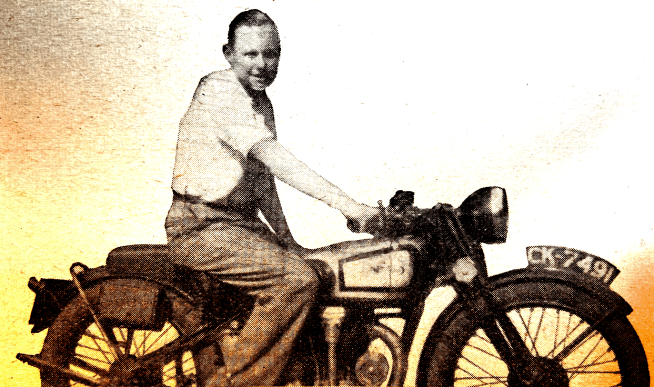
would have taken them.’ That is an extract from the first letter I received from Sergeant Brierley, Royal Artillery. I yearned to hear more. In response to mine, a letter arrived saying: ‘You ask me to tell you more about the conditions under which the drawings were made, so I had better tell you the whole story. It was when I was lying in a camp hospital in Siam during a bad attack of dysentery that I first thought of amusing myself in this way. Conditions in the camp were very bad. We were in bamboo huts and medical supplies were practically unobtainable. I managed to get hold of a few sheets of paper and a couple of stubs of pencil. My first attempt was at drawing a 500cc overhead-valve twin somewhat on the lines of the Swedish Husqvarna which Stanley Woods rode. At that time I had no compass and had to draw wheels, etc., by using various foreign coins. Later some good Samaritan produced a compass which, although home-made, served well. Paper and pencils were a big problem. Most of the paper was stolen from the Japanese and short pieces of pencil were fixed in a length of bamboo in order to make them usable. My first efforts were not to scale as I had nothing to measure with. Later, however, I managed to find a small steel ruler. By this time news had spread around the camp that there was a fellow in hospital drawing
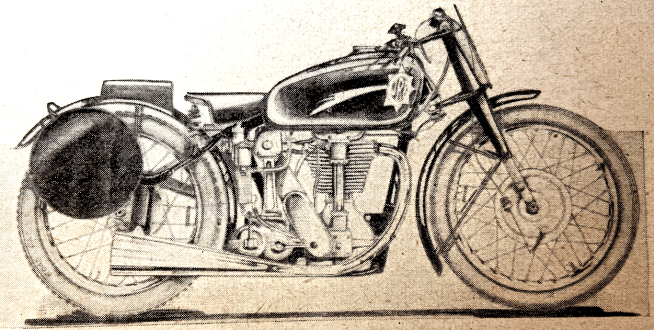
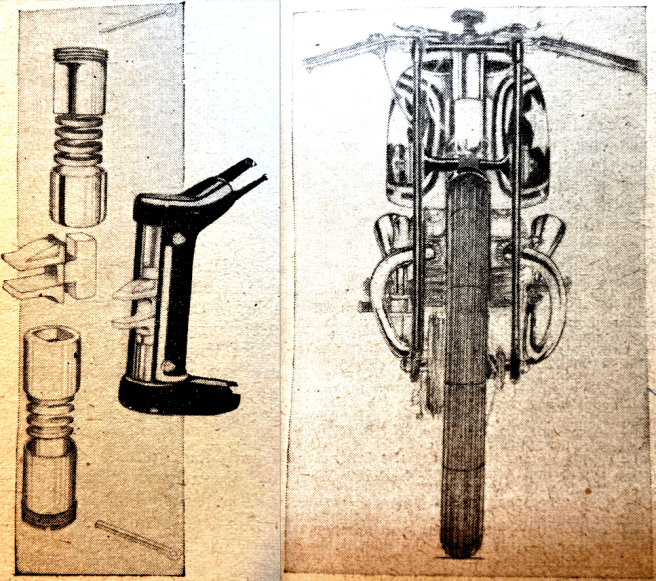
motor bikes and I soon had a lot of diehard motor cyclists visiting me. One of these has since become one of my greatest friends. He is a young Scotsman named Charlie Bruce. He helped me a lot because he is gifted with a wonderful memory for detail. He and other enthusiasts would come across in the evening and sit with me and see how the latest effort was progressing. We intended to form a camp motor cycle club, but our “friends” the Japs stepped in and refused to allow anything of the sort. We had to be very careful because if a guard saw more than six men together he thought an escape was being planned and took steps in the good old Jap fashion, which could be quite painful. The fact that you were in hospital made no difference. I think practically every one of us agreed that the motor cycle of the future would be a multi. Hence the trend of my drawings. One day a chap asked me if I would draw him a side-valve Brough Superior of which he was the owner. Charlie, I and this fellow got together and finally we produced a drawing of which we were very proud because it was drawn entirely from the memories of three of us. That started it, and from that day on I was a very busy man. I charged a small sum for the drawings to keep the firm in tobacco, etc, and during the weeks of my convalescence drew the following: Norton ES2, Norton International 350cc and 500cc, Model 18 Norton, Levis D Special, Harley-Davidson, Rudge Ulster, Rudge Special and MOV, MAC, KTS, KSS and KTT Velocettes. The owner of each particular machine sat at my right hand while I made the rough sketch, and supplied the details as the drawing took shape. It was surprising how accurate these drawings were. You will realise it was the only way we could keep in touch with the old days, as we had no books on the subject and very few photographs. These we had to hide,
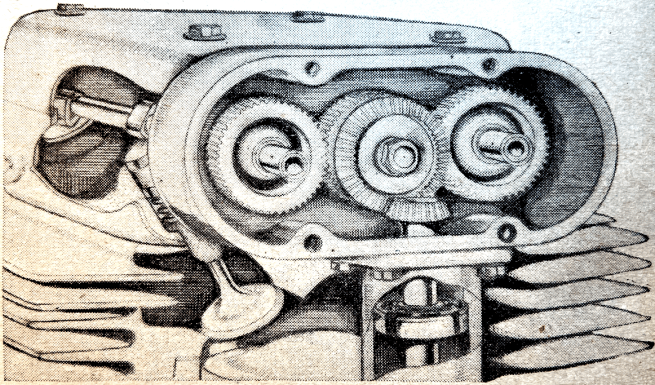
and all the drawings were buried time and again, but I expect the boys have still got them. Later I was sent to Bangkok and we were all split up. I have the addresses of all these friends and I hope we will get together again.’ There is the story as this remarkable man has told it to me. When I showed the drawings to our Art Editor and he, in turn, showed, them to our Artists, they could hardly believe that such drawings could be made under these conditions, and I followed up by writing to Sgt Brierley—now Mr Brierley—pointing out how impressed they were by his technique and in particular the handling of shadows and reflections. What professional experience had he had? It seemed obvious that he must have been on this kind of work in pre-war days—have been an artist, though not necessarily drawing motor cycles. The fact of the matter is that in pre-war days he was a meat salesman. He had no professional experience as an artist at all, nor did he have art training. He developed his technique solely while a prisoner of war, until finally he got to the point when he felt that, under the conditions and with the material available, he could not improve any more. He has sent me his only guide, which is a very tattered Norton manual, and tells me that in addition an occasional snap would come his way, though usually it was far too small to give accuracy of detail. Now Sgt Brierley is in Civvy Street, but, instead of being back on his old job of meat salesman, to his joy he is working as a motor cycle mechanic in Chichester.”
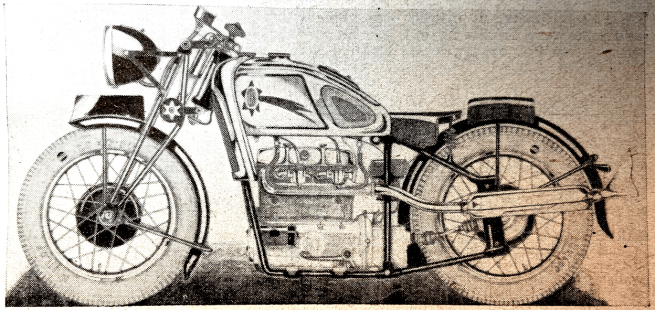
NEXT SATURDAY’S COLMORE TRIAL, the first big post-war open event, has attracted the remarkable entry of 179. This compares with a figure of 95 for the 1939 trial. We are not surprised at the total, for after six years’ intensive war work, in the Services and in munition factories, motor cyclists’ enthusiasm is unbounded. Undoubtedly if the Sutton Cold-field Club had imposed smaller entry fees, as many would have wished, the entry would have been overwhelming in its size. Without a doubt the Kickham Trial on Saturday week and the Victory a week later will also attract large entries. Indeed, it may be said that, so far as short-distance trials are concerned, everything is well set, in spite of the meagre petrol ration. Memories, however, are apt to be short. A little over a year before the war there was grave doubt as to whether trials on the public highway would be allowed to continue. The ACU and RAC were faced with an ultimatum. They took action following discussions at the Ministry of Transport by limiting the number of events in each area, enforcing liaison between organisers and the police and local authorities, banning competition tyres and urging that riding numbers should be dispensed with or made inconspicuous.”
“I ALWAYS GRIN internally when the engineers fall to discussing ‘cruising’ speed. They are so kind-hearted, they always apply it to their engines. Myself, I am fundamentally selfish. When I talk of ‘cruising’ speed I am not normally thinking of the longevity which a mean throttle opening adds to my autocycle. I am thinking of my own comfort. I can (and on occasion do) pack fifty miles into the hour. But that is a feat to be reserved for uncommon moods no less than for uncommon circumstances. It is uncomfortable. One can’t smoke. One has to tense up one’s faculties, and keep them tense. One gets shaken about. One may have to flatten a soft, round paunch down on to a hard, steel tank, and then cock one’s head up a bit, which generates a crick in the neck. But at a cruising speed, using that much-abused term in the personal and Pickwickian sense, one’s pipe will keep alight, and does not bombard the retina with incandescent cinders. One is not shaken. One can detach a large slab of one’s attention for scenery. One sits up with slack wrists and a curve in the backbone.”—Ixion
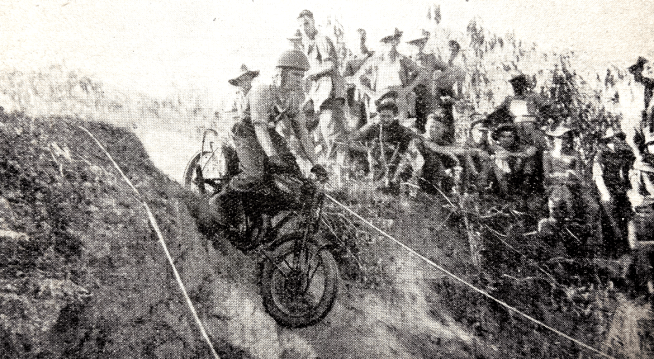
“I KNOW THAT roadside trouble is rare with modern motor cycles, and a fortiori quite exceptional after dark. But if and when such occurs on an unlit country road, the light problem can be quite tiresome. This was excusable in the old days of gas head lamps and no tail lamps, but is unpardonable with a bus mounting a dynamo and a powerful battery. Every electrically equipped machine ought surely to incorporate either an inspection-cum-panel light as a number do) or a plug socket for an inspection lamp and, please, not a vertical socket liable to rain shorts.”—Ixion
“THE MOTO CLUB DE ROMA staged their first post-war road racing meeting in the suburbs of Rome, and for anything more wildly remote from the painstaking safety precautions and the meticulous organisation of any ACU controlled event it would be impossible to imagine. I had taken the precaution of visiting the course during the morning practising, and arranging for a place in the Press box, but when I arrived in the afternoon it resembled nothing so much as that unforgettable scene in the Marx Brothers’ picture (Duck Soup?) when about fifty people get crowded into one small state room. When I had finally succeeded in worming myself into the box, amongst the fat women with crying babies, the unshaven soldiers, the tram conductors and taxi drivers, the amorous couples and the small boys who had lost their parents who made up the population of the Press box, I found that, quite literally, you couldn’t get your elbows far enough away from your sides to wield a pencil. So, with a certain relief, I abandoned any attempt to report the meeting seriously, sat down on the grass in the middle of the course, and prepared to enjoy the afternoon. The actual course was about two miles from the centre of the city, and consisted of a very

small circuit only one kilometre in length. This began with a straight of about a hundred and sixty yards, at the end of which was the acutest hairpin conceivable; this was followed by a fairly fast right-hand bend, fifty yards of straight, a right-angled left-hand bend, another fifty yards of straight, and another right-angled bend on to the original straight. The start was at the beginning of the straight, the finish was half way down it, and all races were over twenty-five laps—no heats. Safety precautions were comparatively simple; they consisted of two Italian police on Harleys; before each race they rode along the gutters on each side of the road so as to persuade the over-enthusiastic spectators who had encroached on the actual road to step back on to the pavement. If, after the police had gone, they stepped back into the road again—well, that was just too bad; at least no-one could say that the police hadn’t done their job. And, of course, step back they did. I don’t think I’ve ever seen anything quite so frightening, by English standards, as the way the spectators closed in at the end of the straight so that only a narrow lane was left for the riders, then at their maximum speed of sixty, or not far short. It was the same all the way round the course; at the hairpin the outer ‘banking’ consisted of the feet of .the spectators, who, encroaching on the roadway, sat down with their legs stretched out in front of them. The first race, for amateurs riding 250cc machines, was won by Luigi Ciai, the most promising of Italy’s new crop of riders, on a single-cylinder Benelli at an average of 72.7kmph; the second machine was a Guzzi Albatros, and the third another Benelli. This race was followed by the 250 event for mechanics and factory riders, this being the usual division of classes in Italian motor cycling; this was won by Nino Martelli, also on a Benelli. The 500 amateur event was won by Gastone Berardi on a Guzzi Condor at 72kmph. The ‘professional’ 500 event showed a considerable improvement in speed, Bruno Francisci winning on a Gilera Saturno at an average of 76.5kmph. Second and third men were on Guzzi Condors. Finally came the sidecar race, with a very mixed bag of starters, including a Norton, a Levis masquerading as an ‘HD,’ a big-twin Harley with touring sidecar, a BMW, two Gileras and a Guzzi. Arnaldo Magistrini, on a Gilera, won the event at 67.96kmph. The Norton was second, and the other Gilera third; the BMW was last. On rereading my criticisms of the
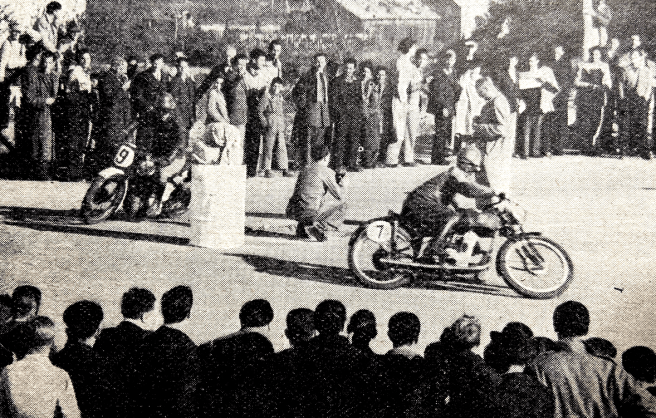
organisation I feel a little penitent; after all, they have got started in spite of all their difficulties. Many of the old organisers of experience are no longer available—they are dead, or prisoners of war, or Fascists. The police who were promised did not turn up, but ten times as many spectators as they expected did turn up, petrol can only be got by innumerable applications to innumerable officials, and yet they have got started with post-war racing. At home, the only country in Europe where road racing is not allowed, Donington Park is still requisitioned, Brooklands finished, Cadwell Park beginning to gird up its loins—and what else…? As a postscript, Signor Masetti, the secretary of the Moto Club de Roma, paid me a visit a few days after the meeting; he came to explain some of the difficulties with which they had had to cope and to discuss their plans for the future, and he brought with him about two or three hundred photographs of their pre-war and early wartime racing that would make any enthusiast’s mouth water. When, in those days, they wanted to hold a race, they selected a circuit, and the police closed it for them for practising and the actual race itself. And what circuits! The English equivalents would be, perhaps, round Tooting Bec Common with a bit of Bedford Hill and Balham High Road to complete the circuit; or Kensington Gardens, Bayswater Road, Church Street, and High Street, Kensington; or a bit of the North Circular Road, Finchley Road, and Cricklewood Broadway. That, it is true, was pre-war; but post-war motor cycling in Italy is not standing still, and road racing has begun again all over Italy. If we are not going to be left badly behind in post-war motor cycling it’s time that we began to do something about it; and plans for a TT in 1947 (or is it 1948?) and polite deputations to ask when we are likely to be allowed to use Donington again, are not enough. What we want is to be allowed to race occasionally on our own roads, just like the French, the Belgians, the Spaniards, the Italians,…and the Argentine, the. Portuguese, and the Greeks.”—Vernon Jarratt
“MAY WE MAKE just one comment on the meeting at the Institution of Mechanical Engineers at which the excellent paper by Mr RA Wilson-Jones, relative to fuel consumption of motor cycles, was read. Mr Heather, director of Associated Motor Cycles said: ‘After the last war there had been interest in petrol consumption for a time with all kinds of special tests in which he believed 311mpg was the best figure obtained.’ When Mr Wilson-Jones replied he said: ‘Mr’. Heather mentions 311mpg as the best obtained in the past’ and goes an to say, ‘the machine may have done 311mpg on petroil but it only did 150mpg on petrol.’ I would like to point out that two James 3½hp twin four-stroke models in a fuel-consumption test held by the Sutton Coldfield and Midland. Warwickshire AC Trial on the 27th September, 1913, accomplished the following remarkable results: (1) T Pollock, 334mpg.; (2) HG Dixon, 320mpg. The machines used for that test were identical in every way; they were fitted with James manufactured 499cc 55° twin engines, Senapray carburettors and weighed complete 2201b. Have we really progressed?
FA Kimberley (Managing Director), The James Cycle Company, Limited, Birmingham.”
“A NEW BSA designed specially for the competition rider is announced. This is very much a Bert Perrigo model, and has the gear ratios, tyre sizes and other features to make it a machine of outstanding appeal to those who propose competing in trials and scrambles. The general specification is similar to that of the B31 BSA. The engine is a 348cc with totally enclosed valve gear, and there is a four-speed gear box with, in this case, ratios of 7.1, 9.2, 14.2 and 20.1 to 1. A 2.75-21 front tyre is fitted, and the rear tyre is, of course, of 4.00in. section. While a Lucas Magdyno set is standard, a separate Lucas magneto and a battery lighting set are available to special order. The machine has an up-swept exhaust pipe, a crankcase shield and 6in ground clearance. Mudguards, mudguard stays, front stand, rear chain guard and brake cover plates are all chromium plated. The .price of the machine with speedometer is £100, plus purchase tax of £27. The official title of the machine is the B32.”
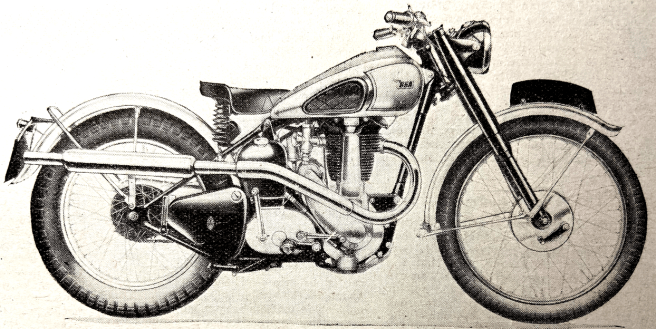
“A SMALL BATCH of special competition models is being manufactured by Associated Motor Cycles. This will consist of fifty AJS and fifty Matchless machines. Thirty in each case will be of 347cc and the remaining 20 of 498cc. The special competition models will not be catalogued, but will be sold to trials enthusiasts on the recommendation of local AMC agents. The general outline of the machine has been the result of considerable experimental work, notably by George Rowley, who has carried out a number of tests over the British Experts Trial course and in Wales. Among the alterations from standard are a special head angle and a trials-type trail. Features of the machines, which look particularly cobby in their competition form, are a low-level exhaust system with the pipe brought close in to the timing chest and the silencer upswept, ground clearance of 7in, folding kickstarter, 4.00-19 rear tyre, 2.75-21 front tyre, two security bolts per wheel, and extra heavy spoking…With the slipper-shaped lug at the bottom of the front-down tube and the cradle frame design it has not been found necessary to fit a crankcase under-shield which naturally would reduce the ground clearance a little. An interesting little detail point is that both the clutch and throttle cables are duplicated.”
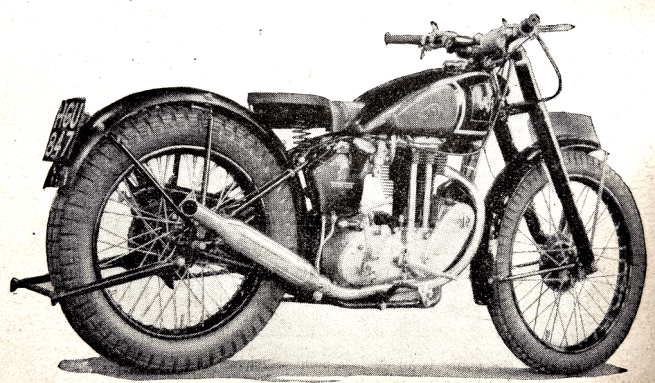
“THE SENIOR TOURIST TROPHY has been found and will soon be back in England again! This good news has been received by Mr ST Huggett (secretary of the ACU) in a letter from Lt-Col. H Blake, who is with the Control Commission for Germany. Writing from Hochst, near Frankfurt, the Colonel says: ‘I have been down to Vienna this last week on duty, and while there succeeded in finding the Senior Tourist Trophy. I have the Trophy in my office here in Hochst, and will bring it back to England with me during the second week of February.’ He goes on to relate how the Trophy was finally traced to the BMW agents in Vienna. At first the manager denied that it was there, but after a little ‘persuading’ he eventually produced the Trophy. Lt-Col Blake says that the Trophy has suffered little damage. The 1930 shield is missing and Mercury’s staff is awry; also the plinth is badly scratched. Otherwise there seems little wrong. It will be recalled that the Lightweight TT Trophy was recovered from Italy about the middle of last year by Major EA Simcock, the well-known Australian rider. This trophy had been buried in a small farmyard at Caprazino, with a chicken coop over it to mark the spot.”
“So Mr Walter Moore is back at the great Bristol factory again—is superintendent in charge of Douglas motor cycle production. He has done some very good jobs of work in the period between his first days with the flat-twin—the days before the Douglas was the Douglas, but the Fairy—and to-day when he is ‘home’ again. My first recollection of him is when he was sidecar passenger to GH Tucker, and between them they won the 1924 Sidecar TT on a Norton. He had left the Douglas concern in 1920. I think of him when he was at Nortons—recall the introduction of the cradle-frame overhead-camshaft Norton, the so-called ‘Camel’ Norton, which was such a success in races and in the.hands of the public. The ‘Camel’ part of the title was due entirely to the shape of the machine, I believe; at all events, that machine earned the make a magnificent reputation for road-holding and ease of handling. Then followed the period when so many motor cycle designers went to factories on the Continent. Walter Moore joined the NSU concern and became works director. Now, as I say, he is back with his old love; I look to the future with keen anticipation.”
“A TOTAL OF 5,256 were killed on the roads last year. In making this announcement last week the Government spokesman gave details of the types of vehicles primarily involved. In order, the chief figures were: Goods vehicles, 1,213; Service vehicles (including Dominions and Allied), 899; private cars, 883; pedal cycles, 686; buses and coaches, 651; motor cycles, 501; tramcars, 94. This last figure, trams running on rails, is the most amazing of all. On the same day in a written answer he stated that plans for the reduction of road accidents will not be completed until the Committee on Road Safety have submitted their final report. In the year 1946 it is still a case merely of plans. The Highway Code is being revised, he added—it was promised for the New Year—plans for the improvement of the highways are being pressed forward. Is it not possible at this juncture to state when there will be action? As the Minister of War Transport said in connection with the Trunks Roads Bill last month, ‘We have never yet adequately made provision in this country for the type of traffic that uses our roads.’ On countless occasions this basic fact has been stressed to the Government by the motoring Press and motoring associations. Until this failure on the part of successive Governments is remedied there can never be road safety.”
“A TROON ENTHUSIAST sends me a racy account of a night puncture on a club run. He stopped to aid a pal stalled with a flat tyre on the edge of Loch Lomond in inky darkness. Being unable to find a small puncture in the gloom, they entered a small boat beached at the lochside, proceeded to its far end, and used matches to identify the bubble point of the tube when submerged. Their movements launched the boat, and by the time they had spotted the hole they were 25 yards from terra firma. No oars, of course. And a stiff off-shore breeze. However, much manful paddling with their hands and a floorboard eventually restored them to their bikes. Obviously, they did not know a simpler method of tracing a small puncture, without the aid of water. The surface of the eyeball is the most sensitive area of the human body, and if the tube is inflated and passed across the eye, the draught will eventually be spotted, though the process is laborious with some 700sq in of superficial area of rubber to test. I should have begun with fingering the inside of the cover carefully for some spicule of grit or metal, and then tried my eyeball.”—Ixion
“MUD—WAS EVER a Colmore Trial blessed or cursed with such mud as last Saturday’s event, the first of the big post-war open one-day trials? With one exception, every observed hill had a surface of deep, rutted mud, vilely slippery and glutinous. In several cases it was a feat to get even to the point where the observed hill started. Indeed, one hill had to be cut out for the second half of the entry because competitors were unable to reach the foot. At another hill, Camp, the track leading to the bottom looked from a distance like a fly-paper, with struggling men as the flies. ‘Pity the poor trials organiser!’ quoth ‘Nitor’ only last week, when referring to the difficulty of plotting a course for an event in February in view of the vagaries of our climate. Of the 180 who finally entered for last Saturday’s event there were many who felt the pity should be reserved for the trials rider, sidecar driver and the sidecar passenger. However, extraordinary as it may seem to those who on Saturday saw the course for the first time, on the previous Sunday there were at least two of the hills which were so easy that it appeared almost foolish to include them. Farther, it was stated by farmers that they had never known mud so bad. That the course should have proved a heartbreak was unfortunate, especially as this was the first big post-war open event and many a competitor was having his first experience in a classic one-day trial. The welcome Shipston-on-
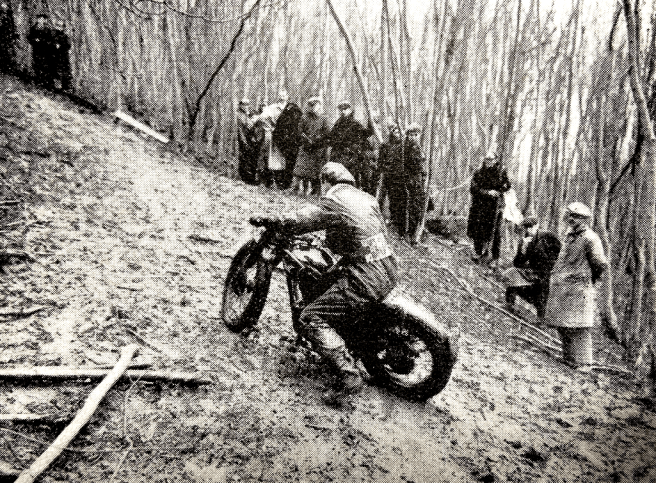
Stour, the starting and finishing point, gave to competitors, however, and the manner in which the hotels went right out of their way to cater for them, is something riders will probably remember as long as they do the ‘Colmore Mud Trial’. An Army motor cyclist of pre-war and war days, FM Rist (350 BSA), who has starred in many a recent Army event in the Mediterranean area and is now in Civvy Street, proved the winner. He, in view of all his successes, can hardly be termed a new ‘star’. The majority of the chief awards, as will be seen from the provisional results, went to old hands. Had keeping to time been discarded as a factor in the results, as seemed likely at one period, the ‘Flying Fleas’—the 125cc two-strokes—would have had something of a field-day. On__ the hill-performance marking they did extremely well in spite of the fact that riding such machines in trials is something of a new art to the majority of those who had entered them. It would have been interesting to have seen some of the highly skilled Airborne men riding them in the event. Among the 180 entries were two teams from Ulster, and very smart they looked—at least, up to the time they were on the mud-plug—in their green riding kits. The start was in the Cattle market. A bare three miles and competitors were tackling a mud track through a field of winter-sown wheat. This was merely the approach to the first hazard or section, Pig Lane. The track was deep, wheel-clogging mud. First were AR Foster (500 AJS) and JH. Amott (250 BSA); they heaved and they walked. LG Holdsworth, on a new 280lb 350cc competition-model Royal Enfield, took to what looked like grass at the side of the track and hurtled along. He did not realise it was part of this year’s harvest, but the damage done, if any, having regard to the time of year and the conditions, would be negligible. Harold Daniell (490 Norton), holder of the TT lap record, was in dire trouble—choked wheels—and spent many minutes in the field and much energy. F Fletcher, thanks to the low weight of his ‘Flea’, a 125cc Excelsior, buzzed through happily with occasional light footing. Then along came Bert Perrigo (350 BSA), who proceeded to demonstrate what he has so often demonstrated to Army men: how to get through vile mud without hard labour. Weight in the saddle, he trickled gently through the first two-thirds, using his feet merely for steadying. It was also interesting to see how he carefully picked the wettest parts. Later he did have to do some footslogging. HS Wolseley (250 Triumph) did not keep weight on the saddle, and, finally,
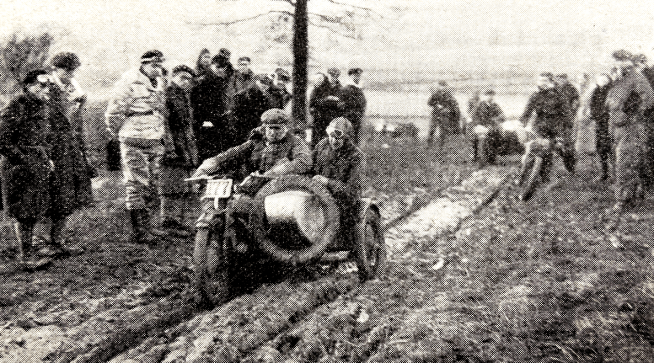
got off and walked the model through the field. The hill itself was not too bad—not early on, at all events. It was a matter of making a good get-away on a slippery surface, working up the speed by throttle-work that was carefully attuned to the wheel-grip available, and then hurtling through the mud at the top. An out-and-out star here was an Army man, Lt DV Latty (350 Triumph), RASC, who made an extraordinarily fast climb. Another Triumph rider, JH Ford, was clever; he rode from bank to bank, taking a corkscrew course, but finally had to bring his feet into use. RJA Petty (350 BSA) appeared to have a hard rear tyre and suffered from much wheelspin which brings up a matter touched in The Motor Cycle a little time ago: whether, in present-day circumstances it would not be a good thing to take a leaf from the Army events and lay down the minimum tyre pressures to be employed. Some competitors gained appreciably from tyre pressures around 21b/sq in—to the detriment of their tyres. R Hunt (350 Royal Enfield) blipped his throttle to and fro to some extent, but nevertheless put up a good showing. Then a copybook-style climb by G Broad-bent (350 Triumph), who, after getting up ample speed, steadily closed the throttle the nearer he got to the summit. Next came N Palmer (350 BSA), who got into a mighty slide as he passed through the gate at the summit. Another BSA rider, B Holland, made a particularly impressive climb—indeed, his riding suggested that the whole thing was just too easy. Colin Edge (350 Matchless) was extremely fast and extremely good. Vic Brittain (490 Norton), however, made an Army-style climb, trickling up with his weight on the saddle and his feet used for safety’s sake. Why? Was it that Vic, having digested the system of marking that was being employed, decided that this was the wise plan ? Fail anywhere on a hill and one lost 10 marks; foot in a section of that hill and the penalty was 3 marks. Thus on a three-section hill one could foot in each section and still be better off than a man who stopped in one of those sections. Further, the most one could lose on any hill was 10. Then came Jack Williams (350 Norton), who hurtled up the hill, with his engine revving so hard that the valves were tending to float. Equally fast, though barely so neat, was JE Breffitt, on a similar machine. Meon, the next hill, comprised a steep-ish track between high banks—deep gluey mud. GF Povey (350 BSA), supreme artist at neat, gentle riding, decided rightly that the only hope here was sheer speed. Very soon, however, that far-from-unseen clutching hand had his machine in its embrace, and it was a case of footing and then footslogging. Rain now swept the hill, rain which was to cause the previous hill to be cut out owing to the field below becoming a hopeless proposition. In the case of Meon this rain was undoubtedly of some help to competitors; the ‘glue’ had more water in it. GE Godber-Ford (490 Norton) footed up the rut without too much hard work. CA Dickins (500 Matchless) managed to keep his feet up for an appreciably greater distance than the majority, while DJ Mountstevens (490 Norton), thanks to clever handling of his throttle, saved his legs considerably. S Russell (350 Matchless), it seemed, had that old, old trouble—petrol tap turned off. The rain increased in intensity, and CC Bailey (350 Royal Enfield), approaching fast, kept going at speed—with footing, of course. Then Major
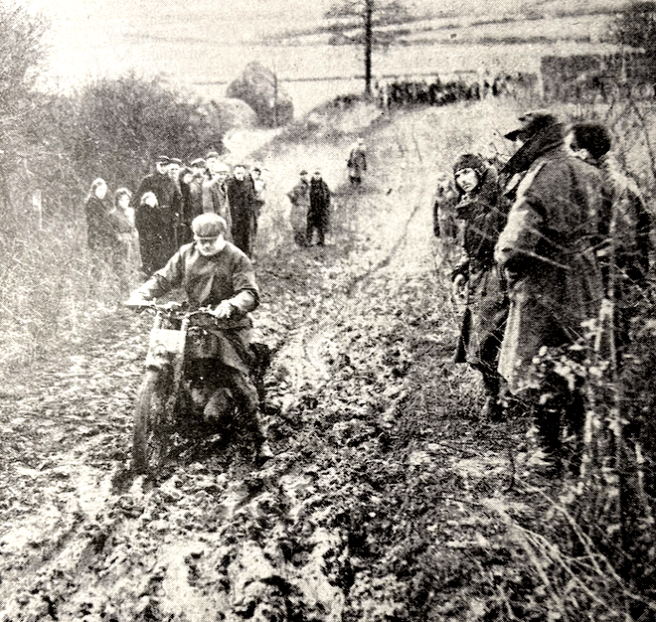
Rob Davis (350 Matchless), Royal Tanks, arrived, determined to get through Section 1 without footing; he did so, and then settled down to sedate paddling. Mickleton Wood, the next hill, was approached through a farmyard and a very slippery grass field. Again, there was cloying, rutted mud between banks; again it was difficult to get under way at the restarting point. Later, thanks to the rain, it became comparatively easy and some of the sidecar outfits were to shoot up the hill. A third the way through the entry, however, it was something of a feat to get through the first section feet up. AW Burnard (500 Matchless) was a star here. By throttle control and fighting the model he got through the first part feet-up and even, for a moment, got his feet on the rests on the higher part. Another to make a good showing in Section 1—a particularly neat exhibition—was Karl Pugh (350 Triumph). Jack White, on his many-years-old 250cc Ariel, was completely effortless on this portion and footed only lightly higher up. A restarting test was held on Fish Hill, which lies beside the main-road hill of that name near Broadway. This wood-land track was slippery, but not to such an extent that the test was other than a good one. Warren Hill, however, was a very different proposition. Again, there was a struggle to get to an observed section. Competitors, after fighting their way along a valley and up a woodland track, had to turn off that track up a very steep clayey bank. They were sent, one after another, to a point just above the turn and there they about-turned and endeavoured to shoot up to the left—a right-angle turn with an adverse camber and an almost impossibly slippery surface. Sliding to earth on the turn was the almost invariable rule. Even the ultimate winner of the trial, FM Rist (350 BSA), twirled round. It was an excellent attempt but, at least at this period, the climb was as near as no matter impossible. Norman Hooton, on a 125cc James, got round the corner with footwork, and spectators cheered him on as he paddled some yards up the hill, but he finally turned round and took to the by-pass route. Barry Smith (125 Royal Enfield), son of Major FW Smith, managing director of Royal Enfields, bounced the front of his machine up and down to clear some of the mud that was jamming his front wheel. Like many another, off he came on the bend. He turned round by picking up the front of the machine bodily while still astride. Another managing director’s son, AE Kimberley (196 James) had his hand on the clutch and, after some wheelspin on the corner, his machine ran down backwards. Next was Camp Hill. Again it was a struggle to get anywhere near the hill. Competitors were given something of a flying (?) start at the hill, but the mud was such that very few got even as far as the start of Section 1; then came the fight along the track along which they had come…Even George Rowley (350 AJS) came to a full stop at the ‘Observed Section Begins’ card. Rist (350 BSA) got through, however, and with clever throttlework and footing, and cheers from the spectators, reached the summit. TC Whitton (350 AJS) too, won through. Often, for ten minutes and more at a stretch, not a single man succeeded even in reaching the observed section. What would Long Compton be like? This had been stated at the
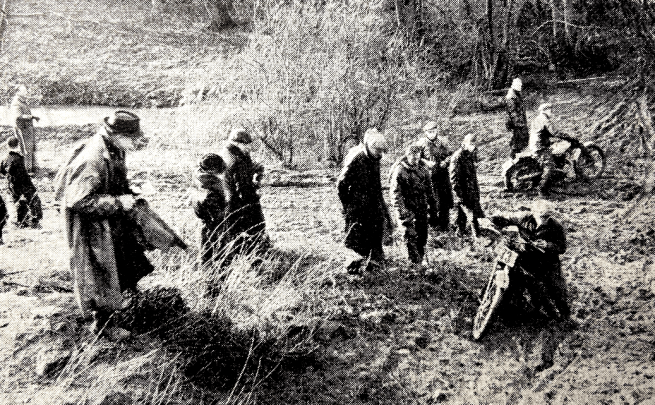
start to be easy, and that star of trials stars of a dozen years ago, Graham Goodman, who was out having a look at his old love and had seen the hill on the previous Sunday, said that the climb then was so simple as not to be worth observing. These few days later it was deep, rutted mud, and all a solo rider could hope to do was, by rushing tactics, get through Section 1. The sidecars, however, were in many cases magnificent—non-stop and with thrilling speed up the first section. Harold Tozer (496 BSA sc) led the way, giving just one dab in Section 1 when the sidecar lifted. Harold Flook (490 Norton sc) was clean throughout, so was Dennis Mansell (490 Norton sc), who on the first part was travelling so fast that there was valve bounce. RGJ Watson (497 Ariel sc), of Watsonian sidecars, made a magnificent climb. Harold Taylor, on another Ariel, was excellent in Section 1, but then had to foot. TA Tracey (596 Norton sc.), the Army trials enthusiast, was also very good. By now it was getting nearly dark. At the next and last hill, it was almost too dark for the sidecar entry. Here there was more vile mud. and here two tow-rope squads were in operation. Mud, MUD. MUD. PROVISIONAL RESULTS: Colmore Cup (best performance of the day)—FM Rist (350 BSA); Watson Shield (best sidecar performance), FC Perks (496 BSA sc); Sutton Cup (best Army rider), Sgt J Plowright (350 Ariel); Manufacturers’ Team Prize: Norton No 3 Team (VN Brittain, HJ Flook, DK Mansell); Club Team Prize, Sunbac Team (VN Brittain, GE Rowley, AE Perrigo).”
“SYMPATHY CAN BE EXTENDED to both organisers and competitors over last Saturday’s Colmore Cup Trial. The event was not what was intended, nor what it would have been had this, the first of the big post-war open trials, been held a week earlier. Then, as is stated elsewhere, some of the hills were too easy. On the ordained day, however, the course was so difficult on account of mud as to border on the impossible. While it is a pity that a sheer mud event should form the introduction to open trials for so many, probably it is no misfortune that the first important one-day trial should give rise to searching analysis. As we stated last week, post-war trials must be regarded as ‘on trial’. On what happens over the next few months may depend the whole future of reliability events on the public highway.”
“HOME SERVICEMEN and civilians saw despatch riders mainly occupied in shepherding convoys, on Despatch Rider Letter Service, and other light duties during the war. Here is quite a different angle: ‘I was awakened by the noise of a motor cycle picking its way up the rough track that led into the company area. It is one of the night sounds the ear is always quick to perceive, even in the deepest slumber. I looked at my watch. It was half an hour to midnight. A despatch rider at that hour meant only one thing. Bad news. You learn to dread the sound of a motor cycle in the middle of the night. The despatch rider handed me a message. It said: “Battalion will be ready to move by 04.00 hours.”’ This extract is from The Monastery, by F Majdalany (pub John Lane), a spirited account of the experiences of the 78th Division in front of Cassino.”
“A CORRESPONDENT CHAFFS our movement about the clumsiness of our nomenclature. Whereas four-wheelers are ‘cars’ in Britan, and ‘autos’ in USA, a two-wheeler is a ‘motor cycle’—four syllables and ten letters. Worse still (in his opinion), a 98cc machine is an ‘autocycle’, which, being literally translated, is a ‘self-wheel’, and has no reference whatever to size. He contrasts the car world which, newly confronted with 800cc cars weighing less than half a ton, has promptly labelled them ‘mini-cars’. I naturally admit that ‘autocycle’ is unpardonable; though nobody seems to know how it originated; some early French machines were sold as ‘autocyclettes’ and ‘motocyclettes’, which were at least diminutives. Nor has any nation evolved a snappy synonym for ‘motor cycle’, though an American design was once catalogued as the ‘Mo-Bi’. My tame etymologist suggests that more use could be made of the trio—parvus (small); minor, (less); and minimus (least). Even at that we need a short word for bicycle, ‘grid’ and ‘iron’ being already annexed by pushbike slang. How about ‘bus’? Then a 250cc would be a ‘parvibus’ (plural, ‘parvibi’), and a row of 98cc machines would be ‘minibi’? On the whole, I think we had better go on as we are!”—Ixion
“PLASTICS ARE RUSHING to our aid in great variety. I hope to see, anon, plastic handlebar muffs—light, rigid, windproof, waterproof, silent, easily attached and detached. Their sole defect at present is that they are normally rather brittle, and liable to fracture under heavy impact. But even that failing may be overcome some day.”
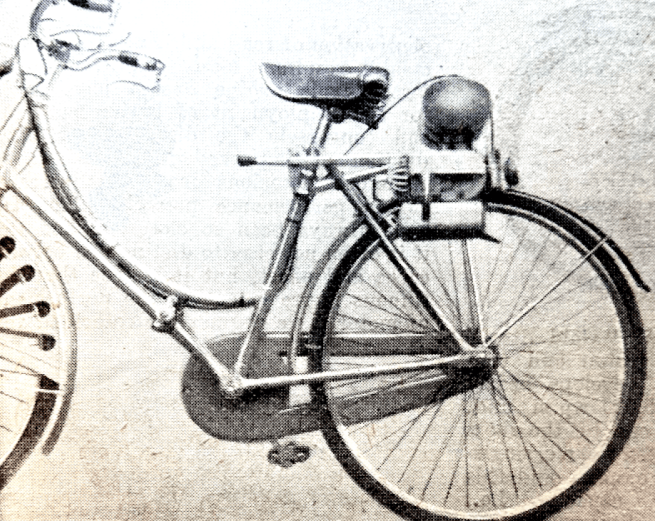
GEOFFREY DAVISON, THAT formidable TT rider and author of the excellent The Story of the TT that features so prominently in these pages, recalled his exploits in the ultra-ultra-lightweight league. “In the summer of 1941, when in the Army and stationed in Northern Ireland, I got the idea that it would be interesting to make the smallest motor cycle in the world. We were, of course, training hard at that time, but between innumerable exercises there were periods in billets when there were long evenings with nothing much to do. These evenings gave me ample time to design and make my minute machine. Naturally I did not go beyond a push-bike for the ‘cycle parts’, for anything more robust would have been quite unnecessary. My idea was to obtain a model aircraft engine and to apply its power to the front wheel of the bicycle by means of a small bobbin driving on to the tyre. Spring loading was obviously desirable, but this was easy to arrange. In those days the use of petrol-engined model aircraft was prohibited —largely, I am told, because one such machine went astray and roused a local anti-aircraft battery, who mistook its for a visiting Messerschmitt!…I found one in a shop in Belfast…and settled down to design work…It was a beautifully made little job, and I was told. that its capacity was 9cc, and that at 7,000rpm it
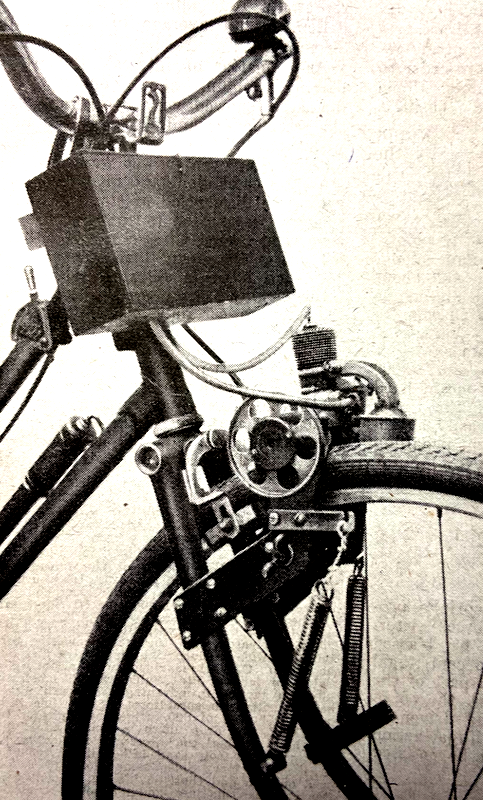
developed 0.23bhp…the crankshaft was of the single-bearing type, and it was obvious that if I were going to place an upward thrust on the crankshaft via the friction driving bobbin, it would be necessary to extend the shaft and fit some sort of outrigger bearing. Also, as the engine would not have a propeller, it must have a flywheel instead…I extended the shaft about and fitted a 3in brass flywheel, made, incidentally, from the distributor gear-wheel of an old car magneto. The outrigger bearing was easy to make, but the bracket, fashioned in sheet metal from an old car number-plate, kept me busy with hack-saw, drill and file for many a long evening. Fitting the wooden bobbin was also a ticklish job, as was the making of the various attachment brackets and the spring-loading assembly. The exhaust pipe I constructed out of an old car oil-pipe, and the silencer is a small cylindrical tin, 1in, in diameter by 2in. in depth. The carburettor of this little engine is merely a hole with an adjustable needle in it. What looks like the carburettor is really the tank, which has a fuel capacity of half an ounce of petrol! As this did not contain enough petrol for much in the way of ‘motor cycling’ I attached a small tin to the cigar box on the steer-ing head which held the battery and the coil. This tin feeds the original tank, and the idea was that by means of a needle-valve I should adjust the flow so that there was a more or less constant level of petrol in the tank proper…After months of work came the great day when all was ready for test. I tied the handlebars of the bicycle so that it was clear of the ground, inserted some petrol in the tank proper with a fountain-pen filler, switched on the ignition, and pulled the front wheel. There was suddenly an ear-splitting scream as the engine burst into life; dense clouds of smoke—I was working on a four-to-one petrol-oil mixture—filled the garage, and the front wheel went round at an almost incredible speed. It was
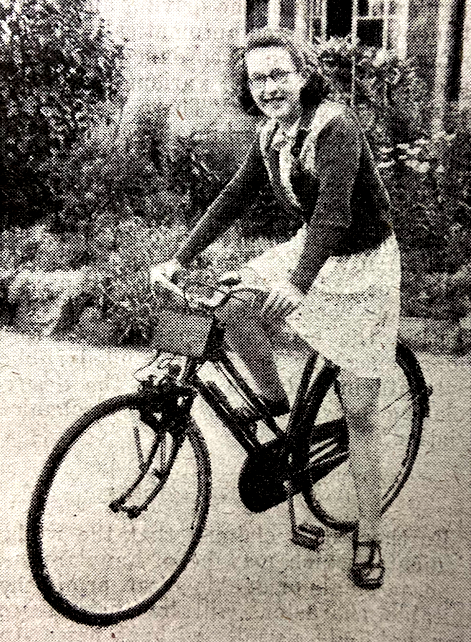
pouring with rain at the time—as nearly always in Northern Ireland—but this did not stop me getting on to the road immediately. Off we went. The noise was simply diabolical and several pedestrians jumped into gateways as a first measure of taking cover from what they could only assume was an enemy aircraft. Greatly excited, I roared along the road at what must have been at least 15mph. The first test of the world’s smallest motor cycle was really the most successful in its brief life! However, when it went it was great fun…On the flat it would take me along without pedal assistance at about 15mph. This represented an engine speed of approximately 5,000rpm. On the least downgrade there was a surprising rise of speed and I am sure that I often exceeded 30mph—and 10,000rpm. Hills which normally meant hard pedalling in bottom gear of the three-speed hub could be scaled easily at 15-20mph in top gear with light pedalling assistance. But petrol consumption was perhaps the most surprising, thing. On a flat stretch of road, using the original tank only and without pedalling assistance, I covered four miles at an average fast cycling speed, so to speak, on half-an-ounce of petrol. As there are 20 ounces in a pint and eight pints in a gallon, this represents four miles on 1/320th of a gallon, or an average of 1,280mpg. Trump that! There are certainly possibilities in it and if the noise and unreliability could be overcome it might well be a commercial proposition. It provided enough power to ease the cyclist’s work and I should estimate that, with its assistance, a man who would normally ‘have had enough’ in 20 miles could do 100 miles without effort. And it was certainly economical!”
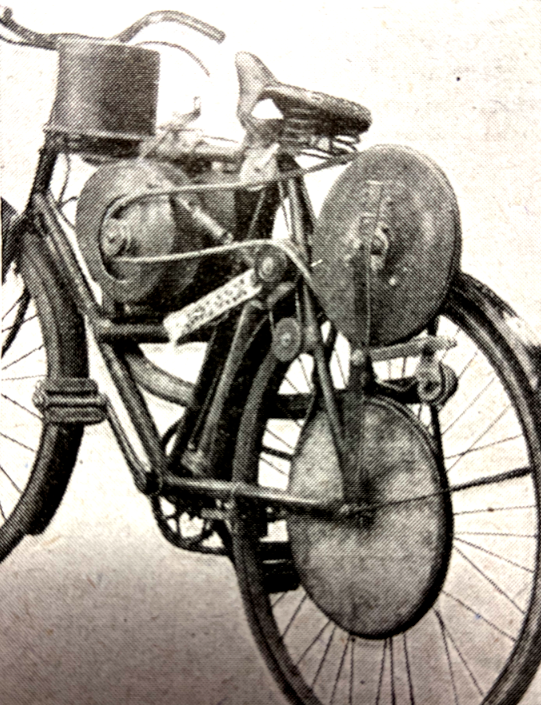
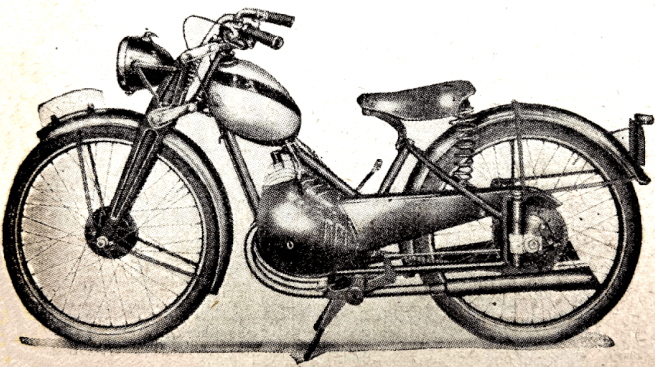
“I AM SENDING a photograph of a friend’s machine which may be of interest. The modifications were carried out in Bangalore, India. He says everything is Norton but the engine and handle-bars. The engine (Indian) gives a rather rakish performance, near 80mph with a 1in carburettor in lieu of the original ⅞in. The cylinder heads were lowered and modifications made to the inlet ports and cams. All parts carne from the WD Salvage Depot.
M Tomkinson (Major), REME.”

“AS PART OF MY TRAINING to qualify as a DR in the Overseas Contingent of the NFS I took rough-riding lessons. It was after a grand and gruelling week spent cross-country motor cycling, manoeuvring in sand pits and chalk-hill climbing ‘midst Surrey’s hilliest with my classmates, that I called in at Dorset House for a chat. Roy Baker, my rough-riding instructor, motor cycled along with me to keep the date. Wall-of-Deathing cropped up, and you said, ‘Will you still ride Indians on the ‘Wall’ after the war?’ I replied: ‘Yes, unless a more suitable bike for my special job comes my way,’ and added, on reflection: ‘Until recent years British manufacturers have not specialised in twin-cylinder units; and for cool running in confined space, for effective acceleration and smooth running for trick riding, a twin is essential. Also, until the coming of Teledraulic front forks, the English front fork and head spring were too light, or, if damped, too heavy…And points of lesser importance include (1) my desire for footboards, not merely footrests, (2) a low-slung engine, (3) a really stout frame and sturdy wheels.’ You obviously thought it rather a ‘bad do’ that a Britisher could not be content, with a British machine, and said: ‘What is the word that spells for you your essential and special requirement? It is not speed; not great speed.’ ‘No,’ I admitted, ‘it is not great speed performance, neither is it ultra comfort of riding position, nor any of the several seemingly ` ‘utopias’ envisaged by the ,several day-to-day advertisements. My special requirement, in one word, is ‘Reliability’.’ You then escorted Roy and me to our NFS utility mounts, propped in Stamford Street where I concluded: ‘One day, perhaps, I shall have the opportunity of owing much to some British machines.’ Good wheels of fortune turn fast. Recently I had an invitation to meet Mr GG Savage, for many years now the holder of the time record for a motor cycle climb up Snowdon. I wonder if you have by now guessed the name of the firm of motor cycle manufacturers I have chosen to produce my Wall-of-Death motor cycles of the immediate future. The simple and inevitable solution to my problem is BSA.
Tornado Smith, Southend.”
If you’ve followed the timeline from the beginning (and of not, why not?) you’ll recall Tornado from 1929 when he became the UK’s first wall of death star (In 1929 you’ll also find a snap of Tornado on the wall with his pet lioness in the sidecar.) He subsequently emigrated to South Africa to avoid his many creditors and died there, bankrupt, in 1971…leaving £100,000. A contemporary report concluded: “Tax investigators were keen to find out where this money had come from.”—Ed

“I RATHER THINK that the letter from Tornado Smith gives the impression that British machines have never been used on the Wall of Death. But probably other readers will remember otherwise. The first Wall of Death I ever saw was at a fair at Portslade, Sussex, and the machines were OECs with duplex . steering, but I am not sure what engines were used, I think ohv singles. Incidentally, they wire all spick and span, in showroom condition, in contrast to others I have seen since. This would be somewhere around 1930. I wonder how many readers heard Tornado Smith speak in the BBC feature In Town Tonight, when be mentioned driving a car round with a lioness in it. I remember seeing this at Brighton Race Hill. Also one year there were some riders who had a steel mesh globe inside which they rode, making a complete ‘loop-the-loop’ by riding up one side across the top upside-down and thence down the opposite side. For this they used British two-strokes, the make of which I do not remember.
LE Bissell, Brighton, 6.”
“IT MAY INTEREST readers to know that the British two-strokes used for riding in the steel globe were Francis-Barnetts, and that two were in the globe at the same time. A car of tubular construction with a Scott engine was also made to do complete somersaults.
‘Norton MJ 8485’, Bedford.”
“I NOTICE A LETTER in the Blue ‘Un from Mr LE Bissell re the ‘globe’ riders on two-strokes. I saw these people perform at the Crystal Palace in 1920, and what a performance! The machines were the torpedo-type tank two-stroke Triumphs, and they certainly ‘did their stuff’. One rider, if my memory serves me rightly, did 27 consecutive loops inside the globe-shaped cage of, I should say, 15 to 20ft diameter.
NR Campbell, Stoneleigh, Surrey.”
“WE WERE INTERESTED to read the letter from Mr LE Bissell, in which he refers to some riders looping the loop within a steel mesh globe. This feature, known as the ‘Globe of Death’, toured this country and the Continent of Europe for a long time. It was a most spectacular display and the machines were built by Monet-Guyon of France and fitted with Villiers 147cc engines.
Villiers Engineering Co, Wolverhampton.”
“A DISAPPOINTMENT TO MANY to-day is that manufacturers are not showing more interest in sidecars and sidecarring. It is realised that at present they have their hands full, but do they appreciate that in 1938, of the 462,375 motor cycles registered, no fewer than 105,219 were sidecar outfits? Certainly this fact was not perceived by one big factory, for only recently we were asked to provide detailed figures. And is it realised sufficiently that, with the post-war prices of cars and commercial vans, there is fresh emphasis upon the sidecar and sidecarrier? There are tens of thousands who want motor vehicles at prices they can afford and for whom that cheapest of all motor vehicles to insure, the low-tax, economical sidecar outfit, can fill the bill.”
“A READER WHO HAS raised some points on petroil lubrication brought to mind an ACU observed test carried out in 1922. Wakefields followed up claims for an upper-cylinder lubricant by a certified test at Brooklands of a 247cc Levis with a petroil mixture of 1oz of Castrol C summer grade to two gallons of BP Aviation spirit. The average speed over 161.1 miles was 19.9mph and the consumption of oil 32,777mpg.”
“MR GR STRAUSS (Ministry of War Transport) said during the debate on the Trunk Roads Bill: ‘In making this further important advance towards a national highway system, we are returning to a system in operation in this country 1,500 years ago. The Romans, during their period of occupation, built and maintained, largely for strategic reasons, a series of national roads under the responsibility of a central authority. Because the responsibility was a central one, the planning of those highways was excellent, their standard of construction uniform, and their maintenance, as far as we can tell, was admirable.'”
“COMMENTS IN THE CLUB world show that the appointment of Mr ST Huggett as the new secretary of the Auto Cycle Union is a very popular one. He has the happy knack of getting on well with everyone.”
“THAT FAMOUS AUSTRALIAN speedway star, Vic Huxley, idol of crowds in this country in the earlier days of the speedway game, has started up as a motor cycle agent in Brisbane under the title, British Motor Cycle Company.”
“THAT ONE MIDDLE EAST petroleum company, the Anglo-Iranian Oil Company, produced in the first nine months of 1945 more motor spirit than was consumed by Great Britain in the whole of 1938 was reported by the Evening Standard.”
“CHATTING WITH A LT-CDR, an engineer officer who is thinking of setting up as a motor cycle dealer in Scotland, I was amused to hear of a school prize-giving at which a copy of Motor Cycles and How to Manage Them caused consternation in the mind of the head master. Up to that time the school prize-winners were allowed to choose the books they were to have as their prizes. The winner (who now is the Lt-Cdr) specified the famous hand-book on motor cycles and, the rule being the rule, was duly presented with a copy. At the end of the next term the winners were presented with the books the head thought best for them. A pity when one recalls how widely ‘MC and How‘ has been used for Army training and how lumps of it were lifted by the Axis for training their men…”
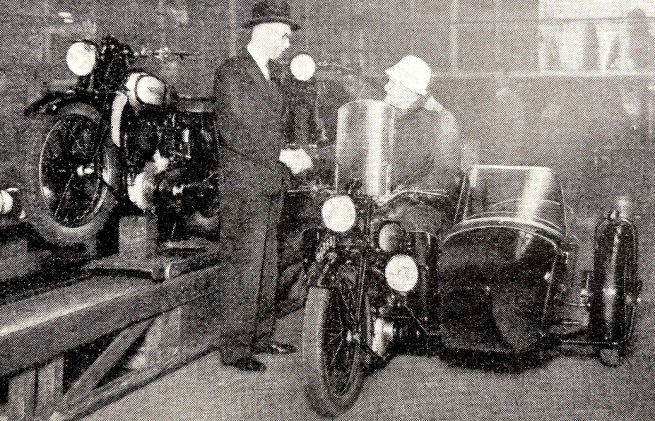
“VARIOUS CONTINENTAL ENTHUSIASTS are giving vent to disappointment over the design of the immediate post-war motor cycles. Recently we published a letter from Denmark in which the writer stated that he aimed at giving ‘a sort of warning to manufacturers’. If British factories wanted to export on a large scale they must, he said, develop machines in accordance with modern ideas. There have been other comments in similar vein from Continental sources. We have stressed and re-stressed in our columns that there is ample scope for originality of thought over motor cycle design, and that it would be folly indeed if design were allowed to become ‘sameish’, which was a fault pre-war. But it would be totally wrong to judge the British motor cycle industry’s post-war policy on the. machines that have been announced to date. It is obvious that even in countries which until a comparatively few months ago were occupied by the Germans there are some who imagine that life in Britain went on during the war much as it did in peacetime. There is, it seems. a complete lack of comprehension of the burden this country bore, and of the prodigious effort it put forth. It is not our purpose here to discuss why this should be so —obviously there has not been a full and proper dissemination of the facts. Our view is that with the war against Germany ended only last May, and that against the further enemy, Japan, in August, it is truly remarkable that British motor cycle manufacturers are already producing large numbers of civilian machines. Naturally they had to turn to designs which could be produced readily. To design, develop, prove and tool up for an entirely new model takes time —a long time—and the task was to get into production with civilian goods as quickly as possible. This was essential if there was to be any semblance of smoothness in the switch-over from war to peace; further, such a policy was essential to the well-being of the nation. Remember that only a proportion of the industry has been manufacturing motor cycles during the war, although over 400,000 were produced for the Armed Forces. Even these factories in nearly every case were manufacturing other vital munitions of war. No doubt it would have been possible to rush through new models with advanced specifications, and the public would have applauded the announcements, but what would the almost certain results have been? There are many examples from the period immediately following the 1914-18 war. Machines were hurriedly designed and announced. After seemingly endless delays the motor cycles perhaps reached the production stage (many were still-born). Soon it was found that owing to lack of testing and development work they did not live up to their promise. The rule to-day must be ‘British and best’. There must be no question of designs that are not fully tried and proved reaching the public, and we heartily applaud the industry’s policy and its achievement to date. New, advanced models will be announced in due course. Then will be the time to judge; not now with the war over merely a matter of months.”
“‘WHAT ACTIVE STEPS is the Minister of War Transport taking to abolish dangerous road surfaces, and especially wooden setts?’ This question was asked by Lieut William Shepherd in the House of Commons last week. The answer was on the lines that might be expected. The Minister stated that his Department, in conjunction with the Department of Scientific and Industrial Research, is continually experimenting with various types of paving and surfacing, investigating their behaviour and seeking means of reducing tendencies to become slippery. It would not be right, he said, to regard all wood-block paving as dangerous or to assume that effective methods of surfacing such paving to avoid it becoming slippery are not available. In the year 1946, with all the time and money expended on research, this is as far as we have got. Rightly Lieut Shepherd followed up by asking when the Minister proposed ‘to get on with this job of putting down safe surfaces’. They would do much more, he said, than all the expensive and elaborate advertising campaigns. To this the reply was that provisions are being actively made now to overcome the arrears of maintenance…There is no mystery about the composition of safe road surfaces. Our view is that to lay down a surface in these days which can become slippery is nothing short of criminal. The time has come when the Government should set forth specifications by which every highway authority in the country must abide. Meanwhile readers can render a service to all highway users by advising us of all dangerous surfaces they encounter. What is needed is action.”—Ixion
“ACCORDING TO THE Scientific American, the payload of a really big air liner may be increased by a hundred pounds if the tyres are inflated with helium gas instead of with air. I seem to smell a chance of improving the suspension of a racing motor cycle by reducing its unsprung weight on similar lines.”—Ixion
“WITH SHEETING RAIN driven by half a gale, speculation was rife in the Bath area last Friday evening as to whether the open Kickham Trial would be another Colmore as regards mud. However, Saturday dawned without a cloud in the sky, and the entire trial was run in brilliant sunshine, with the atmosphere so clear that vast expanses of wonderful scenery were sharply visible from the hill-tops. All day long there blew a fresh, drying breeze, fresh enough for competitors waiting at the start to be constantly rubbing their hands to keep some semblance of feeling in the fingertips. After a couple of road miles to the first hill there was plenty to keep the riders warm. Apart from the observed hills, the 22-mile circuit contained a minimum of main road and a maximum of narrow, tortuous lanes which twisted up hill and down dale, with here and there diversions over muddy farmland and the like. Some of the unobserved going was more difficult than three of the observed hills. Altogether it was a thoroughly sporting course which kept the rider constantly on his mettle if he was not to exceed schedule time. Enjoyment throughout was completed by the excellent organisation.”
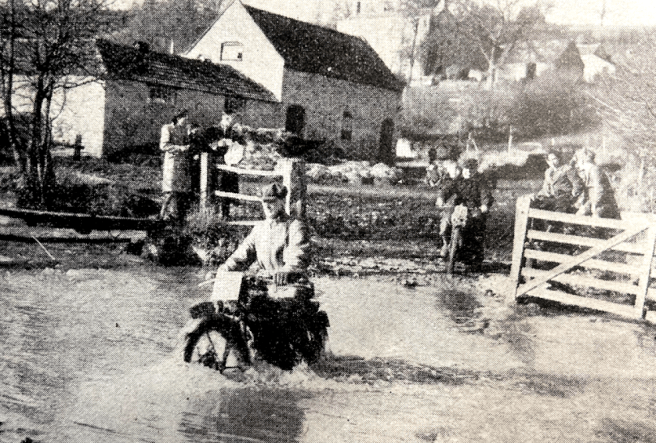
“THE HEALTHY OUTLOOK as regards the export of British motor cycles overseas in the years to come is revealed by Mr JY Sangster, Vice-president, of the British Cycle and Motor Cycle Manufacturers Union. He says: ‘Motor cycles share with bicycles the lead held by Britain in the world to-day. Before the war we sent overseas more motor cycles than all the rest of the world combined, leaving Germany out of the reckoning (for their exports were subsidised by the Nazi Government, and were therefore artificial). The number manufactured in this country in 1937 for motor cyclists in the Dominions and foreign countries was 25,350. Apart from Germany, the only other countries whose exports were noteworthy were Italy (523), the United States (3,417), Belgium (2,257), and France (1,590). To-day, and for many a. day to come, Germany and Italy are out of the running; and, of the others, Belgium, France the United States are among 31 countries, spread all over the globe, now clamouring for British motor cycles. American ex-Servicemen who made the acquaintance of British machines in Europe are showing a strong preference for British products. Overseas orders are already three times the total of our exports for 1939, at 19,000 machines, which is not surprising when one reflects that war arrears in world supplies probably amount to 200,000 machines. The total export value of complete motor cycles and motor cycle parts should be at least £2,000,000 a year for some years to come.'”
“LAST THURSDAY I SAW a list of industries which the Germans, under Allied ruling, are not to restart, and another of industries which will be permitted to meet the Germans’ peacetime needs and no more. There was no mention of motor cycles. Maybe the lists were incomplete. Why I was specially interested was that we had received a letter from an American Army officer written from Nurnberg, Germany. After mentioning a BMW which he had been using he said: ‘I have also ridden those big Wehrmacht machines that they make at Zündapps. I say make, because they have just completed 25 new machines for the Polish and Dutch Governments.’ That the Huns should be making motor cycles, as this officer alleges, is surprising. I wonder whether it is a case of just building up a few machines from parts that are in stock.
“LAST WEEK I was shown a tool catalogue which has been issued recently. In it were illustrations of off-set double-ended ring spanners made of chrome-vanadium steel, of ratchet socket spanners and sets of spanners such as many of us have dreamt of possessing. Page after page revealed what were obviously beautiful tools. Was it yet another American list? No, Abingdon ‘King Dick’. It seems that we in this country are determined to produce spanners and spanner sets which are as good as can be found the world over. I am glad, for we seem to have lagged over recent years. And what about the tools we find in motor cycle tool-kits? I need not stress that the average motor cyclist carries out his own adjustments. Surely it is reasonable to suggest that a tool-kit should be as good as the machine of which it forms part? If manufacturers point out that to-day every penny counts, why not get some maker of tools to list a special kit applicable to each model or make—a kit which Mr Motor Cyclist can order, knowing he is going to get not only super tools, but the very ones for his model?”
“EVERY SO OFTEN a reader asks me why the American type of sit-up-and-beg handlebar with long stems and sharply dropped grips so seldom figures on British machines. They suggest that it might well be an option on large-output models of the non-sporting type. What they saw of American military DRs in the war convinced them that such bars are quite as safe for control purposes as the lower bars preferred by British crouchers, and these individuals consider the type more comfortable. After all, most car drivers lounge backwards and poise their arms and hands in much the same posture as a DR doughboy. The pity is (their opinion, not mine) that we cannot also use stumpy back-rests, which ‘make for comfort but create risks on occasions’. Well, well!”—Ixion
“A SIDECAR MACHINE won last Saturday’s Victory Trial, the 22nd of the series, which the Birmingham MCC instituted in 1919. The winner was DK Mansell (490 Norton sc), ably assisted, as usual, by that skilful factory member and passenger extraordinary, Bill Mewis. FM Rist (348 BSA), who won the Colmore Trial a fortnight previously, made the best solo performance, with Sg. CM Ray (497 Ariel), Army instructor from the D&M (Infantry) School, as the solo runner-up. The team prize was won by BSAs—FM Rist, J Blackwell and W Nicholson. Much of interest occurred on the trial, even if it was another mudplugging event. Happily, the mud was not of such a heart-breaking variety as on the Colmore Trial. An entry of 142 had been received. Of these, all but 11 started. Among them was Gus Kuhn, who won the first event—in 1919—on a 247cc Levis. Kuhn, as a picture in these columns a few months ago duly revealed, is now a grandfather, but few made more spirited attacks at last Saturday’s hazards than this famous trials rider and speedway star of the 1920s. Once again there was a number of ‘Flying Fleas’—125cc lightweight two-strokes such as the Army used in their thousands for airborne, assault troops, etc—entered in a big open trial. The knowledge gained in the Colmore Trial and since that event seemed to be considerable, for those riding the Fleas displayed much greater skill in their new role and, incidentally, were frequently clapped and cheered.”
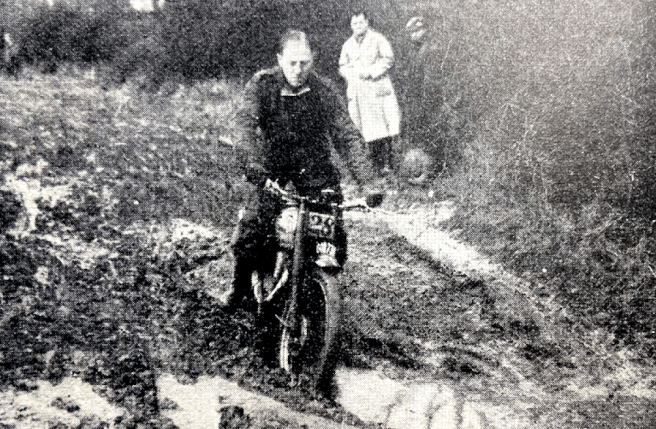
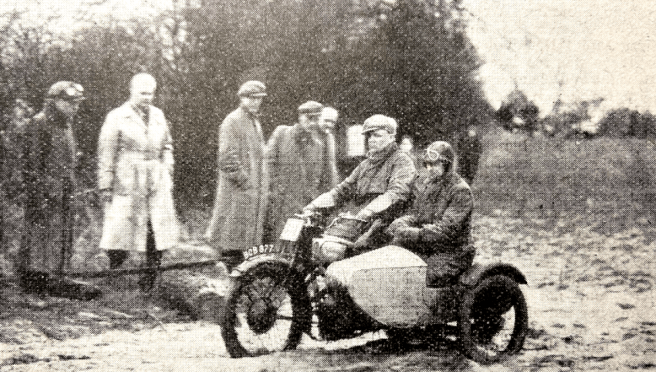
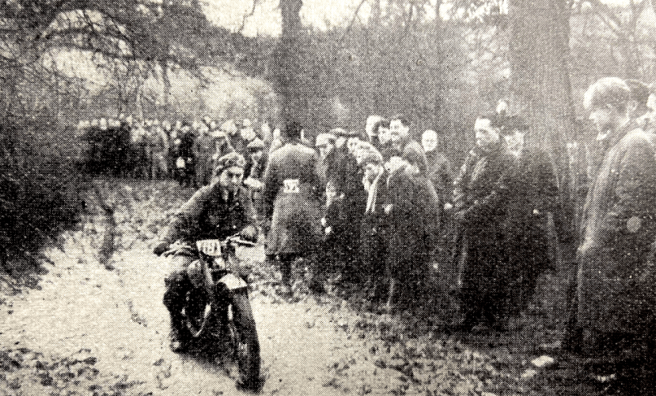
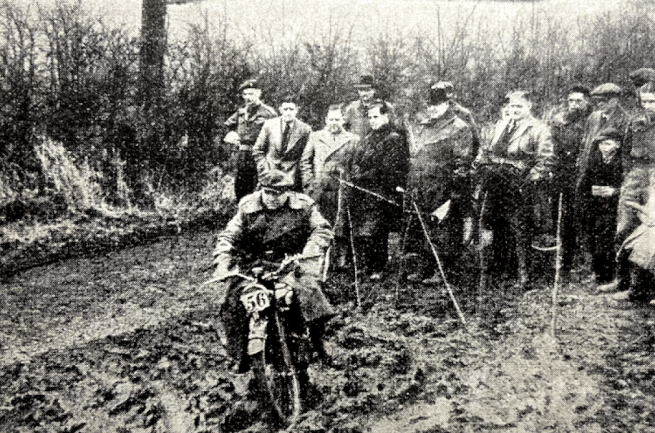
“ONCE AGAIN THERE IS a Departmental Committee’s report on road signs. With the passage of time it was no doubt desirable that the position should be reviewed afresh, but several of the recommendations made are far from new and the necessary action should have been taken years ago. For example, the Committee urges the removal of unauthorised signs, that illuminated advertising signs which might be mistaken for traffic signs be banned, and that reflecting lenses in advertising signs be prohibited. Even now, it seems, there is no guarantee that action will be taken. All that has occurred is that the Minister of War Transport has suggested that highway authorities in England, Scotland and Wales should consider the recommendations of the Departmental Committee when signposting their areas. The italics are ours. It is high time that the Minister was in a position to demand action from the thousand and more separate highway authorities. Road safety is involved: on the one hand the Government is spending thousands of pounds on a road-safety advertising campaign, and on the other permitting what in many cases constitutes a dangerous state of affairs to continue.”
“WRY FACES AND hard thoughts are inevitable this week. The prices of motor cycles, instead of going down, are going up. Everyone had hoped that, as manufacturers got into their stride following the change-over from war to peace, new machines would tend to become cheaper. But from to-morrow, March 1st, there will be an increase in retail prices of anything up to 15% and, with the increase, there is, of course, as far as the home market is concerned, more Purchase Tax to pay. In just a few cases there will be no increase for the moment, but there will be one, it seems, when it becomes possible to change from, say, an austerity-type finish to polish, colour and chromium. As I sit down to write this article I think of the many letters we have bad from lads serving overseas: of their comments on the high prices of new and second-hand machines and of how these prices have meant that dreams for after the war have been shattered. Recently there has seemed a tendency for second-hand prices to ease Now they will no doubt harden in sympathy (what a. word in present circumstances!). Over the causes of the increase, let me quote some of the comments made by one manufacturer: ‘The fact is that in spite of all the forethought and organisation that was applied to our peacetime production we are still not reaching anything like the output which was anticipated. I believe the men in our factory are working as well as and probably better than, those in other factories in the area, but they are not working to anything like the extent that they were before the war and are getting paid a lot more for it. From my enquiries this applies universally. The consequence is that not only is our raw material 60 to 70% up over pre,-war levels, but the wages paid per machine built are up almost precisely the same figure.’ The manufacturer who produced cost figures ran his pencil down the columns showing 1939 and 1946. Whereas pre-war the cost of machining all the parts for one model was some £9, to-day the figure is over £20. On chromium plating and polishing his costs have gone up by over 130%. At another factory I was given figures covering the engine unit; the total cost is well over double that of pre-war days. No thought is needed to appreciate that money is merely a means of interchange of goods and services, and that if wages go up all round no one is one whit better off since everything one buys will have gone up, too. But there is the point, which is not always appreciated, that if the output per man goes down, then, as a rule, the articles he produces go up in cost to a far greater degree than his reduced output suggests. At one factory it was remarked that their overheads were right up. Obviously if a factory is capable of turning out, say 400 machines a week and is only producing 250, the cost of heating, lighting, buildings, rates, management, sales staff, machine tools, jigs, fixtures and so on, has to be borne by 250 machines instead of the 400. On the efforts of the individual depends what that individual’s money, and the money of all in the country, is worth. The whole matter of our standard of life depends upon the productivity and therefore upon individual effort.”
“THE LATEST INCREASE in price of new models will be quite a blow to the serviceman hoping to purchase a machine on his release. Second-hand prices, already way up in the clouds, can be expected to rise in proportion, so putting a motor cycle beyond the reach of the majority. Bikes without lashings of shining chrome, dazzling colour schemes and other unnecessary and costly extras as turned out for the services proved themselves under extremely strenuous conditions during the war. These bikes have already had a road test—and what a test! It should be possible to continue the manufacture of these same models for civilian use at a low cost. The machines are already set up for the job and experienced men are available. If this could be done the man needing a reliable machine for work and pleasure should be able to purchase one at a reasonable price.
GL Bayes (Ex Sigs Don R), Retford.”
“WITH REFERENCE TO Mr WN Smallwood’s letter, I, too, shall prefer to walk rather than buy secondhand ‘bargains’ at the price of two new pre-war machines. It is about time a stop was put to the ramp—there is no other word for it. Dealers are not the only people asking fabulous prices—private owners have just as much nerve.
S Purland (Ex-1st ALB), Battersea, SW11.”
“TOTALS OF NEW solos, sidecars and three-wheelers registered for the first time in the years 1939-1945 are officially quoted as follows: 1939, 47,210; 1940, 22,709; 1941, 8,980; 1942, 5,157; 1943, 1,641; 1944, 1,676; nine months ended November 30th, 1945, 10,393. Included in these totals are 31 electrically propelled motor cycles registered between 1942-5…The number of motor cycles on the road at August 31st in the years 1939-45 was as follows: 1939, 418,000; 1940, 278,300; 1941, 371,009; 1942, 305,900; 1943, 123,700; 1944, 123,900; 1945, 309,100. It will be remarked that the number of motor cycles kept at a. remarkably high level in the first three of the war years. The vast majority of the motor cycles registered for the first time during the war years were, as might have been expected, lightweight under-150cc models. In 1941, 1,391 out of a total of 8,623 new machines registered were under 150cc; in 1942, 3,100 out of 4,769; in 1943, 952 out of 1,322; in 1944, 959 out of 1,353. The proportion dropped in 1945. In the eleven months ended November 30th, 3,096 out of a total of 9,637 machines were under-150s.”
“BERETS, FLYING HELMETS, tweed caps, ski-caps, crash helmets—one sees each of these types of headgear in use by motor cyclists of to-day. Crash helmets, use of, is, of course, confined almost entirely to the Forces. I am glad because they are not exactly handsome and they do not constitute very good propaganda. If you are on the speedway, racing in the Isle of Man, or something of that sort, they are the obvious wear. Some Police forces have used them; I hope the idea will not spread and in any case a policeman should surely have the dignified custodian-of-the-Law appearance? The London Metropolitan Police, I gather, have decided definitely not to use crash-hats. But what is the best wear for the civilian? I have used each of the remaining four types I have named, and each has its advantages.”
“SIMPLICITY AND STRENGTH are keynotes of the BSA hydraulically damped telescopic spring fork, which is a feature of the new 350cc ohv Model B31 and the 350cc Competition model. The fork legs comprise a pair of fixed tubes, over the lower parts of which are telescoped two sliding tubes. Welded to the bottom ends of the sliding tubes are lugs which carry the front wheel spindle. The fixed tubes are bridged by two cross members, triangular in shape, with their apices* connected to the top and bottom of the steering column.”
*Apexes. The OED does mention ‘apices’ as an alternative but I suspect the writer was showing off. Note that new technology gives birth to new nouns; before long these cross members would be named top and bottom yokes.—Ed
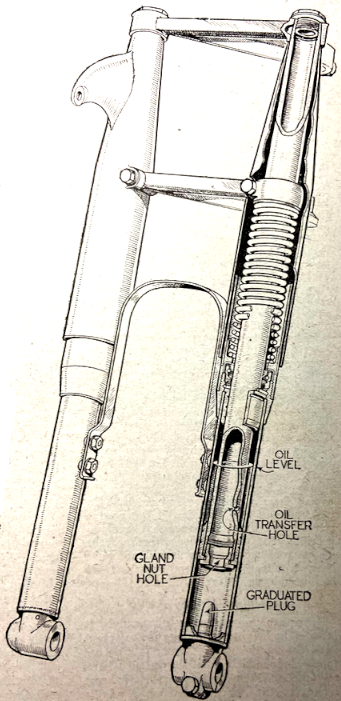
“THE STORY OF how Rochester Bridge, in Kent, has been maintained without cost to the public for 400 years has been re-told in Parliament. In 1391 a stone bridge was built and lands were set aside as an endowment to keep it in repair and provide new bridges as necessary. The present steel bridge was built in 1914.”
“FOR MANY YEARS chief officials of the Auto Cycle- Union have told clubmen at dinners and club meetings, ‘You are the ACU’. Nevertheless, the phrase coined in the 1920s or earlier, the ‘Mandarins of Pall Mall’, has continued. The ACU was democratic, but did not appear to be so, and the reason why ACU headquarters and its committees seemed as poles apart to the average clubman was an unnecessary and most undesirable cloak of secrecy. Even the agenda for the General Council Meetings was marked ‘Private and Confidential’. At last Saturday’s first post-war meeting of the General Council—composed of representatives of local Centres, non-territorial clubs, etc—for the first time in history the Press was invited to attend. Further, although previous to the meeting the Secretary was asked that if any part of the proceedings were deemed confidential this should duly be stated, not one item was given out as ‘being ‘off the record’. Indeed the Chairman in response to a Councillor, stated that it was silly to suggest that any subject discussed by 50 or to could be considered private and confidential, adding that the more who discussed ACU matters the better. This is obviously the right attitude—the only one if the ACU is to have the allegiance and hold the sway that should be the case.”
“IT WAS ONLY to be expected that after all the khaki and similar drab finishes of wartime motor cycles the pendulum would swing towards the other extreme. Today several factories are experimenting with new and brighter colour schemes. Whether this country goes to the extremes in colour that became the rule in France just before the war is largely in the hands of buyers to decide. All motor cyclists wish to own a machine that is smart, and which has a thoroughly practical finish, but is the ‘garish’ desirable? The lesson of the past—of the Olympia Show at which manufacturers exhibited tanks finished in numerous different colours and combinations of colours—is that in this, as in nearly every other matter, motor cyclists are conservative.”—Ixion
“AMONG MOTOR CYCLISTS last week-end a main topic of conversation, of course, was the thrilling new multi-cylinder motor cycle described on the Thursday. Even a rival designer was constrained to say that the new Sunbeam, if it has and retains a performance in line with modern standards, and can be made at a reasonable price, will commend itself to discerning-type buyers. He prefaced this remark by emphasising the ‘complete departure from orthodox motor cycle practice’. Private-owner enthusiasts gloated over the detail design, the clean lines of the machine, and discussed the large tyres…The suggestion that the machine departs from the orthodox will probably surprise many. Surely it is a case of clever use of modern knowledge and that very little can be dubbed in any way unorthodox? Design is due to stride forward. There has been far too much thinking in terms of the past.”—Ixion
“‘NITOR’ pertinently asks whether body protection should be mounted on the machine or on one’s person. I doubt if the suggested alternatives quite hit the bull. In certain weather we all automatically sigh for the whole bag of tricks—screen, handle-bar muffs, legshields and so forth. In good weather we don’t want to be bothered with any of them. Our climate being what it is, the problem is fundamentally insoluble. More than once I have been almost charred by a blistering sun at the start of a July run, and before nightfall ridden through hail at a temperature which felt like zero. So most of us who ride far and long adopt detachable protection. Unluckily, ‘detachable’ is no synonym for ‘packable’, and on two-wheelers we lack luggage space. My ideal consists of collapsible, removable screen, muffs and legshields, all portable enough to slip into a carrier case. I can’t obtain them. So I compromise. I plump for quick-detachable screen and muffs, and tolerate legshields in summer. Or maybe on another mount I depend on just goggles and a very thick set of overalls. Perhaps…some day…flexible, non-breakable plastic fittings…who knows?”—Ixion
“COME HAIL, COME SNOW, come shine, the testing of experimental models goes on. You know as well as I do the hard weather we have had at times this winter, and how treacherous the roads have been. But during the whole of that time motor cycles have been out on experimental test covering their 200 and 250 miles in the day. A manufacturer remarked last week that even in the worst weather his man had been putting in 250 miles per day. Under good-weather conditions the mileage is around 300. It is extraordinary when you think of a normal working day as opposed to the very long day you and I normally make of it when we cover a big mileage. Three hundred miles a day, over 1,500 a week,75,000 or more miles a year…”
“US AND CANADIAN clubs don’t hesitate to choose colourful titles, as witness Trail Blazers MCC, Chicago Hornets, Hi-way Ramblers, Niagara Pirates, etc, but most riders in rationed Britain will no doubt find that the Oil City Club has an irresistible attraction about its nomenclature.”
“IT IS HIGH TIME that mudguarding was improved. My experience is that the modern machine is nothing but a mud flinger. Mudguards should follow the contour of the tyres and extend to the rims downward. The best example of this is the Rudge design. On my own machine the guards are the so-called deep D-section type, but in practice they are wholly inadequate. The only parts on a machine the rider should have to clean are the wheels and guards. Of, course, you can have a valanced guard but you must order them specially or accept what the makers offer. The so-called sports guard is hopelessly inefficient. ‘Panther’, Birmingham.”
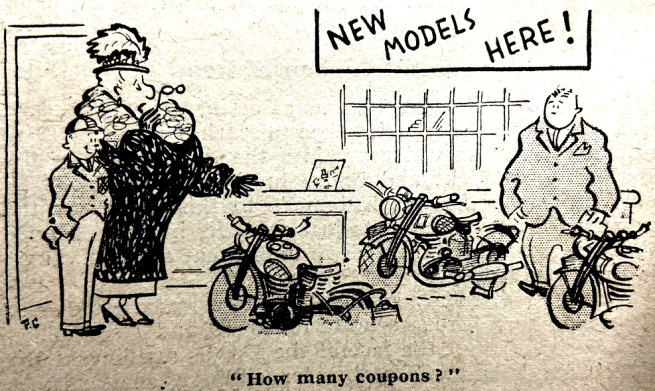
“I SHOULD LIKE to correct the allegations made by Mr. Ball in your report of the ACU Council meeting. He states that a letter has been received from me in which I am reported to have said that no useful purpose would be served by affiliation. In point of fact my correspondence with Mr ST Haggett has been in connection with a meeting between the ACU secretary and the AMCA committee in Birmingham on March 9th on the possibility of future co-operation. As AMCA secretary I am acting upon the instructions of the AMCA committee, and the utterances of Mr. Ball, together with his ‘last appeal’ threat, are likely to influence unfavourably my committee before the meeting on March 9th.
EC Hyland, Hon Sec, Amateur Motor Cycle Assn, Birmingham.”
“LAST SATURDAY THE Amateur Motor Cycle Association, the big unaffiliated group of clubs, decided by 8 votes to 1 to apply to the ACU for official recognition as a non-territorial body. The following clubs voted in favour of linking up with the Auto Cycle Union: Moseley, Rugby, Midland Social, Birmingham City Transport, Worcester, Smethwick 30th, Pyramid and Cannock Chase. The one club that voted against the proposal was the Victory. Earlier in the meeting it had been unanimously decided that the AMCA would affiliate only if there were a two-thirds majority vote by the clubs present. Thus the breach has been closed and the sport greatly strengthened. The recent series of discussions began with a meeting last June under the chairmanship of Mr Arthur B Bourne, Editor of The Motor Cycle, when it was decided by the chief officials of the AMCA and the Midland Centre, ACU, to thrash matters out. Since then there has been a number of meetings, which have included personal contacts with Mr Huggett, the Secretary of the ACU, and now there is this excellent news. The AMCA desires to ratify the agreement with the least possible delay.”
“I READ WITH INTEREST from time to time in the Blue ‘Un various references to the super silencing of motor cycles. May I be allowed to voice my own opinion on this matter, which is that a motor cycle which could not be heard approaching would be needlessly dangerous.
‘Exhaust Note’, Drogheda, Eire.”
“ALTHOUGH NOT STRICTLY of the ‘North’ being more truly of the East Midlands, the Bemrose Trial nevertheless has a distinctly northern flavour. The Derby &DMC takes the Bemrose route well up into the Peak District, and since that ‘North’ which comprises West Yorkshire, East Lancashire and East Cheshire is rather starved in the matter of classic open trials there is always a good ‘local’ entry both from those quarters as well as from the many clubs in the Derby and Nottingham districts. Hence the entry list of 150 last Saturday—a total that could easily have been exceeded had Mr Secretary Fred Craner dared to have accepted all who offered. But because it is not possible to get enough marshals and observers on a Saturday morning the start cannot be before 12.30pm and the available daylight precludes the acceptance of a bigger number of competitors; as it was, the intermediate time checks were eliminated in order to save delay. But with the best will in the world, time loss extended the string of riders. A minute or two here, a quarter of an hour there, and a cumulative delay became.apparent. The early members were on time according to programme at the many observed sections, but the later the numbers the later their appearance and the longer their passage through any one section. At the finishing point at Hartington 0/C Craner was getting quite worried as the day went on. Messengers were sent out. ‘Could this or that hill be washed out?’ And each time the answer came back ‘No’, because already some of the early numbers had been up and had been credited with clean performances. So it had to be. Only the last section of all, half a mile away from the finish, was cut out. And the upshot was that most of the late numbers climbed Pilsbury when the light had gone and they could not clearly see the path to follow. Naturally they finished well after the time when lights were put on and many without lamps were in a quandary about getting home. There was a run on the available stock of pocket torches in the village garage at Hartington. The contingent from West Yorkshire, always ready to throw a party, were speculating where to carry out such a project, while a team from Cambridge were speaking bravely of riding through the night to that home of learning. Nobody could quite weigh up why the lateness had crept in. Delays on any one hill had not been excessive, except perhaps at Hunger, early on. Route marking was excellent and marshalling on observed sections was generally expeditious. It just seemed that the entry was too big for the time allowed and that the moving finger moves, and keeps on moving on. Although it was an enjoyable day in spite of some difficulties, the atmosphere was more ‘sporting’ than ‘open’. It was rather noticeable that the recognised stars had not shone nearly so brightly as usual, while some lesser lights had glowed quite brilliantly. On this type of route good pulling power at low revs and telescopic forks had proved themselves invaluable. And although one rose doesn’t make a summer, a vertical twin had shown that it can provide an easy ride over rocky obstacles.”
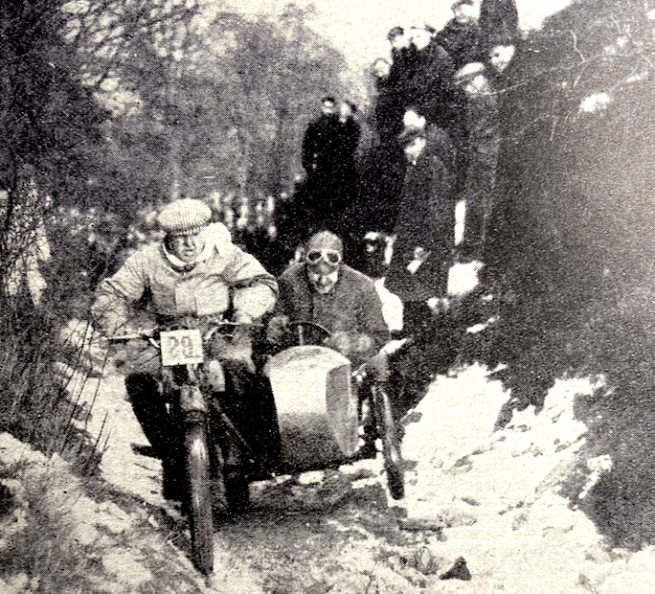
“AN ADMISSION THAT, with the early end of the war against Japan, the machine organised for dealing with surplus vehicles had become clogged was made by the Minister of Supply at a conference last Saturday. Following a reasoned defence of the policy and practices to date, he announced a new and additional plan: sales by auction. But, as The Motor Cycle found on questioning the Minister on behalf of motor cyclists, the fresh scheme does not apply to motor cycles—yet. The standard arrangement whereby manufacturers take over the machines declared surplus, rebuild them and sell them through normal trade channels at fixed prices, was, he said, going very well; reconditioned motor cycles were available to the public. It is, of course, a fact that any motor cyclist or potential motor cyclist can obtain delivery of such reconditioned, guaranteed machines. The position is very different from that obtaining over cars. One reason for this, as the Minister stated, is that only some 7,000 private cars were produced for the Services throughout the war. The number of motor cycles was over 400,000. This latter figure suggests that there may well be a time when the ‘machine’ the Ministry has organised in this connection also becomes ‘clogged’.
“ASKED ABOUT THE Government’s policy on motorways, Mr Barnes (MoT) said: ‘Pending the passage of legislation, there is no power to construct motorways.’ He added that there would be a uniform and up-to-date system of traffic signs within two years.”
“I QUOTE FROM your report of Mr Masters’ talk ‘Design over the Years’: ‘In this war standard Triumph, Matchless, Norton, Velocette and Enfield machines had been used with lightweight James and Enfields.’ Assuming that Mr Masters was reported correctly, may I draw his attention to a machine known widely throughout the services by the initials ‘BSA’, known widely because over 126,000 of them were supplied to the forces out of an estimated total of 425,000 supplied by the British motor cycle industry, and this as but a part of the BSA ‘war effort’, which included (inter alia) nearly 2½ millions of the small arms up to 20mm calibre manufactured for ‘this war’.
HN Brealey, Advertising Manager, BSA Cycles, Birmingham.
[It is more than likely that our shorthand writer misheard Mr Masters and that the latter duly mentioned the BSA—Ed.]”
“INTERNATIONALLY, as well as nationally, motor cycle sport is well on the way to getting into full swing. Today there is news that the International Federation, the FICM, is to hold its first post-war Congress in Geneva. Included in the business will be consideration of the future policy and activities of the FICM, the question of the attitude to be adopted towards the Axis countries and discussion on the possibilities of the United States, Russia and other non-member countries joining the Federation. What we are chiefly concerned about is the future policy of the FICM. It is highly desirable that there should be an international body. Interchange of knowledge between the various motor cycling nations can be valuable, and there should be one set of rules for world’s records, one controlling authority for such records and so on. A danger over international sport, however, is that it can breed nationalism. All know how Germany used car and motor cycle sport in the immediate pre-war days—utilised it to glorify the Fatherland and to aid her programme of aggression. The future policy of the FICM. should be framed so that motor cycling proves a means of achieving greater harmony in the world. With the brotherhood that exists among motor cyclists there are good possibilities in this direction.”

“LAST WEEK, BEFORE the Birmingham Centre of the Institution of. Automobile Engineers, there was as remarkable a lecture as it has been my good fortune to attend. The subject was ‘Atomic Energy—and its Possible Use for Prime Movers’, and the lecturer, Prof ML Oliphant, MSc, PhD, FRS, who was one of the small team of scientists entrusted with the task of developing an atomic explosive. Various full members of the IAE and hundreds of others could not be accommodated in the packed hall. Among those who succeeded in obtaining tickets were many of the No 8 Hats of the motor cycle industry. Professor Oliphant, who obviously as well as avowedly enjoyed addressing a technical audience, gave a talk which was staggering. So complete was his grip of everything achieved to date that he spoke without a note, without a hesitation, and with his audience, for all their technical qualifications, left almost gasping. What are the possibilities of the use atomic energy for prime movers? Prof Oliphant said that the majority of scientific men feel that, for the time being, its use will be limited to large power stations; perhaps it may be used for large ships…He said that one could not see atomic energy being used for mobile power units; it was not possible to see, that yet.”
“OFFICIALLY LAST SUNDAY’S Sunbeam Club event was ‘The Eleventh “Pioneer Run” for Historic Motor Cycles’. It was much more: it was probably the greatest motor cycle occasion since the end of the war. As one clubman remarked, Tattenham Corner, on Epsom Downs, the starting point, looked like The Motor Cycle Clubman’s Day, so vast was the concourse of motor cycles and motor cyclists. To get more than a glimpse of the most interesting ancient motor cycles at the start, even if one was lucky enough to have access to the enclosure, was almost impossible. If tall, or if a precarious perch was found on the railings alongside cinema men and Press photographers, one might discern EA Marshall whipping the cylinder head off the engine of his 1898 200cc Beeston tricycle—a two-minute job, it seemed. And later, standing on Mr Pinhard’s car, as the MG man did (he was wearing waders!), one might watch that veteran C Bullen-Brown pedal-starting his 1902 142cc Clement-Garrard on its stand, move one of the many levers, lean
forward to do something to the engine and pedal again. To modern eyes it all had an air of mystery about it. These two machines, Wing-Cdr JM West’s 1901 275cc Matchless, Sub-Lt JF Sloan’s 1898 500cc De Dion Romain tricycle, HE Cohen’s 250cc Alldays & Onions motor cycle and GRW Cruddas’ 1904 500cc Kerry, comprised the honoured ‘Class A’, restricted to machines manufactured before the end of 1904. The remaining 44 of the total entry were, as the rules demand, machines made on or before December 31st, 1914. Some of these latter looked very modern—yes, even a number of the singles, and what of Rex Judd’s straight-four, the unit-construction 790cc four-cylinder with shaft drive, rear springing, internal-expanding brakes and bucket seat (which a lady referred to as the ‘armchair’)? Also, what about the Pierce Arrow which DJH Glover was riding, another four cylinder with shaft drive, plus bottom-link front forks and main-frame tubes of some 3½in diameter which form the petrol and oil tanks? These and AJ Heywood’s 1909 250cc single-cylinder FN caused wonderment among a party of youngsters who obviously thought the employment of shaft drive on motor cycles was something new.”
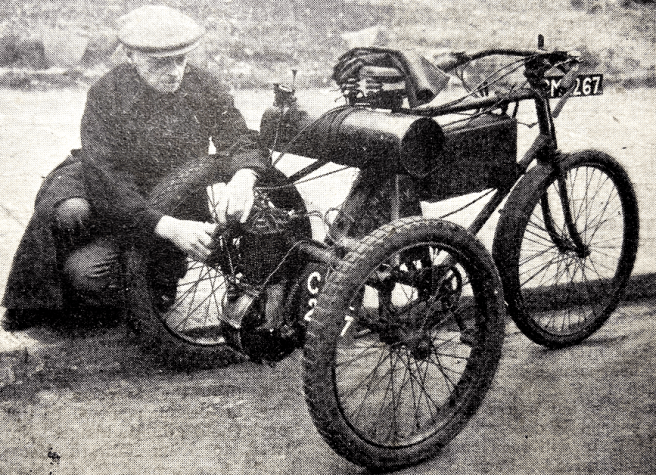
“ON THE PIONEER RUN for historical motor cycles I encountered many spectators riding autocycles. If you were out on the run, did you, like me, notice the marked similarity between the posture of those on autocycles and that of the riders of the 40-year-old motor cycles? One thing I rather decry over the Pioneer Run is the, number of competitors who had, as their observers, people in cars. To-day, with petrol rationed, it may be difficult to find anybody to observe one’s performance, but I hope that next year it will be ruled that every competitor is accompanied by a motor cyclist on a modern machine. The ideal thing would be for the industry to join in by providing men on the very latest models. Thus there would be the contrast between ancient and modem at which the organisers, the Sunbeam Club, aim. Of course, one cannot find 1946 Beestons, Kerrys, Humbers or Clement-Garrards, but it should be possible to have all the very latest models, each of them accompanying an oldster.”
“MoWT BECOMES MoT. The Ministry of War Transport was dissolved on April 1st (!), when the functions exercisable by the Minister of War Transport were transferred to the Minister of Transport.”
“FOLKESTONE TOWN COUNCIL have instructed their Parks Superintendent to get into touch with the town’s two motor cycle clubs with a view to the institution of motor cycle track racing in the town.”
“THE MINISTER OF SUPPLY has revealed that some 41,000 vehicles, including about 12,500 motor cycles, are under the control of his Ministry awaiting disposal. Motor cycles, for the present, are not to be included in the auctions. Asked if any surplus Army Excelsior ‘Welbike’ machines would be put on the market, the Minister said that all surpluses of these machines had been disposed of to an export firm for resale in the US. This transaction was particularly welcome in view of the urgent need for dollars.”
“AFTER THREE WEEKS without rain, and eight cloudless days preceding the event, last Saturday’s 15th annual open Mitchell Trial was held in the old familiar Caerleon area under weather conditions so perfect as to permit many riders to discard their leathers and their caps—and spectators to venture forth in midsummer attire. With such magnificent weather, and scenery to match, it was unfortunate that the organisation fell far short of the usual high standard. Though badly marked in a couple of places, the course was admirable for solos but too severe for sidecars on two sections (Nannygoat and Snowdrop). However, the main cause for complaint lay in the fact that no competitor or outside official had received route cards or numbers, nor even a notification of the exact starting place. The starting place was a considerable distance from the finish (in Pontypool)—an unnecessary complication for riders who brought their machines behind cars, and were thus faced with the necessity of riding their unlighted trials mounts back to the start in gathering darkness. The unfortunate absence of an all-important official armed with observers’ cards, etc, rendered the scene at the start distinctly chaotic. There were some lesser grouses among the competitors, such as the vague and conflicting instructions for signing off, the bad placing of section cards on one of the hills (Poplars), but the wonderful weather and highly sporting nature of the course (and riders!) eventually left most folk feeling happy.”
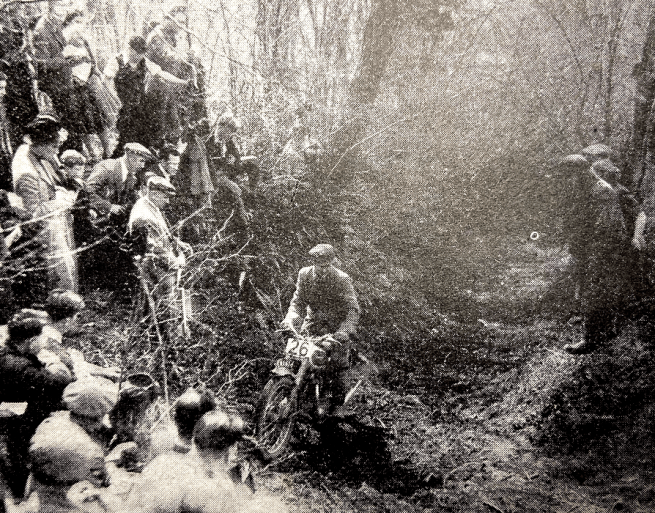
“I HAVE NOTED, with interest, the different attitudes riders assume when taking bends on solo motor cycles. The majority seem to lean into the bend with their machines, while others prefer to lean in the opposite direction. For sharp bends I always feel more at home in the latter category. It may be imagination, but the machine seems for more stable when it is being ‘laid’ into the turn. When pillion riding, of course, I always assume the same position as the rider. I have often been told that I ride pillion very well, but, nevertheless, I am always a trifle pessimistic behind someone else, and half expect the rear wheel to slide outwards when cornering on a wet road. When driving myself, however, the thought never enters my head. Perhaps other readers experience the same, or is mine an isolated case?
LJ Hall, Hayling Island.”
“LOOKING THROUGH THE registration figures for last December I was interested to find that the number of new motor cycles which were put on the road that month exceeded the number of cars. The figure for solos and sidecar outfits was 2,494, for passenger three-wheelers it was 41 and for cars, 2,388. While the bulk of the solo machines were in the over-250cc class (a total of 1,221) there were 614 machines up to 150cc and 599 of 150-250cc. Sidecar outfits were divided into three up to 150cc, five of 150-250cc, and 52 of over 250cc.”
“UP IN THE MIDLANDS a couple of weeks ago I was told that Wolverhampton had in train a scheme whereby the inherent safety of 125cc motor cycles would be stressed and that youngsters would be taught to ride and encouraged to take up motor cycling on 125s. It all sounded almost too good to be true. However, I sought further information. Last week back came this: ‘Wolverhampton is holding a “Safety First Week” this week sponsored by the Chief Constable. One of the highlights was to have been an exhibition of motor cycles to show the safety of the motorised bicycle and lightweight motor cycle, but the Society of Motor Manufacturers and Traders scotched the whole idea.’ I suppose the SMMT, who are responsible for the Motor Show, stepped in because of their rules on unofficial exhibitions.”
“AN ENTHUSIAST SPOTTED, lying on my desk, two photographs. ‘What, a new racing Excelsior?’ he said. The machine is largely Excelsior, but there is also a Tiger 100 engine, a pair of Matchless ‘Teledraulic’ front forks, part of the tail wheel of an aircraft and some beautifully made plunger-type rear springing. The creator of this thrilling-looking racing machine is Mr DSTJ Beasley, a motor engineer, of Allesley Old Road, Coventry. He is entering it for the Cadwell Park road races at Easter, and going in for the Manx Grand Prix next September, though in this case on a two-fifty. At present Mr Beasley is endeavouring to obtain a pair of pistons that give a compression ratio of 14 to 1, but if these do not arrive in time for Cadwell he will use the standard pistons. What is the performance of the machine like? The engine is just a standard one, he says, so there is no special reason for the machine going ‘quick’. The standing quarter-mile has been covered in 15sec, and the flying quarter in 9.6sec, almost 94mph. Both the road-holding and general handling of the machine please him a lot. I asked about the beautiful sheen finish—that soft vermilion of the tank, frame, etc, which contrasts so well with the plating and the silver finish of other parts. Mr. Beasley said that he mixed ‘a drop of silver with a spot of maroon and on it went’—sprayed on, of course. But it is not only the finish which is super; the whole is a pukka job.—’T'”
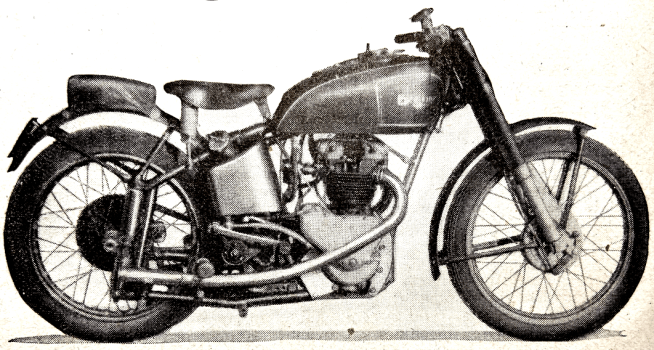
“I GRINNED AT ‘Torrens” account of his unconscious journey under the sardonic gaze of Joe Craig, following on his heels in a Lancia. Well, I know that awful sensation of being accounted something of an expert, and doing something clumsy under the cold stare of a knowledgeable individual or crowd. At one time it was a very regular experience for me, especially in reporting Six Day trials before machines were properly designed for steep hills. A thousand or more spectators would assemble at the stickiest point. I might be the Blue ‘Un’s sole reporter, and arrive stiff and breathless after the hectic ride involved in scrapping through the entire entry after it had topped the last observed hill. I would tear up to the worst point of hill No 2, dump my bus (probably borrowed), and not too new or, worse still, far too new; rip out pencil and notebook, and watch the boys up. Then I had to restart on mid-gradient, and start another hectic scrap to overtake them all again before hill No 3. I recall many disgraceful exhibitions—starting a 350cc TT ‘Beam by pulling its back wheel round on the stand (it had no ks) and removing about half my right hand on the sharp edge of the guard; restarting a two-speed Scott with a fierce clutch on a 1 in 5 grade, and whipping the frame so that a chain hopped off. Such feats at that date were more than once tackled with a half-plate box reflex camera slung round my neck, not to mention a dozen double dark slides! Worse still—I am rather clumsy even when I’m neither nervous, nor in a frantic hurry, nor cluttered up with heavy luggage.”—Ixion
“RATHER OVER A YEAR AGO I wrote a couple of paragraphs about an unusual-looking spring-frame motor cycle I had spotted as it zipped across Blackfriars Bridge, a few stones’ throw from Dorset House. I took the rider to be a certain famous track rider, such was his posture, shape and obvious at-one-ness with his mount. It turned out, however, that the machine was a Benelli and the rider Mr WNG Phillips, BA, AMIAE, who has been in charge of the design of Service vehicles and latterly has been Deputy Director of Mechanization (Technical). He it was who ‘fathered’ such machines as the WD 350cc twin Triumph, the 500cc side-valve BSA twin, and the 1,000cc Norton-JAP and Sunbeam sidecar wheel-drive outfits that could knock hell out of the BMW and Zündapp jobs, and sponsored the Lucas and BT-H direct-lighting sets that gave 30 watts at engine speeds as low as 850rpm and the crates for dropping the 125cc Royal Enfield by parachute. Some of these machines may be news to you. They were evolved by the respective firms’ design sides to fulfil Mr Phillips’ requirements, he at the time being often referred to by the industry as its ‘Master’! That they did not come into Service use was due to the war situation and to the fact that the demand for motor cycles exceeded the supply, with a result that finally changes had to be ruled out. To-day there is news of Mr Phillips. He has just retired from his post of DDM in order to ‘put up his plate’ as engineering consultant. Pending finding an office in London he is working from his home at Kingswood, Surrey. On what line is he ‘consulting’? One of them is motor cycles!”

“TO BE PITCHED HEADLONG into Civvy Street in mid-January with instructions to ‘make the best of it’ is not everybody’s conception of a joke. And, in mid-February, to contemplate a 1,000-mile round trip to Scotland and back does not exactly possess universal appeal, either. Even if, as in my case, it was to keep a pressing appointment with a ‘reunion pint’. The first intimation Jock had of my intention was a cryptic wire which read, ‘Hope arrive Friday. Wire if OK,’ from which he deduced the LNER Company would supply the motive power. But Jock, who was my fellow-DR throughout the first year of war, should really have known better than that. True, I had parted with a cherished Scott in 1940, and become, in the lean years that followed, a humble push-cyclist, condemned, it seemed, for ever, to weave dreams around Ethyl and double XL. The magic ‘number’ came up at last, and ere long I was pursuing the old, old quest for an ‘iron’. It didn’t last long, for a local farmer parted with his 500ohv Ariel (mech sound) of 1934 vintage, and became richer by a sum that knocked my gratuity quite out of shape. Within a couple of weeks the bike had responded to a little craftsmanship and looked good for a new lease of life. Zero hour was 10pm on a Thursday, and by half-past I was threading my way around the outer circuit of London, on once familiar roads, to pick up the Barnet By-pass. I had counted on the assistance of a full moon for my first couple of hundred miles, but things just didn’t happen that way. Kipling probably had in mind the Great North Road when he wrote: ‘The days are sick and cold And the skies are grey and old, And the twice-breathed airs blow damp,’ for never in that night or the following day did the sky clear. After the first few encounters in
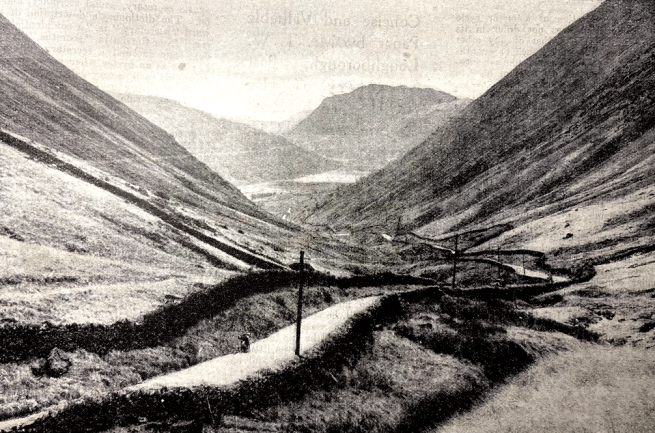
the mist with peacetime head lamps, my face screen came off, and stayed off till daybreak. In the dead hours of night I pushed on up a strangely deserted A1 (shades of ’39!), and after a brief halt for tea and sandwiches at Doncaster, rode into the dawn on Bramham Moor. No time was lost in covering the comparatively fast stretch through Boroughbridge and Scotch Corner to Newcastle, and over more tea I pondered whether to run up the coast road via Alnwick or take the Cheviot route, for the first time, to Carter Bar. It happens my big weakness is a patch of dark brown on an Ordnance Map, so Carter Bar won. And, honestly, I am very glad that it did, for it seemed the suppressed longing of all the lost years was wrapped up in that ‘rolling drunken road’ which climbs out of England, plunging northward, into the dark hills of the Border Country that Scott loved so well. On that desolate road, with only the bleat of the sheep and the throb of my stout little motor for company, I felt all the weight of the years roll clean away. But motor cycling and philosophising don’t mix, and all my attention was occupied in navigating the road down to Jedburgh, thence up Lauderdale and over the Lammermuir Hills into Edinburgh. By this time the previous night’s mist had played havoc with my eyes, and, arriving at Queensferry in mid-afternoon, it was not a little disconcerting to find that I could only dimly discern the outlines of the Forth Bridge! Still, journey’s end lay at a certain wee town looking across the Tay to Dundee, and the Kingdom of Fife does not present much obstacle to swift motoring. In no time at all a cheery, familiar voice was saying, ” Howdo, craftsman? Come on in—you’re ten minutes late!” Later that same evening The Pint was sunk with due ceremony—followed at frequent intervals in the next few days by several more pints. Reminiscences flowed freely, as they often do when DRs start swapping lies. Even the Weather Clerk registered his approval with a warm spell of springlike weather, until the time arrived to be thinking of the home trip. For a week we had cheerfully ignored the gloomy weather forecasts, but a rude awakening greeted us early one morning when a young blizzard came sweeping across the Tay. Between squalls I shoved off, with a parting injunction from Jock to stick to the coast route south and not gamble on being snowed up in the hills. But long before Edinburgh the skies had cleared, and over a first-class meal at Jedburgh I fished out the map and fell once again for the call of the hills. To the west, across the backbone of old England, lay the familiar country of the Lakes, and who could resist the temptation to slip over for a brief look at Ullswater, and the Kirkstone? Well, I couldn’t, anyway. At Alston I rode slap into a snowstorm, and in visibility of a dozen yards, plugged on up the hill-side. As I reached the top, every-thing suddenly broke clear, and within a couple of minutes I was out on dry roads, with white clouds chasing each other across a blue sky, and away beyond Penrith all the wide panorama of the Lakeland hills. That evening I rode into Windermere, over well-remembered roads, with not a care in the world. Little remains to tell of the rest of the trip—down to Chester, picking up the road through the Potteries to Lichfield, then hitting the Holyhead road back to London. The bike floated before a stiff north-westerly breeze at a steady ’50’, and once again Kipling seemed to have a word for it: ‘Sagging south on the long trail, The trail that is always new.’ I know now that in memory that trail will never grow old, and very refreshing it is to find it so. Concluding, I like to remember also a certain gentleman in faded racing leathers, perched high on an ancient 350 ‘Beam, who sacrificed precious time and petrol to see me through the busy streets of Preston, and then disappeared with a grin and a wave. There’s never a doubt, among the fraternity, the lamp still burns. Long may it continue.”
“AS A ‘SCRAMBLE’ the Chester MC meeting at Malpas was undoubtedly an excellent ‘mountain grass track’.” event!The course was a half-mile circuit at Higher Barnes Farm, Malpas, in the Tarporley-Whitchurch district—in short, in the typical ‘huntin” country of that very horsey and aristocratic county that lies just south-west of the industrial North. The Chester MC appears to have an aptitude for discovering beautifully situated rural backwaters where such events can be arranged. The only trouble is access. Even to reach the spot (and it was a dry, sunny day) several competitors’ cars and trailers were bogged, and the loud-speaker van and ‘the coffee stall’ had to be towed out of difficulties by a borrowed farm tractor before the way was cleared for later arrivals among the competitors, while a. provision lorry with the catering supplies became well and truly ditched, and looked as if it would need a block and tackle and sheer-legs to recover it. The circuit involved some serious ascents and a breath-taking descent, plus an awkward S-bend between trees. But it was not what is generally known as a scramble for there was nothing in the nature of rough stuff or anything comparable with an observed section; it was pure high-speed racing on a tolerably good if rather soft grass surface, and the gear box seemed more important than the brakes on the descents. The three ‘scrambles’ were each divided into three heats with nine riders to a heat. The 36 competitors were very representative of all parts of the Cheshire Centre.”
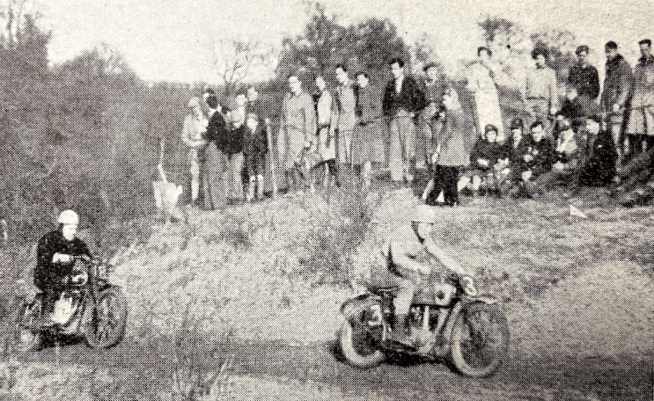
“TO-MORROW WEEK—FOR THE majority, the start of the first holiday of the year, four days’ freedom! If there is the blessing of good weather for the Easter week-end, it is certain that, notwithstanding the meagre nature of the petrol ration, the main highways will be thronged with something very close to their peacetime volume of traffic. Whatever may have happened pre-war over people eschewing travel at holiday week-ends for fear of traffic jams, everyone who has a motor vehicle will yearn to get on the road this Easter and to feel, with the first peacetime Easter for seven years, that at last there is freedom. No doubt there will be the usual statistics—8,000 vehicles an hour at this point, 5,000 at that—and the usual tales of vehicles queuing, head to tail, at bottlenecks on the main routes to add from cities. The wise motor cyclist, if he cannot start early on Good Friday and make the return trip before or after the crowded hours, will seek the quiet ways, working them out from a ‘½-inch’ or ‘one-inch’ map should he not know them already. Even on a Bank Holiday it is possible to find peace and quiet—off the main highways. What may surprise many is the large number of 1946-model motor cycles to be seen on the road. Various manufacturers have now worked up to their full-pre-war production figures—one or two to still greater numbers. In spite of 50% and, latterly, even 60% of makers’ outputs being exported, very considerable numbers of new motor cycles are coming on to the road. Over and above these are, of course, reconditioned Service machines and those many old-time models that have emerged, refurbished to provide a new lease of life.”
“THERE IS NEWS of the Vincent-HRD Rapide. Last Saturday I dropped in at the Vincent-HRD factory and learnt the answer to that question many have been asking, ‘When will the new Rapide be on the market?’ Unless they are let down over the last few promised parts, chiefly press-tools and pressings, the works expect to make the first deliveries in June. Progress of late has been substantial, and the vast majority of the parts for the first 1,200 machines are ready and waiting. Further, the big new single-span factory allocated to the company by the Board of Trade should be in operation in five to six weeks’ time. It will be used for enamelling, plating and assembly and for the service side. Apparently the only thing which can prevent the new 998cc twin emerging in really large numbers is lack of men to carry out engine and machine assembly. Young, keen, knowledgeable men for assembly work is their one big need, and not sufficient of them can be found, it seems, in Stevenage.”
“KICK-STARTING IS OUT of the question. Hand gear-change is necessary. The rear brake pedal must be on the right. What more natural than that the ex-Serviceman concerned should seek advice and help from Mr Harold Taylor, the one-legged rider/agent ? The other week I inspected the brand-new 16H Norton-Watsonian outfit which, duly converted, was ready for delivery. The hand lever for starting the engine was contrived by taking off the kick-starter pedal, cutting off the pedal portion, bending the shank, brazing on a suitable length of steel tube and fitting a rubber hand-grip. The resultant lever was fitted on the kick-starter shaft in such a position that it projects forwards and lies horizontally. Instead of occupying its usual position on the left handlebar, the exhaust-valve lifter is mounted on the off-side seat stay, where it can easily be operated with the left hand while the starter lever is pulled up with the right hand. Mounted on the off side, the rear brake pedal operates through a cross-over shaft. To carry the latter, two lugs were brazed to the underside of the lower frame tubes. Both lugs are bushed. Specially made for the job, the pedal locates on a squared end of the cross-over shaft and is retained by a nut. To the other end of the shaft is welded an arm which is linked to the brake cam lever by the usual rod. Nortons co-operated by supplying a machine with hand gear-change and an engine with slightly lower-than-standard compression ratio. As matters have turned out, swinging the engine with the hand -lever is so effortless that the lower compression ratio is not necessary. However, it can be a good feature for sidecar work.”—Talmage.
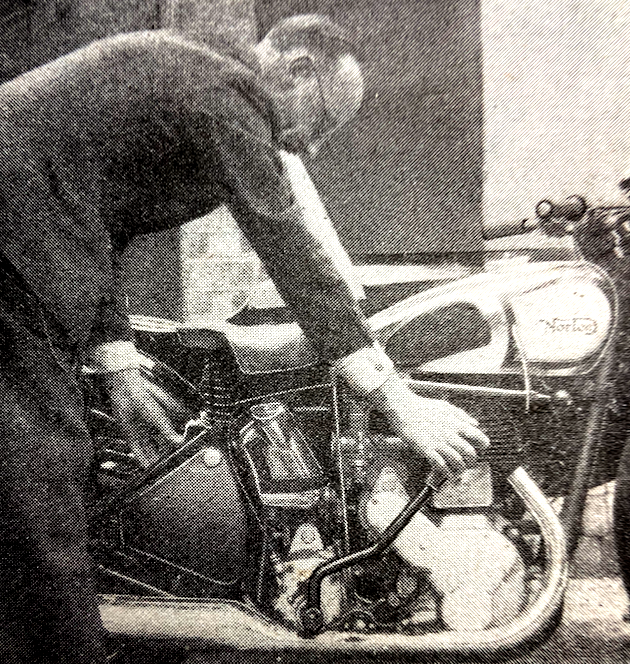
“TO EXAMINE THE LATEST British motor cycles, go to Brussels and explore the side-streets. Such seemed to be the plan a fortnight ago to-day, for in a side-road were to be seen two motor cycles about which not a word has been vouchsafed in this country. They had been imported the previous day and were about to undergo test. By name the machines are the Turner ‘Byvan’. They are 125cc lightweights with the three-speed engine-gear unit mounted over the front wheel, which it drives by chain. This arrangement results in the streamlined sheet-steel central portion of the mount being available for carrying parcels. Access is afforded by a lid running along the top. Special pressed-steel front forks carry the engine-gear unit which basically—as the knowledgeable will have gleaned from the photographs—is a 125cc Royal Enfield of the type used in thousands for the ‘Flying Fleas’ of Airborne fame and nowadays for the civilian RE model. A different cylinder is employed, the Amal carburettor projects to the side and, the gear box being set forward of the engine, the latter is arranged to rotate in the direction opposite to that of the standard unit. A Miller enclosed flywheel magneto is employed and, of course, covers both the lighting and ignition sides. An interesting point is the method of starting. This is on motor-boat or stationary-engine lines rather than on those of a motor cycle. Mounted on what is normally the kick-starter spindle is a drum operated by a ‘pull-out’ handle on the handlebars through a cable and a short length of chain. The gear change, which employs a normal three-speed hand-change gate, is also mounted on the handlebars. The lever is conveniently close to the twistgrip for the throttle and operates horizontally. Large-section tyres enhance the ‘full-sized’ appearance of the front-wheel-drive lightweights, which are finished in bright red. Twin propstands of the ‘push-down, fly-up’ type are fitted. The machine undergoing test performed well on the steepish slope on which it was tried.”
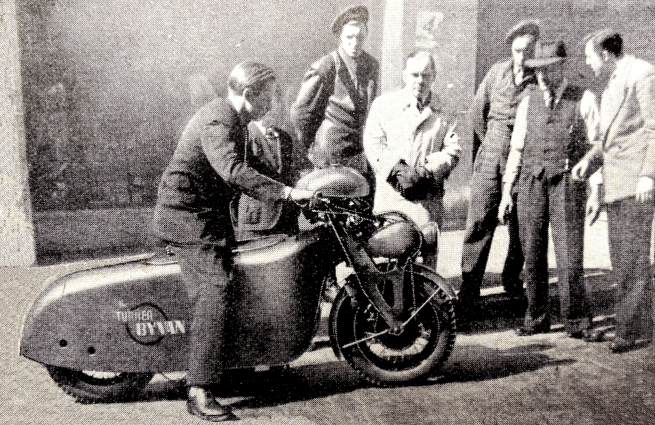

“GRADIENTS of 1 in 3; and loose, shingley, switchback surfaces were included in a trial organised by the 150th Regt, RAC. The meeting took place near Almednagar in a temperature of 85° in the shade—and there was no shade for the observers. Teams of three from various units in the area took part including the Fighting Vehicles School, Armoured Corps Officers Training School, Army School of Driving Maintenance,146, 149 and 150, RAC, and IEMC. , There were seven observed hazards in this tricky course including a hill which started with a gulley and a bump and then continued for about 100 yards over very loose surface, finishing up with a gradient varying between 1 in 3 and 1 in 2. This section proved the undoing of many competitors and was impossible unless taken very fast in second gear from the bottom. However, several very good runs were made, notably by Sgt Edwards and Major Brookshaw (both of ACOTS), and Capt White (Army School of D&M).”
“BEFORE THE WAR, Japanese products were making a determined effort to capture the Far Eastern market, which for many years had been almost exclusively British. The lightweight Japanese motor cycle, in spite of a heavy customs and import duty, still contrived to sell at a figure that was appreciably lower than its British counterpart, and it was just starting to enjoy a limited amount of popularity when war broke out. Japanese have always been renowned as copyists, so it is not very surprising to find that they chose the design of a British machine on which to base their blue-prints for an (almost) ‘All Japanese’ two-stroke. Messrs. Mayata, of Tokyo, were the makers of the 175cc ‘Mister’ here described, and it would appear that with the exception of the chains, which came from America, this firm was responsible for the manufacture of all the components… The engine is a two-port two-stroke of British design with a deflector type of piston and cast-iron cylinder head. Oil for lubrication is drawn from a compartment in the petrol tank by gravity and engine-suction. It enters the engine via a needle-valve situated in the cast aluminium intake-pipe at a point between the carburettor and the cylinder. Here the oil is mixed with the incoming gases. The needle-valve is adjustable by the rider, and a small ball-valve is provided to prevent the oil from flooding the engine when the machine is not in use. A car-type gate is used in conjunction with the three-speed gear box, the gate forming part of the gear box casing. On test the ‘Mister’ proved easy to start, and the engine ran very smoothly at all speeds. The silencers were efficient and showed no tendency to become loose as is so often the case when machines are ridden for any length of time on Indian roads. Braking was good, and the head lamp light was satisfactory. Unfortunately, the machine was new when tested, and it was not possible to retain it long enough to compare its durability against the British counterpart that it so closely resembles.”
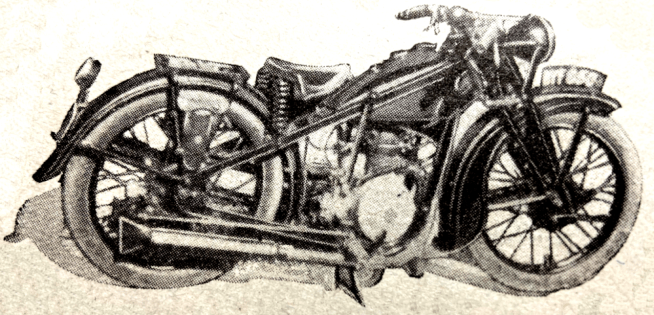

“WITH REFERENCE TO Mr JE Stone’s letter [which raised the question of covering 1,000,000 miles], my total mileage for one motor cycle (a 1933 sv 499cc BSA) is 230,000 to date. It has been used seven days a week (shift work)—and is still going well My previous total of 96,000 miles was covered in four years on a Triumph, making a total of 326,000 in 17 years. Mr AS Jones could have done the distance he stated, but if so he must be very keen or very fed-up by now. May I make a suggestion with regard to street lighting. It is that (in built up areas at least) all lights should be shaded in a manner to cover all ground between lamps but to stop glare. Hebburn, for example, is very well lit up but the counter glare from the lamps spoils the effect and you cannot see past a light (on the ground level) into a space. This is a potential danger.
AW Simpson, Hebburn-on-Tyne.”
“I SEE SOME INFORMATION is sought about big mileages and I have been pressed by friends to give my ideas on this subject. I have kept rough records since about 1919 (Thank Heaven I never kept a record of expenditure!) and I compute that I passed the half-millionth mile some time during this winter. (This figure includes riding or driving all types of vehicles.) My recipes are: First take a job that absolutely necessitates your attendance at least daily. Live at least 20 miles away from it with no other form of transport available. (I have lived 40 miles away and 60 miles away, travelling to and fro daily.) In this way you will—if like most enthusiasts you cover a big mileage on holidays—build up a basic annual mileage of at least 15,000 for a start. Thanks to the nature of my job, the blitz, shortage of staff and HG duties (I was DR to a very widely scattered battalion) the war left my mileage at a phenomenally high figure (so the Petroleum Board told me) so the grand total kept climbing up during these years, too. Secondly, relying en a single mount is useless. At present I have three, and work on the axiom that one must always have two in a roadworthy condition. The rider from force of circumstances cannot afford to do all the ‘motoring’ in the workshop the pleasure rider can do and does. He is in the saddle and reeling off the miles whilst the luckier man is rubbing over his chromium or repairing last week’s puncture. If the compulsory rider breaks a chain or pulls a valve out, repairing has to come out of his meal time or bed time, not out of his riding time. It doesn’t affect his mileage at all. Nor do blizzards, fogs, frozen roads or snow. In case anyone envies the holder of a big annual mileage I would point out that unless one is a wealthy man and has mounts serviced alternately (I am not), one becomes the servant of one’s machines. Lubrication, tyre changing, tyre pressures, chain adjusting, etc, has to take precedence over home, sport, garden or even eating and sleeping. After the 25th year (or so) this becomes less entrancing, but even if one could, I doubt if I would join the rolled umbrella brigade catching the 7.20am. As for terrific mileages before the ‘four years war’ I would like to know more about these. At what time of day were big winter mileages possible with lighting systems of 1903? And what big occasional mileages one would have to perform to counterbalance periods when the machine was out of repair, surely sometimes for weeks at a time. Yes, I have had some with hub gears and engine-shaft gears and frame breakages, and so on.
Alfred J Coulthard. Southgate.”
“DURING THE GERMAN OCCUPATION of Belgium, petrol was almost unobtainable and therefore our road transport had to run on coal-gas. It was a common sight to see cars and lorries fitted with gas generator or cylinders of this fuel, but civilian motor cycles were off the road. As a garage proprietor it was my business to fit vehicles with gas equipment, but when a friend of mine asked if I could equip his motor cycle with it, that was a new problem to me. The machine was a Gillet 500cc ohv sidecar outfit, and I started by mounting a cylinder on the sidecar chassis. To this cylinder I then connected the needed stop and inlet valve, pressure gauge, and the tube leading to the expander apparatus. To connect up with an ordinary motor cycle Amal carburettor would have been a. complicated job, to I replaced this with an old Harley-Davidson carburettor. The container had a capacity of 50 litres and weighed about 145lb; when filled at pressure, the container held 10 cubic metres of gas, and the outcome was a success after a series of experiments. The 10 cubic metre gave a mileage of about 62, using ordinary gas of 4,500 calories per cubic metre. The better quality gas (Butane) of 7,500 cal/cub. met. gave a mileage of 90, the power nearly equivalent to petrol. The machine gave good service for four years with this equipment it, and the owner used it daily for his business. On several occasions he was stopped on the roads by Germans who inspected the job with great interest, and as far as I know, it was the only motor cycle so equipped which operated in Belgium.
E Van Hecke, Gentbrugge, Ghent.”
Mind you, coal gas wasn’t the only alternative to petrol.
“HAS THE ELECTRIC MOTOR cycle a future? What are its advantages and disadvantages? On the Continent the electric motor cycle has made considerable headway. Was that solely owing to lack of petrol during the war or has the machine an appeal of its own? In Britain electric motor cycles have been made—not many, but a sufficient number to cause the Chancellor of the Exchequer to regularise the position over their taxation in the interim Budget last October, when it was laid down that electric motor cycles should be taxed at 17s 6d a year, the same as autocycles and motor cycles up to 150cc. These machines, however, were nearly all of a home-made variety, with car batteries and car starter motors fitted in lightweight motor cycle or even bicycle frames. What of true production-model electric motor cycles? A Belgian manufacturer, Socovel, has made over 1,000 electric motor cycles…Mr. Geoffrey Smith, Editorial Director of The Motor Cycle and its associated papers, had already seen the Socovel on the streets of Brussels and was so impressed by its silence, simplicity and convenience that he ordered a specimen for trial and examination by interested parties in the trade. Last month the latest Socovel arrived. It is an interesting machine with appealing characteristics…There are no gears, no clutch, no starting difficulties—merely a twist-grip on the right handlebar and the brakes. To start the machine the grip is turned and the machine gently and silently glides away, picking up speed in the manner of a trolley-bus. To stop the machine the grip is moved backwards, whereupon the machine free-wheels and is halted by applying the brakes…The Socovel [features] a heavy type of duplex cradle frame of welded construction, central-spring front forks and, generally, a heavyweight motor cycle specification that includes large-section tyres
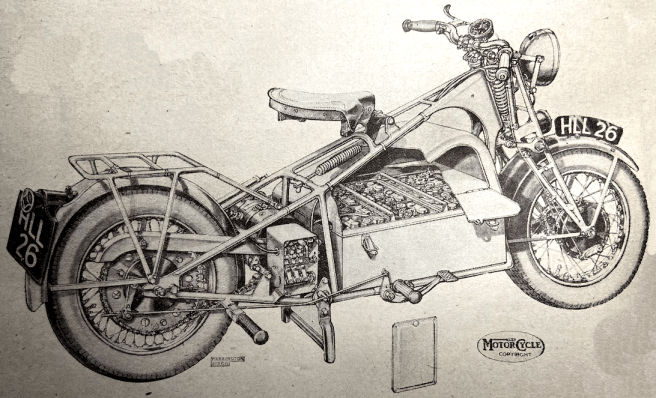
on small-diameter rims—3.25×14 Englebert tyres—a spring-top saddle with a single, adjustable tension spring as the suspension and a normal rear carrier of tubular construction. In the earlier models the electric motor was of 18 volts and rated at 1hp. With the very latest model which has been imported there is a 48-volt series motor rated at ‘2.6/1.2hp’. This is mounted between the rear mudguard and the twin seat stays, while the three 12-volt batteries—a total of 36 volts for the 48v motor—are carried in the neat pressed-steel box in the middle of the frame. From the motor to the rear wheel there is a single driving chain…The wheelbase is approximately 60in while the total width over the footrests is some 29in…A tapping off the front battery provides current for the 6v lighting and horn. The brakes are of 6in diameter…The three 12v batteries total 201lb and the machine, with batteries, 441lb…the weight, thanks to the low centre of gravity, in normal circumstances passes unnoticed. The sensation of gliding away, the result merely of moving the right handlebar grip, is enthralling…In short, it is a type of machine anybody can ride straight-away; it is not merely as simple as, but more simple than, any pedal cycle. From a standstill the acceleration can be very gentle or rapid according whether the twistgrip is moved slowly or quickly…On roads that are approximately level the machine travels at anything from about 16-20mph. It does so with complete silence except for the noise from the chain drive…the total distance covered on a full charge was 27½ miles…The speed in one direction was approximately 20mph, with a current consumption of 24 amperes at a voltage under load of 35½. In the opposite direction the speed was around 16mph and the consumption 33 amps…What is the cost of charging the batteries? A total of approximately five units is required—5d if the electricity supply is ld a unit…However, the fact that an autocycle can be nearly as cheap to run from the ‘fuel’ angle, has a cruising speed of some 10-30mph and possesses acceleration, are rather beside the point, for the electric motor cycle is not very likely to appeal to those attracted by autocycles or motor cycles. The probability is that a very different market would be opened up among those having frequent calls to make in a district. As a hack to the golf links it is excellent.”
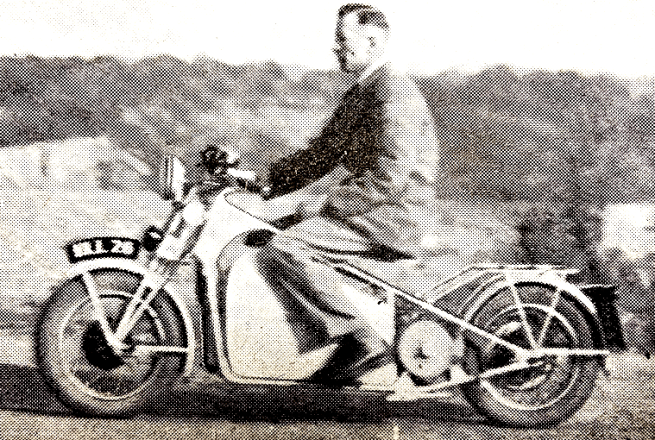
“TW0 MODELS COMPRISE the James programme. These are an attractive-looking autocycle fitted with spring forks and quickly detachable sideshields and a civilian version of the 125cc James ‘Flying Flea’, which was used in hundreds for the assault on the Normandy beaches, was a main factor in controlling the handling of supplies on those beaches, and was employed by the famous 6th Airborne Division. The ;go-anywhere; lightweight is thus in remarkable degree a tried, proved proposition. In its latest form this 125cc Villiers-engined two-stroke is little altered from its renowned forebear. Indeed, except for the longer mud-guards—Airborne Forces required shortened ones—the new and more convenient ‘lozenge’-shaped tool-box, standardisation of a carrier and the civilian finish, there is hardly any difference…The Motor Cycle representative saw a girl, who said that she weighs only 6½ stone, whisk a machine on to its stand, seemingly without the slightest effort. A maroon and silver finish is employed for the 2¼-gallon tank. The silver, which is used for the tank panels, wheels and hubs, is a special finish developed by James and given the registered name ‘Argenized’. Handlebars and the twin pipes from cylinder to silencer are chromium plated. The pipe leading to the second silencer on the near-side chainstay is no longer blanked and drilled at the front end, which was a War Department requirement. Thus there is no need to remove the pipe every 1,000 miles to clean out a series of holes. The handlebars have a cycle-type adjustment, the Terry saddle is adjustable for angle and the footrest hangers are serrated, so there is a ready adjustment here. Other features and fittings are: Brakes, 5in diameter rear and 4in front; 2.75-19 Dunlop Universal tyres; reserve-type petrol tap; Villiers air cleaner; a folding kick-starter and a saddle height of 28in. Almost needless to state, the engine-gear unit is the 125cc three-speed Villiers deflectorless-piston two-stroke, fitted with a Villiers carburettor…A most interesting feature of the new James autocycle, the ‘Super-lux’, is a very simple, sturdy spring front fork. This has a central compression spring and each blade consists of an extremely strong tapered and butted tube. At the fork-ends the blades are reinforced by a sheath over the trapped portion—a sheath that is brazed on after being trapped. A short test on rough grassland and on city streets showed that the fork, which has very, much the appearance of a telescopic front fork, adds greatly to riding comfort.”
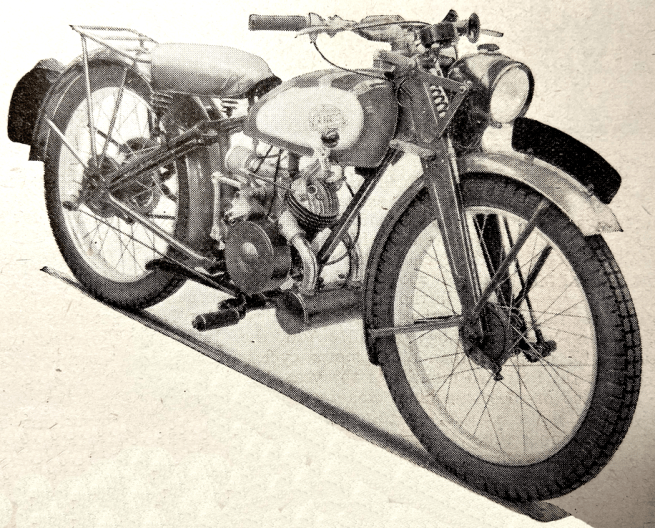
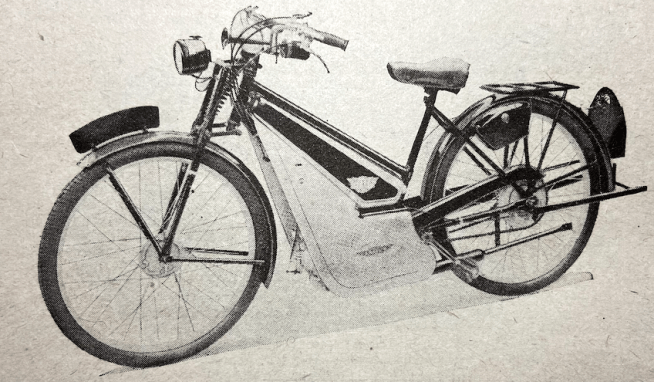
“HERE ARE SOME FIGURES which will gladden your heart if you remember that in exchange the nation gets the means of life—food and essential raw materials. The figures are those for the exports of British motor cycles, parts and accessories. A total of 200 machines went to South Africa in the 28-day month of February, 213 to Australia, 547 to other British countries and 1,873 to foreign countries—2,833 in all. Add the January figures, and no fewer than 6,613 motor cycles were sent abroad in the first two months of the year. The value of these machines was £370,988. Over and above this figure is £228,763 for parts and accessories, £21,743 for inner tubes, £10,729 for outer covers and the value of parts such as plugs, chains, lamp bulbs which are consigned separately. Thus for the two months the total value of motor cycle exports was getting on for half a million pounds. I wonder what the figures will be now that the motor cycle industry is really getting into its stride…By the way, in 1938 the average number of motor cycles exported a month was 1,648, so even in the first two months of this year the motor cycle industry was exporting twice as many machines as pre-war.”
“THIS IS HOW the Riverside Bombers MCC, in the US, enjoyed themselves: ‘We rented the American Legion Hall in Corona, where we had a 1501b roast pig, 25 cases of soft drinks, and plenty of all the extras. To top off the evening we had a professional floor show from Los Angeles.”
“NOW THAT BSAs are turning out their 500cc sv M20 machines in civvy colours, a useful make-do scheme in regard to taking off and replacing the powerful single clutch spring, which saves much in the way of perspiration and skinned knuckles, may be of value to owners of these machines. Without the proper tools, it is a terrific struggle to compress this spring sufficiently to get the retaining nut started on its thread. To overcome this, I found that the rear brake rod thread will mate with the internal thread in the small nut in the centre of the clutch housing. It is only necessary to reverse the wing nut and screw it well along the threaded portion of the brake rod, then slide on the clutch spring retaining nut, followed by the washer and clutch spring. The brake rod is then screwed into the central nut in the clutch housing until it is rigidly held. The clutch spring and retaining nut are next slipped into position and the winged nut screwed up until the clutch spring is compressed enough to allow its retaining nut to engage on its thread. With both hands free, this becomes a simple matter, and once the spring nut has engaged the first few threads, the brake rod tan be removed and the job finished with ease and comfort.”
L/Cpl WH Pickett.”

The WD M20’s rear brake rod doubles up as a clutch spring compressor…it would be nice to think that BSA’s number 8 hats planned it that way.
“FROM THE SYMPOSIUM on trials and scrambles we published a fortnight ago it was obvious that many keen riders feel that the value of the big open trials has waned and manufacturers would be wise to transfer their support to scrambles. These races over rough going, it is suggested, have many lessons to offer, whereas reliability trials to-day have few. Some riders go so far as to state that scrambles nowadays constitute the acid test. The views call for very careful consideration. Brook-lands is no longer available, the future of Donington is still in doubt and few manufacturers can be counted upon to support the Tourist Trophy Races if they are reinstituted on the same lines as pre-war. If, in addition, trials have no value as a means of developing motor cycles, the emphasis on scrambles is great. A further point is that it may become increasingly difficult to run trials on the public highway, and scrambles, of course, are held on private land. Is our sport to be, to a large degree, recast? This would not be surprising, and we would strongly urge manufacturers, organisers and riders to ponder matters carefully.”
“IN THE EARLY DAYS of motor cycling, when diagnosis of roadside trouble was a fumbling affair to most of us, an inventor named Calvert began to sell sparking plugs with quartz insulators. They were sufficiently transparent to glow in various tints according to the correctness of the mixture, and failed to glow when there was no spark. He deserved to make lots of money, but. as far as I remember, his plugs were rather dear, and prone to shed their central electrodes. During the war Shell-Mex went a step further-in the direction of ‘see what is happening’, and in their research laboratories actually utilised a glass cylinder. Bored to an accuracy of 0.002in, it permits the professors to observe lubrication under all sorts of varying conditions—temperature, rpm, feed systems, and types of piston ring.”—Ixion
“SOME MODERNS WHO spectated the Brighton Run of machines were astonished at their general reliability. The fact is that engines gave remarkably little trouble in the early days. I recall few such troubles, with sheared timing gear pins (usually silver steel) as the commonest. Our stops were far more concerned with tyres, belts, contact-breakers, flat batteries, and bits falling off. Many of the Pioneer mounts on March 17th had modern tyres and ignition details, whilst expert preparation made sure that nothing fell off, and that the transmission would survive so brief a distance.
Engines were so lightly stressed between 1898 and 1908 that parts seldom failed. My first engine failure with an 1899 De Dion occurred after 18,000 miles when the stem of the automatic inlet valve scaled away from the head! If we had possessed tyres, belts, chains and ignition of 1946 quality in 1903, we should very, very, seldom have stopped on the road.”—Ixion
“BOTH COMPETITORS AND spectators thoroughly enjoyed the 16th annual open Beggars’ Roost Trial, held in the Minehead area on Sunday in perfect weather. The well-marked route included the old favourite Cloutsham and a hill that has not been available since 1937—West Ditch, formerly known as Daytona. The start was on the top of Grabhurst. Everyone was in real holiday spirit and at 11.30am the first of the 131 starters got away. One competitor, CD Walkley (498cc AJS) rode from London the same morning. He was to be rewarded with a first-class award. Slade Lane was the first observed section. It was dry and so easy that only five riders stopped. As one competitor remarked, it was like a main road. From there the route led to West Ditch, which was extremely tricky and just damp enough in places to cause wheelspin. A sharp, steep, right-hand bend, deeply rutted in the middle, led to some further cross ruts and up to a diagonal step, on the right of which there was a sunken path too narrow to ride through. Farther up there were rocks, and more rocks…”
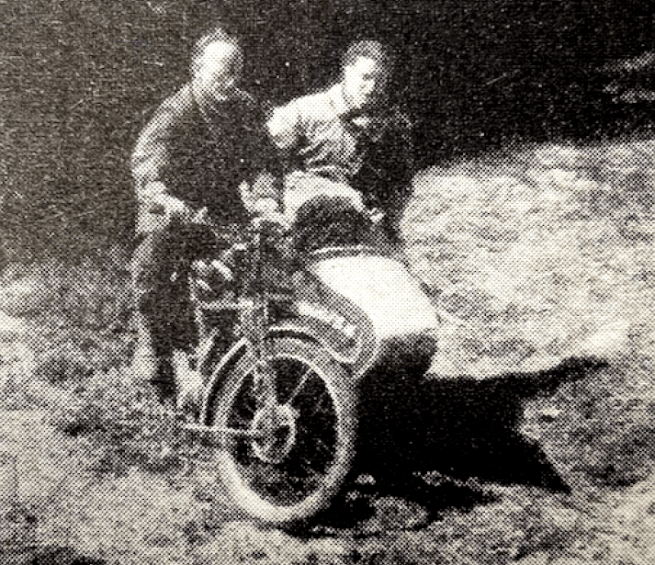
“THERE WERE FEWER fatal road accidents in 1945 than in any year since 1926. Number killed in 1945 was 5,256; in 1926, 4,886. Next best year was 1927, with 5,329 deaths.”
“AT AN ALLEGED poaching case in Suffolk, it was said that a motor cyclist drove his machine at night among some rabbits, while his companion on the pillion shot at them. The head lamp dazzled the rabbits, it was stated.”
“BY USING SEWAGE gas—methane—in its fleet of municipal transport vehicles, Croydon Borough Council is saving 85,000 gallons of petrol a year. It is said that there is much less carbon formation in vehicles using methane.”
“SOME INTERESTING RACING was witnessed by a large holiday crowd on Pendine Sands, Carmarthenshire, on Easter Monday. It was the first post-war meeting arranged by the Swansea Club and, incidentally, the first motor cycle programme to be held on sands in the British Isles since 1939. As a result of being laid up during the war years, machines were not at their best, and entries in some classes were obliged to withdraw. A keen north wind had smoothed out the beach into ideal racing conditions when the first sprints were run off. Towards the end of the meeting, the track became a little wet on the seaward side near the corners, and this added to the thrills in the 10- and 25-mile events. The most successful rider of the day was CM Williams, of Swansea, on a 500cc Norton, who won four events, while an outstanding performance came from T Hunkin, riding a 348cc AJS. This Neath rider, on a 20-year-old machine, took three events. It was Hunkin’s racing debut. In winning the 10-mile rare (standard class, 350cc), he averaged 62mph.”
“A CROWD ESTIMATED at between twelve and fifteen thousand saw Britain’s first post-war motor cycle road races at Cadwell Park, Louth (Lincolnshire) on Good Friday. The distinction of promoting the meeting went of course, to the Louth&DMCC, whose founder, Mr Charles Wilkinson, has been secretary and ‘mainspring’ of all Cadwell events since the inaugural meeting in 1934. The Club have been fortunate in that the sporting owner of the Cadwell estate is Mr ‘Manty’ Wilkinson, father of the secretary, and he was accorded the honour of starting the first race. Freddie Dixon started another event. The ¾-mile course was in almost as good condition as when the last rider finished his final circuit in August, 1939. The concrete showed no sign of deterioration, and a little first-aid was all that the short stretch of tarmac between the Hairpin and the Barn Corner required. The day brought countless reunions between officials and competitors in the pits, and there was almost endless reminiscence. The course opened at 9am for practising, and what a thrill it was to hear the crisp bark of hot-stuff singles again! When racing proper got under way the 250s were given first turn. In the first heat Maurice Cann (248 Moto-Guzzi) had no undue
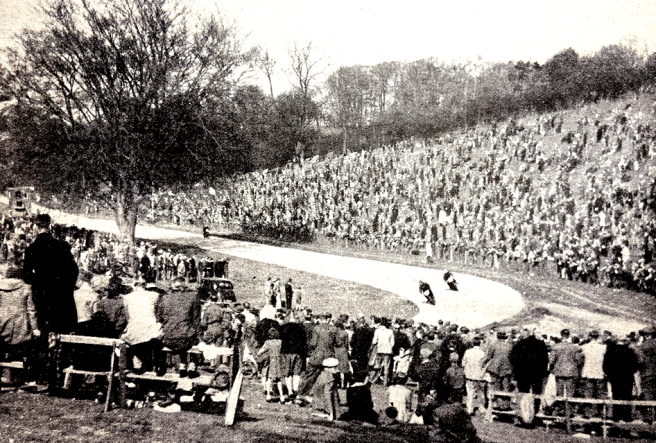
pressure, although there was a keen fight for second place between EN Anderton and D Beasley, both on 248cc Excelsiors. In the final eight riders faced the starter’s flag, the trio mentioned above plus CG Wheatley (248 Excelsior), R. A. Meade (248 New Imperial), RW Thompson (248 O.K.-Supreme), WM Webster (248 Excelsior), and VR Anderton (248 Excelsior). From the usual Cadwell push-start Beasley, Wheatley and Cann were first away. Webster was left behind with a reluctant motor. The second lap saw Cann first, followed by Beasley and EN Anderton. VR Anderton and Meade were behind. Cann gradually increased his lead, while a tussle went on between the second bunch. Meade performed skilfully, to work his way up to second place, although he never looked like challenging Cann. Beasley and EN Anderton had to be content with third and fourth places. There were five heats and 48 competitors for the 350cc eight-lap event, The first two in each heat qualified for the final. Cann failed to appear for his heat, so that prospects of a duel with TL Wood (348 Velocette), star of many pre-war Cadwell meetings, faded. Wood took the lead from the start, followed by ES Oliver (348 Velocette), AJ Dudley-Ward (348 Norton), GW Field (348 Norton), W O’Rourke (348 Velocette), and WS Humphrey (348 Norton). Wood was seconds faster than anyone else on the climbing bend into the ‘mountain’, and it was soon apparent that Wood, Oliver and Dudley-Ward were going to finish in that order. After so many solo circuitings, and a rather grim seriousness about the whole atmosphere, it was a relief to relax slightly at the expense of the sidecar passengers, for whom Cadwell is never any holiday joy-ride. Only five of the nine entrants lined up—all on Nortons—so there was plenty of room for manoeuvrings. ES Oliver and J Surtees speedily put a gap between themselves and the rest of the field. S Hodson packed up after three laps—and that was that. ‘Time passed,’ as the cliché runs, and in due course Oliver led Surtees across the finishing line, with W Spence well behind E Walker. The under-500cc race again inspired visions of a Wood-Cann duel. But these disappeared, for Wood’s engine was slow to start in his heat, and although he made a stout effort he could not overhaul the leaders. However, the final did see G Brown (498 HRD) give Cann a run for his money, and Cann put up the best time of the day so far, 7min 7⅖sec, with Brown only 2sec slower. Oliver took third place but was well behind the leaders. The chief timekeeper and handicapper, Mr A Green, covered himself in glory in the next event, for although, like everyone else, somewhat out of practice, he succeeded in providing a ‘blanket’ finish to the sidecar handicap event. It was another all-Norton parade, with four competitors. W Spence and E Walker were sent away first, and then, after what seemed an appallingly long interval, off went Surtees and Oliver. Spence, one of Cadwell’s most regular riders since the early days, hung on to his lead for four laps, but Walker produced just a fraction more urge on the straight to sneak into the lead. Surtees and Oliver both put up a terrific show, and a ten-lap event would have produced a different story. As it was, the quartette appeared at Barn Corner in a bunch on the eighth lap and shot past, the finishing flag—E Walker (490 Norton sc), W Spence (596 Norton s.), J Surtees (596 Norton sc), and ES Oliver (596 Norton sc). Officially there was exactly one second between the first and fourth finisher! After this inspiring effort came six heats to decide the qualifiers for the unlimited cc event. All went according to plan, with the result that eleven very choice performers lined up—W. McVeigh (490 Norton), J Grierson (348 Norton), M Cann, (490 Norton), JW Beevers (490 Norton), G Brown (498 HRD), AG Briggs (498 Triumph), ES Oliver (348 Velocette), AJ Dudley-Ward (490 Norton), TL Wood (498 Erswood), K Howard (490 Norton), and RT Matthews (348 Velocette). Matthews was again unlucky in
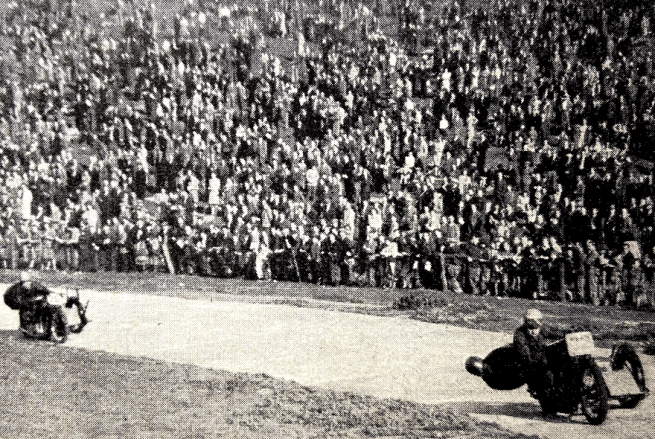
starting, but the rest got away smartly and roared up the ‘mountain’ in a bunch. Brown (HRD) was first out of the wood, with Howard, Wood, Cann and Briggs close behind. Brown set a really hot pace, and he began to steal well ahead on the second lap. By this time Howard had fallen back and Wood was lying second, slightly ahead of Briggs and Cann, with Beevers coming up fifth. Cann and Briggs shot down the bottom straight side by side on their fourth lap, but Cann got the advantage swinging into the ‘mountain’ and clung to a precarious lead. On his sixth circuit Wood failed to appear, and the seventh lap produced really great stuff. Brown had Cann and Briggs tailing hard behind him, with only yards between them. Brown’s winning time of 7min 3⅗sec was the best of the day, and well deserved by the HRD rider, who holds the track record for eight laps—6min 54⅖sec—set up in 1939. The Louth Club’s optimism in running a second day’s meeting to accommodate the terrific number of entries originally received was fully justified, for the crowd on Easter Monday was estimated to be a few hundreds over the first day’s attendance. RL Graham (348 AJS) early gave a foretaste of what was to come by winning a heat of the 350cc solo event m 7min 4sec—within two-fifths of a second of Friday’s best time. The lap record of 52sec set up in August, 1939, was broken three times—first by ES Oliver (348 Velocette), then by Graham and by G Brown’ (490 HRD), who both lapped in exactly 50sec. Best time of the day was again recorded by G Brown and his untouchable HRD in his heat of the 500cc class. His time for 8 laps. was 6min 55⅗sec—just fractionally too slow to beat the course record, which he himself holds, of 6min 54⅖sec. Brown must have got that springtime feeling, for he had an easy ride: ER Evans (348 0K) secured second place in 7min 10sec. Graham damaged his collar-bone in a tussle with Maurice Cann (490 Norton), and became a spectator. TL Wood (348 Velocette) was an early victim to engine trouble, and although he appeared with another machine later met with no better success. He qualified for the final of the unlimited cc race, but just hadn’t the knots. Honours again went to Brown, with ST Barnet (490 Norton) springing a surprise on some of the more familiar Cadwell experts by running comfortably into second place, with AJ Dudley-Ward (490 Norton) third.”
“I HAVE BEEN reading the Blue ‘Un for well over a quarter of a century and at last I feel I should like to voice my opinion, especially regarding the best type of motor cycle, especially as the tendency is for the majority to ask for multi-cylinders. Since 1919 I have ridden and owned practically every type and make—both British and Foreign multis, singles, two-strokes and sleeve, and can only arrive at one sane conclusion. The 500 ohv single with rigid frame, three speeds, all-chain drive, magneto ignition, and 3.25in tyres, was, is, and will be the best all-round machine, and the machine that is responsible for the sport remaining alive. The man who asks for all those incorporations of comfort in a motor cycle has lost the sense of sport and I should call him selfish for trying to transform the face of the prototype. Should we follow his desires, motor cycling would cease to exist. America is a good example of this, where the multi has reached its final stages of existence, and where the automobile—with comfort predominant—is supreme. Then there is the monotony of driving a multi over long distances. Many will agree with me when I say the sewing-machine noise of the multi is never experienced by the owner of a well-tuned single.
G Choraffa, Liverpool.”
“SO EX-SERVICE MOTOR CYCLES are to be sold to the public by auction. Indeed, already a small number of National Fire Service machines have been disposed of in this manner. What has caused the Minister of Supply to change his mind?…With nearly half a million motor cycles supplied to the Services during the war, it seemed to us that it was only a matter of time before the Ministry found it impossible to handle all the machines declared surplus…thousands of motor cycles will be sold at public auctions. They will be disposed of singly, if in good condition and in small batches of, say, five—or so it appears—where the machines are of little value except for breaking up. Purchase tax is not payable at auctions…At a sale last week the highest figure reached was £100 and the average, some £40-50. It is reasonable to suppose that later, when auctions have become almost commonplace, there will be some good bargains. We would remind readers, however, that the Ministry refers to the auctions as a ‘temporary’ change in policy and, furthermore, that the machines, of course, are in no way guaranteed.”
“LAST SATURDAY I RODE the post-war 998cc Vincent-HRD Rapide. At 1.17 p.m. No 1 of the new models spun its back wheel for the first time—a statement that can be read, correctly, in two ways. It was ridden round the cinder-surfaced yard at the works. Two hours later I arrived on the scene…I did not see Matt Wright wheel out the machine at 1.17, determination written in every line of his body. Whoever might ride the model later, there was one thing Matt was going to see: that the first to ride the machine on which he had laboured so long was—Matt. Mr Vincent, rider-manufacturer, might be responsible for the conception; Mr PE Irving might be designer, chief development engineer and co-builder; but Mr Matt Wright, who also has lived nothing but ‘Series B Rapide’ for months, his was to be the honour of the first ride. I arrived when round-the-yard had apparently palled. I circled the yard a few times. Then Mr Vincent said what about
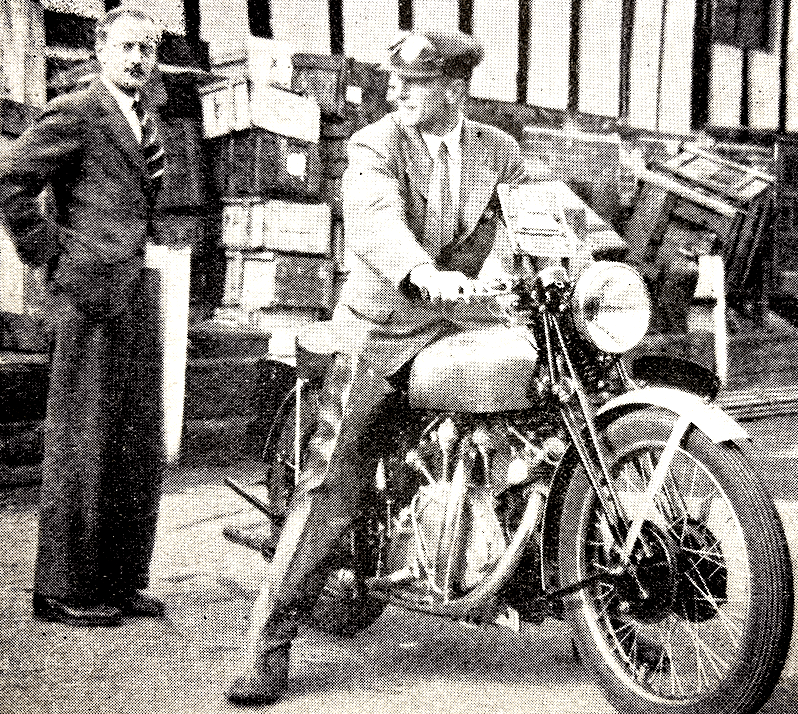
putting on trade number plates and taking the machine on the road. Already he had tried locking the two-wheels by harsh braking and had found that the machine skidded in a dead straight line. Now we were to see what the machine was like on the road. The first to pass through the gates on to the Great North Road was Mr. Vincent…He arrived back windswept—hair awry and eyes bleared—and his countenance beaming. All the months of worry and toil, and here was the model living right up to his hopes. Then Mr Irving set forth. While he was away, Mrs Irving arrived in search of her, as usual, absent-from-home husband. Where was he? Out on a motor cycle. After a moment she said, ‘Not on the motor cycle?’ Then she was thrilled as much as anyone. Back came Phil Irving. Now it was my turn—No 3 to take the new Rapide on the road, and the first non-works man…It is a new model throughout, designed to provide the connoisseurs with a 1,000cc machine which has the weight, size and ease of handling of a 500—a machine which possesses all the power and speed of the 110mph Rapide of pre-war days, but a still higher power/weight ratio, still better bend-swinging, woffley-tourer traffic manners and the neatness which can be secured when, as in this case, a machine is designed from the word ‘Go’. The engine is a two-carburettor big-twin in unit with a four-speed Vincent-HRD gear box designed on racing lines. It is of ‘semi-overhead camshaft’ type—high-camshaft with very short push-rods—with straight rockers and with the whole valve gear enclosed. Light alloys are employed in racing-engine degree, but the engine, for all its power, is not a hotted-up job.
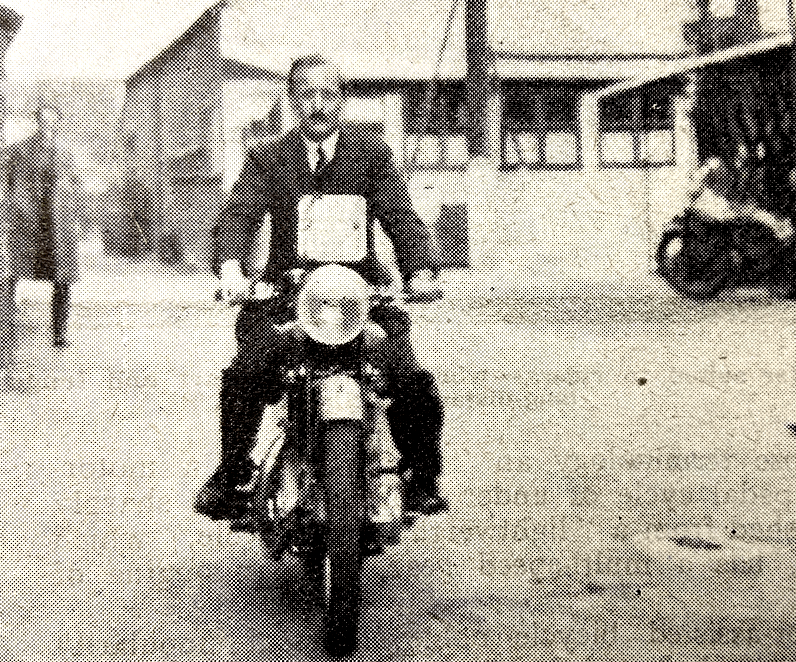
The compression ratio is only 6.8 to 1. The aim has been to provide a power unit that will retain its tune almost indefinitely. What is unusual is the frame construction, for the engine-gear unit, in combination with the forged steering-head lug and the box-girder member that forms the oil tank, constitutes the centre portion of the frame. Pivoting at the rear of the unit is the famous Vincent-HRD rear springing, a development of the suspension which has been fitted to every Vincent-HRD that has been made. Central-spring front forks are retained, but they, too, have been ‘developed’; they have ‘Nitralloy’ spindles in porous-bronze, oil-impregnated bushes. And there are, of course, the Vincent-HRD ‘Duo’ brakes—two brakes per wheel. Not least, there is a remarkable number of riders’ features incorporated in the machine. One of these last was brought home to me almost as soon as I had passed through the factory gates. I refer to the riding position. I took the machine just as it was, yet it not only fitted me to perfection, but I felt part of the machine—thoroughly at home. As you may remember, even the pillion footrests are fully adjustable. In power, I was told, the engine is akin to the Rapide one knows so well, but the machine is a very different proposition. The ‘Little Big-twin’ it has been called. It certainly is little, but not in performance. Just imagine having some 45bhp and the weight of a 500—TT power, yet true roadster manners. It is an exhilarating motor cycle if ever there was one, yet one can woffle along at well under 20mph in top gear, which is 3.6 to 1. Indeed, Phil Irving rode round the yard in top. You will realise, if you do not know from personal experience, that with so high a gear the Rapide at 60mph is doing little more than ticking along. Even at 80mph the engine is turning over at less than 3,800rpm. There is fuss-less speed that is a joy. What is new is the behaviour of the machine on bends. It has the wheelbase of a 500, and the weight of a 500, and it handles like a TT 500. There is no laying the machine down for a bend by force; one wafts round it effortlessly. And there is a feeling of solidarity about the whole motor cycle. Another thing which pleased me greatly is that no longer is the steering uncomfortably heavy at low speeds. One is feet-up, and perfectly happy about it, when trickling along at the three or four mph that can be necessary in traffic, and the same applies to turning round in the equivalent of a narrowish road. In every respect the
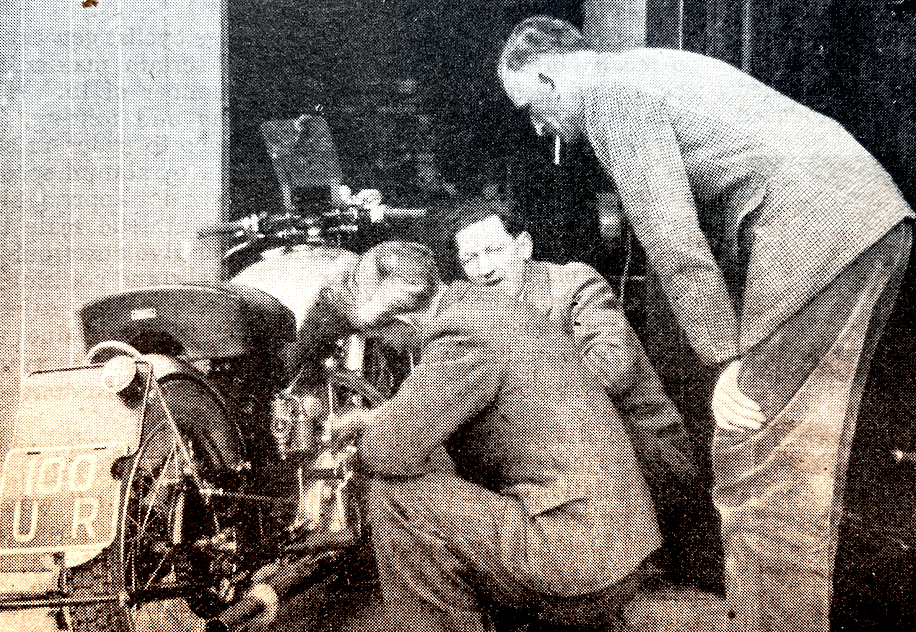
traffic manners are magnificent. With the machine’s exceptionally high power/weight ratio the acceleration, as you might expect, is thrilling, but what I was not quite prepared for is how controllable the machine is. The previous design of Rapide was—shall I say I—a little mettlesome, in spite of its comparatively low compression ratio and ‘soft’ valve timing. There was a measure of harshness as one opened up, a touch of the ‘rorty and naughty’. How much is due to Matt Wright’s wizardry in carburation and how much to the automatic ignition control, I do not know, but with the new Rapide there is smooth power from 20mph and less, right up the scale; it is power that is as controllable as that of a genteel potterbus. The top-gear performance is remarkable. Every fraction of throttle opening—of movement of the right grip—has meaning. You can shoot forward or break gently into a ‘canter’, just as you feel inclined. The brakes need not be discussed; I know of no brakes that are better than the two-per-wheel of the Vincent-HRD. The gear change with the racing type design of the box is interesting. Either Vincent or Irving had mentioned that he had flicked from top to third and third to top without touching the clutch, so I did too. The gear change was perfection. Incidentally, the special Feridax ‘Dual-seat’ is excellent. What other points are there? I like the action of the ‘swinging-arm’ kick-starter; the automatic advance-and-retard magneto seems to suit the engine very well indeed; the detail design and the accessibility are outstandingly good. In short, I know enough to say that if the old Rapides have been good, the new machine should prove a wow. When I returned, my words were, ‘I congratulate you.’ Under me was the very first machine, with here and there a make-do pending the proper item being ready—all minor things, I should add—yet not in a single direction could one comment, ‘You’ll have to alter this before you put the machine on the market.’ Good for you, Mr Walker, Mr Vincent, Mr Irving, Mr Wright—all of you. A remarkable motor cycle, and a remark-able job of work.”—Torrens
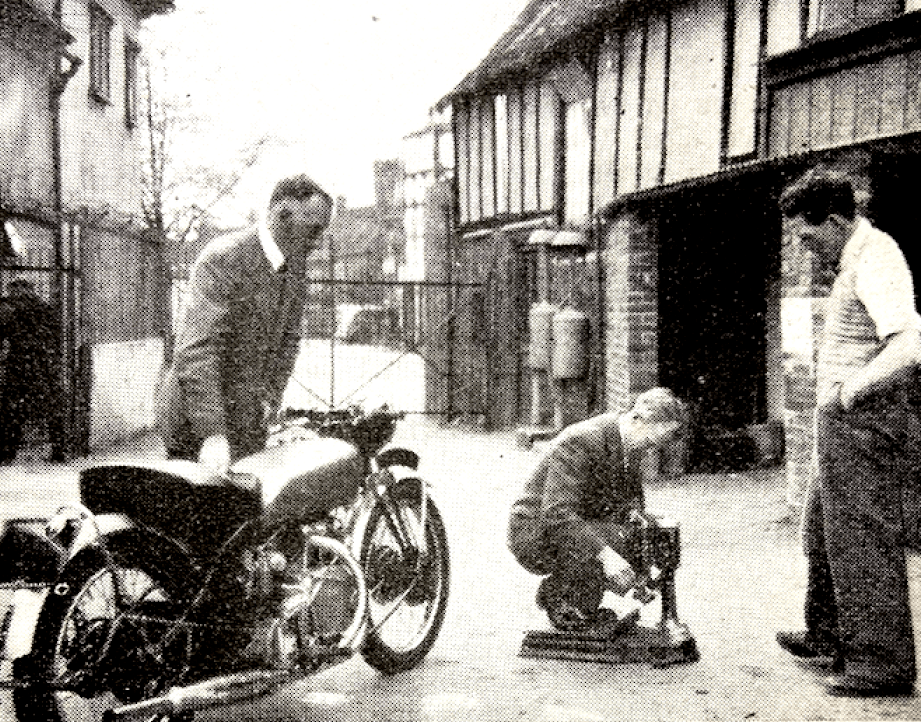
“BY NO MEANS all motor cyclists realise that modern wheel rims are marked with their size and, therefore, if they have a copy of The Motor Cytle Diary or a tyre manufacturer’s list, it is very easy to determine what sizes of tyre will fit their rims. Over the years I have wondered why more parts of motor cycles are not marked. It had never occurred to me, however, that one day we should find every single part of a motor cycle marked. This is so with the new Vincent-HRD Rapide. Even washers bear their reference number. It should greatly simplify the task of supplying the particular part or parts required—no longer will the service department have to guess what the proud owner means by his description.”
“FOUR OUT OF eight areas of land included in the South Downs (Sussex) Training Area have now been cleared of unexploded missiles and are to be derequisitioned.”
“THE DUTCH TOURING CLUB (ANWB) have introduced a system of road patrols similar to the service proved by our own AA. The patrols have sidecar outfits. The machines are Harleys purchased from the US Army.”
“IT HAS BEEN revealed in Parliament that included in the war supplies sent to the USSR between 1941 and 1946 were 1,721 motor cycles.”
“IN OUR LOOSE TERMINOLOGY an ‘autocycle’ is a motor-assisted pedal cycle of under 100cc. It is sharply distinguished from a ‘lightweight motor cycle’, which is pedalless, has a multi-speed gear, and an engine of 100-150cc. The motor-assisted bicycle achieved great popularity during the war, being cheap to buy, cheap to run, and extremely economical of fuel. If we neglect it now, its vast possibilities, realised on a considerable scale in pre-war Germany and France, may return to oblivion. It must always be the cheapest personal power-transport on earth, slightly more costly than pedal cycles, though possessed of greater speed and radius, and better suited to riders whose muscles, hearts and lungs are unequal to long-distance cycling, or whose daily work leaves them too weary for fresh exertions. It renders labour more mobile, endows certain workers (eg, trained nurses) with far greater efficiency, and opens the door to a large series of pleasures inaccessible without it. If these advantages are to be put at the disposal of the British public, certain stipulations become axiomatic. The ideal pedal-assisted bicycle must be: 1, Very cheap to buy and run; 2, reliable; 3, comfortable; 4, safe. The three latter qualities present no problem to British engineers, who solved them years ago in respect of (a) heavy and costly motor cycles, and (b) light and ultra-cheap pedal cycles. But the cost reductions have never yet been tackled in these islands with the energy and success which produced such cars as the Austin Seven. Cost reduction is partly a Government responsibility. (In France and Germany motor-assisted cycles sold in tens of thousands
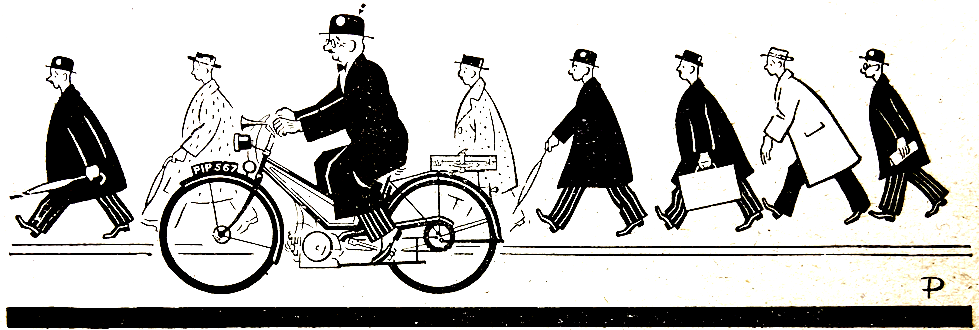
because the State recognised their importance and released them from the legislation which festoons heavier types of motoring.) The other aspects of cost reduction are intrinsically technical, and will be discussed for the remainder of this analysis. My first pedal cycle was a Beeston-Humber, which cost £25, because it was hand-made in very limited quantities. My last was a Hercules, which cost just under £4 because it was flow-produced in gigantic numbers, Since a huge market in ‘Macs’ (‘motor-assisted cycles’) cannot be created in a moment, it is not possible at the outset to flow-produce a special cycle chassis. Conclusion No 1 therefore is that the ‘Mac’ must utilise a standard pedal-cycle chassis, such as the Hercules. This single expedient will chop pounds off the ‘Mac’ price. (NB—A special cycle chassis could be flow-produced later on, when the mass demand has been built up.) Is it possible or safe to utilise a standard pedal-cycle chassis (frame and fittings) for a ‘Mac’? On certain conditions, yes! An average cyclist generates so much horse-power, travels within a certain maximum speed, and weighs a widely
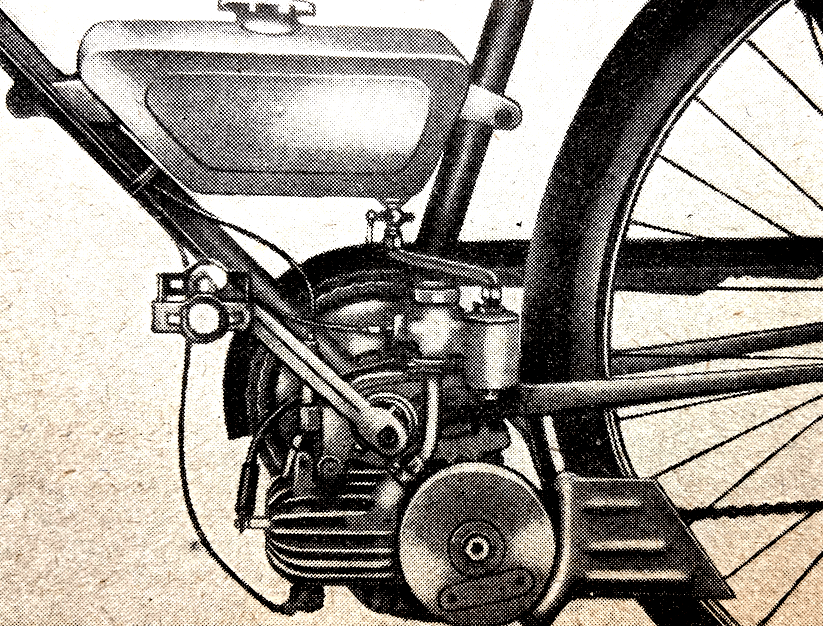
variable number of lb. His pedal-cycle chassis, as proved by racing and touring, is sturdy enough for a gross load of, say, 200lb (rider 12st, cycle about 32lb with accessories); for a maximum speed up to 30mph; and for an applied power not appreciably greater than the muscular output of an athletic male in the prime of life. Such pedal cycles never give any trouble with their major components, excluding falls and collisions. Fork, frame, wheels and brakes possess ample safety margins for such conditions. Trouble is solely due to neglect, and occurs mainly with such petty details as mudguard stays, lighting, etc. Life is calculated in tens of years. If the designer can take a standard pedal cycle, such as the 1939 £4 roadster, and fit it with an engine fulfilling the stipulations laid down above, a sound ‘Mac’ would he ready-born. The standard pedal cycle already possesses a transmission fully equal to the indicated power output, and there is no need to add a separate chain or other drive. It is assumed that the tiny engine will not develop appreciably more power than the rider’s leg muscles. True, the owner’s muscular power will introduce a slight theoretical ‘plus’ over and above the engine output. This can be disregarded for two reasons. First, on the road the owner will never use full engine power plus full muscular power. Secondly, the engine power will always be applied very smoothly (unless the engine is misfiring abominably), whereas many riders ‘dig’ with their pedals in brutal fashion on hills, and most never acquire the proper ‘ankling’ movement. Thus, the fundamental problem of design consists of applying either or both of the two power sources (legs and engine) via the same standard transmission with the minimum of costly alteration to the standard of pedal-cycle layout. We are now in a position to study the application of these principles to an actual machine. Under German occupation the Society of French Automobile Engineers contrived to continue their researches and to publish their journal ‘Sia’ (Société des Ingenieurs de l’Automobile). Its shrunken pages could only accommodate one major article per month. In December 1943 these pages were consecrated to a new motor-assisted bicycle, the Remondini, deemed of such intense interest as to merit presentation to France’s greatest engineers. Its basis was a standard pedal cycle. This was adapted to form the chassis of a ‘Mac’ by a single notable alteration. The ‘bottom bracket’ was very slightly modified to carry a special spindle for the front sprocket. This sprocket was ‘dished’, so as to form a hollow annulus. The exact use made of this ‘hollow ring’ in the Remondini is quite unimportant In the abstract it can obviously be utilised to house a clutch and/or a variable gear. Its sole essential function is by means of internal gears to couple the engine to the sprocket which already conveys the rider’s leg power to the chain and rear wheel. These tiny modifications are the sole change necessary in the layout of the standard pedal-cycle! The designer considers that in practice an average cyclist’ develops approximately 0.6hp. He therefore builds a small two-stroke engine, 35x35mm, which develops 0.6hp at 5,000rpm from 34cc. This is clipped round the shell of the bottom bracket by a substantial attachment. Its horizontal cylinder points forward, and it fits snugly between the two pedalling arcs. Complete with the extra weight of the dished sprocket, the internal drive, the tank, silencer and controls, the power outfit
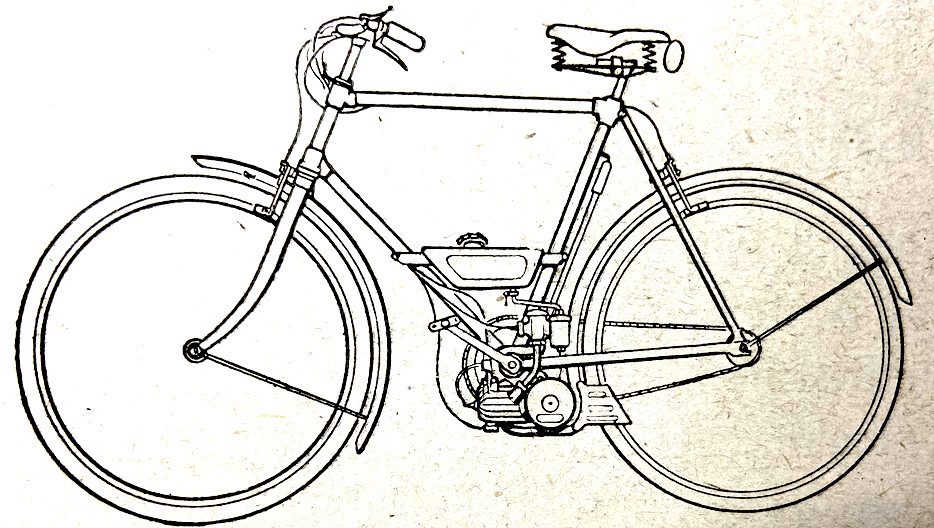
scales about 13lb. So small an addition to the weight of the bicycle s immaterial. In that connection we realise that if sold as a naked pedal cycle the machine would accommodate riders varying from 7st to 14st in weight—a compass of nearly 100lb irrespective of such accessories as luggage. There is no need to discuss other possibilities—the use of a two-speed or three-speed hub, the details of any clutch or gear housed inside the dished sprocket. Here we have the stark naked fundamentals of a well-designed ‘Mac’, thought out with the realistic logic which is a notable. characteristic. of the French brain. The sparking plug is a 10mm. The ‘pot of escapement’ (ie, silencer) is a shapely box of welded steel. A small wedge-shaped petrol tank is clipped inside the bottom angle of the diamond frame. There are two Bowden controls carried to the handlebar—a throttle and a compression-release control. Lubrication, of course, is by petroil. Any oil leaks will be in a region where they cannot readily defile the pants of Monsieur or the nylons of Mademoiselle! In 1939 mass production of the entire machine could probably have been conducted with profit at a selling price of about £12, given the necessary large scale demand. There are just two snags in the path of success for such a charming little vehicle. The first is political. The British Government, possibly through the inertia which afflicts most governments, possibly through fear of overcrowding our congested roads, obdurately refuses to free ‘Macs’ from the red tape of tax, licence, number-plates, insurance and so forth. The other is technical. The provision of a lighting system is not too simple. Nobody wants to return to gas and oil lamps. The friction-driven cycle dynamos are popular on pedal cycles, but perhaps scarcely sturdy enough for ‘Macs’ unless some very firm mounting can be devised. There might not be room to embody a satisfactory flywheel dynamo. Nevertheless, the layout bristles with promise and fascinates the brain by its brilliant logic.”—Ixion
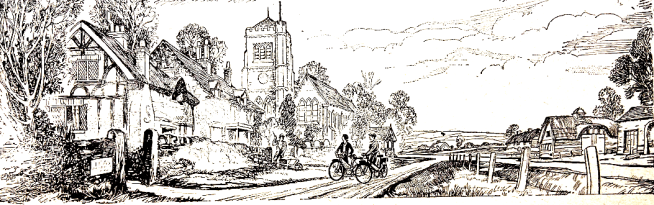
“VILE WEATHER notwithstanding, some 40 enthusiasts v turned up at the Hog’s Back, near Farnham, last Sunday to discuss the formation of a club for vintage motor cycles, which has long been the ambition of ex-Don R Sgt CE Allen, BEM. By noon there was an excellent collection of machines made in the 1920s and early ’30s. Need I state that it was decided that there must be such a club? It was duly inaugurated and is open to all who own—they must own—motor cycles made before the end of 1930. Three-wheelers are excluded. Considering that an underlying theme is a club for folk who have old machines and ride them—machines presumably picked up comparatively cheaply—the annual subscription strikes me as ample; it is 10s a year (June 1st-May 31st), with a l0s entry fee. The plans are: An occasional rally, plus a trial or hill-climb; riders’ discussions; club museum; and use of a workshop belonging to some enthusiastic member. The secretary and treasurer is Mr CS Burney, Cedar Cottage, Marlow. Ordinary modifications, as, for example, those designed to ensure safety, may be made to members’ machines. but not such a change as fitting a different make of engine. An excellent example of an old machine not basically altered was the 492cc, Longstroke Sunbeam owned by JJ Waley, a glittering, completely refurbished 1927 model which won Mr Allen’s award for the vintage machine in best condition. The award for the oldest machine presented by Mr Burney went to RC Ashton for his 1921 Model H Matchless and sidecar.”
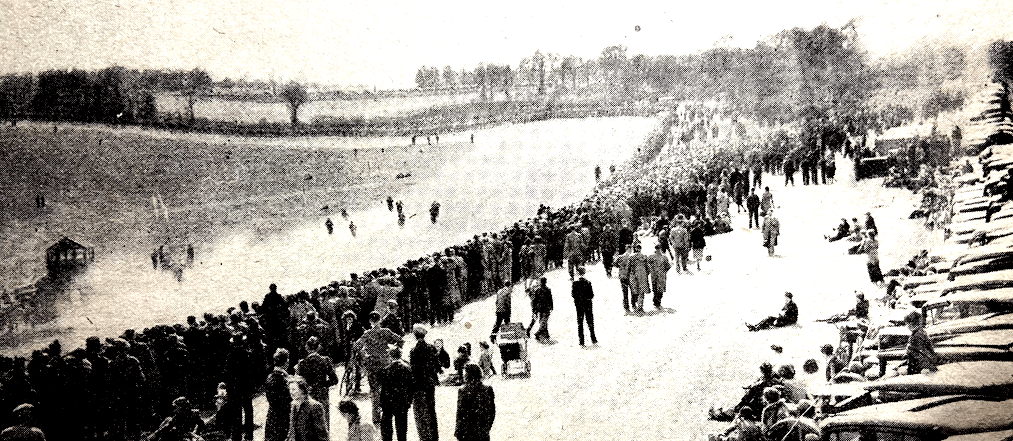
“BY SUGGESTING THAT many owners of 250cc motor cycles have an inflated idea of their machines’ capabilities, a reader has caused dozens of letters to flow into Dorset House. Here we do not propose to enter the lists by quoting figures covering standard 250cc motor cycles, but it may be as well to discuss the future of the 250cc motor cycle. At the present time there is a dearth of machines of this capacity. Factories are concentrating mainly on motor cycles of 125, 350 and 500cc When it is recalled that 250cc is the upper limit for the £1 17s 6d annual tax, and that all solos of larger capacity are, taxed at £3 15s a year, it seems strange that so far only two manufacturers have announced 250cc types. And it is not as if motor cycles of this size were unpopular pre-war. In 1938, for instance, 12,820 new 250cc solos were registered; this was well over half the figure for solos of larger capacity. On the other band, 250cc registrations had for some years been dwindling as compared with the over-250cc machines. In 1935 the 250cc class had been the most popular of all. However, as we see it, the reason why more manufacturers are not making 250cc motor cycles is something other than the decline in interest revealed immediately before the war. With some, no doubt a big factor has been that they had no 250cc model on the stocks; the Armed Forces called for 125, 350 and 500cc motor cycles. Probably even more important from the manufacturing aspect is that a motor cycle of 250cc can cost almost exactly as much to make as one of 350cc, yet because of the smaller capacity the list price, by custom, is expected to be considerably lower. To-day, as we have pointed out, the tendency is to price motor cycles according to what they cost to manufacture instead of by cc. We are glad that this is so. The letters ‘cc’ have been allowed to influence matters far too much. For the most pleasurable riding a large engine is preferable to a small one. There is an absence of fuss, usually a greater degree of reliability, longer life and, generally, for a given performance, little difference in fuel consumption…It may be that the decline of the 250 is only temporary. After all, it is possible to design a light machine of this capacity which is cheaper to produce than a heavyweight 350, and in the past the members of the industry have not been slow to check in which cc classes competition is sparse.”
“WILL you please grant me a little of your valuable paper to reply to Mr S Willis in defence of the 250 machine and the views expressed by LA /CF Leach? I own a 1939 250 Triumph, purchased new in October 1938. The maximum speed is 65 at any time—70 under favourable conditions—this by speedo reading and checked against two others. It will cruise as long as required at 48-50mph. This cruising speed gives a consumption of 65-70mpg. Granted this is not good for a 250, but one cannot have speed and economy, but it gives 90-95mpg at 35mph. In 23,000 miles nothing has disintegrated or ever shown signs of doing so. During this period the only replacements have been tyres. At present the bike is down’ for complete overhaul, the only essential replacements have been rebore, new big-end, and new rear chain, although mains were fitted while the engine was down. No other wear is apparent in any respect. Road-holding, steering and braking are equal to a TT Replica. I am not basing my remarks on one make experience as I have ridden practically every WD machine and civvy bikes from 148 two-stroke James to 490 Inter Norton, but please, why cannot we have the 250 Triumph back again?
HT Francis, Meopham, Kent.
“MAY I REFER TO Mr S Willis’s letter in which he speaks of inflated ideas of the 250? I shall be brief. Sixteen years ago I purchased a 1930 248cc Ariel Colt which, although it had the word ‘special’ stamped on the timing cover, was a production machine sold complete with lamps and full road equipment. We used, to motor happily over the quarter-mile at 73 and scamper from Kirkcaldy to Ayr via Glasgow in two hours, but disintegration did take place—yes, sad to relate, nine years later after passing through many hands—eight, I believe—the fellow then owning had had to, purchase a second-hand engine. Tut, tut! These 250s can’t be taken seriously.
James Y Thomson, Kirkcaldy.”
“I READ WITH INTEREST the letter from Mr Willis and would like to record my experience with a 250cc machine as opposed to his comments which deprecate this size of motor cycle. My machine was a 1938 model MOV Velocette, perfectly standard in every respect, purchased second-hand and used for 3½ years, covering 35,000 miles. The most satisfactory cruising speed of this machine with pillion passenger was 50mph, which could be maintained indefinitely, and the maximum speedometer reading was 74mph without passenger and lying flat. I am convinced that the speedometer was accurate as I had the misfortune to have it checked on one occasion by the police and my very satisfactory average speeds substantiated this belief, having covered 120 miles in under three hours on numerous occasions, again with passenger. Should Mr Willis assume I am a dwarf, I would add that my weight is 13st 5lb.
JG Lee, Bristol.”
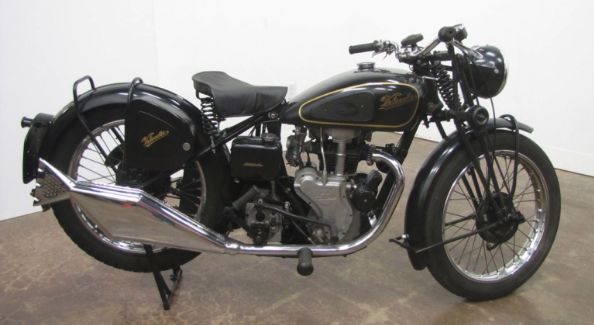
“IXION’S COMMENTS ON Mr WH Sharp’s letter prompt me to reply to the question, ‘Why should a big man with a little purse have to ride a little machine?’ My reply is—there is no reason why he should not do so. Here is my experience I am 5ft 10in and weigh 166lb. For 20 years I have owned and ridden motor cycles, mostly 350cc or over, all four-strokes. I was recently invited to try a 125cc James Flying Flea. I did so, liked it, and subsequently took one of them through the gruelling course laid on in the Victory Cup Trial. To my surprise the little machine behaved magnificently on the rough stuff, and, incidentally, I managed to win the cup for the 172cc class. This by way of introduction. I liked the little machine very much and decided to ride it regularly for a season. What follows is an account of an ordinary day’s motoring, nothing freakish, just main-road stuff which any Tom, Dick, Janet or Jane would do for pleasure any time they wanted a day’s ride. My route from Birmingham took me over the Lickey Hills to Worcester, crossing the Lickeys via Rose Hill, which ‘Jimmy’ took quite easily in top gear for two-thirds of the way up. It is a long, steep climb. A change down to second brought me to the crest of the hill and so down into Bromsgrove and on through Worcester and Malvern. The machine had settled down to a steady 35-40, and l was looking forward with some interest to the climb over the Malvern Hills from Malvern Link through the Wych Cutting. Here again ‘Jimmy’ surprised me. It was a top. gear climb the whole way from bottom to lop, an average speed of 26mph. ‘Not so bad’—I thought—’for a Flea.’ From the Wych Cutting to Ledbury and Ross on Wye was an easy run, the machine purring happily. A stop at Ross for lunch, and then on to Gloucester and Cheltenham. On this section of the road the Flea was motoring at a comfortable 37mph, with occasional bursts of .43 on the flat and 45mph on down grades. Within an hour of leaving Ross I was just about to climb Cleeve Hill between Cheltenham and Winchcombe. ‘Jimmy’s’ performance on this hill was again remarkable, as the second gear was only needed for approximately 100 yards on the very steep portion of the hill, the remainder being climbed in top gear comfortably. And so through Winchcombe, Stanway and Broadway to Willersley Hill, with its gradient of 1 in 4, which the machine took in its stride without difficulty. From Willemley down Saintsbury, through Honeybourne, and thence through Wootten Wawen up Liveridge Hill, another top-gear climb. I arrived back in Birmingham after covering a distance of 144 miles. On checking up my running time I found that the average speed was 30mph. The petrol consumption worked out at nine pints of petrol for the 144 miles, which gives 128mpg. The above is just a record of a pleasant, trouble-free ride on a James Flying Flea. I had been nearly five hours in the saddle; I finished fresh, happy and contented, without a trace of cramp or stiffness, which I certainly could not say of some of the larger machines I have ridden. I hope this account may interest those who are long of limb and short of purse, who are contemplating the purchase of a small lightweight model. I am perfectly convinced that these little machines will do everything that the larger machines will do, with the exception of speed, at half the cost and with equal pleasure.
Norman Hooton, Birmingham.”
“BY NOW THOUSANDS must have ridden Triumphs fitted with the new telescopic front fork. They know what excellent steering the fork confers and what a ‘soft’ ride it provides…Now it is possible to reveal the detail construction of the front forks…Ask Mr. Turner the underlying theme of the new forks and he will tell you that the aim has been to produce a front fork which gives a large movement and has the maximum diameter of stanchion, the stress member. He will go on to say that, as a consequence, the spring is inside the stanchion, instead of being on the outside. Next he will point to the hydraulic lock at each end of the fork travel and how in no circumstances can there be a metal-to-metal clash on either shock loading—extreme shock—or on rebound. And he will add that the rate at which-control is transferred from the spring to the hydraulic side varies with the speed of oscillation; at low speeds there is practically no hydraulic control, while at high speeds the control is hydraulic…”
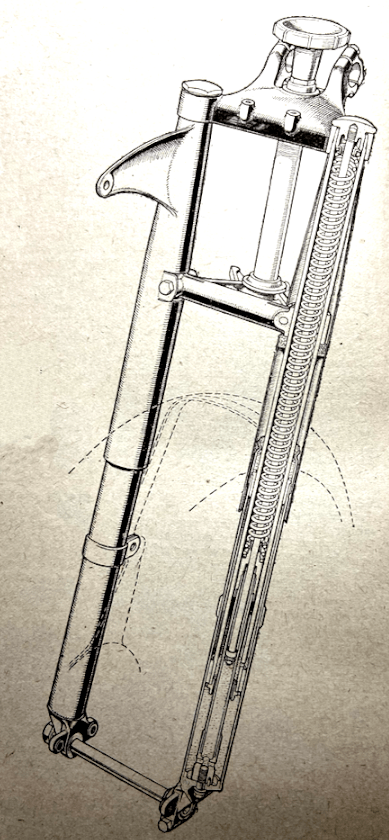
“HERE ARE SOME FIGURES arising out of the Crowborough, Sussex, auction, which disposed of 150 NFS motor cycles last Thursday. The first 80 machines fetched £5,071 10s, an average of over £60 apiece. At the end of the day the total sales amounted to £9,250, which, if all 150, were sold, still means an average price per machine of over £60 [about £3,200 today]. A 500cc Triumph twin went for 100 guineas [about £5,500]; this was the highest bid. An Ariel cost someone only 16 guineas, but little wonder that it was the cheapest, since it had no engine. What do these figures suggest? I leave it to you.”
“A DESIGNER REMARKED the other day that, while he can produce a new model which he can guarantee will steer well and hold the road, if he had to write a treatise on the subject he would perhaps be flummoxed. Strange, is it not, that in such matters as weight distribution, steering-head angle and trail of the front forks it is a matter of knowing what has proved and will prove the goods rather than of working things out? Of course, the only thing that matters is that machines of to-day do steer well; it is not so many years ago, though, that every now and then there was a case of speed wobble—of the front wheel starting to swing from one lock to the other and the oscillations becoming, finally, of the tank-to-tank variety and the rider either stepping off or being cast off. I had that once…”
“MAYBE YOU WILL remember Mr. Graham Kirk, of blown Scott fame, urging an all-Scott race. Last week-end there was a jubilant telegram: a race for the tearing-calico models is to be held. As Mr. Kirk says, it seems almost too good to be true—Scotts, ten or a dozen of them, each adding its quota of ‘yowl’.”
“IN PARIS, OF COURSE, the Black Market in petrol is rife. What I did not realise, however, is that, while motor cyclists are entitled to ride their machines, there is no basic allowance for private and pleasure purposes. A French manufacturer, in a letter I had last week, says he wonders whether ‘officials who allow motor cycles to circulate’ think that a ‘machine can use water instead of petrol, and air in the place of oil’. He confirms that the tyre problem is still very great, and says that the synthetics they are getting are of a poor quality, which is certainly not the case with our synthetic tyres. Notwithstanding petrol difficulties, there are plenty of customers anxious to buy new machines of large cylinder capacity, though lightweights naturally are more popular.”
“WHERE ROAD TRANSPORT is concerned Belgium seems to be recovering soonest of all Europe’s former occupied countries. (Note ‘occupied’.) There are fewer restrictions on those who are authorised to run vehicles, and no coupons are required for lubricating oils or grease. Nor is charcoal for producer-gas vehicles any longer rationed. Tyres are still the greatest problem everywhere. Last January, I note, Belgium produced 1,270 covers and 5,037 tubes for motor cycles, compared with 11,439 covers and 8,470 tubes for private cars. Does this indicate the proportion of motor cycles to cars at present in use in that country? In the Netherlands the motor cycle situation is regarded by the Dutch authorities as being fairly satisfactory, and it should not be many months before the number of machines there approaches the 1939 figure of 63,000. Again, what has been stopping many getting on the road is lack of tyres. Do these facts and figures from a report of the European Central Inland Transport Organisation suggest slowness in our post-war road transport recovery?”

“ALMOST SINCE THE DAY it was founded, over 43 years ago, readers of The Motor Cycle have affectionately dubbed their old friend the ‘Blue ‘Un’. The reason for the choice of pseudonym, of course, has been the blue cover that has been a feature of the journal throughout. Naturally, there have been changes in the cover from time to time, one era succeeding another, but always the old familiar blue remained a symbol. To-day there is a still bluer ‘Blue ‘Un’. The face of the old friend has been brought a little more in keeping with the times—in keeping with what, we trust, is the fresh, lively outlook of the paper, your paper, in which we shall continue to serve the vast motor cycling fraternity to the best of our ability.”


“STOCKS OF HIGH EXPLOSIVE are still being stored in huts by the roadside in many counties. Is it necessary to add that it is unwise to smoke in the vicinity of these huts?”
“SOME MEN HAVE strange hobbies. A Frenchman named Andre le Gall has one of the oddest—he can pull loaded railway trucks by a rope held in his teeth. In the May 4th issue of Picture Post he is shown taking the strain with his jaw of two solo motor cycles attempting to get away on a clutch start. His body is, of course, anchored by another rope.”
“THE OFFICIALLY APPOINTED Departmental Committee on Traffic Signs state in their report that it is desirable that at all fords on public roads a depth gauge as well as warning signs should he provided.” [My wife would certainly agree with this. Some decades ago I chose a ford over a hump back bridge and charged into what I thought was six inches of water with some degree of panache. The resulting wave defied gravity, surged over the sidecar windscreen and soaked the boss to her delectable skin. And yes, under the immutable law of narrative imperative, there were a dozen girl guides on the bridge to applaud vigorously—Ed.]
“AN MP IS TO ASK the First Lord of the Admiralty ‘on whose authority a Royal Marines motor cycle escort was provided at a wedding in Alsager, Cheshire, and whether the petrol was charged to public funds’.” God’s teeth! We’d just won the war and…I trust the First Lord told him to fek off.
“SHORTLY BEFORE 8am it was a matter of on with the flying-suit lining, the waders and the hood-twill riding coat. In front of me was one of those quart-into-a-pint-pot days. Appointment No 1 was at a factory rather over 100 miles away. The time for me to make my bow there was 10.30am. Then, having filled sundry pages of my notebook, I would wend my way to another factory. More note-taking. Lastly, there was a date which, if I did my job effectively, should result in an interesting couple of thousand words or more. The rest of the day, which was to mean from 6.30 onwards, would cover my ride back and then be my own. Three appointments, three delvings into matters, the better part of 250 miles and, all being well, three articles as the outcome. That can be rather typical of a technical journalist’s life. There is not much time to waste, and while he is away, things are piling up at the office…However, that is rather beside the point; my aim here is to tell you a little about the trip, and particularly about some of the side-lines. When I left home it was fine. but the air was dank. If the sun did emerge there was no chance of it blinding me, since I would be heading roughly in a north-westerly direction. Thus a cap with a peak was not essential as a protection against the sun. It would be desirable, though if it rained. What head-gear should wear? ‘Nitor’ has mentioned my special type of ski-cap, the one with an extra long peak—water-proofed and stiff—no side flaps and merely a ‘pork-pie’ that fitted my cranium closely. The past tense of ‘fit’ is used, because the cap was finally discarded as being too shabby. It was a very practical cap, though, and one day I must get Mr S Lewis to make me another. A feature that I liked almost as much as that long, stiff peak was the close fit; there was no tugging of the cap at my hair if the speed and/or wind became at all high. Mr Turner, among others, has suggested that about 55mph is the highest completely comfortable speed—that at higher speeds the wind of one’s motion can detract from one’s pleasure. Has not one’s headgear a lot to do with this? If this is flapping on one’s head, banging against one’s scalp, and the peak distorting, if not cavorting, may one not have a sensation that detracts very considerably from the pleasure of any batting—may it not even affect one’s riding and the average speed? What I did was to put my old Donegal-tweed cap in my haversack together with spare gloves, and slip on a rather small-sized beret, which once adorned the head of an Air Vice-Marshal. His wife held a jumble sale just before he moved to a fresh command, and I invested a whole shilling. This beret, then, I duly put on, pulling it down so that there could be no flapping, which, incidentally, would mean that my hair was fairly tidy when I arrived at factory No 1. It did not rain, though there was some cold mist, and that beret proved a very satisfactory headgear. How much it had to do with the matter I have no idea, but I enjoyed the run immensely. For once my riding seemed to be passable. The machine swept round the many open bends at higher speeds than usual and, so it seemed, much more neatly. Speeds on the straights appeared to be automatically higher, and the figure for miles in the hour was right up. I mused. Was it that this beret was not flapping and my Donegal-tweed cap, which is not so stiff unfortunately as its predecessor, dees flap if I exceed about 55mph? I believe that this has a lot to do with matters, and I feel that those who bat are wise to have headgear that cannot claw at their heads—that, in addition to being perhaps appreciably faster, they will probably be neater and safer. As a matter of fact, on that run I was using two other aids to safety and comfort. One was those ex-RAF ‘High Wattage’ electrically heated gloves, which ensured that my hands did not lose any of their feeling, and the other, a pair of ‘four-window’ ex-RAF goggles. To my surprise and delight a pair arrived at the office at the beginning of last week. Some time previously I had discussed goggles with a designer and had remarked that I was looking forward to trying out this type of RAF goggle when they
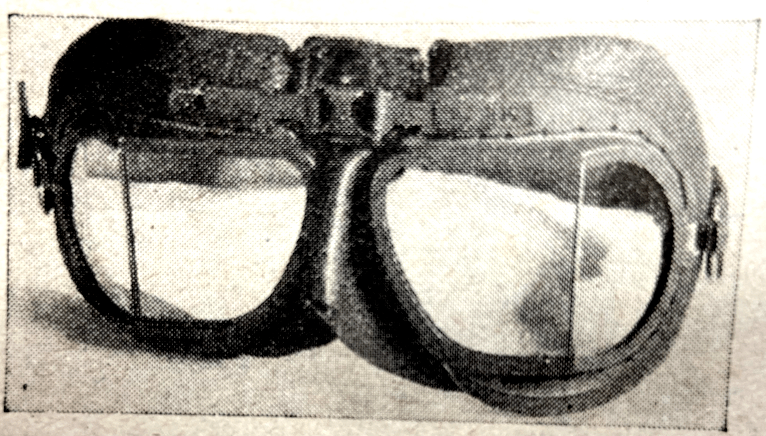
became available as surplus—that my Perspex-lensed ex-US Army goggles were good, but did not give full side-vision, whereas the RAF ones did and were, I gathered, super. (It seems to me that soon I shall be almost completely garbed in ex-RAF kit!) The said designer is Mr Tony Wilson-Jones. He sent.along the goggles, mentioning my remarks and saying that he had lost a pair of mine when I lent him the Flying Flea for the Pioneer Run, his old Royal Enfield not having turned up. Goggles, my foot, all he had lost was a pair of anti-gas eyeshields. My experience of the goggles on the trip to the Midlands was in line with everything I had been told about them. One does not notice the junction between the side and front lenses. The goggles seem to fit almost any shape and size of face, and I found that no dirt reached the corners of my eyes, whereas it works there with nearly every type of goggle I have worn. Further, there is complete vision to the sides, which can make a lot of odds to one’s safety. An instance of this was when I was riding along a by-pass in the Midlands. I was about to overtake a car—and it should have been obvious to anyone behind that, with the relative speeds, I must do so—when there was a noise of overdriven machinery from the rear. Thanks to the wide vision of the goggles I was able to see the car without turning my head unduly and, later, was enabled to check that the driver was giving up his idea of doing a little thrusting. Also, of course, with such a wide vision one can keep a better look-out as regards any vehicle on a side-road. Driving after dusk gave one less of a star-spangled-banner effect than is the case with plastic lenses. Definitely I can recommend these goggles which, I see, are just coming on the market. By the way, I have not yet tried them under very wet conditions. I have been told though that they are notably free from steaming trouble.”
—Torrens [aka Blue ‘Un editor Arthur Bourne]
“HOW I HAD LOOKED FORWARD to such a day when lying in slit trenches or moving in convoys over the dusty roads of Italy, the sound of guns making the air sullen. Westward bound from London, demob, petrol coupons in my pocket, a new machine of my very own…Good Friday, 1946. The sun shone. The London traffic became sparser along the wide, straight stretches of the Great West Road. Many other new machines were to be seen, glinting in the sunlight: all, it seemed, being ridden at careful running-in speeds. There were also many sidecar outfits. Courtesy cops were vigilant though I saw none taking action. Instead of taking the direct route through Slough, I passed through Windsor, dwarfed, so it seems, by the vast mass of the castle and its battlements. At Dedworth Green, a little village on the road to Maidenhead, I was somewhat mystified. A 30mph limit sign stood planted on the right of the road, and a de-restricted sign almost level with it on the left. Perhaps some practical joker had turned the sign on the left so that the ’30’ now faced the wrong way. But it was not as simple as that: the ’30’ was ’30’ on both sides and the de-restriction sign, too, was backed by de-restriction. However, the village was much too
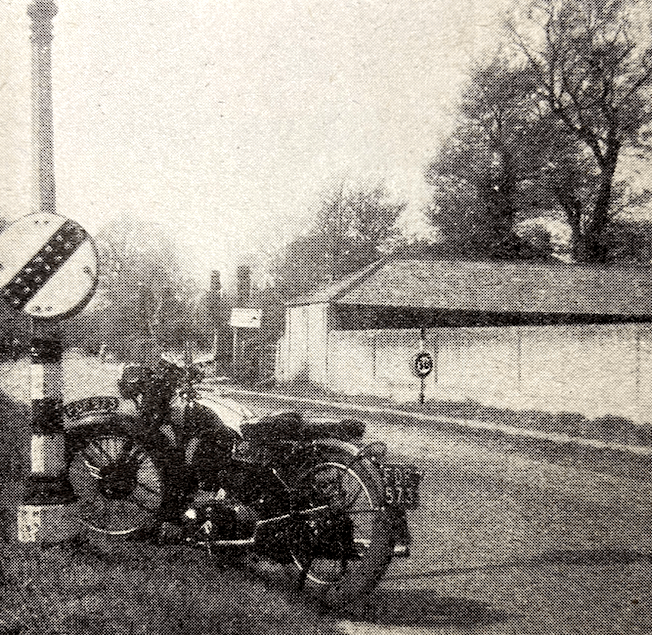
pleasant for one to want to exceed 30. A few miles after Maidenhead I stopped for sandwiches and a beer at a roadhouse. When getting ready to start again I could not help overhearing a remark which came incongruously from a young man who certainly looked no more than 20 years old. He glanced at my machine. ‘A bike’s nice,’ he said to his friend, ‘but when you get on in years you don’t want a bike!’ I thought of all the grey-haired riders who would scorn that youthful statement. The roads became emptier towards the West, and I wished that the Norton were run-in: she seemed to be pulling at me like a mare with a hard mouth. For a few miles one might not have known it was Good Friday—until Regatta-famed Henley was reached. Here the old Thames, gay with little craft, like an old man in a paper hat at a party, flowed winking in the sunlight under the stone bridge. Here, too, a couple were in distress by the roadside. Their machine, minus a front stand, was resting grotesquely on its crankcase, while the front wheel lay on the ground. They had everything but rubber solution…My route took me on to Abingdon, another river scene of boats and bridge and laughing holiday-makers; from there over long, straight stretches of road towards Faringdon, Cirencester and the Cotswolds. The air seemed to become keener and fresher. It was a perfect day for touring, almost too marvellous, for several times I had to remember the newness of the model and control my over-eager throttle hand. However, time did not matter, and there had been several halts to admire the scenery and take photographs. I arrived for tea in a little Cotswold village, where I had planned to stay the night with relations. The next morning, after a quick look over the machine, I left the Beaufort hill country and rode down into the charybdis of Bristol traffic. Holiday-makers abounded in the whole area and it was good to pass the vicinity of Cheddar with its cave seekers, and reach the long, open stretches on the way to Bridgwater. The grass at the sides of the road had that particular shade of green
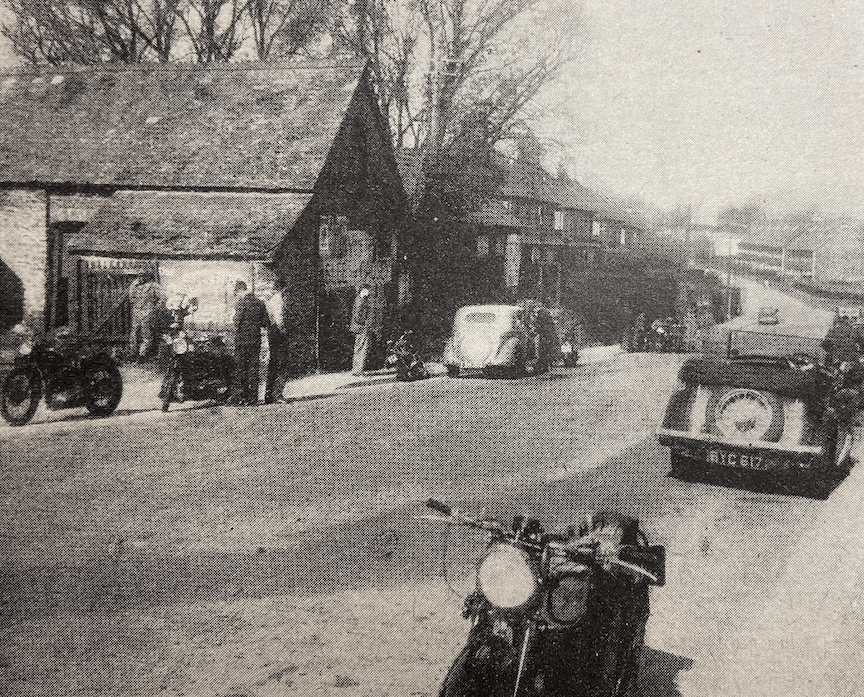
that reminds one of late summer cricket matches and garden fêtes on country-house lawns. After Bridgwater came that glorious, twisty road to Minehead. There are still many blind bends with their hedges and banks—bends that demand care. A few miles from Minehead I stopped at an attractive guest house to enquire about accommodation for the night. I had visions of difficult searching, but the good lady said yes, there had been a cancellation. On the Sunday, in common with hundreds, I saw and enjoyed the famous Beggars’ Roost trial. The crowds of spectators were in high spirits, especially at one observed section, where clean climbs were rewarded with shrill cheers from a particular bunch of young girls and women. The cries were almost loud enough to cause competitors to fall off in surprise. I started back on the long, London-ward journey well after dark. At Bristol Bridge I stopped and had a cigarette. It was the wrong side of midnight. There I stood for a few minutes—almost listening to the silence. The scene at that hour was uncanny, and as dead as the ruined city of Pompeii, but with modern lamps casting a lunar glow on the empty streets and ragged, bomb damage. Turning towards the Cotswolds once more I was in Friday night’s bed by 3.30am. And so Easter, 1946, drew towards its end, and on Monday, after a few invigorating bursts of speed on the now virtually run-in model, the journey back into London was completed. What did the trip cost? Two pounds and threepence, including a necessary complete change of oil; and there is still half a tank of petrol left, still my basic ration coupons, and a few of my demob ones. Fuel consumption worked out at nearly 70mpg, and about 450 miles were covered. Here’s to the next holiday!”
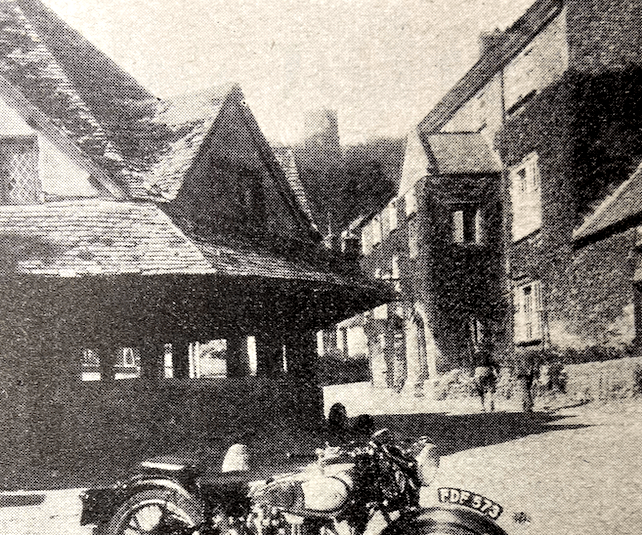
“IT IS ABOUT TIME something was done about pillion seats. They are too small, they are not comfortable after a short time, and even dangerous on a long journey because the pillion passenger is wriggling about trying to find a comfortable position. We used to ride 100 miles nonstop with the old Moseley Float-on Air pillion seat, but it was carrier fitting, but now—well we don’t go more than about 50 miles before we have got to stop. If the designers of pillion seats were made to ride 300 miles in a day on their products there would soon be some alterations. So the sooner they start doing it the better. TB Marsden, Hyde, Cheshire.”
“THE ROUGH TEN-MILE JOURNEY to see the Tasmanian championship has strained a Bren.gun carrier, but the beach when we did arrive made Pendine look like a back-yard; the nucleus of enthusiasts, too, might have been a lost expedition in the Sahara Desert—that is if you had exchanged the drifting dunes of the Bedouin for hard, flat sand. On approaching the group along seven miles—yes, seven miles—of beach, one was immediately impressed by the business-like atmosphere. There was Trevor Jowett fussing over a brood of AJS entries…he hatched some of this clutch from the days of belt drive; and, farther on, there is the area reserved for the Norton entry which included an International Springer which fairly reeked ‘works’ and ‘trade’. The first machine was sent away over a measured, electrically timed quarter mile with flying start ad lib. Marshalling was perfect after two groups of spectators who had been allowed to wander to the finishing point became mistaken in their estimation of an approaching speedman. But they stood their ground while the mass of man and metal hurtled through in the near 90s. They then withdrew hurriedly. The two-mile beach handicap attracted an impressive array of 30 entries, and such was the expanse of sand that the whole field could have swept up the beach abreast and widely spaced without a ghost of interference. Ariels, Triumphs, Nortons fought out the issue of the ten-mile handicap, in which L Arnold (Norton) made the best time of the day at a speed of 105mph. One cannot be surprised at the high degree of motor cycle enthusiasm in Tasmania, where the ideal conditions of 1938 roads with 1914 traffic would be the best description by English standards. Moreover, the ‘Blue ‘Un’ is only 35 days late, which provides a useful hiatus to check hysteria and premature decisions on points of major importance. Motor cycling is well within the wage group of a similar category of enthusiasts to that in England. Of renewals and spare parts the motor cyclist in Tasmania is reasonably assured. Of course, there does not exist here the number of second-hand spares so alluringly advertised in Britain, but Australian factories are turning out very reliable parts indeed; so much so that the writer was able to rebuild his 500 hogbus engine completely to his own drawing, every-thing coming to hand as per specification. The fraternity of the motor wheel is indeed world-wide and remains an inspiration that does not require the assistance of any poet or prose artist for emphasis above ordinary fact. It is just 15 years since the author jostled with Jock West and HL Daniell on the Sidcup grass tracks, but with the eternal youth of the great game it might have been yesterday.”
“APPRECIATION: INTERNATIONAL NORTON rider wishes to thank the lorry driver who rendered valuable assistance on the Abingdon-Dorchester road…Address Wanted: Will Mr Jack Wolstenhulme, formerly of Oldham, Lancs, kindly get in touch with the editor?…Instruction Books Wanted: For a 1938 R51 BMW; 1935 350cc ohv BSA; 1937 Coventry Eagle Pullman; 1937 Ulster Rudge; 350cc KNS Velocette; 1938 250cc AJS; 1932 150cc Coventry-Eagle; Rudge Special; 1937 Coventry Eagle Pullman; 1936 500cc Calthorpe; 1930 500cc AJS; 1932 350cc ohv. New Hudson; 1936 500cc Aero Douglas; 1937 Coventry Eagle Pullman; 1929 250cc ohv Matchless R3. Pen Friends Wanted: LV (Belgium) wishes to correspond with enthusiasts, particularly those with continental riding experience; GB (Grantham) wishes to correspond with a Panther enthusiast who would like to receive his copies of The Motor Cycle. Companions Wanted: JT (London, W.12) wishes to contact young pillion passenger or fellow rider. GM (Sheffield), who rides a 250, requires companion for week-ends and holidays. LB (London, EC1), who rides a 1,000cc solo machine, requires compassion for a three-day trip to Cornwall in May. HW (London, NW6) novice owner of a 16H Norton, desires to meet experienced enthusiast willing to give help and advice. FP (Burton-on-Trent) requires passenger, age 20-25, for week-end runs and camping, share expenses, or would take youngster free. HFH (London, SW12), who rides an Ariel Red Hunter, requires pillion passenger up to 29 for evenings, week-ends and holidays, or would help youngster, or ex-Navy man.”
“AN ENJOYABLE AND SPORTING day’s training across country was held near Aldershot, on Tuesday of last week, by REME Workshops. Competition was sharp among both individuals and the 16 teams of three. A new lease in sunshine made everyone cheerful, but it followed that parts of the course became drier and a little easier as time went on. ‘H hour’ was at 10am at the Corps of Military Police Depot, Mytchett, and the day’s sport on WD machines was divided into two halves—in the morning ten hazards were scheduled, and after lunch there were two timed man-handling exercises and a section known as the ‘mud-bath’. Short-wave portable wireless sets were used at every observed section. This could well be copied in civilian events, not for results, but to secure the best possible organisation, if we could get the radios and wave-length allocations. In the afternoon a trench was the first obstacle. Each team had to manhandle its three machines across. The quickest were the HQ Static Workshops and 14 CDMS teams, which tied with lmin 26sec. The method was for two men to stand in the trench, while the third assisted from above. Before going back for the next machine, some laid the model down; the resultant flooding of the carburettor made starting difficult in a number of cases, and starting up was included as a time factor. Feat of strength No 2 was to get the models over a ‘wall’, four or five feet high and about six yards wide.H&T wing A team was fastest, and took 2min 17sec. Last there was the ‘mud-bath’, which was really a muddy watersplash. Many riders were too fast and drowned their engines. Pte. Hosking (490 Norton) dropped his machine ‘in the drink’, but not himself. Cfn Cruse (350 Ariel) was not so lucky; he got a wetting. Among others clean were ASM Rolfe (490 Norton) and Cfn Mason (490 Norton), who slipped their clutches and rode through confidently. A diversion was caused by RSM Van der Kamp, one of the many Dutch spectators: he rolled up his trousers and slowly stepped through the ‘mud-bath’, like a fire-walker, for a £2 bet. The money was collected for him first! Brig Stack, DDME Southern Command, presented the awards, including a cup given by Norton Motors for the best individual performance. The chief organiser was Col RW Day, of REME. Many enthusiasts will know him from pre-war days, when, as Major Day of the Mechanisation Board, he was to be seen in the Isle of Man and at the International Six days.”
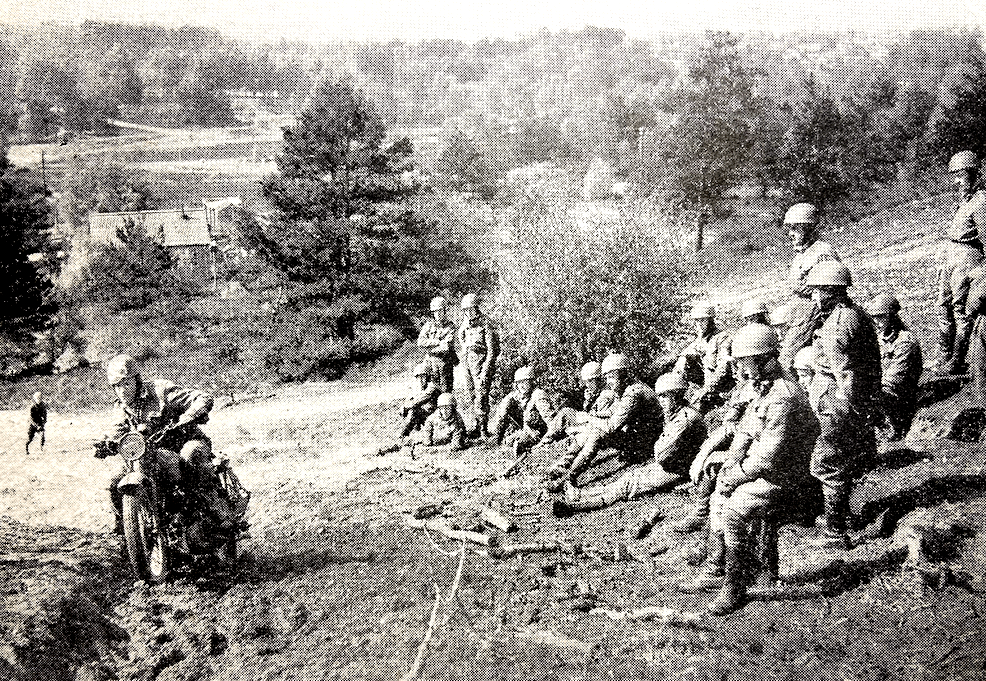
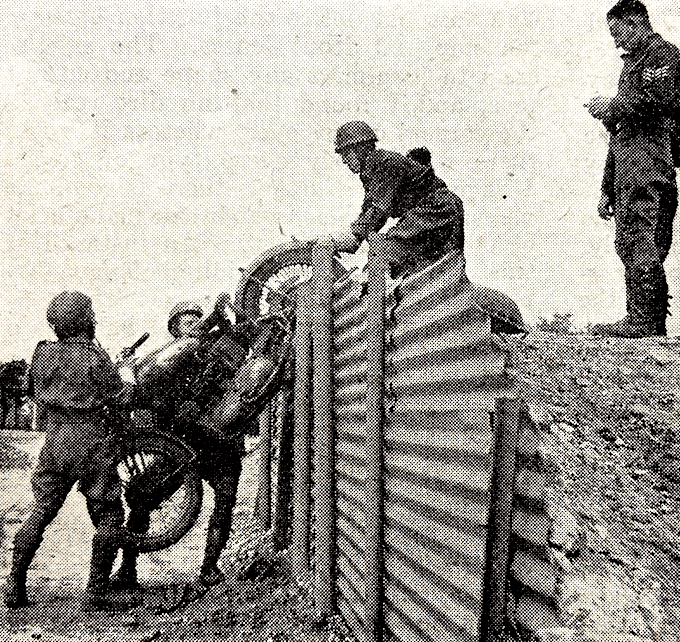
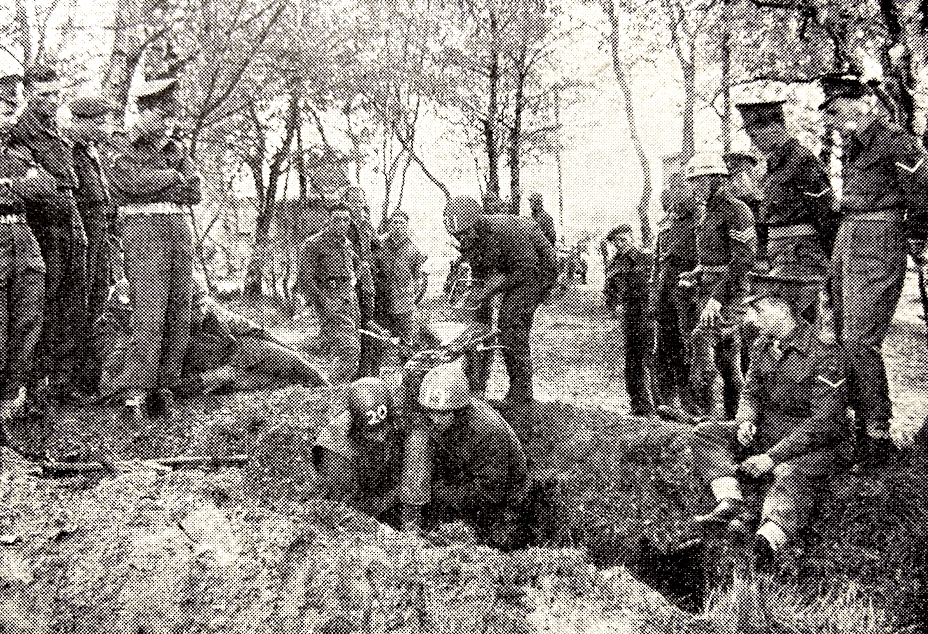
“PETROL RATIONING FINISHES in Holland on June 1st. Sweden, Switzerland, Portugal and Iceland are other countries where petrol is no longer rationed. And what about Britain? Of course, she only won the war.”
“QUITE A NUMBER of clubs are co-operating with local town councils in staging Victory Saturday gymkhanas, grass-track meetings, etc, as part of the celebrations. Having good relations with the local authority is obviously a sound policy for any motor cycle club.”
“TWO CLUBS, IRTHLINGBOROUGH Bats MCC and Stewarts and Lloyds MCC (Corby), are holding a road-racing meeting in the grounds of Rockingham Castle (Northants) on June 22nd. The course will be 840 yards round. Rockingham is said to be the Chesney Wold of Dickens’ finest novel, Bleak House.”
“ONE OF THE QUESTIONS put to a Birmingham ’30’ MC Brains Trust consisting of Messrs Perrigo, Rowley, Mellors, Ginger Wood and Reg Read (question-master, HS Perrey) was: ‘Do you consider there is any future for a small-capacity machine with low pressure boost?’ Perrigo: ‘No.’ Ginger Wood: ‘I prefer a big twin.’ Mellors: ‘The cost of the booster would be out of all proportion to that of the machine.'”
“DESPITE POURING RAIN a very large and enthusiastic crowd came to watch the Brussels International Grand Prix held on the outskirts of Brussels. The course, nearly two miles round (roughly three kilometres), was in the form of an ‘L’, the long leg of which was a dual carriageway with a very pronounced gradient falling to the hairpin at the bottom. The surface was good but slippery in places, and the road was rather narrow for the massed starts, which were decidedly hectic. Heavy rain fell throughout the 350cc International race of 57km. Starting (as in all the races) at the top of the course, there was a half-mile stretch in which to jockey for position for the bottom hairpin. The scene here would give massed start enthusiasts food for thought! Several riders took the escape road and one Dutchman fell very heavily. The race soon developed into a duel between the Frenchman Lheritier and Fergus Anderson (Velocettes). For several laps Anderson was on the Frenchman’s• tail, _but a pronounced engine ‘miss’ got worse and towards the end he dropped well behind. 1, Andre Lheritier (Velocette), 50.9mph; 2, Fergus Anderson (Velocette); 3, Peraldi (Velocette). In the sidecar event— a good race—the Belgian winner Vanderschriek (Norton) led throughout. He is a stylist and it would be interesting to watch him at Donington. 1, Vanderschriek (Norton), 49.7mph; 2, Peraldi (Velocette). Anderson, down to ride a Norton, again rode his Velocette in the 500cc Inter-national Race over 57km. This time there was no doubt as to its urge. The favourite was the Dutchman Knijnenburg (BMW). At the first hairpin the closely packed field was led by Knijnenburg, with Anderson lying third. At the end of the second lap Anderson was second, and during the third he took the lead. He steadily increased his lead, and one had the impression that the BMW rider was not too happy on the wet road and in drizzle. Later on Anderson was challenged by the Belgian Meunier, on a very fast FN, who actually took the lead half way through the race and held it for two laps. However, he overdid things on the bottom hairpin, slid to the ground, and was afterwards content with second place. Anderson rode neatly and with great regularity, and his victory was very popular. Among the runners-up, a very good show was put up by the fourth man, Erge. Riding what appeared’ to be a standard, rigid-frame ‘Gold Star’ BSA, he performed remarkably well. 1, Fergus Anderson (Velocette), 53.4mph; 2, Meunier (FN); 3, P Knijnenburg (BMW); 4, Erge (BSA).”
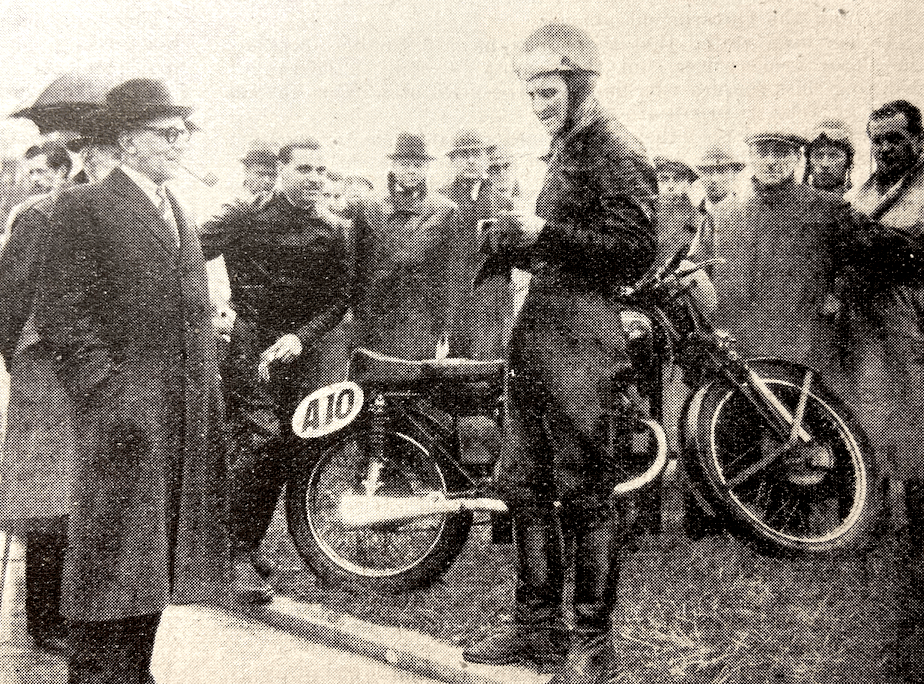
“AT BRANDS HATCH on May 12th 50mph was beaten by a 250 for the first time in a race, when C Clisby (250 Ariel) covered the eight laps at 50.37mph to gain second place in the Grand Prix handicap. Very few, I’ll wager, know the story behind that feat. Clisby was taken prisoner at Dunkirk. For five years the thought of one day racing again was chiefly instrumental in keeping him sane. From the prison camp in Germany he wrote to LWE Hartley asking him to build a 250 engine with suitable urge; he (Clisby) would see about a frame to his liking upon his return. The engine was duly built up—entirely from ex-catalogue parts, incidentally—in the Hartley manner, and Clisby eventually made his own frame. First public appearance was at the Brands Easter meeting, when Clisby returned best 250cc time, and he followed this up by winning the 250cc scratch race at the Eltham Club’s meeting on May 5th. Those years of scheming and dreaming in Germany have borne fruit.”
“EPISODE 1 OCCURRED some months ago. I was being shown round a factory when the managing director paused to pick up an enamelled tank. The finish displeased him. Here and there was a dust-fleck. He pointed to the minute blemishes and said something about being determined to see that his motor cycles were finished as well as they could be. Episode 2 occurred when I was walking through the works the other week; again he led the way and again he was to pause, but this time it was to tell me that an air-conditioning plant was going in and that of dust in the enamelling shop there would be none. British and best, my masters—that must be the motto in these days.”
“FIFTY AND EVEN 60% of the motor cycles being manufactured in Britain are despatched abroad, which means that prospective purchasers in this country have to await their turn—have, in the case of some makes, a long wait. Very much the same applies to other articles, and it is not surprising that there is a sense of frustration among many. There would be less criticism and a still greater spirit of endeavour had there been more facts prof erred and fewer catch phrases. Among the facts is that the Government’s target is 1¾ times the volume of the 1938 exports—volume, not money value—and with this achieved, Great Britain should be back to something close to its 1938 standard of living. Note the words ‘back to’. This is the first and, if there are to be the pleasures, conveniences and comforts of life in 1938, the essential target. The hope, of course, is that a still greater volume will eventually be achieved and, consequently, an even better standard of living. This is the meaning behind the call for exports and the national campaign which will shortly be in full swing.”
“A READER REBUKES ME for describing a pedal cycle as ‘slow and laborious’. I really do not know why cyclists should be so sensitive. They out-number us ‘fast and lazy’ motor cyclists in a ratio of about 20 to 1 so far as Great Britain is concerned, and if anybody should suffer from an inferiority complex, it should be us rather than they. Each method of progression has its peculiar faults and merits. They are slow and laborious, compared to motors. In return , they enjoy vast economy, make no noise, and get to know the country more intimately. We are mostly ex-cyclists, and ‘verted to motor cycles because we wanted to cover more ground at less exertion in the same time. For these advantages we accept more expense, more noise, more dirt, and a certain sacrifice of popularity with large sections of the public. Let us be truthful and objective, dear reader!”
“A CROWD OF 65,000 attended a Wembley speedway meeting last week, probably the biggest attendance at a speedway meeting since the 1938 world championship final. Wembley beat New Cross at the meeting.”
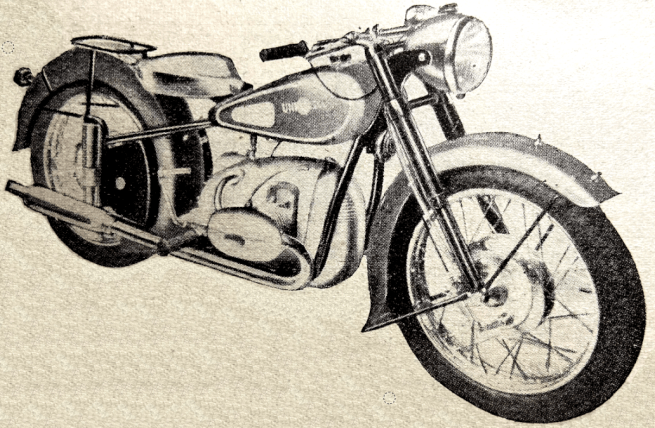
“AS IN ONE OR TWO recent issues of The Motor Cycle references have seen made to electrically propelled vehicles and in this week’s issue Mr K Knights is asking for advice on vehicles suitable for cripples, as I am associated with a firm that specialises in the manufacture of electrically propelled invalid carriages, may I say a few words on the subject. One vehicle is a three-wheeler and can be completely controlled with one hand. The single front wheel is steered by a tiller bar which incorporates a spade-grip handle and by twisting this latter to right or left gives four forward speeds, two reverse, and two braking positions. This range can be halved throughout by means of a separate series-parallel switch. All three wheels are independently sprung with coil springs and the tiller bars sprung separately so that road shocks and fatigue are practically eliminated. In addition to the electric brake previously mentioned, a hand lever operates ie friction brakes on the two rear wheels and a ratchet lever controls a transmission brake for parking. Range of operation on one battery charge is 40 miles and maximum speed 12mph, but the latter can be increased if required. The vehicle is, of course, perfectly silent and will ascend a gradient of 1 in 4 from standing start. Also, it can be turned almost- in its own length and can be driven up reasonable steps and indoors if necessary. I trust this brief description will not take up too much of your valuable space, but it may be of interest to many of your readers who have had the great misfortune to become disabled during the war. There are several things I want to say about motor cycling, being a keen enthusiast, but they must wait.
LJR Murphy, East Horsley.”
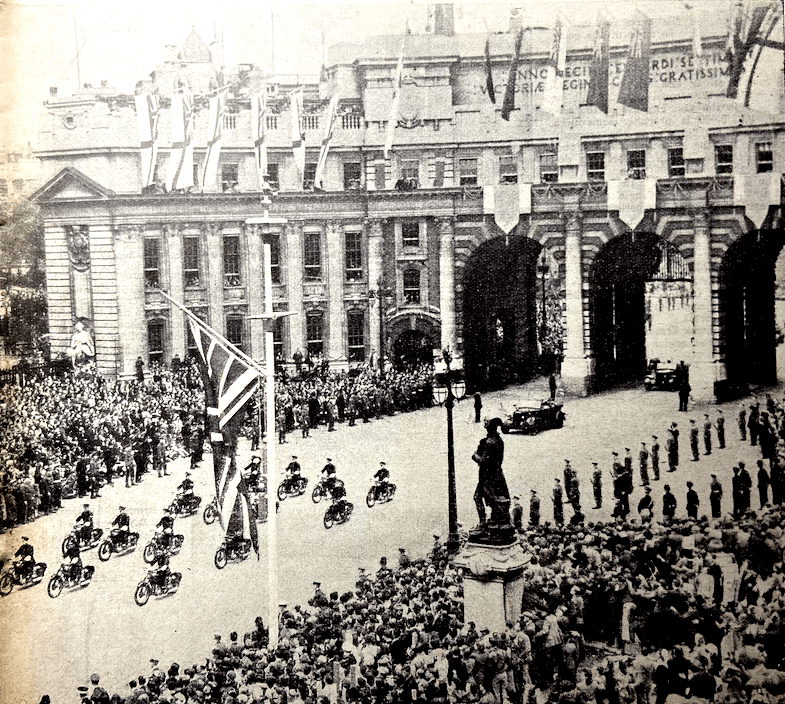
“ONLY 294 FRESH sidecar outfits were registered in March, the latest month for which official figures are available; the previous month the total was 164. The number of passenger three-wheelers for the two months was 33. From these figures the unknowledgeable might gather that the popularity of sidecars and three-wheeled runabouts has waned, especially when it is noticed that in one month the new registrations of motor cycles amounted to 4,746 and in the other, 6,996. Whereas sidecar outfits accounted for more than 1 in 5 of the total registrations pre-war, now, as regards new machines, the proportion is only one sidecar outfit to roughly 26 solo machines. The fact, of course, is that thousands want sidecars, but cannot obtain them. On the face of matters it is extraordinary that the production of sidecars lags so far behind…Analysis of the registration figures so far available for this year reveals how autocycles and especially 125cc motor cycles are striding ahead. In the first three months 2,994 machines below 150cc were registered, as against 1,533 of 150 to 250cc. By adding exports to new registrations it is found that over the three months—January to March—for which official figures are available, there was a total of 24,742 machines, an average of nearly 100,000 new motor cycles a year. Since then production has increased considerably.”
“WHEN I WROTE about flushing oil the other week, I was not aware that veteran Harold Karslake had played so leading a part in establishing its use 25 years ago. (Karslake’s old trials mount, the Dreadnought, was almost as famous on the road as Brown Jack upon the turf.) Previous to the 1914 war much engine damage was inflicted on motor cycles by the excessive use of paraffin. In the early days a paraffin squirt for ungumming cold engines was standard equipment, and naturally rendered prehistoric lubricants less viscous than they were by nature. Karslake mentions that (during the 1939-45 war petrol was used to dilute the oil in the crankcases of aircraft engines immediately before they were switched off in cold weather, so that they would be easier to start next morning. The high-octane petrol, he says, evaporated so completely when the engine was restarted that the lubricants were not impaired. It does not follow that low-grade civilian petrol should be used in that way, and the commercial oil chemists have expressed themselves against swilling with petrol during overhauls, except for small parts (eg, filters) which can be dried before replacement.”—Ixion
“PRE-WAR VEHICLES, whether two- or four-wheeled, were astonishingly cheap. Enthusiasts of the by-no-means rich class were quite accustomed to changing mounts annually. Many car owners had contracts pledging their retailers to take this year’s car back in the autumn at a predetermined depreciation. Many motor cyclists achieved similar results, perhaps more thriftily—eg, one of my pals always bought a machine towards the end of its first season, thus sidestepping that first depreciation which represents the biggest drop in value. It may be that price levels will ultimately settle back towards the 1939 levels, but I for one shall be surprised if they do. As a boy I used to fetch my dad a bottle of Glenlivet at 3s 6d—whisky has never returned to that level. Suppose that, when the loathed Purchase Tax dies, a first-class 350cc tourer never drops below, let us say, £75. That implies a higher figure for such super mounts as a Brough Golden Dream or a Vincent-HRD Rapide. An individual who was a machine-a-year man must probably then alter to picking a mount very carefully, and riding it to destruction. The buyer’s first emphasis will, as before, be picksome. His second emphasis will be on durability. If he is to pay £75 or more for it, he will want to run it for years and years. I think this tendency will merge into another identified by ‘Nitor’ the other week—viz, a simplified specification, stripped of frills.”—Ixion
“GENERAL ADOPTION OF automatic ignition advance; a redesigned Magdyno; alternating current generators for direct lighting or with rectifier for battery charging if used with coil ignition; head lamps incorporating pre-focus cap bulbs in, conjunction with light units in which the reflector and glass are sealed; a flange-mounted type of magneto which is more compact yet has an improved performance at kick-starter speeds; a coil-ignition dynamo with contact-breaker (plus a distributor in the case of twins) which gives a high output at lower engine speeds than has been usual in many cases hitherto; a ‘pancake’ dynamo for crankcase fixing; and a distributor and contact-breaker unit which, of course, incorporates automatic timing—these are among the new features of the Lucas post-war range of motor cycle electrical equipment. Noticeable throughout is the attention paid to the matter of water and dust exclusion by the provision of rubber sealing glands on various units, thus to provide reliability under all working conditions; even trials enthusiasts should no longer find it necessary to resort to Plasticine!”
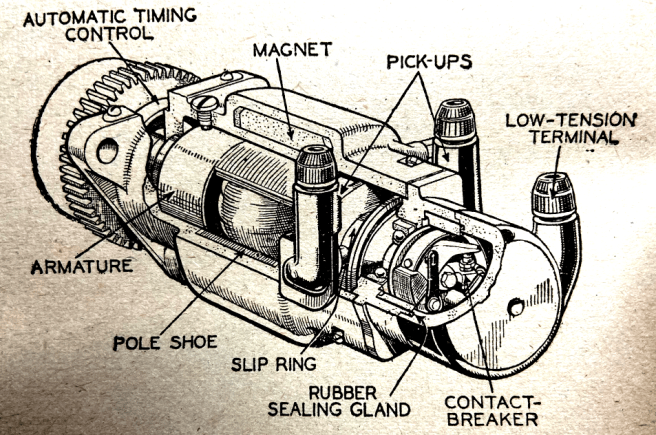
“THE MOTOR CYCLE regrets to record the death of Sir Charles Marston, JP, founder of the Villiers Engineering Co and first President of the Manufacturers’ Union in 1910-11. Sir Charles was knighted in 1926. He was 79.”
Lost and Found: Lost, at Streatham Club trial, left knee-grip from a VB Ariel.—Ref No 106. Found, at Ixion MC James Cup Trial, tyre pressure gauge.—Ref. No. 107. Companions Wanted: RLW (Croydon), who is new to the district, wishes to meet local enthusiasts. Experiences Wanted: CFG (Blyth), 1936 Triumph Speed Twin—General performance. DFT (London, W.13)—Hints on cleaning a fawn Stormgard coat.
“LAST SATURDAY, AT Gransden Lodge Airfield, the Cambridge University AC held its first road-race meeting since the war. The very heavy rain during the early part of the day ceased before twelve o’clock, when the car events started. But throughout the afternoon low angry clouds threatened unceasingly until about 1.30pm, when the downpour started again. By that time, fortunately, the last motor cycle event had almost finished. The airfield is situated about two miles from Caxton, on the main Royston to Huntingdon road. In spite of the comparative inaccessibility of the course, and the fact that it is a new location for racing, a large crowd of spectators lined the barrier along the finishing straight. The size of the crowd was difficult to estimate in the vast expanse of the airfield, but 5,000 is probably somewhere near the right figure. As the proceeds from the meeting go to the RAF Fund for St Dunstan’s, the support was extremely gratifying. The circuit measured 2.15 miles, and was in the shape of a triangle, using two runways and part of the perimeter road. The surface is tar macadam, offering excellent wheelgrip—wet or dry. Apart from the top dressing becoming very slightly loose at the corners owing to some extravagant sliding by a few of the car people, the surface was ideal and was noticeably free from bad bumps. There was plenty of room for passing on any part of the circuit. Organisation was first-class. Competitors had a large enclosed hangar as a paddock, with the perimeter road nearby for warming up engines or for a brisk try-out. The whips were able to assemble and send competitors to the starting line, again using the perimeter road while the preceding race was in progress. The result was that throughout the afternoon it was possible to keep ahead of programme time. Marshals at all necessary points of the circuit, at the loudspeaker van, at the paddock, and at the start and the finish were in constant touch by short-wave radio (wireless sets No 30 Mk 2* obtained by ‘special influence’). All motor cycle races were over 3 laps or almost 6½ miles. As there were only three corners, the circuit put a premium on maximum speed, and the shortness of the races gave very little chance for making up time after, say, a poor start or a missed gear change. Without doubt, it would have been an advantage for the races to have been over a longer distance, with possibly some artificial bends on the style of the old Brooklands Mountain Circuit. The first motor cycle race was for 250cc machines. PH Hylton (249 Rudge) was first away, followed by D Beasley (249 Excelsior) and G Newman (249 Rudge). In the long stretch of the perimeter road RJA Petty brought his 246cc New Imperial right through, to start fighting it out with Newman and Hylton for first place. Actually, as these three entered the first corner on the second lap they were line abreast.”
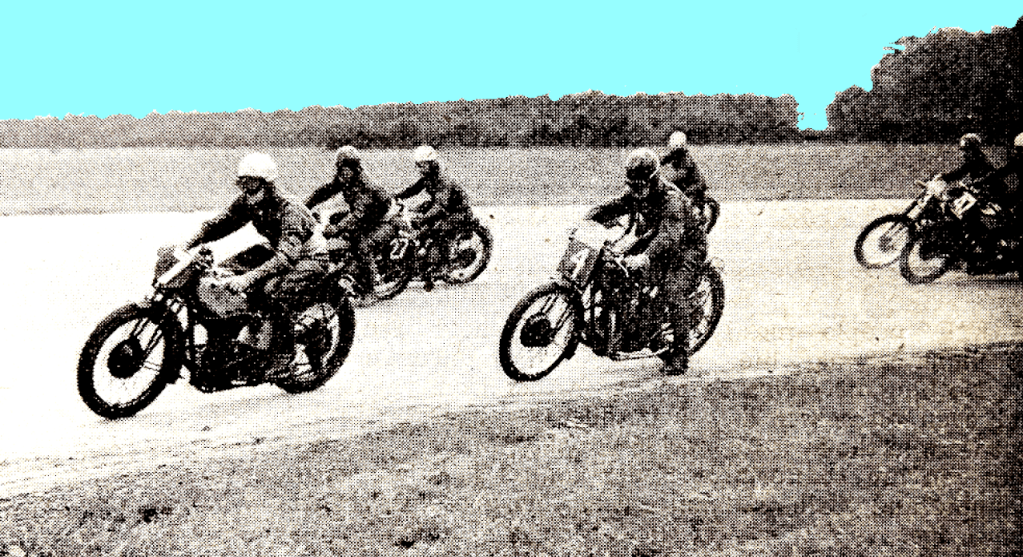
“BY THE YEAR 1950 the USSR hope to produce about 135,000 motor cycles a year. This scheme is part of a five-year plan.”
“AT AN AUCTION at the NFS Depot, Cranemoor, Hinton Admiral (Hants), 112 motor cycles realised £6,500. Top price of £100 was paid for a 1939 Triumph Speed Twin.”
“By about three years time all police forces will have cars equipped with two-way wireless apparatus. At the moment, it is officially revealed, 53 police forces have cars so equipped.”
“ACCORDING TO NEWSPAPER reports, office boys working in Johannesburg stock-brokers’ offices are buying motor cycles, after making big sums of money in the recent ‘gold rush’.”
“IN THE SIX months ending April 30th, the Ministry of Supply disposed of about 14,000 surplus motor cycles. This total includes both those auctioned and those disposed of through normal trade channels.”
“MUCH LARGER quantities of natural rubber have become available in recent months, and the amount in tyres is being greatly increased. This was stated at the 47th ordinary general meeting of the Dunlop Rubber Co.”
“REFERRING TO THE query by Mr R Brookes about the mileages covered in one day by lady pillion passengers: In 1935 I travelled to Perthshire from Belvedere, Kent on the pillion of my husband’s 1935 Ariel Red Hunter, going up on the Saturday, covering a distance of 448 miles, plus a short run of 52 miles on the Sunday and back home (448 miles) on the Monday. This is a little more than the mileage mentioned by Mr. Brookes. My husband and I are still keen motor cyclists, being members of the Sidcup &DMCC and the MCC and in normal times regularly compete in the Exeter and Land’s End Trials using an Ariel and sidecar for these events although still riding pillion at other times.
(Mrs) HM Ridgewell, Bexley Heath.”
“MANY WILL BE grieved to learn of the death of EA (‘Ted’) Mellors, one of the most consistent road-racing men of recent years. He died owing to carbon-monoxide poisoning. Apparently it was his practice to work with the garage doors closed, the one thing he loathed being anything which seemed to him to be in the slightest degree ‘exhibitionist’. A verdict of death by misadventure was recorded at the inquest in Birmingham last week. Mellors had been off-colour for some months, and the Home Office pathologist pointed out that the fact that he always worked with the garage doors shut might have accounted for his illness. Mellors could have been overcome without realising that anything was wrong. Few racing men have been more painstaking than Mellors. He was quiet and indomitable, and had a remarkable number of successes in Continental road races. Indeed, so successful was he that he became the official 350cc Champion of Europe. He was 39 years of age.”
“RIDING THE SUPERCHARGED four-cylinder AJS, JM West won the 500cc class of the Grand, Prix des Frontières held over the Chimay circuit in Belgium. He averaged 79.8mph for the 130km course (12 laps). The other British rider, Fergus Anderson, on a Velocette, obtained fourth position in the 350cc class. After leading for nine laps in the 350cc race, Fergus Anderson had a temporary stop which let Martin (Velocette) into first petition. The Dutchmen, Stemans (Velocette) and Simons (Excelsior), followed a Considerable distance behind Martin, and this order was maintained to the finish. Anderson restarted in time to obtain fourth position. From the start of the 500cc race, Grizzly (Velocette) led the field, slightly ahead of Tacheny (FN) and Knynenburg, from Holland, riding a BMW. West was in fifth position. During the second lap West gobbled up the four riders in front and took the lead, to remain in front comfortably to the end. Though West remained unchallenged, considerable reshuffling occurred among the placemen. Tacheny dropped back to sixth position, and later retired. Fergus Anderson, riding a Norton, moved up into third place behind Knynenburg, and J Meunier (FN) was fourth. Grizzly fell, but restarted after losing about a lap. Anderson had carburettor trouble, and Poel (Sarolea) and Van-Den-Eyck (Royal Enfield) both retired. On the last lap Meunier made strenuous but unsuccessful efforts to catch Knynenburg, who was holding second position a full two minutes behind West. After his fall, Grizzly recovered well and came home fourth.”
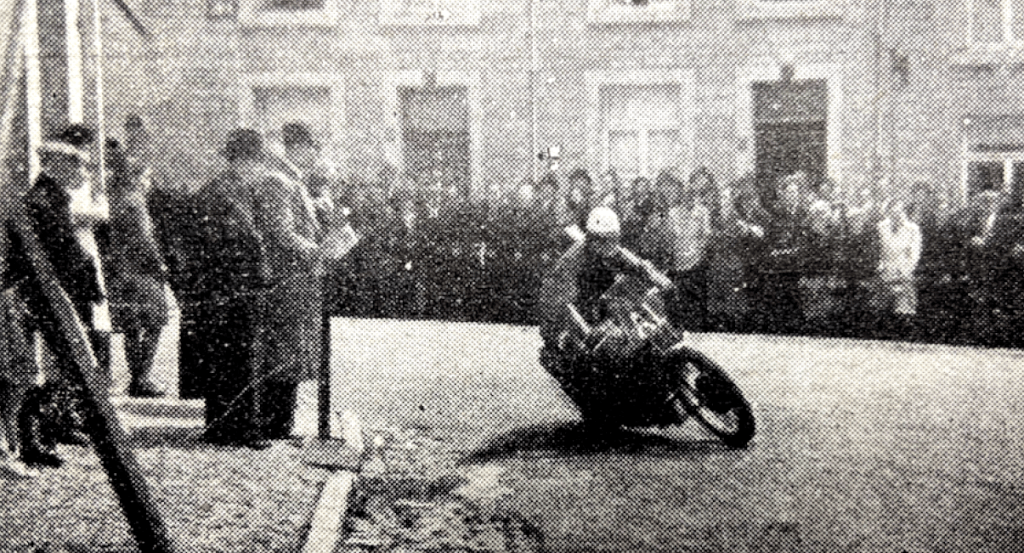
“AN INTERESTING LITTLE FACT has emerged concerning Jock West’s appearance in the Grand Prix des Frontières which he won on the blown Four AJS. He entered the old-time racing job very much off his own bat, with the idea of encouraging AJS enthusiasts in Belgium, and then found that the six-year-old racing tyres, following a try-out at North Weald, were showing signs of cracking. What could be done in the matter? There are no new racing tyres available—yet. Then he spotted in The Motor Cycle a Manx Norton being offered for sale with two new unused racing pre-war tyres. The owner, Mr Tony Bacca, was hurriedly contacted. Whether it would jeopardise the sale of his machine or not, he immediately offered Mr West the tyres. Without them, with speeds around 130mph—I leave it to you.”
“SWITZERLAND, THE COUNTRY of plenty it seems, was the venue of the first post-war Congress of the FICM, the International Federation of Motor Cycle Clubs—a three-day congress which ended last Thursday. There were many meetings, but few major decisions. It was largely a matter of picking up the threads again. Fifteen nations were represented, namely, Belgium, Czechoslovakia, Denmark, Finland, France, Great Britain, Ireland, Italy, Luxemburg, The Netherlands, Norway, Poland, Spain, Sweden and Switzerland. In view of world change, the elections were for one year only. M Perouse (France) was elected president; Messrs. Haecker (Switzerland), Löfstrom (Sweden), Ball (Great Britain), and Maj Watling (Ireland); vice-presidents; and Mr TW Loughborough continues as secretary-general. One of the more important decisions was that Germany is excluded from the Federation, and no entry will be accepted from any German manufacturer or agent. Organisers of events may accept entries from the private owners of German motor cycles and are entitled to make any rules they wish concerning the publicity they accord them. The question of the recognition of Hungary, Roumania and Austria was deferred to the next Congress, which is to be held in Paris towards the end of November. As had been anticipated, the results of the 1939 International Six Days’ Trial, held at Salzburg, just before the war, were declared null and void. It was unanimously agreed, however, that, notwithstanding the loss of the trophies, an International Six Days shall be held, if possible, in 1947. The desirability of both Russian and American support of the FICM was stressed. Luxemburg was readmitted to the Federation. Warm welcome was also given to an enquiry from Canada.”
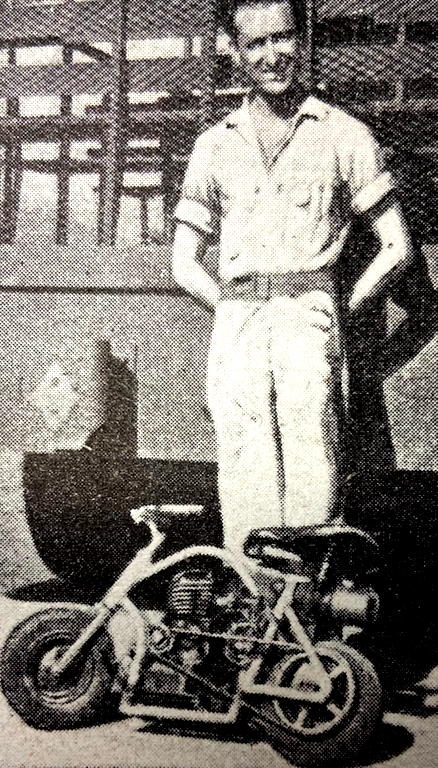
“THE 10,000 SPECTATORS who flocked to Cadwell Park on Victory Saturday have never been more grateful for the shelter of the well-wooded slopes. Low rain clouds swept over the Lincolnshire Wolds, but, while all the visitors went home wet, most of them agreed that so far as racing went it had been one of the Louth MCC’s ‘best-ever’ days. A slight drizzle during the morning had made the course just slippery enough to produce some very cautious riding in the first of the day’s finals. This, as usual, was the 250cc event; and was run off after Freddy Frith had borrowed C Foddy’s 490cc Norton to cover an official opening lap. Sgt Major Frith so enjoyed himself that he did three circuits! Incidentally, he expects to be demobilised in about a fortnight…Rain was also the dominating feature of the Whit-Monday racing, but even the pitiless rain was almost wiped out of mind by ES Oliver’s (596 Norton sc) triumphal progress in the sidecar scratch race. He very early cleared the field and then proceeded to show the rest of the sidecar experts what he could do with an open road in pouring rain. The lucky ones who peered at stop watches were soon registering incredulity when they saw that he was lapping it under the minute. Although Oliver was having things his own way out in front, the remaining positions were in doubt until the last. T Beeton (490 Norton sc), a member of the promoting club and a performer since Cadwell’s early days, gave CE Wichman (596 Norton sc) a hot pursuit for second, but was beaten by a couple of lengths, with J Surtees (596 Norton sc) not far behind. Oliver’s time is the best recorded to date. The best’ time at the Easter meeting was Surtees’ 7min 58⅖sec. Pre-war events were over 9 or 12 laps in a reverse direction, so comparisons are not possible, but Oliver’s was a brilliant achievement which roused one of the wettest crowds in England to enthusiasm. The ‘All Scott’ race was an easy win for C Kingham (498 Scott), and it was a disappointment for Scott enthusiasts that Graham Kirk’s supercharged engine had come to grief a few days earlier. Mr A. Green, the timekeeper, again distinguished himself in the sidecar handicap, getting his first five men home with less than six seconds between them. This looked even better than it sounds for LW Taylor (596 Norton sc) was home in 8min 20⅘sec and behind him in what might have been a groundsheet finish (had there been one to spare) came CE Wickman, E Walker, J Beeton and ES Oliver with 2⅕sec between the four of them. In the 350cc solo race TL Wood (348 Velocette) really got moving to beat P Lansdale, on another Velocette, followed by P Goodman on a third. Star of the Victory Day meeting, ST Barnett, broke a chain in his heat of the 500cc event, the final of which saw G Brown (490 Vincent-HRD) score another of his many wins at Cadwell. ERL Graham on TL Wood’s 498 Erswood had the best time of the five heats over six laps in the unlimited cc event—5m 35⅗sec. His luck was out and he could not get started in the final, which nevertheless, saw G Brown’s HRD register the best time of the week-end’s two meetings, 7min 20⅘sec. Evidently a couple of nights’ sleep had worked wonders with George after his Crowland experiences. If anyone deserves a mention it is the big crowd of real enthusiasts who stuck out the conditions till the end. The attendance was even more than on Saturday.”
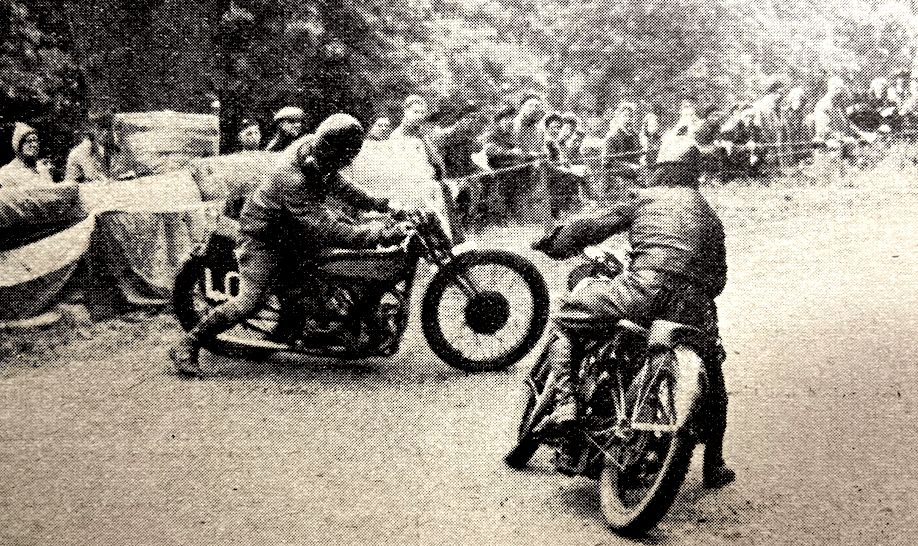
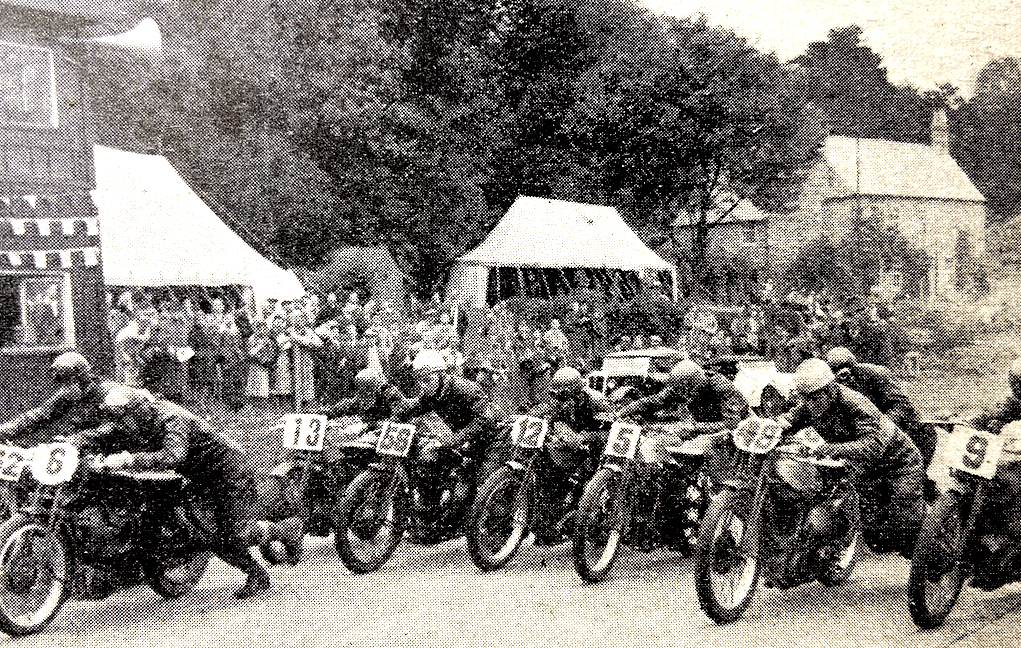
“IT WAS POSSIBLY Delane* who said that you can neither shock nor surprise a journalist. So I barely batted one eyelid when I read a very costly advertisement in an American magazine. In about a quarter-page of space—probable cost£250—one of its clients announced a sort of Meccano kit for converting a pedal cycle into a belt-driven motor bike! Price, about £25 in our money. Engine, 2½hp. Drive, V-belt, ‘unaffected by weather and road conditions’! The illustration was as sketchy as the specification was vague, but I think the price included a speedometer, etc. I wasted some time wondering how the designer contrived to squeeze a belt rim inside pedal-cycle rear forks, and how he secured a belt line for a 2½hp engine. Finally, I decided that the V-belt must be about ⅛in section, and that the engine clamps allowed it to be set lopsided over to the chain side. After which I fell happily asleep.”—Ixion
*John Delane, editor of The Times from 1841-77.
“IN MY MOTOR CYCLING noviciate I was told by an old-timer always to select some objective for a ride, otherwise the mere sensation of riding would bore me anon. He was wrong, and after many years I can still leap into the saddle and wander vaguely with no notion where I shall go, or when I shall be back. But yesterday I rode with a very definite object. This year I have been an almost entire stranger to fresh fruit—I think the total catalogue tots up to three apples, one grape fruit and five rather sour oranges. I saw the passengers of a charabanc carrying punnets full of lovely strawberries. Enquiry informed me that thirty miles along the road you could buy quantities. Avec haversack, I departed at knots. My lips are still smacking.”—Ixion
“YEARS AGO THE ONLY known method of grading lubricants for viscosity was to run them through a hole of fixed size at a set temperature against the watch. Nowadays the lubricant is spun in a metal cup, containing a close-fitting plunger suspended by a wire or strip of metal. The upper end of the wire is connected to a gauge which records its twisting under the pull of the rotating oil film.”—Ixion
“DEFINITION: A KEEN motor cyclist is a man who puts a few drops of Pool on his hankie, prefers a smear of Castrol R to brilliantine on his hair, and clips a tyre gauge in his pocket alongside a fountain pen.”—Ixion
“AN AIRFIELD, FOR ALL its perimeter roads, may not be the Isle of Man, or even Donington, but, ye gods, what the road racing at North Weald meant to London enthusiasts last Saturday! Shades of Brooklands on The Motor Cycle Clubman’s Day—yes, and of nearby King’s Oak, High Beech, on that Sunday in 1928 when the first dirt-track racing in Britain was staged. Half an hour before the time at which last Saturday’s meeting was due to start there was a mile-long queue of vehicles on the Epping-Ongar road, alongside which the airfield lies. How many thousands attended must await the final count, but the figure was not just 3,000 or 4,000…The meeting was organised by the Wood Green Club in conjunction with the St Dunstan’s Appeal Committee of the RAF, North Weald—superbly organised. Not only did the whole affair run smoothly, with RAF personnel entering right into the spirit of the thing and making a great contribution, but even outside, on the roads, there were regular Police and ‘Specials’ every few hundred yards to ensure the smoothest possible traffic flow. And there was all the atmosphere of a big road-race meeting, with facilities second to none. Picture a ‘roadway’—an airfield runway—150ft wide as the competitors’ park and half a mile or more of it for competitors to use to their hearts’ content for checking off the state of their mounts and for warming them up. There was the smell of ‘R’, the reek of dope fuel, the music of racing exhausts, and warm weather with not a drop of rain. There were also many of the sights the enthusiast knows so well—even a machine (CF Trollope’s) with its cylinder head off half an hour before the racing. The starting and finishing point was on a stretch of 150ft-wide runway. A full right-angle turn and there was another length of runway. Then came two miles or more of 30ft-wide perimeter road, with right-angle turns, and bends, both left and right, which kept on keeping on. At each bend there were mighty warning signs like those of the TT course in the Isle of Man, even to painted arrows some six feet long. These were highly desirable, because with no banks and hedges the competitor has not the same guidance as in a normal road-race—he needs them more, much more, than in, say, the Isle of Man. The great width made picking a path difficult, and many were asking themselves which was the best path to take. As one man remarked, with all the space available there was something akin to grass-track racing. From the spectators’ point of view there was also a resemblance to Brooklands in that the vastness tended to diminish the impression of speed. Actually, the speeds over the 3.2-mile circuit were not so high as was expected. Even Harold Daniell, holder of the TT lap record at 91mph, lapped no faster than a bare 62mph, and the average in the fastest race—Harold Daniell (Norton) again—was but 59.09mph. The fact is that there were no long straights, which had the big advantage, in these days, that the course was kind on engines. What was not so good was the amount of grit on the tarmac surface. In spite of all the work that had been put in, and it was an immense amount, there was still loose pebbles and grit and thus a considerable number had skids. What was a pleasant surprise was the comparative smoothness of the circuit; many airfields roads are almost impossibly bumpy for racing.
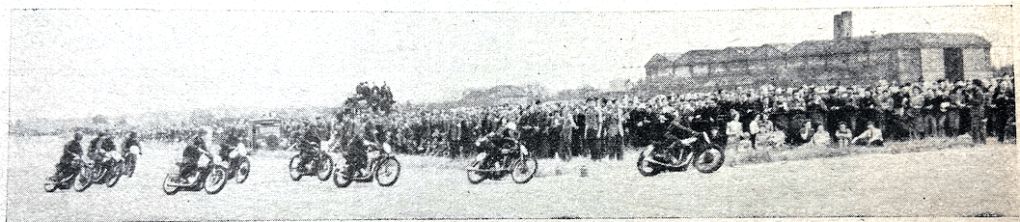
“LAST FRIDAY THE MIRA threw open its doors. What is the MIRA? That is what a local milkman asked when I parked my solo in the road which yellow-and-black signs denoted as the MIRA official parking place. Of course, when I mentioned that he used to know it as the Institution of Automobile Engineers research laboratories he was ‘there’ all right, but wanted to call the new body the Ministry Research Association instead of the Motor Industry Research Association. Co-operative research for the motor industry began in 1920 at Chiswick in the form of the Research Association of British Motor and Allied Manufacturers. Later, when the Government allocated money for research, the Institution of Automobile Engineers was invited to take over, and the laboratory and funds of the old Research Association, plus the funds of the Motor Cycle Research Association, were handed over to the IAE, together with the standardisation machinery of the Society of Motor Manufacturers and Traders. In 1936 the big laboratory in the Great West Road came into being. On January 1st of this year the Motor Industry Research Association was incorporated to take over from the IAE; it comes under the aegis of the Department of Scientific and Industrial Research as an industrial research association and is maintained by subscriptions from the motor and motor cycle industries and a grant from the Government. Normally, there is no research work for individual members carried out there. The programme is decided by the Council after consideration of the useful work that can on behalf of the industries. be undertaken on behalf of the industries. The modern-looking building on the Great West Road that is now the MIRA looked spick and span last week…With the end of the war it has been possible to see to things, and there is a lot of new equipment and quite a lot of fresh research—fresh to me, at all events. No problems peculiar to motor cycle design are being investigated, it seems. I was interested to see, however, some overhead-camshaft Norton engines with water-cooled heads and barrels. Some new works jobs? No, the barrels and heads have been designed in the laboratory to help the investigation of the effects of leaded fuel. On test bed No1 the water-cooled Norton engine is being used to explore the effect of cylinder-head design on exhaust valve, valve seat and valve guide temperatures. Thermocouples are used to measure the temperatures of valve and seat and an optical pyrometer for the exhaust valve, which is viewed through a small hole in the exhaust pipe. On test bed No 2 the engine is used for comparative tests of exhaust-valve materials. A chemical method is being used to determine the wear of steel shafts—the iron is extracted from the engine oil, separated from the extract and then its quantity estimated by the intensity of colour developed with thioglycollic acid.”
“HOW IS THE WOOLER getting on? When will it be on the market? Questions such as these are fired at us frequently. Last week a colleague dropped in at Mr Wooler’s. Mr Wooler, he found, was about to set off to get the patterns for the four-speed gear box he has been designing. As you may know, Mr Wooler believes in making haste slowly—not in dashing precipitately ahead. Matters are going well. His son has just been demobilised. Soon, with the latter’s help, things will be really cracking. ‘When do you expect to be in production—early next year?’ my colleague asked Mr. Wooler. He said that he had been hoping to be in production during the course of this year. The four-speed gear box of the shaft-drive four-cylinder beam engine is to have a kick-starter at option. The latter, as Mr. Wooler points out, has the advantage when a pillion passenger is carried. What he is especially keen on is the supercharged ‘Four’ that is to be built for the sportsman.”
“MEMORY IS A TREACHEROUS jade, and tops us all at times. Mine trod on a banana skin when I ascribed the fragrance of the first ‘Kipper TT’ to the wrong make of oil in a recent issue. The oil was Price’s Huile de Luxe, which lubricated the octet of Triumphs securing the first eight places of the 500cc singles in the Senior Race of 1910. This pungent. oil was conceived by JWG Brooker, tried out by AG Reynolds, Frank Hulbert and Jack Marshall, while the late Victor Holroyd, quondam manager of the race-bred Rudges, hit on the kipper soubriquet for it. My slip is the less pardonable, seeing that I, like Pears’ tramp, ‘used no other’ for many a long day.”—Ixion

“CRUISES ON PLEASURE steamers, treasure hunts on foot, and outings divorced from the model. A glance through the fixture lists of clubs will reveal, once again, many improvised events where the machine has to be left at home. All this stresses petrol shortage. When—oh, when—will the miserable pittance be increased? Italy has even road races by the score; all manner of Continental countries offer petrol for visitors, and here are we having to count every pint. Why does the nation put up with it? Has it suddenly become servile?”
“THE SYRIAN GOVERNMENT has placed an order with AMC for 300 solo Matchlesses (350cc) and 50 sidecar outfits (500cc)—the latter fitted with Watsonian sidecars. These are all required for the mechanisation of the Syrian Army.”
“APPROXIMATELY 40% OF PETROL supplies coming into this country in the first three months of 1946 were purchased with dollar exchange, said Mr Shinwell. An MP asked why the ration could not be increased if 60% of petrol came from a non-dollar area. Mr Shinwell replied that there were ‘other reasons’.”
“‘THE DAY HAD COME…dry roads, skies bright and clear. Who led the race?—to me it mattered not If I could get the Bridge in camera range…If I could smell the tang of ‘R’, and hear The music of a perfect racing change. The blatt’ring roar of fast five-hundreds near, And angry, sobbing yowl of racing Scott.’ Induced by ‘Nitor’s’ incautious mention of Castrol ‘R’. Performing and other rights free. May be recited with comparative safety away from canal banks and brickfields.
Anon, Reading, Berks.”
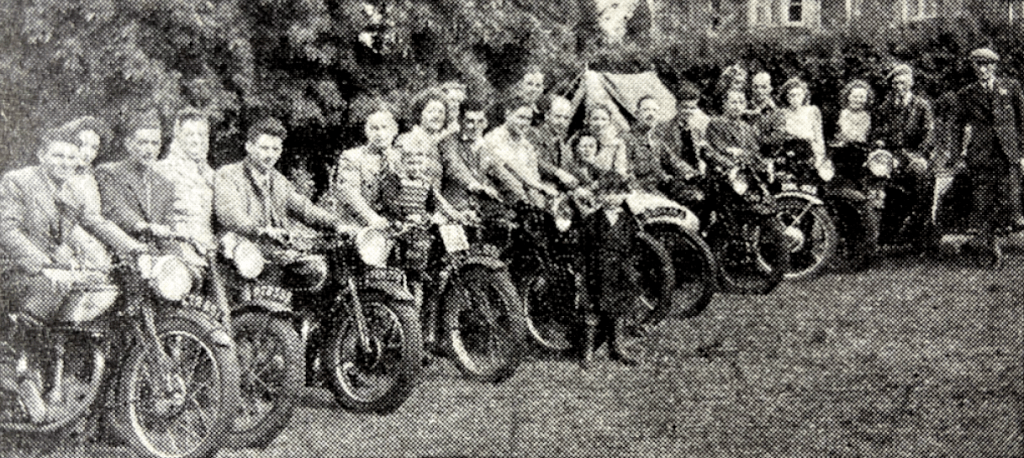
“AS A MEMBER OF the ‘sawn-off’ brigade, I feel that anyone with a leg off can ride anything which he himself makes up his mind to drive. Changes can be rung on hand/foot change and starting, and left/right foot-brakes. All agents and manufacturers are, in my experience, most helpful…In support of this I might mention that in May I won the Sidecar Award in the open-to-Cheshire Centre Jeans Gold Cup Trial (Liverpool MC), driving an ex-WD 633cc Norton with no modification to controls whatever. (My left leg is off below knee.) ‘Double amps’ and ‘cripples’ require a bit more wangling, but it can be done. I will try to help with ideas in any particular difficulty; but after many months in hospital with others requiring spare parts I know that it is the will of the individual that counts.
Major AL Jones, MC, Liverpool 2.”
“I SHOULD LIKE to see the Services get priority when ex-WD machines are sold. There are some who probably cannot even afford a reconditioned machine; £55 is a nice price; but £14 lOs 8d Purchase Tax is an insult to the lads who rode those machines through, shell-fire and bombing to get the despatches through. Possibly, if something was done about it motor cycle clubs throughout the country would swell with some well-experienced riders and make the sport more popular. I have been a rider now for ten years, and have no regrets. Hail, rain or snow! A pity some of the ‘red tape’ can’t be cut up.
G Robinson, BAOR.”
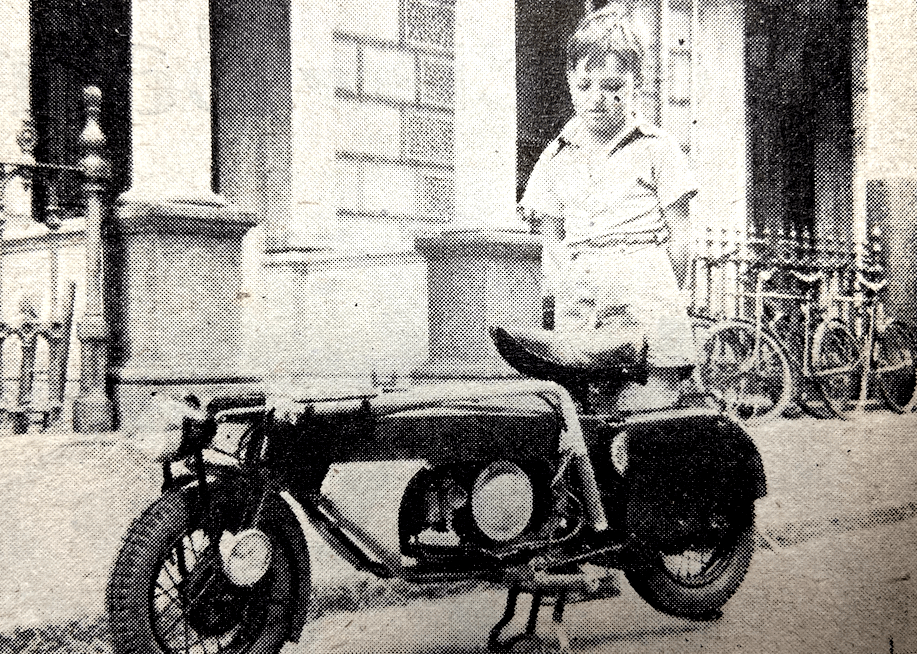
“After riding British motor cycles for ten years and reading your excellent journal for eight of them, I have at last decided to write to you to express my gratitude and offer my views. I am an Aussie from Northern Victoria, where the fruit comes from. Being a farmer (until the war, then a Digger, then a turner and toolmaker), and-at all times an enthusiastic rider and keen observer, I have had the opportunity of riding all types—side-valve, overhead-valve and egg-beater—in very trying conditions. We have good arterial highways where 50-60mph is essential to cover the vast distances; yet when we turn off to visit some farm five miles back, we strike your trials going as normal riding conditions. The roads around the farm are in summer dusty, gritty, pot-holed, stone-studded secondaries; and in winter consist of mud-fiats, water-holes and sudden slides. For four years I averaged 300 a week on four models. In winter I did many of those miles in the ditch, because the mud there was wet enough to fall off without gumming up the works. Many of you will now know just what it’s like to have a machine packed with mud and immobile. Such going is very hard on chains, though by frequent immersion in a tin of sump oil kept handy I have had absolutely no trouble in 60,000 miles. Now for the analysis: I have only one real squawk on British bikes, namely their electrical equipment. In the lighting dept it is very poor. This is the only thing the clumsy Yankee models can give them a lead on. After riding with both coil and magneto I would suggest scrapping the obsolete maggy and fitting a better genny and bigger battery—and give us light. I do not think them is much in the argument of side-valve versus ohv, although I confess to liking the appearance of the latter. Also, they aren’t really so inaccessible when well planned. The eventual shaft drive will definitely be some improvement on chains. Good luck to Sunbeam in their new venture, also to the Douglas. More power to your wrist, HRD. I’ve had some very exhilarating traveling on my ’38 ‘Meteor’. Thanks also to Calthorpe, Enfield, Levis and AJS. You’ve given me great times. We are proud of you in the Old Dart. All the best over there.
‘Also British’, Mt Scobie, Kyabram.”
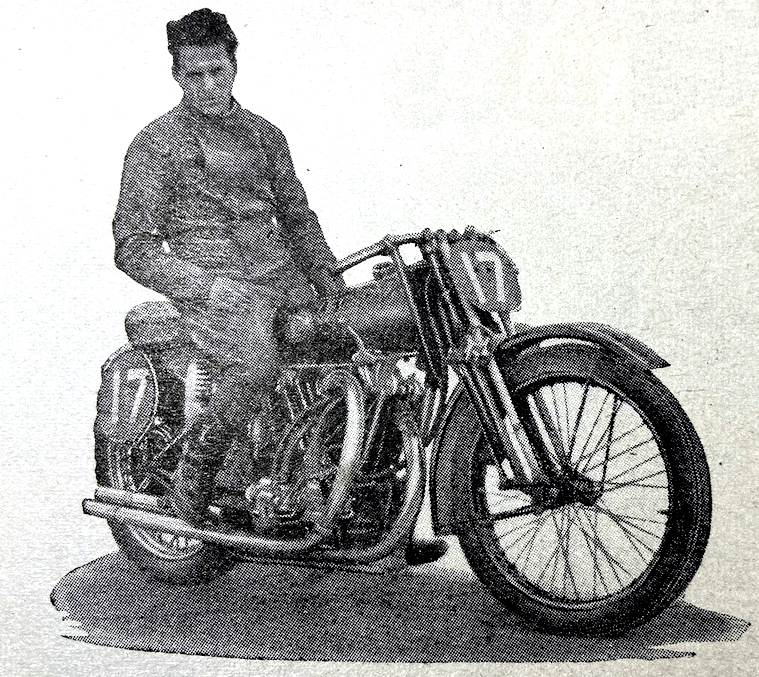
“REG, MICK AND I work together in a cinema projection room, and, occasionally, on a Saturday evening, I leave them to run the last few reels whilst I pop off home to get the bike out. Picking them up later, we run a little way out into the country for a breath of fresh air, a chat, a smoke and a cup of tea. Reg rides in the sidecar and Mick on the pillion, and in the sidecar locker are the following: a half-gallon bottle of water, an empty quart tin, a small teapot, firewood, three cups, a spoon, sandwiches, and a small ‘allowance’ of tea, sugar and milk. We leave SW London via the side-streets of Croydon, climb over Shirley Hills, and soon the head lamp beam is piloting us through deserted country lanes along the Kent-Surrey border to a certain spot—a clearing in a roadside wood which lies in a secluded valley. On arriving we get two bricks—previously hidden in the hedge—light a fire in between them, and place the tin of water on top. The water is usually boiling in twenty minutes or so and we are sipping our first cup of tea somewhere around midnight. Hot tea and sandwiches go down well at this hour, in the clear night air, as we chat away on any subject that enters our heads, poking fun at each other and having a good laugh. In fact, we thoroughly enjoy ourselves in our simple way. We have the satisfaction, too, of knowing that our talk and laughter doesn’t disturb anyone; and we ourselves never hear a sound, except perhaps the call of an owl. As we watch the fire we reflect that it was not so very long ago that many of us were doing fire-watching of a very different kind. Incidentally, what a fine sense of freedom there is in again being able to light a fire in the open at night-time. The air smells of tobacco smoke as we light up and take a stroll up the lane for a couple of hundred yards, with Reg most likely telling us of his adventurous campaigning days in North Africa and Italy. Although not a DR, he did manage to get a few runs along the Sousse-Tunis road on a Teledraulic Matchless. And, in Italy early in 1944 he had the rare thrill of seeing Vesuvius in eruption. But for Reg the war ended in the following October, for he stopped a Jerry bullet whilst engaged in a river-crossing. And that’s why he always rides in the sidecar—because of a leg that will never bend again. After packing away the ‘crocks’ and hiding the bricks we get on board for the run home, the starting of the engine invariably synchronising with a shout from the sidecar of ‘Home, James.’ I don’t spare the horses on the way, and, even with three up the bike gets into a pretty good gallop; in fact, young Mick once had the audacity to shout into my ear something to the effect that he reckons that the bike could do 80 easily—in the guard’s van of an express train! And so to bed, all feeling better for our little trip. But I’ve an idea that three certain ladies, Reg and Mick’s mothers and my wife—think we’re a trifle crazy; actually, maybe, we are merely artful. You see, on these Sunday mornings all three of us get our (rather late) breakfasts in bed! Vallens’.”
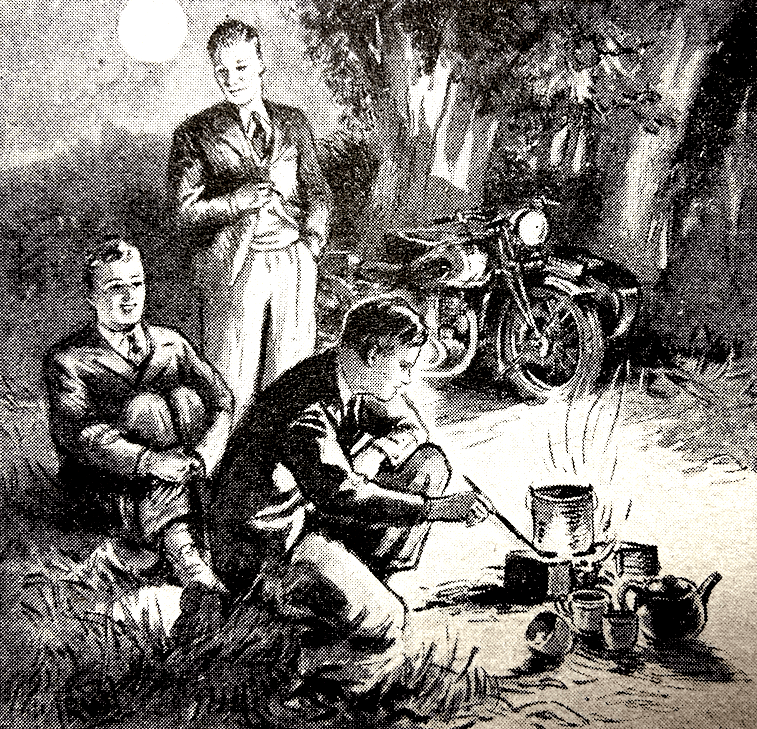
NOT EVEN DOUR greyness overhead can take away the impressive aspect of Post Hill, near Bramley, Leeds. Indeed, with the low and heavy clouds, it seemed that the 200 yards of straight ascent almost disappeared into the sky with that terrific final rise of 1 in 1.6. The entry for the Bradford &DMC revival of this once famous private hill of the now defunct Leeds MC was not very numerous. It totalled 30, of whom eight were Army men; chiefly from the Royal Signals at Catterick. The event had not been advertised either, and there was no charge for spectators, of whom there were about 4,000! This crowd and the accompanying crush of vehicles on the ‘colonial section’, which provides the only access, rather annoyed the local police, who took a poor view of the explanation that this was a private party and if spectators liked to exercise their right of way—well…? As to the event itself, it was run on the old knock-out lines, competitors racing up in pairs until only one was left. When the hill was used in the old days it was not unusual to see many failures and an occasional back somersault when a front wheel leapt into the air. On this occasion failures were few, nobody turned over backwards and, for the most part, riders and machines looked as safe as houses. Telescopic forks may have a lot to do with this. Another striking comparison was the speeds of then and now. if riding then was hectic and performance erratic, the best times were indeed good, for one Eddie Walker with a Douglas and that other Eddie, Flintoff, on his Sunbeam, were rivals for the hill record and were consistent in ascending in something under 13sec. The best times last week were in the 15-16sec category! The veterans still have the know-how, too, for Arnold Moore (348 OK Supreme) and Oliver Langton—on an ancient sports-cum-TT-cum-speedway Douglas—who have been in this sort of thing since the early 1920s, were not to be shaken by the up and coming generation. Of the uniformed Army people, none got into the semi-finals, which was perhaps more accountable to their Service machines than to their riding ability. Fred Rist (349 BSA), however, upheld Army credit by reaching, the 350cc semi-final. BS Beckwith, who won the unlimited cc event on his 348cc Ariel, used a 1,000cc Square Four in the over-350cc event, and soared up with great verve without reaching the semi-finals. This left him the opportunity to take a consolation prize in the winning of the special ‘losers’ race in this class. Another ‘big’ machine was AS Rosenfeld’s 680cc Brough Superior, which did not like the hill at all, while the pièce de résistance was Oliver Langton’s performance on the aforesaid ancient Douglas. This monster, of enormous wheelbase, simply leapt up the hill. At low and moderate speeds it was ‘a very good single’, but at full throttle both cylinders did their stuff to some tune. Only a Langton appears to have the right kind of technique to use this sort of thing. The machine snakes, it twists, it bites and it leaps. The art appears to be for rider and machine to co-operate from time to time, and the true Langton touch is effecting this co-operation at the right moments and whenever the machine is willing. Oliver was obviously the small boys’ hero, and when his machine’s temperament lost him the unlimited cc race they actually booed the winner—not cricket, chaps, and certainly not motor cyclist!”
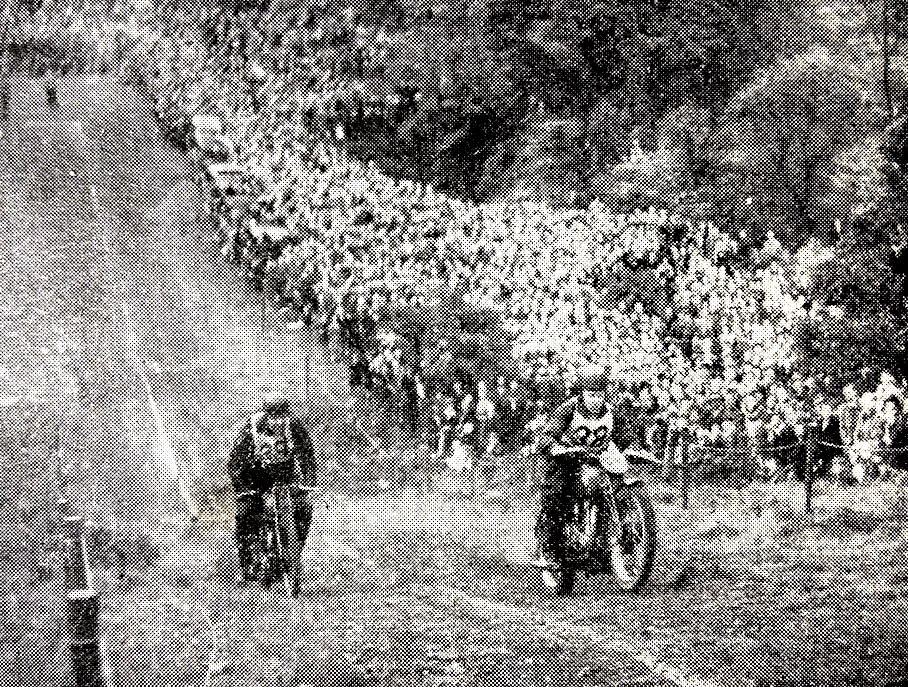
“I WAS INTERESTED in Mr Brookes’ claim as regards mileage covered with a lady pillion passenger on a woolly side-valve. I covered 445 miles with a young lady passenger on a 1931 250cc Ariel Colt from Arborfield, near Reading, to Cambusbarron, north of Stirling. The route included Shap. The time taken was 15hr, so I think this was an endurance test also. The return journey took 13hr. When the trip was made the machine was four years old. The young lady is now my wife.
W Searl, Reading.”
“I CAN BEAT Mrs Brookes’ pillion ride. At Easter 1939 my husband and I did 883 miles in two days. On Good Friday we went from Plymouth to Redcar, in Yorkshire. We did 451 miles that day. On Easter Monday we did the return trip, taking a slightly different route, and did 432 miles that day. We were riding a 1934 499cc Rudge ‘Ulster’, and I had an ordinary sprung Lycett pillion seat. I felt no discomfort or after effects. Mr Brookes does not give any details as to his wife’s age or weight, but I would like to state that at that time I was 39 years old and the mother of eight children. I turned the scales at fourteen stone, so I consider mine was a better record. I am still carrying on with my riding.
(Mrs) D Coxon, Swilly, Plymouth.”
“RIDING IN THE 1939 National Rally, my wife on the pillion, I covered, on the Saturday, 523 miles. I would not claim this as a record, but would say it’s ‘some’ pillion ride for a day. But the bike was no woolly side-valve. It was a Vincent-HRD ‘Rapide’. So I would take off my hat (if I had one) to Mr Brookes and his passenger. They must have put some ‘flogging’ hours in.
JC Wood, Mansfield, Notts.”
“TELESCOPIC FRONT FORKS which give a full 6¼in of movement are being standardised on the Ariel Square Four and Red Hunters. They are designed by Mr Val Page, have been tested over years—it is more than two years since ‘Torrens’ first tried them—and add greatly to road-holding, comfort and steering. They are of hydraulic type, with a very easy movement around the static-load position and a build-up that takes care of major road shocks. In other words, there is the ‘soft, light’ action which means that the forks respond to minor road irregularities, plus damping which not merely ensures that there is no metal-to-metal contact, but prevents the rider gaining an impression that there is any. Comparison with the girder-type forks is interesting. Instead of a total deflection, up and down, of approximately 3¾in there is now, cut-off to cut-off, that movement already quoted, 6¼in. There is actually a slightly greater movement under extreme loading in the case of the new telescopic forks, since there is also the compression of the oil, which can be appreciable with very high pressures. And whereas with the girder forks, considering the main spring and the two auxiliaries, there is a rough average of 250lb load to cause a fork deflection of one inch—the auxiliary springs are, of course, progressive in action —the lb per in deflection for the new forks is but 54. The greater movement and the hydraulic damping permit this big difference. The 541b is, of course, for the two springs, one, per telescopic leg. The individual springs are kept within the limit of 26-28lb. For sidecar work there are springs of 38-40lb/in—19½ coils of 0.212in wire, as 20 coils of 0.202in.”
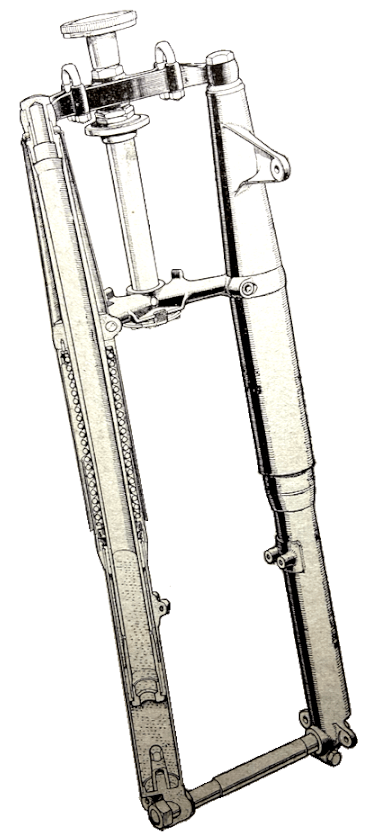
“AUSTRIA’S PUCH MOTOR cycle works at Graz are to start producing 125cc lightweights shortly. Shortage of tyres is proving a difficulty at the moment.”
“A NUMBER OF United States motor cycle clubs have strange names. The following are good examples: Sunset Cycleers, Quaboag Riders, Royalettes MCC, Nite Hawk, Cincinnati Cavaliers, Flying Tigers, Cyclemore Riders, Big Twin Rockets, Rhinelander. Shorty, Warren Buckaroos, Shamrock Travellers, Pennsylvania Pals.”
“I NOTE an item under the title ‘They Will Ride British’. The Motor Cycle has only fulfilled its duty as a journal by reporting questions asked in the House concerning motor cycles, but as this journal is read extensively in America and in view of the necessity for us to remove misunderstandings between the two nations and not to create them, it should be explained that if the Kent Police change over to British machines, it will not be merely because they are British, it will be because there are very good reasons why British motor cycles are much more suitable for conditions over here than the Indian machines at present in use. On this point it should be emphasised to all concerned that much as we want exports, there is no valid reason why any foreign country should buy our goods just because they are British. British goods can only be expected to be purchased and used throughout the world if.they offer advantages which make their choice advisable, and this, of course, applies equally to the products of every other nation. Fortunately British machines to-day need no apologies and are in strong demand because we have developed the motor cycle further than most other countries and the average British product to-day offers performance, reliability and sterling value for money in a manner never before achieved.
E Turner, Managing Director, Triumph Engineering Co, Coventry.”
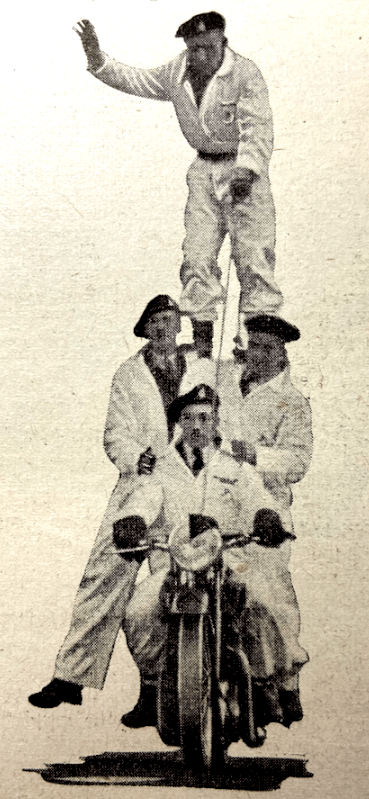
“TAKING THE YEARS 1931 onwards, in only three Aprils have there been as many new motor cycles registered as in April of this year. The official figure, just issued, is 6,319. Over and above this there are 109 Government-owned motor cycles exempt from taxes. Motor cycle registrations were almost equal to those of new cars. Once. again the figures emphasise the difficulty over obtaining a sidecar. There were two 150cc sidecar outfits, one of 150-250cc and 337 over 250cc. Autocycles and solo motor cycles up to 150cc totalled 1,120; 150-250cc solos, 908; over 250cc solos, 3,931; and passenger three-wheelers, of which one was an electric job, 21.”
“A SIDE-VALVE FOR QUIETNESS and absolute reliability. A twin because it can be a completely vibrationless unit. A V-twin at 90° because of its balance and its compactness and because it can he easily fan cooled if necessary. Thus ran Mr Granville Bradshaw’s thoughts when he was pondering over his latest creation—his 100cc ‘Bumble-bee’. This fascinating little unit is so small and neat that you feel tempted to conceal it under your coat and steal away with it. You feel that, even if you have no immediate use for such an engine, it would look decorative on the sideboard. But Mr Bradshaw’s plans for the engine are far from decorative—indeed, he calls it ‘the engine of a thousand uses’, and visualises quantity production once the final tests are completed. These tests, incidentally, arc being made by Gillett, Stephen & Co, of Great Bookham, Surrey, who will be remembered as the manufacturers of Blackburne engines some years ago. The ‘Bumblebee’, as mentioned, is a 90° V-twin, with the camshaft situated high up between the V and running parallel with the mainshafts. Thus the pair of valves of each cylinder face each other, but cannot be seen because the mechanism is surrounded by the cylinder jackets. The crankcase—to be made of magnesium alloy in production—is of normal split construction, but is noticeably sturdy at the mouths, which accommodate rather less than half the length of the cylinder liners. Each mouth is fitted with seven long studs reaching right through to the cylinder heads…a simple starter has been designed comprising a quadrant operating a ratchet pinion on the timing side mainshaft. This starter, it is claimed, can be operated by hand, by foot, or by a remote cable control; a fan can be driven from one end of the camshaft and a governor from the other end; the flywheel on the driving-side main-shaft can house a clutch and a gear box. The possible uses for this little engine are certainly numerous, and it shows promise particularly as the power unit for a lightweight motor cycle or a motorised bicycle—without pedals. The bhp so far obtained is 3½ at 4,500-5,000rpm. The weight, excluding auxiliary components is 8½lb with aluminium-alloy crankcase and cylinder jackets, or 8Ib 4oz with magnesium alloy for these parts. Experiments are about to be made with the power unit in a tradesman’s type of bicycle from which the bottom bracket pedal gear has been removed and a two-speed gear box fitted. The complete machine is expected to weigh less than 561b and 250mpg is the estimated fuel consumption.”
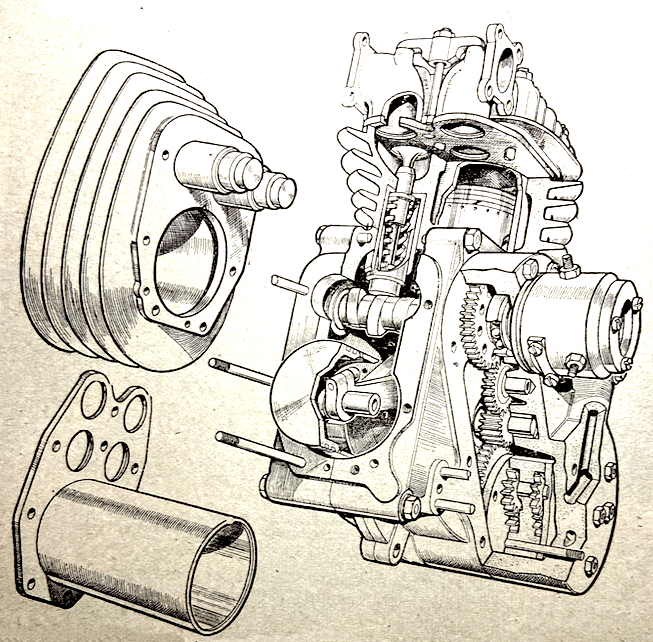
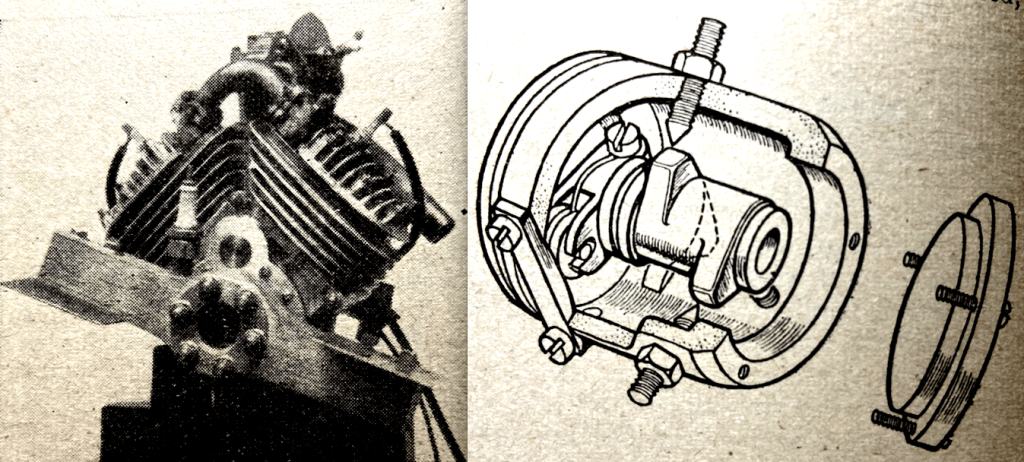
“THE BIGGEST SPEEDWAY crowd ever seen—85.000—went to Wembley last week. They saw Wembley defeat West Ham.”
“TWO THOUSAND FOUR hundred motor cycles now in the British zone in Germany have been declared surplus. Those suitable will be brought back to Britain.”
“BRITISH MACHINES SCORED decisive successes in the Swiss Grand Prix. In the 350cc race, held over a distance of about 73 miles, Hess, on a Velocette, was first at 62.5mph and Kaufmann (Velocette) was second. Ruggieri (DKW) was third. Aubert (Norton sc) won the 600cc sidecar race at 56.7mph with Haldeman (Norton sc) second. Mewley (Motosacoche) was third. This race was held over a distance of about 54 miles. The winner of the 250cc class was Cavaziuti (Guzzi), at 62mph; the 500cc class was won by Pagani (Gilera) at 66mph.— Reuter’s.
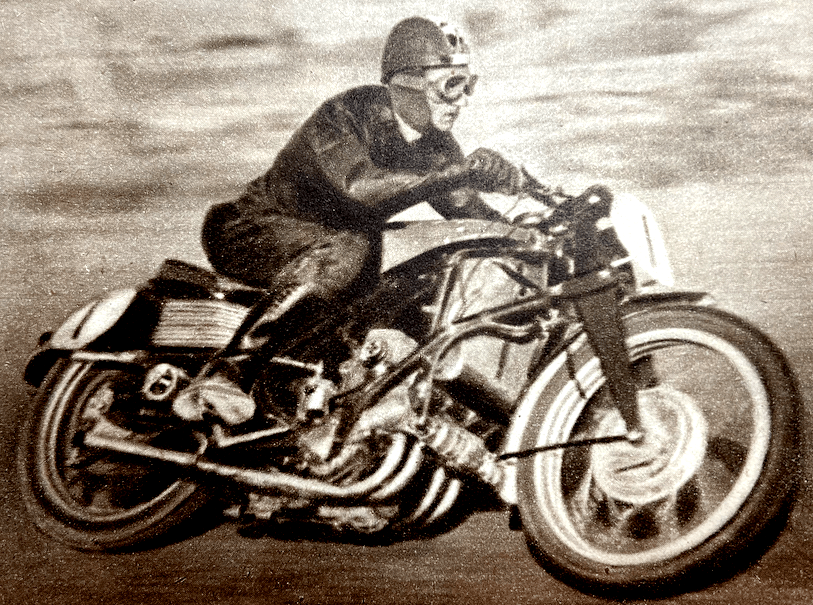
“RIDING BRILLIANTLY ON a new and tricky circuit, Britishers won all the classes of the Grand Prix du Zoute, held last Sunday. Of the party of 12 riders who travelled to Belgium under the Sunbeam MCC scheme to support these races, 10 actually started, and between them obtained three first places, one second place and one third place, and made the fastest laps in each class. By the enterprise of Mr FW Pinhard, secretary of the, Sunbeam Club, who arranged administrative and financial facilities, it was possible for these British riders to race on the Continent for the first time since the war, and to remind our friends over the Channel that, in the field of motor cycle sport, Britain has once again to be reckoned with. The races had a. refreshingly international atmosphere, with entrants from Finland and Holland, in addition to those from Belgium and from Great Britain. It was said that owing to travel difficulties, the Finns had taken almost a week to reach Belgium—such is enthusiasm for road racing. Situated about a mile inland from the coastal resort of Zoute, the circuit twisted through the woods of the languorous ‘chalet’ area. The roads were narrow—in parts perhaps only about 15 to 20 feet wide—and the surface varied between stone setts, tar macadam in bad condition and smooth concrete. There were plenty of bumps and a fair sprinkling of pot holes. The 1.8-mile circuit was thus extremely tricky and deceptive to ride, and difficult to master in the one practising period it was possible for the British entrants to fit in. Many thousands of enthusiastic spectators, undeterred by the overcast and forbidding weather, lined the course. RESULTS. 250cc Class: 1, J Brett (Excelsior), 51.3mph; 2, S Postma (Guzzi); 3, G Poel (DKW). 350cc Class: 1, P Goodman (Velocette), 53.7mph; 2, J Brett (Velocette); 3, V Willoughby (Velocette). 500cc Class: 1, M Cann (Guzzi), 56.51mph; 2, P Knijnenburg (BMW); 3, L Martin (Norton).”
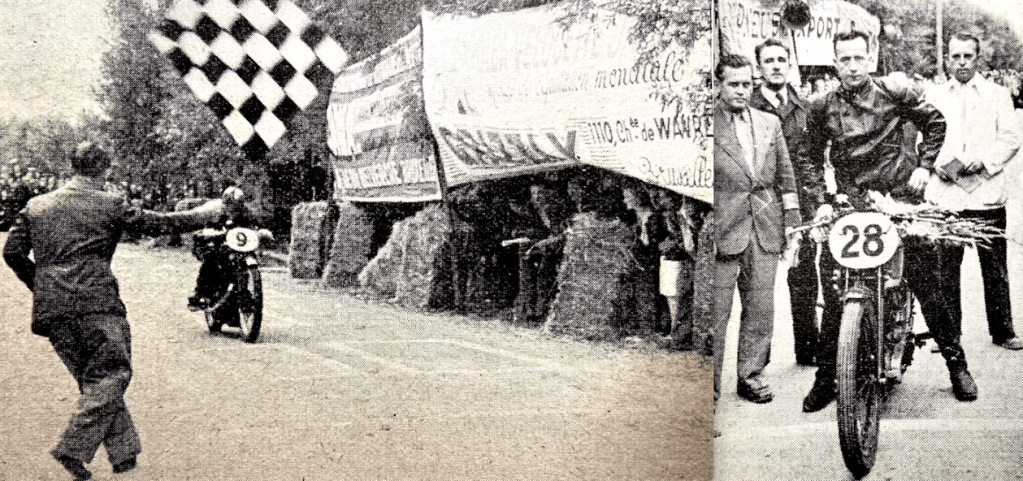
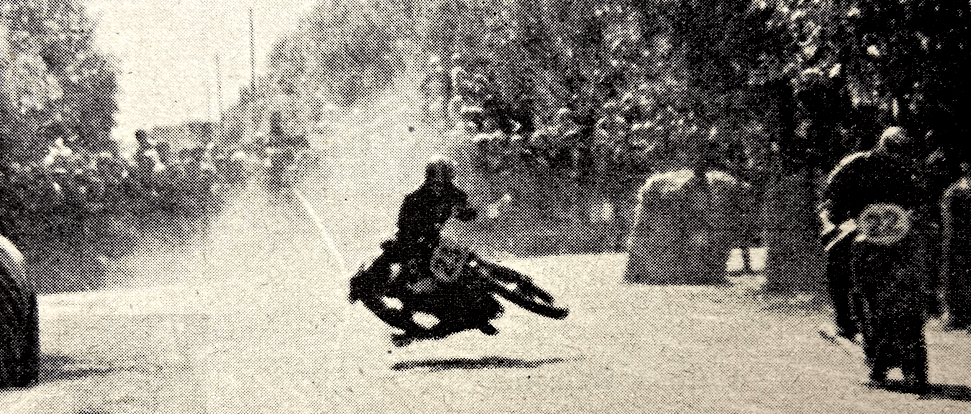
” IN THE HOUSE OF LORDS last week, Earl Howe asked the Government whether they were aware that at present no facilities existed or were available to the manufacturers of motor cars, motor cycles, and accessories for the testing of their products to the limit of their performance, whether they were aware that insufficient testing was likely to affect the successful export of British products, and whether the Government could now make any statement on the future of Donington. He said that before the war there were three big tracks in this country—Brooklands, Donington and the Crystal Palace. Donington track was in a reasonable condition to-day and it had been pointed out to the War Office that it was the only track left where cars could be tried out at high speeds, which was essential for the motor industry. The War Office were stated to have spent about £250,000 on laying down fire mains. It was not the only place to which the War Office could go. Donington was at present nothing else than a sort of Missenden, with about 80,000 vehicles of all kinds. The present use of the track did not justify taking away the only track from the motor industry. Various bodies representing the motor and motor cycle industries had urged that Donington should be made available. It was undesirable that testing should be carried out on the public highway. Lord Sandhurst supported the motion on behalf of the motor cyclists.”
“A RATHER EXTRAORDINARY thing caused the retirement of Jock West in the Albi Grand Prix, one of the smaller International grands prix, held in the south of France at the beginning of last week. He was leading the 500cc race on the old supercharged four-cylinder AJS, had raised the lap record from some 82mph to 87½, and then dropped out owing to lack of fuel. What had happened was that a stone, thrown up by the back wheel of a machine he was overtaking, cut through his rubber-and-canvas petrol pipe. The 350 event was won by Fergus Anderson, on the Velocette, with Ernie Thomas, on a rigid-framed Velocette, a very close second.”
“YOUR REPORT ON the new 500 AJS is very heartening. I think you’ll agree that the addition of Mr Joe Craig and now Mr Jock West to the staff of AMC is showing dividends already. I anticipated the good report on the 350. Triumph Twin, and Mr Turner is to be congratulated on a series a machines. I am returning to Blighty soon for demobbing, and shall be after a model with telescopics and spring frame. From reports the prices of new models seem to be exorbitant at the moment; let’s hope the purchase tax will soon be abolished and we can obtain a model at reasonable cost. You may be interested in a Japanese engine I’ve just found here. It is a horizontal twin two-stroke water-cooled, detachable cylinder beads, deflector pistons. The mixture entering the crankcase is controlled by an aperture in the crankcase (induction) corresponding with cut-away segments in two of the three flywheels. The con rods are made entirely of phosphor bronze. We are assembling it and fitting it into a small boat constructed from two aircraft fuel overload tanks. I’m only sorry I won’t be here for the trials. It will be a change going back to motor cycle engines after working on 14-cylinder aircraft engines, but I’m still an enthusiast for the singles and twins. Let me conclude by thanking you for all the very interesting articles which appeared during wartime.
Kenneth J Chester, SEAAF.”
“MAY I ADD MY EXPERIENCE to ‘Second Mate’ on the subject of magnetos. The magneto is so simple, foolproof and reliable, but the experts have to admit defeat when certain maladies appear. My magneto developed trouble and was returned to accredited_ repairers for complete overhaul. After waiting 14 weeks, I went to London and obtained a replacement armature which was tested and assembled by the repairer. It was still no good, and was returned to the repairers who put it ‘right’ in just under a week. Total expenses to date, £4. An urgent call to London, where my child was ill, caused the Square Four to be wheeled confidently out of the shed. After a fast run to Oxford, magneto trouble started again. That journey took nine precious hours of sickening worry and a dread that I should not reach my destination at all. What coil ignition rider would have had to put up with this delay, expense and unreliability? A bit of wire and a flash lamp battery will always get him out of the trouble. There is, fortunately, a happy sequel to this story of woe. On examination the trouble was found to be that the so-called ‘guaranteed reconditioned armature’ had developed a fault which caused the shellac to melt and then weld up solid. I have now devised a permanent coil conversion that may be of interest to other readers and enclose a photograph of it. The chief component is a small car distributor unit which combines automatic advance and retard. I have modified it to fit on to the end of the camshaft without any alterations to the actual machine. The coil fits under the saddle, and I shall be pleased to supply further details if any readers would like them. Apart from the machine performing its proper functions again I have now regained peace of mind, having relegated that decadent component, the magneto, to its rightful place—the dustbin.
W Wallace, Cardiff.”
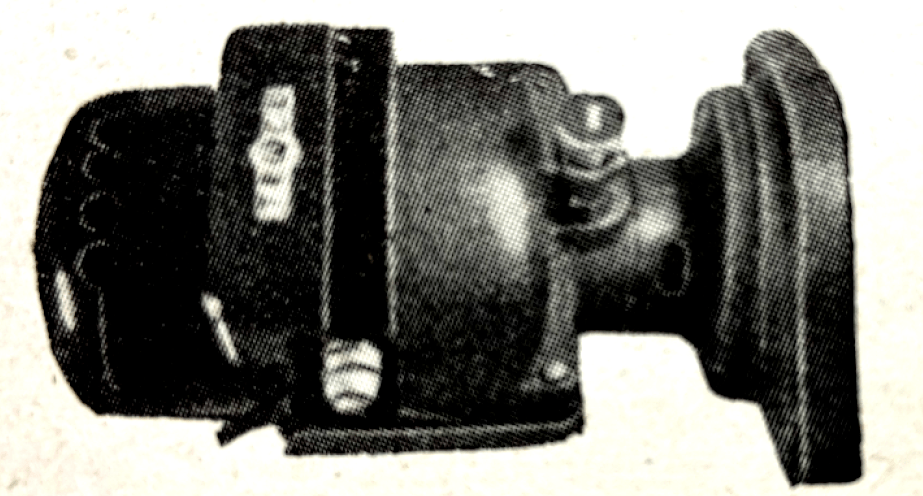
“IT WAS INTERESTING to study the riding at Brands Hatch, where, on a ‘busman’s holiday’, I saw the Northern Ireland team beaten by the Brands Hatch team. It seemed to me that the Irish riders, McCandless and Co largely adopted road-racing style, well back on the mudguard pad even on the bends, their feet often on the rests. In contrast, most of the riders in the home team, Jock West excepted, made use of typical ‘grass’ riding positions, sitting well up on the bends, and often trailing a foot—though getting down to it properly, of course, on the fast side of the course.”
“EVERY FRIEND AND ACQUAINTANCE who went to last week’s exhibition of German and other vehicles and equipment has made the same remark: that they could have spent with advantage a month or even three months there. All manner of components, equipment and even complete vehicles had never been exposed to public gaze before. For instance, what can one say when one is told that the 900cc DKW car my colleague mentions in his review is a prototype and probably the only one in the world? In a single day it was quite impossible to see more than a tiny fraction of what one would have liked to have seen. The guide to the exhibition occupied some 80 pages and covered ‘Engines and Engine Auxiliaries’, which comprised hundreds of interesting items, in half a page. Most people, I imagine, missed the examples of German infra-red lighting equipment. If you are a passenger in a car equipped with it and it is an ink-black night, you will feel utterly at a loss, for nothing, it seems, is piercing the black pall ahead, yet your driver, looking through his sort of port-hole, goes blithely ahead. Fantastic, it seems, and its use by an enemy vehicle cannot be detected except by special apparatus…”
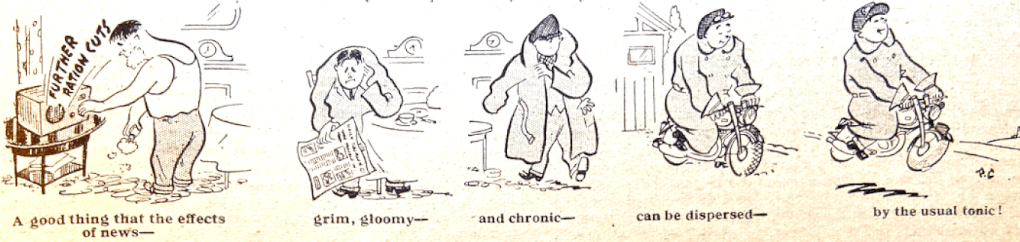
“THERE IS A CERTAIN amount of news from France. Foremost is the report that the famous Bugatti concern intends to carve its niche in the motor cycle world. The supercharged 350cc four-cylinder, water-cooled, and to be set across the frame, has been bench-tested and is said to have a phenomenal power output. Secondly, the Jonghi concern, which made a name for itself with long-distance records at 70mph with a 350 side-valve, has some new racing jobs—250s with double overhead-camshafts. Thirdly, it is reported that Terrots have absorbed Magnat-Debon and the latter, like Jonghis, are racing new dohc singles that incorporate much light alloy; these machines are fast, but, it seems, not too reliable as yet.”
“TWO MACHINES ARE at present available in the Francis-Barnett range. The first is a new 125cc machine, and the second an improved edition of the successful pre-war ‘Powerbike’. It is probable that later in the year a 200cc two-stroke machine will be added to the range, and that early next year the well-known ‘Cruiser’ model will be available. The new model is known as the ‘Merlin L51’. It is a robust little machine with a brazed and welded tubular frame, and tubular front forks. The engine is the well-known petroil-lubricated 125cc Villiers engine-gear unit, with deflectorless piston and twin exhaust ports. A Villiers carburettor and air-cleaner are used, and ignition is by fly-wheel magneto. A welded steel fuel tank of 2¼ gallons capacity is fitted, and the tank tap is the two-level type giving a reserve for approximately 15 miles. On the near side, between the seat stays and the chain stays, is an auxiliary tank of three pints capacity to carry oil for mixing with the petrol when filling up. A draw-off tap is fitted at the bottom of the tank, and the filler cap embodies an oil measure. Matching the oil tank, and on the off-side, is a tool-box fitted with a shelf which facilitates the packing of tools. Villiers 6-pole 24-watt direct lighting equipment is fitted, incorporating a parking battery in the head lamp and a dipper switch on the handlebars. The Francis-Barnett ‘Powerbike’, widely known before the war, has been improved by the fitting of link-action spring forks with pressed-steel blades. These forks, together with the Brooks spring-top saddle and the 26x2xl¾in Dunlop oversize tyres, result in this little machine being particularly comfortable on poor surfaces. The engine is the Villiers 98cc de luxe Junior unit, with the Villiers single-lever carburettor and flywheel magneto. The usual Villiers direct lighting, with a parking battery in the head lamp, is employed. Internal-expanding brakes, 3⅝in diameter front and 4in diameter rear, are fitted. The front brake is operated by a ]ever on the handlebars, and the rear by the pedals. The tank has a capacity of 1¾ gallons of petroil, and is fitted with a two-level tap. The familiar quickly detachable engine shields are retained, and the finish is black enamel, gold lined, with chromium-plated bright parts.”
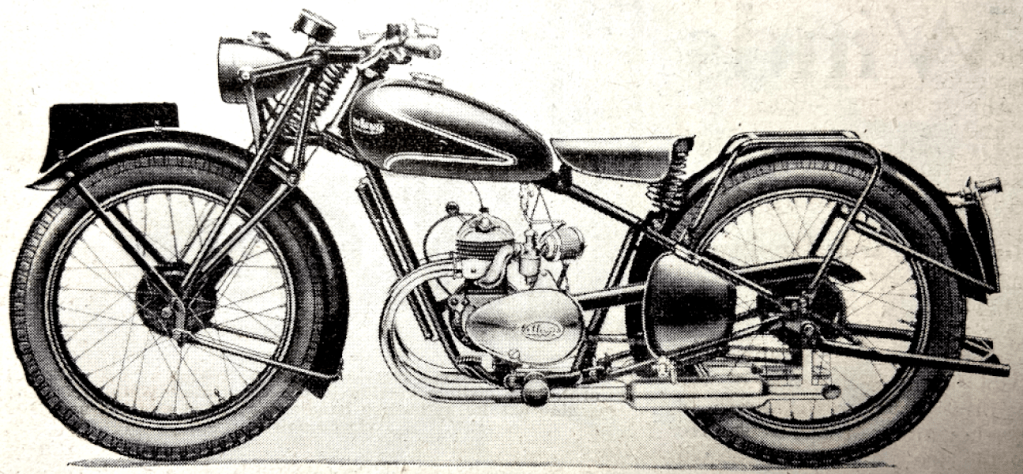
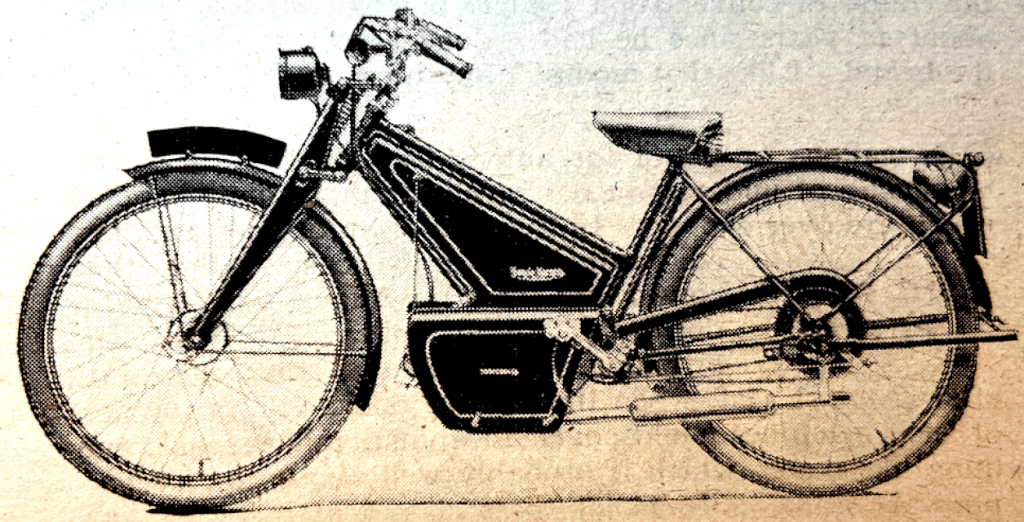
“SOME OF YOUR READERS may he interested to read of my experiences when crossing from Vyrnwy to Bala via the Eunant Pass on May 12th of this year. The pass has been closed for t wears, and is quite naturally in bad shape but far from being impassable as some people claim it to be. Riding a Tiger 80 with my wife on pillion I found the first part as far up as two miles the worst, for the track was strewn with boulders of no mean size and it was quite a job to pick a path through them. Naturally I bad to ask my wife to walk almost the whole of this stretch but eventually we got through the worst of it, and from about Y Gadfa onwards it was easy riding, even with two up. Bwlch-y-Groes is in quite good order, loose shale about, of course, but very easy after the climb from Vyrnwy. I had been looking forward to this trip for six years or more and we were fortunate in that we had glorious weather throughout the whole of the crossing. An ironical incident occurred at Talardd, or thereabouts, for we came to grief on a patch of fluid tar unsighted by me until it was too late. It was nothing serious but after crossing such a rough pass it was a sad blow to my pride and each time I mention the district now all I get is a ‘look’ from my wife; nothing else! I hope this will be of some use to readers who are contemplating this route.
Tom Williams, Brierley Hill, Staffs.”
“LAST SUNDAY’S RALLY of the Western Centre, ACU, was a great success. It attracted a crowd several thousands strong and went with a swing—this in spite of an almost last-minute alteration in starting time. By rights the get-together was to have begun at 11.30am, but it had to be postponed until 1.45pm because of, strange though it may seem, bread rationing. The arrangement was that there would be a running buffet, highly necessary with an event starting in the morning and held on an airport lying, as Staverton does, half-way between Cheltenham and Gloucester. When, however, it was found that bread rationing was starting on the very day of the event, the caterer said that that was that. So rationing, not of petrol this time, caused difficulties over yet another event. While the main aim of the rally was a Centre get-together, there are few gymkhanas which have provided anything like such sustained interest. And this one was free of charge! The Air Ministry had loaned the airfield and the visitors responded—right nobly, it seemed—by filling collecting boxes for the RAF Benevolent Fund. Among the events were appearance competitions, surf-board racing, motor cycle football, a demonstration by fast cars over the perimeter roads, the ‘Wiggle-woggle’—racing three at a time through a series of taped bends—and, of course, musical chairs. There was also a class for veteran motor cycles; in this there were two entries, both 398cc ABCs. One of these machines had been ridden from Dunstable that morning by Mr JG Heywood, the ABC enthusiast who owns three and has proposed the formation of a special club for ABC owners. After the rally he was setting off to Plymouth. One of the most interesting features of the afternoon was a dead-heat in the wiggle-woggle between a youngster on a Flying Flea, a 125cc Royal Enfield two stroke, and a much older rider of an ohv Ariel. The nippiness of the Flying Flea on the hairpin bends made up for the small number of cc and, at first, many thought the youngster had won the heat. A main reason why the event was so great a success was the slick organisation. Hardly had one event, car or motor cycle, finished than another was starting.”
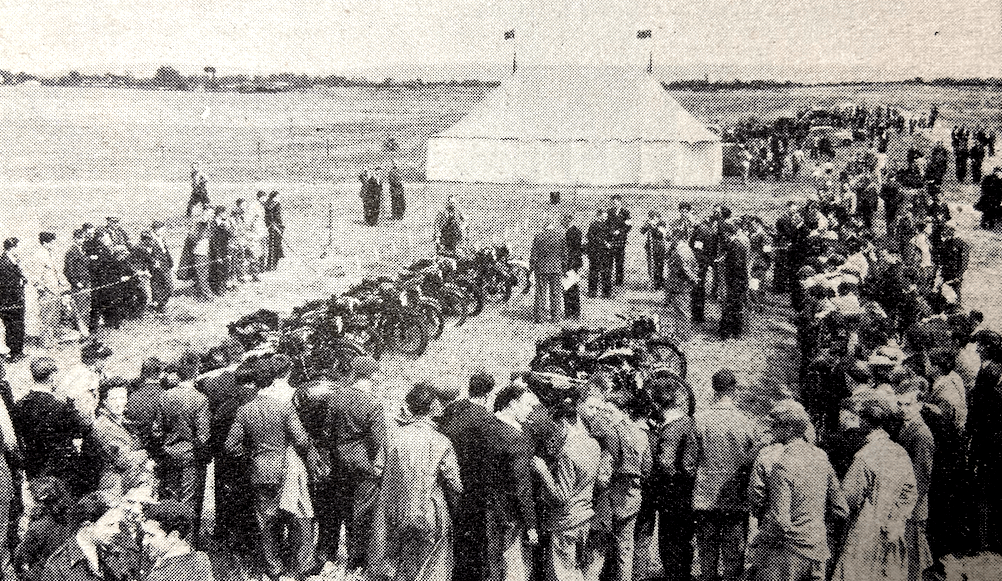
“THERE SEEMS TO BE a general impression that the record motor cycle speed on sand, at any rate for this country, is that of RW Storey (Brough Superior) at 122.9mph in 1927, whereas in 1933 JS Wright, on an ohc V-twin AJS, did 136mph at Southport. However, it is rather like flogging a dead horse to keep on racing with V-twins in this capacity. It would be if only supercharged fours were available. A square-four laid flat, with the supercharger above the engine, would appear to fill the bill nicely.
NF Eady, Newport, Mon.”
“THERE were hours of enjoyment—or days if he could spare the time—for the mechanically minded motor cyclist at the Ministry of Supply Fighting Vehicles Division Exhibition held last week. Most of the motor cycles shown were German and Italian models described in our columns in April, 1945. But among these machines, resting innocently on their stands, were the new military pattern Douglas and Triumph prototypes. Both have been built to meet a MoS specification which includes: Speed, 60-70mph; petrol consumption, 80mpg; weight, 300lb; braking 35ft from 30mph; laden ground clearance, 6in; quietness, inaudible at half a mile. As neither of these prototypes has yet been approved, full details may not, at the moment, be given. Both are very interesting jobs. The Douglas has a 602cc side-valve engine mounted transversely across the frame. Light alloy is used for the cylinder finning and the cylinder heads. The three-speed, foot-change gear box is in unit with the engine, and the final drive is by chain enclosed in a light alloy cast-ing which encases, separately, the two runs of the chain. Unobtrusively mounted at the front of the engine is an AC generator for direct lighting. With the magneto fitted above the crankcase, and the Solex carburettor bolted to an inlet manifold cast integral with, and at the sear of, the crankcase, the complete unit is commendably neat and tidy. The welded frame is of the duplex cradle type, and the forks are the new Douglas bottom-link telescopic pattern. The saddle is mounted on a spring pillar giving over 3in movement. Probably the simplest way to describe the Triumph is to say that the 497cc engine looks like a Speed Twin, but has side-valves placed in front of the cylinders. A three-speed gear box is fitted. Driven from the mainshaft, and housed in the outer half of the primary chaincase, is the AC generator. As on the Douglas, the rear chain is enclosed and lubricated. Rubberoid tubes encase the two runs of the chain and join up with the light-alloy casting enclosing the rear sprocket and with the rear half of the primary chaincase. An interesting feature is that the fuel tank, which has a square-section member running through it, acts as a frame member. There was a surprise for motor cyclists in the engine auxiliaries section. A Villiers twin-cylinder two-stroke engine has been developed for starting aircraft. The interesting aspect of this unit is that it employs petrol injection instead of a normal carburettor. Injection into the combustion chambers and into the crankcase has been tried, and the latter method adopted in production. The injector and the pump available for examination are tiny watch-like pieces of mechanism that gladden the eye of the craftsman.”
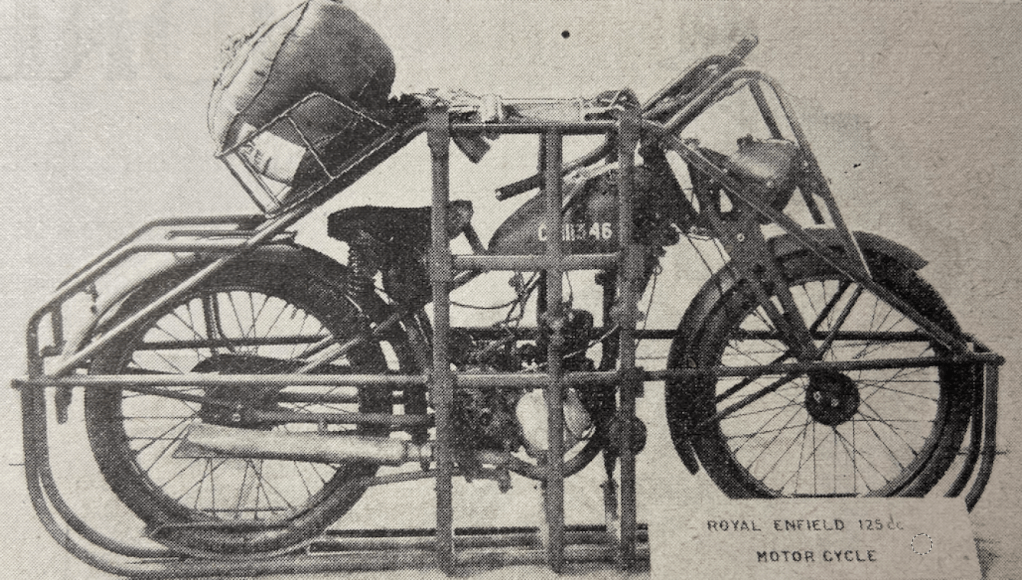
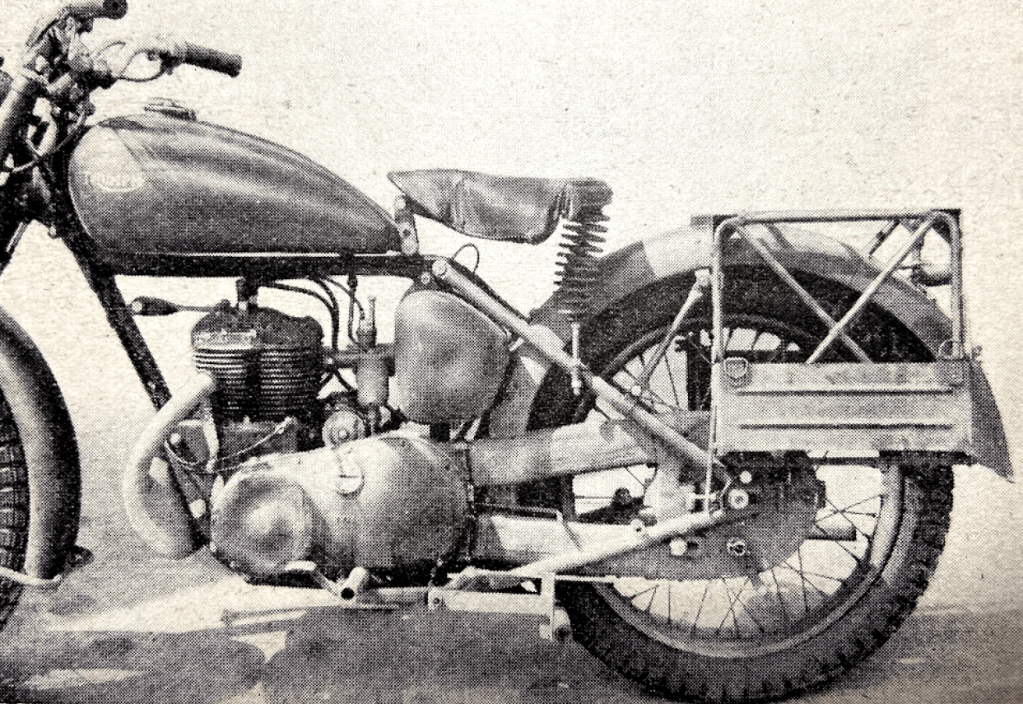
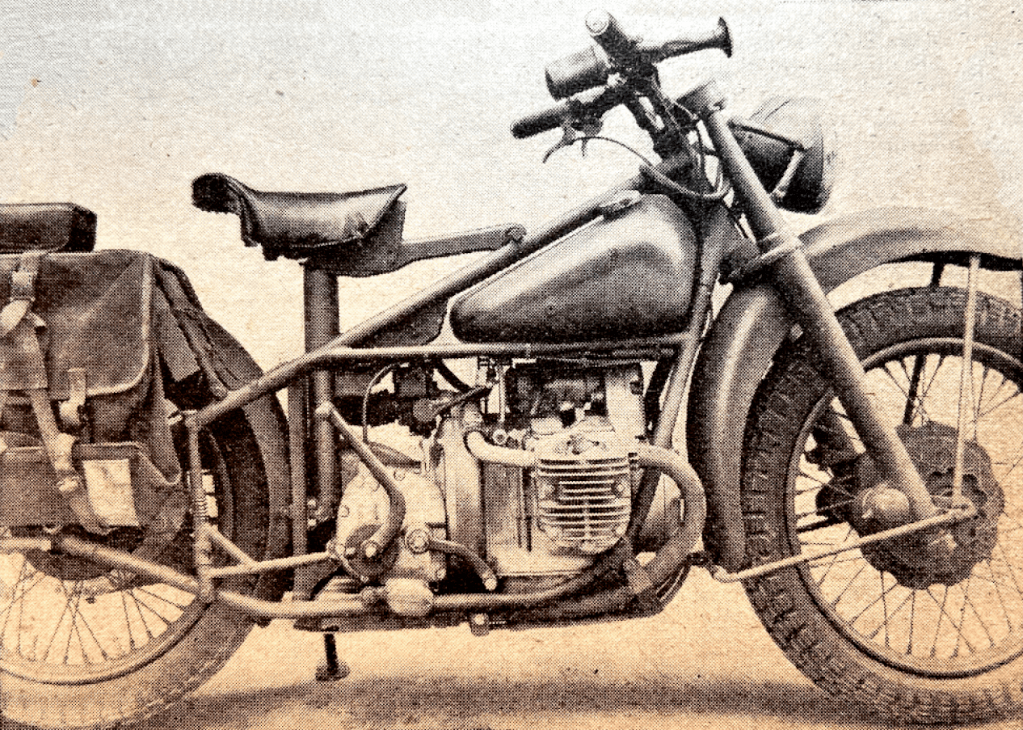
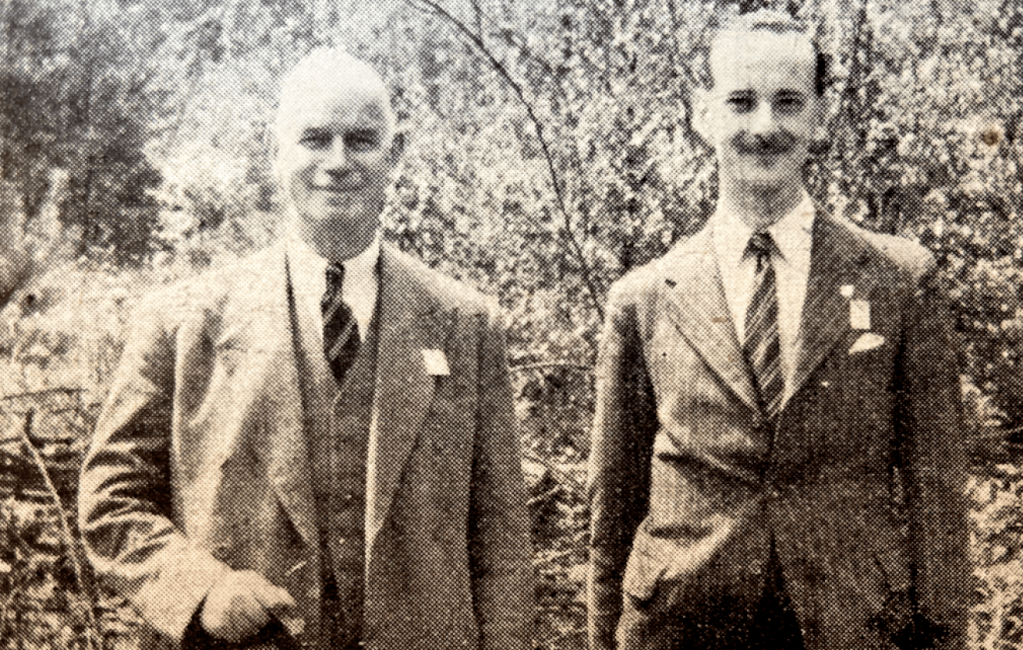
“DRIVING TESTS ARE to be reinstituted in the autumn. This was revealed last week by the Parliamentary Secretary to the Ministry of Transport. Asked about those who have learnt to ride and drive during the period when the driving test has been in abeyance, Mr Strauss stated that it had not yet been decided whether they would have to undergo the test or not. There were, he said, 1¼ millions in this category, a figure so great as to constitute a very big problem. Obviously, if all these were to be tested in addition to the week-by-week flow of new drivers, either an immense organisation must be built up or serious delay in securing a test is inevitable. In view of the fact that many of the million and a quarter will now have had years of driving experience it would seem reasonable that, as in the case of those who held a licence previous to April 1st, 1934, taking the test should be waived. In the past, one of the great advantages of the driving test was that it made every new rider and driver learn the Highway Code. The actual test as far as solo motor cyclists were concerned was by no means always satisfactory. Since tests there are to be, we trust that this question of testing motor cyclists will be investigated. What is desirable is that motor cyclists are tested by motor cyclists—in other words, by specialists.”
“THIS WEEK THERE IS the best news for road-racing enthusiasts that there has been since the war. Scarborough, one of the most progressive resorts in the country, is going ahead with its scheme for a 2½-mile motor cycle road-racing course over the roadways of Oliver’s Mount, on the outskirts of the town. The first meetings are to be held on September 17th and l9th in connection with the town’s ‘Welcome Home’ week. What a magnificent welcome for those of its returned Servicemen who are motor cyclists, and what an attraction to enthusiasts all over the country! After examining the course, ‘Wharfedale’, than whom there are few more knowledgeable in road-racing matters, predicts some of the most thrilling racing ever seen. So Britain is not to be without a road-race circuit. And some of the Scarborough Corporation officials are hoping that embarking upon this scheme will be but a prelude to the much more ambitious plan of a ten-mile circuit constructed on a disused racecourse and surrounding open spaces. After all, if it pays the Isle of Man to give over its main roads to the TT, Manx Grand Prix and pedal cycle races, and to make large money grants directly and indirectly, what an asset such courses must prove to a resort such as Scarborough, especially as Plan No 2 envisages a circuit wide enough for cars as well as motor cycles—Scarborough, with millions from whom to draw its patronage and no sea passage. One scheme is certain and that is indeed good news.”
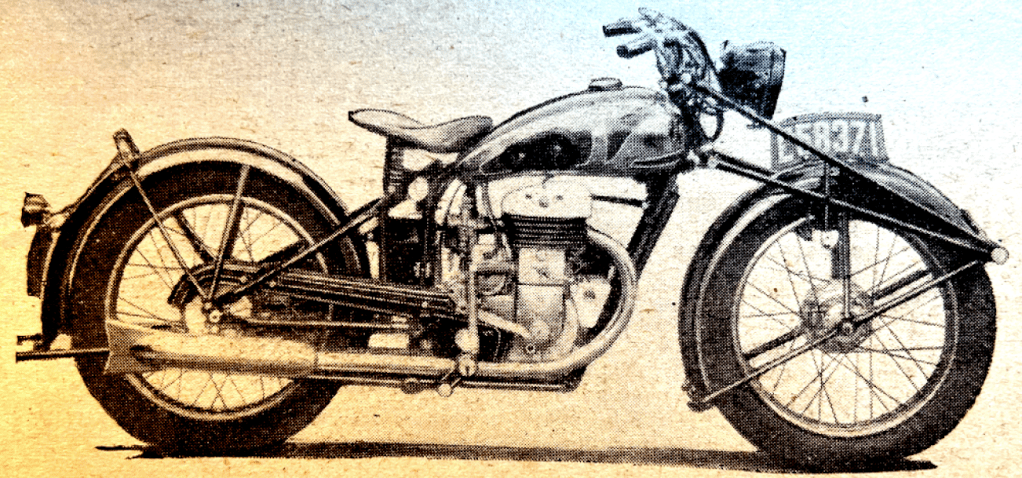
“WHAT IS TO HAPPEN to the German motor cycle industry under the Control? Many have wondered whether, motor cycles being potential war vehicles and knowledge gleaned from motor cycle engine development being applicable to aircraft engines, Germany would—indeed, could—be allowed to possess a motor cycle industry. On the other hand, she must have transport and, as Mr Shinwell stressed in the House of Commons, the motor cycle is an economical means of transport—the most economical form of personal motor transport that exists. Prohibition of the manufacture of all types of motor cycle would thus be unwise. What has been decided is that no motor cycles may be produced which are over 250cc. A total of 10,000 motor cycles with an engine capacity of 60-250cc may be made a year. Under 60cc, whether autocycles or miniature motor cycles, there are no restrictions. In view of the recent discussions on tiny engines as attachments to bicycles, the ‘under 60cc’ provision is especially interesting and developments will be watched closely, for who knows whether this may not result in a valuable new class of machine? Many enthusiasts will regret that no longer will the talented designers of the BMW, DKW, Zündapp and TWN have free rein, but on the wisdom of ‘the decisions there can be no doubt at all.”
RUSSIA WAS AT the head of the queue for copies of the DKW RT125 design—DKW replicas emerged within a year of peace breaking out, namely the Moskva M-1A and Korovec ZiD K-12.
“AT THE RECENT Swiss Industries Fair the Condor C580 machine on show was particularly interesting. This model has .a 584cc side-valve horizontally opposed twin-cylinder Boxer engine set across the frame and in unit with the four-speed gear box. The power output is said to be 14.5bhp at 3,000rpm, and 17.2bhp at 4,000rpm. Coil ignition is used, with an automatic ignition control. The neat-parallel-ruler type forks incorporate hydraulic damping. Other features are shaft-drive, 27×4.00in tyres on inter-changeable wheels, and very large-diameter brakes. The price in Switzerland, at the present rate of exchange, is about £220.”
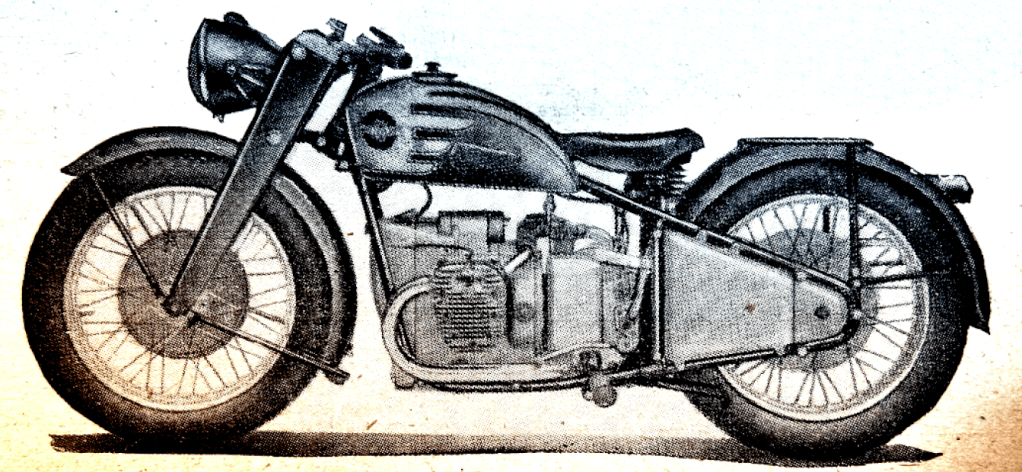
“THAT MUCH OF INDUSTRY is adopting a five-day working week is known to all. Undoubtedly before very long only those on essential services, including such tasks as retail distribution, will work on Saturdays and Sundays. What are the implications of this as far as motor cycle sport is concerned? Does it mean that there will be a wholesale transfer of events from Sunday to Saturday? At the present time few events other than the big open trials are held on Saturdays. The vast majority of events—trials, scrambles, grass-track meetings, etc—are run on Sundays. This is in direct contrast with what occurred earlier in motor cycle history. For a long time hardly any motor cycle events, other than those of a purely social nature, were organised on the Sabbath. That day was considered undesirable from a number of aspects. It is, of course, still undesirable—so far as traffic on this now densely trafficked island is concerned—far more so to-day than was the case in, say, the 1920s. If, as seems likely, it will soon be possible to run nearly all non-social events on Saturdays, doing so without penalising motor cyclists, reversion to the old practice will be all to the good.”
“GREASE IN NOTHING SMALLER than 7lb tins. I have said ‘Gr-rr-rrh!’ before—and written it. Now I say it again, for in front of me is a copy of a Board of Trade reminder that the wartime restrictions on the size of metal containers in which lubricating oils and grease may be packed are still in force. I had hoped—nay, expected—that by now the stupid position whereby motor cyclists and other users of grease in small quantities are forced to buy not less than 7Ib tins would have been brought to an end.”—Ixion
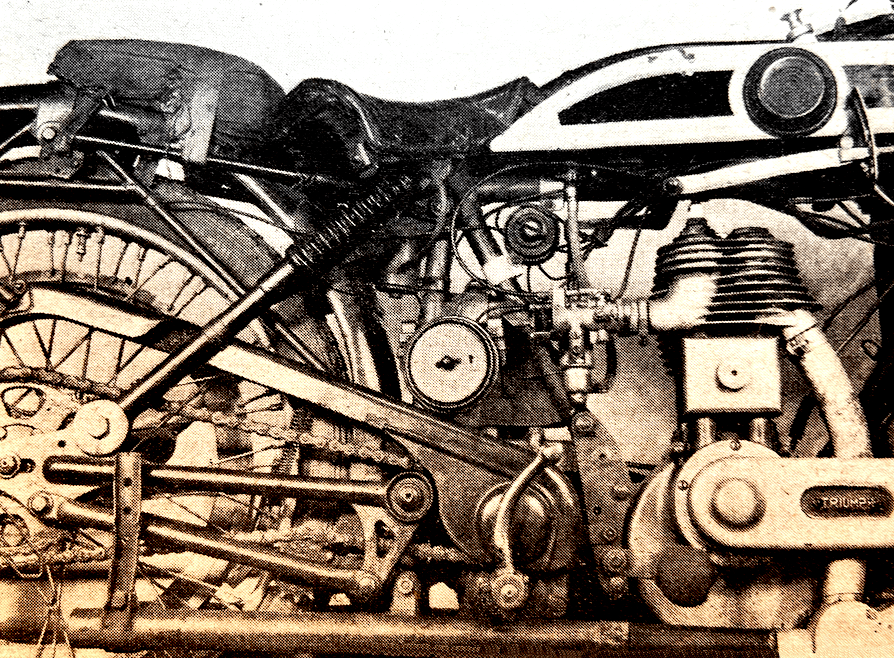
“‘IT WAS INEVITABLE that interest aroused in old machines by the formation of this club would be reflected in prices asked by astute vendors.’ Thus comments the Vintage MCC. But is there really a tendency for the prices of vintage machines, per se, to soar to figures proportional to those asked for golden antiques in old curiosity shops? The fact is that all motor cycles are expensive to-day, whether ancient or new. I deplore the high prices as much as anyone, but commercially, while motor cycles are still difficult to obtain, a vintage model presumably has to fall into line with all the other second-hands. If inflation is indeed occurring, it is, as the Vintage Club suggests, ‘a subtle compliment’ to the Vintage Club.”—Ixion
“DETAILS OF THE NEW Indian ‘Chief’ have just been released. The most notable features are the new front forks and the deep valanced mudguards. The new forks are of the link type, with twin coil springs and hydraulic dampers. The rear suspension has been modified to give softer springing than on past models. The springing of the saddle has also been modified to give a longer action. These features, coupled with the 4in-section tyres (5in as an optional extra), typify the American trend towards machines that are more and more comfortable. The familiar 42° vee-twin side-valve engine, with aluminium alloy cylinder heads, is retained. The capacity of the engine is 73.625 cu in (about 1,200cc). Primary drive to the three-speed gear box (four-speed gear box as an optional extra) is by means of a four-row endless chain running in an oil-bath. A ⅝x⅜in rear chain is fitted. The price of the Indian Chief with coil ignition is $495 at the works, Springfield, Mass, USA.”
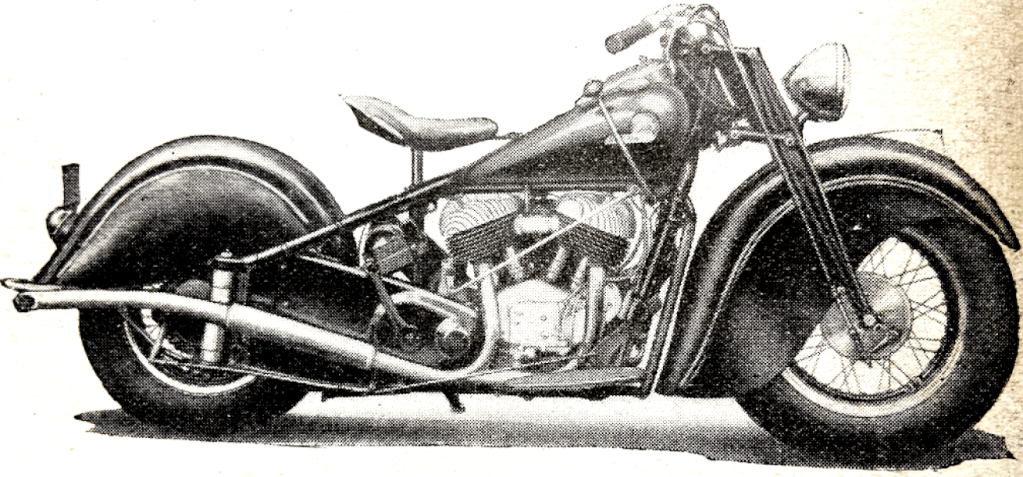
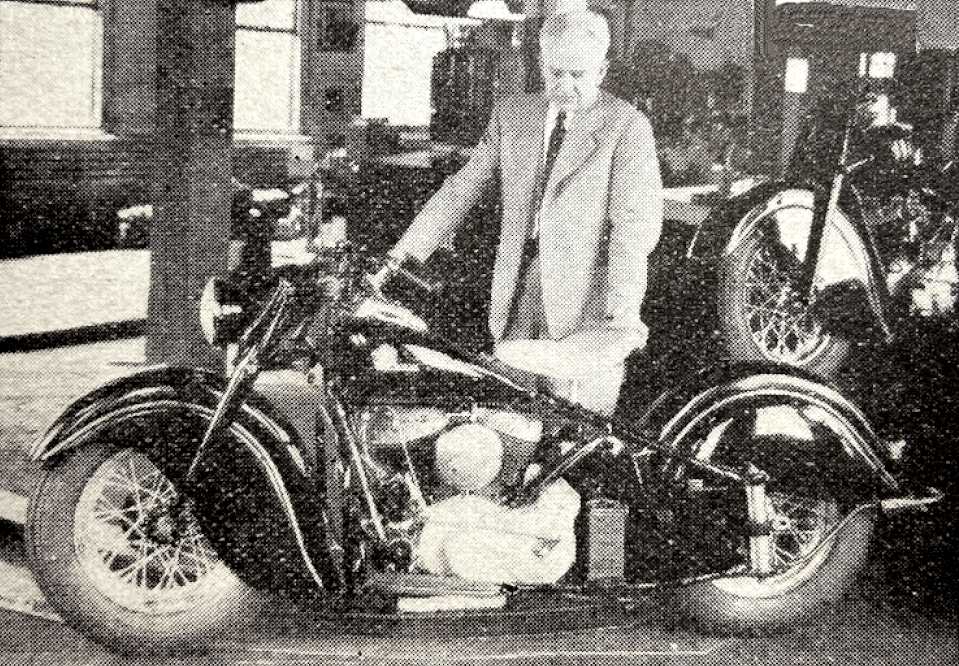
THE outstanding events of the open Speed Championships organised by the Carmarthen MC&LCC on Pendine Sands on Bank Holiday Monday were the Senior and Junior Welsh Grand Prix races over 50 and 30 miles, which provided the large holiday crowd with some particularly thrilling racing. In addition there were ten other events. All the morning a steady stream of traffic poured into the pretty Welsh village, famous for its eight-mile stretch of firm, golden sands. The morning sky was overcast, and the thousands of spectators watched the incoming tide anxiously to see if it brought rain from the Atlantic. But eventually the sun broke through the clouds, and by the time the riders lined up for the start of the meeting the sun was shining fitfully. There were some particularly close finishes in the sprint events in both classes, the 600cc class providing a ring scrap between Billington, Stevens and Griffiths, who shot over the finishing line with but inches to spare. The incoming tide had not washed over the whole course, with the result that while the seaward side was wet the shore side was dry and firm. There were several spills on the corner, one of them being that of Billington in the 10-mile event for unlimited cc machines. He was thrown off on a wet patch. Closely behind him followed Bob Berry, who shot away to consolidate his position on his 996cc Brough Superior. Billington soon recovered, however. Although badly shaken, he went on to win the following event—the 30-mile Welsh Grand Prix. In this event he led all the way, except on the sixth lap, when he was overtaken on the corner by HJD Burnie. Burnie, however, had a spill and dropped out of the race. The Senior Welsh Grand Prix (50 miles) provided the day’s greatest thrills, and the crowd, now increased by many thousands, were kept on their toes with excitement by the varying fortunes of the riders. For the first five laps there was a keen duel between Bob Berry, of Manchester, and LF Griffiths, of Bridgend, with Burnie lying in third place. On Lap 6 Berry’s machine appeared to develop clutch trouble, and he dropped out. Burnie moved into second place, with R Good, of Neath, running close on his tail. By the next time round Good had moved up into second place, with DR Griffiths hotly pursuing Burnie in third position. That was the order until the 18th lap when Good was seen to have moved into first place, with Burnie second, and Griffiths third. Burnie held a slight advantage at the end of the 19th lap, but Good gained on the corner. The Birmingham rider was in front in the next lap, but the next time round he was missing. After that it was a straight duel between Good and Griffiths, with DR Griffiths in third place.”
“OVER 12,000 PEOPLE saw TL Wood on his home-built 498cc Erswood break the Cadwell 8-lap record at the Louth MCC’s Lincolnshire course on Bank Holiday Monday. Wood’s time was 6min 46⅗sec, giving him an average speed over the ¾-mile circuit of 53.28mph. The previous record of 6min 54⅖sec was set up in 1939 by G Brown (500 Vincent-HRD). Considerable improvement had been made to the track since the Whitsun meeting by resurfacing from the hairpin to the Barn Corner; weather conditions were ideal. There were only two slight accidents throughout the day, P Hylton. (348 Norton) damaging his wrist when lying first in a heat of the 250cc race, and WH Myers (500 AJS) receiving cuts when he hit the fencing near the ‘Mountain’.”
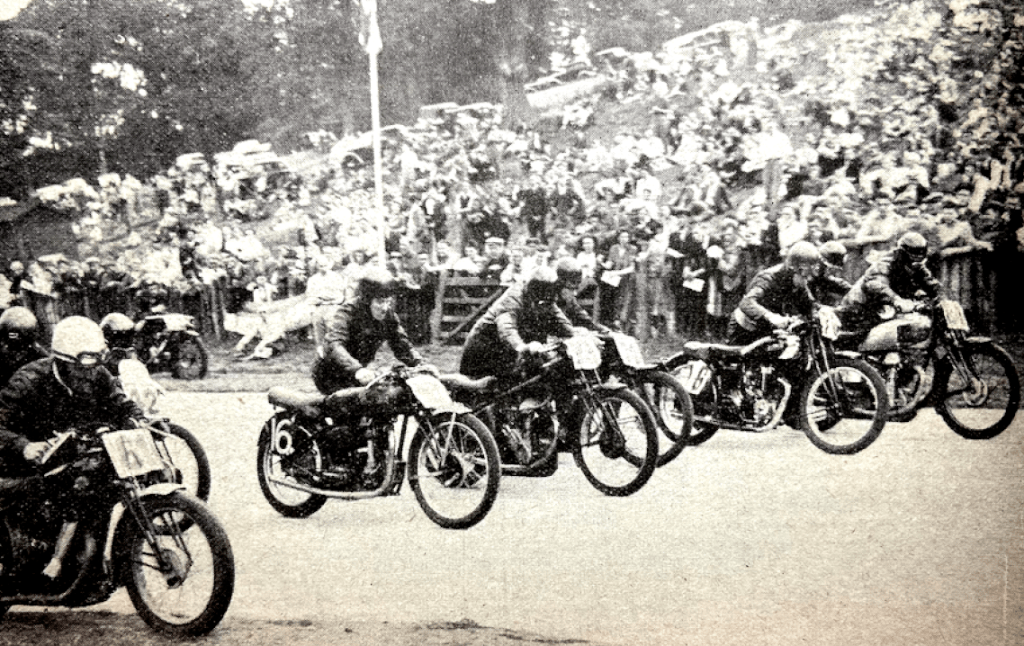
“THERE IS A NATIONAL impression that motor cycles are mostly playthings—the toys of our leisure hours, rather than substitutes for the train, the bus, the tube, both where public transport exists and where it does not. During the last week or two I have been staying about 1½ miles from the centre of a large provincial town. Not a factory city—it is almost literally true to say that it contains no factories, and that its industrial side is mainly limited to the trades and professions essential wherever a large population is concentrated in a ‘sprawl’. I have watched its traffic at the four daily rush hours. Although it is well served by electric trolley buses, the stream of workers contains a very high percentage of motor cyclists, ranging from the elderly men and the women of all ages on autocycles to the sturdy youngsters on rather rorty 500s. They ride well and safely. They look happy. They provoke meditative glances from the bus queues, who in the rush hours must still stand in rain or shine and see bus after bus cramjamful as the clippy gives the queue a deprecatory wave. The motor cycle has its holiday and sporting aspects, but it is still fundamentally a utility machine, and as such deserves special Government consideration in such aspects as tax, fuel and PT. The cheap mobility which it confers on its users is a great asset to industry, and a great relief to all forms of overworked public transport.”—Ixion
“OPINIONS ABOUT THE COMFORT and capabilities of the auto-cycle have been freely expressed lately, so I think the following may be of interest to readers. About six weeks ago my father, who is over 70 years of age, bought a new autocycle. On the morning of July 15th he started from Horsham at 5.15am and rode to Torquay, Devon, reaching there at 7pm, which is a distance of about 198 miles. This time included stops and going about 15 miles out of his way. This, I think you will agree, is quite a good ride for an elderly man. My father said he was not unduly stiff or tired when he arrived (the last 40 miles was in pouring rain). After a hot bath he was quite fit.
Paul H Johnson, Slinfold, Sussex.”
“MAY I SAY that I heartily endorse the suggestion, last week in ‘Current Chat’, that now that Brooklands, alas! is no more, the time is overdue for the passing of ‘Brooklands Cans’. No-one was more keen than I on that healthy crackle in the Paddock and on the track, but not on the public road. I should like to suggest that clubs should urge the abolishment of them!
‘Speed Twin‘, Nr Reading, Berks.”
“TWO NEW SPANNER SETS have been introduced by Accles and Pollock, Oldbury, Birmingham. Each set consists of eight sockets and an extension piece in ‘Apollo’ Kromo alloy steel and a ‘silentgrip’ wrench. The wrench works on a ratchet and roller principle; this means that the amount of lost motion is very small—about ³⁄₁₆in at the end of the shank—which makes it possible to use the wrench in a confined space. The Minor set, price 47s 6d, contains socket sizes from ³⁄₁₆-⅝in; the Major set, price 63s, is equipped with sockets ½-1in Standard English Whitworth. Both sets are packed in well-finished non-rattle metal boxes.” [I have both sets and they work well—Ed.]
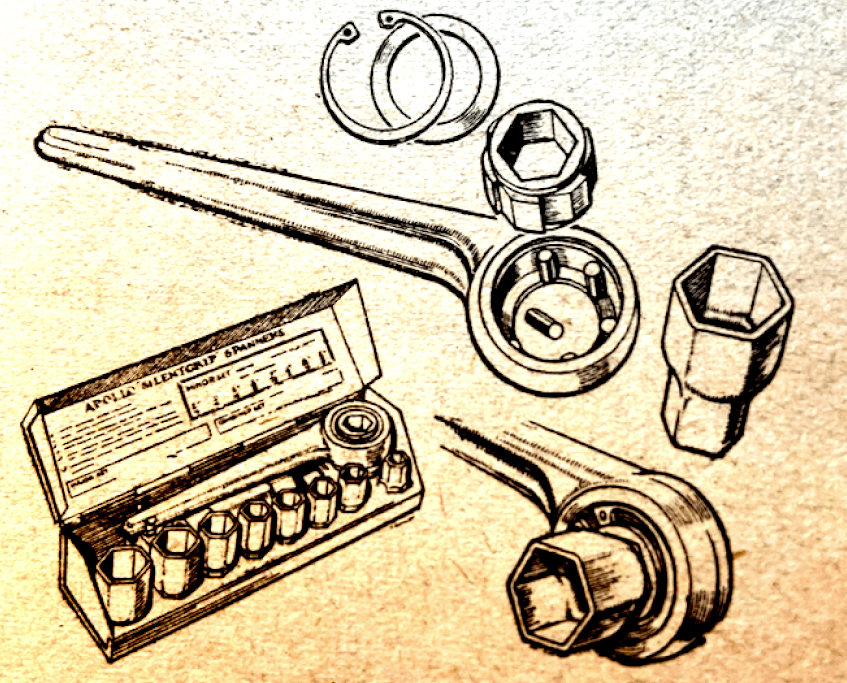
“WE CERTAINLY NEED better pillion seats. What really prompted this letter was the pathetic and almost desperate tone of the letter from ‘Rider of Dumfries’ [about the shortcomings of pillion seats]. He sounds as though he is almost ready to give up. So perhaps I can help him by suggesting that he fits an American ‘buddy-seat’ to his Four. Back in Canada many ‘sickle hounds’ have fitted these saddles to their Fours and Tiger 100s. The only difficulty in fitting one of these saddles on a British bike is the shape of the petrol tank on a British bike and the fitting of the pillion footrests. But it can be done, and the result in safety, comfort and appearance is well worth it. If ‘Rider’ will get in touch with me I’ll be glad to send him the address of a firm in Toronto, Canada, where he may purchase one. Buddy-seats cost about £6, but these saddles will last for years, keep their appearance and stand up, whereas most British pillions are soggy and worn out after a year or so of use. The alternative is to fit one of those Dualseats that came out just before the war…The de luxe Harley-Davidson is an excellent machine for long-distance touring. It has safe, comfortable, and smart-appearing pillion equipment and, also, large, sturdy saddle-bags, large carrier, and plenty of room for luggage. Also weather equipment that is fitted to the bike and not to the rider.
Sputter-Biker, Canadian Army, England.”
“MAY I REPLY to ‘Sputter Biker’ concerning ‘buddy-seats’ and Dualseats? As the instigator of the Dualseat I would like to tell him that the standard post-war model, evolved from prototypes on which I myself have ridden many thousands of miles, is in the form of two really comfortable seats, and will have a covering which will wear as well or better than good leather. Bonded rubber suspension is employed (front and rear) which—with a maximum deflection of half an inch—irons out the bumps like a good spring frame and affords that lateral stability which long coil springs do not give. During my 20-odd years of motor cycling I have used pretty well every type of saddle or seat which has been made; I don’t want to ‘argy-bargy’ with ‘Sputter-Biker’ but I must say that the ‘buddy-seat’ stands out in my experience as possessing a front portion which is somewhat of a corn-provoker! My own opinion is that one should be able to do a 300-mile ride without noticing one’s seating either when riding or afterwards; when material supplies allow our production to restart I hope that ‘Sputter-Biker’ will try a post-war Dual-seat and find that it comes very near to that ideal.
Jas R Ferriday, Massaging Director, Feridax, Birmingham.”
“I HAVE BEEN INTERESTED in the various descriptions of electrical motor cycles, particularly as they gave a basis for comparison with some electric machines that a friend and I experimented with during the war. My first effort had a Coventry Eagle frame, an 80A 6V battery and a solenoid starter switch. The range was about five miles and top speed about 10-15mph. It was very much over-geared and obviously too heavy. The second one was better and had a range of about 15 miles at speeds up to 20mph; this would doubtless have been improved had the battery not had two dud cells. The frame of the latter machine, which was built to my drawings by Hobbs, of cycle fame, was, strangely enough, almost exactly the same in design as the Socovel, but on smaller lines. The battery was a 105A 12V car type separated into two 6V units, driving a converted 12V starter motor of unknown denomination. Twenty-inch wheels were fitted and the gear ratio was 25 to 1. Starting was effected by means of a normal starter switch in conjunction with a series-parallel switch, arranged to use all cells on either 6V or 12V. The most successful machine of our trio was that of my friend Mr Newport. He constructed a bike almost entirely from odds and ends in a few weeks of spare time. No drawings were used and it was built for the purpose of enabling his wife to do her shopping with a minimum of trouble. It has been in regular use for over 12 months and has had no attention or replacements other than an occasional topping up with distilled water and charging once a week. The frame is built up from parts of a Dunelt motor cycle frame, pieces of bicycle, strips of angle iron and lengths of steam pipe. Power comes from an 80A 6V battery driving a small 6V starter motor. A half pull on the starting lever brings a resistance into the circuit and urges the bike gently forwards. A further pull by-passes the resistance and gives full power, which means anything up to 20mph for 20 miles on a charge. A free wheel is fitted for coasting under suitable conditions.
Ronald V Tayler, Barkingside, Essex.”
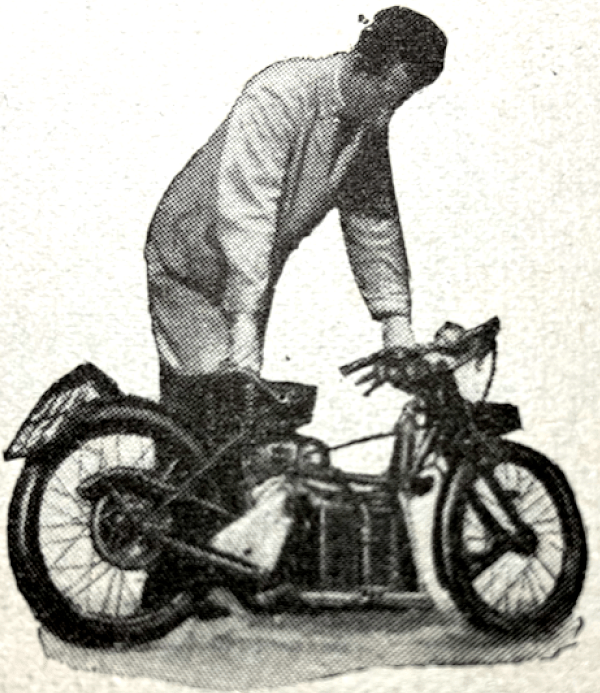
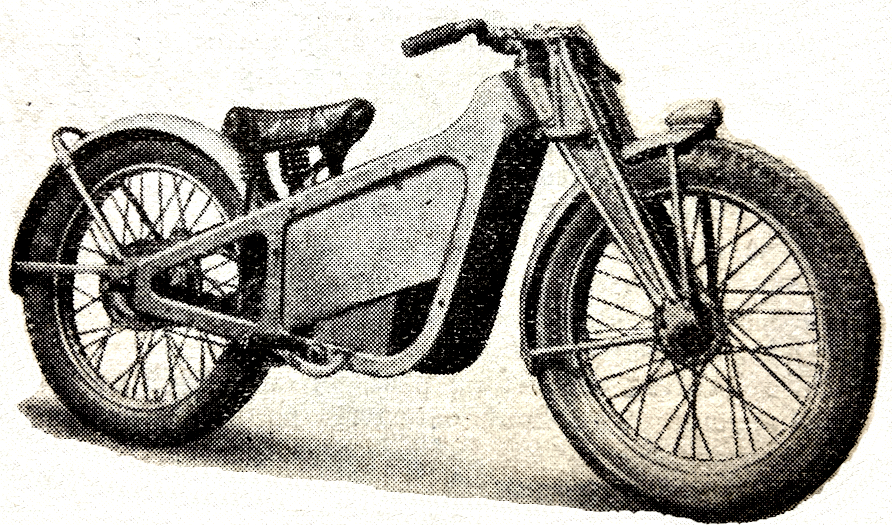
“ONLY ABOUT A DOZEN men in this country could answer off hand to a questioner enquiring what is the longest speed record in motoring history. It was put up by a squad of French army officers at Montlhèry track in June-July, 1939. These officers rode a Gnome and Rhône Yacco motor cycle of 724cc 30,998 miles in 19 days, at an average speed of 68mph. I have never heard the secret history of the feat. The factory behind it enjoyed no great hope of export markets. It is hardly necessary to ride one and a quarter times round the world to try the stamina of a motor cycle engine. Personal aggrandisement can hardly have inspired a squad of serving officers. Maybe, it was mainly a superb gesture wrung from angry men by the desire to show the dictator nations that they too were virile, despite the confusions of their people.”—Ixion
ROAD IMPRESSIONS: PANTHER M100
“TWO THOUGHTS ARE conjured up in almost any motor cyclist’s mind by mention of the 598cc Panther 100. The first is of economy, for is there a comparable motor cycle with such a low fuel consumption? The machine might well be termed ‘the 600 with the thirst of a 350’. The second thought is of a lusty sidecar machine. Often have I driven P&M sidecar outfits, and not only do I back up those almost correspondence-columns figures of fuel consumption, but also I agree that the Panther 100 is an able performer with a sidecar. But what is it like as a solo? After well over 300 miles, which included fairly lengthy runs, about-town riding and short expeditions of a post-a-letter type, I have a reasonably complete answer. The machine I took over showed only 280 miles on the speedometer, but had, I gathered, already covered a fair mileage. Mechanically the engine was quiet—very pleasantly so. In spite of the 600cc (87x100mm) of single-cylinder there was no appreciable piston tap. The exhaust, too, proved to be commendably subdued. It is a motor cycle that rustles along; the accent is on the word ‘rustle’. With its large supple engine, and its top-gear ratio of 4.3 to 1, the Panther 100 is an effortless machine on the open road. It is easy in traffic, too, and very early on I had doubts as to the accuracy of the speedometer; it seemed to be reading fast, but a test showed it was pretty well ‘spot on’. The way the Panther bounds forward in top gear, sending the speedometer needle swinging round the dial, is satisfying indeed. Somehow, notwithstanding the machine’s name, the performance proves unexpected.
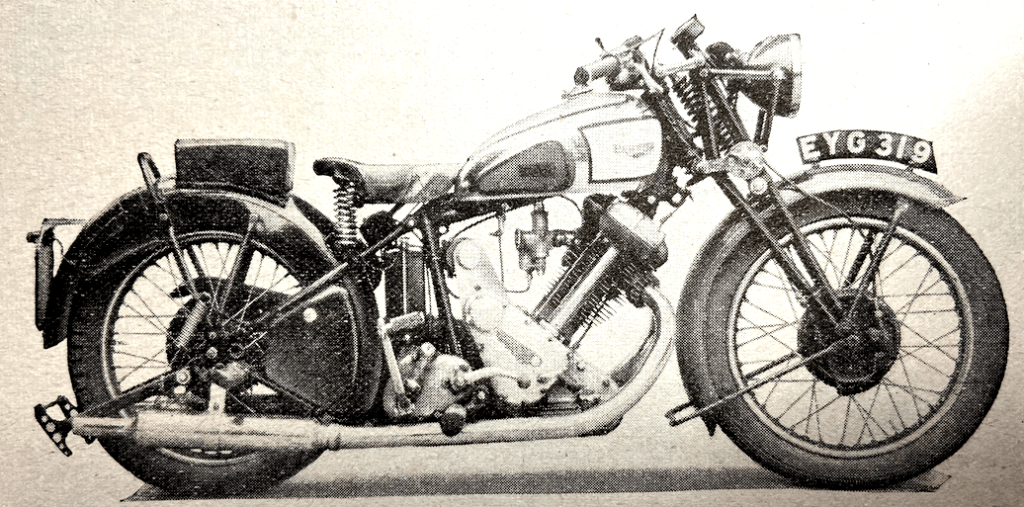
And the whole business is so gentlemanly. In the result, one finds on the open road that, without hurrying unduly, one has.averaged well over 40mph. Moreover, throughout the engine-speed range there is no appreciable vibration period—no speed at which engine vibration becomes obtrusive and which for this reason one automatically avoids as one’s cruising speed. The power unit is one of the most gentlemanly singles I have handled. Even with the present low-octane-value fuel there was seldom a pink, and that only with something akin to gross mishandling. Minimum non-snatch speed in top gear is some 18mph—usable minimum, for I employed it frequently. No doubt a main reason for the machine’s flexibility—additional to the automatic ignition-control, which commends itself by passing unnoticed—is the cush rear hub, the Enfield rubber-buffer shock absorber that links the chain wheel with the back-wheel hub. A direction in which the Panther scores 100 out of 100 is on ease of starting. That little lever on the timing cover, the decompressor control, means much. Move the lever anti-clockwise, raise the exhaust valve or push the kick-starter down an inch if it does not come fully back because of the position in which the engine stopped—and the kick-starter pedal calls for but the daintiest pressure: not only this, but the engine starts for certain. With the engine hot, a test was made to see just how light a task the decompressor makes it. Five times the pedal was pushed down by hand; five times the engine started. It is
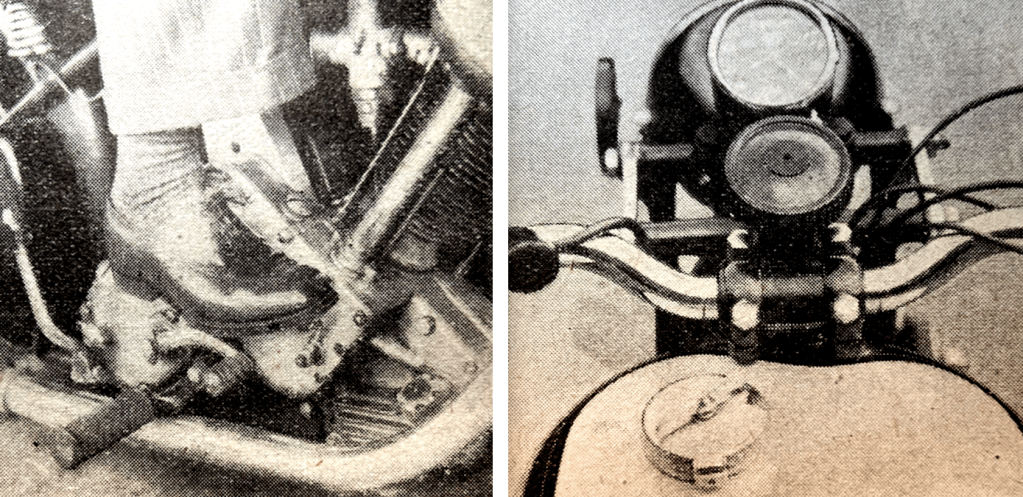
strange that more big singles have not been fitted with this device which releases a portion of the mixture on the compression stroke. Apart from the benefits accruing from the decompressor, and the magneto, with its automatic control giving the optimum spark at kick-starter as well as other speeds, there is the fact that the carburation with the Amal instrument fitted to this Model 100 Panther was just about perfection. Incidentally, one wonders how much the valve timing has to do with this happy result and with the low fuel consumption. There is very little overlap: the inlet valve begins to open ³⁄₁₆in (25°) before top dead centre and the exhaust valve closes ¹⁹⁄₃₂in (30°) after top dead centre. The gear ratios are 4.3, 5.8, 7.3 and 11.5 to 1 and proved well chosen. On a number of occasions the machine was taken up to a speed of between 55 and 60mph in third gear before a change was made into top. The actual gear change was not up to the usual Burman standard. On the upward change it was difficult to avoid some degree of scrunch. The clutch was light and freed perfectly. The brakes too, were excellent. A notable feature of the machine is the confidence it gives one when the roads are skiddy. The Panther was taken over on a day when a shower followed a long dry spell, and I know of no machine on which I would have felt a higher degree of confidence when negotiating the glistening wood blocks. This is something I rate very highly indeed. Were there daily journeys to and from work that lay over city streets my thoughts would immediately turn to the Panther. On the open road the cruising speed was usually of a 55-60mph variety, which is, it seems, about as fast as all but a few motor cyclists travel for any length of time. Once or twice on billiards-table roads I took the machine over 70. The road-holding at high speeds with the machine under test was not good. There was pitching and on bumpy roads one had a rough ride. The fork spring seemed to be definitely ‘side-car’. As I have said, it is not necessary to use high speeds for the Panther to put up very useful averages; there is that effortless engine with its excellent acceleration. The engine remained clean. There was just one oil leak from the top of the ohv rocker box. The oil sump is part of the crankcase, which has the advantage that the lubricant is soon on the job after the engine is started from cold. Oil consumption was satisfactorily low. Fuel consumption was very low. At a maintained 30mph on an undulating road ridden in both directions it worked out at no fewer than 103mpg. At a maintained 40mph it
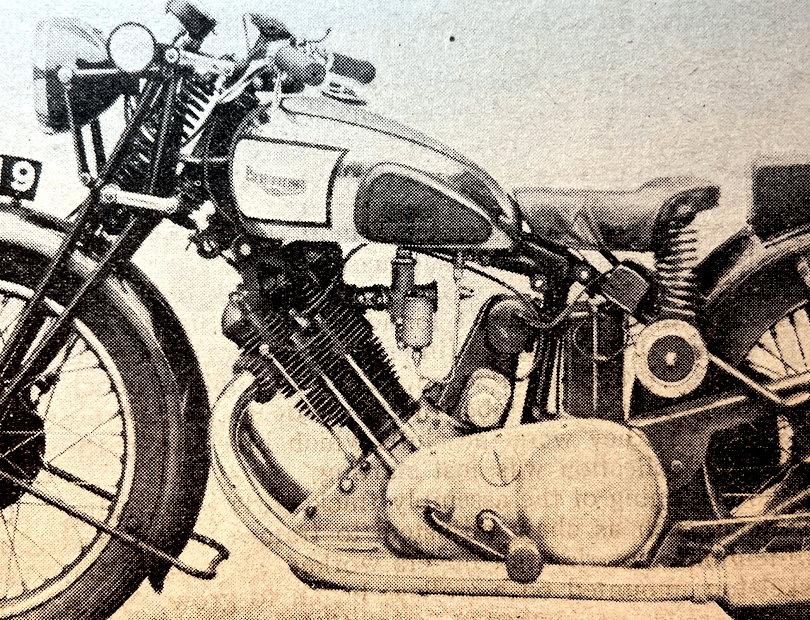
was 86½. The Panther too is not a light machine—the weighbridge gave 4cwt 1qr 21lb—but putting it on the stand is one of the easiest tasks imaginable, for the machine, of course, has the now-famous P&M rolling-type rear stand. Place a foot on one of the cam-type feet and the machine almost automatically rolls back on to the stand. There are other interesting features of the machine. For instance, the handlebars are rubber mounted. They are of particularly good shape, incidentally. The speedometer head is mounted on the top cross-member of the front forks, the best possible place for ease of reading. Cam-type adjusters are provided for the rear chain. The kick-starter folds and therefore does not butt against one’s calf. Starting being of a first-kick variety there is not that all-too-frequent objection to the pedal’s folding. Twin petrol taps are fitted. The dynamo is a Lucas and the driving light with the 7in head lamp was very good indeed; good length of beam and plenty of width for safe cornering. Dunlop tyres of 3.25×19 were fitted to the machine under test, with the front one of ribbed pattern. The saddle is set low and non-adjustable. Were the machine my own I would straightway set about raising it. I disagree with the present fashion which causes an acute angle at one’s knees. The brake pedal has an adjustable stop, but with the exhaust pipe immediately beneath it was not possible, except with the footrests set high, to have the pedal so that one did not have to raise the foot from the rest in order to apply the brake. Mention was made earlier of the machine being employed for journeys of a post-a-letter type. Such is the ease of starting and of putting the machine on the stand that one uses it for short-distance work in very much the way that one might utilise an autocycle. It is a motor cycle of outstanding convenience, and it is a class machine with a performance to appeal to many and a degree of economy that arouses envy. Makers: Phelon & Moore, Cleckheaton, Yorkshire. Price, with speedometer, £128 5s; purchase tax (in Great Britain) £33 13s 8d on the machine and 18s 11d on the speedometer.”
“OUR THIRD LEADER of October 10th wrote the epitaph of high-level exhausts—always an idiotic fashion, for if you frequent watersplashes a vertical tail extension is the right solution. A decade or so ago a similar fashion disfigured small sports car. The bright young people favoured a horizontal stovepipe, lagged with asbestos, running alongside at the hip level of their seated fairies. After the said fairies had scorched a few summery frocks thereupon, not to say charred a few dainty fingers, the pipes disappeared to their proper location—underneath the chassis.”—Ixion
“THIS MORNING I FOOTED across a road junction where two motor cyclists were momentarily held up where a side road with a grade of perhaps 1 in 15 abutted at right-angles into a busy main artery. One was solo on a 98cc autocycle. The other straddled a 350 with a slim girl on the carrier. The auto-cycle rider restarted against the grade on his clutch alone; the pillion man used both his feet to paddle off as assistants to his clutch. Autocycle clutches are not designed to start maybe a couple of hundredweight against a perceptible gradient in such a heartless fashion; they should be assisted by the rider pedalling during the period that the engine takes up the drive.”—Ixion
“A NEWLY DEMOBBED colonel from Burma cannot afford a car because his young family soak up all his salary in school fees. He sought my advice about a good modern motor cycle. I quoted current prices. He flew into a temper, and accused the industry of profiteering. I told him that in 1919 I paid £160 for a 3hp ABC. And there was no purchase tax in those days! The scale of present prices is natural and inevitable for the nonce, PT only except. The interesting question is when and by how much they will fall. Did you note that French prices are up by about 500%? So ours could easily be worse.”—Ixion
“OVER 30 MOTOR cycle clubs are applying for affiliation to the ACU at the moment.”
“PANTHER ON BROADWAY! The distributors of Panther machines in USA have a showroom on New York’s famous Broadway. The first British motor cycle to appear on Broadway might thus be the Panther.”
“LAST SATURDAY THE long-awaited British Intelligence Objectives Sub-Committee’s Report on the German motor cycle industry was published. The Technical Mission consisted of Mr J Craig, of Associated Motor Cycles, Mr LW Farrer, of Villiers, Mr CRB Smith, of Amals, and Mr AE Wood, MBE, of BSA Cycles. Between October 1st and November 3rd last year 17 factories were visited, one of which—the Volkswagen plant—had no direct connection with motor cycles. Unfortunately it was not practicable to visit the especially interesting factories of DKW and Püch, which might have disclosed very valuable information on two-stroke engines. The Mission records that further efforts should be made to investigate these two plants. To what extent steady orders for machines from the Military kept the factories busy and thus provided the capital necessary for the excellent production and research equipment is not known, but there was no direct government aid. Only firms undertaking international racing or other competition work,
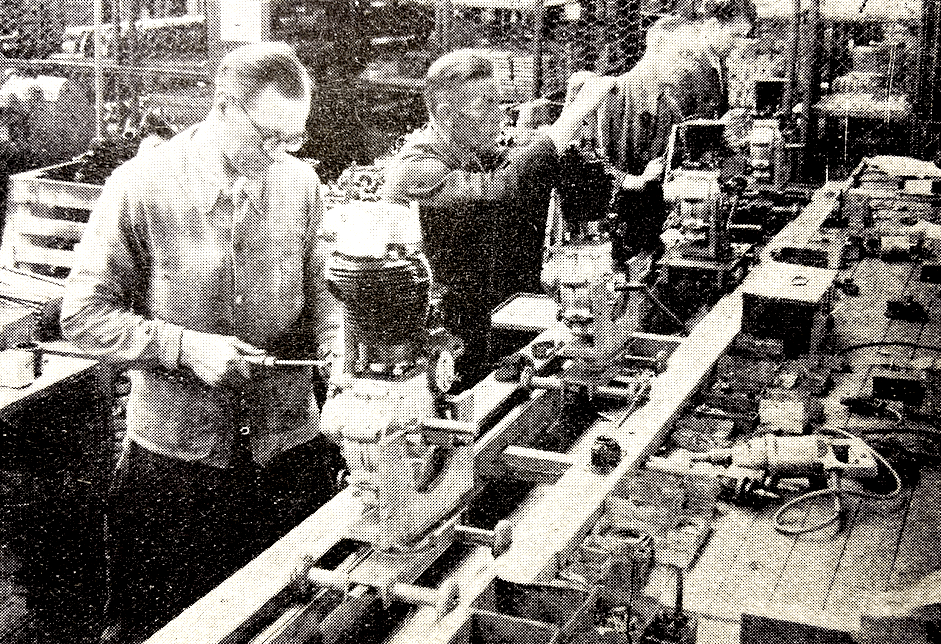
such as DKW, NSU, and BMW, received government assistance. However, there is no doubt that factories were busy as the estimated 1939 output of 200,000 motor cycles and 129,000 autocycles indicates. Throughout the Report the high standard of the equipment in the factories is repeatedly commented upon. In its general remarks on the tour the Mission says, ‘The factories were well equipped, practically all machine tools inspected being modern and of the latest type—it is estimated that very few of the-machine tools seen would be more than ten years old. Belt-driven machines and line shafting were practically non-existent. The machinery, was, as an average, considerably more modern than that in an average similar factory in Great Britain.’ On the subject of research and development the Report says, ‘There appears to have been close co-operation between the industry and the universities, and a considerable amount of technical research work had been carried out by the universities. Every firm visited had a properly equipped research department and one particular firm—NSU—had research facilities much larger and better equipped than any known in the motor cycle industry in Great Britain.’ Nearly all factories had apprentice schools which the Report maintains were larger and better equipped than the average school in similar-size British factories. It seemed to be the recognised thing that all factories, small or large, should maintain an apprentice school through which all boys entering the factory should pass. There was,
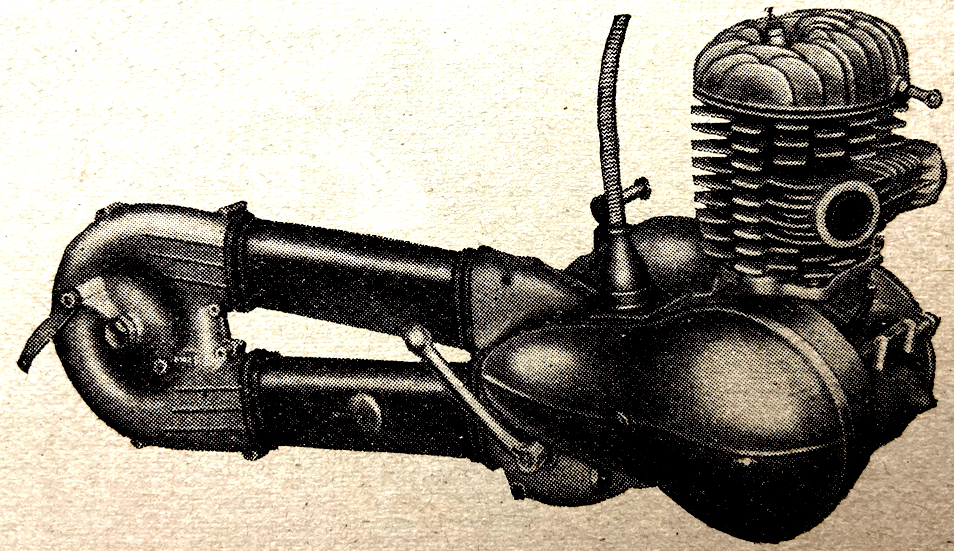
however, a scheme for government financial assistance. POINTS FROM THE REPORT: Very few special, single-purpose machine tools were observed. Modern though the plants were, they comprised, in the main, good general-purpose machine tools• • • With one exception, the chief directors were technical men• • • An outstanding feature, in the Technical Mission’s eyes, was the high degree of standardisation achieved by the motor cycle industry• • • Except for the 250cc Triumph (TWN), all two-strokes were lubricated on the petroil system • • • The DKW was the standard by which all two-stroke engines were judged • • • Only on one type of machine was a separate gear box employed. • • • The Technical Mission was impressed by what it terms the ‘eye appeal’ of German designs. • • • Only the BMW and the more expensive Zündapps had shaft drive. • • • The nine main motor cycle manufacturers, the majority of whom fitted proprietary engines, had a combined production capacity pre-war of about 200,000 machines a year. Forty-one firms made autocycles and, between them, had a capacity of 129,000 a year. • • • The
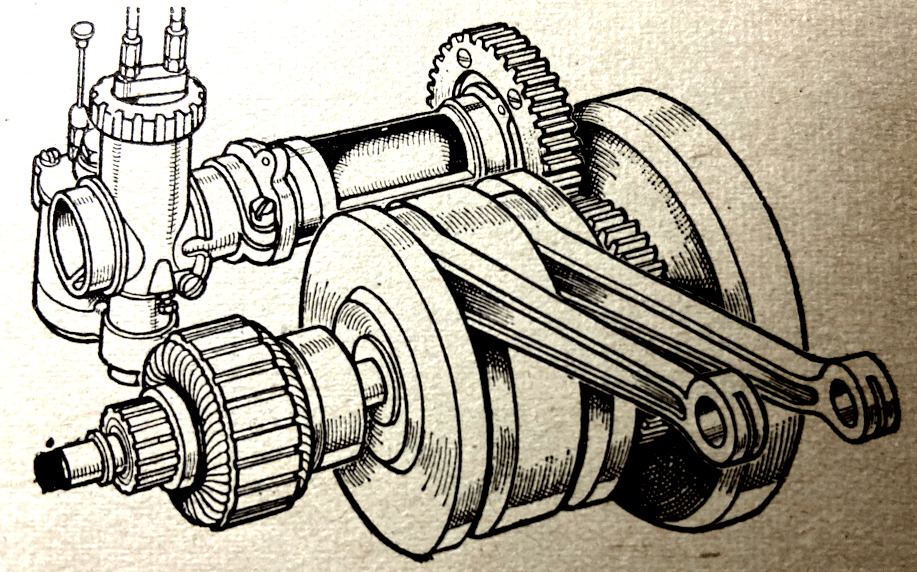
Mission reports: ‘In general, we should judge that the “average” German motor cycle was of a rather cleaner and more pleasing appearance than the average British motor cycle, although some rather striking improvements have now been made in our own industry.’ It perceives the work of artists in the general lines of German machines. • • • The Schnürle patent refers to “transfer passages opening into the cylinder at both ends of the exhaust ports, and at about the same height, in such a manner that the mixture rises up the side of the cylinder opposite the exhaust ports, the transfer passages at their entrance into the cylinder being directed obliquely upwards…The mixtures currently meet at the cylinder wall and rise up together. • • • Commenting on the 250cc two-piston Triumph two-stroke, the Mission remarks: “In view of the poor balance, due to two long and heavy pistons and large-diameter gudgeon-pins, the complication hardly seems justified.” A speed of approximately 60mph with the rider sitting up is quoted. • • • Zündapps, in 1936, decided to make a 1,000cc four with a Roots-type blower for an attempt on the world’s maximum speed record. Parts were made, but the engine never assembled. Dr. Popp says, “If possible, work on this motor will be picked up again.” • • • Bosch had a very small selenium rectifier for their 25-watt flywheel magneto which fitted in the head lamp. • • • The German export -bounty system
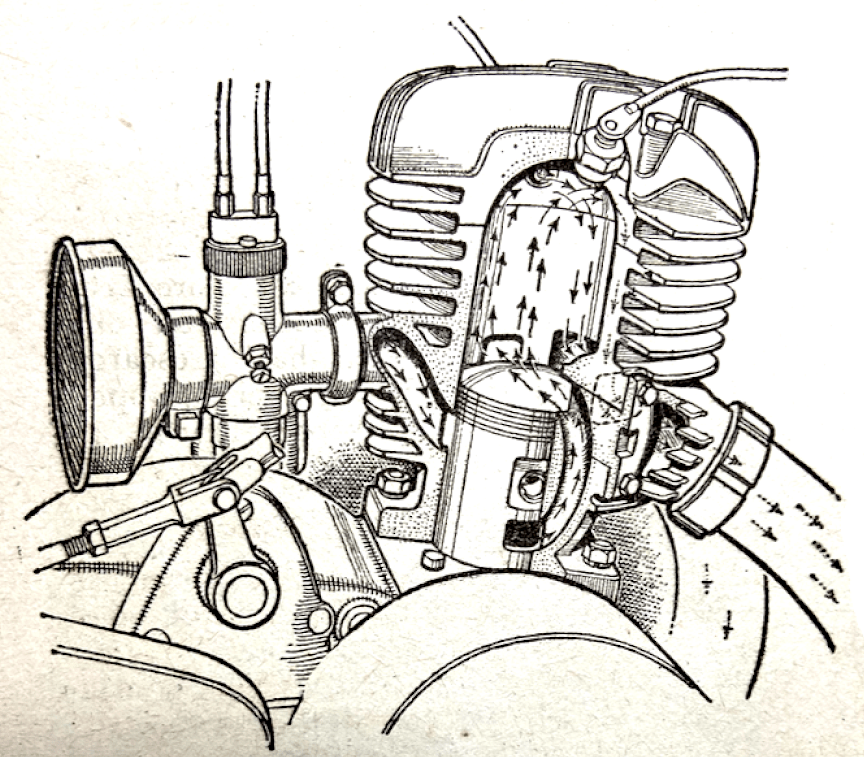
(which enabled 97.5cc DKWs to be imported into India at £10) involved every German business—even butchers contributed 2% of the annual gross sales turnover. This export fund was administered by the Government Economics Department. • • • The motor cycle production estimated for 1939 was: DKW, 60,000; NSU, 38,000; Zündapp, 25,000; Püch, 21,000; BMW, 18,000; Triumph and Victoria, 12,000 each; Ardie, 8,000; Hercules, 6,000. These figures are exclusive of autocycles. • • • In order that the German motor and associated industries should be of the fullest possible use in the time of a national emergency, in 1938 General von Schell (later General) was appointed “Plenipotentiary for Automobilism”. He reduced the number of types of motor cycle from 150 to 30 and, n example, electric horns from 25 to 1!• • • The best manufacturing methods seen at the factories visited were those of Triumph Werke, Nürnberg. • • • Reporting on the Adler works, the Mission states: “All plating consisted of a first coat of copper, this being the general practice throughout Germany. 0.002mm copper, 40-42min; 0.025mm nickel, 39min; 0.002mm chrome, 6-8min.” It is remarked that the opinion held generally in Germany is that “the English method of nickel and chrome coats only is insufficient.” • • • At the NSU factory research had been carried out on fuel injection. A normal single-cylinder engine with electrical ignition was used. Apparently the system employed an electrically controlled injector with air pressure to feed fuel direct into the cylinder head. The research engineers claimed that results so far had shown a 10% saving on four-stroke engine fuel consumption and a 25% saving on two-strokes. The Mission thought it was a complicated and expensive way to tackle fuel economy.'”
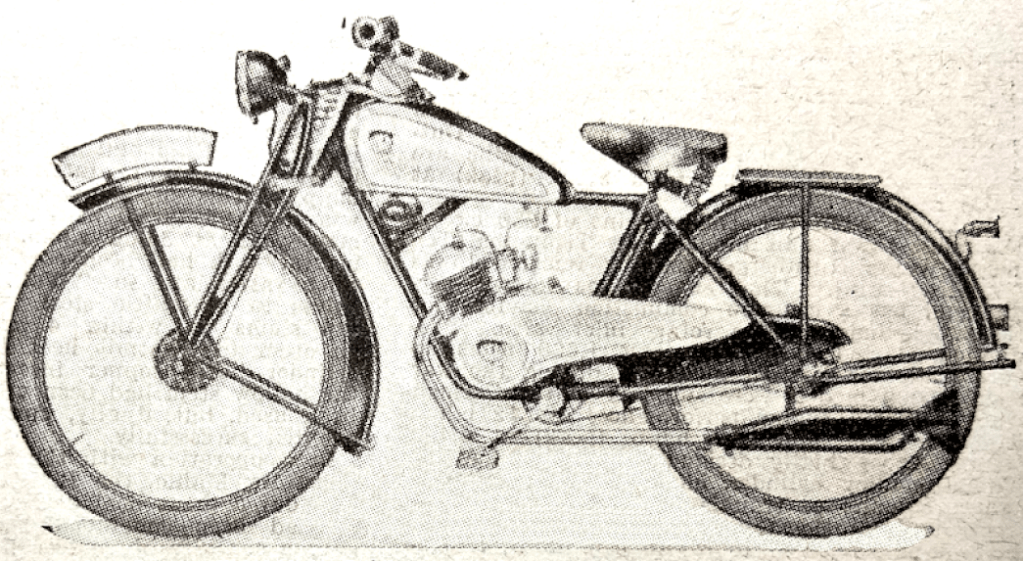
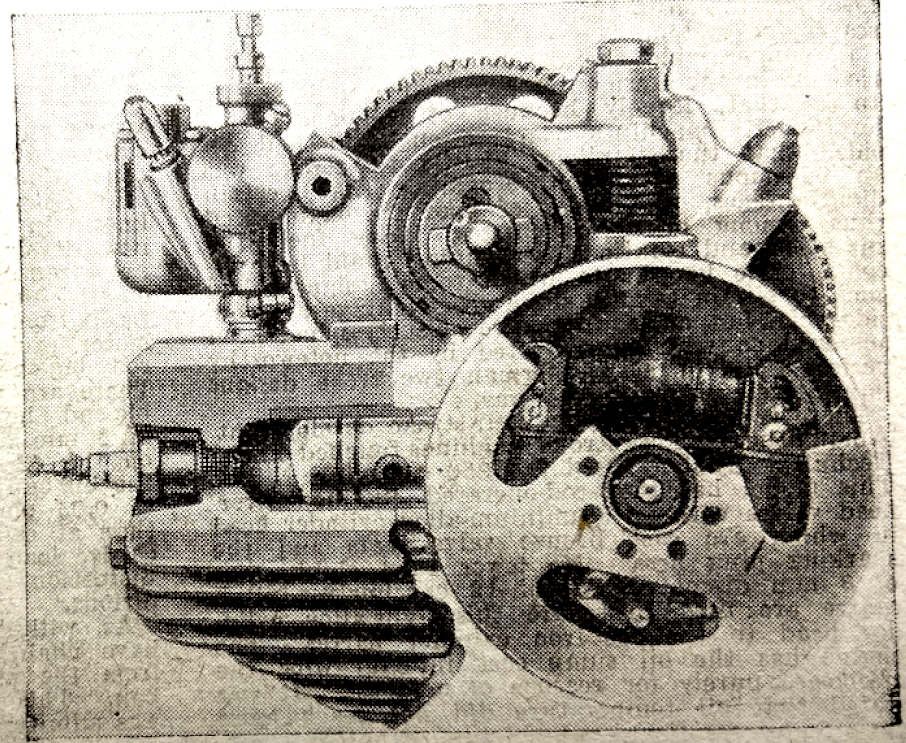
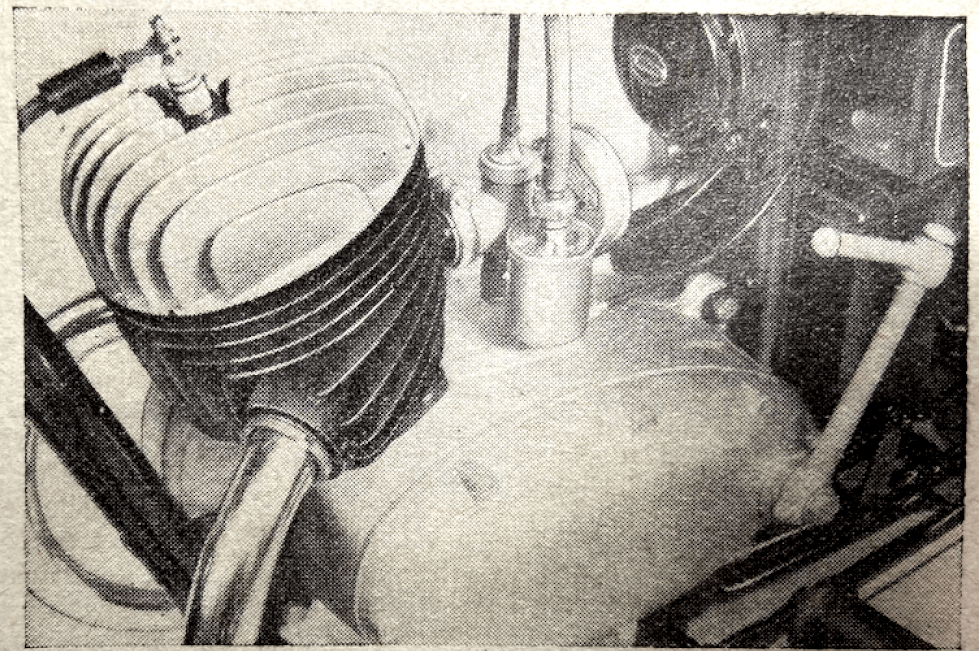
INTERESTING, THOUGH HARDLY unknown, facts are disclosed in the report The German Motor Cycle Industry, published last weekend. It is not news to British motor cyclists that Germany developed the two-stroke engine to a very high degree of efficiency, and it was widely appreciated pre-war that German research, equipment and works apprenticeship methods had reached a high level. In general, therefore, the Report serves as a salutary reminder, perhaps a form of warning. Up to a few years before the war British machines were supreme in the world, brit latterly this supremacy was seriously challenged in both enterprise of design and in results achieved on recognised proving grounds. In no small measure the upwards climb of German progress was due to extensive research, up-to-date manufacturing methods and ample skilled labour, though it must not be forgotten that the advanced type designs were never low-priced. That the Technical Mission responsible for the Report uncovered no specific details of development beyond that already known in this country is not surprising. No factory visit lasted longer than two days and at some targets only half a day was spent. A high-speed tour of this nature does not conduce to the investigation of involved technical information and under the conditions thus imposed the British Team did excellent work. But there is every reason to suggest that efforts should be made to have closer investigations made. In the last Appendix of the Report appears the comment in relation to a clutch friction material: ‘It would be interesting to know what this material is, and what coefficient of friction is obtained, and also whether it is affected by oil.’ Similar comments appear elsewhere in the Report and are as an aperitif to a hungry man.”
“NUMEROUS IMPROVEMENTS HAVE been made in Matchless and AJS motor cycles. Some of these result from a ‘suggestions’ book which JM (Jock) West, the AMC sales manager, keeps, a book in which are jotted down notes of points that seem to call for improvement. To cite a small example, the oil bath primary chain cases now have a longer screw in the band which holds the halves together. It was found that the rubber sealing washer is liable to expand after use and that as a result, an owner might have trouble in refitting the band. Simple as this change is, it forms a good instance of the attention to detail that is being made a rule at the Associated Motor Cycles factory. Perhaps the most important change for 1947 is in regard to the now famous Teledraulic front forks. These have new springs, so wound as to provide three different rates…The springs afford a soft, easy movement at initial deflection of the forks and offer increasing resistance with increased fork travel. Buffer springs have been incorporated to reduce the
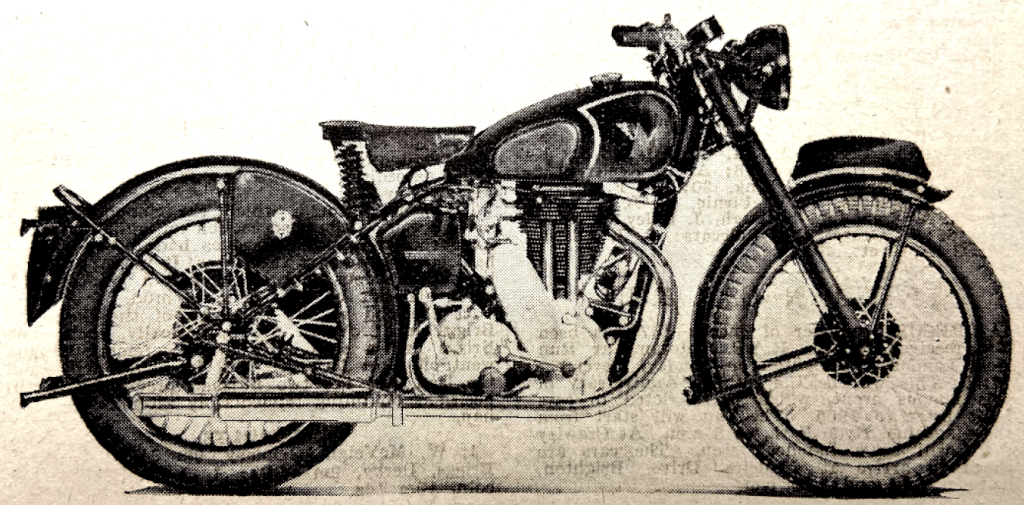
fall of the wheel. These have permitted the front brake cable to be shortened 3¼in and, therefore, a neater arrangement of the cable, which now has a guide on the near-side fork blade. Chromium-plated wheel rims and handlebars have been standardised, and the Matchless models now have a chromium-plated winged ‘M’ on the sides of the tank. The rims have black ‘centres’ lined in silver in the case of the Matchless and gold on the AJS. All wheel spokes are cadmium plated. An ‘extra’ which will interest many is the combination, of pillion seat and carrier which is available at a total price for the two of £2 11s 11d. Incidentally, the lifting handle on all models is now integral with the mudguard stays, a much neater arrangement. A point which the factory makes in regard to the finish of the Matchless and AJS motor cycles is that the durability of enamel is proportional to the stoving temperature and no stove enamel allows the employment of so high a baking temperature as does black. What is especially pleasing about
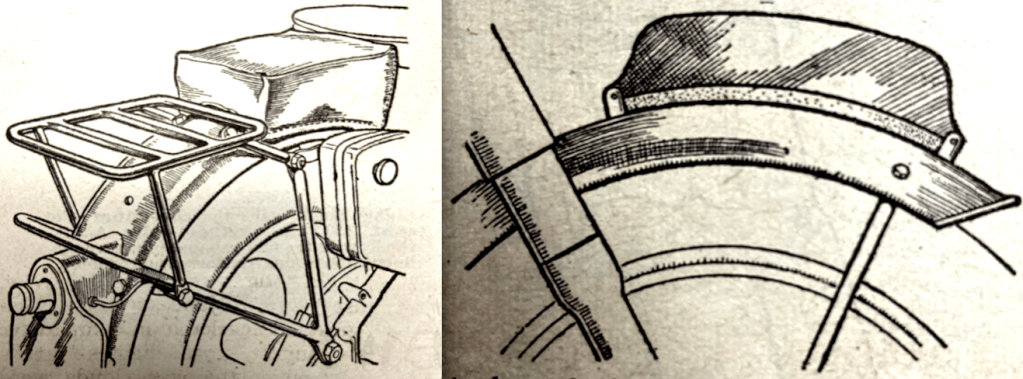
the latest productions is the exceptionally high quality of the finish. All enamelled parts have three coats of Pinchin Johnson’s best black enamel on a rustproof Bonderized base. An example of the trouble taken to secure a good finish is that the footrests are buffed previous to being enamelled. A limited number of competition models, both Matchless and AJS, is being manufactured. The factory insists on knowing the name and past competition record of the prospective purchaser of one of these machines. The underlying reason is that otherwise some might find their way into the hands of ordinary road users and, the number of machines being limited, various good trials riders might possibly have to go without. Conditions permitting, there will also be for 1947 a single-cylinder 350cc racing model. Except for chain drive to the overhead camshaft, the engine and whole machine will bear no resemblance to the pre-war racing AJSs. Rear springing? The Works’ comment is that in these days rear-wheel springing is a fairly obvious requirement in a racing machine!”
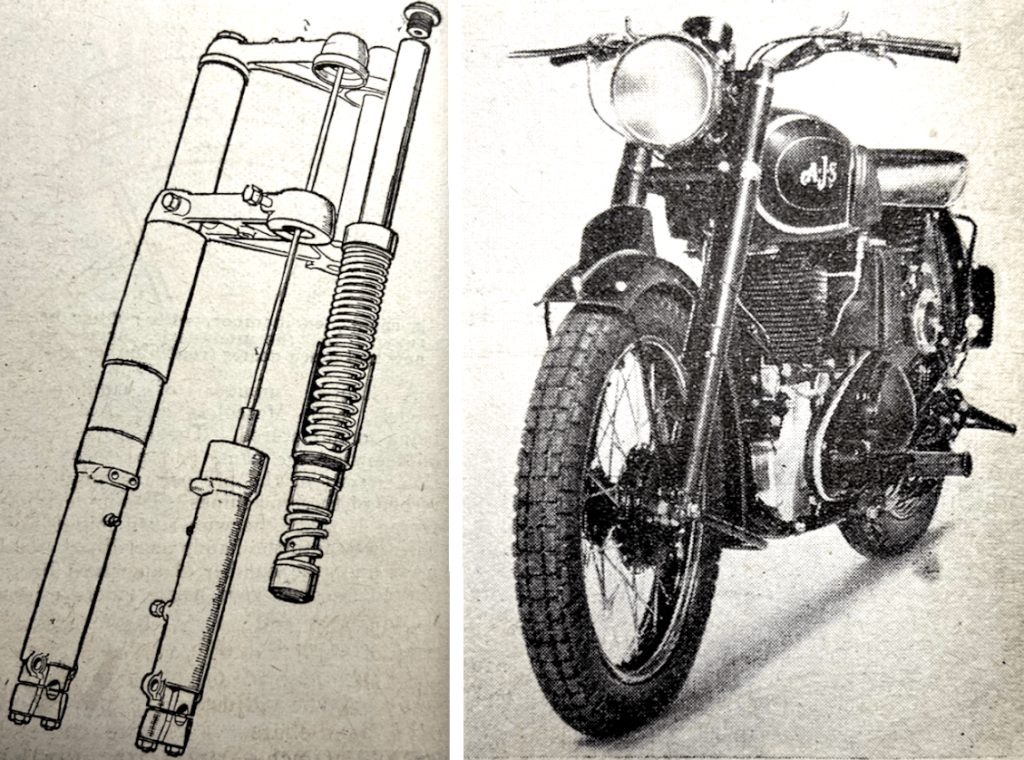
“‘SOME PUT THEIR TRUST in chariots, and some in horses’—so sang King David in the twentieth Psalm perhaps 3,000 years ago, and I mention it just to show that the love of the road (or its ancient Eastern equivalent), which we look upon as a comparatively modern cult, is in reality one of the earliest forms of enthusiasm on earth. Possibly the one earlier enthusiasm connected with locomotion is that of sailing, for it will be recalled that Noah fell for this particular pastime rather pronouncedly. But seriously, is there anything in modern life more intoxicating (in a strictly underproof sense) than being astride a lively machine, with 12 hours and the open road in front of one, and—since I write of the halycon days of peace and plenty, shortly to hold good again—any number of petrol stations available wherein can be purchased an unlimited supply of the essential juice? Add to this the attractions of blue skies, refreshing breezes and open country, and it is not surprising that there are some half-a-million of discerning folk who ‘put their trust in motor cycles’.”
“HE PAUSED ABREAST of me while the traffic light was red. Catching my eye on his headgear, he explained. It did make him look rather like a Cossack, didn’t it? But it was the goods for motor cycling this weather. He was an ex-merchant seaman from the Murmansk convoys, where he had traded his cheap fountain pen for a fur cap. And 100% waterproof, too! Who said that motor cyclists are too shy to wear unconventional garments?”
“‘HOW ARE WE DOING?’ is an expression frequently on the lips of Antelope MCC officials. It is a measure of the enterprising atmosphere last Sunday when the club staged its first road race meeting at Ansty Airfield, near Coventry. The reply was invariably, and rightly, ‘Fine,’ or ‘Jolly well,’ or ‘Grand.’ This comparatively new club —it was formed as a development from Home Guard motor cycle activities less than two years ago—had had the courage to run an ambitious airfield meeting at a time of year considered past the end of the racing season and when the weather might well ruin the show. The meeting was a noteworthy success. There were 140 entries, and spectators in their thousands. The circuit was one of the best, if not the best, yet found on an airfield. The racing was first-class, and in spite of a patchy wet surface there were no spills worth mentioning. In eleven separate races riders had a full afternoon’s sport
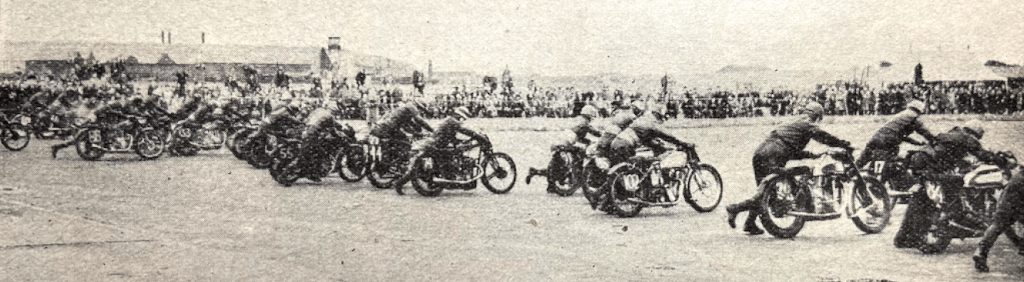
organised in commendably slick fashion, and spectators could walk all round the outside barrier of the circuit to see the racing at any point they wished. The only mishap was a public address system which functioned sporadically as a result, no doubt, of heavy overnight rain. A circuit roughly D-shape had been selected. The principal runway, used as the straight, is 1,300 yards long, with the starting line about half-way. At the end is a slow, almost-hairpin turn to the right, then a right-angle left bend, followed by four easy right-hand curves and a right-angle corner to join the straight. The first two of the easy curves could be taken in one graceful sweep at very high speed—almost full throttle in third gear on even the faster machines—and it was this merit which endeared the l¾-mile circuit to so many riders and spectators. The width of the roads permitted riders to pass comfortably, and the surface, part concrete and part tarmac, gave surprisingly good wheelgrip even when damp, as Harold Daniell’s lap of over 78mph indicates. Heavy rain had fallen the previous evening and night, and the roads were in very wet condition for the two hours of practising before the start of the meeting. Nevertheless, there were some noticeably zestful laps put in during practice, and the resulting cacophony must have been a good match for the best (or worst) phons
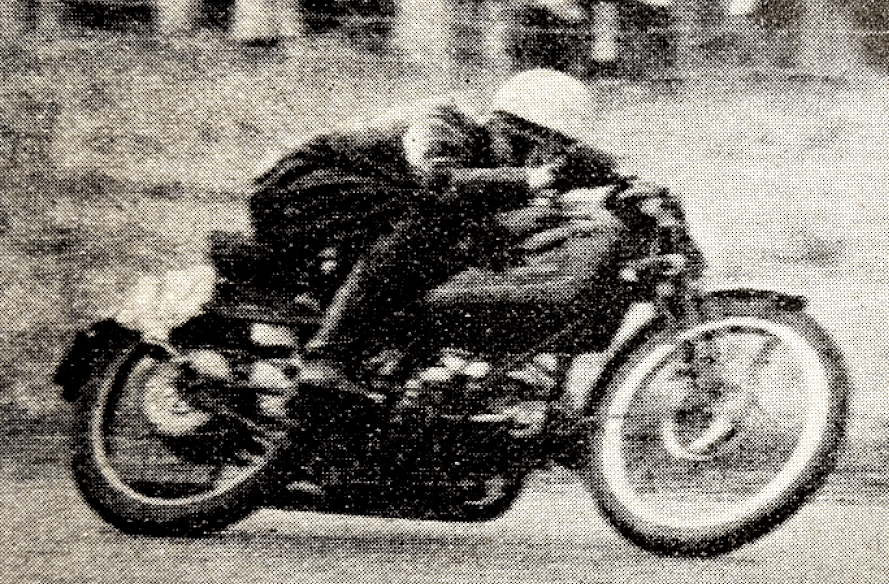
emitted by aircraft when the runways were being used during war. Damp and mud bespattered after practice laps, nearly 30 riders came to the line for the opening race, Heat 1 of the 500cc class. The entry list included two riders from France, one from Belgium, and one from Holland; and, riding in this heat, Piet Knijnenburg (BMW) was one of the first away with Peter Goodman (348 Velocette) hard on his heels. There were four sluggish starters—EE Briggs (Norton), EA Barrett (350 Norton), RF Seymour (Norton), and AR Foster (Norton). The long straight is undulating, and the mild incline from the starting line troubled those unfortunates with refractory engines, as almost every race was to show. First time round G Brawn, of Cadwell Park fame, had a short lead over the Dutchman and Goodman, with WS Humphrey on a 350 Norton and AF Wheeler on a 350 Velocette not far away. Thus early, three 350cc models held third, fourth and fifth places. Brown was riding in convincing fashion. Without appearing to hurry unduly, he was drawing away from Knijnenburg. By five laps—half-way—Brown had a clear 150-yard lead and Goodman was a rather greater distance behind the BMW. Then came Humphrey and FP Heath (348 Norton). Meanwhile, AR Foster (Norton) was pulling up places and many of the slower men were being lapped by the leaders. Foster overtook Goodman, but did not get within striking distance of Knijnenburg, who was 2sec behind Brown. But there was no reason for the leaders to hurry unduly, because the first eight men were eligible for the final. In Heat 2, TL Wood (348 Velocette) did what everyone now expects him to do—he streaked off the mark and was changing up before many people were in the saddle. The French rider
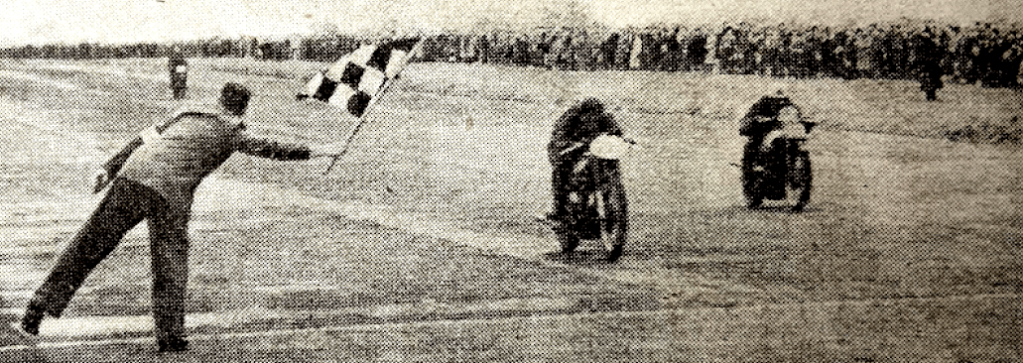
Georges Houel (348 Velocette) started tardily, and E Andrew (348 Norton) arrived at the line late when the field was about 200 yards away. PH Hylton (Norton) held the lead till the fifth lap, when he was passed by C Beischer (Norton), who remained in front to the finish. Behind these two riders, R Tolley (Ariel) and Wood were having a stirring battle, which HWG Ditchburn on an ex-Jock West Hartley Ariel, joined near the end and in time to displace Wood from fourth place.No fewer than six riders, including HL Daniell, were left on the line in Heat 3, which WL Dawson (DKW), JM Crow (Norton) and R Wise, on his JAP-engined Royal Enfield, dominated in the early stages. When the race had settled down it could be seen that ST Barnett (Norton) and Daniell were coming along rapidly, with VH Willoughby on his 350 Velocette making some of the five-hundreds appear slow. Wise retired on the sixth lap when in the lead, and thereafter Crow was the undisputed winner. Barnett was second and Willoughby third. Daniell, who had been gaining about 2sec a lap on the leading men, was content to ease off towards the end and finish fourth. The first heat of the 250cc class gave Fergus Anderson an opportunity to show the paces of his Guzzi. He led from the first lap to the end. In so doing, he made the best 250 time and won the event…”
“AMONG THE COMPENSATIONS for an exile in Belgium are couponless petrol and food rationing which is so lax that it might just as well not exist. To a motor cyclist these compensations are great. He can go where-ever he likes whenever he likes—and can be sure of good meals when he gets there. The other day I set off from the seat of my exile—Courtrai, in West Flanders—on my 350cc Ariel acquired from the British Disposals Commission (Great Missenden to you). The Ariel is a grand little machine; and, though I don’t suppose I shall ever meet him, I shall always think kindly of its last owner, some RAF DR, for giving it the care he did. Should he read this article he will recognise his former mount when I say that it had its name—’Joy’—tastefully painted on the head lamp mask. I headed northwards towards the sea, but this was to be more than a trip to the seaside. It was to be a voyage of rediscovery. I proposed to retrace mile by mile the route I had taken in 1940, when, hastily recruited with several other DRs from my regiment, I had been attached to the staff of General Montgomery, at that time commanding the Third Division. Our job was to ease the precipitate retreat of the Division, from the area of Lille to the beaches of Dunkirk. I joined my old route just outside Ypres, on the Poperinghe road. It was an insignificant cross-roads at which I had been posted with instructions to send the vehicles of the 8th Brigade straight on and those of the 9th Brigade to the left. The route from this point led down narrow country lanes for several miles. These had been chosen rather than the main roads for the retreat in order to escape the air strafing. The surface was bad, but the countryside was pleasant. It is only by keeping to the main roads in Flanders that you are left with an impression of ugliness. Once into the byways and the whole scene changes. No more straight-backed, narrow houses in glaring red and yellow bricks, their bare walls plastered with advertisements. Here there are rambling old farmhouses in mellowed brick nestling in their poplar spinneys; lush fields of barley, flax and clover; wide meadows and grazing cattle. Soon I rejoined the main road to the coast. I passed through Oostvleteren, where Monty had for a short while established his headquarters. A colleague and I had been sent off on a job from here five minutes before it was heavily shelled. I heard afterwards that several of the staff had been either killed or wounded. Perhaps it had just been a coincidence that the HQ had been shelled so soon after being established. On to the pleasant old town of Furnes, where I was served with an excellent lunch in a café overlooking the Grande Place. Furnes at the time of Dunkirk was on the edge of the perimeter, and some very heavy fighting took place in and around it. To-day it was quiet and peaceful, slumbering in the June sunshine. From here I started off on the last lap of my pilgrimage—to the little hollow in the dunes where Montgomery had established his last headquarters and where he had personally ordered me back to my regiment (who were now gunners turned infantry, and defending the eastern flank of the beach-head). I tried to find the two sandhills rising out of the flat meadows near Ostdunkerque. That is, to most people they would have been just two sandhills; to me, and perhaps a hundred others, they were Fort Henderson and Fort Kennedy. After a long search I found them. They lay, as I had remembered them, at the end of a long gassy track, with an old Flemish fisherman’s cottage hard by. Two wide-eyed Belgian children watched me skid across the sand and park my machine. I climbed to the modest summit of Fort Kennedy and looked around. I’m not sure what it was I expected to find, but
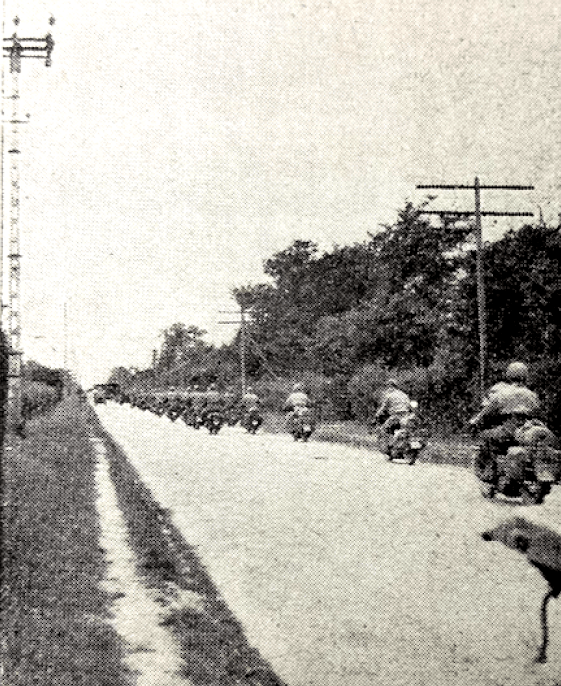
there was nothing there. The flimsy fortifications we had dug in the sand so hurriedly, crudely revetted with old doors and brushwood, would have collapsed readily of their own accord without any encouragement from the Germans. Six years of wind and rain and shifting sand had long since covered the last traces of our efforts. The position had never been defended. On the evening of May 30th we had received orders to abandon our trenches and to make our way down to the beach at La Panne to await evacuation. Starting up the Ariel, I slowly retraced the route we had taken that night; through Coxyde, which had been filled with the stench of cordite from German shelling ; then along the coast road to the little cul-de-sac where I had drained off the oil from the BSA and revved her till she seized. On the beach, where we had crouched for hours that night with an occasional shell spreading death and mutilation among the packed troops, I lay and basked in the sunshine. I opened my eyes, half expecting to see the grey lines of a destroyer standing off the shore, or the squat shape of a London tug, or to see the sea covered with Naval lifeboats coolly ferrying the troops to the waiting craft. But the sea was empty except for a smudge of smoke in the distance which marked the Channel Ferry steaming into Ostend on her daily trip from Folkestone. I got up, shook the sand from my hair, and walked back to set the Ariel on the road to Courtrai.” —’Exile‘
“AS AN EX-DON R—even if only WRNS brand—I was very interested in the number of British motor cycles I saw everywhere in Switzerland. Though nearly all old models, they competed on the stiffest roads with their more modern foreign cousins. On a Sunday morning I saw an Ariel, a Norton, an AJS and a BSA all pass in about ten minutes. Remembering the garments we British riders usually wear, it amused me a lot to see how the optimistic Swiss nearly all sported white coats. But the funniest thing was the distance fixed between the saddle and ‘flapper-bracket’. The reason given us for such an awkward-looking arrangement was that the very ‘proper’ Swiss could not allow too close proximity for the female passenger—it wasn’t done!
(Miss) Jocosa Walters, Wallingford, Berks.”
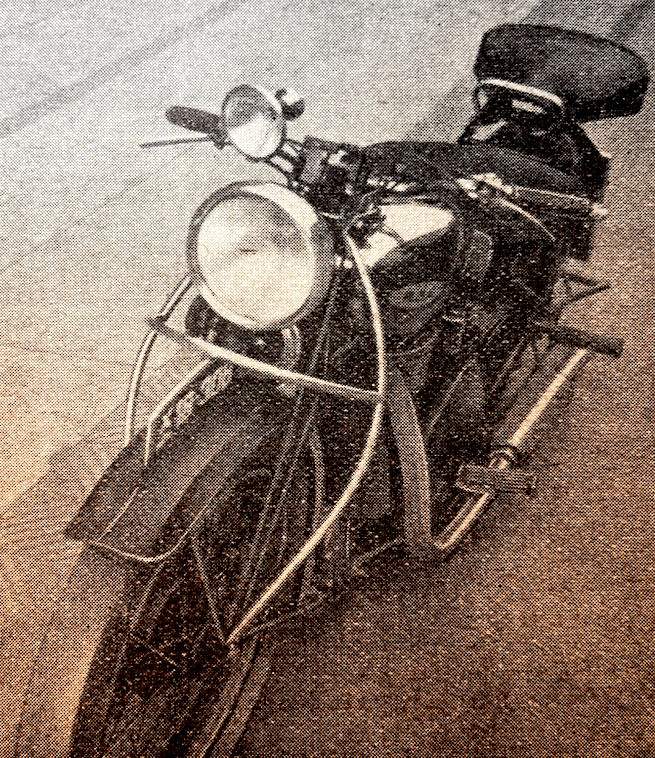
“REGARDING MR MUNDY’S remarks about women motor cyclists, I would say that the ladies of to-day are far more advanced mechanically than were their sisters of yesteryear. They have proved themselves remarkably confident on machines far larger and more powerful than a 500cc Norton—for example, farm tractors, huge lorries, launches, etc. Incidentally, can we not dispel this stupid bogy of the ‘big bike’? Many people seem terrified of a 500cc job, and then, having tried one out, wonder what all their fright and panic was due to! Regarding the ladies’ dress, has Mr Mundy ever noticed that a man with helmet, Stormgard, waders, legshields, windscreen and lashings of gadgets is usually mounted on a 150cc buzz-box? I say, leave it to the girls; if they wear garments that are not practical now, they will soon learn that it doesn’t pay, and then we can trust them to do what is necessary!—We must remember that we are no longer the super-beings. I’ve even had the ladies arguing the toss over the old question of ‘Does a piston stop?’ ‘Nuff said!
Tony Dock, Barnehurst, Kent.”
“READING THE OCTOBER newsletter from the Canadian Motorcycle Association, which corresponds approximately to our ACU, I found several points of interest. First, what picturesque names they have coined for many of their clubs! Certainly we have no Riders of the Night, Blue Diamond Riders, Black Hawks, Royal City Rockets or Twin City Riders—to mention but a few. Of the eight fixtures lately ‘sanctioned’ by the CMA over a period of three weeks, five were for dirt tracks, two for trials (one of which was a pillion trial—which reminds me that I should like to see the Carshalton Pillion trial revived as soon as possible) and the last was for a hill-climb. As you see, the dirt track or speedway appears to predominate. The circuits are all of the half-mile type where pretty high speeds are possible, and the circuit at New Hamburg is stated to be ‘the fastest track in Ontario’. Good wishes to our Canadian friends.”
“BEFORE THE WAR I had a motor cycle. Now I haven’t one any more—the Huns took it from my home in Alsace. But I’m still an enthusiast, and though a reader of the Blue ‘Un since only eight months ago (when I ‘discovered’ it) I’m now a devoted reader of your excellent paper. I agree with Torrens, Ixion, Nitor and the others on nearly everything they write. Perhaps I can interest them on some points. Pillions: In France we have what we call ‘tan-sads’ (presumably tandem-saddles), heavy and complicated saddles with springs, handlebars, and sometimes kneegrips. Quite comfortable, but—too high, set too aft, and giving no ‘feeling’ at all to the passenger of the driver’s intentions. So the passenger can achieve some quite effective ‘back-seat driving’, which can be very dangerous, especially if he is not a rider himself. Besides, it is difficult for him to cope with acceleration and braking. The British-type pillion (called in France, coussin de course, ie, racing cushion) you will see only on some ultra-sports mounts. It is good from the road-holding point of view, but can it be said to be really comfortable? I think the Dualseat, with adjustable springing, is the correct answer to nearly all criticisms (besides, it still allows panniers and carriers of any size to be fitted, which is sometimes a capital point). Mirrors: In France all motor cycles, even 100cc, must have a mirror. The usual mirror is circular, mounted on a ten-inch arm or so, and rather awkward, unless you set it so that you can see rearward between your elbow and your body. But more and more manufacturers fit a very small mirror right at the end of the left handlebar (that should be the right one in England) with almost no arm at all (one inch at most). This tiny mirror does not come in the way, does not increase the width of the model appreciably, and, if, perhaps, not exceedingly effective, is at least not dangerous. But, of course, even in a car, the best way surely is to screw one’s neck a little if you want to make absolutely sure that there is nothing behind you. Prop-stands: I think no model should be without one. Our manufacturers nearly all fit central stands now, but with a 350 or bigger, I think the new BSA
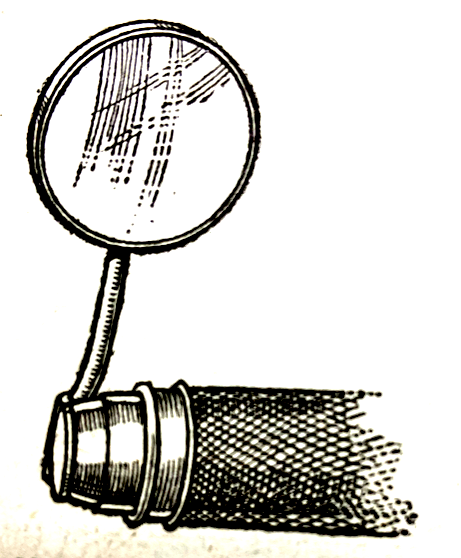
stand is the best, especially if, in the ‘high’ position, it allows one to tilt the model fore and aft, thereby allowing us to discard the front stand (which is unsprung weight). Concluding this all-too-long letter, have you ever heard of a solo rider losing his back wheel en route after breaking the spindle (it was a quickly detachable wheel)? I saw it happen to a friend of mine whom I was following. He was riding a 750cc flat-twin Gnôme-Rhône at about 40mph. The wheel opened the hinged rear mudguard, passed him, and he came to a stop safely without damaging anything (the frame is, on this machine, of pressed sheet-iron, and neither brake drum nor rear sprocket touched the ground). I rode to the nearest town to get a new spindle, while he hunted through a cornfield for the independently minded wheel. In an hour we rode again, he on his Gnôme; me on my faithful ohv 350 Jonghi. This bike, incidentally, had the quite unusual arrangement of a three-speed foot change without a selector. Talk about finding neutral! In winter, with very heavy boots, you had to be content with two speeds—bottom, and top. Footnote : What a pity we, in France, cannot afford to buy the marvellous mounts described and advertised in your paper. I sympathise with you, who find them expensive, but to buy a new model here, except perhaps a 125cc, is quite out of the question for nearly everybody.
Dismounted Frog, Lyon, Rhône, France.”
“WE HAVE HAD a good laugh in the office. It seems that on the way to the Southern Trial the previous Saturday ‘Torrens’ was forging ahead in the direction of Farnham—was climbing the long incline on the Hog’s Back side of the Guildford By-pass—when he heard the sound of another motor cycle coming up astern. ‘Ah!’ he mused. ‘A motor bicyclist is about to dust me up,’ and, without turning round or anything else to betray that he knew what was happening in rear, sent the Four surging forward from 55mph to something around 75mph. The noise of the other motor cycle receded. Later, ‘T’, knowing his pistons and cylinder block were still on the new side, throttled back to about 60. Again there was noise of a motor cycle. Torrens, without looking back, gave the wave-on signal, and a moment later was confronted by a grinning member of the Staff on a Norton. It was EA Sitwell. Dog eating dog…”
“MR A LEWIS’S REMARKS regarding the early demise of the Ascot Pullin (it ‘did not appeal to motor-cyclists’) are somewhat inconclusive and at the same time jump to the seemingly obvious, for it is apparent he does not know the facts. As a one-time member of the staff of the makers of the machine in question, I can say with certainty that the fault was in the eagerness of the company to get the machine on show to the public at Olympia, whereas another 12 months’ trial and testing of the prototypes was necessary before the machines were fit to be sold. Orders for many hundreds were received, but with so many set-backs and failures it was impossible to produce but one or two good jobs—and believe me, they were the ‘goods’.
CH Franklin, Bexleyheath, Kent.”
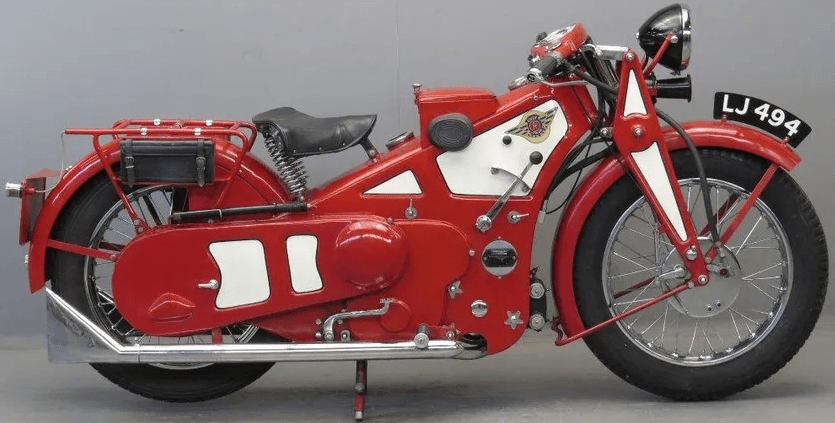
“NOW that so many demobilised men are thinking of buying motor cycles, and naturally want the best value for their money, I feel that I should like to place on record for their benefit my experiences and appreciation as the owner of a BSA 4¼hp single-cylinder motor cycle and sidecar (Engine No 466, Frame No R574) which I purchased after ‘Our War’, namely, in 1921, when I too wanted value for my money. I got it. Now, after 25 years’ of faithful service, the sturdy old bus is still hale and hearty, purring away along the hilly roads around the Malverns, and, as always, giving me every satisfaction. It is not just a fine-weather bus, either. I use it in the course of my work daily in winter and summer, and also for pleasure. I cannot give you the mileage, as I have lost count of the very many thousands of miles of road that it has covered. The maintenance expenses have been surprisingly light. I have serviced the machine myself mostly, only having adjustments, etc, made at a garage when I could not do them myself. Now, to celebrate the start of the second 25 years’ service, I am taking my wife to the South Coast and, as usual, our transport will be ‘Old Faithful’.
Charles C Williams, Great Malvern, Worcs.”
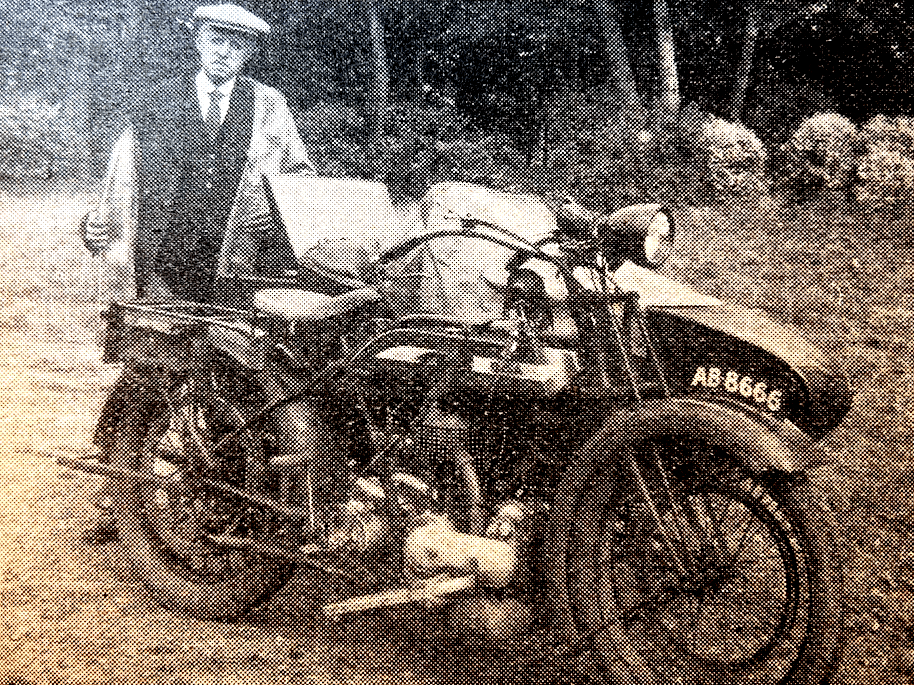
“SOME MONTHS AGO (April 4th last, to be exact), Ixion wrote a paragraph on the possibilities of motor cycle clubs ‘mating up’ with other organisations in order to gain the advantages and amenities of a club house, community centres, and so forth . You may be interested in one which has been in successful operation for many years—the Pioneer Amateur Sports Club, to which this club s affiliated. There is one important difference, however—that instead of a motor cycle club being taken under the wing of a larger group of allied sports, the boot, in this case, was on the other foot, in that the motor cycle club was the organisation which owned the dub rooms and other facilities, and many other sporting bodies affiliated in order to gain the use of a central club house and other amenities required by them. This important step in the sporting set-up of our city was taken in 1934. The Pioneer Motor and Sports Club, as it was then, was reorganised as a central governing body, took all these other sports under its wing, and gave them the use of modern and almost freehold club rooms in which over 1,000 meetings of all kinds, as well as social gatherings and other activities, are held each year. The motor cycle interests of the club also became one of the affiliated organisations on the same footing as other sports, leaving the central organisation as the governing body—although by ‘government’ is merely meant the provision of the above-mentioned facilities and becoming a sports community centre. At the beginning of the war you put me in touch with Mr FW Pinhard of the Sunbeam MCC, and you may be interested to know that from this contact has sprung a very warm and continued correspondence friendship which has, I believe, been to our mutual advantage. With best wishes to yourself and your Staff, and our thanks for your very fine efforts during the difficult war years.
L Tullett, General Secretary, Pioneer MC, New Zealand.”
“I AGREE WITH ‘NITOR’, of course, that the ideal pillion girl never ‘clutches’ at one. It is both perilous and embarrassing if one’s fairy gets the wind up and loses her head. My experience is that a fully reliable pillion girl is one of Nature’s rarest creations. Practically all of them are a menace during their ‘prentice days, for which they can perhaps hardly be blamed. But the really formidable specimen is the type who behaves quite normally as soon as she realises that her boy friend is trustworthy, but goes all temperamental without warning in her first tight corner on the road. I don’t suppose, there is any remedy—except, of course, to switch to a new girl. My present perch occupant is terrified of mice, but has the courage of a lion when a three-ton truck comes at us head on. An odd sex, my masters! (Come to think of it, I am not all that rational myself. I can enjoy 80 on the road, but I loathe moths!)”—Ixion
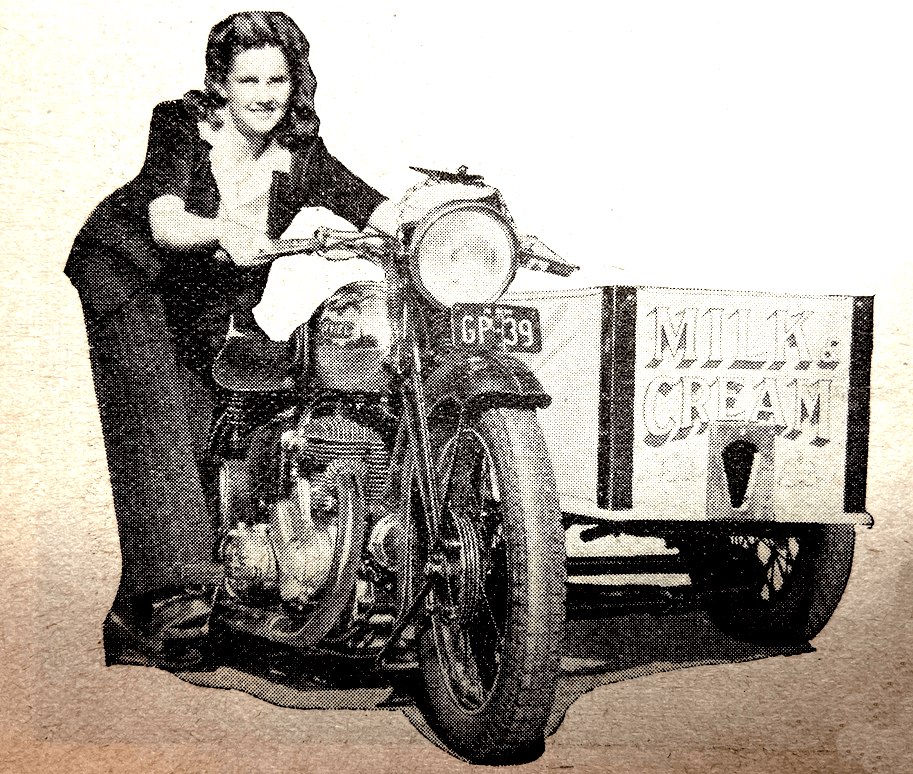
“TO SAVE FUEL, Veloce are now working a five-day week. On Saturdays, therefore, no correspondence can be dealt with, nor orders taken in or despatched. In general, Velocette owners are advised to order spares through their nearest Velocette agent, and not with the firm direct. This avoids delay.”
“BETWEEN MAY AND the end of October, 65,000 surplus vehicles, representing £6,000,000, were sold at auctions. Of these something over 5,000 (here the Ministry of Transport does not give an exact figure) were motor cycles. It seems, however, from other figures given by the Ministry, that 67,183 surplus motor cycles were disposed of through all channels (including auctions) up to the end of September.”
“AT MAY 31ST approximately 395,000 motor cycles were registered. This figure is well over double the figure for a year earlier, and compares very favourably with the 405,486 current licences on May 31st, 1939.”
“MAJOR HR WATLING, director of the British Cycle and Motor Cycle Manufacturers’ and Traders’ Union, says that the industry, in spite of controls and shortages of materials and labour, has already passed the export target that it was set of improving the value of its exports by at least 75% over pre-war. The industry was now playing ‘a most important part’ in the country’s export trade.”
“WOULD YOU LIKE to own an electric motor cycle? It may be recalled that The Motor Cycle imported a Socovel motor cycle from Belgium in the spring, a machine with a 2.6/1.2hp series motor and three 12 volt, 75 ampere-hour batteries. Our tests being complete, we are willing to dispose of the machine. The original cost, including import duty, purchase tax and shipping charges, was rather more than £150.”
“WITH SUNDRY NEW applications in mind, Mr Granville Bradshaw is increasing the capacity of his oil-cooled 90° V-twin engine [from 100cc] to 125cc.”
“ONE OF THE FAVOURITE sports of Californian motor cyclists is to go cow trailing. That is the name the enthusiasts give to long-distance rough-riding along the mountain tracks and dry, sandy river-beds. The photographs on this page show Ken Flanders and Dutch Steiner with their modified Matchless machines which, they say, are excellent for the job. In the manner of British trials riders, our American friends reduce the low-down overall width of their machines as much as possible; in their own words, ‘Foot pegs, starter pedals and foot-change levers have been made to fold or have been bent close to the motor for better clearance.’ But there is not a word of comment about those handlebars! Back in the ’30s, when curly bars became for a short while the fashion for trials work, I saw some peculiar bends, but never any so extravagant as some Americans use for their cow trailing.”
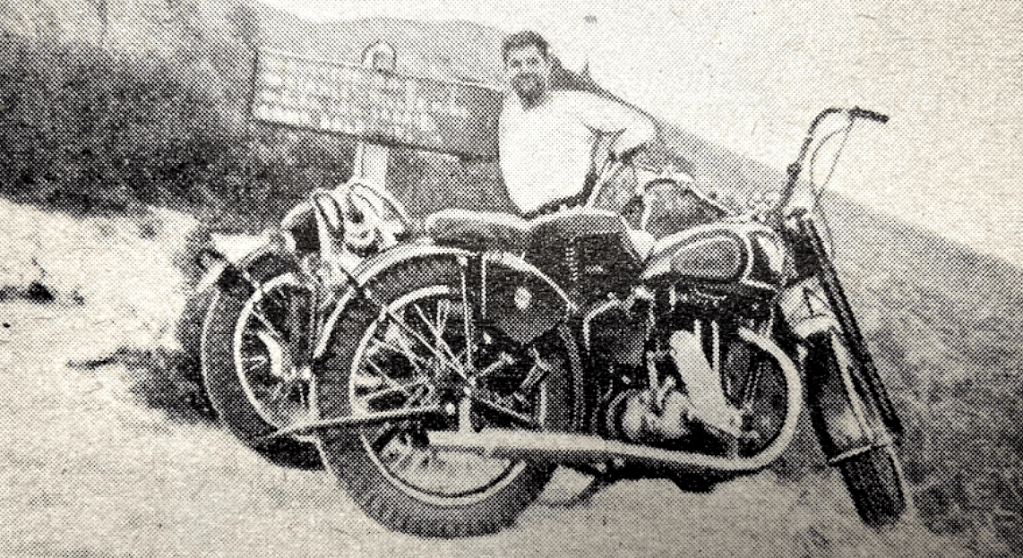
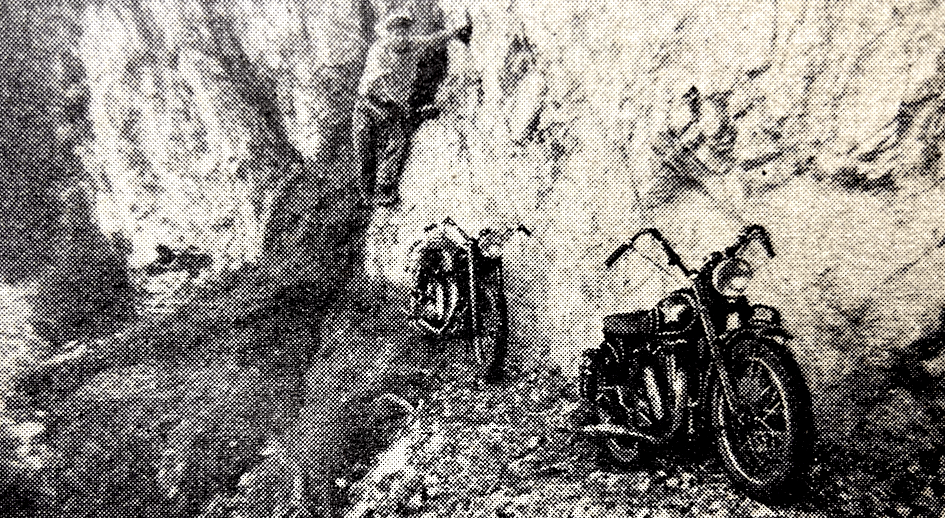
“READERS WHO CHERISH a tenderness for the James and Royal Enfield ‘Flying Fleas’, either because they rode them on active service, or have seen their derring-do in this year’s trials, will be interested to hear that many thousands have been sold since VE Day. Some of them are serving unusual purposes. For example, a film producer carries one on his motor cruiser, so that he can conveniently prospect locations in the less habited portions of Europe. A reader who solves his housing problem with a caravan maintains a Flea as a link with civilisation for his wife and himself. When the van is on the flit, the Flea rides on the roof under a tarpaulin. Approximately 40% of the peace-produced Fleas are being exported.”
“A READER-CRITIC laments the concentration of the industry into so few hands as tending to evolve a certain monotony in design. He sadly recalls what he names ‘the ingenious ‘twenties’, when Dunelt, Barr and Stroud, Wooler, and countless others, tilted at convention, and perorates with, ‘Oh, for another AA Scott, to give us an engine with the quiet hiss of a soda-water syphon!’ Commerce tends to promote the survival of the fittest from a purely practical standpoint. But is it ever so distantly true to speak of a monotonous uniformity? The Scott is not dead. A transverse-twin Douglas is leaping from its nest. The Squariel, the Sunbeam twin, the cobby Rapide HRD, the Triumph, BSA and Ariel vertical twins, the Flying Fleas, the autocycles and others are with us. Remember, too, that under quite fantastic handicaps in respect of tools, labour and materials, many makers are compulsorily waiting to launch new designs.”
“IN A WORLD OF supposedly changing values it is pleasing to be able to adduce proof that in the British motor cycle industry there are striking examples of loyalty, of sons succeeding fathers in the old firm and of service measured not in terms of a few years but in quarter and half centuries. A very remarkable function was held in Redditch last Saturday. Of the total of just under 1,000 Royal Enfield employees no fewer than 240—more than one-third of the male adults at the factory—received long-service awards. Twenty received gold watches for 50 years’ service, 53 have served over 40 years, and the remainder of the 240 have been with the company over 25 years. The 240 between them have worked for the company 8,515 years, and it is typical of a company with such a fine employment record that they should wish to honour those who have given good and faithful service over a long period.”

“THE PILE OF CLOTHES which Mollie had placed on the bed would have bulged a cabin trunk. Each piece had to be bargained over; each what-not, she claimed, was indispensable. It took endless haggling and persistence to reduce the mound by half. The carrier aft the pillion and the panniers slung well back were built and designed by me to simplify, even to avoid, all baggage problems. Alas! Now they were packed to bursting point, and horrid little parcels done up in brown paper were tied to the straps. Then came the final indignity when Mollie produced my old HG respirator bag full of tinned food. Actually, my ‘nose-bag’, as it became known, later proved invaluable as a pocket for camera, documents and snacks. Hetty, our new 500cc Matchless, barely run in with but 1,000 on the clock, looked like a gipsy caravan. Kit, tools, fire-extinguisher and ourselves touched nearly 4cwt. We set off on a typical late-July morning, and with the squalls of rain and hail stinging our faces I reckoned that she might slew enough to become unmanageable. But no, she was almost as light and peppy as when I rode her alone; and it was this virtue of light handling which made our trip such a complete success. We travelled on 12 of the 17 days when we were abroad, and during this time covered well over 2,000 miles on surfaces which make the Lea Bridge Road a dance floor by comparison. On two occasions we climbed nearly a mile up, with the snow not far above, and then down through a belt of heat where we could have fried the oft-quoted egg on the macadam—and a couple of rashers besides. From where we stood we could have spat into Spain; we bathed in the Mediterranean and chatted to guards on the Italian frontier. But let me make it clear that we were not out to test our endurance or the machine’s, nor to hunt records, but to have a holiday—to see old friends and places, and to relax as well. After the usual business at Calais of producing mounds of documents, signing and declaring, and being shown around, we set off on the first hop with some companions of the crossing. There were a couple on a Vincent and a rider of a 1928 Norton aiming for Switzerland. We let the Norton lead over the cobbles and through the ruins of the port. Hetty purred as she cut through the wind that blasts over the bare hills of the Normandy coast. Building is going on apace, but there is still devastation everywhere, and most of the bridges are temporaries or incomplete. The rusting remains of Tigers, Churchills or Shermans now look almost as much a part of rusty past history as the Crimea guns in Maidstone! I watched our leader bouncing ahead over the cobbles of Boulogne, then fast again over the stretch to Montreuil, where the pavé was more shattering than ever. In the shadow cast by the falling sun I could see my front wheel bobbing up and down in fascinating fashion. ‘These Teledraulics are marvellous, just like coasting down from Epping,’ I shouted back to my passenger. ‘But I’m not sitting on your handlebars!’ Mollie groaned. Then came the time when we waved good-bye to our
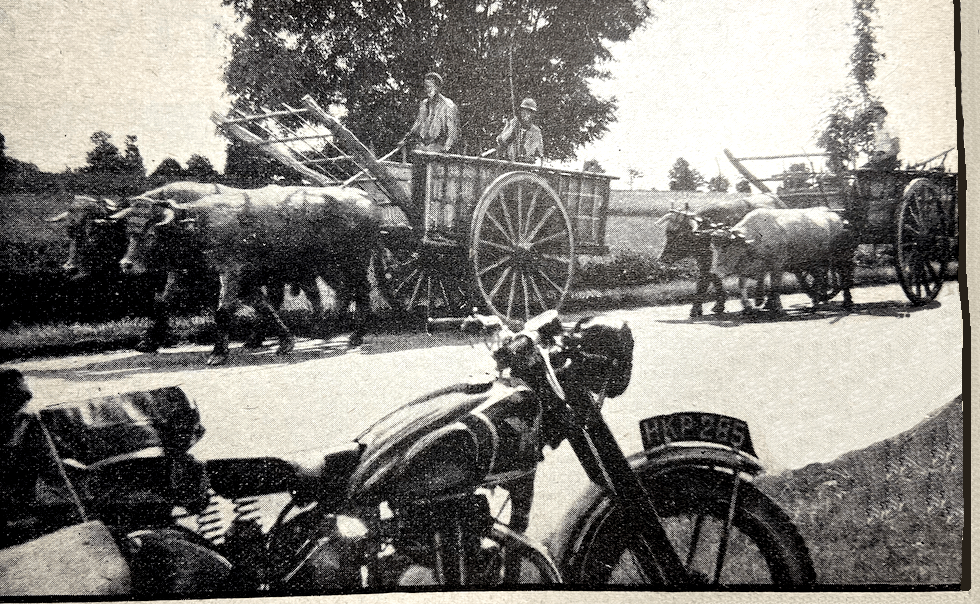
friends and watched their tail-lights fade down an avenue of poplars. Abbeville, I recall, was once a pleasant little town, but now it is sombre and unlighted, half its dwellings are in ruins and the rest scarred and dilapidated. There seemed to be only one hotel in the place, and it looked as though it might run to money. I may as well mention here that we calculated on a pound a day expenditure, including the running costs of the machine, in a country which has become decidedly expensive. Apart from the fact that we don’t like digging into our pockets for such impermanent things as fancy meals or accommodation, we find that there is fun in roughing it—and one seems to get a more intimate contact with people and places. So we went on looking and asking, and then found ourselves to be the guests of a Resistance leader, his wife and son. He apologised as he showed us the room—although it was comfortable—because, he explained, there was so little of his house left undamaged. Our room opened on to a cobbled court-yard where chickens perched indiscriminately upon Hetty and an old wagon for the night. Of course, we spoke of the war as we sat in their dimly lit room. Abbeville had been liberated by a Scots regiment. Until 1am we thrilled to their stories of the Resistance, of the horrors of the Occupation. We were shown the cuttings from the collaborationist Press announcing the execution of six, a dozen, 20 men, for the murder of each German. It was noon the next day when I let off a whoop of joy, ‘Look, the Eiffel tower!’ I have an affection for this monstrosity, which now, in the distance, proclaimed that there lay the Paris that I had not seen for eight years. A sign in English proclaimed, ‘You are now entering Paris. Speed limit, 20mph. Strictly enforced.’ From then on there was little time to reminisce. Vehicles hurled themselves at us from all directions. I took violent evasive action, and blessed Hefty’s powers of acceleration. We stayed three days in Paris with Jean and Margot, whom I knew before the war. Their flat overlooks the Seine, and one of their windows has a little hole in it, while the bullet is still embedded in their ceiling…In Paris we had to obtain petrol coupons for the rest of the trip. The procedure is simple—one queues at the bureau, and waits. Having performed this function, I returned to the street to observe a number of onlookers gathered to gaze—not at the fine cars with GB plates, or the flashy Yank with a Swiss licence—but at our Matchless. Mollie was answering eager questions about the machine’s performance, and our admirers were making suitable noises of approval. Hetty always came in for unrestrained inspections, and always she—and we—made friends. Once two policemen pulled us up sharply with official gestures, but only because they wanted to inspect our machine. They pointed to their own machine nearby—it was another Matchless, a pre-war model. Practically all the motor cycles you see in France these days are, however, light two-strokes, some weird and wonderful. There is an austerity motor scooter available for about £50. All seem to be expected to perform Herculean duties. Many 125s carry pillion passengers and panniers as well, and autocycles, with shattering exhausts, bear loads of potatoes. Many riders pull little shopping trailers behind them, and once Mollie called my attention to an elderly gentleman on a 150 hauling an even more elderly lady in a bathchair behind him! Our departure from the capital was delayed due to our having been entertained with too much champagne and brandy the previous evening. It was not until four in the afternoon that we left, but we arrived at Bagnères de Bigorre, in the Pyrenees, some 500 miles distant, 48
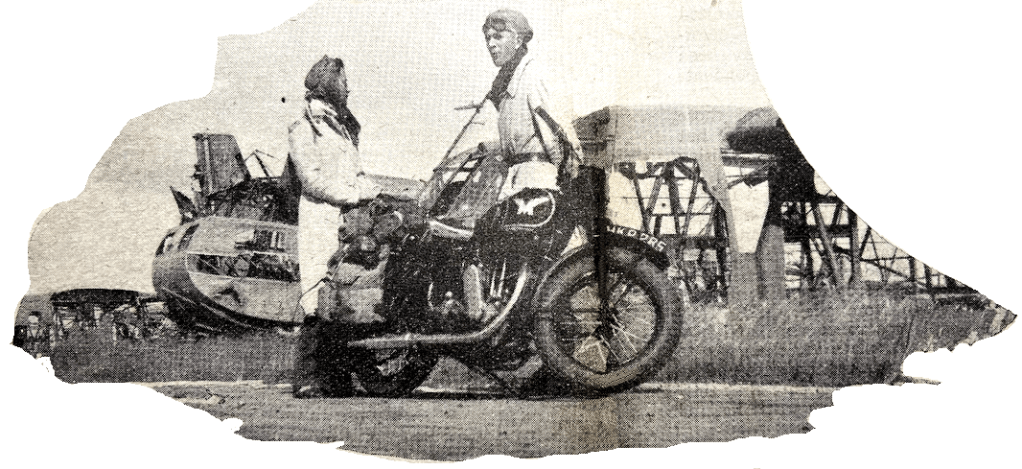
hours later. The journey as far as Bergerac was not eventful. The scenery was pretty, the countryside scantily populated, but we did form some impressions which were true for the rest of France. Overnight accommodation is much cheaper than in Britain, but the cost of meals is very high. You can seine and dine in France for a pound per heath far better than in England. But you will have to search far to obtain a meatless meal for half a crown. The Prix Fixe signs displayed outside the majority of the restaurants mean little, if anything at all. The road from Paris through battered Orleans as far as Limoges is good for a fast average. The French have put a lot of thought into the planning of their roads from the point of view of visibility, the radius of curves, and banking. Their well-planted avenues do not interfere with visibility, but act as valuable wind-breaks, and in the South they screen the roads from the fierce sun. We galloped along at a pleasant 45 to 50. I say ‘galloped’ because that is the motion we achieved due to the rolling surface. I seem to recall that French highways were always a bit rough in surface, but wartime wear-and-tear has brought serious deterioration. We struck one or two patches of subsidence, when the model dropped like a lift and then hit the tarmac with such a wallop that it seemed to compress all our vertebrae. Then there were some detours which would amaze a trials rider. We did not appreciate one such bumpy detour near Limoges, but that day ended cheerfully. For although all the hotels in Bergerac were full, we asked a couple at their gate for advice and, after they had invited into their home to have an aperitif, they personally introduced us to a hotel proprietor who obligingly squeezed us into his establishment. Still travelling south, we crossed one of those wavy lines shown on meteorologists’ charts. The scenery changed within a few miles to flat-topped plateaux, instead of rounded hills, where the houses now had white stucco walls and red roofs, and where peaches grow instead of apples. The greatest contrast of all when crossing our wavy line was the radiance of the sun; for now it shone most of the time, and the intensity of its light seemed to alter one’s perspective and banished the soft half-tones of the North. Here shadows appeared darker and the highlights more vivid. Our road to Tarbes and Bagneres was not a major artery and, except for ox-carts, traffic was sparse. Each plateau seemed to possess its charming town bordered by cypresses and built around a spired church. There would be terraces below, rich with vineyards and vegetable plots, as even and regular as steps. At one such town we stopped at a baker’s to purchase a ration-coupon’s worth of bread slices. We were thirsty, so my wife asked for water. We were given what we wanted—but with the addition of an orange cordial made with brandy; and we were invited into the sitting-room for liqueurs and cakes. From this kindness we made new friends; the good people had daughters who are learning English, and correspond with schoolgirls here in England. This system, organised through the High Schools, seems very popular—deservedly so—and the girls themselves are extremely keen and pleased to get letters from their young correspondents over here. After this little welcome, Mollie began one of those philosophical commentaries to which she is prone, but which lost a lot of their value when we were cruising along at 50mph in a slight, warm wind. Most of the phrases floated across the vineyards unheard. ‘There’s a lot to be said for a trip by motor cycle after all,’ she admitted. “It seems to be more democratic than a trip by car. Everyone takes an interest in the machine and her performance—she wins us friends everywhere. Also, do you notice how different our reception is in France now, if you remember visits before the war? How warmly friendly all the people are to us now, and how our British accents and the GB plate are passports to their homes and their hearts? It is a real and tremendous responsibility for all British tourists to be sure that they deserve such welcomes, and to repay such warm-hearted friendliness with equal courtesy.’ Bagnères de Bigorre is a spa town which nestles in the foothills of the Pyrenees. Here we stayed with members of a vast family which lives in a rambling old monastery centred around courtyards with a magnolia tree larger than a Kentish oak. Centring around this old place there is a dramatic story, for a large number of Allied airmen passed through this family’s hands on their road to freedom through to Spain and Portugal. The next 500 miles of the journey which took us to Cassis, where we arrived three days later, were the toughest we encountered. I do not claim to differ from my fellow-enthusiasts who, I am convinced, exceed anglers in their powers of exaggeration I But since I am committing myself to the printed word I promise that I am not being extravagant in describing the hazards of this part of the journey. The heat was so intense for the 60 miles to St Girons that we had to reduce our cruising speed, for the moving air was like a blast from a furnace, and the faster we went the hotter it seemed. Only once have I known heat like it on a road, and that was in Death Valley, Arizona, in August. When past St Girons we found ourselves to be on the mountain road instead of the fast route which goes via Foix. By then, however, we were so enthralled by the wild and lovely scenery that we continued on the longer route. We entered a village where a fête was in full swing, and had to pass so close to the tables placed end-to-end that we could have picked up a glass as we crawled by. Then we mixed with the fox-trotting couples in the square until Hetty herself seemed to jive a hit as she syncopated her way through the crowds. The road narrowed to ten feet or even less and began to double and twist as it ascended. Hetty’s ease of control as we went over the Col de Port will always be remembered as an outstanding quality. To me, this 4,000 feet-plus of mountain height was an obstruction which had to be traversed as quickly as possible, and I rather fancied our style as we whooped around bend after bend, maintaining momentum so that I rarely had to drop below third. Mollie’s gasps of admiration were audible above the exhaust, and finally she exclaimed, ‘Take a quick look around at the scenery!’ The road was just a narrow shelf dropping away almost vertically for maybe a thousand feet. I swallowed hard, but reckoned that fifty feet would be just as fatal, so continued zooming up with my eye dutifully fixed on the road Near the summit we saw some parked cars, and arrived in style with a burst at over forty in top gear up the steep incline. We also made a pretty smart descent down the corkscrew road into Tarascon. It made us a bit dazed to discover that there was no petrol to be found anywhere in the town. It was the same story at every filling-station as we cut across to join the main Perpignan road. Eventually we encountered a garage proprietor through whose hands had passed many escaping Allies during the occupation, and, as he put it, ‘If I could diddle the Boche and find petrol for the Maquis during the war, I think I can manage to help you on your way now there is peace!’ He spared no trouble telephoning all the countryside to find us a litre or two of juice. He referred us to another friend of his in a village farther on—a patriot still in bed after the Germans broke both his legs for helping RAF men to escape. This kind Frenchman insisted upon giving us as a present his only litre of petrol, and referred us farther down the road to a garage owner who sold us petrol from his own emergency stock. He insisted upon treating the Matchless to a free topping-up of oil, and topped us up liberally with beer as well. By this time it was dark, and after manipulating ourselves down the winding mountain descent, steep and dark, into Quillan, we decided we’d had enough. All the hotels were full, but again we met kindness, for the owner of another filling-station went out of his way to find us a room with a friend, where we were made warmly welcome as British friends. Starting early, we ambled on to Perpignan through scenes which could have been Spain. Here we turned south to Banyuls,
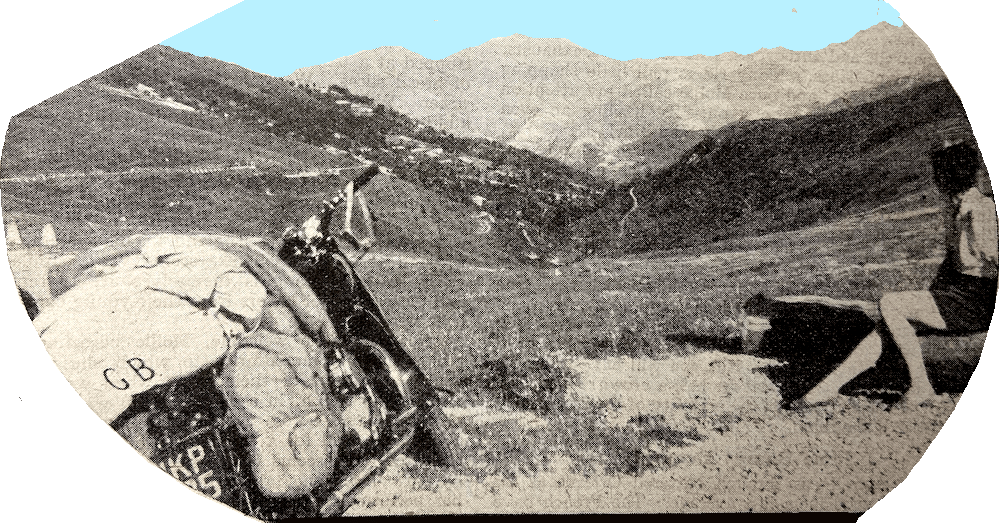
near the frontier, over a road under repair which was in places in such a terrible state that we had to dismount sometimes to save the tyres. It was such a delight to be able to swim again in. the Mediterranean that we left our return until late. Indeed, we were delayed still further because neither Mollie nor I are unduly modest when faced with excellent food and good wine, and friends whom we had visited had offered us far too much of both. I had vivid recollections of ten years before, when I was a newspaper despatch rider running in and out of Spain, of how I ached when fighting the beam wind which blows constantly over the plains to Narbonne. It blew, as always, but on this run with Hetty I felt no signs of fatigue; she was a dream to handle compared with my old slogger 600cc Dunelt. At Beziers, dark by now, we turned on to the coast road which runs parallel to the Canal du Midi. Passing Agde, we saw that a water fête was in progress. Bright lights lit up the canal, and there were fireworks, dancing and music. We thought that we might spend an amusing evening here, but others had thought the same and there was no bed to be found in the town. So we sped along over the causeway to Sète, down the cobbled paving with lighted cafés on one side and the sombre canal on the other. We hunted for accommodation throughout the town, but had no luck. We ended, exhausted, in a dirty little place in Montpellier after 1am. It was already scorching when we restarted on a route which was both brown and dusty. Somewhere around Arles we passed through a waste of pebbly land which managed to look more dreary and barren than any honest desert. Heat shimmered over the gravel, and the only break in the scenery was an occasional skeleton of aircraft or tank abandoned in the waste. Our thirsts became phenomenal, and there was nothing to drink—no house, no stream for miles. We reached Marseilles by a route which wanders round the whole of the port area. There was pavé of the worst, and we stumbled in and out of craters and shell-holes as well. We were not surprised to find that the road to Cassis was undergoing extensive repairs and that it was almost impassably. On arriving at our destination, we marvelled that there could be such an area of unruffled surface as the café table at which we relaxed. The Matchless had endured three days of extremes which could hardly have been bettered in a test laboratory—altitude, cold, dust, beat, humidity and, above all, shaking. All the other machines I have owned would have developed loose bolts at least, or run unevenly and been hard to start. Hetty showed no signs of temperament. Although she seemed more sprightly when it was cool, her beat was always assured, and she was a one-kick starter in all circumstances—this in spite of excessive carbon resulting from the rather dirty petrol. Not a bolt came loose and no readjustment was needed; the only ‘wound’ she showed was on the horn bracket which, for reasons unknown, was fractured on one side. Cassis had a fishing fleet and it was a port for liners before the Germans sunk a steamer across the mouth. It has a charm of its own in addition to being a resort. During the holiday seasons it has, of course, its loafers and smart young women in beach what-pots. We were tired, as empty as a vacuum, and there was not a room to be had in the place. So we sought aid by resting against a bollard and let Hetty, nearby, introduce us to two fishermen, a stone-mason and a café-waiter. It was the stone-mason who pitied our plight, took on to the Hotel du Commerce, and persuaded his friends there to fix us up with a mattress on the terrace. Here we had excellent and reasonable meals. So it came about that, when the crowd dispersed after dinner, four tables were put together and mattress and blankets spread on top. Our ceiling was of vines, the crickets chirped, the pines smelled fine. The harbour reflected the moon, soft music came from a cabaret, and despite a couple of hungry mosquitoes fiddling in discord, we thought that everything seemed just right for a Mediterranean holiday. On the next and last night our table was crowded with bottles of wine bought by our new friends, and we were joined by others as well. There was coffee, more wine, and still more conversation, The item of discussion most usual in France is, of course, the black market, that evil left by the war which is choking the commercial life of France. Naturally we were late again in starting for our jaunt along the Cote d’Azur. We passed through places glamorised in thousands of novels, so I am left with little original to say. Do remember, when you visit this coast, that this is not the true France. It is rather an international holiday resort, lovely and only very rarely hospitable, unless you have a great deal to spend. After spending the night in Nice we took a sight-seeing trip to renew our acquaintance with Monte Carlo, and thence through Mentone to the Italian frontier. A filling-station owner asked us to stop and have a drink of cognac with him and his wife, and explained with unintentioned humour, ‘We have wanted to meet some English people who speak French.’ He added, and we were deeply moved by his sincerity, ‘We want to thank you for all Britain has down for our unhappy country. We drink to you on behalf of all your fellow countrymen.’ We in turn drank to the brave fighters of France, and to the little graves of the Maquis which line so many country roads. Since I had to be in London on Tuesday morning bright and early—or early, if not bright—we left Nice on Friday at 5pm. We had only three days to cover 825 miles. We soon turned our backs to the coast and struck inland along the Route des Grandes Alp, to join the Route Napoleon at Digne. Part of this splendid road we saw only by starlight, but the smells of the wild lavender at sundown were one of the unforgettable memories of our trip. Some of this famous scenery is indeed superb. After passing the night at Digne we found the next day’s run disappointing. We encountered a thunderstorm and cyclonic rain before reaching Lyons, and had to night-stop there, as we had lost our waterproofs. Nine-tenths of the road from Lyons to Paris is wide, straight and smooth. Since I was anxious to spare a new machine I had, up till now, watched the revs and held her down to 50. But now we wanted a long evening in Paris. With 3,000 miles showing on the clock I reckoned it would be safe to tell Hetty to set her own pace and not to spare the horses. The scenery was uninteresting, but we found exhilaration in speed. At three-quarter throttle the power flowed through without vibration or effort. The needle flickered just short of 60 on the flat, and mounted to 63 or more down grade. ‘Dear, dear Hetty,’ Mollie called out, ‘She’s flying like a bird. I think she is enjoying this as much as we are.’ We left Lyons at 7am and spotted the Eiffel at 2.30pm. Take away an hour and a half for stops, and this leaves 6 hours, 20 minutes for 300 miles—little short of 50mph average. Not Manx time perhaps, but good considering we were not forcing the machine. On the Monday morning rain postponed our departure until nine. Then we were waved off the main road by a gendarme who called us, ‘Mes enfants’. The final 75 minutes’ run from Abbeville to the quayside at Calais was frantic. With only fifteen minutes before the vessel sailed we had to do a lot of rushing and persuading before the Matchless was swung on board. The total mileage covered in France was 2,132. Exactly 28½ gallons of petrol were consumed, giving an average of just under 75mpg. Taking into account the all-up weight and the fact that we were not running under the most economical conditions, I consider this to be an amazing effort. No record was kept of oil used but, even though she appeared to use more than in England, it was a negligible factor. It was my first experience with synthetic tyres, and they gave me much more satisfaction than I was led to expect, having lost only about 25% of their useful wear.”—Ken Craven
“IT HAS NEVER BEEN SUGGESTED that the Scott Trial should be anything but the roughest sort of stuff that riders and machines can be put across. The 1946 revival entirely lived up to former glories! Substantially the course was much the same as that for the last event in the pre-war series, held in 1938. In that year the traditional venue in the West Yorkshire dales was forsaken, and the Middlesbrough MC took over the organisation, assisted by the Stockton MC, and transferred the site to the Cleveland Hills of North-east Yorkshire. New ground was broken, and the terrific ascents and descents of the Cleveland moorlands introduced some new problems. The ground is of a peculiarly shaly nature that probably has a lot of interest for geologists—in some places it appears to be outcrop coal, and in others, the red- and rusty-looking iron shale. But whatever the variety it is particularly nasty, sticky stuff when wet; ‘slape’ they say in East Yorkshire, and slape it certainly was last week-end. There was a wonderful entry of 137 from all
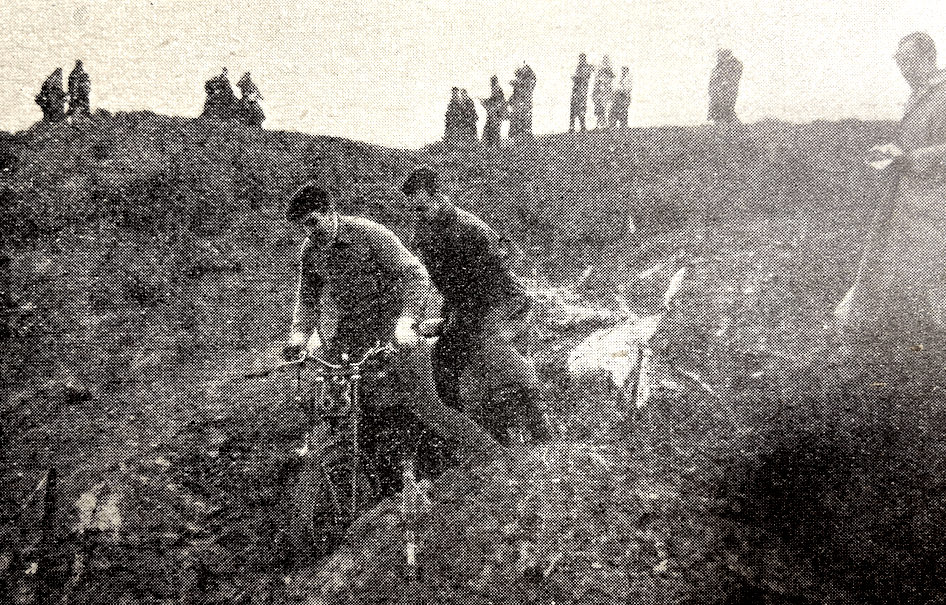
parts of the country as well as from Scotland and Northern Ireland. Indeed as things turned out the Ulstermen were right in the picture, because Bill Nicholson (349 BSA) set up zero time in 3hr 16min 58sec—a time that gives a clue to the difficulty of the course. If the distance was the alleged 40 miles or a bit over, it makes the average speed something between 12 and 14mph. AJ Bell (498 AJS) and RT Hill (349 BSA) finished fourth and sixth—three visitors from Belfast in the first six finishers is more than somewhat hot, especially when all were newcomers to the Scott Trial; naturally they made the best team performance of the day. If another clue to the severity of the event is wanted, only 24 finished the trial out of that brave 137. How many retired on the first lap was doubtful, but it was certainly no fewer than 60, while 31 were also stopped at the end of the first circuit because they had taken over three hours, and the organisers did not relish the idea of having to send out search parties over the hills in the darkness! Starting from Swainby, which is just off the main road north from Northallerton, a short run (with three observed sections) brought the competitors to the start of the two-lap ’20-mile’ circuit proper and there quickly followed three more observed sections, all of the ‘precipitous descent’ variety. Indeed, if any criticism could be raised there were too many observed descents throughout the trial, for they were more often than not just matters of luck—any attempt at a steady controlled descent usually ended in an out-of-control glissade into the bottom of whatever was at the bottom and a sudden stop on arrival there. On the other hand, a fast enough descent to keep the wheels turning brought the rider into rocks, bogs or other what-nots at too high a speed. Some of the descents were worth observing because they adequately differentiated the performances. Parts of Alfred’s Buttress, for example, were quite good. F Fletcher (125 Excelsior) and 0 Langton (348 P&M) descended quite tidily, but thereafter seemed to disappear into the hills. J Plowright (346 Royal Enfield) lost his motor but managed to retain control when the back wheel locked. Allan Jefferies (498 Triumph Twin) beautifully demonstrated the army style on steep descent hazards. In less than three miles JE Breffitt (348 Norton) was completely plastered with red mud but
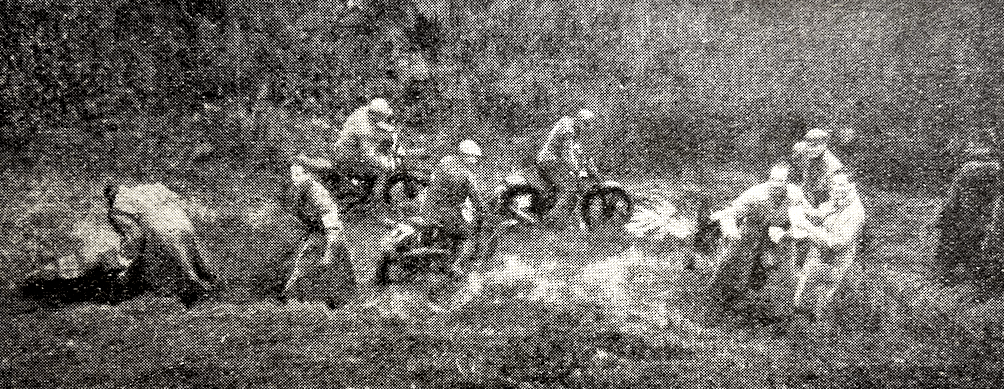
travelled confidently. Lower down the hill the course was marked between flags and these were definitely set too close together to permit clean performances after the first few machines had cut a deep rut in the mud which could not thereafter be avoided. RT Hill (349 BSA) was very neat hereabouts, and his compatriot, W Nicholson (349 BSA), was clean, a performance only equalled by T. Wortley (347 AJS) and SR Wise (346 Royal Enfield). JK Hirst (348 Ariel) attempted an original—and very sensible—line but wiped down a flag in the process. Thereafter the course ascended again into the hills, which were shrouded in mist. There was a bitterly cold wind blowing that at times literally took the steering out of riders’ hands. The old Scott Trial feeling of being alone in the world came to quite a few people. Reed Deep, a muddy stream with an approach as steep as the roof of a house was ‘impossible’—at least only W Nicholson (349 BSA), A Jefferies (498 Triumph), RT Hill (349 BSA), E Pearson (349 BSA) and C Pinkney (347 Matchless) lost no marks. Such experts as Alves (349 Triumph) and Rist (349 BSA), for instance, were stopped, Shortly after this, a tough climb to the moors called Crackpot was ascended without loss only by the redoubtable Nicholson, GE Duke (496 BSA), J. Plowright (346 Royal Enfield) and TH Wortley (347 AJS)—all early numbers. Of course, some of the fast people on their second lap began catching up the tail-enders of Lap 1. Nicholson, for example, was well up among them, he being quite 20min ahead of Allan Jefferies. Starting with a very late number Bob Ray (497 Ariel) was coming well forward so he must have been performing prodigies of overtaking all the time. Over the windswept and rainy moorlands beyond Osmotherley there was a great concourse of spectators at Gash’s Nightmare, one of the worst obstacles of the whole show. It began with an almost vertical drop down black slime to a stream tumbling over rocks and almost too narrow in places for footrest width. The descent was observed and if taken fast enough to keep a clean run then a stop into the awkward turn at the bottom was inevitable. If attempted slowly enough not to be out-of-hand at the bottom, the chances were all in favour of an uncontrollable slide resulting. Jack Williams found this to be the case and he went down like a sledge after a very cautious approach. Nicholson was the only clean performer on the first circuit but he, Alves and Rist managed it the second time. AJ Bell (498 AJS) was the only clean rider on the second section. At Barker’s Indiscretion, another steep drop into a stream, P Lawson (349 BSA), E0 Blacknell (498 AJS) and J Williams (348 Norton) were outstandingly neat while Nicholson here came unstuck. On the second lap at this point, Jefferies and Rist were good, likewise Hill—Ireland again!—Hutton (BSA), Pinkney (Matchless) and Holmes (AJS). The later stages were just a battle against wind, rain, mud, rocks and exhaustion. Riders were often unable to hold their machines on really bad sections and just had to let them plunge where they would.
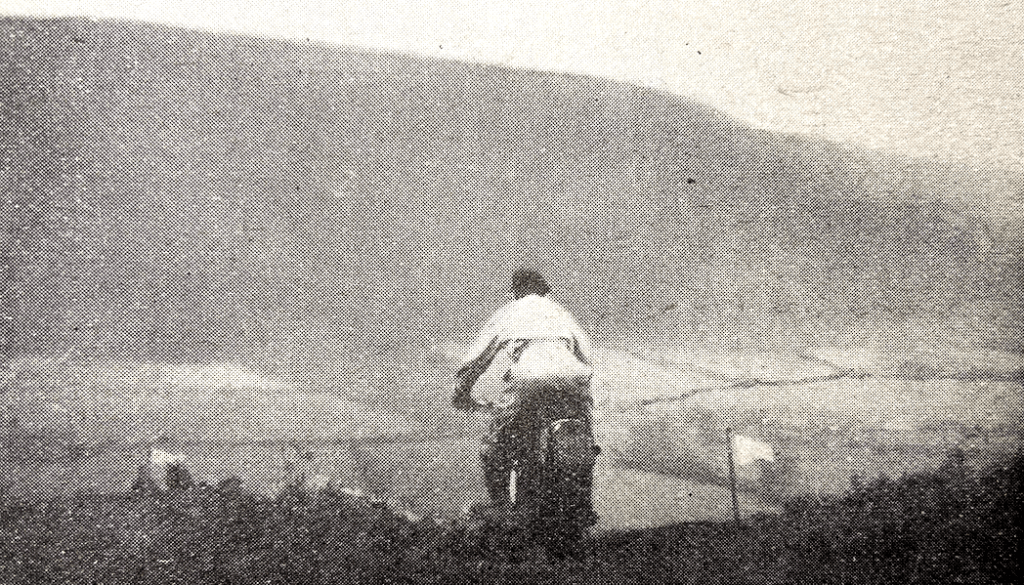
Some 27 people eventually reached the final check in very mixed order and in varying degrees of lateness. Nicholson’s time of 3hr 16min 58sec was almost certainly too good to be beaten, and he, being an early number, the timekeeper had to, stay on the point about four hours. Of the 27 who reached him in that period only 24 were within qualifying time. Not a single 250 checked in although Billy Tiffen (249 Velocette) and Ken Norris (248 Panther) survived the two laps only to find the shop closed! When the results were eventually worked out in the Middlesbrough MC club house it was found that not only had Nicholson set up standard time but he had the best performance on observation—a feat never before achieved. He really took every principal award although the rules prevented him from collecting that for the best ‘first time (or newcomer) in the Scott’. However, his fellows from Belfast made good and among them they left very little for the usual collectors’ of trophies—our home riders will have to look up if Northern Ireland can send any more folk such as Nicholson, Hill and Bell. No doubt Belfast has determined to support the export drive but after the prize distribution it seemed that their glittering collection of pots was also a nice bit of importing on their part! RESULTS Scott Memorial Trophy (Best performance): W Nicholson (349 BSA), 65 marks lost. Ray Bailey Trophy (Second best): 0M Ray (497 Ariel), 87. Galloway Cup (Third best): AJ Bell (498 AJS) 97. Folbigg Cup (Fourth best): A Jefferies (498 Triumph) and RB Young (349 BSA), 102. Fifth best prize: (Combined with Folbigg). Sixth best prize: J Plowright (346 Royal Enfield), 104. Best under 200cc: F Fletcher (125 Excelsior), based on one lap only, 66. Best Newcomer: RT Hill (349 BSA), RT Hill (349 BSA), 114. Scott Trophy (Best one-make team): BSA—W Nicholson, 65; RT Hill, 114; FM Rist, 117; total, 296. Erie Myers Trophy (Best mixed team): Northern Ireland—W Nicholson, 65; AJ Bell, 97; RT Hill, 114; total, 296.
“FEW TWO-WHEELERS arouse more interest than the Swallow Gadabout. This little machine—which is appropriately named—has characteristics which make it eminently suitable for short-distance travel in town or country, such as for ride-to-work journeys, shopping, social visits and so on. A prototype of the Mark I Swallow Gadabout has been in use by members of the staff of The Motor Cycle for nearly two months. Hundreds of miles have been covered, mainly on journeys to and from the office. The Gadabout has shown itself to be a first-class machine for this type of use. The frame consists of two 1¾in-diameter 16-gauge tubes running forward from each side of the rear wheel till they are curved up to meet at the steering head lug. Joining the two side tubes and towards the rear are two trans-verse tubes one forward and one aft of the engine. A simple unsprung front fork is used. Each side member consists of the two tubes telescoped into each other and welded into position with the steering column brackets. At the top the side members are curved round to form the handlebars. Journal ball bearings carry the pressed steel wheels to which are fitted 4x8in tyres. The rims are of the split type, and for easy tyre removal the halves are separated by taking off six nuts. Highly effective 5in-diameter internal-expanding brakes are fitted to both wheels. he Supported by the two transverse frame tubes is the 125cc Villiers two-stroke engine-gear unit. This is the standard unit with a deflectorless piston, detachable aluminium-alloy cylinder head and ‘pre-stretched’ totally enclosed primary chain driving the three-speed gear box…Ignition is by flywheel magneto, which incorporates 6-volt coils for direct lighting. The twin exhaust pipes discharge into the forward transverse frame tube which communicates with the side frame tubes. These tubes form the silencers and are fitted with QD baffle tail pipes…Above the frame tubes in the front is a weathershield, behind which is an elastic-edged string holdall. A steel pressing fits inside the frame tubes and forms the ‘floor’, which is covered with corrugated sheet rubber. Below the frame tubes is an undershield continuing
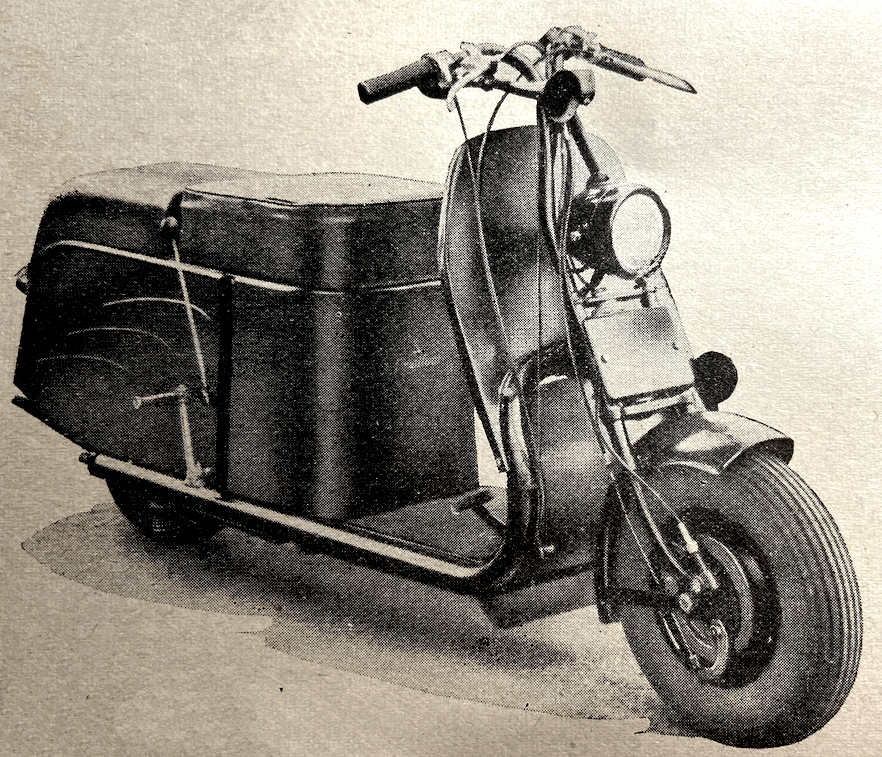
almost to the back wheel and thus under the engine. Air is scooped in between the floor and the undershield for engine cooling, and there is an additional scoop just forward of the engine. Internally there is a sheet metal deflector for directing the air on to the cylinder and head…when cleaning is necessary the machine can be hosed or washed down very easily and quickly. In conception, the Swallow Gadabout is not new, for there were attempts a producing motorised scooters after the 1914-18 war; there are also numerous Continental and American designs. However the Gadabout is the first British machine of this type for many years and under test has shown itself to be a thoroughly practical job fully capable of the performance for which it is designed. It is of pleasing appearance, yet is readily accessible for maintenance. It is easy to manoeuvre, simple to drive, comfortable, practically skid-proof, and economical. The machine provides the rider with good weather protection—an ordinary trench coat is suitable apparel for the wettest day. The four-inch section tyres on this light machine not only add to comfort but permit tramlines to be ignored. Frequently the Gadabout has been ridden in wet, greasy tramlines and turned out of the lines at will without any trace of skidding. In built-up areas its performance makes it as rapid a means of transport as any other—the maximum speed is about 35mph, and at 30mph the machine will cruise indefinitely. In 400 miles of mainly traffic work the petroil consumption worked out at over 100mpg. With a gallon of petroil in the tank and with the tools sup- . plied, the Swallow Gadabout tested by The Motor Cycle weighs 202lb. The model described is the Mark I, the output of which is going to export.”
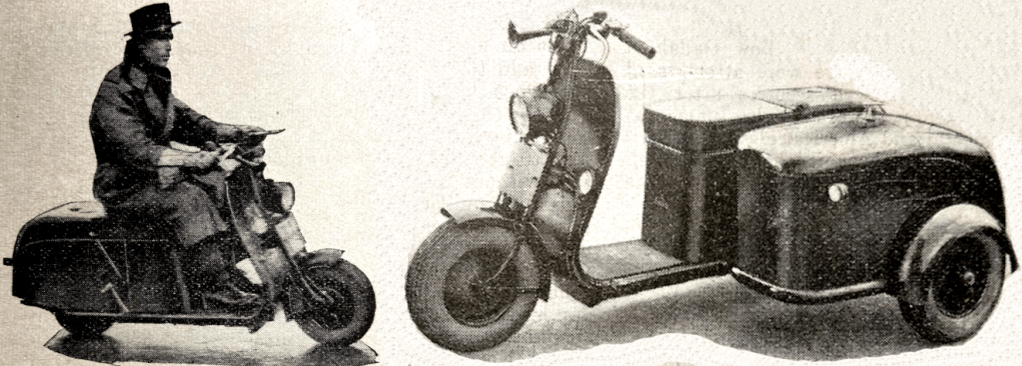
“A NUMBER OF very important decisions was made at the second post-war Congress of the FICM (the Federation Internationale des Clubs Motocyclistes) which was held in Paris at the end of last week. According to FICM statistics, not since 1932—probably never—have so many countries been represented. There were 18: Argentina, Belgium, Great Britain, Canada, Czechoslovakia, Denmark, Finland, France, Hungary, Ireland, Italy, Luxemburg, the Netherlands, Norway, Poland, Spain, Sweden and Switzerland. Incidentally, the position of Hungary and that of Austria were again debated by the Congress, but it was decided to defer any decision over their readmission to the FICM until the United Nations had reached their decision regarding these countries. Canada, represented by Major HR Watling, was welcomed as a new member…At last those who intend supporting next year’s International road races can press ahead in earnest. It is now known, first, that no superchargers will be permitted in any International event and, secondly, that the fuel used will be commercial spirit, without admixture of alcohol, of 70 to 75 octane rating supplied by the organisers…Discussion on supercharging centred not in the advisability or otherwise of barring superchargers—all nations seemed agreed that in present circumstances it is both expedient and essential to impose a ban—but in whether a means could be devised whereby forced induction was permissible for two-stroke engines only.”
“TORRENS’ UNCONSCIOUS SCRAP with another member of the staff reminds me of a far-off day when I had a royal twenty-mile scrap with a cop. As he was wearing overalls I failed to spot his coppishness when his front wheel forged up alongside mine at 60 per. I accepted the challenge gleefully, and being a shade the better mounted I led him for miles until the traffic got a bit too thick and the roads a bit too twisty. I then let him draw up with the idea of suggesting a pint at the next sign. Imagine my horror when I perceived a uniform under his mack. Believe it or not, we had a pint together, I got no blue paper, and he actually thanked me for one of the finest road scraps he’d ever had. [Only recently a similar experience befell the managing director of one of Britain’s most famous motor cycle firms.—Ed.]
“IT WILL GLADDEN the hearts of enthusiasts to know that Velocette machines are available again. Not only are there the ever- popular high-camshaft ohv models and an ohc KSS, but also there is to be the KTT racing machine. The last, it is true, will not be ready till 1947, and will be produced only in limited quantities, but the fact remains that there will be a model for the racing man. The high-camshaft push-rod-operated ohv models are the MOV of 248cc, the MAC of 349cc and the MSS of 495cc. A similar principle of design is followed in these engines. Steel flywheels are used in a sturdy crankcase which extends high up to surround the deeply sunk cylinder. Long bolts screwing directly into the crankcase retain the cylinder and cylinder head. Compression ratios are 6.5 to 1 for the MOV and 6 to 1 for both MAC and MSS…The cradle frame used for the MOV and MAC models differs from the pre-war design in that there is now at the base a large malleable-iron cradle lug which extends from the bottom of the front down tube to the gear box. The lug protects the base of the engine and gear box. and was in fact developed for the machines supplied to the Army during the war years. For the MSS there is a heavier frame with its easily recognisable characteristic—a vertical seat tube. All models have Webb parallel-ruler type forks fitted with hand-adjusted shock absorbers and with a steering damper. The front mudguard is deeply valanced and there is a very effective mudshield on the near side of the rear mudguard to protect the bottom run of the chain. Petrol-tank capacities are 2½ gallons on the MOV and MAC and 3½ gallons on the MSS. Other features are an oil-bath primary chain case, a sturdy prop-stand in addition to the rear stand, and an 8½-in head lamp with, of course, a twin filament main bulb and a handlebar dipper switch. Tyre sizes are 3.25×19 front and rear on MOV and MAC models; on the MSS the front size is 3.50×19 and the rear 4.00×19. The brakes on the two smaller machines are of 6in diameter and on the MSS of 7in diameter. Rear wheels are of the quickly detachable type. Famed throughout the world, the high-performance KSS model is one of the neatest overhead-camshaft designs ever produced…The slipper type piston gives a compression ratio of 7.6 to 1 with two plates under the cylinder barrel. With one plate removed the compression ratio is 7.95 to 1, or with no plates the ratio is 8.4 to 1. All models have the familiar black-and-gold Velocette finish; bright fittings are chromium plated, as are the wheel rims; the latter are polished on the bead flats and unpolished on the wells. Much sought after by racing men, the exceptionally successful 348cc KTT model will again be produced. These machines are hand built by specialists and are delivered to the rider ready for immediate racing. Essentially the 1947 KTT is a replica of the 1939 model apart from slight modification and cleaning up of the oleo-pneumatic legs forming the rear suspension. Demands for the KTT are exceptionally keen from all parts of the world and, as with other models, a proportion of the output will be exported.”
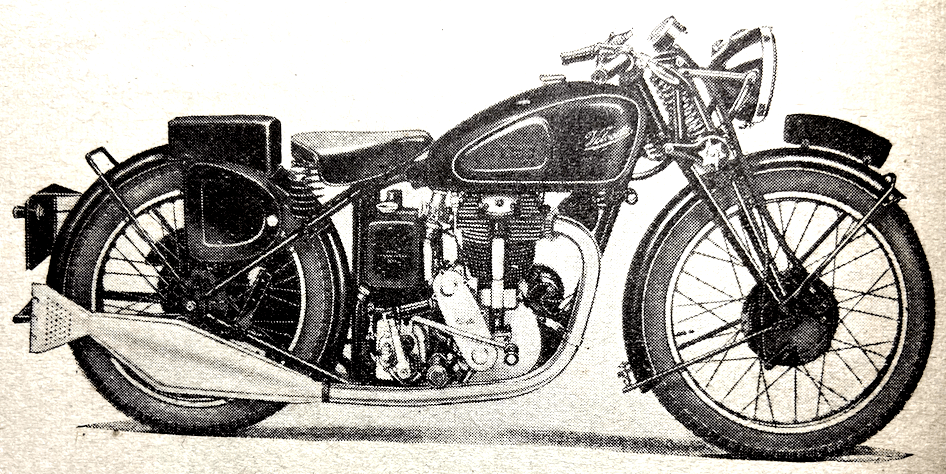
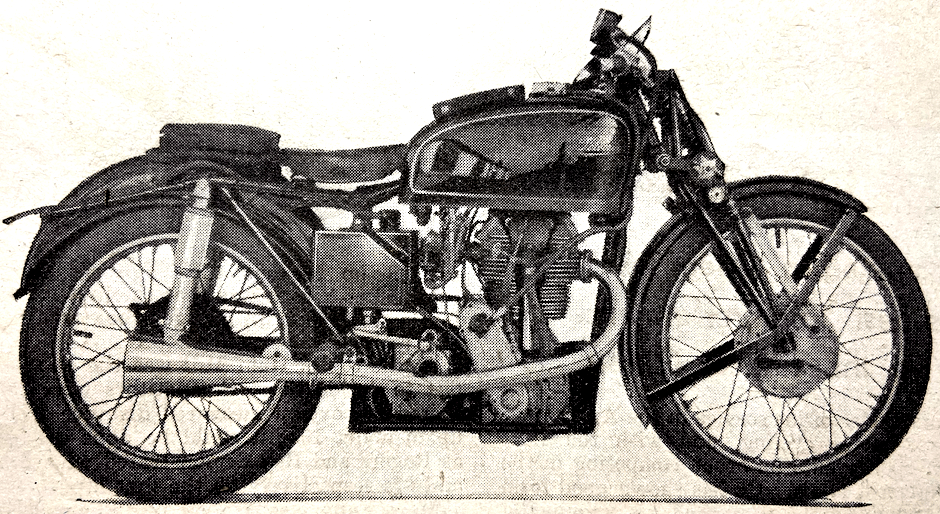
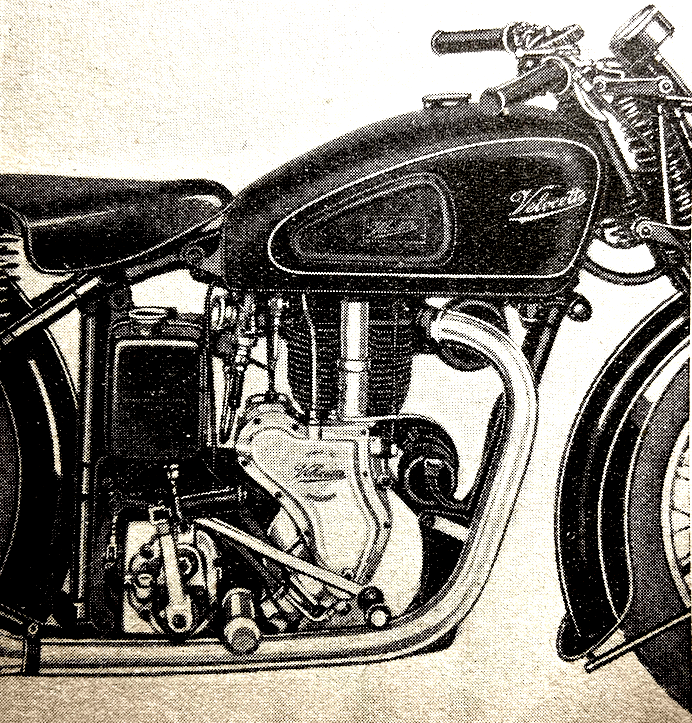
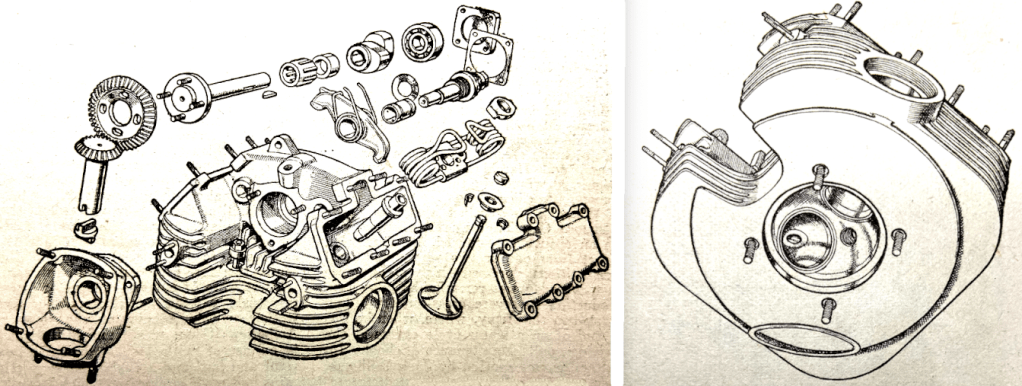
“I AM AFRAID EA Sitwell’s comparison of fox-hunting with trials riding falls rather flat. If the cyclists were out for the blood of a few pedestrians (specially bred, imported, and preserved for the sport, as happens in fox-hunting) there might be something in the comparison! Please don’t confuse a manly pastime like trials riding with a mean little pastime like fox-hunting.
EG Barlow (Secretary, The National Society for the Abolition of Cruel Sports), Harpenden, Herts.”
[Our contributor expressly stated that it was not his intention to discuss the ethics of fox-hunting in his article—Ed.]
“IN NORTHERN IRELAND, 29 new motor cycles were registered in August, compared with 31 in Eire during the same month. The approximate number of vehicles in use in Northern Ireland on August 31st, 1946, was 67,348—of which 4,669 were motor cycles.”
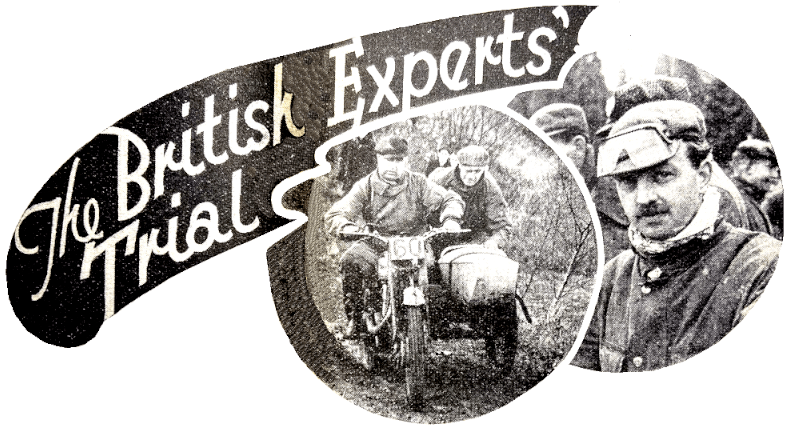
“LAST SATURDAY’S TWELFTH British Experts’ Trial resulted in a win in the solo class for a comparative newcomer to competitive riding—Bob Ray, of Devonshire, on his 497cc Ariel. In the sidecar class the winner was Harold Tozer (496 BSA), of Birmingham. Second to Ray was the ex-Army star, FM Rist (BSA), and third was Charlie Rogers (Royal Enfield) who on the four occasions he has competed in the ‘Experts’ has now made first, second, third and fourth best solo performances. Dennis Mansell (Norton), who has won the sidecar class on three previous occasions, made second best sidecar performance, and Harold Flook (Norton), six times a winner in the past, was third among the sidecars. When it is recalled that this year’s Colmore Cup Trial was Ray’s first ride in an open event—indeed, his first trial, apart from one or two very minor local competitions pre-war—his performance last Saturday was remarkable. Ray’s introduction to severe cross-country riding started in the Army, where, when he was a student on a motor cycle course
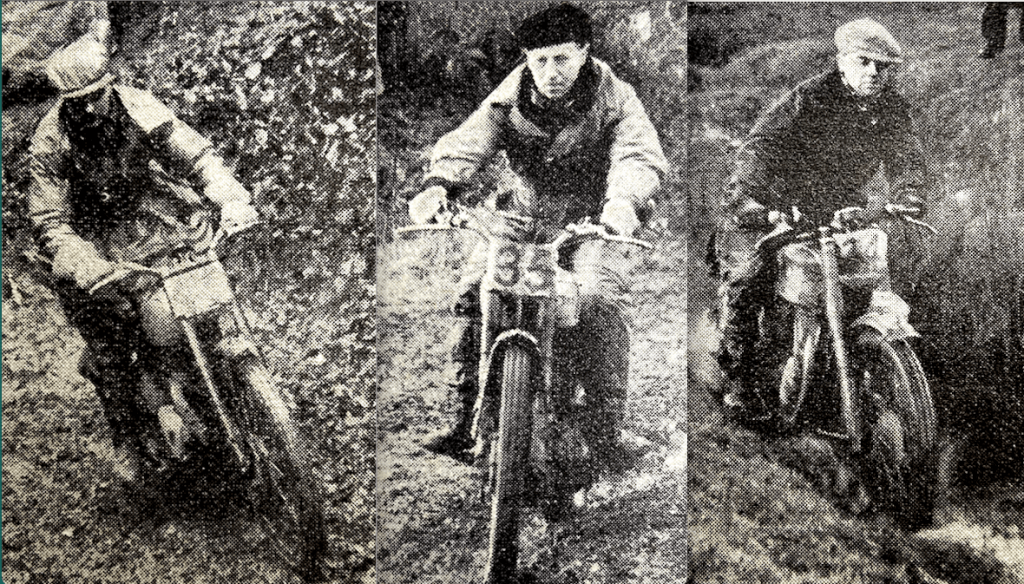
at the Driving and Maintenance School, Infantry, he was spotted by Jack Williams, then an instructor, and thereafter retained on the instructional staff. For the remainder of his service in the Army, Ray was motor cycling, and with the start of open events he began competing in the foremost trials. He has shown good form throughout the year, and his winning of the ‘Experts’ is well deserved. The course for last Saturday’s event comprised two laps of a 36-mile circuit in the Stroud area of Gloucestershire. As a result of the extremely heavy rainfall of the past few weeks, the course proved to be most strenuous for competitors; a measure of its severity is the fact that the average number of marks lost by the finishing solos was well over 100, and for sidecars, which had fewer sections to cover, the figure was over 60 marks lost. Though some of the sections, because of the abnormal conditions, were no real test of the skill of Britain’s expert riders, the first ten places among the solos and all the sidecar positions were decided without resort to the special test, and the course therefore served its main function. There were 57 entries—a large total for this trial—and few non-starters.”
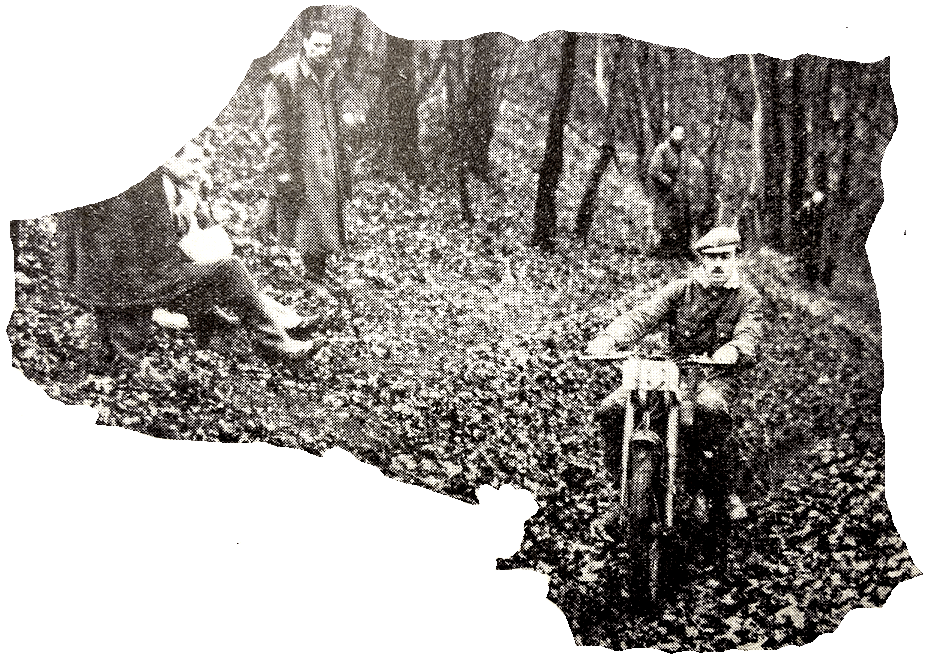
“THE MOTOR CYCLE administered a considerable shock to many readers when it revealed that the German production of motor cycles in 1939 was planned for a total of no fewer than 329,000, classified as follows: Roadsters, 200,000; Autocycles, 129,000. The autocycle element is, of course, readily explained by the liberal and enlightened policy which the Nazis adopted towards motor-assisted bicycles by eliminating all tax, insurance and other formalities. But the roadster output was also much greater than our own. No information has been published as to what percentage of the 200,000 were intended for export. We know, of course, that the British industry could easily have built four or five times as many machines if currency restrictions and tariff walls had not hampered it so hopelessly. We know, too, that in most world markets British machines enjoyed a higher prestige than any foreign models, except the BMW. It is up to our Government to see that our industry is never again pegged down in the 1939 fashion.” —Ixion
“I FOR ONE AM unfeignedly glad that superchargers are ‘off’ in FICM races on four-strokes. I cannot imagine why they were ever ‘on’. Let the speed maniacs use them in world records by all means. Let them even be applied to small cars, so that a fellow may get Bentley performance out of an Austin Seven. But to my thinking on average motor cycles they are as much out of place as a P100 headlamp on an autocycle. The standard motor cycle exists to provide impecunious people with personal transport. Simplicity is one of its fundamental qualities, since in the nature of things it should always be as cheap as is compatible with reasonable efficiency. Moreover, at the moment we are a debtor nation, and may long remain so. The whole future of the T.T. is actually in peril at this very moment. We should permit nothing to make that valuable race more complicated and expensive.”—Ixion
“PRODUCTION OF STORMGARD motor cycling coats has re-started. At the moment only one model is available. It is made up in black rubber fabric with press-stud fittings throughout. The coat is cut on ample lines, with an adequate wrap-over at the front and a full skirt which can be fastened round the legs or up in the crutch to give full protection in bad weather. There is a 5in wrap-over at the neck band, the right shoulder has a storm flap and the sleeve cuffs have two press-studs for adjustment. The two large side pockets and the map pocket have press-stud flaps, and the belt has sliding fasteners. A Stormgard coat has been under test by a member of the staff of The Motor Cycle and has proved thoroughly rain- and wind-proof. The price is 92s 7d, and nine clothing coupons are required. The makers are A Whyman, Stormgard Works, Sunderland.”
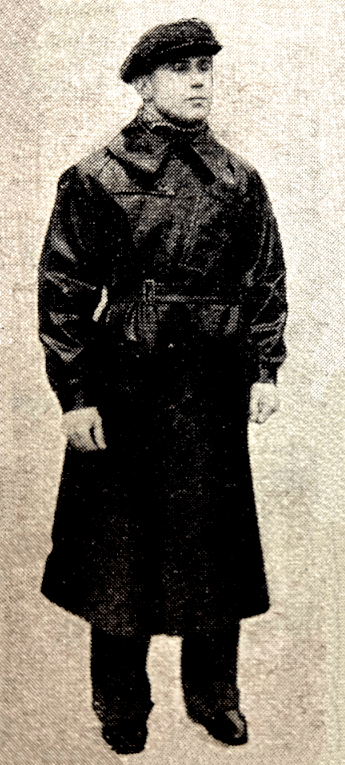
“‘GONE, BUT NOT FORGOTTEN’ might well have been the title of a nostalgic article in the Oldham Evening Chronicle singing the praises of Bradbury motor cycles, which sold at the rate of about 50 per week before the World War I, only to become extinct. The article does not mention its early supremacy, when Milligan’s Bradbury fought an interminable duel with Jones’ De Dion tricycle about 1904 in the early non-stop marathons of the MCC. Two of its later exponents were the late Percy Platt, of ‘Wall of Death’ fame, and AR Abbott, who made the first ascent of Alms Hill, and lost the 1913 Senior TT by five seconds after charging down a slip road through weakening brakes—this last exploit on a Rudge. The Bradbury had one of the first two-speed hubs in the industry, was tough, handsome, and well-made. Its decease was primarily due to failure to secure a War Office contract in 1913 against Triumph competition. Attempts to re-enter the industry after four years on munitions proved a misfire.”
“WHILE WATCHING COMPETITORS labour doggedly up Stanley I met two Jersey enthusiasts, Peter Penlo and Dave Buesnel. They had flown across to see the British Experts’ Trial, and we had a merry chat about motor cycling in the Island. Buesnel rides a 250cc BSA and is the local trials champion—indeed, he has won eight events this year. Incidentally, there is no petrol rationing to worry about—the smallness of the Island inflicts a natural restriction on miles covered—but sometimes in winter when the tankers cannot get in the petrol pumps run dry. This happened during the gales of the week before last. Incidentally Jersey would like to welcome more sporting riders from the mainland.”
“A NOVEL METHOD of power assisting a pedal-cycle has been patented (No 581,866) by BSAs and Mr VJ Stohanzl. Below the bottom bracket of the bicycle is a tiny engine which may be slid backwards till a flange on the inside of the flywheel makes contact with the rear tyre. The engine is thus started. On the outside of the flywheel is an eccentric which by means of a tension wire is connected to a one-way ball-type clutch on the hub of the rear wheel. An arm from the outer member of the clutch is connected through a bracket to a quarter-elliptic spring on the fork tube. When the engine is running the outer member of the clutch is, say, first pulled clockwise by the tension wire. The fork tube spring is therefore loaded till the eccentric turns far enough to relieve the tension wire. This allows the fork tube spring to react and drive the rear wheel through the clutch. It is intended that the engine shall be of very small capacity to serve as an auxiliary to pedalling against head winds or uphill.”
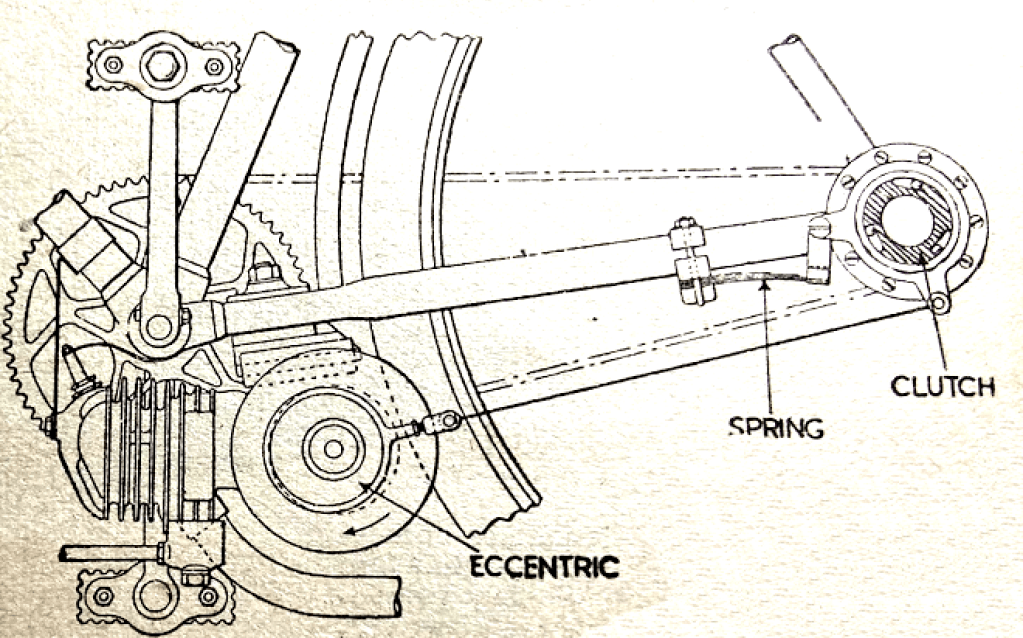
“AFTER UNDERGOING A barrage of questions the other day in Parliament concerning the reasons for the continuance of petrol rationing, the Minister of Fuel again refused to reveal the stocks of petrol that are now in this country, and said: ‘…it is a fact that a substantial part of the imports necessary to meet current consumption requires to be shipped from dollar sources, which makes it impossible under present circumstances to announce any further relaxations in petrol rationing.'”
“ACCORDING TO BOARD of Trade figures, motor cycle exports have risen for the month of October. The figure, 5,400 machines (representing £364,086) is specially mentioned in the Board of Trade Press notice as being—although lower than in May or July—over three times the 1938 figure. The value of parts and accessories (excluding batteries, magnetos, tyres, chains, plugs, roller bearings. etc) is also greater than in September, being 141,047. During the 10 months ended October 31st 1946, 44,258 motor cycles were exported, at a value of £2,819,677.”
“FOR 1947 THE EXCELSIOR range consists of three two-stroke machines. Two are autocycles with 98cc engines and the third is a 125cc lightweight of particularly sturdy construction. But the rider who wants a fast four-stroke model, and the racing man, have not been forgotten. Within a year it is anticipated that the famous ohc Manxman machines will be available, and there are likely to be both 250cc and 350cc classes. The temporary neglect of the Manxman arises from war damage when two-thirds of the factory space was destroyed and many patterns for the larger machines were lost. But there are enough parts available for Excelsior machines to be entered in the 1947 TT. The autocycles are essentially similar except for the engines. A substantial brazed-up frame is used. Between the bottom of the seat tube and the chain stays is a special lug which carries the crank bracket of the pedalling gear; this bracket can be swung in an arc to provide separate adjustment of the pedalling gear chain. The engine unit is anchored at two points below the front down tube where it curves horizontally to meet the seat tube. An entirely new front fork with link action and rubber suspension is employed. The Model 47/VI Autobyk is fitted with the 98cc Villiers Junior-de-Luxe engine. The Super-Autobyk, Model 47/G2, has the Excelsior 98cc (50x50mm) Goblin two-speed engine-gear unit of extremely interesting design. In one aluminium-alloy casting is the crankcase, the inner half of the primary chain case and the, gear-box casing. Covers are fitted on the near side of the crankcase and gear box. The complete Goblin unit with carburettor and
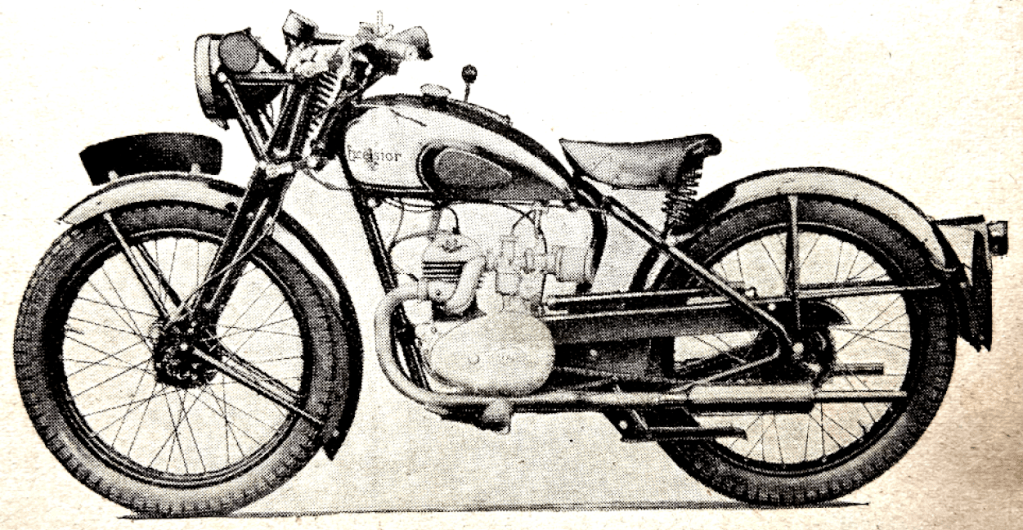
flywheel magneto weighs only 31½lb. The Super Autobyk has a larger head lamp than the Autobyk, which also has a larger saddle. A short road test of the latter model showed that it has good low-speed pulling and two-strokes outstandingly well at all speeds, even when not under load. The two-speed gear is commendably positive in operation and raises the usefulness of the Super Autobyk above that of the single-speed autocycle. The new rubber suspension forks and the large saddle give a high degree of comfort. The largest machine in the present Excelsior range is the Model 47/L0 Universal. This machine is fitted. with the 125cc Villiers Mark 9D engine-gear unit with the Villiers single-lever carburettor incorporating a strangler for starting and an Air-Maze air filter. Ignition and lighting is from the Villiers flywheel magneto; the large head lamp has a 24×24 watt main bulb and provision for dry-battery parking lights. Of particular interest is the frame. This comprises only three tubes. The first runs from the head lug and curves under the engine to the chainstay bridge lug. The top tube extends to the saddle pivot where it curves round to form the seat tube. Finally, seat stays and chainstays are one tube suitably fashioned; the two ends are brazed in the bridge lug and the saddle pivot lug joins the curve at the top of the seat stays to the curve of the top-cum-seat tube. The frame has brazed-up lugs for all fittings. The front parallel-ruler type forks have pressed steel blades…The brakes are 4in in diameter and the tyres 2.75x19in. The all-steel welded tank has a capacity of 2¾ gallons of petroil. In the top of the tank is the gate for the three-speed gear change lever which is light and positive in action. All handlebar lugs are brazed on. An easily operated spring-up central stand is fitted which lifts the rear wheel well clear of the ground. Both the handlebars and the footrests are adjustable. This model is attractively finished in maroon with cream tank panels. Including purchase tax the Autobyk cost £50 3s 4d; the Super Autobyk was £61 11s 11d; the Universal was £76 16s 9d; speedos were an extra £3 3s 6d.”
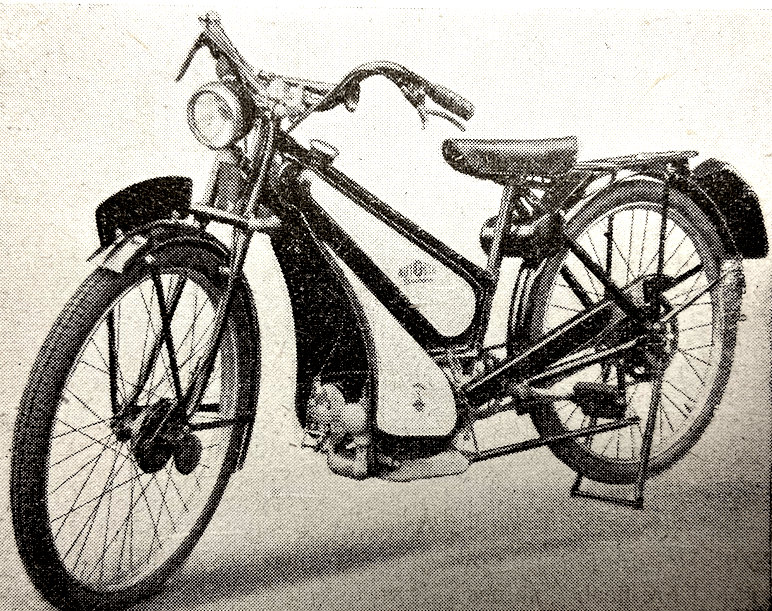
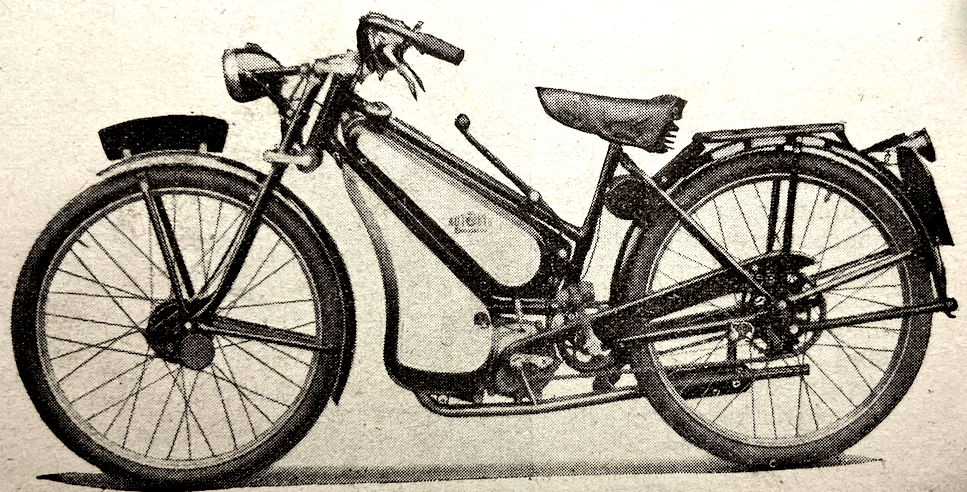
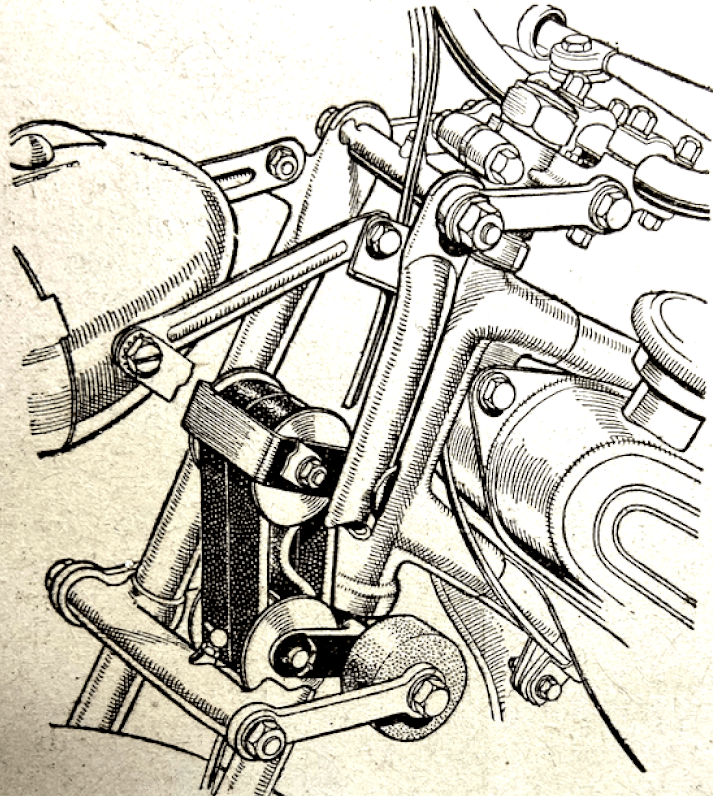
“IN PROF AM LOW’S TALK to the Grasshopper MCC (Southend) at South Benfleet—although the theme (Observation) was not strictly a motor cycle one—several points of motor cycle amusement and interest emerged. Prejudice in all its forms was bad, was mankind’s enemy, said Prof Low. Years ago, when machines were doing 48mph on the mountain course in the Isle of Man, he had written a letter to The Motor Cycle suggesting that bikes would one day be doing 60. From a parson came a letter saying, ‘It is wrong to prophesy the future; in my opinion you will go to hell’…’In that case,’ wrote back the Professor, ‘we can continue our conversation.’ In Prof Low’s opinion, the modern ic engine is ‘a raving piece of almost lunacy, and has no starting torque’. As air and water are hard at high speeds, so is gas in an ic engine stiff, hard, sticky stuff at high speeds. People do not seem to mind at all that in a car engine about 88% of efficiency is wasted, and that the remaining 12-odd% happens to turn the wheels round. He thinks—and this was in answer to a question—that the ic engine, with its natural follower the gas turbine will last quite 50 years. Does science cause war? Have we gone too far? ‘Just laugh at the people who say this,’ said Prof Low. Science is not merely an accumulation of facts, and does not, in itself, cause war. Misused, it is employed in war. We know hardly anything yet. At the same time, things like explosives, used in war, can be and are made extremely useful in peace. ‘Is direct control of atomic nuclear fission possible?’ someone asked. ‘Yes but at reduced efficiency.’ It will probably come within five years.'”
“CAPTAIN DMK MARENDAZ has designed an interesting 650cc three-cylinder engine. The cylinder block and head are in light alloy, with inserted cylinder liners, valve seats, 10mm sparking plug bosses, and holding-down bolt bosses. The valves are vertical and are operated directly by the chain-driven overhead-camshaft. Primarily the engine is designed for use in tractors or for lighting and pumping plants, but it has basic features that appeal to the motor cyclist. In particular I like the three-cylinder-in-line, with its three-throw two-bearing crankshaft.”
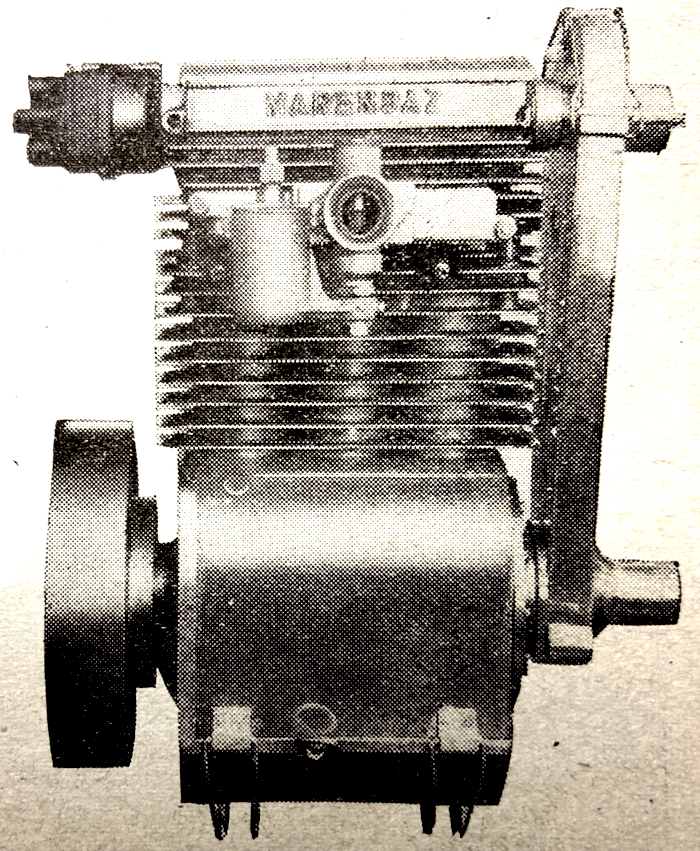
“THIS letter is of interest mainly to fellow chairists. My last solo ride was on a 1¾hp Rex in 1907. My first essay with a chair was in the same year—on a 7-9hp JAP-engined Waverley. My present mobile unit is a 1,000cc Squariel; the chair is a Watsonian Warwick’ two-seater. One or two refinements I should like to see are as follows: For my passengers—A car-roof net slung under the ‘toe’ of sidecar for handbags, etc. A small panel clock. A demagnifying mirror mounted on screen adjustment bracket—this gives a rear view and serves other purposes. A manually operated screen wiper. An air-cushion to stuff under the Passenger’s knees—this makes for comfort, I am informed. And a picnic table to sling on the front seat back-rest, for the convenience of rear passenger. Mention of the Back-rest reminds me that I have a full set of double-ended and box spanners, pliers, screwdriver and sundry spares clipped to same, all readily accessible from rear seat, but concealed by hinged panel. Some personal aids: Driving mirror mounted on sidecar above screen. This gives an absolutely uninterrupted view astern. A 3in high Perspex extension to handlebar screen, provided with its own small wiper. This allows one to drop the chromed border of the screen below eye-level. I was stumped for some time for a neat fitting for spot or fog light. Eventually I decided to tap (⅜in) the nearside hollow legshield stay and screw a lamp standard directly into same. This obviates bracket and clips, and is in easy reach from saddle for switching on and swivelling. Juice is picked up from a permanent socket on rear sidecar bottom bracket, which gathers current from stop-light lead. This socket is also handy for plugging in inspection lamp, etc. Another aid is an easily made brake-stop—½ in or ⅜in square rubber band to slip over handlebar and brake lever when brake is on. This is parked out of sight round the steering damper handle when not in use. In my view, the soundest accessory to date deals with anti-dazzle. I tried various schemes and, as often happens, found the simplest method was most effective. I purchased an ordinary green eye-shade, such as tennis players wear. I cut same to about ¾in wide (or deep) and riveted three small spring dips on to the head band. This can be mounted on the peak of any cap or ski hat in a few seconds, and removed quicker. Clips are ⅜in wide and riveted with shortened panel pins. One can treat head lights and sun with contempt by a slight bow to same, and without obscuring main vision. For pillion passenger I have a Terry fully sprung saddle hinged to mine. We rise and fall together. To settle an argument, I ran my machine on to a weighbridge. Result, 8-2-0, which, with a rough 20 stone for wife and self, totals 11cwt. This might interest one or two readers. I might mention here that the outfit is very easy to manage, so long as it is using its own horses.
Will P Goodacre, Eastham, Cheshire.”
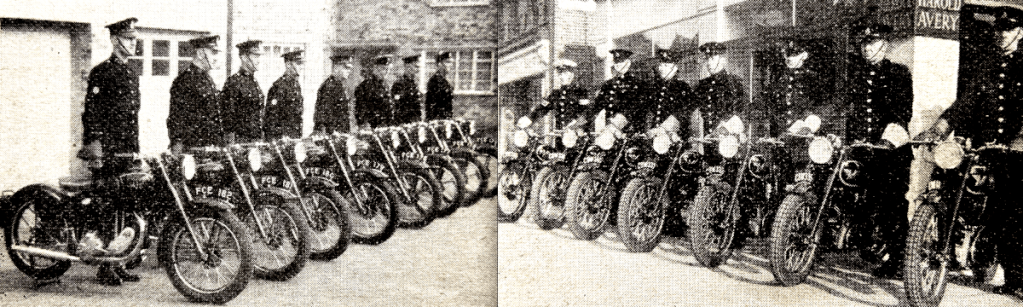
“ACCENT ON PRICE is a reason why the industry is unmoved by suggestions of fluid flywheels, pre-selector gear boxes or anything else which is certain to increase production costs materially. The good designer, an old engineer adjures, is the man who can make a better article at a price lower than that of the existing one. There are, and will continue to be, motor cycles of luxury type, but to-day the majority of manufacturers are looking ahead with Henry Ford’s maxim firmly in mind—’There are more people with short purses than long ones.’ The British motor cycle industry has always been remarkable for its ability to manufacture first-class articles at a price as low as, and generally lower than, that achieved by any other group of engineers. This was revealed afresh in work on war contracts. It was also emphasised when motor cycle gear boxes were sought from concerns outside the industry; as a well-known motor cycle manufacturer found, the gear boxes cost almost exactly the figure that he obtained for his complete motor cycle. Thus what can be achieved to-day must be largely on the design side. This does not mean that design is likely to become less interesting—very much the reverse.”
“IN THE PAST vivacious motorists have invented a myriad of slangy phrases to describe fast motion—vacating the land-scape; knottery and knottage; and so forth. A venerable philosopher, who is also an earl, was heard on the radio this month to say, ‘I cannot see much point in altering one’s position in space with perilous velocity.’ This is the purest form of British wit, which notoriously bases itself on gross understatements.”
“THREE MODELS, EACH fitted with Panther-Dowty Oleomatic forks, form, the P&M Panther range for 1947. These are: Model 60, a 248cc, ohv single; a similar machine, Model 70, of 348cc; and Model 100, in the eyes of many the most famous of all sidecar singles. This last machine is, of course, of 598cc and notable both for its excellent pulling powers and remarkable tool economy. In design of the three machines there is little alteration other than in regard to the new and most interesting front forks. Two different Panther-Dowty telescopic forks have been designed—one for use on the 250 and 350cc machines, and a heavyweight pair, on similar lines, for the Model 100. Both the smaller machines have coil ignition with the contact-breaker mounted in the timing cover and driven at half engine speed. The dynamo is a 36-watt Lucas. The coil is mounted beneath the tank. As usual with the smaller Panthers, the single port ohv engine is arranged with the cylinder approximately parallel to the front down tube—with the form of construction employed in the Model 100 the engine takes the place of this frame member.
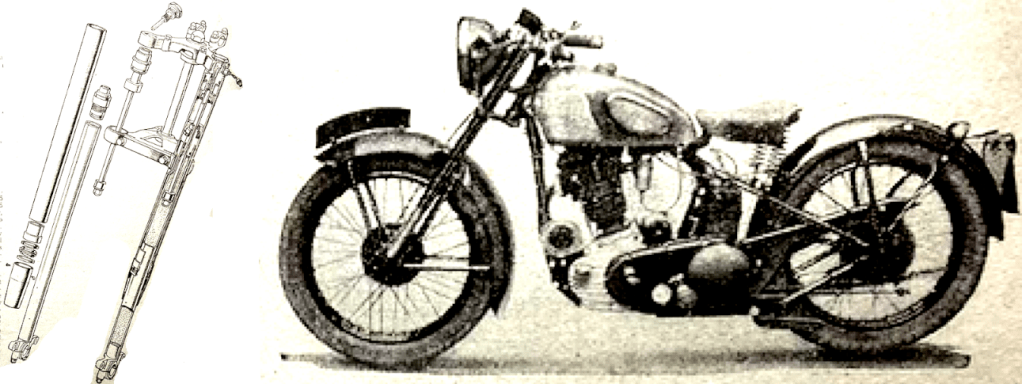
Semi-dry-sump lubrication is provided, with the oil carried in a sump forming part of the crankcase. This arrangement,which has been the rule with P&Ms for many years, has the advantage that the lubricant flows readily to the bearing surfaces almost the instant the engine is started. Both the frames and forks are identical. The former are of straight-tube design, with twin seat tubes and forged-steel lugs. The wheelbase is 53in and the weights, respectively, are 280 and 2871b—the latter an unusually low weight for a fully equipped ohv 350. Other features are 2½-gallon fuel tanks in royal blue with eggshell-blue panels, gold lining and red-and-chromium embossed Panther name-plates; pressed-steel oil-bath primary chain cases; spring-type engine shaft shock absorber; twin, spindle-mounted cams for rear chain adjustment; 6in diameter brakes; 3.25x19in tyres; Burgess absorption-type silencer and Terry spring-mattress saddle. The general finish is black with gold lining. The performance claimed for the 250 is 110mpg of fuel, 2,500mpg of oil and a maximum speed of 65mph; for the 350 the figures are respectively, 100mpg, 2,500mpg, and 75mph. The 598cc Model 100 has a compression ratio of 6.5 to 1. A feature of this 87x100mm ohv single is the decompressor or ‘half-compression’ device to facilitate starting. Raising a lever on the tinting chest causes a small additional cam to operate the exhaust-valve tappet and release a portion of the charge on the compression stroke. As a result, the effort called for in ‘kicking’ the engine
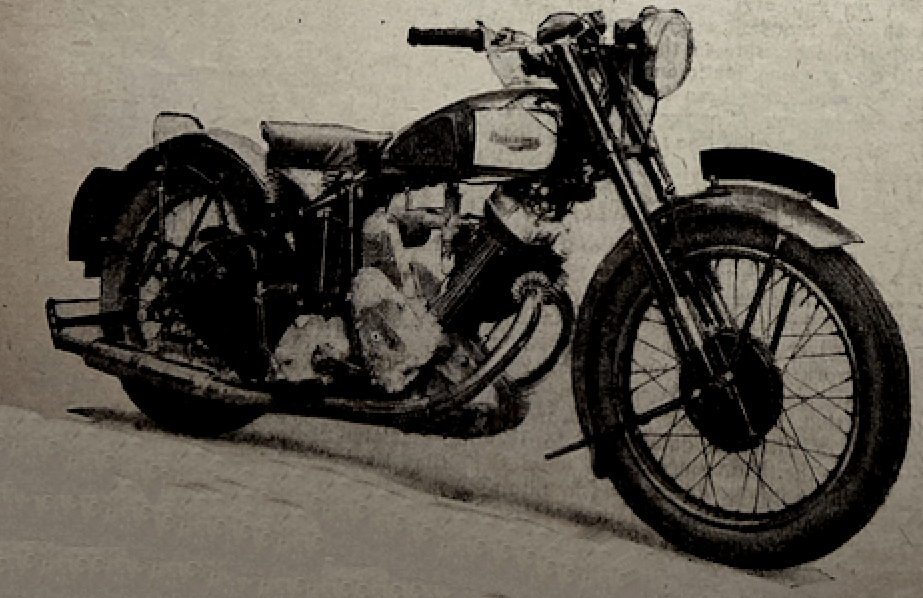
over compression is greatly reduced and the need for raising the exhaust lifter and dropping it at the appropriate moment is overcome. Magneto ignition is employed. The instrument is a Lucas incorporating automatic advance-and-retard. Drive is through the Panther QD coupling. A separate Lucas dynamo, driven by an enclosed duplex chain is employed. Again, the oil is contained in the sump; the capacity is half a gallon…Neoprene synthetic-rubber—almost indestructible—inserts are employed in the clutch of the Burman four-speed gear box…An Enfield rubber-buffer shock absorber is fitted in the rear hub. In the case of this machine there is a polished cast-aluminium oil-bath primary chain ease. The brakes are 8in diameter rear and 7in front, and the tyres 3.25×19. Finish comprises a chromium-plated (3¼-gallon) tank with cream panels lined in gold and fitted with red and chromium nameplates, chromium-plated rims with black centres and red lining, and as regards the remainder of the machine, black. lined in red. Other features are the excellent rolling.type rear stand, cam adjusters for the rear chain, journal wheel bearings, twin Burgess silencers, Terry saddle, integral sidecar and pillion footrest attachments, 11 twin fuel taps and a hinge-type filler cap. The weight is stated to be 385lb and the claimed performance is 85mph solo, 65mph sidecar, 90mpg solo and 60mpg sidecar (many owners will state that. this should be 70-80). The wheel-base is 54in. A most interesting point about this ma. chine is that the Panther-Dowty forks are so designed that in a matter of minutes the fork trail, and therefore the steering of the machine, can be changed from ‘solo’ to ‘sidecar’ or vice-versa…The forks themselves, product of the famous aircraft undercarriage manufacturers and developed with them in co-operation with P&M, differ considerably from any of the telescopic forks that have been described…there are no steel springs…the construction is commendably simple. The suspension medium is air, with oil for damping and for lubrication…the Dowty engineers state that tests have revealed that 20,000 miles can be covered—that this distance has actually been covered—without a pump being applied to the forks. The forks¼, they say, settle about in during the first day, owing, it seems, to the oil absorbing some of the air, and thereafter remain constant…the two legs are balanced, that is, the air chambers, one in each leg, are linked together by a pipe which runs in the U of the top cross-member…A short run on the Model 70 fitted with the forks showed that the Panther-Dowty front forks provide an unusually high degree of comfort.” Prices (inc purchase tax): Model 60, £107 19s; Model 70, £117 9s 6d; Model 100, £163 10s 3d; speedo, £5 1s 8d.
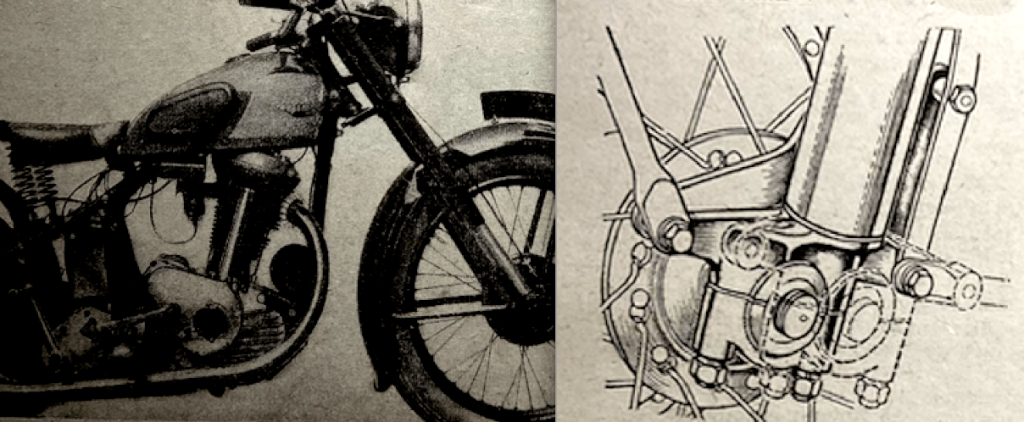
“T0-DAY THE AVERAGE cost of an autocycle, including Purchase Tax, is £50; for a 125cc lightweight two-stroke, the figure is £73; for a 250cc solo, £113; for a 350, £149; and for a 500, £164. While wages have increased in proportion to these increased costs (less Purchase Tax), in some—but by no means all—categories of employment, manufacturers are dismayed by present-day figures. ‘Why,’ remarked one a few days’ ago, ‘a 125cc machine costs what we used to charge for our super-sports 500.’ He went on to outline the policy which the industry is likely to adopt when the time arrives that sales are restricted owing to the existing high prices. Briefly, he visualises the introduction of new models which, while offering as great a refinement in performance as the latest twins, are shorn of unnecessary fittings and designed right to the smallest detail with the objects of saving weight, and therefore material, and reducing to a minimum the cost of manufacture.”
“‘A REAL RIDER’S COURSE’ was the competitors’ verdict on the Northern Experts’ Trial. Fred Rist, the winner, on his 348cc BSA, echoed a sentiment often expressed in the past when he said, ‘This is the sort of thing that ought to be used for the British Experts.’ Of course, there was a snag, but it had nothing to do with the Chester Club, the organisers, nor with their helpers, the Sale Club, because they have no influence with the weather department. In truth, it was uncomfortably cold on those high Derbyshire moorlands between Axe Edge and Longnor. Freezing wind appears to be the inevitable trimming for this event, and many officials woefully remember the last one in 1938—clouds of steam from burst radiators and such. The start on Sunday was at Brierlow Bar. There were 42 solo and eight sidecar entrants qualified as Northern experts. Fifty miles of route included 14 observed points, the most notable being Hollinsclough, Washgate, Wicken Withy Lane and Dow Low. Most of the sections involve real gradients and plenty of rocks, and the problem of wheelgrip was ever-present because of a thin film of ice. It was, perhaps, even worse on those minor sections where a watersplash usually prefaced a steep ascent, with frost on the grass which soon attained an almost unbelievable slipperiness. Soon after starting, Colin Edge (347 Matchless) returned to replace a jammed throttle wire, only to find that it was merely frozen solid; another very early in trouble was E Lambert (549 Triumph sc), who retired on the first section with what was thought to be a bent valve. Hollinsclough attracted a great crowd, and it was in most tricky condition. The usually difficult steep rock ledges at the top proved to be as nothing to the problems of the approach, for the thin film of ice offered no wheelgrip at all. Most of the early arrivals footed hard, although R Clayton (498 Matchless), after one slight touch, was clean on the upper sections. Then, after several failures, Sid Smith (343 Triumph), of Manchester, made a perfect ascent, to the wonderment of at least one onlooker, who remarked, ‘Blimey, and with four inches of ground clearance and girder forks!’ No other competitor equalled this show, although Rist, GE Broadbent (347 Matchless), and TH Wortley (347 AJS) were outstanding. No sidecar even got on to the hill proper without much assistance. Washgate was not quite so difficult, and the loose stones on Cheeks were too firmly frost-bound to cause much trouble, although TU Ellis (498 Matchless) broke off a footrest there. Most of the other sections, being on steep, frozen, grass banks approached from water-splashes, were either exceedingly difficult or just plain impossible. In the later stages the big problem was the freezing of the mud trapped in mudguards and forks, for it became as hard as cement and provided a most effective kind of slipper brake, which was perhaps all to the good because many brake rods and cam levers became frozen amid accumulations of mud. Nevertheless, the majority survived the course in good spirits, recognising that it had been both a tough and a genuine sorting-out. RESULTS Thomas Trophy (best solo): FM Rist (BSA), 18 marks lost. Edge Trophy (best sidecar): AC Partridge (BSA sc), 20. Best 250: KB Norris (Panther), 38. Best 350: GE Broadbent (Matchless), 19. Best 500: AC Lacey (Ariel), 26.”
“IT IS EIGHT YEARS since the last Southern Experts’ Trial. For last Sunday’s event, the ninth in the series, the Sunbeam MCC retained the previous characteristics of three laps of an ultra-short course, the first lap to be marked on observation, the second on observation and time and the third on time only; competition tyres were allowed and machines could be used without silencers. Inevitably this event has a scramble flavour but nevertheless the winner of the solo class, BHM Viney (347 AJS), is a trials man. Paradoxically, however, he was first in virtue of the marks he retained by making standard time in both second and third laps. Although some of the sections were varied for sidecars, the circuit was too difficult for them. In consequence the sidecars were required to complete only the first lap and the winner, HR Taylor (497 Ariel), obtained his position entirely on observation marking. There were ten sections on the sandy hillocks of Weavers Down. The first, Trophy Hill, was a straight climb up a gradient of about 1 in 3 with a rutted bumpy surface of heavy sand. EJ Friend (348 Triumph), the first man up, exemplified the obviously correct tactics of full throttle and weight well forward to keep the front wheel down; he was a joy to watch but, it seemed by mistake, went the wrong side of a card and presumably lost six marks thus early. Making insufficient speed to combat severe wheelspin, RJ Scovell (348 BSA) and G Eighteen (347 AJS) both footed near the top and for a similar reason G Bigg (350 Matchless) stopped. Hard by was The Cutting, a ‘wriggle’ down the steep, short bank, through and then up the opposite and equally steep bank of a six feet deep gully. It was tricky work demanding good balance and judgment and a nicety of throttle control. Of the solos, Scovell, Viney, JH Culver (350 Matchless), RC May (500 BSA) and Blackwell were noted to be clean on the first lap. In the broad hollow on the other side of the ridge were more sections close together with picturesque names such as Power Dive, Triumph Hill, Southern Rockery and Rear Up. On the descent of Power Dive, competitors had a loose and rutted black loam surface to contend with apart from the steepness of the grade. One of the prettiest performances was that of Jack Plowright on his second lap, who had his 350cc Royal Enfield nicely in control all the way down. By marking off an ‘S’ bend approach to Southern Rockery the organisers prevented a fast approach; in consequence the grade, deep sand, and loose boulders made up a formidable obstacle. GS Wakefield (250 Triumph), Lines and JM Crow (350 AJS) all footed to avoid going over the bank and down the six-feet drop at the side and May failed with wheelspin. Blackwell dabbed just once and, it seemed, unnecessarily. Triumph Hill and Rear Up were not unduly menacing for riders of expert calibre, and after Snaky came Blast Pit, a tricky double hairpin giving an ‘S’ formation in thick yellow sand. With the cutting out of Sink into the Ooze, Tank Dump became the last section of the circuit. This short, sandy rise had a pit full of rusty ironmongery on its left, while metal girders, sprouting from the sand, separated the solos’ path from that of the sidecars. Here, on Lap 1, Peacock’s outfit rolled down the hill and came to rest almost on the brink of the pit. Here, too, Viney stopped. On Lap 3, when time alone mattered, EN Frost (350 Norton) hurtled up the hazard in his fashion—very fast, as if a brick wall would not stop him. RESULTS Best Solo Performance: BRM Viney (347 AJS), 23 marks lost. Best Sidecar Performance: HR Taylor (490 Ariel sc), 66.”
“ONE MAY BE A KING on the open road, laying the machine over to perfection on each bend and doing everything in copybook style, but if you want to see whether a man can ride, set him the task of negotiating dense traffic…Some of the ride-to-work motor cyclists one sees are among the finest craftsmen on the road. I am not thinking of those gentry who leave five minutes too few for the journey from home to office or factory and make the run an exercise in snatching seconds. There are some of these on a route I take and I have a horrid recollection of a foggy day on which my bewadered right leg was brushed by the footrest that belonged to a man in the opposing traffic stream—definitely it was too close for mental comfort…In the majority, however, are men who waste no time, yet are never in a hurry. There are two who specially come to mind. One is a man with a handlebar screen and legshields. His mount is a 500cc ohv single, a Red Hunter. Then there is the driver of an 1,140cc Royal Enfield and sidecar; he, like the Ariel rider, never seems to hurry, yet you can set your watch by him. Latterly on this route there have been several riders of reconditioned WD machines. They may be ‘new boys’—I do not
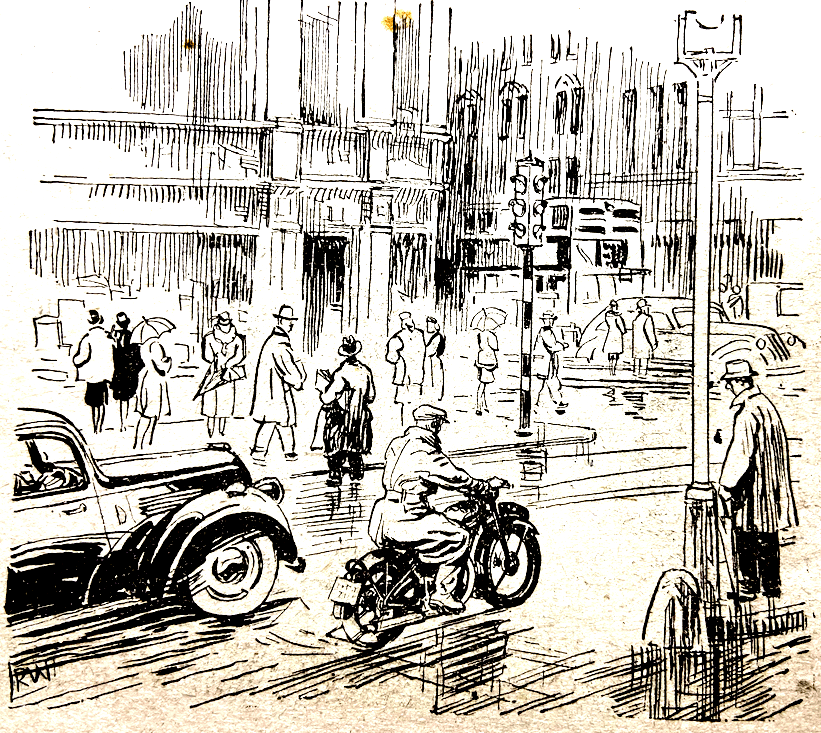
know—but they can ride and ride well. I salute these gentlemen of the road. So often when one thinks about riding that gains 100 marks out of 100 one has in mind trials and road-racing stars, but they are not the only craftsmen. Among the 400,000 and more who make up the ranks of motor cyclists are many thousands who never appear in the limelight, but who day after day give exhibitions of riding which, if not second to none, are at least to be classed with those of the gentlemen of the heavies. What does traffic riding demand? Two things stand out in my mind. One is the correct placing of one’s machine. The second is deft handling of the throttle. A point closely related to the latter is proper maintenance. A machine which is in poor fettle may not be too difficult to handle on the open road, but get in traffic, with the halts at lights, merry-go-rounds and the call for smooth acceleration, and the difference between a machine which is right and one which smacks of a bag of nails can be colossal…One finds that the lad concerned stays in gear instead of slipping into neutral—he cannot find neutral readily or engage bottom gear from neutral without a scrunch because his clutch is not freeing and because he dare not let his engine revs drop. Hence, and because their machines are, in effect, tools of their trade, one finds that many of these ridden-to-work motor cycles are among the best maintained—far better than many of the machines used solely for pleasure.”—Torrens
“ONE OF THE minor pleasures of owning a 125cc is that of reading in the motor cycle Press solemn speculations as to whether a 250 is big enough for serious riding. Of course, it all depends on what you mean by ‘serious riding’; but if 265 punctual miles in a day are sufficient, or regular and trouble-free journeys across an ill-paved post-war city, then the 125 will fill the bill. As one might expect, the maximum speed is not high, and, with no valve gear and only one chain adjustment, there.is not much scope for tinkering. Even though it is humiliating to be passed by a motor coach, it is very satisfying to be first away at traffic lights and to pass quite modern cars on a long mountain pass. The mechanic finds it a refreshing change to have a machine on which the nuts are accessible to ordinary spanners; and the non-mechanic rejoices to have a machine that is genuinely clean to ride—so clean that even the ‘best mack’ can be worn on occasion. He is also glad to have something genuinely light to push. In fact, after one puncture, one mechanical hitch, and innumerable parkings and pushings into an extremely small shed, my predominant impression is that the praises of real lightness have yet to be adequately sung. Since ‘the first 500 miles’ the Royal Enfield has been fitted with the maker’s legshields and with a ‘Soloscreen’. The shields really do keep trousers clean and legs warm; but do to a very slight extent act as a sounding board for engine noises. That is probably the real reason why so few makers offer them as standard. The windscreen also reflects noise, and makes noise more apparent by eliminating wind roar; but it certainly adds to comfort on long journeys and makes it possible to do ordinary short journeys without goggles and with only a cap.
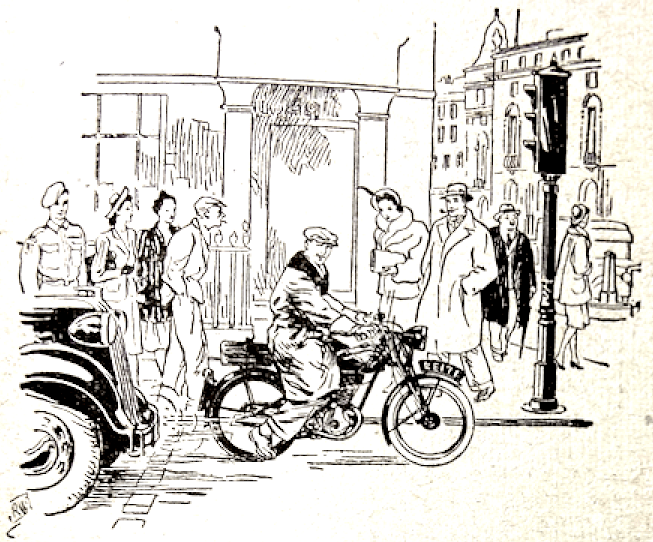
This makes all the difference to the machine’s usefulness for short visits. Another unusual but cheap and invaluable item of weather equipment is a pair of ARP oilskins. These are normally tied under the saddle, and are more than handy when there is an unexpected rainstorm. Useful luggage can be carried on the carrier, which is stronger than it looks; but, if you value your suitcase, put a piece of plywood under it and wrap up well. Two very valuable items of equipment, not supplied by the makers, are a tyre gauge and a feeler gauge. A completely deflated synthetic tyre looks and feels as if it ‘ought to have enough air in’, so the tyre gauge is no luxury; and accurate setting of the plug and contact breaker gaps make all the difference to easy starting. Even a new plug may do with resetting, as most makers nowadays have coil ignition in mind. The Miller contact breaker is surely the simplest and most accessible ever devised. Those who have wrestled in vain with older types—involving a mirror, three hands, long and flexible fingers, and a steady supply of strong language—can take new heart. Another point for those unused to lightweights is that the ball of the foot, and not the instep, should be used on the kick-starter; and the starter should, of course, be pressed over compression and not kicked. The compression release valve is useful only if something is slightly wrong and a push or paddle start is indicated. And now, what about that 265-mile trip ? Well, the most interesting thing about it is really that there is nothing remarkable to record. It was just a very pleasant run over to Borth, near Aberystwith, from Birmingham, and back via Dolgelly, Llangollen, and Glynceiriog. No, it was not a stunt. It was originally intended to spend the night with the parish Scout Camp at Borth; but circumstances forced the trip into one day, and it seemed a pity not to see the best of Wales and an aunt living at Glynceiriog while in the country. It was not quite a trouble-free trip, for the throttle twistgrip had to be faked with copper wire at Dolgelly (at a ‘we don’t touch motor cycles’ garage, with the assistance of the proprietor). As for hill-climbing, second gear had to be engaged for 200 yards on each of the two passes on the fine road between Machynlleth and Dolgelly, and plenty of bottom gear was used on the mountain road, between Llangollen and Glynceiriog. I was a little stiff at 100 miles, but this wore off and there was no stiffness at all at the end of the journey or next day—only a little sleepiness after 10½ hours’ riding. Altogether it must be reaffirmed that the modern 125 is not a toy, but for anyone with much local and a little long-distance travelling to do a very sensible way of combining pleasure with business.”
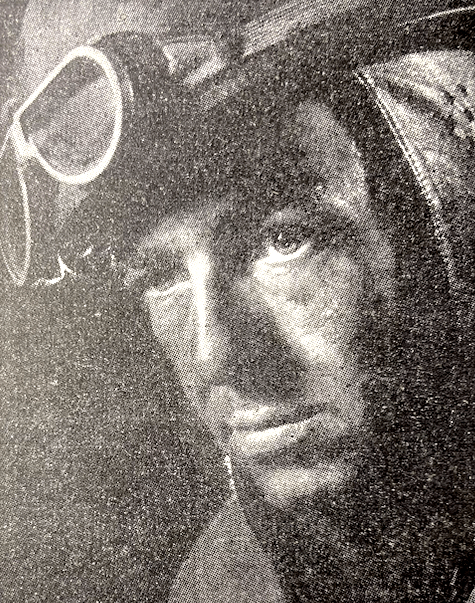
“AT THE BRITISH INTELLIGENCE Objectives Sub-committee Exhibition there are shown a racing BMW and some drawings culled from the famous Bavarian Works. The BBC was a bit off the beam in the news item about the BMW exhibition. It was said that the BMW was one of the 1939 TT models. This is not so; the machine on show is certainly supercharged, but among other differences from the pukka TT job it has push-rod operated valve gear instead of bevel-driven overhead camshafts. The model at Millbank has, in point of fact, been in this country for some considerable time, and lately has been ridden to the office by Hugh Palin, assistant to Major Watling, director of the Manufacturers’ Union. Hugh Palin says that in his ‘stable’ he has had a 125cc James as well as the BMW—it has been amusing to ride them on alternate days, the former with a maximum speed of about 40mph—and the latter which would not do less!”
“IN MAPPING OUT the improvement of road and traffic systems, members of the Ulster Planning Commission seek not to follow too far the fashion of long, straight, autobahn-like routes. Their report, according to the Ulster Commentary, says, ‘It is not necessary or desirable to construct long, straight roads at the expense of contours, trees and buildings…’ It is their opinion that drivers will suffer less fatigue and gain more amenities if monotony is avoided—provided good visibility is given. Much thought has been given by the Commission to the Ulster road system of the future, and suggested improvements are classified into those needed for arterial, Class 1 dual-carriageway and other important routes, as well as for roads of scenic interest. Such planning might well be accorded to the roads of all Britain; after all, we have some of the most varied and beautiful country through which to drive and ride, and, with due thought to safety, we should be able to retain the national character of our traffic-ways, at the same time improving them, without making roads look like runways of futuristic ft airfields.”
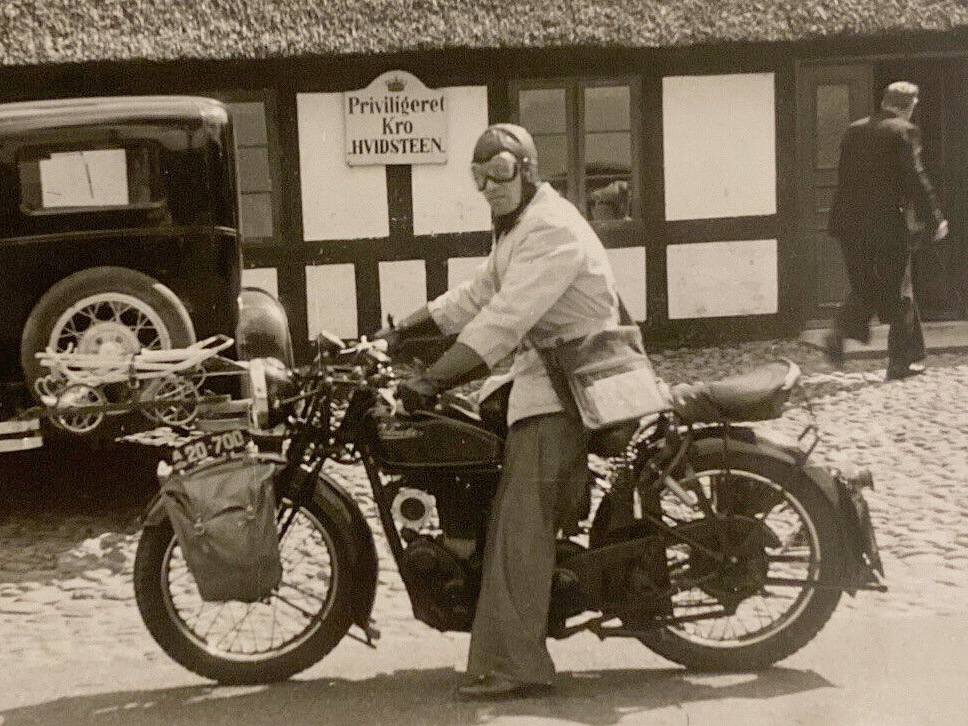
“OLD FRIENDS HAVE RETURNED. Many signposts are back again at their accustomed places by road and by lane. They have returned refurbished with fresh black and white paint; and some of them must have needed it very much. After all these years it is good to see the signposts standing like quiet sentries pointing the way to remote hamlets that we must visit one day when there is time. But, best of all, there is the joy of knowing that we now can get astride our mounts and re-explore this land of ours. We are now at liberty to think again of the things we have always cared about: of leafy Warwickshire lanes and a countryside patterned with tall, stately elms, placid rivers, and streams; of high Cotswold places, aged yet ageless, with beautiful grey houses, and tree-enfolded churches set in the quiet valleys; of the green hills of the Borderland, gorse-crowned and very lovely; of downland and wold; and, above all, of the fretted sea-coast whose attraction for us never ceases. In out-of-the-way places, where memorable names are written up on the modest signposts, we can regain the peace of road and lane, and enjoy the varied face of the English countryside.”—Aella
“JOE CRAIG, MSAE, MIAE, who was Norton team manager during the years in which Nortons had the most remarkable run of racing successes in the history of the game, is going back to Bracebridge Street. Nortons announce that he is rejoining them on January 1st. His post? He has been appointed Technical Director to the company. In the past, when at Nortons, Mr Craig concentrated almost entirely upon the racing side, and his success as a development engineer was reflected in the way year after year Nortons won nearly all the classic road races in which they competed, the unblown singles on many occasions beating blown twins. The future should be interesting…”
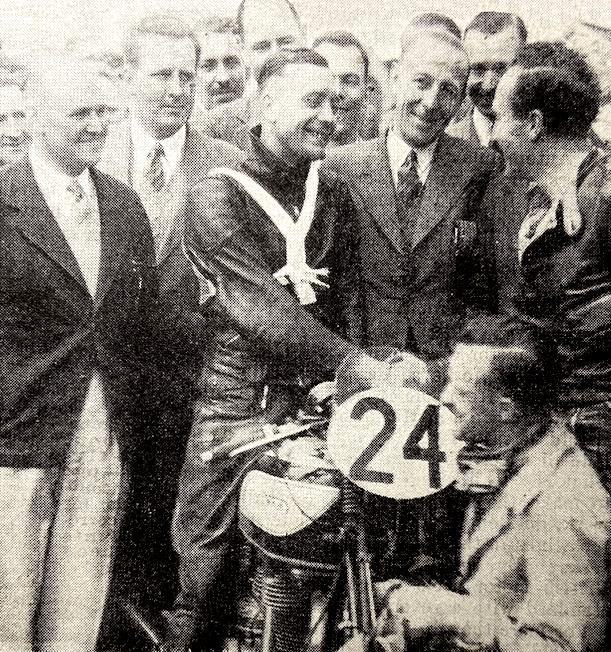
“MY COMMENTS LAST WEEK on fuel have raised a query or two about where all the benzole goes these days. The point made is that as benzole mixtures are not now sold from the pumps, does it mean that the output of benzole—produced at home, remember—is below pre-war? The short answer is ‘No’. In point of fact, benzole is being made in large quantities, but is blended in with Pool. Normally, therefore, the gas companies and other works with coke ovens send their benzole to the nearest petrol installation, where it goes in the mix. This accounts for the variations one sometimes notices in the anti-knock properties of Pool fuel. Generally, Pool is about 70-octane, but is sometimes raised to as high as 72-octane by the local benzole.”—Nitor
“MORE STREAMLINE, MORE eye appeal and more massive appearance characterise the 1947 Harley-Davidsons. The latest models incorporate many new features, most of which are in the nature of detail improvements. All models are V-twins and the basic engine capacities are 750cc, 1,000cc and 1.200cc. The smallest model, the ’45 Twin’ is a side-valve, the 1,000cc ’61 ohv’ has, of course, an overhead-valve engine, and the largest machine is in two basic types, the ’74 ohv’ and the ’74 Twin’, with respectively over-head and side-valve engines. There are also other models such as the ‘Police’ edition and the ‘Servi-Car’, which are basically similar to the standard types though, of course, the latter is a three-wheeler with the commercial body behind the saddle. Totally enclosed valve gear, large air cleaners, dry sump lubrication and coil ignition, are common to all models. Primary drive is by duplex chain in an oil-bath, and the heavyweight clutch is operated by a pedal on the near side. Gear boxes are the four-speed type with folding kick-starters. Pan-seat saddles with telescopic springing in the seat tube, front and rear crash-bars and deeply valanced mudguards are other details which have been features of Harleys for many years. With the object of ensuring that the gear-change lever when in the top gear position is well clear of the rider’s knee, the gear ratio sequence has been reversed; on the latest models, bottom gear is towards the rider and top farthest away. The new gear-change gate is specially designed to permit swift changes and is chromium plated. On the sides of the tank is a new name plate taking the form of a ball with a convex streamer in chromium plate carrying the words ‘Harley-Davidson’ in red. On the top of the tank is an instrument panel incorporating a large 120mph trip speedometer. The panel has two warning lights, one for the dynamo and one for oil circulation; the words ‘Gen’ and ‘Oil’ are coloured white and fired into red glass. Farther back is the lighting switch. Round the base of the instrument panel is an extruded rubber moulding and the panel is retained by one bolt placed in the middle. The new die-cast zinc-alloy tail lamp merges in with the line of the rear mudguard and carries the holder for the number plate. Improvements in the coil-ignition equipment result in easier adjustment of the contact breaker and the advance-and-retard mechanism. Another feature is the hydraulic damper fitted in front of the springs of the widely famed bottom-link forks. Standard colour schemes for the home market are Flight Red, Skyway Blue and Brilliant Black; for export Olive Green takes the place of Brilliant Black. Though not available to the general public the Police model is particularly interesting. It is the ’61 ohv’ finished in ‘Police Silver’. Additional equipment includes three front lamps (for pursuit purposes), a fire extinguisher and a radio.”


“I HAVE BEEN a regular reader of your interesting paper since 1909. I am now running two 1930 machines—both belong to the Vintage Club. They are a Sunbeam Model 9, which is used chiefly as a sidecar mount, and which I bought in 1941 (an apparent wreck) for £17, but which now, after extraordinarily little attention, is by far the best machine of the many I have owned; and a Matchless Silver Arrow bought in 1943 for £20, on which I have spent a good deal of time and money (about another £20 in all) but which is now a most comfortable, silent and economical mount. The Sunbeam has covered some 6,000 miles this year, including a tour of the far north of Scotland, John o’ Groats, etc, with a heavy passenger. She has been decoked twice and has had a new magneto armature bearing fitted; otherwise nothing whatever has ailed her. The Sunbeam will average (solo) simultaneously 100mpg and 40mph, and I doubt whether very many modern machines will do the like. With a sidecar the machine averages 80mpg. The Silver Arrow has covered some 4,000 miles this year, and has needed new pistons and small-end bushes, and scores in the cylinder block filled in. I completely finished one of the Arrow’s pistons, and was in some doubt as to getting replacements, but found a Forest Hill firm that had in stock new Hepolite pistons both standard and oversize—this information may be of use to other owners. The machine is very comfortable and quiet, but I find her maximum fussless speed is under 40. But she averages well over 100mpg, uses no oil, and her pre-war tyres do not appear to wear—in fact, she can be regarded as a comfortable substitute for a baby two-stroke but for the tax! I do not want to make your readers envious, but it does seem to me from my experience that if one cannot afford the present high prices for new or recent machines, one can get the next best thing—with a little luck—out of a really old model of first-class make. Both my machines were purchased unseen through the Post in response to advertisements in The Motor Cycle. Both appeared hopeless when I took delivery at the station. I am no mechanic and, although I have ridden hard since 1910, I seem to get more ham-fisted every day; and yet the above facts speak for themselves. I find that owning two machines, although expensive in tax (third-party insurance is very little more than for one, if owner only is covered), is a. great asset in durability; it means that one machine can he laid up for overhaul without regret, and is of special advantage in these days of petrol rationing! Two other small points—(1) I have purchased an RAF Buoyant suit, and find it most warm and comfortable— so beautifully padded that I do not worry about possible tosses, as I feel I should simply bounce. But on my first long ride on a wet day I ended up sitting in a puddle and with a quart of water in each gumboot, as the trouser ends will not fit outside the boots. I now wear the trousers of an ex-Civil Defence lightweight oilskin suit over the buoyant suit and keep as dry as a bone, as these cover all the leg zips and fit over the boots, and the upper part of the flying suit seems-to keep the water out. (2) I bought a very ancient sidecar for the Scottish tour, and the upholstery was finished. So I jammed in the bucket seat from an old Austin 7 or Morris Minor, and my passengers all praise the comfort, as the back comes right up to their shoulders.
(Major) JW Cardew, Bedford.”
“D0 YOU CONSIDER, demands a. correspondent, that all autocycles should have two speeds? In theory—yes! In practice—no! SF Edge once mouthed the adage, ‘The smaller the engine, the more numerous the gears’—which is sound common sense. But in practice an autocycle is not so much an engineering ideal as a concession to the three canons of cheapness, and simplicity. Being myself so large that if I were still in my twenties and knew more about boxing I could massacre Joe Louis, I take a dim view of single-speeders for my personal use. Moreover, when I can have four speeds with a £15 pedal-cycle weighing only 301b, and an unlimited number on a car, I feel it is rather foolish to get put off with one gear on a motor cycle, however light and cheap it may be. But I surrender gracefully to the fact that lots of normal-sized men and women are perfectly content with one-speed autocycles, and being a democrat, I have not the least desire to interfere with their simple pleasures. Obviously, if an autocycle were mass produced, the addition of a simple hub two-speed would not add more than fifteen shillings to the cost, while adding much to convenience…Yesterday I overtook a cop riding an autocycle. A very large cop. A sergeant, too. In his helmet. About an hour later I was overtaken. By a slimmish girl in slacks. Riding a large Harley. Probably 1,200cc. She had a fat man on her carrier.”—Ixion
“HERE’S WISHING ALL OUR READERS the best Christmas possible in these weird days. At least they won’t have a hangover next morning, neither are they likely to suffer from what the patent medicine advertisements call ‘that feeling of fullness after eating’—two familiar symptoms at pre-war Yules. Worse still, some enthusiasts have no real home, nor any rapid prospect of a real home; while an unusual percentage—for so-called peacetime—are far away overseas, some still awaiting demob, or newly dispatched under the Conscription Act. Poor old England, after bearing the worst brunt of the war, still has to reassume her old role of world policeman. So we have plenty of grouses. But as a nation we are never quite happy unless we’ve something to grumble about. Two thoughts sustain us in enduring present tribulations, minor or major. First, we stood alone between mankind and the most devilish threat that ever confronted us. Second, the measure of our present discomforts and shortages is the measure of our continued effort to build a decent world. Grim, perhaps. But possibly more wholesome than full tummies and full pockets. Anyhow, may past achievements and future hopes sustain you all in a Christmas which may hardly be traditional but at least is by no means to our discredit.”—Ixion
AS WAR-WEARY FACTORIES were converted back to peacetime production Britain’s annual motorcycle output reached 84,240, of which some 53,000 were exported.
“WHERE DOES THE GREAT SPORT and pastime of motor cycling stand at the end of the first post-war year? In this last issue for 1946 it is fitting to pause a few moments in order to take stock. What of design? Of racing and trials? And of touring and production? The facts are not unpleasing. A number of motor cycle factories are producing more—many more—machines than they were in 1939. No fewer. than 41,801 motor cycles were registered for the first time during the six months ended September 30th—the last month for which official registration figures are available. True, the supply is not nearly equal to the demand, but comparison between this figure and the 32,689, 34,097 and 24,810 for the equivalent months of 1936, 1937 and 1938 is illuminating. And this has been accomplished simultaneously with a mighty export drive in which British motor cycle manufacturers have topped the target figure set by the Board of Trade. Had every other industry achieved so much, the country’s financial position and thus the standard of living for all, would be very different. There might even be the dollars, lack of which the Prime Minister pointed out last week, is holding up the end of petrol rationing…Design, of course, has not changed vastly since the end of the war, There are new twins. A trend towards the adoption of unit construction of engines and gear boxes—or semi-unit construction—is apparent. Perhaps as interesting as anything is the almost universal employment of long-movement telescopic front forks for motor cycles of 250cc and over. The signs are, however, that marked changes in design are unlikely while the big demand for existing types persists. The sport is getting into its stride again. Probably never have trials and scrambles attracted such mighty entries or been so keenly followed. The fly in the ointment has been that organisation has often been unequal to the strain. This is fully realised by those responsible for the sport and the steady improvement noticeable towards the end of the present season can be counted upon to continue. Where there have been, and still are, qualms is over racing, Brooklands having been sold and Donington requisitioned, probably for ever. However, the building of that fine road-racing course at Scarborough marks a big step forward; the Tourist Trophy Races will definitely be held next June; the Manx Grand Prix has been revived and proved a greater success than ever and, almost for certain, one or more of the projects for new circuits will be brought to fruition. Over touring the hold-up, other than in regard to machines and sidecars, is, of course, lack of petrol. Motor cyclists, however, are reaping much benefit from owning the most economical of all motor vehicles. With their six gallons, or 6½-7½ gallons a month according to engine capacity, they can cover a mileage far greater than the average car owner. Rightly, the authorities have gone out of their way to encourage the use of motor cycles.”
…and here’s the usual batch of contemporary ads:

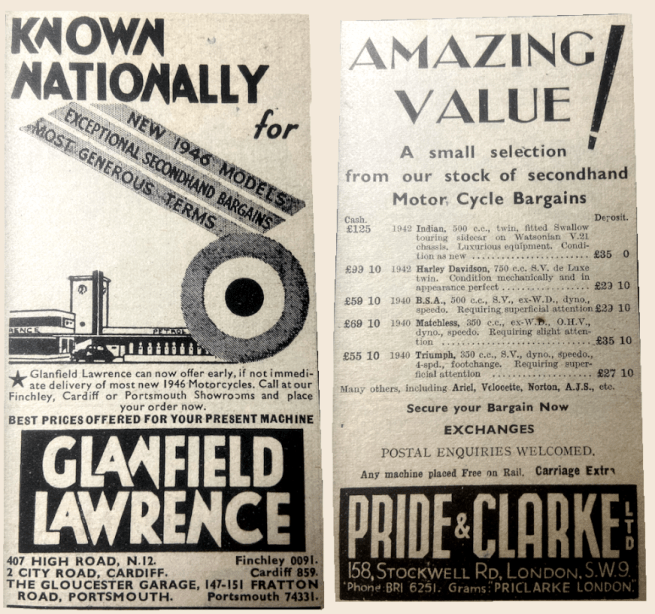
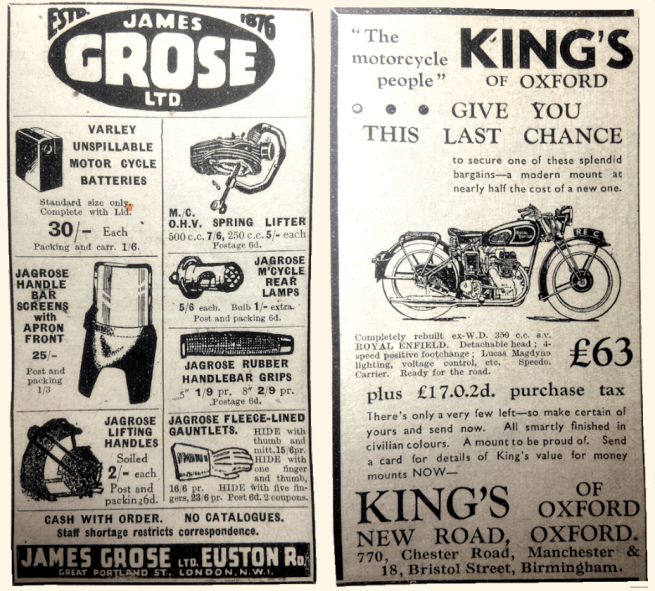
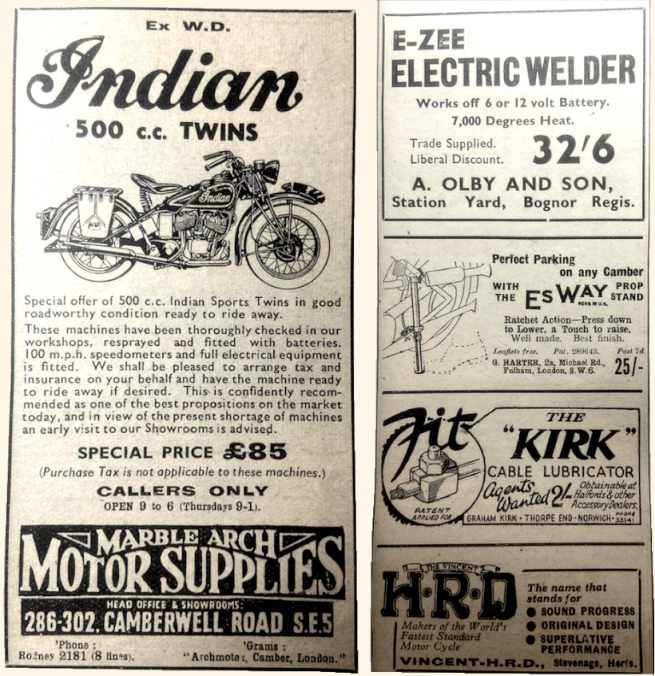
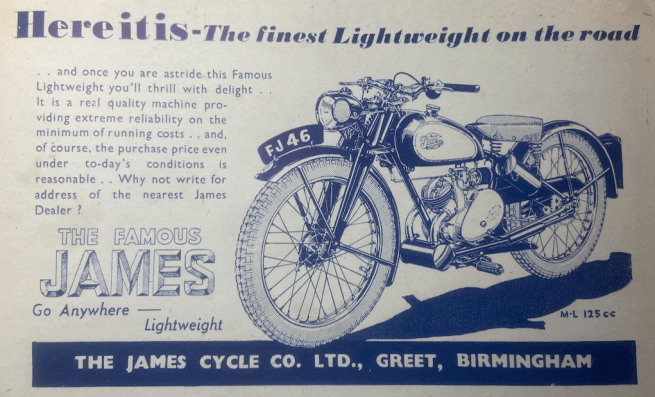
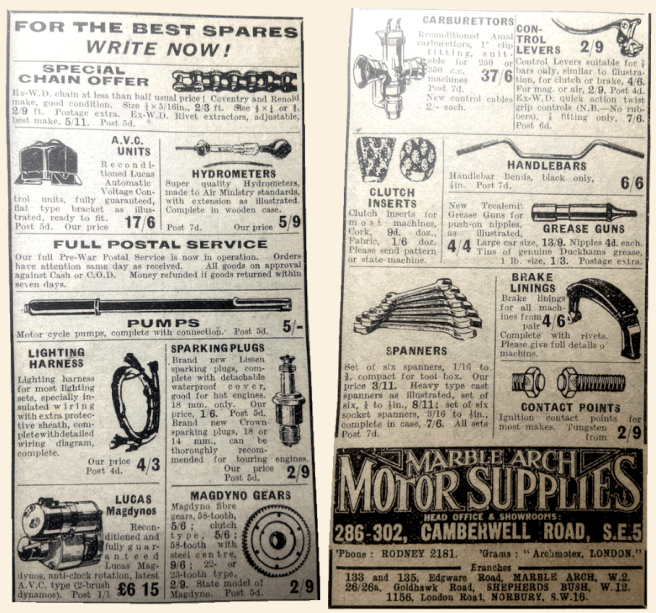

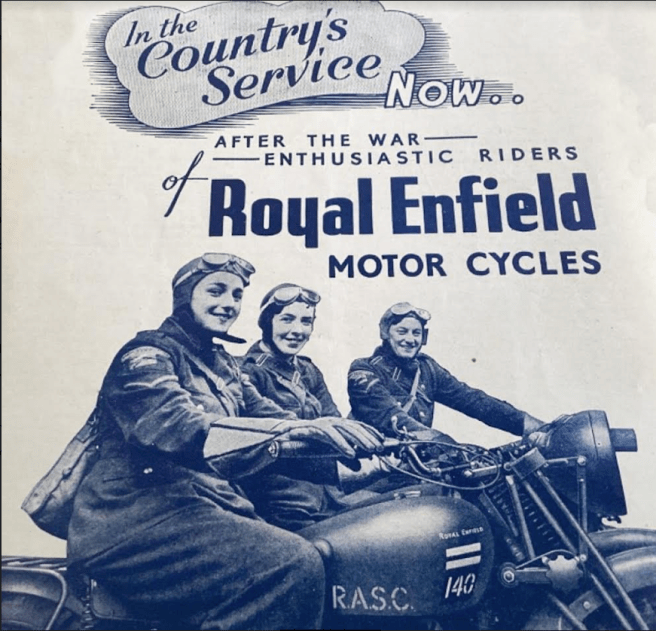
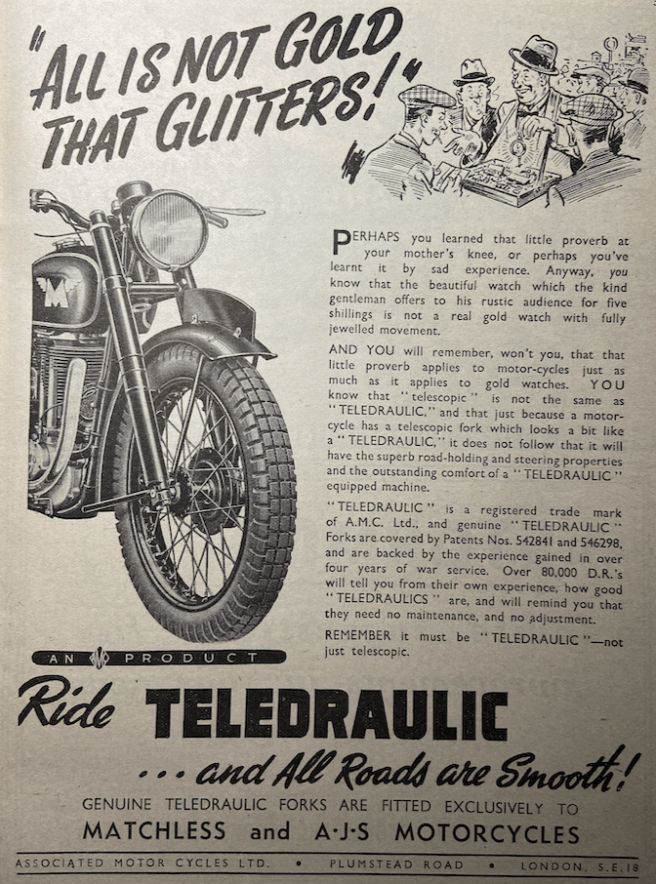
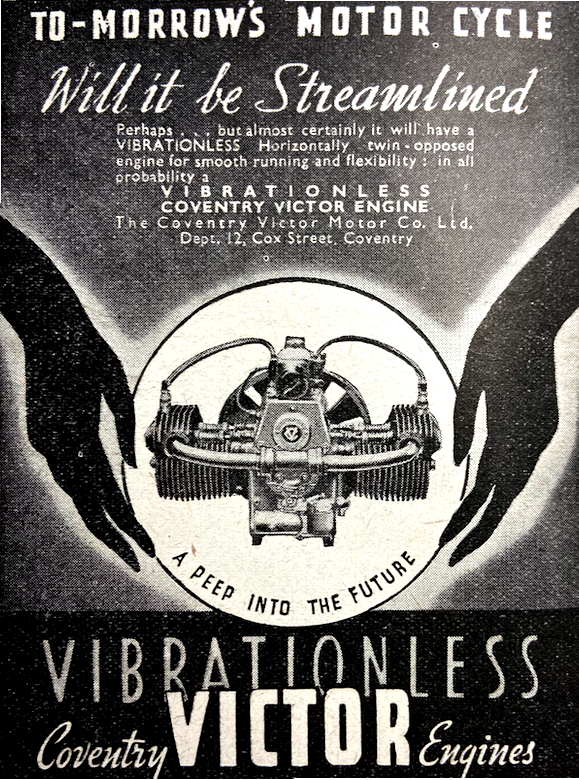
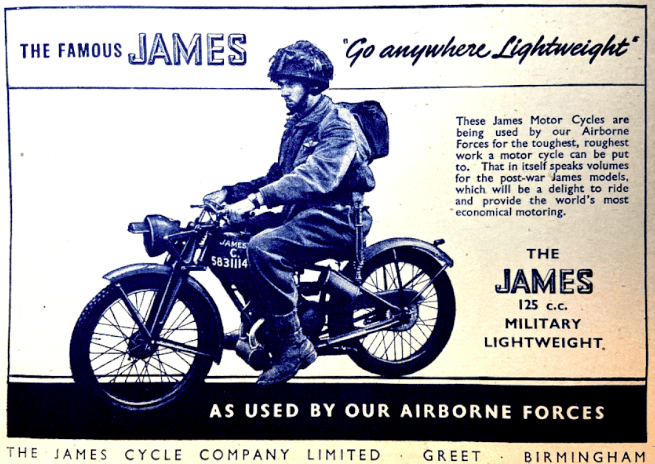
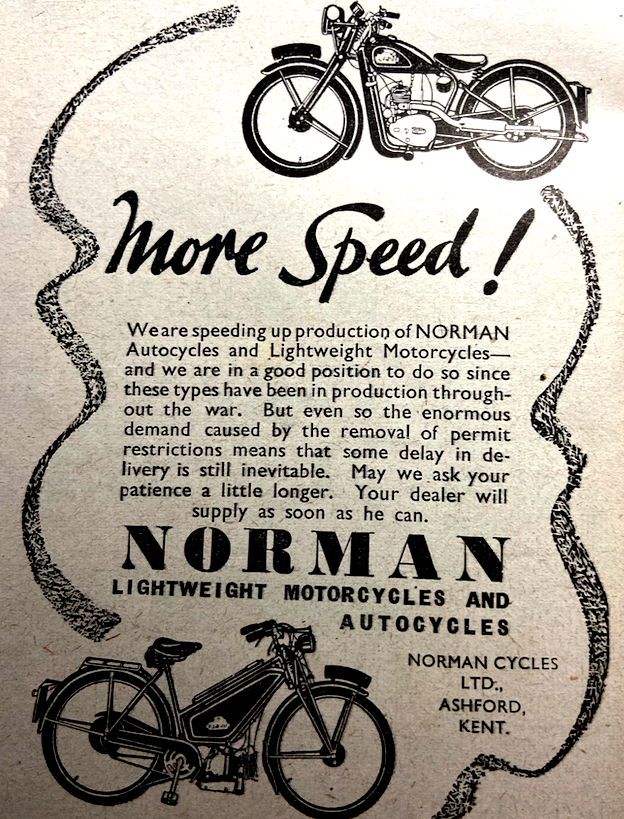
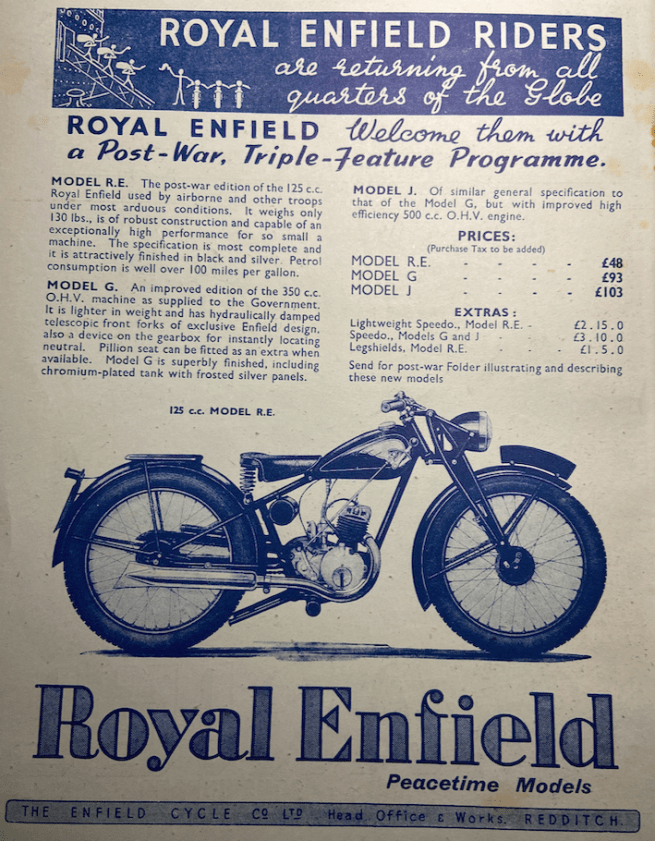
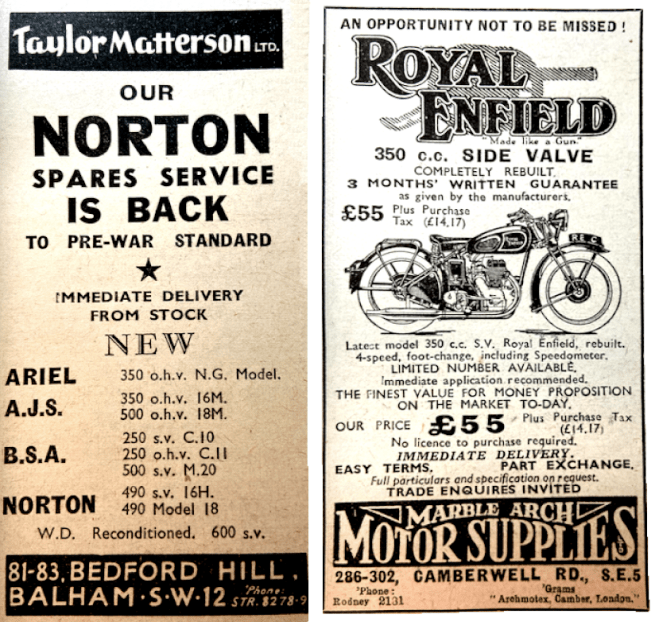
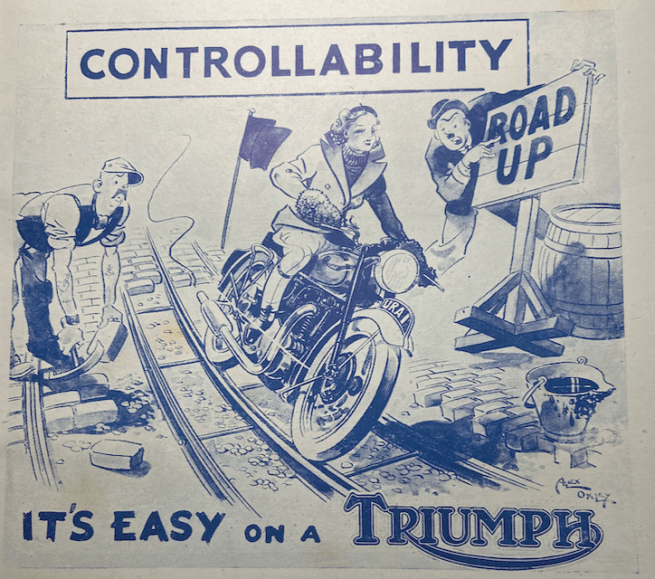
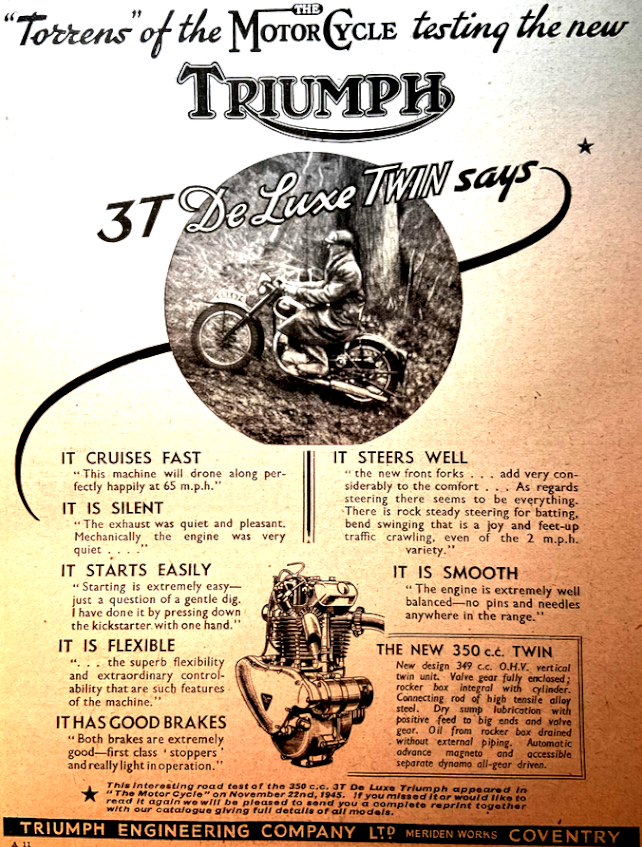

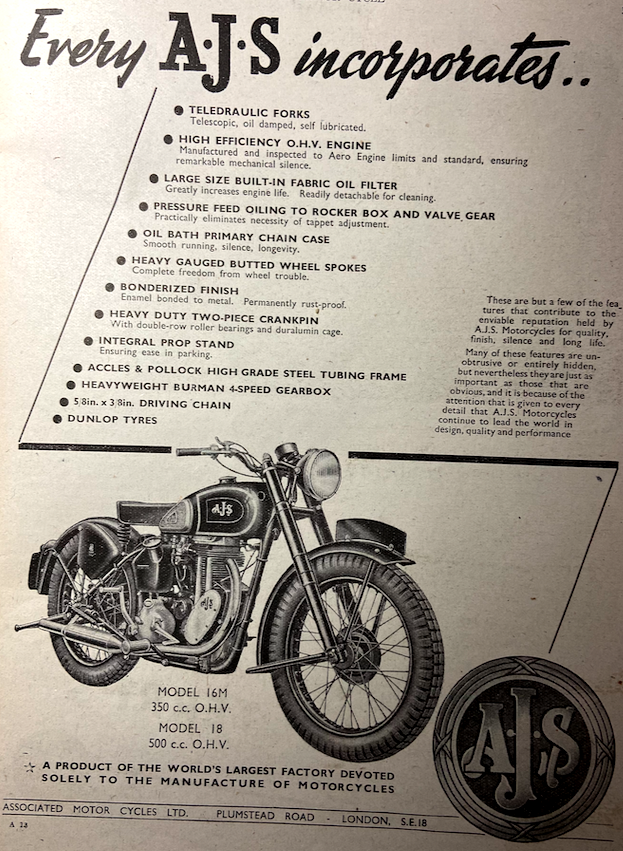
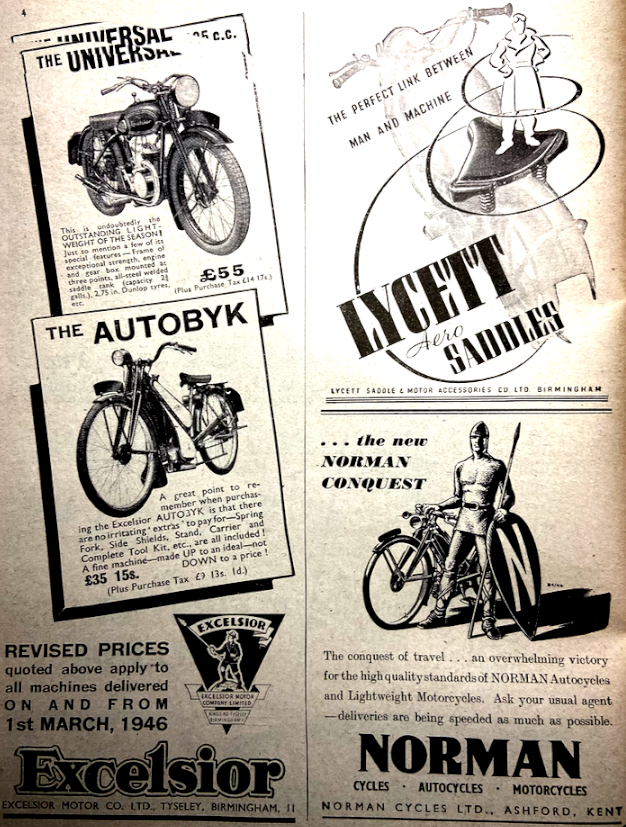

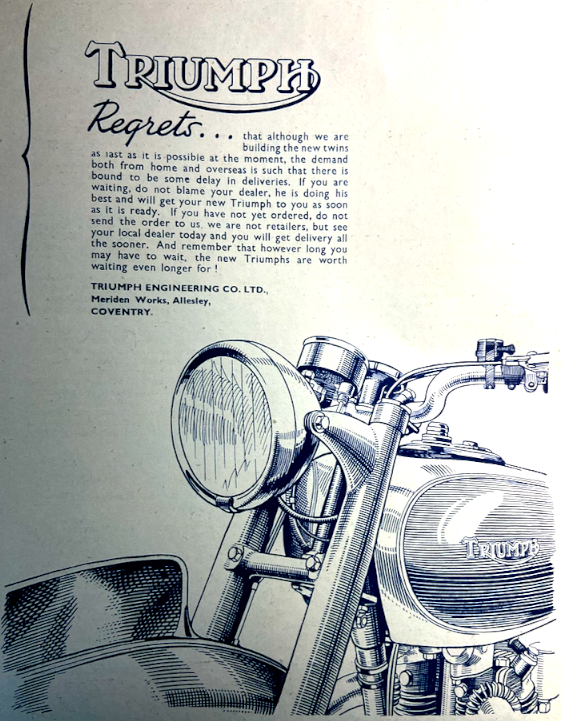
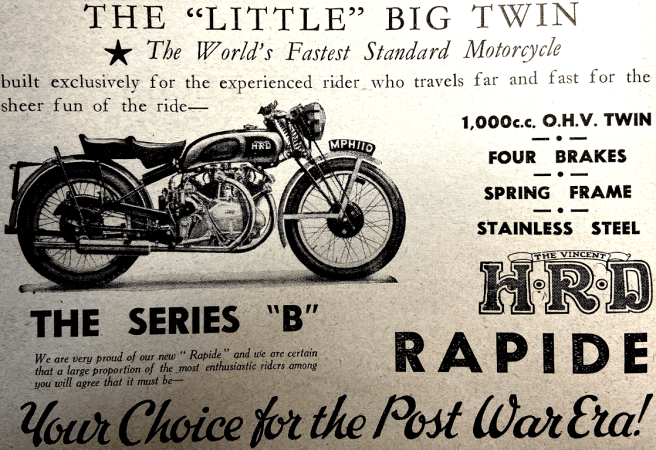
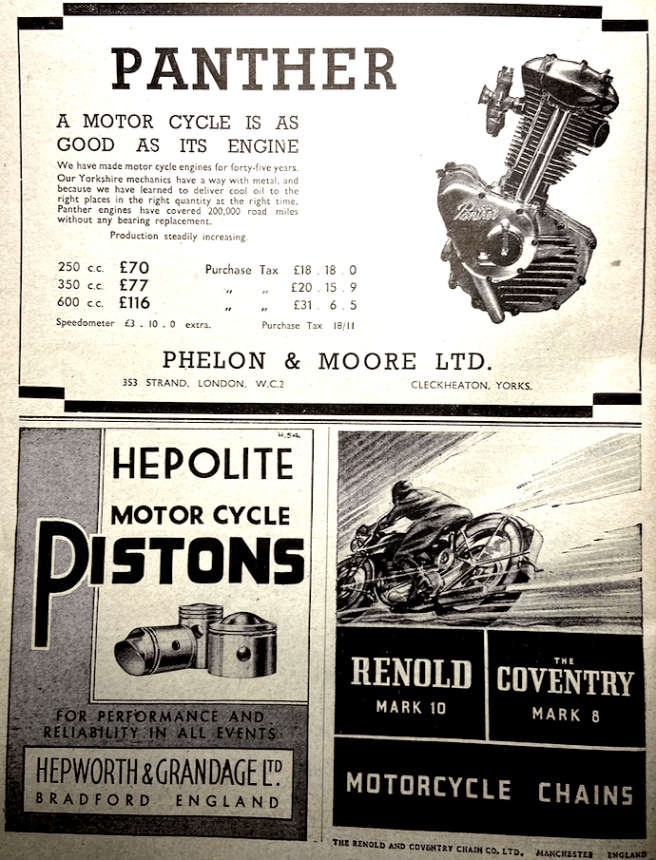
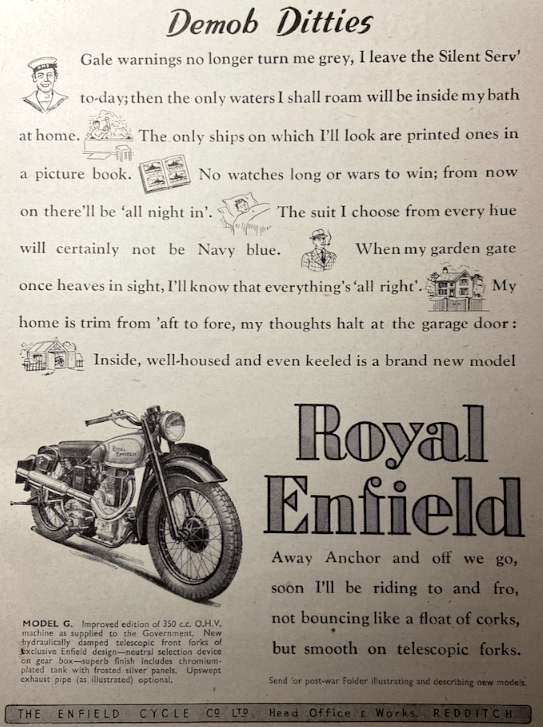
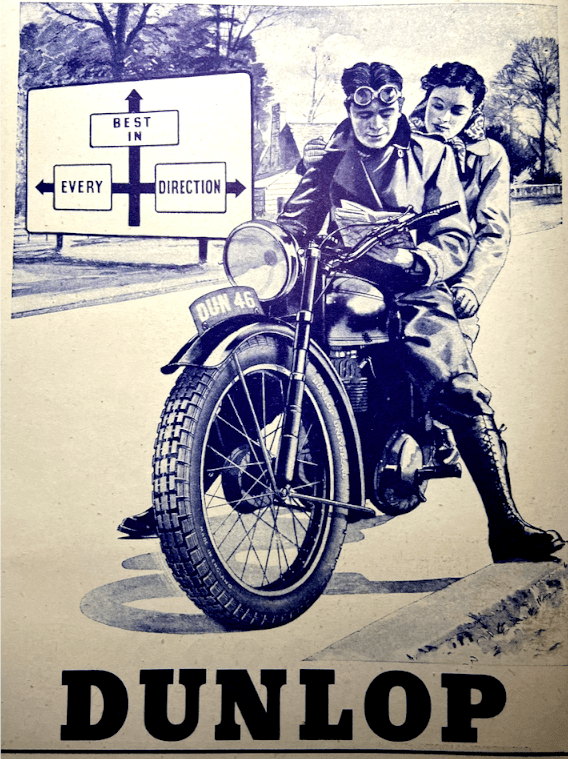
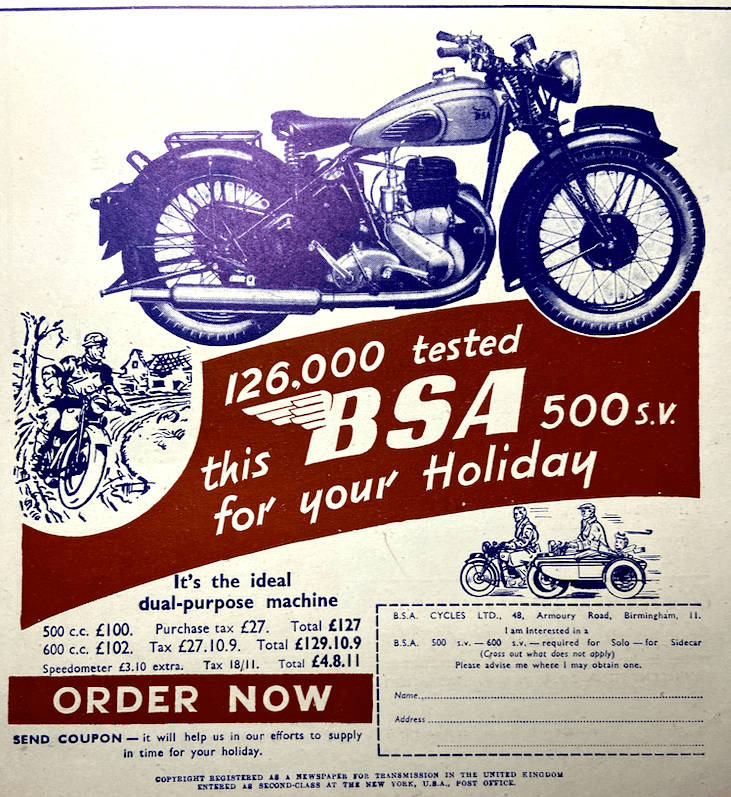
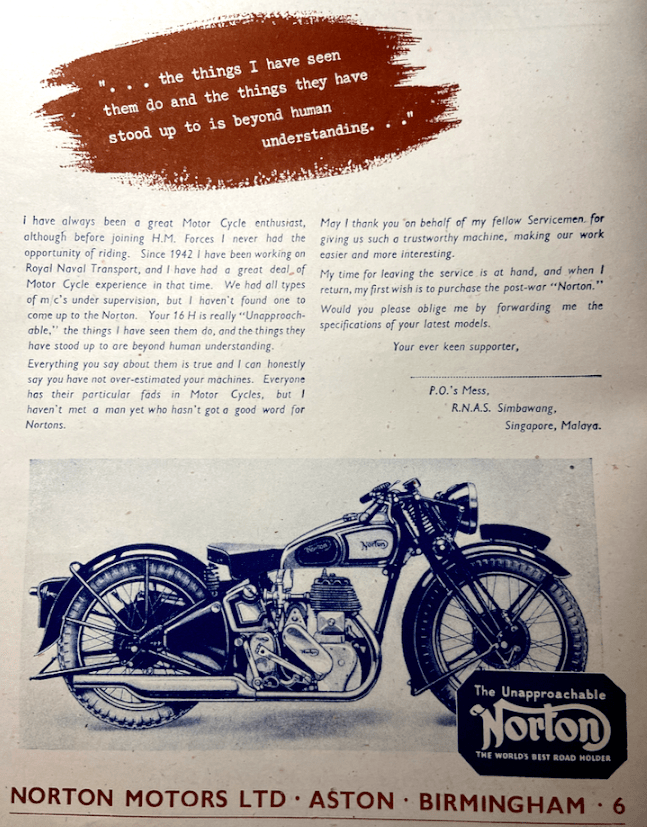
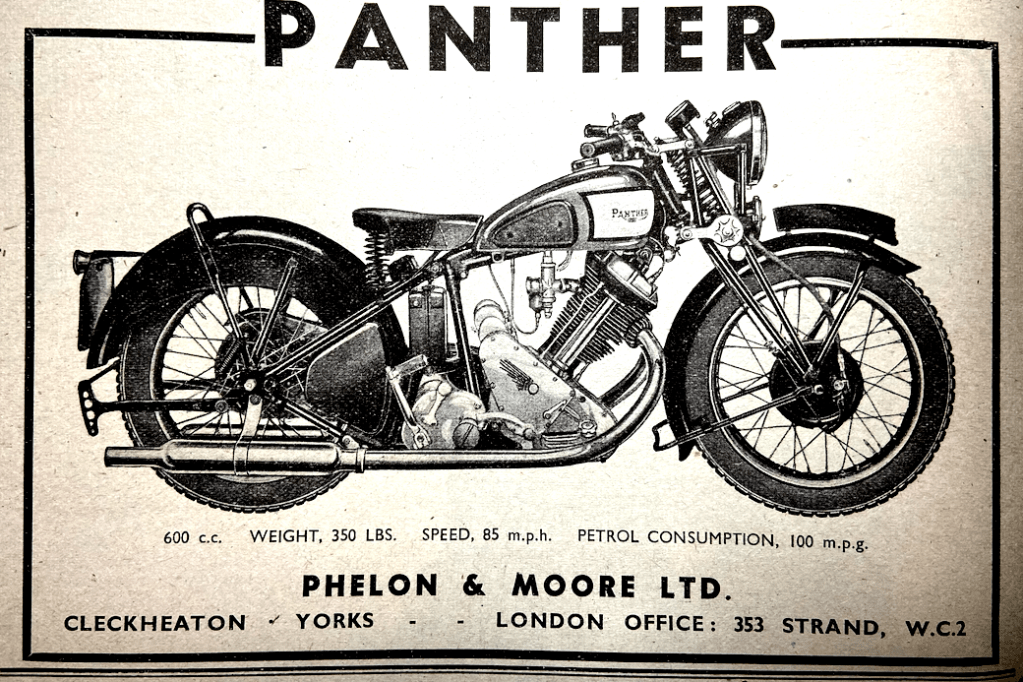
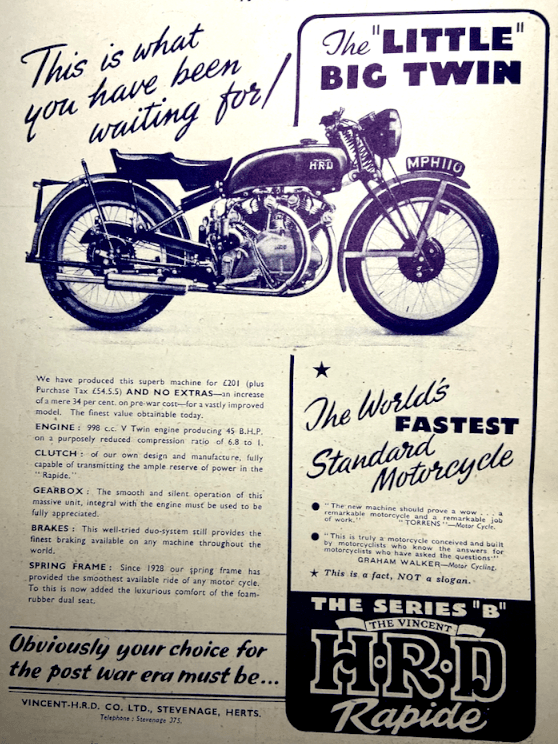
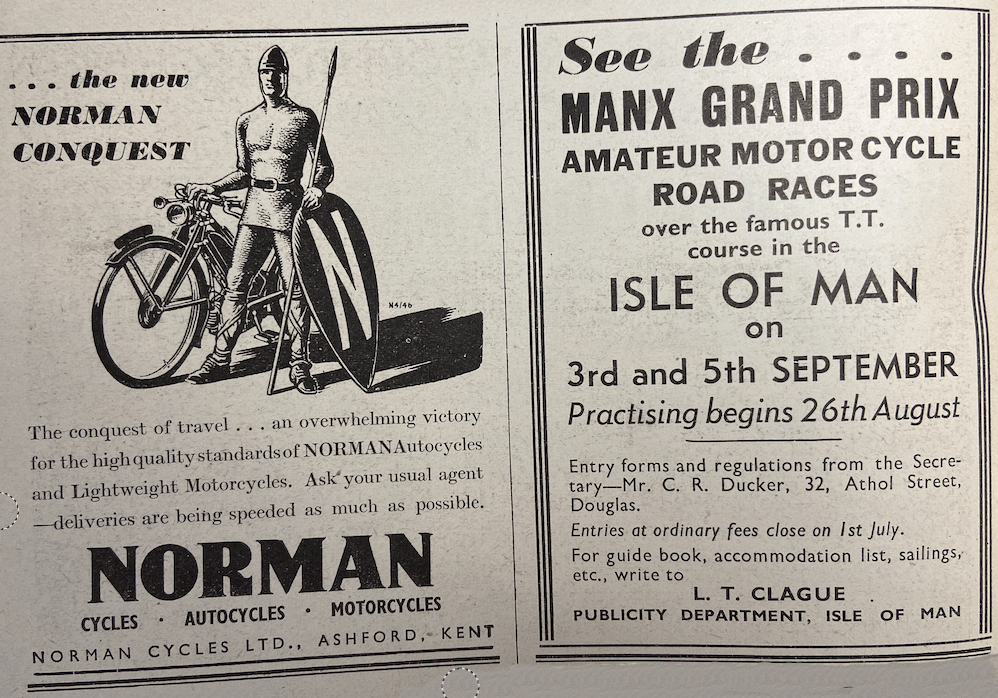
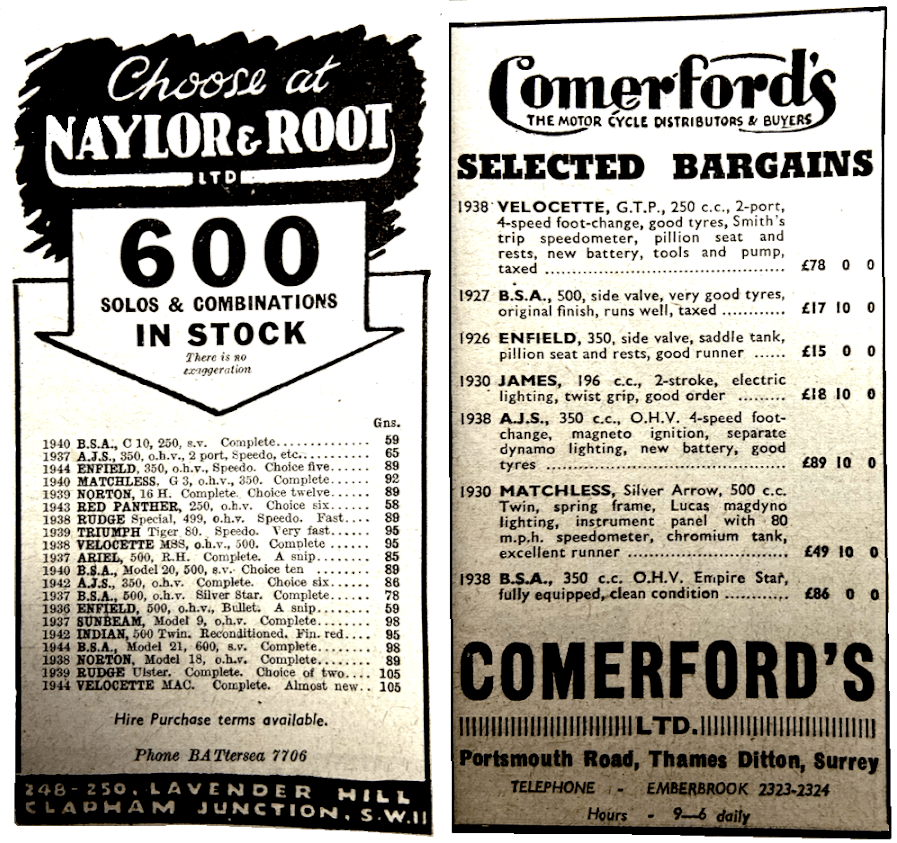
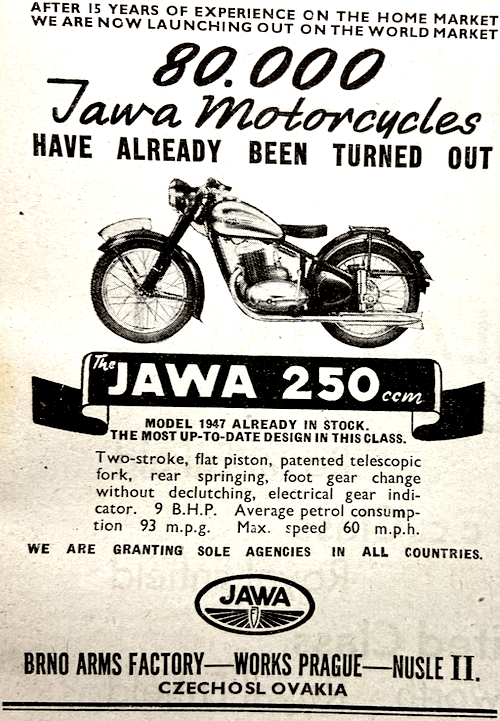
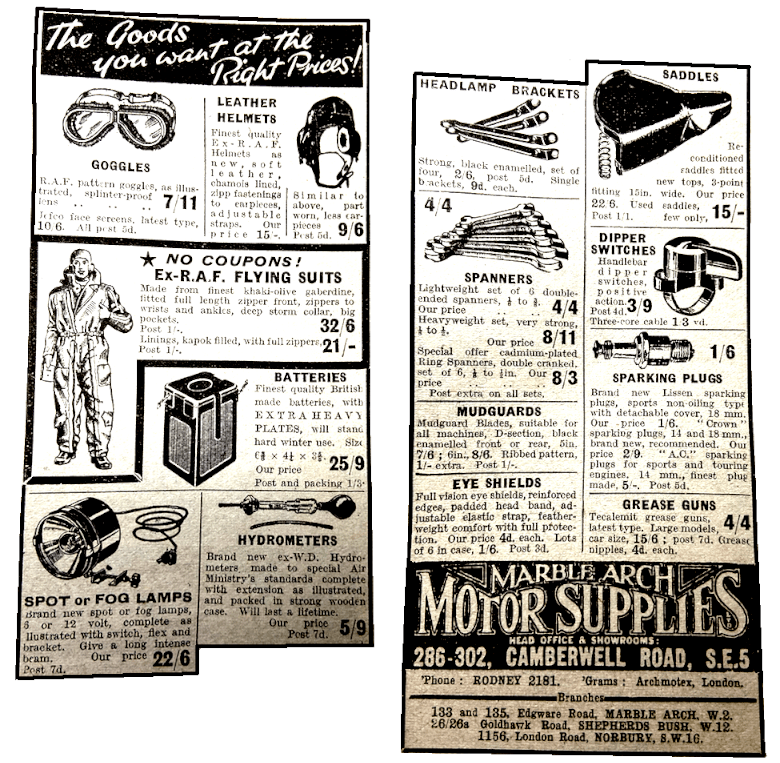
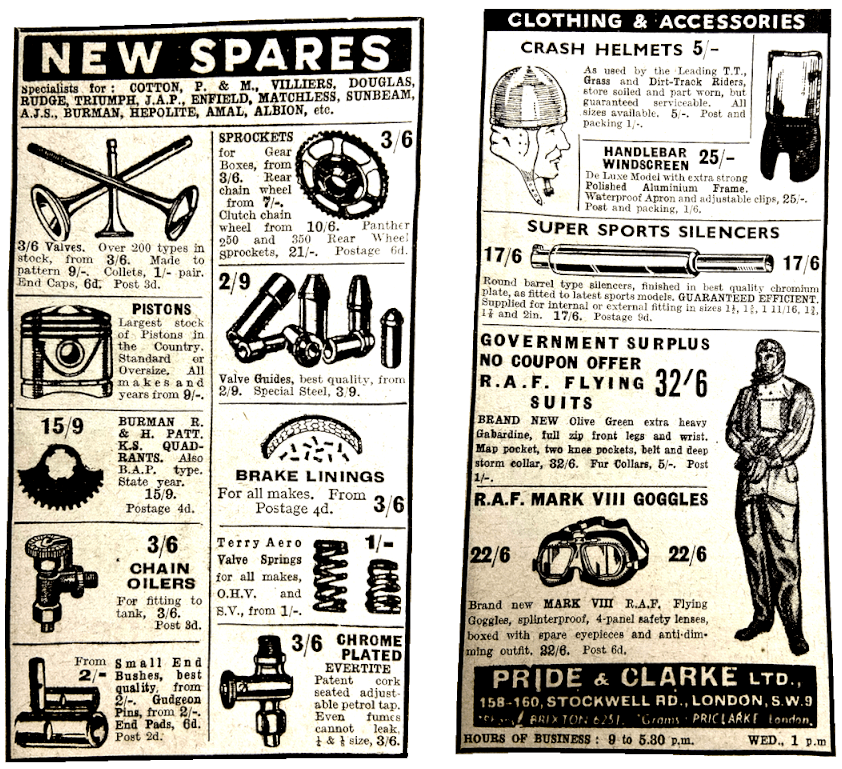
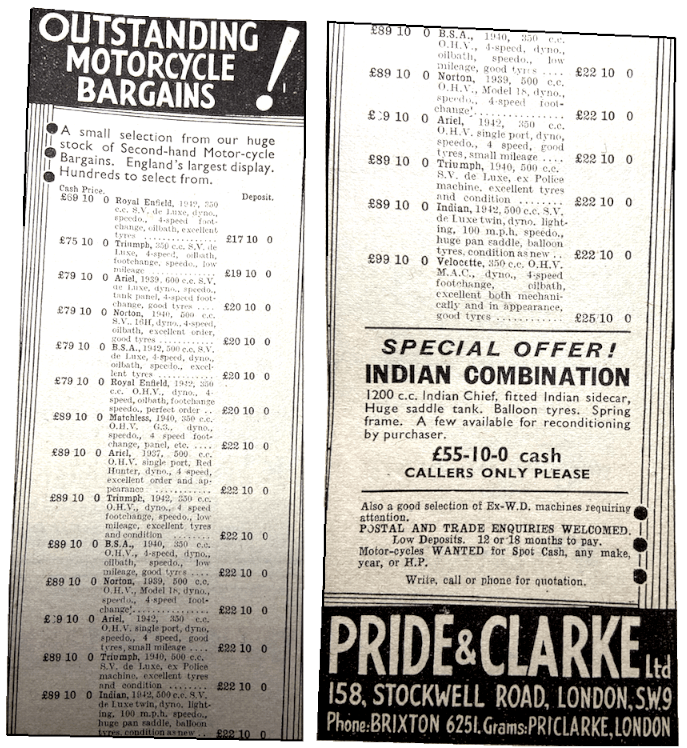
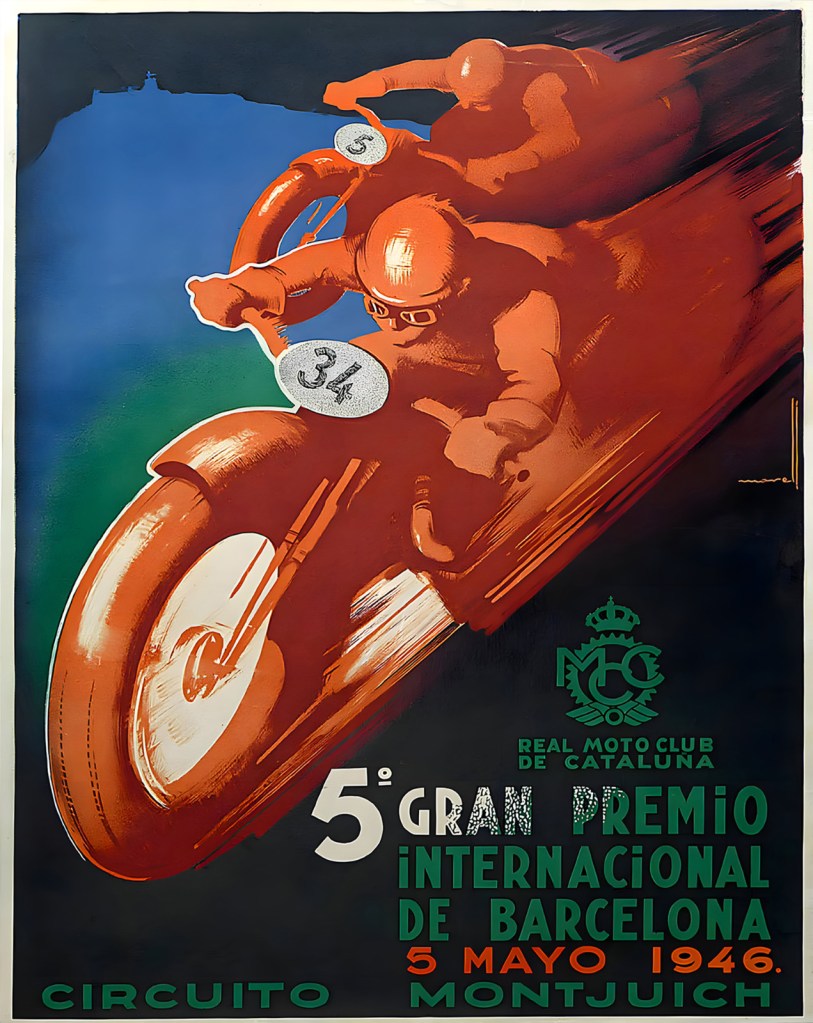
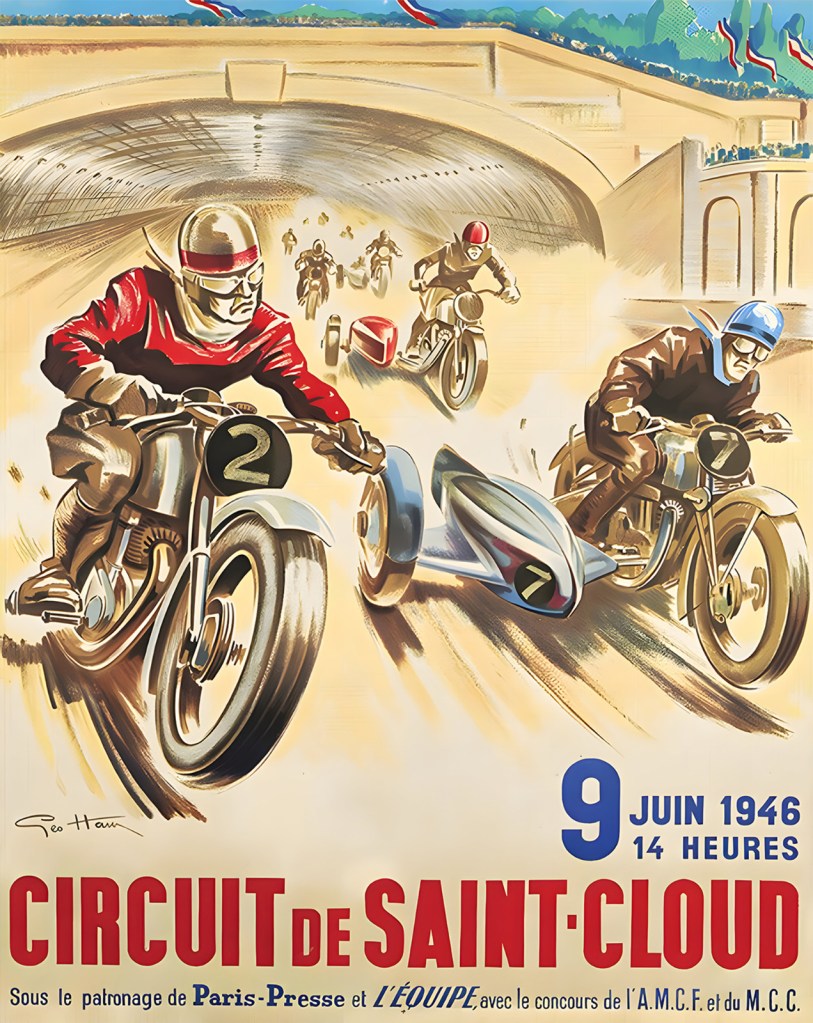
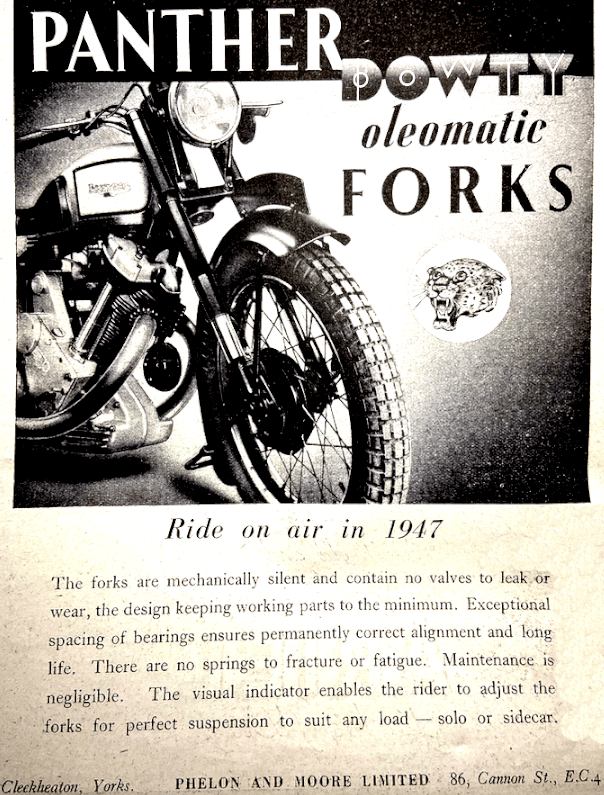
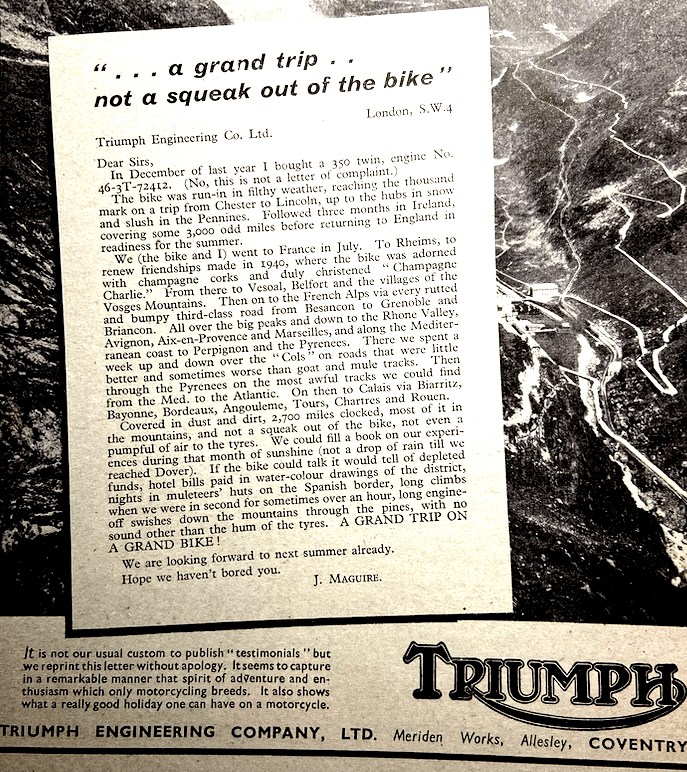
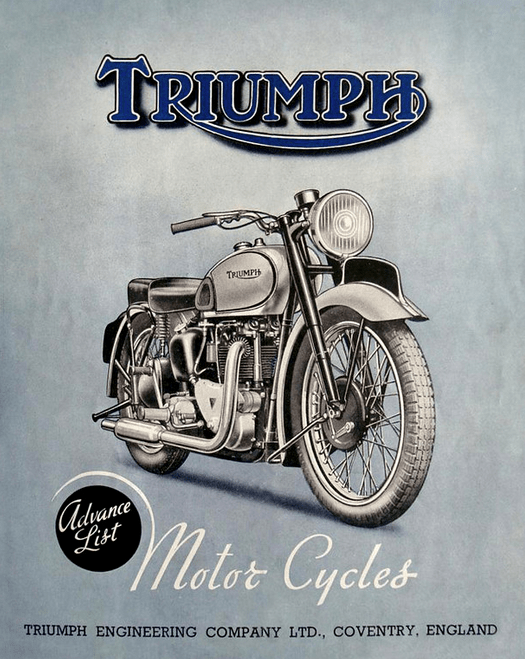

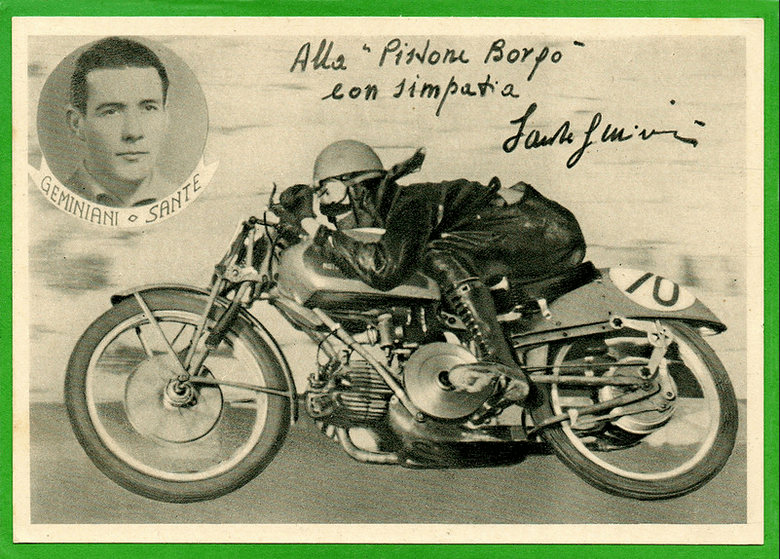
 Motorcycle Timeline