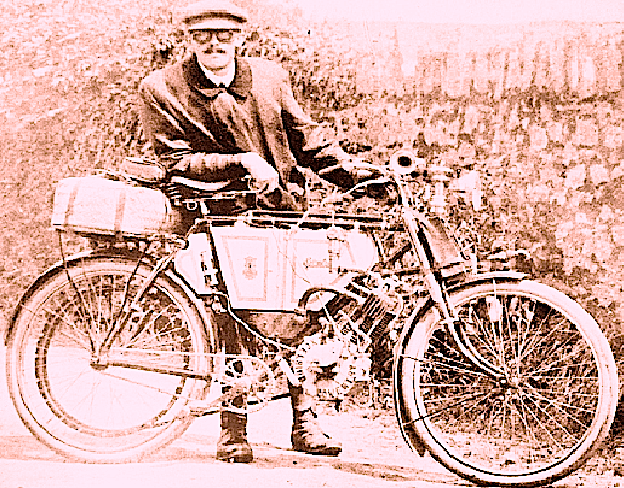
“WITH THE BLACK OUT lifted and full lighting—peacetime lighting!—restored to motor vehicles, 1945 is ushered in for those at home with the feeling that ‘It should not be long now.’ That this is also the feeling of men at the battlefronts is shown in many of the letters we receive. We will not attempt to prophesy. Hopes we have—many of them, and in matters motor cycle as well as those of greater importance. Among those matters affecting motor cyclists as motor cyclists, none, of course, has caused so much speculation as the probable date of the reintroduction of the basic petrol ration. Various dates have been prophesied. The one most frequently averred was January 1st, and that, like so many others, has now passed! The next to have gained widespread credence is March 1st. As we have just remarked, we do not propose to prophesy. It seems to us, however, that unless there are overriding considerations the Government will see that petrol is restored before, rather than in, the period when in normal times every owner of a motor vehicle embarks upon the open road—will do so in order to prevent any sudden maelstrom of traffic. Maybe the decision to allow a basic ration will be reached when it is least expected. Who for one moment thought that the restrictions on head lamps would be lifted at this juncture? Only a comparatively few weeks ago it was stated that there could be no relaxation. The sudden change in front is at least a precedent!”—Ixion
WITH THE NEW YEAR came an end to blackout shields on headlights and traffic lights. There was still no petrol for civvy bikes, although service personnel home on leave were entitled to enough coupons to cover 300 miles.
IXION REPORTED THAT British bikes had been banned from American tracks: “a tribute to which there is only one precedent—the ban on Zenith Gradua machines in British hill-climbs many years ago.”
“I WONDER WHICH Continental people those of our readers who tour abroad have most enjoyed meeting? Personally, I say the Dutch. As long as I live, I shall never forget the really superb hospitality with which they always load us British visitors at the Assen TT. I went there first many years ago as an entire stranger. I was met at the station. They refused to let me stay at an hotel, but gave me the best guest room at a local magnate’s, assigned me a saloon car and chauffeur for the period of the races, and fed me like a fighting cock. On the Press stand a waiter in evening dress brought me a mighty hamper, complete with champagne and cigars. I never met nicer and kindlier people. So my heart is heavy at their present tribulations—starvation, torture, executions, thousands of their finest polders so drenched with sea water that they will grow no real crops for years to come. May their deliverance be swift.”—Ixion
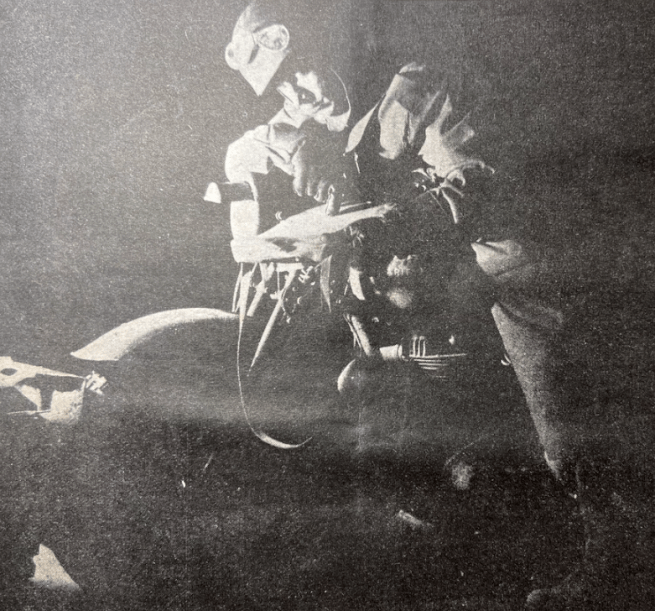
“TAKEN AS A GENERAL tribe, motor cyclists are as companionable a lot as you will ever run across. There seems to be a higher quality to the friendliness developed by years of laughing at each other’s misfortunes and helping with the other man’s troubles. Where else do you find the same companionship of the road?—Detroit clubman’s philosophy.”
WHILE UNDER THE NAZI yoke the Jawa factory was used to make munitions for the Reich – all except for a single workshop reserved for major repairs of DKW DR bikes. And in a quiet corner of that workshop a group of Jawa diehards built five prototypes of the 250cc twostroke single they planned to produce as soon as the war was over. The bikes were painted and kitted out to look like DKWs and smuggled out to remote areas for roadtesting. A great yarn, but let’s not forget that those brave Czechs faced a nightmare fate if caught.
“REAR NUMBER PLATES must again be illuminated now that head lamps are unmasked. Although the new Order will not be enforced until March 29th, motor cyclists ‘on the road’ are advised to comply with it as soon as possible.”
“PROVISIONAL REGULATIONS issued by the Ministry of War Transport postpone until January 1st, 1946, the prohibition of towing or drawing of trailers by solo motor cycles that would otherwise have become operative at the beginning of 1945.”
“‘I TILL GET more of a thrill out of motor cycling than I do out of bombing Germany, which is, incidentally, extremely hard work.’—Opinion of a US clubman turned airman for the duration.”
“PETROL IS ALL BUT non-existent…In the heart of the cognac country some FFI cars are actually running on a mixture of 85% cognac and 15% petrol.—From a News Chronicle account of FFI’s fight with 75,000 Germans still in liberated France.”
“THE ‘OFF WITH MASKS’ announcement was timely and welcome. Now comes news that traffic lights are also being unmasked. A start has been made in London.”
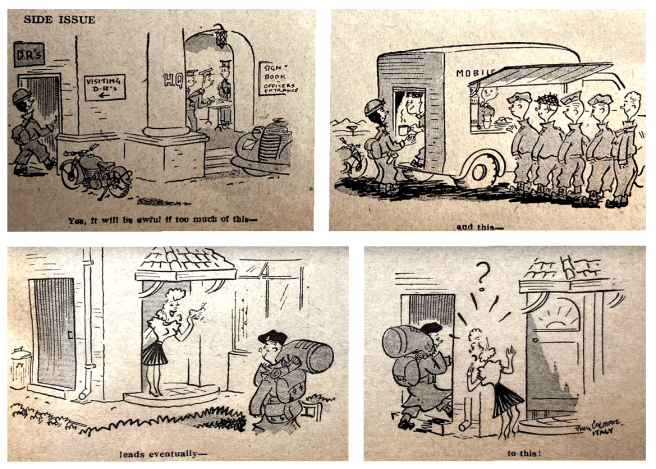
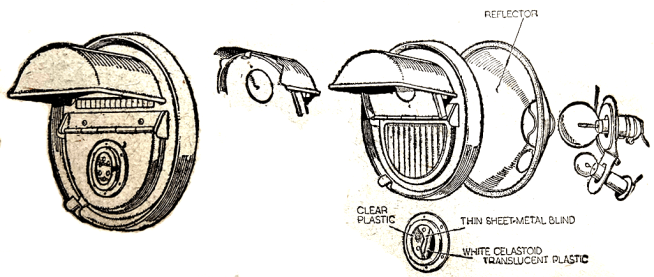
WHAT A BOLT from the blue the decision that head lamps may be unmasked! Briefly, the position is that we are back to peacetime as regards our lights, but are advised carefully to store our masks in case their further use should prove necessary. May they never again be required! Bear in mind that, as in peacetime, head lamps must be switched off when vehicles are stationary other than for traffic exigencies. What made the decision such a surprise was, first, that only a few weeks previously it had been stated that there could be no relaxation of the restrictions on motor vehicle lights and, secondly, another Ministry—that of War Transport—had been showing signs of wanting masks per because of the dazzle question. The reason given for the change by the Ministry of Home Security was ‘urgent operational necessities’—Service vehicles having to be used without masks—but I cannot help thinking that an added reason was the new haphazard lighting of towns causing difficulties and dangers. Of course, I hope that post-war we shall not have all (and more than) the dazzle of pre-war days: that there will be better palliatives and more courtesy.” The ‘dazzle problem’ was taken seriously enough to be discussed in Parliament. A meeting on the subject in Birmingham, hosted by the ACU, the Institute of Automobile Engineers and the Illuminating Engineering Society, attracted more than 200 interested parties including Lucas, the General Engineering Co and the RAC. The chairman harked back to “the soft light afforded by acetylene” and concluded: “It is a foul thing if you do something which causes the other man discomfort or to take evasive action.”
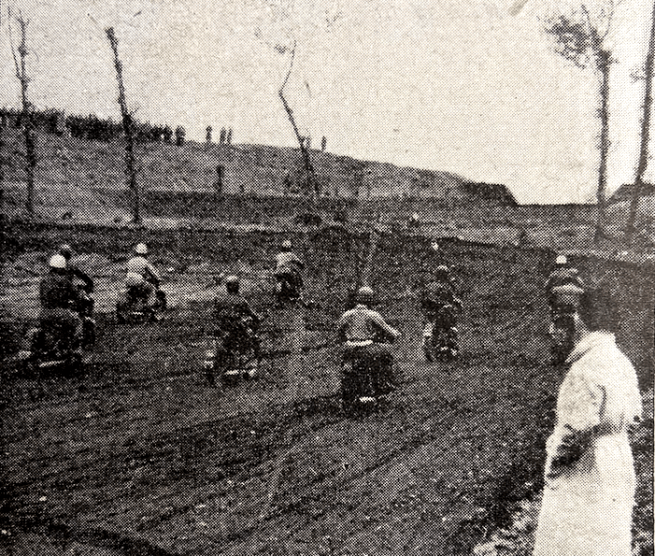
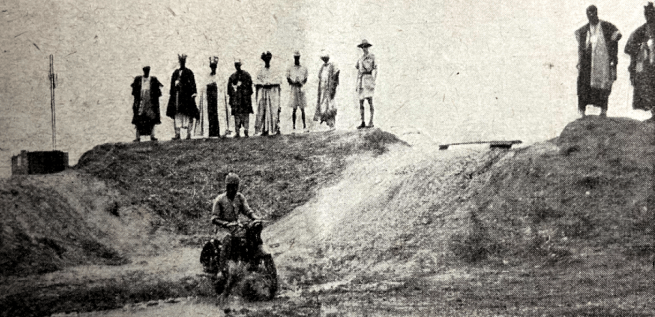
“TO-DAY, IF YOU WANT to go in for trials and scrambles, it seems that there is only one thing to do, that is get posted overseas! I have just been reading of a scramble— a real 100% affair. The course consisted mainly of wet lava dust—the lava dust of Vesuvius, and was six miles long. A disused reservoir formed the start and the bank of the reservoir, with its loose, steep double step, formed Excitement No 1. From the top the competitors dived down a steeper bank, dropping some 50ft, and then set off on the course proper, which wound among vines and fruit trees, with many steep ups and downs, bumps, shallow watersplashes, stretches of ‘loose’ and so on. Thirty took part in the first of what promises to be a big series of scrambles. Standard WD machines, with standard tyres but minus head lamps (if desired) were the requirement, and there were heats (two laps) and a final ever three laps (18 miles). One whose name is well known to motor cyclists won the final—Sgt FM Rist (350cc ohv Triumph), with Lt T Sheasby (G3/L Matchless with normal forks) second, and Cpl Ballantyne (Ariel) third. Rist averaged about 26½mph. Shades of post-war trials organisation; there were armoured fighting vehicles stationed at strategic points along the course! These were peacefully (and helpfully) linked to a loudspeaker van in the reservoir that formed the start and kept spectators there informed of the racing.”
“WHO IS THERE who does not recall the remarkable 1,056cc mile-eating vertical twin which was built for less than £20? The enthusiast who was responsible for the one and only RGC Special Norton has built several bitzas. To-day there is news of an Austin-engined model, his second. Building it, he says, began some time ago, and at the date of writing it has been in use about a month—so far with but minor faults. ‘First, let me explain that it is not in my possession now,’ (he continues). ‘It came about in this way. A friend of mine sent an acquaintance of his (a total stranger to me) to see a 600cc ‘Beam that I had for disposal. However, when he saw the bitza he lost all interest in this model, and asked me to let him have the bitza, although it was far from finished. I wasn’t at all keen, but after much persuasion I agreed. This agreement meant one or two alterations, for I had built the engine to rev and accelerate quickly, with but little thought to tickover, pottering, etc. The fellow buying it wanted a good tickover, to be able to potter along in top gear, but with something up his sleeve if necessary. The machine that I have converted was a 1932 550cc side-valve enclosed New Hudson. It was selected because it had a good sturdy frame and forks, although quite small in size. It will be noted that there was no thought as to whether the engine would go in the frame. This may appear rather careless, but as a matter of fact, with a few modifications to the crankcase, the Austin seven engine can probably be coaxed into the smallest of two-stroke frames—that is, were they strong enough. Incidentally, the most suitable types of Austin Seven engine are the coil-ignition jobs produced between 1930 and 1936. Those previous to 1930 have magneto ignition, with the mag platform in a rather awkward place for fitting in a motor cycle frame…Austin Seven engines built later than 1936 have the crankcase and cylinder block cast in one piece, and are heavier than the older models. The engine used for my bitza was a 1933 job. It will be noticed that the engine is set- across the flame with its centre exactly in the centre of the frame, in other words, balanced.”
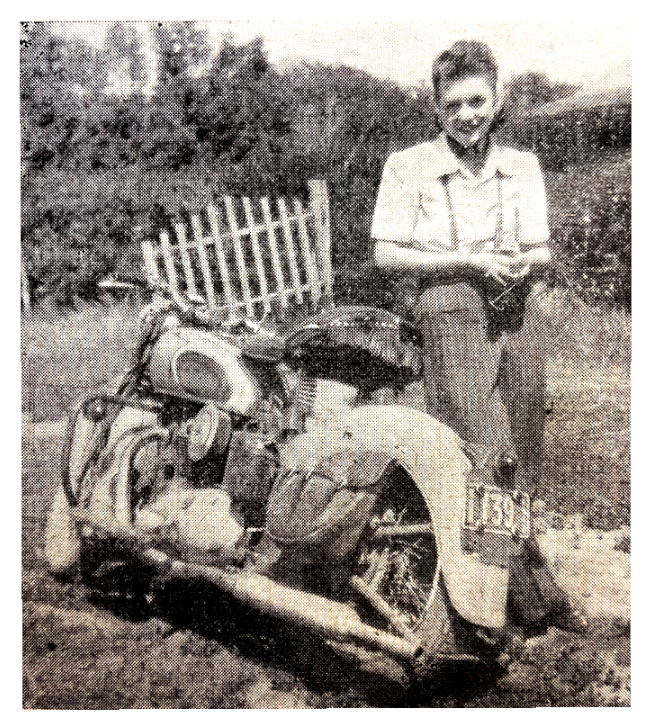
“AS A CANADIAN recently arrived in your country I am enclosing herewith a photo of my much modified machine, in the hope that it may be of interest to your readers. Prior to the war I was connected with the motor cycle trade in Canada as a mechanic, and the work afforded me a unique opportunity to test both British and American machines; my machine very obviously reflects the influence of this experience. I am at a loss to understand the apparent antipathy of English riders toward crash bars; personally, I consider them indispensable and the best form of insurance. Certainly they have saved myself, and many other riders of my acquaintance, damage to both machine and rider. In the photograph you will note also the lamps (red-green) welded to the crash bars to act as clearance. lights. American Buddy seats adapted to English machines were becoming quite the wear, and were even offered fitted to new machines. The Triumph tank does not afford the best opportunity for mounting as the saddle height becomes rather too much. On my return to civvy life I am contemplating rather drastic alterations to the tank in order to lower the seat. After experimenting with footboards I intend to return to the English ‘pegs’, as they are more comfortable and give a better riding position, their only disadvantage being the inability to shift the feet around on long trips. Saddle-bags slung to the rear fender offer the neatest and best means of carriage available. Other innovations are the installation of an air-cleaner (home made) and a car type oil filter. Perhaps the best recommendation I can make for their adoption is the condition of the machine which was stripped after 9,000 miles’ running with these fittings installed. Cylinder wear was negligible and not even new rings were required; this as against a rebore job and general recondition for the initial 11,000 miles. In addition it was not found necessary to change the oil for this period as it remained quite clean the whole time; the only addition being for topping up purposes—approximately one quart. I should perhaps qualify the above statement with the information that I acquired the machine after having done 9,000 miles and it has received somewhat better care since. I am now looking around for a spring heel to graft on to my ‘pride and joy’, during which process—dare I confess it—I intend. to lengthen the frame two inches or so. In future, any machine which I may acquire, save only the smallest, must have a spring frame; and in this connection I consider the Velocette design as providing the closed to my specification to date. Here lies one explanation as to the why of ‘heavy, cumbersome’ American machines, as any English rider on unsprung machine would realise if he attempted a 100- to 500-mile journey on one of our Western Canadian highways which consist of a series of pot-holes interconnected with pimples. One has to be a red-hot enthusiast to retain a desire for motor cycling under such conditions. It has afforded me no little amusement to read in your journal that a spring frame is required not so much for comfort as for road holding. Well, maybe so, but not where 1 come from, so let us at least have optional spring frames—for comfort. While on the subject of springing, let me offer full marks to the OEC Duplex steering. This type seems to me to offer, with a little development, every advantage of telescopic steering with many more in addition. In closing, may I say that I am looking forward with pleasurable anticipation to reading, in your excellent magazine, of the new designs forthcoming after the war. It shall be my aspiration to ride many of those to come.
LA/C M Mitchell, Canadian Forces.”
IN BARCELONA Francisco Bultó gave his nephew a Motobécane—and used it as the basis of a rigid-framed 98cc three-speed motor cycle that he named Montesa. By year’s end Montesa had competed 21 machines including an open-framed ladies’ model with rear suspension. Five Montesas were the first vehicles to reach the peak of the 4,800ft Caldes de Bohí and Montesas were the first four bikes across the line in the 100cc class of the ‘Montjuich grand prix’.
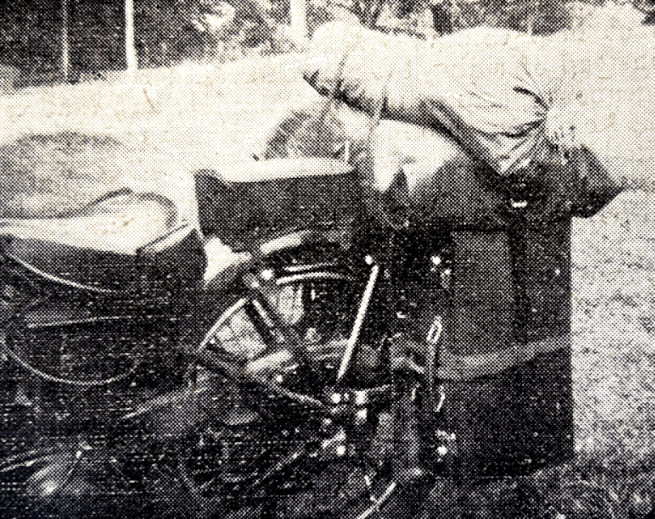
“IT IS GOOD to be able to air one’s views on a subject nearest to one’s heart in such an energetic journal as the good old Blue ‘Un. Since quite a number of readers mention the Enfield quickly-detachable rear mudguard, and to stress that this idea in standard practice would be a great advantage to touring motor cyclists, I enclose a snap of the rear end of my Enfield with week-end camping kit aboard. It goes without saying that it is a god-send to be able to lift mudguard and luggage intact in the event of trouble; and it is also possible to pack up away from the machine, which is sometimes an advantage. I may add that this idea will go a long way towards the decision when I am considering a change of, bikes.
G Gittens, Shrewsbury.”
“BLING A REGULAR reader of The Motor Cycle, I have read many letters regarding the ideal machine. During my extensive tour of duty in the desert, Italy, and now Europe, I have seen and ridden various models, and never yet have I come across one to equal a Zündapp, which some of my pals found intact at Tripoli. This machine was similar to the famous BMW, having a transverse twin motor, shaft drive to rear wheel, and to sidecar wheel also. What interested me most was the fact that it had 5in tyres, hydraulic brakes, and also an auxiliary gear box, giving eight forward and two reverse speeds. It was really and truly designed. Parts were fitted, not stuck on here and there, like with so many English bikes. Then one day we had to hand in our ‘dream’ and get back to machines with chains, etc—meaning a lot more adjusting, snatching and swearing. Another point I should like to raise is the use of legshields, windscreens, shaft drive, and spring frames. During the past eight weeks I have covered 5,000 miles on my Ariel. Most of this has been on convoy duties, negotiating the worst terrain one could find—ploughed fields, bomb craters, and pot-holed roads shot up by Typhoons. I have been plastered with mud, and wet through to the skin. The rain has beaten into my face like machine-gun bullets, and I have been jolted and tossed about something terrible, owing to the lack of a spring frame. Now I’m really looking forward to the days when English manufacturers will give us all the above-mentioned items as standard equipment. Maybe, if designers would listen to us everyday, every-weather riders, instead of to the week-end dry-weather merchants, we might get these items—and also bikes would appeal to a lot more would-be riders. They are not luxuries, they are necessities.
L/Cpl D Chown, RASC.”
“‘A RESOLUTION WAS PASSED urging all clubs in the Centre to give bigger money prizes and to help promising riders financially.’ There is an ominous ring in this sentence from the report of the meeting of the Ulster Centre, Motor Cycle Union of Ireland. We imagine that what is in mind is grass-track racing, for the motion was put forward by a representative of the Ards MCC, whose fixtures have been mainly grass-track meetings. This view is strengthened by the fact that the two MCUI Centres at their Inter-Centre Conference are to consider a suggestion put forward by the same club to the effect that the value of awards in reliability trials should be limited. Grass-track racing is often akin to dirt-track or so-called ‘speedway’ racing and, with admission charges and the general commercial atmosphere that is apt to surround it, can differ radically from other forms of motor cycle activity. By its nature it is perhaps almost inevitable that the cash aspect looms large. There is undoubtedly a danger that when a club embarks upon something which is or is allowed to become a commercial venture those connected with the club will start to regard motor cycle sport as a money-maker. We were therefore very pleased to see that the Ards Club is pressing for a limitation on the value of trials awards—sport, not cash, or something which may have a large cash value. The less commercialism permitted in club life and club events the better in our opinion. There is a further point of importance. In normal club events it is only by keeping the cost of the awards and of the organisation low that the cost of entering can be small. Club sport should be available in its fullness to those with small purses and not merely to those who are moneyed or supported by, say, factories. We welcome all moves to this end.”
“DURING THE CURRENT WEEK I have heard from a parapsychologist in Cornwall who has devoted his leisure for the past two years to reconditioning and modernising a Silver Hawk, and from a sergeant hunting for a four-cylinder Henderson (date and condition immaterial), on which he desires to base his peace hobbies. (No, I don’t know what ‘parapsychologist’ may be, but he definitely is not a psychiatrist who heals nerve-stricken troopers.) The industry is correct in complaining that they have seldom sold enough four-cylinders at round about £100 to justify matters. But both the bitza merchants and these more cautious resurrectionists prove that there is a keen demand for fours at a price. I seem to remember that Ford used to market a 22hp four-cylinder car at £77…How about a mass-produced popular four-cylinder motor bicycle?”—Ixion
“‘AT THAT TIME I was a definite lone eagle, enjoying only my own company. I was puzzled when other motor cyclists waved at me, being unaware then that motor cyclists comprise the largest un-organised fraternal group in the world.’—An American clubman.”
“‘A MOTOR CYCLE CLUB has been started in Baghdad, and is known as the Aces MCC. We have started a club down here in the sandy wastes of the desert—the Base Workshop MCC. A trial is being held next week, but there will be no mud-plugging—our rainy season doesn’t start till March.’—From a letter received by the Ards MCC.”
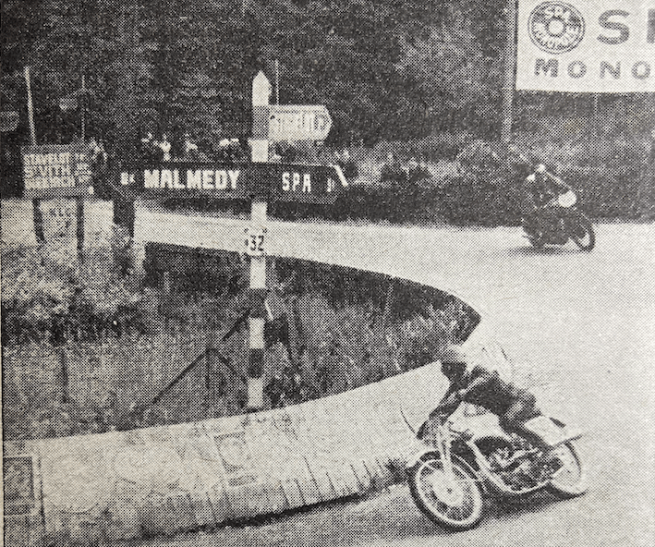
“A NUMBER OF British motor cyclists at home have been able to build up a particularly vivid picture of the Battle of the Bulge. Stavelot, Malmèdy, St Vith…they know the wooded slopes of the Ardennes; they have raced over and around them, acted as pit managers or mechanics, or, like myself, visited them merely to watch. Those names convey much. It was here that the Belgian Grand Prix was held; it was here that Stanley Woods crashed and all wondered whether his hand would be up to road racing again. Beside the course there is a little granite memorial to the AJS rider, JW Hollowell, which the lads—the ‘Continental Circus’ they used to be called—visited each year.”
“MEMBERSHIP OF THE LONDON Motor Cycle Clubs’ Discussion Group, which was ten when the Group was first announced, has now sprung to nearly 50. This emerged from last Sunday’s meeting of the Group in the large committee room at the Royal Automobile Club. Applications for membership were accepted from the mighty Civil Service Motoring Association, the Amateur MCC, the Berkhamsted MCC, the Watford and DMC and LCC, and the Amateur Motor Cycle Association, which had 16 or 17 clubs operating under its aegis at the outbreak of war. Once again it was a case of a packed house, with members using the window sills as well as the 120 and more seats.” There was widespread support for the formation of a single governing body to be known as the United Motor Cyclists’ Association.
“YOU HAVE READ of the grass track racing in Italy. One of the machines is almost the king of bitzas. This is its specification: Frame, WD Royal Enfield; front end, Matchless ‘Teledraulic’; rear wheel, Royal Enfield with 18in rim and 4.00in ‘knobby’ tyre; WD Norton crank-case with hand reground cams; Sertum (Italian) connecting-rod; BMW cylinder barrel and head off a 750cc ohv sidecar outfit; gear box, Royal Enfield; transmission, guarded chains; mudguards, trials type. The machine, the major who tells me about it says, is quite a work of art and looks ‘very useful’.”
“CARRY ON, RAF! From a letter containing a request for back issues: ‘The squadron to which I belong (Typhoons) has formed a club—which we hope will carry on after this war.'”
“ALL-GIRL CLUB. Roving Lassie MCC is the title of a new all-girl club formed in New Jersey. A report of the first meeting says, characteristically, ‘We discussed many things, such as our colours for our uniforms, which are black trimmed with gold.'”
“ALL LIT UP. ‘The clubhouse front yard is lighted by floodlights, and we will soon have a lighted sign, so any riders passing the club on the Saratoga Road cannot help but spot our layout. Riders are welcome to visit us.’—US club note.”
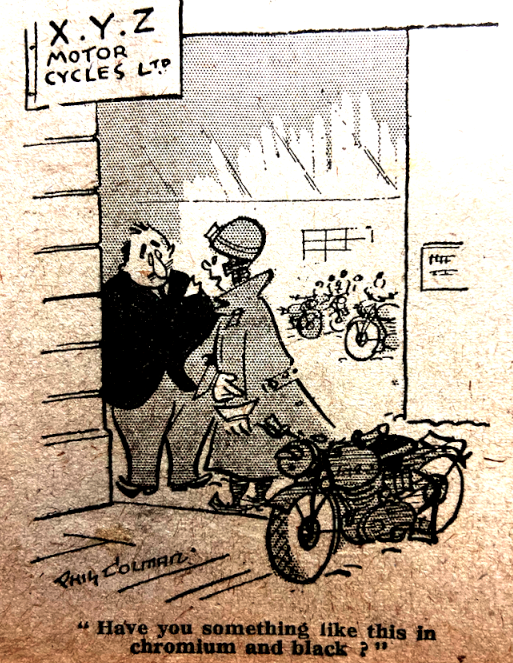
“DOUBTS EXIST WHETHER when civilian models can be marketed again there will at first be any chromium for plating. There is no gainsaying the sales appeal of lustrous appearance such as chromium can provide and if, what is so important to the nation, a large export trade is to be achieved such finishes are essential…In all too many cases in the past, within a year or two the chromium surface has become flecked with rust; in some instances the plated surface has taken on a hammered appearance. The reason can only be that one or other of the processes has been skimped or insufficient care employed. Good chromium plating will last indefinitely, but it is expensive—there is the rub. We will not harp on the beauty of good enamel—of, say, black lined with real gold leaf, the finish so many motor cyclists have extolled—but suggest that in chromium plating only the best is good enough.”
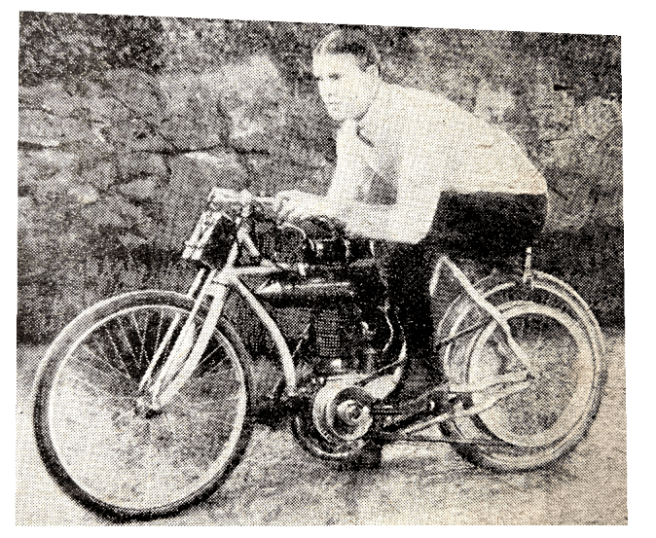
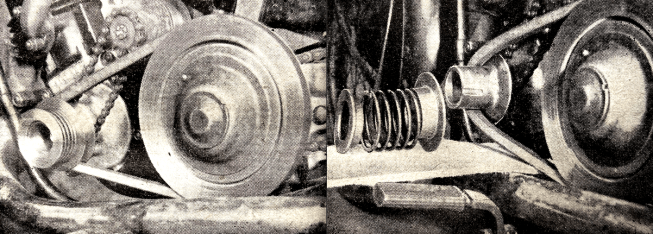
“THE FIRST HOUR RECORD has always been a bit of a disappointment to me as I could have done a considerably bigger mileage had I known at the time that the record was involved. What actually happened was that I found I had a big lead early on in the race, and as a consequence eased up a lot. On November 2nd, 1909, with the same engine in another frame, I broke the 50- and 100-mile records and covered 107 miles 1,385 yards in the two hours, which also beat record. Perhaps some details of the machine may interest present-day readers: 484cc plain-bearing, side-valve JAP; loop frame; dry battery ignition, with plain coil; rigid forks; tyres, 26x2in back and front; weight of the machine all on, 1221b! On the track the machine did 96 miles to the gallon. Transmission was by ¾in V-belt, and the gear was 4 to 1. One of my few disappointments (I am glad to say) was also in an Hour race in 1911. I won this race, covering over 60 miles in the hour and only missing Surridge’s record by a bit over 100 yards. I was, therefore, I believe, the second man to cover over 60 in the hour. I know I was very proud at the time, as I weighed over 15 stone and my engine was only 484cc. I have found an old photograph taken just before the Hour Record. I think a good title for the Hour Record would be ‘The Elusive 60 Minutes’—at any rate for me! I still ride a 350 Sunbeam for work when the weather is good.
FA McNab, Chart, Surrey.”
“RUSSIAN MOTOR CYCLISTS are well forward in the new, staggering Soviet offensive. In one place a number of these riders were just in time to prevent the Germans from burning down their village. In a cottage they found a tempting meal. It was found to be poisoned.”
“MALMEDY DOWN TO STAVELOT is probably the fastest stretch on any road-racing course in Europe. Tanks will have been batting down this leg of the Belgian GP course.”
“SEEN NEAR DORSET HOUSE—a parked 60ft Service trailer, loaded with motor cycles due for repair. The driver is having lunch, and in the saddles of three of the machines are some irrepressible Cockney youngsters. One is announcing to all passers-by: ‘I’m going to have one when I grow up!’
“THREE OF US, all keen motor cyclists, were discussing dazzle before a log fire. The were argument came to a dead end, and somebody turned on the wireless, which emitted a gentle, low-speed staccato. ‘Motor bike!’ we cried, increasing the volume. Yes! Leon Lion, in a thriller by Margaret Gore Browne, was playing a murderer, using his sidecar to dispose of his wife’s corpse in a river after dark. Home Guard exercises confronted him with frequent challenges. We all noticed, however, that his sidecar machine started up without effort every time, that his brakes squealed at every stoppage, that his engine seemed to be of the 1901 single-speed type, that the control room faded down his exhaust to render conversations more audible, and that either he never changed gear or, if he did, changed it instantaneously, noiselessly, and without varying the throttle setting. The corpse interested me, as she turned out to be Gladys Young, who played with me at my first (and last) appearance on the variety stage. When the play was over we fell to speculating precisely how the BBC ‘effects’ man imitates a motor cycle exhaust and brake-squeal. We had a good argument, but went to bed without answering our own questions.”
“MAY I TAKE a little of your valuable space in support of Mr D Brooks’s letter? I have in my possession a 1933 BSA 499cc side-valve outfit, which ran continuously up to the end of the basic period. This machine embodies all the assets that he mentions, and also several other good features, viz, tank panel embodying lighting switch, ammeter, oil gauge and panel light, with extension wires for an inspection lamp; sump lubrication (no external pipes); left-hand twist grip; ignition control; coupled brakes which really are brakes; easily adjustable rear wheel, and hinged rear mudguard. It is also possible to remove the cylinder head without removing the tanks The clutch merits mention—no slip, no drag, and it is possible to remove it in one piece. The riding position is really comfortable, as long runs have proved; there is no saddle soreness or weary feelings; in fact, a nice compact machine. The only thing against it, in some people’s view, is the hand change, but this feature never worries me, although it is not so snappy as foot change. We older hands who like ‘woolly’ side-valves don’t bother about snappy starts, stops and gear changes. I am sticking to the Beeza until I see what post-war models are like. Will they embody all these desirable features? 499 Beeza, Huddersfield.”
“AS A REGULAR READER since 1913 and an ex-racing motor cyclist whose name and photograph have from time to time appeared in your paper, may I congratulate you on your country’s splendid achievements and help in the liberation of my country? May I also tell you that The Motor Cycle stands foremost among the many essential things which 1 have badly missed since 1940. Wishing you the best of luck.
EDM Claessens, Liege, Belgium.”
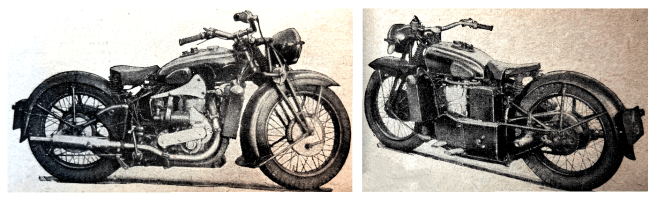
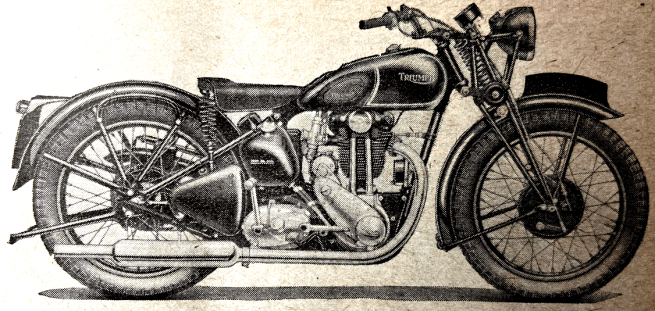
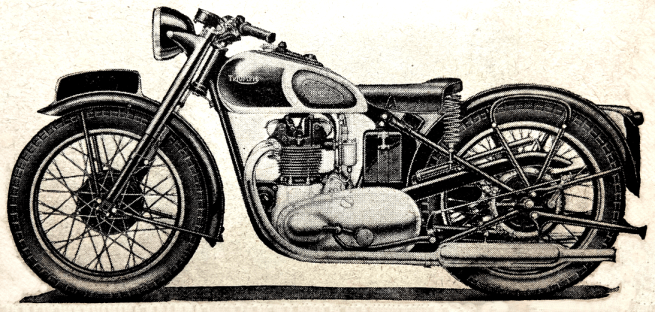
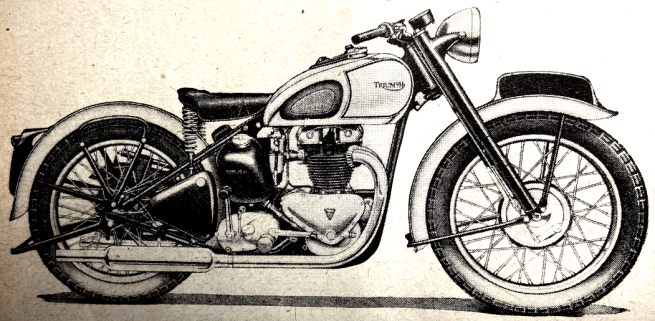
“FOUR VERTICAL TWINS—two of 500cc and two of 350cc—and one 350cc ohv single are to comprise the immediate post-war Triumph range. How long will it take to get into production with them? The factory’s answer is that they will be ready to deliver within a month to six weeks of normal business being sanctioned by the authorities, and that this applies to the main range—the twins—as well as to the single. What will the prices be? The official answer is that these cannot be indicated at the present juncture, but they will be strictly competitive and as reasonable as the firm can make them. Cost of manufacture, it is pointed out, is at least 45% above pre-war, and there is the unknown quantity,Purchase Tax, which at the moment 33⅓%. A further question readers will naturally ask is whether the range is to be construed as containing the factory’s magnum opus. The answer is that the programme is that of the immediate post-war period. As will be seen, the programme is of the tried, proved variety, with designs that have proved outstandingly successful made still more appealing. The 3H 350cc ohv single is the current Triumph army machine, the 3HW, with a peacetime [black-and-ivory] finish and different gear ratios. This is a straight-forward sports-touring mount very much on the lines of the pre-war Tiger 80 and 3H, but with a new cylinder head in which the rocker boxes are cast integrally, thereby obviating oil leaks and improving the rigidity of the rocker mountings. It is felt that many will be anxious to obtain a sound, reliable machine with’ a minimum of delay, and since so many of the parts are interchangeable with those of the army model, obviously this mount, the new 3H, can be available in quantity very early indeed. In its civilian finish of black, lined with ivory, and with its polished timing cover and gear box end cover the machine looks attractive—a sight for sore eyes after all the khaki. The gear ratios are 5.5, 6.6, 9.5 and 14.0 to 1. As in the case of the other four models,, the clutch is of cork-insert type running in oil. Other features of the specification are: 3.25-19 tyres, Lucas Magdyno lighting, central-spring girder-type front forks with hand-adjustable friction shock absorber on the off side, 3⅛-gallon petrol tank and ¾-gallon oil tank, mudguards and wheel rims lined in ivory, speedometer driven from the front wheel and mounted on the forks, pressed-steel oil-bath primary chain case and guards over the. top and bottom runs of the rear chain, which is lubricated by an adjustable valve mounted on the rear of the oil bath. The price of the 1939 3H, incidentally, was £55. Coming now to the main range, the four twins, the most noticeable feature is the new telescopic front forks. These slim-looking straight-line forks give the machines a new and most appealing appearance—a decidedly rakish appearance. Full details of these forks, which are fitted to all the twins, cannot be given because of the position over patents [presumably something to do with the Teledraulic forks fitted to the Matchless WD G3L]. Outwardly similar to other telescopic forks, the Triumph fork, it is stated, is entirely different in construction. Although looking so slim the fork has main tubes of no less than l⅜in diameter, for the springs, of low rate, are inside the main tubes—not outside. There is a total up-and-down movement of 6in, hydraulically damped. The rake and trail, it is stated, are the same as previously, but with the greater rigidity of these front forks in comparison with the girder type and the lower unsprung weight there is a marked improvement in road-holding at high speeds.”
“THE COURSE OF TRUE LOVE proverbially is rough, but never was it more precarious than in the early days of motor cycling. The possession of any sort of motor was a gigantic asset in the first stage of a love affair, which a golfer might call the ‘approach’. Your inamorata had a definite vantage whereby to swank over other maidens, whose boy friends were peds or mere push-cyclists. At that point the theoretic vantage died a swift death. When my first girl took the bait, I owned a prehistoric Ariel tricycle of the gear-driven, two-wheel-astern type, and tried to coax her to stand on the rear axle steps, with which a push-hop start was effected, hut she found it uncomfortable. A proper trailer with an upholstered seat cost more than I could afford (£30!). In this emergency I discovered a novel trailer formed simply of the stern half of a lady’s pushbike, minus front wheel. It converted the tribe into a four-wheeler of ‘diamond’ plan, and the attachment cost no more than £4 new. Entirely without forebodings I invited Daisy to come for a jaunt on it, not without secret, if unworthy, reservations that she could use its pedalling gear whenever we arrived at a nasty hill. Ten miles out Daisy burst into tears. When I stopped in natural agitation, she jumped off, and insisted on returning to Mummy by train. One look at her explained—and justified—her conduct. She had dolled herself up in her best summery attire to grace the occasion. Tar was unknown on British roads, and the rear mudguards of the Ariel were short, narrow and flimsy. Her costume had collected most of the dust churned up by three heavily scolloped tyres plus a fair smattering of manure—the modern will never realise how filthy our roads were before the cleanly motor had superseded the uncleanly horse. Her face had collected a considerable weight of dittoes. Her hair—in those days long hair was still a woman’s crowning glory—had long since shed every clip and pin originally fitted, and was streaming lankily in the wind. Her semi-Gainsborough hat was wrecked. Whilst I laboured to assuage her tears, she was suddenly very sick on the grass by the roadside. I ascribed this inelegant performance to her tears; she accounted for it by saying that my treasured Ariel engine stank like a midden. Maidenly modesty restrained her from speaking of the torture she endured from the seat, but I realised this when next day I tried it. Her next boy friend was a pushbike enthusiast. She duly married him. I hope they lived happily ever after.”—Ixion
“WHEN [RENOWNED ABC DESIGNER Granville] Bradshaw gave his talk on Motor Cycles, Past, Present and Future to the Motor Sports Club of the Bristol Aeroplane Company last week, who should he find as the President of the Club but an old ABC enthusiast—Capt KLG Bartlett, a director of the Bristol Company, who began a long association with Mr Bradshaw’s designs before the last war. Capt Bartlett, in addition to riding ABCs of pre-last war and the ‘Oil Boilers’ [Belsize-Bradshaw cars powered by Bradshaw-designed oil-cooled 90° V-twin engines], handled the French-made 398cc ABCs. Yes, and broke records and won races on them in France during the early 1920’s.” Bradshaw recalled the birth of his fascination with motor cycles: “At that time my elder brother had a 1¼hp motor cycle, with a twisted belt and a surface carburettor, which he allowed me to ride from time to time on the condition that I cleaned it for him. I quickly developed a wild enthusiasm for motor cycling, and my aim for weeks had been to get to that Blackpool meeting. My mind was now made up, and I cycled over morning and night before and during the race days I remember the big Napier Samson with its six cylinders with copper water jackets. But I lost all interest in the cars when I saw what I thought to be the one and only motor cycle in the world. It was a 14hp Peugeot, ridden by a Frenchman named [Henri] Cissac. It was a V-twin, and its cylinders appeared to be of enormous dimensions. It had automatic inlet valves, as they had in those days, and this may be why it was geared about 1½ to 1. It had no brakes, since the rider wanted to go—and go fast—but it had a very big carburettor, I remember. The tyres were pedal-cycle path-racing ones of about 1½in section, and were bound with tape round rim and the tyre. A fresh wheel was fitted after every attempt. How clearly one can remember things that happened 40 years ago and forget more important things that happened only a year past! Last week I ‘phoned the Editor of The Motor Cycle to ask him it he could look up any description of Cissac’s machine and, sure enough, my memory bad not failed me. The engine was 100mm bore by 112 stroke. The machine weighed 1101b all on with an engine of 1,700cc capacity. I doubt if there is any motor cycle engine of 1,000cc capacity to-day which does not weigh more than the whole of that motor cycle. Here is an extract from The Motor Cycle of 1905: ‘On receiving the word “go”, Cissac ran his machine for about 30 yards and, after jumping on, he dropped his exhaust-valve lifter. The machine gave three snorts and stopped dead. Cissac quietly turned round and, hobby-horse fashion, pushed it back without getting off the saddle. The second and third attempt met with the same fate, but at the fourth attempt the machine gave one or two kangaroo-like leaps, gathered way and vanished into the distance like a projectile from a big gun.’ The record he achieved was just under 90mph, which will seem tame to the modern generation, but the crowds lining the course were only a few feet away from the rider and that makes all the difference. There was a white line painted along the centre of the promenade, and Cissac kept his head down, staring only at this line and waiting for the large coloured patch to indicate that he had completed his run, after which he had three miles to slow down in. I can well imagine that he was far safer without brakes with his taped-on tyres! However, the incident obsessed my thoughts day and night, and I made up my mind that I would accept no career but one of engineering. So I became an apprentice In a factory. A few weeks later I spotted a motor cycle with a 2¼hp Peugeot engine in it, and I persuaded my brother to swap his 1¼hp machine for it. Then I set about tuning this machine up to get some real speed…” It was the start of an illustrious career which included the first ohv Panther engine, a derivative of which powers my beloved 1936 M100 Redwing. Nice one, Granville.
“GRANVILLE BRADSHAW’S INTERESTING reminiscence of Cissac’s 14hp V-twin will bear a little expansion. About the year 1903 the French dominated the motor racing world, and they arbitrarily fixed speed the 110lb weight limit for international events. There were no cc limitations, and you just piled as much engine as possible into the weight. Since nobody then understood anything about design or tuning for speed or power output, you used featherweight tyres, drilled as much leather as possible out of a pushbike saddle, and concentrated every available ounce in the engine. At the first Auto Cycle Club racing event in the Isle of Man—that is, before the ACC became the ACU—most entrants produced machines of this type, and reliability naturally touched ‘bottom ever’. We all found ourselves at a great disadvantage with the French, who had already evolved giant V-twin engines for pacing push-bike racers on their big tracks; a perilous sport with which we merely toyed on our small tracks at Canning Town and the Crystal Palace.”—Ixion

“IN LAST WEEK’S LIST of Army awards for gallant and distinguished services in NW Europe there was the award of the OBE to Col MAW McEvoy, REME. Many will recall the big-twin McEvoys and their exploits at Brooklands and other speed venues.”
“WHEN A MAN accused of unlawfully obtaining an Army leather jerkin produced an advertisement showing that a London store was offering ‘reconditioned Army jerkins’, the magistrate stopped the case. These jerkins were, of course, favoured wear among Home Guard DRs. The War Office is looking into the matter of their sale.”
“FROM AN ARTICLE in the Leader: ‘The first talkies produced 200 different kinds of noise faults. One of them was known as ‘motor-boating’, a deep throbbing sound. It started badly in one famous. cinema…The operators searched in vain…Eventually it was found that junior had hauled his motor bike up on to the roof and was running it loudly to check the oil!'”
“THE ROAD TRANSPORT Lighting (Cycles) Bill required pushbikes used after dark to be fitted with rear lamps, reflectors and white patches. The Bill was on the brink of becoming law when lobbying stopped it in its tracks. The Blue ‘Un was impressed: “At the eleventh hour the cyclists had won or, at least, secured a respite. It is impossible not to be impressed by the achievements of organised cycling. It is true that the number of cyclists is large—how large is unknown, there being no means of checking how many bicycles are actually in use—but organised cycling which is forever wielding the big stick is small. The present membership of the militant Cyclists’ Touring Club is only just over 37,000—not one in 200 of the alleged ten million cyclists. Assuredly there are lessons from this. Indeed, may it not be suggested that it would be a good thing for the motoring world to take lessons?”
“SEVERAL TIMES LATELY when being shown the drawings of proposed post-war engines we have asked, ‘What about oil leaks?’ Unless or until engines are hidden by, say, plastic shields this matter of oil leakage and seepage will loom large in the minds of motor cyclists and, what is also important, those of the public at large. It is impossible to assess the damage to motor cycling that has resulted from motor cycles being regarded as ‘dirty, messy things’. That they need not leak oil has been proved by more than one manufacturer, but unless the matter is raised now it is to be feared that oiliness will continue to be an attribute of the majority of engines.”
“THE BASIC PETROL RATION for motor cyclists in New Zealand has been increased to one gallon a month.”
THE TOTAL NUMBER of road accidents during 1944 was 6,416, compared with 5,796 in 1943. The increase of 620 is partly explained by increased traffic necessitated by the invasion of Europe.”
“‘IT IS TOO BAD, all things considered, that the American Motor Cycle Association is not affiliated with the FICM. The US possesses the world’s finest record-breaking ground at the Bonneville Salt Flats…It is certain that international records could be boosted notably at Bonneville.’—A Detroit Club note.”
“OVER 100,000 MOTOR CYCLES have been produced for the Services by the BSA company, the chairman (Sir Bernard Docker) revealed last week.”
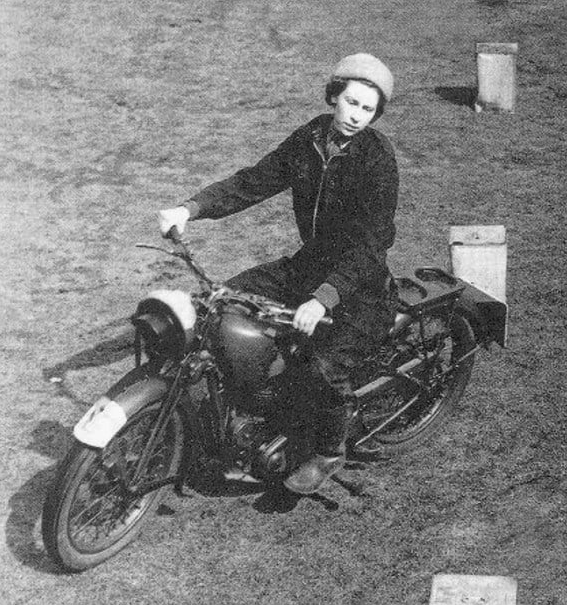
“‘EVERY TIME I walk past a petrol pump out here, the sweet fumes of petrol carries one back to far happier days!’ —A clubman writing from India.”
“WILL IT BE POSSIBLE to make lavish use of chromium plating on post-war models? At the moment the position seems uncertain, since all supplies of chromic acid are earmarked for war contracts. The general use of nickel-plating, however, will be resumed in all probability in a few months’ time.”
“A NORTON MOTOR CYCLE found in a West Country river is believed to have been used by one of the German prisoners who escaped from a camp at Bridgend (Glamorganshire).”
“‘THE DUST ON the roads, inches deep, plays havoc with cylinder bores…My 350 ohv Triumph is still motoring well. I have fitted an elaborate air-cleaning system in one of the pannier bags, with an inlet pipe about 3ft long—it works nicely, too.’—A Ravensbury clubman serving with SE Asia Command.”
“OVER 750 AFFILIATED motor cycle clubs are still functioning in the US, reports the American Motor Cycle Association. In 1941 the Association issued 2,000 permits for all types of competition; 33,000 riders took part.
“‘I WAS VERY INTERESTED to hear from one of our engineers—a Dane, and also an enthusiast—that British machines were very popular in Denmark before the war. He tells me that Nortons were known as “the machines with the long legs” due to the good averages you can keep up over long distances.’—Extract from a letter received from a ship’s radio-officer.”
“FOLLOWING A GREAT DEAL of investigation, there now seems a strong possibility that US and British screw threads will be standardised in the near future. When an ideal thread form has been established, it will remain to simplify the existing thread series.”
“SIXTY MILLION GALLONS of tinned petrol were got ready for the invasion of Europe, it was officially disclosed in Parliament.”
“PLANS ARE BEING made by an air trans-port company to start an aerial car ferry from Portsmouth to Ryde (IOW). The cost is not likely to exceed the present steamer ferry, it is stated. So it looks as if we shall soon be flying our models over to the IoM for TT week!”
“‘USED MOTOR CYCLES were selling here for double their new price, but the Government has put through ceiling prices.’— Extract from a letter from the US.”
“‘There were 106 pounds of delicious chicken fried to perfection…there were 27 pies mostly of the pumpkin type, plus about two gallons of thick whipped cream to go with it. Can’t ya’ just taste it?’—American club’s description of its ‘annual chicken fry’.”
“SEEN RECENTLY after over five years’ interval—the street-lighting maintenance man riding through the streets of a London borough on his big-twin Matchless and sidecar, seeing that the lamps are working satisfactorily.”
“THE DESPATCH RIDERS, hastening along with perhaps an urgent vital load of nuts and bolts, were praised in an excellent BBC feature dealing with the construction of the mighty Mulberry prefabricated ports in Britain.”
“‘PLANS ARE UNDER WAY now for the purchase of a few acres of land on which to erect a clubhouse in the near future. We intend to have it completed and ready for the day when our members now in Service return home again.’—A US club’s note.”
“‘IN ADDITION TO my British wife, I am determined to take a good British bike back to Oregon with me after the war.’—Extract from a letter by an American volunteer serving with the RAF.”
“ARMY MOTOR CYCLISTS are being used to guard road convoys of lorries loaded with demobilisation suits in transit from factory to depots, it is reported.”
“SEEN IN SOUTH LONDON—a man cheerfully pedalling along on an autocycle which had had its engine taken out of the frame. No doubt the engine will be refitted when basic returns. Until then…”
“THE ALLIED AIRBORNE landing last week-end was in the neighbourhood of Groningen—in other words, the area of the Dutch TT.”
“THE AMERICAN MOTORCYCLE Association now has the largest membership in its history—with 26,843 members. Of this number, 15,620 are serving in the Armed Forces.”
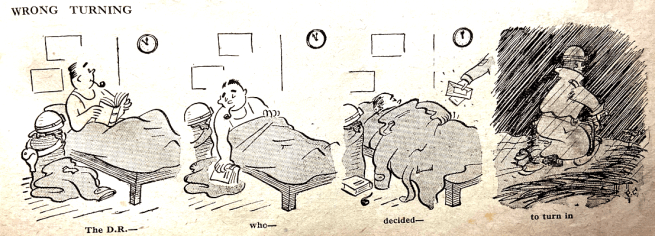
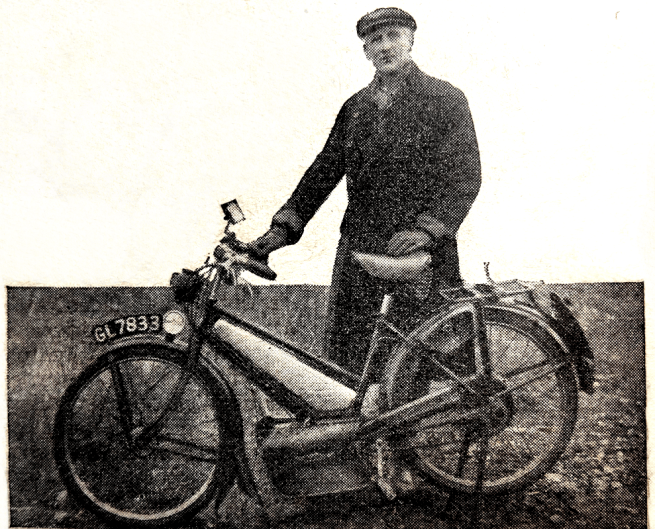
“WHEN TUNED UP and treated properly it is truly remarkable what the autocycle will do, and I certainly think there is a big potential market for this little machine. But—with great emphasis on this word—the trade will have to be prepared to offer service after sale if this market is to be developed and maintained. Otherwise it will just follow the defunct scooters referred to by Mr [Granville] Bradshaw some time ago, who, when reading a paper, described autocycles as ‘toys for old men in overcoats’. Undoubtedly the war, and in its train, the call for economy in the use of petrol, has brought these machines to the front, and if the opportunity to develop their sale is allowed to drop, then the motor cycle trader will have only himself to blame. This is how the picture presents itself to me. Your potential market can be divided into two classes: (1) Those mechanically minded; (2) those who are not. The first mentioned are in the minority—a very small minority, too, at that, but they can be trusted to do their own servicing, their mechanical instinct will never allow them to ill-treat any machine, and personal pride will look after the cleanliness. The second class mentioned are those causing the designer and manufacturer the largest of large headaches….The trade must be prepared to offer service—a maintenance service on a proper basis. After all, we have it in scores of other ways (in normal times) with every form of domestic appliance, none of which is subject to weather conditions and stresses such as are applied to autocycles. As far as design is concerned, I personally do not think much can be done to improve these machines. In my own case I have removed the saddle springs and fitted a pair of good motor cycle saddle springs, and this has made a remarkable difference in the comfort. I have also added ⅜in of padding underneath the saddle cover, ie, between that and the horizontal seat; this makes for warmth on a long journey. Now a word about keeping the machine in good condition. My James autocycle has already given me 22,000 miles. It is, of course, fitted with a Villiers engine. Every week I clean the plug and check the points, keeping them 0.020, and rinse the gauze clean on the carburettor air intake. About once a month I check the contact breaker for 0.015 clearance and polish the platinum points, and rinse out the base of the silencer. Chains are greased every 14 days and watched for tension. Every 7,000 miles I take off the cylinder head and thoroughly clean, then every 2,000 miles de-coke, check piston-ring gap, wash the chain, dry, and re-grease in hot Vaseline. I carefully watch tyres and dress every 3,000 miles. Points to remember: Keep to the plug points clearance advised by the makers, and do not vary the quantity of oil when mixing petroil, ie, half-pint to the gallon of petrol. This, if anything, slightly over-lubricates. Watch the oil level in the clutch case and change at every de-coke (2,000 miles). I should add that I have a spare engine and use them alternatively every 8,000 miles, otherwise the machine is the same in every respect. With the attention mentioned above a five-yard push is all that is necessary to start up on every occasion without exception, and very rarely does it four-stroke. I mention these details to show that servicing is necessary. To many it would be just a bore, but I get a lot of pleasure out of it and service in return. Speed I am questioned about very frequently, and would therefore say seldom do I exceed 25mph. Similar service, I suggest, could be offered by the trade in normal times by a monthly visit, taking, say, a little over an hour, remembering that one machine properly serviced will sell another, and two well-serviced machines will sell two more, and so on, to the benefit of the motor cycle trader. Streamlining, leg-shields and windshields will surely only add to the cost. As a final word I would say—leave the autocycle alone, subject to minor improvements.”
“EN LEA—NOW LT EN LEA—gave a talk on TT racing to Bar-None MCC members in the Middle East recently. He will be remembered by older enthusiasts as winning the 1929 Junior Amateur Road Race in the IoM at over 65mph. He was second in the Senior Race the same year. Another notable visitor to the club was Miss Blenkiron (ATS); she gave a talk on her trans-African journey with a Panther and sidecar. [Read all about it in 1936—Ed.]
“EVERY NOW AND AGAIN a writer bewails the inadequacy of modern sidecar construction. Some have even attempted to show the manufacturers a thing or two in the way of ample accommodation. Six years ago I was faced with an addition to the family, making us four in number. This made me look dubiously at my 500cc machine and open sports sidecar. Then I saw a Watsonian Warwick in a showroom, and.my wife was delighted with its roominess; so was I, but I didn’t think the motor cycle would be, so I wrote to the makers for advice. Would. the load be too heavy? Not a bit, was the reply. But I didn’t think it would look right, so I bought a big twin, which was a disappointment. I used this machine for about three months until one day on the Clacton road a sidecar passed us—a Warwick, with the name load aboard. Then we saw the machine—a Panther Redwing 100. I tried to keep up with it, but gave up. Within a fortnight I had one, and it did everything I asked of it and more. It was than that I persuaded my mother to have her first ride in a sidecar. After that I had a job to keep her out of it. She was 75 years of age and 12 stone in weight, and got in and out of the Warwick quite easily. Two adults and two children in the sidecar, and two adults on the bike—that was my usual load. The petrol worked out at 60 miles to the gallon, without sticking to 30mph. And what is more, the Panther makes light, work of it. What more could anyone want from an outfit? If it is still not good enough for some, I don’t think it’s a sidecar they need. In conclusion, I would like to point out that the Warwick has all the refinements and comfort of a large car. Box-sprung upholstery, opening Triplex screen, sliding side windows, two doors with car locks, good luggage accommodation, and perfect weatherproof qualities without the fumes.
H Ives, Collier Row.”
“I QUITE BELIEVE the statement by MT Sergt CMF about a 350cc Matchless doing 74mph. When Africa I rode a 350 Matchless which could do this easily. I myself tuned the machine for our CSM. I took out the thick compression plate at the base of the cylinder barrel to raise the compression, fitted an aero plug which I got from a local scrap dump, and set the point at 20 thousand, and the magneto points at 12 thousand. After finding the best carburettor needle setting I took it on the road just outside Algiers, and am prepared to swear that the machine did over 80mph. The speedometer needle was away past all markings on the dial. I have since checked the speedometer with several other machines and found it 0K. The greatest fault I can find with the Matchless is the tendency to roll on the Teledraulics—almost akin to a wobble—when you reach above 70mph solo. I wonder if any other riders of the Matchless have experienced this. I would very much like to receive letters from other Matchless lads giving me their views on this machine.
(Sig) B Cole, CMF.”
“MANY THANKS FOR THE ‘BLUE ‘UN’. It does one good to have some printed words again on the subject of our much-talked-of topic. Reading the letters gave me courage to raise my voice about three modifications which brightened my DR’s life: (1) I took two lengths of strong elastic and fastened their ends to wire-hooks. These I hitched close to the seating of the four tank-screws, provided to hold the knee-pads. So I have two lengths of rubber running across the tank, which I only have to pull upwards to tuck under them a fully packed satchel, wrapped in a groundsheet. This solves the ‘too small a tool-bag’ problem as it easily holds all the tools provided plus one space inner tube, plus one tin of bully-beef and 50 cigs. It stayed securely fastened on over 1,000 miles of bumpy roads. (2) A further little job was to cut off the rear mudguard close under the rear light, replacing the amputated part by material, fixed to the rest of the mudguard and hitched (again with elastic and hooks) to the lower rear part of the pannier bag carrier. To make good the loss of hold to the pannier carriers, I fixed a U-bent iron firmly on to the rear of the mudguard carrier, with the two arms of the U coming down and screwed on to the rear of the pannier bag carriers. This simplified rear wheel removal, for it did away with six, mostly mud-covered screws, two of which were endowed with the additional curse of non-accessible counter-nuts. The time for removal (though it is still nothing to boast about) was cut to 40% of what it was before. Lastly, I am getting improved wheelgrip by using rope wound around the rear wheel. The grip improved my riding over pure snow, wet cement, compressed snow, wet asphalt, ice-bound roads and wet wood-blocks.
(Pte) F Peters, Czechoslovak Forces.”
“HAVING BEEN A MOTOR CYCLIST since about 1909, and derived much interest from reading other riders’ views, I thought I would like to make a little contribution myself. I started with a very ancient MMC Bat, and after a few other more modern models, I saw in 1914 a machine that was, without any manner of doubt, the goods. My pocket being shallow it was not until 1922 I was able to buy a very second-hand model of this make; but since I have owned seven of this brand, all very second-hand, and said good-bye to the early days of roadside tinkering. I have lived on my machines all my spare time and seen every corner of my own country, yet my total expenditure on transmission was about £1 10s. I have never bought a sprocket, except to lower the gear ratio, and never seen the inside of a gear box except through the inspection cover. I should, of course, tell you that all these seven models had rear chain cases—add to these facts only seasonal chain adjustments, an absence of noise, a quickly detachable back wheel and cleanliness. What can our shaft drive fans offer more? Perhaps the most fascinating of these seven models was the little 1928 350cc side-valve. It was certainly the most economical, capable of 120mpg on a long run, and no one could class this little model as a ‘thumping single’. Well, sir, we’ve all got different ideas. I might, if I could afford it, buy new every year, but by the time I could purchase they would be about three years old, with a chorus of whines, jingles, clicks and rattles, while time John Marston Sunbeam, five years, eight years, or ten years old, would pass by with its light mellow exhaust, absence of fuss or noise, its original mudguards still in place, and its glossy enamel almost as new. To go back to the start of my letter, I found when I joined the ranks of the motor cyclists I had indeed entered a big brotherhood of real friends, a great union with no other bonds but common interests. I found, also, a sure means to gain health and keep old age at bay, and although this war may put paid to an active part I shall keep in touch with the boys through The Motor Cycle for a long time to come.
Model 9, Abingdon.”
“YOUR contributor Ixion, in reply to L/Cpl Chown asking for windscreen and legshields, shaft drive and spring frame as standard fitments, states that during the last 20 years he could have had windshields and legshields as desired. I was DR in the last war and have been interested in motor cycles ever since, but I have not yet come across a really satisfactory windshield yet. They were either not wide enough, tall enough, or had not a satisfactory apron, or the fittings were poor; some good legshields there may have been. No doubt L/Cpl Chown is envious of riders of the American DRs’ machines, and. I am not surprised; he is not the only one.
C Slocombe, RAF.”
“I CONTINUE TO RECEIVE reports of real hardship suffered by motor cyclists on essential jobs through the decease of their 1939 riding kit and present coupon shortage. The Motor Cycle has repeatedly tackled the Board of Trade on the subject, though so far without success. Here are two samples. My own waterproof riding coat was purchased in 1939, and is probably the toughest and most expensive on the market, being really too heavy except for the very worst weather. It has not been hard worn, and has suffered no mechanical injury, but is no longer fit for use after just under six years. A Cowes reader has just worn out his Stormgard and waders, almost exclusively in his work as a marine engineer. Twenty-seven coupons—ie, three more than his six months’ ration for all purposes—are required to replace them. He has vainly advertised for second-hand coupon-free replacements. Agricultural workers receive waterproof coats free of coupons. Individual applications of a determined character have been known to secure a compassionate grant of six coupons after repeated bombardments of the B of T with aid from the local MP. But an offer of six coupons is merely an insult, for we all know that unless a man luckily possessed a lavish wardrobe when clothes rationing was first introduced, he is already at his wits’ end to maintain his street and indoor clothing.”—Ixion
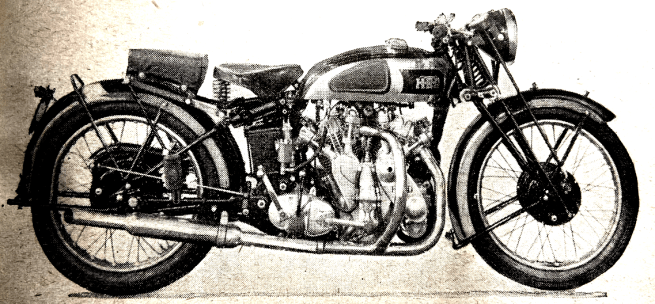
“FOR SOME TIME it has been known that Vincent-HRDs intend to produce the Rapide, their thrilling 998cc roadster, after the war—to do so in a lighter and still more exhilarating form. What will surprise many, however, is that immediately the war is over they will be concentrating on this model. In their opinion, this 998cc big-twin constitutes such a huge advance over their 500cc singles that the singles will no longer be listed. Moreover, the evidence, they say, is that there will be such a world-wide demand for the Rapide that they will have no surplus production capacity for singles. While the machine will, of course, be founded on the pre-war model it will have many important differences. First and, perhaps, foremost, light alloys are to be used to an extent never approached on pre-war standard motor cycles. The weight of the complete 998cc fully equipped big-twin, it is stated, will be around the 400lb. mark and may come out a little less. Secondly, the machine is to be as cobby a big-twin as has ever been marketed, for the wheelbase is being reduced to only 56in, which is that of the pre-war TT Replica model—the TT 500cc single. A further big change is that the machine will employ unit construction of the engine and gear box. The latter is of Vincent-HRD design and manufacture. It is of four-speed type with ball bearings throughout. Primary drive is by a triplex roller chain. Previously the Rapide had a duplex primary chain. A new type of clutch, specially designed, like the gear box, to take the mighty torque of the semi-ohc twin, will be fitted. So far as the reciprocating parts of the engine are concerned these will be similar to pre-war. The valve gear will be on the same principle, with its high camshafts—semi-ohc—and two guides per valve, but much cleaned up and, it is said, should prove 100% oil-tight. Freedom from oil leaks is to be made a feature of the whole machine. Incidentally, all oil pipes, other than the two to the oil tank—the feed and the return pipes—are being eliminated. The oil pump, it will be gathered from this, will no longer be mounted on the timing cover, but built-in, although readily re-movable. The works state that they are quite satisfied with the steering and handling of the Rapide in the past and do not know how a long-action front fork would function on a machine of the Rapide’s speed capabilities. They propose, therefore, keeping to the parallel-ruler-type front forks they used before the war. The spring frame, too, will be of the well-known Vincent-HRD hinged type. There will, generally speaking, be the same ‘Duo’ brakes—two brakes per wheel—and the same, frame. Almost needless to state, the quickly detachable wheels, removal of which involves the use of no tools, are being retained. ‘Nitor’, it may be recalled, once timed the removal of a Vincent-HRD rear wheel by stop-watch; it took less than 45 seconds. What the works ‘have endeavoured to do over the new Rapide is to redesign ab initio those things owners or they themselves did not like about the old model. The result, apart from major changes already touched upon, is a large number of new detail features. Some of these, it is stated, are of such a nature that publication at this date might give too much away. Separate magnetos and dynamos are to be employed with the latter of at least 50-watt output. Still wider use is to be made of stainless steel. It was employed for tanks, brake rods and other fittings pre-war and is now to be used instead of chromium plating wherever possible. It will be recalled that the machine, in addition to its remarkable steering, roadholding and braking, was notable in the past for its combination of great power and speed with good traffic manners. There was nothing of the high-compression monster about it, for it had only the compression ratio of 6.5 to 1, that of the Meteor, their most ‘touring’ 500 in the range. For after the war there is still to be this Jekyll and Hyde behaviour, but, with the new exceptionally high power/weight ratio and the shorter wheelbase, a still more thrilling performance.”
“READERS HAVE WEIGHED IN marvellously with old issues of the ‘Blue ‘Un'” and with offers to send their issues to a Serviceman week by week if only we will say the word, but we have come to an end of all the thousands of old issues sent in and of all the offers of our weekly issues. At this very moment there are roughly 100 letters from wives, sweethearts, mothers, fathers, uncles, etc, saying, ‘Please can’t you help?’ They cannot buy the paper locally; we cannot accept a subscription because that would be robbing Peter to pay Paul, and we are, of course, printing up to the very limit of the paper we are allotted. Hence the only way to help these lads in the Forces, and the many others in their units and neighbouring units who would like to have a look-see, is by asking you if you can help. If your issue is not going on to someone in the Forces, or is available after it has been read by your little crowd, may we send you the name of someone who is crying out for a weekly issue? And have you any old issues—perhaps really old ones—tucked away? If so, will you send them, well-thumbed ones and all, to us? We despatched over 1,000 issues under this scheme only last week, and now we are skinned right out. Please help, and remember that it is never a case of merely giving pleasure to the man to whom the issues go, but to scores—sometimes, according to letters, hundreds—of others.”
“AN OHV VERTICAL TWIN in which all four push-rods are actuated (through the medium of tappets) by a single camshaft is the subject of a patent (Specification No 567,029) just published under the names of The Birmingham Small Arms Co and Mr Herbert Perkins. Driven by suitable gearing from the crankshaft, the camshaft is arranged across the front of the engine; four conventional tappets in guides are actuated by the cams. The cylinders are cast in one block, and the cylinder head is also in one piece. Between the tappets and overhead rockers are cup-ended push-rods which extend upwards and rearwards through a cored passage in the cylinder and head castings. The inlet and exhaust rocker spindles are arranged in separate compartments in such a way that there is a transverse air space between the two compartments for most of their depth; they are connected at the bottom, of course, by the cored passage in the head.” [And this, my masters, marks, if not the birth, then the conception of the post-war A7 that in turn grew into the plunger A10 Golden Flash that has been part of my life for more than half a century—Ed.]
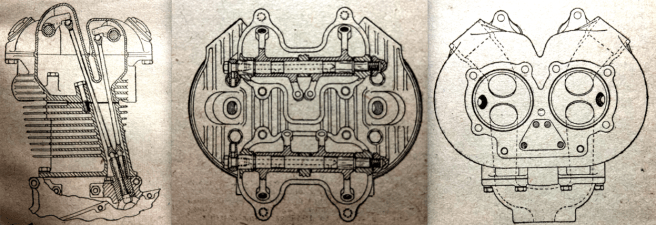
“BSA TWIN PATENT: In last week’s review of the BSA patent covering an ingenious method of operating the four overhead valves of a vertical twin by means of a single cam-shaft there was a misunderstanding. The camshaft is arranged across the rear of the engine, not the front.”
“YOU HAVE 30 SECONDS to describe your narrowest squeak and to explain exactly why it was the other man’s fault. Why don’t you like being passed? Does it give you a thrill when you overtake? If so, what thrill does it give you? What has been your most embarrassing experience? What is the most important single improvement required on post-war motor cycles? You have a flat tyre, are unable to repair it and are some miles from home; what would you do? These are some of the questions the chairman put to the Syx Don R Club last week, and a most amusing evening resulted. Before putting them, the chairman, Capt Archer, divided the meeting into syndicates and later awarded marks for the best replies. My purpose here is to dangle the idea before other clubs in the hope that they will have an equally uproarious evening. I will, however, give part of an answer to the ‘narrowest squeak’ question. The gentleman concerned was in collision with a car at a cross-roads on the Brighton road. He had been looking at a pretty girl standing at the far side. Why was it the other man’s fault? Because he was looking at the girl as well!” [Confession is good for the soul, and that yarn dragged up a memory from nigh on half a century ago. I was a photo filing clerk for Motor Cycle Weekly and was dispatched to Suzuki HQ at Beddington Lane to collect a 125 for roadtest. A cute blonde ped distracted me; a large Vauxhall emerged from a side road. I got away with a broken collar bone, the Suz, with fewer than 10 miles on the clock, was a write-off. I feel better now—Ed.]
“A VISITOR LAST WEEK discussed two-strokes. He rather shook me for he proceeded to quote figures of over 50 brake horse-power per litre. These, it seems, are not just flash readings on the brake taken on one super-special engine, but figures to which his firm is now accustomed. What about the possibilities of such engines in motor cycle forms and sizes? Methinks, a two-stroke twin of 500cc developing 26bhp would cause a flutter among four-stroke fans as well as two-stroke enthusiasts.”
“AN IMPORTANT STEP is under consideration by the Motor Cycling Club. This famous organisation, which was founded in 1901 and runs, among other events, the Exeter, Land’s End and Edinburgh trials, is enquiring into the question of affiliation to the Auto Cycle Union. As the report which is being placed before next Wednesday’s AGM states, the chief reason for the moves the Club has made regarding the ACU and RAC is the need for a united front, a need which is likely, to be especially pressing post-war in view of the problems that may confront motor sport. Over many years the MCC, which is older than the ACU, worked on its own. Latterly it has been termed an ‘Approved Non-constitutional Club’. It was still not affiliated to the ACU, but in a number of directions worked in liaison with it. That this great club has decided that the desirability of a united front is paramount may lead many other clubs to make similar moves. The time has come for clubs to sink any personal differences and all pull together. A healthy sign in this connection is the many new clubs that have affiliated and are affiliating to the ACU.”
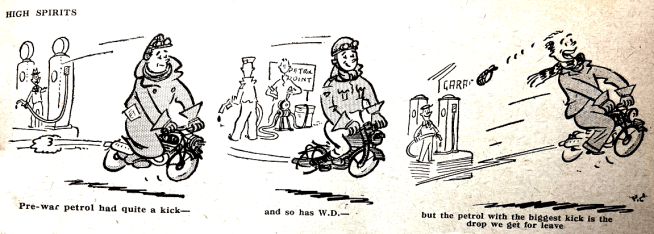
“CLUBS CERTAINLY SEEM to be in the news at present. Maybe you have heard of the recently formed Normandy MCC—the Normandy that lies between Guildford and Aldershot. It was born of Paddy Johnston’s (winner of the 1926 Lightweight TT) Home Guard DRs. In addition to usual club activities it aims at assisting novice and would-be motor cyclists to learn and understand motor cycles—teaching them to ride (all branches) and to carry out roadside repairs. A series of classes is being started using a complete motor cycle and an engine, carburettor, etc, in pieces for demonstration purposes…So far, so good, but what about private ground on which to teach the lads when basic [petrol ration] returns? Paddy has been in touch with the War Office explaining, the position—how they had placed ground at his disposal for training HGs and asking if he could now have it for training motor cyclists of the future. He had a very nice reply and the ground—a magnificent piece of trials country—has been placed at the disposal of the Normandy MCC. Full marks! Further than this, Mr Vokes, of air-filter fame, has agreed to the use of 80 acres of private land by the club, subject to the approval of his directors. That is not all the news of this go-ahead club. It has a savings side. The idea is that some of the younger members may have a job meeting sundry expenses, such as tax, insurance and repairs, so the club is encouraging them to pay in so much a week.”
A NAVAL OFFICER last week mentioned instrument panels in the tank top. He does not like them, but said that he had overcome the objections to his by having a tap at each end of the U-pipe connecting the two halves of the tank and fitting a pin-type connector—a multi-pin one—as a junction box for the electrical cables. There is no speedometer in his tank-top or he might grouse about condensation occurring. Another reader, in a letter, urges that tanks should be made so that they hinge and can be swung out of the way when one wants to get busy on the engine. Certainly, it is more than time that tanks were made quickly detachable and arranged so that removal does not involve draining, which can be a curse to the ordinary man.”
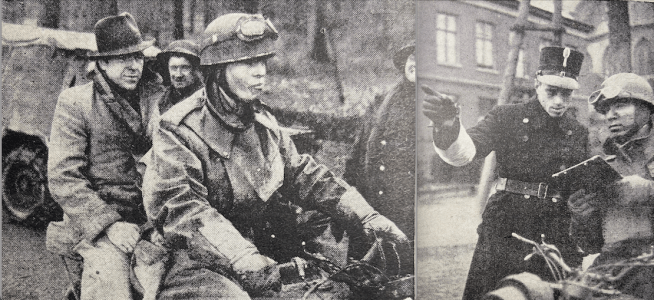
“WHEN BRITISH TROOPS enter a German town and have a little time on their hands before they are due to assault the next enemy strongpoint, their reactions are varied. Some amuse their comrades by wearing Nazi party armbands and queer student caps and giving an imitation of Hitler, others borrow any odd musical instrument which might be lying around and proceed to regale all and sundry with impromptu song and dance acts. The mechanically minded elements, after warily testing for booby-traps, inspect captured or knocked-out German vehicles with as much interest as they would have displayed over new models at Earl’s Court in the piping days of peace and plenteous petrol. By far the most popular of these enemy vehicles are the two-wheelers; enthusiasts will pore over German motor cycles for as long as time permits and, after a spot of ‘tinkering’ usually manage to get them running. Sometimes the owners find time to wreck them completely before leaving, sometimes they content themselves with removing a wheel or some other essential part which is likely to be hard to replace. The bikes are put to useful work by the fitters whose job it is to make a tour of inspection of irreparably damaged vehicles with a view to cannibalising any parts which might be relatively undamaged on a car or tank which is otherwise a write-off. These spare parts are sometimes a trifle difficult to obtain in forward areas in the midst of a battle and with roads to the rear, as is often the case, flooded or otherwise blocked to the passage of supplies. I have seen a couple of fitters, one driving and the other perched on the pillion, making a rapid tour of knocked-out cars and tanks, removing a Jeep wheel here and a wind-screen wiper there. Thus captured German bikes can serve a useful purpose in assisting the swift collection of such ‘spares’ with the minimum expenditure of petrol. Sometimes, as in the case of my recent drive through the Reichswald area with an
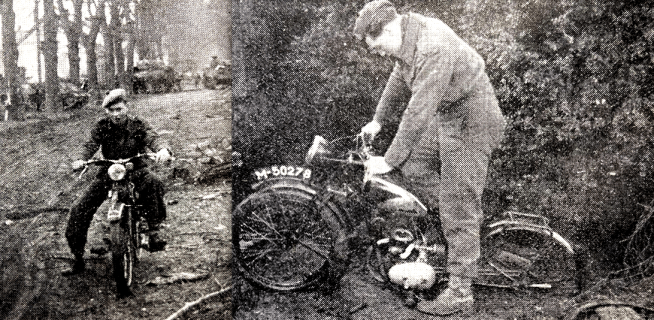
armoured, car regiment, one comes across German or Belgian ultra-lightweights fitted with 98cc Villiers engines, and I have known these power units to be used to provide the ‘urge’ for dynamos with which batteries are re-charged at every halt. The army has a very efficient little unit, known as a ‘chore horse’, which is specially designed for this job and is compact, light and invariably a ‘one-pull’ starter. Lighthearted enthusiasts among the occupying troops might, if they have a little time to spare, have short ‘ joy-rides’ on captured enemy bikes. This practice, although probably officially frowned on, provides a good deal of harmless amusement to men who have recently fought their way through all the horrors of modern war to take their objective, and it is usually tolerated by front-line officers, who wisely turn a blind eye. Some lads, as you know, are so ‘sold’ on certain features of German mounts that they wish they could take them back to Britain with them. This, of course, is impossible, and the bikes are handed over to the care of Civil Affairs officers when they arrive on the heels of the fighting troops. The most amusing incident I can recall in this connection happened when was in Brussels very shortly after the liberation. The Belgians at this time were almost delirious with joy over their new-found freedom and were willing to give anyone in khaki the ‘top brick off the chimney’, so to speak. I was just getting ready to leave my hotel for the airport when an acquaintance rushed up to me and asked if I could take a BMW, complete with Steib chair, back to England with me. Apparently a grateful Belgian had presented him with the outfit and he was quite willing to ‘jettison’ the chair if I would only get the bike back to England for him. I pointed out that this was quite impossible and he departed sadly, muttering that all his life he had wanted an outfit like this and now he’d got one he was unable to send it home. I had a good laugh, but could not help feeling sorry for the would-be importer of BMWs—I should have been a trifle mortified in similar circumstances.”
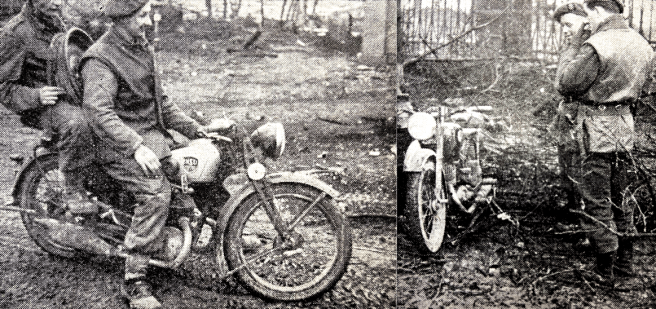
DESIGN MAESTRO PHIL IRVING took an in-depth look at rear suspension which was to come into its own when peace broke out. Here’s a short excerpt from his review: “Quite early in the history of the motor cycle the desirability of springing the rear wheel as well as the front wheel was recognised, but the difficulties peculiar to the design of a really satisfactory spring frame were frequently not fully appreciated. As a consequence, comfort was gained at the expense of greater weight and complication, and, more serious still, of impaired handling qualities, due to the inability of the suspension to keep the wheels in track. Sporting riders became very suspicious of any sprung design, and the demand fell almost to vanishing point until rear-sprung machines finally became pre-eminent in road racing. Motor cyclists being notoriously influenced by competition results, this new development stimulated the demand. There remains, however, a large number of those holding the view that large tyres plus an efficient saddle will furnish all the comfort that a motor cyclist requires, without any added complication, but the matter goes much further than the mere question of comfort. Given proper design, a frame with rear suspension will steer better, particularly on rough corners, and can be braked more heavily than a rigid frame, on account of the enhanced degree of rear-tyre contact, and thus the general safety of the vehicle is improved. The size and proportions of a motor cycle, the disposal of its live load, and the dynamics of the transmission make the design aspect far from simple, and several points must be observed to obtain a frame which is satisfactory under all conditions, and will remain so without attention for years. Put briefly, those which concern the springing, as such, are (a) Amount of sprung movement to be permitted. (b) Spring rate and provision for over-load. (c) Compensation for varying loads. (d) Damping. Mechanically, the following requirements have to be considered: (e) Control of wheel to ensure movement strictly in the centre plane of the frame. This is of paramount importance. (f) Minimum weight of unsprung components, and also of machine as a whole. (g) Reduction of bearings and routine attention to a minimum. (h) The effect of suspension geometry on the transmission, and vice versa. (j) Springing of pillion seat and rests. (k) Provision for quickly detachable wheel. (l) Sidecar attachment.”
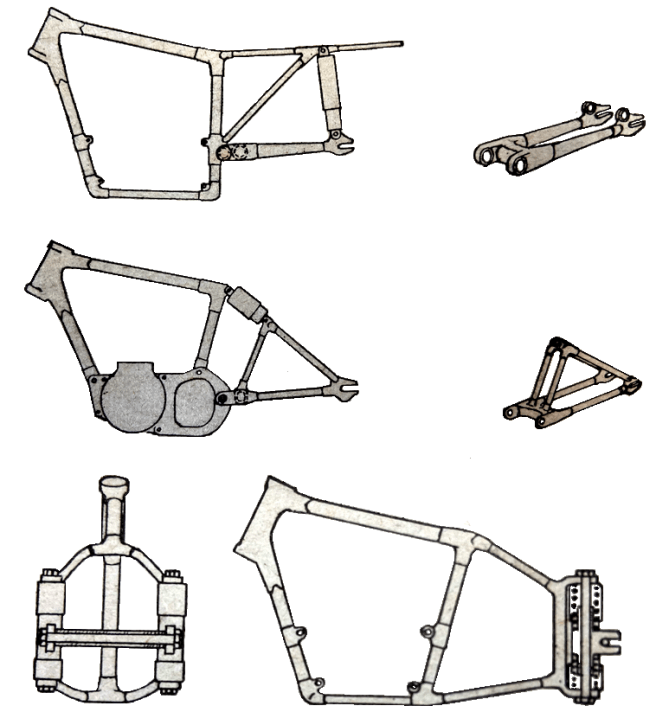
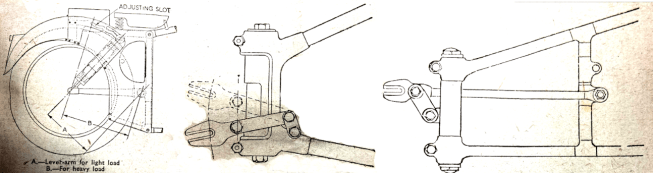
“IF EVER YOU FEEL inclined to grumble for any reason whatsoever about the fore or aft suspension of a motor cycle, digest a point made by PE Irving of Vincent-HRD. Bear with me if I restate it graphically. A friend of mine weighs 15st. His middle-aged missus scales rather over 12st. Gross weight of the couple when they go a-pillioning, about 380lb. This is almost identical with the dead weight of the motor bicycle which they own. The dead weight of a certain baby car, ready for the road, is about 16cwt. How would its suspension behave with ten 12-stone men aboard? Yet that is approximately the hard fate of John and Mary’s motor bike—it is carrying its own weight in flesh. To put the same point in another way, a baby car conveys a variable live load, normally rang-ing from about ¹⁄₁₂ to ¼ of its own dead weight. But the suspension of a typical motor bike must cope with a live load ranging from one-half of its own dead weight upwards. It is therefore marvellous that either our forks or our spring heels are as good as they actually are.”—Ixion
“ROUND THE CLUBS: A motor cycle club in the Warrington (Lancs) district is to be formed. Interested persons are asked to get in touch with Mr Robert J Mann, 2, Waverley Avenue, Dingleway, Appleton, near Warrington, Lancs. Bradford Vagabonds MC fixture: Monday, March 26th, social evening, Napoleon Hotel, Wakefield Road, 7.30pm. Sheffield & Hallamshire MC fixture: Friday, March 23rd, social evening, Norfolk Vaults, Market Hall, 8pm. Birmingham City Transport MC&LCC hope to arrange a series of talks by various motor cycle personalities in the near future. The social secretary, Mr TM Sloane (8, Finnemore Road, Birmingham, 8, invites other Midland clubs to visit HQ for a social evening. Sunbeam MCC will hold a tea-party on April 15th at 9, Aylmer Court, East Finchley, N2. Those members able to attend are asked to send a postcard to the secretary or ring Mountview 7745. In order to restart the Cambridge Centaur MCC, a general meeting a all past members and other Cambridge enthusiasts is to be held at the Anchor Hotel, Silver Street, Cambridge, on Saturday, March 24th, at 7pm. Acting secretary is Mr EC Thompson, 20, Woodlark Road, Cambridge.”
“I HAVE read Mr Bradshaw’s ‘Leaves from a Designer’s Life‘, in which he suggests that the note of the V-twin may appeal to our primitive instincts. I think he may be correct in his surmise, as to my mind the sound is. akin to syncopated music, which has the accent on the unaccented beat. I think you will agree that syncopated music appeals to most of us, even the highbrows, and that most modern music has a touch of the jungle about it, so what? It makes you wonder whether our remote ancestors, when signalling to their friends, beat a tattoo on their chests like a V-twin, a barking-single or a four-cylinder bike. And did the female of the species transmit the fussy sound of a two-stroke? I ask Mr Bradshaw.
Chas Y Spence, Edinburgh.”
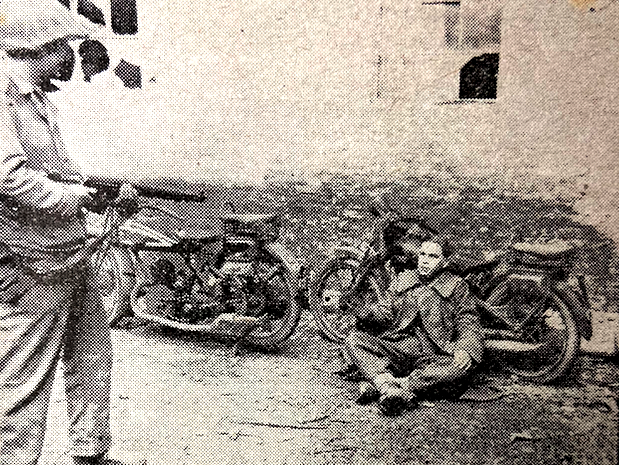
“IN A RECENT ISSUE of The Motor Cycle I noticed a photograph of an electric motor cycle designed by Mr W Barnes, of Preston. It was stated that this machine could cover 50 miles at 25mph for one penny—the cost of charging the four batteries which provided its motive power. If these figures are correct, this machine would be a much cheaper machine to run than the autocycle if it were put into production. It also has the same speed as an autocycle and would be mach easier to keep in good running order.
JJ Gay, South Cave, Yorks.”
“AFTER READING THE LETTER on shaft drive by Mr J Culligan, one of my English friends asked for my opinion—from my Continental viewpoint—about shaft drive. I have experience with the following shaft-driven motor cycles: FN—Belgian four-in-line, 500cc, air-cooled, sv, built about 1914. Nimbus—Danish four-in-line, 750cc air-cooled, sv, built 1926. KG—German 500cc ohv built 1929. Windhoff—German four, 750cc liquid-cooled, sv, built 1926. Stock—German single, 200cc two-stroke, built 1932. Praga—Czechoslovak single 350cc ohc, built 1932. Garabello—Italian water-cooled four, 1,000cc ohv, built 1927. Jawa—Czechoslovak, single, 500cc ohv, built 1931. Baker—English single, 250cc, two-stroke, built 1930. Zündapp—German, 500cc sv, 500cc ohv, 600cc ohv twins and 800cc sv fours, built between 1933 and 1939. BMW—German, 200, 250, 300, 350, 400cc ohv singles and 500cc sv, 500cc ohv, 600cc sv and 750cc sv and ohv twins, built between 1924 and 1939. Gnome Rhône—French, 500cc sv twin, built 1933. My opinion, from the viewpoint of a sporting rider, is that shaft drive is satisfactory only for twins and fours, and not for racing. I should not commend it for motor cycles under 350 c.c. As a technician I say ‘Yes’ to shaft drive, but it must be well designed and made from the best of materials.
‘Wheelbarrow’, Czechoslovak Forces, BLA.”
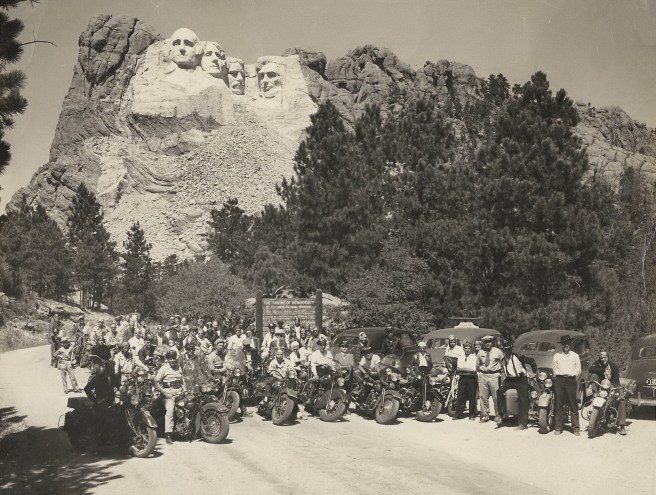
“AFTER READING LETTERS on the phenomenal speeds and fuel consumptions to be had by little work, I decided to have a shot myself, and I feel my experience may be of interest to your readers. I had a 1929 BSA 500ohv to make my experiments on. First I cleaned the plug (found in a cowshed). Then I moved the ignition forward, and fixed it so that I could remove the lever on the handlebar. Then I removed the airslide cable and lever to make things easier still. I then filed down the carburettor needle instead of fitting a larger jet (cheaper). Then the piston had two rings removed to stop friction, the cylinder barrel had half-an-inch sawn off to raise the compression. The exhaust system was then removed to make a nice noise. The petrol tank was removed, and the oil tank used in its place to lighten the load. Mudguards and seat were removed and a cushion fitted. It was then tested on the road. Flat out, lying on the tank on a downhill with a stiff wind behind, I actually got 27mph; not liking this, I solved the matter by stepping up the ratio of the speedometer drive, and I now get 120mph in bottom, and about 470 miles per gallon.
James Jackson, Kettering.”
“FOR THE PAST three years I have been a fitter in the RAC and have had experience with most vehicles in the Army, including tanks, both petrol and diesel, and also the radial-petrol. My experience is that the magneto is still the best way of producing sparks. During the five months I was working on Grant and General Lee type tanks I don’t ever remember one of them needing anything more than points cleaned on the 100-hour checks. In my humble opinion, if we had the static winding type magneto there would be no argument about the speed of the armature. Now for a different subject, which is weight. I have ridden various machines from 150cc to 1,000cc, and in my own case I have found that the heavy bikes are much better as regards road holding, steering and comfort. The last I had was a 1937 Rudge Sports Special, which, if I remember rightly, scaled 410lb—pretty heavy for an ordinary 500cc. This bike was one of the best I’ve had both for comfort and road holding. I personally prefer a good hefty capacity tank, as I detest having to stop for petrol on a run of less than 200 miles. I have had my name put down for an HRD Rapide and here is what I’m going to have, all being well, even if it costs extra: all-black tank, mudguards, frame and head lamp. I also want their extra large petrol tank. This, of course, is only one person’s ideal, and I think that rather than criticise others who have different views it would be muck better if we remembered the old saying, ‘Live and let live’. I will end by thanking you and your staff for giving us a good, interesting weekly journal.
NW Huchman, CMF.”
“I HAVE READ several letters criticising Brooklands track, but very few correspondents say a good word for it. I have been to dozens of meetings there and have enjoyed every one. I noticed, too, that most other people seemed to be quite happy, the atmosphere seemed to me to be just right, and the roar of those healthy motors was a real tonic after a week’s work in a stuffy toolroom. One got good sport and fresh air at the same time. I never found it very difficult to get a good view of all I wanted to see, including the models; the Bemsee boys were a most friendly crowd and always answered my somewhat amateurish questions in a helpful and cheerful manner. I competed at the track myself on ‘Clubman’s’ day in 1939, and without a doubt that day was the most enjoyable one I have ever spent on two wheels, and I hope to be on the starting line at the first post-war meeting, and let’s hope that won’t be long. The track may not be all that is to be desired, but let’s get cracking again; no doubt the directors have plans for improvements when the time comes; the thing to do is to show them that we want the track open as soon as possible after the cessation of hostilities.
CH Pritchard, Edmonton, N18.”
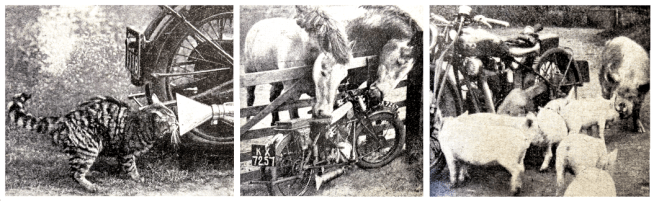
“WHEN THE DEPRESSION hit the world and its full impact was felt by motor cycle manufacturers, the industry in general decided that the one market for their wares which would persist was the enthusiast market—men who would give up all else that they might motor cycle. As a policy it was probably sound then, and it is a fact that the game was only emerging from the Doldrums as the war came along. Go back to the period 1920-1930; then the motor cycle world was far from being entirely composed of the enthusiast type. In my opinion it will be the same after the war so long as the machines offered are not only ‘sporty bhoy’ ones—there are really appealing other types in addition. Gone, I hope, will be any tendency towards the tourist and roadster types being poor relations—ugly sisters.”
“FREQUENTLY PLEAS ARE ADVANCED for greater accessibility in motor cycles. Almost as numerous are requests that future motor cycles shall be designed as a whole instead of being assemblies of components or, in motor cycle parlance, ‘a collection of bits and pieces’. These demands seem incompatible. How can a motor cycle be of smooth, homogeneous design and retain the boon of accessibility? The symmetry will be wrecked if there are cover plates, with attendant fixing screws, to give access to this and that. Thoughts, therefore, are inclined to dwell upon the possibilities of quickly detachable enclosing shields, made, perhaps, of plasticised, non-resonant material. There are fresh opportunities in this direction, thank to wartime developments, but many motor cyclists dislike the idea of enclosure, even when the latter is confined to the lower half of the engine and the gear box. They fear weight, rattle, resonance and inaccessibility—quite unnecessarily, we think. By far the biggest problem, with crank-case shielding, is likely to be engine cooling. Certainly, by one means or other, motor cycles must be made cleaner in appearance, cleaner to ride and easier to clean. With shielding this should be possible and accessibility not merely retained but greatly improved. The fixings can be of a type that makes the shields removable in seconds and, because the ‘working parts’ are not revealed to the public at large, it is no longer necessary to sacrifice their accessibility and ease of maintenance in an endeavour to achieve some degree of neatness.”
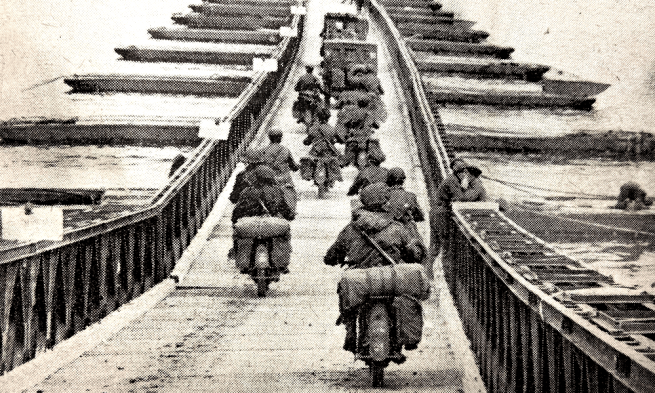
“BIG-TWINS, SOLO motor cycles with V-twin engines of 1,000cc, were extremely popular in the years following the last war, but lately they have seemed to be a dying ‘race’. A few, a very few, have upheld the honour of the type. Our announcement of a post-war programme which is to consist of one big-twin model suggests that the effortless, high-geared V-type of power unit may be about to stage a come-back. We believe that the 1,000cc twin-cylinder solo will do so if it is light and ‘handleable’. There is no doubt about the appeal of riding a large-capacity twin which develops its power at low engine speeds. Many have suggested that this is motor cycling at its best, but where these machines—where nearly all big machines—have been apt to fail in recent years is that they lacked the ‘nippines’ of smaller machines. For all their power and effortless engine behaviour, they were, on average speed, in many cases slower, rather than faster, than the more handleable mounts of less cc. It is largely a matter of weight and wheelbase.”
“I WAS SADDENED to hear of the death of Etienne Boileau, who was London editorial representative of this journal when its head office was still in Coventry. Scion of an old French family, Boileau was appointed by the ACGB and I (now RAC) to the original committee of the Auto-Cycle Club (later the ACU), where he fought manfully for all motor cycling interests. A passionate fan, his favourite motor cycle was the original Lagonda tricar, sponsored by Wilbur Gunn, who drove like a fiend and sang like a seraph. I can still see Boileau tipping open its deck-trapdoor, and starting his engine by a pas seul on its concealed pedal gear. Something of an aristocrat, Boileau used to survey with a slightly disdainful air of surprise the rather grubby mechanics who bulked so large in the vanguard of our hobby. He was very anxious to prevent motor cycling from becoming the hobby of a single stratum of British society, and did his best to enrol recruits of the old school tie brigade, the services, the varsities and even royalty.”—Ixion
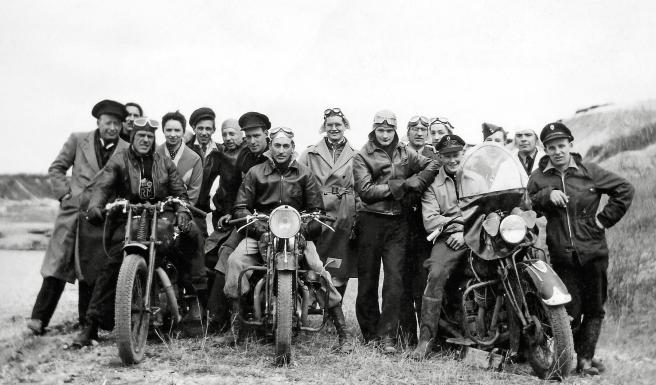
“I HOPE YOU ALL NOTICED…a brief sentence which, in my opinion, may mark the dawn of a new era in motor cycling. The new automatic advance Lucas and BT-H mags are said by Triumphs to furnish a terrific spark at low speeds and render the starting up of the new Triumph twins almost miraculously easy. Tickle-starting at last, eh? Nothing has so much obstructed the popularisation of motor cycles as the pitiably frequent spectacle in the past of sturdy male riders kicking away and panting over a sulky engine.”—Ixion
“NO DOUBT, LIKE nearly every member of our clan, you glue your nose to the windows of tool shops. Recently the selection of tools seems to have become much wider, though the prices of many of them appear decidedly steep in comparison with pre-war figures. The other day I even saw Starrett ‘speed indicators’ in a shop window. You may recall that a few months ago Torrens was after one in order to check the tick-over speed of the ‘Victor’, the special Scott that refuses to four-stroke. He found one after much difficulty, but had to pay £1 for it, and here they were at 9s or, with ebonite ‘handle’, 11s, all brand new. Definitely it is an instrument for the enthusiast to own in peacetime, or shall we have rpm indicators driven from our engines and acting as speedometers, too? As you know, the speedometer on the 500cc Triumph twins at the outbreak of war was a combined ‘rev-counter’ and speedometer, but was driven from the front wheel. The outside or main set of figures was miles per hour, the next gave the rpm in top gear, then came rpm in third, and, lastly, the innermost ring of figures were the revs in second. With the instrument running off the engine one could have the outside ‘ring’ giving rpm and the inner ones the speeds in the various gears, but there would be no satisfactory means of counting the miles—only the revs—so, methinks, the idea would not appeal overmuch.”
“ALTHOUGH SPEEDWAY RACING on a full national basis will not start until 1946, at least four speedways will be holding meetings this year, namely, Belle Vue, Bradford, Newcastle and New Cross. The Press Association states that the Speedway Control Board has also received applications from Exeter and Reading.”
“THERE ARE SEVERAL ‘shorts’ from the speedways. The 1945 season at Belle Vue, Manchester (where they have been carrying on throughout the war) has already opened, with racing every Saturday. Bradford’s opening meeting at Odsal Stadium is fixed for the evening of Saturday, June 23rd…I gather that the track is to have banked bends (shades of Stamford Bridge!) and an inside measurement of approximately 375 yards. Mr AJ Elvin, Wembley’s managing director, has arranged, for June 19th, a round-table conference of promoters and Control-board members to discuss plans for the revival of speedway racing on a national basis in 1946. Meanwhile Major Alec Jackson, who is expected back at Wembley before the end of this month, will waste no time in opening the Rye House track to try out as many as possible of the lads who have written to Wembley asking for an opportunity to show what they can do. Many of these are still overseas, but it is Wembley’s intention to use Rye House as a testing ground until all have had a chance of showing their paces. New Cross Speedway may see some racing shortly. Mr Fred Mockford is trying to come to an acceptable arrangement with a number of riders at present available.”—Talmage.
“FLIPS ON FOUR very different captured motor cycles. Examining more than a dozen enemy motor cycles. All this and more in a single day. Where was was I—somewhere in Holland, Belgium or Germany? No. I was in England at the Wheeled Vehicle Experimental Establishment, the organisation which, in the days it handled tanks, was called ‘Meewee’, and is now ‘Weevee’. Many Army motor cyclists and other Servicemen in the course of the war have enjoyed themselves on Germany’s or Italy’s choicest motor bicycles. Some who fought with the 8th Army captured both Hun and Itie machines in the course of a day. For a week—perhaps a month or more —the machines were theirs. Were you one of these? If so, did you enthuse, if not about the machine as a whole, about various features of it—the shaft drive, perhaps; the many cogs in the cog-box; the suspension; the brakes—and did you wonder why the British Army did not provide such fare? Further, did you, and do you, wonder whether those responsible for the design of the motor cycles issued to you realise how good the BMWs, Zündapps, Guzzis and so on, are? Should your answer be ‘No!’ and you have ‘owned’ one of the more exclusive-type models, you are probably one of the few. The fact is that the authorities know each of the models readers have quoted in their letters. They have analysed them, tested them, and, in some directions, learnt from them. They also know something that is probably news to nearly all British motor cyclists. For six months and more Germany has ceased making her elaborate sidecar outfits, the BMW and Zündapp, and has stopped the manufacture of her super solos. In place of the sidecar-wheel-drive outfits there is the four-wheel-drive Volkswagen. For her solos she has concentrated on the new 125cc DKW and the 350cc DKW. In short, at the end of some five years of war, Germany adopted the sincerest form of flattery; she copied the British policy. The latter, as you well know, has been to use the jeep, the 125cc two-stroke lightweights and medium-weight four-
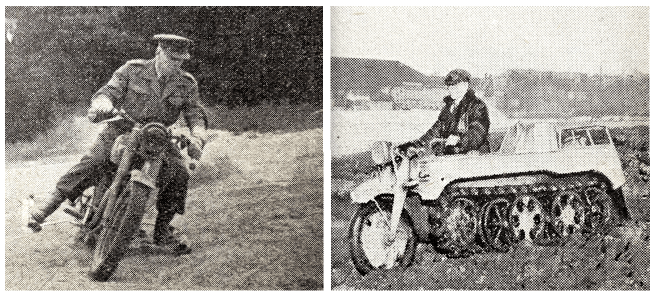
strokes. Could there be greater confirmation of the wisdom of those who have been responsible for the policy which Britain has followed? I think you will agree that after all that has happened and been said the news is almost stunning. Please do not read into this that the authorities have been satisfied and feel in any way smug regarding the motor cycles that have been issued to our Forces. They are sure their policy has been the correct one, but wish it had been possible to provide machines still more suitable for use in the field—the many fields. Their hands have been tied…there was a period when this country was 55,000 motor cycles short. Their plans for a single general-purpose solo had to go by the board; it was imperative to carry on with the machines that were in production, or the position would have become still worse. No doubt you remember the special military models that were built early in the war—the ultra-light 350cc vertical-twin Triumph and the 300lb 350cc ohv BSA. The intention was to standardise one or other of these machines, but it was out of the question, and I fear that not until the war is over can the special military motor cycles become available. The 125cc two-strokes, the Royal Enfield and the James-Villiers, you also know about. Following a demonstration the Editor gave to Airborne, they were adopted first for airborne work, and then used, in addition, for the assault troops on D-day, for controlling the unloading of supplies on the beaches and for all manner of work under extreme conditions. Germany’s change of front regarding motor cycles would seem to dispel interest in captured motor cycles, and it is a fact that the sole machines for which the authorities yearned at the time of my visit to ‘Weevee’ were the new 125cc DKW and the latest 350cc DKW. (Note the capacity of the lightweight: 125cc, like ours, not 97.5, which was the size of the famous little DKW of pre-war days.) The only reason they are not interested in the other makes and models is that they already know just about everything concerning them…What the enemy uses—learning all about their armies and equipment—is a matter of Military Intelligence. The Directorate of Military Intelligence collects captured material. When it is a ‘vehicle, wheeled’ and appears to be of any interest, the Directorate informs TT2 Ministry of Supply, and asks for a report on it. Occasionally, TT2, as the department responsible, among other tasks, for motor cycle design, will ask that a particular machine be obtained, if possible. There may be some feature, or some performance characteristic, in which they are specially interested. When the vehicle arrives it is passed to the Wheeled
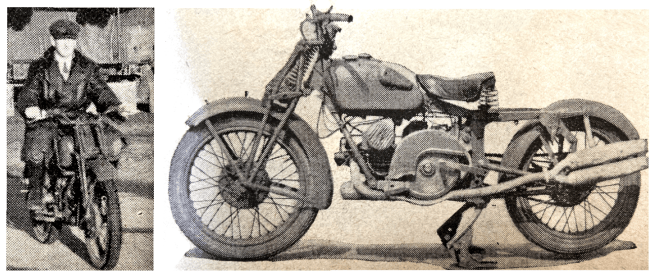
Vehicle Experimental Establishment. TT2 and ‘Wee-vee’ examine it…the official report on the Guzzi 500cc civilian and military models runs to 14 foolscap pages. Not only were the Italian machines tested and the results logged, but they were tried out against a standard G3/L WD Matchless…Where a machine is of exceptional interest, or the materials used in it are in any way novel, the Ministry of Supply way obtain the co-operation of a manufacturer with special knowledge of the particular aspect. For example, tyres will be passed to Dunlops for examination and to check, perhaps, the proportion of synthetic rubber employed…What will give you some idea of the extent of the study of enemy vehicles is that up to the time of my visit no fewer than 91 captured vehicles had been examined. The motor cycles have comprised two 750cc BMW sidecar outfits (the elaborate job with differential and twin-wheel-drive), 500cc civilian-type Guzzi 500cc ‘Alce’ (military) Guzzi, the 750cc sidecar-wheel-drive Zündapp (probably the more interesting and ‘advanced’ of the German sidecar outfits), an R61 solo BMW, two 250cc ohc Benellis, a 500cc Benelli, a 250cc ohv NSU, a side-valve Gilera, and a Bianchi. Whether the three-quarter track NSU—the ‘three-wheeler’ with a motor cycle front-wheel assembly and tracks for the other ‘wheels’—can be called a motor cycle I am not sure…once the examination and tests of the various machines have been completed the latter are available to manufacturers; they can browse over them to their heart’s content…Let us run through what occurred over the two 500cc Guzzis…The civilian type was probably imprest by the Italian Army and is over 60lb heavier than the Alce military model, the weights being respectively 420 and 356lb…These figures compare with 368lb for the G3/L Matchless, against which the Guzzis were tested. The civilian-type Guzzi had an ohv, engine and very high close-ratio gears—425, 5.7, 7.3 and 9.8 to 1—while the Alce…has a side inlet and overhead exhaust valve, with pins protruding spider-like into the combustion chamber to catch the head of the exhaust valve if its stem breaks and to prevent the valve hitting the piston…while the machine was interesting, there was extraordinarily little to learn from it. Our authorities…remark upon the low-speed pulling of these horizontal singles with their very low compression ratios (4.8 to 1 for the ohv; 4.7 to 1 for the Alce) and extremely large outside flywheels. The actual official comment was, ‘The engine characteristics. are remarkably suitable for WD purposes, balance and slow-
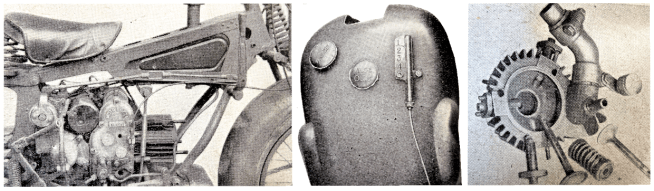
pulling power being definitely superior to those of any contemporary British WD type.’ I will list the performance tests so that you can gain an inkling of the very thorough manner in which the British authorities delve into matters. Here are the main headings: Controlled descent of in 10.45 gradient at 8mph for ¼ mile; retardation on steep gradient from 5mph, both front and rear brakes (1 in 4 concrete gradient and 1 in 2.25 concrete gradient); restarting on 1 in 4. and on 1 in 2.25 ; speed up 515 yards of 1 in 10.45 (with flying start and with standing start); speed over level ¼-mile from standing start; fuel consumption over 100 miles road circuit at an average speed of 30mph; climbs (sometimes attempted climbs) of gravel hills with gradients of 1 in 3.88, in 3.18, 1 in 2.98, 1 in 2.74 and 1 in 2.43, and of those concrete-surfaced hills with gradients of 1 in 2.25 and 1 in 4.0; negotiation of a special two-mile cross-country circuit to determine suspension, stability and steering under rough-stuff conditions; maximum speed; minimum speed. Add to all this a detailed analysis of the design rather on the lines of a description of a new model when we have the space really to spread ourselves, plus ‘Observations and Conclusions’—made with military purposes firmly in mind—and you have an idea as to what goes on behind the scenes. The official report points out the lack of rigidity in the rear portion of the sprung frame. This shows itself in the form of slight weaving when the machine is on the road—a fault in Italian machines that was commented on in the International Six Days Trials. It was also found.that the rear springing was too lively for rough cross-country work. I rode the Alce round the ‘houses’. The saddle is low and the footrests are high—very high. A monkey-on-stick is not in it with this machine, a point duly brought out in
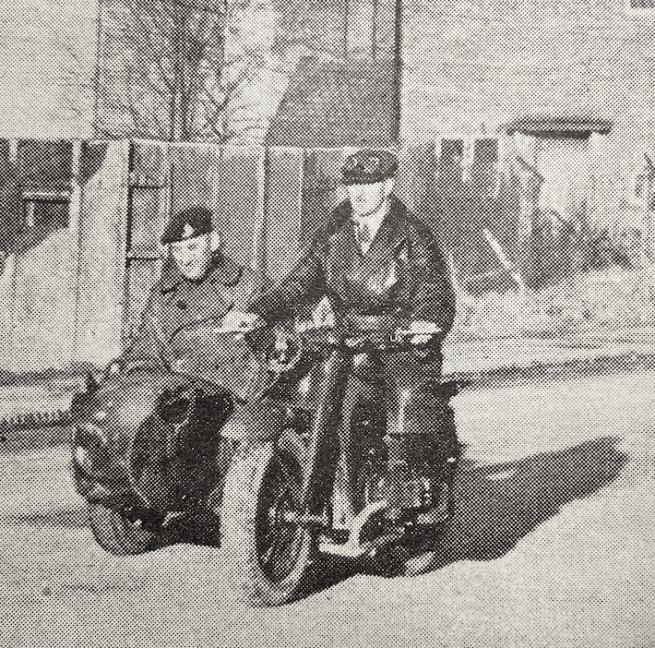
the official report. The gear change was of the ‘crash’ type. Definitely, not a very clever motor cycle. What were the speeds and fuel consumptions? The maximum of the ohv civilian-type Guzzi was 72mph; the military model, 57; and the G3 /L, 62.1; the respective consumptions were 66.6. 61.3 and 65.33 respectively—not exactly Civvy Street figures of the old days. The great point, methinks, is that the Guzzi engines have the right characteristics for military work. Those characteristics count for much. Technically, the most interesting of the many captured motor cycles that have undergone examination and test at the Wheeled Vehicle Experimental Establishment is undoubtedly the Zündapp sidecar outfit. This is a case of a sidecar machine developed almost to the nth degree in an endeavour to make it still more a military-purpose vehicle. It will be recalled that the Hun started the war with military sidecar outfits—very large numbers of them—which had horizontally opposed trans-verse twin-cylinder engines and merely a single driving wheel. Not until the war had been on some time did he take a leaf out of our book: adopt sidecar-wheel drive, which British trials sidecar drivers developed long before the war and which, in the form of the Big Four Norton outfits, had been used for years by the British Army. This was an extraordinary lack of foresight—twins and only one-wheel drive. Of course, eventually the Hun woke up, went to extremes and then—obsolescence! No fewer than eight speeds or gear ratios are provided ‘forward’ and four in ‘reverse’. In addition to the four-speed-and-reverse gear box in unit with the engine there is an auxiliary gear box, a small, plain dog-clutch two-speed box…The transverse twin-cylinder ohv engine is on the usual Zündapp lines. (In Germany many used to prefer the Zündapp engine to that of the BMW). It has a bore and stroke of.75 x85 mm. (752cc), a compression ratio of no less than 7 to 1, and the valves set at 72°. There is a big valve overlap —70°—for the inlet valves start to open 35° before top dead centre, and the exhaust valves do not close until 35°after tdc; the inlets close 75 degrees after bdc, and the exhaust valves open 75° before bdc. A very interesting feature, especially valuable on a military vehicle, is that a new big-end bearing can be fitted by removal of the opposite cylinder…instead of big-end bolts there are socket screws, an arrangement which at least one British designer has been keen on for some time…Driven from the front end of the crankshaft is a gear-type oil pump, also the magneto, a Noris of exceptional interest. At first glance there seems little special about the magneto except that on removal of the contact-breaker cover it is found that, in addition to there being a centrifugal advance-and-retard mechanism, the contact points are particularly easily adjusted and that the condenser is all handy.
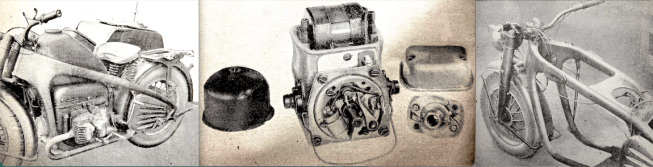
Strange, the condenser being mounted on the end-plate of the magneto! Yes, it is no ordinary magneto in spite of its external shape. There are no windings rotating at half-engine speed. They, like the condenser, are stationary, as in a flywheel magneto. The laminated rotating member has a bar magnet running across it. The windings are on a laminated core mounted on top of the magneto. Two slip-rings are provided, one to act as the distributor for the two sparking plugs and the other forming the lead-in from the high-tension winding of the coil. It is just the instrument for easy maintenance and, I imagine from its very excellent design, just the instrument not to give trouble. But there is a snag over that automatic advance and retard. Unlike the BT-H on the Velocettes and the post-war Triumphs, the control operates between the contact-breaker cam and the magneto spindle; it is not in the drive from engine to magneto. Hence the magneto is not forever operating at its optimum. The control, which has very light springs, gives a total range of 28°, and the timing on the engine that was stripped for detailed analysis was 22° btdc at full advance and 6° after tdc at full retard… The sidecar-wheel-drive mechanism is the same for both the Zündapp and BMW sidecar outfits, so if a sidecar from a BMW is fitted to a Zündapp or vice versa it will not be found that the sidecar and rear wheels revolve at different speeds! I will not bore you with all the detail, for this is a motor cycle produced regardless of cost and of anything else other than fitness .for military use. Two of these 880lb sidecar outfits were at WVEE at the time of my visit. One was in pieces and most beautifully laid out for inspection by all concerned, and the other was a ‘runner’. I took the latter up the road. It reminded me of all the BMWs and Zündapps I have ridden and driven. There was the same sort of feeling about the same ‘clonk’ gear change, that slight clashing that one senses rather than hears, and which seems inevitable irrespective of skill being displayed (in my case, none—I ‘crash’ changed!) and the same rather rapid take-up by the clutch. I am sorry, but I do not thrill at these German twins; only the 500cc ohv BMW really tickles my fancy. What did interest me was the cornering. Even with the differential locked by means of its little lever the steering was still not unduly heavy on bends and corners—not so heavy as that of many an ordinary solo turned sidecar outfit with its single-wheel drive. I give those responsible for the outfit many marks, but I feel—and apparently the Germans have felt for months—that it is a case of design run riot. Goodness knows what the cost would be in our coinage. While the Zündapps had magneto ignition, the 600cc side-valve BMW, a solo, had, I noticed, coil ignition. This machine, like all the other BMWs that have reached WVEE, had its rear brake linings impregnated with oil. Unlike the Zündapp, which has no shock-absorber in its transmission—other than the driving shaft—the BMW had a rubber universal joint-cum-shock absorber. There was the usual plunger-type rear springing and a solid rear-wheel spindle of 0.7865in diameter. The elaborate BMW sidecar outfit developed gear box trouble on its tests. It ended
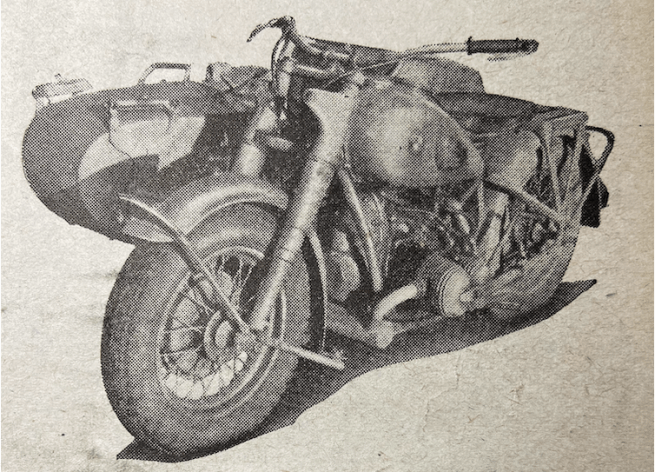
up with only bottom gear (‘high box’ and ‘low box’) in operation. This machine provides four speeds and reverse in the main gear box—eight forward speeds thanks to the lever marked ‘Strasse’ and ‘Getande’—and two speeds in reverse. Unlike the standard BMWs known to motor cyclists over here, the kick-starter operates in the normal plane, instead of transversely. The foot-change, however, is crosswise; it is mounted just in front of the left footrest. A press-button on top of the inter-connected hand gear lever has to be operated for reverse, so there is no question of reverse being engaged by mistake. In this case the frame is tubular in parts. Indeed, it is almost. Meccano-like. There is a deep, nearly oval section top member, to which the steering head is bolted, steel pressings form the seat stays, and the rest of the frame consists of tubes bolted on. A huge central spring provides the suspension for the pivoted-nose saddle—a pivot which, like that of the other German machines, had developed considerable side-play. Two carburettors were, of course, fitted to the BMW—Graetzin instruments rather after the style of Amals. Next, I glanced over a Gilera. This lumping Italian side-valve single, with its fins radiating outwards on the cylinder head, looked just as the model has looked since I first saw it in the ’20s. There was the rear-wheel springing to examine, however. This is of pivot-action type, with a triangular arrangement of the rear stays and chain stays. The pivot or hinge is in the usual place—just behind the gear box—and the springs are arranged in horizontal tubes, one each side of the rear mudguard, the apex of each triangle being linked so as to pull on the springs. The Italian Benellis were a very different proposition. The 500cc model was very like proposition The 500cc model was very like the ‘250s’. About the most noticeable difference was that duplex coil springs were fitted on the valves of the ohc engine instead of hairpin springs. These hairpin valve springs, for all the engine’s revving propensities, are so light that they can be removed and refitted without any tools—merely with one’s fingers. The valves, of course, are exposed, which is not exactly clever on a military machine (the same fault applies to the Guzzis). Another very Italian feature is that each exhaust system of the two-port engine has a little lever which enables one to put the baffle in the silencer out of action. Oil is carried in a ribbed forward extension of the crankcase. On top of this is a tiny oil-cooler mounted in between the duplex front-down tubes. Coil ignition is employed. The separate dynamo is driven through a rubber coupling; remove one screw and the dynamo can be pulled out of its housing in the crankcase. A normal single-spring type of front fork is fitted. The rear springing is of

plunger type, but with pivoted rear chainstays and hand-adjustable friction shock absorbers. I covered a number of miles on one of these Benellis. The engine was delightful. It was as sweet and well balanced a 250 as I have ridden, and gave one the feeling of being aboard a machine of at least 350cc. Here was something over which to enthuse. The steering, however, was again Italian. There was a wavering as one heeled over for a bend, and I found that the only way to get absolutely clean-cut cornering was to accelerate as one heeled over—to accelerate all the way round. Also in the stable of captured machines was a 498cc side-valve Bianchi. This has a light-alloy cylinderhead with the sparking plug at an angle over the valves, very much as if the engine were an ohv. Pivot-action, plunger-type rear springing, with friction dampers, is employed. The primary chain is of the duplex variety, with the overflow pipe from the oil-tank led to the chain-case. The hubs are of brake-drum diameter, with a single pair of brake shoes. As usual on the Italian machines, there is an easily operated rolling-type central stand. I have reserved for last that extraordinary-looking ‘three-wheeler’…if, like me (up to the time of my visit to WVEE) you have never driven one, probably you have thought: ‘What a stupid contraption!’ To me it was a puzzle as to what good the motor cycle front wheel and forks could be when there were mighty, tank-like tracks, one each side, doing the driving. It might—and does—prevent the front of the vehicle burying its nose in cross-country going and, surprisingly, it does steer the vehicle quite effectively without, it seems, resulting in undue tyre wear. The machine its a three-man 8cwt. tractor, with a single seat for the driver, and the passengers on the back facing to the rear. It has been employed by the Germans for hauling a light trailer or a light gun…on roads you steer in the normal fashion by means of front wheels (‘wheel’ in this case) and it is only when you want to make a very sharp turn that you apply the brake to one track and the drive being transferred to the other, you twirl round. This is done automatically, since the handlebars are linked to the brakes by Bowden cables. The engine is a four-cylinder water-cooled ohv car job, an Opel of 80x76mm. (just over 1,500cc) and is mounted behind the driver, who sits on a motor cycle-type saddle and has a pair of handlebars carrying a twist-grip throttle…between the driver’s legs are two car-like gear levers, one for the three-speed-and-reverse main gear box and the other for the transfer front high gears to low gears and vice versa. Control is extremely easy and, thanks to that front wheel, one can steer the machine to a nicety. In real mud it will see off any four-wheeler you like—even a four-wheel-drive four-wheeler fitted with chains. Preserve us from them in post-war trials! So that was my day out. A very pleasing one, I think you will agree, and one which reveals that Britain knows a very great deal about all those enemy motor cycles—has an altogether practical insight into the matter.”—Torrens
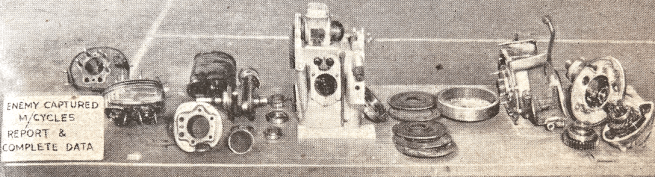
“HOPES RUN HIGH! Easter may not have had its Land’s End Trial, its Donington road-race meeting and its mighty holiday treks, but for all that it has been a real tonic—a great Easter and incomparably the best of the last six. With the thrilling news there is the comfortable feeling that this is the last austerity Easter, and that the next ‘first holiday of the year’ will be a real holiday: freedom at last. All realise only too plainly that the end of the war in Europe does not mean the end of hostilities; that the Japanese war, which has gone more favourably than many anticipated, has to be concluded before every hand can be turned to rebuilding civilisation. All, too, are well aware that the peace has to be won in addition to the war, and that ‘peace and plenty’ can only come from work in plenty. At this period it is well to pause a moment and recall that at the beginning of June last year the German Atlantic ‘Wall’ had still to be pierced. There was the colossal, frightening task of ‘bridging’ the Channel. In these few months the British and American Forces have liberated France and Belgium, smashed the vaunted Siegfried Line, bridged the fast-flowing Rhine…The feat—the multitude of feats—almost passes comprehension. All honour to the armies, the navies, the merchant navies, the air forces and those tens of thousands who have laboured to provide the ‘tools’ and to keep the Forces serviced. This nation can be very proud. Thanks to those mighty efforts it is no longer a case of looking to the future with sober confidence but with great expectations. Perhaps even before next Easter, in view of the statement at the Motor Cycling Club’s meeting last week, there will be that familiar statement, ‘See you on the Land’s End.”
SERVICEMEN IN ITALY formed the Frenzy MCC and within a week staged a trial in Central Italy “where the steep hillsides and wooded slopes made suitable natural hazards easy to find. Here they had plotted out a nice seven-mile circuit containing nine observed hazards—and quite a number of unobserved ones. Three laps of the circuit completed the course. Although the trial was held less than a week after the club had been formed, 87 riders turned up at the start. Some idea of the enthusiasm of Army riders is given by the fact that several of them had travelled over 100 miles to the start (including one unsung hero who had come straight off night shift) with nothing more to guide them than a three-line paragraph in an Army newspaper giving the time and map-reference of the start. Signals provided 36 of the 87 starters and RASC and CMP the bulk of the others, though actually no fewer than 25 different units were represented, showing how widely those indefatigable griff-merchants, the DRs, had scattered the news. American units had an open invitation, but only two American riders turned up, and one of those, considering discretion the better part of valour, rode a borrowed British machine. The other hero, Pte Clem, of USA Ordnance, rode his Harley; hampered, on the unfamiliar going, by the low clearance, the weight and the foot-clutch, hand-gear-change of his mount, his footings and stops were numerous, but he succeeded in completing all three laps, a performance which earned him considerable admiration for his pluck and guts.”
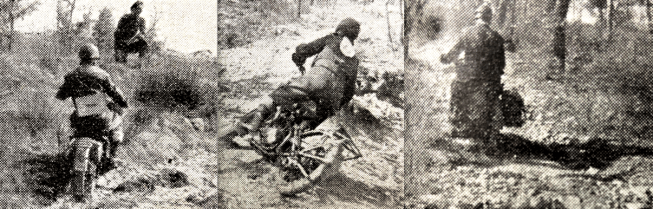
“WHILE THE ROAD SAFETY Committee presses strongly for a wide extension of motor patrols, it does not point out what is essential to the efficiency of a safety force, namely, that if be equipped with solo motor cycles. The crowded roads in the war areas have stressed what many may have forgotten in the passage of time since our roads at home were crowded—that the only vehicle which can weave and zipp [sic[ through traffic is the single-track machine, the solo motor cycle. What is needed in any safety force is a large number of very highly trained motor cyclists properly equipped as regards machines and clothing.”
“NOW FOR SOME ‘SHORTS’. What was it that caused you to become interested in motor cycles? A letter the other day said that the cause of the entry of the writer and his wife into the great game was fish and chips—the latter were wrapped up in some pages from The Motor Cycle. • • • A letter from the other side of the Atlantic deplores the use of the words ‘sparking plug’. Apparently putting the ‘ing’ on ‘sparking’ gets him down. Methinks that if we used ‘spark plugs’ there would be many more letters! • • • Down in Surrey last week I noticed at a road fork the word ‘London’ had been painted on the road surface in mighty letters—this plus an arrow, rather an insignificant arrow. I am not sure whether I like road signs painted on the road or not.
“IT WAS IN ABOUT 1925, I suppose, when I arrived home from the TT with several plug ‘thimbles’ in my pocket. They were beautifully made cylindrical affairs for screwing on and protecting the business ends of sparking plugs and for as long as 18mm plugs were the custom I made use of them. Presumably they were machined from the solid and were too expensive to be given away with plugs bought over the counter, so the ordinary rider still carried on with the risk of the sparks end of his spare plug becoming useless owing to dust and fluff. Later there were caps die-cast out of some zinc-base alloy and still more recently tin-plate thimbles. Now there are black plastic caps made in different lengths and diameters and with two or three threads moulded inside. Some were sent to me last week. They are as neat as can be. May one hope that they will be issued with spare plugs when the war is over or made available at a penny or two? Motor cyclists certainly do need something of the sort.”
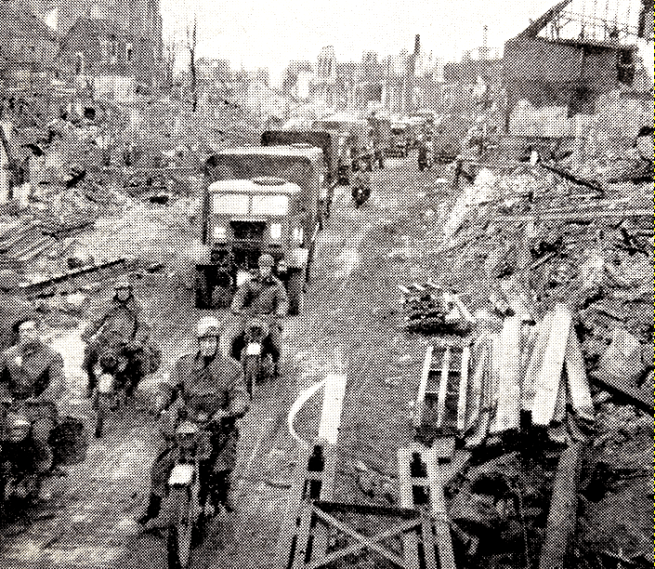
“PADDLING IN THE LAKE were four or five kiddies. One in a bathing costume suddenly, leant down, felt around for a moment and pulled up something which looked for all the world to be a sidecar body of natty design. There were neat bows, a cutaway in the middle for a passenger and a well-curved stern. When it had been removed from the depths and emptied I saw what appeared to be three wooden plugs on the underside. Was it a sidecar, a one-man canoe, or what? It was obviously’ made of sheet metal. A man strode over to have a look and came back with the information that this ‘boat’ the kiddies had found was an extra fuel tank dropped by an American aircraft. I could not help thinking that here seemed to be a sidecar body almost ready-made.”
“ONCE UPON A TIME at this period of the year there was a hue and cry for motor cyclists who had lively reliable machines and could ride them; they were wanted for running films of the Derby from Epsom to London. Lately the DR work has been of a very different nature and what brought my thoughts back with a jerk to those peacetime days was hearing that once again motor cyclists’ services are being sought for running films. It is not films of the Derby, of course; no, films of ‘Vic-tory in Europe’ day.”
“GOGGLES USED FOR high-altitude flying have heater elements in the laminated plastic lenses to prevent misting and frosting.”
“MANY A LETTER reaches us from lads serving in Burma, but never do there appear to be pictures of motor cyclists really doing their stuff there. Perhaps when the war in Europe is over more news and pictures will be arriving. I hope so, for it is obvious from the letters we receive that a sterling job is being done, under conditions which often amount to the seemingly impossible. Just glance at this extract from a letter we had from a BQMS last week: ‘I can tell you from experience that the going is the roughest it ever could be. There is the odd surfaced road, but in the main we have to ride over the virgin ground—ploughed fields, paddy fields and just whatever country has to be traversed. After a few vehicles have gone the same way the route becomes a rough track, rutted, full of potholes and at least six inches deep in powdery dust that is worse than sand to ride through. Bottom gear is the order of the day and speeds over 10mph are very rare indeed. To add to the fun, steep-sided ‘chaungs ‘ (streams) abound, and it takes some riding to get through one at all, with no thought of doing it clean. If you survive the slide down the bank and get through the water without being ‘drowned out’, it is a dead cert you’ll never get up the other side without help. I do not often ride now, but a day in the saddle makes me wonder how both men and machines stand the racket, but somehow they do.’ My correspondent yearns for low weight, plenty of ground clearance, a large-section rear tyre and a multi-cylinder engine with plenty of power low down, and ends: ‘We get specially designed vehicles, so why not the same treatment for motor cycles?’.”
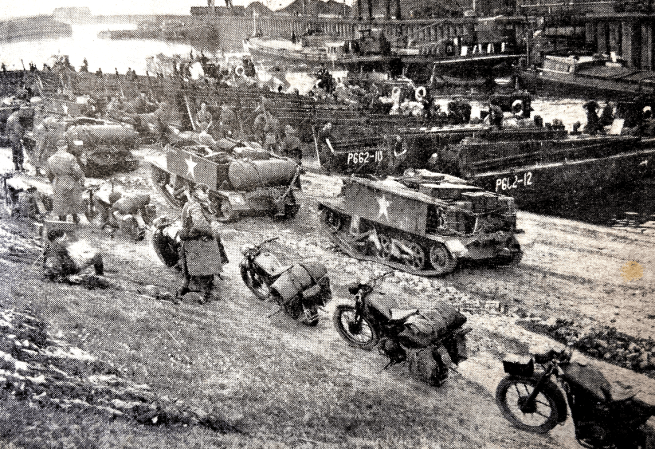
“IT IS NOT OFTEN that a solo motor cyclist is thumbed by a Serviceman seeking a lift. One evening last week I was thumbed by a soldier, a wounded man convalescing. I might have guessed it: he was one of the ‘Red Devils’—a man of the 6th Airborne Division. His one fear was that his wound might mean that he had to leave his cherished formation. When I dropped this superb pillion passenger—superb in spite of his damaged right wrist—he said that for the half hour or thereabouts he had lived; the run had freshened him up to a degree that, he said, was unbelievable, totally different from a journey in any other vehicle. He added that he longed to have a motor cycle of his own. Good old ‘Red Devil’; may both your ambitions be fulfilled—stay with your elite Division and have the joy of a good motor cycle of your own.”
IN SUSSEX ANTI-TANK concrete blocks were painted white and used as roadside markers.
THE COST OF ALUMINIUM fell nearly 25% from its wartime level.
A NORTON FOUND dumped in a West Country river was believed to have been used by a German POW who escaped from a camp at Bridgend, Glamorgan.
THE MINISTRY OF WAR TRANSPORT issued a report on road safety which included plans for “vehicle testing on the American lines” and the formation of specialist traffic police units in every police force.
PLANS WERE AFOOT for an aerial car ferry from Portsmouth to Ryde on the Isle of Wight.
WHITAKER’S ALMANAC, in its annual analysis of road accidents, dropped the phrase “pillion passenger in favour of “pillionaire”.
THE BIRMINGHAM COUNCIL for the Prevention of Accidents reported that 90% of 156 fatal road accidents in the city were caused by pedestrians.
ARGENTINA CHANGED its road rule, if not its politics, from “keep left” to “keep right”; the British Chamber of Commerce in Buenos Aires suggested that the British Empire should follow suit.
JUST BEFORE VE DAY Edward Turner presented the 400,000th motorcycle produced for the armed forces to Brigadier KMF Hedges DSO OBE MIAE of the Ministry of Supply. The bikes came from Ariel, BSA, Excelsior, James, Triumph and Velocette.
BSA AND EDWARD TURNER patented a spring loaded telescopic centre stand housed within the frame.
FEWER THAN 2,000 motor cycles were registered in Japan. Japs had 18000+ Rikuos (Continent King).
“WEST AFRICAN DRs of the 81st Divisional Signals, serving in Burma, have much in common with their brother Don Rs serving in other British formations. They are ‘the lads’ of the unit, possess the same spirit of comradeship, and are ‘motor cycle mad’ in their talk. They, too, have developed the DR spirit and efficiency that is proverbial. They were trained on the reliability trials system by two section NCOs, Sgt CFG Baker and Cpl HA Edwards, who are both pre-war trials competitors. The standard of riding among the Africans is excellent. They have learned the value of throttle control, and some are really good in deep water and thick mud. Life for the African DR is not all motor cycling, however. Owing to the terrain and lack of tracks and routes, they often have to resort to Shanks’ Pony. Once a service had to be opened between two formations of the Division. The distance was 24 miles. The jungle track used was so difficult—with numerous hills, rivers, etc, to be traversed—that this distance usually took 3-4 days by normal ‘all day’ marching troops. By having five relay posts between the two formations, the mail was got through in one day, the actual time taken being less than 12 hours. Even when a jeep track was cut, it still took a full six hours—if you didn’t get stuck on the way! During the Division’s spectacular advance down the Kaladan River, DRs operated by using ‘kisties’—a kind of Burmese canoe. They seemed to be very happy dashing up and down in these tiny canoes which, when skilfully handled, are capable of a fair speed. These DRs have a choice of mounts. Experienced riders have great faith in the 16H Norton. Apart from being reliable and accessible, these machines are praised for the good ground clearance, pulling power at slow speeds, and amphibiousness in deep water. Moreover, the 16H does not seem to be troubled by overheating when ridden in tropical climates. Yes, these West African DRs are certainly ‘lads of the unit’.”
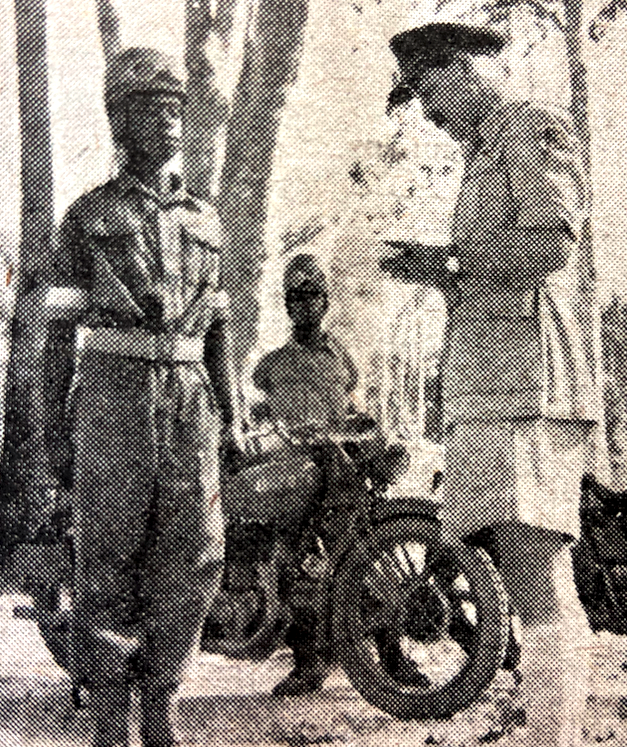
“SOME FOLK HAVE had luck. A repatriated prisoner of war, a Flight Sergeant, was on the telephone last week. He was posted missing for a long time and, with doodles and rockets falling around his home, his parents decided that the wise thing was to get rid of his 1,000cc Ariel while it was still in one piece. He returned to England bursting to be on his beloved machine to find that it had been sold. Now the poor soul is searching around for something with two or more cylinders and at a not-impossible price with which to replace it. May he find a dream bike and that soon.”
“SOME PICTURESQUELY NAMED American motor cycle clubs recently noted: El Camino MCC, Elkhart Rangers MCC, Nite Hawk Riders MCC, Warren Buckaroos MCC, Yellow Jackets MCC, Two-Tired MCC, Rhinelander Shorty MCC, and Jersey Eagles.”
“SIRENS silenced, EVACUEES RETURN from the country, more lighting restrictions abolished, the news that Post Offices were getting petrol coupons in readiness—these were some of the back-to-peace news items that made everyone feel happier last week. And now June 1st or July 1st are being spoken of as possible dates on which basic [petrol ration] will restart.”
“A RECENT PATENT relates to electro-magnetically operated valves (poppet type) for internal combustion engines. Current for the windings, of the electro-magnets is provided in timed sequence via a rotary switch or distributor driven in accordance with engine speed.”
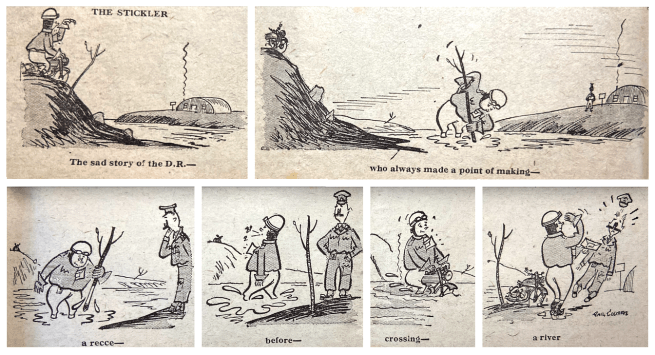
“AS WE CLOSE FOR PRESS there is reason to anticipate that this number, unlike its 296 wartime predecessors, will he late in reaching readers—V-E day will have intervened. We share with all, their feelings of thankfulness. It has been a long trail, but as Hitler stated in Mein Kampf, ‘the British nation can be counted upon to carry through to victory any struggle which it once enters upon.’ For once he was truthful. Britain, who for more than a year alone, unarmed except for her courage, the sole bastion of humanity, has with the aid of her allies emerged triumphant. Not only is the foul Nazi tyranny at an end, but Germany at last has felt the full weight of war and suffered the devastation and desolation, but not the brutalities, she has wrought on others. Combined with our feelings of thankfulness is one of great pride. We think back to Dunkirk, Alamein, North Africa, Sicily, Italy and D-Day, which, extraordinary as it seems, was but 11 months ago. Many thousands of miles, and now Germany completely defeated—occupied by the Allies. We think of the blood and sweat and tears: of the Royal Navy, the Merchant Navy. the Royal Air Force, the Army and those who toiled to provide ‘the weapons and necessities of life—yes, and of those, both Servicemen and civilians, who have passed on. We are especially proud of the fact that motor cyclists, with the great skill that motor cycling has given them, have played a very big part, as motor cyclists, pilots, key personnel in factories and in many another technical sphere. Thanks to all these great efforts—the labour and heroism of ordinary people—the Great Day has arrived. It is not the end: that is appreciated by all. There remains the war against Japan, a further mighty conflict, and the great task of winning the peace. Britain has given her all and must build again. She will not flinch or fail, and from now on there is the feeling that the skies are clear—that it is a case of ‘up’ and ‘up’. Onward to victory and to peace —true peace!”
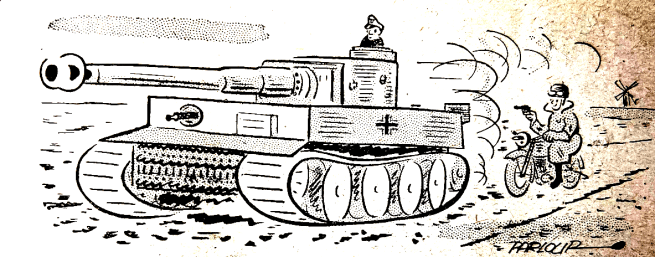

“EVEN TO-DAY, IT SEEMS, many Servicemen are not aware that special vehicle permits and petrol allowances are available to owners of motor cycles or cars who are on leave from service overseas, in ships afloat, or with operational air crews, or who are repatriated prisoners of war. Many more are not sure of the details. In addition, there is a new Order whereby those serving in France, Belgium, Holland, Luxembourg or Germany can, owing to the comparative shortness of their leave, authorise people at home to obtain the vehicle permits and petrol coupons in advance, so that everything is ready when the leave begins.”
A MAN WHOM I regard as one of the greatest experts on motor cycle electrical equipment was at Dorset House a few days ago. As well as being an ardent motor cyclist of very wide experience and having spent years on electrical work connected with motor cycles, he is one of those electrical No 8 Hats. He, as you might imagine, embarked on the topic of electrical sets of the future. His belief is that coil ignition should come—indeed, will be the thing only a few years hence. For myself, I have merely the past as my guide, and, as with many others, the past did not impress me. He maintains that coil sets can be 100%. There is no reason for trouble with contact-breaker points, with condensers or with anything else; it is merely a case of making a set that is the best possible and ceasing to think of coil ignition as a means of scraping and saving. I pass on his comments, because are we not nearly all thinking of what has been instead of what can be and must be?”
“ALTHOUGH I TRAVELLED all over the Middle East during my period of service and enjoyed most of it, I must say that this country and its scenery and its roads are the best. I have found the leave petrol ration a great boon. Enough to get a memory of the old days back once more. In my few runs I have been much impressed by the wealth of wild flowers. Is it due to the protection from ruthless picking caused by the present restricted travel conditions or the extra special appreciation of them gives me more acute observation? At all events, I see flowers in hedges I am sure I never saw so near the town ever before. I found the roads far better than I expected, and the countryside much as it used to be except for the large Services installations. As regards motor cycles, I have worked on them during the whole of my overseas service under many conditions. They have their faults, but my greatest trial was keeping oil in and nuts tight. The fitting of serrated lock-washers to all nuts seems to me to be long overdue, and I shall, invest in a set for my own bus when I start on it again. Side-valve engine valve-covers are, to my mind, great offenders in oil leakages, even more than ohvs. I have no ‘ideal’ machine, and most of those proposed cannot meet normal production requirements. There is no doubt chromium is very attractive, and properly done, it will last. The Tiger 70 I now use, stored in September, ’39, creates quite a sensation in town, for the chrome is as good as ever, and the date of the bike is August, ’37. I have definitely decided magneto for the simple reason the T70 has one, and as the battery was unserviceable, and I couldn’t get one anyhow or anywhere; the magneto was the one thing that enabled me to enjoy my 28 days. Quite an interesting fact, that. I want the pros and cons of both systems, but the mag on the Tiger is as efficient as ever. While overseas I found it imperative on the vehicle coil system to give them a complete check-up every month to get satisfaction, but it wasn’t necessary to do so on the DRs’ magnetos. The dynamo and regulator trouble doesn’t bear thinking of as regards motor cycles. On the bikes they are much too frail and small for their job; bearings, windings and resistances all suffered in turn. As for as the coil ignitions on cars went, they seemed to give rapid point and bearing wear, but the dynamos and regulators took it well, being of generous proportions. Another item of interest. I sampled all the foreign machines, military and otherwise, and was not generally impressed apart from the spring frames. They are more necessary in these countries. and seemed always in pretty good condition. I came across a Royal Enfield 225 two-stroke early this year. It had been hidden in 1940, and when the wiring had been replaced and ignition checked, it started first kick on the petroil mixture still left in the tank, thus settling another argument to my satisfaction. I received 80% of my copies of The Motor Cycle, and they went round and round until they were quite worn out with the handling. The most popular items I thought thought were the Bitzas and the various race stories reprinted or told by a rider. I must thank you for keeping the ‘Blue ‘Un’ so interesting under the present difficult conditions; they have brought me many pleasant hours, memories and pals out there, I look forward to the time when we get our nice fat show numbers again.
K Lewton, Bristol.”
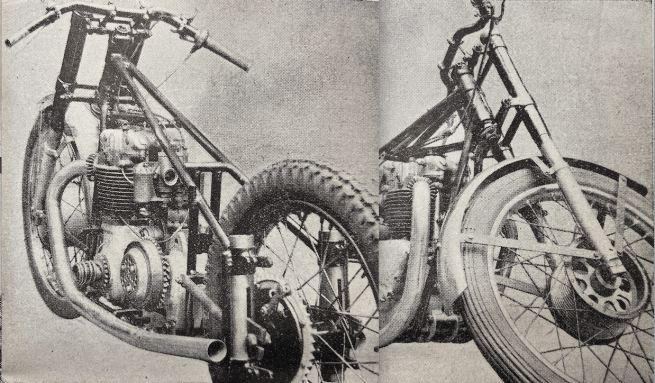
“ARRANGEMENTS to build a speedway round the Rugby Football Ground at Bradford have just been completed by Mr John S Hoskins, writes ‘Talmage’. The track is to be laid after the end of this month, and will be nearly a quarter-mile to the lap. Racing is expected to begin in July. From the speedway firm’s view-point, there is said to be accommodation for over 70,000; the ground is a 2d ride from Bradford Station, and only eight miles from Leeds. Mr Hoskins is determined to have all new riders at Bradford, and will give a try-out to all keen youngsters with any equipment, whether their previous experience is of grass-tracks, hill-climb events or sand racing. Applications in this regard should be addressed to Mr Hoskins at Odsal Stadium, Bradford Football Ground, Bradford, Yorks.” More than 25,000 war-weary Londoners packed into New Cross Stadium.
“MR EDWARD TURNER, managing director of Triumphs and designer of the Tiger 100, the Speed Twin and the Square Four, is off to the United States on a business trip.”
“ACCORDING TO A news item in the London Evening News, a Home Guard retaining his leather jerkin, denim blouse and trousers, motor cycle gloves, goggles, crash helmet, etc, will have to pay £6. Most HGs are surrendering their equipment.”
“ALTHOUGH THE LATEST Triumph programme contains much that is appealing, I was rather disappointed to find that the side-valve twin job is not listed in either 500 or 350cc capacity. I earnestly hope that they may see fit to put it on the market later, in both capacities! Personally, I think that a 350cc job would be really ideal for the ‘man in the street’ (that ‘stock’ term again!) as being a comfortable machine to ride, economical and requiring considerably less maintenance than even the Model 3T de luxe.
FC Critchley, Middle East Forces.”
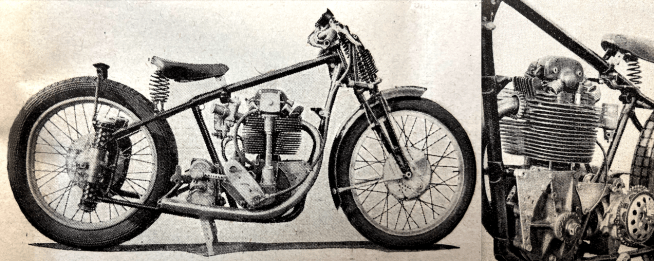
“I WAS OUT with a squad of trainees on cross-country when I missed one of them. I found that he had had ignition trouble and, in taking out his magneto points, had lost the spring one. We had a good look round, but could not find it. I thereupon took the tin tray contain-ing chain spares, and, with the scissors from the puncture outfit, cut a piece of tin the same shape as the spring point. The contact end was slightly bent to make up for the thickness of the point. I punched a hole for the fixing screw and fastened it in position. Not being spring steel, this new arm would not close automatically. To overcome this I cut a piece of rubber patching and packed it between the bridging piece on the adjustable point and the back of the make-do spring point. Then I adjusted the gap by bending the tin. Everything worked OK, and the trainee finished his day’s training with this improvisation.
RAC (Cpl) WH Hartley.”
“WE WERE OUT on night training with some trainees, and they were doing ‘stoppages in the dark’. While stripping and replacing the contact-breaker assembly, one Norton rider dropped the fibre tappet. Seeking for it in mud and farmyard manure was hopeless, but I had the sudden brainwave of using a piece of wood. Alas! no wood anywhere near. Then I recalled that all good DRs carry a pencil! A few minutes with a pen-knife, and the result worked. I told the man to get a new tappet next day, but he forgot and so did I—the piece of pencil worked so well. We eventually fitted the correct replacement after the piece of pencil had done 250 miles—a very good ‘get-you-home’ tip, I think everyone will agree.
L/Cpl RC Johnson, Yorks.”
“S0 MOTOR CYCLISTS are again to have the boon of a basic ration: of two or three gallons of petrol per month, according to whether their engines are under or over 250cc, to be used as they deem best. For those who for 2½ years have been off the road Mr Churchill’s announcement last Thursday that ‘a modest basic ration…freely at the disposal of all private cars and motor cycles will be introduced within 30 days of now’ was thrilling indeed. It helped to drive home the still almost unbelievable fact that the war in Europe was really over. The RAC, in one published statement, put forward the view that the allowance is a very poor one; that it should be much larger. We regard the Government’s prompt announcement—merely two days after ‘Victory in Europe’—as highly commendable and the allowance as meaning much in both pleasure and convenience. Further, this is not the end, but the beginning, and instead of the ration being reduced with the passage of time, as was the case during the war in Europe, it can be expected that it will be increased until one day, not very far ahead, we trust, all petrol restrictions will be removed.”
“NUMBERS OF MOTOR CYCLISTS in normal times think nothing of owning 10 machines in as many years [‘Talmage’ wrote], but comparatively few, I suggest, have remained faithful to one mount for 10 years, and, during that time, ridden it 80,000 miles. Such is the experience of a reader who has sent me particulars from a carefully kept log; and since such subjects as enclosure of the works, multi-cylinder engines, spring frames and other-than-girder-type forks are much under discussion with reference to post-war design, this reader’s 80,000-mile experience with a built-to-special-order, ohc, four-cylinder, spring-frame model is of abnormal interest. From time to time he has incorporated various modifications, as and when they seemed desirable or to bring the machine nearer to his ideal; these include partial enclosure of the engine. He wishes to remain anonymous as far as publication is concerned; nevertheless, I propose to let him do most of the talking. Towards the end of 1931 an order was placed with the OEC concern for a duplex-steering spring-frame OEC motor cycle ‘to the 500cc specification—as shown in your 1932 catalogue—but fitted with a Matchless 600cc four-cylinder engine with coil ignition, four-speed gear box,
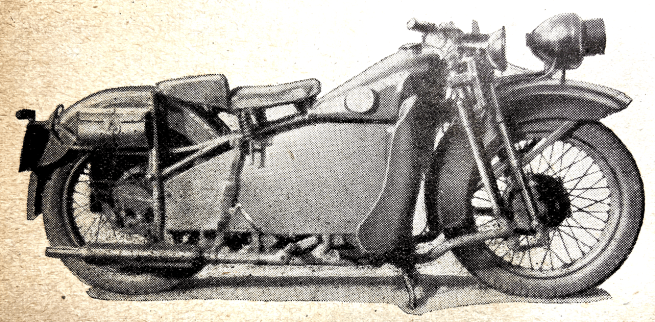
Lucas 7in. head lamp, Nife battery and legshields’. The Silver Hawk engine has been de-carbonised 21 times in the 80,000 miles. The main controlling factor was sticking valves, oil working its way down the guides and being burnt on to the exhaust valve stems until the valves were prevented from closing. Modifications—consisting of increasing the diameter of ⅛in holes for draining the oil from the valve-spring chambers and making various other grooves and holes—resulted in the mileage between decokes being about doubled. The original valves are still in use, but several sets of springs have, of course, been fitted. In spite of the excess of oil in the valve spring chambers, there would frequently arise a pronounced squeak from a dry valve-stem end-cap. This led to the making of a new set of caps, each incorporating a small reservoir for oil. These new caps have been in use for 50,000 miles with negligible wear, and the tappet chambers are never opened between de-cokes. A check of clearances before strip-ping never shows a variation of more than 0.002in above the original settings. Engine noise, says my correspondent, has been appreciably reduced by fitting ⁵⁄₁₆in thick aluminium covers to the valve-spring chambers in place of the standard sheet-metal covers. After 55,000 miles the cylinder block was rebored. The rebore improved oil consumption. At the last decoke, maximum bore wear was O.00lin, after 25,000 miles. Originally the engine had a habit of misfiring at low revs. This was cured by opening out the holes through the baffles at the ends of the sparking plugs, ie, the ¼in diameter hole connecting the plug hole with the combustion chamber was in each case increased to ⁷⁄₁₆in diameter…At 55,000 miles the primary chain was replaced as a precaution…although the old chain showed a difference in length between push and pull of only ⅛in in 30 inches. The rear chain, never removed except to fit a new one, has been replaced four times, ie the fifth chain is in use. Except for being supplied with oil and opened up to alter the gear ratios and to reduce the pressure of the plunger on the cam plate, the gear box, a four-speed Sturmey-Archer,
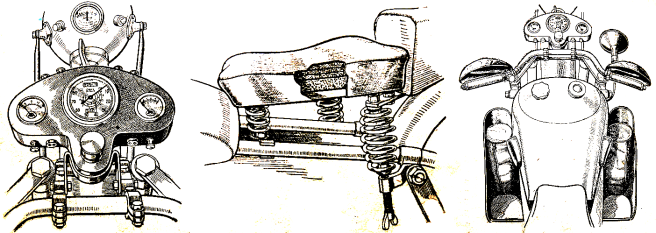
has received no attention. It has, states its owner, ‘had comparatively colossal use in the indirect ratios, as night riding is almost completely done on indirect ratios in order to provide sufficient current for lamps and radiators’…Running in oil, the clutch cork inserts were worn out in 25,000 miles, and were replaced by corks obtained from a local chemist for sixpence. These latter have already done 55,000 miles. My corespondent raises the point, ‘Do chemists use better corks for medicine bottles than some gear box makers did for clutches?’ Ignition is by a combined dynamo-coil-ignition unit. During the first two years it was necessary to replace four condensers and two coils. The third coil was obtained from an old American car and cost ls. This coil, and the condenser fitted at the same time, are still in use, which in view of the length of time and the mileage suggests that coil ignition need not be troublesome. Originally the ignition control was by Bowden cable from a twist-grip on the left handlebar. An automatic control was made, so arranged that two-thirds of the available advance took place automatically at about 1,500rpm; the remaining advance was obtained by the hand control. The automatic control wore out after 50,000 miles and has not yet been rebuilt…Legshields and side-covers for the engine are fitted. Each side-cover has an area of 400in² and is made from 20 gauge sheet iron. Five screws secure the legshield and cover to the machine on either side, and the two are removed in one piece. My correspondent states: ‘No attempt has been made to provide any ribbing or bracing in order to reduce possible drumming as this, if any, is completely merged into a background of noise in which carburettor hiss and tyre whine are prominent.’ Each legshield is equipped with a pocket which provides approximately 180in³ of space and is closed by means of a zip fastener [this is an early use of the modern spelling of ‘zip’ which had previously been known as an ‘instant fastener’ with the nickname ‘zipp’. Obscure but true—Ed.] . ‘All chromium plating was covered with black paint on the day of the machine’s arrival,’ states my correspondent; he continues: ‘Cleaning is regarded as a nuisance and never exceeds half a minute on three or four occasions per year.’
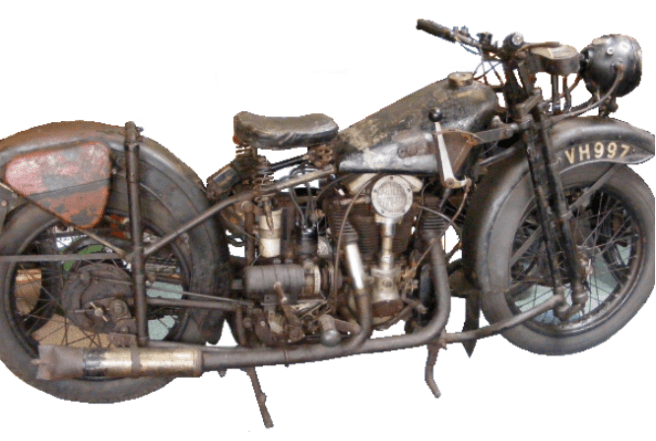
For carrying luggage, a sheet-iron box is attached to the machine at the near side of the back wheel. It holds an attaché case measuring 18x12x5in, and is fitted with a lid 3in deep; the latter is said effectively to exclude all rain. A local blacksmith made a stand for the machine, and this is fitted between the engine and the front wheel. The stand is 17in wide. The machine is rolled backwards on to it before the rider dismounts…Finally, the owner of this very thought provoking two-wheeler writes: ‘It is recognised that the machine is a horrible contraption, that everything is clipped on, that it ought to be blown over in every side wind, that it ought to seize up due to overheating, that the crankcase ought to ground at every bump in the road, that the steering ought to be ruined because of the loose saddle, that it ought to fall to pieces through lack of repeatedly following up all important nuts, but somehow it keeps going…Fuel consumption before the war was between 60 and 70mpg. On ‘pool’ petrol it dropped to 40-45mpg. This was improved to a general average of 98mpg, ranging from 95mpg i. winter to 105mpg in summer…It has travelled 80,000 miles in 10 years, it has been in every town in the country and quite a lot of the villages, and has provided many hours’ diversion besides being a key to the open country.” Also described in Talmage’s report are an upgraded primary chain tensioner; repeated changes to gear ratios; mods to the rear-wheel bearings following a seizure; “changing the operation of the rear brake fro cable to rod reduced. by about 300% the effort to apply it”; upgrading the seat; modifying the fuel tank to do away with the pipe connecting the two sides and doubling capacity to four gallons; fitting a fuel gauge and filter; upgraded headlight and an adjustable spotlight; a 6in cooling fan; instrument panel; handshields and handlebar heaters.
“AS I READ ‘Talmage’s’ story of the 80,000-mile OEC-Hawk I reflected that it forms an admirable demonstration of a manufacturer’s problems with a new model. Here we have an engine most conscientiously produced by one of the very best makers in the world, and painstakingly tested before production. Yet in prolonged private use, an owner discovers that the valves both stick up and tend to run dry; that carbonisation is far too rapid; that engine noise can easily be reduced; that the front chain tensioner is faulty, and so forth. (Remember this is written of a 1931 model.) From this record we can imagine the anxiety of a designer who seeks to hustle a new model into production for the post-war market. Bench tests are not enough, since the varying temperatures of the road plus the incessant throttle changes create quite a different set of conditions. Car designers have more than once packed a gang of drivers aboard an experimental chassis and despatched it to cover 50,000 miles on Continental roads in a fantastically brief period. Luckily, science has made great advances since 1931, but even so we must be patient and not clamour for brand new designs in too great a hurry. Incidentally, several readers are eager to learn the weight of the four-cylinder OEC-Hawk.”—Ixion
“JUNE WILL REVIVE MEMORIES of those far-off days when the end of a fuel ration period was in sight, all coupons spent, the tank containing an unknown quantity, and a ride in view for which that quantity might not be adequate. There are, brothers, only two expedients available. One is to retain one unexpended coupon as an iron ration for emergencies. The other is to adopt precise measurements of tank contents, gallon mileage, and trip distances. Any colouring method, eg, mixing a little engine oil with the fuel, will act as a warning of the three main leaks to which a motor cycle fuel system is liable. These are, of course, petrol taps and petrol unions; the other is at the carburettor, a frequent culprit on two-strokes.”—Ixion
“MANY YEARS AGO The Motor Cycle coined its own title for the theoretic expert, to whom we have ever since alluded as a No 8 Hat. Mr. Punch has now weighed in with a fresh name for them—’punditti’—an Italianised plural for an Indian word signifying a savant. The name is witty, since Mr Punch used it of the financiers in a Budget debate, and it is obviously intended to remind us of another Italian plural—banditti!”—Ixion
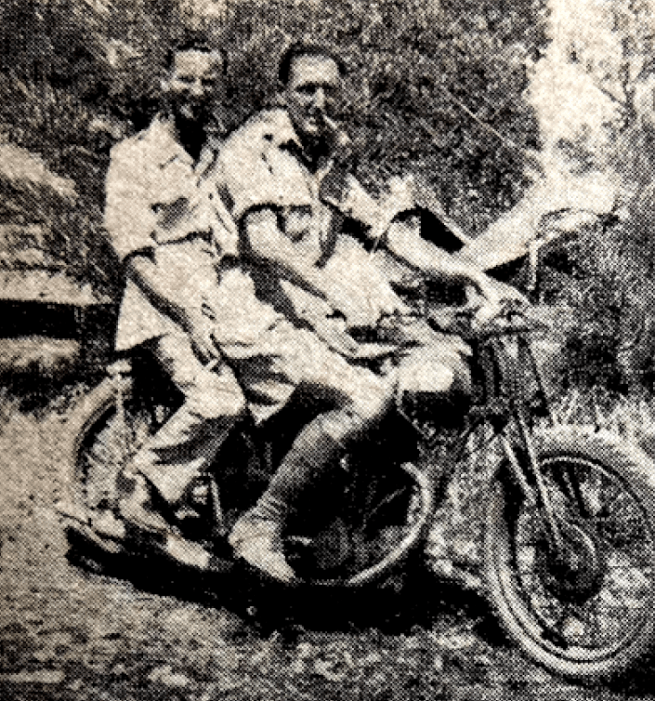
“‘ORIGINALLY, IT WAS DESIGNED for my son, Ron.’ Anyone hearing this and seeing the newly completed motor cycle might well be excused for muttering, ‘Lucky Ron!’, but there are now three motor cycles under way, for the more deeply Father, Mr John Wooler, went into matters the more captivated he became—his old love in a new and thrill-ing form. Who does not remember the 350cc flat-twin Wooler, the ‘Flying Banana’? Only a short time ago ‘Cambrian’ referred to some of its successes. But this motor cycle is very different. The engine is of 500cc. It is mounted transversely in the frame instead of in line with it, and it is a four, not a twin—a most unusual type of four, working on the principle of the beam engine. Bolted to the rear of the flywheel housing is a positive infinitely variable gear which, controlled by a twist-grip, transfers the engine torque to the rear drive, providing take-up and carrying the gear ratio up the scale to the ordained top gear. Immediately behind is a pair of straight spur pinions to provide the offset for the final drive—shaft drive…It is not only in its main features that this machine, no longer merely on paper but in aluminium and steel, causes an enthusiast to rub his eyes (and do some pretty deep thinking), but in regard to the amazing wealth of detail work: Those wheels—quickly detachable without tools; the positive lubrication of each of the eight cams; three sizes of hexagon for the whole motor cycle, ignition included, and no slotted screws; saddle springs hidden inside the seat tubes and running halfway down them; the automatic lubrication of the distributor drive; the hemispherically seated ohv rocker ends to ensure direct thrust on the valve stems; the air filter and tool box combined with the top of the infinitely variable gear; the special little banjo unions; the ingenious prop-cum-rear stand; the remarkable accessibility…Mr Wooler must have spent months cogitating on all the refinements dear to the motor cyclist’s heart or
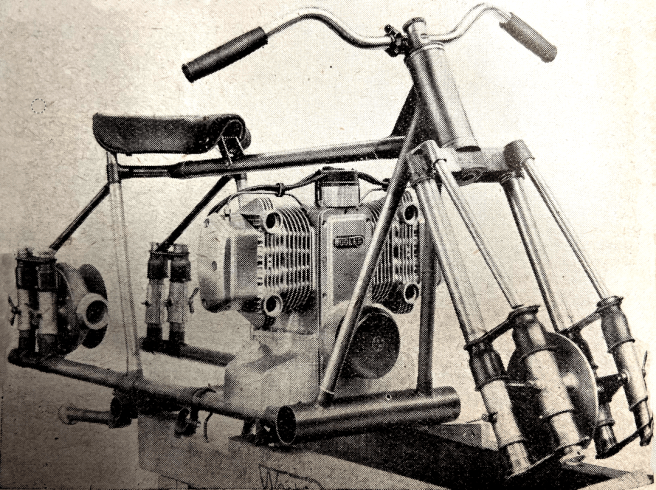
which would be so if he had them. The springing? Obviously, from the specification outlined so far, there is springing both front and rear. It is the Wooler plunger suspension first adopted in the days before the world war of 1914-18, but with twin plungers—four plungers per wheel instead of single plungers. As stated, single machines are in the course of construction. These are for test purposes. Later it is hoped to place the model on the market…The stand legs have pivot mountings with a spring-loaded locating pin that enables a leg to be set outwards at an angle so that it acts as a prop-stand, or to be pressed straight downwards. With the two separate legs for the rear stand no lifting [of] the machine is called for to put the stand into operation—the machine is leant first one way and then the other. Another ingenious feature is that the footrests, both the main pair and those for the pillion passenger, telescope inwards so that only the rounded end of the rubber sticks out. Other features are an oil squirt integral with the oil-sump filler cap and the employment of high-tensile screws throughout. One of the many striking points is that the only nut sizes through out the machine are 2 BA, ¼BSF and 14mm plug spanner size. The plug spanner fits the wheel-spindle nuts, all drain plugs (they are really accessible), and, on future models, the crankpin nut. The tommy bar of the plug spanner acts as a peg spanner. The old-time Woolers had as their trade mark a spanner bearing the word ‘Accessible’. This new model is almost unbelievably accessible. What about the centre of gravity? The entire engine weighs only just over 601b! Moreover, if the light-alloy cylinder block is high, the flywheels and sump are around wheel centre height. fa any case, a total of little more than 601b…The ground clearance—no silencing system below the frame members, the usual arrangement—is some 8½in. What about the cost of this remarkable machine? Mr Wooler, having regard to its low weight, anticipates that the cost will be very much that of a high-class single. May Ron soon be home and trying the first sample!”
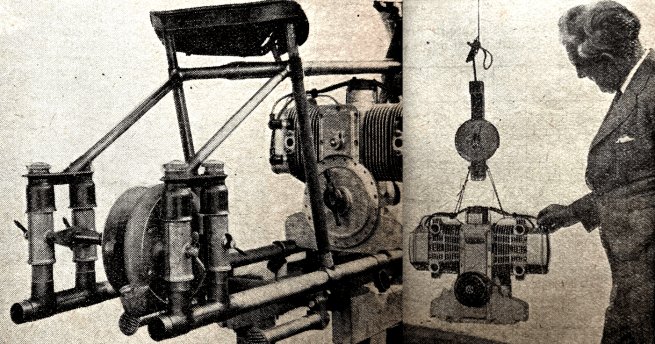
“IT IS GENERALLY held that an engine with water-cooling is prone to cylinder wear to a degree quite foreign to its simpler counterpart, the air-cooled job. Presumably, with a two-stroke the wear will be more serious than with a four-stroke because of the ports cut in the cylinder walls. I was therefore very interested in a letter from a Scott enthusiast. In the course of it he dropped the remark that his 1936 596cc Scott and sidecar had covered 124,000 miles without being rebored. Rather remarkable, I think you will agree, and decidedly interesting. What are your theories, No 8 hats (and others)?”—Ixion
“WITH THE VAST USE of electrically heated suits for flying I foresee many thinking in terms of electrical heating for winter motor cycling. We have reviewed various schemes for heating gloves and there is an electrically heated handlebar grip invention. A point I question is whether the number of amperes one can take from a normal motor cycle electrical circuit is sufficient to make an appreciable difference to one’s body temperature unless he heat is going to be applied only to one’s wrists and ankles. I yearn to know more, also to learn what the possibilities are of chemical heaters, such as have been developed for use as ‘hot-water’ bottles—’Hot-Paks’, for example. It seems to me that a tiny ‘Hot-Pak’ sachet which went one in each glove might be very grateful and comforting.”
“SO THE MOTOR CYCLE industry has supplied 400,000 motor cycles to the Services. What an achievement! And this is only part of the industry’s mighty war effort. The manufacturers making motor cycles for the Armed Forces have been, in alphabetical order: Ariel, BSA, Excelsior, James, Matchless, Norton, Royal Enfield, Triumph and Velocette. Last, Thursday the 400,000th machine was officially handed over to Brigadier KMF Hedges, DSO, OBE, MIAE, Director of Mechanisation, the Ministry of Supply, at the Triumph factory, near Coventry. Mr Edward Turner, managing director of the Triumph Engineering Company, in a short speech, referred to the various factories that had been engaged in the manufacture of this great number of machines—400,000 motor cycles representing a contribution of 5,000,000 horse-power to the war effort. In reference to the Triumph factory, he said that looking round on it to-day their minds went back to 1940 when the factory was destroyed; they had risen from the ruin and desolation to hand over this machine. Accepting the machine, Brig Hedges mentioned that he had first ridden a Triumph motor cycle more than 40 years ago. This 400,000th motor cycle, he said, was an indication of the tremendous war effort of the motor cycle industry. The motor cycle was a feature of the British Army and the British Air Force all over the world. It had been of enormous value throughout the war and would be one of the more important features of the post- war Army. Riding a motor cycle had always been one of the most popular sports among the young men of England, and he hoped it would continue to be so for a very long time.”
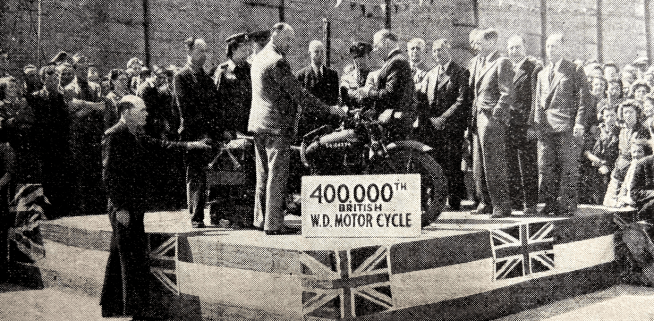
“THE QUANTITY OF crude benzol obtained from coal for the year 1944 amounted to 100,300,000 gallons.—Major Lloyd George.”
“SIDCUP CLUB MEMBERS are offering to check over the motor cycles of local PoWs, so that their machines may be ready for their home-coming. This offer is being made to the parents of the men concerned.”
WITH THE ADVENT of the jet aircraft, some motor cyclists may have been set dreaming of a day when they might own models with a minute engine weighing next to nothing and emitting the kick of a TT Norton. Air Commodore Frank Whittle does not encourage such visions. In his opinion, 500hp is probably the smallest size in which such power units will ever prove successful.”
“ONE FAIRLY RECENT improvement in motor cycles which has gone largely unsung is the adoption of well-made pressed-steel tool boxes in place of bags-cum-boxes. These latter soon gave trouble: the leather or leather-cloth flap used to warp with rain, the flap’s side pieces soon became tattered and the linings of the boxes chawed up into a first cousin of cardboard flakes. Often, too, the leather straps would ‘come away in your hand’. The modern pressed-steel affairs may not be all they could be in the matter of convenient shape for packing tools, but they are a sound, solid, lasting article. I suppose that one day we shall have tray-like tool carriers with a place for everything and everything in its place.”
“AFTER THE WAR OF 1914-1918 motor cyclists went in strongly for rallies. Usually they were unorganised, just spontaneous get-togethers. The one I knew best was that at the Wisley Hut Hotel, on the the Portsmouth Road, some three miles the London side of Ripley, where in the very old days cyclists used to forgather—later motorists, too, I believe. Hundreds and hundreds of motor cyclists in 1919 and 1920 used to ride down the Portsmouth Road from London each Sunday afternoon, avoiding or endeavouring to avoid the clutches of PC Beck, who held, I believe, somewhere in the region of a world’s record for summonses. Arriving at the Hut they parked on the greensward opposite the hotel or along the road if they were not among the early arrivals. Then they wandered round examining all the models, seeking anything new, whether machine or gadget (of which there were always many) and arguing and discussing motor cycles to their heart’s delight. They were great ‘do’s’ and, as I say, spontaneous. Much the same occurred, I believe, at Monsal Dale, in Derbyshire. Before very long the unorganised rallies died. The gatherings at the Wisley Hut ceased almost from one week-end to the next. Quite why this was so I never learnt. Shall. we soon be seeing much the same get-togethers)?”
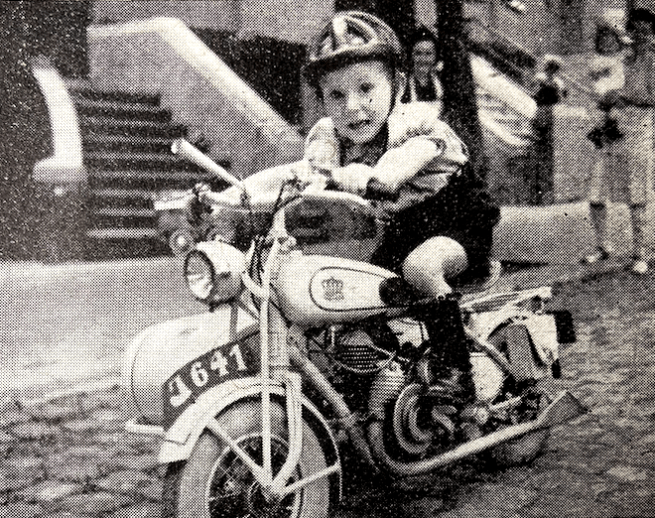
“FIRST I WANT TO thank you for the many fine articles which have appeared in your journal, also for publishing the never-ending arguments—chain vs shaft drive, coil vs magneto, single vs multi, and so on. These have been instructive and at times amusing; but as long as the result is a better and cheaper motor cycle the effort has not been wasted. It is too bad that your operating costs cannot be cut, because while the sport is popular it is not available to all without, oft-times, a considerable sacrifice. In Canada we have no compulsory insurance, our yearly vehicle and driver’s licence is approximately 12s, and other than petrol at ls 6d a gallon, that is all. The first cost of the bike is the only deterrent; shipping and other charges add 20% to your cost. British motor cycles were holding their own in value for the money compared with the American models, but the prices must be cut further if this condition is to continue. Most of my friends prefer British motor cycles for their performance, appearance, reliability and road-holding—the bad features are the many bits and pieces, the cracks and crevices which retain the dirt, the poor general layout of the electrical system, and this business of taking ten parts off to get at one. Almost two years ago a friend of mine and I rode from Toronto around the Gaspé peninsula down into New Brunswick and back, a total of 2,700 miles in 12 riding days. My friend had a Tiger 100 with a bronze head, while I used my old ’37 BSA Empire Star 500. Neither bike gave a bit of trouble, all our difficulties arose from six flat tyres and the problem of strapping on our suit-cases that they would resist the vibrations of the rough road. My bike gave me over 80mpg, and the average speed was between 50 and 60. The T100 only gave 65mpg, due to the enlarged ports which had been opened out to take Allison valve-seat inserts—one of those jobs where you can’t combine economy and performance. I doubt if there is anything to fear from American design, but from production standpoint there is, definitely. The American manufacturer also believes in a great deal of advertising and giving his dealers every possible aid to make good service available, which 1 am sorry to say has not been the British policy, at least in Canada.
J Everitt, Leicester.
“MAY I MAKE a few comments covering some of the points raised by readers? Re spring frames: My experience with this type a motor cycle has been fairly extensive. In 1940 I was the first person to ride a brand-new Gilera 500cc springer out of Libya. It was one five new ones we found in Fort Cappuzzo. They had not had petrol or oil in them, so I knew they were new. For some six months I rode this Gilera, after camouflaging it with brown paint (I could have cried when I had to cover up the maroon and chrome) over some of the worst type of country in the world, and the springing system never gave a moment’s trouble; the sump, however, was too low and eventually I dumped the machine. The next model was a Moto Guzzi horizontal 500 (with the engine running the wrong way). The springing was much different, there being two springs mounted as part of the frame under the engine-gear box unit. I rode this cycle for some 5,000 miles on the Libyan Desert. Here again the springing was, in my estimation, sturdy, reliable and really cushion springing. The next day I mounted a Benelli 500 ohc springer. This motor cycle was a marvel, and the positive foot change with heel and toe lever admirable. I rode back from Benghazi to Cairo in five days, continued travel by day. On the third day, however, I broke the clutch wire, and rather than abandon the bike I started with her in second gear by running and changed on the exhaust lever; but eventually she packed up. After these experiences I vowed I would never ride another rigid-frame model. I came back to England with a very famous parachute regiment and was allowed petrol for 300 miles. I proceeded to get busy and fine a motor cycle. There are two Rudges and various makes at home, the property of my five brothers in the forces, but I could not get them roadworthy. Then I met a friend who showed me his 1932 Norton, Model 20; it was in a sorry state and out in the frost. It was partly stripped, but all the bits were there, and I gave him £3 for it. My brother, an ardent motor cyclist, gave some expert advice on reconditioning and enamelling, and I had it licensed, insured and running, all in one week. When the war is over and we are demobbed I shall look for a machine sprung like the Benelli. By the way, I don’t like the way people call The Motor Cycle the ‘Blue ‘Un’. My kid brother calls it the ‘Mo-Bike Book’. I call it a very welcome and indispensable part of the home.
WL Smallwood (Ex 1st Airborne Division), Catterick.”
“WITH GREATEST INTEREST I read Torrens’s account of his experiences with enemy motor cycles, and especially about the change-over from large to smaller types in Germany. The same thing happened in my home country, Czechoslovakia. After the first world war our army mainly used heavy twins of foreign make—the Indian, Harley-Davidson, and the the good old 800cc AJS with chair. Later our army was equipped with machines of our own manufacture—the 1,000cc ohv Walter V-twin, 750cc Itar sv flat-twin, and the 750cc Premier sv-twin, all with sidecars. In the earlier thirties our army used the 500cc ohv shaft-drive monobloc Jawa, with pressed-steel frame, and the 500cc ohc BD-Praga. In the years immediately before this war the Czechoslovak Army was very modernly equipped, and used only smaller machines. We had many 100cc two-strokes, such as the Jawa-Robot (designed by GW Patchett), and the little ‘CZ’. In the 350cc class the Jawa was mainly used both solo and sidecar.
‘Wheelbarrow’, Czechoslovak Army, BLA.”
“MAJOR DEVELOPMENT OF the Aspin rotary combustion chamber engines has now reached an advanced state and attention is being given to cleaning up external appearance and reducing overall height. The latest 350cc engine which is being tested out for FM Aspin by rider Jack Ashworth is, like many previous models, based on a Velocette crankcase. Cylinder height is reduced by driving the conical valve rotor by means of a gear at its lower end instead of by gearing on to a neck protruding through the top of the cylinder head. This arrangement requires only a short vertical drive shaft and cleans up the cylinder head enormously; the present engine is very little taller than a side-valve unit. Mounted in a Velocette machine, the new engine looks very much less an experimental conversion than some of the previous models that have been tried out. According to Ashworth the performance is better at high speed, although there is some sacrifice of the slogging power low down. But even so, it has remarkably good idling characteristics, and, in spite of a compression ratio of about 11 to 1, it ticks over more slowly than most side-valvers and with almost complete mechanical silence; at the other end of the scale it performs snappily in the seventies.”
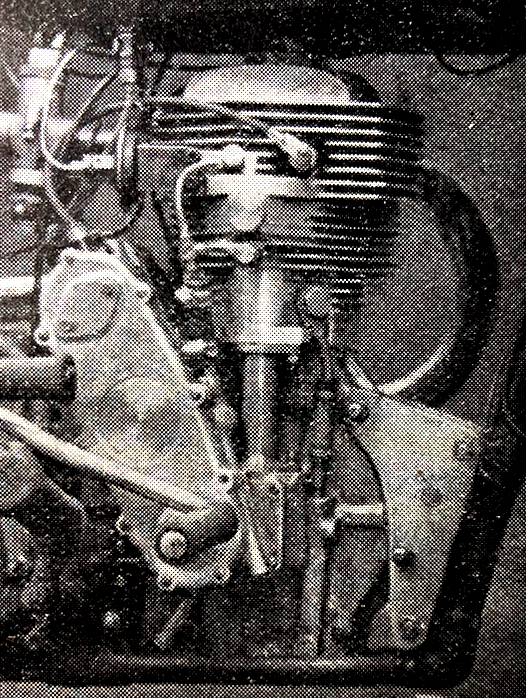
“POST-LAST WAR there were many fashions. ‘Zoom-zoom’ exhausts for the many Duggies, copper exhaust pipes, disc wheels, mascots, lurid home-enamelled tanks, strange-looking handlebars, and plated this and that were only a few of the crazes. No doubt the fittings will be different this time and, in certain directions, rather more practical and sensible, but I have a shrewd idea that there will be a boom. Incidentally, some of you will remember how handlebar screens with aprons came to the fore for a while just after the 1914-18 war. I think we shall be seeing this fashion on a very much larger scale. Do you recall or have you read about the garbs that were affected? Long, colourful scarves that flowed behind their wearers’ necks were quite a rage, so were Basque berets and, later, berets of strange hues and with even stranger tussles. Flying suits were frequent; to be posh they had to flout a fur collar. Flying helmets, too, were the thing for the hard rider. The ski cap and the imitation of it came in much later. In the immediate post-war years the garment used by the pukka motor cyclist for wet trips was the Hutchinson rubber poncho, an umbrella-like affair which one pulled over one’s head and which, in one version, had merely a hole in a sheet of soft rubber as the opening for the neck. We shall get some more fashions this time.”
“LOW UNSPRUNG WEIGHT, with simple manufacture and ease of assembly and maintenance—’rigidity and steering being in no way impaired’—these are the objects of a telescopic fork covered by patent Specification No 568,263, just published under the names of Mr EG Smith and Mr AG Duke, both of whom are directors of OEC. Each leg of the fork consists of a fixed tubular member, within which slides a moving tubular member; to the latter is attached the front wheel spindle. Depending from the top of each leg is a rod which extends for a distance into the sliding member. On each leg a rebound spring is arranged between the underside of the top of the sliding member and an abutment at the bottom of the rod, while the main spring is between the top of the sliding member and an adjustable nut screwed on to the rod near its top; hence the initial compression of the springs may be adjusted to suit individual loads.”
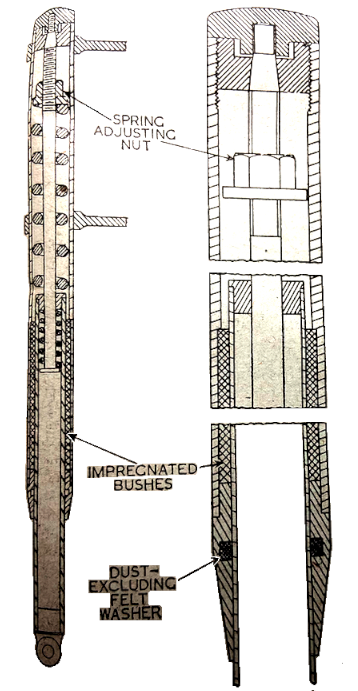
“A YEAR OR MORE has passed since the Amateur Motor Cycle Association suggested a rapprochement with the Auto Cycle Union. This was officially welcomed by the ACU, and now the time has come for friendly discussion between the two bodies. We do not intend going into the rights and wrongs of the past. Here is a case where, in everything that is said and done, bygones should be bygones. All that matters to-day is that a large number of clubs embracing some thousands of sportsmen, mostly in the Midlands, the home of the motor cycle industry, have their own governing body, the AMCA, while the country as a whole gives allegiance to the ACU, the organisation to which control of the sport was officially delegated. With the revival in club life, both bodies have gained new adherents—the AMCA, a number of further clubs over the last few months—and with the club world likely to be in something approaching full swing within a matter of months, time can only add to the difficulties of the situation. Itmay be asked by some whether it matters that there are two bodies each running on its own lines. The fact that just before the war car and motor cycle competitions on the public highway were in grave danger of being prohibited by law. Only the most strenuous efforts by the RAC and the ACU prevented a ban on trials, and to-day there is a further threat, for the Report on National Park areas urges that…throughout the land, tracks should be closed to all motor vehicles…it will be recalled that even the Motor Cycling Club, a body older than the ACU, stated recently that it was exploring the question of affiliation…That the MCC has seen the ‘red light’ as far as the future of trials is concerned, is a strong commentary on the present position. There must be one body that speaks for motor cycle sport, and it must work hand in hand with the organisation controlling car sport…The whole future of the sport demands that the two bodies, the ACU and AMCA, get together…Each organisation has something to learn and to gain from the other, and with the good will that the future of the sport demands we are pertain a solution will he found. The time to achieve unity, and strength, is now.”—Ixion
“SIXTY OR MORE CLUBMEN attended the Midland area ‘get-together’ meeting held in Birmingham last Friday under the chairmanship of Mr Arthur B Bourne, the Editor of The Motor Cycle. Among those present were chief officials of the ACU Midland Centre and the Amateur Motor Cycle Association—the big unaffiliated group—and a number of famous trials riders. The meeting was notable for its friendly, co-operative spirit, and officials of the two bodies, the Midland Centre and the AMCA, agreed there and then that in the interests of the sport they must get together and work together. To this end three chief officials of each body were nominated, and are to attend a meeting in Birmingham tomorrow, Friday, June 15th, to thrash matters out.” The ACU and AMCA agreed that a merger would be “highly desirable”.
“THE INDIAN MOTOR CYCLE firm in America are now running classes open to motor cyclists and others interested who want to train themselves for work in the industry. The courses aim at giving a thorough grounding in motor cycle mechanics.”
“DURING THE WAR the AA has supplied 1,250,000 town plans for Army purposes. Road itineraries have frequently been prepared for the Armed Forces, and the US Army Headquarters assisted with a wide range of maps and other material. Many special road signs were supplied.

“IT IS GENERALLY HELD that an engine with water-cooling is prone to cylinder wear to a degree quite foreign to its simpler counterpart, the air-cooled job. Presumably, with a two-stroke the wear will be more serious than with a four-stroke because of the ports cut in the cylinder walls. I was therefore very interested in a letter from a Scott enthusiast. In the course of it he dropped the remark that his 1936 596cc Scott and sidecar had covered 124,000 miles without being rebored. Rather remarkable, I think you will agree, and decidedly interesting. What are your theories, No 8 hats (and others)?”—Ixion
“AFTER the last war there was a boom in accessories People bought second-hand machines, there being at first not nearly sufficient new models to satisfy the demand, and proceeded to add gadgets and fittings to them to make them distinctive and nearer heart’s desire. Disc wheels, un-usual colour schemes, copper exhaust pipes, ‘Zoom-Zoom’ exhaust systems for the many [ex-WD] Duggies, strange-looking handlebars, mascots, lurid home-enamelled tanks, plated this and that…No doubt the fittings will be different this time and, in certain directions, rather more practical and sensible, but I have a shrewd idea that there will be a boom. Incidentally, some of you will remember how handlebar screens with aprons came to the fore for a while just after the 1914-18 war. I think we shall be seeing this fashion on a very much larger scale…do you recall or have you read about the garbs that were affected? Long, colourful scarves that flowed behind their wearers’ necks were quite a rage, so were Basque berets and, later, berets of strange hues and with even stranger tassles. Flying suits were frequent; to be posh they had to flaunt a fur collar. Flying helmets, too, were the thing for the hard rider. The ski cap and the imitation of it came in much later. In the immediate post-war years the garment used by the pukka motor cyclist for wet trips was the Hutchinson rubber poncho, an umbrella-like affair which one pulled over one’s head and which, in one version, had merely a hole in a sheet of soft rubber as the opening for the neck. We shall get some more fashions this time.”
“‘BRITISH AND BEST’ has been no mere slogan, but over many years a fact. No matter what the article might be—a penknife, a saucepan or a vehicle—the material it contained was the best and the craftsmanship unequalled. Quality came first, and the result was an article that lasted so long and performed so efficiently that it was cheap—really cheap—at its price. The war inevitably has altered standards in many directions. It was essential to make do and numerous goods have verged upon the cheap and nasty. Some articles—not motor cycles—have almost seemed a waste of good labour. Now that the war in Europe has been won it is to be hoped that the pendulum has already started to swing back to the old-time quality that gave Britain her hold on the world markets. Nations could buy cheaper goods, but those people who wanted the best had no option but to buy British. In any case, can Britain ever compete on price alone? To-day in the motor cycle sphere there is no question of manufacturers embarking upon what might be termed cut-price machines. A few did so during the period of the depression in the early ‘thirties and very soon rued it. On the other hand, it is a fact that manufacturers to-day are seriously concerned about the prices that will have to be charged for new motor cycles. Raw-material and manufacturing costs combined have increased by 45 to 50% since 1939, and there is at present the burden of Purchase Tax, which is 33% on the manufacturing price. How with these millstones can they hope to provide motor cycles which will give enjoyment to the many? Rationalisation has been suggested as one means: reducing production cost by each manufacturer concentrating upon one or two models instead of a wide range. Another method is to indulge in stark simplicity, but it must not be entirely overlooked that the increase in cost is linked with increases in wages. Higher prices are inevitable, but many can afford to pay more—a little more. The price question constitutes a big problem for the industry. As it sows, so it will reap, and the motor cycles produced during the next two or three years will decide the future of motor cycling. Our hope is that price shall not be allowed to rule the day: that in fittings, in tools—in everything—only the best will be good enough. British and best…”
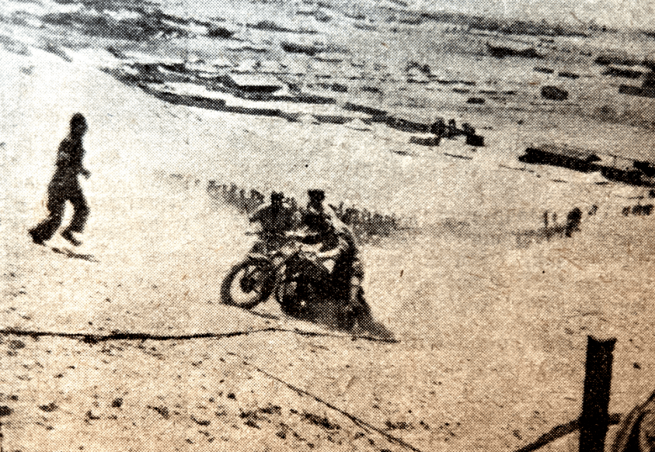
“FREE AGAIN! The Return of the Basic Ration: The First Week–end: Rain squalls could not damp the ardour—the joy—of the many motor cyclists who returned to the road last week-end following the reintroduction of the basic petrol ration. To ride again, able to go wherever fancy dictates within the ambit of two or three gallons a month according to engine size, brings a sense of freedom that is delicious and, after the long years, seems almost unbelievable. Our observations over the week-end were pleasing. The most striking feature was the scintillating appearance and the obvious excellence of tune of so many of the motor cycles encountered. It is apparent that large numbers of motor cyclists laid up their precious machines with real care, and that in spite of long hours of work, Home Guard and Civil Defence, many have found time to refurbish their now not-very-new machines. We do not think we exaggerate by stating that never have we seen so large a percentage of clean, smart motor cycles on the road as last week-end. The riding, too, we noted was of a very high standard—restrained, neat and good. The only ‘fly in the ointment’ was that a number of the machines, particularly vintage models, were noisy. May we hope that those to whom this remark applies will take steps to remedy matters? Motor cyclists are likely to be ‘on trial’ in more than one sense over the next few months, and no one needs reminding that the greatest cause of friction between motor cyclists and the public is noise. A hundred quiet machines pass unnoticed and then along comes a noisy mount to spoil everything. Those who ride noisy machines or ride noisily are letting down the pastime, doing it an incalculable disservice. An interesting point was the small number of motor cyclists to be seen tinkering at the roadside. They had prepared for the day skilfully.”
“IN THE 1918 post-armistice boom the record price for a motor cycle was £340 [£25k today], paid for a four-cylinder Henderson and sidecar. (I was told that the buyer ultimately disposed of it in the following slump for £45 [£3k]). This time the skimpiness of the fuel allowance is putting a definite brake on prices. But an advertiser in a recent issue of The Motor Cycle asked no less than £275 [£20k] for a transverse flat twin of enemy manufacture.”
“REINTRODUCTION OF BASIC petrol rations has infused new vigour into club life. Letters from clubs have arrived thick and fast during the past week (writes ‘The Clubman’) and the events show no poverty of ideas for future ‘do’s’. Basic Trials will be to the fore in the next few weeks, while many clubs seem to have settled down to a two-runs-a-month plan with the present petrol ration. No doubt many are hoping that the ration will be increased before long—but it’s a good start! Tickets for the Sunbeam MCC’s Riders’ Discussion and 21st Birthday Dinner on June 16th are now available. The Riders’ Discussion will follow on a paper read by Mr DW Munro and Mr AE Perrigo entitled From Drawing Board to Showroom. Start: 2.45pm. Tickets for the dinner are 12s 6d each. The Dinner will be followed by speeches and a film show (sound). London Sidecar Club members enjoyed a pleasant evening on May 11th, the guest of honour being Mr Frank Millard, fresh from overseas. Secretary of the club, Mr GV Harris, would like to get in touch with old members. The club will go back ‘on active service’ within a short time. Witley &DMCC are to hold an open-to-Centre grass-track meeting or scramble in the Guildford area on August Bank Holiday Monday. Middlesbrough &DMC strongly supports ‘pay-as-you-go’ vehicle taxation, and has passed a resolution to this effect and sent it to the Chancellor of the Exchequer and local MPs. Secretary of the Chelmsford &DAC is Mr R Rocker, Confre, Riverside, Chelmsford, Essex. West Middlesex Amateur MCC pre-basic note: ‘We have cut down the amount of cycling as we believe the majority of members are tired of this form of motoring.’ Well, it won’t be necessary now! About 100 Bradford Vagabond MC members and friends attended an interesting film show given by Mr A Whitehead and Mr TR Walker. A talk, Scott Trials of the Past by Mr ‘Eddie’ Flintoff, was enjoyed on May 14th—and Mr Flintoff was bombarded with questions! A multi-day trial, designed to attract competitors from Britain, was suggested at an informal discussion among Southern Centre, MCUI, members. A sum of £150 was handed over to Hoole Welcome Home Fund as a result of the Chester Display Team’s (Chester MC) Whitsun grass-track meeting; 2,000 witnessed some close racing. J Smith, J Wilkinson, J Wills and H Roberts were winners; Wrexham won the team event. A new club has been formed in the Stevenage area called the Sports and Vintage MCC. All types of motor cycle sport are to be promoted, and events will be run to encourage riders of vintage as well as modern machines. All interested are invited to write to Mr HW Tucker-Peake, 58a, High Street, Stevenage, Herts. Grasshopper MCC’s (Romford) new clubrooms—Kit Kat Café, Brook Street, Brentwood. Clubnights, Tuesdays, 7.30pm. All welcome. Fixture: June 10th, Conducted trial, Clubroom 10.30am. Ards MCC’s first road race on the Bangor circuit will be held on July 14th. Entries have, of course, had to be limited. Thirty members of the Chindits MCC enjoyed a recent preview of Mr Wooler’s outstanding four-cylinder design. Comments were invited, and the designer’s answers were both pointed and witty. Manchester ’17’ MCC are holding a Petrol Consumption Test on June l0th. Start: Princess Hotel, 10.30am. Mr J Innis and Sgt Steers (UK secretary) are arranging a get-together party for the Bar-None MCC. Junior members of the Syx Don RMCC meet every other Wednesday at the Workshop, 22, High Street, Leatherhead. Young enthusiasts invited. The first ‘post-basic’ event of the Motor Cycling Club will be an informal get-together meeting of members and their friends on Sunday, June 17th (3-6pm), at Wrotham Park, Barnet, for many years the start of the Edinburgh Trial. Permission has been given for the use of the park by the Earl of Strafford. There will be no organised programme, but it is hoped to have a representative gathering by about 3.30pm. Those attending should bring their own refreshments. ‘Just to get the right atmosphere’ says Mr JA Masters (secretary of the MCC), ‘three Edinburgh Trial regulations will apply: (1) Park vehicles only where indicated; (2) Drive quietly in the Park; (3) No litter. For the rest, there will be no signing, no timing, no checks—and no awards!'”Cotswold MCC will, subject to ACU
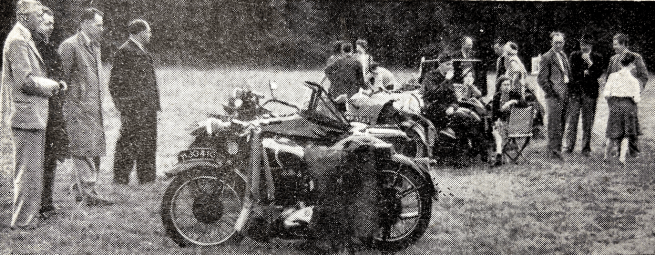
granting permit, hold an open-to-Centre grass-track meeting at Churchdown, between Gloucester and Cheltenham, on June 30th. Littledean (Forest of Dean) Holidays-at-Home Committee have invited the club to organise a grass-track meeting there during the August holiday week. An o/c meeting will therefore be held on August 6th. The importance of motor racing as an advertising medium for the export trade of the country concerned was stressed by Mr Raymond Mays when he gave a talk and film-show to 120 enthusiastic members of the Coventry and Warwickshire MC. 1st Glos Batt HG Club’s Red Cross Scramble on June 23rd will now be held at Lower Farm, Noverton, Prestbury, starting at 2pm. XHG Tiger MCC’s club-night has been fixed for the first Thursday of each month. June 10th : Day run to Durdle Moor, Dorset coast. Meet: Fleet’s Bridge, Poole, 11am. All welcome. Reorganisation meeting of the Nantwich &DMC will be held at the Leopard Hotel, London Road, Nantwich, tonight (June 7th) at 7.30pm. Devenport &DMC are starting to reform. Details from Mr W Tucker, 2, Apesey Road, Plymouth. Commendable performances were made by PHC Waterman (349cc Rudge), KJ Powell (348cc Velocette) and SR. Wise (500cc Enfield-JAP) at the West Bristol MC&CC’s Whit-Monday grass-track meeting at Patchway. CH Mead (Mead Special), V Worlock (JAP), and W Semmens (Velocette) were winners at the Hereford MSC’s grass-track meeting on the race-course. Dewsbury Messengers MCC has been formed from DRs attached to the Dewsbury CD Messenger Corps, now disbanded. HQ: Ashworth Villas, Ashworth Road, Dewsbury. General meeting will be held at 8pm on Thursday, June 21st. All invited. Edgware, Mill Hill&DMC fixtures: June 10th, Run to Wheathampstead (leave HQ at 3pm); June 19th, general meeting, HQ, 8pm. Clubnights: first and third Tuesdays of the month. Mont’ Christie MCC meetings are held each Sunday afternoon (until further notice) at the Wake Arms, Epping Forest, at 3pm. Sidcup &DMCC fixtures: June 10th, Meet Brands Hatch Track, 2.30pm, for preparation work, also trials practice (tea at Hollyville Cafe, main road, Kingsdown, 5pm); July 1st, Meet Ashdown Poultry Farm, Cotmans Ash (Nr Kemsing), 4.30pm, for tea. A new club is being formed in the Wembey area. A meeting to elect officers, etc, will be held at 2, Oakdale Avenue, Northwood Hills, Middlesex, on June 17th, at 4pm. All invited. Tea can be provided at a nearby café if notice is given beforehand. R Carvill, T Bateman and GH Skelton were winners at the Grimsby MC’s Whitsun grass-track meeting. A crowd of 8,000 were present and Grimsby Hospital and the Red Cross Far East PoW Fund benefited. All members of the South Birmingham MC—both in the Services and out—are asked to inform the secretary of their present address. All interested in joining the club are also asked to contact the secretary. Stamford Bridge Speedway MC are holding a scramble and relay race on Bagshot Heath on July 15th. Anyone interested should get in touch with the secretary, Mr A Anastasio, 13, Rosebery Road, SW2. Secretary of the Mansfield &DMCC is Mr H0 Warsop, 58, Portland Street, Mansfield Woodhouse, Notts. Interested motor cyclists are invited to join the club. Ravensbury MCC members thoroughly enjoyed their Whitsun week-end. Runs will now take place on the second and fourth Sunday of each month, starting from the old clubroom, 84, Morden Road, at 10.30am. First run: June 10th, Frensham Ponds. Theatre visit—details from the captain, Mr G Hall. Sheffield and Hallamshire MC look forward to a bumper grass-track meeting at Hillsborough Park on June 30th. More club dances are to be held. Manchester Eagle MC: Second quarterly general meeting, Clubroom, June 18th, 9pm. Double Five Kent MC has been formed by past members of the 55th Kent Bn AG. Meetings: Second and fourth Tuesdays in the month, at the Railway Hotel, West Wickham. All invited. June 17th, first club run (incorporating treasure hunt and club tea); details from the secretary. Assistance for novices will be a feature of the club. EW Commander (Triumph) and D Houghton (Martin-JAP) were winners at the Banbury AC’s Whit-Monday grass-track meeting in aid of Horton General Hospital. The meeting was a complete success. Leicester Query MC fixtures: June 17th. Inspection of Trials Sections; meet, Garage, Woodgate, 2.15pm. July 1st, Roughriding Trial at Blakeshay Farm, Newtown Linford, Leicestershire. Practising, 1.45pm; start, 3pm. Members of the Scunthorpe MCC have an excellent record in the war, as was brought out at the recent general meeting. Acting secretary of the Amateur MCC is Mr R Newman, 69, Thorpe Road, Staines, Middlesex. Meetings at the temporary HQ, The Roebuck, High Road, Chiswick, have restarted. Cambridge Centaur MCC is now
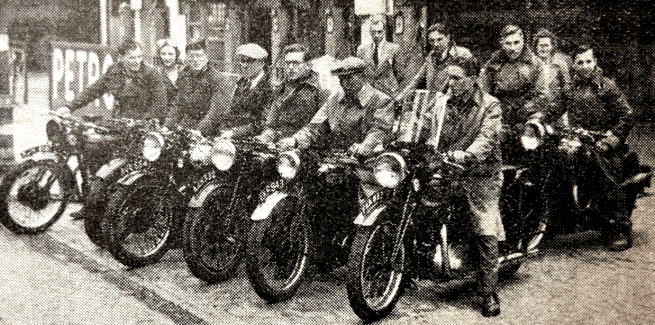
functioning again after an interval of over five years. Open invitation to those interested. A vice-president- of the Warrington &DMC is Mr Noel B Goldie, the local MP. New MEF club is the 1st Bn DWR MCC. Secretary of the club, CSM Pollard, HQ Coy, 1st DWR, MEF, sends details of the club’s second run. After filling up with ‘coupon-free petrol’ the lads enjoyed themselves on a run in the mountains round Jerusalem—and a very colourful journey it was, too! Motor cycle football and a grass-track meeting are down on the club’s event sheet. Bradford &DMC have been quick to organise ‘a grand reunion meeting’—a semi-sporting event over a small circuit of moorland at The Rock Garden, Skyrethornes, near Grassington and Threshfield, in Upper Wharfedale. The course. on private land, will consist of several laps; the going is moorland track and rocks (no mud). Starting time—2pm next Sunday (June 10th). Bradford Vagabonds MC fixtures: June 10th, social run; meet, Packards Garage, 10am June 24th, speed hill-climb (details later). Leatherhead Club’s ‘At Home’ meeting—all motor cyclists, including HG and CD DRs, welcome—will be on June 17th at the King’s Head Hotel, Epsom, at 6pm; review of club life, brains trust, and talkie film will be features. June 12th, Club-night. Leamington MC&LCC will run a grass-track meeting in Victoria Park, Leamington, on July 7th (in aid of Warneford Hospital). Entry forms shortly from Mr WD Lock, 2a Beauchamp Avenue, Leamington Spa. South Shields&DMC is revived. Past members who have changed their address are asked to communicate with the secretary. Programme: Monthly social runs (first, June lOth). Chester MC’s general meeting, June 10th, Milton’s Garage, Union Street, Chester, 7pm.” The Ulster MCC bounced back with a “grand reunion grasstrack”.

“NO TIME WAS LOST by the Bradford &DMC in organising a trial as soon as the basic petrol ration was restored. And organising means organising, not just running impromptu. A permit numbered ‘A1, 1945’ was obtained from the Yorkshire Centre ACU, and all the usual formalities were observed. The course was a short circuit on private land at Threshfield, near Grassington, the site being known as ‘the rock garden’. It presented a variety of rough tracks among trees, with gradients of great severity and a general surface of tree roots, limestone rock outcrop and nice green, slippery moss. The announcement said ‘no mud’, but the weather compensated for that by putting a surface film of slime on everything. There were 26 entries, although only 21 started, ‘couldn’t get it ready’ or ‘couldn’t buy a new cover’ being the stock explanations. Results were decided on observation only and it soon became evident that the first observed section, a rocky bill approached awkwardly from a small watersplash, was unclimbable; indeed, the slipperiness of the approach was in itself sufficient to stop the majority and pushing and footing was the only way. R Wilkinson (348cc Panther) was outstanding, however, in retaining enough wheelgrip to make a fairly easy ascent by footing. Even F Fletcher’s 125cc Excelsior-Villiers had as much wheelspin as bigger machines and the whole affair became more one of ‘having fun’ than expecting to make the climb. Once over this obstacle about a mile of less difficult going led to a more moderate ascent over prominent outcrops and tree roots, and here JE Cooper (498cc Triumph) made the only clean performance—a remarkable effort, the more so because he was in the club’s Grade 3 or novice category; this achievement actually resulted in his having the lowest loss of marks in the event, winning the Novice award with one mark better showing than the winner of the Expert prize! So the Bradford Club made the first move to pick up the old threads in the Yorkshire Centre. From a riding point of view it was obvious that machines and men were a little out of fettle. Ken Wilson (498cc Matchless), one-time Scott Trial winner, was doing more than a little footing before he retired…Only ‘Stelvio’ Hyslop (498cc Triumph) appeared to be equal to his old style, for his running commentary was as pungent as ever while his rotund form parted from the model and bounced with the same gay abandon as of old. And while results were worked out the entire picnic party renewed acquaintance and began to regain something that seemed not so very distant after all.”
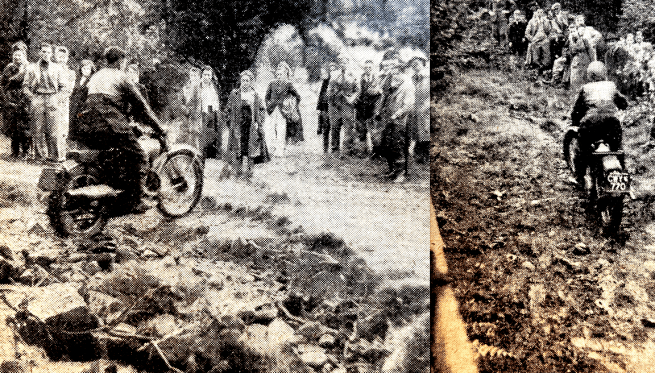
“LAST SUNDAY THE recently formed motor club of the 1st Gloucestershire Home Guard Association held its first event, this taking the form of a scramble in aid of the Red Cross Fund over a one-and-a-quarter-mile course on the outskirts of Cheltenham. The course was situated on the slopes of the Cotswold escarpment adjacent to Mill Lane of pre-war notoriety, and embraced a considerable amount of the old Noverton Grand Prix courses, which meant that it was super-sporting and very much up-and-down. Although primarily laid out as a rider’s course, it proved exceptionally interesting for the very large number of spectators, the whole of whose entrance money incidentally, some £35, goes to the Red Cross, and certainly all the 30 riders enjoyed themselves hugely.”
“THE SOUTHERN CENTRE, ACU, is being revived. Officers of clubs in the Centre are asked to get in touch with the Acting Hon Centre Secretary, Mr. George B Allan, ‘Furzley’, Sprat Down, Fawley, Southampton.”
“DESPITE THE REINTRODUCTION of basic, traffic remains surprisingly light in the London area. Even so, the newspapers were reporting a traffic jam in the West End last week.”
“ROAD ACCIDENT STATISTICS issued last week show that there were, on an average, over 20 deaths a day on the roads of Britain during the period of the war in Europe. The total number of fatalities was over 42,550.”
“‘THE ROVING LASSIES (all-girl) club ought to be an inspiration to other girl riders to organise more clubs. What a wonderful sight it must be to see a group of girls in their neat, clean, snappy uniforms out for a spin and enjoying the sport of sports.’—A US clubman’s note.”
“THE AUTO-CYCLE UNION have made the following announcement: ‘A meeting of the Management Committee was held recently at which detailed reports from all the local Centres of the Union were studied and plans made for the earliest possible resumption of pre-war activities. The majority of the local Centres, however, are not yet functioning, and it would be premature to convene a meeting of the General Council. The Management Committee would take this opportunity of impressing on all Centre executives throughout the country the necessity for vigorous action and the revival of old clubs as well as the encouragement of new ones. Twenty-six new clubs have applied to headquarters for affiliation this year.”
“IN PEACETIME, DESPITE full leisure and other facilities for servicing machines, too many motor cyclists have shown visible or audible signs of neglecting their mounts. One hears tinny rattles along the road, one sees too much blue tailing the machine. But under war pressure that minority of us who have continued to ride in civvies have displayed our buses to great advantage. I think the industry has every right to be proud of those of you who have remained in the saddle during these six arduous years. You have proved that you know how to maintain your machines.”—Ixion
“A SIDELIGHT ON the USSR: Two motor cycle events have just been held, both starting from Moscow. One was a 60-mile, race along the Minsk highway, and the other was a 50-mile cross-country trial. Marshal Rotmistrov, the tank commander, started the events, which were open to both men and women motor cyclists.”
“MAY I OFFER my thanks to all DRs in all the services and CD for their grand work during the past five and a half years? Many people would not realise by some of your photographs of Army and other DR trials that the trials themselves were only a preparation for natural trials of the battlefields or in air raids, but which did not have a gallery of interested spectators, and in which the only award was not a posh ‘pot’ but a piece of shrapnel from a bomb or shell. It also may not be realised that the motor cycle scout, in fluid warfare, is the first person to enter occupied and unhealthy terrain. I would like to offer a word of warning to motor cyclists who have had to lay up the mount since the basic ration was discontinued. Now that basic is back again they should remember that their reactions to danger will not be so acute the first time on the road, and it will be easy to make a dangerous mistake.
F Abbott, Cambridge.”
“I AM ENCLOSING a photograph which I have received from my son in Italy, in the hope that it will interest you. In the letter accompanying the snap he says: ‘In my spare time I decided to build a racing model, and in this decision the availability of parts governed everything. Eventually I decided to base my efforts on a Matchless, which, although very scarce here were more likely to be scroungeable than say Triumph or Ariel. I imagined that once an engine and gear box had been obtained, the rest would be easy, but such things as nuts and bolts held me up quite a bit. Frame: G3 Matchless (the old civvy and not the Army pattern tele). Forks: Norton forks turned back to front, and a set of Norton head races machined down to fit frame. The lower front spring mounting cut and brazed to correct the angle of the spring. Engine: Matchless G3 crankcase and G3L upwards with a G3 head. The crankcase I split, then polished the flywheels, etc, reamered out all plain bushes and drilled extra oilways. Cylinder: This had two millimetres machined off the top to raise the compression and a wafer-thick gasket fitted instead of the standard one. Valves and parts, etc: These were polished by making up tools to fit an electric drill. Gear box: 9 to 1 is the ideal ratio for our track, but it took a long time to find out. I am using a Matchless shell and selector with Ariel gears fitted into the box to step it down a bit. A Matchless clutch is used. Wheels: Norton front wheel and brake and Ariel rear wheel. The gear box makes third-gear a bit lower than 9-1, but it is a good fault. Tank: A standard Tele cut down to hold about ¾ gallon-fuel. No footrest is fitted to the clutch side of the machine, but a rest is used on, the other side. At present I am using 100 octane, and a 14mm Spitfire plug, with a half megaphone exhaust. Full megaphones were scrapped, as they upset carburation at under half throttle. She is painted blue and silver (Signals colours) and goes like a shot from a gun, starting in second gear. Later the engine was stripped, new flywheels and con-rod fitted, with lin taken off the flywheels and the con-rod drilled, which further improved snappy getaway. This model has taken two ‘first places’.
AC Hatch, West Wickham.”
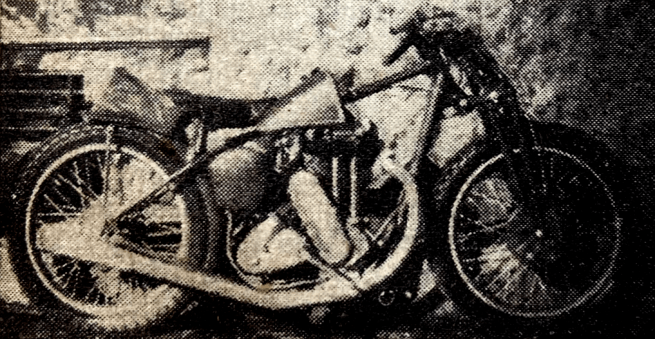
“AS A CHANGE TO the usual types of German machines I have seen and ridden out here, I would like to recount a recent incident on my way to Bremen. I was riding in a jeep, and passing a small shed my eyes were attracted by the glitter of chromium from the half-open door. Upon investigating, I was intrigued and delighted to see a KTT Velocette complete with racing numbers 35. The equipment included hairpin valve springs, twin float carburettor, huge fuel tank and megaphone exhaust. I certainly ogled that machine—given the time, I would like to have had the opportunity of fitting the tyres and chains that were deficient and trying it down the Hamburg Autobahn! In close proximity to the Velo were two practically new BMWs! What a sight for an enthusiast’s eyes, and just waiting to be put on to a vehicle! Thanks for the interesting reading that reaches me quite regularly each week.
TW Middleton, BLA.”
“IF I NEEDED A MACHINE which I could treat as a bootscraper, and for use at low or medium speeds day in and day out with a minimum of servicing, I would rather have a good two-stroke—and especially a water-cooled two-stroke—than any four-stroke which I have ever owned. Within limits, the older and the dirtier they get, the better they pull; and when they at last demand a decoke and an overhaul, it is a simpler job. Moreover, in my experience they generate less petty trouble than a four-stroke—almost inevitably so, thanks to their utter simplicity. I am prepared to admit that a sleeve-valve four-stroke might be even better for careless utility work, if and when a designer gives it the necessary attention. Remember, further, that only one or two British makers have ever elected to persevere with a two-stroke machine on the same price level as standard touring four-strokes. The causes for this neglect are arguable. Personally, I believe that our over-emphasis on speed and competition work is a main factor. I suspect that Villiers have sold more motor cycle engines than any other British manufacturer. Am I right? I wish they would tell us their output figure to date.”—Ixion
“AS A POINT OF INTEREST maybe to you, there are many electric motor cycles in, and about, Brussels. I saw many on the road, some carrying a pillion passenger. The engine is enclosed, and situated beneath the saddle; a pair of batteries (Austin 7 in size) all fixed each side of rear wheel. The machines are built very low with small wheels and 4in or 5in tyres. In Paris the popular motor cycle is the 150cc two-stroke with direct lighting and 6in head lamps. Pillion canvas bags are carried each side of the rear wheel, and a trailer on two cycle wheels often attached. Power units of 60cc to 100cc attached to bicycles over the front mudguard or at the side of the rear wheel are often seen.
S Pearce, Wimbledon.”
“UNITED STATES MOTOR cycle registrations for 1944 are given as 157,496. Three States have registrations running into five figures: California (22,309), Ohio (12,355), and Pennsylvania (11,580). Nevada is the lowest with 170.”
“EXTRACT FROM THE Dublin &DMCC’s news-sheet: ‘The British Government have restored the basic petrol ration with commendable promptitude; but at the time of writing the Eire Government have held out no prospect of an early restoration—rather have long delays and more shortages been hinted.'”
“AN INGENIOUS SPRING-UP stand which telescopes into the seat tube forms the subject of Patent Specification No 568,610, just published under the names of The Birmingham Small Arms Co and Mr Edward Turner (who at the time of the Application Date, June 28th, 1943, was Technical Director, BSA Cycles). The stand consists of a tubular member slidably mounted within the seat tube of the frame and having a transverse strut at its bottom end. Within the stand tube is a coil spring in compression. The top end of the spring is located by an abutment at the top of the stand tube, while the bottom end of the spring is supported by a central rod, the top end of which is secured to a fitment at the top of the seat tube. On one side of the stand tube are ratchet teeth arranged to be engaged by a spring-loaded pawl when the stand is lowered to ground level; such lowering, of course, further compresses the spring, so that when the pawl is released from engagement with the ratchet teeth the stand is raised by the spring.”
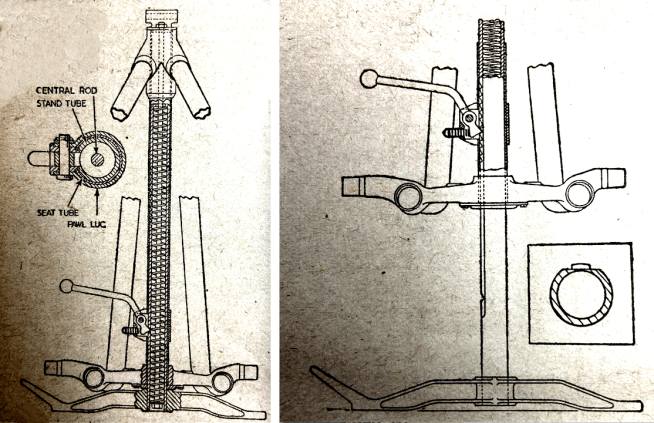
“GREAT NEWS! MOTOR CYCLES are in production for the civilian market—for motor cyclists and would-be motor cyclists at home as well as abroad. The first machines should be available in a matter of a few. weeks. Until recently, it seemed that all civilian-type motor cycles would be earmarked for overseas, because of Britain’s need to build up her exports, a direction in which the British motor cycle industry has made a magnificent contribution in the past and, given a big home market, can achieve even more in the future. In the decision to permit home sales it appears to be appreciated that there must be this home market. Otherwise, just as was the case previous to the war, when Germany was the main competitor, Britain will he unable to compete on price. A natural corollary to the decision is that the present system of ‘licences to acquire’ shall be swept away. We anticipate good news in this connection almost any day now. As readers are aware, the rule has been that a prospective purchaser has had to produce a Ministry of War Transport licence in order to obtain either a new motor cycle or even a reconditioned Army machine—indeed, a licence has been needed even to register a motor cycle built from second-hand parts—and such licences have, in the main, only been granted where the applicant could show ‘essential need’. It is obvious, however, that, even with licences to acquire a thing of the past, the home market is unlikely to be really large and constitute the background needed for large-scale exports while the 33% Purchase Tax remains—no less than £25 on a machine for which the manufacturer’s price is £75. This tax especially hits the returned Serviceman. It is not as though motor cyclists (and car owners, too) were not taxed in other directions. With the majority of articles subject to Purchase Tax there is only this one tax to pay, but with a motor vehicle there are taxes all along the line—recurring taxes, such as Road Fund licences, 9d. on every gallon of petrol, driving licences, taxation of lubricating oil and tax, as sell as rates, to be paid on the owner’s garage. Added to this, surely a vehicle, which constitutes transport, is in a very different category from the general run of articles? No doubt there will be sweeping changes—there must be in the interests of exports. The time to announce them is now, before the new models start to reach the market. Not only does the industry need to know where it stands, and what plans it should make, but so do prospective purchasers. It is unthinkable that a man should buy a new machine one week and find the next that the Purchase Tax had been removed and that he had paid many pounds more than fellow motor cyclists for a machine which was precisely similar. Perhaps the greatest need of encouragement is in regard to autocycles and lightweight motor cycles up to 100 or 125cc. It is a matter of history that there were immense world sales of such machines before the war and that Britain’s share was small. On the Continent these lightweights were tax-free and insurance-free. Continental nations thus had the basis for big exports. The moral is obvious.”—Ixion
“WHILE IT IS EARLY to take stock, already it is obvious that a mainstay of the post-war programmes will be the side-by-side twin. There are likely to be some new horizontally opposed turns, but the technique of building two single-cylinders into one unit, with the crankpins in line, that came to the fore in the late 1930s, is almost certain to be paramount. There are, however, several possible methods of mounting such an engine in the frame, apart from the choice of sv, ohv and ohc—and even two-stroke or four-stroke. Further, there is the question of the final drive, whether by chain or by shaft and bevels or worm gear. There is much that is thrillingly new in the design or prototype stage. A thought that frequently crops up is whether the twin is the ultimate or merely a passing phase in the evolution of the motor cycle. Why are there not more fours and threes?”—Ixion
“‘THE GLORIOUS FIRST’ no longer refers exclusively—for motorists—to Admiral Howe’s naval victory off Ushant in 1794. I spent it very quietly, contenting myself with some 10 miles of urban travel. Traffic was certainly denser, but not all that. My chief impression was how noticeably certain streets had narrowed as the result of kerb parking. Believe it or not, a certain one-way street conveys all east-bound traffic out of a large town, plus a share of the north-bound traffic, including numberless bus services. That street is of three-vehicle width, and kerb-parking by shoppers is allowed on both sides of it! You can guess how much space remains available for moving vehicles in the middle. Next morning I interviewed my special correspondent at local police HQ. The resurrection of local laid-up cars (total, well over four figures) had not so far caused any additional crashes. But patrols and telephones had been kept very busy after dark trying to organise the removal of breakdowns from the roads, some of them lampless! No reports or complaints anent resurrected motor bikes.”—Ixion
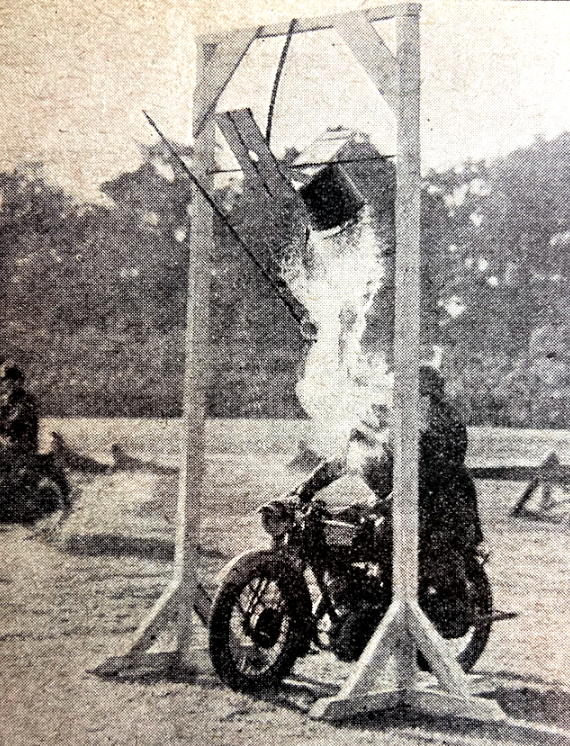
“ALLIED EXPERTS have been examining Germany’s methods of producing oil from coal. Major Lloyd George revealed this when he replied to a question in the House of Commons…he added that ‘a small production of oil’ has been obtained since 1939 at Formby, Lancashire.”
EVEN RACING BIKES had to be adapted to run on pool petrol – and in a bid to reduce production costs the FICM banned superchargers. This ended the development of blown racers from Britain (AJS, Velocette and Vincent); Germany (BMW and NSU); and Italy (Gilera and Moto Guzzi).
ACU SECRETARY TOM LOUGHBOROUGH stood down after 30 years, handing over to assistant secretary Tom Huggett. Loughborough stayed on as secretary-general of the FICM.
BSA’s FIRST POST-WAR MODEL was the 348cc ohv B31; effectively a pre-war B30 with Ariel telescopic forks. Judging by the popularity of the Matchless G3L, its Beeza counterpart would have made an excellent military mount (BSA developed a 350 ohv WD model but it made sense to keep pouring out M20s rather than disrupting production) . The B31 proved itself a dependable, lively all-rounder. Matchless was also among a pack of contenders eager to challenge Triumph in the vertical-twin market.
“AS YOU KNOW, various manufacturers are adopting 7in diameter head lamps on their new models instead of 8in., which became very much the rule just before the war. Those who should know all about lumens have said that the larger head lamp has nothing on the smaller one in light emitted. There are important advantages accruing to the latter. For instance, the smaller lamp tucks in between the blades of telescopic forks and is thus much less susceptible to damage in the event of the model toppling over. Secondly, there is less top-hamper to affect the steering and handling of the machine. A third point…is that generally one seems to get a better driving light with the small head lamp—better, not worse…I am wondering whether the reason may not be that the smaller reflector is less liable to ‘spring’ on leaving the dies and is, therefore, more nearly a true parabola.”
BY YEAR’S END there were nearly half a million motor cycles on British roads: double the 1939 total.
“TWO AJSs, TWO GLEAMING black, gold and chromium models, are about to enter production. Both are ohv singles, one of 347cc [a civvy version of its WD model] and the other of 498cc. The first machines will be available some seven or eight weeks hence. Since Associated Motor Cycles are continuing the manufacture of motor cycles for the Army, three-quarters of the factory’s production capacity being devoted to the supply of WD motor cycles and spares, the machines for the civilian market have to be based on their Array model. They are, however, thrillingly civilian in their finish, and have their acid-dipped crankcases, polished magneto chain covers, scintillating levers and even rubber for footrests and kneegrips, though not at the moment for the foot-change lever. Note, too, that there is a 500 as well as the 350, which is the capacity of the WD machine. The prices are to be announced shortly. Perhaps one of the most striking points about the 1945 civilians-for-the-pleasure-of models is that they do not give the slightest impression of being ‘Army’. Even the three gallon tanks, with their black and gold finish, look deeper. The machines have the proved-on-every-battlefront duplex cradle frame of the G/3L, and the now famous ‘Teledraulic’ front forks, which provide a total possible movement, hydraulically damped, of 7⅛in divided roughly into 3in upward and 4in on the rebound. Four-speed Burman gear boxes are employed…As usual, the AJS has a shielded magneto in the front of the engine. The compression ratio of the 350cc model is also different from that of the WD mount. There is no compression plate.” Only 25% of production was civilian, the rest being reserved for the armed forces.
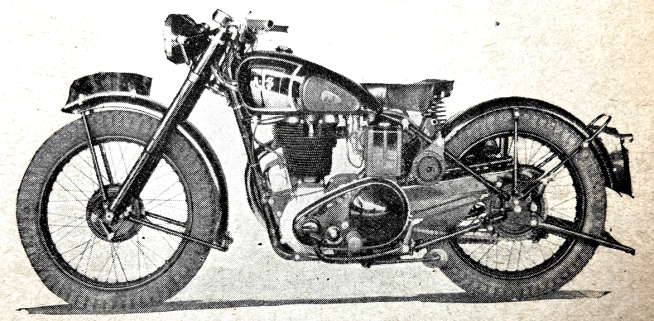
“TORRENS GIVES HIS IMPRESSIONS of the new 500cc AJS: ‘”What about taking it away with you?” said Mr Manufacturer. I was decked out in pin-stripe city suiting—a very war-time, much-worn suiting—and had no goggles, no gauntlets and not even a mackintosh. Everything had pointed to a day in the office. Then there was this bolt from the blue: the AJS programme for next week’s issue. The day was hot and seemed likely to remain fine. I need not ask you what you would have done in my case, for, like me, you would have jumped at the opportunity of riding “some-thing” 1945. What model AJS? The ohv 500. This aspect—the extra power—interested me, for I know the G/3L well, having ridden dozens of Army ones during the course of the war. This, the first of the new models, came as a surprise to me. I was expecting “just a G/3L with a bit more urge”, and found one of the nicest, liveliest 500 singles I have ridden for a long time. The speedometer showed 190 miles, and I had only the opportunity of adding 51 to that total; hence this little article is in no sense a road test, but merely a record of my impressions over this short distance. First, a dull note. It was possible to kick a number of times without anything happening unless the ignition was fully advanced. At the works it was remarked that it was better to start on the exhaust-valve lifter than to adopt the standard dodge of finding compression, easing the engine over on the exhaust lifter and giving a swinging kick. However, with the magneto fully advanced all was well, so presumably it was largely a case of the particular magneto. There were very few other dull notes and a number of very pleasant
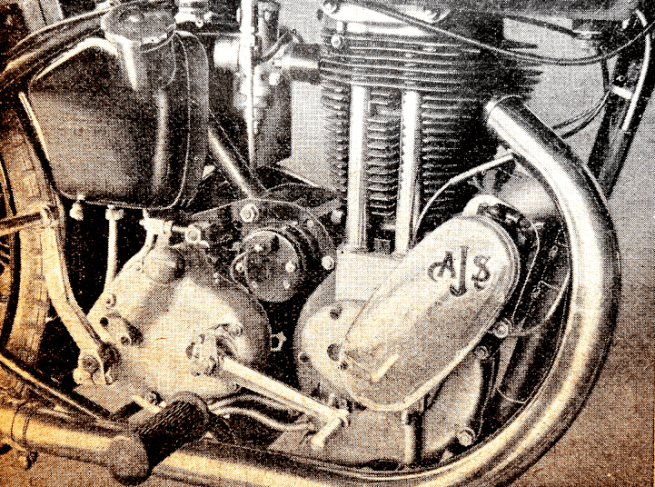
surprises. The engine is flexible. One can trickle along at 18mph in the top gear of 5.25 to 1 and then, if one retards the ignition a trifle, accelerate away quite happily. It is also pleasantly quiet mechanically. The exhaust is “beefy”, if you gather my meaning—beefy without being in any way harsh and obnoxious. It was the “urge” that surprised me most. At 55 or 60mph one is moving along on quite a small throttle opening without the engine appearing to be “at work”. “Umph!” you say to yourself. “The rest of the throttle opening won’t mean much,” and you are wrong—utterly wrong. Tweak the twist-grip open with the machine doing 60 and things happen. I will not say that the machine wooshes forward, but the acceleration from a mile a minute is very useful indeed. There is a liveliness about the machine that makes it a real joy, and it is something which I do not recall with the previous 500s. What has brought it about? The engine, I gather, is basically the same as the 1939 500—the late 1939, which had heavier flywheels than the early ones—but has a different inlet-valve timing. The results are impressive. And what I also liked about the machine was that it feels such a quality job. Riding it one has the sensation of handling a mount that has been built and not merely assembled. If you know the latest G/3Ls you will be aware of the excellence of the steering and road-holding—I refer to the models that are as they left the factory, and not after someone has put too much oil, or the wrong oil, in the “Teledraulics”. Whether the 500cc engine with the fore-and-aft disposition of the magneto and dynamo respectively makes any odds I cannot say, but it seemed to me that the general navigation was particularly good, and I especially revelled in the way the model heels over on a bend. Both brakes were really good, with the front one, as I proved, single-finger light. The riding position is G/3L, which means better than average. The prop-stand, as you know, is excellent, and the position of the speedometer head—on the top cross-member of the “Teledraulic” front forks—could not be bettered. My mileage was not sufficient to answer that point so many raise in these days, namely, whether the engine can be counted upon to remain free from oil leaks. At the end of the 51 miles there was not even seepage from any of the engine joints, but a little from the gear box. There is little else to relate except to state that I was very favourably impressed. The machine I rode gave me real pleasure and, if they are all like that, the model is certain to make a name for itself.”
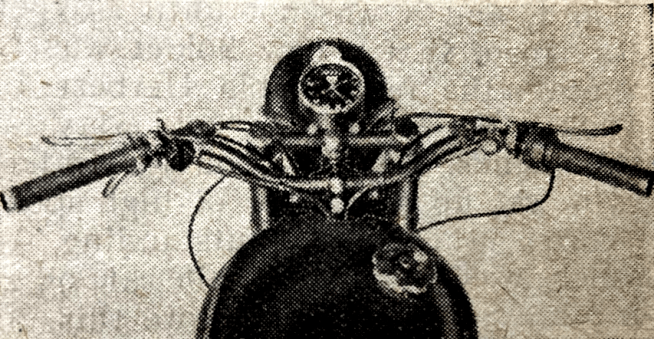
BY YEAR’S END there had been 6,416 fatal accidents on British roads; up from 5,795 in 1943. This was blamed on increased traffic in support of D-Day.
LOW-OCTANE ‘POOL’ PETROL became available to civilian riders, rationed to two gallons a month for models under 250cc or three gallons for bigger bikes. And new motorcycles could be bought on the open market as wartime restrictions were lifted. But Britain was virtually bankrupt. Bread rationing was introduced and the government’s ‘export or die’ policy, while essential for our economic survival, meant new bikes were virtually unobtainable. And prices were inflated by a 25% purchase tax.
WHEN JAMES REINTRODUCED its 125cc two-stroke it was black throughout with silver tank panels lined in gold. But before long it was available in a striking colour scheme of maroon and light blue, and for good reason. The James ML (Military Lightweight) won its spurs with the paras and glider troops from D-Day onwards; the colours of the civvy model were inspired by the airborne heroes’ maroon beret and sky-blue badge
A MOTORIST BEFORE the beak for speeding in Slough admitted to a previous offence: exceeding 6mph in 1903. Case dismissed.
A BRITISH SQUADDIE in Italy built was clearly bored with his 16H Norton. As well as hand-ground cams he had upgraded the beast with Matchless Teledraulic forks, a WD Royal Enfield frame, Italian-made Sertum conrod and a top end liberated from an ohv 750cc BMW combo.
IXION REMARKED: “No son of mine would ever jump from pedding to driving a car without serving the invaluable apprenticeship of a motor cycle.”
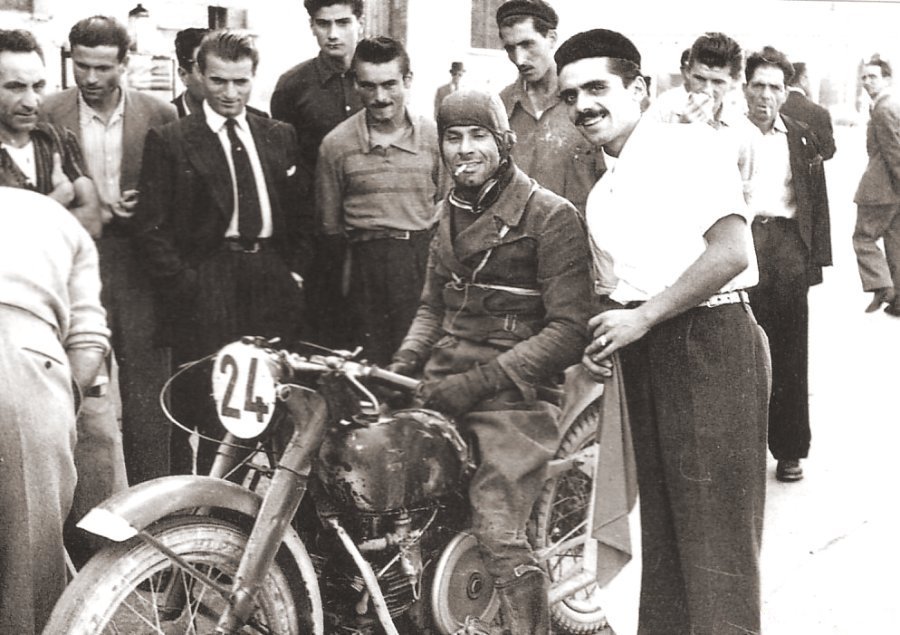
As usual, here’s a selection of contemporary ads.
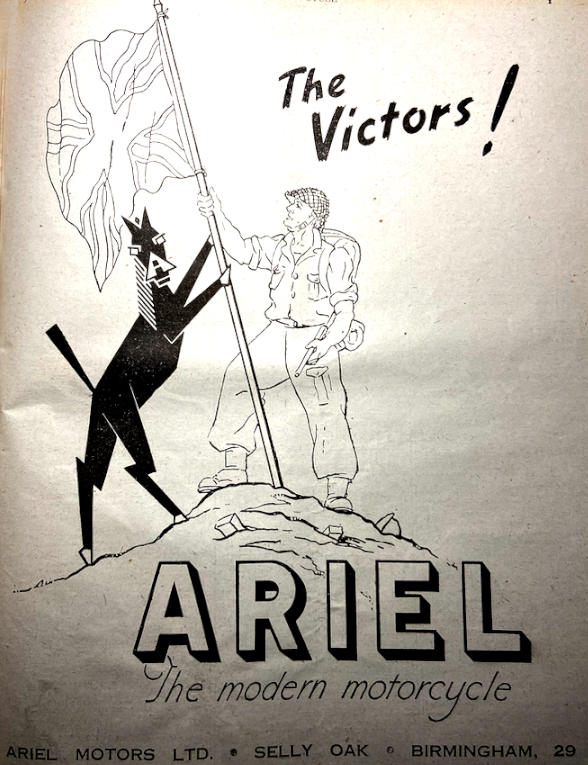
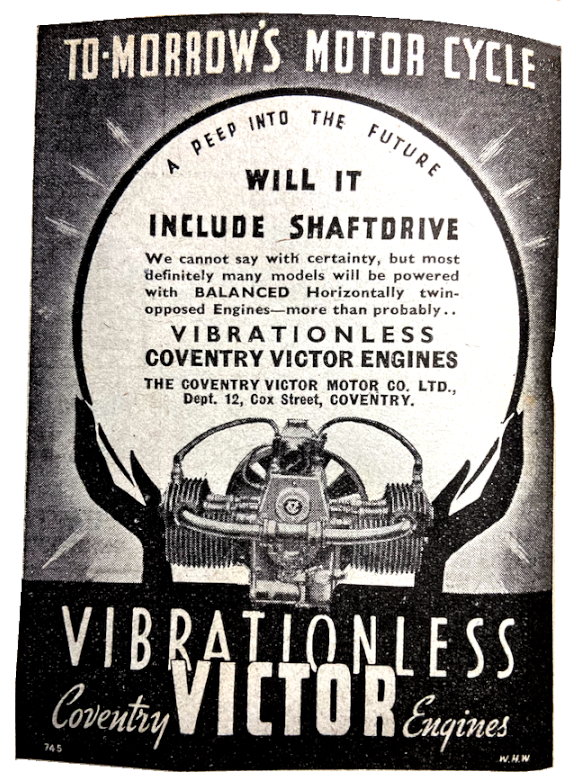
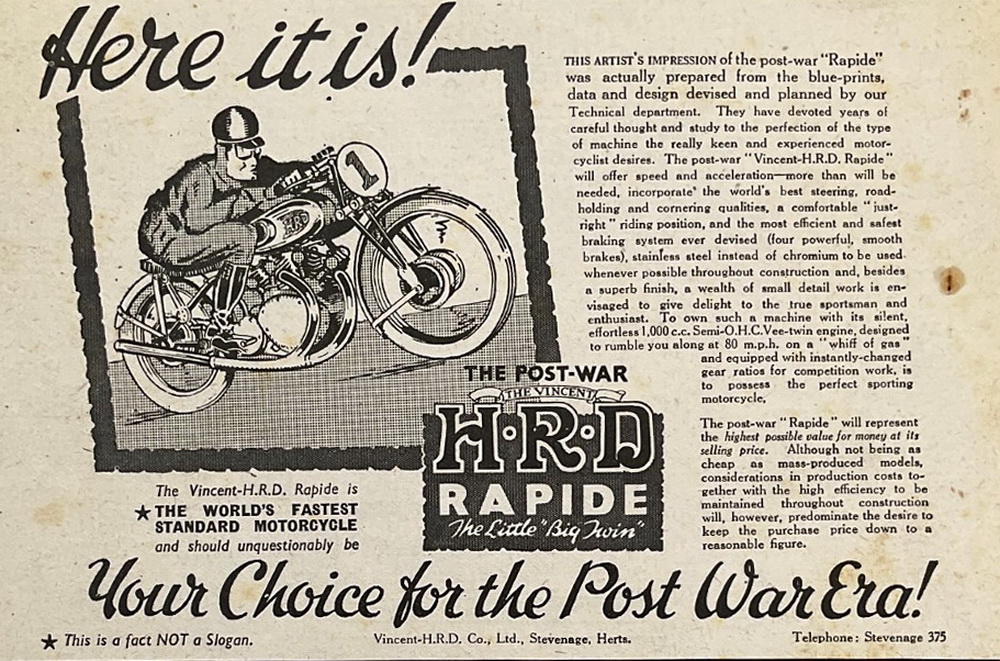
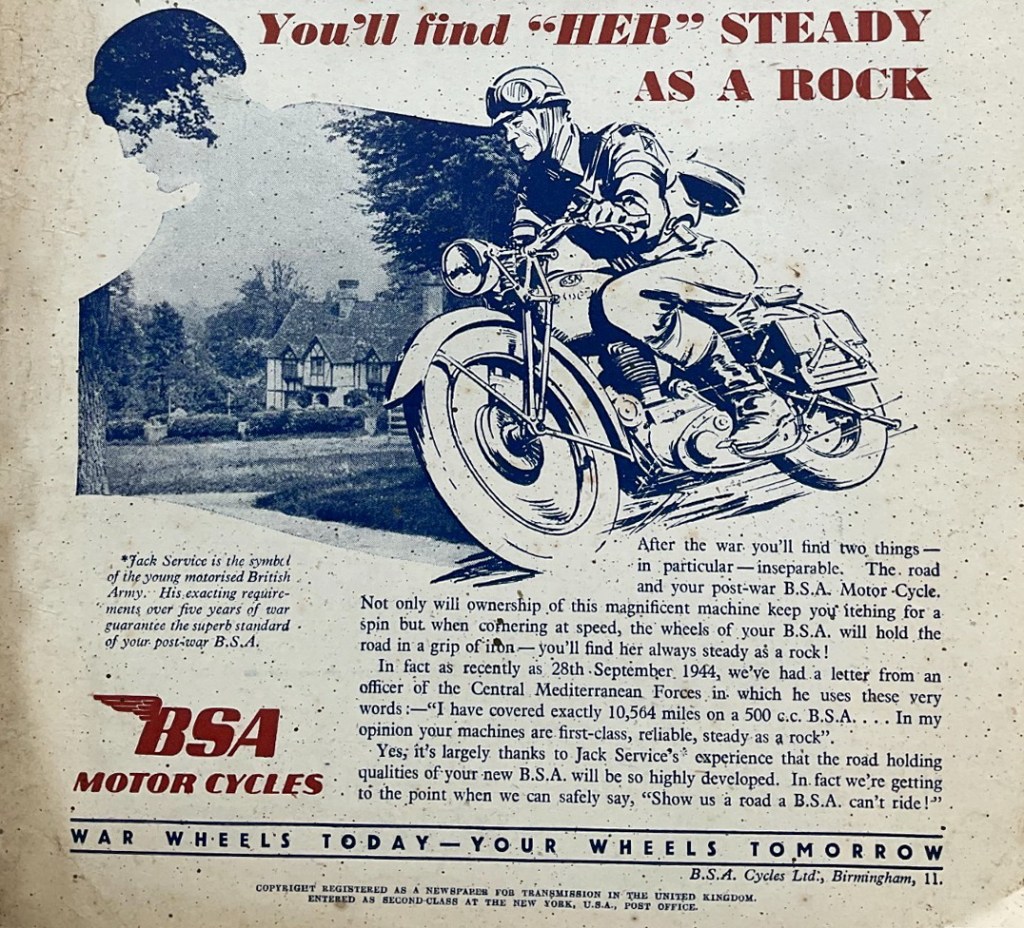
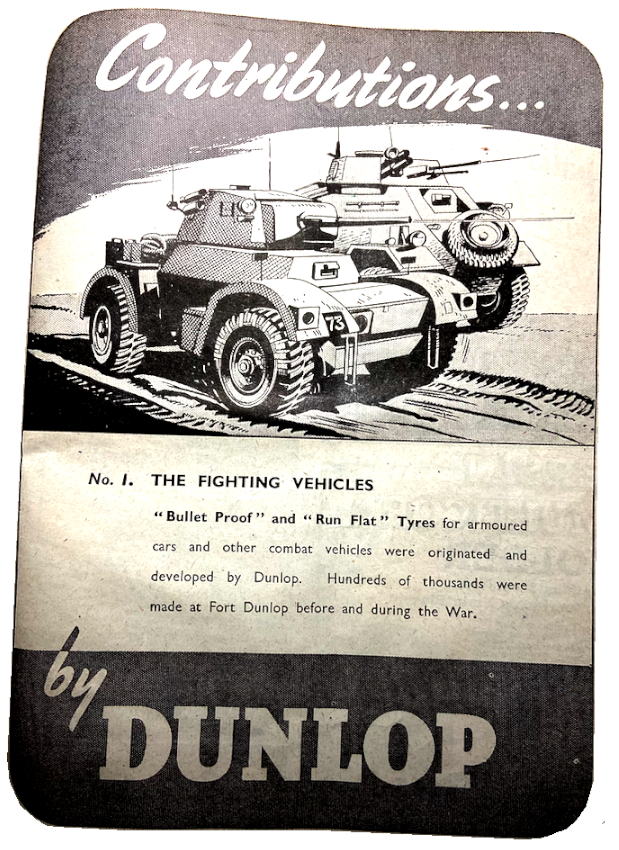
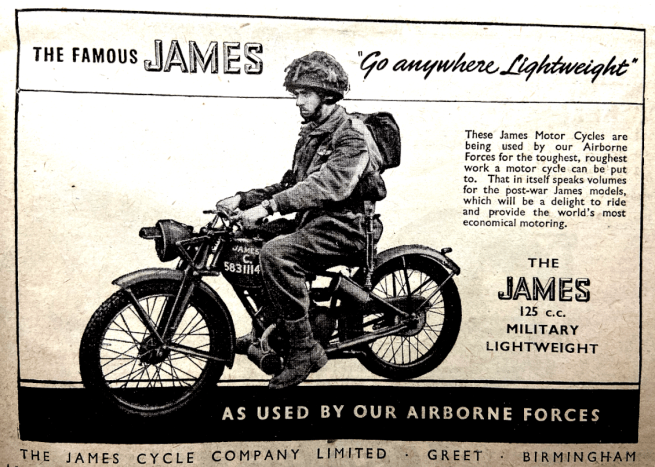
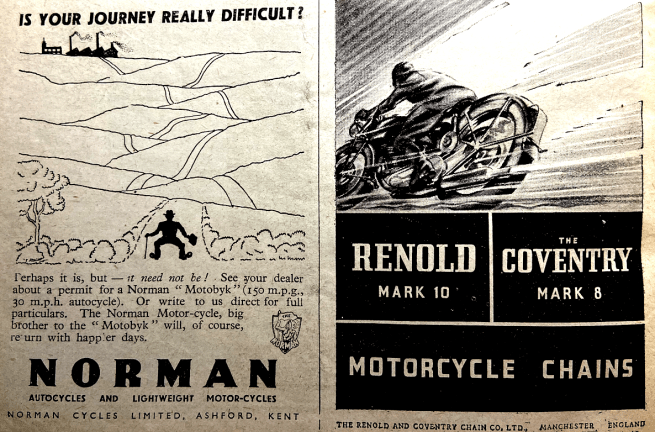
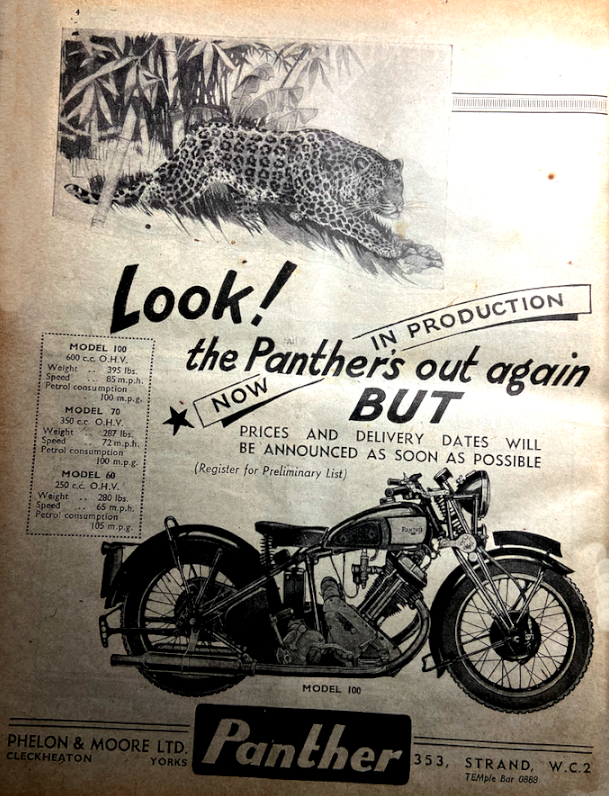
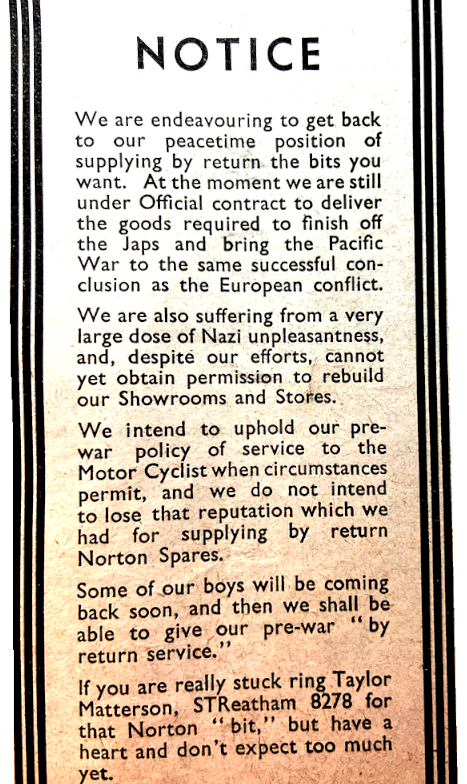
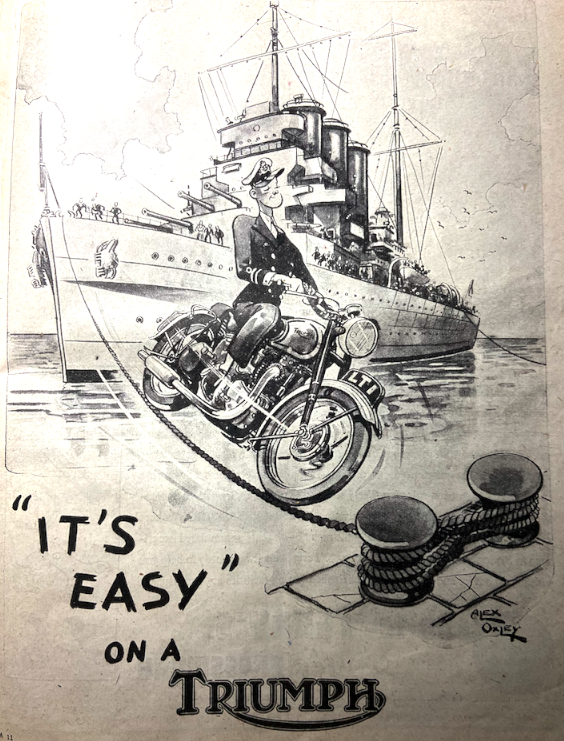
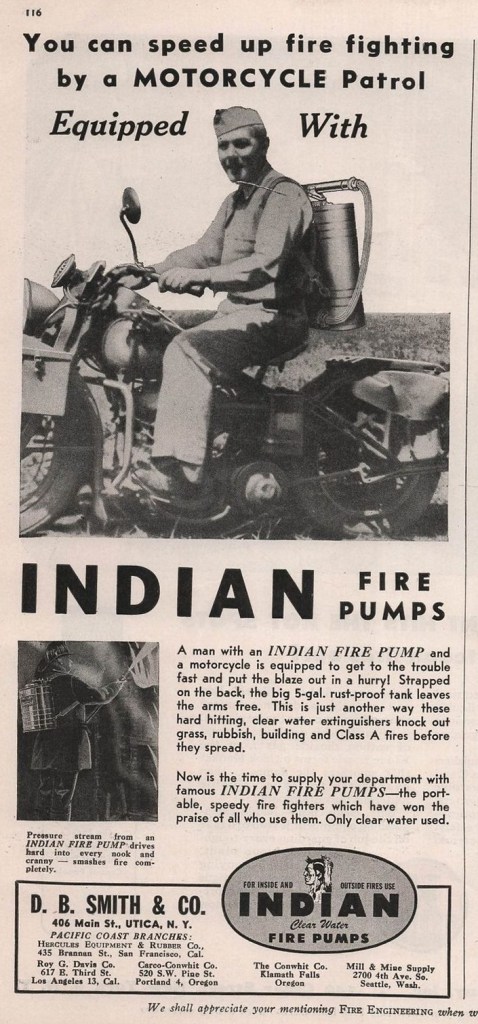
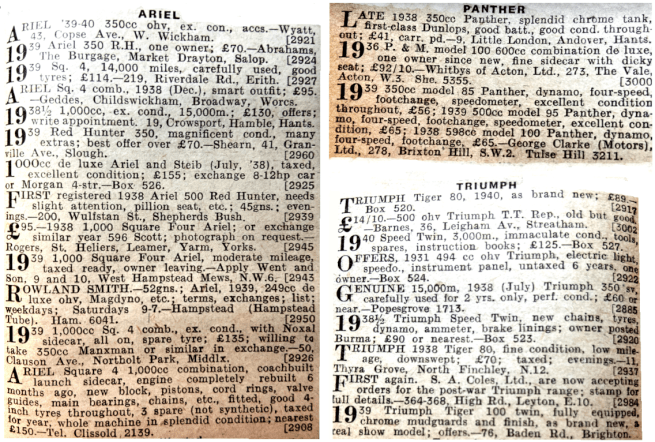
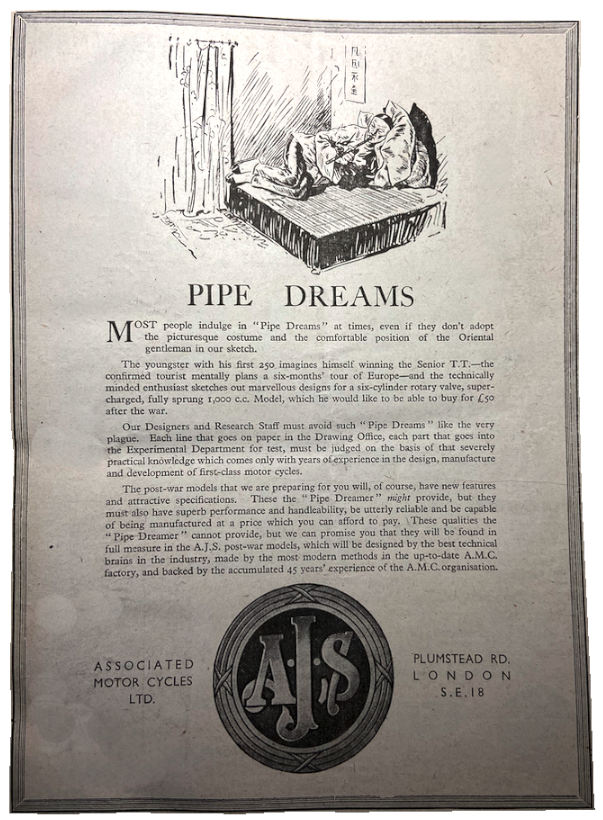

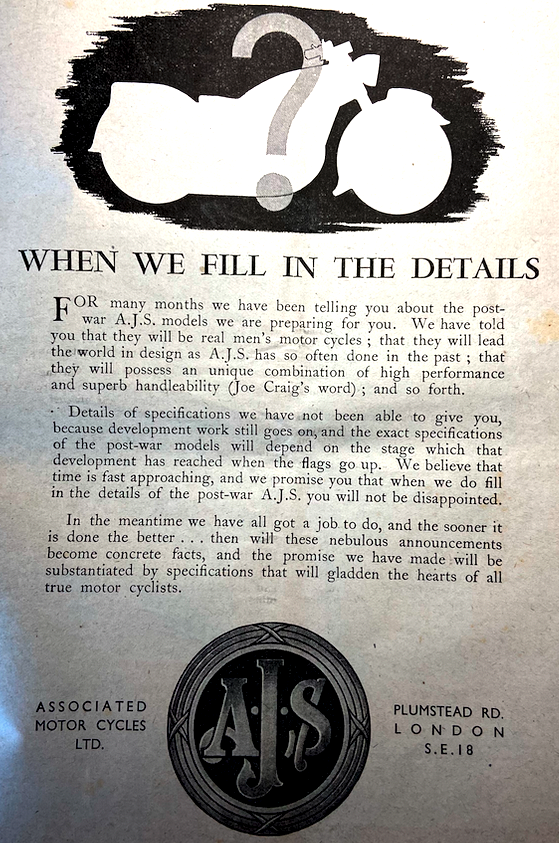
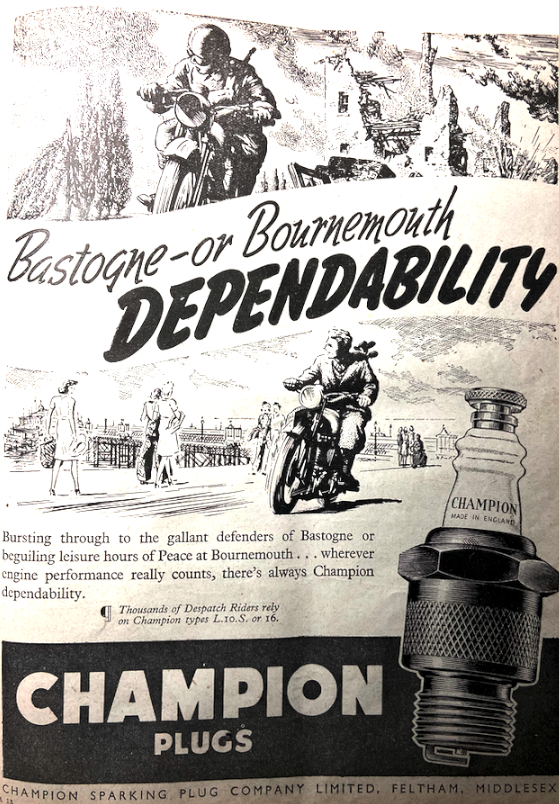

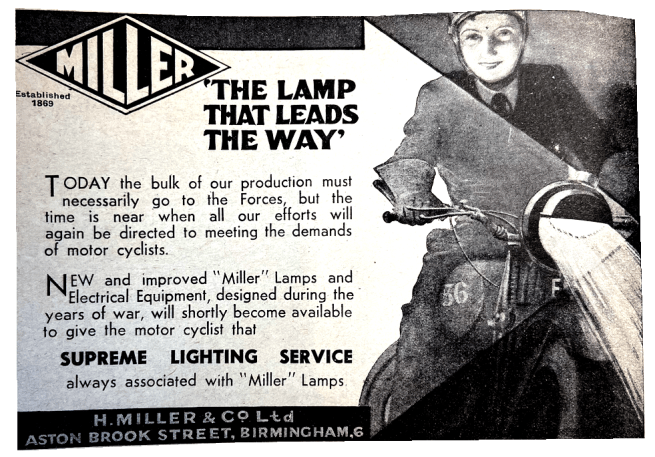
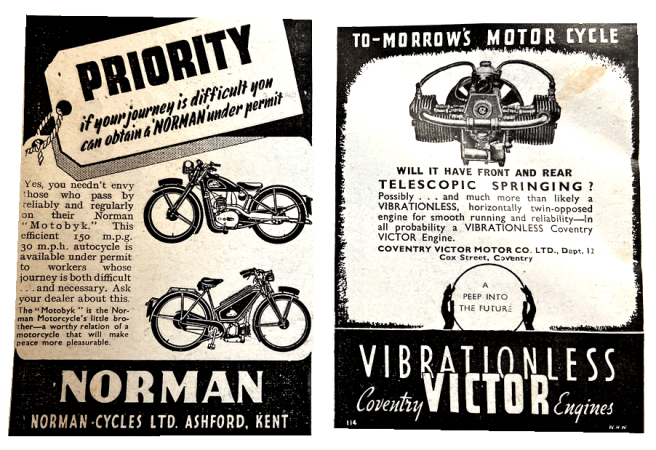
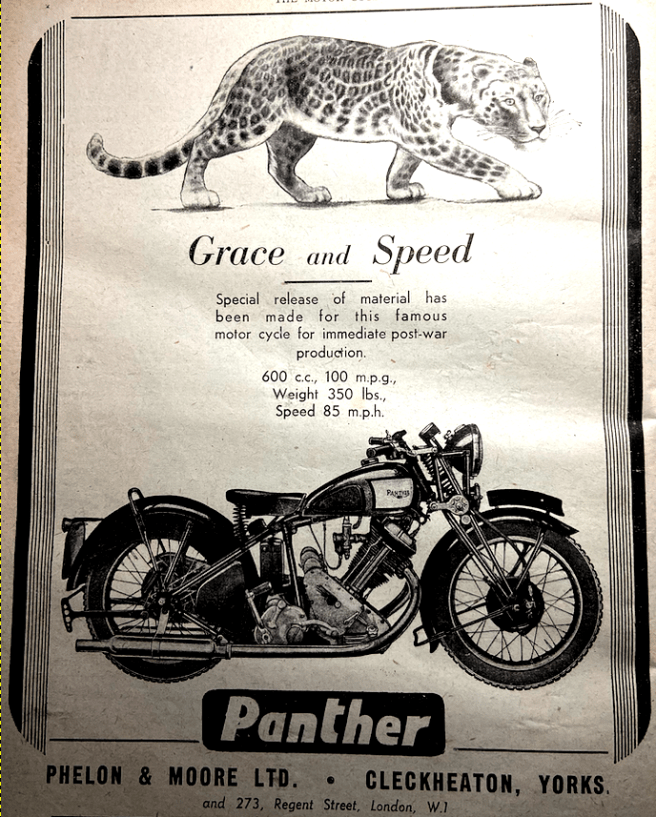
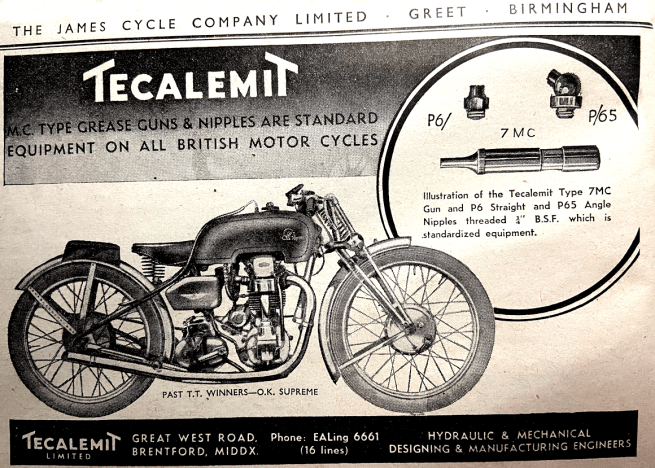
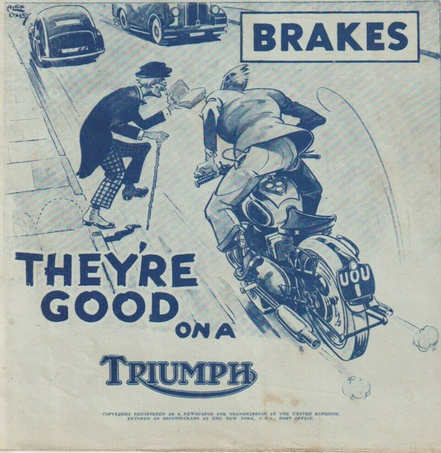
 Motorcycle Timeline