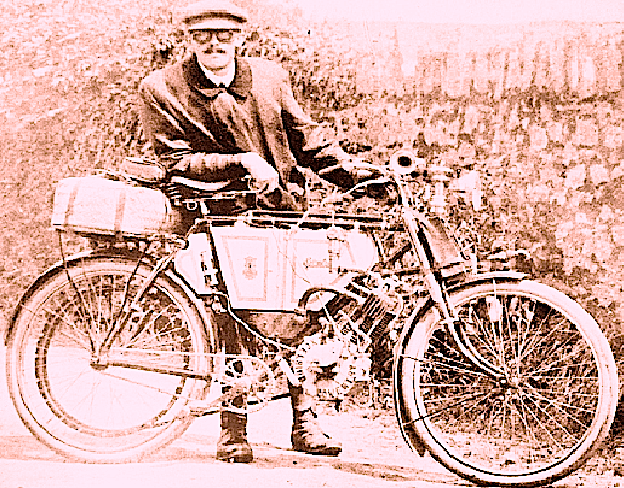
We ended 1938 with some ripping yarns; let’s start 1939, as The Motor Cycle did, with another story of a man and his machine.
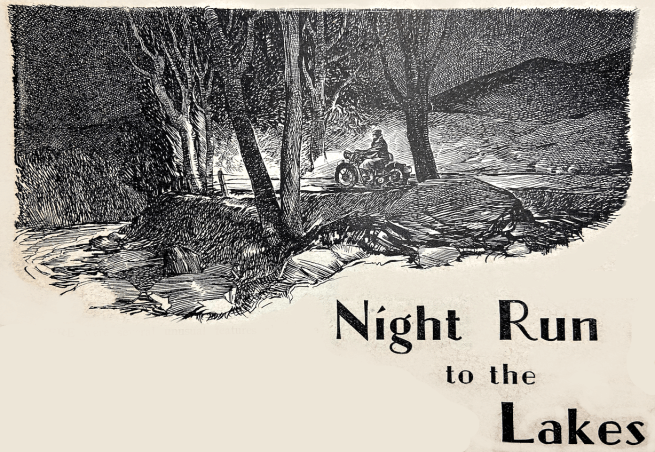
“THERE WERE SEVERAL unusual features about the journey. First, it was not until two hours before I actually started that I received the message and knew I was to travel some 300 miles across England. For various reasons my machine had not been used for fourteen days, and this fact gave me a momentary qualm. By a lucky coincidence I had been working on the machine during the morning: nuts were tight, the oil had been changed and the 3¾ gallon petrol tank was almost full. It was about the battery only that I had misgivings—obviously it could not be fully charged. Would it stand up to an all-night session? However, I decided to trust the dynamo, and comforted myself with the thought that even if my fears were realised, the controlled voltage would prevent any bulbs blowing. It was my intention to arrive at my destination, a lonely spot near Ambleside, in time for breakfast the next morning. I calculated that an 11pm start would leave ample time; therefore, after turning on the radio for the news bulletin, I settled down to enjoy a rest. My feelings were of pleasant anticipation mingled with excitement. Never before had I travelled all through the night. My longest day trip had been from Berlin to Aachen, and although the distance of the journey now planned was relatively insignificant, yet the thought of an 11pm start after a busy day made me think of myself almost as an adventurer. These conceited reflections were interrupted by the silver tones of the BBC announcer forecasting squally weather over most of England. I looked at the stars outside and laughed. Not even an English weather forecast was to be allowed to damp my ardour! At eleven o’clock, therefore, I set off from a little village near Basingstoke, in Hampshire, in the direction of Oxford. The Velocette pulsed with life, and glancing at the illuminated speedometer I saw that it showed 60-65mph—my usual speed on the open road, and one which the machine will maintain indefinitely. Shortly after leaving Pangbourne, my journey was all but brought to a premature close. On the crest of a hill I was suddenly confronted with two sets of head lights—a private car was overtaking a slow-moving lorry on the bend and was completely blocking the road. There was no time to stop—the only thing to do was to steer as near to the hedge as possible, and this was made difficult by the dazzling head lights of the car, which the driver had omitted to dip. For one awful moment I felt my coat brush against what I presume was the wing of the car, but somehow I squeezed through safely. My first reaction of relief was soon succeeded by anger, and turning round I gave chase to the offending motorist. I shouted as I came alongside, and the driver stopped immediately. I pointed out to him that I might have been killed through no fault of my own. “Poor old chap,” he kept on repeating, “horrible corner, wonderful driving, really scared me.” Something in his manner made me look at him closely. He was wearing a dinner jacket, and although he was not drunk his eyes had the glaze of a man who had been ‘doing himself well’. I took the number of the car and also of the lorry, and was minded at the time to report the matter to the police. Actually I have not done so, but surely there is a tremendous moral in this unpleasant experience. Soon I had passed through Oxford and was speeding towards. Bicester and Buckingham. High above, the half-moon was shining, not palely but with a reddish-yellow glow, making the night clear. A barn owl flew in heavy flight across the road; the beam of the head lamp exaggerated the whiteness of its wings. Suddenly above the noise of the engine rose the unearthly shrieking of a little owl, and I thought sadly of the heavy toll this bird takes of small bird life. For a few miles after leaving Buckingham my route took me along the main Birmingham road before turning off to Northampton. There was a great deal of heavy traffic. A number of lorries parked outside one of the numerous small cafés that cater for night drivers attracted my attention and, enticed by the thought of hot tea, I eagerly entered. The atmosphere was warm and friendly, but the majority of the men who were slowly sipping their huge cups of tea gave an impression of weariness. It was while running into Market Harborough that I had an amusing experience. A policeman darted from the shadows and waved a red torch frantically to and fro in front of me. I stood on everything and brought the Velocette to a halt in a commendably short time. “What is wrong?” I asked. The only reply was a portentous approach by the aforesaid policeman, who began gingerly to feel my haversack. This was too much. I searched my mind for any recent deed which could possibly be given a criminal interpretation, only to receive the ‘all clear’ signal from my untroubled conscience. It was with dignity, therefore, that I asked what foul crime I was supposed to have perpetrated. The policeman replied in a pleasant Midland voice that he was just seeing who I was. As my identity could not possibly be known to him, I thought this rather irrelevant, and questioned him further. It then transpired that an individual on a fairly new motor cycle—make unknown—had been ‘cracking’ automatic machines and removing their nicotine contents. All stations had been warned to keep a look-out for him. I left the policeman with mutual apologies—he for disturbing me, I for disappointing him. Soon I was running into Leicester. At Leicester I stopped at an ‘all-night’ garage, which I had previously looked up in my AA handbook. It was while the tank was being filled with petrol that the first ominous drops of rain began to fall. The garage had informed me that it was nothing, but remembering the weather forecast, I was not so optimistic. By the time I had reached the outskirts of Leicester it was really pouring, and I stopped to make myself as rainproof as possible. When I was about to continue, a small two-stroke Excelsior drew up alongside. Both rider and pillion passenger were hatless and neither wore anything in the way of anti-rain kit. I concluded, therefore, that they must be local lads out rather late. But to my surprise they enquired if they were on the Loughborough road, as they wished to reach Doncaster that night preparatory to going farther north. They then produced the smallest and, incidentally, grubbiest road map I have ever seen. It had obviously been used extensively, and in reply to my enquiry they told me that they had already toured Devon and Cornwall. I looked at their minute machine with its tiny light, and marvelled. From eyeing the mechanical I turned to the human, noted the single small haversack and the light overcoats of the two men, and marvelled still more, Here, surely, was enthusiasm, but in its complete unpreparedness, touched with imbecility. The ride between Derby and Buxton was one of the worst I have ever experienced. Heavy mist was added to the driving rain, reducing my pace to a crawl. Consequently, a heavy discharge showed on the ammeter. The beam grew dimmer and. dimmer, until finally it was only maintained by the current from the dynamo, and owing to the slow speed at which the engine was revving the output proved totally insufficient. I was reduced to revving up the engine for a couple of minutes; then I would continue until the battery again went dead, and the process would have to be repeated. By the time I had reached Buxton I had had enough. I sought shelter in a churchyard, ate some damp sandwiches and prepared to await daylight. At 4.30am I was on the road again, creeping slowly towards Manchester. Two things impressed me in these parts—first the early hour at which the factories appeared to be working; and secondly the large number of motor cycles on the road, presumably carrying their owners to work. At last I reached Lancaster, and smoke, drabness, and the treacherous surface of wet pavé were behind me. Before me lay the road to Kendal and the Lake District. Due to the excellent new road it seemed no time before I had left Kendal en route to Windermere. I went faster and faster, like a tired horse that is nearing home. Soon I was in the midst of this country of becks, mountains and lakes. As if to welcome me, the sun came out from behind the clouds, and the consequent play of light and shadow on the hills presented a constantly changing scene of indescribable beauty. It was a perfect end to my journey. But to descend to the mundane, so, of course, was an enormous breakfast and bed!”

The following tale of woe, also from the Blue ‘Un’s first issue of 1939, is noteworthy for two reasons. Primus, as far as I can recall (and I have spent a lot of time poring over the Blue ‘Un) this is the first mention of a Dave (he’s a well meaning idiot but so am I). Secundus, this is the second mention of baked beans in this timeline (1895 for the first in case you were wondering) and some would say it’s about time. OK Dave, do your funky thang.
“I SUPPOSE THERE ARE several contributory factors to this little tale. If Dave had not been a motor cyclist I should never have met him; also, if we had not both been fond of camping we should never have spent that night together; and I suppose Mr Heinz should be brought into it for making such delicious pork and beans. To get on with the story: We had been in for a dip, and, as usual, had very large appetites, so we decided on two tins of the aforementioned beans for breakfast. In fact, we were so hungry that Dave said he knew a quicker way of doing the beans than as per instructions, so I let him have his own way. With the Primus roaring at full blast he carefully balanced a tin on the flame. I reminded him about the theory of expansion—but no holes in the top for Dave! That was the secret—when the end bulged the beans were ready. I finished cutting the bread, and we both sat in our costumes and hungrily watched the tin—and it had certainly bulged visibly. Dave then poked it off with a stick and jabbed it with the tin-opener. I should imagine Vesuvius in an angry mood is mild to the spurt of steam and sauce that came from that tin! Nothing daunted, Dave put the other tin on the flame and then hacked the lid off the first one; he was right, the beans were done to a turn. We were just arguing about the pressure necessary to bulge the tins when a gun went off somewhere, followed by a howl from Dave. When I could appreciate the situation, there was no sign of the tin, the Primus looked very sick and was out, and Dave was plastered with beans, and yelling lustily. We picked them off as best we could, and every bean had left a blister. Dave couldn’t appreciate the joke —he cannot even to-day—but if you want to make him really annoyed ask him how he enjoyed riding five miles to a doctor in bathing trunks, then five back with yards of picric bandage round him, topped by the doctor’s multi-coloured bath robe. And, if you want to see a man look like committing a murder, ask Dave to show you how to cook pork and beans.”
PS—I found the tin as fiat as a pancake ten yards away, but I never found the pork.—TLH.”
NEWS FROM GERMANY: “Car thieves in Germany are to be sent to concentration camps.”
NEWS FROM ENGLAND: “Wandsworth Borough Council has recommended that the foreman gardener of the parks and open spaces committee be provided with a motor cycle.”
“FROM A READER’S Christmas card to the Editor: ‘Farewell 1938. Good luck to blown multis, spring heels, hydraulic brakes, pneumatic forks, unobtrusive performance and windscreens next year.'”
“BELGIUM, SWITZERLAND AND Holland have the densest traffic of a any European countries, excluding Great Britain. Belgium has 10.5 vehicles per mile of road, Switzerland 9.2, and Holland 9.”
“THE NUMBER OF diesel-engined vehicles in use in Britain has increased from 6,700 to 20,100 in four years.”
“MOTORIST AT LONDON court: “I saw the lady’s signal, but with women drivers you can never be sure what they mean.”
“VELOCETTE RIDERS won both Junior and Senior events in the Australian TT held on Boxing Day. Mussett and Hannaford (Velocettes) were first and second in the Junior TT, and Hannaford (Velocette) and Mussett (Junior Velocette) were first and third respectively in the Senior.”
“JOE CRAIG, the Norton team chief, has resigned from Norton Motors. It is stated that the Norton experimental department will continue to function as in the past, though without the services of Craig.”
“HOW SPEEDWAY TEAMS FARED— official results of 1938 competitions. Test Matches (England vs Australia), winners: England. World’s Speedway Championship, winner: AG Wilkinson; second, J Milne; third, W, Lamoreaux; fourth, L van Praag. International Matches (England and Australia vs Canada and USA), winners: Canada and USA. National League (First Division):1, New CroIRVINGss, 31 match points; 2, West Ham, 27; 3, Wembley, 27; 4, Wimbledon, 27; 5, Belle Vue, 22; 6, Harringay, 21; 7, Bristol, 13. National League (Second Division): 1, Hackney Wick, 24; 2, Norwich, 24; 3, Southampton, 18; 4, West Ham, 18; 5, Lea Bridge, 16; 6, Newcastle, 15; 7, Sheffield, 13; 8, Birmingham, 12; 9, Leeds, 4. ACU Cup: West Ham. National Trophy: Wimbledon. London Cup: Wimbledon. Provincial Trophy: Norwich. English Speedway Trophy: Belle Vue Reserves. Northern Cup: Newcastle.”
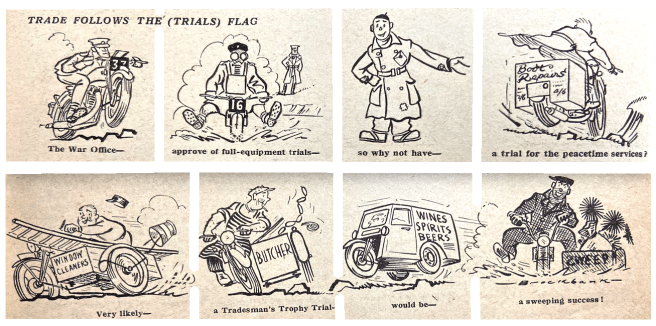
“THE FIRST QUESTION IS, ‘What is going to happen over the TT now that Nortons have dropped out for 12 months?’ It is going to be a bit odd, isn’t it? On the other hand, do you recall how often Nortons have won, and but for them the winner would have been a Velocette? I am not so very disturbed about Nortons giving the 1939 TT the go-by. Apart from anything else it is about time that those staunch supporters of road races, the Velocette crowd, had their full break—they seem to have been only seconds behind for years—yes, seconds over 264 miles. Moreover, they are thinkers and triers with any amount of brains and manufacturing skill. I shall be surprised if my faith in them as warders-off of the foreign challenge is misplaced. What is interesting is the question as to what Norton riders will do for 1939. As was remarked a week or two ago, no non-racing manufacturer can now say that the reason he abstains from racing is that he cannot obtain the services of one of the stars because they have all been cornered by Nortons. All the same, I cannot see many non-racing manufacturers blossoming forth. They are shy little birds, and after Joe Craig and his men and Harold Willis and his have set such a pace, and the whole racing world is thinking of multis and supercharging—well, it is a bit of a job, isn’t it? As the director of one famous concern remarked a few days ago, ‘The reliability of Nortons and Velocettes in the TT is amazing; these two firms have put the speed up to roughly 90mph average and still their machines are reliable. It is uncanny; what hope have we got of winning even a replica?’ ‘Yes,’ I replied, ‘but do you remember that magnificent demonstration of high-speed reliability by Rudges?’ Mr Director remembered it only too well since he was a rival in the same markets, but he countered my remark by saying, ‘Ah! yes, but who in these days of specialisation can take a standard job and hope to be in the replica class—even the bronze replica class?’.”
“WILL THE TT RACES continue? Is it desirable that they should do so? These two questions appear to the eyes of any sporting motor cyclist to smack of heresy. As it happens, however, both questions were answered in the negative last week by a manufacturer of world repute. His view is that the TT has been of no value to the industry for many years; that there is no prospect of it becoming of value on its present lines; and that the ACU, if it had been wise, would have remodelled the TT years ago. That the TT has been allowed to be the master of design instead of the servant is a main grievance, and we know only too well that it has done much to lead design astray. We also agree that supercharging has no obvious future as regards road machines, although essential for racing. There are other objections, not the least of which is that in these days of special machines the cost of competing is too great for the average manufacturer. The particular maker whose views we quote considers that the entry will steadily dwindle until the TT is no more. We are not so pessimistic. Moreover, we feel that the TT, by developing the multi-cylinder engine and placing it upon a pedestal can be of inestimable value at the present juncture. On the other hand, we consider that it would be excellent if the ACU ran an additional event limited to sports—as opposed to racing—models. The questions are, of course: ‘Would there be adequate support even for this?’ and ‘Would it be possible in these days of production-type racing machines to provide a race that was both fair and informative?’.”
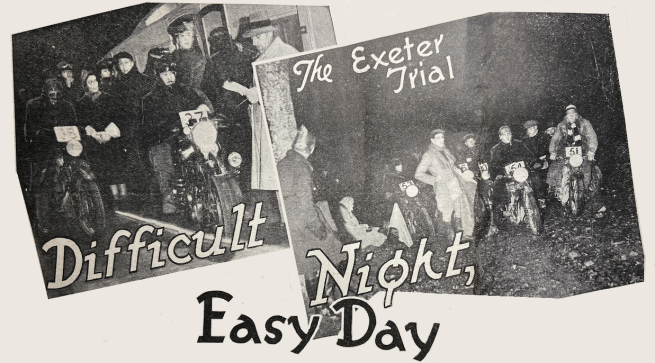
“A DIRTY night followed by an easy, not unpleasant day—that is a fair summary of the MCC’s Exeter Trial. As usual, the famous long-distance winter trial started from three points, namely, Virginia Water, Stratford-on-Avon and Exeter. In each case there was a night run of approximately 150 miles, ending at Exeter, where there was a stop for breakfast; then followed the trials section of the route which consisted of 148 miles and contained half a dozen observed hills. The finish was at Bournemouth. In a number of ways the trial was very different from its immediate predecessors. In the first place there was the huge motor cycle entry. In the list were no fewer than 205 solos, sidecars and three-wheelers —this large motor cycle entry for a long-distance night trial held in the depths of winter! Secondly, it was the first civilian event that the Army has supported in large numbers. All told, there were 68 officers and men taking part. The event took on a new and official-looking character, for all the Service riders were in uniform and riding WD machines. In addition, running along the route were Army trucks bearing fuel and oil supplies. Thirdly, this year every competitor had to use standard tyres—competition tyres were barred under the new ACU and RAC rules. Owing to the regulation demanding standard tyres the trial reverted somewhat to the old style of event as regards route and, therefore, difficulty. As usual, competitors had a go-as-you-please run during the night. All they had to do was to check in at their correct time at one specified point between their starting point and the breakfast stop. The competitors from Exeter started first—there were only 11 from this point; then the 25 from Stratford-on-Avon and, finally, the big London contingent from Virginia Water. Those starting from the Midlands wondered whether there would be any trial because there was heavy snow, and it seemed likely that farther on there would be blocked roads. One or two actually ‘phoned through to find out whether the event had been cancelled or not. The snow continued for the first dozen miles or thereabouts, and then ceased. The London men encountered very different conditions. After a bitterly cold day, during which the thermometer appeared to show no inclination to rise above freezing point, competitors arrived at the start to find that with all their many garments on—two of this and two pairs of that, and so on—they were actually hot. A south-west wind had swept across the country, bringing with it mild weather. “We are going to have a good run after all,” was the general comment, though some had more than a suspicion that the night would be wet. Because of the bitter day there were not the usual crowds of spectators—only a hundred or two instead of many hundreds. At half-minute intervals the competitors got under way and proceeded towards Camberley, Basingstoke, Salisbury and Shaftesbury, where the intermediate check was placed. Adventures came early. The night was now extraordinarily mild.
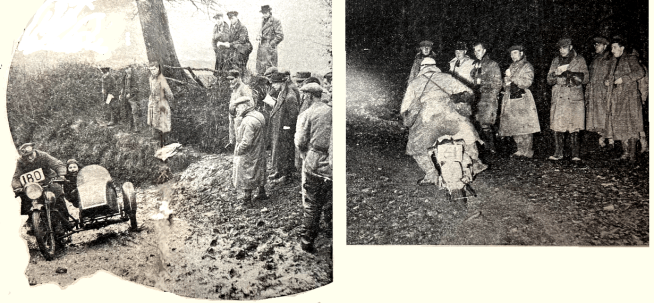
All that marred things was a slight drizzle—just sufficient to wet the roads apparently. Anyhow, the road down into Camberley glistened. ‘Just moisture,’ thought the average man, and hurried onward. Then of a sudden his machine might get into a slide, and he and his one-time mount would go skating along the highway side by side. Yes, that glistening surface was wet ice, and famous riders were to be seen riding along with their feet down. Ice—Then Rain! How many actually came off on this section will never be known—four were off in a matter of minutes and, to judge from the many scratches in the road surface caused by footrests, the total must have amounted to dozens. Lieut JF Rice (490cc Norton) was unlucky in that he had to swerve to avoid a skidding car that was coming fast from the opposite direction. Violent swerves and ice do not go well together; the Norton skidded and fetched up with the exhaust pipe off the stub at the port. However, with the aid of Lieut AK Ames, he was soon travelling onward again. Happily the ice did not last. The only real trouble in this direction the whole night through was the unexpected patch just before Camberley. Instead of ice there was rain—windswept rain. This started in earnest when the first men were approaching Salisbury Plain. Right from one end of the Plain to the other it was a question of grin and bear it. The rain, borne by the strong wind, acted much like a flail. The conditions were vile, and very glad were the competitors of the hot coffee and sandwiches that awaited them at the Blinking Owl, just before Shaftesbury. It was a very bedraggled crowd that hurried inside. The Army riders, wearing their service kit, seemed worse off than the majority; many of them were decidedly wet. From here competitors passed through Shaftesbury, with its check, and on to Yeovil, Chard and Honiton. One rider was seen in trouble with a puncture; it was a Vincent-HRD, and thus the owner was blessed with the Vincent quickly detachable wheel. At Yeovil the police were busy trapping in the 30mph limit—yes, even at three and four o’clock in the morning. There was also a trap in operation on the route from Stratford-on-Avon. Once the London competitors got on high ground they found themselves groping their way through cloud. For mile after mile this went on. Down in the valleys _it was clear, but only for a bit; on the last part of the run into Exeter there were patches of mist—not a lot of mist, but sufficient to be rather troublesome. Then the usual excellent breakfast at Deller’s Café and on to Fingle Bridge, near Drewsteignton, the first of the observed hills. Breakfast had the effect of making many feel sleepy. However, Fingle was soon to wake them up again! By the time the first men left Exeter the rain had almost ceased, but the night was still very dark, and the route to Fingle Bridge was not too easy to follow. The MCC had chosen a route to the hill which covered tortuous lanes, and JTC Courtney (348cc Ariel) was not the only one who slid into the ditch through taking a bend a little too quickly. The ascent of ‘Fingle’ on standard tyres and in the dark was not by any means an easy proposition at that early hour; yet, although the hill was wet, there was a surprising number of clean climbs. True, there was a path up the hill discernible in the light of the head lamp, but while most of the loose shale on the bends was absent, there were many large loose rocks about. Competitors had to restart after the first bend, and the second and third bends did not prove too difficult. Driver CFG Baker (490cc Norton), however, got too near the bank and had to foot, but GEH Godber-Ford (249cc AJ W), in spite of a series of terrific wobbles, buzzed his way up standing on the foot-rests. It was on the fourth and fifth bends that most people came to grief. These are close together, and there is an awkward ledge just round the fifth bend. SN Oxborrow (348cc Ariel) showed how. the bends should be taken—slowly and as wide as possible—and AGD’A. Sugden (499cc Vincent-HRD) made the hill look just as simple. DW Bray (497cc Triumph) was very unlucky, for, after a good slow climb he hit the rock ledge awkwardly and had to dab. Of the sidecar men from Stratford-on-Avon, FH Whittle (598cc Panther sc) and FW Stevenson (980cc Brough Superior sc) were easily the best—Stevenson drove up on little more than a whiff of throttle. After a valiant attempt with an oldish mount, LC Dagwell (598c Panther sc) had to give the hill best when the worst had been surmounted. First of the London starters was HN Toomey (990cc Brough Superior), who made a marvellous plonking ascent which stopped rapidly when he hit the ledge. TN Blockley (496cc BSA) was just as slow, but his machine surmounted the ledge without trouble. Private C Beatham (490cc Norton) made one of the most hectic ascents of the day; he rode through all the loose stones and rocks and disappeared still firmly hanging on to the model feet-up. Most of the Army men on this hill used speed tactics, which generally resulted in failure, and in between their ascents would often come a civilian making a slow and neat climb. Two outstandingly good climbs, after a series of failures, were made by SE Cunningham (497cc Ariel), who used his body for balance, and AE Hare (997cc Ariel), who trickled up the hill very slowly giving a perfect demonstration of slow pulling. AA Smith with his motorised bicycle failed to arrive; he had dropped out at Sherborne on the run down.
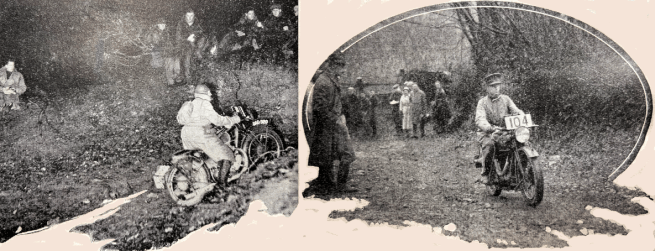
Probably never has Simms Hill with its maximum gradient of 1 in 2¾ proved so easy for a winter trial. Not only had a deep rut on the right-hand bend at the foot been filled in with tarmacadam, but there was tarmacadam in patches up the middle of the hill, and much of the usual slime at the sides had been washed away. The first trio to tackle the hill—JTC Courtney (348cc Ariel), CDT. Field (348cc Triumph), and CTC Cawsey (499cc Royal Enfield)—all made perfect touring climbs. Cpl HRC Bates (490cc Norton) hit one of the few rock outcrops with his back wheel, slewed sideways, but straightened up. RW Sutton (249cc Triumph) had a roughish passage near the top. Then came W Bray (499cc Royal Enfield), with a very neat pilot-jet climb. Already it was light enough for The Motor Cycle man to write his notes without the aid of a torch. Soon competitors were tackling the hill in daylight. Dvr CFG Baker (Norton) stood high on his rests, but hurriedly returned to the saddle when his machine wandered into the rough at the side. By dint of manhandling he got the machine under control again and disappeared safely out of sight. ER Osler (347cc AJS) was the first to come to a full-stop; he got in a rut near the top and after a few tinkles from his engine came to rest. EF Cope, with the two-engined BSA three-wheeler, went well for the first part of the hill, the two-stroke used to drive the back wheel emitting clouds of smoke. Suddenly the engine cut out as if the plug had oiled. SN Oxborrow’s 348cc Ariel sounded as if it were too highly geared, and he had to foot over the summit. In spite of bouncing, LF Clouder (990cc Brough Superior sc) stopped with wheelspin on the last 15 yards. HKG Deacon (249cc SOS) came to rest early on, and, after running backwards, toppled over. LC Dagwell (598cc Panther sc) carefully kept to the tarred portion as far as it went; where it stopped he stopped, with wheelspin. FW Stevenson (980cc Brough Superior sc), however, hurtled up with his machine hopping and leaping over the rough, making quite one of the finest passenger-machine climbs. JM West (494cc BMV) made a very fast and perfect climb. Pte RJS Scovell (499cc BSA) was equally good, while TN Blockley (494cc BSA) went up on the pilot jet and made as perfect a show as could possibly be imagined. 2nd/Lt ERD Palmer (490cc Norton) had bad luck: when going well and nearly over the summit his gear slipped out. Then EA Knight (494cc BMW) tried hard to pick the best possible path, but got in a slide and finally ended high up the bank. ET Pink (497cc Ariel) toured up quietly yet fairly fast. One after another the solo competitors made perfect climbs. Two who were not so fortunate were BSM Davis (490cc Norton) and Lt FC Faulkner (490cc Norton), both of whom ended up by smiting the bank. 0N Wilson (499cc Triumph) petered out, apparently through attempting to climb the hill in second gear…From Simms there were 30 miles of good roads with the route heading eastwards on the return to Bournemouth. Then Higher Rill, near Ottery St Mary, had to be tackled. This hill is straight and not very steep, and last Saturday the rain had washed most of the leaf-mould from the
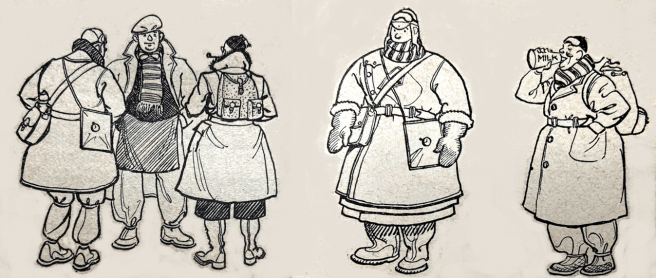
surface leaving a hard bottom with plenty of wheelgrip. Speed climbs were common, and of those seen the palm for the fastest climb of the day goes to L-Cpl PG Kent (347cc Matchless), who nearly made his valves bounce…JW Whittaker (498cc Matchless) treated the hill as though it were a main road. At the top of the hill the route followed a hard track for a short distance and then turned sharply to the right down a rather narrow track, the surface of which rapidly deteriorated. Soon the track began to descend sharply, and the surface was thick mud. On the right-hand side was a nasty drop, and many people later owned up to using a precautionary foot here to steady the model. At the bottom the track was even more slimy, and there were three deep water-splashes to be crossed. After this nastiness the ascent of Pin Hill seemed child’s play, and some riders, like 2nd-Lieut W. Darkin (490cc Norton), were so eager that they failed to stop at all at the stop-and-restart test. This test was timed: competitors had to travel as quickly as possible from the restart, which was held on a steep corner, to the top of the hill. Among the first 100 competitors, JF Hayes (1,172cc Morgan) and LC Dagwell (598cc Panther sc) made the best times. Very few men had difficulty on the re-start, but some failed to stop with the front wheel over the line. Easily the best of those seen was VM Beach (598cc Sunbeam), who stopped correctly and got away again without the slightest trace of wheelspin. Only a few miles farther on was another stop-and-restart test. This time the actual restart was timed, competitors being given three seconds in which to get away. The test was held on Harcombe Hill, the surface of which was firm and good…Some riders of small machines had to use their clutches a good deal on the re-start, and Signalman EW Barry (490cc Norton) had to lift and drop his clutch frequently to help his engine. No 13, J Bassnett (247cc Levis), who arrived among the late solos, was in such a hurry to get, away that he lifted his front wheel and was generally hectic. Water was running down Woodhaynes, the next hill, at the rate of many gallons an hour, with the result that competitors had only to keep their wheels to the path of one or other of the rivulets to have a perfectly hard, safe surface…Sigmn HL Overton managed the climb all right, but was very w-w-wob-wobbly. Lance-Cpl TF Light (490cc Norton) was one of the neater of the Army riders. In the case of Sigmn DEL Clements (490cc Norton), the grass at the upper bend exerted its usual fascination, but by good fortune and good handling he managed to get safely back on the hard going. Sigmn CJ Dennis (498cc Triumph) was not so lucky. He got on the grass, and after some wheelspin the engine spat back and he stopped. S. W. Pergunas (348cc Triumph) neatly wormed his way upwards. TC Munday (497cc Ariel sc) was going well when his gear slipped out; had he realised what had happened he would have had plenty of time to re-engage it and continue non-stop. Then WH Maddison (596cc Scott sc) snarled up in easy fashion…The last hill of the trial was Meerhay, a longish straight hill near Beaminster, and riders with clean sheets were rubbing their hands gleefully at the prospect of a ‘Premier’ and a ‘Simms Special Award’. But when they saw the re-starting point on the hill their spirits fell, because the surface was loose, stony mud. It looked much worse than it was, however, and even the majority of the sidecars got away without trouble. The hill itself was dead easy for solos, for there was a hard path all the way up, and for sidecars there was ample wheelgrip. One of the very unfortunate ones was R0 Wiltshire (997cc Ariel sc); soon after he restarted a large stone jammed up between his front wheel and tyre. By sheer engine power the outfit carried on for some 30 yards with the front wheel locked before crabbing into the bank. Before the stone could be removed the tyre had to be deflated. Sergt MAG Newberry (490cc Norton) had his feet at the ready for several yards after the restart, but eventually he put them on the rests. The front and rear springing of GC Goffe’s Vincent-HRD could have had very little damping because both front and rear forks were working fully as he made a slow climb standing on the rests…RW Praill (1,208cc Harley Davidson sc) simply rocketed up the hill at speed. JG Tibbitts (497cc Triumph sc) had to fight hard to conquer a good deal of wheelspin, and W. Hamilton-Griffiths (730cc BMW sc), after a lot of trouble getting away, slewed about wildly on the hill…Fast climbs were made by HW Croucher (598cc Panther sc) and AC Reynolds (497cc Triumph sc). JFS Polden (497cc Triumph sc), after a good climb of the hill, had trouble with his clutch and at the top of the hill had to do some rapid thinking in order to get the outfit to the finish. But only first-class roads remained, and at the Grand Hotel in Bournemouth, where tired men removed mud-stained garments, the general comment seemed to be that so far as the hills were concerned it had been one of the easiest ‘Exeters’ ever—in spite of the standard tyres.”

“THE RESULT SHEET of the Exeter Trial makes interesting—and surprising—read-ing. For instance, it reveals that the Army well and truly beat the civilians in the team competition, claiming five of the first six places. The winning team represented a Territorial unit—the 235th Anti-Aircraft Battery RA (TA)—while second and third places went to Regular Army teams; then comes another Territorial team, followed by the first civilian team. Another interesting point that shows the comparative easiness of the trial—in spite of the fact that competition tyres were banned—is that of the 161 finishers in the motor cycle classes no fewer than 95 gained premier awards. In addition 33 gained silver medals and 15 bronze medals. Seventeen had no award, one award is held over, and there were 23 retirements. The special Simms Hill award was claimed by 51 motor cycle competitors. TEAM AWARDS. 1, 235th AA Battery R.A. (T.A): Gnr RF Andrews (497cc Ariel), Gnr DH Street (497cc Triumph), Gnr AJ Newby (349cc ‘Triumph). 2, 4th Bn Royal Tank Corps: L/Sergt JT Dalby (499cc BSA), Pte RJ Scovell (499cc BSA), Pte C Beetham (490cc Norton). 3, 10th Royal Hussars: SBM TD Davis (490cc Norton), Sergt SH Archer (490cc Norton), Corpl RG George (490cc Norton). 4, City of London Signals (TA): Sigmn EJ Angell (490cc Norton), Sigmn WA Barry (497cc Triumph), Sigmn DEL Clements (490cc Norton). 5, Team No 6: AE Hare (997cc Ariel), F Gooding (348cc Ariel), LG Atkins (346cc New Imperial). 6: 22-56th Field Bt RA: Bdr F Cockerill (490cc Norton), Bdr P Isherwood (490cc Norton), Bdr AT French (490cc Norton). The 1938 MCC Team Championship was won by a team of sidecars: RW Praill (1,208cc Harley-Davidson sc), FW Stevenson (980cc Brough Superior sc), FW Osborne (498cc Coventry Eagle sc.). The only motor cycle member of the MCC to qualify for a Triple Award by winning premier awards in the Land’s End, Edinburgh and Exeter trials is FW Stevenson (980cc Brough Superior sc).”
“AT THE EXETER TRIAL civilians, whether competing or spectating, were frankly shocked at the grotesquely unsuitable clothes in which the rank and file of Army motor cyclists were set to contest a winter trial by night and in bad weather. However, probably before long there will be a new issue. The specification submitted to the Army tailors will doubtless, stipulate that the new bad-weather riding kit shall be: (a) Smart. (b) Durable. (c) Warm. (d) Drencherproof. (e) Untearable. (f) Inexpensive. And that is a specification which, I suggest, will not easily be filled.”—Ixion
“HAVING READ THE LETTER from ‘JRT’ I feel that I must make some reply on behalf of the so-called ‘soft’ brigade. It may be that ‘JRT’ rides his machine only in fine weather; if so, there is some excuse for his non-appreciation of a windscreen. However, I have to ride my machine in all varieties of weather, and I can assure ‘JR’ that I have failed to find anything funny in trying to make headway against a gale with rain like needles in my face„ especially at night time. Thanks to the articles in The Motor Cycle I purchased a windscreen which had satisfied ‘Torrens’, and I can now ride anywhere in any weather at any speed without sitting in a pool of water and, what is more important, I can see where I am going. In closing, I would like to point out that, as a rule, what The Motor Cycle advocates today becomes reality to-morrow—in spite of opposition from the so called ‘tough guys’.
A Woolfenden, Huddersfield.”
BLUE ‘UN READERS recorded their running costs; these fuel consumption figures make interesting reading: 1937 BSA Empire Star, 80mpg; 1938 BSA Empire Star, 84mpg;1937 349cc Velocette MAC, 85.7mpg; 1938 498cc Scott Flying Squirrel, 62.5mpg; 1937 500cc Sunbeam Lion, 80mpg; 1938 Triumph Speed Twin, 70.3mpg; 499cc Rudge Special outfit, 57mpg; 1936 Panther M100 outfit, 53mpg; 1934 Panther M100 outfit, 68mpg; 1938 600cc sidevalve Ariel, 80mpg; 1937 1,140mpg Royal Enfield outfit, 48mpg; 1938 150cc ohv New Imperial, 105mpg; 1933 350cc Levis, 89.6mpg; 1936 Francis-Barnett Cruiser, 90mpg; 1935 BSA ohv 250, 90mpg; 1934 990cc Matchless V-twin outfit, 50.24mpg; 1937 500cc Ariel Red Hunter outfit, 54mpg; 1938 500cc Rudge Special, 84mpg; 1937 250cc Red Panther, 108mpg; 1936 BSA ohv 250, 88mpg; 1938 New Imperial 350cc 46D, 81.5mpg; 1938 Triumph 350cc Tiger 80, 87mpg; 1936 Velocette 250cc MOV, 116mpg; 1934 Scott 596cc outfit, 40mpg.”
“EIGHTEEN MOTOR CYCLE rallies were held in Italy last year, attracting 11,300 clubmen.”
BMW PRODUCED its 100,000th motor cycle. More than 80% of the new motor cycles registered in Germany were under 250cc.
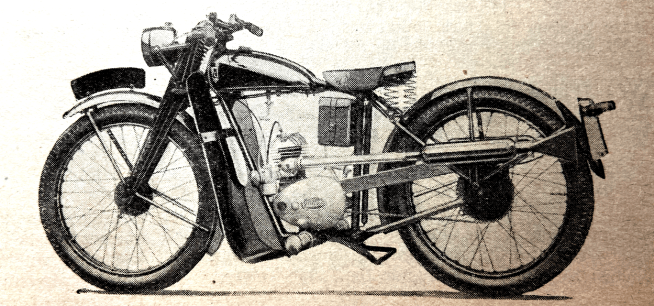
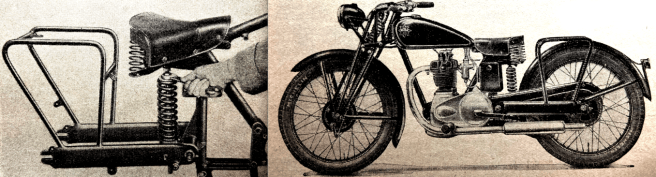
A NEW LIGHTWEIGHT which is to be sold at the extremely reasonable price of £21 10s has been introduced by Pride and Clarke, 158, Stockwell Road, London, SW9 It is known as the P and C Cub, and is powered by the well-known Villiers 125cc engine-gear unit. This unit is mounted vertically in a simple loop frame which is used in conjunction with pressed-steel forks. Dunlop tyres of 2.75in section are fitted, and there is a comfortable Lycett saddle. Weather protection is provided by wide legshields, which are anchored to the front down tube and brought back at the bottom as far as the footrests The fuel tank, which is of pleasing shape, holds 1½ gallons of petroil. It is finished in black, as are all the cycle parts of the machine. The chromium-plated exhaust pipes run straight back from the engine ports to black tubular silencers which are fitted with fishtails. Normal controls are fitted, and they include an off-side brake pedal and lever throttle control. Equipment, which is included in the price of £21 0s, consists of Villiers direct lighting, a tyre inflator, a tool kit in a metal case mounted high up on the saddle down tube, and a bulb horn.”
“WITH ALL THE UNIFORMS and the Army trucks carrying fuel and oil encountered on the route the Exeter Trial was strangely reminiscent of the International Six Days Trials staged by Germany. What was interesting was the wonderful improvement in the standard of riding by the Army men. There is no doubt about it, the entry of the Army into trials has made a world of difference in this direction. Many of the men are rapidly coming into the ‘star’ class.”
“WELL, HARDLY IS THERE news of Joe Craig’s resignation from Nortons than along comes an announcement of his entering the service of another famous firm. Joe is not to leave the motor cycle world, thank goodness. Neither the aircraft nor the automobile industry is to claim him. Instead, on February 1st he will take up his duties with BSAs as Development Engineer—all very, very interesting.”

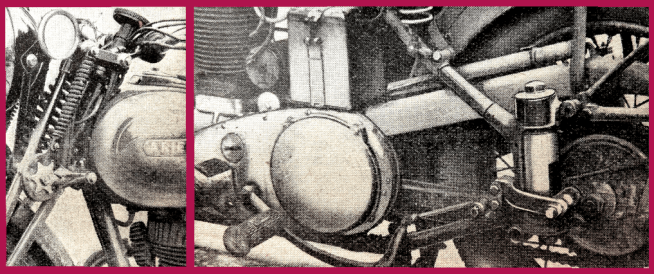
“ONE OF THE OUTSTANDING features of the last Earls Court Show was the number of manufacturers who were showing spring frames for the first time. Among these was the Ariel Company, whose design attracted a great deal of attention. The suspension is of the plunger type situated at the rear fork ends, but the design incorporates a link action which ensures that the rear chain tension remains constant. Recently, the latest edition of the famous 500cc Red Hunter with rear suspension has been submitted to The Motor Cycle for road test. Throughout a very severe test under bad conditions the model behaved splendidly. On first acquaintance with the Ariel the steering seems to be unusual. There is no feel of the rear wheel as with a rigid-frame machine, with the result that there is an impression that the steering is not positive. In a very few miles, however, the rider becomes accustomed to the springing and this feeling rapidly disappears. Thanks to the excellent suspension the machine inspires confidence in the rider when conditions are bad. As a result of the road-holding, greasy roads could be ridden over at higher speeds than would have been safe with a rigid-frame machine. For town work the steering was at its best with the fork dampers slackened right off. On the open road some damping of the front forks is required, but much less than is normal with an unsprung machine. It is probably on the open road that the springing of the Ariel is most appreciated. Whereas in the past on such models the cruising speed had been limited by the road surface, with this new Ariel the cruising speed is limited solely by one’s feelings for the engine. Speeds of 60, 70 and even 80mph can be reached and maintained in absolute comfort and safety, and it was found that on long runs a cruising speed of between 60 and 70mph was perfectly safe. These speeds may seem dangerously high to owners of unsprung machines, but with the Ariel only the speedometer gives the clue to the speed that is being maintained, for at 60mph and over on straight roads there is little, apart from the wind, of the sensation usually experienced. However, it is not only on straight roads that high speed can be used, for the Ariel corners extremely well. The rear wheel holds the ground, with the result that the machine is very stable and can be leant well over with every confidence. The limit here is determined by the central stand, which can be criticised for being somewhat low for really fast cornering. The steering was light at all times and only at really high cruising speeds was a ‘bite’ of steering damper used, and then purely as a precautionary measure, for the Ariel never showed any tendency to wobble, even at its maximum. Cornering was effortless whether at high or low speeds and the steering was sufficiently light to permit the machine to be ridden feet-up at less than a walking pace. Rear suspension obviously improves the braking of a machine, and this was particularly noticeable with the Ariel. On wet roads, instead of the rear brake being of very little use, it was found that the brake could be used quite hard without the rear wheel locking. Both brakes were extremely powerful and on wet or dry roads they could be used hard with safety. During the performance tests the braking figures were taken on damp concrete and in the circumstances the figure of 36ft stopping distance from 30mph is very good indeed.
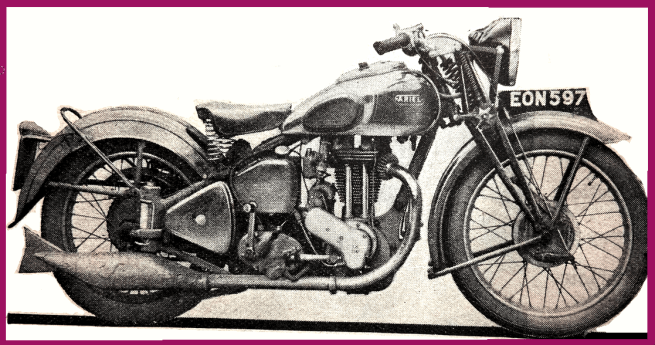
A criticism of the rear brake pedal, which applies to many machines, is that it has no adjustment for position. This criticism is almost the only one that can be made of the riding position or controls. The handlebar shape is excellent and the controls are easy to use. There is a full adjustment for the footrests and gear-change pedal, and the relation of saddle, handlebars and footrests is good. For a heavy man stronger saddle springs needed specifying, for the saddle bottomed on bad roads. The controls were all very pleasant to use. The clutch was light and absolutely free from drag, and bottom gear could be engaged without noise at all times. The gear change was always positive, although rather slow in the upward direction, and the throttle and front brake controls have a good relationship for comfortable use. As usual, the Ariel rubber mounting of the handlebars proved most effective. In the discussion of the spring frame, high cruising speeds have been mentioned. Obviously these would be impossible without a very good engine, but the Red Hunter engine is well up to the work required. The motor in the machine tested definitely had ‘punch’ and yet it was not at all harsh. When cruising at 60mph the machine would accelerate briskly up to 70mph at a touch of the throttle, and the acceleration throughout the range was particularly good. The acceleration from a standing start is outstanding, and the speed of 75mph which was attained at the end of the ‘quarter’ is a very good figure even for a super-sports 500. When the performance figures were taken, Brook-lands was not available for mean maximum speeds. However, with the rider lying down on the tank the speedometer would reach and hold 90mph in top gear (4.7 to 1) and frequently on the open road the speedometer needle was pushed past the 80mph mark with the rider sitting normally in the saddle. The speedometer was checked and found accurate at 50mph, and during the test the Ariel covered a timed quarter-mile at over 80mph in spite of an inadequate run. The third gear maximum of 80mph by speedometer was held comfortably. In spite of its very high performance the Ariel is a gentlemanly machine. On an ethylised fuel—on No 1 petrol the engine pinked rather easily—the machine could be throttled down to 14mph in top gear with the ignition fully retarded, and provided that the ignition control was used the machine would accelerate well between 20 and 30mph. In 30mph limits it was found desirable when using top gear to have the ignition slightly retarded to avoid any harshness. Slow running was in keeping with the general characteristics of the engine. With the ignition retarded the tick-over was slow and positive—a notable feature of the Red Hunter engine. Starting was as a gentlemanly procedure at all times. Even when cold the engine would start on a light throttle opening with a retarded ignition setting, and powerful kicks were unnecessary. The totally enclosed valve gear was commendably silent, but under certain conditions a little, piston slap could be heard. The exhaust note was very subdued—at low speeds it proved only a whisper and at high revs it never rose above a pleasant burble. Oil consumption throughout the test was negligible, and the whole unit kept absolutely free from oil leaks, although the machine was severely thrashed for hundreds of miles. Another point is that there was no blowing from the oil tank. As regards petrol consumption, at a maintained speed of 40mph this worked out at a fraction under 90mpg. To sum up, the Red Hunter Ariel with rear springing combines a high performance with a remarkable degree of comfort. It is easy to start, has a very quiet exhaust, and is very well braked.”
“THE BRUSSELS SHOW again lives up to its reputation for revealing both novelty and interest. The display includes machines ranging from tiny veto-moteurs to massive 1,000cc flat-twins. Spring frames and shaft drive are in evidence. In addition, there are several examples of sidecars that for sheer luxury and beauty of line are probably the equal of any produced. An outstanding sidecar exhibit is the Novi—a newcomer to the Continental market. The pressed-steel body has attractive sports-car lines, and this motif is continued even in the case of the wheel, which is of pressed-steel construction with a large hub cap. A single-tube chassis with a girder-type transverse rear member is employed and the suspension is by two rearwardly placed tension springs, each with its own friction damper. Another interesting sidecar on view is the Fox.
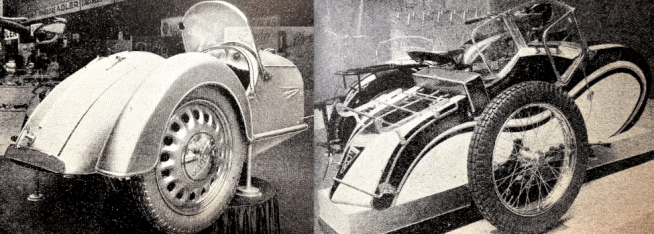
The body has typical sweeping Continental lines and with its deep sprung cushions and three-piece windscreen represents real luxury. The chassis is of the rectangular tubular type and the body is attached to long leaf springs anchored mid-way on the side members. Independent suspension of the wheel is arranged by a pivoting lug attached to a short ¼-elliptic spring. Features of the FBS sidecar are an immensely strong chassis and tension springing. Models are shown with disc as well as wire wheels. Here again smartness combined with comfort is a feature of the body design. Among the motor cycle exhibits the big Ready range is prominent. These are orthodox machines with Villiers engines in 125, 200 and 350cc sizes, and with JAP engines of 350 and 500cc in both side- and overhead-valve forms. Burman four-speed gear boxes are employed on some of the models. One 500cc model on view has plunger-type rear springing, similar in many respects to the British type, except that the springs are exposed. Another interesting feature of the larger machines is a rubber damper on the front forks; this consists of a block of rubber fixed to a plate on the top of the fork members. A spindle passes through this rubber and moves
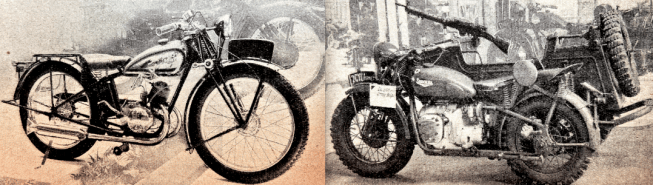
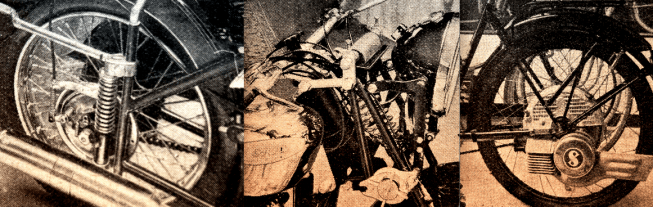
relative to it as a result of cranked top links. In addition to this rubber damper there are normal friction-type dampers. Sarolea’s high-spot is a new 1,000cc unit-construction transverse twin. It is shown in military form with a machine-gun-equipped sidecar attached. In many ways reminiscent of the BMW, it is a massively built machine with double barrel-spring forks and a duplex cradle frame constructed partly of tubes and partly of girders. Another unit-construction transverse twin to attract attention is the 1,000cc FN that was introduced last year. It has an extremely compact side-valve engine with aluminium cylinder heads. A military model is shown equipped with a large external air cleaner and a specially braced frame. This firm specialises in unit-construction, and the system is applied to all their single-cylinder models. Gillet shows a new 125cc two-stroke of exceptionally clean design. The engine is built in one with a three-speed gear box and the unit is inclined forwards in a neat loop frame. Touring and sports models are available; in the former case a single-port engine, measuring 56x50mm., is employed, while in the latter the engine measures 52x60mm and is of the two-port type. Other features include a detachable aluminium cylinder head and flywheel ignition. Several examples of the neat German Saxonette two-stroke attachment for bicycles are on view. It has a 60cc engine and drives the rear wheel through a reduction gear of 17 to 1. A flywheel magneto is fitted, and there is direct electric lighting.”
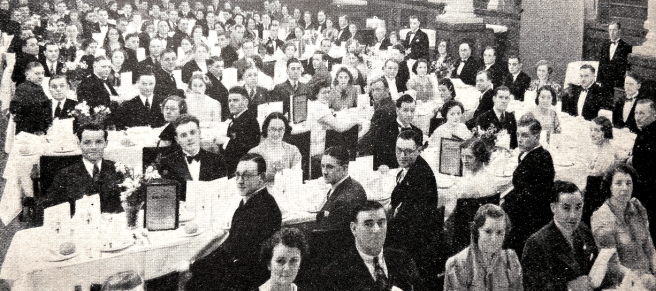
“IT IS RATHER A HABIT in these days for people to make statements and end by asking: ‘Is it a record?’ However, are there even half a dozen clubs with a membership of over 100 who can claim that at their annual dinner and prize presentation every single one of a long list of award winners was there to receive his prize? This happened at the annual dinner of the Mont’ Christie MCC, which was held at the First Avenue Hotel, London, WC1, last Thursday. It can be said to be typical of the club. Harold Daniell remarked after the dinner that he had never come across a club like it. He is right: this crowd of enthusiasts is more like a huge happy family than anything else. It is a big social club as well as a sporting organisation. How it thrives can be gathered from the fact that although this was only the fifth annual dinner there were over 150 present.”
“THERE WAS THE USUAL merry party at the Motordrome, Greet, Birmingham, when the Birmingham MCC held their annual prize distribution last Saturday night. In charge of the proceedings was Mr Harold Simms, the popular president, and many prominent riders turned up to support him and to collect their awards. A typical telegram came from Allan Jefferies, the reigning British expert, and it came from Dublin of all places, pointing out that the Club had chosen the wrong night, and that he couldn’t possibly swim all that distance in the time. Among the ‘personalities’ present were Bert Perrigo, seriously considering a ride in the forthcoming ‘Colmore’, Fred Povey, George Holdsworth, who took away a wonderful array of pots—not all his own, however—Harold Tozer, Club Captain Vic Brittain and Jack Amott.”
“I WAS MOST PLEASED to see ‘Nitor’ urging motor cyclists themselves to reply to criticisms of motor cycling in the local Press. Motor cyclists and motor cycle dealers up and down the country should be the first to reply to criticism of this kind, and, as ‘Nitor’ points out, local defence of motor cycling interests carries much greater weight with local editors than replies from the Manufacturers’ Union. Too often motor cyclists and motor cycle dealers send me Press cuttings of criticisms days after they have appeared in the local Press, when replies, by reason of their delay, lose half their value as ‘news’. Some time ago I circulated a series of standard paragraphs to a large number of motor cycle dealers and to motor cycle clubs, through the ACU, dealing with safe design, pillion riding, accident statistics, and the like. I shall be pleased to send helpful suggestions of this character to any of your readers who care to communicate direct with me. In conclusion, may I urge every motor cycle club to appoint a local Press secretary, whose task it would be to follow up and reply to local criticisms?
HR Watling, Director, The British Cycle and Motor Cycle Manufacturers and Traders Union, Coventry.”
“NITOR IS RIGHT when he says that motor cyclists should personally answer any criticism of motor cycling that they see in their local paper. Motor cycles, like dance bands and crooners, are considered by editors to be safe subjects for criticism because those who are capable of replying in their defence seldom bother to do so. If, however, every derogatory remark was answered by a flood of letters from local riders the editor could realise that he is more likely to decrease than increase his circulation by adopting an anti-motor cycling attitude, and the attacks would cease rapidly.
Leonard Black, Press Secretory, London MC Touring Club, London, SW7.”
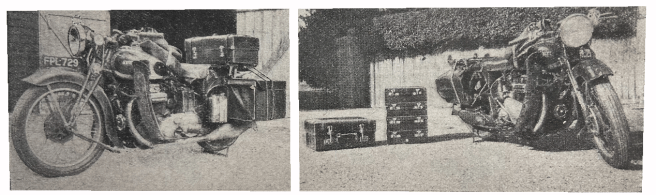
“IN VIEW OF THE CORRESPONDENCE that appears from time to time on the subject of carrying luggage on a solo, perhaps the enclosed snaps of my 1,000cc Ariel equipped for this purpose might be of interest. The disposition of luggage as shown completely solves the problem where no pillion rider is carried. The arrangement consists of two double-sized pannier bags, each containing two small suitcases, made up for me by Messrs Godfrey’s, and across the top of the rear mudguard a luggage carrier taken off a Steib sidecar. This latter accommodates, a large expanding suitcase. Suitable supporting brackets were made up for the panniers, though the greater part of the road shocks are taken by two stout leather snaps which fasten to the underside of the panniers and pass round and over the luggage carrier and buckle together over the top. Thus equipped, last September the ‘Squariel’ and I started for Lourdes in the Pyrenees, a distance of nearly 800 miles from Dieppe. It rained nearly the whole way; nevertheless, a cruising speed of between 50 and 60mph was maintained for most of the time, and the luggage never shifted once. On the return journey a fortnight later the weather was fine, and a speed of between 60 and 75mph was held over most of the roads. Despite the extra weight over and about the tail, the steering was not adversely affected up to 70mph, and between 70 and 80mph it even seemed to be greatly improved. Over 80, however, a slight snaking sensation was noticed, and this rapidly became worse as the speed increased. This, however, could probably have been rectified by increasing the pressure in the rear tyre, had higher speeds been desired, Reverting to another subject—how about ‘Pullets’ as a name for the new motorised bicycles? I think this would suggest power in miniature, which is what seems to be wanted.
H Trevor Battye, Gt Missenden, Bucks.”
“I SHOULD LIKE TO ask if any of your readers remember the twin-cylinder Panthette that was on the market about 10 or 12 years ago. I recently purchased one, and have wondered why this great little bike did not become more popular. For easy starting, smoothness, acceleration, roadholding, mpg, and many other good features, I have not ridden anything better. We in New Zealand are very envious when we read the prices of motor cycles in England; we have to pay almost double for our machines. If we could buy a 500cc ohv for £60 or £70 there would be a great increase in motor cycle sales, but there doesn’t seem to be any chance of that for a long time yet. British bikes have the monopoly now, and only occasionally are old Harleys and Indians seen on the road. Also, at all grass-track meetings Rudges, Velocettes, Ariels, AJSs and JAP-engined bikes form the majority of the entries. Unfortunately, the meetings are few and for between, and reading of the many events taking place all over England also gives us some cause for envy. However, we are very keen here in New Zealand, and we follow the racing at Brooklands and the international road-racing very closely. Stanley Woods, Freddy Frith, etc, are very familiar names to us, and we certainly thank The Motor Cycle for all the information we get from it.
NF Walker, Otaki, New Zealand.”
“ARGUMENTS REGARDING THE various types of motor bike are always very bitter when sailors collect in the mess. Many of us have our own mounts, and after a day’s strenuous exercising off Portland it is a thrill beyond compare to get the bus out of the local garage and enjoy the soothing effect produced by burbling along beautiful Dorset lanes. What is the Navy’s opinion of the sport? ‘Just great!’ The bike has to be used for evening runs and, as in my case, for week-end leave. The 140-mile run to my home in Woolwich is looked forward to the whole week. Checking over the model—filling the tank and seeing to tyre pressures, etc—is a regular Thursday night job. Friday night sees a score of us from this flotilla forming a regular procession through Weymouth and on to the London road. In spite of crises, foreign cruises and patrols, Jack is always glad to get back aboard his ”Beam’ or ‘Beesa’ and share the joys of the open road with that great gang of fellows, motor cyclists.
‘OK Supreme’, Portland.”
“THE LEINSTER CLUB’S Patland Cup Trial provided another win for Allan Jefferies (349cc Triumph). He was runner-up to Stanley Woods last year, and won the 1937 event. It was unfortunate that he and Woods could not renew their duel this year, but the Irishman did not feel his injured hand sufficiently well mended to chance risking it in so strenuous an event. Owing to difficulties with landowners the promoters had had to find an entirely new course for their classic event this year. They succeeded in finding one that would maintain the Patland tradition all right, but its potentialities had not been too accurately gauged. It was appreciated before the start that, owing to a stiff climb up the Three Rock Mountain, difficult moorland going, time-losing sections through some disused sandpits and only a few yards of road per 6½-mile lap, it would prove difficult, if not impossible, for everyone to finish before dark with a normal time limit in operation, and the stewards decided to cut the number of laps from four to three. The result showed the wisdom of the decision. There were 38 starters, of whom only 14 finished within a 40min time limit (representing a 10mph average), and a further ten, including CH Manders (whose Excelsior broke a chain), were too late to be included in the results. The best time was made by Allan Jefferies, who averaged just over 12mph, but the young Dublin University rider, Peter Gill, riding a borrowed 348cc BSA, was only 2½min slower, a particularly meritorious performance. Next were Yorkshireman Dick Wilkinson (348cc Panther) and the Irish trials champion and International Six Days rider, Aubrey Archer (497cc Ariel), both 18min late. Archer was the only 500cc machine rider to get into the fastest half-dozen, the others all being on 350cc machines.”
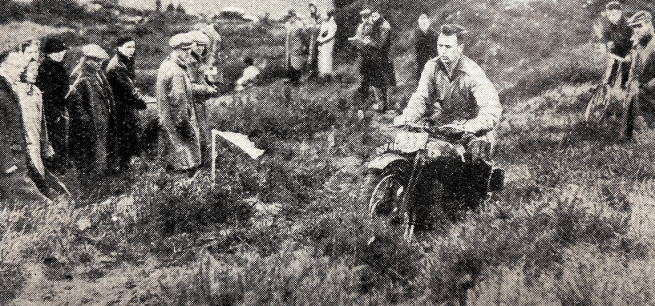
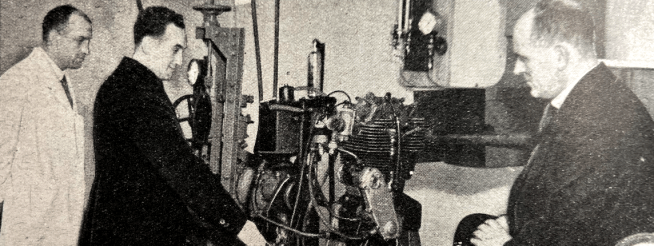
“IN THE RACING GAME few firms have done more or gained a more enviable reputation than the Velocette concern. For years they have been producing machines which, on all European courses, have thrilled the watching crowds. Their successes have been numerous, but for a considerable time the Tourist Trophy eluded them. Although this is true, as a bald statement it gives an entirely false impression and might lead those with in-complete knowledge to believe that Velocette machines have given a poor account of themselves. Actually, over the past three years, in 800 miles of racing in the Senior TT there has been a total difference of only 47 seconds between the winners and Velocettes—as long as it would take you to walk 100 yards! There cannot be very much wrong with a machine which can show such excellent lap times over the difficult Isle of Man course. Nevertheless, Veloce are not satisfied, and they feel that the time has come when it is necessary for them to produce something different if they are to continue to hold their own with the remainder of the world’s best. They do not take the view that new regulations should be devised, restricting the type of machine which should be raced…In the Velocette factory at the moment a machine is being evolved in accordance with modern racing requirements. The firm is determined to do its utmost to advance motor cycle design, to uphold the prestige of the British industry throughout the world, to keep abreast of subsidised foreign efforts and to blunt the thin end of the wedge by means of which the foreigner is attempting to undermine the popularity of the British motor cycle. The machine that is being worked upon is a supercharged twin designed to eliminate all the inherent defects and disadvantages that attach to flat-twins, either transverse or otherwise, V-twins, or multis having a greater number of cylinders. This machine is being considered entirely from the racing angle, it is being built solely for racing, and no detail which is thought necessary in a successful racing machine will be sacrificed on the grounds that its exclusion would, in the future, render it simpler to make a production job. At the same time, preliminary development has brought to light the fact that the design possesses many features which would be highly desirable in a touring production, and it seems likely that development will not cease with the completion of the racing machine. From stem to stern this is a new design; the makers have started with a clear piece of paper; they have endeavoured to empty their minds of everything they have done in the past and to bring completely fresh ideas into being. Every part, with the exception of such items as electrical equipment, carburettor, tyres, and so on, is being made in the Velocette factory. Engine, gear box, transmission, and frame are to be of Velocette design and manufacture.”
“OFFICIAL EXPORT FIGURES just issued show that £1,130,374 worth of British motor cycles, parts and accessories were purchased abroad during 1938. The value of the actual machines exported was £811,003. Of this total, Australia purchased £261,705; Union of South Africa, £61,294; other British countries, £153,324; the Netherlands, £39,152; and other foreign countries, £295,528.”
“OFFICIAL REGISTRATION FIGURES show that 2,560 motor cycles were registered for the first tune in November 1938, compared with 2,226 in November 1937. Machines in the under 150cc class showed the biggest increase with a total of 402 compared with 153 in the corresponding month a year ago. Registrations in other classes were: 150-250cc, 703; over 250cc, 1,179; passenger machines, 276.”
“TWENTY YEARS AGO there were 119,000 motor cycles in Great Britain ; the figure in these days is nearly half a million.”
“PRODUCTION of New Imperial motor cycles has now been resumed, and it is stated that, except for the new Grand Prix models, orders can be accepted for immediate delivery. These two GP models are not being put into production for the time being. It will be recalled that Mr Jack Sangster recently took over New Imperial Motors as a going concern.”
“NEARLY A QUARTER of a million people are directly employed in the British motor manufacturing industry.”
“RECKLESS DRIVERS on the North Circular Road on February 5th may find themselves televised during an interview with the police.”
An issue of the Blue ‘Un devoted to attracting converts to motor cycling included some words of encouragement from…who else?
“HOW I ENVY THOSE many lads and lasses who will make the motor cycling plunge this coming season! Even my aged marrowbones still tingle when I recall the thrills of my first purchase and my first rides, long years ago. I am still uncertain wherein rests the real fascination of motor cycling, and why it is so distinct from motoring on four wheels, even if the four wheels support some super-sports two-seater. The sensation is, of course, compound. It is built up of fun, health and utility. Of the trio, I think perhaps that the fun has always bulked largest with me—the zest of novelty, of getting away from familiar surroundings, of speed, of pitting one’s wits against machinery (pretty unreliable machinery in my novitiate!), of zooming uphill, of getting to know Britain from end to end, of new companions, of competition, of defeating and enduring slime, fog, ice, gales, darkness and storms. And with all this goes that delightful sense of physical fitness—only the motor cyclist ever learns the peculiar bodily pleasure of tissues supercharged with oxygen, muscles invigorated without being wearied, a brain refreshed by forcible detachment from the daily worries; he and the camper form a class aloof in this respect. Finally, there is utility. I suppose I have motor cycled over half a million miles at an average cost of well under a penny per mile; by no other means could I have travelled so far and so cheaply in one short life. It sure is a great game!”—Ixion
“THIS PARAGRAPH IS ADDRESSED to those aspirants who can afford a miniature, listed at perhaps a trifle under £20. They should understand that motor cycling was established by pioneers who for long years never rode anything like so good as the 1939 power cycle, and who still found the sport a million times worth while. We had no gears; no clutches; tiny saddles as hard as steel; narrow and very puncturesome tyres; rigid forks; and the flabbiest brakes, while every single item of the specification was as unreliable as a pseudo-engineering job could be. Some of us had to order our petrol weeks ahead from London and wangle hard at times to get the railway to bring such fiery stuff to our doors. When we struck trouble there was no repairer available ; we could go to the local cycle repairer, but he knew rather less than we did ourselves. We started our machines by hopping on one foot and placing the other foot on a back spindle step, while a compression tap spat fiercely. We began to pedal hard up every grade worse than 1 in 16. We did not know what a hundred-mile run without trouble was like. But we loved it all. Any 1939 miniature power cycle would have made us look silly and die of envy. And we paid anything from £45 upwards for those packets of trouble, and deemed it money well spent!”—Ixion
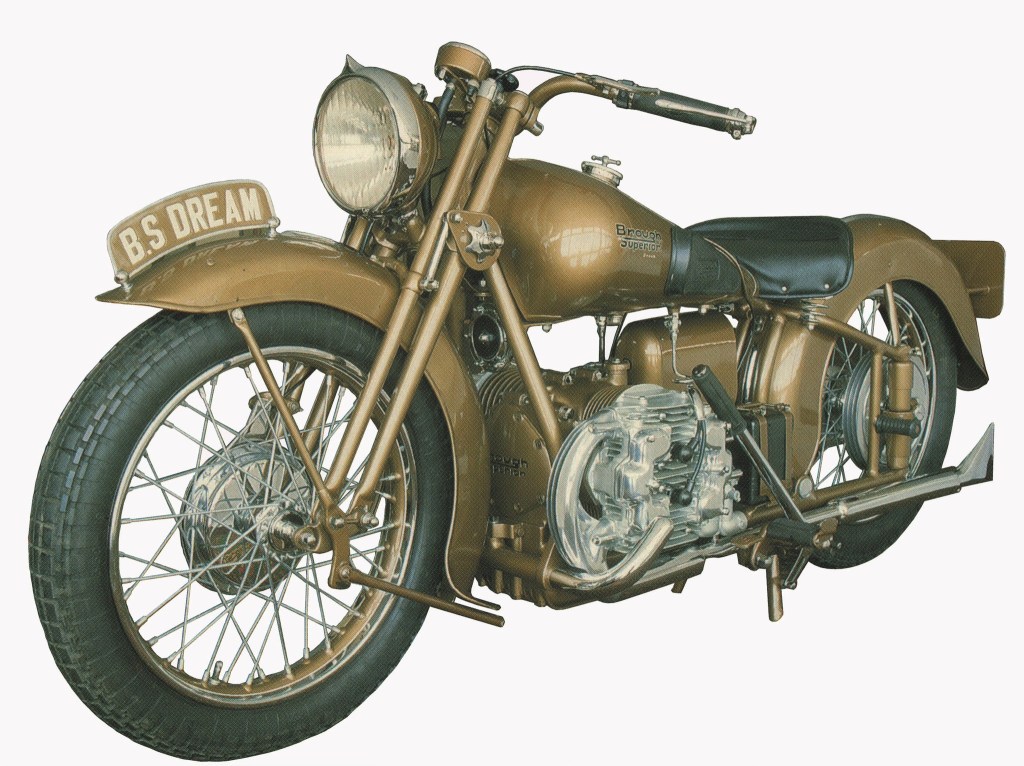
The same issue included a list of every bike on the British market in the various price brackets, starting with what Ixion dubbed the miniatures and ending with George Brough’s Dream bike:
“UNDER £20: HEC power-cycle, 80cc two-stroke, £17 17s. Raynal, 98cc two-stroke (Popular), £17 17s. Cyc-Auto, 98cc two-stroke (Gent’s), £17 17s. Cyc-Auto, 98cc two-stroke (Open Frame), £17 17s. Coventry Eagle, 98cc two-stroke (Auto-Ette Q12), £17 17s. Dayton, 98cc two-stroke (Motorised Bicycle), £17 17s. Norman, 98cc two-stroke (Motobyk), £17 17s. Excelsior, 98cc two-stroke (Autobyk), £18 18s. Francis-Barnett, 98cc two-stroke (Powerbike), £18 18s. Raynal, 98cc two-stroke (de luxe), £18 18s. Cyc-Auto, 98cc two-stroke (Gent’s de luxe), £18 18s. Cyc-Auto, 98cc two-stroke (Ladies’ de luxe, open frame), £18 18s. James, 98cc two-stroke (K18), £18 18s.”
“£120 AND OVER: Excelsior, 350cc ohc (JR12 Manxman), £120 (no speedo; rev counter). Brough Superior, 990 sv Twin (SS80 de Luxe), £120. BMW, 494cc ohv Twin (R51), £123. BMW, 745cc sv Twin (R71), £123. Harley-Davidson, 750cc sv Twin (WL), £125. Excelsior, 350cc ohc (JRS12 Manxman), £125 (no speedo; rev counter). Indian, 1,265cc ioe Four (Four), £125. Morgan three-wheeler, 990cc ohv Twin (Super Sports), £126. Vincent-HRD, 998cc ohv Twin (Rapide), £128. Brough Superior, 1,100cc sv Twin (11.50), £130. Harley-Davidson, 1,200cc sv Twin (US), £135. BMW, 600cc sv Twin (R66), £135. Morgan three-wheeler, 990cc ohv water-cooled Twin (Super Sports), £136 10s. Morgan three-wheeler, 1,172cc sv Four (F Super), £136 10s. Harley-Davidson, 1,300cc sv Twin (UHS), £140. Harley-Davidson, 1,000cc ohv Twin (EL), £147. Brough Superior, 990cc ohv Twin (SS100), £155. Brough Superior, 996cc ohv Four (Dream), £185.”
“I WONDER HOW LONG it will be before the British motor cycle industry is on a basis of equality with the foreign manufacturers of motorised bicycles. I have just been looking through the figures for imports into various overseas countries. It must be lovely having a tax free, insurance-free, driving-test-free home market for power cycles and thus be able to read big production figures and get down to an export price your competitors cannot approach. Little has been vouchsafed as to the lines of the discussion the Manufacturers’ Union had with the Minister of Transport last week except that motorised bicycles and overseas trade were under consideration. What is needed, of course, is that motorised bicycles are treated as if they were ordinary bicycles. When riding power cycles I have often been passed by bicycles; can anyone honestly say that these machines, which in the majority of cases cannot approach the downhill speed of bicycles, and are considerably more controllable, are more liable to damage third parties? Of course, he can’t. ‘Ah, yes!’ some may say, ‘but at least they must be taxed—the Exchequer needs the money.’ This reasoning is unsound. The number of power cycles on the roads today is minute; the type is a new one. The Exchequer would lose only a tiny sum by freeing these machines from tax. Encourage the power cycle by making it tax-, test- and insurance-free and the number will increase by leaps and bounds, each consuming petrol and benefiting the country’s finances to the extent of 9d a gallon, thereby providing a sum much greater than if there were direct taxation. There is no argument about it; the country has much to gain and nothing to lose.”

“FIFTEEN MILES OF ROAD in Essex and Leicestershire now have a special type of glass kerb to aid night-driving. These kerbs have panels of white vitro-lite, a durable opaque glass for which excellent reflective qualities are claimed.”
“SIXTY-FIVE-YEAR-OLD Mr Harry Wimpress has used a 150cc Francis-Barnett two-stroke 400 miles a month since 1924 on his duties as Tunbridge Wells County Court bailiff. Mr. Wimpress covered an area of 160 square miles in Kent in all weathers. Now he has retired himself, but not his 150, which he says ‘is still going strong’.”
“FULL MARKS TO COVENTRY EAGLES! They have been in touch with the chief petrol and oil companies regarding the supply of petroil. In Germany there is no difficulty at all in obtaining petroil, in small quantities or big ones, and of the variety and strength one wants. Coventry Eagles have suggested to the oil companies that they can assist the users of petroil-lubricated machines by issuing garages with special containers at a reasonable figure—means whereby garages can easily and quickly provide the required mixture. Something of the sort is definitely needed.”
“THE RAC ROAD STAFF covered about 8,000,000 miles on patrol last year. On an average, each RAC patrol sidecar covers 30,000 miles a year. Their economical life is 100,000 miles. Last year, the RAC increased its number of vehicles by 22%.”
“NEARLY 100,000 LIGHTWEIGHTS were sold in Germany in the first nine months of last year.”
“I AM NOT IN AGREEMENT with those riders who boast that they are ‘tough’, and brave the elements without legshields, windscreen, etc, just because these accessories do not look ‘sporty’. I ride a modern sports 500 all the year round, but I do not clap my hands just because the sports-type ‘mudguards’ allow me to become drenched with mud all the winter. No, Sir, a totally enclosed multi, with windscreen and legshields, would suit me, even if it were mass-produced with no mirror-finished works. But what does it matter what we want, the TT is still our dictator.
RD Gent, London, NW2.”
“TWO BRITISH MOTOR CYCLE firms exhibited at the recent Milan show, BSA and Triumph, and both stands attracted large crowds. Among the Continental exhibits the Guzzi was prominent with a special 250cc model known as the Ardetta; this is on the lines of the machine that recently set up 18 new world’s records. However, perhaps the real novelty of the show was the new unit-construction spring-frame Miller-Balsamo. It has a 196cc two-stroke engine with an alloy cylinder head, chrome-nickel cylinder and a pressed-steel connecting rod. Two rows of rollers are used for the big-end bearing, while the crankshaft runs on three roller bearings. The crankcase is cast integrally with a four-speed gear box, and the latter is provided with foot control. The clutch is of the multiple-disc type, running in oil. But the most outstanding feature of this remarkable machine is the frame. This consists of a one-piece pressing that not only incorporates the fuel tank and rear mudguard, but also provides total enclosure of the ‘works’. Large side panels permit access to the engine, which, incidentally, is supported in a tubular cradle. The front mudguard consists of another pressing that encloses half the wheel, and it is extended upwards to form the head-lamp shell. Flared shields at the front of the frame direct a draught on to the engine. A simple form of rear-wheel springing is fitted, and this has a friction damper with external hand control. Another interesting machine on show was the Altea. This is a 196 c.c. unit-construction four-stroke with an unusual type of spring frame. There are no saddle tubes, but the chain stays are immensely strong and pivot on a bearing located at the base of the seat pillar. Immediately behind the seat pillar is a cross-member that supports a large-diameter compression spring, and this spring is attached at its upper end to the saddle-supporting lug. Tubular members welded to the chain stays form the carrier and mudguard supports. Full ranges were shown by such well-known firms as Benelli, Gilera, DKW and BMW, but there were no surprises.”

“THE EDITOR HAS RECEIVED the following letter from the managing director of the Excelsior Motor Company setting out the Excelsior views on the TT: ‘We have this morning received the supplementary regulations and entry forms concerning the 1939 International TT Races, and I have immediately written to [ACU Secretary] Mr Loughborough informing him that we shall not be competing in any class of the 1939 TT. I have pointed out to him that this firm will, in the future, not enter machines in International races where supercharged machines are allowed to compete with unsupercharged ones and where there are no restrictions on the quality or quantity of the fuel. I have for a long while felt that it is unfair for the British manufacturer to compete against the well-paid foreigner, who comes over here with his supercharged machines to race against us, unless some restrictions are put in the regulations which will have the effect of levelling matters up. This can easily be arranged by altering the regulations concerning the quality and the quantity of the fuel used, but, in spite of representation made to the ACU in the past concerning this matter, they have still refused to take any action, and I therefore feel we are better out of it. After all, if the TT Races are still to be (a) of any use to the manufacturers in this country, and (b) run as a spectacle for the people who go over to see them, then the answer to (a) is that the ACU must give some consideration to the class or type of machine which it is proposing to foster and develop for the future, and the answer to (b) is, if it is going to be a race, let it be a race which is fair, reasonably equal to all, and with a chance of some close finishes. No one wants to see a procession! It is not without some regrets that we make this decision, as it must be remembered that we have been consistent post-war performers, having sent in 180-odd entries during the period, but we must now decline to enter into the present distinctly unfair competition.
E Walker, Managing Director, The Excelsior Motor Co.”
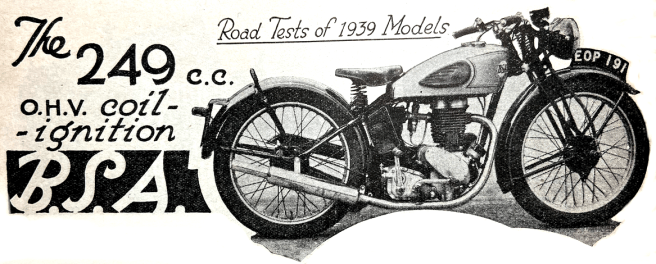
“IN DESIGNING THE MODEL C11 250cc ohv BSA the makers set out to produce an inexpensive machine that would run for long periods without attention or replacements—a machine which, in addition to providing day-in, day-out reliability would have a better-than-average performance and a really low petrol consumption. A road test of the machine shows that those responsible for the design have succeeded to a remarkable degree. In the matter of petrol consumption, for example, the makers claim between 100 and 120mpg. On test the new BSA had a petrol consumption of 109mpg at a maintained speed of 40mph! The controls of the machine have been simplified in a praiseworthy manner. There is a total of only five. These are the two brake controls, the gear change pedal, the clutch lever and throttle; the need for an air lever, ignition control and exhaust lifter has been purposely eliminated. The machine is thus extremely simple to ride. On the machine tested the clutch control was on the heavy side and the clutch action a little jerky. The gear change, however, was light and simple, and the pedal conveniently placed. Actually, all the controls are well placed; the brake pedal was particularly comfortable to use and is just where it is wanted—immediately under the rider’s toe. Praise must be given also to the riding position, which is suitable even for a rider 6ft tall. The position is of excellent touring type. The handlebars are of comfortable shape and the relation of saddle, footrests and handlebars very good. Saddle springs for a fairly light rider were fitted, and although with a 13-stone rider these allowed the saddle to bottom on bad bumps, in normal circumstances the degree of comfort afforded, owing to the long range of travel, was above the average. The riding position inspires confidence, and from the moment of getting into the saddle there is the feeling that one has complete control of the machine. In addition, the steering and handling of the machine were found to be first-class under all conditions. Negotiating tramlines and bad city roads called for no special skill, and in traffic blocks the machine could be ridden feet-up at very low speeds without difficulty. On the open road, too, the steering was above reproach. No steering damper is fitted; so excellent is the steering that none is wanted. At cruising speeds of 40-45mph the steering was positive, and even at the machine’s maximum of approximately 70mph it was never unduly light.
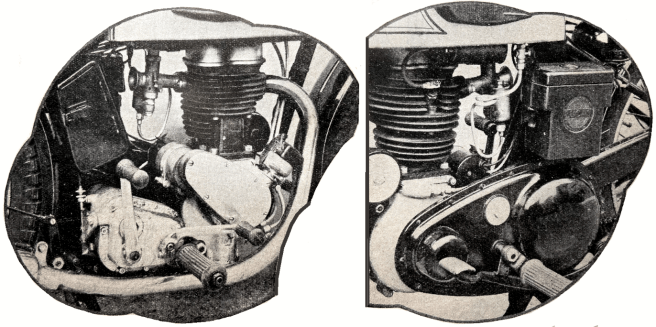
Cornering with the BSA was delightful, for the machine could be laid over for bends, fast or slow, without any effort, and the model always took the corners smoothly and steadily. So marked was the ease of control that the BSA was purposely taken over difficult trials going. Muddy lanes that would cause the rider to travel warily with many machines were ridden over as though they were main roads, while on rocky hills the machine was delightfully easy to control. To criticise this new BSA in any respect is next to impossible. The front brake might have had a little more power, but on the other hand there was the advantage from the novice’s point of view that the brake could not be misused. Both brakes were smooth, and the rear one with its long, well-placed pedal could be applied with absolute precision. The engine, with its coil ignition, automatic advance and retard and single-lever carburettor, proved really simple to start. Starting from cold was merely a matter of flooding the carburettor, switching on the ignition and gently digging on the kick-starter. The slow running was certain, and the pick-up from low speeds very good. In the recent cold weather the engine naturally took a minute or so to warm up, making it necessary to avoid rapid opening of the throttle for the first few hundred yards. In top gear (6.6 to 1) the minimum non-snatch speed was the low one of 12mph. The machine was frequently throttled down to between 15 and 20mph for traffic conditions, and the acceleration from these speeds was well up to standard. Throughout the range the engine was smooth and pleasantly free from mechanical clatter. At high speeds on the open road there was a certain amount of ‘rumble’, but this was neither unpleasant nor excessive. An ethylised fuel was used throughout the test. The engine pulled well and would only pink if allowed to slog hard on a hill. Pebblecombe Hill, in Surrey, which is a long climb with a maximum gradient of 1 in 5½, was climbed in second gear (9.8 to 1) in spite of a late change. Probably the most outstanding feature of this new BSA is its amazing capacity for hard work. The 250 c.c. engine withstood long periods of 50 and even 55mph without any signs of stress. After many miles of such hard flogging the only visible signs of the harsh treatment were a slight leak of oil from the timing case and a blueing of the exhaust pipe. At speeds of 40-45mph there was a useful reserve of power and acceleration ready to be employed at the rider’s will. In the performance tests the BSA showed that it was capable of a surprising turn of speed, and under favourable conditions the machine was timed over a quarter-mile at 69.2mph, while the mean of four timed runs seas 65.9mph. These figures, of course, were obtained with the rider reducing wind resistance by crouching down as far as possible. Even at these high speeds the exhaust noise was not excessive. At normal speeds the note was healthy and crisp, but well subdued. The Model C11 BSA thus combines an excellent performance with marked economy. It has been specially designed to run for long periods with a minimum of attention, and this, with the simplification of the controls, makes the machine particularly suitable for riders who are not interested in the mechanical side. In brief, the machine appeals for both utility and pleasure riding.”
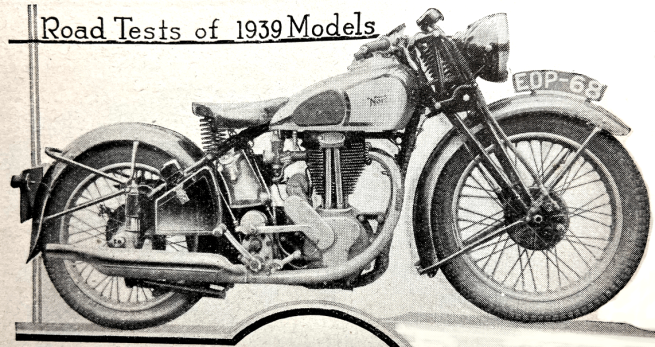
“THE IMMEDIATE SUCCESS in the racing field that attended the introduction of the Norton spring frame made many enthusiasts sigh for springing on production models. This year for the first time the spring frame is available on what may be termed a sports Norton as opposed to the super-sports International models. The model recently submitted to The Motor Cycle for road test was a 490cc ES2. It may be said at once that the steering and road-holding of the machine attained the very high standard that was anticipated. The rear springing is of the plunger-type similar to that used for racing, but in production form it is not so massive and is neater generally. That the springing is thoroughly efficient is evident in the first mile on the road, for bumps and pot-holes are ironed out as if by magic. On London’s tramline setts the worst bumps could be felt by the rider, but all the normal rear-wheel bouncing associated with rigid-frame machines is absent. At traffic speeds the steering was very light—unusually so to a rider accustomed to rigid-framed models. As a result the Norton was particularly easy to ride feet-up at a walking pace. It was also steady on tramlines. For town work and at normal touring speeds it was found that little or no fork damping was required. At high cruising speeds slight damping gave a steadying effect, particularly on poor roads. No praise can be too great for the steering and general behaviour of the Norton on the open road. Really high speeds could be used in absolute comfort and safety. Even at 70mph on main roads the steering was so steady and the general feel of the machine so excellent that the rider could relax and ride comfortably with one hand on the bars. Cornering also was delightful, and the machine could be taken round fast bends in long, easy sweeps. It was just as happy when being leaned from one side to the other on twisty roads. With this superb road-holding is allied braking of the highest order. Both brakes on the Norton were relentlessly powerful, and smooth enough for the rider to apply them with confidence on greasy roads. The action of the rear brake with its long pedal is particularly pleasant. An idea of the power of the brakes can be gathered from the braking figure of 33 feet from 30mph. The brake controls, in common with the other controls on the Norton, are well placed.
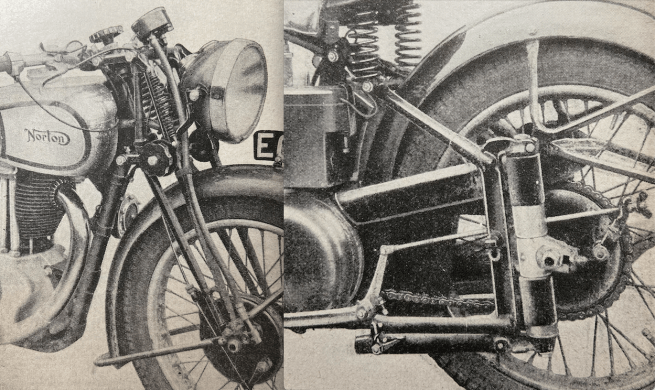
The brake pedal is adjustable and comes conveniently below the rider’s foot. Little criticism can be aimed at the riding position and general layout. The flat handlebars give a comfortably low position for the rider’s hands and the shape imposes no strain on the wrists. The saddle could be a little farther back for a tall man, but the relation of the footrests and handlebars is good. The gear box, gear change and clutch are almost perfect; there is no noise in any gear, the clutch is sweet and light and quite free from drag, and exceptionally fast gear changes, either up or down, can be made at almost any engine speed. For perfect comfort the movement of the gear lever could be shorter; with the present design the adjustment of the lever is limited by the footrest hanger. The outstanding features of the engine were high performance allied with a good capacity for slogging. An ethylised fuel was used throughout the test and only when the engine was misused did pinking occur. With the ignition fully retarded the minimum non-snatch speed in top gear was between 15 and 16mph; on full advance the speed was approximately 20mph. Acceleration in the gears was fully up to the high standard expected of a machine of this type, while the speed of 71mph, attained at the end of a quarter-mile from a standing start, is particularly good. It has been said that cruising speeds of up to 70mph could be used in comfort, and at this speed the engine was perfectly happy, although obviously it was revving hard. Apart from a slight period between 55 and 60mph, the engine was pleasantly smooth throughout its range, and even when it was over-revved in the intermediate gears did not suffer from ‘buzz’. The best timed speed over the quarter-mile was 81.8mph. The mean timed speed of the machine was 77.6m.p.h. Low-speed carburation was erratic in the early stages of the test, but this fault disappeared within the first 100 miles, and thereafter idling and slow pulling were excellent. With the ignition slightly retarded the engine would run remarkably slowly, particularly so in view of its high performance. Starting was easy at all times. From cold, very generous flooding of the carburettor was necessary, and until the engine was warm the air lever had to be used to obtain smooth running. Throughout the test the machine proved extremely . economical. Oil consumption was very low, and at a steady 40mph petrol consumption was 93mpg. Some criticism could be made of the engine as regards mechanical noise, for a certain amount of clatter was audible at all times. This was probably heightened by the fact that the exhaust note is particularly quiet and pleasant. This Norton, then, can be highly recommended for all who yearn for fast cruising in comfort and safety. The engine has a good performance, the road-holding is superb and the braking excellent. In spite of a great deal of hard flogging the machine remained absolutely oil-tight.”
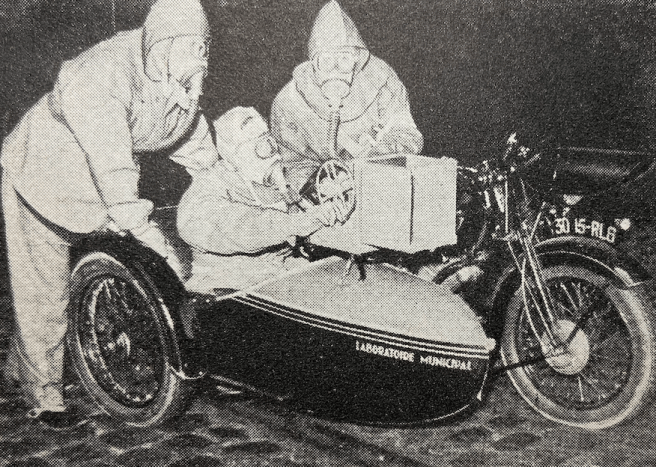
“THE FOLLOWING REMARKABLE LETTER has reached me from a professional factory pilot, being inspired by my eulogy of motor cycling in the Prospective Riders’ Number of The Motor Cycle: ‘I owe all I really know about flying to motor cycling. Feel of machine, sympathy with an engine, quick thinking, judgment of speed and distance, and ability to act under discomfort are absolute essentials in flying; and nothing approaches the motor cycle in developing these qualities, or in keeping them in first-class trim. That’s the practical side of it; on the other side one owes to the sport all the beauty of England, the scents and feel of the countryside, complete detachment from the everyday, and the centaur-like triumph of a good machine. No other way of life can equal these—flying, wonderful as it is, only touches the edge of this world. I have done solo aerobatics at Hendon, flown modern machines at 300mph, and love it all; yet coming home on a spring evening makes one shout with the joy of oneness with the machine, drunk with the keen air cleft at speed. Flight is a clumsy affair compared to motor cycling; racing a sailing boat, driving a fast car are tedious and spiritless by the side of it.”—Ixion.
IT IS OBVIOUS to all observers that the future of the TT is a trifle precarious at the moment. The main immediate reason for anxiety is the adoption of the supercharged engine by certain firms. As soon as a blown machine can match the reliability of an unblown machine of equal class, the unblown machine has as much hope of victory as a donkey has of winning the Derby. A great slump in entries is the inevitable consequence. The ACU has just published its draft regulations for the 1939 TT and on the technical side they display no novelties whatsoever. Once more the blown engine competes on level terms with the unblown, in spite of its very material advantage in what may be called effective capacity. The result of this is already visible. A factory which normally furnishes about one-third of the entries in the Lightweight Race (never a crowded event) has announced its abstention from the 1939 race. We are passing through a transition stage, from which we may emerge with a radically revised TT or with fleets of blown multi-cylinders. The immediate necessity is to preserve the TT until we have made up our minds about the future. As a purely personal contribution, I suggest that the awards in the 1939 races should be duplicated, and two sets of 1st, 2nd and 3rd prizes be allotted in Senior, Junior and Lightweight, to the fastest blown and un-blown machines in each category. It I were a maker, I would not spend good money with no chance of ranking higher than, say, 4th; but I would spend money to rank as the fastest unblown 250cc on the market; for the average man very definitely does not want a blown engine.”
THE BLUE ‘UN INVITED Stanley Woods to weigh in on the supercharging debate: “Supercharged! The very word seems filled with the spirit of adventure and endeavour, and is calculated to strike an answering chord in the heart of every sporting motor cyclist. At least that is how it seems to me. I know I am not appealing to the vast majority of motor cyclists when I sing the praises of the supercharger, for they ask of what possible use can it be to the average man? Of little enough use, I admit, at the present stage of the development of the internal-combustion engine. But the same thing was said of overhead valves and front brakes, to quote only a couple of items from the long list of present-day commonplace fittings that were looked upon as unorthodox and unsuitable for production only a comparatively short while ago. Even the working lad who keeps a motor cycle solely for getting to and from his work seems to prefer the more efficient overhead-valve engine. Probably because it gives him those few extra minutes between the sheets each morning! After all, when one bears in mind that the research chemists of the big petrol combines admit that of the total potential power locked up in petrol, over 80% is wasted, one can realise that there is plenty of room for development. From my point of view I welcome the advent of superchargers because they mean more power and speed. And that is what really counts in racing. On the score of increased fuel consumption I am not worried. Over the past ten or twelve years petrol consumption on an efficient single-cylinder 500cc TT engine has not increased to any marked extent. On the other hand, power and speed have increased in a very notable manner, proving that racing research is developing internal-combustion engines along the right lines. The introduction of superchargers will speed up the introduction of multi-cylinder engines, which is a move in the right direction so far as the man-in-the-street is concerned. And if these multis, when supercharged for racing, prove to have abnormal thirsts, it can only be a matter of a short while before their designers overcome that difficulty, for there is no point in building up the maximum speed of the machines only to have to throw away the advantage by lengthy pit stops. As a rider, I am roused to the greatest enthusiasm by the thought of a supercharged multi. Of course, I do not know yet, but it seems to me that it should combine the smoothness and even torque of a multi with the kick of a big single. When I think of the smooth, even surge of power developed by the twin-cylinder Husqvarna and Moto Guzzi machines I rode a few years ago, and visualise what the results of successfully supercharging them might be, I am impatient to be let loose with a machine of this type.”

“A CERTAIN AMOUNT of general post is occurring on the technical side of the industry. Recently two important changes were announced. First, there was Val Page joining Triumphs. Then came the news that Joe Craig had left Nortons. A week later there was the announcement that he had joined BSAs. Now I hear that Mr. Anstey, the chief designer of Ariels and the designer of the ingenious spring frame, is severing his connection with this firm at the end of the month. The news reaches me just as we are closing for press, so what his plans are I do not know. There are rumours of one or two other changes occurring. It seems to me that the interchange of ideas consequent upon the changes and the bringing of fresh brains to bear upon a factory’s products cannot help but be an advantage.”
“FROM A REGULAR weekly perusal of the correspondence columns of your esteemed journal it would seem that the prevailing political and international outlook is beginning directly to affect your readers. Every week the letters become gloomier and gloomier, and the attacks on something or other more vicious. Even our institutions are not safe. The TT the ‘International’, the ACU, the ohv single, the weather, the roads, the police—one and all they get a weekly caning. What’s wrong with everybody? Let’s take a rapid look at their grouses. THE TT: While we could win it without any trouble, it was taken for granted. Now we have a little competition what do we find? Wail after wail about superchargers, moans about the entry. Mr Norton, for perfectly good reasons of his own, decides to let somebody else have a turn. Result, panic! If, after carrying a lion’s share of our prestige for years and years, Mr N is not entitled to a breather, then who is? THE INTERNATIONAL: I thought we won the Trophy in 1938, or didn’t we? And if my memory serves me right, several ‘dangerous’ competitors blew up. THE ACU: As an ordinary rider, this august body doesn’t trouble me a scrap. But if the sporty boys don’t like it, why do they put up with it? Taken by and large, it does a fairly good job of work, I should say. THE OHV SINGLE: Now here there has been a lot of vulgar abuse of a tried and trusted friend. After all, if one doesn’t want to ride an ohv single, then one has plenty more from which to choose. As to the remaining things that are attacked—well, there isn’t much you can do about the weather, except dress to meet it, or stay at home; the roads, after all, are obviously improving slowly but surely; the police are all right if you behave; and the remaining topic which comes to mind, ie, ease of maintenance—well, there again, take a look at your tool kit sometime. The outlay of 10s on one or two spanners very often removes 90% of the trouble. No, boys, things are capable of improvement in lots of ways, and they’re not nearly so bad as you think. Suppose we leave all these things to the people who know the right answers, and go hack to enjoying riding on the world’s finest machines.
‘ES2’, London, SW18. “

“TWO FEATURES MAKE the 344cc Model 46 DL New Imperial an outstanding machine. They are the unit construction of engine and gear box and the rear-wheel springing. In the New Imperial design these features are complementary; the machine is extremely compact even to the extent of being ‘cobby’. The rear-wheel springing is no new feature and the result of the manufacturer’s experience in this direction is evident in the magnificent steering and general handling of the machine. The steering was delightful under all conditions. It was always light—but never too light—and it was positive enough to make the use of the steering damper unnecessary even at speeds of 70mph. At the other end of the scale the New Imperial could he ridden almost to a standstill feet up. When crossing tramlines there was no trace of waver and on greasy roads the machine proved exceptionally stable: This stability obviously is in part due to the rear-wheel springing. There was no feeling of the rear-wheel movement at any time; what the rider noticed was the entire absence of rear-wheel shocks. On bumpy main roads high speeds could be kept up without the rider having to hang on to the machine. An important feature of the New Imperial design is that the amount of movement of the springing can be controlled by the rider from the saddle. With the damper slackened right off the springing gave armchair comfort at traffic speeds, while for cruising on the open road the damper was used to give that firmness that makes for good high-speed steering. With the excellent rear suspension is combined a pleasant and smooth front-fork action, and the front, and rear springing mate well together. The range of the front forks is wide, and only on one or two occasions did clashing occur. But perhaps the greatest feature of the New Imperial handling was its cornering. No praise can be too high for the easy way in which the machine could be swept round bends at high speeds or low,
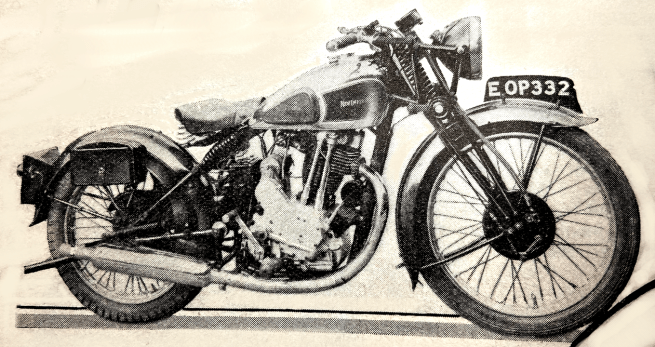
and round sharp or wide bends. On a particularly twisty stretch of road, which normally limits speed to between 15 and 20mph, the New Imperial was outstanding, and only the law prevented the rider from maintaining more than 30mph over this section. As regards performance, the New Imperial showed up very favourably. The engine was lively and the acceleration well up to average for an ohv 350. At touring speeds the whole machine had a velvety feel, and there was no harshness or any unpleasant mechanical clatter. The engine was particularly happy between 40 and 50mph. Higher up in the range there was slight vibration, but it was not bad enough to prevent the river using 50 to 60mph for long stretches. Maximum speed under normal conditions with the rider sitting in the saddle was about 65mph, but in the timed tests with the rider ‘lying down to it’, the New Imperial achieved 72.6mph on one run over the quarter-mile, while the mean speed of four runs under conditions that were not ideal was only just below 70mph. The machine could be taken up to 40mph comfortably in second gear and up to 50 in third. Throughout the test an ethylised fuel was used, and under no conditions did the engine pink or show signs of doing so. Low-speed pulling was exceptionally good, and the machine would pull happily in top gear up long dragging gradients. Some idea of the engine’s capacity in this direction can be gathered from the fact that by judicious use of throttle and ignition Pebblecombe Hill, in Surrey, which has a gradient of 1 in 5½, was breasted in top—a good performance on a 500 and an outstanding feat for a 350. Even under these
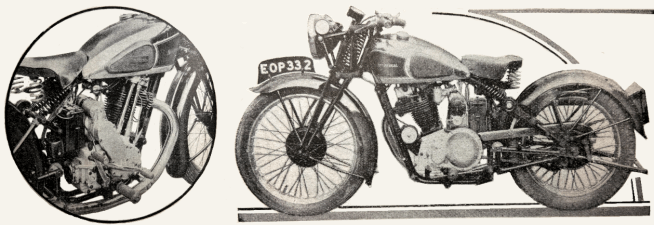
conditions the transmission was smooth. On the level, with the ignition fully retarded, the New Imperial could be throttled down to 16mph in top gear, and for normal work 20mph was a comfortable minimum speed in top. Slow running was certain with the ignition retarded, but on full advance the engine had to be kept turning over fairly steadily. Starting when the engine was warm was always easy; from cold a hearty kick and a generous throttle opening were required to ensure that the engine fired. An easier start would be obtained if the kick-starter spun the engine more. It has been said that the engine was quiet mechanically, and this applies to the whole unit. All the gears were silent, and the slight whine from the transmission was only audible when the engine was not under load. The exhaust note was pleasant and well toned down. Little criticism can be made of the riding position and control layout. The handlebar shape and the mounting of the saddle allow a straight-arm position even for a tall rider, and the footrests have a fore-and-aft adjustment. All the controls are well. placed and the brake and clutch levers are long and of a comfortable shape. The clutch was light and smooth, but did not free entirely. This did not, however, affect gear changing and rapid changes could be made at almost any engine speed. Bottom gear could be engaged from neutral cleanly if the lever was pressed firmly. Incidentally, the gear lever is well placed for convenient use. Both brakes were well up to the general high standard of the machine. The rear pedal is where it is wanted—under the rider’s toe, and this brake could be used with confidence even on wet surfaces. Both brakes had ample power, and a crash-stop could be made in 35 feet from 30mph. Throughout the test the New Imperial remained free from oil leaks and the oil consumption was very low. At a maintained 40mph petrol was consumed at the rate of 72mpg. To sum up, the New Imperial proved a delightful touring machine. The engine combined silkiness with a good performance, and the steering, road-holding and braking were superb.”
“OF QUITE OUTSTANDING INTEREST are two DKW patents dealing with frames and forks of laminated synthetic resin. This material must not be confused with that utilised for simple moulded articles, which is unsuitable for carrying heavy stresses. In essentials it consists of superimposed strips of paper or, where particular strength is necessary, of fabric saturated in synthetic resin and compressed in heated steel dies at pressures ranging from 4,200-5,600psi. The section can be built-up and reinforced to resist localised stresses and while offering a saving in weight is comparable in strength and rigidity to a sheet-steel pressing. Moreover, it possesses additional advantages in comparison with sheet steel. For instance, under severe impact it is less liable to crumple and collapse, and instead tends to yield and subsequently recover. Auxiliary equipment can be moulded with the main structures, thus reducing the cost of production and assembly. It is non-resonant, nor is it subject to corrosion, and as it comes from the press the surfaces are smooth and require no preparation for the- final lacquer coating…The use of plastic materials for such a design opens up entirely new possibilities. Of course, the type of structure suggested for the purpose of patent registration is not necessarily the same as would be employed in practice. It is not intended to limit its use to lightweight machines, and the firm has also patented frame-less car bodies of similar laminated material. Provided that the initial expense of the presses, dies and equipment can be spread over a large output, the cost of production should show substantial economies. German firms are undoubtedly planning for large outputs both for the home market and also for an intensified drive in the export field.”
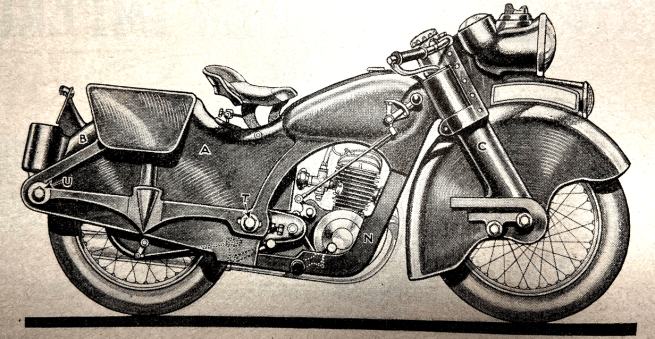
“A SIMPLE AND EFFICIENT spring wheel has long been the accepted theoretical ideal for the suspension of a motor cycle; in consequence, particular interest attaches to a design patented by Mr A Kuehn. Briefly, the arrangement consists of a knockout spindle between the fork ends on which is mounted the brake drum and driving sprocket, a sleeve, a shock absorber and a small sprocket which, by means of a short chain, actuates the springing mechanism. These components are definitely located by the spindle and are concentric with it. On the sleeve is an eccentrically mounted inner hub on which, in turn, is mounted the hub of the wheel. Thus the wheel can revolve round the inner hub and the inner hub can move in an arc relative to the sleeve. The arc movement, controlled by the springs, is not conveyed to the spindle; hence the design is essentially a spring wheel. Advantages immediately apparent are low unsprung weight, no variation in tension and fineness of brake control.”
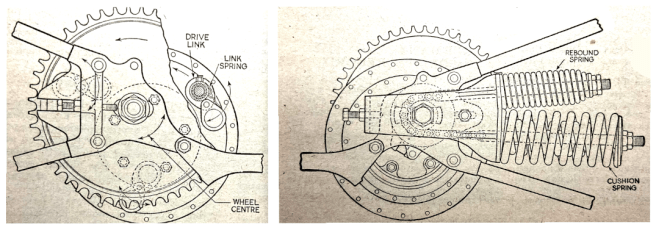
“AFTER A NIGHT OF DRIZZLE and mist the morning of the Kickham Trial dawned clear and bright last Saturday. All the snow had become a thing of the past…However, those tit-bits which Vic Anstice and his friends prepared on the slopes around Bath were by no means to be despised, and competitors were warned—not without reason—that the keeping of a clean sheet was likely to be difficult. In point of fact, one hill, Clandown, had to be eliminated after the first circuit, and it transpired that no competitor got round without loss of marks. Two riders, Allan Jefferies (349cc Triumph) and GEH Godber-Ford (498cc Sunbeam), tied for first place with the loss of six marks each, but in the stop-and-go test the former produced the figure of 4.4sec, against the latter’s 4.8sec. Thus it was a fairly close thing for the solo men, but the sidecars had rather a tough time of it, the highest in the list being WS Waycott (495cc Velocette sc) with a loss of 21 marks. In scoring his win and taking the Kickham Trophy, Allan Jefferies once again showed that there are few to equal him in this trials game. Godber-Ford, too, is a force to be reckoned with; he has made great strides since he entered the competition field and looks like being one of those who insist on giving the lie to the contention that there is no one to take the place of the older stars.”
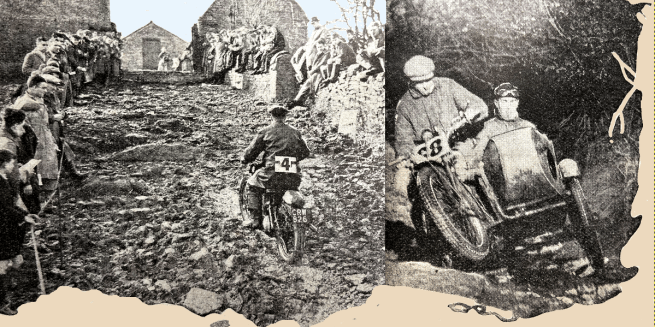
“ABOUT FOUR THOUSAND people stood in the rain last Sunday just before the unveiling of the Jimmy Guthrie Memorial in Wilton Lodge Park, Hawick, Guthrie’s home town. Many were Scottish clubmen from various parts of Scotland, while at least one little group had driven by sidecar up from London for the ceremony. All Guthrie’s family, Joe Craig and Freddy Frith, were present. When Major WA Innes came to unveil the memorial, the rain ceased and the sun came out. Major Innes paid tribute to Jimmy Guthrie’s modesty even at the height of his fame, and to his worth of character, and emphasised how appreciated was the gesture of the German people after Guthrie’s death. The memorial was dedicated by the Rev JAG Thomson, and was formally accepted on behalf of the town by Provost Landles. Pipers played a lament during the ceremony. An illuminated parchment setting out Jimmy Guthrie’s racing successes has been placed in the public museum in Hawick.”
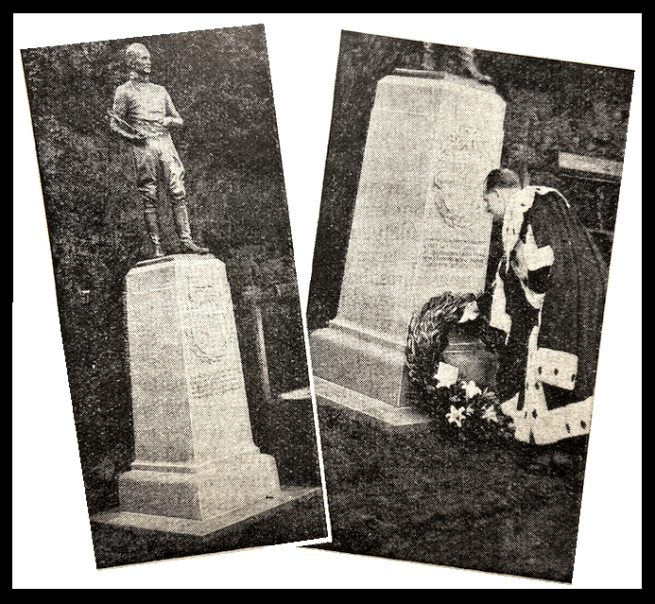
“WHEN Lancashire folk are asked what ” hot-pot” is the usual answer is, ‘Well, it’s meat, and potatoes, and—well, it’s hot-pot, of course.” Actually, Lancashire hot-pot is a simple dish. It might be called a stew, but it is certainly not the kind of stuff known as Irish stew. Hot-pot is made by putting a layer of sliced potatoes at the bottom of a stew pot. Then a layer of not too finely chopped mutton with a dash of herbs. One or two more alternate layers of the same kind are added with a light sprinkling of flour between each. Some water is put in and the ‘roof’ is a thick layer of sliced potatoes; the pot is then put into a slow oven and left for about three hours. As a social function a hot-pot is an evening affair. It may be held at any hour, however, although it is generally a supper, equivalent to the Yorkshire ‘pie supper’, for it is a very substantial dish. Usually a hot-pot supper starts off with a noble heap of the dish, and it is always supplemented by pickled cabbage and beetroot, plus a hefty lump of bread; second helpings are always offered. Apple tart generally follows, then cheese, butter, more bread, celery. Obviously, beer and stout are the only suitable accompanying drinks—or water. Coffee is usual at the end, however. A hot-pot supper is most definitely not the time for boiled shirts or starched manners. It is a man’s meal for a ‘men only’ do.—Wharfedale.”
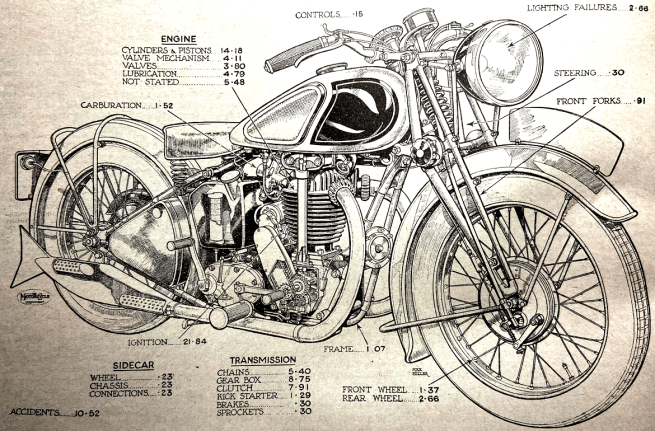
“NEW DESIGNS AT THE BERLIN SHOW are conspicuous by their absence. This applies not merely to the motor cycle side of the great annual exhibition but to cars and commercial vehicles. The reason is that the German Government has decided that the three industries must be rationalised: the number of different types of motor cycle is to be reduced from 150 to 25; of cars from 55 to 23; and of commercial vehicles from 110 to 14…In all probability it will not be until next year that there is any positive result from the new policy. Then may be seen ingenious new designs—perhaps the widespread adoption of plastics…On the other hand, this ‘normalisation’, as the Germans are calling it, may spell a series of very ordinary machines in which much has been sacrificed for ease of production and for he sake of extremely low selling cost. It is an extremely bold move and one which is possible only in a Dictator country… a not unimportant question that affects the German motor cycle manufacturer is the promised advent of the ‘People’s Car’.
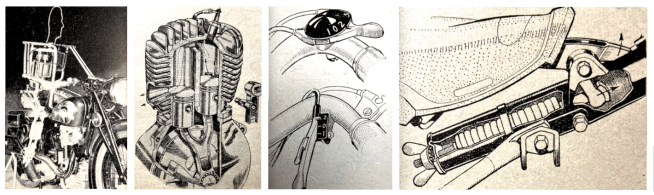
This is to sell at 990 Marks, and the present price of a 350cc solo motor cycle such as the 351 OSL NSU is 1,045 Marks. Not only is there this matter of price, but large numbers of the German people are paying into a fund for this national car. Under the new arrangement the smallest motor cycle—that is a machine with a kick-starter and no pedals—will be 125cc. For a pedal-assisted machine 100cc is to be the limit, and cycle firms will not be allowed to make motor cycles—only motor-assisted bicycles. An interesting point is that whereas the 200cc motor cycle has been a very important factor in the growth of motor cycling in Germany, largely because of licensing questions, there is growing concentration upon machines of 250cc, which in a number of cases are offered with sidecar. Germany is coming more into line with Great Britain in the matter of engine sizes. On the other hand there is not a single production model of 1,000cc in the show. The transverse four-cylinder Zündapp is not exhibited, nor the Püch ‘Four’, and the sole 750cc models are the 750cc side-valve BMWs. There are, however, several 600s, though the bulk of the machines shown are under 350cc. While the rationalisation is not to affect machines costing over 1,200 Marks—that is, highly priced sports mounts at 210 and more Marks than the People’s car—the view is that it is unlikely that there will be additional models making their appearance…In the reviews of recent Berlin Shows it has been pointed out that in Germany the motor cycle manufacturer must, as far as possible, use substitutes for metals which would otherwise have to be imported. One result of this is to be seen in the
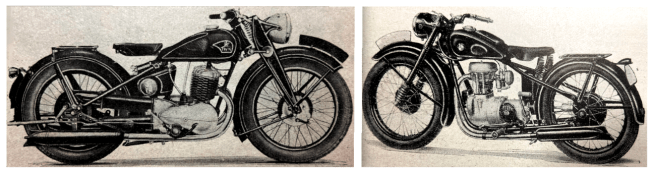
finish of the machines. The plating lacks the lustre to which the British motor cyclist is accustomed, and there is not the same use of plating. Incidentally, the finish of machines exported from Germany seems better than that for the domestic market. Compared with the Earls Court Show and the old-time exhibitions at Olympia, the hall devoted to motor cycles at the Kaiserdamm, Berlin, is small. In the middle there are seven stands: BMW, DKW, TWN (the German ‘Triumph Werke Nürnberg), Püch, Victoria, Zündapp and NSU. On small stands at the side are Ardie, Tornax, Favorit, AJL, Maico and Hercules, while elsewhere there is the Sachs exhibit and, among commercial vehicles, a few three-wheelers…The total number of makes is therefore considerably smaller than in England. On the. other hand, the quantity of motor cycles produced is much larger, and a twin given pride of place on the DKW stand bears the frame number 500,000! Only some three years ago the figure proudly displayed was 300,000. BMWs recently celebrated their first 100,000, but in this case, of course, the aim is to produce highly priced, exclusive-type machines rather than to go in for quantity. production. Unquestionably the BMW range, in its design,
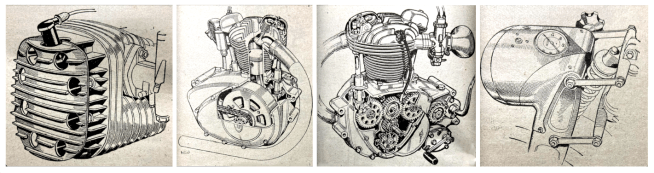
finish and general appearance, stands supreme in the exhibition. Of change, however, there is hardly any—merely a detail here and another there. What is interesting is the fact that the 200cc shaft-drive single is not shown. In its place is a 250cc single with particularly clean unit construction and a foot-change on the near side. A neat built-up tubular loop frame is employed in conjunction with plunger-type front forks. The Bosch dynamo is mounted on the forward end of the crankshaft. A feature unusual in Germany to-day is that the saddle is sprung on British lines, ie, the nose is pivoted, while at the rear there are twin compression springs. Generally, the practice in Germany is to have one or more tension springs which are attached to the seat stays at the rear end and, at the other, to levers that are part and parcel of the pivoted saddle nose. The larger BMWs have this arrangement with a simple means whereby the leverage can be adjusted, thus enabling a single spring to suit riders of different weight. The 250cc model is quoted as producing 10hp; the 350, 14hp; 500cc, 24hp; 600, 30hp; the 750 R71 side-valve, 22hp; and the 750 R12 side-valve, 18hp. In the case of quite a number of machines the show-cards place more importance upon the figure for maximum power output than upon the engine capacity…All the BMWs over 350cc are transverse-twins. The more powerful of the. two 750cc side-valve machines has an Interesting form of cylinder head. Cast in one with a normal type of light-alloy detachable head there is an extension ‘plate’.
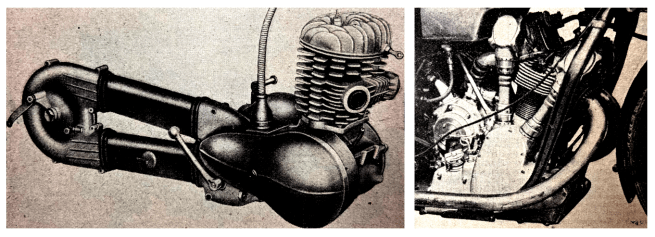
This is well ribbed and provides additional cooling area as well as apparently helping to save the engine from damage in the event of the machine toppling over. The head-fixing screws and the sparking plug pass through holes in the extension ‘plate’. A feature of British design which is growing in popularity is the foot change. Until recently only the export model of the 500cc twin-cylinder DKW two-stroke had a foot gear-change; now it is standard for the German market as well. Incidentally, this gear pedal is combined with a tank-mounted hand control, a DKW patent. Another interesting point about the 500cc model is that the makers offer specially wide handlebars for machines that are to be used with a sidecar. This is an extra costing merely a couple of Marks…Strangely enough, there are few spring frames exhibited. Other than the DKW and the BMW there are only the Sachs and a working model of the new Tornax design, which has a system of links arranged rather like a ‘Z’ and tension springing. The Sachs is interesting because the rear forks, like the front ones, are sprung by means of a large rubber ‘bush’—’Schwingmetall’, the Continental tyre people call it. Hand-operated cam-type rear chain adjusters are fitted to this, the 125cc model. They consist of large cam-shaped steel plates with small protruding ears or thumb pads. Similarly, there are few shaft-drive mounts. These are limited to the BMW range and the 500cc side-valve and 600cc ohv transverse-twin Zündapps. The latter firm continues its neat 350cc single that was introduced last year. This has the exhaust and inlet cam-shafts set in front and to the rear of the cylinder respectively.
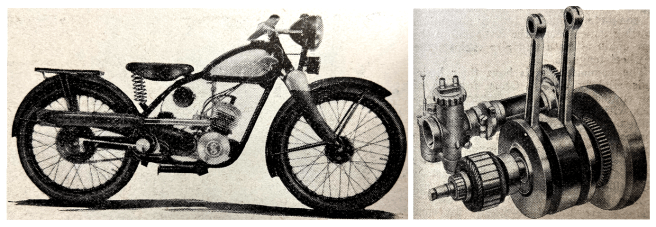
A point here is the neat way the built-up welded front member of the frame encloses the fixing lugs of the crankcase. One NSU 250 is shown fitted with a lightweight sidecar. Both 250cc and 350cc machines are now often listed for sidecar work and available as complete outfits. The TWN concern exhibits an interesting new double-piston two-stroke of 250cc which is stated to develop 13.4hp—some 50% more power than the single-piston engine of the same size. Unlike the Püch, which has a Y-shaped connecting rod, the TWN employs two rods with separate crankpins. The crank-pin for the cylinder which carries the exhaust ports is a few degrees in advance of the other. A rotary inlet valve is used and is gear-driven from the crank-shaft. This is fed by a carburettor that is completely hidden by an aluminium housing which forms the front end of the rear chain oil-bath and also encloses the flywheel magneto. The connecting rods have their little-ends slightly offset…The remainder of the exhibits consist almost entirely of two-strokes—indeed the two-strokes so far as the stands in the motor cycle hall are concerned out-number the four-strokes by something like two to one. One interesting two-stroke is a 1,000cc twin in another hall. This is the Seld, fitted experimentally in an OEC duplex frame. Although of simple type it is stated to develop 36hp at 3,300rpm and to have done so for hours on end. The feature of this engine is that the middle portion of the hollow two-throw crankshaft forms a rotary valve, while in addition to gas being induced in this manner there are normal piston-controlled inlet ports. The aim has been to obtain a high power output without any sacrifice of simplicity. Here, too, tab-type cooling fins are employed. On the sidecar side there is little that is new. Bodies remain of the doorless type with low-cut sides, except that Stoye show a neat sunshine saloon. This make employs rubber-band suspension front and rear…Special sidecars are available for 250 and 350cc machines. These, however, are not exceptionally light. For instance, the lightweight Steib is roughly 881b. Some of these sidecars, incidentally, are decidedly small. Briefly, the position is that the German motor cycle industry is marking time. There are interesting points in connection with the present show, but very few new designs. It may be that a year hence there will be a very different tale to tell. 0n the other hand, nationalisation of the industry could conceivably spell stagnation. It will be interesting to see the outcome.”
“MANY READERS HAVE expressed keen interest in the hunting-type of boot worn by German competitors in the International Six Days Trials held in Wales, and have endeavoured to purchase similar boots. In consequence, James Grose, of Euston Road, London, NW1, recently decided to produce a boot of this type. Full stocks are now available at-the price of 32s 6d a pair.”
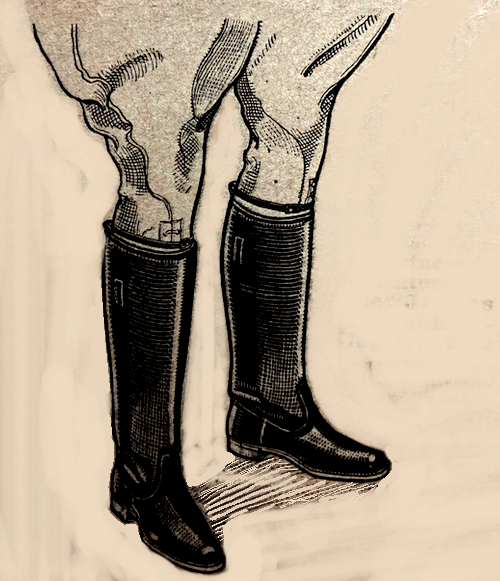
“LAST SATURDAY’S VICTORY TRIAL was, without doubt, one of the most successful of the entire series for which the Birmingham Club has been responsible. [Historical footnote: among illustrious club members was Rem Fowler, winner of the first twin-cylinder TT—Ed.] This result was in no small measure due to the standard-tyre rule. Realising that the course which has been favoured for the last few years would be unsuitable, the Club carried out a fresh survey of their old happy hunting-ground around Bewdley. In the Habberley Valley, they found four new hills, all within a few moments’ walk of each other, and the curious point about it all is that they have been undiscovered previously, although within sight of the old Jacob’s Ladder used on several former occasions. Apart from these four hills, there were only Red Marley and Birchwood; so that the trial was almost confined to this valley. The short course was covered twice. It was by no means an easy course. Trophy winners had to fight hard for their awards, and sidecar drivers found one or two of the obstacles just a little too much for them. Although, generally speaking, wheel-grip was not difficult to obtain, sheer gradient and rough surface combined to defeat sidecars, and it was just as well for all concerned that the course was not wet. To Billy Tiffen (348cc Velocette), who won the Victory Cup for the best performance, and to FC Perks (496cc BSA sc), who took the Cranford Bowl for the best side-car performance, congratulations are due for very stout efforts.”
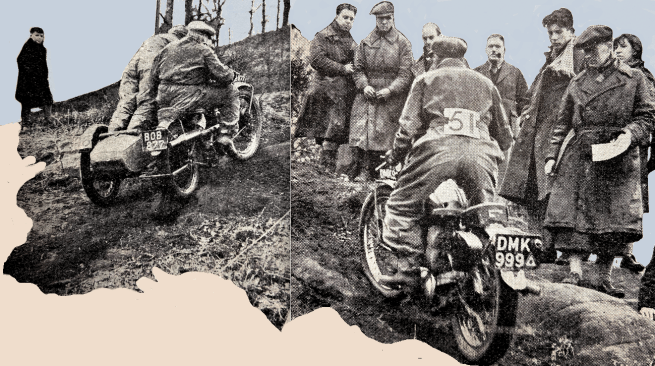
“AS THE FIRST EAST CHESHIRE Group Trial of this year had had to be postponed on account of snow, and the second had had to be redated on account of the restrictions imposed by the RAC and ACU Joint Committee on the use of the Buxton area, the two organising dubs, Sale and Manchester, pooled their resources and ran one thoroughly enjoyable event last weekend. It was enjoyable for three reasons. First, because the weather was mildly bright all day; secondly, because the district used was a change from the usual ‘Buxton area’ course; and, thirdly, because the route-marking was so very thorough, without being too obtrusive. It was route-marking as it should be, just sufficient indication entering the corner and a spot for confirmation well inside the new direction. The only snag was the instability of standard tyres on ‘fast’ sections surfaced with the Derbyshire variety of grass and slime. The start was at the Waterloo Inn be-tween Buxton and Taddington and the course lay over towards the South, Yorkshire district, an area with some excellent hills even if there is too much ‘main road’ between them. However, the route finders had managed to link up most of the ‘sections’ with useful ‘three-ply’ substitutes for these same main roads. Early in the proceedings was an observed splash, Brook Bottom, near Great Hucklow. It was quite deep, but was dismissed as harmless by all except AE James (490cc Norton), Stockport, J Sellars (497cc Ariel), Stockport, L Flowers (496cc BSA), Urmston and GK Swindells (349cc BSA), Sale, who stopped, so that if the splash did not deal in quantity it certainly collected quality. A rather tough trip across moorland tracks over Bamford Edge led to the notorious Callow Bank. However, it had been decided that the first ‘step’ was beyond the capabilities of standard tyres, and an exceedingly tricky and slimy zig-zag at the foot of the bank was substituted for the entire climb. And this also proved beyond standards! Actually, nobody survived this bit, which was in the nature of a trick-riding or controllability test. The hairpins were so acute and the surface so much like the stuff put into grease guns that it was no uncommon thing to see a machine sliding with neither wheel revolving—and each one sliding in its own particular direction! The least touch of rear brake would skid the wheel and stop the motor. The least touch of the front brake would skid that wheel and bring the model down. PC Reece (349cc Triumph), Manchester ’17’, for example, made a beautiful attempt, but his engine stopped when the wheel slid. Ken Norris (248cc Red Panther), Manchester University, made the only absolutely clean passage of the hairpins and then made one dab to straighten out just before he cleared the section. GP Whyrimn (596cc Douglas), Manchester University, was excellent after he had lost all his marks on the seemingly easier approach section! AE James (490cc Norton), Stockport, and HP Cartwright (349cc BSA), Stockport, both demonstrated the method of footing gently (and no more than was needed) and keeping on the move. Of the other sections, Riley’s Rise, with its slippery leaf-mould under trees, agreed least of all with standard tyres. Few of the 30 finishers had no tales to tell of sodden ‘partings’, and there was none who did not regard trialling on standards as dangerous as it was found to be when the East Cheshire Group voluntarily operated on standards for a full twelve-month three years ago, and, in the light of that experience, decided that standards would either kill them or kill the sport. PROVISIONAL RESULTS. Group Tankard (best performance): 1, GP Whyinan (596cc Douglas), Man University, marks lost, 9; 2, KB Norris (248cc Red Panther), Man University, 14; 3, RC Lacey (497cc Ariel), Manchester ’17’, 15; 4, C Holden (496cc BSA), Man Eagle, 16; 5 J Cox (346cc Levis). Stockport, 17; 6, PC Reece (349cc Triumph), Manchester ’17’, 18.
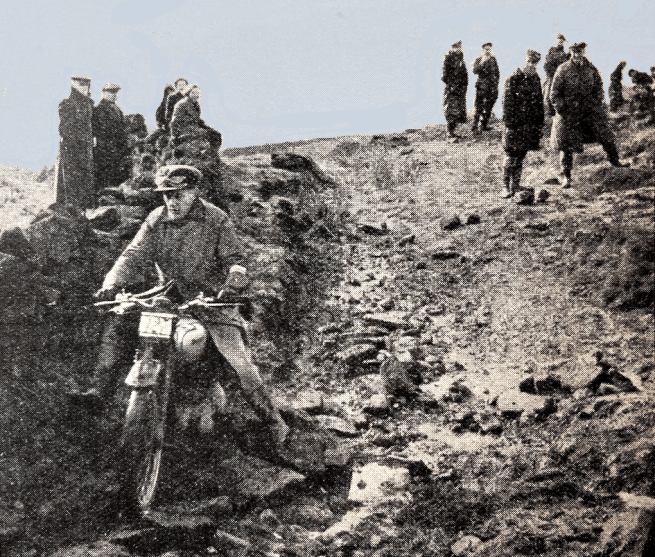
“LETTERS IN BRIEF: The competitor who experienced clutch trouble in the Barnesbury Club’s trial on January 15th sincerely thanks the club member who assisted him…Support for Mr VT Sanders’ suggestion that touring-type crash helmets should be available to the ordinary rider is given by Mr L Black, Press Secretary of the London MC Touring Club…The sidecar competitor (DUV 778) in the Aldershot TVTC trial sincerely thanks the two Ravensbury Club members who assisted him when he experienced difficulty in hub-deep mud on an unobserved section of the course…Referring to Excelsior’s withdrawal from this years event, Mr RH Richardson (London, N16) says, ‘Surely the best way of replying to the “foreign challenge” is to adopt the foreigners’ own tactics and beat them at their own game”…Mr W Seaman (206, Seaforth Avenue, Motspur Park, New Malden, Surrey), states that he has formed a group among boys at Stoneleigh West Central School, Ewell, with the object of slowing them how a motor cycle works, etc. He would welcome unwanted motor cycle parts and accessories of any description and condition, and will collect any donations within a radius of 50 miles.”
CLUB LIFE WAS FLOURISHING with the best part of 200 items on the ‘Club Events’ page in a typical issue of the Blue ‘Un. One issue’s offerings included a BMCA ‘mock trial’, a Bradford Vagabonds tour of the Dukeries, an IMTC weekend rally (with filmshow and test rides on a Tiger 100), a London Co-operative MCC dinner dance (at a Masonic hall) and a Scunthorpe MCC ‘bachelor supper’. The Leicester Aces enjoyed a tour of theior local power station. Also on offer to clubmen were technical talks, darts matches, ‘games tournaments’, table tennis, dances, runs to sporting events, a ‘ladies popular vote run’, a ‘social secretary’s birthday run’, a supper dance, a ‘junk hunt’, a ‘follow-the-leader’ run, a ‘sawdust chase’, and an ‘intelligence run’.
THE MOTO-CHENILLE MERCIER was designed in Paris by Adrien Mercier with a four-bogie track in place of a front wheel. Power was supplied by a 350cc ohv JAP engine mounted on the handlebars. It was tested by the British and French war departments who quickly rejected it. Tests showed it to be slow, unwieldy, hard to control and thirsty, with a consumption of 24mpg—and the track peppered the rider with mud and stones. Also designed in Paris, by Jean Lehaitre, and also rejected for military use, was a fully tracked contender designed to be fitted with a machine gun. It’s impressive cross-country ability was offset by a top speed of 25mph and poor manoeuvrability: steering entailed hauling on the handlebars with moved the track sideways.
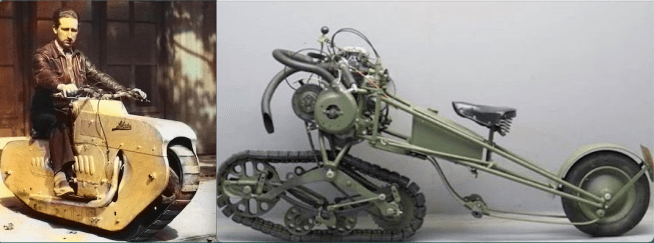
LIKE THE TRACKED vehicles produced by messrs Mercier and Lehaitre the Moto-Kar DeLuxe, produced by the Moto-Skoot Manufacturing Co of Chicago, can’t fairly be called a motor cycle; it was described in the colonial press as “more of a toy than a conventional automobile”—which seems fair considering the claimed 2½hp from it’s single-cylinder four-stroke lump. But Moto-Skoot also offered a trio of scooters: the De Luxe Tandem, the Deluxe Auto Pick-Up and the Challenger. The range brochure claimed: “Last year only 5,000 motor-scooters were turned out by all the companies in the field. This year one Chicago company expects to build 10,000 units.”
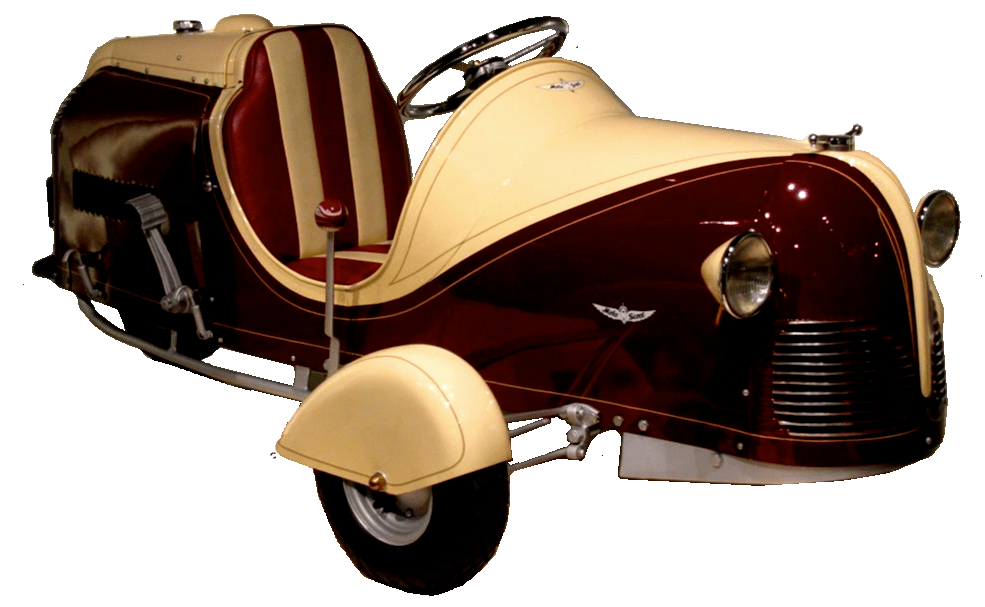
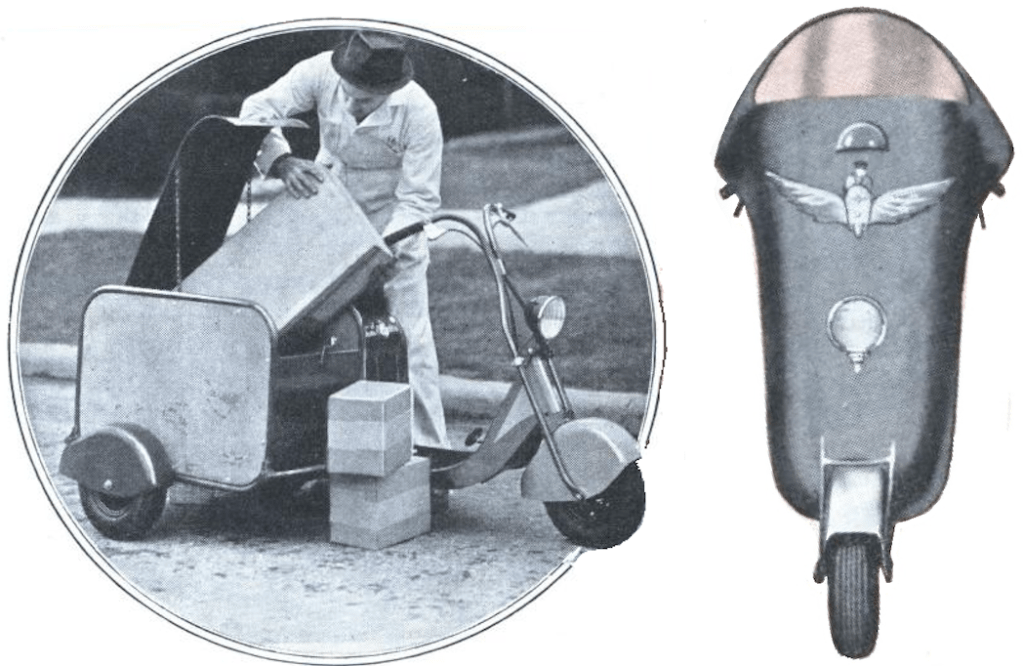
“OVER 20,000 PEOPLE watched the road races held on the new Lobethal circuit near Adelaide, Australia. The results showed a clear victory for British machines: the Senior rare was won by G Hannaford, on a Velocette; the Junior by F Mussett, also on a Velocette; and the Lightweight by GH Hinton (249cc BSA). The sidecar event also went to a British machine, a 596cc Norton outfit, driven by B Rehn. There were some extremely exciting final laps in the Senior race. At the outset, G Hannaford (Velocette) took the lead, closely followed by the English rider, DC Minett, on a Norton. At the end of the second lap Hannaford was fifty yards ahead of Minett, who in turn was about 150 yards in front of a New South Wales rider, Art Senior. In the fourth lap Senior retired with a flat tyre, while Hannaford was still in the lead with Minett closely harrying him. A rider named Hector moved up into third place. Then the crowd really was on tiptoes! At the start of the last lap Minett obtained the lead from Hannaford. The latter nearly overshot the bend at Kayannie, but he got round safely and continued in hot pursuit of Minett. There was only fifty yards between them as they raced towards the finishing line. Then Minett had bad luck. He braked suddenly, apparently to avoid a slower rider, and Hannaford shot by and just pipped him on the post. Hector ran out of petrol and lost his third position.”
“I ENCLOSE A SNAPSHOT of a machine that might be of interest to your readers. Years ago, when I was a boy, I used to dream about a small motor cycle suitable for a boy, and I remember how I longed for one. However, I did not get one until I grew up, but I kept the idea in mind, and decided that, should I have a boy of my own, I would not forget my own yearnings. Well, I have a boy now, and he is 12 years of age, and I have made him a midget motor cycle. ‘Details are as follows: The frame was originally a Henderson, but it has been cut down and re-brazed. Handlebars, mudguards, etc, have also been suitably reduced in size. Eight-inch diameter wheels are fitted, and these have 4.00x8in tyres and tubes. An interesting feature is the ‘clutch’, which consists of an idler pulley that tightens on the belt. Normal motor cycle brakes are employed. As regards the engine, this is a ¾hp Briggs and Stratton four-stroke (used for washing machines where no electric power is available). The machine has a maximum speed of 20mph, and the total weight is only 871b.
JE Biggerstaff, Winnipeg, Canada.”

“THE THREE LARGEST German motor cycle manufacturers are DKW, NSU and Zündapp. In the first eleven months of 1938, DKWs produced 42,000 machines, NSU 28,375 and Zündapp 17,341.”
“THE INTERNATIONAL MC Tour Club now has a membership of 364. Nearly 200 members travelled abroad last year, 63 in four members’ parties.”
“APROPOS OF RECENT REMARKS about perilous road surfaces, Lord Sandhurst testified before the Accident Committee of the House of Lords that in his opinion Cromwell Road is now one of the most dangerous thoroughfares in London. He asserted that small boys on bicycles are continually strewing groceries and fish and butchers’ meat all over the road; and that on wet days vehicles approach pedestrian crossings at a mere creep, aware of their inability to pull up straight from more than 15mph.”
“ALTHOUGH DESIGNED TO SUIT my 1930 493cc BSA machine with a three-speed gear box, the positive-stop foot-change mechanism described could, I think, be adapted to almost any gear box, three- or four-speed, that has an external selector lever. The unit consists of a back plate to which is attached a housing containing a reciprocating pawl block and on each side a spindle. The front spindle carries a sleeve serrated at its outer end toward the operating pedal, behind which is the pawl actuating arm locating over a peg in the pawl block; the locating hole is elongated, as the arm moves through an arc while the pawl block travels vertically. The rear spindle supports a circular ratchet plate, the teeth of which engage with the spring-loaded pawls, and from this ratchet plate the selector lever operating arm extends beyond the back plate. A suitable control rod is fitted between this arm and the selector lever. Two spring-loaded pawls are provided which move in suitable drillings in the reciprocating block. These drillings are reduced in diameter at one end to form collars on which the pawls seat. At the other ends they are tapped to take retain-ing plugs for the springs. Each pawl is shaped to fit the drillings and is cupped for the spring; the pawl, bevel is on one side only and both bevels face away from the centre line. The pawl block has circular projections above and below, over which fit the centralising springs. These springs seat in cups which are fitted with screwed plugs at the top and bottom of the housing. A dust cover encloses the mechanism and is simply held in position by four nicks in the edges of the back plate with which four indentations in the cover correspond. Retaining nuts are fitted to the two spindles and grease nipples are provided. In operation, assuming the pedal is depressed, the flat face of the lower pawl engages with a tooth of the ratchet plate; the ratchet plate is turned slightly and by way of the operating arm, control rod, etc, the gear is selected. When the pedal is released the top centralising spring forces the pawl block downwards, the pawl slips past the ratchet and the pedal is in its normal position ready for the next gear change.—LWC.”
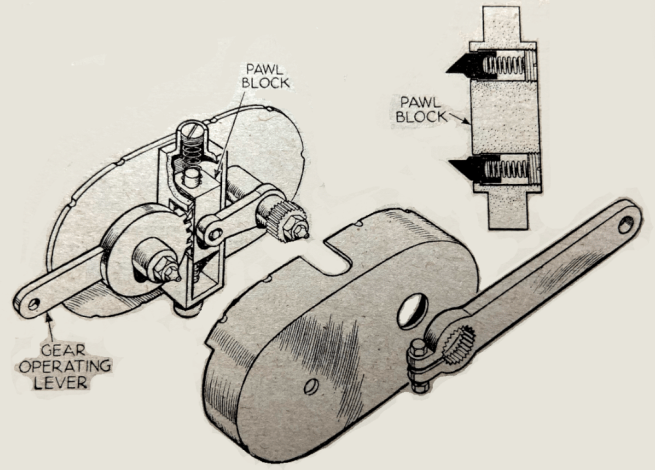
“SPEEDWAY ATTENDANCES LAST YEAR totalled 3,889,916, according to official figures.”
“VERY FEW NEW IDEAS have been introduced into reliability trials following the ban upon competition tyres that came into force on January 1st. The majority of organisers appear to have said to themselves, ‘Ah, yes: We used So-and-so hill last year; which of them will have to be omitted because they are too difficult for machines equipped with standard tyres?’ The result is that many trials have been much too like their predecessors. This is what we feared. Not only have the majority of those who plan trials been unable to think in terms of events other than those of the competition-tyre era, but there are signs in one or two quarters of a revolt against the decision that standard tyres must be employed in all trials upon the public highway. Indeed, some have gone to such limits as to assert that standard tyres are dangerous! It is as well to clear up a few points. First, the competition tyre was introduced simply to defeat the trials organiser; early on it was difficult to obtain competition tyres, for they were not available to the rank and file. In effect, they were the pot-hunter’s tyres, and trials organisers might well have barred their use there and then. However, the stupid age-old view that there must be no restrictions prevailed, and organisers in self-defence had to include deep sloughs and other freak hazards in their courses, plus tests that placed a premium upon semi-racing engines. Deft throttle-work ceased to be at the same premium, and no observant spectator could fail to see that in many trials the successful men were those who had the specialised hot-stuff engines and the nerve to tackle the muddy observed sections at speed. With the reversion to standard tyres there is greater need of engines that slog, and of true riding ability. Competitors must to some extent think afresh on the subject of the most suitable machine, and, more particularly, they must attain a new and higher degree of riding skill. The necessary change in tactics is a bigger one than most will admit. In the big open trials this is coming about as a matter of course, but in some events the competitors are rather childishly complaining that standard tyres are dangerous. In such cases the reason is either that the organisers have failed to provide suitable courses or that the competitors have still much to learn about riding—possibly a combination of both. It is not so many years ago that there was no such thing as a competition tyre nor the semi-competition tyre which is permissible for motor cycles, though not for cars. For ourselves, we would prefer trials to be run on true standard tyres. Nevertheless, we believe that the present change will eventually prove of considerable value—that it will help to ensure the continuance of trials and that it will make for trials that are more valuable and more interesting.”
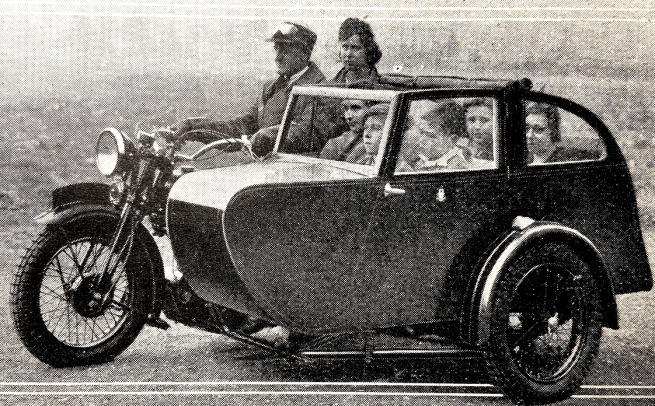
“AN INTERESTING FACT that emerges from the latest registration figures is that a much larger proportion of motor cyclists now ride all the year round. In 1929 the number of licences current on November 30th, compared with the peak figure for that year, was 70.6%. By 1934 the percentage had increased to 72.8, and in the latest statistics—those for last November—the percentage is no less than 80.2; that is, four out of five motor cyclists ride all the year round. Figures, it is alleged, can prove anything. Certainly many constructions can be placed upon the latest data. While they provide positive proof that motor cycling is not just a summer-time hobby, they also suggest that of the owners of the 462,375 motor cycles registered last year there is a very large proportion who use their machines as indispensable personal transport. Actually, no figures are needed to prove that this is so; all that is necessary is to travel early in the morning and count the motor cycles on the road. The figures constitute a further recommendation to the industry to pay more attention to the utility side. Over 45,000 motor cycles were registered for the first-time in Great Britain during 1938. The precise total, according to MOT official figures just issued, was 45,239. The total number of ‘new’ registrations during the month of December showed a healthy increase over the December, 1937 total. The totals were December, 1937: 1,700 motor cycles; December, 1938: 2,178. Machines in all classes showed- increases, while the under-150cc class jumped by 100%.”
“IS RIDING SKILL something you are born with—something you either have or have not—or is it something you acquire as the years pass? The answer seems fairly obvious—that some are born with a mechanical bent and ‘feel’, and others are not. All the same, mere handling of the controls and the ability to tell whether everything about the machine is running like the proverbial oiled silk do not comprise what the majority of us mean by riding skill. The man who is a born rider, in the usual sense of the term, does undoubtedly get the maximum from his machine. He has skill, but he is not necessarily a good rider. Last Thursday at lunch-time I saw a lad at Blackfriars Bridge, within half a dozen stones’ throw of the office, who handled his mount superbly, but I should’ have hated to be his pillion passenger. It would be wrong to say that he lacked riding skill, for the way he swerved round the inside of a couple of cars revealed that he could do most things with a motor cycle. On the other hand, he showed that he was wanting in both observation and imagination, the two attributes that, classed together, can be translated into the term ‘roadcraft’ or ‘road sense’. Assuming that he had possessed what I believe the average motor cyclist looks upon as real skill, there would have been no possibility of his getting into a tight corner. He would not have almost brushed the near-side wing of the front car. It was thoroughly bad roadmanship…Of course, one cannot expect the driver of one particular type of vehicle to know the limitations of all other types of vehicle. On the other hand, surely every motor cyclist realises with very little thought that it can be unhealthy to overtake a moving right-hand-drive vehicle close in on the left? In the same way it is not difficult to remember from our cycling days that a man or woman riding a bicycle up a hill is liable to travel in a series of arcs. Every trip, every walk almost, can provide something in the way of road lore, and therefore add to one’s riding skill. At first it. may be in the nature of a conscious effort to analyse the actions of the drivers, riders and pedestrians one sees on the highway. It is, however, a good game and worth starting.”
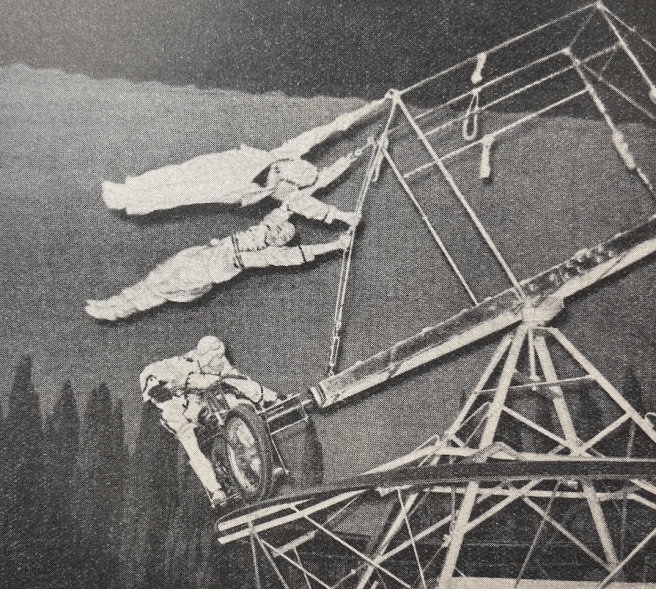
“A GREAT DEAL has been said lately regarding the difficulties of motor cycling under conditions of ice and snow…Several weeks ago I spent five days in Central Perthshire on my solo D Special Levis, when the temperature averaged 10 to 18° below freezing point, and the country lay under deep snow. Along the ‘unfit for motors’ road to Loch Tummel from Pitlochry, where the deep ruts had been frozen and filled with ice and snow, I experienced a snow blizzard, but was well protected by my Wilbeck screen. When I left Edinburgh on my way North I saw an AA sign: ‘Ice-bound road, great caution’. At first I was somewhat nervous, but before I had covered many miles I had acquired the knack of driving as the road surfaces required. My first stop was at Pitlochry, 93 miles away. I had taken only 3hr 35min for the journey—an average of 26mph over ice—both glassy and rutted—and deep, frozen, rutted snow. Most of the trip was done in darkness with an icy cross-wind blowing. I did not require to ‘foot’ at any time, and I honestly enjoyed the run, and looked forward to the days to follow with enthusiasm. My hopes were justified. On my return journey I encountered even more thrilling conditions, for there had been a heavy snowfall in Kinross-shire. Briefly, I attribute my freedom from trouble to the superlative steering and silky transmission of the Levis, to the grip of the 4in Universal rear tyre, and the power of the engine at low speeds.
AG Forbes-Howie, Edinburgh.”

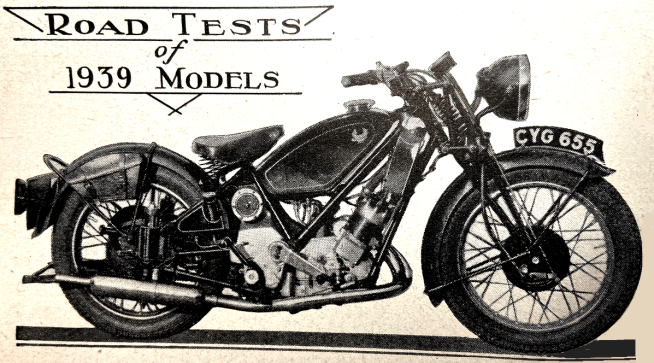
“MUCH HAS BEEN WRITTEN about the attractiveness of the Scott. When a model such as the Clubman’s Special, which the manufacturers claim is ‘for the elect of speedmen’, is introduced, it interests not only those who know much about Scotts, but others with just a passing knowledge that these two-stroke twins are unusual machines with an appeal of their own. The acceleration of this new Scott is outstanding. It is remarkable, for from a standing start the machine attained no less than 76mph at the end of the measured quarter-mile. If the throttle is opened progressively from 40mph in top gear the acceleration is good; it becomes pronounced when the speedometer needle passes the 45mph mark. Really high speeds are possible and practicable for long distances. The speed of 84.9mph was accomplished under very unfavourably windy conditions, and there is every reason to believe that in better circumstances a timed speed in the region of 90mph would be attained. This view is substantiated to some degree by the speed of 80mph in second gear (5.5 to 1). With the machine on the open road the speedometer needle can be kept at about 75mph as often and as long as circumstances permit. Never does the engine give the impression of being over-driven; rather is there a tendency to flog the engine unnecessarily, so delightful is the silky power output coupled with mechanical quietness and an adequate silencing system. It is not only the engine which is responsible for the machine’s capacity to maintain an exceptionally high average speed over long distances. Gear changing by the foot control is positive and ultra rapid—merely a slight interruption in the purr of the engine. The steering and cornering are first-class; even if the model were heeled over as far as the footrests would allow, a true course was always held. Road-holding is good but for a certain amount of back-wheel hammer, which the spring frame, though adding to comfort at high speeds, did not reduce to the extent anticipated. Extremely strong springs appeared to be fitted, which
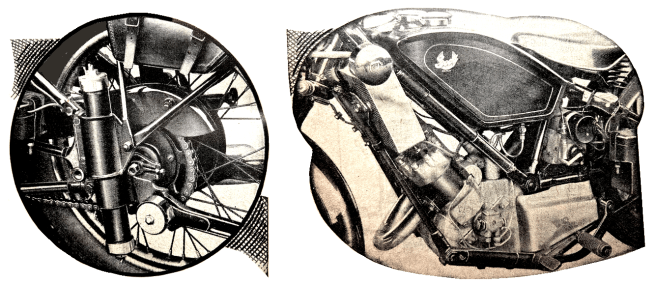
made the effective movement rather short. During the test experiments were made with rear-tyre pressures and for a rider weighing about 12½ stone in all-weather kit a pressure of 23psi was found the most satisfactory for the 3.50in section tyre. This is 5-6lb higher than the standard recommendation. The springing mechanism is absolutely rigid laterally and very neat in construction. When the Scott is regarded as a very high-speed machine the brakes can be criticised. For town work they are adequate, though rather heavy in operation. The front brake is the more effective of the two. Starting in all circumstances was an easy matter. With the engine hot usually only a dig on the kick-starter over one ‘compression’ was necessary, and similar tactics were effective with a cold engine; in the latter case the carburettor was first well flooded and the engine turned over fairly slowly two or three times. In town the Scott has gentlemanly characteristics. The minimum non-snatch speed in top gear was 17mph and the lowest useful speed from which the machine would easily accelerate in its ultra-smooth manner was 17mph. Thus the usual driving speeds in built-up areas are comfortably within the compass of top gear. Idling is very satisfactory on half-advanced ignition and very little four-stroking occurs, particularly if the cylinder oil-feed is cut down to eliminate over-lubrication. Another good feature is that the pick-up is clean as the throttle is opened. The clutch is light in operation and takes up the drive progressively. All the controls are well positioned, especially the rear brake pedal, which is under the ball of the left foot. The riding position is lust about ideal for normal touring. For those who desire to use speeds approaching the maximum, a more ‘sporting’ type of handlebar shape would be preferable. On greasy surfaces and tram lines the handling is positive and on no occasion did the rider have the impression that a skid was imminent. There are many attractive features of the machine apart from its remarkable performance. The finish is of a very high standard and the colour scheme smart yet dignified. The new large-capacity tank is fitted with two quick-action large-diameter filler caps which do not leak even when the tank is brim-full. Really large tool bags, a very neat spring-up rear stand and a speedometer positioned so that it can easily be read, are other good points. To sum up, the Clubman’s Special Scott is a machine to delight any enthusiast. The magnificent acceleration, the ability to maintain high speeds for an indefinite period, the complete lack of vibration through-out the speed range—this performance with mechanical quietness and excellent steering and cornering combine to give the owner a new and thrilling experience.”
“A DEGREASING PREPARATION known as ‘Gunk’ has been introduced by Charles Mack and Co, 52-54, Trevelyan Buildings, Corporation Street, Manchester. It is a thick, dark liquid, harmless to the hands and antiseptic. Tests by The Motor Cycle show that some remark-able results are obtained by its use. Oily and greasy parts, or complete units, if just brushed over lightly, or sprayed with the preparation, can be hosed or swilled down with water and all trace of oil -disappears, leaving clean bare metal.”
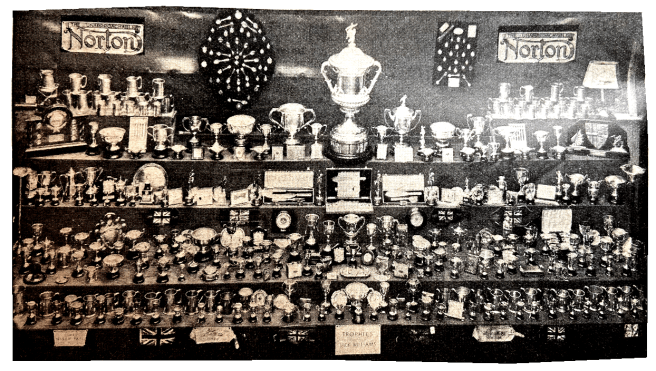
“WHILE I TAKE NO particular pleasure in the fact, it was interesting to see how many sidecar outfits figured in the pictures that arrived from Czechoslovakia last week. I saw not only photographs of solos, but also of hundreds of sidecar outfits, each with three soldiers aboard. I mention this because the authorities over here have until recently been employing only solo motor cycles. Apparently, unlike the Continental nations, they saw no particular purpose in the sidecar machine. However, the new mechanised battalions are being equipped with a number of sidecar machines, so maybe there is a change in outlook.”
“‘NITOR’ took the wind out of my sails last week by commenting upon the German Army’s lavish use of motor cycles and especially of sidecars, as evinced in the news films. It would be extremely interesting to read the technical reports upon which such a policy is based. There is practically no difference in cost between a heavy military sidecar outfit and a small car (such as the Fiats, which I have seen in fleets on the Italian Army manoeuvres). The German decision may involve two factors, viz, (a) a preference for small man-carrying units, as compared with larger cars containing half a dozen men, and (b) a preference for the sidecar over the light car when small man-carrying units were decided upon. Alternatively, it is possible that the decision was merely opportunist, and that neither light cars nor larger cars were obtainable in view of the preoccupations of factories manufacturing such alternative transport. Personally, I plump for reason (b) and suggest that our own Government will soon appreciate the value of the sidecar outfit for military use.” —Ixion.
“LANCASHIRE COURTESY POLICE warned or gave advice to over 1,000,000 road users in the past eleven months.”
“THERE ARE NOW over 900 traffic light installations in and around London.”
“SEVEN HUNDRED CORNERS and bends were improved to give better visibility in the North-Western highway division of Britain during a recent year.”
“JUST OVER 40,000 motor vehicles were registered for the first time during January, compared with 38,682 in January, 1938.”
“A LOT HAS BEEN written about the ideal bike for the man in the street. Well, I had one, namely, the round-tank 2¼hp BSA that was made about 14 years ago. I rode this machine for 10 years every day, winter and summer, to and from work, and on holidays I made long journeys from London to Devonshire, etc. It gave me entire satisfaction, and all the time I had it I bought only one spare set of chains, one inlet valve and guide, one carburettor throttle, and one or two other small items (apart from tyres). It was not too heavy, the layout of the engine was excellent, and the fuel consumption was about 120mpg. I gave away this splendid little machine a short time ago only because the brakes were on the one back-wheel rim. I consider that a simple little machine like this is what is wanted to-day.
WJ Stevens, Wembley.”
“RE THE RECENT correspondence on the question of stands, the photograph shows a prop-stand I have just had made for my 500cc machine. I first fashioned a light one out of strip steel for a pattern, then got the local blacksmith to make me a sturdy one; the charge was only 2s 6d, including a clip and spring. It has completely overcome the difficulty of hauling a fairly heavy machine on to its rear stand.
ME Bane, Norwich.”
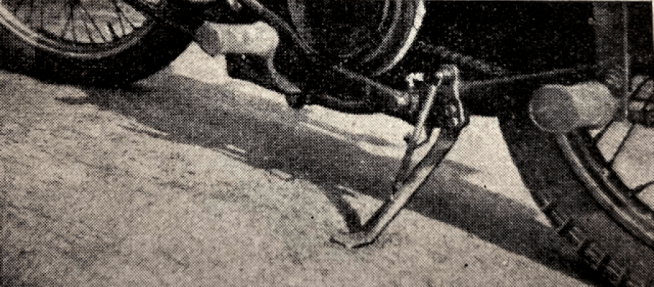
“I WONDER HOW MANY readers have thought of the inconvenience that will be caused by the regulation that comes into force next year and makes towing by a solo illegal. Imagine being stranded and unable to accept a tow from a passing friend. Perhaps someone will tell use the reason for this law. Is the practice of towing supposed to be dangerous? I have towed bikes and cars for distances of 100 miles and more and, have never found it so.
MW, London, SW12.
‘MW’ refers to The Motor Vehicles (Construction and Use) Regulations, 1937, in which it is laid down that ‘As from January lst, 1940, a motor cycle with not more than two wheels and without a sidecar shall not draw a trailer.’“
“THE FOLLOWING IS A quotation from a recent book: ‘I have a motor bike. It goes 80 miles an hour, and is a perfect thing. I hope to eat it shortly.’ Name.the author, the make of the motor bicycle, and explain the last sentence! The author, of course, was Lawrence of Arabia. The bicycle was a Brough Superior. By eating his machine he meant that he was out of a job and was so broke that he expected to have to sell the Brough to buy food.”


“IN VALUE FOR MONEY the new 490cc JAP-engined Cotton is remarkable. It is also a machine with an excellent all-round performance. Not only was the mount tested capable of high speeds—a timed speed of 76.3mph was obtained over the quarter-mile—but the tick-over and slogging powers of the engine were more like those of a gas engine than a normal motor cycle. The engine is the new JAP, which has the push-rod tubes cast integrally with the cylinder and detachable cylinder head. A single exhaust port is employed and the valves, which are totally enclosed in the heavily finned head casting, are accessible by means of a large detachable aluminium cover-plate set at an angle on the near side. The carburettor is an Amal of the horizontal type, set close under the tank and thereby, so
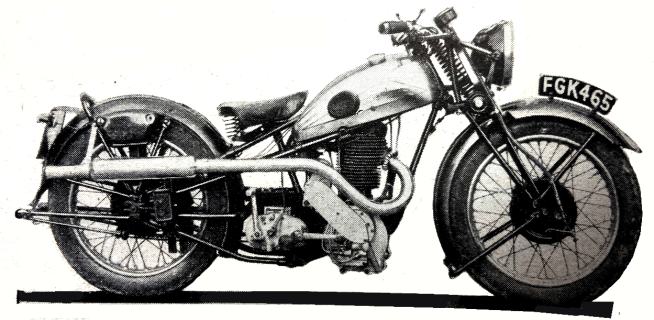
far as the tickler is concerned, rendered somewhat inaccessible. Starting the engine required no real effort. With the throttle only a fraction open and the ignition fairly well advanced the engine would start and tick-over at what proved by stop-watch to be an easily countable number of revolutions a minute. This is an outstanding feature of the power unit. As a test the engine was left ticking over like this for minutes on end. Thus in traffic there was no need to keep the engine revving by blipping the throttle. The exhaust prayed remarkably unobtrusive under all conditions. At a tick-over speed it was almost inaudible, while on full throttle there was no semblance of a ‘bark’. Mechanically, the engine was quiet, except for piston slap, which occurred with the engine either cold or hot. The well-proved Cotton triangulated frame is employed in conjunction with Druid central-spring front forks. The result of these features, and no doubt the weight distribution, is steering, road-holding and cornering that are as good as probably have ever been attained with a 500cc machine other than with rear springing. In all circumstances the rider has the feeling of being in complete command. The machine can be ridden feet-up at a walking pace, lays over to perfection on corners and bends and at speed holds rigidly to its course. A low riding position is provided. The rider sits in the machine rather than on it. The degree of comfort is excellent, and the controls are well placed for easy operation. Handlebars of very good shape are fitted and, what is apt to be unusual, the front brake lever can be grasped without any stretching. The brakes are good; from 30mph the machine could be stopped on dry concrete in 38 feet. Flexibility is a feature that has already been touched upon. The engine has exceptional pulling power, with the result that there is no need for the rider to be constantly changing gear. It will slog away in cart-horse style up a hill, yet has useful acceleration. In second gear (7.6 to 1) the machine accelerated from 20 to 50mph in 8⅕sec, while from a standing start it attained 61mph at the end of the measured quarter-mile with, of course, use of the gears. A particularly valuable feature is the smooth, quiet running of the machine in 30mph limits. The minimum non-snatch speed in top gear proved to be approximately 14mph. Anything from about 20 to 55 mph can be said to be a
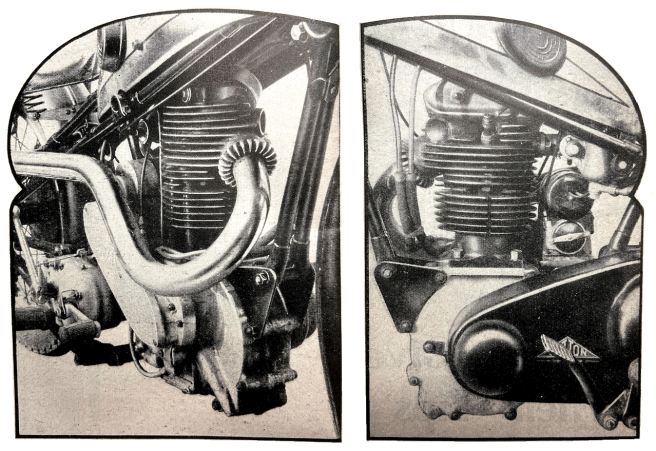
comfortable cruising speed. Above the latter figure a fair amount of vibration occurred; below it the engine proved extremely well balanced. Another good feature was the freedom from pinking. Ethylised fuel was used during the test and on this it was almost impossible to make the engine knock. The gear box fitted is a four-speed Burman with foot change. The clutch was light. and sweet in operation. There was no drag and as a result not only did bottom gear engage noiselessly from neutral, but the gear change was both quick and easy. During the test the engine remained satisfactorily oil-tight barring on one run when it was found that the two screws fixing the aluminium valve-cover plate had worked loose. Although inexpensive, the machine is thoroughly well equipped. In addition to the multi-tube frame with its duplex front down tubes and its chain and torque stays, there are wide D-section mudguards, a Miller Dynomag, twin tool boxes, a ‘reserve’ fuel tap, large-diameter brakes and front and rear stands—the latter of extremely sturdy construction and provided with a racing-type clip. A neat high-level exhaust system with a tubular silencer is fitted. A small desirable ‘extra’ in this connection is a guard or lagging to protect the rider’s wader of coat tails from coming into contact with the pipe. In brief, the Cotton provides a remarkably docile performance allied with a really good turn of speed and magnificent steering, road-holding and cornering.”
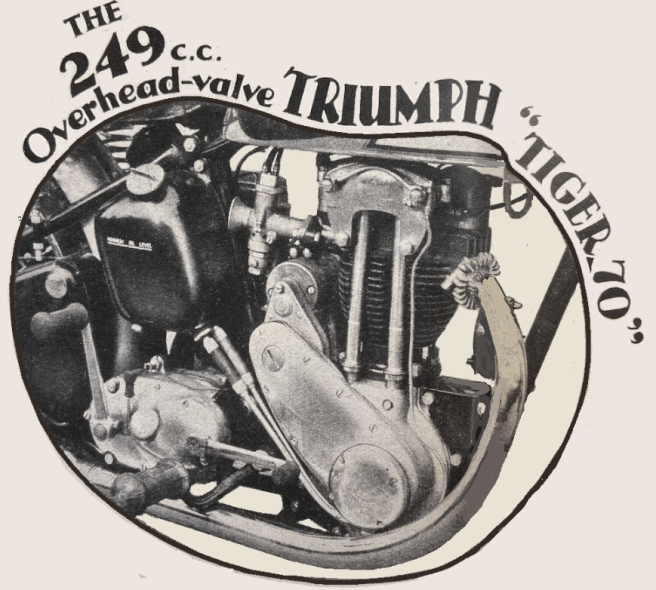
“THE 1939 TIGER 70 TRIUMPH comes into that exclusive class of 250cc motor cycles which combine exceptional docility with a lively performance. The machine looks a thoroughbred from stem to tern. It is extremely well finished and the latest colour scheme is most attractive. Obviously much skill and knowledge have been applied to the design. The layout of the controls is good, the riding position excellent for a person of normal height, and the saddle, handlebars and footrests are well placed. Adjustment is provided for the footrests, gear lever and brake pedal, so that a position to suit individual tastes can be obtained. The engine would always start first kick from cold, and once started would continue to run evenly and slowly. No knack or special precautions were necessary, no matter whether the engine was hot or cold. An ethylised fuel was employed throughout the test and the carburation was ‘clean’ at all times. Too rapid acceleration from low speeds would cause the engine to pink, and it was found that under such conditions as accelerating in top gear against a head wind the ignition control had to be used. Acceleration in the gears was good. For instance, in second gear (10.5 to 1) the time taken to accelerate from 15 to 30mph was 5 seconds, and in top gear (6 to 1) it took only 17⅖sec to accelerate from 20 to 50mph. In built-up areas the machine was very pleasant to ride, for it would pull smoothly at less than 20mph in top gear with the ignition fully advanced and would accelerate from this speed to 30mph without fuss. With the ignition retarded the machine could be throttled down to 10mph in top gear and could be gently accelerated from this speed without transmission snatch. This docility is outstanding when the general performance is considered, for the 250cc Triumph is no sluggard. On the open road the machine could be cruised without effort at 50mph for long periods. If the rider was in a hurry there was plenty of power to spare and the machine could be quickly taken up to 60mph. A pillion passenger made little difference to the performance, except that earlier changes had to be made on hills in order to keep up the revs. On several occasions 70mph was attained under favourable conditions, and the best timed speed over a quarter-mile was 66.1mph. The useful maximum in third gear (7.33 to 1) was 55mph, and the machine would readily accelerate to 50mph in this gear in the course of normal fast riding. On hills, early gear changes were found advisable, otherwise the power would fall off quickly. Main-road hills were usually breasted comfortably in third gear. No praise can be too high for the general handling of the machine. The steering was light at low speeds, giving very easy control in congested city streets. There was no difficulty in riding feet-up at walking pace; the steering is of the type that invites the rider to put his feet on the rests as soon as the machine is on the move. At touring speeds the steering remained light and positive, and it was only at speeds over 60mph that a touch of steering damper was desirable. Cornering with the Triumph was delightful, for it could be swung into fast or slow bends with ease and with that certainty that inspires confidence. On bumpy roads there was a certain amount of rear-wheel hop, but on normal surfaces the front forks effectively damped out road shocks. For test purposes the machine was ridden over lanes and greasy tracks; it was always stable and really easy to control in these conditions. The reason for the many Triumph successes in trials was evident in the way the machine handled on observed-type going, and in the machine’s stability

on greasy city roads. The brakes are exceptionally good, and powerful enough for a much heavier machine. Both were very smooth in action, and the controls well placed for easy application. Their combined power is shown in the excellent crash-stop figure of 32ft from 30mph that was obtained. It has already been said that the finish is excellent, and this applies to the controls as well as to the general finish, The clutch was very smooth and free from drag, and the gear change sweet and positive. The engine was smooth throughout its range, and for all practical purposes there was no vibration ‘period’. There was little mechanical noise. Certainly there was no clatter—simply the pleasant hum of well-oiled machinery. The exhaust note was subdued and pleasant at touring speeds, and only became rather healthy if the engine were revved hard in the gears. There are many other refinements on this well-designed machine which will appeal to the discerning rider. Such features as the strong and neat number plates enable the machine to retain that new look for a considerable time, while the light on the instrument panel is useful for map reading and as an inspection lamp as well as for illuminating the oil gauge and the ammeter. As regards economy, the petrol consumption at a maintained 40mph worked out at the excellent figure of 107mpg. In spite of many miles of hard work under arduous conditions the engine remained quite free from oil leaks.”

“CAMBRIDGE BEAT OXFORD in the Inter-Varsity Speed Trials last Saturday, but it was no walk-over in the motor cycle classes, for the competition was keen and the honours well distributed. The Main Drive at Syston, on the old racing circuit near Grantham, was used for the trials, and the half-mile was timed from a standing start. Visitors to Syston in the old days will remember that the Main Drive starts with a short uphill stretch, levels out for about a quarter-mile, and then rises again with two slight bends. The surface is asphalt and not too smooth. During the afternoon an intermittent drizzle made the surface rather greasy. Competitors came to the line in any order and had their two runs as they pleased—no red-tape is a feature of these trials. AE Moulton (Cambridge), after some late plug-changing and a great deal of warming-up, went off in a cloud of steam and on one cylinder, but later got into his stride quite well. He was followed by GJD Tilley (Triumph Twin), who was to make for Oxford the best 500cc time in the sports class. His getaway was excellent, and his changes, although a little early, were very nearly perfect; his time of 30.65sec was well deserved. No one else got near him in this class, although DD Budworth (346cc AJS) made two valiant attempts for Cambridge. On both runs he had vicious rear-wheel slides at the start, but he kept the grip open and was rewarded with times of 31.25sec and 31.30sec. Next best was REA Mason, on a standard Red Hunter Ariel. In the unlimited cc sports class, Tilley spoilt both his runs by missing his gear changes. He was beaten by Budworth, who continued his flat-out slide tactics; by ES Chapman (Cambridge), who made two very good runs on a stripped 246cc Radial Rudge which was too high geared for a good start, and by EN Bunting (998cc Vincent-HRD), who returned a time of 31.8sec in spite of kicking the exhaust pipe off when changing up at the beginning of the run. Thus Oxford won both the solo sports classes. All these men ran in the racing classes, but with the exception of Bunting, they were outclassed by faster machines. Best time in the 500cc class was made by PD Kennington (490cc Norton), of Cambridge. On the first run the motor was missing badly, on the second he had to shut off for an obstruction on the course and on the re-run he clocked 30.13sec. EN Bunting, on PM Aitchison’s spring-frame Norton, was troubled badly with wbeelspin at the start and could not better 30.52sec. It was in the unlimited cc racing class that the high-spot of the afternoon occurred. MN Mavrogordato, after two disappointing runs on a blown 250cc DKW, brought his 998cc Brough to the line. As he settled himself the crowd quietened down. On the signal from, the timing box, ‘Mavro’ let in the clutch and made a fine getaway under the nasty conditions. There was a reek of dope, a couple of spits, and he had disappeared over the brow of the bill. His gear changes sounded magnificent, and everyone turned to the box for his time. It was 26.85sec. Later he had another run, but wheel-spin shot him off the track and he only just retained control. EN Bunting tried hard with both the Norton and the Vincent-HRD to regain the honour of fastest time for Oxford, but conditions rapidly deteriorated and his best time was 28.2sec on the Vincent.”
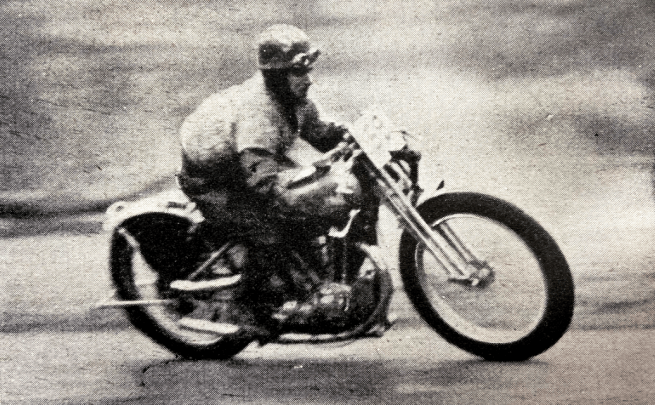
“PILLION TRIALS APPEAR rather to have missed their objective. One might assume that the pillion trial in its original conception was a trial to interest the class of rider who normally carries a pillion passenger on social occasions. But it was quickly realised that among such company an expert trials rider, with another ditto on his pillion, formed a duo that took a lot of beating. So the pillion trial tended to become rather a farce, with the contestants all experts in the trials game, with similar experts mounted behind them, and half the usual quota of machines left behind in their sheds for the day! Pillion trial winners were all too often the habitual winners of sporting solo trials who disdained ‘bracket passengers’ on all except these special occasions. Perhaps it is rather unkind to single out one particular event as the peg from which to hang a generality. But it is significant that in the East Cheshire Group’s Pillion Trial last week-end the number of starters. was just about exactly half the number of riders in the Group’s usual sporting solo trials! Moreover, the names of those who figured in the main result were strangely familiar, so that if they were given without calling attention to the fact that they were pillioning, the list would read like any other half-day trial result. The event was organised by the Metropolitan Vickers MC and as last Sunday was a ‘closed date’ for the home ground of the East Cheshire clubs, new pastures had to be sought in mid-Cheshire. This area is not too friendly, so that route-marking was avoided and a fully directional route card was issued; nobody lost the way or was late owing to card-reading difficulties. And, incidentally, all the 26 pairs who were entered were at the start, in spite of the Group Social the night before! In the Tarporley-Beeston Castle district, which is a much more ‘agricultural’ terrain than the usual Buxton area, there were several sections which destroyed all clean sheets, and the ultimate ‘best performance’ honour had to be shared, as the timed section for deciding ties was not applicable in a sufficiently decisive way.”
“FROM THE HORSFORTH CLUB, of Leeds, comes a fine idea for encouraging young riders to join the ranks. Riders under 21 may join the Club at the very much reduced fee of 3s 6d for one year. Then, when they have seen just how enjoyable is club motor cycling, they can become fully-fledged members at the normal rate. Ladies and non-riding members may also join at this reduced rate, so forming a supporters’ club from which future members will be enrolled. The scheme is one that should appeal to all clubs wishing to increase their member-ship, and also to youngsters to whom the saving of a few shillings is important.”
“TALKS IN THE CLUBROOM by distinguished speakers are becoming more popular every winter, but as yet only comparatively few clubs have discovered how interesting and enjoyable these evenings can be. The Accrington (Lancs) Club arranged for three speakers to attend the clubroom recently and over a hundred members and friends turned up. The men who spoke were Mr AE Hope and Jimmy Simpson of Shell Mex and BP, and Inspector Jones of the Lanes County Constabulary, who explained the aims of the ‘courtesy police’ now, working with such success in Lancashire. The evening was a great success and one of the high-spots was the discussion between Jimmy Simpson and speedway-star Joe Abbott on the respective merits of mineral and castor-base oils.”
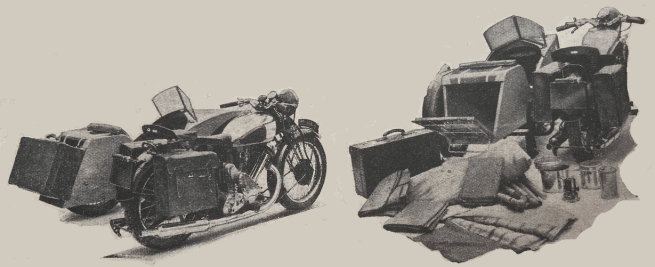
“CAUSTIC COMMENTS HAVE often been made by judges upon the activities of shady-type solicitors in road-accident cases. These ‘ambulance chasers’, as they have been termed, follow up accidents—even the most trivial—in order to enrich themselves. Their interest in the victim is nil; their aim is to despoil the insurance company and make the maximum possible sum for themselves. Often the basis is that the spoils shall be divided‚50% for the victim and 50% for themselves. A frequent habit in trivial cases is for them to formulate a claim for an amount rather less than the sum the insurance company would have to spend in defending the matter were it taken to court. They know only too well that the insurance interests will in all probability pay up as being the cheaper way out. Needless to say, such activities have their effect upon insurance rates. In addition, the motorist probably loses his no-claim bonus and has a black mark against him. Is there no remedy? To date it seems that nearly all that has been done has been to request the legal fraternity to put their house in better order. Of the attitude of the Law Society and its anxiety to co-operate in eliminating this evil there can, of course, be no doubt, but it is impossible for it to take action in the absence of concrete evidence. Would it not be better for the insurance interests to co-operate, put a fraction of a per cent of their premium income into some central fund and in all cases where the activities of a touting solicitor are suspected, fight the matter to the utmost and thereby expose him?”
“THE TT COURSE this year will be faster still. This is revealed by an examination of the course we made last week. The main difference is that another mile of the Mountain road has. been reconstructed. It has been widened to 27ft around the Goose-neck, and the’ Gooseneck itself banked! Apart from this, the lower part of Bray Hill has been made smoother. What saving of seconds will result from the alterations will not be known until practising begins for the TT, but the effect must be the saving of several seconds. In some quarters it is customary to point to the ever-increasing lap speeds as a measure of the improvement in engine power. While there have been remarkable increases in power output, the fact is that the speeds give no proper basis of comparison. The course has changed completely over the past 10 years—not because of the races, but because of the endeavour of those concerned to open up the Island for the tourist by providing smoother and safer roads.”
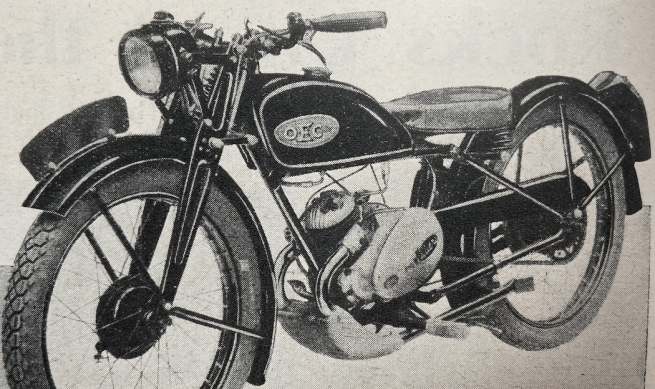
“I BOUGHT MY FIRST brand-new motor bicycle in the year 1900, paying—as was the custom—a 25% deposit with my order, and receiving delivery some six months later. The sole literature supplied with the machine, or indeed at any future time, was a badly printed folder of four pages, measuring about 8in by 4in, which was at once the price list and the maintenance booklet. To-day I have received by post an advance copy of the instruction book issued with the 1939 high-camshaft Sunbeam. It runs to no fewer than 92 pages and contains the most explicit and detailed instructions for handling, adjusting and repairing the machine, together with much shrewd advice on diagnosing the causes of any spot of bother which might develop in prolonged use. The modern motor cyclist is spoon-fed compared with us hardy oldsters, whose abysmal ignorance of our mounts was paralleled by an even greater ignorance on the part of the push-bike retailers to whom we had to appeal when we were beaten; for there were no garages worthy of the name in AD 1900.”—Ixion.
LIVERPOOL POLICE TOOK delivery of a batch of 1,140cc Royal Enfield outfits, taking the scouse cops’ fleet past the 50 mark.
“IT WAS A SUNDAY MORNING. I was on foot, envying the motor cyclists who shot past me at intervals, when suddenly the exhaust of the machine of a pillion couple was cut off as with a knife, and the rider pulled into the kerb, where the passenger stepped daintily off, leaving the superior sex to diagnose and repair. I paused alongside out of curiosity, actually Pondering which of several possible causes had stopped that engine so instantaneously. The bus was years and years old, and its owner obviously not very clever. He gazed rather vaguely and distractedly at both sides of the machine below tank level, and then began peevish and useless kicking at the starter. I was just about to suggest that he’d better verify his spark as a first step when I noticed that his side valves were stationary—a horrid sight, recalling memories of 30 years ago, when cams and timing wheels were fixed to spindles by brittle pins, and we carried a few inches of silver-steel rod as a routine spare. My heart bled for the disappointed couple as I directed them to a garage up the road, wondering precisely what had cracked up inside their antique engine. What a debt we moderns owe to the engineers who rendered timing gears invulnerable—I have not had one go since 1911, and that gear only went because I got hold of some dud oil, and seized up the engine. As I trudged off, leaving this disconsolate couple to a ruined Sunday, I fell a-thinking of the power of love. Nothing on earth would induce me to confine all my motoring to a not-always-well-sprung seat at the most vibratory end of a motor bicycle. Nothing would induce me to ride in almost any old weather with only rayon stockings to protect my nether limbs. And how I should hate to be driven by a not-very-good rider on a not-very-good and not-very-new motor bike, especially when the traffic is both fast and heavy (as it was this Sunday) and the roads are filmed with black grease (as they were this Sunday). But perhaps it isn’t the power of love at all. Maybe the little darling never realises that Tom isn’t a Stanley Woods. I hope the garage found their timing gear was mendable both quickly and cheaply; in the 1900 period we could fake them up with a French nail at a pinch.”—Ixion.
“There are nearly 407,000 motor cycles in use in England, 24,375 in Wales and 31,076 in Scotland, according to the latest official figures.”
“FROM 1928 TO 1938, the total number of vehicles in use in Britain has risen from 2,052,539 to 3,093,884.”
“THERE ARE NEARLY one and three-quarter million cars in England, over 81,000 in Wales, and over 147,000 in Scotland.”
“IT IS ESTIMATED that there are 43,000,000 cars in use in the world.”
“ONLY THREE ELECTRICALLY propelled private motor cars are in use in Britain.”
“THERE ARE APPROXIMATELY 4,400 electrically propelled vehicles, 990 steam-driven vehicles and 8,600 diesel-engined vehicles now in use.”
“THE TOTAL DEPTH drilled in Britain by oil exploration firms in the past two years is over 12 miles.”
“WN JORDAN, WHO WAS injured in a collision with a car in the 1937 International Trial, was awarded £5,092 damages at Birmingham.”
“TRIUMPH’S IN A recent week received orders from Holland, Sweden, Germany, Canada, USA, the Argentine, Australia, India and Java.”
THE SOUTHERN CROSS MCC of Adelaide staged an ‘English-style’ trial. The correspondent added that in case the Brits thought of their Aussie cousins were ‘Promenade Percies’ a more typical Southern Cross event was a non-stop 24hr, 500-mile blast through the bush.
“ONLY TWO TYPES of light commercial vehicle will be produced under Germany’s rationalisation scheme for the motor industry. One will be a three-wheeler, and the other a four-wheeler. Both will have a 500cc engine.”
“BLOSSOM-TIME WILL SOON be here. Every year apple, pear, cherry and plum trees transform our countryside into a blaze of pink and white. A two- or three-hundred mile week-end in blossom-time will be something to be remembered, and if you did lay up your machine for the winter it will be an exciting return to the joys of the road. And if you rode all the winter, and like most of us enjoyed beating the elements at their own game, so to speak, then equally you will enjoy this colourful emblem of softer conditions ahead. Many a Welsh valley loses its expansive austerity at this season, when blossom nears the focus of interest and provides a sharp contrast between it and the dark hills beyond. Almost every Cheshire farmhouse becomes garlanded with apple blossom and pear, as you will see if you take the trouble to explore some of the more remote lanes. If you want to see great masses of blossom, then that delightful stretch of country from Evesham across to the Rivers Wye and Lugg will provide perhaps the finest sight in the country. ETWB”
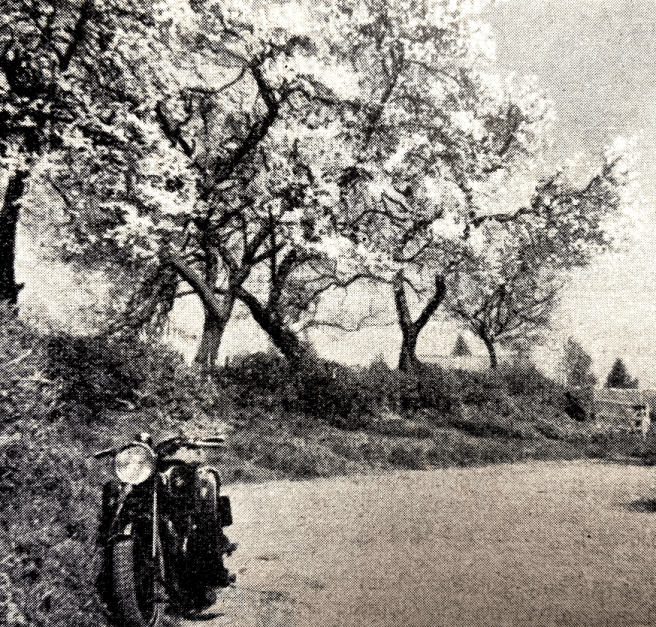
“IF YOU WISH TO behold one of England’s most superb displays of blossom, visit Clifton Downs, above the gorge of the Avon at Bristol, when the may trees are fully out. If you prefer the daintier but less gorgeous shows provided by hedgerows, hie yourself westwards when the primroses, bluebells or pink campions are in season, and dive down a deep lane off any Devon or Cornish main road. These are natural displays. The Worcestershire blossom shows, recommended by a contributor, depend too much on the fruit farms, where the trees are planted in regimented order.”—Ixion.
“A WOMAN WAS fined £50 for attempting to bribe a driving test examiner.”
“I LIKE RECEIVING LETTERS from Mr Prothero, secretary of the Devonport Club. His enthusiasm for club life is so infectious that I wish I could pass it on to you. In a recent letter he tells me that members of the club had an afternoon run to Penzance and back, some 180 miles, during which the weather was far from pleasant, yet the turnout of riders and passengers was very good. The Club has been presented with a challenge trophy from the South-Western Area Motor Cycling Committee as a mark of appreciation ‘for the help, advice and experience that your club so generously gave when competitive motor cycling was introduced into the Army’.”
“NOW THAT THE Army has shown us it can produce good trials riders—have you studied the results of the recent open trials?—it seems that it is next to break into the racing sphere. The 42nd East Lanes Terriers are making a start by building their own grass-track on a field which has been rented near headquarters. Who will prophesy the date when the first Army man competes in the TT? In addition, these Terriers have formed a club, each member paying 3d per week. They hope soon to have a fund which will pay for any damage done to their machines in sporting events.”
“IN A LETTER FROM ‘down under’ an enthusiastic reader tells me that club life in Western Australia is really flourishing and that in Perth alone there are seven active clubs all with fairly large memberships. He says that great interest has been caused by the correspondence in The Motor Cycle on speeds attained in Australia. In a cutting taken from a local newspaper there is a report on a flying quarter-mile speed trial. Eight machines are reported to have covered the quarter at over 100mph with a half-mile run to get up speed, and best time of the day was made by J. McPhee on a home-built Harley-Davidson on which he recorded nearly 114mph. Perhaps the weather has something to do with these speeds, for the maximum temperature during the, meeting was 99°!
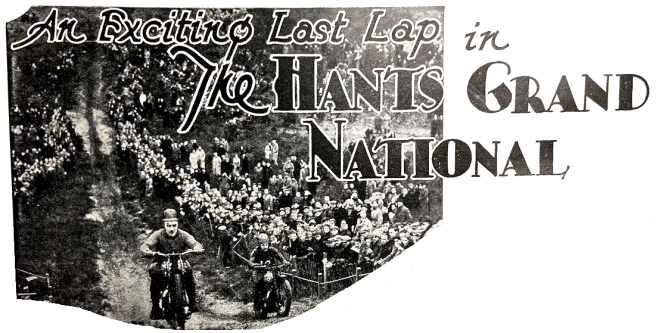
“A HUGE CROWD of spectators braved a biting east wind to see the annual Hampshire Grand National organised by the Ringwood Club. They were well rewarded, for the racing was very close and the excitement sustained to the very last lap. The usual course at Avon Castle, near Ringwood, was used, but this year the organisers had erected barriers at the danger points, and the spectators were kept well clear of the course. The circuit contains several steep hills, innumerable bends, switchbacks and muddy hollows, and is in every way a scramble course that calls for skill, stamina and pluck from the riders. Twelve laps had to be covered, and the select band of 28 competitors were sent off en masse. Shortly before three o’clock they were all lined up, and at the fall of the flag they had to run to their machines, start them by pushing or on the kick-starter and get away. KD Haynes (349cc Triumph) made a meteoric start. He leapt on to his machine, and in the one movement of bringing his leg over operated the kick-starter and then the gear lever. He was away before half the field had even got astride their models. However, the faster men were not far behind, and WJ Stocker (348cc Ariel), AJ Parsons (497cc Ariel), WA West (497cc Ariel), and EG Wilmot (347cc AJS) were soon in full pursuit. Haynes held his lead for a lap, but the second time round his engine fluffed on the steep hill soon after the start, and he was passed by Stocker before he got into his stride again. Now the five leaders were all bunched together, and the pace was terrific. On the next lap Haynes again had trouble on the hill, and this time West, Wilmot and Parsons went by. Sixth, and leading the 250cc class comfortably, was FR Simon (249cc Triumph), but his luck was not to hold. On one of the steep descents the rear brake rod of his machine broke, and Simon had to grab the front brake. The wheel locked, and the rider dived over the handlebars and spreadeagled in the bracken. As a final touch the machine followed and caught him a sound thwack across the rump, which put paid to his racing for the day. With Simon out, C Harper (249cc Triumph) took the lead in the 250cc class, hotly chased by AJ Whistler (246cc AJS). Already the rest of the field were beginning to thin out. At one mud patch at the bottom of a sharp descent there were frequent spills among the men who were not used to this type of going. R. Pope (348cc Velocette) fell twice here, and AG Briggs (349cc Triumph) lost control of the model on one lap on the ascent on the other side. One of the neatest at this point Was WV Argent (347cc AJS), who was fast down the hill but still able to pick his path through the mud at the bottom. However, all others were overshadowed by the five men who were scrapping for the lead.
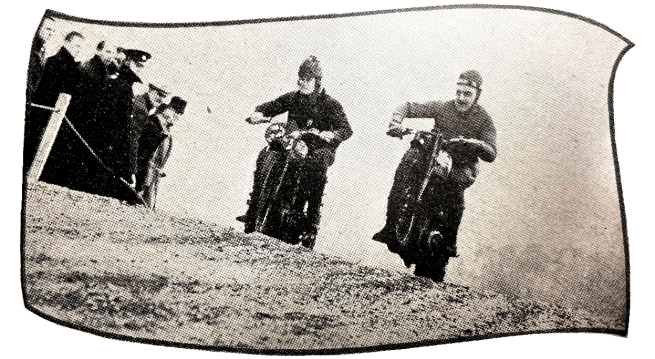
Stocker made the most of his advantage, and hung on to the lead for several laps. Meanwhile, West was only some twenty yards behind, and riding a safer race than usual. Wilmot and Parsons were scrapping together only a little way behind these two, and Haynes would, draw up behind them on each lap only to fall back again at the steep hill. On the ninth lap all five came round closer together. Haynes was obviously out for blood, and at the valley with the muddy bottom he opened up on the descent, roared through the mud at speed and overtook Parsons on the hill. Wilmot was the next man, and he chased and caught Parsons at the switchbacks. These two, Haynes and Wilmot, then roared along neck and neck, thrilling everyone as their machines jumped in the air at the crest of each rise. Neither would give way, but as they disappeared towards the start Haynes just managed to slip in front of Wilmot on a muddy rise. Stocker and West were now only yards in front of Haynes, and the speed of all five men increased visibly. With only two more laps to go West made his big effort and passed Stocker to take the lead. As they came round for the last lap, West, Stocker and Haynes were all bunched together and going like fury. People rushed in from all the vantage points to see the finish. But they were robbed of excitement, for West went wide at a corner at the back of the course. It was Stocker’s opportunity and he went to overtake inside, only to strike a hidden stump with his brake pedal, which twisted round and locked the wheel. West recovered before Haynes could pass and they left poor Stocker frantically dragging at the brake pedal. Haynes then could not challenge West, and the latter almost ambled over the line with Haynes about twenty yards away. Third was Wilmot, and fourth poor Stocker, who showed his great sportsmanship in crossing the line all smiles in spite of his bad luck. Twelve other men completed the course—a high percentage in view of the strenuous pace set by the leaders. C Bailey (248cc Ariel) was flagged off after eleven laps as the third 250 to finish.”
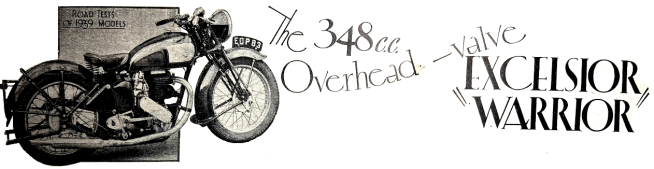
“THE RACING KNOWLEDGE gained by the Excelsior Company is reflected in many ways in the 348cc ohv Warrior. For example, the riding position is of the type that makes the rider feel he is part and parcel of the machine, while the road-holding and steering are first-class. The distance between the saddle and the handlebars is greater than with the majority of modern machines, and as the bar has a forward bend a straight-arm riding position, which was found extremely comfortable for open-road work, is provided. Both the brake and gear pedals are very well placed. The brake pedal has an adjustable stop and the pedal comes immediately beneath the rider’s toe. Gear changing was simple at all times, for the movement of the gear lever is short and the lever can be adjusted so that the rider does not have to move his foot from the rest. The machine tested was by no means new, and this probably accounts for the fact that the throttle was inclined to be stiff. The other controls were smooth and light in action. So far as performance is concerned, quite the most outstanding feature of the Excelsior was its pulling power. The engine is of the long-stroke type (92mm) and it would slog at low speeds as only this type of engine can. For all normal work out of town the gear box could be forgotten, for in top gear (5.65 to 1) the machine would romp up hills that would cause the majority of 350s to call for a change down. Pebblecombe Hill, in Surrey, which has a maximum gradient of 1 in 5, was climbed very comfortably in third gear (7.36 to 1), and on one clear run the machine breasted the hill in top gear with the rider using the ignition control. An ethylised fuel was used throughout the test, and even under these extreme conditions the engine failed to pink; nor did it do so at any time during the test. Apart from hill-climbing, this slow-speed pulling gave the machine good acceleration at low speeds. In third gear only six seconds were required to accelerate from 13 to 30mph, while in top the model would accelerate away from its minimum non-snatch speed of 15mph to 30mph in fewer than nine seconds. Obviously, with these characteristics the Excelsior was pleasant to ride in congested streets, for there was no need for continual gear changing. On the open road cruising speeds of up to 50mph were used almost continuously. Higher up the speed range some vibration was noticeable, but at normal speeds the unit was quite smooth. In the maximum speed tests the Excelsior attained a timed speed over the quarter-mile of nearly 70mph, and the mean timed speed was 67.9mph.
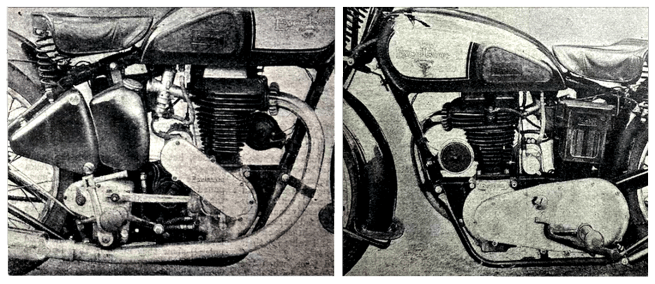
Throughout the range the speedometer was found to be accurate. Maximum speed in third gear was 54mph and the highest useful speed in this gear about 50mph. From a standing start acceleration was good. A speed of 50mph was attained in third gear in well under a quarter of a mile, and at the end of the ‘quarter’ the machine reached 55mph in top gear. All the moving parts of the engine are totally enclosed. The unit was found to be pleasantly free from mechanical clatter, only slight piston tap being audible at certain speeds. The valve gear and transmission were noticeably free from noise. The exhaust note is well subdued, and at no time did it become loud enough to cause offence. As previously mentioned, the slow running was particularly good, but, owing to the stiffness of the throttle, accurate control at small openings was difficult, and it was found advisable to retard the ignition when coming to a standstill in traffic; the engine would then run smoothly and slowly. Starting was extremely easy. The carburettor had to be flooded whether the engine was hot or cold. No special precautions were necessary and the engine was not prone to kick back. With the type of footrest hanger fitted the rider could not get the full movement on the kick-starter when wearing waders ; a shorter hanger would immediately overcome this difficulty. An outstanding feature of the Excelsior was its steering and road-holding. It has already been said that the riding position makes the rider feel part of the machine, and this position gives an immense feeling of confidence and complete control. As a result, the Excelsior could be swung round corners effortlessly, and the handling was delightful under all conditions. Wet roads were not encountered during the test, but the Excelsior was perfectly stable when crossing dry tramlines, and there was no sign of the waver or kick that usually means difficulties when the roads are wet. At low speeds the steering was light enough to make traffic tiding easy, while on the open road the machine was perfectly steady. The steering damper was used only when the maximum speeds were being taken. The front forks have a very wide movement and are fitted with a hand-controlled damper. They were found to be well up to their work and they never clashed or bottomed, although only light damping was used throughout the test. Both brakes were excellent. Either of them would bring the machine to rest from 20mph on a 1 in 5 descent. Owing to the convenient position of the pedal the rear brake could be used accurately and the wheel was never locked inadvertently. In the crash-stop tests the machine was brought to rest from 30mph in 38ft. Although the machine is reasonably priced its equipment is particularly complete. Apart from such features as the primary oil-bath, adjustable brake and gear levers and total enclosure, there are many interesting details in the design. Both magneto and dynamo chains are fitted with automatic tensioners, petrol and oil pipes are flexible and there is a separate petrol tap for each side of the tank. To sum up, the Excelsior Warrior is a lively 350 with very good pulling powers, excellent steering and brakes, and equipment that is lavish in its price class.”
“THE other night I dined with three old cronies, who like myself learnt to ride in the year dot. We got talking about our crashes in the prehistoric era, and we all agreed that our most frequent spills had been to the outside of sharp corners. You modern riders with your tarmac surfaces and long-radius bends simply cannot imagine what the pioneers suffered. I throw my mind back, and instantly see a road heavily pot-holed at all corners and wherever trees overhung it (the effect of drips), scored with two parallel ruts from London to Edinburgh or anywhere else, and stained with brown or green. With brown along the middle because that was where horses trod; with green any old where, because cows meander. In my very salad days I got a firm to build me a motor bicycle with a 30in. reach from saddle to pedal. Its centre of gravity was probably about 2ft. above ground level; and oh, boy! did she hurl herself outwards on a sharp bend? And now I sit on a grass bank in the Island, and see Stanley Woods with an ultra-low cg tackle an equally sharp bend at round about 60mph. But I can lay my hand on my heart and claim that I have never yet spilt the plot through centrifugal force pure and simple. It was the front wheel hopping on the pot-holes of the outer curve, plus centrifugal force, which occasionally unseated us so very painfully.”—Ixion
“NO ONE WHO VISITED BROOKLANDS on Saturday can be in the slightest doubt regarding the popularity of The Motor Cycle annual Clubman’s Day meeting. An entry of 497 had been received for the Clubmen’s events, representative of clubs in every part of the country, and, in spite of a doubtful looking day, there were very few non-starters. The same applies to the BMCRC members’ events, every one of which was well supported. And as for the spectators, once again they rolled up in their thousands and packed three and four deep at every vantage point. Long before the proceedings opened queues formed at every entrance, and the car parks were choked with motor cycles of every size and description. Such enthusiasm merited a good afternoon’s racing, and few will complain that on this score they did not get full value for their shilling admittance fee! Shortly before 1.15pm, when the kilometre trials were due to be
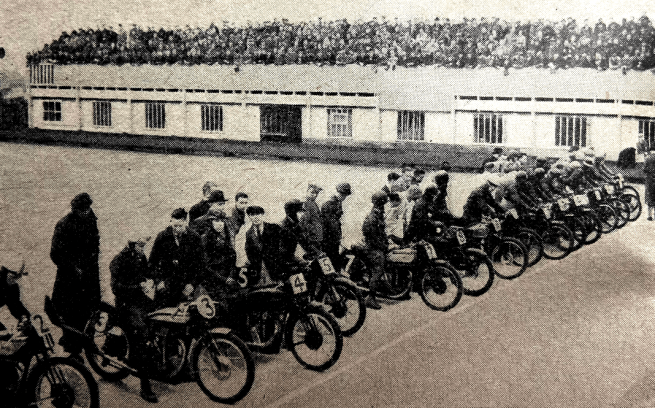
run off’ there was a sudden shower—nothing very serious, but it tended to make the track slippery in places. However, all fears that the meeting might have to be postponed were dispelled when dead on time the piercing note of a high-frequency horn warned competitors in the trials to get ready. No fewer than 146 clubmen shad entered for this event, and a fine (and noisy!) show they made as they lined up at the Fork preparatory to their swoop round the Members’ Banking and down over the measured distance along the Railway Straight. Most of the machines had ribbed front tyres, while another noticeable feature was the absence of dynamos—where these instruments were normally in unit with the magneto. Two at a time was the order, and the machines (as in all the Clubman events) had to be started on the kick-starter. Few had difficulty in this respect, but a notable exception was WG Edwards (348c Norton), who just couldn’t

get his engine to fire by means of the pedal, although it started at once when he pushed it! In spite of the wet state of the track, some very high speeds were recorded, the best being the 112.98mph by G Brown (998 Vincent-HRD). [We’ll meet George Brown again, on a brace of world beating Vincents—Ed.]…Last on the programme was yet another five-lap Bemsee handicap. Speeds were noticeably higher in this event, and the result was by way of being a surprise. JH ‘Crasher’ White was on the 29sec mark with his old 1933 Manx hack-bus on which he had not performed too brilliantly at the previous meeting. This time he had detached the dynamo portion of the Magdyno, and, judging by the way the old bike went, he must have also breathed rather heavily on the engine ! Whatever the cause, ‘Crasher’ went like the wind and crushed all opposition by moving from sixth to first in a single lap. He then went on to win easily at 66.86mph from FW Fry (348cc Velocette) and MRL Tuffnell (499cc Vincent-HRD). Thus ended yet another extremely successful Clubman’s Day. No praise can be too high for the organisation, which, in spite of the difficulties occasioned by such a huge entry, was perfect throughout. Good work, BMCRC!”
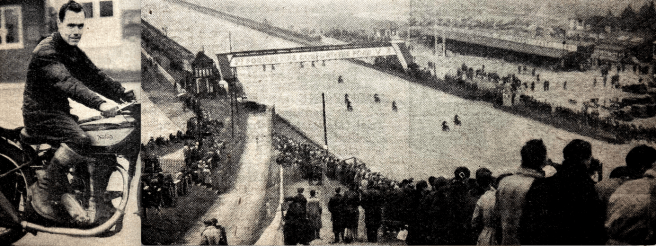
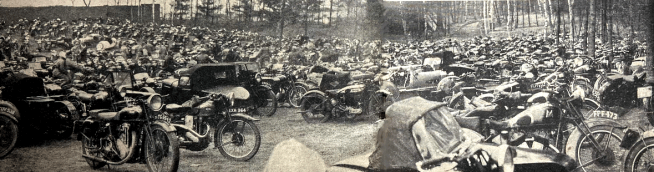

“SELDOM HAS THERE BEEN greater activity in the motor cycle world. Two big officially observed tests have just been completed; a third is well under way. The entry list for the Easter Monday road-race meeting at Donington was full as early as last Friday. Already there are over 400 in the list of competitors for the Land’s End Trial. And for Club-man’s Day at Brooklands on Saturday week the number last week-end was no fewer than 366. These facts alone show the keenness and enthusiasm that exist. They reveal that the motor cycle world is ‘alive’ to a degree almost without parallel. On the sporting side it has to be remembered that there are no monetary incentives—no payments of ‘bonus’ such as artificially swelled the entry lists a dozen years ago. To-day we are happy to say it is a case of sport, not cash.”
Here are some excerpts from the reports of the reliability runs ‘Nitor’ (for it was he) referred to, conducted by BSA, Panther and Triumph. As I have an M21, a Redwing Panther and a Triton powered by a T120R Triumph twin in the garage I confess to feeling rather proud of all three marques—Ed.
BSA Silver Star and M21 outfit
“ROUND THE COAST of England and Wales in 85 hours on two standard motor cycles taken straight from dealers’ showrooms—this alone sounds interesting. The officially observed test of two BSAs, held last week, is interesting, absorbingly so. The two machines, handled by teams of riders, ran continuously day and night. They covered 2,500 miles in weather that included snow, hail, rain, sleet and gales. They were driven by men who became utterly tired out—who knew that they must hurry to catch their connections following the next changeover, and who, in the case of one team, had only two hours’ sleep throughout. The machines were thrashed; towards the end, owing to the tiredness of the riders, almost unmercifully. This, however, is only part of the history of the strenuous test. En route the machines made 25 ascents of Bwlch-y-Groes, the lengthy Welsh test hill, which by popular vote among famous trials riders is the most difficult hill in the country normally tackled by tourists. On this 1 in 4.9 hill alone, the two machines each climbed the equivalent of over 31,000ft, or some 2,000ft higher than the highest mountain in the world. In addition, the machines travelled for one hour in top gear with the gear pedals removed—from Victoria, London, to Brooklands; covered, in one case, over 1,000 miles without the engine being stopped, and in the other some 1,400, did 100 miles at speed at Brooklands, were officially timed over the flying quarter mile, and climbed the 1 in 4 Brooklands test hill 100 times in 89 minutes. Seldom has there been such a gruelling test as this official ACU certified trial entered by BSAs and the producers of the oil, Mobiloil D. The two machines entered were a 500cc solo Silver Star and a 600cc side-valve sidecar outfit. In order to prove that the machines were standard in every way—were production models that had, in fact, gone far beyond the factory’s control—the BSA company handed the ACU a list of some 800 dealers and authority to take the machines from whichever of the 800 dealers they liked. Mr EB Ware, the ACU official, took the Silver Star from the stock of Faulkners, of Oxford, and the M21 side-valve from that of Percy Kiln, of Southsea. In the case of the former, the engine when started up in the showroom emitted clouds of smoke, a point which Mr Ware noted in order to tell the future rider that it was only fair in view of the circumstances that the plug should be checked before the test started. Both machines were taken by train to London by Mr Ware, who on Monday of last week had them transported by lorry to Rex Judd’s at Edgware, where the sidecar was fitted to the side-valve machine and the oil tanks drained, flushed out with flushing oil and refilled with Mobiloil D, the oil officially entered for the test. The side-valve already had a sidecar sprocket fitted, so the only other work was to fit the licences, see to the number plates, clean
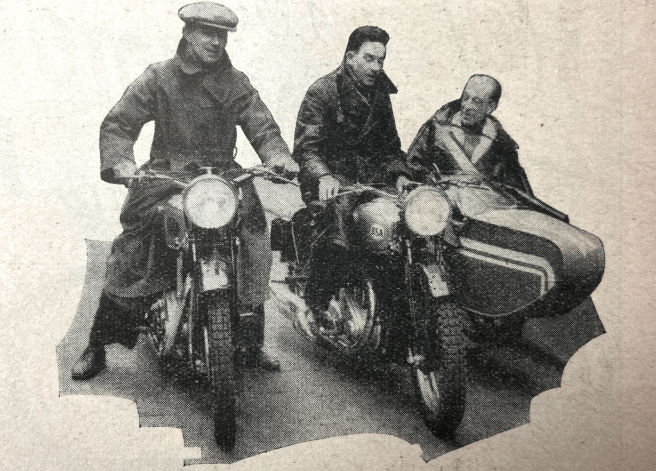
the plug in the solo and check over the various nuts and bolts. Next day, at 10.15am, the two machines set off from the ACU offices in Pall Mall. The test had started. W Johnson drove the M21 sidecar outfit and JH Amott rode the solo. In the sidecar was Mr Ware. Those who know London need no reminding of the traffic congestion in the middle of the morning. The two brand-new machines caught the traffic at one of the worst times of the day. Down Regent Street, across Oxford Circus, through Camden Town and Finsbury Park. Had the engine of either machine been stopped momentarily it would have been no less than might have been expected. BSAs were asking a lot in attempting to do the test without stopping the engines—specially prepared machines might be all right, but here were two motor cycles that had been in agents’ showrooms, were absolutely new, and had not even had their fuel tanks swilled out…At 9.30 am, after the rear chain of the solo had been adjusted in case the fling at speed should cause it to jump the sprockets, the two machines set off on their 100-mile high-speed test. From a standing start the Silver Star lapped at over 70mph. The second lap was at 76.03mph, and the machine went on non-stop to average 73.65mph, covering the 100 miles in lhr 21min 27.7sec. The side-valve sidecar outfit lapped consistently at 48 to 50mph and put in one lap at 50.31. The average speed for the 100 miles, including a stop to refuel, was 48.43mph. Then the machines were officially timed over the quarter-mile. In this the figures are 78.95mph for the Silver Star and 53.57mph for the M21 and sidecar. Finally came the hundred ascents of Brooklands test hill, which starts with a gradient of 1 in 8, steepens suddenly from this to 1 in 5 and ends with 154ft of 1 in 4. In each climb there is an ascent of 683ft. The machines romped up with the greatest of ease. Up they went, turned round at the top, braked hard at the bottom, turned round and set off again. In 89 minutes the two machines had completed their one hundred climbs; they had completed the whole of their ambitious observed trial, except for the final official examination which took place last Monday. The Silver Star was in magnificent condition throughout—not a sign of wear and only, a slight deposit of carbon. Barring the results of the petrol starvation, namely, signs of the piston having picked-up and the rings stuck, the side-valve engine was also in an excellent state.”

Panther Redwing Model 100
“”IN THE GREY HALF-LIGHT of last Monday morning a knot of people were to be seen at a filling station alongside the Barnet By-pass. Among them were Mr EB Ware of the ACU, the managing director of Panthers, Jimmy Simson, Jack Watson-Bourne and his wife, who is known in the motor cycle world as Miss Marjorie Cottle. Nearby, and presumably finishing his breakfast, was Kenneth Bills. What was it all about? This became obvious when soon after half-past five a 600cc Redwing Panther was wheeled out of a lock-up…The specification throughout, it was stated, was standard except that inside the filler cap of the fuel tank there was a gauze-type strainer such as is fitted to the export-model Panthers. A wire ran through special holes in the cylinder and cylinder head fins, had been twisted over and then sealed with an ACU official lead seal. In similar fashion the cylinder was sealed to the crankcase…Soon after a quarter to six Kenneth Bills emerged from the house alongside the garage, looking chubby, not to say rotund, in his many garments. Rubber Wellingtons, a leather flying helmet and a Barbour Thornproof’ International suit completed his kit. No sooner had he put on his outer garments than he was in the saddle, and Mr Ware had given the signal. A scrunch in engaging bottom gear. Beyond that only an effortless rustle as the machine accelerated and disappeared from sight in the direction of Welwyn, Biggleswade, Grantham and Doncaster…10,017 miles in a net running time of 209 hours 49 minutes. This was the achievement of the 600cc single-cylinder ohv Redwing Panther which completed the road section of its officially observed test at 2.37pm last Thursday. In a little over ten days it had covered what would be at least a year’s mileage in the hands of the average user—not only that, but it had done so at an average speed exclusive of stops, refuelling and changing riders, of no less than 47.74mph. Under fair weather conditions this speed would have been remarkable, but when it is remembered that the certified test went on day and night and the riders encountered snowstorms, rain, hail, sleet, fog and gales it is little short of astounding…there were three official observer-riders, HC Lamacraft, KG Bilbe and Kenneth Bills, and, as a reserve, SF Board. Their task was to ride the machine and keep official account of all involuntary stops and all work carried out on the machine. Until Sunday of last week the first three rode the Panther in turns, each covering the journey from. North Mimms, on the Barnet By-pass, to Leeds and back, a distance of 371 miles. The weather was so atrocious, and the task as a result so gruelling, that on the Sunday SF Board took a turn, and up to the finish last Thursday each man had one spell of 371 miles and then three spells free. How bad the conditions were can be gathered from the fact that Bills’ face was frostbitten. In consequence of the weather he developed a special face-mask. This started with being a pair of mask-type goggles surrounded by rubber sheet ing; it was improved almost day by day, and ended with a flannel lining, wire stiffeners and an almost professional degree of finish. Lamacraft, too, felt the effects.
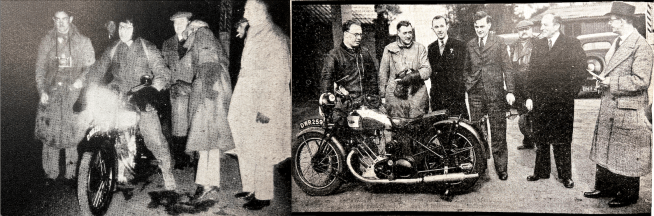
Half-way through the test when safely in bed after one of his daily 371-mile runs he was awakened by his wife saying, ‘You are twisting my wrist!’ Apparently he had been using it as a twist-grip! ‘As long as you don’t begin kick-starting,’ said Mrs Lamacraft. Towards the end of the test the weather improved. While on Monday of last week Bills, who set off from North Mimms, soon after noon had heavy rain the whole time, Lamacraft, who was next, had only showers, and so did Board and Bilbe. Rain and mist were Bills’ lot on his next trip. For the last three journeys the weather was fair—in fact, excellent but for mist in the early morning. One lengthy delay occurred. This happened at 10.30am on Wednesday of last week. Lamacraft was riding the machine. The engine locked up. He thought it must have seized. After tugging at the back wheel he found that he could move it a little. Then he saw a link or two of chain hanging down beside the Dynomag. What had happened was the dynamo chain had broken. This removed, he tried to start the engine. The locking-up, however, had caused the ignition timing to slip. With the aid of an AA scout he re-timed the engine and set off again after a delay of an hour and three-quarters. Lamacraft was unlucky in another direction. He was stopped for exceeding the 30mph limit at Retford—the limit begins earlier than he imagined to be the case. The last trip of all fell to Bilbe. So much time had the Panther in hand that it was decided to give it a clean before it checked in at the finish…In view of the high average speed the fuel consumption could hardly be low. The official figure for the 10,017 miles with its 47¾mph average was 56.88mpg. Oil consumption worked out at 2,671mpg. Incidentally, the Shell oil, like the machine itself, was undergoing official test. Last Monday the engine was stripped for examination. The general condition was magnificent—there is no other word for it. The only adverse point was that the big-end rollers were chipped; the crankpin apparently had been pulled up too tight when the engine was stripped for measurement previous to the test and, as a result, had pinched the bearing. The carbon deposit was remarkably small; it appeared to be little over ¹⁄₃₂nd thick except around the inlet valve. Thus, except for the issue of the official certificate, ends a most remarkable and exceptionally gruelling test.”
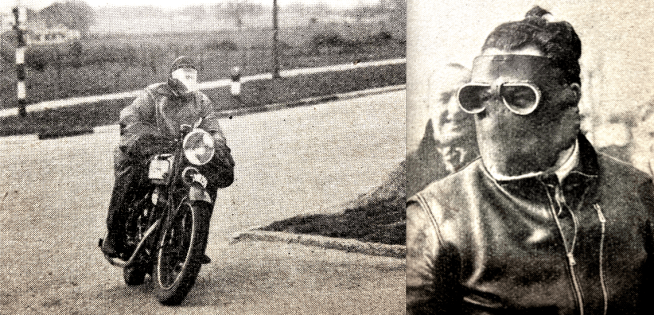
TRIUMPH Tiger 100 and Speed Twin
“88.46 AND 84.41MPH—AT THESE SPEEDS the two Triumph motor cycles, the Tiger 100 and Speed Twin respectively, reeled off their final laps of Brooklands Track in the remarkable ACU-observed test that was brought to its highly successful conclusion last week…the makers had given the ACU carte blanche to obtain them from any Triumph stockist. The Tiger 100, was taken by the ACU official observer, Mr E B Ware, from the stock of George Bryant, of Biggleswade, and the Speed Twin from that of Horridge and Wildgoose, of Sheffield. This done, the ACU transported the machines to the Triumph works at Coventry, where, under the eyes of the official observer, the number plates were seen to, batteries charged, pillion seat fitted ready for Brooklands, the tanks filled up and the machines checked over in the same way as an agent checks a machine over before delivering it. Two other items were that Dunlop puncture seal was inserted in the tyres and one machine had a single red reflector fitted alongside the rear number plate and the other two reflectors. These latter were to enable those in the official Triumph Dolomite car to be able to pick out the machines after dark. The arrangement was that Mr Ware, who travelled in the car with Mr Headlarn, of Triumphs, sat on the tails of the two motor cycles throughout. WJ Nicholls and RC Ballard, of
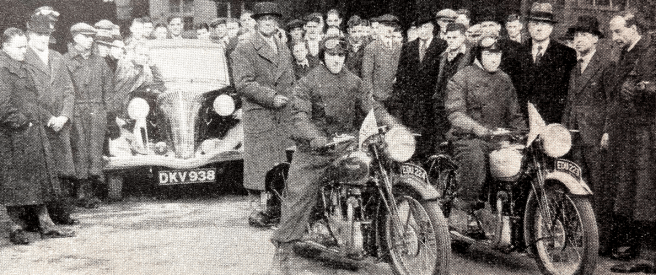
the Triumph test staff, rode the machines. The route chosen was Coventry to John o’ Groats, John o’ Groats to Land’s End, Land’s End to Brooklands and thence after the speed test to Coventry, where the machines underwent an ACU examination for condition. The two machines averaged 42mph on the road for a distance of 1,806 miles without any preliminary running-in. Perhaps even more notable than the speeds of the final laps was the demonstration of sustained high-speed reliability. The riders at Brooklands were IB Wicksteed and MD Whitworth for the Tiger 100 and FWS Clarke and Allan Jefferies for the Speed Twin. The world’s record for 12 hours in the 500cc class stands at 87.78mph. The two standard Triumph motor cycles averaged respectively 78.50 and 75.02mph for six hours. Not only that, but in one hour the Tiger 100 covered over 80 miles, while the Speed Twin on its fourth hour covered over 76½ miles. It is hard to conceive a more convincing proof of the machines’ calibre. Moreover, the test forms a magnificent demonstration of that new motor cycle oil, Castrolaero, which, incidentally, was purchased by the ACU and not in any way supplied specially for the test…when ridden to Coventry they averaged approximately 46mph over the 106 miles to complete a total pf 2,383 miles in the case of the Tiger 100 and 2,362 in that of the Speed Twin…Seldom, if ever, has there been a more gruelling and convincing official test.”

“THAT THE TT HAS DONE more than anything else to assist and inspire design was a point Mr Edward Turner, managing director of Triumphs, made at a lunch to the riders and others concerned in the recent certified test. He mentioned that as producers of fast sporting motor cycles Triumphs were often asked why they did not show more interest in the TT. The reason was that the races no longer formed an attractive proposition for manufacturers. In recent years they had forced the production of a type of machine no longer practicable for ordinary use. In, say, 1926 and 1927 the position was different, for at least 60% of any given machine was on standard lines. To-day the machines were special from wheel to-wheel, and there was nothing that could be translated into-production machines. ‘I do not say that the TT should be banished,’ Mr Turner continued. ‘I consider that there should be races for stock-type machines. For our part we should be prepared to support such races, and I believe that others would do so too.’ From this Mr Turner passed on to other types of event. Trials and scrambles, he said, do not demonstrate the ultimate reliability of the product; the one thing that does is the ACU certified test. His views on the TT are interesting and are very much in accord with what we have said.”
“YOU WILL HAVE SEEN some facts and figures showing the kick in this game of ours. If you were at Brooklands for The Motor Cycle Clubman’s Day you will have seen what is meant! In spite of dense mist early in the day, and of rain later on, thousands flocked to the Track, and on the damp, slithery concrete, Noel Pope lapped twice at over 115mph on his ‘blown’ Brough Superior, a clubman on a big-twin Vincent-HRD did 113 over the kilometre, a machine tuned by a member of the fair sex won a race at 99mph, Miss Wallach gained a Gold Star on a 350cc Norton at 102mph and many a clubman lapped the Mountain circuit with all the dash and skill of a Brooklands habitué. I give absolutely full marks to the clubmen for riding. There was a number of lads in the Mountain races who would put up a very useful show in the Island.”
“THE WINNER OF New Zealand’s ninth TT Race, organised by the Auckland MCC, was L Perry (Velocette), with AJ Dean (Levis) second, and JH Dale (BSA) third. The Wakefield Cup for the fastest lap was won by LE Dixon (Levis).”
“I THINK THAT the power-weight ratio is an important factor in fuel consumption. In the old days one could, and did, get 150mpg with a 500. I had a late 1914 BRS Norton (single gear, Phillipson pulley) which consistently did 145mpg. I got the same figure with a 1915 425cc 60° twin Royal Enfield. I fitted both these machines with a Binks 3-jet carburettor—a wonderful instrument once it was correctly tuned. In case anyone points out that this carburettor was not made in 1914, I would mention that I had the Norton second-hand in 1916. If memory serves me, Ixion, in the Scottish Six Days Trial of 1922, got somewhere about 150mpg while reporting the trial on a 500cc Sunbeam. This, of course, would have had a three-speed gear box. I fancy he used an extremely small jet, a No 27, I think he said, in his Amac (?) carburettor—it was before the days of flow-metered jets. Does the modern 500cc single lose much by petrol blow-back? My recollection is that a large fine-mesh gauze over the carburettor intake generally tended to improve consumption.
JM Philpott, Gloucester.”
“MENTION HAS BEEN MADE of an attempt to get Parliament to ban the use of motor vehicles on unmetalled roads. This is surely a case where we should contact our cycling brethren in an attempt to get the proposed Act shelved. The future of all trials sport depends on such a Bill being thrown out by our legislators. Such a Bill would only be an embarrassment and a nuisance to many hundreds of country folk who use such by-ways for getting to and from work on motor cycles. Cyclists might well ask that we assist them in a similar way by getting a clause in the ‘Access to the Mountains’ Bill cut out. This clause forbids cyclists to use the footpaths, thus preventing journeys across mountainous country from one valley to another, and making it necessary for them to leave their cycles and kit behind.
AD Ost, Chelmsford.”
“I SHOULD BE GRATEFUL if you would allow me a small space to voice my opinion in the single-vs-multi discussion. All the machines I have ridden, up to my present mount, were singles, and though some were better than others, they all gave more than their fair share of trouble. I was on the point of giving up motor cycling because of this when I was lucky enough to get a ride on a well-known British four-cylinder machine. I was so impressed by its dynamo-like smoothness and quietness that I bought one, and from that day I have had no trouble at all. I must also add that my present mount does not get a fraction of the attention that the singles had. I cannot claim so long a riding experience as Mr Eceleshall, but if he has never ridden a multi he ought to add this to his experience. Then, as he claims to have ‘feel’, he might revise his ideas on motor cycling.
‘Four Square Deal’, Coventry.”

“A HUGE ENTRY, even larger than usual crowds watching on the observed hills and weather which was as excellent as, in view of the weather forecasts, it was unexpected—these are a few salient points of the Land’s End Trial, the Motor Cycling Club’s famous Easter event. While the trial was very much on the lines of those of the recent past, this year standard tyres had, of course, to be used. However, few competitors seriously missed their knobbly treads of previous years, for there is probably no course better suited to standard tyres than that of this 340-mile, 18½-hour event. No longer is the trial the ‘London-Land’s End’. For some time now the MCC has allowed competitors in its long-distance events to choose their starting point. They could start from Virginia Water, Stratford-on-Avon, or Exeter, and, except for one intermediate time check, it was a go-as-you-please run to the breakfast stop at Taunton. ‘Breakfast’, so far as the earlier men were concerned, is something of a misnomer, for, starting around 8pm last Friday, they were due at Taunton soon after 1am! However, with 247 motor cyclists in the programme, there were some who were not ‘breakfasting’ until 3.30am, while the last of the 212 cars was not due until after 7am. The huge cavalcade, 459 strong, was 180 miles long with six hours between the passage of the first man and that of the last! The night run was expected to bear a strong resemblance to that of the winter trial. To everyone’s delight it proved fine and reasonably warm, with stars out and quite a powerful moon. The conditions could hardly have been better. A mere 120 miles, and the competitors from the three starting points converged at Taunton, where breakfast was waiting at Deller’s. This devoured, the trial proper began. The route led to Williton and to the outskirts of Porlock. Here the solos, sidecars and three-wheelers had to turn left in order to tackle Doverhay, while the cars went straight on to link with the motor cycles at the top of Porlock. Even at 3 o’clock in the morning there were scores of spectators on the high banks that form natural grandstands on the steep S-bend of Doverhay. By 3.30 the crowd had grown to hundreds. It is doubtful whether there have ever been so many spectators…The reddish-earth surface had been well bound by rain that fell earlier in the week. Obviously, there would be plenty of wheelgrip. The difficulties were solely the long stretch of 1-in-4 gradient, the steep double bend, and the presence of a few minor rock outcrops. The hill was in better condition than usual, and seemed even wider than it was last year.
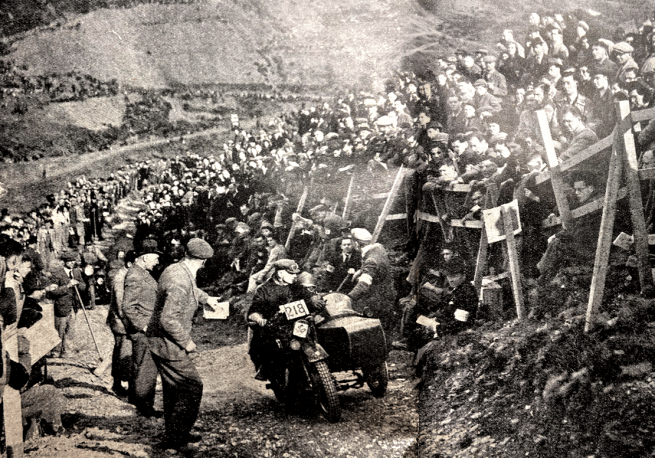
However, tackled in the light of a head lamp in the early hours of the morning, the hill is a far from simple proposition, especially half-way through a very long run. Soon after 3.40am there was a stream of light flowing up—yes, in this case ‘up’—the valley. The first competitors were climbing the lower reaches to be stopped and restarted about 150 yards before the right-hand hairpin, the first part of the S. Leading the way were 23 solo competitors who had started from Stratford-on-Avon. First was HH Bray (346CC Rudge), who went hoppity-twitch over the rocks in between the bends and disappeared with a workmanlike climb to his credit. The next man, F Bray (346CC Levis) rammed the bank just above the first hairpin—an example which later was to be followed by dozens. Easily the best of the early men was J Basnett (247CC Levis). H Davey (799cc AJS) had twin head lamps: acetylene in the normal position, topped by a not very potent electric one. Barring a bit of swervery at the second bend, he made an excellent climb. JW Bevers (596cc Norton sc) led the passenger machines. He chuffed up in perfect touring fashion, using exactly the right path. GA Holland (Triumph Twin sc) also toyed with the climb, but FW Osborne (592cc Levis sc) stopped even before getting to the first hairpin. With his 1,324cc BSA three-wheeler sounding as if it had only a two-stroke engine (there is a two-stroke driving the rear wheel), EF Cope shot up the hill with the greatest of ease…Rumour had it that the Army riders had been advised to take the hill really fast. Quite why, in view of the hairpin bends, the Dame failed to relate. Anyhow, from now on there were to be speed efforts. 2/Lieut JD Williams (490cc Norton) gave a rodeo performance and nearly collected both banks. L/Bdr McLeod was even more hectic. 2/Lieut MCW Dumeresq was also fast, but apparently his gear came out—anyhow, he duly stopped…It was now nearly daylight. Up came a trio on their pilot jets to make as neat climbs as any in the entire entry: JW Coad (498cc Vincent-HRD), PC Blake (499cc Sloper BSA), and F Blake (498cc Vincent-HRD). Then T Pethick (498cc Triumph) took the inside of the bend, but by opening-up at the crucial moment got away with the almost impossible. Both CT Cawsey (499cc Royal Enfield) and HS Endean (348cc BSA) struck rock outcrops with their front wheels and, not doing so squarely, duly sat down. For skilful handling of the throttle JC Hurn (Tiger 100 Triumph) took the palm, while almost equally outstanding among the sidecar men was WA White (498cc Excelsior Manxman sc). Both BQMS Mackay and Sgt G. Mackay (490cc Nortons) were much too fast—one smote
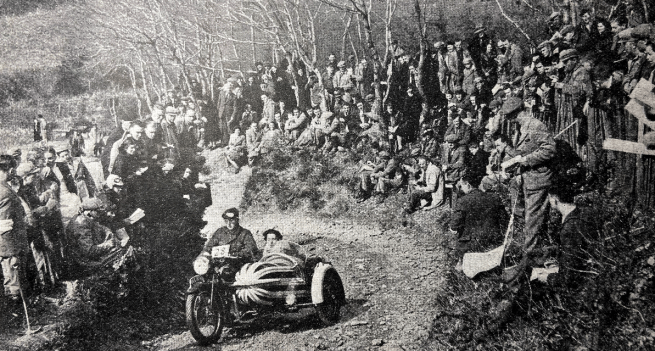
the bank and the other hurriedly sat down. Then D Watling (248cc Triumph) stopped after much pinking. HN Toomey (990cc Brough Superior) woffled up on the pilot jet in perfect style, but J Harper (990cc Matchless) went zoonk into the bank—a real pity-the-front-forks zoonk. AC Hoskins’ climb on a 1,000cc Ariel was a smooth ‘glide’. An old 349cc BSA in the hands of RC Halls climbed effortlessly, while another old mount and its rider—JMP Masterman (588cc Norton)—well deserved their claps for a perfect show. After more speed attempts with the inevitable results Lieut RCK Money (499cc BSA twin) took things at a reasonable pace and, standing on the rests, made one of the best and neatest climbs of the day. AHAJ Bowerman (499cc Enfield), in spite of distracting catcalls from friends among the crowd, was also very neat…After much crabbing of his 990cc Matchless outfit WG Knight shot across the road and perched on the bank at an angle of about 45°; the passenger finally slid out backwards. R0 Wiltshire (997cc Ariel sc) slowed almost to a standstill owing to wheelspin and was pushed before he actually stopped, so doubtless will be counted as non-stop. The sidecar wheel of EJ Cornish’s 498cc Panther outfit lifted before he got to the second bend, and he rammed the bank so hard that he retired with damaged forks. Then a perfect touring climb by E Trayers (499cc Rudge sc)—an utterly effortless ascent…WD Deary’s 598cc Panther outfit gave a most excellent demonstration of slogging. power. The girl passenger aboard GAT Brett’s Triumph outfit helped an excellent climb with bouncing of a type that made it look as if she is also an accomplished horsewoman. Another strenuous exponent of the art of bouncing was the man aboard C0 Bell’s Scott outfit—he put his feet right through the sidecar nose. With mighty wowls and slipping the clutch RC Rivaz (596cc Scott sc) went up in speedy spasms… The ‘Menace’, Lieut. BDS Ginn’s three-wheel-drive BSA, climbed with the greatest of ease…Rejoining the coast road near Porlock, competitors had the delightful but bumpy run to Lynmouth, where the second hill of the day, Station Hill, had to he tackled. In the past few years. clay has been put on the hard surface of this hill near the top, out of sight of the competitors from the starting point. This year there was about 100 yards of loose shale on the hill in the same position. It was said that local children (!) had done the ‘damage’ in order to make the section interesting. It proved more than interesting for most competitors, and out of the first 100 men only 15 made clean climbs…For the London contingent the hill was almost a catastrophe, and failures were the general order. Most people arrived at speed, hit the shale and fell with front wheel slides almost
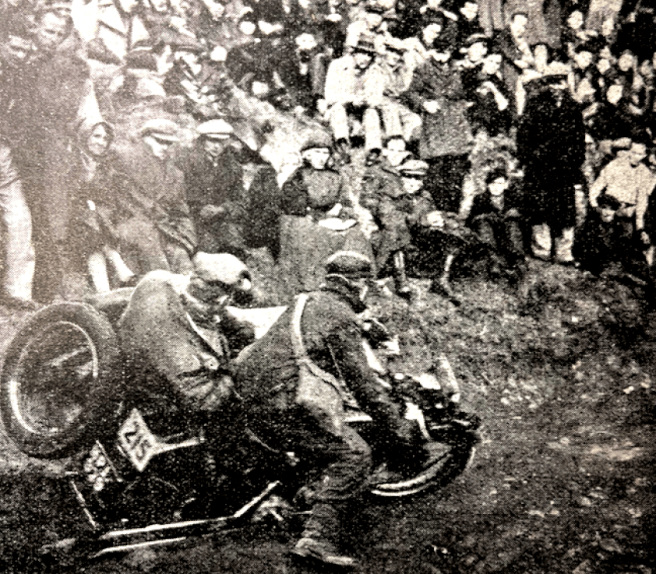
immediately. W0 III F Morrison (490cc Norton) had lots of bother after hitting the wall. SA Waghorn arrived at speed, had two terrific slides and that was that! In quick succession. HN Toomey (990cc Brough Superior) and JH Whitfield (494cc BMW) made superb climbs on a breath of throttle, and Sergt G Mackay (490cc Norton) was faster but just as good. Sergt J Tilsley (490cc Norton) was unfortunate to suffer a vicious slide when he had conquered the worst of the loose stuff. AJ Absalom (498cc Velocette) just rode straight up as though there was no loose stuff at all. Gdsm WG Watts (490cc Norton) sat squarely in the saddle and motored briskly over the tricky part, only to foot at the top to save the machine from hitting the wall. On the old Martinsyde, PJ Tait ‘pobbled’ his way up the hill with a dab at the top. WRE Best (498cc Scott) showed how the hill should be climbed; he stood on the rests and leant right forward, concentrating on the front wheel all the time. Beggars’ Roost, which probably vies with any other in the West Country as the most famous test hill, was not up to its usual standard last Saturday. There was a loose top dressing of road metal, but it was not deep and even the famous ‘hump’ did not cause much trouble. Clean climbs were the order—and fast ones at that. L/Sergt HF Hartry (348cc Matchless) was obviously out to make the fastest climb of the day. HH Hawes (349cc Triumph) spoilt a neat climb with a foot on the hump, and EB Stott (348cc Ariel) hit the hill in second gear and only just had enough power to get over the ‘hump’. About this time the sun crept over the top of the hill, and, to competitors, appeared to be rising immediately behind the ‘hump’. It made the hill trying for a while, and SV Habgood (346cc Levis) was one of several who shaved the bank owing to dazzle…VJ Beachamp (499cc Rudge sc) was the first outfit to fail—he started bouncing when almost at a standstill. JFS Polden (497cc Triumph sc) attempted the hill in second gear, made a late change down, and failed through loss of speed. LG Swabey (498cc Scott sc) failed to keep to the offside and crabbed into the crowd on the hump. The only three-wheeler climb seen was HP Guerrier in a BSA. He came up in reverse, but failed low down. Apparently, while looking backwards, he could not keep his foot hard down on the accelerator. Barton Steep was so dry that it was hardly worth observing, and the stop and restart test was not difficult. A cross-country run to Darracott Hill followed. The twisty roads caught one competitor. AVB Baker (493cc BSA sc), who was running very late; he turned the outfit over on a bend and decided not to continue…Sixteen miles from Darracott is Bude, where there was the lunch stop. Competitors were officially allowed 1½ hours here, but as the majority of the later men were well behind schedule the average stay was only half an hour. Some of the riders were already complaining of weariness, and one man in particular looked as though he had ridden quite far enough. But there was little respite. The coast road to Crackington presents magnificent views, but it is rough and twisty. Although the average speed was reduced to 15mph, there was no time for

stopping to admire the scenery. On Crackington Hill, competitors were restarted right on the gradient. The surface was a little greasy, but there was wheelgrip enough, and only those who were ham-fisted with the throttle on the restart had any bother…New Mill Hill, one of the more recent additions to the ‘Land’s End’ sections, was almost as easy as Darracott…AED’a Sugden (499cc Vincent- HRD) made a good fast climb with solid front forks—the fork spring had broken earlier in the morning. JJ Boyd-Harvey (490cc Norton), back in the saddle after a long absence, was marked as vg; RT Newbery (498cc Triumph) earned the remark ‘at speed’. JJ Bainbury (348cc Ariel) fell in the middle of a sedate ascent, and AH Martin (497cc Triumph) had a very rough passage, but retained his balance. Even the sidecar men found plenty of wheelgrip, and they mostly treated the hill as a speed climb. An exception was WD Deary (598cc Panther sc), who came round the bend so slowly that he seemed certain to fail. He opened the throttle, and the outfit just slogged to the top. For pulling powers, however, JE Arnold’s 598cc side-valve Ariel outfit took all the honours. As he ascended, to the cheers of the crowd, the engine was turning over so slowly that one could almost count the revs. Among the fast brigade were AC Reynolds (498cc Triumph sc), who raced up with his front wheel pawing the air; DA Newberry (997cc Ariel sc), who was obviously enjoying the ride immensely; and CG Bell (596cc Scott sc), who had lost the bottom of the sidecar and also dropped a cushion during the ascent. A brilliant sun, a gloriously blue Atlantic and no wind—those were the happy conditions at Perranporth, and as a result Bluehills Mine—the MCC’s ‘private’ hill—was lined with thousands of spectators. Bluehills is a tricky climb with its 1 in 4 gradient and many hairpin bends and an atrocious surface, and to make things harder there was a stop-and-restart test near the summit…2nd-Lieut JD Williams (490cc Norton) touched once or twice, Art J Bannister (490cc Norton) and CL Teague (348cc BSA) went up standing on the rests. EF Cope (1,324cc BSA) was applauded for the clever way in which he handled his three-wheeler on the steep bends, and N Miller’s (498cc Vincent-HRD) performance was also appreciated by the crowds. The restart test took heavy toll of the competitors, and quite a number were towed up…There was an odour of burning clutches at times, varied with burning rubber when the driving wheels spun on the concrete. After all, 1 in 4½ is no mean gradient on which to restart a passenger machine. E Travers (499cc Rudge sc) would have succeeded had he not been baulked, and Wiltshire (997cc Ariel sc) just struggled up. Brett (493cc Triumph sc) brought his front wheel up vertically when he suddenly let in the clutch, and landed high and dry on the protecting sandbags. For
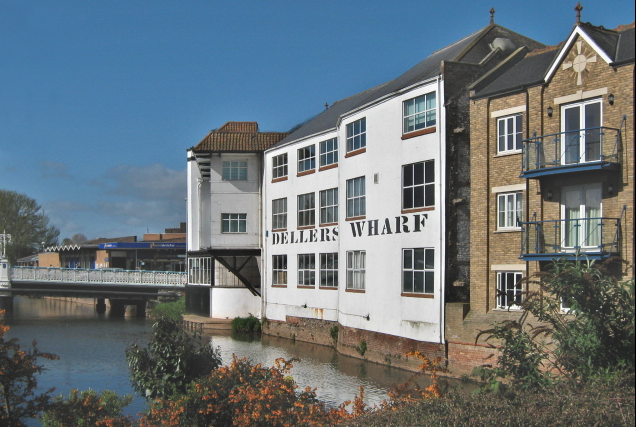
skilful handling of a big solo mount, HN. Toomey (990cc Brough Superior) earned an enthusiastic clap, as did RC Halls (349cc BSA). V Mason (600cc Levis) coolly surveyed the bends and judged his course magnificently. SW Simes (248cc Excelsior) failed, descended the hill, and an hour later appeared again, but with no better luck…L/Corp Kent (347cc Matchless) caused roars of laughter by dashing clean through the stop-and-restart test. He was flagged down, and when he restarted he swerved and scattered the crowd. Another who was applauded was Lt GJ Smith-Masters (347cc Matchless), for he was seen to be holding a broken throttle wire in one hand. Notwithstanding this handicap he restarted perfectly. AE Hare’s noticeably silent Ariel Four was inconspicuously good…When KS Fisher (997cc Ariel) arrived with a large hare strapped to the hack of the sidecar—a moorland spoil—the Cornish crowd yelled. He nearly lost the hare when his passenger bounced strenuously to improve wheelgrip!…BC Rivaz (596cc Scott) failed on the hairpin. At the same point Lieut BDS Ginn drove one wheel of his famous three-wheel-drive ‘Menace’ high on sandbags and actually touched ground with his hand. As eager officials were running to his aid he turned up the taps and shot up the gradient as if nothing had happened. How the crowd laughed! Land’s End was now less than 40 miles distant. They were, however, 40 miles of twisting road—to the competitors they seemed almost unending. Happily the surface is no longer dusty and pot-holed. Land’s End at last, the finish of a strenuous, but—thanks to the perfect weather—thoroughly enjoyable trial. Of the 229 starters in the motor cycle classes, 188 finished, 55 claimed premier awards, 58 silver medals and 65 bronze medals.”
“A WONDERFUL DAY—the sun shone from a cloudless sky and there was just sufficient breeze to give a freshness to the air. Everything at Donington seemed perfect for this, the first motor cycle meeting of the year, and by the time the first race started the track was lined with an enthusiastic concourse of spectators and they were still coming in in their hundreds. The Donington authorities, headed by Fred Craner, have perfected the organisation, and promptly at the advertised time the riders in the first race, for 250cc machines, were sent off. At the fall of the starter’s flag, Leslie Archer (New Imperial) shot away, followed by Maurice Cann on a Guzzi Another interesting machine was MN Mavrogordato’s ‘blown’ DKW, but it did not appear to have enough speed to keep with the leaders. At the end of the first lap, Archer had a big lead, with Cann second and RH Pike (Rudge) third. Soon, however, H Haitley took third place, closely followed by 0 Parkinson (Excelsior). Sometime during the sixth lap Cann disappeared with a trouble not stated and Parkinson moved into second place. Nobody, however, could get anywhere near Archer, who went on to win a fine race in record time. Parkinson and Hartley were second and third respectively, and there was an excellent scrap for fourth place between RH Pike (Rudge) and RE Geeson (Excelsior), Pike just getting it…Heat 3, and the final of the day, saw Daniell once more out for blood. Clearly he was superior to everyone else—his riding reached that perfection one has come to expect of him and his machine seemed equally perfect. He was chased at first by Wellsted on the New Imperial twin, but unfortunately this machine failed when Wellsted in a super effort attempted to stave off the challenge of J Lockett (Norton). Lockett thus ran into second place, followed by ST Barnett (Norton) and W Parsons (Norton). These last two had a grand scrap and Parsons managed to gain third place by about a wheel. Result: Unlimited cc Race: 1, HL Daniell (490cc Norton), 73.93mph; 2, J Lockett (490cc Norton); 3, LW Parsons (490cc Norton); 4, ST Barnett (490cc Norton).”

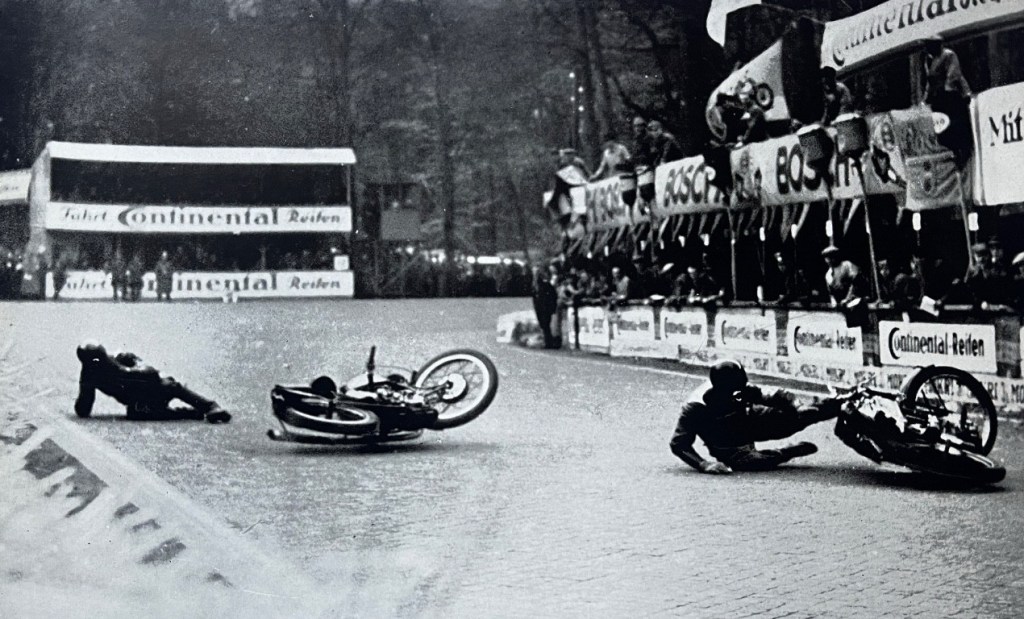
“TN VIEW OF THE FACT that the Ner-a-Car has been mentioned in your Correspondence columns lately, I think a few facts about this machine might be of interest. I was an employee of the firm when it closed down; also an enthusiastic rider of one of their models. People today think of the machine in terms of the two-stroke, but I would like to point out that the makers also fitted a 350cc engine, both side- and overhead-valve Blackburne. As the owner of an ohv model I found them very sporty. In 1926 two of these machines took part in the Southern Scott Scramble, and performed well. Also, quite a number were sold as sidecar outfits, for which purpose they were ideal. But I think the most interesting thing was a spring-frame model. The wheelbase was lengthened and leaf springs were employed. The petrol tank was built to form the hack of a bucket seat and a handlebar screen was fitted. The seat or saddle was no more than 12-15in from the ground. A centre stand with a lever was fitted, so that the rider could pull the machine on to it while still seated. This machine was quite easy to handle and a real pleasure to ride. The biggest factor in putting this machine off the market was the heavy royalties which had to be paid to the USA, the machine being of American origin.
R Hennessey, Teddington, Middlesex.”
“WILL WE EVER HAVE a Government subsidy for motor cycle clubs in this country? The idea sounds pretty revolutionary, but in New Zealand the Government has realised the value of clubs in increasing road safety, and through its Transport Department is assisting to develop them. It is recognised that the club rider develops into the safest road user, and in some clubs one or more members have been elected to act as patrolmen on the roads. Their duty is to report to the traffic-police department cases of dangerous driving and the like. The police then issue a caution and keep a note of the transgressor’s number, so that sterner measures can be taken if he is reported again. This interesting news comes from Mr GE Stock, the 0K Supreme factory representative, who is at present on a tour of New Zealand and Australia, and he adds that a sum running into thousands of pounds has been made available by the Dominion Government to foster motor cycling in New Zealand.”
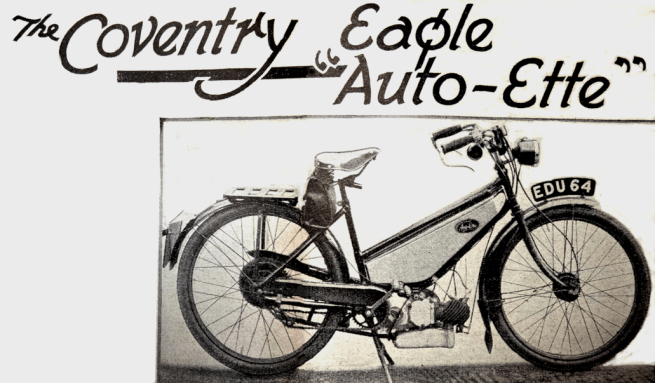
“IT WAS IN 1938 that the range of motorised bicycles became comparatively wide. Even more models are available this year, and among them is the Coventry Eagle Auto-Ette—a particularly interesting machine that las been considerably improved since its introduction at last year’s Show. Much attention has been given to the construction and layout of the sturdy, open frame. Immediately one is seated the well-planned riding position is appreciated. Saddle and handlebars can be adjusted to suit a rider of almost any stature; the pedalling gear is far enough forward to be used easily and powerfully with a minimum of effort, and the rider’s weight is taken by the pedals much in the same way as a motor cyclist supports himself on the footrests; the saddle is well sprung; and the 26x2x1¾in. tyres are adequate for a machine of this type. All these features combine to make the Auto-Ette very comfortable to ride. With the exception of the carburettor choke rod, which is positioned at the near side of the tank, all the controls are on the handlebars. On the off side are the front brake, compression release (used for stopping the engine) and throttle control, and on the near side the levers for the clutch and rear brake. The arrangement is admirable except that one cannot simultaneously apply both brakes and free the engine from driving the rear wheel by declutching. However, in practice the front brake alone was found to be so powerful that the rear brake was unnecessary except for a crash stop. The clutch lever is provided with a trigger that permits the clutch to be held out when required (as for instance when in a traffic hold-up), and both lever and trigger are commendably easy to operate. It was invariably an easy matter to start the 98cc Villiers Junior engine by pedalling off until the speedometer showed 5mph and then dropping the clutch with the throttle about a quarter open. When starting from cold it is, of course, necessary to provide a richer mixture by depressing the very accessible knob on the top of the float chamber until petrol just starts to ooze from the carburettor, and also to pull up the rod at the side of the tank which operates the choke or strangler. When the engine has been running for about a minute the rod is depressed and the choke
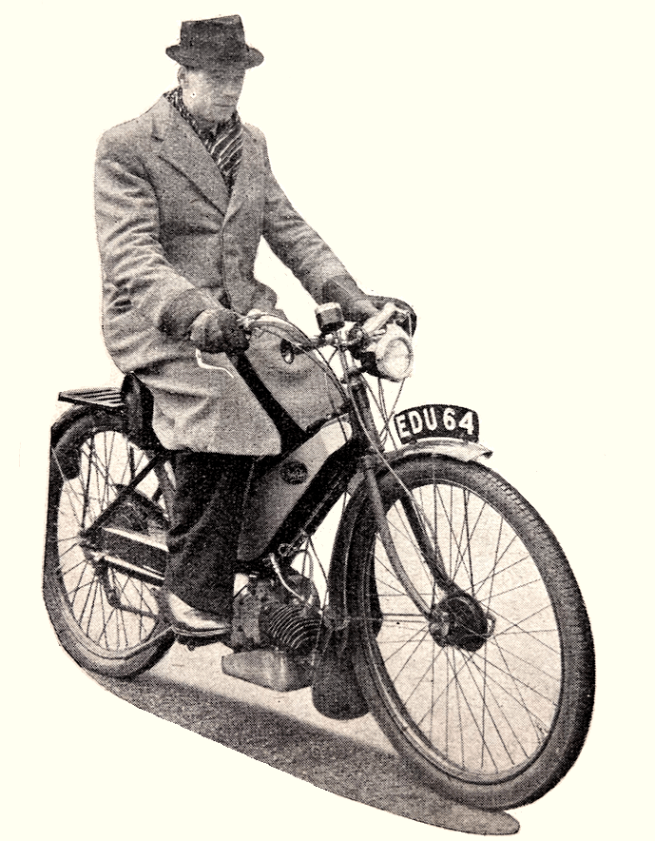
opened. At first the engine tended to fire irregularly, but after the throttle needle had been adjusted to give a weaker mixture the firing was even and thoroughly satisfactory. From a speed of about 9mph up to the maximum the engine pulled steadily and smoothly, though by careful throttle work and slight slipping of the clutch the machine could be driven at a comfortable walking pace. The tick-over speed of the engine when hot is remarkable; so slow is it that the hexagon edges of the flywheel nut can be discerned, and so quiet that only the regular exhaust ‘plops’ can be heard. The clutch is smooth in taking up the drive and adequate to allow the machine to be driven off from a standstill without the rider pedalling. Only once during the test was it necessary to assist the engine with the pedals, this was on the 1 in 8 section of Anerley Hill, a lengthy climb near the Crystal Palace, and the pedals were used for merely about 15 yards. Very few main road hills are so steep, and the majority of riders would find the pedals are required solely for starting and for dense traffic. One full revolution of the pedals turns the back wheel twice—an excellent compromise between easy operation and reasonable speed. Incidentally, the pedal chain is automatically tensioned by means of a spring-loaded jockey pulley; the driving chain adjustment is obtained by moving the back wheel, and bolts through the frame lugs, as in motor-cycle practice, are used for this purpose. At 20-25mph the engine is working well within its power and these speeds were frequently maintained for fairly long periods. The maximum speed as shown by the speedometer was 28mph, and on one occasion this speed was used for a 34-mile journey as often as conditions permitted without the engine showing any signs of tiring. For town work there are few vehicles faster than the Auto-Ette. The cruising speed is higher than the average cyclist is wont to pedal, and in dense traffic or hold-ups the rider can take full advantage of the manoeuvrability of the machine. It has been stated that the front brake is powerful. The back brake is also well up to its work, and using both brakes together a crash stop from 20mph could be made in 54ft on a dry tar-macadam surface. Both brakes are of the internal-expanding type and they did not lose their efficiency in wet weather. Under bad weather conditions, which were experienced frequently during the test, it was found that the front mudguard valance and the mud flap amply protected the rider.
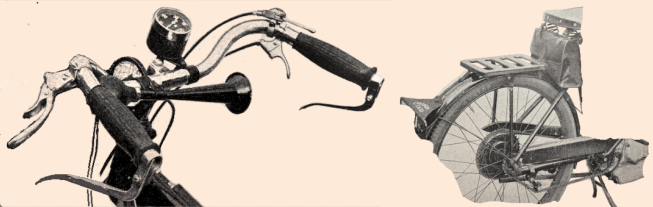
Further, the machine never showed any signs of skidding and could be handled confidently on the greasiest of surfaces and over tram tracks. No special test was made to determine fuel consumption, but a figure of 107mpg was obtained by pouring 1½ gallons of petroil into the tank when the machine was collected and then measuring what remained after 122 miles. Most of the riding was done in town when travelling to and from the office—use to which the average Auto-Ette rider would probably put his machine. Many of the fittings of this little machine can be classed as luxurious. The large tyres and adequate mudguarding have already been mentioned. Both chains are fitted with guards, so that trouser clips are unnecessary; the carrier is sturdily built and though large enough does not spoil the pleasing lines of the machine; the saddle bag, apart from carrying tools, will easily accommodate a cape and light leggings; and the tank, which holds nearly two gallons of petroil, is fitted with a reserve tap. Once the carburettor had been correctly set no adjustments whatever were carried out and the engine remained clean apart from a slightly oily deposit on the float chamber—the result of over-flooding the carburettor. There seems little doubt that the Auto-Ette would run for long periods with a minimum of routine attention and without the need for replacements or repairs. This fact, combined with the low fuel consumption, an annual tax of only I2s and DU third-party insurance for 15s a year, makes for really economical transport. The price of the Auto-Ette is £17 17s complete with direct flywheel-dynamo lighting, horn, pump, tool-kit and licence holder. The makers are The Coventry-Eagle Cycle and Motor Co, Dept 1, Bishopgate Green Works, Coventry.”
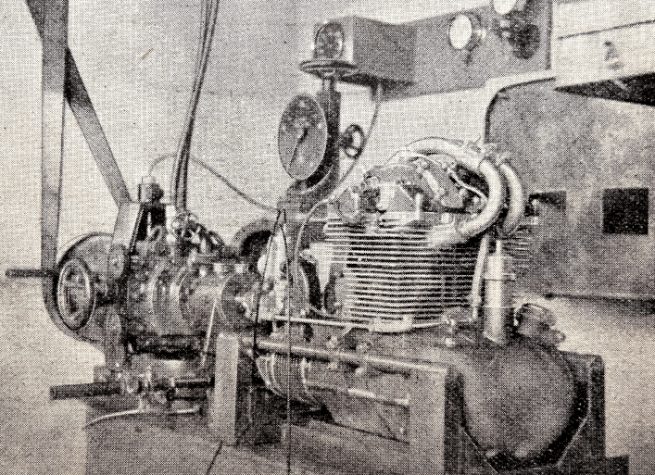
“A FEW WEEKS AGO Nitor, discussing what he called a miniature general post on the technical side of the motor cycle industry, mentioned that Mr Anstey, the chief designer of Ariels and designer of the ingenious spring frame, was severing his connection with the firm. Mr Anstey has now joined the Villiers Engineering Company as assistant to the Works Director, Mr Pountney. Among his duties is that of having charge of the experimental department.”
“APPROXIMATELY TWO out of every 100 motor cycles in use in Britain to day is a pre-1926 model. In Norfolk, however, on an average nearly 4½ motor cycles in every 100 are pre-1926.”
“THERE ARE NEARLY 2,000,000 private cars in use in Britain, and of this number over 1,120,000 are under 10hp.”
“A COUPLE OF YEARS ago it was rare indeed to see a motor cycle fitted with a handlebar windscreen. Nowadays it is possible almost any week-end to count them by the dozen. Moreover, these screens are to be found on all types of machine, from utility mounts to super-sports solos. What makes the change in outlook particularly interesting is that it is not very long since manufacturers were saying that it was impossible to sell machines with fully valanced mudguards because as a result the machines did not look ‘sporting’. Thus, they continued, they were forced to provide narrow guards that they knew to be inefficient. The adoption of handlebar windscreens is proof positive that a section—a large and growing one—is keen to have the maximum possible protection.”
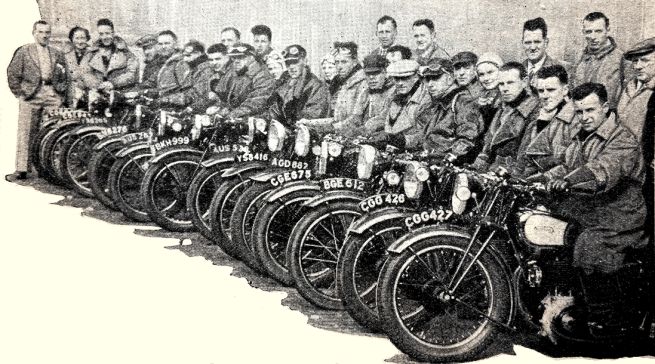
“LAST YEAR, OF THE 462,375 motor cycles licensed no fewer than 106,200 were sidecar outfits. That there are three sidecar machines for every ten solos is interesting, but perhaps still more striking is the fact that among motor cycles over 250cc the proportion is 105 sidecar outfits to 173 solos. If three-wheelers are added to the sidecar figure—there are nearly 19,000, but not all of them passenger vehicles—the figure for passenger machines comes surprisingly close to that of solos. In addition, were statistics available covering the number of 350cc machines on the road it might well be found that among machines of 500cc and over, the numbers of solos and sidecars are approximately equal. The statistics emphasise the importance of the sidecar. They reaffirm what we have so often urged—that still more attention should be paid to sidecar matters, especially by all who make motor cycles of 500cc and over. At present the majority of thought is lavished upon the characteristics of such machines for solo use. In many cases manufacturers do not provide sidecar front fork links and the owner either has to have special links made up or continue with unnecessarily heavy steering. Another unhelpful point is that the transmission is normally on the sidecar side of the machine. It is obvious that sidecar matters should loom still larger in manufacturers’ minds. Incidentally, it is very pleasing to find that the Army is taking a fresh interest in sidecar outfits and has now a number of two-wheel-drive sidecar outfits, a design developed by trials.”
“THE SEVEN PEERS who produced the House of Lords report on road safety display a refreshing vigour and originality—for politicians. To my mind the high-spots of their report consist rather in principles than in detail. Notable are two sound propositions, viz:(1) Discipline for all road users. (Hitherto the pet slogan has been discipline for motorists, but sheer licence for peds and cyclists.) (2) Segregation of traffic. (Recent developments have reduced our roads to the semblance of the ‘Happy Family’ cages shown at rural fairs, with a cat and a rabbit and a dog and a mouse and a hen and a ferret all sharing a single wired enclosure. If a nursemaid wished to wheel a pram on the track of the LMS the venturesome nursemaid would be sent to Colney Hatch; and if the LMS asked leave to run the Flying Scot on rails laid up the middle of the Great North Road its directors would be sacked.) No House of Commons committee would dare to advance such logical proposals, because the members of the Lower House think with an eye and three-quarters cocked at their constituents.”
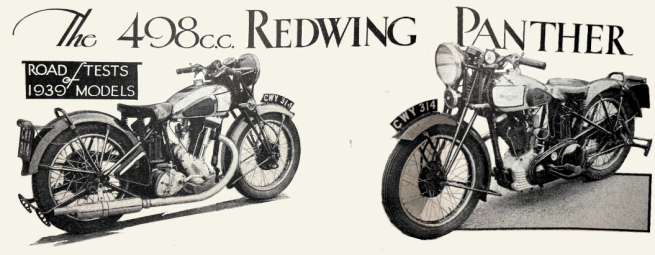
“WHEN THE MAKERS OF PANTHER motor cycles introduced the 498cc Model 95 Redwing early last year their object was to provide a machine that was lighter than the 600cc model and therefore more suitable for fast solo work. For 1939 the 500cc model has many of the refinements of the larger machine while retaining its original characteristics. All the moving parts except the wheels and rear chain are totally enclosed, and one of the outstanding features of the machine submitted for road test was the almost entire lack of noise, mechanical or exhaust. With the engine ticking over there was no definite noise or clatter—simply a pleasant hum. At low speeds the exhaust was practically inaudible, while even at large throttle openings it was exceptionally quiet. The machine, therefore, was unobtrusive at all times, and for this reason alone was particularly pleasant to use in town. In addition, the engine pulled exceptionally well and was silky at low speeds. For all normal work the machine could almost be treated as a top-gear mount. In town, speeds as low as 20mph in top were normally used, and the machine would always pull away from this speed without a trace of knocking…Although the minimum non-snatch speed in top gear (4.5 to 1) was only just under 15mph, the machine would accelerate from 15-30mph in just over six seconds. On hills the slogging power of the engine showed up particularly well. No main-road hills were encountered that the Panther could not climb in top gear. Pebblecombe Hill, in Surrey, which has a maximum gradient of 1 in 5, was easily breasted in this gear. Even when slogging hard the engine refused to pink on ethylised fuel. The Panther was lively as well as docile, and a useful performance was available at a turn of the grip. Acceleration was excellent. In third gear (5.8 to 1) the machine. reached 50mph from 20mph in a little over ten seconds, and took fewer than eight seconds in second gear (7.3 to 1). Fifty mph was about the comfortable maximum in second, although the machine achieved nearly 60mph during the maximum test. In third gear the best speed attained was 71mph, while in top the best timed speed over the ‘quarter’ was 80.4mph and the mean speed of four runs on a fairly windy day 76.4mph. The most comfortable speed for fastish cruising seemed to be about 50mph and the Panther would burble along at this speed in a tireless manner—tireless to both rider and engine. Above this speed some vibration was noticeable, and this increased with the engine revs. Standing-start acceleration was also very good—at the end of a quarter-mile the speedometer registered 68mph. This speed is more creditable having regard to the fact that very rapid gear changes were impossible, as the clutch was inclined to ‘hang’. This was noticeable mainly when engaging bottom gear with the machine stationary. The clutch was smooth in taking up the drive and the transmission with its cush-drive in the rear hub quite free from snatch. By modern standards the steering of the Panther is heavy—a feeling which is enhanced by the short handle-
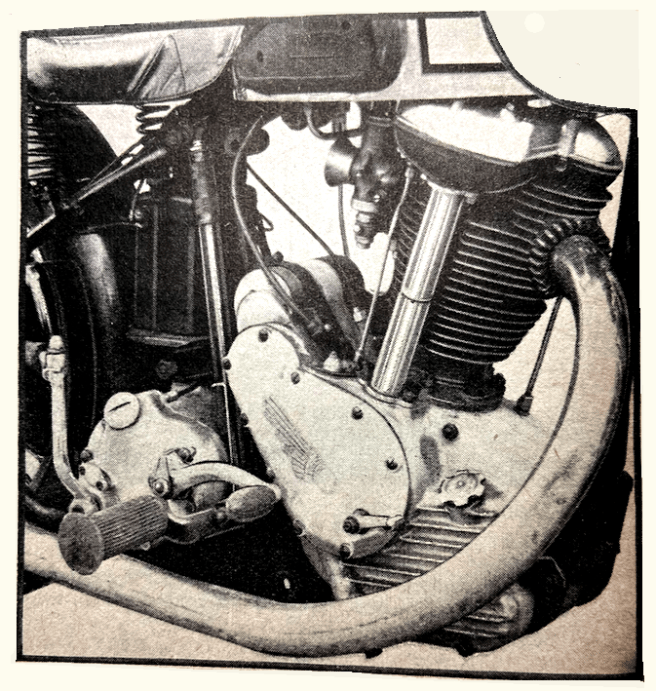
bars. But it was not so heavy as to make the machine awkward to handle at low speeds, while on the open road it gave a feeling of steadiness and stability that was extremely pleasant. Pot-holes or bumps could be taken without the slightest waver, even though the steering damper was not used; this stability was probably due to the particularly smooth action of the front forks and to the work done by the multi-plate shock absorber. Only one criticism can be made of the Panther’s handling and that is that some tail-bounce was experienced on very bumpy surfaces at high speeds. On corners the machine was rock-steady. The Panther riding position is of the touring type, and was found quite comfortable. The saddle has a wide range of movement, and footrests, brake and gear lever pedals are all fully adjustable. For a rider with long arms the handlebars could be farther forward, while the shape of the bars did not give an entirely comfortable position for the wrists. Concerning the brakes little need be said except that they had ample power for the machine’s performance. The leverage of the rear brake pedal is excellent, and the effect of the rear brake working through the cush-drive was noticeable in that rear-wheel braking was smooth even on bad roads. The front brake was very powerful, although the lever fitted required a good stretch of the hand. Both brakes used together brought the machine to rest in 34ft from 30mph. A decompressor is fitted to the Redwing engine in addition to an exhaust lifter. With the decompressor in use, starting from cold presented no difficulties. A large throttle opening and a hard kick would always produce an immediate start. With the engine warm, only a breath of throttle was required for starting provided the ignition was well retarded. Slow running was certain and the rider could always be sure when coming to a traffic stop on the pilot jet that the engine would continue to run smoothly and evenly. During the test the machine remained quite oiltight except for a small leak from the crankcase joint at the rear. No report of the Panther would be complete without reference to the rear stand. The Panther is not a light machine, but the rolling-type stand fitted required remarkably little effort to operate. This is only one of the features that make this new Redwing a machine for the discerning owner.”
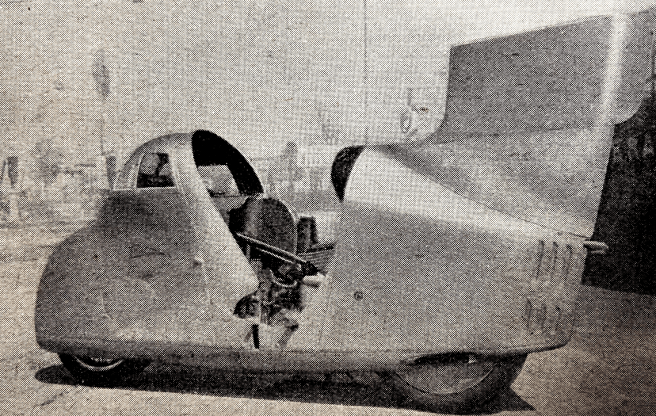
“HORSE-DRAWN VEHICLES and barrows are to be prohibited from using Blackwell Tunnel on week-days between 8 and 9.30am, and 5 and 6.30pm.”
“THERE IS A LAW in Quebec (Canada) to the effect that a car meeting another vehicle must reduce speed to 16mph.”
“IT SEEMED THAT the Sunbeam Club’s tenth Pioneer Run created more interest than ever. At the start on Epsom Downs, Surrey and all along the route there were thousands of spectators; in fact, the number of motor cyclists on the Brighton Road and the ‘atmosphere’ reminded one of the outskirts of Weybridge on Clubman’s Day. The gypsies’ caravans on Epsom Downs mingling with up-to-date vehicles made a fitting background for the ancient and modern motor cycles. According to the programme there. were two ‘most ancient’ machines—both tricycles and both dated 1898—EA Marshall’s 250cc Beeston and HM Sloan’s De-Dion Romain Orleans. Incidentally, both obtained awards. The remaining pre-1900 model was also a tricycle—a 200cc Singer driven by NCB Harrison. These three-wheelers not unnaturally created more derisive yet kindly comment in the paddock than the motor cycles proper, many of which, like FW Clark’s 1911 Scott and the numerous side-valve Triumphs, were basically almost up to date—at least, one could
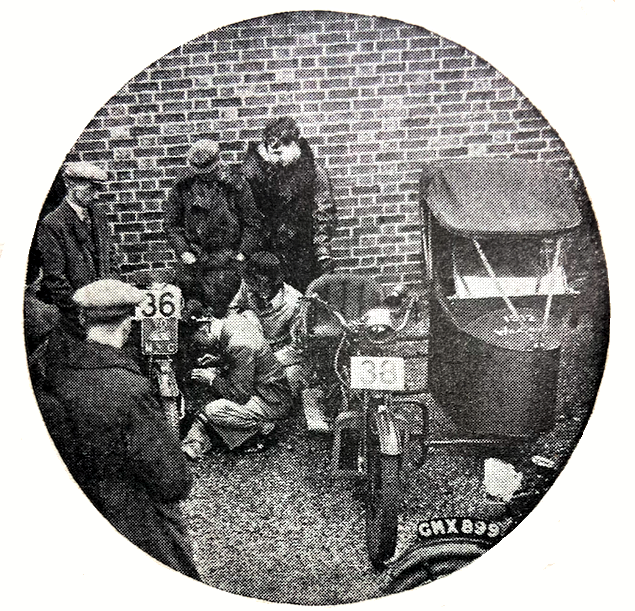
understand how they worked! Entries were divided into two classes: ‘A’ those machines manufactured before December 31st, 1904, and ‘B’ those made between January 1st, 1905 and December 31st, 1914. To even up matters, Class ‘A’ machines were allowed a five-minute petrol stop and finished at the Pylons, near Brighton, instead of farther on at Devil’s Dyke, thus avoiding one fairly steep hill. It was noticeable how easily many of the competing machines started and how quiet they were. Of the early numbers only HM. Sloan (De-Dion tricycle) had difficulty in getting away, but a 50-yard push did the trick. Once on the move, few of the veterans were sluggards, as was discovered by The Motor Cycle man when he endeavoured to overtake a score or so of them before the hill at Pease Pottage, about 17 miles from the start. Even on the hill, which is a long climb, steep enough to make many cyclists walk, numerous competitors came up just as fast as traffic conditions permitted. In particular, PR Crittall (1902 Hobart) must have been doing about 30mph, and HN Toomey (1912 Premier), equally as fast, overtook two lines of traffic at one point (and perfectly safely). And then W Fruin (1909 Triumph) showed that his model could climb hills of this type rather quicker than his observer’s car! Of course, a few machines could have done
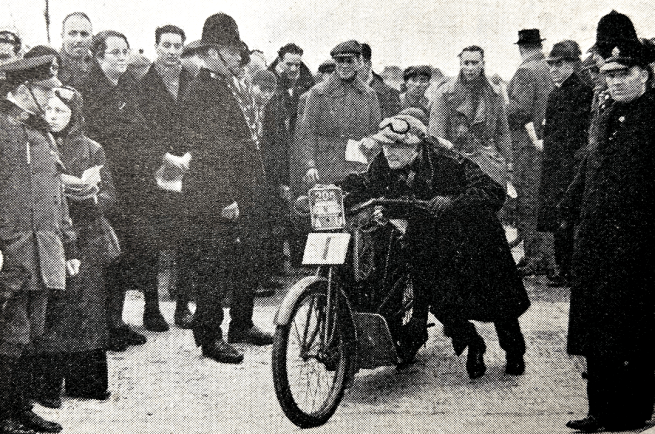
with a little more power, but usually a few stabs at the pedals was sufficient. A Schlienger (1902 Stanley) pedalled for about three yards, and C Bullen-Brown had to assist the 142cc engine of his 1902 Clement-Garrard now and again. Then came two four-cylinder jobs—EH Springett hanging on grimly to the long handlebars of his 1911 Pierce Arrow; and HA Hampden on a 1912 Wilkinson and sidecar; the latter looked an odd outfit with its high sidecar hood and boiling radiator, though, in fact, it has many modern features, including a spring frame and shaft drive. The hill leading to the top of Devil’s Dyke, for Class ‘B’ machines only, caused a few to have anxious moments, but the approach allowed rushing tactics, which most competitors adopted successfully. It was fortunate that this hill was not part of the course for Class ‘A’ machines, as they failed one after another—or was it that the riders were not trying? The majority of competitors clocked in well ahead of time, and surprisingly few were late. The reliability of these old models is quite remarkable; only six of an entry of 47 were reported to have experienced mechanical trouble, and of this number only one, SV Habgood (1914 Douglas), retired—with a broken front connecting rod. Only two machines stopped with belt slip, but the story might have been different had it rained!”
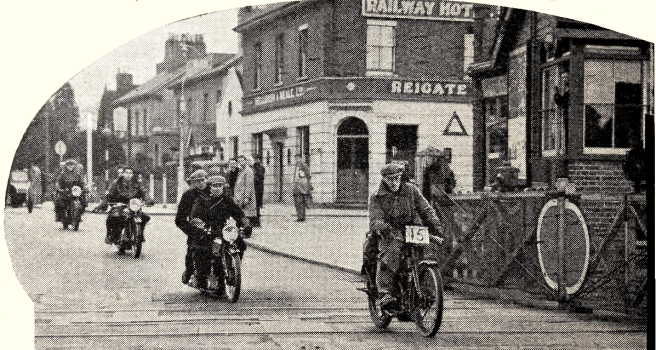
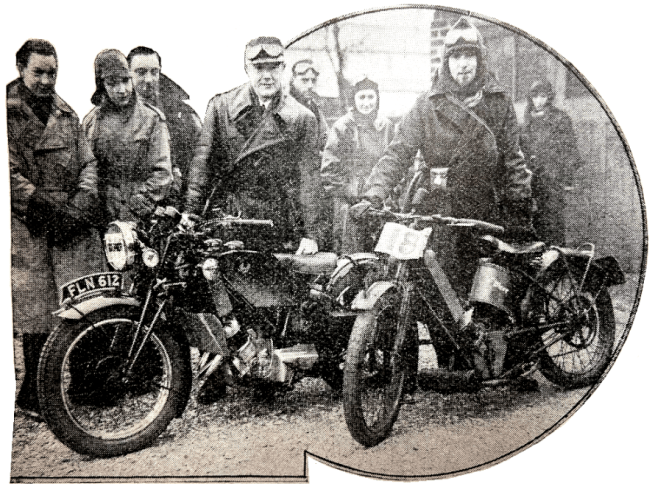
“THE RAC REPORTS that many enquiries have been received about touring conditions in Spain now that the civil war has ended.”
“DURING THE FIRST YEAR of operation of Lancashire’s courtesy police, fatal accidents were reduced by 18%, serious accidents by 43%, and slight accidents by 46%. Over 1,000,000 road-users, it is estimated, have been given advice by the courtesy police. Prosecutions were reduced to 9,000, compared with 23,000 four years ago.”
“THIS WEEK I PUBLISH pictures of a very interesting sidecar outfit. If you have examined them you will have noticed that it is a sidevalve Norton, and in addition to its rather Spartan body has a pillion seat and sidecar-wheel drive. There are two driving wheels, and if you are a follower of trials I need not tell you that such an outfit, given suitable gearing, will go almost anywhere, nor that this form of drive is the direct outcome of those affairs that certain members of the public, given a chance, would have stopped—yes, I refer to trials. This type of outfit is interesting not only for the fact that here is yet another thing for which the public has to thank trials and the trials world, but because the War Office is showing a fresh and very wholesome interest in sidecar outfits, a type of machine which officialdom had relegated to the background as being of little value.”—Nitor.
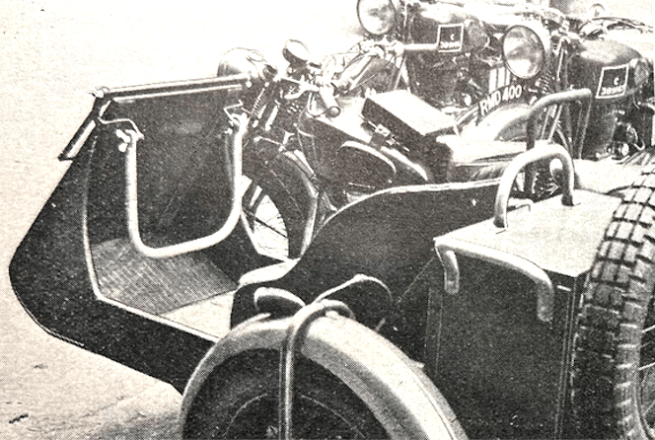
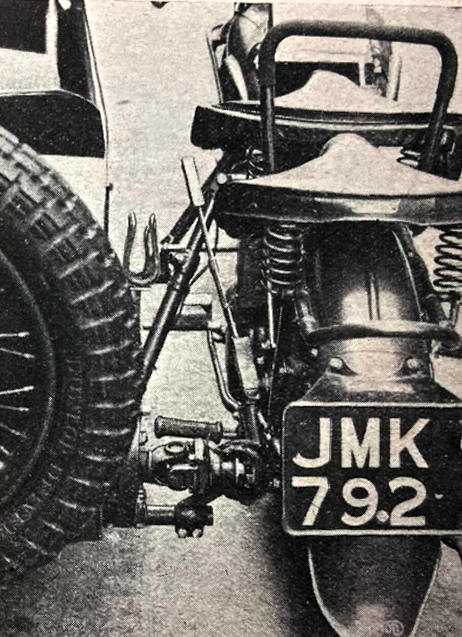
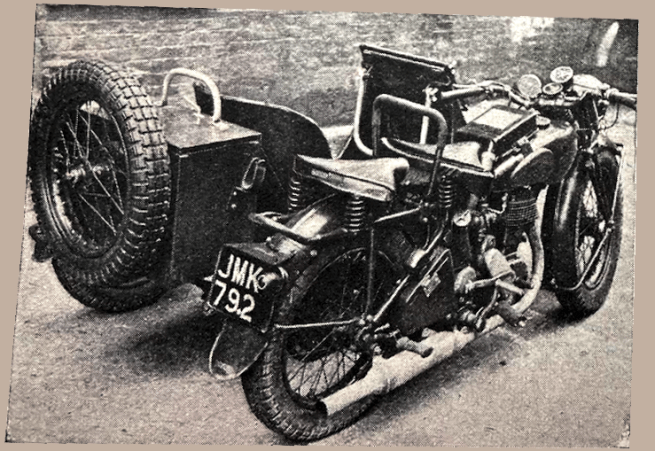
“A YEAR AGO THERE WERE only four different makes of autocycle on the market; to-day there are nine. Instead of hundreds on the roads there are now thousands. This type of machine, the motorised bicycle, has come to stay. Given ‘live’ sales methods on the part of the trade and industry—up to date the autocycle has largely been left to sell itself—it will become as familiar a sight in Great Britain as it is on the Continent, for there are hundreds of thousands of men and women to whom a reliable, inexpensive machine that provides cycling without effort can be a boon indeed. There is no doubt about the reliability of these modern machines. They are giving day-in, day-out service in every part of the country—for going to and from work, shopping, and even for quite strenuous touring. More attention is being paid to lightweight motor cycles than ever before. Coincident with the marketing of new autocycles there is a number of fresh miniature motor cycles—really light machines with kick-starters, three-speed gears and similar but slightly larger engines. Also in the lightweight class are two-stroke and four-stroke motor cycles of 150 and 250cc machines capable of touring anywhere and, in the latter size, of taking a pillion passenger or even, with some designs, a sidecar. Lightweights they may be in name, but in performance they are leviathans.”
“THE MOTOR CYCLE LISTED the manufacturers of bikes under 250cc: “A fine range of power cycles and light motor cycles ranging in price from £17 17s to over £50—Carlton (Worksop): 125cc two-stroke. Chell (Wolverhampton) Cotton (Gloucester): 125 and 250cc two-strokes. Coventry Eagle (Coventry): 98, 125, 125, 150cc two-strokes; Cyc-Auto (London): 98cc two-strokes. Dayton (London): 98cc two-stroke. Excelsior (Birmingham): 98, 125, 148cc two-strokes. Francis-Barnett (Coventry): 98, 125, 148cc two-strokes. Grosepur (London): 125cc two-stroke. HEC (London): 80cc two-stroke. James (Birmingham): 98, 148, 197cc two strokes. Montgomery: (Coventry): 125 two-stroke. New Imperial (Birmingham): 146cc ohv. Norman (Ashford, Kent): 98, 125cc two-strokes. OEC (Portsmouth): 98, 125cc two-strokes. Pride and Clarke (London): 125cc two stroke. Raynall (Birmingham): 98cc two-strokes. SOS (New Malden, Surrey): 172cc two-strokes. Wolf (Wolverhampton): 225, 147, 148cc two-strokes.
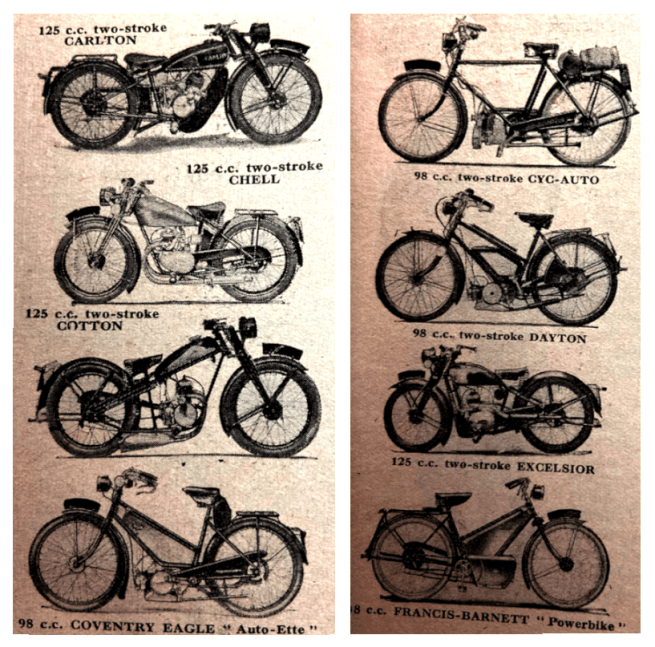
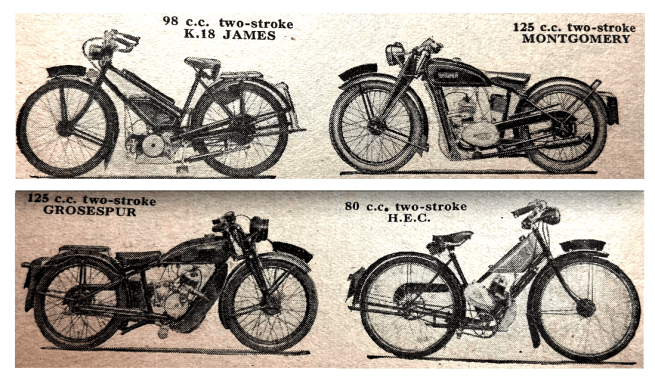
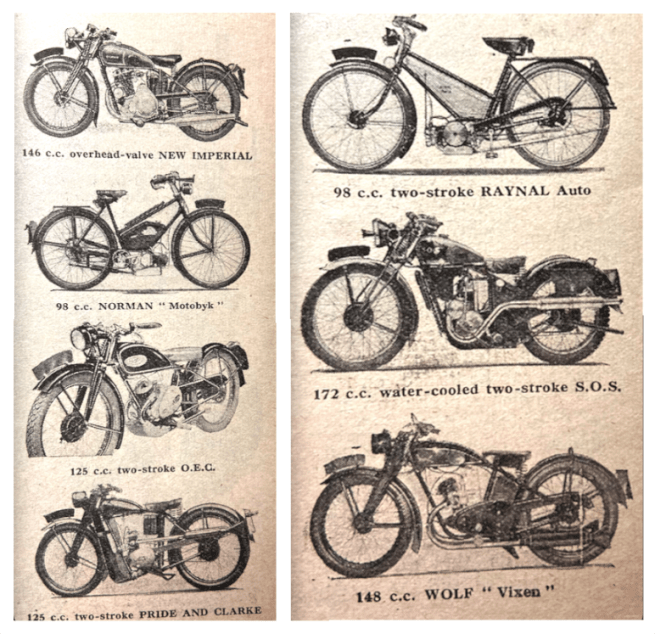
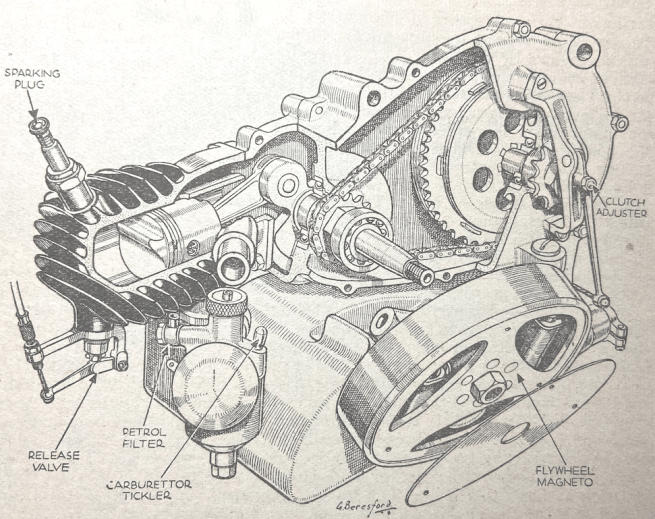
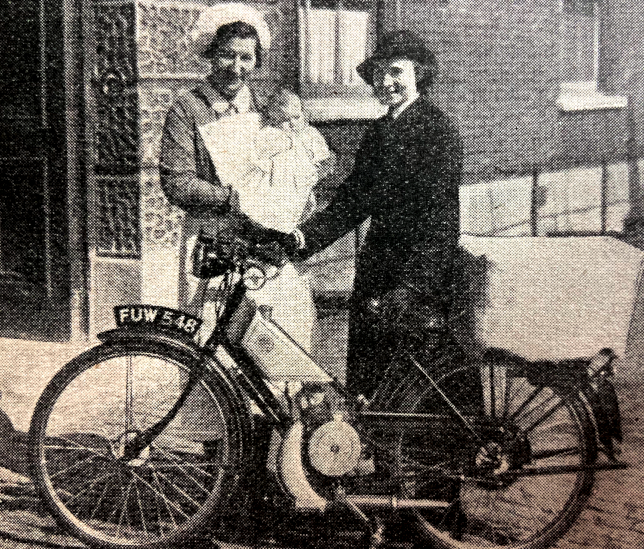
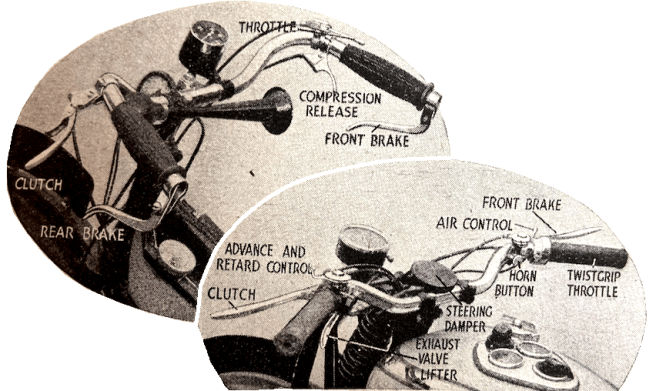
“ONE EVENING LAST WEEK I spent an interesting hour or so with one of the development engineers in the infant plastic industry. Ever since I have been concerned with motoring I have marvelled that we have had to wait so long for a surface comparable to that of an ordinary teacup or other china article, ie, one possessing an everlasting gloss; susceptible to receiving any colour, pattern, shape or decoration; and capable of being restored by a wipe at any moment within centuries of its manufacture to its original beauty. It seems queer, in a period when applied science hardly recognises the word ‘can’t’, that we still await the production of a similarly perfect finish for both wood and metal; and it seems possible that plastics may eventually give us what we need. Imagine, for example, that we could buy motor cycles in 1940 which in 2040 would still reproduce the perfect Show finish of a hundred years before, after no more laborious attention than a rub over with a wet cloth. Thousands of people would buy motor cycles who at present abstain. One that might last us a lifetime. Houses and furniture would become labour-saving to a fantastic degree. All modern tendencies seem to forecast an era when mankind will enjoy a very brief working day. Yet one wonders how mankind will ultimately accommodate itself to spending unlimited leisure.”
“AT LONG LAST SOME effort is to be made to standardise fines for motoring offences. This important step has been decided upon as a result of communications between the Home Secretary and the Chief Magistrate of the Metropolitan Police Courts, and although for the moment the scheme will apply only to police courts in the London area, it is obviously only a matter of time before it becomes general throughout the country.”
“DID MY EYES DECEIVE ME, or did a recent news reel of the invasion of Albania portray an Italian army motor cycle with a tricar layout—a central wheel in front and two wheels astern?”
“OVER 11,000 NEW MOTOR cycles were sold in France last year, a small increase on the 1937 total.”
“THE BRITISH ARMY IN EGYPT held their first motor cycle reliability trial on April 4th. It was in the nature of an interesting experiment, for conditions in Egypt are very different from those at ‘home’ or on the Continent. The main problem is that a man moving twenty miles across country has a vast space in which to get lost; and when lost he is very difficult to find. An extremely good course, partly road and partly desert, was selected about midway between Cairo and Suez. Many people, who have never been to Egypt, picture the desert as a vast, unbroken tract of sand, stretching with ‘billiards-table’ smoothness as far as the eye can see. Although this description is partly true of the Western Desert, the Eastern area is a study in contour and geological construction. In the area of the trials it is mostly of a rolling gravel-surfaced character, the folds harbouring sand or treacherous powdered-clay dust. While adhering to the orthodox conditions, the rules for the Army trial were framed in such a way as to test the Service motor cyclist in the normal requirements of his duty. Only authorised Army machines could be used, and on the day before the trials these were checked and then locked up till ten minutes before the rider had to start. Only one spare inner tube and a map board could be added to the components supplied by the maker. Standard petrol and oil had to be used, and Service Marching Order worn by the rider, together with a compass and extra water-bottle. The course was divided into six sections, each section finishing with a control point, which was connected by wireless to a central recorder. The schedule speed for the road sections was 25mph and for the desert 12mph, with the last section a shade faster at 18mph. Except for the last desert section there were no tracks, and the only directions.given were by map references. The day was sunny but windy as 92 competitors faced the starter, to be sent on their way at intervals of one minute. From the barracks on the outskirts of Cairo the route led over three miles of desert, and thence by the Cairo-Suez road to the western extremity of the course proper. This was fairly easy going, for the road was well graded and surfaced and the few corners banked—an invitation to open the throttle! The second section was entirely road, taking the riders from the western to the eastern extremity of the trials area. Half an hour’s halt was allowed here, and then the competitors were despatched on a south-westerly lap over hilly where the going consisted of heavy sand liberally strewn with boulders and stones. After the next control the course turned due north, remaining rough and stony until it crossed the Cairo-Suez road, where the ‘going’, though soft, made easier riding for the final mile to the next ‘check in’. Competitors then embarked straight away on the observed hill-climb. From here the riders were directed through a gully of very soft sand, and respirators had to be worn. The last section struck in an easterly direction, over semi-soft going covered with small, sandy hills. RESULTS. Team winners (teams of four, best three to count): ‘A’ team, RASC (all on 498 cc Matchlesses). Individual winner: Cpl Bothamly (498cc BSA), Egypt Command Signals, 3 marks lost.”
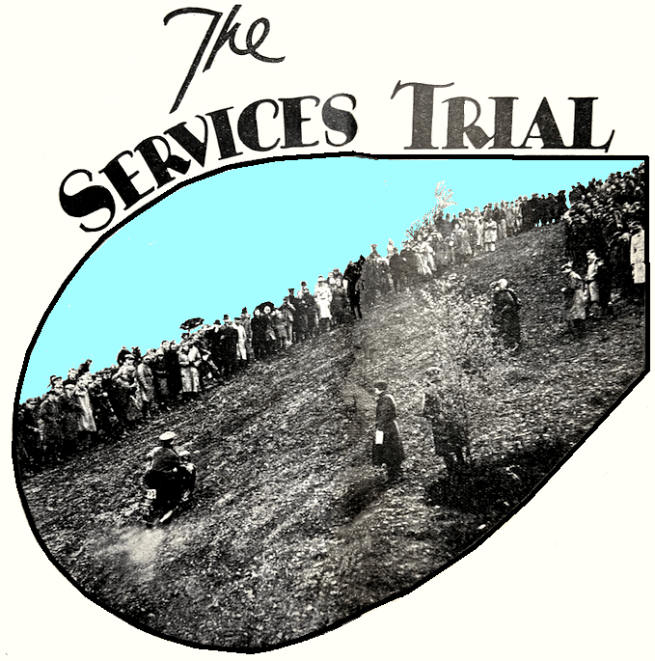
“IN PLANNING THE COURSE for the 1939 Services Trial, which was held last Sunday, the CSMA set out to show the fighting Services, and in particular the Army, just what could be provided in the way of sporting sections without including anything impossible. And they certainly succeeded, for of the 24 observed sections used—many of them very difficult—every one was ridden clean by some of the entry. All sections were on WD land on that trials-lovers’ paradise, Bagshot Heath and Pirbright. At the start at the cross-roads on Bagshot Heath, Army trucks and Army uniforms were most noticeable, for the Army accounted for 157 out of the total of 231 entries. The next largest group was the Civil Service with 45 competitors, then the Navy with 19, while the RAF mustered ten. Among the civilians who were assisting or merely watching, winter wear was the order, for the weather was vile after the glorious days of the previous week. A cold wind blew across the Heath, and as the first men were sent away rain was driving down steadily. The competitors, however, were not to notice the cold, for observed sections followed thick and fast and the first section was only a few hundred yards from the start. It was a short, straight hill with a fairly hard surface and proved to be only an appetiser for the following ‘courses’. One or two of the early numbers managed to strike trouble. The first was WN Last (498cc AJS), Civil Service, who dived into the crowd and stopped. Stoker EHG Cummings (495cc Velocette), RN, approached the section looking worried and stopped half-way up. One of the best-known sections on Bagshot Heath is, of course, Red Road. Last Sunday it was in fine condition for the trial. The surface was fairly loose and as the competitors virtually had a standing start from a knoll about half-way up the hill, clever riding was needed to get to the top without footing. In the early stages there was not a large crowd of spectators, but they kept arriving as the trial progressed, and among them were obviously many officers in ‘civvies’. They all had plenty to see, for riding methods varied widely…Cpl JE Harper, of the RAF, could not get up enough speed and failed low down. A laugh was raised by Cpl JS Boxal (349cc Royal Ruby), RAF, for in looking round in answer to a shout from the marshal he fell off before entering the section. Another who failed before he had really got into the section was A Brown (498cc Triumph), Civil Service; he came to earth in a front-wheel slide. TH Coulter (348cc Norton), Civil service, tried new tactics by starting in second gear. When he saw that he was losing speed he changed down, but then it was too late. JEL Brookes (246cc AJS), Civil Service, nearly bounced his way through the saddle in the course of an excellent climb; SA Roberts, Civil Service, on a similar machine, laid the model down because he thought it was out of gear, whereas he had stopped
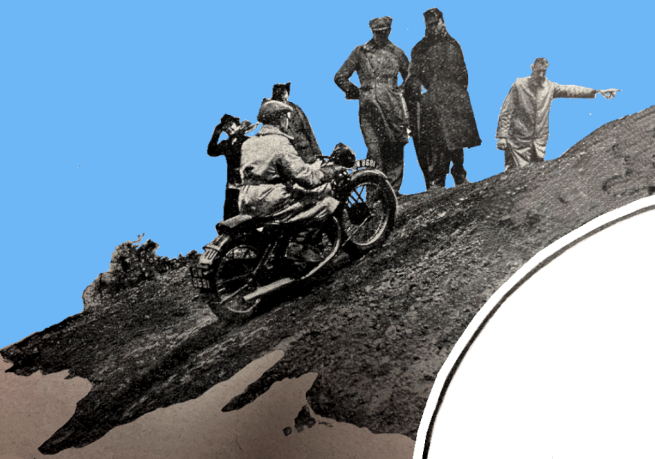
with wheelspin. About this time the Army teams began to arrive in force on their standard Service machines. Failures were the order of the day, for the men could not get up sufficient speed to carry them up the loose part of the hill. When a rider got up by footing the crowd were quick to show their appreciation. Those who failed were sent right down to the bottom to get a long run at the hill, and there were several occasions when two riders were on the hill side by side, one on his first attempt and the other on his second. Of the Civil Service men who climbed before the Army teams, CA Bowhay was lucky to get up clean as his engine was misfiring a good deal; G Franklin (499cc Vincent-HRD) gradually pushed the crowd farther and farther back as he wobbled, and finally had to be assisted; and FA Whitehouse (497cc Ariel), after stopping just inside the section, made a fine unassisted climb from a standing start. Among the crop of failures that the hill made for the Army there were some outstanding performances. 2-Lieut JF Riley (499cc Royal Enfield) was the first one up clean after a long list of stops, but his machine was a competition model. His team-mates, Sgt F Cockerill (499cc Royal Enfield) and Bdr RE Martin (490cc Norton) were equally good. Sgt HRA Wheatley (349cc Matchless) got his Service machine up farther than most by using his feet right from the start, but the first man to take a Service machine up non-stop was Cpl T Boyland (349cc Matchless), who would have been clean but for a dab right at the crest of the hill. It was left to the 1st Bn Gordon Highlanders to show just how the hill should be climbed. First of the team, Pte A Fraser (490cc Norton), shot up the hill standing on the rests and only had a dab at the top; Sgt W Inglis (490cc Norton) footed more, but was non-stop; and Cpl J Kemp (490cc Norton) completed the team performance by streaking to the top with his feet firmly on the rests. From the top of Red Road the route went on over the heath with sections in rapid succession. Tree roots, sand, narrow gullies and hills were all used to test the riders’ skill and marks were lost wholesale. Section 11, a short track between high banks with a deep sand surface, caused a good deal of bother…It was only a few miles to the finish and the signing-off sheet, and many of the Army men were glad that they had trucks waiting to take their machines home. Missing footrests, damaged lamps and mudguards were common, and one man, L-Sgt JDD Young (490cc Norton), was seen to finish with both footrests missing. It was generally agreed that it had been an excellent trial with a good sporting course beautifully marked, and the enjoyment had not suffered by reason of the miserable weather.”
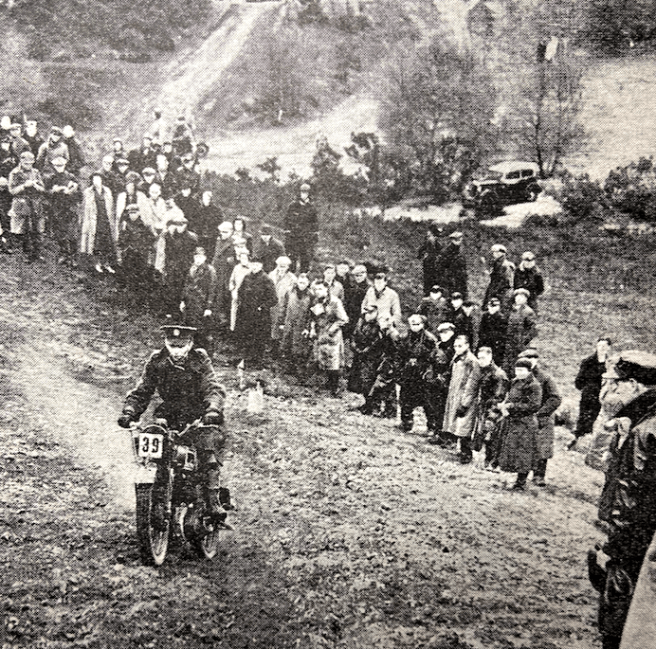
“A FALKIRK MOTORIST who parked his car outside his home for 52 days was fined 10s.”
“SEEN NEAR BISHOP’S WALTHAM (Hants) recently : an elderly power-cycle owner taking his dog for a run on the lead while riding slowly along a country road.”
“NEARLY 2,000 INVALIDS use motorised invalid chairs in this country.”
“MORE 1937 MODEL motor cycles, are in use at the present time than any other year, according to the latest figures.”
“AT LAST A MOTORIST has been fined for failing to dip his head lights, on dazzling other road-users. The charge brought against the motorist was, however, one of driving without due consideration for other road-users, because there is no specific law against dazzling. The case, the first of its kind, was heard at Barnet, and the motorist concerned was fined £2.”
“AS A FRENCH DRIVER sees it: ‘Why, when the danger of a dazzled driver is so obvious, do they not make it compulsory to have, and to use, a suitable anti-dazzle system?’—French reader of The Autocar.“
“MORE THAN 106,000 of the 462,375 motor cycles in use in Britain are side-car outfits. Nearly 173,000 solos are in the over-250 class; 131,620 are between 150 and 250cc; and nearly 33,000 are under 150cc.”
“SOUTH AFRICAN MOTORIST fined for a motoring offence in London: ‘I was struck by the difference of treatment between your police and ours. It was nearly a pleasure to be charged.'”
“ONLY 18 OF BRITAIN’S half a million goods vehicles are fitted with a coal-gas internal-combustion engine.”
“LAST YEAR ONLY 5,170 of the 267,000 cars registered for the first time were open tourers; the rest were saloons.”
“INDICATORS FOR BICYCLES may be enforced in certain parts of Switzerland in the future.”
“OFFICIAL FIGURES COVERING the registration of new machines during February reveal increases in all classes (except sidecars) as compared with the corresponding period last year. Under-150cc machines are particularly popular, the respective totals being 313 (1938) and 530 (1939). The total number of new machines registered was 3,112, as compared with 2,864 during the previous February.”
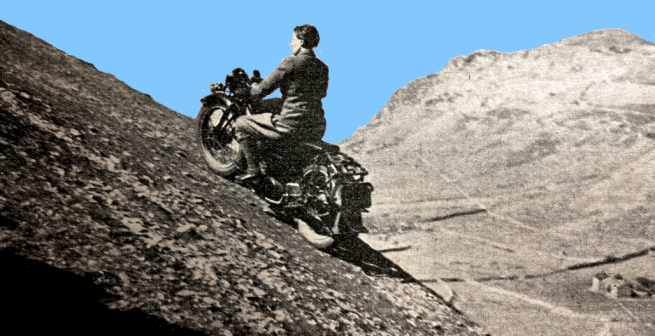
“I AM A LIFELONG DEMOCRAT, but I really marvel at some of the things which democracies do. Our road problem is one of our major problems, but as soon as a Minister of Transport acquires a superficial knowledge of his job he is shunted off to some other department and we get a fresh novice placed over us about every other year. Or, again, the Government realised some years ago that our motor industry was being hampered by stupid taxation methods. British car owners were tied down to absurdly small cars, and inexperience in building roomy, cheap cars opened our Dominions and colonies to imports from America. So they cut the tax on cars. Our factories developed lots of superb 20 and 25hp jobs, and these sold freely abroad. Just when the experiment was really beginning to pay, they suddenly stick on an extra l0s per horse-power. I quite agree that ownership of a motor marks a fellow as one who can pay more for defence than most motor-less folk; but this particular way of separating him from his dibs is both treacherous and, foolish.”—Ixion.
“IF EVER AGAIN I get hit by a motor I shall put heavy pressure on my medico to have the injury X-rayed at the first possible moment. Seventeen days after the smash my doctor agreed to an X-ray, and made the startling discovery that during this period I had been hobbling about on a broken leg! This did not speed up my recovery; worse still, I was entitled to a nice little spot of insurance on condition notice of a fracture was given within fourteen days of the accident…”—Ixion.
“I HAVE BEEN A constant reader of your great magazine for the past 12 or 13 years and I am sorry to say that I have noticed British motor cycles no longer figure prominently in the world-speed records. I used to look forward with pride and enthusiasm to your annual British Supremacy Number. Alas! British machines in regard to record supremacy are in exactly the same position as all Continental makes were in about 1926—nowhere! It is a sorry state for the industry to be in. As soon as a keen sportsman and brilliant tuner breaks a record, the manufacturers of his machine advertise in all the papers. Mr Manufacturer gets the praise, but how much of the effort was his? Velocettes deserve congratulations for their sporting efforts of the past years, and more so for their latest venture—may it be a world record-breaker! Surely an Austin engine in a duplex-steering and rear-sprung frame would be just the job. Oh, a car engine must not be used in a motor cycle! Well, a multi-cylinder engine is the engine of the future, so there is no reason why this masterpiece of car design should not be used, as it is compact, light and of only 750cc, and could be readily linered down to 500cc to compete on level terms with the all-conquering BMW.
Jack Brough, Lower Hutt, New Zealand.”
“THE LATEST ADDITION to the OK Supreme range is a 348cc high-efficiency model that is specially suitable for grass-track racing and for racing on small road tracks. Known as the Model RRS/39, it is basically similar to the GTS/39—the grass-track model—except that it has full road-racing equipment and is designed to run on 50-50 petrol-benzole. Components such as gear box, forks, magneto, carburettor and mudguards are all of racing pattern, while the tyres are 3.00-21 or 2.75-21 ribbed front, and 3.25-19 triple-stud rear. Extras are available in the form of hairpin valve springs, megaphone exhaust system and long racing-type seat. The price of this genuine racing model in standard trim is £79 16s. An exactly similar machine in the hands of HL Graham broke the 350cc eight-lap record at Donington on Easter Monday with a speed of 69.03mph.”

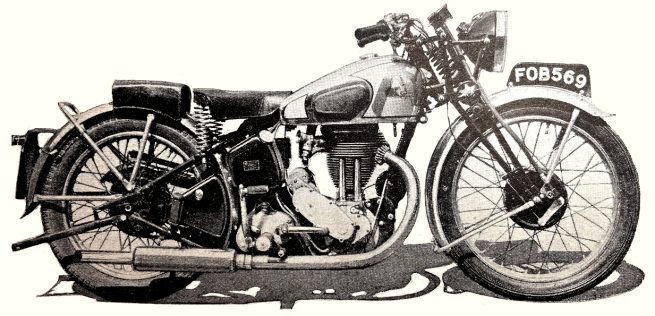
“FEW CHARACTERISTICS APPEAL MORE to an owner than mechanical quietness. This feature, the absence of engine noise, was noticed immediately the 347cc ohv OK Supreme Gladiator was taken over, for at an idling speed all that could be heard was the muffled beat of the exhaust. This pleasing characteristic remained throughout the strenuous 400-mile test. In appearance this model seems small, but the illusion is lost when one is in the saddle. The riding position is good, and this with the fairly low handlebar mounting gives an almost straight arm posture that makes long distance open road work very comfortable indeed; further, the rear brake and gear pedals can be adjusted to suit almost any position of the footrests, and enable the rider to use these controls without moving his feet from the rests. The brake pedal has that useful feature, an adjustable stop. Handlebar controls are well placed, and the long saddle springs give an ample range of movement without bottoming. The engine would always start first or second kick provided that the air control was closed, the ignition half-advanced and the throttle just opened; when the engine was cold the carburettor had to be well flooded, but starting was just as easy. The idling speed was extremely low, and if the ignition were fully retarded the tick-over was really outstanding. From low speeds the pick-up as the throttle was opened was clean and rapid. The engine was very susceptible to the magneto control, which could be used to advantage under traffic conditions. In the latter circumstances slight unevenness in the clutch when taking up the drive was noticed, but no drag occurred when engaging bottom gear from neutral provided that previous to starting the clutch was withdrawn and the kick-starter depressed once or twice. The Gladiator is equally at home in traffic or on the open road. The engine is docile and smooth, yet could be driven hard for long periods without signs of stress. At speeds over 30mph in top gear the throttle could be opened as quickly as possible with the ignition at full advance without complaint from the engine. An ethylised fuel was used throughout the test. A very lively performance is available, particularly if full use is made of the gears, as is shown by the figure of 65mph reached at the end of a quarter-mile from a standing start. Throughout the throttle range the engine was perfectly happy and no vibration was noticeable—a commendable point. Thus any speed from 30 to 65mph can be termed a happy cruising speed. Incidentally, the speedometer needle could be kept hovering between 60 and 65mph on the open road for as long as the rider wished. The full performance can be used comfortably and safely. The only apparent engine noises were a slight piston rattle (as distinct from slap) noticed with the engine running light at speeds between 40 and 55mph and a mild timing gear whine, again at high engine speeds. Steering and cornering are magnificent. Again the rider experienced that illusion of smallness, for the OK Supreme could be pulled round sharp corners or gracefully taken through fast bends like a 250. A true course was easy to hold in these circumstances, and the rear wheel followed its appointed path even on really bumpy or wavy roads. The steering proved light and positive at both walking and high speeds; the steering damper seemed ornamental rather than necessary. An excellent hand control operates the fork damper. The forks, which have a long smooth action, were noticeably free from patter and never bottomed or clashed. Both brakes were of adequate power, although a longer hand lever to make operation of the front brake easier would be an advantage.
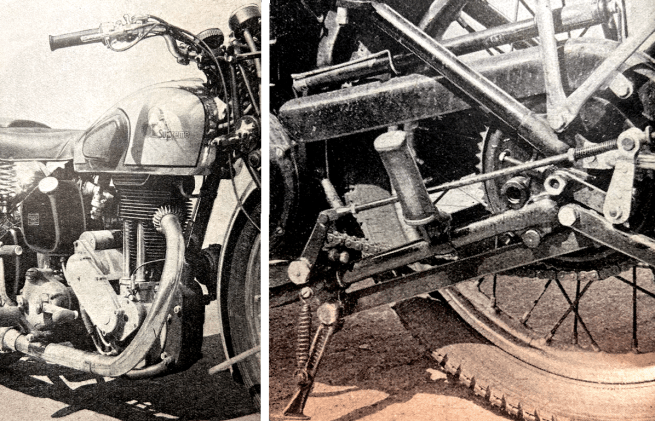
The rear brake was soft in operation and extremely powerful at the start of the test, but lost efficiency somewhat with hard use. The overhead rocker gear and the hairpin valve springs are fully encased by the cylinder-head casting, and this excellent design is no doubt a major reason for the engine remaining entirely free of oil leaks. There was a tendency for oil to be discharged past the tank filler cap at high speeds, and a small quantity of oil escaped from the back of the primary chain case. Careful attention has been given to appearance. The general lines of the machine have a pleasing symmetry, and the chromium-plated mudguards, wheel rims and tank with gold panels are attractive without being garish. In brief, the OK Supreme Gladiator is a machine with a very useful all-round performance allied to excellent steering and road-holding; it is also commendably quiet mechanically.”
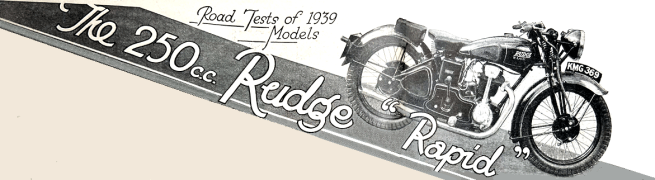
“THE 250cc RUDGES have always held a high reputation in their class. The 1939 Rapid model is a worthy follower of a successful line, with an engine that proved to be a glutton for revs. It seemed to like being thrashed hard in the gears, and although it had a sheer maximum of 55mph in third gear (8.2 to 1) it was quite happy to be taken up to 50 in this gear. In top gear (6.39 to 1) it would run smoothly and happily for mile after mile at 50mph and over, and even at these speeds there was no noticeable vibration. The speedometer was found to be accurate throughout the range. When the timed maximum speeds were taken the speedometer registered between 63 and 64mph over the quarter-mile on the fastest run; which the stop-watch confirmed almost exactly with an average speed of 62.5mph. In a mean of four runs the Rudge clocked 60.2mph. Acceleration was good. As with the majority of small engines, the Rudge preferred to be ‘revved’ away from low speeds rather than ‘slogged’. How good the acceleration is when the gear box is used is shown by the figure of 53mph which was attained at the end of a quarter-mile from a standing start. And the gear box is there to be used, for the gear change was delightful, the changes being of the type that one associates with race-bred machines. Changes could be made at almost any engine speed, and the movement of the lever was very light. Some criticism could be made of the neutral position, which was not always easy to find. Praise for the gear change must also be praise for the clutch, and the Rudge clutch proved excellent. In spite of racing changes and a fair amount of harsh use it never overheated, and at the end of the test did not require adjustment. All the controls of the Rapid are well placed and smooth in use. Once the rider became used to the gear lever being on the near side and the brake pedal on the off side—the reverse of normal practice—their positions were found to be extremely convenient. This applies particularly to the brake pedal, which comes right beneath the rider’s toe. Coupled brakes are, of course, employed, and the brakes were well up to the high standard expected of a Rudge. The coupling is effective and the brakes were progressively powerful. In normal riding only the pedal was used, the hand lever being almost forgotten. In the crash-stop tests the Rapid was brought to rest in 39ft from 30mph. The riding position is of a type peculiar to Rudges. The handlebars are low in relation to the saddle and the rider tends to sit over the machine rather than in it. The position proved extremely comfortable, and gave a sense of mastery over the machine that was very pleasant. In traffic the machine was easy to handle although the handlebars are fairly short, while on the open road the rider could clamp himself on the machine without any effort. Throughout the range the steering was excellent.
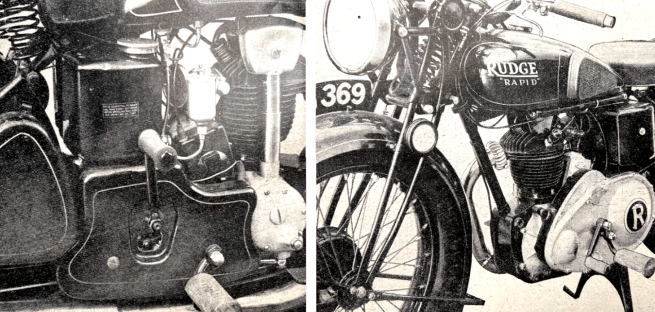
It is of the heavy type without being too heavy for comfort at low speeds. For fast cruising it proved idea —firm and positive and free from any tendency to wobble even on bad surfaces. The steering damper was not used or found necessary during the test. The fork damper was effective and the range of the forks is wide and their action smooth. On bends the machine was rock steady, and the rear wheel did not float outwards when the model was cornered on a bad road. Except for a short period when a piece of fluff got into the pilot jet, slow running and low-speed pulling were both reasonably good. The machine could be throttled down to 12mph in top gear with the ignition fully retarded and could be accelerated away from this speed if the rider was careful with the throttle. An ethylised fuel was used throughout the test, and it suited the engine extremely well. Some criticism can he made of the kick-starter, which is placed rather high for comfort. The actual starting of the engine was easy. The ignition had to be retarded, otherwise the engine would kick back, and a large throttle opening and a fairly hearty kick were required. At low speeds some mechanical noise could be heard from the engine, but this was not unduly loud and did not increase with engine revs. The exhaust note was crisp and healthy at high speeds, but unobtrusive at speeds below 30mph. To sum up, the Rudge Rapid is a lively machine with a sporting performance, magnificent steering and good brakes.”
“THAT THE BUDGET would involve additional taxation for rearmament was generally anticipated. But few imagined that the Chancellor of the Exchequer would adopt the easy but dangerous method of adding to the already almost absurdly high direct taxation of motor vehicles. Not only were motorists pouring some 80 million pounds into the Exchequer annually, and having to make do with an archaic road system when it was promised that all the money should be devoted to road improvements, but already the motoring community were contributing a tenth of the national income and supporting the third largest industry in the country—an industry of great importance to the nation’s balance of trade and, in view of the modern mechanised Army, to the nation’s security. It seems that Chancellor after Chancellor looks upon motorists as a milch cow. He imagines apparently that a motor vehicle is a sign of wealth. With the passage of years a motor, whether car or motor cycle, has become a necessity—it is essential to business and in the case of motor cycles is a means of getting tens of thousands to their daily work, and in other instances it constitutes the one relaxation in life.”
“ONE EVENING LAST WEEK we experimented. Purposely we rode on to a white line on the London end of the Kingston By-Pass. The road was slightly wet and drying rapidly. There was no traffic approaching from the opposite direction except in the far distance. Apparently it was perfectly safe to forge ahead. As for the white lines, did not the Ministry of Transport, when we took up the matter of the skiddiness of such lines, state in reply, ‘The consensus of opinion is that white lines are not slippery at any time.’ Our acceleration was rapid but not ultra-violent—until the machine was on the white line. Instantly the machine went wild. It was exactly as if it had struck a lane of oil. That nothing untoward occurred was sheer luck. We went back to examine the road and learnt from an onlooker that at this very point on two consecutive days a mobile policeman skidded and was seriously injured, while another man skidded and was killed. What is the paint? Why is such a type used? These are the questions we want answering. Immediately the journey was over we telephoned a Ministry of Transport official. To the Ministry’s credit immediate action has been taken, but when, may we ask, can we expect to see the last of such traps? We class this sort of thing on a par with the crass stupidity of relaying roads with wood block surfaces minus a non-skid surface. Lives are being squandered almost daily. The position is fantastic.”
“THE ROYAL TANK REGIMENT just about swept the board in the Army Championship Trials held last Friday and Saturday. They were first and second in the team championship, one team won the cross-country riding, the other the reliability test and the only team to run them close was, very appropriately, the 20th Anti-Tank Regiment, Royal Artillery. The success of the Royal Tank Regiment and the riding of their teams provided interesting proof of the value civilian trials have been, for the men concerned are all among those who have taken part in trial after trial. Like the first Army Championships, which were held last October, the event last week was run in the Aldershot area and had been preceded by eliminating trials in the form of Command events. Forty-two teams of three took part, 35 of them on 16H Nortons, four on 347cc Matchlesses, and two on 350cc side-valve Triumphs, while one contained a couple of Triumphs and one Matchless. The winning Royal Tank Regiment teams were on Nortons. All teams were, of course, using WD machines.”
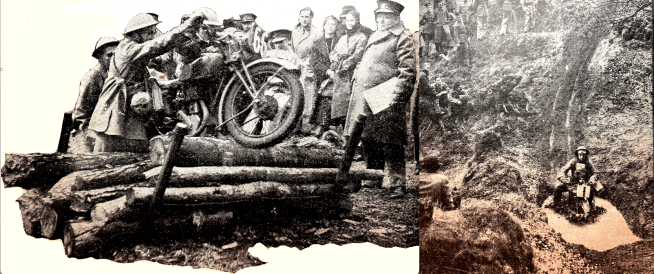
“AN AIR OF MYSTERY has surrounded the experimental department of the AJS works during the winter months…Rumours have trickled through about a new racing multi, but details of the machine and the firm’s plans for it have been kept a close secret. Last week, however, the first of the experimental machines was seen in the flesh, for Matt Wright, of the AJS experimental department, was down at Brooklands with Bob Foster trying out the machine for springing, riding position and general handling before it is taken to Donington for tests with straight-through exhaust pipes…Instead of the separate air-cooled cylinders each bolted to the crankcase, there are now two liquid-cooled cylinder blocks, one for the front pair of cylinders and one for the rear. They are of aluminium with steel liners and the detachable heads have hardened valve inserts. The whole of the rocker and valve gear is totally enclosed. Long valve-spring boxes run across the cylinder heads on each side of the enclosed camshaft, and the hairpin valve springs are therefore fully enclosed. As liquid cooling is employed, the exhaust ports are at the rear of each cylinder and the exhaust system is far neater. The Brooklands silencers were, of course, only in position for Brooklands testing and the scheme is to use the machine with plain straight-through pipes.
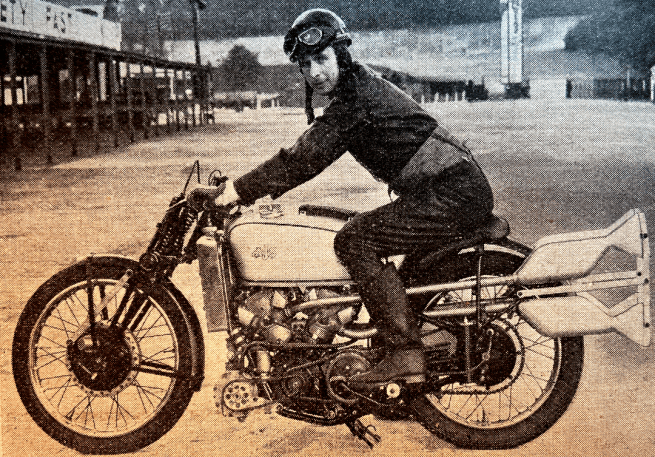
The induction ports are at the front of each cylinder and the induction pipe from the ‘blower’ is led up in front of the engine to feed the front cylinders and continues over the top of the front block and down to the induction ports of the rear block. The new unit looks extremely neat and workmanlike, and everyone will look forward with interest to see whether it appears in the TT in this form. The gear box is a racing-type Burman, and the whole unit is mounted in a new duplex-cradle frame with new rear springing. The main duplex members run from the steering head underneath the engine and gear box and back to the bottom ends of vertical spring boxes. The boxes are anchored at their top ends to the rear ends of the saddle tubes. Each spring box contains a vertical guide, and the sub-frame which carries the wheel and is pivoted behind the gear box is allowed vertical movement in the guides. A single spring is employed in each box.”
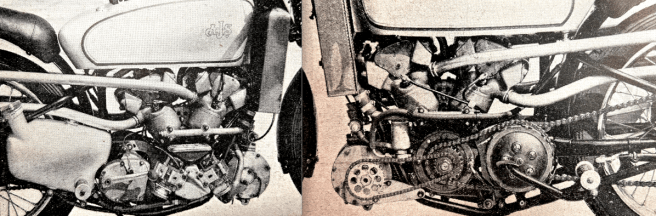
“IN VIEW OF THE FACT that quite a number of motor cyclists are in the 20-21 years of age category it is only natural that an appreciable percentage of readers are wondering whether they can put their motor cycle experience to good use. Last week-end, therefore, a member of the staff went round to the War Office to have a chat and learn what their position is. Naturally, so far as the Militia is concerned, matters are still a little indefinite. He was told, however, that it is anticipated that wherever possible the wishes of those called up would be met. Each man will be asked which unit he wishes to join, and if, as a result, the experienced motor cyclist is not drafted to some completely mechanised unit, he will at least, assuming that he has the necessary knowledge, find that he has something interesting on wheels to play with—that is what we are told: he will not merely be infantry in cases where he has the knowledge. And this we gather will also apply to those who, instead of going on the Reserve following their training, join the Territorial Army. With the institution of motor cyclist battalions there are fresh opportunities; thus in one way or another there is hope that those who have specialised knowledge will find that it is given full rein. Incidentally…we are informed that Army motor cyclists will have the use of their WD machines on their weekly day’s leave—that they can spend their leisure in civvies using their machines and WD petrol and oil. As I have seen from many recent trips with the Army, the soldier of to-day is very, very different from the soldier of even three or four years ago. There are large numbers of lads who, I am quite certain, are going to enjoy themselves.”
“EVERY NOW AND THEN I see pictures taken on club runs held in the United States. In the USA the practice is for clubs to have their own special uniform—even pillion riders wear uniform. One photograph I have just been examining shows the men and girls lined up in a ‘neat club’ contest. They are wearing highly polished hunting-type boots, dark breeches, shirts, long-flowing ties and Glengarries. In another picture the breeches and shirts are white and set off by dark boots, belts and ties; in this case the caps are of military shape, white with dark peaks. Somehow I cannot see clubs over here going in for anything flashy. All the same, there should be no great difficulty in clubs standardising a smart serviceable kit. To my mind, such a scheme is well worth a little thought on the part of individual clubs.”—Ixion.
“I CAN ADD SOMETHING to Torrens’ arguments in favour of spring frames. One of the saddest facts about increasing years is that we can no longer ‘take it’ as we did when we were young. My longest run in a day was accomplished when I was past my first youth, and totted up to 534 miles. Athlete though I was, and young as I was compared with what I am now, I’d had plenty before I finished. The last 100 miles were by no means jam; and the next day every joint in my body creaked. I got out of a chair thoughtfully, I shrank from physical exertion, and nothing would have induced me to take the model out. To-day I simply could not do 534 miles in a day; the physical fatigue would be too much for me. But I have proved to my own satisfaction that I can ride much farther in the day on a good spring frame than I can on a rigid rear frame.”—Ixion.
“THERE IS NO DOUBT whatever that the Scottish Six Days Trial has an atmosphere peculiarly its own. It was evident last Sunday at Player’s Garage in Edinburgh, where the weighing-out took place in glorious sunshine. This sunshine brought competitors out into the open, and the usual last-minute activity was carried on in the forecourt of the garage. There was tyre changing, plug checking, and, of course, filling-up with petrol and oil. There were, however, surprisingly few of the last-minute major repairs that are usually a feature of the ‘Scottish’, for most people had come with their models well prepared for a week that promises to be the most strenuous yet. Among those fortunates who are able to choose what type of machine to ride, light 250s are the order of the week. Of the dozen or so men who are each capable of winning the trial, seven are on this class of machine. The team of 250cc Rudges, which are being ridden by MacGregor, Edward and Leslie, were all beautifully prepared and looked really light. GF Povey had a lightweight type speedometer on his 248cc Ariel, mounted low down on the forks where it would not affect his vision or the steering. Gadgets were the exception rather than the rule, but WA West had a really neat chain oiler, which weighs only one ounce, on his Ariel. It is made from a celluloid cycle pump barrel filled with coarse felt, and the felt is saturated with oil. A narrow-bore flexible pipe leads to the rear chain. Air bottles or large tyre pumps rigidly fixed for use in situ were to be found on nearly all the machines. A neat method of fixing the pump had been discovered by CR Bates (348cc BSA), who had the pump secured to the rear mudguard stays with Jubilee clips. Air cleaners were also very much in evidence—a direct result of recent ‘Scottishes’ and ‘Internationals’. Strangely enough, the spares question seemed to be causing little heart-burning. A spare fork spring, footrest hanger, and a few spokes were all that most
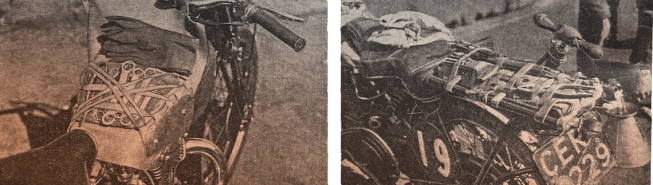
people had, and the ‘Christmas-tree’ effect of a few years ago when spares were hung on in every conceivable place was pleasantly absent. Tools, however, were much in evidence, and the popular mounting was on the petrol tank with the tools held in Sorbo by rubber bands. SF Cunningham (248cc Ariel) had a large sheet of rubber to protect his tools from the weather…But the unusual feature of the weighing-out was the presence of the twelve Army machines with attendant truck and Army officials. There were four teams, one on Nortons, one on BSAs, one on Triumphs, and the fourth on Matchlesses, and all are standard Service machines. Lamps had been removed and some spares had been attached, but otherwise they were as used for normal Service work. By one o’clock nearly everyone had weighed-out, and only Harold Flook had obtained an extension—he had smashed his gear box while practising on Stoney Brae earlier in the morning…MONDAY: A slight drizzle was falling from leaden skies when the competitors came down for breakfast on this, the first day of the trial…it was very cold. Twenty miles after Linlithgow the riders passed over Kincardine Bridge to the new hill, Culross, which seemed to rise almost from the banks of the Forth. It is a stony climb with watery mud about the surface. In parts the mud was tricky, but there was a hard path, and out of the first 20 men only one lost marks…MacGregor had to fight some wheelspin and GE Godber-Ford (496cc Sunbeam) had one nasty wobble about half-way up…A little later T Mooney (497cc Ariel) gave just one dab and was very cross with himself for the lapse. Immediately after Culross the well-known ‘Scottish’ process of trying to disintegrate the models began. Instead of following the main road to Perth, the route struck out over the moors and included rough, rocky tracks, woodland paths and miles of third-class roads. M. Melough (496cc Sunbeam), who had got bogged at the top of Culross through taking the wrong turning, was not the only one who had to hurry to keep to schedule. When Stoney Brae was reached there was a general feeling of relief that the terror was at last to be tackled. The hill was dry and certainly easier than it has ever been since its inclusion in the ‘Scottish’…The S-bend did not cause the trouble, and SE Cunningham (249cc Ariel) showed that even the worst could be ridden over feet-up. GE Eighteen (348cc Matchless) went very slowly in places, but retained

mastery over his mount. One very surprising failure was that of Allan Jefferies (349cc Triumph), who struck a rock while rounding the second bend and came suddenly to earth. Len Heath spoiled the Ariel team’s clean sheet with a stop at the top; JC Edward, of the Rudge team, footed when the model got too near the bank; and J. E Breffitt, of the Norton team, stopped at the top after a neat climb of the lower stretches. GD Walkey (347cc AJS) got over the worst, then stopped on the easy part…The first Army man to arrive, Pte JL Wood (BSA), charged a huge rock near the top and failed, and L/Sgt J Dalby (490 Norton) had to use his feet hurriedly. Masterly handling of his machine by Pte. R. Scovell (490 Norton) saved a failure several times, but he had to foot once. Bdr T Tracey (490cc Norton) was much faster than most, but right at the top his high speed caused his downfall…As last year, there was no halt at the top of Stoney Brae. Competitors made a loop through the woods and rejoined the track just below the start of the observed section. A few miles of main road followed, and then the route struck off again over Amulree—a rough moorland road, which once included a test hill…At the top of Amulree the competitors were faced with a grand view of snow-capped mountains, and as they bumped their way down to Kenmore, Loch Tay came into view. At the bottom of the descent, the road along the south side of the loch was followed to Cambussurich, the last hill of the day. The hill was dry, for the sun was shining strongly now, but there was some slime on the two bends. As usual the lower, reaches caused the most bother, and lots of people had trouble at one spot where there was only a very narrow track through rock ledges. WA West (497cc Ariel) picked his way confidently round the ledges, but LG Holdsworth (346cc Royal Enfield) tried to ride through the gap and his engine stalled on the rocks. WT Tiffen, Jnr (348cc Velocette) gave a wonderful display of throttle control, and JJ Booker (348cc Royal Enfield) was equally good…VN Brittain (490cc Norton) made a perfect climb standing on the rests, but JE Breffitt (348cc Norton) shot up the bank after hitting the rocks, and only just got back on the track again without footing…Miss M Cottle (249cc Triumph) had very hard luck, for she fell after getting over the rock-garden feet-up. L/Sgt FM Rist (BSA) was in the expert class on the first bend. Incidentally, all three Army BSAs grounded their silencers on the rocks…
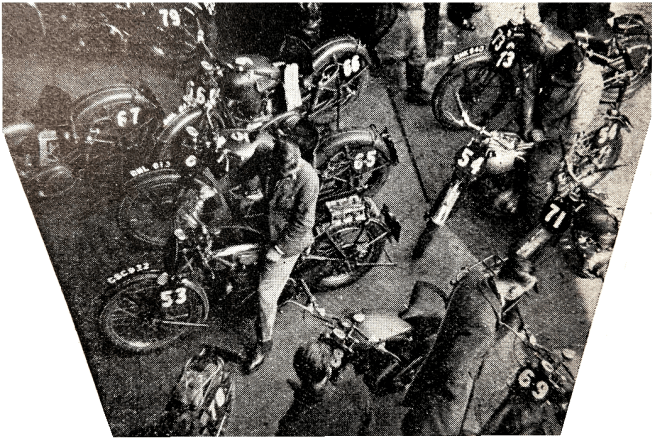
Sidecars found the hill difficult Only DB Gunn (497cc Ariel sc) got up non-stop without footing. Three reached the top with a single ‘foot’: HJFlook (Norton sc), HR Taylor (Ariel sc) and FH Whittle (Panther sc). The moorland stretch from the summit was very boggy and several competitors, particularly men with later numbers, got stuck and had to receive a helping hand. It seemed that after the lunch stop at Killin it would be an easy, straightforward run to Fort William, the finish of the day’s trek, for there were no observed sections to be tackled. Instead, however, there was a scheduled speed of 40mph which taxed the smaller engines considerably. TUESDAY: For the first time since it has been included in the ‘Scottish’ the pony track between Kinlochmoidart and Lochailort was covered twice by competitors in the same day. Fort William was left in glorious sunshine that prevailed throughout the day, and which made the run extremely pleasant, in spite of its strenuous nature. The route led round Loch Eil and back along the opposite shores of Loch Linnhe to Ardgour, but on this 34-mile stretch the road was being remade. On these little-used Highland roads the road-makers tear up the whole lot for reconstruction work, and so for about 15 out of the 30 miles the road was little more than an observed section, and for long stretches the surface consisted of unrolled rocks. For most riders the average of 30mph was impossible, and the organisers allowed an extra 15 minutes on schedule time. By comparison the road to Kinlochmoidart seemed like an A1, but it was twisty and loose in parts, so that there was little opportunity for gazing at the magnificent views of Loch Sunart that were presented at almost every turn. Besides, most competitors were thinking about the notorious Devil’s Staircase, which was the first hill of the day, and, of the rocky track that had to be covered afterwards. Actually, the Staircase was dry and only on the lower reaches where there was a ‘dead section’ was there much loose slate on the surface. The three bends were as formidable as ever, and there was much speculation among the fifty-odd spectators, many of whom had come long distances, as to whether the hill would be climbed clean for the first time in the history of the trial. Their speculations were soon to be settled, for three men achieved the almost impossible and got up without removing their feet from the rests. These super experts in the art of throttle and machine control were GK Baird (497cc Ariel), A Jefferies (349cc Triumph), and CN Rogers (248cc Royal Enfield). Baird had the honour of being the first man to climb the hill clean. He gave a magnificent display of clutch control, almost stopping after each bend to get placed well for the next. How he was applauded by the crowd!
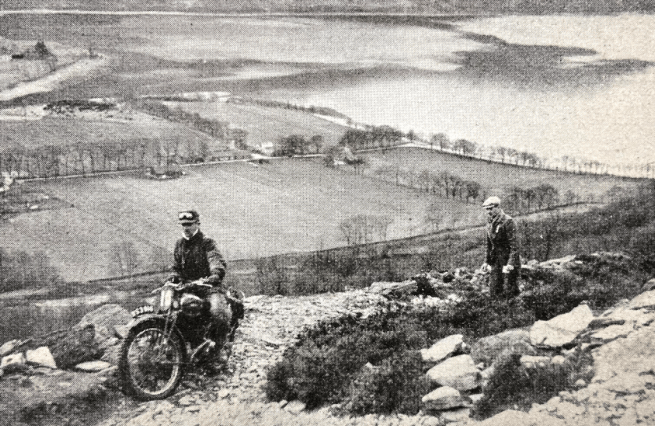
Jefferies and Rogers made their climbs one after the other later in the entry and both were magnificent in the way they handled their machines round these three very acute bends. Jefferies obviously gained confidence after turning the bottom bend successfully and got his machine over at amazing angles on the higher bends without even looking like taking his feet from the rests. Rogers had an easier passage, but it was obvious from his expression that he was using every ounce of concentration that he possessed. These three outstanding climbs tended to overshadow the excellent performances put up by several other competitors. Those who attempted to round the bottom bend feet-up and got into difficulties usually footed all the way up the hill…Right at the end of the entry, KM Hurst (498cc Levis) made a very good show, rounding the first and second bends clean and only footing after an awkward moment near the top. K Pugh (348cc Norton) arrived late, having had a puncture, and he was content to get up non-stop. From the top of the hill there were 12 miles of rocks, steep descents and sharp climbs. The newcomers to the trial had their first experience of real ‘Scottish’ rough-stuff, and judging from the oil that was seen on the track afterwards many had grounded often. The other observed hills were easy by comparison with the Devil’s Staircase, and the ‘sting’ was reserved for the return journey. But CN Rogers had a foot on Bay Hill and thus the last clean sheet was lost. On the way to Lochailort JD Barber (499cc BSA) had ignition trouble and at Lochailort he decided to retire. On the return trip across this section was a hill which has been known in the past as The Ravine; it has been renamed School House, and was extremely difficult. The climb consists of two very sharp hairpins with barely a machine’s length between them. There were two sub-sections, and no one did the first clean. It was a case of footing on the first and ‘getting them on the rests’ for the second, and those who tried to do the bottom section feet-up usually footed on the top one as well. One exception was J Midgley (346cc Royal Enfield), who got round the first bend clean and nearly lost the plot over the edge; he made a magnificent recovery and almost did the top section clean. GK Baird (497cc Ariel) was again outstanding, but he footed just the same, and J Cox (346cc Levis) did well to cover the top section clean after a hectic passage on the lower reaches. WEDNESDAY: At 11.30 on
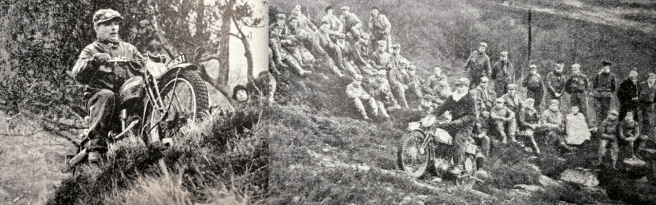
Tuesday night the committee of the organising club dropped a bombshell on those members of the party who were still up. It was announced that instead of covering the new ground at Kinlochourn, Friday’s route would be covered, and instead of the 9am start the first man would leave at eight. For a while there was confusion while sleeping officials and competitors were roused in the hotels in the town and told of the altered plans, but eventually all had grasped the new arrangement, and at 8am everyone was about. The morning promised to be fine, for the sun was brilliant as the competitors walked to the garage, but as they struck north and then west, heavy clouds came up and the wind grew cold, although the rain actually held off all day. The route ran alongside Loch Laggan and then branched west for Dalwhinnie and Trinafour, the old trials hill, which was descended. The morning objective was Kinloch Rannoch, the hill that was used for the first time last year. It is a long, winding climb up a mountainside, and after stones, gullies and rocks in the lower reaches it culminates in a sharp hairpin with a rock-garden surface. The outside of the hairpin was greasy, and the grease was soon carried on to the rocks, making them slippery. Again only the super-stars managed and only four were registered. the first man up, AA Sanders (346cc Levis), fell heavily on the corner. GR Rowley (348cc AJS) had to touch once to save the front wheel going over the edge, but R MacGregor (245cc Rudge) never hesitated an instant as to the path he should take, and he made the first clean climb. ID Maclntyre (348cc BSA) required just a dab, but H Sim (349cc Triumph) rode straight over the huge rock ledges and made no mistakes. GG Godber-Ford (496cc Sunbeam) made a very good show, particularly as it was the first time he had ever seen the hill. GE Eighteen’s performance on his Matchless was really brilliant. He took the path over the slabs and cleverly mastered the machine’s attempts to lie down. WJ Smith (346cc Levis) knew the path over the slabs and took it fairly quickly, but Len Heath (348cc Ariel) spoilt a brilliant climb by dabbing before the corner. As the trial progressed the hill became much more difficult, and the mud at the bottom caught several men napping. Early competitors watched the later men at the bad corner, because everyone had to stop at the top and return down the hill again after the last man. Everyone applauded Jack Amott (249cc BSA) as he motored briskly over the slabs. Both Jefferies and Rogers were watched with special interest, because they were leading the trial, but Allan footed and Rogers stopped—momentarily. There were a few outstanding climbs among the later
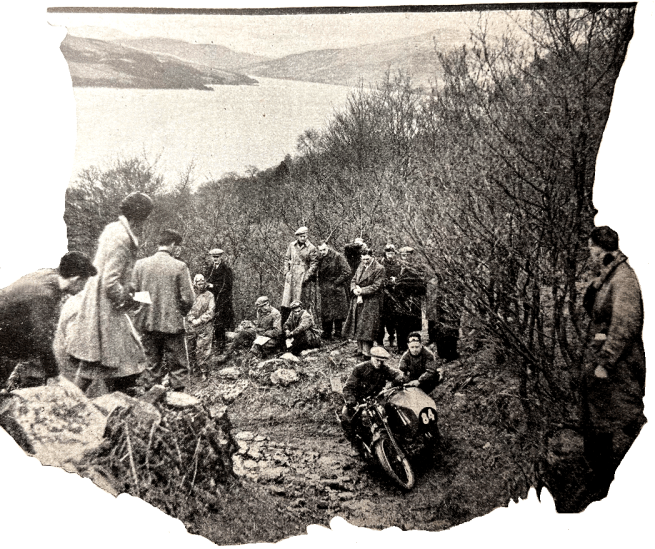
men and the best was by Vic Brittain (490 Norton), who showed the not-so-expert just how a throttle should be handled on greasy rocks—even the experts clapped heartily. WA West (497cc Ariel) also was clapped for a fine show that ended with a foot right at the end of the section. The sidecars tackled only the lower stretches, for the track is too narrow at the top for passenger machines. A right-hand bend and a mud patch proved the worst. FC Perks (348cc BSA sc) just screamed through the mud, and HR Taylor (497cc Ariel sc) was quite at home on this type of going. Lower down the hill, WS Waycott (495cc Velocette sc) and WJ Stocker (497cc Ariel sc) were excellent, but both FA Whittle (598cc Panther sc) and HJ Flook (596cc Norton sc) got into difficulties. H Tozer (496cc BSA sc) made light of the whole thing. From the bottom of the hill competitors headed for Killin, but instead of taking the main road the route led over the rough track through Glen Lyon. The check at Killin proved to be tight, and those who were late delayed filling up with petrol and oil until after lunch. In the afternoon the same route was followed as on Monday, through Glen Coe and as far as Kinlochleven. But there the solos forsook the road for the famous track built by General Wade and known as Mamore. This stony road rises nearly 1,000ft, twisting and snaking all the way. One right-hand bend was extremely difficult, for there was a rock step to be climbed before the bend and a mass of loose shale afterwards, with only one hard path over some large rocks. For the early numbers the hill was not too difficult, but it got cut up as the trial progressed and a clean climb among the late men was a fine feat. Vic Brittain was again superb and obviously right on his form. C Holden (249cc BSA) was very nearly as good, and LG Holdsworth (346cc Royal Enfield), after a great fight on the loose shale, eventually mastered the situation. Easily the most impressive climbs were made by the BSA Army team. They arrived when the hill was in a bad condition and proceeded to make three perfect climbs. The riders were L/Sgt FM Rist, L/Cpl AC Doyle, and Pte JL Wood. The crowd clapped long after they were out of earshot. The sidecars by-passed the hill and went straight on to Fort William, while the solos bounced and banged their way over the rough track and entered the town by another road. They were, however, without JE Breffitt (348cc Norton) and K Pugh (348cc Norton), both of whom had retired in the Glen Coe section—Breffitt with a broken valve spring and Pugh with a broken push-rod.
THURSDAY: Shades of the Scott Trial and the Alps! Nothing like this day’s run has ever before been included in the ‘Scottish’ or any other trial in Great Britain. The scenery encountered almost beggars
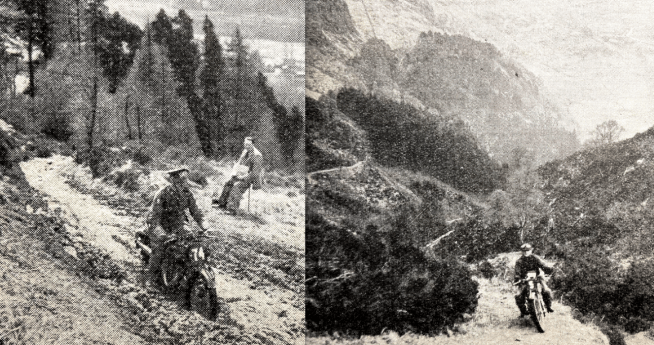
description, while the severity of the observed sections staggered even the hardened old hands. The cross-country section was severe, but perfectly fair. The route covered was that originally scheduled for Wednesday. Competitors left Fort William on the Fort Augustus road in a chilly rain, which was the only fly in the ointment of a thoroughly interesting day. At Invergarry they forked left on to the main road to Skye, and after the check at Tomdoun, set off on the 17-mile stretch of atrocious road to Kinlochourn. Here was the first of the new finds in the way of observed hills. It begins with a perfectly-kept path through an estate, but the gradient is very severe right from the start. It twists and turns up through woods and out of the estate up the mountainside, and as it rises the bends become more acute and the gradient more severe. The surface is mainly smooth and hard, but its severity can be judged from the fact that none came anywhere near doing all of the eight observed sections clean. The hill was amazingly hard on engines, and the 250s often required assistance from their riders. One of the best performances was that of ID Maclntyre (348cc BSA), who only footed on the bends. J Midgley (349cc Royal Enfield) rode over the edge just before the worst bend, which was near the top, and on the lower stretches J Cox (346cc Levis) toppled right down the bank, machine and all. Many of the riders were obviously nervous; and not without reason, for the hill was a frightening sight from the bottom, appearing to disappear in a cleft between two mountains. As a result, many people footed for safety. Some, however, made valiant attempts; among them were Allan Jefferies (349cc Triumph), who was clean on the worst section; Len Heath (347cc Ariel), who did the same after a stop lower down; and RT Newbery (348cc Triumph), who was one of very few to round the S-bend clean, only to stop later in a ditch. RD Humber (249 Triumph) was amazingly good in spite of his one leg, and he footed confidently in the awkward places…J Hogg (349cc Triumph) said ‘Oh!’ as his machine shot over the side near the top. From the top of the hill the track led over some of the wildest and most magnificent country in Scotland. Some idea of the desolate conditions can be gathered from the fact that there was a dead stag on the hill, which a keeper said had died from malnutrition. An ‘observed section’ card was hung on the stag’s antlers, and afterwards the antlers were removed as a trophy. Eight miles of wild moorland country were then covered. The track snaked, dived and swerved in a bewildering fashion, crossing streams and boggy land, with magnificent moorland panoramas. Two wide rivers had to he forded, and in one of these JC Edward (245cc Rudge) fell and took a long time to get away again. Later, the track ran alongside a river, crossed it, and continued along the other side over boulder-strewn ground reminiscent of the Scott Trial country. Farther on the track ran alongside a loch, and here H Sim (349cc Triumph) went over the side and the machine dug a hole in his leg. He got out of the water with great difficulty and pluckily carried on. J Midgley (349cc Royal Enfield) rode most of the section with broken handle-bar clips, and nearly everyone had incidents of some kind. Near the end of the section competitors descended a very steep. twisty hill, with a magnificent waterfall almost splashing on to the track, and after negotiating an amazing rock causeway reminiscent of stories of lost worlds, they zig-zagged down the 16 hairpin bends of Corran. The sidecars, which had followed a different route from the start, had to climb this hill, and although all the drivers shook their heads and said it was ‘impossible’, FH Whittle (598cc Panther sc) proceeded to give a wonderful demonstration of sidecar driving. He judged each of the 16 bends perfectly and suffered no crabbing…easily the best, apart from Whittle, was WJ Stocker (497cc Ariel sc), who, after a stop at the bottom, cleverly coaxed his high-geared outfit up the hill with the aid of his extremely plucky lady passenger. The sidecars turned round at the top of the hill and followed the solos back to the main road to Skye, which was followed as far as Fort William. Again the scenery was breath-taking, but the road was breath-taking, too, for there were 60 miles of bumps. At Fort William, Town Hall Brae was tackled, and as the hill was greasy it caused lots of bother but, to the huge delight of the large crowd, Miss M Cottle (249cc Triumph) made a perfect climb. Stocker was the only
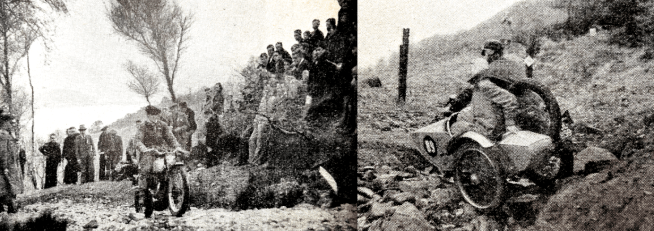
sidecar driver to get up; Flook capsized his outfit on the crest of the hill. FRIDAY: The results of Thursday’s run as good as decided the destination of most of the awards, and those competitors in the running for one of the premier awards knew that the supreme effort would have to be made on Friday. Vic Brittain started the day leading the trial, with Allan Jefferies only two marks behind. In the sidecar class, however, Whittle’s magnificent climb of Corran on Thursday had put him well in the lead, for Stocker was five marks behind. In the morning the sidecars left Fort William 1½ hours before the solos. The reason was that they had a considerably greater mileage to cover. For the sidecars it was the same route as on Thursday, but the solo men followed Thursday’s route in the reverse direction. The greater part of it was the famous Road to the Isles—the road to Skye—which branches off the main road to the North at Invergarry and runs through magnificent moorland country to Shiel Bridge. Herds of deer were seen grazing on the moors as the riders passed through Glen Shiel, and at the lunch stop at Glenelg everyone remarked on the wildness of the country and, incidentally, of the road, which had been rough and loose nearly au the way. A few people had time to pause at the bottom of the old test hill…Less than a mile from Corran Hill the track dipped steeply. The competitors then crossed a footbridge and rode over a rock causeway almost to the foot of a beautiful waterfall. The observed section, Falls Hill, ran up the side of the fall and consisted of two loose bends, both very steep. On this hill Allan Jefferies virtually won the trial, for he gave his most brilliant display of riding in a brilliant week. Knowing that everything depended on his performance, he ran up to look at the hill before making his attempt. He was told that so far everyone had footed or failed, but he decided to make a feet-up attempt in spite of that. His tyres were very soft and he got round the first bend without wheelspin. Using the edge of the track, he eased the model round the second corner and opened up sharply; the back tyre bit into the ground and the machine shot away and
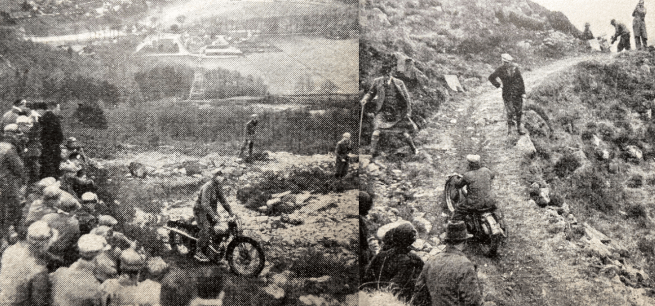
over the rocks with Allan using every ounce of his skill to keep the machine on the track and his feet on the rests. As he passed the ‘ends’ card the little crowd clapped enthusiastically. It was a marvellous show. SATURDAY: A glorious morning greeted the competitors as they walked from their hotels to the official garage in Fort William for the last time in the trial. As the long cavalcade headed south through Glencoe everyone experienced a little pang at leaving such glorious country. There was more than a pang for Jack White, who in Glencoe found that his front wheel was wobbling, although he was holding the handlebars quite steady! Examination showed that the near-side fork blades had fractured. Jack rode his machine gently to Taymouth and retired there. Glencoe was also the finishing point for Stuart Waycott, for the con-rod broke and pushed its way through the crankcase. No other incidents were reported until Taymouth was reached, and this hill, although wet and greasy, did not cause much bother. None of the star men made any mistakes, but the greasy rocks caused quite a number to foot. The hill cost one man his silver cup. He was HD Cartwright (348cc BSA), whose marks on Friday night just kept him in the cup standard. But on Taymouth he footed on the lower section and stopped on the top one…After lunch at Amulree it was a straightforward run to Edinburgh and the finish at Blackford Hill. For two men, however, it was far from uneventful. George Eighteen collided with a child near Kincardine Bridge, fortunately without serious injury to either, but the delay made him late at the finish. The other man who had trouble was 2-Lt DR Horsfield (349cc Triumph), who blew a cylinder-head gasket just outside Crieff. He took the machine to a garage, took off the head, and made and fitted another gasket. The stop-and-restart test and brake test held on Blackford Hill were watched by the usual interested crowd, but only three men fell from grace here. All that remained was the final examination of machines, which this year was rapidly carried out by a batch of scrutineers. It is to the great credit of British manufacturers that very few people lost marks on condition after such a strenuous week. Altogether, only six solos and one sidecar lost marks for trivial faults. By four o’clock the trial was over and everyone had departed to their
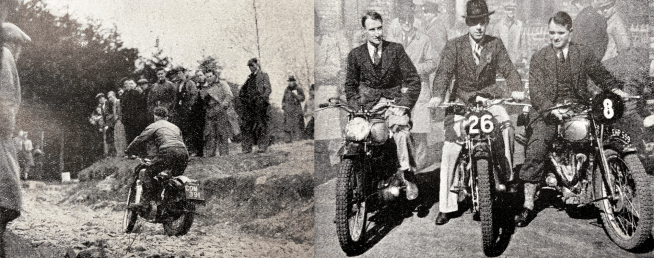
various hotels. In the evening there was a concert and the presentation of awards by Lt-Col CV Bennett, who had followed the trial throughout the week on a spring-frame Norton. After the speeches and cheering and good-humoured banter, Len Heath thanked the Club on behalf of the competitors, and Lt-Col. Bennett thanked everyone for the help given to the Army riders. Finally, George Simpson gave a film show which included a ‘shot’ of the trial which had just finished. So, except for revelries, another enjoyable ‘Scottish’ was over. SPECIAL AWARDS: Castle Trophy (best solo performance): A Jefferies (349cc Triumph), 23 marks lost. Macnaughton Trophy (best sidecar performance): FH Whittle (598cc Panther sc), 29. 250cc Cup: CN Rogers (248cc Royal Enfield), 26. 350cc Cup: WJ Smith (346cc Levis), 35. 500cc Cup: VN Brittain (490cc Norton), 24. 350cc Sidecar Cup: FC Perks (348cc BSA sc), 53. 500cc.Sidecar Cup: WJ Stocker (497cc Ariel sc), 49. Manufacturers’ Team Prize: Triumph (A Jefferies, JH Wood, H. Sim). Club Team Prize: Birmingham MCC (VN Brittain, LG Holdsworth, GF Povey). Army Team Award: BSA Team (L-Sgt FM Rist, L-Cpl AC Doyle, Pte JL Wood.”
“LAST WEEK’S SCOTTISH Six Days Trial proved by far the most strenuous of recent years. How difficult it was is shown by the number of marks competitors lost. Whereas the winner of last year’s event was debited with only four marks, this time the figure was 23, while even those who lost as many as 60 marks still gained silver cups. The Edinburgh & District MC is to be congratulated upon its choice of route. The new ground that was covered proved really difficult without being impossible, while from the scenic point of view it included the best that Scotland has to offer. The organisers used more tracks and third-class roads than ever before. On three of the six days competitors were only on first-class roads for a very few miles and for the rest of the mileage machines were buffeted over pot-holes and rocks and thrashed up and down steep hills in a way that tested every part to the utmost. Any weaknesses were quickly shown up, and as the speed schedules were high over these sections there was little time for competitors to carry out adjustments or to fit replacements. Under such a gruelling it is surprising that there were not more retirements. It is also a tribute to modern motor cycles that only seven competitors lost marks on the condition of their machines at the end of the week. From the point of view of reliability the outstanding feature of the trial was the performance of the Army competitors. Twelve Army riders started on standard Service machines and the 12 machines came through the week without losing a single mark on condition. If the trial was rather too strenuous to be called a holiday, it was a thoroughly sporting event and from every point of view a complete success.”
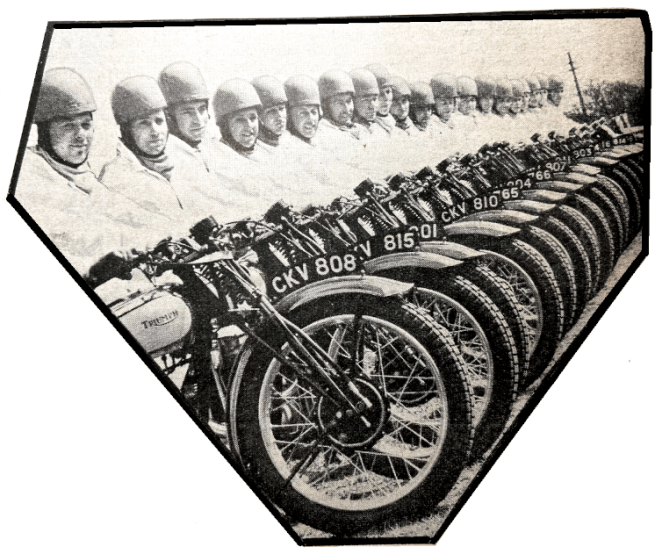
“THOSE OF US WHO LIVE in the Midlands looked with gloom on the weather which prevailed last Friday. From early morning to late afternoon rain poured down, and when darkness fell things looked anything but promising for the ‘Clubman’s’ day at Donington on the morrow. As it happened, Saturday morning dawned very misty, but there was a heavy dew and every promise of a fine day. This promise was fulfilled, and the day at Donington was one of the most perfect for racing that could be imagined. There was a preliminary to the racing, for the sponsors of the meeting, Motor Cycling, had sent out invitations to the heads of all motor cycle manufacturing firms and hoped that as many as possible would turn out on the machines they manufacture. The response to this call was remarkably good, and at the first rendezvous at Ashby-de-la-Zouch there was a truly noble gathering. One after another these Captains of Industry rolled up on every type of machine, from autocycles to hot-stuff singles, twins and fours. It was easy for the observer to determine between those who make a regular practice of using motor cycles and
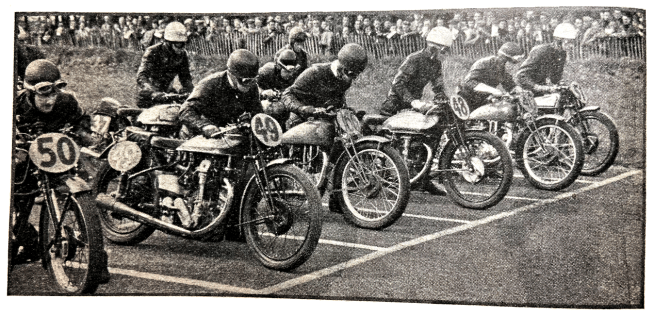
those for whom this was an unusual occasion, and it was sad, perhaps, to note the number of brand new coats, boots, gloves, goggles and headgear. However, it is safe to say that every one of them was enjoying the experience of discovering exactly what the customer has to put up with! Just after noon this brave cavalcade descended upon the famous Donington Park, where they sat down to lunch in the Hall with (probably) unusually keen appetites after their journey through the lovely spring air. Then the organisation was handed over to Fred Craner and his merry men, who got down to business and set the ball rolling to the very tick of the advertised time, 2pm. Throughout the afternoon racing was excellent, and it was a pity there was not bigger crowd to watch the excellent riding of such men as Archer, Wellsted and Daniell, and a host of others. From the fall of the flag Leslie Archer and his New Imperial had complete control of the 250cc event with which the afternoon opened. Tyre11 Smith (Excelsior) hung on to the leader for a time and both riders were running close to record. The gap widened, however, and Archer was never really troubled. Behind there two was RL Graham (OK Supreme), just a little too slow, but nicely placed should one of the leaders experience trouble. Archer went on to win and to deal the 250cc eight-lap record a crack—a feat which Tyrell Smith only just failed to accomplish. One of the objects of this Donington meeting was to provide clubmen with an opportunity to race together over this famous circuit unhampered by expert competition or specially prepared machines. The next event was in this category—a four-lap race for clubmen on machines up to 350cc capacity. There was an excellent turn-out, and several of the riders showed great promise.
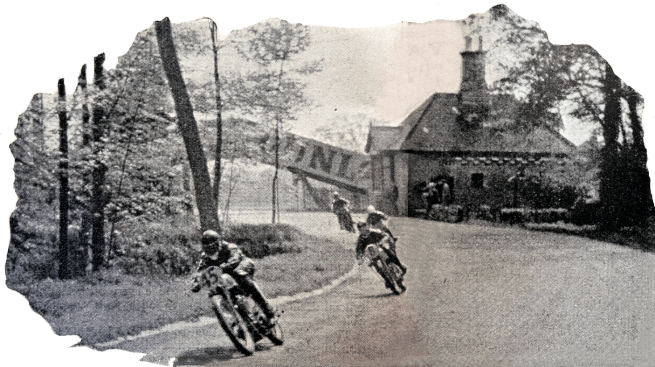
One might single out the winner, AM Simpson (Velocette), and WS Corley (Triumph), who finished in fifth place. Some of the riding was a little ragged and impetuous, but on the whole it was beyond criticism. Simpson rather overshadowed his rivals and romped away with the race in a dashing manner. The next race was a 350cc event for experts and was over eight laps. The first heat was by no means slow, n spite of the fact that only one rider managed to get into the final placings. This was J Wilkinson (Norton), who ran through the field to lead his heat and finish at 68.05mph. He had a great battle with GG Murdoch (Norton), but was not to be denied. In Heat 2 the ‘big shots’ appeared and an exceedingly good race was the result. At first, J Lockett (Norton) headed the procession with Harold Daniell (Norton) keeping a close second. Then, on the third lap, AJ Wellsted turned the taps of his Velocette right open, laughed Lockett and Daniell aside and shot into first place. By the end of the sixth lap Wellsted was well ahead and Lockett had disappeared. It was noticed that P Goodman (Velocette) was creeping up on Daniell, and soon this youngster robbed the veteran Norton rider of second place. It was a grand race and Wellsted had the satisfaction of beating the 350cc eight-lap record by practically a mile an hour. Next came an eight-lap sidecar event, which at one time looked like being thrilling, but which turned out rather tame. In accordance with his usual practice, AH Horton (596cc Norton sc) jumped into the lead and, again as usual, was chased by LW Taylor on a similar outfit. Taylor gradually closed up, and just when it appeared he would, get in front a broken frame put him out of the race. A Morgan driven by G Hale was going great guns and finished second. The next event was for machines manufactured before 1931. There were only seven starters, and of these one failed to get away at the fall of the flag and another retired immediately at the paddock. Once again there
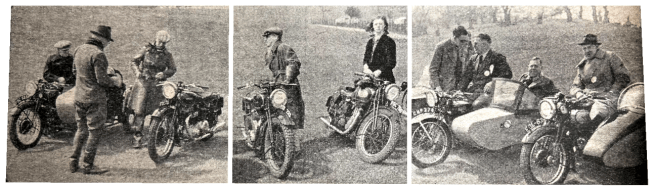
were only two finishers, but the speeds were good considering the age of the machines. The machines were dated 1920 and 1926 respectively. Then followed another four-lap clubman’s race, divided into two heats. The event was dominated by a rider in the second heat, E Pelham, on a twin Triumph, and the winner of Heat 1, T Wortley, also on a Triumph, took second place in the final results. Finally, there was the eight-lap 500cc race for experts. In the first heat Wilkinson again did battle with Murdoch, but he was frustrated by a machine which seemed too slow and also by HB Myers (Norton). The final heat saw Daniell supreme. He tore round the course in a superb manner, safe and steady as a rock and a true delight to watch. John Lockett did his best to catch the leader, but was out-classed, though he, too, rode beautifully. ST Barnett on another Norton was also excellent and warded off a challenge from Maurice Cann on a Moto Guzzi. This was racing at its very best and a fitting climax to a really enjoyable afternoon. Daniell’s time [20min 12 sec/74.26mph] is a record for eight laps.”
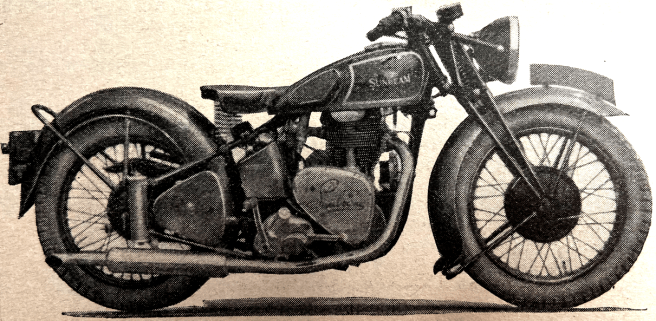
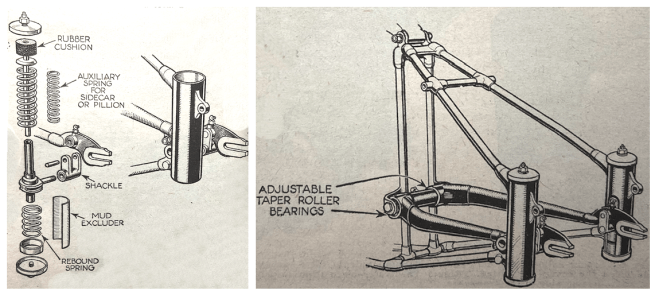
“AT MIDNIGHT LAST TUESDAY week I started out for Manchester on my autocycle, and reached there at 10am Wednesday. I then went on to Huddersfield, where I spent the rest of the day. I began my return journey on the Thursday morning at 11.30, arriving in London at 10.30pm. As I am employed as a barman I have long hours and get little fresh air. Thanks to my wonderful machine I have enjoyed two very invigorating days at a very low cost. The other day I went to a garage to park the ‘auto’ and asked how much for a couple of hours. The garage man replied sarcastically, ‘You may have a seven-year lease for sixpence for that.'” Perhaps the laugh is on me, should my garage friend read the above.
P O’Brien, London, N1.”
“AS YOUR CORRESPONDENTS ‘Bear and Louie’ state, there is still a tendency among some riders to regard 150s purely as toys—at least as not being suitable for serious touring. However, this view is certainly not shared by those who have had experience of these amazing little machines. I have owned an ohv 150 for the past two years, and during that time it has been used for general hack work and long-distance tours in the summer, and much of the work has been two-up. The only replacements (apart from tyres) have been in connection with the rocker gear, and that is accounted for by the fact that the machine had done several thousand miles before I bought it. What 500 would give more reliable service?
RE, Sutton, Surrey.”
“READERS WILL PROBABLY be interested to hear of an almost incredible incident which befell me a week ago. The machine, a 500cc ohv model of a not-so-modern vintage, suddenly refused at intervals to respond to the throttle and ultimately cut out completely. On a cursory examination, the valves appeared stuck and compression was nil. After turning over the engine a few times the valves were freed and compression was felt, but just as I considered things more or less OK, the engine seized solid, and no amount of tinkering would free her, with the humiliating result of a tow home. When the cylinder head was eventually removed the amazing sight of an uneven layer of rubber on the top of the piston and cylinder walls presented itself, the piston being at about half stroke. It took half an hour of juggling with petrol and brute strength to remove the pot from the piston, which were exceedingly well ‘glued’ together with rubber. The cause, on further investigation, proved to be a rubber band from an old inner tube which had become detached from the saddle peak and had entered the cylinder via the carburettor air-intake and the inlet valve. Fortunately, after a thorough cleaning, the machine is quite all right again. The cylinder walls and piston rings were not in any any damaged, although the piston was slightly scored.
FMT, Newcastle-on-Tyne.”
“AFTER WATCHING A NUMBER of London Moto-ball League games I can echo Mr SJ Smith’s opinion that ‘a fast, clean game of motoball between two good teams takes a great deal of beating as a spectacle’. I think there would be a real boom in the sport if more people realised what an enthralling and vigorous sport motoball is, both to players and spectators. There are few finer sporting spectacles, in my opinion, than watching a. first-class forward trundling the ball down the field flat-out, clearing adversaries by inches, and then the final shot! But like most things in this world, there’s a snag. That is, that there are not enough first-class men to go round, so that too seldom one sees a real ding-dong battle between two more or less equally matched teams. But still, when one does see a pretty level match, it’s magnificent!
Spectator, London, SW2.”

“THE NAME OF MONTGOMERY has long been associated with first-class steering, but it is certain that no Montgomery has ever had such excellent steering and perfect manners as the latest 500cc Greyhound with rear springing. The spring frame is of the well-known plunger type, and a first-class combination of front and rear springing has been obtained. The Montgomery spring frame smoothed out all roads—bumps, pot-holes, tramlines or stone setts could all be ridden over in absolute comfort. On one road which, owing to the appalling surface, normally cannot be traversed at more than 20mph with a rigid-frame machine the Montgomery was taken over at 30mph and the rider never left the saddle. As a further test the machine was ridden hands off over this same stretch at 20mph and the Greyhound never deviated from the straight path. The springing is soft, but the softness caused absolutely no roll at high speeds and the frame only bottomed on exceptionally bad bumps when travelling fast—it never bottomed in normal use on the road. No praise can be too high for the steering and handling of the machine. The steering was excellent at all speeds and there was never a trace of waver even when crossing deep-set tramlines at low speeds. On the open road it was delightful, for it was positive enough to allow the rider to
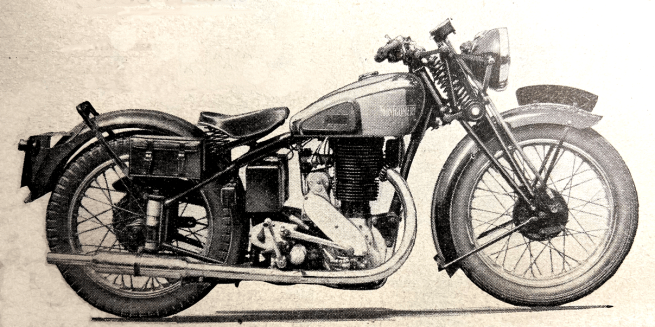
place the machine almost to an inch even on rough, twisty roads. Cornering with the Greyhound called for no effort, for the rider merely had to cant the machine over and it would swing round bends in a long, smooth sweep. Only one criticism can be applied to the cycle parts of the Greyhound and that is that the leverage on the front brake was poor. With the type of lever used there is not a straight pull on the operating cable and the brake could not be pulled on hard. As a result. the braking of the machine was not all it could have been, even though the rear brake was powerful and smooth. The riding position and general layout of the controls are excellent. The relation of saddle, footrests and handlebars is such that the rider always feels in complete command. The saddle comes a little close to the rear mudguard, while the kick-starter is in rather close proximity to the off-side footrest. All the controls are conveniently placed and the brake pedal has an adjustable stop. The gear lever and gear change are probably as near ideal as it is possible to get. The movement of the lever is short and it is so well placed that the rider could change up or down without removing his foot from the footrest. Changes could be made at almost any engine speed, and the intermediate gears were free from whine. The clutch was well up to the standard of the gear box; it was sweet, light and free from drag. On the performance side the machine showed up just as well. The new JAP engine is used in which the push-rods are carried in the cylinder and head castings, and the engine tested combined many desirable features. It was fairly easy to start. When warm the tickover and slow running were exceptionally good. With the ignition retarded the engine would tick over like a gas-engine, and when the machine was being ridden in traffic the engine never missed a beat. Combined with this excellent slow running was great capacity for pulling. Even such steep hills as Pebblecoombe, in Surrey, with its gradient of 1 in 5½, were climbed easily in top gear. As an experiment the Montgomery was restarted at the foot of the hill, and even then it climbed the whole distance in top gear, breasting the summit at about 30mph. Thus for all normal purposes the ‘Greyhound’ is a genuine top-gear mount. In traffic the machine could be throttled down to 11mph in top gear with the ignition retarded and could be accelerated away from this speed. Speeds as low as 15mph were frequently used in normal riding in top gear, and the only protest from the engine was a slight pink if the ignition was left fully advanced in these circumstances. Naturally, this characteristic is reflected in the performance figures and
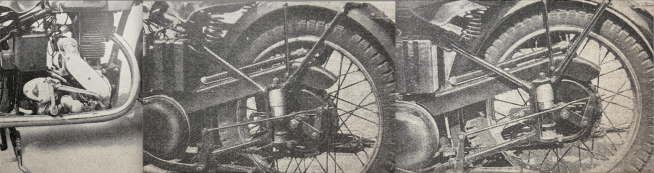
the acceleration from 15 to 30mph in both top (4.5 to 1) and third (6 to 1) gears was above average. The Montgomery also had a very good turn of speed, and on the open road the comfort provided by the spring frame coupled with the superb steering tempted the rider to cruise in the sixties whenever conditions permitted. Treatment of this sort did not appear to stress the engine in the least, and on several occasions long bursts of 70-75mph were indulged in. The maximum speed attained in the timed run was 78.8mph, and the mean speed of the four runs over the quarter-mile was 76.6mph. In third the maximum speed was 64mph; thus a very useful performance was available in this gear. High-speed acceleration was one of the Montgomery’s many good points, and from a standing start 68mph was reached in a quarter of a mile. It might be thought that with all these good features the engine would be harsh or rough, but the JAP engine tested was pleasantly free from vibration, while mechanical noise was almost entirely absent at all speeds. The exhaust note, too, was pleasantly subdued and unobtrusive under all conditions. This, then, is the 500cc Greyhound de Luxe Montgomery. It is a machine against which even the most discerning critic would find it hard to level criticism. It is a happy combination of superb steering, re-markable springing and an engine that combines amazing pulling powers with a very good performance.”

“I WAS EATING MY MIDDAY lunch in a West Country tearooms yesterday when I heard an awful noise, and a motor cyclist sped past the window chased by a fat and obviously middle-aged wire-haired terrier. Both were doing about thirty, as near as I could guess, and the silly dog was barking continuously while lying flat down to it. Anon I saw the discomfited terrier return at a slow crawl, coughing and looking very sorry for himself. Suddenly his wind failed completely, and he sat down on the kerb, coughed some more very sadly indeed, and then brought up everything he had eaten for dinner. Now what on earth had been passing through his pathetic doggy mind? I suppose a keen sense of duty to his master caused him to regard the passage of this noisy machine in front of his master’s sacred doorstep as an outrage which could only be wiped out in bites. I suppose centuries of inbred experience caused him to imagine that any foe could be terrified and semi-paralysed by fierce barkings. I wonder whether memory of constricted lungs and a lost dinner will mollify his rage next time a motor cyclist passes his home.”—Ixion.
“GERMANY HAS NOW IMPOSED a speed limit—62mph on autobahnen and 37mph in built-up areas. A lower limit has been imposed for lorries and heavy vehicles. This is 43mph on autobahnen and 25mph in built-up areas.”
“SOME YEARS AGO Ariels ran a remarkably successful seaside holiday camp down Bognor way. The cost per week or fortnight was reasonable, and it was one of the matiest, cheeriest and best organised shows possible to imagine. I am surprised that others have not adopted a similar scheme. It seems to me that there is an opening for holiday camps run by motor cyclists for motor cyclists.”
“MANY READERS KNOW only too well that there are lots of garages that do not handle motor cycle repairs. Some have not the knowledge and facilities, while others prefer to cater for cars only. The R.A.C. now has a special Motor Cycle Repairer’ appointment and has been pressing ahead with the scheme to such good purpose that there are already nearly 1,300 motor cycle repairers holding the RAC appointment or official RAC repairers who will undertake motor cycle work. Those who specialise in motor cycle work have a sign bearing the words RAC Motor Cycle Repairer.’ I mention the fact because motor cyclists in their own interests should support those repairers who support the game—do so by buying their petrol and oil from them as well as using them for repairs. This is important if motor cyclists are to continue to have nation-wide service.”

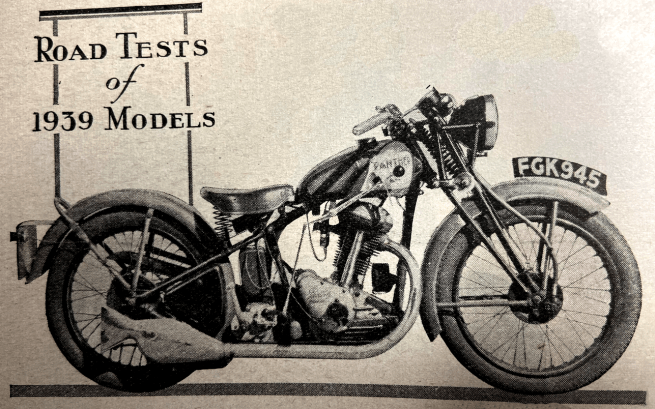
“ALTHOUGH EASILY THE CHEAPEST 250cc four-stroke. motor cycle on the market, the 248cc Red Panther is a machine with a first-class specification. There is nothing ‘fancy’ about the machine, and nothing skimped: it is just a thoroughly sound sports 250 capable of taking two anywhere on main roads. The performance is excellent. At any speed from 18 to 35mph the machine woffles along effortlessly. If high speeds are wanted it will cruise, apparently indefinitely, with the speedometer needle roaming between the 50 and 55 marks, while the timed maximum speed was approximately a mile a minute. A compact type of riding position is provided. The rider sits ‘in’ rather than ‘on’ the machine. While it is not a large motor cycle it is of ample size to accommodate a 5ft 11in rider, and affords an almost unexpected degree of comfort. A Dunlop waterproof saddle is fitted, together with 3.00-19 tyres. The handlebars are of excellent shape and provided with a Bowden twist-grip throttle control, comfortable type clutch and front brake controls, and simple but effective pressed air and ignition levers. All the controls are well placed, the pedal operating the rear brake exceptionally so, for it is in a position in which the right toes can be poised comfortably over it for traffic work. Starting was very easy and required no knack, irrespective of whether the engine was hot or cold, and the engine would immediately settle down to a satisfactory tick-over. There was never any need to be constantly opening and closing the throttle in order to keep the engine going when the machine was stationary in a traffic block. A three-speed Burman gear box, with a hand control alongside the tank, is fitted. This afforded a simple, easy change both in an upward direction and down-ward from top to second gear and second to bottom. The gate in which the control operates is of straight-forward type, so there is no need for the rider, even a novice, to glance down as he changes gear. The clutch was light and smooth in operation. The steering proved very good indeed, both on the straight and around corners and bends. In every way the Red Panther is a handy machine. It can be ridden feet-up at a walking pace, while in the garage its light weight makes its particularly easy to manoeuvre. If there is any possible point to be raised in this connection it is that use of the stand, like the majority of those of the central type, calls for a certain amount of effort. Mechanically the engine was quiet. The exhaust, too, was very satisfactory at low speeds, though on the noisy side at high speeds and when the machine was being accelerated hard. Owing to the lightness of the machine and the excellent power output of the engine the acceleration is good. From 15 to 30mph in second gear (9.5 to 1) took only 5 seconds, while from a standing start the machine, with use of the gears, attained a speed of 56mph by the end of a measured 440 yards. Both brakes are excellent. They are light to operate, smooth in action, and fully up to the lively nature of the machine. Another good point is that although much rain was
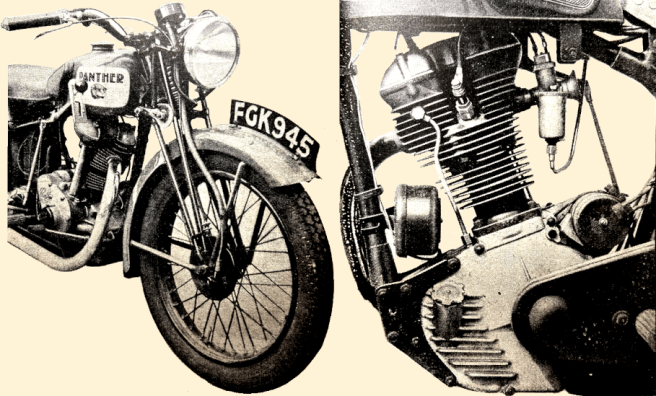
encountered during the test, neither brake at any time showed a reduction in efficiency. Second gear provided a comfortable speed of 30mph, while in top the machine, as already stated, would cruise happily at speeds as high as 50 and even 55mph. Throughout the engine’s speed range there was no appreciable vibration. As a test the machine was stopped and re-started, two-up, on a gradient of 1 in 4. Thus there need be no fear that the machine cannot climb any hill normally encountered by a tourist, and do so even with a pillion passenger. While there is this very useful sports performance, the engine also has excellent slogging powers. The usual type of main-road hill is surmounted with ease in top gear. It is not necessary, therefore, for the rider to be continually changing gear. Ignition and lighting are provided by a Miller coil and dynamo set. This is in every way a full-sized set, and the light provided by the head lamp, even by modern standards, must be termed exceptional. In addition to an unusually powerful beam there was excellent side-illumination. The set, incidentally, provides a dipped beam as well as the main beam, and, for parking purposes and town work, a pilot bulb. To sum up, the Model 20 Red Panther is a really lively 250 with excellent road-manners, a first-class specification, and a price which, in view of the nature of the machine, is so low as to be little short of amazing.”
“A SPANISH-SPEAKING Englishman is now riding through Spain picking up the threads of the Ariel motor cycle business now that the Civil War is over.”

“THE EDITOR AND STAFF thank the various readers in Australia and New Zealand who so kindly took advantage of the new cable facilities to ‘wire’ good wishes.”
“FOR THE FIRST TIME for many years the Leinster ‘200’ road race, now styled the Grand Prix of Eire, was won by one of the limit men. A young Belfast rider, Hugh Montgomery, taking part in his first road race, rode a 348cc Red Hunter Ariel to victory at the very creditable speed of 63.48mph. He rode under the name of ‘R Hunter’, and his victory came as a surprise to nearly everyone, for several of the English competitors had gone so fast in practising that the chances of the long-markers were not regarded very highly. Second, 1½min behind, was A Clendinning, of Liverpool, who averaged 65.70mph on an eight-year-old 250cc TT Rudge. Another Belfast rider, TL Irwin (249cc Excelsior) was third. EE Briggs, of Ilkley, who had been greatly fancied to win, finished 14sec behind Irwin. But for taking nearly two minutes over his pit stop he would have been third, or possibly second. For most people, the chief interest lay in the performance of Stanley Woods, who was racing again for the first time since his crash in the Belgian Grand Prix last June. Last year he rode a KTT Velocette, and not an actual TT model, so that his best lap of almost 79mph compared favourably with the record of 80.38mph made by the late Jimmy Guthrie on a 348cc Norton in 1937. This year Woods had a pukka TT job. Despite a poor start, he covered his standing lap at 78.6mph, and followed this up with another at 78.9. He found. however, that with 36 riders on a six-mile lap, conditions were not altogether favourable for ultra-high speeds. The hot sun had caused the tar to melt in places, and several riders came off on the early laps for this reason, including such experienced men as TG Byrne (349cc Rudge), E Lyons (Triumph Twin) and TB Fortune (Rudge), as well as the Leeds rider, J Brett (348cc Norton), who had been fancied to do well in the handicap. When the field thinned out somewhat Woods made a real attempt on the lap record. He completed his 22nd lap at 79.78mph, and then, winding things up properly, put in a sparklingly brilliant lap at the amazing speed of 84.52mph—over 4mph better than Guthrie’s old record. It also beat comfortably the fastest lap ever accomplished on the circuit—83.53mph put by APR Rolt in his supercharged 1,500cc ERA car last year. Quite evidently Stanley has lost none of his form, which is a good omen for British chances in the Island next month. The next fastest rider in the race was ER Evans, riding a new 496cc Gold Star BSA. Despite having to change a plug, he was well in the picture, and did one lap at 76.07mph. He seemed to have the 500cc class in his pocket, for HB Myers’ new spring-frame Norton was not going so well as his old model last year. Then Woods, in the process of making his record, came up with Evans, and the BSA rider made a valiant attempt to hold on to the flying Irishman. He knocked 17 seconds off his best previous lap and got round at 80.99mph, just two seconds better than Guthrie’s record.It was a stout effort, but too much for his machine, which packed up a couple of laps later. Incidentally, not one of the nine 500cc machines finished. Woods, of course, won the 350cc class…Woods’ chief opposition in the class had been expected from Maurice Cann, whose spring-frame Norton had been fitted with Girling brakes, but the little Leicester rider…never really got going, and ultimately met trouble on his last lap, having to push to the finish, which he reached outside the time limit. This cost the Wakefield and District MSC the club team prize.”

“A PETITION TO THE CHANCELLOR. The BMCA in collaboration with members of the trade and industry appeal against proposed taxation increase…a petition to the Chancellor of the Exchequer…takes the form of a reasoned statement urging him to refrain from imposing increased taxation upon motor cycles. All motor cyclists…are asked to sign the petition and forward it without delay to…the BMCA: ‘We, the undersigned motor cyclists, humbly petition the Chancellor of the Exchequer to remove from the Finance Bill the clause enforcing increased taxation on motor cycles. Our plea is based on the great hardship the increase would impose on a class of the community which has already had to shoulder many burdens. We beg to remind you of the big increase in our insurance premiums earlier this year, of the 9d tax on every gallon of petrol we use, the tax upon lubricating oil, of the cost of taking the driving test and of driving and road licences. Already the burdens, we suggest, are out of all proportion to the cost of our machines; they are such that our numbers are decreasing. Were it not that with the majority of us our motor cycles, far from being a luxury, are a necessity the numbers might be lower still. Of the total of nearly half a million motor cyclists it is estimated that approximately 400,000 use their machines for the purpose of getting to and from their work. May we also remind you that in the last war the ranks of motor cyclists provided thousands of pilots for the RFC and RAF; thousands of men for the Motor Machine Gun Corps and later the Tank Corps. There was the call for men with technical knowledge then; there is a very similar call to-day, yet whereas on the Continent nations have done everything in their power to foster motor cycling, realising its value as training and in developing physical fitness, and have even eliminated taxes on motor cycles in their entirety, we in this country find ourselves faced with the prospect of a still greater burden. We are anxious to play our part. Tens of thousands of us are giving proof of this for we are already in the armed forces. To many of us the proposed additional tax would be in the nature of the last straw.'”
“GOOD RACING AND GLORIOUS weather were features of the BMCRC’s meeting last Saturday. All races were run over the Campbell Road Circuit…Before racing started Sir. Algernon Guinness unveiled a tablet on the wall of the clubhouse to the memory of the late Eric Fernihough. The Senior Road Championship was a sad race…Out of an entry of eight only five came to the line. MWK Tisdall was first away on his supercharged BMW, but NB Pope (490cc Norton) and G Newman (348cc Velocette).passed him on the first turn. Pope led the field on to the Banking, but then oiled a plug. For two laps Newman on his 350 led the field, but PM Aitchison (490cc Norton) and R Harris (490cc Norton) slipped by on the next lap, and Tisdall rode into third place soon after. Later Newman turned into the pits, leaving only Aitchison, Harris and Tisdall really concerned in the race. These three kept going for the rest of the ten laps, all riding extremely well, but at half-distance Harris overtook Aitchison. and this order was maintained to the finish.”
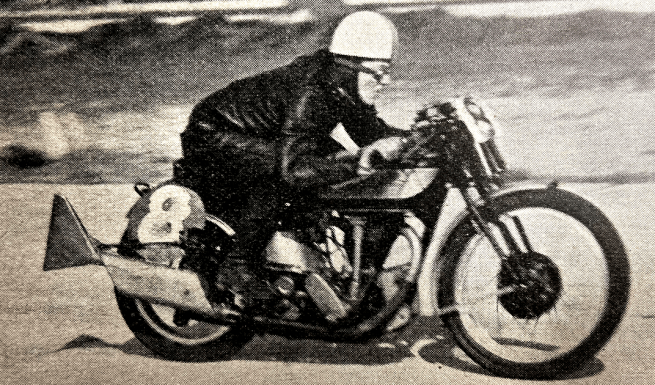
“AFTER A LAPSE of several months, Calthorpe motor cycles make a welcome return to the market. They will be produced in three capacities—250cc, 350cc and 500cc—and the only difference lies in the engine dimensions. The 350cc machine is typical of the range. The engine is of the ohv, single-port type, and has a bore and stroke of 69x93mm (347cc). The dimensions of the other two engines are respectively 62.5x80mm and 82.5x93mm. An interesting feature of the dry-sump lubrication system is that the two separate cams dip at each revolution into an oil-well in the timing box. The valve gear and push-rods. are fully enclosed and directly lubricated from the engine. Front and rear stands are fitted, the latter being of the spring-up type. Other items of the specification are: 6in mudguards with a centre rib and a wide gold line down the middle, and chromium-plated exhaust pipes—high- or low-level—with cylindrical silencers. The electrical equipment includes an 8in Miller head lamp with 36-watt bulb, a rear lamp fitted into the rear number plate, and a battery mounted below the saddle. The prices are: 250cc, £54 10s; 350cc, £57 10s; and 500cc, £59 10s. At a later date special engines for com-petition work will be available for the 350 and 500cc models. These units will not be simply tuned standard engines but of entirely different design. The extra charge for these engines will be £6 and £7 respectively.”
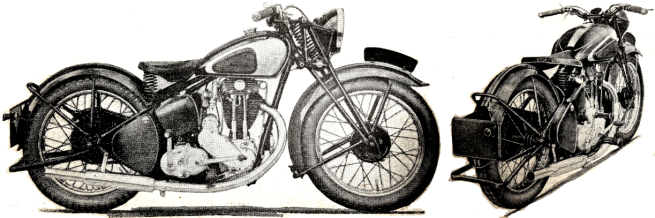
“IF MR TROUNSON’S latest request to our hard-pressed manufacturers, namely, for a three-cylinder motor cycle, is to be taken in any measure of seriousness, I should like to inform him that just after the war such a unit was definitely produced, and, I believe, with overhead valves. To the best of my recollection it was known as the Redrup. I might also remind Mr Trounson that Scott’s produced a three-cylinder two-stroke a short while back, though I do not know with what success. It is likely that, as in the case of the P and M Panthette of 1927, the transverse AJS of 1930, the Austin 7-engined Brough Superior of a year or two later, and more recently the Douglas Endeavour transverse-twin, brilliant design and expensive production have had to go owing to, as much as anything, lack of support. No one needs to study economy more than I, and that fact alone bars me from the chance to run a sample of my own ideal, but as a believer in ‘practise what you preach’ I stick to a monkey-glanded 350cc Duggie, which gives me an easy glide with its fat, low-pressure tyres and its most logical of all motor-cycle engine types.
‘Twinner Flat’, Dunstable.”
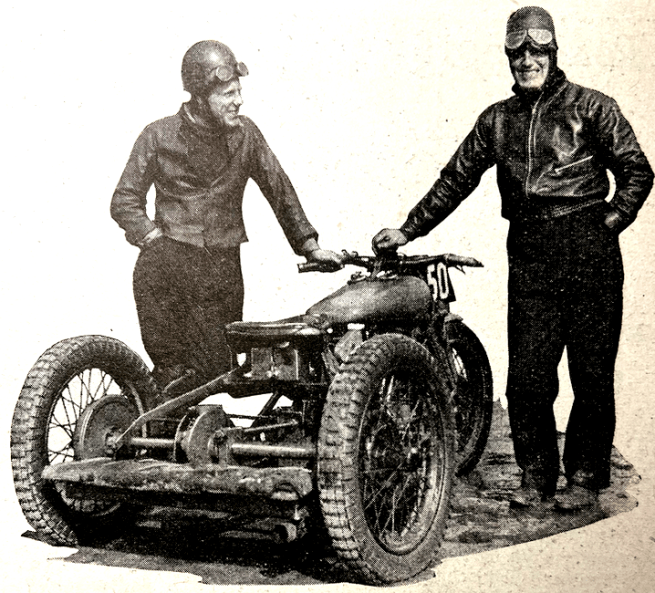
“THE ROAD-RACING SEASON in Northern Ireland opened last week-end with the North-West Grand Prix 200 miles road race. The event attracted the usual crowds. Unfortunately, in the opening lap, Norman Wainwright, a member of the Southport Motor Racing Club, had a fatal crash at the Plantation, Portstewart. The race itself was disappointing because of the large number of retirements. Forty-four riders started, but only 11 finished. Lap records were also conspicuous by their absence. Speeds over the whole distance, however, were up on last year (when adverse conditions prevailed), but were below the previous best. An outstanding entry was that of AR Foster, who was riding a supercharged four-cylinder AJS which was making its first appearance in a race. Foster, however, was unable to get the machine to start when the other riders in the 500cc class were under way, and he was only a short distance from the starting point when the 250cc men set out two minutes later. Shortly afterwards Foster did get going, and then he made up for lost time. In fact, he led the class before half distance, but trouble later dogged him and he retired after a notable performance which greatly thrilled the spectators. Thirteen competitors—an unlucky number to the superstitious—started in the 500cc class, but only one, Ernest Lyons (Triumph), an Eire rider, covered the full distance. Stanley Woods (Velocette) was No 1, and he was also the first rider to
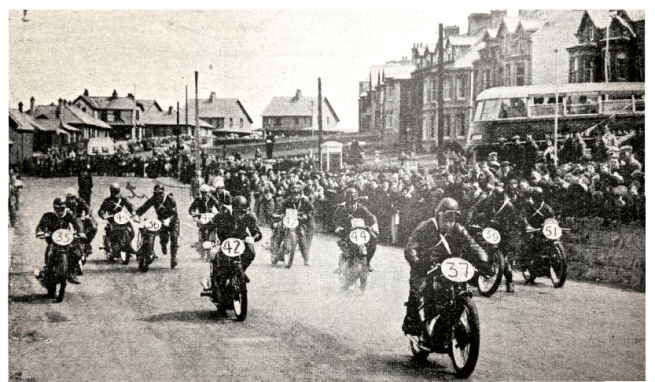
complete one lap. His time on this circuit, from a standing start, was 8min 20sec. He was, however, faster on the next lap, his 8min lsec (82.88mph) circuit being the fastest of the day, although 8sec slower than the record made by the late J Guthrie (Norton) in 1936. Unfortunately, Woods’ engine seized near Portrush afterwards, and he retired. Ernest Lyons (Triumph), lying second, achieved an opening lap of 8min 43sec, and then 8min 45sec, while JW Beevers (Norton) took 8min 58sec and 8min 49sec on laps 1 and 2. Foster, by reason of his delay in getting away, did not pass through until 11min 30sec had elapsed, but he completed his second lap in 8min 16sec, which showed that he was getting into his stride. With Woods out of the race on the third lap the leading positions were occupied by Lyons (Triumph), Beevers (Norton) and ECE Briggs (Norton), of Ilkley. This order was maintained for the next two laps. Foster went ahead, and at the end of the sixth lap he replaced Briggs in third place, and on Lap 8 he was in the lead. Positions at the end of nine laps, half-distance, were: 1, AR Foster (AJS); 2, JW Beevers (Norton); 3, E Lyons (Triumph); 4, A Brown (Triumph). Retirements and crashes had reduced the field to five at this stage; the other rider still in the running was Brockerton (Excelsior), the veteran of the race. Later, Foster
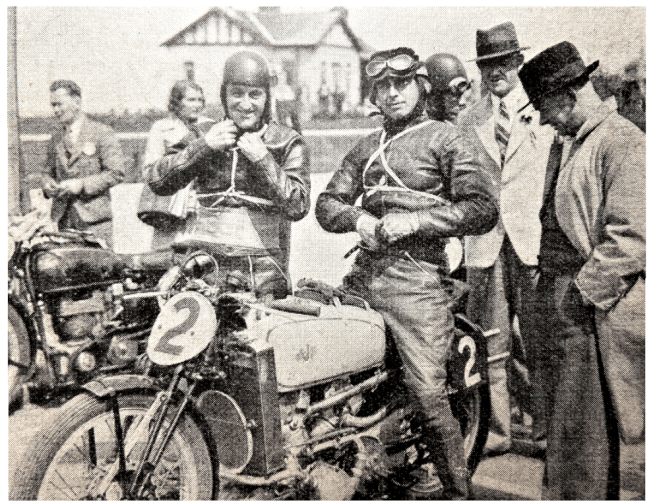
pulled into the pits, and then on lap 13 he retired. On the closing laps Beevers also retired, and Lyons finished with an average of 74.95mph, nearly 4mph faster than last year, but over 7mph below the record. Brockerton was flagged off the course with a lap to do when the time limit expired, and there was, therefore, only the one finisher. In the 350cc class 15 riders started, but no fewer than four failed to complete a lap. Another rider covered two laps, two others four, another man five laps, and a ninth competitor six laps. Two other retirements reduced the field to four, all of whom finished. AJ Bell (Velocette), of Belfast, on the completion of the first lap, was neck-and-neck with Wolter Rusk, also on a Velocette. Their lap time was 10min 5sec. Bell had plug trouble, however, and later retired. JE Little (Velocette), who was lying third, had a good scrap with Rusk until the latter crashed on the 15th lap, and retired with facial scratches. Rusk was the fastest rider, except on the ninth lap, when Little was first through with an advantage of 15sec. On the next lap Rusk was in the lead by 30sec, but on the 13th lap only 12sec separated them. Little finally went into the lead on the 14th lap, and he crossed the line over 16min before the next rider to finish—LD Gilbert (Norton). Little’s average was 75.4mph compared with 69.46mph last year and the record of 76.73mph. Rusk and Little shared the honour of making the fastest lap—8min 33sec (77.71mph). The highest percentage of finishers was in the 250cc class; six out of the 16 who started completed the course. Chris Tattersall (CTS) led on the first lap, and was also in front at the end of the seventh lap. During the remainder of the race D Parkinson (Excelsior) was in the lead. A Glendinning (Excelsior) lapped consistently in third place, but there was a wide margin between the next three finishers, Spills and mechanical troubles accounted for the other 10 riders, who gave up at various stages of the race. Parkinson made the fastest lap in 9min 22sec. (70.93mph), which was 5sec short of the record. His average of 67.40mph for the total distance, was nearly. 3mph faster than last year, but slightly slower than the record.”
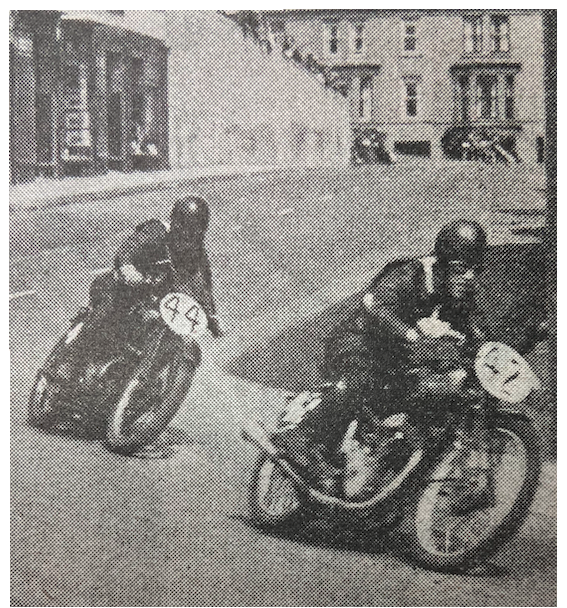
“AN EXCELLENT ENTRY of 41 was received for the New Zealand GP held at Cust, Canterbury, over a 6.1-mile circuit. An unusual feature of the final results was the sharing of first and second places by two brothers, W Alexander (499cc Rudge) and R Alexander (500cc Triumph Twin). M Wear (348cc Velocette) was third. The next two places were filled by International Nortons, ridden by T Torrens and P Clarkson. The winner’s average speed over the tricky circuit was 53.92mph; the Chevrolet Gold Helmet for the fastest lap went to P Clarkson, who averaged 71mph. The sealed handicap run in conjunction with the main event provided a win for T Torrens (490cc Norton), with J Oed (Norton) second and V Laws (Triumph) third. Prominent during the first half of the race was L Perry, who, mounted on Walter Rusk’s 1934 Senior TT Velocette, quickly went to the front after the impressive massed start. He was followed at a respectful distance successively by B Rosson (Norton), M King (Rudge), A Currie (Norton), R and W Alexander, M Wear (Velocette) and T Torrens (Norton) until the 17th lap, when punctures put him out of the race. After a short lead by Rosson, who later retired with engine trouble, the Alexander brothers took the leading places and fought out a hard finish. An amazing performance was recorded by V Laws, who, after blowing up his Tiger 100 in practice, commandeered his fiancée’s 250cc side-valve Triumph and rode it into third place in the sealed handicap!”
“THE TOTAL NUMBER of motor cycles registered for the first time during March was 6,449.”
“THE INCREASING POPULARITY of under-I50cc mounts is shown by the fact that new registrations in this class totalled 888, nearly twice the March, 1938, total. Sidecar outfits also showed a gain. The March, 1939, total was 939, compared with 800 in the previous March.”
“HALF A MILE of Hendon Way and Watford Way and two sections of the Green Street Green road at Darenth (Kent) are to be restricted to the 30mph limit.”

“IN CONCEIVING THE HEC Power Cycle the designers had in mind a bicycle with an engine—a machine that would have all the advantages of a pedal bicycle yet would require a minimum of pedalling. The object has been achieved in a commendable way, for the machine is light in weight and extremely simple to drive, while the engine, which is neatly housed between the tubes of the short-wheelbase frame, can readily be detached to make the machine a sturdy example of an almost normal bicycle. The pedal gear ratio is just right, and the pedals are so placed as to allow maximum power to be obtained with little effort. The riding position is natural and comfortable. For instance, a rider unused to cycling was able to pedal without fatigue at about 10mph on short journeys in town. Considerable interest attaches to the compact 80cc two-stroke engine and clutch unit. Its outstanding features are an easily detachable aluminium-alloy cylinder head and induction pipe, a cast-iron piston and a roller big-end bearing. The die-cast aluminium-alloy crank-case incorporates an oil-bath for the duplex chain, and the cork-insert clutch is also enclosed in the casting. A simple type of Amal carburettor is used and the flywheel magneto has coils for direct lighting. All the controls are on the handlebars with the exception of the carburettor choke rod, which is on the offside of the tank. The clutch lever is fitted with a ratchet trigger to enable the clutch to be held out of engagement when required. No compression release is provided, nor is one required, for on no occasion during the test was any difficulty experienced in overcoming compression when starting, and the throttle adjustment was such that the engine could be stopped by fully closing the handlebar control. To start the engine from cold it was necessary to flood the carburettor copiously and to employ the choke ; then if the machine were pedalled up to about 8mph and the clutch engaged the engine responded immediately and settled down so quickly that the choke could be opened after about 50 yards had been covered. With a warm engine, starting was simply a matter of pedalling away and dropping the clutch with the throttle control about a quarter open. The HEC has a fairly low engine gear ratio (14 to 1), and this combined with the light weight of the machine and an extremely ‘peppy’ engine, provides acceleration well above the average. Response to the throttle was immediate and a speed of 25mph was attained comparatively rapidly. Higher speeds are available if required; indeed, under favourable conditions the speedometer registered 35mph, which is remarkable for an 80cc power unit. In these circumstances, slight vibration was felt, and without doubt the engine was happiest at a speed of about 25mph. At the other end of the scale the engine pulled smoothly and well, and four-stroking seldom occurred. With careful throttle work the machine could be made to travel without transmission snatch at little more than average walking pace. In traffic stops the engine idled slowly and quietly. The silencer is most effective throughout the speed range; an interesting point is that the silencer can be dismantled for cleaning merely by removing one nut.
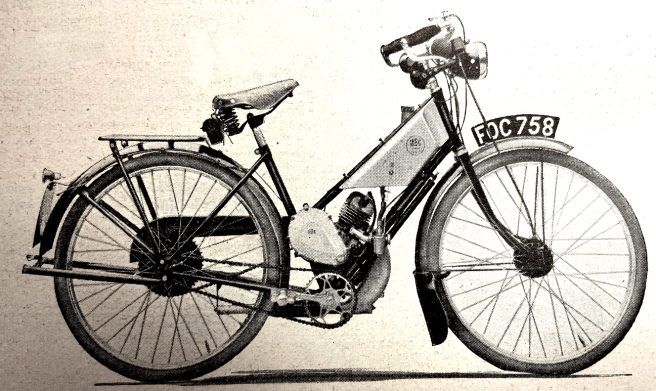
Only light pressure was required to operate the clutch, which freed readily and took up the drive so smoothly and progressively that the rider rarely used the pedals when getting away from a standstill. The test included Anerley Hill, near the Crystal Palace, which has a gradient of 1 in 8 at the steepest part. Without the rider employing rushing tactics the HEC topped the 1 in 8 section at 15mph and proceeded to gain speed thereafter. In an endeavour to find a hill that would really test the little machine, Pebblecombe Hill, near Dorking, Surrey, was attempted. The average gradient of this hill over about half a mile is 1 in 8, with a section of 1 in 5½; at the latter point the pedals had to be used, but not by any means laboriously. On wet roads the HEC handled as safely as a pedal cycle and never showed any signs of instability even when the brakes were applied hard. In traffic the short wheelbase and light weight made the machine easy to manoeuvre and control. Both brakes are of the internal-expanding type, and although they were not super powerful, they were found adequate for normal riding. In a crash stop from 20mph on a dry concrete road an average figure of 21 feet was obtained. Petroil lubrication is employed in the ratio of 20 to 1 petrol to oil and a small oil measure is incorporated in the tank filler-cap. The tank holds 9 pints, and it was found difficult to judge when the level was sufficiently low to allow a fill-up of a gallon of petrol with the appropriate amount of oil. Remarkable economy is a feature of the HEC. A carefully measured quart of petroil was sufficient for 38 miles comprising traffic work and an open-road trip of 14 miles. No effort was made to obtain a ‘freak’ consumption, and the figure of 152mpg could be obtained by the average rider. Throughout the test the engine unit remained free from oil leaks and no adjustments were necessary. The HEC Power Cycle is equipped as standard with direct lighting (including a dry battery for parking), tools, tool bag, carrier, pump, licence-holder and 26×1¾in tyres. The price is £17 17s. A Smith’s speedometer registering up to 40mph costs an extra 19s 6d.* The makers are HEC Power Cycles, 43-44, Thorp Street, Birmingham, 5.
* Not a legal requirement on under 100 machines.
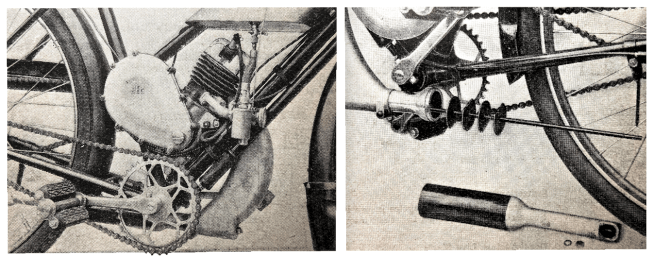
“AT WEMBLEY I SAW a speedway frame built entirely of light-gauge aircraft steel tubing with the exception of the lugs, which are the standard Rudge speedway type. With this frame a saving in weight of approximately 15lb is gained over the standard Rudge speedway frame. Engine plates of hiduminium, which is an aluminium alloy, effect a further saving in weight of 4lb, while yet another pound is saved by having handle-bars of the same metal. I also saw a cylinder barrel consisting of a thick steel liner with shrunk-on aluminium fins; net saving in weight over the standard barrel: 3lb. Speedway front forks of special aircraft tubing effect a further substantial reduction in weight, for two reasons. The first has already been explained in relation to frames—lighter gauge tubing. The second is that, owing, to the greater toughness of the metal, it has been found practicable to replace the standard solid fork centre pieces with tubular pieces. Thus, in addition to reducing considerably the weight of the fork as a whole, the unsprung weight is also appreciably decreased. Another by no means new weight-saving plan—Max Grosskreutz employed it years ago—is to have the rear-wheel sprocket bolted directly to the hub flange instead of being mounted on the more usual splined carrier. There are many other ways in which weight can be reduced; as for example, by using light-alloy wheel rims, such as are employed in the TT. But there is a definite limit to the extent to which this weight-saving can usefully be applied. The standard Rudge-frame. Martin-JAP speedway machine, which is almost universally used to-day, weighs 240lb. This weight can, with advantage, be reduced to about 205lb, or even 200lb. Below this figure, however, the disadvantages begin rapidly to outweigh the advantages. Apart from acceleration considerations, a lighter-than-standard speedway machine is, in most cases, a distinct advantage when it comes to jockeying and fighting the machine on the bends. If, however, a machine is lightened too much in relation to its power, there is a loss of traction and, more serious still, a considerably reduced measure of control over the front wheel. A case in point was the appearance at a recent New Cross meeting of the West Ham rider, Eric Chitty, on a machine which turned the scales at well under 200lb. Coming down the straight, Eric encountered a bump in the track, turned a complete somersault in the air on his machine, and crashed heavily.”
“THE RECENT RACES at Eilenriede and Hamburg in Germany have thrown some light on the probable strength of the German opposition in the Isle of Man this year. The three leading German factories, BMW, Auto-Union and NSU, were all officially represented, and it is almost certain that the Hamburg races were used as a testing ground for the TT machines. Important changes have been made to the 350cc DKW during the winter. It was freely admitted that in its original form the 350cc machine was in the experimental stage, but the latest edition looks much more businesslike. The engine is of the unique DKW double-piston type; it is a vertical-twin with four pistons, the rear piston in each case acting as a scavenger. The main alterations concern the induction side, for instead of using the piston-type compressor which has been a feature of all the supercharged DKWs to date, a rotary blower is fitted. This is mounted low down in front of the engine and is driven from the engine mainshaft. Two Amal carburettors supply the mixture, and these are mounted at each side of the engine on long carved induction pipes. Water-cooling is, of course, employed, and the engine is built in unit with a four-speed gear box. Only minor alterations have been made to the frame, which retains the DKW springing and the massive front brake which extends right across the hub. There are three official DKW en-tries in the Junior
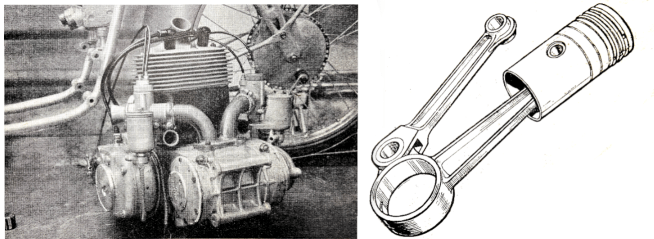
Race, but whether Kluge, Fleischmann and Wünsche will all ride the supercharged jobs has not yet been announced…The other three German.entries in the Junior Race, the NSUs, have yet to show they have the speed necessary for winning a modern TT. The machines which have been raced this year are very similar in layout to the model which made its first public appearance at the Grand Prix of Europe in Germany last year. The engine, gear box and supercharger are built in one unit with the supercharger mounted slightly above the gear box and between it and the engine. The two vertical cylinders, which have heavily finned cylinder heads, are inclined forward in the duplex frame. The valves are operated by double overhead cam-shafts and each camshaft is driven by a separate vertical shaft. A single carburettor is mounted above the ‘blower’ and twin pipes lead to the induction port of each cylinder. Contrary to modern racing
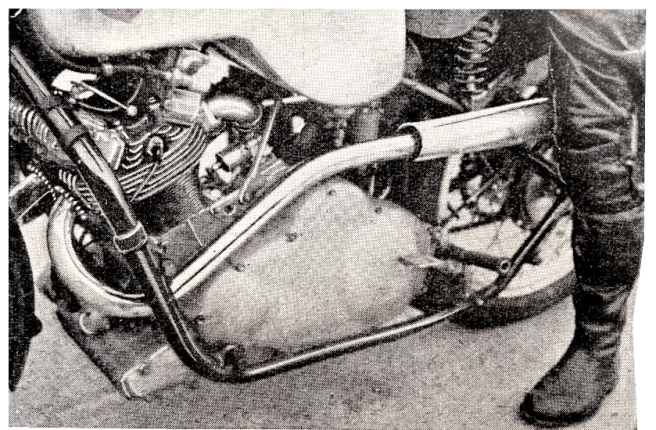
practice, the NSU has a rigid frame of simple duplex type with normal tubular forks. JH White will ride one of these machines in the Junior Race, with K Bodmer and 0 Ruhrschneck as team mates. The NSUs will also appear in the Senior Race, with W Herz riding in place of ‘Crasher’ White. There is no definite news of the alterations that have been made to the racing BMWs, but that they have more power and handle better is obvious from the fact that Meier handsomely smashed his own records in practice at both the Hamburg and Eilenriede meetings. Meier did not take part in the actual races, because he has only been released by Auto-Unions (for whom he is to drive cars) to compete in the TT. Alan Bruce and Tyrell Smith are comfortably ensconced near Kenilworth with all their Excelsior racing models. They are well ahead with their preparations and by the end of the week everything should be complete and ready for shipment to the Island. Tyrell is to ride 250, 350 and 500cc machines in their appropriate events, but Charlie Menders, who will also ride in all three races, will handle a 350 in the Senior event. These two riders will be
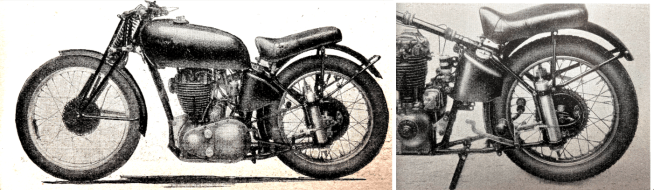
supported by Sorensen in the smaller classes. All the Bruce-Smith models will be distinguished by black tanks. Basically, the 350 resembles the 250. The spring frame is identical, and in general appearance the two models are almost alike. The 350cc engine, however, has one or two internal differences…The cat is out of the bag. Although Nortons are officially abstaining from racing, the men upon whom they have relied in the past, Freddy Frith and Harold Daniell, will be piloting machines which were the favourites last year. The two riders mentioned were prepared to ride standard Norton racers of the Manx Grand Prix type, but it was considered a pity to leave the real models reposing beneath their dust covers in the factory. They are, therefore, to be given another slice of work and we shall have the familiar sight of these ‘greyhounds of the road’ streaking around the TT course in the hands of those who have made motor cycling history in the past. Frith and Daniell will have machines identical with those they rode last year. The only difference between the mounts of the two men is that Frith will use an elongated saddle—as he used in the ‘Ulster’—and Daniell will have an ordinary saddle and a mudguard pad. “
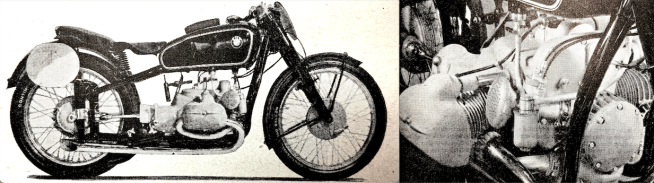
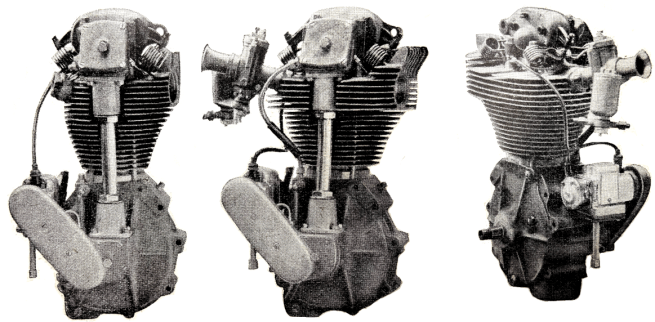
NORTON’S CONVENTIONAL TT contenders would not face the German challenge alone—AJS and Velo were waiting in the wings with blown multis…
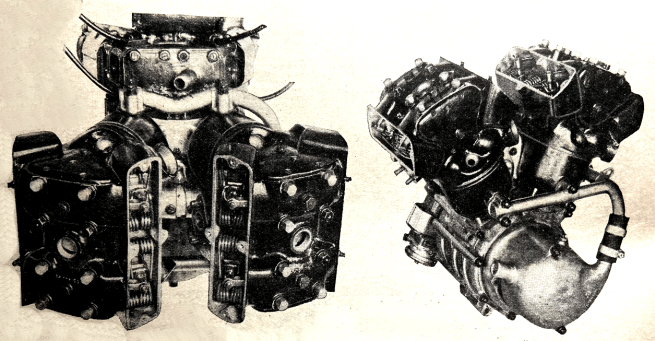
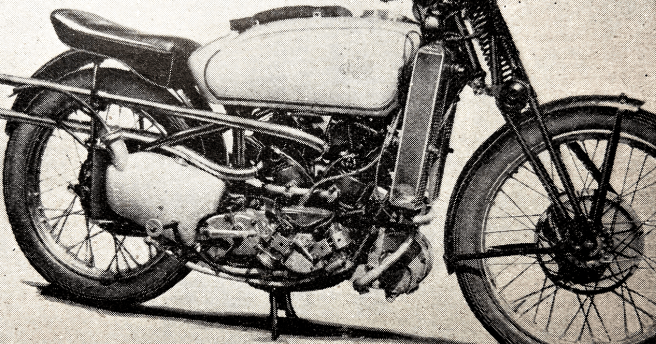

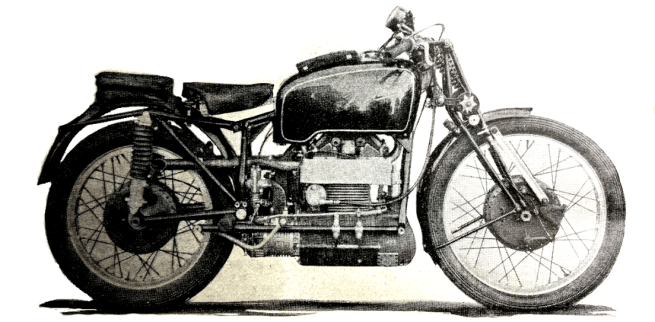
“OVER THE NEXT FEW DAYS there will undoubtedly be much discussion upon the future of the TT, and more particularly upon the ‘Roadster Race’ which the ACU is considering for next year. The regulations for this new-type race have been drafted and were to have been discussed between the ACU and the industry a few days ago. The meeting, however, had to be postponed and will, no doubt, be held immediately after the TT. While the draft regulations are confidential they have been examined by various interested parties. Basically they seem sound, but if the event is to prove of the maximum possible value they will probably have to be tightened up. This should not be difficult, though there are certain manufacturers who hold strongly to the view that it is impossible to ensure that the machines are all roadster-type models, and thus competing with each other on an entirely fair basis. We believe, however, that with a suitable panel of experts as examiners any such difficulty would be largely, if not entirely, overcome.”
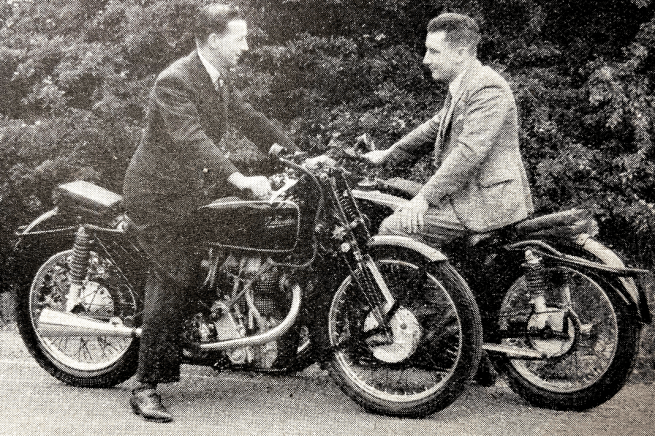

“WE HAVE NOT HEARD much about self-starters of late. It is an open secret that a year or so ago various experiments were being carried out. Personally, I have my doubts whether dyno or other starters will ever become popular. It is, of course, fairly easy to provide something of the sort in the case of a multi-cylinder two-stroke, since there is comparatively little resistance for the starter motor or dynomotor to overcome. Indeed, there is at least one machine on the market so fitted. With a four-stroke the position is very different, especially with a four-stroke single. To-day, if a manufacturer decides that his engine is not so good as starting in cold weather as it might be, he can usually overcome the difficulty quite easily by telling purchasers to use a light-grade oil. Several makers have saved their bacon by doing this. No, I have little reason to believe that self-starters are ‘coming’, except perhaps on one or two exclusive-type four-strokes and maybe on a two-stroke. The bug-bear of difficult starting has been largely overcome by the modern light oils and by better magnetos. Multis, too, are helping, because a multi-cylinder engine is nearly always more likely to ‘hit’ than a single. The one thing which is tending to make starting more difficult is the adoption of plain bearings. The result is a larger area of oil film, and if that oil becomes viscous when the temperature is low, much more effort is required via the kick-starter. The signs are, however, that plain, fully-floating big-end bearings will be extremely popular a year or two hence. As you may know, one advantage of a big-end that stands up and does so indefinitely is that there is very little cylinder wear. If any maker is having trouble with cylinder wear the knowledgeable ask, ‘Are you having any big-end trouble?’ and when the reply, as usual, is ‘Yes!’ they remark ‘Over-come that and your worries will be finished.’
“‘OUR ROAD SYSTEM to-day is that of the eighteenth. century, with a few trifling improvements.’—Mr Bowman, of the British Road. Federation.”
“PROBABLY FEW PEOPLE are aware that there exists a concern called the Channel Tunnel Company. The object of the company is to obtain permission from the French and British Governments to press ahead with a tunnel scheme. The latest news is that the French Government is to be approached once more. The military value of the Tunnel will be stressed. It would be difficult to exaggerate the value of the Tunnel as a fillip to Continental touring.”
“THE AA ISSUED nearly 1,000 England to Near East and India motoring routes last year.”
“BRITAIN PRODUCED OVER 100,000 gallons of home-distilled fuel in 1937.”
“THERE ARE ABOUT 560,000 miles of road in Canada; 445,000 are earth-surfaced.”
“THERE ARE 26,800 motor cycles in use in Switzerland, according to the latest figures.”
“CHELMSFORD POLICE suggest banning live stock from the streets during certain periods, in order to ease traffic jams.”
“A MOTORIST CONVICTED of driving while drunk near Capetown was sentenced to six strokes with a light cane.”
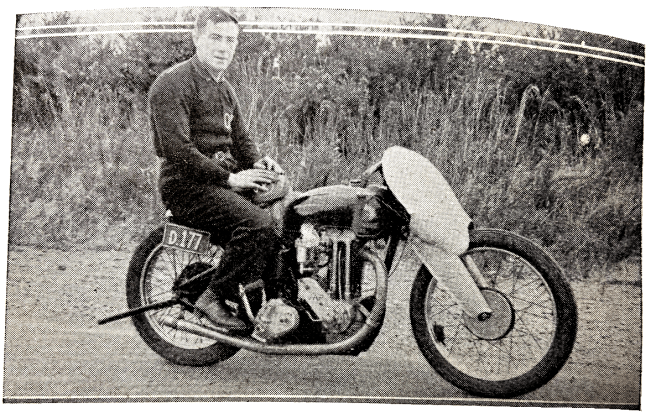
“A PROJECT FOR A new road and bridge in Papua was dropped because the natives believed that an evil spirit would be enraged.”
“BELGIUM HAS over 67,000 motor cyclists,”
“ACCORDING TO THE League of Nations Monthly Bulletin, last year’s production of cars was only 4,000,000, compared with more than 6,000,000 in 1937.”
“MAJOR ATG GARDNER, the racing motorist, recently covered the flying mile at over 203mph with a 1,100cc MG Magnette.”
“AN ITALIAN DRIVER of a 350cc car has just:broken a mile record with a speed of just over 90mph. The engine is of the single-cylinder type.”
“THERE ARE NOW about 27,000 motor cycle in use in Switzerland.”
“SEVERAL OF MY AUSTRALIAN correspondents denounce the proposal to fit tail-guards on dirt-track machines. They hold that the essence of the sport is its spectacular nature, and that it would be a blunder to deprive the riders of any tactic which skill can employ to achieve victory, or to rob the spectators of the thrill they experience when the leader fills up his pursuer with a shower of cinders. Incidentally, they display great interest in the gear ratios used over here, and want to know how individual riders vary their gear ratios to suit the various tracks.”—Ixion.
“I WONDER HOW MANY London riders are aware that the various men’s institutes organised by the London County Council offer rather attractive opportunities to motor cycling clubs which lack the desired accommodation. It is possible in some areas for such a club to be accepted as a ‘class’ without any admixture of outsiders, retaining its identity in every form. The amenities, for example, might include heating, lighting, canteen, garage, together with a qualified lecturer on such topics as the petrol engine, foreign travel, map reading, camping, etc. Any secretaries of London clubs who encounter difficulties about indoor accommodation and winter programmes should get in touch with one of these LCC Men’s Institutes. Mr CT Bird, who is head of the institute at Gifford Street School, N1, is an enthusiastic motor cyclist, and can supply all relevant information.”

“THE ULSTER GRAND PRIX, due to have been held on August 19th, has been abandoned on account of insurance and other difficulties. The authorities insisted that the Ulster Club should effect a policy of insurance against possible claims for damage to the lands and hedges of the farmers whose holdings adjoin the course, and apparently the Club was unable to meet this requirement. As we go to press there is a report that the Government have rescinded their demand and offered to allow the Club to organise the race with the same insurance as was effected last year. There is still a possibility, therefore, that this famous road race will take place as arranged.”
“THE SAND-RACE MEETING organised by the Carmarthen Club at Pendine was virtually two meetings in one. The morning session was restricted and for machines in standard trim; and in the afternoon the open racing events were held. The course dried hard and racing conditions were just about perfect. The standard-class sprints provided some tight finishes. RC Lewis (Norton) just pipped MG Taylor (Velocette) in the 350cc event, and Miss Mona Lewis (Norton) beat B Edwards (Ariel) by a short head in the 600cc event. The four-mile races, however, provided easy wins; RC Lewis (Norton) was too fast for PG Sivell (BSA) in the 350cc class, in which there were only two finishers, and E Stephens won easily from TR Rees (Ariel) in the 600cc event. Both classes were run off together in the 10-miles race. PG Sivell (BSA) was the sole survivor of the 350cc starters. The 600s had a keen struggle, however, and TR Rees (Ariel) eventually won from RM Rees (Triumph Twin) and B Edwards (Ariel). The racing sprints were very close affairs. In the 350cc class, LV Thomas, on a very ancient sprint Sunbeam, was only just beaten by E Stephens (Norton); and RC Lewis (Norton) just pipped H. Billington (Rudge) in the 600cc race. LV Thomas was again to the fore in the six-mile race, and he chased the Nortons until he coasted in with a seized motor. The high-light of the day was the 30-mile race for 600cc machines. LF Griffiths (Norton) was soon in the lead, with H Billington (Rudge) and RC Lewis (Norton) on his tail, and the rest of the field strung out behind. Several riders came to grief in this race, one of the corners becoming very loose. Among those who fell was Billington, and this put him out of the race. RC Lewis could make no impression on LF Griffiths, and this order remained. A 10-mile 600cc race was the last item on the programme. LF Griffiths (490cc Norton) had extremely bad luck, for he oiled a plug. H Billington (Rudge) led for several laps but was eventually passed by RC Lewis (Norton) and afterwards retired. This left second and third places to F. Bosisto (348cc Norton) and E Stephens (348cc Norton).”
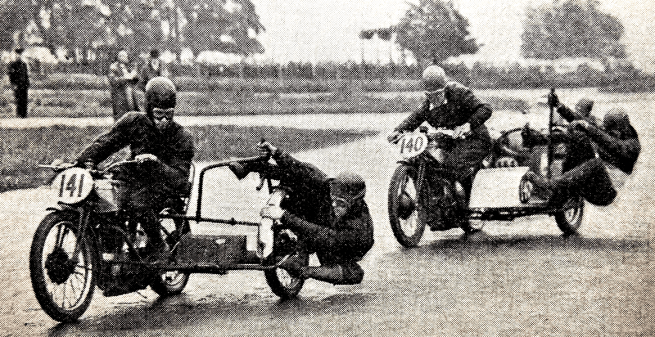
“HAPPY ARE THOSE MOTOR CYCLISTS whose wheels rev Manxwards this June. Gigantic entry! Formidable foreign entry! All three races wider open on paper than they have been for years! The only dubious essential to a gorgeous week is the weather risk. We had a marvellous spell of sunshine at Whitsun, and we are all wondering whether that miniature heat-wave was just a flash in the pan or the start of a long drought which will not end till the chequered flag hails the Senior victor home on Friday, June 16th. What a thrill it will be if the new blown-multi Velocette receives that flag after a hectic duel with, say, Meier on the BMW! I happen to know a few details of some of the readers who are seeing their very first T.T. in 1939, notably a gallant lad who has been fighting TB in a succession of sanatoria for some years past, and who is now enabled by better health to gratify a dream which has never left him through many months of pain and weakness. To him and that unknown army of enthusiasts who share his dreams, a grand race in full sun which will be a lifelong memory!”—Ixion.
“YESTERDAY I GOT REALLY CROSS—an unusual experience for such a mellow philosopher as myself. I was in a tearing hurry, and in a small provincial town I was held up for a solid quarter of an hour in the worst jam of assorted traffic I have ever seen anywhere. Even the peds were properly held up. At last I put the bus on its prop stand and squeezed afoot to see what was happening, for the only detour available would have cost me miles. Arrived at the focus of the vortex, I found one of those road trains which transport country fairs from one small burg to the next. The train in question consisted of five huge vans towed by a steam engine containing a small zoo, a merry-go-round and a calliope (or steam orchestra). I began to fume with rage that such obstructions should be permitted on the roads in 1939; and then my rage was converted to reverence. Its unlucky driver had to coax the equipage at right angles out of the narrow main street into a lane leading to his fair-ground pitch, and the lane was literally only a foot wider than his fattest van (containing live lions!). Naturally, since no power on earth could have reversed this unwieldy and colossal serpent, the driver could not afford the ghost of a blunder, nor did he make one. He put his engine into the lane at its dead centre, with precisely six inches freeboard on either side; and, moving at about half a mile an hour, he threaded the lane to perfection. I wouldn’t have been in his shoes for £1,000, and, though all we held-up motorists had been cursing freely, I feel we ought to have passed round the hat for him. He is the finest driver I ever met.”—Ixion.
“Thunder and Lightning —No, I don’t mean the noisy type. Down West this is the name of a particularly toothsome tea-time dainty. You take a Cornish ‘split’ or Devonshire ‘cut-round’ (both of which are light, white scones); anoint it with a luscious spread of golden syrup; top it off with a great dollop of the local clotted cream; and open your mouth very wide indeed. It is a toss-up whether an éclair, a doughnut or a ‘thunder-and-lightning’ is the most difficult to devour gracefully! Londoners apply butter beneath the treacle, but your true Westcountryman considers that cream and syrup furnish sufficient richness without the butter.”—Ixion.
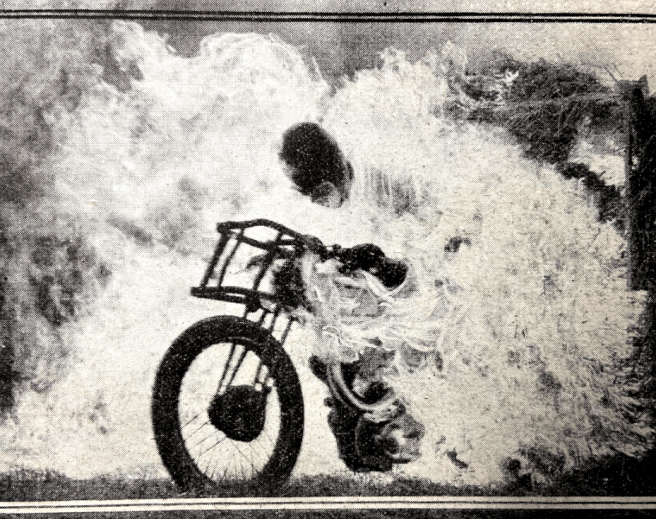
“PROBABLY NEVER IN THE HISTORY of motor cycling has there been an era in which design is changing so rapidly. That spring frames are likely to be exhibited on nearly every stand at the Earls Court Show in November is known to all. What is not common knowledge is that there are at least seven new twin-cylinder engines at present under construction or in the design stage. At last our age-old plea that the industry should develop multi-cylinder engines and spring frames seems to be bearing full fruit. In other words, at long last the industry is demonstrating by its actions that we, as practical riders, in our constant demands for multis and spring frames were right. Already the term twin-cylinder reliability is coming into common usage. That is one important asset of a well-designed multi: it is reliable, and this applies not merely to the engine unit but also to the trans-mission side, which, with the smaller and more frequent power impulses, is less highly stressed. Perhaps of even greater importance so far as the future of motor cycling is concerned is the greater degree of apparent silence that a multi-cylinder engine affords. Noise is the cause of the vast majority of the prejudice that has been stirred up against motor cycles. With a high-compression, single-cylinder engine noise is almost inevitable, and because of its intermittent nature it is apt to be objectionable. The widespread adoption of multis will, as we have constantly stressed, do more than anything else to kill prejudice. From the rider’s angle there are many advantages—not least the ease of starting a multi and the higher all-round efficiency.”
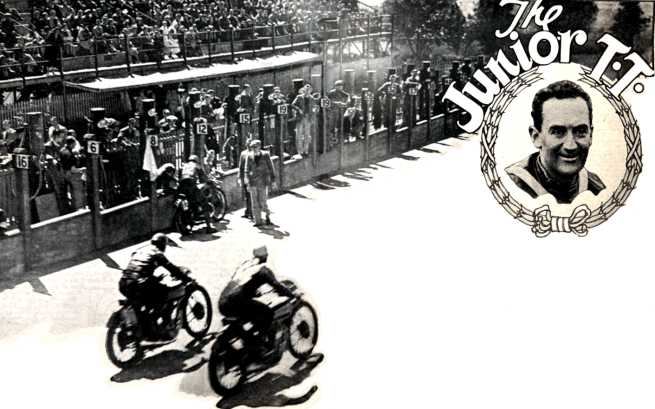
“THE JUNIOR TT RACE instantly developed into a furious triangular battle between Velocette, Norton and DKW. The previous record speed was never attained owing to the strong, bitter wind, which gave the men an exceptionally trying ride, while the enormous field of 61 starters made overtaking unusually frequent in the early stages. FL Frith (Norton) led by a small margin for three laps, with Stanley Woods (Velocette) holding a watching brief. The Norton’s engine failed on the fifth lap, from which point Woods led to the finish, hotly chased by HL Daniell (Norton), H Fleischmann (DKW) and EA Mellors (Velocette), none of whom was able to press him really hard. HL Daniell (Norton) had a spill on a wet patch of road during a shower of rain in Ramsey early in the race, but put up his typical fighting finish, and would have won if he could have beaten the lap record by four seconds on his last lap! This tigerish effort just failed, and he finished eight seconds behind Woods. H Fleischmann (DKW) and EA Mellors (Velocette) started 20 seconds apart and rode neck and neck for some 260 miles, and finished third and fourth deafened by the double exhaust noise. MD Whitworth (Velocette) rode a grand race for fifth place, with Wünsche (DKW), sixth. Unfortunately, two men were seriously injured. Simo (Terrot), the Spanish veteran, fractured his skull in a solitary crash, and HB Waddington (Norton) sustained severe injuries when he fell at Bray Hill with two men on his heels, one of whom could not possibly avoid him. Thirty-five riders finished, of whom 26 secured-first-class replicas and eight second-class awards. The manufacturers’ team prize fell to Velocettes; the Derby Club took the club prize. Many young riders added to their reputations, especially FJ Mussett (Velocette), of Australia, who secured tenth place. The race was a magnificent demonstration of high-speed reliability: 34 men completed the course at over 70mph. The fastest lap was recorded by HL Daniell (Norton) on his seventh circuit—five seconds outside the 1938 record. As early as 5 o’clock this morning Douglas awaked to reverberating exhausts as a great influx of enthusiasts got busy.
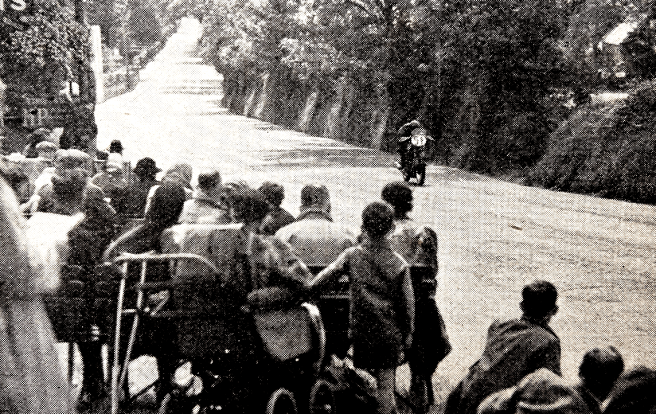
Apprehensive weather conditions greeted those who were first astir. A cold and strong north-north-west wind, with bright sunshine, prevailed for the most part, with the Scottish coast often visible, but great slabs of leaden cloud scudded across at intervals and occasionally a few icy raindrops fell. The tide turned just before breakfast and brought a clearer sky with loftier clouds. Before the start visibility was perfect and there was every promise of a bright, cool day, but thick coats were the usual wear as the eager thousands crowded all the popular stances. Flags tore at their masts, bands played, the riders warmed up cold engines in an inferno of noise, and now the 61 starters moved in proud and gay procession on to the grid-iron, looking up gratefully at the ebony silhouette of the mountains against a pearly sky. The non-starters were F Vaasen, L Cora, LV Perry, J Williams, E Kluge, C Redfearn and GV Dickwell. The huge field necessitated reducing the intervals between starters to 20sec lest the first man should complete a circuit before the last men left. The roads were bound to be cluttered up for two or three laps with lots of overtaking. Stanley Woods was a warm post favourite, with the Germans respected rather than dreaded. Sharp at eleven the maroon crashed, and young Ebblewhite dispatched the riders at three per minute with a crackle almost as continuous as a tommy gun in a crook film. Spatters of rain were reported from Ramsey just as H Fleischmann (DKW) effected the promptest and speediest of getaways. Twelve nations were represented in the field, if you count Ireland and Scotland separately. Woods was entering Ramsey at 90 when 25 men were still waiting to start. The boards showed no stoppages at this stage. Marshals reported petty showers to the North. Tension grew increasingly acute as no hint regarding relative speeds could be gleaned from the dials. No 68 got away just after 11.20am, when Woods, No 1, was already flashing down to Craig-ny-Baa. There’s the dull roar of his exhaust in the far distance. He is not going to break 85 for the full lap. Here he is; he receives no signal. And now comes Frith (Norton) who has passed three men, and Wünsche (DKW), who has caught two. Young Lockett (Norton), who is deemed a budding star by many, has caught two men, too. Times are slowly hoisted. Yes, Frith is 23sec faster than Woods.
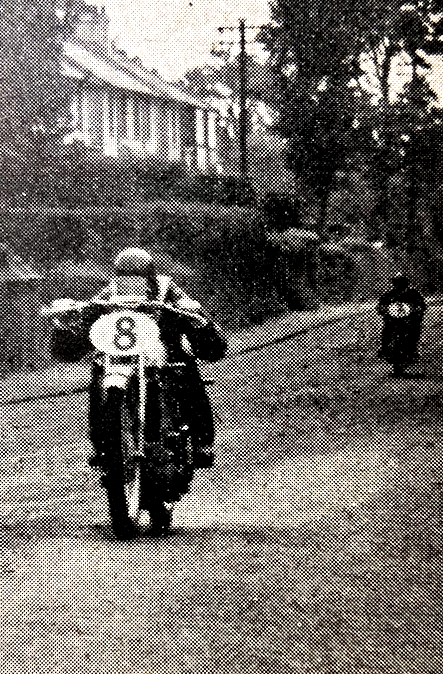
Wünsche is not quite so fast as his bellowing exhausts suggest, but Fleischmann (DKW) looks faster—yes, eight seconds ahead of Woods! Far away Daniell (Norton), who started 51st, is cutting a cracking pace. We can’t size up the race until he appears. Meanwhile, Foster (AJS) pauses at the pits with a pair of broken goggles, and maybe glass in his eye. He is treated, and proceeds. JW Beevers (Velocette) and HB Myers (Velocette) come off at Quarter Bridge; CH Manders (Excelsior) is out with gear trouble at Bray. Ah! Here’s Daniell at last—17sec behind Frith. The factory which is not officially racing stands first and third, with Fleischmann second, Woods fourth, LJ Archer (Velocette) fifth, EA Mellors (Velocette) sixth. So there’s three Velocettes, two Nortons and a DKW inside a 38src cluster—fierce going, this! And now our turn for a spatter of cold rain, as ‘Crasher’ White (NSU) retires at the pits with plug trouble. Early on Lap 2 there is a horrid affair at the foot of Bray Hill. HB Waddington (Norton) came off after touching SA Sorensen (Excelsior); Waddington goes semi-conscious to hospital with facial injuries and other damage, but Sorensen gets off lightly. Meanwhile, the leaders continue their lightning laps. Woods picks up a mere couple of seconds on Frith, but is now informed how things stand, and will surely open out. Fleischmann (DKW) slows down perceptibly, Mellors (Velocette) accelerates very definitely, and Daniell (Norton) takes a
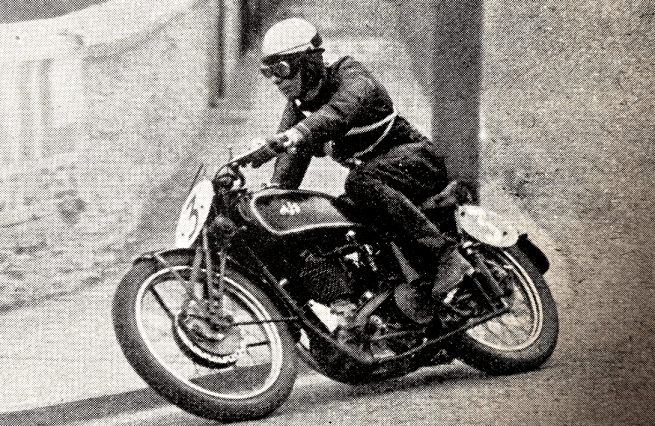
toss in the Square at Ramsey and continues with some metal part hanging down. But just look at these times for the second lap! Woods, 26min 54sec; Fleischmann, 26min 55sec; Frith, 26min 56sec; and Mellors, 26min 58sec. There’s racing for you! Daniell is now fifth, after a 27min 55sec lap, and Archer sixth, lapping his second circuit in 28min 17sec. It is still trying to rain, but the cold wind has ended the fly plague for the moment. Behind the leaders, a huge jam of slower men fight for replicas. In so big a field it is hard to pick out the middle men, whose prowess passes un-noticed while the stars try to crack each other up. MD Whitworth, ER Thomas and S ‘Ginger’ Wood, on Velocettes, are all fast; M Cann and J Lockett, on Nortons, enhance their reputations; Wünsche (DKW) is a good second string to Fleischmann (the NSU stable must regret they ever let Fleischmann leave their roof). News comes through that Waddington was quite seriously hurt in the mishap at Bray Hill. Several people hit the sandbags at the Craig, and a number of minor tosses involving no real injury are reported. M Simo (Terrot) hits a concrete post on Snaefell; HG Tyrell Smith (Excelsior) copies Daniell’s tumble in Ramsey Square; K Bodnier has his NSU engine go sour on him in Ramsey, but carries on; and J Lockett (Norton) skids at Craig-ny-Baa, but suffers no personal injury. Now comes the psychological moment for record laps. With men like Frith, Woods and Fleischmann circling at almost identical speeds, fireworks are expected. It is astounding that we have had no record lap so far. The clocks jerk rhythmically—what a pity that Daniell just overrode himself that fraction at Ramsey, for Frith is likely to need support in this clash of supermen. Here is Stanley finishing his third circuit—what is his lap time? We do lightning subtraction from the ‘growing’ times on the board: 27min 41sec. That is not too good. Here’s Frith, who started 100 seconds behind Stanley, in 27min 49sec. Why, they’re decelerating a trifle! That is queer, surely ? And Fleischmann? Twenty-eight minutes dead! Frith got within eight seconds of record on his second lap. Can it be the wind? It does not seem any rougher in the shelter of the stands, and there has not been any real rain anywhere. Perhaps at the finish the stars themselves. may expound this TT mystery, which is wholly inexplicable at the moment. Why, Daniell, in spite of his trouble, is faster , than any of them with a third, lap in 27min 34sec. He is actually 61sec behind Frith, but if he can go on picking up 15sec per lap on his stable companion for four laps, he will be thereabouts when the chequered flag waves. A very, very queer race. Anyhow, let us be thankful
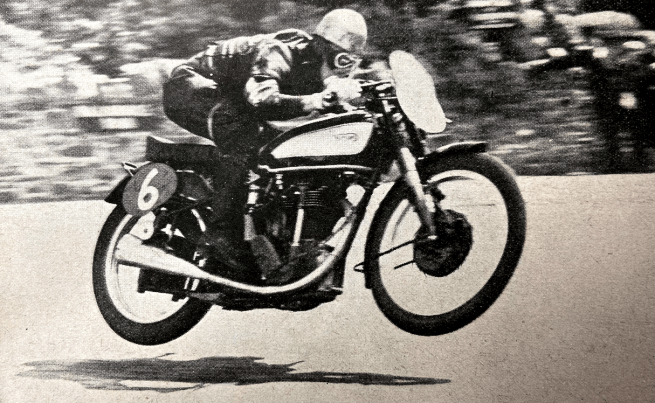
that whatever bit is waggling loose on Daniell’s Norton it doesn’t affect his speed. As an anti-climax, Lunn (Velocette) is reported coasting in from the Bungalow. The battle between the leaders renders us temporarily blind and deaf to lesser men. Deschamps cracks his collarbone at Close Woods. Woods circles furiously after his pit stop, but 28min 3sec is not fast, even from a standing start, as champions go. However; it is just quick enough to hoist him into the lead by two seconds, for Frith can only put up 28min 18sec, also, of course, inclusive of a pit stop. What about Fleischmann on the flying DKW? Great heavens, he’s equalled Stanley’s time of 28min 3sec, and is now definitely outriding Frith, whose engine does not sound the least bit healthy. The Norton banner may be in Daniell’s hands after all, and that slip at Ramsey may yet cost Nortons dear. But Mellors also has ideas in his head. Mellors covers his fourth circuit in 27min 32sec, and Daniell in 27min 42sec, so the second Velocette is now fourth. Yet a third model, gallantly ridden by Archer, climbs up into sixth place. Well, at any rate, we are clear of pit stops, and unless some invisible giant hand is stopping the men, now is the moment to open up and smash records. Fleischmann, who was trained by Walter Moore with the NSU équipe, is still looking extremely formidable. Meanwhile, Ruhrschneck (NSU) tours past the Bungalow with Bodmer on the pillion, and Rose (Velocette) retires with plug trouble at Craig-ny-Baa. Still no record-breaking. Cauchy comes off at Handley Corner. Stanley Woods treads on it a shade harder and registers the fastest lap so far to-day in 26min 45sec, which is 12sec outside the 1938 record. And now comes the first terrific sensation, for Frith retires at Ballaugh with engine troubled leaving the DKW sandwiched between Woods and Mellors on their Velocettes. Shades of
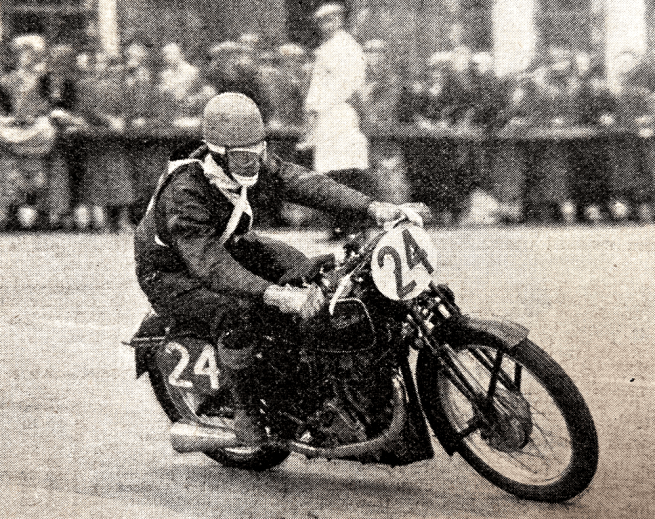
Joe Craig! We have almost forgotten that a Norton can retire—and with engine bother at that! How is Fleischmann going? Just 27min 8sec for this circuit, and he is now 35sec astern of Woods. Mellors is too slow to hurt the DKW—a 28min 24sec circuit contains no hope of overhauling Fleischmann. He and Woods must settle the main issue alone. Cherriman (Norton) pushes in from Governor’s Bridge. Meanwhile, Wünsche (DKW) is going really well, though not yet sufficiently at home on this circuit to make the leaders nervous. But Nortons are not yet out of the hunt. Daniell, undisturbed by his early spill, pulls out a lap in 26min 44sec—eleven seconds outside record—squeezes nine seconds ahead of Fleischmann, and snatches second place. Just like him—he revels in a slow start and a devilish finish. But he’s got a lot to do. He is still 26sec behind Stanley, and his lap speed is only a second faster than that of the flying Velocette. ER Thomas is riding home on Cauchy’s pillion. We now brace ourselves for a tight finish. Incidentally, Mellors and Fleischmann started as Nos 20 and 21 respectively, and have passed and repassed each other frequently, with the added factor of pit stoppages. Woods never falters, but clocks a 26min 42sec lap. Either he is all out or considers his speed adequate. Has he been told that Daniell is trying to stage yet another furious finish? The clocks show Mellors and Fleischmann neck and neck all the way round—owing to the starting vantages they pass us with the DKW a dozen yards ahead, when Daniell on the same lap is still at Ramsey. What an artist Woods is! He evidently taped out the requisite speed, placed himself fourth on Lap 1, pushed up to third and then second when Frith’s unexpected speed threatened him, took the lead on Lap 4, and then just kept the model moving fast enough to stall off Fleischmann. Only a crack-up, or a fiendish spurt by Daniell can beat him. Croft (Norton) retires with engine trouble at Hillberry, and Craine (Norton) suffers a similar fate at Kirkmichael. Fry falls at Milntown. Mellors wrings a lot back from Fleischmann, but neither can disturb a non-stop Woods. Daniell arrives punctually. His time? Ah, he’s only picked up 3sec on the Velocette, and he cannot hope to recover 23sec on the seventh lap from an informed and resolute Stanley. It must be all over bar the shouting. Daniell’s sixth lap (6sec outside record) is the fastest up to this point. Loyer (Velocette) tours in. Stanley suffers no cruel stroke of fate, and reels off his seventh lap smoothly after a most beautifully judged race. Point by point he is reported safe and swift, and is welcomed home by a crowd that scarcely seems to comprehend the judgment with which he has ridden. Mellors and Fleischmann continue their long duel for third place, changing positions every mile or two, never more than 100 yards apart in space, but devoid of any chance of victory. Somewhere in the hinterland poor dogged Daniell curses his spill, gets his signals showing what a desperate stern chase he is flogging, and probably knows he cannot catch Stanley, who started 17 minutes before him. He could do it if his model can beat record by four seconds, but it has hardly shown the pace to-day. Fleischman’s DKW and Mellors’ Velocette flash over the finishing line 50 yards apart—
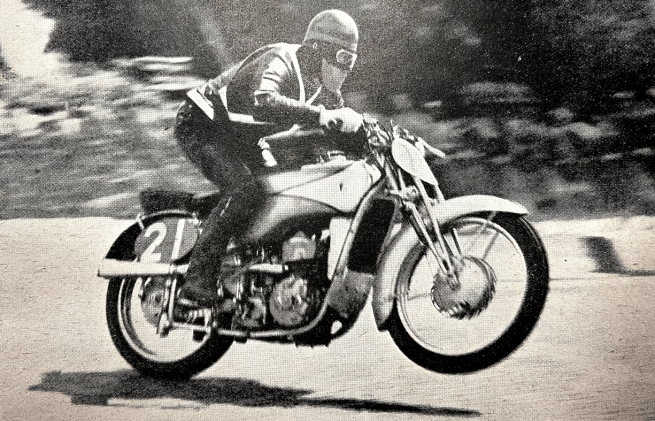
Mellors must regret those fatal 23 seconds which he conceded on Lap 1. Nothing remains but to watch Daniell’s clock; he can’t be in for ten minutes yet. Sympathetically we wonder whether he is trying with clenched teeth to put up a super record and score the greatest victory in TT history, or aware that he is short of knots, and going steadily for a safe second place. Everybody with a stop-watch is timing. The dial clicks—the verdict is that he hasn’t a chance. In turn he passes Kirkmichael, Ramsey, Bungalow, Craig-ny-Baa. The red light shows he is at Governor’s Bridge—has he a chance after all? He’s faster than we thought. Here he is, flat-out and right down to it! No, he’s beaten, surely? Time, please, Ebby, Time? Oh-h-h! Woods wins by eight seconds! That spill in the square at Ramsey was the decisive moment of the entire race, for on the last lap Daniell could only circle five seconds slower than the 1938 record.
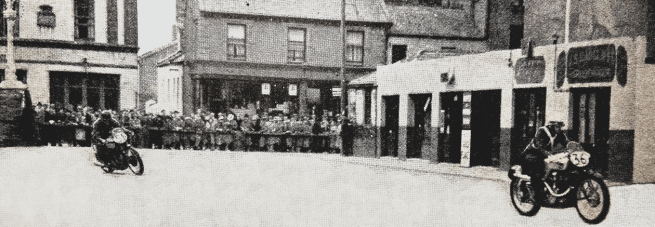
RESULTS: S Woods (Velocette), 83.19mph; 2, HL Daniell (Norton); 3, H Fleischmann (DKW); 4, EA Mellors (Velocette); 5, MD Whitworth (Velocette); 6, S Wünsche (DKW); 7, M Cann (Norton); 8, S Wood (Velocette); 9, JG Little (Velocette); 10, FJ Mussett (Velocette); 11, LG Martin (Norton); 12, GH Hayden (Velocette); 13, HG Tyre11 Smith (Excelsior); 14, NB Pope (Velocette); 15, WT Tiffen (Velocette); 16, J Lockett (Norton); 17, ES Oliver (Velocette); 18, L Dear (Velocette); 19, HC Lamacraft (Velocette); 20, WF Rusk (Velocette); 21 G Newman (Velocette); 22, FJ Binder (Velocette); 23, GE Rowley (AJS); 24, LJ Archer (Velocette); 25, CF Brett (Velocette); 26, JC Galway (Norton); 27, JW Beevers (Velocette); 28, SM Miller (Velocette); 29, LR Higgins (Velocette); 30, JM West (Velocette); 31, J Garnett (Velocette); 32, HB Caldwell (Velocette); 33, R Gibson (Velocette); 34, GH Briggs (Norton); 35, HB Myers (Velocette). First-class replicas were won by the first 26 riders; second-class replicas by the 27th to 34th riders to finish, inclusive. Finishers: There were 61 starters, of whom 26 retired. 01 the 35 finishers, 34 gained first- or second-class replicas. Manufacturers’ Team Prize was won by the Velocette team (Stanley Woods, EA Mellors and LJ Archer). Club Team Prize was won by the Derby and District Club (Stanley Woods, EA Mellors and S Wood).
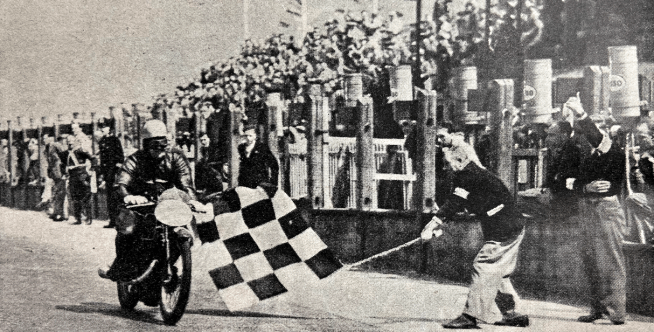
“THE WINNERS SAID…Interviews with the First Three Home. The first three men home all finished surprisingly fresh. Stanley Woods said that he had had one of the hardest races of his career—his nose had been on the tank pad practically all the time. He had a fairly comfortable ride, but his damaged hand was in need of a little massage when fie finished. His big surprise was to find Daniell so close behind on the last lap, for according to a pit signal he had received at Ramsey he (Woods) was well ahead, and in consequence he eased back a trifle—’Not that I exactly tarried, even then,’ he said. Daniell, like Woods, received a great ovation. He said his greatest handicap was the sudden rain squalls encountered round the back of the course, which made visibility difficult (Daniell, of course, wears spectacles). He had had a trouble-free run except for his spill at Ramsey on the second lap. This spill, incidentally, put his rev counter out of action—and from then onwards his lap speeds gradually improved! He was very satisfied with his machine, but thought that, having regard to the windy conditions, it was rather overgeared. Fleischmann, the third man home, speaks little or no English. However, to questions as to whether he had had a ‘gutte reise’ he replied, ‘Ja, sehhr gut!’ and seemed very pleased with his performance. And, judging by his smiling countenance, there seemed little doubt about it !”
“HOW THEY FINISHED. It is now positively normal to find all the placed machines in perfect condition, and this year’s Junior was no exception. It is, however, interesting that the machine on which Stanley Woods won the race bad been placed fourth in 1937 and first in 1938. With the exception of almost imperceptible differences which produced the odd extra horse, it is unchanged and finished to perfection. The worst that can be said of it is that it was mildly oily aft of the saddle tube. Tyres, plugs, chains, valves, and head joint were in perfect condition, and there was plenty of movement left in the brake and clutch controls. Daniell’s Norton was in equally good condition. However, as compared with the Velocette, the rear tyre was, perhaps, a trifle less worn, and the primary chain showed rather more slack. The whole of the revolution counter drive had been broken off in his fall early in the race. Fleischmann’s DKW was mechanic-ally perfect, the rear tyre was rather more worn than that of the other place men, but was good for many more laps. The plugs (unchanged) were in perfect condition, and so was every visible part of the engine. Under the water-cooling head jacket are two separate light-alloy heads, each having no fewer than twelve holding studs. Such little carbon as was visible could be scratched off with the finger-nail, revealing perfectly polished combustion chambers.”
“THE 1939 SENIOR TT produced a fine German victory, G Meier (supercharged BMW) leading from start to finish and winning easily in 2hr 57min 19sec (89.38mph), which is 0.27mph faster than Daniell’s winning speed last year. Behind him JM West (BMW) held second place throughout, finishing in 2hr 59min 39sec (88.22mph). The British stars were curiously unable to reproduce their 1938 speeds, and never looked like holding the German machines. Stanley Woods (Velocette) and FL Frith (Norton) had a lengthy duel behind the two German machines, the Norton man eventually securing third place in 3hr 0min 11sec (87.96mph). As Woods and Frith, riding identically the same machines, finished at 88.99 and 88.98mph last year, it would seem that the wind this year was deceptive and slowed the unblown machines more than was suspected. Forty-seven riders started, including no fewer than 18 Junior machines. There were 30 finishers, of whom 13 qualified for first-class replicas, and 14 for second-class replicas. The trade team prize was secured once again by the Velocette trio (Woods, Archer and Mellors), while the club team prize was awarded to the Derby and District MC ‘A’ team (Whitworth, Woods and Mellors, all on Velocettes). The weather conditions were ideal for spectators, bright sun shining throughout. The roads were bone-dry and visibility magnificent. Although the gross speed was slightly higher than in 1938, the lap record was never in danger; Meier got within four seconds of it on his second circuit. Legend tells how in prehistoric days some pagan deity adopted the Island, and as a protection against powerful foes bestowed upon it the magic ‘Mantle of Mona’. This took the form of some fifty cubic miles of mist, designed to render it invisible to its enemies in emergencies. Unfortunately for us, the deity cannot distinguish between an air raid and a TT. Mistaking the DKW exhausts on Wednesday for hostile aircraft, be duly dropped the magic mantle, and until late on Thursday Mona was so completely blotted out that the prospect of a postponed Senior threatened us. Discovering his blunder during Thursday night, the pagan deity switched off the cloak of fog, and from dawn on Friday brilliant sunshine intensified all the natural colours of the landscape. In the small hours seven steamers approached, bearing thousands of unshaven and towsled enthusiasts, who sighted the mountain silhouette clear-cut in green and russet and purple, rising against an azure sky out of glassy seas sparkling with a million golden spangles. Sirens whooped, gulls screamed, exhausts
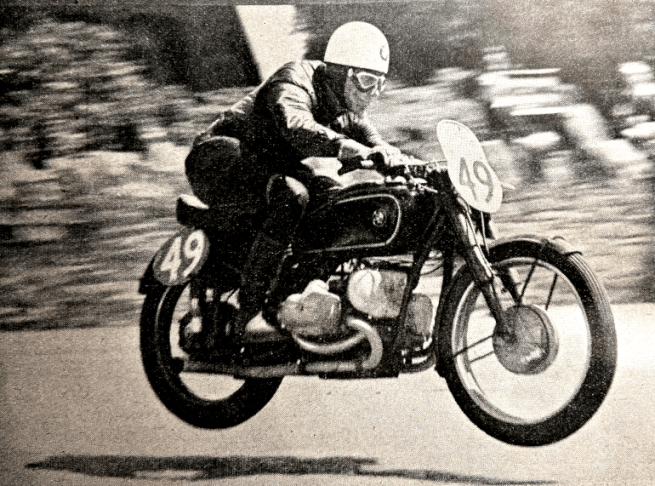
barked. Breakfast over, the roads were swiftly flooded with every imaginable form of transport from Shanks’ pony to Rolls-Royce. Great crowds thronged every seat and stance along the 37½ miles of tarmac, animatedly discussing the impending battle of international giants. There had never been any real hope of the new blown twin Velocette being given a run; it had only been brought over for a lap to test its handling. But it leaked out that during the winter their single-cylinder had grown an extra half-horse-power, and Stanley Woods’ quiet confidence and notable genius made it a popular favourite. Although the Norton factory is not ‘officially’ racing this year, all three of their peerless 1938 machines were present, and the jockeys were Daniell, Frith and ‘Crasher’ White, as before. Moreover, a significant detail caught all eyes at Thursday’s weighing-out—each ‘works’ Norton displayed a small extra tank above the fat, grey fuel-containers of 1938. Meier had averaged practically 89mph throughout practice with nothing but his own dauntless spirit to urge him on; even if his fastest circuit over a still further improved course was 12sec under Daniell’s 1938 record, the German sergeant-major was hall-marked as Public Danger No 1,
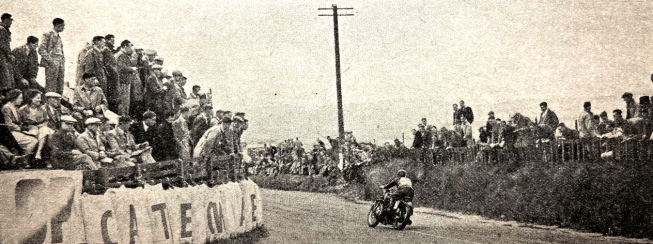
the more so as he had been enlisted in the Auto-Union car-racing team, and was excused solely for this race. West was known to rank as a very dangerous second string to Meier. As the corners and surface of the circuit had received renewed attention during the winter, some wholesale record-breaking was confidently anticipated under pluperfect conditions. On the whole, Woods, on the Velocette, could claim most support at the start. The usual routine preliminaries executed in typical ACU fashion, The Governor arrives. The tent is unlocked. Engines are warmed-up in an inferno of noise and blue smoke. Riders are led in procession to the gridiron. The Governor shakes hands all round. Padre Stenning, an ideal announcer, does his stuff over the microphone, putting newcomers wise to every detail, and expressing our hearty welcome to the eight racers from overseas—five Germans, a Finn, a South African and an Australian. Ebblewhite Junior, as imperturbable as his sire, emerges from some secret lair with two watches in a mahogany case, and his small flag. The flag falls; the maroon crashes; Daniell heaves at his Norton, and the battle begins. High clouds overhead roof the gay scene; and tongues begin to wag their hopes and fears and surmises. Daniell easily beats 90mph to the first telephone point at Ballacraine. The stars are
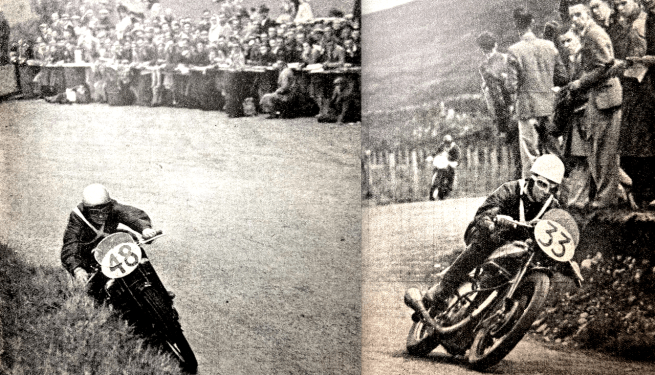
well distributed over the entry with Daniell No 1, Woods No 10, Frith No 17, Mellors No 28, West on the BMW No 35, and Meier, the cynosure of all eyes, No 49. With twenty-second starting intervals we may be latish all day in sizing-up the proverbial Manx kaleidoscope. At any rate, the riders need fear no discomforts barring flies on their goggles; and if the breeze stiffens a trifle, it will keep the flies away, though at the moment no flags strain out taut from their posts. Everybody got away as surely as if they were pushing off auto-cycles, but West and Meier were definitely the most impressive alike in acceleration and noise. When Newman had left, Mr Geoffrey Smith, The Motor Cycle managing editor, handed the chairman of Noble’s Hospital a cheque for £500 from the Guthrie Memorial Fund. Simultaneously, encouraging bulletins were broadcast about Monday’s victims, Simo and Waddington. The scoreboard showed 47 starters, the absentees being Williams, Redfearn, Perry, and poor Gall. No fewer than 18 350cc machines impudently challenged their seniors—13 Velocettes, three NSUs, one DKW and one Excelsior.
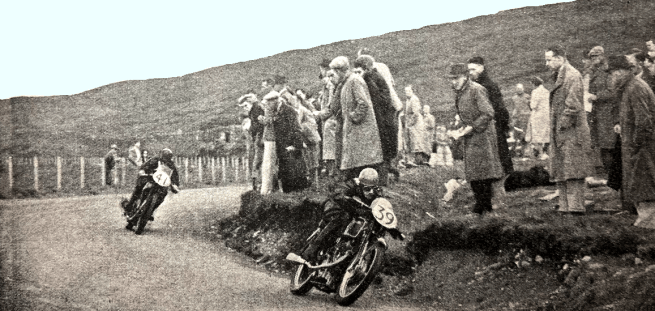
The clocks are an infallible guide to class, even on the opening lap. Woods, Frith, Mellors, West, and Meier all instantly proceeded to gobble up slower men who had started ahead of them, many 350s having to submit to this reminder of their small capacity. Consternation spread, however, when MD Whitworth, on his 348cc Velocette, had the hardihood to catch Daniell’s 499cc Norton before the Bungalow, though the big fellow had started 20 seconds earlier. But Meier was catching somebody every six or seven miles! Whitworth (No 2) was first man through, chased by Woods (No 10), who in turn was trailed by Daniell, 200 yards astern with thumb down. A swift glance along the scoreboard suggested that already interest must focus on four columns so far as a leader was concerned; but these four men were so widely spaced that much time elapsed before we knew how they stood, especially as the figures were hardly posted with the usual Manx velocity. Woods was posted first—25min 56sec—good without being sensational; but Woods never hurries till he sees what the pace will be. Then Frith, three seconds slower. A longish wait for West—heavens above, Jock has tied with Stanley! That looks bad, for Meier is sure to be still faster. He certainly is—a whole 52 seconds faster! These racing BMWs are well-explored in every detail; nothing experimental
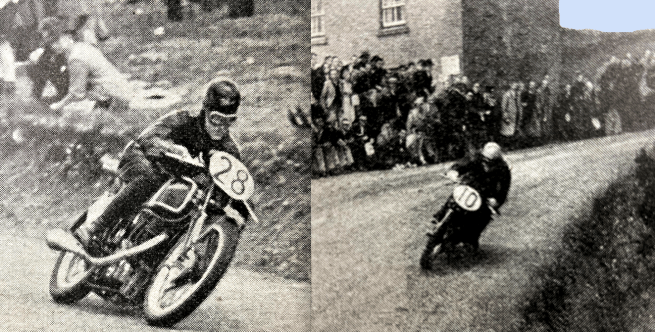
about them; what they do, they can keep on doing till the cows come home. Unless Stanley has a couple of aces up his sleeve, or Meier hits the grass, a British victory already seems the most distant of possibilities. The field produces no new British star. None of the next eight are yet recognised as 90mph men, or likely to stem an invasion of top-notch foreigners. But note among them young Lockett (499cc Norton), a rising star, hailed as likely to reach the first magnitude; Maurice Cann on the sole Guzzi entered; and Walter Rusk on the water-cooled four-cylinder AJS, which had plenty of speed in it, but is not yet fully gentle to hold. Meanwhile, unlucky LA Dear (348cc Velocette), retires at Union Mills. SM Miller, similarly mounted, has a stop at Kirkmichael, and JA Weddell (490cc Norton) retires at Ramsey hairpin after damaging his forks in a mild toss. In an anxious flurry of excitement all await the return of Woods. His private signal station will have given him Meier’s speed. Woods is an adept at judging a race; he won’t necessarily unleash his spare horses (if any) quite so soon as this, but he can’t relish being the best part of’ a minute behind the German after only one lap. He is now ahead of the entire field in space if not in time, but his arrival is not nearly soon enough. He has lapped no faster than 25min 28sec. Stanley, my boy, that is 35sec outside record; it won’t frighten Meier! Is it the best you can do? Is the Irishman gambling on Meier riding wild? Frith is the next British hope due, and he is slower still—if one can fairly apply the word ‘slow’ to a man who is lapping at 87-odd miles per hour; he is 12sec astern of Stanley now. Faces reflect a grim anxiety as all wait for West—he’s shaken off Woods, with whom he tied on Lap 1, by five seconds. Meier is very definitely a goer. He plays no waiting game—we shall probably get a new lap record from him on this turn. His red lamp doesn’t glow so soon as anticipated. His time goes up—24min 57sec for the second lap, which spells 90.75mph, and is 4sec outside record. Incidentally, Meier’s opening lap was the first one over 90mph from a standing start in TT history. It looks as if the breeze, which at the stands merely tempers the hot sun, was soaking up a little potential speed somewhere, for the times are not on sensational as was augured. Nevertheless, Meier is leading the field by 78sec after two laps, and is 83sec ahead of the fastest British machine. Meanwhile, AR Foster (AJS Four) pauses to replenish. Pope (490cc Norton) tours down off the Mountain with weak brakes, but continues after a pit stop. JH White (Norton) and F Vaasen (Norton) give the crowd at the Craig more than a thrill, for they all but collide, generate super wobbles, straighten out miraculously, and proceed at speed. Two men are missing and unreported—Ruhrschneck (346cc NSU) and Reid (BMW), near Kirkmichael and the Bungalow respectively. The German’s trouble proves, after a search by travelling marshals, to be purely mechanical, but Reid finds a spectator on the road near Keppel Gate, comes off in trying to miss him and suffers a broken arm. There are four retirements on the board at this stage, but the leading dozen are giving a fine display of reliability at ultra-high speeds. West has shaken off Stanley, Archer has caught Lockett, and Galway has profited by Pope’s brakes; otherwise the positions remain unchanged. For Stanley it is clearly a case of ‘now or never’. If he meekly consents to be headed by over a minute at this early stage, it is only because he can’t help it.
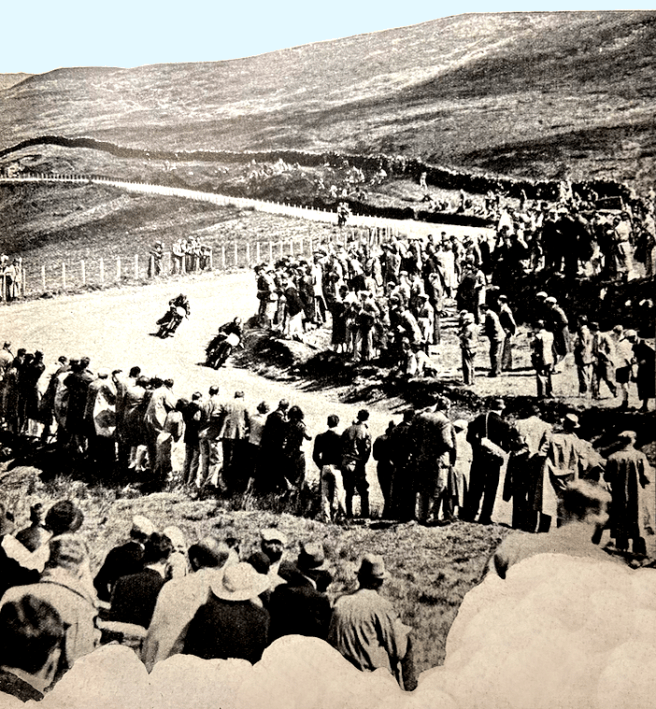
He is due to pick up fuel, and never did the massed thousands on the stands await a star so eagerly. It is a case of ‘thumbs down’ for Britain, barring accidents. Stanley streaks with silent engine to his pit after a 25min 31sec lap. Evidently all his horses were already on the gallop. Apparently the wind is deceptive—it must be stopping them in the hinterland. Worse still, he has an awful job to get going again. He makes two vain attempts to restart, and the third attempt is touch and go, the whole business visibly taking a lot out of him. Frith is pretty punctual, but has lost more ground to Stanley. Apparently the old Norton speed isn’t on tap to-day, for ‘Crasher’ is also slow, and Daniell cannot get moving at all—as Nortons count moving. Or, more likely, all the field are being wind-stopped, and the BMW men with their huge reserve of power feel it less than the unblown singles. West and Meier are due to fill up on this round. Both are deft and workmanlike. Jock West is 15 seconds ahead of Stanley now, and Meier has stretched his lead over Stanley to 110 seconds. His lap time is 25min 4sec—identical with his standing-start opening, and 27sec faster than Woods’ last. The prophets who thought he was likely to ride rather wildly are confounded, for reports round the course state that he and West are obviously both faster and steadier than anybody else. This is specially emphasised in reports from Bray Hill, where even the stars look as if they were taking risks. Germany first and second is a probable and ominous reading of the race. CF Brett (348cc Velocette) retires with big-end trouble at Ballacraine. The leading dozen persevere with their astounding exhibition of how to lap in formation at ‘eighty’ or more, except that Tyrell Smith on the solitary 500cc Excelsior entry displaces Rusk. The next lap covers the half-distance. Unless the proverbial Manx kaleidoscope starts its old devilish juggling again, or a host of retirements occurs, radical variations seem improbable. Nor does a single spectator desire that misfortune should overtake the BMW champions. Germany has had more than her share of disappointment and disaster this week already, and a smashing win would be no more than they deserve. Two minor features of interest are the good showing of the pair of AJS four-cylinders, which may well prove formidable when fully matured by another year of intensive culture; and the gallant efforts of the bevy of Juniors—mostly Velocettes—to keep up with their big opponents. Mellors is riding very consistently, and a speed of 84mph or so must seem child’s play to Archer. Cann is very fast and could probably use a scrap more speed if his Guzzi had it. Ginger Wood is obviously in the same boat—he is an enthusiast who always looks as if he were urging his mount on horse-fashion. Galway is earning new laurels for South Africa, as Mussett, lower down the list on a 350, is doing for Australia. Presently the leaders begin to clock-in. Poor Woods has been slowed by a pit stop plus an obstinate restart, and can register nothing better than a 26min 53sec lap. This allows Frith’s Norton to steal nearly half a minute ahead of him. The grim truth now brook’s no denial. Whether a deceptive wind is to blame or not, the crack British engines are a whole lot slower on the day than they were under apparently similar weather conditions in 1938; not one of them can nourish the dreamiest hope of hustling the two BMW aces. As the race has gone, Jock West, never accounted an absolute top-notcher on any-thing but a BMW, would look evert inch a winner if Meier were not in front of him. Here he comes, and as usual the aggressive reverberating bellow of his engine betrays no hint of weariness. Frith has lapped in 25min 49sec, and Jock
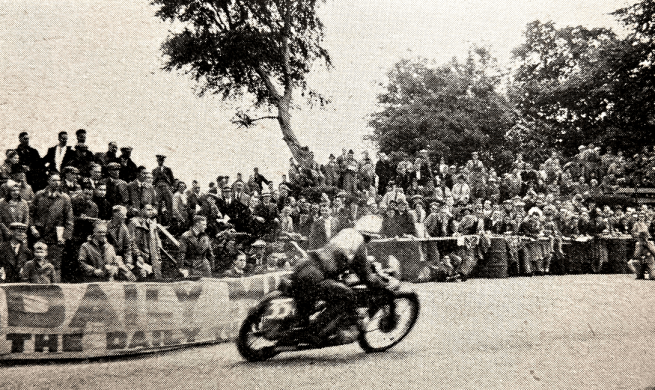
in 25min 19sec Meier, including a pit-stop, registers 25min 46sec—the Britons are being relentlessly ridden down, and Woods is now practically three whole minutes astern. Jock is 81sec ahead of Frith. Neither British ace can possibly have enough in the bag to pull down the BMW pair over the concluding laps. Behind the leaders, Archer momentarily or permanently catches Mellors, and Galways slips past Tyrell Smith; but the ‘formation’ are still keeping station most marvellously. Until Archer caught Mellors the same six numbers had filled a the official ‘continuous-leader’ board from the start. ER Thomas (495cc Velocette) changes a plug at his pit, and bids the attendant keep another plug handy. Daniell concludes a trip which must have been a grievous disappointment to him by retiring at the Gooseneck, where he sits to watch a few laps for a change. Ruhrschneck’s early disappearance proves to be engine trouble. Bodmer (NSU), despite his colossal ‘camel’ tank runs out of fuel—was the blower too efficient? Lampinen, the Finnish champion, tours in from Hillberry. Menders (349cc Excelsior) relinquishes the race high up on Snaefell with engine trouble; and Craine, the Manx hero, finds his fuel tank bone-dry on Creg Willeys. A race of this type is apt to engender a somewhat ghoulish atmosphere. Excitement is the life breath of racing, and we know all too well there can he no dramatic climax to this Senior unless both BMW machines have a spill or a stoppage. Not one sportsman desires such a culmination; but meanwhile their relentless mastery denies us our expected excitement, for we can only sit back and admire two super machines being magnificently handled; and the speed is such that an individual can only snatch seven brief glimpses of them during the entire race. A sense of the inevitable is poor exchange for thrills. Back comes Stanley in 25min 19sec. Nothing but a string of 24-minute laps could help you now, Stanley! All it does is to wash out that pit stop loss, and shunt him back in front of Frith, who can do no better than 26min 19sec. West roars through in 26min 13sec and Meier needs some fuel. He has lapped in 25min 14sec and now heads Stanley by 3min 12sec and Jock West by 2min 7sec. In the 1938 Senior Daniell was almost precisely as fast as Meier is to-day. Woods and Frith were then unpleasantly close on Daniell’s tail; yet today all the British cracks look almost outclassed, so hopeless does their task appear. J Lockett (499cc Norton), who has made such a name for himself this year and was lying eighth, stops at Ballaugh, obviously in high and pardonable dudgeon, for he refuses at first to sign a retirement form; later he complies obediently. GH Hayden (348cc Velocette) drops out at the pits with engine trouble, as does Vaasen. F Anderson (DKW) passes the Craig with his right-hand exhaust pipe trailing nastily, and poor
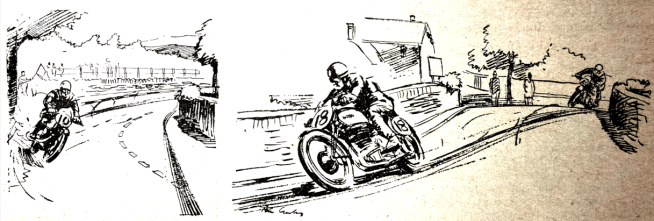
Mussett, after the long journey from Australia, is denied a replica by engine trouble at the Bungalow, but he can be solaced by the reflection that he has thoroughly proved his mettle, and earned credit for his country. The moving finger writes. The Island has accustomed us to surprises, but they are apparently being postponed till Lap 7 to-day. Stanley would look to be shifting if we hadn’t seen the BMW, but a 25min 29sec lap is the best he can do. Frith is a fraction the faster of the pair, but is still fourth. Jock West keeps his distance from them comfortably, as does Meier, despite a pit stop. The scoreboard is very late with times hereabouts, Frith’s figures not being posted until he has practically reached Kirkmichael. Of course it doesn’t matter particularly, as eye, ear and dials sufficed to inform us all that the BMW mastery was well maintained. West’s exhaust seemed almost to shake the grandstand as he tore past, well down to it. Both his engine and Meier’s sounded as crisp and threatening as on the first lap. Nothing but sheer catastrophe could now rob the BMWs of a thoroughly convincing victory. Tyrell Smith made a long halt about this time somewhere between Kirkmichael and Sulby—it looked like a final halt, although his retirement was not announced. And MD Whitworth, who has had a most successful week, actually forced his cheeky little Junior Velocette into a vacant place thus created in the tail of the ‘formation’. ‘All over bar shouting’ was the universal impression as the field entered upon their final circuit. Usually we half expect some kind of crack-up in the concluding stages of a TT, but not so to-day. Meier bellowed his raucous way round in 25min 31sec without the ghost of a check. Without the aid of a record lap he established the fastest Senior time ever accomplished, beating the Norton’s 1938 figures by 31 seconds. Though his consistency and reliability had stripped the race of thrills, we all rose to yell our congratulations. He came to the microphone and made a short speech in German, which Baron von Falkenhayn translated to us. The German banner was promptly hung over No 49 on the scoreboard, plus the usual laurel wreath. Jock West, on the second BMW, was an unassailable second, 2min 20sec behind Meier. Frith contrived to pip Woods by seconds for third place; but JH White was well astern of Woods. The list of finishers tells the rest of the story. We rejoice in the German victory, for more reasons than one. It cannot console them for the death of that fine sportsman, Karl Gall but defeat on the top of mourning would indeed have been hard to bear [Gall crashed on the first lap of evening practice while trying to overtake Norton rider Freddie Frith on the approach to Ballaugh Bridge; he died in hospital—Ed]. For ourselves we must say as Kipling said after the Boer War—’We have had the hell of a licking; it will do us a world of good.’ Subject to confirmation of the respective wind forces in 1938 and 1939, it looks as if unblown singles can be set an impossible task by blown multis; and we must look forward confidently to seeing British firms develop the more advanced design. RESULTS: G Meier (494cc BMW), 89.38mph; 2, JM West (494cc BMW); 3. FL Frith (499cc Norton); 4, Stanley Woods (495cc Velocette); 5, JH White (499cc Norton); 6, LJ Archer (495cc Velocette); 7, EA Mellors (495cc Velocette); 8, S Wood (499cc Norton); 9, M Cann (496cc Guzzi); 10, JC Galway (499cc Norton); 11, WF Rusk (498cc AJS); 12, MD Whitworth (348cc Velocette); 13, AR Foster (498cc AJS); 14, JE Little (348cc Velocette); 15, ER Thomas (495cc Velocette); 16, HC Lamacraft (348cc Velocette); 17, ES Oliver (348cc Velocette); 18, NB Pope (499cc Norton); 19, JW Beevers (490cc Norton); 20, N Croft (490cc Norton); 21, G Newman (348cc Velocette); 22, FW Fry (348cc Velocette); 23, WT Tiffen Jnr (348cc Velocette); 24, N Christmas (348cc Velocette); 25, TK Boardman (490cc Norton); 26, HB Myers (490cc Norton); 27, SM Miller (348cc Velocette); 28, F Anderson (346cc DKW); 29, H Hartley (499cc Rudge); 30, RJ Weston (490cc Norton). First-class Replica winners: Numbers 1-13 inclusive. Second-class Replica winners: Numbers 14-27 inclusive. Newcomers’ prize: G Newman (348cc Velocette). The Motor Cycle Visitors Cup: G Meier (494cc BMW), Germany. Manufacturers’ Team Award: Velocette (Stanley Woods, LJ Archer, EA Mellors). Club Team Award: Derby and District MC—MD Whitworth (348cc Velocette), Stanley Woods (495cc Velocette), EA Mellors (495cc Velocette).”
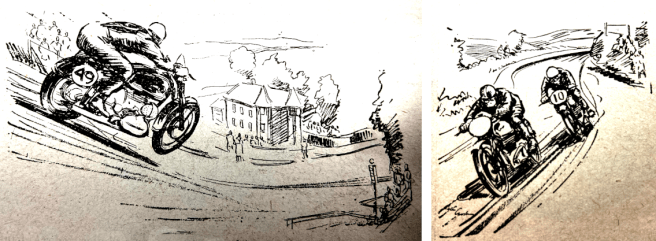
“INTERVIEWING A VERY HAPPY German who does not speak a word of English immediately after he has won the most famous road race in the world is not the easiest of tasks, and Meier was much too excited to want to talk seriously. He was as fresh as the proverbial daisy when he came in at the end of the ride and he seemed to be in no hurry to have a wash or get out of his leathers. Later it was learned that Meier was laughingly grumbling at his team manager for giving him the ‘slow down’ signal throughout the race. Meier’s remark was that he had come over here to race, and as it turned out he had had a most comfortable ride. The first thing Jock West said to me when I congratulated him in the paddock was: ‘How did you get back from Glen Helen so quickly?’ I had been watching the race on that aide of the course and twice Jock had seen me, and once he almost waved! So I can vouch for the truth that he had a really easy ride. He said: ‘I’m almost ashamed; I did not even have one rear-wheel slide.’ He, too, was very fit at the finish and fresh enough to examine the comparative wear on the rear tyres of his own and Meier’s machine. Freddy Frith’s achievement in getting his Norton home in third place was really magnificent, for on the third lap he lost the near-side footrest and for the rest of the race had to use the rear rest, which is fitted for use on the very fast stretches of the course only. It can be imagined what a handicap this must have been, particularly as the missing rest was on the brake pedal side. Other than this, he said, the race had been without real incident—the machine seemed to improve as the race progressed and he thought that it was definitely producing more power on the last three laps. “
“AS USUAL, THE SENIOR machines finished in first-class order, though the palm must be awarded to Meier’s BMW, which finished like a new machine except, of course, for the rear tyre. Even this part, however, was in good condition—about as good as the rear tyre of Frith’s Norton and possibly rather better than that of West’s BMW. Accessories on all machines were perfect, and particular mention must be made of the admirable state of the chains on the Norton. There was plenty of adjustment left on the brakes and clutches of all three machines. Incidentally, the BMW brakes are intercoupled in a very neat manner. No praise can be too high for the condition of Meier’s BMW—it was clean externally and internally. The flat-top pistons have three rings above the gudgeon pin and a scraper ring below. The sides are heavily relieved at the gudgeon-pin bosses and very slightly relieved all the way round at the same level. Pistons And rings were in perfect condition, as were the hemispherical heads and the valves. The ohc gear was clean and cool and the cylinder bores perfect. The light-alloy heads are held down by eight long bolts. The engine-gear-and-supercharger unit is outstandingly neat and the huge crankshaft with its short polished-steel connecting rods looked cool and clean. Jock West’s machine was similar and to all appearances was equally good as regards condition. It is said that the BMWs can race on quite soft plugs, but West, at any rate, had not taken any chances in that direction. Frith’s Norton was identical with last year’s racing model and finished in very good condition throughout. There was nothing broken and nothing that looked in the least hot and bothered. The exhaust valve had been warm, but was no more affected than would be expected in a 500cc single after a really tough race.”
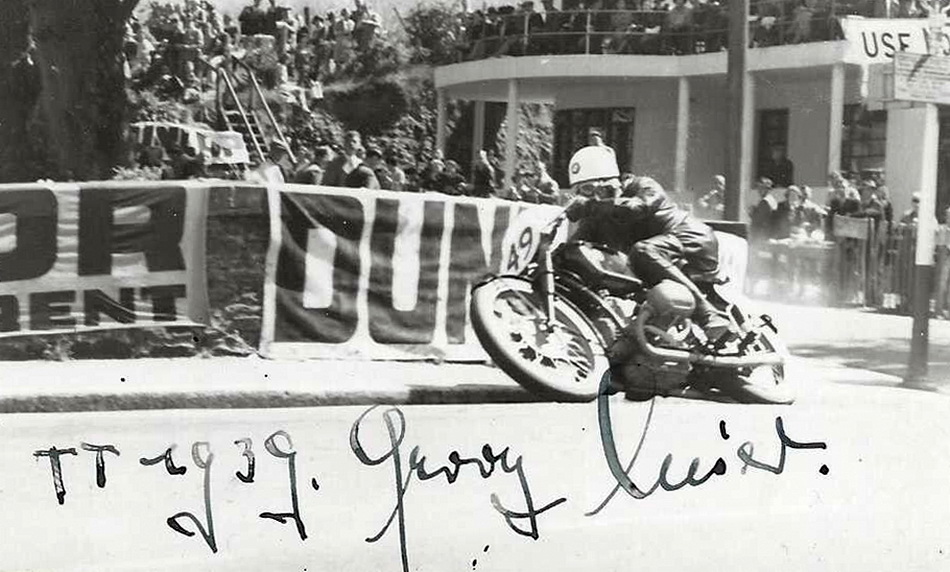

“THE PROPHETS HAD ANTICIPATED a fierce struggle at record speed with four DKW machines, two Guzzis and the Benelli fighting out the issue, since Continental markets develop the 250cc engine far more intensively than our own. But only two of the invaders combined real speed with reliability, and the weather, which deteriorated from poor to vile, effectively limited the speed. EA Mellors (Benelli) assumed the lead on Lap 2, was never again headed, and scored a very popular victory in 3hr 33min 26sec, his speed of 74.26mph being naturally much lower than Kluge’s in 1938 (78.48mph). E Kluge, slowed by a little plug trouble, was second in 3hr 37min 11sec (72.97mph), and HG Tyrrell Smith third on his Excelsior in 3hr 40min 23sec (71.91mph). Thirteen of the 26 starters completed the course. The first seven men earned first-class replicas, and the remaining six qualified for second-class replicas. No records were established, the fastest lap being accomplished by S Woods (Guzzi) on his third circuit, in 28min 58sec (78.16mph). Kluge’s 1938 record lap at 80.35mph therefore remains unbeaten. No trade team finished complete, and the Club team prize was awarded to the Derby ‘A’ team, consisting of Mellors (Benelli), Thomas (DKW), and Hartley (Rudge). Stanley Woods (Guzzi), who was a warm favourite, stood second, eight seconds behind his team-mate, Omobono Tenni, after one lap. On the second lap Woods sustained
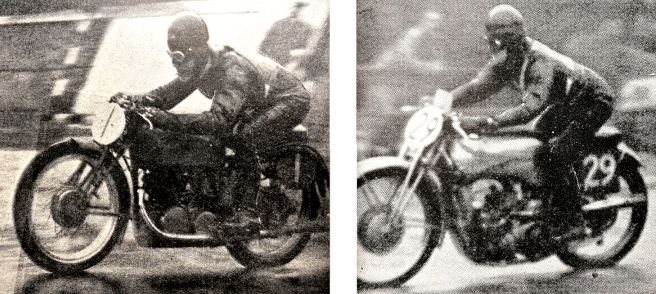
a six-minute stop. Tenni retired on Lap 3, and Woods made a hectic attempt to recover lost ground; he fought his way back to third place on Lap 4, and retired with engine trouble on Lap 5. Everybody expected to enjoy the 1939 Lightweight. ‘It lies,’ they said, ‘between half a dozen foreign machines, all of which have the legs of ours. We don’t mind particularly which of them wins. The pace is sure to be a cracker. Let’s sit back and enjoy the fun!’ But the weather had something to say. When a small island contains a tall mountain, and that mountain pokes its head into the clouds which haunt the Atlantic, the mountain has only to spike one decent-sized cloud to drench the whole island. At breakfast-time Mona was bathed in delicious sunshine. By ten o’clock Snaefell was dragging downwards a huge swathe of grey-bosomed clouds. At eleven it wasn’t exactly raining, and it wasn’t exactly misty, but the outlook was grim. Before long the tarmac glistened without being slimy; and the visibility was just a TT rider’s bugbear, because the clouds kept shifting—you would find a corner clear on Lap 1, and blotted out at 25 yards on Lap 2. Long before the finish everything was soaking, and soon after the finish foghorns were going hard along the coast, and steamers were nosing out of harbour like grannies trying to cross Piccadilly in the theatre rush.
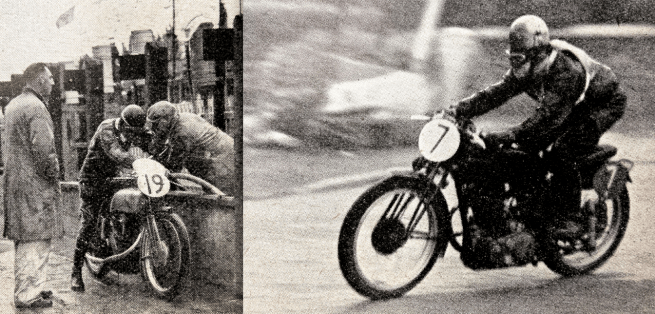
So high speeds were not to be thought of, which was perhaps just as well, for even at a slowish gait Mellors’ Benelli alone of the foreign machines was capable of absolute reliability, and if the expected records had materialised, finishers might have been very few. One or two of the foreign designers seem to be pressing these tiny engines too far. In post discussions Signor Parodi’s confidence made the Guzzis public favourites, though the DKW, with four machines, commanded respect, and many fancied the Benelli. The British fans had to decide whether to wish for Mellors’ first TT victory, or Stanley Woods’ 11th success. The Excelsiors—probably Tyrell Smith or ‘Crasher’ White—were identified as England’s faint hope. When 26 exhausts warmed the damp air at 10.30am, the absentees were Jock West (New Imperial), CB Taylor (CBT), the third Guzzi, JC Galway (Excelsior), and poor Simo, still in Ramsey Hospital. The preliminaries passed off normally. Somebody had found or replaced the Nazi banner which was lost, stolen or strayed on Monday, so the parade could be held ‘with flags’. It was now technically, though not practically, ‘raining’, the fall being about one drop per square yard per minute; but plenty more was to come. Visibility was good, and the road nowhere really wet, though a few patches in the Square at Ramsey were broomed away. The actual start produced no incidents, except that the flagman elected to hoist the
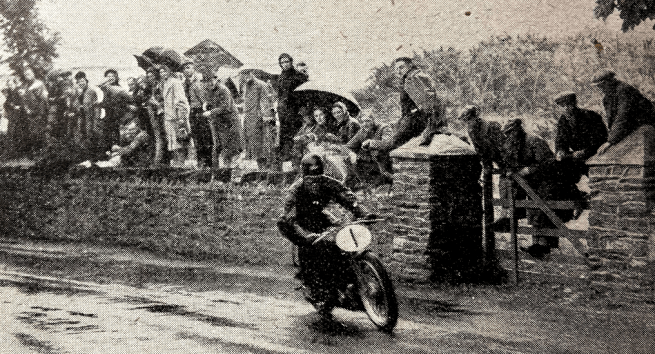
Union Jack for ER Thomas on the DKW, and Kluge kept cutting out every hundred yards—presumably to jerk the oil about When the last man had left, we all stood half a minute in silence as a tribute to that fine rider and sportsman Karl Gall, whose death overnight had brought every flag on the Island to half-mast. As always, the clocks were scanned anxiously on Lap 1 to furnish hints of current form. Tenni (Guzzi), starting No 2, soon overhauled Mellors (Benelli), who started No 1. Possibly the Guzzi’s pace startled Mellors; at any rate, he didn’t let Tenni gain much more ground over the second half of the lap. Tyrell Smith, Martin and Sorensen, all on Excelsiors, soon picked up a place or two. Thomas and Wünsche, both on DKWs, ominously had to change plugs early on. Tattersall lost a bolt from his gear-change at Ballacraine, but wired it up. Fleischmann, accounted by many one of the best all-rounders in Europe, surprisingly proved two whole minutes slower than Tenni. The other stars—Stanley Woods (Guzzi) and Kluge (DKW)—started in the tail of the roaring pack, but when they eventually arrived. Woods with his never-failing judgment was on Tenni’s tail, whereas Kluge was only fourth—where was his speed of yesteryear? With Fleischmann fifth, Tyrell Smith (Excelsior) was the sole Briton on a British bike in the first six but six others came streaking along behind him, including three veteran experts in White, Archer and Manders, and three rather unexpected dashers in Graham, Martin and Evans. Conclusion—the Guzzis have the legs of the field if they can stand up to their blowers for seven laps. Meanwhile, visibility at the Bungalow had shrunk to 50 yards, and fog was creeping right down to the Craig. Sorensen, feeling the effects of his fall on Monday, retired at the pits after one lap. As usual with these wee, overstressed engines, excitement came early.
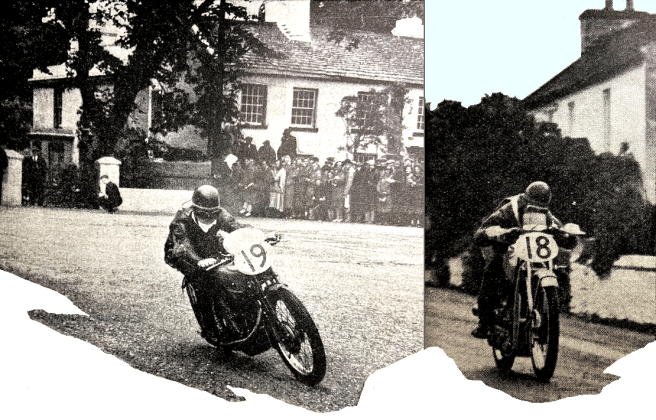
The clocks signalled what was either a furious spurt by Mellors or a slight sulking on the part of Tenni’s engine; and soon after we watched in the spirit Kluge streak past Woods near Kirkmichael. ‘Woods is out!’ was the cry; but all too late his pointer came to life again. Meanwhile, Mellors came round hot blast, having snatched no fewer than 76sec from Tenni. Woods, who had evidently sustained a delay of six minutes or so, dropped to eighth, and so boosted five men up one place apiece. Pike (Rudge) and Miller (CTS) enter the leading dozen. ‘Crasher’ White goes out with a broken spring. Fleischmann halts south of Sulby for a long time. ‘Ginger’ Wood (Rudge) and ER Evans (OK Supreme) resume after a spot of tinkering. McCredie (Excelsior) falls at Governor’s Bridge, but carries on, though Dickwell (Benelli) retires after a similar experience at the same spot. There were fun and games at the foot of Bray on this lap when a gas main blew its lid off, nearly hitting Tattersall, and the fire engine and other officials got rather in the way for a few moments. Two men out—there’ll be others yet! Graham, Martin, Manders and Archer continue their good work. The next sensation consists of Tenni calmly ringing-up Signor Parodi from Ballaugh—surely a TT novelty? Apparently he sought permission to retire, which may be etiquette in dictatorial states. Anyhow, retire he did. And the Guzzi stock sagged heavily, though Woods was evidently out for blood, for he
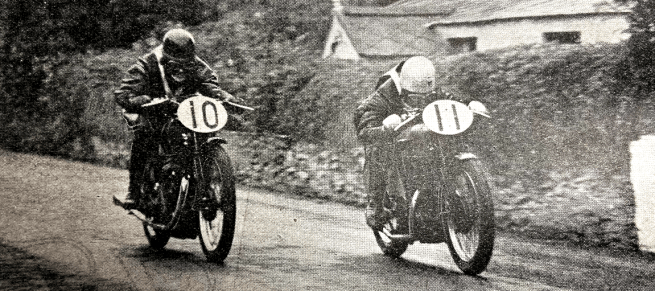
terrified the crowd at Ballacraine by over-shooting that ugly corner, swirling round non-stop in the roadway, and regaining the course. Mellors makes his first pit stop after three laps, and worries himself and us by needing three attempts to restart; this is his fastest lap to date, but owing to the worsening conditions is 61sec outside record. Woods registers what proved to be the fastest lap of the day in 28min 58sec (78.16mph). Stanley knows his Lightweight—there is usually a massacre of the fast men in the later laps, and a dare-devil with a good engine can make up even a six-minute stop. Kluge is punctual and fast, but can’t catch the Benelli. The Fleischmann mystery deepens—he has vanished into thin air short of Sulby and neither riders nor marshals can discover a trace of him. Police are instructed to hunt for a mournful wanderer, who can speak no English. Miller fixes his damper at the pits. ‘Ginger’ Wood warns the stewards that if he gets lost, want of plugs will be responsible. Hartley (Rudge) enters the leading dozen. By now the rain is quite heavy, the roads are thoroughly wet, and though the fog waves like a curtain in a draught, visibility in places is no more than 25 yards. The Benelli continues to transport 12 stone of Mellors at over 75mph. Tyrell Smith, encouraged by the failure of so many foreign machines, conceives hopes of victory, till he nearly takes the grass near the Bungalow, starts a heart-stopping wobble, but puts both feet down, regains control and dives onward. SM Miller (CTS) retires at Ballacraine with loose forks, and RL Pike (Rudge) changes a plug at the same place. Woods again overshoots Ballacraine—are his brakes
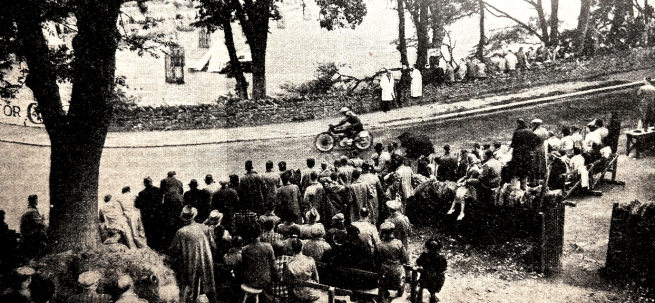
faulty? We can hardly believe he could misjudge a corner which he knows as well as his own fireside; he is reported to be riding fiendishly. He actually regains five places in three laps, and evidently means to re-catch Kluge. Meanwhile, the Fleischmann mystery is partly solved, for he trudges into Sulby; but how he got there unseen, nobody can guess. Thomas (DKW) tinkers at his pit. ER Evans has been missing for two laps, and is evidently out. R Pike (Rudge), after three good laps, grazes his arm in a spill at Governor’s Bridge and calls it a day. Nine retirements so far. The focus at the moment is Stanley’s evident resolution to catch Kluge; if he succeeds, Mellors on the Benelli must mind his step. Lap 5 brings an early sensation when the Guzzi resents Stanley’s thrashing and decides near Crosby to motor no more to-day. The other leaders circle monotonously, Mellors drawing away slightly from Kluge, who stops again for fuel and clean goggles—goggles are a perpetual nuisance in this drizzly mist. Tyrell Smith cannot pick up time, but hangs on grimly. Wünsche, after a brief stop on the previous lap, shows his teeth by jumping up three places. Poor Archer drops out with engine trouble when lying seventh—no luck on Monday; no luck to-day; perhaps Friday will make amends? Hartley (Rudge) catches Thomas (DKW), and defections ahead admit W Pike (Rudge), ‘Ginger’ Wood (Rudge), and Lamacraft (Excelsior) into the first 12. RL Graham (CTS), whom no tipster fancied, is now riding fourth, with LGF Martin (Excelsior), another dark horse, only 20sec behind. Be it understood that neither the Rudges nor the Excelsiors are ‘works’ entries, and their plucky wrestle with the keenly organised invaders will appear in its true colours. The race is now definitely set.
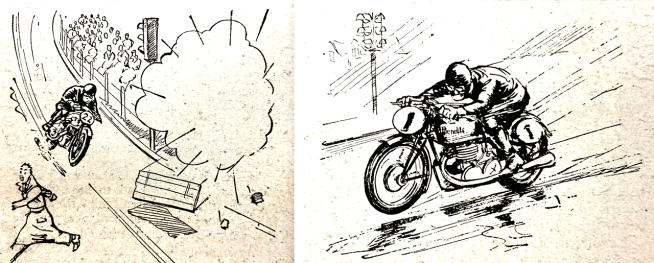
The intervals between the first half-dozen men are too wide for mere riding skill to alter their relative positions. Nothing but trouble or a spill can now affect the result. Slippery roads, varying visibility and wee engines limited thereby to between 68 and 75mph average provide no scope for bringing a hectic lap out of the bag. Safety-first must be the leaders’ slogan; take no risks; make no mistakes; and if the bus sticks it, you will automatically finish where you are. Sharp to time Mellors flogs his red Benelli past us to start his final circuit. He is rock-steady lying flat down to it; his exhaust as crisp and clean as ever. His heart must surely palpitate a bit as he dreams of his first Trophy? Round come the others—Kluge, Tyrell Smith—but where is Graham? Out at Union Mills with gear box trouble; when running fourth within arm’s length of fame and glory—cruel luck! Martin gratefully steps into his shoes. HB Myers (Excelsior) retires at the pits. Each successive signal station reports Mellors fast and steady. Nobody can catch him if. he does not stop, for he has four golden, glorious minutes in hand. And he gets the non-stop he so richly deserves. Safely he crests the Mountain summit, and doubtless knows all about his long, comfortable lead. No, he isn’t flogging his engine—he’s lapping cautiously at about 74mph. He is at the Craig—here he comes, modestly flushed by an immensely popular win, and goes to the microphone to express his thanks for a tremendous ovation. Kluge, who started 14 minutes later, is still far away, but he, too, is trouble-free, and so eludes the dogged challenge of Tyrell Smith. Then LG Martin just pips Wünsche for fourth place. Behind them three Excelsiors, three Rudges, a CTS and a DKW complete the select band of men who have proudly averaged express train speeds for hours over slippery roads through a blanket of mist.” RESULTS. 1, EA Mellors (246 Benelli); 2, E Kluge (248cc DKW); 3, HG Tyrell Smith (249cc Excelsior); 4, LG Martin (249cc Excelsior); 5, S Wünsche (248cc DKW); 6, CH Manders (249cc Excelsior); 7, H Hartley (249cc Rudge); 8, ER Thomas (248cc DKW); 9, S Wood (249cc Rudge); 10, C Tattersall (249cc CTS); 11, WHS Pike (249cc Rudge); 12, HC Lamacraft (249cc Excelsior); 13, J McCredie (249cc Excelsior); 14, HB Myers (249cc Excelsior); 15, RL Graham (249cc CTS); 16, Stanley Woods (249cc Guzzi); 17, LJ Archer (246cc New Imperial); 18, RH Pike (249cc Rudge). Replica winners: The first seven are awarded silver replicas and Nos 8-13 bronze replicas. Manufacturer’s Team Award: No team finished complete. Club Team Award: Derby & District MC ‘A’: EA Mellors, ER Thomas, H Hartley. Newcomers’ Prize: WHS Pike (249cc Rudge).”
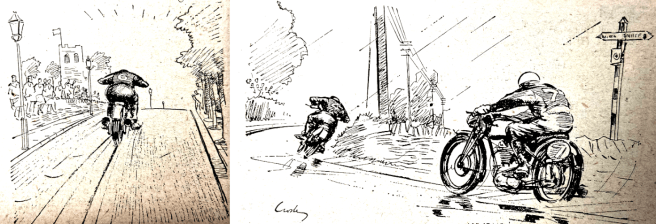
“IT IS USUAL TO FIND the Lightweight machines rather burned-up, but this year was an exception. Every visible part of every one of the first three machines was in excellent condition. This applies also to tyres, chains, clutch and brake adjustments and valve springs. The winning Benelli is an altogether charming little machine with valves set at a wide angle. Visitors were not encouraged to examine the inside, but so far as could be seen everything was in good order. Externally it was clean and showed no signs of its strenuous race. The carburettor was very large for a 250cc engine. The DKW—a trifle dirty behind the seat tube—was in perfect order. It was fitted with a 12mm Bosch plug and, unlike the 350cc model, with an aluminium-bronze head. The separate pump cylinder had a rotary inlet valve. Everything was as perfect as could be. Tyrell Smith’s Excelsior was also in first-class condition. The plug was just right and neither of the valves showed signs of over-heating. The piston and Y-alloy head were excellent. Undoubtedly the wet roads saved the tyres of all three from scrubbing. Rarely have tyres been in better condition at the end of a race.”
“THE FIRST THREE MEN home in the Lightweight Race all agreed that it had been one of the worst races for weather in which they had ridden. Their faces were nearly raw with the rain, which Mellors said, had on several occasions stung like needles, while their hands were almost numb and blue with cold. Mellors was full of admiration for his machine, which had never given him a moment’s trouble, either in practice or during the race, and he said he knew he had an excellent chance of winning as far back as last September, when he arranged to ride the Benelli. He gave a good indication of the Benelli’s speed when he said that after Tenni, on the supercharged Guzzi, had passed him at the Gooseneck on the first lap he was able to overtake him again before the Bungalow, and although Tenni repassed he was still on his tail all the way to Braddan Bridge. Mellors had no ‘incidents’. ‘Not even one skid in spite of the very small tyres,’ he said. ‘That’s the secret,’ he added, pointing to the cross-cuts on the tread. Kluge had not had such an easy race. At the end all he wanted was a hot bath and he was rushed away to his hotel almost as soon as he got off the bike. After the prize-giving he was able to talk about the ride, which, he said, was the worst he had ever experienced. The weather conditions were bad for the machine, but he only had to change one plug. This was tight in the cylinder head and he had to unscrew the plug with a spanner all the way—one can imagine how Kluge felt as he was unscrewing that plug! So far as the ride was concerned, he found that the changing weather made things very awkward, because at one spot the road would be dry and at the next it would be greasy, so that great concentration was required everywhere if the highest speed with safety was to be maintained. Tyrell Smith rode three fine races and his best was probably the Lightweight. He seemed quite fresh at the finish, even though he was wet through to the skin and his face was almost raw with the rain. He laughed about the foul weather and was more interested in an incident on the fourth lap when a bird flew out of the hedge on the Mountain road and caught up between the handlebar and the front brake lever. He was approaching the Bungalow and, of course, the front brake was rendered practically useless. He had to take to the gutter for about twenty yards and he admitted that for a fraction of a second he thought he would come off heavily. Apart from that he had a trouble-free run and the machine ran perfectly throughout.”
“NOT SINCE THE EARLY DAYS have the spoils in the TT been anything like so widely divided as was the case last week. Once upon a time the challenge came from the United States of America. Last week it was from Germany and Italy, and as all know, Germany won the Senior TT, Great Britain the Junior and Italy the Lightweight. Never before have three nations each secured a trophy. We offer our hearty congratulations to Georg Meier and the makers of his supercharged transverse-twin BMW, to Veloce, and Stanley Woods for their success in the Junior Race, and to the manufacturers of the Benelli which EA Mellors rode so magnificently to victory in the Lightweight event. These machines fully deserved their success. Although specifically designed for racing, none is in any sense a racing freak. That the BMW factory succeeded this year caused widespread pleasure, for this is a concern that has striven for years in developing the supercharged transverse-twin and in the Isle of Man has been dogged with ill-luck, including, unhappily, the death of its famous rider Karl Gall. Naturally these wins by foreign machines, more especially that of Meier in the Senior Race, are causing British manufacturers to take stock of the position. Naturally, too, there were many on the evening of the race who remarked upon our constantly repeated statement that Britain must develop multi-cylinder engines—that multis and spring frames were essential if she was to retain her position in road racing. Racing has at long last caused the wholesale adoption of one feature for which we have been pressing so long. namely, spring frames.”
“INTENSE DISAPPOINTMENT WAS FELT in the Island when Stanley Woods substituted the single-cylinder Velocette for the new supercharged twin in the Senior TT. I am glad to report, however, that the blown twin fulfils all expectations, and will be race-ripe in the very near future. Woods reports that it steers superbly. Cumbrous as the massive power unit looks when dismounted, it nevertheless permits of identically the same riding position as the single-cylinder racer, and was one of the fastest 500cc models in the Island, being capable of about 130mph. The points still requiring attention are purely subsidiary, and relate to such matters as transmission, lubrication, and the like.”—Ixion.
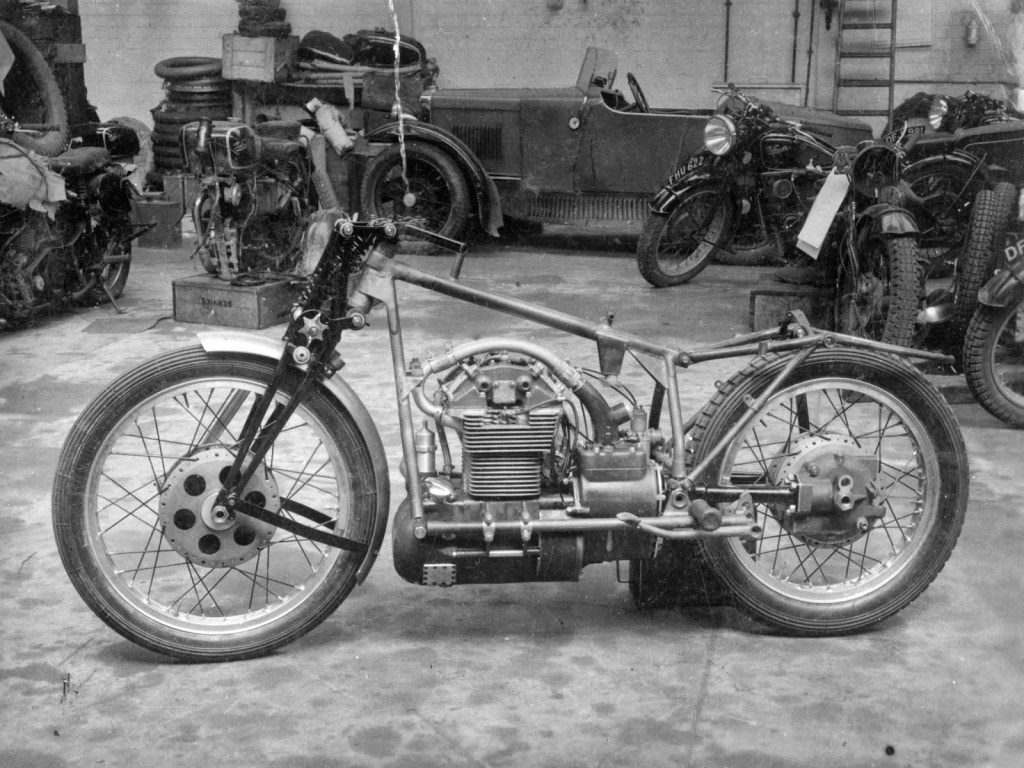
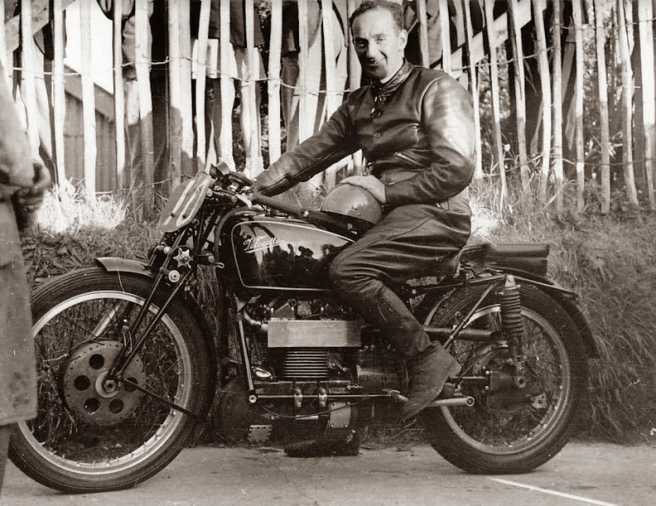
“IN SOME QUARTERS there is the suggestion that the idea of a Roadster Race, which is being considered for inclusion in next year’s series of TT Races, novel (if not copyright !). How novel it is can be gathered from the following which the Editor of The Motor Cycle wrote 11 years ago (vide our issue of June 21st, 1928), and has been mooted almost ever since: ‘The question of substituting a high-speed reliability trial for the Lightweight TT offers big possibilities. Machines of all capacities from 175 to 1,000cc would be eligible to compete, and the regulations i that naturally suggest themselves are in the main those under which the forthcoming RAC car TT in Ireland is to be held. In the case of this car race, each vehicle entered must have been fully described in a catalogue published more than six months prior to the date of the race, and be scheduled for production, constructed, or delivered to customers in sufficient quantity to satisfy the organisers that the type is, or will be a bona-fide commercial model. Also, the cars have to be in full touring trim, and no changes of any major character to the engine or chassis are permitted. Regulations of a similar nature could be framed and enforced with comparative eases.'”
“WITH A SIMPLICITY that was most moving, the memorial to Jimmy Guthrie was unveiled last Friday by His. Excellency the Lieutenant-Governor of the Isle of Man, Vice-Admiral the Hon WS Leveson-Gower, CB, DS0. The cairn is at the Cutting, on the mountain road some 2½ miles above Ramsey, and marks the point at which Guthrie retired in his last TT. The site, probably as magnificent as any that could be chosen, is also fitting because on a clear day it is possible to see Scotland, Guthrie’s home country, as well as England and Ireland. A large crowd had gathered for the ceremony, some clustered in the road—the road over which Guthrie raced—and others on the hillside opposite. Following a trumpet call Mr. Geoffrey Smith, MBE, chairman of the Guthrie Memorial Fund Committee, gave a brief verbal picture of Guthrie, the man: his quiet unassuming manner, his skill, and his achievements. Mr Smith also described how the Fund had enabled the Committee to endow beds at Noble’s Hospital, Douglas, and Guthrie’s home town, Hawick, as well as provide a British Prestige Trophy and the Memorial cairn. He then called upon His Excellency the Lieutenant-Governor, who paid tribute to Guthrie and the magnificent way in which he had upheld British prestige; and then unveiled the tablet. After prayers by Rev EH Staining, and a final trumpet call, the German representatives, Baron von Falkenhayn, and Herr Kraus, stepped forward and laid a wreath on the memorial—a much appreciated action by those in whose land Guthrie met his death. Baron von Falkenhayn said how glad he and his comrades were to be able to pay tribute to the greatest motor cycle racing man the world had known. On the following day, immediately after the last man had started in the Senior TT, the Chairman of the Memorial Committee handed over a cheque for £500 to Mr. Wm A Fyffe, the Chairman of Noble’s Hospital.”
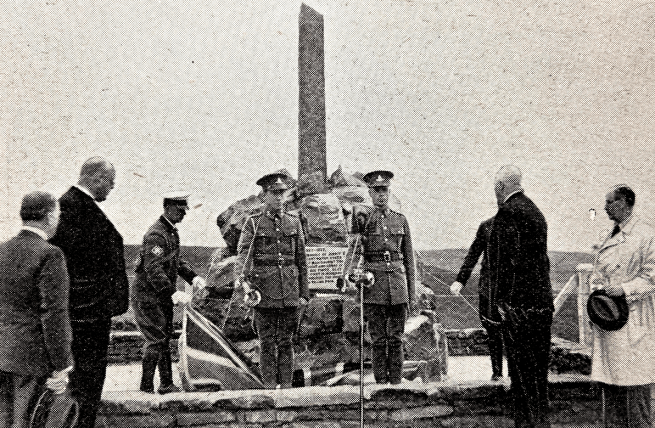
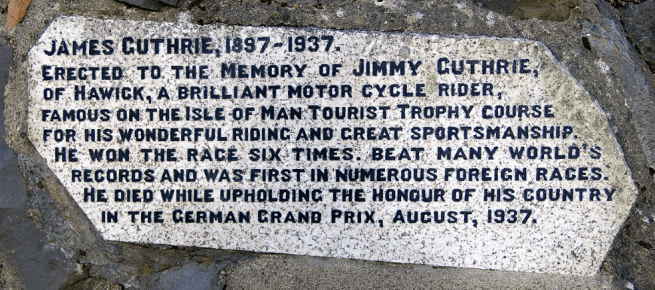

“THE 1939 TT was truly International both in representation and in the final result. Britain won the Junior, Italy the Lightweight, and Germany the Senior • • • His Excellency the Governor must have addressed the biggest crowd ever assembled for a TT prize-giving when he attended the Villa Marina following the Senior Race • • • BMWs have invited Jock and Mrs West to Munich in celebration of Meier and West finishing first and second in the Senior • • • Meier’s rank in the German Army at the time of the TT was that of sergeant-major; it was said that on his arrival back in Germany he would find himself a commissioned officer with the rank of lieutenant • • • Some competitors complained rather bitterly of spectators wandering on the course; Kate’s Cottage was mentioned as one of the worst points in this connection • • • In places the BMWs were doing 140mph. Incidentally, they seemed easily the steadiest machines on Bray Hill • • • Owing to the large number of riders in the Junior (61) several spectators seemed doubtful whether the last man would be off before No 1, Stanley Woods, came round. But even Stanley cannot yet achieve a 20-minute lap! • • • Mr Granville Bradshaw, designer of the 398cc transverse-twin ABC, the forerunner or the BMW, was an interested spectator of the Senior TT • • • Daniell’s Senior engine cut-out completely on the first lap at the blind bend above the 13th milestone—a very awkward place. Until then he was five seconds behind Meier on time. • • • At this bend only Frith and Woods appeared to be taking the turn at full bore—both men flat on the tank. • • • At the end of the Senior Race the movement of the rear springing of Maurice Cann’e Guzzi had increased so much that the shock absorber arm had worn a hole right through the exhaust pipe. • • • This year there were many complaints by local residents about the noise some of the machines made during the early-morning practice. • • • The weighing-out of the machines in readiness for the three races was a real weighing-out, for after a lapse of many years each machine was put on the scales and its weight duly registered. There was, unfortunately, a slight hitch in the arrangements, for one entrant refused to allow his two entries to be weighed. Quite naturally this caused something of a flutter in the dovecots, and there were many hurried conferences. It appears that there is no enforceable regulation to the effect that all machines mu/ be weighed—a point which many bels, may be corrected by next year. • • • Both Guzzi and Benelli machines carried spare hairpin valve springs. Tennis Guzzi had a special tool for effecting quick replacements, but changing a valve spring on a hot engine is no mean task. • • At least 20 former TT winners were in the Island last week. • • • After winning Monday’s race, Stanley Woods found himself a little hard of hearing. He was inclined to blame the DKWs, until someone pointed out that he had omitted to remove the cotton-wool plugs from his ears. • • • ‘Ginger’ Wood had an enormous arrow on the tank of his Rudge to remind him of the right-hand (or rather foot) brake. This right-foot brake was almost unique. • • • LJ Archer had bad luck in the Junior, for on the last lap he experienced gear-box trouble at Braddan and had to ride the rest of the way in bottom gear. • • • One famous rider filled up with hot oil before the race so that the engine was nicely warmed up for the preliminary canter and just right for a fast first lap. “
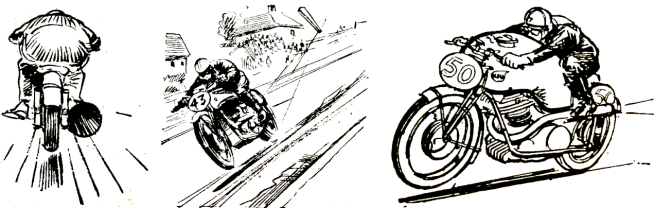
“IT WAS LIKE OLD TIMES to encounter Granville Bradshaw at the TT. As ever, he has innumerable irons in the fire, with six engines under development. I begged him to launch a modernised ABC for us, but he only looked sphinxlike. He recently sold a clever invention in the form of a woodscrew which cannot be removed when once inserted—if you think a moment, many desirable opportunities for such a screw may (or may not!) occur to you. When I crossed to the mainland one of the first people I met was WG McMinnies, the old Triumph exponent, who in his youth was quite one of the fiercest motor-cycling monomaniacs I have ever met. He lost his zest in the RFC during the war. He was about to sail to America with the Junior Car Club on the maiden voyage of the Mauretania. His mount was a Phantom III Rolls-Royce, if you please; and his co-driver was HE Symons, of Cape-to-Cairo fame.”—Ixion.
“IT IS SIGNIFICANT that the winning machine in the Senior TT was also the lightest. This interesting fact emerges from the list of weights issued by the ACU. The 500cc BMW ridden by Georg Meier weighed only some 302lb, which is lighter than any 350cc motor cycle we have road-tested over the past eighteen months, and is also lighter than quite a number of 250s. Here is a motor cycle capable of approximately 140mph, a speed nearly double that normally usable on the road, and fitted with a spring frame, a supercharger and a huge fuel tank. In addition, it has a crank-shaft, crankcase and transmission designed for a power output several times greater than that of the equivalent roadster. This machine was also adjudged one of the best road-holding motor cycles on the Isle of Man circuit. Facts, and these are facts, can cause a decided jolt to people’s opinions. Over many years we have stressed the need for lighter motor cycles and have pointed out how weight handicaps performance by reducing acceleration, adversely affecting hill-climbing and increasing fuel consumption. Some maintained that low weight was undesirable; reduce the weight and road-holding would be poor. This view, we replied, was incorrect because given efficient rear springing—which we said must and would be developed—there would be low weight plus first-class road-holding. The two factors are inter-related, and the adoption of spring frames would enable designers to reduce weight as well as endow their machines with improved road-holding. Now there is undeniable proof of all this. The questions that arise are, first: ‘How is it that a 140mph motor cycle has been made nearly 100lb lighter than equivalent (and very, very much slower) production models?’ and, secondly: ‘Can the knowledge be applied to touring machines?'”
“WE BRITONS CROSSED to the Island this year in a state of foreboding. With the exception of the Velocettes, practically every British entry was backed only by an agent or a keen and more or less amateur individual. This state of affairs was due to one main factor—unwillingness to spend many thousands of pounds on developing the type of engine (supercharged multi-cylinder) with which the future of motor cycle racing is undeniably bound up. We knew the blown twin Velocette would not start; we knew that the four-cylinder AJS machines were neither ‘race-ripe’ nor out for blood; we knew that two German and two Italian teams were ‘national’, had the full power of great factories behind them, and could put up riders who rank as the supreme stars of their respective nations and were quite capable of rounding the Manx circuit at speeds of winning calibre. It was on the cards that we should lose all three trophies. Well, things didn’t turn out quite so badly as all that. Woods and Daniell maintained British prestige nobly in the Junior, though Fleischmann on the DKW gave them a rare run. Fleischmann does not know the Manx course inside-out yet, nor is his engine quite so developed as the 250cc of the same make; he will probably beat all unblown single-cylinders next year. In the Lightweight we were never in the hunt, and when the little Guzzis are right, our existing machines would have a struggle to squeeze one into the first six. But the Senior more than either of the lesser events chalked the writing on the wall. Woods and Frith rode splendidly; but our defeat was even more complete than it looks on paper, for the following reasons: Splendid rider as Meier is, Woods and Frith would lose him, if he were mounted on a replica of either of their machines; he does not know this long and difficult circuit as they know it. He and West were being given the ‘steady’ signal as soon as they clinched their lead. Meier won because he had such an enormous surplus of reserve speed over the Velocette and Norton that he could lose time on the really tricky and dangerous bits, and more than pick it up along the straights and in acceleration. West is something of a question mark. It is only when sitting on a BMW that he accomplishes the sensational. He may have reached full star class as the result of a season and a half on this ultra-fast machine; or he may still be well short of it, but he beat Woods and Frith by dint of the factor which enabled Meier to beat them. If we compare machine with machine, the BMW has oodles of power and speed in hand over the best of our unblown single-cylinders. In this class there are just two gleams of hope. First, that the blown twin Velocette will be ready for 1940, and should hold its own. Secondly, that the new four-cylinder AJS has, it seems, already captured that most elusive of all racing qualifications, high-speed reliability. Two entered the Senior. Neither compared in the vital feature of road-holding with a BMW, a Velocette, or a Norton. Both finished; and in spite of minor bothers their speeds were 80.65 and 79.57mph. This achievement indicates that with better luck and perfected road-holding, they should be formidable in 1940. Let it be clearly stated that these temporary eclipses imply no slur on British design or workmanship. Without finance, enterprise is impossible. As so often before in the field of motors we have allowed the foreigners to steal a march on us, to take a forward step a couple of years before we took it. Nobody can blame our factories. They receive no Government support or encouragement. Indeed, their task is rather hampered by the Government failure to build better roads; to free the little ‘uns from vexatious and unnecessary restrictions; to reduce the horse-power tax, etc. If it were not for the export trade and questions of prestige, it is an open question whether it pays any British factory to race on the grand scale. It will soon become obvious that it will not pay to race on anything short of the grand scale. It is doubtful whether, in any case, it will pay British manufacturers to develop champion 250cc racers. Factories such as Veloce, Norton and Excelsior have a very thorny dilemma to solve in the near future, unless the Government supports them. For no matter how jealous factories like these may he of national honour, they are fundamentally commercial concerns and cannot spend £20,000 on producing super racing machines unless they are going to get that money back plus dividends as the result of their victories.”—Ixion.
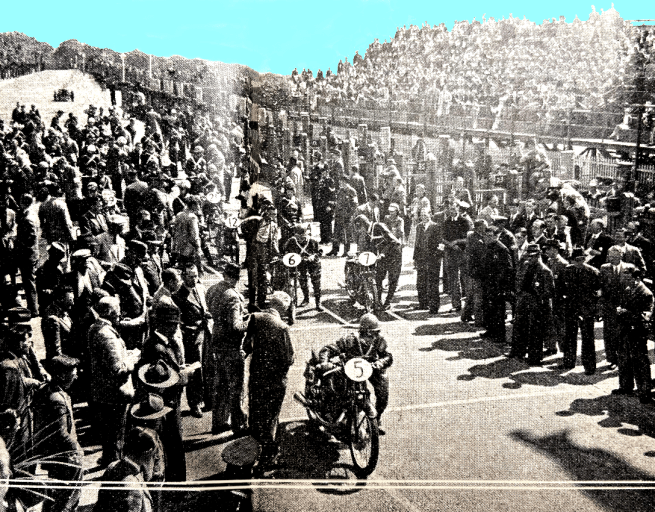
“FROM MY EXPERIENCE the best reply to Nitor’s question on summer riding kit is the Barbour’s International one-piece suit. The greatest drawback to one-piece suits is, I believe, the difficulty of getting them on and off, but I have no such trouble with my International—perhaps because I am not too lazy to remove my boots first. The suit was purchased early in May of last year, used right through the summer and found ideal. A zipp fastener allows the front to be opened or closed to the desired degree according to the weather conditions, and—what I consider to be its greatest advantage—anything can be worn underneath—even bathing trunks! It is, of course, quite water-proof, light in weight (mine weighs just under 61b), folds up very compactly, and can be strapped to the tank with its own belt. For footwear I use black rubber ankle boots over which the legs of the suit are strapped, thus making it impossible for water to get inside. They look like ordinary boots, cost only about 8s, and are far neater than knee-boots or waders. If I intend using headgear, I wear a helmet. I find a peaked cap tends to blow off at speed or in a high wind, unless one’s head is held down. Reverting back to the suit, although it proved quite cool in summer, it is equally warm in winter. I continued riding all through the Christmas frosts with only two pullovers extra to a lounge suit, and only my hands felt the cold. I have one small grouse against this suit, and that is its greasy appearance. It looks wet with oil, although actually it is quite dry and clean. Cannot this be improved upon, Mr Barbour?
AL Kempsterm, London, WC2.”
“THE FOLLOWING IS the nearest I have been able to find to a perfect summer riding outfit: White linen over-all suit; one-piece oilskin suit; abbreviated waders; silk or thin woollen scarf ; headgear and gloves to choice. On hot days the white suit is cool, gives protection against dust, and looks smart. The oilskin suit folds into a small space in fine weather and gives protection against rain. On a very chilly evening both suits can be worn, and together provide ample warmth. Any normal clothing can be worn under this equipment, and the amount adjusted according to the temperature. If riding breeches and boots are the choice, then the waders can be dispensed with. Incidentally, I like a handlebar screen even in summer. The disadvantages of this equipment are its initial cost and the cost of laundering the white suit, unless this can be done at home.
Harold Thompson, Harrow, Middlesex.”
“I WONDER HOW MANY readers can recall a machine which adorned my stable throughout the war—a 500cc horizontally-opposed twin ABC with the engine mounted Douglas-fashion, instead of athwart like its younger and more famous sister? It was not, in fact, a very good bike, but was a lovely starter and very reliable, which was just as well, as I don’t suppose any spares were available. Only three or four were ever made.”—Ixion.
“HAVING just read the letter from Mr JM Roberts re ABC motor cycles, I feel it a duty to reply. I still have in my possession one of these most remarkable and unique machines, although I have not ridden it for some time now. The machine is at present fUlly dismantled and is in process of renovation, as I cannot allow the bike to suffer from old age. I can folly endorse Mr Roberts’ remarks concerning the remarkable qualities of this outstanding design; in fact, I could almost write a book on the subject, having owned several. Incidentally, up till a few years ago, I claim to have owned and ridden a model of every motor cycle made, but the ABC was ‘IT’. In conclusion, I would like it to be known that the first spring-frame transverse-twin ABC was made by hand (I once knew the foreman who claimed this distinction) at Messrs Sopwith’s, in 1918, and was put on the market in, I believe, 1920.
AJ Coleman, London, SE4.”
“THE CONSENSUS OF opinion among ABC owners was that in outline it was a magnificent design, wrecked by premature production and inadequate development. When it chose to behave nicely for a brief spell it was a lovely machine to ride—light, smooth, docile, fast and economical (I never spilt mine on grease). But certain components, both major and minor, were far from right. The valve gear was a source of chronic trouble. The kick-starter was a holy terror. The clutch was never above suspicion. Nobody with prolonged riding experience of it ever wished to see it resuscitated without change; its fans always hoped that it would be revived with a few simple modifications to eradicate faults which formed no essential feature of the basic design.”
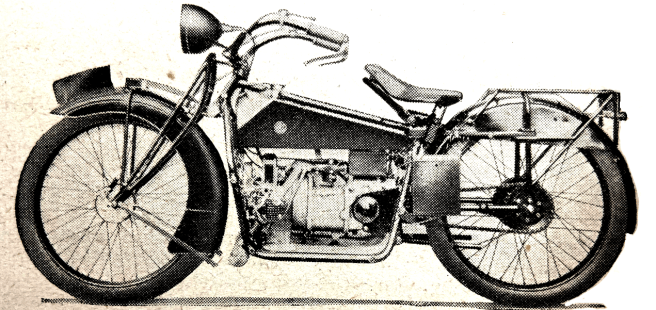
“WHAT A LOVELY spring frame has been designed by Mr Bradshaw for the Panthers. No pins, shackles or sliding parts to get full of dirt and rattle; it is certainly worth waiting for. With regard to the new Panther twin, may I implore Mr Bradshaw to give us two things? (1) Complete mechanical silence; (2) at least 500cc, and thus avoid two of the serious mistakes made with the Panthette. Is it too much to hope for shaft-drive?
GH Illingworth, Leeds.”
“MAY I THANK MR GH Illingworth for his appreciation of the simplicity of the Panther rear springing? I hope that it will come up to his and other riders’ expectations. If it turns out to be troublefree, perfect in steering after 50,000 miles, and within the reach of most riders’ pockets, I shall feel that I have achieved the main objects. With regard to his queries on the ‘twin’ engine, it is much too soon to talk, but I think that I can satisfy him on the two queries he raises, ie, it is of 500cc capacity, does not contain a single gear wheel, and I have betted Mr. Moore, of Cleckheaton (who is taking great personal interest in the building of the first batch) that it will be as quiet as his new 2½-litre car. If all goes well we shall see it at the Show, but many thousands of miles will have to be covered before Messrs. Phelon and Moore will decide to go into production. This is all to the good, and brings to my mind the somewhat unpleasant production phase of my old ABC machine which Ixion and others have discussed. In giving the following brief particulars, I have a feeling that we have reached the stage when we should forget the past and what prestige it might have brought to the British motor cycle industry, and should concentrate upon the future and the return of that prestige. The ABC company started life to design aeroplane engines four or five years before the War, and having obtained the British Duration Record, the Michelin Cup, the Shell Trophy and 22 firsts out of 24 cross-country events, we were told by the ‘Powers-That-Be’ that ‘they could not discern any utility for warfare in any form of aircraft’. And in order to prevent the company closing down from lack of orders, I used experience gained in aircraft engines, and built a 500cc opposed ‘twin’ with the engine mounted Douglas fashion. The final machine was on the market early in 1914, with front and rear springing and a four-speed gear box with gate change, and by August we had reached an output of some five or six machines per week, with a considerable number of orders on hand because Jack Emerson (whom we had taken on as our rider) succeeded in securing the mile and km records and many wins on the track. Our factory was on Brooklands track. Immediately the War broke out it was commandeered and we were given 48 hours to move, which completely put a stop to What might have been a promising business. The engine itself, however, was built in large quantities throughout the War for portable wireless, portable searchlights, trench pumps and numerous other uses. Long before the War finished I had preconceived ideas of a type of machine I would build when hostilities ceased, and in 1919 there appeared the transverse-twin, which apparently was sufficiently good in conception to have remained a topic of conversation for over 20 years. It weighed 204lb, and was of 400cc capacity, the idea being to appeal to the masses and not to the sporting element (an ideal which I now think was wrong). It took the hour record on more than one occasion against the best of 500cc machines, it did spectacular climbs at Sutton Bank when other machines failed to climb the hill at all, and in its short and hectic career it won between 30 and 40% of all the races it entered at Brooklands, with the result that we received firm orders for no fewer than 45,000 machines. From this minute onwards, Ixion is right in stating that it was wrecked by premature production and inadequate development. The factory had previously been devoted to the building of aeroplanes, which in those days were made of wood. , Strenuous efforts and unlimited capital (over half a million pounds) were devoted to supplying this colossal demand, but there is a great deal more in the production of the perfect motor cycle than the mere manufacture of parts, add thus before the testing and development phase was completed the well-known slump set in and the bulk of the orders were cancelled. During this period we were approached by France and Germany for manufacturing rights, and the result of concentration upon the type is undoubtedly to be seen in the recent TT successes of a foreign machine. Here is an object lesson that should not be repeated, and in my view an old-established firm with full knowledge of the requirements of motor cycle manufacture, of the motor cyclist and of the importance of upholding a reputation is greatly to be desired; hence, my greater feeling of confidence in working with the Cleckheaton engineers. Let me say again—it is premature to talk at this stage. Designs can only survive if tHey are technically worthy—and the production engineer mUst play a very important part. That British manufacturers will come back again I, personally, have no doubts.
Granville Bradshaw, London, W1.”
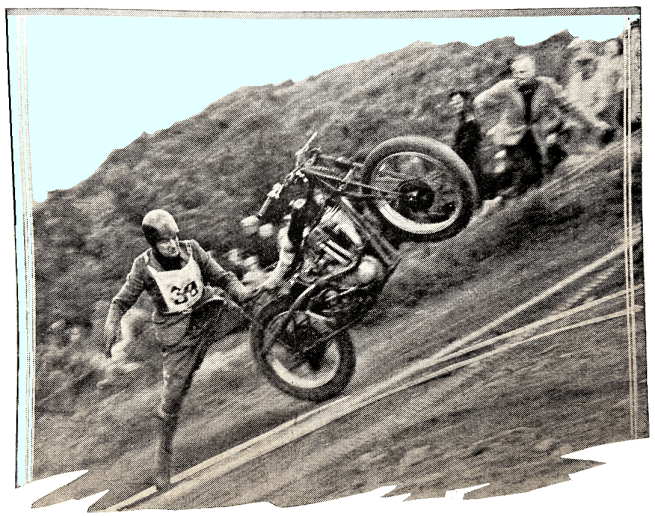
“A SIMPLE yet practical self-contained engine and drive unit for attachment to a normal bicycle has been patented by Mr CH Harrison, of the British Anzani Engineering Co (72-74, Windmill Road, Hampton Hill, Middlesex). The unit is attached to the frame at two points, and the only extra parts required are a longer rear-wheel spindle and a bolt to take the place- of the usual saddle-tube pinch bolt. Links pivoting on these two points allow parallel movement on a long pressed-steel back-plate, which is normally mounted on the near side just behind and approximately in line with the fork tubes. The 60cc (44.5x39mm) two-stroke engine is mounted out-side this plate, and retained by two of the crankcase bolts and the silencer bolts. On one mainshaft (outside or remote from the back-plate) is mounted the flywheel magneto, but the other mainshaft passes through the back-plate and carries a 10-tooth sprocket, which is connected by a chain to a 17-tooth sprocket on the 3in-diameter friction pulley. This pulley, which runs on ball bearings, bears on the tyre of the rear wheel, and grip is obtained by means of carefully designed splines…The carburettor is attached directly to the inlet port and fed with petroil from a small cylindrical tank which is bolted to the back-plate immediately above the engine. Both top and bottom swivel links have a limited travel, and, since they are attached to the back-plate, move the complete unit. This arrangement is provided for disconnecting the drive; thus as the unit moves upwards the friction pulley clears the wheel. The top link forms a right-angle, and is connected by means of a Bowden cable to a handlebar lever which has a single ratchet. When the lever is raised the unit is lifted, and the bicycle can be ridden in the normal way. At the same time, by an ingenious inter-connection of this cable with a small bell crank, the compression release is depressed, and thus the engine is stopped even if the throttle is not closed. When the handlebar lever is released the unit drops until the friction pulley is seating on the tyre, due to its own weight and also to the action of a small coil spring fitted between an ear on the back-plate, and an arm on the bottom swivel link. Other handlebar controls are the throttle and the strangler. The outstanding feature of the design is the ease with which the unit can be fitted and its suitability for any pedal cycle. Another point is that the complete unit weighs only 211b…A short road test of the experimental unit clearly demonstrated its practicability. The lever which disconnects the drive was easy to operate, and when re-leased the engine started immediately. Driving was a simple matter of throttle control, as the engine would pull comfortably at speeds lower than that at which the rider could balance. An important point is that the engine is mounted low, so that normal balance is not affected. There was no vibration, and the drive did not slip; it is understood that slip does not readily occur even in wet weather. Production is not contemplated by the British Anzani Company owing to pressure of other business; hence the design is available to any interested manufacturer.”
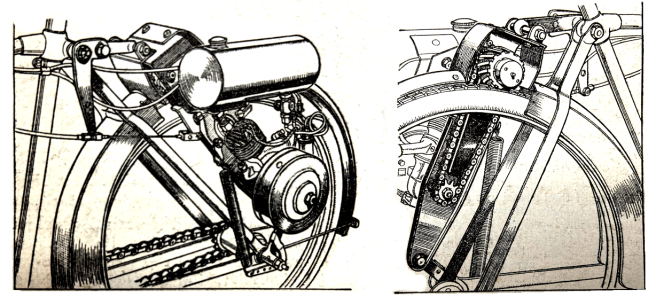
“IN VIEW OF THE INCREASING public interest in lightweight utility machines, conditions would appear to be favourable for a revival of that handy little vehicle the motor scooter. From America, where there has been a new boom in these intriguing runabouts, there has just arrived a practical and well-made little machine known as the Moto-Scoot. At the present time its use in this country is confined to holiday camps and the like, but there is no reason why it should not give good service as a road vehicle, particularly for short journeys and as an auxiliary to a car or a larger motor cycle. In its simplest form the Moto Scoot has a single gear and a ¾hp side-valve four-stroke engine, but other models are available with engines from 1-2½hp, with either a two-speed Albion gear box or a simple variable gear, provided by means of an expanding engine pulley. In the least expensive machine the transmission is by means of a vee-section rubber-fabric belt to a countershaft, thence by chain to the rear wheel; but the gear-box models have
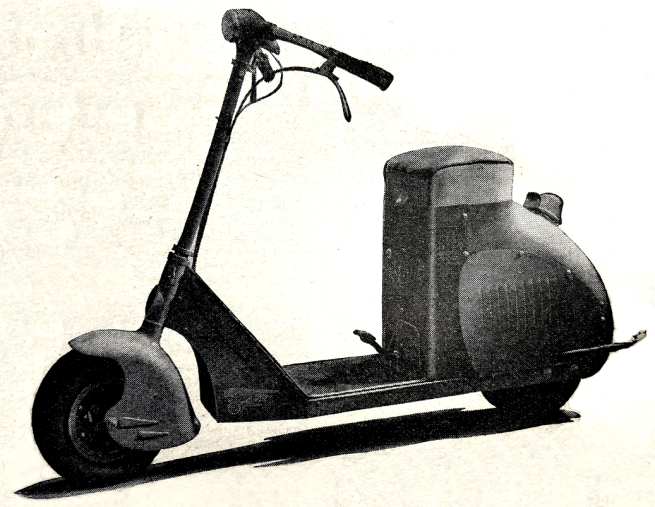
chain drive throughout. The countershaft is supported on two long arms attached at their lower ends to the rear wheel spindle, about which they are free to pivot. A long tension spring connects the countershaft to the rear chassis member, so that the primary drive is kept automatically tensioned, the pull of the belt counteracting that of the spring. This arrangement also pro-vides a form of clutch, since the countershaft is connected by means of a Bowden cable to a handlebar lever, and when the lever is operated the countershaft is pulled forward, thus causing the belt to slip…The mainshaft carries the driving pulley or sprocket on the near side, and on the off side there is a large cooling fan. Beyond this is a pinion which engages directly with the segment of a lever-type kick-starter. Splash lubrication is employed, and the oil is carried in a sump formed integrally with the crank-case casting. A simple type of carburettor is used, and this incorporates both air and petrol filters. It is operated by an inverted lever on the handlebars. Incidentally, the clutch and throttle levers are the only controls on the handlebars. The pressed-steel chassis is reinforced by cross-members, and electrically welded to ensure maximum strength. In the least expensive-model the forged steering head is bolted to the chassis, but in other models welding is employed throughout. Easily detachable shields completely enclose the engine and gear units, and on some models the rear portion of the housing forms a useful locker. Tubular front forks are fitted, those of the de-luxe models incorporating a simple type of springing. Other interesting features are pressed-steel wheels, a substantial prop-stand, electric lighting, balloon tyres and a foot-operated external-contracting rear brake.”
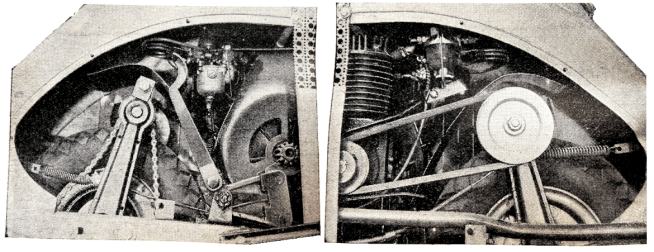
“BELOW ARE DETAILS of a tour I recently carried out on my Excelsior autocycle, which may interest present and prospective riders of motorised bicycles. Barring an oily plug no trouble was encountered during the run, which lasted eight days. We (myself and a friend on a Rudge) started from Bristol at 2.30pm one Saturday, and rode through Bridgwater, Minehead and Porlock to Lynton. After a tour round on Sunday we continued through Ilfracombe, Barnstaple, Bideford, Clovelly, Bude, Boscastle and Wadebridge, and stopped for the night at St Columb Major. At eleven o’clock on Monday we travelled through Newquay to Perranporth. Although it was early in the day we decided to stop and see the famous Blue Hills. We then continued to Portreath, St Ives, Penzance and Land’s End. From Land’s End we cut back through Penzance, Truro, St Austell, Fowey, Polperro and Looe to Torpoint, where we stopped in the little village of Antony. On the Wednesday we crossed the ferry to Plymouth and rode through Totnes to Torquay. We stayed a few days in Torquay and than pushed on to Exeter. At Exeter we turned back and encircled Dartmoor, finishing up at Princetown. After tea we travelled to Taunton via Honiton. On the Sunday we made for Bridgwater, Burnham and Weston-super-Mare, and arrived home in time for dinner. We were not out to cover any great mileage or set up any records. Throughout the tour the machine gave wonderful service, although, of course, it had to be assisted by the pedals on some of the steeper hills.
R Chappelle, Bristol.”
“THE LETTER OF your correspondent, ‘Annoyed’, raises once more a question which appears to have caused numerous motor cyclists, myself included, much worry. In view of the increased taxation, many of us will be asking the question, ‘Will a 350cc machine be satisfactory for sidecar work?’ There have long been rival opinions on this subject, but few riders seem to have approached the problem with the two-stroke machine in mind. Speaking from experience, I suggest that any rider faced with the necessity for economy in the future should investigate the merits of a large two-stroke, preferably water-cooled. The pulling power and reliability of this type of machine makes it, in my opinion, a thoroughly sound sidecar job.
Geoffrey Kent, Edgware, Middlesex.”
“I RUN A SMALL-CAPACITY outfit—a 350cc Redwing Panther. I used the machine solo at first, and a medium-weight side-car was fitted later. My outfit does from 700 to 800 miles every week. The last two weeks I have been on holiday in Scotland, covering 1,750 miles in rain, fog, sunshine and gales. My weight is 10½ stone and that of my passenger 8½ stone; my dog weighs 20lb; and there is full camping kit, tools, spare gallon of petrol, tube, waders, a day’s food, spare clothing, etc. I get 80mpg and 50mph on full load. With the sidecar empty the maximum speed is 65mph.
Cpl S Pearce, Hendon.”
“A 350cc SIDECAR OUTFIT ought to do very well considering that (ignoring ‘freak’ hook-ups) there must be quite a number of even smaller-powered outfits on the road. I personally have driven a 250cc outfit for 3,000 miles, and I never had any reason to complain of performance. Hill-climbing was very good, ability to pull a load outstanding (the engine was a two-stroke), and a cruising speed of 35mph quite normal. Several makers have in the past had sufficient confidence in their products to market 250cc outfits complete—Matchless, Coventry Eagle and SOS being three names that come to mind. Quite possibly, as suggested by ‘Cyclo’ and ‘Annoyed’, agents can be blamed for some of the lack of popularity of these small outfits; but many experienced riders also sneer at these babies.
JPN, Cardiff.”
“I HAVE BEEN INTERESTED in the small-capacity sidecar outfits correspondence. Two years ago I had a 1927 ohv 350cc BSA outfit which ran quite happily at 40; it is now 1939, and my idea of ‘small’ is 150 and 250cc. I believe there is a large market for a 250cc outfit that will cruise at 30mph just as all these years there has been a market waiting for the autocycle—all that is required is the co-operation of the producers. Having had a 125cc solo and experienced its capabilities, I firmly believe a 250cc deflectorless-piston two-stroke outfit—if necessary cooled by a fan—would be a huge success.
Esperanto, Manchester, 2.”
“‘IS IT A RECORD?’ is rather a favourite in the way of queries. The other day I received a letter written by a 250 owner who stated that he had drained his tank, put a gallon of petrol in it, and, verified by a witness, covered 175 miles. He then mentions that he has done 900 miles a week for twelve months, that he has touched 72½mph, and that in 39,600 miles the engine replacements are new valves and guides and a couple of sets of valve springs, which, he adds, he renews every six months as a routine replacement. His query is whether any other Red Panther owner can beat his figures. If anyone sends me figures that are much better, please note that I shall want to borrow his machine!”
“I HAVE READ many letters from your correspondents concerning the performance and long life of their mounts and I feel I must give you the following details of my own machine. The machine is only a 98cc, but I have attached a large sidecar and am considering fitting a trailer caravan, as there seems plenty of room still needed for our seven children. I ride the machine every day to work (about 70 miles each way) and often do the journey in an hour and five minutes. I looked in the oil tank once (in 1931), but everything seemed all right, no I have played for safety and not disturbed the filler cap. The rear tyre has done 25,000 miles, but looks as though it will last quite a time yet, and the rear chain likewise. Petrol consumption is rather good (about 300mpg), and once I fitted a new carburettor which was supposed to save fuel, and believe me, my masters, before ten miles were covered the tank overflowed! As I have no speedometer I am doubtful as regards the top speed, but I have frequently mistaken milestones for a cemetery and found my coat singed at the elbows. I have twice dislocated my wife’s neck by rapid acceleration, and only saved her life by crashing on the brakes and jerking it back into place, at the same time wearing deep furrows in the road and bending the handlebars forward. I have never laid a spanner on the machine and was startled to find some tools in a peculiar little box tucked away in the frame. I have had one replacement—a head-lamp glass, which was cracked when I inadvertently sounded the horn in a narrow street.
HD Williams, Thornton Heath, Surrey.”

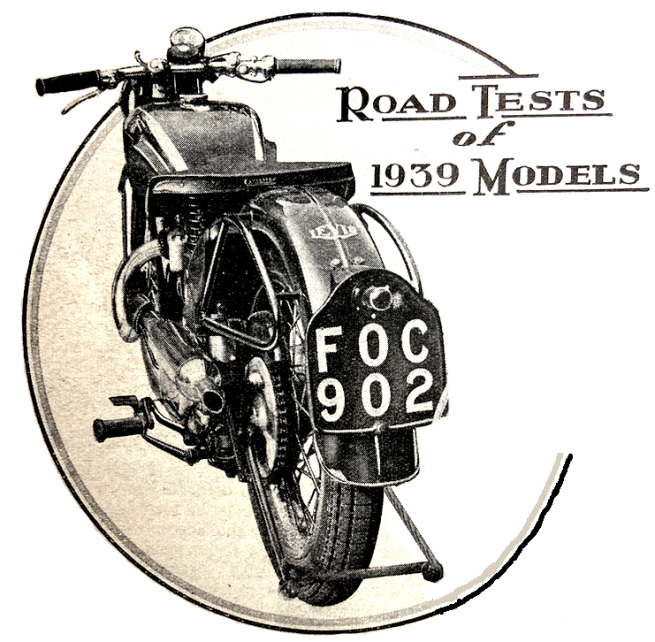
“AMONG THE SPRING FRAMES exhibited at last year’s Show the Levis design was one of the most outstanding. An interesting feature is that allowance is made for unevenness in spring pressure by means of grease-loaded balancing pipes. Thus road shocks are equally distributed on both ends of the rear-wheel spindle and the fork-ends are relieved of uneven loading. This frame is fitted to both 350cc and 500cc models, and an example of the latter type was recently road-tested. The steering and road-holding of the machine were first-class. Short, natural-angle handlebars are fitted, and the machine could be ridden easily almost to a standstill feet-up. At town speeds the springing proved sufficiently soft to absorb all but the very worst road shocks, and bumpy tram setts could be ridden over in comfort. Only the slightest trace of waver was noticeable when crossing tramlines at a very narrow angle, and although the machine was deliberately zig-zagged across the lines the steering remained perfectly steady. On the open road the full benefit of the springing was felt, for when cruising at high speeds the rider could sit comfortably in the saddle. Poising on the rests was unnecessary except at high speeds on secondary roads or on some poor stretches of main road. The springing bottomed only when the machine was ridden fast over really rough ground. Cornering with the Levis was delightful, for it could be swung round fast bends in a manner normally associated with racing machines, and the extent to which the machine could be laid over was controlled only by the footrest position. Even on poor roads the Levis always
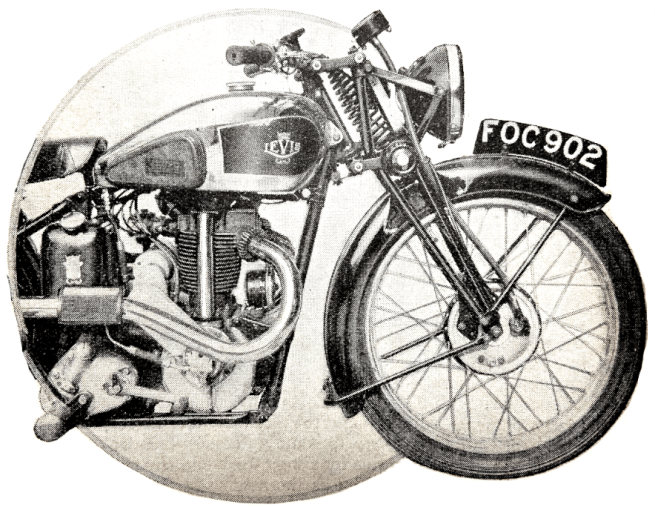
retained its line on bends. In addition to the comfort afforded by the spring frame, the Levis scores by reason of a fully adjustable riding position. The makers have succeeded in providing a position that can be adjusted to suit the tall rider as well as the man of normal height. There is a double adjustment for the footrests which gives a really useful range of positions, and the brake pedal and gear lever can be adjusted accordingly. Add to this the flat handlebars with their comfortably placed controls, and there is a riding position that will suit most tastes. The only criticisms that might be raised against the ‘comfort features’ are the high-level exhaust pipes, which owing to the spring frame are rather widely set, and the reduction in steering lock which occurs when the handlebars are in a lowish position. As regards performance, the machine was really delightful when cruising between 45 and 50mph. At this speed there was little mechanical noise—some clatter was audible at lower engine speeds—while the exhaust note was a pleasantly subdued burble which the rider could hear only by turning his head. At no time did the exhaust noise become excessively loud. Some vibration was noticeable at the top end of the speed range, but it was not sufficient to cause discomfort. On an ethylised fuel the Levis would climb almost any main-road hill in top gear (4.6 to 1) without protest. The engine pulled really well and never pinked during the test. Pebblecombe Hill in Surrey, with its maxi-mum gradient of 1 in 5½, was climbed comfortably in top gear, and on main roads only traffic conditions necessitated use of the gear box. It has already been mentioned that the gear pedal is adjustable; it is also well placed and gear changing was positive and delightfully easy. A slight whine was noticeable on the overrun in the intermediate gears. On the best timed run the Levis covered the quarter-mile at nearly 82mph, and at this speed, and through-out the range, the speedometer was found accurate. The mean timed speed worked out at 78.3mph, while the best speed attained in third gear, which has a ratio of 6.4 to 1, was 73mph. Acceleration was well up to standard, and the useful figure of 66mph was reached at the end of a quarter-mile from a standing start.
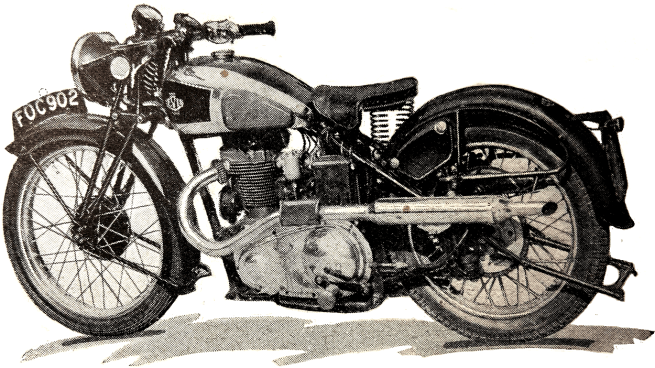
At low speeds carburation was not perfect, and this affected both acceleration from low speeds and slow running. Starting presented no difficulties and the kick-starter ratio is well chosen. Generous flooding, a fairly wide throttle opening and a long, swinging kick would usually ensure an immediate start. An unusual feature of the engine was that a large throttle opening was required even when the engine was hot. The Girling brakes fitted to both wheels of the Levis were positive and without any sponginess. They were well up to their work and could be used hard with safety; only once was the front wheel locked, and that was on some loose sand. A feature of the suspension is the way the front forks mate in with the rear springing. At no time was there a semblance of judder or harshness in their action. Other good points are the excellent mudguarding and the arrangement of the saddle, which effectively prevents tank-top cascades in wet weather. No clatter emanated from the spring-up rear stand, even on rough roads. An unusual feature in this connection is the provision of sturdy twin lifting handles, which are both neat and most useful. At the conclusion of the test the engine was free from serious oil leaks, and in spite of the thrashing the spring frame had been given, very little grease had oozed on to the exterior sliding surfaces. To sum up, the Levis is a machine that steers well, has a first-class riding position, a good turn of speed and a spring frame that smooths out the bumpiest of roads. It is a thoroughbred that is just about guaranteed to appeal to the connoisseur.”
“TO RAIN OR NOT TO RAIN; that is surely the question that was pondered by the Clerk of the Weather during the two hours preceding the start of the BMCRC’s Cup Day meeting last Saturday. Riders and officials dashed around muttering hard things about the fine rain that was falling and looked anxiously for a break in the clouds. More anxious than most was Noel Pope, who hoped to attack the lap record on his supercharged Brough Superior. Just before 2.30pm the rain stopped, but the track was damp enough to make caution necessary when the field lined up for the opening race—a five-lap Mountain handicap for a cup presented by JW Forbes and CK Mortimer. Five non-starters reduced the field to 17, and all got away smartly except DA Loveday (497cc Ariel), who required a 50-yard push. The limit man, JM Givons (348cc
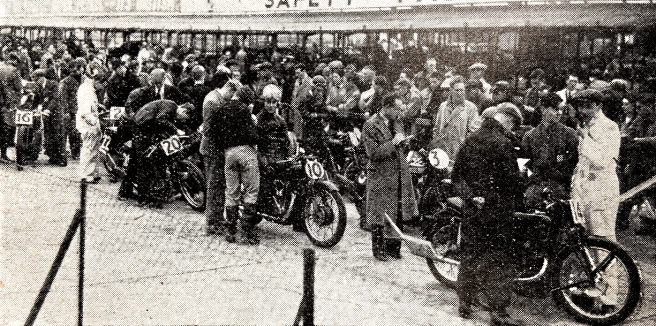
Velocette), came round first, but obviously his joy would be short-lived with RF Hill (348cc Norton), WA Lampkin (348cc Velocette) and RA Mundy (348cc Norton) yowling along in a bunch very quickly not far behind. The supercharged twin Triumph, ridden by J Henry from the scratch mark, seemed to be going well, but was too far behind ever to threaten the leaders. Lampkin pulled something out of the bag, and by the end of the third lap led from D Hedderwick (348cc Velocette), Mundy and Hill. Suddenly a decrepit looking Norton was seen cutting its way through the backmarkers in an altogether astounding fashion. Yes, the programme confirmed it, it was JH (‘Crasher’) White, and he was riding so forcefully that he had caught all but Lampkin by the fourth lap. Eventually, he displaced the leader just before the fork turn on the last lap, to win a cleverly judged race. Lampkin, Mundy and Hedderwick followed closely. The ten-lap Mountain handicap for the Viscount Wakefield Cup promised well, but seemed to lack sparkle, probably because from the spectators’ point of view it was difficult to follow. When the scratch men are just getting away as the limit men have completed a lap, it is a question of following the race by means of the loudspeakers, which are frequently made inaudible by passing machines. Private duels provided the major interest; for instance, VH Willoughby (348cc Velocette) scrapped closely with. WA Lampkin (348cc Velocette), and farther back D Hedderwick (348cc Velocette), EG Mobbs (348cc Velocette) and DA Loveday (497cc Ariel) were in a bunch. FL Beart (502cc Norton) and J Henry (498cc Triumph Twin
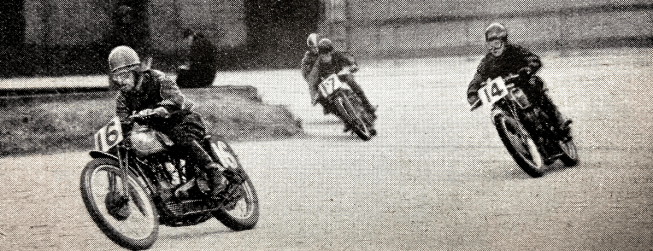
supercharged) were so far behind that it seemed unlikely they would threaten the leaders, who at half-distance (5 laps) were JM Givons (348cc Velocette), RA Mundy (348cc Norton) and VH Willoughby. DA Loveday (497cc Ariel) also looked promising, and it caused no surprise when he took the lead on the ninth lap and went on to win. Mundy followed Willoughby for third place some way astern. On the starting line for the second five-lap Mountain handicap was MWK Tisdall’s supercharged 494cc BMW which, perhaps in virtue of Meier’s win in the Isle of Man, was examined by spectators with unusual interest. But Tisdall, the scratch man, as R Harris had withdrawn was never in the picture; in any case he would have had to lap inordinately fast to beat the winner, EJ Freud (998cc Vincent-HRD), to whom he conceded 16sec. After three laps the limit man, DH Whitehead (250cc Rudge) held the lead, with Frend going quietly yet remarkably quickly in second place. About 150 yards behind was EG Price (348cc Norton). One circuit more and Frend, to everyone’s astonishment, had a clear 200-yard lead from Whitehead, with VH Willoughby (348cc Velocette), again circling admirably, a not very close third. No one could possibly embarrass Frend, who before crossing the finishing line had lapped VH Baker (249cc Excelsior). Willoughby was second, a long way behind, and Whitehead third. RA Mundy (348cc Norton) and G Newman (348cc Velocette) had a sparkling scrap for sixth place, which the judges awarded to Newman. While the timekeepers were moving over to the other box for the outer-circuit events, Noel Pope decided to make his hid for the lap record, as the track was now quite dry. The big Brough looked extremely impressive as it screamed round on the opening lap for the flying start, and those with an eye for speed were looking hopeful. But it was not to be; on the timed lap the front piston tightened up when Pope was on the Byfleet Banking, so the record of 123.58mph put up by the late Eric Fernihough still remains. If the first outer-circuit race over three laps provided no thrills, it was at least distinguished by three Gold Stars, culled by LA Howe (497cc Ariel), 101.43mph; MN Mavrogordato (996cc Brough Superior), 100.21mph; and in particular EJ Frend (998cc Vincent-HRD), with a speed of 110.68mph on a machine that had been ridden to the track and was running on petrol-benzole. LA Howe (497cc Ariel) won a nicely judged race from the 39sec mark, though the irrepressible Frend would have caught him given another couple of hundred yards. EN Iffland (346cc AJS) was third after holding the lead for two laps. Is a ten-lap race too far these days? It seems to be, for a poor entry of twelve in the second event for a Viscount Wakefield Cup was reduced to six by non-starters, and after one lap only five machines were still going. The order was GE Gott (499cc Vincent-HRD), FWS Clarke (249cc Triumph); and WA Lampkin (348cc Velocette). The riders were well strung out for lap after lap, with only VH Willoughby (348cc Velocette) doing any passing,
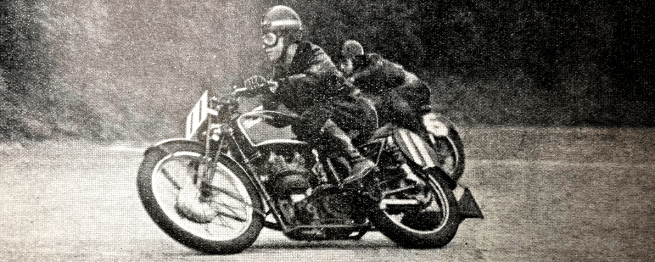
to displace Clarke for second place. The next race, a five-lapper for the Ron Harris Cup, was like a pleasing stimulant, mainly because FWS Clarke (503cc Triumph Twin) motored so quickly. Miss B Shilling’s 490cc Norton with the centrifugal supercharger was also out again, though, as before, its speed was rather disappointing. After two laps A Wilkinson (498cc Rex-Acme) led, though not by very much, from TEG Gardiner (490cc Norton), FWS Clarke and VH Willoughby. After only one more lap Clarke had a 300-yard lead, which he increased as he pleased, while Willoughby and MN Mavorogordato (996cc Brough Superior) also caught Wilkinson. There were more Gold Stars in this event, the winners being MWK Tisdall (494cc BMW supercharged), 101.23mph; FWS Clarke (503cc Triumph), 110.43mph; and VH Willoughby (348cc Velocette), 100.29mph. Another three-lap race brought the meeting to a close. In this event Clarke and his twin Triumph again won at 104.63mph—a precisely similar speed to the previous race, though this time he was off the scratch mark. DH Whitehead (250cc Rudge), 1min 12sec, held the lead until he began to slow for an unexplained reason, and immediately G Newman (348cc Velocette) was in front, chased by Clarke and GE Gott (499cc Vincent-HRD). The last-mentioned obtained the seventh Gold Star of the afternoon with a lap at 100.01mph. Clarke and Newman changed places, and VH Willoughby, out for the fifth time during the meeting, obtained fourth position ahead of JH White (490cc Norton). This afternoon of Gold Stars was rounded off by MRL. Tuffnell (998cc Vincent-HRD) clocking 104.89mph.
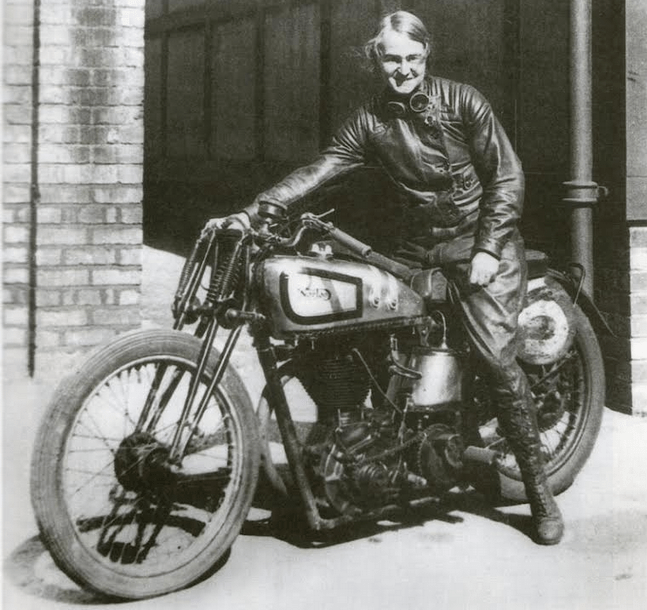
“IN REPLY TO ‘FOUR WHEELS’, who desires to know whether there is a particular fascination in pillion riding: for me there very definitely is! Although I am keen on motoring, the sportiest sports car or the most luxurious saloon cannot compare with the joy and thrill I got from riding on my pillion seat on a super motor cycle behind a clever and capable driver in whom I have every confidence. The state of the weather does not enter into it—rain, hail, or shine, every moment of my ride is sheer joy to me. I would like to add that my pillion seat is not of the ‘sprung’ variety, but an ordinary sponge-filled mudguard pad, and on this little seat, on more than one occasion, I have done a day’s tour of 250 miles without the slightest discomfort.
Pillion Fairy, Amesbury.”
“WITH REFERENCE TO the correspondence on how far motor cyclists ride non-stop, I may say that I have a pleasant little ride which I do nearly every week. I go from Coventry to Conway, on the North Wales coast, and the distance according to my speedometer is 147 miles. My route is through Castle Bromwich to Brownhills, where I come on to A5, ie, the London-Holyhead road. I leave the A.5 at Bettws-y-Coed, And go down the Conway Valley to Conway. My machine is a 1932, 350cc KSS Velocette. I always travel non-stop, except on those occasions when I stop to help someone in trouble. My usual time is 3½ hours, and my best time 3¼ hours. I admit I am glad to get off the bike, but after a wash and some tea I always go out on the bike for a spot of fresh air. Half an hour’s rest, and, if necessary, I could come straight back to Coventry non-stop. Anyone who cannot do more than 50 miles non-stop should give up motor cycling and take up bath-chairing. If I had a long journey to do—something which meant four or five hours’ riding—I should ride for 55 minutes and then rest for five minutes. I think that is a much better plan than setting oneself as much to do before calling a halt.
Alfred Thorp, Coventry.”
“IN HOLLAND THE TT RACES are events of national importance. In every town and village posters announce the races, while in the vicinity of the course business is suspended for the period of the meeting, and all interest is in the TT The little town of Assen, in the North of Holland, which is the headquarters of the organisers, becomes a holiday town and flags and bunting decorate the streets…This year the practising period has been blessed with fairly settled weather. The fastest men have been those who shone in our own TT races, for, with the exception of the Nortons, all the famous International racing stables are represented. Stanley Woods, Mellors, Tenni, Fleischmann and Kluge have all put in good laps. In the 500cc class Meier with his BMW has been lapping very quickly, but Serafini on the Italian four-cylinder supercharged Gilera holds the honour of making the fastest practice lap at nearly 100mph, and there is every prospect of a good race. But on the great day, Saturday, hopes fall, because we awake to the sound of heavy rain. The Assen course is infamous or its treacherousness in wet weather, and the prophets foretell many spills…[but]…by two o’clock, when the International races are due to start, the roads are dry. In the morning many mechanics had been busy with hacksaws making cross-cuts in the treads of the tyres to give then extra grip on the wet roads. The International classes, 250, 350 and 500 c.c. are sent off at two-minute intervals. In the 250cc class it looks like being a German-Italian scrap between the Guzzis and the DKWs…on the first lap Tenni’s Guzzi catches and passes the three DKWs, and when he conies round to start his second lap only the redoubtable Kluge is anywhere near him. And on the ensuing laps the Italian proceeds to shake off the German and to demonstrate the amazing speed of this supercharged 250. On the eighth lap Tenni circles at 81.59mph, which is faster than the average speed of the fastest 350, and after fourteen laps his average speed is higher than that of the 350cc leader. The DKWs simply can do nothing about it. Kluge gradually falls farther and farther back and at half-distance (eight laps) he is over two minutes behind the flying Tenni…Then, on the 15th lap, the loud-speakers announce that Tenni has stopped at Laaghalerveen with engine trouble and is feverishly working on his machine. A hush comes over the crowd, for they are obviously very disappointed. Everyone waits expectantly; Tenni has two minutes in hand—enough to change a plug or effect some minor repair. But no! Kluge comes round in the lead and there is no sign of Tenni. Petruschke also goes by, and suddenly the huge crowd are on their feet cheering themselves hoarse. A crouching figure on a red machine roars past
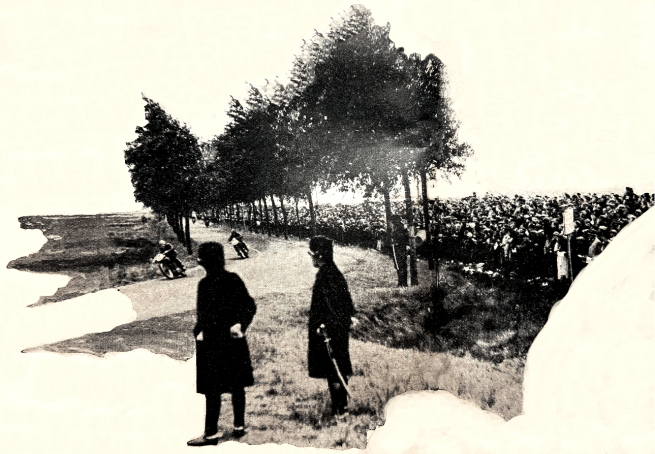
the stands—it is Tenni—but to those who have ‘ears’ it is obvious that his engine is sick. Kluge has only one more lap to go and he gets the flag, a comfortable winner after being so far behind. Tenni gets an ovation when he finishes third behind Petruschke. In the 350cc class Britain has several representatives. They include Stanley Woods, EA Mellors, JE Little, MD Whitworth and ER Thomas, all on Velocettes. Two British men, JB ‘Crasher’ White and F Anderson, are riding foreign machines. Again a DKW rider is first away, for these machines seem to develop full power from extremely low revs. The rider is the German crack, H Fleischmann, who made the best time in practice. Right on his heels are 0 Ruhrschneck (NSU), W van Gent (Velocette) and EA Mellors (Velocette). At the end of the first lap Fleischmann still holds the lead, but the second man is another DKW rider, S Wünsche. Britain is in third place in the form of EA Mellors (Velocette), while Stanley Woods, after a bad start, is sixth. But this is only the start of a fierce race, with Mellors and Woods doing their utmost to beat the Germans. After a few laps it begins to rain again and Mellors sandwiches himself between Wünsche and Fleischmann, with Wünsche now in the lead. Behind this trio is Stanley Woods. But fourth place is no good to Stanley, and on the sixth lap he makes the fastest circuit of the day at nearly 84mph, and in doing so overtakes the three men in front of him. For three laps the first four men keep close company on this very fast course—a Velocette in the lead, followed by a DKW, a Velocette and a DKW. After nine laps the leaders begin to come in for fuel. On the seventh lap Woods and Fleischmann had brought the crowd to their feet by flashing past the stands absolutely wheel to wheel. They come into the pits together, but Fleischmann overshoots, giving the careful Woods a few valuable seconds. Woods, however, has to take in oil as well as fuel, while the DKW requires only petrol, so the advantage is cancelled out. Fleischmann’s engine fires immediately and he is in the saddle and away; Woods seems to be taking a long run. Hello, he’s stopped and is tickling the carburettor. Another run, this time with his hand over the intake. Ah! she’s fired, but that delay has cost Stanley many seconds. On the, next lap Mellors leads, but after he has filled and the positions are settled again it is seen that Woods has dropped to fourth place behind Wünsche, while Mellors is tailing Fleischmann…The Britishers are not to have things their own way to-day. Wünsche increases his speed and on the 12th lap overtakes Mellors, and two laps later he passes his team-mate to take the lead. Mellors also spurts and overtakes Fleischmann. On the last lap Stanley makes a terrific effort, but is just unable to snatch third place from the German. Italy and Germany are again rivals in the 500cc class. Meier, the German champion, is on his BMW and Italy’s hopes are pinned on Serafini with the supercharged Gilera, which during the winter has been cleaned up and improved enormously. On this occasion Meier knows that there is no time to lose
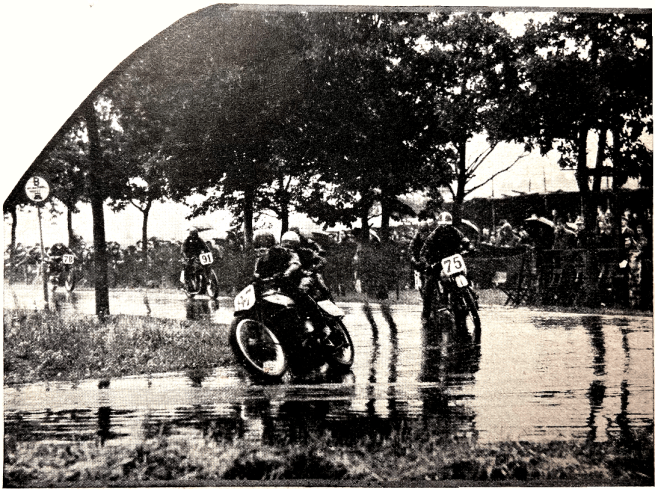
and he is first away at the fall of the flag, followed by Jac Schot, also on an official BMW. Serafini has to take two runs to get his Gilera started, but he is soon after the BMW men. At the end of the first lap Meier is still in front, but his lead over Serafini is only about a hundred yards. The third man, L Kraus (BMW) is also hotly chased by a second Gilera ridden by a newcomer, Vaillati. These four provide all the thrills, for the rest of the field are a long way behind, already. The order among the first four men remains unaltered, and just when it starts to drizzle with rain Meier increases his lead to about 200 yards. On the next lap Serafini’s skill on wet roads shows itself, for he is right on Meier’s tail. For lap after lap these two race round together, never more than a hundred yards apart, often much closer. The speed of the two machines is terrific and it is a wonderful sight as they weave their way through batches of the smaller classes. Vaillati has now moved into third place, for Kraus retired at the pits on the eighth lap after making a slow circuit. He is not the only one to retire, for by half-distance seven of the 18 starters have given up. After the pit stop Meier draws away from Serafini again, and with eight laps to go has 12 seconds in hand. It is on this lap that the excitement really begins. Serafini reduces Meier’s lead to four seconds; on the next lap the crowd is wild with excitement when the Gilera is seen to enter the starting straight some way ahead of the BMW Serafini, however, is not satisfied and proceeds to leave Meier farther and farther behind. Then, when the officials are preparing to flag him in as the winner, the news comes in that he has fallen from his machine at the back of the course. The crowd are hushed, but they cheer when it is announced that Serafini has remounted and is away before Meier has passed. Everyone cranes their necks to the long tree-lined straight which leads back to the start, but it is Meier’s white helmet that is seen approaching first. Serafini later cruises in with a smashed machine and it is learned that he had fallen again. On the next lap Meier receives the chequered flag to record the third German victory of the day. The national anthems are played and hardly have the last notes died away when down comes the rain in torrents, to soak the thousands of people on the trek home.”
“READING THE STORY of the Dutch TT in which Mellors’ second place with a Velocette was our only ‘place’ in the three international races, I remembered mournfully a previous Dutch TT which I described, when literally nobody stood the faintest chance against a large circus of invincible British machines and riders. Our unquestionable superiority was only equalled by the good-natured sportsmanship with which the outclassed cracks of other nations accepted defeat. Another feature of the meeting was the fact that Serafini on the Gilera would actually have licked the 500cc BMW if he had been as expert (or as careful) on wet roads as Meier is. The eclipse of British machines is notoriously due to two causes, which are interrelated. One is that we remain content to race on designs which were once supreme, but are now technically obsolete. The other, that firms cannot afford (or think they cannot?) the outlay to develop modern designs. It is becoming obvious that it pays such firms even less to ship parties out to Continental venues, and take a public hiding. The sooner they resolve either to abandon racing on the grand scale, or to evolve blown multi-cylinders, the better for everybody. Racing may pay when you win; it most certainly does not pay when you regularly lose. The Motor Cycle has repeatedly prophesied the coming of the present debacle, but to deaf ears. Fortunately, in the possibly more practical aspect of international competition—the German Six Days—we have an opportunity to prove that if our motor cycle industry is short of cash and slow in judgment, it is by no means decadent.”—Ixion.
“THE RESULTS OF the Dutch TT put a new aspect on International races, for it is now obvious that the German marques will not have things all their own way this season. People who think that the BMW is the fastest road-racing machine will have to revise their ideas; in Holland the four-cylinder Gilera showed that it has the legs of the German machine. This was known last year, but the Dutch TT revealed that during the winter designer Taruffi has made the machine reliable and has increased its speed. The latest Gilera is much cleaner than the original models and the ugly bits and pieces have either been obviated or tucked neatly away. The frame has been altered considerably; the construction is tubular at the head, but the duplex down tubes are flattened at their lower ends to form mountings for the engine. A smaller radiator is used and the degree of cooling is controlled by shutters. Circulation has apparently been improved by the inclusion of a water pump which is driven from the inlet camshaft. The oil tank is built as part of the rear mudguard and is neatly ribbed at the front. The breather from the tank takes the form of a spout, which protrudes at the rear of the mudguard. It will be remembered that the four-cylinder Gilera engine is set horizontally across the frame. It is of the double overhead-camshaft type, and as the cylinder heads face forward they are directly in the main air stream. The engine is, of course, supercharged and the blower is mounted between the carburettor and a heavily finned induction manifold. An unusual ignition system is used, for the current is generated by a vertical magneto which is driven from the gear box.”
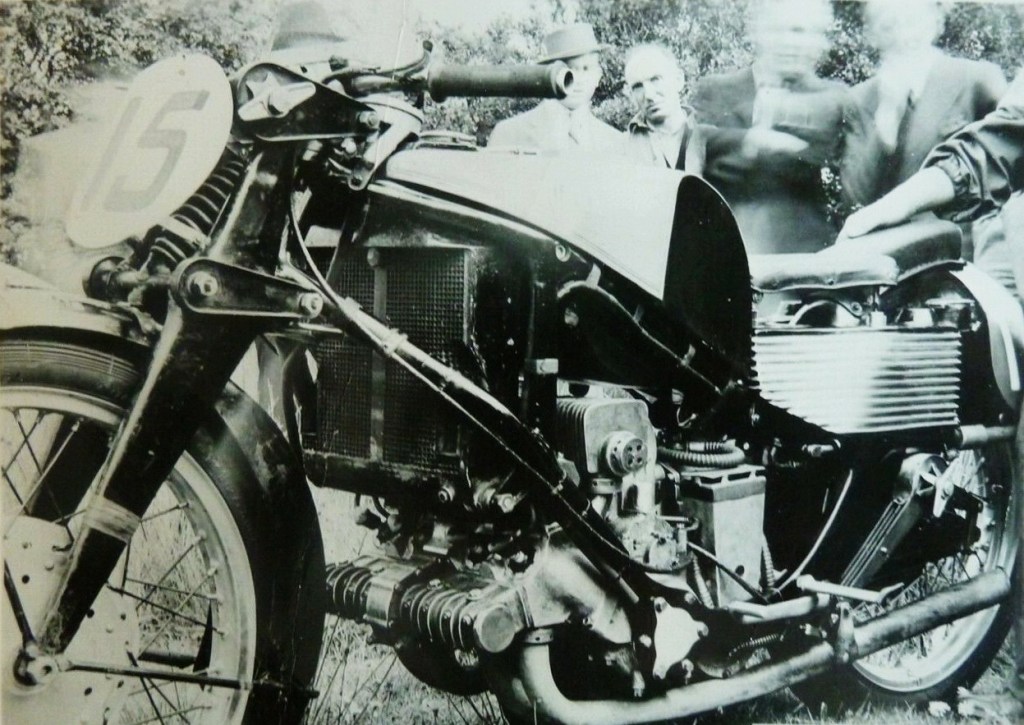
“HONOURS WERE FAIRLY evenly divided between the nations in last week-end’s French Grand Prix. A French rider, Nougier (Magnat-Debon) won the 175cc event; the Germans Kluge (DKW) and Fleischmann (DKW) the 250cc and 350cc events respectively, and our own JH White (Norton) the 500cc class. An interesting point is that Ron Harris had himself brought over the Norton for ‘Crasher’s’ use. The races were held at Rheims in threatening weather. The 175cc and 350cc categories were run off together first of all. In the.175cc class Nougier (Magnat-Debon) was an easy winner, finishing at an average of 64.3mph. Fleischmann (DKW) dominated the 350cc race, although EA Mellors (Velocette) was never far behind the leader. Fleischmann finished at 85mph, less than a minute in front of Mellors; FK Anderson (DKW) was third, and MD Whitworth (Velocette), the Brooklands rider, fourth. Afterwards the crowds watched the 250cc and 500cc events run off together. The opening stages of the 500cc class saw an exciting duel between the French rider Monneret (Monet-Goyon) and JH White (Norton). Monneret for a time was in front of White, but then the latter overtook his rival and gradually drew away. White won the race at 84.3mph, with Guérin second, and Lefèvre third. Kluge (DKW) had things all his own way in the 250cc class, and finished well ahead of Moore (DKW) and Simons (DKW). Kluge’s speed was 77.6mph, During the meeting heavy rain fell.”
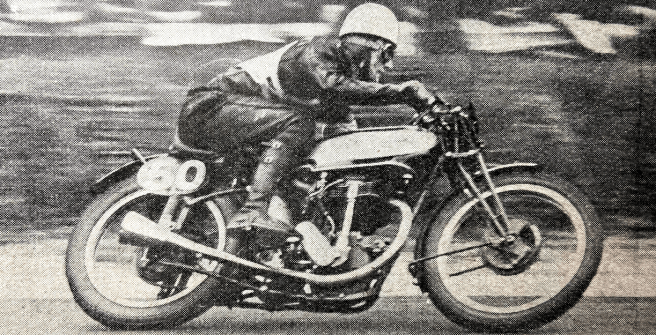
” THE GRAND PRIX OF EUROPE is being held next Sunday —organised by Belgium this year, and on the Grand Prix course at Spa in the Ardennes. It is a decided change having a European Grand Prix and so few British entries. In the 500cc and 250cc classes there are no British riders at all. The only British machine in the latter race is a Rudge to be ridden by a German. Seven Nortons are entered in the 500cc class—three to be handled by Germans, two by Finns, one by a Belgian and another by a Hollander. Britain’s entries are in the 350cc race, namely Woods, Mellors, Whitworth and KA Burton, all on Velocettes. In this race Velocettes comprise nearly half the entry. Against them are the DKWs, the NSUs (one ridden by ‘Crasher’ White), two Saroleas and a couple of Nortons, one ridden by a Belgian and the other by a German.”
“THE PATRIOTISM OF MOTOR CYCLISTS in the recent series of crises has had one important effect. They have a remarkably large number of friends in Parliament. This pleasing fact emerges from the debate on the Chancellor’s decision to increase the licence duties as from next January. Member after member championed the cause of motor cyclists, and when Mr Jagger’s amendment to the effect that there should be no increase in the tax upon motor cycles was put, no fewer than 135 voted in favour of motor cyclists. While there is to be no amelioration of the position, and motor cyclists must face up to the increase, the fact remains that never to our knowledge have so many taken up cudgels on behalf of motor cyclists.”
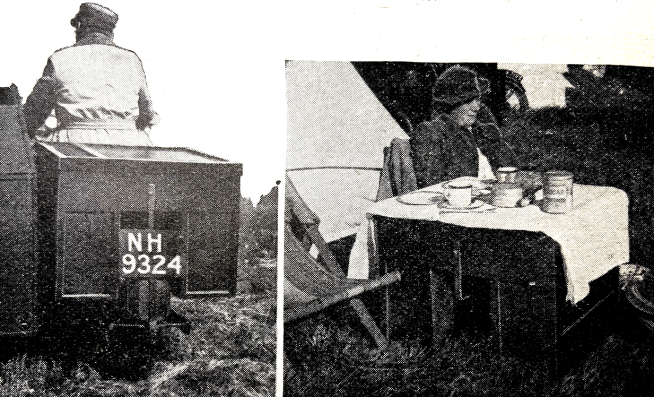
“DOUBT REGARDING THE FUTURE of the Ulster Grand Prix is effectively dispelled this week, for the new Organising Committee of the Ulster Club has issued the regulations. Thus, we hope, an unhappy chapter has been brought to an end. It was unthinkable that the race which in the majority of British eyes is second only to the TT should lapse owing to monetary and other difficulties. The discussions, decisions and counter-decisions of the recent past have drawn attention to the immensity of the task of organising a race of the Ulster’s calibre. In addition, they have probably caused many in Ulster to realise afresh the value of the world’s fastest international road race in both publicity and finance. Perhaps as a result the famous race will be on surer ‘foundations’.”
“OUR ANNOUNCEMENT THAT seven or eight new twins are being developed has caused a number readers to ask, ‘Why Twins? Why not fours of even three-cylinder engines?’ There are several answers. Perhaps the most important reason is that manufacturers know only too well the folly, commercially, of marketing designs that are ahead of public opinion. If they make a machine which is very ‘advanced’ the vast majority of the motor cycle public will hesitate to buy it, but will wait a year or two. Many cases come to mind of machines which have been ‘before their time’. It is also notable that the most popular twin of the present era was designed in such a form that to the casual glance it appears to be a single. Thus there has been no need for the public to accept an unorthodox appearance. Like many readers, we do not believe the twin to be the ultimate. Our view is that a few years hence the market will comprise an appreciable number of fours as well as twins, singles and, possibly, threes. We also hold the opinion that shaft drive will become increasingly common, but it has to be remembered that this form of transmission, unless produced in very large numbers, is expensive. Thus, in all probability, it will only be adopted for luxury-type models. While the fact that manufacturers are not embarking on numbers of new fours is disappointing to some, it is very pleasant to be able to record the great and unusual degree of activity there is on the design side. Design is definitely forging ahead.”
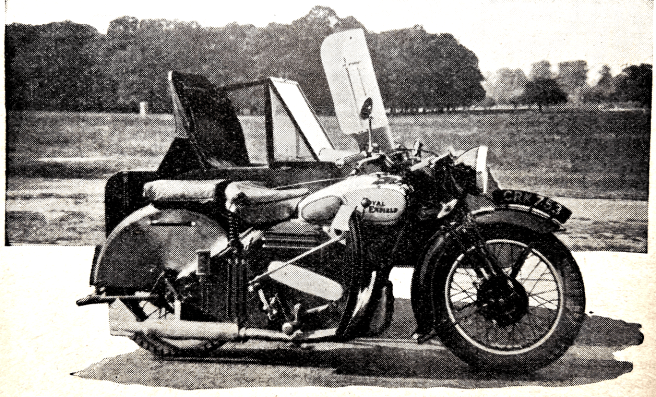
“THE PROMOTORS OF the dirt tracks are rather perplexed that their gates are falling off quite substantially. This is rather odd, as the sport is, on the whole, magnificently organised, and is probably the most exciting spectacle in the world (with the possible exception of ice hockey), omitting only such shows as car racing and prize fights, which cannot be staged regularly at numerous centres for a small entry fee. I suspect the main reasons are the absorption of so many youngsters in defence work, and the un-settled political situation, which tends to make people keep their cash in their pockets.”—Ixion
“YOUR CORRESPONDENT, Mr AJ Coleman, claims to have owned and ridden a model of every of every motor cycle made. I wonder if he has ridden a Zedel, a Forward, an Empire-Blumfield or a TDC? I have, and various other weird contraptions, including a Perry Tricar. Here’s luck to the old-timers.
ERR Thomas, Shrewsbury.”
“SEVERAL FINE LONG-DISTANCE records, ranging from 4,000 to 10,000 miles and 72 hours to 144 hours, were secured by a French Gnôme et Rhône machine at Montlhéry recently. Over the full distance the machine averaged the excellent speed of 71.81mph. Twelve riders were employed for the attempt, which occupied seven days. The records were made in classes D and E (750 and 1,000cc solos)…The long-distance record attempt by the 750cc Gnome et Rhone…was continued at Montlhéry, and according to the latest FICM bulletin the machine has now covered 20,336 miles in 288 hours—an average speed of 70.61mph…the Gnome et Rhone has successfully covered 50,000 kilometres. The total time taken was 456 hours (19 days), and the average speed for the whole period was 67.97mph. For the first 25,000 miles the average was over70mph.”
“MODERNITY HAS ALWAYS been the keynote of Royal Enfield design and the 350cc ohv Bullet is undoubtedly among the out-of-the-ordinary machines of to-day. In brief, the interesting features of this Royal Enfield are a light-alloy cylinder and head, push-rod tubes in the cylinder casting, separate boxes that give total enclosure of the inlet and exhaust valves and a large air filter. Although this model is new in the sense that it was introduced at the last Earls Court Show, the familiar characteristics of Royal Enfield machines remain. Thus, the riding position is as excellent as the average rider could wish for town or open-road work. The saddle is well positioned and gives a compromise of height and distance from the handlebars, so that the rider’s arms are not cramped; further, both handlebars and footrests are adjustable. A comfortable riding position breeds confidence in handling a machine, and the Royal Enfield excels in this direction with its conveniently placed handlebar controls and rear brake and gear-change pedals, all of which worked both smoothly and lightly. Starting with the engine hot or cold was always easy, and the method varied only to the extent that with a cold engine the carburettor had to be flooded. Then, as with a hot engine, it was merely necessary to open the throttle about an eighth, place the ignition control at half-advance, get the piston approximately ‘over’ compression by using the exhaust-valve lifter, and, finally, give a gentle dig on the kick-starter. The engine would respond without fail, and after a minute or so for warming up, would tick-over slowly and regularly. For normal running, or for any conditions except idling, the engine required full ignition advance. Ethylised fuel was used throughout the test, and with this fuel ‘pinking’ occurred only if the engine were abused. The clutch was light in operation and free from drag, so that first gear could be engaged from neutral noiselessly, and the drive was taken up sweetly. Gear-changing was a joy with the Royal Enfield, for the pedal has a short travel and required only
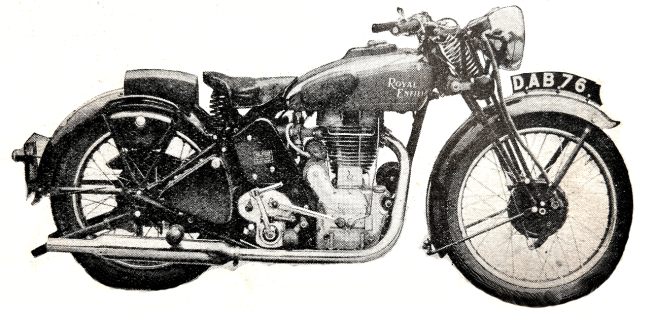
a light, quick caress irrespective of engine and road speeds. Further, the intermediate ratios were absolutely quiet in operation. At all times the Bullet was well-mannered. In traffic the engine could be throttled down to a very low speed in any gear.with confidence, and on the throttle being opened the engine would pull away easily and smoothly. This was due largely to the fact that the transmission shock-absorbers were well up to their job, and also because the carburation was just right. On the open road speeds of to 60mph and higher could be held indefinitely without. any protest from the engine, and the only indication of high revs was a slight fork spring vibration at about 60mph. The ability of this engine to withstand full-throttle speeds indefinitely was extraordinary, though probably this characteristic is due in large measure to the light-alloy cylinder and head, which result in remarkably cool running. Maximum speed figures were obtained on a wet track and under gusty wind conditions; given better weather the speeds, at least in top gear, would probably be improved. Inter-related with the confidence-inspiring riding position of the Royal Enfield is praiseworthy handling. The steering is light at low speeds and riding feet-up at a walking pace required no conscious balancing. Throughout the speed range the pleasant lightness of the steering remained, allied with a positiveness that made the steering damper superfluous. Road-
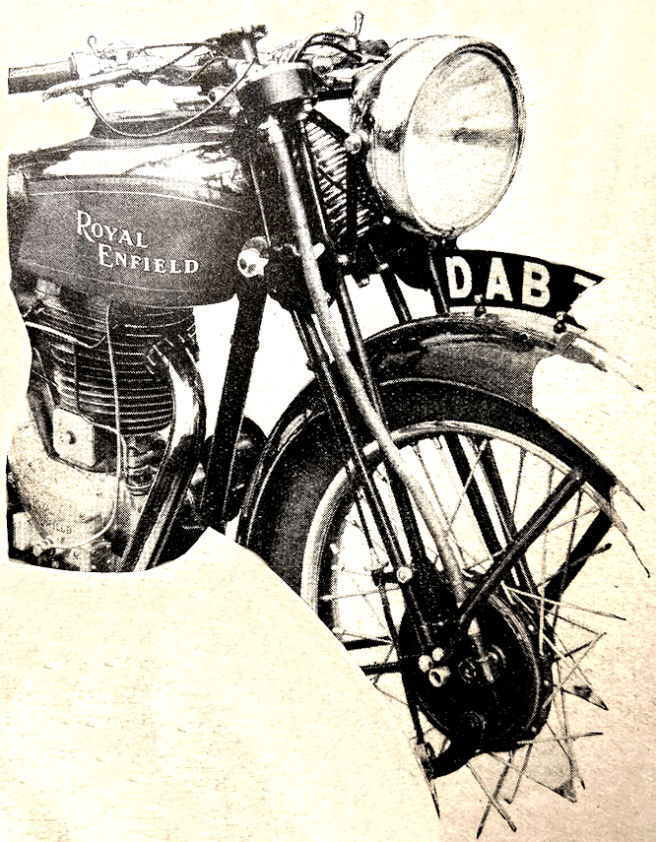
holding was excellent apart from slight rear-wheel hammer at high speeds over bumpy surfaces, and fast or slow bends could be taken at speeds near the safe limit stylishly and with certainty. The forks had a steady progressive action and by using the separate adjusters for each damper the movement could be controlled effectively for any conditions. Here mention might be made of the admirable rubber steering-lock stops fitted round the rear spindle lug, which prevent damage when full lock is used, yet do not make the turning circle too large. Under poor weather conditions when the roads were wet and greasy the good handling showed to advantage; even on the worst of tram tracks the rider felt at home and a skid was never experienced. The brakes were outstanding both in their power and their steady, almost resilient action, which gave a very fine degree of control. The figure of 38ft obtained for a crash stop from 30mph could undoubtedly have been improved on a fully dry surface. There was a noticeable absence of general mechanical noise, though the overhead-rocker gear was audible; the air filter must be thanked for silent induction, and piston slap was not noticeable even when the engine was started up from cold. The exhaust note was deep in tone, and though perhaps pleasant to the sporting ear, at high speeds it was liable to attract too much attention. A certain amount of oil leakage took place from the crankcase and the kick-starter, but the top half of the engine remained absolutely dry. The Royal Enfield Bullet has the unmistakable stamp of refinement, and to a pleasing appearance are added many worthwhile features. For instance, the timing-chest cover and gear-box cover have a highly polished finish, and the primary chain case is chromium-plated—attention which facilitates cleaning. The large air filter is rigidly attached at the side of the saddle tube and is provided with an enamelled pressed-steel cover, which is detachable when three screws, that can be released with, say, a coin, are taken out. Three good tool bags are provided, and the neat instrument panel is a rubber, and therefore almost indestructible, moulding. Less obvious points include a large wheel adjuster for the front-brake cable and a circlip round the front stand mud-guard bolt, which prevents the retaining nut from being lost. This likeable machine is calculated to make a very strong appeal to the rider of discernment who likes a sporting performance allied to docile characteristics.”
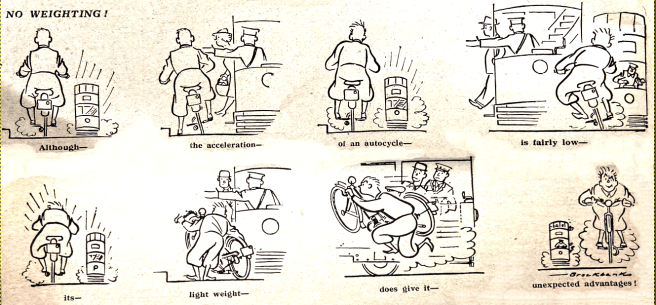
“AN INTERESTING RALLY was held at Banbury last Sunday—the annual gathering of the Association of Pioneer Motor Cyclists. This organisation, which was founded some nine years ago, is confined to those who were riding motor cycles previous to 1905. Twenty-five members, attended the rally, and with friends and visitors made up a luncheon party some 50 strong. The president, Mr JWG Brooker, was in the chair. What made the gathering especially interesting was the magnificent display of old-time photographs, collected and arranged by the Association’s honorary librarian, Mr Harold Karslake. One lady is a member—Mrs Muriel Lord, who, when Miss Muriel Hind, was known throughout the motor cycle world as one of the most famous riders of the day. The toast of the Pioneers was proposed by Mr AB Bourne, the Editor of The Motor Cycle. There must, he said, be some mistake. He could not believe that they were pioneers—they looked too young! The only conclusion he could reach was that motor cycling was an amazingly healthy sport. As one of a later generation, he thanked the pioneers for their great work in developing motor cycles—which had enabled him, and thousands like him, to enjoy the finest sport in the world. Mr JWG Brooker, the president, announced that Lord Nuffield had applied for membership. He appealed to members to do their utmost to trace those who were riding before 1905, so that all the pioneers might be brought into the Association. Those who know such pioneers are invited to send their names and addresses to Mr JH Wylie, 38, West Cromwell Road, London, SW5.”
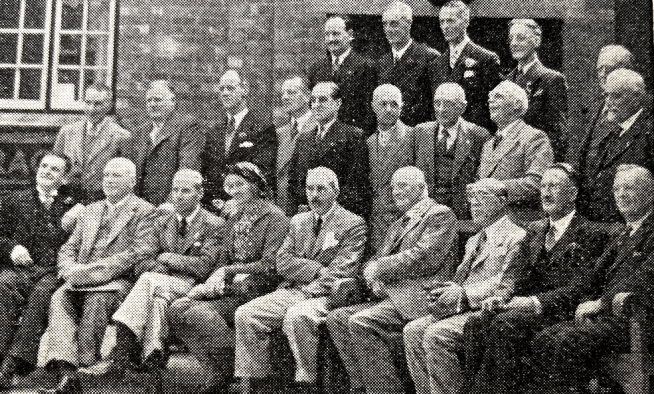
“NOT ONLY IN ENGLAND and Wales are there ACU observed tests, but also in Australia, where there are the Auto Cycle Union of Queensland and the Auto Cycle Union of New South Wales. Down under they do things a little differently from over here. Can you, for instance, imagine one of our ACU officials travelling 1,140 miles on the pillion? Anyhow, that is what Mr Eric Hayman, an Australian official, has been doing in an observed test of a stock 250cc BSA. Except for two portions of the test, Mr Hayman observed from the pillion. First, the machine was ridden two-up from Melbourne to Sydney, a distance of 570 miles. This was at a 30mph average, and the consumption with the double load was 134 and 4,569mpg for petrol and oil respectively. On the following day a return trip was made (a useful distance per day, Mr. Hayman!) and the fuel consumption was 132mpg for the 1,140 miles. Later there was a two-up speed test during which the machine achieved 59mph and, still later, the machine was ridden 630 miles solo and registered no less than 201mpg!”
“LAST WEEK ANOTHER ambition was achieved and with it the Brooklands lap record was pushed up to 124.51mph. The man concerned was NB Pope, who has been connected with high speeds at Brooklands for several years. In 1935, almost exactly four years ago, Pope lapped Brooklands at over 120mph on his supercharged 996cc Brough Superior, the first man ever to do so on two wheels. He then broke the six-year-old lap record held by JS Wright. After his successful attempt he said that he would not be satisfied until he had wrung another five miles an hour out of his machine. At the next Brooklands meeting, however, EC Fernihough broke Pope’s new record, putting it up to 123.58mph, and there the record has stood until last week. Pope has only seriously considered re-attacking the record this year, for in previous summers he has concentrated on road racing. During last winter the Brough was prepared for the attempt, but until the Cup Day meeting on June 29th weather conditions on ‘Bemsee’ days have been against really high speeds. On this occasion he was going really well when the front piston tightened up. The trouble was soon rectified and last Wednesday the weather allowed another attempt to be made. This time the Brough Superior was in fine fettle, and riding magnificently, Pope took the big machine round the Outer Circuit in the amazingly short time of 80 seconds, equal to an average speed of 124.51mph” .
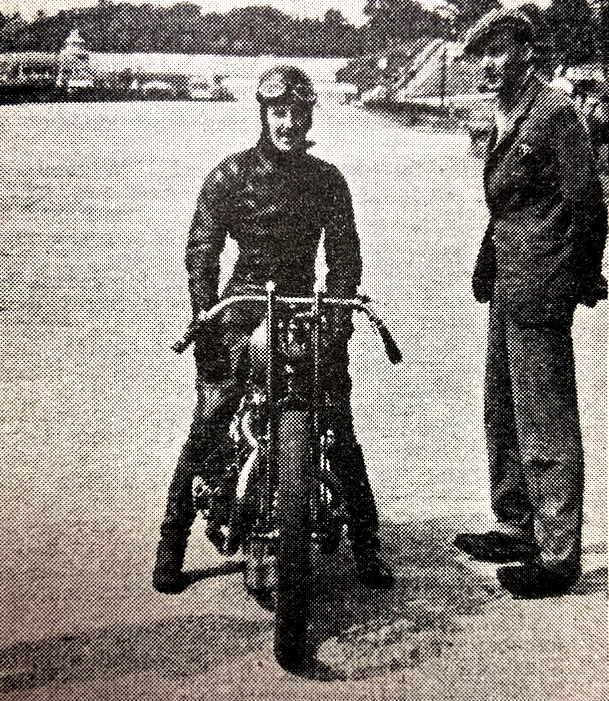
But a few weeks later the Blue ‘Un did some arithmetic…
“ALTHOUGH BROOKLANDS HAS BEEN CLOSED since early September, the track has been lapped by a motor cycle at approximately 127mph. This seeming riddle is easily explained. The news is red-hot and at the same time over three months cold. The rider who performed this feat was none other than Noel Pope on his supercharged Brough Superior. The occasion was the first week in July, when Pope lapped the track in eighty seconds to push up the motor cycle Brooklands lap record to 124.51mph. How then does this 127mph business arise ? Since I am writing this article it might be imagined that speedway racing enters into the question somewhere. It does. In fact, a rumination on speedways in general conceived a mental speculation which has now produced some interesting facts. The official lap distance of any speedway in this country is measured three feet out from the white line. Even in the early days of speedway racing it was realised that a winning rider lapping near the fence would be covering a greater distance than the official lap and, therefore, lapping at a higher speed than that announced. Logically, the same argument must be applicable to Brooklands. Let us take the case of the fastest motor cyclist round Brooklands to date. In his successful attempt on the lap record Noel Pope rode his big machine as near to the outer edge as possible in order to obtain maximum benefit from the banking. Round the Byfleet Banking he was only a matter of feet from the top of the track. Across the Fork, where the track takes a slight kink inwards, he hugged the lap-scoring box and Vickers sheds to within almost inches to get maximum gain from the slight curve. On the Members’ Banking he was again only feet from the top, and down the Railway Straight there was, of course, no point in deviating from the outside course as this would merely add unnecessary distance. In all this I have the confirmation of FL Beart. Pope’s record-breaking lap, then, was made only a few feet from the outside edge of the track, yet his official speed of 124.51mph is calculated on the distance of a line 50ft inwards from the outside edge. What was the actual distance covered? To work it out on paper is impossible. The two banked bends are of different radius and then, past the Vickers sheds, is that slight kink inwards—slight to look at on paper, but a curve to be reckoned with when topping to ‘hundred’. Had anybody ever actually measured the outside edge of Brooklands track? The question came between me and my sleep, so next day I telephoned the Brooklands Managing Director, Mr Percy Bradley. Without hesitation he warned me to arm myself with a pencil and then proceeded to give me not only distances round the outer and inner edges, but also the distances. for 10, 20, 30, 40, 50 (the official), 60, 70, 80 and 90ft lines, all top eight places of decimals. Service! So then it was just a matter of a little simple arithmetic. Between the distances round the inner edges of the track there is a difference of just over a tenth of a mile. Pope’s time for his record-breaking lap was 80 seconds. Riding on the inside edge, his actual speed would have been 121.74mph. Had he been able to motor on the extreme outside edge his speed would have been 127.28mph. On the 90ft line (10ft from the outside) his speed would be 126.72mph. But for most of the distance, Pope would he outside the 90ft line; thus his actual speed must have been approximately 127mph.”—Talmage
“TORRENS IS QUITE RIGHT in all he says about 250cc machines for sidecar work, as this type of machine ran give all the performance of a 500cc machine of 15 years ago. I have ridden various makes of machine; and am now the owner of a 1934 248cc Panther outfit. The weight of the sidecar is about 110lb, and the outfit carries three persons at all times, and can do 50 to 60mph with a full load. The steepest hill I have tackled has a gradient of 1 in 3; while I have also traversed sections of last year’s Scott Trial. I get 80 to 100mpg of fuel, and up to.the present time I have covered 30,000 miles. My tax for a year is £1 17s 6d, and insurance (third-party, fire and theft), less rebate, costs £1 4s 6d. I think that with the increase in tax next year we shall lose a lot of our heavier machines, and then the 250 should come into its own. Personally, I think there is very little difference as regards power between a 250cc and a 350cc for sidecar work.
Thos Cooke, Wallsend.”
“CLUBS WHICH WISH to encourage the ‘ordinary’ rider to take part in their events would do well to peruse the regulations for the Scarborough Club’s freak hill-climb at Beacon Farm, Scalby. In order to even up the chances of competitors and to sustain interest, the first knock-out event is for those who have never gained an award (except touring class) on the hill in 1938-39. The second event is for those who similarly have never gained a first-class award, and the. third event is for any machine, subject to it having a current Road Fund licence and being ridden to the meeting. In three other events ‘track machines’ in any trim are eligible.”
“DOES A MULTI SPOIL one’s riding ? A very well-known West Country trials rider says ‘Yes!’ More than that, he maintains that a multi makes its owner lax over maintenance. His views are that, because a multi is so flexible, the riders thereof can, and do, treat their machines as fixed-ignition, single-gear jobs, and thus lose the art of using throttle, gear box and ignition lever in skilful combination. On the maintenance question he points out that the vertical-twin Triumph and the ‘Square Four’ Ariel have so much more power and speed than the average man needs or uses that their owners keep on keeping on—they continue riding even if the power output has dropped appreciably, because (1) they do not realise the fact, and (2) the power is still adequate for their requirements. That a man who is a clever trials rider as well as a motor cyclist who rides for riding’s sake should make these remarks is interesting, and also a little strange. I say ‘strange’, because in trials work a multi demands much more skilful use of the throttle than does a single, and probably more perspicacity as regards employment of the gears. There is no doubt that, so far as use of the throttle is concerned, a little trials riding on a multi is an education…”
“ROUNDABOUT TRAFFIC WORKING is to be introduced at the junction of Whipps Cross Road, Lea Bridge Road and the North Circular Road, Leyton.”
“AMERICAN CLUB’S ANNOUNCEMENT: ‘While our uniforms may seem to be a bit unusual, they nevertheless are very attractive. The shirts are Kelly green with red shoulder straps and Cossack sleeves, and we have white knickers, black boots, and green and red caps.'”
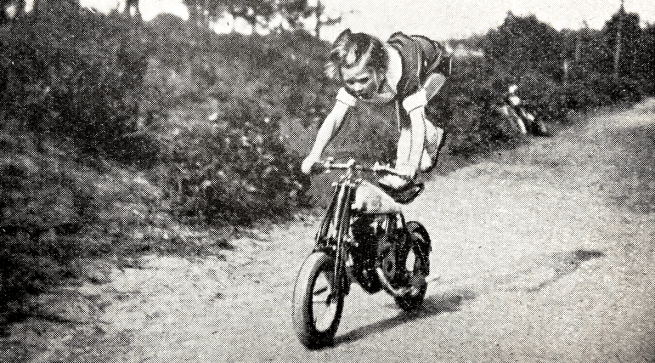
“MANY INTERESTING FACTS emerge from the registration figures just issued by the Ministry of Transport. Well over a thousand more new motor cycles were registered in the first five months of this year than was the case last year, the actual figures being 24,619 and 23,222. The increase is due to the excellent total of 6,495 machines registered in May—the third largest figure for May since 1931. Exports, too, show a big increase. For the first half of this year the value of motor cycles, parts and accessories exported amounts to no less than £753,525 [worth about £62m in 2024] as against £708,144 last year. The industry is definitely on the up-grade. A significant feature of the registration returns is the large number of autocycles now being sold. Whereas in 1938 the total number of new under-150cc machines—this category is largely ‘autocycle’—registered in the first five months was 2,080, the figure this year is 4,049, or nearly double! The 250cc class remains almost constant with a total of 6,554. While solos of over 250cc show a drop of some 1,500—from 11,802 to 10,341—the over-250cc sidecar class reveals an increase from 2,354 to 2,769. Thus, among larger-capacity machines, sidecars are making still further headway. It has also to be remembered that many buy a solo machine and later add a sidecar. The only figure which is not too satisfactory is that of the total number of machines on the road. This for May 31st was 405,486. Figures, it is alleged, can be made to prove anything. It is, however, a fact that these latest statistics emphasise once again the importance of the sidecar, the safest and most economical passenger machine on the road. The number of small-engined machines also tends to bring out a point which even to-day is not sufficiently realised—that one of the most important features of motor cycling is its remarkable economy.”
“AN UNUSUAL QUERY came into the office this week, but failed to stump our ‘Man Who Knows Everything’. The fellows in a provincial workshop fell to arguing whether a motor bicycle has ever been built with a reverse gear. Our OC Queries instantly re-called two such machines—an Austin-engined Brough Superior and an obsolete four-cylinder Henderson. Both these models were equipped with reverse gear in the interests of sidecar users—the latter at option. I do not suppose that a reverse gear has ever been supplied definitely for solo use, but there is a legend in the North—I cannot vouch for its truth—that a courageous fellow once drove -a Scott backwards from Skipton to Keighley. Many Scott enthusiasts will remember that at one time a Scott engine was liable to run the wrong way round ; and the yarn is that an owner backed himself for a nice little wad to start his Scott engine in that fashion, and drive it so many miles on the public road. If one of the modern courtesy cops met a Scott proceeding backwards at speed, his courtesy would doubtless evaporate. It is many moons since a Scott engine backfired continuously on me, so they have probably modified the engine to eliminate this disconcerting trick…The AJS twin is fitted with a reverse gear for the export market, and a few disabled men prefer it (avec chair, of course) to the ordinary power-propelled cripple chairs. Mr Swan, general manager of Gray’s, tells me how he bought a number of American machines without knowing that some of them were fitted with reverse gears, and that on occasions the discovery produced exciting consequences, as on the first trial the operator engaged reverse under the impression that he had meshed up first. One of his customers is quite enthusiastic about such a machine, as it is very heavy and is stored in a typical motor cycle shed of narrow width, so that reverse considerably lightens the labour of de-shedding the bus. This discussion reminds me that somebody wrote to me a few weeks ago, imploring me to persuade manufacturers to fit a sprag to their machines, so that a clumsy driver could restart on severe gradients without having to waste one hand in holding on the brake.”—Ixion.
“DESIGNED BY MR GRANVILLE BRADSHAW; developed over the Yorkshire Moors by Phelon and Moore. This, briefly, is the history of a new and delightfully simple spring frame, which will be available on the 1940 model Panthers. Three different frames are being produced, each with the same type of spring-ing. These are for new 500 and 600cc side-valve Panthers which are now on ;test, a new ohv vertical single, and, from the technical aspect most interesting of all, a novel twin of Mr Bradshaw’s design. No information is available regarding these new engines except that they will be on the market for 1940. Whenever a new feature is adopted, it is always interesting (and important) to know exactly what was in the designer’s mind when he set about his task. This, in Mr Bradshaw’s own words, is what he set out to achieve: (1) A form of springing that did not depend upon the rear spindle for its rigidity and strength. The spindle must be bridged, and the bridge pass over the wheel and take the load. (2) A design devoid of sliding parts, which (continuing to quote Mr. Bradshaw) no engineer willingly incorporates in any design if he can avoid them. (3) A frame which in lateral rigidity is quite equal to a rigid frame; why should design go backwards? (4) The minimum number of working and lubricated parts. (5) A frame that does not call for a fancy price. (Rear springing is a necessity, not a luxury, in Mr Bradshaw’s opinion.) (6) One that can incorporate in a cheap and simple manner some form of shock absorber or a spring of in-creasing ‘rate’. (7) I realised, of course (says Mr Bradshaw) that lateral rigidity becomes impaired with age if a large number of working parts are incorporated. The new Panther spring frame has no lubricated joints at all. It comprises four sets of leaf springs arranged with vertical members in the form of twin deformable parallelograms. The ends of each spring are bolted rigidly to the verticals, and the rear wheel spindle is bridged with a member that acts as a lifting handle. Leaf springs were adopted because of the lateral rigidity they can afford. A leaf will not bend on ‘edge’, and the claim is that by using two sets of leaves on each side the result is even greater lateral rigidity than with a normal rigid frame. Originally all the leaves were ‘waisted’ in the middle to even out the stresses—in other words, each leaf was appreciably narrower at the middle than at the spring seats. Mr Bradshaw, however, decided to try Ferodo between the leaves, and, finding that he obtained the damping effect he desired, proceeded to waist only alternate leaves.”
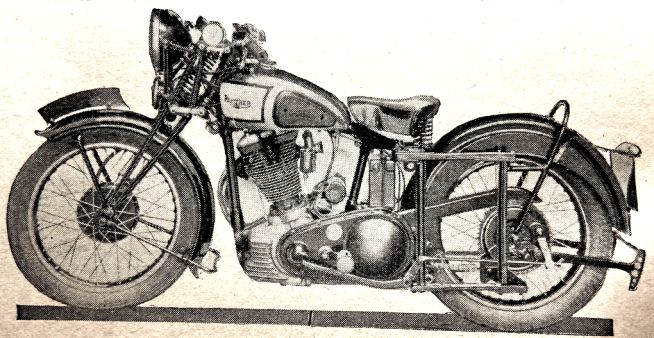
“AUSTRALIA WON THE THIRD speedway test, held at Harringay on Saturday, by a margin of ten points, gaining a well-deserved victory over England by 58 points to 48. Before the match Australia’s plight was desperate. Having won the first two tests, England needed only one more victory to win the rubber; thus it was to be expected that the Australians would fight to the last ditch. Even so, I did not see how England could fail to win. I expected to see Australia fight a hard but losing battle. Instead, the Kangaroo treated us to one of the best and most amusing displays I have seen for a long time. By the interval, the English Lion’s tail had a kink in it. Thus heartened, the Australians rose right to the top, and by the end of the match the Lion’s tail was tied in a knot.”
“NOW FOR A FEW brief items: First, the Army is to enter teams in an International Army Trial, to be held al Spa, in Belgium, early in September. Secondly, the Middlesex tax authorities are demanding payment from the Amateur MCC on the score that the club badge is an ‘armorial bearing’. The BMCA has obtained legal advice on the matter, and the demand for duty is being resisted. Were it decided that an ordinary club badge is an armorial bearing, clubs all over the country would be affected—tennis, swimming, cricket and football clubs, as well as those devoted to motor cycling. Thirdly, a ‘Highways Protection Bill’ is on the tapis. This seeks to give power to close roads to sections of the community—a power which, as the BMCA has pointed out in a letter to all members of the Committee considering the Bill, is already covered by the Road Traffic Act and the Road and Rail Act. The Organising Secretary of the BMCA ends his letter to the Committee with the sentence, ‘I urgently submit that, so far from restricting rights, efforts should be directed towards facilitating the means of enjoying the amenities of our countryside, and repeat that the appropriate authorities already have full powers if the type of transport used prejudices the safety of others or is unsuitable for a particular road.”
“FOR THE FIRST TIME in motor cycling history the magic 100mph lap has been achieved in an International road race. That formidable combination, Meier and the BMW, again proved superior, and in winning the 500cc class of the Grand Prix of Europe Meier lapped the Belgian course at 100.63mph. Great Britain was officially represented only in the 350cc class, and British riders, all Velocette mounted, took four out of the first five places, with EA Mellors beating Stanley Woods for first place by nine seconds. In the 250cc class the German DKW again proved that it has more staying power than the faster Italian Guzzi, and Kluge won comfortably. Competition during the whole meeting was extremely keen, and it was obvious that every camp was out to take home as many honours as possible. In each class there were at least two well-known marques capable of winning the races; in the 500cc class BMWs and Gileras were the chief rivals. Meier lapped at over 100mph in practice, but the Gilera riders only covered a few practice laps. ‘Ginger’ Wood practised consistently on the modified blown twin FN, but he did not consider that the acceleration of the machine was good enough to enable him to win. The main attention during the winter months has been paid to the ‘blower’. It is now arranged on its side, in which position a better mounting farther forward is obtained for the carburettor. It was obvious that the 350cc race would be a duel between the Velocettes and the DKWs. During practice, both Kluge and Fleischmann tried out the new 350cc machine, which has a chain-driven rotary supercharger. Fleischmann made the best practice lap on one of these machines, but the DKW technicians are not yet satisfied that the machine will last for a long race, although it is stated that the new engine develops about ten more horse-power than the old one. For practising, the new machines were fitted with an instrument panel at the side of the tank containing a rev counter, electric oil gauge and electric boost pressure gauge. These were being used to gain data about the state of the engine’s health under racing conditions. Of the Velocette contingent, Mellors and Stanley Woods were using their TT machines, while the other riders bad KTT models. The spring frame of Franz Binder’s machine is experimental; it has springs in place of the ‘Oleo’ legs used on the TT jobs. Three famous marques were there to do battle for the 250cc honours; they were the German
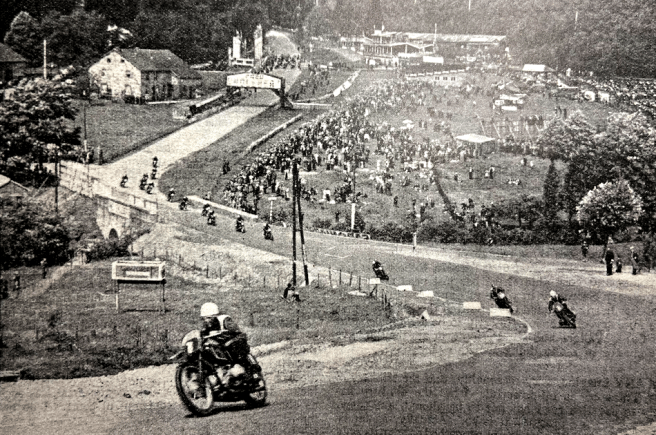
DKWs, and the Italian Guzzis and Benellis. The Guzzi engines were all supercharged, but the Benellis were replicas of the machine which Mellors rode to victory in the 1939 Light-weight TT. During the practising period a rumour had spread that the Gilera equipe were to go straight to Germany to attack the maximum speed record. It had gained ground because tucked away under sheets in the racing van was a machine which was partially streamlined. The real explanation of this machine is that Taruffi has designed it for road racing, but so far there has not been sufficient time to practise with it. Saturday’s practising and the weighing-out were both spoiled by rain. Those riders who turned out all complained of the slippery state of the roads, and the FICM stewards had to consider whether they would allow the race to be run if the weather conditions were bad on the following morning. Sunday, however, dawned fine, and thousands of spectators who annually come to see this race from the surrounding countries made their way in the sunshine to the various vantage points. Part of the reason for the increased speeds in practice was that the course had been altered from previous years. The difficult hairpin bend immediately after the start has been by-passed by a banked road, which climbs up the hill in an easy turn. The alteration has made the course considerably easier, for the difficult bends up the hill to Burnenville are obviated. The rest of the course remains unchanged, and the fast bends between Stavelot and Francorchamps are still as difficult as ever. Massed starts were, of course, used, and only 30 seconds separated each class. The race was started by traffic lights, and on the green Meier (BMW) immediately gained a lead over everyone in the 500cc class. By reason of his last year’s win he had the No 1 position on the starting grid. Behind him were the Gileras, Kraus on the second official BMW, and ‘Ginger’ Wood on the FN. A few minutes later the loud-speakers announced that the order at Burnenville was Meier, Serafini (Gilera), Kraus (BMW), Aldrighetti (Gilera) and ‘Ginger’ Wood (FN). Meier had already built himself up a lead, and as the race progressed it was obvious that he was not going to be beaten. His nearest challenger, Serafini, had an unfortunate experience early in the race. He came upon a slower competitor when tackling one of the fast bends. The slower man was on Serafini’s line, and the Gilera man had to change viciously into third gear to reduce speed, and even then his offside footrest caught a protective bale of straw on the corner as he scraped through. Damage had been done in the gear change, and a few laps later he came in to the pit for a discussion with Taruffi. After losing nearly two minutes he continued. He was then in third place, behind Aldrighetti; Kraus, on the second BMW, was fourth, and ‘Ginger’ Wood still fifth. This order was maintained
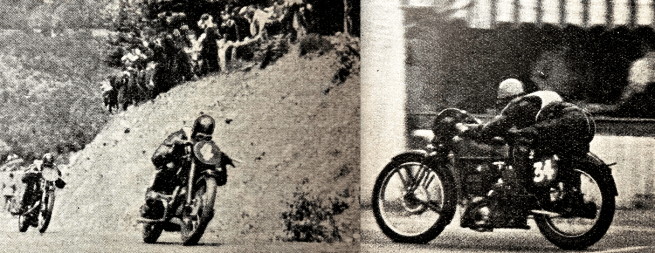
until 20 laps, with Meier increasing his lead on every circuit, until he had lapped everyone except the two Gileras. Then at three-quarter distance Aldrighetti failed to appear, and later it was learned that the Gilera engine had gone sick. This gave Serafini second place, albeit a long way behind the German. So Meier received the chequered flag, having made the fastest lap in an International race, and having made the Belgian race the fastest in Europe, with an average speed for the race of 94.95mph. The 350cc race was much more thrilling, for there were close scraps between the champions throughout the 234 miles. After a dashing start, in which EE Thomas (Velocette) led the pack up the hill, the race for the lead settled down to a duel between Stanley Woods and Mellors, on the Velocettes, and Wünsche on the DKW. Fleischman (DKW), who had been with the leaders on the first lap, had to take a wrong line on one of the corners, and he crashed heavily, damaging his left arm. He remounted, and after a stop at his pit at the end of the lap, set off in chase of the field. For four laps Stanley held his lead, but could not shake off Wünsch. Then, as it began to rain, Mellors overtook both Wünsche and Woods, to head the field. On the next lap, Mellors’ and Wünsche were scrapping hard, with the DKW howling at Mellors’ heels; Stanley had dropped back a little, and Grizzly (Sarolea), the Belgian rider, was lying a good fourth. Behind these four were a quartette of Britishers, all on Velocettes, and having the race of their lives. For lap after lap they raced round together, with each man slip-streaming the other, and the leader unable to draw away owing to this slip-streaming. For several laps the order was Binder, Whitworth, Thomas and JE Little; then Thomas and Little managed to slip in front of Whitworth, and this order held for a few laps, and then changed again. Meanwhile, Grizzly (Sarolea) increased his speed enormously. Slowly he picked up on Stanley Woods, and shortly before half-distance he managed to overtake Woods and hold third place. In this effort he made the fastest lap of the day at 94.59mph. But his spurt was wasted, for the Sarolea would not stand the pace, and later he retired. Shortly before half-distance Mellors had to give the German best, and Wünsche took the lead. As he came in to refuel he overshot his pit. This gave Mellors several valuable seconds, but as the Velocette required petrol and oil, while the DKW took on only petroil, Wünsche was away first. After the pit stops things started to happen rapidly. Wünsche began to draw away a little, and after another four laps had a half-
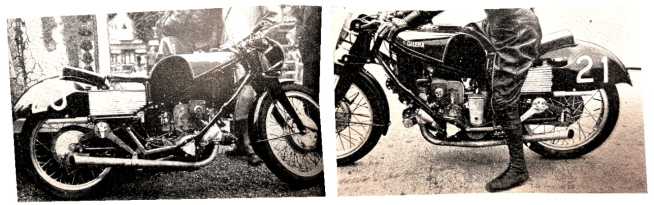
minute lead on Mellors. Fleischmann (DKW), who had ridden a superb race after his fall in his first lap, worked his way up into fourth place. But the roads were still very tricky with the intermittent showers, and Binder and Little both crashed on the far side of the course; fortunately neither of them was injured seriously. Thomas and Whitworth had become separated during the pit stops, and Whitworth, who made a lightning fill, lay fifth behind Fleischmann. With only two more laps to go it looked a certain win for Wünsche, but on his penultimate lap he picked up a nail in the rear tyre and the race was over so far as he was concerned. Mellors managed to stave off the challenge of Woods, who made a super effort in the last few laps and when they both got the chequered flag neither of them knew that they had taken first and second places respectively. The 250cc race was a repetition of the Dutch story, with the difference that the Benellis were also in the battle. Kluge (DKW) took the lead at the start, but he was very soon overtaken by Tenni, on the supercharged Guzzi. Retirements began early in the race, for one of the Guzzis failed to get going at all, and Winkler (DKW) punctured on the first lap. Tenni proceeded to leave the DKWs far behind, lapping steadily at 83-84mph. At the end of ten laps he was over half a minute ahead of Kluge. But, as in Holland, the pace was too hot for the little engine. This left the race in Kluge’s hands, and although two Benellis, ridden by Rosetti and Soprani, were lapping consistently, they could not average the same speed as the German ace. After such a gruelling race the class winners were not at all keen to run in the short handicap, which was to have followed the International races, and the organisers wisely decided to conclude the meeting with the garlanding of the winners.”
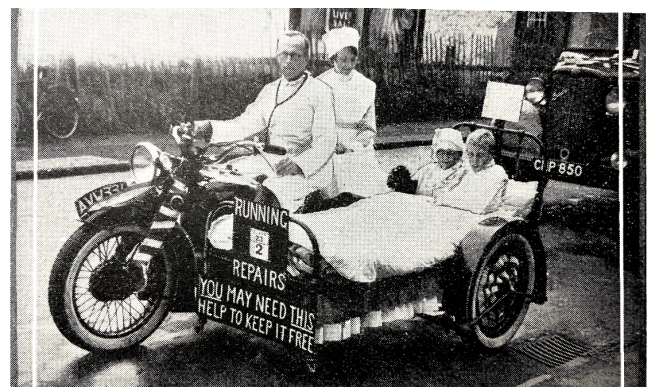
“WITH A TORRENTIAL RAINSTORM sweeping across the Cheshire-Derbyshire hills, it is not surprising that only about half-a-dozen clubs arrived in time for the ‘count’ of the Cheshire Centre Rally at Edale last Sunday. But the enthusiastic ‘unattached’ swelled the gathering and witnessed some hectic practising for the freak hill-climb which was to take place (it was hoped) later in the afternoon. If riders could get up the steep hill-side of Back Tor Farm, at least it was possible for the Manchester Eagle MC to carry on with the organisation. One of the difficulties on a wet day is that of getting anything like a decent start. Then, about half-way up the 300-yard climb at Edale there is a transverse gully (or sunken pathway) which involves a kind of nose-dive as a preparation for a short bit of about 1 in 2½—not so good on slime! The storm-clouds rolled by and there was a spot of warm sunshine for the 350cc event. But the rain had done its worst, and ‘farthest up’ rather than ‘in the fastest time seemed to be the ruling for decisions. However, for the second runs the hill drained itself appreciably, and several made non-stop runs. As the event was run on the knock-out system, these riders were all eventually brought together and the meeting improved as it went on. Brought down to four riders in the semi-final, Twiss (349cc Triumph), who had been riding most consistently, beat AD Parker (349cc OK Supreme); and PC Reece (343cc Triumph), who had easily made fastest time up to the moment in the heats, beat J Ashworth (249cc BSA). Reece and Twiss, therefore, had to run the decider, and although Twiss made his usual good start he was caught and passed on each of the two runs allowed. Reece, indeed, appreciably improved on his previous time in his winning run. All this had gone on to the accompaniment of sunshine, black clouds and heavy rain in varied selections. It was decided to modify the approach ledge of the gully so that it could be taken faster. It certainly improved matters for the unlimited cc event, but even so a number of competitors decided that one event was enough for them. All-round improvement of times resulted, and several people got well under 40sec, notably FV Lambert (498cc BSA), L Flowers (498cc BSA), WR. Colclough (494cc Douglas), H Ogden (349cc BSA), LJ Manley (349cc BSA), N Darlington (497cc Ariel), and, of course, PC Reece (343cc Triumph), who clocked what proved to be the best time of the day—29.4sec! Flowers, Reece, Manley and Darlington reached the semi-final, and Flowers and Manley, as the slowest pair, were sent up first to settle which one should be third. It was a neck-and-neck scrap; Manley closed up on Flowers, but was just not able to even up the advantage of Flowers’ bigger engine. Then came the Reece-Darlington contest. Reece was obviously on top of his form, but on each run throughout the event Darlington had improved a couple of seconds or so. If he could keep it up the final should be his. On the first run he got away first, but Reece caught him at the gully, where he got into difficulties. Reece clocked 33.6sec. Again, on the second run, Darlington made a quick start, but suffered a deal of wheelspin. This gave Reece the chance to pick up, and just as he was about to overtake near the summit his model spun round in the slime and the run was Darlington’s. Did it beat Reece’s time on the previous run? No! 35sec only. Reece had won again. RESULTS. Centre Rally: 1, Manchester Eagle MC; 2, Crewe and South Cheshire MC; 3, Manchester ’17’ MC; 4, Macclesfield &DMC; 5, Stockport and DMC (based on attendance and mileage).”
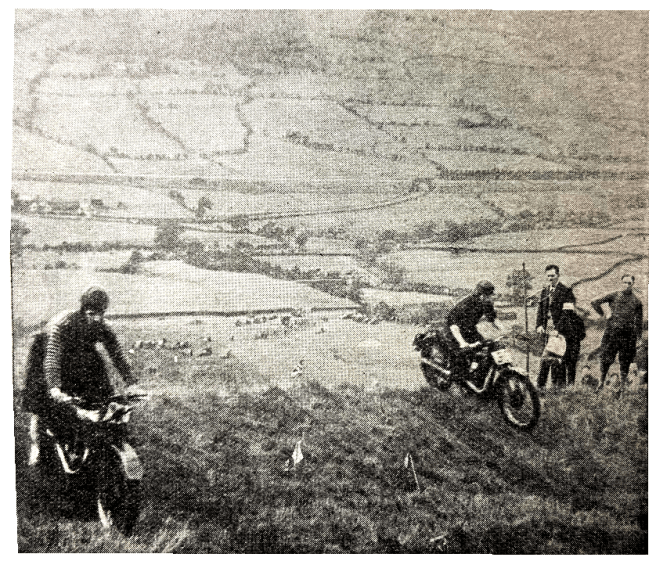
THE ARMY TOOK PREPARATION for the ISDT seriously. “It is 8.30am. 15 Army motor cyclists are. lined up with their machines. Each machine is examined with the thoroughness of the final examination in the old-time English Six Days. Unknown to the riders, marks are awarded for cleanliness, condition and proper maintenance. From 9 to 9.40 there is physical training—what is called the ‘trained soldier’s PT table’, which is designed not to produce brands of Hercules, but men who are all-round ‘fit’. As it is fine the PT is held out in the country, on the banks of a lake. Then a swim in the lake. Next come two hours’ practising on the machines: riding through sand, follow-my-leader through dense pine woods, negotiating grass and gravel roads and tracks and practising rapid repair work. After lunch—from 2 until 5—there is road work by teams: a run of, say, 100 miles. From 5 o’clock to 8.30 next morning the time is the men’s own, except that in this period they must clean their machines, fill them up and carry out any necessary maintenance. Marks are awarded for everything: machine condition, performance in the various types of practice, being ready with the machine on time, and so on. Any defects in maintenance, pump or tyre levers missing, making frivolous complaints about the model and troubles occurring when with efficient maintenance they would have been avoided—these and similar things cause lost marks. Since the men have not been told about the marking there is nothing to put them on their mettle except their own personal keenness.
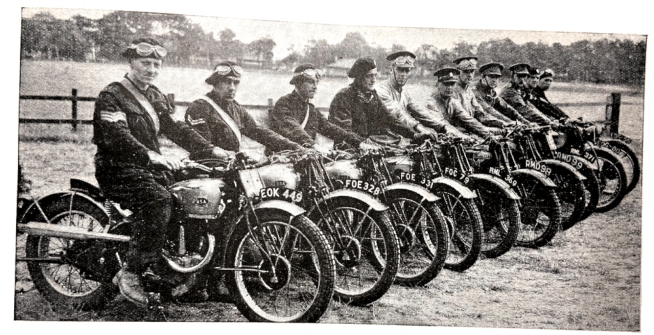
Fifteen started the course on June 5th. At the end of five weeks’ training this number was whittled down to 12. The runs have not been go-as-you-please affairs. Part-way round the course (which has never been the same twice) each competitor would be stopped and told, ‘You have a broken fork spring (or a broken chain or a puncture)’, and would then have to put right whatever the stated fault was. Latterly there have been runs of 200 and more miles with petrol stops, time checks arranged on ‘International’ lines, trouble tests in between checks and everything in line with the actual Six Days’ conditions. Among the training has been rough-stuff work over the Yorkshire moors, demonstrations of scrambling by WA West and Len Heath, plus criticism and suggestions by these two famous riders, riding round the road and ‘Mountain’ circuits at Brooklands under the eyes of George Rowley and Bert Perrigo, demonstrations of tyre changing by Dunlop experts, studying maintenance work at the factories concerned, a trip over parts of last year’s International course under the guidance of Vic Brittain and riding at Donington. ‘Why Brooklands? Why Donington?’ it may be asked. The reason is to get the men accustomed to riding on closed roads.”
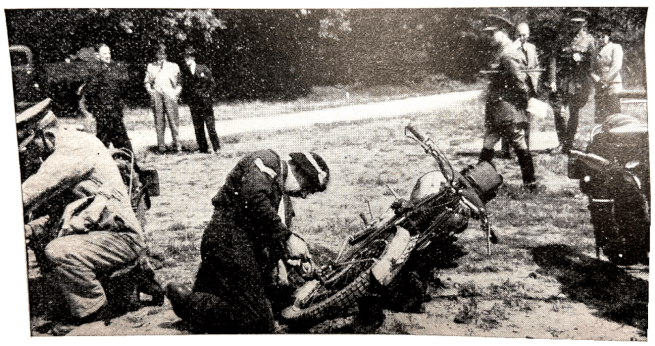
“A BLACK-OUT over a wide area of Southern England will take place on August 9th-10th.”
“HAROLD DANIELL recently went to enlist as a Territorial motor cyclist, and was turned down on the score of eyesight—the man who holds the TT course lap record at 91.00mph!”
“QUITE A NUMBER of motorists seem to have no ‘parking sense’. Vehicles are left in ridiculously dangerous positions even on main roads.”
“REGARDED AS THE MAJOR motor cycle event in New Zealand, the Three Days’ Reliability Trial was organised this year by the Pioneer MC. Three different routes were employed, and in addition to 30 observed sections there were easy-starting, braking and stop-and-restart tests, as well.as a final machine examination. Only just over half the entry completed the course. RESULTS. 1, R Frizell (Ariel), marks lost, 16; 2, B Wisely (Calthorpe), 35; 3, TR McCleary (Triumph), 41.”
THE ACU HAS RECEIVED an appreciative letter from Mrs Elisabeth Gall, the wife of Karl Gall, who was killed while practising for the TT. After thanking the ACU and Mr Joe Craig, she says: ‘Many other English fellow-sportsmen who were in the Island for the TT Races also put a lovely wreath on the coffin. Unfortunately, I have no opportunity to express my deep gratitude to all the many dear people and so I should like you to put a short note into your sports magazine if possible, so as to give my thanks to all English fellow-sportsmen. It is such a comfort to know that the sport is a link between us.'”
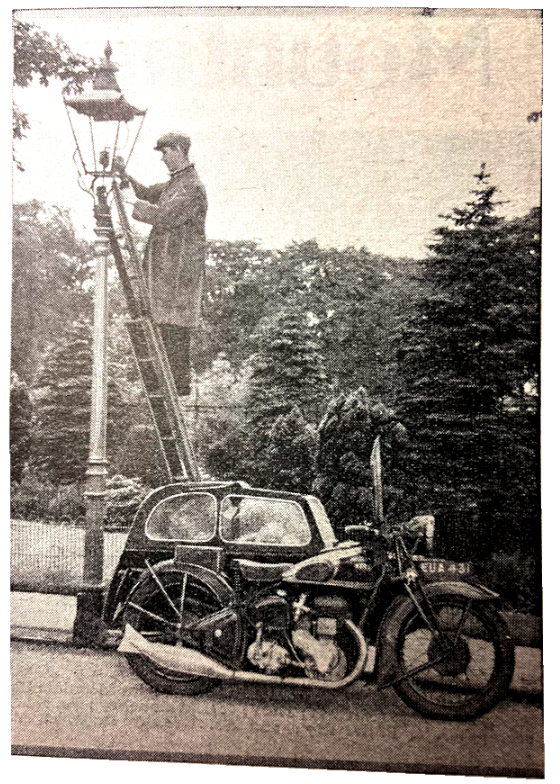
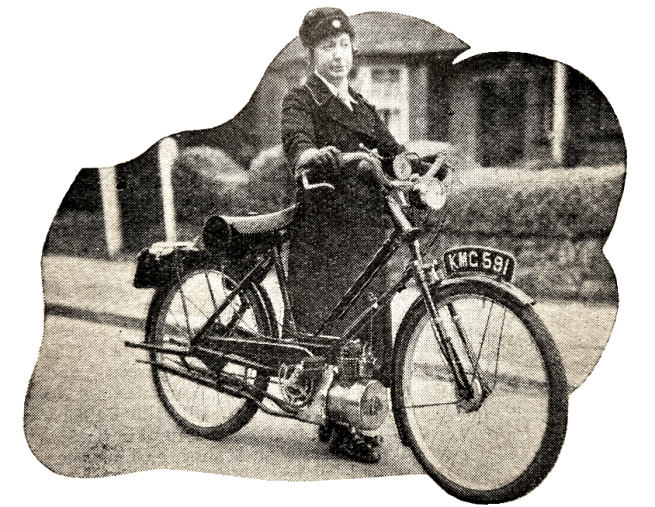
“THERE IS TO BE no Roadster Race—no ‘Stock-Machine’ TT. This decision was reached at a meeting between the ACU and the industry held in Coventry last Friday. The official communiquéé merely states that ‘after consideration it was finally agreed not to proceed with the organisation of such an event next year’. While the decision is only in respect of 1940, it can be assumed that the proposal is ‘killed’. One reason is the difficulty of ensuring that such a race shall be fair to all. The ideal, of course, is a race for machines exactly as sold to the public—for motor cycles taken straight from dealers’ stocks and which, therefore, in the normal course of events would have been bought by the public. In these days when prospective purchasers of various popular models have to wait weeks for delivery it is obviously impracticable to select the machines in this way. Moreover there are certain makes with a very small output and few agents. The difficulties in this direction are immense—probably insuperable. Another objection raised is that a true stock-machine race held at the same time as the TT might, to use the words of one manufacturer, appear rather ‘silly’. This, however, is not a point that carries much weight with us. We believe that the vast majority of motor cyclists would be extremely interested in learning how the various makes and models compare in high-speed reliability. Whether the speeds were low in comparison with the TT itself would matter little, except that if they were it would reveal how specialised TT racing machines are! The result would be to depreciate the value of a TT win in the eyes of the public. When the ACU again discarded the principle of a standard-machine event (it is no new idea) on account of the difficulties involved, they approached the manufacturers with the proposal of a ‘Roadster Race’ open to machines on standard lines—machines which might only be altered from the regular specification in certain respects. A race of this type is, in our opinion, practicable, given suitable, clear-cut regulations. How much or how little the ACU’s suggested rules permitted deviations from standard is not public knowledge. It is, however, a fact that a big point made against the proposed race was that the event would be neither a real TT nor a Stock-Machine TT. It was felt that the public would not accept the machines as being ‘stock’ and, therefore, the event would be of little value. There is much in this, but surely the answer is that the draft rules were permitting too many alterations? No, our view is that the race has been rejected became few manufacturers really want it.”

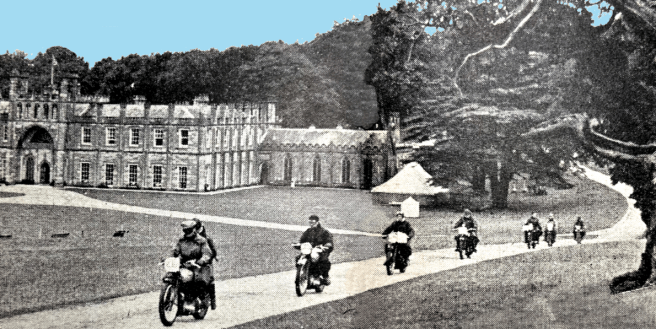
“YEAR BY YEAR the National Rally has grown in popularity, and has now achieved amazing success. This year the rallying point was, of course, Donington, and it is fitting that this should be so, for Donington itself represents one of the biggest romances in the history of motor cycling in this country. Thousands of people flock to this annual rally. This yearly mustering seems to have captured their imagination. They are prepared for all emergencies, and many of those who compete in the mileage competition seem to delight in giving themselves the most difficult task possible in order to be included in the final assembly. A record entry was received for the competition, and few, if any, were deterred by the poor state of the weather. It is curious that the ACU has rarely been able to pick upon a really good week-end, and this year was no exception. Almost all over the country, as everyone knows, storms raged during last week and persisted throughout the period of the rally. True, Sunday, to begin with, was not too bad a day in the Donington area, though there was considerable cloud about and no indication of really settled weather. Close on a
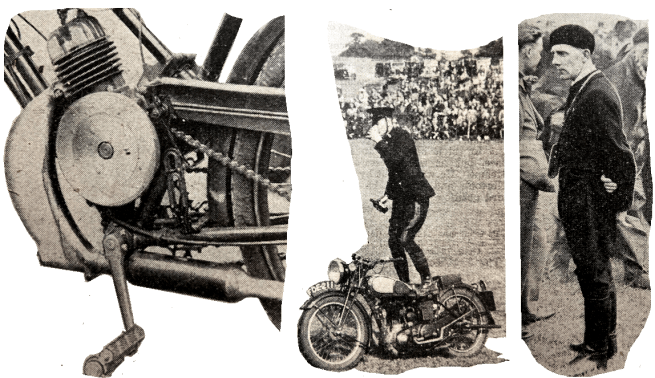
thousand riders took part in the mileage run, some of them content to cover only a short distance, others intent on crowding in as great a number of miles as possible into the time at their disposal. All manner of machines were used, big and little, old and young—solos, sidecars and three-wheelers—and from factories in several countries. At 8.45am on Sunday, the gates of Donington Park opened to receive the first of the arrivals, and from that hour until 11am a steady stream rode into the famous park. By the time the maroon sounded, signalling the time limit for arrival, a great concourse had assembled and were close set in their separate enclosures. It was extremely interesting to wander round and examine the various machines. It was just as interesting to observe riders and their costumes. There were all types; but the palm surely goes to the man who was arrayed exceptionally smartly in a blue uniform with blue cloth breeches, a blue cloth Eton-type jacket, riding boots and a blue beret! What his coat was like is not known, but, with it removed, he was certainly the smartest male rider on the ground. This question of clothing is worth studying, for, to the uninitiated, it looks bad if everyone in a crowd of this size arrives in grease-stained clothes. It must not be assumed from the above that nobody other than the one specially mentioned was smartly turned out. There were very many who were well dressed, but there were also quite a number who were not. Many riders, after parking their models, rested on the grass and were soon
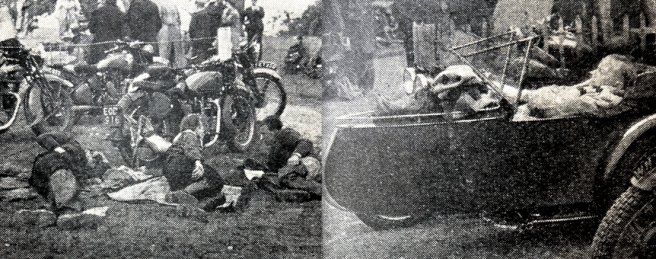
fast asleep; and this is not surprising, considering the distances some of them had travelled and the varying weather they had experienced. Comparing the condition of the finish-ing machines, one was struck by the difference in their appearance. Some were obviously well cared for by riders who possess pride in their ownership. Others, many of them just as new, were in a disreputable state, with the mud of ages on them, and oil freely distributed over engines, gear boxes and chain cases. One saw, too, really old machines that were the apples of their owners’ eyes, and,, though the finish was not quite so glossy as it once was, dirt was not permitted to collect on any part of them. The sidecars are always interesting, and this occasion was no exception. You get the ultra-smart ones for one very favoured passenger; the ultra-sporting ones fitted for the sake of appearance; the big family jobs with obvious work to perform; and the home-made devices of all shapes and sizes, fitted with many strange gadgets designed to add to comfort and convenience. There was a Mercury sidecar on a BMW, the whole forming a particularly smart ensemble; and another foreigner was a DKW sidecar outfit which looked excellent. Another BMW was noticed with trafficators neatly mounted on each side of the rear number plate. Perhaps the oldest model of the lot was a 1902 Quadrant, which, with its antiquated carburation, diminutive valve springs and very oily belt-drive, formed a striking contrast to some of the pristine multi-cylinder machines surrounding it. There was an HEC motorised bicycle to which its rider, Archie Cocks, has fitted a sensible footrest arrangement. Two plates are attached to the bottom bracket. These can be hinged outwards, so that one holds the right pedal in such a position as to be opposite the left-hand plate. Thus, the right pedal formed one footrest and the left plate the other, giving. a footrest position more favourable than that provided by the normal pedals. The two plates are automatically tripped up and folded by the act of pedalling. Well, there they were, though as is only to be expected, not all those who had planned got through to Donington. However, considering the entry, the percentage of finishers was quite high. Out of 891, only 173 failed to put in an appearance at the end. Of those who did finish, only four failed to qualify for an award. Gilt plaques were won by 259, silver by 312, and bronze by 143. Some idea of the magnitude of the

event can be gleaned from the fact that the total mileage covered was 388,700. The aggregate mileage marks for competitors was 464.1. After the assembly was completed and some effort had been made at refreshment and so on, a gymkhana was held and attracted a good number of competitors. There was a pretty full programme, which included all the usual fun-making events. A good crowd was kept well amused until the racing started. This, of course, was in the capable hands of Fred Craner and his Derby Club comrades, and was run off with that slickness for which these worthies are noted…with the racing over the 48th Divisional Signals (Territorial Army) Display Team gave an exhibition of trick riding which was watched by an admiring crowd. It was a polished performance, and well deserving of the applause it was accorded. There remained only the prize distribution. It was a pity, in view of the trouble the ACU had gone to in order to arrive at the results and engrave the awards, that so few competitors were present at the distribution. Naturally some of them had to leave early for distant destinations, and all were tired after their many hundreds of miles. At the prize-giving, Mr JG Shields, JP, the owner of Donington, addressed the assembled crowd, the National Anthem rang out, and another National Rally had more to an end. CLUB COUNT. Winners (ACU Inter-Club Rally Challenge Trophy): Harringay &DMCC; runners-up, Lea Bridge &DMCC; third, Leigh MCC; fourth, Tyldesley &DMCC; fifth, London Scott MCC.”
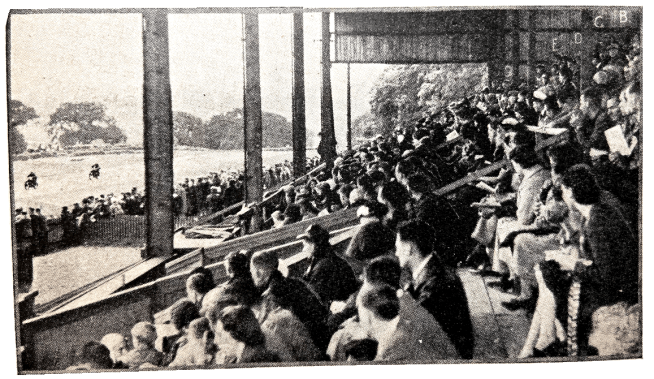
“AS A MILEAGE COMPETITION the National Rally last week-end was an outstanding success. First, there was a record entry of 891. Secondly, the competitors concerned covered 388,700 miles and 23 of them gained the ‘possible’ of 811 marks by covering 729 miles in the 27 hours and visiting 41 control points. Thirdly, 259 competitors won gilt plaques by earning 700 or more marks. We congratulate the riders concerned on their feat, which, in view of the weather conditions many encountered, called for remarkable endurance and perseverance. Our one regret is that the rally was not more ‘national’. It is true that the weather last week was not calculated to encourage the rank and file of motor cyclists to make long journeys to Donington, the rallying point, but the term ‘National Rally’ cannot fairly be applied when, of a great army of motor cyclists, only a few thousand are present. The rally last Sunday was worthy of a bigger crowd. More co-operation is needed. Given this and showmanship, the Rally can become the outstanding motor cycle event of the year.”
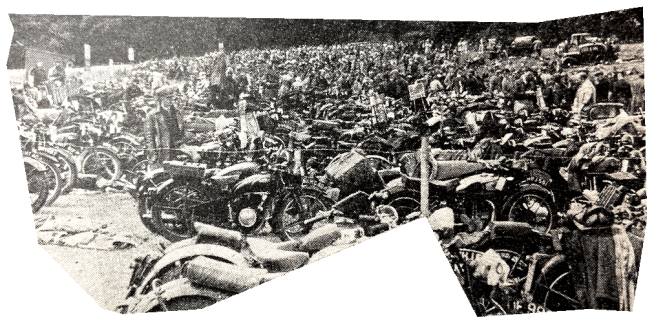
“I MUST OFFER MY apologies for troubling you with my grievance, but sincerely hope you can find space in your correspondence pages for the following protest, for so many good reports have been prevalent regarding the ACU National Rally that I feel that at least one of the winners of the over-350cc class should make clear that there were, and still are, many dissatisfied riders. First, as social secretary of the Bohemian MCC and an active committee man, I should like to know how the ACU arrive at their definition of ‘gold’ and ‘silver’ plaques, for the pieces of painted metal distributed for so much hard work and perseverance have drawn nothing but caustic remarks from all clubmen I have conversed with. However, coming to my own point, I was led to believe that the prizes in this National event were really worth an effort, but for some unknown reason the prize list was not made public, nor were the competitors informed what the prizes consisted of, before the event. Well, here is my case. I spent an industrious 24 hours working out the route with a total number of 811 marks, did 27 hours of really tedious driving through all weathers, paid 5s 6d entrance fee and 35s for petrol and oil, and then had 120 miles to ride home after the event. My reward consists of a silver vase, a set of chains, and a £1 credit note; and now our most noble ‘Union’ appeals to our ‘sporting nature’ to raffle the first prize between us. This event has now been held annually for some years, and inexperience cannot be honestly pleaded. It has been stated that much thought is being given as to how to arrive at a commendable decision with regard to ties. I think that this concentration should have been given before the event, and not after. Furthermore, 1 do not think it does our cause any good what-soever for riders to be filmed after such a day’s riding, and then to be made a laughing-stock at various cinemas. At least the ACU could prevent this kind of bad advertisement.
TM Evans, London, NW5.”
“FOR TWO SUCCESSIVE YEARS my Triumph ‘Speed Twin’ has enabled me to cover maximum mileage in the National Rally and on both occasions I have thoroughly enjoyed the ride despite bad weather. I do wish that the rally and sports and fun could be held a week after the mileage competition. I have never seen and of them. At Donington this year I waited until 2.30pm, and then decided that home in bed was the only sane place. In connection with the mileage competition 23 riders obtained 811 marks—but there are many others who obtained maximum marks and possibly deserved manufacturers’ awards even more than the lucky 23. In case my meaning is not clear, it is obvious that riders from out-of-the-way places would find it impossible to include 41 controls in their route—and they would have farthest to ride home. Their reward—a gilt plaque—would be just the same as the 700-mark riders. I myself managed to get 40 controls in my route, which actually took about 20 (yes twenty) hours to plan. I should be very surprised indeed if anyone could get 41 controls starting at Leeds or any control within 30 miles. But even if this were possible the Scottish lads couldn’t who a cup, could they? In conclusion, I must express my admiration of those who drove ‘chairs’ and three-wheelers over 700 miles, and I take off my hat to the lady rider of a Vincent-HRD, who in my humble opinion deserves better recognition for ‘the finest performance of all.
No 439, Leeds.”
“ON SATURDAY EVENING I encountered one of the three motor cyclist battalions on the move. Since I was forging London-wards and there is only one motor cyclist battalion in the London Division—the Queen Victoria’s Rifles, Territorial Army—it was fairly obvious as to who the lads were. Two things interested me particularly. First, the many sidecar outfits which the Queen Victoria’s now muster reminded me very much of the military sidecar outfits I have seen in Germany. Secondly, when we published photographs and other details of the Norton sidecar-wheel-drive job the Queen Victoria’s apparently had only one; last week-end I saw dozens.”
“REPORT OF A women’s motor cycle club in the United States: ‘Our meeting dresses are maroon, with white polka dots and white hems.'”
“AS I WAS DESCENDING the hill near Salisbury racecourse recently with a lorry laden with seven tons round timber, my brakes failed. A motor cyclist who was coming up the hill immediately grasped the position from my hand and hooter signals, and marshalled two cars which were blocking my way into safety, enabling me to career down the hill safely. Will you please convey through The Motor Cycle the appreciation of my mate and I to this motor cyclist, whoever he may be, for his prompt action in averting what would have been a nasty mix-up?
H Mason, Andover, Hants.”
“WHILE THIS COUNTRY has decided that there shall be no ‘Stock-Machine’ TT, other nations are going ahead with new-type races. Next Sunday, in connection with the Swedish Grand Prix, there is an Inter-Scandinavian Race limited to nationals riding unsupercharged machines. This follows upon the very successful Dutch national races held in conjunction with the Dutch TT. An interesting point is that the Inter-Scandinavian Race, which has only two classes-350 and 500cc—has attracted an even larger entry than the total for the three open international races. We do not suggest this is in any way indicative that a Roadster Race held in the Isle of Man at TT time would be well supported. The Roadster Race would depend solely upon the interest displayed by manufacturers—upon the degree to which manufacturers supported it with entries—whereas the Inter-Scandinavian Race can be entered by any Dane, Finn, Swede or Norwegian. There is, however, food for thought in the fact that other countries are developing new types of races to be held in conjunction with their international events. The latter provide feasts of speed; will not the former act in some measure as the sporting rider’s ‘buyers’ guide’? Our view is that races such as the Dutch national events and the Inter-Scandinavian Race may well provide better propaganda for the successful makes than even the open races. Consequently, we are delighted to see that of the 40 entries in the Inter-Scandinavian event no fewer than 27 of the machines are British, the remaining 13 being split up among Germany, Belgium and Sweden.”
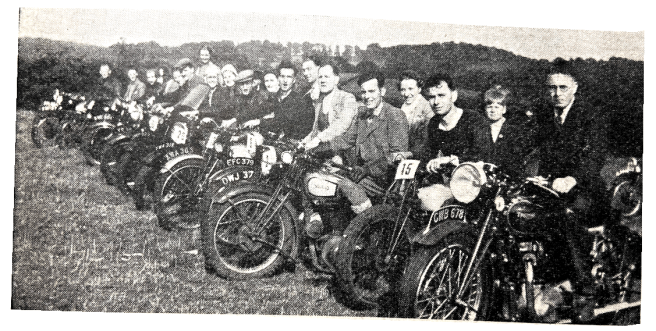
“I SEE THAT THE mpg question is once more in the limelight. Nearly everybody seems satisfied nowadays with round about 80mpg, but then, of course, the modern machine is so heavy. Certainly comparisons with the machines and roads of the ‘twenties’ are very interesting. I believe the Wooler (a flat twin), just after the War, raised everybody’s eyebrows with a guaranteed 160mpg, and during a test recorded 212mpg. I found my chain-cum-belt 349cc Coulson-Blackburne giving 156mpg regularly (the machine weighed 198lb), and a 1921 16H chain-drive Norton (weight 252lb gave a steady 133mpg. Both machines were fitted (ie, the carburettors) with that superb piece of economy, the WSR variable jet. Later I found the Scott ‘Flyer’ (498cc) giving 83mpg—mine (1927 vintage) weighed just over 300lb. I think—and actually 95mpg with a pillion passenger. This on a mixture of city crawling and hilly country! The early Scotts reached 150mpg in observed tests and 88mpg with sidecars, using the famous Binks carburettor. By the way, when will the multi-cylinder two-stroke come into its own for modern roadwork? Personally, the twin two-stroke converted me for ever.
Pionero, Trowbridge, Wilts.”
“WITH 29 ENTRIES, the Southport Club’s programme last Saturday looked quite promising. However, there is usually something sent to test our fortitude, and on this occasion it was rain. Rain with a capital R, indeed! There rarely has been a morning that presented such a perfectly flat and smooth stretch of sand at Ainsdale. And probably more rarely still has there been one single hour when so much water fell steadily as it did shortly before the time to start. At zero time it was still raining, and the beach was covered with great pools of water. However, things had to go on. The programme started with the straight races, in which it was evident that neither Joe Moss nor Denis Parkinson (490 Nortons) was going to have things all his own way. W Billington proved not only to be quite at home on his usual 350cc Rudge, but was also going great guns on his less familiar Norton in the big classes. Bob Berry got his Brough Superior cracking long enough to lead the 1,000cc race very comfortably. Owing to the state of the sands, the championship race between the two fastest motor cycles and the two fastest cars had to be abandoned. Billington, (490cc Norton) won the five-lap invitation race, ploughing along through sheets of water in great style. Several of the likely people dropped out with drenched motors.
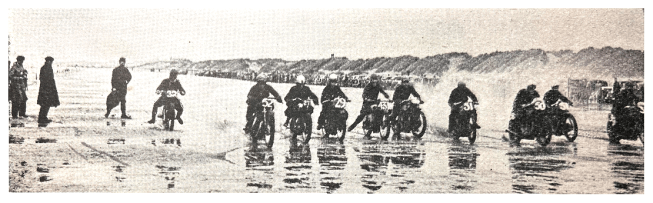
The ten-lap scratch race was remarkable for the fact that under the prevailing conditions the pukka racers were fairly soon eliminated, leaving the not-so-new and not-so -snappy models to roll home and collect awards. Also remarkable, was the complete disappearance of every machine over 350cc! JB Moss (490cc Norton) led off at a good crack, closely followed by W Billington (490cc Norton). Then Billington got round the Ainsdale corner on the inside and took the lead, to retire soon after with a very ‘flat'” motor. At the half-way distance Moss suddenly planted both feet firmly on the wet sand and toboganned to rest with a seized rear brake. Meanwhile, the rest of the field had been going in spurts, sometimes doing a lap quite fast and then reappearing with engines spitting and banging, as water found its way into the works. S Anderton’s twin Triumph was in this state, and eventually gave up after seven laps. And so all the bigger machines faded away, leaving J Wild (346cc New Imperial), sometimes fast and sometimes slow, to win by about two minutes from T Harrison’s elderly AJS.”
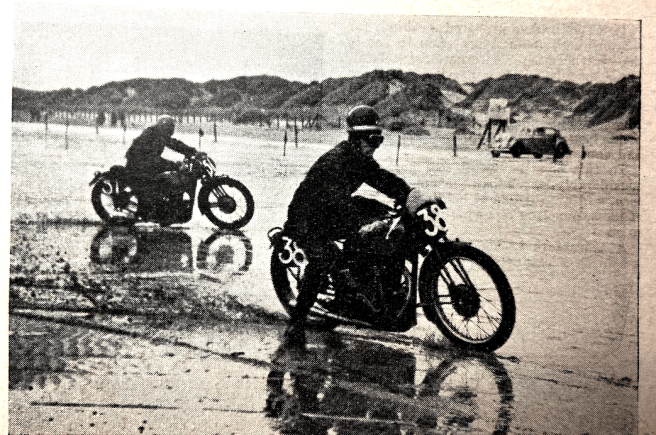
“I AM A LEATHER FAN, and in good company, too, for your photographs of professional riders show that they prefer the same material, and they should know! Leather allows perspiration to evaporate, and the skin does not become moist and clammy. It is very comfortable, and its appearance is always smart if kept clean and well polished. I wear a heavy pair of black leather lace-up knee-boots, with three-buckle throwovers at top. The thicker you get the better they keep their shape. Then comes a pair of tan leather breeches, and a waistcoat of the same material, with a tweed sports coat. A black ski-cap and good quality black gauntlets go well with the boots. I intend to add a tan leather sports coat and similar top-coat as funds permit. For wet weather, I wear a pair of black leather sea-boots, like a fireman’s, but higher in the leg. A pair of rubber thigh leggings come down to the calf, and, with a black rubber com-petition coat, keep out all wet. If you get sea-boots the right size, and fitting close at the instep, they are quite comfortable to walk in. An item of riding kit used, I believe, by most professionals, but not troubled about by many ordinary riders, is a good, wide belt. It is a fine support in riding. The usual style is made of webbing, but mine is of leather. Any harness-maker will make you one of any width you like, but get it thick enough not to crumple horizontally.
C Edwardes, Blackpool.”
“ON A RECENT SATURDAY afternoon I had just pulled my machine on to the grass outside Lytham to make a minor adjustment, when another young man dismounted and offered his help. We had the job done in three minutes. Before I could thank him he asked if I was the writer of a letter on riding kit in The Motor Cycle. I said ‘Yes,’ and asked how he guessed. He said, well, the letter was written from Blackpool, and that wasn’t far away, and my togs agreed with the description I had given. He said he always cut out the items that interested him and-had kept my letter as he also was keen on leather. That was obvious, but if I am a leather fan he was a leather ‘king’. He was returning now to Glasgow after a south-country tour, but last year had spent his holiday in Norway, where leather clothing is very popular, and where he bought most of his present kit. He had a tan chamois-leather shirt, with the sleeves rolled up (it was a warm day), no gloves and no head-covering. His breeches were tan leather, but thicker and of better stuff than I’d seen before. They were kept in place by a three-inch leather belt, and had four belt-loops. His lace-up knee-boots were the heftiest I’ve come across. The leather was pebble-grained, rather a dark brown, and very thick. The legs fitted very well, but the feet were extraordinary, the toes being actually square and coming up in two blunt corners like a box covered with leather. The soles were exceptionally wide, and were decorated with heavy steel plates at toes and heels, and with a row of large, square-headed nails set flush with the edges of the soles and close together. At first I was rather taken aback by these boots, but every time I looked at them I liked them better. He produced from a pannier bag, and put on, a tan leather jacket, double-breasted and similar to a lounge jacket but smarter; also a brown leather ski-cap and gauntlets, the same shade as his boots. ‘I have a leather overcoat for cold weather,’ be said, ‘but I use one of thin oilskin over my jacket in heavy rain. Here is a pair of leather seatless trousers which avoid the need for rubber thigh leggings.’ He unfolded and put on this garment of his own design. The legs finished about three inches below the tops of the boots, and were held there by a strap and buckle. A similar strap tightened the trousers at the waist. They were undoubtedly waterproof, being a thinner edition of the pebble-grained leather used for the boots. His breeches were much less baggy than ours at the thigh, so that these overall trousers did not have to be wide; they sat close to the leg and looked very smart. My friend said that for winter riding he used chamois leather underclothing, also brought from Norway, as he found it smoother and warmer than wool. Can any reader inform the rest of us if such underclothing can be bought here?
C Edwardes, Blackpool.”
“I HAVE READ with considerable interest the recent letters on all-leather kit for motor cycling. As I am also a leather fan I certainly agree with Mr Edwardes as regards the undoubted smartness of leathers, and, like him, for wet weather I wear a light black competition coat over the kit, and this, with rubber thigh-boots, keeps me quite dry. I also agree with Mr John that there is ‘nothing to beat leather’, but definitely think that purely horse-riding breeches and boots are unsuitable on a bike, as they are obviously not made for this purpose, and give a fellow the appearance of being dressed for the wrong sport. I am surprised that more motor cyclists do not choose all-leather kit, as after some years of experience I find my own rig-out both smart and satisfactory. It consists of well-fitting black lace-up knee-boots, smartly cut black leather breeches, and a stout double-fronted lancer-style black leather jacket, leather gauntlets, and ski-cap with a large peak.
‘Ariel Square Four’, St Austell, Cornwall.”
“NORTONS HAVE PREPARED machines for members of an Army team to use in the forthcoming International Trial. These models, in their Service green, are well turned out, and look exceptionally businesslike They are perfectly straightforward, but much thought has been expended on the subject of carrying spares and equipment. To this end the metal tool boxes are considerably larger than the standard pattern, and are capable of holding a full kit of tools, puncture repairing materials, and so on A spare fork spring is carried, and it is held by a metal strip bolted to the front tank lug and a small bracket on the front engine plate. Just alongside is the air bottle for tyre inflation. This is in a carrier at the base and held by a clip at the top on the front down tube. Another accessible item is the wheel brace, which is thrust into a lug below the saddle, while the other end is secured by a spring clip on the saddle stay.Front wheel removal involves, inter alia, the detachment of the speedometer cable, and this is made simple by providing a light spring which holds the drive in place, but which permits instant removal of the cable from its housing on the brake plate. All control cables are duplicated, and the spare cables are very neatly taped and wired to those which are normally in use. In the event of a broken wire it would be a matter of moments to re-move the broken cable and replace it with the spare one.”
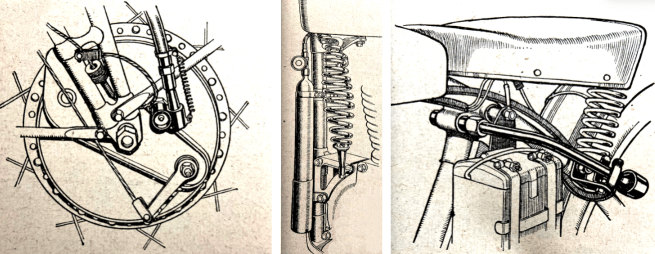
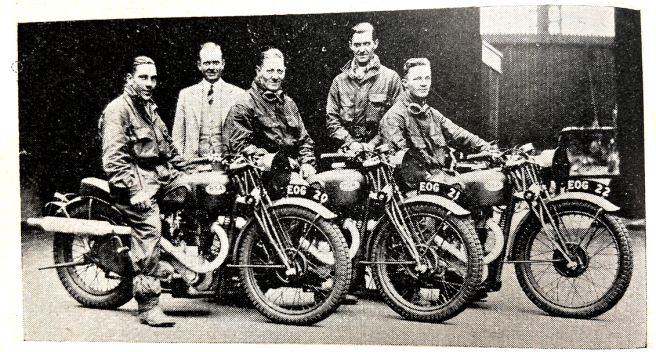
“NO FEWER THAN 61 British motor cyclists have entered for the International Six Days Trial, which is to be held in Germany from August 21st to August 26th, with headquarters at Salzburg, south-east of Munich. With many readers no doubt the first reaction to this will be that the British entry is smaller than usual. The fact is, however, that it is larger! The last time the Six Days was organised in Germany there were only 53 entries, while on the previous occasion the number was 56. Moreover, these figures included entries from Eire and Northern Ireland, neither of which countries is being represented in this year’s event.”
“THERE ARE OVER 10,500 motor cycles in use in Hungary.”
“A BIG ROAD RECONSTRUCTION scheme is to be undertaken by the Spanish Government.”
“SLIPPERY ROAD SURFACES in Bristol will probably be improved in the near future, following RAC action.”
“In order to relieve the holiday crush, 5,000 employees at Fort Dunlop have been given their holidays this week instead of the usual first week of August.”
“FOUR HUNDRED MILES of the projected Berlin-Rome autobahn have been completed in Germany.”
THERE ARE NOW 50,000 permanent R.A.C. signs in all parts of the country. Only one sign has ever been found to keep clean month after month. Passing cows, it was discovered, licked it!”
“NEARLY THREE MILLION pounds worth of motor spirit came into Britain in July. The biggest proportion of this fuel—£1,300,000 worth—came from the Dutch West India Islands…According to the latest returns, motor spirit valued at £1 was exported from Britain to Eire in July.”
“‘BRITAIN’S HELMETED YOUTH wouldn’t look twice at a motor bike that they couldn’t rev up like a thousand humming demons.’—A daily newspaper. “
“A TWO LEADING-SHOE brake has been designed by Mr J Hingham, of Ferodo, which lends itself particularly well to motor cycle internal expanding brakes. There are two cams diametrically opposite, instead of the usual arrangement of one cam and one pivot pin. Each cam is pear-shaped, and operates only the leading shoe in relation to the normal direction of wheel travel. The shoes at their pivoting ends are forked, and bear on the cans spindles at both sides of the cam. Hence each spindle forms the fulcrum pin for the preceding shoe, and the reaction thrust of the cam is balanced. By this means, only the actual braking force of the shoe is transferred to the carrier plate. At the fulcrum end of each shoe is a suitable cutaway to clear the cam and the leading end of the other shoe. The cam levers operate inward to the centre when the brake is applied, and the braking force is compensated by the simple means of connecting the control wire to one lever and using the other lever as the abutment for the outer casing.
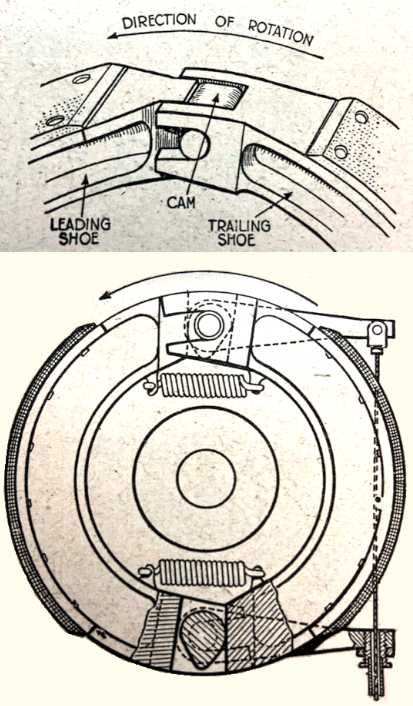
“A NEAT AND USEFUL design of pannier bag, which folds flat when not in use, has just been introduced by Godfreys (366-8, Euston Road, London, NW1). The pannier is made of black Rexine, and has a stout backboard with a hinged base. The whole is encircled with two strong leather straps, and the fittings supplied ensure easy attachment to the majority of machines without any drilling. The panniers are designed so that they will accommodate attaché cases, and cost 26s a pair. Supplied separately, each pannier costs 13s 9d. The de luxe model is similar, but includes black Rexine attaché cases, and the containing bags are provided with large gussets which give easy access to the bags; each bag has a lock. The price of the de luxe model is 37s 6d per pair (19s 6d each).”
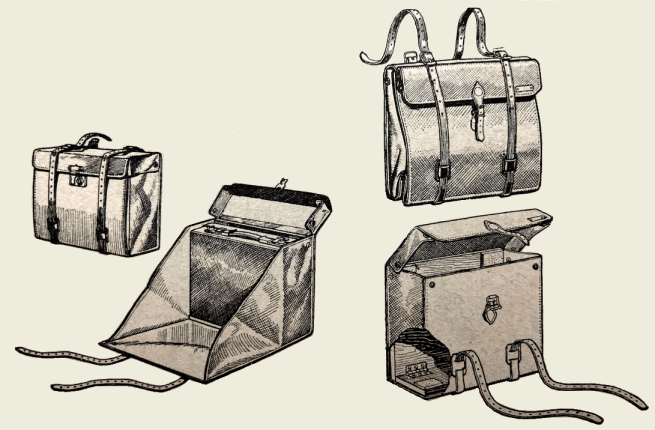
“SMART RUBBER RIDING BOOTS, which can be easily sponge-cleaned, are made under the name ‘Adjutant’ by the North British Rubber Co. Used with riding breeches, they are excellent for bad weather riding. The price of these boots, which are available in bright black or brown, is 21s a pair. A rubber boot of interest to pillionists is the North British Hy-an-dry’ model. They have a soft extension top to cover, the knees, with an adjusting strap. They cost 9s 11d a pair, and the finish is bright black.”
“THE NEW ITALIAN ban on visitors to the Dolomites applies only to the Province of Bolzano, says the RAC. Foreign visitors to the Province must stay not more than 48 hours.”
“AFTER THE BEGINNING of October manufacturers have agreed not to fit to a new vehicle a horn which will produce a note over 100 phons loud.”
“EACH MEMBER OF Warwickshire’s police force made 38.6 prosecutions on an average last year, compared with 7.3 in the rest of England and Wales.”
“FIFTY-SEVEN POLICEMEN have been withdrawn from traffic-point duties since the beginning of 1938. They have been replaced by traffic-light installations.”
“‘OUR KING AND QUEEN came through our city and we had the great honour of escorting them…it was a day that will never be forgotten.’—Announcement made by the Roar-bi MCC, Fort William, Ontario (Canada).”
“AMERICAN CLUB’S ANNOUNCEMENT: ‘We are either going to blossom out with the classiest uniform east of the Hudson, or else put on a humdinger of a field meet.'”
“EASTBOURNE PARKING OFFICIALS, as a result of RAC enquiries, have been reminded that motor cycles are allowed to be parked in the car parks. This follows complaints from readers.”
“AT THE RECENT Rover Moot at Crieff, in Scotland, were motor cyclist-rovers from as far away as Paris and Lille.”
“A MOTOR CYCLIST has been fined for riding his machine solo when it was, in fact, insured only for sidecar work. All know, of course, that the insurance on a sidecar outfit is half that of a.solo, but does everyone realise that not only is a motor cyclist uninsured if he takes off the sidecar but also he is liable to a fine up to £50 and/or imprisonment not exceeding three months, and automatic suspension of his licence for twelve months?”
“AN INTERESTING METHOD of determining the temperature attained by various parts of an engine has been developed. At the Institution of Automobile Engineers’ laboratories there is a motor cycle engine apparently finished in bright purple!. The ‘purple’ consists of temperature-sensitive paint. What happens is this: the cylinder and cylinder head are painted, the engine is run, and suddenly, as the appointed temperature is attained, the paint changes colour. The change remains permanent after cooling, and by varying the ‘mix’ the temperature at which the change takes place can be varied. Thus it is possible to obtain a clear and permanent record of the temperatures reached by the various parts.”
“‘NO MORE ORDERS can be accepted for 1939 models!’ For some time past this has been the case with a number of motor cycle manufacturers. The demand for motor cycles has exceeded the supply, and since early in the year many a firm has only accepted orders on the basis that delivery could not be effected for a month, two months, or even three. What are the reasons? There are many. The season started comparatively slowly, and there is little doubt that motor cycle manufacturers were unprepared for the demand that was to occur later. Also, work of national importance made big inroads into the production facilities of various makers, as well as adding to the difficulties of the factories, and there were unusually large orders from abroad. There could have been a miniature boom in new motor cycles if only manufacturers had been able to keep pace with the orders, let alone go strenuously in search of them. However, it is no use stressing the fact that this year large numbers of motor cyclists and potential riders have been disappointed regarding the purchase of new machines; the questions are: ‘What will be the position over the 194o models?’ and “Will manufacturers be early in production?’ At present there are not many signs of the latter. Will they plan their production programmes on a large or small scale? Reduced unemployment, good pay and, in many trades, security of tenure such as has not been known for years, are the causes of the increased demand. Motor cycle manufacturers have a big opportunity if only they can grasp it.”
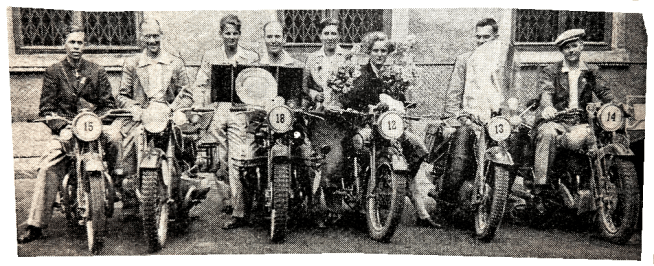
“PEOPLE WRITE TO The Motor Cycle for advice from all over the world. This week, enthusiasts from Melbourne and Perth (Australia), Los Angeles (California), Baluchistan (India), and Rotorua (New Zealand) have written—a typical post-bag.”
“ON A LONG RUN, how many miles do you usually cover before your first stop? I raise the point because so often one hears the remark that no motor cyclist ever travels 50 miles without a halt. Of course, if you are out for a breath of fresh air on a week-day evening, or a potter-type tour, frequent stops are understandable. On the other hand, there are, I believe, many who, like a certain member of the staff, habitually reel off the first 100 miles of a long run non-stop.”
“MOTOR CYCLES ARE becoming increasingly popular in Poland, where, as in many Continental countries, lightweights predominate mainly because of taxation advantages. The largest producers of small machines are Huta Ludwikow of Kielce, who market the SHL machine fitted with the Villiers 98cc engine and three-speed gear unit. This unit is now to be produced under licence at the Kielce works. The Villiers unit is neatly housed in a robust duplex U-section girder frame, which provides a layout similar to that of British machines. Steel pressings are also employed for the fork blades, the mudguard stays and lamp brackets. A large welded-steel tank of pleasing shape blends well with the general lines of the machine. Long tension springs support the pan-type saddle and provide a range of movement which, in conjunction with the wide-section tyres, should make the SHL one of the most comfortable machines of its class. The Villiers direct-lighting system is employed, and other features include a large air filter and a neat cylindrical tool bag. This little machine is sturdily constructed, has well proportioned lines, and is reported to handle particularly well.”
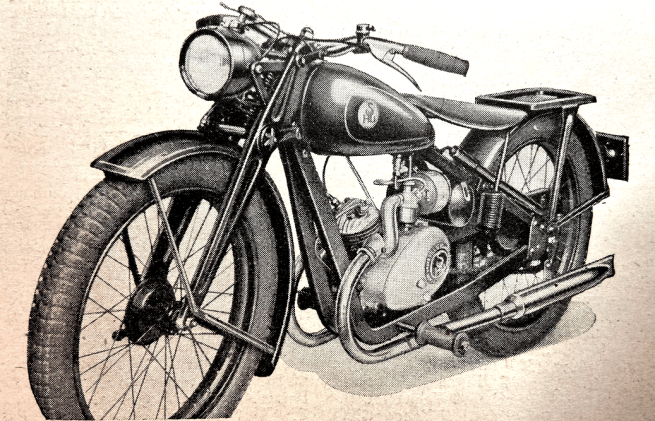
“ANYONE NOT CONVERSANT with motor cycles might well be excused for wondering whether the modern solo machine is merely a vehicle of sport. Examine almost any machine; there is no luggage accommodation—nowhere even for carrying a parcel. Many regret that the luggage carrier is regarded as a thing of the past, and in makers’ catalogues can only be found mentioned in small type as an optional extra. Instead of the motor cycle growing in utility, in more than one direction it has become from the touring angle less useful. The sole accommodation provided as standard is one or more tool boxes, and these often will not accommodate the repair outfit, spare sparking plug, chain rivet extractor and chain spares that should be carried in addition to the tool kit. Happily, accessory firms have come to the tourist’s rescue with excellent pannier bags which the rider can fit. No doubt there will always be an important market for such worthwhile fittings, but that is not much of a reason for the entire lack of luggage and parcel accommodation on the modern solo. It is high time that manufacturers became a little more practical. Or is it that the average motor cyclist is so concerned with what he conceives to be a sporting appearance that it is he who is unpractical? Whatever the reason, the present vogue is stupid.”

“GRAND PRIX DAY IN SWEDEN is like Derby Day in England. The same holiday atmosphere prevails and there are all the side shows, family parties, picnics and vendors that one finds on Epsom Downs. Last Sunday, after a stormy practising period, the sun played its part in making the day a national holiday, for it blazed out of a cloudless sky. Only a fairly stiff breeze saved the day from being almost too hot for racing. Under these conditions thousands of people in every form of transport augmented those who had camped all night round course. The police estimated that there were 20,000 cars in the car parks, while a similar number of people had travelled to the course by train. All attendance records were broken, for the crowd eventually numbered about 150,000, with over 25,000 visitors from friendly Denmark. The interest was well divided between the Inter-Scandinavian and the International races, for while the crack riders of Europe were competing in the International events, the people were naturally very interested to see how their own men would perform on the very fast Saxtorp circuit. The course at Saxtorp consisted of nine miles of flat roads, with long, straight stretches where high maximum speed is all-important. In order to make the course more difficult, loops have been made which form tricky bends, but in spite of this the fast 500s lap at well over 90mph. Racing was due to start at one o’clock, but a little before Meier, the German BMW rider, did a demonstration lap of the course in an Auto-Union Grand Prix racing car, and, then a procession of various types of car manufactured by Auto-Unions did a lap of the course while the loudspeakers pumped out sales talk. An enterprising local agent staged a similar show with motor cycles—some people realise the sales value of a vast crowd interested in motor cycling and motoring. Soon afterwards their Royal Highnesses Prince Bertil and Prince Carl arrived, and then the Inter-Scandinavian riders wheeled out their machines on to the
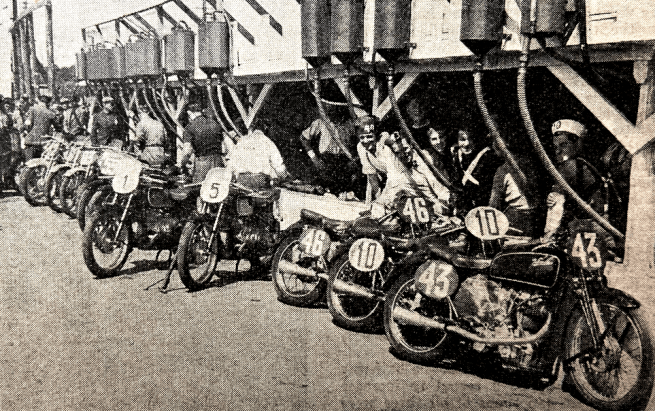
starting grid. There were two classes, 350 and 500cc, and in each there was great rivalry between Sweden, Denmark, Norway and Finland. British machines were popular in each class. Director Axel Lofstrom explained to the competitors through the microphone in four different languages that the 500cc class would be sent off one minute before the 350s, and that each class had to cover 10 laps. Then, point-ing with his flag to a board with the numbers from one to ten on it, he counted back the seconds, and at the word ‘Ga’ the field got away in a roaring bunch. At the end of the first lap the Finns were overjoyed because 0 Brandt (Rudge), Finland, was leading with P Sirkia (Norton), Finland, second. However, Brandt heeled the Rudge too far over on the last bend leading into the starting straight, and the machine spun round like a top. Several men had gone by before he could remount, but at the end of the second lap he had worked his way back into third place behind Folke Larson (NSU), Sweden. Brandt’s fall must have done some damage, for he began to drop back steadily. His place was taken by Berth Schmidt (BMW), Sweden, who gradually overhauled Larsson. On the seventh lap Schmidt made the fastest lap of the races and took second place. In front, Sirkia was lapping steadily on his Manx-type Norton, and at the end of the 10 laps he had a minute lead over Schmidt, who was, in turn, over a minute ahead of Larsson. Out of the field of 22, nine men completed the full distance and six of the finishers were on British machines. In the 350cc race British machines had things all their own way. NV Jensen (Velocette), the well-known Danish rider, took the lead on the first lap and was never challenged. His nearest rival was E Mansson (Velocette), Sweden, while in the early stages S Somerkorpi (Norton), Finland, held third place. But after six laps Somerkorpi came into the pits and retired with an unstated trouble, and for a few laps EM Olsen (Sarolea) brought Norway into the picture by taking third place. Later he also retired, and L Rasmussen (AJS), who had cured a bad misfire which had slowed him in the early stages, moved up. Retirements in this class were numerous, and on the fourth lap four riders were involved in a nasty melee on a bend shortly after the start. When
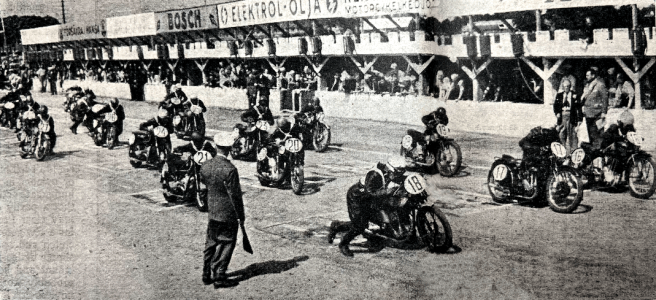
Jensen received the chequered flag only three other riders were sufficiently in the picture to complete the 10 laps. After a short interval the riders in the International classes took their places on the grid. In front were the 500s and they were to be followed at minute intervals by the 350 and 250cc classes. All the Grand Prix champions of the year were present, including the little contingent that is flying the British flag in these races this year. ‘Ginger’ Wood was a non-starter as the supercharged FN had not shown its paces at Liege as the designers wished, and apparently Mr Moore was not satisfied with the NSU, for ‘Crasher’ White had also not arrived. Mellors (Velocette) held the honour of the fastest practice lap in the 350cc class, but Meier (BMW) and Serafini (Gilera) had been lapping at about the same speed as each other in the big class. The course was particularly suited to the Italian Gilera, and to those watching, the tension between these 500cc aces seemed greater than at any other race this year. For once Serafini made an instant start when the flag fell, and Meier’s machine was unusually slow off the mark. At the end of the lap Serafini was in front—but only just—for Meier was snarling at his heels. Already the rest of the field was some way behind these two, with Kraus on the second BMW third, and Vailati, the Gilera second string, fourth. But Meier was not out to ride second to anyone, and from round the course came reports that he was riding like a man possessed. Observation on the tricky ‘S’ bend at the junction of the two legs of the course at Saxtorp made it plain that he had nothing in hand, for he only just managed to avoid taking to the grass when coming out of the second bend. But he was in the lead at the end the second lap. Serafini was only a little way behind and his team-mate was now third, for Kraus had run off the course. Meier’s lead, however, was not enough to enable him to ease off at all, and he covered the fourth lap in 5min 22ec, making a new lap record at 100.87mph. Serafini was still only a few seconds slower, and on the sixth lap Meier, in an endeavour to get a few more yards in hand over his rival, overdid at a corner. In a flash he was off the course and into a field. He was back on the road within half a minute, but in that time Serafini had gone by, and when they came round to start the seventh lap the Italian was some 50 yards ahead of the German. Round they went, these two, still lapping at nearly 100mph. Serafini seemed to be right on top of his form, for he never let Meier hustle him, and Meier, try as he would, could not reduce the lead of the red and black machine. The pace of the leaders was so hot that the rest of the field was left well behind. FJ Binder, on a Junior Velocette, had to give up after five laps, for his ribs, which were cracked in Belgium, had begun to give him trouble. At the end of the tenth lap Meier came in to fill, and it was seen that his windscreen and various parts of the machine had suffered from the fall. As he filled up he conversed
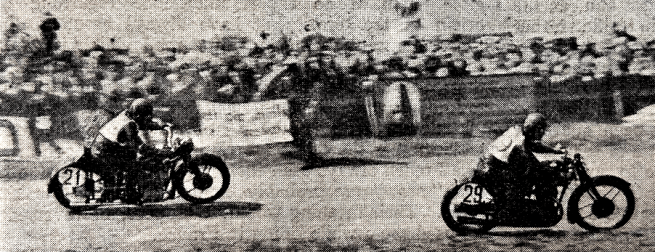
rapidly with his racing manager, and pointed vigorously to the transmission. He left the pit after a stop of 20 seconds, but he was not to be in the race for long. On the 12th lap, again while urging the last ounce from his machine, he misjudged a corner, and this time crashed heavily, damaging his back. Later it was known that be would not race again this year. With Meier out, the race lost much of its character, for Serafini could win as he liked. Kraus, on the second BMW, was too far, behind to make any challenge; indeed, towards the end of the race it looked as though Fergus Anderson, who was riding a new Manx Norton extremely well, would catch the supercharged twin. Anderson could not manage it, however, and, had to be content with fourth place. Serafini finished comfortably at a speed which makes the Swedish the fastest international road race. What the 500cc race lacked in thrills towards the end was amply made up for by the 350s, and the race provided a finish that has not been surpassed for many years in Grand Prix racing. The battle was between Mellors on his Velocette and Fleischmann and Wünsche on DKWs, with ER Thomas on another Velocette never very far away. As usual, the DKWs made a flashing start, and for two laps Wünsche was in the lead, with Mellors ‘second and Fleischmann third. Then Mellors overtook the German and began steadily to draw away. He was riding superbly, and his cornering on the twisty sections thrilled and delighted the vast crowd. But he was unable to shake off the two DKW men. Behind these three ER Thomas was riding his best race of the year, and he proceeded to leave the other Britishers, Whitworth and Little, well behind. Little, only just out of hospital after his crash at Spa, was not out for fireworks, and Whitworth, who was riding this course for the first time, kept lapping steadily well inside replica time. At half-distance the order among the leaders was: Mellors (Velocette), Wünsche (DKW), Fleischmann (DKW), Thomas (Velocette), G
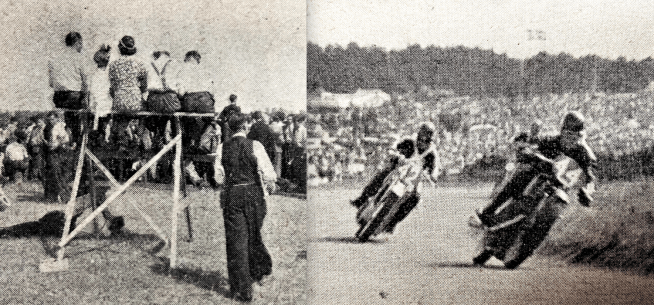
Lonfors (DKW) and Whitworth (Velocette). Sweden’s, great hope in this race, R Sunnqvist (NSU), had covered only three laps before he had to retire. Among the first three men the half-way mark seemed to be a signal to increase speed, for the lap times of all three were gradually decreased. The DKW riders slowly began to reduce the Englishman’s lead, and Mellors, in spite of laps at 85-86mph, could not hold them off. At the beginning of the last lap they were right on his tail, and as the three figures disappeared up the long straight past the start Fleischmann drew level with Mellors. The Britisher had difficulty in retaining his line on the bends with the two men on his heels, and at one corner had to brake heavily owing to- other riders and so let Fleischmann through. At another bend Wünsche was in trouble when Anderson (Senior Norton) and Mellors both wanted the same piece of road as he did—Wünsche had to take to a field for several yards. But that one corner gave Fleischmann the race, for Mellors could only catch him on the way back to the start, and it was impossible to overtake through the twisty stretch which leads to the finish. As the two riders came out of the last curve Mellors’ front wheel was almost touching the tail of the DKW But the DKW man had the advantage and flashed over the line only a fraction of a second ahead. Wünsche finished third and Thomas fourth. Whitworth and Little both finished comfortably in replica time. In the 250cc race the DKWs had a walk-over, for Dickwell on the Benelli retired after only four laps, and Jorgensen, on an Excelsior, put in 10 laps before he also disappeared. For the whole of the race Kluge sat on the tail of Petruschke (DKW), and on the last lap he passed his team-mate to make the fastest 250cc lap. To round off the day, the winners were presented to the Royalty, and then Carraciola, the German crack car driver, and Kluge gave demonstration runs in the Mercedes and Auto-Union Grand Prix cars. When the vast throng of people began the slow trek home storm-clouds blew up on the horizon. Later the storm came, but too late to spoil a perfect day’s racing.”
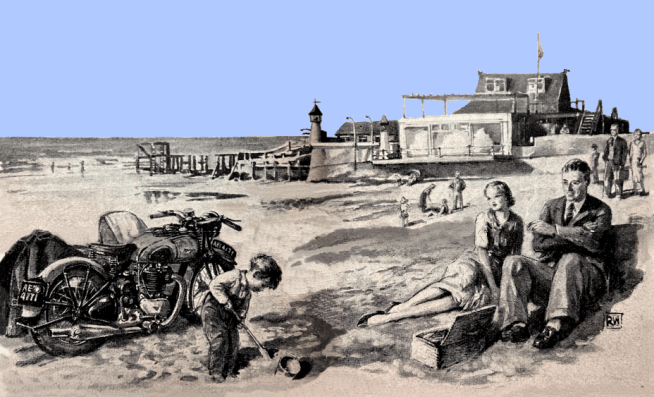
“ALTHOUGH THE WELSH OPEN Championships held annually at Pendine on August Bank Holiday Monday are no longer supported by manufacturers, the events remain exceedingly popular both with riders and the general public. Last Monday’s meeting was favoured with perfect summer weather, and a huge and enthusiastic crowd. Entries were received from as far afield as Manchester, Stockport, London, Cheltenham and Birmingham, while the local riders were in full force, particularly in the closed events which are run for standard machines only. Standard-machine classes, for which machines had to he fitted with silencers, etc, consisted of mile sprints for 250, 350 and 600cc machines, a six-mile 250cc race, and ten-mile races for 350 and 600cc models. L Harris did well to win both 250cc races on a Manxman Excelsior, and TR Rees gave a good performance on a very standard Red Hunter Ariel, winning the 600cc ten-mile race, and gaining second in the sprint event.”
“THERE WILL BE no Brussels Show this year. The Milan Show is fixed for from October 28th to November 15th.”
“SWEDEN IS TO change to the ‘keep to the right’ rule of the road.”
“SALFORD POLICE recently tested motorists’ brakes and steering free of charge.”
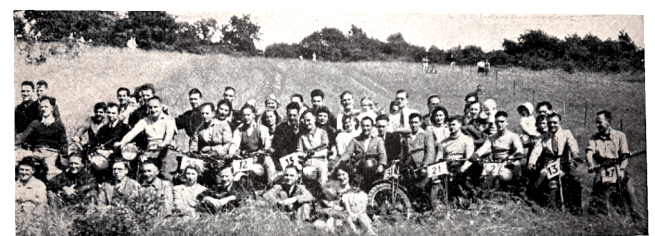
“A LARGE CROWD of spectators attended the road races held last Monday in Central Park, Plymouth, and with reasonably good weather and an entry of 44 riders the meeting proved a great success. This is the second year these races have been staged, but last year’s event had to be abandoned shortly after it had started, owing to a cloud-burst, so the organisers (the Plymouth Motor Club) were still somewhat uncertain whether or not their venture would be a success. The course used is roughly triangular in shape, being just short of a mile, and surfaced with rather loose granite chippings on tarmac. The start and finish is approximately half-way up one of the straights (on a slight uphill gradient), and with many vantage points and exceptionally efficient loud-speaker equipment the course appeared to be very popular with spectators. From the riders’ point of view it was also excellent, save, perhaps, that the loose chippings tended to make the corners treacherous, but there were very few spills during the afternoon.”
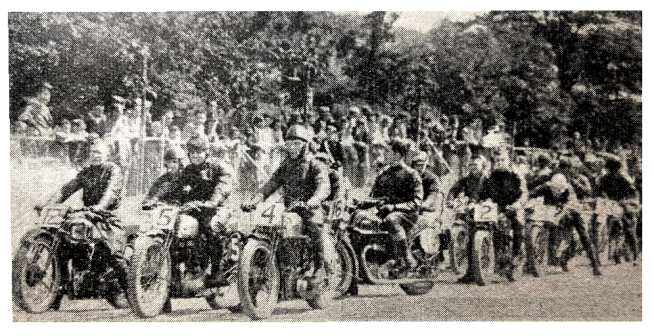
“SALZBURG NEXT WEEK is the centre of the biggest International Six Days Trial yet held. No fewer than 278 competitors have entered. This exceeds the record entry of three years ago by 22. Germany, who is acting. as host, has, of course, the largest entry of the seven nations represented. The actual figures are: Germany, 163; Great Britain, 61; Italy, 30; Holland, 13; Sweden, 6; Hungary, 4; Belgium, 1. The chief interest lies in the contest for the International Trophy, which is for teams of nationals riding machines made in their home country. Italy returns after an absence of two years and will compete against British and German teams. An innovation this year is that the teams consist of three solo motor cycles and one passenger machine. In the past there have been only three men per team, with two riding solo. The alteration has been made in order that there may be less likelihood of a tie. Another interesting feature of this year’s trial is that the War Office has sent three teams to Germany to compete for the Hühnlein Trophy, a competition open to teams representing any recognised organisation. In these days the War Office, as is well known, looks upon trials as an ideal form of training for Army motor cyclists.”
“THE ARMY CONTINGENT has set forth for the International Six Days Trial which is to start next Monday August 21st, at Salzburg, to the south-east of Munich. The convoy left Aldershot last Sunday, spent the night at Southampton and the following morning went aboard the Europa bound for Bremen, where they were to be met by members of the German Army and escorted through Germany to Salzburg. There are three teams of three and a reserve for each team. The twelve riders are travelling through Germany on their practice machines with a view to becoming accustomed to Continental road conditions…The following week will be spent practising on the course. After the trial the contingent is to go to Belgium for the International Military Trial, which is to be held near Spa. The same machines will be used. In charge of the party, which is 22 strong, is Lieut-Colonel CV Bennett OBE, a very keen motor cyclist who has competed in numerous trials. The machines to be used are BSAs, Matchlesses and Nortons. In all the party will be away some six weeks.”
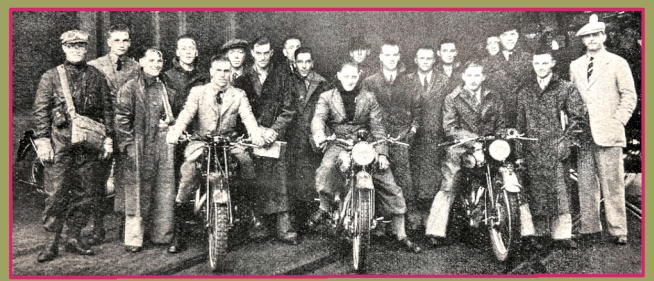
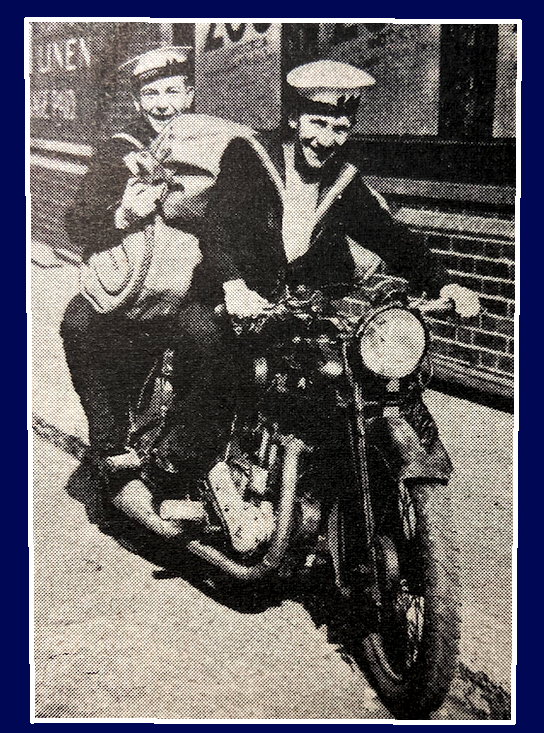

“ALTHOUGH MOTOR CYCLING is very popular in Denmark, about 50% of the machines used are imported, the majority of them from Britain. Those not imported are made in one factory in Copenhagen. The reason for the popularity of the one Danish make is not difficult to understand because of its extremely practical design. The machine concerned is the Nimbus and the factory first produced motor cycles shortly after the war. Production was dropped some years later and was only begun again about five or six years ago when the present type was introduced. The makers decided to produce a machine that would give long service and require a minimum of attention. After a great deal of thought it was agreed that an engine based on American car-engine design would be the most suitable for this purpose. As a result, the modem Nimbus unit reflects American design in many respects. The engine has four cylinders in line and the cylinder block is cast in one unit with the top half of the crank case. The bottom half of the case consists of an aluminium oil sump. A solid crankshaft is carried on two large ball bearings, one at the front and one at the rear, and the big-end bearings are of white metal run directly into the connecting rods. Normal-type pistons with solid skirts are used but an unusual feature is a scraper ring in the base of the skirt in addition to the normal scraper and two compression rings. In common with American practice the compression ratio is low, 5 to 1 in the standard engine and 5.7 to 1 in the sports model. In these respects the engine is perfectly straightforward, but in the valve gear arrangement the designers have shown great ingenuity. Overhead valves are employed and are operated from a single overhead camshaft running in bronze bearings in a neat aluminium housing. A vertical shaft drives the camshaft through bevel gears, and this shaft is also the dynamo armature shaft. A key at the bottom of the shaft drives the gear oil-pump, while the combined oil and distributor unit is driven from the front end of the camshaft. Incidentally, both the dynamo and the distributor are made in the Nimbus factory. All bearings are pressure lubricated. To help to obviate any oil leakage a vacuum is created in the sump by means of a pipe between the sump and the carburettor intake. A normal three-speed gear box is driven at engine speed through a single-plate clutch of car type. The lining is pressed into holes in the friction plate and no rivets are used. Final drive is by a short shaft with rubber couplings to robust crown and bevel wheels, which are carried in an aluminium housing. The whole unit is mounted in a pressed-steel frame with telescopic front forks. These forks are spring operated, but have oil dampers at the bottom end of the fork tubes. In place of the normal handlebar there is a pressing which also forms an instrument panel.
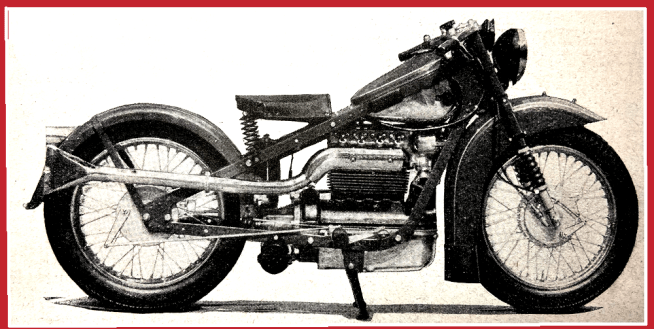
Twist-grips are fitted at each end of the pressing, the right one operating the throttle and the left one the dip-switch. The saddle is ‘home-made’. Having seen how this interesting machine is made in the up-to-date factory in Copenhagen, I was naturally keen to get astride one of the models. A Sport model was wheeled out, and in company with the two young manufacturers of the Nimbus (also on machines) I set off for the outskirts of the city. For this part of the trip I sat on the pillion behind one of the works riders. Incidentally, that pillion seat was the most comfortable I have ever been on. It was the popular Continental type, rather high, but it was very well sprung and smoothed out all the bumps in a delightful manner. When I took over the Nimbus the engine was naturally warm, but even so I hardly expected the effortless start which I obtained. The kick-starter is of the transverse type on the near side, but a full kick can be administered because the frame does not restrict the starter movement. Slow running was like that of a car engine and I did not have to blip the throttle to keep the engine running. There was some mechanical noise, but I soon found that this was not noticeable when the machine was on the move. The clutch was of that pleasant, unobtrusive type. I merely engaged bottom gear, let in the clutch and the machine moved off slowly and smoothly on a light throttle opening. Once on the move the weight of the machine was not noticed—fully equipped it weighs 375lb—and I was soon zooming along, revelling in the smoothness of the four-cylinder unit. Gear changing required care; as with nearly all gear boxes which run at engine speed, the best results were obtained by double-declutching. It was not that there was any difficulty in engaging
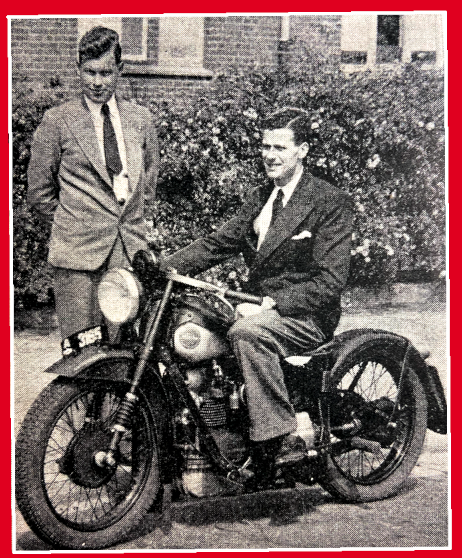
the gears, because the positive-stop foot-change was efficient enough; it was simply that to get that ‘smooth as butter’ feeling double-declutching was necessary. But a lot of gear changing is quite unnecessary with the the Nimbus, for the flexibility of the unit is surprising. I could throttle down to 10mph in top gear with ease and then open the throttle quite rapidly without the transmission or the engine protesting; only when the speed dropped as low as about 6mph did any snatch-ing occur. Thus, for normal use, the Nimbus can be treated as a top-gear mount. I did not take any acceleration figures, but the acceleration was definitely good, particularly in top. The smooth flow of power was really delightful, and the engine seemed to work happily as it zoomed into its stride. No extravagant claims are made by the makers as regards speed, and I did not try the machine for maximum, but at speeds up to 50mph—there is a speed limit on the open road in Denmark—there was plenty of power in hand, and the machine would accelerate quickly up to 60mph in top. The steering and general handling seemed to be on a par with a good 500, and I swung the model round fast bends without any undue effort. At low speeds I could turn round in a normal road feet-up quite easily. The Nimbus is not fitted with a.spring frame, but the soft saddle and 3.5in section rear tyre gave a great deal of comfort. Part of this was probably due to the front forks, which are softly sprung; they ironed out bumps and potholes and yet did not bottom at highish speeds. Both brakes were well up to their job, and the front one had sufficient power to make the tyre scream on a dry road when I put it on really hard. With its British-type riding position, the Nimbus did not feel at all strange to handle, and I was quite at home on the machine in the first few yards. My outstanding impression was the smoothness of the unit and the general car-type flexibility and silence. No mechanical noise was noticeable when riding the machine, and the exhaust note was almost inaudible at low speeds and very subdued throughout the engine’s range. At the end of my ride the engine had not become at all hot, and the makers’ assured me that they do not get any overheating troubles. But you should not imagine that they are satisfied with the machine. They are still experimenting, and one of the makers was riding an experimental model in which the whole of the valve gear is totally enclosed. I left the factory feeling that here is an unusual and excellent contribution to multi-cylinder design.”—’Paton’.
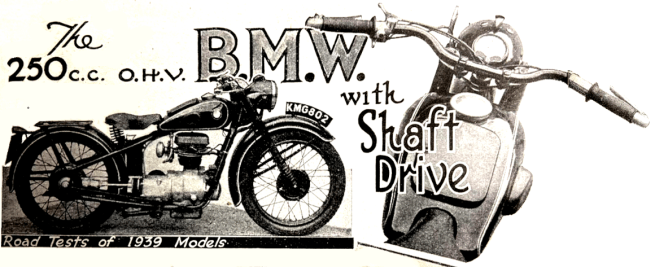
“MOST MOTOR CYCLISTS in Britain associate the name BMW with high-performance transverse twins, but the famous German factory also produces single-cylinder models. In their latest form these machines incorporate many of the features on which the twins have built up their reputation, and the recently introduced 250cc model has been built more or less regardless of cost. The engine is of the ohv type with the valve gear fully enclosed, and, as with all BMWs, the crankshaft is in line with the frame. A three-speed gear box is built in unit with the engine, and one of the first things that is noticeable in this BMW is the extreme cleanliness of the layout. There is only one external oil pipe, and the flywheel and gear box housings are free from ugly excrescences. Final drive is by shaft, and the only external moving part, other than the wheels, is the shaft itself. The machine under test had that out-standing feature of all BMWs, a complete freedom from oil leaks, so that the machine was very easy keep clean—a wipe over with a soft cloth was all that was necessary after a long ride—and, more important, the rider could wear clean clothes in the knowledge that they would be free from oil spots at the end of a ride. During the test it was surprising how many people normally disinterested in motor cycling expressed their pleasure at seeing a machine so neat and clean. Another outstanding feature which appeals to the lay public as well as to the rider is the lack of noise, both mechanical and exhaust. It would probably be no exaggeration to say that this BMW is the quietest single-cylinder machine produced to-day. At low speeds the exhaust note was a quiet burble; at wide throttle openings the note could certainly be heard, but it was never unduly noticeable. No mechanical noise could be heard by the rider with the machine on the move, and when the engine was idling there was only a trace of tappet noise. During the test the BMW always started very easily. No air control is fitted, and it was not missed by the rider. When the engine was cold the carburettor had to be flooded, of course, but no special precautions were necessary. The ignition was retarded for starting at all times, and when the engine was warm a first-kick start was almost certain. At no time were more than two or three kicks necessary. Idling was exceptionally good for a ‘single’. With the ignition retarded the engine could be throttled down until the firing strokes could almost be counted. In normal use the machine could always be brought to a standstill with the engine ticking over, and the rider had no worry that the engine might stall. This even running at low speeds was reflected in the machine’s performance, for the flexibility of the engine proved outstanding for a 250. In top gear the normal minimum speed used was about 15mph. The machine would run perfectly smoothly at this speed, and could then always be accelerated away quite smartly. But if the rider cared to use the ignition lever to the full, lower speeds could be used; on several occasions the machine was actually throttled down to 10mph in top without any transmission snatch occurring. So much for the bogy that shaft drive is not flexible. The foot gear-change, which is on the near side of the machine, required a certain amount of care in use if silent changes were to be made. A stop is provided on the frame to avoid the rider missing second gear—the
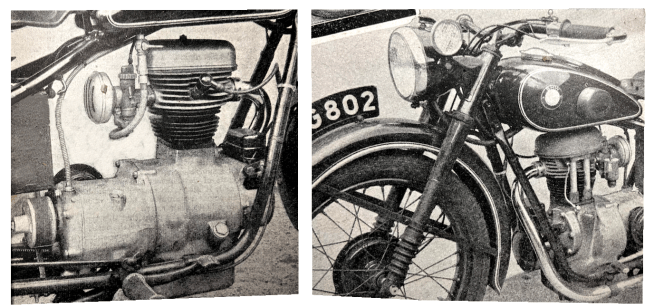
change is not of the positive-stop type—but this was rarely used, since by double-declutching the gear would always engage in a positive manner. It was found advisable to double-declutch for all changes. The clutch is operated by an inverted lever on the near-side end of the handlebar, and the whole action of the clutch was light and smooth. Footrests and saddle are in good relation to the handlebars, and the machine was comfortable even for a six-foot-tall rider. No rear springing is fitted to this 250, but the soft saddle springs and very long action of the telescopic front forks were found to give a high degree of comfort. Very high praise must be given to the steering and handling of this BMW. It is a machine that, in the first few yards, makes the rider feel really confident. It was ridden in the worst conditions—from the point of view of skidding—in traffic, and yet never once did the machine show any tendency to get out of control. Out of town the BMW showed up well. It could be cruised apparently indefinitely with the speedometer needle showing 50-55mph, and at 40-45mph the engine was obviously only working lightly. Some vibration was noticeable at speeds above 30mph. Acceleration was good, and from a standing start a speed of 54mph. was attained in a quarter of a mile. The best timed speed attained in top gear was slightly over 60mph, but the machine could always be taken up to 58mph with the rider sitting up. At no time during the test could the engine be made to pink, although a No 1 fuel was used. At a steady 40mph petrol was consumed at 80mpg. Both brakes were really powerful and delightfully smooth. The brake pedal is well placed for convenient use. In a crash-stop the BMW was brought to rest from 30mph in 33 feet. Thus this 250cc BMW combines many outstanding features. It is of exceptionally clean design, proved clean to ride, and its flexibility and silence make a big appeal to those desiring quiet, effortless touring. In addition, it is well braked, easy to start and has a very useful all-round performance.”
“FOLLOWING THE REDUCTION in the number of types of motor cycle that may be manufactured in the country, the Controller of the German motor industry has issued a further order under which there is to be a considerable reduction in the number of different patterns of motor cycle components and accessories. According to the Kraftfahrzeug, which prints a list of 15 classes of goods affected by the regulation, the number of types of motor cycle front forks is, for example, to be reduced from 25 to 4, road wheels from 200 to 9, driving chains from 30 to 10, saddles from 26 to 3, and footrests from 150 to 9. The purpose of the regulation is stated to be to effect economy and to increase and cheapen production.”

“LAST SUNDAY THE FOURTH round of the European Grand Prix contests was fought out in Saxony, in the south-east of Germany. This time Italy took the major share of the honours: Serafini (Gilera) won the 500cc class comfortably, and two Guzzis in the hands of Sandri and Pagani beat Kluge (DKW) in the 250cc event. Great Britain, represented by ER Thomas (Velocette), was second to W Hamelehle (DKW) in the 350cc race, and other Velocette riders finished third, fourth, sixth, seventh, eighth, and tenth. As usual, the race aroused enormous interest in Saxony, and reports of the practising appeared in all the important daily papers throughout Germany. The 250cc supercharged Guzzis again showed themselves to be extremely fast in practice, and their lap times were better than those of the DKW works riders on 350s. The DKW men put in some practice laps on the supercharged models, but once again it was decided not to use them in the actual race. With Meier out of racing for the year, after his crash in Sweden, and Kraus also out with a leg damaged in the Swedish race, the BMW marque suffered agonies in practice. They were trying out three new riders: Mansfeld, back in the saddle after an absence of two years, Ruhrschneck, the NSU jockey, and Lodermeier, a new and young rider. These new men were not really used to these fast supercharged twins. Lodermeier and Ruhrschneck were comparatively slow; Mansfeld was much faster, but he was obviously riding at his limit and twice abandoned the model, causing consider-able damage. When Jock West arrived from London with his wife on holiday and paid a visit to the BMW works at Munich, they immediately packed him off to the course to practise. His times were good, although his riding was done in the rain; he was immediately entered for the race. The weather during the training period was unsettled, and rain-storms made the ground round the course very muddy; but on the day of the race the sun promised a fine day even as early as seven o’clock. Long before 9am thousands of spectators lined all the vantage points, and the many stands were all packed to capacity.
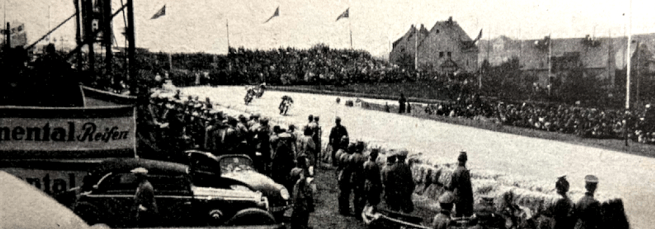
Later in the day it was announced that the crowd numbered about 320,000! Among them were all the important people in the neighbourhood, most of whom were in uniform. Korpsführer Hühnlein took a lively interest in the day’s racing, and the Governor of Saxony, with his entourage, sat in the stand throughout the three races. With German punctuality, precisely at 9am the maroon announced the start of the 250cc race. The field consisted mainly of DKWs, but there was one privately owned Benelli and the-two supercharged Guzzis. Tenni (Guzzi) and Winkler (DKW) were important absentees—both had crashed in recent races. Kluge (DKW) was easily the first away, and made the most of his good start on the first lap. When he came in sight at the top of the long straight descent, which can be seen from the start, the leader of the rest of the field could not even be heard, and as he passed the stands he had a lead of nearly 400 yards. Sandri and Pagani, on the Guzzis, were second and third, and were already some way ahead of Petruschke on the second works DKW. The Guzzi men soon proved that Kluge’s efforts were in vain. On the second lap they halved his lead, and on the third lap sandwiched him into second place and soon left him behind altogether. Behind these works machines the privately owned DKWs were yowling round, making the most deafening noise. The best of the private owners, Berger, was hotly chased by Gablenz, also on a DKW. After ten laps the order of the leaders was Sandri (Guzzi), Pagani (Guzzi, Kluge (DKW), Petruschke (DKW), and Berger (DKW), but soon afterwards Petruschke stopped to change a plug. He is a small man, and when he came to restart the road was uphill and he could not get the engine to fire. The Guzzis continued to increase their lead over Kluge. For the first half of the race (17 laps) they gained approximately three seconds per lap; after the pit stops they increased speed, and in scrapping with one
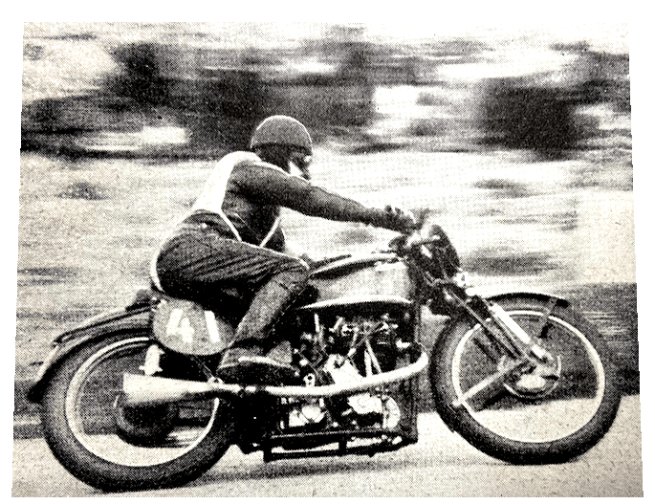
another their gain went up to seven seconds per lap. The speed of the Guzzis was so high that with the exception of Kluge they lapped the field three times! Pagani, who had ridden behind Sandri nearly all the way, slipped by on the last lap and crossed the line a few yards ahead of his team mate. While the winner of the 250cc race lapped the circuit with the wreath of victory on his shoulders, competitors in the 350 event warmed up their machines and changed from soft to hot plugs. Out of the 40 entries, none of the official NSU machines was present, and the chief interest lay in the competition between the British contingent on KTT Velocettes and the three works DKWs. Fleischman, the first-string DKW rider, was keen to do well because before the race he was tying with Mellors on points for the lead of the European racing championship (Mellors was not competing —he had returned to England from Sweden to prepare for the Ulster GP). Once again the DKWs were first away—these racing two-strokes seem to start and get into their stride immediately. At the end of the first lap the three German works riders, Wünsche, Hamelehle and Fleischmann, had a good lead over the first Britisher — Thomas (Velocette). Binder (Velocette) was third, and behind were Richnow (Brumm-Rudge), Knees (DKW) and Whitworth (Velocette). The works DKW men showed poor team management, for they began a terrific scrap among themselves for the lead. First Hamelehle would be in front, then Wünsche, and on the next lap Fleischmann. This went on for several laps, to the huge delight of the crowd, for the three crouching figures made an exciting spectacle as they manoeuvred for the lead. But the pace began to tell on the DKW engines. On the 16th lap
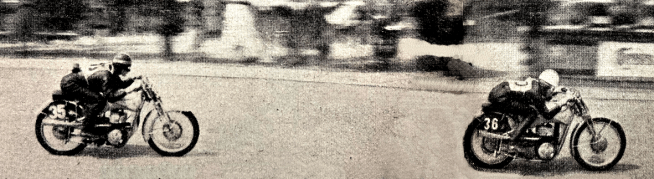
Fleischmann’s engine went sick with the strain and he failed to come round with his team-mates. Four laps later Hamelehle came round and drew in to the pit to fill up alone. Poor Wünsche toured in a few seconds later and retired at the pits with an engine which had also suffered from the strain. Meanwhile, the Velocettes were showing their usual superb reliability, and each of the Britishers lapped with clock-like regularity. With Wünsche and Fleischmann out, Thomas moved up into second place. He continued to ride a beautiful race, cornering as neatly and confidently as if he had nothing to lose, and yet taking each corner as fast as was possible in safety. Behind him, Binder showed better form than in any race since the Dutch TT. In spite of a punctured air cushion, which was giving his weak ribs a good hammering, he continued to lap at nearly 80mph. After everyone had made their pit-stops the race settled down again, with Hamelehle in the lead, Thomas second, Binder third, and Whitworth (Velocette) fourth. Whitworth was having a hard tussle to stave off Knees (DKW), who, as the leader of the German private owners, was riding an extremely good race. For many laps these two passed and re-passed one another, and it was not until towards the end that Whitworth established his superiority. Little, the other British Velocette man, had been content to lie farther back, but in the closing stages he increased speed and overtook Cora (Velocette) for sixth place. After 40 laps Hamelehle got the chequered flag, to the great delight of the German crowd. Thomas got almost as big a cheer from these sportsmen when he came home second, however; and Binder’s third place was equally popular, for he is Austrian by birth. Before the last race there were several diversions. First, Hassé drove round the course in one of the Auto-Union Grand Prix racing cars. He was followed by Korpsführer Hühnlein, in a supercharged Mercedes. Then, as the 500cc class was lining up, all eyes were turned skywards to gaze at the new Graf Zeppelin, which floated lazily and noiselessly overhead, paying a courtesy visit to the meeting. The huge ship flew low over the circuit. several times so that everyone could admire her size and shape. Thoughts were soon focused once more on the race. Four official BMWs lined up to do battle with the two supercharged Italian Gileras. Riding the German machines were Jock West, Mansfeld, Ruhrschneck and Lodermeier, while on the Gileras were
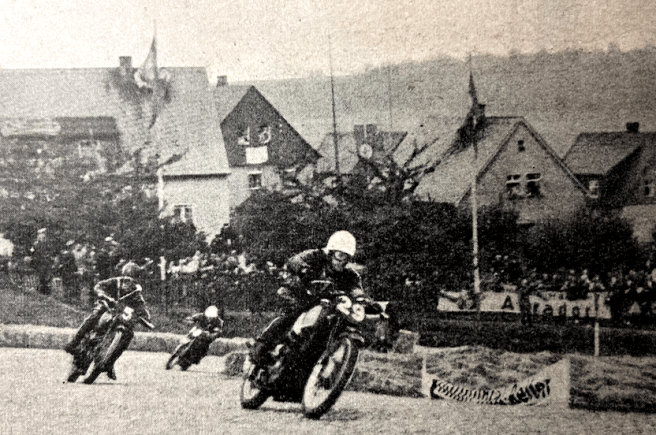
Serafini and Vailati. Serafini was, in fact, the sole real challenge to German hopes for Vailati had damaged his leg in a multiple crash in practice and was far from fit. The rest of the field were privately owned Nortons, BMWs and NSUs. Serafini was to prove more than a menace. From the start he leaped into the lead, and was never seriously challenged. In the early stages Mansfeld made heroic attempts to catch the Italian, and the German was cheered frantically at one time when he reduced the Italian’s lead to 15 seconds. But Mansfeld’s riding was too hectic, and on Lap 32 on one of the bends near the start the BMW took charge. In the crash Mansfeld damaged his leg. Retirements in the race were numerous. In the early stages Lampinen (Norton), Nowotny (DKW), and Vaasen (Norton) were all in at the pits in trouble. Six retirements were announced in the first 15 laps, and after the pit stops the field thinned out even more. Poor Jock West’s luck was right out, for he walked in just before half-distance. It was reported that the engine had given trouble, although Jock was seen to make snaking signs with his hand when re-porting to his pit. With West and Mansfeld out, the race lost most of its character. Serafini was a minute ahead of Ruhrschneck, on the first BMW, and the remainder of the field were straggled out behind. Even Vailati, on the second Gilera, gave up. At the end of the 40th lap Serafini was flagged, to make the second Italian win of the day. Of the rest of the field, only Ruhrschneck and Lodermeier completed the full distance. Afterwards, with much ceremony, Korpsführer Hühnlein addressed all the riders and a huge multitude of spectators. His own and other special prizes were presented, the troops marched briskly away. the people strolled off, and another German Grand Prix was over.”
“A MOTOR CYCLE WINDSCREEN designed to give maximum protection has just been marketed by Edward Bowser, 88, Kirkstall Road, Leeds, 3. As the photographs show, it curves round to handlebar width, and below there is ample shielding for the legs. The hands are also protected. The screen can be raised or lowered, or tilted, to the rider’s requirements. A windscreen wiper is also fitted. The price of the Bowser screen is 35s.”
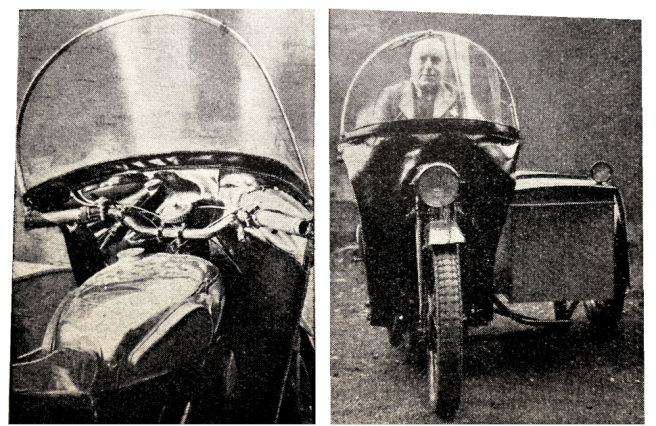
“ONCE AGAIN THE HARTLEPOOLS &DMC are to be congratulated on putting up a very fine show in aid of the Hartlepool Hospital. Carnival Day, sunshine, and such well-known riders as Maurice Cann, with his twin Guzzi and a Norton, and Dennis Parkinson, gave the large crowd a very enjoyable afternoon. There were 27 entries, including several stripped machines which had appeared in the Island, and some excellent times were recorded. B Berry, with his SS100 Brough Superior, and D Parkinson (490cc Norton) tied for the beat time of the day…The first event was a handicap for the Cameron Cup, and it provided an easy victory for AW Zealand (Triumph). The Cunningham Cup event for 350cc machines resulted in a struggle between M Cann (Norton), J Brett (Velocette) and FRH Elliott (Norton). Elliott, who tucked his large bulk into a surprisingly small space, was a popular winner. The unlimited cc event for the Elliott Cup was undoubtedly the race of the day. Excitement was intense as M Cann (Guzzi) and B Berry (Brough Superior) came to the line. Down went the flag, and two front wheels pawed the air. Two black streaks were left on the tarmac, and before the crowd could recover, word came through that Berry had secured best time of the day, beating Cann by a few yards.”

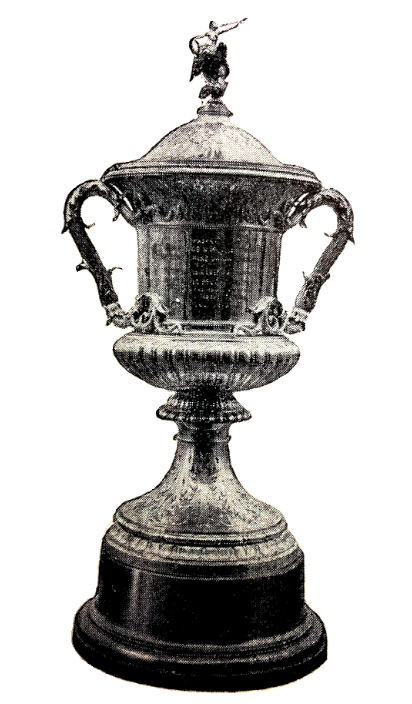
“THE GREATEST OF ALL International Six Days Trials, that held in Germany last week, was virtually brought to an end last Friday. The cause, needless to state, was the European situation. In Salzburg information as to what was really happening was scrappy in the extreme. The German papers revealed little: those British papers available were two days old; wireless reception of the English news bulletins was next to hopeless. Scraps of information, garnered in this direction and that. made it obvious on Wednesday, the third day, that there was growing tension between the nations. Was it wise for the British and other contingents to stay? None knew. Maps were examined to determine the quickest way to the frontier. Telephone calls were put through to the Consulates. It was learned that the situation was grave: that French nationals had been warned to leave Germany: that as yet there was no similar advice to British subjects. The decision was that the British contingent should carry on with the trial. Both the British Trophy team and the ‘B’ Vase team had clean sheets. All would start, and if the news the following morning was such that it was imperative to leave Germany, an endeavour would be made to get the information through to the lunch stop, which was nearly half way to the Swiss frontier. All Thursday there was a search for news. A little before midnight a decision was reached: the British riders would leave for Switzerland early the following morning. Lt-Col Bennett, in charge of the three British Army teams, having
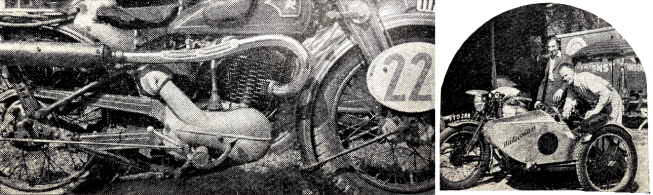
no instructions from the War Office, decided that his men should carry on. Later they too left for the Swiss frontier. The trial, which promised to be the most strenuous ever held, was virtually at an end. MONDAY
The first day’s route may have been hors d’oeuvres, but it was just about 295 miles in length—475 kilometres, according to the route-card. And at least two-thirds of the course lay over narrow, loose and vilely dusty roads. This, the Sudetenland-strecke, to quote the programme, was mileage, but extremely gruelling. Twelve of the 266 starters retired, and a further 13 lost marks, and thus were no longer in the running for premier awards, the FICM gold medals. No stretches of the route were outstandingly difficult—it was just the modern International Six Days’ with its big mileages over country roads and its high average speeds. Twelve time-checks were included, and, as is the rule with the International, oil competitors had to pass through each within three minutes of their schedule time or lose marks. None of the three teams—German, British and Italian—that were competing for the award, the International Trophy, lost a mark. In the
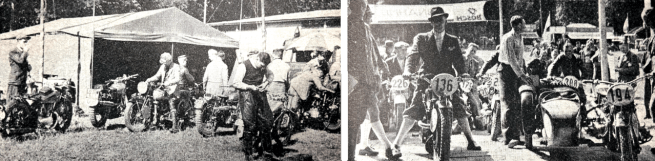
competition for the International Silver Vase, which is open to teams from all countries—teams of three riding machines made in any country as opposed to teams of four and motor cycles made ‘at home’—all were level except the Italian ‘B’ team, which had lost 14 marks owing to M Ventura (500cc Mas) having trouble and being late. Thus the scrap between the three national teams, those of Germany, Italy and Great Britain, continued unchanged. It was only in the secondary competition, for the International Silver Vase, that there had been any weeding out. Eight teams were still level, each with no marks lost, Great Britain ‘A’ and B’, Germany ‘A’ and ‘B’, Holland ‘A’ and ‘B’, Sweden and Italy ‘A’. The question was: ‘What will happen on the morrow?’ This, in the opinion of many, was likely to prove the most difficult route of all. However, the first day had already accounted for A Jacobi (494cc BMW), A Zimmermann (496cc Zündapp), HM Toomey (498cc Panther), WHJ Peacock (997cc Ariel sc), Graham Oates (997cc Ariel sc), K Döbereiner (750cc BMW sc), S Hoffmann (494cc BMW), H Klett (600cc BMW cc.), A v Döry (346cc NSU), F Lukavecz (346cc NSU); DA Gulliford (347cc Matchless) and H Hermann (123cc DKW). In the Hühnlein Trophy competition 12 of the 41 teams that started lost marks and therefore could be assumed to be out of the running. The British teams that were still all right were. the CSMA, Sunbeam MCC, South-Eastern Centre ‘A’ and the War Office ‘A’ and ‘B’. Both the South-Eastern Centre ‘B’ and the War Office ‘C’ teams lost marks. Nine British teams retained their clean sheets in the inter-club competition: Sunbac, CSMA, Coventry and Warwickshire, Birmingham, West of England, Bradford, Sunbeam ‘A’ and ‘B’, and Carshalton. TUESDAY Tuesday’s run was expected to be the most difficult of the week. It was extremely difficult, but only because of one section, 23 miles long. The rest of the course could be termed fairly easy. Like Monday, there was mile after mile of loose-surfaced country road, but for the most part the going was rather easier—either that or competitors were becoming more accustomed to the conditions.
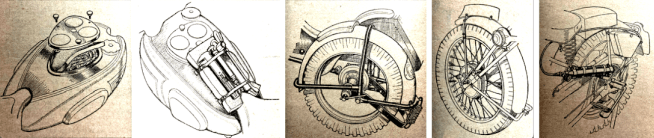
The day’s mileage was short for an International—only about 230. At 5am, the starting time, there was again promise of a fine day. The locals, however, were not too confident; they seldom are in this mountainous area, for storms sweep across the peaks although little more than minutes previously the sun was blazing down out of what appeared a perfect sky. This time the route lay to the east of Salzburg—the Salzkammergut course, it was called. As usual, it was cold at first, with the dew-laden air marvellously invigorating. It was good to be up and about, for besides the air with its sweet smell of grass that had been mown for hay, the rising sun gradually lit up the mountain peaks with a soft pink. Here and there, adding to the picture, a peak was wreathed in cloud. The country through which the course eased passed consisted of mountains and lake. Competitors, however, had little time to look around them, except when waiting at the time checks. Over the first section to Mondsee the solos of 350cc and over had to average approximately 28mph. To the next check, at Schorfling, their speed was 33mph. Neither of these speeds may seem high, but as competitors must make up a certain amount of time in case of, say, a puncture, the average speeds are necessarily much higher than they appear on the route-card. For instance, the distance from Mondsee to Schorfling is about 22 miles and the time allowed 40 minutes. If a competitor made up the amount of time required to fit a new inner tube in comfort, say, ten minutes, at the end of the section he would have covered 22 miles in 30 minutes, an average of 44mph, which is very different from 33mph. In this lies the main difficulty of the International; high speeds over poor surfaces—in other words an Alpine Grand Prix. One man did have tyre trouble, though not until after the lunch stop (for the first pair of riders 9.21am!). Allan Jefferies, of the British Trophy team, had a puncture, ‘pumped up’ twice with his air bottle (a cylinder of CO₂), changed his tube in the time he had in hand at the check, and fitted a new tyre at the finish. There was quite a lot of fun and games en route. Dr Galloway (499cc Rudge sc) had to keep stopping to tie on his sidecar body with copper wire. Len Heath (Ariel), of the British ‘A’ Vase team, met a car, the driver of which kindly got out of the way by steering on to the roadside. Unfortunately the said driver got more or less out of control, and Heath dived into the trees as being the safest plan. Lieut Riley (Norton) ran out of fuel owing to his tank leaking, and had to retire, While Harold Taylor (997cc Ariel sc) met a car on a right-hand bend, and to avoid his sidecar and passenger being wiped out had to take to the ditch. No one was hurt, but the forks were badly bent, and Taylor completed the day’s run with his passenger helping to steer by means of a screwdriver driven into the end of the near-side handlebar. The really difficult section came near the end of the run. First there was the Pass Gschütt, which is a twisty 1 in 4-and-a-bit climb with a surface rather better than that of Porlock Hill before it was tarred. Now came the part on which a German, when practising, fell over a precipice, and where George Rowley, out with the rest of the British Trophy team for the same reason, went one way and his machine the other—the latter over the edge. According to the route-card the distance from check to check was 23 miles, which had to be covered at a 22mph average by solos of 350cc and over, 20 by the sidecar outfits and 250cc solos, and 19 by the 125cc machines. The first few miles consisted of narrow, dusty road through woods; a twisty
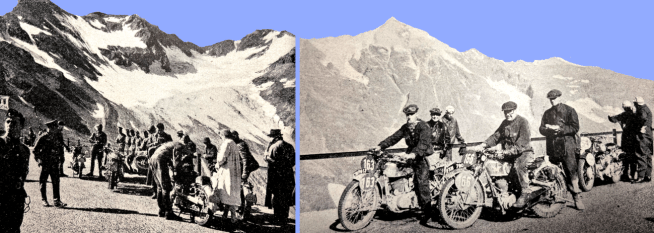
sort of road that was thoroughly dangerous if, as happened when the MC man rode along it, there were lorries coming from the opposite direction. Nevertheless, many of the larger solos averaged well over 30mph on these few miles. Next there were a few miles of bare cart-width track, which twisted and turned and was, therefore, slow going but had a good surface. One stony up-grade required slight care. Then came a really frightening part: a narrow track with a surface of loose stone and, on the left, an almost sheer drop of anything up to 300 feet. Here it was a question of eyes on the road, keep to the right-hand side and try to forget what might happen if you skidded. In its dangerous nature the road was probably second only to one of the military roads in the Dolomites that the’ Italians included in the, first true ‘Alpine Grand Prix’ type of International seven years ago. Then followed a short stretch of comparatively easy going. The track twisted and the speed at corners had to be reduced to 10mph, but there was nothing more difficult than the negotiation of loose stone. The scenery was magnificent, for the route lay completely in the wilds—well- up in the mountains. As the first taste of rough-stuff there was a slightly muddy 1 in 6 descent with lengths of larch tree laid across the track to prevent it being washed entirely away. In addition, there were big stones and at each tree trunk a drop of anything up to 10in depending upon the course chosen. Len Heath (Ariel) and Vic Brittain (Norton) were seen on the early part. Both were travelling with a steadiness and neatness that were in extraordinary contrast with the machine-thrashing methods of perhaps 50% of the others in the trial. Allan Jefferies (Triumph ‘Twin’) was watched at a tree stump section, where he was carefully taking each log at the point where the drop was lowest. A little over three miles from the end of the section the track dropped steeply downwards through a mighty rock gorge. Around a right-hand 1 in 5 corner, out of sight of the approaching competitors, were huge gnarled rock out-crops, some of them 9 or 10in, high, and on the left to make the track up to the width of a farm cart were tree trunks laid crudely on other tree trunks. This ‘bridge’ rested on a narrow rock plateau on the right, and on the far side of a stream on the left. Daylight showed through these tree trunks—in one place square feet of it—while to the left of them was an unguarded 8-12ft drop into the bed of the stream, which was dotted with. rocks up to 3ft high. As usual, NSKK men were on duty to slow down competitors. Many riders, however, imagined that 15mph was slow enough, so the MC man took a hand, too, at making them go gently. In an International riders can foot as much as they like—only keeping to time counts. Thus, the method here was to go at a bare walking pace and use one’s feet to keep the machine away from the worst rocks. The German sidecar men, with their wide chassis and their sidecars on the right, plus, in
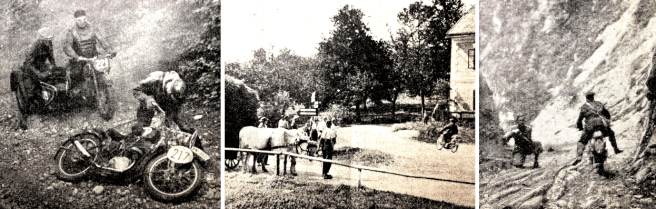
many cases, transverse-twins with a cylinder protruding to the left, were in a bad plight, and nearly all of them had to stop and heave their machines. British drivers, with their ultra-narrow chassis, large ground clearance sidecars on the left, were much better off, and a number got through non-stop. Harold Tozer (496cc BSA sc) was as neat a could be, and so was Signor Gilera (600cc Gilera sc), who, having his sidecar on the right, sensibly drove his sidecar wheel on to the tree trunks. Both J Bovee (348cc Velocette) and Sgt-Major Mackay (347cc Matchless) had machines that showed relics of earlier tosses—smashed head lamps, number plates and so on. R Clayton (343cc Triumph) was much too fast until yelled at. This was not to be wondered at, because it was difficult to believe that such a section lay just around the corner. Tiffen (Velocette), of the British Vase ‘A’ team, was seen to have much wrong with his tank—which a little later caused his retirement. Sgt O Davies (Matchless) toppled against the bank. Colin Edge, on another Matchless, made a particularly neat showing. CR Bates (348cc BSA) was very careful and neat, but no sooner had the words been jotted down in the MC notebook than over he went! George Rowley (AJS) looked quietly serious. An action typical of the spirit of the International Trial was F Diez (597cc BMW sc), a German, stopping before the section to let Lieut Riley (Norton) go past. H Peterssohn (600cc Zündapp sc) got frighteningly close to the sheer drop into the stream, but probably was so busy trying to hold his outfit that he did not see what would have happened if his outfit had kecked up. Almost immediately afterwards there was a 1 in 5 descent with a rock-strewn surface like a cross between those of Hollinsclough and Washgate. This, for the late numbers, was treacherous to a degree, for a thunderstorm suddenly raged, causing the visibility for some to be little more than yards, so dense was the rain, and then almost equally suddenly ceased. Many riders encountered no rain at all. While a number skidded and fell on. this atrocious descent, the rain had the advantage of binding some of the loose tracks that were to follow. In spite of it all, a number of riders gained ten minutes on the 23 miles! CN Rogers (Royal Enfield) ran off the course, yet still was on time at the ensuing check.
Then followed a long machine-shattering climb through pine woods with tree trunks laid across the track every few yards, and so back to Salzburg. Here it was learned (as was expected!) that a number of riders had retired and that Macchi, of the Italian Trophy team, had lost marks on time. Thus Britain and Germany, assuming neither had lost marks, were left to fight out the destination of the International Trophy. No fewer than 23 retired, making a total for the first two days of 38 out of 266 starters. Of the Vase teams, Germany ‘A’ and ‘B’, Italy ‘A’, Great Britain ‘B’, Holland ‘A’ and ‘B’, and Sweden were still without loss of marks. Italy ‘B’ had lost 14 and Great Britain ‘A’ 100. In the Hühnlein competition the remaining ‘full marks’ British teams were the CSMA, Sunbeam, South-Eastern Centre ‘A’ and War Office ‘A’, while among the clubs still in the running for the Bowmaker Trophy were Sunbac, CSMA, Coventry and Warwickshire, Birmingham,
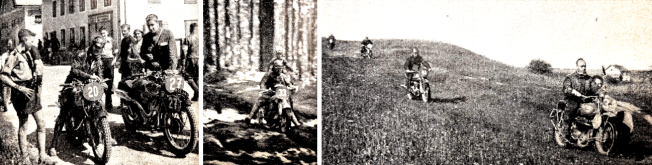
Bradford, Sunbeam ‘A’ and ‘B’ and Carshalton. WEDNESDAY Except for the 1937 trial in Wales there has probably been no day in any of the last seven or eight Internationals that has been so easy as Wednesday’s run. It was good going almost throughout the 277 miles—more of a see-the-sights tour, only the speeds were so high that competitors, except at checks, had no time to see anything other than the strip of road in front of their machines. The run outward was simply a main-road trip to the much-publicised Gross-glockner Pass, which climbs from 2,640 feet at Fusch, the time check that preceded the check, to nearly 8,000 feet at Fuscher Törl, 12 miles away; this so far as competitors were concerned was the summit. En route to the hill there were various incidents, as might be expected. TN Blockley (496cc BSA) took a toss and unfortunately hurt his head, though not seriously. Both C Cavaciuti (500cc Gilera) and George Eighteen (347cc Matchless) came off on a wooden bridge (many bridges are of wood, some in the wilds rickety affairs built crudely out of tree trunks). What happened was that after setting off on an apparently perfect dawn competitors encountered dense mist, which made the boards slippery, and over many of them went! In the space of perhaps a dozen miles no fewer than three level crossings were encountered, and for some competitors it was a case of waiting at each. However, the organisers have such matters properly weighed up. At every level crossing there were NSKK men. One a couple of hundred yards down the road would wave a yellow flag as a warning that the crossing was shut, nearer the crossing was a man with a red flag, and finally there were officials to note down how much individual competitors were delayed—this at every crossing in a part that seems to have hundreds of them. For many miles the road taken runs beside a river. Curve followed curve, and as the average speed necessary was 34mph for solos over 250cc there was some hurrying. Immediately after one level crossing there were all the thrills of a massed-start road race—ten or a dozen 500s screaming off the mark and, incidentally, almost filling the twisty main road, which was open to other traffic! Long before the Grossglockner was reached there were glimpses of snow-capped peaks. To describe the Pass itself is difficult. The road winds and hair-pins, climbing—ever climbing—right to snow level. So perfectly engineered is it nowhere is the gradient more than 1 in 8, while the surface up to Fuscher Törl, where the check was held, is magnificent non skid tarmacadam with the 14 hairpin bends smoothly paved with granite setts. The scenery is almost unreal, everything is so vast. Around are dozens of mountain peaks, some stark bare-rock, others capped with snow. Here and there is a glacier. Down in the valleys are clumps of conifers and the bright green of grass fed for months on end with snow water. As a test the climb was magnificent. Solos over 250cc had to cover the 12 miles in 26 minutes (28mph), sidecars over 350cc had to average 25, and 250s 25mph. And as the road climbed steadily higher, the competitors found that one by one their ‘horses’ strayed from the stable. Carburation became over-rich. George Rowley, who for safety’s sake was running on a rich mixture, even at valley level, found the mixture became so rich that his AJS ran lumpily and with a throaty noise. British riders as a whole made a polished show on the hairpins…At the cheek few,
if any, competitors had wore than 4 or 5 minutes in hand. With many it was a question of a quick glance at the scenery, a sigh that they weren’t on holiday and could not stop, and into the check…RR Meier (343cc Triumph) had his silencer partly adrift. A German rider in front of him left his time card at the control, so the British rider took it on. Like many others, GE Godber-Ford (347cc Sunbeam) had no time in hand and had to go straight into the check. It was interesting here to note how often a German, knowing what those at the control were calling out, would tap a British rider on the shoulder to indicate that it was time to check in. One visiting rider had his card stamped a minute early, but the German who was riding alongside would not have it; he made the official cross out the time on the card, initial it and stamp the card afresh. Many were worried as to whether they would need lights at two tunnels that would be encountered a little farther on. The first was short and even eyes accustomed to the glare of the light in the mountains could see their way, while the second had overhead lights throughout. The rest of the course was easy. Except for the descent of a long hill, cross-gullied and 1 in 5 in places, and an extraordinary storm encountered by some competitors near the finish, it was largely, scenic tour. At the finish it was found that the Trophy team position was unchanged; it remained Britain versus Germany. In the Vase competition six teams were still clean. Germany ‘A’ and ‘B’, Italy ‘A’, Britain ‘B’ and Holland ‘A’ and ‘B’. The CSMA were out of the running for the Club award, while of the British teams only the Sunbeam Club, South-Eastern Centre ‘A’ and the War Office ‘A’ had still lost no points in the Hühnlein competition. THURSDAY Difficult though Tuesday’s route had been, Thursday’s, by common consent was worse. Check after check was ‘tight’. Only on one, the last of the day, did competitors find they had a certain amount of time in hand. The course lay in the Tirol and was nearly 300 miles in length with 12 time checks. All the inter-check stretches contained really difficult going—generally of track laid cross-wise with tree trunks. Lieut Money (BSA), who was in the running for a silver medal, started, but as he had been recalled by his regiment immediately turned off the course and made for the frontier. Trouble began early. Poor Colin Edge (347cc Matchless) was in dire trouble, and according to Dr Galloway, should never have started. He was running a temperature of 104°, but carried on. JE Breffitt (348cc Norton) had a slow puncture, tried to get the wheel out, found the spindle bent and retired. From the start there were 27 miles, many of them among woods, over which solos exceeding 250cc had to average no less than 29mph. Later there was one section at 35mph! The riding conditions were dustier than ever. Just before lunch ten competitors missed the route, among them Vic Brittain (490cc Norton) of the British Trophy team. This section included the Aachen Pass, a secondary road of no great difficulty barring its length and steepness. The climb starts at a village and becomes progressively steeper. For a yard or two the gradient approaches 1 in 3, buff there are no hairpins—merely gentle bends. This, incidentally, is the second steepest climb in the Alps. At the lunch check there was difficulty over petrol supplies. There was not the usual fuel stop with all the petrol companies represented. Instead, there was a German Army lorry with only a small quantity of fuel obtainable for each competitor. George Rowley (AJS), of the British Trophy team, found that he was not being given enough—not sufficient, at all events, to make it certain that he could reach the next fuel stop. He protested and finally got what he wanted. Flook, the Trophy sidecar man, was given only five litres. This was not nearly enough. Finally, and with waste of time, he got seven litres, but that was not sufficient. As he expected he ran out. He begged some from the driver of a car. At two checks he was late and lost four marks. Thus, unless his protest was allowed, only the German Trophy team retained its clean sheet. Soon after lunch LEC Hall (499cc Rudge sc) retired with gear-box trouble. He managed to limp back to the finish, albeit with the noise of
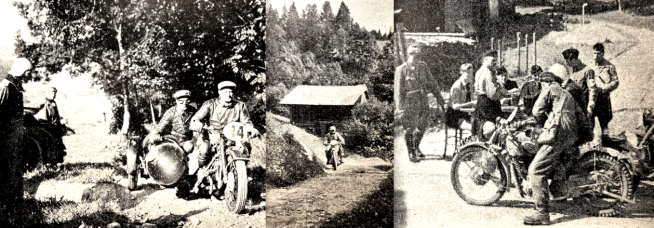
agricultural machinery! With the rough going and high speed schedule tosses were frequent. A Ascari (495cc Guzzi) finished the day with two black eyes. Miss Cottle (249cc Triumph), too, came off, but was unhurt and continued to make the trial look simple. T Mooney (497cc Ariel) was one of those who ran out of petrol, but in his case the cause was a loose union. The last but one section was vile, especially a very narrow, extremely steep descent. Here there were the usual tree trunks set across the track at frequent intervals in order to prevent it being washed away. AA Sanders (343cc Triumph) had to crash over the baulks of timber as hard as he dare in an endeavour to make up time. He, too, was in trouble over petrol, and at the last check had to beg some from a German competitor. Sun and shadow was a cause of trouble on this last section. They caused Allan Jefferies’ downfall—literally. He mistook a deep pot-hole for a shadow, went on to describe a parabola, and his Triumph fetched up pointing in the opposite direction. Allan said, ‘If I had banged my head a little harder I might have got on the wrong way round!’ He added ruefully, ‘And it was the smoothest bit of the whole day…’ At the finish the comment was that the day’s run had been at least twice as severe as anything encountered previously. Len Heath (497cc Ariel) reported that at one check he only had two minutes in hand, while Allan Jefferies said that on several sections he found that he had to go just as fast as he could. There was considerable excitement at the finish with competitors charging straight into the check, men coming in with flat tyres, rumours of Flook having lost marks and, not least, queries as to the European situation. Competitors carried on in the usual way; filling and greasing up their machines and checking over to see that everything was all right. It was interesting to see the methods of the riders. Both George Rowley and Charlie Rogers took care to wipe their fork nipples before using the grease gun. W Wieser (494cc BMW) cleaned the dust off his cylinder barrels with a high-pressure paraffin spray. JH Wood (343cc Triumph), of the ‘B’ Vase team, drained his oil tank with a mighty oil ‘syringe’ affair and was extremely careful to get out the last tablespoonful. Pte Wood (496cc BSA) had a bent front rim, which he would have to knock straight in the morning, and Sgt Davies (347cc Matchless) was busy removing a broken. fork spring. He got half of it off and had to leave the rest of the job until next day. W. Schlichting (494cc BMW) skidded into the finish. He had a flat back tyre, had covered some 15 miles riding on the rim, and was about all in. Incidentally, he weighs 19 stone. L Patina (BMW) also came in with a flat rear tyre. While the trial had been carrying on Major Watling, the British steward, and others had been trying to obtain information about the international situation. There was still very little news. The British Consulate at Vienna had stated that there was no official warning to British subjects to leave
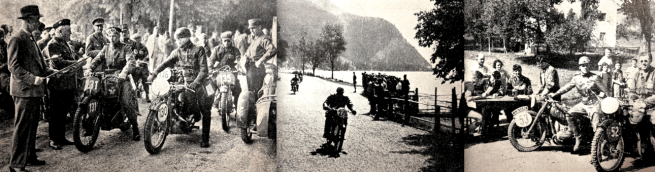
Germany. On the other hand, French nationals had been told to go. Also there was news of the increase in the British bank rate, the fact that two English competitors with official posts had been recalled to Britain, and much coming and going of high officials of State to Berchtesgaden nearby. There was, however, still nothing sufficiently definite to enable the heads of the British contingent to advise competitors to leave the country. As each left the marquee he was told that the situation was grave, and if he wished to make tracks for home he could do so. It was also said that Korpsführer Hühnlein had stated that he would see that all visiting riders were escorted to the frontier. Later Obergruppenführer Kraus, the president of the jury controlling the trial, made a similar announcement when the jury met. On the other hand, at least one of the British contingent remembered the immense difficulties of getting back to England from Grenoble on the 1914 Six Days. That was merely passing through France, and this time competitors would have to go some 200 miles to the nearest frontier, cross Switzerland and then pass right through France—a total of some 800 Miles to Calais. To decide what to do was difficult in the extreme. What helped to clear the air was a telegram from Mr Mansell to the Norton riders stating, ‘Advise return immediately’. Late on the Thursday night there was a round table chat between Major Watling, Colonel Bennett, Mr. Loughborough and Mr Peter Bradley, the manager of the British teams. Major Watling took the initiative and decided that the riders should return the following morning. This came as something of a bombshell to the German officials. However, they offered to provide an escort car, make arrangements for a petrol lorry and let the competitors concerned take their machines out of the marquee early the following morning. Hardly had Major Watling made his decision than its wisdom was confirmed by a telegram he received from his office. This read: ‘President instructs me inform you British Consul-General in Berlin has received instructions to warn all British subjects to leave Germany immediately.’.” Colonel Bennett, who had received no official instructions from the War Office, decided that his men, the Army contingent, should carry on.
FRIDAY and SATURDAY Early on Friday morning the British contingent, with the exception of the Army riders and four others, collected their machines and packed up. There were a few dissentient voices—people who wished to stop. The vast majority, however, once they heard the contents of the telegram received by Major Watling, realised that the sane course was to leave the country, doing so by the shortest route to the Swiss frontier. At 6am the huge cavalcade was off, bound for Innsbruck, Landeck and Feldkirch. This was earlier than the German officials had anticipated. The petrol lorry was fixed for 8am and obviously would be slower than the motor cycles and cars of the British contingent. Hence the petrol arrangements seemed valueless, and, in addition, there was no escort car. Although many would, no doubt, be able to get to the border without having to fill up, this would by no means apply to. everyone, so Major Watling, in company with The Motor Cycle representatives, Mr Geoffrey Smith (Managing Editor) and Mr Bourne (Editor), searched around Salzburg to ensure that there was petrol available near the Tyroler Hof, Innsbruck. This was duly arranged and Innsbruck advised by telephone. The Bentley car with Mr Geoffrey Smith and Major Watling aboard and Mr Bourne and his Triumph Twin then followed the route taken by the British contingent to act as whippers-in in case any one had trouble. All went well. Petrol was available at Innsbruck and, incidentally, at one or two pumps en route, The only trouble was a cloudburst encountered near the Arlberg Pass, which soaked many of the riders. At the Customs, just after Feldkirch, the officials in charge were helpful in the extreme, and all were through and safely over the border into Switzerland in a matter of minutes. The majority stayed at a village a few, miles farther on. Here people were kindness itself in finding rooms, and even—at the little hotel where the main contingent pulled up—in hurriedly producing bottles of local wine ‘on the house’. Considerable surprise was expressed by members of the British teams that four British competitors should have stayed behind. Later these and the Army men also left Germany and crossed into Switzerland. The trial, which in our guide a fortnight ago was called ‘The Trial That Is Different’, was proving very different. It was continuing, but with a depleted entry and much of it without international flavour. For the Trophy contest there remained Germany and Italy. The latter had lost marks earlier in the week. Germany, too, was to lose marks—30 as against Italy’s 43. Thus there was no race over the scramble course to determine the destination of the Trophy: Germany won on. points. For the Vase, however, there was a tie, and the result of the scramble was that Germany ‘A’ won with no marks lost and Italy ‘A’, also with no marks lost, were the runners-up. The Hühnlein Trophy was won by the DDAC ‘A’ (no marks lost), with the SS ‘B’ team (no marks lost) as. runners-up. The DDAC (Munich) won the club contest for the Bowmaker Trophy. Thus in disappointing fashion the 21st trial of the
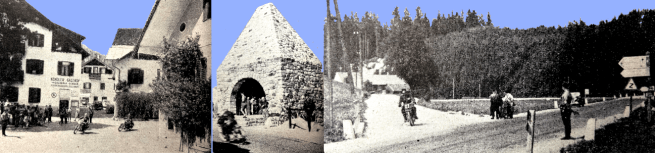
series came to an end. TEAM POSITIONS (end of fourth day). International Trophy. First—Germany: R Seltsam (494cc BMW), O Sensberg (245cc DKW), W Fähler (245cc DKW), Müller (596cc BMW sc); marks lost, 0. Second—Great Britain: GE Rowley (347cc AJS), A Jefferies (498cc Triumph), VN Brittain (490cc Norton), HJ Flook (596cc Norton sc); marks lost, 4. Third—Italy: E Villa (500cc Gilera); Macchi (600cc Gilera), L Gilera (600cc Gilera sc), N Grieco (250cc Sertum); marks lost, 27. International Silver Vase. First—Germany ‘A’: J Forstner (BMW), F Linhardt (BMW), H Lodermeier (BMW); Italy ‘A’: G Benzoni (Sertum), O Francone (Sertum), A Brunetto (Sertum); Great Britain ‘B’: CN Rogers (Royal Enfield), WA West (Ariel), JH Wood (Triumph); all three teams lost no marks. Second—Holland ‘A’: G de Ridder (BMW), J Fijma (Ariel), J Moejes (BMW); marks lost, 14; Third—Holland ‘B’: J Bovel (348cc Velocette), B van Rijn (348cc Velocette), Renooz (300cc Eysink); marks lost, 100. Fourth—Germany ‘B’: J von Krohn (Zündapp sc), J Becker (Zündapp sc), R Grenz (Zündapp sc); marks lost, 102. Hühnlein Trophy Competition—War Office ‘A’: Pte JL Wood (496cc BSA), Cpl AC Doyle (496cc BSA), Sgt FM Rist (496cc BSA). NSKK ‘C’: Ilgenstein, Schaumburg, Riedal; NSKK ‘D’: Beranek, Walz, Suchanek; NSKK ‘M’: Riechenberger, Kussin, Luthardt; SS ‘B’: Low, Rietz, Hainz; WH ‘A’: Stoltmann, Maciejewski, Loffier; DDAC ‘A’: Steinberger, Dahmeyer, Charbonier; all the above teams lost no marks. Bowmaker Trophy Competition—Birmingham MCC: GF Povey (Ariel), JJ Booker (Royal Enfield), H Tozer (BSA sc); Bradford &DMC: A Jefferies (Triumph), JH Wood (Triumph), R Wilkinson (Panther); Sunbeam MCC ‘A’: L Heath (Ariel), WA West (Ariel), CN Rogers (Royal Enfield); NSKK Berlin ‘B’: Ilgenstein, Schaumburg, Riedel; NSKK Franken ‘B’: Reichenberger, Kussin, Luthardt; NSKK Ostmark: Beranek, Walz, Suchanek; SS Main ‘A’: Löw, Rietz, Hainz; DDAC München: Steinberger Hahmayer, Kohler; all the above teams lost no marks. SIXTH DAY—FINAL RESULTS. International Trophy Competition. 1, Germany, 0 points lost; 2, Italy, 43 points lost (Britain 4 points lost up to withdrawal on fifth day owing to European situation). Silver Vase Competition. 1, Germany ‘A’; 2, Italy ‘A’ (Britain ‘B’ no points lost until withdrawal on fifth day). Hühnlein Trophy Competition. 1, DDAC ‘A’; 2, SS ‘B’; 3, NSKK ‘C’ (British Army BSA team no marks lost up to withdrawal at end of fifth day). Bowmaker Trophy Competition. 1, DDAC München; 2, SS Main ‘A’; 3, NSKK Berlin ‘B’.”
“DISAPPOINTING IS A MILD WORD to use about last week’s International Six Days Trial held in Germany. The event, the 21st of the series, promised to be the most gruelling, and therefore the most interesting, of all. As it was, however, it almost ceased to be an ‘International’ after the fourth day. The cause, it need hardly be added, was the European situation. In the trial—in everything connected with it—there was peace and friendliness. Motor cycle sport had brought the nations together, and nothing could be more impressive than the helpfulness of one competitor towards another. Of different nationalities they might be, but they were bound together by their common love of motor cycles and by competing side-by-side encountering the same difficulties. The trial was difficult—exceptionally so. None except those who have actually competed can appreciate the true meaning of the International Six Days Trial—of covering anything up to 300 miles a day over minor by-ways and woodland and mountain tracks, doing so at average speeds which to the normal individual seem suicidal…Much of it was in the nature of an Alpine Grand Prix. As a test of machines and riding skill the International is supreme among motor cycle trials—
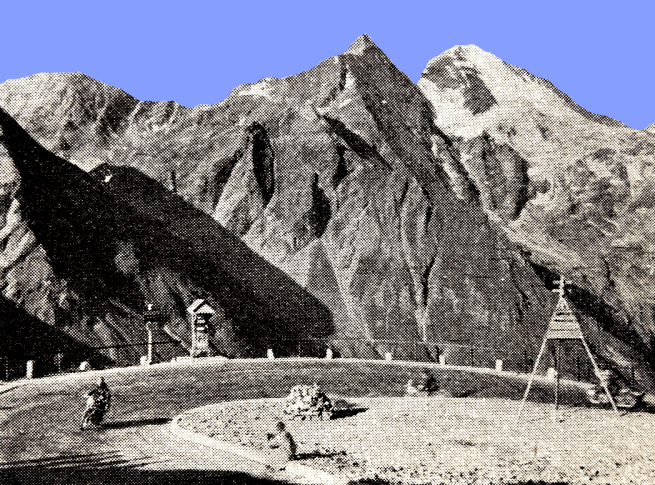
none more so than the trial which Germany staged last week. Thus it is an especial pity that the European situation should have caused the withdrawal of teams and sent nationals hurrying back to their own countries. When the British teams withdrew—after the fourth day’s run—there was still good reason to hope that two at least of the four main trophies would be won by Britain. The organisation of the trial as a whole was excellent. Before the actual start it was a little patchy, and almost as if the German governing body had hardly expected the trial to be held. On the other hand, it has to be remembered that only a week previous there had been the German Grand Prix. The route-marking in particular was magnificently carried out, and the way in which an NSKK man was on duty at every danger spot, even the most inaccessible, was most commendable, for it did much to eliminate the dangers inherent in such an event. The main lapses were in respect of the petrol supplies on the fourth day and in the difficulties competitors encountered in obtaining petrol on the way to the trial. Britain can well be proud of the performances of her teams up to the time of their withdrawal. Their riding was magnificent and they handled their mounts with the restraint and care that are the sine qua non with first-class International team men. Next year, let us hope, there will be a true International carried to its proper conclusion and under conditions not only equally friendly so far as the trial itself is concerned, but with Europe showing the same spirit of friendliness that was such an outstanding feature of the event.”
“WHEN THE GREAT WAR broke out in August, 1914, the International Six Days Trial was due to start from Grenoble, and though our men were on friendly soil, many of them had a tough time getting home. There were four teams entered for the Trophy—British, French, Swiss and German. The British team consisted of CR Collier (Matchless sc), WF Newsome (Triumph) and TC de la Hay (Sunbeam). The Swiss all rode Motosacoche machines; the French, Clement and Terrot bicycles and a Violet-Bogey cycle-car; and the Germans Wanderer and NSU solos and an NSU sidecar. The 65 entries included J Stuart White on a Bradbury. The main problem of return was fuel, all petrol supplies having been commandeered a by the French Army. Our representative happened to be a good linguist, and his journey home Was facilitated by his ability to buy odd pints of benzine at a chemists’ shops!”—Ixion.
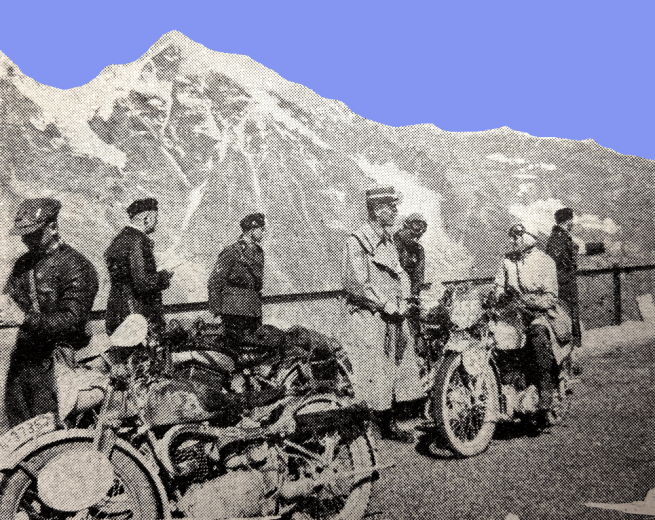
“TO REVIEW THE International Six Days after all that was written in last Thursday’s issue would be superfluous. Everyone knows what happened and how on Friday, the fifth day, the British contingent withdrew from the trial, left Salzburg and hurried to the Swiss frontier and home. It is probably difficult for anyone not among the party to realise how cut off the British contingent was from knowledge of what was going on between the capitals of Europe. All at Salzburg sensed that there was a crisis, but how grave it was none knew. As we said in our description of the trial, the German papers revealed little, those British papers available were two days old, and wireless reception of the English news bulletins was next to hopeless. Whether the hundred and more British riders, passengers and camp followers would have remained right until the Friday had they been aware that the bulk of the International Press had left Berlin on the Tuesday evening, is a question that cannot be answered. The Press do not hurry out of a country without very good reason. As it was, however, the riders’ job was to carry on until told to leave. This they did magnificently. Looking back on the necessarily anxious days one cannot help smiling at the recollection of what happened on the evening the German-Russian pact was announced—how Germans came along to Englishmen, shook them by the hand and said joyfully, ‘Now we shall have peace!’ On Thursday, just before midnight, the decision was reached that the British contingent should make for the German-Swiss frontier by the shortest route. Colonel Bennett, who had no instructions from the War Office, decided that the Army teams should remain. What happened in this case was simply that the official intimation that he and his men should return was delayed en route. When it did arrive they, too, left for Switzerland. All this is past history, and instead of reviewing the trial as such I will endeavour to record a few personal impressions. We have already paid well deserved tributes to the riders. I watched them at many points, sometimes on the ‘stickiest’ sections of all. Our Trophy team was outstanding. Never once did I see a Trophy man thrashing his machine, nor did I see any of the four taking a risk. The unflurried way they forged ahead on, say, the St Koloman section, the worst on the second day, and seemed, almost without thought, to miss all the obstacles that might damage their machines, evoked my whole admiration. On the Grossglockner they were again outstanding. Whereas many riders thrashed their engines and scrambled round the fourteen hairpin bends, our Trophy team gave the most polished display one could possibly imagine. A phrase I heard several times was, ‘You can always tell a Trophy team man.’ This remark was made by Germans as well as Englishmen. Three years ago, when the International was last held in Germany, I was impressed by the general standard of riding, particularly by the way the Germans handled their BMWs and Zündapps in the rough. This time, perhaps because some of the going was as bad as that of an exceptionally difficult English half-day trial, the riding did not seem to me to be nearly so good. The British riders on the average were easily supreme in the mud and over the rocks. The Italians, for the most part, were unhappy. A number had little idea of how to tackle such hazards, and seemed to keep to time by averaging inordinately high speeds on the road portions. Seldom have I seen riders thrash their machines more. Of course, there were many who started in the trial with little idea of what a modern International means. Somehow or other the impression that these trials are merely high-speed tours in glorious country still seems to exist. The facts are, as we have tried to convey in describing the event, that the modern trial as held in Germany is an Alpine Grand Prix with sections just about as bad as any included in British sporting trials. One, in my opinion, was worse than any I have previously encountered in a trial either in Great Britain or abroad. And this, it has to be remembered, had to be ridden against the watch. The trial is an event suitable only for the most experienced—one that taxes even such men as Allan Jefferies, Vic Brittain, Len Heath and Co. Perhaps the most amazing show of all was that of Miss Marjorie Cottle, who rode magnificently.”—Torrens (AB Bourne, Editor of The Motor Cycle.)
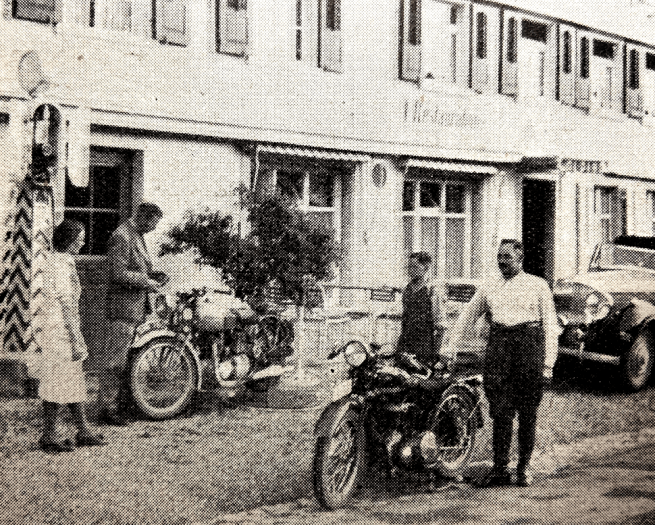
“JUST IMAGINE SOME 30 British soldiers passing through a troop-infested part of Germany at midnight! This is what happened to British Army teams on the way back from Salzburg and the International. Seldom has there been such a nightmare ride. What had occurred was that the telegram instructing the Army teams to return did not arrive until about noon on the Friday. At that time Colonel Bennett and AE Perrigo, the BSA team manager, were having a swim, while the Army riders were naturally out on the course completing the fifth day’s run. Immediately the men arrived at the finish they were told to fill up, check in so that they had credit for covering the day’s run and then, instead of going into the marquees used for storing the competing machines, turn round and ride into Salzburg. Having covered 261 miles of trials course that day the men had to get ready and set off on a 250-mile ride to the Swiss frontier—this when almost all they wanted in the world was to get to bed. At the Hotel Pitter there was an official send-off with Korpsführer Hühnlein saying good-bye and expressing his great appreciation of the British Army teams’ sporting spirit. About 5pm the contingent set off escorted by Colonel Grimm, who decided that the party should go by autobahn to Munich and thence to Bregenz and the frontier. The few civilians who had remained at Salzburg joined up with the party. All went well as far as Munich, except that already the dog-tired riders were fighting against falling asleep in their saddles. At Munich there was a stop for food. In addition, one of the civilians became lost and the Army folk had his Customs papers! Troops were en-countered by the thousand. Some 30 miles from the frontier the party was stopped, and it needed all the German colonel’s arguments and waving of his official papers to get the party through; without him the British contingent would undoubtedly have been held up. By this time the whole party was just about asleep. Car drivers took turns at the wheel; motor cyclists every now and then sent up showers of sparks as they dozed off and their footrests touched the ground—to wake them up again. Happily there were no casualties. Seldom have men been more thankful than when at last they were over the frontier and able to get to bed. The papers of the missing civilian were left at the frontier and all other frontier posts advised of the fact by Colonel Grimm. Later it was reported that he, too, was safely through.”—Nitor.
“THE BRITISH STEWARD at the International Six Days Trial, Major HR Watling, has made the following report to the Competitions Committee of the Auto Cycle Union: ‘The International Trophy and Vase teams chosen by the ACU (in charge of the team director and manager) arrived at the headquarters of the Trial in sufficient time to complete the last stages of their training and reconnaissance of the routes. They weighed-out preparatory to the start on Sunday, August 20th, at 5am, and the next day—as British Steward—I formally started the event. During the weighing-out it was clear that, although the personal courtesy of the officials of the ONS and NSKK towards British competitors remained undiminished, the organisation was neither as elaborate nor as smooth in operation as previously. There were obvious improvisations due either to the necessity for economy, or as a result of hurried preparation for an event which the ONS really did not anticipate would take place. Nevertheless, the Trial started without incident. But late on the Monday night the news of the proposed Non-Aggression Pact between Russia and Germany (accompanied by the almost universal comment from our German hosts ‘that there would be no war’) was disturbing to the British mind. When on the Tuesday evening news was received of the policy of the British Cabinet it was inevitable that, in this new development, we should measure for ourselves the time within which some irrevocable act would provoke hostilities, and a note was taken of the engagement of Herr Hitler to speak at Tannenberg on the following Sunday—the day after the conclusion of the Trial. Wednesday brought no relief from the growing anxiety, and the vulnerable position of British competitors, officials and ‘camp followers’—who numbered over 100—became my grave concern. The difficulty of making a wise decision was increased by the absence of news from home and the inability of British Consular representatives in Germany to give any definite advice or accurate information. Finally—late on Thursday evening—after consultation with the various team officials I decided to advise British competitors to withdraw from the event, and expressed my great regret to the ONS that I felt to continue to enjoy their hospitality might prove a mutual embarrassment. Very willingly, the ONS made arrangements for our evacuation in the greatest possible comfort, and I desire to place on record their cordial assistance and friendly attitude throughout. It was, indeed, a bitter moment for me not only to make a decision for the protection of the British party, but to refuse the friendly offer of the ONS of ‘safe conduct’ if we remained to the conclusion of the trial. The Committee will appreciate that I had in mind the desirability not merely of leaving Germany before the outbreak of war, but of giving the British party an opportunity of regaining British soil before that event. On Friday morning I was informed that the British party had left. Actually, two or three private competitors remained a further day. However, after revising the petrol arrangements for the party I acted as a sort of rearguard to the British party and—after being informed at the German frontier that the whole of the party which had left Salzburg had preceded me into Switzerland—I myself entered the Swiss frontier at about 7.30pm on Friday, August 25th. That my decision (for which I was requested to accept responsibility to the ACU and which responsibility I fully accepted) was correct was amply evidenced by the fact that instructions to the War Office teams to withdraw were actually despatched from London some hours before I myself took a decision. I should like to place on record my appreciation of the cordial co-operation of the team director, manager and captain, and pay a tribute to the behaviour of all British competitors, both civil and military. With the Army teams the greatest liaison was maintained, and the presence of Lieut-Col. Bennett and Major Oldfield was not only appreciated but was most opportune. As regards the administration of the event, I must place on record—for future reference—the fact that the President of the Jury, as representing the 0NS, took a different view of the functions of the Jury from that of his colleagues. In short, he desired to amend the rules and conditions of the entry, whereas it was maintained against him to be the duty of the Jury to interpret the rules as they were printed, and the conditions under which riders made their entry. I took the view that the promoters were not entitled to do more than recommend changes in the rules and conditions of entry to the CSI, which might appear desirable as a result of experience with regard to such vexed questions as (a) what is ‘outside assistance’? (b) Should riders be permitted only to use tools and materials they themselves carry? (c) Should there be an extension of the number of marked parts? (d) What are the obligations of riders as regards lighting equipment? And (e) purchases of petrol and spare parts, etc ; (f) the efficiency of the lighting equipment throughout the trial. Again for the purpose of record, I might say that the whole trend of thought on the part of the ONS was towards a further limitation as to what repairs could be made to the machines and what equipment should be available to the riders for the purpose of executing such repairs—in other words, there was a tendency to restrict the rules as if for a road race rather than a reliability trial. In conclusion, I need only formally report that both the International Trophy and the International Silver Vase were won by Germany, which therefore gains the right to organise the event upon the next occasion—when circumstances render this possible.”

“Behind the Scenes on the International Six Days: Highlights of a Day that Begins at 4am and Ends at Midnight. By AB Bourne, Editor of The Motor Cycle.
LONDON IS OVER 600 MILES AWAY. At 6.35 there is the first of my telephone calls—if it comes through all right. At the other end of all those miles of telephone line there will be my secretary and a man who knows just about all there is to know about trials —’Paton’. The latter, with his quick brain and wide knowledge, will be able to ensure that there are no errors in the transcription. What is all this about? It is a glimpse of a press-man’s life on a Six Days, the recent International. I have been up since four o’clock in the morning. At that horribly early hour I toyed with cold ham, fried eggs, and rolls—toyed is the word. My Triumph twin is in the road beside the hotel. It has stood there through-out the night without lights, a practice quite customary on the Continent and in Eire, too, to judge from my last visit. Mounted just above the head lamp is a huge metal disc indicating that the machine is ‘Official’. The tank is full right to the neck of the filler cap—so full that when I accelerate a fine spray of Germanic fuel, with its tang of alcohol, spurts forth. The reason it has been filled to this extent is that I cannot count upon obtaining any fuel in the course of the day. Nearly all petrol pumps bear the word ‘leer’, meaning empty. There is one pump in Salzburg from which I, with my official badges and special card, can obtain fuel. On the route there are, of course, official petrol supplies, but these are for competitors, and I cannot obtain any fuel until all the riders have passed through, which, from a press-man’s point of view, is hopeless. No; all I can count upon for the day’s run is the 4 gallons in the Tiger 100’s tank. What a horrid thought. Supposing the petrol pipe started to leak!
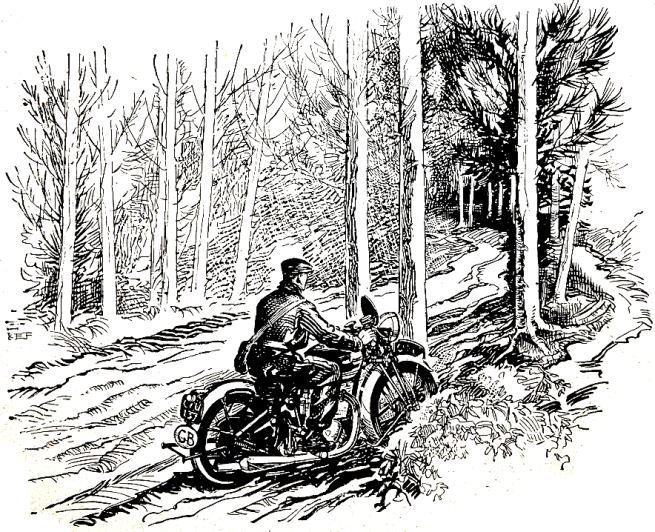
Supposing I took a toss and damaged the tank…It is now dawn. I kick-start and rustle down to the official starting point. Here is Major Watling acting as starter; close to him is Colonel Bennett, and here and them are various outer old friends—Peter Bradley, Peter Chamberlain, Perrigo, Bill Mewis, Freddy Neill, and others who are looking after the British contingent, For a while I watch, take in the ‘atmosphere’ of it all, and jot down notes about men, machines, methods, and so on. Then off on the course, riding among the competitors to learn exactly what the conditions are like. Even in the first 20 miles there are incidents to memorise. Already, things begin to happen among the huge entry. Soon the course leaves the main road to Vienna. It now lies over loose, dusty by-road—in places vilely loose. More things happen (many more!). Finally, like the competitors, coated with dust from head to foot—eating dust, breathing it—I stop at a check, enter up my mental notes, and chat to competitors. With only my tankful of fuel it is impossible to cover the whole course, so the task now is to make for what is generally agreed to be the section of the day. The only trouble is that Der Deutsche Automobil Club’s map of the German Alps does not show the fifth-rate roads on which the course lies. For all the map reveals, the route lies in wide-open spaces. Picking up the course afresh proves difficult, and the whole time, in the back of my mind, is the question: ‘Will my fuel hold out?’ However, by going along a road which the route must cross, I finally pick up the marking. Now it remains to follow the route until I come to the rough-stuff, select a good patch at which to watch, see some of the competitors here, ride on to the next bad stretch, see some more, and so on. All goes according to plan. The going becomes quite rough—woodland tracks, loose stone, mud. One patch of mud is such that I dive into the pinewoods and make a little circuit in order to miss it. Definitely a good spot at which to watch, and all to myself—no other members of the Press here at all. In view of that telephone call at 6.35pm, I settle down to describe the earlier stages of the day’s run—writing against time, because at the finish I shall have all my work cut out to collect the final news and write up both it and the notes about the present section. Because there is so little time, writing becomes easy—the words flow almost too quickly for my pencil. The task is just about finished by the time the first competitors arrive.

Then more notes. Next a hectic dash among the competitors, charging over the rough, not at my own speed, but at a speed to keep out of their way. This is a bit worrying when all the time you know that you must not crash—there are ‘phone calls fixed at the far end, a description to get through…All goes well. I, alone of the British Press, have been lucky enough to experience the rough myself, and thus know exactly what the conditions are like and am able to describe the performances. There is much of interest if only I can get it down in writing and ‘phone it to London. Back in Salzburg there are contacts to make, further notes to be obtained, and then to my hotel and to my bedroom, where I find, as requested, a private telephone plugged in. I check that it works all right, inform the private exchange that I am in my room and shall stay there. No time to change and eat: a lick-and-a-promise removes some of the dust; then, with my watch on the little table, I write-up the last two lots of notes. At 6.25 the task is finished. I hurriedly read through what is written. It seems all right. Is there anything in it to which anyone listening-in on my line to London might take exception? No, nothing, unless it is that bit about No 107 tumbling off in the park at the finish and crumpling up his handlebars. However, No 107 is an Italian, not a German, so any lady or gentleman listening-in cannot fear that this is some alleged exposure of German substitute metals. I wait impatiently for the ‘phone call. Will it come through? Will the line be a good one? Shall I be able to have the long uninterrupted call that is needed? Had I known about all the official and other ‘phone calls there were to be that night as a result of the European situation I should have worried some more At last, very late, I was told that ‘Lo-o-o-n-do-o-n’ wanted me. We were through; the line was perfect. The wires stretched half- across Europe, yet ‘Paton’ might have been at my elbow. Everything got across without interruption until we came to that sentence about which semi-humorously I had said to myself: ‘If I am cut off it will be at this point.’ We were cut off—just for a bare minute’ ; just the length of time necessary for anyone to check that No 107 was not a German. Strange, I think you will agree, especially as neither on that call nor on a later one was there any further interruption.
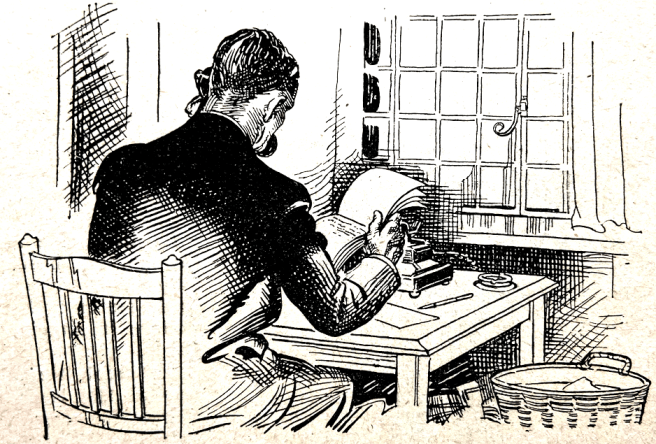
“WHEN COMPARING MODERN machines with those of say, a decade ago, some people are apt to declare that present-day motor cycles are too elaborate. Many of the so-called refinements, they say, are not absolutely necessary and tend to destroy the essential simplicity of the two-wheeler. The point is also made that these ‘extras’ not only increase the cost of the machine, but by adding weight seriously affect performance. Modern machines certainly have many features not to be found on models of ten, or even five years ago, but can it honestly be argued that these are ‘unnecessary’? Who, for instance, would willingly dispense with such features as enclosed valve gear, primary oil-baths, effective mudguarding and—once they have been tried—spring frames? Naturally, these extras increase the weight of a machine, and while there is certainly scope for manufacturers in the matter of weight reduction, thanks to the efficiency of modern power units the all-round performance of the average motor cycle of to-day leaves little to be desired.”
“MR SHERWOOD, speaking with authority as headmaster of a boys’ senior school, says schoolboys are not interested in the innards of motor mechanism. He is, of course, diagnosing on averages. I know two brothers in their teens, both of whom are monomaniacs about everything which cultivates velocity and emits loud noises. Both have motor bikes. The elder lad is for ever taking his machine to bits and trying to extract more knots and more noise from it. The younger lad never touches a spanner if he can avoid it. I suppose tinkeritis originates in one of our eleven primary instincts, namely curiosity; and unless a motor cyclist gets bored by his early dismantlings, a second primary instinct, that of self-assertion, takes charge, and he goes on dismantling and tuning in order to display his ability by making his model faster than any duplicates in the neighbourhood. Possibly the glands which generate energy also affect the matter ; but it is odd that some men hate tools and that other men’s eyes light up whenever a mechanic is called for, even if only to refit a domestic fuse. Unquestionably Mr Sherwood is right about the average lad; he listens to demonstrations of ‘how it works’ without much enthusiasm, and he would rather ride or drive than tune or repair. Give a small urchin a Meccano set and he will go mad about it for a few weeks or months, and clamour for the more advanced sets. Within six months the average boy swops off the lot for some new toy.”—Ixion.

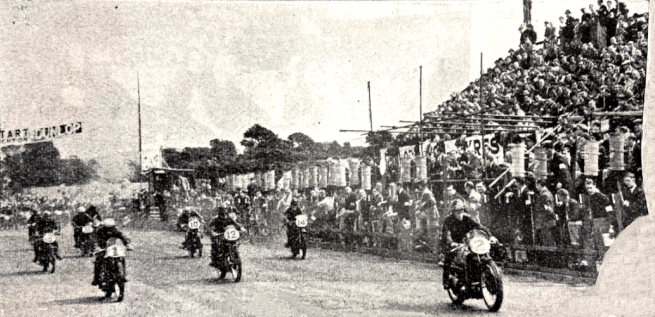
“ONCE AGAIN THE Ulster Grand Prix has regained the title of the Fastest European Road Race. Last Saturday Serafini, riding a four-cylinder super-charged Gilera, won the 500cc class at an average speed of 97.86mph—over a mile an hour faster than his average for the Swedish Grand Prix. For the first time in the ‘Ulster’ the elusive 100mph lap—talked of for so many years—was achieved, and a British rider on a British ‘blown four’ was the first man to do it. He was Walter Rusk, and he lapped at exactly 100mph on the four-cylinder AJS. The popularity of this feat with the huge crowd of spectators can well be imagined, for Rusk is an Ulster man. In the 350cc class Stanley Woods (Velocette) achieved a popular win at record speed after a fine race with EA Mellors (Velocette), while in the 250cc event a small field provided an exciting race, the issue of which was in doubt until near the end, when LG Martin on an Excelsior was proclaimed the winner. The practising period had provided more than usual interest; there had been the performances of the two blown fours, the Gilera and AJS, to watch, DKWs in both the 250cc and 350cc classes, and the hope that Jock West would arrive with one of the works BMWs. But at the end of the period Jock had not put in an appearance. Too many of the raring BMWs had been smashed at the German Grand Prix and there was no machine available for Jock to ride. Other riders had found it rather a rush to get to Ulster from the south of Germany. MD Whitworth just scrambled back in time for both the practices, but Ernie Thomas, who had to pick up two lightweight DKWs, only arrived in time for the final evening’s training. He went out on one machine, but the big-end packed up half-way round and Thomas had to walk back. By the time he had reached the start it was too late to go out on the second machine; therefore, as he had not qualified, the stewards had no option but to forbid him to start in the race. Practice speeds were high. Walter Rusk with the AJS put in some very useful laps, the best at 98.14mph. Mellors was the fastest in the 350cc class with a speed of 92.48mph. These speeds were possible owing to the excellent weather, and everyone was hoping for a fine race day and the prospect of old records going by the board. Race day came; it was cloudy but dry, with every prospect of remaining so. By lunch time all the vantage points of the famous Clady circuit were lined with spectators, and as the time of the race drew nearer more and more people free from their Saturday’s work poured out to the course. The Ulster people are definitely race-minded. They know the riders and the chances of their machines, and they are enthusiastic about every detail that goes to make the atmosphere of a big race meeting. In the paddock at the start great interest was shown in the Italian Gilera, which was making its first appearance in a race in Britain; but the two AJS fours were also a centre of attraction. Matt Wright has been busy on
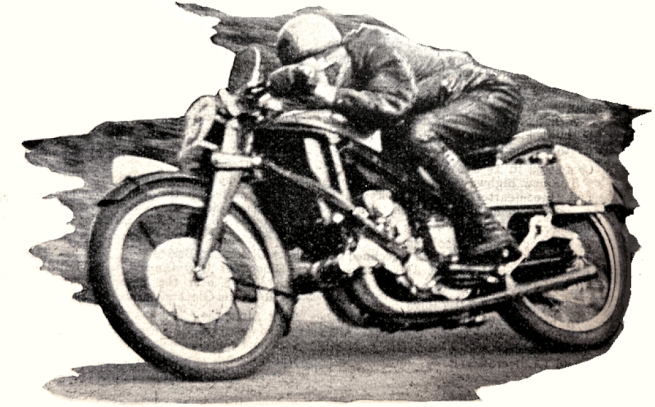
them since the TT, and although the only noticeable alteration was the running of the two exhaust pipes on each side into mega-phones, both Rusk and Foster said that handling had been improved and power output increased. Among the private entries there was little in the way of novelty, but a fitting that caused much speculation as to its method of use was a rev counter on R Mead’s Norton mounted in the saddle! THE 500cc RACE. While the riders were warming-up their engines and lining up on the grid, the announcer gave a brief account of each man’s previous performances. Then on the stroke of 2.30 p.m. the maroon went off and with a patter of feet and roar of engines the 500cc class was away. Both the AJSs fired instantly and Rusk and Foster made the most of their lead. Behind them was M Cann with his twin Guzzi, LJ Archer on a Senior Velocette, and Serafini on the Gilera. Freddy Frith., mounted on one of the pukka TT Nortons, was not in the first half-dozen, but when the first news came in from the short-wave radio that was being operated by the Royal Corps of Signals, Frith was second to Serafini at Aldergrove, and AR Foster (AJS) third. So the Italian was showing his hand already? But, no; at the end of the Clady straight it was Rusk who was leading. Frith was still second and Serafini third. In a matter of seconds these three flashed past the stands, all doing well over 100mph. How the crowd gasped, for the sight was breath-taking to say the least. Hardly had they gone than it was announced that Rusk had averaged 96.85mph, and. was only 16sec outside the record for the course—and this from a standing start! Behind these three came Archer and the Australian, FJ Mussett, on Senior Velocettes, and M Cann with the Guzzi. As usual, the first lap had brought its crop of retirements, Among them was Foster, who coasted in with an engine that was burning too much oil. But there was no stopping the other AJS in the hands of Rusk. He proceeded to outstrip both Frith and Serafini, and on the second lap his speed was 99.73mph. As he went through at the end of his third lap his lead over Frith was even greater and everyone waited expectantly for his time. Yes! he had done it. Rusk was the first man to lap the Clady circuit at 100mph—and at exactly 100mph, too! The crowd nearly went wild with excitement and Irishmen could be seen shaking hands and patting one another on the back in their exuberance, Rusk, however, had to be content with the 100mph lap, for on his fourth circuit the offside lower fork link of the AJS
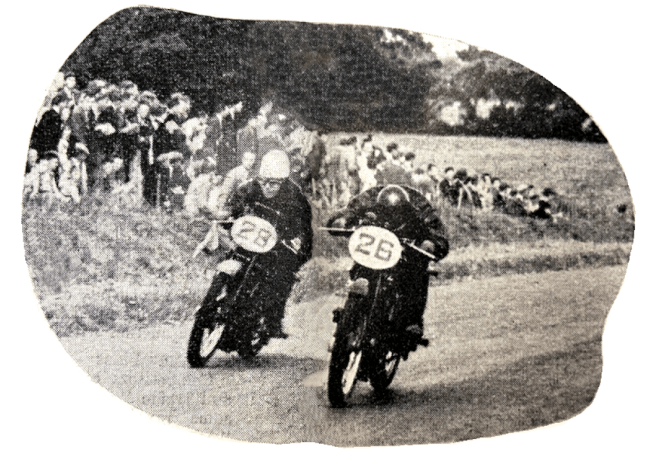
fractured, so that he was out of the race—real hard luck that he was out of luck to be put out by such a trivial and unusual fault. Rusk’s retirement left Frith in the lead with Serafini second. Try as he would Frith was unable to shake off the Italian. On one lap he would be 20 yards ahead on the next 100 yards would separate them, and on the next Serafini would be on the Norton’s tail again. To those watching it was obvious that the Italian was not using the Gilera’s full performance. He would shut off when passing the stands to read his pit signal, and on several occasions it was easy to hear that his engine was only working lightly. LJ Archer (Velocette) was lapping at 93-94mph and holding third position comfortably, but Mussett, on the other Velocette, after lying fourth, came into the pits at the end of five laps and did not restart. This let M Cann (Guzzi) into fourth place, but a little later he, too, retired—an oil pipe had broken at Aldergrove. From then on R Mead and JB Moss (Nortons) had a magnificent scrap for this elusive fourth place, and at the end of the race they were still hard at it. Meanwhile, a change had taken place in the leadership. On the sixth lap Serafini increased his speed and overtook Frith. In doing no he made the fastest lap of the day at 100.03mph. When Serafini came in to fill Frith was not in sight, but when be did arrive a lightning fill-up considerably reduced the Italian’s lead. It was a vain effort. Serafini proceeded to increase his lead and Frith, handicapped by a broken footrest, had to be content with second place. At the end of 12 laps Serafini received the chequered flag, to record a win that was loudly cheered by the sporting crowd. First and foremost because the Italian had ridden a fine race on a strange course, and secondly because he had made their GP the fastest European road race again. Frith was second, Archer third after a sound, unhurried ride, and Mead eventually established his superiority over Moss for fourth place. THE 350cc RACE. Out of a field of 30 for the 350cc race two men had very great reasons to hope for a win. They were EA Mel1ors (Velocette) and H Fleischmann (DKW), who before the race were running
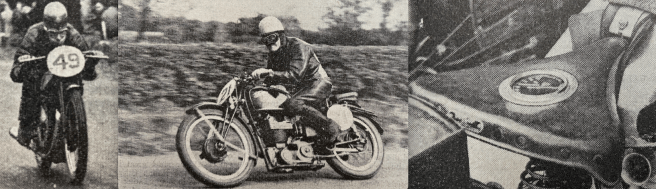
level for the lead of the 350cc European road-racing championship. Each had won 19 points. Mellors was the more favoured of the two; and although the two DKW men, Fleischmann and Wünsche, made flashing starts when the flag fell, Mellors was third away. At the end of the Clady straight Mellors was being chased by Stanley Woods and both had overtaken the two DKWs. As they came past the stands the two men were riding nose to tail, and both were pressed flat on their tanks. Fleischmann and Wünsche were doing the same thing, but about a quarter of a mile behind. The rest of the field, consisting mostly of Velocettes and Nortons, was already strung out behind, but JE Little (Velocette), MD Whitworth (Velocette) and ER Evans (Norton) were ‘within sound’ of the DKWs. For the third year in succession one rider, CF Reilly (Norton), failed to complete more than a few miles. Meanwhile, Mellors and Woods continued to have one of the most glorious scraps seen this year. Obviously there was very little difference in the respective speeds of their machines; They were geared a shade differently, however, with the result that Mellors could pull away a little on one part of the course, and Stanley could catch up again on another. Round they went for lap after lap with only yards between them. Then Stanley came in to refuel at the end of the fifth lap—he prefers to fill early since the accident to his hand. Making a lightning fill-up, he was away almost before many spectators had realised he had stopped, Mellors refuelled on the next lap. As luck would have it, he made one of the slowest fills of any race this year. Oil was still being pumped into his tank when the roar of Stanley’s Velocette was heard approaching from Clady. The crowd were on their feet, yelling ‘Come on, Ted,’ or ‘ Come on, Stanley,’ as their fancy dictated. Stanley flashed through as Mellors was finishing his fill-up, and by the time Mellors had got into his stride again Woods had a 30sec lead. The race was all over bar the shouting, for Mellors could not hope to reduce that lead unless Woods made a mistake. Woods and Mellors were now well in front of the DKWs, which nearly shattered everybody’s eardrums on each lap as they raced past with only yards between them. Sometimes Fleischman was in front, and sometimes Wünsche. Their pit stops were perfect examples of racing organisation. In contrast, some other riders, notably Whitworth, lost valuable seconds at the pits. When the field had sorted itself out after the fill-ups it was seen that ER Evans (Norton) was fifth, behind the DKWs. AJ Bell (Velocette) was sixth, and N Christmas (Velocette) seventh. Later the legs of Christmas’ spring-frame ceased to work and he dropped to ninth. Whitworth (Velocette) contended with the difficulties of poor pit organisation and the
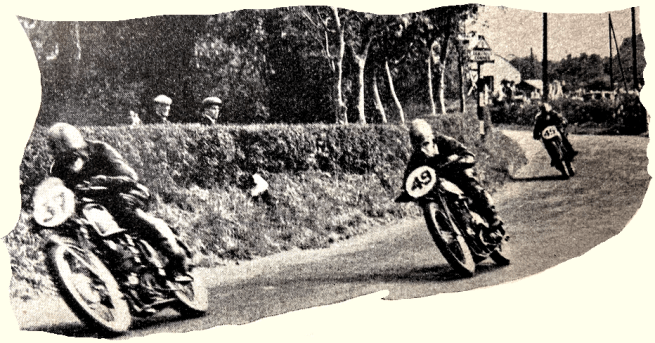
fact that the, cylinder joint was blowing as a result of a broken stud, and worked his way back to sixth place. SM Miller (Velocette), in eighth position, was beating the handicappers and throughout the race held a comfortable lead for the Governor’s Trophy. Stanley Woods went through on his last lap going as well as ever; he was followed by Mellors, still nearly 30sec behind. While everyone was waiting for them to come round for the last time Mellors was suddenly noticed walking back to the start. Taking a corner at full bore in top gear—getting on for 120mph—the rear wheel had suddenly shot out from under him. How Mellors escaped at that speed without a scratch was little short of miraculous. When the machine was examined it was seen that the rear chain was off. Woods received a great ovation when he finished—and one over-enthusiastic spectator threw a glass at him to show his pleasure! With Mellors out, Fleischmann and Wünsche annexed second and third places for Germany. THE 250cc RACE. Ten men had entered for the smallest class; of these two failed to start, one being Thomas (DKW), who had failed to qualify. With Thomas missing, the race became really open and it turned out to be a real dog-fight. G McAdam (Excelsior) took the lead from C Tattersall (CTS) on the first lap, with A Glendinning (Rudge) in third position. Tattersall was not content with that, however, and on the second lap he passed McAdam and stuck grimly to the lead until half-distance. After the pit stops McAdam took the lead for one lap with McCredie second. Then on the seventh lap LG Martin jumped from fifth to second place, and in another 20 miles had established his Excelsior in the lead. McCredie dropped to fifth place. Afterwards, no one could catch Martin, and he finished the race at an average of 76.07mph. G McAdam (Excelsior) retained second place, and Tattersall took third position for the second year in succession. The enthusiasm for the winners at the end was more spontaneous than that at any other Grand Prix this year. The legs, arms and bodies of the victors were pulled and pushed as people tried to take pictures or get a smile from them. Stanley Woods made a neat speech and, after giving his wreath of victory to the crowd, he and Serafini and Martin were carried shoulder-high.
“LAST SATURDAY THE ULSTER Grand Prix regained the honour of being the fastest important European road race, when Serafini (Gilera) averaged the amazing speed of 97.85mph over the 246 miles. It is significant that this feat was accomplished by an Italian supercharged four-cylinder machine on its first appearance on a British road course. It was, however, a British supercharged multi that achieved the distinction of being the first machine to lap the famous Clady circuit at 100mph. This machine, a four-cylinder AJS ridden by that fine Irish rider, Walter Rusk, was actually leading the 500cc class when a comparatively trivial mishap compelled its retirement. In the 350cc class Stanley Woods staved off a strong German challenge to win at record speed, and EA Mellors, on another Velocette, made a record lap at 93.54mph. Finally, the 250cc race provided a thrilling tussle, with LG Martin (Excelsior) the eventual winner. Thus from every point of view the ‘Ulster’ was a fine sporting event, and the enthusiasm of the crowd was tremendous. It is hard to believe that at one time there was a possibility of this year’s race being abandoned.”
“IT WAS GRAND to see a British ‘blown four’ heading the the foreigners in the Ulster Grand Prix, if only temporarily; and equally grand to see Ulster’s ‘blond a bombshell’, Walter Rusk, displaying all his old pep. Hard luck that such a trivial thing as a broken fork link should put him out. Let’s hope that the Triumph and Velocette twins back up the AJS in 1940.”—Ixion.
“I COULD NOT HELP smiling at that picture of R Mead’s racing Norton we published in our description of the Ulster Grand Prix—the photograph showing the rev counter mounted in the middle of the saddle. Can you think of anything that better indicates the almost entire uselessness of a normal saddle on a road-racing machine? On 99 miles out of every 100—with some ‘aces’ 100 out of 100—riders are not on the saddle at all, but riding on the mudguard pad or on the rear part of a combined saddle and pad. Maybe the racing position will have its effect upon I design. I can never quite understand why we cleave to enlarged types of pedal-cycle saddle, except that the motor cycle developed from the bicycle, which is hardly a good reason. There are, of course, signs of a change in the advent of the combined saddle and pillion seat. We shall see! By the way, do you realise that the riding positions of standard motor cycles were as a whole much better in the era when road-racing men rode in, on or around their saddles than they are to-day? If you will cast your mind back or examine elderly models in the showrooms of second-hand dealers you will, I think, agree that this is a fact.”
“A FEW WEEKS AGO I took the opportunity of borrowing a reader’s 250cc sidecar outfit. The reasons were threefold: First, the reader had written to me on a few points regarding the outfit; secondly; the 250cc solo is about the most reasonably priced job on the market; and thirdly, I was informed by telephone that the performance was surprisingly good. After trying the outfit I am prepared to say the performance is astonishingly good. The combined weight of the passenger and myself was about 22 stone, yet we could cruise comfortably at 37-40mph over give-and-take roads without overdriving. And, provided that the four-speed gear box was put to good use, the acceleration was commendably snappy. The maximum speed appeared to be about 50mph and petrol consumption 75mpg. Some idea of the hill-climbing capabilities of the outfit can be gained by the fact that we ‘made’ the 1 in 5½ Pebblecombe Hill, Surrey, at just under 25mph in second gear. Frankly, I think this outfit is a little out of the ordinary, because, although the model is four years old and has covered over 25,000 miles without a rebore, it has been well looked after by the owner. Further, the sidecar is one of the lightest obtainable (the complete outfit weighs 406lb), and the gearing is just right for normal sidecar work.”
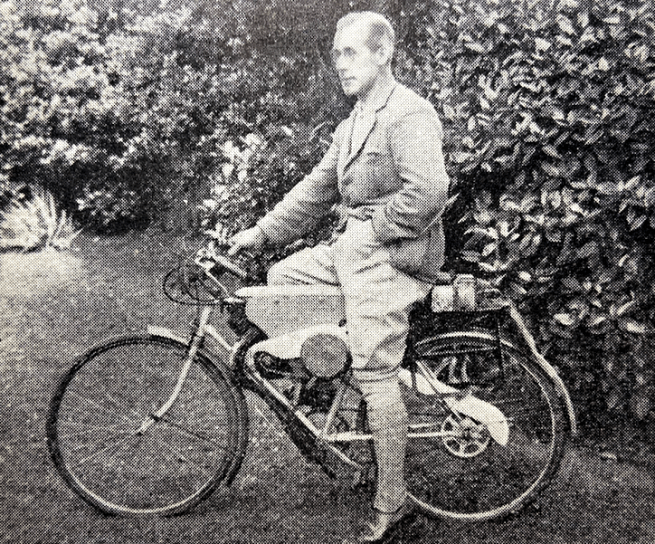
“I WONDER HOW MANY clubmen remember the Carshalton Club’s original pillion trial? The first half of the course was through London, the idea being to show that pillion riding was perfectly safe and that motor cyclists had good road manners. The trial was run with the approval of the police, and the club had observers who were on the look-out for bad riding. What made me think of this trial was the news that a similar event has been carried out in Sydney (Australia) by members of the Ariel Club. In co-operation with the traffic department of the Sydney Police, the club mapped out a ten-mile course through the city, and observers were stationed around it. The behaviour of the members who covered the course was observed, and, later, offenders were ‘charged’ at the Courtesy Court, which was organised by the club. Those who were convicted were fined sums ranging from 2d to 6d, the proceeds being pooled to provide awards for the members who had kept their ‘clean sheets’.”
“RWB DAVIES, who is an organiser of educational tours, has written saying that he would be pleased to assist clubs in getting out interesting tours both at home and abroad. For example, he could give a great deal of help to a provincial club making a tour of London, while he also claims to know the Rhine, Paris, Brussels, and Holland very well. If any clubs consider they might want help in organising a future tour, I suggest they jot down Mr Davies’ address, which is, Avoca, Winkworth Road, Banstead, Surrey.”

“IT WAS UNFORTUNATE for the Derby Club that an International crisis should coincide with its most important meeting of the year at Donington, the International Grand Prix. Rather naturally the crowd was poor, and only at the really exciting parts of the 3⅛-mile circuit were there any large numbers of people. The practising, too, had been somewhat marred by the uncertainty of the situation. ER Thomas, who was down to ride a 250cc DKW, was one of the centres of discussion during the practising period, for no one could decide whether the Auto. Union mechanic who was looking after the machine ought to return to Germany or stay. The mechanic was apparently quite unconcerned, and simply got on with the job of rebuilding the DKW engine which had seized and thrown Thomas on Friday. Steve Lancefield was busy nursing his 500cc Norton, which AJ Wellsted was to ride. Lancefield had made a new frame for the machine and was convinced that the model was the lightest 500 ever raced at Donington. On Saturday morning, Francis Beart was looking glum, for his rider, J Lockett, had been detained in London on National Service. However, Lockett hoped to arrive in time to compete. In the official Norton, Velocette and AJS camps there was the usual pre-race activity, but no undue worries. When Saturday’s practising was nearly over, Ted Mellors discovered a leak in his petrol tank—the result of his crash in the ‘Ulster’. The tank was soon changed and life in the Velocette camp returned to normal. Daniell, on one of the works 350cc Nortons, beat the 350cc lap record at 73.36mph, and Frith on a 500 equalled his own record of 76.43mph. In the passenger class, FM Muhlemann, the Swiss sidecar driver, and his attractive lady passenger, were a centre of interest, and the regular Donington sidecar and three-wheeler men were also there in force. Practising on Saturday morning had been done on a track slippery with dew, but as the morning progressed the sun came out to dry the road, and by two o’clock, when the 250s came to the line for the first race, conditions were almost ideal. At the fall of the flag Thomas, with the DKW, jumped
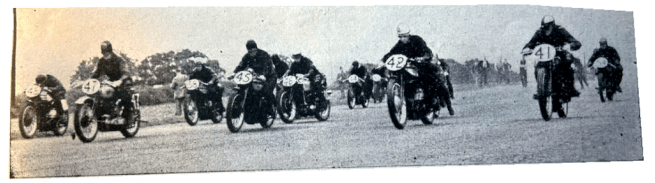
straight into the lead. Behind him were RW Thompson (248cc OK Supreme), M Cann (248cc Guzzi), and H Hartley (249cc Rudge). LJ Archer (248cc New Imperial), who had been announced as a non-starter, was among the pack, and at the end of the first lap he was second, not far behind Thomas. Archer was obviously trying hard, but his gallant old New Imperial had not the speed of the DKW, and Thomas, in spite of shutting off early at some of the bends, was able to maintain his lead and later to increase it. Behind these two there was a great scrap for third place. For the first few laps H Hartley (249cc Rudge) held the position, but M Cann (Guzzi) and JA Worswick (Excelsior), in the course of a terrific duel, gradually caught up and overtook the Rudge man. For several laps these three raced round together. Then Cann managed to draw away from Worswick, who in turn dropped Hartley, whose engine appeared to have lost power. Meanwhile, Thomas had increased his lead on Archer, and when he received the chequered flag the New Imperial was 21sec behind the DKW. The 350 c.c. race was notable for a magnificent scrap between HL Daniell and FL Frith, on works Nortons, which lasted from the first to the 10th and last lap. Every one of the 15 competitors came to the line, and Frith made a superb start, followed by PC Goodman (Velocette), S ‘Ginger’ Wood (OK Supreme), J Lockett (Norton) and AJ Wellsted (Velocette). LJ Archer (Velocette) was last away, and never really got into his stride, for he did not come round on the second lap. Stanley Woods (Velocette) was also early in trouble, retiring at Melbourne Corner on the second lap when a valve touched the piston. Daniell, who had made a poorish start, lost no time in getting after the leaders, and at the end of two laps he was second to Frith. Goodman (Velocette) was third. Daniell and Frith then proceeded to have one of the finest races that has ever been seen at Donington. Round they went for lap after lap with only yards separating them. Daniell took the lead on the third lap, and held it until the sixth, when Frith, by superb riding, managed to slip in front. Daniell overtook again on the eighth lap, but it was Frith’s white helmet that could be seen leading when the two men came into sight down the straight to Melbourne Corner. From then on Daniell had to be content with second place, and Frith received the flag at the end of the next lap, having averaged 71.79mph. In their scrap these two Norton riders had left the rest of the field well behind. For a few laps PC Goodman (Velocette) had hung on to their tails; but he had to let them go ahead after five laps. However, he was comfortably in front of the rest of the field. Then J Lockett (Norton), who was in fourth place, passed the stands with his engine misfiring, and AJ Wellsted (Velocette) and M
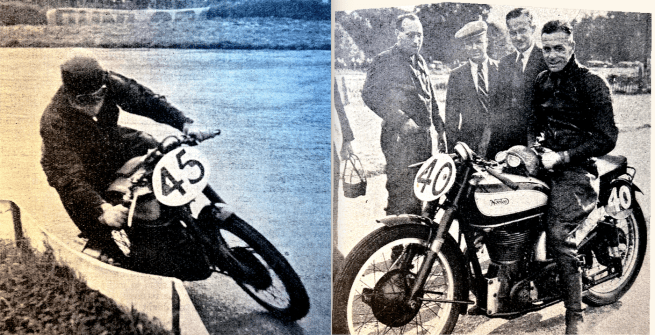
Cann (Norton), who were close behind, proceeded to overtake as Lockett slowed. Goodman was never challenged for third place, but Wellsted was able to hold off Cann, and finished fourth. Six drivers came to the line for the sidecar race, which was run over five laps, but this number was quickly reduced to three. FM Muhlemann (FN sc), the Swiss driver, made a good start, but his lead was short-lived, for the engine cut out before he had reached Redgate Corner. Muhlemann changed a plug and got away, but he failed to complete the first lap. At the end of the first lap the three Norton sidecar drivers, LW Taylor, CF Smith, and AH Horton, came past the start almost abreast. Taylor then managed to scrape a few yards lead and was the first to dive into the wooded section of the course. Both the Morgans were in trouble at the end of this lap; TWJ Bryant coasted in to retire, while C Hale, after changing a plug at the pits, got away as the three sidecars came round to start their third lap. Horton had overtaken Smith on the second lap, and as Horton. and Taylor raced past the start they were neck and neck; but Horton left his braking a shade later than Taylor and with a superhuman effort he wrenched the outfit round Redgate Corner a fraction ahead. Taylor was unable to catch Horton, and at the end of the fifth lap the latter crossed the line with a lead Of three seconds. Several important non-starters were announced for the last race of the day, the 500cc solo event, which was over 20 laps. Stanley Woods was absent with his 350, LJ Archer’s 500cc Velocette had not turned up after being despatched from Ireland, and M Cann’s Guzzi, which broke an oil-pipe in the Ulster Grand Prix, had not been prepared in time for this race. There was a few minutes’ delay at the start in order that the race should coincide with the broadcasting time. But at 4.16 p.m Fred Craner dropped the Union Jack and the 16 men pushed their mounts into life. First into the saddle was J Lockett (Norton), who led PC Goodman and the rest of the field into Redgate Corner. Lockett, making the most of his start, was first down the straight, but he was closely followed by AJ Wellsted (Norton), FL Frith (Norton), and AR Foster (AJS Four). On the next lap Lockett was still holding his lead and had drawn away a little from Wellsted. Frith was third, very close behind Wellsted, and HL Daniell had come out of the pack and was chasing Frith. It was not long before these two were harrying first Wellsted and then Lockett. At the end of three laps Lockett was sandwiched between Frith and Daniell, and on the next lap Daniell was second to Frith. Having successfully disposed of all opposition, Frith and Daniell proceeded to scrap with each other, and Daniell took the lead on the fifth lap, having averaged nearly 74mph. Poor Lockett held a comfortable third place for another lap, and then disappeared, leaving Wellsted in third position, hotly chased by PC Goodman (Velocette). Fifth was Foster on the AJS, and sixth S ‘Ginger’ Wood (Norton). This was the order at half-distance, ten laps, when Daniell’s average was 74.51mph. But at the end of 13 laps the pace began
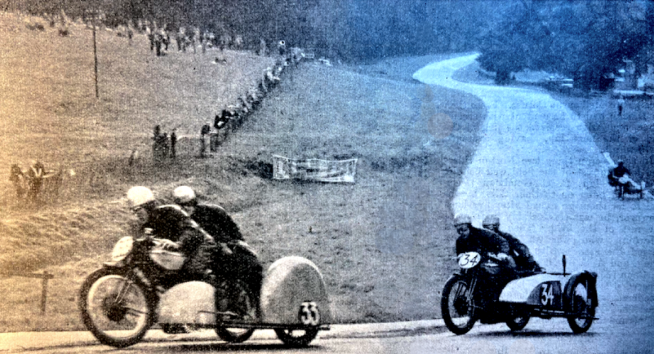
to tell, and Frith came through first—alone. Daniell had stopped at Melbourne Corner with gear box trouble. Then ‘Ginger’ Wood, who had been chasing Foster, came through ahead of the AJS. On the next lap Foster drew into the pits, but after Matt Wright had made an adjustment, apparently to the clutch control, the rider got away again. With Frith on his 15th lap, the order was Frith (Norton), Wellsted (Norton), Goodman (Velocette), ‘Ginger’ Wood (Norton), JA Worswick (Norton) and LW Parsons (Norton). Frith, however, had a considerable lead over Wellsted, and Goodman did not seem to be able to reduce the distance between himself and the second man. Frith’s lead was such that, barring trouble, the race was his. and for the next five laps he rode round without taking unnecessary risks. He eventually finished an easy winner from Wellsted, who was in turn well ahead of Goodman. Wellsted (Norton), Goodman (Velocette) and ‘Ginger’ Wood (Norton) were the only riders to complete the full distance, for Frith had lapped the rest of the field. RESULTS. 250cc Race—10 laps (31¼ miles): 1, ER Thomas (DKW), 65.90mph; 2, LJ Archer (New Imperial); 3, M Cann (Guzzi). 350cc Race—10 laps (31¼ miles): 1, FL Frith (Norton), 71.79mph; 2, HL Daniell (Norton); 3, PC Goodman (Velocette). 1,100cc Passenger Machine Race—5 laps (15⅝ miles): 1, AH Horton (596cc Norton sc); 2, LW Taylor (596cc Norton sc); 3, CF Smith (596cc Norton sc). 500cc. Race—20 laps (62½ miles): 1, FL Frith (Norton), 73.69mph; 2, AJ Wellsted (Norton); 3, PC Goodman (Velocette); 4, S ‘Ginger’ Wood (Norton).”
“WHEN PREPARING MY OUTFIT for a carnival, the idea came to me that a motor cycle ambulance would be something useful. I enclose a photograph of the result of my efforts at putting the idea into practice. The favourable comment on my machine with ambulance fitted, including the interest and approval of the Inspector of Police here, has been most refreshing. I intend using this ambulance as a ‘Roving First-Aid Patrol’ while performing my duties as police despatch rider in the event of an emergency.
FA Spall, Witham, Essex.”
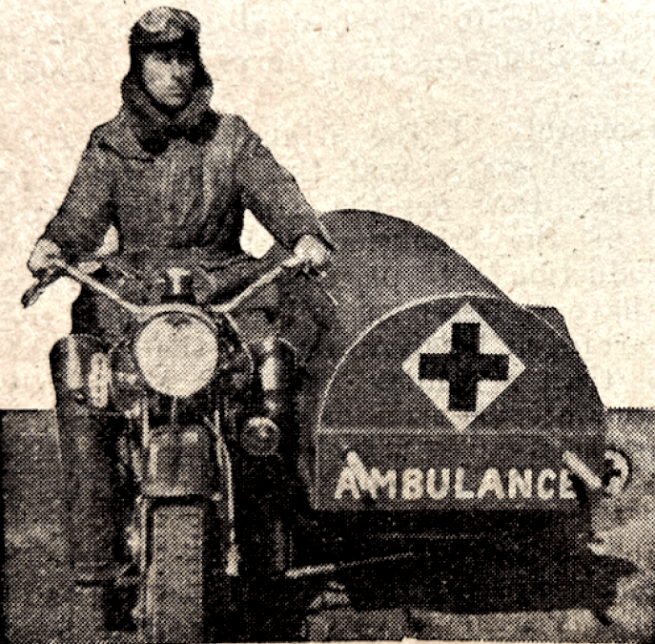
“NO DOUBT MANY motor cyclists read with indignation in the daily Press the alleged remarks of Mr David Rees, coroner for East Glamorgan, during an enquiry into the cause of a road accident recently. He was reported as having said: ‘Not only are motor cyclists a danger to themselves, but to other road users.’ Such an observation from a responsible official was so unbelievable that Major HR Watling, the director of the Manufacturers’ Union, immediately wrote asking if the coroner had been correctly reported, and, if so, whether he would produce evidence to support his views. The reply was a curt refusal to discuss the matter. Major Watling therefore wrote again to Mr Rees, informing him that he considered it his duty to forward copies of the correspondence to the Lord Chancellor and to the Press. True to his word, Major Watling has now written to the Lord Chancellor, referring to the case in question, and asking him to request coroners ‘not to generalise in a manner which constitutes an intolerable insult to the vast majority of law-abiding users of the road’.”
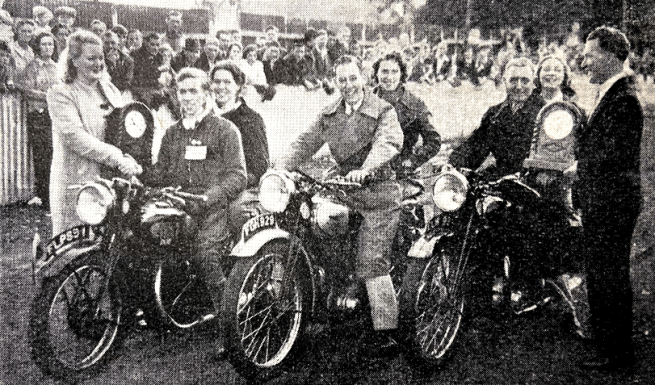
THE BRITISH MOTOR CYCLE ASSOCIATION yearbook was packed with info on current models and future events. More intriguing was the advert it carried for Challoner’s Famous Formula HTN Tablets. In a testimonial ‘AJ of Wilts’ wrote: “Since I started your treatment I have gained three inches in height.” And the company promised: “If one box is insufficient we guarantee to supply another FREE!”
THE FIRST REGULAR television transmissions put pressure on manufacturers to stop sparky passing vehicles interfering with reception. That’s why plug caps are more properly known as suppressor caps.
“NEXT YEAR THE RANGE of Panther models will be wider and more varied than ever before. Features of design entirely new to this make will also be introduced. Some of the machines will have normal duplex loop frames and vertical engines, the latter for the first time in Phelon and Moore history; one of the machines will have a 598cc side-valve engine. Then there is the new leaf-spring frame, designed by Mr. Granville Bradshaw, which is applicable to all the models except the 250 and 350cc types. Finally, there is a 500cc vertical-twin model. This machine is not yet available for description and illustration, but work and tests are proceeding and its completion is hoped for in the near future. The two entirely new Panthers are a 498cc vertical-engined overhead valve model and a 598cc vertical side-valve machine.”
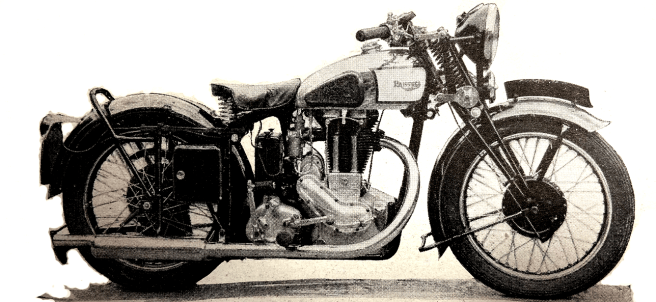
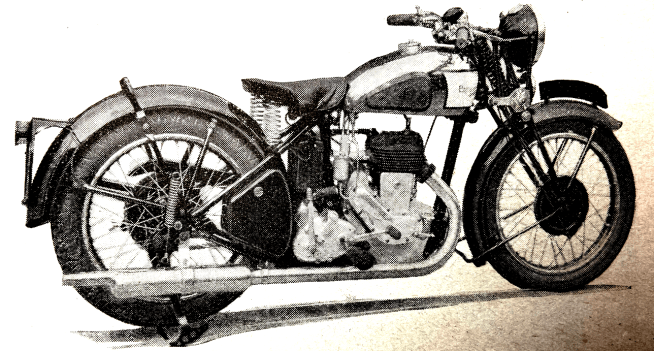
“THE RANGE OF LEVIS motor cycles for 1940 shows little change. All the models are continued and only minor modifications are to be observed. There will be six machines in all: a two-stroke, four ohv models and a side-valve. In addition there is, of course, the spring frame, which was introduced some time ago, and this is retained unaltered. As before, it will be available on two models, of 346 and 498cc capacity. The side-valve is the newest model in the range…Fundamentally, it is the same as before, but a larger tank gives a much better appearance, besides being of greater utility. Other points of interest are a new rear number plate and a tail lamp of the latest Miller design, and a new bulbous front in the head lamp. These two latter features are common throughout the range. The new tail lamp is a definite improvement, for it facilitates bulb removal, which is now done from the lamp front instead of from the point at which the cable enters. The only other modification concerns the 346cc ohv Model ‘A’, which has a new cam formation designed to ensure a greater degree of silence in the valve gear, together with a smoother performance.”
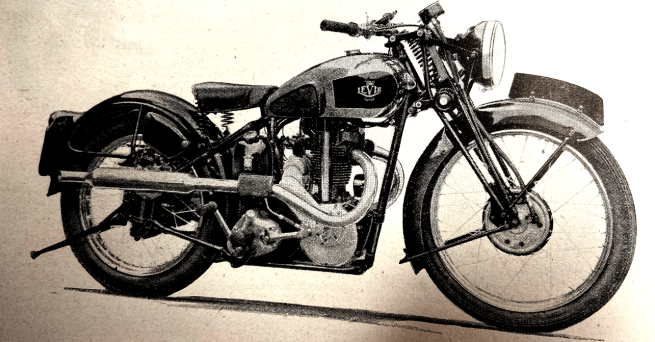
“ITALIAN DESIGNERS WERE among the first to realise the potentialities of multi-cylinder engines for very high speed work, and, in view of the success of an Italian multi in the Ulster Grand Prix, particular interest attaches to the latest Bianchi racing model. In basic layout the engine is straight-forward; it is a 500cc four-in-line, mounted across, the frame, and has twin overhead camshafts and poppet valves. The vertical camshaft drive, the cam-shafts and the valve-operating gear are totally enclosed and lubricated, but the coil-spring operated valves, immediately below the camshaft boxes, are exposed. Mounted behind the engine is the unit four-speed gear box, and above the gear box, the magneto; at the rear of the magneto is a supercharger, which forces mixture to the cylinders by way of a ribbed manifold. The carburettor is fitted slightly above and to the rear of the supercharger, and has a down-draught in-take. The massive tubular frame houses the unit very neatly ; all the components of the engine, gear box, magneto; supercharger and carburettor are within the rectangle formed by the front down tube, the saddle tube, the triple top tubes and the duplex cradle. The rear springing is of the orthodox plunger type. Final drive is by chain on the right-hand side of the machine. Pressed-steel forks are not usually found on a racing machine; those fitted to the Bianchi are of very clean design, with a single compression spring and hand-operated friction dampers on both sides. The hubs and wheel rims are made of light alloy and 3.25in section tyres are fitted to both front and rear wheels. Although a straight four-cylinder engine does not lend itself particularly well to being accommodated in a motor cycle frame, the Bianchi unit is very compact and does not look unduly wide when the machine is viewed from the front; indeed, from all angles the machine has a very sleek appearance. Although no figures relating to performance are yet available, there is little doubt that the Bianchi will have to be watched with respectful interest next season.”
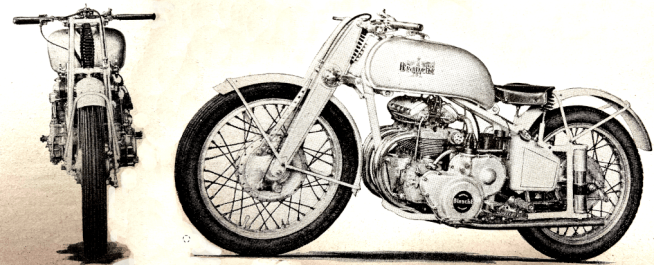
“AN INGENIOUS METHOD of attaching an electric starter to his 1931 NSD Triumph and sidecar has been devised by Mr RH Athersych, of 39, Wallace Road, Coventry. His first experiments were carried out with a 12-volt dyna-motor from an old Morris-Cowley, and, though the arrangement worked well, it was rather large and untidy, since both dynamotor and battery had to be carried on the sidecar chassis between the machine and the sidecar body. Later Mr Athersych obtained a Lucas 6-volt starter-motor off a 1924 9hp Rover car, and it was found that this could be accommodated between the seat tube and rear mudguard. Accordingly a steel bracket was made to bolt on to the four gear-box holding bolts, and the motor is fixed to this bracket with the aid of a wooden packing block. With this lay-out there is ample room for a 6-volt Morris ‘8’ battery (also Lucas) to be accommodated on the sidecar chassis. The ‘silent’ chain drive from the old dynamotor is retained, and the lower sprocket mounted on a clutch back-plate forging which, in turn, is riveted to the outer clutch plate, the latter having been bored out to permit access to the special clutch spring nuts. A test showed that the motor had ample power to start the 549cc side-valve engine. Thereafter the starting-motor is driven on open circuit, but, according to the owner, any slight loss of performance from this source is not perceptible on the road. The original arrangement was tried out almost a year ago, and since then Mr Athersych has used his outfit daily for getting to work, for week-end runs and for holidays.”
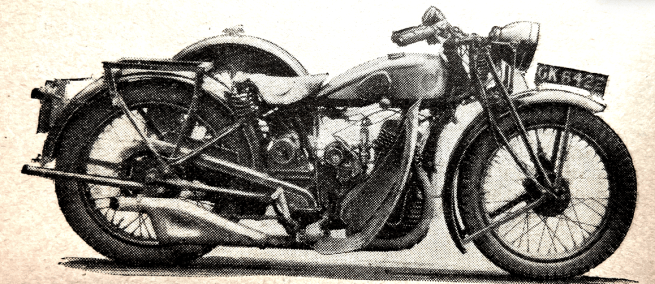
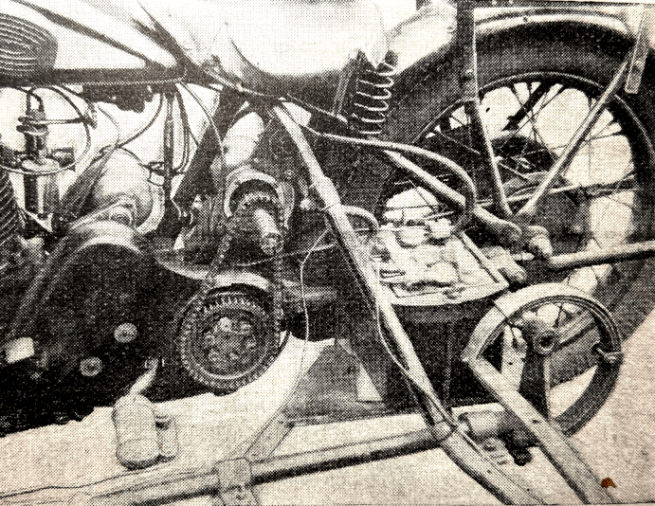
“IN THE LAST WAR The Motor Cycle proved a friend and companion to thousands of motor cyclists serving in various branches of the Forces. That is our mission in the present war. We shall carry on. Week by week our endeavour will be to provide the link between members of the great motor cycle brotherhood, no matter where they are. The Motor Cycle has proved the forum for the half-million motor cyclists; it will continue as such. Should the number of our pages be reduced, motor cyclists will still be able to find in them the news of the great game and, perhaps even more important, be able to get away from war and thoughts of war. Our aim, Thursday by Thursday, will be to be entertaining, refreshing and helpful—a cheerful friend to all.”
“NO OBSERVER, EVEN the most casual, can fail to be impressed by the stoical calm of this nation of ours in time of stress and the way all sections of it are pulling together. All have a part to play in what must prove to be a terrific struggle, and all are deter-mined to play it in whatever sphere their duty lies. Motor cyclists require no lead. Tens of thousands of them are already in various sections of the forces or undertaking work of national importance. They with their technical knowledge and their skill gained from motor cycling constitute one of the most valuable sections of the community. We know—all our many contacts prove it—that British motor cyclists will exert their utmost efforts in the National cause.”
“MOTOR CYCLISTS MUST now comply with the emergency lighting regulations. Head lamps may be used provided: (a) that a hood is fitted to ensure that no light is visible above eye level at a greater distance than 25 feet from the lamp; (b) that the lamp is so masked that light is emitted only through a horizontal slit not exceeding ⅜in in width, of which the upper edge coincides approximately with the centre line of the front glass of the lamp; (c) that the whole of the reflector is blackened. The front glasses of all lamps must be obscured with at least two thicknesses of paper or paint, ground glass, or other uncoloured material, so that the obscuring effect produced is not less than that of two thicknesses of ordinary paper of newspaper thickness. The paper, paint or other material must cover the whole of the portion of the front glass through which light can pass and must not be wetted, oiled, varnished or treated in any other way to increase its transparency.”
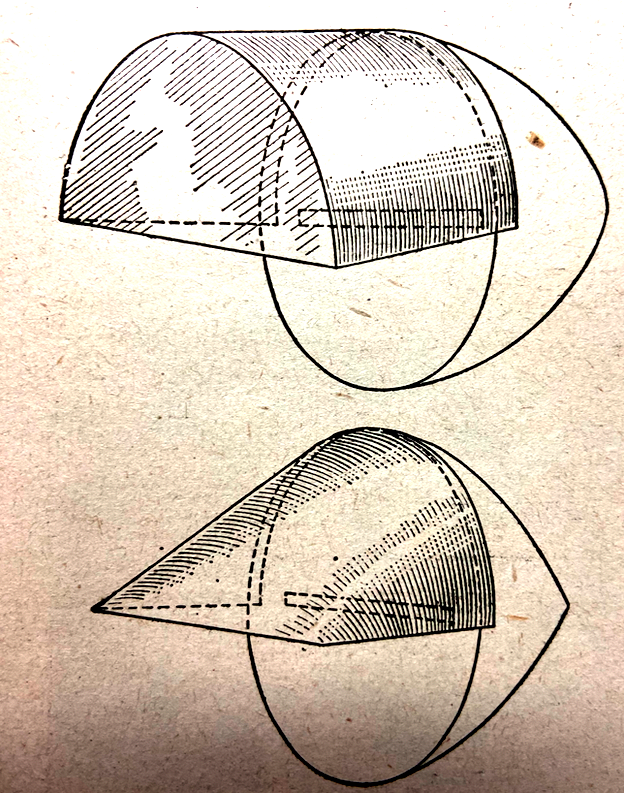
“OIL-TINS AND oil-drums were almost at a premium last week-end. Is there any better material from which to make an ARP head-lamp disc and cowl than the tin-plate from a one-gallon oil tin? The snag I found, in common no doubt with tens of thousands, was that cowls of the type depicted in the police instructions take quite a lot of making. The one I have gone in for is the ‘half-cylinder’, and the front semi-circle is provided with serrations (rather after the style of the Kaze oil-can and the Norton tank), which have been duly soldered on to the main cowl portion. The cowl is fixed by the head-lamp bracket screws and a little screw on top of the lamp. Any thoughts I had to the effect that I was a passable amateur mechanic have rather disappeared after last week-end.”
“THE FIRST REACTION of us all to riding with reduced lighting in a blacked-out England was sheer loathing, even in lovely weather, with no rain, grand visibility and a bit of a moon. Our disgust was partly due to the novelty of the conditions, and partly to the enforced cut in our normal speed. Growing experience is fast reconciling us to the new conditions. On the plus side, there is no dazzle of any kind anywhere; the roads are, comparatively speaking, deserted; cyclists with their red rear lights can be picked up with absolute certainty before you get near them; the central white lines on all except the pettiest of roads are easily picked up. and will be an enormous asset when fog comes. The main snag is the reduction of speed, which, even in good conditions, will probably amount to 50%, but is not really half so important as it sounds. Curiously enough, some men are slowed down much more than others. Junior actually came down from town to our seaside bungalow by night in only half an hour over his usual time for 70 miles, whereas an elderly neighbour who drives a car required twice his usual time allowance for the same trip on the same night. The explanation probably is that Junior has better eyes and stronger nerves than the older man.”—Ixion.
“AIR RAID PRECAUTION cowls for head lamps, made of metal, are now being sold by Pride and Clarke, 158, Stockwell Road, London, SW9, priced at 3s 6d to 4s 6d each.”
“AS WILL READILY be appreciated, in the present circumstances it has. been found necessary to cancel the Manx Grand Prix. The decision was taken by the Committee of the Manx MCC last Friday evening and all competitors were informed by telegram.”
“THERE ARE VACANCIES for a few motor cycle despatch riders in the 12th Light Anti-Aircraft Regiment (Territorial Army). Service machines are provided. Applications should be made on. Wednesday or Thursday evenings between 7.30pm and 9.30pm, to the 12th Light Anti-Aircraft Regt, 99, Goswell Road, London, EC1.”
“DESPATCH RIDERS WHO took part in the last war are invited to serve on a full-time basis as motor-cycle despatch riders (ARP) in London in the event of war. Machines and equipment will be supplied and the pay will be £3 per week. So far as is practicable men would be attached to local headquarters. No doubt there are many who enlisted in the RE Signals, MTASC, Motor Machine Gun Corps, or RAF who are able and willing to offer their services again in the event of an emergency. Full particulars can be obtained from the Editor, of The Motor Cycle, or from Mr ER Gilbert, Hastings House, Norfolk Street, Strand, London, WC2.”
“THE LONDON FIRE BRIGADE requires 450 active motor cyclists for despatch-rider duties. Applicants must possess their own machines, and in peace time will be paid 1½d per mile when on official duties. In time of war they will receive a salary of £3 per week and will continue to be paid the mileage allowance. There is no age limit for this service, and those wishing to join should report to the headquarters of the London Fire Brigade, Room No 2, Whitgift House, London, SE1.”
OWING TO MINISTRY of Transport driving examiners being required for special defence duties, it is anticipated that there will be some delay before new drivers can take their test. As an emergency measure, therefore, County Councils and County Borough Councils (large Burghs in Scotland) have been authorised to issue a special licence, known as a National Service Driving Licence, to holders of provisional licences who have not yet passed the test and to other persons who have not previously held licences of the kind they now require, provided they satisfy the Council that they require the licence for the purpose of driving vehicles on work of national importance, are not disqualified by physical disability or otherwise, and are suitable persons to be granted such licences.”
STAMFORD STREET, SE1, to the seashore sands is a farish cry, yet several members of The Motor Cycle editorial staff have been observed during the last three weeks stripped to the waist in the vicinity of Dorset House—and there was lots of sand around, and shovels, but no pails; neither was the object to bask in the sun. Bathing in honest sweat was the order of the day. Sand bags—thousands of them—had to be filled, tied, hauled, passed from hand to hand and placed in position. ‘Paton’, ‘Perseus’, ‘Cambrian’, ‘Talmage’ and many others had a crack at it.”
“AS FROM NEXT SATURDAY, September 16th, petrol is only obtainable by private motorists on presentation of their ration books. Those who have not already obtained their books and wish to continue using their vehicles should make application immediately to the post office or local taxation office from which they normally obtain their Road Fund licences. No application form has to be filled in—the only necessary requirement is production of the registration book. The petrol supplied will be one grade only, ‘Pool’ motor spirit [rated at about 72 octane], costing, in England and Wales, ls 6d a gallon. Garages and service stations are not allowed to supply this in tins; it must be put into the tank of the vehicle.”
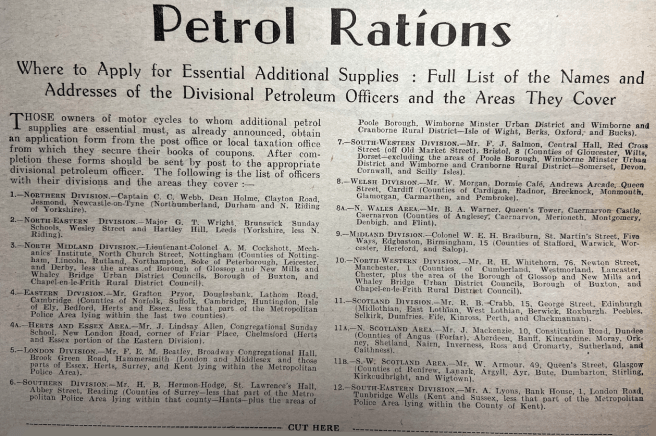
“THAT A CAR OF 1,172cc should be allowed six gallons a month under the petrol rationing scheme which comes into force this week-end and a three-wheeler with an engine of exactly the same capacity only two gallons is manifestly unfair. Equally, it is wrong that an 80cc autocycle should, for rationing purposes, be classed with a 1,000cc sidecar outfit. Why the Mines Department decided to allot two gallons of fuel a month to motor cycles irrespective of their size and type is difficult to understand in view of the obvious care taken in grading cars. Undoubtedly there is not the slightest desire to be unfair, and we feel sure that once the position is realised action will be taken. Immediately it was known that for the purpose cf fuel rations all motor cycles were being classed together, Major Watling, of the Manufacturers’ Union, discussed the matter with the Press and has now followed this up by representations in conjunction with the various motoring organisations. Perhaps even by the time this appears in print an equitable scheme will be announced.”
“ROUND AND ROUND THEY GO. Roundabout traffic operation is to be instituted at the junction of Watford Way and Great North Way, and at Miles Street, Lambeth.”
“SAFER STARTS WERE a notable feature of the racing at West Ham Speedway last week, writes ‘Talmage’, when ribbed rear tyres were used by all the riders throughout the meeting, which was in the nature of a tyre trial. There was no snaking at the starts and no tendency to turn cart-wheels on the line. When machines were turning the bends the streams of cinders thrown up were more restricted as regards the amount of ‘spread’ and presented a less solid barrage than is the case with studded-pattern tyres.”
“TO MOTOR CYCLISTS there can be few things more pleasing than the way the motor cycle and the motor cyclist have come into their own in the present time of stress. Thousands of riders and machines have been pressed into use. Apart from the services with their huge numbers of motor cyclists, there have been almost continuous calls for motor cyclists for work of national importance—calls that invariably have met with an instant response. There is a fresh (and refreshing) outlook towards motor cycling—a new realisation of the immense value of motor cyclists to the nation. Even in the advance columns of our enemy every mechanised section has its motor cyclists, as has been revealed in numerous photographs.”
“COD-LIVER OIL, fresh fruit and vegetables are all good for keeping one’s night vision up to scratch, according to dieticians.”
“A STOUT METAL SHIELD for fitting to the roof of a saloon car, to protect the occupants from falling debris, shrapnel, etc, is now being sold.”
“MOTORISTS AND MOTOR cyclists in towns are asked to drive as quietly as possible so as not to disturb the day-time sleep of Civil Defence workers.”
“MR LA BADDELEY, pioneer motor cyclist, chairman of the Motor Cycling Club, like many another old-timer, is back on a motor cycle again—and loving it.”
“MOTOR CYCLISTS WHO use their machines for ARP work and want extra supplies of petrol should send their claims to the appropriate. Divisional Petroleum Officer, and not to the local ARP authorities.”
“THE RAC ISSUES the reminder that it is illegal to dilute petrol with paraffin to eke out one’s fuel ration.”
“THE UNVEILING OF a plaque at Courthill smithy, Dumfries, commemorating the 100th anniversary of the invention of the bicycle, has been indefinitely postponed. The first bicycle to be propelled by pedals was made by Kirkpatrick Macmillan, a Scottish blacksmith, in 1839.”
“NOEL POPE, BROOKLANDS lap-record holder, is on active service with, at the time of going to press, one pip on his tunic.”
“MOTORISTS ARE WARNED by the Mines Department that they must not store extra supplies of petrol.”
“IT WAS RECOMMENDED at a Leeds inquest that ‘L'” drivers be banned from driving in the black-out.”
“A WEST COUNTRY cyclist summoned for riding without a front light was said to have had three glow-worms in his lamp!”
“THE MANUFACTURERS’ UNION has decided to cancel the Motor Cycle Show, due to have been held in November.”
“THE SECRETARY OF the Cyclists’ Touring Club, Mr GHJ Stancer, claims that rear lights for cycling will only be enforced ‘for the duration’.”
“IMPORTANT NOTICE: COPIES of this journal must be ordered in advance. Owing to the difficulty of distributing journals in wartime, it is imperative for readers to place definite orders for The Motor Cycle to ensure a regular copy. In the future, newsagents will only order from the publishers those copies for which they have received a definite demand. To avoid disappointment, place an order with your newsagent, or subscribe direct without delay.”
“IMPORTS OF MOTOR cars and other luxury goods into this country are now prohibited.”
“A NUMBER OF WOMEN are learning to drive their husband’s or fiancé’s motor cycle, so as to be ready for any emergency.”
“LONDON’S AUXILIARY Fire Service DRs are making a brave show in the Metropolis. On the whole their riding is excellent.”
“DESERTED ROADS, ‘HOT’ motors, and official despatches to be delivered at speed—this was the joyous experience of some of the DRs on national service last Wednesday week.”
“THE BRITISH MOTOR Cycle Association is carrying on. An official statement reads: ‘Already many of the staff have taken up National Service, but those of us who are left will spare no effort to help members in every way.'”
“CAN YOU IMPRESS upon the authorities the desirability of continuing the black and white patchwork effect at street corners even when the ‘unpleasantness’ is over? Our street lighting at normal times is often very poor, and these check-painted kerbs provide just the safeguard that is needed. They show where the corners are and reveal the path one should take. All who have had the misfortune to run into an undefined kerb would bless them. Also I have found that they help one to pick out pedestrians. Central dotted lines, too, are valuable as a guide in foggy weather as well as for revealing one’s half of the road. These also should he continued provided that the paint is absolutely non-skid.
T Thurston, Birmingham.”
“BECAUSE THE POLICE are too busy, hundreds of summonses against motorists have been cancelled.”
“ALTHOUGH CYCLISTS HAVE been ordered to fit rear lights after dark, these lights are unobtainable at the majority of cycle agents—they are sold out.”
“THERE ARE STILL some thoughtless people who are parking their vehicles without lights after dark, or else pointing the wrong way.”
“THE POLICE NOTICE states that matt white paint must be applied to bumpers and to the edges of running boards or to the equivalent positions on other types of vehicle. (On a motor cycle the matt white paint can be applied to the sides or valances of the front and rear mudguards and to the front of the front guard and the rear of the rear one.) Stop lights are permissible provided that the aperture is restricted to a maximum of one square inch and the light is partially obscured as in the case of side, sidecar and rear lamps. Various types of matt white distemper which, it is stated, will not wash off in the ordinary way, yet can be removed with soda and water, are obtainable from oil and colour stores, etc.”
“WE ARE RECEIVING numerous enquiries relating to the alterations necessary to our machines to render them suitable or use on ‘Pool’ petrol, and we shall be greatly obliged if you will publish the following: No alteration is necessary to the 250cc Rapid, the Special or the Sports Special, but the compression ratios of both Ulster and 350cc Sports models are too high for the class of fuel which will be obtainable under existing conditions. Our recommendation in the case of the Ulster is to fit one extra compression plate .040in thickness, together with one extra paper washer underneath the cylinder barrel, and to fit a No 150 main jet. In the case of the 250cc Sports the compression plate should be .080in thickness, and this also will necessitate the use of one extra paper washer; in this case the main-jet size should be reduced to No 120.
Rudge-Whitworth Service Dept, Hayes, Middx.”
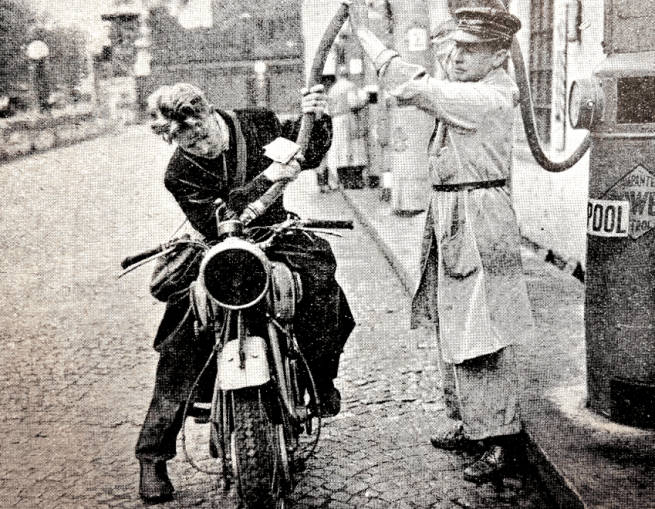
“A GAS MASK WILL fit very nicely into many commercial tins (a circular one with a press lid is best). This can be enamelled black and straps riveted to the tin. The container can then be carried over the shoulder, whether on saddle or afoot, in complete safety and comfort.”
“LUMINOUS BUTTON-HOLES promise to be-come popular among pedestrians.”
“MOTORISTS ARE NOW being fined for having too bright lights at night.”
“REDUCED BUS SERVICES all over the country have resulted in a big increase of the ‘ride-to-work brigade’.
“THE NORMAL TYPE of car fire-extinguisher should not be used for attempting to extinguish a magnesium incendiary bomb. An explosion would probably result.”
“WHITE-LINE PAINTING is busily going on all over the country. Even householders are assisting by splashing the kerb out-side the house with whitewash.”
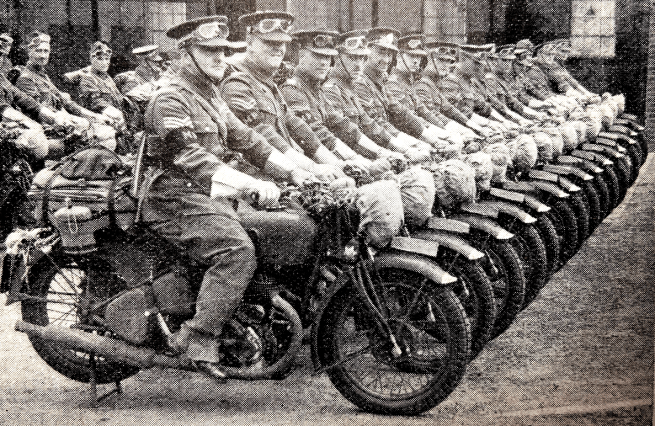
“THE ORDER OF THE ROAD organisation is to be suspended during the war, but will be recontinued afterwards. Present members will be eligible for renewed membership without further subscription for the first year after the war.”
“BARIMAR’S, THE WELDING EXPERTS, are trying so far as possible to work on a priority of work basis. Firms and individuals sending parts for welding are therefore asked to state whether the work is direct or indirect Government work, or for ARP, agriculture, foodstuffs, or other of the public services. “
“AS PREVIOUSLY ANNOUNCED, RH Collier and Co, Collier’s Corner, South Yardley, Birmingham, have taken over the whole of the spares for New Imperial machines produced up to September 1st, 1939. Enquiries regarding spares should therefore be sent to the above address. In addition, personnel from the New Imperial works have been engaged to handle service and repairs.”
“SEVERAL DESPATCH RIDERS are required for the 2nd North Midland Batt of the Royal Corps of Signals. This unit already incorporates many Northern clubmen and, as expert riders are needed, preference will be given to those with trials and club experience. Application should be made to Major H Bolland, Central Recruiting Office, Derby.”
“TIME HAS BEEN rather short for clubs to send in their offers to throw open their headquarters to motor cyclists who by reason of the war may find themselves billeted away from home. I know that the majority of clubs welcome newcomers at all times, but a man out of his own district probably would not know where to find the local club’s headquarters, and in any case he would feel much happier about attending a club night if he had seen in print that he would be welcomed. So far the Birchington Club heads the list of open club rooms. Any motor cyclist is welcome on Wednesday evenings at the Island Cafe and Hotel, Upstreet, on the Canterbury-Margate road. The secretary says that as a number of members are away on service, attendances may not be so large as usual, no that the more who attend the merrier the party.”
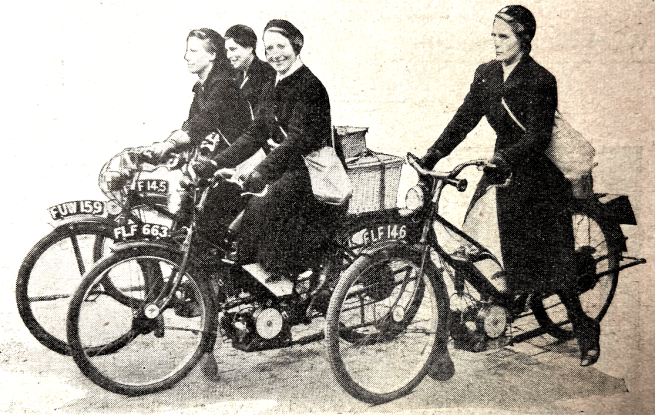
“ONE OF THE FEW active clubs to-day that was in existence at the outbreak of the last war is the Streatham and District; therefore, as the Club has some experience of wartime conditions, I was glad to hear that the committee had decided to arrange a skeleton programme and was determined to keep the Club alive while hostilities continue. The Club hopes to carry on with its general work and, of course, its clubroom will be open as usual. Other clubs might like to bear this in mind when deciding on their policy in the immediate future.An even older club than Streatham, the MCC, at a recent special meeting, decided to cease activities for the time being. Those members who had entered for the High-speed Trial which was to have been held at Brooklands on September 9th will have 75% of their entry fees returned—a very generous gesture.”
“IN SPITE OF WAR, development of the Aspin rotary-valve engine is still going on, and the Aspin principle is being applied in, many fields. The ability of the engine to run on ordinary fuel at high compression ratios has resulted in considerable interest in many spheres. There is a possibility that when peace returns we shall have a high-efficiency motor cycle that will function perfectly on the cheapest ‘commercial’ spirit.”
“ALREADY THERE IS a big swing from cars to motor cycles in the North. Petrol restrictions on the one hand and the undoubted advantage which the open air, as compared with the ‘glass-house’, gives under black-out conditions is bringing back many ex-motor cyclists into the fold. In both the Lancashire and Yorkshire industrial areas really good second-hand models are at a premium, several dealers being sold out. One well-known rider-agent told Wharfedale that he was going out to seek and, if possible, buy recent models in order to meet his waiting list of ‘returned prodigals’.”
“HAVE YOU EVER heard the buzz of a squad (or gaggle) of mosquitos? Secondly, have you ever heard the warbling of air-raid sirens at a distance? You’ve heard the one, but not the other? Well, down at Torrens’ home one evening last week we went into his workshop and I hadn’t been there half a minute before I said, ‘Why, there’s an air raid!'” It wasn’t an air raid at all, but merely that our entering the room had disturbed a few harmless mosquitos, which apparently haunt that portion of the country just outside the town which friend Torrens inhabits. The noise was exactly like the warbling of sirens heard from a big distance.”—Nitor.
“TO JUDGE FROM the large number of orders in hand the smallest machine in the Francis-Barnett range is one of the most popular, and this well-deserved popularity is likely to increase in these days of fuel rationing. This little Powerbike (Model K50) has been modified from the original in details only. The 98cc Villiers engine with its clutch, flywheel, magneto and carburettor, is neatly enclosed, so that the rider’s clothing is protected from oil and from contact with moving parts. Extra comfort is provided by the simple but effective rubber-buffer forks, and the long and substantial carrier shows the manufacturers appreciate that owners of this type of vehicle need to carry parcels…Apart from the Powerbike, the Francis-Barnett main programme remains much as before, and may be divided into four groups of two machines each. The Snipe models are powered by the Villiers three-speed unit, the larger (K48) having the 125cc unit, and the smaller (K49) a capacity of 98cc. Except in the

matter of size the two are identical and the price, £27 10s, is the same for each model. The engine and gear unit is carried in a composite-type frame developed specially to suit it. Both brakes are of 4in diameter and the tyres are 2.50-19. In the next group are two Plovers, K40 and K41, both of 148cc…in this case the Villiers engine drives through a separate Albion three-speed gear box. The K40 has a direct-lighting set from the flywheel-magneto dynamo; the K41 has a 6-volt Miller dynamo-lighting set with a 13ah. battery, an ammeter, and dimmer switch…equipment includes an electric horn, 5in brakes and 19-3.00 tyres…One of the most successful productions of the Francis-Barnett works, the Cruiser, is available in two forms. Model K45 has a long-stroke, flat-top-piston Villiers engine of 249cc and a four-speed Albion gear box with positive-stop foot-change mechanism. Ignition is by flywheel magneto, but lighting current is provided by a Miller 6-volt, 36-watt dynamo chain-driven from the crankshaft. Lubrication is by the petroil system. Outstanding constructional features are the head and front member, which are made from a single steel forging; the self-locating torque arm of the rear brake, which simplifies the replacement of the rear wheel; the low and well-protected location of the accumulator, which is placed directly behind the gear box; and, of course, the total en-closure of all moving parts except for the wheels and a very short length of rear chain. This enclosure of the works within quickly detachable panels, combined with the deeply valanced guards and the long legshields with inner valances, makes the Cruiser one of the most practical all-weather models that has ever been marketed. Further, the question of cleaning is reduced to a hose-pipe job. It should be mentioned that the rear guard forms a quickly detachable unit, so that almost the whole rear wheel can be exposed in a very short time…the tyre measurements are 3.25-19. For those who prefer 250cc two-strokes of more orthodox appearance, there are two Seagull models, having a composite pressed-steel and tubular frame, tubular forks, Miller dynamo lighting and flywheel ignition, electric horn and 3.25-18 tyres.”
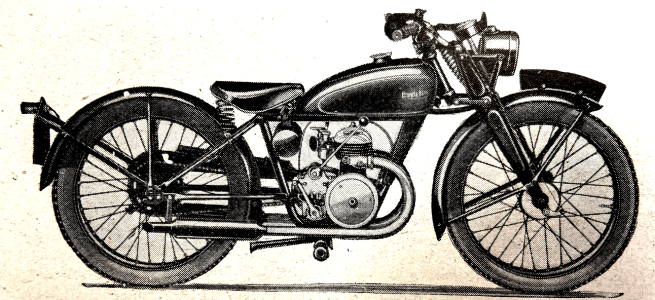
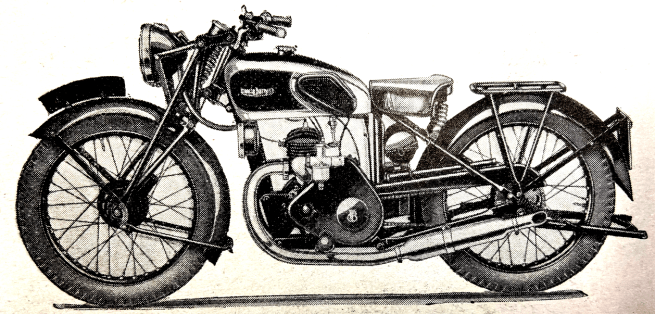
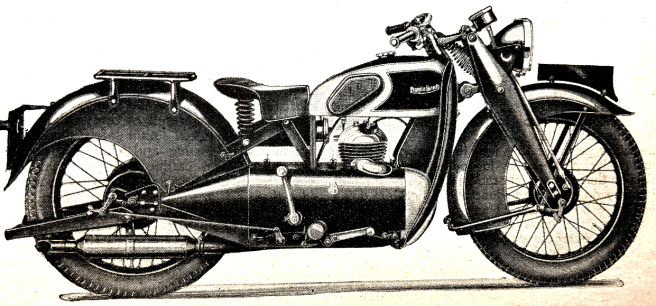
“IT IS WELL KNOWN that next to the development of new twins and fours the subject which of late has been uppermost in designers’ minds is front forks. What has emphasised the desirability of change in this direction is, of course, the widespread adoption of rear-wheel springing. Front forks which appeared reasonably efficient in conjunction with a rigid frame tended to show up badly once the rear wheel was sprung. The fact is, of course, that improvement in forks is long overdue. Apart from their efficiency as regards the suspension side, all too few forks are adequately rigid laterally. There is usually insufficient bearing area to withstand the lateral loads, especially in the case of sidecar work, and in addition many manufacturers have tended to spoil whatever lateral rigidity their forks possessed by failing to make the shock dampers independent of the linkage. These faults should automatically be eliminated when the day comes that plunger-type forks are adopted. This, to judge from our chats with designers and from development, work that is known to have been going on behind the scenes, is only a matter of time—and opportunity.”
“THE FEW WHO WERE on the roads last week-end learnt, for perhaps the first time, something of what motoring and motor cycling are like in other countries. The abnormally low traffic density which, according to our observations, was the rule last Saturday and Sunday is usual in most other parts of the globe. For instance, whereas the latest figures available show that the number of motor vehicles per mile of road is over 17 in Great Britain, in the United States of America it is only 9.7, in France 5.6, and in South Africa and Canada 3.9 and 3.2 respectively. No country in the world has anything like the traffic density of Great Britain, and congestion, let it be remembered, is one of the chief causes of road accidents. While war conditions unhappily do not promote freedom from accidents—preoccupation causes the standard of driving to become lower—there is no doubt that driving at present is infinitely more pleasurable than on the congested roads of, say, ten days ago. It is there-fore good to see that the Ministry of Transport has no intention of holding up road improvement schemes unless this becomes inevitable. The belated £2,000,000 Great North Road scheme is proceeding, and so are other major road schemes. It is realised that our roads are inadequate. This has been emphasised over the past few weeks in the transport of food and other essentials. One outcome of the present strife may well be that at last the problem of the roads is tackled really seriously.”

“WAR MIGHT BE THOUGHT to spell stagnation—that everything in the way of business would cease and not until the ‘great unpleasantness’ was over would the threads be taken up afresh. That was not so as regards 1914-1918. While at the present time it is obviously impossible to make comparisons—indeed, there are many who say that the past should be forgotten: this war is something fresh and totally different—the fact remains that after the last war there was an extraordinary advance in business and its methods and in motor cycle design and the motor cycle world. The four years in question were not wasted so far as motor cycle design was concerned: on the contrary, the 1919 Show revealed a degree of progress which in all probability would not have been approached if there had been no war and no dislocation of business. History may well repeat itself.”
“IN THE LAST WAR petrol rations forced me to dispose of a 3½hp Norton in favour of a wee Levis two-stroke, in order to cover the necessary mileage on my issue of fuel. I happened to be living in a quite phenomenally hilly district, being confronted with a 1 in 5 gradient every time I went out; nor had I any very recent experience of small two-strokes. Moreover, the Levis had a single-gear drive, and by belt at that. For the first week it almost drove me demented, for up the long hill which had to be tackled on my most usual run it always dried up. To this day I am not quite sure whether the secondary cause was a mild piston seizure or pre-ignition, though the provocative cause was always heat. But I soon discovered that quite a brief pause permitted the engine to restart, and with a run-and-jump mount I was off again. Anon, when the piston bedded down, the whole hill was taken non-stop and most merrily. Moreover, the older and the dirtier that engine got, the more happily it climbed, the more easily it started, and the more smoothly it ran. These wee two-stroke engines are positive gluttons for work when once run-in, and infallibly endear themselves to anybody who is capable of relishing a good power unit. In particular, the way in which they will pobble doggedly up a really long hill is simply amazing.”—Ixion.
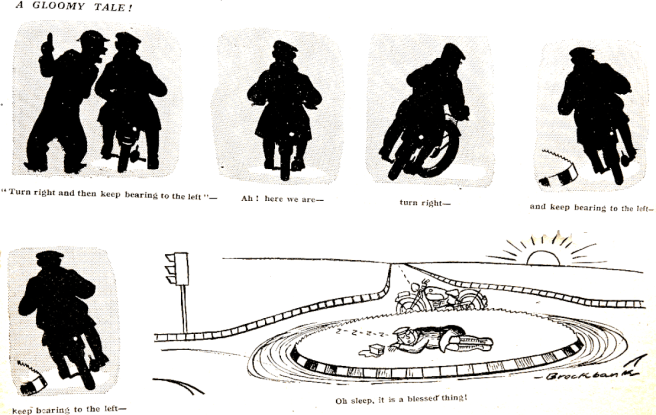
“A FULLY ATTENDED MEETING of the Management Committee of the ACU recently gave careful consideration to the policy of the Auto Cycle Union in the national emergency. It was felt that the organisation which has been so carefully and successfully built up for the encouragement and control of the sport of motor cycling should not be allowed to crumble away, and that the Auto-Cycle Union should therefore continue in existence with a skeleton staff for the duration of the war with a view to an immediate resumption of its activities after the war. Although the income of the Union will have practically ceased in the near future and its clubs will not be required to pay affiliation fees until full activity is resumed, it is hoped that it will be possible to maintain the national structure, and all local centres and clubs are entreated to remain in being and to keep in touch with headquarters. As to any activities of a sporting nature, the Union, having regard to the necessity for conserving fuel, will hold no open events until further notice. Should there be any suggestion of running any event other than a purely local one, the Union asks that the proposal should be referred to headquarters before it is proceeded with. Such modified forms of speedway racing as may be allowed by the Government will continue to be encouraged and controlled by the ACU. TW Loughborough, Secretary, Auto Cycle Union, London, SW1.”
“BUYING SOME SPARE parts at a big dealer’s the other day, I started chatting with the assistant. We got on to the subject of petrol rations, and he said that the car spares department was now lamenting the fact that only a couple of years ago they had thrown away the special paraffin carburettors which had been in stock since the final years of the last war. I suppose we shall see special carburettors on the market again—always supposing that ample supplies of paraffin are available and that the portion of the Finance Act which makes it illegal to mix paraffin with petrol is repealed. If there is a shortage of motor fuel I imagine that it will be repealed pronto! When the assistant came to make out my bill for the parts he added 10% for war-risk insurance, which had been added, he said, by the manufacturer. I thought it was rather steep at the time, particularly as most spare-part prices were increased by 10% about a year ago on account of the increased cost of materials. Now I see that in other trades the same thing has been happening and has been widely denounced.”
“IT MIGHT HAVE BEEN an ordinary club night in any of the hundreds of club-rooms in the country. The only difference was that all the lads were in khaki. Yes, I spent an evening recently with the despatch riders of a Signals unit, and it was one of the cheeriest evenings I have had for a long time. There was all the usual back-chat, the discussions, leg-pulling and general fun that go to make a club night, and these dozen fellows were In fact as much clubmates as if they had all been members of the same old-established club for years. The strange part was that, although some were members of ACU-affiliated clubs, one man was a staunch AMCA supporter, while one or two were not clubmen at all. I am afraid the AMCA man pounced on me for being an ACU supporter, and, of course, that started a long discussion on the pros and cons of the ACU. As usual, neither side got very much satisfaction out of the argument, because the unshakable AMCA view is that it is unfair to expect a purely private owner to compete against trade-supported riders. Until the ACU clubs agree to some form of discrimination between trade and private riders it would appear that the AMCA will continue to go its own way.”
“A NEW-TYPE head-lamp mask has been devised by the Ministry of Home Security and will shortly be available. In construction the mask consists of two sheet-steel plates, welded together, each being provided with three ⁵⁄₁₆in slits so arranged that the slits in the front plate do not coincide with those in the rear plate. The slits in the latter are covered by a piece of non-inflammable diffusing material, and a metal strip forms a rain shield over each of the slits in the front plate. Internally there are four horizontal strips. In the case of a motor cycle using a single front lamp, the mask is provided with an additional aperture above the top slit ‘not exceeding 2in in diameter or equivalent area, and visible from any point in front of the lamp, the aperture being partially obscured to reduce the brightness to that of a side lamp screened in accordance with the conditions laid down for obligatory lamps’. A satisfactory diffusing material is described as being of white or colourless material, matt on one or both sides, and having a transmission factor of approximately 70%. A head-lamp bulb not exceeding 36 watts is permissible. The internal surfaces of the mask must be dull black, but the colour of the outside is immaterial. There is nothing in the regulations which makes it necessary to blacken the lamp reflector when an approved type of mask is in use.”
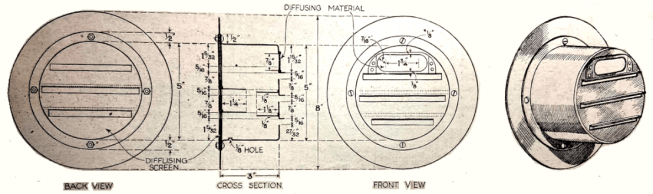
“IN TIMES LIKE THESE it is easy for club members to lose touch with one another, particularly when on active service. The Ilford Club, with this possibility in mind, has started a register for members who are in the Services, either at home or abroad. Members are asked to forward their addresses to Mr BC Furse, 51, Latimer Road, Forest Gate, London, E7, so that other members may obtain these addresses when wishing to correspond. Here surely is an extremely useful service which all club secretaries might give to their members. When you have a hard job of work to do it is easier to carry or remember the address of one man than of a dozen or so. If every club member could be certain that letters addressed c/o his club secretary would be forwarded, correspondence would be facilitated and more people would be encouraged to write letters and to keep up their friendships. Here are a few more notes about club activities. First, the London Touring and Bar-One Clubs have written to say that their clubrooms are open to motor cyclists who may be billeted in their districts. The London Touring Club meets on Thursday evenings at the Rising Sun, Ebury Bridge Road, London, SW1, and the Bar-One boys meet at the Pear Tree Inn, Harlington Road, Hayes, Middlesex, on Wednesdays at 7.30pm.”
“A WEEKLY SUNDAY meeting has been arranged for Hackney Wick Speedway members at Rye House, where the club will foregather on Sunday afternoons until further notice. A note from the North-East London Club states that all activities have been suspended until the end of the war. Awards for the Weller Cup and President’s Touring Trials are in the care of the jeweller, Mr HW Shuttleworth, 507, High Road, Tottenham, London, N17, who will be pleased to hand over trophies and medals to their owners if they call.— The Clubman.”
“GOOD NEWS FOR LEARNERS—Lifting of Ban on Provisional Driving Licences. Slowly but surely wartime motoring, and everything connected with it, is settling down on common-sense lines. At first the attitude of Authority seemed to be, ‘Stop everything!’ Restrictions upon the nation’s activities were applied wholesale, but because they were so wholesale and put into effect almost immediately war broke out they were accepted with a good grace. From the psychological angle the Government was right. Just imagine the outcry there would have been if the Order enforcing rear lights on bicycles had been an isolated piece of legislation!”
“WE MOTOR CYCLISTS share the common perplexity as to how to spend long winter evenings, when outdoor movement is awkward in a darkened world, places of entertainment close ‘early or down’, and road-work is curtailed. All sorts of substitute occupations are current, from chess problems to bridge, or learning languages, or making super wireless sets, or machining up wee engines for model aeroplanes. Perhaps the most appropriate for men of our kidney is to pick up some rather decrepit but originally super motor bike, such as a tenth-hand Brough Superior, and start reconditioning it from A to Z with the notion of being better mounted after the war. I hereby issue a warning against one type of evening occupation. One pal of mine has formed a small group, including fellows who can prattle German and Italian, and they tune-in a big superhet to all kinds of foreign stations. Having thus voluntarily and foolishly offered themselves as victims on the altar of propaganda, they go to bed war-obsessed and in a state of violent flap. I think it makes for health and sanity to switch off the radio after the 6pm news at latest, unless one listens exclusively to good music or British variety.”—Ixion.
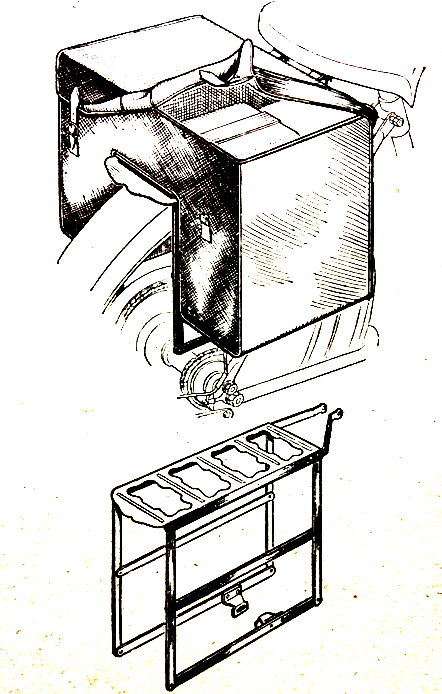
“THE RATHER BALD STATEMENT from the RAC that it is illegal to use paraffin to eke out the petrol ration most certainly needs qualification. It is not illegal to use paraffin in a vehicle subject to Road Tax. The illegality is in the use of an imported hydrocarbon oil on which the appropriate ‘petrol tax’ has not been paid, and if that tax is paid there is nothing whatever to make its use illegal in a road vehicle. Anyone wishing, therefore, to use paraffin in a road vehicle needs to declare the fact to the Excise Officer for his district, or, better still, buy his paraffin directly from the petroleum company’s depot, in bulk, as ‘tax paid’ oil; it will probably be described not as paraffin but as tractor vaporising oil, or some such name.
Wharfedale.“
“I THOUGHT I WOULD get the facts correct regarding the use of paraffin with my 1930 500cc Raleigh, so the other week-end I tried running on ‘White Rose’ paraffin. The Raleigh has two petrol tanks, so I drained one and put a pint of ‘White Rose’ into it. Then I warmed-up the engine on petrol, after which it was an easy matter to start on paraffin. I covered 9.6 miles on the pint, equal to a mileage of 76.8 to the gallon. I obtained a top speed of 67mph, but the engine seemed best at about 35mph. The engine ‘pinked’ badly when accelerated hard, but after I had fitted an old plug I found that the engine did not pink so badly when the plug gap was about 0.035in. I made no modification to the carburettor, but I might add that the engine gets fairly hot, so maybe that’s the reason. I found it impossible to start the engine on paraffin unless the engine was warm.
Jack Johnson, Featherstone, Yorks.”
“HAD IT NOT BEEN FOR HITLER, the Motor Cycle Show that was fixed for November would have produced more of practical and technical interest than almost any previous exhibition. There is quite a number of new multis, not only on paper, but actually in the ‘flesh’, and some of them contain features of unusual interest. I have also seen new methods of rear suspension, and new methods of frame construction, which were all to be exhibited. Among other items there exists a delightfully neat autocycle that has a most attractive appearance and some very ingenious features. Production of all these novelties has, of course, shut down, as many of our factories are now busy with other matters. Perhaps it is hardly fair to whet your appetites when the dish must be withheld, but it is fairly safe to promise you a hearty meal when things become more normal. In the meantime, there is a very definite run on autocycles, and since, quite naturally, supplies of both material and labour have been upset by military requirements, you must not blame Mr Manufacturer too much if there is some delay in delivery.”
“IN THE FIRST eight months of this year, British motor cycles valued at £680,019 were exported. This total compares well with the following 1937 and 1938 eight-month totals: 1937, £669,034; 1938, £621,567.”
“MOTOR CYCLES REGISTERED for the first time during July totalled 6,109, compared with only 5,136 in July, 1938. Machines of the under-150cc class increased by over three times to a total of 1,768.”
“THE RAC IS introducing a ‘Get You Home’ scheme for motorists who run out of petrol, with or without coupons.”
“IT IS STATED that street lighting is to be resumed in Berlin.”
“WIMBLEDON’S RONNIE GREEN has charge of another batch of speedway lads engaged on National Service in South London. Jack and Cordy Milne, Wilber Lamoreaux, and all the Americans have gone back to USA, and the Canadian riders to Canada. Most of the Australians left about three weeks ago, and another batch, including Vic and Ray Duggan, left last week. A notable exception is Lionel Van Praag, who is an air-raid warden on night duty in Wembley. “
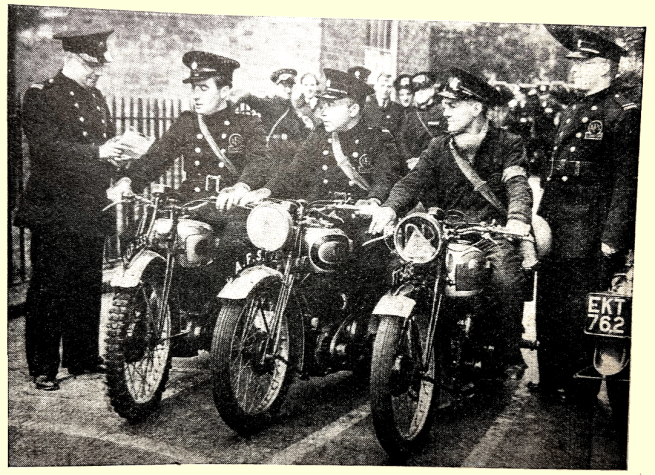
“NOT BEING AN OIL BARON I don’t know what ‘white oil’ is, except that it must be one of the liquids slightly denser than petrol and less dense than paraffin, produced in the distillation of petrol. In the last war, just when petrol supplies were on the verge of being refused to civilians, a colossal wooden- cask arrived at Benzole Villa. I hoped it was beer, but on removing the bung an odour emerged which puzzled me. The liquid did not smell potable. On the other hand, it was neither petrol nor paraffin. A few posts later came a letter from the late Charles Binks, of carburettor fame, who also forwarded one of his special carburettors. He told me that the liquid was not subject to the fuel restrictions, and that it would function very nicely in a motor-bike engine. There were 50 gallons of it, and my pals and I rejoiced greatly, and got a huge mileage out of it. Some of us, who needed our machines very badly, were later reduced to all sorts of shifts—paraffin, gas-bags in the sidecar, and even to experiments with cylinders of dissolved acetylene, which produced the most devastating exhaust noises but could never be induced to give regular firing.”—Ixion.
“VEHICLES USED in WD work are exempt from the usual classified speed limits outside built-up areas.”
“A STRENUOUS 100-DAY test of a 250cc side-valve BSA is now being carried out in Australia. Eight men are riding the machine for 20,000 miles in four States.”
“A ‘FORTNIGHT’S HARD’: It has taken FL Beart, of Brooklands fame, over a fortnight to grease and store away all his own machines and those of his customer-racers. His tuning establishment at the Track has now closed down—for the duration.”
“FOR SOME TIME PAST experiments have been taking place at the Royal Enfield factory with a view to marketing an ultra-lightweight machine. The position is now such that details of the design can be given, though in view of present circumstances the makers find it impossible to guarantee delivery dates; it is hoped, however, that moderate supplies will be available in the near future. The new machine has many points of interest, chief of which is the engine and gear-box unit. It is a two-stroke of 125cc capacity with a bore and stroke of 53.79x 55mm. The sloping cylinder has two transfer ports leading tangentially into the bore, and the gases are deflected upwards by a piston which has, in place of the usual humped deflector, a specially formed indentation in the rear of the crown. The piston is made of heat-treated aluminium, and the gudgeon pin is fully floating…Ignition is by a special Miller flywheel-magneto of the 6-pole type, which is also used to supply lighting. It has a 6-volt, 27-watt output and lights a 24-watt head and 3-watt tail-lamp bulb. The head lamp has a dipper switch on the handlebar and the tail lamp is rubber mounted in the number plate. A needle-type Amal carburettor, specially made for this machine, has a single twist-grip
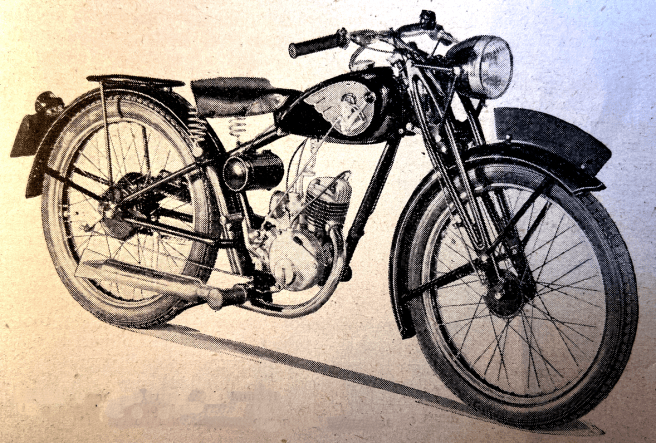
control and is fitted with an air cleaner; there is also a strangler for starting purposes. Lubrication is by the petroil system and the recommended proportion of oil to petrol is 24 to 1. A simple diamond frame is employed, and other features include a saddle tank, a cylindrical metal tool-box, a Terry saddle and a central stand. The front fork is unusually interesting; it is built up of two pressed-steel girders linked to the top and bottom of the steering head. From a cross-member near the top of the fork, stout rubber bands are stretched to a lug at the base of the steering head. A smaller rebound rubber band runs from this same cross-piece to another lug at the top of the head. All pivotal points are provided with greasers. Brakes are of 4in and 5in diameter, front and rear respectively; finger adjustment is provided in each case. The wheels are fitted with 2.50-19 Dunlop cord tyres, the mudguards are domed, and there is a light tubular carrier. The finish is in black with a dull-silver motif on the tank sides and a circular enamel name-plate bearing the initials ‘RE’. The price is £25. A lightweight speedometer costs £1 15s extra.”
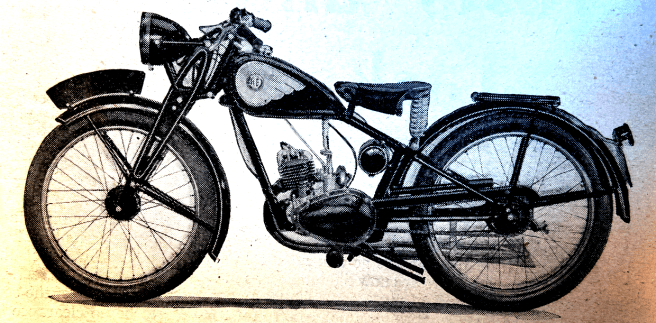

“AFTER THE FIRST sudden shock of the declaration of war, with its attendant black-out and petrol restrictions, club-life, along with most other things, is gradually settling down on its new level. The majority of clubs have now had their emergency meetings, and I am glad to say that with only one or two exceptions the clubs are carrying on.”
“MEMBERS OF THE DONS MC are determined to give concrete proof that they have not forgotten their fellow-members who are serving in the Forces. Those who are still civilians have evolved a scheme which will result in parcels being sent to their members abroad. A charge of twopence is made to anyone attending the weekly social evening, and losers at the various indoor games in the clubroom put a penny in the box. One popular member runs a weekly raffle, and later whist-drives are to be organised. At present the income from these odd coppers totals about 10s a week, and this sum is to be devoted to getting items that the absent members want. The club does not intend to waste the money on ‘stock’ packets designed by enterprising firms to appeal to soldiers. As the organiser of the scheme points out, a man may be in need of socks or handkerchiefs, or other things that would not seem suitable gifts to those at home; so before anything else is bought cigarettes will be sent with a letter asking what the member requires most, and only then will further purchases be made. Full marks, Dons, for a good idea and for putting it into practice so soundly!”
“THE FIRST TRIAL to be held in Ireland since rationing started was run by the Leinster Club last Saturday. In order to serve the precious juice, the course was only ten miles long, but contained 28 observed sections. The event was run on conducted lines with officials accompanying the 19 competitors to each section. The large number of sections was made by using some pieces of roughery in both directions and others twice. Competition was keen, and AH Archer (497cc Ariel) beat Stanley Woods (499cc Royal Enfield) and S Russell (346cc Royal Enfield) by only six marks. These last two won first-class awards, together with R Kenny and RC Yeats.”
“IN LAST WEEK’S ISSUE of The Motor Cycle details were given of the type of head-lamp hood which is to be compulsory for motor cycles. A member of the staff has since tested one of these devices under black-out conditions in the main streets of Birmingham and on about 20 miles of country roads in the vicinity of the city. The mask tested was one produced by JR Ferriday, of Vyse Street, Birmingham. It conforms in every respect to the demands of the Ministry of Home Security and embodies the special diffusing material which is a necessary part of the device. In the city, with normal wartime traffic on the roads, it was found that a speed of 30mph could be maintained with comfort. The lamp cast a light which picked up all obstacles, illuminating them sufficiently to rule out the necessity for sudden, heavy braking. Incidentally, the night in question was one of complete blackness and heavy rain was falling throughout the test. On country roads which were reasonably free from traffic, a speed of 45mph was reached and held, but it was found that, under these conditions, objects ahead were not discerned quickly enough to ensure a sufficient margin of safety. At a speed of 35mph there was no discomfort whatever; the rider did not have to peer intently into the darkness, and obstructions were made visible in ample time to permit of reasonably gentle braking. Undoubtedly, the new mask is a great improvement on previous methods, and with their head lamps so equipped motor cyclists may venture forth with complete confidence. One noticeable feature was that the kerbs on both sides of the road could always be seen, and the position of the machine on the road was never in doubt. The rider was thus able to concentrate on what was directly ahead, with the result that excellent progress was made. This ‘Feridax’ head-lamp mask is available in sizes to fit head lamps up to 8in in diameter; the price is 5s.”
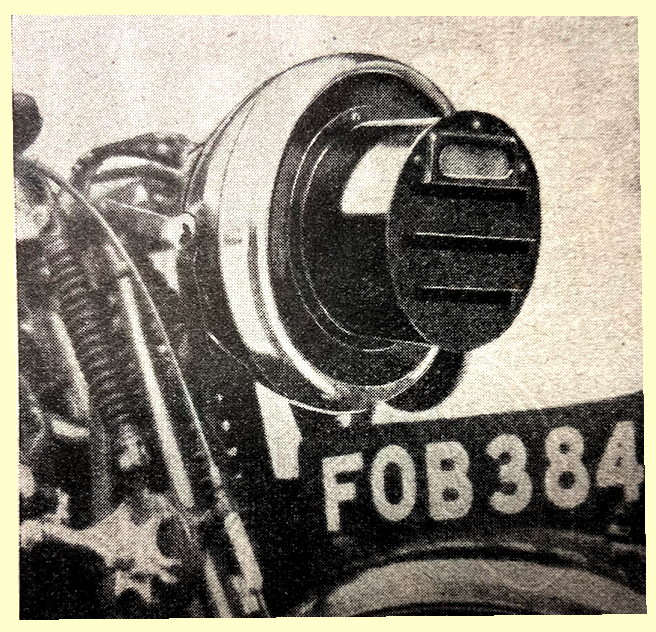
“IT IS OFFICIALLY stated that the new approved head-lamp mask has been tried on Army vehicles under observation from the air and found satisfactory.”
“A NUMBER OF Northern motor cyclists have been given supplementary petrol rations in the form of three-gallon coupons. Awkward query: What does one do when one’s tank holds only two gallons or less?”
“LUCAS HEAD-LAMP masks that conform with the new official regulations are now marketed. One type of shield available replaces the existing lamp rim and glass of Lucas lamps and is thus quickly clipped into position. The bulb fitted must not exceed 36 watts, but the reflector need not be blacked. Finished in polished black, the new Lucas replacement unit costs 7s and 7s 6d, according to size. A cheaper Lucas shield is available which replaces the glass of the existing lamp rim. This costs 5s.
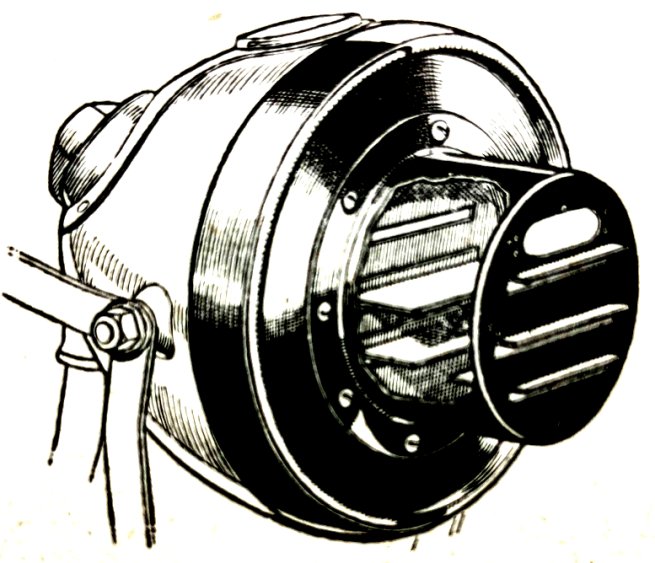
“BEEN READING IXION? ‘The peach on the perch’ was Mr Justice Bennett’s definition of a pillioniste in the King’s Bench Division last week.”
“SOMETHING WE MISS: Impaired eyesight, nervous troubles and sickness are being caused by the ‘day-light black-out’ of bus windows, says the Belfast Coroner.”
“ROMANCE IN A CLUB: Five couples in the Eltham MCC have married, and a sixth couple announced their engagement, since the war began.”
“‘THE DYNAMIC BIG-TWINS are more streamlined than ever’—thus runs the announcement of the Harley-Davidson range for 1940. Basically, the four models remain the same. The range consists of a 1,000cc ohv model with totally enclosed valves, two 750cc side-valve twins, one with cast-iron cylinder heads, and the other with heads of light alloy, a 1,200cc side-valve twin and a 1,300cc side-valve twin. Perhaps as interesting as any of the new features is the fact that for 1940 all models are offered with 5.00-16in Firestone tyres as an alternative to the 4.00in section tyres standardised. These exceptionally large tyres are specially designed for motor cycle use, and the claims for them are greater comfort, safety and tyre mileage. Whether by safety is meant safety on rough stuff and at speed is not stated. The matter is interesting, particularly as on fast British machines and on British trials models the rule is to use a specially small size of front tyre. Another new feature is a petrol tap operated by a knob on the tank. Unscrewing the knob as far as it will go turns on the main fuel supply, while lifting up the knob makes, in the case of the largest models, a reserve of about three quarts available, or about a gallon in the case of the 750cc machines [and as the spring that held the tap open had broken on my old Harley 45 I had to carry a box of matches to maintain a fuel supply—Ed]. Other points on the machine side are chromium name-plates on the tank in the form of a motif, streamlined tool boxes with a fluted (‘speedlined’) cover [now as rare as hen’s teeth and selling for hundreds of pounds—Ed], and new and neater footboards; the familiar rectangular footboard has been discarded in favour of crescent-shaped boards. Nickel-iron cast brake drums are now standard on the front wheels of the larger models…Appreciably more power is said to be developed by the 1940 model 1,000cc ohv twin [the shape of the rocker boxes earned it the nickname ‘knucklehead—Ed]. This has a carburettor of larger bore and a larger diameter inlet manifold of T-shape instead of the roughly Y-shape previously employed…On the machines of 1,000cc or over a four-speed constant-mesh gear box is employed. However, if desired, a three-speed-and-reverse gear box can be specified…Three-speed boxes with an improved gear change are provided on the 750cc twins. Bright colour schemes are available. The options are: ‘Clipper’ blue with white stripe; ‘flight’ red with black stripe; ‘squadron’ grey with ‘bitter-sweet’ stripe; and black with ‘flight’ red stripe. Silver with black stripe is available for police use only.”
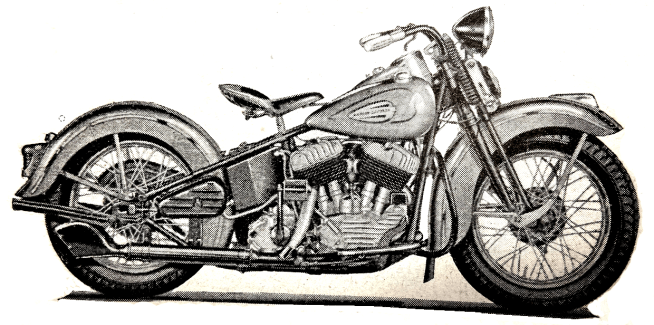
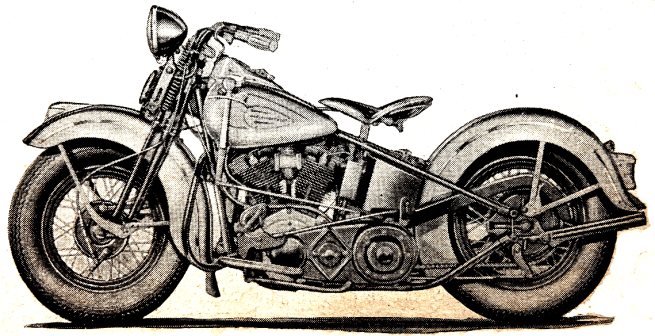
“YOU MAY REMEMBER that the Ixion Club of Oxford arranged to run a pedal-cycle trial for motor cyclists so that their members could keep their hand in at riding on rough-stuff. Well, the event was such a success that at the finish everyone asked that another should be held soon, and so the next one has been arranged for October 30th, and any motor cyclist is invited. The trial was run on normal lines, and the only machine restriction was that three-speed gears were sealed in middle gear. One mark was lost for footing, three for stopping without dismounting, and five for running alongside. Competitors were conducted to the sections, which consisted of muddy lanes, tricky bends and short, greasy rises, all of which called for skilled riding. Wheelspin was proved to be a bogy, just as when riding on ‘comps’, and several riders flew through the air owing to lack of control of the front wheel. S Lacey, the winner, showed that it was possible to foot and regain control of a pedal cycle in the same way as on a motor cycle, but T Bowling found that a high saddle was a disadvantage. Results: 1, S Lacey, 13 marks lost; 2, R Wall, 15; 3, P Wright, 23.”
“FOR 1,200-ODD MILES I have been using a Model H 570cc Royal Enfield and sidecar. This machine, it will be recalled, is sold only as a complete outfit, and fully equipped with lighting, speedometer, horn and screens, costs £62 10s. Included in the mileage has been a journey to the French Alps—a trip that included many miles of smooth, fast roads and almost as much rough, hilly going when the mountainous area was reached. Although the outfit is so moderately priced, the sidecar is well built and comfortable. It has a sheet-metal body and a light but strong tubular chassis, while the springing (coil springs in the front and leaf springs at the rear) is such that there is little or no pitching, even over bumpy roads. The upholstery is also excellent. A criticism concerns the dimensions of the body; an extra three or four inches on the length and an inch or two on the width would make a considerable improvement to the comfort of the average passenger. The wind-screen, too, could with advantage be placed farther back. A commendable point is the large locker space behind the seat squab. When the machine was taken over the speedometer registered under 200 miles, so the speed was kept to under 35mph for the next 300-400 miles. During this ‘running-in’ period I was conscious of a certain warmth in the neighbourhood of my
right leg. However, the engine functioned satisfactorily, so I came to the conclusion that it was due to the somewhat extensive finning round the exhaust port being in an almost direct line with the driver’s leg. Coil ignition is employed, and this, combined with the large flywheels and a suitable kick-starter ratio, made starting extremely simple at all times. Hot or cold, the engine would always fire immediately provided that the carburettor was well flooded and the throttle slightly opened. The position of the ignition lever did not seem to affect the matter of starting—always provided that a good swinging kick was administered when the ignition was over half-advanced; otherwise, of course, there was liable to be a kick-back. Long before the machine had covered the ‘official’ running-in mileage of 500 the engine was straining at the leash, and I found it required a conscious effort to keep below 40mph on the open road. Indeed, as the miles piled up, the big side-valve engine began to assume much of the liveliness of a good overhead-valve job. Added to this it had slogging powers much above the average, and long main-road gradients could be tackled in top gear with little or no slackening of speed. Gear changing with the four-speed, foot-operated gear box was easy and noiseless, thanks to a large extent to the excellent clutch, which always withdrew cleanly and also took up the drive smoothly. As I mentioned earlier, my experience with the Royal Enfield included a trip to the French Alps, and it gives some idea of the low-speed performance of the outfit when I state that, even in that mountainous area, rarely was it necessary to employ second gear. Never was it essential to use bottom gear (16 to 1), although this was often done to assist the outfit round tricky hairpins or to get the heavy load on the move on gradients. After the 500-mile mark had been topped I allowed the Royal Enfield to cruise at 40mph. The engine appeared to revel in its new-found freedom, and maintained this useful speed for mile after mile without the slightest sign of distress. The acceleration, too, improved with the miles. As regards road-holding, the Model H outfit left little to be desired. The pressed-steel forks have a long, smooth movement, and only the slightest amount of damping was necessary to check all trace of front-wheel hop. My passenger also commented on the absence of bounce and sway of the sidecar. Additional aids to comfort are a large Terry saddle and rubber-mounted handlebars. Steering, even with a heavy passenger and luggage, was of the hands-off variety, and only on very steeply cambered roads was there any tendency for the outfit to pull to one side. The brakes on the outfit under review call for slight criticism. Used together they were quite effective, but the rear one in particular was rather too spongy in action and required considerable pressure to produce effective retardation. Not until 1,000 miles showed on the speedometer did I test the outfit for maximum speed. Then the needle rapidly flicked up to 50 and on several occasions this speed was maintained for ten miles or more at a stretch.
The sheer maximum was approximately 56mph—this with a 9-stone passenger and a load of luggage. The highest comfortable cruising speed was 40-45mph, and this could be maintained apparently indefinitely. Having regard to the size of the engine the Royal’ Enfield proved reasonably. economical. It would run on practically any kind of straight petrol (not omitting some French fuels of doubtful origin!), and taking good and bad together, the fuel consumption over the 1,200 miles was approximately 52mpg. With a lighter load and under less severe conditions there is little doubt that this figure could be considerably improved—particularly in view of the fact that the engine was almost brand new when I took over the outfit. Oil consumption was negligible. Throughout the time the machine was in my possession the tool-kit was opened only twice. On the first occasion in order to remove some dirt from the carburettor, and secondly to attend to a chafed-through lighting cable. In all other respects the Royal Enfield was faultless—not even a nut working loose. The mudguarding proved extremely effective and the engine was oil-free except for a smear around the sump filler-cap. Altogether a most interesting and practical outfit—one that provides economical motoring allied to a high degree of comfort.”—Centaur.
“‘DEVELOP OVERSEAS TRADE!’ This, the Chancellor of the Exchequer points out, is most important for the successful prosecution of war. No one needs reminding that imports have to be paid for, that ships outward-bound need cargoes and that every £100 worth of goods exported, neglecting any imported raw materials they may contain, means another £100 towards bringing the present conflict to a successful conclusion. What the British motor cycle industry can achieve in this direction depends, of course, upon many factors, not least upon the extent to which the Government needs motor cycles and motor cycle factories for war purposes and upon the supplies of aluminium, steel and other materials essential to motor cycle construction. However, Ministerial statements stress that the country must export; presumably therefore the Government will do its utmost to facilitate the manufacture of goods for export. Several motor cycle manufacturers have recently approached us for suggestions as to what they with their factories should do, having regard to the national interest. It seems to us clear that they should carry on and, in this, do their utmost to develop overseas trade. In spite of, and in some directions because of, world conditions there are valuable markets for motor cycles overseas. By developing these they will be doing most useful work. Moreover, they will help to prevent any repetition of the blow the motor cycle industry suffered at the end of. the last war—of finding that the overseas markets had been captured by other nations and that therefore as regard overseas trade it was necessary, in effect, to start afresh. Incidentally, last year Great Britain exported motor cycles, parts and accessories to the value of no less than £1,130,374 [worth £93m in 2024].”
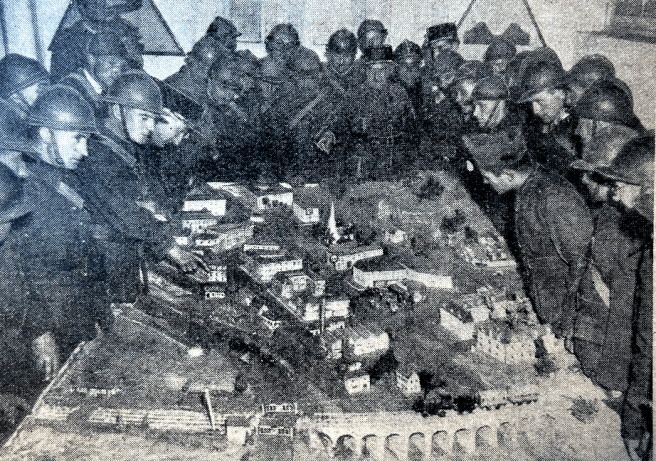
PANTHER MOTOR CYCLES are still in production, particularly for export, and large batches have been shipped to out neutral countries and the Dominions. In the North of England the drift of car owners back to motor cycles is still appreciable, and many 293cc Panthers are finding their way into the hands of travellers and business men in the semi-rural areas of West Yorkshire. The new spring-frame Panthers, which were announced just at the outbreak of war, are not yet available; in any case, production was not expected to be in full swing until 1940. The actual vertical-engined ohv model has been ridden thousands of miles by the Panther head-tester and West Yorkshire trials rider, JW Mortimer, and is giving excellent results in daily use. Also, the Panther designer travels to the works each day on one of the new side-valve machines with a heavy sidecar, leg shields, driving screen, etc, so that the experience that goes into the first batch, which may be put through shortly, will be based on bard day-to-day road usage.”
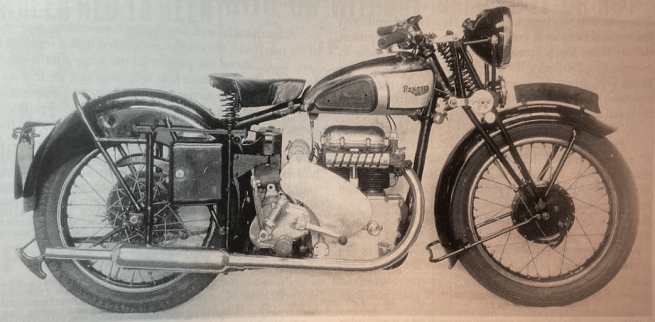
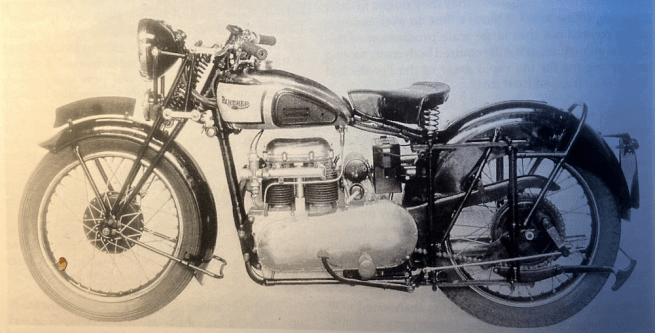
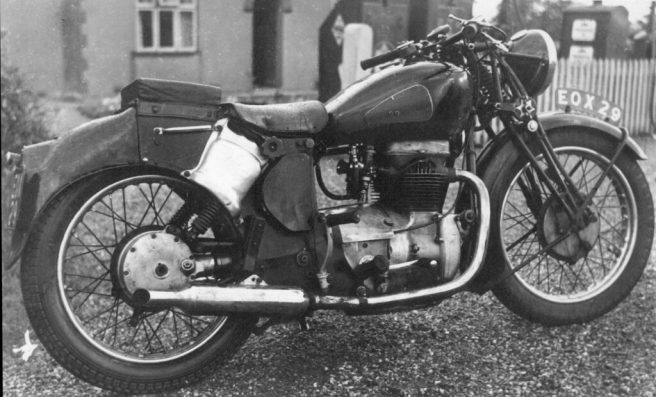
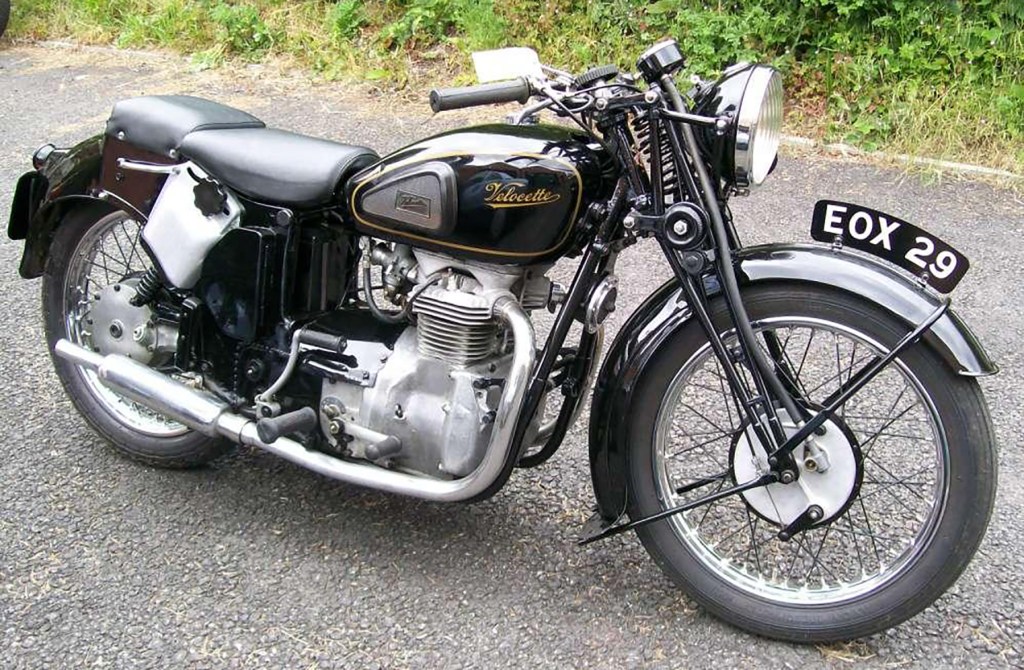
“THE MAKERS OF Velocette machines, undeterred by war conditions, are determined to do all they can to maintain the output of their machines. It is impossible to market anything in the nature of a new model, or even to make modifications. Thus, Veloce are to carry on during 1940 with the full range of models that has been available this year. All Velocette machines are sold completely equipped, and the list price includes electric lighting and horn, trip speedometer, pillion seat and footrests, four-speed gear box with foot-change, polished crankcase and gear box, chromium-plated rims and totally enclosed front chain. Model GTP is the 249cc two-port , and, with its 3.00-19 tyres, 2¼-gallon tank, valanced mudguarding, and so on, is an excellent and reliable utility machine of an extremely economical nature. Its 1940 price is £49 10s. Next comes a range of three ohv models with high-camshaft engines, push-rod operated valves and automatic ignition timing apparatus enclosed in the timing case. These machines have prop stands in addition to front and rear stands. Mudguarding is unusually complete; the two smaller machines have 3.25-19 tyres and 2½-gallon petrol tanks, while the large model has a 3½-gallon tank and 3.50-19 front and 4.00-19 rear tyres. Prices are: Model MOV (248cc), £64; Model MAC (349cc), £67 10s; Model MSS (495cc), £77. Lastly are the two famous overhead-camshaft models, KSS and KTS. They are identical except for tyre and mudguard equipment. The former has sports-type guards and tyres measuring 3.00-21 front and 3.25-20 rear, while the latter has valanced guards and 3.25-19 front and 3.50-19 rear tyres. The camshaft engines with their alloy heads and totally enclosed rocker and valve gear are too well known to need elaborate description. Adequate lubrication of all working parts, including valves, is an important feature, and they represent a very high standard in single-cylinder design. Prop stands and 3½- gallon tanks are included. Both machines are of 348cc capacity, and in each case the price is £83.”
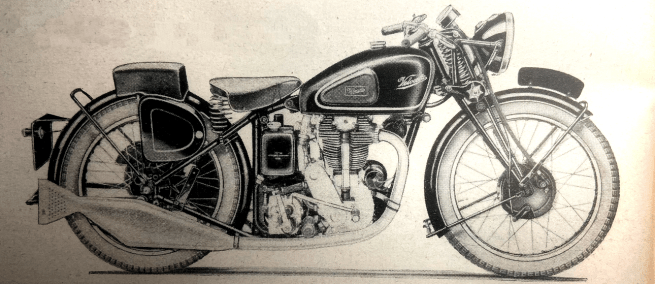
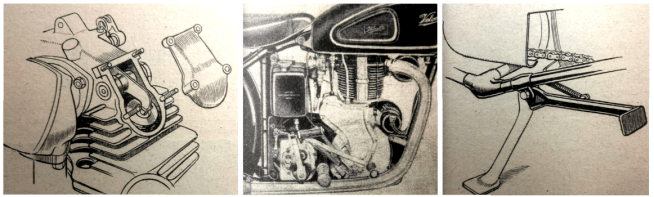
“FOR THE TIME BEING no repairs to AJS, Matchless or Sunbeam motor cycles can be carried out by the manufacturers, Associated Motor Cycles. The makers state that they will continue to do their utmost to ensure prompt delivery of any spare parts that may be required, and that they are confident that their dealers throughout the country will be pleased to carry out the work that otherwise would have been sent to their service department. “
“IN SPITE OF THE WAR, the Triumph Engineering Company is in a position to produce a limited number of machines for the public. Of course, some of the interesting novelties which had been intended for 1940 have had to be held over, but it is safe to say that all wartime products will maintain the high standard of material and workmanship which is associated with the Triumph name. Further, special care has been taken to ensure that current models shall be as economical as regards fuel as is possible, consistent with a reasonably high road performance (consumption at an average 40mpg under good average conditions)….It is not possible to guarantee that the prices given can be maintained, since increases in material and labour costs may necessitate modifications in this respect: De Luxe 250cc ohv (2H), £54, 120mpg; Tiger 70 250cc ohv £59 120mpg; De Luxe 350cc ohv (3H) £59 110mpg; Tiger 80 350cc ohv, £64, 110mpg; De Luxe 350cc side-valve (3S), £56, 90mpg; De Luxe 500cc side-valve (5S), £60, 80mpg; De Luxe 600cc side-valve (6S), £65, 75mpg; Tiger 100 500cc ohv twin, £86, 100mpg; Speed Twin 500cc ohv twin, £80, 100mpg; 350cc side-valve (3SE), £48, 90mpg; 500cc side-valve (5SE), £54, 80mpg. Both the 500cc twins, the Speed Twin and the Tiger 100, have under-gone certain modifications in order to keep up to date, but the singles are unchanged in their main features…All de luxe Triumphs have black panels with ivory lining on a chromium-plated tank. The external aluminium parts are highly polished which greatly facilitates cleaning, besides providing an attractive finish. Two further side-valve models—the 350cc 3SE and the 500cc 5SE—have been added to the range with the idea of making Triumph quality available to those whose purses are restricted. Such reductions in price as have been possible have been attained by careful attention to details of specification, such as by the substitution of a pressed-steel primary chain cover for the cast-aluminium oil bath and, in the smaller model only, of coil ignition for a Mag-dyno. Further economy is to be found in the use of an all-black finish with gold lining in place of chromium plating, and lamp-mounted switch and ammeter instead of a tank instrument panel. The two 500cc side-valve Triumphs, Models 5S and 5SE, are ‘light solo’ machines, and have the lighter of the two types of Triumph frame. The 600cc Model 6S is intended for sidecar work.”
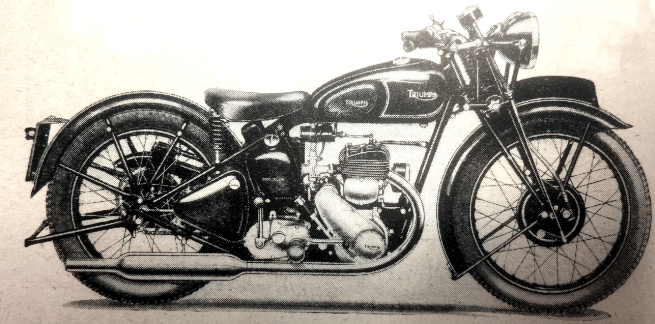
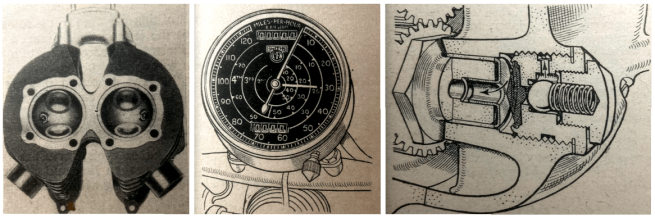
“THE POLICY OF THE makers of Ariel machines is to continue the range of models that has been available during 1939. All these are proved and tried designs which already have the confidence of the public, and prospective purchasers may rest assured that no changes in design, material or finish will be made to any model during the coming season. One of the high-spots of 1939 Ariel machines has been the spring frame. After more than a year in the hands of riders in all parts of the world this frame has proved so satisfactory as to require no change of any description. The design utilises a vertical plunger with main and rebound springs, and a particularly noteworthy feature is the ingenious linkage system, which maintains a constant tension on the driving chain. Further, lateral rigidity—with consequent good steering—a minimum of unsprung weight and long life for all moving parts are secured. At the head of the list of Ariel machines are the Square Four models in 600 and 1,000cc capacities. The Square Fours have long been outstanding British multi-cylinder machines, and they are still exclusive in design and performance. The 600cc edition, which was reintroduced last year after having been redesigned on the lines of the 1,000cc model, is again available. The 1,000cc Square Four is to be marketed in both de luxe and standard forms. Two other types make a special appeal at this time. They are the 500cc side-valve and the 250cc overhead-valve models. The latter are obtainable in de luxe form as well as in the famous Red Hunter range. The Red Hunters are, of course, sports machines of high performance, while the de luxe models, although giving the same degree of reliability and general service, are designed for the rider who does. not desire extreme high efficiency. The 500cc side-valve is a type modelled on eminently sound lines and designed to give unremitting service under all normal road and weather conditions. As is well known, this is a type of machine greatly favoured by Army authorities owing to its ability to stand up to hard usage with the minimum of attention. In addition to the 250s, the Red Hunter range also includes examples of 350 and 500cc. These form a trio which has become famous in all branches of the motor cycle movement, especially for fast touring and competition work. Enclosed engine parts, clutches separate from the oil-bath chain case, front forks with auxiliary damping springs, and rubber-mounted handlebars are features of Red Hunters and other Ariel models. There is a 600cc edition of the side-valve, and the de luxe range of ohv machines contains 350 and 500cc models. The de luxe four-cylinder has a quickly detachable rear wheel—a feature which is available as an extra on other models. All models are sold complete with electric lighting and horn, and the spring frame can be fitted at an extra charge to any machine with the exception of the 250s.”
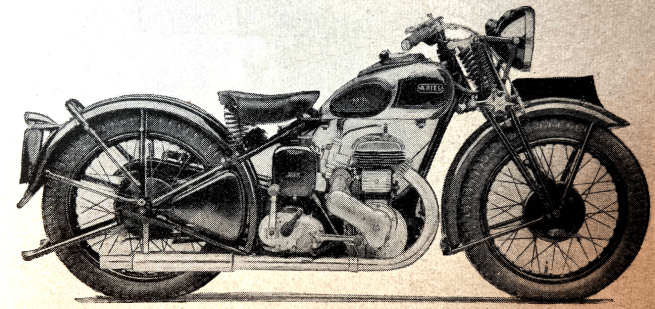
GUZZI claimed sixteen new world’s records in the 250 and 350cc classes last week. The successful attempts were made on a stretch of the Milan-Brescia autostrada. The machine used was a 250cc model, and the riders were Alberti and Sandri. They took turns in the arduous job of steering the light little model in windy conditions. Standing start: One kilometre, 88.0mph; one mile, 99.1mph; 10 kilometres, 118.3mph; 10 miles, 121.3mph. Flying start: One kilometre, 132.5mph; one mile, 134.5mph; five kilometres, 124.7mph; five miles, 123.5mph.
“THOUSANDS OF MOTOR CYCLISTS are been to join the Armed Forces as motor cyclist despatch riders and thus put their knowledge and experience to the best possible use. While the number the Army can absorb immediately is limited, there are, nevertheless, openings for experienced men. The Royal Corps of Signals is at present accepting initial batches of volunteer despatch riders and more will be absorbed, in batches, as opportunity occurs. It is likely that 50 or more may be required each month. All readers who are not in reserved occupations, are medically fit and between the ages of 22 and 35 years, may, if they wish, complete the accompanying registration form issued after consultation with the War Office. This register is being compiled with a view to giving experienced riders an opportunity of volunteering as despatch riders, and will be used by the War Office as and when openings occur in the Royal Corps of Signals, or possibly, also, in other arms of the Service. It is necessary to stress that registration gives no guarantee of enlistment. Therefore, if the opportunity of serving in some other direction occurs before a volunteer on our register is called up he should not let the opportunity slip. On the other hand, he must, of course, advise us that his name is withdrawn from our register.”
“US FOLLOWS SUIT: 1940 Indian ‘Chief’ and four-cylinder motor cycles have plunger-type rear-springing as standard.”
“TYRE VISIBILITY: The sinkers of India tyres are marking the walls of covers with a broad white ring ‘for the duration’.”
‘SEVERAL UNUSUAL FEATURES are to be found in a design for an all-enclosed motor cycle suggested by Mr WC Tomkins of 35, Southway, Wallington, Surrey. The frame of the machine is sprung at both ends, and the system of springing is similar to that which has already been taken up. by one well-known manufacturer. The steering layout is reminiscent of the OEC type, though certain modifications have been introduced in order to fit in with the unusual layout. The long drag links involve a certain flexibility in the cross bar at the bottom of the steering column, and this is provided for by mounting the column in a self-aligning ball race at the top, and the cross-bars in a slotted forging at the base. As a power unit, a flat-twin having the inventor’s special arrangement of slide valves is suggested as suitable, although a water-cooled four-in-line with shaft drive might have been chosen had it not been for the matter of expense. Final transmission in the suggested design is to be by chain from a cross-shaft, and all the weight is carried low down. Accessibility for all parts is provided by quickly detachable panels, and the louvres for introducing and extracting air add rather than detract from the appearance of the machine. Frame rigidity and stability should certainly be features of such a machine, and as for windage, the effects would probably be less noticeable than might be expected.”
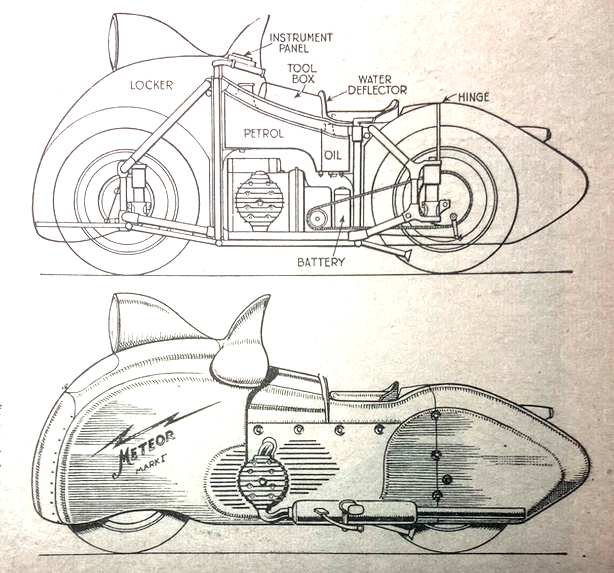
“I THOUGHT IT WOULD not be long before clubs found a way of running events, even under the present difficult conditions; and I was right, for I have had news of two economy events and two trials that have already been run very successfully, and details of future plans are arriving slowly but steadily. The economy-test run by the Manchester 17 MC produced some surprising results, the winner, E Mellor, on a 1939 349cc Velocette, averaging 145mpg. Incidentally, the four best performances were all made on Velocettes. Some members found the results so surprising that during the social evening that followed there were many discussions on the way the test should have been run—particularly with regard to riding methods. What the club actually did was to map out a circuit which was found to be 1¼ miles long. Competitors had to cover this circuit twice, using the petrol in an auxiliary tank supplied by the club. The amount of fuel used by each competitor was then accurately measured by topping up the tank. The club kindly offers to lend the apparatus to other clubs who might like ‘to run a similar test. An economy test was also run by the Rugby Club, and an efficiency formula was worked out, although details are not given. In the results JG Kirwan (346cc Levis) obtained 152% with a consumption of 172mpg, while AF Greenhill (348cc Excelsior) obtained 142%, with 160mpg. Five members obtained consumptions of 100mpg or over.”
“A DIFFERENT WAY of combating the petrol shortage was adopted in the Dublin University Club’s Fall Trial on October 14th, for the event comprised eight laps of a 2½-mile circuit, in which there were a dozen observed sections. Only two competitors finished on time out of 26 starters; 11 retired. The winner was Peter Gill (348cc Norton), who secured 929 marks as compared with the 921 of the runner-up, Stanley Woods (499cc Royal Enfield). In addition to Woods, first-class awards were won by AHL Archer (497cc Ariel), 919; CHW Manders (348cc BSA), 911; and R Kenny (343cc Triumph) and RC Yeates (343cc Triumph), 857.”
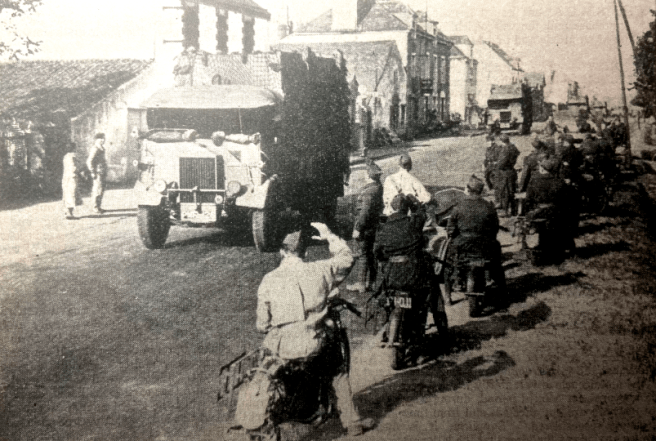
“IMAGINE THAT YOUR full-time job is connected with the development of motor cycles. It is rather a joyous thought, isn’t it? But what would you do with your spare time? Would you also develop motor cycles, or would you—think of your own particular job for a moment—find something that took you right away from work and thoughts of work? No, it is not everyone who, if their job was the development of motor cycles, would devote their spare time to tuning and track racing. Let me introduce you to FWS Clarke—Freddy Clarke—the chief of the Triumph experimental department. His time and opportunities for track racing, and everything connected with it, are distinctly limited, yet he has already achieved the distinction of raising the Brooklands lap record in the 350cc class to 105.97mph, and the 750cc record to no less than 118.02!…On previous occasions when I have visited the Triumph experimental department in order to obtain information about the performance of new models or for some other purpose, I have noticed that Freddy never makes a statement without being able to back it with figures from actual tests—all neatly written up in his log book. In the present year he rode in the now historic ACU stock-machine test of two vertical-twin Triumphs, but most of his racing has been with a 350cc engine mounted in a 250cc-type frame. With this he finished second in a three-lap race at the first Brooklands meeting, making the fastest lap at 103mph on a wet track! At the second meeting he equalled the 350cc lap record in his first race, and in a subsequent event raised it to 105.97! On Cup Day he rode an unusual machine for an unusual reason. The model was a 500cc twin bored out 0.010in, and the reason was to raise the capacity to 502cc so that he would not be competing directly against private owners of Triumphs. The result also was unusual. In his own words, for the first time he was in the position of having a machine with a performance far in excess of the handicapper’s estimate. He won two races, and later beat the 750cc lap record at 118.02mph. From this brief history you will see that Freddy Clarke has not only the will to win on the track, but also the necessary skill both in tuning and riding.”—Ubique.
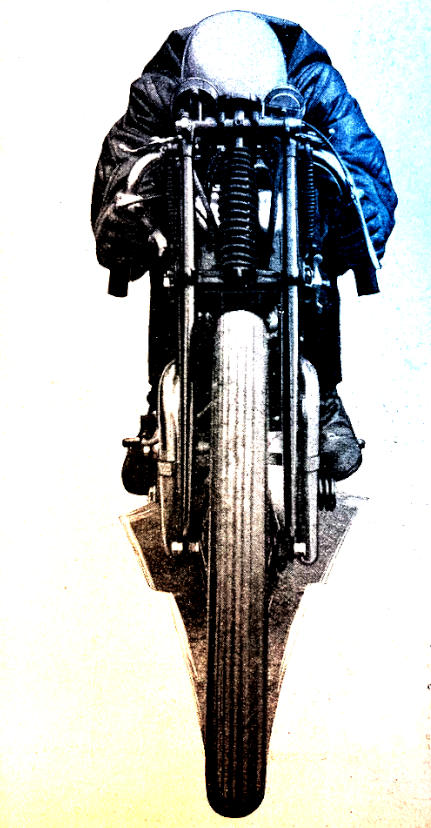
“‘WE HAVE BEEN able to press ahead with the new twin to an extent that would have been quite impossible if there had been no war.’ This remark was made to us a few days ago by a well-known manufacturer, who added: ‘I imagine that we are in no way unique in this; many other manufacturers must have found, owing to the advent of war, that their design and experimental departments had little to do, and therefore could concentrate upon the new models which will be marketed as soon as the war is over.’ These comments are interesting in more than one connection. The present is a brief opportunity of pressing ahead with the new designs that were promised for 1940 and 1941, and of testing and proving them to such a degree that they will be in no possible sense of the word ‘experimental’. One enterprising manufacturer told us last week that no matter how long the war lasts his new and very out-of-the-ordinary model will be continuing its tests. This is good, for there have been far too many cases in the past in which the public has been left to do much of the testing, or at all events has found faults which should have been eradicated in the experimental stage. On the other hand, by no means all manufacturers are devoting attention to experimental work in the way that might be hoped. It is surely wrong, even in these times, to regard the design and experimental sides of factories as ‘non-productive’, and therefore as affording the opportunity of reducing overhead expenses by a little far-from-gentle pruning.”
“THE PETROLEUM BOARD’S decision to raise the price of ‘Pool’ petrol by 2d a gallon to 1s 8d no doubt came as a shock to many riders. On the other hand, older riders will recall that in 1920 the price soared to the almost incredible figure of 4s 7½d a gallon! A colleague tells me that in 1920 he was running a big-twin Harley and sidecar, and being young and somewhat impecunious at the time its thirst almost broke him. However, rather than dispose of a faithful friend he decided to try running the outfit on a 50/50 mixture of petrol and paraffin. Apparently the result was quite successful, apart from slight misfiring due to sooty plugs, and a lot of black smoke from the exhaust. ‘At any rate,’ said my friend with a smile, ‘the scheme, plus an occasional “tip” from my sister’s fiancé (for making myself scarce!) enabled me to keep on the road during what was undoubtedly the most expensive era in the lifetime of the sport.’ Then he added mournfully, ‘Alas! paraffin is now taboo—and I have no other sister.'”—Nitor.
“OWING TO THE PRESENT uncertainty with regard to insurance and the possibility of a general amendment of premiums for motor cycle cover, the British Motor Cycle Association has decided to introduce an entirely new insurance scheme. The policy, which offers extremely reasonable rates, is guaranteed by Lloyd’s underwriters, and is available to all members of the BMCA.”

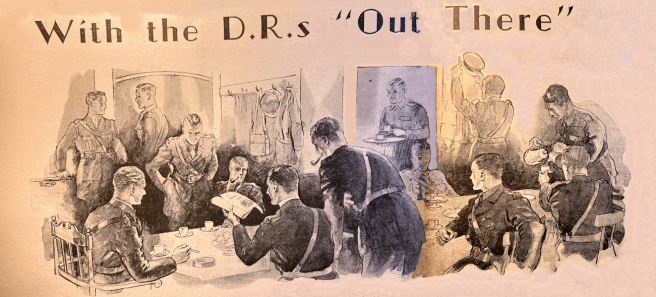
“THE DAY’S WORK WAS FINISHED—as much as it could be, at any rate. One never feels that all the work is quite done in this kind of life, even when one uses every hour of the day and part of the night. Many miles of pavé, plenty of mud and the keen east wind which had blown over the countryside, had made us all ready for the snug warmth of the Officers’ Mess and a good dinner. Over dinner we talked of little else but motor cycles and their ways. Some of the officers had not ridden since the war of 1914-18. Discussion, therefore, concerned the changes in design and performance which have taken place during the past 20 years. Some of the older officers expressed a desire to return to the ‘good old sloggers’, as they termed them. They held that the layout of those old models was simpler, and roadside repairs much easier. On the other hand, men of more recent experience argued that the modern machine is much more reliable, develops greater power and is more comfortable and stable. Of those present, 50% preferred twins for their flexibility, and the other 50% preferred singles for their simplicity. The most popular machines were those which could be driven slowly for long distances over bad roads, or at night when only a minimum of driving light is permissible. High maximum speeds may be useful in England, and also in some parts of France, but generally speaking, high speeds are not often possible under present conditions, and a good ‘slowish’ speed with a stable mount is preferred. One of the most useful things I brought out here is the elementary knowledge of motor cycle mechanics which I gained by practical experience and with the help of The Motor Cycle. At times it has enabled me to get a man’s machine to go, or function better. In this lies no suggestion that our machines are unreliable—they are very reliable indeed. But occasionally one finds a new rider held up by some little thing, such as a ‘mucky plug’ (to quote Jess Oakroyd) or a blocked petrol pipe. The Field Workshops do the- periodical ‘vetting’ of the mounts. At these interesting spots are to be found some of the most likeable of men. In my association with them, which for various reasons is frequent, I find that motor cycle cameraderie which is such a pleasure on English roads in peacetime. I find in conversation with them that it is not a long way from this fellowship to the higher one which it is my work out here to foster. The mechanics are riders themselves—some of them well-known racing and trials men. The despatch riders and other Army motor cyclists are full of praise for their efficiency and helpfulness.

Recently I built an epidiascope [projector] out of an empty petrol tin. When I had got as far as I could with my jack-knife and a pair of scissors, I found I should need some expert assistance. So I sought out a Field Workshop, where the Commanding Officer answered my request with, ‘Certainly, Padre, you can ask the Workshops to give you all the help you need.’ Of course, it was the motor cycle department I went to; and there the mechanics soon did the necessary tin-smithing, while the electric wiring was carried out by an electrician. When the job was finished we had a good laugh at its appearance, for I am not an expert designer and materials for this sort of thing are scarce. But the apparatus worked well, and we took sketches and pictures from The Motor Cycle and projected them on to the white roof of the van. When I left the men I felt sure they would make another for themselves. My epidiascope has now gone through its experimental stages, and I can get a good picture about the size of a double-bed sheet—all for less than 100 francs, including lens, electrical fittings and lamps. My next plan is to get interesting motor cycle pictures which will entertain the DRs and others. Sometimes, when the clock in my stomach points to tea time, I find myself near a big bucket of tea with a group of DRs standing around. In command is the cook, who hands out the mugs. Goggles go up on to foreheads, faces thaw into smiles, and the talk ranges round the French rules of the road, French and English styles of riding and driving, pavé (which gets some unfavourable comment from both French and British DRs), road camber, cafés, and so on. When the big chunks of bread and jam have disappeared and cigarettes are alight we talk of home, the touring we did during the summer, the bike we left behind us, and sometimes the fiancée or wife. Documentary evidence, or, rather, photographic evidence, is produced from the left breast pocket. Here is ‘A’ and his family beside Loch Ness, with the sidecar outfit standing by; then ‘B’ shows a picture of himself on his trials mount with his fairy on the pillion. Half-an-hour later comes the roar of many exhausts. Gauntlets are donned, goggles adjusted—and off they go, to work well into the night. They are stout fellows, the DRs, keen on their job and unselfish. Sometimes, after a day’s rough cross-country work, I have heard them speak of the help they have received from trials riding in England. The British dispatch rider with his British mount under him is playing and will continue to play a great part of the present war. Whatever lies before us these men and machines can be relied upon to do their bit. In the bright warm hall, which serves as a soldiers’ institute, I often meet the DRs when they are off duty. With a draft-board, a cheery companion and a big cup of hot tea to hand (we drink no end of tea), I spend many happy hours, and when we have finished with the unpleasantness, I shall look back up on the companionship of the DRs with infinite pleasure.”

“PL BEART, OF BROOKLANDS fame, is now engaged on aero engine research. And to what job is he better suited!”
“MILL HOUSE, CHELSHAM, Surrey, is now the headquarters of the FICM.Secretariat. The Secretary-General is, of course, Mr TW Loughborough, the secretary of the ACU.”
“IN SPITE OF THE WAR, the FICM has an application for membership—from the Nouvel Automobile Club de Luxembourg.”
“WHILE THE FICM has moved, the ACU remains at 83, Pall Mall, London, SW1, with Mr. Loughborough in charge, aided by Mr Huggett.”
“THE NUMBER OF clubmen affiliated to the ACU this year has been a record.”
“AN APPEAL TO FIRMS in the motor cycle and other industries to collect their scrap metal is made by the Ministry of Supply (Iron and Steel Control). It is pointed out that such items as broken tools, disused piping and any articles containing iron or steel can now be put to national use.”
“EXPORTS OF AMERICAN motor cycles for the first six months of 1939 show a decline as compared with the corresponding period of 1938. The actual figures are: 1938, 1,963 machines, valued at £107,238; 1939, 1,613 machines (£88,691).”
“THE ABOVE FIGURES contrast strangely with those covering the exports of British machines in the first eight months of this year. The total value of British motor cycles and parts exported was no less than £680,019; for the same period of 1938 the figure was £621,567.”

“HISTORY REPEATS ITSELF. Just as on the occasion of the war of 1914-18, when The Motor Cycle pioneered the recruiting of motor cyclists, getting together thousands of practical men for the Motor Machine Gun Service, the RE (Signals), RAF, RASC (MT) and the Heavy Armoured Car Section (later the Tank Corps), so in these times completed registration forms for our official recruiting register reach The Motor Cycle offices by every post. There are, however, two big differences between then and now—even between the present and September, 1938, the ‘crisis period’, when, unknown to the world at large, we immediately approached the Director of Recruiting and Organisation at the War Office offering again to set aside a section of The Motor Cycle to help the Government and our big circle of readers. In the first place, a very large number of motor cyclists answered the calls to service during the year that elapsed be fore war broke out—many, as is proved by letters we receive, are already at the front. Secondly, thousands of those who are keen to put their motor cycle knowledge and experience to use as Army motor cyclists are debarred from doing so under the Government’s Schedule of Reserved Occupations. Probably no section of the community includes so large a proportion of highly skilled men as in the case of the motor cycle world—men essential to Britain’s war effort on the home front. Such is keenness that many who are in reserved occupations have completed the registration form. It has been necessary to point out to over 50 that, unhappily for their hopes, they are ineligible.”
“‘SIX MOTOR CYCLE despatch riders for duty overseas.’ Thus ran a letter which the Editor received last week from the Manager, Transport Branch, of the Navy, Army and Air Force Institutes [NAAFI]. Six men who should be highly suitable for the work have been put in touch from our lists.”

“IT RAINED IN TORRENTS on the Monday evening when the Manchester Eagle MC debated ‘Do We Want Multis?’. I was down to open the discussion, and there were about 50 members in the club-room by the time I arrived—arrived after exploring every likely premises in another street of the same name before discovering in the Grand Blackness that I was in Postal District 13 instead of 11! Being more or less acting chairman, I couldn’t take sides. It was, therefore, only necessary, in. order to start the ball rolling, to point out that multis are as old as the motor cycle movement: instance the four-in-line FN, the famous old JAP V-twin ’90 bores’, the flat-twin Douglas, the 90° V-twin Panther and the vertical-twin Scott. After 1919 came the transverse fiat-twin ABC, the flat-twin Humber, the Redrup radial three, the three-in-line Scott, and the light solo V-twins—the James, the transverse AJS, the narrow-angle Matchless V-twin (and V4), and the 500cc BSA. Yet, good as many of these were, not one of them scored an overwhelming success. Only when the Ariel Square Four arrived did motor cyclists become multi-minded at all. The Triumph twin, by the same designer; increased the interest [let’s not forget the Val Page-designed 6/1 Triumph vertical twin that preceded the Speed Twin—Ed] (incidentally there was a vertical Triumph twin in 1913), and undoubtedly the success of the BMW transverse flat-twin and of the Gilera transverse in-line four aroused concern among British designers as well as the interest of riders. It must not be forgotten, of course, that these Continental successes were often due to supercharging. Multis may be regarded as essential for blowing, but I suggested to the meeting that it was better not to confuse the issue on this score, as the supercharged job for everyday use is still a long way off. The points for discussion, therefore, were chiefly the advantages of the multi for the average motor cyclist. There was no lack of opinions, for there were representatives of all classes, from folk like scramble-expert Alec Parker (now an Auxiliary Fireman) to the ordinary member who never figures in an entry list unless it be a ‘main road’ trial. One of the latter got in at once with: ‘Everyday go-to-work riders outnumber the enthusiasts and it’s the enthusiasts who want multis—we want simple and cheap machines, so it’s the single every time!’ Another member agreed, saying: ‘Cheapness must come first, and that means a single. And anyway a multi is no good for mud-plugging, although if it was as cheap as any other kind everybody would prefer its smooth-ness for main-road work.’ The views were many and various: ‘Singles will always hold their own up to 350cc’; ‘The modern multi (vertical-twins in particular) owe their popularity to their high road performance and efficiency as compared with singles’ (‘No! They owe their popularity to the boosting they have had in the technical Press!’ came a retort); ‘What do you mean by “efficiency”, especially if it’s obtained at the expense of consumption? We want the most miles to the gallon’; ‘What’s the use of great bhp when road conditions rarely let you use it, anyway?’ One man pulled out a TT programme and pointed out that in the old TTs when there were separate classes for singles and twins the consumption figures recorded showed the singles of that era to be far more economical than twins. ‘If we are to have multis we are going back to a class that won’t give us efficiency’ he added. So far, so good. It has to be admitted that the multi is more prone to wheel-spin than the single, but mud-plugging is rather a specialised job and anyone who insists on doing it will, I suppose, have to buy the most suitable type and put up with its disadvantages in other directions. On the matter of ‘efficiency’ it seemed that too much stress was being put on fuel consumption (excusable in these ration days, I feel!). I suggested that fuel consumption was a matter of thermal efficiency, which was very different from all-round efficiency. A diesel engine’s thermal efficiency is very high indeed, but the diesel engine sacrifices all sweetness and smoothness in operation and nobody would enjoy riding a diesel-engined motor cycle! Efficiency must include consideration of all-round performance. Many machines, I added, are looked upon as petrol drinkers only because they have such a thrilling performance that it is hard to resist using it. (This was borne out by a Tiger 100 rider, who said he was getting over 100mpg by driving gently in order to keep within his fuel ration.) ‘Couldn’t we revert to decent singles?’ was asked by a man who reminisced about a 550cc side-valver that was so smooth that you often couldn’t tell if the engine was running during a traffic block. ‘What’s the use of 90mph anyway?’ he asked. Then a member spoke bitterly of the cost of lots of new valve guides, pistons, and so on. ‘I should only have had one or two to buy for a single. Why have such expensive machines?’ A nice, woolly big-single certainly has a charm of its own, but it cannot be called efficient in every sense of the term. Its big flywheel and low compression ratio make it smooth and docile, but if you want it to ‘go’ you have to carve lumps off the flywheel and raise the compression until the engine becomes almost impossibly rough. Such an engine gets docility and smoothness at the expense of everything else. Sacrifice the former qualities and you can get urge. The multi, however, gives smoothness because of its smaller but more frequent power impulses, while at the same time it can produce enormous power and super acceleration. As to cost due to ‘complication’, the example of the small-car world is worth studying. Car engines are ‘complicated’ but seldom give trouble. The number of parts doesn’t matter much; and if a thing with a number of small, lightly stressed parts is more reliable than one with a few big and heavily stressed parts, the facility of getting at the ‘simple’ engine is a claim that falls to the ground. As to first cost, the public ultimately gets what it wants at the price it can afford to pay. Some rather pertinent points were raised regarding vertical-twins and also on transmission questions. Was the vertical-twin with its two crank pins in line truly a ‘multi’, or was it just a camouflaged single? The answer, it seems to me, is this:
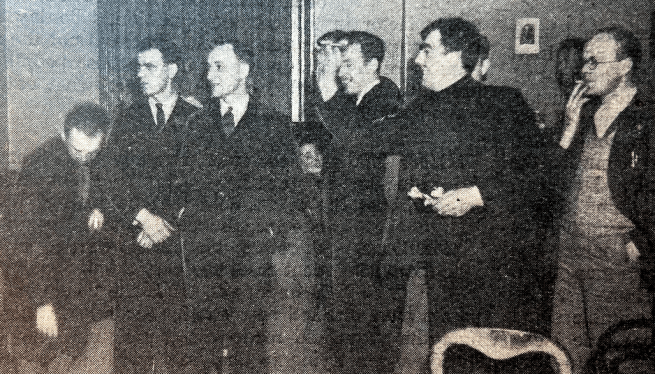
Such an engine unquestionably has the same mechanical balance as a single, but for equal capacity it provides twice the number of (smaller) power impulses in the same time; its output is smoother, therefore, and, because among other things its valves and pistons are lighter and smaller, its acceleration is better, and because its cylinders are smaller it can employ a higher compression ratio for an equivalent freedom from pinking. Regarding transmission, one member said that his earliest motor cycle recollections were of his father’s four-cylinder FN, and he praised its beautifully made shaft drive, which never gave any trouble. ‘Isn’t it only the multi that makes shaft drive possible?’ he asked. That question, I think, can be answered (with reservation) in the negative. We must not forget that there was a small single FN with shaft drive, just as there are single-cylinder shaft-drive BMWs to-day. Multi-cylinders favour shaft drive undoubtedly, but it is not by any means certain that shaft drive, even with a modern 500cc single, is impossible. The trouble is that, for some reason, no maker has the incentive to get down to the problem. Transmission, to my mind, is one of the weak points of the motor cycle industry. I do not mean mechanically, but from the aspect of manufacturing policy. Chain drive is easy. Too easy! It can be bought off the shelf piecemeal. The multi-cylinder engine would permit of considerable lightening of transmission, but the proprietary gear boxes now on the market are designed either for light-weights or for single-cylinder four-strokes up to 500 or 600cc. In consequence we have recently seen such mechanical absurdities as, on the one hand, a tiny twin two-stroke with the heaviest four-speed gear box that is made, and on the other hand, a transverse 1,000cc vee-twin coupled to the gear box from a 10hp four-cylinder car; the one many pounds too heavy, the other stressed too much, but both used because they were the only available products that would fit. The adoption of the multi engine will certainly call for a redesign of machine layout and transmission components if full advantage is to be taken of all the multi can offer. This was rather borne out by several members who condemned the Bianchi and Gilera ‘fours’ as purely racing freaks of little interest to ordinary motor cyclists. To sum up, the strong sporting element obviously favoured singles; others (from experience) said they preferred multis because they give speed, acceleration and real road performance without noise, fatigue or endless tinkering. I sensed a marked leaning towards the multi, but coupled with it was some anxiety about first cost and running cost. I believe that if the idea of expensive repairs can be broken down the multi will come into its own in all sizes from 350cc upwards. By this time the room was becoming hazy with smoke; we had gradually backed our chairs away from the fire round which we had informally conducted our discussion; the ladies had dashed out to make cups of tea, and not a few hands were itching to handle the darts and the table tennis bats in the last half-hour available. Then, as one member put it, having learned ‘more and more about less and less’, we departed into the Darkness.”
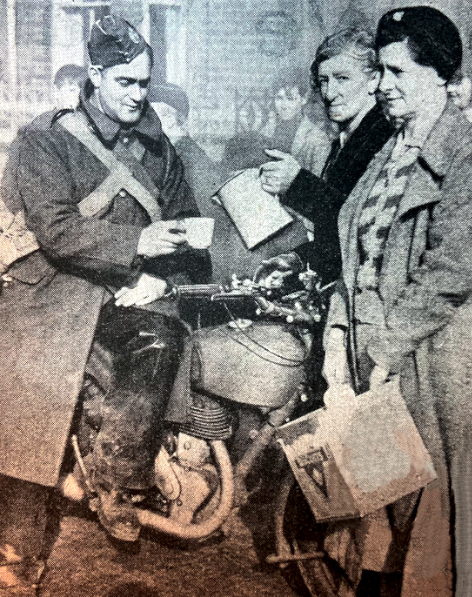
“MORE OFTEN THAN NOT there is a Snag in the good things of this life. In this case it was the weather. A common enough trouble, in all conscience, but extremely disappointing when there was the prospect of a couple of days in some of the best country in England—to me at any rate. I was to have the loan of the first of the new Model 90 spring-frame vertical-engined ohv Panthers, and so nothing could be more appropriate, I thought, than a trip up the Dales—Wharfedale, Wensleydale and Nidderdale—where I might find peace and quietness and have a pleasant potter round in the mild ‘Indian summer’ that was upon us. But instead of being at Cleckheaton at a reasonable hour in the morning it was lunch-time when I arrived, for the fog and the gale over the Pennines was a battle between 10mph visibility and ‘over 25mph’ steerability in the side wind. Without any waste of time, therefore, and with only a most cursory glance at the model and the way the taps turned, I was away into a thin, persistent drizzle.
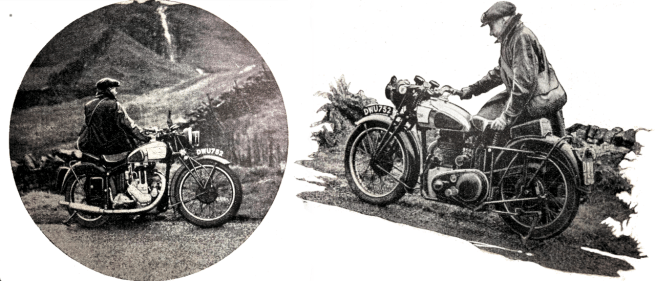
Actually, I was lucky to have the machine at all, for earlier that morning, before daylight, Tester Joe Mortimer had been brought low by someone who had jumped plumb off a moving bus and galloped into his front wheel. Unfortunately, Joe’s knee suffered more than the Panther, which showed only a grazed head lamp rim. From Cleckheaton through the outskirts of Bradford and so over the divide between Airedale and Wharfedale, on a greasy day, is no pleasant start for sampling an entirely strange machine. Nevertheless, I instantly felt at home on the Model 90. As a matter of fact, it was rather uncanny, this immediate feeling of being a part of the machine. Stone setts, stretches of by-pass roads which I know to be appallingly wavy, various upstanding sewer and water-main manhole covers, and so on, just seemed to have disappeared. Yet there was nothing springy or jelly-like about the model—indeed, I think I can truthfully say that while there was never any tendency to be thrown up from the saddle, and no suspicion of any spine-shattering blows, I have seldom been on a machine that felt so firm and ‘solid’. As I rode beyond Ilkley into Upper Wharfedale the rain got steadily worse. Gone were any hopes of browsing in the sunshine at the head of the Dale. The autumn glory of gold and red was still on the trees at Bolton Abbey, where I half-heartedly took a photograph and carried on. The spring frame was so comfortable that I began to think of other things, entered a corner on the deserted highway much too fast, put on the brake hard, and then realised that the brake I had put on was on another machine with the pedal on the opposite side! All I could do was to hold the Panther firmly at the appropriate angle and hope it wouldn’t slide off the adverse camber. We survived! Where mountain rivers are followed closely there are no long straights, and most of the Yorkshire Dales roads have blind or semi-blind corners every two or three hundred yards. Even so, owing to the liveliness of the new model, it was not long before the hamlet of Buckden was reached, where starts the climb of Cray Ghyll to the summit of Kidstones Pass, which drops into Wensleydale. How I had looked forward to this bit of wild country! But the mists swirled over Stake Moss, and the clinging drizzle fell softly and continuously. Still, the waterfalls at the top of Cray were cutting white tracery down the dark limestone cliffs, so, rain or no rain, the camera had to be set up. Then over the top and into Wensleydale. Strange how it contrasts with Wharfedale! Here are massive trees, mossy buildings, and pleasant green gardens—none of Wharfedale’s grey and rock austerity at all, yet it lies only on the other side of a range of 1,500ft hill-tops. Later, becoming somewhat mixed up with much military activity, I turned towards the mountains again, found a resting place before darkness set in, and almost distinguished myself at the billiards table. Next morning was clear, but still wet, as I headed for Nidderdale. On high ground the mist was dense, too; nevertheless, there were one or two chances to hold ’50’ or over for fairly long stretches.
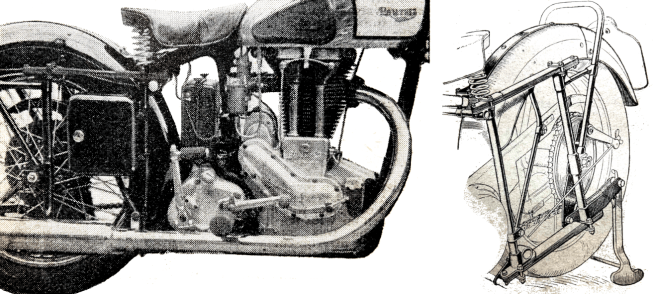
And just as the machine as a whole feels firm and solid so, too, does the new ohv engine. The engine has a plain-bearing mainshaft, and the fly-wheel assembly is very rigid and free from whip, so that there is no clatter or vibration. Acceleration is lively and the pulling power remarkable. For instance, Greenhow Hill, leading from Nidderdale and Wharfedale, and one of the severest main-road hills m Yorkshire (or in the British Isles, for that matter), was climbed in third gear with increasing acceleration from a rolling start. At Greenhow (1,400ft) the mist again brought speed down to 15mph, and so there was no opportunity for fast travel over the long moorland summits. A few more photographs, and then back to Cleckheaton for lunch—wet, muddy, but happy. The tank was topped up and revealed the consumption to have been slightly better than 90mpg. Like most of its breed, the engine did not show an oil leak. To sum up, the Panther spring frame seems to be ‘it’. The model holds the road amazingly, has no fore-and-aft pitch, and feels absolutely solid and in one piece. It does not clash, bottom, roll or dither and has no unequal reactions on the brake, no matter whether the pedal is being pressed softly or hard. The saddle of this particular machine was a shade too high for convenience when at rest, but then Mortimer, who normally uses it, is well over 6ft tall while I am only 5ft 8in. On the road, however, brake, footrest position and controls proved to be excellently located, and this fact, combined with the almost complete freedom from road shocks and the sweetness and docility of the engine, made my trip rather effortless in spite of the weather.
“FOLLOWING A REVIEW of the various most meritorious officially observed tests held this year by the ACU, the Emergency Committee of the ACU Competitions Committee has decided to award the Maudes’ Trophy for 1939-40 to the Triumph Engineering Company for their certified test carried out last February and March. The test, which was of two standard machines taken at random from agents’ premises, consisted of 1,806 miles on the road at an average speed of 42mph (and no preliminary running-in!), six hours at ultra high speed at Brooklands, and, following, a run from Brooklands to Coventry, an official examination for condition.”

“AN EXTREMELY ATTRACTIVE representative of the autocycle type of machine is being made in Hungary under the name ‘Mátra 100’. Although built to scale less than 82½lb and thus avoid taxation, the machine has such features as a two-speed gear box, telescopic forks and telescopic saddle suspension. The Mátra” is fitted with a 98cc two-stroke engine and gear box unit, and develops 3 to 3.5hp. A robust crankcase casting includes the back of the primary-drive case and half of the gear box shell on the off side. On the near side the casting incorporates the back plate of the flywheel magneto and the remaining half of the gear box shell. A cast-iron cylinder and a detachable light-alloy cylinder head are used, and both are deeply finned. Lubrication is by petroil. The primary-drive case forms an oil-bath. The clutch, which is also enclosed in the case, is operated by a lever on the near-side handlebar. A top-feed carburettor, fitted with a strangler, bolts directly on the induction stub at the rear of the cylinder, and the throttle is controlled by a twist-grip on the off-side handlebar. The complete unit fits very neatly into a tubular loop frame, which follows motor cycle rather than bicycle design. There is a single top tube, and the rear forks have welded-on ends. Extremely neat telescopic front forks are fitted, and there is a built-in steering damper. The saddle also has telescopic springing, the saddle post
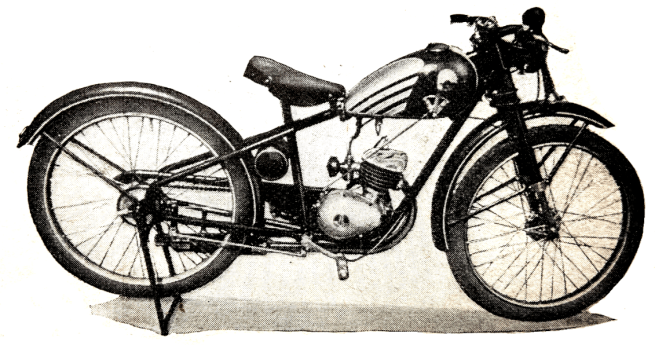
operating on a long compression spring enclosed in the seat tube; the nose of the saddle is pivoted-mounted on a lug on the main frame tube. The single chain drive for both the engine and the pedal gear is ingeniously simple. To the rear of the flywheel magneto on the near side is the gear box driving sprocket; below and slightly farther back is, in effect, the ‘bottom bracket’ carrying a BSA free-wheel operated by the pedals; round these two sprockets and also a fixed sprocket on the rear wheel runs the chain; in this way the additional weight of a set of sprockets and a chain for normal pedalling gear is dispensed with. Obviously, with the Mátra layout the pedal gear ratio is rather high, but the machine is designed as a small motor cycle rather than a motor-assisted bicycle. An internal-expanding brake is used on the front wheel and an external-contracting brake on the rear wheel. Other features are direct electric lighting, central stand, saddle tank, large tool-box, carrier and a chain guard. It is claimed by the manufacturer, Urbach Lazlo VI, Hunyadi, Ter 12, Budapest, that the Mátra 100 has a speed of 40-45mph and that the petrol consumption is approximately 175mpg. Certainly these little machines have given excellent performances in recent competitions. The intention of the manufacturer is to sell manufacturing rights either for the engine or for the complete machine.”
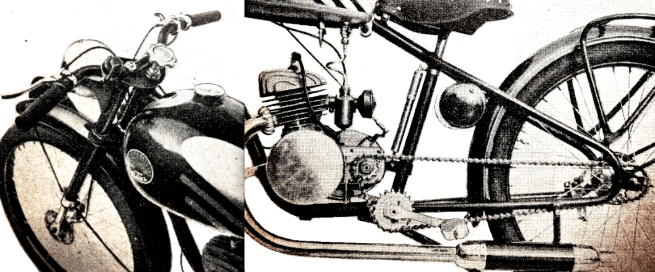
“RED TAPE IS MAINLY an exclusively ‘home depot’ commodity. At one such place they got an ‘issue’ of motor cycles impressed from dealers’ showrooms. The machines had pillion seats and footrests, and as pillion riding is forbidden in the Army the pillion seats had to be removed. But when the riders wanted to take off the pillion footrests they were told ‘No!’ They must not remove structural parts of the machine! So they go about with the use-less ‘steps’ flapping and banging, and scar their ankles on them when they kick-start.”—Wharfedale.
“A SUGGESTION THAT petrol coupons should be made transferable in an emergency has been rejected by the Ministry of Mines on the grounds that the plan would encourage profiteering.”
“THE RAF SQUADRON LEADER who landed his flying boat off Iceland in a fog and, owing to a misunderstanding over the question of parole, returned to England, has taken a motor cycle back with him to Iceland in order to reduce the disappointment of being interned for the duration.”
“A FRESH SIGNIFICANCE attaches to those phrases ‘winter riding’ and ‘all-weather riding’ when a civilian motor cyclist joins the DRs. Even the rigours of the Exeter Trial are apt to pale in the limbo of the past; there may be the equivalent of many ‘Exeters’! I Unfortunately, as an Army DR he is nothing like so well equipped in the matter of clothing as the average civilian unless, of course, he continues to use his civilian riding kit. Many are doing this, though in the fear that sooner or later their temerity will evoke the displeasure of their superiors and, if it does not, there will be difficulty in replacing their stormcoats and waders on their Army pay. Whereas the Army teams in the International Six Days Trial, a summer-time event, had special riding kit, DRs, even to-day, are to be seen in pouring rain wearing only mackintosh leggings, a short mackintosh coat or a great-coat, with or without groundsheet-type cape, and a pair of gauntlet gloves that are by no means impervious to the wet. Considering the magnificent equipment of the Army as a whole, and the knowledge available from motor cycle clothing specialists and experienced motor cyclists, it is surprising indeed that the kit of the Army motor cyclist should remain of the 1914 variety.”
“THE EXPERIMENT of painting New Forest ponies with white stripes as an aid to motorists in the black-out has been abandoned owing to the fact that the foals will not approach their zebra-like mothers.”
“STANLEY WOODS is now a 2nd Lieut in the Government of Eire’s defence services. His job is concerned with the Army’s transport.”

“OF ALL ANNUALS there used to be few hardier than ‘Preparing for the Winter’. Even special numbers were devoted to the subject. The fact was that the motor cycle was far from being an all-weather vehicle. Driving belts slipped, magnetos required special forms of protection, nickel plating needed a protective coat of varnish or grease, frequent treatment of driving chains (a chain seldom had more protection than a guard over the top run) was essential, and even hubs and valve gear required attention. To-day the position is very different. About all that is necessary is to protect the chromium plating or give it a frequent rub-over, attend occasionally to the still largely exposed rear chain, and (in some cases) fit a sparking plug protector. Fashion has decreed large areas of plating—much larger than in the days of nickel. Fashion, too, has prescribed ‘impressive’ plated exhaust systems. Were this ‘showiness’ eliminated and rear chains enclosed in oil-bath cases (an arrangement which has become increasingly popular on the Continent), there would be very little to do to the modern machine to prepare it for the winter months. The motor cycle has long since ceased to be a mere fine-weather vehicle.”
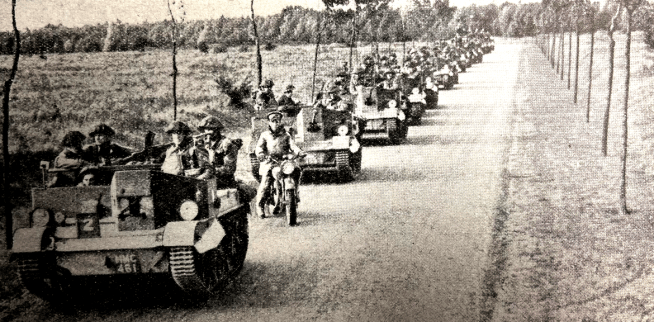
“THE EXCELSIOR RANGE of machines for 1940 again covers all requirements. There are certain curtailments, and one most interesting addition—a de luxe Autobyk fitted with a new Villiers engine. The Manxman models are continued in three capacities—250, 350 and 500cc. There will be no change in the specification of these famous machines, but an interesting point is that each is available with a bronze head, giving a much.. higher performance, at an extra charge of £10 in the case of the two smaller models and £12 for the 500cc job. These are the only four-strokes in the list, and the range is completed by three two-strokes (125, 150 and 250cc), and the well-known Autobyk models. First in the list of two-strokes is the Universal, a handy little ‘go-anywhere’ mount with a 125cc unit-construction Villiers engine. It has direct lighting from a 6-pole 18-watt flywheel set, and there is an independent park battery. Legshields are standard. This model costs £28 ls. The Pioneer has a 148cc Villiers engine. Here again direct lighting and legshields are standard, but in addition this model has a very complete system of chain guards. A separate three-speed gear box is employed. The price is £31 18s., or with separate 6-volt dynamo lighting and a 7in head lamp, £35 4s. Lastly comes the Meritor, of 247cc. In this case the engine has a detachable aluminium head, and the front forks are tubular instead of pressed steel. The price is £39 ls, or with dynamo lighting £42 7s. In the Autobyk class are two machines, standard and de luxe. They are identical except that the de luxe model has an entirely new Villiers engine. This new unit has a detachable aluminium head, a flat-topped piston, two internally formed transfer ports and two exhaust ports. A cast-aluminium expansion box is placed beneath the engine and from this a pipe leads to a cylindrical silencer. Finally there is a detach-able tail pipe. One of the most interesting features of the machine is undoubtedly the spring fork. It has no links, no hinged points and the movement of the fork does not alter the wheelbase of the machine. The fork blades operate in bushed sheaths and their upper ends are joined by a bridge-piece. The sheaths are also joined by a bridge-piece, which carries the steering stem. A long bolt is anchored to a lug on the lower bridge and this passes through a bush in the upper bridge and through an enclosed coil spring above the bridge. It also passes through a recoil spring placed between the two bridges. In action, the fork blades, which, apart from the wheel, are the only un-sprung weight, slide within the sheaths (which are packed with grease) and compress the top spring. They are then returned to the normal position and the lower spring takes charge of any rebound. The tension of the main spring can be varied to suit different loads simply by screwing down the top nut. Dust-covers are provided at necessary points and the sheaths have grease nipples; the sheaths are recessed internally to form a reservoir for grease.”
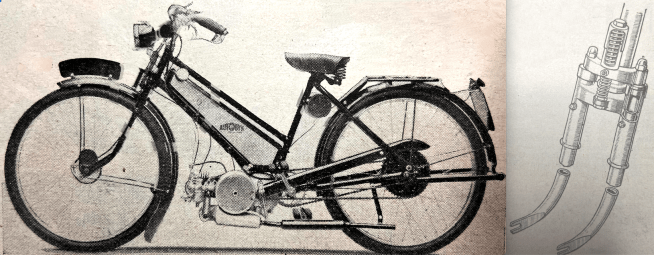
“IN THE NORMAN RANGE of machines for 1940 there are three variations of the already well-known Motobyk auto-cycle, and also a 125cc lightweight motor cycle. The standard Motobyk model has the 98cc Villiers engine-clutch unit fitted in the familiar horizontal position beneath a sturdy frame. Ignition is by flywheel magneto, which also provides current for head and rear lamps when the engine is running; for parking, the turn of a switch lights a separate low-consumption bulb from a dry battery carried in the head lamp. Lubrication is by the petroil system. Both front and rear brakes are of the internal-expanding type and are of larger diameter than is usually found on machines in the autocycle class; both are cable-operated from the handlebars; a special anti-splash device is incorporated in the front mudguard. There is a serviceable rear carrier…The specification of the Norman lightweight motor cycle is very comprehensive. The machine has a Villiers 125cc two-port engine in unit with a three-speed gear box with clutch and folding kick-starter; the primary drive is totally enclosed in an aluminium oil-bath and the cylinder has a detachable aluminium head. Ignition and lighting are by the latest Villiers 6-pole flywheel magneto, which gives 18-watt direct-lighting from a 7in head lamp equipped with a dipping beam double-filament bulb and stand-by dry battery. A strong loop frame is employed, and the front forks are of pressed steel with a central compression spring. The 1¾-gallon saddle tank is of attractive shape and incorporates an oil measure in the filler cap…legshields are standard equipment, and the design includes such refinements as a spring-up rear stand and adjustable handlebars. The price is £28 13s 9d; a Smith’s speedometer is an extra.
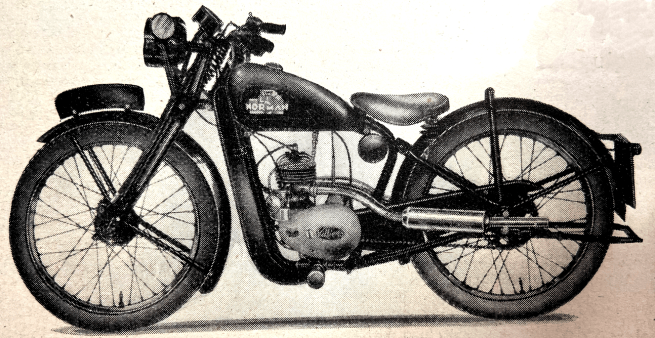
“A NEW DE LUXE Villiers Junior engine, based on the existing 98cc unit which has proved so successful in many makes of autocycle, has just been introduced…the ‘hump’-type piston has given way to a flat-top type, and the cylinder porting is arranged on the lines of the earlier flat-top piston Villiers engines. There are two exhaust ports on opposite sides of the cylinder and four transfer ports. These latter are in pairs. The twin streams of gas from one pair converge and meet the converged stream from the other pair at the cylinder head. The effect is to help sweep out the burnt gas of the previous charge.”
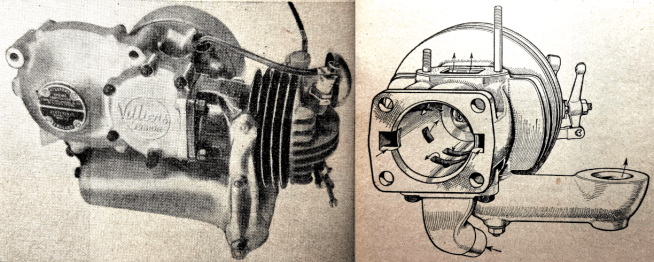
“AN EXTREMELY INTERESTING 750cc side-valve 50° twin is being marketed for 1940 by OK Supremes. The engine is a JAP with detachable cylinder heads, a bevel-gear drive for the Lucas Magdyno and a cam-type engine-shaft shock absorber. The design of the machine is straightforward, but extremely well carried out. Among the features are a heavyweight Burman four-speed foot-control gear box, Neoprene clutch inserts, Ni-Fe (nickel-iron) battery, such as is specified on Army motor cycles, 7in brakes and an Amal carburettor with air-cleaner. Multi-plate shock dampers are fitted to the heavy-type central-spring front forks. The tyres are 4.00-19 rear and 3.25-19 or 3.25-20 front. Transmission is, of course, by chain—Coventry chains, the front one in an oil-bath case. The machine illustrated, has a matt finish. Civilian-type finishes will, of course, be available. The makers are OK Supreme Motors, Warwick Road, Greet, Birmingham, 11.”
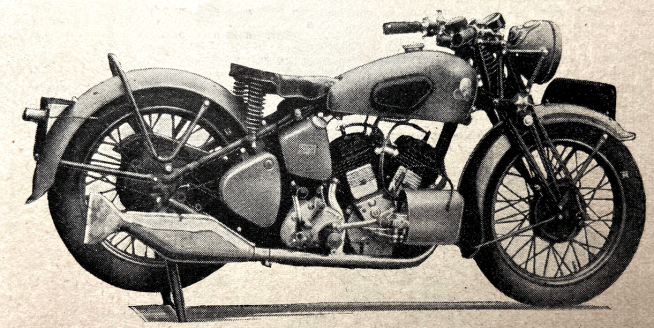
“I ADVISE MOTOR CYCLISTS to mind their step when entering the personal zone of the wartime cyclist. A very small cycle shop in a very small town I know sold 15 new push bikes within the first week of petrol rations, because so many folk decided that what with restricted petrol, 7s 6d in the pound income tax and increased car tax, a car wasn’t worth running. The same shop will probably sell 30 cycles round about December 31st, when the annual car licences expire. And most of these new or revived cyclists are even more perilous than the normal female of the species. They give no signals, they wobble fearsomely, and they are even apt to lose control of their wheels downhill. I have already narrowly escaped violent embroglios with hosts of them. Yesterday, for example, when meekly ‘twentying’ on my new two-stroke, I was about to overtake one of them up a hill of about 1 in 17 with a right-hand fork. As he gave no signal I rashly assumed that he was intending to continue straight forrard. Not a bit of it! He gave no signals because he was hauling heavily on his handlebars with both arms to assist his ‘stand-on-the-pedal’ climb. And just when he turned sharply across my bows for the fork his right leg backfired, so to speak, on a dead centre, and he fell off flat under my head lamp. I effected a marvellous skid-swerve and missed him.”—Ixion

“IN THE WEST YORKSHIRE group area there is an excellent bit of high, open country within a short run of the Leeds and Bradford districts. It has become a regular meeting place for sporting riders at week-ends in these days of short commons in the fuel department. This venue, the Surprise View, Otley Chevin, is adjacent to those spectacular crags, woods and hillocks that have figured in the Ilkley Grand National of recent years. Within the private ground adjoining the Surprise View Café there is enough rough-stuff for half a dozen trials, all within a square mile or so. These impromptu meetings led to the idea of the Bradford MC organising a miniature trial last week-end, it to be run on Scott Trial lines, ie, observation and time, with ‘standard time’ set by the fastest competitor and a one mark penalty for each ten seconds beyond that time. The course was over six three-quarter-mile laps, four and a half miles in all, with nine observed sections. The start was at 12 noon in order to allow everybody to finish and get home before black-out descended. In the usual irrepressible way of the Bradford Club the title of the trial parodied the official title of the Scott Trial, for the announcement was the ‘A Hitler Memorial Trial’. The naming of the awards, too, was topical, with a reference to the ‘International’ exploits of the Bradford Club’s own Allan Jefferies for the premier award was said to have been ‘pinched at great risk from the Bomb Cellar by the Captain.’ The only opportunity they missed was that for each ten seconds late the penalty should be one Reichsmark! There were 28 entries in the event, but one of the number, Frank Varey, elected to take an observed point in preference to riding, although it is doubtful if be was any more comfortable by so doing! The wind blew a gale. And there was everything in the weather line—sunshine, rain (ordinary), hail, a marvellous rainbow across the flooded fields of Wharfedale, and then rain again (a deluge this time!). Spectators and observers had a pretty thin time and many found it more comfortable to sit on the wet grass in the shelter of a 12in bush than to stand up to the whistling breeze. Allan Jefferies was the organiser, and he explained away the protests about route-marking (which some voiced loudly after a practice lap) by the statement
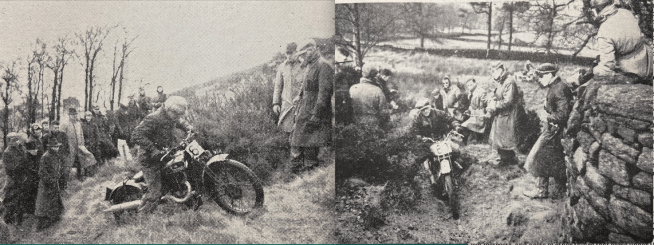
that ‘at crack of dawn’ he was blown over a precipice and his bundle of direction cards was wafted ‘like a leaflet raid’ all over Pool and Otley in the valley below! Anyhow, if some people strayed it did not matter much because the time marking had to be ignored and the event became ‘observation only’. The terrific rain of the previous night had made some of the sections so hopeless that minutes were taken instead of seconds to struggle up; indeed, the estimated 12 minutes per lap became nearer 25 minutes, even for the experts. As a matter of fact, it was not possible to distinguish between the riders very much—all footed and failed somewhere or other, and the only difference was that the stars wasted no time in sorting themselves out. John Midgley (Royal Enfield), Ken Wilson (Matchless), Howard Wood (Triumph), and Charlie Helm (Ariel) stuck fairly well together and seemed likely to have the honours among themselves. But then Wood seemed to fall behind somewhat (or else ran so far ahead that he appeared to be missing!). Helm, too, tried a new way up the worst and steepest section, only to find that it didn’t work, and he fell behind. C Parker (Triumph), E Pearson (BSA), R Wilkinson (Panther), and T Wortley (Triumph) made up the early finishers, although there were several more who managed to scramble round within the half-hour of the first man home. Incidentally, the distance was cut from six to four laps because, according to Allan Jefferies, ‘we don’t want any perished observers on our hands’. The riders mostly were disappointed when they were stopped, and this in spite of nose-dives into rocks and mud, lost footrests, and hosts of other things that come under the heading of ‘we do have fun’. When the results were worked out it was found that only four competitors had lost fewer than 100 marks, and that the best performance had been made by R Wilkinson (Panther) with a total of 73. Elimination of the time factor possibly affected the final placings slightly, because the leaders on time had dropped many more marks than Wilkinson, who had ridden, for the most part, with care rather than dash. RESULTS. Hitler Beer Jug (best performance): R Wilkinson (Panther); marks lost, 73. Lord Haw-Haw Gobstopperlet (second best): K Wilson (Matchless); 80. Goering Belt (third best): J Midgley (Royal Enfield); 87.”
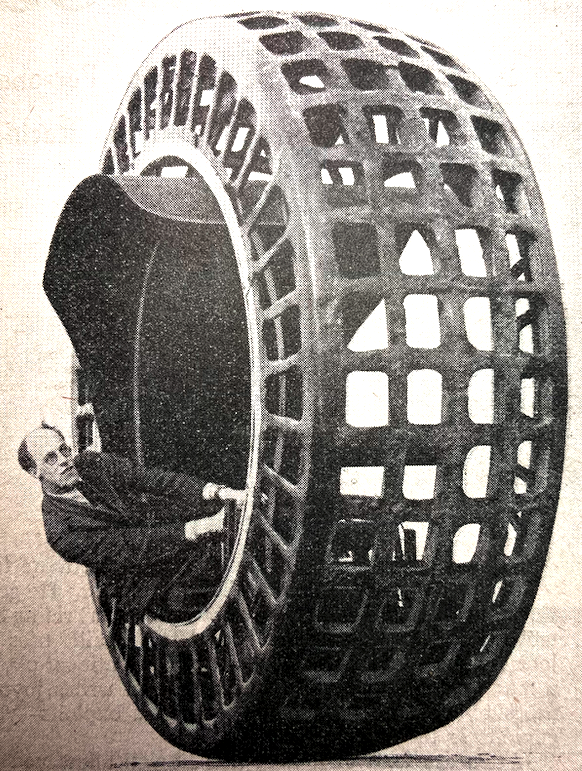
“WAR, IT WOULD SEEM, has some points in its favour. After to-day, thanks to the present war with its black-out, it is illegal to park at night on the wrong side of the road. To motor cyclists even more cheering is the news that at last they are to have the boon of short-period licences. No longer will the motor cyclist who buys a machine in, say, December have to pay a full quarter’s licence. No longer will dealers find that the bulk of their sales are concentrated around Quarter Day. For years we have pressed for this reform. The motoring organisations, too, have returned time and again to the attack. What has caused the change is the Government’s desire to help the many motor cyclists at the Front. Few of those on home leave would have been able to license and insure their machines on their Army pay.”
“I READ WITH INTEREST your leading article on DR’s clothing. I would like to say that until very recently we had only greatcoats and groundsheets to protect as from the elements. We were then issued with short mackintosh coats and leggings. As we have to work for as much as 48 hours at a time without even taking them off, and they get wet through in a remarkably short time, we don’t have such an easy time as the majority of fellows think. This is the first letter I have written to your paper, although I am a constant reader, and also a member of the Aldershot MCC.
Don R.”
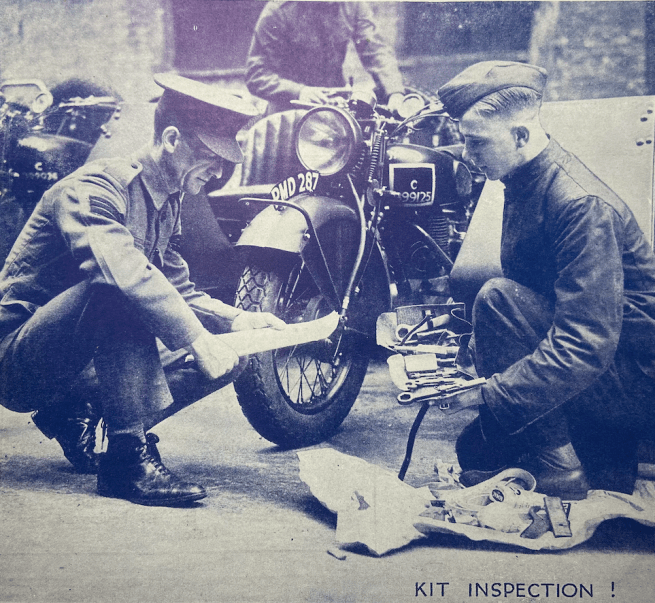
“TRAFFIC SIGNALS at Ashton-under-Lyne are now fitted experimentally with masks which are closed down at night to show slots and opened in the daytime to give full lens view.”
“THAT WORK SHOULD at once be started on the Channel Tunnel was urged at a meeting of Deputies held in Paris recently. The idea was first discussed in 1802.” “
“BICYCLE THIEVES have been busy in the Metropolitan Police area during the past few weeks. The number of thefts has in-creased by nearly 100%, most of them taking place in the black-out.”
“NEARLY 100 RIDERS have already volunteered for the Motor Cycle Messenger Corps inaugurated by the Chief Constable of Liverpool for use in air raids. A scheme has been arranged to assist those who own suitable machines which are at present neither taxed nor insured.”
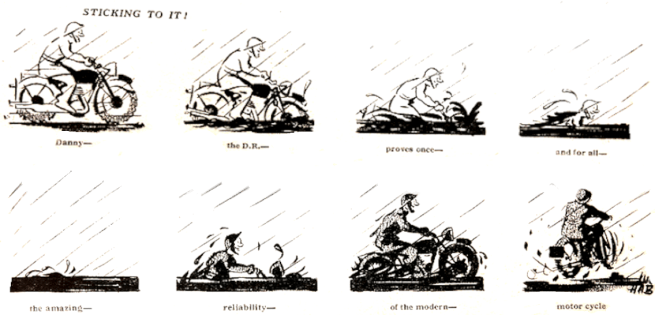
“THE RAC WILL AGAIN issue its usual winter reports concerning road and weather conditions in various parts of the country for the benefit of members. However, as information concerning the whereabouts and density of fog might be of value to enemy aircraft, all reference to fog will be omitted.”
“SMALL REFLECTORS are being used in Leeds for marking the middle of roads; over 80 miles have already been completed.”
“THE OBJECT of a recent Sunday run of the Dalmarnock MCC was to visit one of their members who is serving in the Army.”
“A SCHEME to install red lights in the bases of lamp standards in the main streets of Manchester is in danger of being shelved because of the cost—roughly £1,000 .”

WAR OR NO WAR, the Blue ‘Un published its annual Buyers’ Guide, preceded by a summary of the 37 marques comprising the British motor cycle industry at the outbreak of World War 2: “AER: A Twin Cylinder air-cooled two-stroke of 350cc and a 250cc Villiers-engined two-stroke comprise the AER range. Both are well thought out, well-made machines; with everything of the best. AJS: Few makes have a larger overseas trade than the AJS. The range is wide—from 246 to 990cc—and all are true-quality machines of first-class appearance. Except for the 990cc models, which have V-twin side-valve engines, the 346cc ohc racing machine, and the 498cc single-cylinder side-valve, the list consists of ohv singles (all vertical-engined), with totally enclosed push-rod operated valve gear. The two big twins, which are specially designed to, heavy side-car work, are similar except that the 40/2A is an export model with footboards, long touring handlebars, a left-hand gear change, and foot clutch This machine can, if desired, be fitted with a three-speed and reverse gear box.” AJW: Three machines form the AJW programme for 1940, two with Villiers flat-topped piston engines of 250cc, and the third a 490cc ohv
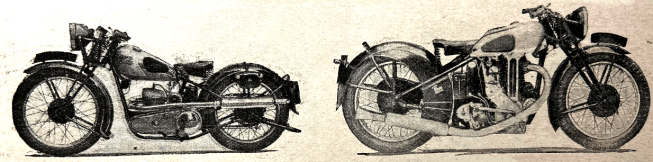
JAP-engined model. Duplex frames of I-section steel are employed. Ariel: While pride of place in the Ariel range is naturally given to the 599 and 997cc ‘Square Fours’, the single-cylinder models are outstanding examples of first-class design and workmanship. Among the ohv models the 497cc Red Hunter is notable for the fact that, although one of the fastest standard production 500s, at low speeds it has the gentility of a potter-bus. Red Hunter models of 249. 347 and 497cc are available, also side-valve tourers of 497 and 598cc. All models in the range other than the 250s are available with the ingenious. well-proved Ariel rear springing. BSA: No BSA programme appears in the Buyers’ Guide. The reason is not that this famous factory has discontinued making motor cycles. The many machines to be seen finished in khaki effectively dispels any such suggestion. The announcement of the range for sale to the public is to be made next month. BROUGH SUPERIOR: Designed for real riders by a man who is himself an exceptionally hard rider. The four machines are the 990cc SS100, which is an extremely fast ohv mount, a 1,100cc side-valve of remarkable docility and great power, and two 990cc side-valves. All except the specially low-priced 990cc side-valve have plunger type rear springing.” CARLTON: A Sturdy, well-made lightweight of 125cc, the Carlton is manufactured by a very experienced cycle concern that has achieved considerable success with it in overseas markets. The engine-gear unit is the well-known Villiers, and has three speeds with hand change. COTTON: Few machines have gained for themselves such a continuous reputation for magnificent steering as the Cotton, with its famous multi-tube triangulated frame. For 1940 there are no fewer than 15 models, two-strokes of 125 and 150cc, side-valves of 250cc, and ohv models of 250, 350, 500 and 600cc. The four-stroke engines are of JAP manufacture and the two-strokes, Villiers. COVENTRY EAGLE: An autocycle, two two-strokes and a couple of four-strokes form the Coventry Eagle range. The autocycle is a simple sturdy machine of the thoroughly sound type that might be expected
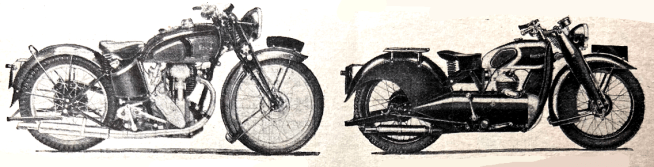
from a factory with such wide experience of bicycle manufacture. The engine is the well-known Villiers Junior. Pressed-steel frames of the well proved Coventry Eagle design are fitted to the two larger two-strokes. Tubular frames are, however, employed for the 350 and 500cc four-strokes. CYC-AUTO: The Cyc-Auto for many has its own special appeal. A 98cc Scott two-stroke is fitted—the proprietor’s are the makers of the famous Scott water-cooled two-stroke twin. The engine is mounted low down in font-of the bottom bracket and drives the back wheel by a reversible worm gear and chain. DOUGLAS: One Douglas motor cycle is on the market. This is, of course, a horizontally-opposed twin, a side-valve of 584cc. The design is on the familiar Douglas lines with the cylinders set in line with the frame and the valve gear enclosed in quickly detachable covers, on the off side and readily accessible. A four-speed hand-controlled gear box is fitted. EXCELSIOR: The Excelsior factory is unusual in that it has earned fame in two different spheres—for its Villiers-engined lightweights and for its very fast superb-steering overhead-camshaft sports and racing machines. While the present is not a time for supplying enthusiastic amateurs with racing machines of the type that can be the first un-blown machine home in the Lightweight TT, the famous Manxman range has not been dropped. The racing models, yes! but there remain three ohc Manxmen—of 249, 349 and 498cc— all based on racing experience and with cradle frames, Girling brakes and clever enclosure of the hairpin valve springs. At the other end of the scale come two well-made autocycles, one a new de luxe model with the recently introduced flat-topped piston Villiers engine. To add to the comfort an ingenious plunger-type front fork has been standardised on the de luxe machine. Three two-strokes, all with Villiers engines and of 125, 150 and 250cc, complete the range. FRANCIS BARNETT: Two-stroke lightweights of marked ingenuity in design once again constitute the Francis-Barnet range. Outstanding in the list are the Powerbike and the 250cc Villiers-engined Cruisers, which have probably the most complete mudguarding of any machine on the market, plus enclosing shields for the engine and gear box that enable the machine to be hosed down and, in addition, eliminate all possibility of oil reaching the rider. In the opinion of many this unique machine, which has eroded remarkably successful, points the way in which motor cycle design will trend. The enclosure employed in the autocycle—the Powerbike—is on different lines, but extremely effective, free from drumming and setting a fashion which is likely to become widespread. GROSESPUR: This is a well-made 125cc Villiers-engined lightweight with the engine in unit with a three-speed gear. Lighting and ignition is by a Villiers
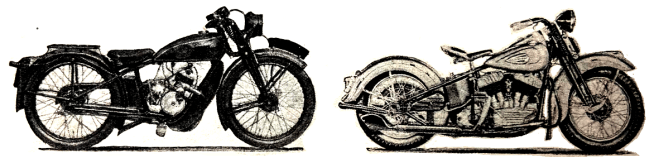
flywheel set. A carrier and legshields are standard. HARLEY-DAVIDSON: Perhaps the most spectacular feature of the Harley-Davidson programme for 1990 is the unusually large tyres which are available at option, 5.00-16 Firestones specially produced for motor cycle use. The machines themselves are little altered. As usual the famous United States factory is concentrating upon big twins: two 750cc V-twins with side-by-side valves—one with cast-iron cylinder heads and the other light alloy —a 1,000cc ohv V-twin, and two even larger side-valve twins, of 1,200 and 1,300cc.” HEC: A number of improvements have been made to the HEC autocycle. On the cycle side there are such alterations as a larger and stronger tank, which now holds 1⅛ gallons, bigger brakes and a spring-up rear stand. The engine is a two-stroke of 80cc with a detachable aluminium head that facilitates decarbonisation. JAMES: For 1940 the James Company is again concentrating upon two-stroke machines, from two auto-cycles’ to a flat topped Piston machine of 249cc. In between are well-made lightweight motor cycles of 98, 125, 148, 197 and 247cc. All have Villiers. engines. LEVIS: Sporting ohv machines with many ‘riders’ features’ top the list in the Levis range. This make has gained a name for itself for ‘hand-made’ specialist productions. Four sizes of ohv model are available: 247, 346, 498 and 592cc. The 350 and 500 can be supplied in competition trim. Both are available with the Levis hydraulically controlled plunger-type springing, which automatically accommodates itself to the load. The range is completed by a 346cc side-valve and two 247cc two-strokes. All engines are of Levis manufacture. MATCHLESS: As their names Clubman and Super Clubman imply, six of the nine Matchless machines specified in the Buyers’ Guide are de-signed with the sporting
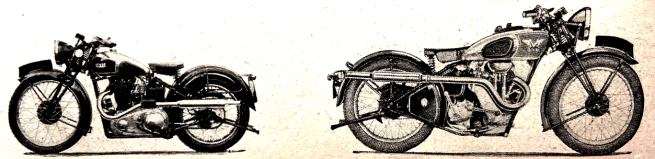
rider and those who like sporting lines specially in mind. The sizes are 246, 347 and 498cc, and all have push-rod type ohv engines with positively lubricated enclosed valve gear. Two coil-ignition machines are available—side-valves of 246 and 498cc. There is also the 990cc Sports Twin, which is a luxury-type fast solo V-twin or an excellent machine for use with a single-seater sidecar. MONTGOMERY: It is no exaggeration to state that of the spring-frame machines tested over the past 12 months the Montgomery was quite one of the best steering and most comfortable. For 1940 the spring frame is fitted to three JAP-engined ohv four-strokes of 250, 350 and 500cc. A series of two-stroke lightweights of 98, 125 and 200cc is also included in the list. MORGAN: It is difficult to conceive a more sporting type of vehicle than the Morgan three-wheeler. Three models are produced: A very smart super-sports machine with a water-cooled 990cc ohv engine, a sporting two-seater with a 1,172cc four-cylinder and a. four-seater with a 933cc four. The two latter are water-cooled side-valves. NEW GERRARD: Designed and marketed by JA Porter, who won the 1923 Lightweight TT and the 1924 Ultra-Lightweight, the New Gerrard has worthy ancestors. The machine is a 348cc ohv mount of sound, straightforward design. A four-speed foot-change gear box is fitted. This has three fairly close ratios and an emergency bottom. NEW IMPERIAL: 250, 350 and 500 are the sizes of the New Imperials listed for 1940. All are ohv singles with the four-speed gear box in unit with the engine. The primary drive is by helical gears. In the case of the DL or de luxe models, the New Imperial pivot-action spring frame is standard. NORMAN: Four Norman machines, three ‘Motobyks’ and a lightweight motor cycle are being manufactured. The engine used in the autocycles is the new de luxe Villiers. Standard, de luxe and carrier models are available. The 125cc Villiers-engined lightweight is of the engine-gear type and has a sturdy .loop frame, pressed-steel forks and legshields. This machine can be supplied with the 98cc engine if desired. NORTON: Single-cylinder
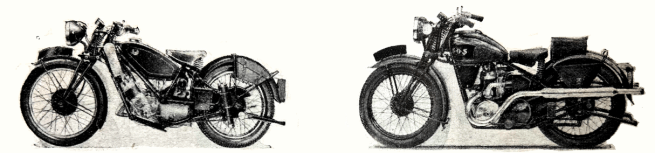
machines of 340, 490, 596 and 683cc constitute the Norton programme. A most important model at the present time is the famous 490cc side-valve introduced some 15 years ago—a firm favourite from its inception and now in its modern form to he seen here, there and almost everywhere finished in a drab, mudlike shade of khaki. Counting this, the famous 16H, the civilian edition. Nortons announce a complete range on similar lints to that of last year. There is the 633cc side-valve Big Four, which makes a particularly lusty sidecar machine, single and twin-port ohv singles of 348cc, two similar ohv jobs in the 490cc Model 18 and the 596cc Model 19, a cradle-frame 490cc ohv machine in the ES2, two ohc standard machines—the 348cc CJ and the 490cc CS1—and the famous super-sports ohc Internationals, 348 and 490cc. The well-proved spring frame ran be fitted to the Internationals and the ES2, the other cradle-frame machine, at an additional cost of only £7 10s. OEC: Rear-wheel springing is standard throughout the OEC range. Three models are available: the 350cc ohv Cadet, the 500cc Commander and the 500cc Commodore. All have single-cylinder Matchless-AJS engines with fully enclosed valve gear and an extremely smart appearance. Rear springing is of the plunger type with friction shock absorbers. The Commodore has a hairpin-valve-spring, high-performance engine and a most interesting braking system with two Girling brakes per wheel. OK SUPREME: As usual, the makers cf the OK Supreme list a wide variety of machines. An innovation for 1940 is a most attractive 750cc side-valve with a JAP-engine. The programme starts with the Flying Cloud range. which consists of a 246cc side-valve and a trio of ohvs of similar size. Next come four 350s, one a sidecar machine. two ohv sports models in the 347 and 497cc Gladiators, and lastly a standard-type 497cc ohv Dominion and a very ‘hot’ racing 350, the 348cc ‘Alcohol Special’. PANTHER: Designed by Mr Granville Bradshaw, the new Panther spring frame consists of four sets of leaf springs, two on each side of the rear wheel. This new frame is available on three models: a new 598cc side-valve, and 498 and 598cc ohv models. For 1940 all models are on orthodox lines with normal types of frame, and in the case of the new models, vertical engines.” RAYNAL: Two autocycles form the motor cycle side of the programme of the Raynal concern. The power unit is the well-known Villiers Junior. ROYAL ENFIELD: While the range has been reduced to seven models, there are machines for almost every conceivable purpose. At the lower end of the capacity scales comes the recently introduced and very economical 125cc two-stroke. It is a true lightweight, for it weighs only some 120lb. Next come a 248cc side-valve that is a glutton for hard work—a member of The Motor Cycle staff has used one of these models for two strenuous Continental tours—and three well-mannered ohv singles of 248, 346 and 499c.c. The programme is completed by a 570cc. side-valve which is sold as a completely equipped sidecar outfit, and a 1,140cc twin-cylinder side-valve which is used in a number of parts of the globe as a
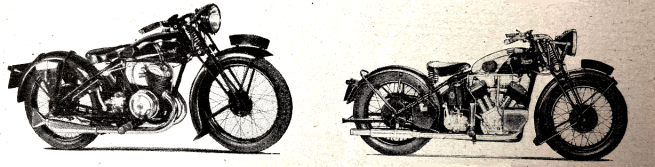
police sidecar outfit. SCOTT: Few, if any, motor cycles turn their devotees into such enthusiasts as this famous water-cooled twin-cylinder two-stroke. For 1940 the machines listed are all of 596cc—two Flying Squirrels, one with a rigid frame and the other with plunger-type rear springing, and two Club-man’s Specials with the same difference. The latter are, of course, the super-sports editions, for which the makers claim a. maximum. speed of 85-90mph as against 75-80 for the Flying Squirrels. Among the features of the Clubman’s Special are a large-bore racing-type Amal carburettor, a small front tyre of ribbed pattern, and extra heavy central-spring front forks. A three-speed gear box is fitted. This last has a remarkably quick foot gear-change and ratios that give the impression of showing up the famous twin two-stroke at its very best—and an enthralling best, too. SOS: The makers of the SOS are specialists. All 12 models in the range are single-cylinder two-strokes of either 249 or 346cc. Some are air-cooled, but the majority, a point unique among present-day two-stroke singles, have water cooling. Outstanding among the latest machines is the low-priced 346cc water-cooled Magnetic. This is a coil-ignition machine with an SOS-Villiers engine, a three-speed gear box with hand or foot operation at option. SUNBEAM: ‘Designed to an ideal’ is a phrase that can aptly be applied to the Sunbeam range. One side-valve (of 598cc) and nine ohv models are listed. These last, which are of 246, 397, 498 and 598cc, are of high-camshaft design with the camshaft and Magdyno driven by single Weller-tensioned chain. The result of this s and the care taken in the design and manufacture of the whole is a series of power units remarkable for their silence and smooth-running. Effective plunger-type suspension is fitted to three ohv machines, 347, 498 and 598cc. TRIUMPH: The high-spot in the Triumph Programme is undoubtedly the Speed Twin in its new form. In appearance there is little obvious change, barring the adoption of four-gallon tank with the kneegrips recessed so that the rear end is not uncomfortably wide. In behaviour, however, there is a vast difference. The cause is the new steering-head angle and fork geometry—standard on the Tiger 100 twin introduced last year—and the new forks which have tension-spring dampers and a soft action that ensures admirable road-holding. Similar forts are fitted to the high-compression and even faster Tiger 100. All machines in the range, side-valve and ohv, have received very special attention in the matter of fuel economy. VELOCETTE: Except for the temporary deletion of the famous racing model, the KTT, the Velocette programme is as large as ever. These- well-designed, magnificently made machines comprise the four-speed foot-change 250cc GTP two-stroke, 248, 349 and 495cc high-camshaft ohv models and two ohc mounts, the KTS and KSS with cylinder heads of light alloy with, inserted valve seats. An unusual and important point in the design of these famous black-and-gold machines is the arrangement of the primary drive inside the secondary which results in exceptional crankshaft rigidity. All models are sold completely equipped, the prices including even pillion seat and pillion footrests. VINCENT-HRD: Spring frames of pivot-action type, two brakes per wheel and ‘semi-ohv’—high-camshaft—engines are standard throughout the Vincent-HRD range, a trio of machines famed for their steering, road-holding and safe speed. As a model the Rapide, the husky 998cc V-twin which has often proved itself capable of lapping Brooklands at around 110mph in the hands of private owners, is perhaps the most outstanding. While

mighty in performance the machine is easy to handle both at speed and on corners. Tho two singles, the Meteor and the Comet, are similar except that the latter is a super-sports job. Each machine has wheels that can be removed in under a minute—The Motor Cycle has watched it being done in 45 seconds. WOLF: Villiers-engined lightweights of 125, 147, 148 and 249cc constitute the Wolf programme. The 125 is of the engine-gear unit type and is a simple, well-made machine with pressed-steel front forks, twin exhaust system and legshields. A somewhat similar machine is the 147cc WA4, which costs £27 11s 3d, as against £27 for the WA10. The gear box is, however, separate and has two speeds. The 148cc models have the long-stroke Villiers engine and three-speed gear boxes and are on less simple lines. The higher-priced model has a plated tank and plated wheel rims. A loop frame is fitted to the two 250cc machines, which are excellent examples of first-class lightweight two-strokes. The difference in the prices is accounted for by the cheaper model having smaller tyres, petrol lubrication, pressed-steel forks, black silencers, non-valanced mudguards and a simpler type of single toolbag. ZENITH: Five JAP-engined machines comprise the Zenith list for 1940. Two have ohv engines—the 250 and 500cc models—and the remainder are side-valves of 600, 750 and 1,100cc. The two last are, of course, V-twins. Design is on sound, straightforward lines with four-speed, foot change gear boxes, single-spring front forks and all the fittings of the best.” The Sidecar Buyers’ Guide listed Bowser, Dornas, Garrard, Great Portland, London, Pride and Clarke, Sandum and Watsonian.
“SINCE THEY ARE ‘necessaries’, perhaps the most important of all the latest fittings are head-lamp cowls. Lucas, Feridax, Middlesex, Dymlite and Hughes Motor Fitments all offer first-class examples of the official type. For auto-cycles there are special miniatures offered by Meeten’s. Autocycles are fast being catered for in a number of directions. S Smith and Sons have a 40mph speedometer at only 19s 6d; James Grose, an expanding vulcanised-fibre valise for carrier attachment; Harwils, new brake hubs, one with a special no-pawls, non-clicking free-wheel; and ‘Bemo’ inexpensive cycle-type bulb horns. Among the motor cycle clothing firms the chief products are the well-proved favourites such as the Stormgard, the Beacon suits and Beacon waterproof ‘Thornproof’ mitts, Brooks and HMF handlebar muffs, the Belstaff range of coats and those hard-wearing S Lewis hood-twill coats. Pride and Clarke have an exceptionally wide
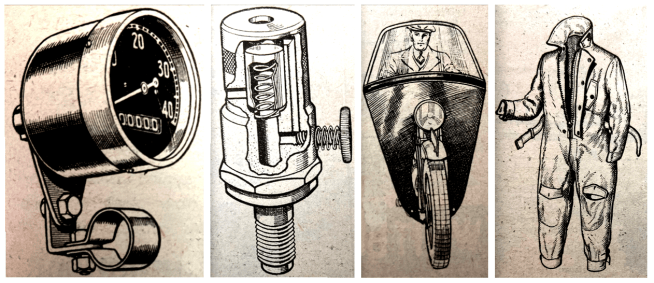
range of gloves as well as other riding kit, and Marble Arch Supplies an interesting new light-weight flying suit, waterproof and selling at the remarkably low price of 35s. For waterproofing leather gauntlets and the like there is JB Brooks’ ‘Proofide’. Handlebar screens of particularly sound construction are offered by Beta, Wilbeck and Bowser. For engines there is little new. KLGs, however, have reintroduced their KS5 mica-insulated 18mm plug in a new and even better form at 6s, Lodge’s supply very efficient waterproof plug covers as well as, of course, their world-famed plugs, and John Bull produce inexpensive rubber plug covers. An interesting Feridax innovation for motor cycle use is the Cox petrol economiser which embraces a cone-shaped atomising gauze and fits at the carburettor flange. Bowdens and James Grose offer handlebar-controlled extra-air valves, and there is the novel automatic Duo Bi-pass extra-air device made by Clarence R Foster. Piston rings, which, in view of petrol rations, are more
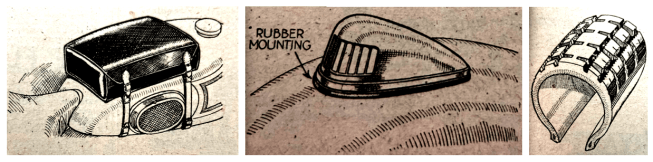
important than usual, are the Wellworthy ‘Simplex’ and other compression restoring rings, such as the Bricoflex. Tyre research and development, as Firestones remark, are continuous and the results reflected in the latest products. A new and most interesting tyre is the Dunlop ‘Fort’, with its rows of skid-preventing teeth at the sides of the outer studs; this tyre has a large tread area for long life and is well rounded for good steering. Avon tyres have a novel insurance against damage. Among tools there are Terry’s gudgeon-pin removers and excellent ohv spring compressors which will safely exert a pressure of 2501b; also King Dick chrome-steel ring spanners, and a useful carbon scraper from Godfrey’s. That ever-useful Bosco cylinder black can hardly change; the same applies to the Lewis replacement grips; nor is there any change in those already extremely easy-to-tune range of Amal carburettors, or in Burman and Albion gear boxes. Goggle design, however, includes a most interesting innovation in the form of a new Luxor (EB Meyrowitz) goggle, which has a magnificently wide vision and represents what is probably the most luxurious goggle ever produced.”
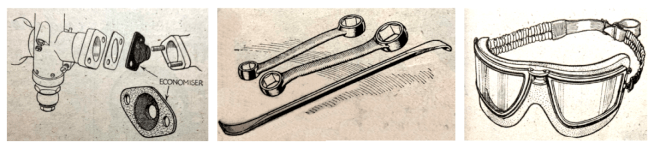
“IN SPITE OF the restrictions imposed by war, club life, on the sporting as well as the social side, is still very much alive…As was only to be expected, the outbreak of hostilities caused a certain amount of chaos in club organisation —many members were called to the Colours or took up Civil Defence duties, others were evacuated with their businesses, while over all hung the uncertainty about by the introduction of petrol rationing. Now the tide is on the turn; in all parts of the country clubs have mustered their forces to carry on the great game. The result is to be seen in the announcements of social events and of trials and scrambles—necessarily of a restricted nature—while later on (who knows?) there may even be miniature road or grass-track races, all affording that healthy recreation essential to tired workers. To outsiders the revival of club life in the present circumstances may seem little short of a miracle. Actually, it can be explained in a single word—enthusiasm. Enthusiasm has always been the life-blood of club life and motor cycle sport in general, and it will take something more than a war to destroy it.”
“A NEW SIDECAR has been produced by the famous Watsonian firm, and there is no dearth of ideas in this particular sphere. It is known as the Super Saloon de Luxe and is mounted on the flexible-wheel, G22 chassis. The body has graceful flowing lines, while the mudguard design and wheel housing add to the streamline appearance. In the sloping tail is a roomy locker fitted with a Yale lock. The upholstery is luxurious; there is an unusually deep seat, which will accommodate an adult and child, and a comfort able backrest. Pockets are provided on each side of the body and the sidecar can be supplied with speedometer and clock, the former driven from the sidecar wheel. Other ‘luxury’ features are a safety-glass screen which opens, a sliding off-side window, and grab-straps in the interior of the body. The front half of the roof is made to roll open if desired. The rear part of the head is fixed and dummy hoop-irons add a note of distinction. There is an interior light, a holding bar above the mahogany dash and glove box.”
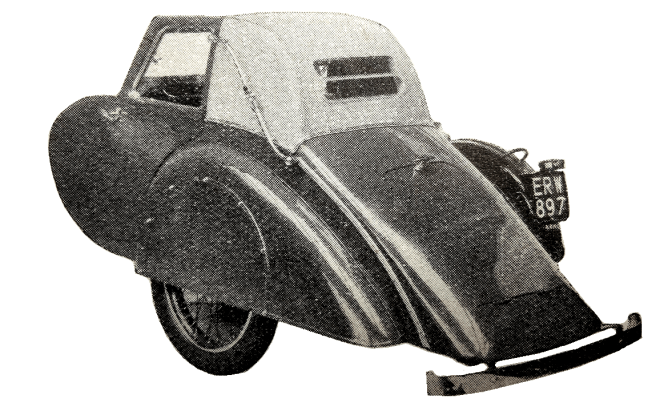
“MEMBERS OF THE FORCES desiring to use their motor cycles during the leave period are advised by the RAC to arrange for a friend or a member of their family to deal with the necessary details—licensing, insurance, petrol rations, etc—before the leave actually starts. Where this is found impossible, the RAC offers to attend to matters on the individual’s behalf. Fuel that will allow a mileage of approximately 300 over and above that obtainable on the basic ration is now being granted those on leave from the British Expeditionary Force.”
“‘MERELY CUT OFF the rear forks and rear stays just behind the seat pillar of the bicycle frame and attach the unit…’ Thus runs the somewhat surprising instructions for fitting the Mead Ranger Power-Cycle, a new American-made unit for converting bicycles to autocycles. In fact, the instructions are probably simpler than they sound, for the complete unit, comprising a 1½hp four-stroke engine, countershaft, kick-starter, fuel tank, rear wheel, foot-rests, and luggage compartment, is carried in a strong sub-frame that is merely attached by U-bolts to the seat pillar of the bicycle at the top, and at the bottom is held by a single bolt that passes through the bottom bracket. The drive is by means of a rubber belt to a countershaft, thence by chain. to the rear wheel.”
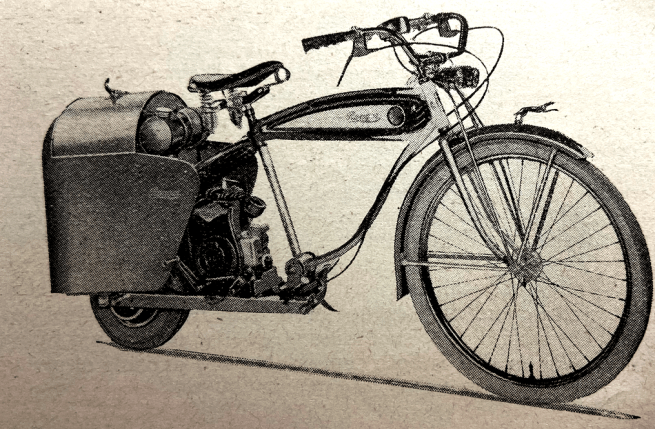
“A GLANCE AT THE LATEST James Auto Cycle is sufficient to show that big strides have been made as regards both appearance and utility. The machine has the new 98cc flat-top piston Villiers engine and an improved carburettor, while the flywheel ignition and lighting system is more efficient than the type employed on the old engine. As before, the cast-aluminium box silencer is placed beneath the power unit, and an additional tubular silencer is incorporated in the long tail pipe. Considerable attention has been paid to the riding position and to the comfort of the rider generally. For instance, the Terry saddle is mounted slightly lower than previously, and the handlebars are rubber-mounted. Clutch and brake control levers are of the ‘outside’ type, which give better and more positive control than the usual inverted leavers. The wheels have chromium-plated rims with black centres, and both brakes are of the internal-expanding type. The usual James mudguards with a box-section central rib are fitted; the front guard is well valanced and both guards are wider. Further protection is provided by means of metal chain guards. A handsome petrol tank having a capacity of 11 pints is mounted between the two down-tubes of the sturdy frame. Engine shields, besides being useful, greatly enhance the appearance of the machine. These shields do not interfere with the cooling of the engine nor with the accessibility; each is held by spring clips and thumb-nuts and may be removed almost instantly; a carrier is included and there is a nicely shaped metal tool-box on the left side of the rear wheel. Both tyres measure 26x2in, and speedometer and electric lighting are standard items of the equipment.”
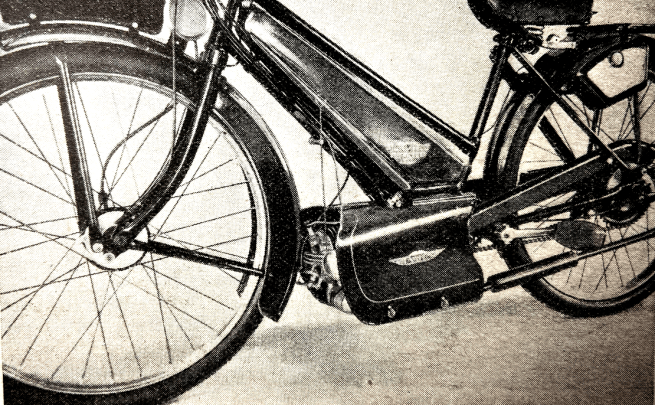
“SPRING FRAMES HAVE spread to America. Two of the larger models is the Indian range for 1940 have rear springing of the plunger type. Another direction in which British motor cycle designers may take a bow is that English-type steering is incorporated on the two smaller models. On the other hand, the Americans have introduced a very interesting feature—the partial enclosure of both wheels. The Indian 1940 programme consists of four models. The smallest as regards capacity is the 499cc side-valve twin; the engine alone has an appearance.which immediately calls to mind the many Indian Scouts on the roads of this country a number of years ago; perhaps, however, it is merely the layout of the head finning which provides this link with the past. Next there is the 744cc side-valve twin—a sportsman’s mount—and this is followed by the 1,206cc side-valve big twin, which performs equally well as a solo or sidecar outfit. Finally the range is’ completed by the straight four-cylinder model of
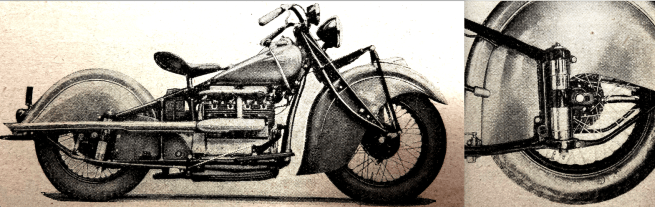
1,265cc. A feature which enhances all the new Indians is the new mudguarding arrangement. So deeply valanced are the new guards (‘fenders’ they call them in the USA) that nearly half the front wheel and rather more than half the rear wheel is enclosed. The influence of car streamlining is evident, but the innovation has its practical as well as its ornamental aspects. The degree of protection afforded the rider when the machine is ridden on drenched roads will obviously be high. From this it follows that the machine as a whole will be better protected, hence cleaning will be easier and the need for cleaning should arise less frequently. A sidecar is available which carries out the same motif. Rear-wheel springing is standardised on the Indian Four and 1,206cc twin-cylinder models. Modifications to give deeper cylinder and head finning on the 1,206cc and 744cc twins have resulted in an enhanced appearance and, it is claimed, 50% cooler running. All three twin-cylinder models have detachable aluminium heads. The frame of the largest twin has been completely redesigned to accommodate the rear springing, to give full effect to a seat pillar-sprung saddle, and to provide a new angle for the steering head; the famous Indian trailing-link leaf-spring front forks are retained on this and the four-
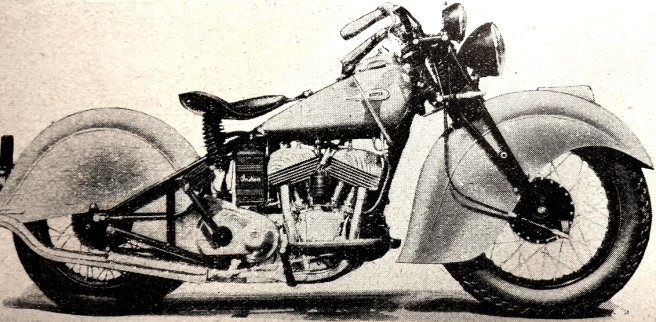
cylinder models. But for its American-type handlebars, distinctive mudguards and controls, the 744cc model would pass anywhere for a British big-twin. The girder forks are of conventional layout and have a central compression spring and adjustable shock dampers; immediately above the steering head is a steering damper control. In appearance, the baby of the Indian range—if the 499cc twin may be styled thus—has been greatly improved by a large-capacity tank, British-type forks and the new-style mudguards. The engine, too, has undergone detail improvements, not the least of which is roller main bearings—a feature now incorporated on all the twin engines. Rear stands have been discarded in favour of centrally placed stands, and all but the smallest model are fitted in addition with what are termed ‘ jiffy stands’; in this country we call them prop stands. The magneto equipment on all models has been improved by fitting units which deliver a spark of greater intensity at kick-over engine speeds. All the lighting circuits incorporate a dust- and water-proof fuse block, complete with spare fuse. Another interesting feature is that the batteries are provided with a device whereby over-filling when topping-up is rendered impossible.”
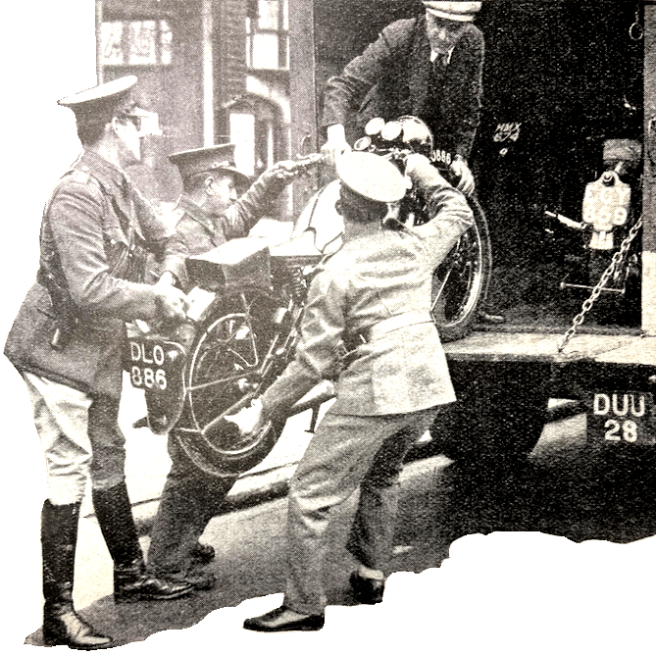
“THE LETTER FROM ‘Don R’ regarding despatch riders’ clothing prompts me to write of the experiences of the DRs in the BEF in the 1914-18 ‘do’. Most drafts going overseas were issued with the short civilian type of jacket and leg overalls, which were good enough for summer wear but useless in heavy rain or for the extreme wintry conditions of N France and Belgium. By the end of 1916, Signal DRs were receiving the Government issue of overalls made by various mackintosh firms to a specification as follows:(1) Poncho-type fine-twill and rubber jacket, reaching to the thighs, with wind cuffs and, most important of all, lined inside with a good tweed cloth. Good, strong storm-collar. (2) Trouser-type leggings which completely encased the seat and stomach (proof against wet saddle effects). These were also cloth-lined down to the knees, and had lever-operated snap-fasteners on the legs. These overalls (valued for issue, I understood, at £4 4s) were warm and’ would easily stand over four hours of solid rain and wind. The one objection was the difficulty of taking off (over one’s head) the poncho jacket when wet, but this was a detail to the advantage of the unbroken poncho front. For headgear, most DRs preferred an officer’s cap with the wire removed. My last cap cost 17s. 6d., lasted two years, was waterproof. comfortable, and had a prominent unbreakable peak as protection for the eyes. A fisherman’s oilskin hat was excellent for rain or now. Footgear was various. Wellingtons and waders were, handy for slipping on and slushing round the billet, but I think most DRs preferred leather (ordinary hoots or cavalry-type) as gripping better on slimy pavé. How many old DRs recall the shoemaker at Abbeville Depot who converted issue leggings and boots into eyeletted top boots. for three to five francs? Gauntlet gloves were showy but of little use in heavy rain. Handlebar muffs were ugly but extremely comfortable in really bad weather (with light leather gloves) and became an issue by winter 1917. A copper wire threaded through the outside of each muff prevented sagging and facilitated a quick grip. Almost equal to muffs were a pair of RASC gloves, thumb ‘solo’ and fingers together, which were warm and stormproof. Rubber bands round the wrist kept the open ends tight A soft scarf and fairly tight belt fitted one for hail, rain, wind or snow, and the best eye protection from the latter were the slotted metal goggles so rarely used in England. Times change, but the old DR spirit ever prevails, and one would wish the 1939 DRs the, beat of luck and ‘good riding’!
HF Birt, Ex-Cpl Sigs RE; DR, London Civil Defence, London, SW9.”
“SO DEAR OLD ‘EBBY’ has received the chequered flag. Never again shall we see him on the line at Brooklands with his little gold-knobbed Union Jack upraised in his right hand and his precious watches in their case in his left hand. No more will racing men have ‘Ebby’ to blame (or bless) for their handicaps. Neither Brooklands nor the Isle of Man will be quite the same. Mr AV Ebblewhite, most famous of all international timekeepers, passed away early last week. He was taken ill in a train when travelling to London from Snaresbrook, where he had recently made his home, and died suddenly. ‘Ebby’, in the eyes of thousands of motor cyclists, had long become part of the great game. He grew older, naturally, but it was still the same old ‘Ebby’, still the great enthusiast. The British Motor Cycle Racing Club of which he was chairman, was his especial pet. He loved being with the boys and took immense pride in their feats. Every year he would analyse Britain’s position in the world’s record lists, and egg on riders and manufacturers. His joy when Britain —his Brooklands boys—gained some 90% of all the worth-while records was complete. Soon afterwards, however, manufacturers and accessory firms began to lose interest in record-breaking. ‘Ebby’ strove his utmost to get them to continue their support, and there is no doubt that his efforts did much to uphold the prestige of the British motor cycle. ‘Ebby’ was a most interesting companion. Start him talking about his experiences and there was a most entertaining evening in store…Many have good reason to be thankful to ‘Ebby’. He was always ready with advice, help and information. I owe him a special debt, quite apart from the way he would let me worry him as a pressman out for details of speeds and the like. It was when I was on my first job of work in connection with the motor cycle world —before I joined The Motor Cycle. Suddenly ‘Ebby’, whom I had never met, entered my office and said: ‘Colonel ——— wishes to see you.’ I realised who ‘Ebby’ was, because I had seen him in the distance, but I was a complete stranger to him. The same applied to the Colonel. It turned out that the two of them had learnt that I was later to be deputed to carry out a rather ticklish job of work—one in which to be forewarned was to be forearmed. They explained the task and pointed out the various nooses that might lie in my path. Without this information I should undoubtedly have landed into trouble, and perhaps have jeopardised any future I might have. ‘Ebby’ and the Colonel did this for someone they did not know—had never met. Thank you, ‘Ebby’.”—Torrens.

“GOOD-BYE, EBBY! When competition work restarts after the war, many familiar figures will perforce be missing, but no gap will be so obvious or more felt than that left by the death of the world’s premier timekeeper, affectionately known wherever speed is practised as ‘Ebby’. His short, stocky little figure, armed with pipe, flag and twin watches in mahogany case, was part of the atmosphere at races in many lands. Shrewd and imperturbable, a man of few words and encyclopædic knowledge, there was nobody and nothing in the world of racing that he did not know, as many an artful stunt merchant who tried to wangle an excessive handicap at Brooklands discovered to his cost. It is curious that although he made his living by selling musical instruments, he played none of them; and although his sideline was timing cars and motor cycles and planes, he never held a driving licence and could not fly. Knowledgeable, friendly, reliable and expert, he was an integral part of that revolution in human life accomplished the advent of the internal-combustion engine. It is good to know that his end was painless; he was just lighting his pipe in a railway carriage en route, to the City when he fell back and breathed his last.”—Ixion
“IT WAS A BRAVE DECISION on the part of the Birmingham MCC to hold the British Experts’ Trial. This event, of which the present occasion was the 11th, is now looked upon by sporting motor cyclists as the cream of the one-day trials. All know and realise that wartime is wartime; that such periods as the one through which we are passing demand of the nation more than it usually gives, and divert it from its usual pursuits. It is not, however, in the nature of British folk to surrender their liberty of action unless it cannot be avoided. Tradition counts more than the casual observer may realise. It must not, therefore, be thought that this year’s British Experts’ Trial was run without regard for the national emergency, without effort and without considerable sacrifice by all concerned. That the entry would be depleted was a foregone conclusion; that to run the event on the possible entries would not show a profit was another foregone conclusion; that the existing restrictions would make it hard for anyone to compete was yet a third; that the organisation, route-finding and marshalling were going to be almost insuperable difficulties were facts that were fully realised beforehand; but that the trial should be held in spite of everything was a
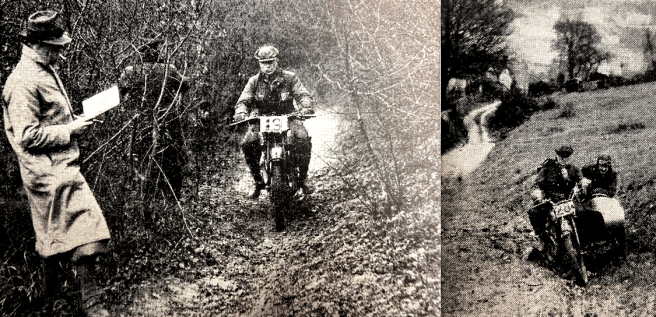
dominating thought which ultimately triumphed. The 11th British Experts’ Trial was held ; it received a most excellent backing from eligible competitors; and it was marshalled by real enthusiasts who came from all parts of the country to ensure the success of the event. The will to win was there, just as it is in the larger issue so prominent at the present time. At this juncture it may be well to record the deep appreciation. of the Birmingham Club for the response that was forthcoming from all those who were in a position to help. Observers were urgently needed, and they came along in a spirit of friendliness which was almost beyond expectation. Without their voluntary efforts the trial could not have been run. It will be obvious that there had to be changes, but every effort was made to keep the event as nearly as possible in line with its predecessors. A short course was used, covered three times, and although several old favourites were omitted, those hills that were used were well worthy of the prowess of the men who tackled them. One would have said, looking at the route-card, that the hills themselves were capable of finding a winner. Actually, this was not the case. The special tests did not decide matters either, for two people tied for first place on observation, in special tests and on time, while one other who was ahead on observation dropped marks on time. Even so, in the solo class there was only one mark between the first three men,
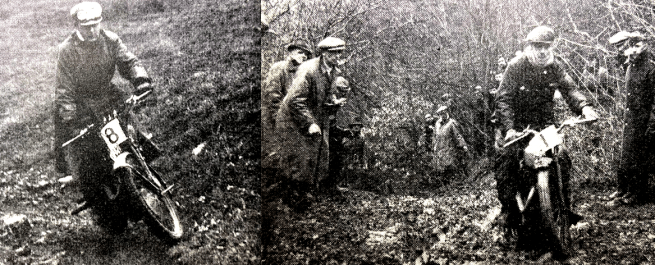
while among the sidecars four marks only separated the two finishers. By losing two marks on time that great Yorkshireman Allan Jefferies (Triumph) relinquished his right to hold the solo trophy for the second year in succession. The Skefko Gold Cup was awarded to Vic Brittain (Norton) and Jack Williams (Norton), who each finished with a loss of 20 marks and tied on the stop-and-go test. It is remarkable that this should happen, but it does show how exceedingly keen was the competition. The Palmer Challenge Trophy was won once again by that unassuming rider Harold Flook (Norton sc). He was followed (four marks later) by Stuart Waycott (Velocette sc). Owing to an unfortunate mechanical mishap, Dennis Mansell (Norton sc), the only other sidecar competitor, was compelled to retire when in a winning position. There were only two hills of main importance, Henwood and Ashmeads. Henwood was climbed cleanly by only two people—Vic Brittain and George Rowley (AJS). Probably the next best at this point was the third-lap effort of FM Rist (BSA), who had only one touch. The hill was deep in mud and leaf-mould, which concealed many loose boulders. It was a difficult climb, and the hill altered as the rocks were disturbed, so that successful tactics on one lap did not work well on the next. The climb made by Vic Brittain (Norton) on his first lap was truly wonderful; Jack Williams (Norton) had bad luck in being diverted up the bank, and Dennis Mansell (Norton sc) was particularly unfortunate to have his gear jump into neutral in the middle of
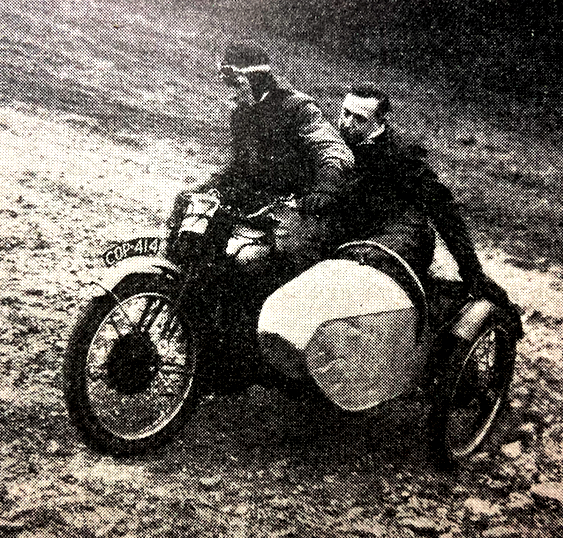
a perfect effort. Harold Flook (Norton sc) stopped in the first section and then made an admirable climb of the complete hill. No rider was clean on the second circuit, but George Rowley put himself among the stars on the third lap. On Ashmeads, honours were shared by a number of people…Jefferies was again ‘clean’ on the third climb—in company with J White (Ariel). Waycott failed twice on the third lap, but Flook, by pushing through the fourth section, saved a mark or two after having failed earlier. Soon after noon this trial of the experts came to an end. It started and finished at the Amberley Ridge Hotel, which proved an excellent substitute for The Bear. Many familiar faces were absent, but many were present. The Emergency Committee of the ACU was there in full force, and most of the old ‘camp followers’ turned up, although transport was at a premium. All things considered, therefore, the trial was very well worth while. RESULTS. Skefko Gold Cup (best solo): VN Brittain (Norton) and J Williams (Norton) tied; marks lost, 20. Runner-up: A Jefferies (Triumph), 21. Palmer Challenge Trophy (best sidecar) HJ. Flook (Norton sc), 39. Runner-up: WS Waycott (Velocette sc), 43. Finishers: AC Doyle (BSA), GE Rowley (AJS), GEH. Godber-Ford (Sunbeam), GF Povey (BSA), LG Holdsworth (Royal Enfield), FM Rist (BSA), WJ Stocker (Ariel), E Usher (AJS), J White (Ariel), JE Breffitt (Norton), JJ Booker (Royal Enfield), WA West (Ariel), PG Handford (BSA), EO Blacknell (Coventry Eagle), WS Waycott (Velocette sc).”
“UNTIL LAST WEEK, when I tried the new Francis-Barnett Powerbike, I had rather looked upon autocycles as runabouts—excellent machines for shopping and for using as transport to and from one’s work, but of limited value in other respects. The latest Powerbike, with the new Villiers flat-topped piston engine, has changed my views. The very first run on the machine, short though it was, showed that here was a fresh conception of autocycling. It was not that the machine was noticeably faster than previous models I have ridden, or merely that the engine was more tractable and smoother. Both these latter characteristics were noted, but, above all, there was the additional power—the way the engine disregarded the headwind that was blowing and the various up-grades that have tended to worry its predecessors. It was obvious almost immediately that, except for testing fuel consumption, average speed and the comfort and general handiness of the machine, keeping to main roads, at all events in the south, was not the way to find out the new Powerbike’s true capabilities. The thing to do, it seemed, was to take the machine out on a tour of the South Downs with gradients of 1 in 7 and even steeper—the equivalent of a Sunday afternoon ramble in fairly difficult country. So last Saturday off I set for Leatherhead and that stretch of Downs that runs from Reigate to Guildford. Not being in these days a capable cyclist, or, perhaps, because previous experience with autocycles has taught me its ease and simplicity, I started the engine by pushing the machine with the compression release raised. When, after two or three yards, the engine fired, I grasped the clutch lever, let the engine rev for thirty seconds or so and then set off, giving a turn or two to the pedals and at the same time opening the throttle and letting in the clutch. Later I was to find that this
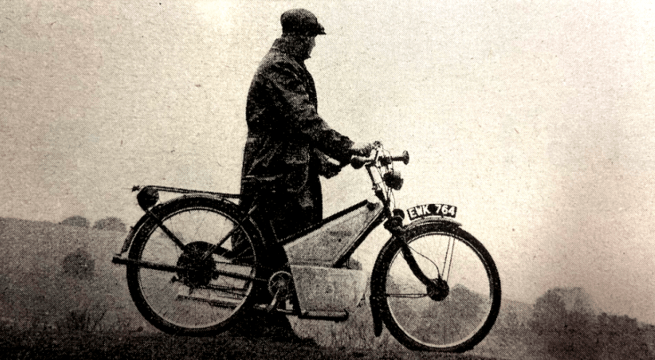
seemed to be the method of starting, since pedalling and then letting in the clutch with this lusty little engine’s compression against you means fairly hard work. Within 50 yards of starting from rest it was possible to push the strangler knob downwards; the engine proceeded to fire normally. This is an important point: the machine, with the new. engine might (as it will be seen it does) cover a phenomenal number of miles on a gallon of ‘pool’ petrol but it immediately settles down to its even purr and if, as in my case, there is a hill in front of you that makes cyclists pant and a few walk, it takes it in its stride. The Powerbike breasted the hill at a full 18mph. Later I tried it for even running at various speeds. At anything from 10mph to its maximum of around 30mph the machine ran perfectly evenly. There was no four-stroking or other misfiring. Even when the machine was running fast downhill there was even firing. This, in itself, to judge from my previous experience, marks a big advance; the new engine two-strokes as well as any two-stroke I have ever handled. The carburation is better than on previous models I have ridden. The machine accelerates evenly and smoothly from a corner—no break in the hum from the exhaust and no sneezes or pauses from the engine as the throttle lever is opened. At Leatherhead the traffic lights were against me, and it was necessary to restart on a gradient of perhaps 1 in 8. Opening the throttle at the same time as the clutch was let in, plus about three twirls of the pedals, was enough to conquer the decidedly adverse conditions. Then to Box Hill at a speed which, except for one roundabout, never dropped below 18mph. The Box Hill zigzag is known to tens of thousands, perhaps to millions. It leads to one of the most glorious views to be found anywhere within close reach of London. The hill is long, and the gradient, I suppose, about 1 in 8 at the steepest. It is a hill that caused me surprise when some years ago I saw that in a test by The Autocar it had been climbed by a car in top gear. For myself, I thought it would be a pretty good test of a 100cc single-geared machine with just on 15 stone in the saddle. Eight stone, that would be different. I think the Powerbike was brand new. At all events It seemed to run more smoothly and even better as the morning passed. Anyhow, the Box Hill zigzag was no test, for the machine climbed it at 18mph or more, except for the necessary slowing down at the hairpin bends, and after each hairpin it accelerated away without any pedalling or use of the clutch. As many know, the road over the top of Box Hill leads to Pebblecombe, a hill that has notices at the top and bottom saying, ‘Engage low gear!’ And the gradient of this hill is at least 1 in 5½ with a lengthy approach that grows progressively steeper. Not for one moment did I consider the ascent a reasonable test. I have, in years gone by, stopped on it with a 293cc machine fitted with a two-speed gear. However, the hill would provide a test of the brakes, and it would be interesting to see just how far up the gradient this rather amazing little machine would plod. Since Box Hill had been climbed, it was a question of dropping down Pebblecombe. The front brake alone held the Power-bike on the steepest part; the two brakes pulled the machine from 20mph to a rapid halt. Obviously, the brakes, without that useful additional brake, raising the compression release, were fully capable of anything. I turned round and tried the hill ; not with the idea that the machine could possibly climb it, but in order to see just how far it would get. It pulled itself and my big weight right to the 1 in 6 gradient, and, if I had pedalled, might well have got us over the top. From this it seemed that Reigate Hill, a long 1 in 9 gradient on the London-Brighton road, would be easy—the machine breasted the climb at about 16mph. The next move was along the Downs to Box Hill and then Ranmore Common. On the approach to the latter there is Ranmore Common Hairpin Hill. This, like Pebblecombe, grows steadily steeper, and ends with a hairpin bend and a gradient of about 1 in 6. I expected to have to pedal, for the hill is one on which car clubs have held stop-and-restart tests. All that was necessary was fewer than a dozen twirls of the pedals, and those really light. So to White Downs, another trials hill—motor cycle trials this time, though of the 1921-23 era. Here, too, was a long hill, but with a 1 in 5½ gradient at the top, yet the Powerbike got within 20 yards of the summit, and it was merely a question of walking the rest of the way with the machine toddling alongside and the clutch half engaged. From this it was obvious that the machine would do most things—even climb young mountains if you were prepared to walk alongside. And any ordinary main-road climb, as was proved by the ascent to Newlands Corner, could be laughed aside.
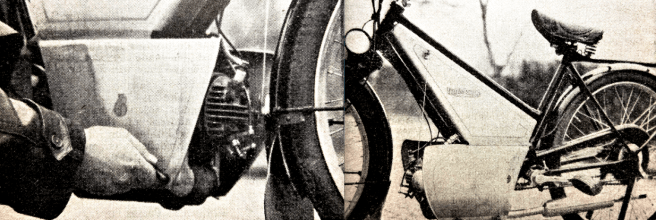
The over-20mph ascent was made amid cheers from a convoy of mechanised troops parked at the roadside! The 60-mile trip, with all its ups and downs, was completed by an almost full-throttle trip home. No auto-cycle could have been driven much harder, yet under half a gallon of petroil had been used for the entire run. The exact consumption of petroil worked out at 123mpg and, since petrol and not oil is rationed, the true consumption was approximately 128mpg of petrol. On the following clay I carried out a proper test of fuel consumption. The machine was taken over a measured distance (my pet test route which includes ups and downs) at a speed of 20-34mph. Although there was a fair wind blowing the consumption of petrol was 152mpg of petroil, which means over 158 miles to the gallon of petrol. At the end of the 60 miles, thanks in part to the sprung front forks—those on the model tested really worked—I did not feel stiff. The comfortable cruising speed is anything from 10mph to the maximum of approximately 30mph. Up to about 34mph downhill—and because of the way the machine holds its 18-20mph on hills there is not the slightest difficulty in maintaining an average speed of 20mph on long runs. To criticise the machine submitted for test is next to impossible. Were I setting out on a 1,000-mile holiday tour I should much prefer a motor cycle type saddle to the more or less cycle type; starting, if one adopts the pedalling method as opposed to that outlined, requires a certain degree of effort; and the engine, to the experienced ear, has a slight amount of that rattle which is generally termed ‘two-stroke rattle’, though not to the extent that it is likely to worry anyone. Beyond this I cannot find a word to say. You will realise my feeling when I state that before the test was completed I suggested to a relation that she should get rid of her present model and buy this new one.”—Torrens
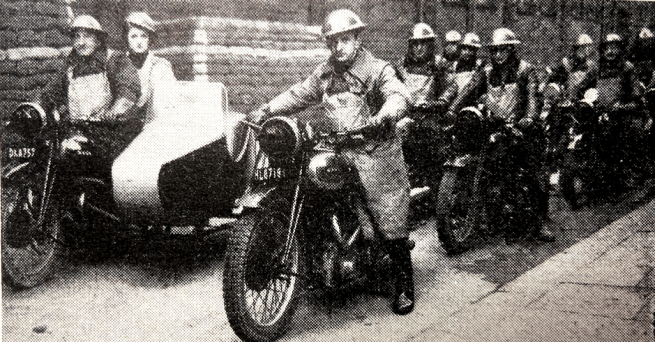
“THE HARRINGAY SPEEDWAY Supporters’ Club recently sent a cheque for £219 to the Prince of Wales’s General Hospital. In this case the money was raised by collections at speedway meetings. It was hoped to collect £500, but the war, of course, cut the season short.”
“‘GIRL MAKES SOLDIERS SCOTT FANS’ runs a heading in a daily newspaper. Well, some might argue that no such encouragement is necessary! But the news item that follows makes it clear that the Scott referred to is Sir Walter of that name.”
“ACCORDING TO A REPORT, a bullet-proof pneumatic tyre of secret design is being used on many types of Army vehicle. Should a bullet penetrate the tyre, the interior construction will prevent the tyre from collapsing.”
“SQUADRON-LEADER George C Pinkerton, RAF, well known to Scottish speedway fans for his skilful riding on the White City and Marine Gardens tracks, was one of the first two Auxiliary Air Force officers to be awarded the DFC.”
“FRANK VAREY is once again back in his old surroundings at the Scott works, where he was a tester before he became a speedway star. Eric Langton, former captain of the Belle Vue team, is working in the experimental department of Hepworth and Grandage at Bradford.”
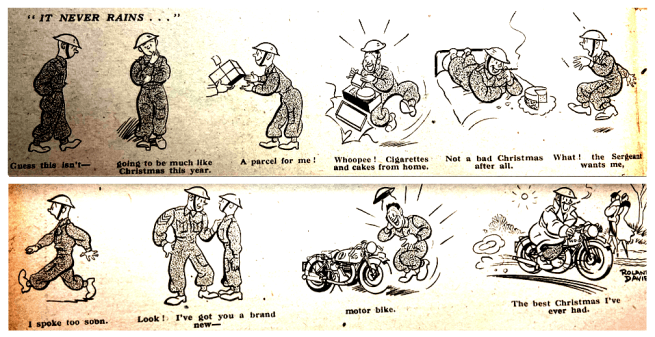
“WHAT IS THE RECORD distance for a solo motor cyclist in dress clothes and boiled shirt travelling to a club dinner? In the past, wearing such a garb, I’ve done my 15 or so miles there and a similar distance back. The Editor one evening last week covered a there-and-back mileage of nearly 70. I don’t suppose that this is a dress-clothes solo record, but I very much doubt whether many motor cyclists have gone 70 black-out miles so clad, all for a club dinner!”
IN THE UK TRADESMAN’S sidecar outfits were losing ground to vans but in the USA Harley Davidson and Indian were doing a steady trade in 750cc sv commercial trikes, respectively the Servicar and the Dispatch Tow.
HAVING WITHDRAWN FROM racing Norton was busy churning out the well-proven 500 sidevalve 16H for the military. To fight alongside the Nortons the War Department ordered its BSA equivalent, the M20. An order for 10,000 ohv 350cc BSA B29s was withdrawn because it made sense to standardise. B29s would go on to play a major role in the war, once the US noticed it had started, but they were made by Boeing rather than BSA. Beezas were good, but they couldn’t carry atomic bombs to Japan.
THE MANUFACTURERS’ TRADE association estimated that some 25,000 of Britain’s 700,000 motorcyclists were female.
PEUGEOT’S P53 WAS A 100cc motorcycle complete with three-speed (hand-change) transmission. But some were produced with fixed footrests that looked like pedals. So these P53s could pass for 50cc pedal-assisted velomoteurs that were exempt from registration, roadtax, insurance and the need for a driving licence. How cheeky–how French–is that?
CIVIL SERVANTS ARE CREATURES of habit so following the RFC’s adoption of P&M’s during the Great War Panthers were acquired for the RAF. Compared with the likes of BSA, Norton, Matchless, Ariel, Triumph and Royal Enfield Panther was a small concern and was simply unable to meet demand. So the RAF got the same mixture of bikes as the Army, but most RAF bases had at least one or two Pussies tucked away.
BY YEAR’S END Japan had produced 3,000 motorcycles; Germany managed 500,000. Miyata opened a dealer in occuppied Shanghai.
“A FACT THAT will not be lost upon readers is that the vast majority of motor cycles supplied to the Army have side-valve engines. The exceptions are a number of 350cc ohv singles and various machines which were in production at the start of the war and were ‘impressed’ by the Government. Whether the policy of concentrating almost entirely upon side-valves of 500cc continues remains to be seen, but we imagine that the reliability, simplicity, ease of servicing and slogging characteristics are likely to make this type of machine a favourite for some time to come. If this is so it is fairly obvious that the side-valve engine will receive fresh attention from the angle of design with the object of determining if and where it can be still further improved. Already we hear of intensive development work by a firm that has not made a special point of its side-valve design. It may well be that as a result of the war the side-valve machine will once again occupy what many consider to be its rightful place in the motor cycle world.”
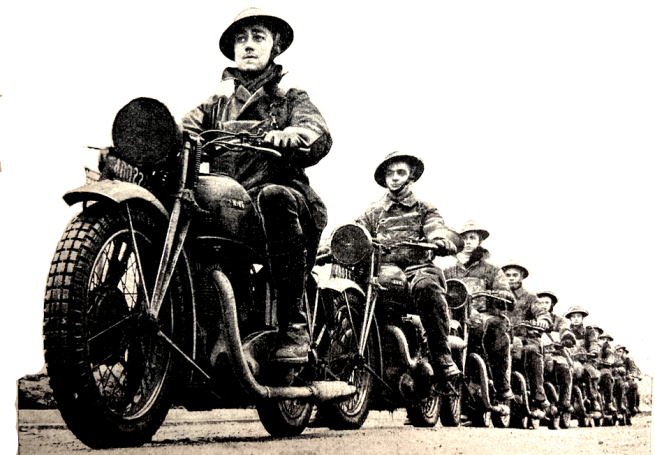
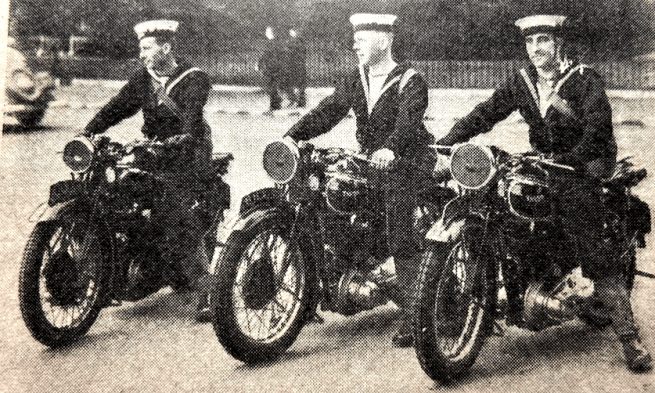
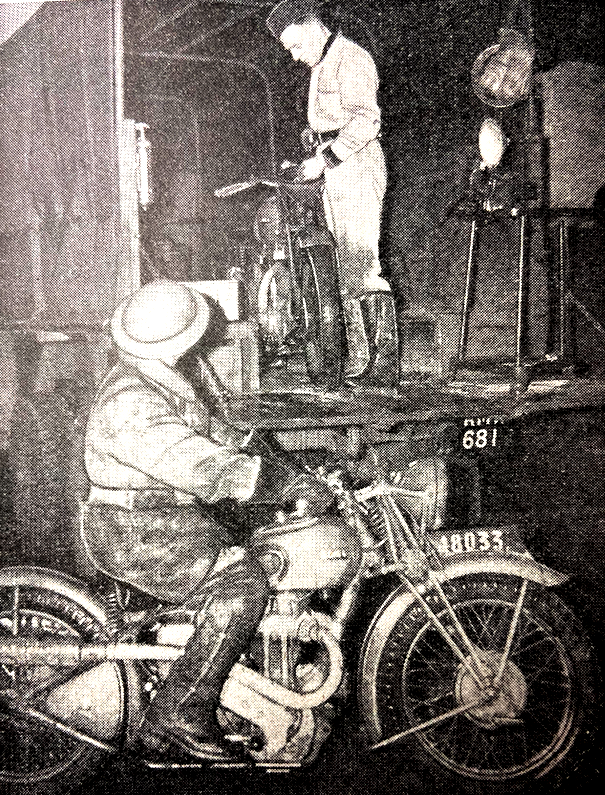
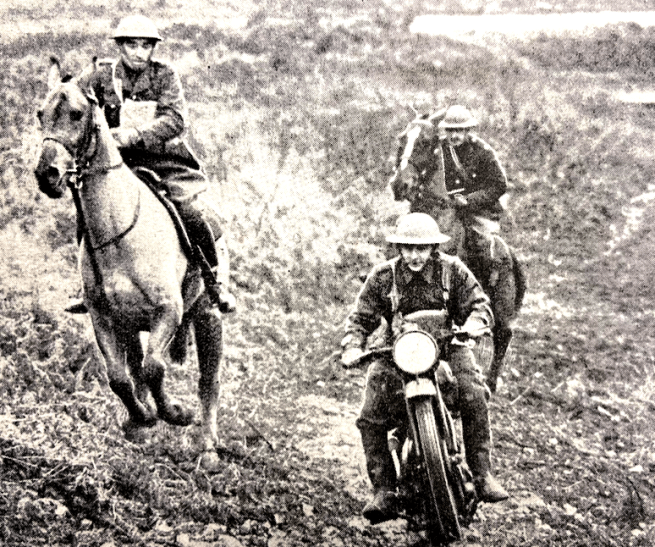
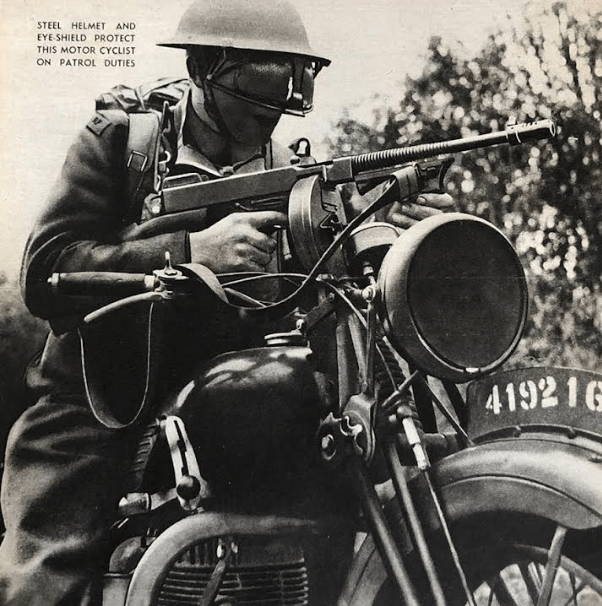
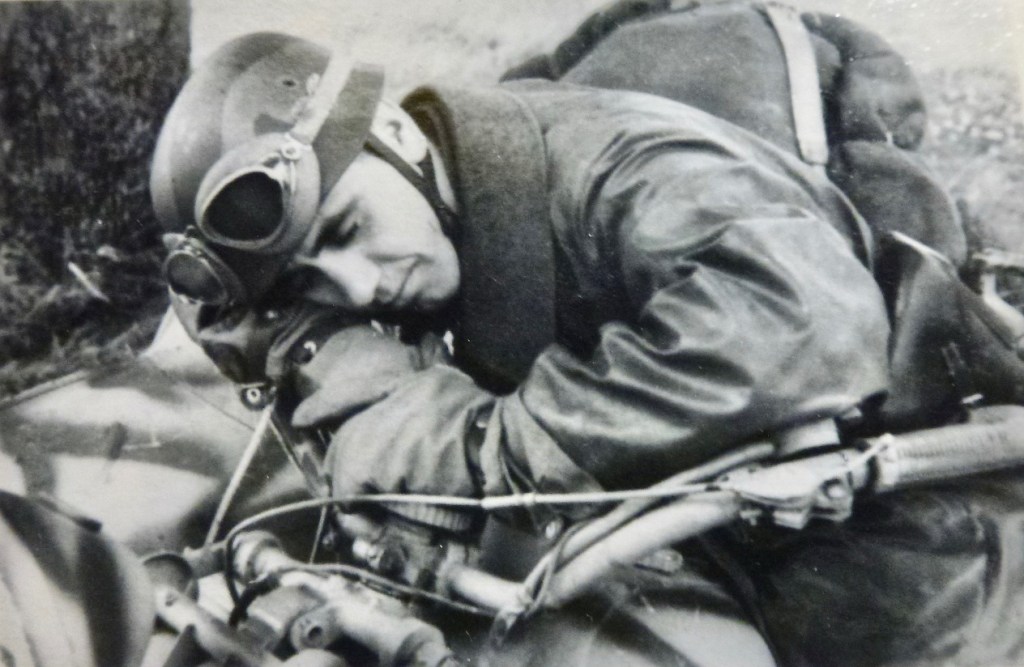
“IF THE 249cc SIDE-VALVE BSAs are all as good as the model submitted for test, then the C10 is a remarkable motor cycle. However, before I relate the work to which I put the machine and the way it performed there are one or two out-of-the-ordinary points in its specification to be touched upon, as, for instance, the ignition layout. Ignition is by a Lucas coil set with an automatic advance-and-retard mechanism driven from the timing gear by skew gearing. Thus there is no ignition control to be operated by the rider. The battery, incidentally, is of the rubber-cushioned type. The dynamo has, of course, voltage control. Another handlebar control has been eliminated by cutting out the air slide. That lever on the right handlebar which looks like an air control is a throttle lever. From ‘shut’ to ‘flat out’ requires a movement of about 60° so the lever is always within convenient thumb reach. On seeing that there was no air lever and no strangler on the air intake of the carburettor, I immediately had doubts—’Pool’ petrol and the thermometer only a few degrees above freezing point…I flooded the carburettor—lustily. At about the third kick the engine responded with a single power stroke. I tried a different setting of the throttle lever, and the engine started the very next kick. As I was to find, there was no effort necessary and no knack other than setting the throttle about a fifth open; and immediately the engine would pull away without any spitting-back, or flat-spots in the throttle range. With only three controls on the handlebars—the throttle, front-brake and the clutch—and merely the rear-brake pedal and the foot gear change in addition, the BSA beats even an autocycle in its small number of controls. All are well placed, and the riding position is outstandingly comfortable. The gear box provides three ratios: 6.6, 9.8 and 14.5 to 1. The foot control has a sensibly short movement. In the past I have criticised the foot changes of various BSAs on the score that
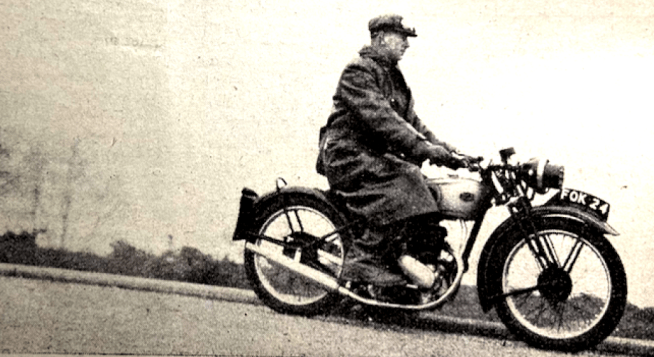
when new they have generally been so heavy as to be ‘stamp changes’. With the C10 the change was delightfully light. The clutch, too, proved light, freed perfectly at all times and was satisfactorily smooth in taking up the drive. The gear change was easy and all gears noiseless. A novice might occasionally find that when changing from second to top he did not get into the latter gear. Throughout my test I never had difficulty, but at times I found myself automatically letting the clutch in a trifle in order to feed in the gear. Merely pressing down the lever with the clutch right out may result in the gear not going home. Neutral was reasonably easy to find; the BSA proved up to average in this respect. What was somewhat of a surprise was the performance of the machine on the open road. I began with a fast trip down the Portsmouth road. With the engine warm and the oil therefore ‘moving’, I opened up. The quiet, rather flat, woffly sound from the exhaust became a hum, and the speedometer needle, from its original ’30’ went to ’45’ and then to ’50’. For approximately five miles on an undulating road the machine kept its speedometer needle at 50-55, except on one upgrade, when for a few seconds it dropped back to 48. I tried compressing my large, double-coated bulk; the needle on one very gentle downhill stretch hovered around the ’60’ mark—an honest 59. I said to myself, ‘How honest?’ Motor cycle speedometers as a whole are notable for their freedom from the sin of paying ‘compliments’, and BSAs, I happen to know, are specially keen that this is so. However, as a matter of interest, I got out my stop-watch. As I had estimated and expected, the speedometer was just about ‘spot on’. The makers, by the way, claim 55mph and 100mpg for this model; the latter not, of course, at 50mph! For nearly 50 miles I kept the machine hard at it to see whether it was really foolproof—no tendency to dry-up or anything of that sort. There was one let-up, if it can be called such. I turned off to try a hill which has a measured gradient of 1 in 4½, a first-class surface and a right-angle corner at the bottom which prevents any rushing. This, I thought, would be a good test of brakes, and if the machine, besides climbing it, was capable of restarting at the very steepest part—well, it would have no difficulty in climbing Porlock or the like. First, the BSA was ridden straight up.
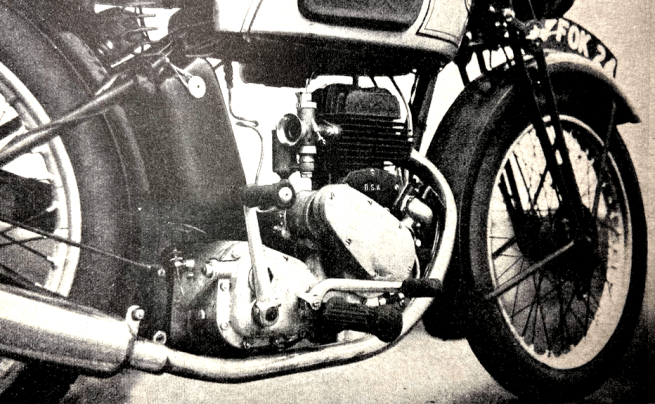
Easy! Then the brakes were tried. Either would stop the machine on the steepest stretch. Both were thoroughly efficient at all speeds and under all conditions. They were a little on the heavy side to operate, but, as the C10 is a machine that makes a big appeal to novices as well as to seasoned riders, this is probably a good point. Restarting on the gradient was accomplished all right. It was necessary to keep up the engine revs by slipping the clutch. Rightly or wrongly, the impression was gained that an experienced motor cyclist would probably have made a better restart if there had been a hand-operated ignition control. In certain circumstances slightly more ignition advance seemed desirable at speeds around 30mph in top and at equivalent speeds in the two lower gears. On the other hand, except that when accelerating bard the engine might give a single pink, the machine ran perfectly happily on ‘Pool’ petrol—in fact, it appeared to thrive on it—and picked up if slowed on a hill. During the fast touring which was now again the order of the day three things were particularly noticeable. First, the excellent steering—positive and utterly safe. Secondly, the effortless bend swinging, even at speeds of 30mph. Thirdly, the exceptional degree of comfort afforded by the machine. The steering, incidentally, is equally good at a crawl in traffic. While the run continued and later consisted of mixed going in Hampshire there was little else to test except the fuel consumption. As a matter of interest, however, I took the engine up the scale in the two lower gears. A speed of 26mph was about the usable maximum in bottom (at this I changed up as the valves were starting to float) and approximately 38mph in second. Some 35mph in second is about all I myself would normally use. At all speeds the engine was delightfully free from vibration. I had to hunt hard throughout the scale to find anything in the nature of even a minor period. At this point in the present article it occurs to me that I have said nothing about mechanical noise, and that I have no mental notes on the subject. Obviously, therefore, the engine is quiet mechanically! While the engine gives an impression of great flexibility, owing no doubt to the automatic ignition control, I look upon about 15mph as the lowest true non-snatch speed. Above this a tester searching for ‘points’ can find an occasional rather indefinable ‘tug’ in the transmission. Fuel consumption at a speed of 30mph worked out at just under 90 miles to the gallon of ‘Pool’, this on my usual undulating test route, which I consider demonstrates what a machine will do in ordinary use—not what it could do under ideal, seldom obtained conditions. To sum up, the 250 cc side-valve B.S.A. submitted for test proved a delightful machine, first class for any novice, yet a really lively roadster capable of putting a full 40 miles into the hour.”
IN SPITE OF THE unsettled conditions in Europe, Italian designers are going ahead with the production of racing machines, and several extremely interesting new models were exhibited at the recent Milan Show. Italy, incidentally, is already planning its 1940 national racing calendar. From the technician’s point of view the. outstanding exhibits were the Bianchi, Benelli and Gilera supercharged four-cylinder machines. The Guzzi concern is still producing its successful 250cc ‘blown’ horizontal single, and is also trying out three-cylinder engines. During the 1939 racing season the supercharger has proved a decisive factor, so Italian designers, following the example of Gilera, have concentrated on the production of supercharged four-cylinder racers. Many difficulties had to be overcome in the design of these special engines, and now that they are built, problems in the matter of mounting, cooling, lubrication, valve timing and ‘intercooling’ have to be settled. Gilera, Benelli and Bianchi engines are all mounted transversely in the frame with the object
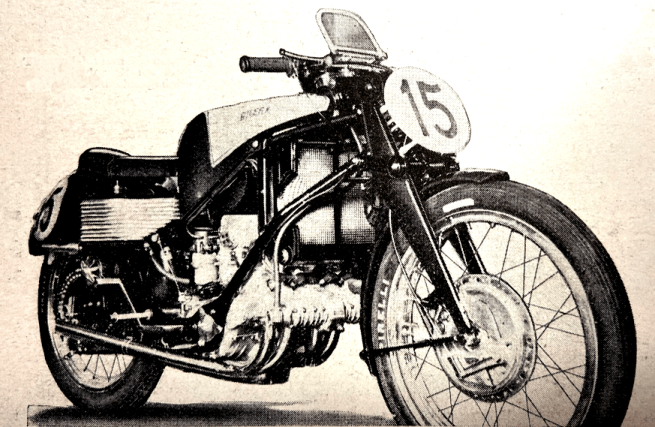
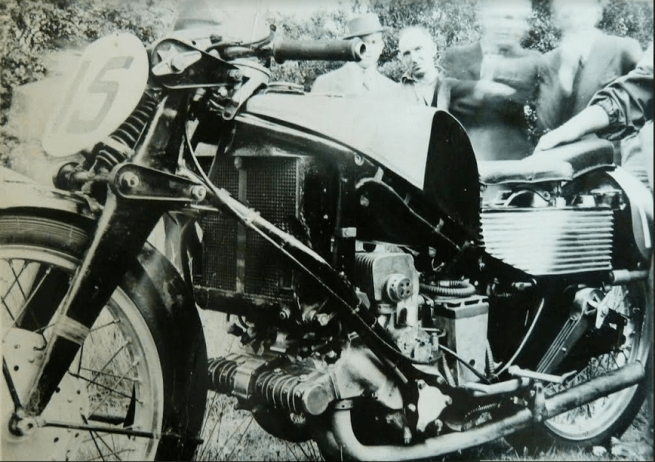
of ensuring good steering. The first two are water-cooled, and are inclined slightly forward, while the air-cooled Bianchi is vertically mounted in order that the best possible cooling draught shall be obtained. The 500cc four-cylinder Gilera, champion of Europe for 1939, has proved to be the fastest road-racing motor cycle in the world. This machine, which will remain practically unchanged for 1940, has a four-cylinder engine of 52mm bore and 58mm stroke (493cc). It is said to develop about 90bhp at 8.000rpm. The very rigid crankshaft, which is statically and dynamically balanced, runs on four bearings, and the two overhead camshafts are operated via a central gear drive. The valves are inclined at 90° in perfectly hemispherical combustion chambers. A small high-speed, Root’s-type supercharger forces the mixture into the cylinders via a ‘receiver’ or ‘balance chamber’, the purpose of which is to keep induction-pipe pressure constant and cool the mixture before it is fed to the cylinders. This arrangement permits the unusually high (for a supercharged engine) compression ratio of 8 to 1 to be employed. The unit is mounted low in a light, duplex loop frame, and a small radiator is attached immediately above the cylinders. An oil tank is carried under the saddle. The well-known Gilera system of rear springing is, of course, a feature of this machine, which is notable for its low centre of gravity. The new 500cc Bianchi, though completed too late to compete in 1939 events, can claim to be one of the most highly developed supercharged units of the
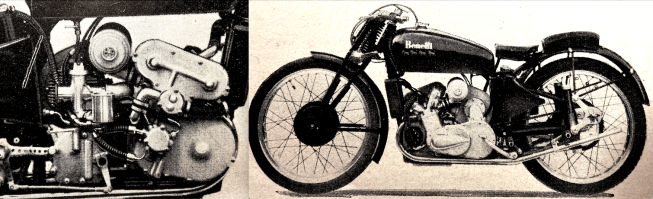
present day. Its beautifully designed four-cylinder, air-cooled engine has exactly the same dimensions as the Gilera (52x58mm); it is said to develop 80bhp at 7,500rpm. The one-piece cylinder head casting is held by long bolts. Practically the whole of the unit—from cylinder head to sump—is finned externally: fins of close pitch and shallow depth. The valve gear is completely enclosed and the two camshafts are driven by a vertical shaft, the cams operating the valves directly. Carburation is by a Weber carburettor fitted on a Cozette-type rotary blower running at two-thirds engine speed; in this case the cooling of the mixture before reaching the engine is not obtained through a reservoir, but by using a large inlet manifold. Both clutch housing and gear box are cast en bloc with the crankcase, and the primary chain is completely enclosed. The oil tank, which is fitted low down behind the gear box, extends on each side of the rear wheel. The large-capacity fuel tank is made of hand-beaten aluminium sheet. Another extremely interesting Italian racing machine is the new 249cc (42x45mm) four-cylinder water-cooled Benelli. Indeed, this wonderful little engine, with its four cylinders each of only 62cc capacity, represents a new step in motor cycle engineering. The aluminium cylinder block is cast in unit with the gear box and has hardened steel cylinder liners. The unit is mounted transversely with a 15° inclination in a normal TT frame. As is usual in Benelli design, a train of gears drives the two camshafts; these operate directly on the valves. Two valves per cylinder are employed and are inclined at 45° in hemispherical combustion chambers of only 42mm diameter; a 12mm sparking plug is placed vertically in the middle of each cylinder head. Supercharging is by means of a large vane-type blower that runs at half engine speed. This little unit is claimed to develop about 50-52bhp at 10,000rpm. Its future performance will be watched with interest.”
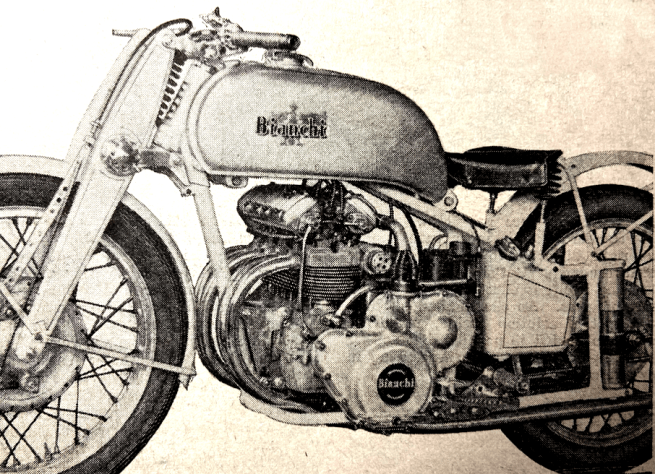
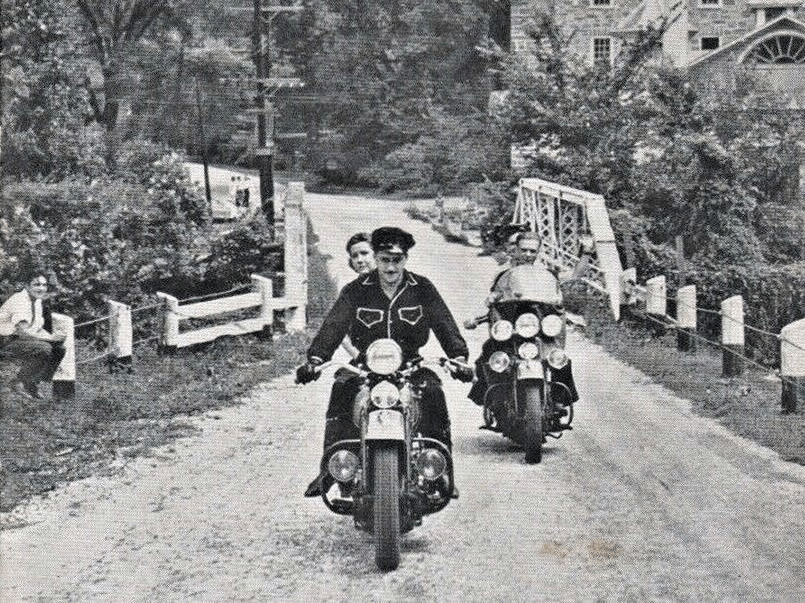
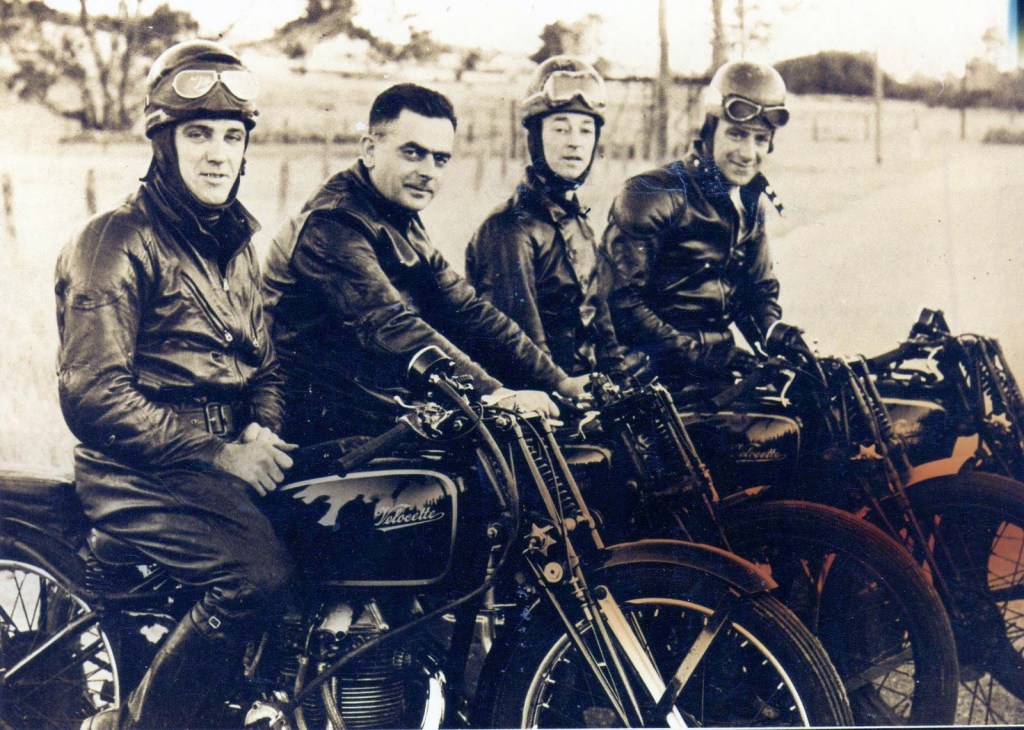
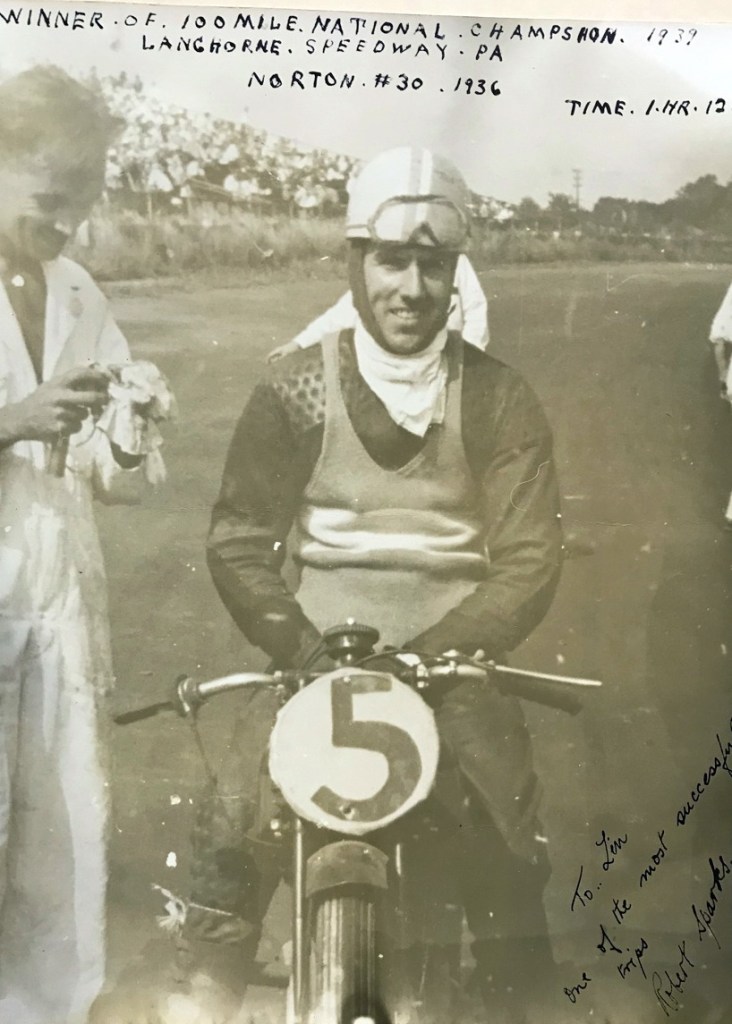
“ONE DAY LAST WEEK the Editor received a cheery note from the Front from Lieut-Colonel CV Bennett, who was in charge of the Army teams that took part the International Six Days Trial. Colonel Bennett is, of course, an old hand at the trials game and a very experienced motor cyclist. My memory of him is largely on Burney machines in the Exeter Trials and other long-distance MCC events. In his note he mentions that his mount in France is a Tiger 100 Triumph. Apparently he is enjoying himself on it. He says that a DR’s life is very different from that of the war of 1914-18. The reasons? Machines are so much better and more reliable, and even a puncture is unheard of.”
“‘Nitor’ mentioned recently that one rider dusting up another on the open road was pretty well a thing of the past. Had he been on the Portsmouth road between Cobham and Ripley at about 2.30pm on December 17th, he would have seen a really good scrap—eight Army riders on side-valves, some of the men lying right down to it!”
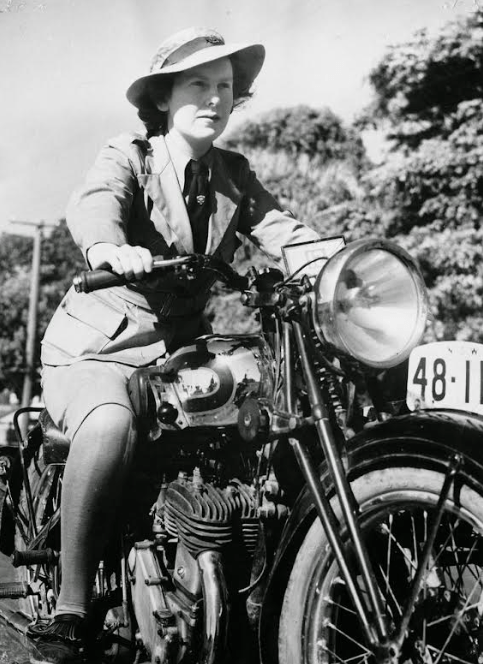
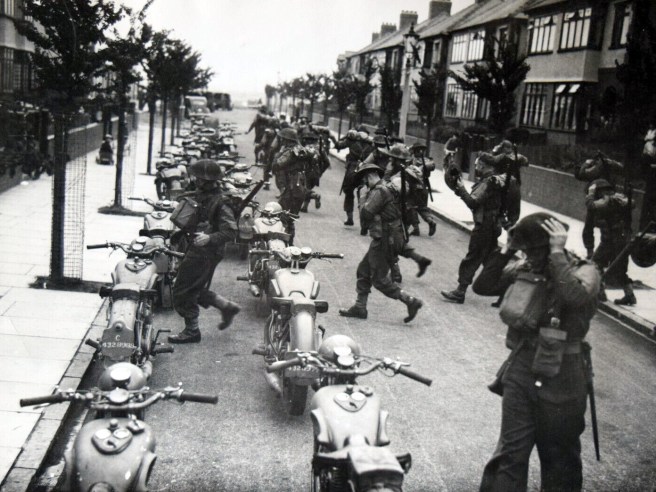
You’ll find more photos from 1939 in the second melange page (‘One melange good…’ in the main menu) with many more dates pics, though as time allows these will be transferred to their respective years in the main timeline. Many more images, most courtesy of my amigo François, appear in a picture gallery dedicated to World War 2; it is also in the main menu. And that’s about it for 1939 as the world descends into madness and motor cycles go to war. As usual, here’s a selection of contemporary adverts, concluding with a batch that reflect the move from peace to war.
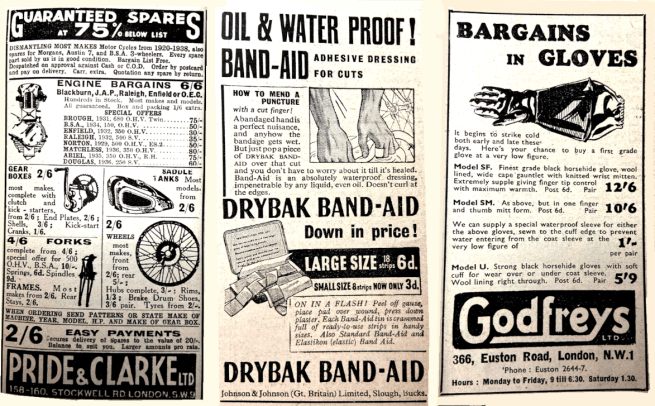
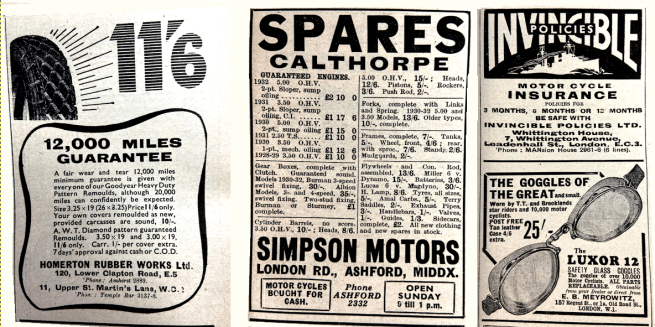

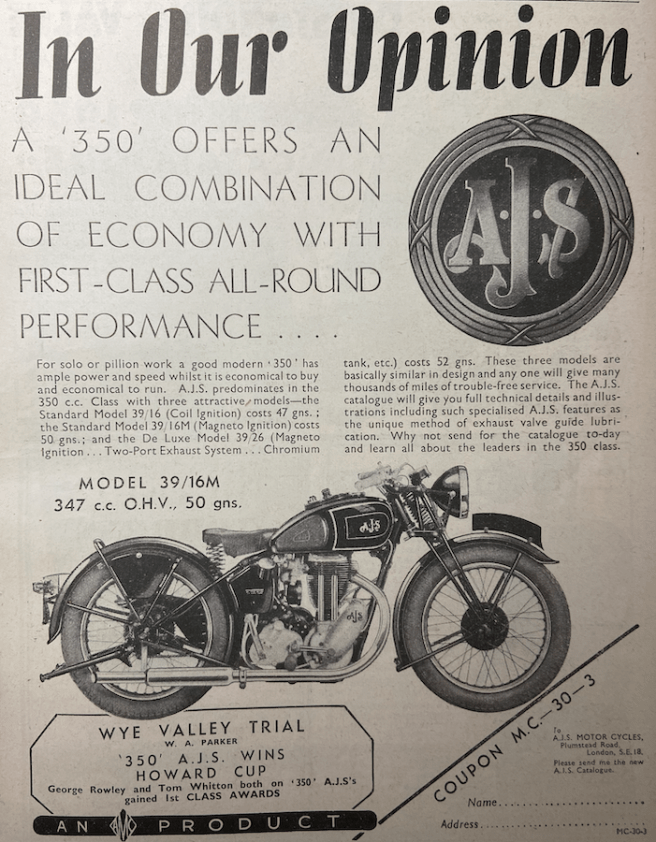

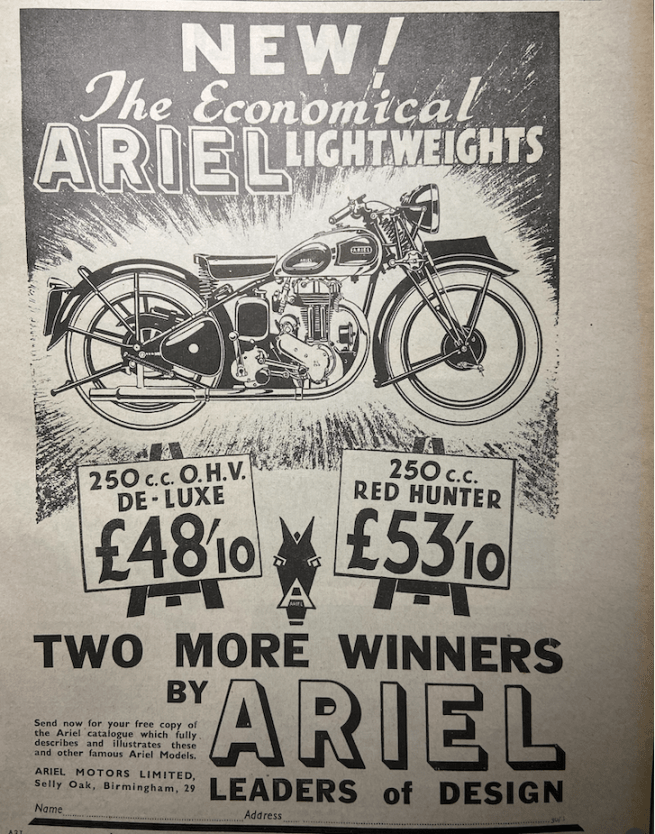
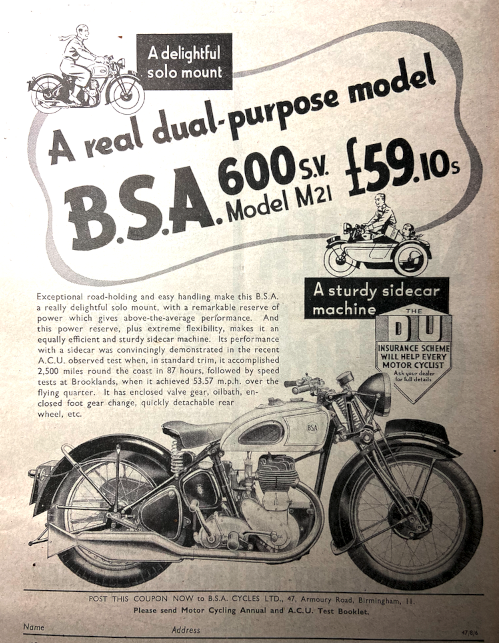
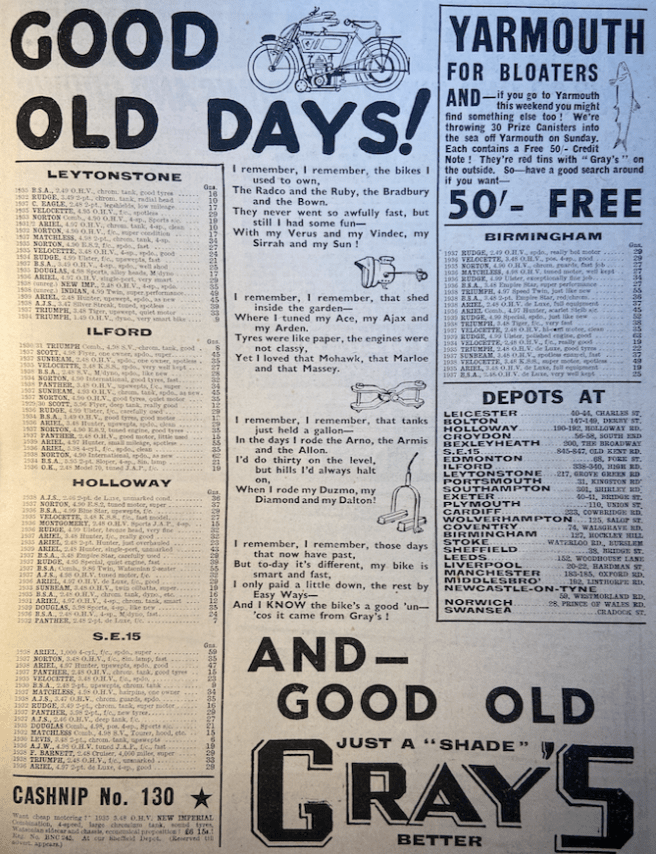

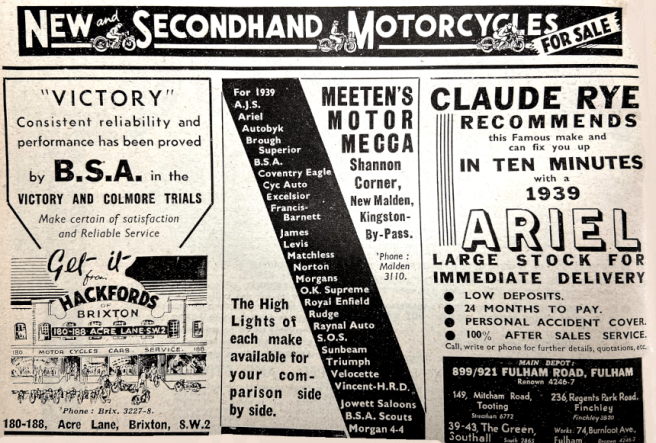
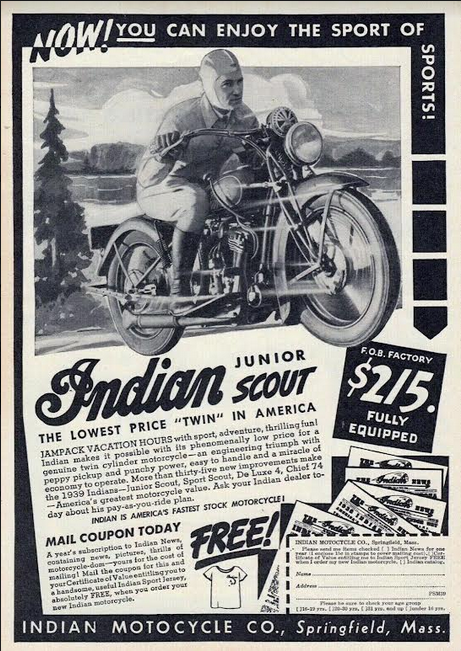
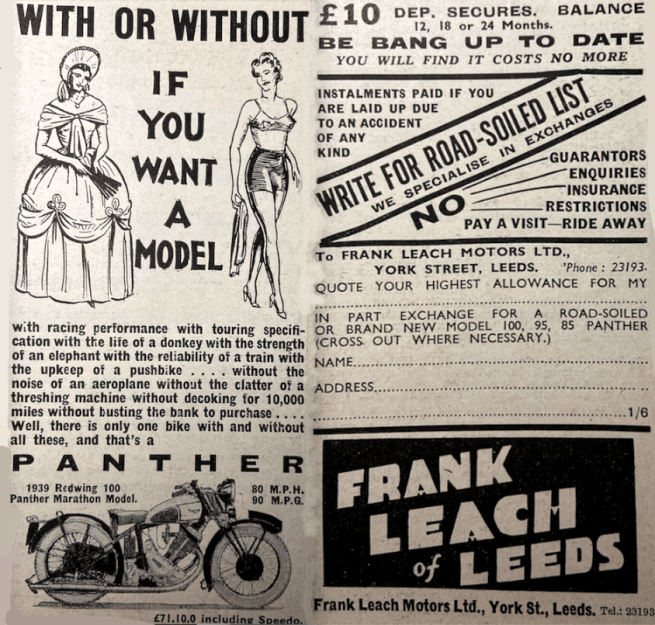



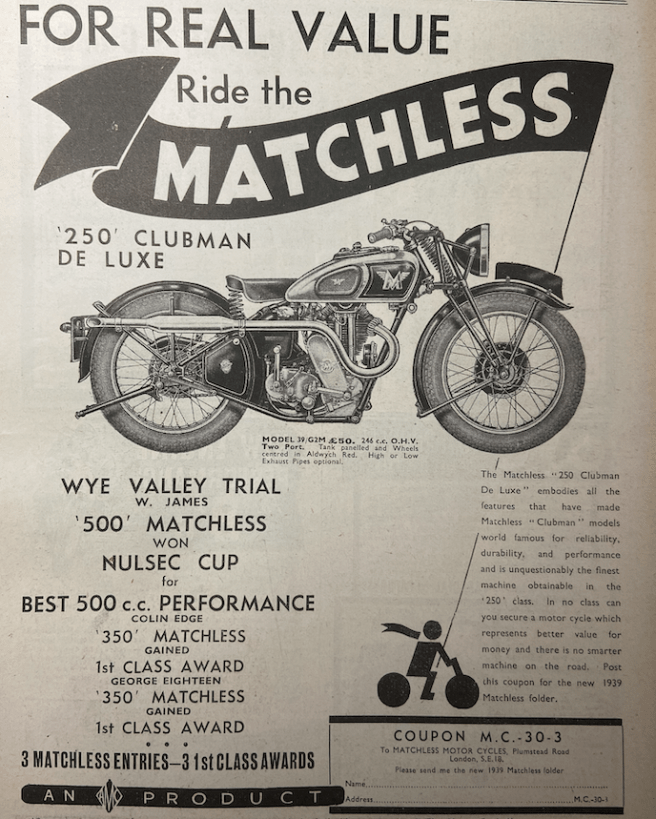

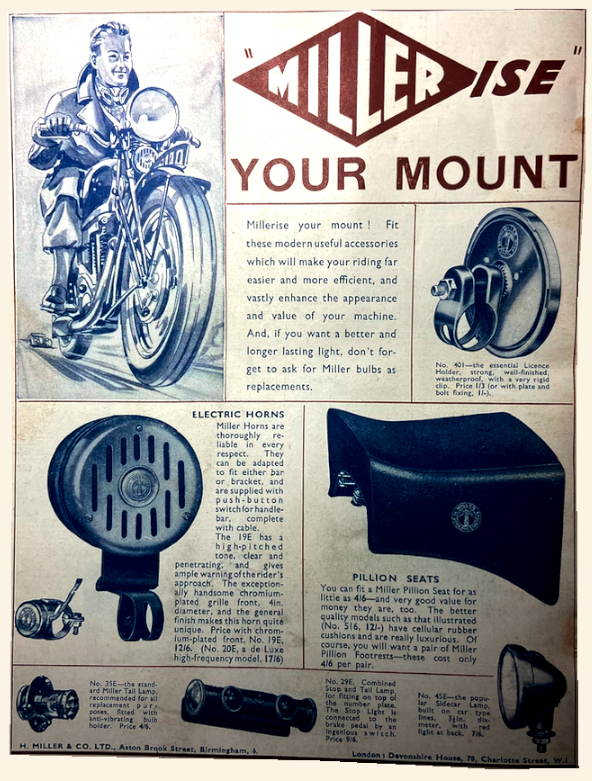
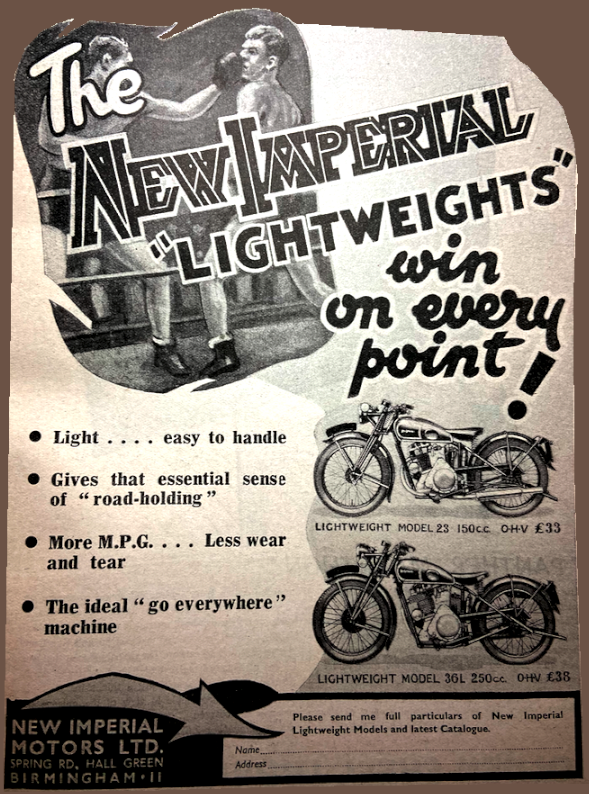
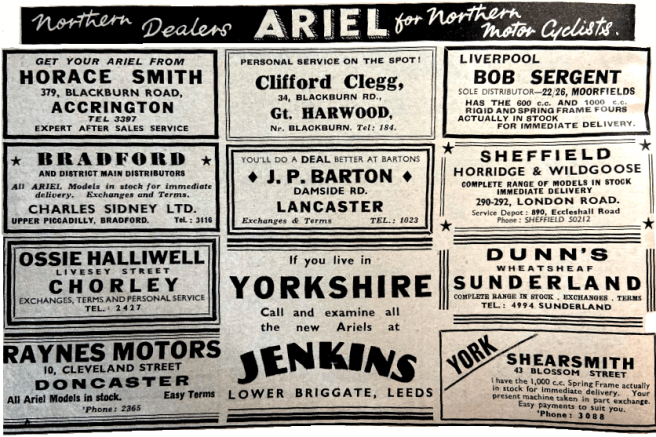
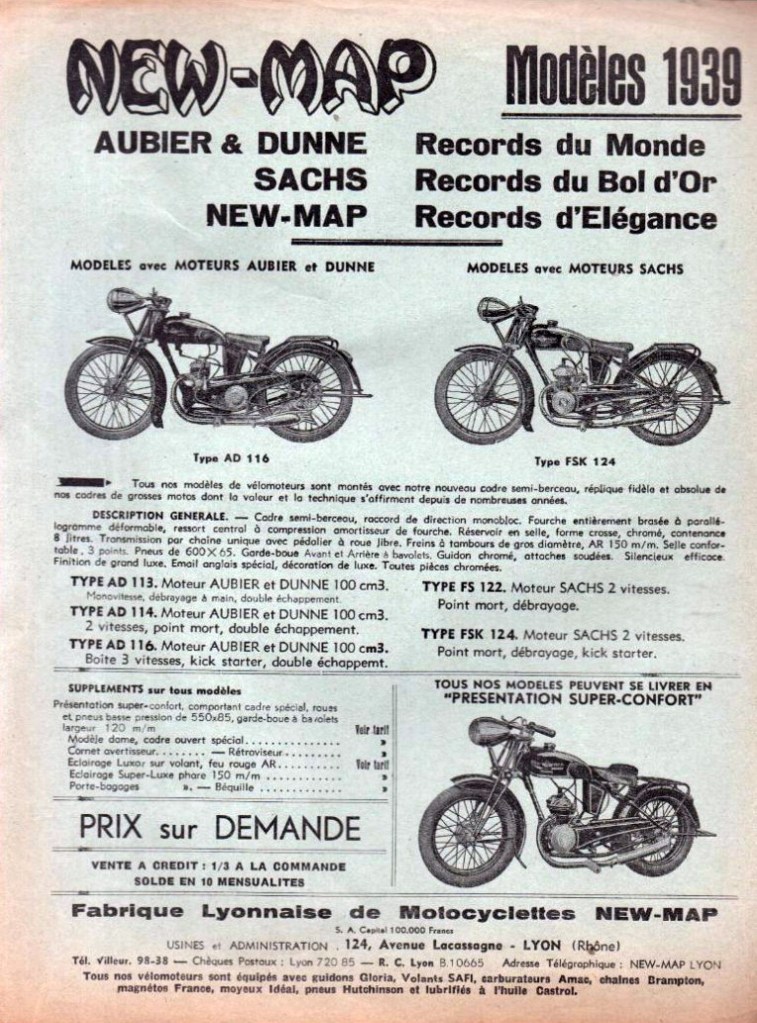
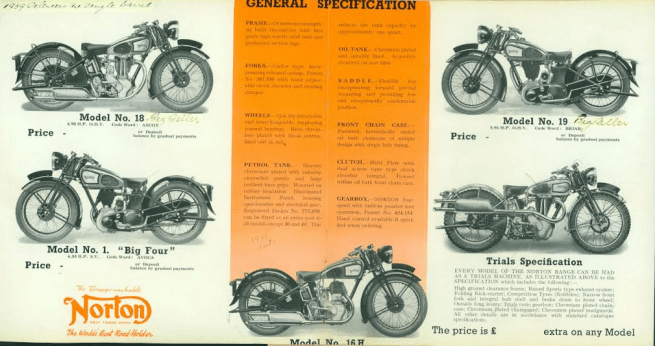
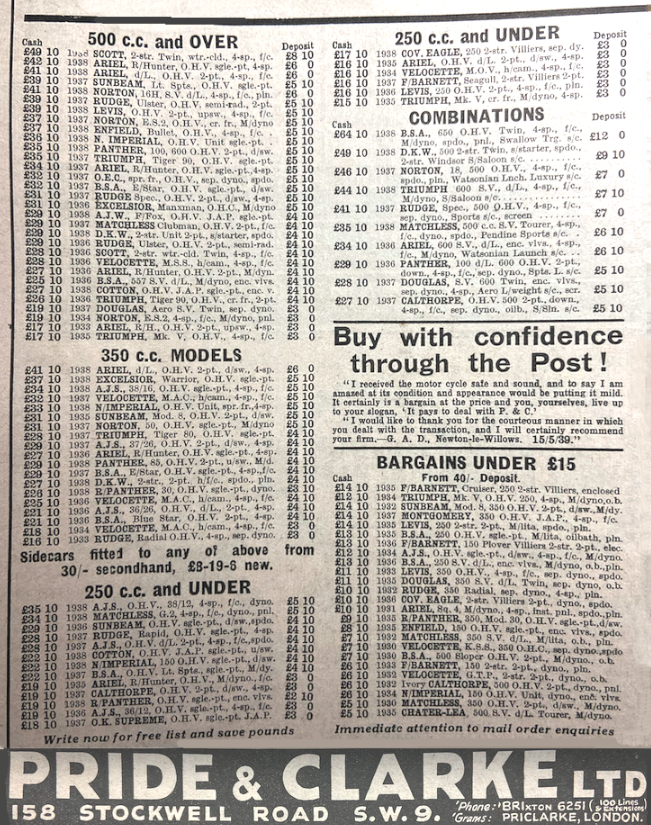
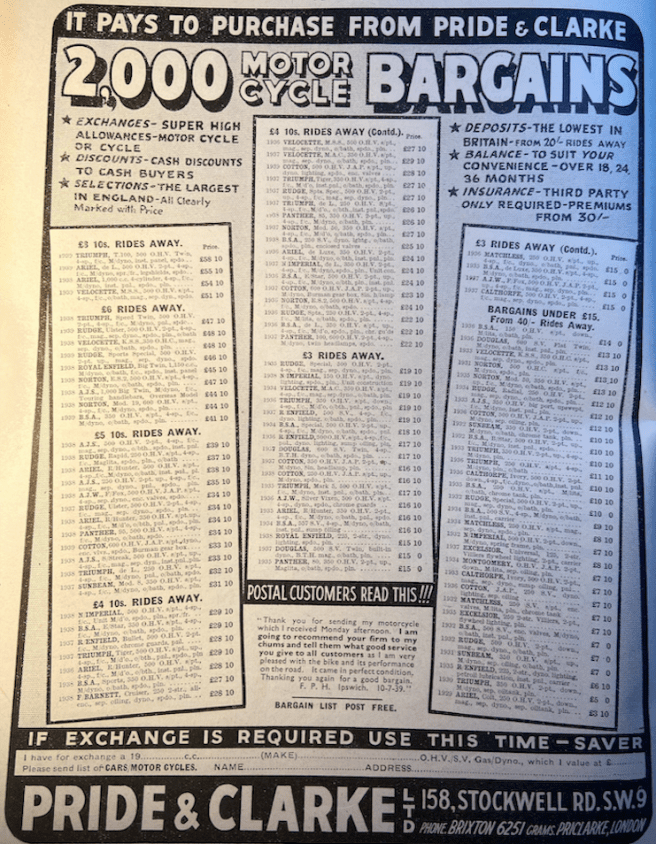
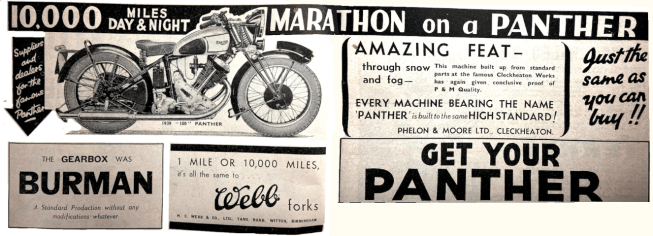


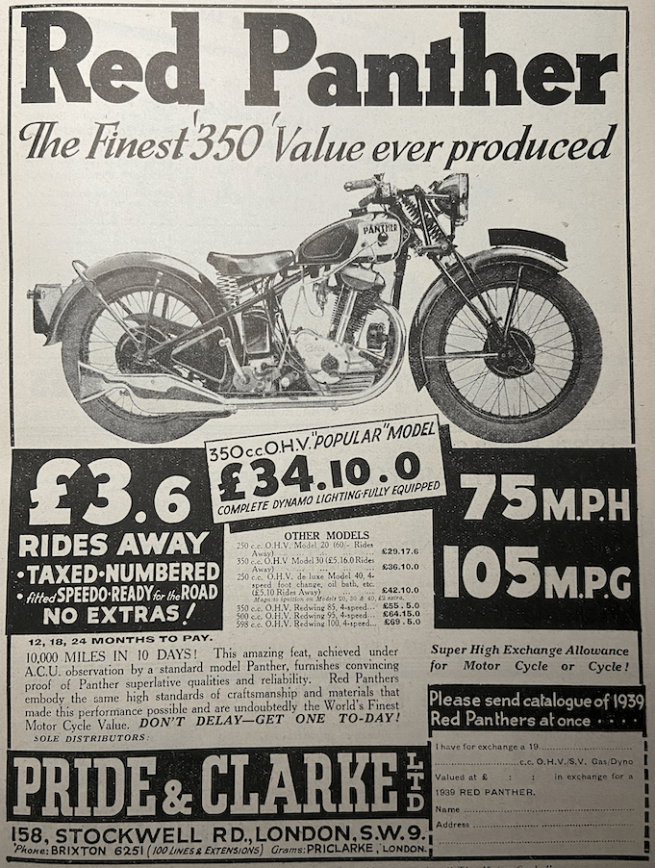
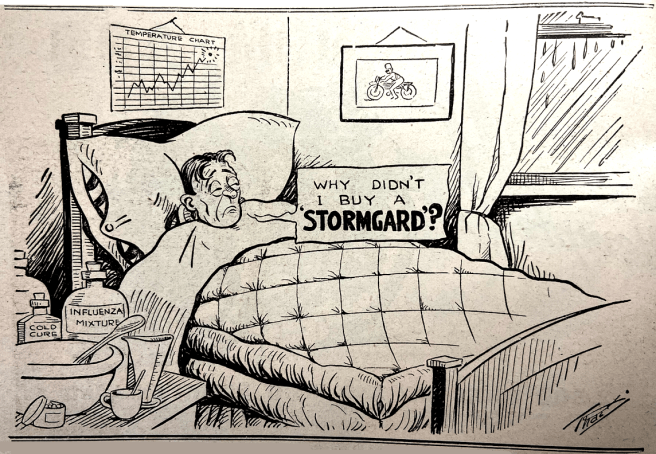

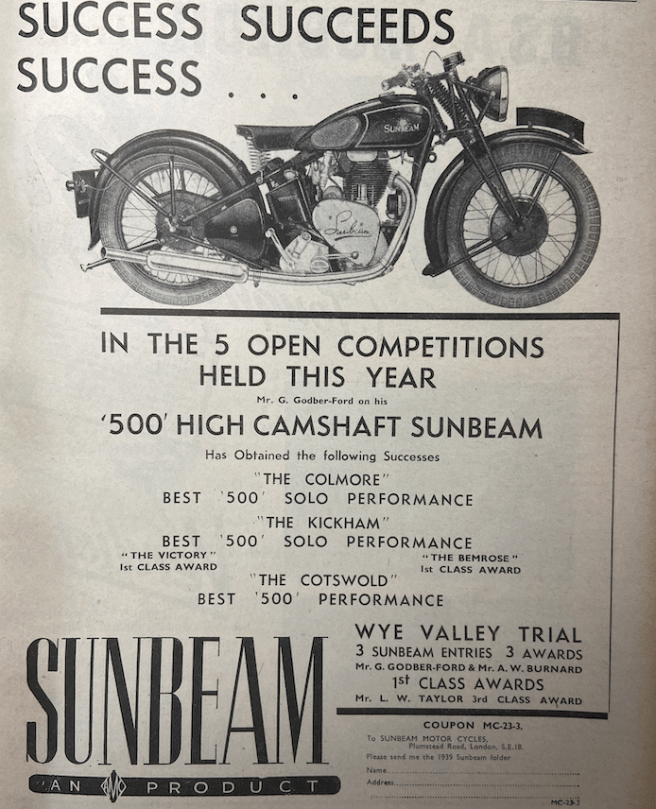
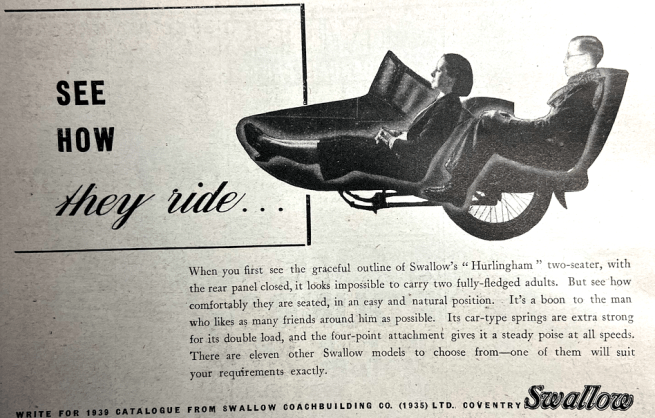


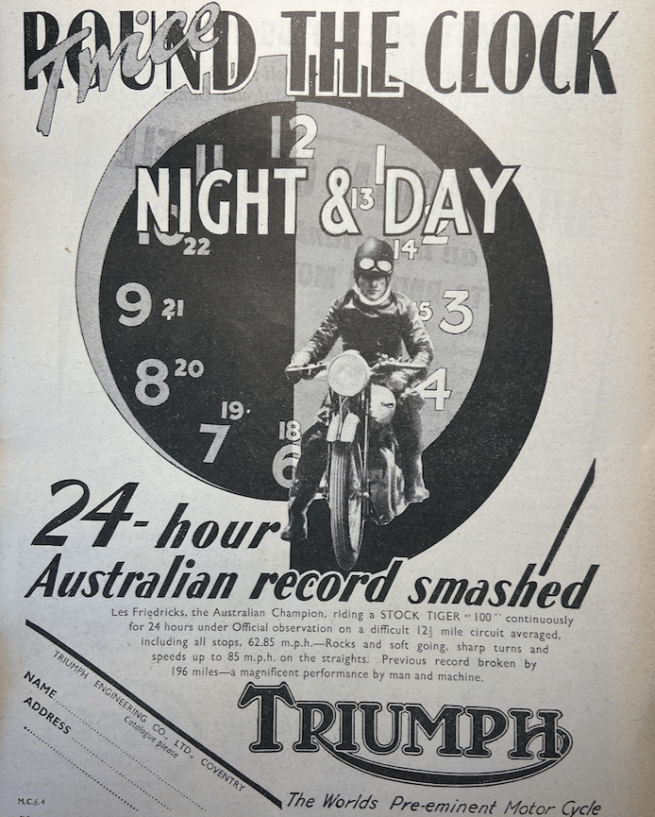
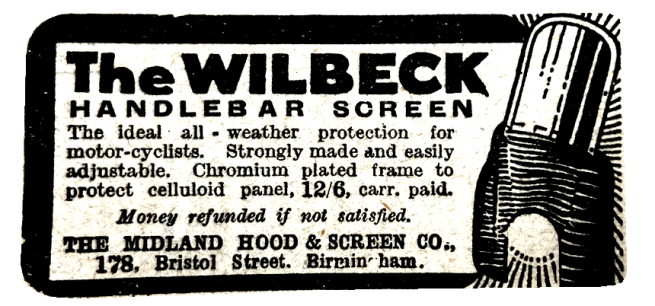
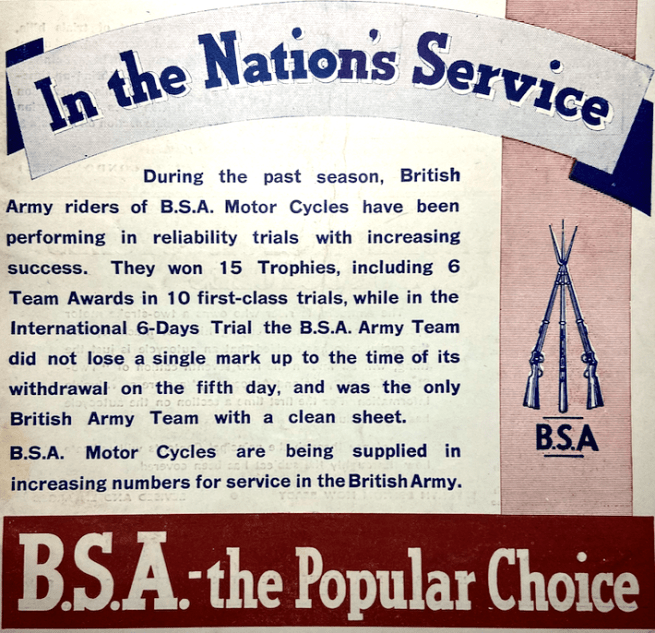
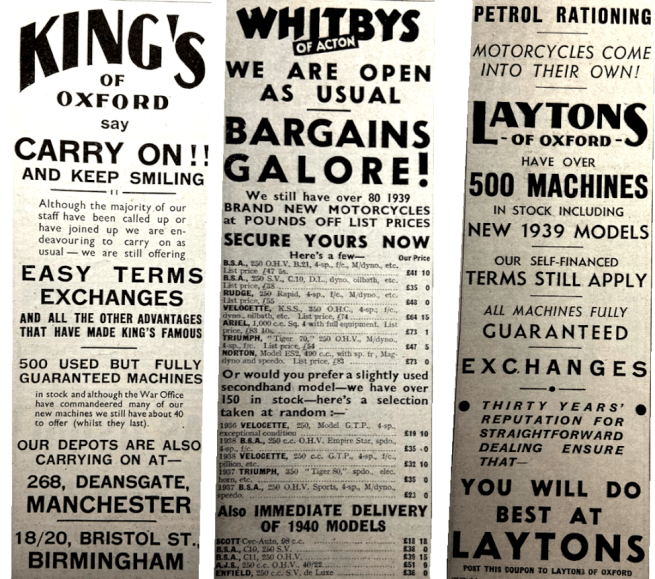
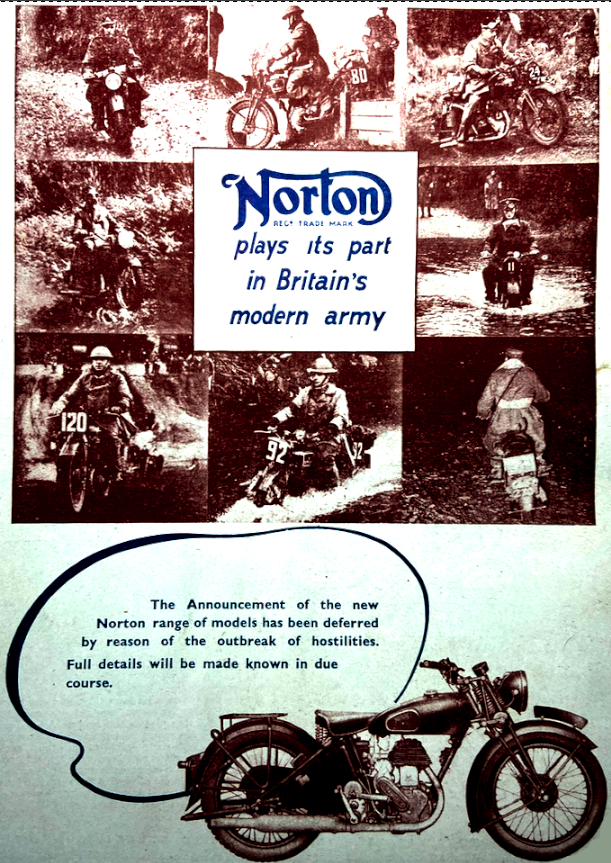
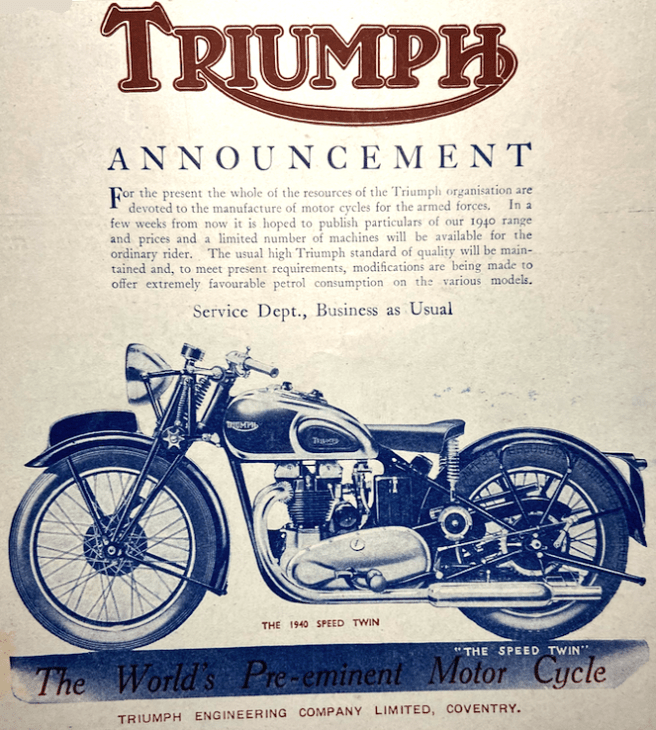

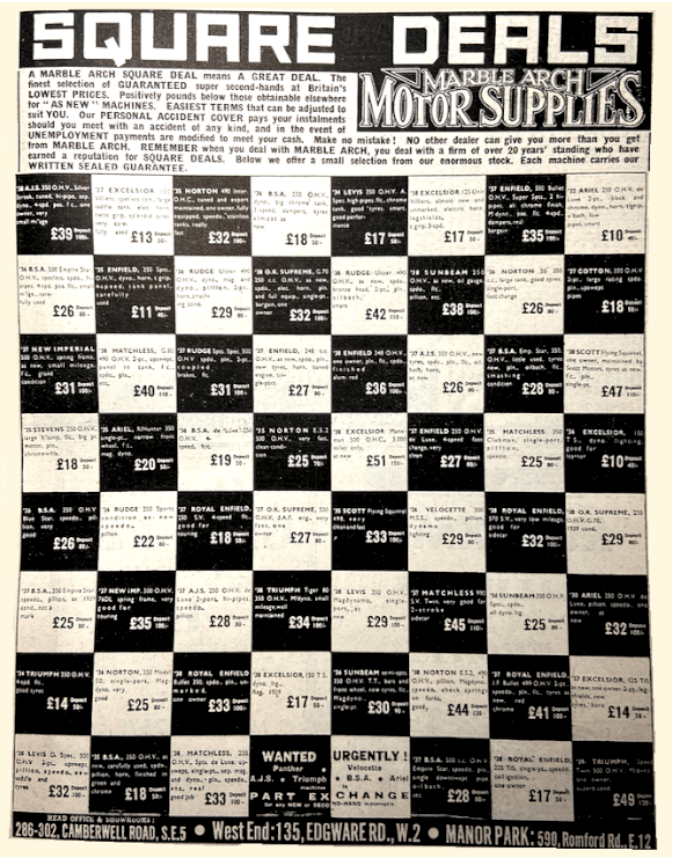
 Motorcycle Timeline