“THERE IS ONE NEW YEAR’S resolution at least that will be welcomed by London motorists. We refer to the instructions issued by the Commissioner of Police for the Metropolis to police officers to caution persons who behave carelessly or without regard to their own and other people’s safety. The edict applies to all road users, whether motorists, cyclists or pedestrians. Why will the new campaign specially benefit motorists? Because, we suggest, it marks the beginning of the end of that system of petty persecution that has threatened to estrange motorists and those who should be their friends—the police.”
“MY CHRISTMAS-JANUARY 1st mail always packs a thrill, because it is sure to contain warm-hearted letters from exiles of whom I have never previously heard. The 1936-7 change over was no exception. For instance, two pals in Western Australia; one has just got married, and the other elects to stay single. The married one can only run to a 1925 350cc side-valve Douglas, which cost him one pound. The bachelor pal has a 1929, 680cc Brough, which cost him £65. (Woman, what sacrifices are not borne for love of thee!) Then another from Sask, which I assume to be short for Saskatchewan. This letter might be summed up as ‘100° to 40°’, which is not a bookmaker’s odds, but the range of temperature in the writer’s year, varying from 100° in the shade at mid-summer to 40° below zero in midwinter. Add to these extremities of heat and cold ‘dirt’ roads, gravel tracks, deep sand, ice snow and floods, and you can easily see that only a he-man will invest in a form of transport which resembles a cowboy rodeo in the summer and threatens you with frost-bite all the rest of the year. Yet there are many out there who are passionate students of The Motor Cycle, are as well versed as our staff in the sporting history of the motor cycle and the merits and demerits of this machine and that; and almost without exception they yearn to return to he old country and to watch a TT!”—Ixion
“TRIALS ENTHUSIASTS WILL BE interested in the range of Triumph Tigers in competition form which have just been introduced. The new models are based on the existing Tiger range, and are obtainable with 249cc, 349cc and 497cc ohv engines. Special wide-ratio four-speed gear boxes are fitted, and a variety of ratios is available. With a 17-tooth engine sprocket, ratios of 6.46, 9.36, 14.83, and 19.82 to 1 are obtainable. At the other end of the scale, ratios of 4.78, 6.93, 11.00 and 14.7 to 1 are obtainable with a 23-tooth engine sprocket. Other interesting features of the new competition Tigers include increased mudguard clearance, a sturdy crank case, undershield, and a special front fork spring. The engines are specially tuned, and designed to develop plenty of power at small throttle openings. In this connection particular care has been taken in tuning the carburetter. Either high- or low-compression pistons are available.”

“THE INFORMATION PRINTED in this brochure anent motor cycling is tantalisingly sparse, but it is sufficient to indicate how the Government policy in Germany surpasses that adopted in Britain. For example, number, of motor cycles in use: Germany, 1929, 610,000; 1934, 936,000=plus 53.4%; United Kingdom, 1929, 732,000; 1934, 548,000=minus 25.1%. Germany registered an increase of over 50% in these five years in spite of her general economic condition being so bad that she is still short of certain vital foodstuffs. She accomplished this feat by eliminating vexatious governmental interferences, such as imposing heavy tax and insurance charges on lightweight machines in the British manner. This courageous policy has produced the following results, which can only be regarded as extremely beneficial from a purely nationalist standpoint: (a) It has increased employment by selling 25,000 additional machines in each of the five years. (b) It has enriched Germany by a large number of skilled mechanics. (c) It has rendered German labour much more mobile. (d) It has improved the physical standards of a substantial section of the youthful male population. We might have enjoyed similar benefits had we been blessed with more intelligent and far-sighted rulers. Germany is now easily the largest user of motor cycles in the world, although we still retain 60% of the world’s export sales.”—Ixion.
PS IXION REVEALED that he had picked up his first speeding ticket after 40 years and 750,000 miles.
“THE steady increase in the value of British motor cycle exports that was a feature of the first 10 months of 1936 was maintained in November, the figures for which month have just been issued. Machines to the total value of £64,869 were exported, of which £32,173 was spent by Australia. The total value of machines and parts exported during the 11 months of 1936 amounted to £1,004,135. Once again Australia heads the list as Britain’s best buyer, with a total of £240,346. Of the foreign countries, Holland purchased motor cycles to the value of £47,503 during the 11 months.”
EIGHT BELGIAN MARQUES were producing about 35,000 motor cycles a year.
“STANLEY WOODS (VELOCETTE) won the Junior race in the South Australian Centenary TT at a speed of 79.9mph. Clem Foster (Norton) won the Senior race at 83mph…a 1,000cc Ariel Four and sidecar driven by R Badger won the sidecar class at 71mph.”
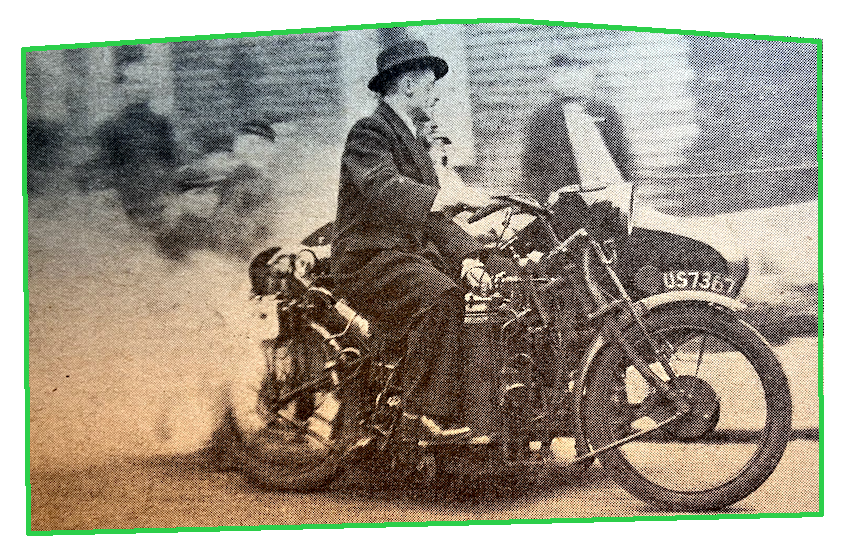
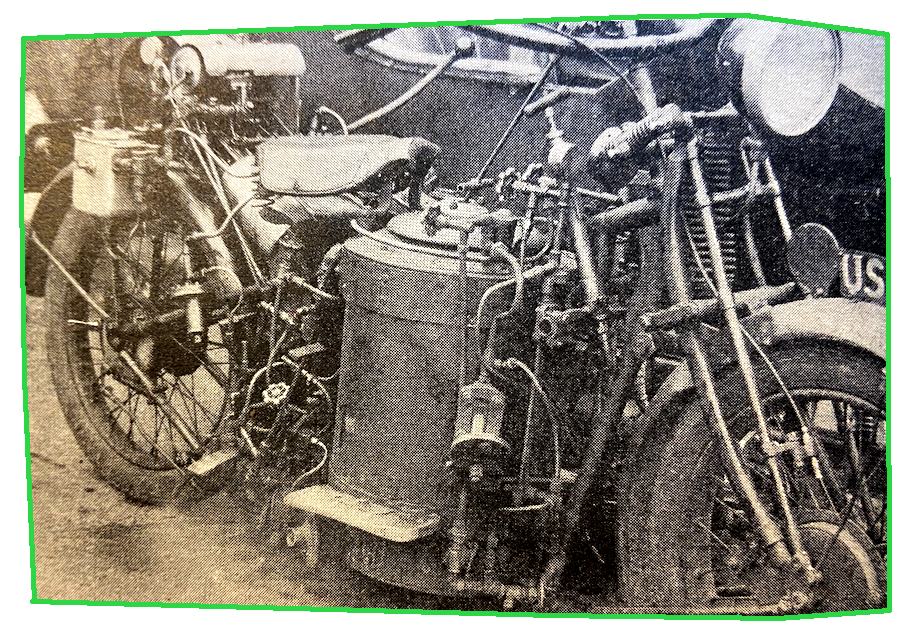
“SOME TIME AGO a picture appeared in The Motor Cycle of a steam-driven sidecar outfit built by Mr James Sadler, a Glasgow engineer. It had been designed, after a series of experiments, purely as a hobby. Last week-end it made its bow to London under the auspices of Marble Arch Motor Supplies at their Camberwell showrooms. When the offer was made last Monday to go out on Mr Sadler’s outfit I was more than thrilled. Time did not permit an extensive test, so I had to be content with a ran round the houses in South London. Nevertheless, although the machine is only a hobby, and an experiment at that, I left it with feelings of regret that steam has been so neglected as a means of comfortable motoring on three and even two wheels. After a brief description of the general layout, Mr Sadler jumped into the side-car while I found a way into the saddle over a maze of pipes, valves and gauges. Between my legs was the high-pressure tube boiler, with a head of something like 200psi of superheated steam inside it. Behind me, over the rear wheel, was the twin-cylinder double-acting engine, coupled direct to the rear wheel by chain. Slightly behind any left arm was the forward-and-reverse lever, while in the middle, on top of the boiler, was the steam valve, or throttle control. To start, all one had to do was to set the lever to the forward position and then manipulate the steam valve. Quite gently, but with a feeling of extreme power, we surged forward. That feeling of terrific power at 1mph or less was most extraordinary. No juggling with clutch, throttle and brake controls—one just operated the outfit on the steam valve alone. The outfit accelerated rapidly in a delightfully smooth and effortless manner. If one wished to stop, one simply reversed the lever and braked on the engine. Incidentally, I found the outfit quite easy to drive in reverse.
As regards actual speed, something like 30mph could be attained with a 4001b pressure in the boiler. The outfit is built up from old motor cycle parts in a more or less orthodox frame. The boiler, carried in the centre of the frame, is of the fired tube type, designed to work at 400psi. It is fired by a controlled paraffin burner, fed from two high-pressure cylinders running at nearly 200psi. The pressure in these cylinders is maintained automatically by steam. The steam from the boiler is super-heated by means of a seven-foot spiral pipe running in the flame of the burner. It then passes to the high-pressure twin-cylinder, double-acting engine mounted horizontally on a sub-frame over the rear wheel. The engine has a bore and stroke of 64×89.5mm, and is of the normal slide valve type. A steam lubricator sees to the lubrication of the pistons. Another essential fitment is the donkey pump that injects water into the boiler. Should the water level in the boiler drop, the burner is automatically shut off. A four-cylinder high-speed miniature steam engine with a bore and stroke of 25.5×25.5mm drives the dynamo mounted on the front of the sidecar chassis. Under the seat of the sidecar are situated the paraffin tank (8gal) and the water tank (10gal). On a long run the consumption amounts to approximately 25mpg for both water and fuel, so that the outfit has a range of roughly 200 miles.”—Ambleside
“‘SPECTATORS WILL NOT BE allowed on the course this year; competitors will only be admitted to the grounds on the production of a printed pass.’ Thus runs an official statement covering the Sunbeam Championship Trial to be held at the end of this month. The reason for the decision is the amount of litter left on the course—a private one—when the event was held last year. Unfortunately the club concerned is by no means the only one to suffer at the hands of spectators. It is a regrettable fact that much of the prejudice that has arisen over trials is the result of thoughtless actions on the part of spectators. It is merely a few black sheep who cause the trouble. How can their activities be curbed? The Sunbeam Club is adopting a method which is simple in cases where enclosed ground is used, but it means that the orderly as well as the unruly are debarred from watching the sport they love. We suggest that much good might result if organisers pressed into service some of the spectators, making them officials for the day and giving them as their sole job the task of controlling crowds.”
“LITTLE BIRD WHISPERED to me last week that the Ministry of Transport is going to construct a giant motor road along the east and south coasts from Bournemouth to Cromer. Alleged motive, to furnish a free run in time of war for motor lorries mounted with anti-aircraft guns. Hope it’s true; we could do with a coast road right round these islands, always provided it was pushed inland half a mile or so where the coast is really lovely, and only allowed to hug, the beach where the coast is dull. But I don’t believe the little bird; I doubt whether a motor lorry would ever form a satisfactory mounting for a gun which will have to fling a shell up to 25,000ft.”—Ixion
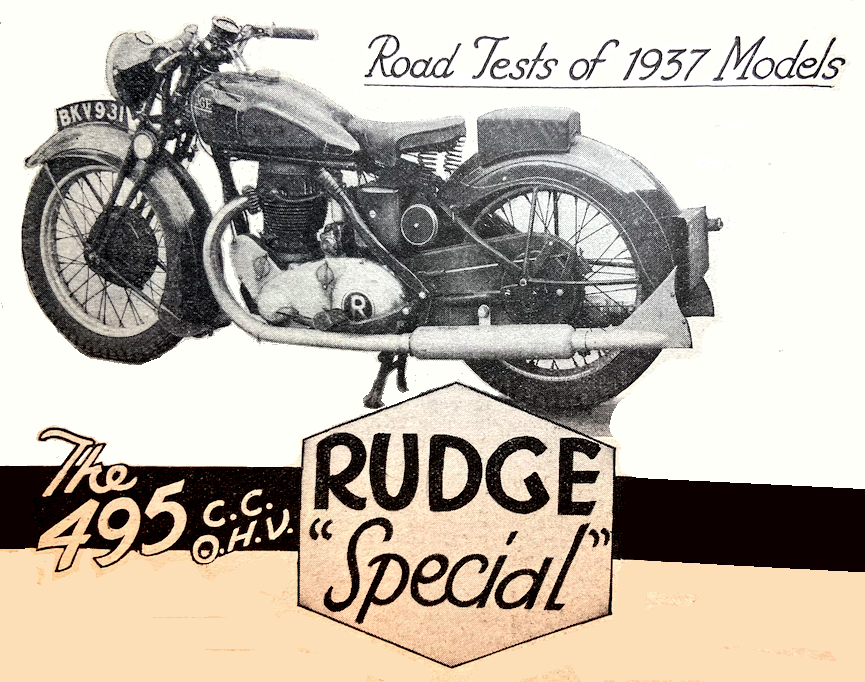
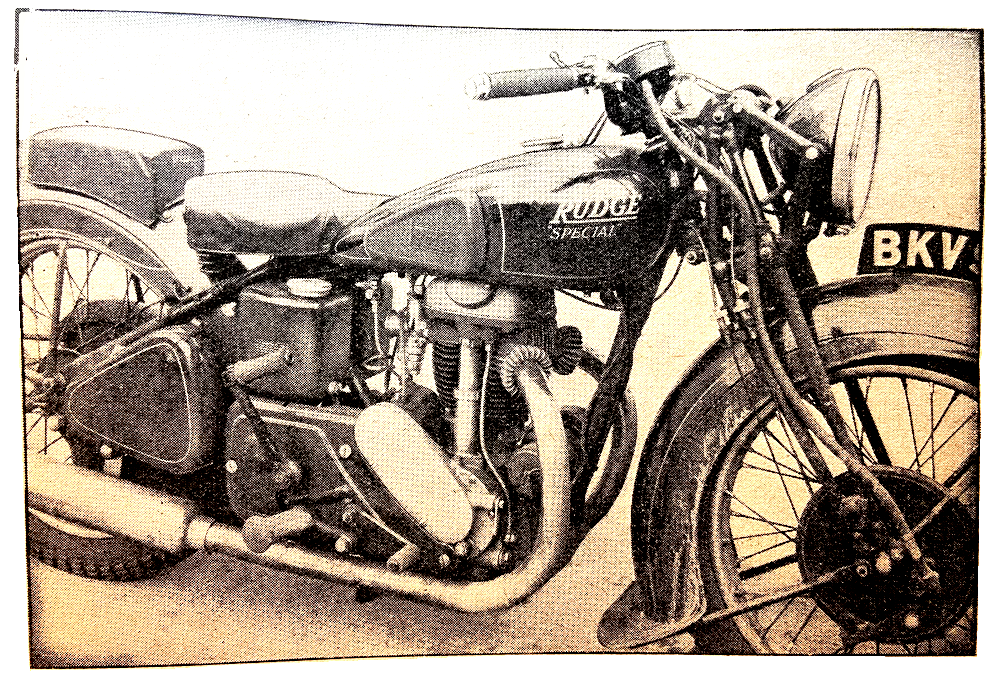
“THE RUDGE SPECIAL has many of the good points of its speedier prototypes that have won fame on road and track. It has excellent steering at all speeds, as well as superb brakes and road-holding. It is also exceptionally silent, both mechanically and as regards the exhaust. This year the riding position has been altered slightly, with the result that comfort has been considerably improved. The footrests, pedals and handlebar controls are all well placed. Starting was a comparatively simple matter if the decompressor was used. Otherwise the kick-starter was liable to kick back viciously. The engine balance was of the highest order, vibration being almost completely absent. All the controls worked smoothly and lightly, and in this connection the clutch deserves special mention. On the other hand, while gear changing was easy between second, third and top gear ratios. a silent change from bottom to second or vice versa is difficult on account of the big divergence in the ratios. Bottom gear is sufficiently low to enable trials hills to be tackled successfully, while the remaining ratios are particularly suitable for fast riding over main roads. The engine seems to revel in high revs, yet at the same time it will slog without complaint. The maximum speeds of 25, 49, 63 and 70mph in the various gears were obtained under adverse conditions against a stiffish wind, and while valve bounce would probably preclude the speeds in the three lower gears being improved, there is no doubt. that the top gear reading could have been bettered by two or three mph. On good main roads, clear of traffic, it was possible to maintain a steady 65mph, winch is unusually having regard to the machine’s maximum speed. The engine would stand any amount of hard driving, both at high and low speeds. At all speeds the steering was outstandingly good. It is of the light variety without being unduly so, and at high speeds imparts a feeling of great security. The road-holding was also admirable, particularly on fast corners. The Rudge gives the impression of deciding for itself the right amount of bank necessary for each corner. On greasy and loose surfaces there was a minimum of wheel hop—a point for which the Dunlop Universal tyres were no doubt partly responsible. Following the usual practice of the Rudge company, the Special is fitted with coupled brakes. Whether the front brake was used on its own or in conjunction with the rear brake, braking was at al1 times smooth and certain. Indeed, such confidence was inspired by the brakes that even on skiddy surfaces their application called for no special caution. After a prolonged test the various joints in the upper half of the engine remained free from oil leaks; a certain amount of seepage took place though the case joints. Particular mention should be made of the mudguarding. After many miles of wet roads covered at high cruising speeds, the engine and various other parts remained remarkably free from mud and grit. A 6-volt Miller dynamo, driven by separate chain running in an oil bath, is fitted, and the head lamp provides a narrow beam of unusual length. At all times the Rudge Special gave the thrill of smooth, silky power. On light throttle it was unusually quiet, while even on full throttle there was very little increase of exhaust noise. The oil consumption was negligible, a remark which almost applies to the petrol consumption! At a maintained speed of 40mph the Special’s consumption amounted to 91.2mpg. Towards the end of the test there was evidence of a weak mixture, a fact which undoubtedly- affected the acceleration figures in the various ratios. A special feature of the Rudge is a hand-operated central prop-stand. It requires very little effort to operate and can be used by the rider when sitting in the saddle. Care must be taken if the machine is ridden off the stand, for the hand lever is liable to come down and trap the rider’s left foot. The Rudge Special is a very interesting ‘standard’ machine, since it possesses numerous sporting traits. The very complete specification includes a mudguard pad and a speedometer. A small but interesting refinement is that all the major nuts on the machine are domed. Altogether the machine forms a very workmanlike and desirable roadster. “
“WE REGRET TO HAVE to say so, but the whole tendency in the trials world is towards what may be described as ‘softness’. Except for MCC events there are now hardly any long-distance trials. ‘Make them short and snappy’ has been the cry. We know that there have been good reasons for this, particularly during the lean years of the recent past, but we have seen with regret that many of those taking part in trials are not motor cyclists in the proper sense of the term—they come to the start by train or in cars and, when the event is over, return in similar fashion. True, trials have developed motor cycles which are none too good for ordinary road work, but there is also a proportion of present-day trials riders who have grown soft; they are not motor cyclists, but jockeys. Some of these will say that they live only for the actual sport of riding through and up observed sections. The fact is that present-day trials are breeding this type of man—the jockey as opposed to the true enthusiastic motor cyclist, and it is a very great pity.”
“STRIKING PROOF OF THE inherent safety of the motor cycle and its value in police work is given by figures quoted in the December issue of The Garda Review, the official organ of the Irish Free State Police Force. The motor cycle patrols were introduced in June 1926, and from that date until October 1936, a total of approximately 1,680,000 miles were covered without a single accident for which the drivers were either directly or indirectly responsible. The patrols were on the road every day from 8am to 12pm, and their duties ranged from chasing speedsters to directing traffic. A record to be proud of!”
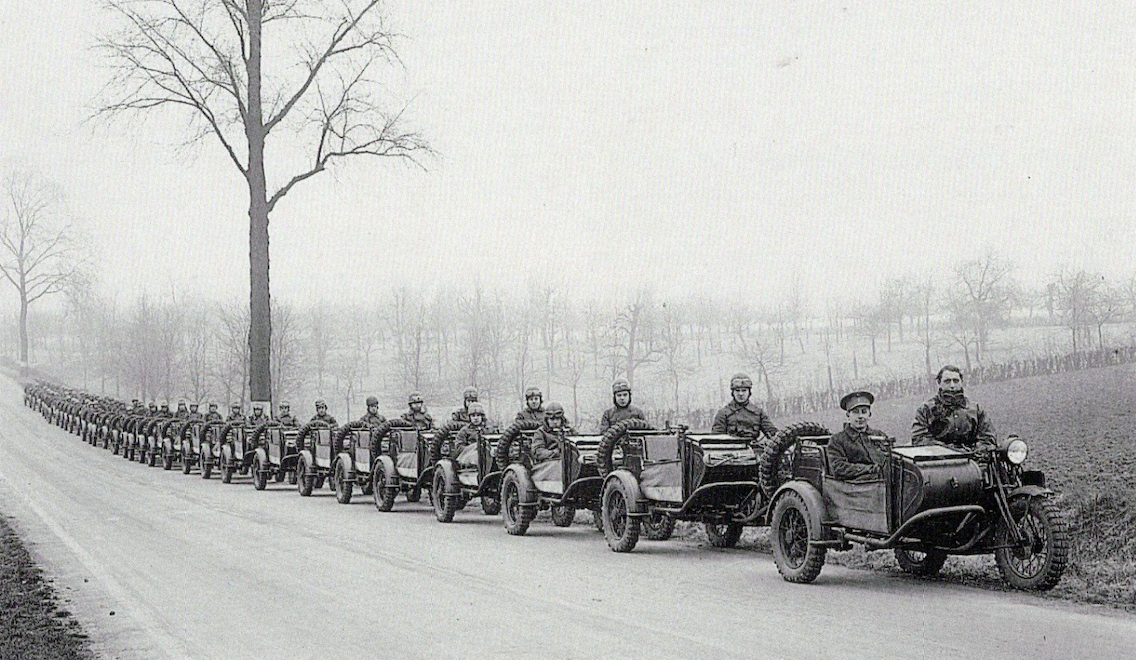
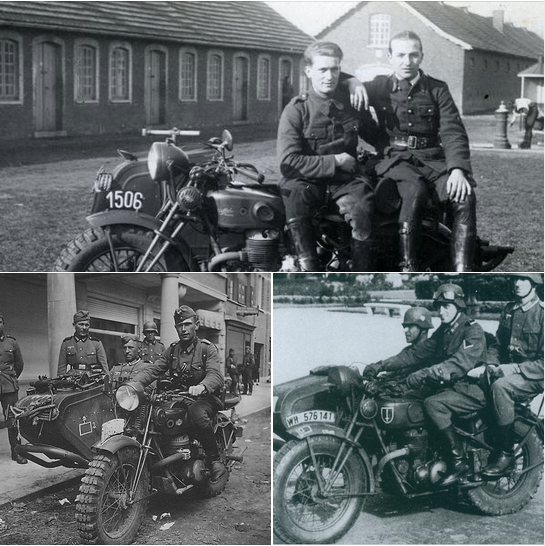
“THE FRENCH MILITARY authorities have purchased 1,000 750cc sidecar outfits.” That’s all The Motor Cycle had to say about the order but there’s a good chance they were the latest WD model from the Belgian company Gillet Herstal. The Gillet Herstal 720 AB was powered by a 728cc two-stroke engine producing 23hp and driving through a four-speed box with a reverse gear and sidecar-wheel drive; fuel consumption was a dismal 14.2mpg. the ‘AB’ stood for Armée Belge; there was also an AF model for the French army—France ordered a total of 1,500 720AF solos to be fitted with French-made Bernadet sidecars. Fewer than 800 ABs and AFs were produced; following the German invasion of Belgium they were requisitioned by the Wehrmacht.
“THE HUNGARIAN GOVERNMENT has introduced legislation designed to stimulate the production of home-produced petrol from coal.”
“A NEW PETROL-FROM-COAL plant is to be established at Pencoed, Bridgend (South Wales) by the Low Temperature Carbonisation Company.”
A GERMAN FIRM won a £600,000 contract to build a coal-from-oil plant in Manchuko, a Japanese puppet state in China. .
“THE DUKE OF KENT is to open a new oil-from-coal plant at Bolsover (Derbyshire) on April 14th.”
LOW TEMPERATURE CARBONISATION Ltd opened a factory able to produce 12 million gallons of oil and petrol and year from coal. The company claimed to be able to meet 1% of Britain’s oil and petrol needs.
“LAST YEAR, 112,000 tons of petrol were produced from British coal—about 2½ to 3% of the total consumed.”
“‘£60,000 WOULD PROVIDE enough plant to carbonise the whole of the domestic fuel used in this country. From this amount of coal we should derive about 5,000,000 tons of oil and petrol.’—Colonel WA Bristow.”
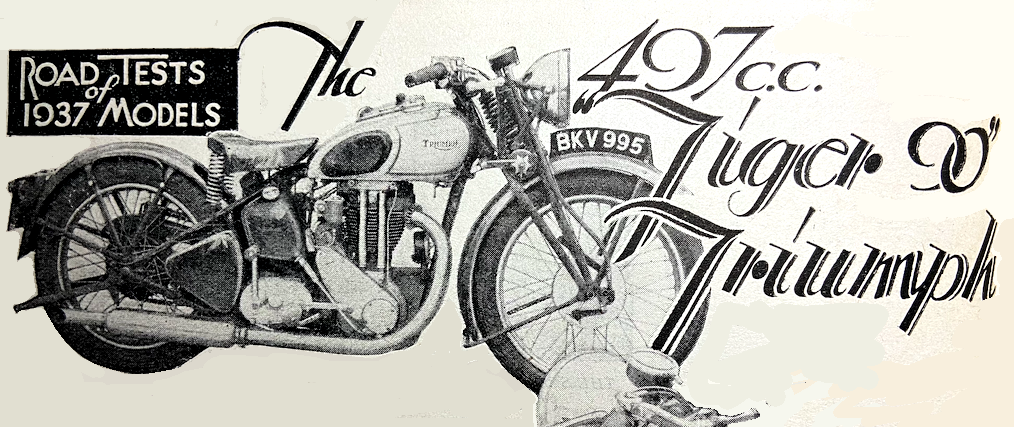
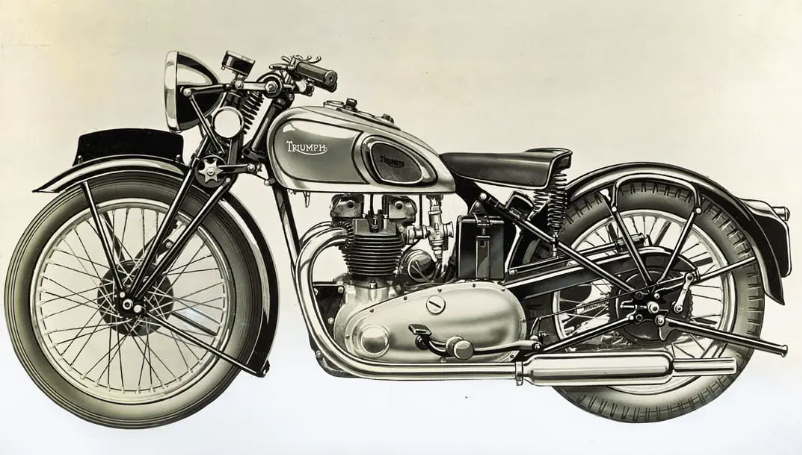
“EVEN IN THESE DAYS, a single-cylinder motor cycle with a genuinely high performance wedded to the smoothness and docility of a side-valve is some-thing of a rarity. Such ‘Jekyll and Hyde’ qualities are a feature of the latest Triumph Tiger 90. Since its introduction last year the Tiger 90 has come to be looked upon—and rightly so—as a specially tuned machine designed for the connoisseur and the hard rider alike. It is unusually swift, and yet at the same time it is extremely flexible and docile. Starting is a comparatively simple and effortless matter, thanks to a suitable kick-starter-engine ratio. Even when started from cold the engine idled perfectly, but there was a slight trace of a weakening of the mixture just off the pilot jet, and this at times caused spitting back and even stalling of the engine. To remedy this, the needle valve of the horizontal-jet Amal carburetter was raised one notch, and the slight richening of the mixture resulted in more even running with the throttle just off the tick-over setting. The riding position is designed for a person of normal height. The footrests, pedals and handlebars are correlated to a nicety, although the handlebars are a trifle wide for long-distance work. They are, however, rubber mounted, and all the controls are exceptionally well finished. Both clutch and front brake levers are of the racing type, and are conveniently placed on the bars. The large but graceful 3¼-gallon petrol tank, with its moulded-rubber knee-grips, does not interfere with the rider’s comfort. In fairness to the high-efficiency engine, the Triumph was run on an Ethyl fuel throughout the test. No doubt a mixture of 50-50 petrol-benzole would have given even better results, but at no time did the engine show signs of distress. On the contrary, it seemed to revel in hard work for mile after mile, without a trace of a knock. In fact, on fast main roads it was difficult to refrain from letting the Tiger have its head. The gear ratios are ideal for fast main-read work. All the ratios are suitably spaced, thus permitting a neat and fast change when required. Some riders might find the foot-change a trifle disconcerting at first. It works in an upward direction for the higher gears and downward for the low. This operation was a little uncertain when changing from third into top gear at speeds in the neighbourhood of 70mph. However, the selector mechanism is very precise and positive in action, and no one should have any difficulty after a few hours’ riding. Throughout its range the engine was delightfully smooth and remarkably free from vibration. It was lively without being unpleasantly so. The power output seemed to improve noticeably at speeds of over 50mph in top gear. At high speeds the Tiger gave the feeling of exceptional power without being unduly noisy. However, the exhaust note did change from a burble to a healthy but not obtrusive crackle when the throttle was well open. Because the power is more apparent at high speeds than is usual, the acceleration may not seem
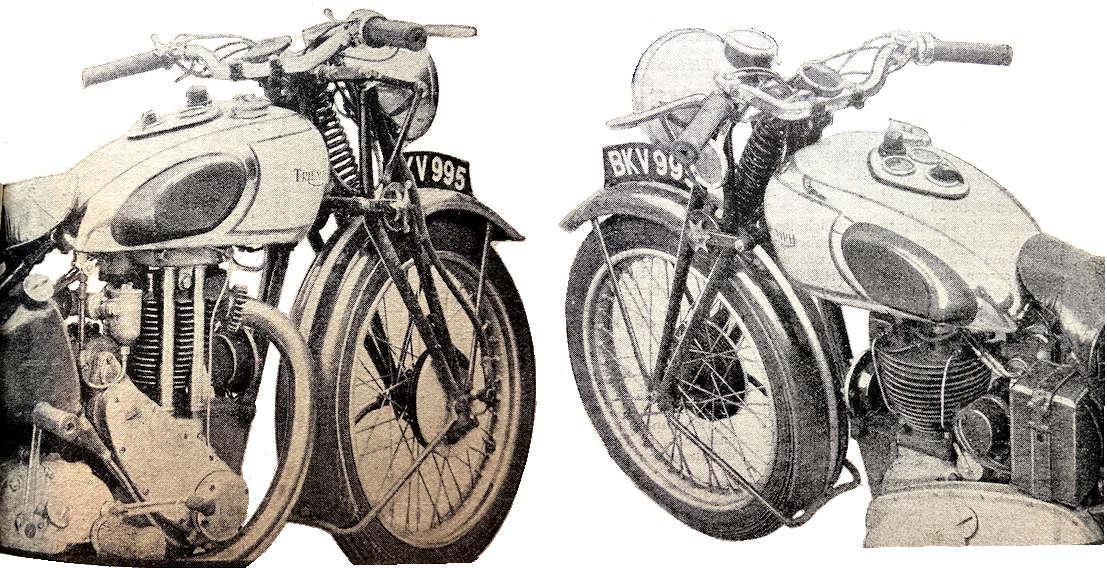
outstanding. The best acceleration was obtained at speeds of over 50mph, and only began to tail off after 75. Third gear is an extremely useful ratio for fast work, and was a pleasure to use. Circumstances at the time of the test did not permit a two-way run for the timing of the maximum speed in top gear. The speed of 82mph was the mean of four runs against a stiff wind, and them is no doubt that the Tiger, fitted as it was with full electrical equipment, silencers, etc, was good for a genuine 85mph, if not more. At these speeds wind resistance plays a big part, and for this reason the Triumph’s performance was all the more creditable, because the rider had only limited opportunities of ‘getting down to it’, since no mudguard pad was fitted. While the bottom gear ratio is high enough to permit speeds of 35-40mph, it was.low enough to permit an effortless restart on a 1 in 5 gradient. In spite of a slightly weak mixture at small throttle openings the machine pulled admirably at slow speeds. In top gear it was possible to trickle along at 14mph without a trace of snatch. Naturally, when accelerating from this speed, the engine was liable to pink, a little if you throttle was opened it too quickly. As befits a model with a really sporting performance, the steering and roadholding were beyond reproach. The steering was of the positive type—very firm at low speeds, but becoming lighter higher up the speed range. At all times there was a complete absence of any pitching motion, even when the rear break was fiercely applied. Corners could be taken with a feeling of immense confidence. In fact, the whole machine inspired confidence. All the controls worked smoothly and lightly, calling for a minimum of effort. In this connection mention should be made of the clutch, which, although running in an oil-bath, suffers little from drag, even when the machine has been left overnight. It is exceptionally light, is very positive without being fierce, and requires little movement of the lever for complete withdrawal. Both brakes are of the ‘spongy’ type, and consequently very pleasant in action. The front brake could have been a little more positive—it was comparatively easy to bring the racing-type lever almost against the twist-grip. Both brakes were very safe in use at high speeds. At one period of the test the roads were ice-bound, but so excellent were the steering and road-holding of the Tiger that any natural nervousness was quickly allayed. Over this type of going the brakes were undoubtedly ideal, and this point should be remembered when considering the braking figure from 30mph. On wet roads the cleanliness of the engine testified to the efficiency of the mudguarding. The engine, too, with its enclosed valve gear, remained completely oil-tight. No signs of seepage at any of the crank case joints were present. To sum up, the Triumph Tiger 90 is a most attractive machine. It has a really first-class performance, coupled with excellent docility and flexibility.”
“TWO OR THREE YEARS ago if one wanted a motor cycle which was fast one had to put up with harsh running—that is, unless one bought a four-cylinder job. Inflexibility, poor slow-running, and lack of slogging power were what one paid for snap and speed. A change has been wrought. To-day there is quite a number of hot-stuff singles with Jekyll and Hyde characteristics. You get freedom from pinking, good top gear climbing and tick-tock running with a hyper-sports performance available at command. A year or two back I could name only about a couple of makes that combined the cart-horse with the race-horse. Now, to judge from other models I have ridden, there must be at least half a dozen.”
“THE Ministry of Transport avers that only 3% of accidents are due to road defects. The Oxfordshire surveyor avers that 60% of accidents could be prevented by eliminating elementary defects in the roads, and that if we modernised our entire road system, some 80% of the accidents could be averted. By ‘elementary defects’ he means blind corners and such like. Now the difference between 3 and 60% is fantastic, and off-hand one would judge that the county surveyor, in arms against a national authority, was wrong. But this surveyor has a definite title to respect. During 1936—a period when every other authority was registering an increased number of accidents—he halved the accidents in his area! Moreover, he halved his accidents by altering the road layout at points where experience showed that faulty road layout had produced crashes in the past. So we are driven to ask why the Ministry blames faulty road layout for a mere 3% of accidents. The answer is that it estimates on the basis of police reports. Now the police are trained to think in terms of people and guilt. They are nosing out criminals all the time. But the surveyor is thinking in terms of in material—skiddy surfaces, blanketed vision, and the like. So when the police report on a smash they are prone to talk of some failure of the human factor, which may or may not amount to criminal recklessness. But the surveyor asks why the human factor failed, and scans the road for a reason. I suspect that the Oxfordshire 60% is far nearer the truth than the Ministry’s 3%; and I hope we shall hear more of this dispute.”—Ixion
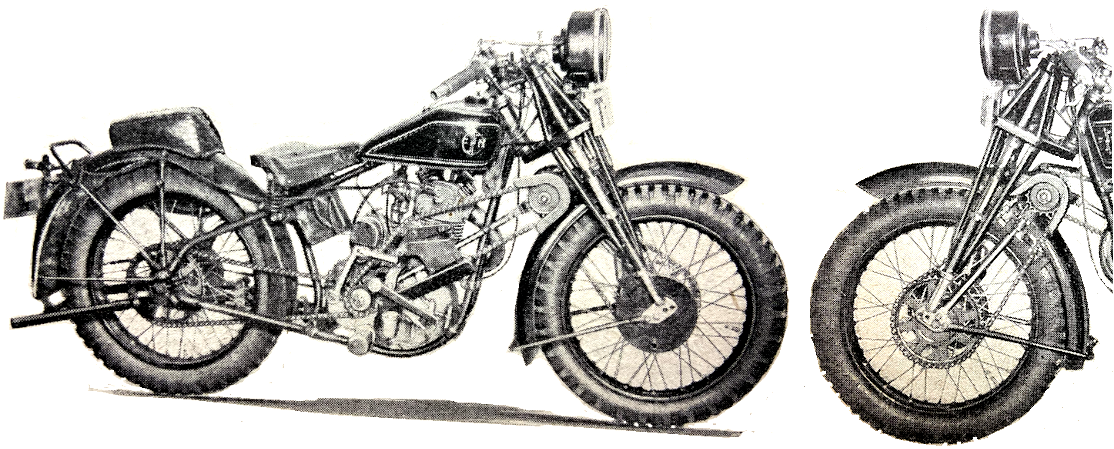
“THERE IS NOTHING NEW in the idea of driving both Wheels of a solo motor cycle, but there is room for some discussion as to the desirability of such a development. As long ago as 1924 The Motor Cycle published a photograph and a short description of a Raleigh machine which had been converted to two-wheel drive by a Yorkshire engineer for experimental purposes. The results were most interesting, for it was stated that the machine would climb anything, and would continue to travel over any surface which was firm enough to support it. Further, on straight roads the stability of the machine was such that it was positively difficult to fall off, even under provocation. Some force, however, was required to turn the machine on a corner, as it had a tendency to keep straight ahead. It is quite possible that this tendency could be eliminated, or at least minimised to such an extent that it becomes innocuous. But even so the question remains, is the additional complication worth while? The average motor cyclist would answer ‘No” quite definitely. The competition rider might think rather longer before answering, and if his final answer was ‘Yes’, there would arise very knotty problem for trials organisers. There can be little doubt that the addition of a front-wheel drive would revolutionise competition work! The idea, however, might be of considerable advantage for military purposes, since the scope of the motor cycle despatch rider would be far wider owing to his ability to progress over surfaces which are now regarded as impossible. The Raleigh machine mentioned had an extra sprocket behind the clutch from which a chain ran to a sprocket under the tank. A second chain led forward to a sprocket on a universally-jointed shaft below the steering head, and a third chain ran from this shaft to the front wheel. Re-member that this was a conversion applied to an existing machine, and might easily be carried out more neatly and simply on an original design. Now comes Mr JE Stormark, of AB Bofors, Bofors, Sweden, with a similar idea. He suggests either chain or shaft drive, the universally-jointed shaft being positioned under the’ steering head by suitable radius rods, which differ slightly according to whether parallel link forks or sliding fork members are employed. Mr Stormark has the courage of his opinions, and has converted several machines to his ideas, one of which, a racing sidecar outfit, won the Swedish hill-climbing championship in 1935. He states that machines fitted with his device will continue to travel on snow and ice when others are helpless. His original machine was most ingenious and embodied a universal joint in the front hub and certain features reminiscent of the Ner-a-Car and 0E . Mr. Stormark specifies as his ideal a narrow-angle V4 with geared cranks parallel to the frame line. The four-speed gear box would be driven directly from the engine, and the final drive to each wheel by shaft. There would be a differential between the two drives, capable of being locked in the event of wheelspin. The rear wheel would be spring suspended, and the front wheel final-drive shaft concealed in pressed-steel forks. Although the underlying idea should have many advantages for difficult going, the machine might be expensive, and possibly noisy since it must include not less than four pairs of bevels and an additional pair of spur gears.”
“I NOTICED THAT ONE OR two of your correspondents have related their activities during last summer, so I felt that I should like to mention a run which I consider—well, enthusiastic. It took place last Easter (which was every bit as much ‘summer’ here as July). During March I had been doing my usual 100-150 miles every week-end (besides evening runs), and when the long Easter week-end came under consideration I thought I would like to do something different. After some thought I remembered I had some friends in Blandford, Dorset. 1 decided to pay them a visit. So the route was planned and ‘Bubbles’ (my 250cc Red Panther) prepared. I left Glasgow at 6am on Good Friday, and with fair weather arrived at the Shap at 11am where I endeavoured to appease the ‘aching void’ and had an hour’s rest. My next long stop was at Bath, when I had an hour’s doze. The last lap—and I reached Blandford (and bed) about 1.30am on Saturday. Approximately 420 miles in 19½ hours on a 250—not no bad! Saturday and Sunday I spent visiting old haunts in the neighbourhood. Now for the return journey. About 8pm on Sunday it began to snow! I had visions of leaving the bike and going home by train. But pride (false or otherwise) put that idea out of my head. So at midnight I left for home. The first 100 miles took me five hours. But by this time it was getting light and progress became better. I reached Lancaster at 3pm on Easter Monday (still snowing), after a thrilling time on the tramlines round Wigan. And so for another last lap. I arrived in Glasgow, which I saw faintly through sleet, at 9.30pm. Another 400-odd miles, this time in 21½ hours. Now I know why ‘Torrens’ likes spring frames!
Matthew L Dickie, Glasgow, W2.”
“AFTER THE SUCCESSES of spring-frame machines in the last TT, it was assumed that a number of new motor cycles would appear at the Olympia Show with rear-wheel springing either standard or an optional extra. It was not a case of the wish being father to the thought, because hardly had TT week ended than designers were at work laying out spring frames suitable for production purposes. That the Show revealed nothing new is a matter of history, and the fear now is that the whole idea of rear-wheel springing may be shelved for years. There is a very real danger of this: we know of spring frames which were designed months and months ago, and are still in the paper stage, not even a single experimental model having been produced. Manufacturers, in our view, are unwise not to press ahead. It is easy to say that rear-wheel springing is not necessary in view of the smoothness of modern British roads. Admittedly, too, it is difficult to produce a spring-frame that is neat, cheap and efficient. Our experience of British and Continental spring frames is probably unique. We know that rear-wheel springing must come, and that the industry, by its adoption, can add to both safety and the usable performance of their productions. Spring frames should be standardised on all except low-speed machines and those whose sales appeal rests largely upon their low price.”
THAT YOU CAN’T FRIGHTEN motor cyclists with a mere war is proved by the fact that recently Ariels received a perfectly normal enquiry for a catalogue, prices, and so on from a private resident in Madrid, who is making a choice of machine. Can it be that the terrors of Franco’s bombs are overstated, and that everyday life in Madrid is nearer to normal than some would have us believe?”
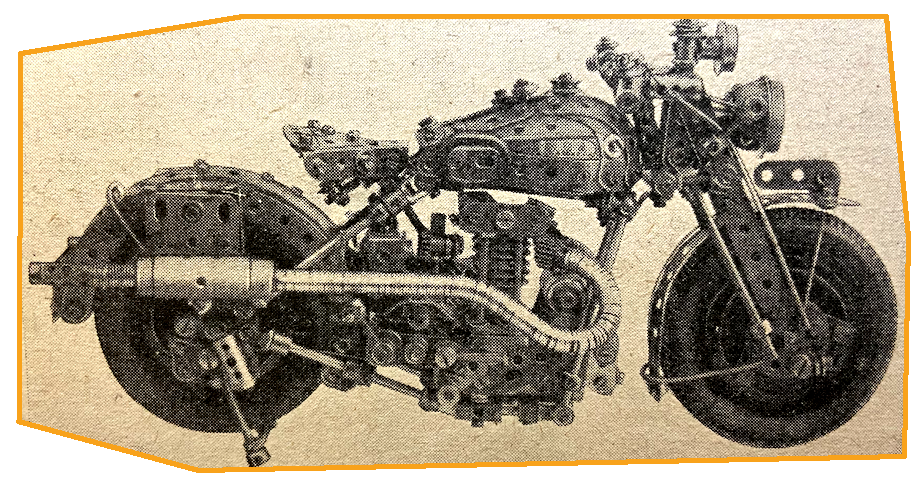
“IN THE HOUSE OF COMMONS last week Sir Arthur Michael Samuel asked the Home Secretary whether, in response to complaints by a public authority, he was taking steps, with the help of the local police, to abate the nuisance arising from the stream of motor cyclists at motor cycle trials on some of the public roads and lanes in Surrey. Sir John Simon said that he had been in communication with the Chief Constable of Surrey, who informed him that the police paid close attention to these trials, and took appropriate action to deal with any infringements of the law. Sir AM Samuel asked if the Home Secretary was aware that at the present moment in the lanes of Surrey these motor cycle trials were actually imperilling the lives of pedestrians. The Home Secretary said he was sure that the police would have the consideration in mind, but if the matter was one of regulation of traffic he thought it must be under the Road Traffic Act or under the local by-laws, and not under the Act dealing with general offences. Sir AM Samuel then asked if the Home Secretary would get in touch with the proper authorities. Sir John Simon replied that the fact the hon gentleman had asked this question would call attention to it. He had no doubt that the matter was being considered.”
“WHILE NO STRIKING DEPARTURES from orthodox design were to be seen at the Brussels Show, there were several interesting Belgian machines on view. In addition, a number of motor cycles well known to British riders, including BSA, Norton, Triumph and Harley-Davidson, were exhibited. FN, probably the most important of the Belgian motor cycle manufacturers, showed a wide range of machines, all of them employing unit construction. Interest focused around the 1,000cc side-valve transverse flat-twin touring machine, which has the final drive by shaft. In engine layout the machine is reminiscent of the German BMW and Zundapp transverse twins. The machine has a four-speed and reverse gear box, with hand change. Another new FN series model, the Super-touring Type II, which is available with a 500cc or 600cc side-valve engine, is remarkable for the lavish use of aluminium in its construction. The cylinder itself is of aluminium, with a screwed-in steel liner and a hard bronze plate in the head to provide valve seatings. Detachable cover plates allow the crank chamber or gears to be readily inspected. In addition to a comprehensive range of utility models, Sarolea were showing new 350cc, 500cc and 600cc sporting models. Four speeds are standardised, but the separate engine and gear box construction is retained. On the Ready stand was a range of utility models. One of the two-stroke models has the hand-change lever so arranged as automatically to operate the decompressor when changing gear. Many of the Belgian motor cycles exhibited employed British proprietary engines and gear boxes—JAP, Blackburne, Villiers, and AJS engines were seen, together with Burman and Albion gear boxes. Other British fittings, including Lucas lighting, were also fitted to some models.”
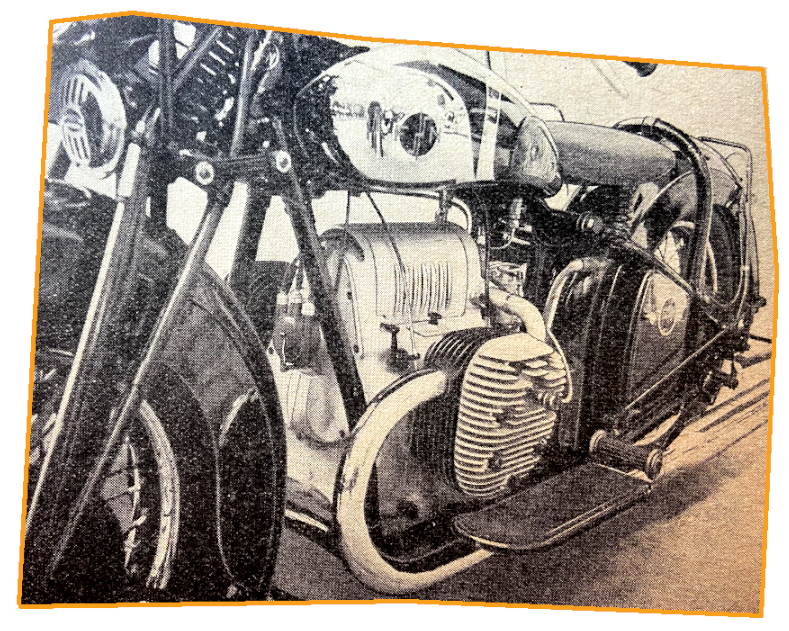
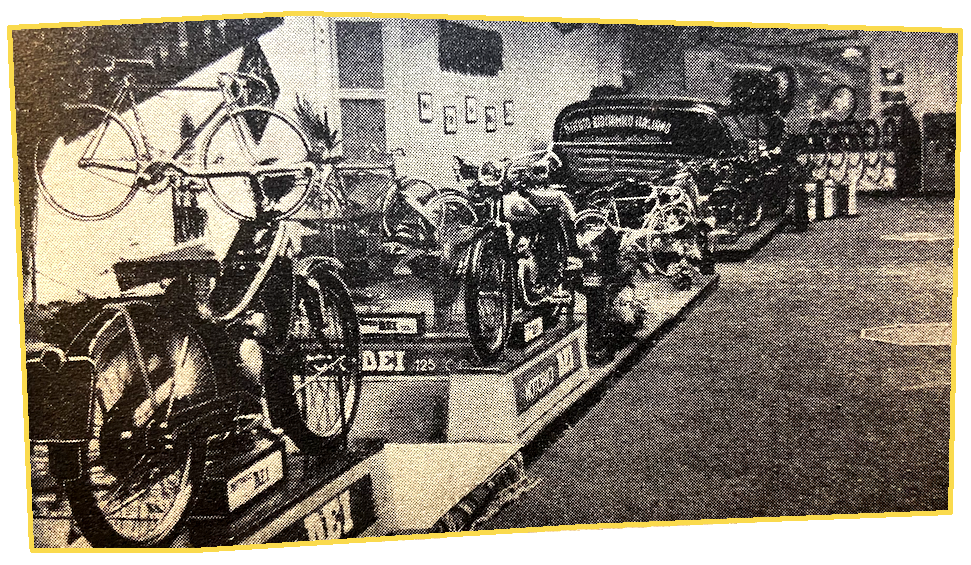
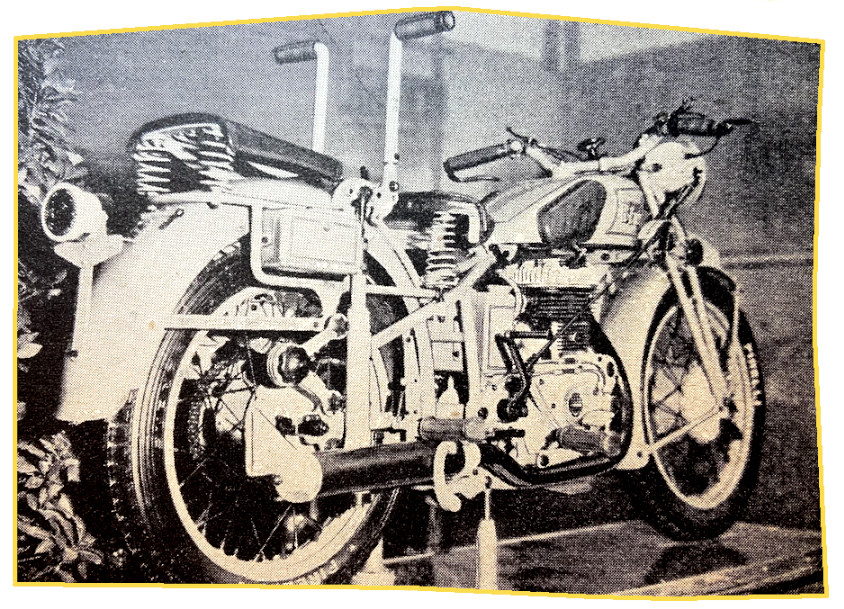
“ALTHOUGH THERE WERE 140 exhibitors at the recent Milan Show, mostly Italian, it was a British machine—the 1,000cc Ariel Square Four—that provided the pièce de resistance. On the same stand was shown a single-cylinder Astra (a replica of the Ariel), while several of the Italian machines on view were fitted with British proprietary engines, gearboxes and accessories—JAP, Villiers, Amal and Burman being the firms mainly concerned. The Italian-made Matchless engine (known in Italy as the Mercury) was also shown in various types and sizes. Germany was represented by the BMW and DKW. On the former’s stand were single- and twin-cylinder models from 200cc to 600cc, including the latest Model R6. This a super-sports machine with a 600cc horizontally-opposed ohv engine mounted in a tubular frame. It has four speeds, and employs the well-known BMW telescopic front forks. In comparison the DKW exhibit was small, consisting only of 100cc and 300cc two-stroke machines, and a 300cc engine for delivery van work. The only other ‘foreign’ country represented was Belgium, with examples of the Gillet and FN. Among the Italian machines considerable interest centred around the Dei, which was shown fitted with 250cc and 500cc ohv JAP engines, and with 125cc and 250cc Villiers two-stroke engines. A good example of an Italian sports machine is the CM, which has a 490cc ohv engine with hairpin valve springs and a four-speed gear box. This model has the engine inclined in the frame, but the 244cc and 340cc ohv models and the 498cc side-valve have vertical engines. Spring frames are increasing in popularity in Italy, and an interesting design was to be seen on the Simplex stand. Two springs are employed, and these are housed in telescopic tubes, while their action can be controlled by the rider. Another make which has acquired a spring frame is the Bianchi. Guzzis, surprisingly, show no change for 1937. The Ganna range consists of side-valve, and touring and racing overhead-valve, models. Previously either JAP or Blackburne engines have been employed, but this year they were shown fitted with the maker’s own engines. Among the other well-known makes at the show were Gilera, Benelli and MAS, but these have been modified only in minor details.”
“CARBURETA, my eldest daughter, unpardonably owns a 15th-hand baby car, cost price £8. On January 1st it became legally undrivable, as it had not got a safety-glass windscreen. She made love to our local chief cop, and suggested that if she gummed cellophane over it, it would satisfy the law, but he was adamant. As a new safety-glass screen would cost about a third of what the antique car is worth, she took me forth into the wilds in search of a second-hand safety screen, and introduced me to a new world. This indefatigable damsel had unearthed the addresses of sundry car breakers in the wilds of the Home Counties, where rents are nominal. They buy up any old car, and either sell it as it stands as a going proposition, or if it be past praying for, strip it down, and sell the bits as replacements. Eventually, we floundered through deep mire to a derelict farm, where some 400 decrepit cars stood parked in the mud, and several very dirty youths were busy seckaydeeing them (‘CKD’ equals ‘completely knocked down’). Piles of aged dynamos, head lamps, back axles, chassis springs, gear boxes, magnetos and every conceivable part, all neatly sorted, lay in the mud under tarpaulins. And there Carbureta picked up a piece of Triplex just nicely too large for her windscreen frame. It cost her 7s 6d, but what it will cost her by the time she has had it cut to fit I cannot guess. This expedition has met one of my unanswered questions; I knew what happened to motor bikes when they get past use, but not their bulkier brethren, motor cars. I must have owned some 200 motor cycles in my time, and I haven’t been able to trace the ultimate fate of any of ’em, but I can make the shrewd guess that a considerable number reached the various firms who advertise second-hand motor cycle parts.”—Ixion
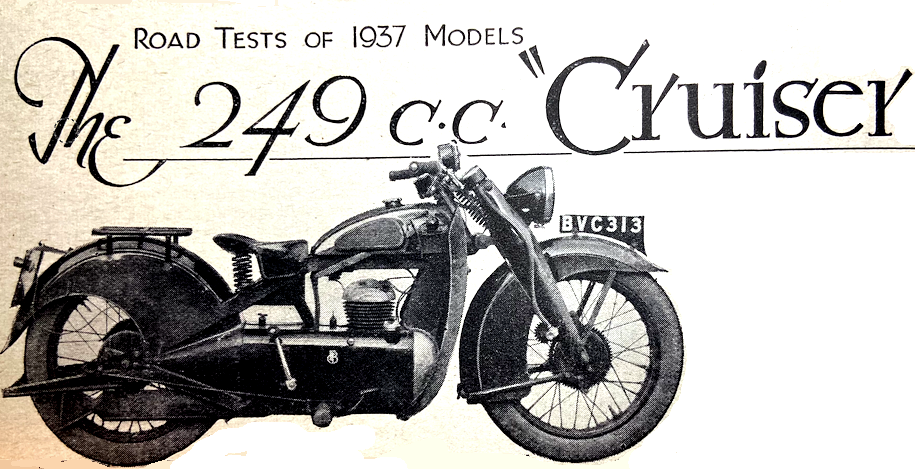
“‘GENTLEMANLY’ IS PROBABLY THE only adjective that faithfully describes the appearance and the performance of the 249cc G/39 Cruiser Francis-Barnett. It looks a gentleman’s motor cycle. There is no flamboyant exhaust system, and not only is everything neatly tucked away, but there is total enclosure and weather protection to a degree that is exceptional. How efficient the shields are can be gathered from the photographs, which were taken immediately after the machine had been used for some of the muddiest going imaginable. To state that no mud can reach the rider’s legs would be an exaggeration, because vehicles which overtake or are overtaken are apt to throw mud splashes sideways, even as they often spray those walking along the pavement. Experience proves, however, that the Cruiser really is a machine that can safely be ridden in ordinary clothing; it also brings to light these twin facts: first, that the shields do not drum, and, secondly, that removal of the panels enclosing the engine and gear box is a task occupying little more than seconds. Kick-starting the Villiers engine, which in the case of the G/39 model is of the deflector-piston type, required so little effort that it can truly be said, ‘A child can do it.’ With the mixture control, which is mounted on the right handlebar, set to ‘Rich’ the engine almost invariably fired at the third gentle dig at the kick-starter pedal. Incidentally, coil ignition was fitted to the model tested. This form of ignition is standard on, the G/39. The engine showed no tendency to stop once it had started, and there was no spitting back. Good slow running was a notable feature of the machine tested. In traffic blocks the engine idled quietly and effortlessly, and there was never any need for the rider to keep blipping the throttle. With the machine under way there was extremely little four-stroking, even when running light, and because of the exceptionally efficient silencing the little four-stroking that occurred was in no sense of the word objectionable. Outstandingly good road manners are a feature of the machine as a whole. The clutch of the Albion gear box proved light to operate and absolutely smooth in action. In addition, the gear box was completely silent on all ratios. Gear changing is by hand, and proved simple and straightforward. No special care was needed to effect perfect changes either from a high gear to a lower one or vice versa. More often than not it was desirable to move the machine forward an inch or two in order to engage bottom gear from neutral so that the dog clutches might be in the correct relative positions for engagement—either this or the clutch could be let in again and the operation repeated.
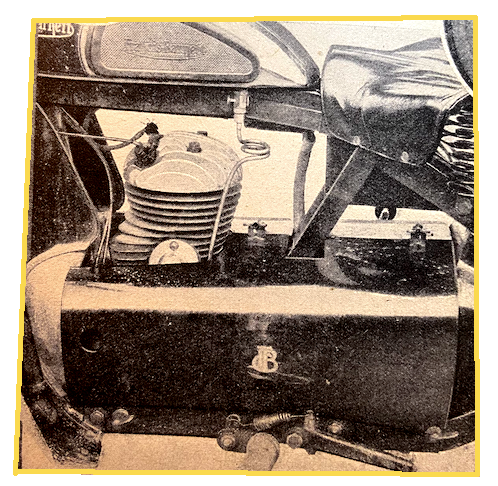
Assuming an ordinary amount of attention to the setting of the mixture control the machine performed effortlessly under all conditions. Flexibility is such that the machine, if desired, can be treated as entirely a top-gear mount. The engine would pull sweetly away even from speeds as low as 10 or 12mph in top gear and accelerate up to just over 50mph. While the engine would slog with almost cart-horse persistency up main road hills, it also would hum along the open road. Often speeds of 45 and 48mph were kept up for mile after mile. The machine is a gentlemanly mount, but there is nothing of the slowcoach about it. In second-gear the engine takes the machine quickly up to a useful 40mph; by using his gears the rider has an interesting sports-like performance. Both brakes are excellent—powerful, yet absolutely smooth and safe in action. The figure of 39ft from 30mph shows the ‘iron’ that lies beneath the velvety smoothness. The only possible criticism of the brakes is that the front brake lever involves rather too a stretch to grasp it. The riding position is of the sit-up, touring type, and is uncramped even for a rider of 5ft 11in. Except for the control just mentioned all controls are well placed. A good point in this connection is that an adjuster is provided for the rear brake pedal so that it may be set to suit an individual rider. An unusually large (18in wide) ‘stubby’ Terry saddle is fitted, while the tyres standardised are of 3.25in section, and therefore need not be pumped up very hard. The engine is smooth throughout its range. An expert might point to a period at a speed of roughly 40mph in top gear, but this is so minute that really it cannot be termed a period. It is unlikely that any but men out to find ‘points’ would detect it; there are no ‘pins-and-needles’ anywhere in the speed range. By modern standards the steering is unusually light even for a machine of 249cc. The machine can be ridden feet-up at exceptionally low speeds—it can be ridden almost to a complete standstill. This is an excellent feature so far as traffic riding is concerned. Greater confidence would, however, probably be evoked under gusty, wet conditions if the steering were somewhat heavier. On one occasion, when a 500cc machine of more normal design was being followed, it was noticed that the Francis-Barnett, in spite of the large area the front wheel assembly presents to a side wind, swerved less under the influence of the strong gusts than the machine that was just in front. Nevertheless, the machine could, it is suggested, afford a greater feeling of security under these conditions. Under all normal conditions the steering is of the ‘guaranteed to an inch variety’, and the cornering excellent. In spite of many miles of city streets traversed under slippery conditions, never once did the machine skid. The Miller head lamp provided a long, narrow beam with a fair degree of side illumination. To sum up: here is a machine that proved so good that it is next to impossible even for a motor cyclist who rides dozens of different motor cycles a year to offer criticism or make suggestions.”
“A UTILITY MOTOR CYCLE capable of covering 10,000 miles without calling for a single adjustment is the dream of one of our best known designers, He maintains that this is a feasible proposition to-day. The machine would. be a four-stroke, but on lines radically different from those of the modern motor cycle. He avers that although ‘different’, the machine could easily be made pleasing to the eye. What checks him is the cost of getting into production and the question whether the demand for such a machine would be adequate. He cannot afford to ‘back a loser’, and the cost of tooling up in readiness for production would run into thousands of pounds. It is easy to sympathise with all who are faced with decisions affecting the livelihood of workpeople and the pockets of numerous others. Nevertheless, we consider that the sands are running out; that unless manufacturers make a bid for the utility market soon the motor cycle will be looked upon only as a vehicle of sport. As yet the industry has merely touched the fringe; the number of motor cyclists should be double what it is to-day—it could be if suitable designs were available.”
“THE OTHER DAY I gained an insight into the way the United States of America exploit the gruesome in order to prevent road accidents. The means in this instance was an article. It did not just describe accidents, but gave pen pictures of the victims, their injuries, and their actions in the moments immediately following the collisions. ‘Gruesome’ is certainly one word, and ‘nauseating’ is another. Much as I dislike the method, I can well believe that in small doses it is effective. All the same, I should hate to see it employed over here.”
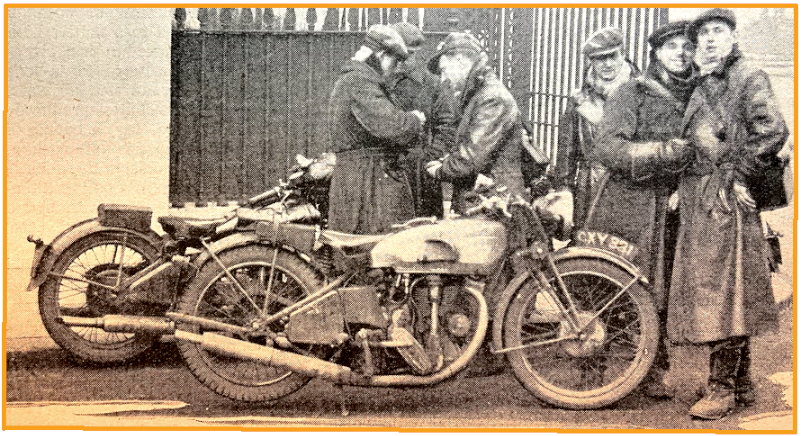
“THE MINISTRY OF TRANSPORT’S recently published registration figures covering the ‘peak’ months of July-September 1936 show that of a total of 505,779 motor cycles in use, no fewer than 125,499, or nearly one in four, were sidecar machines. Surely an adequate answer to those who aver that the day of the sidecar is over. The figures also reveal the popularity of the under-250cc machine—an increase of 5,247 over the corresponding period of 1935. And it will probably interest many to know that of the 505,779 motor cycles in use a England, Wales and Scotland, the share of London and its neighbouring counties was 117,559—an interesting fact since it reveals that in spite of the area being so densely populated the motor cycle retains its popularity.”
“RECENTLY I spent an evening with a man who has designed a number of well-known models. Our conversation turned to a matter I have never seen discussed in print: the way a model if left unaltered for a long period generally grows steadily worse—apparently, the machines produced are exactly like those manufactured, say, a couple of years previously, yet their performance is nothing like so good. We discussed an actual model with which he had been associated. After a while not only did the speed of the latest productions not compare with that of the earlier ones, but their engines were decidedly coarser. Investigation showed that certain of the castings were being supplied by a different concern and the patterns were no longer in accordance with the original design; consequently, the cylinder head shape—to take an example—was not as it should have been. In addition, there was no longer the same care taken by the assemblers in building the engines; they had become so accustomed to the job that they did it automatically. Various jigs and tools were also not so good as they might have been. After a complete investigation and a general overhaul of the supplies and production methods the machines turned out were once again the equal of the first models. I know two makers who have recently carried out investigations on these lines—to the marked benefit of the purchaser.”
“‘RIDING A LARGE STREAMLINED motor cycle, Joe Petrali, the Milwaukee dare-devil, roared over the smooth beach at an average of 136.18mph; a new world’s record for two-wheeled bikes.’—American newspaper.”…”That well-known rider, Joe Petrali (Harley-Davidson), has been adjudged Champion of America for 1936.”

“THE LATEST OFFICIAL registration figures show that there are 2,768,606 mechanically propelled vehicles in use in Great Britain.”
“GEORGE PATCHETT, THE English designer of the Czechoslovakian Jawa machine, escaped with bruises in a serious motoring accident near Davos. His wife, who was with him, also escaped with bruises.”
“THE MAN WHO WAS responsible for Leeds being the first city to install traffic lights—Mr RL Matthews, Chief Constable—has resigned owing to illness.”
“‘NOT MORE THAN 50% of drivers take the trouble to give properly the signals which the law and prudence both require.’—Letter in a London newspaper.”
“ONLY A FRACTION of 1% of United States main roads begin to approach the fundamental requirement of ‘automatically correcting the driver’s mistakes’, says an American magazine.”
“‘THE COLD FACT is that traffic to-day is a combination of an 80mph car in the hands of a 20mph driver struggling to adjust itself to a 30mph road.’—Fortune, American magazine.”
“MILHOUX AND CHARRIER (FN sc) were forced to abandon an attempt on the 12-hour sidecar record after 20 minutes’ lapping at Montlhéry, owing to a broken crank case.”
“A CHINESE PROFESSOR, visiting London, criticised the traffic lights as follows: ‘We have some street signalling lamps like yours, but they are giving way to the single searchlight, with an arrangement for changing colours.'”
“DER DEUTSCHE AUTOMOBIL-CLUB, the ‘RAC of Germany’, has established 60 stations where German pedal cyclists may have the rear mudguards of their machines painted with phosphorescent paint free of charge.”
“‘OFTEN I HAD NOTICED the large number of iron manholes and other plates on the road between Archway Tavern, Highgate, and Barnet. Recently, I decided to count them. There are 229, excluding drains.’ Correspondent in The Autocar.”
“ALLOW ME TO ENDORSE your editorial remarks on the subject of trials and riders generally. The riders of to-day may be able to ride ‘feet-up’ through the deepest of mud, but with few exceptions they make a fetish of this type of going and practise on:every available occasion. Thus, riding in these ‘snappy’ trials has become a circus balancing turn almost requiring a special machine. A large proportion of amateur trials riders and their mounts do not show up too well on the road parts of the course or in the muddy lanes connecting sections. All-round riding skill must suffer in consequence.
A Paul, London, N2.”

“LAST WINTER THERE APPEARED in the correspondence columns of The Motor Cycle a letter under the nom de plume. of ‘Manufacturer’. This letter inaugurated a competition, open to all motor cyclists, to find the design desired by the majority; and the winning entrant was to be awarded a machine built as near as possible to his design. Now, as many readers will recall, this competition was sponsored by the New Imperial company, and the lucky; winner proved to be an Edinburgh University student whose home is at Abernethy, a few miles outside. Perth. Of course, it took time to produce the actual machine evolved from the design submitted, but late last November ‘Torrens’ described his experiences with the model after riding it for a few days. Afterwards the machine went back to the works, previous to being handed over to Mr A McDougall, the fortunate winner. Last week it was my happy experience to represent The Motor Cycle and ride the machine up to Abernethy, there to hand it over to the winner on behalf of New Imperial’s. For weeks I had been looking forward to this run. Unhappily, when all was ready, I fell a victim to a puerile, but highly contagious, affliction. However, after three weeks’ quarantine, I was fit and ready for the trip. And so it was that soon after noon on the Wednesday the New Imperial and I were to be seen threading our way through. London’s traffic, and on to the Barnet By-pass, en route for the North. 1 had some slight misgivings on account of the weather forecast threatening snow and gales ahead. There was already a stiffish side wind, but the New Imperial bowled along the monotonous Great North Road at a steady 40mph. The machine had covered a number of miles since ‘Torrens’ had ridden it, and the engine was running with that sweetness and silkiness which denote careful running-in. However, because the model was still very new and also because it was not my own, I had not the least intention of flogging it. Nevertheless, the engine seemed to revel in almost any speed, so it was not long before the speedometer needle was pointing to 50. I did not attempt to exceed this speed, but was content to enjoy the comfort of the spring frame—I had the dampers, both fore and aft, slacked right off. Mile after mile was reeled off. At Grantham, after 110 miles, I stopped for a rather late lunch. It was then that I noticed a tell-tale stain of Ethyl on the primary gear case. But the leak thus indicated was caused by nothing more than a slackened
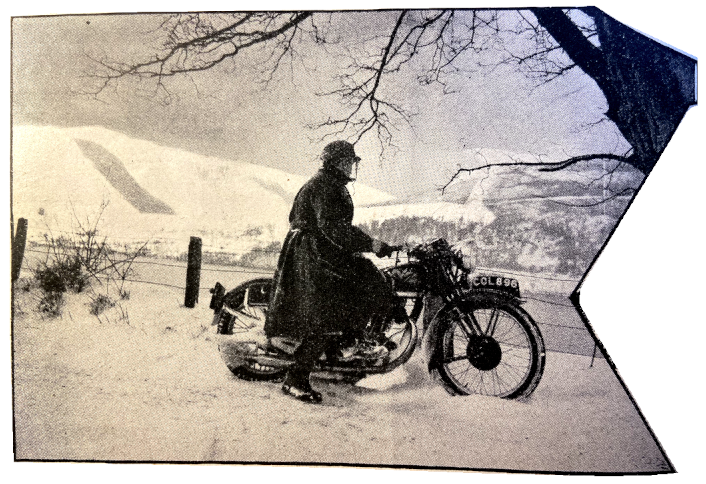
petrol pipe union nut. When 1 went to open the tool-box, I found the ‘cup-board was bare’. Not a single tool—and here was I on a 500-mile journey! I was not dismayed, I borrowed a few spanners at a garage and tightened up any nuts that might conceivably slack off. By the time I reached Doncaster it was getting near lighting-up time and also becoming very cold. We were in Yorkshire and the hotels by the wayside looked very tempting. But I had aimed at getting past Scotch Corner at least, so I kept in the saddle although my hands were getting more and more numb with the intense cold. Boroughbridge and Catterick slipped by—it is curious how short the miles seem in the dark—and eventually we turned left at Scotch Corner for the Carlisle road. It was here that I first encountered the snow. Although the road was free from it, the fields and trees lay hidden under a beautiful white mantle, all the more fairylike in the beam of the powerful head lamp. I decided to stop at Bowes for the night, for it was 7.30pm and I had no desire to continue by night over that wild moorland road that rises to over 1,400 feet before dropping into Brough. When I was awakened next morning I heard the wind howling through the eaves of the old hotel. On looking out I saw that the snow of the previous night had not melted. On the contrary, it was beginning to snow again. Outside it was really bitter, while the wind had risen almost to gale force, driving the snow fiercely before it. In these cheerful conditions I left Bowes for the long ascent up to New Spital, followed by the drop into Brough. Very soon I was riding over ice. In addition, there was a strong south-easterly wind blowing, and the combination of slippery ice and strung wind resulted in the rear wheel constantly sliding over to the crown of the road. Meanwhile, the snow came down so thickly that visibility was reduced to a bare ten yards in places. It was altogether eerie—but not exactly pleasant! Only two vehicles did I see, and one of them was in the ditch! At last we started the descent into Brough, where the carpet of snow on the road was beginning to melt. With the better conditions I was able to ride at a steady 40, and Appleby and Penrith were behind us in a short time. Just outside Penrith I came across a large six-wheeler and trailer lying on their sides in the hedge, a long way off the road. Quite how they got there I do not know, for I did not stop to enquire. All was plain-sailing through Carlisle and on the long, fast road to Lockerbie and Beattock. Ahead I could see the high peaks of the South of Scotland gleaming white in their winter’s coat of snow. It was a beautiful spectacle, though hardly a pleasant thought to know that I had to take the road through these mountains! Another long climb to Abington, where I found the force of the wind-driven snow most unpleasant—almost like hail. Time and again I saw roadside telegraph wires and poles which had been blown over in the gale. Carefully and slowly I rode the New Imperial along the slippery roads through Lanark and the many mining villages en route for Stirling. Conditions gradually became worse. It began to snow harder, while the roads were coated with ice. What was worse, it was now getting dark. How I loathed and hated that road from Callander to Lochearnhead. It winds and twists along the shores of Loch Lubnaig—and last Thursday, with such a high wind blowing…But if conditions were bad at this point, they were infinitely worse over the Glen Ogle Pass Irons Lochearnhead to Killin. Here a virtual blizzard raged, and in the rapidly falling light it was an enormous relief to drop down, or rather slither down, into Killin, where it was my fortune to find my good friend Bob MacGregor, the well-known Rudge rider, at home. A warming glass of whiskey—the real McKie—made me quite certain that at Killin I must stay. And at Killin I did stay!So far, the New Imperial had performed wonderfully. Nobly had it stood up to the slogging in high gear that I had been forced to use in the snow. But conditions on Friday’s run along Loch Tay, through Aberfeldy to Perth, were infinitely worse. It had snowed steadily all night, and the roads were inches deep. That was just the trouble—sometimes the snow was a mere two or three inches deep, and then there would be drifts a foot or more deep. Because of the difficulty of spotting these drifts, I was forced to proceed with great care. It often surprised me how the Universal rear tyre obtained a grip up some of the slopes which I was forced to climb slowly. Still, I enjoyed the run immensely. I followed the south road along the shores of Loch Tay, and was impressed by the extraordinary way in which the sun occasionally shone through the clouds ahead of me while it was still blowing almost a blizzard everywhere else. I passed on my right those ‘Scottish’ favourites, Cambussurich and Ardtalnaig, both snow-covered and almost unrecognisable. Near the end of Loch Tay I stopped for a cigarette and a photograph, and was joined by a passer-by, who was an enthusiastic photographer. He was justly proud of his pictures showing a frog waiting outside a beehive to make a meal of a bee or two. In spite of the snow-bound roads, the New Imperial steered perfectly, my only difficulty being to check the violent side gusts of wind, which must at times have reached at least 60mph. Normally, such side winds cause little worry, but on snow and occasional patches of ice it was a different story. However, we reached Aberfeldy and then Birnam without trouble. So far I had been on more or less virgin snow, but from Birnam onwards I joined the main road. Heavy lorries and buses had transformed the snow into a
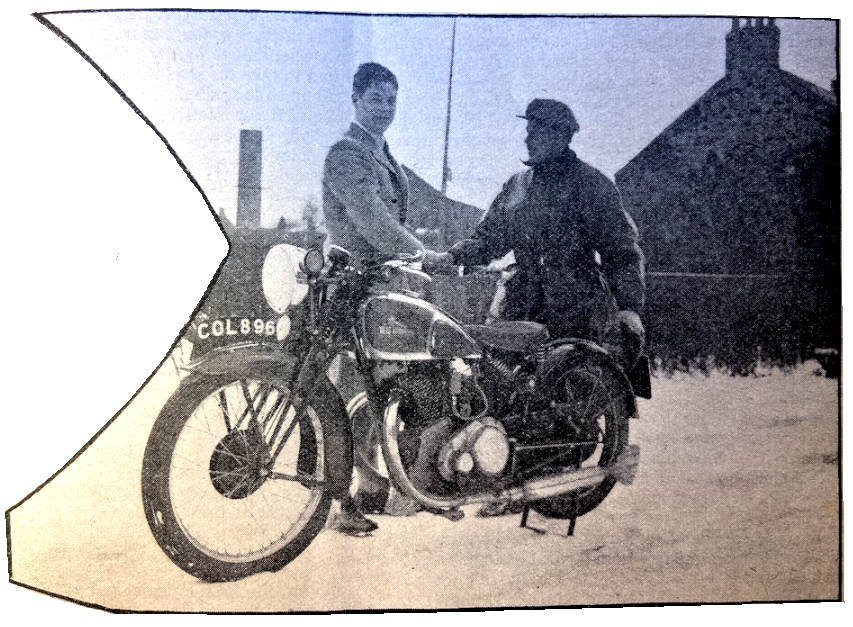
highly polished form of ice, forcing me to use both hands on the bars—up till then I had been riding with my left hand hanging loosely behind in the slipstream, where it kept comparatively warm. I toured through the slushy streets of Perth, only to find the roads even more icy on the far side—Abernethy lies about eight miles south-east of Perth. To make matters more unpleasant, the gusting wind was blowing broadside across from the left, and several times I found the model sliding towards oncoming traffic. At last we reached our destination. No one Was there to greet us—probably because we were not expected on such a day! But when a knock on the door did call attention to our presence, we were given a right royal Scottish welcome. After an unofficial ‘presentation of awards’ we wheeled the faithful New Imperial to a shed, and soon I was sitting down to a Welcome repast of hot broth and other Scotch tasties. Mr McDougall, only recently out and about after over a year in hospital with an injury received while playing Rugger, was itching to go out in the cold to give his machine the once-over; he resisted the temptation until I had finished. But he was out in a trice as soon as I went upstairs to change, and for the remainder of the afternoon we spent most of the time admiring the machine. It was scarcely wise for him to attempt to ride it just yet, particularly in a snowstorm. In the meantime friends popped in to congratulate him, and it was a cheery party that sat down to a high tea. It was still snowing hard, but I had a glowing feeling of having set out to do something in the face of adverse conditions and having accomplished it. And I liked to think that the New Imperial, outside in the cold shed, was feeling very much the same. We had stuck together for over 500 arduous miles, and now I was to bid good-bye—both to the machine and to my new-found Scottish friends.—Ambleside”
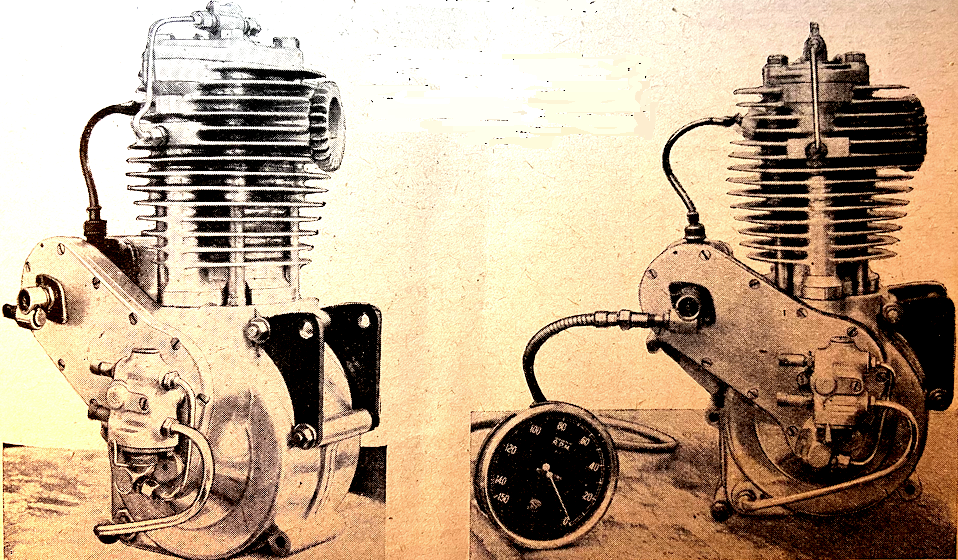
“AN ENGINE OF ORIGINAL type for which phenomenal performance is being claimed has been undergoing development during the past few months. The new unit is the design of FM Aspin, and development is being undertaken by FM Aspin, Egyptian Mills, Elton, Bury. So far the work has been carried out on a 250cc motor cycle engine, but the principle is being applied to car, lorry and aero engines. Unfortunately full details cannot be published at this stage, but an examination of the drawings and component parts confirms the soundness of the ideas on which the claims are based. Briefly, the claims are as follows: The engine will have a range of rpm up to 10,000 or more; compression ratios of over 12 to 1 are possible without the use of special fuels; the scavenging of the cylinder is so complete and the turbulence of the charge is so controlled that the fuel is used about twice as effectively as in a normal engine (therefore the engine does not overheat); even when using commercial grade fuel on a 10 to 1 compression ratio it is possible to use ordinary porcelain insulator sparking plugs; the inlet and exhaust areas are quite unrestricted at full aperture, and are of enormous size in relation to the cylinder bore. Those are the claims. Constructionally the engine is built almost entirely of light alloys, and although its big power output (for the size of cylinder) demands an exceedingly robust crank case, the weight of the experimental 250cc engine is only 48lb, of which 18lb is flywheel weight necessary to secure good tickover with the high compression ratio. At present the engine is working on a 13 to 1 compression ratio, but it has been run at slightly over 17 to 1. The power developed, it is stated, is in the region of 25-27bhp, comparable with a 500cc super-sports engine of normal design. The alloy cylinder barrel has a. nitrided hardened liner and an alloy head. There are no external working parts and nothing to adjust. Valve gear in the accepted sense is eliminated, but the mechanism that controls the inlet and exhaust is enclosed in the cylinder. head. Once assembled it is quite inaccessible, and automatically provides its own compensation for heat and wear. It absorbs no more driving power than a magneto, and in consequence the mechanical efficiency of the engine is very high. A normal engine, as used in the TT, was converted to the Aspin system some time ago. Since then it has covered a big mileage, in addition to running 280 hours on the bench at between 8,000 and 11,000rpm. The only trouble experienced was due to the T.T. crank case failing to stand up to the power output from the small Aspin. cylinder. An unusual feature of the engine is that with very small modifications it can be operated on either the two-stroke or four-stroke cycle. If used as a two-stroke it develops nearly double the power of the four-stroke at equivalent rpm. Although the engine is capable of such high revolutions it is not dependent for its useful power on this fact alone, for at any given rpm its advantages over existing types are equally apparent.”
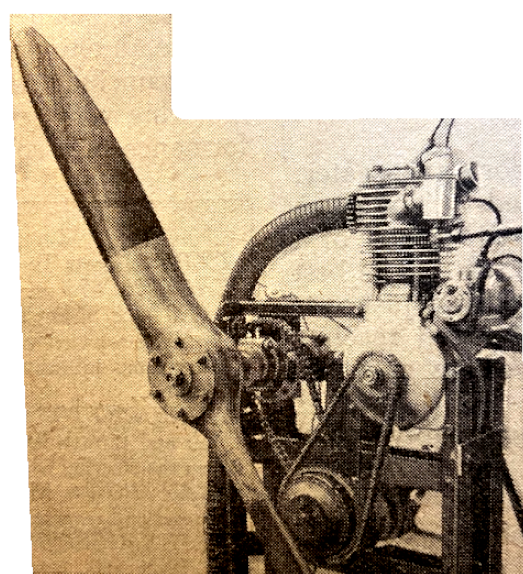
“MOUNTED UPON A STAND in the works, [a 250cc Aspin engine] is driving a 5ft 3in propeller through a motor cycle gear box at a speed of about 1,500rpm; the engine is developing about 18bhp at 5,000-5,200rpm. Exhaust noise is not excessive, even with an open exhaust port, for there is no high-pitched crackle such as results from a normal ohv engine with racing valve-timing. One of the claims for the Aspin engine is that combustion is as nearly complete as can be attained in practice and that the exhaust therefore is free from flame, heat or excessive noise. That a ‘cold’ exhaust has been achieved is a fact, because the hand that wrote these words was passed across the open exhaust port at a distance of two inches when the engine was doing 5,000rpm, and the effect was much the same as the warm breeze that wafts from a barber’s electric hair drier. Look ing straight into the exhaust port, not a sign of flame or colour of any kind could be observed. An ordinary three-point Lodge touring plug is used, and the compression ratio is 14 to 1. More remarkable still, the fuel used is Shell-Mex commercial spirit with a 30-40% addition of ordinary paraffin! The consumption is 0.34lb per bhp hour—only a little over half that of normal engines. When the engine was seen recently it had done 620 hours at 5,000rpm without attention…”
“I READ WITH INTEREST the details of the Aspin engine. No doubt this is yet another experiment which, though vastly superior to any commercially obtainable engine, will be completely ignored by the manufacturers. Surely some method can he found whereby such revolutionary engines may become obtainable as standard productions? Maybe our ultra-conservative manufacturers would begin to take notice if one of these engines won the TT or Manx GP. It seems fairly obvious now that the present-day engine has reached the limit of its performance, and unless something is done very shortly our precious prestige will be collared by the Continental firms who do, at least, show initiative. But no; the manufacturer prefers to effect ‘detail modifications only’ and continues to produce the same machine year after year. Of course it is sold—because the buyer has no alternative—so the state of affairs continues indefinitely. , There was once a time when aero engine designers looked to motor cycles for inspiration. No longer is that so; motor cycle engines are where they were 15 years ago, except, of course, for ‘detail modifications’.
Cynic, Amersham, Bucks.”
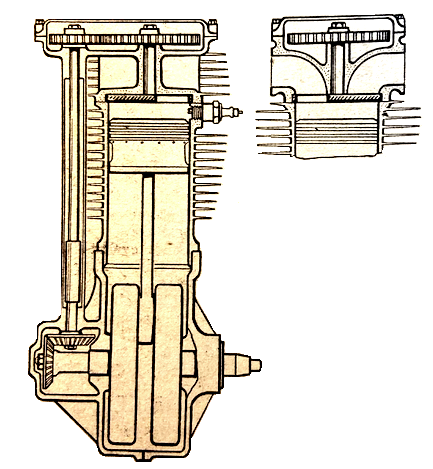
“UNORTHODOX ENGINES—A Hollander’s Design. ‘With regard to the engine described in The Motor Cycle, perhaps the following would be of interest to others: Some years ago I designed an engine with as far as I can see from the photographs, exactly the name method of operation. The two sketches roughly illustrate my design. Instead of valves there is a rotating disc. This disc is fixed on an axle which has a cam wheel, and the cam wheel is driven by the same mechanism as used on ohc machines. On the rotating disc there are large inlet and exhaust ports of special shape and dimensions. The sketches are not quite correct with regard to the relative positions of the inlet and exhaust apertures. The light disc will permit high revs and the large apertures provide good filling and scavenging. I should like to congratulate Mr Aspin on his excellent design, the more as I realise that years of hard work and deceptions must have preceded this new engine. Cordial greetings to all English motorists.
CS1 Norton, Amerstol, Holland.”
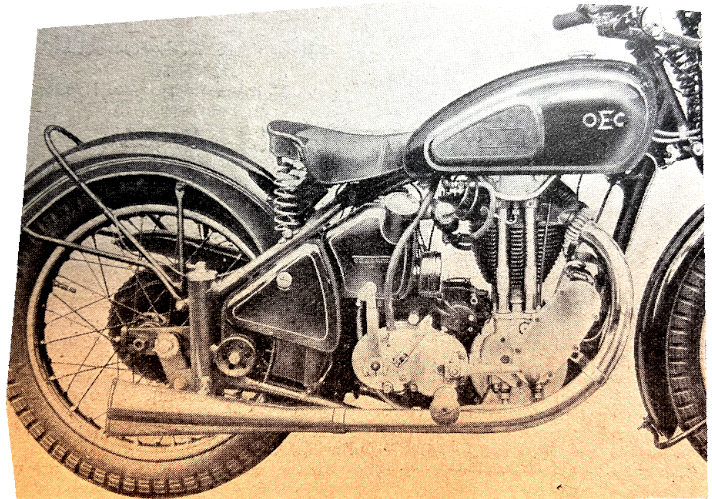
“THE PROBLEM OF producing a spring frame that is neat and efficient, yet which does not add appreciably to the cost of the machine to which it fitted, appears to have been successfully tackled by the OEC concern. More than that, they have introduced an entirely new range of machines which in design and appearance reach a very high level. There are four models in the range—two-port ohv singles of 250, 350 and 500cc, and a side-valve 1,000cc twin. All have engines specially made for OEC by the Matchless-AJS factory. For the purposes of description the 500cc model may he taken as typical, although in the case of the 250 the construction is lighter. The new frame, which is of the duplex cradle type, is particularly sturdy. It has a l¼in diameter front down tube and a 1in. single top tube (instead of the twin tubes used previously), while the seat stays are also of lin diameter. It is, however, in the system of rear wheel springing that the most interesting development is to be found. For instance, the spring boxes are of larger diameter (2¼in externally) and much shorter, and they are now fitted with detachable liners. Internally, the system comprises in the case of each spring box one long upper spring and one short
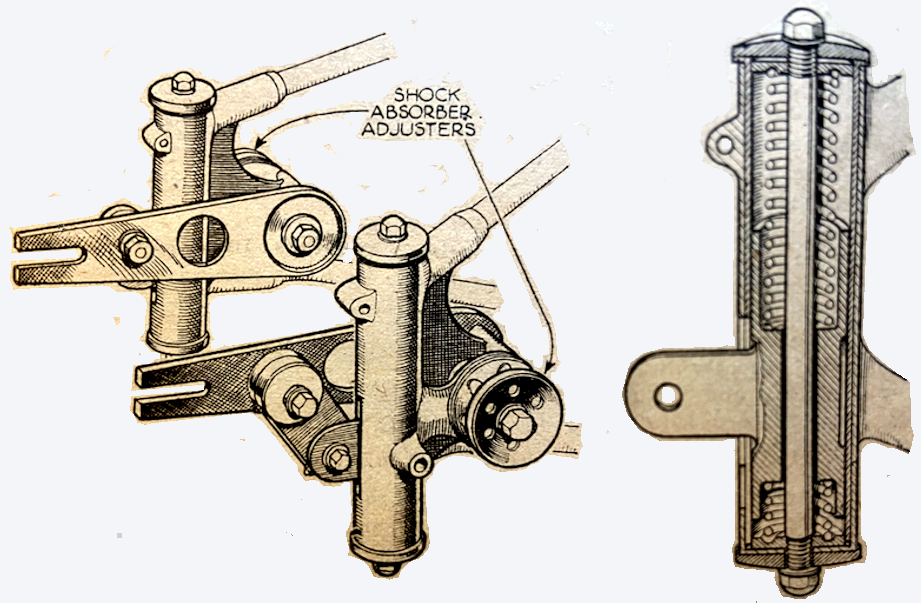
lower one, with a piston-type plunger interposed between the two springs. An arm attached to the piston protrudes through a slot in the spring box and is connected to the fork-end by a short toggle. The phosphor-bronze bearings in the connecting arm are adjustable to a slight extent as regards end-play. The springs are retained by detachable end caps that are secured by means of a long ½in. bolt that passes right through the spring box. Thus it is a simple matter to dismantle the boxes and effect any renewals. The fork-ends themselves pivot on large-diameter phosphor-bronze bearings formed in the spring-box castings, immediately in front of the boxes. These bearings are provided with adjustable hand-controlled dampers. Throughout the system the bearings are of unusually large diameter and are provided with grease nipples. Another important feature is that the chain tension remains practically constant. As regards the general features of the new models, all have black tanks with gold lining, and embossed makers’ initials. Capacities are 250cc, 2½ gallons; 350cc and 500cc, 3 gallons; and 1,000cc, 4 gallons. All-black handlebars and chromium-plated wheel rims further enhance the neat appearance of the machines.”
“TWO LENGTHS OF roads at Oxted (Surrey) have been freed from the speed limit. The speed limit has been imposed on a length of the London-Eastbourne road near South Godstone School.”
“NEARLY 2,400 ITALIAN enthusiasts took part in the recent Winter Rose Rally, held in connection with the Milan Show.”
“SUMMONED AT ROMFORD (Essex) for careless driving, a motorist pleaded that a sunset over the Thames Estuary distracted his attention.”
“ADVICE CENTRES FOR MOTOR cyclists are to be arranged by the BMCA. These centres will be open to all motor cyclists and advice will be given free of charge on all motor cycling matters: They will be attended by an official of the BMCA and a member of the Metropolitan Committee of Motor Cyclists. The free advice service also covers queries sent by post. This service has always been available to members, but now non-members are invited to take advantage of it, providing they include a stamped addressed envelope for reply. The BMCA is not, however, prepared to give technical advice to non-members, or to involve themselves in expense on their behalf; this would obviously be unfair to members.” The British Motor Cycle Association was concerned by the strength of public prejudice against motorcycles and motorcyclists. Asserting that “the motor cyclist handles his mount with greater skill than any other type of road user” the BMCA issued (for five bob a year) machine badges indicating the number of years the rider had escaped prosecution for any motoring offences.
“A NORTHERN READER, newly returned to his birthplace from the south, urges me to demand why that typical north-country dish of ham and eggs (a) cannot be obtained south of Lancashire, and (b) why, to use an Irishism, if you insist on it being served, the ham is never really eatable? Southron readers, for the most part, have never sampled this excellent viand. The ham I should explain, is no measly, waferlike rasher such as first-class southern hotels substitute for the genuine article, but approximates more to the dimensions of a chump chop, and may be a good 1½ inches thick if callipered at maximum bore. My northern friend asserts, with some justice, that after one has covered 100 miles in the saddle on a cold day this dish, washed down by beer or tea according to your liking, is infinitely preferable to the usual hotel menu, and can be prepared by a cook in a very short time if the traveller arrives when the set meals of the house are ‘off’. Perhaps some sonsie* north-country wife will send the Editor directions for cooking the ham properly, so that it melts on the tongue and doesn’t need champing† like an old boot sole; and then south-country eating places might take notice, and serve to order.”—Ixion
*Sonsie (sonsy), according to the OED, equates to “Plump, buxom; of cheerful disposition; bringing good fortune”. †Champ: “Munch (fodder) noisily; work (bit) noisily in the teeth “qv “champing at the bit”.
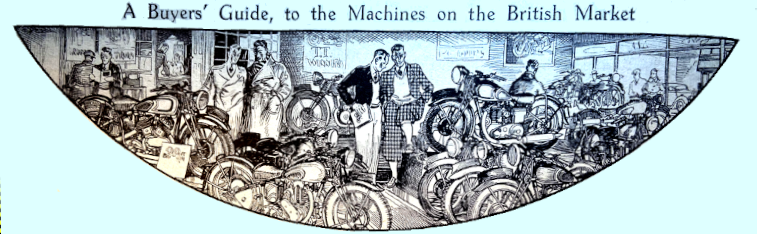
The Motor Cycle Buyers’ Guide listed every marque on the British market: AJS, AJW, Ariel, BSA, BMW, Brough Superior, Calthorpe, Chater-Lea, Cotton, Coventry Eagle, Cyc-Auto, Douglas, Excelsior, Federation (made by the Co-operative Wholesale Society), Francis Barnett, Harley Davidson, Indian, James, Levis, Matchless, Montgomery, New Imperial, New Gerrard, Norton, OEC, OK Supreme, Panther, Rudge, Royal Enfield, Scott, SOS, Stevens, Sunbeam, Triumph, Velocette, Vincent-HRD, Wolf and Zenith.
WANDERING THROUGH A motor cycle factory always makes me wonder what proportion of the cost of a new machine goes in what one may term non-essentials. You come to a press busy turning out steering damper plates, another machine drilling the holds in oil-bath chain cases, a third producing bits used in rubber-mounted handlebars…Not so many years ago a motor cycle consisted of a diamond frame, a pair of forks (without dampers), a simple three-speed gear box, two wheels and an engine. This is not quite the whole story, but very nearly so. Now we have four-speed boxes, separate oil tanks, square feet of chromium plating, enclosed overhead valves, electric lighting, fork and steering dampers, much more elaborate brakes, force-feed lubrication of the dry-sump type, quickly detachable wheels in some cases and all manner of other things. On my recent visit to a factory, half the work seemed to be in connection with items we did not have a dozen years ago. Now, I suppose, these self-same parts have become essentials!”
“A THING WHICH SURPRISES me is the small number of motor cyclists who have their speedometers illuminated at night. Perhaps it is because I ride so many different machines per annum that I look upon speedometer illumination as essential. Maybe the majority of motor cyclists who ride one machine and one machine only, can tell by ‘fee’ whether their mount is doing 28 or 30mph. I have my doubts, and suggest that if no speedometer light is provided by the manufacturer, and the machine is ever used at night, it is advisable to buy and fit a speedo lamp and thus be on the safe side.”
THE SHORT REIGN of Edward VIII is of no interest to us as he took no interest in motorcycles. But when he abdicated to marry an American divorcee he was replaced by his Brother George VI who, while still Prince of York, had owned a Douglas and sponsored Brooklands ace SE Wood.
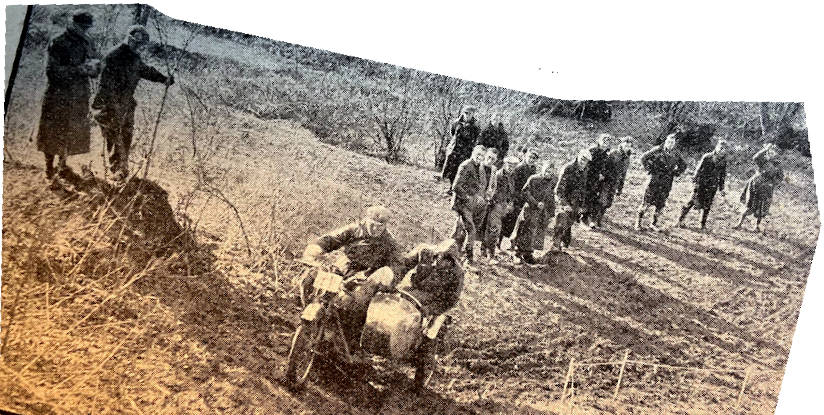
“LAST SATURDAY AE PERRIGO (348cc BSA) won his first Colmore Cup. For some time he has not met with much success, but last week-end, following up his win in the Lister Trial, he found all his old form and beat Len Heath by a narrow margin, the issue eventually being fought out in the brake test. Perrigo ‘s seven marks were lost on one hill, Sainthury, whereas Len Heath (497cc Ariel) dropped a foot on three hills, Meon, Saintbury and Warren. These two were run very close by George Dowley (246cc AJS) and Alan Jefferies (348cc Triumph), who on observation tied with eight marks lost, and it is a tribute to George’s riding that on a machine of so small a capacity he finished so high in the list—and a tribute to the machine! It would be unfair to pass over individual performances without mentioning DK Mansell (490cc Norton sc). With only one failure and three marks lost for footing, his effort ranks very high indeed. The gales and blizzards of the previous week had been forgotten, or almost so, when last Saturday dawned, and the Cotswolds basked in the welcome sunshine of a perfect day. There had, however, been sufficient bad weather to make the course difficult, and competitors found their work well and truly cut out on Meon, Saintbury, Warren and Camp hills. At Stratford-on-Avon, Sunbac officials, headed by the president, were going cheerfully about their work, large cars drawing trailers drove up in quick succession—some people even arrived on motor cycles—and the Trade was well represented.”
The Blue ‘Un devoted an issue to recruiting converts to motor cycling, including anecdotes of how youngsters found their first bikes. Here are two examples; one charming, t’other…not so much.
“FRIEND Ixion has on several occasions taken the part of the luckless schoolboys whose parents are prejudiced against motor cycles. Last September, while spending a short golfing holiday on the south coast, I was able to play Ixion’s role, with the result that a schoolboy became the possessor of his first motor cycle and a prejudiced parent an enthusiastic sidecar passenger. In the clubhouse of a well-known south coast golf club I was introduced to a man many years my senior. However, our handicap was almost identical, so a game was clinched. My opponent had brought his son to act as caddy, but as yet I didn’t require such luxuries. During the game I learned that this son was yearning for a motor cycle, but his parents were opposed to the idea of their only son having even a pedal cycle, let alone a motor cycle. The father summed up motor cycles as ‘dangerous, noisy and dirty things’. I was able to offer a strong defence against the two former accusations, but had to admit that our machines might be cleaner. After the game—a very close one—the topic was discussed again over a drink in the clubhouse. The man’s son was getting quite excited, for apparently I had been the first person to take his side on the question. It transpired that he was old enough and, better still, wealthy enough to own a first-class machine; but the stumbling-block of parental opposition stood in the way. When, later, I was leaving the club with my side-car outfit I caught up with my late opponent and his son walking down the road. I stopped and offered them a lift to the nearest town, about a mile away. There was some hesitation on Senior’s part, but Junior said, ‘Do jump in Dad, it looks very much like rain.’ After some friendly leg-pulls father tumbled into the sidecar, while the boy seated himself on the pillion seat. Off we went, very cautiously at first. I cast anxious glances at my passenger, and tried to fathom whether or not he was nervous. Then he said, ‘Let her go, my boy.’ That was encouragement, and as it was just starting to rain, and my waders were somewhere in the sidecar, I lost no time in delivering my two passengers to their house. This had been the older man’s first taste of motor cycling. I was invited in for a cocktail, and it was then that I learned that their car had stripped an axle-shaft some 30 or 40 miles away and that in the morning they were going to hire a car to collect the family ‘barouche’. I chanced it—I invited father to try another ride, a taste of what motor cycling was really like. He greatfully accepted, and all I hoped now was that to-morrow would be fine. My abbreviated sidecar had been built for a well-known competition rider’s rather diminutive passenger, and offered little, if any, protection against our proverbial summers. During the course of our conversation I explained that my sidecar was a trials outfit, and that the sidecar fitted was not of the normal touring type. The next day was fine and dry, however, and I arrived at the appointed hour to find my passengers all ready for the trip. When father expressed a mild desire, prompted by his son, to cover some trials course going I could hardly believe my ears. I was a trifle scared at first—hadn’t I failed miserably on easy hills like Doverhay and Beggars’ Roost, in the previous Land’s End? So I kept the so-called trials course going to a few carefully selected hills in the Petersfield district—there had been plenty of rain diving the night which left my gentle slopes in quite a tricky condition. And I was very lucky (or very skilful!) that nothing untoward happened. It was now lunchtime and the car had not been collected. So we made a bee-line for Winchester, where father took over his car again. Son climbed into the sidecar and we followed father back to his house on the coast. It was over dinner that evening that the boy got the surprise of his life—permission to buy a motor cycle, on conditions. The conditions were simple —I was to approve the purchase and to teach the young man to ride. Three weeks later I was showing the owner of a very smart 250cc Triumph how to ride, and in less than a month’s time those unwelcome adornments called ‘L’ plates were cast aside. Just lately a London motor cycle club has enrolled a new member, a young one. Yes, he is the youngest in the club—best of luck to him!”
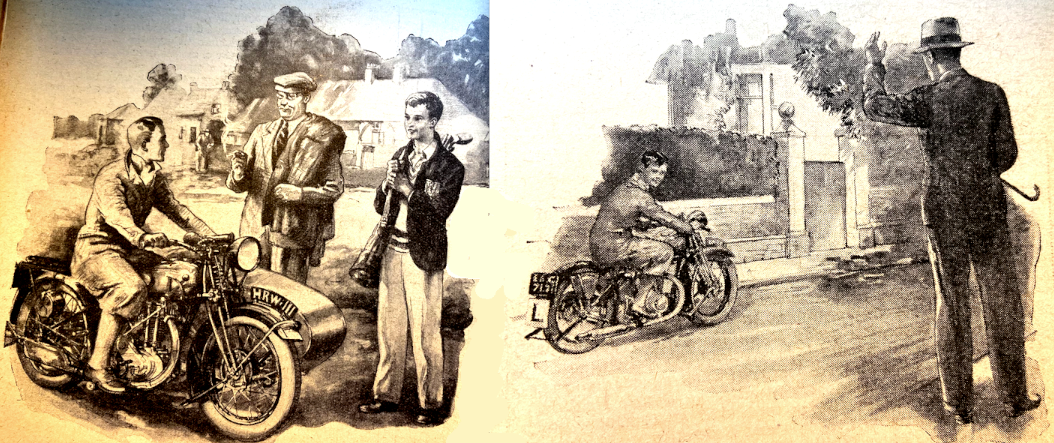
“ONE OF THE MOST amusing yet tragic of my own ‘prospective riders’ was a youth who came in 1913 to buy an old 1906 Rex de Luxe of mine which had been kept in a dampish coach-house for several years. He was a boy of about 16, who helped to keep going the home of his widowed mother. Somehow he had found out that I had this unwheelable old derelict and was as keen to possess this scrap-iron as the enthusiast at Olympia is to possess the latest model. I asked him l0s for it and he thereupon ran home and returned with a hand-cart and two packets each containing five shillingsworth of coppers. When my wife saw the boy’s eager eyes and his two packets of hard earned savings she looked at me. I knew what that meant, and the lad returned with the motor cycle and the coppers, too. After using the old Rex for about two years- this enthusiast joined the Machine Gun Corps, went to France and afterwards to Mesopotamia., where he remained—for ever.”
“WHAT’S HAPPENED TO THE Stock TT race? I have no doubt that quite a few motor cyclists and also FRZS would like to know if a red-jacketed ‘clubman’ riding a ‘comet’ at nearly ‘unapproachable’ speed could catch a ‘squirrel’ riding a ‘tiger’ which is ‘leading the industry’, or whether ‘Flying Fox’ with his ‘speed of a bullet’ could pass a big ‘panther’ ridden by a ‘Coventry’-bred ‘eagle’, but perhaps the winner might be little ‘Johnnie R’, who, given a ‘Sunbeam-y’ day, might win a handicap from a ‘lion’ on a ‘plover’, providing, of course, that the ‘cotton’ didn’t break; if it did I am afraid there would be an S0S to the pits long before the race reached its ‘zenith’. But, the result would be ‘OK’ by all. So what about it, anyway, Messrs. Manufacturers?
GE Bullen.”
‘THERE HAS BEEN FORMED a new club for Scott riders, to be called The London Scott Motor Cycle Club, and it is intended to admit only enthusiastic riders. Now this does not mean that We are all Langinans, Mavros or Jefferies—nor is it a scheme of ‘splendid isolation’. It is just an honest endeavour to ensure that we get a keen set of riders, who will be prepared to uphold the prestige of the Scott, and we are going to try to pick out and develop a few outstanding riders. The club is strictly limited to a membership of 100 for the first year—50 have already joined, and the other 50 are to be proposed by members and accepted by the committee. Events for 1937 will include Clubman’s Day, and, we hope, a few speed events. As for trials, we are staging two on the lines of the MCC events, ie, long distance with three or four stiffish hills and brake and acceleration tests included. This trials policy has been adopted after much discussion, and the club thoroughly agrees with The Motor Cycle’s policy of long-distance events, which, we think, will be the ultimate destiny of all trials of the future. We, as Scott riders, have positively no use for the modern trial with its ‘feet’ of mud, and we are of the opinion that this type of trial serves no useful purpose for either the rider or the manufacturer.
Ronald Hayes, Hon Secretary, The London Scott MCC, London, W1.
“I WAS VERY INTERESTED in your article ‘A History of the Motor Cycle Movement, Part 1’. No doubt to the present-day rider the machines illustrated seem very crude. There is, however, one important point in design which, instead of having advanced, has, in fact. deteriorated. I refer to saddle suspension. I venture to suggest that the pitching and hammering experienced at speed on the modem rigid-framed machine is greatly aggravated by the rider’s weight coming down en the rigid point of a saddle. In your landing article you suggest that it is difficult to produce a spring frame that is neat, cheap and efficient. This problem should not hinder the saddle manufacturer, who, I think, has sat comfortably on the fence far too long.
R Bishop, Birmingham.”
“AS A KEEN BROOKLANDS spectator I was very interested to hear that the BMCRC will come under the control of the Brooklands proprietors this season, and I do hope we shall see some of the fast scratch riding on the outer circuit which used to thrill me in the late ’20s. Of course, Fernihough’s Brough has revived a bit of the old spirit during the past two years, but it must be heartbreaking for him to average 111½mph from scratch, yet not catch sight of the winner, who scoops the money at 86-odd, which happened last year! 1 think the best race of 1936 was the Gold Star Handicap, when the stipulation was that the entrants had to be 100mph men—to cut the slower (!) men out—and Fernihough, from scratch, squeezed past Pope just across the fork on one lap, and passed ‘Mortimer at the same place just 15 yards too late to win. Would it be too much, to hope that the Charlie Collier vs Jake de Rosier never-to-be-forgotten duel could be repeated in a match race between our Fernihough and Germany’s Ernst Henne? Three events—over 1 lap, 2 laps and 3 laps—would, I am sure, draw spectators from all over the country.
EA Howard, Lyndhurst, Hants.”
“THE HOBBY OR SPORT of mine that runs in harness with motor cycling is rock-climbing. My, motor cycle carries friend, camping kit, climbing kit and myself up to a chosen Lakeland centre in about two hours. From here we climb to our chosen crag (on foot), take out the guide book if it is unknown climb we are attempting, and begin our trapeze-like antics on the 300-500ft wall towering above: Like motor cycling, our other sport suffers badly at the hands of the general public. But if I attempt to draw an analogy between our sport of rock climbing and our sport of motor cycling, maybe you, motor cyclist, will not think of rock-climbers as fools: (1) Motor cyclists on the whole are young; so are rock-climbers. (2) Motor cycling can be enjoyed by a great number of people; so can the easier rock climbs. But, and here is the main analogy, the higher forms of motor cycling, such as trials riding and racing, are enjoyed by the motor cyclists who are enthusiasts, who have nerve, grit and stamina! So is the highest form rock-climbing for people of enthusiasm, nerve, grit and stamina! Now that I have got that little bit off my chest, may I try to point out why a gulf exists between a real cyclist and a real motor cyclist, and why that gulf will never be bridged, perhaps narrowed? The real cyclist obtains his chief enjoyment from cycling to a place—not just getting there ! In delightful country away from the ‘madding crowd’ the cyclist has the advantage over us. How can we poor motor cyclists imbibe the spirit born of solitude of the real England, when the essence of civilisation, the throbbing i/c engine, is dinning in our ears? Now, how about the real motor cyclist? His thrill comes from his agility, from his unchallenged position as king of the road. Can he not help but feel superior? From these brief outlines—I have omitted the joy of the mechanic and engineer—you can enlarge and find that a cyclist will rarely become a motor cyclist, and vice versa; they are fundamentally different! So when arguments crop up—as they are always doing—on the subject, please remember this wide gulf between real cyclists and real motor cyclists.
Icarus, Bolton.”

“LAST WEEK A MAN who dropped in for technical advice was was very wroth. He had written to three manufacturers and in each case the reply not only failed to answer his points, but treated him as a mutt. This, I suppose, explains why it is we reserve so many hundreds of queries from readers. Really we are doing work which by rights should be undertaken by manufacturers’ service departments. Very flattering to us, of course, but—well, I have looked up the figures: the number of letters we received from readers last month asking for advice was precisely 1,306. Colossal, isn’t it? Spare a little pity for your humble servants!”
“I NOTICE WITH pleasure that a correspondent uses and advocates trafficators on his machine. They add a trifle to cost, and something to complexity, but there is no question that hand signals bother the inexpert motor cyclist. Hand signals are never too visible after dark—they are usually given too briefly by the average driver. The ‘turn right’ signal is the vital item in the Code, and this can be given only by momentarily sacrificing control of the engine and the front brake, since the throttle and front-brake levers are on the right handlebar. Hence, even on dry roads when he feels perfectly comfortable, the average rider ‘flashes’ this signal as a kind of desperate dab of the right arm, easily missed by following traffic; he cannot easily keep the right arm extended for, say, 20sec as a good cyclist can afford to do.”
“I HAVE OFTEN WISHED that some medico with real experience of motor cycling would publish a reasoned technical analysis of the sport’s effect on our physical fitness. The wish was fished up to the top of my mind by a letter to hand from a reader this morning. Until four years ago he was a martyr, in a mild way, to indigestion and constipation, and often laid up with severe colds. Since starting to ride a motor cycle to work daily all his ailments have evaporated. In my own twenties I lived in a city and worked very hard indoors. I was always unfit, obviously for want of what The Times, in a recent leader, actually called ‘Ekker’. At first I experimented with the National Sunday League trips to the coast, but they effected no improvement. I tried Rugger, cricket, and hockey in their season, but found that I took the field so physically tired that games only left me still more exhausted. Then I took to a motor cycle—at that date an expensive, unreliable, and often humiliating mode of travel—and discovered, to my surprise, that a motor cycle did me a world of good. As far as I know, no experienced doctor has ever analysed and defined ‘Ekker’. It certainly is not mere physical exertion, for 50 miles in the saddle demanded, even then, little muscular output. The benefits of motor cycling must consist partly of oxygenation (which one gets on the saddle but never in a saloon car) and partly of continuous movement imposed on the muscles and bodily organs, such movement not being necessarily associated with any output of strength or effort. From that date to this I have invariably and uniformly found that motor cycling keeps one extraordinarily fit and increases one’s bodily resistance to all forms of ailment and disease.—Ixion”
“LAST SATURDAY, AT THE Kickham Memorial Trial, A Jefferies Triumph) and AE Perrigo (348cc BSA) made equal performances on observed climbs, neither losing a mark. Jefferies, however, put up a better performance in the special test, and so won the Kickham Trophy. Mansell (490cc Norton sc) made the best performance in the passenger class. The Triumph team, consisting of Jefferies F Thacker and J Douglas, carried off the Manufacturers’ team prize with a total loss of 17 marks, while the Uplands team prize was won for the Birmingham MCC by AE Perrigo, GF Povey (498cc AJS) and Vic Brittain (490cc Norton). This year an even shorter course than usual was used for the Trial, but there were eight observed sections in the 39 miles, including a stop-and-restart test and a brake test.”
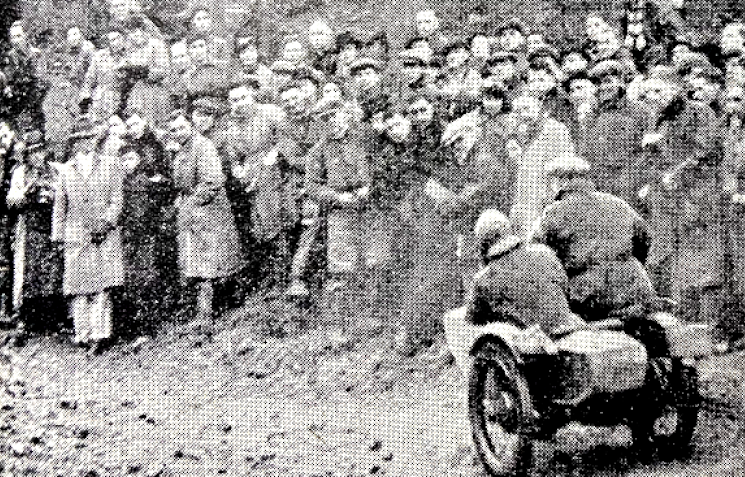
“MUSING ON OUR Prospective Riders’ Number, I fell a-wondering how little of the world I should have seen if I had never been bitten by the motor cycling bug. Two wheels have carried me over huge areas of the Continent, and into every remote corner of the British Isles. This is apart from and additional to the intrinsic fun of the hobby, the pals it has made for me, the technical interests it has created in me, the rough and smooth of going places, and all the rest. If I had never motor cycled, I should doubtless have been abroad by train, and spent short vacations in the more conventional resorts of the home country. But never could I have achieved without a motor cycle a memory so packed with beauty as mine is to-day. To quote one typical example. What non-motor cyclist has ever seen the indigo loch slumbering under the dark slope at Jeantown, or topped the Pass of the Cattle and revelled in that gorgeous expanse of mountain and lake and ocean? The public regards us as rather soiled and untidy fellows with a lust for speed. Actually, it would be truer to describe us as amateur engineers, with a genius for friendship and a passion for beauty (not, of course, excluding the feminine variety).”—Ixion
“LETTERS WE RECEIVE from readers in Canada and the USA frequently contain the remark that the writers cannot understand why British manufacturers do not standardise safety bars. Nowadays these bars are fitted to a large number of American motor cycles. Indeed, the vice-president of the Indian concern stated some time ago that 99% of the machines he sells in the USA are so equipped. Briefly, safety bars may be said to take the form of twin tubes running transversely from the base of the steering head to the front engine plates, thus acting as protection for the rider’s legs and saving the machine from damage in the event of it toppling over. It is proved by the unobtrusive designs employed on American motor cycles that there is no need for the bars to be unsightly. That such an arrangement forms a simple, sane method of machine and rider protection needs no stressing. Even legshields, in spite of their comparative flimsiness, have proved a blessing to many motor cyclists. In these days of congested roads, anything that can be achieved in the way of reducing vulnerability is worth while. We suggest to every manufacturer that, by incorporating safety bars in his designs, he can make a useful contribution to safety—one that, unlike grandiose road improvement schemes, can be put into effect immediately.”
“VERY FOOLISHLY IT HAS become the fashion among, a section to decry the side-valve, although in actual fact it is the type most suitable for a considerable proportion of motor cyclists. The side-valve engine requires less maintenance work than the average ohv machine, and the work is much simpler to carry out. In addition, it is usually the more flexible type of unit, and pulls better at low speeds. Theorists will point to the lower thermal efficiency of the side-valve engine, yet the fact is that machines with this type of power unit usually cover almost exactly the same number of miles per gallon. Fuel consumption, however, is only one item in running costs. There is also the question of repairs and maintenance. In our experience the all-in running costs of a side-valve machine are usually considerably lower than those of the equivalent overhead-valve machine.”
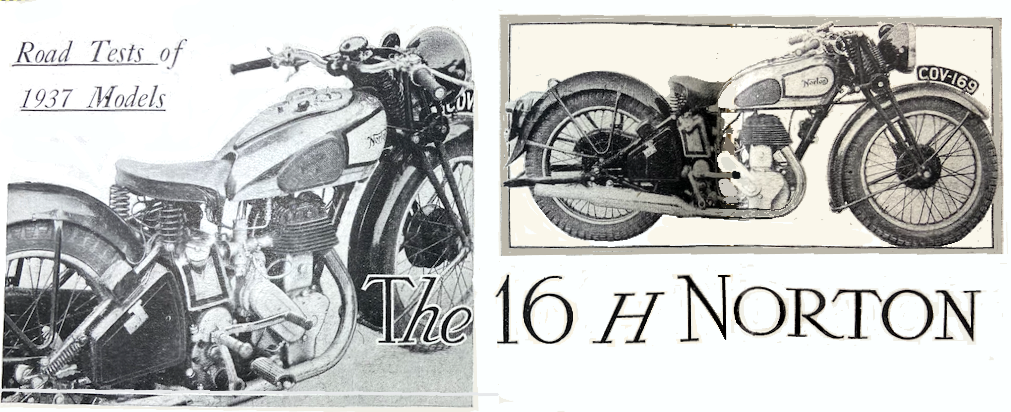
“IN THESE DAYS OF high-efficiency singles with overhead valves and high compression ratios, some motor cyclists are inclined to overlook the simple side-valve model. The 16H Norton, however, is a machine with a staunch following. It is easy to understand why this is so, even after a brief acquaintanceship, for this 490cc side-valve machine has a performance akin to that of a lively overhead-valve 500—plus exceptional docility and flexibility. The riding position is very good for a short-legged person, but a trifle cramped for a rider of medium height. The saddle is unusually low, and the adjustable footrests must necessarily be set high on account of the position of the positive foot gear-change. This lever is adjustable, but only to a limited extent, on account of the lever fouling the footrest hanger should it be set at any angle below the horizontal. Consequently, the high position of the lever calls for considerable and rather awkward movement of the right leg when selecting a lower gear. All controls work in an admirably decisive way. To coin a phrase, the machine immediately imparts the feeling of a ‘real job of work’. The kick-starter is suitably geared in relation to the engine, and even on cold mornings starting requires little effort. Under these conditions the Norton would usually start at the first kick, provided the carburettor had been flooded. With the ignition advanced, a rough and ready tick-over could be found with the throttle, and then by gradually retarding the ignition the engine would settle down to an excellent tick-over. At idling speeds the mechanical silence of the Norton was uncanny. Even when the engine was running in a garage, to locate any mechanical noise beyond the swish of the primary chain and the hiss of the carburettor. In fact, at all engine speeds the quietness of the exhaust and the engine was most praiseworthy. The clutch was smooth in action, although under traffic conditions it showed a tendency to drag slightly. However, at all times bottom gear could be selected without any noise. The gear box could be abused to the extent of making so-called ‘racing’ changes, ie, with the throttle open all the time. While the selection of the various gears does not call for any comment, their disengagement did at times require considerable effort, no doubt due to the position of the gear lever and the clutch drag already mentioned. A feature of the Norton is the manner in which it can be ridden off in bottom gear with the engine turning at little more than idling speed. The engine produces an unusual amount of power at extremely low revolutions, and this enables the fullest use to be made of the engine’s flexibility. Where it would normally be necessary to change down into a lower gear when rounding a corner, the Norton will pull away smoothly and sweetly in top like a multi-cylinder machine. It will throttle down to 12mph in top gear without snatch, and from this speed will accelerate without a trace of pinking or distress, in spite of a rather high gear. The gear ratios are well chosen, and undoubtedly they play a big part in the extremely efficient way in which the Norton performs. A speed of 45mph can be easily reached in second gear, in which ratio the acceleration equals that of many first-class 500s. But this speed is not the absolute limit, for the almost-vibrationless engine will rev in a way that is most unlike a side-valve, and in doing so will provide a speed of just over 50mph. Much of the charm of the 16H lies in its delightful performance in third and top gears. The ratios are well matched, and as they are fairly high the engine cannot be over-
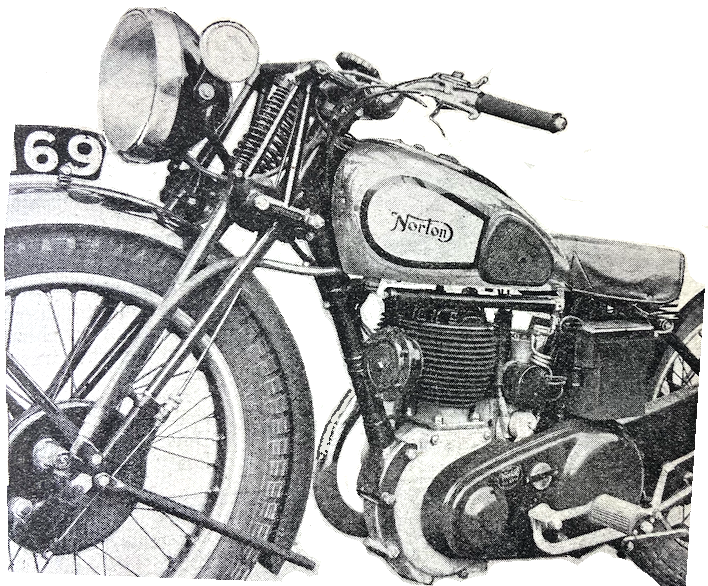
revved on a long downward gradient. There is no doubt that a speed slightly in excess of 70mph can he reached on the road. The speed of 67mph is the mean of six runs over a timed quarter-mile taken in both directions. The Norton is almost as fast in third gear as it is in top. Partly on account of the silent nature of the gear box, it was at times extremely difficult to tell whether third or top gear was being used. The acceleration of this extremely quiet machine was of the highest order. Even when cruising at a comfortable and steady 60mph—a speed in which the Norton appeared to ravel—the engine was distinctly lively, and imparted that feeling of having more power is hand. At the other end of the scale it would pull up long, tiring gradients in top gear without any complaints, while should a sporting type of acceleration be required under these conditions, all that was necessary was to use third gear. In keeping with the Norton’s sporting performance, the brakes are excellent. Both back and front brakes have a pleasant smoothness in their application and yet both are absolutely positive. At low speeds the steering was light and positive, in spite of the wide-section tyres. When approaching the maximum speed the steering became a trifle too light, and although there was no question of wobble developing, the damper was brought into action to the extent of one turn. With the damper in use the steering was excellent, and this, combined with the admirable road-holding properties of the machine, made fast work on open road a real pleasure. At a maintained speed of 40mph the Norton’s petro1 consumption was in the region of 90mpg, while the oil consumed was negligible. The engine remained completely oil-tight throughout the test, except for a slight smear on the timing case. Oil did, however, leak in small quantities from both the kick-starter housing and from the primary oil bath. In spite of any miles covered on wet roads the machine remained almost free from grit and mud, thanks to the excellent mudguarding.”
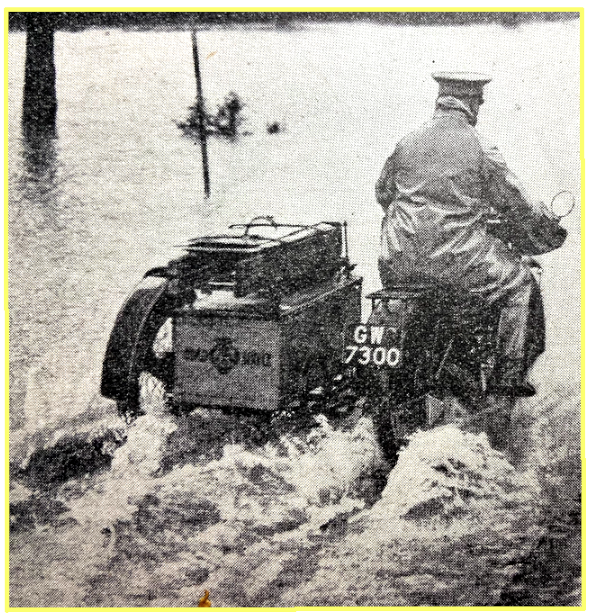
“I HAVE ALWAYS BELIEVED and preached that our roads (until the Ministry of Transport got busy with its straight edge) meandered as they did because they were trudged out on the map by pedestrians and fellows on palfreys, who naturally circumvented by detours every swamp and spinney and hillock encountered in their journeyings. Our literary editor has just made me wonder whether I am right by showing me a poem of GK Chesterton’s which starts: ‘Before the Roman came to Rye, or out to Severn, strode, The rolling English drunkard made the rolling English rood. A reeling road, a rolling road, that rambles round the shire, And after him the parson ran, the sexton and the squire; A merry road, a mazy road, and such as we did tread The night we went to Birmingham by way of Beachy Head.’ On top of this I get a snap from a reader of his outfit parked along the Sidmouth-Seaton road, opposite one of those ultra-modern ‘advance’ signposts located 50 yards before the road junction, and bearing the single word ‘BEER’ in huge capital letters. Thirsty lads are warned that this Beer is not a beverage but a Devon village!”—Ixion
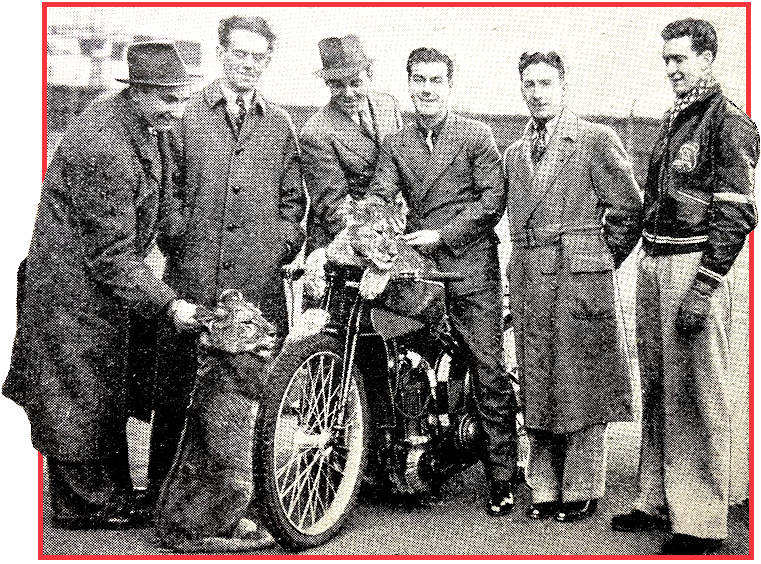
“LAST TIME I WROTE you on the subject of spring frames was early in 1936. With you, I confidently anticipated a rush season for springs in 1937, and it is most disappointing to read that an endeavour is being made by makers to treat the idea as a flash in the pan. A year’s riding here and abroad on my New Imperial has proved that there are no snags whatever in the spring frame, and the comfort (my age is 60) has to be experienced to be believed. ‘Torrens’ remarked recently something about a difficulty in poising on the footrests with a certain spring-frame machine, but I do not get his idea. With the New Imp arrangements, at any rate, one doesn’t poise, but just sits on the place provided by nature and stays put without difficulty and without discomfort. On modern highways the pot-holes known to and feared by us old hands are few and far between, but the sunk sewer man-hole still provides that shattering jar when one is riding a rigid-frame machine. With my spring frame I just do not bother, as the jolts do not reach the saddle. For the £3 extra one gets ‘four-wheel’ comfort. Usual disclaimer.
J Stuart White Snr, Leeds.”
“I SINCERELY HOPE that the suggestions of your correspondents ‘RWDG’ and ‘WJS’ will not be acted upon by readers. Motor cyclists to-day are untidy enough without using up pull-overs or old trousers in the ways-mentioned. With so much smart kit on the market I am often surprised at the untidy appearance of mans riders. Breeches, field boots or rubber Wellingtons of good pattern, and smart ‘lancer’-style riding coats are within the reach of most. I am a member of a club where military-type kit is favoured. I find leather breeches, military field boots and a leather coat ideal for winter use, but in summer I invariably turn out in well-cut cavalry twill breaches and puttees.
BM/BNJE, London, WCl.”
“A FAMOUS firm did their utmost to make their instruction book dud-proof. They sent it out, slapping their chests and congratulating each other that never again would their service department be harassed or their customers held up by an elementary snag. A week later the Riders’ Friend on the staff received a letter: ‘On trying to remove the licence holder to insert the licence disc, I found it apparently jammed. There is no description of it in the instruction book, and I should value your advice.’ New edition of said book now in the press, I suppose?”—Ixion
“A VETERAN RIDER suggests that the basic and invincible fascination of motor cycling, which grips some of us to the very brink of the grave, is biological. Man’s first experiment and experience in fast travel was riding, not driving, and in most races was associated with the horse. Centuries of riding horses and/or camels—he suggests—created an hereditary passion for riding. Those individuals in whom the inherited instinct is strong can never be put off with driving as a substitute, or accept a glass box on four wheels as preferable to a saddle.”
“THERE ARE NEARLY 150 corps of motor cyclist police patrols in USA, each state having its own organisation. The state of New York has four separate corps, wearing different uniforms and employed for different purposes. Sidecars are used by the licence and vehicle inspection corps, who are all married men. The City police motor cyclists may be either married or single, and are generally ordinary ‘bulls’, taught to ride standard machines to increase their mobility for routine police jobs. But the men who ride the 100mph machines are intended primarily for chasing drunken and speeding drivers, or for hunting down the culprit in a crash, or for anti-gangster work. “
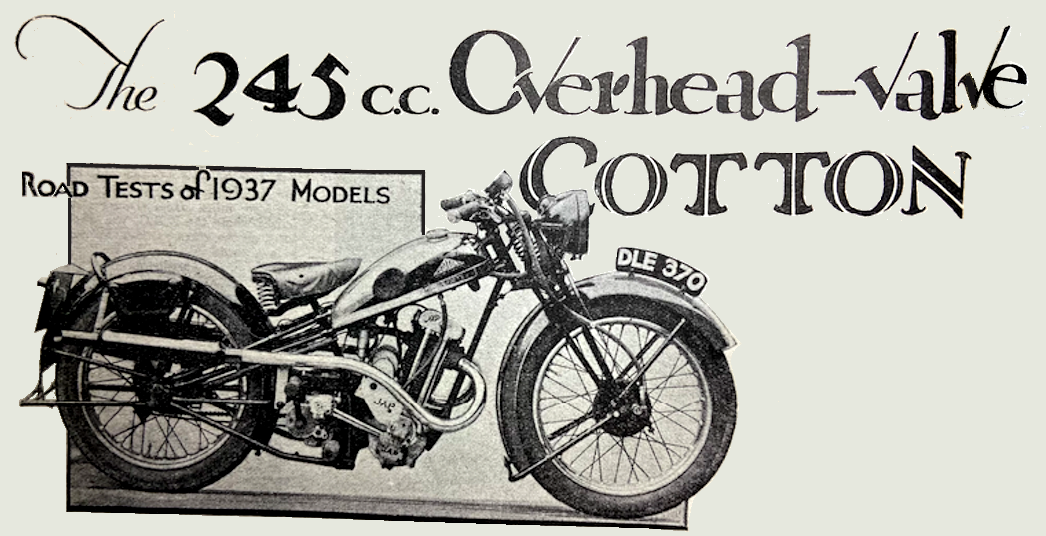
“THERE IS ALWAYS something fascinating about a lively 250, with its ease of handling and excellent steering. In the case of the 245cc Cotton submitted for test there was liveliness as well as all the good features usually attributed to 250s. The machine under review, Model 250/37, was fitted with several extras not in the standard specification. One of these optional extras was the Burman four-speed gear box with foot change. Although a trifle low, the riding position is comfortable. Both the brake and gear pedals are well placed in relation to the footrests, while the arrangement of the handlebar controls is neat and compact. The Terry saddle has a small range of adjustment for height, and even with the seat pillar tube type of mounting set at its highest the back rim of the seat occasionally came in contact with the rear mudguard when the machine was travelling over bad roads. Even from cold the Cotton was a certain starter, although quite a hearty effort was required to turn the engine over considering the size of the engine. As soon as the engine had started the throttle could be set for a quiet and steady tickover. On two occasions during, the test when the machine was started up first thing in the morning blue smoke appeared in excessive quantities from the exhaust This suggested that in some manner small quantities of oil had gained entry to the crankcase via the pump—the JAP engine is mechanically lubricated on the wet sump principle. Another lubrication difficult arose during the test for maximum speed. For this purpose the pump was set to give to generous supply of oil. At low speeds this was the case, but continued riding at high speeds soon showed that the oil supply was not sufficient. A partial vacuum in the oil tank (revealed by the hiss of air when removing the filler cap) gave a clue to the trouble—the air vent in the cap was choked. At first the Cotton was a trifle noisy in the indirect gear ratios, particularly in third, but there was a marked improvement towards the end of the test. Both mechanically and in the case of the exhaust the machine is commendably quiet, even when ridden hard. The clutch is both light and smooth in operation. On the other hand, the transmission appeared to be a little harsh, and this
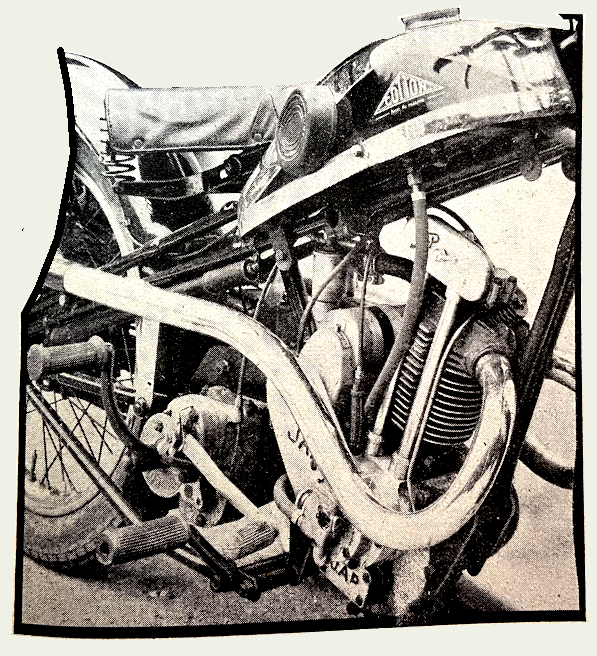
tended to mar the JAP engine’s flexibility and smoothness at low speeds in top gear. Below 17mph a rather vicious snatch set in. It was at speeds above 30mph in top gear that the engine began to produce its power, and at times it was difficult to realise that the machine was a 250 and not of greater capacity. A cruising speed of 50mph could be maintained both on the level and up long main road gradients. There was very little engine vibration, except for a slight period at 30mph. The third gear ratio is well suited to the engine’ s performance, and up to 45mph it provides acceleration equal to that of many larger machines. Making full use of the gears—a, certain, if noisy, gear change could be guaranteed at all times—a speed of 54mph was reached in a quarter of a mile. The timed mean speed of four runs over a quarter of a mile, taken in both directions, was 60.6mph. Of these runs the last was one of 63mph, a creditable performance, for without a mudguard pad it was difficult for the rider to assume a riding position that reduced wind resistance to a minimum. There is no doubt that under better conditions—the surface over which the runs were timed was not ideal—a speed of 65mph could be readily achieved. For many years triangulated frames have been a feature of all Cotton machines. When first introduced the makers claimed excellent cornering and steering characteristics, and these claims remain justified. The 250 Cotton holds the road perfectly, and at all speeds handles admirably, even on greasy surfaces. Although a steering damper is fitted to the Druid forks, such is the confidence inspired by the Cotton that there was no need to use it during the test. The steering is light and positive at low speeds, but does not show any tendency to become lighter or less positive at the other extreme. Road-holding remains excellent, and even when the brakes are applied to their fullest extent there is no sign of any fore-and-aft pitching. Both brakes proved extremely effective, yet very safe to apply even on wet roads. They require little effort for a sudden stop, and are delightfully smooth in action. The 250 Cotton is fitted with a Miller Dyno-Mag lighting set as part of the standard equipment. The mud-guarding is essentially of the sports type, and as a result not very effective. Finally, mention should be made of the machine’s exceptionally good petrol consumption. At a maintained speed of 40mph the consumption amounted to 116mpg. Owing to the newness of the engine the oil pump was set to give a generous supply, and the amount consumed gives no clue to the normal consumption. Throughout the test the engine remained creditably oil-tight except for slight seepage at the base of the cylinder.”
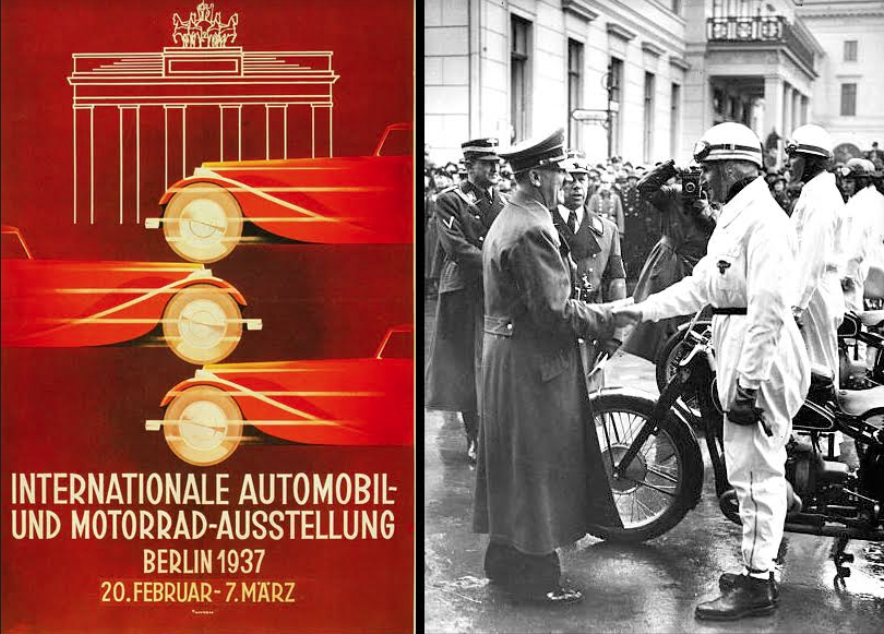
“WHILE THERE IS LITTLE NOVELTY at the Berlin Show, which Herr Hitler opened last Saturday, those who read the description of the exhibits is this issue will find much that is absorbing. It is always interesting to see the lines upon which another country is working. In this case, the particular country is one of the most advanced in the world, so far as motor cycle design is concerned. It would be wrong, however, to gauge the German motor cycle industry by its two makes of transverse twin, or by the water-cooled, supercharged 250cc two-strokes that compete so successfully in the big road races. Taking German design as a whole, it might with fair-ness be termed ‘ordinary’. There is just one really outstanding production machine. The vast majority of motor cycles sold are simple two-strokes of under 200cc. Germany has developed the two-stroke engine to a greater extent than any other country. No doubt the main reason is economic, and this applies also to the interesting fact that coil ignition is almost universal. In the latter case, however the German wisely asks, ‘Why have a magneto when you already possess a dynamo and battery?’ The fact that coil ignition is so popular in one country, and one might say unpopular in another, certainly provides food for thought. British and German motor cyclists differ considerably in their demands. For instance, the German has no door to his sidecar; usually he makes do with a heel pedal for the rear brake, and he desires air filters and other aids to reducing wear, such as rear chain enclosure. Foot gear changes, too, are by no means universal even to-day. Not the least interesting feature of the Show in Berlin is the way it is made a national occasion. Imagine, for one moment, the closing of the roads from the Houses of Parliament to Olympia, and heralding the official opening by a high-speed procession of racing cars and motor cycles manned by the most famous drivers and riders in the country. The thing is unthinkable. It is done in Germany, however. Motoring and motor cycling are looked upon through different eyes. Both, it is felt, should be encouraged to the maximum. This is done by freeing all new cars and motor cycles from taxation. Even third-party insurance is not compulsory, while those who ride motor cycles of less than 200cc do not have to undergo driving tests. The result is that the number of motor vehicles is increasing by leaps and bounds, and Germany to-day has over twice the number of motor cycles that are used in Great Britain.”
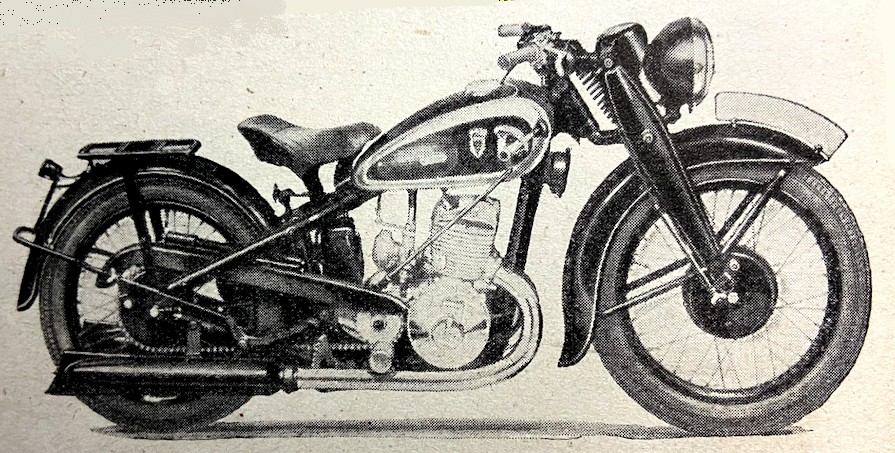
“GERMAN DESIGN, AS REVEALED by the Berlin Show, pleases, yet disappoints. There is little novel or even new among the motor cycles at the exhibition which Herr Hitler opened last Saturday. As a show, however, the Internationale Auto-schau is remarkable in its immense size and in the way it captivates the imagination. It extends to hall after hall, and it is easy to believe that this combined exhibition of cars, motor cycles and commercial vehicles is by far the largest in the world. Perhaps even more impressive is the way the Germans make the holding of the show a national occasion. For the opening the roads were closed right from the Wilhelmstrasse to the huge exhibition buildings at Kaiserdamm, a distance of almost exactly five miles. The route was roped off and lined by some 10,000 NSKK men with their cars and motor cycles. As a state procession alone it would have been interesting, but in addition, along these closed highways rode and drove Germany’s most famous racing aces—racing cars and motor cycles, with open exhausts and, for one of the car drivers, a juicy skid in Berlin’s most famous street, the Unter den Linden.
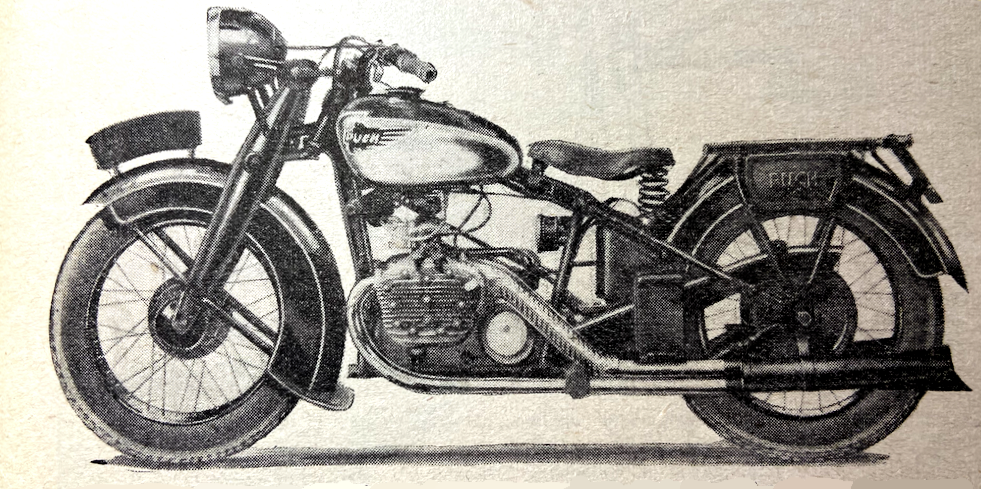
All the solos and sidecars in the exhibition are grouped in one hall. In number of makes, Germany’s motor cycle industry is not large. All told, only 10 German firms and one Austrian concern exhibit two-wheelers—11, if one includes a very interesting motor attachment for bicycles which is shown in another part of the exhibition. Of the 10 German makes, there is one which is outstanding, namely, the BMW. No other comes within an ace of the designs of this world-famous concern, except the Zündapp, which has machines on similar lines but not so neat. For the rest, the German machines are largely ‘bits and piece-y’. The reason for this, according to one designer, is simply £sd or, to be Germanic, marks and pfennigs. Cleaning up a design and making a machine look a homogeneous whole costs money, and not only is low selling price extremely important in Germany nowadays, but motor cycles are selling like hot cakes. However, at least three of Germany’s most famous manufacturers have new and interesting machines on the stocks, but these are not being introduced at the present time, for, it is said, there is no need to do so. According to official statistics, the number of motor cycles sold last year, exclusive of Government orders and pedal-assisted machines, was 125,131. This is easily the largest number sold in any one country. The figures over the years are not uninteresting. They were : 47,630 for 1932; 50,108, 1933; 78,179, 1934; 102,831, 1935.
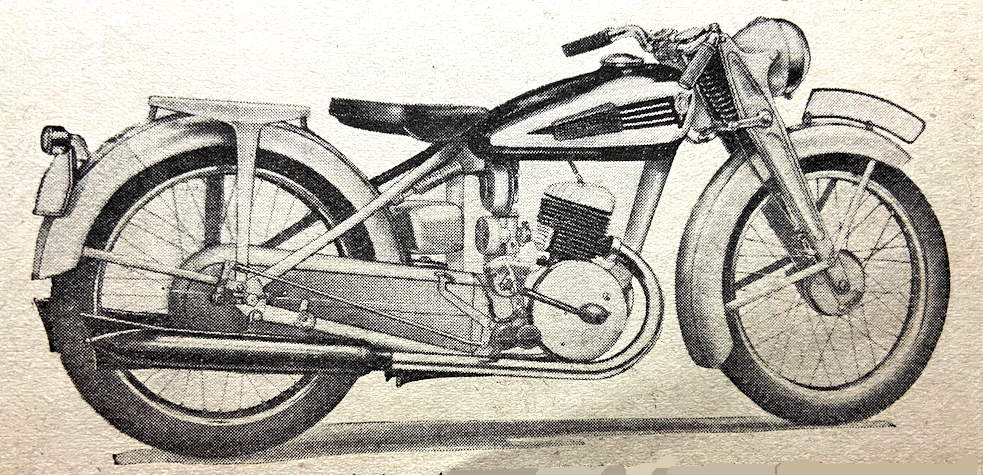
This past year has shown an increase of over 20,000, as compared with the previous one, and Germany, it is stated, now has approximately 1¼ million motor cycles—a total nearly 300,000 greater than that for cars. Of that million and a quarter, it Is estimated that more than half are under 200cc, and that in these times there are two machines of under 200cc sold for every one of larger capacity. The reasons are cost and the fact that those who use machines of under 200cc do not have to obtain driving licences, which involve passing fairly stringent tests. Insurance is not compulsory on any motor vehicle except commercial, though the effect of the law, it is stated, is that so far as damages are concerned it is cheaper to cannon into someone when riding a machine of 199cc than one of 201cc! No taxes are levied on new motor cycles and cars, and the appeal of the ‘200’ is in its low cost and the fact that no driving licence is necessary. A fact that is pointed out time and again by those connected with the German motor
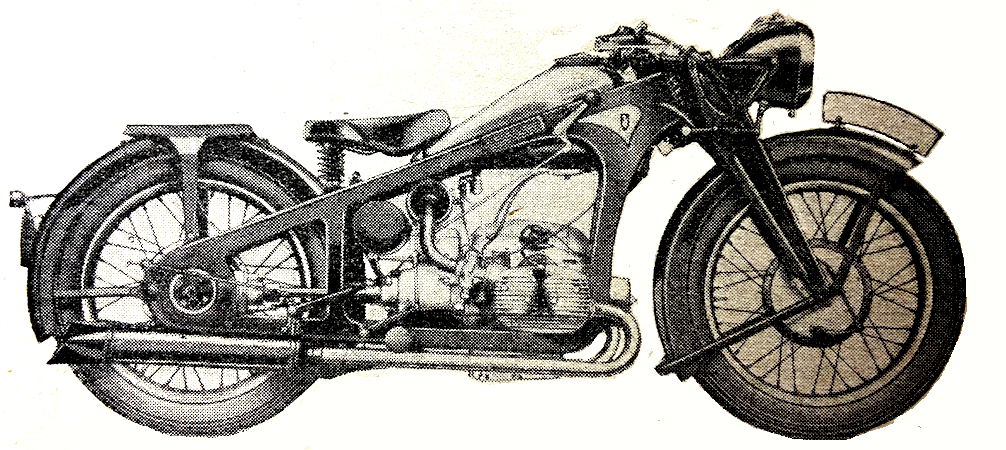
cycle industry is that the German motor cyclist is very different from the British rider—he seldom rides for sport and has no interest in a hyper-sports performance. Because of the popularity of the inexpensive 200cc motor cycle, the industry must, according to one manufacturer, be looked upon largely as makers of two-strokes, a type of machine which, incidentally, has been brought to a very high pitch of perfection. Although small in engine capacity, these machines must not be thought to be miniatures—they are fully-fledged motor cycles, mostly with engines of the flat-topped piston type. Manufacturers, in many cases, have obviously expended an enormous amount of time on saving what the English rider would call farthings. This is found in innumerable directions. To quote a few, it is to be seen in pressed mudguard stays, built-up brake pedals, the elimination of yoke ends in controls, and the making of brake cam levers in two parts, welded or riveted together. The ingenuity shown is often remarkable, and so is the catholic nature of frame design. All manner of frame construction is to be seen—sometimes quite a variety on an individual stand—and the reason, it would seem, is largely, if not entirely, a matter of production cost.

Forks, too, are of all manner of types, but mostly on the small-capacity machines they are of the pressed-steel-blade kind. Perhaps the most interesting constructional point is the wide use that is made of steel pressings. No doubt as a result of increased production and the lowering of costs by new constructional methods, there has been a tendency to reduce prices—either this or replace a three-speed gear box with one having four speeds. The latter type is by no means universal at the present time, and tyre sizes, taking machines by and large, are, if anything, smaller than in Great Britain. On the other hand, greater attention is paid to saddle springing. The BMW tension-spring mounting with its thick rubber pan-seat is well known to those who visited the last Olympia Show, and from the road test of the R5 model last year. Some machines, such as the more expensive DKWs and Victoria, have adjustable saddle springing.
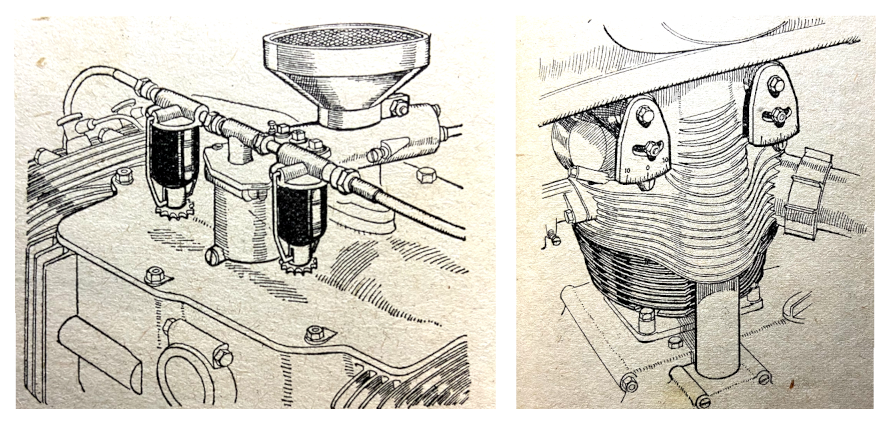
Another interesting line of thought is that of pillion-seat suspension. Many of the German designs consist of super saddles made for carrier fixing and often with adjustable springs and a handle at the saddle-nose. This means that the pillion passenger sits higher than in England, but only, as a rule, to the extent of some three inches. Good examples of saddle-type pillion seats with adjustable springing are the Promo and the Drilastic. Another state of affairs very different from that obtaining as regards British machines is in ignition systems. Coil ignition, sometimes with a flywheel-type dynamo, such as one of the Noris designs, is almost universal. The German designer says, ‘Why have coils of wire rotating at thousands of rpm when they can be stationary, especially as you have to have a dynamo and battery anyway?’ Two DKW two-strokes, one a twin-cylinder 500 and the other a 200cc single, remain the only motor cycles fitted with self-starters. According to the sales manager, 15% of these de luxe models are sold with self-starters. An interesting point on the DKW stand is that the battery lugs each incorporate a peg which comes flush with the battery casing, and the two pegs that enable an inspection lamp or the leads of a trickle charger to be plugged home. As in Great Britain, the tendency is towards the complete enclosure of working parts. This does not apply merely to engines, but to the transmission. It is amusing to see that, whereas in England the average competition rider, in spite of the deep mud often included in trials, favours open chains, the German Victoria machine equipped for cross-country and trials riding has its rear chain specially encased. This practice is spreading in Germany, and several makes, among them the NSU, have models with the rear chain enclosed in a full chain case. The equivalent of that English tag,
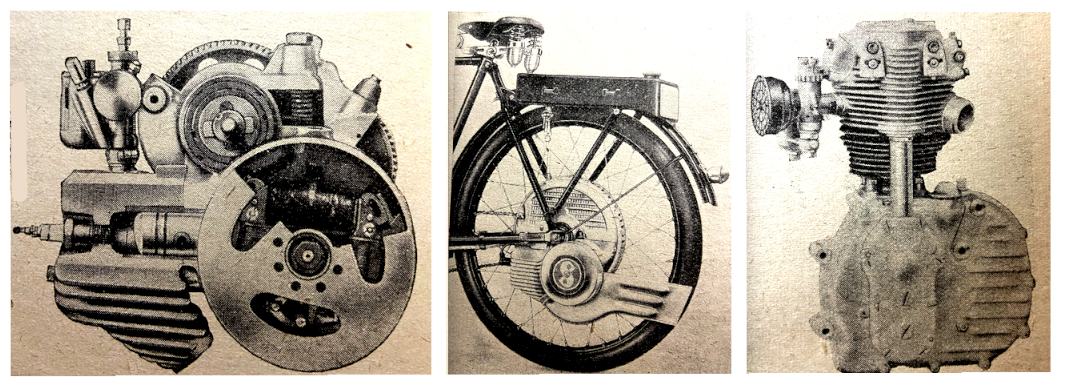
‘Waste not, want not’, is to the fore in Germany to-day, and great care is taken to eliminate the more obvious causes of wear. A case in point is the universal adoption of air-cleaners. It is alleged that in Germany a motor cyclist would not look at. a machine that was not equipped with one. Many of these filters are of the wet type and need to be washed out every 1,000 or so miles, and are designed to collect the dirt by means of oil. Because of this demand that grit shall not be induced into the engine, many of the Amal Fischer. carburettors, which as a make are almost universal, have no air holes low down at the side of the mixing chamber; these are arranged so that all air has to pass through the filter. Although the BMW team had spring frames in the last International Six Days’ Trial, and DKWs had a spring frame in a recent German trial, neither these makers nor any others exhibit machines with rear-wheel springing. The German industry is making haste slowly, largely because of production cost and the fact that it is not considered necessary to go in for new designs at the present juncture. There is, however, a very noticeable interest in rubber as a medium for suspension Rubber bands and strips of rubber are to be seen on a number of sidecars, and the 100cc DKW two- stroke has rubber bands for its front forks instead of a steel spring. Perhaps the most interesting exhibit in this connection is to be seen on the Continental rubber concern’s stand in the gallery of another hall. Here is an exhibit almost entirely devoted to showing actual applications of what is called Schwingmetall’—in other words, rubber attached
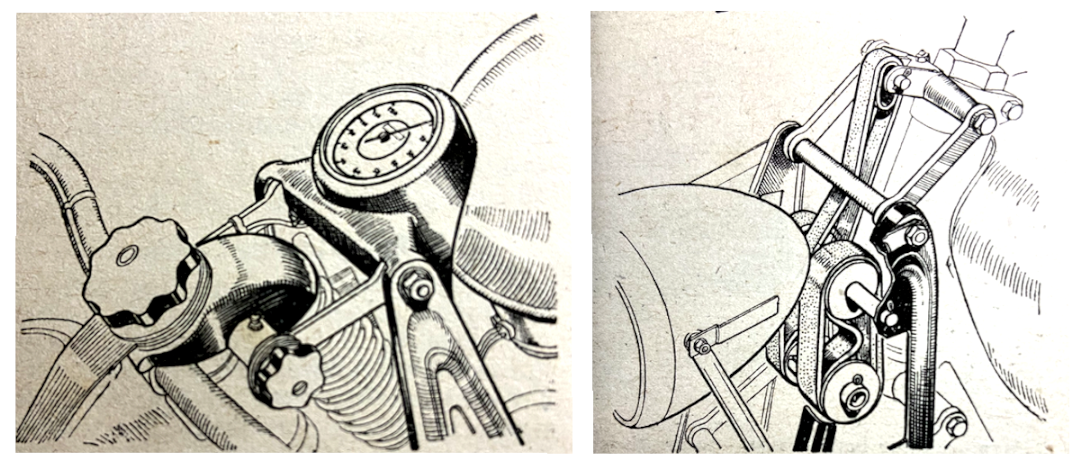
to metal by means of a special vulcanising process. In addition to various car and lorry suspensions using this ‘Schwingmetall’ as the springing medium, there are a pair of miniature front forks and a model of the rear frame of a motor cycle, both labelled ‘1937’. The springing consists merely of blocks of rubber attached to steel plates. The rear-wheel springing is simplicity itself. There are two of these rubber blocks with their metal plates. They are attached to the inside of the pressed-steel frame immediately below the saddle and have mounted between them a box-shaped extension of the seat-stay members. The rear frame pivots close to the gear box, and thus, as the back wheel strikes a bump, the effect is merely to distort the rubber blocks. Another interesting working model shows rubber interposed between the hubs and discs of lorry wheels in order to provide a certain amount of elasticity in the wheels themselves. On the Metallgummi stand there are steel rods and tubes joined with rubber. This type of construction is employed on certain Steib sidecars in the two upper sidecar connections. Since the two lower connections have ball joints there is thus elasticity between the chassis and the frame of the machine. The total amount of movement is probably in the region of ⅜in. Although nearer 20,000 than 15,000 sidecars, it is stated, were sold in Germany last year there are few fresh developments. Chassis vary enormously. As a rule they are tubular and built up not by brazing but by clips. The bodies are fairly stereotyped, and either torpedo or roughly canoe shaped. Instead of the sidecar being sprung at the front it is generally pivoted, in some cases in rubber bushes. Rubber is also employed for the rear springing in several instances. On the Juwei, the sidecar wheel and the rear of the body are sprung by means of aero

elastic, while the Stoye concern, which produces probably the best made sidecars of all, shows rubber band suspension. A number of the more expensive sidecars have sprung sidecar wheels, and some have a simple means whereby the driver can adjust the angle between the machine and sidecar as he travels along. The latter consists merely of a screwed rod, with clamped-on tommy bar, incorporated in the third or seat-pillar connection. One end of this thick steel rod has, of course, a left-hand thread and the other a right-hand one. This arrangement is desirable in the case of sprung sidecar wheels because of the effect of ‘passenger or no passenger’,” and is also useful if roads vary much in their degree of camber. Since certain metals are either not available in Germany or only in limited quantities, much use is being made of substitutes. In place of chromium, a magnesium-aluminium alloy called ‘Hydronalium’ is being employed for control levers, tanks and so on. This is sprayed on hot and then polished. The effect is that of a dullish silver paper in some cases, though it is claimed that it can look even brighter than chromium, and also that it is considerably cheaper. In addition a new form of soldering, using an alloy containing only 20% tin, has been introduced, and fresh uses are being made of special paper for insulating purposes. As stated earlier, the R5—the 500cc ohv model BMW—remains the outstanding German design. For 1937, there is a 600cc side-valve machine on similar lines: that is, it has a flat-twin engine in unit with a four-speed box, a transverse engine mounting and a tubular frame, plus shaft drive, foot change and hydraulic damping of the front forks. This machine is not quite so neat and clean-looking as the R5, which in these respects is exceptional in the realm of motor cycles. An interesting detail is that the air intakes of the two carburettors are led to an air filter built in the top of the rear part of the gear box housing. Another new BMW is a 350cc vertical single, similar to the old 400cc model, which is now obsolete. This has overhead valves in a light-alloy head, a pressed-steel frame, four-speed gear box with hand change and a simple type of telescopic front fork. Unit construction is, of course, employed, also shaft drive. The battery of the dynamo-cum-coil set is mounted in a deep well in the gear box casting. On the NSU stand, the machines that deserve pride of place are two new ohv mounts, one of 250cc and the other of 500cc. These are vertical singles with light-alloy cylinder heads. Complete valve enclosure is provided, the heads are ribbed
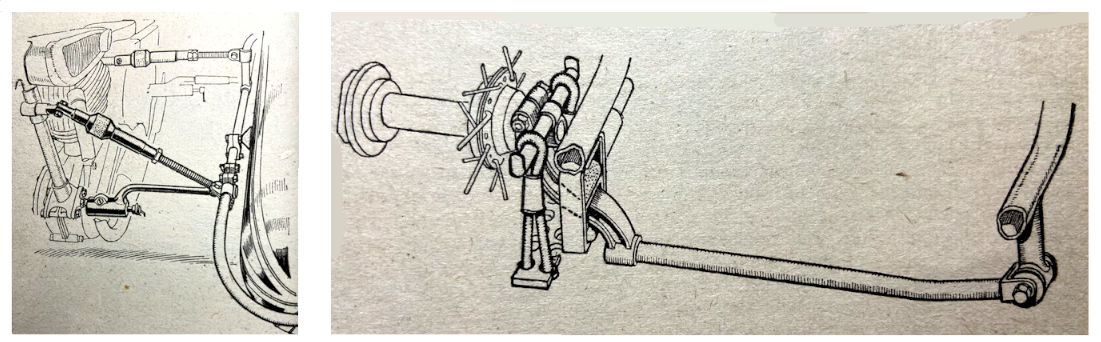
internally and the valve gear cooled by being flooded with a constant stream of oil. Bronze inserts are used as the valve seats, and the whole design is neat and workmanlike. Eccentric rocker mountings are provided for valve clearance adjustment, which requires only the slackening of one nut per rocker, movement of a scale graduated in tenths of millimetres, and, finally, the tightening of the nut. The 250cc model costa 825RM and the 500 1,200RM, which, taking the old rate of exchange is roughly £41 and £60 respectively. The idea of the light-alloy heads is simply to keep the oil, valve and plug temperatures down. Tests prove that the engine is less economical in petrol consumption rather than more economical. In ordinary running the consumption increases by about 10%. On the other hand oil consumption is reduced and valve spring life prolonged. With the idea of entering a fresh market, NSUs have introduced a new 100cc machine. This is like the Quick—a pedal-assisted machine shown for the first time last year—but incorporates a three-speed gear and is minus pedals. The price of the latter, the Pony, is 345RM, and of the Quick 290RM. Both these and the 200cc two-stroke are unit jobs. DKWs, of course, continue to make only two-strokes and employ their special deflector-less piston designs. The range is from 98-490cc, the last size a twin. All are air-cooled except one racing super-charged 250, listed at 1,550RM, and fitted with two carburettors. Certain of these machines have a tiny window in the top of the Loma flywheel dynamo to enable the rider to find top dead centre. The Victoria concern shows a variety of machines, including an inclined single with side shields and an ohv flat twin. The most interesting machine is a new 200cc two-stroke with a novel port arrangement. All told there are six ports: twin exhausts, three transfers and one inlet. Two of the transfers are in the left and right sides of the cylinder respectively, while the third is in a detachable member that also incorporates the inlet port and carries the carburettor. This detachable
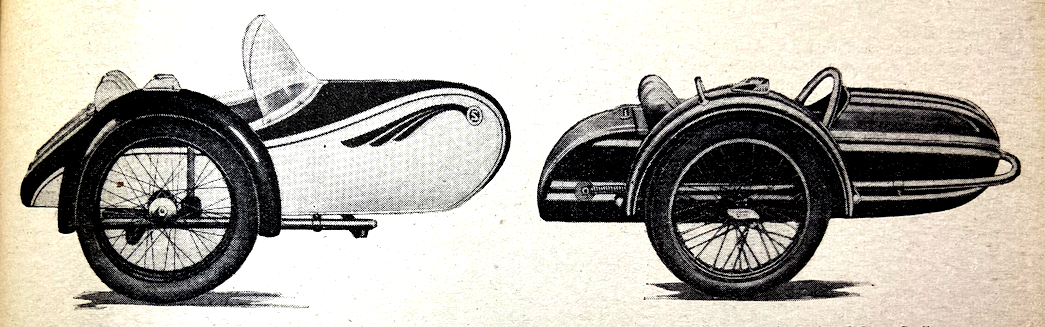
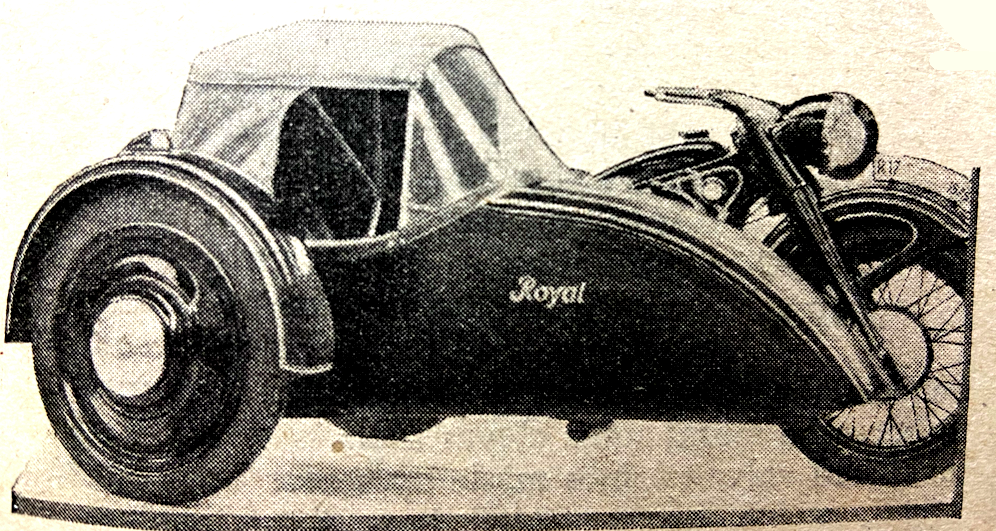
finned casting allows of easier access to the other ports for machining purposes, and is, of course, itself easily machined to any given shape. It also facilitates experiments which, it is said, have resulted in an additional horse-power merely from improved gas flow. The three streams of fresh gas transferred from the crankcase meet at the rear of the cylinder, and by impinging are directed upwards on the side farthest from the exhaust. That is the scheme, and it is said to work really well in practice. The Austrian Püch, with its double-single two-stroke design, has been known over the years. This type, with its forked connecting rod and, consequently, unusual port timing, has undergone little alteration. A new 200cc unit-construction model, is out of the ordinary so far as Püch designs are concerned, in that it has a flywheel clutch instead of the clutch incorporated in the rear hub. The transverse, almost flat, vee-four Püch is a side-valve, with 13-stud fixings for each pair of cylinder heads. Unit construction is employed, and a strange feature is that the gear control rod passes through a special lug in the off-side saddle member.

The hand control operates in a straight gate. Another unusual point is that the mixing chamber of the carburettor is mounted vertically in the top of the crankcase. The engine is of 800cc and is stated to develop 20hp. Nearby, on the Framo stand, is a novel pair of legshields which, if sprung down, act as skis and might be decidedly useful on some of the slippery surfaces still to be found in towns and cities! Zündapp show two-strokes of 196, 247 and 347cc; two transverse, shaft-drive four-strokes of 493cc, and an 800cc transverse side-valve four-cylinder. The range, which consists of neat, well-made machines (the dearer ones with pressed-steel frames), is similar to that of last year. Three-wheelers, while popular for goods delivery, are not shown as passenger vehicles to any extent. What appears to be the only passenger machine exhibited is a four-seater Tempo, with the engine over the single front wheel. The body size is such that six could be accommodated. The engine size? Just under 200cc! Finally, and as interesting in design as any newcomer, is the 60cc Saxonette motor attachment for bicycles. This is a Hartmann design produced in Germany by the Sachs concern, which specialises in velomoteur engines. In order to convert a bicycle it is merely necessary to fit a petrol tank-cum-carrier and a new back wheel that incorporates the unit. The engine is a two-stroke with a 17 to 1 gear, which, it is said, enables 1-in-9 hills to be climbed without pedalling, and on a level allows a speed of just about 20mph. The price is not definitely fixed, but will probably be 150-60RM complete with electric lighting. The drive is through the wheel hub, and a special wheel disc affording fan-type cooling, is provided.”
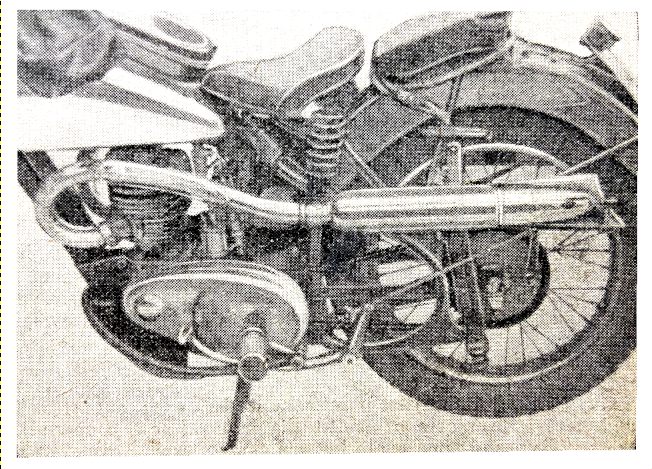
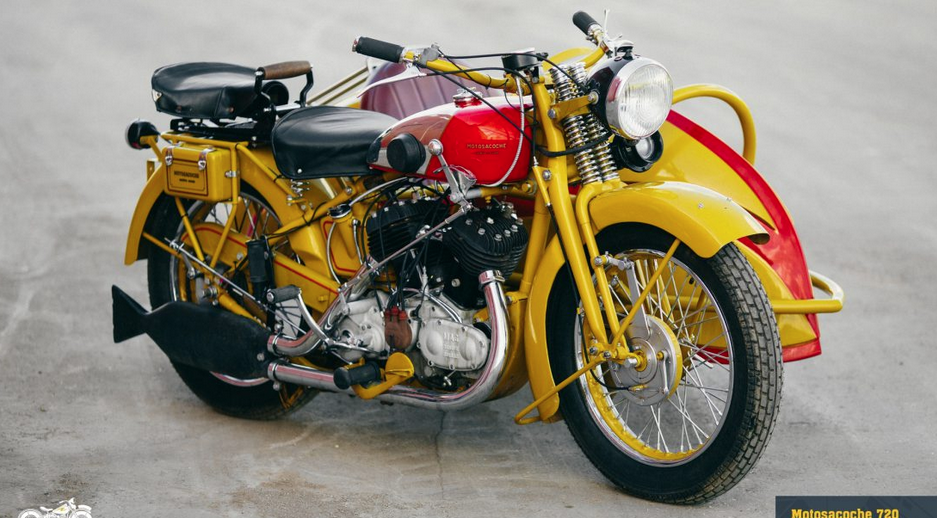
THE BLUE ‘UN ENCOURAGED riders to keep logs to work out costs per mile of their machines and published a selection. The fuel consumption figures are thought provoking: 1936 Rudge 499cc ohv combo, 2,012 miles, 62mpg; 1936 OK Supreme Sports 70 250cc ohv, 9,010 miles, 82mpg; 1936 Norton 16H 490cc sv, 8,074 miles, 81mpg; 1936 Royal Enfield 499cc ohv combo, 3,172 miles, 72mpg; 1936 BSA ohv 250cc, 9,320 miles, 79mpg; 1935 250cc ohv Ariel, 4,784 miles, 94mpg; 1936 Brough Superior SS80 990cc sv, 14,051 miles, 56mpg; 1936 Brough Superior spring-frame SS80 990cc sv, 53mpg; 1936 Velocette 349cc ohv, 7,600 miles, 98mpg; 1934 BSA 595cc sv, 5,739mph, 79mpg; 1929 Ariel 557cc sv combo, 17,927 miles, 56mph; 1936 Norton Model 18 490cc ohv, 4,462 miles solo, 4,479 miles combo, 64mpg; 1929 Excelsior 172cc two-stroke, 4,000 miles (approx), better than 100mpg; 1935 Triumph 250cc ohv, 8,320 miles, 75mpg; 1935 OEC 347cc ohv, 6,744 miles, 87.5mpg; 1930 Rudge 249cc ohv, 3,390 miles, 89mpg; 1928 Raleigh 496cc ohv combo, 11,000 miles, 64mpg; 1934 Royal Enfield 225cc two-stroke, 4,171 miles, 88.7mpg; 1936 Ariel Red Hunter 348cc ohv, 10,000 miles, 87.5mpg; 1929 Scott 596cc two-stroke combo, 4,000 miles, 57mpg; 1935 Velocette KSS 348cc ohv, 11,816 miles, 83mpg; 1935 Panther M100 598cc ohv, 10,611 miles, 75mpg; 1936 Royal Enfield 250cc ohv, 5,105 miles, 99mpg; 1936 Panther 600cc ohv, 12,710 miles, solo 94mpg, combo 76mpg; 1933 New Imperial Unit Minor 150cc, 29,800 miles, 136mpg.
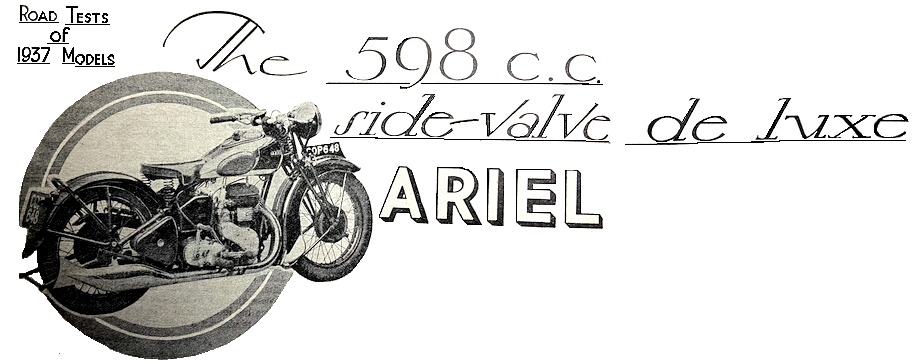
“MANY ARE UNDER the impression that side-valve machines have been neglected while all the attention of designers has been concentrated on ohv models. An examination of the 1937 side-valve Ariel reveals that this is not the case with the productions of this famous firm. In specification and characteristics the 598cc De Luxe Ariel rivals many of the most up-to-date sporting 500s. The specification closely follows that of the other models in the Ariel range. A large petrol tank with illuminated instrument panel, large tyres and brakes, long front brake and clutch levers, oil-bath chain case and four-speed gear box with foot control—all are part of the standard equipment of this well-equipped machine. As regards appearance, even the most fastidious would find little to criticise, for the model is very nearly an all-black example of the admittedly handsome Red Hunter. When sitting astride the machine it is immediately apparent that a great deal of thought has been expended on the riding position, for both hand and foot controls are well placed, while the riding position inspires confidence by its comfort. A very tall rider might criticise the fact that the offside footrest adjustment is limited by the exhaust pipe, but in all other respects the relative positions of the saddle, handlebars, and rests are excellent. On the machine tested all the controls were smooth and light in action. The clutch was very sweet and allowed rapid and easy gear changing. In cold weather, if bottom gear was to be engaged silently, it was found necessary to free the clutch by kicking the engine over with the clutch disengaged before starting up. At all other times the clutch freed perfectly. When the engine was warm starting was absurdly easy, for the kick-starter ratio is very well chosen. When cold, generous flooding and a fairly hearty kick were required if the engine was to fire immediately, but even on the coldest mornings starting required no undue effort. As is to be expected with a low-compression side-valve, the slow running was exceptionally good and with the ignition fully retarded the engine would continue to fire evenly at amazingly low revolutions. This characteristic was appreciated in many ways when on the road. In traffic, for example, when it was necessary to stop, the throttle could be snapped shut with perfect confidence that the engine would not stall, and in top gear (4.7 to 1) the machine would crawl along at 12mph perfectly happily. The performance in top gear was one of the machine’s most delightful attributes. From 15mph it could be accelerated without a trace of snatch, and the time taken to reach 30mph in this gear was creditably short. But the real joy of the top-gear performance is the way the machine ‘woffies’ along at 15-20mph without a trace of snatch and with hardly a sound from the engine or exhaust. It is a trait that is confined almost exclusively to good side-valve and two-stroke machines. At the other end of the range, the side-valve Ariel has a useful turn of speed…the machine reached 70mph on several occasions, and given better conditions would probably have reached 72mph. In the intermediate gears the engine revved like an ohv, and when the machine was taken up to its maximum in third gear there was none of the feeling of abruptly reaching the peak that one
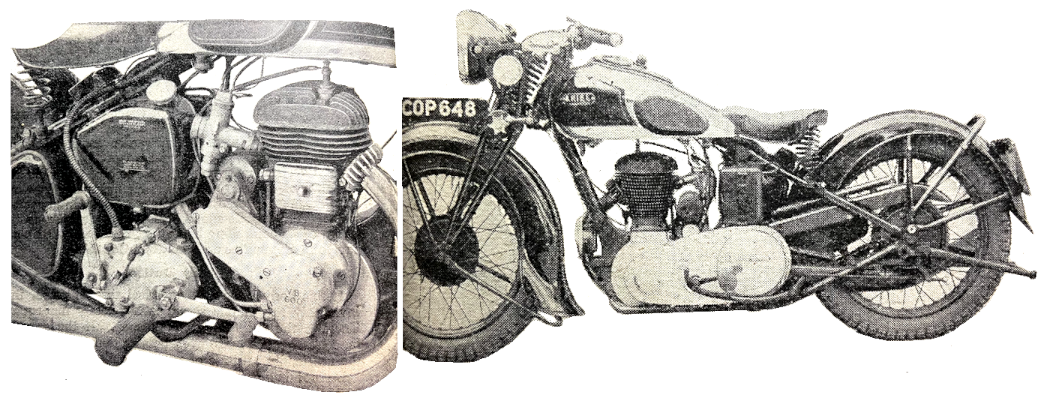
associates with certain older-type side-valve engines. Throughout the range the engine was delightfully smooth and no vibration period was noticeable in any of the gears. Nor was any vibration transmitted to the rider’s hands through the rubber-mounted handlebars. At normal touring speeds the Ariel acquitted itself equally well, while on the open road it could be cruised at speeds of 55-60mph for long periods without any signs of overheating. In top gear the acceleration from 20-50mph was good, and if it was desirable to increase speed more rapidly it was only necessary to drop down to third to have a very useful reserve of acceleration and power. On hills the pulling power of the engine is very noticeable; the machine would slog up long, tiring grades in easy fashion and would climb most main road gradients with at the most a drop into third gear. Throughout the test No 1 petrol was used, and when accelerating hard or when climbing stiff hills, judicious use had to be made of the ignition lever to avoid pinking. At all speeds the steering and road-holding of the machine were in keeping with its performance. The steering is neither too light at high speeds nor too heavy for traffic work, while the smooth fork action and large-section tyres ensure good road-holding. The Ariel could be heeled over on corners with perfect confidence, and on wet roads showed not the slightest tendency to skid. Both front and rear brakes were smooth and spongy in action, the front at first being rather more spongy than powerful. But with use the brake bedded down and gradually increased in power. As befits a machine with so many gentlemanly features, the Ariel attains a very high degree of exhaust and mechanical silence. The exhaust note is pleasantly subdued at all speeds, while the only time that any mechanical noise was at all noticeable was when the engine was idling. Thus it can be said that the side-valve Ariel is a docile machine with a good performance; it is clean, well mudguarded, and is fully equipped. As regards fuel economy, it covered 77 miles on a gallon of petrol at 40mph.”
“LAURELS CONTINUE TO FALL on the head of AB Perrigo with his BSA, and, once again, in the Birmingham Club’s Victory Trial, he has demonstrated his superiority by carrying off the premier award. It was no mean victory, for this dashing rider beat his nearest rival, Vic Brittain (490cc Norton) by three clear marks, this, incidentally, being the number of marks lost by the winner. In the sidecar class, the chief trophy was won by Harold Tozer (497cc Ariel sc), with a loss of 21 marks, a fact which indicates how severe the trial was for sidecars, this performance being good enough, apart from gaining the trophy, for only a second-class award. This year the club deserted their old hunting-ground in the Severn Valley and found a new course in the bleak Clee Hills above Ludlow. The change proved to be a successful one, for most of the riders enjoyed it, and it is significant that for once in a while no resort was made to the special tests in order to allot premier awards. Among the competitors there was great interest in the new Handicap Cup, and, after the publication of the handicaps, those who thought they knew a thing or two were eagerly giving their opinions as to who would win, and losing no opportunity of pointing out where the handicappers had erred. All these clever people were wrong, however, and it turned out that one of the limit men won the award. He was WA Walker (248cc BSA), who, with an allotment of 40 marks, lost 34, which made him plus 6—an interesting experiment which, undoubtedly, will be improved upon in the future.”
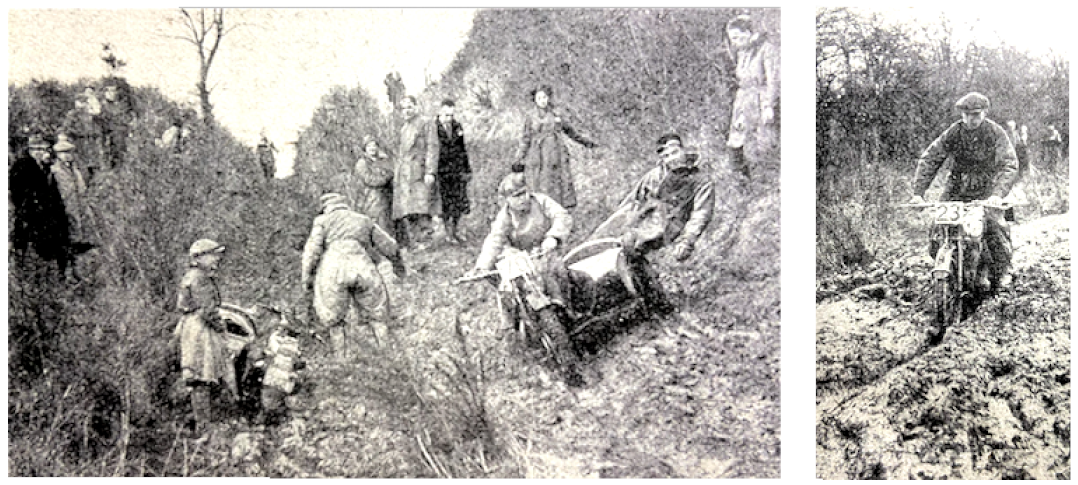
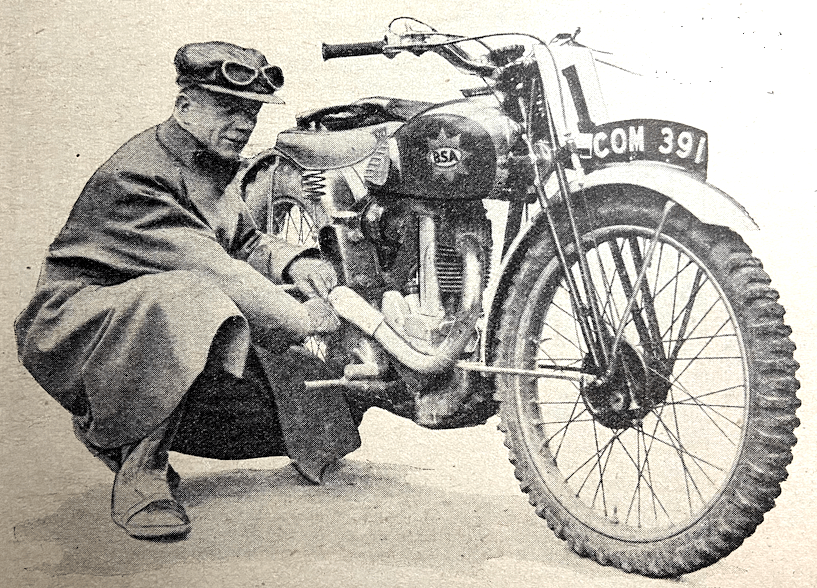
“LETTERS POSTED IN GERMANY are being stamped with a message which, translated, means : ‘Cyclists, don’t hang on to vehicles!’.”
“THE D’ARCY EXPLORATION Company has abandoned its search for oil on Portsdown Hill (Hampshire) after boring to a depth of over 6,500ft. The cost has been £60,000.”
“THE LAW JOURNAL, a publication devoted to legal matters, considers that pedestrian guard rails are unlawful, because they deny a person’s free access to the highway.”
“AN EIGHT-STOREY GARAGE under construction in Berlin will be, it is claimed, the highest in Europe.”
“FRENCH MANUFACTURERS are expecting that the Government will lift the taxation on motor cycles of under 175cc.”
“‘ROADS ARE NOT BUILT exclusively for the drivers of motor cars.’—Lord Hewart, the Lord Chid Justice, at Maidstone Assizes.”
“FOLLOWING OBJECTIONS, the Minister of Transport has decided not to institute a 10mph limit over Bewdley Bridge (Worcestershire).”
“SOUTHAMPTON CORPORATION proposes to charge for the use of parking places in public streets this year. This is not allowed under existing laws, and the RAC and AA are to contest the proposal.”
“CINEMA MANAGERS have been asked to advise motorists in the audience of the approach of lighting-up time by means of a message thrown on the screen.”
“A PROPOSAL FOR a road tunnel under Mont Blanc has been discussed by the French and Italian authorities. The tunnel would be about 8½ miles long and would connect Chamonix and Aosta.”
“IN THE HOUSE OF COMMONS recently the Minister of Transport was asked if he would consider suppressing the green and red traffic lights after midnight, allowing the amber light to show a warning at danger spots. Mr Hore-Belisha replied that highway authorities were not compelled to keep signals working throughout the whole 24 hours, but the practice made for safety, and the Ministry was not prepared to discourage it.”
“The AA and RAC are protesting against the ‘unreasonably high’ schedule of tolls proposed for users of the new Dartford Tunnel.”
“A NEW 170-MILE Paris-Brussels trunk road is to be completed by May.”
“IT IS REPORTED that in New Orleans (USA) there are five women motorists to every four men.”
“‘I COME NEAREST to bad temper if I am driving with trams in front of me and cyclists on the near side.’—The Bishop of Kensington, Dr BJ Simpson.”
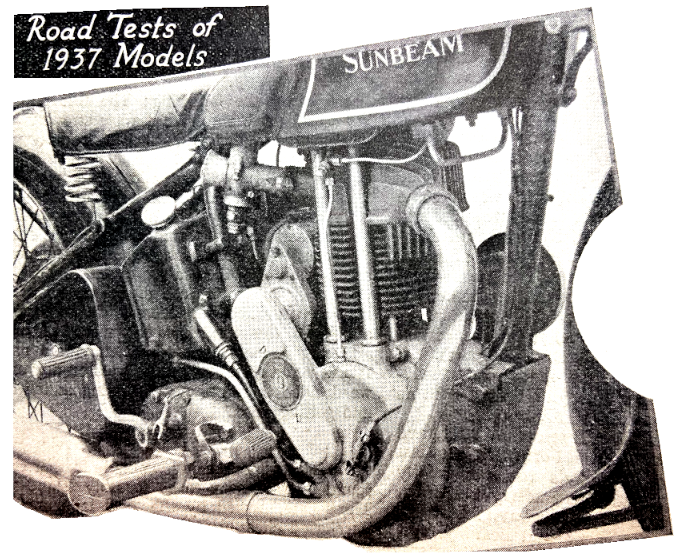
“‘A TRUE SPORTING ROADSTER’ is a phrase that can be aptly applied to the 493cc Light Solo Sunbeam. In its design this cradle-framed ohv machine is on standard lines. Its performance, however, is exhilarating. Opening the quick-action Amal twist-grip causes the machine to ‘hunch’ itself up beneath the rider…when in the saddle of this test machine the rider not only is on a lively machine, but also feels that he is. For all its liveliness, the Light Solo has good road manners. It is liable to pink a little on ordinary petrol-benzole mixture if opened up rapidly in a high gear, and the gear box is there to be used. This, however, constitutes just about all that can be said against it on the score of manners, and is applicable to nearly every single of similar calibre. The starting is excellent. A decompressor is fitted. This is operated by a normal-type Bowden control such as is used for an exhaust valve-lifter and may easily be mistaken for a valve-lifter! With the decompressor in operation the engine is a certain starter—nine times out of ten at the very first kick. The starter pedal has an unusually short crank, and a fair amount of effort is involved in depressing it, but the certainty of starting is exceptional. All the controls are well placed with the possible exception of the rear brake pedal. In this instance the reason is not so much the pedal as the flange of rubber running round the inner side of the footrests rubbers. With this cut away the brake operation is excellent. Incidentally, a good feature is an adjustable stop for the pedal. The clutch, which runs in the famous Sunbeam ‘Little Oil-bath’, tended to stick a little if the machine had been left for some time, and it was therefore desirable to ease the machine forward as bottom gear was engaged from neutral—either this or the clutch freed by depression of the kick-starter with the clutch lever held against the handlebar. Gear changing was easy and clean-cut, and the pedal, with its short movement and cranked shank, convenient to operate. Third gear of this not-new machine was just audible. The engine, however, was remarkably silent mechanically, and also had a very well toned down exhaust. On the road the machine can be driven as a tourer or used as a true thoroughbred. The engine has life and snap, and is also extremely well balanced. The maximum speed, taking the mean of runs in both directions over a measured quarter of a mile, was 74.3mph. An achievable maximum under favourable conditions was some 78mph. In third gear (5.9 to 1) there is a very useful 60mph, and in second (6.91mph to one some 40mph. Of course, higher speeds are attainable. The foregoing, however, are speeds used time and again on the open road and the 67mph figure for the quarter-mile standing start gives an indication as to how quickly and easily a high touring speed can be regained after a check owing to traffic. Cornering is
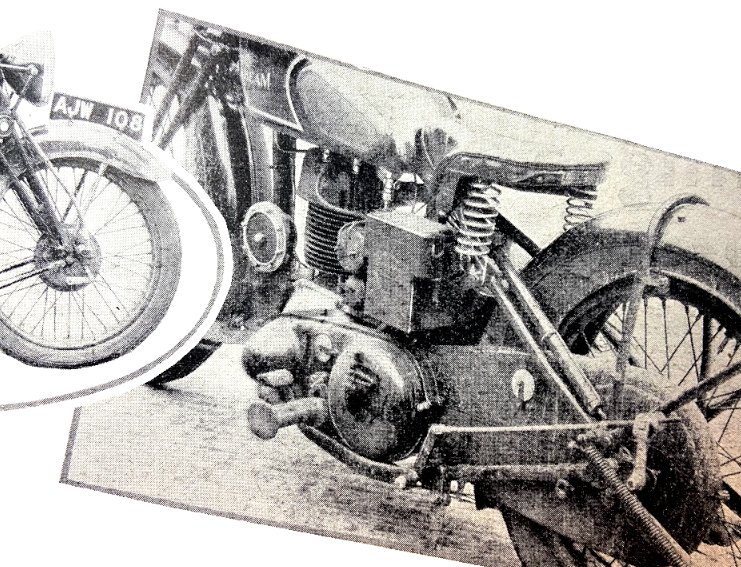
excellent. The machine is comparatively light, and little or no effort is required to lay the Light Solo down for a corner and hold it at the desired lock. It is more the cornering of a 350 than that of a 500. The machine is also admirable on grease. It affords real confidence, and although miles of greasy roads were covered during the test never once did the machine show any tendency towards skidding. Up to speeds of about 70mph the steering was light and positive. Above this a slight amount of steering damper was employed. At the other end of the sale, the Light Solo was almost uncanny in the way it enabled the rider to trickle along feet-up at 4-5mph. The front fork action, too, was exceptionally good. Both brakes are good—smooth in action and with plenty of power. The mudguarding, too, proved particularly good—much better than on the vast majority of machines. The front mudguard is wide and provided with a flared valance that is typically Sunbeam. As a result of this guard the machine can be ridden over wet roads with hardly a speck of mud reaching the rider’s legs. In addition, of course, this very efficient guard helps to keep the engine free from dirt. The machine tested also had another desirable form of protection—an oil-bath rear chain case, which is an optional extra. Throughout the test the engine remained free from oil leaks beyond minute seepage. Fuel consumption worked out at the excellent figure of 92mpg at 40mph. A prop-stand is fitted. This has a strong spring that holds it firmly in the off position. It would probably be an advantage if the machine leant over to a slightly greater degree when on the stand, since on two occasions the machine was knocked over and, toppling on to the off-side footrest, snapped it off. To sum up, the Light Solo Sunbeam proved a first-class roadster with a true sporting performance that is a sheer joy to the enthusiast.”
“I OFTEN READ IN The Motor Cycle of someone who made a long trip on the ‘world’s cheapest form of transport’, so I thought I would write and tell you about a little trip a pal and myself made last summer. The first day of August found us scanning all the maps of the North American Continent, and let me tell you there are plenty. George, my pal, thought it would he a good idea to go to the Atlantic coast, for neither of had ever seen an ocean, but, having, a number of relations out in Calgary, Alberta that I had not seen for over 15 years, we decided to ‘Go West, young man, go west.’ On August 15th we pointed the headlight Of our ’32 Indian Scout in the direction al Detroit, the first large city on our route. We had to go down into the States because the roads in Western Canada are net paved as yet. It was tie in the afternoon when we left, so we did not expect to go farther than Detroit, which is 240 miles from Toronto. We arrived in Detroit about 11 in the evening, had a good meal and camped just outside the city. On the first full day of travelling we went through Chicago and many smaller cities and, before the day was over we were 700 miles from home. The change in the country was very noticeable, the ground was much flatter, trees and rivers were farther apart, the farms larger and the towns smaller, so we knew we were on the ‘prairies of the West’. After four days of travelling we could see the outline of the Rocky Mountains, so we knew we were nearing our destination for Calgary is in the foothills of the mountains and about 200 miles to the north. So on the fifth day we landed in Calgary with no ill effects and the motor of our faithful little bike in just as good shape as when we left Toronto; the only difference was that the speedometer registered 2,500 miles more. The town of Banff, about 60 miles from Calgary, is set right in the mountains. It is the most beautiful town I have ever seen, with its background of snow-capped mountains and numerous little springs tumbling down the hills. We took the same route home, so we did not waste any time in looking around. We made it in half a day less. So now the bike is in the basement protected from the snow and sleet, waiting for me to give it the ‘once over’ with a wrench and cloth, and maybe next summer take her over the same 5,000-mile road. Once again a motor cycle takes a couple of chaps to see the other side of the country they live in.
George Blears, Toronto, Canada.”
“I DO NOT THINK there can be much doubt about the best designed of the motor-assisted bicycles. There was one that ‘stood out a mile’ both in appearance and performance, and its quality will never be surpassed by modern manufacturers. I refer to the Motosacoche. I knew of two cases when, after long use, the engines were worn out and, spares being unobtainable, the engines were removed and the cycles used as plain pedal cycles. In both cases the machines were described as being ‘sweeter running than ordinary purchasable pedal cycles’. One was used by a rural postman in preference to the regulation GPO cycle. The Motosacoche was possibly 30 years ahead of its time. Its engine, a four-stroke, was excellent, and provided a cruising speed of 25mph. The total weight of the machine was about 80lb.
HRD, Halstead, Essex.”
“MUCH OF THE [club] news this week comes from the North where, owing to improved industrial conditions, the centres the centres are benefiting. At the AGM of the North-Western Centre it was mentioned that many old supporters had been able to renew their allegiance to the sport during the past year, so that the Centre had completed the year in an ‘amazingly’ solvent position. More Centre events are to be run this year and a sub-committee has been appointed to examine courses for a centre scramble. One race meeting is to be held at Park Hall, near Charley, and the proceeds are to be sent to the ACU for the International Six Days Trial. The Bolton MC is to start off a busy year with an open-to-centre scramble near Sugar Loaf Hill, Chapman’s Farm, Montserrat, Bolton; 15 laps of the moorland circuit will have to be covered.”

“OF LATE YEARS the motor cycle has encountered yet another hostile factor in our islands: although our production and ownership of motor vehicles is, of course, trivial compared with such countries as the United States, we have a greater density of motors than any other people, and the congestion on our roads is more acute than anywhere else in the world. In the past many motor cyclists were not self-supporting; they were youngsters, enabled to ride by the generosity of their parents. With the daily Press and the Government dinning the perils of the roads in everybody’s ears parents became reluctant for their sons and daughters to use the roads more than could be helped. Simultaneously, the development of cheap sports cars seduced from our ranks many of the undergraduate type of rider, while extensive insecurity of employment reduced the number of prosperous artisans, who at one time, and specially in the North of England, formed the backbone of the movement. Fortunately, enthusiasm is still as fierce as ever among those who remain faithful to the hobby, and attains something like fever heat in sporting circles at home, and no less in the overseas dominions. But a substantial expansion of the sport and hobby and industry can only recur on two conditions. The first is the modernisation and extension of our road system, which would go far to reduce the toll of road accidents and allay parental timidities. The second is such a boom in trade as would confer security of employment on the artisan population and restore thousands of factory hands to our ranks. Already the demand is on the upgrade and it is gratifying to record that despite a reduced demand over recent years the technical quality of our motor cycles is far higher than it has ever been, while their prices are satisfactorily low. And although two or three selected foreign machines, such as the BMW, DKW and Guzzi, challenge comparison with our best productions in the parallel classes, yet no foreign observer would hesitate to confess that we still lead the world in this industry.”
“IT WAS A CASE OF ‘standing room only’ at the Cripplegate Institute, London, one evening last week when the Misses Blenkiron and Wallach gave a talk to members of the International Motorcyclists Tour Club on their famous trip from London to Cape Town. The talk was illustrated by lantern slides and a cine film, and these showed better than any written or spoken word the difficulties that had had to be overcome. There were ‘shots’ of the Panther outfit and its heavily laden trailer ploughing their way through nearly hub-deep sand, over virgin bush, and crossing swamps by means of rickety native-built bridges, while the drivers concerned took it in turns to describe the journey stage by stage in a light-hearted way that suggested a Saturday afternoon’s run rather than a Magnificent achievement. And the fact that trouble experienced with the filming apparatus did not lessen the appreciation of the audience.”
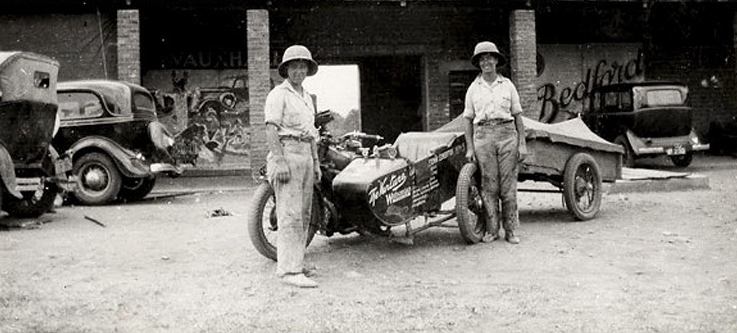
“‘IN TOWN-NN TO-NIGHT…’ If you were listening-in to this programme last Saturday, you will have heard some-thing of the reunion dinner of pre-war TT riders that was held at the Holborn Restaurant, London. As Wing-Commander Woodhouse and Graham Walker were broadcasting, 80 men who rode in the early TTs, who won a post-war TT or were intimately connected with the races, were gathering together for their first reunion. When the dinner was under way, the chairman, Mr Geoffrey Smith, MBE (Managing Editor of The Motor Cycle), called upon the riders in each year of the pre-war TTs to stand up. Six of the veterans who competed in 1907 when the TT was first instituted were present; seven, of the 1908 brigade; 1909, 12; 1910, 10; 1911, 14; 1912, 14; 1913, 17; and 1914, 18. Some men found it difficult to remember the years in which they did compete—which in view of the lapse of a quarter of a century was perhaps hardly surprising. What was remarkable, however, was how extraordinarily young these old-timers looked. If ever there was a proof of the fact that motor cycling spells fitness, it was provided by this gathering of veterans. As the 1909 brigade stood up, there was a shout of ‘Who are these boys?’, and when those who rode in 1907 rose, someone said, ‘Why, not all of them are grey!’ One by one, outstanding riders of the past were called upon. Among them were Freddy Dixon and Charlie Dodson, men who have won both motor cycle and car TTs, and Howard Riddell—’the only man who ever finished a TT on a pedal cycle’. For a few moments, all stood in silence in memory of those old-time TT riders who have passed on—men who in many cases lost their lives in the War, as members of the Royal Flying Corps or the Machine Gun Corps. After the toast of ‘The King’, Mr Geoffrey Smith proposed The Riders’. The unique gathering, he said, was the result of a happy thought on the part of Jack Woodhouse and Rex Mundy, and of much hard work by HL Buckley, who accepted the secretarial duties. Speaking to the riders, he said, ‘It is you sportsmen who made the TT possible. You have never had the credit you deserve. By backing up the ACU, you pioneers with your frail and not too reliable machines made the TT what it is to-day, a premier sporting event, the results of which are broadcast throughout the world.’ Mr Geoffrey Smith added that the spirit of brotherhood was still alive among the pioneers. He touched briefly upon the marvellous prestige that British machines have gained, adding that he hoped one of the riders would relate how in the old days it was possible to atop for a bottle of beer and a sandwich in the middle of the TT race! When he asked whether the reunion should be repeated there were shouts of ‘Annually!’ and from one quarter of the room,’Monthly!’.”
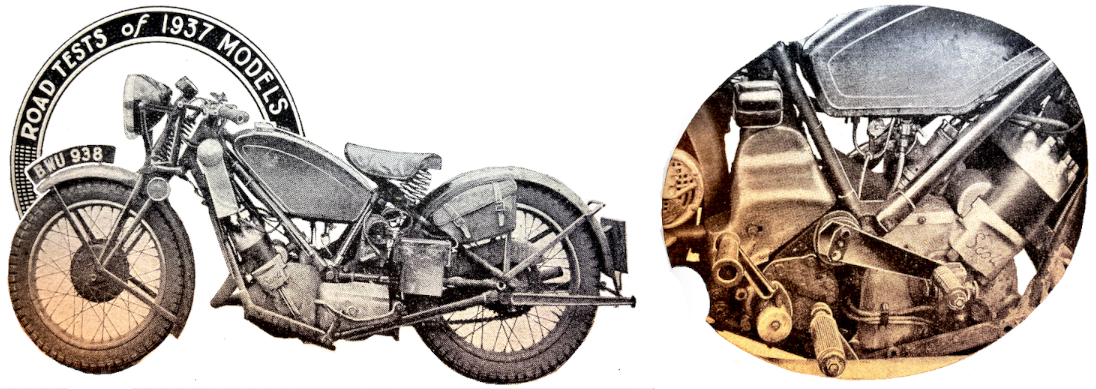
“EVER SINCE 1908, WHEN the first twin-cylinder Scott was produced, Scott machines have attracted enthusiasts because of the delightful way in which the engine produces its power. The basic design of the 1937 498cc Scott engine is the same as the 1908 model, and with the design has been retained all the charm that has made the name of Scott famous throughout the motor cycle world. The outstanding characteristic of this unique engine is its remarkable smoothness. So smooth was the engine of the model tested that it was only by gross maltreatment that the transmission could be made to snatch—the engine never complained. In top gear (4.62 to 1), the usable range of speed was from 10mph to very nearly 80mph, and throughout this range not a trace of vibration could be felt from engine or transmission. In traffic, the lower gears were only required when getting away from a standstill, and top gear could be engaged almost as soon as the model was on the move. But the makers of the Scott do not claim that the machine is an ideal hack mount, and, in truth, the real charm of the Scott lies in its performance on the open road. Speeds of 60-65mph are as effortless as could be wished with this Flying Squirrel, partly because of its almost uncanny smoothness and partly owing to the entire absence of mechanical noise. Throughout the Scott’s range the only sounds that could be heard were the swish of the chains and the hiss of the air intake blending pleasantly with the delightful drone from the exhaust. Maximum speeds attained in the intermediate gears were second (6.16 to 1), 67mph, and bottom (9.90 to 1), 42mph. In top, the mean timed speed over a quarter-mile was 78mph, this speed being attained, of course, with the rider streamlining himself as much as possible. Since the machine pulls a fairly high top gear, the acceleration from 15 to 30mph in this gear was not extremely rapid, but higher up in the speed range the acceleration of the Scott is excellent. The fact that a speed of 66mph was reached in a quarter of a mile is a true indication of the model’s accelerating powers. At hill-climbing the Scott excelled. The model held its speed particularly well on main road hills, and one hardly noticed that a three-speed, and not a four-speed, gear box is fitted. One of the very useful features of this excellent top-gear performance is that after slowing down for bends or traffic the cruising speed can be quickly regained. Thus high average speeds are easy to maintain, and over long distances the effortless ease of driving the model was fully appreciated by the rider. This feeling of ease would be even more apparent if the riding position of the machine could be adjusted to suit tall riders. For a rider of normal stature the riding position is extremely comfortable; but for long-legged individuals the range of footrest adjustment is insufficient. The positioning of the various components—saddle, footrests and handlebars—is particularly well suited to fast road work, and aided by the unique hollowing of the petrol tank the rider is able to clamp himself on the machine without the aid of knee-grips. The controls on the handlebars are all well placed and pleasant in use. The clutch was light and smooth, and gear-changing with the three-speed box was a delightful operation. The Scott gear box has long been renowned for the ease with which its gears engage, and now that a positive-stop foot-change is fitted extremely rapid changes can be made. On the
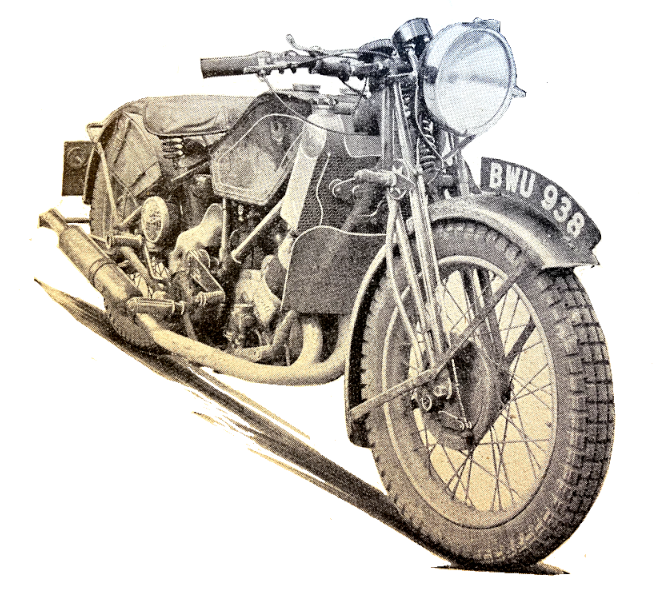
near-side of the machine is the long rear brake pedal, which is situated conveniently under the rider’s left toe. Both brakes were smooth and delightfully ‘spongy’ in use. The rear brake was excellent under all conditions, but for really fast work a little more power in the front brake would have been desirable. The steering and road-holding of the Scott were of a high order. Although a large-section front tyre was fitted, the steering was light at low speeds and positive at high cruising speeds, and only when approaching the maximum was the steering damper brought into use. On rough roads the rear wheel had a slight tendency to hop, but at no time was this tendency bad enough to disconcert the rider, even when tackling twisty and bumpy roads. The cornering of the Flying Squirrel was extremely good, and permitted high-speed ‘curve-swerving’ with perfect safety. A magneto cut-out is part of the Scott’s standard equipment; its correct use is for stopping the engine with the throttle open, and when this is done, starting from cold is a simple matter. The lubrication system of the Scott is, of course, of the plain mechanical pump type, and as the machine was new a generous oil setting was given. Nevertheless, over a fairly large mileage the oil consumption worked out at approximately 800mpg. Petrol consumption at a maintained 40mph was 69mpg. One feature of the Scott that can be criticised is the rear stand, which is of the old-fashioned clip-up type. It requires a long and hearty pull to get the machine up into position. Other than this small feature there is little to criticise, and it may be said that the Scott provides high-speed motor cycling with a smoothness that cannot fail to delight every owner.”
“ANYONE RIDING ACROSS Epsom Downs early last Sunday would have been met with an extraordinary spectacle. Through the steady downpour of rain, dim figures could be discerned pushing, heaving and pedalling frantically. Willing helpers pushed and pushed until they became no longer willing. Closer inspection would have revealed that all this energy was being spent on an amazing variety of antique motor cycles. Yes, it was the scene at the start of the Sunbeam Club’s annual Pioneer Run—the seventh of the series. The rain was doing its worst to the various’ delicate ignition systems and, while normally these old machines can do their bit in no uncertain manner, the appalling weather conditions was really finding out the weak spots. As zero hour approached the pushing and pedalling became more frantic. AE Cooke (1902 700cc Kerry) was the first man off and also the first to give up—with chronic belt-slip within the first mile. E Marshall, on the oldest model in the run—an 1898 150cc Beeston tricycle— got away in grand style, followed by HI Langford (1903 198cc Singer). The first part of the run was fairly easy. The route led to Burgh Heath, where the main London-Reigate-Brighton road was joined. The high wind and the rain and the long pull up to the top of Reigate Hill caused plenty of fun. C Emmans (1904 235cc Kerry) was soon in trouble with his carburettor and ignition systems, while RC Rowland (1911 500cc Premier) and N Cox (1910 350cc Royal Enfield) were getting serious belt-slip. JF Sloan (1910 350cc Peugeot) stopped at Kingswood with a broken exhaust-lifter. Having remedied this trouble, he got to Crawley when an inlet valve cotter sheared—and yet he managed to finish. On the long climb up to the top of Pease Pottage, LF Cook (1903 300cc Kelecom) came to a halt to ‘fix’ his petrol tank, which had broken adrift. Surprisingly little trouble was caused by the hill. H Marians (1912 498cc P&M) romped up at speed, and E. Baker (1913 300cc Royal Enfield) actually emptied a tin of oil into his oil tank without stopping. RN Judd (1912 750cc Wilkinson sc) found the gradient caused a little steam to appear out of the radiator, but otherwise he romped up easily in top gear. One or two riders stopped for petrol, but apart from that there were few stops, though EL Taylor (1909 500cc Brown) had a skid and came to a hurried but momentary halt. After the descent of Handcross the rain ceased and soon the roads were dry. Pyecombe Hill caused practically no trouble and, surprising to relate, very little pedalling seemed necessary. At the Pylons a check was taken—the only one in the run. After reaching Patcham the route left the main road and proceeded towards the finish at Devil’s Dyke. Between these two places there lurked a really steep hill, guaranteed to shake most old-timers, but one after another the ancient models reached the summit with practically no trouble at all. A Schlienger (1904 277cc Stanley) came to a momentary halt and AM Ruff (1912 500cc Triumph) experienced belt trouble—but these were exceptions. The performances of the old machines up this gradient were indeed remarkable. E Marshall scarcely used the pedals of his old single-geared Beeston tricycle, while GRW Cruddas (1904 Kerry-AKD), PR Crittall (1902 300cc Hobart) and P Tester (1902 250cc Kerry) romped up. Clifford Browne’s 1906 250cc P&M forecar showed a surprising reserve of power, while NR Illingworth (1913 439 cc Royal Enfield) looked as if be were out to put up the best time of the day Two miles farther on lay the finish at the Devil’s Dyke Hotel, where competitors parked their machines in the bright sunshine. Thus ended another very successful Pioneer Run.”
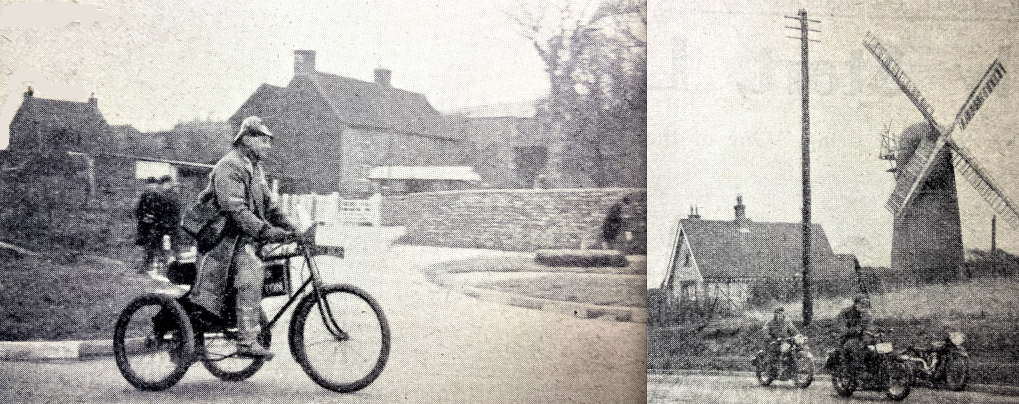
“REX JUDD, the erstwhile Brooklands rider, was responsible for the idea. ‘How would you like to have a run on. my latest model?’ he had asked, going on to explain that it was a four-cylinder with shaft-drive and rear-wheel springing. Innocently I fell into the trap, half expecting something really ultra modern and not just a conversion. Imagine my astonishment on arriving at Chez Rex at Edgware to see a real old warrior of massive proportions awaiting me. It was a 1912 Wilkinson, complete. with a ‘period’ sidecar, a perfectly hideous hood and a fully—I was almost going to say ‘floating’—sprung sidecar wheel. But appearances were deceptive, and in reality the Wilkinson was amazingly advanced for its time. For example, it has four separate water-cooled cylinders, a radiator complete with fan, three speeds, and a most extraordinary starting handle, mounted to one side of a genuine armchair type of saddle. To start, one stands up on the footboards and, taking a firm grip of the handle, pulls upwards. Rex did so and the old Wilkinson immediately came to life and settled down to a silky tick-over. It was all rather uncanny. The controls are almost identical with those of to-day, except for the clutch pedal and a rear brake lever situated on the off side of the saddle. After being shown how the controls work I was allowed to take over. Rex, in the meantime, wheeled out his air-cooled straight-four Pierce-Arrow, of about the same age as the Wilkinson. A friend of his, Mr E Marshall, had set out a few minutes beforehand on a really ancient model, a 1898 Beeston tricycle with a single gear and 150cc engine. Rex’s idea was that we should pioneer as far as a rendezvous on the far side of Elstree, where we could forgather for lunch. He led the way and promptly left us, for the old Wilkinson could just about just about manage 35mph on the level, and under favourable conditions, 40mph, while the Pierce-Arrow seemed to be capable of at least 60mph. However, we plodded along, the engine running with extra-ordinary smoothness. Hills slowed us down to 20mph, and Brockley Hill actually brought us down into second gear, but thereafter it was plain sailing—provided due allowance was made for the brakes, which certainly were not quite up to 1937 standards. In a surprisingly short time we pioneers arrived at a real old English inn, where the Pierce-Arrow and the venerable Beeston awaited us. After lunch and an exciting game of darts, played between yarns of old times, I was allowed out on Mr Marshall’s pet, the Beeston tricycle. But all too soon it was time to return, and after flooding the carburettor the old Wilkinson was soon purring away. Off we went again, reaching the terrific speed of 40mph down a by-pass—all the more terrifying on account of the long handlebars which appeared to wave in the breeze. However, all’s well that ends well, and three old-timers reached Chez Rex with no further trouble. For me it had been an exciting experience, and one which had left me thinking that the world is truly topsy-turvy. Here we are with multi-cylinders, shaft-drive and rear-wheel springing slowly coming into fashion, and there is the old four-cylinder Wilkinson incorporating all these ideas and more. Yet it was built over a quarter of a century ago!”—Ambleside

“SEVERAL TIMES I HAVE seen articles about our fearless and expert motor cycle cops in the USA. I imagine many English riders think they are a combination of James Guthrie, Jimmy Simpson and Joe Petrali, the last-named being our national champion. However, any of your second-rate trials rides could ride circles around our so-called ‘speed cops’. Of course, there are exceptions such as the Highway Patrol Team of Pennsylvania—they hare an excellent stunt show—but I’m speaking of the large majority. As far as their ‘powerful big twins’ are concerned, very few of them could do an honest 80mph. You hear of ‘skids’ and ‘broadsides’ executed by the dashing cops, but most of them would faint if they really got into an accidental broadside. I write from personal observation of them, and am sure the motor cyclists of this country will bear out my observations. I wouldn’t exchange my 1936 ‘International’ Norton for any American police machine or any American motor car as far as that goes.
Clark S Trumball, Washington, USA.”
“IN THE DAYS OF limestone roads I placed the first white line in England on the main road facing my business premises, The Ever Open Door, the old toll-house in Lancaster Road Hornby, on the main road from Bradford to Morecambe. The white line was put down in chalk, become when two farm lads met at my corner the wheels of their carts caught one another, and the result was an accident. So the white line was born in 1916. I our warned by Mr J Boardman, road surveyor to the Lancashire County Council, that if I persisted in tampering with the roads by chalking or limewashing or cementing, I would get into serious trouble. In 1921 I was offered white paint and a brush by the same gentlemen to keep the good cause going. In the year 1919 I received a letter from His late Majesty King George, who sometimes passed my way, informing me that the white line was a good precedent which should be widely copied. The letter was signed ‘Clive Wigram’, and I still have a copy of it. I hope I am correct in saying that the second white line was at Thaxted, in the south of England, and the third at Stocksbridge, Keighley, Yorks.
John B Willacy, Lancaster. “
A CORRESPONDENT IN the Blue ‘Un presented evidence that the idea of white lines on roads was first mooted by a chap named Scantlebury in 1920. The plan called for foot-wide strips of white stone to be set into the road surface.
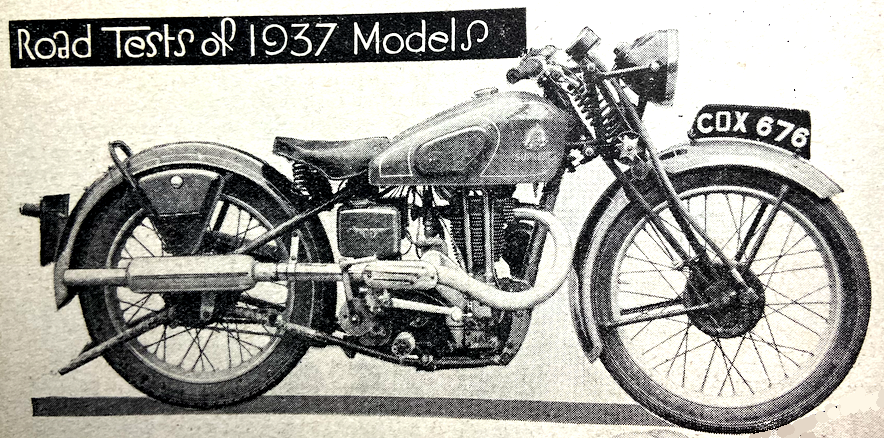
“BECAUSE EVERYTHING ABOUT the OK Supreme Sports 70 is so well proportioned, it is quite difficult to realise without direct comparison that the machine is a 250 and not a 500. The performance, too, is deceptive and well in keeping with the appearance of the machine. The riding position is most comfortable, and the position of the footrests is ideal for a rider of medium height. The correlation of the footrest to the gear pedal makes very little movement of the foot necessary when changing gear. The brake pedal, however, is situated a trifle too far forward. The handlebars are sporting in type but extremely restful to the wrists. Thin grips are fitted, with racing-type levers. Provided the carburettor was flooded and the ignition fractionally retarded, the engine could be started from cold with one dig at the kick-starter. Possibly because of its newness, the engine was somewhat stiff and it needed rather more than the usual amount of energy when kicking it over. Once warmed up, the engine could be set by the throttle to give an admirable tick-over. The ignition lever had an extremely useful range of control. No doubt on account of the comparatively high compression ratio—nearly 7.5 to 1—the engine called for slight retardation of the ignition when ruining slowly in a high gear, even when an ethylised fuel was used. Partly for this reason and partly on account of certain harshness in the transmission, the minimum non-snatch speed in top gear was not lower than 14mph. However, above 20mph in top gear the power was delivered sweetly and without any pronounced vibration period. Although the top gear of 6.1 to 1 is somewhat low by 500 standards the lively engine never for one moment gave the impression that it was turning over unduly fast, in spite of the surprisingly high cruising speeds which could be maintained. On the contrary, at times it gave the impression of being slightly overgeared. The three indirect ratios are closely related and ‘slick’ changes could be made without concentration on the part of the rider, but changing from third to top gear called for a marked drop in the engine revs. Third gear is a very useful ratio and enables the machine to accelerate rapidly up to 50mph. At low engine revs the mechanical and exhaust silence was excellent, but above 40mph the exhaust developed a. slight tang in its otherwise subdued note, and a distinct clatter appeared to emanate from the cam gear. The OK Supreme could be held down to a steady 50mph for as long as conditions permitted. It appeared to revel in hard work and would tackle hills with the zest of a machine of bigger capacity. In fact, at times it was difficult to appreciate that it was not a 350—an impression not only suggested by its performance but also by its handling and road-holding. Corners could be taken with the utmost confidence, and there was a complete absence of pitching or wheel-bounce over uneven. surfaces. The riding position is excellent for fast road work, and, given suitable tyres, the machine would doubtless prove an admirable trials model. As it was, with a ribbed front tyre, the steering through mud and grease was surprisingly good; and the engine had ample power in hand for cautious riding tactics in second gear. Part of the test was under-taken over snow-covered roads, yet at no time were any skids experienced. From the performance data it will be seen that the mean maximum speed of four runs (timed in both directions over a quarter-mile) was 63mph, and in third gear 58mph was attained. Under suitable conditions there is no doubt that 65mph could be easily obtained. but owing to the absence of a mudguard pad it was. difficult for the rider to assume much more than a semi-racing attitude—and at these speeds wind resistance begins to play a big, part in the case of a 250. Acceleration through the gears was particularly good, the Burman gear box permitting snappy ‘racing’ changes with absolute certainty. The clutch was both sweet and light, and completely free from ‘drag’. Similarly, the brakes were smooth and delightfully ‘spongy’ in application,
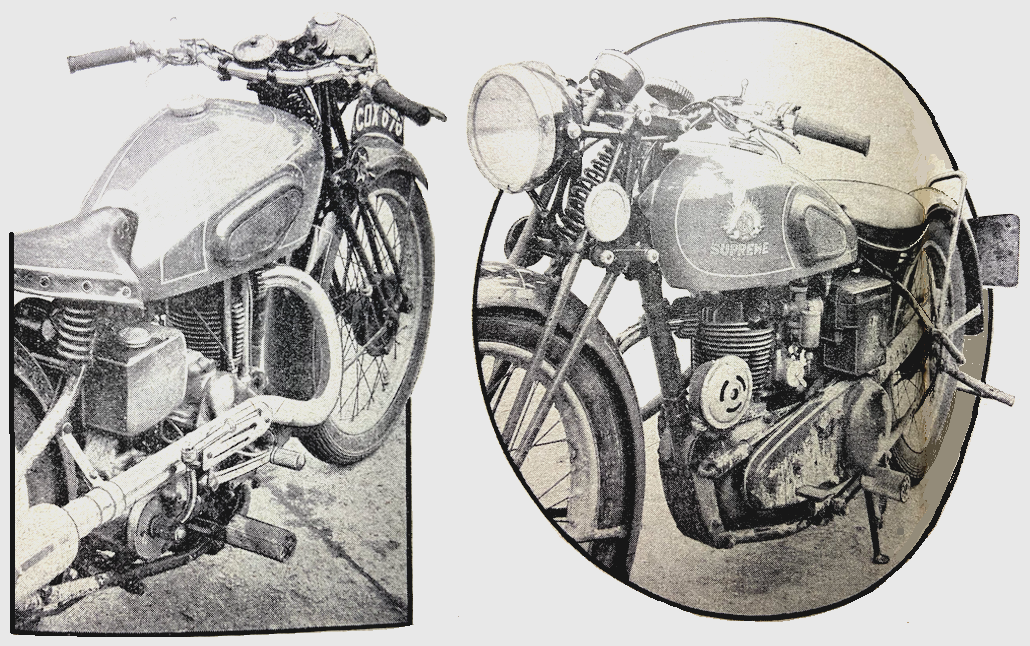
although the back brake was apt to lock the rear wheel when a ‘crash’ stop was. attempted. Despite its sporting performance the OK Supreme was exceptionally economical as regards petrol consumption. The fuel consumed (using an ethylised brand) at a maintained speed of 40mph amounted to 118.4mpg. This means that the journey. from London to Edinburgh could be accomplished without refuelling, for the petrol tank holds 3½ gallons. Because of the newness of the engine, which is lubricated on the total loss system, pump was set to give a generous supply of oil, and, therefore, the figure has little relation to that which would be obtained under normal conditions. As would be expected with a sports machine, the equipment includes an upswept exhaust pipe. There is, however, a sturdy crankcase shield as well. The standard equipment also includes a 6-volt separate Lucas dynamo (mounted under the magneto and driven by a chain running in the primary oil bath), complete with voltage control. The accumulator is so mounted that it can easily be pivoted outwards for inspection or topping-up. Summing-up, the lasting impression of the 245cc 0K Supreme Sports 70 is that it is a true rider’s mount—a ‘big’ 250 with a performance that is well in keeping with its deceptive appearance and ‘feel’.”
“ALTHOUGH THERE ARE 44,000 motor cycles is Holland, only 1,132 of them are side-car outfits.”
“THE RAC RECOVERED £5,000 for motor cyclist members involved in accidents last year.”
“HM THE KING will be patron of the 22nd Bicycle and Motor Cycle Show at Earl’s Court from September 22nd to 29th.”
“THE CORNET MOTOR CYCLE CLUB of Omaha, Nebraska (USA) wants to know why British riders make such a fetish of keeping their feet on the rests. In Nebraska they find that dropping a foot often averts a nasty spill, especially on ice and snow, and they regard footing as a schoolboy regards lies, as a very present help in trouble. But so do we, buddies and far sooner than spill, 99.99% of us are quite ready to stick out a foot, or even two. But when we want to find an absolute winner in a one-day trial contested by lads of high average skill, or when a club wishes to curtail the number of silver pots awardable in a six days trial, some arbitrary factor has to be introduced, and ‘footing’ is the best factor we can invent. Moreover, these one-day trials have created a convention that the lad who drops a foot or feet is a dub, rabbit, or—whadd’ya call ’em in the States? So when in public we all keep our feet up it we can; but in any lonely slide, down go the number elevens if and as circumstances may demand. We act precisely the same as American enthusiasts in such emergencies.”—Ixion
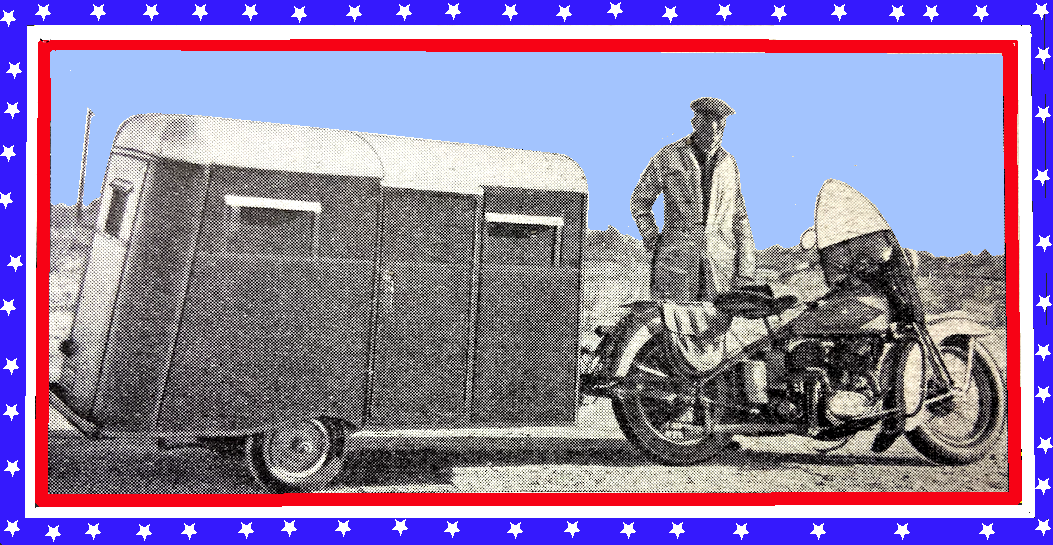
“QUITE WHAT THE EFFECT of the widely announced split between the National Speedway Association and the Auto Cycle Union will mean I do not know. Speaking personally, I consider that it would not be at all a bad thing if the ACU had nothing further to do with speedway racing, which, after all, has very little indeed to do with pukka motor cycling. Maybe it is useful to the ACU from the financial aspect, but the less the ACU has to do with things akin to the circus the better I, for one, will be pleased. Consequently, I do not worry very much—if the Speedway Association breaks with the Union once and for all it will probably be a very good thing; the latter has quite enough to do to look after the sport properly.”
“THIS IS THE NEWS that came the other day from the Nürburg Ring, Germany’s wonderful road-racing circuit in the Eifel Mountains: ‘Nineteen (yes, nineteen) riders, two mechanics, and a ‘boss’ are here; they are riding four solo DKWs and two sidecar outfits in shifts, day and night, until they have chalked up 50,000km. There is half a foot of snow here; it melts in the day and freezes at night, but that means nothing to these boys—they have to ride under any conditions.’ That, dear readers, is how they put experimental DKWs through their paces!”
“DKW motor cycles, which were described and illustrated in our recent report of the Berlin Show, will in future be marketed in Great Britain by Pride and Clarke of 158, Stockwell Bond, London, SW9.”
“ROAD-RACING ENTHUSIASTS will be sorry to learn that one of Germany’s most brilliant, riders, Oskar Steinbach, met with a fatal accident near his home at Mannheim last week. Steinbach, who was only 24 years of age, was the 1935 German road-race champion in the 350cc and 500cc classes. In that year, without any previous experience of the Isle of Man circuit, he finished fifth in the Senior TT at 78mph—a wonderful performance. Last year, he came sixth in the Senior Race on an NSU at 75mph. On the Continent he rode successfully on the big DKW. There is no doubt that the sport has lost a rising star.”
“SINCE THERE IS NOT to be a Stock-machine TT, the manufacturers of the Triumph, one of the strongest supporters of this type of event, have decided to have an event of this character on their own. It is to take the form of a high-speed trial under official ACU observation, and, all being well, will be carried out this week…The Triumph Engineering Company has asked the ACU to take from any of 40 agents who are known to carry stocks of Tigers a 250, a 350 and a 500. These machines are to be transported to Donington and…run in for approximately 100 miles [after which] the machines are to undergo a three-hour high-speed test over the inner circuit at Donington, using standard petrol and oil. The ‘Stock-machine TT’ ended, the machines are to be taken to Brooklands for an officially timed flying lap. The whole point of the test is that these machines have already been sold to agents—they are production
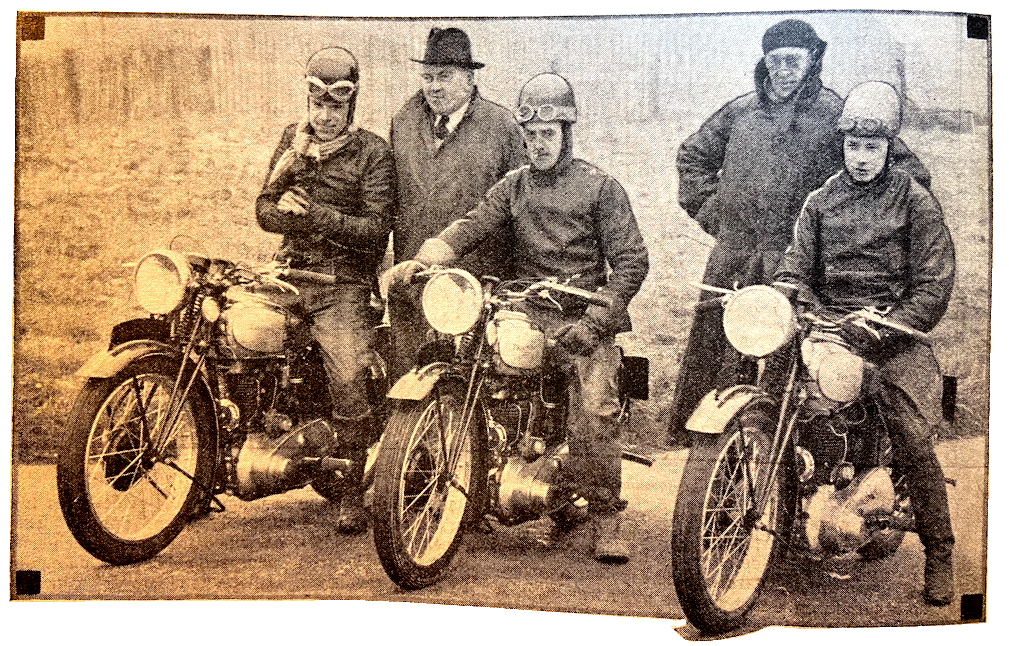
models which any or everyone can buy—and apart from the soundness of their design, the makers are testing the consistency of their production…Tuesday came, and it was found that the road circuit at Donington was in a treacherous state owing to large patches of ice…The preliminary preparations were made to the machines; these included exchanging the high-level exhaust pipes for those of the low-level type. Had the chosen machines happened to have low pipes no alteration would have been made, and it should be borne in mind that either type is a standard fitting…As the ice thawed, rain set in and turned into a steady downpour. To complicate matters the 500cc model developed a fault in the oil-pump, which, probably because of the presence of dirt, refused to exhaust properly. It was dismantled, cleaned and replaced; no new parts being necessary…After lunch, the machines were given their heads a little, and each rider piled up a good number of laps, full throttle being used frequently. Finally, in the late afternoon, the machines came in and were locked up, after having been wiped down —it was still raining heavily—and re-fuelled. Wednesday dawned bright and, much warmer, and the machines were taken out and warmed up over a preliminary lap or two. Then, at 9.30am, the high-speed test began. Thacker rode the 250, Jefferies the 350 and Clarke the 500. The timing was attended to by Mr Nixon, of the ACU. For the riders, it was a question of full throttle, but everything went all right, and all the machines kept well above the predetermined minimum schedule. Then, on his 15th lap, Clarke pulled in to the pit with the same lubrication trouble as he had previously experienced. Quickly the crankcase was drained and “the pump
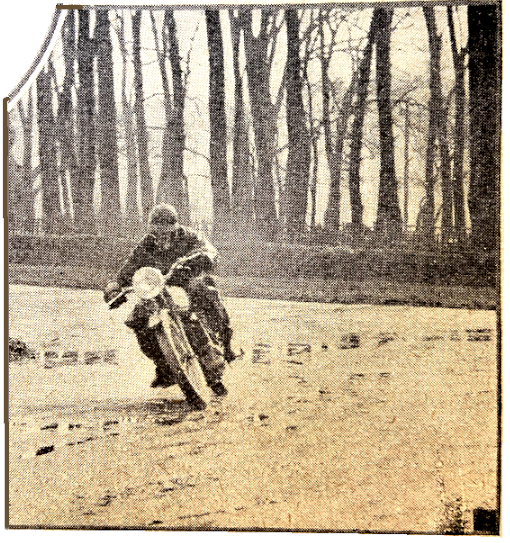
dismantled and cleaned, while to make certain the ball-valve was making seating properly, it was given a tap on the seat with a punch. The pump was replaced, more oil was added to that left in the tank, and Clarke restarted after a delay of about eight minutes. At the end of one hour the 250cc Tiger had completed 27 laps, the 350, 30 laps, and the 500, 26 laps. After another half-hour had passed, the respective number of laps was 39, 44 and 41, and the Tiger 90 was now going well. The other two models had been running beautifully, especially the 350, but heavy rain had set in, drenching the riders and slowing them fractionally. Ill-luck dogged the big machine, for on lap 43 the high-tension lead came adrift at the magneto end, causing a further delay of eight minutes. Soon after this, some excitement was caused by Clarke and Jefferies racing together into Starkey’s Corner. Clarke got into a wobble and was forced to take to the grass, where he skidded to the ground, Fortunately, nothing was bent and the machine carried on..So the test went on, each man calling twice at the pit for fuel, though no oil was added, except in Clarke’s case, as already described. At last Mr Ware held out the chequered flag, and the machines came in. They finished beautifully clean, the two smaller ones showing not a trace of oil leakage, and the big one just a slight drip from the rocker box. At the end, all the lights were in order and the horns were working properly. The 500 showed slight blueing of the exhaust pipe, but the exhaust pipes of the other two models were not discoloured in the slightest degree…Clarke on the 500 had covered 84 laps in 2hr 58min 29sec; his average speed 54.4mph. Jefferies had covered 89 laps in 2hr 58min 16sec, giving an average speed of 57.4mph ; and Thacker had covered 79 laps in 2hr 57min 56sec, an average speed of 50.72mph. On Friday the final tests, those of maximum speed, were carried out at Brooklands; the 250cc Tiger covered a flying lap at 66.39mph; the 350 at 74.68, and the five hundred at 82.31.” Triumph’s efforts were rewarded by the Maudes Trophy.
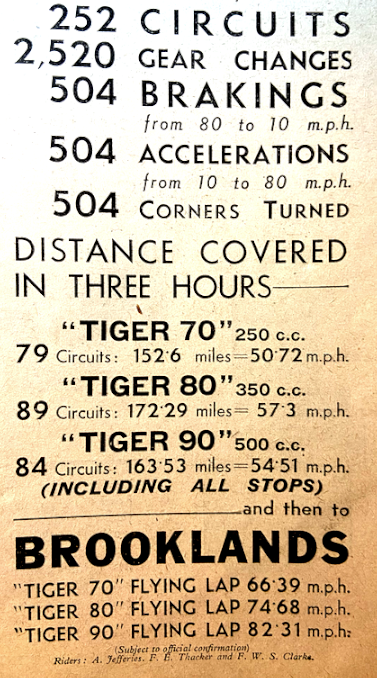
“A READER TAKES STRONG exception to my mild suggestion that weakly men of 40 have some excuse for relinquishing such exposure to weather as riding a motor bicycle involves. He is 61 years of age, and has ridden regularly summer and winter since February, 1904. He is inclined to wheeze and be short of breath, but when an attack takes him, he gets out his ‘Beam, chases off to the nearest by-pass, and does a few miles at 60mph, taking long deep breaths at this speed, with the invariable result that he returns home leaping like old Grandpa Kruschen. He has four sons, all of whom drive saloon cars, and he pities them! They do not share his immunity from colds and ‘flu.”—Ixion
“MANY FOLK (MOSTLY ELDERLY or purely pedestrian) aver that motor cycling is dangerous. All I can say is that, starting as an utter and complete novice on very bad machines, I have covered well over half a million miles without ever injuring anybody, and without ever being injured myself (unless an occasional trifle of gravel rash is to rank as ‘ injury’). This although I have done a great deal of racing and trials work, and even of record-breaking. The alleged danger factor in all motoring is in my opinion a personal and human factor, and not directly related to the selected vehicle. It is true that the motor cycle is inherently unstable, as it cannot remain vertical of its own accord. This may or may not be a disadvantage. In the early days of aviation the experts went all out for an inherently stable aeroplane till they found that if you could throw a ‘plane about freely you could extract yourself from situations which would be fatal to a too stable machine. The motor cycle is the easiest road vehicle to hoike out of a tight corner, first, because of its instability, and, secondly, because of its extremely narrow width (is that Irish?). The man or woman who is unsafe on a motor cycle will be definitely less safe on four-wheelers up to a certain age. (Above 60 one is apt to become physically clumsy.) I will go even farther, and say that a youngster who is unsafe on a motor cycle will normally be a jay-walker and a. jay-cyclist, for the qualities which make a good motor cyclist are equally essential to survival while walking in city streets.”—Ixion
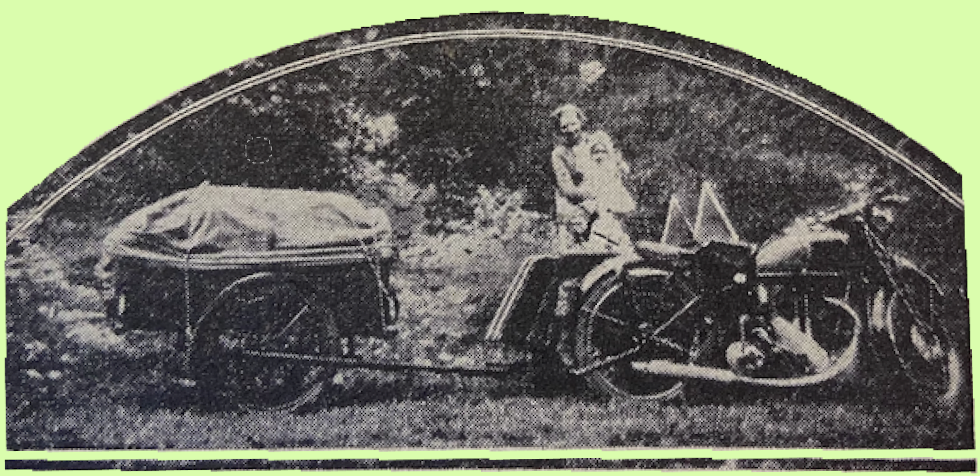
“‘THE FAULT IS NOT in our stars, but in ourselves. The remedy is not in our Governments, but in our conduct.’—Mr. Hore-Belisha in a speech on the road problem.”
“AN AMERICAN MANUFACTURER of pneumatic tyres for agricultural tractors recommends that the inner-tube is partly filled with water and then inflated normally.”
“THERE WERE 63,270 motor cycles registered in Belgium at the end of 1936.”
“A SIDECARRIST WHO was ‘gouged’ while driving guests to his wedding was fined 5s at Gloucester.”
“A FRENCH MANUFACTURER is to make and issue a film showing the pleasures. of motor cycling.”
“NEW MODELS IN the French Monet-Goyon range will have six-speed gear boxes and spring frames, according to an advance report.”
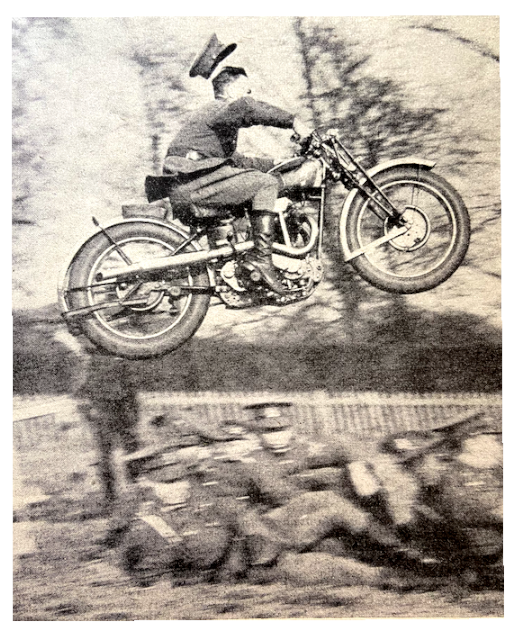
NEWS FROM JAPAN: The petrol-starved militaristic Japanese government banned motorcycle clubs. They also ramped up the import duty on motorcycles by more than 700%. Soichiro Honda set up in business manufacturing piston rings. Meguro, already well known in Japan for proprietary engines, built its first bike, a 13hp 500cc ohv single. Kawasaki, now producing everything from steel to locomotives and rolling stock, went into aircraft production. Having come up with the 175cc two-stroke Asahi in 1933 Miyata was producing 150 units a month and was exporting them to Brazil, Mexico, Peru, Argentina, Venezuala, China, Formosa, Korea and the Dutch East Indies. They were usual sold through bicycle shops; Miyata set up a dealership in occupied Shanghai. There’s cheek. Asahi one-make clubs sprang up in Tokyo, Osaka and Kobe but following Japan’s invasion of China petrol was in short supply and clubs were suspended by the government. Suzuki, still busy making looms, looked at the lightweight car market but the Japanese military government had banned all ‘non-essential commodities’. Having built VL 1,200cc side-valve Harley-Davidsons under licence, using equipment supplied by Harley, Rikuo was busy producing them for the Japanese army as the Type-97. The Japanese government raised import tariffs by more than 500% and completed a forced buyout of the Harley operation in Japan—which subsequently manufactured torpedoes in good time for Pearl Harbour’s “Day of Infamy”.

SWISS INVENTOR ADRIEN Mercier had a factory in France produced 50cc motocyclettes with Lavalette engines, as well as 125/175cc motor cycles with French Ydral engines. But her had a thing about tracked motor cycles and presented a prototype to the French army. (This wasn’t their first experiment with half-tracks; check out the Rene Gillet of 1934.) The Mercier was powered by a 350cc ohv JAP with a French Soyer three-speed box and could do 40mph. A fan helped cure overheating problems and the front-wheel-drive half-track proved capable of tackling acclivities up to 45°. However a large armoured shield compromised its cross-country performance. Mercier duly produced a lighter version which was tested over a 90-mile cross-country route against a standard French WD solo. The Mercier was slower, juicier, with poorer rough-terrain performance. The military asked Mercier to produce a third prototype with a 540cc Aubier Dunne engine and other improvements. Mercier declined; in his words, “he spent a lot of energy and money”.
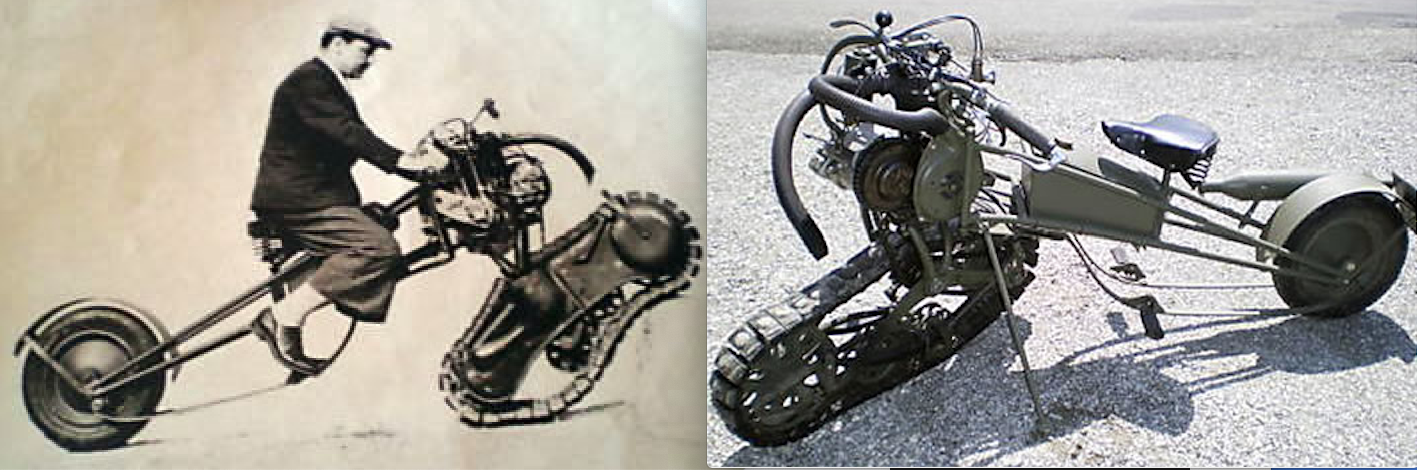
“QUESTIONS OF MECHANICAL and exhaust noise bring up once again the subject of power per cc. Is too much thought still being applied to the amount of power extracted from each unit of engine capacity? We are certain that this is so. For all that is said and written, the vast majority of motor cyclists do not travel fast. Some travel noisily, and this gives rise to the thought that they are speedsters. The truth is that very, very few motor cyclists obtain any real value from the high-speed capabilities of their machines. Many talk glibly of 70, 80 and 90mph, but to-day the majority of motor cyclists travel slower, and not faster, than the drivers of cars. Real silence can only be achieved by reducing performance at the top end of the speed range, or by the employment of smaller cylinders and more of them. The line on which the industry should work is the development of multi-cylinder motor cycles for high-speed touring, and touring type singles for those who neither demand nor perhaps can afford the ‘multi’. The continued concentration upon high-compression single-cylinders of large capacity jeopardises the whole future of motor cycling.”
“ONE OF THE MOST complicated sets of traffic lights in London is being installed at Blackfriars Bridge, EC. There are 35 light standards in all.”
“THE LORD MAYOR OF LONDON suggested last week that motorists should have their vehicles confiscated for parking offences and redeemed only on payment of heavy penalty.”
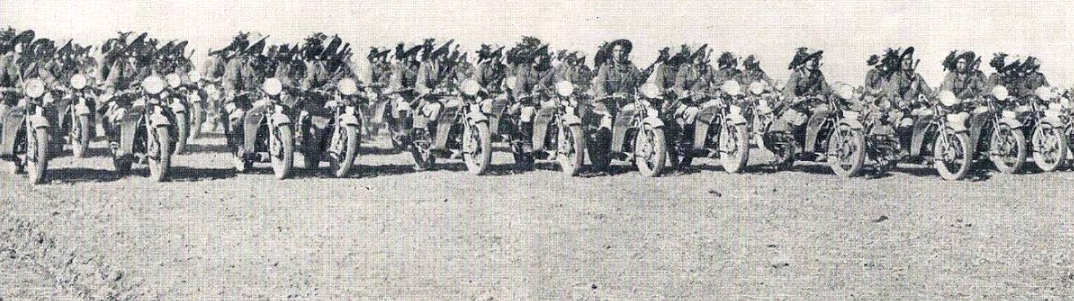
“TIP FROM THE BLUE: ‘”If you’re caught by the police, he polite to the officer. If be is a constable, call him sergeant; if he’s a sergeant, call him inspector.’—The Chief Constable of Stoke-on-Trent.”
“BMW recently tested a new system of rear-wheel springing by a rigorous high-speed test at Monza. Two special 500cc machines, ridden by Ley and Gall, were used.”
“‘MR HORE-BELISHA TELLS us that a stationary car in the City of London occupies space worth £20,000, By the same scale of land values, the average stationary pedestrian covers ground worth £1,666 13s 4d.’—Letter in The Daily Telegraph.”
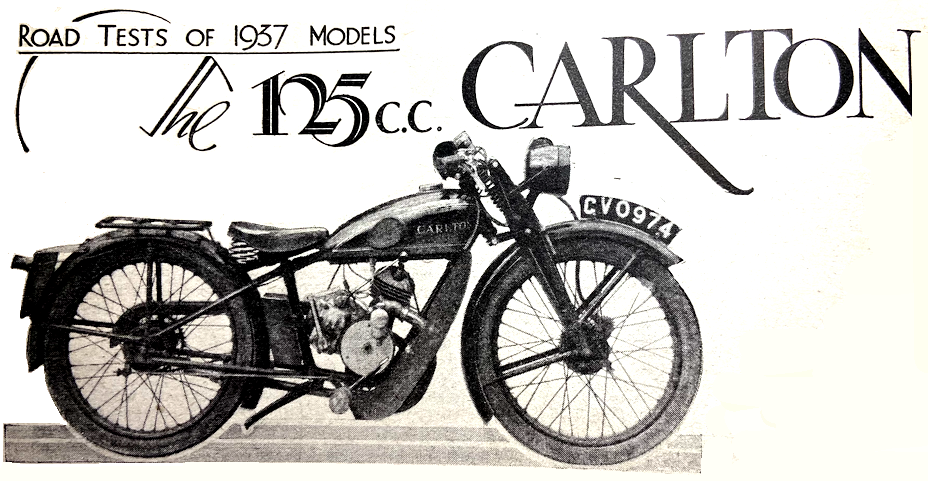
“ONE SHORT RUN on the new 125cc Carlton would be sufficient to convince anyone that here is a lightweight which is full of life and completely lacking any of that fussiness sometimes associated with machines of the utility class. It is a lively little motor cycle which, while excellent for town conditions, is also admirably suitable for longish runs into the country. In design the Carlton is quite conventional. It is fitted with one of the latest l25cc Villiers engine-gear units, while the specification is unusually thorough for such a low-priced machine. Standard fittings include efficient legshields, a carrier, Villiers direct lighting and a three-speed gear box. The tank holds a surprisingly large quantity of fuel. It takes two gallons of petrol and one pint of oil, which is the recommended proportion for the petroil mixture. The riding position is comfortable and the saddle well placed in relation to the handlebars and footrests. Pivoting about the footrest bar is the brake pedal, the height of which can be set by simply slacking off the bolt securing the footrest bar to the frame and turning the footrests as required. Unfortunately, the right-hand legshield somewhat restricts the movement of the pedal, which in consequence has to be set unnaturally high and rather too near the carburettor. Apart from this one criticism it is difficult to find fault with the Carlton. Starting was of the highest order. If the choke on the air inlet was used to stop the engine last thing at night, a certain first-kick start the follow-ing morning was ensured. Even this precaution was hardly necessary, for the engine was delightfully easy to start at all times. When warm it will start With comparative ease by pressing down the kick-starter be hand, and will settle down immediately to remarkably satisfactory idling. The gear lever is mounted directly on the gear box, and, although its range of movement is below the level of the petrol tank, it comes reasonably well to hand. No difficulty was experienced in selecting the gears—seemingly there is a strong selector spring and they more or less find themselves. At all times the gear box was extremely easy to use and dead quiet in operation. The clutch is both light and smooth, and, although running inside the primary chain case, it proved completely free from drag. Because of the little engine’s surprising power at low revs in top gear it is almost possible to drive it as one would a single-gear model. At above 8-10mph in top the engine shows such a ready response to the throttle that it is hardly necessary to change down into into second gear when rounding street corners. Again, second-gear starts could be accomplished without any harmful juggling with the clutch, while bottom gear is so low that restarts could be made on a 1 in 5 gradient with practically no slipping of the clutch. By full use of the gears the acceleration up to 40mph was nearly as good as that of some machines of four times the capacity, and in the standing-start acceleration test it almost reached its peak performance within a quarter of a mile. The maximum speed in top gear was in the neighbourhood of 45mph, the actual mean speed of four timed runs over a quarter of a mile being 42.2mph. At first glance these figures may not appear to be particularly high, but it must be borne in mind, first, that the Carlton is of only 125cc, and, secondly, that it can be cruised all day long at 40mph without trace of tiring or tightening up—or for that matter, any vibration. Above this speed the direction and strength of thee wind play an important part. On one occasion 47mph was reached with the rifler sitting up, while 38mph was the best that was attained in the other direction. Undoubtedly the little machine’s best cruising speed was in the neighbourhood of 35mph. Under 25mph it began to four-
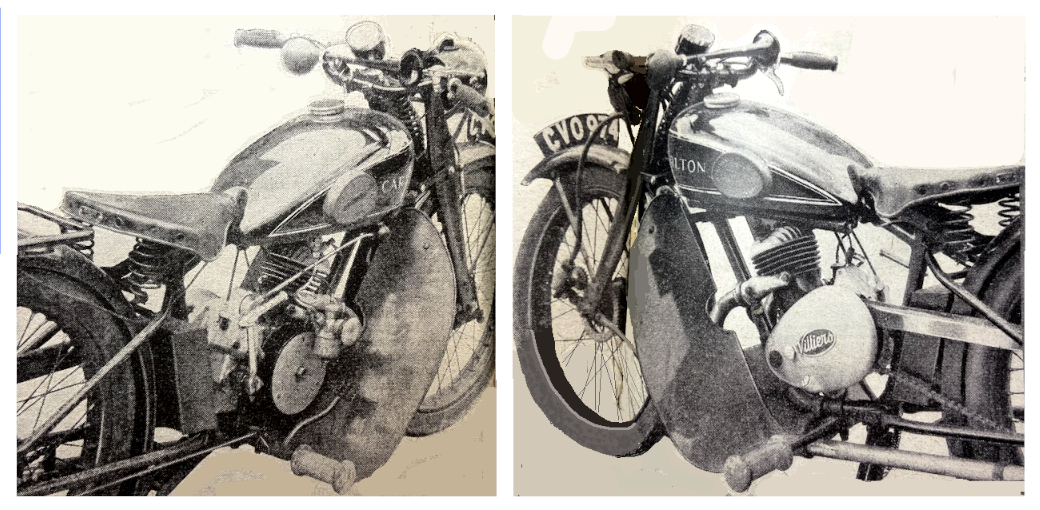
stroke, but it could be throttled down to the almost unbelievably low non-snatch speed of 6mph. As with all lightweight machines, the handling and road-holding of the Carlton are magnificent. The steering is on the light side, but always very safe. Quite one of the most surprising features of the Carlton—in a sense this little machine is full of pleasant surprises—is the quality and efficiency of the brakes. They are well up to the very best standards and capable of pulling the machine Up in 36ft from 30mph in top gear, without locking either wheel. Partly on this score and partly on account of the admirable road-holding qualities, the machine inspires every confidence when ridden in the rain or over greasy surfaces. Many miles were covered during the course of the test over wet roads; the efficiency of the mudguards and legshields was testified by the remarkable, cleanliness of the machine. There was, however, one small point worthy of criticism. The position of the carburettor (projecting at right angles to the cylinder, on the off ‘ side) caused fine drops of petroil to accumulate on the rider’s leg after a longish run. No doubt the slight blow-back inherent in most two-strokes was the cause of this small inconvenience. Naturally the maintained speed of 40mph (em-ployed as a standard for all The Motor Cycle fuel consumption tests of 1937 models) is really too high for 125cc lightweights; even so, the Carlton acquitted itself with a carefully checked consumption figure of 86.8mph. At 30mph, which no doubt would be the normal cruising speed of the Carlton under everyday conditions, the consumption amounted to just on 100mpg—a figure well in keeping with the economical nature of this little machine, the initial cost of which belies its surprisingly efficient performance both for utilitarian purposes and for pleasure.”
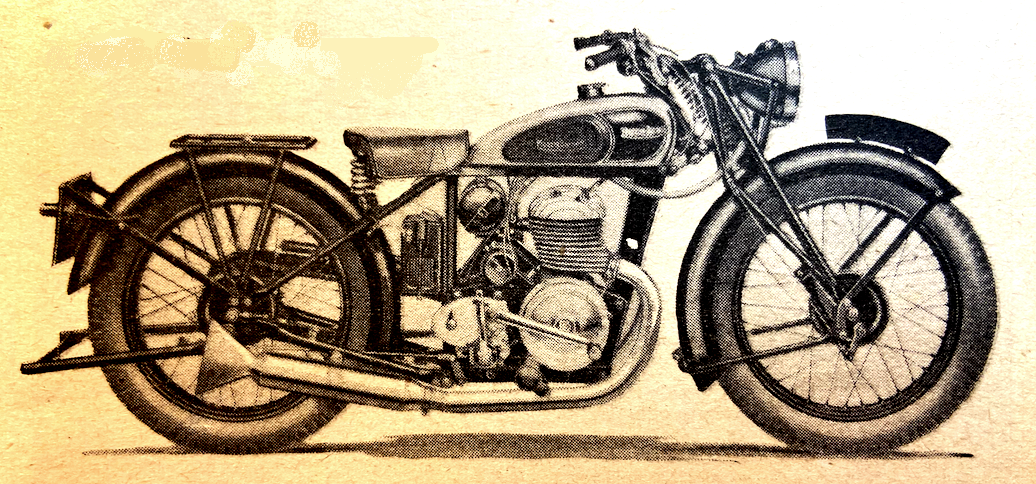
“ONE OF THE LATEST efforts to produce a satisfactory machine which will fill the gap between the bicycle and the true motor cycle is that of Mr GH Jones. He is a firm believer in the future of the motorised bicycle. The machine he has designed is an exceedingly neat and sturdy piece of work, following the normal lines of a modern bicycle having an open frame. Into this frame is mounted a compact engine unit, designed by Mr Jones and built in conjunction with the Villiers Engineering Company. This engine is more than usually interesting. The diagonally finned cylinder is mounted horizontally and pointing forwards. Of 98cc capacity, the engine is of the normal two-stroke type and is lubricated by petroil. Mounted on the upper side of the head in a very accessible position is the sparking plug. The single-lever carburettor is on the near side and is provided with a strangler for easy starting purposes, the strangler control being conveniently placed on the side of the petrol tank. A flywheel magneto is fitted on the end of the crankshaft. This crankshaft is supported on separate ball and roller bearings, and between these lies a chain sprocket, the whole of this part of the mechanism being enclosed in the crank-case casting. Behind this lies the clutch casing, the drive to the clutch being by an enclosed chain from the first sprocket. The clutch is of the multi-plate cork type and runs in oil, and the hollow shaft on which it is mounted runs on ball bearings. From this shaft the drive is taken by another chain to the rear wheel, this chain being protected by a metal guard and tensioned by a small jockey sprocket. A spindle runs through the centre

of the hollow clutch shaft and the pedal cranks are attached to each end of this spindle. The chain wheel for the pedalling gear is on the off-side of the machine. Beneath the engine unit is the cast aluminium silencer, which is rectangular and shaped like a shallow box, a pipe of small diameter leading the gases from the silencer to a point behind the rear wheel. The whole of the unit is in one piece, and may be removed from the frame by undoing only two bolts which clamp it very rigidly to the specially shaped bottom bracket. As already indicated, the frame is of the open type and has two tubes leading from the head, one running to the seat tube and the other to the engine lug. Between these two tubes lies the wedge-shaped petrol tank, which has a capacity of about one gallon. The front forks are pivoted at the base of the steering head and the fork lug accommodates the lower end of a laminated spring, the upper end being held in a slot in the specially formed lamp bracket. The action of the fork is damped by friction shock absorbers. The brakes shown in the photographs operate on the rims of the wheels, but the production models will have internal-expanding brakes. Dunlop tandem tyres are fitted to 26in Endrick rims and a large soft-topped saddle is used. Head and tail lamps of Villiers’ design are fitted, supplied with current direct from the flywheel magneto. On the handle-bars are the two brake levers, the clutch lever and the throttle control. At the moment the weight of the machine is about 861b, but this will be reduced. On the Road A brief test revealed several interest-ing facts. Engine vibration was absent at all speeds. The machine could be throttled down to a quick walking pace without the faintest trace of transmission snatch, and from this speed the engine would accelerate quickly and smoothly without effort. Hill-climbing was excellent, the engine dealing with normal main-road hills with consummate ease. At speeds of about 30mph the machine was found to be quite steady, while the spring forks effectively damped out road shocks over pot-holed surfaces. The riding position was comfortable and gave the impression that long distances could be covered without undue fatigue. At low speeds the exhaust note was well subdued, rising somewhat at full throttle, but mechanical noise was almost absent. Arrangements for the manufacture of this serviceable little machine are well in hand, and it is hoped to produce it at a price round about fifteen to sixteen guineas. The designer is GH Jones, 59, Addison Road, King’s Heath, Birmingham.”
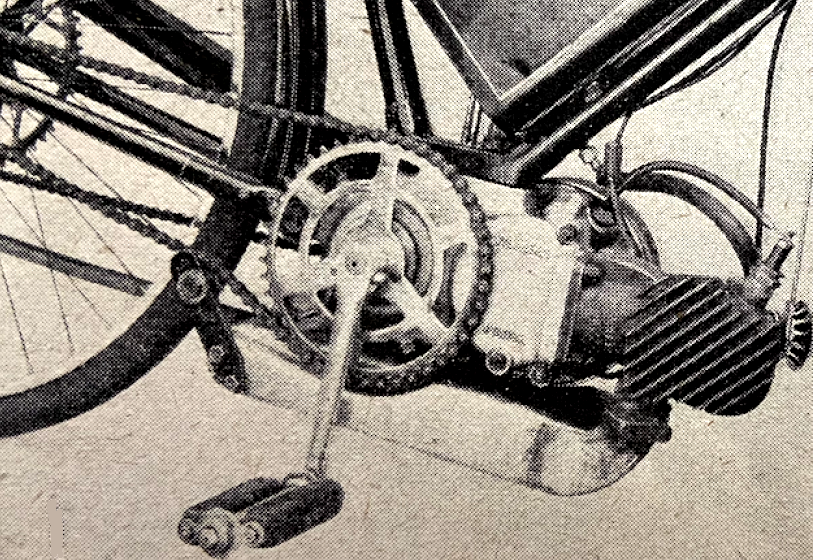
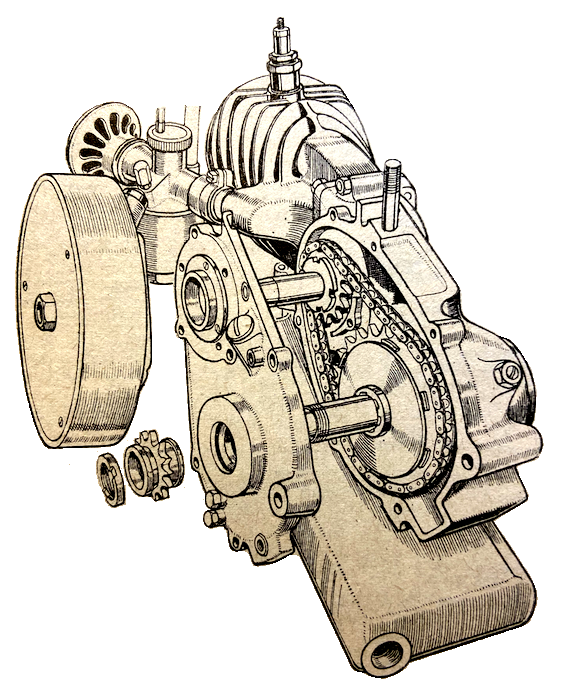
“THANKS to the sort of weather that has blessed the whole country, and Derbyshire in particular, during the past few weeks, the date of the Derby and District MC’s Bemrose Trial had a certain element of chance about it. One open trial, the Reliance, had already had to be postponed, and there were not a few people who wondered if the lingering snowdrifts might not upset the scheme of things for Mr Secretary Craner and his men. But matters worked out rather better than that, for, although there was some snow about—and, of course, its after-effects—the hand of man rather than the fury of Nature proved the more troublesome. Since there is no wish to indulge in mystification this statement had better be explained at once. The fact is that whereas only one observed hill (Washgate) had to be eliminated on account of the conditions, two obstacles proved un-usable because permission to include them was not available. These deletions were the descent of Lumb Lane and the ascent of Blackermill. Thus the route was not quite according to the card, but it still remained a stiff trial, with 90 miles of assorted going —rocks, mud, snowdrifts, snow-sodden grass and more rocks—and the three competitors who got round without loss of marks certainly proved their riding ability and the steerability of their models. Of JJ Booker (570cc Royal Enfield) and FH Whittle (598cc Panther sc), the trophy winner and the ‘opposite class’ winner respectively, it is rather futile to say that they deserve full marks, for they got ’em ‘anyway! Starting on the southern side of Derby as the Bemrose does, there is rather a piece of easy main-road going in the early stages, and such hills as are included are not very serious. The observed drop down the slimy ruts of Lamb Lane might have been serious, for although the sky overhead was clear, the ground conditions were just a shade saucy. But a local resident decided to indicate pronounced disapproval of the only sport in which we hold our on in international circles, and so his lane had to be side-tracked.”
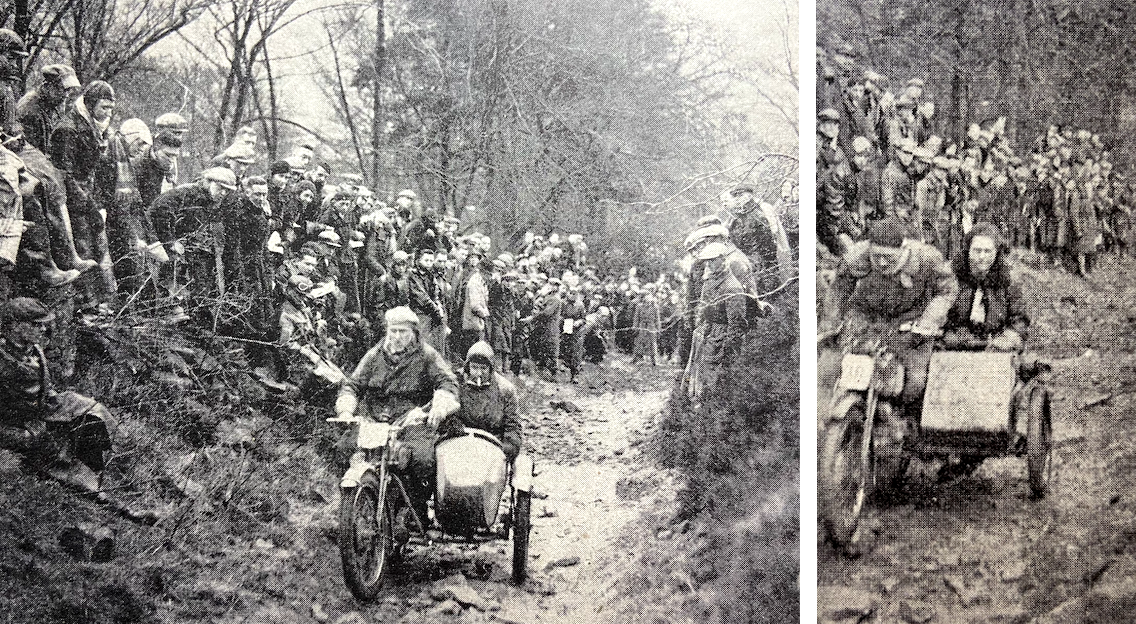
“MAY I ENCROACH on your valuable apace to pay tribute to the recent editorial article, ‘Simple and Efficient’? The claims of side-valve machines are not often brought forward. I am, I admit, a side-valve lover—but I find them better for my purpose. I have a 500cc sv of a popular make, and I wont ever own another ohv. There are many reasons. Lately you have published letters about old machines. The Model H Triumph made its appearance shortly after the War. There are still some on the road. The side-valve machine lasts longest. There are 1921 long-stroke ‘Beams still on our roads, and good for years. Finally, side-valves are good enough for the GPO, the AA, and the RAC, and, up north, for the police and other public bodies. Many arguments can, I feel sure, be made for and against, and I for one would like to read what others think. If we side-valve lovers do not tell the world which we believe is best, we shall not have any side-valves left. Several manufacturers do not make them—others have only one single, or, maybe, a twin, of this type in their range. What about it?
DLD 387, London, W1.”
“MY SON TAKES the Blue ‘Un, and even I, an ‘old ‘un’ between 50 and 60, find it most interesting. Now, sir, there has been a lot about the motorised bicycle in your columns recently, and I am writing to say what a benefit they are to those like myself. I have sometimes eight or nine miles to travel, up and down four steepish hills, and by the time I rode this distance on a pedal cycle I was too puffed to enjoy my ride. So I invested in a Cyc-Auto, and I have yet to find the hill locally that it will not climb. I have been over Ashdown Forest, through Hawkhurst, Lamberhurst, Grinstead, Crawley, Limpsfield, Westerham, etc, and one day I did exactly 67 miles out and home after lunch, having tea with friends, and yet under half a gallon of petroil was used. For the man or woman like myself I say they are a godsend.
Cyc-0-Kent, Edenbridge, Kent.”
“I AM A KEEN motor cyclist and have possessed various machines, ohvs, two-strokes, etc, and since taking up motor cycling have changed my machine annually. This year I ordered a Cyc-Auto, and I am delighted with its performance. It starts immediately in very cold weather, it very rarely requires the use of the pedals, which are very handy for regaining revs when having to slow down for traffic on a hill, and is very easy to handle in city traffic.
John Duerden, Leeds, 11.”
“IT WAS WITH AMAZEMENT that I read ‘Nitor’s’ remarks anent speedway racing. Last season there was a paid attendance of over three million at speedway meetings in this county, which gives the sport an appeal second only to Association football. A large proportion of these people were either present or prospective motor cyclists, although speedway racing has little to do with pukka motor cycling. Could you please explain to me the snobbish and amusedly tolerant attitude with which the motor cycle world seems to regard the sport? I belong to three ACU-affiliated clubs, and whenever speedways are mentioned one hears, ‘Oh, that’s a circus trick, any fool could ride on a speedway.’ And now, in the finest motor cycling, journal which covers ‘every phase of the movement’..the circus idea crops up again. I have often wondered if the people who are so ready to condemn a fine, clean and skilful sport have heard the Langton bothers. And how about Jack Parker, Colin Watson, the Parkinson brothers and Gus Kuhn, to mention but a few? If speedway racing is a circus turn, in what category does one place a modern ‘super-sporting’ trial? Again, speedway men are paid on the percentage of points they pick up, which to some people makes them ‘dirty professionals’. Bur surely Stanley Woods doesn’t ride in the TT merely because he likes the mountain air, and Bert Perrigo collects more bonus for winning a premier award than a second-class. No, ‘Nitor’, speedway racing may he a whole heap different from other types of motor cycling sport, but it is every inch a clean and thrilling game.
Cinder Fan, Birmingham, 6.”
“LETTERS IN BRIEF: Thanks are extended to a Red Panther rider (DGC 413) by Mr J Gaskins (Ilford) for recent assistance. A plea for the abolition of metal studs for marking Belisha crossings is made by ‘500 Manxman’ (London, E2). The rider of a Matchless (TO 8285) thanks the Norton rider (TF 5823) for his offer of assistance at Dunkirk (Notts). Owner of the Panther outfit, BXF 906, and his lady passenger wish to express their sincere thanks for the assistance given them on the Worthing road by the owner and passenger of the Ariel outfit, EG 339. Thanks are expressed by ‘EX 3839 to Sergeant Collins and the Irish constable who assisted him in Chelmsford. The Norton rider (DPC 439) is sincerely thanked by ‘CUC 416’ (London SE18) for his assistance and a tow to Plumstead. A lighted cigarette end, thrown from a car window in front of a sidecar outfit, is the subject of an apology by ‘Standard Nine’ (Surrey)—himself a one-time motor cyclist—who explains that he did not see the machine overtaking. The incident occurred in Wellesley Road, Chiswick, late on Sunday night, January 3rd. Thanks are offered to the riders of the Royal Enfield (DPE 659) and Scott (CLH 494) by the rider and passenger they assisted on the London-Southend road on Saturday night, December 19th. A sparking plug was given to Mr F Shorter (Maidstone) by a Panther rider on Wrotham Hill on Christmas morning. The rider concerned is sincerely thanked for showing the ‘true Christmas spirit.'”
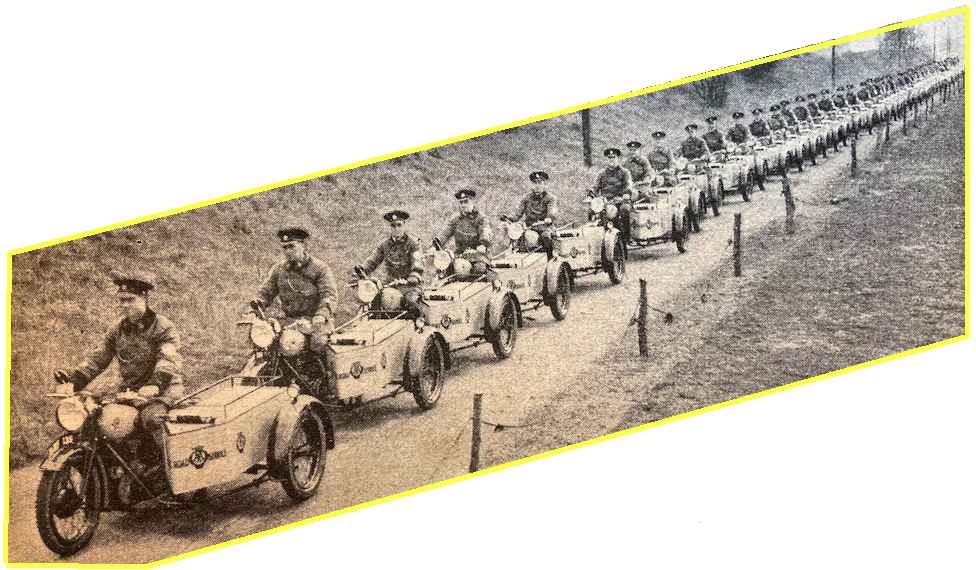
“LAST WEEK I RODE along one of those teasy roads strung with small straggling villages. Alternately I encountered 30mph limits, street-lamp areas which were de-restricted, and street-lamp areas which were thirtied. Quite impossible to tell by the look of the area wh ether it was restricted or not. How I wish that the authorities would mark every lamp-post and telegraph pole with some symbol to indicate whether that particular bit of road is restricted or not. Two strips of white paint would show a ‘de’ area, and two stripes of red paint would show a ‘re’ area. I suppose I shall be told it would cost too much. But local bigwigs have queer minds. Along one section I knew I was in a ’30’ area, and drove accordingly. Suddenly I saw a post, and a white disc with the familiar black diagonal line marking the end of the ’30’ limit. My wrist was about to twist the grip, when suddenly I spotted a gigantic ‘SLOW’ painted on the road two yards beyond the de-restriction post! It was a good ‘slow’ sign, too, for something of a sharpish S-bend followed. You don’t believe me? Well, I’ll take a Kodak with me next time I go that way.”—Ixion
“OUR ‘HISTORY’ SERIES has set the grey beards wagging furiously. One grandpa tells me how he used to ride a vertical-twin Werner with separate tube ignition for each cylinder. On his first spell awheel one burner blew out. He rode merrily on, ignoring the fact that the extinguished burner was squirting petrol freely over everything. The other burner ignited the flow, and be drove into a ditch to put out the flames. The fuel consumption of this bus was 12mpg, most of which was used up by the ignition burners!”—Ixion
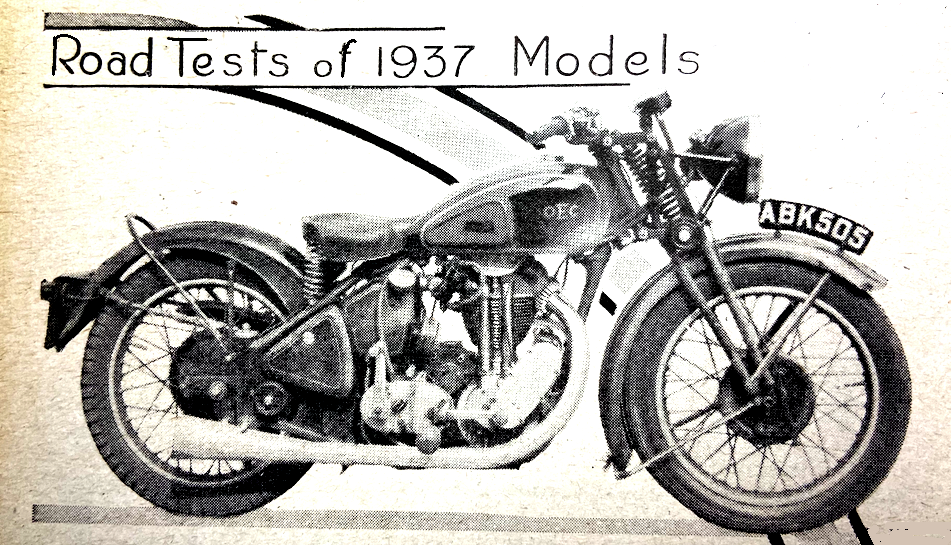
“IT IS VERY DIFFICULT to appraise good rear springing, for the reason that a well-designed spring-frame smooths out road shocks so that they pass unnoticed. A good spring-frame by its very efficiency, should not obtrude itself into the rider’s consciousness. Judged by this standard, the designer of the 498cc spring-frame OEC Atlanta Special has done his work well. Introduced early in the year, this new model is fitted with an interesting method of rear wheel suspension, which incorporates short radius arms with friction, dampers, and a link action. It is a big and comfortable machine with a low saddle position in contrast to the somewhat high level of the handlebars. The large saddle is mounted onto long coil springs that in the case of the model tested were act to lean slightly to one side when the rider was seated. Apart from this criticism the riding position proved excellent. The foot rests and handlebars are conveniently mounted in relation to the saddle, while the gear pedal is ideally situated under the ball of the foot. With the ignition lever fully advanced and the carburettor well flooded starting was comparatively easy, provided the throttle was only fractionally off the closed position. When cold the engine was difficult if not impossible to start with the ignition retarded, yet from the actual running of the engine it was hard to discern whether the ignition is advanced or retarded. The idling of the engine was good but not certain. At such speeds the mechanical and exhaust silence was admirable. However, according to modern standards the latter leaves a little to be desired on larger throttle openings. Throughout its range the engine was practically free from vibration, particularly at high speeds. The engine has unusual characteristics. It showed an extraordinary range of acceleration, whether low down or high up the scale. The power low down in the indirect gears was such that care has to be taken when opening up on a wet surface if a power slide is to be avoided. The acceleration in top gear at speeds above 30mph was so good that changing down into third. gear proved unnecessary. Yet the gear box was a pleasure to use.
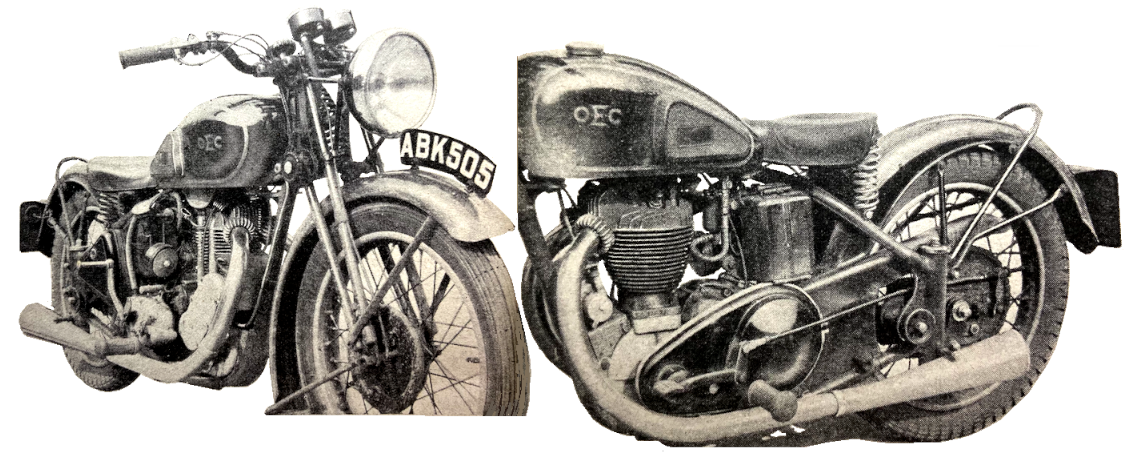
Selection of the gears was simple, and the clutch was delightfully positive and light in action. Completely free from drag when cold, it could seemingly stand up to any amount of abuse. When the engine was throttled down much below the minimum non-snatch speed of 14mph in top gear it began to show signs of stalling even before snatch net in—a tendency which indicated that the ignition was slightly over-advanced. The selection of the gear ratios is excellent for fast touring. Second gear was particularly useful, having a range virtually from zero to 50mph. The mean speed of four runs in top gear in two directions was 76.6mph. The highest speed attained was 78mph, and no doubt this figure could be bettered by 3-4mph under favourable conditions. At low speeds the steering of the. OEC was a trifle on the heavy side, but while this heaviness did not decrease, as is usually the case at higher speeds, the steering was sufficiently positive to obviate the use of the steering damper. At really high cruising speeds there was just the vaguest tendency to roll, an occurrence which was possibly due to incorrect tyre pressure. Like all spring-frame machines, the OEC cornered almost of its own accord. Bumps and even deeply set manhole covers in the middle of a bend did not deviate the steering in the slightest degree. To all intents and purposes such road inequalities could be ignored. It has already been suggested that the presence of the spring-frame is difficult to detect. This does not imply that the springing mechanism hardly functions. Naturally on a smooth road this would be the case, but over rough going the movement of the springing, although small, is sufficient to prevent the machine pitching up and down and allows it to progress in a steady, horizontal plane. It was this remarkable steadiness over bumpy surfaces which made both short and long rung on the OEC the more enjoyable. The efficiency of the frame was demonstrated when the maximum speeds were attempted over a rough surface with the rider seated on the bare mudguard; practically no physical discomfort or jars were experienced. As may be gathered, the road-holding of the OEC leaves nothing to be desired. The brakes, however, were not quite in keeping with the performance of the machine. While reasonably effective at high speeds, it took 42f. to pull up from 30mph in top gear. The machine in question was not brand new and probably the brakes required attention. The fuel consumption at a maintained 40mph amounted to 76mpg, while oil consumption was negligible. After several hundred miles the engine remained remarkably free from oil leaks, except for a slight seepage at the base of the push-rod tubes. Much of the test was carried out in wet weather and the efficiency of the front mudguard was borne out by the cleanliness of the engine. The standard equipment of the OEC includes a Lucas lighting set with voltage control and separate dynamo, which performed satisfactorily throughout the test. The dynamo is driven by a chain running inside the primary oil-bath—a refinement in keeping with the general high calibre of the OEC.”
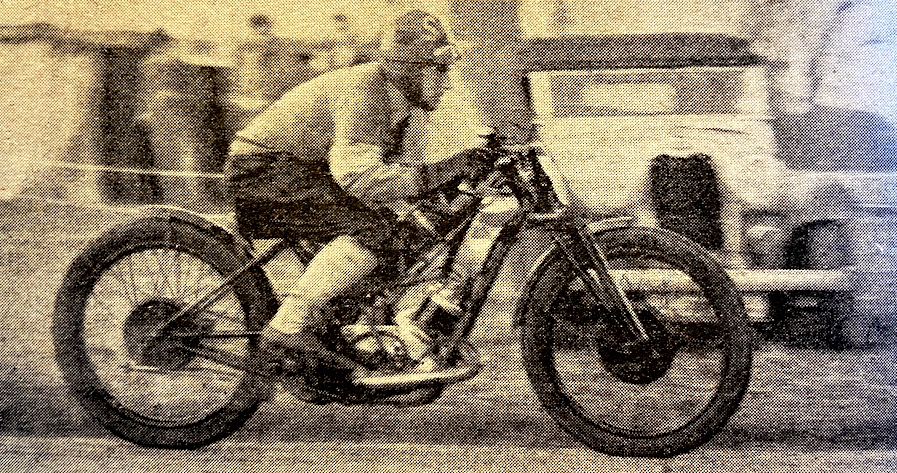
“A RECORD ENTRY of 130 gave a wonderful start to the Donington season on Easter Monday. The morning was bright and not too cold and the weather even improved a little before the first race began. Hundreds of motorcyclists thronged the roads leading into the course and it seemed that the record entry was to be supported by record attendance of spectators. Improvements have been made to the course and the newly installed roads made it possible for spectators to reach all parts without trouble.”

“‘A PROTEST AGAINST the organisation of motor cycling trials in the Fyfield district was lodged by Mr F Bretton at a meeting of the Ongar (near Brentwood, Essex) Rural District Council last Tuesday.’ Tis is a word-for-word news item that arrived the very afternoon I am writing this. It follows on the statement the Minister of Transport made in reply to the Rural District Councils’ Association, which made a similar protest. Let us admit that there is need for the trials world to put its house in order. But what else is there to be said on the matter? First and foremost, the roads are a national heritage. Every member of the community has the right to use them. The right is one of passage from place to place. No one can debar motor cyclists riding along the roads—whether they go on their own or one after another in an organised event. All that can be done is move on any spectators, since there is a right of passage only. But why in the name of fortune should attacks be made on one sport, and one sport only? I venture to suggest that there is no sport more valuable to the nation than motor cycling. It gives an outlet for a most important section of the community. Motor cyclists number over half a million. They are nearly all weekly wage-earners to whom health-giving recreation in the open air is essential. They are taking part in a manly sport which develops quick judgment, the skilful control of mechanism, pluck, resource, endurance, and knowledge of machinery. There is no better training for youth than motor cycling. Germany realises this, and no does Italy. Both countries do everything in their power to encourage motor cycling. Germany has even developed cross-country trials riding as a great national sport. Twenty years ago Great Britain realised the value of motor cycling. Motor cyclists were the salt of the earth. It was they who formed our star pilots; their skill and judgment gained from motor cycling proved invaluable. It was they who comprised the Motor Machine Gun Corps, later the Tank Corps. Memories are short. At this time, more than at any period since the War, motor cycling should be encouraged. There is a call to physical fitness, Motor cycling does much more than provide fitness of body: it is educative, makes men mentally as well as physically alert, and brings in its train the very characteristics that are best in manhood and most valuable to the nation. Much of the prejudice against motor cycle sport is due to the fact that those who take part in it are young. Age was always intolerant of youth—except when there is a national crisis; then youth does the rescuing and the aged glow at the thought of what they call ‘high spirits’! Do these people fail to realise that nearly all sports prove a nuisance to other members of the community? Who has not been delayed because of crowds going to or returning from a football match? Recently I was diverted a mile or more off my route by the police just because people were leaving a football match. Who has not been interfered with by the activities of a hunt, by processions, by the Boat Race, by cricket crowds, by those going to ice hockey, or practically any other sport? We all have. My personal bête noir consists of those who go riding on horseback at week-ends. These people do not keep to proper roads as motor cyclists have to do under the Road Traffic Act. They ride along footpaths and leave them in such a state that it is impossible to walk upon them. Many, too, object to ‘hikers’ and ‘ramblers’ and cyclists. ‘Live and let live’ should be the motto. A motor cycle trial may disturb the peace of villages or outlying houses. Why should motor cyclists not enjoy the countryside too? They need the open air much more than those whose good fortune it is to have it every day of their lives. I am not saying that motor cyclists should be intolerant of others. There is need for tolerance on all sides. There is need for thought, too. Let those who criticise trials and want them banned ponder over things quietly. Let them remember that in motor cycling they have an asset to the country: a clean sport, one that is manly, and which breeds men of observation, skill, judgment, pluck, resource, and with mechanical knowledge—men of a type that has saved the country once and may have to do so again.”—Nitor
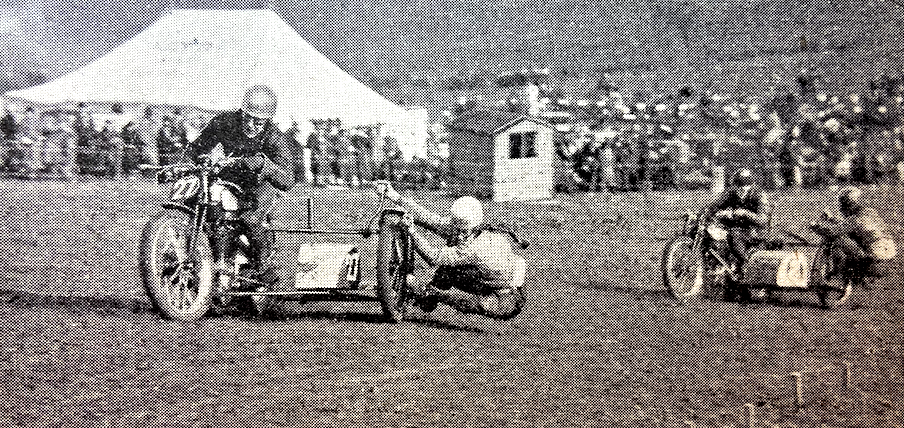
“THE NUMBER OF lightweights in Berlin has increased by 14% in one year.”
“OLDER TYPES of vehicles are four or five phons noisier than new ones, says the Government’s Departmental Committee on Noise.”
“NEW REGULATIONS in South Australia make it illegal to ride a motor cycle at over 25mph if a pillion passenger is carried.”
“DURING THE RECENT Ohio floods in the United States, motor cyclists were called up by radio to assist in carrying out relief work. ‘Calling all motor cyclists! All riders are requested to report immediately at the City Hall, Naval Reserve or American Red Cross Stations for duty…’ was the call broadcast in West Virginia.”
“REGISTRATIONS CONTINUE TO RISE. Ministry of Transport returns for the month of January show that 4,065 motor cycles, sidecar outfits and three-wheelers were registered for the first time in Great Britain. The total shows an increase of almost 10% over the total figure for the ‘corresponding month’ a year ago. The greatest increase was in the over-250cc class—1,951 new registrations were recorded, an increase of approximately 30% on January, 1936.”
“MOTOR CYCLE EXPORTS from Great Britain during the first two months of this year show a sharp upward tendency. Motor cycles, three-wheelers and spare parts to the value of £106,647 were exported during February alone. For the first two months of this year the total value amounted to the encouraging sum of £215,822—an increase of over 36% on the figure for the corresponding period last year. During these two months the returns show that Australia was Britain’s best customer; she imported machines to the value of £75,900.”
“A CONTINENTAL REPORT says that there are now over 3,100,000 motor cycles in use all over the world.”
“SOME 92% OF THE motor cycles in Holland are equipped for pillion riding.”
“THE SUPERCHARGED BMW racing machines may not be entered for races in France because the Union Motorcycliste de France bars supercharging in its events.”
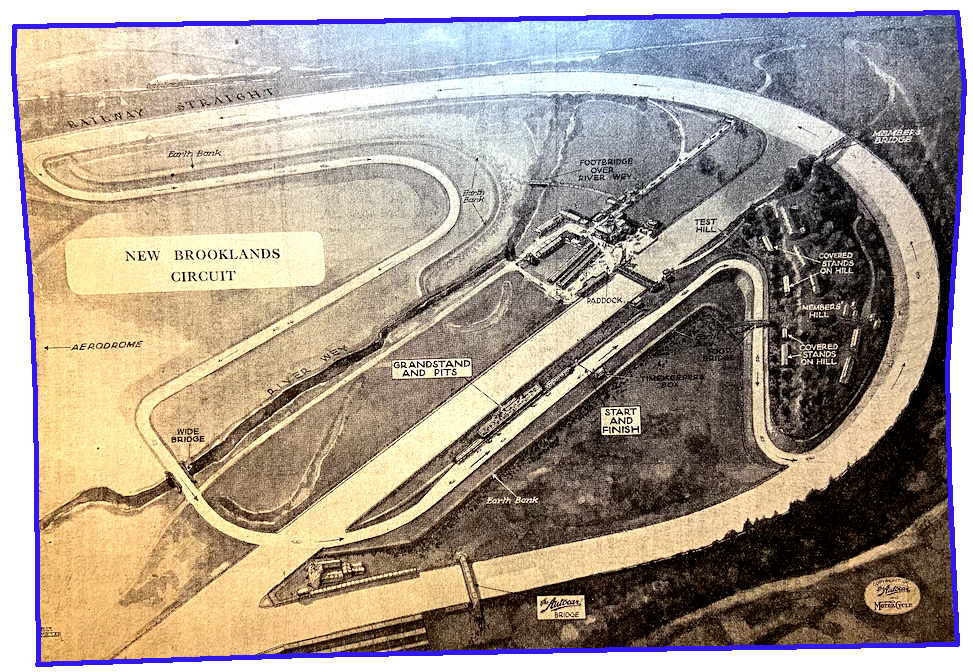
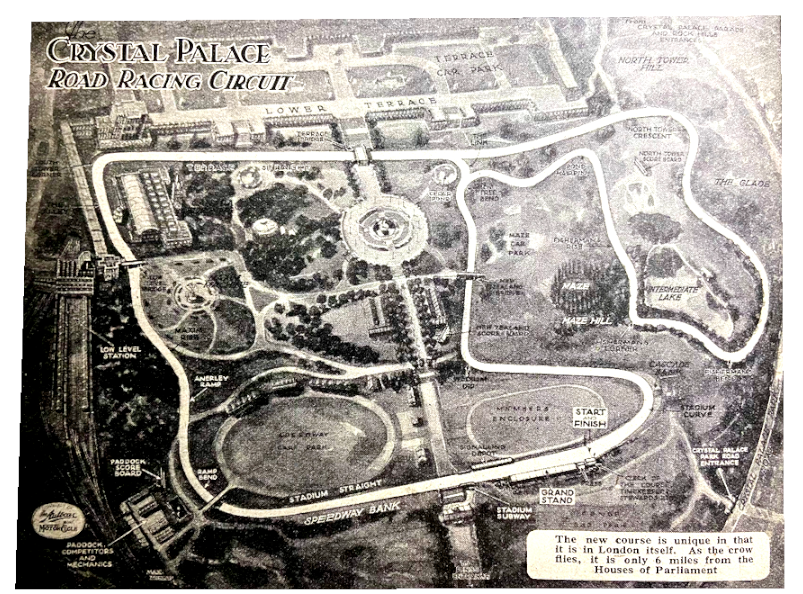
“BECAUSE THE ORGANISERS of the European Grand Prix, to be held at Berne, Switzerland, on July 3rd and 4th, are unable to accept more than 30 entries in each race (to conform with regulations), prospective entrants are requested to send in their entries by April 25th. What are considered the best riders will be selected. Entries must be sent to W Bretscher, Chutzenstrasse, 27, Berne, Switzerland.”
“J PRINGLE ADDED another Australian TT to his list of successes at the 1937 event held at Cowes, Philip Island. Riding a 490cc Norton, he led from the fourth lap and finished the 100-mile Senior Race at an average speed of 85.3mph. Close behind him thundered home G Foster (Norton), winner of the recent South Australian TT; and third was our own Stanley Woods, on a 348cc Velocette. The popular New South Wales rider, Don Bain, led in the opening stages of the race, but Foster (Norton) successfully challenged and passed him. Then on Lap 4 Pringle went into the lead, and, though harassed several times, retained it to the end. Stanley Woods seemed to find the figure 11 fascinating, for he was 11th in the race for 11 successive. laps. Then he pulled out and gradually worked himself up into third place. Stanley had an easy win in the Junior TT He was riding the Velocette again, but his winning speed was 77.7mph, that is, over 4mph slower than his speed in the Senior. Pringle (348cc Norton) was second, three-quarters of a mile behind Woods. The Sidecar TT was the high spot of the day from the spectacular aspect. From start to finish there was a frantic duel between Bruce Rehn (596cc Norton sc) and LF Pratt (730cc BMW sc), with Rehn fractionally in the lead. Wheel to wheel they raced to the finishing line; Pratt pulled out that little extra, and won by 20 yards! G Winton (495cc AJS sc) was third. J Donovan (248cc Velocette) had an easy win in the Lightweight Race, although T Jemison led in the opening laps.”
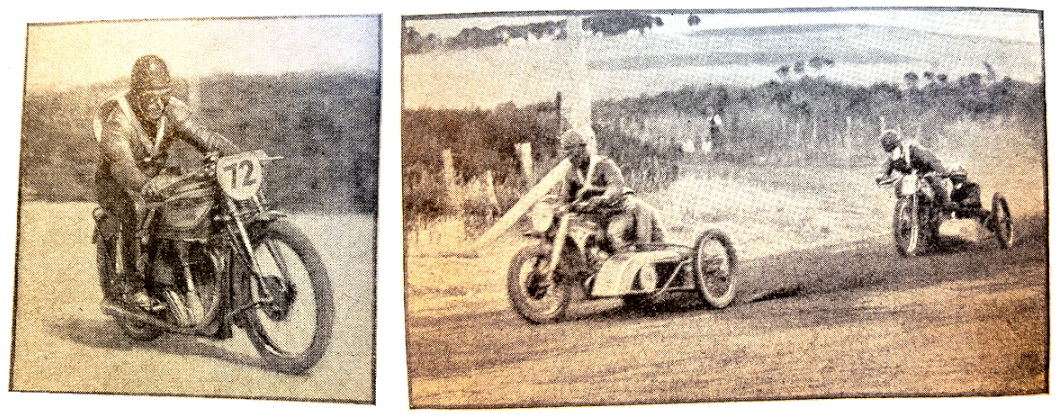
“STURDY YET SIMPLE construction has for many years been the keynote of the Indian motor cycle. For the current year this well-known American company has decided to concentrate on the production of five models, ranging from the 499cc Junior Scout to the 1,265cc Indian Four. The four-cylinder model is now fitted with twin carburettors, and the ohv exhaust system introduced last year is retained. Priced at £125 in this country, the equipment includes Auto-Lite lighting, speedometer and horn. The coil ignition system can be substituted for magneto ignition at slight extra cost. In the case of the Indian Chief ’74’, which has a straightforward 1,206cc side-valve V-twin engine, there is little change from last year. Possibly the most noticeable alteration is the new position for the gear lever, which, instead of working direct from the gear box, is now mounted underneath the nose of the petrol tank. A new design of rear chainguard, with deeper sides; and interchangeable wheels with knock-out spindles are also new features. The price of this machine is £110 in England. The Indian Scout ’45’ and the ‘Sports Scout’—both have 744cc side-valve V-twin engines—are very similar to the Indian Chief, except for the engine size. Both incorporate the larger machine’s new features. The Sports Scout, however, has a compression-spring type of saddle in place of the seat-pillar type fitted to the foregoing models, and central-spring forks of a new type are fitted. The Scout 45 and Sports Scout cost £95 and £90 respectively. Although the smallest model in the range, the Junior Scout looks every bit as sturdy as the Chief and Scout 45. This model has a 499cc V-twin engine of the familiar Indian design, and is equipped with coil ignition. Its lines closely follow those of the Sports Scout. The price is £75, complete with electric lighting. Indian Motorcycle Sales (Eng), 97a, Anerley Road, London, SE20, are the British agents for Indian machines.”
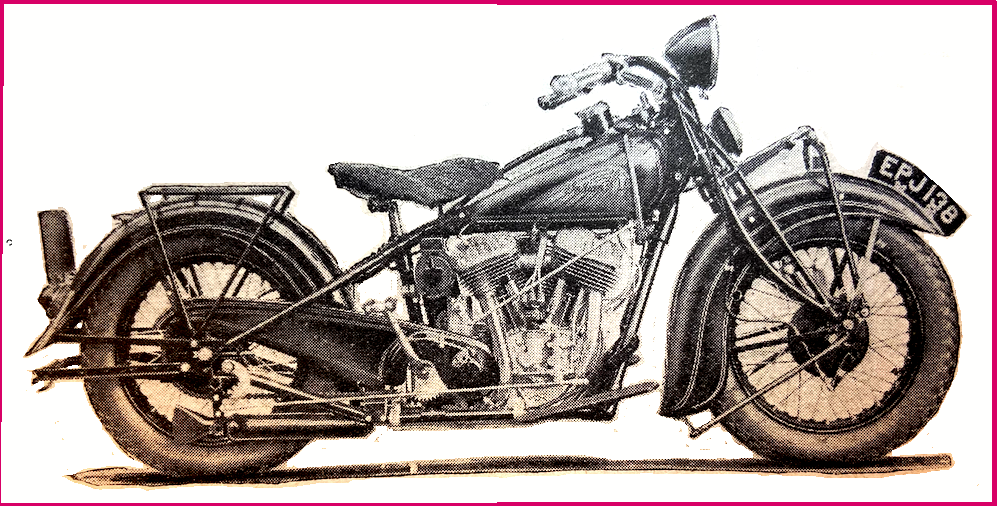

“PERHAPS SOME INFORMATION may be of interest to you concerning the attitude of American riders towards imported machines. In many respects the better foreign makes seen to be far in advance of our models, but there are other reasons besides the unavailability of spares and replacements for our preference for our own makes. Our machines are very well suited to our desires. I realise that many foreign riders consider a 525lb bike to be a bit Brobdingnagian, and think an 80cu in motor an invention of the petrol industry. But we find that a heavy mount, on our long open roads, is much less tiring when the mileage begins to pile up; and we do pile it up. Two hundred miles on a Sunday afternoon club-run, or even between supper and bed-time, is not at all unusual. And we insist that this be done at average speeds of 45mph, or better, with a passenger. We also rather enjoy beating cars on acceleration—but.so do you. Another aspect of our rugged side-vales mounts is that tuning and minor attention is reduced to a minimum. We customarily decoke (I hope I non using the expression correctly—we would say, ‘take out the carbon’) twice a year, and grind valves once; but many of us are slack in this. Our minor components are really almost completely trouble free—but are more expensive than yours. The bike I rode last year, a 1928 model, turned up well over 10,000 miles with no more attention than periodic greasing, chain adjustment, and topping up, with a de-coking job in September necessitated only by the fact that the motor had been ‘hotted up’ considerably. We think 20,000 miles a, reasonable interval between valve grindings. Of course, we pay for carrying all this weight. Our tyre mileage is about 6,000 to 8,000 on the rear wheel, and perhaps 15,000 on the front. Gas mileage, at reasonable speeds, ranges from 30mpg or less with 80 cu in sidecar outfit to 60mpg with a 74 cu in. solo mount, the variation depend-ing largely on the driver. Safety-bars, usually referred to as ‘spill-bars’ or ‘flop guards’, are a real necessity with our heavy machines, as with-out them it is not impossible to be pinned to earth by a hot exhaust pipe or cylinder—not to mention the saving in clothing and skin in the course of a slide down an abrasive-surfaced road. They also afford leg-protection in the event of being struck from the side by the bumper of a car.
FA Morrisey, Massachusetts, USA.”
“WHICH IS THE FINEST piece of prose about motor cycling? I think this extract from a letter by the late Lawrence of Arabia to a friend takes some beating: ‘It’s usually my satisfaction to purr along gently about 60mph, drinking in the air and the general view. I lose details even at such moderate speeds, but gain comprehension. When I open out s little more as, for instance, across Salisbury Plain, at 80 or so I feel the earth moulding herself under me. It is me piling up this hill, following this valley, stretching out this level place. Almost the earth comes alive, heaving and tossing on each side like a sea. That’s a thing the slow-coach will never feel. It is the reward of speed. I could write you pages on the lustfulness of moving swiftly.’ What do other readers think?
George Barclay, Belfast.”
“UNQUESTIONABLY OPEN TRIALS by being held one after another lose much of their interest and consequent importance. Presumably the three reasons why they are not spread throughout the year are: (1) that mud is often absent during the summer months; (a) manufacturers in many cases are busy on their racing programmes and (3) the summer is the period of holidays. Our feeling is that at present there are too many open trials. But our chief criticism of the events is that they are of little tangible value. They prove whether machine A is better than machine B for riding through freakish sections—in other words, for trials work—but give no clue at all to which motor cycle is preferable for ordinary touring use. We may see a change in this connection, for later in the year there is to be a big open trial designed to test machines and act, in part at all events, as a buyers’ guide. Our hope is that this will set a new fashion in useful trials.”
AMONG THE HISTORICAL EXHIBITS to be found at the Science Museum at Kensington, London, is an ancient motor cycle known as the Holden. Many motor cyclists must have examined this strange-looking machine, and probably either laughed at its crudity or marvelled at its beautiful construction. Very few can have given a thought to the man who, in those pioneering days of the ’90s, conceived a type of engine that was to survive a period of intensive development of singles and twins and attain considerable popularity over 30 years later. The designer of the first four-cylinder motor cycle was Bri.-Gen. Sir Henry Capel Lofft Holden, and his death recently at the age of 81 has still further reduced the number of great motor cycling pioneers. Sir Henry (or Colonel Holden as he was then) introduced his sensational motor cycle in 1895. It had a 3hp water-cooled flat-four engine with hollow-cranked connecting rods, mounted on a cross-head and driving a small rear wheel direct. It was fairly fast, but not very reliable. All the same, it sold well up to about 1902. It is not, however, only as a designer of engines that Sir Henry earned his fame, for he was also responsible for the design of Brooklands Track. In an interview with The Autocar immediately before the track was opened, Sir Henry claimed that speeds of 120mph would be quite safe, and higher speeds ‘reasonably safe’. He also said that cars should not require steering round the bends. This in 1907, when a lap record of 143.44mph (the present figure) must have seemed fantastic! Outside the motoring world Sir Henry was renowned for his inventions in the field of electrical science and gunnery. Brilliant as he was in these directions, it was to motoring that he turned for his recreation, and his intense love of the game remained with him to the end. From 1904-1905 Sir Henry was chairman of the RAC, and during the war he was War Office Director of Mechanical Transport.”—Centaur.
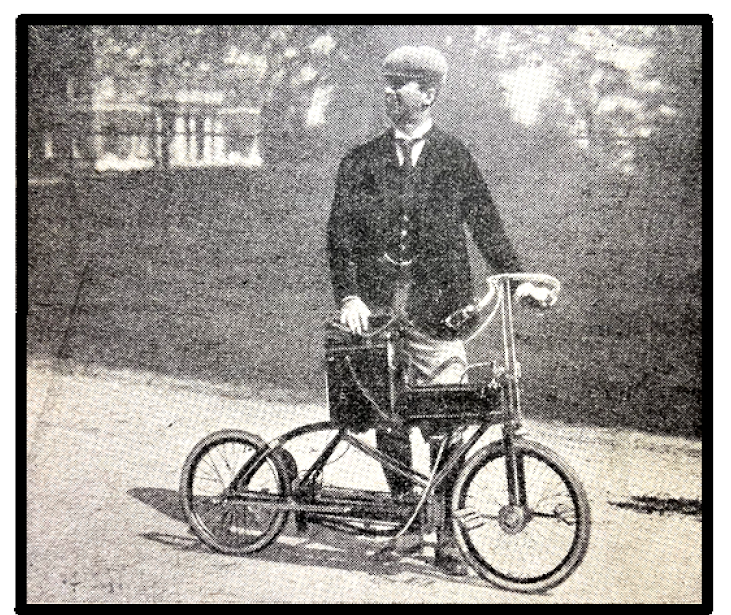
“THE MAKERS OF ROYAL ENFIELD machines have gone to much trouble to produce outstanding models of the sporting type. Two editions of this class of machine which are now in production are the 248cc and 346cc ohv Bullets, both designed to meet the demands of the most fastidious rider. By varying the specification these machines are suitable as fast road mounts or for use in trials, scrambles, grass-track events, and so on. Both models follow the same lines and, from the point, of view of design, are identical. The engines have bores and strokes of 64x77mm (248cc) and 70x90mm (346cc), and are mounted upright in the frames. They are specially tuned and have respective compression ratios of 6.75 to 1 and 6.5 to 1. The ohv rocker gear is enclosed, but not the valve stems and springs. A channel formed in the cylinder casting houses the push-rods; the adjustment is at the base of the cylinder—access is gained by removing a cover held in place by a single finger-nut. Five studs are used for holding down the cylinder instead of the usual four-stud arrangement. Oil is contained in the sump, and circulation is by twin pumps. There is a lead to the rocker gear, but only a small quantity of oil is by-passed to this point, in order to obviate flooding. Greasers are fitted on the ends of the rocker shafts. Excess oil drains to the base of the push-rod channel, so lubricating the tappets, and there is a bypass direct to the timing gear, to which oil is positively fed. Behind the engine is a heavyweight four-speed gear box built on really substantial lines to withstand hard usage. The kick-starter has a folding pedal, and the positive-stop foot control for the gear is incorporated in the box; the pedal has an unusually short travel…The primary chain runs in an oil-bath case. The frame is a sturdy piece of work; a cradle is formed by duplex tubes leading from the front engine lug on the down tube to a point beneath the gear box, where the tubes join up with the chain stays. A Terry saddle is fitted. The 2¾-gallon petrol tank has knee-grips and a panel containing the lighting switch and ammeter. A steering damper is fitted, and the tubular front forks have hand-adjustable shock absorbers. The handlebars are rubber-mounted, and are equipped with long clutch and brake levers. Each machine has a 6½in. front brake and an 8in rear brake—the latter is operated by a pedal on the left aide. Lighting equipment includes a Lucas racing Magdyno set with automatic voltage-control. The head lamp wiring is carried to a four-pin plug mounted on the forks, and from this a short length of harnessed wires runs to the head lamp itself. By pulling out the plug from its socket the lamp may thus be removed easily and quickly, and there are no dangling cables to deal with. An electric horn is mounted at the base of the front down tube…The finish is smart—the chromium-plated tank has a red panel, the head lamp, exhaust pipes and mudguards are chromium-plated, and the crankcase is polished. Upswept or downswept pipes with sports silencers are optional, and there is a choice of narrow or wide mudguards…A vertical bar is fitted on each side of the chain and seat stays, and these form an alternative anchorage for the footrests, or two pairs of footrests may be used if desired…each of these machines is available with an aluminium-bronze cylinder head, megaphone exhaust system, a special racing gear box with heel-and-toe control and no kick-starter, footrests in racing position and a rear mudguard pad. Various gear ratios are available.”
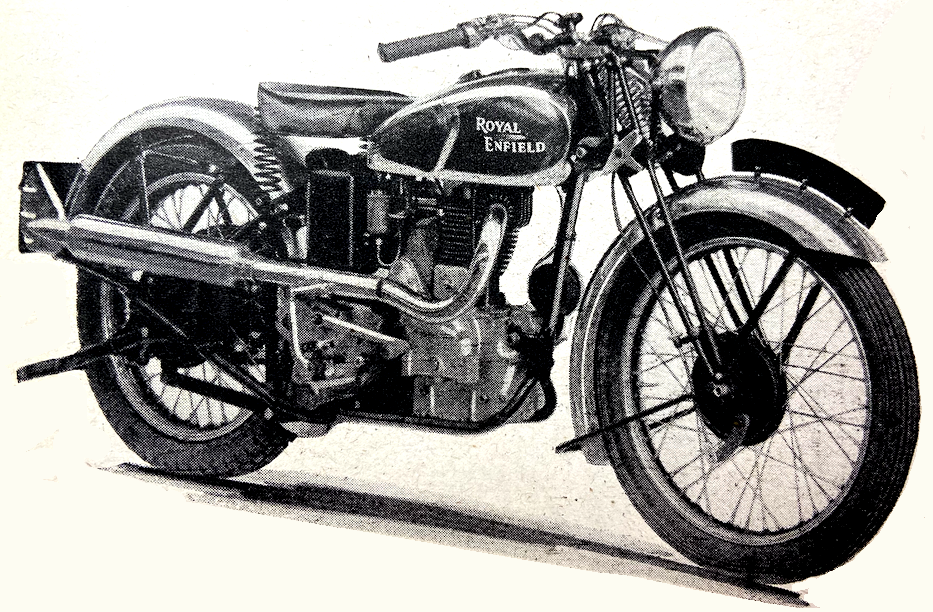
“THE TT NEWS IS EXCITING. Not only is there a new Velocette engine, but from Germany comes the statement that BMWs will be competing—either a singleton in the hands of JM West or a complete team. All three German racing marques have undergone changes. Rear-wheel springing is, of course, to the fore. BMWs appeared with a spring frame in the last International Six Days Trial. Those in the know, said that something similar in the way of springing would be adopted for road racing. The design for road racing is very much after the style of that employed by the German Trophy team last year, and this, as may be recalled, bears a close resemblance to the Norton spring frame. Like BMWs, the makers of the DKW gave their rear-wheel springing a preliminary try-out in the German winter trials. Again the piston or plunger system has been adopted, but in this case there is a pair of chain stays which are pivoted just behind the gear box and are coupled to the spring plungers at a point some three inches in front of the rear spindle. The plunger works in oil, but no form of damping is employed. An important change is the new DKW engine position. In both the 250 and 500cc models the cylinders are now mounted vertically instead of being inclined forward. According to reports from Germany, the weight distribution has been considerably improved, with consequent advantages in cornering and roadholding. At the same time the radiators have been set vertically—which presumably improves the air flow and, therefore, the cooling. Separate engines and gear boxes are now employed on both the 250 and 500cc DKWs. In each case a four-speed box is, of course, employed. The brakes are operated by Bowden cables, and the front brake drums as last year comprise the hub shells. BMWs are using a similar arrangement, and are also employing cable operation. Incidentally, the weight of both makes, it is said, has increased by just over twenty pounds as a result of the rear-wheel springing. While these two famous German machines have gone up in weight, the NSU Company has been busy saving pounds—to be Continental, kilogrammes. A number of parts on the latest racing models are constructed in light alloy. The engine now looks huge, for the whole valve gear, including the hairpin valve springs, is enclosed in the light alloy cylinder head. The method of cooling employed for the valve gear is to flood the parts with oil. For this purpose there are three large-diameter flexible pipes running roughly parallel to the shaft that drives the overhead camshaft and arranged to pass gallons of oil an hour.”
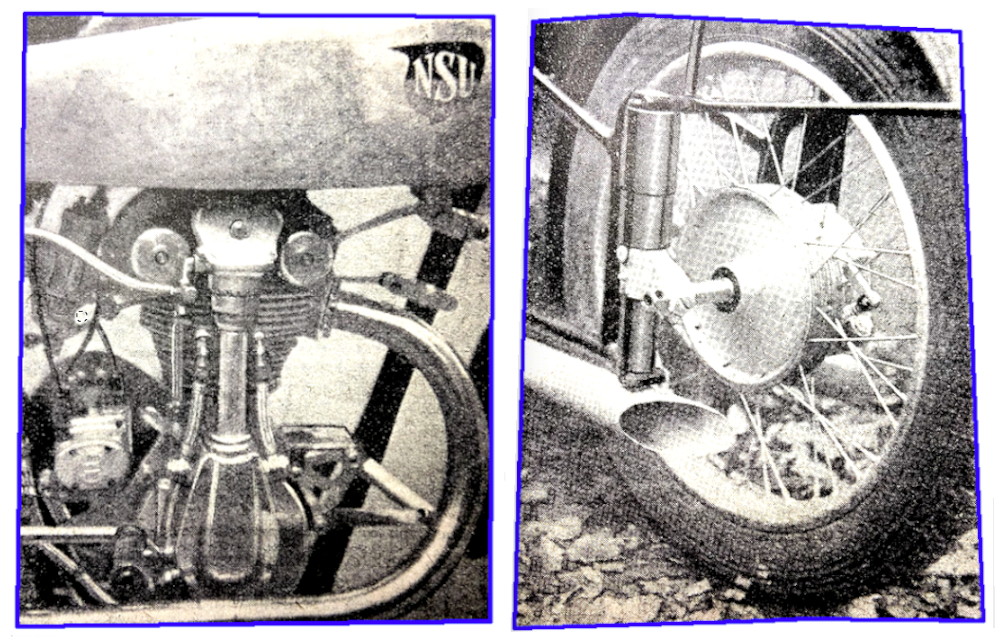

“FERNIHOUGH HAS BROKEN the world’s maximum speed record. As we go to press, a cable has arrived. It records briefly that EC Fernihough has raised the record for the flying kilometre to 169.8mph [and the flying mile to 168.5mph]. Thus Britain once again holds the coveted record for the maximum speed achieved by a motor cycle. A little over a fortnight ago Fernihough slipped quietly across to the Continent. Throughout the winter he had been working on his Brough Superior-JAP, designing, making and fitting a special form of streamlining. On Wednesday of last week he made his first attempt. His machine hurtled down the course at a speed of 175mph, the highest ever officially recorded. He turned round to cover the course in the reverse direction, for the rules demand that the mean of two runs, one in each direction, be taken. With only half a mile to go, and his 1,000cc supercharged JAP engine developing full power, the engine sprocket fixing gave way under the load. He had failed, but it was a glorious failure. Earlier this week he made a further attempt. His speed was lower, but it was sufficient. By a narrow margin he wrested the record from the famous German rider, Ernst Henne (BMW) and at the same time regained the one-mile record and the flying-kilometre and flying-mile sidecar records. We offer our heartiest congratulations to Fernihough, to the manufacturers of his machine and engine—to the whole team behind this magnificent effort…In a single day he has broken four world’s records. With a sidecar he has covered the flying kilometre at 137mph and the flying mile at 135mph. No sooner had he returned [from his previous attempt] than he set about making his Brough Superior faster still. He set about streamlining it. For his records last year he had merely used a cowl over the steeling head and a disc rear wheel. He could have enclosed the whole machine, but he decided to make the Brough Superior a streamlined motor cycle rather than a car on two wheels. He therefore designed the shields so that while he himself would be tucked inside the fairing, he still retained his normal riding position and also had his feet free for starting and stopping…The window in the rounded nose is made of Perspex, such as is used for aeroplanes. The nose does little more than clear the front tyre in a lateral direction. Of steering lock there is next to none, and in order to turn the machine round ready for tackling the kilometre in the reverse direction it is necessary to heave it round or go a little at a time, using the few degrees of lock, first in one direction and then in the other. Having made the streamlining, he found on reaching Gyon, that it was not necessary—the machine was fast enough without, and he did the 175mph without it.”
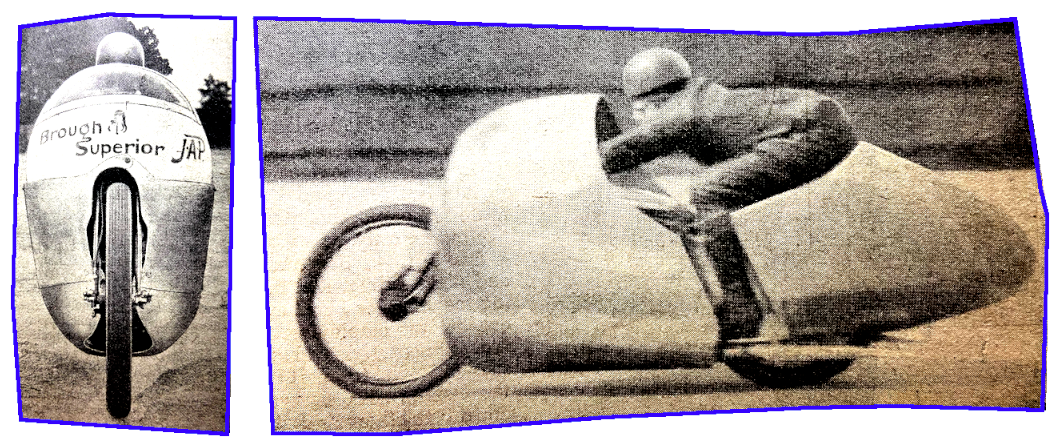
“HAND-SHAKES AND CONGRATULATIONS over, I asked Fernihough whether he realised that he had just, and only just, beaten Henne’s record by the requisite 5/100ths of a second. ‘0-o-o-h!’ came the reply, ‘so that’s what all the bother was about.’ He had never heard that there was any special margin by which a previous short-distance record had to be broken, nor apparently did they know anything of the sort in Hungary. Had he known he would not have gone straight out for the sidecar records after his attempt on the world’s maximum speed record, but would have seen whether he could not put it still higher. What a bitter pill it would have been if he had re-turned to find that the record of records was not broken after all. He had a copy of the ACU rules with him, but not a copy of those issued by the FICM. However, all’s well that ends well—the margin was enough. Before getting down to business—that is, finding out more of the inner history of his great achievement—I said, ‘How do you pronounce Fernihough?’ The answer is that the latter half does not rhyme with ‘cough’ or ‘how’, but ‘ho!’ His name is ‘Ferni-ho’! Last week we related how, when making his first attempt, he did 175mph one way, and when he was going like smoke in the opposite direction his engine sprocket key sheared. This occurred when he was right up to his maximum and the record seemed almost in his pocket—in fact, just a case of going out to Gyon, in Hungary, zipping-one way, zipping the other, and returning the world’s fastest motorcyclist! The interesting point is not that the key sheared, but that this occurred when he was up to his maximum; in other words, it was not acceleration that caused the trouble, but the pulling power of the mighty supercharged JAP engine. In order to get to Hungary in time for making an attempt on Monday, the 12th, Fernihough drove his van 695 miles in 36 hours with only stops for meals. He arrived, however, to find that the road could not be made available for the Monday. He could use it the following day if he liked. Fernihough did not like—it was the 13th of the month and he is superstitious; he came off at over 100mph on the 13th when competing in the 1934 Calais Grand Prix. No, he would not have the road on the 13th at any price, and, as of course would happen, the conditions that day were just about ideal for record attempts, much better than on any of the other days he was there. The Hungarian Club, ever helpful, said that, while he could not use the Gyon road on the Monday, they would get hold of another piece of road so that he could practise. They were as good as their word, but, unfortunately, it rained, so Fernihough did merely a burst of speed up to about 150mph. On the Wednesday he achieved his 175 mph, but as this was only in one direction—his sprocket key shearing when tackling the other—the run counted for nothing. His bad luck was not quite over for that day, although he managed to beat his own standing-mile record, using his spare machine. On this, no sooner had he changed into second gear than all the teeth on the second-gear pinion sheared off.
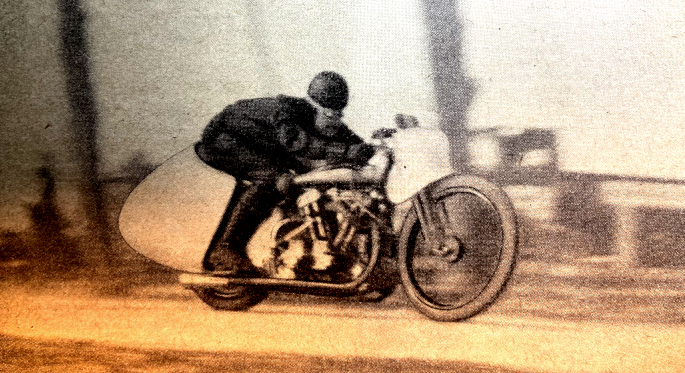
However, his ten-year-old box still had third and top in addition to bottom, and with only three out of the four gears in operation he got the record. The Friday came. There was wind—far too much for record attempts. The long day through, Fernihough waited. Just at sunset he had a run. According to eye-witnesses the sight was one never to be forgotten. As the spectators watched, the projectile that was Ferni and the Brough hove into sight, grew to life-size in what seemed a fraction of a second and was past almost too quickly for one to turn one’s head. He was travelling, westward—straight towards the setting sun. The machine and he were a black atom, growing ever smaller as seemingly they dived into the inferno of the setting sun. All this to the tune of the raucous war-cry of the big supercharged JAP engine on full throttle. Can it be wondered that the little crowd of spectators was thrilled? The engine, however, was misfiring. Fernihough missed the record by about a tenth of a second. The Bosch Company, with true sportsmanship, once again came to Ferni’s aid. They tested the magnetos, but found nothing wrong. Fernihough, however, decided to put on the spare magnetos off his other machine. Hey presto! the misfiring disappeared. April 19th came, and again he had to wait all day. The wind made it next to impossible to attempt the record, but Femihough is superstitious, as I have mentioned before. He was certain that he would get the record, for he found a horse-shoe in the road! The wind was bad. It was blowing across the Gyon road. He had a practice run in the morning. His goggles squashed against his eyeballs even as they did last year. He slowed down; all he could see was a blurred white and green—the white of the road and the green of the roadside—nothing was clear. Fifty yards of white and green was about the sum total. He stopped safely, but it was one of the worst experiences he has ever had. The wind pressure had been colossal; there was a 35kph wind, and he was doing 175mph. He was getting the wind pressure of some 200mph. The question was how to deflect the blast of air that was causing the trouble. In his van he found an old competition number—it did the trick! Although he was not employing the full streamlining he was using the tail, as you will see from the photograph. The gusty side wind was catching the tail, blowing it sideways. The Brough Superior held its steering perfectly, but the sight was such that he was begged not to make his attempt. The wind continued gusty, but, as all know, he achieved his ambition of regaining the world’s maximum speed record. His two runs over, the little party set about fitting the Noxal sidecar. In roughly an hour everything was done—gear ratio changed, sidecar fitted, tail removed, and the rest of it. Two men formed the ‘little party’. One was RC Rowland, who in
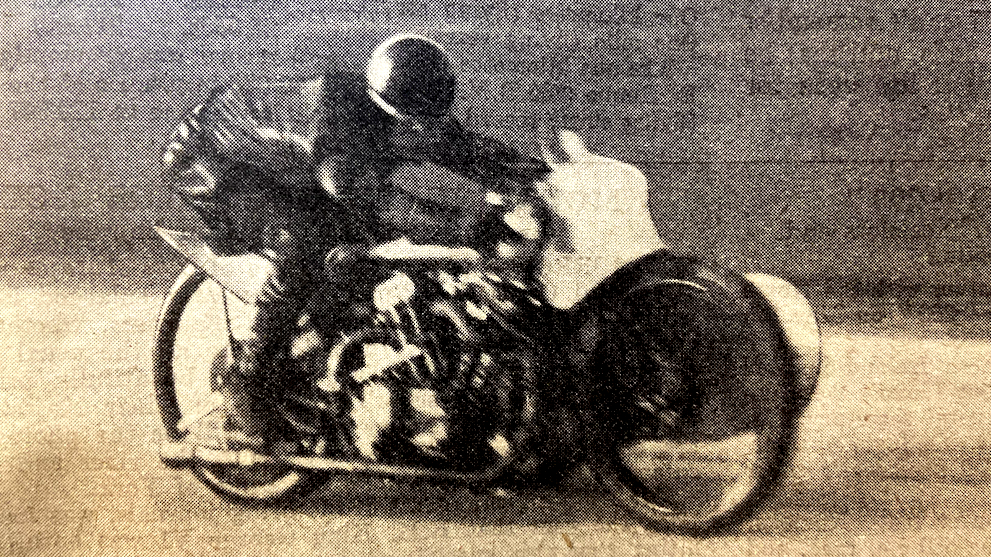
normal life is Fernihough’s rival, for he keeps a garage at Byfleet, a mile.away from Fernihough. On this record-breaking trip, however, he has been Ferni’s aide de camp and invaluable friend. The other member was Coleby. ‘Is his Christian name Peter?’ I asked. ‘Why?’ came the reply. ‘Only that the name Peter Coleby is familiar’ I answered. ‘I can’t remember why, but you say what an enthusiast he is, and that he is only 19. I rather think it is he that has been for many years a persistent correspondent.’ Whatever it is that brings Coleby’s name to mind he is a wonderful enthusiast. Night and day he laboured as Fernihough’s mechanic on the preparation of the machine. He helped to make the streamlining and he went out to Hungary as Ferni’s mechanic—his first trip abroad, incidentally. For three years he tried to get Ferni to take him on, applying at least twice a year. Now he has achieved his ambition, and, what is more, he has been on the trip on which Ferni has broken the world’s maximum speed record. It was the sidecar record, however, that provided the most excitement. Fernihough had not driven a sidecar since the Brighton Speed Trials last year. He set forth—ballast in the sidecar! The wind caught the sidecar. The outfit went sideways, straightened, went sideways again…Hectic was the word. The rev counter was showing the equivalent of 147mph. At the far end the sidecar wheel nearly collected the stake of the timing apparatus. Ferni thought it had, and wondered whether it was any good making the return run. The stake was still there, and he had achieved the colossal sidecar speed of 143½mph. He was slower in the opposite direction, but hardly less hectic. And Ferni says, ‘It was real good fun—leaping, but there was the third wheel. There’s nothing quite like a fast sidecar.’ Thus the story would seem to end, but not quite. Among the most treasured souvenirs which Ferni has returned with is a telegram of congratulations. It is from Ernst Henne, the man whom he was out to beat, and must have been sent the very instant that Henne heard the news. Finally, there was the wonderful reception Fernihough had on his way through Germany back to England—sportsmen all. Solo maximum speed records: 1km (flying start), 13.17sec/169.786mph; one mile (flying start), 21.38 sec/168.381mph; one mile (standing start), 32.87sec, 109.522mph. The 1km (flying start) record was previously held by E Henne (supercharged 495cc BMW) at 169.016mph. Fernihough (Brough Superior-JAP) himself held the mile, flying and standing starts, at 163.822mph and 109.254mph respectively. Sidecar maximum speed records: 1km (flying start), 16.315sec, 137.109mph; one mile (flying start), 26.635sec, 135.160mph. The 1km (flying start) record was previously E. Henne (736cc BMW sc) at 129.079mph; and the one mile (flying start) record was also held by Henne at 128.847mph.”—Torrens
ERNST HENNE MIGHT WELL have been a real sportsman, but he wasn’t going to leave the record in British hands if he could help it. Piero Taruffi had done 170.37mph on the streamlined blown dohc Rondine/Gilera but the FICM rules demanded an improvement of at least 0.5mph to set a new record. Henne settled the resulting row by setting a new kilometre record of 173.67mph on the blown 500 BMW—for good measure he also set new 500, 750 and 1,000cc flying-start records at one mile, five miles and 5km. At which point Herr Henne retired with 76 land speed world records under his belt (ok, more accurately, shaft); having increased his speed annually from 1929 to 1937. His record would stand for 14 years. “Running at top speed,’ Henne remarked, ‘the road feels as narrow as a board. The trees on the sides of the road give the impression of ‘closing in’ on me, as if I were projected into a tunnel.”

“THE FOLLOWING IS A LETTER that the Editor has received from the Bayerische Moteren Werke (BMW) of Munich, the famous German motor cycle manufacturers: ‘In the last issue of your paper, The Motor Cycle, always so full of interest, we were very pleased to find a report on the latest world’s record attempts of Ernst Henne, near Frankfort o/M, conveying also congratulations to Mr Henne and to our company as manufacturers of the record machine. We sincerely thank you for your good wishes, and do so also on behalf of Mr Henne. In view of the fact that the world’s maximum speed record was last held by a British rider, we have been particularly gratified at receiving congratulations from that side, all the more as both our countries are closely united by a spirit of real sportsmanship.'”
WHILE THE WORLD’S FASTEST record has recently been beaten by Henne, the Brough, as it happens, has still attained the highest one-way speed—with a time of 12.80sec. This is without full streamlining. The natural question is: ‘What is going to happen next?’ The answer is that Fernihough is determined to regain the record—provided that (to use his own words) it is possible for an ordinary bicycle to get it. If it is a question of aerodynamics on two wheels it is, he says, beyond his resources, and he considers that development on these lines will do nothing to help motor cycle design. He adds that he will not use the semi-body he made last winter; his machine will be a practical motor cycle, one capable of lapping that twisty circuit, the Crystal Palace road course, even as the Brough did earlier this year.”
“A ‘DREAM’ MACHINE? Yes, you are right, but it is a dream which a little band of enthusiasts has made come true. This motor cycle has been designed by an amateur and built by amateurs, and the facilities available are no greater than many other enthusiasts could muster if they, too, clubbed together. There is a history to the ‘Mercury’ even as there may well be a future. The motor cycle illustrated is the first of five which are at present under construction. It has now completed about 1,000 miles. The germ of the idea came from a tour of Scotland some six or seven years ago. Those were days when the roads in the Highlands were often no more than vile pot-holed tracks littered with loose stone. The yearning was for motor cycles providing greater comfort and easier control, but without any sacrifice in speed and performance. The one responsible for the design was Mr L Jenks. By sticking at it the little band of enthusiasts both a machine with a tubular frame in approximately 12 months. It has now been on the go for four years and with the fruits of this knowledge the remarkable machine shown in the photographs has been evolved. Four have been mainly concerned in its manufacture. Working in their spare time they have in 18 months from the date when the castings were ordered made one machine and built the frames for the four others—this in a normal-sized garage with as their equipment a 3in. Tyzack lathe, a pillar drill, a power grinder and welding equipment. Now look at the machine that has resulted. It is a masterpiece—there is no other word for it, and much of the design is ingenuity itself. Comfort and controllability comprise the main aim. Hence special pains have been taken to keep the unsprung weight of both the front and rear wheels to a minimum. In the case of the rear-wheels springing little more than the wheel assembly itself is unsprung, while at the front a development of the OEC duplex steering is employed.
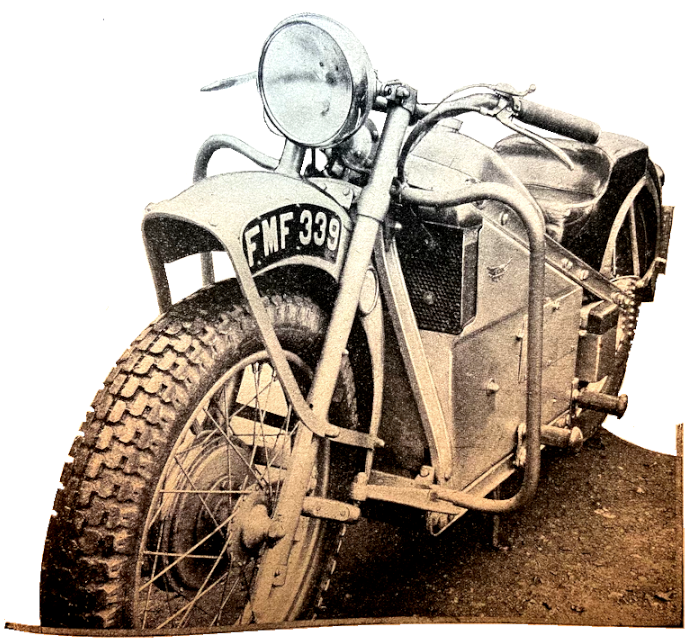
The first thing that strikes the eye, however, is the clever duplex frame. The members are of a special I-section Duralumin made by Vickers. The flanges of the I-section are ⁵⁄₁₆in thick, the web, ¼in., and the overall dimensions, 1⅞x⅞in. These members were heated and bent to the required shape and then bolted tongue-and-groove system to the special Y-alloy lugs. The head lug is of box section and incorporates at the front end a socket for the 2in diameter ball that is attached to the top of the front fork members and carries all the weight. The ball-and-socket joint—or, steering head, as it really is—is lined with white metal and designed so that it can be easily adjusted should any wear occur. The actual fork members are of steel tubing and the spring plungers to which the front wheel spindle is attached slide in white-metal-lined guides. At the rear of the forks and attached to the front of the frame is the U-shaped member which with the short links complete the duplex steering. Bronze has been employed for the lug anchoring the lower end of the front forks and also for the sprung members that act as the mounting for the rear wheel. In this latter case the spring boxes are carried parallel to the upper frame members and the movement of the wheel is controlled by slots at the rear end of the frame. The slots are designed so that for all practical purposes the rear-wheel spindle is at a constant radius relative to the gear box. Roller bearings are provided as intermediaries between the slots and the pivot members that carry the rear spindle, and in order to ensure lateral rigidity the latter is 1½in in diameter and keyed to the fork ends. Both the front and rear springing have a total movement of five inches. No special damping devices are employed, since in practice none has been found necessary. That the machine should be comfortable with such a large range of movement per wheel goes without saying. The designer; however, has also gone in for large tyres—4in section John Bull ‘Deep Grip’ front and rear—and a combined saddle and pillion seat that ensures that both rider and passenger revel in the lap of luxury. The seat is formed in ‘Dunlopillo’, mounted on a light framework and covered in leather cloth. Separate foot-rests are provided far both rider and passenger. The wheels are special, too. They have aluminium bronze hub shells—to which are bolted 8in diameter brake drums—journal ball races and massive-looking spokes. Welded steel is employed for the tank. This has a capacity of just under five gallons (long-distance, high-speed touring is the idea); it incorporates a tool box and a special oil compartment for lubricating the chains. The tank is rubber-mounted and fitted with a special ‘snap’ filler cap. Indeed there are few things on the machine which aren’t special! While the frames are able to accommodate almost any type of engine, up to the present Scotts have been employed. These in the 596cc size, slightly tuned and fitted with a modified lubrication system using petroil as the medium, are stated to provide over 90mph. Actually the line of action has been to buy Scott machines second-hand and recondition and tune the engines. The result is that the present models are coming out at about £100 complete, including charging up the time involved.
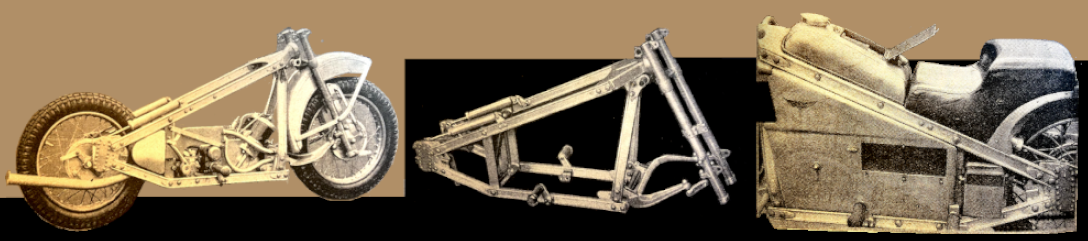
Even in the engine and gear box mounting there is considerable ingenuity. Everything is accessible and the Magdyno and gear box are on a platform with the former gear-driven from a pinion encircling the clutch housing. This driving pinion instead of being cut from the solid is made of steel strip! For the sideshields Duralumin sheet is employed. Stiffness is provided by setting up the edges at right angles. Each shield is held in place by two wing nuts arranged to ‘click’ every half turn and thus be prevented from working loose. There is a special ‘wing nut’ which turns on the petrol tap and alongside it, a little projection for flooding the carburettor. On the near side, as will be seen, a compartment is provided to act as a locker for a pair of waders or personal oddments. There are also such things as an exhaust system that has no baffles yet secures a high degree of silence, a low-lift stand, an accessible yet neat battery carrier, a detachable rear mudguard and safety bars designed to save machine and rider in the event of a spill and to buckle before they could conceivably bend the frame. No, the machines are not yet on the market, but they may be built to order in the near future. Whatever the future may hold I give the little band of enthusiasts absolutely full marks, and so will everyone else who sees inside their little workshop and/or examines their production.”—Torrens
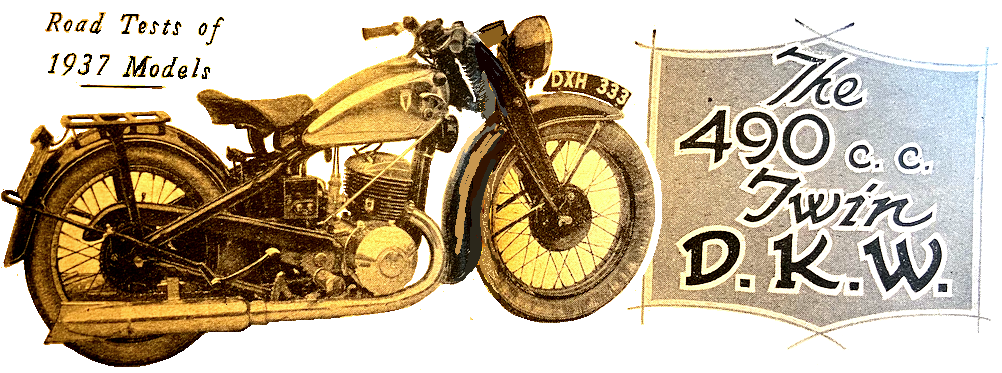
“OVER A PERIOD of years the Auto-Union factory in Germany has built up an enviable reputation with its diminutive DKW two-stroke motor cycles. Although the name DKW is an abbreviation of Das Kleine Wunder (The Little Marvel), it is still applied to the larger machines which in more recent times have become famous m motor cycle sport. At first glance the latest 490cc DKW is similar in design to accepted modern British practice, but there are many interesting and novel features which are only to be found on close inspection. It has a side-by-side twin cylinder two-stroke engine, inclined slightly forward in a sturdy duplex cradle frame that appears to be tubular, but is in actual fact of bolted, pressed-steel-construction. The engine has flat-topped pistons and is built in unit with a three-speed gear box, the primary drive being by gears. An interesting and unusual feature is the fitting of an electrical self-starter. The riding position is very comfortable. A luxurious saddle with a wide range of movement is fitted, and this has a butterfly nut whereby the saddle can be adjusted to .suit riders of widely differing weight. The correlation of the handlebars and the footrests is excellent, but the range of movement of the latter is rather dependent on the position of the heel rear brake, which is not adjustable. When the machine was taken over for testing the battery was so run down that leads from another battery were necessary before the engine could be started by the kick-starter. After a journey of only 80 miles the self-starter was capable of starting the engine from cold. The battery was then properly recharged, and from then onwards the kick-starter was ignored. The self-starter is actually a flywheel dynamotor, and when the. starter button is pressed the engine immediately begins to turn over as if by magic, and invariably fires after two or three revolutions. A separate switchbox is mounted on the off-side of the battery. The switch key has five positions controlling the lights and ignition. In one position the parking lights may be left on, but without the ignition or horn. The engine would settle down to a surprisingly good tick-over. The clutch was a trifle heavy, although very smooth, in operation. The handlebar lever is coupled with a pedal which, after very little practice, can be used with every confidence. Silent gear changes could be made provided the necessary care was taken. The choice of the gear ratios left nothing to be desired. A wide range of speed was obtainable in both the indirect ratios, and the acceleration was outstanding. The engine possesses the most extraordinary flexibility which, combined with its silence and lack of vibration, made riding in traffic a pleasure. In top gear it could be throttled down and made to pull evenly and smoothly at 8mph, and its acceleration from this slow speed was surprisingly good. Second-gear starts could be made with the greatest of ease, and in this ratio the machine would accelerate straight away to over 60mph. The liveliness and flexibility of the engine are all the more creditable when it is borne in mind that the ignition setting is fixed. On light throttle at 30mph the engine would two-stroke perfectly, but at slower speeds on light throttle it showed a tendency to four-stroke on one cylinder. At low speeds a slight whine could be heard from the geared primary drive, but at over 40mph the noise disappeared. For a two-stroke engine the exhaust was outstandingly quiet. There was less noise than is the case with most

cars. The twin exhaust pipes are linked by a connecting pipe just in front of the rear wheel. Although the engine was extremely docile, it had many sporting characteristics. Mile after mile could be covered at speeds of 60-65mph without any trace of overheating. The mean speed of four timed runs in both directions over a quarter-mile was 70.2mph in top gear. The best timed speed obtained in one direction was close on 74mph. Incidentally, at these speeds the speedometer was a trifle optimistic. While the DKW makes no pretence to be a sports model, its acceleration brings it into line with the best. In spite of its weight—428lb in full touring trim—the handling of the DKW at all speeds was beyond reproach. At low speeds the steering was light and positive, and at high speeds it gave an impression of being damped to just the right extent. Cornering was all that it should be—in fact, it was somewhat of a revelation that such a heavy machine could be swung round bends in the manner of a light racing 500. The road-holding was excellent, and this, coupled with the large movement of the saddle springs, made it difficult for the rider to realise that the rear wheel was not sprung. Over mud and grease with standard road-treaded tyres the steering was surprisingly good. At a maintained 40mph the petrol consumption amounted to 80.75mpg. The oil was mixed in the ratio of 16 to 1 with a No 1 fuel. On this mixture it was almost impossible to make the engine pink, even up a steep hill on a wide throttle opening in top gear. The detail work of the DKW has obviously received the closest attention. The mudguarding is such that after many miles in rain and over mud practically the whole engine unit and most of the machine were free from dirt. Throughout the test the engine remained perfectly oiltight.”
“THE MOTOR CYCLE, regrets to record the death of Mr William Douglas, the founder of the famous motor cycle firm that bore his name. Mr Douglas, who had been in poor health for some years, died at his home in Bristol last Thursday at the age of 77. The career of the ‘Old Man’, as he was affectionately known to many, was almost romantic. With hardly any capital—said to be £10 which he borrowed—he started a small engineering workshop and specialised in bootmaking machinery. His métier, however, proved to be the manufacture of motor cycles. A little over 30 years ago he became interested in the Fee (later known as the Fairy) lightweight motor cycle designed by Mr J Barter. This was a horizontally-opposed twin the drive of which was by means of a round, twisted belt. The engine was in line with the frame just as is the case with the Douglas of to-day. Mr Douglas persevered with the design and in 1907 produced an improved edition called the Douglas. Success immediately followed and in a mere seven years the machine became so famous that in 1914, when war broke out, Mr Douglas, with his now large factory at Kingswood, Bristol, was called upon to manufacture motor cycles for active service. It is reputed that 50,000 WD Douglases were supplied. We tender our deep sympathy to his daughter, Mrs Jefferies; his wife and three sons, John, William and Percy, all died before him. Mr. Douglas’ death severs an important link with the early history of the motor cycle; his name ranks high with those pioneers who have been responsible for the motor cycle’s success.”
EVERY VEHICLE registered after 1 January 1937 was required to be fitted with a speedometer able to “indicate to the driver within a margin of accuracy of plus or minus 10%, when he is exceeding 30mph”. And they had to be fitted “in such position as at all times readily to indicate”. The Blue ‘Un noted: “This may not affect the different types of mounting at present employed on motor cycles, but it will mean that new machines registered on and after October 1st will have to have their speed indicators illuminated at night. Perhaps this will hurry on the day when we have speedometers mounted at an angle in the rear of the head lamp in accordance with the scheme already adopted on certain Continental machines. In these cases the speedometer head is as a rule both small and light, and, therefore, has comparatively little effect upon the total unsprung weight.”
“THERE is a slight, but not unimportant, difference in the silencer regulation. Instead of the law saying that the noise must be reduced ‘as far as may be reasonably practicable’, it reads ‘as far as may be reasonable’—which is a distinction with probably a big difference when it comes to a court case. Other points are: No bells, gongs, or sirens are allowed as warning signals; no avoidable smoke may be emitted; motor cycles must have mudguards that ‘catch so far as practicable mud or water thrown up by the rotation of the wheels’ (this could be construed as the death warrant of the sports-type guard!); motor cycle brakes mast be sufficient ‘under the most adverse conditions to bring the vehicle to rest within a reasonable distance’ (Query : What is reasonable on wet ice?); it is an offence to cause any unnecessary obstruction through parking on a road; no motor cycle may draw a trailer wider than 5ft or heavier than 5cwt unladen. This last point may seem to affect only those who use trailer caravans, but bear it in mind if you want to tow a broken-down vehicle.”
“LONG LETTER FROM Len Duckworth, once of Manchester, now of Toronto. Len describes a relationship with mobiles rather different from that which obtains at home. He and some pals got pinched for doing 73, and were promptly led to the local judge—a butcher in private life—and deprived of three dollars apiece. But as a sympathetic rake-off, the day being fine and the roads Moderately clear, the cop said, “Now you lads, follow me, and there’ll Ire no pinching.” He then trod on the gas of his Harley and, with siren screaming, gave them a few miles up to 80! Len almost persuades me to emigrate. That experience would be well worth 15s.”—Ixion
I OFTEN have letters from lads whose parents are sticky about their buying a motor cycle, but never before, unless memory betrays me, have I had one from a lad whose fairy is the obstacle. She says: ‘What about me? I can’t wear anything nice,’ and ‘How about if it rains in torrents after a fine morning has suggested a sunny day? ” Well, well! I could spill a bibful. Having curbed my natural ferocity I now proceed to coo at my correspondent. In your future love nest somebody is going to wear the trousers—and that somebody ought to be you. This matter is far more serious than you perceive. You won’t solve the real issue by surrendering and murmuring: ‘Very well, darling, we’ll have a baby car,’ for the next phase will be that you’ll want a Mortin Eight and she’ll want an Ausger Seven (forgive my Ann Temple* treatment of this emergency). There are other possibilities. One is that you are not enough of a he-man to be worthy of our noble order, and that a glass box on wheels will suit you better, but even then you should never have let matters come to a pitched battle with you ear-marked as the loser. It may be that she is such a ‘wow’ (as I believe infatuated Americans in moments of extreme collapse call their girls); that she is worth any sacrifice; but even then you should never let her know what a value you place on her. Finally, assuming that you are the right breed to make a good motor cyclist, and that she is a green-house plant, it is obvious that the pair of you can never establish that camaraderie, etc. In other words, get the ring back.”—Ixion
* Ixion was right on the ball. In 1936 the Daily Mail launched “Ann Temple and the Human Casebook. Through its intimate service, the Human Casebook is intended to bring success and happiness to all readers with personal problems and troubles, great or small, real or imaginary. Cases of the most general interest will be dealt with daily, the necessary anonymity being employed…” It was the first ‘agony aunt’ column.—Ed.
“I WAS VERY INTERESTED in Ixion’s comments under the 1 heading of ‘Convincing the Fairy’. I think that she most definitely does not want to wear the trousers, she wants to wear pretty frocks and be really feminine. And why a car as the only alternative? Why not a sidecar outfit and let both be happy ? I rode pillion for three years and loved every minute of the riding, but it wasn’t much fun to arrive at the sea in leather coat and crumpled frock, or breeches and woollen hose, and see everybody but yourself looking dainty. So, when we got married the machine got married, too, and both have had two happy years running in harmony. Let it be whispered, ‘hubby’ rather likes parking his waders and leather coat in the sidecar and helping to get motor cyclists a good name for looking neat and well dressed, even after a long day’s run.
Freda T Hancock, Stretford.”
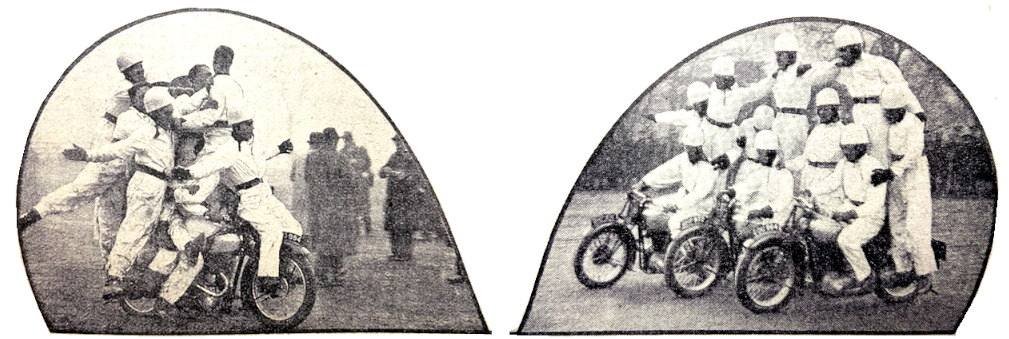
“LAST THURSDAY EVENING a small number of people who had assembled outside the Cyc-Auto works at Park Royal, London, were privileged to see the successful finish of a run from Land’s End to London on a 98cc Villiers-engined Cyc-Auto. At 8.15am that morning the rider, Mr HA Atkins, wearing no more than a scarf and mackintosh over his plus-fours suit, had set off from the Land’s End Hotel. Twelve and a half hours later, looking as fresh as the proverbial daisy, he was sitting inside the Cyc-Auto works, waiting to go on to a dance that same night! His average speed, including all stops, was the extremely creditable one of 24.16mph for the 302 miles. Throughout the journey, the little Cyc-Auto—a standard 1937 model—was under the official scrutiny of Mr EB Ware, of the Auto Cycle Union. His records show that only two involuntary stops were made, one to attend to a loose chain-guard and the other to remove a bee’s sting from Mr. Atkins’ chin! For the whole of the journey the tiny Villiers engine ran like clockwork, seemingly going better and better as the miles were piled up. Practically no pedalling was required, in spite of the many steep gradients encountered in the West Country—even on this part of the run the CycAuto was averaging between 22 and 25mph. Exeter was reached by 1pm, and Yeovil at 3.30pm. From Salisbury onwards a steady 35mph was maintained, and between 7.15pm and 8.15pm the greatest distance was covered in the hour—29 miles. Except for a few spots of mud on the mudguards the Cyc-Auto completed the run with its showroom finish undimmed. The engine was entirely free from oil leaks and there were no signs of oil spray from the carburettor. As soon as the machine had been checked in a member of The Motor Cycle staff was allowed to have a short run on it. The engine ran so evenly that turns could be made in the road without pedalling or altering the throttle setting. But the most surprising feature of all was the machine’s acceleration, which was as good as that of many machines of twice its size. Another noteworthy point was the almost complete absence of vibration. It was difficult to believe that this little machine had made the long, tiring journey from Land’s End to London at an average speed of over 24mph, and that the consumption of petrol had been at the extremely economical rate of 120mpg. A very commendable all-round performance.”
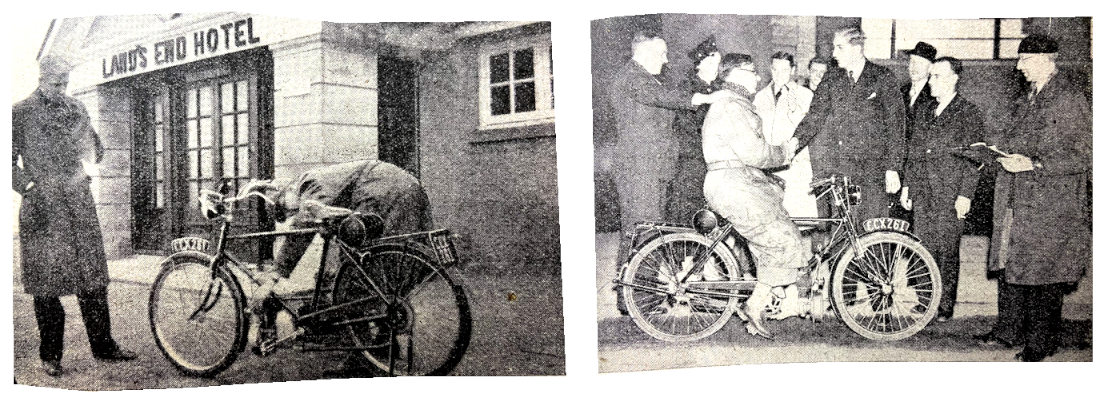
“A NEW ROAD-RACING circuit is being constructed at Bathurst, NSW, Australia.”
“A MOTORIST DRIVING along at Merton (Surrey) fell out of his own car! He was injured; the car careered on and over-turned.”
“MOTORIST AT HIGHGATE: ‘The constable said he would report me for allowing gas to escape from my exhaust. He tapped the exhaust pipe and out came three carbon copies.'”
“CLEM BECKETT, A speedway star at White City, Manchester, in the early days of the sport, was killed while fighting for the Government forces in Spain.”
“MR HORE-BELISHA recently revealed that road works costing £72,00O,000 have been approved by the Ministry.”
The Arbuthnot Trophy Trial, set up for serving officers in the Royal Navy, was finally opened to ‘other ranks’.
“IT IS ESTIMATED that over £75,000,000 will be paid by motorists in 1937 in direct taxation, fuel tax and driving licence fees.”
The Law Society took action against lawyers who were using ‘touts’ to contact road accident victims.
Some 75% of British bikes were supplied with four-speed transmission, up from 50% in 1935. In the same period footchange usage rose from 24 to 65%. Nearly 10% were unit construction and 1.3% featured gear primary drive.
“AN ITALIAN CLAIMS to have discovered a plant in tropical Africa from which motor spirit may be produced.”
“THERE WERE approximately 26,000,000 motor vehicles registered in the United States last year.”
‘THE SOUTH AFRICAN JUNIOR TT was won by A Reeve (348cc Norton) at an average speed of 77.99mph. HG Welsh (Norton), a rider taking part in his first TT, was second, and A. Hertenshaw (Norton) was third. Retirements were heavy, only four finishing out of eleven starters. In the Senior TT, run in the afternoon, Don Hall (490cc Norton) made amends for his failure in the morning’s Junior race by winning at record speed and putting up a lap record which clipped 13sec off the old record set up by J Galway last year.”

“MORE ABOUT USA COPS: (1) Their radio (when fitted) has a 200-mile range. (2) They carry two guns. One to start business with, and the other to carry on when No 1 is empty. (4) They do 90 per, reduced to 80 per plus windscreen in cold weather. (4) They don’t bother to do their 90 per after a. mere speedster, but phone to another cop farther up the road who then stops the said speedster. The 90 per is re-served for bandits, Public Enemies (Nos I to X), and so forth. (5) They get a new bus every year (oh, boy!). No, they haven’t told me what happens to the old buses!”—Ixion
“A PARTICULARLY NEAT 200cc ohv machine has recently, been added to the BMW range. In general design it closely follows the larger models in that it has unit construction, shaft drive and telescopic front forks. The Model R20, as it is termed, has a duplex cradle frame of tubular construction, and its combination of welded and bolted joints is said to ensure great rigidity. The single-cylinder engine has a capacity of 190cc (60x68mm) and is fitted with an aluminium head. Total enclosure is employed for the valves, rockers and push-rods. The camshaft is chain driven. Ignition is by coil, the dynamo being housed in front of the engine and driven directly from the mainshaft. A constant-mesh type three-speed gear with foot control is employed, and this-works in conjunction with a single-plate dry clutch. Special features include an Amal carburettor with an air cleaner, knock-out spindles to both wheels, and a speedometer mounted in the rear of the head lamp. Fully equipped the machine weighs 2361b, and a speed of 50mph is claimed.”
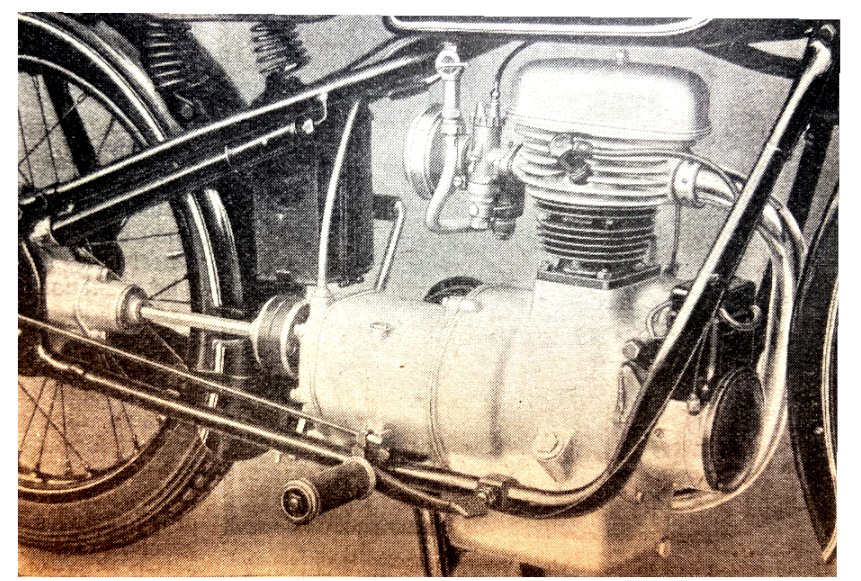
“LAST WEEK I WENT to the opening ceremony at each of two new road-racing courses. Methinks the Brooklands course will be considerably faster than the slightly shorter Crystal Palace circuit. This is fairly obvious, for the former includes quite a large slice of the outer circuit. The Palace, although slower, is likely to be more spectacular with its many twists and turns, no two of which seem alike. It seems to me that the Palace course will probably suit motor cycle racing better than car racing. Those motor cyclists I spoke to at the Palace were highly enthusiastic, and more than one was audacious enoughto suggest that the motor cycles will probably be faster than the cars. Both courses will provide magnificent racing.”
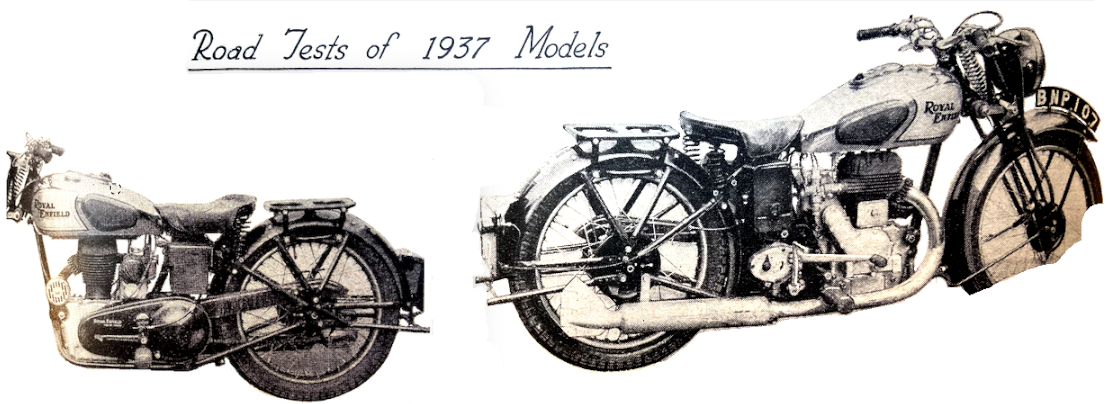
“SIDE-VALVE ENGINES HAVE always been noted for their sweet running and smooth delivery of power. Even for a side-valve, however, the 346cc de luxe Royal Enfield submitted for test is exceptional. It is a most attractive machine with an exceedingly comfortable and natural riding position. All the controls are readily accessible and work with a precision that is usually only to be found on expensive mounts. The gearing of the kick-starter is just as it should he, calling for a minimum of effort. Idling was very good indeed, and even at these low engine speeds the mechanical silence was most praiseworthy. The mechanical silence of the engine was admirable throughout its speed range, and at the same time the exhaust note was well subdued. The steering and handling of the Royal Enfield were such that it was difficult to realise that the machine was not a 250. Despite the fact that no steering damper is fitted the handling at high speeds was beyond reproach, although over certain surfaces the tail be-came a trifle lively. Because of its light handling the Royal Enfield could be swung round bends with every confidence, while greasy surfaces could be almost ignored. No doubt the efficiency and smoothness of the brakes played a big part in inspiring such confidence. Both back and front brakes are light in action, but possibly the front brake could have been a trifle more powerful. On the open road the engine appeared to be perfectly happy cruising along at any speed up to 55mph. It was practically vibrationless except for a slight period at 50mph. Most main road gradients could be taken at 40mph. In traffic the flexibility and docility of the engine proved a boon. The gear ratios are extremely well chosen, and the foot gear-change calls for high praise. The pedal has a very short travel, and the lightest touch is all that is necessary to select a gear. The gear box itself is so quiet that it cannot be heard from the saddle—no matter what gear is engaged. In low gear the maximum speed was 28mph, while in second a speed of 41mph was reached. In third gear 50mph was attained, a speed which gives a good indication of the Royal Enfield’s sporting qualities. The mean speed of four runs in both directions over a measured quarter-mile in top gear was 60mph, the best run being accomplished at 62mph. Acceleration figures in the various gears from 15mph to 30mph were good, too. Over a quarter-mile the best speed attained from a standing start was slightly in excess of 50mph. Up to this speed this side-valve could hold its own with most standard machines on the road. In spite of its lively performance, the engine could be throttled down to the surprisingly low speed of 8mph in top gear—and it mattered not whether the ignition was advanced or retarded. It could be accelerated from this speed provided the throttle was opened gradually until 15mph was attained, when the surge of power was delightfully smooth. Such tractability is, of course, one of the main charms of a side-valve engine. But in the case of the Royal Enfield it is to be found at its best. The smooth pulling at low speeds in top gear came most unexpectedly from a single-cylinder four-stroke, even though it be a side-valve. It enabled the rider to enjoy traffic work in a manner which is usually associated only with multis. As a general rule it was unnecessary to change down into third gear when rounding corners. But when a quick getaway was desired, then the Royal Enfield could deliver the goods, provided third gear was used. It can truthfully be said that the 350cc side-valve Royal Enfield does its job in the quietest and most unobtrusive manner possible. A part of the test included riding over wet roads and slippery by-lanes, and this was sufficient to prove that the mudguarding is thoroughly efficient. Very few mud splashes appeared on the machine, while the rider’s legs were
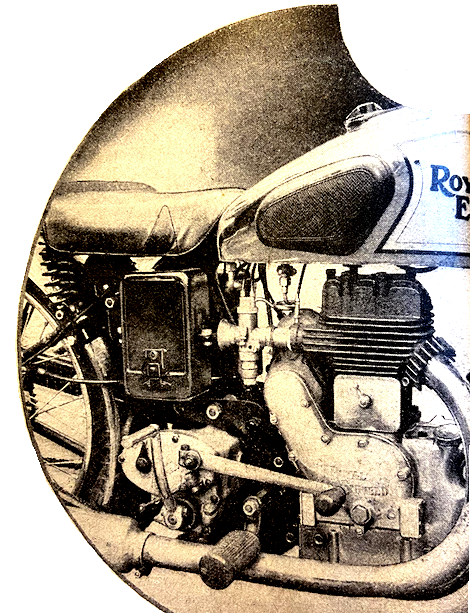
unusually well protected. The front forks had a satisfactorily large range of action, yet there was no trace of the forks bottoming, even over really rough going. Rubber buffers mounted one on each side of the base of the steering column prevent the front forks from damaging the tank should the machine be accidentally dropped. They do not, however, interfere with the steering. lock, which is commendably wide. Throughout the test the Royal Enfield remained both clean and oil-tight. A negligible quantity of oil was consumed. Petrol consumption at a maintained 40mph was 78.2mpg, giving a, touring range of 215 miles. The machine is fitted as standard with a de luxe equipment that includes a detachable rear mudguard and carrier—to provide ready access to the Wheel—Enfield cush drive in the rear hub, Lucas six-volt lighting with voltage control, and enclosured valve gear. A tank panel is fitted, and this contains a switch which controls the lighting system. The head lamp relieves the driver of much of the strain of night riding, for it provides a beam that is excellent both as regards distance and width. A dip-switch is conveniently mounted on the handlebars. No adjustments were necessary during the test, a point which is well in keeping with the high-class finish of this quality side-valve. It is a motor cycle which will make a keen appeal to those enthusiasts who require a lively performance on the open road allied to docility for town work.”
“THE ORGANISERS OF the Scottish Six Days Trial have every reason to congratulate themselves. Never has there been a more perfect day for weighing-in than last Sunday. The sun shone out of a cloudless sky; it was cool enough to allow those inevitable last-minute adjustments to be carried out in comfort, and hot enough for the officials and accessory magnates to stand about without their opulent-looking overcoats. On the Saturday night competitors and officials had worked up plenty of ‘Scottish’ atmosphere at the Edinburgh Club’s headquarters, but there were no thick heads—among the riders at least—on Sunday. Both on Saturday and Sunday the main topics of conversation concerned the new rule allowing spares to be carried…at the weighing-in there were two distinct schools of thought. One is typified by the veteran Bob MacGregor, who is carrying a full complement of spares on his Rudge—even down to a hammer and a bottle of bismuth tablets! All spares had to be declared at the start and Andy Pattison has a list of each man’s bits and pieces. Jack Williams and Miss Marjorie Cottle are typical of the second school. Both are carrying spare cables, a footrest and a fork spring. Miss Cottle is very sincere in her
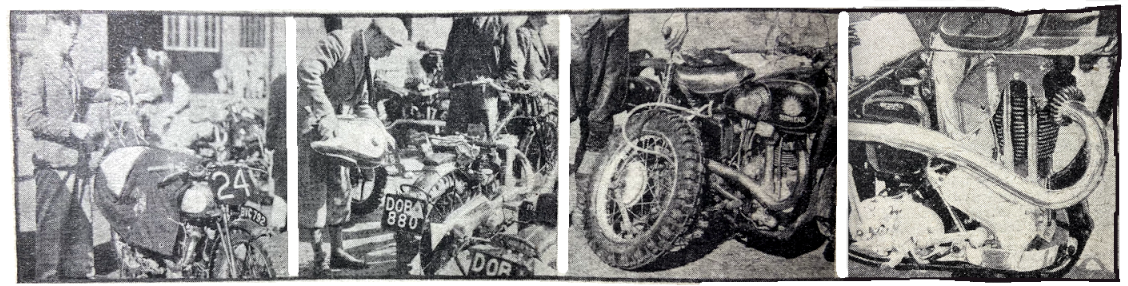
theory that whatever one carries it’s always the other thing that breaks. This spares question caused lots of fun at the weighing-in. George Rowley looked very serious when he told Andy that he had a spare cylinder barrel and crankpin, but had been forced to leave the spare flywheels behind owing to the extra weight being too much for his 250. The team of AJSs looked extremely businesslike—the riders are Whitton, Povey and Rowley. The machines look very small and light and each has a bottle of compressed air neatly fitted to the near-side rear fork stay, with a long connection that will reach either wheel. More ingenuity is displayed as regards neat fittings for spares and tyre repair equipment than ever before, and competitors were proudly showing-off their various gadgets. M Riley (499cc BSA) has spring-loaded holders for a big tyre pump and a very special rear wheel spanner. Len Heath has four Lycett saddle elastics on the front forks of his Ariel—spares that also act as a support for the fork spring. Each elastic is joined at the ends with a spring chain link. Heath also has several light spares packed in the compartment in the petrol tank where the speedometer is usually fitted. Most of the team machines have had special preparation for rapid attention to tyre trouble. The Royal Enfields have short, but heavy tommy-bars on the rear-wheel spindles. The nuts are actually part of the tommy-bars. Several riders have box spanners and tommies held in position on the wheel nuts with rubber bands, and almost every competitor has a pet
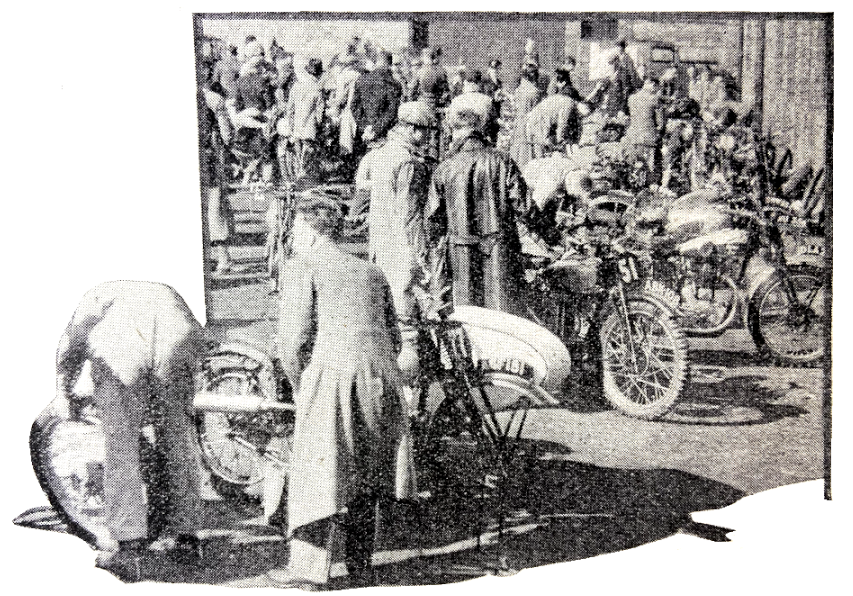
method of removing the wheel quickly. The Ariel, Rudge and Triumph teams all had an air of quiet confidence at the weighing-in, but on paper all the trade teams look extraordinarily good, and no one, was offering long odds on the team prize winner. This year the Southern party is rather smaller than usual, and only about a dozen came up on the night train from London. But, as one member said, ‘It’s the quality that counts.’ The Wolsey brothers have gone to considerable trouble over the preparation of their machines. They have identical Ariels with the same spares and gadgets. The only difference between the two models is one number in the registration figures. Their spares are mounted as follows: footrests bolted on the front engine mounting; rear wheel spindle taped across the frame behind the saddle; fork spring hung behind the saddle down tube; saddle spring and footrest hanger taped to the elastics of the saddle; spare cables taped alongside those in use; and spokes taped on the inside of the half-round mudguard stays. In addition, they have a saddle mounting three inches higher than standard, and beautifully finished chromium-plated carburettor shields. On Monday the competitors were greeted by brilliant sunshine when they arrived at the official garage shortly before eight o’clock. The two men who

had been granted extensions, AA Smith (Calthorpe) and JA Dunlop (346cc Royal Enfield) had completed their repairs and weighed-in before the start. The German rider, C Jurisch, failed to arrive, and J M’Arthur (490cc Norton) withdrew his entry before the start owing to ‘pressure of business’. As zero hour drew near the riders began to don their riding kit, and it was apparent that one-piece suits are easily the most favoured this year. Just outside the start the traffic lights had been turned off to enable the trial to pass without hindrance. Quiet roads led to the outskirts of Edinburgh, and then the main mall to the West was followed for 20 miles. It was cold riding, but as bracing a morning as one could wish for. Just outside Bathgate was the first hill, Hilderston. This year it was fairly easy, but even so it provided a few anxious moments for several of the entry…From Hilderston the road struck north, crossing the Forth by the new bridge at Kincardine, then on by Dollar and Crieff to Aberfeldy, where competitors headed west down the south side of Loch Tay on the way to the second observed hill at Taymouth. Taymouth Hill was in easy mood; it was dry and most people ascended without difficulty. The trio of 125cc Excelsiors climbed it and
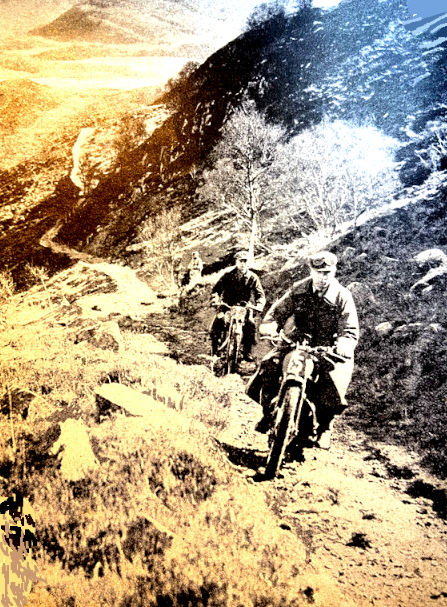
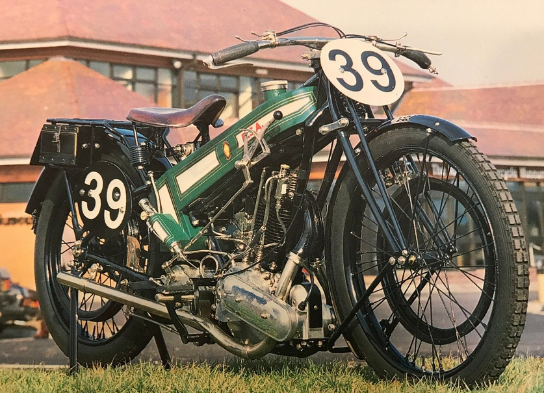
demonstrated just how easy to handle they are. At the top of the hill RT Newbery (497cc Triumph) took the wrong turning and went some 15 miles towards Kenmore before discovering his mistake…Cambussurich saw the first real blotting of the clean sheets. The hill was dry and the two dreaded bends near the top were easier than usual, but the lower reaches had one or two very bad rocky portions that tricked many riders. JC Edward (495cc Rudge) led the way but he was thrown to the bank and had to foot hard to regain control…GE Rowley (246cc AJS) was spectacular in the extreme, for he hit two of the largest rocks with both wheels, the model shot nearly two feet into the air and all but threw the rider. George clung on but just when he seemed to have the situation in hand the engine stalled…NJ Wolsey (497cc Ariel) had a colossal fight with the model and eventually won. ID MacIntyre (Royal Enfield) turned round and sped downhill before he could stop; and RSL Harding (497cc Triumph) footed more than he should have done. A Jefferies (343cc Triumph), however, got out of a hectic situation by sheer determination…JJ Booker (499cc Royal Enfield) visibly sighed with relief after negotiating a bad patch. J White (497cc Ariel) just swayed hi. body and the model went where he desired. Aviating front wheels were not uncommon, though H Brown (348cc Norton) probably took the honours for the front wheel highest in the air. Tuesday’s run of 142½ miles was probably the most difficult of the whole week. Promptly at 8am the competitors left Fort William and rode via Ardgour, Strontian and Salen to Kinlochmoidart. At the last-mentioned place they encountered the long and stony Devil’s Staircase, the severest hill of the trial that caused the downfall of even the experts. Devil’s Staircase was introduced in
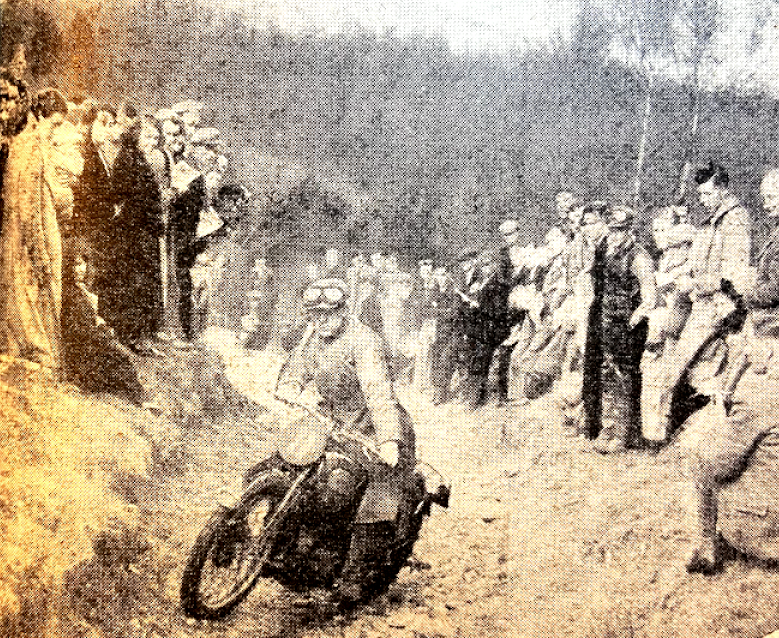
the trial last year at the suggestion of one of the competitors, ID MacIntyre, who lives at Mallaig. But in addition to losing marks on the hill, many competitors lost marks on time, for the ‘road’ sections between checks precluded fast work. The morning began badly for everyone. During the night a heavy mist had settled on the mountains, and when competitors set off it was through ‘Scotch mist’. The route skirted the north side of Loch Eil, doubling back on itself at the head of the Loch to hug the opposite shore, eventually bringing competitors to Ardgour, Salen and Kinlochmoidart. The going was rough and twisty, but between Ardgour and Salen the mist cleared away, and as competitors ran into the check at Kinloch-Moidart the clouds were breaking up rapidly. Immediately after the check the road deteriorated into a rough pony track, rocky and twisty in the extreme, and with many severe gradients. On this track the four observed hills for the day were situated, the observers having walked several miles to be at their posts. Incidentally, the track between Kinlochmoidart and Lochailort is known locally as Prince Charlie’s road, for the Prince landed at Moidart when he returned to Scotland to start the ‘Rising of ’45’. Very near the start was the Devil’s Staircase. The hill has a very rocky surface and there are three acute hairpin bends set close together, the whole set on a gradient of about 1 in 4. Nobody managed the hill clean, but several competitors covered either one or two of the three sub-sections feet up, and many fine displays of machine control were given. The first bend was by far the most difficult, and every competitor had to give at least one dab to help the machine on the apex of the corner. The second sub-section consisted of the other two hairpin bends, while the third included a slight bend and a great many rocks. DG Nimmo (497cc Ariel) footed round the bends and was clean on the top section; JS Edward (495cc Rudge) did the same. AE Perrigo (348cc BSA) made a magnificent attempt and rode feet up round the second bend, and was half-way round the third when the front wheel struck a big rock and he stopped. He restarted on the bend and proceeded to ride the top section clean. LG Holdsworth (499cc Royal Enfield) adopted the dodge of slipping the clutch and making it bite fiercely on the bends, so that the rear wheel would skid. This method was all but successful, and two quick dabs were all that were required. Another excellent
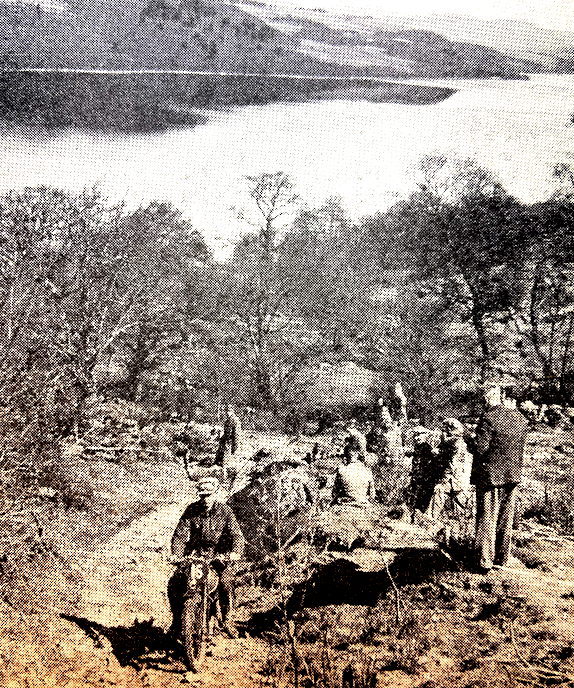
climb was made by Jack Williams (348cc Norton), who only touched twice. LJ Manley (499cc BSA) made a neat, unspectacular climb but G. Rowley’s 250 AJS seemed rather peppy for this type of hill, and George contented himself with a safe footing ascent. Even Len Heath (497cc Ariel) footed on the bends. R MacGregor (495cc Rudge), however, had the hill well weighed up, and after a dab on the bottom bend proceeded to ride round the other two in a superb feet-up climb—a wonderful demonstration of machine and throttle control…After climbing The Ravine it was a case of riding as hard as one could if the check at Lochailort was to be reached on time, for the track was shockingly rough and rocky. When the check was reached, a great many, competitors were late. Miss Marjorie Cottle (249cc BSA) arrived with a flat tyre, having ridden with it flat all he way from the last check. She changed a tube and dashed off again quickly, but on the way to Mallaig the tyre walls chafed the tube. She continued to ride the model, but the vibration broke the mudguard stay, which proceeded to cut the tyre nearly in two. After limping into Mallaig this gallant lady had to retire, for a new tyre could not be obtained. Between Lochailort and Mallaig came another section where no time could be wasted. The road is rough and twists continually—there is, indeed, barely 50 yards of straight in the 17 miles. Wednesday was another day of sunshine, wonderful scenery and rough going. Once again the Moidart Mountains were visited and Prince Charlie’s. Road covered. This time, however, the course was tackled in the opposite direction and several hills that were descended on Tuesday served as the observed sections on Wednesday. In some respects the day was a half-day for competitors, for the route was less than 100 miles long and the trial started at 9am—an hour later than usual, and the last competitor was in the garage by four o’clock. On the hills, Tuesday’s story was repeated, for every competitor lost marks on at least one hill, The Ravine, while the other hill in the Moidart section—Bay Hill—caused many failures among the later numbers. From Fort William, Tuesday’s route was followed in the reverse direction to Lochailort. From there the rough pony track going out into the wilds was picked up. It was drier than it had been on Tuesday, but its character looked
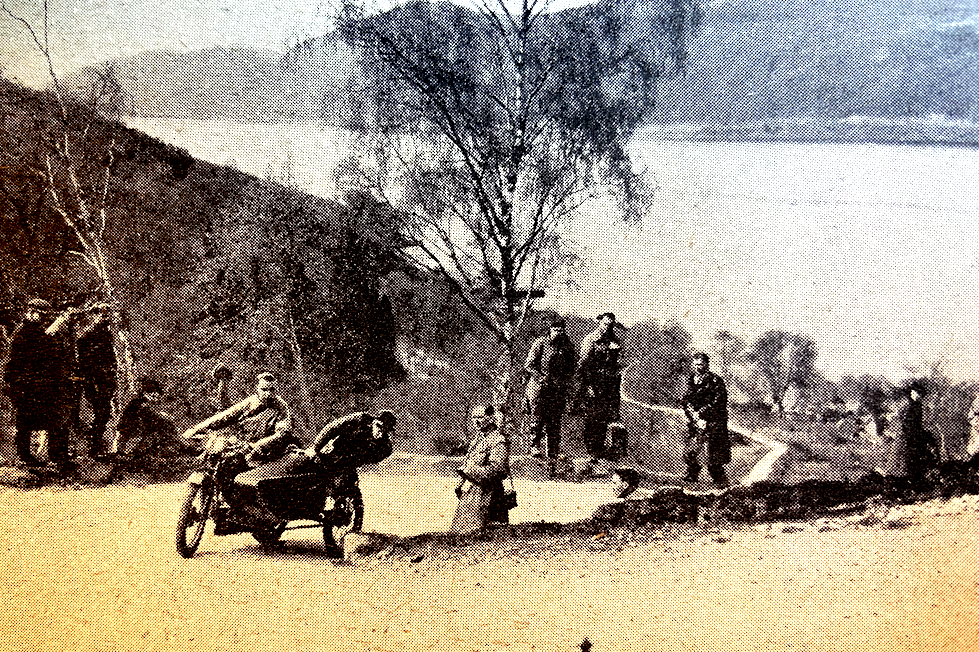
entirely different when taken in this direction. However, competitors . bad more time to admire the scenery, for there was only one check at the far end of the section. And what scenery! Vivid blue lochs sparkling in the brilliant sunshine and green-clad hills and snow-capped mountains. Fresh vistas kept opening up to the right, where the track runs along the coast high above the shores of Loch Ailort. Farther on the track skirts the Bay of Arisaig before striking inland over the peninsula to Kinlochmoidart. After three very strenuous days competitors were given something of a rest on Thursday. Although the route was 191 miles long only three observed hills were climbed and none caused a wholesale loss of marks. This year no tyre-changing was allowed on Wednesday night, but competitors could change tyres in their running time if they wished. Several men decided that their tyres had had enough rough going on the two previous days, and in the morning some half-dozen or so fitted new rear tyres. Among them were R MacGregor (495cc Rudge), A Jefferies (343cc Triumph) and FE Thacker (343cc Triumph). All of them had the new tyres fitted and the machines ready for the road within the quarter of an hour allowed for adjustment. MacGregor actually had his wheel out in six seconds! Other competitors occupied their time checking over their models and replacing bits and pieces that had been either knocked off or had fallen off on the atrocious Prince Charlie’s Road. Once more the start was at 8am; for a long mileage had to be covered during the day. From Fort William the route struck north to Spean Bridge, following the shores of Loch Lochy and then going on to Fort Augustus. Here the main road was forsaken, and the road over the old-time test hill at Glendoe was followed. The road now is in fairly good condition but it still rises and falls and twists and turns for some 15 miles…From Inverfarigaig the route ran over the moors for a few miles, rejoining the main road just before Inverness. Hive Brae, near Strathpeffer, was the next piece of
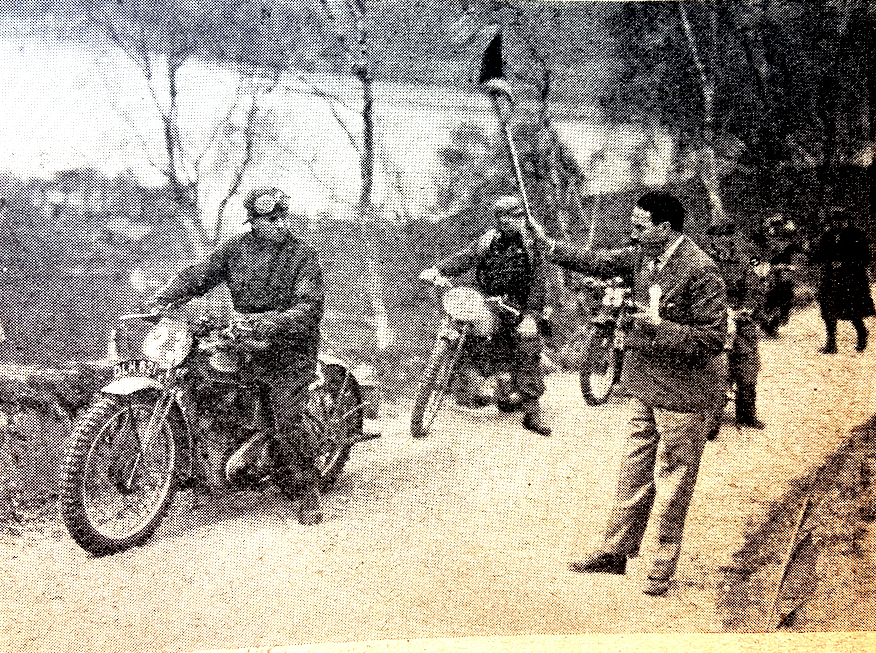
excitement. But the hill was dry, and the rounded stones on the, surface caused little trouble. For one person, however, the hill spelt disaster. R MacGregor (495cc Rudge), who until then had lost fewer marks than anyone, caught a tree bough with his arm and was brought to earth…In the sidecar category, R Tozer (499cc BSA sc), who was leading the class, was the only one to fail; the other two got up without fault. And at the end of the day all three drivers had had one stop. Lunch was taken at Strathpeffer, and from there it was only a matter of keeping to the time schedule on the 100-mile run back to Fort William. Friday was a vital day for everyone, and the day on which nearly all the important awards were lost and won. Competitors started the day’s run with the knowledge of how they stood, because the previous day the committee cleared up the question of the marks lost on time on Tuesday. It was decided that 10 minutes’ allowance would be given at the Lochailort check, where over 90% of the competitors were late. At this stage only a very narrow margin separated the leaders of the various classes. Bert Perrigo, for example, led the trial by one mark from Jack Williams, while the Rudge works team were only a few points ahead of the Triumph and AJS teams. The morning was glorious and as the trial left Fort William, after a stay of three days the sun shone out of a cloudless sky. Lunch was taken at Killin and then the northern road along the shores of Loch Tay was followed en route for the dreaded Stoney Brae. In the sunshine the Loch looked at its best and nearly everyone dawdled as far as Kenmore to enjoy the magnificent scenery. Then on to Dunkeld—and Stoney Brae. When the observers arrived at the hill they found that many huge rocks had been scattered. about the surface. Some of these were removed and as a result, the hill lived up to its name of being stoney rather than rocky. Clean climbs of this long hill were few, but some very good performances were put up by riders who would have had a severe shock if the hill had been included on the first day. DG Nimmo (497cc Ariel) led the way with a good climb. WN Watson (125cc Excelsior) got half-way up before having to use his feet. WJ Smith (346cc Levis) had rather a fight with the model, but was clean. After M Riley (499cc BSA) had made a neatly judged ascent, AE Perrigo (348cc BSA) came up in great style. He got round the slight bend half-way up, following the track taken by all the others. Then, in order to avoid a huge boulder he decided to go to the left, changed his mind and tried to go to the right, and hit the boulder with the front wheel. The wheel reared up and Bert had two dabs before the model was under control again. Jack Williams (348cc Norton) became the new leader of the trial and he had an anxious moment when one of the footrests hit a rock, but he mastered

the situation cleverly. Len Heath (497cc Ariel) just saved the model from stopping the bend, and A Jefferies (343cc Triumph) rode over an observer’s leg in avoiding a particularly nasty piece of rockery. Not for a long time has Saturday morning’s run played so important a part in the allocation of the awards. When Friday’s result sheet was posted up in the official hotel at Perth it was seen that only two marks separated the first four solo men in the trial, while the AJS, Rudge and Triumph teams were all in the running for the team award. To add to the excitement, Saturday’s hill—Carron Bridge—was a new find by the Edinburgh club officials. And whereas Saturday’s run is usually a fairly easy one, this hill put quite a different aspect on the morning. As the trial left Perth the sun shone brilliantly. The route struck south to Dunning, and then along a very twisty road. over the Ochil Hills to Dollar. More than a few people were thankful for this twisty road, for it kept minds off the hill that was to come. From Carron Bridge it was a straight-forward main-road run to Edinburgh, where the stop and re-start and brake tests were held on Blackford Hill. Only two people lost marks here, ID McIntyre (148cc Royal Enfield) and AA Smith (493cc Calthorpe). At the final examination of machines not a single mark was lost on condition—a fine tribute to the modern machine after such a strenuous week. This year the final, tests were got through much more, quickly than previously. All that remained was the prize distribution and film show in the evening. Here everyone was in the best of spirits, and all agreed that it had been one of the finest weeks ever. Thus another ‘Scottish’ ended. It had been a perfect week as regards weather, and covered much of the finest trials ground in the country. The heartiest congratulations must be offered to the Edinburgh Club and officials for organising such a fine sporting holiday, with 100% efficiency and less than 1% red tape. Special Awards. Best individual performance: J Williams (348cc Norton), 10 marks lost. Best Sidecar: HJ Flook (490cc Norton sc), 24 marks lost. Manufacturers’ Team Prize: Triumph team (A Jefferies, FE Thacker and H Sim), total marks lost, 58. Club Team Prize: Birmingham MCC (AE Perrigo, GF Povey and VN Brittain), total marks lost, 49.”
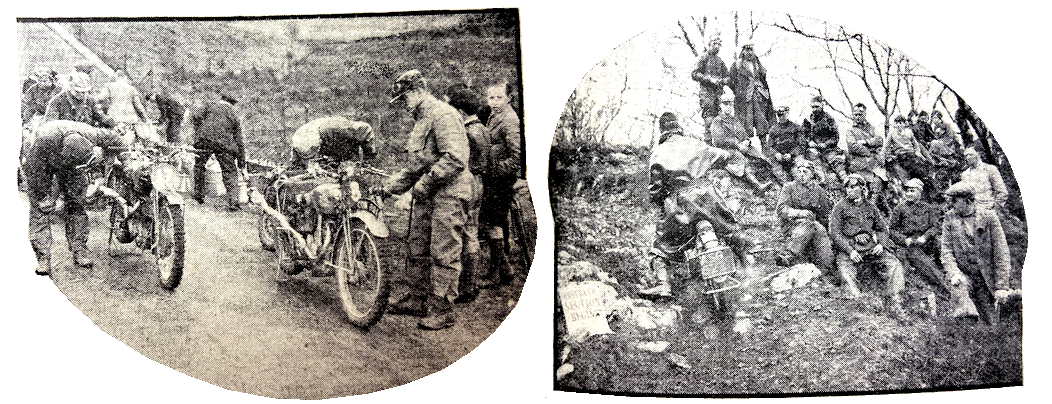
“AT THE CONCLUSION of the Scottish Six Days it seemed to be the general conclusion that, this year’s trial had been the most successful for years. As chairman of the Edinburgh & District Motor Club I feel it is only right publicly to thank everyone who worked towards that end. The club was fortunate in choosing Fort William as a centre. The Town Council, with the Provost and Bailie Gardiner leading, did everything they could to help us. The police also helped us in every possible we’, The Highland Hotel was undoubtedly the key to the social success of the trial, and to Mr and Mrs Howe and their staff are due a large measure of thanks for their willing and obliging service at all times. Mr Duncan Grant, of Marshall & Pearson’s Garage, has always been a good friend to the club, and a great deal of credit is due to him for his assistance both before and during the trial. George Rowley said on Saturday night that it would he unfair to mention any particular official where all had been 100% efficient. The club has to thank them all, especially the gentlemen who put their cars at the disposal of the club for the week. Apart from their official duties, G Macintosh put in hours every night at the piano, and G Simpson went to a lot of trouble and expense to provide cinema shows of the trial. I feel I must refer to Mr P. Chamberlain for his unfailing assistance to the club at all times, to the competitors for the sporting way they conducted themselves during the week, to the petrol, oil, tyre and accessory representatives for the very able way they organised their supply service. A special word of thanks is due to those kindly people of Glenuig and district. A cattle sale was held at Salen on Tuesday and most of them had brought in their beasts on Monday night so that the roads would be clear for on the Tuesday. Thanks are also due to the Midland Centre and Bradford Clubs for putting up awards for their members, to Mr A McNaughton for his award of a silver shield, and to Mr J Beck for the Jimmy Beck Memorial Trophy. In conclusion, we thank The Motor Cycle and Motor Cycling for their assistance in giving publicity to all advance information, for their always helpful criticism, and for their very able and full reports of the event. Thanks to you all.
Andy Pattison, Chairman, Edinburgh & District Motor Club.”
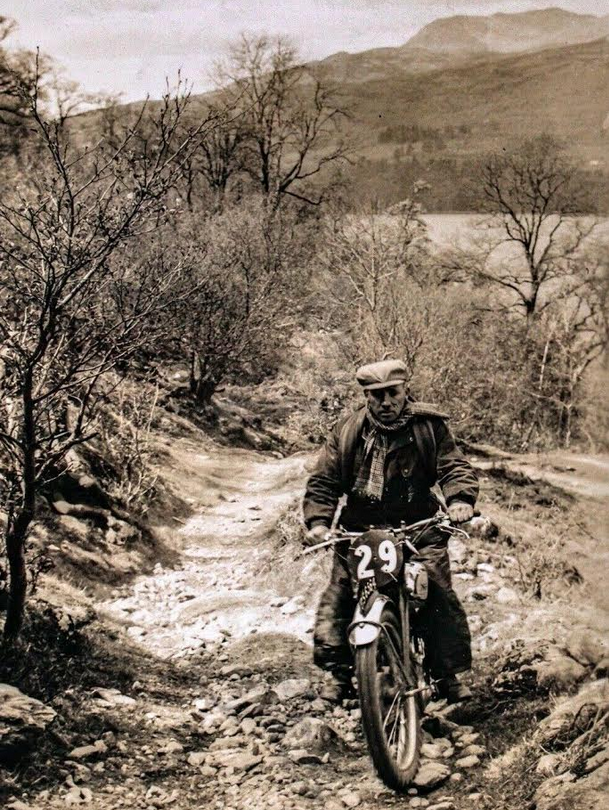
“JG GUTHRIE, RIDING a 349cc spring-frame Norton, secured major honours in his first race of the season—the Leinster ‘200’. He easily won the 350cc class, at a record speed for the race. Stanley Woods’ new Velocette could not be got ready in time and he was a non-starter. Thus the race was robbed of what had promised to be its main point of interest—another meeting of these great rivals. But Guthrie did not let the absence of Woods prevent him from going really fast. He set off by breaking the course record from a standing start, and followed this up by a second lap at 78.60mph. Three times more he improved on this figure, and finally completed two laps in 4min 25sec, which equals a speed of 80.38mph. His average speed for the whole race was 78.07mph. Second was ‘Ginger’ Wood, riding a four-valve Excelsior in his first big road rice for this firm; his average speed was 72.83mph. Tyrell Smith (249cc Excelsior) dominated the 250cc class in the same way as Guthrie had the bigger class, and set up a new lap record of 73.45mph. His two nearest rivals, EW Corfield and D Parkinson (1936 Lightweight GP winner), also mounted on Excelsiors, were both eliminated before half-distance, and the Irishman won by over 25min. It was only in the 500cc class that there was any real competition. The absence of FL Frith and R Harris (Nortons) left the race in a more open state, of which the local riders were not slow to take advantage. Last year’s winner, TG Byrne (499cc Rudge), led by a few yards from TB Fortune, who was riding an extremely fast 1936 ‘Ulster’ Rudge for 25 of the 34 laps. Then he had to retire with gear box trouble. The remaining runners gradually dwindled until Fortune had only to finish to win. This he did in good style, and so secured his second victory in the only three races in which he has ridden. He beat the 500cc lap record, established by GH Rowley on the four-cylinder AJS last year, by one second on four successive laps at 74.74mph. Only Guthrie and Wood lapped faster than this. There were 28 starters, half of them being in the 350cc class. Five of the finishers were in this class, three (out of six starters) in the 250cc class, and, as mentioned above, only one finisher (out of eight starters) in the 500cc class.”
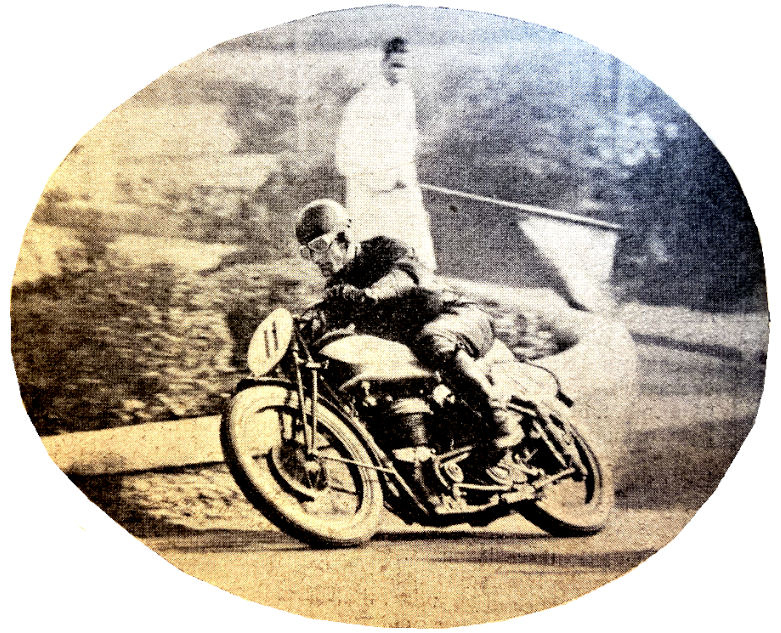
“SEVENTEEN TEAMS COMPETED for the annual South-Eastern Centre inter-club team trial, which was held last Sunday. Each team consisted of six riders, and the performances of the best four in each team counted for honours. An excellent course had been selected thanks to the North Kent Trials Combine. In most respects it resembled that employed for the Langmaid Trial at the beginning of the season. It was, however, fairly dry and, consequently, comparatively easy. All the same, no rider finished the course without loss of marks. The best man was Gordon Wolsey (497cc Ariel) of the Sunbeam Club, who was just back from the ‘Scottish’, with a loss of only two marks. Among the sidecars (their inclusion was optional) Harold Taylor (497cc Ariel sc), of the Streatham Club, was the best performer, with a loss of seven marks. Results. 1: Sunbeam Club—B Davis (346cc AJS), RSL Harding (497cc Triumph), NJ Wolsey (497cc Ariel), GA Wolsey (497cc Ariel), GS Hadfield (570cc Enfield sc); marks lost, 17. 2: Carshalton Club—M Riley (499cc BSA), JJ St John (348cc BSA), GE Eighteen (346cc AJS); EJ English (499cc Royal Enfield sc); marks lost, 22. 3: Witley Club—HC Wake (348cc Sunbeam), RT Viney (348cc BSA), GG Wilmot (346cc AJS), FE Quick (497cc Ariel), AJ Whistler (246cc AJS), AF Gaymer (343cc Triumph); marks lost, 28.
“PREMIER HONOURS IN THE North of Ireland Club’s North-West ‘200’ road race last Saturday were gained by J Guthrie (Norton), who thus has the distinction, with GE Nott (Rudge), of having won the senior event four years in succession. Guthrie also made a new record for the race at 82.17mph, but his fastest lap in 7min 54sec was a second slower than his own record. Stanley Woods (Velocette) provided a stiff opposition, which ended only when he had a spill on the eighth lap. Woods led Guthrie up to this stage, the difference between them varying from a second to four seconds. Thereafter the Scotsman’s nearest rival was FL Frith (Norton). In the 350cc class JH White (Norton) had a good win over ‘Ginger’ Wood (Excelsior) and improved on the lap record by two seconds. SV Smith (Excelsior) won the 250cc class by a matter of seconds from G McAdam (New Imperial). The lap record in this event was put op by CH Manders (Excelsior), who improved on his last year’s time by a matter of 10 seconds. The race was really a Coronation event, for all the starters received a souvenir, and in keeping with the occasion brilliant sunshine was the order. Fifty competitors took part—a record. Thirteen of the riders were in the 500cc class, 26 in the 350cc, and 11 in the 250cc. In the senior event there were only four finishers and in the lightweight two. This was certainly a very low percentage and was probably due to the fact that there were many newcomers from England and Scotland. In the junior event, however, 15 riders crossed the finishing line.”
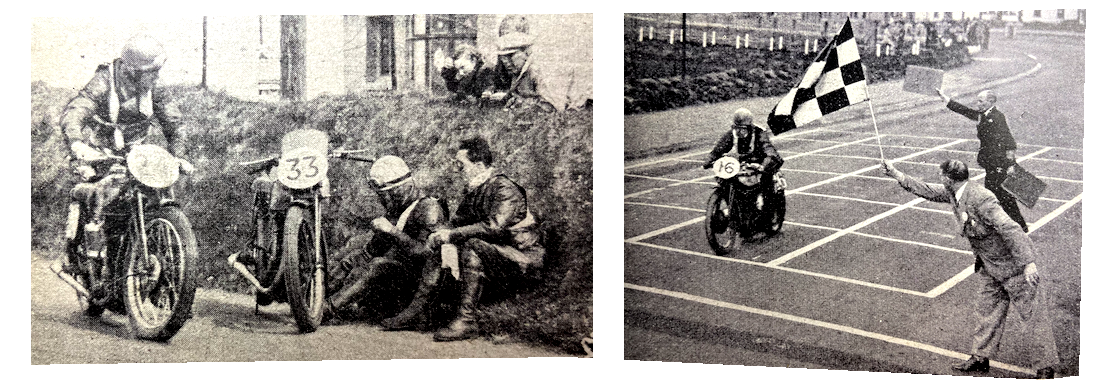
“‘WHILE GOVERNMENTS CAN legislate and local authorities can administer; while speed limits, beacons, traffic lights, guard rails and other devices can help to make the use of the roads more orderly, the prevention of accidents can only be secured by the circumspection of every individual.’—The Minister of Transport.”
“DUAL CARRIAGEWAYS ARE to be provided along the section of the North Circular Road (Middlesex) between Neasden Lane and Brentfield Road, Willesden. The estimated cost is £30,000.”
“AN MOT CENSUS of traffic on Class II roads shows that passenger vehicles have increased by 56% between 1929 and 1936, goods vehicles by 72.6% and pedal cycles by 89.4%.”
“I SHOULD LIKE to congratulate ‘DB’ in hitting the nail on the head. There must be dozens of cyclists longing for a motor cycle. To quote my own case, I have travelled 30,000 in the last six years on a push-cycle and have thoroughly enjoyed it. Then I bought a second-hand motor cycle to feel my footing. Did I enjoy it? No sport ever surpassed it. Alas! trouble came—no job, bike not completely paid for, and my good deed and I had to part after only two months of friendship. I have been forced back to my push-cycle. I now sweat daily on my 20-mile run and curse and swear at the head winds and hills. But when I hear the ever-increasing purr of a motor bike coming along I smile. And as thee gentle rush of air subsides I murmur, ‘Lucky blighter—good luck and happy steering!’ To those who have not started push-cycling all I can say is, don’t. Plank down the money you would pay for a cycle as the first payment on a motor cycle. Wishing all motorists the very best.
John S Jones, Penarth.”
“I AM IN THE same position as your correspondent ‘DB’. I have experienced all he states in his letter. My mileage is about 15 to 20 a day—quite enough when you have to work on top of it. I have ridden a bicycle for about 12 years and also done several long journeys on the pillion of a motor cycle, and I can safely say that the motor bike is the safer of the two. Wishing your paper every success.
T Hallisey, Plymouth.”
“THE CLASSIC 500cc HOUR RECORD has been broken by over 7mph. On April 29th Pietro Taruffi, the famous Italian rider, took out the specially streamlined 500cc four-cylinder Gilera on the Brescia-Bergamo road in Italy and succeeded in covering 121.234 miles in the hour. The record was previously held by J Guthrie (Norton), who covered 114.0 miles in the hour at Montlhéry in October, 1935. The record-breaking Gilera has a very complete system of enclosure. It has rear springing and a water-cooled four-cylinder overhead-valve engine. In all, Taruffi broke 15 records in classes C (500cc), D (750cc) and E (1,000cc): 50km, 15min 35.2sec, 119.596mph; 50ml, 24min 18.2sec, 123.440mph; 100km, 30min 53sec, 120.719mph; 100ml, 49min 8.4sec, 122.100mph; 1hr, 121.234mph.”
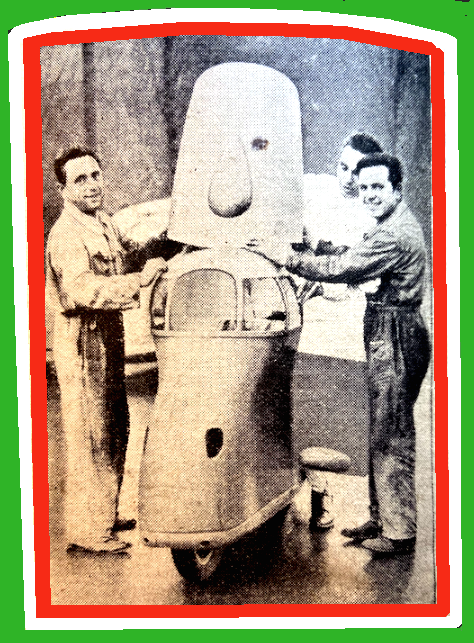
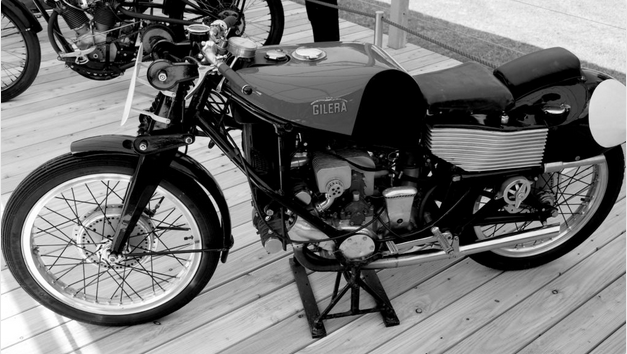
“COMES THE NEWS that Taruffi has snatched the hour record from Guthrie, covering over 121 miles in 60 minutes as against Jimmy’s 114.097 at Montlhéry in October, 1935. The feat was accomplished on an auto-strada, not on a race track, and at the moment I don’t know precisely how the road was used, as my map (not up to date) shows only a bare 50km of straight on the section described in the telegrams as the venue. Perhaps the strada has been extended since my map was printed, or maybe Taruffi used a triangle. Anyhow, the main interest lies in the bus rather than the scene, for the machine is a streamlined, water-cooled. rear-sprung, supercharged four-cylinder! There’s underlining of what The Motor Cycle has been saying for some years past, amid jibes from our own racing men. We shall discover before we are much older that the attempt to hold our own with unblown, rigid-framed single-cylinders against Continental enterprise resembles pitting a Sopwith Camel against a Supermarine Spitfire or something equally fast.”—Ixion
“OVER 9,200 MILES without stopping the engine! That is the feat which has just been accomplished in Australia with a 1937 Model 6/S 600cc side-valve Triumph and sidecar. For 13 days and 13 nights the outfit ran like clockwork, keeping up an average speed of 29.6mph, including all stops for refuelling and change of personnel. Throughout the test the outfit was under the scrutiny of the Australian ACU. After 9,261 miles had been covered misfiring set in owing to the plug gap widening and the engine stopped for the first time since the outfit had set out on its long run. Not since 1927, when a 577cc side-valve Ariel outfit completed a 5,000-mile non-engine-stop run, has a sidecar machine undertaken anything like such an ambitious test.”
“IN THE PAST big-twin machines have been regarded by many riders as suitable only for sidecar work, and, in fact, they have usually been designed with that purpose in view. The Matchless Company, however, has produced for 1937 a 990cc machine that has been designed primarily for solo riding—indeed, it has a wheelbase that is shorter, than that of many 500cc machines. As a result of the short wheelbase the machine is extremely compact, and with the new large petrol tank and neat exhaust system it is undoubtedly a very good looker. And, apart from appearance, the Model 37/X Matchless is on a par with many modern 500s as regards road-holding and steering. As soon as the machine is on the move the rider forgets that he is astride a heavyweight machine. The Matchless could be ridden feet-up at speeds well below the register of the speedometer without any juggling with the handlebars. At slightly higher speeds the steering was comfortably light, but even when the machine was being cruised at over 60mph it did not become so light as to necessitate use of the damper. At all times the machine held the road well Throughout the test the fork dampers were done up slightly; without any tension tension on the dampers the forks tended to clash on rough going. The excellent road-holding of the Matchless probably accounted to some extent for the effortless way in which it could be cornered. The big machine could be laid well over on fast corners without any sign of snaking or wandering. On wet roads the Matchless was perfectly stable. Wet tramlines caused the rider no tremors, and on none of the slippery surfaces encountered was a skid experienced. On particularly greasy surfaces the steering tended to become rather light, but this was more a feeling than a fact, for the model never showed any tendency to get out of control. As regards the brakes, the front one was extremely powerful and could be used at full pressure on dry roads without locking the wheel, while the rear one was well up to its work and was as smooth as a rear brake should be. Criticism could be levelled at the position of the rear brake pedal, which is such that the rider has to remove his foot from the rest to apply the brake. With both brakes used together the machine could be brought to rest from 30mph in 28ft—a figure that is truly remarkable. Except that the petrol tank is rather wide, the riding position is nearly ideal for fast and comfortable cruising. Certainly for a tall rider the saddle, footrests and handlebars are very well placed, and even a long-legged rider can grip the knee-grips. The handlebars are rather higher than usual, but the riding position as a whole is one that inspires confidence and invites the rider to corner neatly and with absolute safety. All the controls are well placed. The long brake and clutch levers come easily to hand, and the ignition lever could be used without the rider removing the hand from the bar. The four-speed gear box was reasonably silent in the intermediate gears, and the clutch showed no sign of drag.
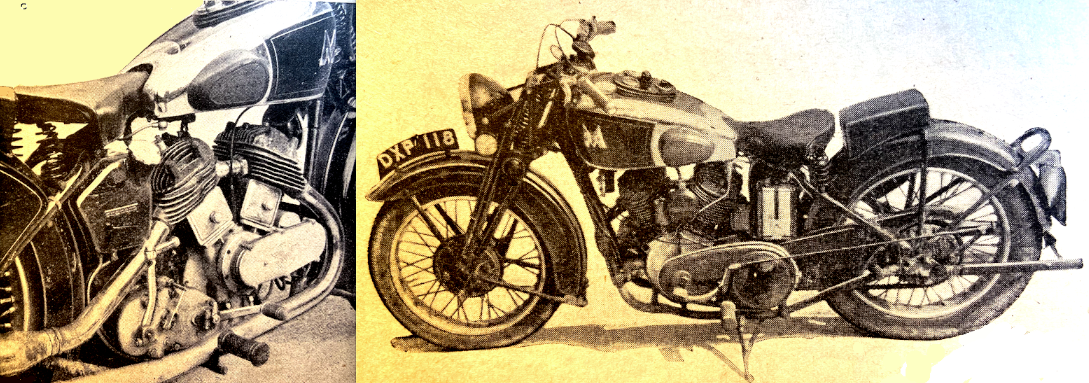
Actually, the clutch tended to stop too quickly if the lever was withdrawn fully. All that was necessary to make perfect changes up or down was to ease the clutch slightly while moving the gear lever. So mush for the cycle parts of the machine. The engine proved just as intriguing. A couple of hearty kicks would always start the engine from cold, and when the engine was warm a lazy dig on the kick-starter, using the exhaust lifter, was sufficient. As is often the case with a V-twin engine, the idling was not perfect, but the engine would run smoothly at low speeds with the ignition retarded. And with the throttle stop adjusted correctly the engine never stalled or stopped involuntarily. Until the engine was warm use had to be made of the air lever, and it was found advisable to run with the air slide only half open for the first few miles. When the engine was warns its performance was delightful. It would pull the machine along in top gear (4.3 to 1) on full advance at less than 20mph, and from this speed could be accelerated hard without a trace of snatch. With the ignition retarded the model would run smoothly at 10mph. At speeds of 30mph and over it was unnecessary to use the gear box, for the acceleration was far better than that of nearly all other types of vehicle. If the gear box was used the acceleration was little short of colossal, and from a standing start a speed of 70mph was reached in a quarter of a mile. Accelerating from 15-30mph in top gear took only five seconds, and from 20-50mph, 9⅖sec. Between the same speeds in third gear (5.4 to 1) the times taken were 4sec and 8sec respectively. With the rider ‘lying down’ the maximum mean timed speed was 80.3mph. At this speed the speedometer was reading very slightly slow. Maximum speeds attained in second (6.7 to 1) and third gears were respectively 51mph and 67mph Petrol consumption at a maintained 40mph worked out at 45.6mpg. The engine proved exceptionally quiet both mechanically and as regards the exhaust. On one occasion during the test the rear piston of the almost new and somewhat tight engine dried up. Th, piston was eased and no further drying-up was experienced. Throughout the test the power unit remained absolutely free from external oil leaks. This, combined with the excellent protection afforded by the heavily-valanced mudguards, kept the machine free from excess road dirt and made it easy to clean down after a wet run. Finally, mention must be made of the very efficient prop-stand. It can be operated by one foot and flies up again immediately the machine is brought back to the vertical; moreover, it can be used either up or down the road camber. The stand can be said to be typical of the machine as a whole, for the Model 37/X comes in that aristocratic class of motor cycles that are ‘riders’ mounts’.”
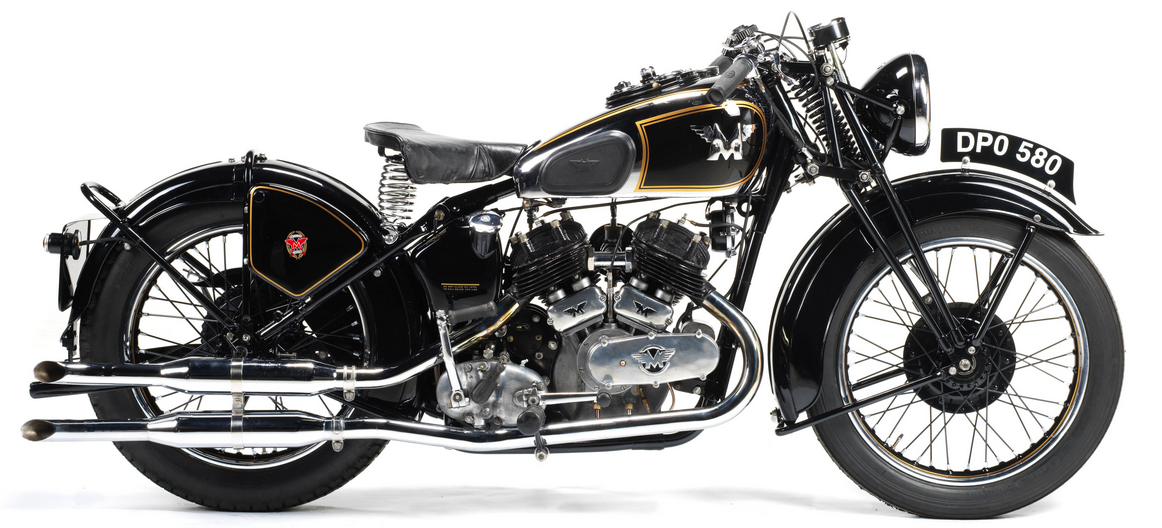
“PROMENADE SPEED TRIALS in the North! It sounds like a dream of 10 or 12 years ago. But this is the kind of event the Hartlepools MC organised last Saturday under a joint permit that embraced the North-Eastern and the Yorkshire Centres. The scene was some 660 yards of the Hartlepool promenade, and the excuse (to all except motor cyclists, of course) was that it opened the celebrations of the Coronation week. The course was about 10 yards wide, just enough for racing in pairs, and a white centre line had been put down. There was no gradient, but the entire length formed a very elongated S.”
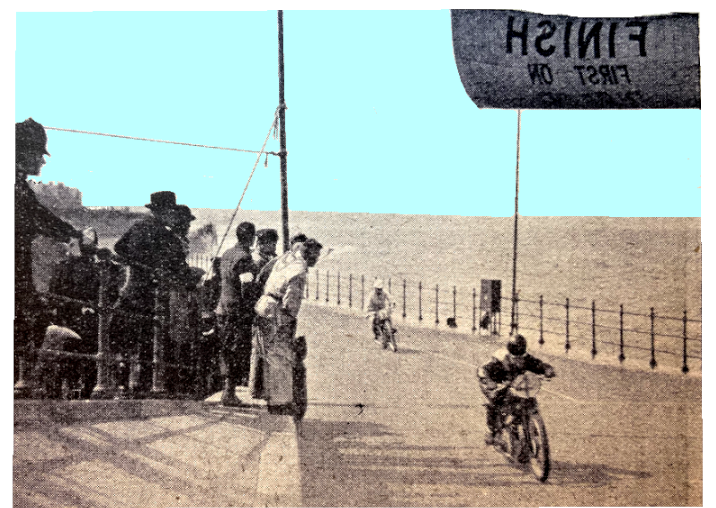
“IN THE RUN-UP to the TT, the Blue ‘Un’s northern correspondent Wharfedale pondered the way the world’s most famous road race had evolved. “…Development was a matter of practical experience on the course, and riders had also to be tuners and mechanics if they wanted to finish, for they might have any sort of job to do before they got round. Punctures, leaking tanks, valve adjustments, slipped timing, ignition trouble, dozens of things had to be contended with in the old days. There were names in the TT then that have been forgotten, other names that are still with us, some of them very large indeed, although they have been with-drawn from racing as a matter of business policy. What associations they call to mind! Dot, Sheffield-Henderson, Diamond, New Scale, Massey-Arran, Matador, Wooler, New Hudson, Levis, Toreador, Cotton, Indian, Douglas, Triumph, BSA, Scott, James. Coulson-B, Hobart, Ivy, Powell, Duzmo, ABC and several others. Great days indeed! Perhaps the name of BSA in the above list comes as a surprise to newcomers in our ranks, for the famous Birmingham firm has not been associated with the TT in the minds of most present-day motor cyclists. Yet in 1921 there was a big entry of BSA machines in the Senior Race, and very fine models they looked, for they were among the first machines to be designed specially for the event. They had inclined ohv engines with vertical valve, and were quite fast. But at that period there was not the metallurgical knowledge available, although it developed rapidly soon afterwards, and trouble was experienced in finding valve springs that would stand up to the job. Legend has it that every conceivable type of spring that could be picked up in Douglas was tried—chair springs, fork springs, saddle springs, and, of course, valve springs—and that eventually the clutch springs of a Model T Ford (the old ‘Tin Lizzie’) alone served the purpose. These BSAs, I am told, were detuned subsequently to a 60mph maximum (which was ‘going’ in those days) and sold off to enthusiasts, who found them unfailingly reliable. Of course, at that period when riders had to be mechanics there were often strained feelings between the designers and those who had to make the design go. I remember rolling round to one depot on one of those very hot, short-tempered sort of mornings and finding the ‘workshop’ doors closed but decorated with innumerable chalk scrawls warning ‘all slide-rule experts to keep out’.”
“A FEW WEEKS AGO I mentioned that several clubs, among them the Matchless MCC, were trying hard to make their club evenings more interesting by persuading well-known people to give talks on various subjects. One day last week I dropped in at the Rising Sun, Ebury Bridge Road, London, SW1, to listen to Captain SME Fairman, Divisional Accidents Officer of the Ministry of Transport, address members of the Matchless MCC on the subject of road casualties, their cause and their prevention. Captain Fairman was introduced by Mr SA Davis, of the BMCA, as a pukka motor cyclist whose duties are to make roads safe everywhere. Captain Fairman told us that although he was entitled to be driven by a chauffeur in a saloon car, he firmly believed that the best way to learn about road conditions was to ride a motor cycle—he covers nearly 800 miles a week on two wheels in the course of his work. If a bend is reported as dangerous he gets the police to hold up the traffic while he takes the bend at various speeds to see for himself. He went on to explain the way in which the Ministry is working overtime to investigate and improve conditions, and emphasised its sympathetic attitude towards motor cyclists. After his talk Captain Fairman came under a barrage of questions, which he went to great trouble to answer fully. It was nearly midnight before an enjoyable evening was brought to a close.”—Nitor
“ALL THINGS CONSIDERED, the new driving licence regulations which come into force on June 1st are to be welcomed as representing a further contribution towards safety on the roads. Under the regulations (the Motor Vehicles Driving Licence Regulations, 1937) motor vehicles are divided into various type-groups, and a successful candidate in a driving test will only be allowed to drive other vehicles in the same group. Fundamentally this regulation is thoroughly sound, for it is unreasonable to suppose that a man who passes a driving test on, say, a motorised cycle will be able to handle a car with equal facility. Where, in our opinion, the regulation fails is in the fact that it divides three-wheelers into two classes—those with reversing gear are classed as cars and those without reversing gear are motor cycles! It is, perhaps, a debatable point whether a three-wheeler should be classed as a car or motor cycle, but the fact remains that it has always been included in the latter class (and still is an far as taxation is concerned), and there seems no real reason for a change. In any case, the issue should not be decided by what after all is a minor constructional detail. As regards that part of the regulations that forbids the carrying of a pillion passenger by the ‘L’ rider of a solo machine, we are in full agreement. On many occasions The Motor Cycle has pointed out the dangers of inexperienced riders carrying pillion passengers, and the news that the practice is to be banned will, we suggest, be welcomed by all ‘good’ motor cyclists.”
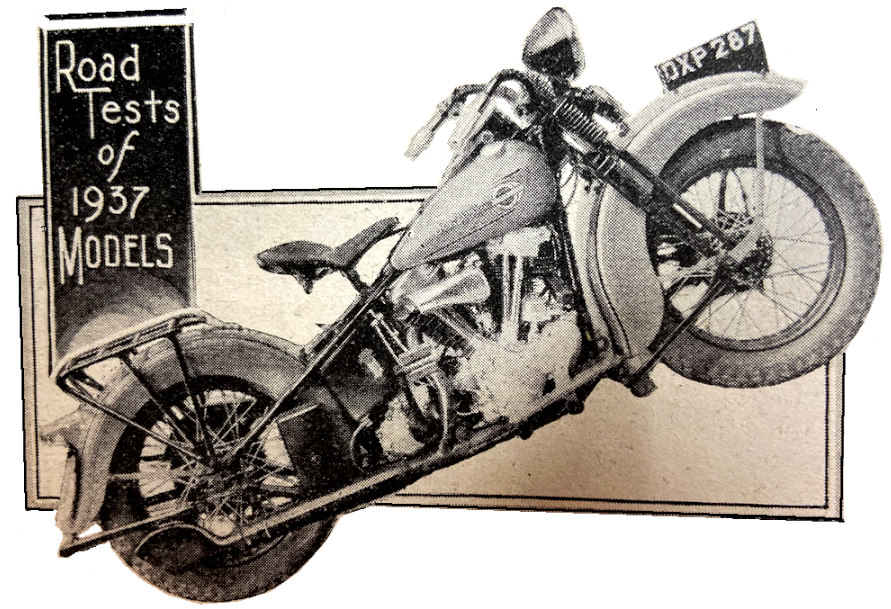
“FOR MANY YEARS the Harley-Davidson Motor Company has been renowned for its big side-valve twins. But early last year a 988cc ohv model was introduced. Known as the Model 61, it has a heavily finned V-twin engine mounted in a frame that is typically American. Throughout the machine is massively constructed and imparts an impression of immense strength and serviceability. The riding position is very different from accepted English practice, as in fact are many of the controls, but after the briefest acquaintanceship one very soon feels at home with (or rather in) this machine. The comfort of the saddle has to be experienced to be believed. Adjustment is provided for the long coil spring in the seat pillar tube, and by this means a vertical movement of more than 8in can be obtained. Although the saddle is of the pan type, upholstery and width combine to provide the luxury of an arm-chair. Incidentally, the saddle can be readily unclipped from the pillar and pivoted about its peak for inspection of the oil tank. Of the folding type, the footboards are set at just the right angle for the rider’s feet, while the handlebars, although wide, provide an extremely restful position for the arms. The only lever on the handlebars is that for the front brake. A clutch pedal is mounted at the forward end of the left footboard. It has a heel-and-toe action, and although damped has a strong spring action—either in or out—and can be used as a second neutral. When starting off, care has to be taken because of the tendency of the clutch to take up the drive on its own, but after very little practice it can be eased back momentarily by gentle pressure with the heel. Owing to the position of the clutch, turning round in the road to the left is a little tricky. It is also difficult to keep the foot on the clutch pedal when on full left lock on account of the left handlebar fouling the rider’s leg. On the other hand, the foot clutch and left-hand gear lever provide a combination that is second only to a foot gear change for quick gear selection. The Linkert carburettor is fitted with a choke which has a variety of settings for use in temperatures varying from 30° below zero to tropical heat. Normally it was unnecessary to use the choke. The engine would always start on the first or second kick, although it was inclined to spit back until warmed up. There are two adjustments which can be set while riding—one controls the main jet and the other the slow running. Such was the power of the engine that care had to be taken when accelerating in either bottom or second gear. The response to the throttle was so immediate that at times the rider was jerked backwards and involuntarily opened the throttle still wider. At low speeds the transmission was a trifle harsh in the high gears, but at speeds over 20mph in top the power delivery was delightfully smooth and free from vibration. It is from 30mph upwards that the Harley-Davidson becomes a real joy. Its acceleration is, without exaggeration, colossal. From 15mph to 30mph the time taken in the various gears differs by such a little that one wonders why four speeds are fitted. In any ratio the terrific surge of power is breath-taking, particularly when accelerating from 20mph to 50mph, is remarkable up to 50mph, so it is above this speed, up to 80mph and more. There is an
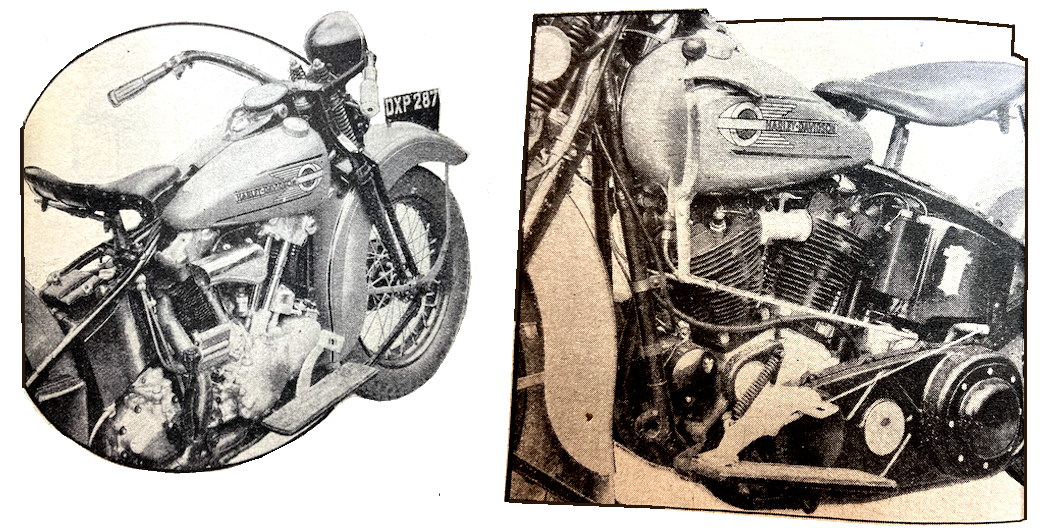
indescribable thrill about riding this large machine along a wide, straight and deserted main road. Sitting bolt upright in armchair comfort, one can almost immediately command any speed up to 85mph on the level. There is only one small criticism—the rider’s feet are liable to slide off backwards if they are not kept firmly on the footboards. A speed of 76mph can be attained in a quarter of a mile from a standing start. The timed mean speed over a ¼ mile, taken in both directions, amounted to 86.5mph, with a best one-way speed of 88mph. In third gear the Harley-Davidson is extraordinarily quick, although second gear is all that one needs to start and get right ahead of any traffic. In fact, one can start in first, second or third with very little difference in the time taken to reach 30mph. Although no steering damper or shock absorber is fitted, the steering of the Harley-Davidson is beyond reproach. In spite of its weight—5451b—its handling at all speeds over good or bad surfaces is superb. No doubt on account of the large movement of the saddle, bad potholes can scarcely be felt. The machine is, however, inclined to pitch slightly at 50mph, although at speeds below and above this figure the tendency is not apparent. Just as the steering and performance of the Harley-Davidson are amazing so is the cornering. The big machine can be swung round bends at extraordinary angles, while bumps can be ignored. The handling on wet roads inspires confidence, although great care has to be taken not to accelerate too hard. At high speeds the brakes leave little to be desired, although the rear brake was apt to lock the wheel on sudden application. At slower speeds the brakes were not quite up to the exceedingly high standard set by the rest of the machine. The finish of this machine is of a very high standard. On many occasions the machine was used in the rain, but not a sign of rust appeared. The mudguarding is also very efficient, and keeps the machine surprisingly clean. When riding in the rain the front mudguard tends to direct a stream of water on to the rider’s legs. But this is a small point when the ‘ultra’ performance of this fascinating machine is born in mind.”
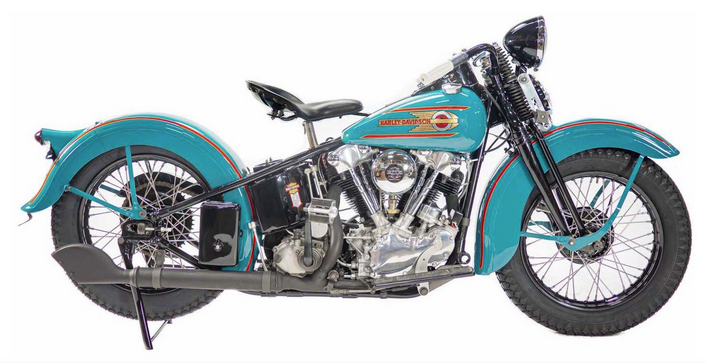
“THE INDIAN MOTORCYCLE Co of America, like the Harley-Davidson people, take pains to see that their riders are properly clad…The Indian people, in addition to pushing legshields and windscreens for the six winter months, market a garment unknown on this side, called a ‘rain suit’. It resembles the famous Sidcot in general layout, is obtainable in white and khaki, and incorporates a monk’s hood to cover the head on demand. But it lacks the heavy lining of the typical Sidcot (which was, of course, introduced for flying), and can be rolled up into a package about 12in long and 6in thick, and strapped to the handlebars when not required. It is described as being made of rubberised uncrackable fabric, and sells at about £2 10s of our money. Its advantage over the Sidcot is that it is much lighter and more portable. I believe there would be a definite market for it over here. Its success probably pivots on the technical chemistry by which the rubber is bonded into the fabric, a point which made the ‘Continental’ rubber glove of pre-war days, and defeated that glove’s post-war British imitators. Our Sidcots are so bulky, weighty and warm that few of us carry them except in really bad weather. This lighter combination knit lends itself to permanent carriage on the person or the bus.” It seems our colonial cousins invented the unlined on-piece oversuit which became ubiquitous in the 1970s. Kudos!—Ed.
“LAST SATURDAY AFTERNOON thousands of Londoners enjoyed the spectacle of the first motor cycle races ever held on a genuine road-race circuit within the Metropolis. The occasion was the Coronation Grand Prix meeting held under the auspices. of the Road Racing Club on the new two-mile circuit at the Crystal Palace. The outstanding feature of the races was the number of top-notch road race stars in the entry. There were three past winners of Isle of Man TT races, as well as a number of Manx Grand Prix stars. As was only to be expected, the racing was of an exceptionally high order. M Cann (348cc Norton) rode magnificently to win the Junior event at an average speed of 53.15mph—only 0.62mph slower than the winner of the recent car meeting on the same circuit, and his record lap at 55.13mph was actually 0.54mph better than the fastest car! The winner of the Senior Race was HL Daniell (490cc Norton) at 52.86mph. He had a grand tussle with JM West (497cc Ariel) and the redoubtable Stanley Woods (495cc Velocette). Before the Junior Grand Prix was started, Eric Fernihough, fresh from his record-breaking runs in Hungary, rode his famous streamlined Brough Superior—the fastest two-wheeler in the world—round the circuit, to the delight of the huge crowd. [The meeting also featured] an invitation race for sidecars, for which there were six entrants. It could not be described as an exciting race—although J Surtees’ 596cc Norton outfit provided some hectic moments. At the Stadium Curve, opposite the grandstand, the outfit hit a bank of earth and in the space of a few seconds tipped both driver and passenger out, continued driverless across the track on to a grass verge and fetched up against a fire-float—but not before it had torn off the door of the Secretary of the Meeting’s car! Soon after the start of the race AH Horton (596cc Norton sc) was in the lead, closely followed by W Graham’ (495cc AJS sc), B Ducker (490cc Norton sc) and F. EG Ratcliff (490cc Norton sc). On the third lap Graham dropped out and Ducker and Ratcliff moved up into second and third places, this order being maintained to the finish.”
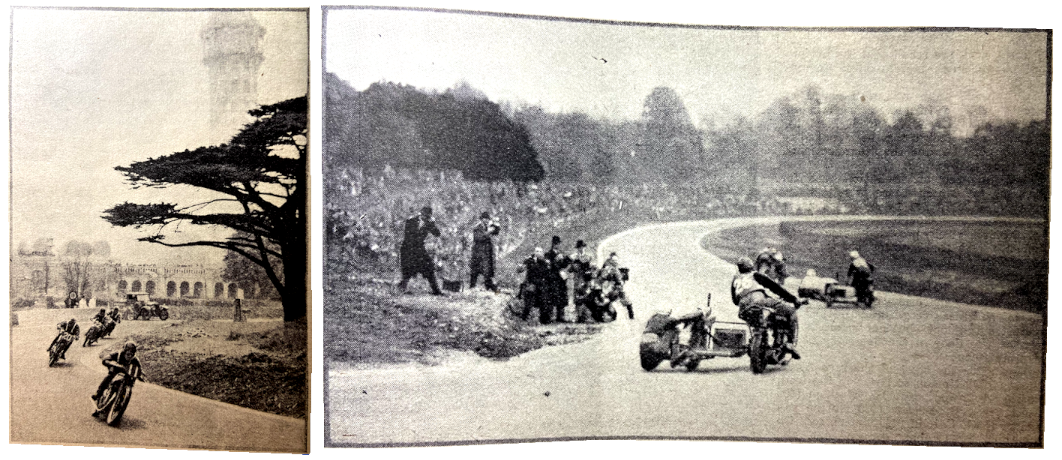
“RATHER THAN BE DICTATED to by the Auto Cycle Union, the Motor Cycling Club has decided not to hold the Inter-Club Team Trial this year. The bone of contention lies in the fact that ever since its inception in 1904 the trial has been open to all clubs. Now the ACU wishes to restrict the event to clubs which are affiliated to the ACU. In other words the trial, it is suggested, should be a championship of ACU clubs, not the championship of the clubs. Rightly or wrongly we have felt for years that a certain section of the Union is jealous of the MCC—it appears to consider that the trial ought not to be run by the MCC at all, but by the ACU as governing body of the sport. This is by no means the first time that difficulties have arisen. There is still in existence a telegram the ACC (now the ACU) sent on the eve of the very first trial threatening to suspend everyone who competed! For years the ACU has been granting permits on the basis of the event being open to all clubs. Recently there has been this change of front. Conferences have been held between delegates; an agreement was even reached, but the ACU Competitions Committee set aside the agreement and decided that no permit was to be issued unless the event was restricted to ACU-affiliated clubs. This we look upon as thoroughly shortsighted. The ACU’s duty is to encourage club life. Many a club has owed its inception largely to the Team Trial; a group of motor cyclists has been encouraged to join together and enter as a team, and later has come into the ACU fold. If there is one event in the calendar in which the ACU should work hand in glove with the MCC it is the Inter-Club Team Trial, which by fostering inter-club rivalry can be an immense asset in club life. We urge that the question of issuing a permit be reconsidered.”

“ALTHOUGH the latest 349cc Calthorpe is known as a de luxe model, it should not be regarded as suitable only for touring. On the contrary, it possesses qualities which make it a satisfactory mount for fast road work and for other sporting purposes. This 350 has full electric lighting, with magneto ignition (coil ignition is available at a slightly lower cost). It is a neat machine, and appears to be of larger capacity than is actually the case—until the rider sits in the saddle. Then the illusion is reversed, and the machine seems much smaller—both as regards its riding position and its handling. For a rider of medium build the saddle is set a trifle too far forward. At the same time, the riding position is comfortable and the controls are very accessible. The handlebars are of the ‘clean’ type, with the controls set at a natural angle. Incidentally, the bars are commendably narrow. Starting called for a little more effort than usual, a fact no doubt due to the newness of the machine and possibly also to the gear ratio between the engine and kick-starter. When the engine was warm it was sometimes necessary to flood the horizontal-jet type carburettor in order to restart. Idling was excellent and particularly smooth. Indeed, smoothness was a characteristic of the engine throughout its range, and neither at high nor low speeds was vibration particularly noticeable. The gear change is both light and positive, and the same applies to the clutch. The gear pedal is conveniently situated in relation to the rider’s foot, and practically no effort is required to select a gear. The gear box was reasonably quiet, although a slight whine could be heard in the intermediate gears. This was probably more noticeable on account of the exceptional quietness of the engine, both mechanically and as regards the exhaust. At the upper end of the engine’s range the exhaust note is still subdued, even though it does acquire a certain ‘tanginess’. On the open road the Calthorpe handles like a 250. Its steering has a marked self-centring effect which makes it quite unnecessary to employ the steering damper. When the machine is taken into a corner it seems automatically to adjust itself to the correct angle and to hold itself there regardless of the road surface.
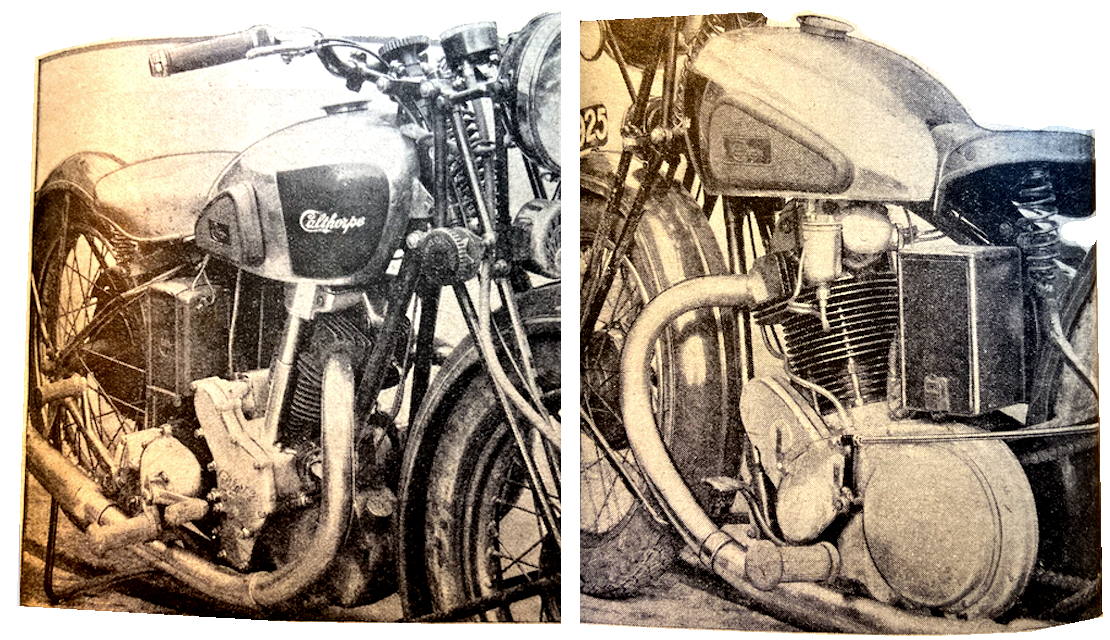
Thanks to the positive nature of the steering, the machine, imparts a feeling of great confidence on greasy surfaces. The road-holding, even over rough surfaces, is particularly good. At high cruising speeds the handling is excellent and requires no effort. The Calthorpe will cruise comfortably at any speed between 50 and 60mph—incidentally, the speedometer was giving readings at these speeds which were slightly on the low side. Timed in both directions over a quarter bf a mile, the mean speed of four runs amounted to 65.2mph, with a best one-way run of 67.1mph. The figures were obtained with the rider crouching down as far as possible, for no mudguard pad is fitted. The best speeds attained in third and second gears were 52mph and 40mph respectively, and 26mph was the best figure reached in bottom gear. Main-road gradients could be tackled for the most part in top gear, so long as the engine revolutions were maintained. On the other hand, quite steep hills could be climbed in third gear at speeds of well over 40mph. Hills of a trials nature could be surmounted with plenty of power in hand—a point which, coupled with the excellent steering, suggests that if the machine were fitted with competition tyres, it would prove admirable for trials work. There is no doubt that had the mixture been a trifle richer at low engine speeds the acceleration would have been extremely good. As it was, a definite flat spot was noticeable when opening up, which caused the engine to ‘cough’ momentarily. Above this period the acceleration was all that could be desired of a 350. In top gear the best response to the throttle was obtained between 35mph and 55mph. On the other hand, the acceleration from a standing start through the gears was almost as good as many 500s. A speed of 56mph was reached in a quarter of a mile from a standing start. The brakes are well up to standard, although a little more efficiency on the part of the front brake would have improved the braking figure considerably. Both brakes are light and easy to operate, and pleasantly smooth in action. As regards economy, the oil consumption during the test was practically nil, while at a maintained 40mph the petrol consumption amounted to close on 100mpg—actually it was 99.6mpg. And this figure was only slightly reduced when the machine was cruised at higher speeds. Throughout the test the engine of the Calthorpe remained remarkably free from oil leakages, both as regards the crankcase and around the totally enclosed overhead valve gear. Finally, the mudguards are of a design which ensures the machine and rider keeping clean, even after many miles of wet and greasy roads.”
“OVER 9,200 MILES without stopping the engine! That is the feat which has just been accomplished in Australia with a 1937 Model 6/S 600cc side-valve Triumph and sidecar. For 13 days and 13 nights the outfit ran like clockwork, keeping up an average speed of 29.6mph, including all stops for refuelling and change of personnel. Throughout the test the outfit was under the scrutiny of the Australian ACU. After 9,261 miles had been covered misfiring set in owing to the plug gap widening and the engine stopped for the first time since the outfit had set out on its long run. Not since 1927, when a 577cc side-valve Ariel outfit completed a 5,000-mile non-engine-stop run, has a sidecar machine undertaken anything like such an ambitious test.”
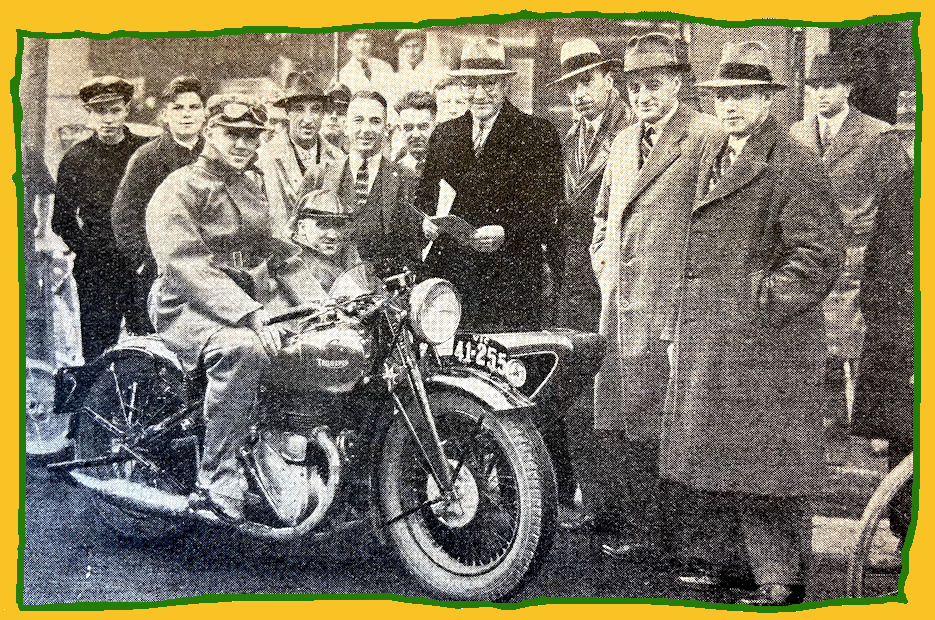
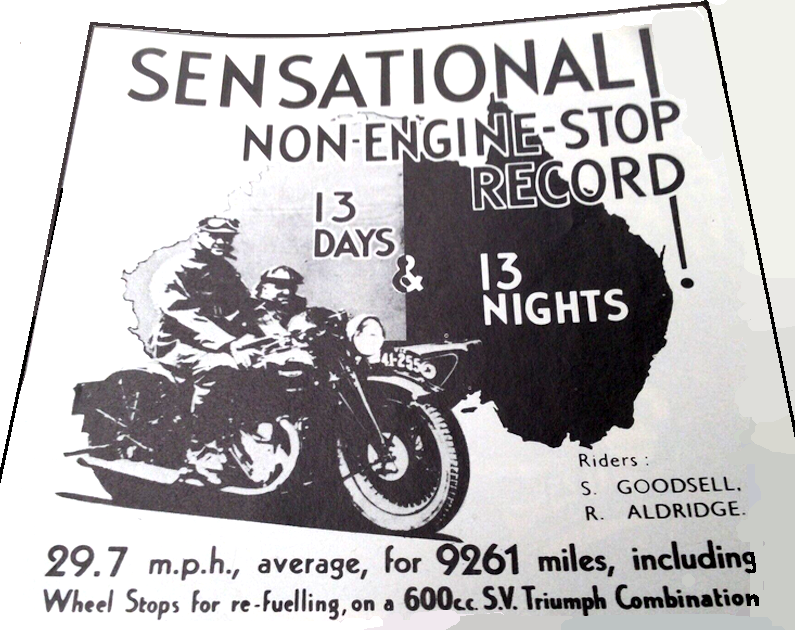
“RIDERS PROVISIONALLY SELECTED by the ACU for the British teams in the International Six Days’ Trial turned up in force at Donington last week for the preliminary tests. The final choice of the teams will depend largely on the results of these tests, and naturally every rider was out to do his, best…The day previous to the tests was spent by several of the riders in getting on good terms with their machines and with the Donington circuit, and in righting any minor mechanical defects which may have developed. Stuart Waycott, the sidecar man in the Trophy team as at present constituted, had a spot of bother due to a mechanic’s error in assembly, and had to work all night obtaining and fitting a new cylinder. He had a 500cc Velocette with him, but he proposes to drive a 600cc machine in the trial—one similar to the new TT designs. The other members of this team, Vic Brittain and George Rowley, were on 350cc machines, a Norton and AJS respectively. Riders in the Vase ‘A’ team were Les Heath (499cc Ariel), A Jeffries and Jack Williams (348cc Norton), and the “B’ team, all Rudge-mounted, were Bob MacGregor, Jack Leslie and JC Edward….Various adjustments were made on Wednesday morning, and those riders who had not been present on the Tuesday put in some useful practice. All were examined for physical fitness by Dr. Galloway. These preliminaries over, the real tests began. All riders were required to cover 18 laps of the outer circuit (about 46 miles) to give an indication of what might be expected of them in the final speed test of the Six Days. Following this, they were called upon to cover three laps at high speed, one of which was timed. Afterwards, there was a tyre-changing test, also timed, in which front wheels had to be removed, the tyre and tube detached, replaced, and the wheel put back in the forks. Allan Jeffries was outstanding in the 18-laps test. In characteristic fashion he made a real race of it, whereas most of the others preferred to take things comparatively easily…The three-lap high-speed test was reminiscent of a Bank Holiday at Donington. Although for obvious reasons times cannot be given, it can be said that most of the machines behaved very creditably. However, some were rather noisy, and one or two of them experienced trouble. The piston of Len Heath’s Ariel seemed at one period to be inclined to ‘pick-up’, although no seizure occurred, and Bob MacGregor’s Rudge met trouble when a tappet lock-nut came unscrewed. Graham Walker, who was present, is looking into the matter to ensure that it does not recur. In the tyre-changing tests, Brittain and Waycott were noted as good. Rowley, having an injured and bandaged hand, did not take part, but will undergo the test at a later date. From the instructions issued, it seemed likely that rear instead of front tyres would have to be changed, and Jefferies, who had no tools for his front wheel, changed the rear tyre instead. The ACU observers carefully noted these tests. The machines themselves showed no startling changes, and those devices that have been found useful on past occasions were again included. The Norton have box spanners with tommy-bars welded to the wheel spindle nuts. In addition, clutch and brake cables are duplicated, nail-catchers are fitted to the mudguards, and the machines are equipped with air bottles for rapid tyre inflation. These features are common to most of the other machines. Waycott has a single-leg rear stand for jacking-up the rear of the machine, steel protectors for the crankcase, and his air bottles are in carriers bolted to the sidecar body. The AJS machines are rakish-looking, free from useless frills and, of course, of the chain-driven ohc type. Len Heath’s Ariel has a bronze cylinder head, and appeared to have a very useful turn of speed. The Rudges, too, are smart-looking jobs, and seemed comfortable to ride at high speeds. Thacker’s and Jefferies’ Triumphs sounded good all the time, and, as already stated, went extremely well.
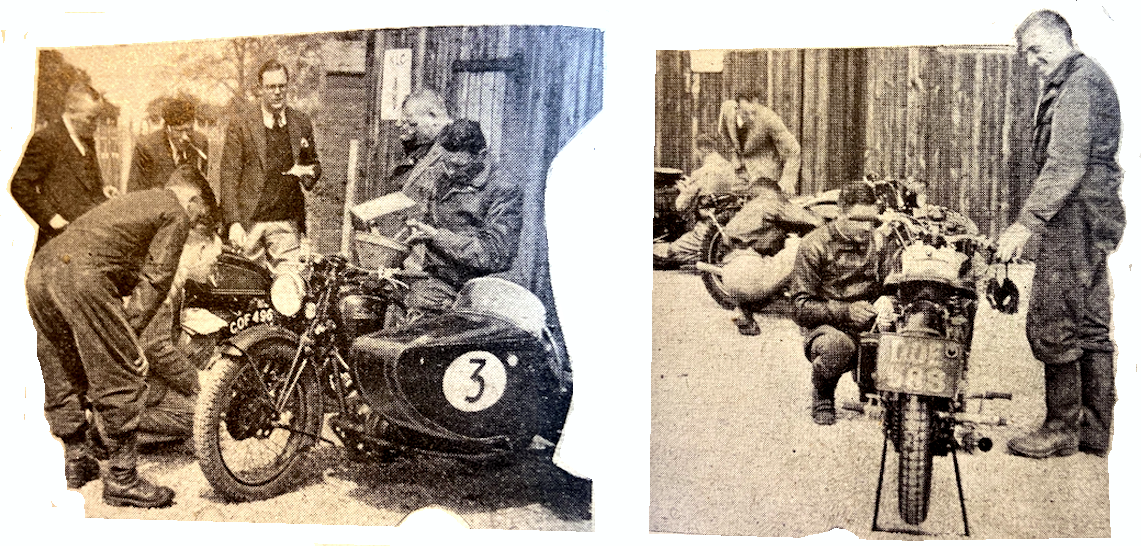
“OVER 48,000 PEOPLE were at Wembley to see the first speedway Test of 1937 between England and Australia, and although England won by 66 points to 41 the match sparkled from beginning to end and provided splendid racing. The meeting was perfectly staged. England’s captain, Frank Charles, gave everyone a fright when the siren sounded warning him that he had two minutes to get going for the opening race, but it was just a matter of changing a plug.”
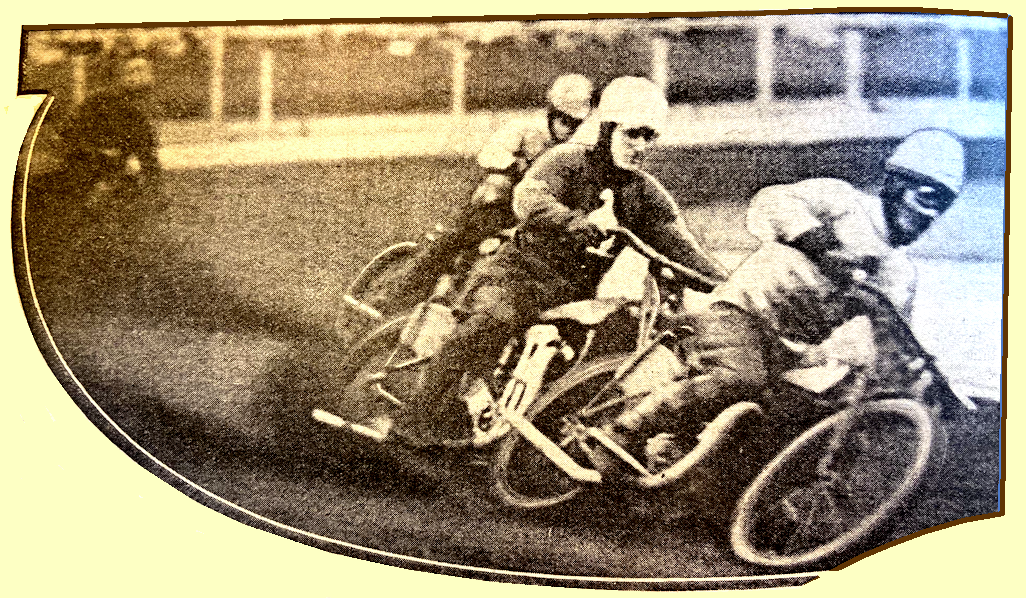
“CONDITIONS that were almost ideal prevailed at the Open-to-Centre scramble organised by the Bayswater MCC last Sunday. The weather was warm and sunny and the rain of the previous evening had successfully laid the dust. As a. result the crowd of several thousands who attended the meeting saw an afternoon’s keen racing. The course was the same three-mile circuit on Bagshot Heath that the organising club has used for several years past. It consists of sandy tracks—some smooth, some bumpy—and many hills, chief of which are the famous Red Road and Kilimanjaro. It is a course that is popular with scramble riders, and the Club had had to refuse some 15 entries after the entry list had closed with a total of 73.”
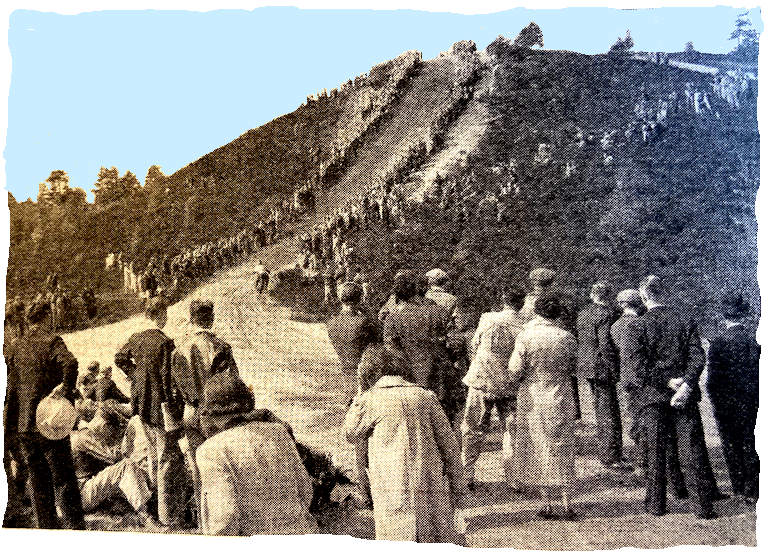
“FINAL DECISIONS HAVE now been made as to the type of machine Excelsiors will take to the Island. Naturally, minor alterations may be made as dictated by performances during practice, but sufficient is now known to make it unlikely that any changes will take place. Models for both races entered—the Junior and Lightweight—will be of the four-valve type, and the cylinder dimensions are, respectively, 75x79mm (349cc) and 67×76.5mm (249cc). Aluminium-bronze cylinder heads are to be used, and the design allows the triple-coil valve springs to be totally enclosed, lubricated and air cooled. Cylinder barrels will be of a special hardened-alloy iron.”
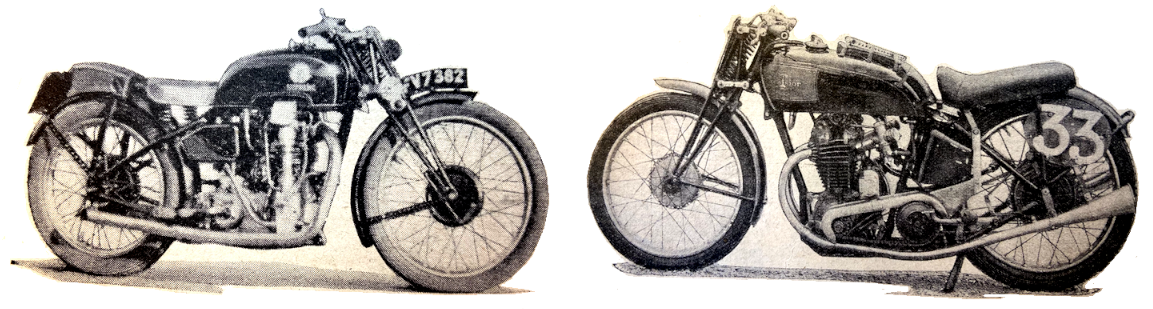
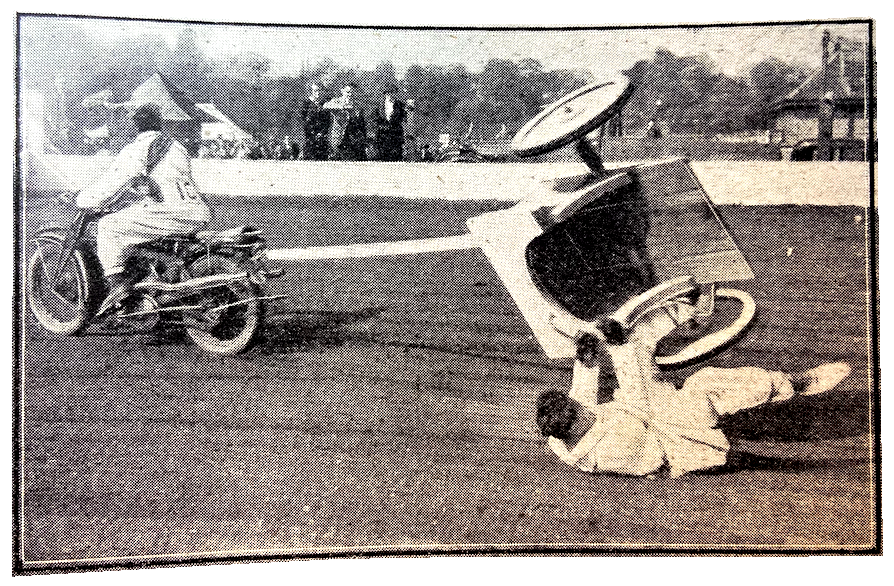
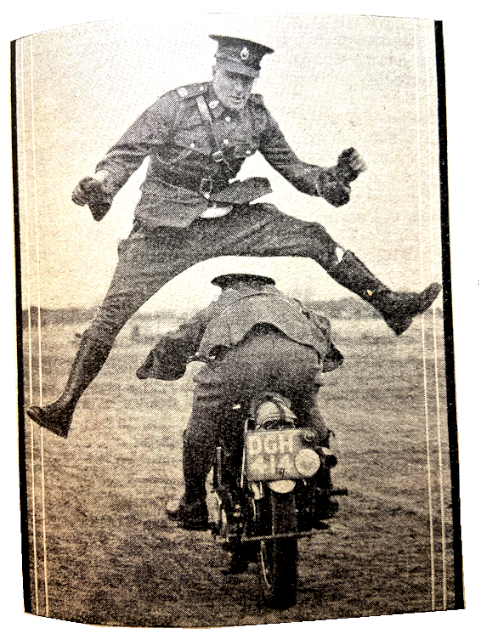
“SO THE PROPOSED RACE for mobiles at Brooklands is ‘off’. The event was to have taken place over the new road circuit in July, but the authorities have intervened and refused permission for their men to compete. The news will come as a sad blow to the many enthusiasts in the mobile police force, and will certainly disappoint those Brooklands habitués who were looking forward to seeing the ‘cops’ perform. The reasons given for the refusal are (1) That members of the mobile police are too busy to spare the time for the race and practising, and (2) The proposed race was rather dangerous. The italics are mine! Somehow there is something amusing about the suggestion that men who are expected to chase criminals at high speeds through busy streets will come to harm in a properly organised track event.”
“MOUNTAIN CHAMPIONSHIP DAY at Brooklands is usually a day of exciting racing, and last Saturday’s Championship meeting proved well up to standard. There were close finishes in both handicap and scratch events, and five men found enough speed to win Gold Stars. The weather was gloriously fine, but there was just enough breeze to keep the spectators and officials reasonably cool—the riders just sweltered in their leathers as they waited on the line before the start of each event. But the heat failed to discourage them from discussing vehemently the new regulation regarding front number plates. Every competitor had to carry a large cardboard number on the front, and those folk with streamlining—and some of those without—were saying many hard words about the organisers who had introduced the idea. Proceedings began just after 2.30pm with a three-lap outer-circuit handicap race…Then came the two most important events of the day, the Senior and Junior Mountain Championships over 25 laps of the
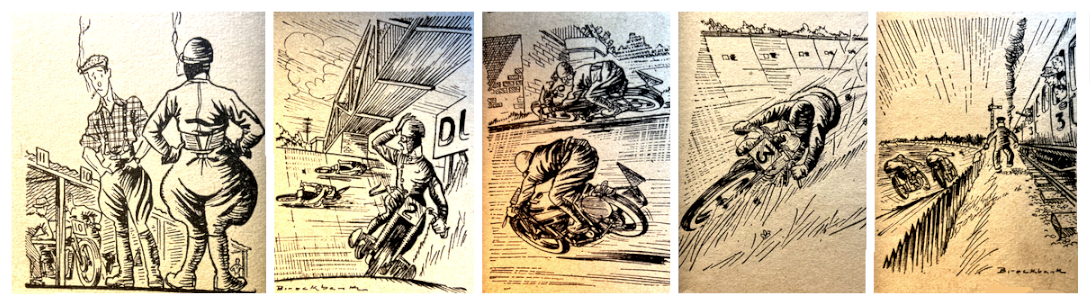
Mountain course. First was the Junior, which had attracted an entry of 18. When the field was on the line, talk centred on the TT, everyone asking everyone else when they were going over to the Island, but when Ebby came down from the box and dropped his flag the field shot away like so many scalded cats. EG Mobbs (348cc Velocette), NB Pope (348cc Norton) and LJ Archer (348cc Velocette) were first away and, as it transpired, held the first three places throughout the race. On the first lap Archer had the lead, with Pope on his tail and Mobbs only a little way behind. Then came R Harris (348cc Norton), HC Lamacraft (348cc Velocette and LE Brooks (348cc Velocette). On this lap MV Horsfield (348cc Velocette) hit the outer sandbank at the Members’ Corner, fell rather heavily, and retired. Soon the race settled down into a number of Norton-Velocette duels. The scrap for first place was terrific. For the first three laps Archer was in front, with Mobbs and Pope scrapping hard behind. Then Pope drew away from Mobbs, and on the eighth lap managed to catch and pass Archer. For lap after lap these two pairs circled the course, playing
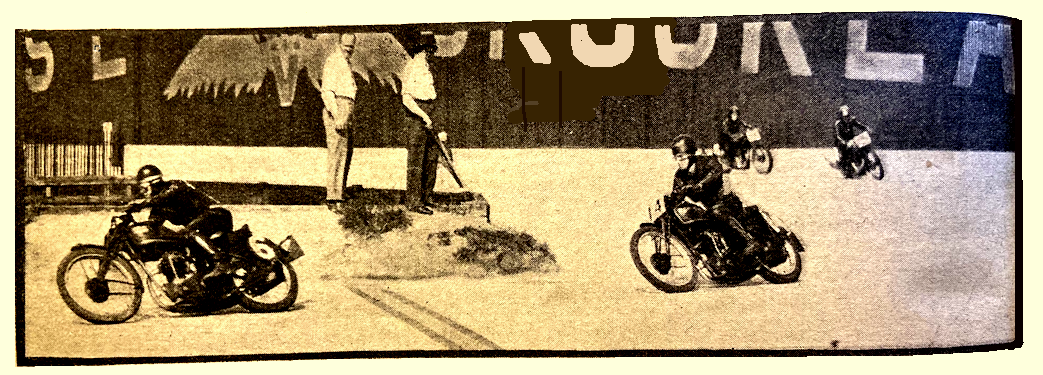
cat and mouse with one another, and all were lapping in approximately one minute. Behind them WR Lunn (348cc Velocette), FW Fry (348cc Velocette) and G Newman (348cc Velocette) were keeping up steady speeds, while CD Allen (245cc Excelsior) and LA Dear (246cc New Imperial) were putting in creditable laps with their smaller machines. For 17 laps Pope led Archer by only a few yards. Then on the next lap Archer passed Pope at the back of the course and proceeded to pull out still more speed on the ensuing laps, eventually drawing well away from his rival. Similarly, Lamacraft overtook Harris and set out in chase of Mobbs. For several laps he was overhauling him steadily and it looked as though he might just be able to catch him. On the final lap Archer came round with 100 yards in hand over Pope. Then everyone craned forward to see Mobbs and Lamacraft; but Lamacraft misjudged the last bend in the race, the Fork, and slid to earth, leaning Mobbs unchallenged in third place. The Senior race was not a whit less exciting. Out of an entry of 22 there were four non-starters. H Rayfield (490cc Norton) earned the distinction of being last away from the line, and DAL Garzano (490cc Norton) couldn’t get his motor going for a long time. NB Pope (490cc Norton) held the lead on the first lap, but as he passed the lap-scoring boards his motor was misfiring and JW Forbes (490cc Norton) overtook him; R Harris (490cc Norton) was third. On the next lap Harris also overtook Pope. Then Pope stopped at the back of the course to cure the misfiring, and although he lost two laps he got going again. Retirements had already begun, and AT0 Liddell (499cc Vincent-HRD) and LE Tooth (499cc Rudge) both toured into the pits.
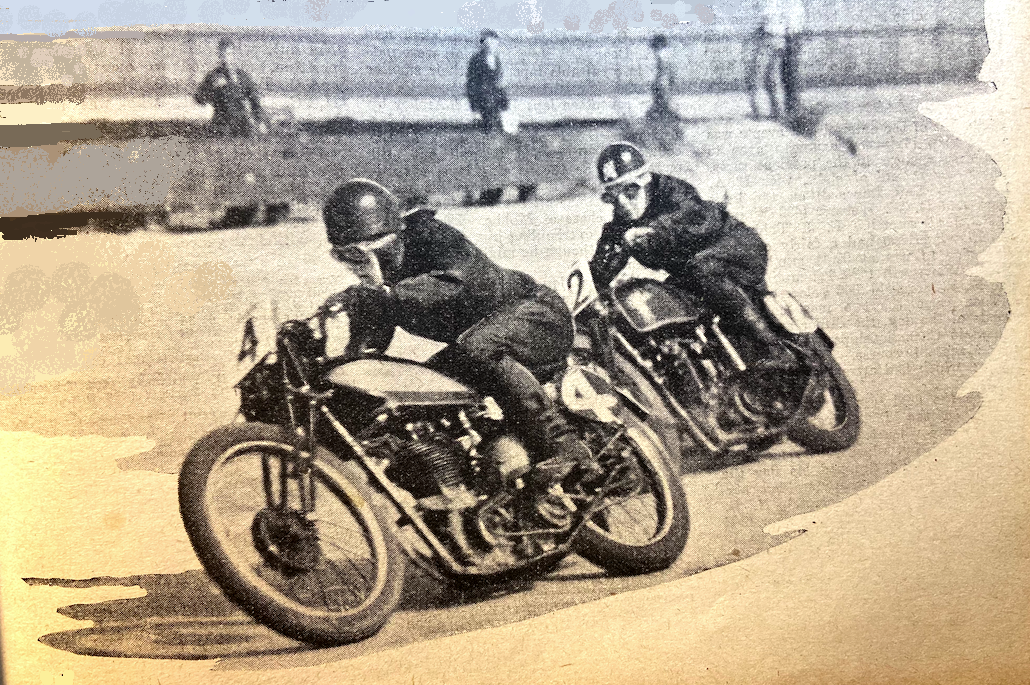
Then R. Harris (490cc Norton) had a bout of misfiring and later retired. Meanwhile Forbes was still going great guns in the lead, followed now by AJ Rawlence (490 cc Norton) and DC Minett (499cc Rudge). Pope, although two laps behind, was right on Forbes’ tail and the two proceeded to have a colossal duel for the rest of the 25 laps. On the sixth lap H Rayfield (490cc Norton) ousted Minett from third place and on the following lap he became second when Rawlence went out with mechanical trouble. But Rayfield’s success was short-lived, for on the following lap he also retired. This left Minett in second place behind Forbes, who by this time was nearly half a lap ahead and still duelling with Pope. On the 11th lap CM Brooks (490cc Norton), who had pulled up into third position, managed to overtake Minett, and CT Atkins (490cc Norton) overtook HC Lamacraft, who was riding a Junior Velocette to such good purpose that he was holding fifth place. From then to the finish Forbes held the lead and his efforts had resulted in his almost lapping the second man. Behind him the positions remained unchanged except that Pope had had to be content with fifth place.”
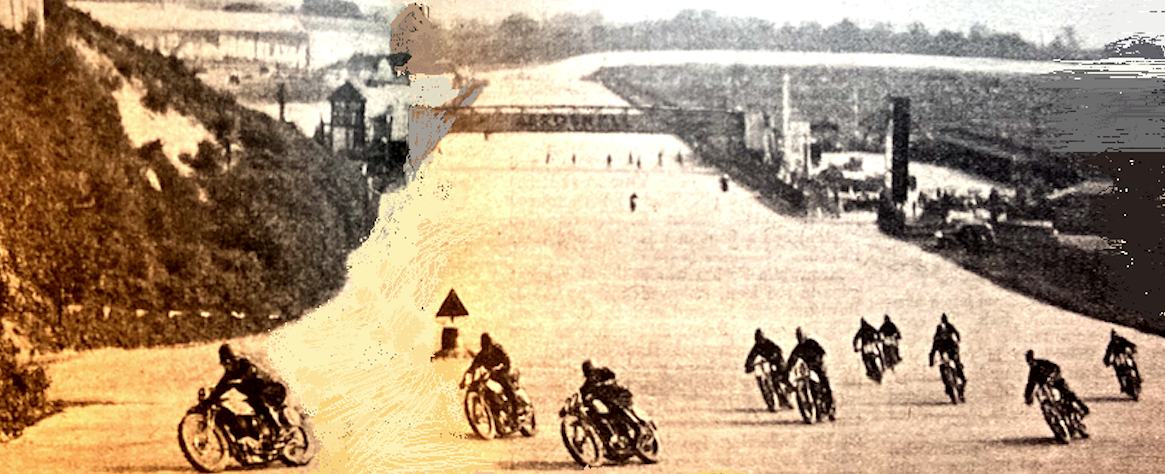
“AS A CONFIRMED SCEPTIC I often wonder sadly if our No 8 hats really know anything about engines and motors generally, or if, as I imagine, they invent their theories to fit the prevailing practice. For instance, pistons must be a close fit in their cylinders or be inefficient (so we are told), yet the Cross engine works perfectly with a piston which does not, and must not, touch the cylinder. Fans would scream about upset stability if Norbeams raised their engines lin in the frame, yet will prove conclusively that a ten-stone pillion passenger who raises the machine’s centre of gravity 2ft is a definite advantage. Fast riders condemn the speedometer as inaccurate, and accept the rev counter as gospel, yet both instruments are similar internally. TT Tooner says that long exhaust pipes are necessary to obtain power by reason of the extractor action, yet the super-efficient Rolls-Royce Kestrel and Merlin aero engines have exhaust pipes about 6in long. Roller head bearings are essential for easy steering, so dampers are fitted to prevent their functioning. It is well known that detachable and fixed cylinder heads are definitely superior to each other. If I forsake the model temporarily and get out the car, I consult three different instruction books, Where I find that before starting, I must (a) warm up the engine slowly to ensure proper oil circulation; (b) warm the engine quickly to prevent condensation and corrosion of the bores; and (c) drive away without warming up. Again, it was conclusively proved in a car journal some months ago that it was impossible to stop a car going at 30mph to less than 30ft; this is particularly unfortunate for me as it means that I was killed in a road smash 12 weeks ago. Good old technical experts, long may they live to confound us and each other!
H Johnson, Ashford, Middlesex.”
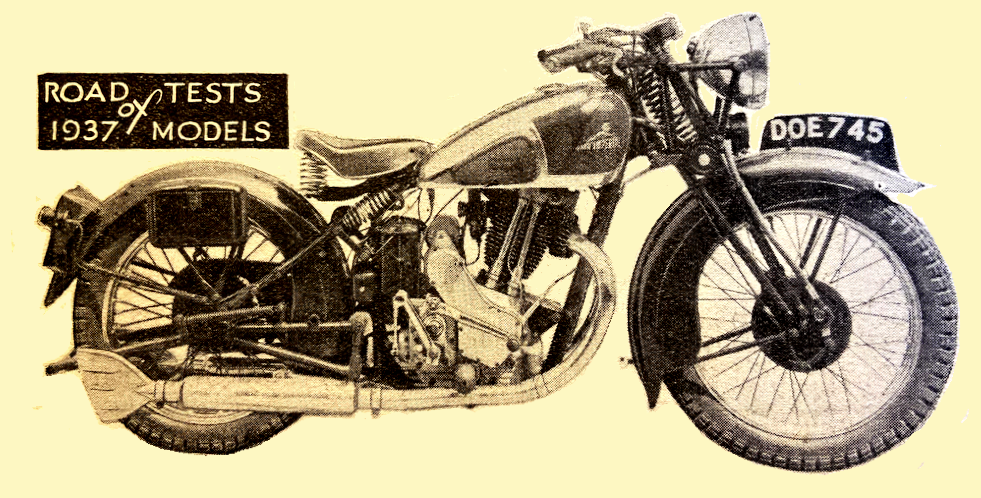
“TOWARDS THE END OF last year New Imperial Motors announced that all their new models, with one exception, would be available with rear springing for the comparatively low extra charge of £3. This spring frame is of a type developed and marketed by the manufacturers over a period of years, and it undoubtedly enables long journeys to be covered with the absolute minimum of fatigue. The Model 46DL, the New Imperial under review, is fitted with a spring frame and a 344cc engine with fully-enclosed overhead valve gear It is sold with electric lighting and an extensive de luxe equipment. Two interesting points concerning this machine are that the gear, box is built in unit with the engine and helical gears are employed for the primary drive. When the rider is astride the machine the impression is gained that the New Imperial is a sports 500 rather than a 350. This is due to the wide three-gallon petrol tank. The riding position is most comfortable and the relationship of the saddle to the handlebars provides a restful position for the arms. The footrests are well placed, but the rear brake pedal might be considered a trifle too near the footrest, coming as it does under the rider’s instep. Starting was reasonably certain provided care was taken in setting the ignition lever. A fraction back from the fully-advanced position was found to be the most suitable, and with the air lever closed a first-kick start could be assured. The idling was smooth, if a trifle uncertain—the mixture appeared to be on the weak side and at times the engine would spit-back and stop. In view of this tendency the air lever was used more than is usually the case. Under load the engine pulls sweetly, and throughout its range is remarkably free from vibration. Both mechanically and as regards the exhaust the New Imperial is commendably quiet. There is, however, a slight period near the peak performance of the engine when the valve gear can be heard. The clutch is both light and smooth in operation, with no trace of drag— even when the machine has been left standing for several hours. Selection of the gears calls for considerable movement of the foot, and a certain amount of effort is necessary to make a positive change, particularly when changing from top into third gear. On the other hand, excellent gear changes of the quick, racing type could be made with ease. In the indirect ratios the gears are perfectly silent. The New Imperial has a surprising turn of speed. Although known as a de luxe model, the machine tested would comfortably exceed 70mph. Actually, the mean speed of four runs taken in both directions over a quarter-mile was 71.4mph—an extremely creditable figure for a 350 with full electrical and de luxe equipment. The best figure attained in one direction was 72.5mph. The maximum speeds in third and second gears were 61mph and 53mph respectively. Concerning the latter figure, a certain amount of valve float set in at just over 45mph, so that the machine required some slight encouragement to exceed this speed. An impression was obtained that had the gear ratios been a trifle lower, particularly in the case of second gear, the acceleration would have been better. Even so, the New Imperial managed to attain a speed of 58mph in a quarter-of-a-mile from a standing start, which is exceptionally good. for a 350. The machine is at its best when accelerating between 20mph and 50mph. In top gear the best acceleration occurs between 35mph and 60mph.
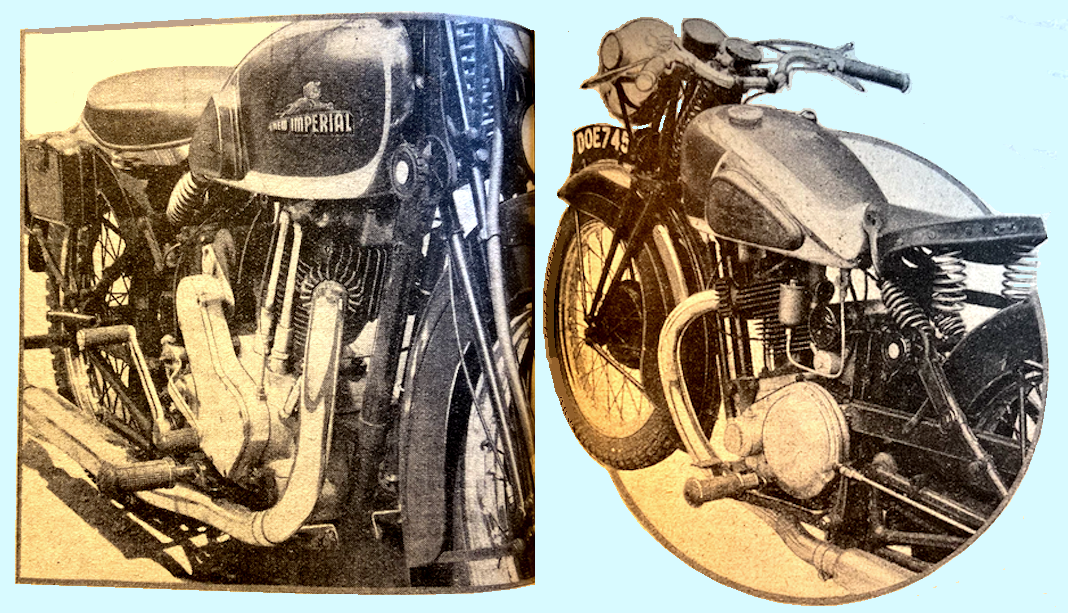
Although the engine seems to revel in revs, it has a surprising reserve of power at low speeds. As with most spring-frame models the steering of the New Imperial has a marked self-centring action, and it inspires every confidence. On bends, fast or slow, it seems to adjust itself automatically to the amount at banking required. At high speeds the steering was such that the steering-damper could be ignored. Care had to be taken when rounding fast comers on account of the fishtails grounding—a small point which can be overcome by slightly tilting the fishtails inwards. For town work the damper controlling the spring-frame can he slacked off without dismounting. The frame then works to its fullest extent and imparts a feeling of armchair comfort. For fast work it is advisable—although not essential—to tighten the damper, thereby improving the road-holding. Under these conditions it is difficult to realise that the spring-frame is in operation, except for the very important fact that the bumps and pot-holes in the road are ironed out. During the course of the test the engine of the New Imperial remained remarkably free from oil leaks. The oil consumption was practically nil, and at a maintained 40mph the petrol consumption amounted to 86.4mpg. At no time was it necessary to make any adjustments, which in a way was unfortunate, for it gave no opportunity to try out the really first-class tool kit. Finally, the brakes were well up to the high standard set by this de luxe machine. Both back and front brakes were light and smooth in application, and both were extremely powerful.
“AN ENGINE OF UNUSUAL interest—one designed with a view to combining the advantages of the two-stroke with those of the four-stroke–is the subject of a recent patent. Actually the engine operates on the four-stroke cycle, but there are no poppet valves, while the gas is compressed in the crankcase. In construction the engine has two cylinders set at 180°, mounted on a common crankcase. A transfer passage is also shared and, by means of a specially designed rotary valve, the compressed charge is fed to each cylinder in turn. A notable point is that while one cylinder is being fed with gas the other is drawing in air, so that it is thoroughly cooled and scavenged. The burnt gas is expelled through ports uncovered by the pistons in the usual two-stroke manner.”
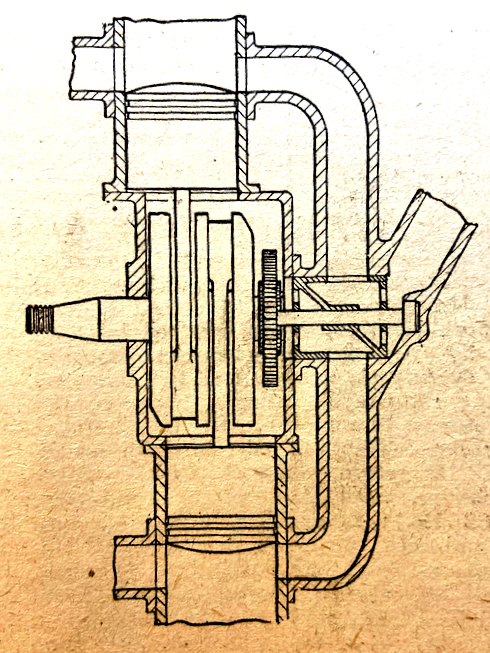
“BY FOCUSING ATTENTION upon rear-wheel springing, road-racing is conferring a boon on the motor cycle world. If, as it probable, spring frames become a standard feature a couple of years hence the thanks in the main will be due to the big races. British, German, Swiss, Czechoslovakian and Italian racing machines are all being equipped with rear-wheel suspension. In the majority of cases only the rear wheel is unsprung, the idea, of course, being to keep the unsprung weight low and thus ensure the best road-holding. This system has a big advantage from the point of view of the ordinary user because the pillion passenger automatically obtains the full benefit of the springing. Unquestionably this week’s TT races will help enormously to drive home the value of rear-wheel springing. We are glad, because our experience with spring frames is that they constitute an important safety factor and add enormously to the pleasure of riding.”
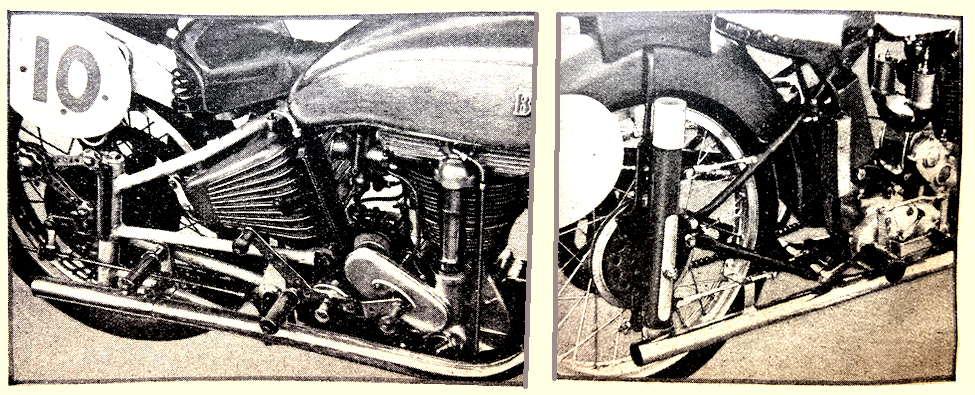
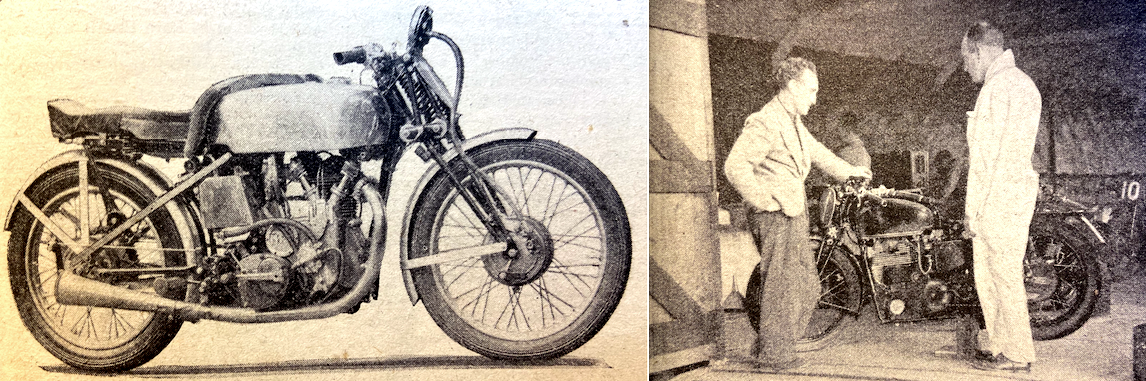
“THE JUNIOR TT WAS WON easily by J Guthrie (Norton), who, in spite of his 40 years, finished at an average speed of 84.43mph, more than 2½ minutes ahead of Frith (Norton), who in turn was nearly two minutes faster than the third man, JH White (Norton). The weather had cleared, and in spite of a gusty wind riding conditions were excellent throughout. The racing rather lacked spectacular interest as the Norton team demonstrated their superiority from the start, and when it was clear that Woods on the Velocette could not seriously threaten them, their team manager signalled them to slow down and sit on their lead. From the technical aspect the race was a magnificent exhibition of high-speed reliability, for the existing lap record was repeatedly broken by Guthrie, Frith and Woods, so that it now stands at no less than 85.18mph. Guthrie set up this new figure of 26min 35sec on his fifth lap, a feat equalled by Frith on his seventh lap. It is a fantastic speed for 350cc engines over so severe a course. The Nortons, incidentally, annexed both the Club and Manufacturers’ team prizes. In spite of the high speed 25 of the 39 starters completed the course, and several of the 14 retirements were due to minor spills rather than to mechanical failure. No one was very seriously hurt, there being one case of slight concussion and another of a broken wrist. The riders in the van held their places sternly, the same four men, namely, the Norton team and Woods on the Velocette, ranging as the leading quartet throughout, and this with no change of order except that Woods momentarily deprived White of third place on two laps. Many newcomers to TT honours acquitted themselves well, and of the riders from abroad Galway (South Africa) finished ninth and Faltner (Austria) finished 23rd. Sunday was a day of great anxiety. Rain and fog had reduced visibility to a minimum for a whole fortnight. The officials talked glumly of wholesale postponements and were thankful that their closing order gave them the roads for six days at discretion. Mercifully, on Sunday night the wind changed to north-west, the fog blanket was swept away in a trice, the roads dried, Snaefell thrust its arrogant silhouette skywards, the bay glittered with a myriad sequins, and gusty breezes tempered the glittering sun. The usual mob of enthusiasts trooped out on all kinds of transport to their favourite vantage points. Out came the heroes to warm up their engines under 10,000 critical eyes. The three Germans, Mellmann and Fleischmann (NSUs) and Vaasen (Norton) were the only absentees, so 39 men faced the starter. Illichmann, of course, took over Fassl’s NSU. The popular tip was Stanley Woods (Velocette), although everybody realised that he would need all the luck as well as all his wits and dash to hold the flying Norton. Just before 11 o’clock the lowlands resembled in colour and clarity an Italian landscape, visibility was one mile on the mountain, above which towered an imitation ski-slope of white cloud 15,000 feet high. Woods, resplendent in a gorgeous tangerine helmet and ribbed body-belt, took up No 1 oblong on the gridiron. The maroon crashed, Ebby’s arm fell, and the battle was on. Everyone got away to an excellent start—the days are gone when men lost minutes on the line. Guthrie started three minutes after Woods, so the Scottish and Irish champions rode in close company.

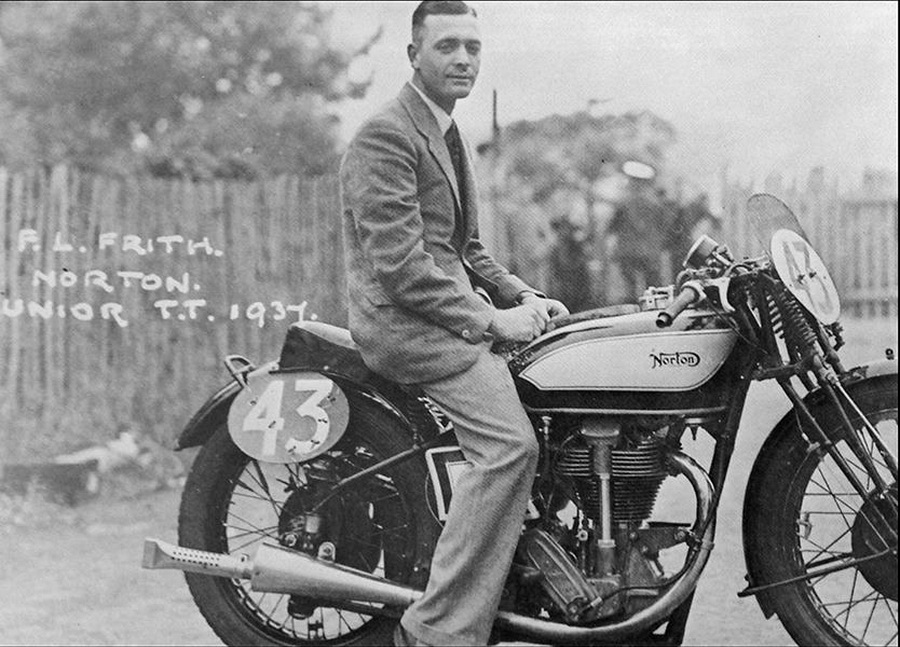
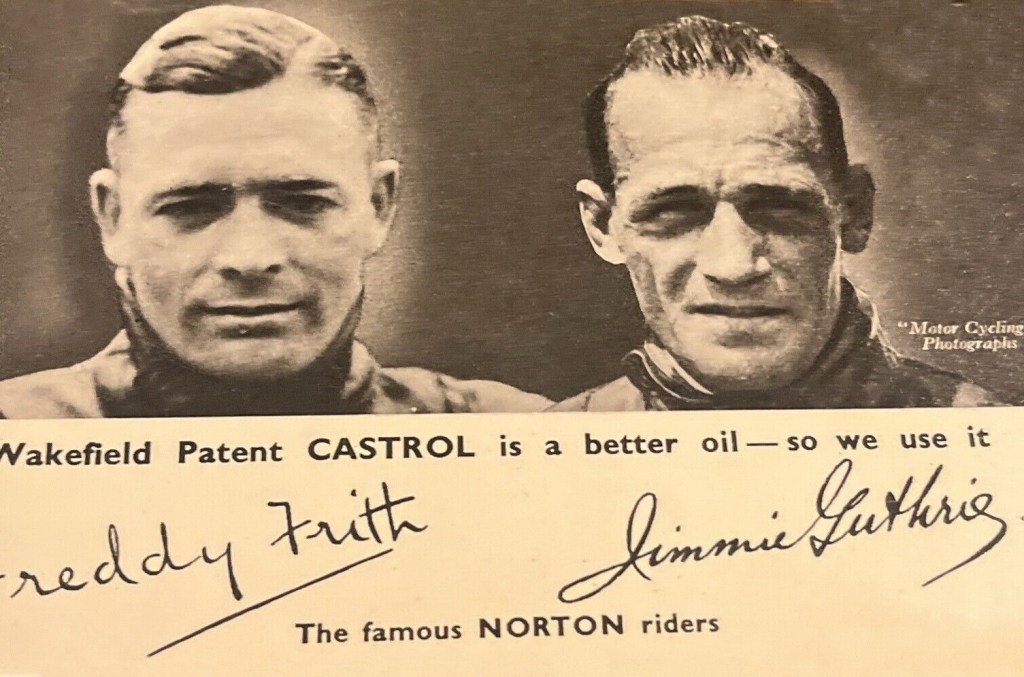
The riders from abroad—Faltner and Illichmann (Austria), Pepper (Canada), Galway (S Africa), Binder (Austria), Sorensen (Denmark) and Simo (Spain)—received special applause, as did Mellors, who had been vetted fit by the doctors after his practice toss. Meanwhile a stop-watch operated against the signal dials suggested that Guthrie was gobbling up the field like a hungry lion and apparently gaining on Woods. Now the whole field had departed, Frith being whipper-in—no bad position for receiving pit orders in a tight finish. The wind was freshening and would both help and hamper speed along alternate legs of the circuit. Woods still leads the roaring procession, his engine sounding really healthy, but somehow not giving the impression of terrific speed. As we wait for Guthrie the gale rips away a stream of advertising banners. Here’s Guthrie, obviously the faster of the two. Yes, Guthrie has lapped in 26min 58sec (83.9mph), while Woods’ time is 28min 2sec (80.7mph). Guthrie is 40 seconds faster than record, though no first laps count for record. Woods’ prophesied hat-trick is already endangered. The field follows in a long procession, the majority of the riders sitting up far too much for a day when windage counts so much. The champions, by contrast, are flat on their tanks. Frith, at the tail of the speeding queue, overhauls man after man. All the Norton trio appear to have headed Woods. Laps in under half an hour are as common as blackberries in September. Myers (Norton) retires at the pits with a broken footrest; Pope (Norton) skids at Ballacraine; Newman (Velocette) is delayed by plug trouble at Union Mills. The second lap proves even more hectic. First Woods breaks the lap record with a circuit in 27min 30sec (82.34mph). Then Guthrie immediately pulverises these figures with a lap in 26min 50sec (84.38mph). Meanwhile Archer (Velocette) has retired, but everybody is pleased to see that Galway (Norton) is keeping South Africa’s banner flying high. And AR Foster and G Rowley are still riding their AJSs brilliantly. Paterson’s (Velocette) failure to complete the first lap was due to a toss at the Gooseneck. All the fast men complete two laps and the leading quintet display no changes of position, but ER Thomas (Velocette) displaces Foster from sixth place and Guthrie further consolidates his mastery at the head of affairs. Pope takes a heavy skid at Governor’s Bridge and continues with his machine slightly bent. Binder (Velocette) retires at the Craig with broken forks. Gradually the position clarifies. Nortons are miles an hour faster than anybody else, and Guthrie can still outride far younger men. Given the familiar Norton reliability, nobody has a chance with them. Woods comes in for fuel after completing his first century, and achieves a lightning pit stop in 23sec, but Guthrie is so fast that he streaks in for fuel just as Stanley gets away. The flying Scot has smashed his own second lap record with 26min 45sec (84.65mph). Meanwhile there is great excitement—Illichmann is reported as having bought two gallons of petrol at Sulby, and the chief marshal prances down the Glencrutchery Road with a black flag to haul him off the course. Still the flying trio of Norton aces—Guthrie, Frith, and White—lead the roaring crowd, while Stanley Woods desperately hunts them—the best he can do is to get within 3sec of Crasher White. Ginger Wood is reported to be touring home from the Craig. Mellors drops out after a couple of fast laps. Thomas (Velocette) tries to force his way up to help his first string, Woods, but cannot quite get the pace. Behind him Foster (AJS) and Daniell (Norton) dead-heat for sixth place. The Manx kaleidoscope has not yet begun to oscillate. During Lap 4 the dials registering the progress of Woods and Guthrie click in close succession, and as they complete their fourth circuit Guthrie, starting three minutes after the Irishman, actually catches and passes him along the pits to establish a net lead of 3min 1sec over his dreaded rival.
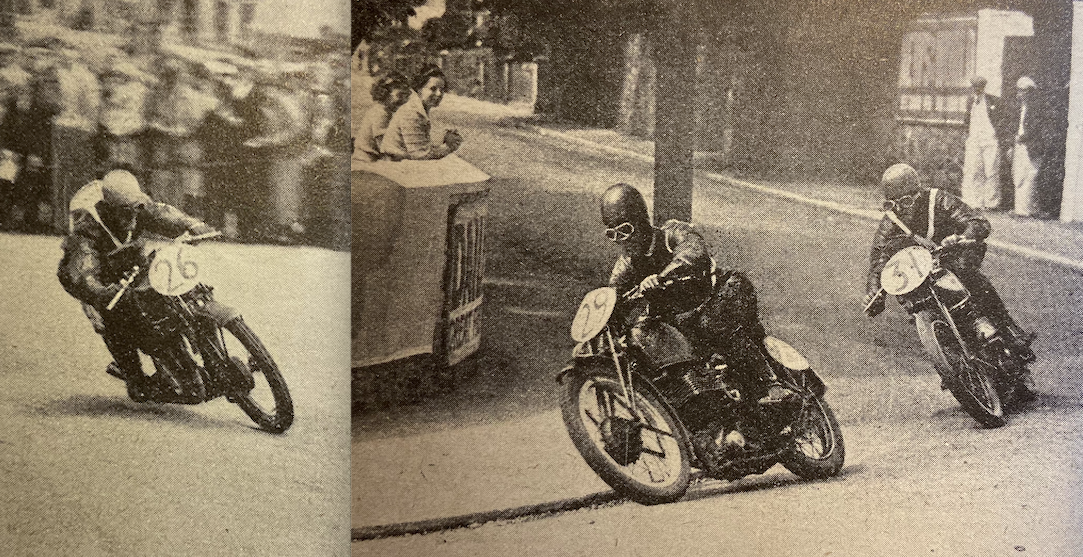
Poor Foster (AJS) retires at Glen Helen with a broken fork spring—there will be competition to secure this fine rider next year. Joe Craig issues orders to his Norton men not to increase speed. Frith, in particular, must play tortoise to Guthrie’s hare, in case the leader’s engine should crack up at this furious speed and let one of the Velocettes up into the van. Flies pester the men terribly. They all change goggles at their pit stops, and a few ride with bare eyes in sheer desperation. And now the first flutter of excitement—Woods, with teeth set in his stern chase, catches Crasher White and passes him by 11sec, thus justifying Craig’s tactics us bidding Frith ga’ canny, For Woods is now only 46sec behind the second man, Frith, and if the uncatchable Guthrie should meet trouble the race might open up after all. Meanwhile we have leisure to note some good performances. Tyrell Smith (Excelsior) is going fine. Jack Williams (Norton) is well up, and Little (Velocette) can be proud of his position. Simo’s absence is at last explained—the wee Spaniard took a mild toss near Ramsey, but escaped with a few cuts and bruises. Pinnington (Norton) retires—no reason given. All the fast men are now home after four laps, and Jimmy Guthrie, with the commanding, devastating lead of more than three minutes over Woods, can take things easily if he likes. The prophets have under-rated this little Hawick Scot, and no less his marvellous Norton engine. Pope protests via the loud speakers that his spill was not, as alleged, due to a skid, but the result of an engine seizure. Guthrie, the irrepressible, is still stunting. Not content with a 3min lead, he proceeds to shatter all his own records with a fifth lap of 26min 35sec—a mere 59sec faster than the 1936 record—speed, 85.18mph. Joe Craig anxiously hangs out the ‘ Go Easy’ signal—all very depressing for poor Stanley Woods, now three and a half minutes behind his main opponent. Or perhaps not ? For if Guthrie goes out and Frith turns all furious-like, the Velocette’s chance may come. Meanwhile Brett skids and falls at Sulby, picks himself up, and goes on. Woods piles a few more seconds on to his tiny lead over Crasher White, but cannot flutter Guthrie, nor seriously perturb Frith, who is still 60sec ahead of the Velocette—and increasing his lead. What does Joe Craig think of Frith’s ideas on ‘going easy’? Young Lamacraft on the Velocette keeps riding hard—a coining lad this! A pall of dull resignation seems to overhang this magnificent, furious race so far as the spectators are concerned. Ever since the flying Nortons asserted their ascendancy on Lap 1, we have had no wild excitements, no violent fluctuation’s, no spills or mechanical bother for the protagonists. It is almost as if Woolwich Arsenal were toying with a village eleven. Strive as Woods may, he cannot hustle Guthrie. Round and round they circle, and after this penultimate lap Guthrie, deliberately slowing down in obedience to pit orders, canters past with a 4min 10sec lead over Woods!! Barring accidents, it is not a race so much as a march past to the watchers, whatever the riders may have to tell of heat, noise, vibration, anxiety, perils, shaving banks, and the like. Pepper, the Canadian ace, retires at Hillberry. Four fine laps at over 72mph have wearied his engine. Hallo, Woods must have flogged his engine too much, White is now 5sec ahead of the Irishman once more. Nortons are therefore 1, 2, 3 at the start of the last lap. The leader board shows amazing consistency for an 84mph race on 350cc engines over this searching course—the same four men have headed the field throughout. It is an even greater tribute to the men who design and make the models than to the men who ride them. Though Guthrie is now 40 years old, young Frith for all his youth and dash cannot hold him, and at the end of six laps is more than 2½ minutes behind his first string. And when the team want a recruit, there is HL Daniell shaping magnificently. And so we turn to see the final stage. Click, click, go the dials. Guthrie circles relentlessly, though easing down a shade in obedience to his manager. Why run risks with the trophy in the bag? Ballacraine, Kirkrmichael, and the rest—at every telephone point he arrives like his namesake, the Flying Scot of the LMS. Finally, the red lamp for Craig-ny-Baa—here he comes—the stand rises to salute the grandest, speediest, easiest, and moat masterful of all Junior victories, at 84.43mph. Fantastic! Superb! Gorgeous! In our admiration we spare a moment to mourn the death of the widely prophesied TT hat-trick by Stanley Woods. Guthrie has so pulverised his field that a long wait must ensue before the tail-enders come in, with Frith starting over a quarter of an hour behind him. Frith must, barring trouble, be second. So the focus of interest shifts to whether Crasher White has’ won or lost his three-hour duel with Woods. Crasher is a school-master—how his boys must idolise him! Here he comes! Woods has finished in 3hr 12min 30sec. What is Crasher’s time? Hurry up with it, Ebby.
There’s the Boy Scout running to the board with it—3hr 12min no seconds, by the gods! He’s pipped Woods by a round half-minute. And there’s the red lamp which heralds Frith into Governor’s Bridge. He screams home—second man, surely? Yes, 3hr 10min 17sec—and, double sensation, he has equalled Guthrie’s record of 85.18mph. He’s a lot faster than Crasher White, and Norton quietly register another 1, 2, 3. HL Daniell, though unable to touch the leaders’ speed, manages to snatch fifth place from Thomas’ Velocette by 22sec. Both men rode splendidly through-out. Twenty-five finishers out of 39 starters in a race run at this high speed is a great tribute to racing reliability—could any car race in motoring history match it? A number of new names appear in the finishing list, and all may be proud to figure in it—Galway, of South Africa, and Faltner, of Austria, as visitors, especially merit congratulation. Results. 1. Jimmy Guthrie (Norton) 3hr 7,in 42sec, 84.43mph; 2, Freddie Frith (Norton); 3, John H White (Norton); 4, Stanley Woods (Velocette); 5, Harold Daniell (Norton); 6, ER Thomas (Velocette); 7, HG Tyrell Smith (Excelsior); 8, George Rowley (AJS); 9, JC Galway (Norton); 10, J Williams (Norton); 11, JE Little (Velocette); 12, HC Lamacraft (Velocette); 13, JW Forbes (Norton); 14, CAW Durno (Norton); 15, M Barrington (Norton); 16, JW Beavers (Norton); 17, N Croft (Norton); 18 AC Kellas (Norton) 19, A Sorensen (Excelsior); 20, CV Moore (AJS); 21, HE Newman (Velocette); 22, H Hartley (Rudge); 23, F Faltner (Sarolea); 24, CF Brett (Norton); 25, WG Job (Velocette) 3hr 58min 55sec (66.33mph). Retired seventh lap, JW Rathbone (OK Supreme); retired fifth lap, GT Pepper (Excelsior Manxman); retired fourth lap, J Illichmann (NSU); retired third lap, EA Mellors (Velocette), S ‘Ginger’ Wood (Excelsior Manxman), M Simo (Terrot); retired second lap, NB Pope (Norton), LJ Archer (Velocette), H Pinnington (Norton), FJ Binder (Velocette), CH Manders (Excelsior Manxman), NB Myers (Norton; retired first lap, GL Paterson (Velocette). Newcomers’ prize, JE Little (Velocette).”
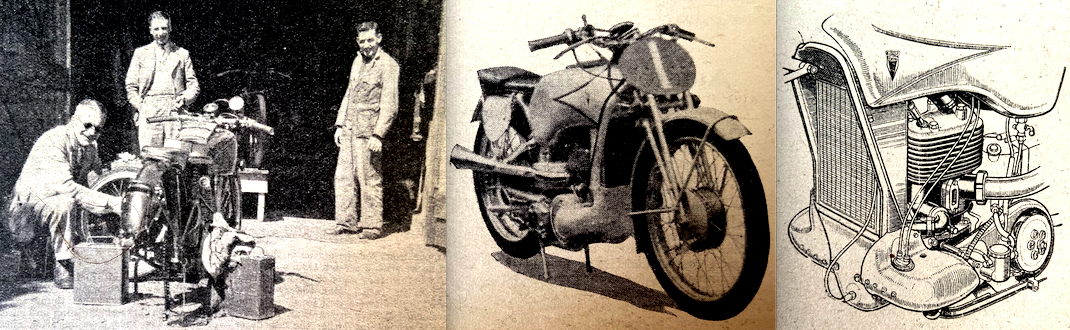
“IT IS DOUBTFUL if three people have ever finished fresher in the leading positions in a TT race than Guthrie, Frith and White. All of them walked into the enclosure in a perfectly easy way, showing no sign of stress or strain, and Jimmy G smilingly posed for the innumerable photographers and ciné men who formed a packed half-circle around him. When he could disentangle himself from the crowd he said that his ride had been straightforward and comfortable, and his only anxiety—and that a slight one—was when he learned that Frith was tending to pick up on him at one period of the race. He was enthusiastic about the spring frame, although, as he said, the improvement was not one to be described as having any single advantage so much as that it ‘pulled the whole job together’ and made one feel a part of the machine. His best description of its quality was that it definitely made him feel 10 years younger. Frith was also very happy and had enjoyed the race. ‘Incidents’ had been negligible, and he did not realise that he had been a cause of anxiety to the leader and was rather tickled by the idea that Jimmy G had suggested such a thing. White also had had a no-trouble run. He admitted to feeling rather tired at about half distance, but got his second wind at about the same time as he was signalled to keep going for a place. Like the riders, all three machines finished in tip-top order. Valves, chains, tyres and all the items that are liable to wilt and wear were excellent. All three engines showed bright markings on the pistons where the inlet valves had said ‘How-dy!’ to them. But these marks were merely bright spots and by no means indentations. According to Joe Craig this occurs with all the Nortons and is not a cause of worry. The piston of Guthrie’s engine showed rather more of this marking than the others. According to Joe this was probably ‘because he used the little cog in the gear box’ a shade longer than they! Chains and chain tension were just right. The tyres were almost perfect and seemed good for many more races of the same distance. The ‘medium hot’ sparking plugs showed no signs of overwork; the 350cc Norton engines run so coolly that they will hold full power on ordinary touring plugs for quite long periods.”
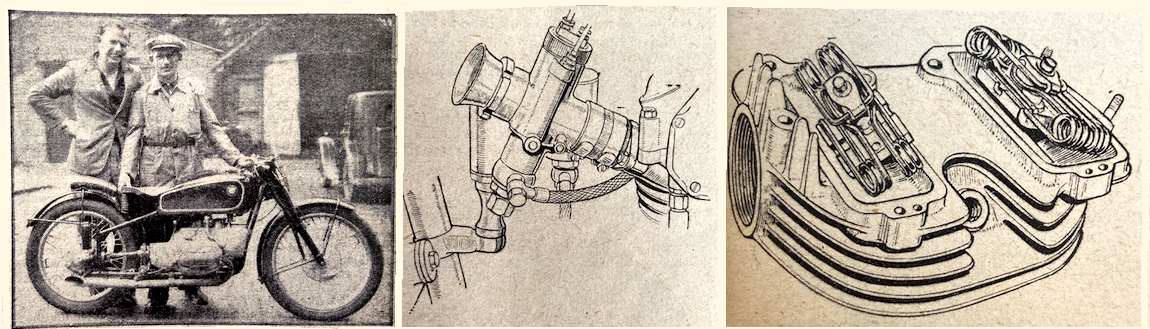
“ACCORDING TO TT habitués the crowd at the Villa. Marina on Monday night, when the Junior Race awards were presented, was larger than ever. It was an open-air ceremony with Mr Ball, chairman of the ACU Competitions Committee, in the chair, and the Mayor of Douglas as the guest of honour who presented the awards. Enthusiasm was the keynote, but there was a serious side, too. Stanley Woods, who, like all the other award winners, was called upon to make a speech, referred to the dog incident. He mentioned that it might easily have meant the end of him and the dog, and added that he would like to meet the owner. When the two team prizes were presented, all three Norton riders went to the platform, together with Mr Mansell, managing director of the Norton concern, who expressed his own personal appreciation of the trio’s efforts.”
“THE LIGHTWEIGHT RACE was won for the first time in history by a foreign rider, Omobono Tenni, of Italy, steering his 248cc Guzzi to victory in 3hr 32min 6sec, 76 seconds faster than the winning time of 1936. S ‘Ginger’ Wood (Excelsior) was second in 3hr 32min 43sec, and ER Thomas (DKW) third in 3hr 36min 36sec. The weather and conditions were good throughout. The lap record was broken by Thomas on his second lap, the 1936 figure of 29min 43sec put up by Stanley Woods being reduced to 29min 35sec (76.54mph). But the new record survived for seconds only, as Stanley Woods (Guzzi), starting one minute behind ER Thomas, chased him in on the same lap in 29min 27sec (76.89mph). Then on his third lap Tenni (Guzzi) established the final 1937 record at 29min 8sec (77.72mph). The expected duel between the Guzzi and DKW teams duly materialised, but was somewhat unexpectedly complicated by the splendid running of the Excelsior team, of whom HG Tyrell Smith lay third after the first lap, and S ‘Ginger’ Wood sixth. Kluge, on the DKW, headed the field after one circuit, hard pressed in the order named by Stanley Woods (Guzzi), Tyre11 Smith (Excelsior), Tenni (Guzzi), ER Thomas (DKW) and S Wood (Excelsior). The leaders went at it hammer and tongs, and as so often happens with these over-stressed lightweights, many fell by the way. No team finished either in the club or manufacturers’ ratings, and the sixth lap produced a regular debacle, in which several of the leaders disappeared for ever. This battle to destruction was the natural result of a first lap in which 45 seconds covered the seven leading men. It is only fair to add that the DKW two-strokes were compelled to make an extra stop to replenish their fuel
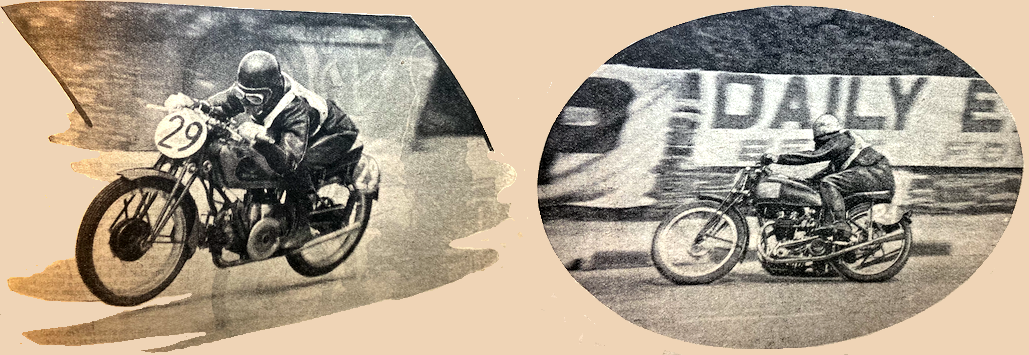
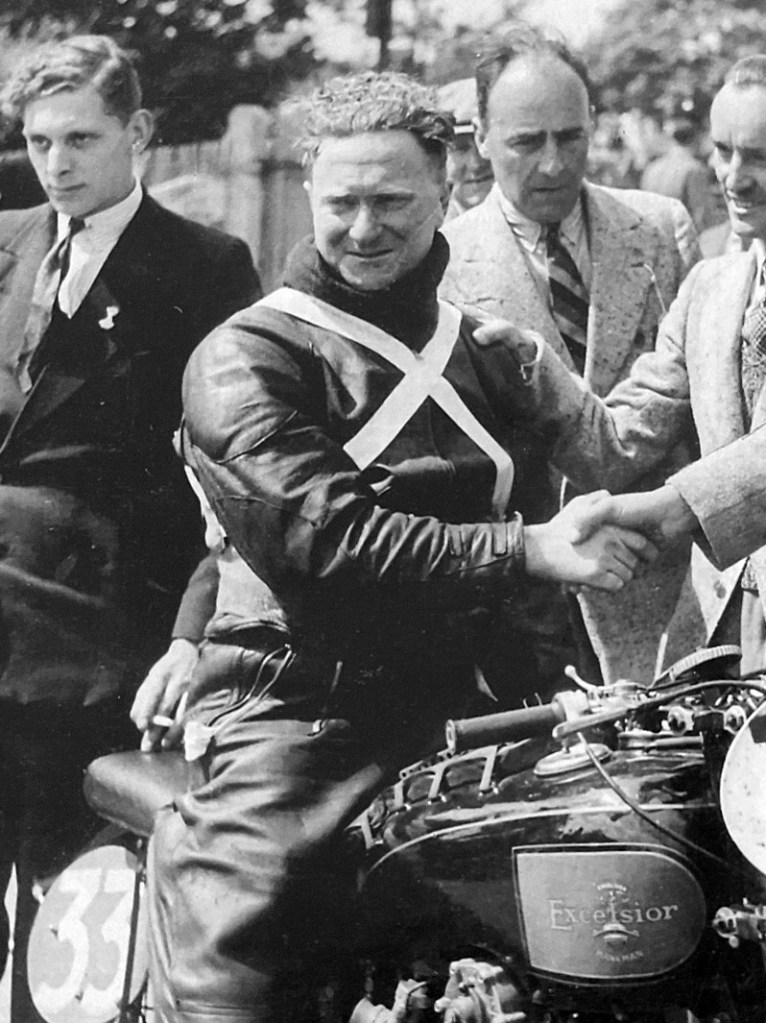
tanks, and the riders were thereby compelled to flog their engines unusually hard to recover this deficit. During Tuesday night the wind shifted to the south-west. Instead of an ultra-marine sea, domed by a turquoise sky and ivory clouds, a leaden land- and sea-scape greeted all eyes on Wednesday morning and, with the wind in a wet quarter, the outlook was not too good—75 minutes before starting-time visibility at the Bungalow was only 20 yards. But the sun strove manfully to push through, and half an hour later the Mountain wore only a light veil of mist. With a quarter of an hour to go you could see a thousand yards anywhere on the high ground, and a light film of moisture was drying off even the shadier sections of the course. Conditions improved steadily as the day wore on, the sun won through, and nobody had the slightest cause for complaint. This Lightweight TT opened in a unique atmosphere, for none of the pundits considered that British machines stood a dog’s chance of victory. The popular tips were Stanley Woods on the Guzzi or Kluge on the DKW—this German ace has mastered the intricacies of the Manx circuit with a swift brilliance that leaves the oldsters gasping, However, a few folk timidly suggested that Tyrell Smith (Excelsior) might even now play a hand, though their hopes were not generally shared, and most of the spectators, in despair of a home success, cultivated an air of detachment, speculated whether the reliable Guzzi could hold the faster DKW, and polished up their sportsmanship in readiness to applaud a foreign victory. Only 26 of the 33 entries actually faced Ebby. Paterson was licking the wounds sustained on Monday. Cauchy had just failed to qualify, and his reasons were not accepted by the stewards. Schouppe, having crashed on the Continent, did not put in an appearance. Schorg and Le Roy were similarly complete absentees. No rider was available for the fourth Guzzi, and as for poor Simo, though the starting fee promised him by his foreign employers was vital to him, Dr Pantin was adamant; after Monday’s spill the wee Spaniard was adjudged unfit for the ordeal. On the way to the start we heard that Tommy Farr had K0-ed Neusel—was this an omen? At 10.50am the bugles sounded, scouts bearing the banners of seven nations led the procession on to the gridiron, and conversation again became possible—really, these little ‘uns make far more noise in warming up than the Junior buses; but perhaps the DKW two-strokes are mainly to blame for that. Everybody got away nicely and received suitable ovations, the chief tributes being awarded to Stanley Woods for his gallant solo effort against Nortons on Monday, and to Tyrell Smith in recognition of his resolute riding on Monday and of his ranking as Britain’s chief hope against the Continental menace today. Before each DKW ace departed a mechanic sprinkled both bar and gloves with French chalk to ensure a non-slip grasp. The DKW exhausts made most of the other engines sound like a maiden’s sigh. The crowd at headquarters was on the thin side, but there were big gangs of enthusiasts round the course. As the last man departed the weather reports became increasingly reassuring, and we busied ourselves with speculating on the problem of the DKW’s extra pit stop, Kluge’s surprising mastery of the Manx course, and the busily clicking dials. The last suggested that Whitworth, Archer, Hartley, Cook, Martin, Wünsche, Tyrell Smith and Tattersall were not dallying by the way, while the super speedsters were, of course, fairly swallowing slower men immediately ahead.
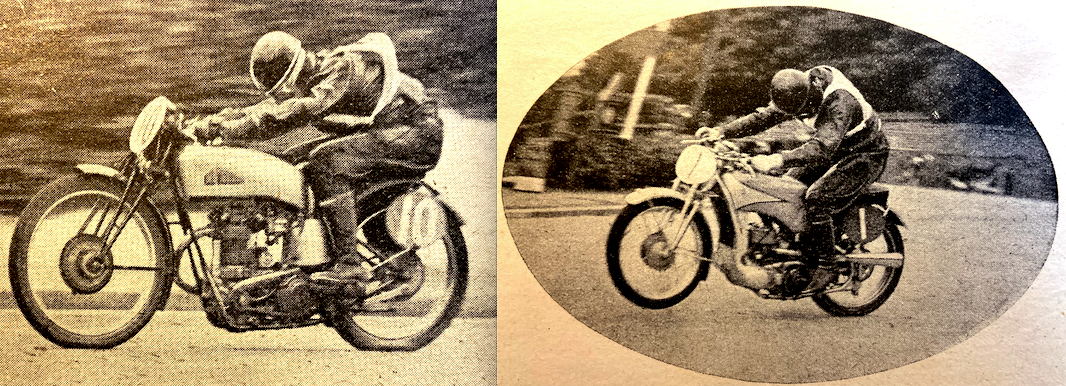
Excitement began to peak as the field returned. Now we should really he able to verify surmises. Were the foreigners as fast as the scouts had reported? Thomas (DKW) had done a fast lap; but No 1, Stanley Woods (Guzzi) who started No 3, was 10 seconds faster. Oh joy! Tyrell Smith, who started No 24, was a bare two seconds behind the Guzzi. But a late starter, the audacious, amazing Kluge, on his first TT lap, after a brief practice largely wrecked by fog, had the impudence to head the field with a meteoric lap eight whole seconds faster than our one and only Stanley, while Tenni was only 9sec behind Tyrell Smith. Just 45 seconds covered the seven fastest men; and on their tails howled a good-sized mob of fractionally slower individuals. Some said these whippers-in were slower because they couldn’t help it. Others opined that in nearly every Lightweight Race the tortoise ultimately defeats the hare. In this race, at any rate, the proverbial Manx kaleidoscope still survives. The aces go off with a bang, and anon their tiny engines wilt under the strain, and the sixth or seventh lap lets some cannier fellow up to pocket the Trophy. Quoth the wiseacres: ‘You’ll see a holocaust of these quickies presently!’ We all tried to look sage and wagged our heads. The stage was now nicely set for a really hectic race. Incidents were scarce on the opening circuit, but reports from all round the course stated that Tenni (Guzzi) was riding with a crazy abandon which created doubts about his finishing in one piece; thus early he fell at Governor’s Bridge, and left part of his exhaust system as a memento. Canada disappeared for ever when poor Pepper had engine trouble at Cronk-y-Mona, and Warren’s New Imperial cried ‘Enough!’ at the Gooseneck. In terms of nationality the- leader-hoard presented a strange appearance indeed: (1) German machine, German up; (2) Italian machine, Briton up; (3) British machine, Briton up; (4) Italian machine, Italian up; (5) German machine, Briton up; (6) British machine, Briton up. Anyhow, Excelsiors were evidently out to stall off the foreign menace, and the first dozen included four Excelsiors, three DKWs, two Guzzis; one New Imperial, one OK-Supreme and one CTS. And now for the real fireworks, we all said. Certainly ER Thomas (DKW) and Stanley Woods (Guzzi) contributed their very best. Thomas as No 1 pared 8sec off Woods’ 1936 lap record, establishing new figures of 29min 35sec (76.54mph). He had reeled off two complete laps of this ferocious 37½-mile course in 60 minutes dead with a 250cc engine. He held the record for precisely seven seconds, at which moment Woods chalked up an even faster lap in 29min 27sec (76.89mph). This fantastic circuit was too much for Kluge, who dropped to second place, though only by a single second. Tenni was not quite so fast as on his first lap, and lower down the list Tattersall slowed a shade, and Galway, the swift South African, jumped up quite a piece. Meanwhile, Goddard (OK Supreme) found his engine less ‘supreme’ than usual, and packed up at Ballacraine. Young Tiffen (Excelsior) dropped out on the Mountain, and Renwick (OK Supreme) was slowed with an oil leakage. The German mechanics, resplendent, in bright blue dungarees, were greatly depressed by Kluge allowing himself to be passed, and hung out a board bearing a small ‘o’ over a large ‘T’; we hoped Kluge knew what it meant, for nobody else did. Who would be a team manager in this hare-and-tortoise business? Super-human judgment is demanded to decide when to wave your men on and when to hold them back. Course reports spoke of terrific cornering by the leaders. If a 250cc machine is to aim at 80mph lapping, the rider must get his vantage on the bends, for his flat speed and his acceleration are alike limited. Two laps had now gone, and a blanket of 23 seconds covered the first six men. No further records can happen just yet, as everybody is due to stop for fuel. The aces get through this anxious business with their usual well-drilled
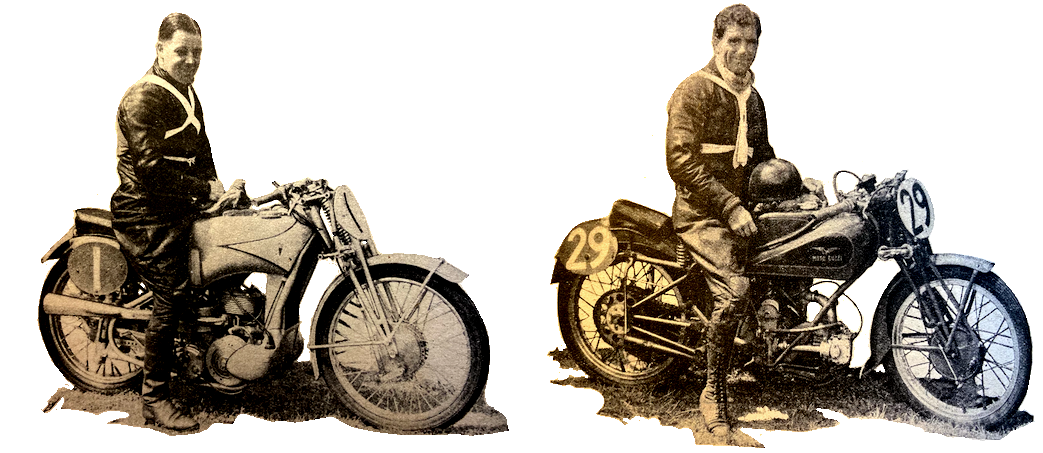
dexterity, though it was ominous that Stanley Woods had something of a wrestle to restart, and needed a longish push. Meanwhile, Mann (CTS) is reported as having a misfiring engine near the Bungalow; anon he retires—official reason ‘gear box’. We know those gear boxes which misfire in the Island—they are first cousins to the magnetos which seize up! And sadness descends when one of the faster Excelsiors, that of Manders, who is lying seventh, disappears with engine trouble near Crosby. Another of the leaders, N Cook (OK Supreme), goes out at Ballaugh for similar reasons. Already five of the six teams competing for team trophies are scuppered by the loss of a man apiece, only the DKW trio remaining intact. Yes, the pace is too hot to last. Woods has added a little to his lead over Kluge, whom he now heads by 9sec, but Tenni is evidently jealous, for although he has to brake hard for a fill-up at his pit, he contrives to set up yet another lap record, beating Woods’ second lap by the fat margin of 19sec—29min 8sec (77.72mph). Tyrell Smith, perhaps wisely, is attempting no records; he effects a lightning pit-stop, and dashes off at a pace nicely estimated to score if the foreign aces strike trouble. SV Smith (Excelsior) has a niggling bother with his filler-cap at the pit, but fakes it with rubber bands. The crowd speculate whether the DKW machines must face an extra pit-stop. Their mechanics confirm the surmise with sadly shaking heads; the tanks cannot last four laps, as the four-strokes can. Three laps are ample to furnish the general shape of the race. No question but the foreigners are a trifle too fast for the Excelsiors in an imaginary world where every deserving lad gets a non-stop; but 250cc non-stops are a big ‘if’ at this speed. Wünsche, on the third DKW, has not quite the class of Thomas and Kluge. Archer, on the New Imperial, is very formidable—perhaps slightly outspeeded, perhaps riding with deliberate restraint. Lower down, Galway (Excelsior), Tattersall (CTS), SV Smith (Excelsior) and young Moore (New Imperial) hang on the flanks of the leaders waiting for a slip. But unless a foreign banner is to grace the victor’s laurel wreath to-day, we must apparently trust to Tyrell Smith and ‘Ginger’ Wood (Excelsiors), or to Archer’s New Imperial. Lap 4 will be a shade quieter, as pit stops at its beginning eliminate record breaking. The clocks indicate steady progress all round the invisible hinterland. Only seven of the 26 starters have retired as yet. Sorensen, the Danish rider of an Excelsior, has a half-seized engine on the hills, but declutches, frees it, and continues.
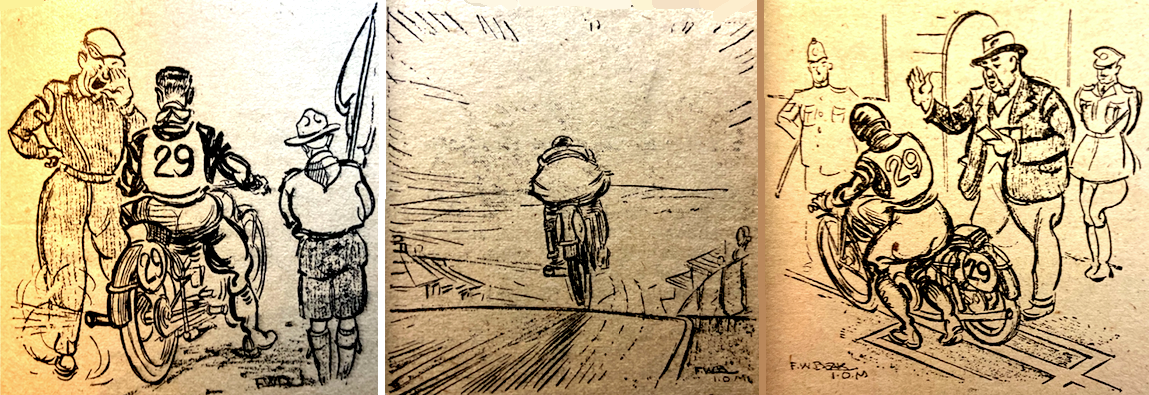
There are long, dull intervals when nothing happens—after all, we have now only 19 men strung out over the 37½ miles. The BBC men are frenziedly switching from one of their boxes to another in an effort to find something to talk about. As the leaders range from 1 to 33 in their numbers, with half a minute between each pair, a lap most be completed by all before we know how things really stand. Archer (New Imperial) does a remarkably deft fill-up, and Pa Archer, who serves his son as pit attendant, tells him not to hurry; there is nobody on his tail, and the policy is to let the men ahead crack each other up. One by one the fast men arrive—the same six who headed Lap 1, but with marked changes of order. Tenni’s pit signal is 3W/10, whatever that may mean. Possibly ‘Woods leading, you third!’ Actually Tenni has hopped up into second place, and the Guzzi stable are all smiling huge, swarthy smiles; but what did the ’10’ mean, for Tenni is 26sec behind Woods? The leading sextette are stringing out. It now takes 2min 37sec to cover them, as against 25sec after Lap 1. But to show how class distinctions are facts in motor racing, it would take more than 12 minutes to cover the second six!Tattersall has to stop to change goggles, as the pair in use are a black mass of mangled flies. Told his speed, he remarks drily, ‘Somebody must be pushing me, if I’m really as fast as that!’ Sorensen, in spite of engine tightness, has climbed into the first 12; or perhaps it was his climbing that tightened his engine? Very soon we shall discover who has been flogging a tiny power unit rather recklessly hard. Alas, poor Galway retires with engine trouble at the Bungalow after three fine, fast laps, and both the Empire representatives are now out. The end of this lap definitely settles one doubtful point, for the Guzzis, like the British entries, scream through non-stop, all having tanks which can last four laps. But the German two-strokes, condemned to three-lap tanks by their thirstier engines, must sacrifice anything from 30 to 60 seconds on a second fill-up. Who is accelerating, and who decelerating? The leader’s speed for the first three laps had equalled the 1936 record; but pit stops have now spoilt that figure. Woods’ fifth lap takes 29min 40sec; Tenni’s, 29min 43sec; Tyre11 Smith’s, 29min 34sec—hello, has Tyrell decided that he must open up a trifle after all? But while we are occupied in these calculations we fail to watch the clocks earnestly and—’Where’s Kluge?’ He just isn’t! He just stopped somewhere between the start and Ballacraine. Changing a plug, no doubt? No, he’s been too long for that. The fastest and most brilliantly ridden of the German machines is out. Yes—oh, hard luck! a broken throttle wire of all hoodoos. Of his team mates, Thomas hardly looks fast enough to flutter the leaders, and Wünsche hasn’t quite got the hang of the circuit. That will narrow the race to a Guzzi-Excelsior duel, with all the odds on Woods and Tenni, who are in the lead. Meanwhile, Warburton (OK Supreme) packs up near Sulby—that means a horrid long trudge to Ramsey; and Whitworth (Cotton) ceases racing for the day at Kirkmichael. England (Cotton) follows their example at Crosby—the pace is a little too hot. Wünsche makes his second petrol stop and is ordered to step on it; he must wish that he could, but he is nearly 8min behind Woods. Martin is reported fettling his Cotton at Governor’s Bridge; he fettles deftly, and carries on. We note that Archer has pushed his New Imperial into the leading six, and that Hartley’s singleton Rudge has entered the first dozen. And now the whimsical demons who annually make these tiny engines their sport decide that the time has come to upset things generally. Since tragedy befel Kluge, we had settled down to calm clock-watching, when suddenly the peace of a sunny afternoon is rudely broken by a hoarse blare from the speakers, ‘Ramsey telephones that Woods has passed through misfiring!’ Well, we say half-heartedly, Stanley’s up to time, and some misfires clear themselves. His dial clicks fairly punctually; he arrives. Doesn’t sound too bad? Oh, hang, there’s a miss. And another! The Irishman is under no illusions. He protrudes a downstuck thumb as he screams past at perhaps 75mph with a miss every fifty yards or so. Gosh! That means a Tenni-Tyrell duel—what had Tenni got in hand of the Excelsior last lap? Five seconds—ye gods, a cracker finish even now! The foreigner isn’t home yet! as the crowd ripples with an excited buzz of argument and speculation, poor Thomas comes in for his third pit stop with a leaking tank. Sorensen’s piston expresses its dislike of being forcibly un-seized, but selects the Highlander Inn as the venue, doubtless to Sorensen’s gratification. And then disaster indeed—’Tyrell Smith (Excelsior) has retired with con-rod trouble at the Craig!’ Three of the speed six are on the sidewalks, and one at least of the surviving trio is limping. Why, Tenni is out by himself almost. There is only ‘Ginger’ Wood left chasing with a hope; and last lap—let’s see—’Ginger’ was—yes—3min 12sec astern. An Italian win seems soundly booked for to-day. Stanley is making a crawley sort of progress on the clocks—evidently his misfire is the sort that doesn’t clear itself. No—he has retired at Sulby with broken valve springs. But ‘Ginger’ Wood seems to know something. His sixth lap is a real flasher in 30min 15sec. We strain our eyes to see what signal he gets, but the crowds hide it. The ‘all-out’, of course. And Tenni? Signor Perodi gives him a board bearing 1/22. Rather a bad blunder if the ’22’ is meant to indicate his lead in seconds, for actually the Italian has over 3min in hand over ‘Ginger’ Wood, and his riding has been wild enough to need damping rather than gingering-up. Aha! I have it. It is Stanley Woods the pit has in mind, and they don’t realise that Stanley is down and out.
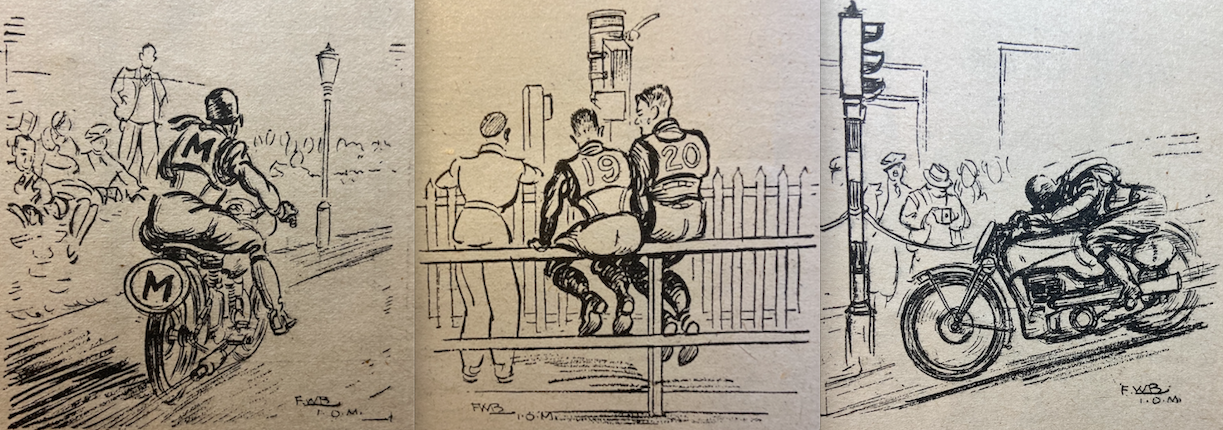
Anyhow, off streaks Tenni on his last lap with the race on a plate, and thousands of us wish we could let him know his exact position. Renwick (OK Supreme) and Martin (Cotton) enter the charmed 12 on this lap. All over now bar shouting, we opine, and settle down to watch the clocks, disturbed only by the fear that Tenni, ignorant of the true situation, may over-ride a little—and Tenni’s ordinary riding is enough to paralyse leopards. The two vital clocks—Tenni, No 29, and ‘Ginger’ Wood, No 33—click punctually. But running the stop watch against them, it looks as if ‘Ginger’ was doing the hectic, rather than the Guzzi ace. The irony of it all is that Wood started 2min after Tenni, so that Tenni is probably unaware that he is being chased like this; and Wood must know he has a fighting chance. Round they circle, reported from every point in turn. Tenni’s over Snaefell—at the Craig—his red lamp—here he comes, flat out. A 32min 32sec lap! Not so hot! By heavens, ‘Ginger’ can just do it yet, if he’s got enough engine surviving after 3½ hours of steady flame. He’s at the Craig—he can do it—no, he can’t—yes, he can! Well, the ACU aren’t proclaiming Tenni yet, anyhow. Here’s Ginger! We jerk our bodies in the vain desire to urge him forrards. Watches snap resignedly—he’s missed it. A gorgeous seventh lap in 30min 18sec had stolen nearly two whole minutes back from the Guzzi, leaving the Excelsior second by a bare 37sec. What a race! And a popular victory enough, compensating the gallant Guzzis for past disappointments. All is anti-climax now. ER Thomas gets home a sound third, and Archer is fourth, after a gallant race in which he probably underestimated the speed required to win. Wünsch is fifth, doubtless mourning the cruel luck which prevented Kluge from having his full say. Tattersall’s sixth place will set Lancashire alight, and the other three steady finishers, Moore (New Imperial), SV Smith (Excelsior), and Martin (Cotton) all gain thoroughly deserved replicas…This race is the writing on the wall for British 250s. On an easier and flatter course the DKW team would certainly have pulverised us, and possibly the Guzzis as well. Unless research and experiment produce faster British 250cc engines for 1938 we may see foreign machines finishing 1,2,3 in this event.” Results. 1, 0 Tenni (248cc Guzzi); 2, S Wood (249cc Excelsior); 3, ER Thomas (248cc DKW); 4, LJ Archer (246cc New Imperial); 5, S Wünsch (248cc DKW); 6, C Tattersall (249cc CTS); 7, CV Moore (246cc New Imperial); 8, SV Smith (249cc Excelsior); 9, LG Martin (248cc Cotton); retired seventh lap, Stanley Woods (248cc Guzzi); H Hartley (249cc Rudge); S Renwick (248cc OK Supreme); retired sixth lap, HG Tyrell Smith (249cc Excelsior); SA Sorensen (249cc Excelsior); H Warburton (248cc OK Supreme); retired fifth lap, E Kluge (248cc DKW); MD Whitworth (248cc Cotton); R England (248cc Cotton). retired fourth lap, JC Galway (249cc Excelsior); retired third lap, J Mann (249cc CTS); N Cook(248cc OK Supreme); retired second lap, SH Goddard (248cc OK Supreme); WT Tiffen (249cc Excelsior); retired first lap, GT Pepper (248cc Cotton); PR Warreen (246cc New Imperial).”
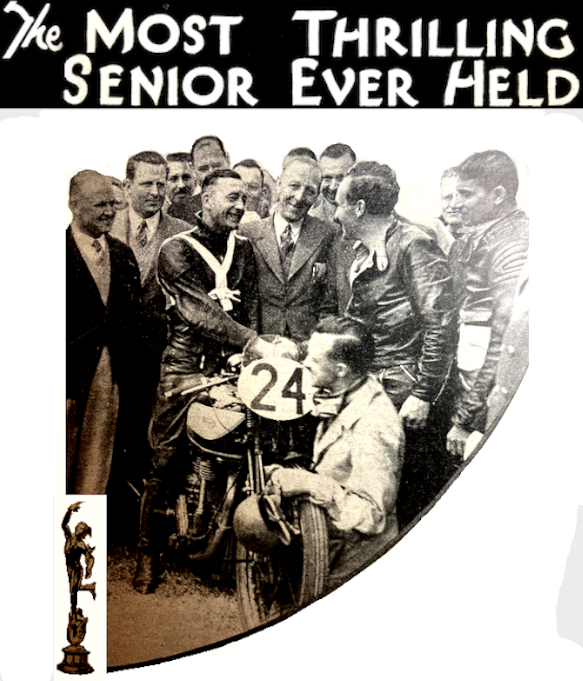
“AFTER THE MOST SENSATIONAL and heart-stopping’ race in Manx history the Senior TT was won by FL Frith (Norton) in 2hr 59min 41sec at an average speed of 88.21mph, an increase of approximately 2½mph on last year. Frith was never lying higher than second until the sixth lap, when, following on the failure of his first string, J Guthrie, he received the ‘All Out’ signal from his pit, and set about Stanley Woods (Velocette), who had assumed first place when Guthrie fell out on the fifth lap. At the end of six laps Frith and Woods actually dead-heated, and both men began the last lap determined to face all risks. But whereas Woods merely produced a very fast finish, Frith hurled his machine round the Island at record speed, actually breaking 90mph for the first time. He won by the narrow margin of 15 seconds. The lap record had already been repeatedly broken in the earlier stages of the race without anybody touching 90mph, although Guthrie came within 3sec of this astounding feat. Second place was won by Stanley. Woods (Velocette) in 2hr 59min 56sec (88.09mph). Owing to a wide difference in starting times Woods finished ten minutes before Frith, and had to spend an agonising interval, uncertain Whether he was first or second, third man was JH White, on a Norton, whose time was 3hr 8min 44sec (83.97mph).

The foreign menace failed to materialise. Tenni, on the Guzzi, was not quite fast enough to harass the British aces and retired with minor mechanical trouble after four laps. JM West, on the supercharged BMW, was very fast and well placed until a leaking petrol tank compelled him to stop for refuelling every lap in the second half of the race. Velocettes won the manufacturers’ team prize, being represented by Stanley Woods, EA Mellors and LJ Archer, while the club team prize was awarded to the Birmingham MCC No 2 team, consisting of Stanley Woods (Velocette), J Williams (349cc Norton) and EA Mellors (Velocette). J Guthrie (Norton), after leading for four laps, retired as the result of engine trouble. At 4am on Senior morning Douglas lay drowsing in bright sunshine and in a silence broken only by the cheeping of sparrows. The Snaefell massif was silhouetted in green and russet against a golden sky, and the sea stretched away towards the Cumberland hills like a huge mirror of smooth, green glass. Towards 6am the silence was not so much broken as shattered, for the brand-new steam packet SS Tynwald arrived on her maiden voyage, to be saluted by every gun, siren and rocket station within range. Presently some seven big steamers disgorged about 12,000 additional enthusiasts to swell the crowds of motor cyclists already in the Island. The sun retired at intervals and the temperature fell, but unless Mona observes the proverb ‘fine before seven, rain before eleven’, there was every prospect of perfect conditions for the great race.
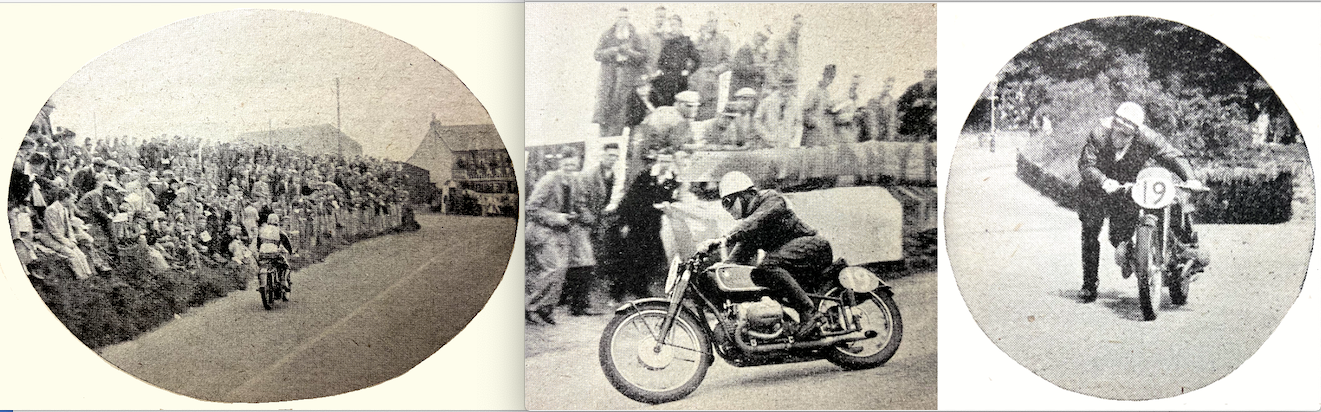
And so it proved, for there was neither glaring sun nor chill wind nor damp tarmac all day, although the spectators could probably have done with a little more warmth. After early breakfast, long, straggling queues of racing fans trailed out on every road leading to the course. Douglas, as usual, resuscitated the whole of its transport for the occasion, including hosts of prehistoric petrol vehicles Which could never pass a police test. Rucksacks, the unshaven cheeks of many males, together with the unpowdered and somewhat tousled appearance of many youthful damsels, indicated that not all the sightseers had slept on dry land overnight. The favourite coigns of vantage were soon overcrowded, and the attendance is thought to have been a record. A feature of the occasion was a luncheon given by the hospitable Mayor of Douglas to all pre-war TT riders who were able to cross. This being the 30th year of the TT, the appropriate guest of honour was Rem Fowler, who won the twin-cylinder class in 1907 on a Norton at 36.22mph. Some of those present had seen 40, 50, 60, 70 and 80mph ‘broken’ in these races. Were they destined to see 90mph exceeded to-day? The Norton engineers thought not, but The Motor Cycle said ‘Perhaps!’ In any case, the race bristled with special interest, for the Velocette was once more out to challenge Norton supremacy, and Stanley Woods, after two disappointments in one week, was sure to give his Irish best. Moreover, Tenni, on the Guzzi, was thirsting for blood, his appetite whetted by Wednesday’s win, while Jock West, on the supercharged BMW, was probably handling the fastest machine in the entry. Incidentally, the BMW is not, as some suppose, the first supercharged model to contest a TT, for the four-cylinder AJS used a blower last year, and, strictly speaking, all the DKW racers are supercharged. The supreme aces were fairly distributed over the starting order, with Guthrie as No 1, Woods No 4, Tenni No 16, West No 19, White No 20, Daniell No 22, and Frith No 24. Four Junior machines competed—two Velocettes (not the latest ‘works’ models), and two Nortons (also the more standard pattern); so Beevers and J Williams were pitted for Nortons against Archer and Lamacraft (Velocettes) in a miniature edition of the familiar Island duel. At 10.30 the riders were released from the official garage and started to warm up their engines over a pocket circuit marked out in Glencrutchery Road with corporation dustbins serving as pylons; the BMW made as much noise as all the rest put together. There were 23 starters. Clift had gone home for private reasons; Barriligton had not got his hoped-for mount; Mellmah Fleischmann and Marama-Toyo had never reached the Island. At 10 minutes to 11 came the
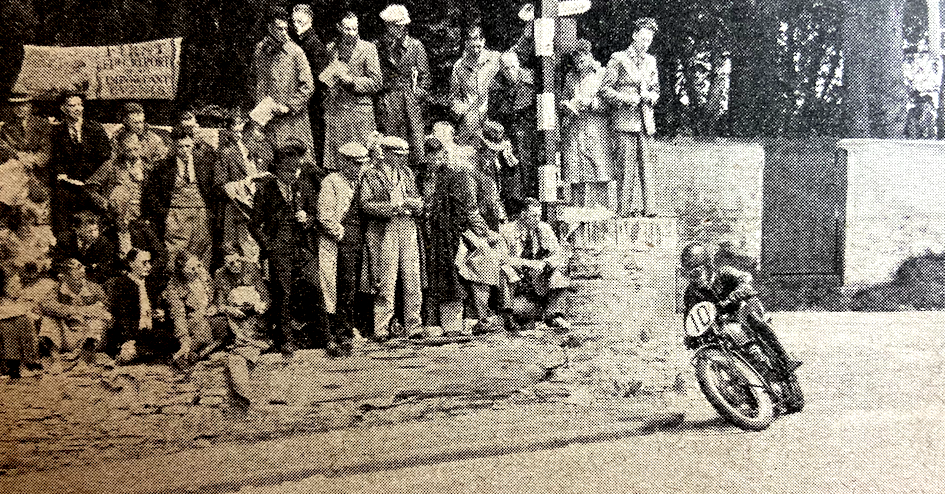
fanfare of trumpets and the parade of stars to the gridiron, headed by the banners of eight nations. The Governor, Sir Montagu Butler, descended and shook hands all round for the last time—he will be governing his college instead of the Island in June, 1938. The five-minute Klaxon screeched. Everybody congratulated everybody on the perfection of the conditions, and at 11 o’clock Ebby barked ‘Go!’ to that lean, sinewy, unassuming Scot, Jimmy Guthrie, who, in spite of his 40 years, is probably still the most formidable road-racing motor cyclist in the world. Everybody got away smoothly. Vartak, the Indian rider of a Rudge from Poona, who admits that he is just learning the course, but says he is going to win some day; Pope, the first motor cyclist to lap Brooklands at 120mph; Woods, with eight TT wins to his credit, the first of them 14 years ago; Beevers, who is a loco fireman when he is not racing; Galway, the hope of South Africa, and definitely a coming man; West, with his ‘blown’ German transverse twin; Forbes, recovered from a long spell in a Manic hospital last year, and now a naturalised Briton; Oliver, Gatley and Lovett. greatly daring to scrap on 500s on their first visit to the Island; and all the famous Manx stars. Almost every man in the list a personality. Perhaps Frith attracted astute observers more than most. There is no mistaking the red-hot keenness of this lad. He awaits Ebby’s signal like a greyhound straining at the leash, and he is crushed flat on his tank within 100 yards of the line. Very soon they had all departed, and with so small an entry there was a long spell of clock watching before anything more could happen under our noses. The delay was pleasantly spent in listening to is really excellent broadcast commentary by Padre Stenning, of the Manx MCC, interspersed with the usual speculations and arguments. Neither dials nor telephones told us much. Tattersall (Vincent-HRD) dry-skidded at Quarter Bridge without serious results. Oliver (Vincent-HRD) lost a moment or two short of Ballacraine, The foreign invaders, Guzzi and BMW, did not seem to be gobbling up many of the men who started just in front of them. Sulby Bridge added yet another to its long catalogue of victims, claiming an unlucky débutant in Gatley (Norton), who tackled it too fast and escaped unhurt but with a definitely bent model.
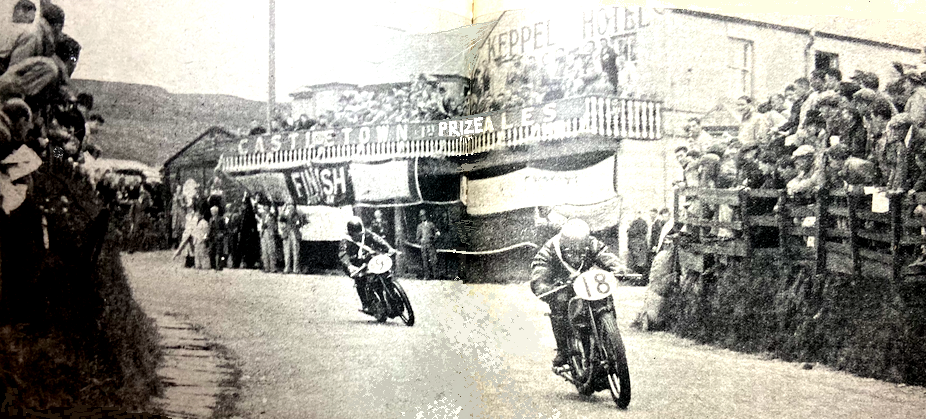
The other clocks clicked regularly enough, and No 1—Guthrie—gave us a foretaste of good things to come by lapping from a standing start in 25min 49sec. This was 13sec faster than Woods’ 1936 record lap, but 2sec slower than Jimmy’s own evening practice circuit; as the first lap begins 50 yards past Chronograph Villa, it does not rank for record. Woods seemed even more flattened out along his tank than Guthrie, but was 18sec slower. Stanley, have you forgotten, lad, that you were beaten last year by starting too gently? And 18 seconds was the precise measure of your mistake then! One by one they return, the Guzzi with rather a high-pitched screech, the BMW. with a deeper roar, suggesting some very large jungle beast in a foul temper. We are soon able to sort out the order. No real surprises, unless you counted on Stanley reeling off a terrific first lap, and perhaps West is a shade higher, and Tenni two or three places lower than most of us expected. Vartak is very late; he rides in a very sitting-up position; tours at about 60 as practice for greater speeds next year; and smiles genially at his friends along the route. Lovett opens finely for a débutant, and Forbes is no sluggard. Five men lap at over 85mph from a standing start! As every seasoned spectator knows, Lap 2 is the signal for fireworks. A flying start, a warmed engine, a machine-shop which has not yet begun to wilt under the strain, and a rider who is still feeling quite fresh. These are the conditions which make for record laps. Other circumstances occasionally exert a similar effect, for which read on. So we all sat up to watch the fur fly. True to form Jimmy Guthrie, streaking round an empty circuit as No 1, calmly hoisted the 1936 figure by nearly 2mph, lapping in 25min 35sec (88.51mph). We sit back with a gasp. The Norton people were right! If Jimmy cannot break 90 when he’s fresh, nobody can break it. ‘Wait for Stanley!’ opined a listener. Well, he comes, but does not look quite so frenzied as Guthrie. No! 25min 43sec is his figure, and he is dropping farther astern—26sec behind Guthrie, as against 18sec after the first lap. Nevertheless, the Irishman has passed Frith by 7sec and has jumped into second place. Tenni looks terrifically fast, and sounds it, but has jumped only one place; his approach to Bray Hill was uncertain and frightening. West (BMW) is drawing very slowly away from White (Norton). We all expected Daniell (Norton), Mellors (Velocette), Pope (Norton), and Archer (Velocette) to run forwardly, but Galway, the South African, is evidently a real good lad to lie ninth in the company of these maestros. CJ Williams (Vincent-HRD) forces himself into the, leading 12. Pepper, the Canadian, is lost, and ultimately a travelling marshal finds him with a dry tank in the Ramsey area. These travelling marshals (HJ Bacon and Vic Brittain) relieve mach anxiety when a man breaks down far from a telephone point. On this lap Guthrie got a ‘1’ at his pit, but Woods no signal at all; Stanley evidently has a private station far front the madding crowd. The fireworks normally peter out on Lap 3, when most men stop to pick up fuel. But Guthrie defies the custom. His pit is only a few yards over the finishing line, and nobody knows how far back he must shut off power to stop there. All the same, he pulverises his own 1937 record lap with a time of 25min 12sec (89.85mph). ‘So near and yet so far,’ grieved the men who had made bets on a 90mph lap. Whatever is Stanley up to? He hurtles past non-stop, clearly intending to pick up fuel after four laps instead of three. Well, that will confuse the issue a little, maybe. He is now 48sec behind Guthrie. EA Mellors is reported to be gear changing by hand instead of foot. Tattersall has to change a plug near Ramsey. Vartak retires with engine trouble near Crosby—not surprising, as he had a horrible miss when we last saw him. Tattersall has to fettle his clutch. Anon the lap times are complete. Woods and Frith have dead-heated on their third lap time. Tenni has caught White; this slim schoolmaster is as fine a handler of machines as world, but his slight frame hardly furnishes the stamina for such a prolonged battle. CJ Williams (Vincent-HRD) jumps two places. No records anticipated this lap, with everybody pit-stopping either at its start or its finish. Guthrie is punctual—by jove! 3sec faster than the 1936 record lap, in spite of a pit-stop. Woods comes up to his pit in a beautiful, controlled ‘slide’, wasting not an inch or a second, and is off in 25sec dead—surely a record fill-up. He has lapped in 25min 30sec—18sec below Guthrie’s second lap record. The sole effect of Woods’ fourth lap pit-stop tactics is to make it appear that he is only 19sec behind the Norton, whereas he is actually nearly a whole minute astern. The clocks, checked by a stop-watch, suggest that the Norton is faster than the Velocette up the Mountain. Tenni pit-stops again—a bad sign, this. West passes with the
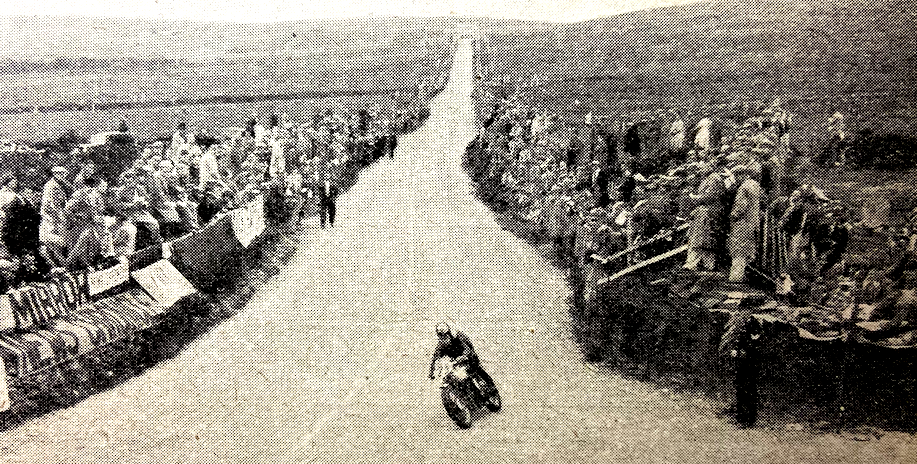
BMW still giving its characteristic formidable bellow, and hard-pressed by White. Tattersall (Vincent-HRD) turns a lovely somersault at Quarter Bridge, due to oil on his back tyre; he convinces the marshal that both he and the model enjoy such acrobatics, and gets permission to carry on. Frith is now just in front of West—fun to see whether with Frith as his mentor West will turn up the taps a bit. Hillberry reports that some men are snaking badly there—notably Frith and Tenni, of all people. Oliver takes a mild toss near Ramsey, and starts a petrol leak. The same dozen lead, with a few minor changes of order. The Velocette ridden by Archer is definitely top dog in the scrap between the four Junior competitors. Now, if ever, we said, for the 90mph lap. All eyes are consequently glued on No 1 dial, for Guthrie is the chief stunt merchant to-day. It duly swings round to ‘R’ (Ramsey), but there it seems to stick, and, horror! Woods, who started 90sec later, reaches Snaefell ahead. Guthrie has stopped! Still his pointer sticks—he is sunk, out, unsaddled. We don’t expect stops from Nortons in 1937, and there is a sigh of incredulity when the travelling marshal sent out in search reports ‘engine trouble’. That lets Woods up, and flings the race wide open after all, for after four laps Freddy Frith was only 50sec behind the Velocette. ‘Don’t talk bilge,’ said somebody, ’50sec at this stage of a race is the same as 10 miles to Stanley.’ The Norton manager does not normally issue riding orders in a TT, but when Frith arrived one of the members of his pit gang unquestionably gave him the ‘Flat Out’ signal. Everybody who owns a watch with a trigger starts timing the dial indexes. Meanwhile, the foreign menace quietly and finally evaporates. Tenni does some touring and drops out with a faulty throttle, and Jock West splits his tank and pushes-in to his pit. From now on he must pick up fuel every lap. Tattersall’s clutch finally says ‘No more to-day!’ Archer adjusts his rear brake. Young Beevers works his way up into the leading dozen. The whole aspect of the race has been transformed in this single climacteric lap. Grossly unfair to many good men and true, I know, but from now on there are only two men in the race for most of us, Woods and Frith. And as they started Nos 4 and 24 respectively, they are riding 10 whole minutes apart, which intensifies alike our suspense and the problem of checking their positions. Woods circles regularly, and completes six laps. Up goes his time—we deduct his sixth lap time—25min 27sec—15 seconds outside record. Um-m-m—is that good enough with Frith on his tail? The ‘phones chase Frith round for us—he seems to be gaining—he is gaining—he’s early! Quick with his time, Ebby. Gosh! At the end of six laps Woods and Frith dead-heat at 87.88mph. And Frith has picked up no less than 10sec on Woods during that lap. Again Frith is given the ‘All Out’ signal. What Woods’ secret station has signalled is their secret. Anyhow, both men probably know that the race is the tightest on record, and will scoff at all risks in their final Circuit. Nobody bothers about the other riders in the face of this heart-stopping duel, but the chronicler must interrupt to say that Crasher White appeared with a bleeding nose, hits of grass decorating his Norton, and a bent guard; that mechanical trouble put Forbes out after five splendid laps and that Lamacraft has actually hoisted his Junior bus to join Archer in the first 12—good for Velocettes! This was one of the occasions when a watcher at the Grandstand gets the full thrill of the TT. Ten thousand pairs of eyes were glued on those two dials—Numbers 4 and 24.
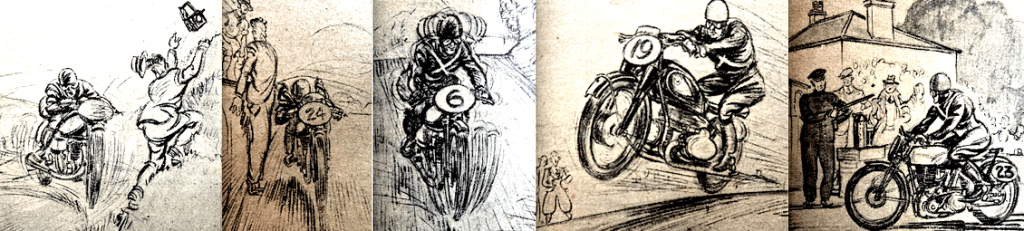
This is what we saw in simultaneous couplings: Frith—B (Ballacraine); Woods—R (Ramsey); Frith—K (Kirkmichael); Woods—M (Mountain); Frith—K. (Kirkmichael); Woods—C (Craig-ny-Baa). What it meant was that if Frith could scuttle into Ramsey at the moment when Woods roared past us, the pair were as near as no matter dead-heating still. Sure enough, a full-throated cheer welcomed Stanley as he streaked over the line at 100mph, pressed horizontal on his tank with everything wide open. And at the very same moment a fresh outcry on a different note indicated that Frith’s index had jerked to ‘R’, indicating that the two were as dead level on corrected time as ever a pair could be. Now began 10 minutes of really agonising suspense. Stanley’s feelings can better be imagined than described. No doubt he dismounted in the paddock, where, surrounded by flushed faces and stammering men, he knew his fate hung in the balance by split seconds. Point by point the screaming Norton was signalled, until at last Padre Stenning grew almost incoherent—’There’s only seconds in it—I daren’t say anything definite…my watch isn’t accurate enough for this.’ Simultaneously Graham Walker in the BBC chickenhut was bellowing with confused anxiety. The speakers blared, ‘Frith’s through Hillberry—scraped his footrest—carried on!—he’s at Governor’s Bridge!’ His red lamp gleams, and 10,000 maniacs leap to their feet and yammer idiotically. Nobody pretends to know who’s won. We watch the Norton pit, knowing they’d have a good chronometer; and suddenly we see one of the Norton men turn round with face convulsed and jerk two upward thumbs at the crowd. Ten seconds later Stenning shouts, ‘Frith by 15 seconds!’ Yells and cheers and bellows, and we sink back, mop our brows and sigh. Then Stenning again, ‘Frith broke the lap record, and did 90.27mph!’ Fresh pandemonium! Twice this week has Frith pulled out a record lap just when it was really needed. He must be just about our best already—and 1936 saw his TT debut! His final lap was covered in 25min 5sec Pity poor Stanley! Behind these doughty rivals in this epic race, White deservedly annexed third place. Jock West would have been higher but for his burst tank and repeated pit stops. Mellors, Daniell, Pope, Archer and J Williams (the last two defeating many Senior machines on their 350cc models) enhanced solid and growing reputations. But special praise is due to Galway, the South African, for more than holding his own in fierce company over a course which he has not had much time to learn. Similarly, Beevers will be more than satisfied with the fine part he played. Tired thousands—for excitement is strangely exhausting—wended their way to the boats, satisfied, and resolved to come again next and every year until TTs are no more. But poor Stanley Woods—he has won a Senior by four seconds, lost another by 18 seconds, and now a third—by 15 seconds. He was evidently born for thrills. Results. 1, Freddie Frith (Norton); 2, Stanley Woods (Velocette); 3, John H White (Norton); 4, Ted Mellors (Velocette); 5, Harold Daniell (Norton); 6, Jock West (BMW); 7, JC Galway (Norton); 8, LJ Archer (Velocette); 9, Noel Pope (Norton); 10, J Williams (Norton); 11,Bill Beevers (Norton); 12, HC Lamacraft (Velocette); 13, JW Forbes (Norton); 14, CAW Durno (Norton); 15, Manliffe Barrington (Norton); 16, Bill Beevers (Norton); 17, N Croft (Norton); 18, AC Kellas (Norton); 19, Sven Sorensen (Excelsior); 20, CV Moore (AJS); 21, HE Newman (Velocette); 22, H Hartley (Rudge); 23, F Faltner (Sarolea); 24, CF Brett (Norton); 25, WG Job (Velocette). There were 39 starters, of whom 14 retired. Of the 25 finishers 20 gained first- or second-class Replicas. Manufacturers’ Team Prize was won by the Norton team (Guthrie, Frith, White). Club Team Prize was won by the Birmingham MCC with the same team as above.”
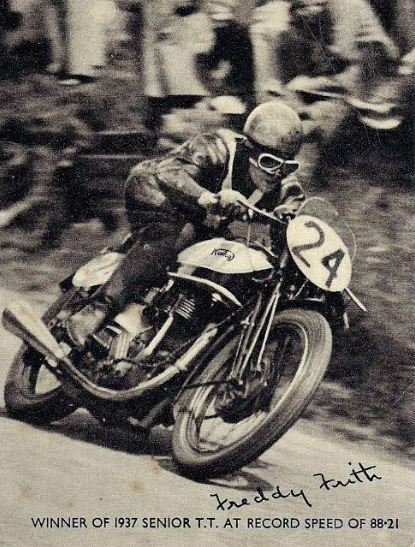
“TO STATE THAT the machines which finished first, second and third in the Senior could have gone out a second time and done it all over again is merely to place on record the truth. The tyres on Frith’s and White’s Nortons were a little worn on the offside—more so than those on Stanley Woods’ Velocette—but this is only of interest and not of importance. As is usual, there was no real carbon in any of the engines. The piston crown of Frith’s Norton was practically bone dry and just slightly marked by the inlet valve. There were no signs of excessive heat—indeed, the exhaust valve was clean and bright and obviously in perfect condition and the sparking plug just as it should be. Neither brake required taking up. The primary chain was a trifle on the slack side, while the rear chain seemed ‘just right’. Both chains were nicely oily. There was a fair amount of oil on the exterior of the engine. White’s machine was in almost exactly the same condition except teat the piston was a little ‘wet’ on the crown. In addition, the handlebars and front mudguard were bent owing to a fall. The outstanding feature of the Velocette on which Stanley Woods finished second was the fact that there was not a trace of oil leakage from the engine—or, for that matter, from the gear box. The whole valve gear, it is recalled, is enclosed. From stem to stern the machine was in the most magnificent condition imaginable. If there was one solitary item that might have stood taking up it was the rear brake adjustment—and that only a fraction.”

“ON SEVERAL OCCASIONS The Motor Cycle has published details of enthusiasts’ home-built machines, and while these have undoubtedly reflected great credit on those concerned, they have usually lacked that ‘finished’ appearance that is the prerogative of the factory-built model. One of the exceptions comes from Mr W Jackson, of Bexleyheath, Kent. The ‘Silver Streak’, as the machine is called, incorporates a modified Austin 7 engine. Mr Jackson has stated that all the engine parts have been modified except the pistons and the connecting rods, and that the special crankcase has been cast in aluminium from Mr Jackson’s own pat-tern. The machine incorporates rear springing. The water-cooled engine is set transversely in a duplex cradle frame (actually a modified BSA ‘Sloper’ frame) and a modified Scott radiator is fitted under the saddle with aluminium shields to deflect the air current on to the honeycomb. As the engine is set well forward in the frame, there is ample room behind it for the car-type carburettor and a normal motor cycle dynamo. This arrangement is said to make the tappets very accessible.
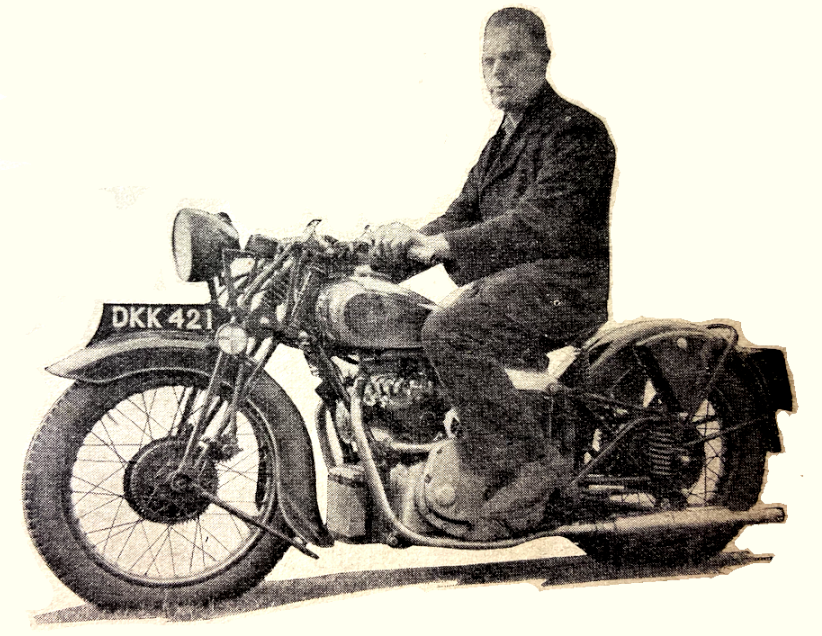
Transmission is by chain through an old-type Triumph three-speed gear box, which has a specially designed clutch. A second sprocket on the engine shaft permits the camshaft and dynamo to be driven by a ‘triangulated’ chain. Both chains are enclosed in an aluminium oil-bath. Twin exhaust pipes are employed, one on each side of the machine, and these pipes are connected to a single manifold that lies immediately under the fuel tank. Ignition is by coil. The spring suspension is particularly compact, and it is said that a variation of only ¹⁄₁₆in. occurs to the rear chain tension during the maximum movement of the rear wheel. As regards performance, the Silver Streak is said to handle like a normal 500 and to be capable of a top speed in the neighbourhood of 70mph. Petrol consumption is approximately 70mpg, and the oil consumption negligible. It is further claimed that no vibration is present at any speed, while the exhaust is almost inaudible. The equipment of the machine is well up to the best 1937 standards, and includes well-valanced mudguards, large saddle, narrow handlebars, tubular silencers, and a low-lift central stand. It is an eloquent testimony to the skill of the designer that with the exception of a few rough sketches no drawings were made during the construction of the machine, while Mr Jackson’s only machine tool was a 4½in treadle lathe.”
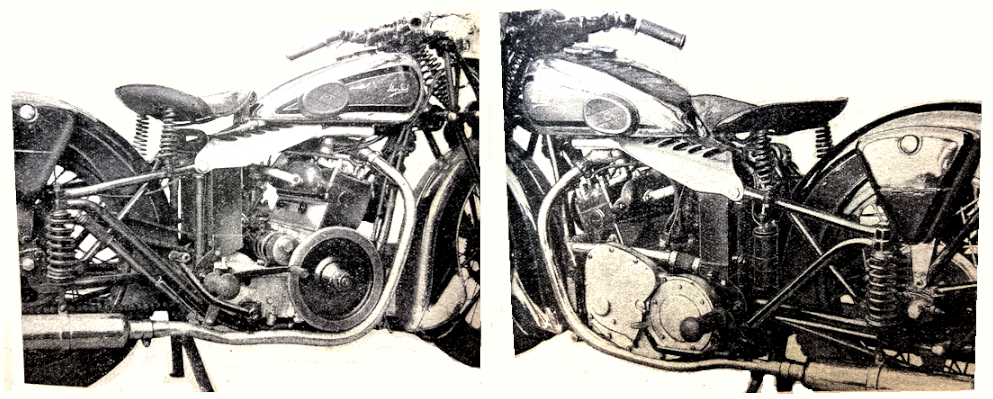
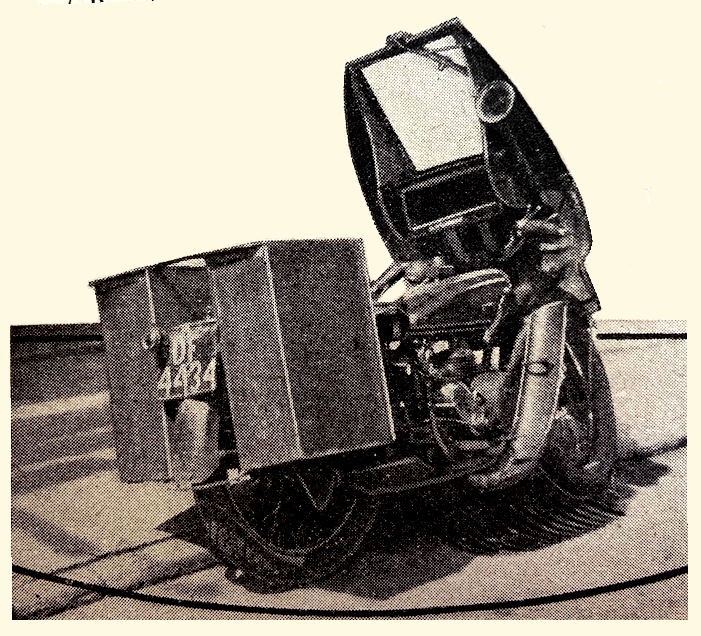
“THE 1937 RALLY AND inter-club meet of the Scottish ACU last week-end was very much an experiment. It was the first year that a mileage competition was included, and without question this was the most successful part of the proceedings. Five classes for various types and conditions of machine proved popular. All were well supported with the exception of the three-wheeler class, for which there were no entries. The Corstorphine Club were easy winners of the mileage competition with a total of 7,114 points. Second place went to the Leith &DMC with 3,209 points. After the usual gymkhana events a very pleasant day came to a close with the presentation of awards. Results. Best-kept Solo, D Marshall (1935 Ariel), Kirkcaldy; Best-kept Sidecar, W Clarke (Levis), Edinburgh; Best-kept Oldest Machine, R Inglis (1920 ABC), Edinburgh. Mileage Competition: 1, Corstorphine MCC, 7,114 points; 2, Leith MC, 3,209; 3, Aberdeen MC, 1,148; 4, Lanarkshire MC&CC, 1,120; 5, Perth MC, 981; 6, Lion MCC, 980; 7, Kirkaldy MC, 938.”
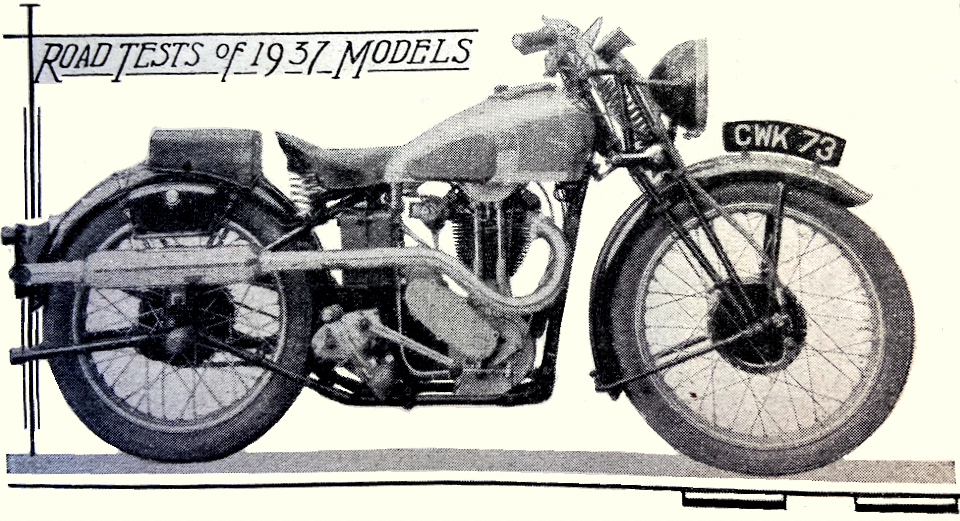
“IN RECENT YEARS the name Coventry Eagle has been associated with a range of utility two-stroke models of various types—some with pressed-steel frames, others with rear-wheel springing. Towards the end of last year, however, it was announced that three new models were to be added to the range. These were to be known as the ‘Flying’ series, and were to be marketed in three sizes—250cc, 350cc and 500cc. It is the last mentioned model which forms the subject of this road test. The Flying 500 Coventry Eagle is a particularly well-equipped machine to which considerable attention has been paid in the matter of detail. Not only does it possess front and rear wheel stands, but also an efficient prop stand. Concerning the rear stand, a praiseworthy contribution has been made in the interests of clean design. Although it is of the spring-up type, no springs are visible, for the tension springs are housed one in each tube and are linked to the rear fork ends by means of short arms. Another refinement takes the form of two brackets, one on each side of the rear mudguard, beneath the toolboxes, which simplify lifting the machine on to the stand. There are many other detail refinements that, combined with a sporting performance, make the Coventry Eagle a most attractive proposition. The riding position is comfortable for a rider of medium height. Although the handlebars are mounted rather higher in relation to the saddle than is usual, they are extremely restful, while the grips are set at an angle which comes naturally to the wrists. Thanks to the large saddle it is possible to adopt either an upright position or, by sliding back in the saddle, a more rigid position with the arms held straight from shoulder to wrist—an attitude which some may find more suitable for high-speed work. All the controls are conveniently mounted, while the majority are adjustable for position. At first, starting was somewhat uncertain owing to a combination of circumstances. However, after a few adjustments had been made to the carburettor it was possible to start the engine with reasonable certainty. The kick-starter turns over the engine an unusually small number of revolutions, and as a result an almost fully retarded setting of the ignition lever was necessary if a ‘kick-back’ was to be avoided. For an engine with a genuinely high performance the idling was comparatively good. It would appear that the compression ratio is such that an ethyl fuel is to be desired, or a suitable mixture of petrol and benzole. The engine is extremely powerful and is easily capable of lifting the front wheel when the machine is accelerated violently from a standstill. The acceleration in the intermediate ratios is exceptional. In top gear the best response to the throttle was obtained from 35mph upwards to 70mph. There is no doubt that the gear ratios are ideally suited to fast road work. Third and second gears have a particularly useful range—72mph and 58mph respectively. The performance in these two ratios, coupled with an absolutely first-class gear change—it is both light and has a very short travel—lead one to imagine that the. Coventry Eagle is a pukka road-racing machine. Incidentally, the gear box was commendably quiet, while the clutch was light and smooth in action, although inclined to drag slightly when a gear was engaged with the machine stationary. When the engine was pulling on light throttle the exhaust was reasonably quiet, but on full load it produced rather too conspicuous sporting note. This was particularly noticeable at the upper end of the throttle range. The mean speed of four runs
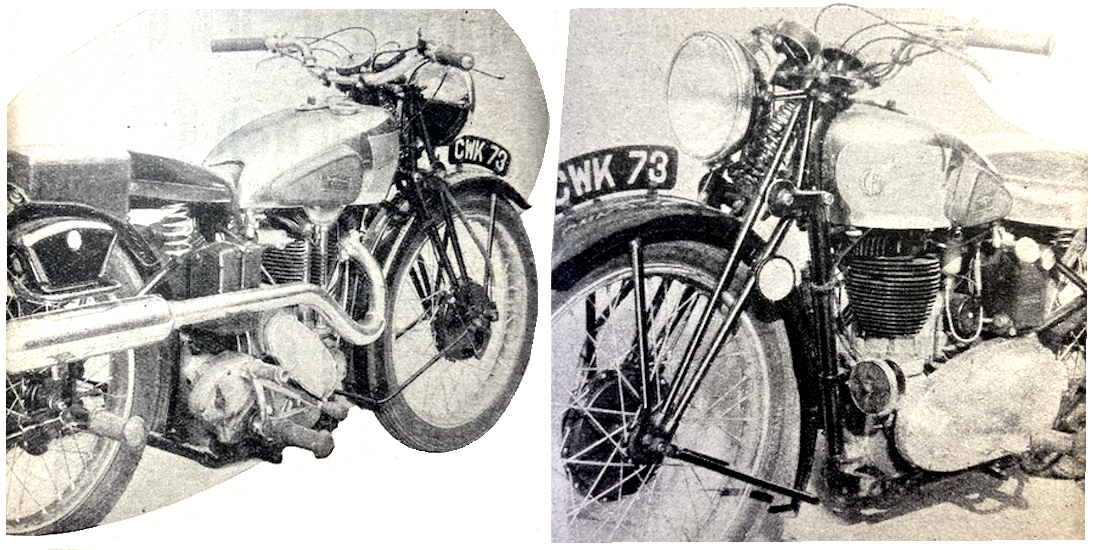
in two directions amounted to 78.8mph. Over a smooth surface the Coventry Eagle could easily better 80mph. A curious mishap occurred at the end of the last timed run, when a severe bump caused a spoke in the rear wheel to snap. The loose spoke and nipple forced their way through the rubber band in the well of the wheel and into the inner tube. At all speeds the steering was just right—neither too heavy nor too light. It is particularly good over rough surfaces. Likewise, the handling on corners is all that can be desired. Both brakes are light to operate, and although quite effective, an improvement in the braking figure would have resulted if the front brake had been a trifle more powerful. However, their smoothness in operation, coupled with the machine’s admirable steering qualities, gave the rider every confidence when riding over greasy surfaces. The single-port, high-level exhaust system became unusually hot in warm weather, and was liable to burn the rider’s trousers—a point which indicates that some form of guard on the pipe is very necessary. In connection with the exhaust system, an interesting point is that the Coventry Eagle is obtainable with a two-port or single-port head (optional), while low-level exhaust pipes can be fitted at no extra charge if specially ordered. Low running costs are apparently a feature of the Coventry Eagle. Owing to the oil-tight nature of the engine, practically no oil was used during the course of the test, while the petrol consumption at a maintained 40mph amounted to 77.2mpg. Altogether a very attractive and speedy machine.
“IN CZECHOSLOVAKIA, new motor cycles may be put on the road tax-free, and their owners receive income-tax concessions.”
“95% OF THE 9,202 motor cycles produced in Czechoslovakia in 1936 were of Czechoslovak manufacturer. Jawa were the most popular make.”
“VEHICLES IN NEW ZEALAND now have to be issued with a certificate of fitness before they may be taken on the road.”
THE BROOKLANDS AUTHORITIES clearly weren’t too bothered about attracting paying customers because many race meetings were held on Wednesday afternoons when the vast majority of enthusiasts were busy earning a crust. So there was only a small crown to see Wal Handley, who had retired from racing two years previously, ride into the record books on a BSA M24 Empire Star. BSA wasn’t known for its racers but this 497cc ohv iron-engined single, running on alcohol with a 13:1 compression ratio, lapped at 107.6mph to win the Allcomers Handicap and a Brooklands Gold Star. Within weeks BSA launched an all-alloy model based on Handley’s race winner: the Gold Star. Over the next 25 years it would shine brightly as a racer, scrambler, trials iron and super sports roadster.
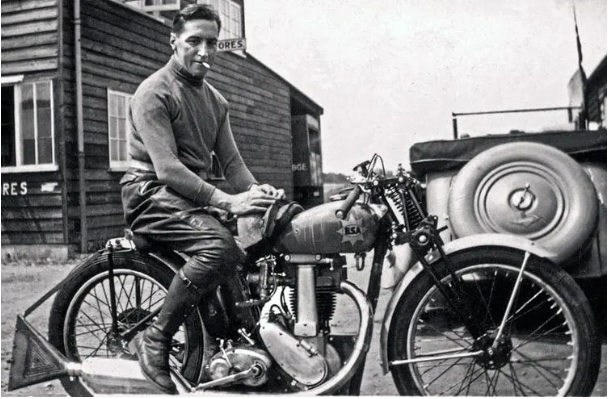
“THE SUN SHONE on the chestnut blossom in the Avenue. It was a beautiful day. To the boy on the pavement it was more than that—it was THE day. Under his excited and envious gaze his friend appeared from a side gate pushing ‘Heart’s Desire’. History forces us to record that it was an old and dilapidated 3½hp Minerva with coil ignition, footboards like Little Tich’s boots, a frame that stretched from here to there, and handlebars like a horizontal croquet hoop. Suspension was theoretically by leaf spring fork, but in reality by copper wire. The tyres were of 2½in section with steel studs, and the machine had outside plumbing in the shape of a gigantic hand-operated oil pump bolted to the torpedo tank, which seemed to reach away towards the horizon. Comic we will agree, but to the boy it looked more handsome than any show model. Doing a hundred yards in ‘evens’ the friend leaped into the saddle and disappeared round the corner. To the scent of the chestnut blossom was added that of pure castor oil—curse of childhood, ambition of adolescence. The boy on the kerb turned his school cap back to front, put on a pair of rubber goggles and for the umpteenth time examined a virgin driving licence. A steady banging in the distance accompanied by the barking of a dog heralded the return of his friend. Final instructions on the twiddling of air and throttle controls and the tankside advance lever; a mental panorama of motor cycle manuals pored over for many weeks, and the sweet agony of anticipation reached its climax. A pounding of feet to which his heart kept time, a frenzied jump and the boy heard ‘Heart’s Desire’ fire, then leap like a live thing. Perhaps it was only half a mile round the block, but that first ride contained a thrill the boy has never quite recaptured in a fairly adventurous life. The Year? 1910. The Boy?
Graham Walker.”
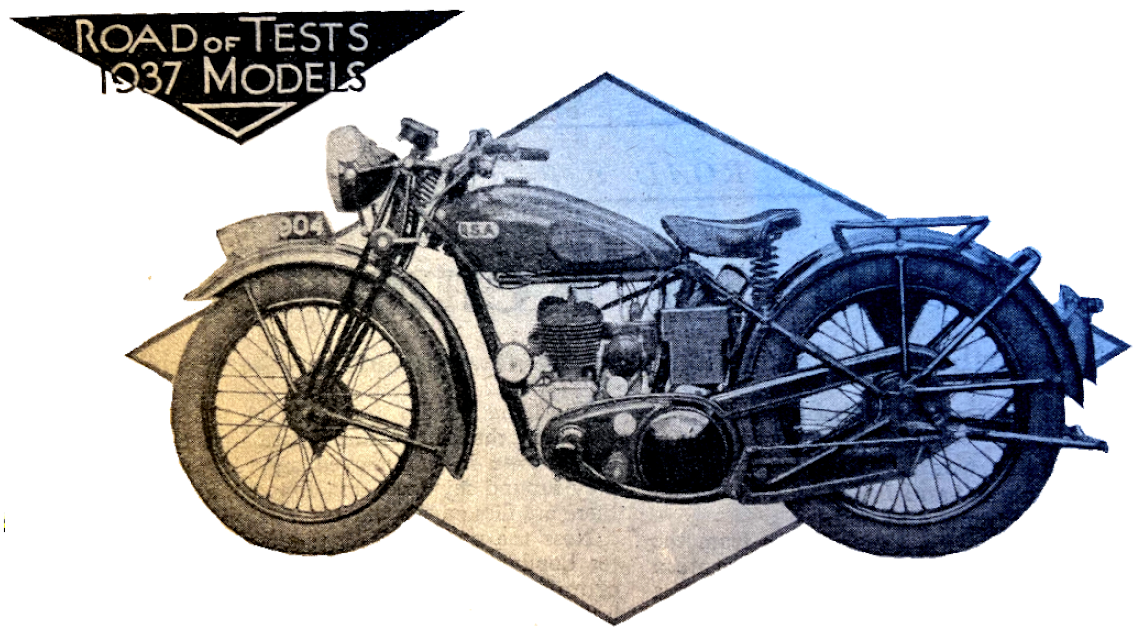
“OVER THE YEARS the makers of BSA motor cycles have built up a reputation for producing touring machines that give long service with the minimum of attention: The 1937 350cc side-valve model is typical of. the machines that have earned this good name. The machine has obviously been designed from the rider’s. point of view. Everything is accessible, and although there is no surplus equipment such items as an adjustable saddle and finger adjustment for the brakes are part of the standard specification. The footrests are not adjustable, but they are well placed relation to the saddle and handlebars. The riding position is comfortable, but for a rider with very long legs the adjustable footrests which can be supplied for an extra charge of 3s 6d would probably be a worth-while investment. Thanks to the ‘natural-angle’ handlebars the rider’s wrists did not tire on a long run, and as the controls are well placed and were smooth in use the machine was at all times a pleasure to handle. Starting from cold was not so certain as one would expect with this type of engine, but this was undoubtedly due to the carburation, which was incorrect at the lower end of the range. Generous flooding and a long swinging kick always caused the engine to fire, but sometimes it stalled after turning over a few times. However, when the engine was warm, starting was almost effortless. The slow-running was also good, except that at very low engine speeds there was a tendency for the engine to spit back and stop. On the road, all traces of this mixture weakness disappeared and the machine was as smooth and sweet at low speeds in top gear as could be desired. At 12mph with the ignition retarded there was no trace of snatch, and the model would accelerate smoothly array from this speed. At speeds above 20mph the ignition control could be disregarded so far as smoothness was concerned, although when running on No 1 petrol it was found advisable to use the ignition control when driving the machine hard, to avoid pinking. With an ethylised fuel this tendency disappeared altogether, and it was difficult to make the engine pink. The BSA proved very suitable for riding in traffic and for town work generally. It has excellent acceleration and the well-chosen gear ratios enable this to be used to the full. In second gear (12.4 to 1), which was usually employed for accelerating after traffic stops, less than four seconds were required to accelerate from 13 to 30mph, and in third gear (8.1 to 1) the time taken was 6⅘sec. Even in top gear (6.2 to 1) only 9⅘sec seconds were required. The machine is equally satisfactory on the open road. It was happiest when cruising at 40mph or just over, and whether ridden solo or with a pillion passenger it would run at this speed for long periods without tiring. In top gear the model has a good turn of speed, and the speedometer needle could be pushed round to near the 60mph mark with the rider sitting normally in the saddle. With the rider lying dawn, but fully clothed in heavy coat and waders, the BSA registered a mean timed speed of 62.5mph over a quarter-mile. In the other gears the maximum speeds were: third, 51mph; second, 39mph; bottom (18.2 to 1), 28mph. Accelerating from 20 to 50mph in top gear took less than 14 seconds. In third gear the time taken was somewhat longer. This was due to the fact that the engine had passed its peak well before 50mph was reached, although the actual maximum in this gear was just over 50mph. A better idea of the machine’s capabilities as regards acceleration will be gained when it is mentioned that a speed of 57mph was attained in a quarter of a mile from a standing start—a very good figure for a machine with a maximum of a little over 60mph. When obtaining this speed figure, ‘racing’ gear changes were made, ie, the throttle was left open and the gear changed as the engine peaked. It says much for the gear box that although several runs were made, no change was missed, and the gears
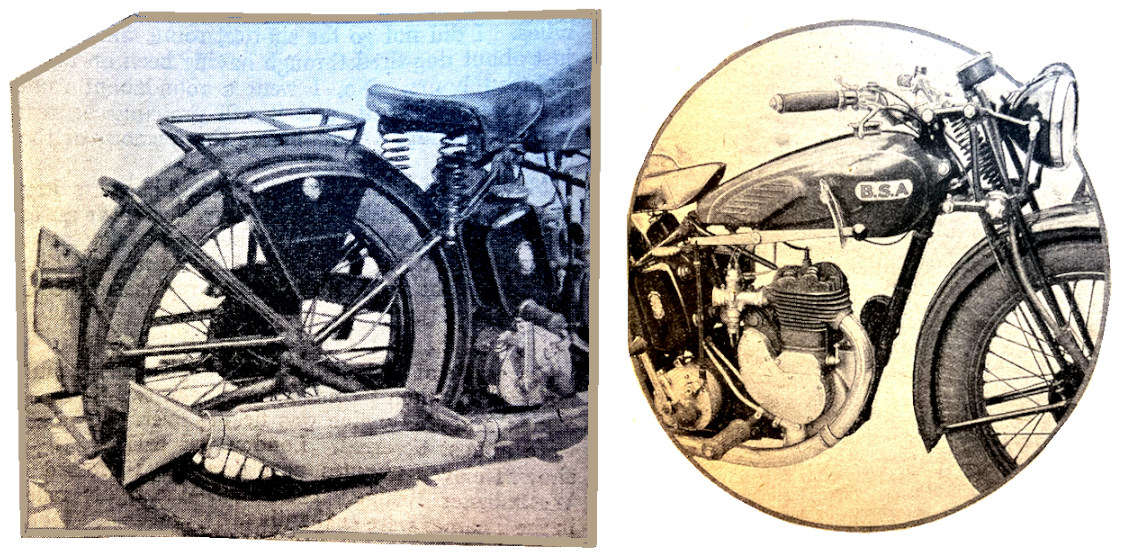
engaged cleanly on every occasion. In normal use the clutch was smooth and light, and at all times free from drag. On one or two occasions the gear lever would ‘hang’ in second gear, but this occurred only when the machine was stationary, and could be overcome by rocking the machine. So much for the performance of the engine. The steering and road-holding are beyond criticism. No steering damper is fitted and none was required, even at speed over bad surfaces. On corners the machine inspired confidence and it could be swung into and out of bends without effort. The forks have a smooth and wide range of action, and effectively control the movement of the front wheel. Both brakes were smooth, and sufficiently powerful for the type of machine. From 30mph the BSA could be stopped in 38ft, and at no time during the test did the wheels lock or show any tendency to do so, except when the braking tests were being carried out. Hand- and foot-brake controls are both well placed, and the pedal has ample leverage. At all speeds the exhaust note is pleasantly subdued and is barely perceptible to the rider. Perhaps on this account the mechanical noise appeared rather pronounced, particularly at low speeds. Although no wet weather was experienced during the test, the machine kept very clean. Only a slight seep of oil from the timing case was apparent on the engine. Oil consumption was very low, and petrol consumption worked out at 84mpg at a maintained speed of 40mph.”
“THIS YEAR’S ANNUAL CANADIAN speed championship, organised be British Empire Motor Club of Toronto on Wasaga Beach, were the ‘best ever’. A fine and representative entry of clubmen from all over Ontario and the United States battled in the sprint and distance races before a record crowd of over 10,000. The weather was perfect for racing and the beach in excellent condition. During the morning, in the timed sprints over a quarter-mile course, all previous Canadian records were broken. Robinson, of Detroit, riding a very special 988cc ohv Harley-Davidson, set up a new record of 106.07mph. North (988cc Harley-Davidson) was second-best with 95.23mph. Miller (490cc Norton) led the Senior class at 92.30mph, and R Sparks, on a 348cc Velocette, the Junior class with 81.07mph. The afternoon programme included a 70-mile race for the Kaye Don Trophy and two 10-mile events, one for experts, the other for standard machines ridden by novices. The opening laps of the 70-mile event caused great excitement. Miller (Norton) and B Sparks (Vincent-HRD) led the field, first one then the other being ahead, but never separated by more than a machine’s length. On Lap 10, however, Sparks was forced to retire with a split oil-tank, and from then Miller had the race in his pocket. Carrol (Norton) moved up into second place, closely followed by Fawson, who was also mounted on a Norton. Meanwhile Robinson (750cc Harley-Davidson), the winner of the speed trials, seized his engine, as did Neelands (Rudge) and Venier (Norton). Clutch trouble eliminated McCoy (Rudge) and Davy (Norton), and a broken chain outed R Sparks (Velocette). At the 64-mile mark both Carrol and Fawson ran out of petrol and this let up Bucknell (Rudge) and Bristol (Norton). Miller romped home 6min 2sec ahead of the second man, Bucknell, to win the Kaye Don Trophy. Miller’s average speed was 63.60mph. Third was Timson (Indian) and fourth Shenstone (BSA). In the novice race Timson (744cc Indian), with his big, high-powered machine, had things very much his own way and won easily, though Norris (Triumph), the second man, gave him some competition in the first two laps. The high-spot of the race was the duel between Crouch (Stevens) and Rogers (BSA) for fifth position, with the former eventually coming out in front. The last race, the 10-mile expert event, provided the most thrilling battle of the whole meeting. Venier, Carrol, Miller and Fawson, all on Nortons, thundered round the two-mile course for three laps, all jockeying for a winning position, but no one actually getting a definite lead. On Lap 4, however, Miller drew ahead of the others and finished a good 100 yards in front of the second man, Carrol, to repeat his double victory of 1936. Fawson finished third and Venier was fourth.”
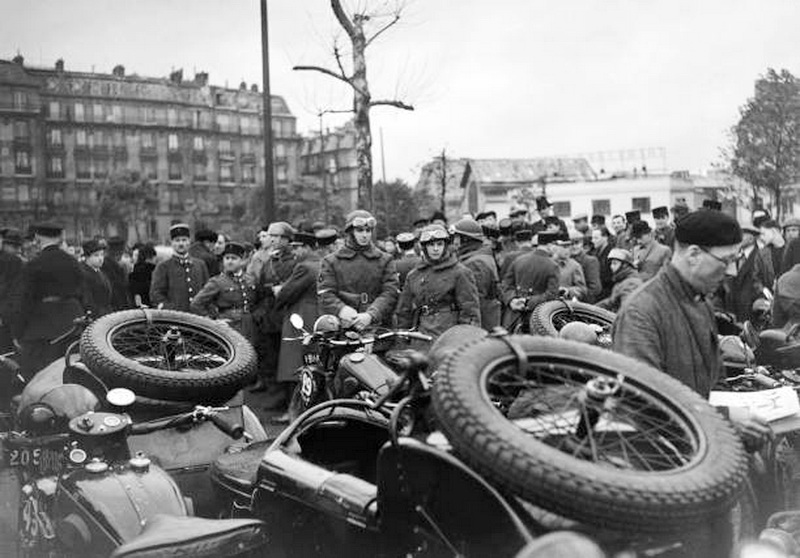
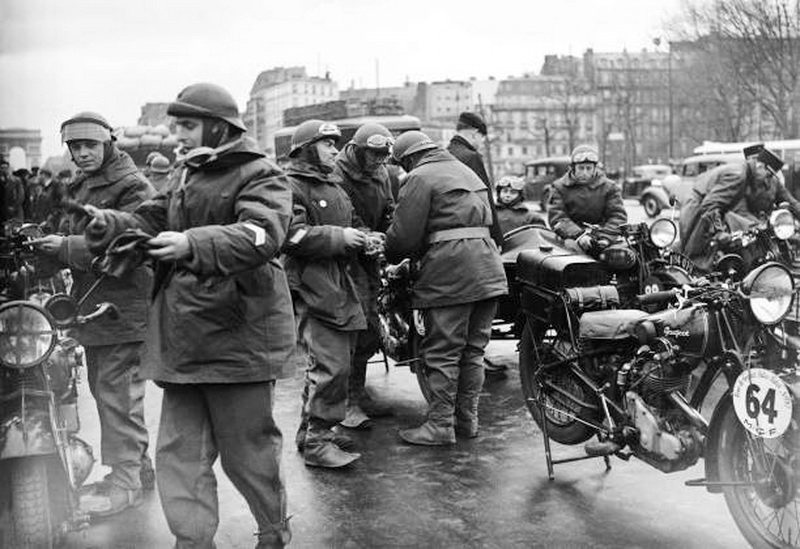
AT THE LAST OLYMPIA SHOW, the makers of AJS motor cycles exhibited an attractive racing 346cc ohc model with a specification that must have been the delight of many enthusiasts. It is now announced that this model (37/7) is in production in limited numbers. It is intended for riders with a fair amount of racing experience, and who are capable of maintaining a rather ‘super’ type of power unit. The specification includes an engine which is almost identical with that used for the AJS TT models, a 4½-gallon fuel tank, straight-through exhaust pipe with detachable megaphone trumpet and racing-type footrests. With the standard racing specification, and including testing at Brooklands, the machine costs £87 5s. Further details are available from the makers, AJS Motor Cycles, Plumstead Road, London, SE18.”
“A CHANGE HAS COME OVER the International Six Days Trial, which, as all know, is to be held this year in Wales. Not long ago the various nations treated the event in a happy-go-lucky manner. The trial was widely looked upon as an enjoyable though strenuous holiday. Times have indeed changed. For this year’s trial the British teams have already been tested and examined for physical fitness, have raced round Donington, where the final speed test is to be held, and have even been advised as to their diets. In addition, there have, of course, been almost microscopic examinations of the machines and their equipment. Those responsible for the German teams are going to even greater lengths. The riders are being sent to a military camp with the idea of ensuring that each and every man is in the pink of condition. Physical training and tests of man and machine are being carried to lengths hitherto unknown, and the team organisers have even decreed that the men have lessons in English. Some may feel a tinge of regret at the passing of the old happy-go-lucky days, but all will admire the thoroughness with which the task of competing is being tackled. After all, genius, it is said, is only an infinite capacity for taking pains. This year the teams are taking pains; they are determined to give of their best
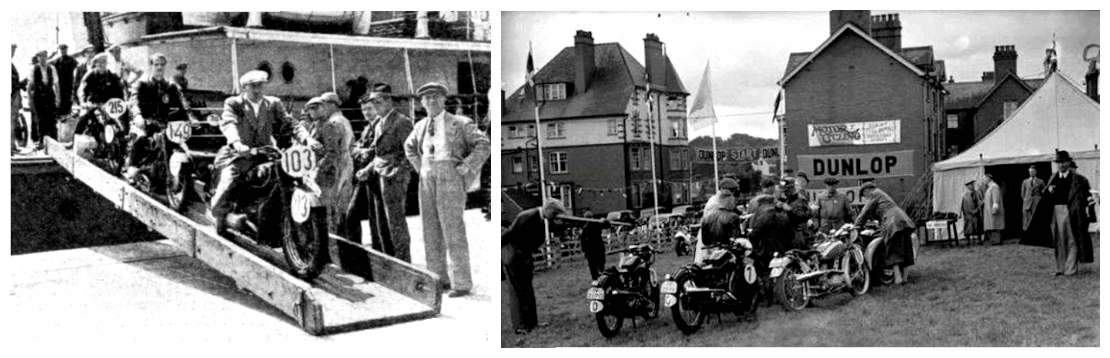
‘COINCIDENT WITH THE ARRIVAL of ‘Colebank’s’ description of Great Britain’s preparations at Donington for the International there came a letter from a Berlin friend of mine telling me just how Germany is tackling the same problem. Korpsführer Hühnlein, the leader of German motor sport, has decreed that as many German riders as possible may participate, provided they comply with certain conditions. This proviso is necessary on account of the difficulty of bringing money out of Germany. Therefore, so that the money spent is not wasted, the State is going to make sure that all German competitors will have a fair chance of performing creditably. My friend tells me that there will probably be over 70 German competitors, including sixteen army of and men, eleven from the SS (the Hitler bodyguard),22 of the NSKK (Storm Troopers), as well as 20 or more trade riders. The German Trophy team will be the same as last year, with E Henne, J Stelzer, and L Kraus on BMWs. The Vase teams are uncertain, but it is more than probable that G Meier, J Forstner, and F Linhardt—The three Army officers who won the club team prize last year—will he chosen as one team. Machines for the two Vase teams are as yet undecided, but probably one will consist of 500cc Zündapps and the other will be composed of 175cc DKWs. Every prospective entrant will have to spend eight days in the military camp at Döberitz. There they will have to undergo compulsory practice in conditions similar to those likely to be encountered in Wales. This will be followed by a vigorous course of physical training and gymnastics, and, as if that were not enough, every competitor will have to take English lessons for half an hour each day! Nevertheless, it is a fine example of that thoroughness for which the Germans are famous. In all, the German party, including managers and assistants, will number 140. They will be arriving at Southampton and, escorted by RAC guides, will proceed to Llandrindod Wells via Cheltenham, where the night will be spent. Korpsführer Hühnlein and the Duke of Saxe Coburg and Gothe, with their staff of adjutants, will be staying at Llandrindod Wells throughout the week.”
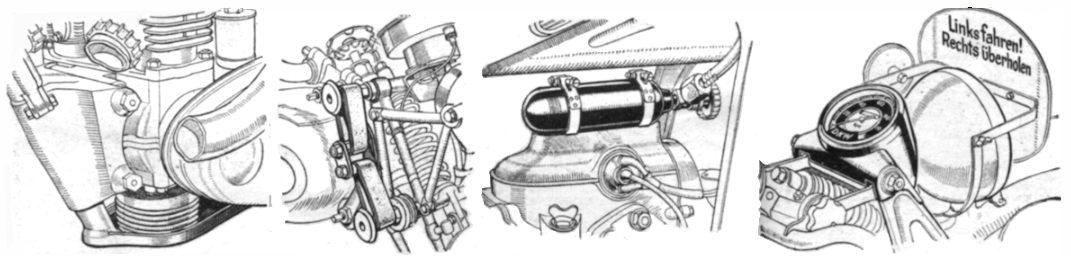
THE GERMANS HAVING hosted the event had perceived it to be both an important sporting event that winning satisfied their self-belief of superiority and also provided worthwhile training for military motorcycle specialists. As a result it sent a huge team with helpers over which was reported by the editor of Motor Cycling in person visiting the docks in Southampton to greet them. The story told was that arriving at the docks they met an immense Policeman his breast a glitter with War medals, The editor asked “Have you seen 140 Germans with Motorcycles” “No Sir” he replied politely, adding, after a contemplative pause “and if I did I’d run like ‘ell”
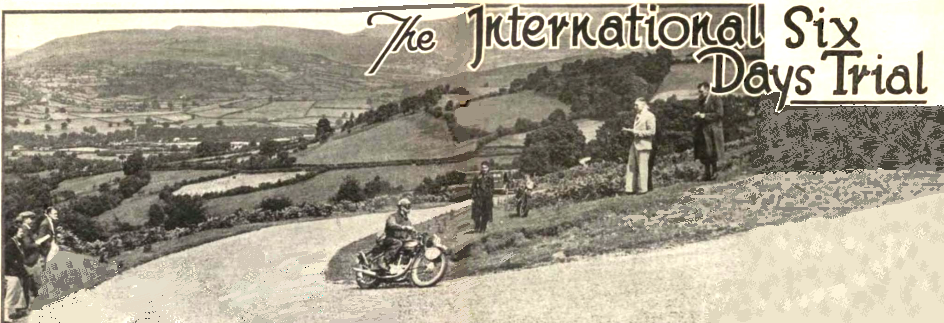
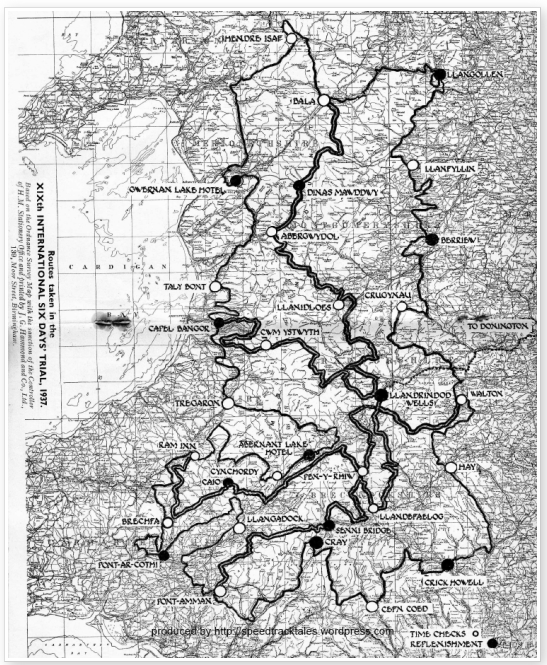
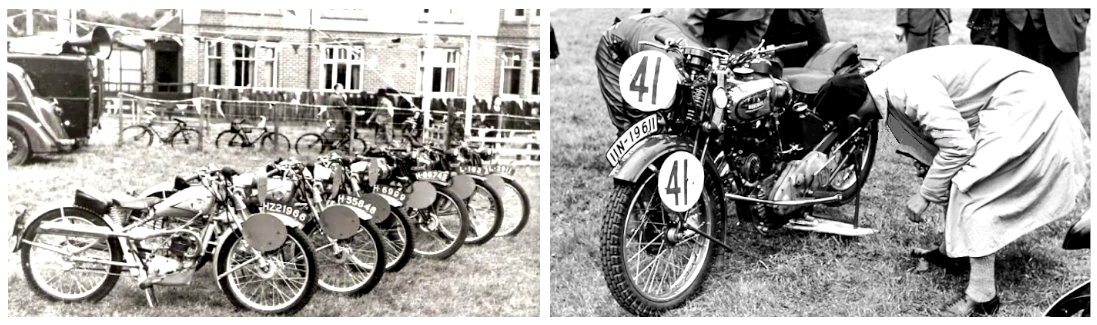
Monday.
A steady downpour without a breath of wind to blow it away greeted at the competitors at 6am on Monday—the start of the 19th International Six Days Trial. Fortunately as the day’s run of some 250 miles progressed the clouds lifted and the rain became an intermittent drizzle, and finally the sun condescended to shine. In spite of the discomfort of the weather, conditions were surprisingly easy and caused very little trouble . The chief difficulty lay in maintaining the schedule speed due to the nature of the course, which included miles of narrow lanes. Foreign riders found an added difficulty in the high banks and hedges that prevented them seeing round many of the corners—they are not used to this type of going. In spite of this, few lost marks on time, except for mechanical reasons. On the whole, the roads were reasonably good, although one or two sections had cross-gulleys similar to those of the Black Forest. Several quite steep hills were included, Allt-y-Bady and Dol-y-Wera among them, but they stopped only one or two 98cc and 172cc machines and a few sidecars. At all vantage points along the course—from Llandrindod Wells it ran up to Llangollen via Berriew and returned by way of Dinas Mawddwy and Llanidlowes—large crowds gathered to watch the riders of many different nations pass through. Fred Neil (498cc Matchless) experienced bad luck when his machine refused to start at a control during the day. Eventually he traced the troubles to a faulty HT pick-up—but not before he had lost 28 marks. H Tozer (496cc BSA sc) left the road at a tricky bend near Llandrindod Wells on the way home with the result that he could not think of continuing, while T Barnes (997cc Ariel sc) was compelled to retire at the lunch check with a badly holed crankcase. When the results of the day’s run were published they showed that none of the three Trophy teams had lost marks. Likewise, none of the Vase teams were penalised except the Austrian team, whose rider H Stroinigg (248cc Puch) had been forced to give up. Eighteen riders had retired and a similar number had lost marks.
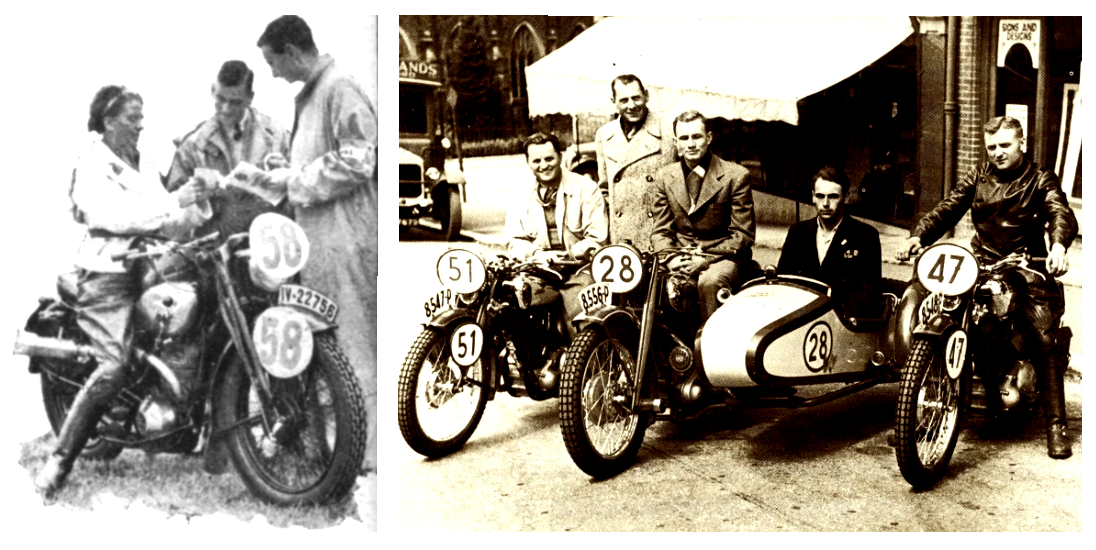
Tuesday.
On the second day of the trial the Clerk of the Weather played some peculiar pranks, In the first place it did not rain, although the roads were wet in places at 6am for the early numbers. But in the hilly districts—and the route on this day round through some mountainous parts of Wales—extremely low clouds completely blocked out the landscape. Riding became quite difficult at times on account of the mist settling on the competitors’ goggles. The inward half of Monday’s run was followed in the reverse direction, viz, out through Llanidloes and Dinas Mawddwy as far as Bala, where it branched towards the north, and then back and down to the lunch control at Gwernan Lake Hotel, near Dolgelley. Apart from the mist, the run was comparatively easy, even though it included the ascent of that well-known and lengthy hill, Bwlch-y-Groes. It was in the narrow part at the foot of the hill that Vic Brittain (348cc Norton), of the British trophy team had to do some rapid thinking when rounding a bend. He suddenly came across two German riders sprawled across the road after a slight spill. Quick as lightning Britain slid his model in dirt-track style to a standstill, doing no damage either to himself or to his machine. In the clouds on the upper slopes to the hill it was very interesting to watch the different methods employed by the various riders. HR Taylor (497cc Ariel sc) came up in grand style, but LEC Hall (499cc Rudge sc) came to a stop at the summit with clutch trouble—a locknut had slackened and off, and by the time he
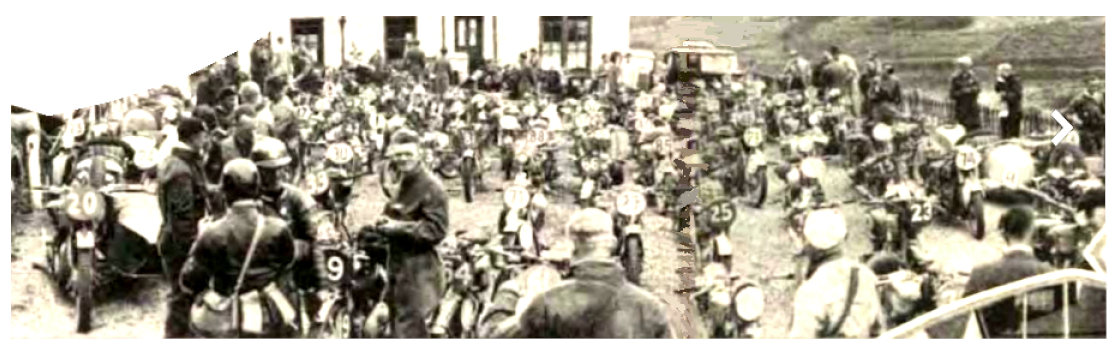
got it back he had lost so much time that he was forced to retire. F Juhan (598cc sc) came up with his passenger sitting on the pillion seat; close behind him and rapidly overhauling him was HJ Flook (596cc Norton sc). E Barth (98cc DKW) came up very slowly, and near the top proceeded to tack from side to side of the road to ease the load on his little engine. H Klopfer (98cc DKW) amused the spectators by ‘romping up’ at a very slow speed, and when he gradually overtook JC Verkerke (125cc Eysink) he offered a hand as if to tow him up. The gradient was too much for W Zylaard’s baby DKW, and it seized up near the top. FH Whittle (598cc Panther sc) made a climb in spite of a sidecar that had adopted an affectionate inward list. Most of the British riders, knowing the tiring nature of the hill, climbed with restraint to save their engines. In consequence they were for the most part extremely neat and pleasing to watch. Easily the most outstanding continental machines were the BMWs, whose riders almost without exception, roared up at speed. S Bell (496cc BSA), O Senaburg (490cc DKW), H Major (490cc Norton) and GF Povey (346cc AJS) all made quiet and neat climbs, as did A Colcombe (347cc Ariel). J Stelzer (496cc BMW), of the German Trophy team, treated the gradient with the respect and caution expected of a team man. From the top of Bwlch-y-Groes the route proceeded down the rocky track leading to Lake Vwrnwy, and then proceeded via the Hirnant Pass, which was descended, down to Bala. From here the going through wild country, the beauty of which was frequently lost in the clouds. Sheep which suddenly jumped into the road, caused a great deal of anxiety and in some cases a few spills. Curiously enough, the Welsh sheepdog seem to be equally careless about the correct use of the road, and they caused their fair share of heart beats. At the lunch control at the Gwernan Lake Hotel CS Edden (990cc Matchless sc) retired with a faulty sidecar wheel. The return journey was comparatively simple with more than its proper share of good roads. On the main road section from Rader to Landrindod Wells, G Keitel (490cc DKW) left the model when endeavouring to avoid a sheep and severely bent his headlamp. At the finish of the day’s run, he started to remove the lamp only to be told to refit it! At the finish of the run WS Waycott change the tire on the spare wheel. It was also noticed that several Continental machines were rapid losing their rear wheel treads.
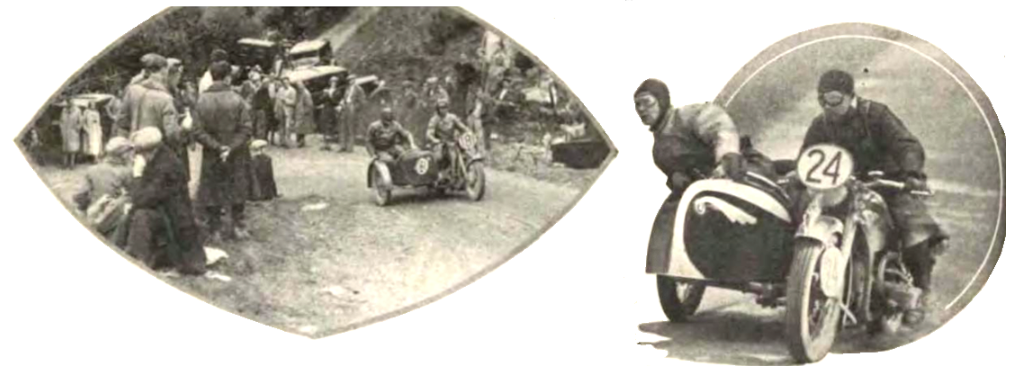
Wednesday.
Wednesday had the makings of a perfect day when the first man set off on the run of 247 miles, most of which lay to the west of Landrindod. Later on the sun streamed down with almost tropical intensity, but at the early hour of 6am it was still hidden behind the clouds. Soon after the start T Whitton (498cc AJS) was forced to retire with gearbox trouble. The route wound its way over the middle of the Cambrian Mountains, at one point, reaching a height of 1,400 feet above sea level. This part of the run provided seasoned ‘International’ drivers with an opportunity of showing their skill at maintaining a high schedule over really bad going. For nearly 25 miles the course went up short but steep hills with many awkwardly placed bends and to add to the riders’ troubles they were cruel, fork-bottoming water-courses, or cross-gulleys. During lunch at the picturesque Abernant Lake Hotel one or two riders looked longingly at the water in the lake, a refreshing site in the heat of the sun. That little German rider Klopfer simply could not resist the appeal of a child’s-size, paddleboat and proceeded to paddle about it, complete with reversed cap and goggles to the general amusement. Everyone was intensely happy. The Germans kept on expressing their appreciation and not only of the beauty of the Welsh scenery, but also of its variety. So far the day’s run had been the most beautiful in the trial. After lunch the course lead to Cynchordy and the Ram Inn, over the southern end of the imposing Cambrian Mountains. Once again, the course was interesting, but not too difficult. Riders were still arriving at the checks with five and sometimes even 10 minutes in hand. In fact, because the surface conditions of the tracks permitted unusually high speed, there was every possibility that thoughtless riders might burst their engines. Actually, trouble had been experienced by more than one rider for this reason…Finally, the course skirted Builth Wells and a slight deviation brought the riders back into Llandrindod Wells for the completion of third day’s run—a day of little excitement, but of great scenic beauty.
Thursday.
In a way Thursday’s run was one of the most exciting of the week. The first three days had been somewhat lacking an interest—the wheels had been turning too smoothly. But on this, the fourth day things began to happen. So far the three Trophy Teams, representing Great Britain, Germany and Czechoslovakia, had been running level with no marks lost, but today A Vitvar (246cc Jawa) of the Czech team retired. He went off the course and covered so many miles when endeavouring to rejoin it that unfortunately he ran out of petrol. T Stewart (346cc Royal Enfield) of the Irish Vase ‘B’ team and JE Fyma (497cc Ariel) of the Holland ‘B’ team also also went off the course at the same point and lost marks on time. At the start everyone was sorry to hear that Jackie White (497cc Ariel) was not well enough to continue—the previous evening he had become involved in an argument with a dog on the way into the final check. The resultant spill had a sprained the knee of his already not-too-clever leg. In spite of great pain he had managed to check in. JS Boote (348cc Panther) found it impossible to get his model going and after much pushing he retired. The trouble was due to a broken piston ring that it worked its way past the top land of the piston into the combustion chamber. At a point in the hills just before the Ram Inn the course struck out afresh from that of the previous day. Several competitors went astray. Some realised their mistake in time, but others picked up fresh markings which led them a long way off the correct route…By this time most of the riders are settled down to a steady speed on the good road sections, tackling the rougher parts with caution. However, nothing could stop some of the visitors from treating the trial as a race, many of them arriving at checks with 15 and more minutes in hand. The lunch check was at Ponct-Ar-Cothi, which is five miles east of Carmarthen on the main road. Here it was easy to see the results of the hammering to which the machines have been subjected. Several sidecar outfits obviously disintegrating under the strain while not a few solos were in trouble. DH Eysink (122cc Eysink) was forced through at this point with a fractured frame. After lunch the course led by devious ways to the control at Llangadock, where Captain G von Wolf (790cc BMW sc) just got in in time after changing a wheel. R Plasckett (247cc SOS) had to give up with gear box trouble. Curiously enough, a similar form of trouble brought about the retirement of another SOS rider, RW Hole, at the very next control. Between Ammanford and Senni Bridge, the course skirted the Black Mountains, climbing at times to close on 1000ft above sea level. In parts the going was rough due to rock outcrops, but little trouble was
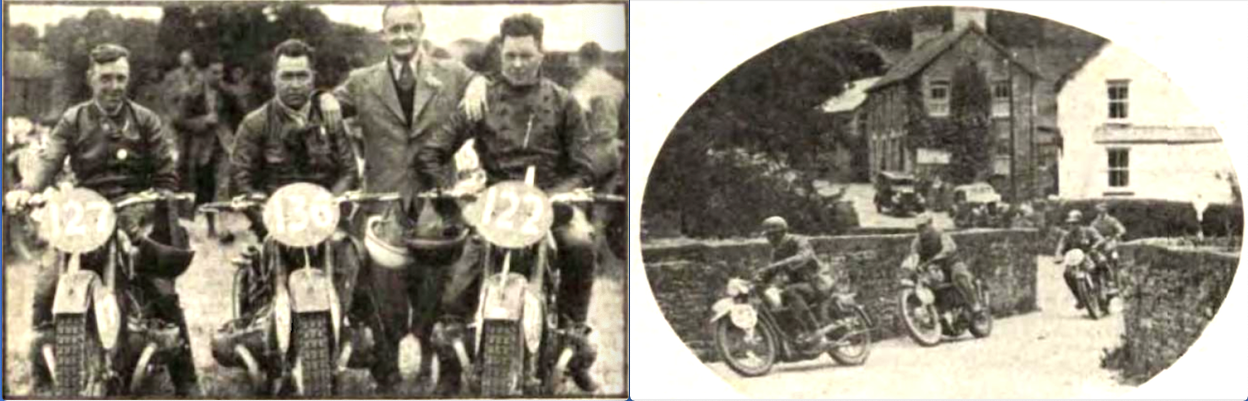
experienced. Here H Crabtree (246cc New Imperial) had to give up with chain trouble…A torrential downpour of rain between Senni Bridge and the check a Llandefaelog, near Brecon, practically obliterated the route marking at some points. However, only one or two riders went off the course. R Seltsam (493cc Zündapp) skidded on a bend while travelling fairly quickly and came a terrific purler just in front of Len Heath. To Len’s surprise Seltsam picked himself up, jumped on his machine, which show surprisingly little signs of damage, and rode off at high velocity. Back at the finish Seltsam was showing friends, his crash hat, the front of which bore a deep impression of his goggles, which were forced into the helmet for at least a quarter of an inch. At Llandrindod 19 riders, including only one Englishman, changed their tyres. J Steher, whose machine is fitted with quickly detachable rims of his own design, amazed everyone by completing the task—including removing and refitting the wheel—in just under two minutes, and he did not appear to be hurrying either! The day’s run had resulted in the Czech Trophy team losing marks, and the Vase teams of Ireland ‘B’ and Holland ‘B’ also penalised, subject to protest. This left both ‘A’ and ‘B’ Vase teams of Great Britain and Germany, and the ‘A’ teams of Ireland and Holland, without loss of marks. It looked more than likely that Donington would have to decide the winners of the international trophy—a dog-fight between Britain and Germany.
Friday.
So far the course had been distinctly on the easy side, but there were many rumours concerning the route for this, the fifth day of the trial. The strain, both mental and physical, of the previous four days was beginning to make itself felt so that the news that Friday’s run might be the most difficult of the week struck rather a dull note. Hardened Internationalists could look back to 1933 and recall the hammering they endured over this very same route. For the most part the day’s run lay in the Black Mountain area of Brecknockshire. The previous day’s run to Pont Amman via Senni Bridge was followed in the reverse direction. Although it included two quite stiff climbs—one up to 1000 feet above sea level—the route caused little trouble. However, at this juncture, H Fleischmann (348cc NSU) and JA Hitchcock (349cc Triumph) were forced to give up with engine trouble—the con-rod of the latter’s machine was peeping through a hole in the crank case. A more perfect morning could not have been desired. The blue sky was flecked with cotton-wool-like balls of cloud, while the atmosphere was so clear that from the top of the hills the country could be seen for miles around laid out like a patchwork quilt. Just before the lunch check Jack Leslie (499cc Rudge) fell foul of a cross-gully while travelling at speed and punctured a tyre. However, he managed to fit another tube with plenty of time in hand. As was the case with most of the villages en route, a large crowd awaited the riders at Cray, where at the village hall lunch was served.
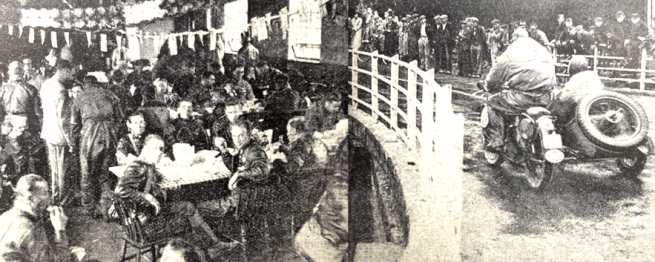
Inside the hall there was the usual jolly scene of riders from many different countries fraternising. Len Heath (497cc Ariel), of the British Vase team, came in with a very glum face. His engine was cracking up. By mistake a short, skimpy front mudguard had been fitted, and the mud encountered on the first day’s run had been sprayed all over the engine and in particular into the carburettor, whence it had worked its way into the engine , in spite of an air cleaner. Three other riders were also far from pleased. E Barth (98cc DKW), JC Verkerke (122cc Eysink) and H Klopfer (98cc DKW) had lost marks at the Senni Bridge control after missing the route-marking and running off the course. E Haller (497 Zündapp sc) was in trouble with a fractured sidecar chassis, as was W Krabiell (562cc NSU sc). Although the former managed to affect a first-class repair, the latter was compelled to retire in the wilds of Fforest Fawr, on a steep hill near Heol Senni. Incidentally, this section was one of the most beautiful of the week, and one which most competitors were able to appreciate for the bad roads of 1933 had not only been considerably smoothed out but in many cases the surfaces were tarred. It was in this section, when approaching the next check at Cefn Coed, on the outskirts of Merthyr Tydfil, that fate struck a cruel blowout at the British ‘A’ Vase team. Len Heath’s engine decided that it had had enough of Wales’ grit and dust and Len had to find other means of transport into Llandrindod. Others, too, were in trouble. JA Hitchcock (349cc Triumph) had some serious fork trouble and retired at the next control at Crickhowell, and P Schähfer (596cc Victoria sc) gave up after a bout of chain trouble…From the control at Hay the route lead out to Walton Road and then turned westward back to Llandrindod following the outgoing route used on the very first day of the trial. With many signs of relief—for this was the last day of the trial proper, Saturday’s run to Donington being over main roads—the riders handed in their machines at Llandrindod Wells, where a huge crowd lined the streets to cheer them. Great Britain and Germany still had lost no marks in the Trophy Team contest, while the Vase teams of Great Britain ‘A’, Germany ‘A’ and ‘B’, Ireland ‘A’ and Holland ‘B’ were likewise running without loss of marks. Everything, in fact, was set for an exciting finish at Donington.

Saturday.
Five ack emma was zero hour for the start of this, the last day of a grand trial. There was a notice of sadness in the air at this hour for the trial was leaving Llandrindod Wells for the last time on the final run to Donington. We had grown to love this famous Welsh watering place, and, judging by the many kindnesses we received, it had also learnt to like us—notwithstanding our early morning starts. In spite of the early hour and a depressing downpour of rain Llandrindod Wells gave the trial a grand send-off. The route lay over main roads the entire way to Donington. Chosen to avoid big towns, it led via Ludlow and Bridgnorth along Watling Street to Tamworth and then through Ashby-de-la-Zouch to Donington Park, where the riders began to arrive in batches soon after 9am. On the way fate struck some last-minute blows. HM Patterson (998cc Harley Davidson sc) was forced to retire, and SA Lewis (499cc Rudge), who up to this point had not lost any marks, retired with serious engine trouble less than two miles from Donington. WN Jordan (346cc New Imperial had a rather bad spill, but was able to continue, and Freddie Neil (498cc Matchless), who had not lost any marks since the beginning of the week, had to retire near Bridgnorth with a broken rocker. After a brief respite, during which they were permitted to change tyres and sparking plugs, the riders in the first batch were led round the well-known 2¼-mile road race circuit. Soon they were lined up on the starting grid, and with the upmost possible dispatch they were sent off on this, the last test. For machines have had a week’s hard gruelling this one-hour high-speed test is extremely trying and it was not surprising, therefore, that many failed to cover the necessary number of
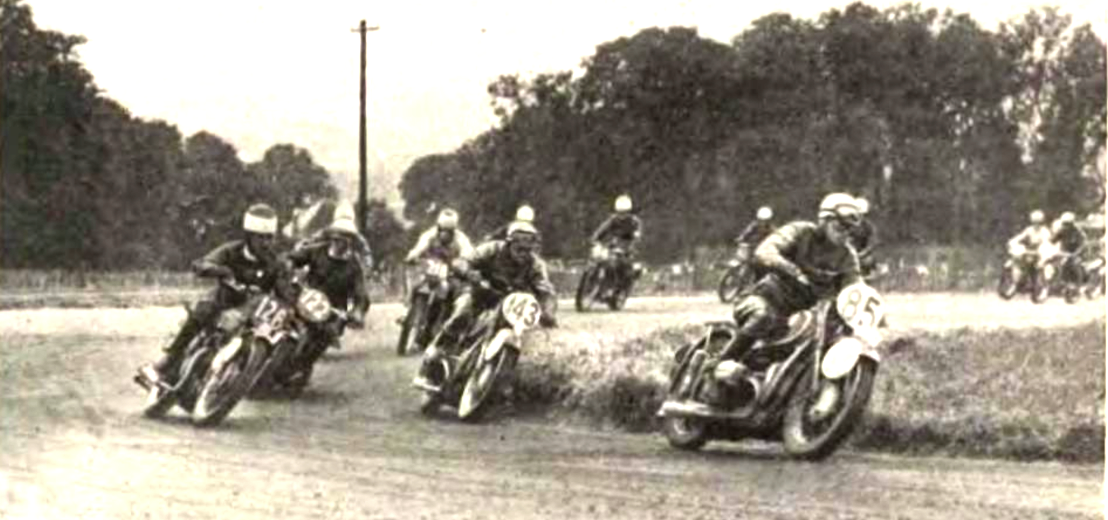
laps in the specified time. The schedules varied from 38.28mph for 125cc solos to the 48.48mph required of the 500cc machines. When the first batch went off Frau I Thouret (245cc DKW) was left behind kicking hard at the starter—last year in Germany she had a similar experience. This time the trouble was due to her failing to switch on the ignition—a point that was soon rectified. However, on the last lap a tyre went flat, and by the time she rode in she had lost three marks. Miss Marjorie Cottle had even worse luck—her little 249cc BSA, which had taken it through the week without loss of marks, decided to blow up in the middle of the test. The same thing happened to C Geffers (242cc Hercules)—in his case on the last lap. For the most part the riders wisely rode to keep ahead of the schedule required of them by a small but safe margin. But one or visitors looked upon it as a race with the results that their engines objected and away went their golds. HR Taylor (497cc Ariel sc) put up a grand show in spite of his physical disability—he is minus one leg, and owing to road shocks his left hand had become so numb that he could scarcely use it. Well did he deserve his gold medal. After the third been flagged in the contestants for the Silver Vase rode round the course and then waited on the grid for the starter’s signal. It was going to be a grand tussle between the Great Britain “A’, German ‘A’ and ‘B’, Ireland ‘A’ and Holland ‘A’ teams. For this contest, as well as for the Trophy contest, the team able to save the greatest number of seconds on its schedule was to be adjudged the winner. By this time a large crowd had gathered to see the thrilling finish to a week’s hard riding. When the maroon fired the two BMWs of the Dutchman, J Moejes, and F Linhardt, rocketed off the mark with R MacGregor (499cc Rudge) hot on the heels. At the end of the first lap McGregor was tailing the leader, Moejes. Next time round, he was in front, while not far behind was Jack Leslie (Rudge), in the middle of a pack of snarling BMWs. Then came the first blow. Edward (Rudge) blew up on the far side of the course, by the Hairpin. Great Britain was out of the Vase contest. Alan Jefferies (346cc Triumph) was to lose his gold in a similar manner. The issue now lay between the Dutch team, the two German teams and the Irish boys. The last mentioned were putting up a grand fight, but they were somewhat outclassed by the speedy German machines. The Dutchmen were obviously piling up a big lead. The German Army team, on BMWs, found difficulty in negotiating Coppice Corner. Reports came through that both A Möhrke and Jay Forstner came off at this point. At last the riders are flagged in. It looked like an easy win for Holland. The crowd anxiously waited for the results to be announced. It was a long wait. Nearly an hour later it was given out that the German army team had won. A protest was lodged, and it was then found that Moejes, the fastest rider in the Dutch team, had been missed on his 12th lap , so the final result was that the Holland ‘A’ team won by the handsome margin and nearly 2½ minutes from the German Army team. The German B team of Zumba for third with the Irish team are Gallant fourth. Finally came the most important event of the day, the contest between the Trophy teams of Great Britain and Germany. The British and German sidecar outfits were of the same capacity, but the British, solos—GE Rowley, (AJS) and Vic Brittain (Norton) were 350s as compared with the 500cc solo BMWs of the German team. According to the rules the British solos had to gain on a

schedule based on 18 laps in the hour, while the BMWs had a scheduled based on 19 laps. Put more simply, the BMW solos had to gain roughly 6sec a lap on the two British 350s, assuming the two sidecar men were keeping level. When the maroon went off the British team jumped ahead as one man. Stelzer (BMW) was left on the line hurriedly adjusting his goggles. Tensely the crowd awaited the first men down the long straight to Starkey’s corner. At last a rider could be seen—a clear hundred yards ahead of the field. It was Vic Brittain! written exclamation Behind was grim, determined Lieutenant G Meier close, followed by Seltzer and Rowley. A brief pause and the two sidecars came round, Waycott dogging, Krauss. Then the anxious crowd experienced a few hear-fluttering. Rowley was obviously in trouble with his gear change—could it be a repetition of his luck in 1933, when he lost all his gears except third? It was very nearly so for it afterwards transpired that he had difficulty in changing up. However, he was able to keep going and try and try as Seltzer might he could not better an increase of five seconds a lap on George time. In the meantime, Brittain’s effective lead of seven seconds over and above his 6sec advantage on the BMWs in the first two laps put the British team in a secure position. It simply made up for the very slight difference in Kraus’ and Waycott’s times. At half distance a bare three second separated the two sidecars. At this stage Meier overhauled Brittain, but he was not gaining enough on schedule. Behind behind them Rowley, by dint of superb riding that was equalled only by that of Vic Brittain, was keeping his end up. Comparatively soon—in just over 40 minutes—the British team had accomplished the necessary number of laps. But so had the Germans. Who had won? Anxiously the crowd waited for the result. Yes, we done it! We had won by the extremely narrow margin of 10 seconds. What a terrific climax to a six days trial! Great Britain had once again won the International Trophy, bringing her total number of victories in this unique event up to 10. Throughout the week it had been a sporting struggle under conditions which were trifle easier than usual. Even so, out of 10 teams which started in the vase contest only five reached Donington complete without loss of marks. In this contest, Great Britain was not so fortunate. On the other hand, everyone was delighted to see the Dutch team win by a comfortable margin—a well-deserved and brilliant victory by team of first-rate riders. As was the case with the Trophy contest, the Silver Vase contest developed into a battle royale between two teams.
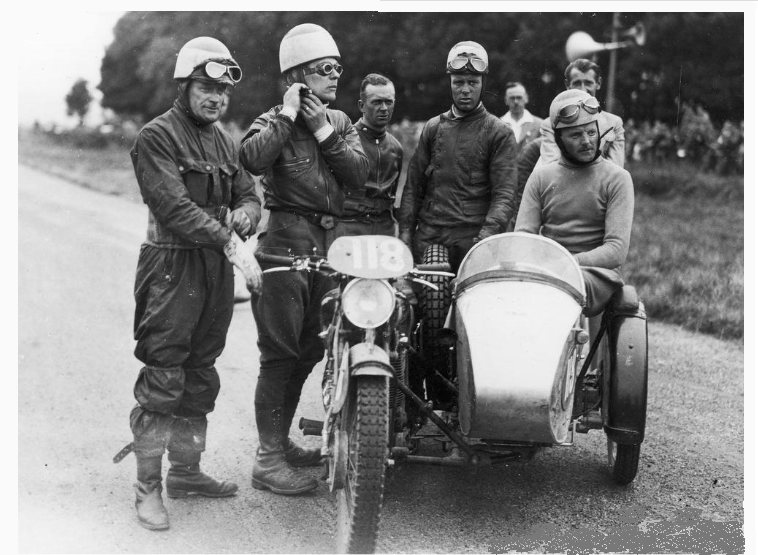
Results.
Of 213 starters, 124 riders won gold medals, 22 silver medals and 21 bronze medals. Two riders finished but received no award.International Trophy. Winners—Great Britain: GE Rowley (348cc AJS), V Brittain (348cc Norton), WS Waycott (595cc Velocette sc); total time gained at Donington, 39min 17sec. Runners-up—Germany: J Stelzer (496cc BMW), G Meier (496cc BMW), L Kraus (596cc BMW sc); total time gained at Donington, 39min 7sec. International Vase. Winners—Holland: AP van Hamersveld (494cc BMW); J Moejes (494cc BMW); G Bakker Schut (494cc BMW). Runners-up—Germany: A Möhrke (494cc BMW); J Forstner (494cc BMW); F Linhardt (494cc BMW). JG Shields Trophy (club teams). First—Versuchs-Abteilung-Wünsdorf: A Möhrke (494cc BMW); J Forstner (494cc BMW); F Linhardt (494cc BMW). Second—Leinster MC: AHL Archer (497cc Ariel); RC Yeats (349cc Triumph); S Moran (498cc Matchless). FICM Gold Medals (for Manufacturers’ Teams)—Norton: HJ Flook, J Williams, VN Brittain. BMW: G Meier, J Stelzer, L Kraus. Dutch BMW: AP van Hamersveld, L Meojes, C Bakker Schut. Zündapp: R Grenz, G Heimbucher, J von Krolin. NSU/D-Rad: P Oettinger, H Dunz, F Walter.
“WE HEARTILY CONGRATULATE VN Brittain (Norton), GE Rowley (AJS), WS Waycott (Velocette sc) and Waycott’s passenger, V Mundy, and the makers of their machines upon the fine achievement. We also congratulate the German trio who came within an ace of winning, the Dutch BMW team who won the Silver Vase and the German ‘B’ Vase team who at one time were thought to have won. That this last team, on the sheets being checked, proved to be not first but second was indeed a bitter pill to swallow. Equally, all will extend their sympathy to the Czechoslovakian team and Vitvar, the rider concerned. In common with many others he missed a turning on Thursday, went off the route and then, of all possible misfortunes, ran out of petrol. As a trial the event was easy. By the standard of modern Internationals and having regard to the capabilities of present-day machines it was too easy. The fact that of the 213 starters 124 gained gold medals gives an indication of this. It is, however, difficult to know what the ACU as organisers could have done to obviate it. The difficulties are numerous. For instance, many of the Welsh roads, which six or eight years ago were nothing more than rough cart tracks, are now tarred highways. Secondly, in this country, which has easily the greatest number of vehicles per mile of road, safety demands that the speed schedules are comparatively low. Thirdly, there are obvious practical difficulties in arranging a still larger number of time checks each day. As it was, competitors almost invariably found that they could easily make up anything they lost on a rough section because either before or after it there was a stretch of easy going. Had the checks been more numerous and the weather wet the results might have been very different. What all must remember is that the ACU had not the unlimited facilities or Government assistance as they have in Germany. We stress this because there was a considerable amount of criticism. Our opinion is that having regard to all the circumstances the ACU ran the trial remarkably well. They were handicapped by the event coming so soon after the TT, by the smallness of a much-overworked staff, and by having few officials with experience of modern Internationals. We consider that the Union was set an almost unfair task by those who said the event must be run in Britain—that the right to organise this year’s trial must not be foregone —and feel that those concerned in the actual organisation deserve congratulation, not criticism.”
“‘NITOR’ HAS LET THE CAT out of the bag—I mean about my trying one of the Trophy team BMWs immediately after the ‘International’, and also one of the Jawas with their torsion springing. The invitation to ride the BMW was a dual one. The team manager, Herr von Rücker, of the BMW experimental department, asked whether I would like to try the Trophy-type machine, and would I see whether Mr Turner would care to do so, too. And Mr Turner, as you know, is a rival manufacturer—a British manufacturer and the managing director of Triumphs. You might expect that BMWs would not want him even to look at the machine, let alone ride it and thus find out from personal experience exactly what it is like. Encountering folk with such a broad-minded, friendly outlook is pleasant indeed. Needless to say, we both accepted the invitation, and on the Sunday morning we took it in turns to ride the machine on which Meier, after the first few laps, headed the Trophy team race at Donington. Herr Rücker started the machine. It had ‘hot’ plugs in it—plugs inserted for the speed test—and for a minute or two there was much spitting back and banging. Unfortunately, no roadster plugs were handy. However, Herr Rücker set off up the road. When he came back the engine was firing fairly regularly at low speeds, in spite of the unsuitable plugs. The brakes he warned us about—they could not be adjusted any farther; they were in need of relining, which makes one realise what a masterly show Meier put up at Donington. Off I set on the famous shaft-drive transverse twin. As regards the handling, it was exactly like a standard R5 model, such as can be bought by the public. The riding position, as I have remarked before in connection with
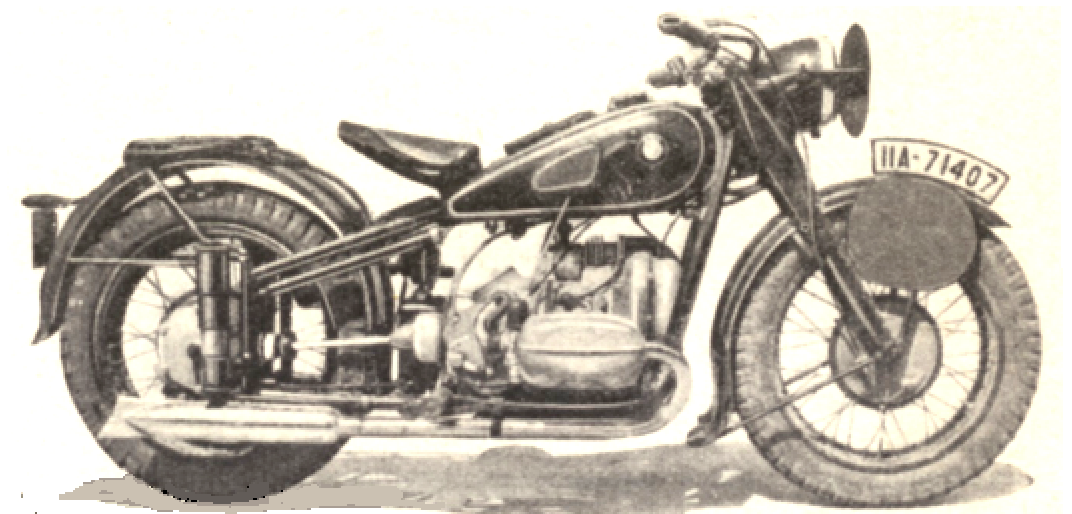
the R5, is typically British, and is exceptionally good. One feels at one with the machine almost immediately, except perhaps for the gear change. On the special Trophy jobs there is a hand change on the off side of the tank coupled with a foot change on the near side. I used the foot change as a rule, but also tried the hand change. Making clean-cut change in an upward direction involved a little care, and once or twice I found an unexpected neutral. The change was light, however, and the clutch sweet. Purposely, I ran over all the manhole covers and potholes I could see. I wanted to test that can’t-be-bought item, the rear-wheel springing, which, as you know, even Jock West did not have until the last day of TT practice. About the only comment that can be made concerning the rear springing is that one does not realise that it is there! This, I consider, is just about the highest praise one can give a spring frame. Perhaps I had better add to this statement, because some may ask, ‘Well, if you don’t notice it, what’s the good of having a spring frame?’ The point is that a good spring frame does its job without making its presence apparent—you are not bounced up and down and you don’t find the tail of the machine waggling like a jelly. Instead, the machine handles absolutely normally except that the rear wheel keeps on the ground and rough roads seem smooth. In my case I went over roads which, later, I traversed on a machine that has a rigid frame. Then, and only then, did I realise how rough some of the surfaces actually are. Having a more than passing interest in spring frames and spring-frame design, I mentally compared the BMW with various other spring frames I have ridden. It struck me that in ‘feel’ the one that is most similar is that of the TT Norton. This one might expect, for they are similar in their general idea, and both have a total range of movement, counting the upward and downward directions, of approximately 2½in. What pleased me immensely about the BMW (as it has done with the production R5 model) was the saddle, which has a single tension spring mounted underneath. This is a revelation in comfort, and has no tendency to sway sideways, which is an important factor in saddle design, because one so largely controls a solo with one’s legs and thighs. I was not out to try the engine, because I have a fair amount of previous experience with BMW engines. This one was chiefly notable for its special water-excluding devices and its unusual finning of the cylinder barrels arrangement which BMWs have recently patented and were trying out. Roughly speaking, the fins may be said to take the form of triangles with the cylinders as their base, and with the triangles on adjacent fins staggered so that the air blast can do its job. The cylinders looked like light-alloy ones, but I was told that they were cast-iron, cadmium-plated. One thing I must add about the engine was how, as usual with BMWs—in fact, with nearly all multis—I found it propelled the machine much faster than seemed to be the case. Look down at the speedo when 40mph appears to be the speed, do mental gymnastics from kilometres to miles, and one finds the actual speed is about 50! The ‘hot’ plugs gave a false idea of the behaviour of the engine at low speeds. I gather that before the trial started the maximum of the solos was 95mph with their 6½ to 1 compression ratio.
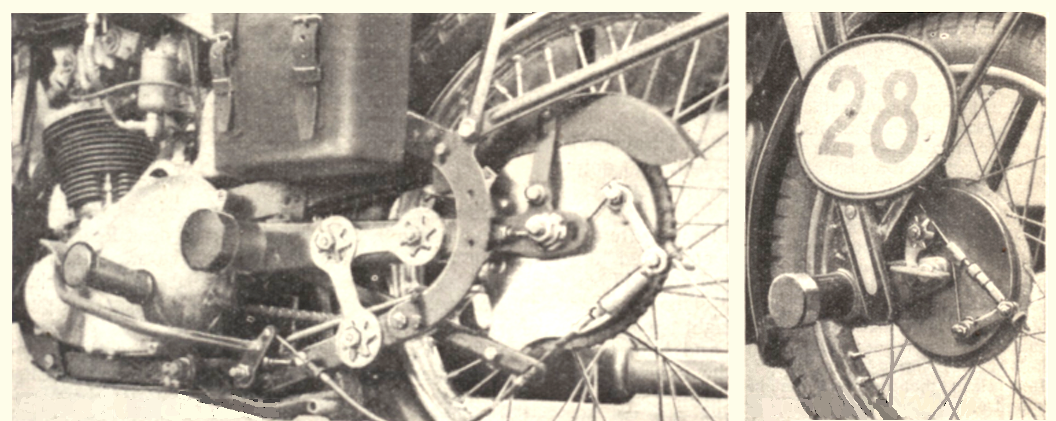
They might have run them with compression ratios up to 8 to 1 , but decided to keep them on the low side in case the course proved gruelling. One final matter before we pass on to the Jawa: the fact that the engine was mounted transversely in the frame was only apparent at very low engine speed; in ordinary touring or fastish road work there was nothing to tell which way the engine was mounted, and the machine swung round bends to perfection. The Jawa was exceptionally interesting because of the novel nature of the springing. So far as I am aware, torsion springing has never previously been employed. Of course, when one compresses a coil spring all one does is to twist the wire, but that is hardly what one calls ‘torsion’ springing. The great features of the Jawa system are that there are no bearings to wear or get out of order, and the arrangement ensures exceptional rigidity laterally. The system was applied to all three wheels in the case of the Jawa sidecar outfit and to the rear wheels of the solos. It was being employed experimentally, and I hope that we shall be hearing more of it. During the week nothing went wrong with the springing beyond the fact that a split clip on the sidecar chassis—there to enable the position of the wheel and the strength of the springing to be varied—tended to shift and was periodically loosened, knocked back with a piece of wood and retightened. Perhaps the system will be best understood if we consider for the moment the rear-wheel suspension. In the photograph will be seen two chainstay members running to a tube-shaped cross-member mounted just behind the gear box. This tubular housing contains flat steel plates arranged in the form of a star-fish. The plates are fixed to the chain-stay members at their outer ends and clamped rigidly to the frame at the middle. Thus, as the rear wheel hits a bump, the shock is taken by twisting the steel strips. The deflection of the strips for an inch movement at the wheel spindle is, of course, almost infinitesimal.”—Torrens

“HELD OVER ONE OF the fastest road-racing circuits in Europe, last Saturday’s Dutch TT resulted in Britain gaining one first and three second places. In the 500cc race HL Daniell (Norton) and B Lampinen (Norton) were second and third respectively to Karl Gall, on the BMW, who won at 92.27mph. JH White (Norton) was first in the 350cc event at 85.06mph, followed by FL Frith (Norton), second, EA Mellors (Velocette), third, and ER Thomas (Velocette), fourth. Finally, HG Tyrell Smith (Excelsior) rode a fine race in the 250cc event and finished second as well as breaking the lap record at nearly 86mph The winner was Winkler (DKW). The expected duel between the Norton and BMW riders in the 500 race lasted for only a few laps. The pace over the 101-mile triangular Assen course was colossal and it was not surprising that both Guthrie’s and Ley’s machines developed engine trouble…during the interval which followed the morning’s racing, Eric Fernihough proceeded to do two laps of the course—one a fast one—with his record-breaking Brough Superior. As the time nears 2.30pm the enthusiastic crowd can hardly restrain its excitement. Everything points to a terrific duel between the Norton riders, Guthrie and HL Daniell, and the BMW stars, Gall and Ley. Tips from the course are freely passed round. Some pundits declare that as it is a fine day the BMWs will score. Others assert that Joe Craig’s smile looks a trifle more inscrutable than usual. Certainly his Nortons have ‘grown’ capacious aluminium oil radiators on the offside between the seat-stay and chain-stay. All is set. The crowd is hushed. The white flag drops…they’re off! Gall and Ley are the first away, but Guthrie and Daniell are hot on their heels. Then—Guthrie leads at the Assen hairpin! Gall, Ley and Daniell are close behind. The grandstand crowd listens to the loudspeakers with bated breath. Silence for the next announcement. Gall overtakes Guthrie half-way to Hooghalen at the far end of the course. The excitement is intense. Guthrie is ahead again at Hooghalen. This is terrific. Then follows the long four-mile straight to the stands. Yes, here they come…two riders close together, followed by a third. It is Karl Gall (BMW)—a length ahead of Guthrie, who, in turn, is about 60 yards ahead of Otto Ley (BMW). Daniell (Norton) comes through next. Then, a long way behind, R Lampinen (Norton), H Roigk (Husqvarna) and T Zwolle (Norton). The next lap sees both BMWs ahead of Guthrie. Is the little Scot playing canny? Daniell comes round again and is out of sight for over half a minute before Lampinen hoves in view. The loudspeakers announce Gall’s standing start lap speed—90.95mph! In the meantime J Schot (Triumph) pushes in to retire; and Noel Pope (Norton) and H Bock (Norton) also retire. The third lap sees Gall (BMW) perceptibly gain on Ley and Guthrie, while Daniell keeps his distance behind this terrific trio. The Austrian rider, H Roigk, overtakes R Lampinen (Norton) and now lies fifth. Gall is averaging the colossal speed of 92mph, while Ley and Guthrie can only be taking a few seconds more per lap judging by the distance which separates them. By the end of the fifth lap Gall is 16 seconds in front of his team-mate, Ley, who, in turn, is 10 seconds ahead of Guthrie. Every other lap Gall breaks the lap record for the course until it stands at 95.00mph. Daniell is riding magnificently by keeping in fourth place on a strange mount over a strange course—he had very little practice on account of missing the boat at Harwich. Then on the sixth lap there is a sensation. Gall comes into the pits to take on petrol! With 18 laps to go this means that the BMWs must apparently make two pit stops compared with the Nortons’ one. Gall’s total gain on Guthrie of approximately 26 seconds is virtually nullified by his pit stop of 19 seconds. For the time being Ley leads, slightly ahead of the fleet Gall. Guthrie is third, 10 seconds behind. They are averaging 93mph. After these super-stars come Daniell, Lampinen (Norton), T Zwolle (Norton), H. Roigk (Husqvarna), J. Moejes (BMW) and JE Fijina (Ariel). Moejes’ machine, incidentally, is fitted with electric lighting, accumulator and coil ignition! On the 10th lap the two BMWs roar through. Next comes Daniell.
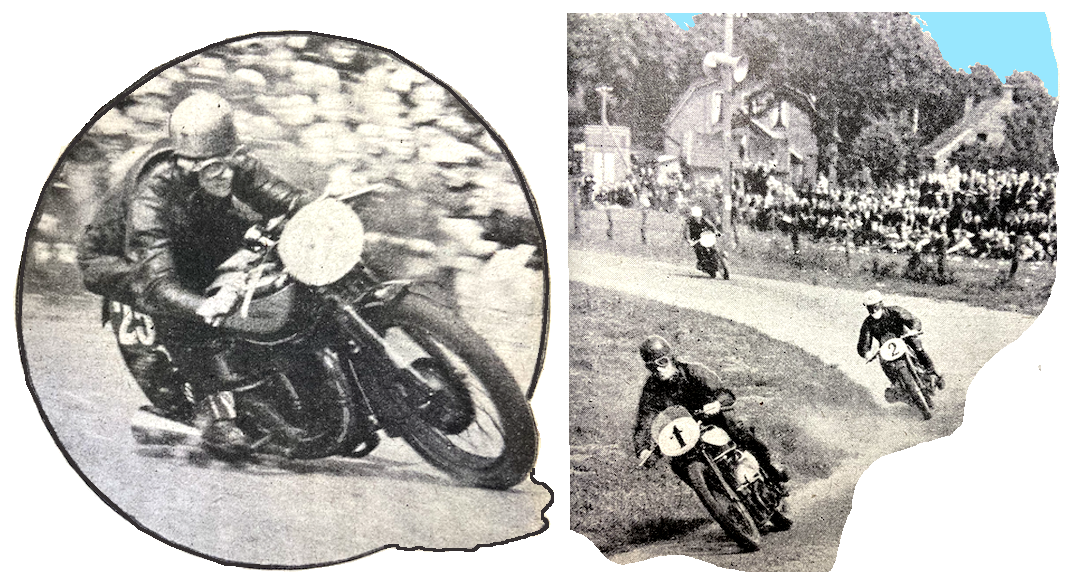
‘Waa is Guthrie?’ murmurs the crowd in consternation. Soon the answer comes over the loudspeakers. Guthrie has retired and has toured direct to the hotel which is the Norton headquarters at Hooghalen. His retirement puts a rather disappointing aspect on the race, for Daniell is over 2min 4sec behind Gall and obviously cannot hope to overtake him. But next lap round Ley retires. Thus by the 12th lap Gall leads, with Daniell second. Over three minutes now separates them, yet both have lapped the third man, Lampinen (Norton). Next lies H. Roigk (Husqvarna), with T Zwolle (Norton), J Moejes (BMW), W Flikkma (Norton) and H Widenmeyer (BMW) bringing up the rear—eight riders left in the race out of 17 starters ! Even so, this number is reduced on the 16th lap when Roigk (Husqvarna) retires with an obscure engine trouble. From now on the race deteriorates into a procession. Some riders are at least four laps behind the leaders. At, last Karl Gall (BMW) comes round to finish. The crowds cheer and wave. Nearly five minutes later Daniell (Norton) is flagged in. More cheers. The German national anthem is played 16 minutes later just as the Finnish rider, Lampinen (Norton) finishes third. A rather dull finish in violent contrast with the terrific opening laps! Next week-end in Switzerland will see the struggle between the leading marques renewed, with the addition of one or two other interesting models. JH White and FL Frith, on Nortons were first and second in the 350cc race, and EA Mellors (Velocette) was third. HG Tyrell Smith (Excelsior) was second to W Winkler (DKW) in the 250cc race.”
“FOLLOWING CLOSE ON THE HEELS of the Dutch TT came the Swiss Grand Prix, with which was incorporated the FICM Grand Prix of Europe. This important meeting—the racing was spread over two days—was decided over the 4½-mile Bremgarten circuit on the outskirts of Berne. A huge crowd had come to watch the 500cc race. Rumours were rife. Were Nortons going to turn the tables on the BMWs after the Dutch? And what of the red Guzzis, in the hands of Stanley Woods and Tenni? Then there was that entirely unknown quantity, the Gilera—a four-cylinder supercharged job whose practice times were prodigious. Anything might happen. Gall (BMW) seizes the lead at the start—it is amazing how that job starts after two quick paces. A few minutes later the ear-splitting, snarling roar of the leaders is heard as they approach the stands. Every neck is craned forward to catch a glimpse of the riders as they hurtle by. Gall leads, 50 yards ahead of Guthrie and Freddy Frith. Behind them is the screaming, yowling Gilera. It is a terrific beginning. On the next lap Jimmy is in front of Gall—only a yard or two it is true. Behind them is Freddy Frith, who gains on the other BMW in the hands of Ley. On the third lap both Nortons are in front by a matter of 10 or so yards. Then on the next lap Gall stops at his pits—and retires. But the excitement is not yet over. Aldrighetti, on the Gilera, swoops into third place, and going like a tornado endeavours to close up on the Norton pair. But two laps later he, too, retires. Next into the lists comes that Italian master, Tenni, who, after overtaking Ley, now lies third. But try as he might he cannot make any impression on the Norton pair. In fact, they gradually increase their lead. Stanley Woods makes a spurt and breaks the lap record. It is a splendid but valueless effort, for Frith breaks it again at 92.46mph. Frith eventually finishes second to the brilliant Guthrie, whose winning speed is 88.39mph. J Guthrie and FL Frith, on Nortons, were also first and second respectively in the 350cc race, with ER Thomas (Velocette) third. 0 Tenni (Guzzi) won the 250cc event from N Pagani (Guzzi).”
“AN INNOVATION FOR AN International road-race meeting was the handicap race, which was run after the main events of the Belgian Grand Prix this year, and which proved to be the high-spot of an exciting day. After a year’s absence the meeting was again held at the well-known course near Spa, in the south-east of Belgium. Everyone gets away in the massed starts, the 500cc class being sent off last. Immediately the Britishers fill the leading positions in the 500 and 350cc classes. Guthrie and Frith are well ahead of their nearest rivals in the big class, even after one lap, while three British machines in the hands of JH White (Norton), EA Mellors and ER Thomas (Velocettes) hold the first three places in the 350cc class. Not once throughout the Grand Prix do those five machines falter, and at the finish they have enabled the riders to build up such a lead in the two classes that no other riders are able to complete the full number of laps. After a short interval, during which the officials work out the handicaps, the first and second men home in each class wheel out their machines for the two-lap handicap race. Of the eight men and machines four are British. When the handicaps are announced the excitement is intense, for Guthrie concedes 5min 44sec to the limit man, and the total distance to be covered is under 20 miles. With the anxiety of the big races over, each man flings caution to the winds. As they pass, one by one, through the start and disappear round the bends on the second lap even the most blasé spectators stand up and cheer, for the cornering of the Britishers is heart-stopping. It seems impossible for machines to remain under control at such angles. But no one falls and the fast men take the lead towards the end of the second lap. White catches up with Mellors just before the last turn and Guthrie is only yards behind these two. But it is White who comes out of the bend first and he swoops down to the finish with Mellors and Guthrie on his tail—an all-British victory and another successful day for Britain. J Guthrie (499cc Norton) won the 500cc race at 86.68mph, with FL Frith (Norton) second, and Grizzly (Sarolea) third. In the 350cc class JH White (349cc Norton) won at 79.21mph from EA Mellors (Velocette) and ER Thomas (Velocette). White’s speed in the Handicap Race was 86.70mph.”
BMW DID NOT COMPETE in the French GP; Ted Mellors rode cammy Velos to victory in the 350 and 500cc races. But at the Ulster GP Jock West won the 500cc class for BMW (as a mark of respect for Jimmy Guthrie Norton did not enter) with Velocette and DKW taking 350 and 250cc honours.
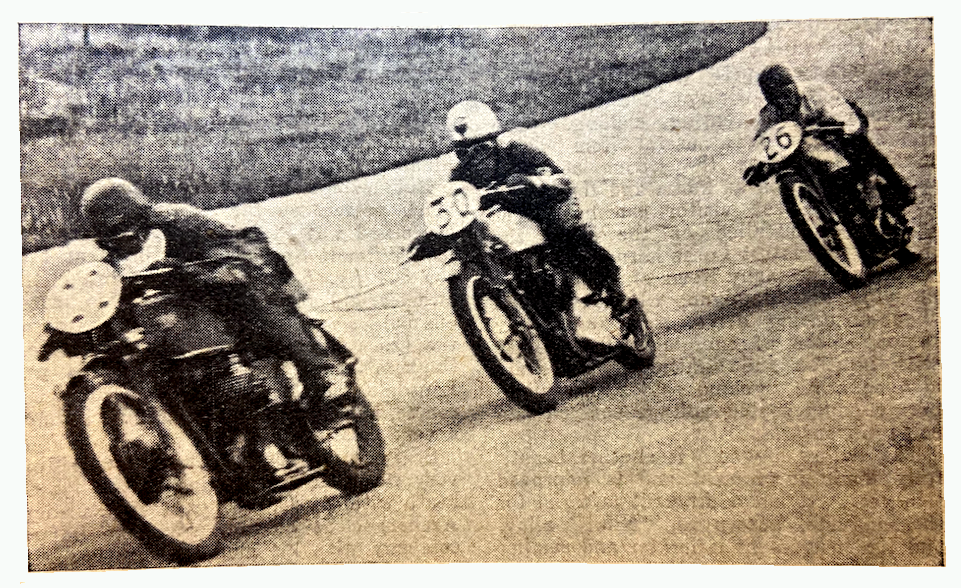
THE GERMAN GRAND PRIX of 1937 will go down to posterity as the most tragic race of all time, for in this race Jimmy Guthrie, one of the most brilliant riders, if not the most brilliant of our time, lost his life. That accident, occurring as it did on the very last lap of all when he was leading by a comfortable margin, was brought about by something which will probably never be determined. Let it suffice that no other rider was involved. Up to that last tragic moment, Jimmy had been riding the race of his life. Against the most terrific opposition at the start he had worked himself’ into the lead. Pitted against him were his rivals in many gallant scraps, Karl Gall and Otto Ley (BMW). Stanley Woods and Tenni were on Guzzis, while there were also two senior DKWs in the hands of Mansfeld and Bodmer. With Jimmy was that other fine Norton rider, Freddy Frith. On the first lap Ley nipped into the lead, followed by Guthrie, Mansfeld and Gall. Behind was Frith, who was having his work cut out to stave off Tenni and Bodmer. Such was the colossal pace that it was not until the fourth lap that Jimmy was able to overhaul Ley. Frith managed to creep into third place in front of the second BMW and the first Guzzi, ridden by Tenni. But Freddy’s luck was out. A misfire set in, and after a prolonged struggle he had to retire. Once having overtaken Ley, Guthrie managed by dint of superb riding to increase his lead. Lap after lap he piled it on. Sometimes a second, often more, a lap, until, sitting with a lead of 90 seconds, he entered that fateful 40th lap…So Ley came home, an unexpected winner. And instead of applauding their own hero, an immense and gripping hush came over that vast German crowd. HL Daniell (Norton) beat JH White (Norton) by a machine’s length in the 350cc race, both averaging 76.96mph. In the 250cc class E Kluge DKW) won from 0 Tenni and G Sandri (Guzzis).”
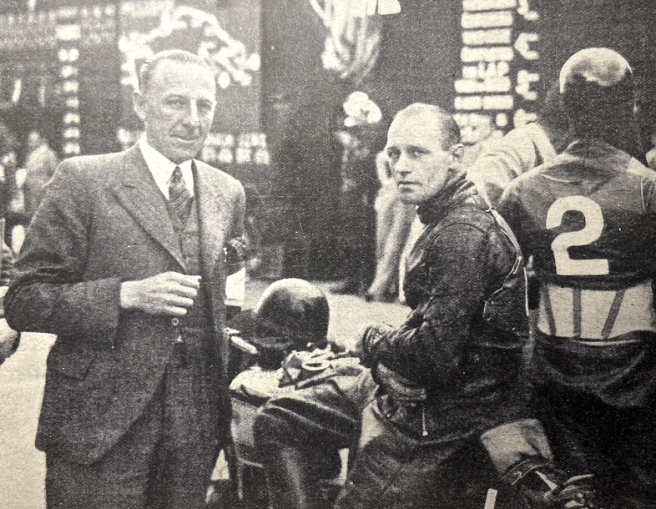
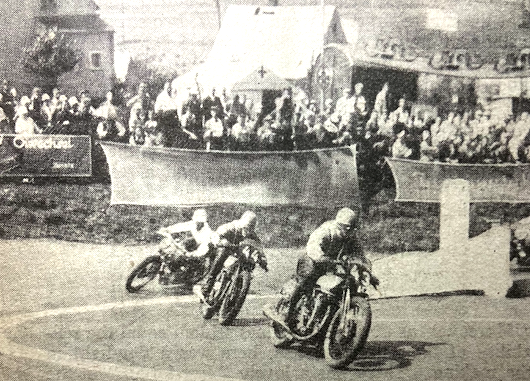
WAS THE ‘ULSTER’ GOING to regain its title of the fastest road race in Europe? That was the question that seemed most prominent in the mind of Belfast. To the rest of the world the question was more one of what the race would decide as between Jock West on the German BMW and Stanley Woods on the ‘500’ Velocette, for at least the latter model was said to provide the confirmation of its meteoric debut in the hands of Walter Rusk on this course two years ago. The ‘works’ Nortons were withdrawn as a token to the memory of Jimmy Guthrie, so that the 500cc class, which is always the interest of the event, was, indeed, mainly a match between those two somewhat dark horses. West leapt away from the massed start, but Woods had a comfortable lead at the end of the first lap. But West completed Lap 2 with the deficiency wiped out and as much lead as he had previously had against him. Then the news came in that Stanley’s gear box had collapsed. So, too, did the tension! Seldom has an exciting race flopped so badly—and that from no-body’s fault, but just as the luck of the game turns. Even a change from showers to sunshine did not help much. And the ‘fastest European road race’ title was not regained. Neither the 350cc nor 250cc classes provided anything noticeably more exciting. There was a spot of doubt in the early stages of the 350 race as to the outcome of the Mellors-Foster Velocette-AJS duel, but Mellors’ Velo soon proved to be the faster proposition by a small margin. The excellent AJS team riding of H Taggart, AR Foster and GE Rowley, however, was a convincing display of high-speed reliability. Ernie Thomas ran away with the 250cc class on a DKW, the sound of which had to be heard to be believed! Jock West’s (BMW) winning speed was 91.64mph; J Moore (Norton) was second and H. Taggart (346cc AJS) third. Second and third places in the 350cc event were taken by AR Foster (AJS) and GE Rowley (AJS). The second and third men in the 250cc race were ‘Ginger’ Wood (Excelsior) and Les Archer (New Imperial).”
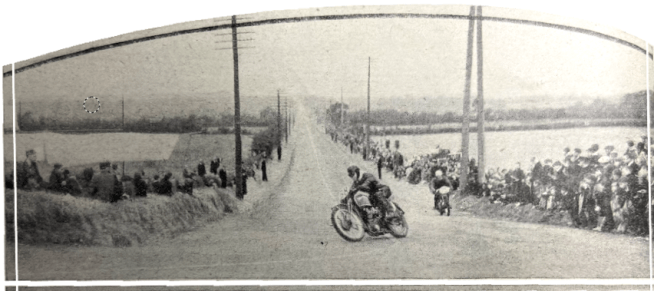
“THE SAXTORP CIRCUIT, near Malmo, is possibly harder on engines than any other, for it has long straights and the surface in parts is apt to disintegrate into muddy ‘observed sections’ should there be a heavy downpour. Once again the Swedish Grand Prix was held on this nine-mile triangular circuit. In the grandstand sit the Crown Prince of Sweden and Prince Harald of Denmark. The riders on the starting grid anxiously rock their machines—more anxiously than usual, for a torrential downpour during the night is rumoured to have made the muddy sections really bad. The 500cc class is sent off first, followed at minute intervals by the 350 and 250cc classes. In the 350cc class EA Mellors (Velocette) nips into the lead, followed by ER Thomas, Franz Binder, Fergus Anderson and R Loyer—all Velocette mounted. Gradually conditions improve and Mellors and Thomas increase their lead. Thomas, after a rather poor beginning, picks up a lot and pushes up the lap record to 80.65mph. On the 14th lap Mellors makes his pit stop, followed on the next lap by Thomas. Then Thomas begins to slow, and is threatened by the Frenchman Loyer. He is obviously in trouble with his foot-change. Can he last? Gradually the laps are ticked off. Thomas still holds his position, and although nearly a minute and a half behind his team-mate Mellors, he finishes second—having ridden nearly half the race with only third and top gears available! Mellors won a brilliantly ridden race at 77.73mph. S ‘Ginger’ Wood (Excelsior) was third to W Winkler and E Kluge (DKWs) in the 250cc race. The 500cc class placemen were 0 Ley and K Gall (BMWs) and P Taruffi (Gilera).
“THE AER IS BEING PRODUCED by AE Reynolds, the two-stroke repair specialist of Berry Street, Liverpool. It is a 350cc, air-cooled vertical twin, with the engine planned to accommodate a normal transmission system; it can be installed in a conventional type of motor cycle frame. The usual three-port two-stroke layout is followed, using crankcase induction, and the 180° two-throw crankshaft is a built-up assembly running on two ball bearings, with plain bearings outside these and between the central webs for compression-retaining purposes. Twin-cylinder two-stroke engines that employ crankcase compression are necessarily a combination of two practically separate single-cylinder engines fed by a common carburettor and coupled by a common crankshaft, and this applies to the AER engine. Two crank chambers are formed in the crankcase, which is built up from four castings in a very neat way. Deflector-type pistons with two.rings.and fully floating gudgeon pins are used. The Amal carburettor is bolted directly to the inlet port at the back of the cylinder block, and cover plates on the transfer ports facilitate access when decarbonising. Ignition is by magneto, which, together with the oil pump, is driven by a chain alongside the primary chain. In production models these chains will both be enclosed in a cast-aluminium case. It is possible that coil ignition will be fitted in place of the magneto, as it offers advantages in the case of a two-stroke engine, but the layout will not be altered. Complete with flywheel and carburettor the unit weighs 46lb. In general the machine follows orthodox lines, for it has a cradle frame, Webb forks, three-gallon saddle tank, separate oil tank, large brakes, and 3.25-19 (26×3.25in) tyres. A foot-change Burman gear box is fitted. At a later date it will be possible to give more details of performance. At the moment the best carburettor setting has not been reached, but it is claimed that speeds in the neighbourhood of 60mph have been attained, together with excellent slow-running and pulling in top gear and easy starting. Fully equipped, the AER will be sold at £57 15s, and production will begin almost at once.
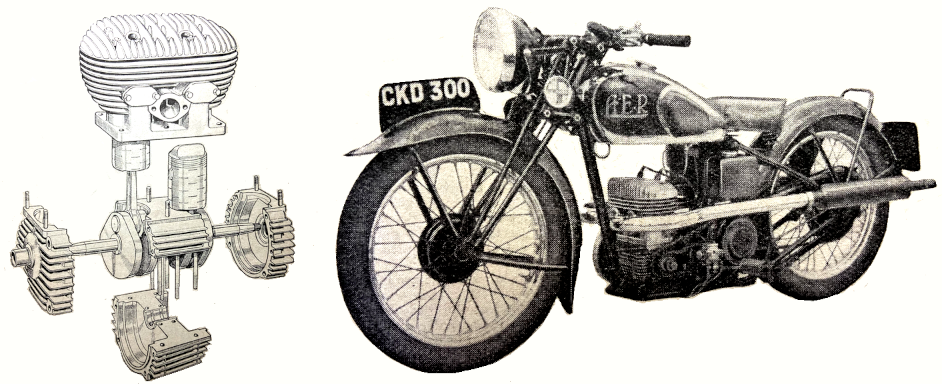
“THE MANUFACTURERS’ UNION, I see, has taken up with the Chancellor of the Exchequer the fact that Germany is selling machines below cost in various markets overseas. It has asked the Chancellor to consider ways and means of combating the situation. Actually what is happening is this: The German motor cycle manufacturer has to add to the price at which he sells machines at home and pay this addition over to a central fund. The manufacturer then receives back a subsidy that enables him to sell far below the cost of manufacture in markets where he has to meet British competition. In this way, says the Manufacturers’ Union, Germany is trying to oust British motor cycles from Holland, Denmark. India, the Far East and South America.”
“THE ‘SYDNEY RULE’ is to give way to traffic on the right. If this rule were adopted we should know where we were at cross-roads where there are no signals or pointsmen, and thus avoid crashes. Mr Hore-Belisha said that such a rule is in many respects undesirable. De your readers think so? If they do, why?
JM Turner, Northampton.
“WE, THE FLEET STREET Despatch Riders, wish to announce that we have read the amazing letter from Mr EHB Boulton, Technical Director, Timber Development Association. We say amazing because it is almost incredible that any-one would try to convince thousands of experienced motor cyclists, who read The Motor Cycle, that wood blocks are anything other than a death-trap surface. We speak with the experience of 35,000 miles per year each, and firmly believe that the majority of motor cyclists sill admit that our experience is far greater than that of the average man…Mr Boulton informs us that the new wood-block surface is quite safe. May we point out to Mr. Boulton that Hyde Park Corner, which has been a danger spot in London for many years, has been re-surfaced with new wood blocks, and the chance of one breaking one’s neck at this spot to-day is the same as it ever was…We could fill pages with the names of roads covered with wood blocks that ought to be closed in wet weather to traffic owing to their disgraceful condition. Although our experience is greater than that of the average man, we go out of our way to avoid wood-block roads. We think all motorists will agree that if the Minister of Transport made all local authorities replace wood blocks with tar-macadam, he would not only have taken the greatest step yet to reduce accidents, but also end a great deal of nerve-racking driving. Any of us drivers would be quite willing to give Mr Boulton a demonstration with a car or motor cycle, because it is quite apparent from his letter that he is not a motorist. If we are wrong, and he is a motorist, we should be obliged if he would let on know whether he uses spikes on his tyres, because he is the only person we have heard of who thinks that the most treacherous surface is the safest.
CI Leech, E Bishop, F Long, H Boga (Keystone Press); A Mark (Planet News); GC Moss (London News Agency); Charles Arne, J. Biscardine (Central Press); Leslie J Vane, AC Lane, S Stuart (Associated Press); J Cain (Fox Photos); H. Rhind (Topical Press); J Banks, A Melling, S Healy (Alfieri Press); AW Robson (Wide World Photos).”
“OUR TT REPORT CONTAINS a photo of Tenni cornering at Hillberry in the Senior Race. He very definitely adopts the method of leaning ‘machine in, rider out”; and our photographer asserts that Tenni was the fastest racer on this corner, and tilted his Guzzi to an almost incredible angle. I have been yearning for some such scrap of evidence for years. In the days when I was brave enough to corner to the limit, I always found that I could get round a corner faster by this method than by any other. To-day I am too timid to corner really quickly, but on the rare occasions when I slip up and go into an open corner too fast for safety, I always adopt the Tenni method, and—rightly or wrongly—consider that it has saved me a nasty spill or two. Am I wrong? If I am right, why was Tenni the sole wholehearted exponent of this system in the Island? Can it be because the layout of his machine equips it with a lower centre of gravity than the standard British racing machine? Or is it that in a race of more than 250 miles riders find it wearisome to keep shifting their weight from side to side in a fashion that opposes the weight to the weight of the machine? When both bus and body are leant ‘in’ the position of the rider as regards the machine remains the same all the way round. Theorists make the claim that the ‘machine in, rider out’ method gives better tyre adhesion.”—Ixion.
“A DAILY PAPER REPORT of the great Nazi rally at Nuremberg suggests that the German Army now contains a corps of riflemen mounted on motor cycles. It describes how they dashed into action in a sham fight, flung themselves headlong off their machines and cuddled their cheeks down to the rifle butts in a matter of split seconds. Nineteen-fourteeners fell a-wondering at this spirited performance. Motor cycling riflemen might well replace Uhlans as a cavalry screen in the first stages of open warfare before the main forces achieved contact; but would they be useful for any other function? Then motor cyclists fell a-wondcring what machines were used? The BMW wouldn’t particularly relish being flung away like a banana-skin; and if some chap managed to concentrate an indirect machine-gun barrage on the long line of discarded motor bikes…”—Ixion.
IN THE PEAK MONTH OF July 15,286 motorcycles were registered in Germany. In line with the under-200cc roadtax exemption, 77% of them were lightweights.
MOTORING DEFENDANT in the Highgate police court: “The car had a certain momentum. You see, I had come from Willesden.”
MORE THAN 400 former Royal Engineers dispatch riders and friends attended their seventh annual reunion. As usual there was a ‘silent toast’ to the fallen..
THE MINISTRY OF LABOUR warned the ACU that foreign speedway riders would no longer be allowed unless they were “essential to the continuance of a track”.
“IT IS A FAR CRY from Barnet to Lilleshall—so far, that in all probability most motor cyclists have forgotten all about the first National Rally that was held. The event has grown since those days five years ago, and there is no reason why, with careful handling, it should not go from strength to strength and become one of the most important road events in the country. This year the ACU has had a lot on its plate, the ‘International’ following the TT so closely that not very much time was left in which to organise the Rally. Nevertheless, the Union made an excellent job of it, and at Lilleshall Hall last Saturday there was little, if anything, about the organisation that could he criticised. Of course, the ACU cannot do everything. They cannot, for instance, organise the weather; but, even if they could, they could scarcely make a worse job of it than those at present in charge (is it the BBC?) did on this occasion. All you who are of the opinion that the night should be spent in bed were probably awakened during Saturday night by the sound of rain lashing your window panes. Did it occur to you that some-where out in that torrent were some hundreds of motor cyclists, most of whom were trying to find the longest route from their homes to Lilleshall? It was a freakish night, and most of the riders got soaked time and time again. Some of them had just one long soaking, but there was, it was said, one man who rode more than 700 miles and never saw a drop of rain.
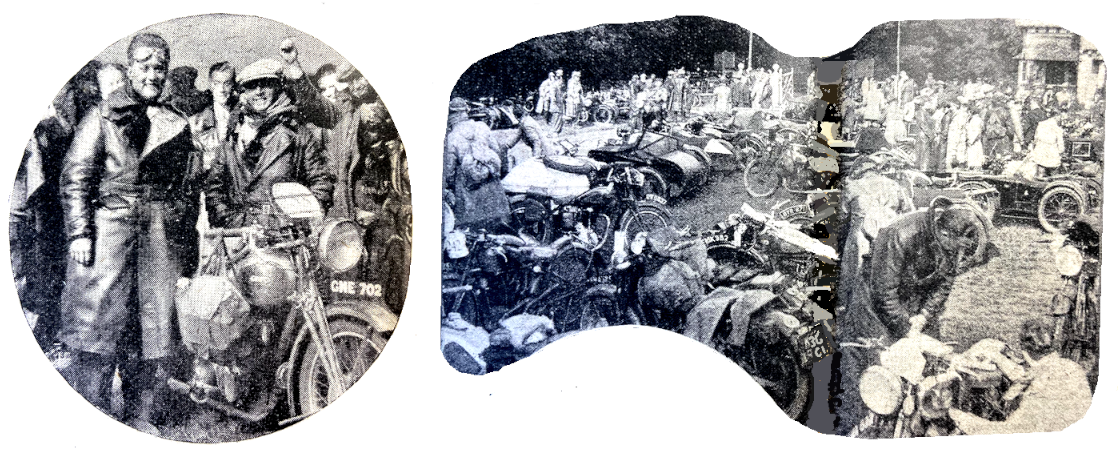
For the most part, however, the riders arrived at their destination with sodden clothing and tales of crawling through mist and rain, which made it more than difficult for them to attain anything like the maximum average speed of 30mph. There were other misfortunes to be faced besides the rain. Punctures, for instance. One young lady had four of them, together with clutch and control cable trouble. You would never have guessed it had you seen her arrive, because she looked as though she had just stepped from a beauty parlour. Mind you, she was complaining that all the parts you couldn’t see were dyed blue from her soaked riding costume, but that is another story. It really is amazing what some people will try to do on a motor cycle. Take the case of R0 Ware (AJS). About a fortnight ago he bought his ancient machine for the princely sum of 25 shillings, and, apart from the fact that all his front hub bearings went, everything was all right, and he managed to put in 206 miles. Then there were the two heroes who covered the prodigious distance of 811 miles between 8 o’clock on Saturday morning and 11 o’clock the- next day. They were F Leeke (Ariel) and E Watkinson (Triumph). Leeke carried a pillion passenger but Watkinson travelled solo. The latter took the father and mother of tumbles when he had covered only 40 miles, but he straightened himself out and carried on. This wasn’t the end of his troubles, for at 400 miles or thereabouts his front brake drum split and tore itself away as the result of his crowding on all possible stopping power, under the impression that a sharp bend was a cul-de-sac. Incidentally, it was the first time these two riders had taken part in a rally, which makes one think that when they have had a little practice they should be fairly good! At the other end of the scale we had Allan Jefferies on the new ‘Speed Twin’ Triumph. He interspersed his rally effort with a little racing at Donington, a visit to Belle Vue at Manchester, and a night in bed at home! As the morning advanced the official parking place filled up, and the variety of machines was wonderful. There was an old Ner-a-car, an ABC in remark-ably good condition—what memories it stirred!—and a Levis minted in 1927 and looking as good as new. Its owner spent a lot of the night searching for a petrol station and a good part of the day having his spectacles mended. Next door to this venerable two-stroke was a lordly BMW. There was another Levis with a spring frame, a decidedly neat affair, rather like the Norton and, presumably, acting on a similar principle. Its owner was missing, so complete details are not, unfortunately, forthcoming, but it appeared to have hand dampers for checking the spring movement. Well, there they were, grouped in a mighty mass in separate

divisions according to the mileage covered. They made a grand array and spoke wonders for the enthusiasm which this sport of ours excites. Big machines, little machines, solos, sidecars, three-wheelers, smart ones and shabby ones, machines that were loved and machines that were cursed; but all were machines that had provided their riders with adventure. At Lilleshall there was welcome food and even more welcome warmth, and, hard though the tasks of some had been, and bitter the luck—one man arrived two minutes late after having ridden 700 miles—grumbles were few and far between. The ACU did its task well, and it was not their fault that flood and mist had to be faced. Let the Rally go on. The support is there, and a venue such as Lilleshall, where there are things to do on arrival, is ideal. A display of motor cycle football by the Chester Motor Cycle Display team went down very well. The sides were well chosen and evenly matched, and a high degree of skill was shown by all the players. About a minute from the start the ‘Blues’ scored against the ‘Yellows’, and this proved to be the only goal of the match. Play was fast all the time, and it was a really interesting 40 minutes. After this came a pause for lunch, and then the Birmingham Club put on its grass-track races. The track was very slippery on account of the rain, but the racing was excellent. An interesting item was a series of match races between Chester and Birmingham, in which riders scored three marks for a win, two for second place, and one for third. There were three solo and two sidecar events; Birmingham finished with 34 points and Chester with 22. In the individual races there was plenty of excitement but few spills. The heats were run off very rapidly, and there was absolutely no waiting between races—except when .a car most wrongfully got on to the course—and the organisation was perfect. The final of the race for machines up to 350cc was won after a stern tussle by J Wilkinson (OK Supreme), with D Perks (Velocette) second, and R. Holliday (Velocette) third. The sidecar final was a not-too-easy thing for GL Buck (Ariel sc). He was chased hotly by AH Goddard on a similar outfit, while TH Westwood (THW sc), as the fastest loser in the semi-final, took third place. Altogether, it was a grand afternoon’s sport and a fitting finish to as successful a rally as has ever been held.

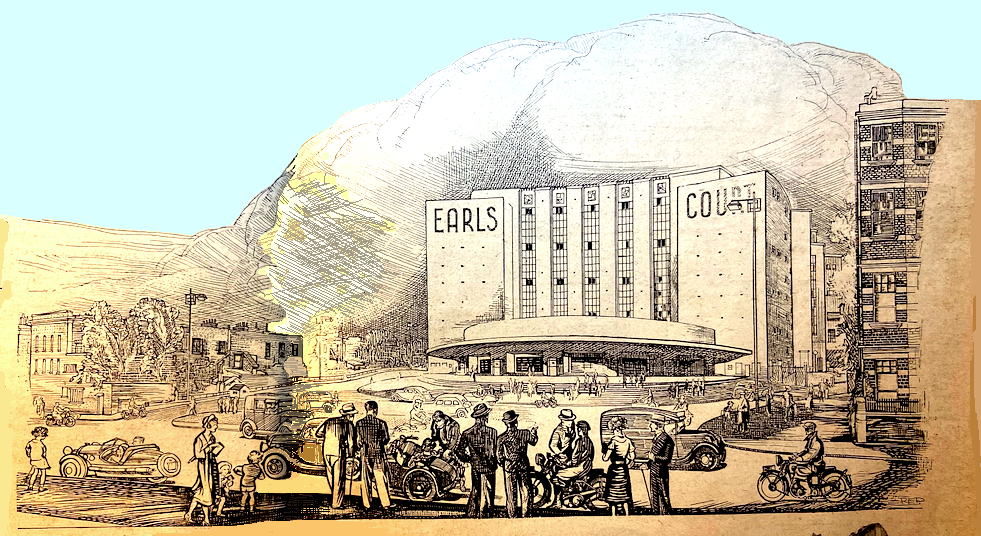
“‘ATTENTION TO DETAIL’ might well be the slogan for this year’s Show, for a stroll round the various stands at Earls Court reveals comparatively little that is startlingly new, but plenty of improvement to well-tried designs. This fact may be disappointing to those who look forward to every Show producing a crop of designs that are really revolutionary, but the genuine prospective owner will be happy in the knowledge that his pet machine is definitely better than it was last year—and in many, many cases, very much better. Of course, there are one or two entirely new designs of exceptional interest, such as the new unit-construction, transverse-twin Brough Superior, the vertical-twin Triumph, and new motorised bicycles; but, generally speaking, manufacturers have concentrated on eliminating any little weaknesses that may have come to light as the result of experience under actual road conditions. Year after year it has to be recorded that machines are improved both as regards performance and appearance, and 1938 is no exception in these respects. Let us take the matter of appearance. First, there is a noticeable tendency towards compactness—frame design has been improved in many cases, and the various components are
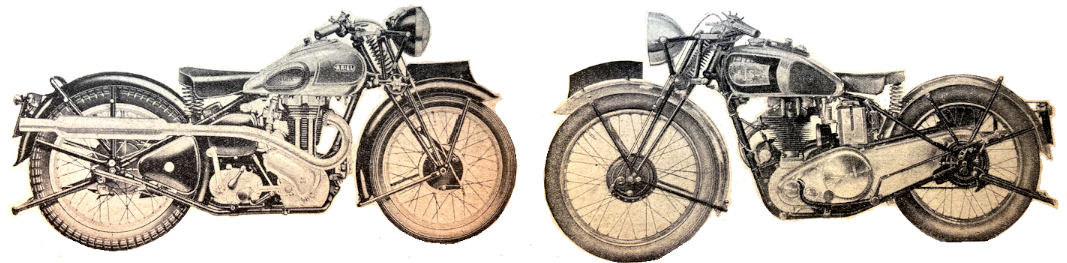
neatly housed without ugly spaces between them, yet there is even better accessibility. Secondly, attention has been given to silencing systems, so that exhaust pipes and silencers tend to merge into the general lines of the machines. Thirdly, machines are ‘cleaner’ than ever before—ugly protuberances on the frames and engines have been removed, and more and more models feature total enclosure of the working parts. Lastly, many fuel tanks have been improved both in shape and finish, with a welcome tendency towards ‘quieter’ colour schemes. In the matter of engine design, attention has been directed towards obtaining even greater power output, combined with quiet running and long life of the moving parts. Hence we find that in several instances the cam gear has been completely redesigned, while larger bearings are fitted throughout. Totally enclosed and lubricated valve gear is almost universal on overhead-valve engines for 1938, and the system is equally popular in the case of side-valve engines, some of which have the valve chest so designed that heat is not transferred from the cylinder to the valves. Lubrication systems have also received attention. The object has been to increase the amount of oil in circulation and to provide adequate lubrication of all moving parts. Thus, many overhead-valve engines have a forced feed to every important bearing surface. Yet, in spite of this, there should be no
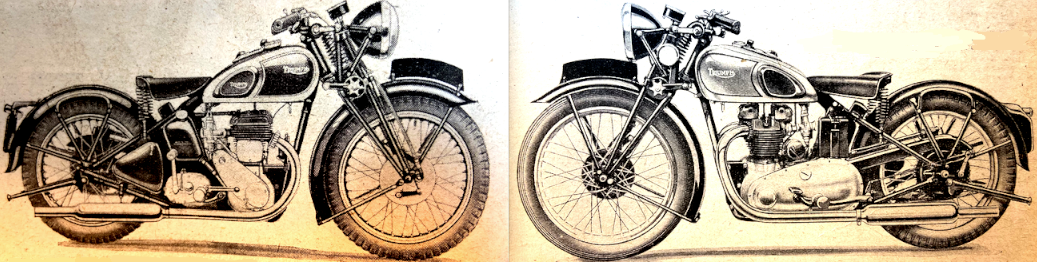
trouble with leakages at undesirable points, for crankcases and cylinder heads have been suitably redesigned and special jointing washers employed where necessary. The single-cylinder ohv engine is still the most popular numerically, and it has received additional support from the high-camshaft type, which is to be found fitted to several 1938 models. One range of high-camshaft engines shown have chain-driven camshafts with chain tensioners and dampers—an interesting and original arrangement for a push-rod type of engine. Transmission systems have not been appreciably altered from last year. Chain drive still maintains its popularity, although there are outstanding examples—both British and foreign—of unit-construction. Total enclosure of the primary chain is almost universal, except in the case of the least expensive machines, and better guarding of the rear chain is another noticeable feature.
Four-speed gears are more popular than ever, and in the majority of cases have foot-operated changes. In the past some foot changes have not been too easy to operate—mainly owing to excessive travel and faulty positioning of the lever—so it is good to see that these small but important points have been given attention by certain manufacturers. Clutches have also been improved. Greater frictional area has been
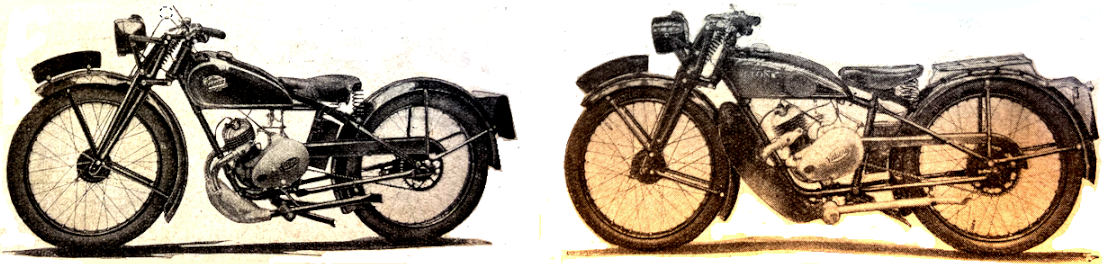
provided in certain cases to cope with increased power output, and there is a tendency towards total enclosure of the push-rod mechanism. Brake sizes have not been appreciably increased, but improvements have been made as regards the positioning and adjustment of pedals, the anchor plates and, in several instances, the lightness of operation. Silencing has obviously been very carefully studied, and even a casual glance round the exhibits will reveal a variety of new silencer arrangements. At one time there seemed a hope that this would be a ‘spring frame’ show, following the publicity of the TT and the almost constant demand of readers for machines of this type, but hopes have not been realised. All the same, there are one or two new designs on view at Earls Court which are well worth close inspection. In addition to machines being more pleasant to ride in 1938, they will also be much cleaner. Mudguards are even more effective and the use of engine shields is spreading to models outside the ‘utility’ class. Finally, there are the many so-called ‘minor’ improvements, which very often are extremely important ‘rider’s points’. For instance, the almost universal adoption of voltage-control lighting systems, improved controls, carefully selected tyre sizes, rubber-mounted handlebars, illuminated speedometers, new riding positions, and a host of other details that will reward the Show visitor who has ‘eyes to see’. The outstanding attraction. on the AJS stand is undoubtedly the new range of extremely smart ‘Silver Streak’
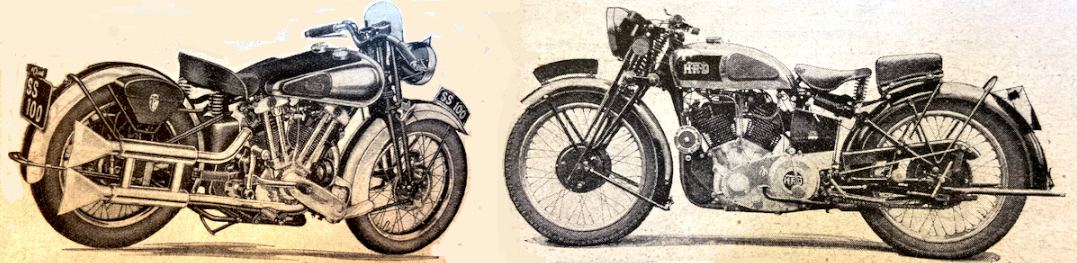
models. They are super-sports machines available in 250cc, 350cc and 500cc, with specially tuned ohv single-port engines. In appearance they are particularly striking, for all the important cycle parts except the frame are chromium plated. The other popular AJS models from 250-990cc are also shown in improved form. All the ohv models have fully enclosed valve gear. Features common to the whole range include dry-sump lubrication, oil-bath primary chain cases, and Burman four-speed gear boxes. Every model is fitted with foot gear-change except the 990cc. There are eight basic models to be seen on the Ariel stand, ranging from the famous 1,000cc Square Four to the 248cc standard ohv de luxe model. As last year, the single-cylinder range consists of three ohv de luxe models of 250, 350 and 500cc, with a corresponding range of Red Hunters. The latter are also available in full competition trim. Then there is the popular 598cc side-valve single, which now has a slightly modified cam gear, and is said to provide an even better performance. All the ohv single-cylinder engines have redesigned cylinder heads in which the valve gear is entirely enclosed in two aluminium boxes. This, it is claimed, eliminates distortion, as localised heat in one box cannot affect the other. Oil is fed directly to the rocker gear, whence it drains
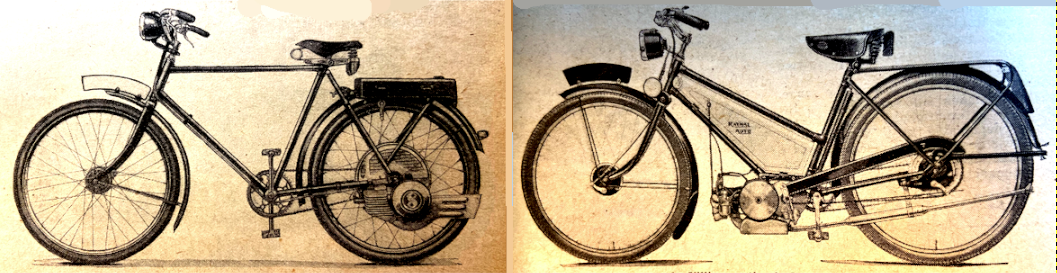
back into the timing gear via the push-rod tubes. Four types of shaft-driven BMW machine are to be seen. A newcomer to England is the Model R20, which has a 190cc ohv single-cylinder engine mounted transversely in a duplex-cradle frame of sturdy proportions. The engine and gear box form a particularly attractive unit. Shaft drive is, of course, employed. The valve gear is enclosed under a one-piece aluminium cover, while the German Amal carburettor is fitted with an air cleaner. A positive foot gear-change is fitted on the left side of the machine. Several examples of the popular R5 494cc ohv transverse-twin are to be seen. These models are very similar to the R6, which has a 600cc side-valve engine. Detail improvements include a small shield over the foot gear-change and specially finished wheel rims. The well-known telescopic forks have larger and better-protected bearing surfaces, and both models have an air-cleaner, which is cast integrally with the top of the gear box. The Model R17, which has a 750cc ohv engine mounted in a pressed-steel frame. It now has telescopic forks. Undoubtedly the highlight of the large BSA display is the new Gold Star, which is based on the machine that performed so
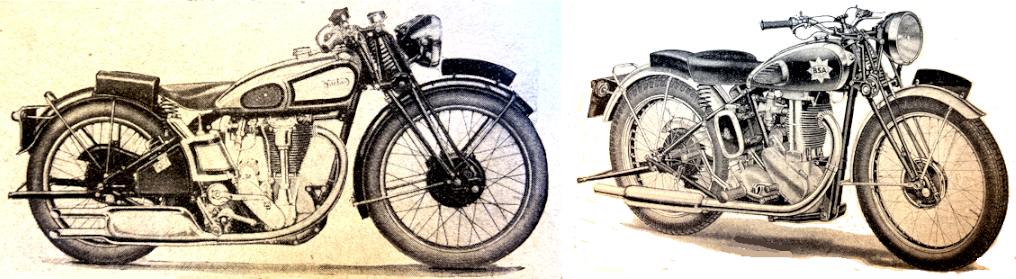
well at Brooklands recently in the hands of WL Handley. It is a 500cc machine and is obtainable in three forms—as a fast touring mount, for competition work, or for track riding. Although at first glance the Gold Star is similar to the other ohv models in the range, it differs in many respects, particularly as regards the engine. For instance, the push-rod tower is cast integrally with the cylinder head and barrel, with a gasket between the two units. The 496cc engine has an alloy cylinder head with inserted valve seats, and an alloy barrel with a steel liner. The track-racing model has a high-compression piston, double float chambers to the racing carburettor and a lever-controlled throttle. There are 15 other models in the range, of which nine have ohv engines. Of these, one is a 750cc V-twin. A new feature on the M-range, which includes 500cc and 600cc side-valve singles, 500cc Empire and Gold Star models, and the 500cc ‘Sports, is a quickly detachable rear wheel. One of the most outstanding machines in the Earls Court Exhibition is to be found on the Brough Superior stand. It has a 990cc 50° twin-cylinder engine set transversely in a special loop frame which incorporates plunger-type rear springing. A four-speed
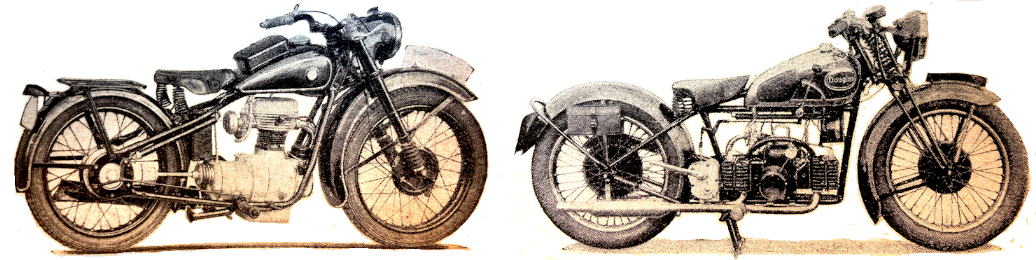
synchromesh gear box with a single-plate flywheel clutch is built in unit with the engine; transmission to the rear wheel is by chain from a bevel-driven cross-shaft behind the gear box. The rear springing is extremely simple, and a point to examine is the looped member which passes over the back of the rear mudguard to increase lateral rigidity. Rear-wheel springing is fitted to all the Brough Superior models except the side-valve SS80. A lightweight which is worth examining were it only for its very complete equipment is the 125cc three-speed Carlton. It is fitted with the popular 125cc two-stroke Villiers engine-gear unit, and this is accommodated in a neat frame which gives an unusually low riding position. Lighting is supplied from the Villiers flywheel-magneto. Sturdy legshields are provided, and other desirable features include a central spring-up stand and a carrier. The tyres fitted are 2.375-19. A fuel tank holding two gallons is another excellent feature of an exceptionally well-equipped lightweight. There are 11 Coventry Eagle models on show. The 1938 range falls into four groups —the four-stroke ‘Flying’ series, the Pullman, the Silent Superbs, and the little Cadet. This newcomer has a 125cc Villiers two-stroke engine-gear unit, housed in a light tubular frame. A neat saddle tank is mounted on the top tube, and a unique exhaust system is employed in which one pipe is carried across the frame and links up with
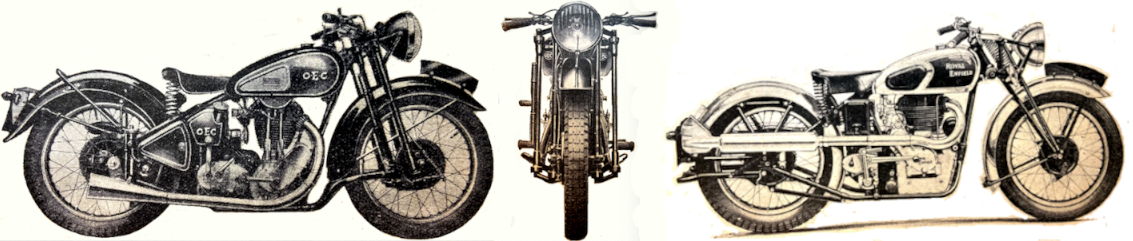
the other to a common silencer. The Silent Superbs have been considerably improved. There are six models, all with two-stroke engines and pressed-steel frames. New tanks with rounded corners and domed tops are fitted. The all-enclosed Pullman model proved as big an attraction as ever. The enclosure of the working parts is extended to the leaf-type rear-wheel springing and most of the rear wheel is also covered in. The engine is a 250cc Villiers, and it works in conjunction with a four-speed gear box with foot change. Equipment for rider and passenger is standard, as are legshields and and an ingenious hand-operated central stand. Access to the chains and engine is obtained through detachable plates in the pressed-steel frame.” Douglas machines are making a welcome return to the Show. Douglas had been on the point of collapse in 1936 when it was snapped up by British Aircraft Company which used its facilities to produce aero engines under the less-than-imaginative Aero Engines banner. Existing stocks of the 500 and 600 twins had been assembled and sold exclusively through Pride & Clarke of Stockwell, South London.—Ed] There are two models, a 150cc unit-construction two-stroke and a 600cc horizontally-opposed four-stroke twin. The 150cc model is entirely new. Engine and gear box are of Douglas manufacture and are built in one unit. The engine has twin inlet ports and unusual piston design, and the massively finned cylinder gives the machine the appearance of a 250. For the lower half of the engine and the gear box shell only two aluminium castings are used, while the primary and dynamo chains are enclosed in a domed aluminium case. The primary chain has an automatic tensioning device. The gear box has three speeds and the cork clutch is mounted on the gear box. Other details include a large-diameter rear brake, 2½-gallon saddle
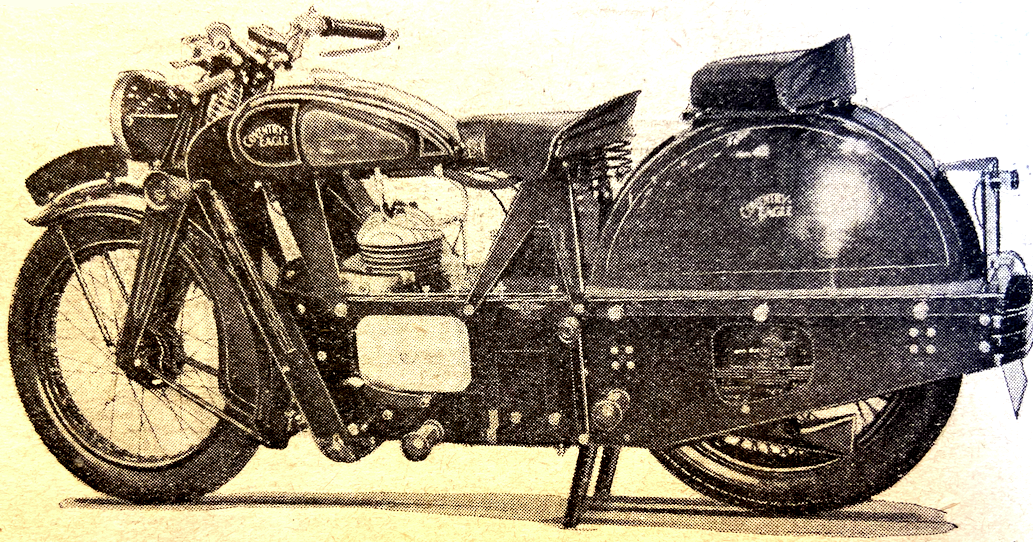
Pullman model, which has rear-wheel springing.”
tank and adjustable footrests. The 600cc side-valve flat-twin follows normal Douglas practice. It has an improved crankshaft—both in material and design—and transmission is by chain through the usual Douglas flywheel clutch and a four-speed gear box. Equipment includes a BTH dynamo and Miller lamps. [ Utility, touring, sporting and racing models all have their place in the 1938 Excelsior programme. The machines most likely to catch the eye are the Manxman models. These have the robust ohc engines of Excelsior design and manufacture which have a fine string of racing successes to their credit. There are 250, 350 and 500cc models and a 500cc Manxman Special which has a specially tuned engine. The two 500cc models have been fitted with a decompressor. Two genuine racing models of 248 and 349cc complete the Manxman range. For the utility rider there is a serviceable range of two-stroke models ranging from 125 to 250cc. All are fitted with petroil-lubricated Villiers engines, and have Burman three-speed gear boxes. Then there is a new motorised bicycle known as the Autobyk and incorporates a 98cc Villiers engine in unit with a two-plate clutch. Two sturdy ohv models of 250 and 350cc, the Norseman and the Warrior complete the range. These have such desirable features as oil-bath primary chain cases and four-speed foot-controlled gear boxes. Francis Barnett have decided to concentrate on two-stroke models. Pride of place is given to the two 249cc Cruiser models—one has a deflectorless piston engine and flywheel ignition, and the other a normal type of two-stroke engine and coil ignition. Both models have a new and imposing 3gal petrol tank, which blends with the practically complete system of enclosure of the engine, gear box and transmission. Deeply valanced mudguards and effective legshields complete the equipment. There are also two 249cc Seagulls and two 148cc Plovers. Six well-equipped
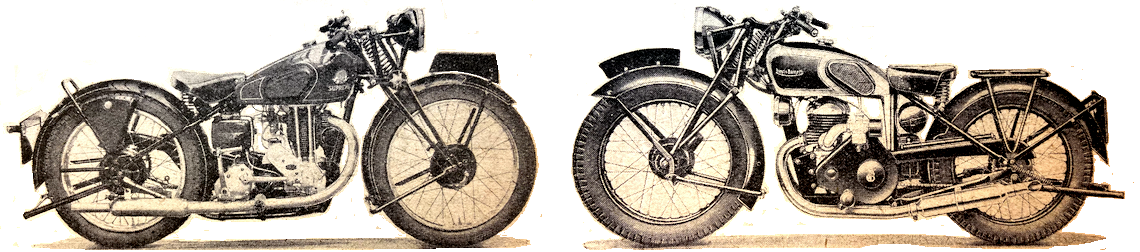
two-strokes are to be seen on the James stand, all wth Villiers engines. With the exception of the 249cc J8 long-stroke machine with automatic lubrication, all the models rely on petroil lubrication. They also all have flywheel magneto ignition, a three-speed hand-controlled gear box, and a 2¼-gallon fuel tank. In the 249cc capacity there are two types; one has the well-tried long-stroke Villiers engine, and the other the newer type of deflectorless-piston engine. Both have excellent lighting equipment, with Lucas dynamo, a 7in head lamp, voltage control and dimming device. Next comes the 196cc model, which has legshields and similar lighting equipment to that described above. The front brake has been increased in diameter to 5in. Two 148cc machines are shown in utility and de luxe forms. The utility model has a loop type frame, 3.00in-section tyres, 5in brakes and direct lighting. Legshields, Lucas lighting, a separate 6V dynamo and an improved front chain case are included in the de luxe model. The smallest model in the range is fitted with the neat 125cc Villiers engine-gear unit, and now has a larger fuel tank holding 2¼ gallons and a large-capacity cast-aluminium silencer. Unlike the other models, which have tubular front forks, this model has forks of pressed steel. Electric lighting of the direct type is fitted. The Levis display comprises six models, ranging from a 247cc two-stroke to the latest 592cc ohv model. For 1938 there is only one two-stroke model, and it combines all the best features of the two types available in last year’s programme. It has an improved frame, a larger petrol tank, pressed-steel forks, and a three-speed gear box with foot control. The 247cc single-port engine is also much improved in appearance. The Model B Special now has a two-port 247cc ohv engine with enclosed valve gear. The push-rods now bear directly on to the cam followers, thus obviating tappets. The A Special is similar in most details to the B Special
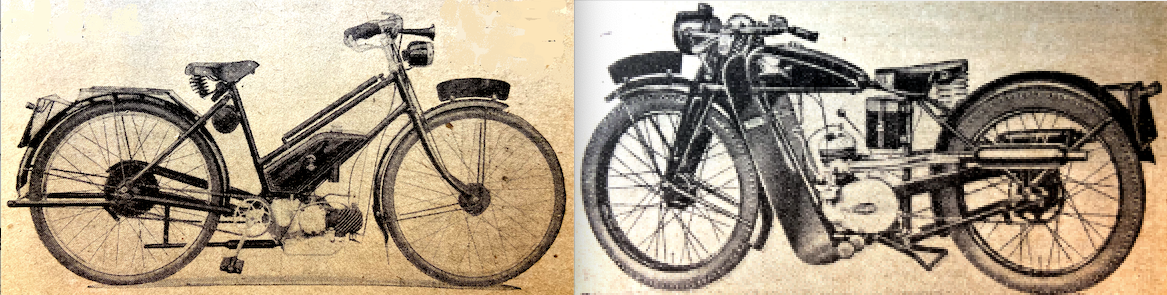
except for a 346cc engine and larger tyres. Both models have voltage control. Everyone visiting the Matchless stand is making sure of seeing the new engines that are fitted to the Clubman Super 350 and 500cc models. These engines have many interesting features, chief of which is the total en-closure cf the valve gear, including the hairpin valve springs. This has been achieved by an ingenious method of mounting the valve springs. Lubrication of the rocker gear is the same as on the other ohv Matchless models. Oil is fed through ducts in the rocker box to felt pads on the rocker spindles. The new Clubman Supers’ cylinder head castings are massively constructed with extremely generous finning, and a breakaway from previous Matchless practice takes the form of enclosure of the upper ends of the push-rods in the head casting. Alterations to the Clubman Models include improved and neater crankcases, spring-up rear stands and flared mudguards with centre ribs. Visitors to the Norton stand can see many improvements that have been developed directly from racing practice. The 348 and 490cc ohc ‘International’ models are, of course, direct descendants of the successful racing machines, and this year they come into line with the rear-wheel springing, which can he obtained as an extra for £15. On the ohv models total enclosure of the valve springs and valve gear, a development of the method tried out in the Isle of Man, is now standard, and these engines look ‘cleaner’ than ever with improved crankcases and
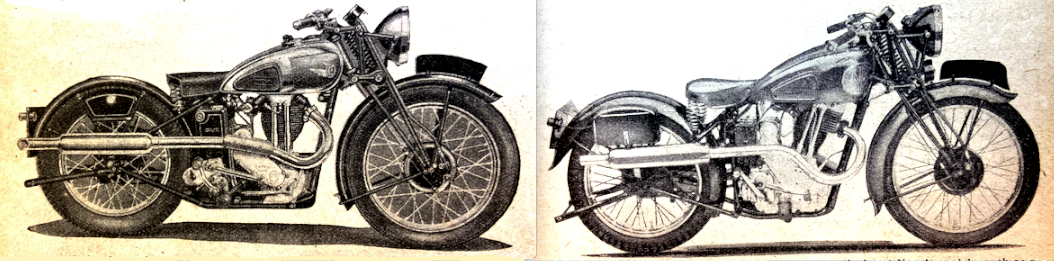
inclined push-rods. The valve gear is fully lubricated, and flat-base instead of curved cam-followers are used. Improvements to the side-valve engines include redesigned cylinder castings, enabling the valve springs to be completely enclosed, but avoiding excessive heat in the tappet chest. A complete range of motor cycles in which all the engines have ohv gear and are built in unit with the gear box is to be found on the New Imperial stand. The new design of petrol tank is finished in different shades to denote the different series of models. The New Imperial Lion has been replaced by the letters NJ in a large, decorative panel. The sizes available are 150, 250, 350 and 500cc, and all except the smallest model incorporate new features. The range is divided into four groups—the Unit Minor, Standard Unit, De Luxe Unit and Clubman Unit. The Unit Minor group consists of two 146cc models, which differ only in that one is fitted with magneto and the other with coil ignition. In the Standard Unit group are the larger models in the range—250, 350cc and 500cc. These machines have a lower riding position and improved foot gear change. On the OEC stand is to be seen the latest form of duplex-steering which is now fitted to the 350 and 500cc models. The range is based on three types—the 246cc Ensign, the 347cc Cadet and the 498cc Commander. One of the most interesting features of the range is that all models are fitted with rear-wheel springing. The smallest machine has a specially light frame with springing that is similar to the older type of OEC rear-wheel springing. The two larger models, however, have the new type that was introduced early this year. In appearance the 347 and 498cc models are identical, each having an ohv

Matchless-AJS engine housed in a sturdy cradle frame. There are no fewer than 14 models on the OK Supreme stand. The range consists of all types of machines, from the 248cc side-valve Model SV/38 to the 348cc ohc racing Model RCB/38. So far as size is concerned the range is composed of 250, 350 and 500 models with various types of engine. Interest centres round Models AC/38, BC/38 and HC/38 with 248, 348 and 498cc high-camshaft JAP engines of the type which first made its appearance on the OK Supreme stand last year. Five models have standard ohv JAP engines with enclosed valves, while there are two 250s and two 350s with ohc engines. These ohc models are intended primarily for competition work and track racing. Both side-valve models, of 248cc and 498cc respectively, are extremely attractive in appearance and have a very complete specification. The frames of many models have been redesigned to enable the chain-stays, which join up with the front engine plates to be straightened, and so permit a wide range of footrest positions. Pillion footrest brackets are now brazed on to the chain-stays, while an improved prop-stand is fitted to several Models. Other refinements include a folding kick-starter pedal. A neat motorised bicycle which is attracting a great deal of interest is the new 98cc Raynal Auto. It is fitted with a clutch, which is of the multi-plate type running in oil. A frame of the open bicycle type is employed, and the wheels have 26xl¾in tyres and internal-expanding brakes. The engine is a special 98cc Villiers two-stroke of ingenious design. It is petroil-lubricated and has a single-lever carburettor, flywheel magneto, and a neat clutch running in oil. Pedalling gear is fitted. Beneath the engine is a cast-aluminium silencer, shaped like a shallow box, with a small-diameter exit pipe. Head and tail lamps are fitted. The very complete range of motor cycles to be found on the Royal Enfield stand
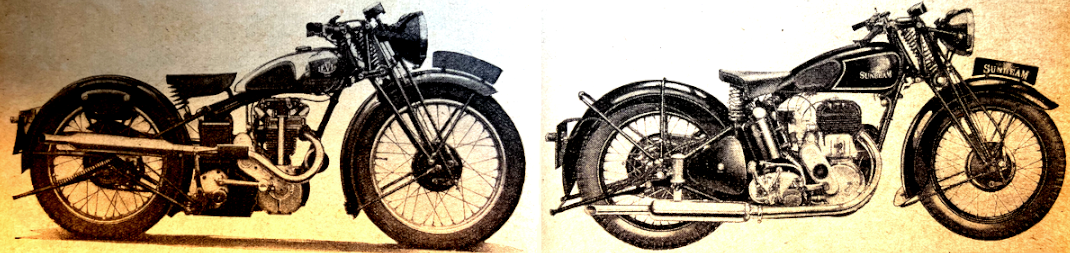
includes models of every size and for every purpose. The lowest-priced machine is the 225cc two-stroke, which has a new petrol tank and a new silencing system. The 250cc side-valve model has re-designed cylinder head finning and a new exhaust port to improve the cooling. Pressed-steel forks are fitted, as on all the smaller machines, and in common with the larger models, except the 1,140cc twin, a foot gear-change is standard. A side-valve of 570cc is now marketed which is equally suitable for solo and sidecar work. It is available with either coil ignition or Magdyno. Several ohv models are, of course, shown and the new 500cc Bullet is probably the most popular. It has been designed as a well-mannered, fast roadster and has the de luxe Royal Enfield specification. This model is available with either a two-valve or four-valve cylinder head, and in the two-valve model the valves and valve gear are completely enclosed. The successful Competition model is shown only as a 500cc—the smaller capacity competition machines are now competition editions of the 250 and 350cc Bullets. The competition machines can be supplied with any one of five sets of gear ratios. Tubular forks are a new feature of the 1,140cc side-valve twin-cylinder model. A foot-operated clutch with Ferobestos plates is standard, but for solo work a hand-controlled clutch with cork inserts is available. A new and much neater absorption-type silencer has been standardised for 1938. Interest centres on the latest addition to the Rudge range—the 250cc Sports model. This model has been planned for those who are likely to take part in sporting club events; it has an ultra-sporting performance. The power unit is of the single-port and two-valve type, and the compression ratio is 7.75 to 1. In a test at Brooklands a model of this type is said to have lapped for five hours at over 76mph. The other models in the range consist of the
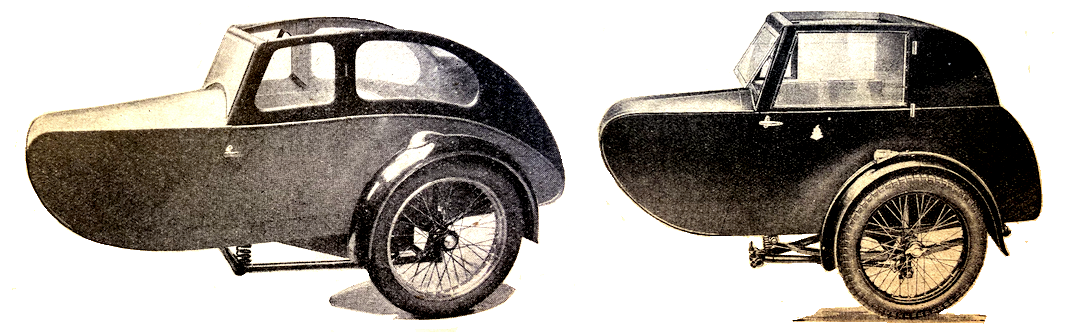
250cc ohv Rapid, and the Special, Sports Special and Ulster, all 500cc ohv models. All these last-mentioned models have four-valve engines. One of the most interesting newcomers to England is the German Saxonette two-stroke attachment for bicycles. This unusual power unit made its bow at the Berlin Show this year. It is so designed that it can be fitted to any bicycle with no other alteration than the fitting of a back wheel (in which the power unit is incorporated) and a petrol tank-cum-carrier to the rear mudguard. The little 60cc engine is attached to a chain-stay in a horizontal position and drives the rear wheel through a reduction gear of 17 to 1. A special wheel disc provides fan-type cooling for the engine. A flywheel magneto is fitted, and there is direct electric lighting. There is even a shock-absorber for the transmission, while the specification includes an efficient silencer. Sunbeams are especially interesting
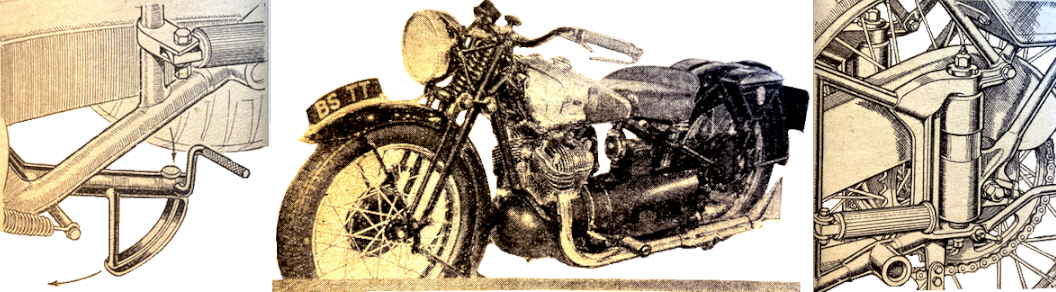
this year in view of the fact that the manufacture of these famous machines has been taken over by the Matchless-AJS concern. No radical alterations have been made to the 10 models in the 1938 range, but the changes that have been made will undoubtedly interest the prospective owner. For instance, the lubrication system of the ohv models has been considerably improved, especially as regards the rocker box, which has been designed to ensure adequate lubrication without oil leakage. The side-valve models now have detach-able alloy cylinder heads. Head and port design have been carefully modified in the new models, and the result claimed by the makers is a definite increase in power. The two side-valves in the range are of 492 and 598cc capacity, and the other eight ohv models include two 250s, two 350s, three 500s and one 600. The 246cc machine is produced in standard and sports forms, the sports edition having a higher compression ratio. The two 346cc machines follow the 250s closely in specification and, similarly, there is the standard Model 8 and a sporting edition. The three 500s are the Model 9, the most luxurious of the trio; the Light Solo; and the Light Solo Sports. The 596cc ohv model is similar to the Model 9 in general specification. All these models have cradle frames and the differences in specifications relate to such items as tyre sizes, gear ratios, compression ratios and brake diameters. All models have dry-sump lubrication, Lucas Magdyno lighting, primary chain oil-bath (a rear chain oil-bath is an optional extra.), and a Burman four-speed gear box with foot-change. The centre of attraction on the Triumph stand is, of course, the new and extremely interesting vertical-twin model. It is of 497cc capacity, with the cylinders cast in one block and set side by side across the frame. Totally enclosed ohv gear driven from high camshafts is an interest-ing feature of the engine, which is fitted in the 500cc Tiger 90 frame. With Tiger 90 equipment the machine weighs no more than the 500cc single. The popular Tiger models of 250, 350cc and 500cc are shown in slightly modified form. They have new twist-grip controls designed to remain at any desired opening, improved oil-bath cases, new rear number plates, and tank-top instrument panels made of Bakelite. The ohv and sv models are also shown, and to these have been added a 249cc ohv model and a 349cc side-valve, both of which conform to the general specification, except that they are fitted with coil ignition in place of Magdyno equipment. All the improvements applicable to the Tigers are incorporated in these standard models; the whole range of
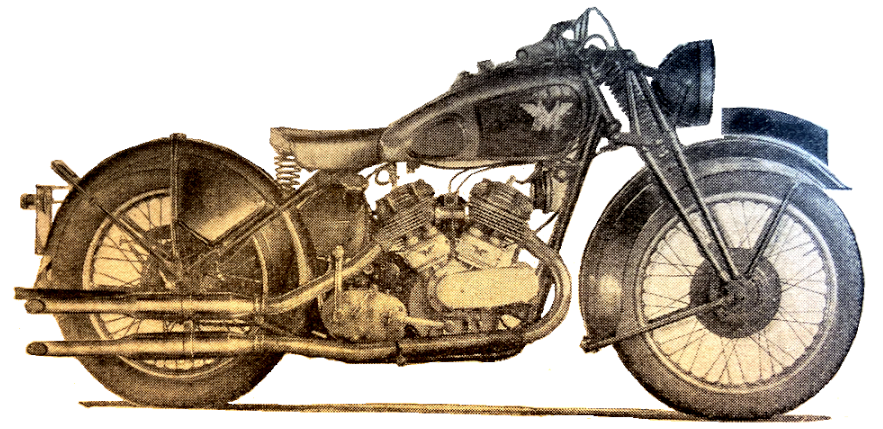
machines bears the stamp of thoroughness in design and construction. Every year the Velocette stand at the Motor Cycle Show is a centre of attraction for those who favour race-bred machines. This year is no exception, for the machines shown, in addition to including many racing features, are fully equipped in every way for road use. A trip speedometer electric lighting with voltage control, electric horn, pillion seat and pillion footrests are all standard equipment, and as such are included in the list prices. The range is headed by the famous ohc models, which have aluminium-alloy cylinder heads, totally enclosed valve gear and full equipment. The series of high-camshaft push-rod models is continued for 1938 in three sizes—248, 349 and 495cc. These models have automatic ignition control, which ensures the best possible spark under all conditions. Another interesting feature is a special throttle stop on the carburettor, which gives the most favourable position of the throttle slide for starting purposes. Four-speed gear boxes with foot-change are standard on all Velocette models. Four attractive spring-frame

models grace the Vincent-HRD stand. As last year, great interest centres around the fleet 998cc ohv Rapide, which, in common with the other models, is fitted with a high-camshaft type of engine. As with the 498cc Meteor, Comet and TT Replica models, the Rapide has fully enclosed valve gear which is pressure lubricated. Hair-pin valve springs are employed, and each valve works in two guides, the valve rocker, which has a forked end, bearing on a hardened collar midway between the guides. The TT Replica is fitted with a new type of cam, and the greater power output thus obtained has necessitated a general stiffening-up of the power unit. The range of workmanlike two-strokes on the Wolf stand are constructed on sound lines with particularly sturdy frames. The excellent finish of these machines should withstand all weathers. The biggest machines in the range are of 249cc capacity. These have Villiers super-sports two-stroke engines, with ignition by flywheel magneto, and transmission through Albion three-speed gear boxes with hand change. Tyres of 3.25in section make for comfortable riding, and a further refinement is a large fuel tank holding 2½ gallons. Next in size are two 148cc petroil-lubricated Villiers-engined machines known as the Vixen models. These have Burman three-speed gear boxes with hand change. Another 150 in the range, the 147cc Minor, has a less sporting performance than the Vixens. Finally comes a 125cc model which is fitted with the neat Villiers deflectorless-piston engine-gear unit. The little
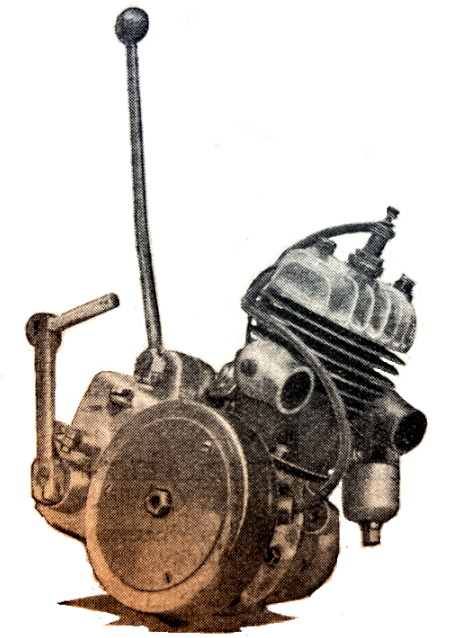
98cc power unit is retained for Villiers’ 1938 range. Then there is the 147cc engine, which was the forerunner of most of the types now made. This is not to be confused with the two-port 148cc engine, which is one of the most popular two-strokes in use for motor cycle work to-day. This model is rather more robust and delivers a performance which is too well known to need emphasis. There are three engines of 196cc capacity. The Mark 2E has a single-port and integral cylinder and head; the Mark lE is similar, except that it has two ports. The ‘super-sports’ is a two-port engine with a detachable aluminium head. In the 250 class there is the famous long-stroke two-port unit of 249cc with an auxiliary flywheel; a water-cooled edition of this engine; and the 249cc engine with the flat-top piston. The range is completed by a 346cc engine.”
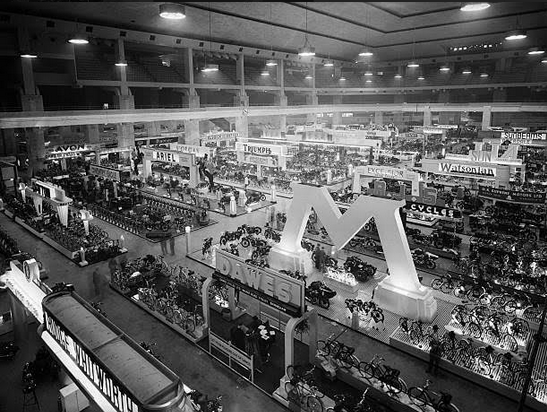
IXION, AS USUAL, took a stroll round the show: “There comes a stage in the history of every industry when it has exhausted the possibilities of its job, and the outburst of novelties ceases. This phase was attained in the teacup industry years ago. I have not encountered a novel teacup for donkey’s years; about the only variations one meets concern the decoration. It is not true to assume that the motor bicycle has assumed sheer and absolute finality; but conditions often impose a—let’s be really Irish—’temporary finality’. At this moment no manufacturer can venture on audacious enterprise for obvious reasons. At Nottingham, George Brough has what he calls a ‘dream dump’ in a corner of his factory—it contains motor cycles which cost thousands to build. Each of them is entirely individual, no two being alike; they are all hand-made; and not one of them has ever been duplicated or sold. Exchanges, tariffs and embargo still strangle export trade; unaltered world conditions prohibit costly ventures. Quite apart

from all that, it would be very difficult and perhaps even impossible to design a revolutionary and efficient motor bicycle. So the trade as a whole has decided to ‘gild the lily’,’ ie, to mark time, and to fettle up any such minor faults and imperfections as are known. Here is an example. I called at an Earls Court stand inhabited by a brainy gang of enthusiasts who trust me and will tell me all they know. They have precisely one ‘new’ model for 1938. During 1937 they were a little puzzled because certain ardent youngsters insisted on buying a model evolved for one-day trials, though the said ardents do not compete over the rough stuff. It proved that the ardents considered this was a very sporting bus with lots of chromium; but on intimate acquaintance with a slogging engine, sit-up-and-beg riding position, and so forth, the ardents were disappointed. So for 1938 the firm is producing a special ‘Ardent’ model, which looks
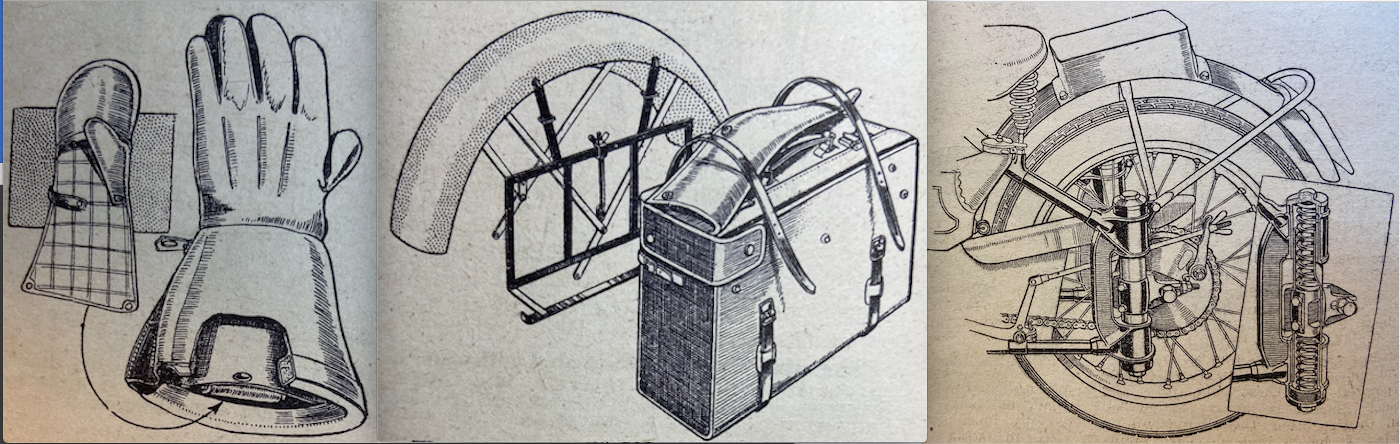
naughty, can kick a bit, and carries acres of chromium. ‘Well,’ I groaned, ‘if you’ve nothing else new, tell me all the ingenious little ways in which you’ve eliminated your 1937 spots of bother!’ Replied the Big Noise: ‘We honestly didn’t have any; our repair and service work was all concerned either with honest wear and tear on pre-1937 stuff, or with fellows who’d used fuel oil for lubrication, or something idiotic of that sort!’ And this is typical! Stand after stand housed sound, robust, rideable, handsome machines, unaltered in essentials from the 1937 or even the 1936 models, as good as any in the world, better than most, but absolutely devoid of novelty. World conditions dictate a conservative policy. Go a step farther, and ask the engineer what he’d do if he were on the brink of a boom. Why, he’d smile a sad, sweet smile, and murmur something about a double flat-twin, like two miniature BMW engines piled vertically one on top of the other, with a self-changing gear box and flexible shaft drive. But it would be commercial suicide to experiment like that as things are.”
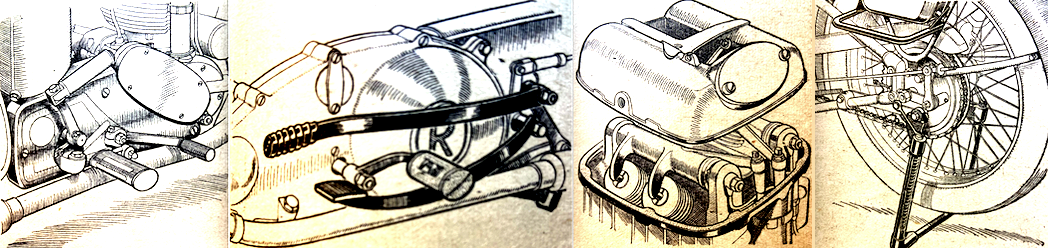
“I WAS TURNING OUT a junk corner the other day, and came across a leather case which was once the pride of my life, and which I used to produce nonchalantly wherever motor cyclists foregathered, much to the envy of all beholders. It contained two spare belt-fasteners, complete with bits, a belt punch, a tin of hand cleanser and a first-class knife with a very strong blade. But, had I produced it at Earls Court among a knot of modern riders, they would barely have glanced at it. The same dump contained another gadget—home made this time—of which I ‘was inordinately proud at about the same period. Electric lighting for motor cycles had not then arrived, and we had quickly-detachable clips on the handlebars, which held a lengthy double-pronged bracket. The fore bracket carried the gas head lamp, and the rear bracket a small acetylene generator. I faked one of mine by the addition of a third vertical pair of prongs over the middle, in which I carried a second generator, so that when generator No 1 became exhausted, or by rash use of the water-tap ‘drowned’ its carbide, I merely transferred the rubber pipe to generator No 2 and carried on. To- day it looks a truly terrible contraption, but it earned me worship and envious glances whenever anybody saw it at Brooklands or in a Six Days—Ixion.”
“SEVERAL READERS REMIND me that the Panther machines all have a foolproof adjustment for the rear chain. Both the gear box and the rear wheel are set by means of twin cams which abut against solid stops, so that the veriest novice can carry out an adjustment without fear of spoiling the alignment. This clever gadget has now been on the market for three years, and it was unpardonable of me to overlook its existence in my paragraph in the September 17th issue.”—Ixion. [I’m including this simply because my 1936 M100 Panther has this set-up and it really is les bolleaux de chien—Ed.]
THE L-300 KRASNYI OKTIABR (Red October) was the first Soviet mass produced motorcycle. Having recognised the difficulties in starting an industry from scratch, the Russian authorities decided to test foreign models, choose a suitable one, modify it for Russian conditions, and put it into production. This job was allocated to a design team led by Pyotr Mozharov, who had recently developed and built the first five Soviet motor cycles in Izhevsk. The group was transferred to Leningrad, where the Leningrad Mass Production Trust (TREMASS) ran a number of factories. What emerged was a 293cc two-stroke producing just 6.5hp@3,000rpm to give a top speed of about 50mph with 52mpg. A three-speed box had a hand-change. Motorworld reports that there were problems with quality control but the L-300 gave the new Russian motor cycle industry much-needed experience and, just as important: “The L-300 inspired many young people to join sporting clubs…this bike was widely used for road races or track contests, for cross-country races, record-breaking attempts and long-distance runs over thousands of kilometers. The Krasny Oktyabr was often a winner in these contests, competing as an equal with motorcycles of non-Soviet brands.” Only a handful of L-300s survive, including this example which is preserved for history by the excellent Russian Motorworld museum. [The enthusiasts who run the museum have kindly allowed me to reproduce pics from their superb collection. I recommend a visit to https://motos-of-war.ru/en/motorcycles. Спасибо, друзья, езжайте осторожно!—Ed.]
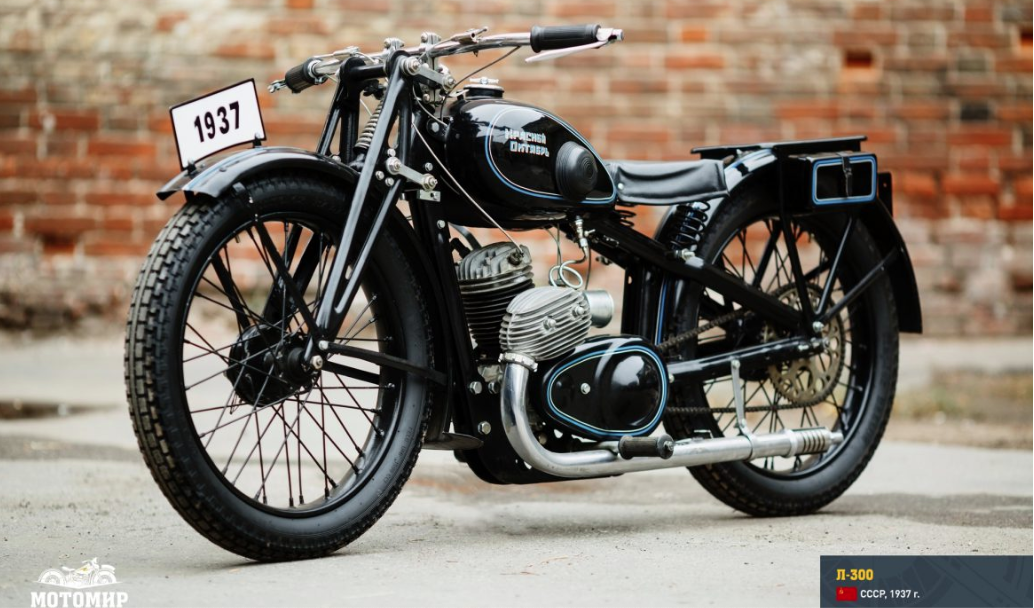
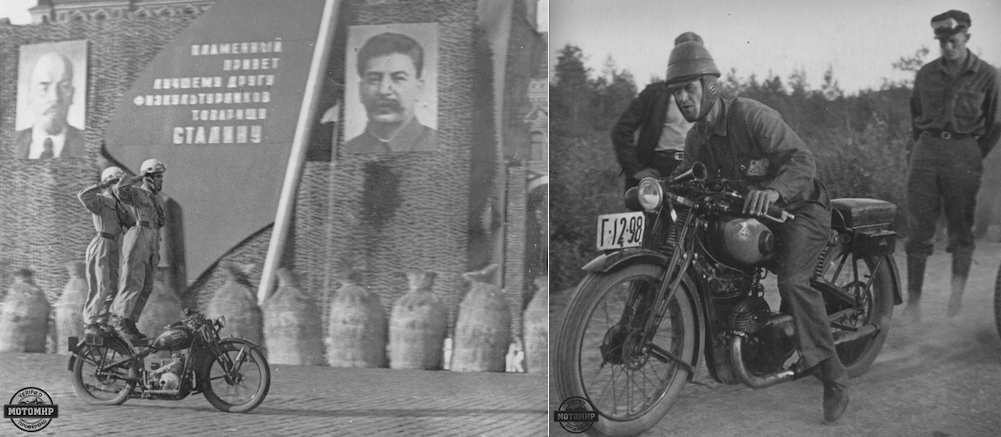

“A REAL SCRAMBLE COURSE, neither a glorified grass-track nor an attempt upon coal tips and factory dumps, was recently discovered about five miles from the centre of Manchester in the direction of Oldham. To most people Manchester and Oldham are one continuous mass of houses, warehouses and factories, but the Manchester Eagle MC told the somewhat sceptical East Cheshire Trials Group that they had found a tiny bit of ‘country’ that might be in the Lowlands of Scotland or in one of the more remote of the Yorkshire Dales. There was a white-washed farmhouse, a river ran beside the unfenced approach road, and there were some real ups and downs that could be used for scrambling. The place was called Daisy Nook. It all sounded too good to be true, but the Manchester Eagle club were invited to go ahead and organise a ‘do’. They did. It was held last Sunday—and full marks were accorded to the organisers. There was a field of 12 in the first heat of the Medlock Scramble for 350cc machines. W. Twiss (349cc BSA) led at a great pace for a couple of laps, but C Holden (249cc OK Supreme) was pressing hard, and when Twiss misjudged a gear change Holden slipped by, and so did F Drew (349cc Triumph). Twiss chased after them, but only made second place. In the next heat, AD Parker (349cc Triumph) had it all his own way after passing J Welch (346cc Levis), who, however, stuck close to him throughout The final proved really exciting with 10 runners, nine of whom chased AD Parker, although only Holden really worried him. On the gentler downward slopes Holden passed Parker more than once, but up a steep, muddy gully the bigger machine could always regain what it had lost. Then Holden fell and from a few inches the lead widened to 50 yards. Holden tried desperately to regain his position and actually finished within two lengths of the winner—a great effort. For the Daisy Nook Scramble (unlimited) the going was not quite so good. The previous heats and final had cut through the snow and had churned up some distinctly sticky mud in places, particularly at the foot of one fearsome 45° bank, which was a truly hair-raising sight when seen from the saddle of a machine just about to take the plunge! The big-stuff event was really remarkable for the way in which JF Hill toured round on his old side-valve long-stroke ‘Beam, keeping a constant speed, gear-changing nonchalantly in the bad places, and never having a sign of wheel-spin. He finished so far ahead of the others in his heat that there was every excuse for those folk who were not quite sure if he was leading or was a lap behind! Some surprising things happened in the final. At the ‘dead-engine’ start (most riders used their kick-starters) AD Parker’s primary chain broke, knocked a hole through the aluminium case and fed itself out on to the ground. W Twiss (349cc BSA) took the lead, followed by F Drew (349cc Triumph); KB Norris (248cc Red Panther) was a not-too-dangerous third. Then Twiss, trying to get past a fallen machine on the edge of a minor precipice, ‘went down by the lift’ rather suddenly, and Drew also dropped lay the wayside. This left the Manchester University trio an unchallenged run into the places. There were seven teams of three in the inter-club team race, and the result of the previous event made the Manchester University Club the hot favourites. How-ever, Holden and Parker secured first and second places for Manchester Eagle, with Ogden fourth. Ken Norris (Red Panther) was first home (in third position) for the University, but JF Hill was sixth and Whyman retired. No other club finished a complete team, so Manchester Eagle won the event without question, with 59 out of a possible 60 points.
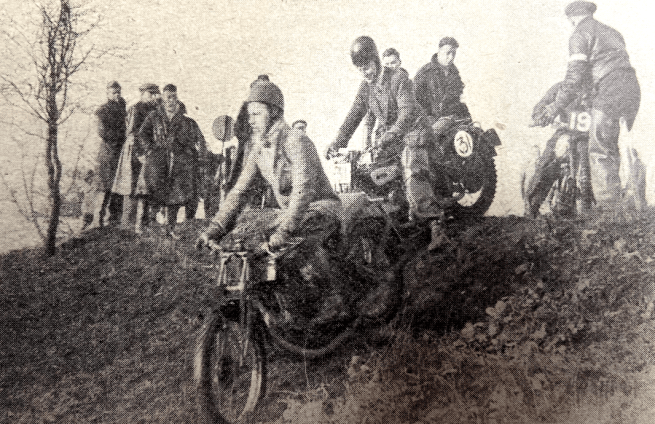
“I HAVE BEEN TERRIBLY ticked off by a reader who says my mind is so blurred that I cannot distinguish between ‘up’ and ‘down’. But the problem concerned whether a piston stops; and in the term ‘stop’ there is no implication of direction, but only of motion and not-motion. So I repeat that the problem is based on an illusion. When long-off fields a drive by Bradman, and throws the ball in to the wicket-keeper, the ball in mid-career exchanges upward travel for downward travel, but there is not even a pinpoint of time at which it remains poised stationary in the heavens above the turf. I was just feeling rather proud of this analysis when I opened a letter from another reader, who is an Einsteinite. In his view there is no such thing as time, and it is pure folly to describe even a piston reposing on a bench, preparatory to decoking, as ‘stationary’. I became rather confused by his arguments, but I gather a ‘piston’ is a composite conception, involving mines, foundries, tool-shops, flame, oil, and a host of other things, but completely and utterly divorced from any conception of ‘motion’, which is an illusion based on our minds being unable to grasp existence as a whole. In fact—Kamarad with a capital K!—Ixion.”
“THE AMATEUR DIRT-TRACK Riders Club have lost their official mascot—as chicken named Angela. Angelo died in a fight with a dog.”
“WHEN A DESPATCH RIDER of the Royal Corps of Signals was summoned for exceeding the limit at Aldershot his commanding officer explained that Army motor cycles were not fitted with speedometers. The DR was fined 17s 6d, however his licence was not endorsed.”
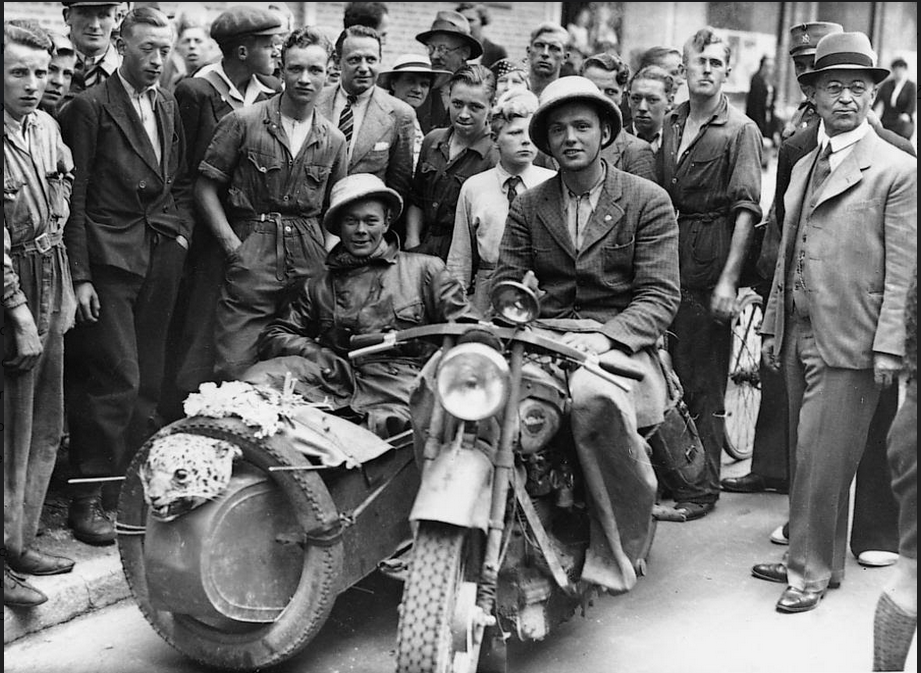
FROM THE WASHINGTON POST: “By dint of stamping her foot Sally Robinson, of 2120 H Street Northwest, has become the only girl in Washington licensed to ride a motorcycle. Miss Robinson—all 88 pounds of her—has been operating motorcycles on and off since 1928, but last spring she decided she wanted a permit. The policeman assigned to officiate at her examination had different ideas, however. Although the District has no law against women motorcyclists, this examiner apparently thought it should have. ‘First he said I was too little, then he said I was too young,’ Miss Robinson declaimed yesterday, malice toward all policeman shining in her eyes. She is 27 years old and 4 feet 11 inches tall, and didn’t see what either factor had to do with her sitting behind the handlebars of a motorcycle. ‘I passed the written examination all right—passed it twice, in fact. The first time I got 80 on it, but that wasn’t good enough for him so I went down again and got 92, when that didn’t satisfy him, I got my lawyer. ‘Well, that cop looked from me to the lawyer, and from the lawyer to me, and then he said I could take my road test,’ she continued. Her difficulties had not ended, however. Thinking all was well, she said goodbye to her lawyer and started out for the road test. Then the policeman announced he would not ride with her in the sidecar of the machine he provided for the test—he said he was afraid to. But when the test was over, the examiner announced, ‘Lady, you handle it as well as a man could. Your balance is swell and you know the machine. But I didn’t see you kick it over so I cant give you the permit.’ That was when Miss Robinson started ‘cussing him out’…I called him such names—well, I was ashamed of myself. But it worked, and I have the permit.’ Miss Robinson uses the smallest type of machine built, but at that it weighs 325 pounds, nearly four times as much as she does. Despite the fact, it occasionally falls on her, she insists she would rather ride that machine than eat when she’s hungry. As for automobiles, she has no use for them whatsoever. At present her chief goal is membership in the Capitolians, a newly formed motorcycle club of which does not share the Police Departmen’ts prejudice against the sex.”
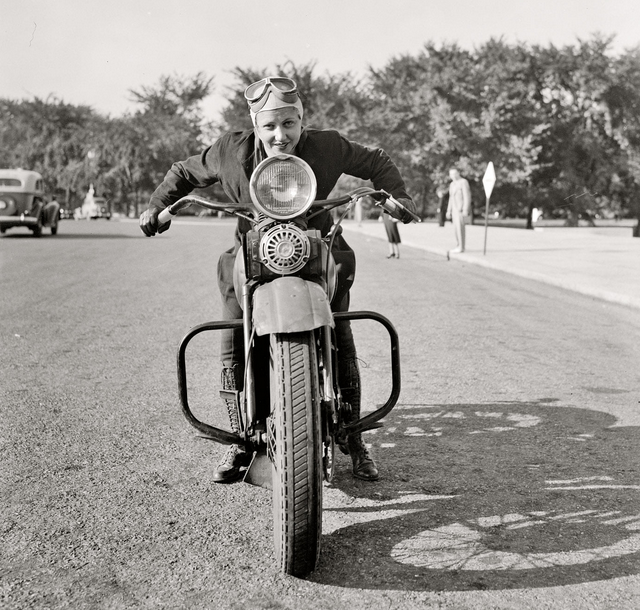
“I SHALL LONG REMEMBER 1909 as the first year in which I regularly rode with a speed indicator fitted (a Cowey). It was a perfect education to read it when I first bought it, and my eyes were seldom off it. I found, that 25mph was about the only speed I could judge accurately. When I was actually. doing 20mph I thought I was only travelling at 16 or so; when I was doing 40, I usually imagined I was humming at 45 or 50.—Ixion.”
“THE MOTOR CYCLING Vicar of Hucknall (Canon Barber) was recently presented with a cheque for £100 by the Bishop of Southwell on behalf of the parishes. And thereby hangs a tale. When the cheque was presented it was gently insinuated that the Canon should replace his 22-year-old Douglas, which was almost a disgrace to the cloth! But the Canon refuses to part with it, as it still gives good service.”
“372 new motor cycles were registered in South Africa last August.”
“A LEARNER-RIDER summoned at Warrington for having no ‘L’ plates said: ‘I have got some, but they would have got wet in the rain.'”
“THERE MUST BE MANY who have read The Motor Cycle week by week since its inception. The first motor bike I bought was advertised in the columns of an April, 1905, issue. I had then read The Motor Cycle for several months, and have not missed a copy since. A description of the above machine may be of interest. It was an lxion two-stroke. The engine was carried on a hinge, which was provided with a lever, and was mounted above the front wheel. A pulley extension of the outside flywheel pressed directly on the front tyre. By means of the said hinge and lever the drive could be disengaged. My last recollection of that dear bike is when the handlebars vibrated right out of the head at full speed—about 25mph. I have seen this performed since as a variety act! I regret to say that every few years 1 have had to burn my accumulated copies of The Motor Cycle, but if f had them to-day and all my early bikes I would envy no one. Family reasons have made it four wheels for some years now, but that has not interfered with my growing pile of ‘Blue. Books.’ In 1911 I climbed Alms Hill on several occasions on a 1909hp Rex with NSU gear. On one memorable Sunday I made the only ascent, more pretentious bikes remaining below. The simplest and sweetest-running machine I had was a 1910 500cc Rex two-stroke. It was an uncanny climber with sidecar. I have never had a new machine—you don’t get the fun fast enough. My thrill always was to get an old bike and make it do the same as the best—perhaps better, although I would not say it is the least expensive method in the long run. Soon I am hoisting my flag on an old Model 9 ‘Beam, and trusting that as a result the necessity for my getting rebushed with monkey glands will be postponed.
‘Whiskers’, Croydon.”
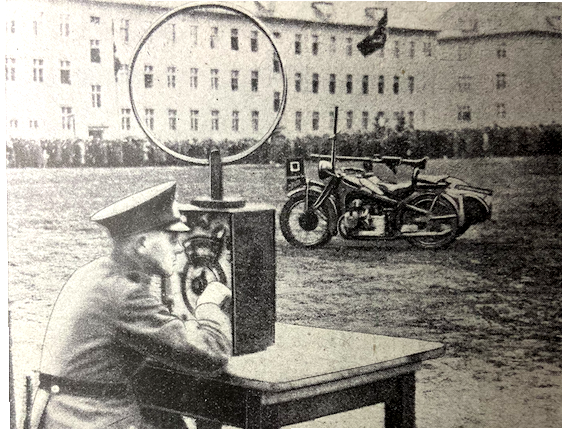
“A148CC EXCELSIOR-VILLIERS came through strenuous tests in Southern Australia recently. The machine used was taken from stock, the engine sealed, and then put through a 24-hour test, with a relay of riders, by the Port Eirie MCC. The machine covered 585 miles, and the petrol consumption was 134mpg. Next the little mount was subjected to fresh fuel consumption tests, and then taken up Corkscrew Hill, outside Adelaide, one of the steepest hills in the State. It climbed this in second and top gears. Finally came another 24-hour test, in which 621 miles were covered under adverse conditions. The fuel consumption was 134mpg. No attention was given to the machine throughout the tests except for a rear chain adjustment.”
“THE BOARD OF TRADE returns, which are published at the end of every month, have this year shown a remarkable rise in the export of British motor cycles. The total value of motor cycles, parts and accessories exported during the first eight months of this year amounts to £918,240 [about £78 million in 2024 allowing for inflation] which represents an increase of nearly 25% on the total for the same period last year. During the month of August alone, machines and parts to the value of £83,754 [£7m] were exported. So far this year Australia has proved to be Great Britain’s best customer, having purchased machines to the value of £204,658 [£17.5m]. Exports of motor cycles to foreign countries total £269,859 [£23m].”
‘NEW MOTOR CYCLE REGISTRATIONS during 1 July were ‘up’ nearly 10% on the total for the corresponding month in 1936, according to the official Ministry of Transport figures just issued. The total for July, 1937, was 7,274. Once again, new motor cycles in the over-250cc class showed the biggest rise with a total of 3,599, compared with July, 1936, total of 2,725. Totals for other classes are as follows: Under 150cc, 454; 150-250cc, 2,298; passenger machines, 923.”
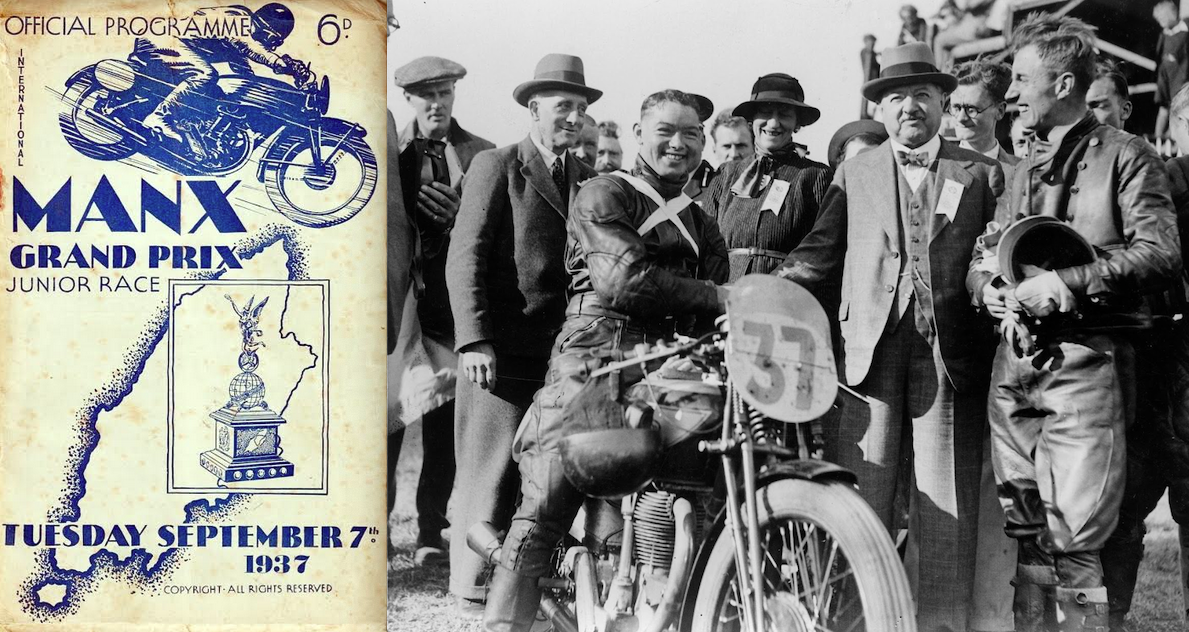
“THROUGHOUT THE YEAR the British motor cycle export trade has flourished in a manner that brings back memories of the pre-slump era. In spite of currency restrictions, trade quotas and other trading difficulties, the figure is £1,101,553. This represents the value of British motor cycles, parts and accessories sold during the first 10 months of this year, and is something to marvel at. Normally, when dealing with trade matters, it is customary to compare export figures with imports, but against the British motor cycle export figure of over a million pounds’ worth of machines there are no import figures available. The Board of Trade returns have long since ceased to show motor cycle imports, because they had become so small. During this year the Dominions have bought the major share of our exports. Australia proved (throughout the first 10 months of this year) to be Britain’s best individual customer, and has purchased up to the end of October no fewer than 6,369 machines costing £249,339. South Africa spent £78,628 on British motor cycles. Britain’s motor cycle exports to foreign countries rose sharply during the months of May, June and July. In June, when the peak was reached, the total came to no less than £58,354, the previous year’s figure for this month being £20,941. Our foreign trade for the first 10 months was valued at £325,489, while the total value of motor cycles sold to South Africa, Australia and other British countries amounted to £471,135. It is only when our export figures of this year are compared with those of previous years that a clear insight into the prosperous position of the export trade can be obtained. As has been already mentioned, the total value of machines, parts and accessories exported during the first 10 months of this year topped the magic million, £1,101,553 to be precise. Last year the total for the some period was only £914,578, while in 1935 it was even less, £890,057. The best month of this year was June, when the returns amounted to £137,510—a figure which compares more than favourably with the June totals of 1936 and 1935, which were £84,108 and £95,863 respectively. A glance at these figures shows that Britain’s motor cycle export industry is of considerable valve to the country. “
“OFFICIAL REGISTRATION FIGURES for October show that 1,905 motor cycles of the over-250 c.c. class were brought into use for the first time, an increase of nearly 35% compared with the October, 1936, total. Sidecar machines also showed a big increase, with 363 machines registered, as compared with only 302 a year ago. The total number of motor cycles registered during the month was 3,528. This brought the total number registered for the first 10 months of the year up to 52,150, an increase of nearly 5% over the total for the corresponding period of 1936.”
“BRITISH SUPREMACY— ONLY a veteran like myself can appreciate the inwardness of that phrase. I can remember a time when we bought all our motor cycle engines on the Continent. Engineers who decided to market a motor cycle procured passports and tore round France and Belgium to find an engine. When found, they persuaded the maker to bring out a series with some English name on the crankcase. When we competed in a Continental race, we seldom finished; or if we finished, we arrived hours behind the French, Belgian, Austrian or German machines. When at long last we began to produce our own engines, we could not sell a machine overseas because the NSU enjoyed a monopoly. With great determination and skill the British industry recovered from its late start, fought down all its handicaps, and a very different era dawned. I would cross the Channel to report a Continental race on behalf of The Motor Cycle, and see gigantic crowds so reconciled to Britons finishing 1, 2, 3, that all trace of wounded national pride was swamped in their enthusiastic technical appreciation of the British achievements, while the bandsmen kept ‘God Save the King’ permanently at hand, ready to play a few bars whenever a Briton set up a new lap record. As an Englishman, I am proud to have witnessed such a transformation.”—Ixion.
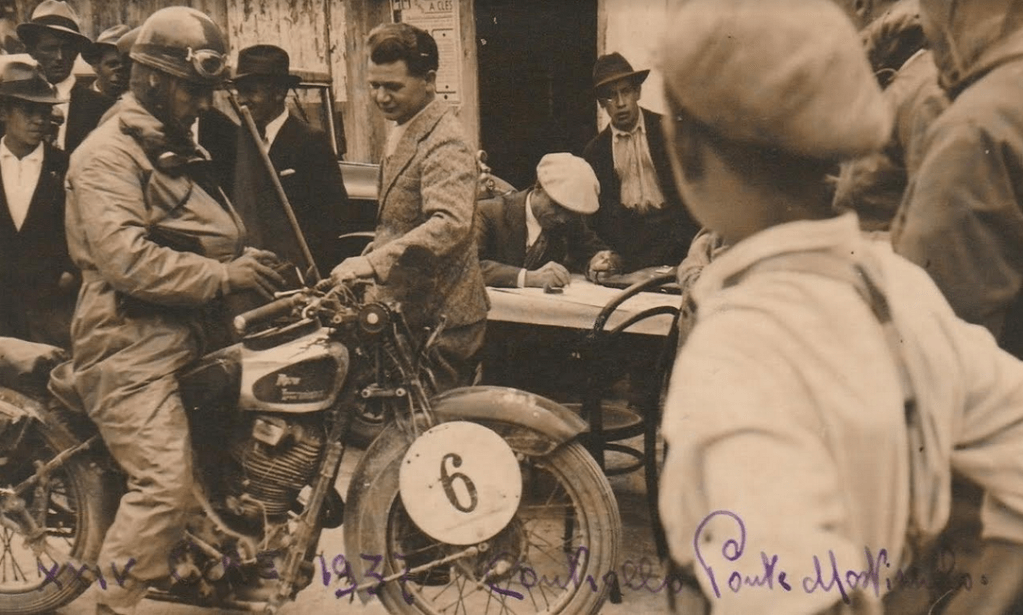
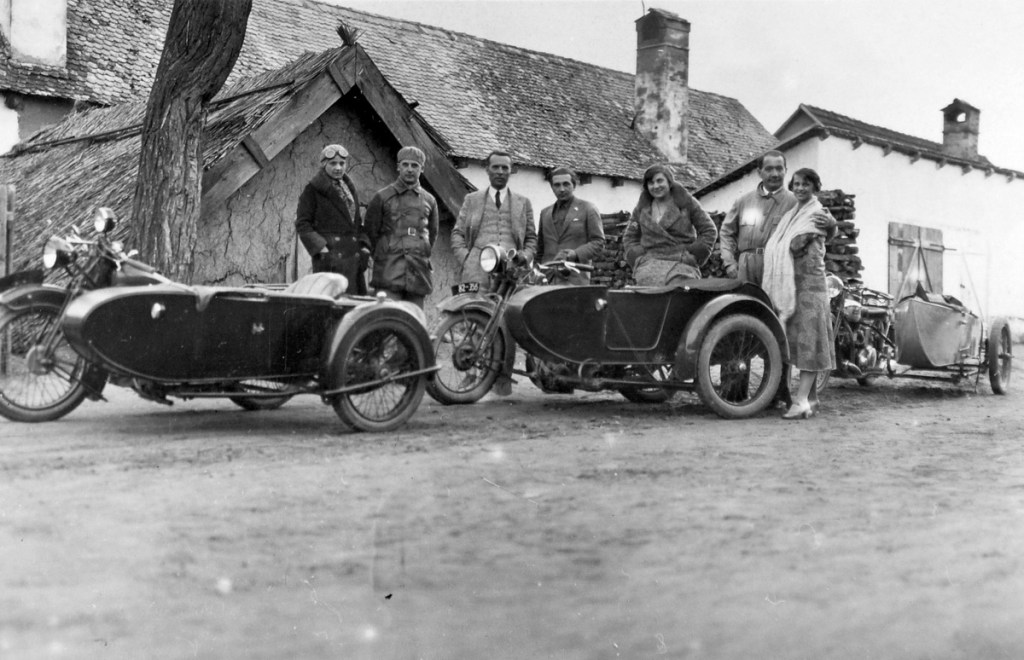
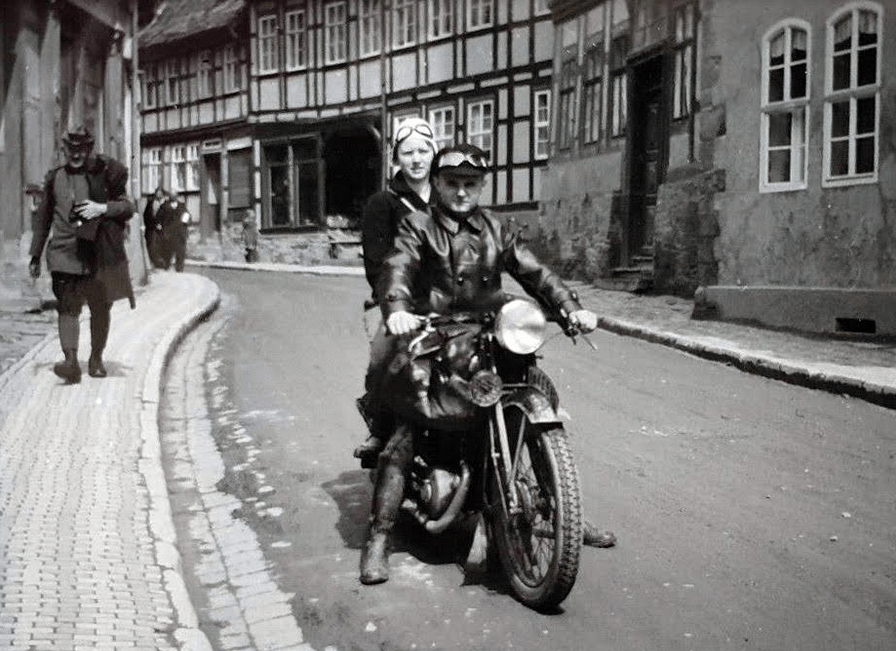
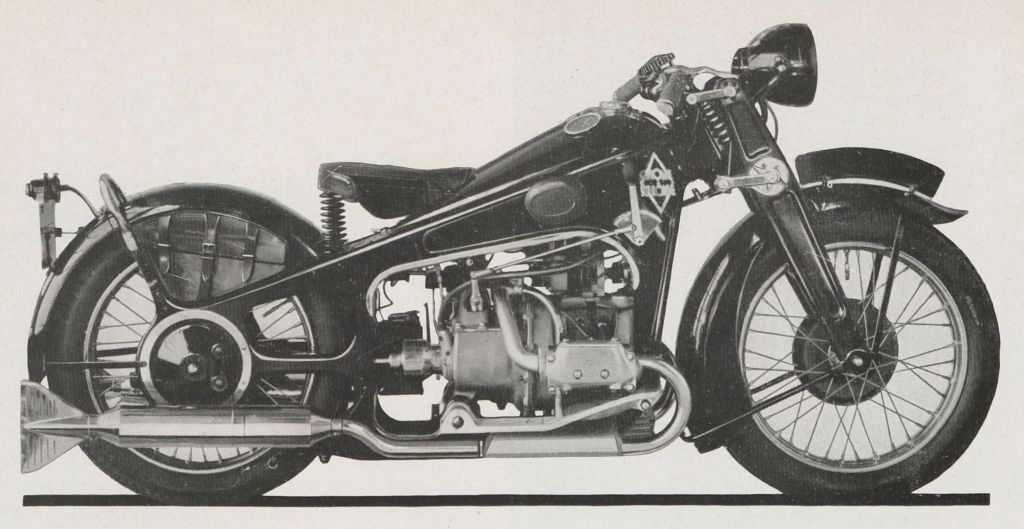
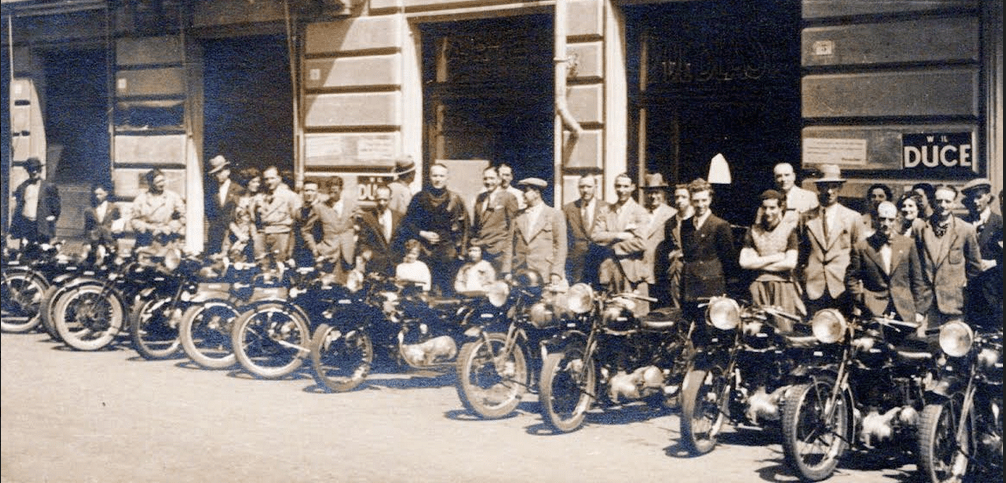
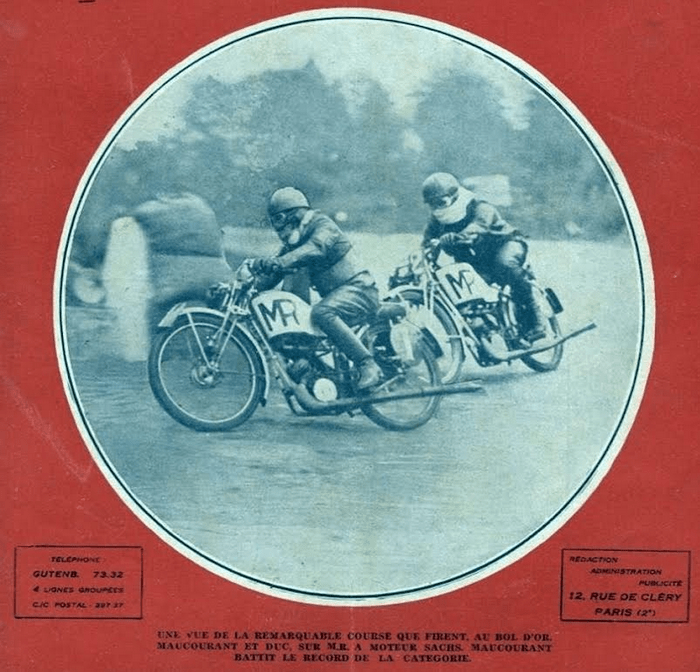
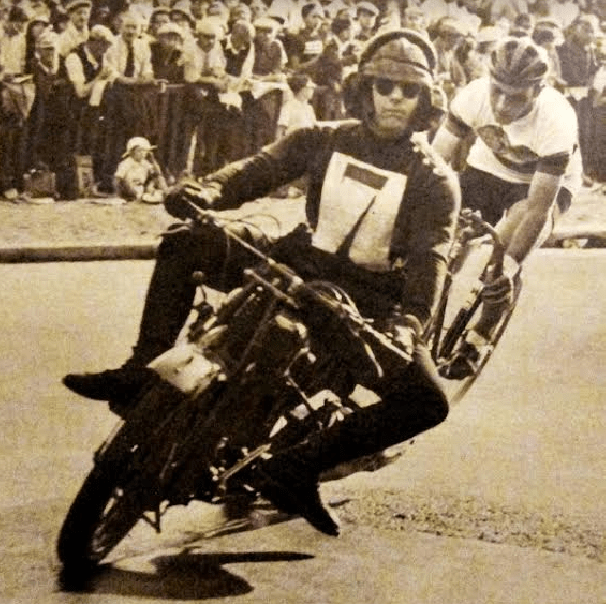
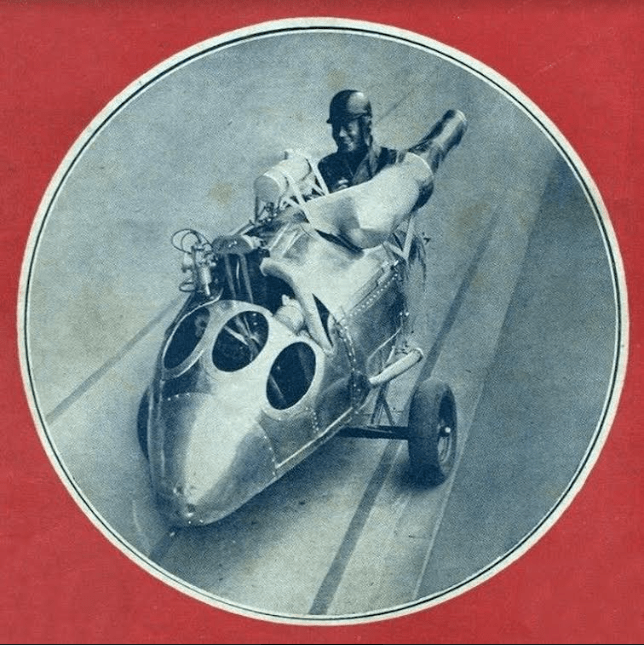
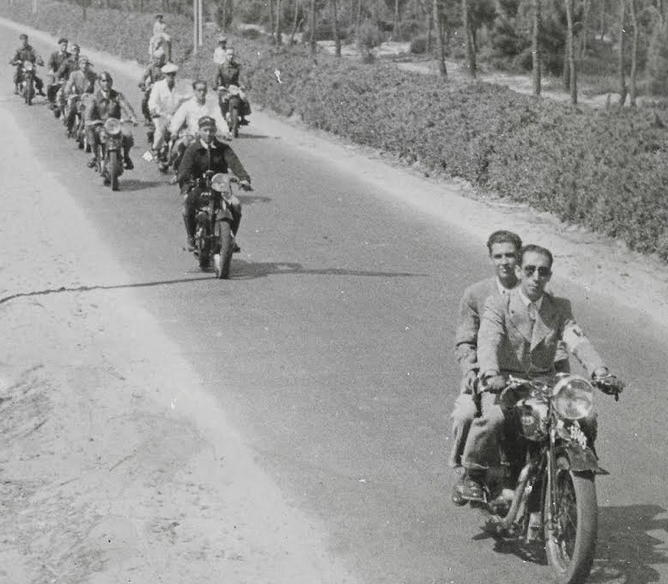
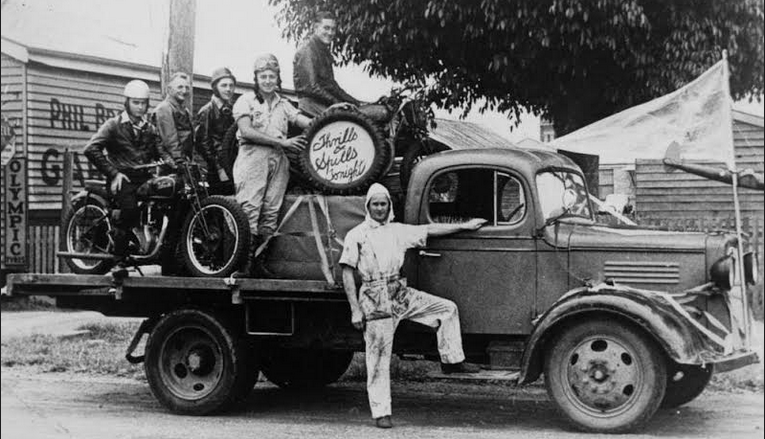
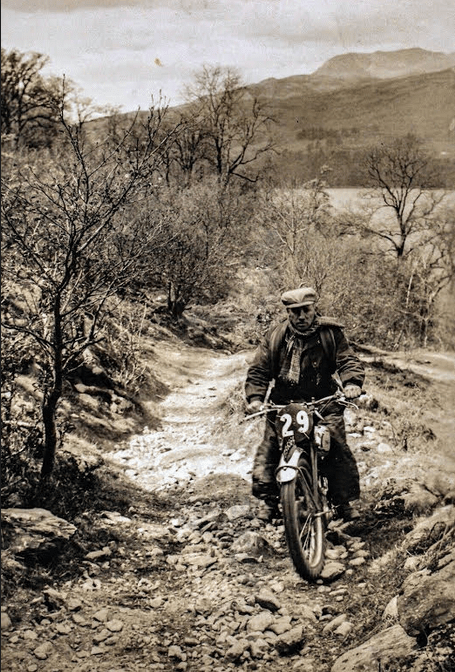
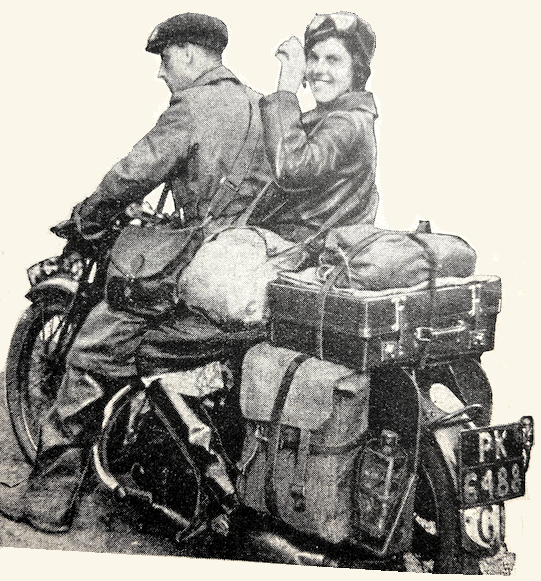
…and here’s the usual batch of contemporary ads.
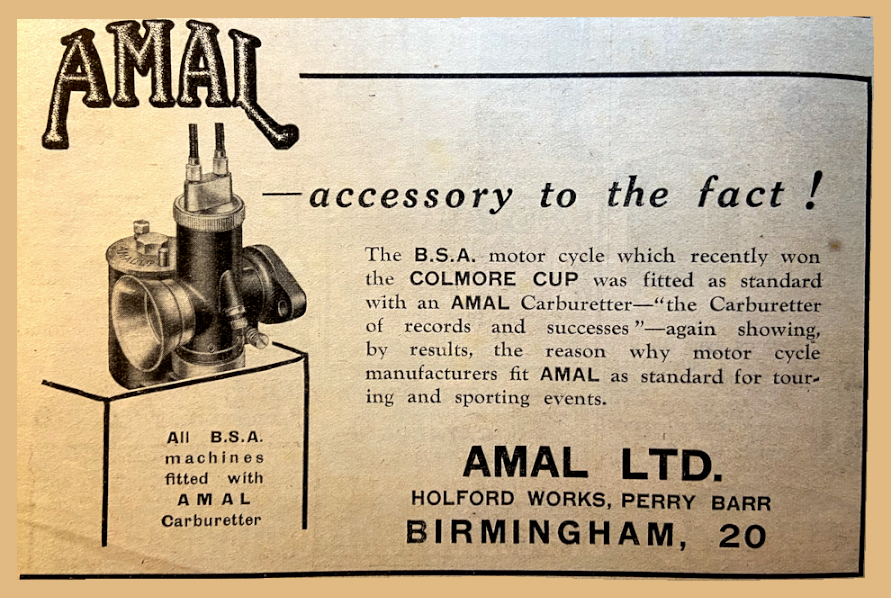
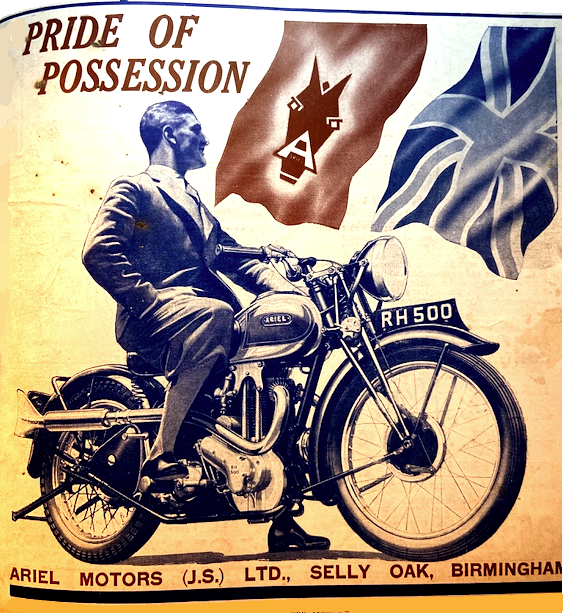
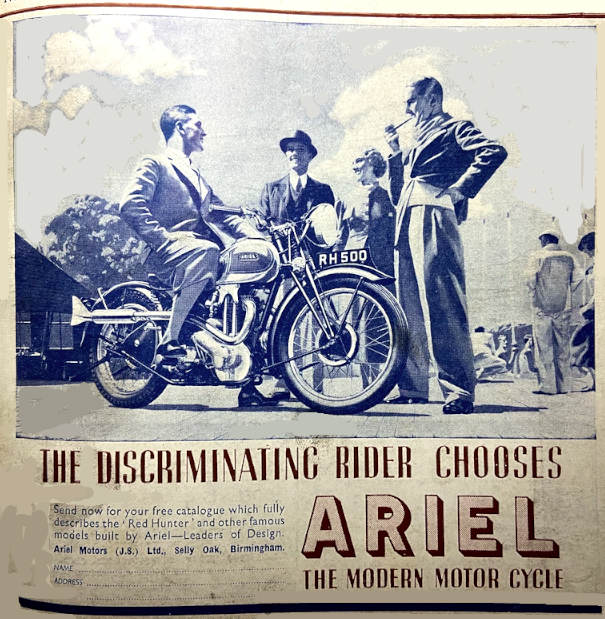
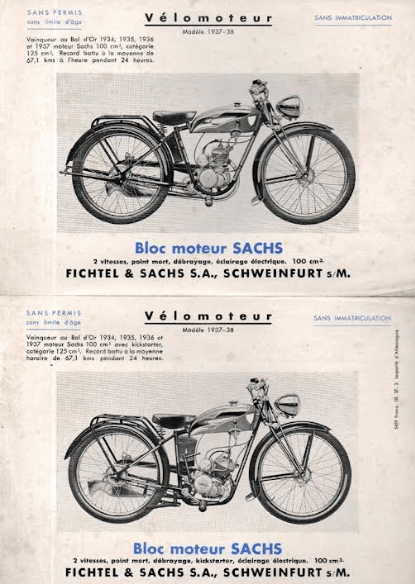
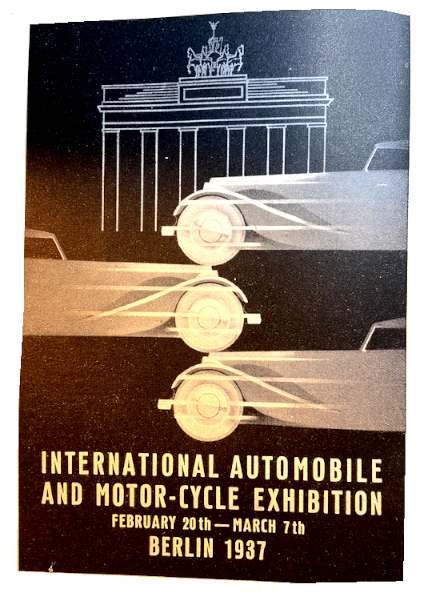
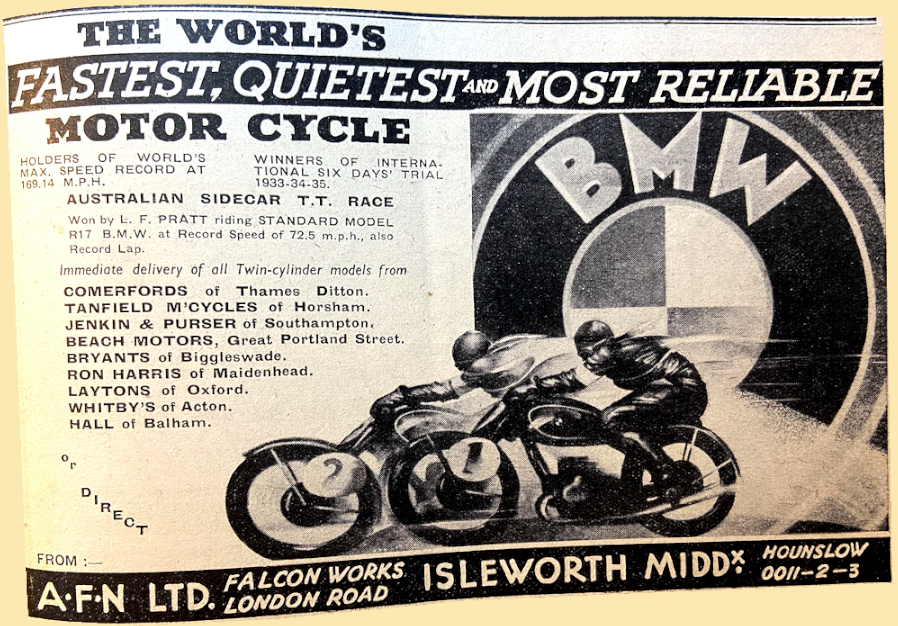
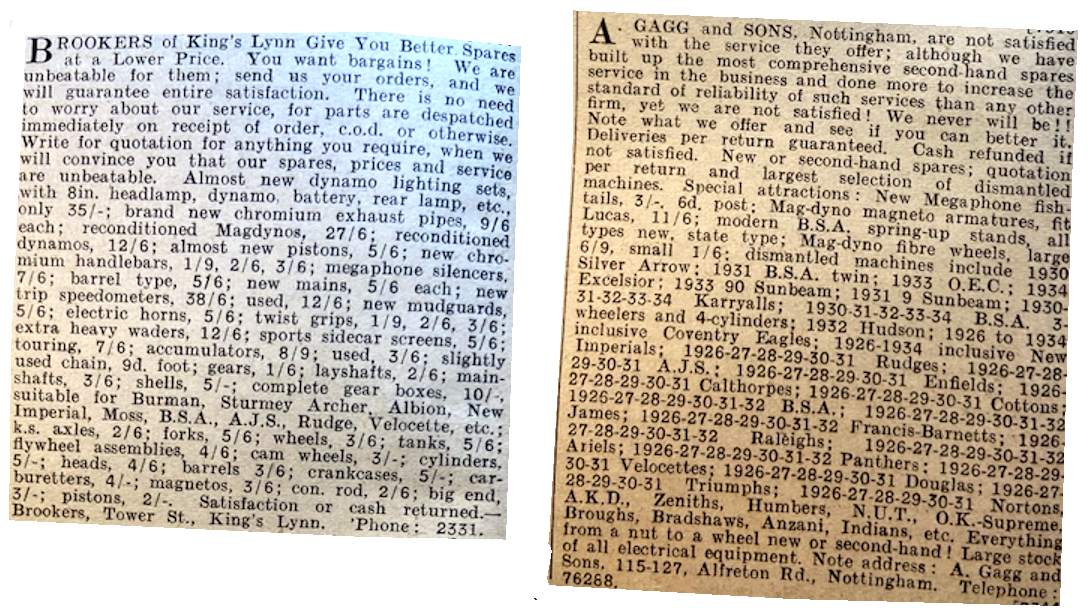
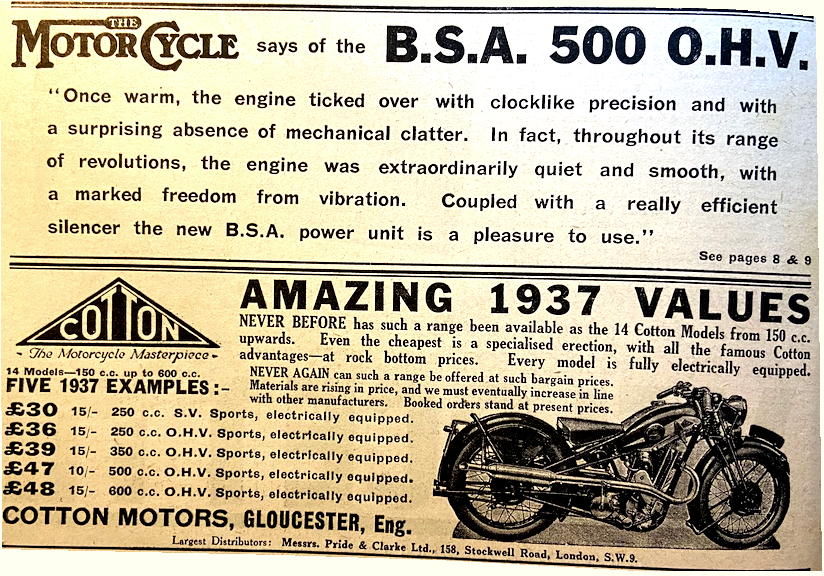
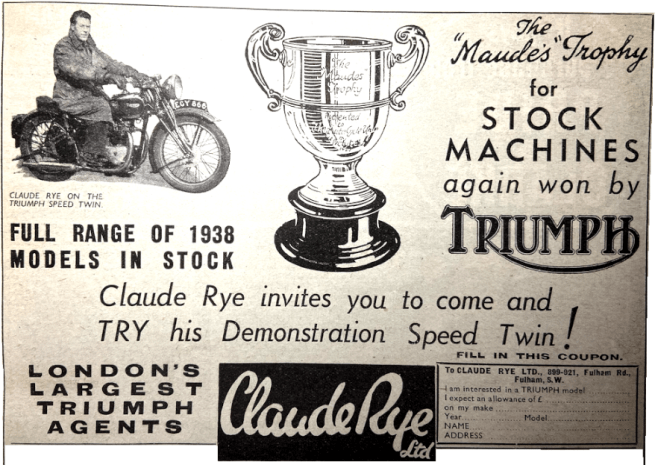
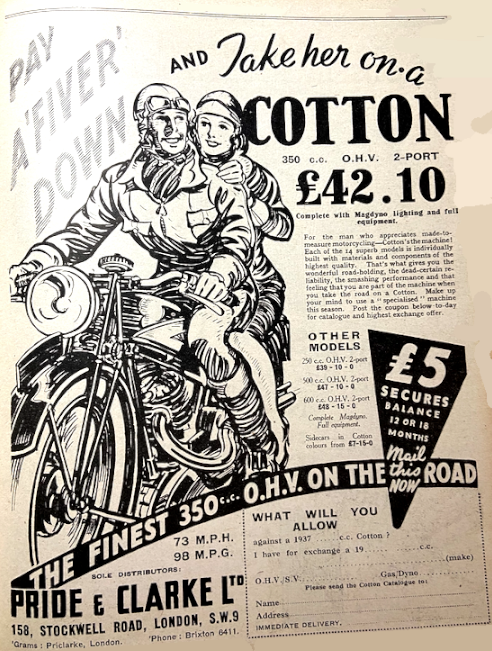


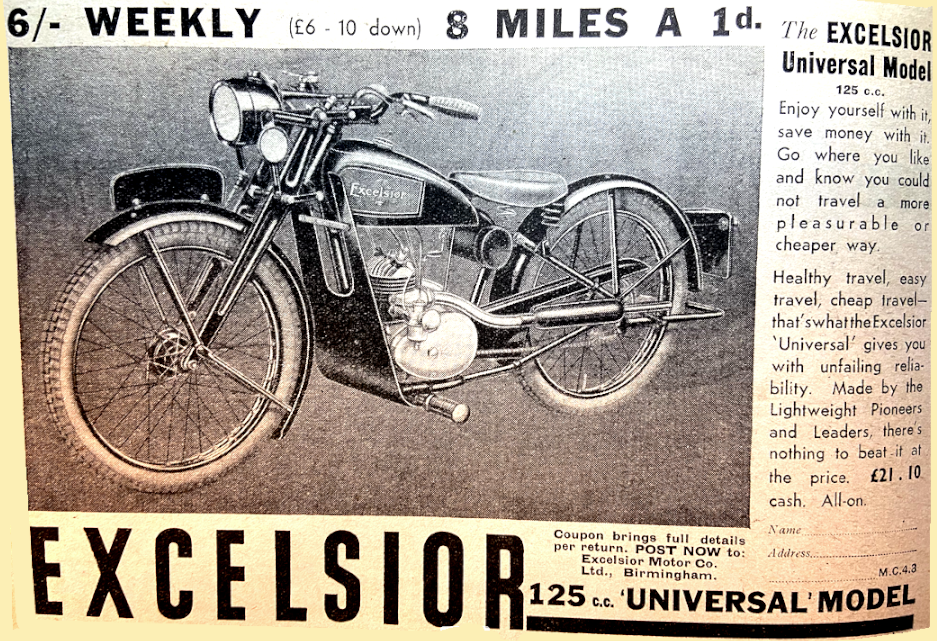
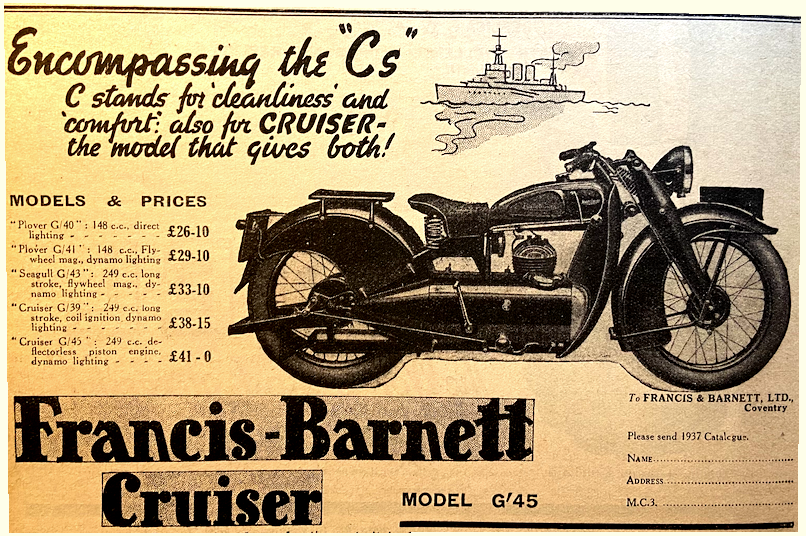

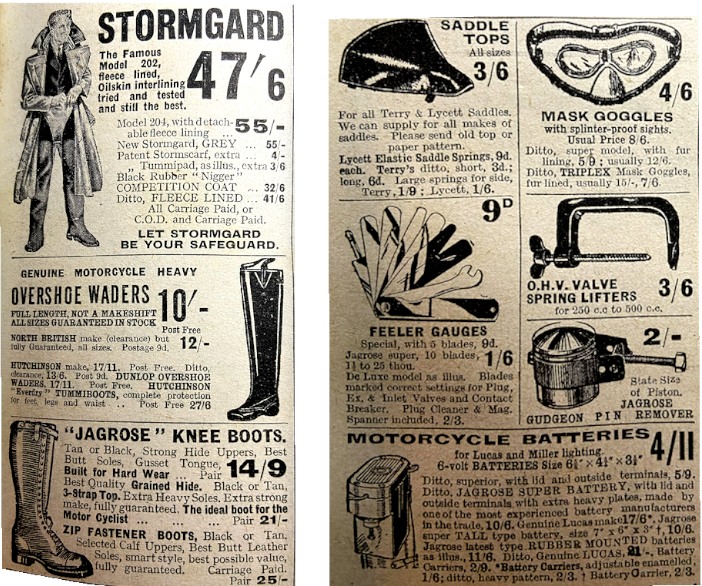

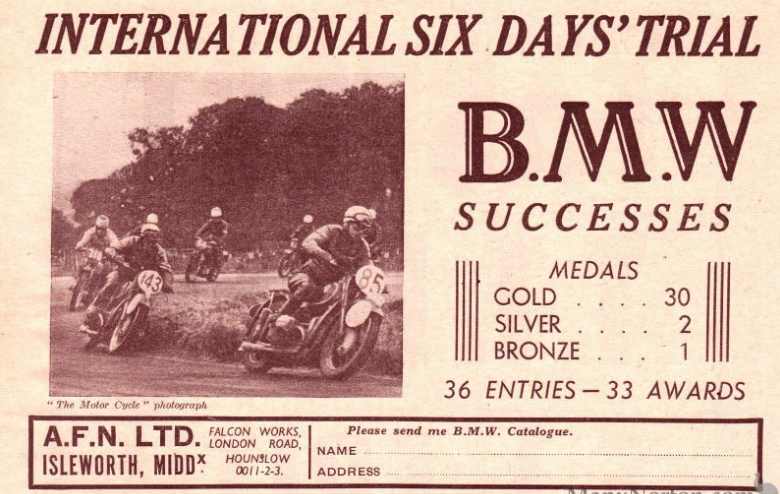
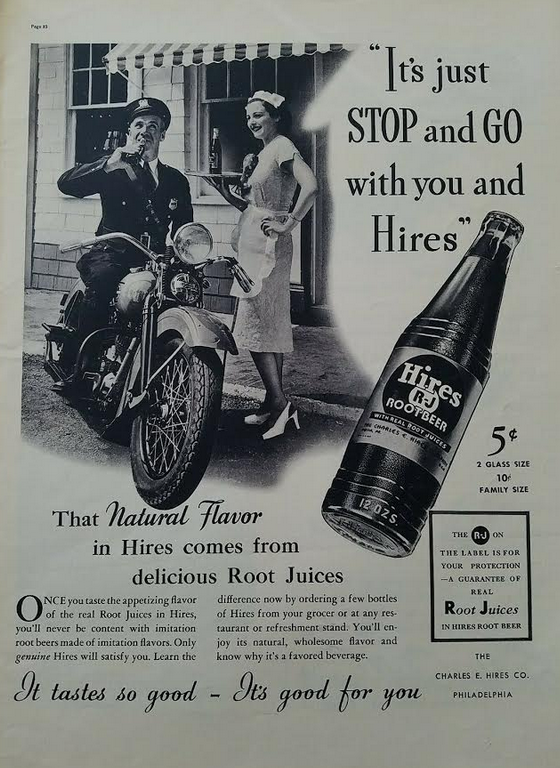
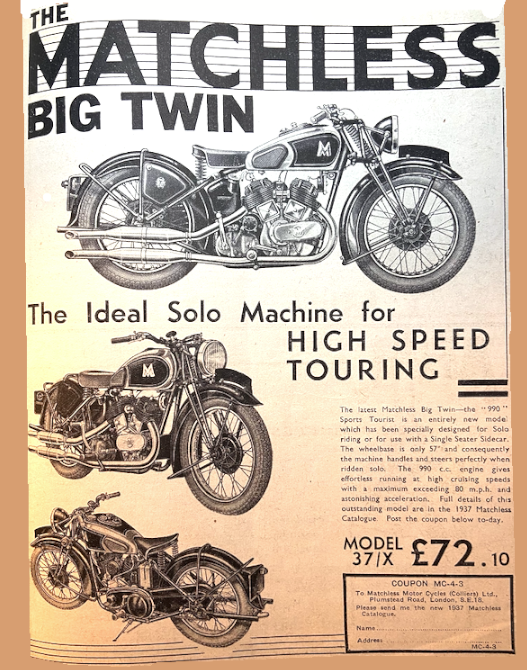
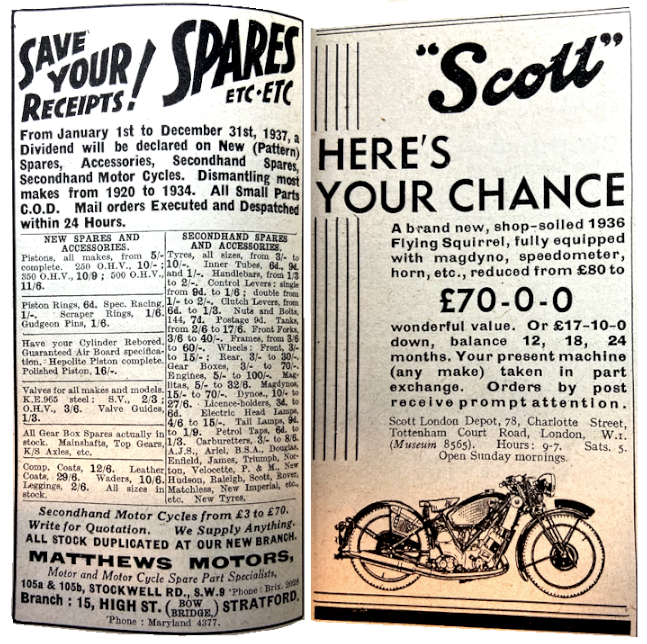
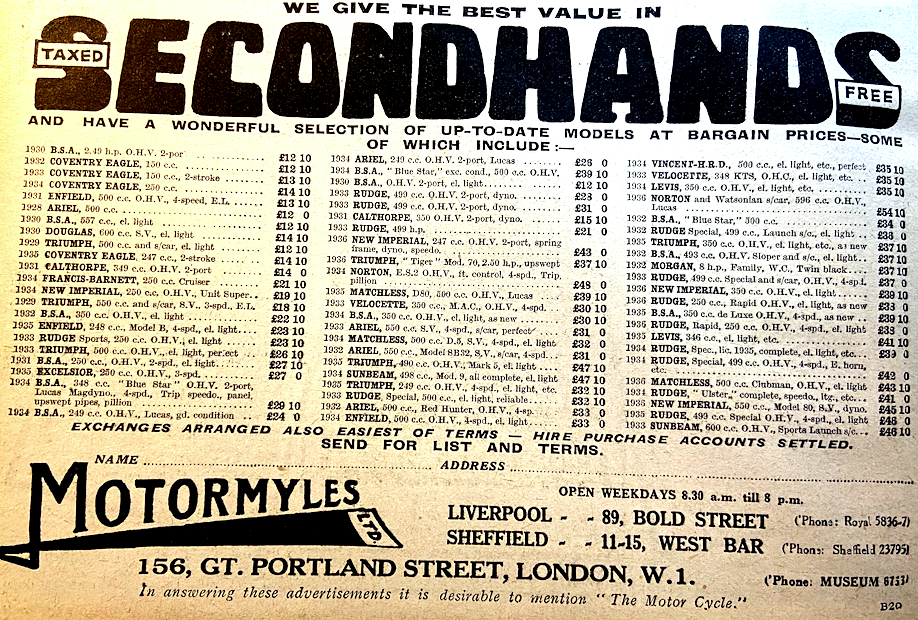
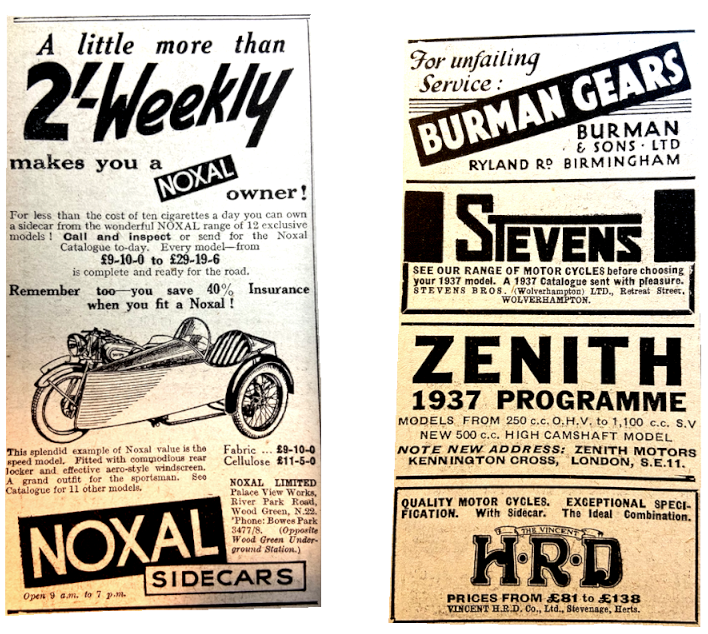
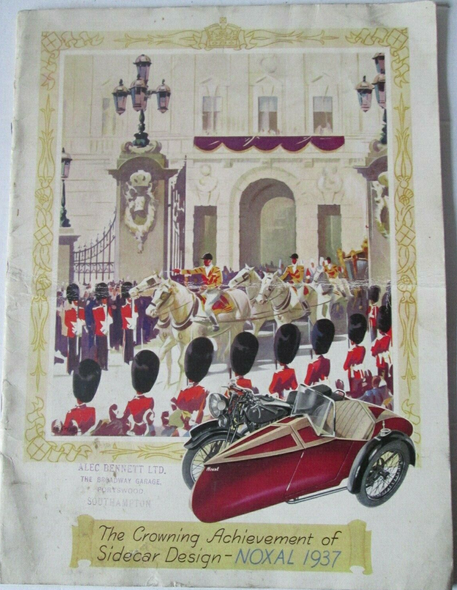
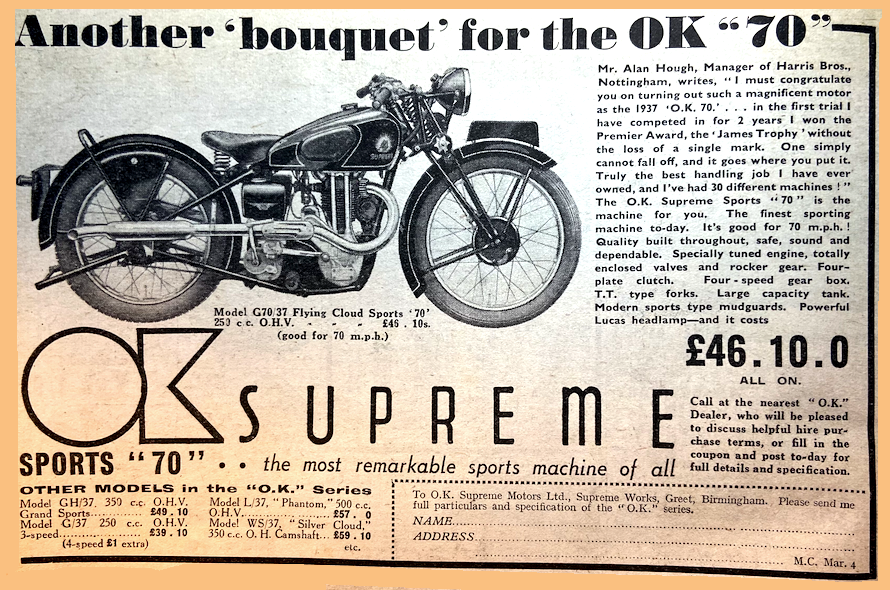
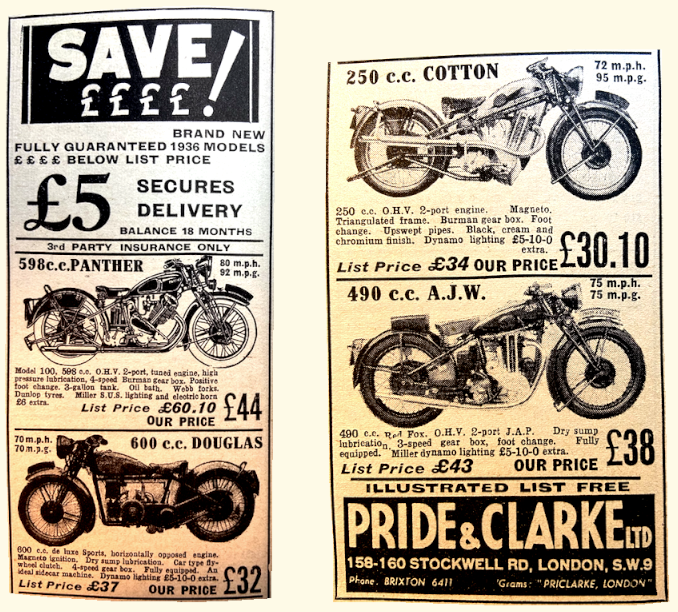
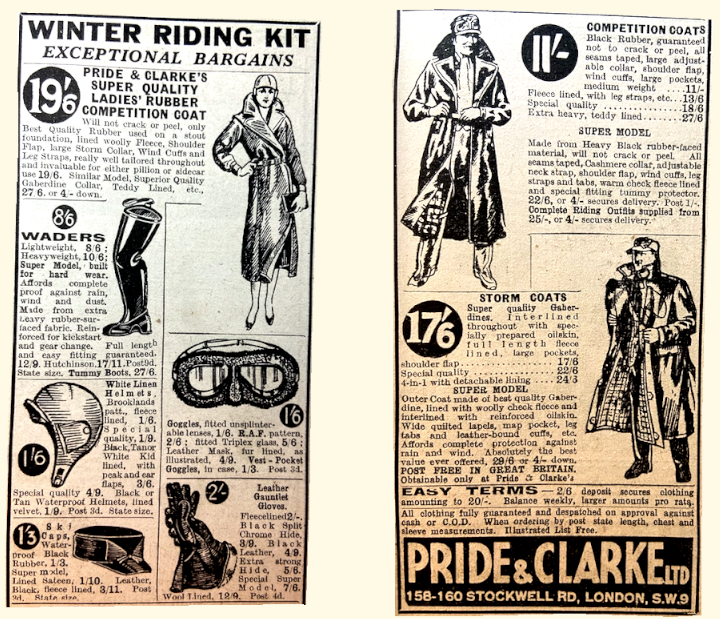
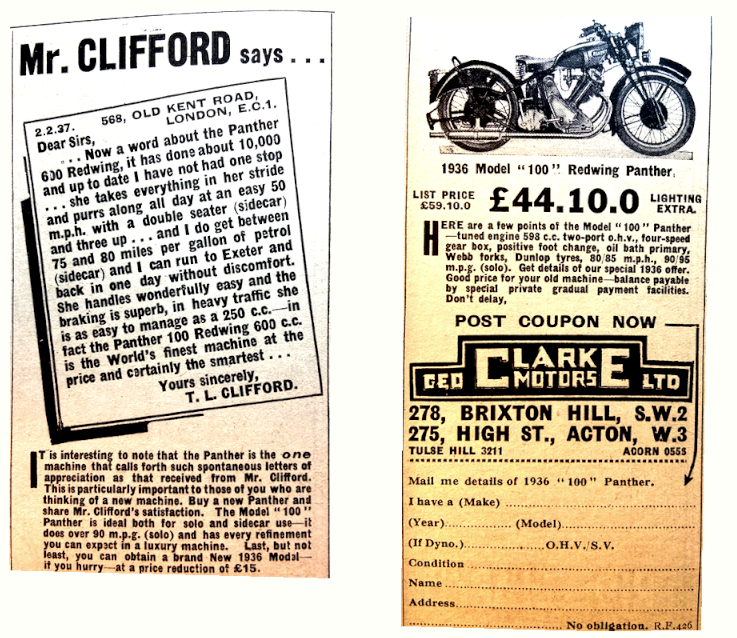
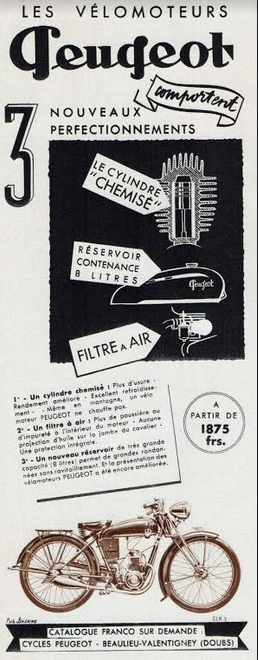
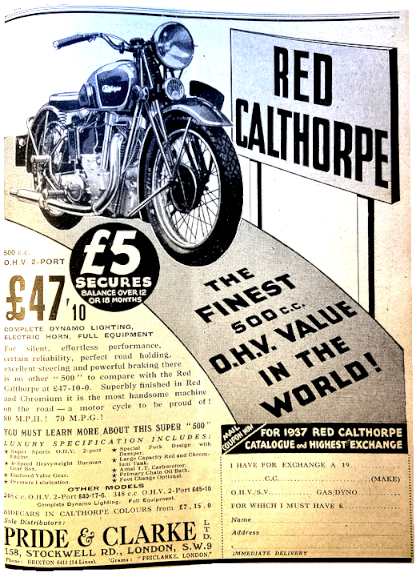
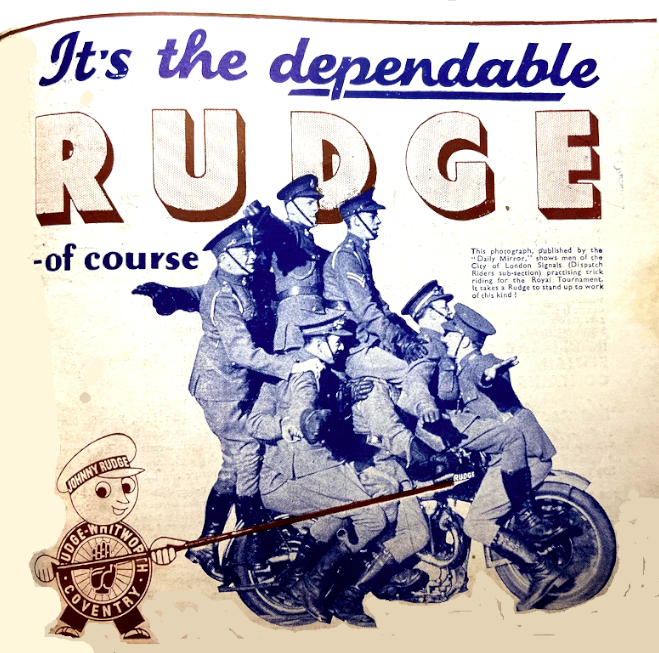
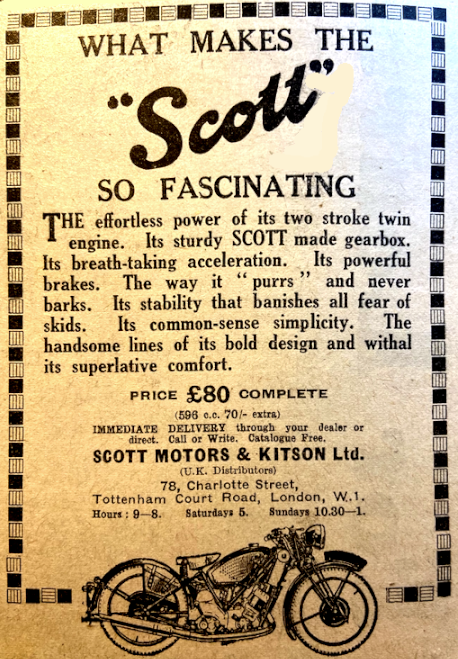
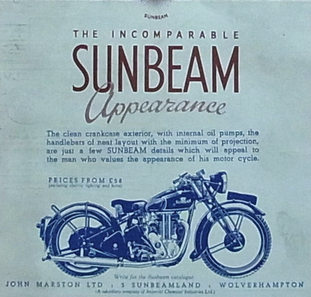

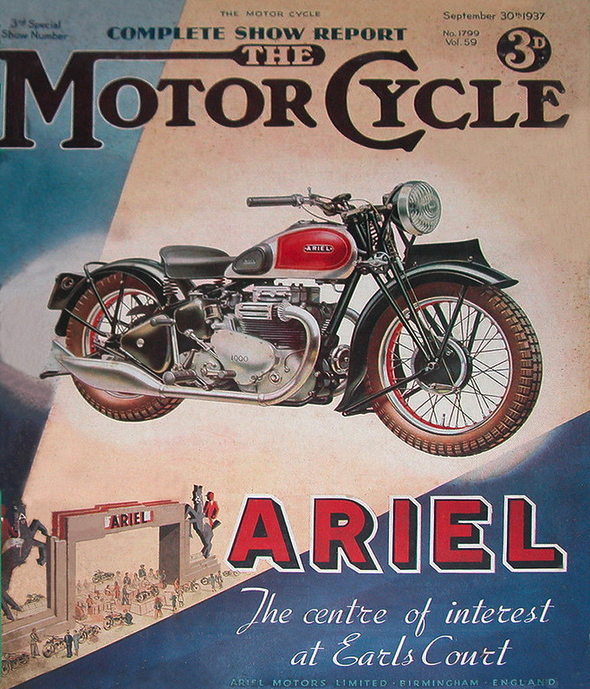

 Motorcycle Timeline