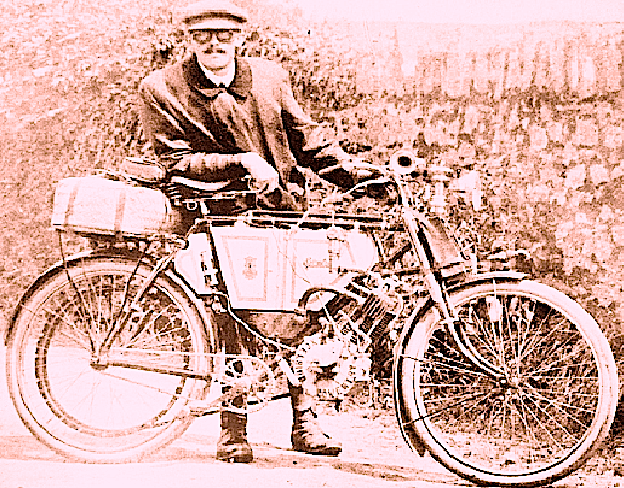
The Levis Trial, in its 13th year, started as a staff event for Levis workers; the Blue ‘Un described it as “an informal ‘classic’—and it ended with a jolly good feed…
“TRULY HAS THE COMPETITION year started well. Increased entries have been received in all the chief events so far run, and now the Levis trial has achieved a three-figure total. ‘The Levis’ has always been a popular affair, it has developed an atmosphere all its own, and the spirit of enthusiasm that prevailed when it was confined to single-geared machines has, if anything, increased. The trial is ‘good fun’, free and easy, and not marked by any ‘gold’-hunting fever. Compared with past Levis trials, this was a dry one. The drought has been a long one, and even Midland mud will dry. Here and there, however, some of it seemed to be everlasting, and there were, consequently, just one or two parts of the course which provided some of the competitors with anxious moments. For all that, there were several clean sheets, and the winner had to be searched for in the figures relating to the stop-and-go test and the timed section. This timed section—of which more later—was a really strenuous affair, half a mile of really hard going. Of the hundred who entered, 92 were sent away by the starter, and some idea of the easy nature of the course is gleaned from the fact that no fewer than 88 checked in at the finish. In this galaxy of stars and enthusiasts three sportsmen had entered on single-geared, belt-driven machines. They were JA Watson-Bourne (490cc BS Norton)—and what a Norton! 1941b all on and still good for 70mph; CE Anderson (Levis)—cc forgotten; and WV Pickering (293cc Levis). Watson-Bourne and Pickering both
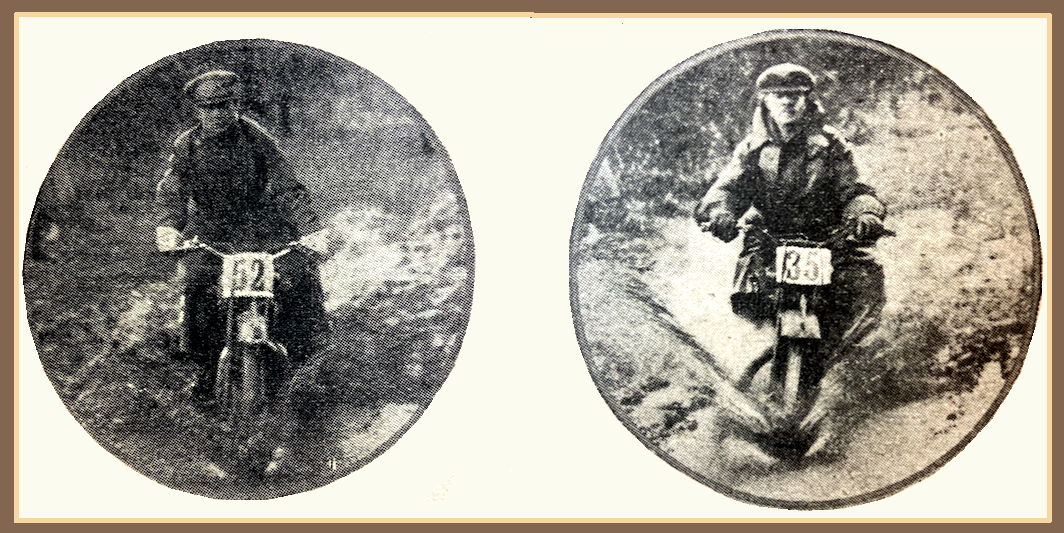
finished. There were also nine riders who, scorning competition tyres, turned out with tyres minus knobs. These were Watson-Bourne, Anderson, B Vaughan (247cc Levis), WC Bridgwood (248cc Ariel), ED Green (348cc Velocette), ET Hickinbottom (174cc Triumph), AW Brookes (196cc Excelsior), HT Angus (248cc Raleigh), and AS Renton (247cc Levis). At the start the scene was a busy one, and the entrance to the Levis works had been made into a display stand whereon were exhibited all the trophies—evidently an attempt to inspire the competitors with determination and that ‘will to win’. There were no fewer than seven women competitors—a veritable menace to the male domain. Dead Man’s Lane sounds an ominous sort of place, but it is a courtesy title invented by the organisers, the Levis Athletic Club, to frighten competitors. This was the first observed point and amounted for little in the way of lost marks. It was followed, in about eight miles, by a watersplash—again, on this occasion, a courtesy title. Gay Hill Swamp was next, taken, as usual, in a downwards direction. There was mud here, but the hill was but a shadow of its former self; it lacked the treacherous ice of last year and the dreadful oozing slime; nevertheless, it required care, and there were some bothersome greasy ruts which upset the calculations of many riders. On a 247cc Levis, SG Thompson was the acme of carefulness and kept his feet up well; B Vaughan (247cc Levis), one of the standard-tyre merchants, also did well at the commencement, but spoiled it all later by failing completely—those ruts! RL Bartlett (499cc Rudge) must have heard someone say that mud requires speed, but, however true this may be, Bartlett overdid it and crashed himself to failure. Gay Hill was quite the master of MJ Wright (346cc Levis), who seemed to have a rooted objection to remaining upright, but KD Haynes, on a similar machine, performed splendidly. Speed was the plan of AL Macdonald (146cc New Imperial), but, in this case, controlled speed, and very nice to watch. Then came LJ Fletcher (499cc Ariel), one of the Ariel group of trick riders; he really enjoyed himself and showed excellent control. A Moseley (247cc New Imperial) went bird nesting, careering at high speed all through the brambles, but he kept his feet on the rests; then them was another good one, LS Vanhouse (248cc OK Supreme), followed by CH Goody (196cc James), also giving an excellent display. Apparently trying his hardest to fall off all the time, WE Galpin (196cc SOS) got away with it by footing, and Miss Marjorie Cottle (249cc BSA) footed steadily all the way—she seemed a little off form in this event. Although having only one leg with which to foot, RD Humber (249cc Velocette) was marvellously clean for the greater part of the distance, while WE Ash (346cc Levis) rode well standing on the rests, but had to foot towards the end. In something of a hurry, FC Perks (249cc BSA) gave a wild display, rode through the section and then returned for his hat, which had been snatched off by the brambles! GH Reid (499cc BSA) foozled the job and stopped his engine, but Jack Williams (348cc Norton) was as masterly as ever. Well up to form, LG Holdsworth (246cc New Imperial) took his task seriously and was rewarded for his care, but Harry Taft (346cc Levis) was rather untidy. N Taylor (249cc Ariel) failed, but RS Orchard (346cc New Imperial) took the rough as though he was riding over a main road. Miss IM Crow (247cc Levis) touched only once, showing greatly improved form, but Mrs Thacker (346cc Royal Enfield) failed early and had difficulty in restarting. So it went on, flashes of good riding like that of Perrigo and Povey (348cc and 499cc BSAs respectively) and RC Cotterell (497cc Ariel) relieving the gloom of poorer but often unluckier performances. Newlands, Clay Lane, and Strip Jack Naked were the next bits to be tackled, the last probably proving the most difficult. Then came Brown’s Lane, which, had the weather been the real Levis trial

mixture, would probably not have been included. As it was, it was fairly difficult, only six riders being ‘clean’ in one of the worst sections. You might have picked out these six people from the entry list without having to be told their names, but, to save trouble, here they are: Williams, Holdsworth, Perrigo, Povey, Brittain (490cc Norton) and Cotterell—funny, isn’t it? Now came the stop-and-go test on Swan’s Rill. Here again one must go to the same batch of riders to find the best times. Perrigo came out on top with 2.8 seconds; he was only just quick enough to head the list for four others each clocked exactly three seconds. They were Jack Williams, H Blake (346cc Levis), GF Povey and Vic Brittain. Competitors were then timed along Satan’s Arcade, a very uneven, and, in some places, muddy colonial everyone. Here, Jack Williams surprised everyone by a most hair raising effort; his wheels scarcely touched the ground and in one leap he crashed through some bushes, only to carry on imperturbably. According to observation, the next fastest—and he ran Jack very close—was Holdsworth, obviously out for blood and riding beautifully. Cotterell, Brittain, Perrigo and Povey were all good but more subdued than the other two. Many hurried unwisely, taking, large water puddles too fast, thereby short circuiting the sparks. LJ Fletcher crashed down a miniature precipice in his. haste but Watson-Bourne footed heartily—and very cheerily—to overcome resistance with which a slipping. belt would not deal. Crossing a road from Satan’s Arcade, the competitors entered Rue des Hoffmans, which on this occasion was quite easy, there being just two puddles to ride through. Scriber’s Lane Ford was again observed on the return and there then remained only the run through the suburbs of Birmingham to the Levis works. Here an excellent tea awaited each and all; it is interesting to reflect that this, one of the cheapest trials to enter (6s, including membership of the Club), must be about the only one at which a free meal—and a real one—is provided.”
“THAT THERE IS A NEED for a motor-assisted bicycle to form a stepping-stone from the ranks of cyclists to those of motor cyclists is a view held by many. It is felt that there are large numbers of cyclists who would prefer a power-driven vehicle, but remain unattracted by motor cycles, which they regard as too heavy and too fast. With the advent of the 15s-a-year tax and the consequent development of the under-150cc motor cycle it was hoped that the breach would be filled. It must, however, be admitted that the 150cc machine of to-day is a fully fledged motor cycle, a machine that in both weight and performance is the equivalent of the 250 of eight or ten years ago. Quite a number of these mounts weigh over 200lb. For some reason or other the British motor cycle industry has paid no attention to the motor-assisted bicycle of the type so popular in France. In that country nearly every motor cycle manufacturer produces one or more of these little velomoteurs, which are simply strengthened bicycles with light spring forks, an engine of just under 100cc, a clutch with either a single- or two-speed gear, and a weight of approximately 60lb. Of course, the fact that such mounts require no licences is a big incentive towards purchase. Even so, there is a vast difference between a weight of 60lb and that of 110lb, which is the weight of the lightest motor cycle—a 98cc model—produced in this country to-day; and these velomoteurs are provided with pedals, and are bicycles in all their essentials. Experience in France shows that many cyclists graduate to these little mounts, and then to true motor cycles. A similar process might well operate over here, and therefore the description of a British-made motorised bicycle that appears on a later page is of more than passing interest.” [You’ll find that story further down this page—Ed.]
IXION, IN HIS OWN MATCHLESS style, condemned plans to curtail TT practice hours: “When we stage an international race over a 37½-mile course, we are bound in sportsmanship and honour to offer foreign entrants time to master the course.”
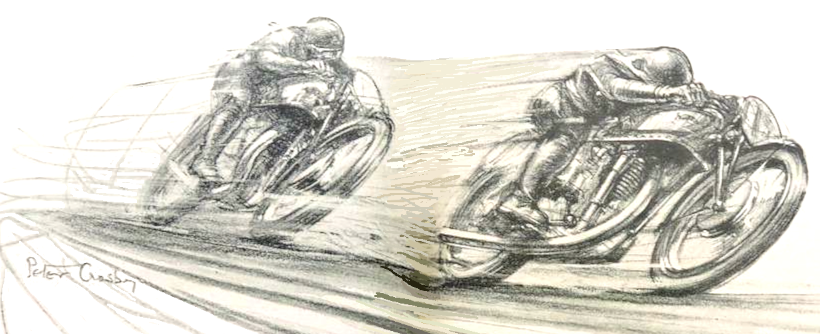
HAVING WON THE SENIOR and Junior TT for Norton in 1932 and 1933 Stanley Woods shocked the motor cycling public by switching to a Husqvarna V-twin for the Senior and a Guzzi in the Lightweight.. He was joined by Ernie Knott who rode a Husky in the Junior. Their Swedish team-mates Gunnar Kalén and Ragnar Sunnqvist were also formidable riders. For the first time since the Indian invasion of 1911 foreign bikes threatened British TT dominance.The other big news was that after a 13-year career, in which he made the first 60, 70 and 80mph TT laps without winning a race, Jimmy Simpson had decided to retire, but his swansong was to be his first outing in the Lightweight TT, on a Rudge—with Ernie Nott and Graham Walker also riding Rudges he was in good company. Over to TT Special editor Geoff Davison: “Nineteen-thirty-four was memorable for the first win by that brilliant but unlucky rider, Jim Simpson. He had been trying even longer than Graham Walker and, like Graham, having previously figured in the Junior and Senior, he won the first time he got astride a Lightweight. It was, I think, the most popular win the Island has over known. Jim, indeed, had a good year in 1934. He was a member of the Norton team in the Junior and Senior and rode a Rudge in the Lightweight. He won the Lightweight, made fastest lap on it and was second on his Norton in the Junior and Senior.
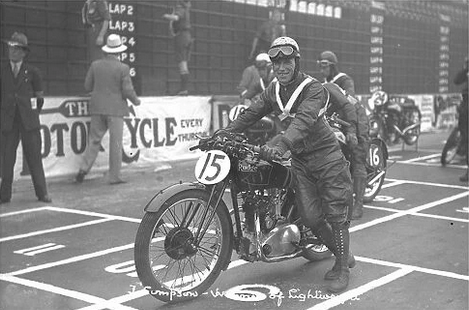
This was his thirteenth year in the TT and it proved a lucky one for him. He retired from the racing game when he got off his Norton at the end of the Senior race. The TT was never the same without him, but we couldn’t very well blame him for packing it in; he had certainly given at a good run. Good luck, Jim, long may you come to the Island as a ‘tradesman!’ Another ‘Jim’ came into his own in 1934—Jim Guthrie—who, on his Norton, won both Junior and Senior events. In the Junior he beat Jim Simpson by the narrow margin of nine seconds only, but in the Senior he had the substantial lead of over seven minutes. So began his long succession of Norton wins.” In wet and misty conditions Simpson led a Rudge whitewash in the Lightweight, followed by Nott and Walker. In the Junior Nott and his 350 Husqvarna could do nothing to stop Guthrie and Simpson running away with the race on their Nortons. He finished third, but six minutes behind the leaders. In the Senior the Nortons of Guthrie and Simpson faced a stern challenge from the Husqvarna duo. While Nott went out in the early stages, Guthrie was in brilliant form, holding Woods at bay with Simpson third. But 10 miles from the line Woods ran out of petrol, leaving Guthrie to complete the double. Simpson was second, with Velocette-mounted Ulsterman Walter Rusk third. During the first lap of the Lightweight, Syd Crabtree, the
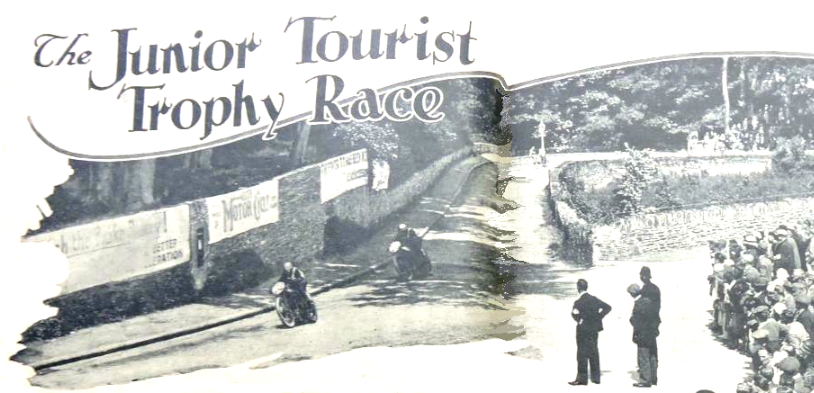
winner of the 1929 Lightweight race, crashed at the Stonebreakers Hut on the Mountain Section and was killed. The Blue ‘Un, naturally, recorded the action in more detail. Here’s an excerpt: “Leading throughout and averaging 71.16mph for the course of 264 miles 300 yards, James Guthrie, riding a 350cc Norton, won the Junior TT on Monday. Guthrie’s time was 3hr 20min 14sec. He was hotly pressed by JH Simpson, who held second place throughout and was never more than a minute behind; this margin he narrowed to 6sec on the fifth lap, finally to lose an exciting contest by only 9sec. For almost six laps the Norton trio—Guthrie, Simpson and Handley—led the procession at a terrific speed, hotly pursued by a horde of Velocettes, the solitary Swedish Husqvarna ridden by GE Nott, sandwiched among them; but at Governor’s Bridge, just as he was about to complete his sixth lap, Wal Handley took a bad toss and was so shaken that he could not continue. This unfortunate incident let up Newman (Velocette) to chase ‘the two Jimmies’, but he in turn was subsequently beaten for third place by Nott’s Husqvarna. From the technical standpoint the race was a triumph for mechanical reliability at extreme speeds, 16 machines completing the course out of the 27 starters. Honours were shared by Norton and Velocette riders for, whereas the Norton Jockeys comfortably annexed the two leading positions, 10 of the 11 Velocettes finished, to win the two team awards, the manufacturer’s team prize and the club team prize; the latter was won by the Velocettes constituting the BMCRC ‘B’ team. Guthrie broke the lap record on his second circuit,
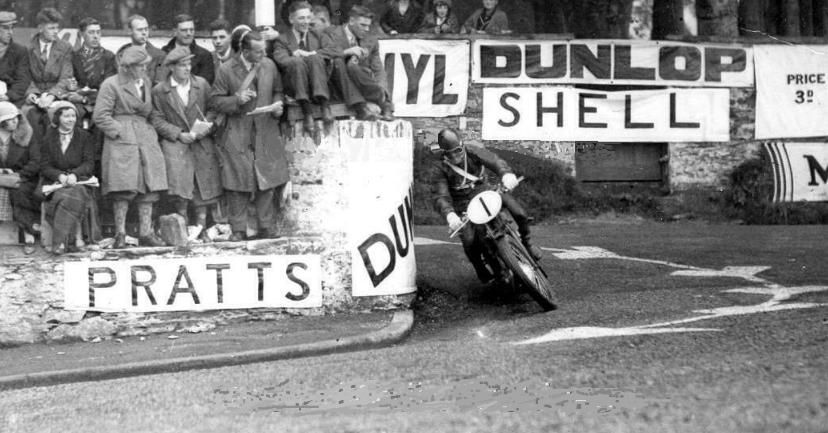
clocking 28min 16sec (80.11mph)—that is, 19sec better than the 1933 record. His total time was 2min 46sec better than that of last year’s winner, Woods (Norton). The Scotsman won the Lightweight TT on an AJS in 1930 and has four times occupied second place in TT races. Of the 16 survivors, the first 10 gained silver replicas, and the 11th to the 15th bronze replicas. Notwithstanding the terrific speeds on this ideal summer day, no serious accident marred what proved a magnificent race.” Results. Senior: 1, Jimmie Guthrie (Norton) 78.01mph; 2, Jimmie Simpson (Norton); 3, Walter Rusk (Velocette); 4, Les Archer (Velocette); 5, Vic Brittain (Norton); 6, Graham Walker (Rudge); 7, HG Tyrell Smith (AJS); 8, HE Newman (Velocette); Harold Daniell (AJS); 10, AJ Mitchell (Velocette); 39 starters, 13 finishers. Starters included three Husqvarnas and Sarolea and an Eysink. Junior: 1, Jimmie Guthrie (Norton) 79.16mph; 2, Jimmie Simpson (Norton); 3, Ernie Nott (Husqvarna); 4, HE Newman (Velocette); 5, AG Mitchell (Velocette); 6, Les Archer (Velocette); 7, Walter Rusk (Velocette); 8, F Aranda (Velocette); 9, Vic Brittain (Velocette); 10, HC Lamacraft (Velocette); 27 starters, 16 finishers. Lightweight: 1, Jimmie Simpson (Rudge) 70.81mph; 2, Ernie Nott (Rudge); 3, Graham Walker (Rudge); 4, Stanley Woods (Moto Guzzi); 5, Charlie Manders (New Imperial); 6, Sid Gleave (Excelsior); 7, Chris Tattersall (CTS); 8, Les G Martin (Cotton); 24 starters, 8 finishers.
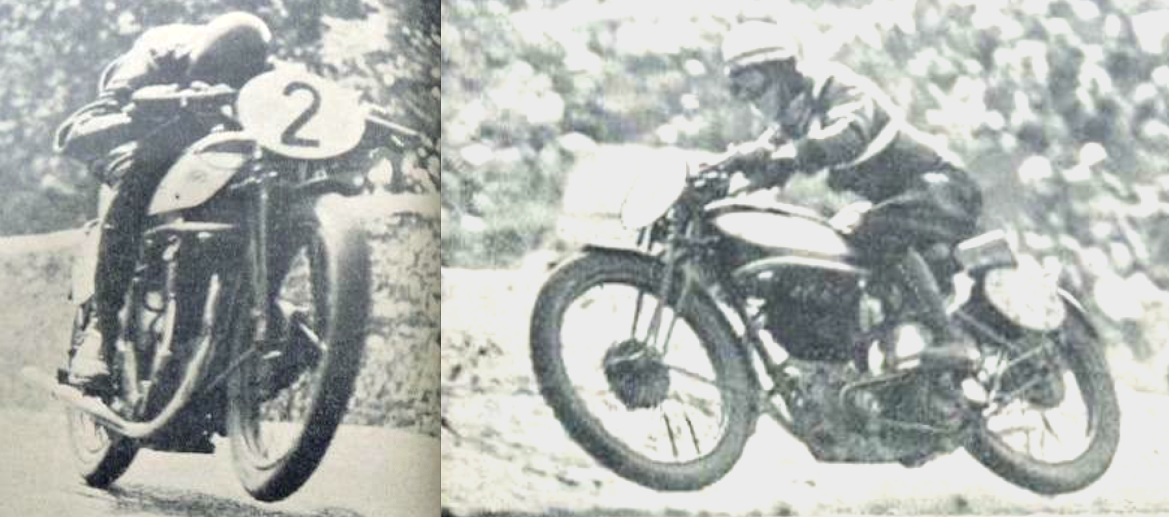
GUNNAR KALÉN MIGHT well have ridden a Husqvarna with distinction in the 1935 TT but it was not to be. Only a few weeks after the TT the world-class road- and ice-racing ace was killed in a motor cycle accident.
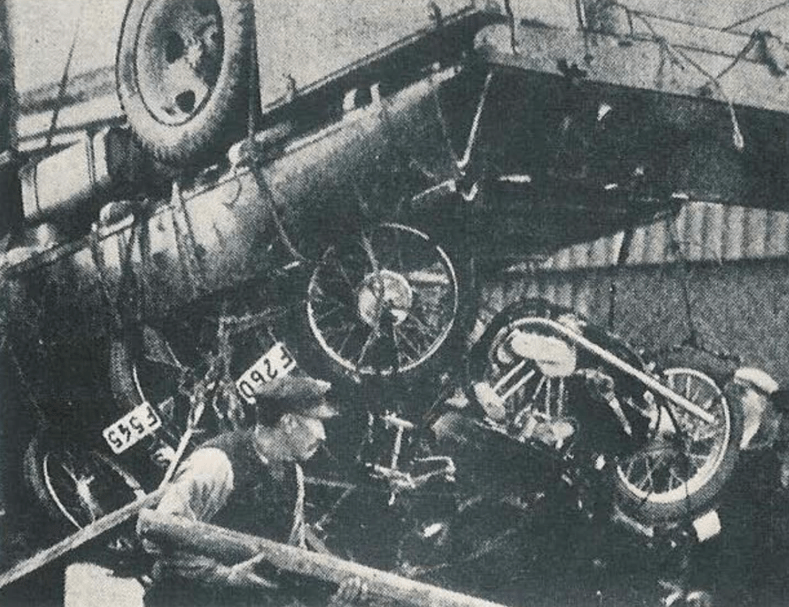
HUSQVARNA DESERVED A SPECIAL TT award for perseverance in the face of adversity. The race bikes were being loaded onto a freighter at Gothenburg docks when a cable snapped, dumping them from a great height and causing catastrophic damage. Frantic efforts got some of the tidy 50º V-twins patched up but as soon as he reached the Island works rider Ragnar Sunqvist collapsed with appedicitis. During Senior practice Stanley Woods rammed a sheep and snapped his front downtube (it didn’t do the sheep a lot of good either). Woods set a lap record and was running 2nd when he crashed, remounted…and ran out of fuel 10 miles from the flag. The Swedes’ only consolation was a brave 3rd spot in the Junior, courtesy of Ernie Nott (behind Guthrie and Simpson’s Nortons) despite a misfire and an oil leak onto the rear tyre which left him sliding all over the track.
OEC PLANNED TO DEMONSTRATE the superiority of its duplex steering over conventional forks by entering two bikes in the Lightweight TT—one with duplex, gthe other with girders—and a similar pair in the Senior. None of them finished.
NORTON HAD BUILT A 350cc version of its cammy 500 to challenge Velocette in the Junior TT; the Hall Green team returned the compliment with a cammy 500 which challenged Norton’s domination of the Senior. Walter Rusk was 3rd (behind Guthrie and Simpson’s Nortons) and another Velo was 4th. Cammy Ajays were 7th, 9th and 12th. But Norton’s 1-2-5 earned it the team prize.
THE MANX TYNWALD CONSIDERED a proposal for a ‘stock TT’ race for bog-standard roadsters. There was even talk of ACU officials picking bikes from dealeers’ showrooms to rule out unauthorised tuning.
“HALF A CROWN’S WORTH. At an auction sale in Bromley (Kent) a 1922 motor cycle in running order was sold for 2s 6d, and a three-wheeler (age not stated) for 20s.”
IN MAY 5,766 MOTOR CYCLES were registered: up 25% on May 1933. In response to the capacity-based roadtax system, the most popular classes were the 150s and 250s.

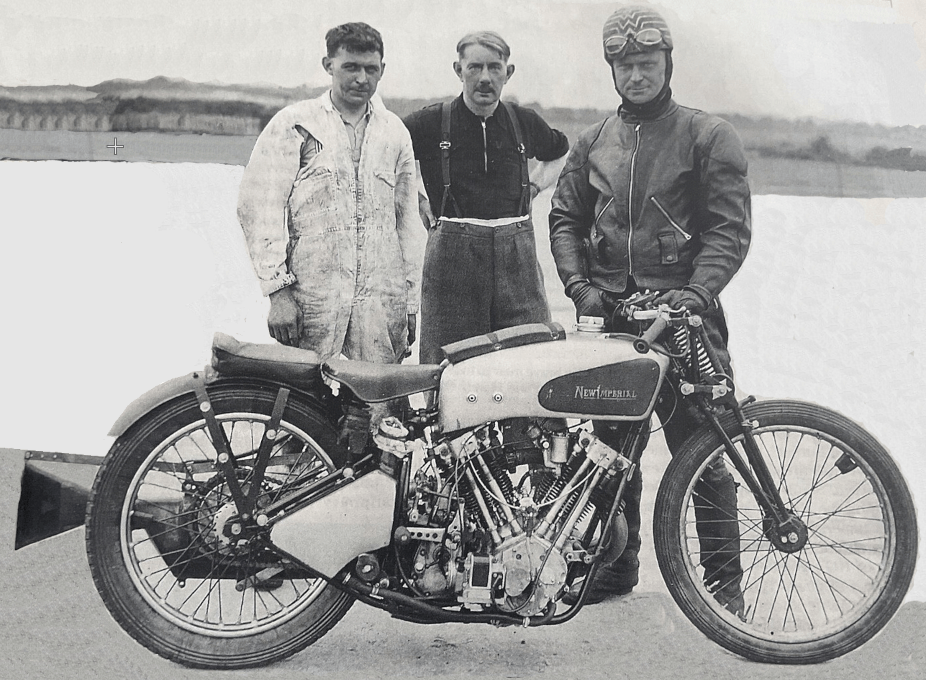
PETROL WAS BEING MADE from coal using a low-temperature ‘carbonisation’ process. The home-brewed ‘Coalite’ proved itself an admirable fuel for motorcycles with useful anti-knock properties, but all supplies were snapped up by the RAF. Popular Science magazine reported that a gallon of petrol could be made from 24lb of coal; a plant being built at Billingham-on-Tees was expected to produce 80,000 gallons of petrol every day. And now we import our fuel. You know it makes sense.
ENTHUSIASTS IN MORECAMBE, Lancs applied for permission to run a series of ’round the houses’ street races. Well, you can only ask.
THE BRITISH BIKE INDUSTRY was back on its feet, exporting three times as many bikes as France, Germany and the USA combined.
COTTON ADOPTED THE SLOGAN: “Each model the Rolls-Royce of its class”. One wonders how Messrs Rolls, Royce (and Brough) reacted.
THE BURGESS PRODUCTS CO of Leicester offered a screwdriver incorporating an electric light powered by batteries in its aluminium handle. Also new on the aftermarket was a unit combining rear light, brake light and indicators.

“A SPLENDID COURSE, difficult but fair and sporting, and excellent detail organisation, enabled the third of the series of ACU Inter-Centre Team Championships to triumph over the varied and tempestuous weather that swept over North-East Derbyshire last Saturday. The course lay in the area between Baslow and the outskirts of Sheffield—a district that abounds in trials stuff, from mud to rocks. It is the happy hunting-ground of the South Yorkshire Group, and chief marshal Norman Dixon of that Group (doubling the role of route-marker in chief) had excelled himself. Actually the circuit of 46 miles seemed fairly harmless—indeed, it was criticised by some as rather tame—but it proved amply sufficient to eliminate six of the Centres from the contest by one or more retirements, and the six that finished complete teams of five solo and one passenger machine were reasonably well separated. No Individual Award As this is purely a Centre-vs-Centre event there is no individual award, which is surely a pity, for there is no doubt that Bert Perrigo (348cc BSA) of the Midland Centre, and Jack White (348cc Ariel), of the Southern Centre, deserve the fullest credit for completing the two circuits without the loss of a single mark. No sidecar got through without fairly heavy losses, and Dennis Mansell’s effort with the 490cc Norton ‘chair’ was so outstandingly good in comparison with the rest that the onlooking recorder of motor cycle history can best accept the words of a sidecar driver who finished not nearly so high up. ‘Mansell’s performance,’ he said, ‘is an achievement to be proud about.’…By the time Callow Bank on the second circuit was reached the wind had dropped enough to let the rain descend, and the unsheltered hillside was swept clear of spectators. There were fewer failures, but a great deal more footing, riders probably having decided that it was better to foot and finish than to fail and fade away. The worst of the remaining sections, thanks to the downpour, was undoubtedly Car Top, and here, only about seven miles from the finish, the Midland Centre had its first stop recorded against none other than Vic Brittain, who plunged off the narrow path into a tree behind which the MC scribe hurriedly
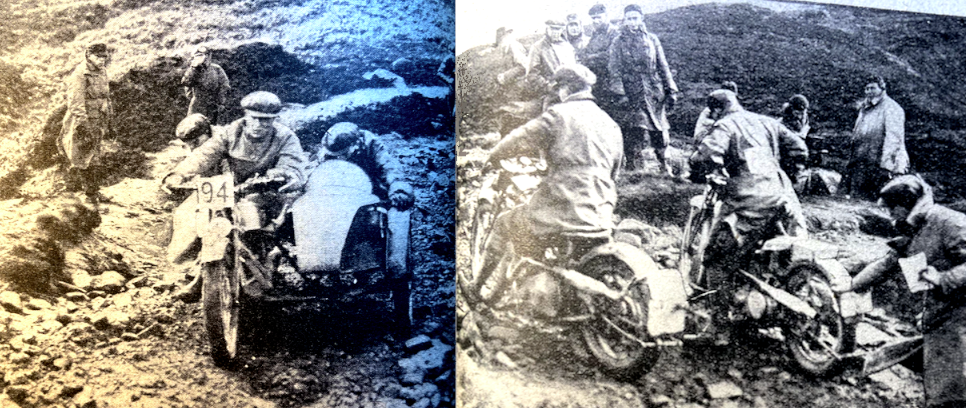
dodged. After an exchange of greetings Vic straightened out his front number plate and continued on his way. Even Len Heath (497cc Ariel), South Eastern, use put down a foot, but that was because he chose an unlucky course. Those who travelled fast and up the middle of the track fared the best for there was a hard base under the muddy surface. Jack Williams (348cc Norton), Western. was positively great, while WA West (248cc AJS), South Midland ; Colin Edge (349cc Rudge), Cheshire; LG Holdsworth (346cc New Imperial), South Midland; Miss Cottle (348cc BSA), Midland; and EJ Heath (497cc Ariel), South Eastern, all made perfect, normally seated, progress. So, too, did C Helm (493cc Sunbeam) and A Jefferies (493cc Triumph), both of Yorkshire. GF Povey (499cc BSA), Midland, was really fast, while E Blake (493cc Triumph), Yorkshire, stood high on the rests and made some cyclists among the spectators imagine that he was ‘showing off’ his trick-riding abilities! The same onlookers certainly lost a few heart-beats when George Rowley appeared. George saw mud, his brain said, ‘Gas!’ and his hand twisted the throttle round to its stop. The AJS was out of the observed section before it had time to skid! Thacker (247cc Royal Enfield), Midland, was another who opened out at the sight of trouble; and so did Mansell, whose Norton outfit just roared up; CH Westwood (496cc Raleigh sc), Southern, was another ‘full marks’ exponent. F Grove’s (493cc Triumph sc), South Midland, passenger earned a paragraph for himself. The tail of the sidecar body dropped off at Riley’s Rise on the first circuit, and he completed the rest of the trial kneeling on what remained of the floor. He deserves nothing less of his Centre than a Sorbo-stuffed kneeling mat embroidered with club colours. Results. First, Midland Centre; second, Yorkshire Centre; third, South-Eastern Centre; fourth, Cheshire Centre; fifth, Southern Centre; sixth, South Midland Centre.”
IN AN OBITUARY OF Belgian King Albert it was revealed that his love of motorcycling extended to incognito late night runs. And one snooty hotelier must have been mortified when he was told the identity of the mud-splattered rider he had just turned away.
IN JAPAN MIYATA launched a 175cc 5hp two-stroke, the Asahi. It featured a channel, rather than a tubular, frame because channel steel was cheaper and more readily available. To prove their durability a batch of prototypes were ridden from Tokyo to Osaka. The expedition included three Miyata engineers—and a brace of researchers from the Automobile Department of Tokyo’s Rikkyō University.
EAST END MANUFACTURER Lewis Benn & Co marketed a combined clutch lever and twistgrip gearchange of the type later adopted on many motor scooters.
THE MINISTRY OF TRANSPORT authorised the local council in Oxford to impose a 30mph speed limit and Southampton to enforce a 15mph limit on its dock roads. Transport Minister Hore-Belisha considered dropping plans for a nationwide 30mph urban limit depending on the success of the new black and white ‘zebra’ pedestrian crossings with their orange flashing ‘Belisha beacons’.
SOME COIL-IGNITION MODELS were fitted with ignition keys. A pundit observed: “A key that you can take away with you when you leave the bus parked is an excellent scheme; you go away feeling happy because you know that no one will be able to start the engine.” But as those first ignition locks could be turned by a penknife blade or a coin they were, he admitted, “just about useless”. Some ignition ‘locks’ were no better 30 years later.
THE WINNER OF THE Around Japan Endurance Race covered 3,565 miles in 14 days 13 hours.
THE JAPANESE WERE CLEARLY exceedingly good at counting. The Tokyo Statistical Association recorded that the country had exactly 70,481 motorised passenger vehicles and 42,049 commercial vehicles. They competed for road space with 23,247 rickshaws and 1,320 horse-drawn passenger vehicles. To put those figures in perspective horses were hauling 299,702 cargo wagons, and another 111,146 relied on ox power. So no danger of Japan taking on the European and American motor cycle industries then…
IN JAPAN MIZUHO MOTORS was one of a number of firms to send observers to the Rikuo factory which used modern production facilities it had learned from Harley Davidson. Thus inspired it began production of the 500cc Cabton, which bore far more than a passing resemblance to the Ariel Red Hunter. The Tokyo Motor Parts Production Association, baqsed in Tokyo, produced the Aikoku (Patriot) motor cycle.
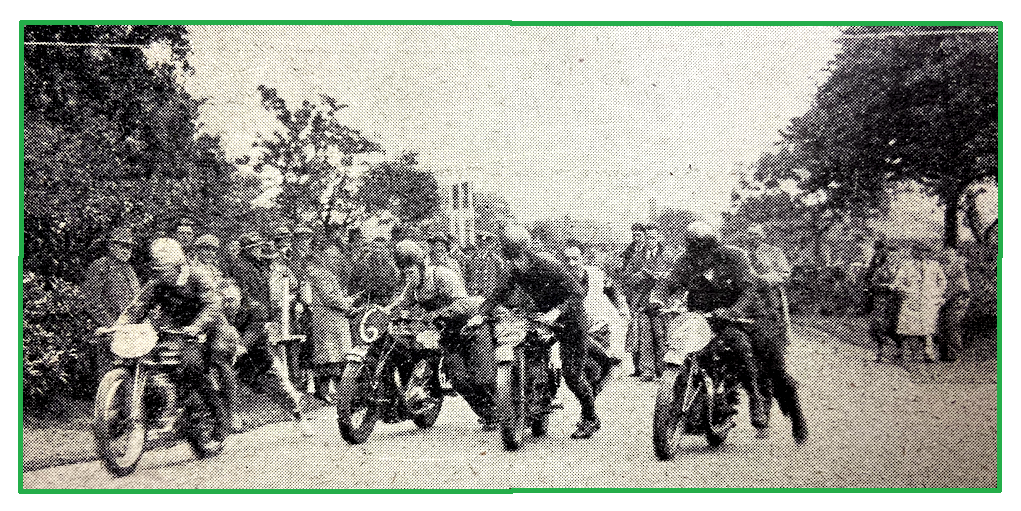
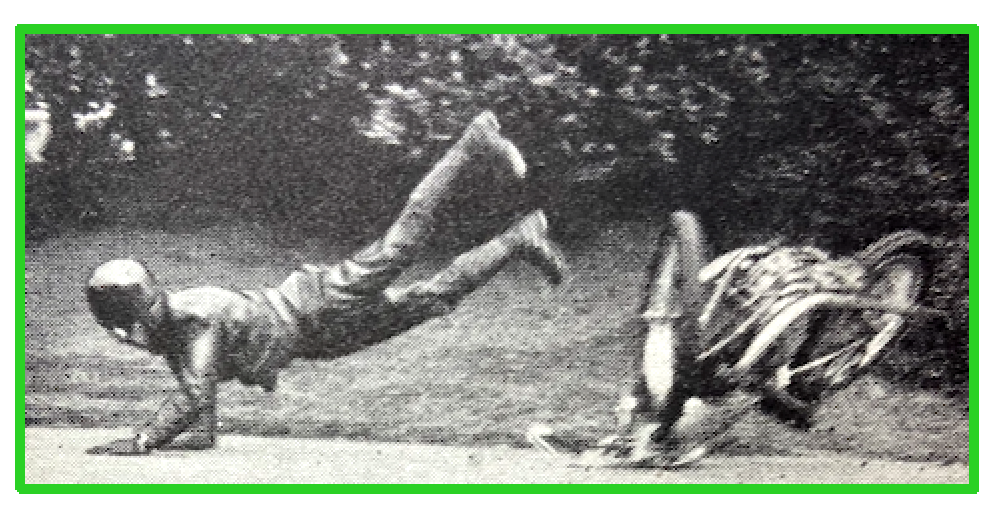
“FOR SHEER THRILLS, SMALL circuit ‘road racing’ leaves some of the world-famous start-at-intervals events rather cold. On Saturday the Hanley Park-Horticultural Show gave the Stoke-on-Trent MCC a chance to perform there, and the site is a delightful one for the purpose. According to the book of words, the park was a ‘tip’ 40 years ago. But that doesn’t matter now, for its little islet-dotted lake and its trees are all very pretty. Round the lake is a semi-circular asphalt path, the semi-circle resulting, of course, in too fairly abrupt turns where the diameter crosses- its sweep. The circuit is 756 yards long. The diameter, incidentally, does not conform to that definition of a straight line which says that it is the shortest distance between two points! In Heat 1 of the first event (for North Staffordshire riders) WH Hassell (499cc Rudge) failed to get his motor going, and GF Hurst (348cc Velocette) ‘parted’ very suddenly at Boughey Gate corner, which was expected to catch the over-enthusiastic. V Challinor, on a very posh Velo, amid much local enthusiasm, romped home in his heat. and N Boulton (494cc Douglas) did the same in the next, although Boughey Gate nearly proved his undoing, as indeed it did completely in the case of J Molineux, also on a Douglas. Boulton could not join the final, however, for his engine was turning out clouds of smoke from where no smoke should come. H Bagnall (348cc Velocette) got right away from the start, and a desperate last lap only brought Challinor within a second of him…In the unlimited cc race Les Kitchen made the best tine of the day by covering the six laps at 40.27mph after lying second for three laps.and thereby won a special prize, value £5.”
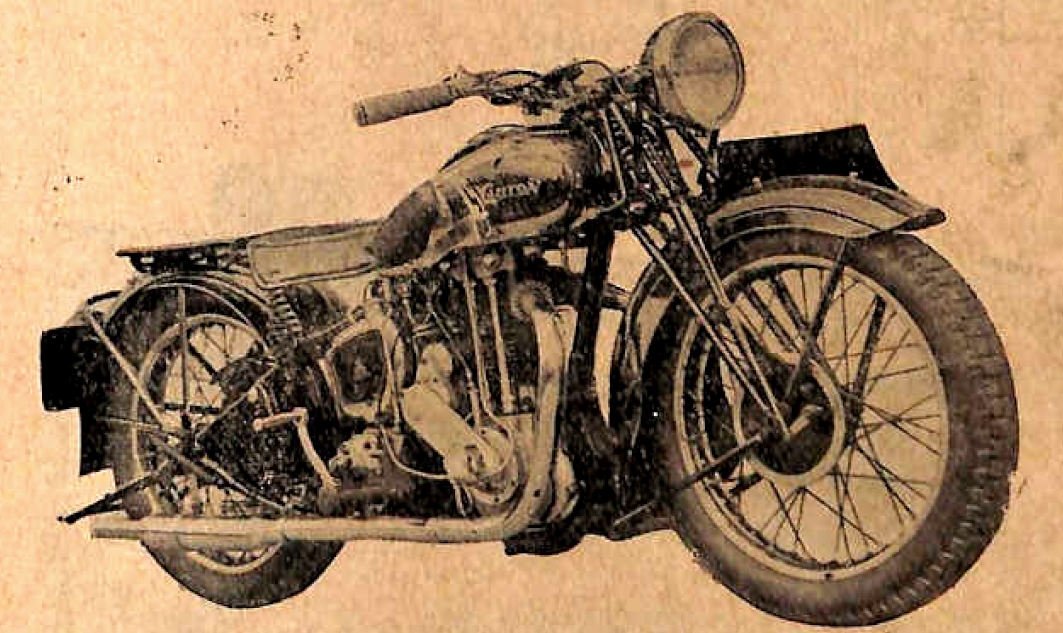
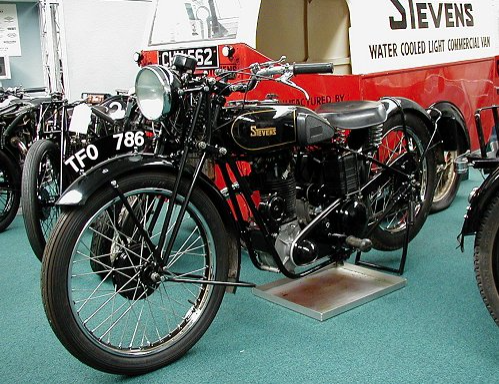
HAVING SOLD THE AJS NAME to Matchless the Stevens brothers got back to their roots by building a three-wheel delivery van before getting back into the bike business. Their first model, designed by Harry Stevens, was an ohv 250 marketed as the DS1 and US2 (which boasted a high-level exhaust). They were fitted with four-speed Burman boxes and Lucas Magdynos, both models were priced at £51. The company operated on a hand-to-mouth basis. Bikes were built in batches of 12; work couldn’t start on a new batch until the previous batch was sold. Despite the lack of equipment and basic facilities the Stevens impressed the Blue ‘Un and Green ‘Un roadtesters.
MOTORCYCLE INSURANCE PREMIUMS rocketed by 50% to cover passengers because many riders hadn’t bothered to take out pillion insurance. One angry rider compared the move with imprisoning the entire population because some people steal. One peer waved his copy of The Motor Cycle during a debate in the Lords, pointing out that many thousands of motor cyclists were being forcedf to take out pillion insurance even though their machines were not equipped to carry pillion passengers.
MOTORCYCLE ROADTAX WAS REDUCED (yes, really!) to 12s (60p) up to 150cc, £1 2s 6d (£1 12.5p) for 250cc and £2 5s (£2 25p) for anything over 250cc. Fuel tax also came down, by 1d (2.4p) a gallon.
THE FINAL CHECKPOINT of the ACU Rally moved from the Barnet Speedway to the new Donington Park circuit and was a great success. During the winter the circuit had been widened to accommodate car races; trees and undergrowth had been cleared to cure blindspots; the track had been extended to 2.55 miles; proper stands had been erected and facilities for competitors and spectators were installed.
TRANSPORT MINISTER LESLIE Hore-Belisha approved the installation of illuminated beacons on pedestrian crossings; inevitably they were dubbed Belisha beacons.
BELFAST RIDER WALTER RUSK, known as the Blond Bombshell (these were innocent days) rode his Velo to victory in the Ulster Senior TT, setting a lap record of 92.1mph; he finished second in the European 350cc championship which, that year, was decided at the Dutch TT where the 500cc winner and thus European champion was Pol Demeuter.
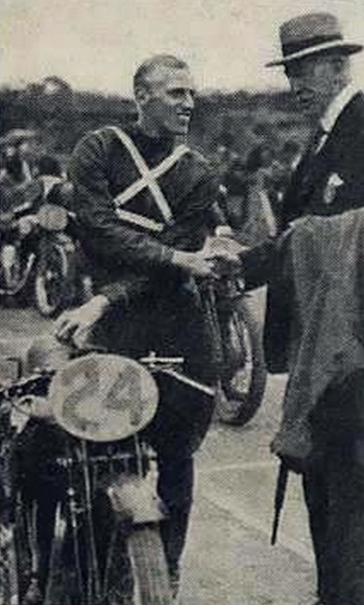
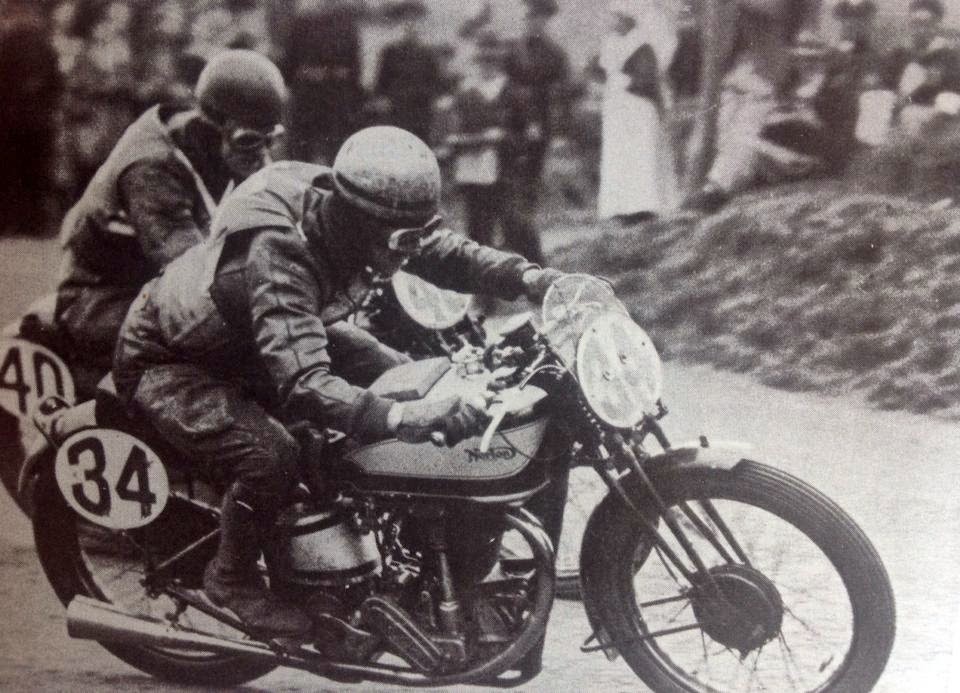
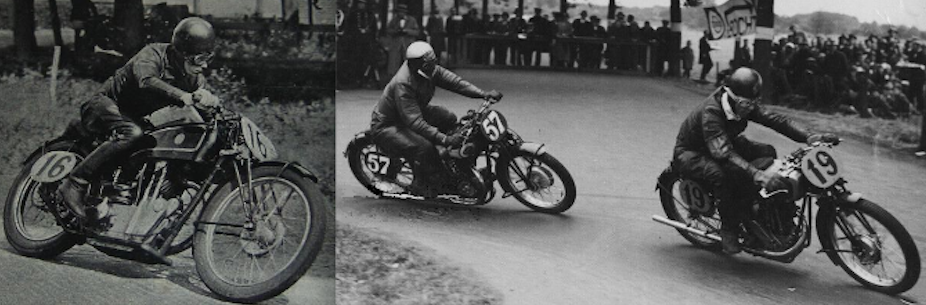
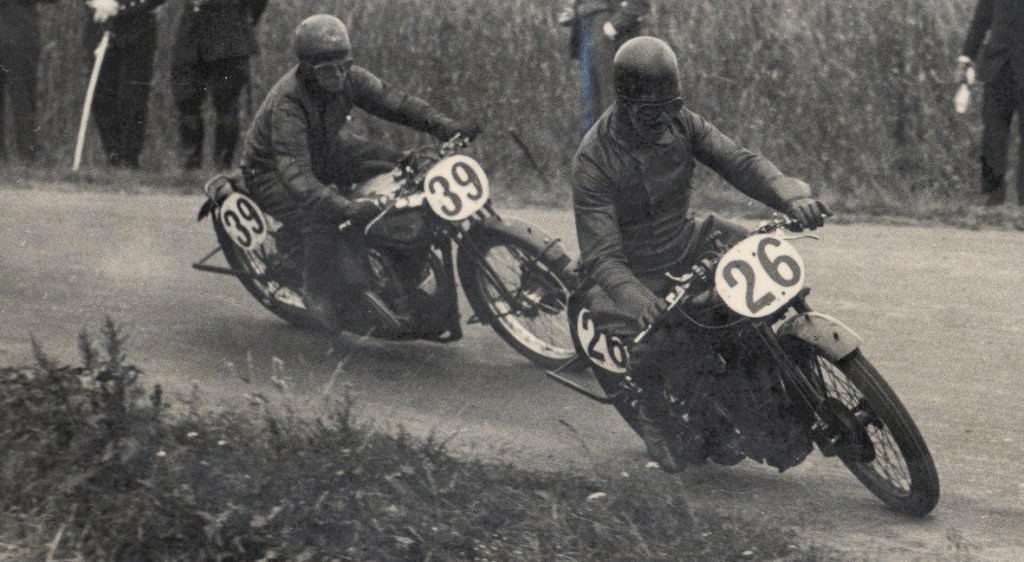
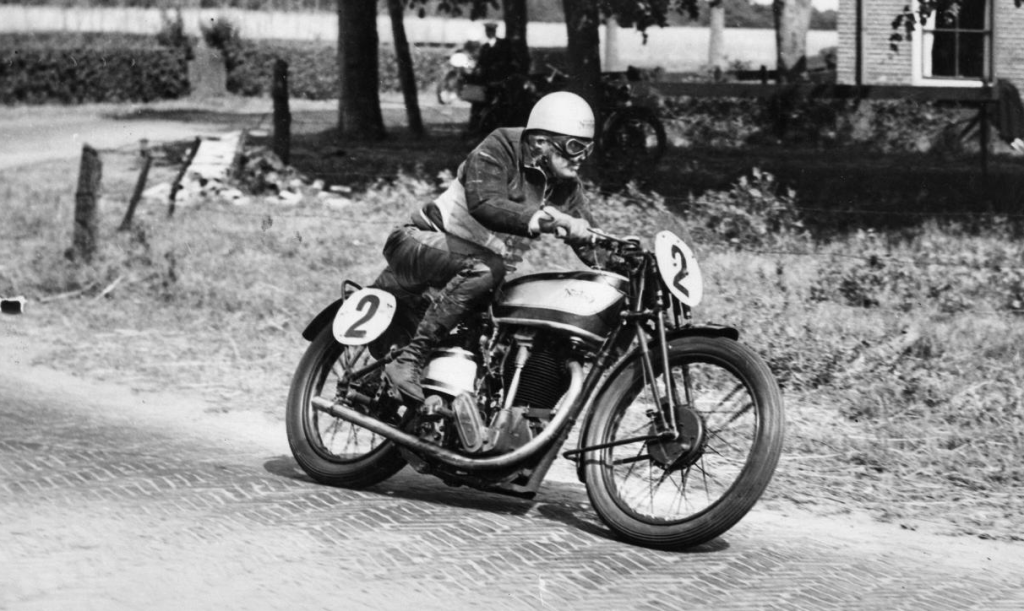
“THE FRENCH RIDER AMORT, driving a 600cc Gnome-Rhone sidecar outfit, has secured the 600cc and 1,000cc sidecar hour records with a speed of 91.8mph. The successful attempt was made at Montlhery track.” The 600cc record was previously held by the Belgians, Debay and Milhoux, with a Belgian Gillet machine at 89.28mph. In the 1,000cc class the record was held previously by CF Temple (OEC Temple sc) at a speed of 89.4mph.”

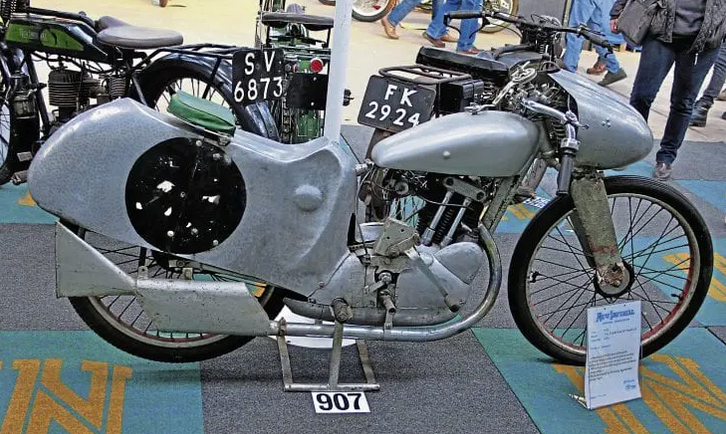
ALL RIDERS OVER A CERTAIN age will be familiar with the phrase ‘running on rails’ to describe a bike with trustworthy roadholding; Firestone coined the phrase to promote its tyres for riders who “want to make faster averages in perfect safety”.
“THE BUSIEST SPOT AT which the AA’s 77-hour census was conducted this year was in the North of England, at Mere Corner, on the Knutsford-Warrington road, where 113,705 vehicles were re-corded, an increase of 11% over the 1933 figure. Last year, Esher, on the Portsmouth road, provided the heaviest volume of traffic; this year it was fourth. Second and third came Putney Hill, on the London-Portsmouth road (109,095 vehicles), and South Mimms, Barnet Bypass (90,663 vehicles).”
CAT’S EYES WERE INVENTED by Percy Shaw of Halifax who, according to legend, was inspired by the way cat’s eyes reflect the light. So if the cat had been facing the other way Percy might have invented a pencil sharpener. (Thank you, I’m here all week.)
PUNITIVE GERMAN IMPORT DUTIES kept imported bikes away from the Berlin show where centre stage was taken by a 500cc parallel-twin two-stroke DKW complete with electric start. DKW was now the world’s largest motorcycle manufacturer and Germany had become a global centre of motorcycling, with over 750,000 riders. As part of its military build-up the Nazi regime was pouring resources into motorcycling, ensuring the German marques worked together to produce a complementary range of models and running military-style training camps for riders. Ernst Henne rode the big blown Beemer to break his own world speed record and raise the flying kilometre bar to 152.90mph.
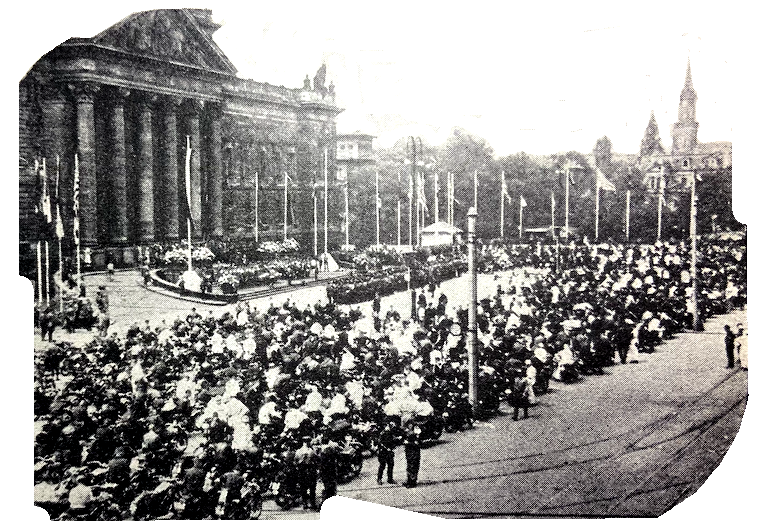
“I HAVE OFTEN WONDERED what exactly is that curious cameraderie which links together motor cyclists of all ages and experience. It is a far stronger bond than I have ever struck in any other sport, hobby, pastime—call it what you will. How often does one see one car driver stop to help another who is broken down? Very rarely. I do many thousands of miles a year both by car and motor cycle, and I must admit I very rarely stop to help a stationary car—perhaps it is that I have been snubbed too frequently! Yet, time and time again, whether I am driving car or bike, I stop to help, or offer help to, motor cyclists who are obviously in trouble. Frequently no help has been needed, but many a pleasant quarter of an hour has been spent with a cigarette and a chat. On other occasions I have worked for half an hour or more on somebody else’s machine, or perhaps towed it for miles, and I have really enjoyed it! Why is it? What a pity it is that more motorists do not start their motoring career on a two-wheeler—preferably an old one! They would soon learn all about the simplest principles of a motor engine as well as acquiring a lot of road sense. It might also lead to more of the ‘live and let live’ spirit among motorists, as there is no doubt that the really experienced motor cyclist is the most tolerant of road-users.”
Graham Walker had a reputation as a formidable motor cycle racer—and as an affable racconteur. The Blue ‘Un ran a series of his yarns; including this one…
“THE FRENCH GRAND PRIX at St Gaudens in 1927 provided the funniest massed start I can remember. In the front rank were George Rowley, Joe Craig, Stanley Woods and myself. Ahead was a short but quite steep rise. The starter raised his flag, and bad only got as far as “Cinq—quatre—” when George let in his clutch and departed at velocity. For a second or two there was an astounded silence while George disappeared over the brow. Then, with a roar, ‘the pack’ recovered consciousness as one man. Within a minute I nearly fell off through laughing—Joe Craig had sworn a mighty oath that he would not put on his brakes until Stanley did. Joe sat on Stanley’s tail, with his eyes glued on Stanley’s braking foot. But Stanley had forgotten a sharp downhill left bend. One second these two aces were before me, the next second they had disappeared from human ken! As I took the bend I looked round to see a familiar form arising Aphrodite-like from a deep ditch. It was Joe, yet he subsequently went on to win. Probably because it is our own country, ‘the troops’ have never done anything exceptionally daft in the Island, but the races themselves have provided a lot of quiet humour. A never-to-be-forgotten sensation was caused by a certain rider who has since won the TT on more than one occasion.

He turned up to begin his very first Isle of Man practice lap, only to dash off in the mist—towards Governor’s Bridge, in the reverse direction of the course! In 1923 Nortons used back brakes consisting of wee fabric blocks working in a dummy belt rim. I’m sure Mr Mansell will forgive me if I suggest that long life was not their speciality. The Senior that year was very wet and misty, with poor visibility. Arriving at Signpost Corner rather abruptly in the third lap I trod on the brake, but to no good purpose. I charged down the slip-road, catching the marshal between the legs. Barely had he returned to duty than Tommy Simister’s Norton made him run like a hare. Having recovered some breath and a little dignity, he once more manfully filled the breach, only to be charged by another Norton, this time Graeme Black’s. For the remainder of the race he memorised the Norton numbers and made a rush for the bank each time we came round…The same year saw the first Sidecar TT, and I passed a few forcible remarks about the old Keppel Gate post, which occupied the middle of an already all-too-narrow road. A few days later a porter and truck arrived at my garage bearing the 7ft 6in gatepost, suitably decorated with a wreath of spring vegetables. It came ‘with the compliments of Mr Watson-Bourne” who, it transpired, had repaired to Keppel at dead of night in a taxi armed with a spade. I had the post in my pit for a mascot during the race; but it was too big to keep, so, being honest, I returned it to the Council in due course. Writing of that wreath reminds me of Germany, where it is the custom to present an enormous wreath to the winner. The famous Nürburg Ring was opened in 1927 with the Grand Prix of Nations, and I had the good fortune to win the 500cc race. Our German hosts decided to throw a dinner of celebration for the prize-winners, and it was thrown with typical Teutonic thoroughness. Many had fallen by the wayside during the course of the evening, but it was not until the early hours of the morning that we decided to call it ‘game and set’. The village of Adenau is long and straggling, and my digs were at the opposite end to the scene of the celebration. I was assured that I most be escorted home with musical honours, and, believe me, the full moon looked down on a queer crew when we assembled outside. The cavalcade then set off, and to my dying day I will never forget the ‘musical honours’. These were furnished by a 6ft 4in man carrying a portable gramophone, and a 4ft 6in man winding it up as we marched along! The fun was enhanced by the sight of a fat little man in a short nightshirt dancing on the sill of a large window silhouetted against the bedroom light. As we passed, a stentorian female voice from the interior caused his collapse backwards; I hope he wasn’t hurt. I regret to say that I had the key of the billet in my pocket, and I subsequently found my mechanic fast asleep on the roof of the porch,

after an abortive attempt to gain access through a bedroom window; and a certain famous tyre-fitter was snoring peacefully, with three cows and some chickens, in a shed at the back. As a final reminiscence, here is one which started in Spain and finished in France, and, incidentally, nearly finished me—with fright. In 1932 I had competed in the Spanish TT, and was due in Italy the next week for the International Six Days. This meant a hasty scramble back to England for 48 hours before crossing again. Spain is a delightful country; but rather given to the motto, ‘To-morrow will do’. This applies to train connections, among other things. To add to the bother, General Sanjurgo had decided to have a little revolution that week, with the result that the frontier guards were a trifle suspicious. After sundry adventures at San Sebastian where the machines had to be forced crosswise on the end platforms of the glorified tramcars used as railway carriages, leaving about a millimetre clearance for our front and rear wheels in the tunnels), we struck trouble at the frontier station of Irun. Deserting in the face of the enemy, I collared the interpreter, bribed the engine driver to detach one coach, and, leaving my machine to my friends to look after, made a dash for it. We pulled into Hendaye, on the French side, just in time to see the Paris express leaving. Consternation! I was undone! But not so my interpreter. Being a man of spirit, he quoth: ‘Meester Valker—you catcha da train.’ Mark you, it was a statement, not a question. He ran, I ran. He shouted; a genii appeared who chalked hieroglyphics on my bag as I ran; another sprite performed with a rubber stamp on my passport. Then, as if in a transformation scene in the pantomime, I found myself on the rear seat of an enormous Minerva. Someone named a sum of money, the equivalent of £2. I said ‘Oui,’ and away we went. I shall never, never forget that journey; it was 42km (about 26 miles) from Hendaye to Bayonne, and I think we must have done it in ‘evens’. With head lights glaring, Jehu dipped for no man. Frightened pedestrians and startled car drivers dived to left and right as we thundered uphill and down dale like a death-dealing projectile. Certain that my last hour had come, and unable to face it sitting down, I hung like Tarzan of the Apes with my arms through the looped straps which the coachbuilder had thoughtfully provided. Not a word passed until, as we topped a hill, Jehu half turned and, pointing to a wriggling glow-worm in the depths of the I valley below, said succinctly: ‘Voila, le train!’ and I knew we had won. But at what a cost, for I shall never be the same man again. Executing a complete about-turn dirt-track skid, my my driver came to a stop at the station entrance, and it was at this point that I should have laughed if my teeth had not been chattering, for I’d forgotten get any French money before crossing the border. ‘So Jehu got an English pound and the equivalent of another in pesetas. I gathered from his remarks that pesetas were not considered a joke in good taste in France. Ah! well! Time rolls along and the riders get older. With the passing of the years, I fear, we have exchanged a crude sense of humour for a rather glum sense of propriety, the incidents I have quoted having almost faded into the limbo of the forgotten. May we be forgiven our sins of the past! I think they have been forgiven, because the very people we sinned against are now friends of many years’ standing who welcome us with open arms every succeeding year when we go abroad.”
“REGISTRATION FIGURES OF NEW motor cycles for May 1934, just issued, show an increase of nearly 25% over the figures for the corresponding period a year ago. The total for the month is 5,766 machines. The most striking gains recorded in the figures for the various classes are : Three-wheelers, 600 (440 in May 1933); 150-250cc solos, 2,159 (1,529); and over-250cc solos, 1,720 (1,472).”
“A NIGHTMARE MODEL. Motor cycle events figured at a sports meeting recently held by the BSA Company in the ground beside the factory. A lighter note was struck by attempts to ride a Heath Robinsonian motor cycle with a handlebar like a joy-stick, no foot-rests, a rocking saddle perched aloft, wheels out of track, and with eccentric hubs. Athletic events, car and motor cycle obstacle races were all run off with commendable slickness.”
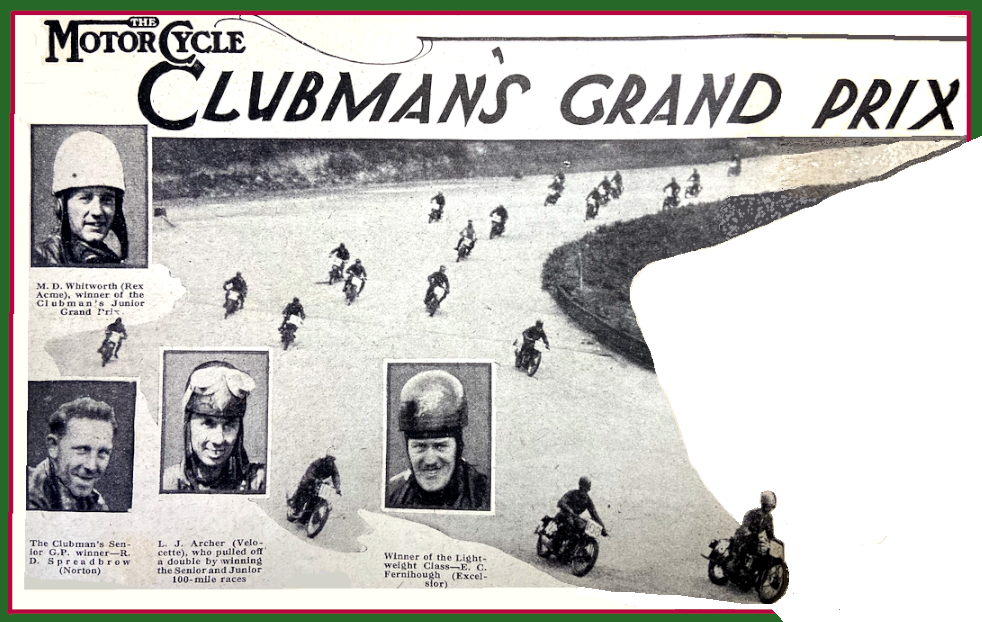
LAST SATURDAY BROOKLANDS PROVIDED a really large crowd with many hours of intense excitement. It was The Motor Cycle Clubman’s Grand Prix day, and several novel schemes were tried. First and foremost were the two 50-mile races for clubmen, both events attracting large entries—the Senior race had 44 to its credit. Secondly, a 250cc class was instituted and run off concurrently with the 100-mile Junior Grand Prix. Thirdly; a new and very fast ‘road’ circuit was used. The task set the riders was to negotiate the left bend off the Finishing Straight on to the Members’ Banking; thence down the Railway Straight, and round the ‘Byfleet’ to the Fork. Here, at the Fork, was the first interesting point. The track was littered with ‘furniture’ which, on close examination, proved to be barrels and oil cans arranged to form fast, alternate left and right bends leading down the Finishing Straight, where, opposite the Members’ Enclosure, was placed some more ‘furniture’ indicating a fast right-left S-bend…and so past the start again. Altogether the circuit was 2.616 miles to the lap and, under the conditions, all due credit must go to LJ Archer and his Velocettes—a combination which pulled off a very wonderful double in the Senior and Junior 100-mile races for Bemsee men and those who have competed in International road races. The actual racing was not so exciting as might have been expected. In each case the winner gradually increased his lead sufficiently to enable him to sit pretty. The real interest centred round the ‘furniture’—which suffered heavily. In nearly every race the barrels and oil drums were sent flying, which was immense fun for the officials who attempted to rescue the barrels, and for the riders who did their best to avoid hitting both. Phenomenal avoidances were the order of the day. Professor AM Low was being cheerfully amusing over the loud speakers when promptly at 1.30pm the five riders in the Lightweight race were sent off. Ten minutes later the 350cc class were after them with a deafening roar—off like a flash, to use a cliché. Fernihough (246cc Excelsior) took the lead from CK Mortimer (246cc New Imperial) after the second lap, and from then onwards proceeded to sit on his lead, frequently looking behind to see that no one in his class came too near. In the 350cc Class HE Newman (348cc Velocette) led Archer on a similar, but later, type of machine for several laps, with HC Larnacraft and HJ Bacon, also on ,Velocettes, M the near distance. C. B. Bickell (346 Excelsior) was lying fifth until a frantic skid sent him in between the barrels on

the bend by the Paddock Grandstand. Meanwhile Archer set about asserting himself .and, by brilliant cornerwork was soon ahead of Newman. Bacon had crept into third place in front of Lamacraft—an order which was to be maintained to the finish. At twenty laps Archer had averaged 76.75mph, and had a big lead over his nearest rival. In the background were HL Daniell (348cc Norton) and R Harris (348cc Norton), who were having a little scrap on their own. By three-quarter distance Fernihough was still leading the Lightweights, but T. Cogan-Verney (New Imperial) was now second, Mortimer, on a similar machine, having dropped back to third place through plug trouble. Soon Archer was flagged in, the winner of the 350cc Class. Then came Newman, Bacon and Larnacraft—a fine sequence of Velocettes. Fernihough was the winner of the Lightweight, with Cogan-Verney and Mortimer second and third respectively. In the third event, the 50-mile Clubman’s Junior Grand Prix, the spectators received a foretaste of what was to come. At the end of the first lap MD Whitworth (349cc Rex Acme-Blackburne) was well away in front, with BA Loveday (348cc Velocette) close behind. Then WF Cullingham (346cc Levis) came unstuck up at the Fork bends, to be followed by GVC Davies (346cc
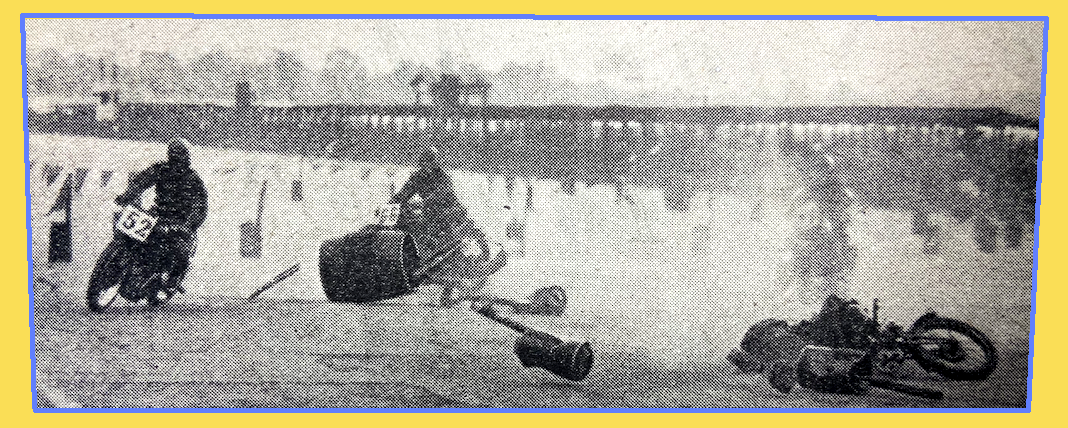
New Imperial). Down by the start IB Wickstead (348cc Cotton-Blackburne) hit the unfortunate barrels and then the safety fence opposite the timekeepers, but, strange to relate, remained in the saddle. Then J Edmond (New Imperial) rode through the bunting which decorated the ‘furniture’, having decided to retire owing to a defective foot gear change. Trevor Smith (348cc Velocette), who was riding the bends very prettily, was apparently suffering from a similar trouble. He, however, managed to finish fourth, which was considerably lower than might otherwise have been the case. A Paul (348cc Velocette) was third, with Whitworth and BA Loveday first and second respectively. Event 4, the 100-mile Senior Grand Prix, was undoubtedly the race of the afternoon. After a spectacular start, GE Nott (499cc Rudge) led for the first two laps, closely followed by Archer (495cc Velocette) and JH White (490cc Norton). Second lap saw DJ Pirie (490cc Norton) broadside and say good-bye to the model right in the middle of the bend by the Paddock Grandstand. For the next few seconds chaos reigned. Barrels, posts, flags and officials went flying, while some 20 riders screamed through the melee and, strange to relate, no one was hurt, not even Pirie, who was unconcernedly straightening a bent footrest prior to continuing. In a very short time Ernie Nott’s almost proverbial bad luck once again let him down, and he coasted in to to retire. Up at the Fork Jock Forbes was to be seen sitting watching the racing, having been put out with a punctured float. Meanwhile ‘Ginger’ Wood and his twin New Imperial had passed ‘Crasher’ White and now lay second, but the stop watch fiends saw only too clearly that he was losing about 2 seconds a lap on the flying Archer. However, his cornering was a thing to marvel at, being seemingly twice as fast as that of anyone else. No sooner out of each corner than he reset his steering damper with a flourishing twiddle of the wrist. Another whose cornering drew general admiration was DJ Pirie, whose Norton seemed none the worse for its spill. At one time White was overtaken by CB Bickell (497cc Ariel), but not for long, since the latter soon retired, letting D Ovens (490cc Norton) into fourth place. But Ovens was not allowed to remain there long; R Harris, also on a Norton, closely followed by JH West (498cc Triumph), came up and displaced him. Soon the winner, Les Archer, was flagged; then Ginger Wood—but Where was ‘Crasher’ White?, Harris came in third, with Jock West fourth. After the race was over it was learned that White’s engine had ceased to motor less than a quarter of a mile from the finish; such is luck. Now remained the last and biggest race of the

day, the 50-mile Clubman’s Senior Grand Prix. F Allbright (490cc Norton) struck an original note by actually daring to come to the line without a crash helmet. However, by a stroke of luck be was able to get fixed up at the last moment. When the starter’s flag dropped, quite half the entry was left behind, some still pushing, others finally resorting to their kickstarters —a curious spectacle for Brooklands. With fear and trepidation the officials looked at the bunch approaching the bends. PF Hewitt (498cc Excelsior) was leading, followed by RD Spreadbrow (490cc Norton), FJ Williams (498cc Cotton) and CC Bounds (497cc Ariel). No barrels were displaced. Next time round the Cotton man was leading Spreadbrow, with WFJ Cromwell (498cc Excelsior) and L Rush (490cc Norton) third and fourth respectively. The leading men were pretty to watch, their cornerwork quite as good as that of many of the ‘experts’. Some of the riding tactics at the bend on to the Members’ Banking were peculiar, to say the least. Certain of the slower men would go right up to the top of the banking, and others, travelling much faster, pass underneath. EJ Lemon (495cc Matchless) was being troubled here with an exhaust system that seemed to foul on both sides at once! In the meantime a couple of Scotts in the hands of 0S Doulton and LC Williams were. going very well, as was HM Mangold’s Ariel. By half-way the white-helmeted Spreadbrow was well ahead of L Rush (490cc Norton). LC Williams lay third, with CVM Booth (495cc AJS) fourth. EB Kay (490cc Norton) created a diversion by running through the bunting and disappearing with a train of little flags in his wake. Soon Spreadbrow was signalled in as the victor, but he apparently missed seeing the flagman and carried on. Immediately afterwards LF Phillips (499cc Rudge) came a terrific purler, sliding along on his back just in front of the timing box. To make matters worse another rider rode over his legs, but to everyone’s astonishment and

delight he leapt behind the safety fence and after a moment’s rest was able to walk across to the paddock. Then followed a little light relief: ‘Andy’ proceeded to wave the yellow flag at the finishers and not one of them took the slightest notice of him! Thus, eventually!—ended a crowded and most successful day. RESULTS. 100-mile Lightweight Grand Prix. 1, EC Fernihough (246cc Excelsior) 1hr 33min 25sec; 2, T Cogan-Verney (246cc New Imperial); 3, CK Mortimer (246cc New Imperial); winner’s speed, 63.85mph. 100-mile Junior Grand Prix. 1, LJ Archer (348cc Velocette) 1hr 17min 53sec; 2, HE Newman (348cc Velocette); 3, HJ Bacon (348cc Velocette); 4, HC Lamacraft (348cc Velocette); winner’s speed, 76.57mph. 50-mile Clubman’s Junior Grand Prix. 1, MD Whitworth (348cc Rex-Acme) 42min 35sec; 2, BA Loveday (348cc Velocette); 3, A Paul (348cc Velocette); 4, Trevor Smith (348cc Velocette); winner’s speed, 69.96mph. 100-mile Senior Grand Prix. 1, LJ Archer (495cc Velocette) 1hr 13min 41sec; 2, S Wood (492cc New Imperial); 3, R Harris (490cc Norton); 4, JH West (498cc Triumph); winner’s speed, 80.28mph. 50-mile Clubman’s Senior Grand Prix. 1, RD Spreadbrow (490cc Norton) 40min 45sec; 2, L Rush (490cc Norton); 3, LC Williams (498cc Scott); 4, RN Mirza (490cc Norton); winner’s speed, 73.17mph.”
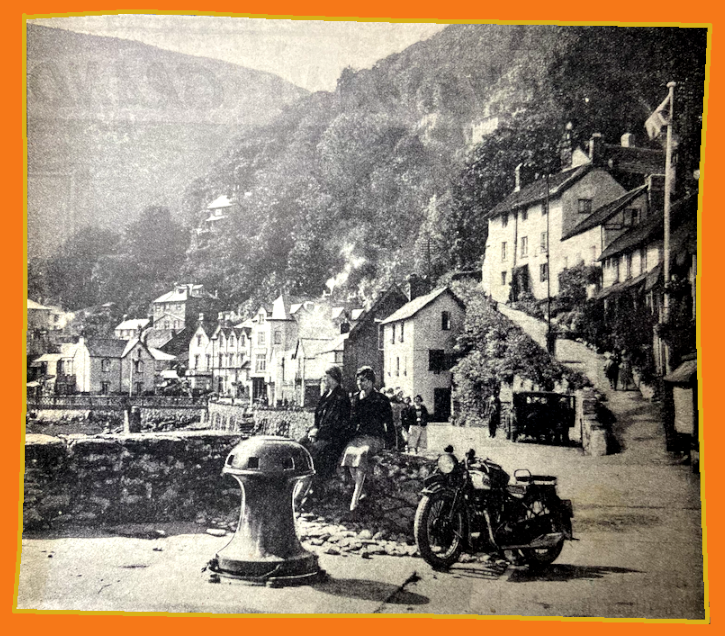
“FORTY-FIVE BRITISH ENTRIES have been received for the International Six Days Trial, which is due to start from Garmisch-Partenkirchen on Monday, August 27th. The German team having won the Trophy in Wales last year earned the right to organise the 1934 event, and the Bavarian Tyrol is the district chosen. Regrettably the serious troubles in Austria have raised doubts, and there is much discussion on this side as to whether the political situation will have quietened down sufficiently to ensure the Trial taking place. Partenkirchen, which is the centre, and several of the daily routes, are only a few miles from the Austro-German frontier, where fighting has been reported, and as a result the ACU has received many anxious enquiries as to the German Club’s intentions with regard to the Trial. Mr TW Loughborough, the secretary, is without answers to several of his letters of enquiry, and telegrams have so far failed to produce replies. Probably the German Automobile Club is in a quandary as to the course to adopt, and this accounts for their silence. On the other hand our German correspondent is emphatic in his assurance of the safety of tourists in the new Germany, and exhorts visitors to see the country under its new regime. In the meantime the preparation of the three British teams that have been selected goes on apace, and it is hoped that the troubles will have blown over sufficiently to enable a definite statement to be issued in the immediate future.”
A WORD OF ADVICE from Ixion: “Any of you who intend to compete in the International A Six Days, or, indeed, to holiday on the Continent as tourists, should realise that punctures are far commoner there than here, and represent the main threat to scheduled motor cycling. Some European roads, especially in the mountains, are heavily peppered with nails, most of which drop out of peasants’ boots. Good tyres, sealing dopes, and nail-catchers are desirable. I am a great believer in an idea which was patented some years ago but never rewarded its inventor. His theory was that the front tyre hardly ever holes, because nails, like Columbus’s egg, normally lie prone. When you get a puncture, the front tyre has momentarily flicked a recumbent nail into the vertical position, and your back tyre picks it up before it has time to lie down again. So the invention consisted of a stout flap fastened to the tail of the front guard. It sweeps aside vertical nails (incidentally, of course, it raises a lot of dust ; but there’s lots of dust on an International anyhow, so that doesn’t matter). I have had as many as seven punctures in one day in the Alps, and that with brand-new, heavy tyres; and every one of them was an honest nail puncture! Again, machines should be as carefully rainproofed for the International as for a watersplash affair at home. There mayn’t be any watersplashes, but amidst Continental mountains cloudbursts are extremely common; and more than one British expert has been so hopelessly rained out on these affairs that he failed to finish.”
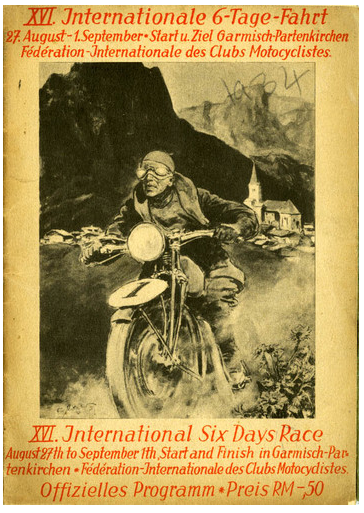

GERMANY HAD WON THE RIGHT to host the ISDT; the 16th trial was based on Garmisch Partenkirchen in Bavaria near the Austrian border—mountainous terrain included (indeed includes) Germany’s highest peak, the 2,962m Zugspitze. The challenge attracted 220 riders, up from 140 in Wales the year before. Leading German marques on parade (and Nazi Germany was fond of parades) were DKW (20), NSU (17), Zundapp (14), BMW (9) and German Triumph (4). They faced 19 British marques led by Ariel (16), Triumph (11) and BSA (10). The Italian bike of choice was Gilera (7); a dozen Austrians relied on Puch. Four teams competed for the International Trophy which was won by the host team of J Mauer Mayer, EJ Henne and J Stelzer, all on BMWs. Italy was runner-up ahead of Great Britain and Czechoslovakia. The Silver Vase was won by the Great Britain B-team of L Heath (Ariel), R MacGregor (Rudge) and FE Thaker (Royal Enfield). Ireland B-team finished 2nd with Austria 3rd. Triumph won manufacturer’s team prize. Here’s a taste of the event, courtesy of The Motor Cycle’s man in the mountains: “Nearly everyone got away immediately; one of the few riders who had difficulty ran downhill to start, and returning a minute later at 40mph, passed the entrance just as Baron von Krohn, the German Zündapp sidecar driver, emerged—plenty of excitement, screaming tyres, but no accident…Of the 220 entries, 11 failed to
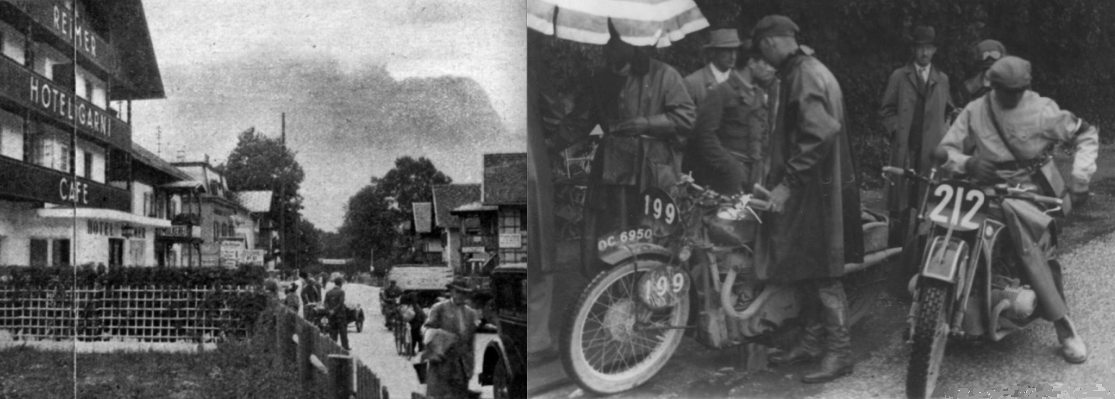
start. These included an Englishman, CR Watson (490cc Norton) and Miss Koerner-Baker, who had been entered by the New Imperial Company. Another, JF Koch, was a member of the Czechoslovakian ‘B’ Vase team. The first ten miles proved most interesting, the course being serrated with cross gullies and having an ever-changing surface. Low clouds obscured the view, while the dampness of the air made riding at this early hour chilly work. Maurice Greenwood (346cc New Imperial) was seen in trouble with a puncture, while J Mittenzwei fractured his Zündapp’s shaft casing and gave up—the first retirement of the trial. The course now led along the south side of the beautiful Lake Walchensee, over roads that might be said to be typical of the Scottish Highlands…an interesting section followed after leaving Kochel. Known as the Kessellergastrasse, it is a long climb over an old road which runs underneath and across a beautifully engineered new one; the surface was excellent and few had trouble, although the tiny 98cc DKW motors of Kopfer and Kroll required a little concentrated foot-work. A narrow section at the top was interesting for sidecars and three-wheelers, but easy to the solo men. Then followed a sharp, twisting, main-road descent to the north side of the Walchensee—where the sun was actually shining—and so back along the interesting section to Partenkirchen that was used on the outward run. The streets of the little town were crowded with cheering spectators. Geyer, a German Ardie rider, came in with a flat front tyre, while F Bär (DKW) showed a bandaged knee. EJ Keboe (650 Triumph sc) had incurred trouble with his sidecar chassis, judging by the curious angle adopted by the outfit. On the whole the day’s run was enjoyed by everyone; the British riders, at all events, found it ‘homely’…Yesterday (Wednesday), the route extended eastwards beyond Rosenheim to Bad Reichenhall, the much-talked-of but now apparently ‘tamed’ Etallerberg being included as the principal climb in the distance of 250 miles. To-day’s route-card indicates a run of 203 miles that breaks new ground to the west and eventually finishes for the night at Oberstaufen instead of Partenkirchen; this will be the only night spent away from headquarters. Tomorrow’s run of 188 miles takes competitors back to Partenkirchen though by a somewhat different route. Saturday threatens to be, in some ways, the most strenuous of the six, for a journey of 130 miles from Partenkirchen will bring the riders who are still in the running to Füssen, and here the final speed test is to
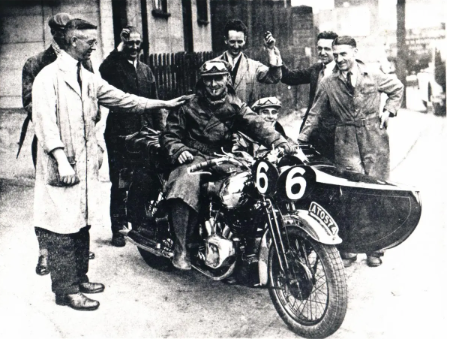
be held over a triangular road circuit. This test, besides deciding any possible ties among the teams, can be relied upon to find out faults that have developed during the week…” The Western Daily Press report is a reminder that motor cycle sport used to be of interest to the general public: “Great Britain’s ‘B’ team won the silver vase and Germany the international trophy in the international six days’ reliability trial for motor-cycles which was concluded here yesterday. In the silver vase event the British team was first and Ireland’s ‘B’ team second. The German team competing for the international trophy was the only one to complete the six days’ gruelling ride without losing any marks. In the speed test with which the trial ended the Italian team were only 10 seconds behind the Germans. Britain was third. Miss Marjorie Cottle, the intrepid British woman competitor, secured a gold medal for completing the strenuous course without a single penalisation, being the sole woman to achieve this distinction. She had several punctures and twice crashed into ditches, but she never lost a mark through being late. In the speed contest Miss Cottle, on her small machine, was as fast as many of the ‘crack’ men of nine nations. She received an ovation from the huge German crowd, sharing the applause with Ernst Henne, the German motor-cycling ‘ace’ who holds the world’s motor-cycle speed record and was a member of the German team. Altogether British riders won 24 gold medals, five silver and two bronze.” Results. International Trophy: 1, Germany (0 penalty points); 2, Italy (0); 3, Great Britain (1); 4, Czechoslovakia (317). Silver Vase: 1, Great Britain B (0 penalty points); 2, Ireland B (0); 3, Austria (10); 4, Germany B (14); 5, Czechoslovakia (27); 6, Italy B (200); 7, Holland B (200); 8, Great Britain A (300); 9, Ireland A (300); 10, Italian A (500); 11, Germany A (626); 12, Holland A (750).

FROM THE MOTOR CYCLE’S report of the Southern Trial: “JJ Scott (349cc Rudge) took the obstruction flat out and, as a result, travelled several yards on his rear wheel, with his front well up in the air.” A wheelie by any other name…
THE EDINBURGH &DMCC decided to allow outfits with sidecar-wheel drive to enter the Scottish Six Days Trial.
RECORD BREAKER SIR MALCOLM Campbell went gold prospecting in South Africa.
THE FRENCH MANUFACTURERS’ union called for the abolition of all driving licences.
“TRIOPTICAL? SOLICITOR AT OXFORD: ‘Is it not the proper way to drive with two eyes on the road and another on the mirror to see what is coming behind?’ Witness: ‘Yes, sir—I always drive that way.'”
“THERE WERE 32,290 motor cycles registered in South Africa during 1933; the previous year showed a total of 32,173 machines.”
“THE FIRST OF THE summer letters on the genus Seaside Promenade Percy has appeared in the local paper—a Hastings one. No doubt others will shortly be published in papers all round the coast, if they have not appeared already. In the Island at TT time I saw quite a few examples—perhaps ‘heard’ is the correct word—for the trouble with the species is its infantile delight in screaming off the mark and making as much noise and nuisance as is possible.”
THE MOTOR CYCLE PUT UP a trophy for the first multi-cylinder British 500 to do 100 miles in an hour on British soil. Contenders included Ariel (blown Square Four); Douglas (ohv flat twin); New Imperial (ohv V-twin) and Triumph (two vertical twins, one of them supercharged, sleeved down from the 6/1 650cc roadster). Ginger Wood won the cup for New Imp at an average 102.3mph.
“TESTS TO ASCERTAIN whether old vehicles are roadworthy may become compulsory. The advisability of making regulations to this effect is to be considered by the newly formed Committee on Road Safety.”
“THE TOURIST CLASS of the recent Championships of Norway event was won by a Royal Enfield rider, with Triumph and Ariel machines second and third respectively.”
“RECENTLY I VISITED WOOLWICH to look at the new AJS models. While I was there a motor cyclist rode into the factory on a new single-port 500. The machine had trade plates on, and the rider was in wet-weather kit, as the roads were awash. One glance at the man in the saddle was sufficient—it was HA Collier, joint managing director of both the AJS and Matchless concerns, returning from lunch.”
“YOU WILL REMEMBER The Motor Cycle test of petrol from coal, when we used ‘Coalite’ petrol, produced by the low-temperature carbonisation process, for 2,000 hard miles. Well, the chance of you and I using it in the near future is very small indeed, because, according to Sir Philip Sassoon, in the House of Commons, it has been decided to ‘extend the use of the fuel (in the RAF), absorbing the whole of the current output.’ As you may recall, our test proved that the fuel had very useful anti-knock properties—especially useful from a motor cycle point of view. The Air Ministry, who have now issued a report as a result of their own tests, state that ‘for all practical RAF purposes this coal spirit is now regarded as a normal supply, and has been used by one squadron which is equipped with Bristol nine-cylinder, air-cooled radial supercharged engines since February, 1933, and has involved neither special precautions nor modifications.’ So that rather seems to be that. Incidentally, no fewer than 80 machines at the recent Hendon display were flying on this fuel.”

HAVE YOU EVER TAKEN your sidecar into Limehouse and eaten fried noodle and soochow at a Chinese restaurant? Have you ever journeyed on it to see 500 lost dogs under one roof? Or watched a North Sea trawler unloading its fish directly into Billingsgate at 5.30 in the morning? No? I hadn’t until the other day. It came about this way. I was walking along Waterloo Road one evening, and came across a queer-looking shop, where, had I wanted, I could have had my back tattooed with multi-coloured pictures. A little farther along the street as a shop that would have sold me human hair, and another that could have provided me with snakes or newts, while at a third I might have purchased miles of bamboo cane. Queer shops, indeed, and the sight of them made me think of other interesting places in London which I had never seen—places about which I had read and heard; places which my provincial friends up to Olympia for a few days would never dream of visiting; places, indeed, which even Londoners would scarcely ever think of exploring. And that was how I came to plan this queer ramble. The sidecar outfit was filled up overnight and the alarm clock set for 4am. At the appointed time I met ‘Rep’, the artist, near Smithfield Market, and there we parked the bus for a few minutes and had coffee with the porters, afterwards strolling for a few minutes into the glare of the vast meat market. From 5am blackness we plunged into the blaze of brilliant electric lights which shone on uncountable sides of pink carcases, and lost ourselves in the crowds of hurrying, sweating men. But Billingsgate was our first real goal, so we proceeded along Farringdon Street, up Ludgate Hill, past the great, dark mass of St Paul’s, and on towards the Monument, near where the world’s biggest fish market is situated. We plunged suddenly from quiet streets into a seething mass of vehicles, among which the fish porters, wearing the oddest sort of headgear, seemed inextricably mixed up. But the silence of it all! There was no turmoil, no shouting, no angry repartee of the kind for which Billingsgate is supposed to be famous. Thousands
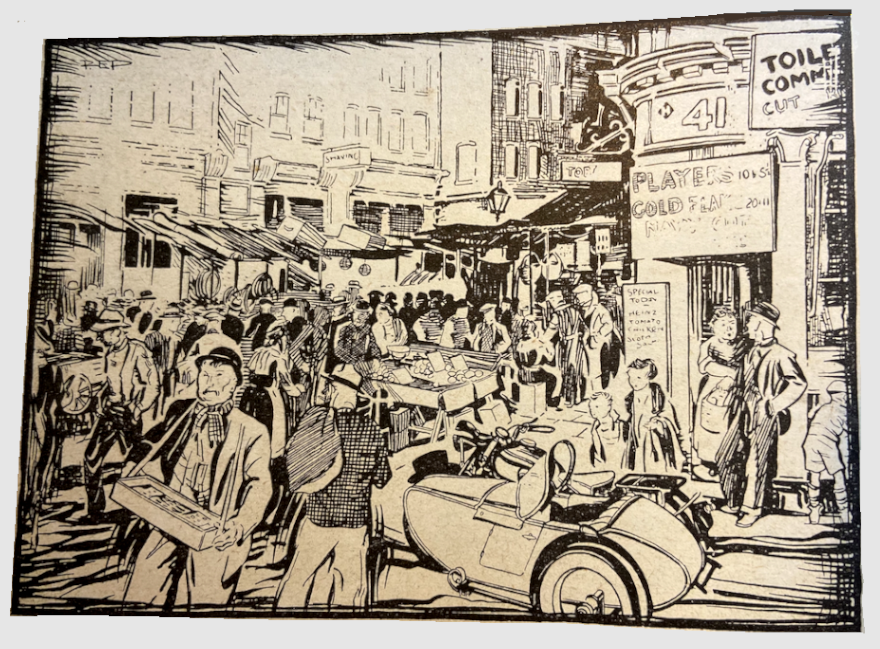
upon thousands of crates filled with fish were being transferred from the lorries on to the heads of these men, without any commotion whatever. From this busy scene in the twilight of the morning we once more entered the glare of a great market hall. Again the impression was of light, but this time it was silvery white from the reflection of millions of fish in open crates and on the various salesmen’s stands; plaice, turbot, halibut, cod, sole, ling, whiting, herring, conger eels, mussels, lobsters alive and boiled, salmon fresh, salmon stiffly frozen; every kind of edible fish lay there in an endless, glistening perspective. We moved along the slippery floor, carefully avoiding the porters. At the far end of the building we came upon the auction, but it was vastly different from the leisurely and humorous affairs I have often seen at cattle markets or sales of household goods. We noticed that the crates of fish came along a sort of escalator and were deposited down a shute near to the auctioneer, who had, apparently, to synchronise his selling with the speed of the conveyor. There was no time for, ‘Now, gentlemen, what am I offered for this little lot?’ He would soon have had piles of fish at his feet. Then we walked through an entrance on a quay side and saw that the crates of fish were being carried by this conveyor directly from a big steam trawler. A very courteous man in a white overall explained that the boat was from Hull, and that the fish had been collected from the trawling fleet while at sea and brought directly to London. It seemed extraordinary to find a North Sea trawler landing fish in the heart of London, a few yards from the great business centre of the City. As seven o’clock approached we felt we had had enough of fish. Our sidecar still reposed in the side street, and we jogged along back down Ludgate Hill and the Strand to Covent Garden. Oh, the blessed smell of roses, lilies and earthy potatoes after fish! Oh, the sight of rosy Cox’s orange pippins and muscat grapes after livid cod’s eyes and slimy eels! Covent Garden, being considerably divided up among the various wholesalers’ premises, is less staggering than the other two great markets, but only slightly less interesting. We saw the ‘little’ shopkeeper with his truck and a few odd boxes of this and that; and by contrast there was the ‘big’ buyer, purchasing choicest apples, grape fruit and home-grown grapes and orchids; the potato buyer who dealt in tons; and the specialists in oranges and lemons, who would sell you a ship’s load with the same calmness as they would a single case. When we entered London at five o’clock it was a world of men; at seven o’clock the vast army of women office cleaners descended on the city; at eight o’clock the mixed stream of humanity from the suburbs flowed again and the roar and bustle of a new day started in earnest. We parked our sidecar and went in search of breakfast. We lingered over the coffee and marmalade, then we decided to go and see the Home for Lost Dogs and Cats at Battersea—why I hardly know. I had heard a lot and read a lot about this place. Perhaps it was because a poor little brute had the other day tagged itself on my heels and refused to be shaken off. I remembered the pathetic little beggar’s eyes when I said ‘Go home’. But this was nothing compared with the sight of the 500 pairs of eyes we saw at the Home in Battersea Road. We found the dogs in a huge building divided into pens, some containing two or three, others eight or nine. As we approached every pair of eyes seemed to speak to us; bodies became tense and tails wagged furiously in anticipation of release. When we departed these poor derelicts watched us with pathetic intensity, their heads drooping and their tails ceasing to wag. We saw a little boy of about 10 years old enter with his mother to look for his lost pet. He carried a lead and was chattering eagerly. An hour after-wards we saw him on the pavement outside, waiting for a tram. Very forlorn and dejected, he still carried his leather lead…And what a mixture of breeds we saw! He would have been a clever man who could have stated the parentage of some of the inmates; masterpieces of namelessness many of them were. We were surprised to see there a supercilious chow, and, needless to say, he did not attempt to make friends; there was also a greyhound, several whippets, some bull terriers, a fat old bull-dog, many alsatians and several airedales. But the sight of a painted notice board remains with me more vividly than the pathetic eyes. It caught my eye as I came out It read ‘To lethal chamber’. Then we returned towards Central London, past strange and contrasting architecture, past dauntless humanity which seemed perfectly happy living in the dingy, mean streets adjoining the river; threaded our way through the traffic-packed West End; moved in short spurts between the traffic blocks along New Oxford Street and Holborn; and so reached our next objective, Leather Lane market, which lies just to the north of Gamage’s great store. There is not the space to say much about the conglomeration of humanity we found in this street market. One man amused us; he had a long, cadaverous face with a pink nose and blue chin. He held up a peony and a piece of dried orange peel. ‘Nah, gents,’ he shouted, ‘wouldn’t yer like to feel the vim of youth again? Nah, listen. Go to yer chemist and buy a penn’orth of menthol and a penn’orth of camphor, and then go and buy a penny orange. Get some boiling water…’ I lost the rest, for the crowd was thick; a good many were evidently anxious to learn how to regain the vim of youth again for threepence.
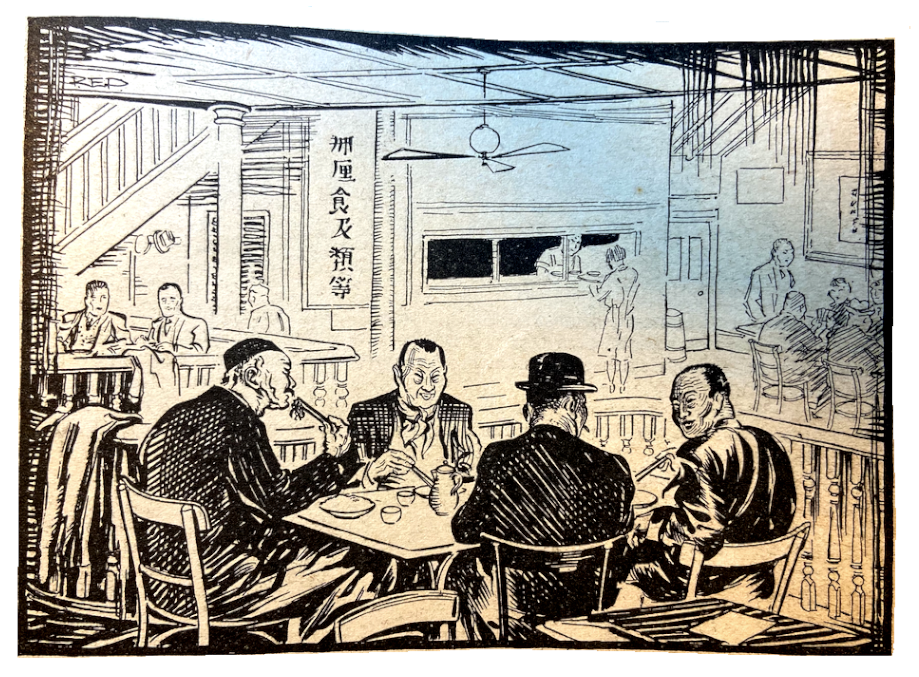
Apparently the poor fellow had nothing to sell except the recipe, trusting to the crowd’s generosity after he had revealed it. What a babel it was! Indians with scent, a white-coated ‘doctor’ with a cure-all, Turks with English-made ‘Oriental’ carpets, the ‘gold’ watch merchants, seedy individuals carrying placards labelled ‘I come to save your soul’; and stalls laden with onions, braces, cabbages, sausages, and a thousand other things. After mixing for a time with the crowds in this curious market we lunched, then adjourned for an afternoon’s office work and met again at six o’clock to continue our programme. We wanted something ‘different’, so we decided to see Chinatown in the dusk and dine in a Chinese restaurant. It was a grey, quiet evening as we made our way from Dorset House, across London Bridge, through Fenchurch Street and Commercial Road, and into that strange quarter round about the West India Dock Road. Our first objective was ‘Charlie Brown’s’ (The Railway Tavern, 116, West India Dock Road). Here we were shown the really marvellous and very valuable collection of ivory and Eastern curios by a charming little lady of 18 or so, with all the dignity of a châtelaine of a castle. The late Charlie Brown and the Railway Tavern were known in every port from Malta to Hong-Kong. There is nothing of the traditional Limehouse about the place. It is thoroughly English, and I am not investing it with any kind of romance—that is Thomas Burke’s prerogative. But the little room above the bar of this Limehouse tavern will amaze you. We crossed over the wide and traffic-free road into the narrow, forbidding Pennyfields and stopped a moment at a curious shop that had the weirdest-looking eatables in the tiny window—at least, we concluded they were eatables. Now and then Chinese, and swarthy fellows of Oriental appearance, cast swift, appraising glances as we passed along. We crossed over the West India Dock Road again and made our way down more narrow streets; them were more Chinese men, and some very happy, laughing Chinese children. On turning a corner into a narrow, drab-looking street we came across a woman—an Englishwoman, apparently—standing on a chair and hanging coloured glass lamps, each holding a nightlight, around a simple wooden war memorial which was erected on the wall between two tiny houses. A little Chinese girl stood watching her intently. It was so curious a sight that I could hardly believe my own eyes. Did I tell you we had a rendezvous with ‘Ambleside’ at the Railway Tavern? He is becoming very cosmopolitan—within a couple of months he had dined in Switzerland, Germany, France, and the Isle of Man—and was now interested in the idea of a Chinese dinner. Ti Tung Low’s restaurant is in the West India DockRoad. Its windows tell you nothing. We climbed a flight of stairs and seated ourselves on a sort of balcony; this was the dining-room. There was perfect quietness, although seven or eight Chinese sat at cards in a corner of the room. They glanced curiously at us and continued their play. We expected a Chinese to wait on us, but an English girl came instead. After preliminary gropings among the items on a two-language menu, which, incidentally, bore the imprint of a Hong-Kong printer, our waitress recommended 鸡肉炒面, which, being translated, means fried noodle with chicken. Should she bring chop-sticks? Decidedly, No!…First came tea with a flavour nothing like that of the China tea you buy, nor, of course,

like Indian. We bad it in tiny, handleless cups and without saucers. With it she brought each of us a little bowl of dark brown liquid, the colour of pickled walnuts. We dipped in our fingers to taste—it was comparable with nothing I had ever sampled—I can’t describe it. Then came the noodle and one fork each. It came on a large dish, heaped-up like a small haystack, and appeared to be composed of fine shreds of chicken’s breast. thread-like shreds of onion, and thin strings of this and that and that and this—heaven knows what it all was! We helped ourselves from the common stock with our single forks, and then poured the brown liquid over our portions. ‘Rep’ and ‘Ambleside’ said it gave them an appetite. I told them to finish the pile by all means. Next we had 排骨 meaning chop suey. Again we took the dark flavouring. This time rice was brought on a separate dish, while we were each given a portion of thinly flaked chicken with onion, potato, mushroom, and large, succulent prawns, together with other things I could not analyse. At an adjoining table four Chinese sat down to dine, using chop-sticks. They chattered away in their own language, and seemed well known to the Chinese proprietor; they had just arrived in England (so we gathered somehow) by boat. Our chop suey gradually vanished, and, although we certainly could not eat any more, our curiosity was stirred by Item52 on the menu (each dish was numbered), which read, ‘Yange-how Sho, Fried Wan Tun (big), 5s.’ But Item 57 positively fascinated me: it read, ‘Noodles with many things mixed up, 3s 6d’; yet to sample it would have been a physical impossibility. We heard no language but Chinese around us, and the whole atmosphere was strange yet fascinating, probably because it lacked any artificiality such as might have been obvious in Chinese restaurants in the West End. Our clattering down the stairs broke the curious quiet of the place. My last glimpse upstairs was a rather amazing one of a demure little Chinese girl suddenly appearing from a small doorway and being apparently introduced to the group dining nearby. She was dressed in the blue costume of a Girl Guide! My last impressions as we left were of a very, very old and very polite Chinese behind the counter downstairs and of a small kitchen where I saw great heaps of the strange shredded food on a table. Soon we were in the whirl and noise of London, England, once again; our queer, long day’s tour was over; it had, indeed, been a day of ‘Many things mixed up’.”
‘Ambleside’
“I’M OLD ENOUGH,” IXION ADMITTED, “to remember Shows with a very different atmosphere from that of the modern Olympia. The tough cyclists who assembled en masse at the old Stanley Shows were moved to Homeric laughter one year when a solitary red and black motor bicycle of the crudest imaginable design had the temerity to invade their sacred precincts. They paused opposite the intruder and guffawed to their hearts content—much as we might guffaw to-day if some crazy inventor brought to Olympia a push bike with a couple of flapping wings geared to its pedals. Stagnation followed—a few cars—a motor tricycle or two—the unstable, incendiary front-drive Werner—and almost before we realised that a revolution had occurred, the Minervas, the Ormondes, the Excelsiors, and the Quadrants began to eat into the allegiance Of cyclists, and we all went petrol mad. And as the years passed more and more motor cycles were sold. To-day we have gleaming battalions of push bikes at Olympia, but their design has become. so stereotyped that few of the general public concedes them more than a passing glance, and the motor bicycle is decidedly king of the Olympia castle. Those early exhibits were rarely backed by anything which could be called a ‘factory’. I remember one which was produced in a cellar off Oxford Street and had little behind it except a couple of enthusiastic lads with a lot of debts. When they got an order at the Show they adjourned to the nearest bar and celebrated. They next telegraphed to Belgium for an engine. Then they distributed the deposit at the rate of a pound here and a pound there to their greediest creditors, and begged the bits with which to build the machine.”
“GENTLEMEN,—ONCE AGAIN I ADDRESS YOU by the courtesy of the Editor on the eve of Olympia, and my first and ever-pleasant business is to thank you most Sincerely on behalf of your million clients dotted all over the map of the planet Terra for the splendid mounts you have given us, for the jolly hours we have spent riding them, for the speed of your making which has brushed the cobwebs frown our brains, and for the physical health which we owe to you. Did I hear a discordant murmur on the horizon? Well, you know as well as I do that sometimes your machines can he haunted by the most diabolical fiends, and hold us up at the most awkward moments in the most devastating places. Sometimes such spots of bother rob us of a coveted pot; sometimes they prevent us returning Cecilie to mamma’s ample bosom by 10pm, as we had faithfully promised; sometimes they strand us in blizzards on ghastly heaths at midnight. But a few weeks later we spill the yarn to our pals with roars of laughter at our past predicaments; anyhow, wrestling with the model endows us with guts, and ingenuity, and lots of other desirable he-man qualities. So I ignore any discordant murmurs off-stage, and thank you just as warmly for the dud bikes (they are precious few, nowadays) as I thank you for the good ‘uns. We rejoice with you that the outlook is better than it was a year ago. Exports? H’m. The world seems to convert itself into a network of closed compartments, in each of which the inhabitants are to make a. Precarious livelihood by taking in each other’s washing; and export trade is not exactly at a premium. At least you are snaffling your fair share of it, and then some; and perhaps frontiers and exchanges will grow less tiresome as the world acquires more sense. I wish for a golden age when I shall be able to buy French wines at cost, plus reasonable growers’ profit, plus freight; and if that era ever dawns you’ll be able to sell your bikes at low figures to the Eskimo and to the Papuan. Here’s to it! The home market is not back at its old merriness yet. Those were jolly days when the seventeen-year-old son of every artisan home could look forward to buying some sort of motor bike by the end of his third year at work, and perhaps a TT replica (one year old) after five years. To-day, in far too many homes, any surplus of his wages goes to swell his father’s dole. But things are mending, and you’ll be ready when the market opens its mouth wider. Technically, there is not a great deal for us to say to you just now. I have often warned you in the past that science, like money, is international; that a day would dawn when neither the brains that design your buses nor the craft that builds them would remain a British monopoly. The writing is now clear on the wall so tar as pure speed is concerned. The FN has beaten your best 500cc speed; the BMW holds the world’s maximum speed record. We all comfort ourselves by remarking that speeds of 150-200mph On two wheels are of no practical value. If Ernst Henne sent me his BMW for a Christmas present I should get photographed on it tout suite and endeavour to persuade the Editor to print the picture in The Motor Cycle; but I should never dare to open the throttle right out. (Nor would you. eh?) These fantastic speeds have no more practical connection with honest motor cycling than a dancing Marathon in a New York saloon has to do with enjoying an evening fox-trotting with Sheila. But these stunts cannot be ignored. For one thing, they pull sales, just as the feats of our own pneumatic-drill type of road-racing machines sell motor cycles in Australia and South Africa. More than that. If the Falling Star people annex a world’s record, buyers all over the world credit its factory (quite rightly) with a No 9 hat engineer, energy, organisation, and general business capacity. At least 500,000 passionate two-wheelerists would enjoy their breakfast rasher twice as much to-morrow morning if they read that Great Britain had taken that record off Henne at, say, 170mph. Pool your brains, if you like. Let the machine be a no-name ‘Miss Britain I’ with a Wolverhampton gear box, a Birmingham engine, a Bristol tank, a Coventry frame, a Yorkshire saddle; but get those records back, and keep ’em! We still cherish all the old grumbles about our buses. Secretly, between you and me, we are just raving at the moment about our selected mounts for 1935, and don’t see how they could possibly be bettered. But we always cherish at the back of our minds a dream picture of an ideal motor cycle which few of us may live to see. So far as speed, brakes, and roadholding are concerned it would not differ from our present buses, which are just about as good as can be in such respects. Nor a should we object to paying current prices for this dream-bus; we know that the buying motor cyclist gets better value for his money than a shopper in any other line of commodities without exception. But our dream-bus would differ from Our nineteen-thirty-fivers in other points, as duck-pond water differs from Napoleon brandy. It would not weigh more than 100lb, so that we could trip merrily upstairs to the fifth floor of a sky-scraper flat with the model tucked under the arm. It would be as silent as Mabel’s sigh after her first kiss. You could start it with no more effort than, is now required to dip a head lamp. It would be as comfortable as one of those modem ‘Woo-Sleep’ mattresses. Asking a lot, are we? Well, rather dreaming than asking. Frankly, as man to men over a pint, you know our modem buses can still (in many cases) create the very devil of a racket, especially if they are showily driven by a swanky young fool. They can be the most awful brutes to start, especially if they are slightly out of tune and you’ve got a lot of clothes on, and are not of the [Swedish Olympic star Wilhelm] Petersen build. And, gosh, what some of them weigh! Just coax your chief financier into the running shed, don’t warn him about the twin fishtails, and ask him to hoike your big fellow on to its legs. Best put Plasticine in your ears first, as his language is likely to be scalding. You take these matters rather too lightly, I beg to think, because you know that many of your keenest customers don’t care two hoots about noise or weight, or about the 13st push which is required to get some of your engines oft first go. But you spend hours and hours thinking how to increase your sales. It might pay you to tot up the number of fellows who desert our ranks every year and investigate why they go; and to weigh the number of motor cyclists against the percentage of the population who could do with light, cheap personal transport, asking why the bigger percentage neglects and ignores the motor cycle. Either you have never built the machine for the million, or the million has not realised that you build it. I have been specially asked by some readers to plead with about half of you in respect of your spare part service. Let me safeguard myself by saying that I do not believe one-quarter of the service grouses. The usual explanation is that a ‘phone rings in the wrong department of your works, and a girl clerk hears, ‘This is Smith, cycle agent, Puddle Magna, speaking. A fellow on tour has just pushed in with one of your 1929 250cc models. Piston melted. Please ask your service people to put a new piston on the train tonight will you?’ Puddle Magna is about 300 miles from your works, and the ‘phone is faint and indistinct. The girl has misspelt about half the message on to her pad when a tart voice interrupts, ‘Three minuses.’ The flimsy ultimately reaches the service department, where a harassed junior clerk discovers that in 1929 you marketed eight different 250cc models, and, in any case, even threats of a county court action have failed to make Smith, Puddle Magna, pay for a new chain which you despatched to him in response to a telegraphic order in 1931. So the fellow on the 1929 model finally departs from Puddle Magna three days later in a towering rage, and transfers his custom to your chief rival as soon as he can sell his machine. But, my very dear sirs, you know how these things happen, and you are not yet too Rolls Roycey to remember how you felt in 1899 when you were speeding to spend a hasty week-end with your best girl on a prehistoric motor tricycle, and were kept kicking your heels at Puddle Minor because your dry battery had run out, and the people in Town were so darned slow about railing a spare to you. Prompt, efficient, hole-proof service links a customer to you with steel grabs far more securely than selling him a top-hole bus. Frankly, the spare part service of some factories is still deplorable; and when we want spares we want them QUICK. There are noble exceptions. I would back one or two firms to deliver any specified bit at John o Groats within 48 hours; and when that standard is universal you can lie back and rest. Well, Gentlemen, that’s my say for this year. We shall meet soon at Olympia, and the thrill and glitter and concealed geegees of your massed samples will drive it all out of my brain as usual. But I believe it contains scraps of sense, and I hope some of you will chew some of them over.
Salaams ever, Your admiring and grateful customer, BH Davies.”
“SHAFT DRIVE, UNIT CONSTRUCTION, total enclosure of moving parts, multi-cylinder engine…The specification of a ‘dream’ machine? No, nothing so nebulous; it is the specification of the Douglas Endeavour, an Olympia Show secret whose very existence, we are assured, is unknown even to the majority of Douglas workpeople. For years letters in our Correspondence columns have expressed the yearning for a British transverse twin with unit construction and shaft drive. Now such a machine is actually in being; it will make its first public appearance next Monday at Olympia and cause the Douglas stand to be the Mecca of every Show visitor. From stem to stern the new design is obviously a Douglas. While the layout is different from normal Douglas practice, many of the components are similar to those employed in the standard range. The side-valve 494cc (68x68mm) horizontally opposed twin-cylinder engine is precisely similar to the unit of the new Blue Chief 500 except for the crank case and the carburetter mounting. It has the massive aluminium-alloy cylinder barrels with cast-iron liners, the light alloy cylinder heads, and the ingenious plate clipped between head and barrel in which are formed the valve seats. Complete enclosure of the valves is provided, access to the tappets being gained via a cover plate held in place by a single hexagon.”
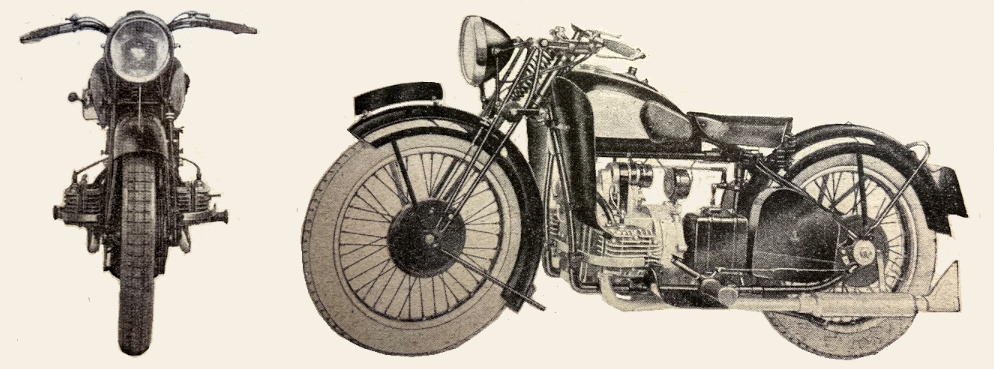

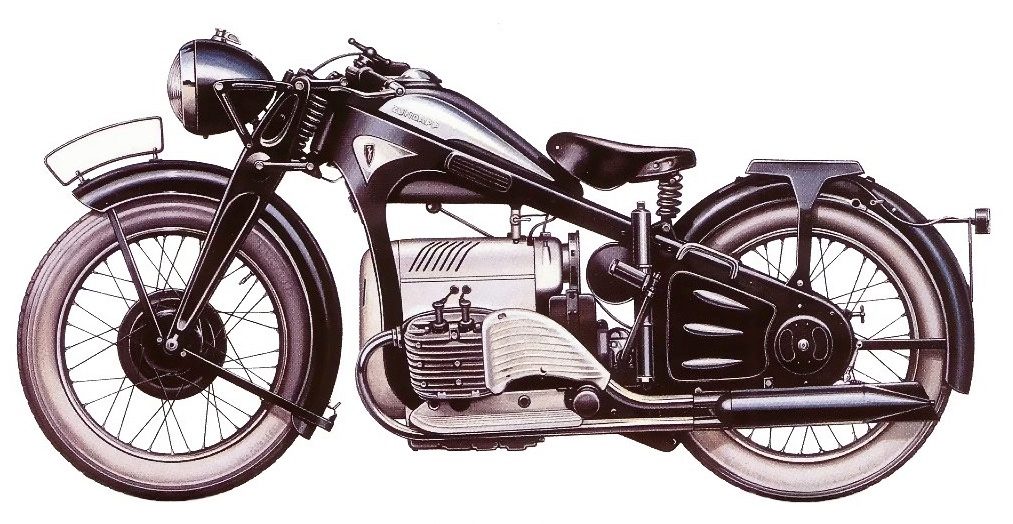
AJS LAUNCHED THREE ONE-LUNGERS: 250 and 350 ohv and a 500 side-valve. From Ariel came a new single-port 497cc long-stroke (81.8x95mm) Red Hunter. It sold alongside the established twin-port model. For once George Brough didn’t field a show stealer , but drew crowds with the latest 11/50 sidevalve big twin that was developed for exporting as a police special. BSA offered everything from 149cc ‘Snowden baby’ at £31 7s 6d to a 986cc side-valve workhorse at £75; the range was joined by 249 and 348cc ohv singles. The inlet valve was fully enclosed; the exhaust valve wasn’t. Calthorpe reintroduced a 350 to its ‘Ivory’ range. Cotton’s entire range of 16 models were equipped with electric lights and horn; with engines from Villiers, Blackburne and JAP they ranged from 150-600 including five 250s ranging in price from £27.15s for a JAP sidevalve to £45 15s for an ohv Blackburne; all with Cotton’s trademark triangulated frame. As well as the transverse-twin Endeavour Douglas launched an in-line version and introduced QD wheels that The Motor Cycle described as “most ingenious”. Dunelt launched 250 and 500 four-strokes (with no intermediate 350) powered by twin-port ohv JAP engines with four-speed Burman boxes. Excelsior capitalised on its racing successes with the 250 and 350cc ohc Manxman which was finished just in time for the show. Francis-Barnett released a stablemate for the popular two-stroke Cruiser—the Stag, a fully enclosed ohv 250 with fully enclosed valve gear and a new frame design “in which the centre portion consists of a composite assembly of forgings, brazed tubes and pressings”. Years before BSA used the name James launched a Shooting Star—an ohv 250 with four speeds, Maglita lighting and high-level exhaust.
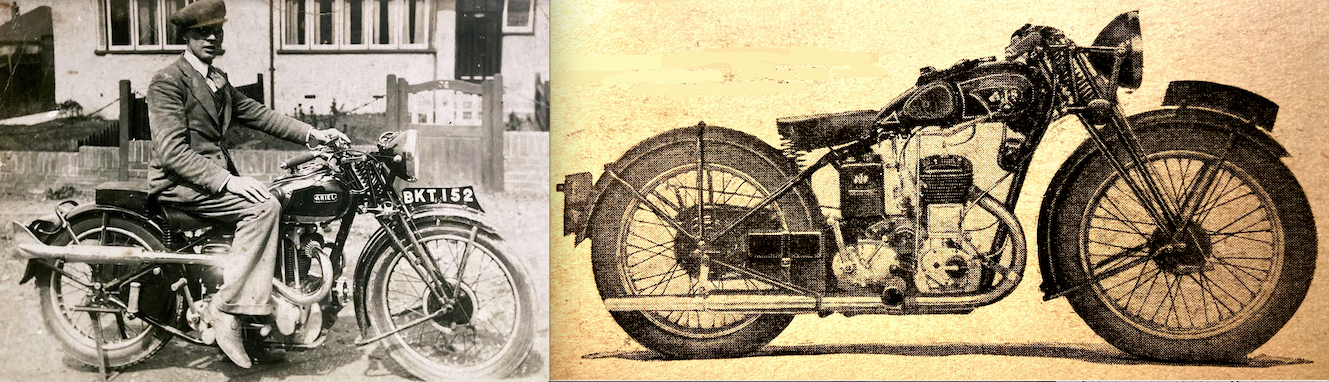
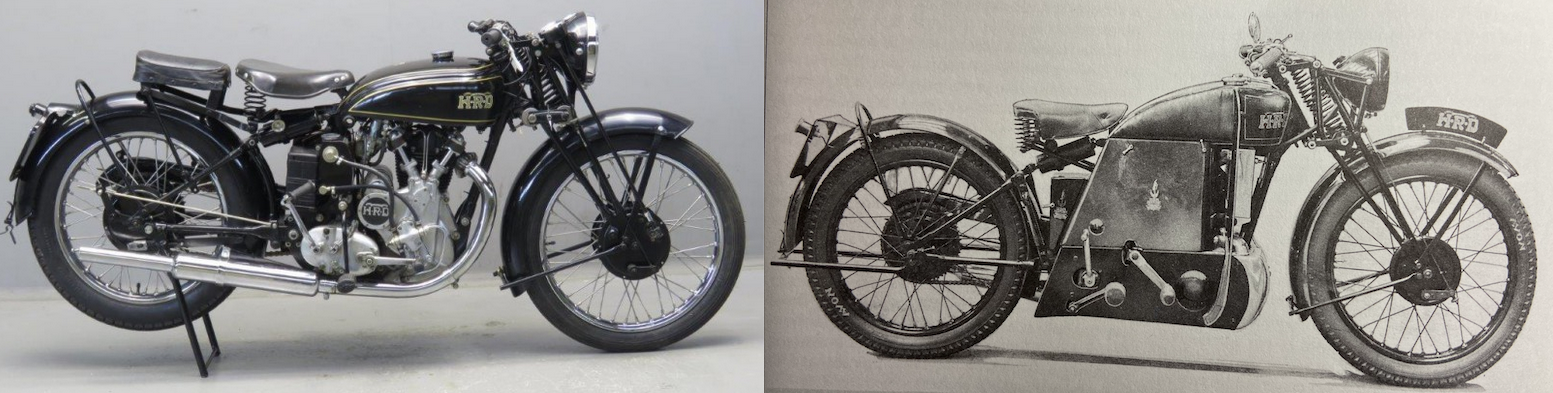
“It has a companion of slightly gentler disposition on a 250cc side-valve, which is similarly equipped as regards lighting, but has a three speed gear box and a loop frame…Trials riders will be delighted to find that any Norton model can now be obtained with trials specification at a small extra cost…this includes a special frame, narrow forks, a special gear box and competition tyres. Special features for 1935 include a much improved silencer, a double prop stand, Norton gear boxes with improved foot operation, rubber-mounted handlebars, and oil-bath primary chain cases. The OEC range— 250, 350, 500 ohv singles and a 900cc ohv V-twin—all featured rear suspension with duplex steering as an option. OEC also resurrected the three-wheel Caterpillar Tractor it had produced fir the War Office in 1928 but history doesn’t record any sales. Rudge’s potent four-valve singles were joined by a two-valve 250 “for those who require Rudge features and quality at a moderate price”. The 500s got a new clutch with an oil-tight cover “so that although it runs within an oil-bath primary chain case it should neither tend to slip nor drag”. One of the sensations at Olympia was Scott’s S3 with a a 747cc three-cylinder two-stroke (later enlarged to 986cc ) based on generator engine developed for the Navy; [you’ll find a roadtest further down the page]. Sunbeam came up with an ohv 250. “A most interesting machine this, with its high camshaft, push-rods enclosed in a single tube, and hairpin valve springs…The four-speed gear box has positive foot operation. A striking feature of the model is the very handsome silencer.” Having grabbed the limelight, and the Maudes Trophy, with the 6/1 vertical twin, Triumph launched “a compact, low-priced ohv 250” which, despite being at the bottom of its 13-model range, boasted “fully enclosed valve gear, a cradle frame, four-speed gear box, and Lucas Magdyno lighting. A new design always draws the crowd, and it goes without saying that the Vincent-HRD stand will be a centre of attraction. On it will be displayed the four types of machines which go to make the 1935 range. In three of them will be an entirely new engine of the high-
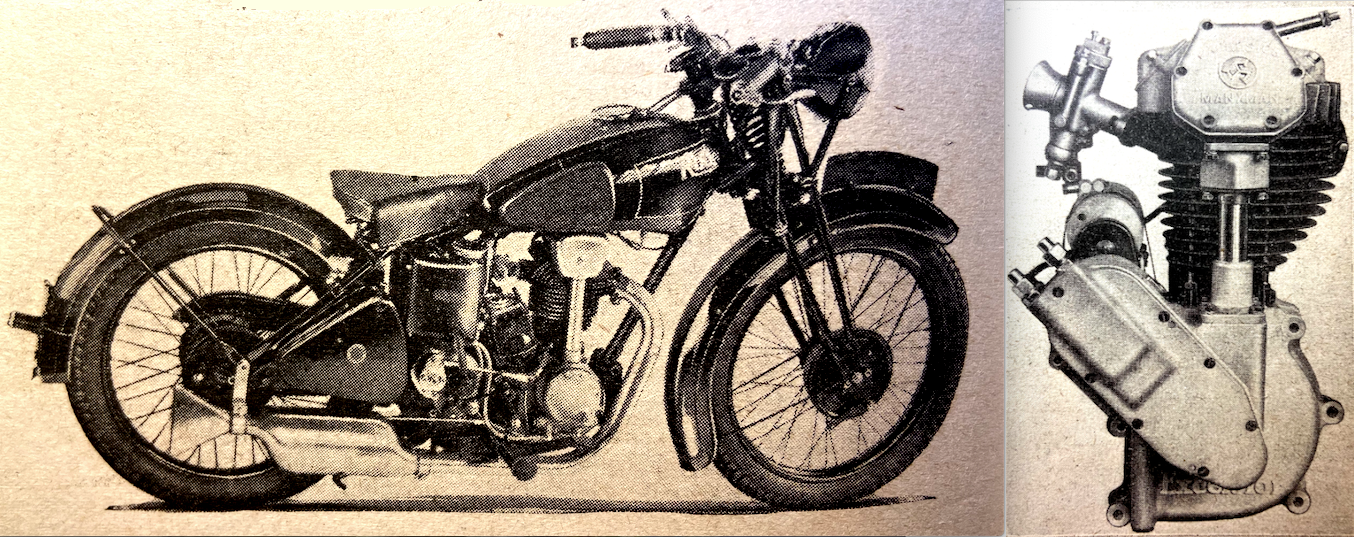
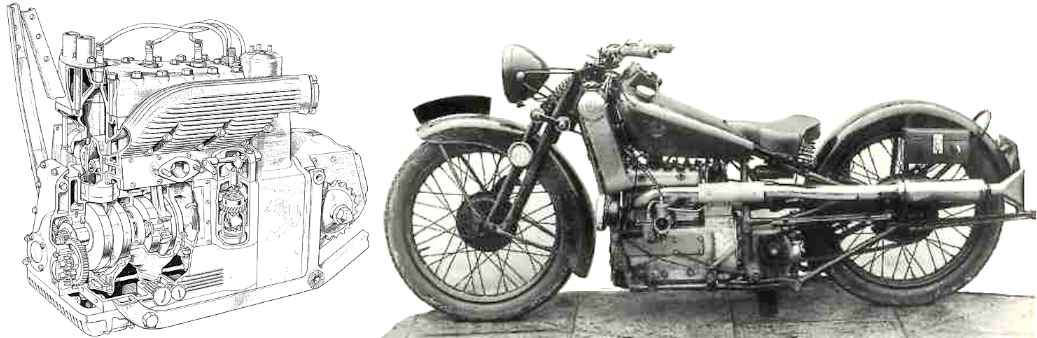

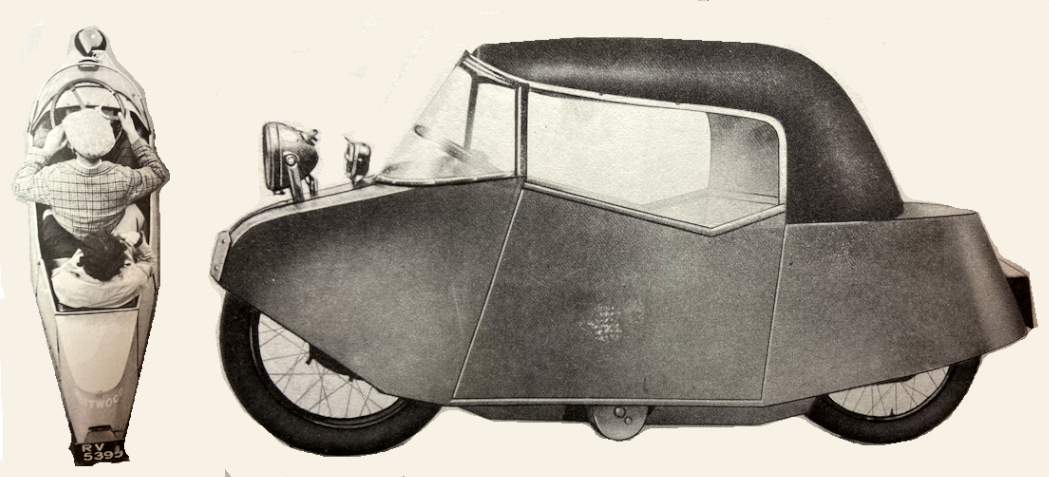
camshaft type. This new Vincent-HRD engine, which will be made in three forms, ie, standard, sports and TT racing, has a most striking appearance. A deep crank case encloses practically half the cylinder barrel, while the extremely short push-rod covers leave the timing case at an angle of 31° to the vertical—the same angle as that of the valves. By ingenious design the fork-ended rockers bear on collars approximately mid-way down the valve stems. Thus with a valve guide above as well as below, wear is reduced to a minimum. The valves are enclosed in a casing, with the hairpin valve springs mounted on top. The new engine has a bore and stroke of 84x90mm (498cc). Apart from the engines, the new Vincent-HRD range will have duo-brakes and, of course, the well-known rear springing. The standard equipment will include deep-section mudguards, interchangeable and quickly detachable wheels, Dunlop saddle, duplex primary chain, oil-bath and electric lighting, except on the TT racing model. One model will be on view with a 490cc ohv single-port JAP engine…A stand which is bound to drawl the critical crowds of Olympia will be that of the Whitwood [The Whitwood was built and marketed by OEC.] Here will be displayed an interesting design that represents a serious attempt to incorporate car-type protection on two wheels, at a very modest price. The small, but surprisingly roomy, two-seater body is mounted on a low chassis of duplex tubular.construction. A car-type sprung steering wheel is geared by a small reduction ratio to a duplex-steering system. The power unit is mounted horizontally in a ‘tunnel’ formed by the duplex chassis members, and a three-speed gear box is placed immediately behind the engine, the transmission bong by chain to the rear wheel. Behind the backrest to the rear seat are mounted the petrol and oil tanks and a spacious tool locker. A hinged lid to the tail provides immediate access to the petrol tank, while for the removal of the rear wheel the whole tail hinges upward. Two wheels, one on each side, can be lowered by means of a lever inside the body to provide support when the machine is stationary. The engine can be started ‘from within’ by pulling up a long lever connected to the kick-starter shaft of the gear box. The specification, including, lighting, horn and windscreen, is very complete.” Models ranged from the 150cc two-stroke Dart and 250cc two-stroke Sterling via the 500cc side-valve Century to the 1,000cc side-valve V-twin Regent. All models came with seating for two, but they could be extended to take three.
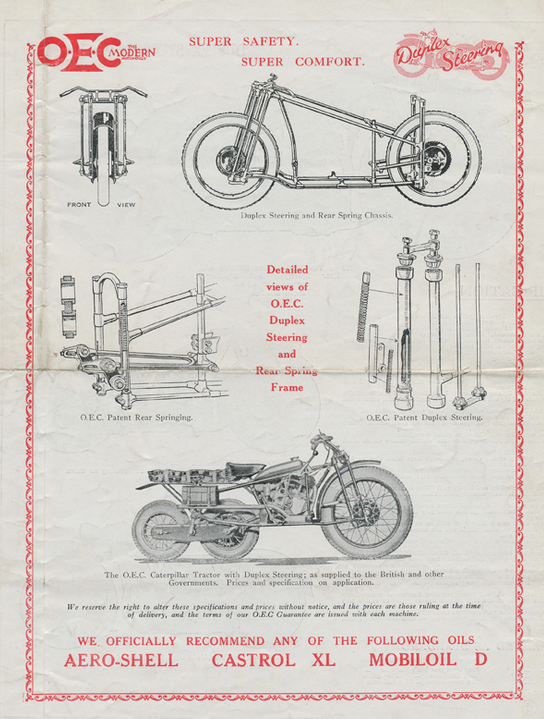
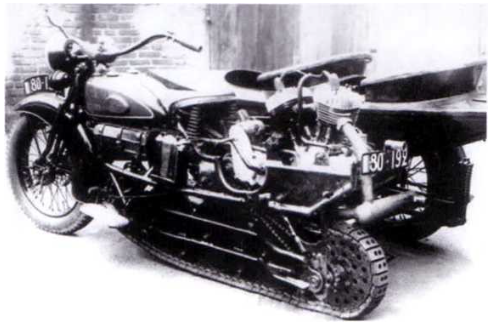
A NUMBER OF MARQUES avoided the expense of exhibiting at the show by staging displays of their latest models in local dealers—Pride & Clarke displayed the 1935 Panthers in rented premises opposite Olympia. Panther also proved that its bargain-basement Red Panther 250 was much more than a cut-price local runabout by entering the ISDT where it did well and the ACU put one through its paces at Brooklands. In his definitive history The Panther Story Barry Jones reports: “The first test was for fuel economy on a measured gallon and, at an average lap speed of 35.5mph, 115.7mpg was obtained. Oil consumption was deemed ‘immeasurable’! The next test for lapping the course hands-off, to check for steering and stability, saw Ernest Chidley bravely managing at least 50mph. Several hill-climb tests, with and without pillion passenger, were then carried out on the 1:4 maximum gradient test hill. Following this came the quarter-mile standing starts (23sec/39.I3mph), flying quarter-mile runs (14.2sec/63.38mph) and a flying half-mile (28 sec/64.28mph). Accessibility for servicing had always been part of the ACU tests and it was found that the rear wheel could be removed in 76sec compared with 99sec for a Panther heavyweight. The Red Panther demonstrated itself to be in a class well above its competitors in nearly every aspect throughout these detailed tests and…was awarded the Maudes Trophy for 1934.”
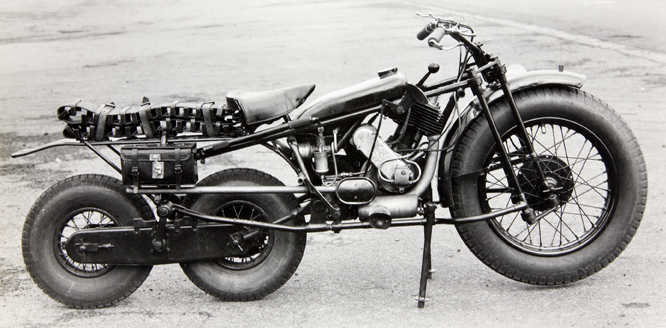
“MAKING ITS BOW IN PUBLIC at the Birmingham section of the British Industries Fair, Castle Bromwich, there is a most interesting power-driven bicycle. For its foundation a normal, though strengthened, pedal cycle is used, and a miniature engine is added. This unit, however, is not merely an attachment, the whole machine being laid out specially to accommodate it. This is done in an unusually neat manner. The unit is a normal three-port two-stroke of 98cc (50x50mm). Its direction of rotation is at right angles to the frame, and in front of the crank case is a flywheel entirely enclosed in an extension of the casting. Behind the engine is a bulbous aluminium casting which forms the silencer, the gases exhausting through a small slot at the bottom of the aluminium expansion chamber. Bolted to the front of the flywheel casing is a Wico magneto. This is of the revolving-magnet type, and is driven from an extension of the engine shaft, a cam on the latter operating the contact-breaker arm. The engine shaft is also extended to the rear and passes through the silencer; almost at its extremity is a worm which drives a phosphor-bronze worm wheel. The whole of this drive is enclosed in a special bottom bracket on the bicycle, and the worm wheel is coupled to the sprocket, from which
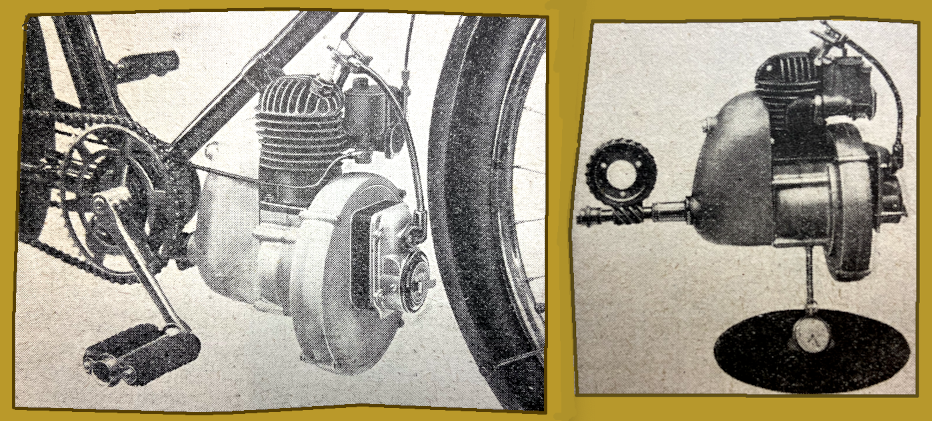
the final drive to the rear wheel is by chain. There is the normal cycle pedalling gear which, through the medium of a dog clutch, may be used to propel the machine or to assist the engine, while it is also, of course, used for, starting purposes. Only two bolts hold the engine in the frame, one from the head to a lug on the front down-tube, the other being a pinch-bolt tightening a sleeve on the bottom bracket round the bushed drive shaft. The bottom bracket is fitted with cup and cone bearings, while there is a ball thrust race at, the end of the worm shaft. The cast-iron piston has two rings, the big-end of the connecting rod is of the roller-bearing type, and the main shaft is supported on ball bearings on both sides. There is a decompressor in the cylinder head, the carburetter is an ETC, and a 14mm sparking plug is used. Mounted behind the saddle is a cylindrical petrol tank holding five pints of petroil mixture. A reserve petrol supply is arranged by the simple process of dividing the main tank by means of a partition. When the reserve supply is required one simply leans the machine over, allowing the fuel to flow over the top of the partition. At the rear of the machine is a number plate equipped with a Miller dry-battery tail lamp; no head lamp is fitted, users being left to choose their own. In the rear wheel there is a coaster, or back-pedalling brake, an ordinary stirrup brake being fitted at the front. The tyres are British Goodrich and measure 26xl¾in. The price of this interesting machine is £14 14s. The tax is 15s per annum, and the makers have arranged third-party insurance at the rate of 7s 6d a year. Completely equipped, it weighs 681b, and it is made by Cyc-Auto, Abbey Road, Park Royal, London.”
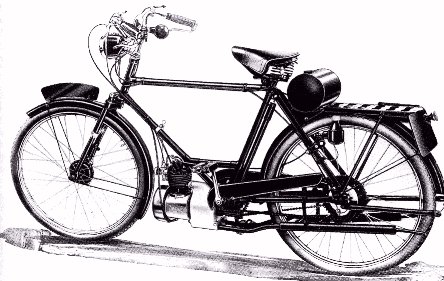
“SINGLE-PORT JAP engines of 498cc are fitted to two new Montgomery motor cycles which are about to be marketed. Both are ‘Greyhounds’, and carry very comprehensive equipment. The Standard type has a three-speed Albion gear box, a central spring-up stand, and the normal type of Montgomery frame which has been so successful in the past. Ignition is by coil and accumulator, the coil being carried under the Dunlop saddle. Behind the inclined cylinder, and chain driven from the camshaft, is a Lucas 6V 36W dynamo, and the large head lamp is provided with a double-filament bulb for dip-switch purposes. There is a steeling damper, and built-in hand adjustment for the top link damper of the Druid forks. The control lever pivot brackets are brazed to the bars so as to avoid unsightly clips. An ingenious oil feed to the primary chain has been arranged in connection with the dry-sump system of engine lubrication.,,A four-speed Albion box is employed on the de luxe model, and the engine shaft carries a JAP shock absorber…the coil set is replaced by a Lucas Magdyno.”
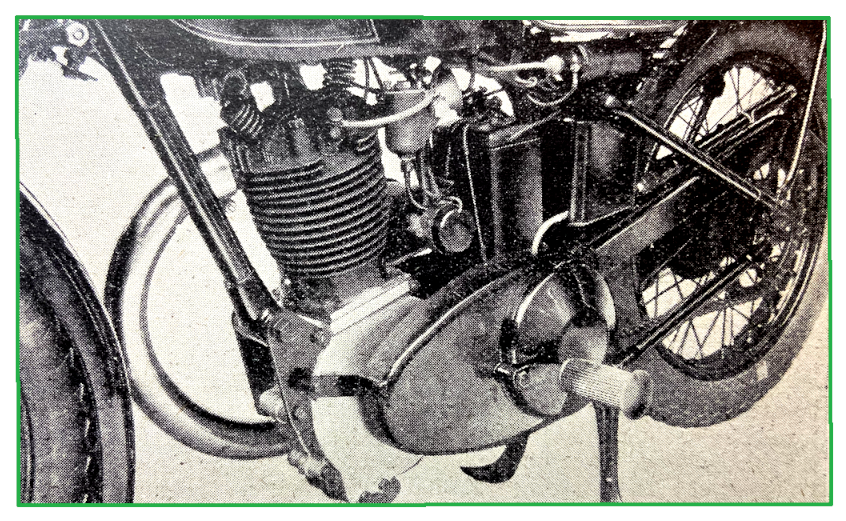

DKW CAME UP WITH THE RT125 (the ‘RT’ stood for ‘Reichstyp’—‘National Model’, making it the two-wheeled equivalent of the Volkswagen ‘People’s Car’). It featured the ‘loop scavenging process’ and was a leader in its class. Adler and TWN were among German manufacturers to copy the technology; this is the design which, as part of post-war reparation would be put to good use by MZ, BSA, Harley-Davidson WFM in Poland and MMZ in Russia. As MZ technology was copied by Suzuki the RT 125 remains one of the most influential motor cycles ever.

THE ITALIAN TEAM who had developed and raced the world’s first ohc transverse four began roadtests of an all-new water-cooled, supercharged version with cylinders inclined at 30° and four-speed transmission with positive foot-change. The Rondine (Swallow) developed a claimed 86hp at 9,000rpm. Six were built In its first outing, at the Grand Prix of Tripoli, Rondines finished first and second, ahead of Moto Guzzi and Norton; a streamlined Rondine then did a record breaking 151.98mph. At which point the Rondine’s manufacturer was bought by aircraft manufacturer Caproni which had no interest in motor cycles. Piero Taruffi, the Rondine’s co-designer, who had ridden it to victory at Tripoli and on its record breaking run, was understandably anxious to keep the project going so he approached Giuseppe Gilera, who snapped it up.
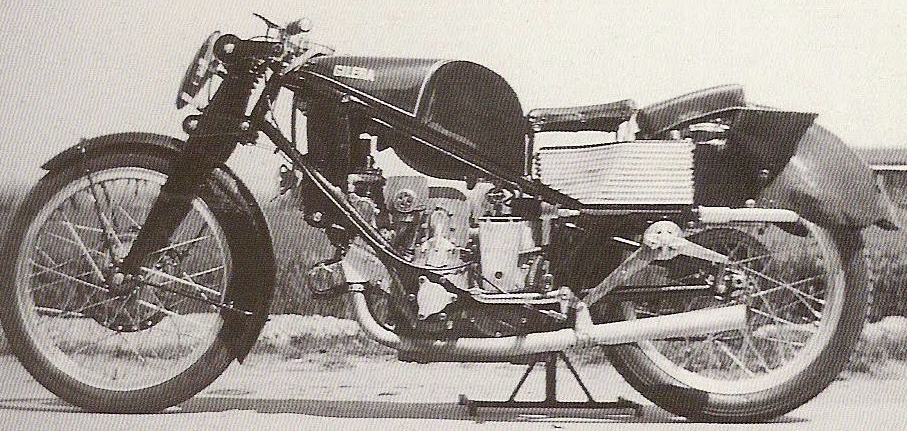
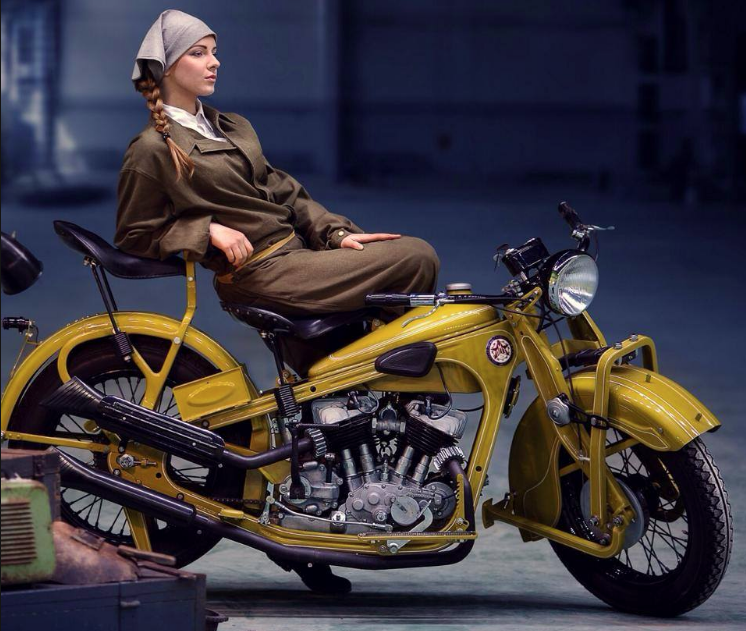
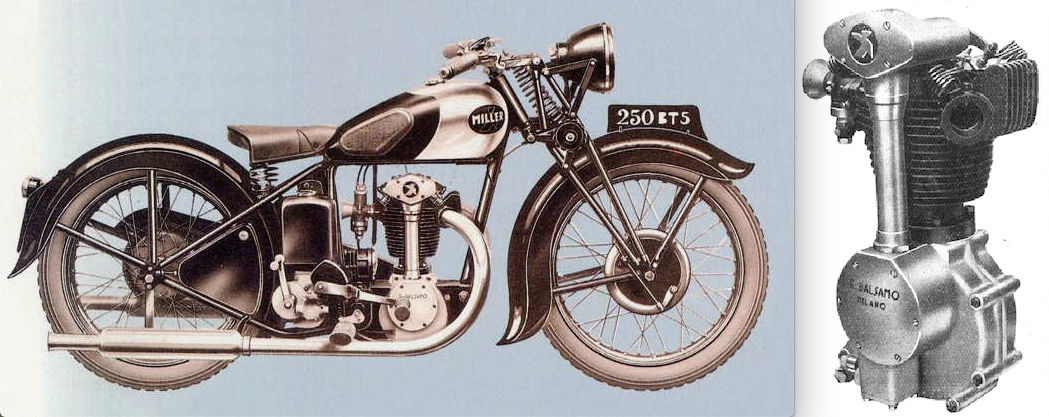
SIX YEARS AFTER PRODUCTION ceased the Danish four-cylinder Nimbus bounced back following a comprehensive redesign (from ioe to ohc). Power was up to 18hp, the frame was made of riveted flat steel bars with telescopic forks. The earlier Nimbus had been nicknamed the ‘stovepipe’ because of large-diameter top tube that served as a fuel tank; the new engine’s distinctive exhaust note led to a change of nickname to ‘bumblebee’.
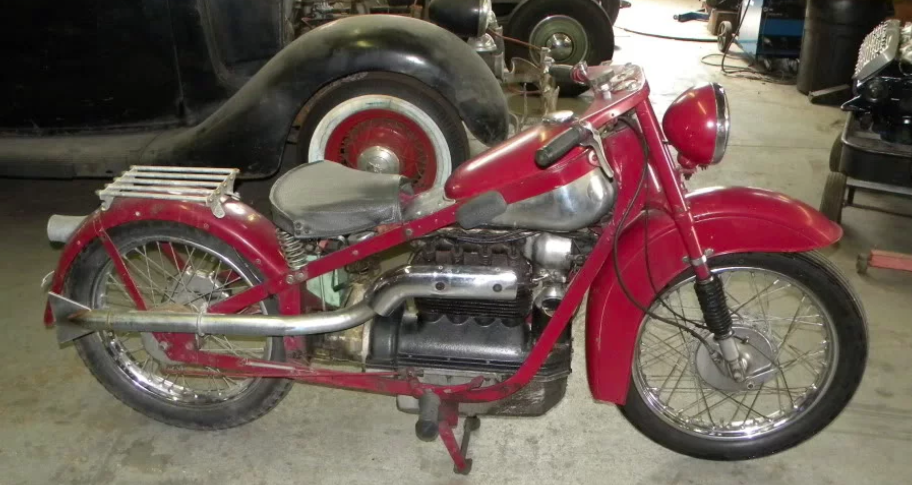
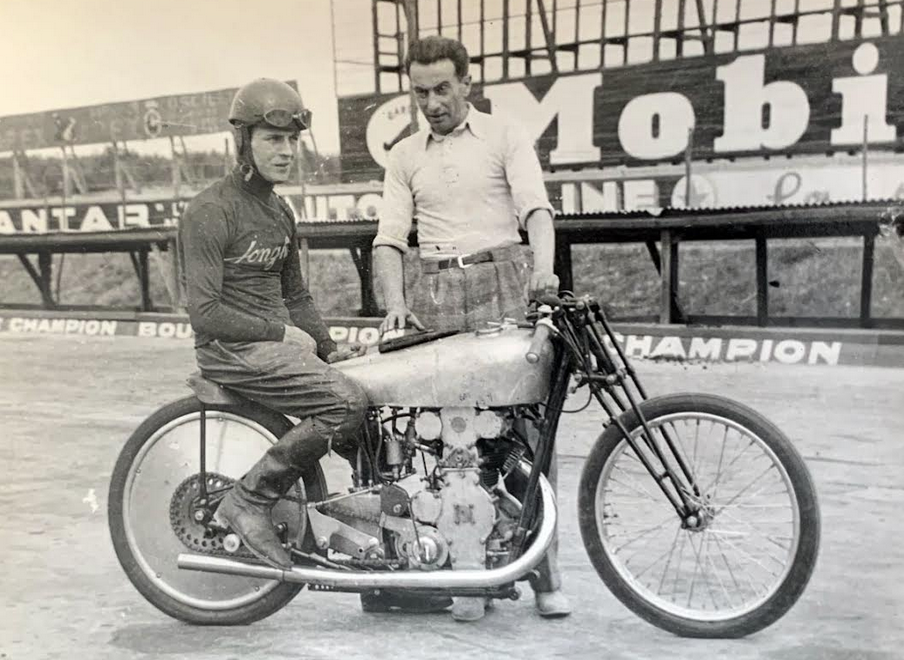
“SAMPLE CASE: NARROW ROAD, barely wide enough to take two vehicles abreast, sharp bend to left, with visibility a matter of a yard or two on the peak of the bend; footpath on right-hand side of the road; weather conditions, foggy; time, 11pm. lxion rounds the above corner to his left on a motor bicycle, rather bothered by a car coming from the opposite direction which dims its head lamps rather late, and smites him full on the eyeballs right on the peak of the bend. Amidst the resulting aurora borealis of assorted pink and gold dissolving views Ixion luckily spots a jay-walker, rounding the corner and taking a line three feet from the hedge, ie, just where the front wheel of a motor cycle or the left dumb-iron of a four-wheeler would get him. Ixion executes a deft swerve, dodging (a) the car on his right and (b) the jay-walker on his left in the space between (a) and (b), which is just handlebar-wide and no more. Query: Why was the jay-walker strolling where he was, instead of on the footpath? Answer: Possibly beer; more probably, stupidity, as the short way round the bend may have seemed more attractive to a silly man. Query 2: Could I have stopped? Answer: Just. Query 3: What did I say to him? Answer: Nothing. Query 4: What did I think? Answer: None of our compositors can spell the words.”
WHEN A MACHINE IS OF an entirely new type, and the particular model is the first to be made, the experienced rider is inclined to anticipate that mental allowances will be.necessary. With its three-in-line water-cooled two-stroke engine, the unit-construction Scott is a complete novelty; moreover, the 747cc machine that has undergone test is the first to be produced, but mental allowances are required not so much for any deficiencies as for the unusual nature of its performance. However, the facts speak for themselves. Hardly was the machine under way than one admirable trait became impressed upon the rider’s mind; that is, the Scott’s exceptional stability at low speeds. No effort, it was found, was necessary to balance the machine, even at a mere walking pace. This automatic stability proved a boon in traffic and gave the rider a feeling of confidence on grease. Undoubtedly, the 59in wheelbase assists in this direction. The next characteristic to be determined was the unusual range of the advance-and-retard of the coil ignition. The throttle and the ignition control have almost equal effect. Advance the ignition lever with the throttle open and the machine would accelerate in exactly the same way as if the machine were being controlled with the throttle, although, if desired, the ignition can be left alone almost all day long. For the very best performance, whether in acceleration or slow-running, the quick-opening twist-grip throttle and the ignition lever should be operated in unison. Assuming this mode of control, the machine with its six-cylinder torque would accelerate with a smooth litheness that was enthralling. There was no pause, no flat spot as a result of sudden opening up; the six-cylinder, clatter-free drone would rise to a screaming hum—the war my of a ‘Scott-and-a-half’. An important fact is that the machine could be relied upon implicitly to get off the mark in this way, two-stroking perfectly; thus there was no difficulty in gauging time and distance in the matter of overtaking. Figures show how exceptional was the acceleration: from 20 to 45mph the mean times were approximately 4sec in second gear (8.66:1); just over 5sec in third (5.44:1), and roughly 8sec in top (4.3:1). With its 747cc engine, the Scott
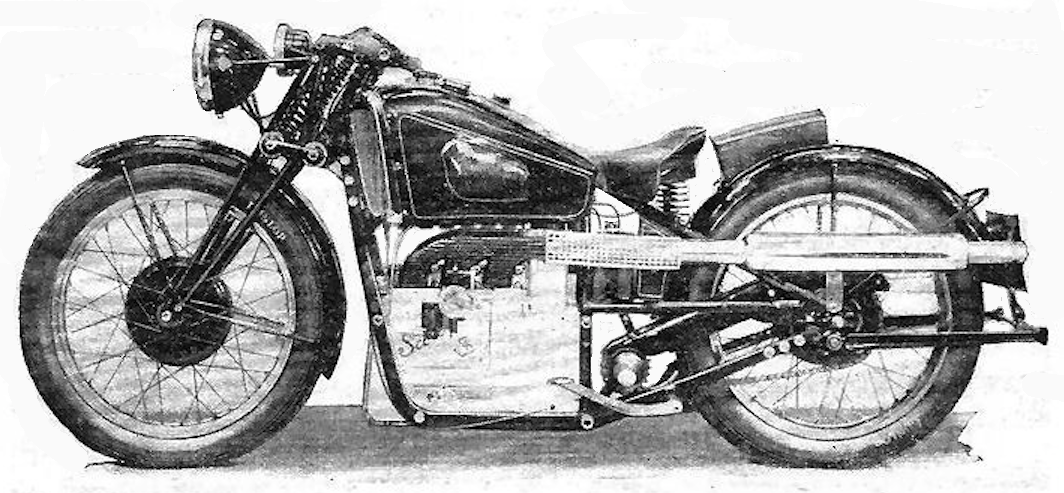
has a high performance. The maxima on the four gears were: bottom (13.54:1), 40mph; second (8.66:1), 61mph; third (5.44:1), 81mph; top (4.3:1), 86mph. When these gear ratios are considered it must be borne in mind that 28×3.50in tyres were fitted. On a long run, whether touring in the 40s, 50s, 60s, or more, the rider had the impression of gliding effortlessly along. At all speeds the steering was of that unwavering type that gives the rider complete confidence. The torque reaction of the engine—the unit is, of course, arranged with its crankshaft in line with the wheelbase—could be felt when the throttle was opened or shut suddenly, and it could just be detected when the machine was being leant over for bends, but at no time was it in any way disconcerting. Vibration at all speeds was negligible. The machine tested was fitted with the throttle-controlled swash-plate oil pump, but not with the additional rotary pump to which reference was made in the [previous] description of the production design…After a period of running at below 30mph the engine of the machine tested tended to receive too much oil, and therefore to misfire. When the machine was stationary for a minute or two and had not previously been cruising at low speeds, it would tick over regularly with the ignition retarded in a manner quite foreign to two-strokes. The misfiring appeared to be less marked when the oil level dropped; the level was normally kept on the high side because the dip-stick provided did not give a clear indication as to the quantity in the sump. Except when there was an excess of oil—and even then, more often than not—the machine could, if desired, be treated as a top-gear mount, controlled merely on the throttle and the ignition lever. Mounted internally in the position that the second oil pump is to occupy in production models was a breather valve, which worked loose during the test and provided an effective brake. Externally, the engine remained satisfactorily clean. The riding position proved extremely comfortable. Both brakes were excellent—smooth, powerful, and progressive in their action, while the rear brake pedal is conveniently mounted. The battery mounting, in somewhat close proximity to the kick-starter (which, incidentally, is designed to form an efficient prop-stand) is not ideal. Starting was good, and, judging from the way in which the engine started up after being left in the garage for a few days, the arrangement whereby oil is used to form gas seals between the inner crank cases is eminently satisfactory. The method of starting is to flood the carburetter, kick the engine over a few times with a hand over the air intake, and then switch on the ignition and kick the engine over normally. The four gears were easy to change, but the clutch proved a trifle on the heavy side in operation. On all ratios the gears were silent, and there was no detectable noise from the bevel drive. Fuel consumption worked out at just over 67mpg at a steady 35mph. Oil consumption, with the system fitted to this particular machine and the sump excessively full during most of the test, was roughly 600mpg. To sum up, the Scott Three provided a performance that is sheer joy to any enthusiast, coupled with steering, braking and general controllability that vie with the best on any machine produced.”

“SINCE OCTOBER LAST, the RAC has issued 160,000 fog discs to motorists.”
“THAT LOCAL AUTHORITIES should have power to classify main and secondary roads, and to compel all secondary road traffic ‘to stop, look and listen’ before emerging out to the main thoroughfare, was the view of the Manchester magistrates when they conferred on the Home Office circular regarding accidents.”
“IN SWEDEN NEW ROADS and bridges are to be provided with special paths for cyclists.”
“MOTOR CYCLES TO THE NUMBER of 3,526 were exported from Britain to Holland during 1932, representing over 75% of the total imported into that country for the year.”
“THERE IS NO DOUBT that the Flying Cloud OK Supreme has earned an enviable reputation. Its purchase price is low, yet it is not, in the depreciatory sense of the term, built down to a price. The design is good, the finish excellent and there are very many detail refinements that add greatly to the machine’s appeal, while the performance exceeds expectations. The first few moments in the saddle proved that the steering was light, yet absolutely positive. At all speeds it was admirable and, although no steering damper is fitted, never in any circumstances did the rider feel that one was in the slightest degree desirable. For 1934 an alteration has been made in the position of engine, which is now mounted farther forward. No doubt this is largely responsible for the extremely satisfactory steering. On bends the machine could be laid over easily and freely. No wobble resulted if the machine hit a pot-hole when it was banked over. The steering was light enough to enable one to change direction instantly—as, for instance, in an emergency—yet sufficiently positive to prevent the slightest wobble or the rider turning more sharply than he wished. In the matter of road-holding the Flying Cloud was surprisingly good; it was in no sense of the word ‘skittish’, and showed no tendency to dance about when crossing bumpy and greasy tramlines. One point of criticism in regard to the machine’s performance on sharp corners is that when the handlebars were locked right over they fouled the rider’s knee, which, as a result, had to be moved out of the way. The machine tested was fitted with a Lucas six-volt dynamo and coil set. Starting was easy in the extreme and even during really frosty weather the engine would start from cold at the second kick, and often at the first. Slight piston-slap was noticeable during the first few minutes’ running. This, however, disappeared once the engine was warm. The push-rods and rockers are enclosed, and the noise from the valve gear generally was by no means pronounced. Even at high engine speeds the exhaust note was never offensive, and at low speeds, as in traffic, the degree of silence proved unusually high. For a 246cc machine designed not so much for maximum speed as for a good all-round performance, the speed capabilities of the Flying Cloud are notably high. A maximum of just short of 69mph was recorded in one direction, while against the wind in the opposite direction the figure was 65mph. In second gear, which has a ratio of 9.26:1, the mean speed was 49mph. In the matter of acceleration the machine was also good; the time taken to accelerate from 20mph to 45mph in second gears between 10 and 11 secs, while in top gear, which has a ratio of 5.72:1, the time was just over 11sec. So much for the Flying Cloud’s capabilities in the direction of high speed and
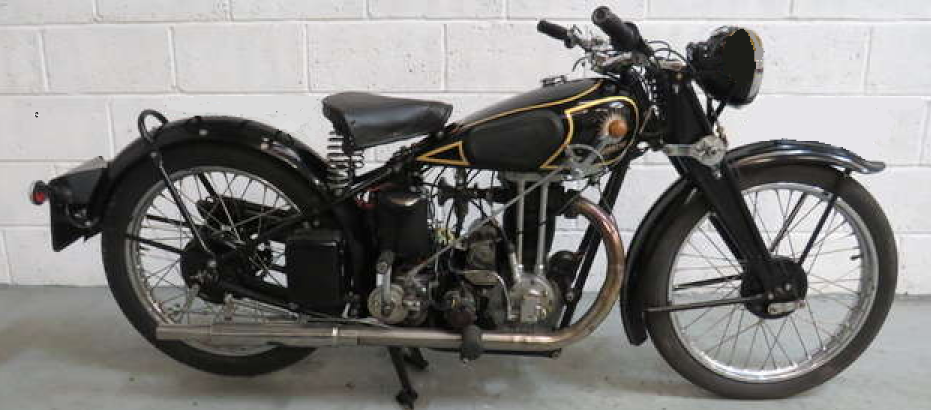
snap; at the other end of the range it proved capable of trickling along on top gear at 14 to 15mph without transmission snatch. A particularly good rear brake pedal mounting has been found; this is on the left-hand side of the machine and comfortably close to the footrest. Both brakes proved to be beautifully smooth in action and very powerful. Although only gentle pressure on the controls was necessary the operation was not so light that the rider was unable to feel the controls when wearing heavy winter clothing. The machine is a small one; nevertheless, with its Dunlop rubber-topped saddle and 3in-section tyres, it is really comfortable. Like the brake pedal, the remaining controls are well placed and work smoothly, and the riding position is so arranged that a man of normal stature finds he is in no way cramped. The pivot-mounted three-speed gear box is of Burman manufacture, and the clutch was both light and sweet in operation, while the gears were easy to change. A number of important improvements have been embodied in this year’s model. Among the features are the efficient shielding of the lower part of the engine, the gear box and the chains. These shields, while affording excellent protection, are readily detachable when this is necessary for the purpose of adjustment or over-haul. Another excellent feature is the arrangement of the tools in a canvas container which opens with the tool box. In the course of the test it was found that the tools were free from rattle, and yet were ready to hand if required; another good point of this arrangement is that there is no difficulty in packing away the tools after a repair has been carried out. A third good point—also a new one—consists of a battery mounting which enables the battery to be swung outwards for topping up or examination. The main head lamp bulb is of the twin-filament type, operated, of course, by a handlebar dipping switch, and there is, as usual, a pilot bulb for traffic work or parking purposes. The dynamo proved fully capable of its task of supplying both the coil and the lamps; with the main head lamp bulb in operation there was a small surplus charge of approximately 1 ampere, while, with lights off, the ammeter showed a charging rate of 4 amperes at 45mph. Petrol consumption at an average speed of 35mph worked out at 85mpg. The oil consumption was approximately 1,500mpg with the sight-feed mechanical pump arranged to deliver a liberal supply in view of the newness of the engine. In brief, it can be said that the latest Flying Cloud OK Supreme is a lively, yet docile, mount with excellent steering, a high degree of comfort and good road manners.”
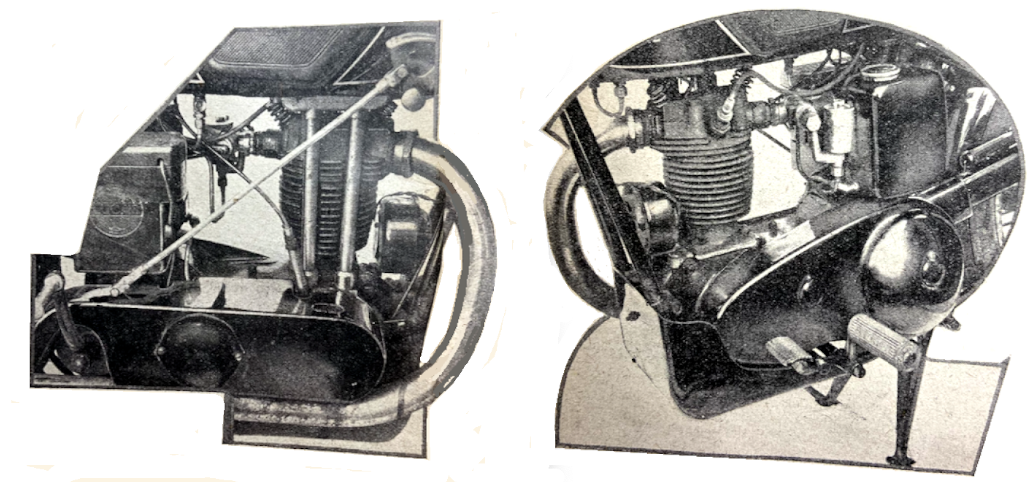
“UP AT THE DONINGTON RALLY I had a run on George Brough’s self-banking sidecar. You remember the one? The original version appeared at the last Olympus Show; there is a helix attached to the sidecar wheel which, after the machine has been banked over to the left and the driver has released the pedal automatically ‘winds’ the machine back to its normal position. It is all very clever, and, driven electrically at the Olympia Show, it worked. But does it work in practice? The answer is, ‘Yes!’. I am told that it is very jolly when you are batting, particularly if the sidecar is empty, but batting in the Donington area on the day in question was definitely taboo, so I could only prove that the scheme does act. What happens is this: On your depressing a pedal, the machine automatically goes over to the left to full bank, and you hold down the pedal for just as long as you need the banking; then you slide your foot off the pedal, there is a slight clash as the pin engages with the helix, and up goes the machine to a normal keel. You cannot, of course, hold the machine half-banked, and the banking only applies to left-hand cornering.”
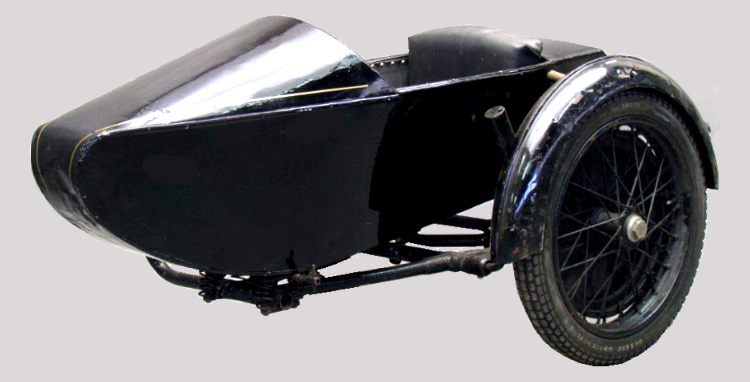
“IN REPLY TO A QUESTION in Parliament, the Minister of Transport said that he has decided against any regulation to make the dipping or dimming of headlights compulsory. Ordinarily, a driver should dip or dim, but in some circumstances such a course might cause, rather than prevent, danger.”
“ONE OF THE LARGEST brake-lining manufacturers has introduced a brake efficiency indicator for cars, the device registering on a dial the percentage of efficiency each time the brakes are applied.”
“DURING LAST YEAR there were 12,479 convictions in England and Wales for failure to comply with insurance requirements.”
“A MOTORIST FINED 10s at Brighton for having no driving licence pleaded that the omission to renew was a pure over-sight, and he asked the Bench’s permission to fine himself another 10s 6d. The poor box benefited by that amount.”
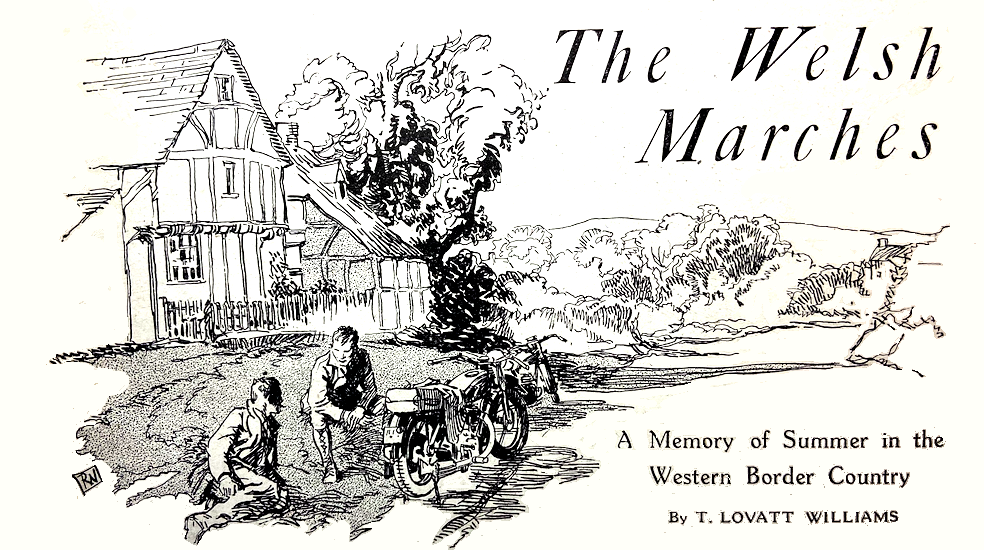
“JIMMY AND I ARE INCURABLE potterers. We have a very bad reputation among the stern local motor cyclists whose one object is to ‘get there’ and, having got there, to proceed to ‘get back’ without unnecessary waste of time. Now, when I go out with Jimmy, he on his 350cc Modern and I on my little two-stroke ‘Ancient’, there is no knowing when or where we shall arrive. We have been known to set out from Birmingham (our jaunts always start from there) with the fixed intention of being somewhere around Cheddar for lunch; then, behold, we have sent picture postcards home from near Tenby at teatime. That is but a preamble to this brief account of a real ‘potterer’s’ week-end in high summer; and, from the pleasure we got from it, one might also say a plea for the pursuit of ‘pottering’. Witness us, .therefore, just after tea on a Friday, setting off on the Bridgnorth road, the very positive and business-like beat of Jimmy’s three-fifty being answered by the hiccupings of my elderly two-stroke. Arrived at Bridgnorth, and the sun still high, my companion must unstrap his paraphernalia and proceed to take sundry photographs of what would be considered very ordinary scenes. But such is Jimmy’s magic that in a few days those prints will appear as real pictures, and the commonplace will have been eliminated—in other words, the ‘art’ of photography. After a long and laboured pull up Wenlock Edge, we stop and look out over the sunlit countryside. The engines seem decidedly hot, and we hint to one another in broad, rude terms that here is neglect, inefficiency and whatnot. The descent to the river level is a great experience, for the whole land seems to be conjuring forth warmth and perfume, and the evening is ideal for a couple of motor cyclists with eyes for the charms of a superb country. We go right into Shrewsbury, for Jimmy has a great fondness for a certain hostelry near St Mary’s Church, and if I denied him a visit he would be unbearable for the whole evening. There is a rare fascination about this old town. It is a queen of county towns in England, and that is saying a lot. Having imbibed refreshment and drunk deeply of the atmosphere that goes with cobbled courtyards and half-timbered houses, we push on along the Welshpool road until, some miles out, we turn right, bringing us near where the great Breiddens rear their frowning heads so steeply from the flat river country. At a quiet farm near the Severn a hearty meal awaits us, and from the table we can watch the last glow of light on the tree-clad summits. An intense stillness hangs over all, and we depart to bed tired and at peace with the world. Next morning there are adjustments to be made, and the first one we undertake is to clear out sundry calves and pigs which are inspecting our buses with an attention that is discomforting. Quite as discomforting are Jimmy’s remarks about my machine when I commence to do certain elementary repairs with stiff wire. Yet I get my own back later, for we ride to the foot of Breidden and commence the ascent to the summit on
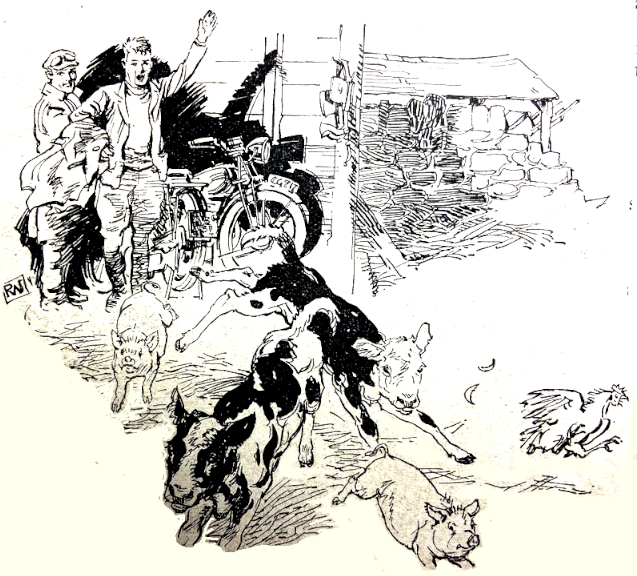
Shanks’s pony. This climb to over a thousand feet is absolute torture to Jimmy, loaded with camera and impedimenta of a consumable nature. However, it’s well worth it, for I doubt whether there is another view so good. With our powerful glasses we can pick out village after village, for the landscape lies below like a coloured map. We can even catch the glint of our motor cycles lying against the grass bank of a farm a thousand feet below. It is so clear that the spires of Shrewsbury gleam afar off, and the Severn is like a twisting stream of silver set amid the greenery. It is really a marvellous view from this fortress-like hill, which ascends almost vertically from the Severn plain. Behind us is wild undulating country where, it is said, Caractacus, the British king, made his last fruitless stand against the all-conquering Romans. The opposite hills of Wales attract us, so, after our descent and a quick lunch at the farm, we set off for Oswestry and begin the long climb up to Selattyn and beyond. It is slow progress for the two-stroke, and Jimmy rides on on in front, consciously superior, his bus doing remarkably well considering how little attention it gets, for Jimmy’s spare hours are mostly spent in a dark room doing tricks with negatives. Suddenly a most lovely panorama opens out—a green amphitheatre of hills that make up the Ceiriog valley, and we gaze, entranced. Then follows the steep descent to Glyn Ceiriog and a level run along one of the most peaceful vales I have ever seen. There is a jolly little river winding by the side of the road, and later it flows through the gardens of a nice hotel, where we refreshed ourselves and absorbed the view. There were several of the motor cycling fraternity here, and, naturally, we exchanged a few words with them on the all-engrossing subject. Curiously enough, one of them came from a town near my home, and we straightaway invited one another to a few meals. To complete a very jolly day we proceeded via Chirk and Overton to that peaceful Deeside beauty spot—Erbistock. It is a perfect picture, with its own ferry and the inn standing where three counties meet. The last time I had come here I had been mounted on a 1915 Levis which was the delight of my life; despite its lack of gear box it had taken me through this hilly countryside very successfully. Chiefly I remember those days by the almost complete absence of motor traffic on the roads of the district, and by the terrific dust or deep-rutted mud of the country lanes. Turning homewards, we skirted the green hills once more, with the shadows lengthening over all this lovely border country. We were but a few miles from and running parallel to Offa’s Dyke, and it seemed a far cry to those days when fierce warfare surged over this now peaceful land. And so back to the hospitality of the farm by the Severnside, where the machines were put away, secure this time from the curiosity of pigs and calves. Next day was Sunday and still gloriously fine, as, indeed, it had been the whole holiday. Sundry adjustments having been made, we set off, having first of all had the uncommon experience of telling our good landlady she had not charged us enough! The way lay through Welshpool and that lovely rolling country that leads through Bishop’s Castle to Clun. On either hand are hills, to the right those of the Principality, and to the left the splendid contours of the Long Mynd. This is certainly ‘the country for easy livers, the quietest under the sun’, for we scarcely meet a soul amid these uplands, where the kestrels seem to have the world to themselves. Up and down, give and take, and a vast amount of collar work for these faithful mounts, and so we wind and climb and fall in this wild, tree-clad and lovely country that goes to make the Clun Forest. Than ‘By Ony and Teme and Clun‘* there is no more fascinating land in England, and it deserves more than the superficial Sunday run which was all we could afford this time. We get the vague impression of dark woods or steep hillsides, rushing rocky streams and vast sun-caught spaces, and by early afternoon we are dropping down into ancient Ludlow—a treasure of the border country. There is an excellent lunch at the well-known mellowed hostelry, and we set out on the slow climb to Clee. It is a long, hard pull for my small bus, but she tackles it consistently and manfully, and soon there opens out that wonderful panorama with industrial England, in odd contrast, faintly smoking on its distant fringe. Thence the way lies easy through Bewdley and Kidderminster to the blackened edges of Birmingham, such scenes of commercialism striking rather harshly after the fair lands of the Welsh marches. And yet the very machines we ride have risen from among the seared and blackened outskirts through which we ride to reach the City centre! This was a very full and rich week-end—marvellous, summer weather, a no-trouble run, the expenditure of a very small.amount of money in petrol, food and beds.
*AE Housman Clunton and Clunbury: “Clungunford and Clun, Are the quietest places
Under the sun. In valleys of springs of rivers, By Ony and Teme and Clun, The country for easy livers, The quietest under the sun…”
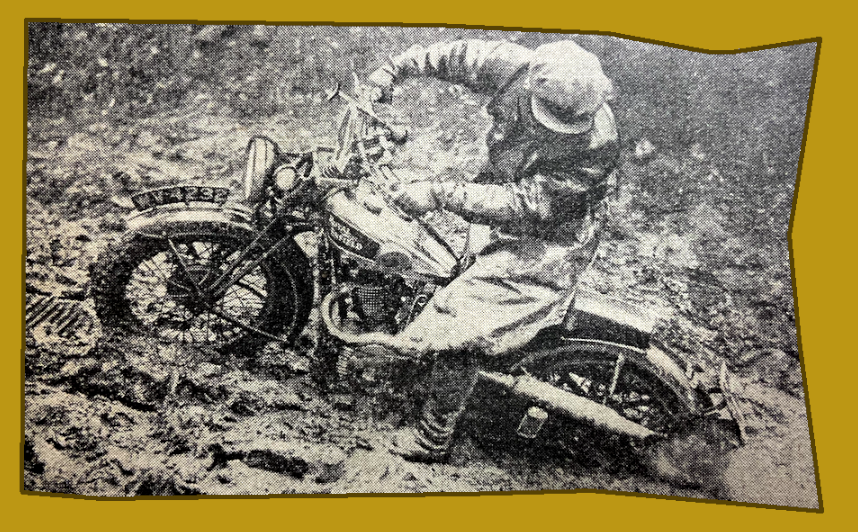
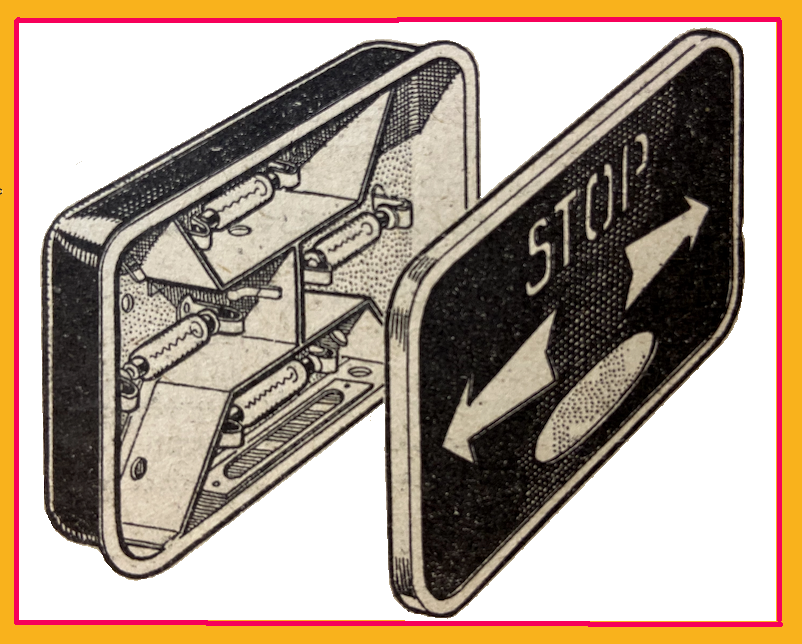
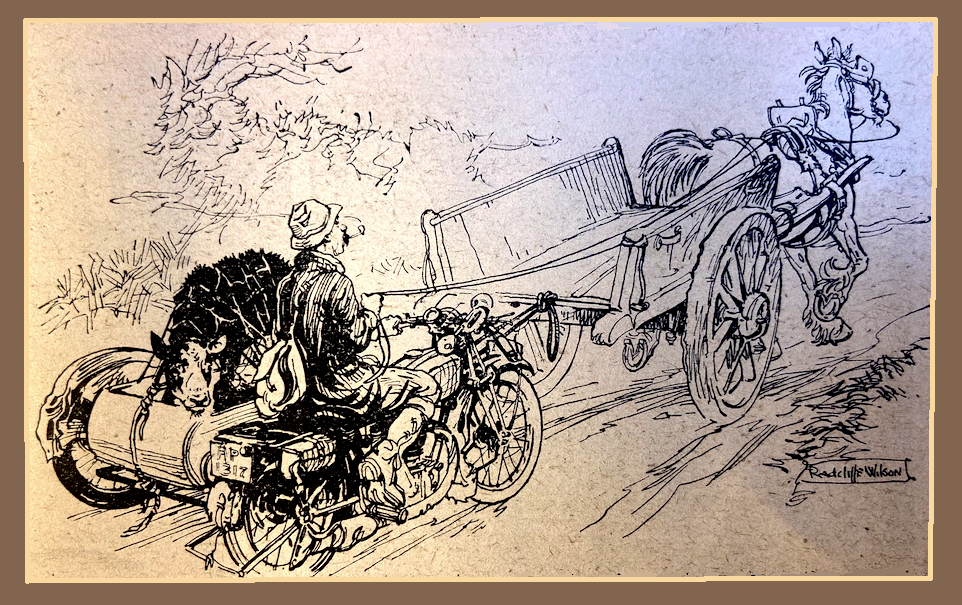
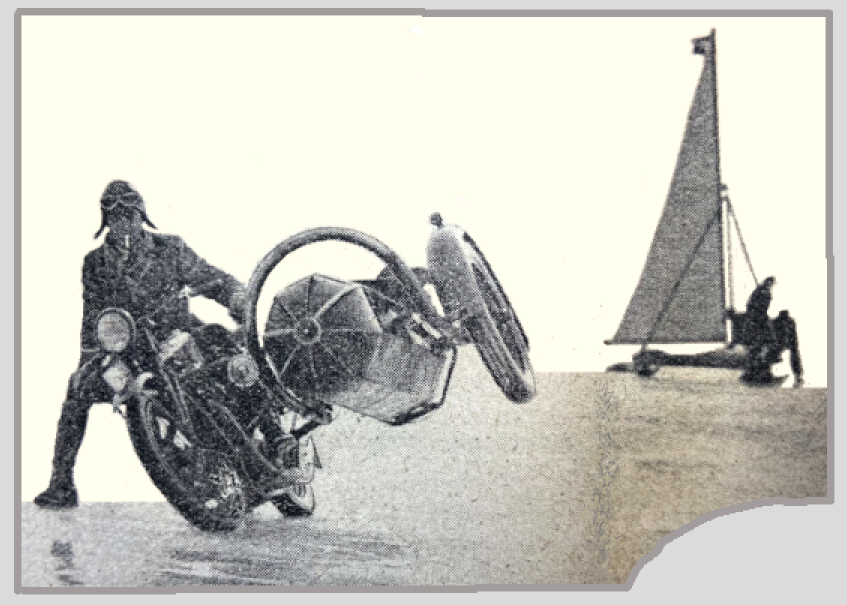


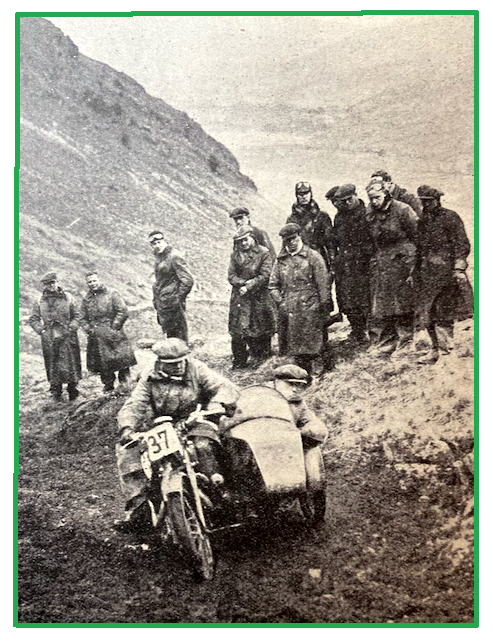
BY THE END OF THE YEAR Britain was home to over 500,000 motorcycles with 45,845 new arrivals, including 16,960 250s, 13,233 over 250cc and 5,890 under 150cc with 4,567 combos. But three-wheel cars were now outselling outfits with 5,195 registrations during 1934.
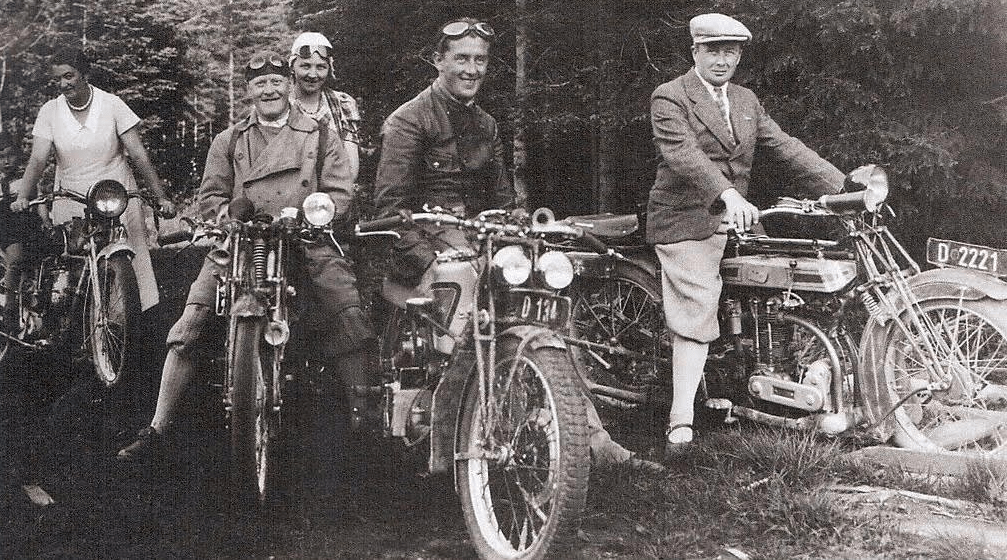
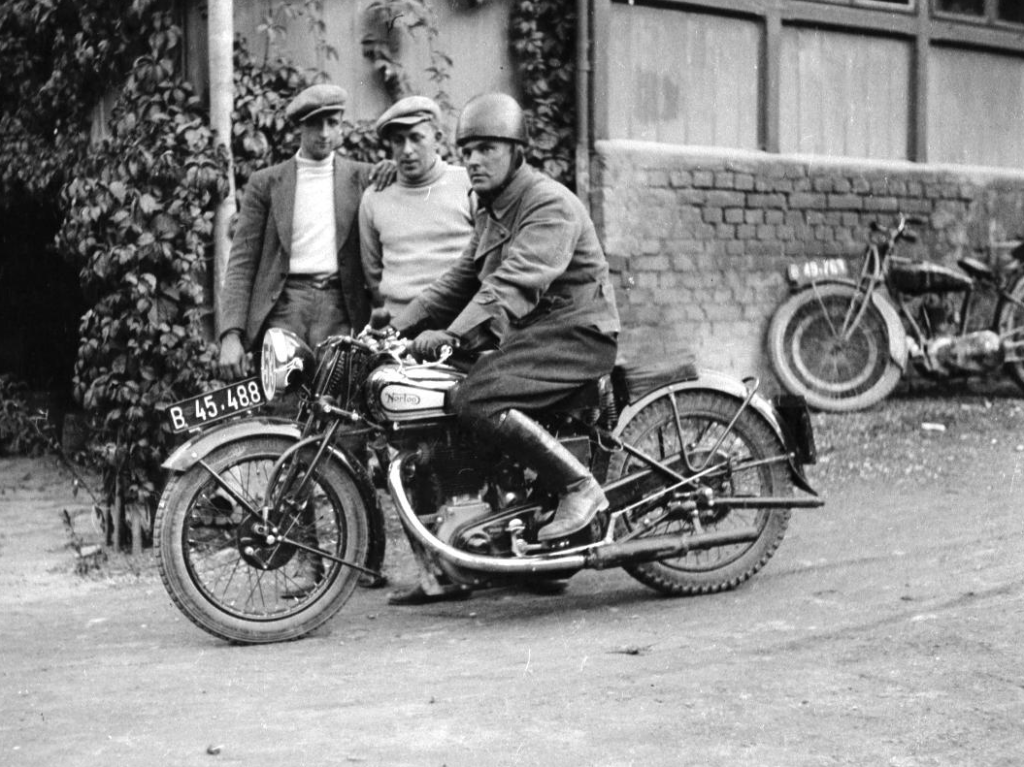
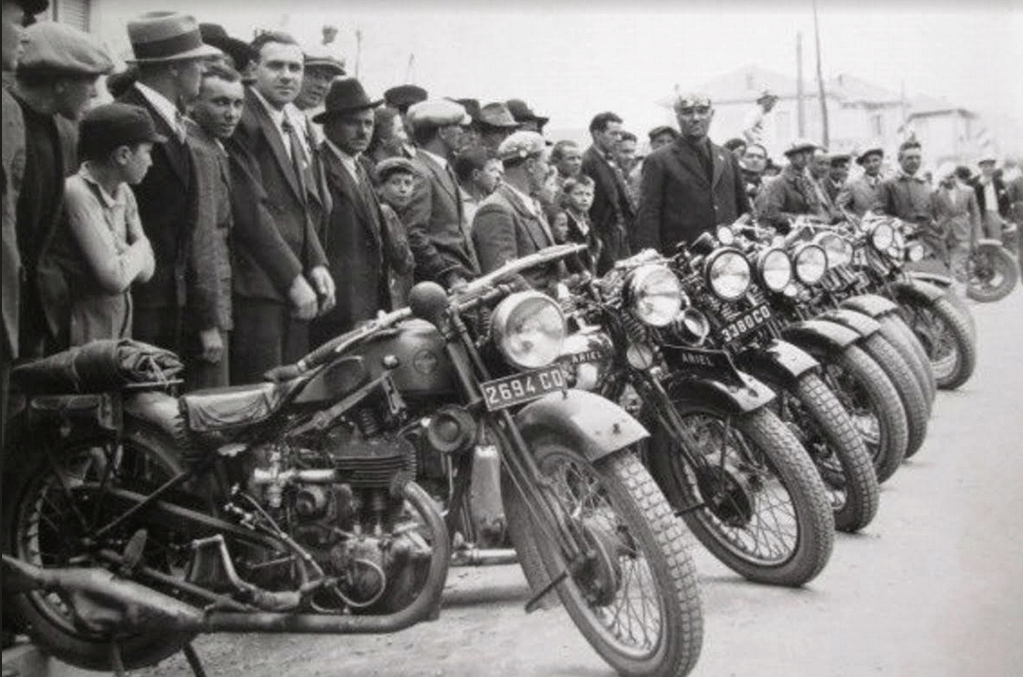
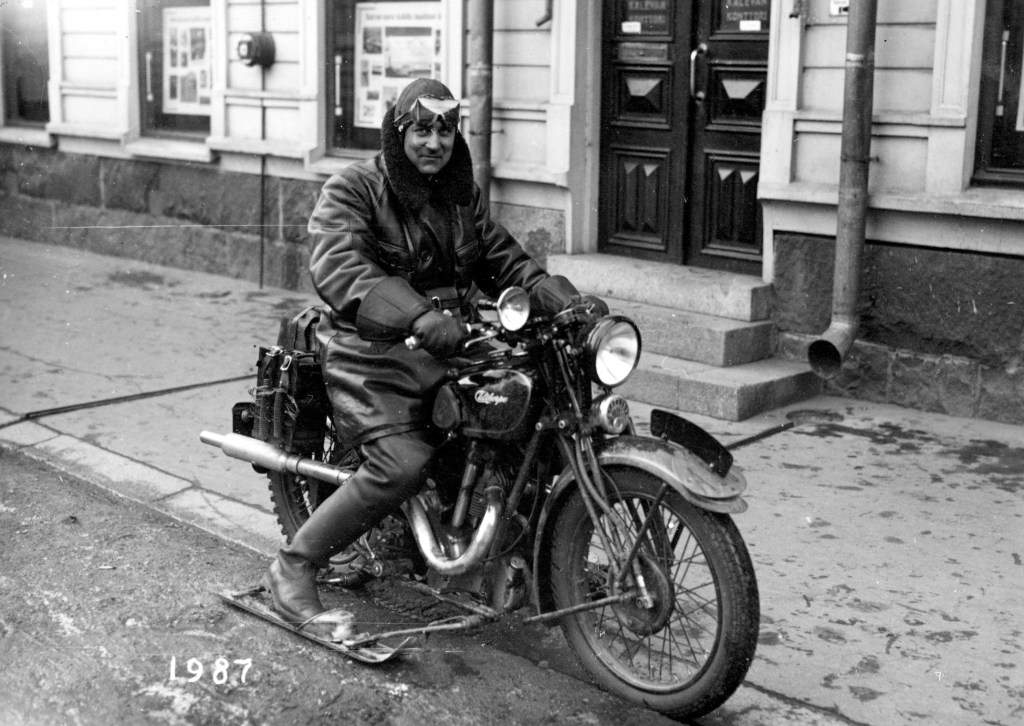
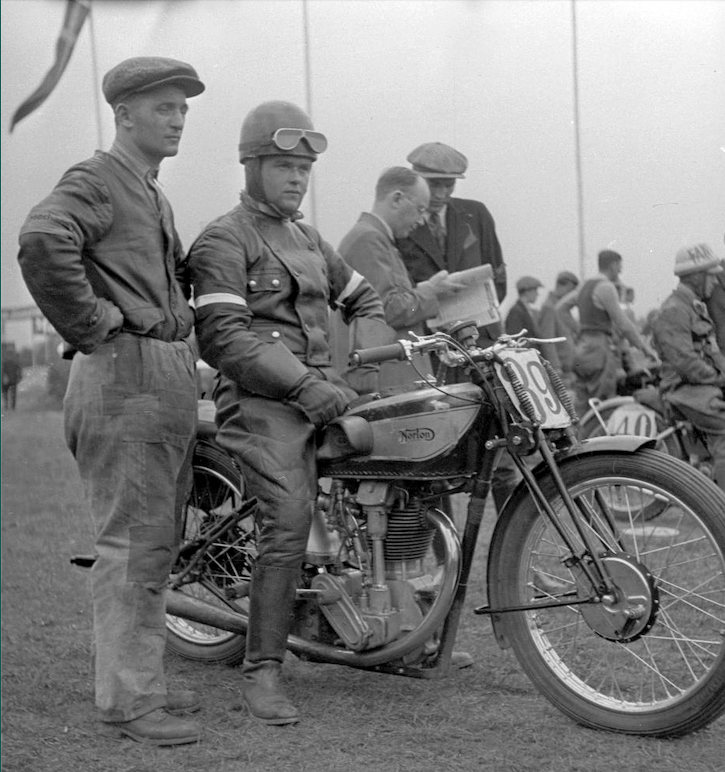
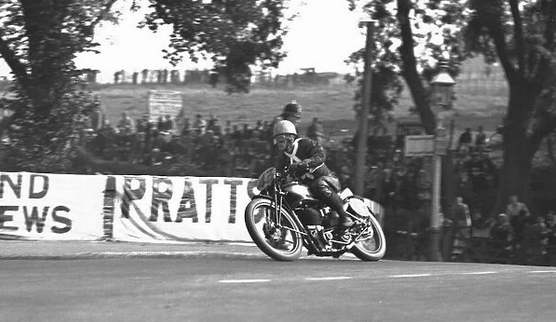
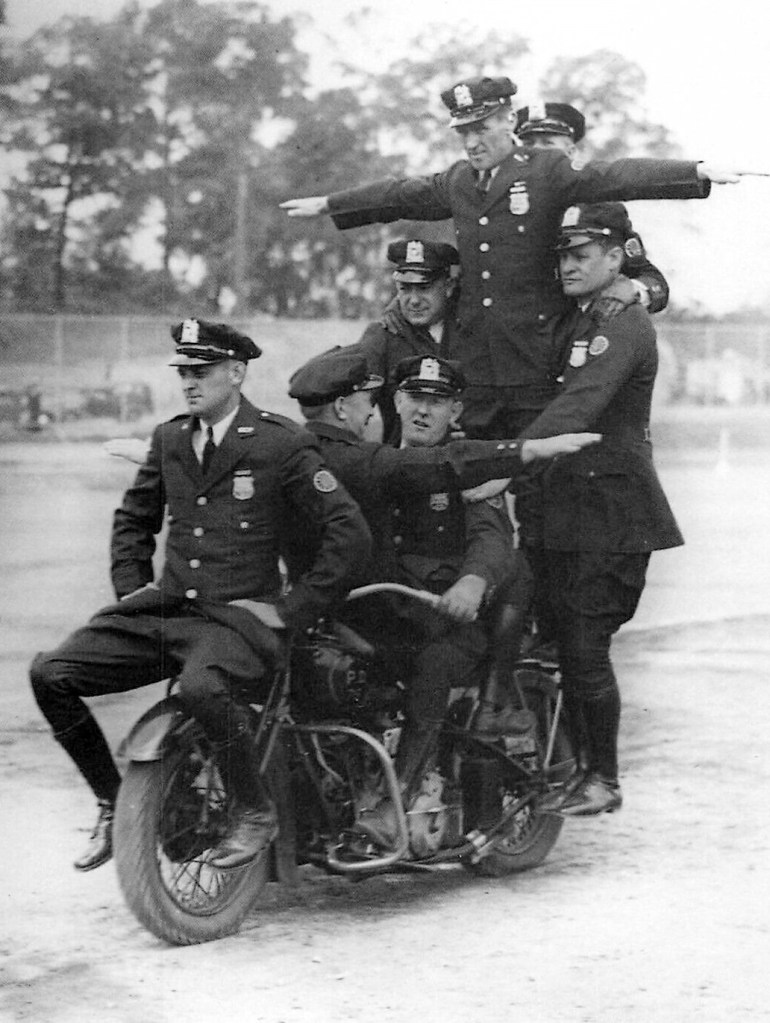
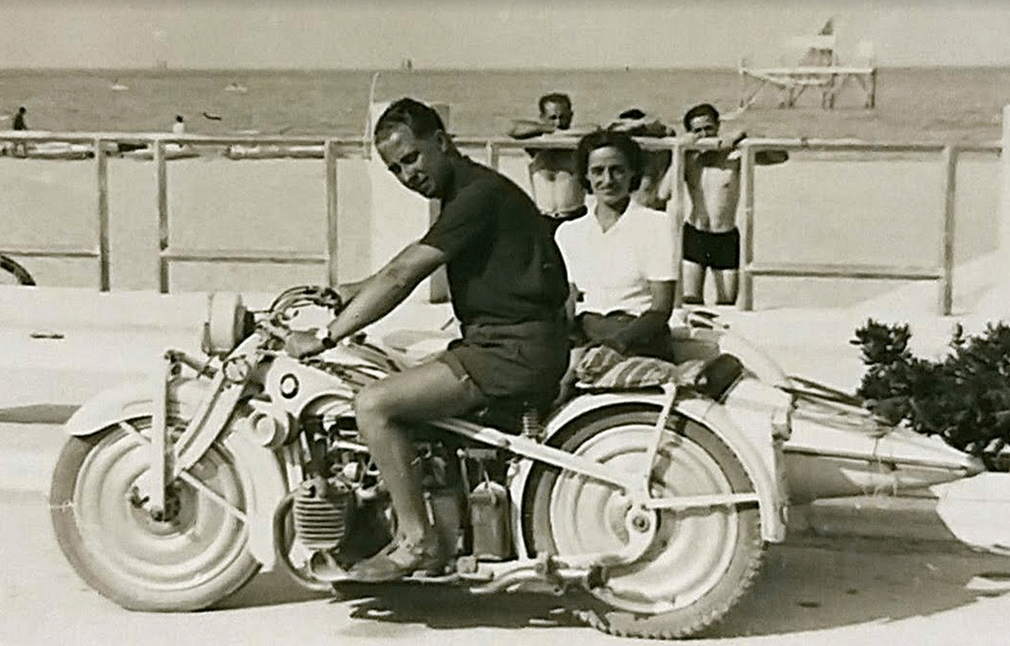
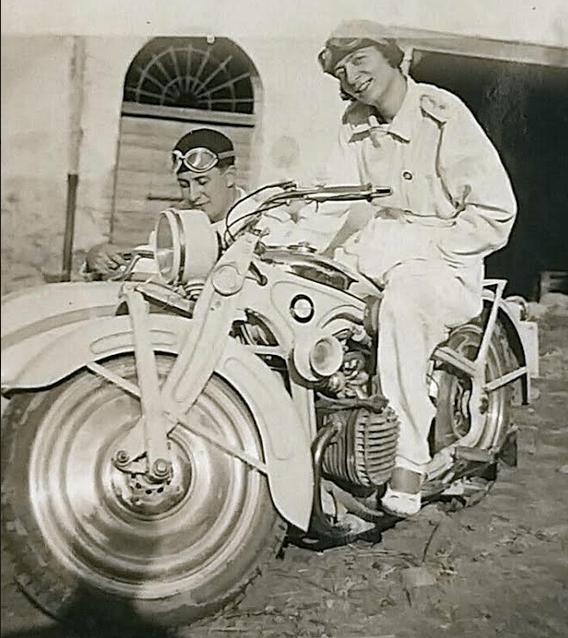
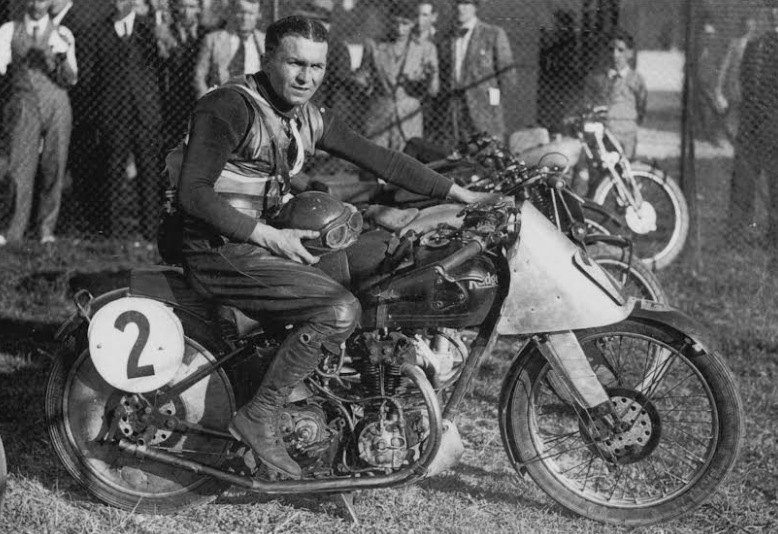

You wouldn’t want to leave 1934 without checking out a few contemporary ads.
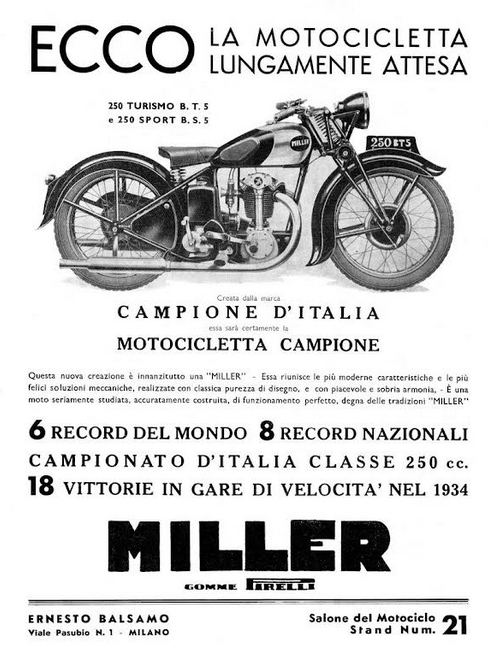
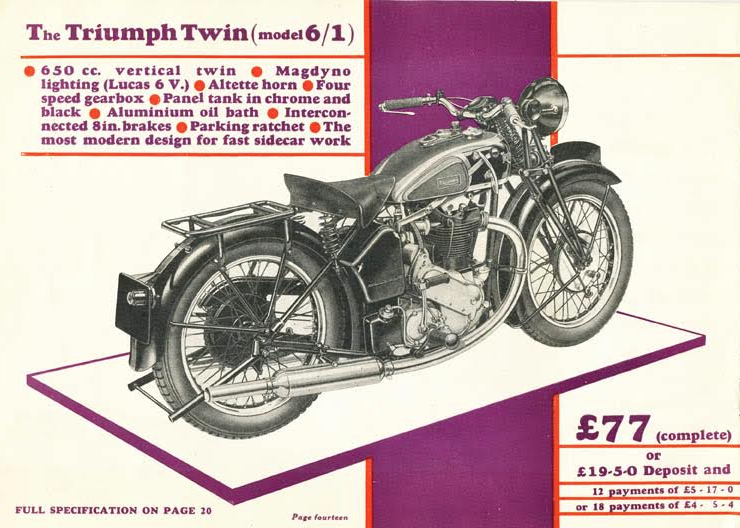
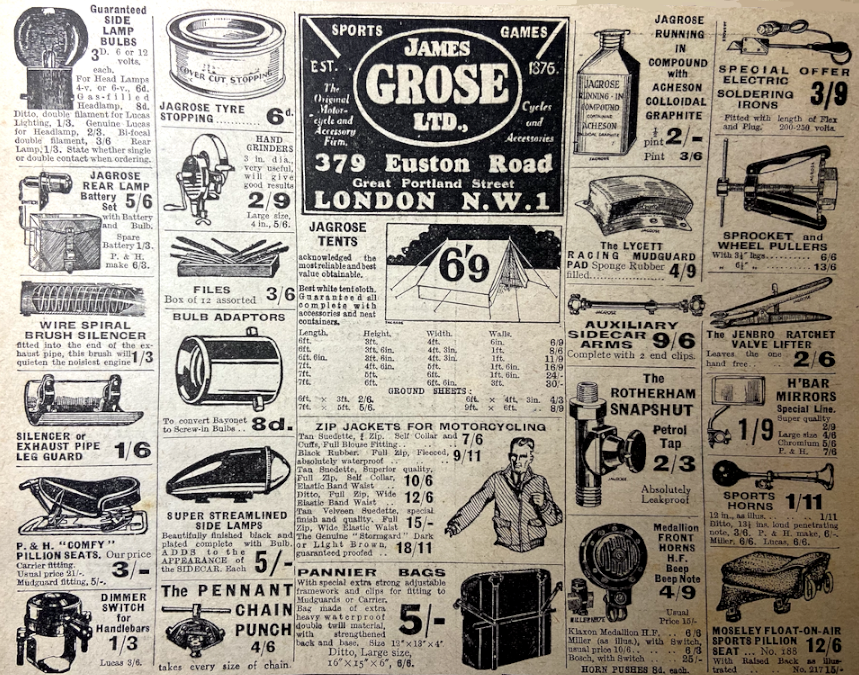

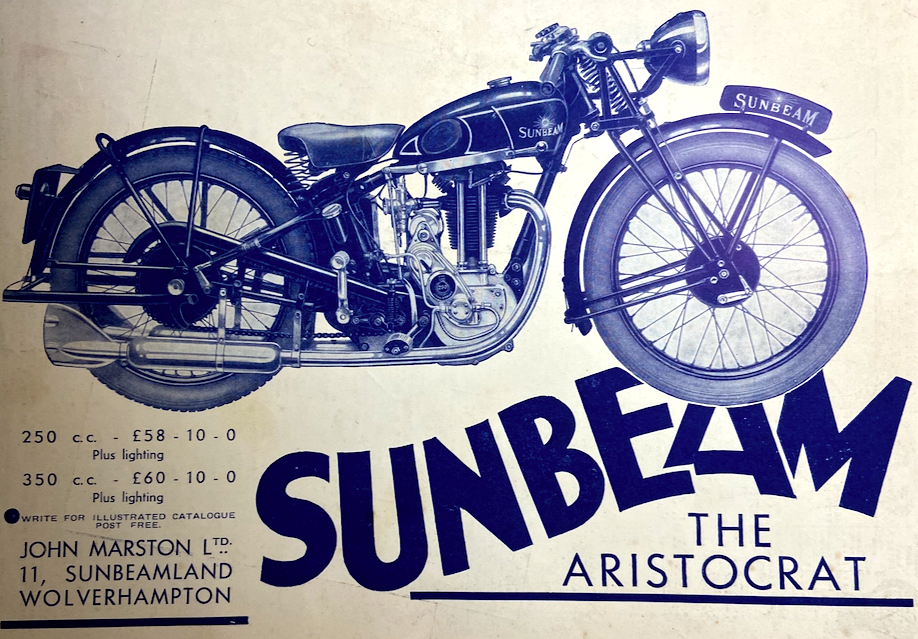
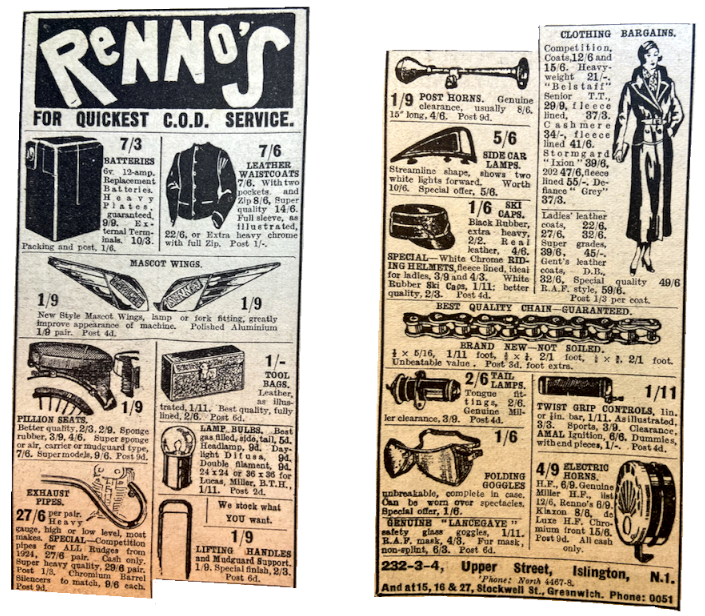

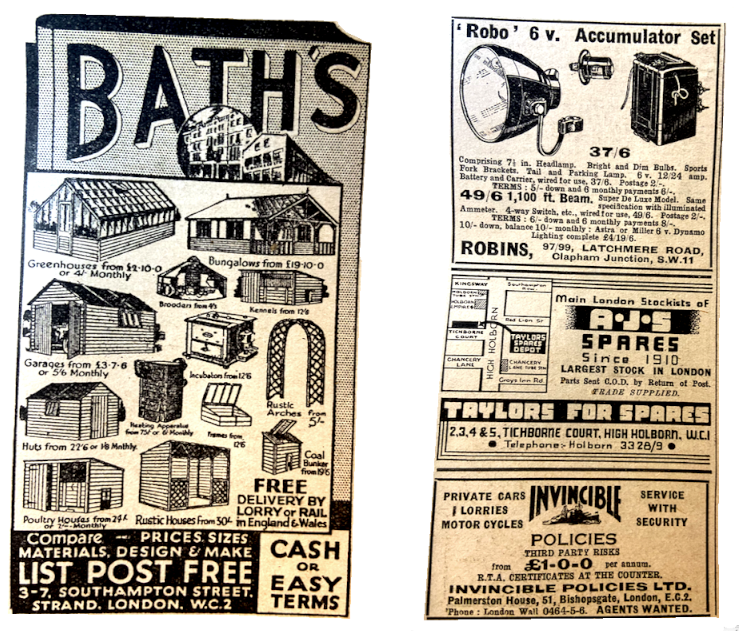
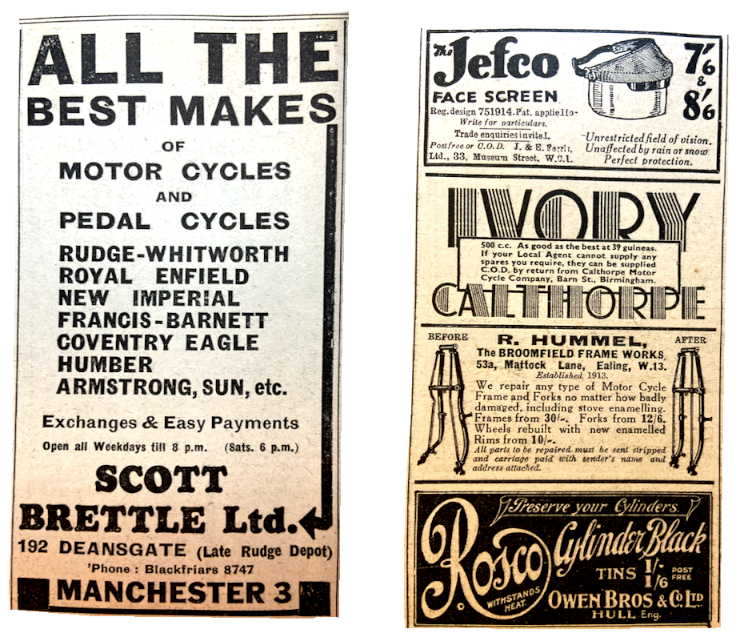
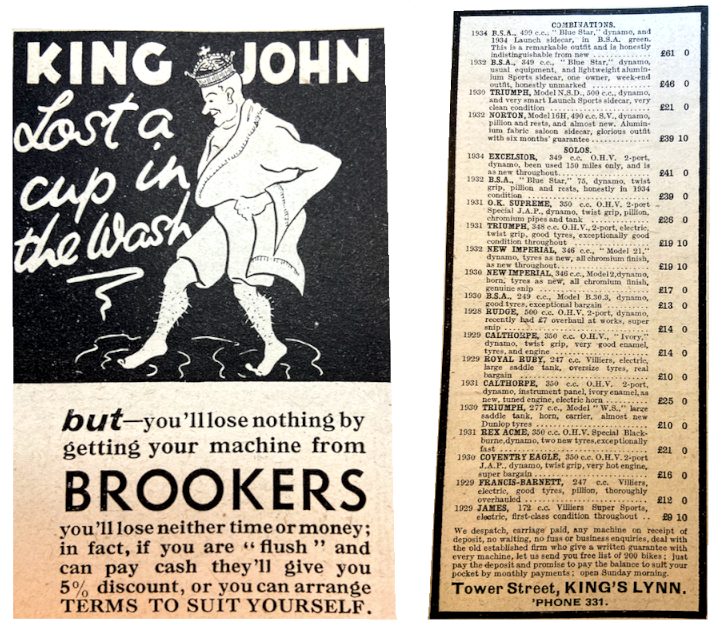


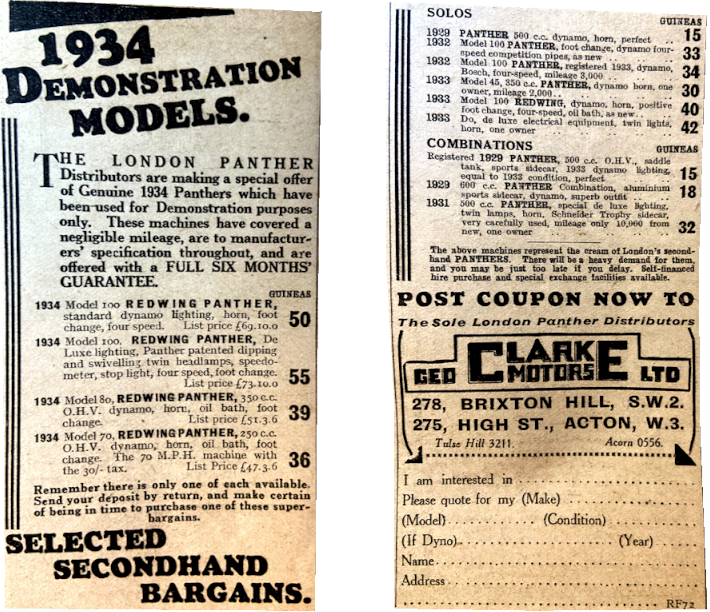
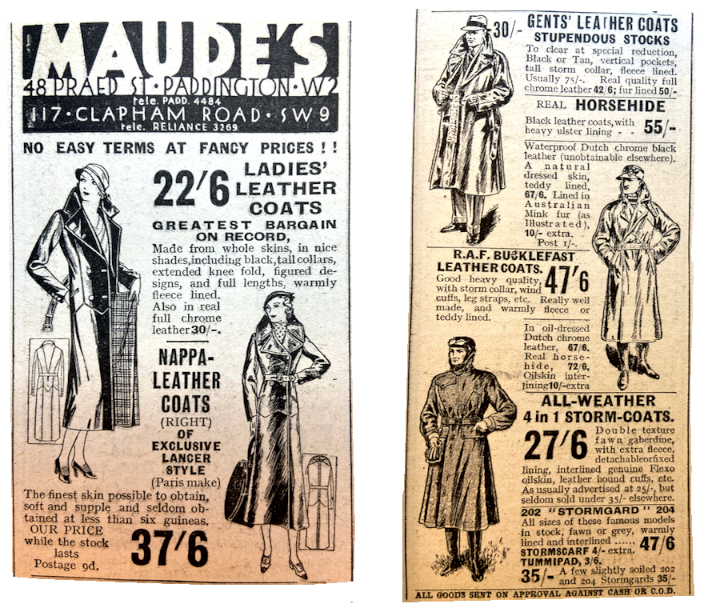
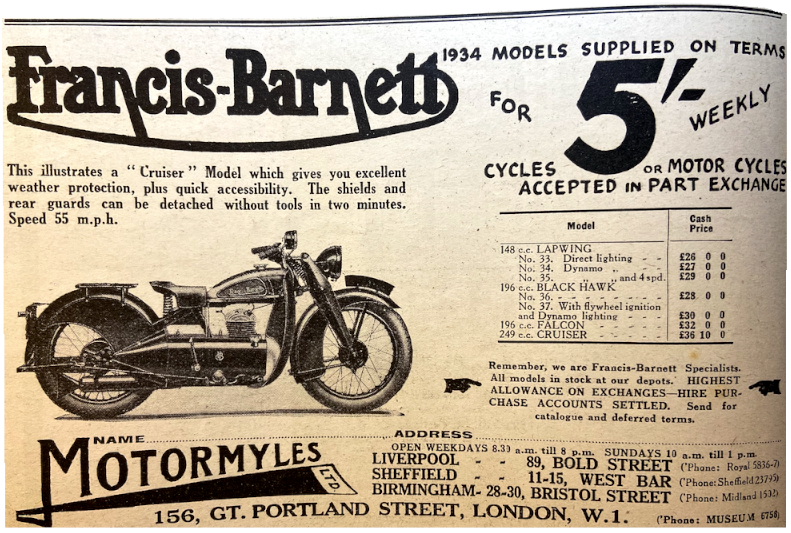


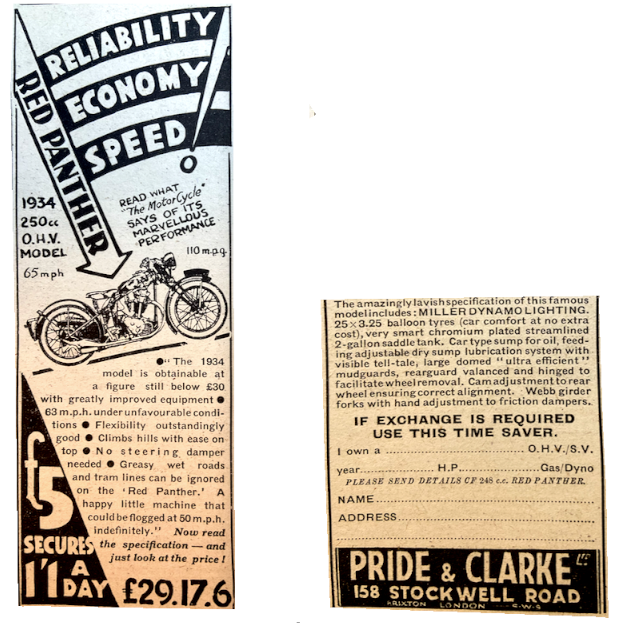
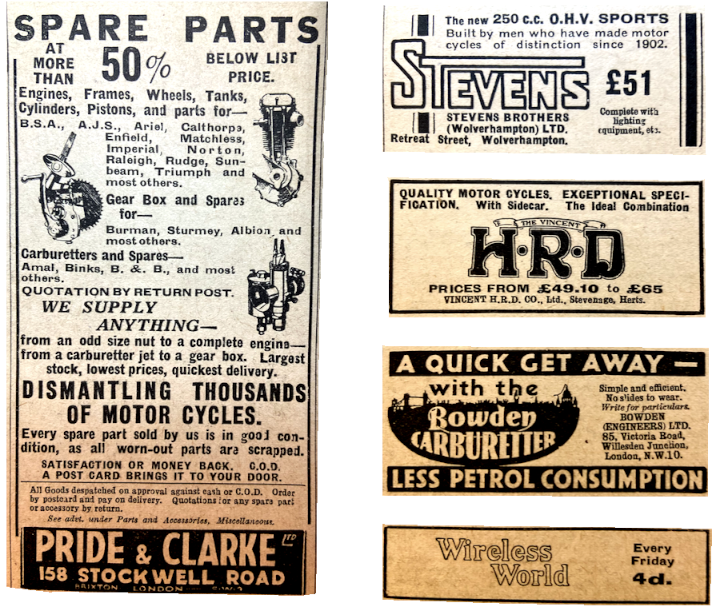
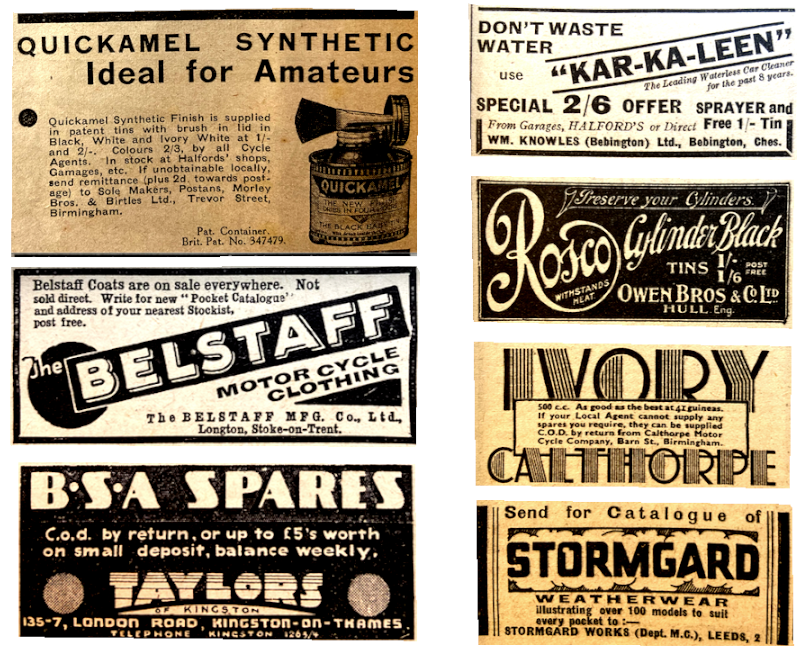
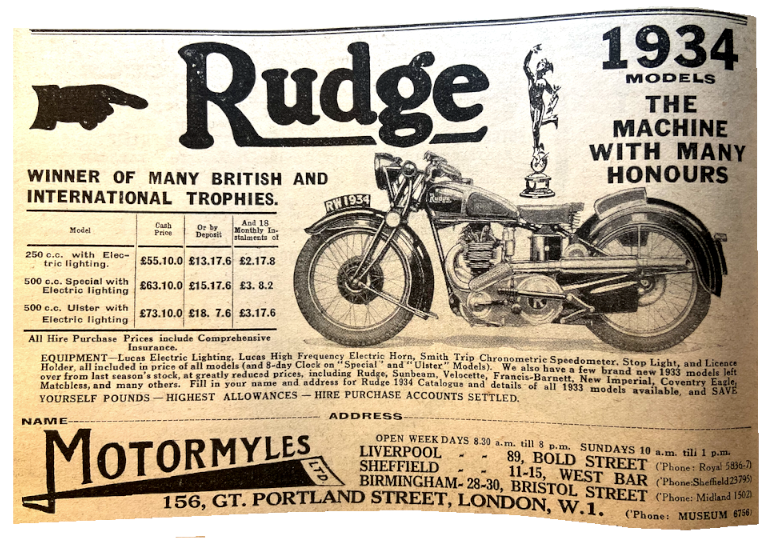
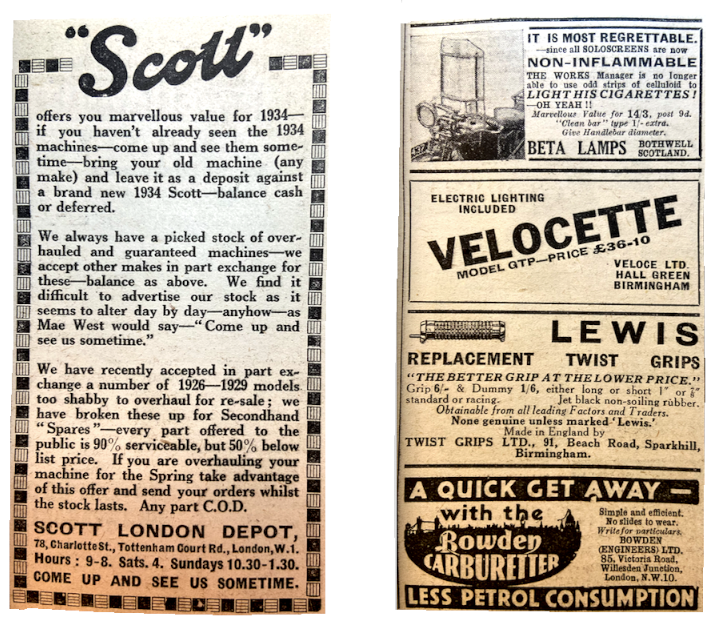
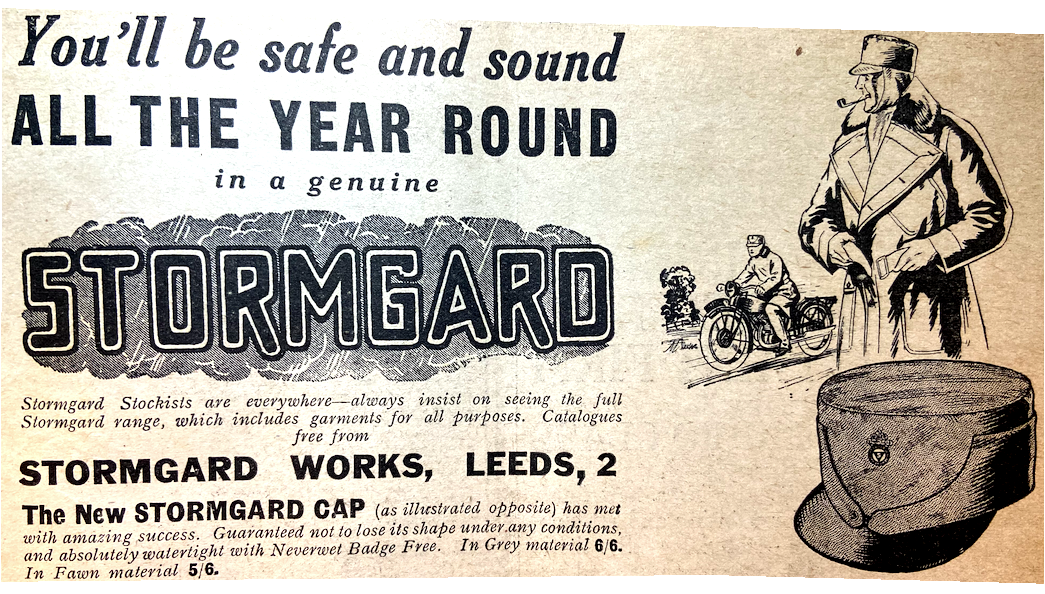

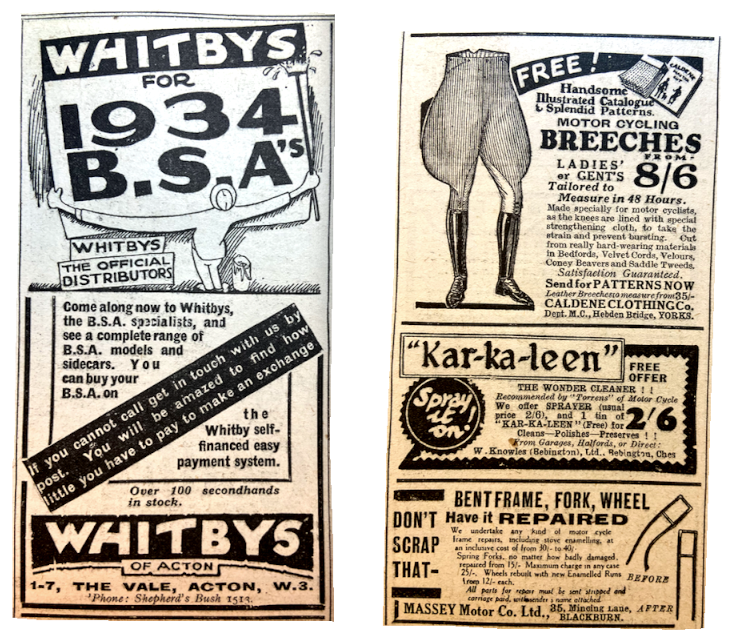
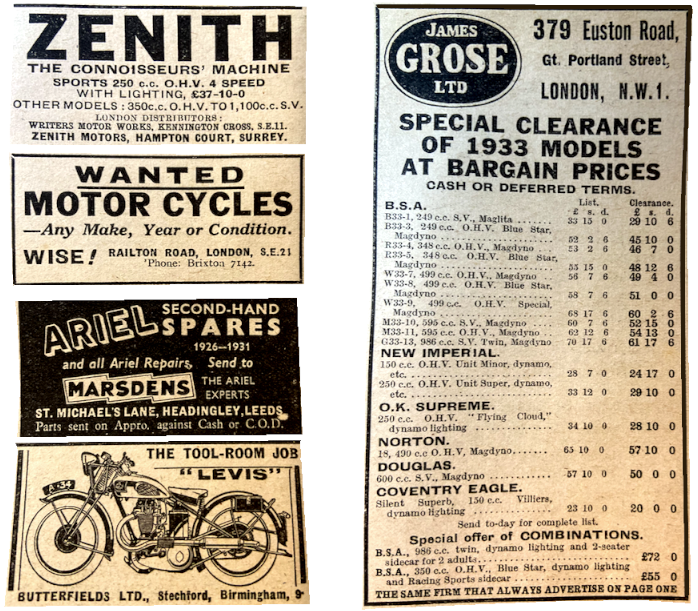
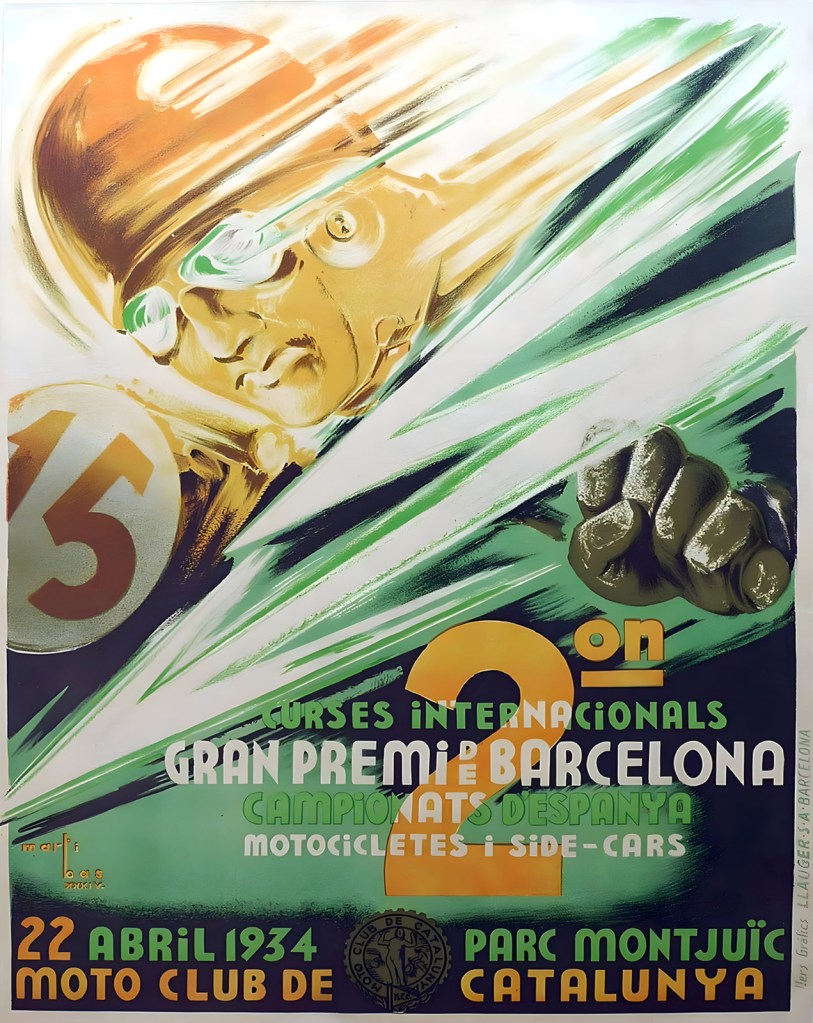
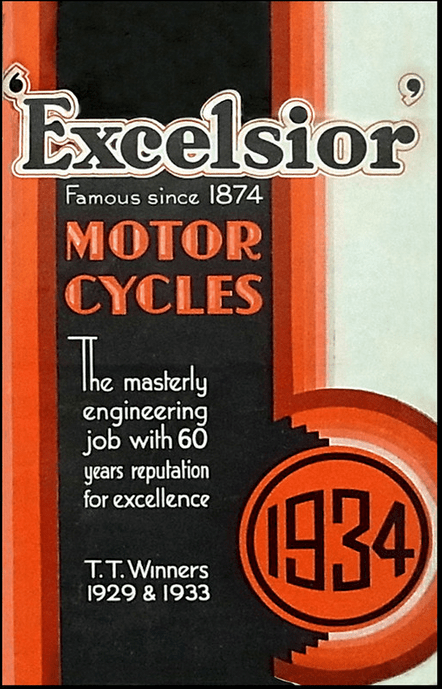
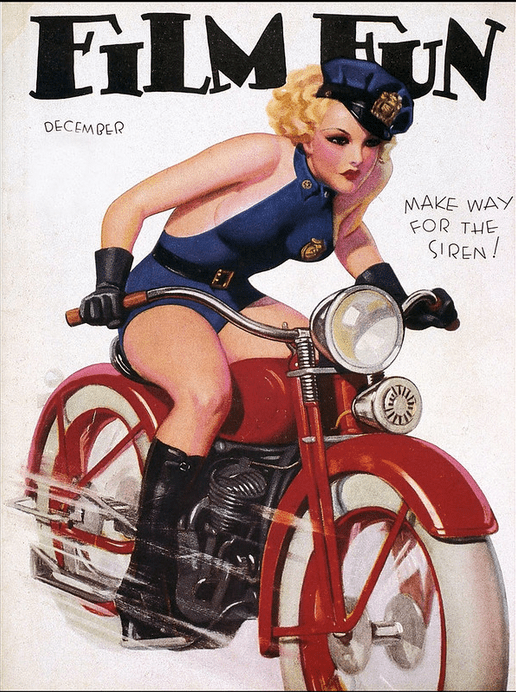
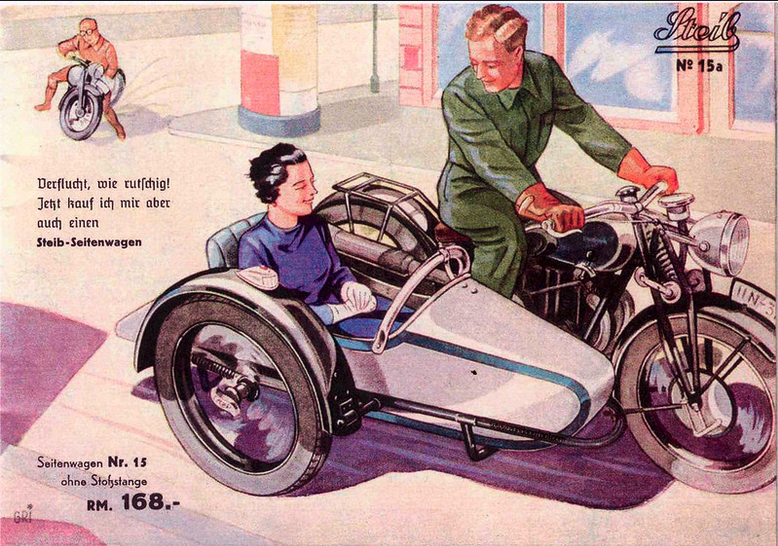
 Motorcycle Timeline