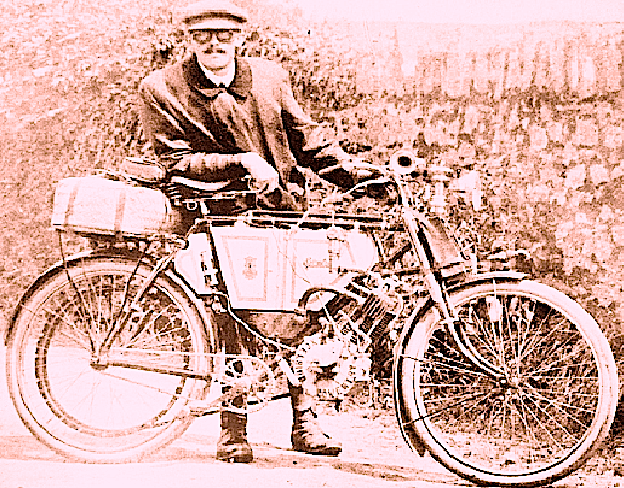
LOOKING FORWARD TO THE new year, Motor Cycling’s pundit Carbon wrote: “1934 will undoubtedly be a good year for motor cycling. National prosperity is on the upgrade and with improved conditions generally, thousands of would-be riders will acquire the wherewithal to invest in machines. Our top priorities must be to win back the world’s fastest record [held by Ernst Henne and the blown BMW] andto regain the International Six Days Trial Trophy [also held by Germany].” Germany had become the most motor-cycle minded country on earth with more than 750,000 riders; motor cycle competition was booming with major events attracting crowds of over 100,000.
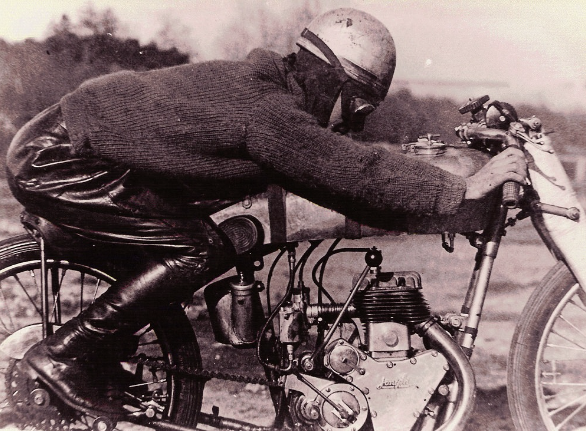
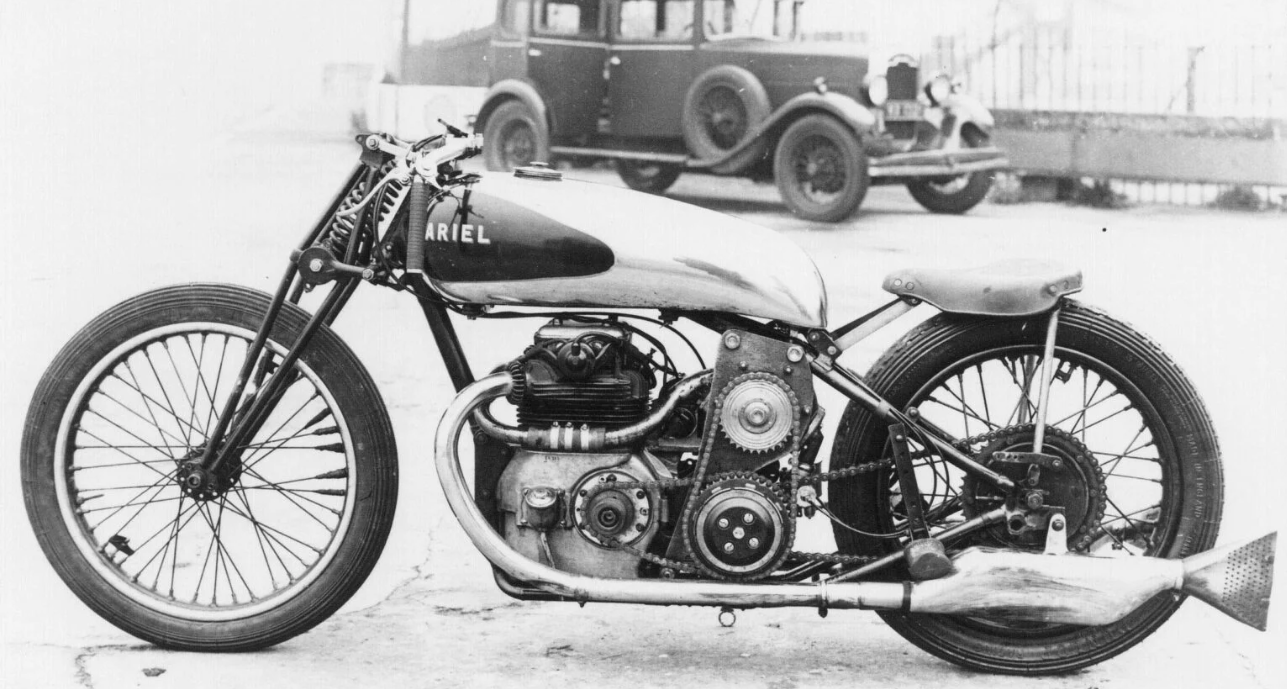
“FIGURES, IT IS ALLEGED, can prove anything. Last year 50,072 new motor cycles were registered for the first time while at the peak period of 1932 the number of machines in actual use was 599,904. Thus we have the fact that roughly one in every twelve machines in use was new. Does this prove that the average motor cycle lasts for 12 years? A slide-rule enthusiast might maintain that it does, but as we all know, the life of a motor cycle, given due care, attention, and, now and then, new parts, is everlasting. What the figures for 1932, which have just been issued, do prove beyond all doubt is the popularity of 15s tax and passenger machines. A total of 8,902 light motor cycles of under 150cc was registered in 1932 together with 8,981 passenger motor cycles, consisting of 4,105 three-wheelers and 4,876 sidecar outfits.”
“REGISTRATIONS OF NEW MOTOR cycles for December last show an increase of no less than 34% as compared with the corresponding month in 1931. The figure is 2,428, as against 1,807. According to a recent return, there were 56,875 motor cycles in use in Switzerland at the beginning of the present year. The total of motor cycles registered in New Zealand as at November 30th, 1932, was 36,314.”
“NO HUMAN BEING CAN expect comfort from a rigid position occupied for six continuous hours,” Ixion wrote, “that ideal is a physical impossibility, unobtainable in a first-class carriage on the Flying Scot. It is equally true that no motor cycle can furnish several changes of position, all compatible with comfort and control. Hence, the designer is up against it in this respect. He is further hampered by the variations in riders’ physique. ‘Torrens’ has the luck to be of normal dimensions, in which he resembles the typical TT rider; so, when he roadtests a winner for us, he feels topping. But if I, scaling fifteen stone, and standing 6ft 3in, take out a TT winner, I am miserable. I have to fake my own buses for my own riding, and often experience a great difficulty in wangling a decent position; if I succeed, most of my pals exclaim with horror when they try my buses round the block. No standard machine fits me at sight, and the chief problem is to accommodate my legs (trousers, 35in inside leg-length measurement), so that they can (a) keep cramp at bay on long runs, and (b) operate the brake pedal quickly, naturally, and powerfully. All of which shows that the factory designer has a tough furrow to hoe when he plans one riding position to suit all and sundry; and each new invention—super saddle, steering damper, and clean handlebar—complicates the job of providing a good range of adjustments. To quote a single example, my long legs have never been really comfortable since saddles were dropped to their present height—or should I say ‘lowth’?”
“THE SUGGESTION HAS BEEN put forward that a motorist involved in two serious accidents within a year should have a yellow disc attached to his car and be subject to a 25mph speed limit. Further accidents would entail the carrying of more discs.”
“A ROUNDABOUT SYSTEM of traffic control is to be tried out at Hunters Bar, an important junction in Sheffield.”
“EACH WHEEL TO ITS OWN BUMP. Car designs for 1934 in America will tend towards the elimination of the front axle, the front wheels being independently sprung, it is predicted in an American contemporary.”
“A £420,000 SCHEME to reconstruct and widen Chelsea Bridge to take four lines of traffic has been approved by the London County Council.”
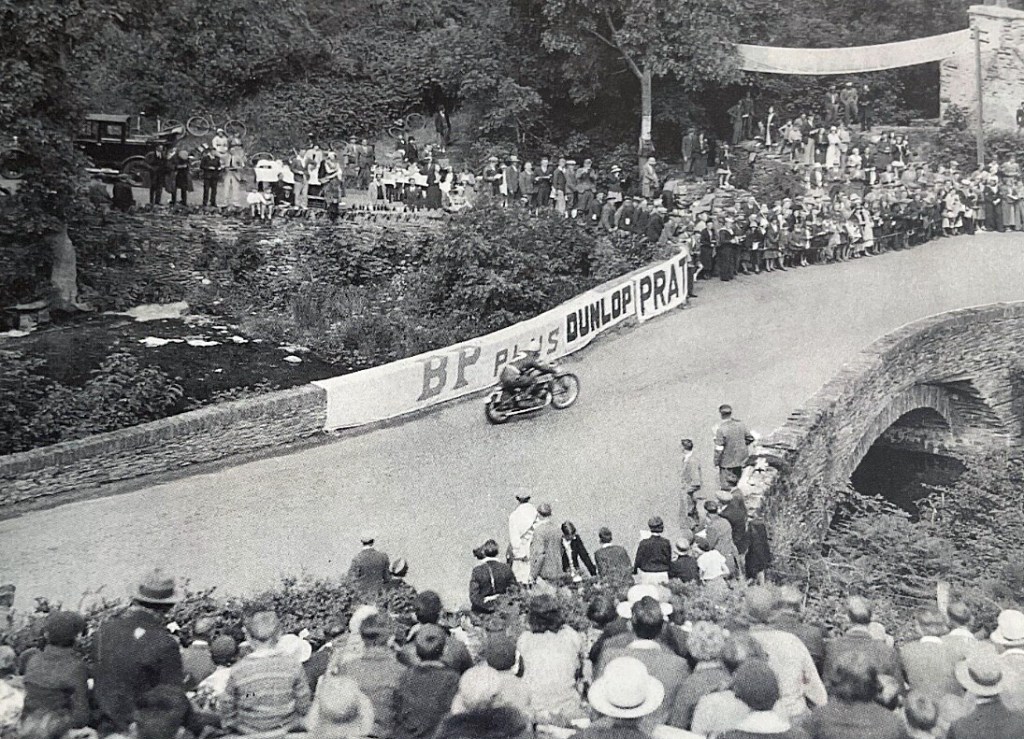
“FOLLOWING AN ACCIDENT, alterations may be made to the road at Ballig Bridge, in the Isle of Man, but it is said to be unlikely that the famous hump, responsible for so many TT thrills, will be removed.”
“SILENCING THE GAY CITY. The ‘zones of silence’ scheme in Paris has proved so successful that the period during which drivers must not use any loud warning instrument in certain districts has been extended to operate from 11pm until 6am.”
THE ROADTAX SYSTEM CHANGED AGAIN, and from now on it would be based entirely on capacity rather than weight. Bikes up to 150cc paid 15s (75p); 150-250cc, £1 10s (£1.50); and over 250cc, £3 (£3). A whole class of 150s poured onto the market—more than a third of British manufacturers, from AKD to Wolf, jumped onto the 150cc bandwagon. Many of them, including Wolf, used Villiers engines but a number, including AKD, BSA and Royal Enfield, made their own.Cheap road tax for 150s was designed to help low-paid workers afford powered transport as well as boosting demand during a recession and many 150s were utility transport. But New Imperial’s 150cc Unit Minor was among those to show how much motor cycle could be squeezed into the 150cc package. Dorking, Surrey dealer Harry Nash sleeved down a Unit Minor to 125cc, fitted it with partial streamlining and lapped Brooklands at a shade under 73mph.
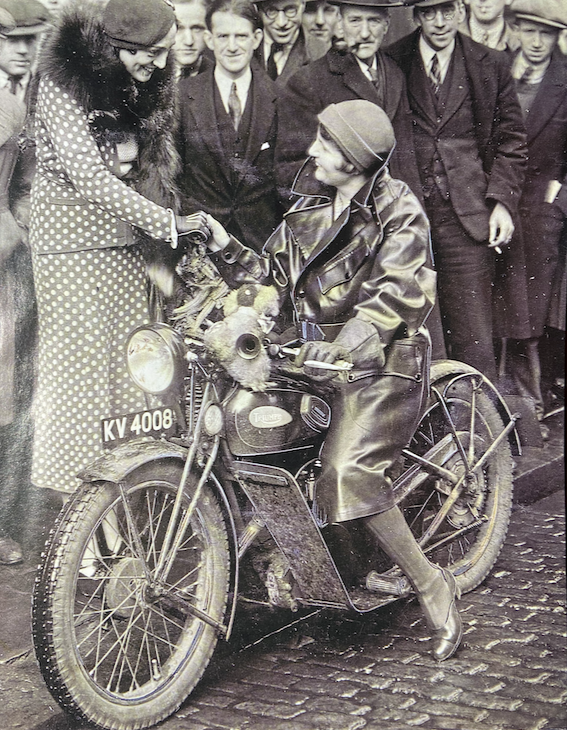
“THERE HAS ALWAYS BEEN a tendency among the hard-bitten riders of ‘big stuff’ to consider that anything with under 250cc in its cylinder barrel is unfit for consideration. At one time the thick black line was placed higher in the scale, but during the last few years the 250 has proved itself to be more than satisfactory for strenuous road work—a result largely attributable to track- and road-racing experience. The two smaller classes, 150cc and 100cc, have been left to themselves and to the tender mercies of the average rider for development. Actually, the most startling feature of these sizes is an ability to stand up to unlimited hard work without tiring. Your 98cc machine may not provide an extravagant performance, but it will do its work well and without complaint, and it will give you full value for the extraordinarily small capital outlay. Its running costs, too, are ridiculously low. Excluding depreciation, and allowing for a 5,000-mile year, it works out at something in the vicinity of ⅖d per mile. This figure is based on a tax of 150s a year, a third-party insurance premium of 30s, a petrol consumption of 130mpg, and an oil consumption of 2,000mpg. These consumption figures are not just imaginary, but are those actually obtained from a machine which was being given all the hard work I could give it. This particular model was, of course, a two-stroke—a very good example—and would hum merrily along at 28mph, with a sustained maximum on the level of 36mph. It had a low top gear and would take all normal main road hills in its stride, while the two-speed box provided a low ratio for really heavy going and for getting away. A single-lever carburetter and fixed ignition reduced the control work to a minimum of gear lever, clutch, throttle, and brakes. These last were more than adequate, despite their small size. The machine was not silent, but the exhaust note was pleasant, and the engine two-stroked regularly except when running light. Mechanical noise was confined to a primary-chain swish and to slight piston rattle when the engine was cold. Such a light machine—it weighed little in excess of 100lb—was ridiculously easy to manhandle in and out of a normal house gateway, and it was on two occasions lifted right round bodily without excessive physical effort. Its lightness was reflected in the steering, but this was perfectly sound, and at the low cruising speed the machine clung quite miraculously to the earth. Neglecting a short scamper on a real racing job, and a long tour on one of the fastest of fast big twins, my most interesting and instructive ride last year was in the saddle of an ohv 150cc model. I set out with the intention of covering a minimum number of miles on what I expected to find a dull affair, and finished up, after various test runs, with a more-than-200 miles’ week-end jaunt, with luggage, in hilly country, Cruising, to start with, at a meagre (?) 35mph, the little mount was finally driven mile after mile at a figure within one or two miles of its maximum, which was 48mph. I took it up freak hills, thrashed it in its intermediate gears, and entirely failed to make it turn a hair of one of its control cables. In every way it conformed, with its sound layout and smooth performance, to one’s idea of what a big machine in miniature should be. A petrol consumption of better than 110mpg was more than challenged by an oil consumption so small that a measured beaker was necessary for its calibration—something like 4,000mpg, as far as I can remember. Mechanical noises consisted of a faint middle-gear whine, a negligible primary chain swish, and the inevitable valve patter of the type. Mudguarding was sound, the standard legshields neither rattled nor got in the way of normal adjustments, and the whole machine, fully equipped, cost a good deal less than £30. When I remembered the slow and unreliable hacks on which I had expended any sum up to £50 six or seven years ago, I rather wished that I had been born that much later. In those days its tax would have been 30s a year, against the plain 15s for which we have to thank Viscount Snowden.

Then, too, there was no compulsory insurance; but all sensible riders insure the safety of other people, and it now costs somewhere between £1 and 30s a year to do this with a 150cc machine. Using those figures, allowing for a regular change of oil in the sump, and using the Technical Editor’s slide rule, I find that a 10,000-mile year, again excluding depreciation, comes to £11—a matter of ¼d per mile. The additional mileage which has been allowed, you see, removes any difference in running costs between this and the smaller machine. The racing machine I mentioned a little while back was of the 250cc size, and its maximum was rather better than 85mph, but it would be fairer to deal with the performance of a more normal and much less expensive machine of the same capacity. This had a toned-down ohv engine, but the fact that the make has done well in road racing proves that all the firm’s engines need not be toned down. How-ever, if I mentioned one interesting mechanical feature round which swings the rest of the design I should be giving away the identity of the machine. Two features stand out in my memory. One was its firm, ‘large machine’ steering and roadholding, and the other was its mechanical quietness. It sat on the road, in fact, a great deal more comfortably than most of the ‘large machines’, and was an almost ideal bicycle for long-distance touring on a light purse. Not only is its tax 30s and its insurance against third-party 40s at the most, but the petrol consumption tinder normal running conditions was better than 100mpg—in fact, 132mpg was obtained with a rather weak mixture on one occasion—and, the oil consumption, so far as could be me small mileage, and allowing a change every 1,000 miles, was 2,000mpg. Here we have a ‘per mile’ sum of ⅓d in a 15,000-mile year—and it would be easy enough to cover this distance on such a comfortable machine. The machine costs well below £35 in a fully equipped condition, so even the dreadful bogy of depreciation need not loom largely on the otherwise rosy horizon of a prospective rider. A checked maximum speed of 56mph was obtained on the level, but, more important, a cruising speed of 50mph could be held indefinitely, up hill and down dale. The engine pulled easily enough to cope with any main-road hill in top gear when the ignition control was used with discretion, and the low ratio of 18 to 1 put real trials hills on the map for the adventurous tourist. Its handling under trials conditions was perfectly straightforward, and, for that matter, a light machine, provided that its steering is faultless, is much more easily dealt with in most freak going, though weight and pulling power assist under certain conditions, notably in deep mud. There is no doubt at all that the present-day light-weight not only does its job thoroughly, but can give a performance that will surprise and convince the experienced rider of heavier metal. It is no longer to be regarded with polite amusement.
WITH UTILITY 350s TAXED AS heavily as luxury big twins demand rose for 250s while 350s were soon being sold off at knock-down prices. Price slashing was not so much the order of the day as the order of the decade.
“LAST SATURDAY’S COLMORE TRIAL, organised by the Sutton Coldfield and North Birmingham AC (‘Sunbac’), the first open event of 1933, gives a splendid send-off to the open competition year. For the past two or three years the Colmore seemed to have settled in a groove and was, perhaps, in danger of losing some of its popularity. This year a great effort was made to provide something different, and the venture was an unqualified success. For some reason a new spirit surrounded the event; the atmosphere was changed—the sporting, rather than the serious, side was uppermost. Again, there was a new course. Very few of the competitors knew anything. about it, but they realised that it was going to be a little more difficult to keep a clean sheet, and they were all ‘on their toes’. Out of an entry of 76, only six riders, all on solo machines, completed the course without loss of marks, and, considering the nature of the new hills, these enthusiasts can congratulate themselves on their riding ability. Some of the hills were especially difficult for passenger machines, so, in dealing with the results, the stewards decided to disregard Camp Hill as far as sidecars were concerned, and Camp and Kineton hills for three-wheelers. There were several ‘Snowden’ models in the trial. They performed very creditably, and in some cases showed wonderful power, but none of them qualified for a first-class award. A 350 carried off the premier award and made the best solo performance—in the list of solo first-class awards, outside cup winners, 250, 350, and 500cc machines shared the honours evenly. Only one sidecar obtained a first-class award, and it was fitted with sidecar-wheel drive! The day previous to the event was a perfect example of early spring weather, and the Cotswolds were bathed in delightful sunshine. February, however, is notoriously fickle, and Saturday morning dawned upon ice-covered roads and snow-clad hill-tops. Had there been en early start conditions on the observed sections would have been easy, but by the time the hills were reached the sun had got to work and had succeeded in thawing out much of the frost. Although the riders were compelled to travel between tapes on Lark Stoke—the first hill—few
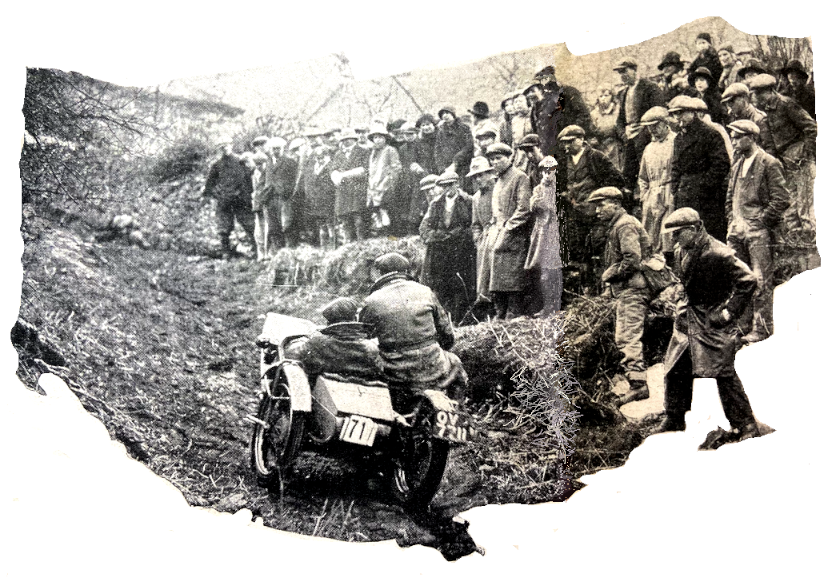
experienced any real difficulty, and all carried on gaily to the brake test. Here WT Tiffin (348cc Velocette) showed the best figure’ of merit—4,225. He was followed by LG Holdsworth (346cc New Imperial), with 4,230, and J Sinclair (498cc Calthorpe), 4,270. Of the sidecars, WS Waycott (352cc Velocette sc) was the best with 4,780, and DK Mansell (490cc Norton sc) next with 5,110. Fish Hill, the next test, was a new hill under an old name. It runs close to the main road hill of that name which rises from Broadway. First there was a 1 in 4 grass descent with a right-angle turn through a field gate, with both the descent and the turn observed; then a straightforward ‘stop-go’ test on a 1 in 4 track—an up-grade—with a hardish surface that included a tree root or two; next a leaf-strewn narrow track, and finally, a very snappy, taped-off left-hand hairpin. As a test of riding, ease of handling, and engine power, Fish Hill was really excellent. The fastest of all off the mark in the restarting test was Jack Williams, in 2.4sec, on his new love—a very ‘hot’ 348cc Norton. The 150s, as was to to be expected, found the task of restarting on so steep a gradient a tough proposition. S Jones (146cc New Imperial) had to to paddle his way out of the section, while LA Welch (148cc Francis-Barnett), who followed the copy-book and put his feet on the rests as soon as his clutch bit, came to a hurried stop which a little pedal assistance might have obviated. Another 150, a Triumph in the hands of T Robbins, got going well with the aid of a few lusty foot-slogs. Harsh throttle and clutch work caused WT Tiffen (348cc Velocette) to topple over. Then three perfect descents and ascents by RC Cotterell (348 Velocette), N Hooton (348cc Norton) and HJ Breach (348cc BSA). Both W E. Cook (249cc Rudge) and GF Povey (499cc BSA) snaked a bit, as they accelerated off the mark. The latter’s acceleration was magnificent, and so was that of AE Perrigo (348cc BSA), who blipped his throttle once to aid wheel grip. Quite one of the best of the small machines in the restart was the 148cc Francis-Barnett ridden by TG Meeten. With another 24cc, LH Vale-Onslow, on a water-cooled SOS, was also masterly. L Crisp (493cc Triumph) dropped down the slope with his back wheel locked, and, skidding round, nearly started going up again! Mounted on the make he is to ride in the Junior TT, HG Tyre11-Smith (348cc Velocette) made an excellent show, and so did another TT star, VN Brittain (Sunbeam). S Slader, on a 150cc Triumph, re-started in magnificent style. Another Triumph rider, JH Amott, on a 249cc model, was particularly good. The left-hand hairpin higher up caught a few, but the majority, like GE Rowley (496cc AJS), TF Hall (246cc Matchless), and AA Chinn (146cc New Imperial) took it in their stride. For sidecars and three-wheelers the re-start.test was a real problem. DK Mansell (490cc Norton sc) was using his sidecar-wheel drive, and, no doubt thinking of his clutch and the load on his transmission generally, got away gingerly and safely. One after another the sidecars
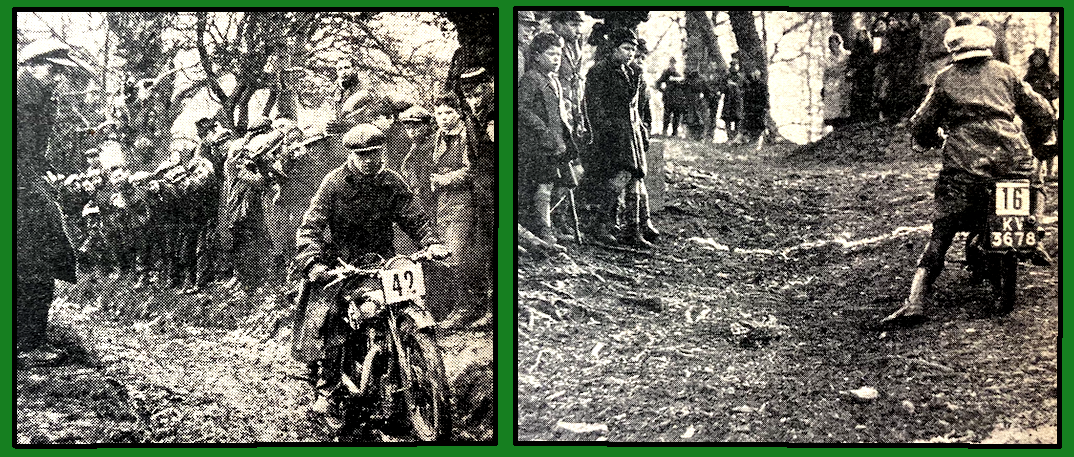
failed with wheelspin W Nichols (349cc SOS), GV Scott (348cc Velocette), RGJ Watson (498cc Ariel)…With bouncing, WS Waycott, on EF Cope’s Velocette outfit, all but got away. HS Perrey (493cc Triumph) stopped. RU Holoway (498cc Dunelt), however, managed it, and so did NP0 Bradley (599cc Sunbeam), who shot straight off the mark; they were far and away the best of the passenger-machine men, taking only 4.2sec. Great things were expected of GH Joynson (599cc Sunbeam), in view of his sidecar-wheel drive, but his engine momentarily lost its urge and he went down instead of up. For three-wheelers, too, wheelspin proved the stumbling block. Only GC Harris (1,096cc Morgan) succeeded—due not merely to twin rear tyres, which two others had, but also to using his throttle to perfection. Warren Hill was next, and proved rather troublesome. It winds through woods, has a mud-surface—not deep and a sharp bend at the foot and a considerable gradient subsequently. It was anything but easy, but L Heath 499cc Ariel) and G Stannard (493cc Triumph) did it without fault. A 246cc New Imperial was handled admirably by AR Foster, and AN Foster (346cc New Imperial) was even better. Yet another New Imperial (246cc) was ‘clean’, but its rider, S Rigby, had to call on all his skill in order to keep his feet up. New Imperials were much in the picture, for the, next faultless ascent was made by LG Holdsworth, on a 346cc model of that ilk, the ultimate winner of the Colmore Cup. Jack Williams (348cc Norton) was, perhaps, just a little better than anyone else at this point, and Tim Robbins, despite an absurd cap, took his 147cc Triumph up with just one little dig with his foot. WT Tiffen was quite ‘at home’ and rode splendidly, and FE Vigers (348cc Ariel) swerved about a lot, but got away with It. On a 246cc Matchless, FW Clark was another of the clever ones, while two more splendidly judged climbs were made by AE Perrigo (348cc BSA) and GF Povey (499cc BSA). After a long absence from competitions, HS Perrey (493cc Triumph sc) was as good as ever, and other successful passenger machines were those driven by RU Holoway (498cc Dunelt sc), WS Waycott (352cc Velocette sc) GC Harris (1,096cc Morgan), and SH Creed (1,096cc Morgan). Camp Hill, the next point, was much worse than it looked. It was very greasy and the two bends were difficult to negotiate. Perrigo and Povey took it in their stride; after that, one after another rider failed or only just managed to struggle to the top. Two perfectly outstanding efforts were made by KR Bott and GE Rowley on 495cc ‘Trophy’ model AJS machines. They swept up the hill, when it was in its worst state, in a manner that was a joy to behold. Another who appeared to be faultless was SH Goddard (249cc Excelsior); he cut the corner at the bottom—a quite legitimate act. Everybody thought he knew about Kineton. It turned out to be not the ‘old’ hill, but another just to the right, strewn with boulders and things. There were 12 clean solo climbs. They were made by L Heath, AR Foster, LG Holdsworth, RC
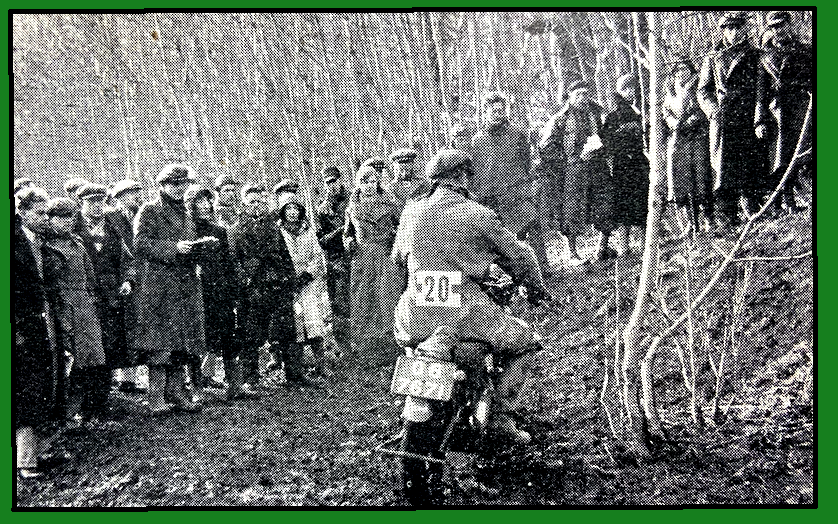
Cotterell, GF Povey, FE Vigers, D Cooper (344cc Excelsior), AE Perrigo, VN Brittain, L. Crisp, KH Bott and GE Rowley. DK Mansell, With his sidecar-wheel drive, was the only sidecar driver to get up without touching, and most of the other sidecars failed altogether. As already stated, the hill was ‘washed out’ for three-wheelers. Lower Guiting hill was hardly worth observing, but Gipsy Lane, near Winchcomb, was quite another story. The mud was just hard, chawed mud—so hard and so rutted, particularly towards the end, that the use of feet was definitely the better part of valour. Probably the but climb of the day was that of Rowley, who, not deigning to adopt the modern trials rider’s artifice—standing on the footrests—sat in the saddle and sped up the hill with hardly a wobble. Another star solo climb was that of Bott, who kept his feet up and corrected every plunge. For sidecars the hill was easy, and fast touring was the rule. W Nicholls (349cc SOS), L Simpson (497cc Ariel), and HS Perrey (493cc Triumph) were all particularly good; while WS Waycott (348cc Velocette) was outstanding, in that his gear jumped out and he got it back again before the outfit had time to do more than think about slowing! The driving chain for his sidecar wheel had disappeared from Joynson’s Sunbeam outfit; nevertheless, he was excellent over the worst part, though he found trouble—apparently the bank—higher up. NPO Bradley (599cc Sunbeam sc) had bad luck. He came to a hurried and momentary standstill as if a stone had caught in his driving chain. Good luck, on the other hand, favoured CS Rigby (493cc Sunbeam), who fouled both banks and yet got up non-stop. ‘Sawing’ on his steering wheel to aid the grip of his front wheels, GA Norchi (1,075cc BSA) made a fastish climb. H Laird (1,096cc Morgan), too, was excellent, leaping up the hill at speed and hopping to such an extent that his passenger pulled her woolly cap off for fear it would tumble overboard. Then came Mill Lane, once a terror, but on this occasion perfectly easy. West Down, too, was comparatively simple, and produced nothing really outstanding, apart from the spectacular manner in which Jack Williams and George Stannard extricated themselves from difficulties. The finish came at Winchcomb, where everybody declared that this had been the best Colmore for several years. Keep it up, Sunbac! Provisional Results: Colmore Cup (for best performance), LG Holdsworth (346cc New Imperial), marks lost, nil; figure of merit, 4,230. Cranmore Trophy (next best solo performance), J Williams (348cc Norton), nil, 4,315. JM Moxon Cup (best performance under 150cc), S Slader (147cc Triumph), 20, 5,300. Calthorpe Cup (best performance 150-250cc), AR Foster (246cc New Imperial), nil, 4,600. Norton Cup (best performance 250-350cc), AE Perrigo (348cc BSA), 4, 4,280. Kershaw Cup (best performance 350-500cc), GF Povey (499cc BSA), nil, 4,430. Watson Shield (best sidecar performance), RU Holoway (498cc Dunelt), 11, 5,950. Hassall Cup (best performance 350-500cc sidecar performance), WS Waycott (352cc Velocette), 16, 4,780. Carr Cup (best three-wheeler performance), GC Harris (1,096cc Morgan), 11, 4,950. Phosphor Bronze Team Prize, Sunbac 11, AE Perrigo, J Amott, LG Holdsworth.”
“ON THE COLMORE ON Saturday I ran across Graham Oates, who, while over in Manxland, his island home, had a look at the TT course to see if it was still there. Apparently it is, but with a difference—a big difference: the bend at the notorious thirty-third milestone is being altered and will be ten feet wider, while all the way from Windy Corner to Keppel Gate there are big ‘improvements’ afoot. These modifications which the Manx Highway Board makes year after year, while they may be improvements from the Island’s viewpoint, seem to me to take quite a lot of sting out of the TT course. As a result, one can never be sure how much of the speed increase in any one year is due to the machines being better and how much to the course having been made faster.”
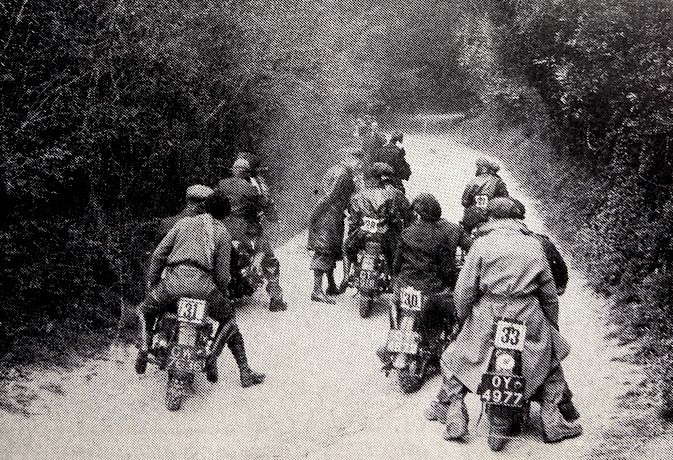
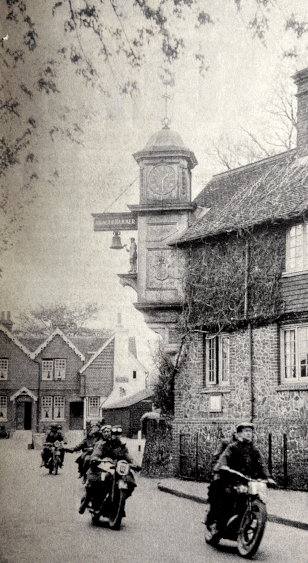
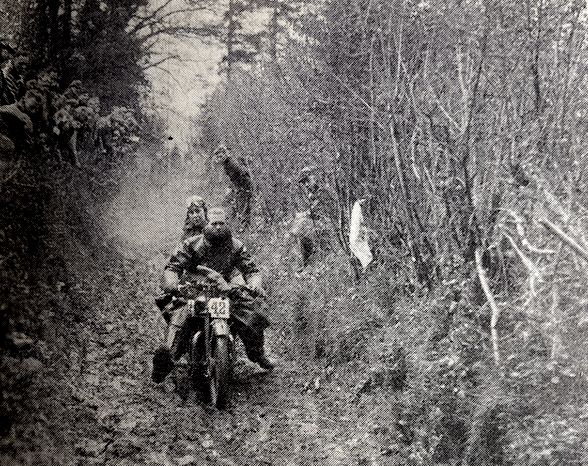
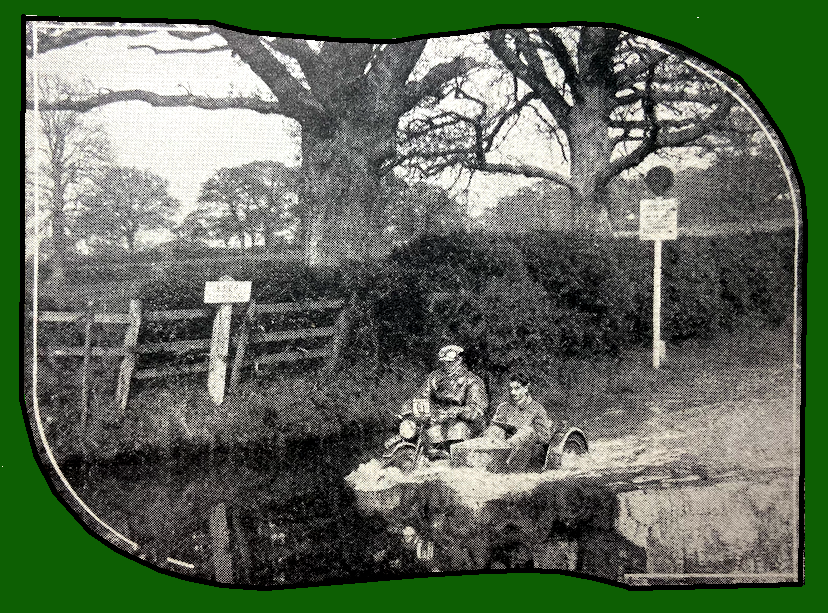
“THE VERY IDEA of plodding up a leaf-mould galley while hampered by a pillion passenger might horrify today’s trials riders; but in pre-WW2 days, one of the most popular events in the Surrey calendar was the Carshalton MCC’s annual Pillion Trial. The eighth trial in the annual series attracted a very good entry of 79—among them quite a few well-known names, such as Karl Pugh, Bernard Matterson, Mike Riley, Len Heath and Teresa Wallach. Starting at the Barley Mow, Betchworth—with the scars of the Box Hill quarries prominent in the background—the 49-mile route was laid in the Dorking-Guildford area. Because there had been no rain for several days beforehand, the course was ideal for pillion-trialling, though if the day had been wet there could have been much bother. Opening section was Goat Track, on the side of Box Hill, where a stop-and-restart test was held. Other hazards on the route card included Old Westcott, Oristan Lane, Prohibition Alley (sticky mud and a water-hole, where Len Heath’s 497 Ariel, and Mike Riley’s 498 Levis, were outstanding), then on to Buckshee, Last Straw and Coldharbour. Worst section of the day was Claypits, where the crowds lining the sides of the track were so thick (take that as meaning what you will) that competitors were forced to stick to the muddy slot in the middle. That led to a protest or two, and some riders were allowed a re-run. Overall winner was Len Heath, and although passengers’ names were not quoted in the programme, we do known that on this occasion (according to Motor Cycling’s report) the chap keeping the rear end of the machine down was KR Bott. The Carshalton Pillion Trial had been instituted as something of a propaganda exercise, to show that pillion riding, even under arduous conditions, was perfectly safe (a vociferous parliamentary lobby had been trying to get it banned). However, it would appear that 1935 was the last year the event was held; perhaps the Carshalton lads felt they had made their point.”—Bob Currie

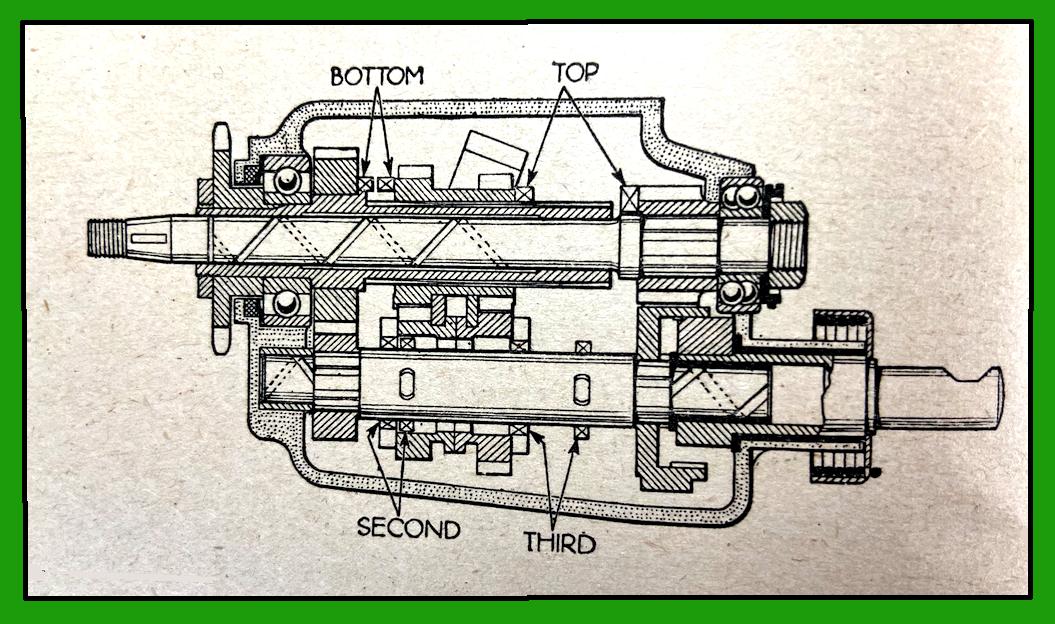
“IT IS NOW GENERALLY RECOGNISED that the lower-powered mounts need four speeds even more than do their more powerful brethren. To meet this need a new Albion lightweight four-speed gear box, suitable for use with engines up to 150cc, is to be marketed. The gears are of similar design to those in the heavier four-speed boxes, and the ratios are 1, 1.35, 1.8 and 2.9. The box is identical in size with the Albion lightweight three-speed box, except that it is ⅝in wider. Fitted with a single-plate clutch, the gear box weighs 12lb 10oz, top fitting. The Albion Engineering Co, of Tower Works, Upper Highgate Street, Birmingham, 12 are the makers.”
“OVER 600 MORE NEW motor cycles were registered last December than was the case a year before. The total number of machines registered for the first time in December was 2,428, as against 1,807. The total of 2,428 consisted of 1,089 under-224lb solos, 572 over-2241b solos, 276 machines of under 150cc, 20 under-224lb. sidecar outfits, 176 over-224lb. sidecars, two under-150cc sidecars, 292 three-wheelers and one motor-assisted pedal cycle. All told, 50,072 new motor cycles were registered in the whole of 1932. Of this 8,902 were under 150cc, 32,188 larger capacity solos, one a motor-assisted pedal cycle, 4,876 sidecars and 4,105 three-wheelers. The previous year the total was 52,562.”
“SEVERAL CHANGES IN DIRT-TRACK rules were decided upon at a recent meeting of the ACU Council. Like the already instituted clutch-start rule, they have as their aim the speeding-up of programmes. In the first place, a rider will not be allowed to change his machine for another once it is out on the track. A second new rule is that no restart will be allowed in match races if a rider falls or has machine trouble. The first rule, says the Union, will ensure that the rider gives proper attention to his machines in the paddock. The second cuts out the right that a rider had in previous seasons of claiming a restart if he fell or had mechanical trouble in the first lap of a match. It has been stated that the privilege has been very much abused, and it is felt that its elimination will not prove any hardship. Match races, incidentally, will be decided with a flying start, and not with a clutch start as in League races. Another new regulation empowers stewards to impound unsafe or ‘un-official’ crash helmets, with a view to preventing riders from using such helmets, once they have been banned, on other tracks in the hope that less observant stewards will not notice them. Helmets thus impounded may be destroyed with or without the consent of the owner.”
FRED CRANER, A GARAGE OWNER and secretary of the Derby &DMC, reckoned that the British mainland needed a full-sized race circuit to match the big Continental tracks. He got together with the owner of a private estate named Donington Park; they staged a series of races to try out a 2.19-mile circuit. Facilities were almost non-existent and the track was barely wide enough for combos (too narrow for cars) but riders and spectators flocked to Donington, encouraging the organisers to invest in it for the following season. Meanwhile, as you’ll see if you can be bothered to read through the year, Donington Park was used for the ISDT speed test—and a sidecar was named after it.
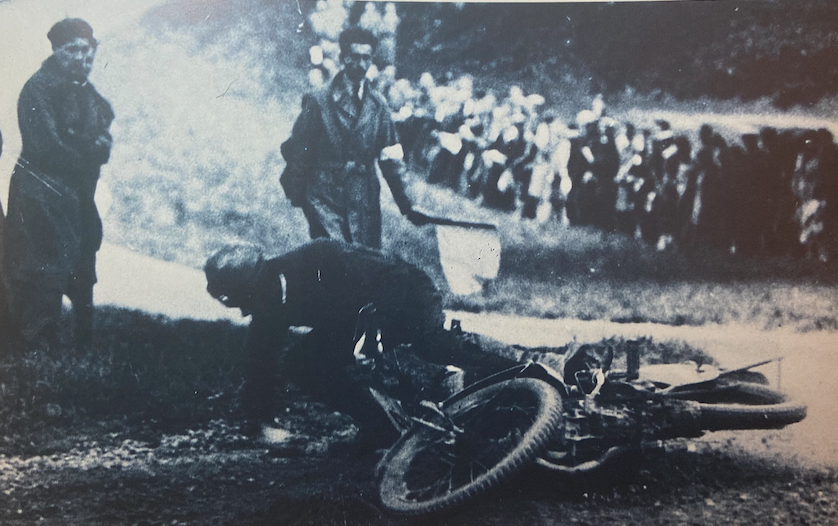
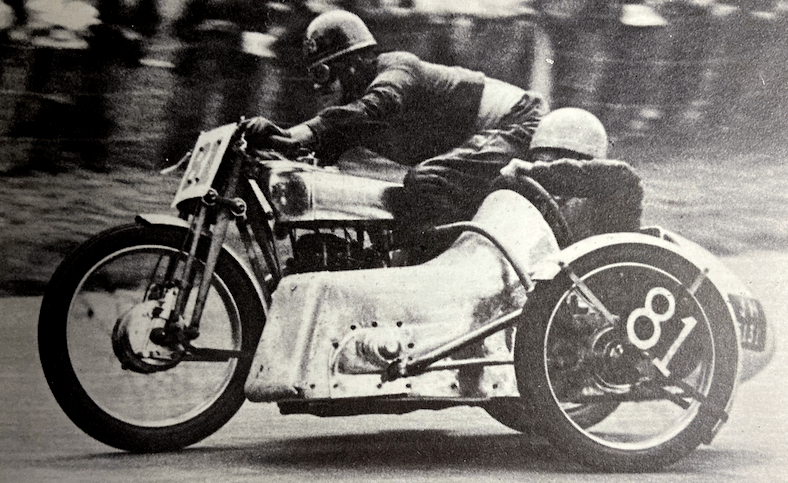
“LESSONS OF THE TT: How They Are Sometimes Lost, Not Upon the Manufacturer, but Upon the Ordinary Rider: Four days hence the first of the three TT Races will be held, with its tale of success, of defeat, and of ill-luck. In the brief span of a few hours designers will have their theories proved or disproved, and one and all will come back from the Isle of Man with fresh knowledge; but how much of this knowledge, an outside observer might ask, will be applied to the improvement of motor cycles? This side of the TT is liable to be overlooked. The Tourist Trophy provides such a great sporting week, and, for those with eyes to see, such a fine spectacle, that the true significance of the Races is sometimes missed. Each year there are lessons to be learned. Them are some which, we suggest, stare motor cyclists and designers in the face, yet are never fully heeded. Take, as an example, the foot gear change. This type of gear control is universal in the TT. In our experience with all types and makes of motor cycles it affords a quicker change and a better change, and, because both hands are retained upon the handlebars, it is altogether a safer method of control. Yet something like 90% of the motor cycles sold to-day are fitted with hand control. Why? Because the average motor cyclist is conservative—because, not having had lengthy experience of a foot change, he does not realise its several valuable advantages and prefers to keep to the type of control he knows. Then there is the question of tyre sizes. Every single rider in the TT uses a small-section front tyre because of the improved steering it affords. On all machines of the sports type there should be a similar arrangement. This is seldom the case.”
“I[XION] REGARD THE ABOLITION of the Sidecar TT as most unfortunate. The one serious drawback to motor cycling is its solitariness. Man is a gregarious animal. From 17 to 70 he is also an amorous animal. Limit him to two wheels, and you limit him to a pillion passenger. The range of the feminine pillion passenger is obstructed by the cost of silk stockings, and the publicity afforded by the pillion to serious ‘ladders’ in same. So the sidecar is the best solution for the motor cyclist who hates solitude, and who, for any reason, is not enthusiastic about pillions. But we are doing little or nothing to boost the sidecar; and I had hoped that an all-in sidecar and three-wheeler TT would fill the gap. Is it too late to suggest that during the Amateur GP week an event should be staged open to amateur-owned three-wheelers of all types, including Morgans, BSAs, Coventry Victors, and the like.”

“DOUGLAS, FRIDAY, JUNE 2ND. Heavy rain, thick mist blanketing even Onchan Head, and something resembling a rough sea—one of those mornings when only someone with a job to do would turn out at 4am. There were 29 heroes out with their machines to see how well they had memorised corners they could not possibly see. Doing 90 into an impenetrable wall of mist is no sinecure. The fastest lap was 34min 41sec, done by local talent, to wit, that of WA Harding (Velocette). Perhaps he likes heavy rain, because be put in three laps while most people were more than content with one. His knowledge of the course must have helped him a whole lot, because, even up at Signpost Corner, the mist completely blotted out the bends in either direction. At this corner a little bunch of people waited with water running down their necks for the crackle of the first rider’s exhaust, and the Motor Cycle man wondered whether it wouldn’t be a good idea to purchase an editorial gamp for this sort of thing. [‘Gamp’ was slang for ‘umbrella’, inspired by the Dickens character Sairey Gamp, a drunken nurse who invariably carried an umbrella.] At 5.15 the first man, Pringle
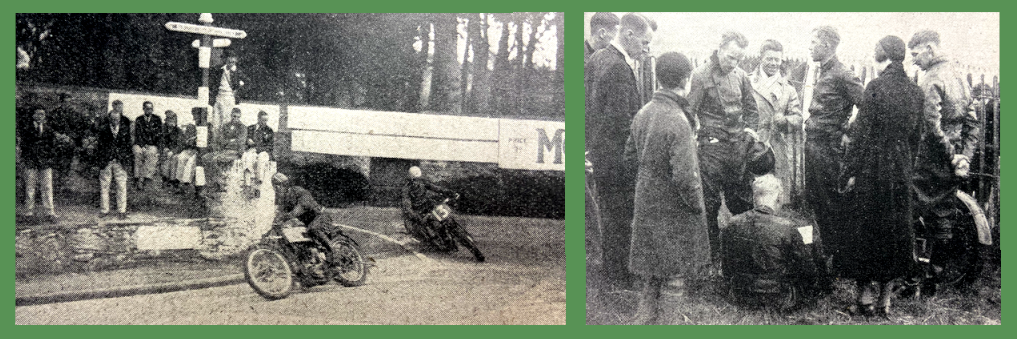
(Junior Norton), came through, looking miserable. No excitement followed—just a steady stream of hunched-up riders waiting for the tricky bits to loom up and thinking of hot drinks to be dispensed by Mr. Dunlop or Mr Cadbury. Even Wal Handley slowed right up as if to read the signpost, looked as if he was going to visit Onchan Village, and then suddenly swung his Velocette round. CS Barrow was out on his first conducted four with the Mechanical Marvel, the new Excelsior, and it certainly sounded terrifically hot. The Jawa camp was the only one out in force—Ginger Wood going quite quickly, Brand, who is getting to know his kinks, and Tommy Spann of the wasp jersey. George Patchett handed in his checks at Ballacraine and one can hardly blame him—it was horrid. Even if Van Hamersveld is not placed he and his mechanic deserve very special praise for the incredible tidiness of their small depot. Every spanner is hung on its own nail and all the bits are laid out on clean paper to await use. The Eysink machine is of conventional but clean design, has nice lines and is powered with a Python engine driving through an Albion gear box. Van Hamersveld has done great work in Holland, but he has still to learn the Manx course and is taking things sensibly. Regrettably The Motor Cycle man over-slept to the extent of half an hour, and reached the Craig with his stop-watch after ten racers had
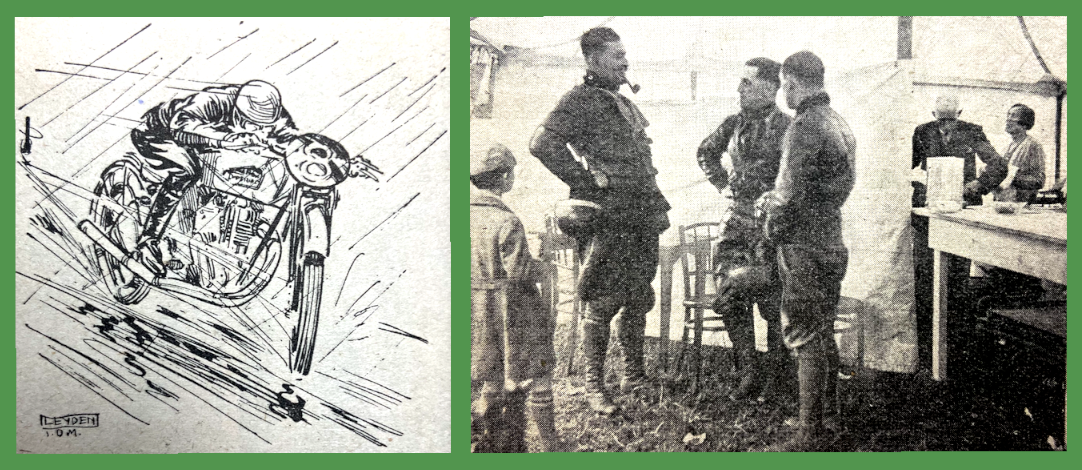

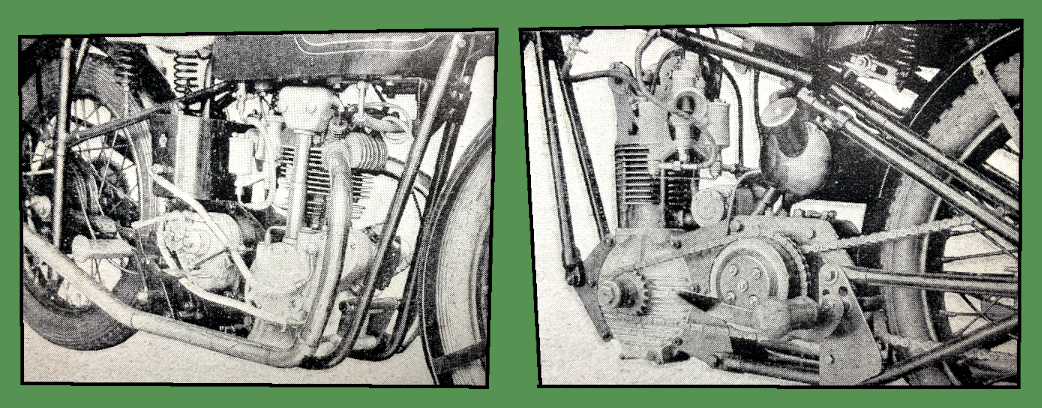
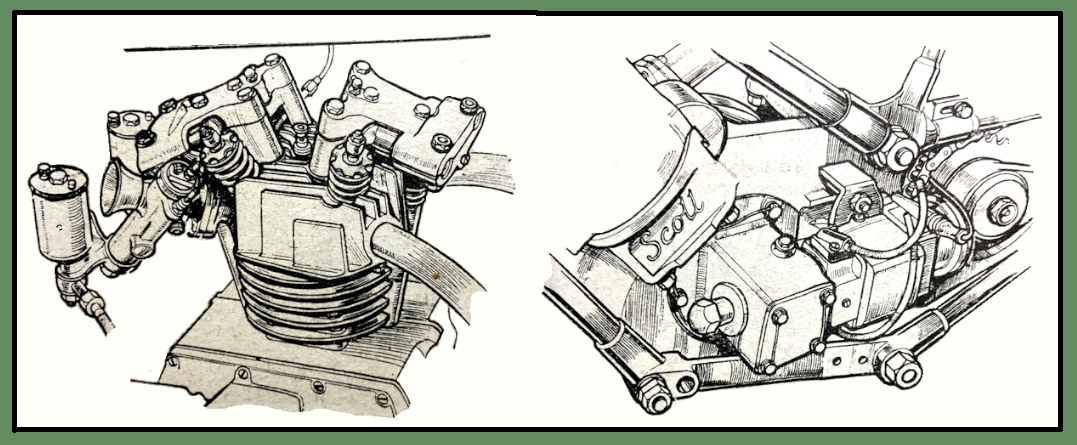
rattled by. The ends of the two straights could just be seen and he amused himself by taking a few times from the top to the bend. The sole representative of that famous breed of twin two-strokes that has made Manx history in past years is TL Hatch’s Reynolds Special. The frame, which, of course, is of the duplex triangulated type, has been strengthened and modified to give better weight distribution having regard to the amount of petrol to be carried—very nearly five gallons. Improvements have also been made in construction of the radiator, which has a larger cooling area and incorporates a steam valve; the latter enables the engine to run at a higher temperature and conserves the water supply. A striking feature is the enormous petrol and oil tanks; the former, as indicated above, carries 4⅞ gallons, and the latter 1⅓ gallons. The power unit has been considerably redesigned, as a result of intensive experimental work. An Elektron crank case is employed, differing considerably from the usual construction, and employing larger diameter bearings. Scott owners will also be interested to note that in the new design the cranks are a parallel fit in the flywheel instead of a taper, and that the familiar crank case doors have been replaced by the new Scott multiple-plunger (swash-plate-operated) type of oil pump on the right side and a magneto-drive housing on the left-hand side. This arrangement allows the magneto to be bevel driven from the engine, and dispenses with the usual driving chain. Included in the magneto drive is a neat revolution counter.”
“THE COURSE—264 miles 300 yards is the official length of the course in all three races, Junior, Lightweight, and Senior. The world-famous and gruelling Isle of Man circuit is lapped seven times, each lap being 37 miles 1,300 yards.”
“THE AWARDS—First Prize: The entrant of the wining machine will receive the Tourist Trophy (Junior, Lightweight, or Senior) and a cash award of £200. Second Prize: To the entrant, a cash award of £125. Third Prize: To the entrant, a cash award of £100. Fourth, Fifth, and Sixth Prizes: The entrants will receive, respectively, cash awards of £75, £60, and £45. Finishers: Each finisher, other than the above, who completes the course within a time not exceeding that of the winner by more than one-eighth, receives £10. Replicas of the Trophy will be awarded in each race to every entrant winning an award.”
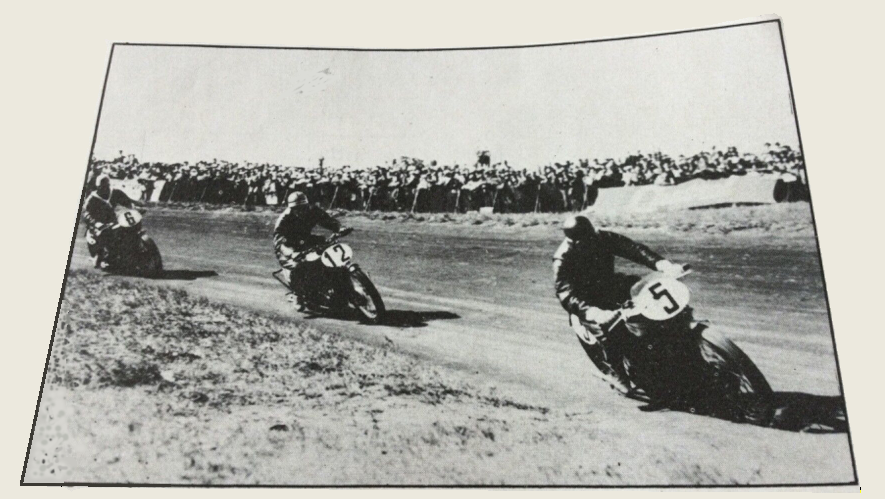
NOT FOR THE FIRST TIME in this timeline I am indebted to Geoffrey Davison, editor of the TT Special, and a TT rider of some note, for details of race week. In this case his report is a model of concision: “Nortons definitely had it all their own way in 1933, Stanley Woods winning both Junior and Senior for the second year in succession, backed up by Hunt and Guthrie in the Junior race and Simpson and Hunt in the Senior. Stanley’s average speed for the latter event was 81.04mph, the first time the race had been won at over the 80 mark. He led all the way through in each race and it seemed that this brilliant Irishman was invincible. The amazing thing, too, was that he never seemed in such a frantic hurry as most of the others—he just went round and round, getting faster and faster and winning all the time! An interesting feature of the Junior race was the strong entry of Velocettes. Whereas previously this event had been a Norton-Rudge duel, this year Velocettes took the place of Rudges. There was, indeed, only one Rudge finisher—Fernando Aranda, from Spain—but after the winning Norton trio came seven Velocettes [Velos finished 4th, 5th, 6th, 7th, 8th, 9th, 10th, 13th, 14th, 15th and 16th—Ed]—no mean demonstration of reliability. As in the previous year, the Lightweight event was much more ‘anybody’s race’. Excelsiors, New Imperials, Cottons and Rudges all had a go, with Wal Handley and Sid Gleave now riding Excelsiors. Walter led on the first lap—I almost wrote ‘of course'”—but Sid Gleave overtook him in the next lap and led from then onwards to the finish. The race was marred by the death of Frank Longman, winner of the 1928 Lightweight, who crashed near Ramsey.” RESULTS Junior: 1, Stanley Woods (Norton) 78.08mph; 2, Tim Hunt (Norton); 3, Jimmy Guthrie (Norton); 4, AG Mitchell (Velocette); 5, HGTyrell Smith (Velocette); 6, GL Emery (Velocette); 7, Wal L Handley (Velocette); 8, HE Newman (Velocette); 9, D Hall (Velocette); 10, ER Thomas (Velocette). Lightweight: 1, Sid Gleave (Excelsior) 71.59mph; 2, Charlie Dodson (New Imperial); 3, Charlie H Manders (Rudge) 4, Leo Davenport (New Imperial); 5, Syd A Crabtree (Excelsior); 6, M Ghersi (Moto Guzzi); 7, Ted Mellors (New Imperial); 8, Les Martin (Rudge); 9, CB Taylor (OK-Supreme); 10, DS Fairweather (Cotton). Senior: 1, Stanley Woods (Norton) 81.04mph; 2, Jimmy Simpson (Norton); 3, Tim Hunt (Norton); 4, Jimmy Guthrie (Norton); 5, Ernie Nott (Rudge); 6, AG Mitchell (Velocette); 7, JG Duncan (Cotton); 8, Ginger Wood (Jawa); 9, HG Tyrell Smith (Rudge; 10, J Williams (Norton).
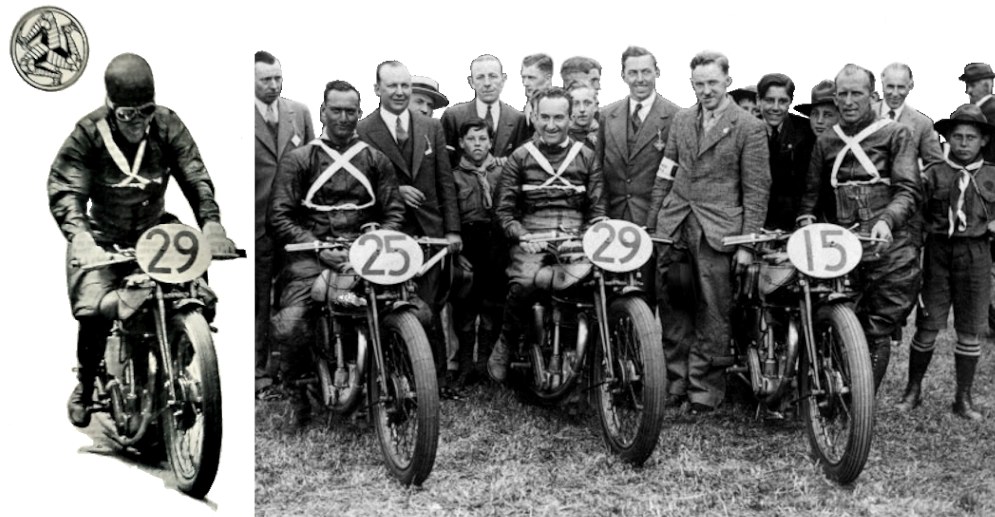
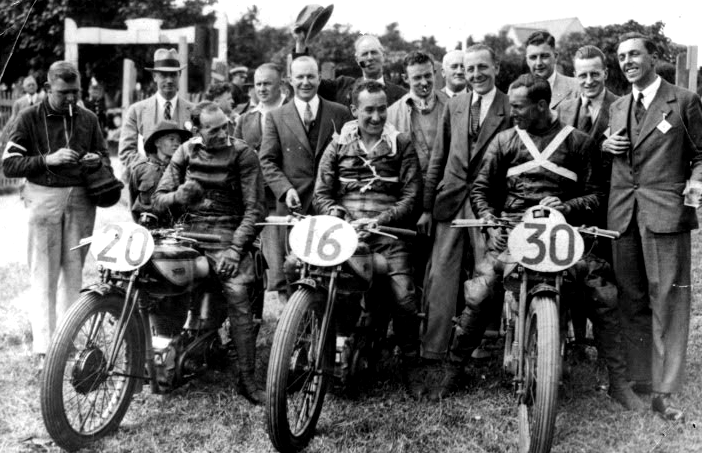
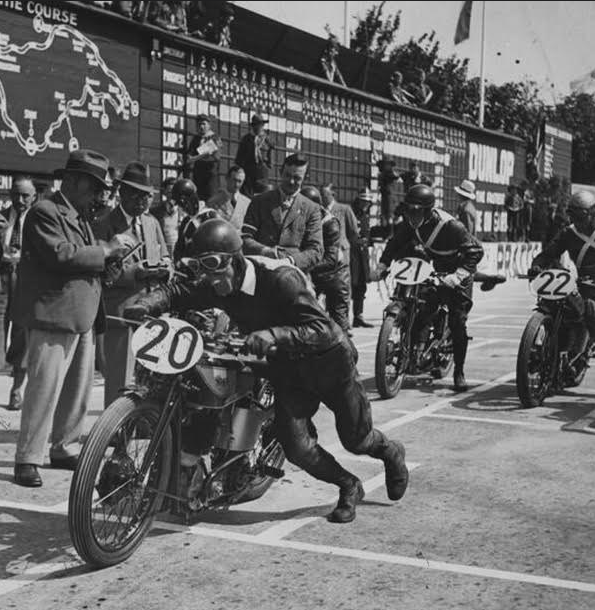
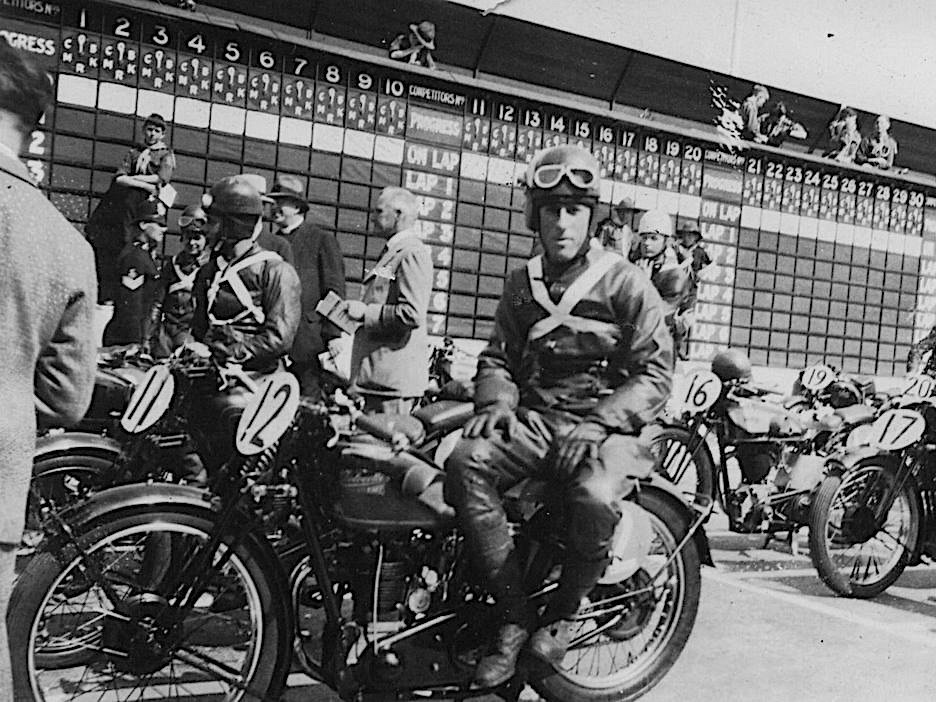
MOTOR CYCLING’S MAN ON THE ISLAND turned his purple-prose knob up to 11—these excerpts from the Green ‘Un’s reports of the Senior and Lightweight races are a joy: “The fingers of a watch pointed to 11 hours, 14 minutes, and 30 seconds. A man said, without too much enthusiasm, without much excitement, without much interest, even, just one word: ‘Right!’ The motorcycle, which was labelled ’29’, was put forward a few paces, the engine fired, and a valuable piece of machinery weighing a couple of hundredweight and more, went roaring away towards Bray Hill. Crouching over its tank was Stanley Woods, 28, red-faced, curly haired, Irish. He had set out grimly, purposefully, to travel over 264 miles, 300 yards of Manx roads in less time than any other man would need…And he succeeded. No man of the 29 there present, pick of the world road-racing stars, could overtake him; of the motorcycles they rode, none could approach his Norton. And so he rode for seven laps of that terrible Manx course, always leading, the despair of those behind. Of these none challenged his Norton with such measure of partial success as the other riders of the same brand. A Norton led, a Norton was second, a Norton was third and (from the second lap onwards) a Norton was fourth throughout the race. Of such ingredients, a thrilling contest is not made. At least it would appear not. But stay. Forget, for a moment, the machines, and think of the man who is/them. Think of JH Simpson—hard luck Jimmie as they call him, lean-faced victim of so many of the Wheel of Fortune’s sideslips, breaker of many a record lap-speed, winner of never a TT race.
Think of him, the disappointed, the determined, the dauntless, and the dashing, hanging as close as he might tot he Irishman’s tail for seven full laps, always striving to go faster…never succeeding. Once he had thought he had Woods beaten, for he broke the lap record. But Woods broke it again. Once Simpson was only 16 seconds behind Woods; he could not better that. When there was Guthrie, James o’ that ilk, a dour Scott. Winner of third place in the Junior, he remained in the same position throughout six of the seven laps, only to drop to fourth place on the last lap of all. And the man who stole Guthrie’s third place from him: Percy Hunt, called Tim, for some odd reason. Tim made a bad start; he had to change the plug when the race was only a few seconds old! And then he rode like mad, annexing fourth place on the second lap and holding it until the last lap of all, when he forged ahead of Guthrie! Of a truth, we must think of Friday’s race as a battle of men, rather than of the machines. From such a viewpoint it was an exciting race; from any other angle it was—a mere procession. As anticipated, Wednesday’s Lightweight race proved exceedingly interesting. There was a battle royal between S Gleave (Excelsior) and CJP Dodson (New Imperial) for first place. At the finish the former, who had led since the second lap, was 2min 26sec ahead of his rival. He averaged 71.50mph and beat Leo Davenport’s 1933 record made on his New Imperial by exactly 2¼min. Dodson also bettered last year‘s figures. WL Handley (Excelsior), who’s terrific scrap with Dodson, for second place was a feature of the race, was unfortunate enough to retire with engine trouble on the last lap. He it was who set the pace on the first circuit. Another make–Rudge–occupied the third place. It was piloted by the Irishman CH Manders, a performance which is all the more creditable when it is realised that his was entirely a lone-hand effort, without works support. New Imperial, and Excelsior machines occupied the next two places, with Mario Ghersi, the Italian challenger, on the Guzzi, a plucky sixth.
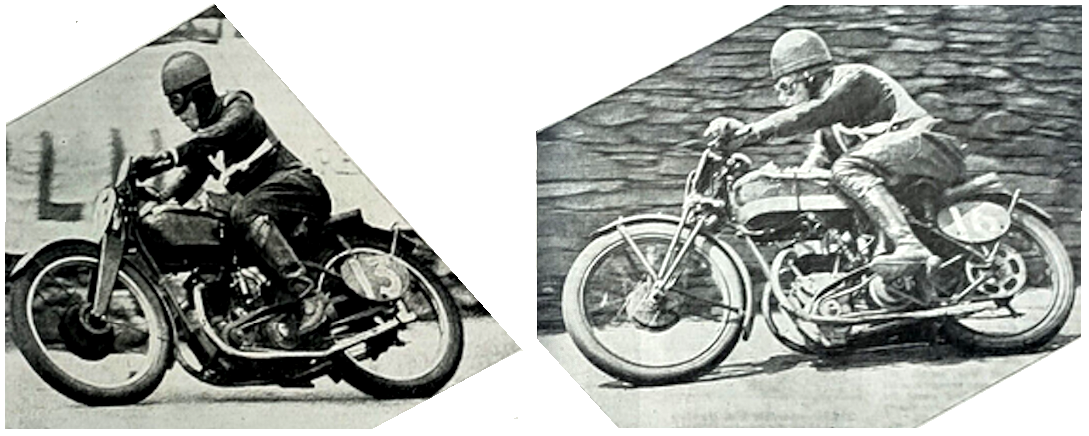
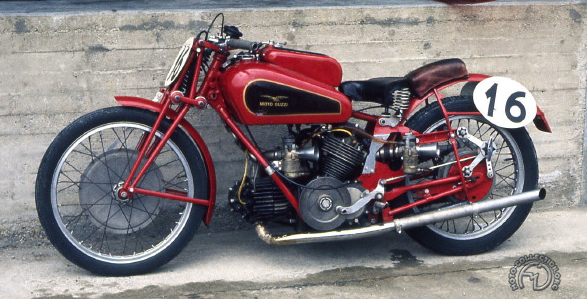
The other six trophy replicas were divided between New Imperial, Rudge, Okay-Supreme, and Cotton. The last mentioned make had been well in the picture until JG Duncan retired with engine trouble. The New Imperial Trio carried off the Manufacturer’s Team prize, but Handley‘s record lap, made 12 months ago on his Rudge, remained unbeaten, perhaps, because of a strong breeze. The day, which had been dull in its early stages, soon cleared and a warm sun shone in a blue sky. A fatal accident marred the day. Frank Longman, riding a somewhat old Excelsior, broke his forks when descending Bray Hill on his second lap. He stopped for 20 minutes at Braddan and effected a temporary repair, pluckily, refusing to withdraw. He told an onlooker that the forks were not safe for high speeds and so he was presumably riding at a reasonable speed when he crashed at Glen Tramon, on the road to Ramsey. Although he was rushed to Ramsey hospital, he succumbed to his injuries—a fractured spine—within a short time. Longman, who leaves a wife and two children, was a veteran racing man, having frequently ridden at Brooklands, on the Continent, and in the TT, winning the lightweight event in 1928. He has been closely connected with the trade in Ealing for some years. This death was the result of a gallant attempt to finish on a partly disabled machine. Extraordinary scenes were witnessed at the conclusion of the race, when the A-CU’s organisation for once slipped up badly. Nearly half an hour before the official time for the termination of the race a road opening car came from Craig-ny-Baa to just short of the timekeeper’s box. Smart work to some extent stopped the crowd on the grandstands and Governor’s Bridge from overflowing on the road, but three men had to finish on roads officially open to the public. Nor is this all, for at approximately 3:40pm Crash! Went the maroons and quite a thousand people must have been strolling about the finishing straight when Tommy Span (New Imperial), the last man on the course, arrived! It was a truly amazing spectacle to see a man finishing a TT race well within time yet having to force his way through crowds of spectators. Somebody had blundered badly.
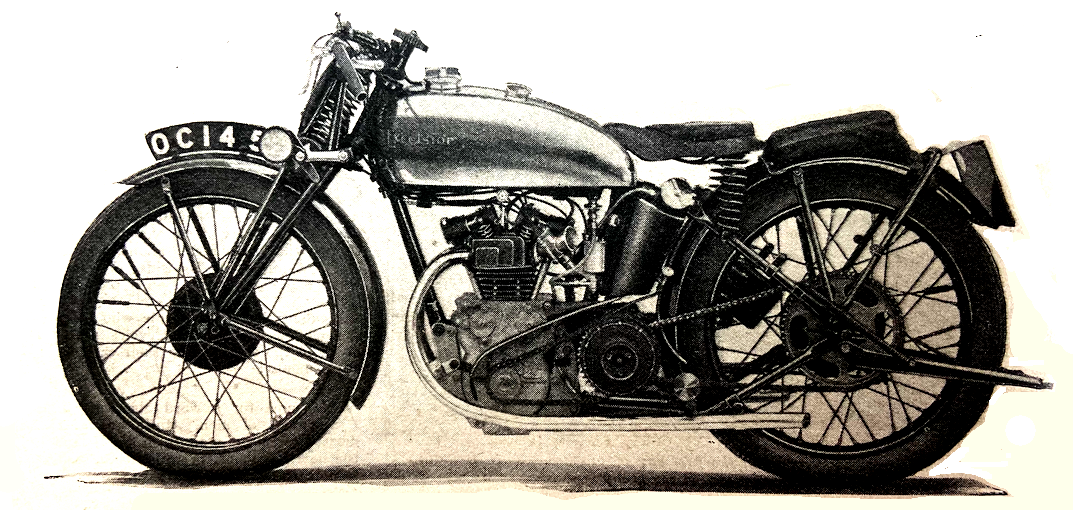
FOLLOWING VELOCETTE’S IMPRESSIVE showing in the Junior TT Les Archer rode one to victory in the Brooklands Hutchinson 100 at an average 100.6mph; the first time 350 to cover 100 miles in an hour in Britain.
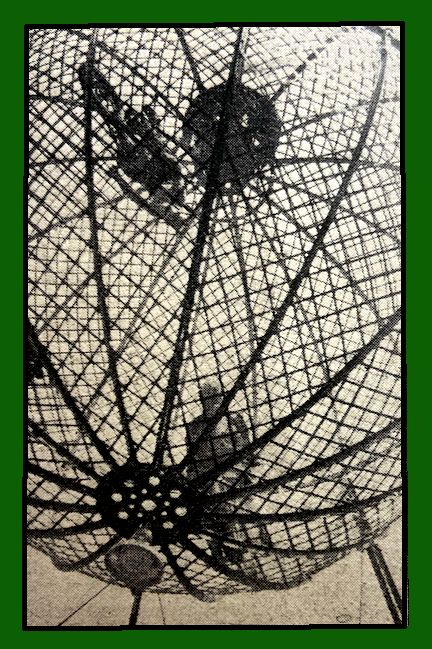
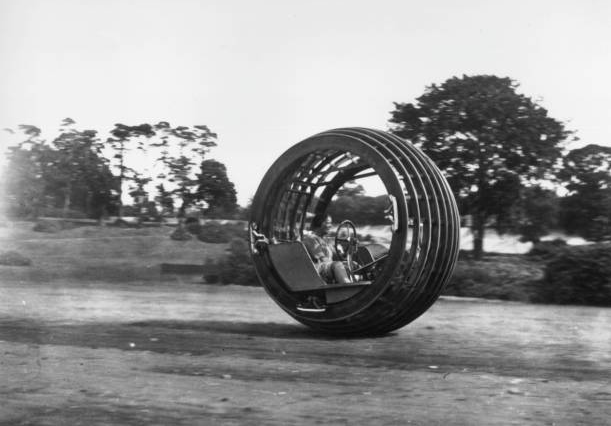
ALSO LAPPING BROOKLANDS THAT YEAR was the Dynasphere monowheel, built by Douglas (who contributed a 500cc flat-twin) lump and the British Aluminium Co to the design of Dr John Archibald Purves, who claimed it was the “high speed vehicle of the future”. What about visibility? “The solid portions of the lattice work spherical shell pass before the eyes so fast that they become invisible,” he claimed. “Only the picture of the country in front affects the eye.” Its commercial failure, according to Popular Science magazine, was a tendency to ‘gerbiling’—passengers sometimes spun inside the wheel when braking or accelerating.
“DURING THE LAST YEAR or two a big improvement has been noticeable in the important feature of accessibility and ease of adjustment. Many machines of the 1926-1930 era were very bad in this respect, but since that time great strides have been made. We would, however, urge manufacturers to continue the good work, while there is time, in the production of their 1934 models. There is still room for improvement, particularly in lower-priced machines, on which one bolt or similar fitting is often made to serve a variety of purposes; there are still too many mounts on which half a dozen parts have to be dismantled or removed before one part can be reached. Particularly is this true of primary chain cases. Bearing in mind that nowadays almost all motor cyclists do their own maintenance work, designers might do worse than to hand over to a non-expert a new model equipped with only the standard tool-kit, and make a study of the time and trouble he expends in dismantling and assembling various parts.”

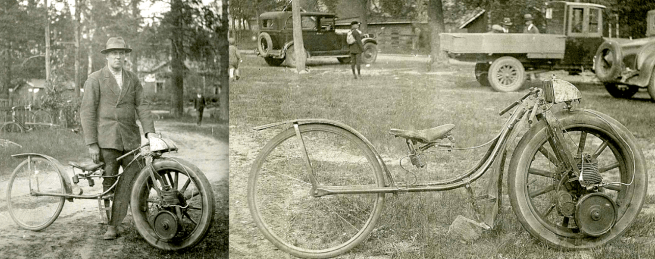
“THIS YEAR’S PIONEER RUN (‘ motor cycle old crocks’ run’) of the Sunbeam MCC has attracted over 50 entries. The oldest machines include WT Mansbridge’s 1898 149cc Werner, which has front-wheel drive—and twist-grip control! It is alleged to have acted as a stop-gap in a hedge since 1922.”
“A THOUSAND MILLION gallons of petrol were used in this country during 1932. Petrol is consumed in Great Britain at the rate of 30 gallons a second, day and night. Its cost is 2½d a lb, of which 1d. represents taxation.”
“GREAT ADVANCES ARE BEING made in the treatment of coal for the production of oils and petrol. Hydrogenation and low-temperature carbonisation will be very much in the public eye in the ensuing months.”
“AN IRON COMPOUND is, it is reported, being used successfully on the Continent as an anti-detonating agent for fuels.”
“DESPITE THE FACT THAT whole sections of the concrete have been relaid in an endeavour to eradicate it, the ‘Birkin Bump’ under the Members’ Bridge at Brooklands is still very much in evidence, according
to a rider who has sampled the track on a fast 500.”
“OF THE 5,876 MOTOR CYCLES imported into Holland during 1932 no fewer than 3,937, or over 67&, are credited to the United Kingdom, as against 958 to Germany, 396 to Belgium, 311 to the United States, and 223 to France.”
“THE SOLO MACHINES WHICH took part in the recent Bavarian winter trial—which involved climbs of mountain roads deep in snow—were fitted with a ski on each side.”
“‘ROADCRAFT’—WHAT IS IT? ‘Ambleside’ Explains How and Why it is Road-sense plus a Little Something Else…
One thousand eight hundred women are killed in this countspery every year by falling downstairs and by tripping over buckets and broom handles. This startling disclosure was made by Miss Margaret Bondfield, an ex-Cabinet Minister, at the National Safety Congress last year. But that is not all. It was also announced that 2,000 children are killed in their homes every year through similar accidents. This makes very startling reading; in my view it also has a very significant bearing on the fact that road deaths occur almost every hour of the day. If 10 people lose their lives every day while still in their homes, obviously through carelessness or forgetfulness in the majority of cases, how many thousands of similarly negligent individuals are abroad on our pavements and roads? I ask this question because I am certain that well over 90% of the accidents and tragedies that occur on the roads of to-day are due to sheer carelessness, either on the part of the pedestrian or of the motorist (ourselves included). Over 98% of the fatal road accidents which occurred in England and Wales during two months of last year were classified as avoidable. You will see that I am not going to blame the much-maligned pedestrian by himself, for we who are motor cyclists are all basically pedestrians, though with the advantage of a little knowledge of road traffic and its ways. In spite of this knowledge, most of us have experienced a little draught behind the ears when we have suddenly found ourselves ‘jay-walking’ across a busy street
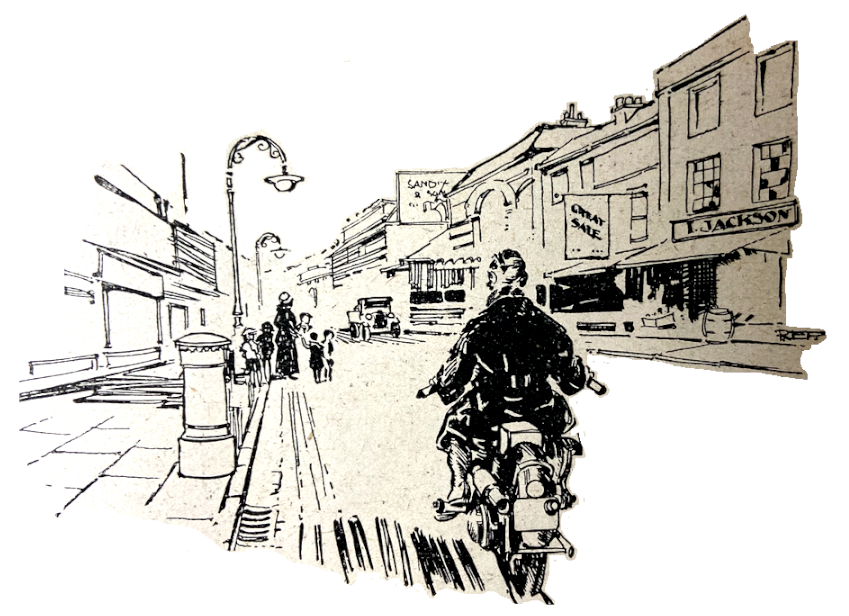
or crossing. Bearing this in mind, how can we blame those who are unable to enjoy the open road in the way that we can? The pedestrian proper never has the same chance to acquire that mysterious quality commonly known as ‘road-sense’. If he had, then I am convinced that the toll of the road would be more than halved. However, since we must accept the position as it is, what can we do to minimise the accidents which do occur? I have just mentioned the term ‘road-sense’. I look upon it as a misnomer, for to me it suggests a kind of sixth sense—something which is born in an individual and not bred. So I prefer the word ‘roadcraft’, for it implies an art or a craft which can be learnt, pride being taken in its very learning. It is in roadcraft that I believe we have the solution of the tragic accident problem. If we—and I include pedestrians as well—were all experts in the art of road-craft, then accidents would be reduced by at least 50%. How can we learn? To begin with, each of us most be something of a psychologist; we must be able to understand the way most people react in moments of emergency. Does this seem very ‘deep’? Let me give a common example. If two people are walking across a road arm in arm, and perhaps talking, and they are suddenly taken unaware by a motor vehicle, what will they do? I can guarantee that, in the large majority of cases, they will immediately separate; one will perhaps stay where he is, while the other will dive for the nearest pavement. In any case they will both ‘fill’ the road. Why is this? The reason, I suppose, is the automatic reaction to Nature’s law of every man for himself. Together they are liable to obstruct one another, so they naturally separate. Yet, had they not been surprised, they would have walked across as they had started. Obviously, the good rider or driver, in such circumstances, takes every precaution to prevent the element of surprise. By that I mean that he does not sound his horn if he is less than 20 yards away. As trouble is to be expected he uses his brakes instead. In other words, the good rider, using his knowledge roadcraft, has anticipated trouble before it has overtaken him. Here is another little example which I witnessed only the other day while riding in London. About 100 yards ahead, on the near-side kerb, was a middle-aged woman, surrounded by children. Judging by her agitation I presumed she was about to cross the road. The only other traffic was a lorry approaching from the opposite direction. The woman took a hasty glance in my direction and then looked to her left to study the slow progress of the lorry, which was at least 50 yards away. Then, never for a moment realising that by that time I would be in danger of hitting them, she pushed the children in front of her and dived for the other side, still worrying about the lorry. But experience had taught me that the average pedestrian concentrates too much on a slow-moving vehicle, usually on his left, to be able to realise the difficulty in estimating the speed of a vehicle approaching from his right. In fact, they normally ignore traffic coming from this direction, perhaps because the almost dead-ahead view of such vehicles does not give any true idea of their speed of approach. The foregoing remarks apply to only one branch of roadcraft as I like to see it. We all know that a moving shadow behind a stationary vehicle usually indicates that some careless individual is about to dash across the road without dreaming to look out for approaching traffic. But do see all realise the significance of the local delivery van which shows signs of slowing up in the middle of the road? Having been once ‘bitten’, I always regard such vehicles with the gravest suspicion. To the uninitiated I would offer the suggestion that this slowing-up is an indication that the vehicle is going to turn suddenly down a road on his off side,
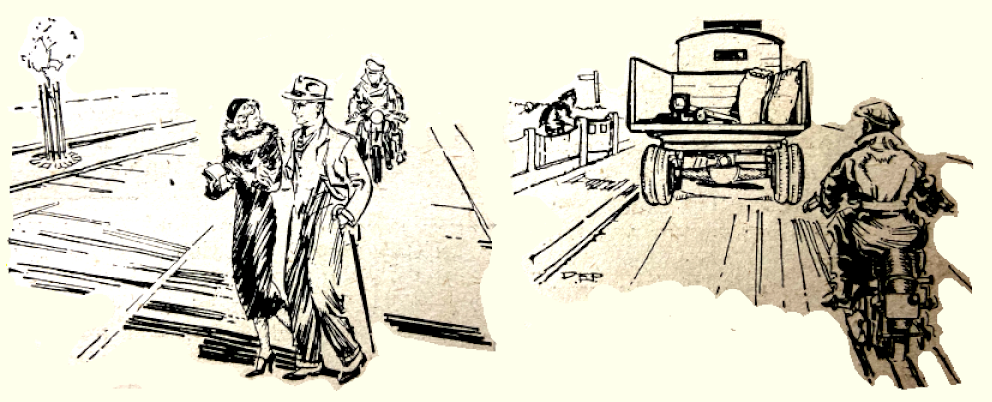
and therefore it is highly dangerous to overtake in the circumstances. It is of no avail to sound one’s horn, as the driver is in all probability doing the same thing and will not hear yours. Incidentally, he usually pokes a couple of fingers out of the side of his cab the moment he begins to turn. Upbraid him afterwards, and he will smilingly reply that he put his hand out and blew his horn—little consolation for the hectic moments that one has suffered! If you are travelling along one of the main roads to the coast at night and the road surface gradually becomes worse and worse it is often an indication that the surface is being attended to a little farther on, so look out for a violent bump as the road level goes up three or four inches on to the remade stretch. It was not very long ago that I struck such a ramp at speed and without any warning. Luckily, I was on a model which steered perfectly. Talking about roads, there is one little point well worth mentioning. Buses, like the majority of motor vehicles, are liable to deposit grease, so beware of bus stops, particularly in busy city centres. Incidentally, while in a big town during a rush hour, a good rider proceeds cautiously, for he remembers that pedestrians have a dangerous habit of stepping into the road with their backs towards the traffic. If pedestrians pause when about to cross a side street, it is a sure sign that something is going to emerge—another reason for immediate caution. Finally, remember that big motor buses and mammoth lorries, when turning down or emerging from a narrow side turning, have to swing out wide by reason of their length; it is true that the operation is usually heralded by ample warning. The foregoing remarks are but a mere indication of all the little points which a good and experienced rider is able to absorb instantly, realising their significance and using them to promote his own safety and those of other road-users. A knowledge of roadcraft is something of which to be proud; for myself, I am proud that I am still willing to learn and symphathise.”
“I AM SOMEWHAT ALARMED after reading ‘Veteran DO 357’s’ statement that he has spent less than £1 on necessary replacements after 300,000 miles—alarmed to think that I have been ‘done’. I actually spent £7 on replacements after 65,000 miles, patrolling for one of the road services. Possibly the figures given by your correspondent are erroneous, a decimal point having, been omitted. I sincerely hope ‘Veteran’ will not scrap his machine; I will gladly exchange my present magneto and one empty Castrol can (the cap will do for a medal) for his super spark-box. Joking apart, I should very much like to know how his original tyres are wearing.
Extravagant, London, SE12.”
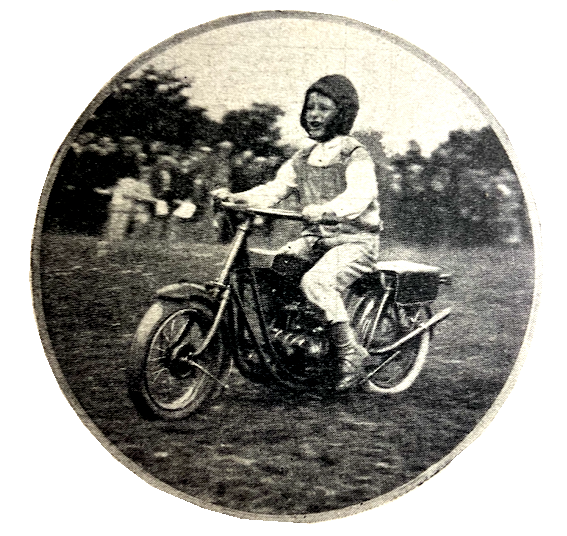
“FROM TIME TO TIME attention is drawn by motor cyclists to the bargains obtainable in the second-hand market. Most of the machines thus acquired, however, seem to be used for riding round a field (with the silencer removed) or some such travesty of motor cycling. My own experience in this direction may, therefore, be of interest, as I bought my old crock with the idea of working it hard—and I have. I told a dealer in South-West London that he would not get a better offer for that 1926 700cc NUT than the £3 that I had in my hand. He replied, No, he supposed he wouldn’t, so that was that. The price included six weeks’ tax, a horn, a pump and an electric head lamp. I rode it home (I was subsequently fined 5s. for excessive noise for this little trip) and spent £6 3s on the following: Two covers, one inner tube, rear chain, gear box, rear-drive sprocket, fork spindle, two hub cones, set of balls, two plugs; four valve springs, one valve, four piston rings and two Flexekas attachments. Of these, only the plugs and the valve were essentials. What was essential was to cut the induction pipe in such a way that it did not foul the inlet valve guides, since in the condition in which I found it it was, I imagine, impossible to make an air-tight joint. I now have a machine that has covered 750 miles in England and some 2,500 in this country (Nigeria). Not an enormous mileage, certainly, but the conditions have not been exactly ideal, and the cost, apart from petrol, oil, and tax, has been two-pence for a silencer bolt; moreover, there appears no reason why the expenditure should be any greater in the next 5,000 miles. I can guarantee a first-kick start every time, hot or cold, and at a steady 40mph burble a gallon of petrol of doubtful quality lasts at least 90 miles. And the long wheelbase, 4¼ to 1 top gear and vibrationless engine provide comfort not met with on many more pretentious bikes. The native of this part of the country is a keen trader, and the second-hand market is full, but I could sell to-morrow at a handsome profit over the original cost, plus cost of replacements. The eleven previous owners (if any of them should are this) might be interested in the subsequent history of 0N 7636.
‘OYIBO’, Abeekuta, Nigeria.” .
“I HAVE JUST READ ‘Steamboat Bill’s’ remarks about high mileage and petrol consumption; perhaps he would let us into the secret of how the figures he quotes were obtained. The best performance of my last machine—a 172cc two-stroke—was 70mpg, and this could not be improved upon without overheating. At that time the machine was under one year old, and I spent many hours of labour and changing of needles, but without avail. I now have a 1932 model 3½hp side-valve machine, and have just overhauled for my holidays. I have never had more than 66-70mpg, and during the overhaul the carburetter was checked against the makers’ instructions, but the performance could not be improved without impairing the efficiency of the engine. Apparently, ‘Steamboat Bill’ is the man I am looking for to tune my carburetter: perhaps it may be the Devon air. I shall be down that way shortly, so maybe I shall find the answer.
‘Petrol Complex’, Croydon.”
UNDER THE HEADING “New Machines to Suit All Purses” the Blue ‘Un compiled a comprehensive price list of something like 500 models. They ranged from an Excelsior 98cc two-speed two-stroke for £15 19s to a Brough Superior four-speed 988cc ohv twin with spring frame for £159 10s. Which, according to a CPI inflation calculator, translates as £1,500 for the Excelsior and £15,000 for the BruffSup. But a further trawl through the net revealed that a few years later, in 1938, a three-bed semi in Edgware sold for £835; a similar house now costs around £700,000. By this measure the Brough’s 2023 cost would be nearer £115,000—or, as the Brough sold for about a quarter the price of a semi, maybe £170,000. Which is about what you’d have to pay for a restored Brough today. George Brough’s bikes have been likened to Rolls Royces, and the saying goes that if you have to ask the price of a Roller you can’t afford it. Enough said.

“THIS IS A TALE OF DEFEAT, some would say of folly. It is the true story of an attack upon the wrong hill, of a sheep that sent a baa-a-a echoing across the mountainside to coincide with our admission of defeat and of a side-valve sidecar outfit with the average-speed capabilities of a hyper-sports solo. The cause of everything was a manufacturer writing to the effect that he had digested all we said some time ago regarding oversize twins for the Canadian police, that he had gone ahead and produced such a machine and would we please try it out, putting it to a really strenuous test. And—oh, yes!—the maker would come, too, and sit in the sidecar. Now, gentle reader, remembering that the accent is upon the word ‘strenuous’, what would you do in like circumstances? Given the pleasant task, and having read about Walna Scar in the Lake District, I decided that an innocent inspection was indicated plus a little open-throttle motoring. So one recent Friday evening saw me making Nottingham, the home of the said maker, to wit George Brough, by way of the Great North Road. I arrived soon after ten to find Mr Manufacturer at home, the last of his men having just gone after much overtime turning out new models, and ready and waiting the new 1,150cc JAP-engined Brough Superior with a monster sidecar designed to accommodate 6ft 2in 16-stone (and more) policemen. Praise be! the sidecar was attached to the left, though perhaps you’ve never driven a right-hand outfit; believe me, for one used to the English arrangement it is ** *!!!†††. Footboards there were, also a hand clutch and a foot gear change. Later I learned that the four ratios were of TT closeness with a 4.2 to 1 top and 8.75 to 1 bottom. Shades of Walna Scar, and that bottom gear! Next morning, at the highly respectable hour of ten, we hit the highway. It rained; it teemed. For the first 80 miles it did nothing else, and the maker had come too—without even a windscreen. We were heading for Southport so that we might take a look at the Southport ‘100’ en route. Just north of Warrington we turned into the new East Lancashire By-pass; the mighty road that leads as straight as a tee-square into Liverpool. Never have I seen such a highway. It looks twice as wide as the Great West Road—so wide that I can foresee people getting hopelessly ‘at sea’ on it when there is a fog. On the way the Brough, with its huge side-valve engine and mighty sidecar, had already shown its paces—65; 68; 70; 72; 75…78. This last was with the aid of a slight downhill swoop. The honest maximum was around 75, and the great, wide outfit would cruise—yes, cruise—with the speedometer needle around the 68 mark. But would the engine stand up to wide-open throttle work for anything more than a short burst? On the by-pass we were faced by a strongish wind. The intention was that we turned off and went into St. Helens. We missed the turning—we were in Liverpool. The engine would stand up! At
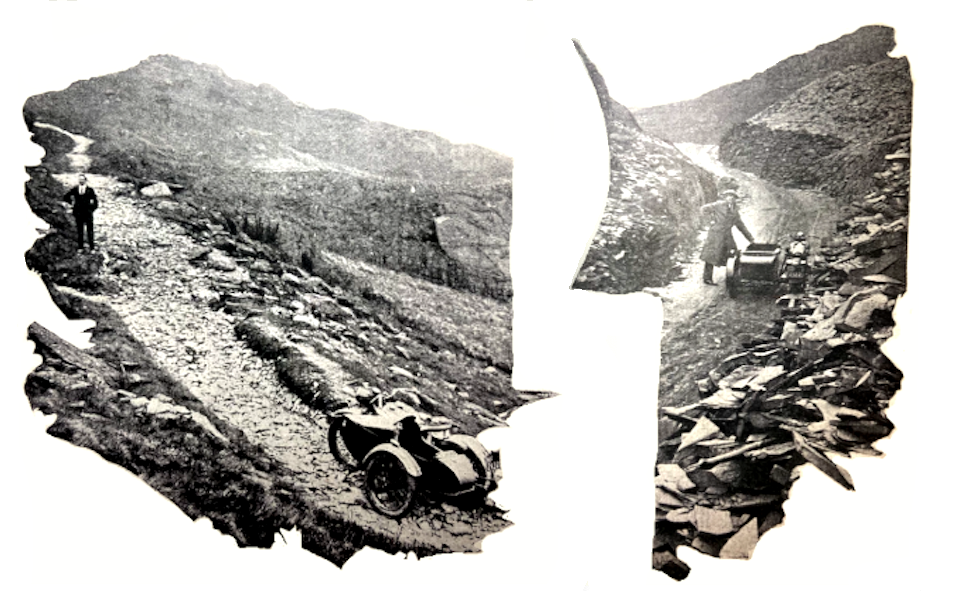
the Liverpool end of the road a bus driver decided to thrust me out of the light. I refused to be done down, being, I considered, on the main road. Unfortunately, my path thereafter lay towards Robert; his away from Robert, who had turned round in time to see us having words. Politeness pays, I decided, and Robert, who did most of the talking, incidentally, went to great pains to explain the best way to Southport. So to Southport and on to the Lake District, with a cheery encounter en route with some Northern lads who objected to being passed by a sidecar outfit. On we went to Kendal to arrive beside Lake Windermere soon after sunset, just as the greys of night came down. At one bend, where the road overlooks the lake, I coasted and stopped to drink in the glories of nightfall beside the lake. Neither of us spoke, except to pass some remark about what lucky dogs we were, and why did not more motor cyclists, making full use of their buses. employ their week-ends similarly. Before finding an hotel at Ambleside we tried Kirkstone Pass from the Ambleside end. Second gear—6.75 to 1. Then a four-course meal in spite of the late hour, and BED. Next morning a dutiful journalist was to be seen in his bedroom, up before breakfast, writing his report of the Southport ‘100’. At ten we were off again; this time for Coniston and Walna Scar. The road to the Scar from Coniston is a pukka trials hill in itself . Right at the start there are twists and turns and hummocks and gullies and rocks. There was also mud. However, with a short series of rushes, the Brough got safely up. If it’s like this here, what on earth is it like when we get to the hill proper? For a bit it flattened out, and after going through two gates we decided to look at the map. It was not too clear, and the pukka road seemed to go to the right, so we went to the right. At first it was roughish, but reasonable. We rounded a bend to find, partially hidden by mist, one of the finest panoramas I’ve ever seen in Lakeland. The hill became steeper; we rounded a rough right-hand bend, literally fighting our way. Steeper, still steeper; the Brough, with its 8.75:1 bottom gear, was on full throttle. Upward we wound, to come to a scene of wild desolation—rock shale everywhere. A sharp turn left, with a horrid rock-strewn roll, bowl or pitch on the right. With the rough surface, our inability to get up speed and so keep up the revs, I was already resorting to slipping the clutch. Round the bend was a stretch of shale-covered roadway rearing skyward with a gradient of 1-in-3. The five-plate clutch became odoriferous—we stopped. One huge rock was placed behind the back wheel, with another behind it to act as a strut. A photograph; then we walked upwards for some two or three hundred yards, finding en route a slate quarry, in 2⅓ gradient (measured), and a rock-strewn hairpin bend almost too narrow for the outfit and having, on the right, a most devastating drop. With care and some misgivings we
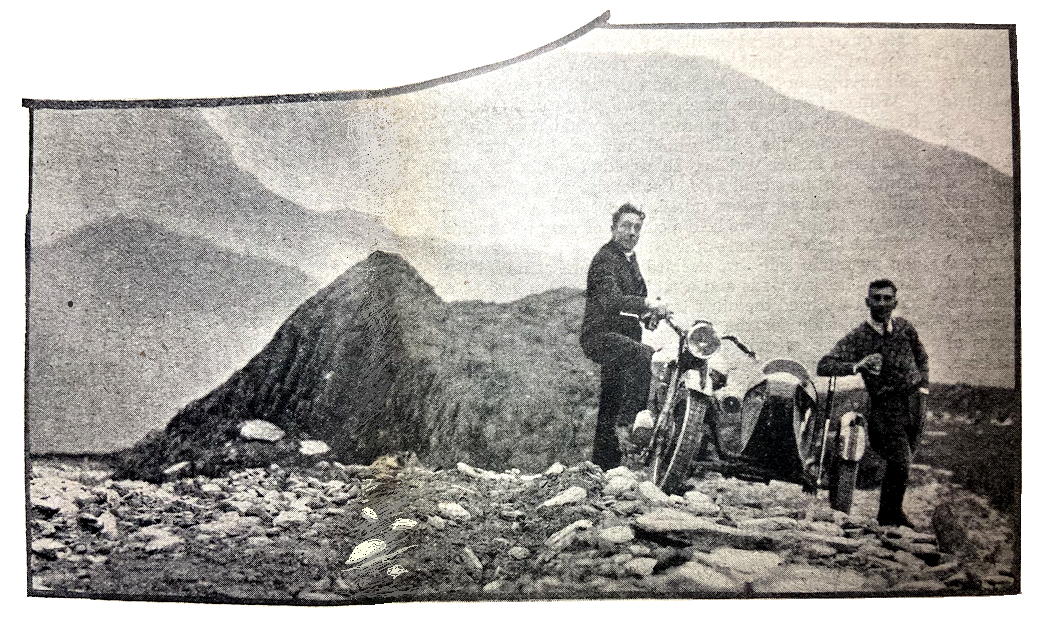
got the outfit round. Knowing the drop at the bend below, and having doubts as to whether the outfit would hold on the surface, I asked the maker whether he wouldn’t prefer to walk down. No. he would not! Cautiously, in bottom gear, with the exhaust valves raised, we set off downwards—safely. At the foot we held a council of war; we decided we were beaten—a long, drawn out ba-a-a-a floated down the mountain side—we decided to return again with a narrow-track chassis and a really low bottom gear. Then we tried the other track. The 52in track outfit was too wide for the rutted, narrow road, and after bending the off-side footboard and the sidecar mudguard, and much heaving, we returned. Ba-a-a-a again! Then some motor cyclists arrived, and later some hikers. The former were out to see the Scar, haying read the correspondence in The Motor Cycle. The latter pointed out which was the. Sear—it was the narrow track that was too narrow—and told us that the road we had been on was out of the question. Defeated, we went back to Coniston, made rapid strides with eggs and locally cured ham, and, full of plans, set off for Nottingham, and in my case London, to call it a day. The Second Expedition. A date was fixed some 10 days later. Again an evening run to Nottingham. Again an outfit was ready. This time it was an 1,150 with a narrow-track (39in) banking sidecar—Freddy Dixon’s famous TT design—and a 15.2:1 bottom gear. At 6am next morning we were up. It was fine. Soon after 6am we were off, with FW Stevenson trailing us on an 1,150 solo. The maker was not to operate the banking lever until I got the feel of the outfit. Then I gave the signal. We were going into a left-hand bend. Our actions did not coincide. As he let the lever forward the whole machine leaned in on the sidecar; round we went at 50 or 60—I feeling not too happy about the leaning business. Soon we were working in unison. It was uncanny; bends normally taken at 40 could be negotiated at 60 and more. Once, on a tight-hand bend, I entered the turn hurriedly, and signalled. Nothing happened…I used the camber, the bend was an open one, and all was well. Later I found that with the one joystick fitted (Dixon used two in the Isle of Man) it was real hard work pulling the sidecar up for a right-hand bend, so generally we only banked for left-hand ones. Given a passenger you can count on, such as I had, and assuming you are on a route which you both know by heart, this banking sidecar is a masterpiece. Even in my untutored hands it put miles an hour on our average speed, but beware of turning the outfit to the left in the belief that your passenger will bank the outfit for you when the correct route lies to the right and your passenger, not unnaturally, is expecting you to go right. Such an occurrence happened near Weatherby, and I nearly had the maker round my neck. One other contretemps occurred on the way to the Lakes. The first 40-something miles out of Nottingham were covered in 40-something minutes. Life was good, and the roads wide and clear. Then I had a suspicion that the outfit was slowing. I looked down: instead of 68 to 70 the speedometer showed 65. I tweaked the throttle to see if the engine really was ‘catching’. There was a hiss and a shushing, plopping noise, and

we coasted to a standstill. An experimental high-compression light alloy cylinder head had a hole in it, burnt through around the plug, so new standard heads were procured hurriedly by ‘phone and sidecar outfit from the works. These fitted, all was well, and we made the Lake District, devoured more ham and eggs, and set off for Old Man Coniston again. This time the rough lower section, owing to the narrowness, high centre of gravity, and lightness of the sidecar, was not so easy, and once, after a more than usually vicious gully, I kecked the sidecar up and had to foot it down with the aid of a convenient portion of bank. Then over the level section, and off to the right for the road into the mountains. Instead of being dry and hard the lower section was slimy and muddy. Upward we wound—now with the rear wheel spinning, now with the outfit kangarooing, its front wheel lifting owing to the combination of the rocks, steep gradient, and rearwardly set sidecar body, so arranged to assist wheel grip. We passed the 1 in 3 section, where we stopped the previous time; up the part which we measured as being 1 in 2⅓; then the rocky, narrow hairpin with the drop on the right…Yes, the front wheel came up, we slewed, we stopped. Three or four attempts, and we were safely past this danger spot. Then the track divided into two; we went right, and soon found ourselves marooned amid rocks. It was useless; we tried the other track. That, too, was hopeless. The surface was smoother, but we could not get sufficient wheelgrip on the steep gradient, so we prospected on foot. Stevenson, by herculean efforts, had got his big solo within two or three hundred yards of where we stuck, and leaving his bus where it halted, perched on its crank case, helped us in our restarts and stood by to pick up the pieces if, in our leaping and crabbing, we went over the edge. Determined to get up somehow, he raced ahead on his two feet to where the track ended at a final slate quarry, and then disappeared skyward over the rocks—on hands and knees! It was no use ; we doubted whether any wheeled vehicle could climb those last slopes with their vicious gradient and deep, loose shale. No wonder we saw no tracks—not even of the sledges they use lower down. We returned and made for Walna Scar, the correct hill. The track became rough—so much so that we were soon ploughing through masses of rocks like the dried-up river bed on the Mamore Section in the Scottish. We lurched, we crashed up and down, we scrunched. At one point more vile than the rest the sidecar came up and we landed on the bank with the outfit on top of me. ‘Shall we turn back—if we can?’ I asked the maker. ‘No, we’ll get through somehow,’ he replied. ‘Righto!’ I answered, ‘I was only asking you, for it’s your outfit, and it may be smashed up.’ We struggled onward to land at another quarry. Then over a series of extraordinary rock-covered humps of about eight-foot span and shaped like a semi-circle. By short rushes we scraped over all except the last two, where, mercifully, we stuck, grounded with the wheels in the air. Not 10 feet ahead, on the edge of the track, was a sheer drop of 50 or more feet into a great hole with green, sinister-looking rocks at the foot. We looked at each other; had we got those few feet farther with the steep gradient and the inevitable crabbing there would be an unhealthy chance of there being only battered remains. We prospected; this could not be Walna Scar, for nothing could get up here, whereas some cars, we’d heard, had been over the Scar. On our return we met a bronzed hiker in an officer’s tunic. He laughed; we had tried to tackle Doe Crag, a haunt of climbers, where two had been killed earlier in the year. Wrong again! We should have turned left along a grass track. To say that a hill you fail upon is easy is, I suppose, hardly done. The trouble was wheelspin resulting from the wet weather, for the shale-covered, hairpinned gradient of the Scar was innocuous compared with the wild tracks the Brough had negotiated. We returned—defeated, and dog tired. To our surprise, it was 9.30pm, the time at which we were due back at Nottingham. So we filled up—men and machines—and set off on the 200-mile run. This time I was on the solo. I was too tired properly to appreciate the solo, but this I did learn: that it is the most effortless, thrilling, gliding batting-iron I have ever been on. So to Nottingham, safely reached at 3.30am, where three red-eyed men crept off to bed, defeated, perhaps, and Old Man Coniston still laughing, and the sheep still baa-a-a-ing, but three men who had had one of the most enjoyable trips of their lives.”

“DURING THE LAST YEAR or two a big improvement has been noticeable in the important feature of accessibility and ease of adjustment. Many machines of the 1926-1930 era were very bad in this respect, but since that time great strides have been made. We would, however, urge manufacturers to continue the good work, while there is time, in the production of their 1934 models. There is still room for improvement, particularly in lower-priced machines, on which one bolt or similar fitting is often made to serve a variety of purposes; there are still too many mounts on which half a dozen parts have to be dismantled or removed before one part can be reached. Particularly is this true of primary chain cases. Bearing in mind that nowadays almost all motor cyclists do their own maintenance work, designers might do worse than to hand over to a non-expert a new model equipped with only the standard tool-kit, and make a study of the time and trouble he expends in dis-mantling and assembling various parts.”
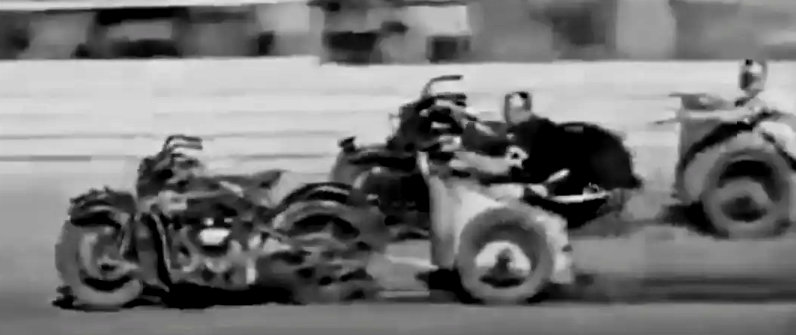
THE AUSSIES (WHO ELSE?) revived chariot racing at the Police and Firemen’s Carnival. The Sydney Morning Herald reported: “A more spectacular attraction has never been seen on Sydney Showground…A shining duet of V-twin Harley-Davidsons bolted abreast, each towing an elaborately decorated chariot with full-size H-D wheels, these contraptions exceeded anything conceived by filmmaker Cecil B.”
MAX REISCH, A 20-YEAR-OLD student from Vienna, and his pal Herbert Tichy clearly felt in need of adventure: they planned to make the first overland journey on a motor cycle to India. Max was no novice—when he was just 16 he made a ‘test run’ through Italy, France and Spain, by sea to Morocco, Algeria and Libya, returning via Sicily and Italy. With this record Reish persuaded Puch to sponsor the expedition with a 250cc two-stroke model 250T. Their 8,000-mile, six-month odyssey took them across the Balkans, Turkey, Syria, Iraq, Iran and Pakistan to Bombay. They detoured round Afghanistan which was too dangerous for Europeans. A crash on the first day and bent the bike’s forks and set a pattern for the rest of the run; they came off several times most days. Puch used the run to demonstrate the 250’s durability: the engine and gearbox were sealed and those seals remained undisturbed. The only attention the bike needed was a periodic decoke, although it did break an alarming number of spokes. The pair had to deal with fever, heat exhaustion, bush fires, customs problems and unwelcome attention from men with guns, although they brought back tales of extraordinary hospitality too. As if they needed reminding that this was a dangerous journey, at one point they passed the grave of a European motor cyclist. Luggage included a hefty glass-plate camera and typewriter, Reisch wrote a book, India, The Shimmering Dream, which is still readily available. In it he wrote: “There were many things on our journey which we could take in only superficially, but we did so with wholehearted enthusiasm. I do not envy Americans who slave away their entire lives to go around the world in their old age. For them, such a journey is the fulfilment of a life but for us it was an education.’ Talking of the hardships they faced he added: “This was how we lived in the desert, because we were young and did not need the approval of civilisation and because our eyes were set on our final goal, the wonderland of India.Nothing is achieved by fussing over trivialities.’

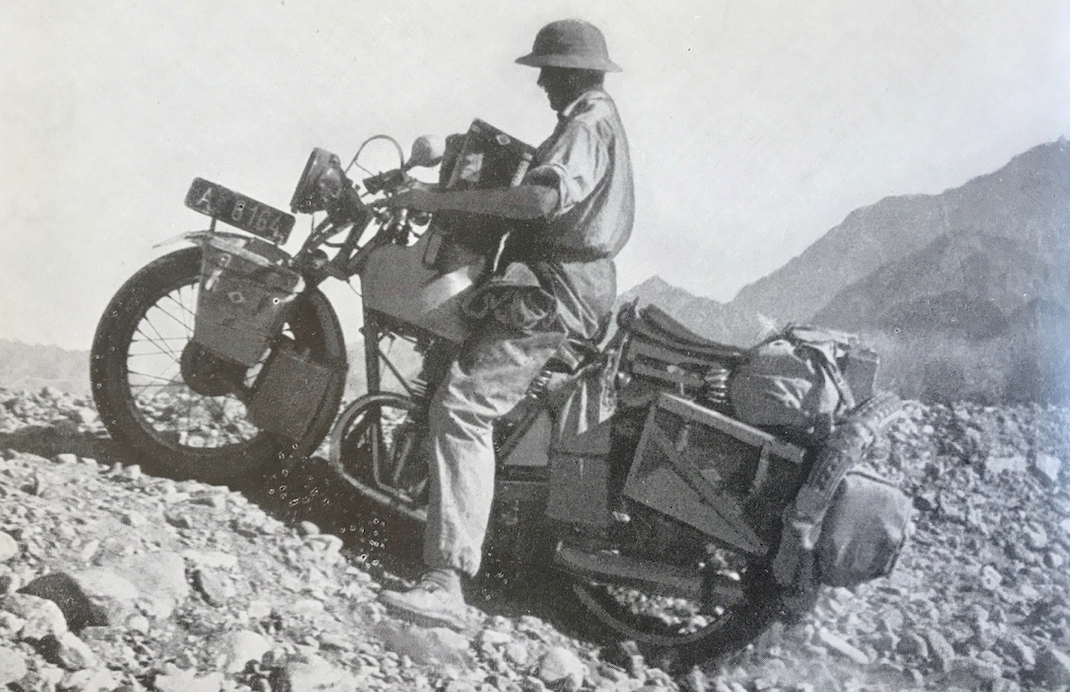
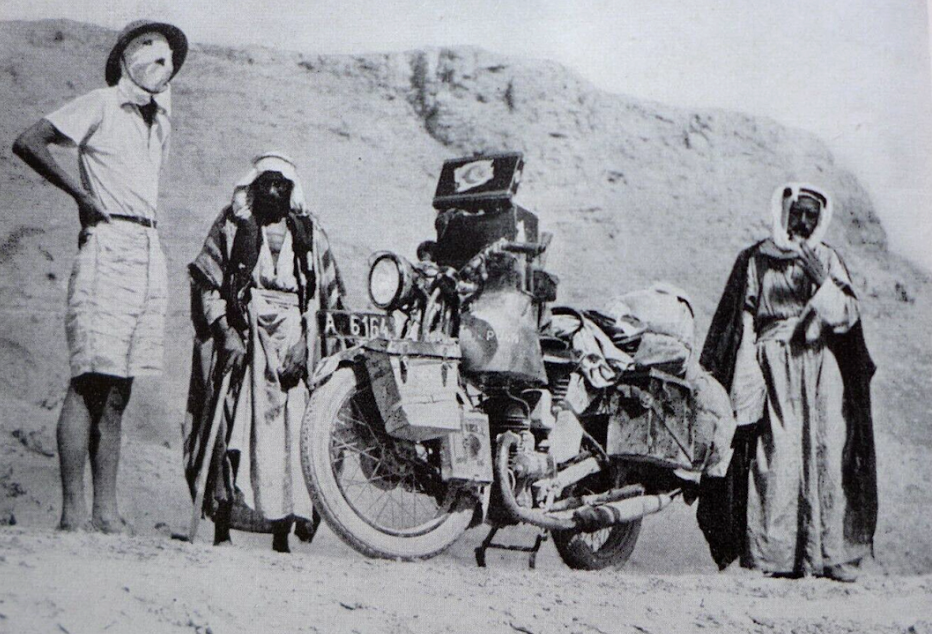
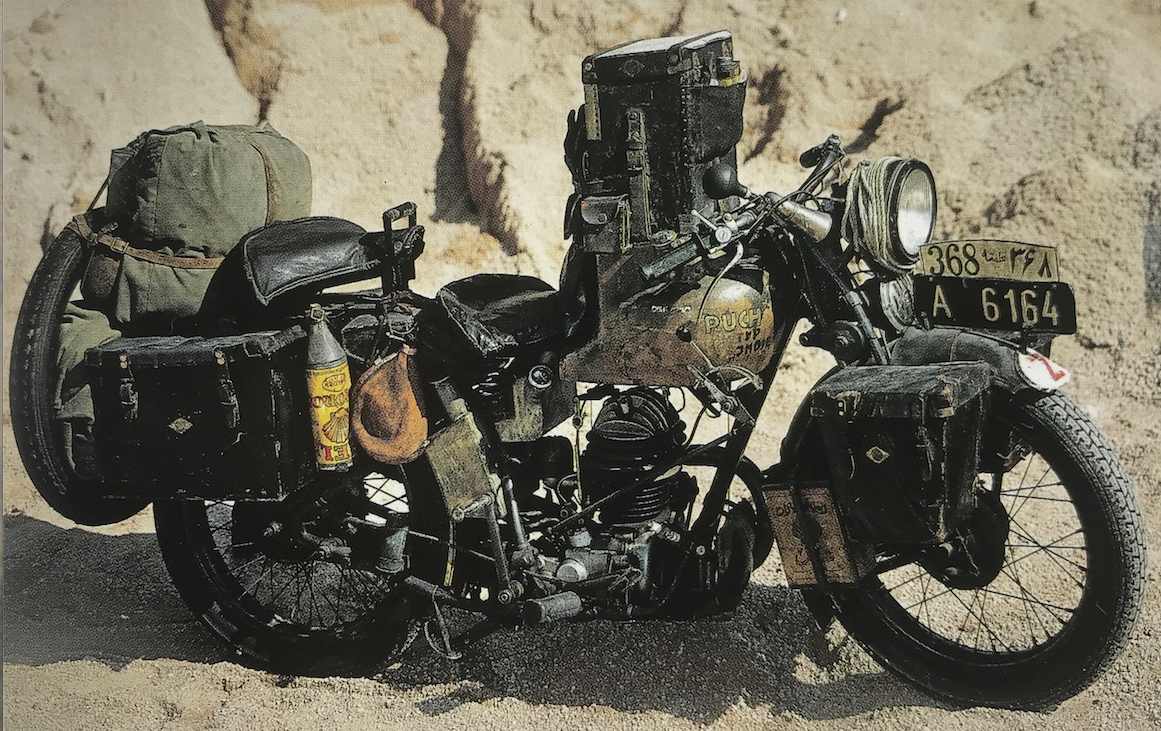
“NOW THAT WE ARE ALL discussing motor cycle tailoring, may I appeal to our fair readers to give the men a lead?” Ixion asked. “Motor cyclists need a strong lead in dress from somebody. I despair of the men, but the girl motor cyclists might shame us. Some years ago I was lunching at a beer garden in the Tyrol, and a girl blew in dressed in white leather coat and breeches, scarlet leather leggings, gauntlets and helmet, with her scarlet leather leggings, gauntlets and helmet, with her machine painted red and white. She was literally mobbed. In conversation she confessed to having made the entire rig-out herself, with the exception of the helmet, which she had merely covered at home. If a couple of hundred girl riders set us a similar example with various colour schemes—though not quite so musical-comedy—they would shame us men as the American golfers shamed our own men golfers 20 years ago.”
“HOW I WISH THAT THE old-fashioned speed hill-climb was nor so depressingly dead! I have just heard from a colleague who visited the recent climb at the one and only Shelsley Walsh—a speed climb for cars that has been steadily growing in popularity, since about 1905, I believe. Anyhow, this time, in spite of the most appalling weather, which reduced the whole thing to a mild mud-lark for the spectators, there were more people on the hilt than ever before, and the car parks were crammed full. Now, this success is due partly to steady advertising by the club members, but surely, also, it shows that the general public is keen on motor racing after all? And as for the competitors—! There were well over 100 of them, with super cars, fast touring cars, sleek supercharged racers, and home-made ‘GN’ devices, all hob-nobbing together. Two drivers had come all the way from Italy—one had towed his car from Milan!—and many of the best-known English drivers were there. Yet competitors get only two climbs, the hill is only a little over 1,000 yards long, and each climb is over in about 50 seconds.”
THE ANNUAL 100 MILES ROAD RACE of the Cookstown MCC was won by N McSorley (249cc Rudge), a resident of the district, who was making his first appearance in an event of this kind. He rode a good race, and finished with about three minutes to spare. At the same time, it seemed evident that the handicappers, in allowing him 18 minutes, had treated him too generously. Walter F Rusk, on the new 493cc Sunbeam, who was on the scratch mark, made best time of the day, despite a fall which displaced a footrest. Twenty-three competitors took part [eight finished] and the race was watched by a large crowd out to enjoy their half-holiday. Many dogs were also having their day out, and during the race amusement was caused on several occasions when the police had to remove the canine intruders from the course near the start.”
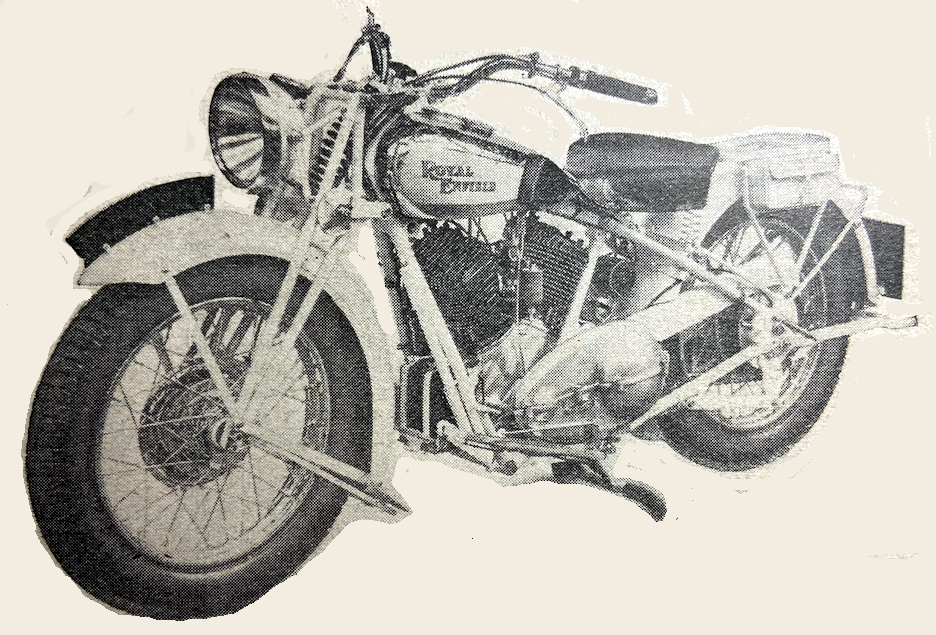
“SELDOM HAS THE LONDON-EDINBURGH Trial been blessed with such perfect weather as it was last week-end. It was the 26th version of the MCC’s annual ‘classic’, and, as in past years, the start was from Wrotham Park, near Barnet, by kind permission of the Earl of Strafford. Last-minute adjustments were made in ease and comfort (none but competitors and their friends were allowed in), particular attention being paid to the electrical equipment. Then everyone drifted over, as is rapidly becoming the custom, to see George Brough’s latest, which in this case turned out to be a 1,150 c.c. side-valve twin, with a banking sidecar—the outfit with which ‘Torrens’ had entertained himself a week or two previously. At 8pm the first man set off on his long trek up the Great North Road, through Stamford, Doncaster, and Wetherby to Harrogate. As far as Stamford the run was in the twilight, and over the welcome cup of coffee provided by the Stamford MCC the competitors complained bitterly of the unwelcome attentions of myriads of small flies. The run thereafter to Harrogate was without incident, and only at times could it be called at all cold. After breakfast (at 3.30am!) there came the business part of the trial—Park Rash and Co. But—and it was a big but—there was something very different from hills to contend with: an early-morning mist in the Yorkshire dales; clammy and soaking, it reduced visibility at times to nil, and, to make matters worse, the route marking was far from good, while many of the early numbers had the greatest difficulty in finding the stop and restart test on Middle Tongue. When they did arrive there the test proved to be almost too easy, although the long section along the top was a bit of a teaser in the matter of time. Close on 6am the first men arrived at the foot of Park Rash—easier this year than in the past, for the loose stones on the steep approach to the left hairpin seemed to have disappeared. Some excitement, however, came right at the beginning, when JT Dolby (499cc BSA) passed H Lapping (496cc OEC) just before the bend and then slowed, with the result that they both got a shade muddled and Lapping had to foot on the bend. Although worried by the early morning sun, H Trevor-Battye (596cc Scott), EB Kay (490cc Norton) and CN Rogers (346cc Royal Enfield) were excellent. Then came George Brough (1,150cc Brough Superior sc) and FW Stevenson (980cc Brough Superior sc), both fast and both certain, the former making full use of the banking sidecar. They were followed by AJ Hicks (346cc Levis) and TG Meeten on his Francis-Barnett ‘Cruiser’, the latter being unlucky enough to have his gear jump out at the critical moment, so that he wavered into the bank. SH Goddard, on a 150cc ohv Excelsior, romped up.with plenty to spare. DA Newberry (598cc Panther sc) went too strongly at the bottom and soon stopped with wheelspin, in contrast to HN Harrington (996cc Brough Superior sc) who, in spite of one or two naughty misses, was very fast. Both the big Harley-Davidson outfits, in the hands of CS Parrott and RW Praill, were quick, while HH Norbury (976cc Royal Enfield) was almost lurid. After Park Rash came Askrigg, which was in very easy condition, causing only RA Lanchester (497cc Ariel Four) to stop—and that through a variety of causes (which, soon afterwards, caused his retirement), ranging from clutch trouble to a retarded spark. The long run from Askrigg over the moors to West Stonesdale for the next stop and restart test was distinctly tricky. Stonesdale, in the now brilliant sun, was very easy and only GN Gamble (496cc Panther) had the misfortune to fail, through stalling his engine. Twelve more miles of rough going and the main road was reached at Brough, so that, in a very short time, the competitors were sitting down to lunch at Carlisle. After lunch a new route to Edinburgh was taken via Langholm, Selkirk and Eshbank; it was a route which helped considerably in keeping the drowsy riders up to the job until the end was reached in the Waverley Market, which, only a fortnight before had seen the start of the Scottish Six Days.”
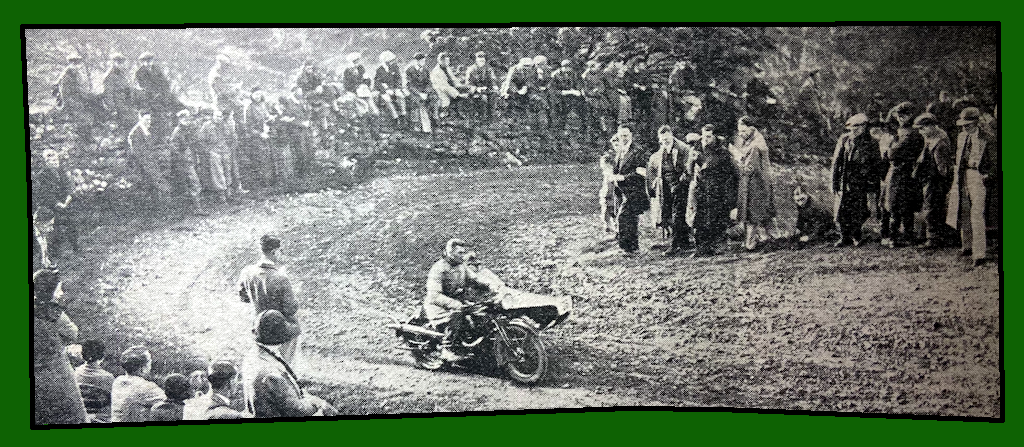
MAJOR HR WATLING, DIRECTOR OF the Manufacturer’s Union, wrote: “The motorcyclist himself is a type of individual possessing personal courage, cool skill and a sound mechanical knowledge.”
“ILLUMINATED GLASS SIGNPOSTS, indicating destinations in five directions, have proved so successful in Liverpool that they are to be extended to the junction of Menlove Avenue and Queen’s Drive.”
“AND IT CERTAINLY IS SHOOTING! ‘…England, where motor cycling is such a widespread sport, and they have more of less set a mark for the rest of the motor cycling world to shoot at…’ From an American contemporary.”
“THE MOTORCYCLES OF 1953—AN ARTICLE in Prophetic Vein, which Indicates the Possible Trend of Design Twenty Years Hence. By Prof AM Low ACGI, MIAE, FCS, DSc, PhD, FIPI, FRA, FRGS, FGS: The method I always adopt when I want to know what is likely to happen to any particular mechanical invention or art is to attempt to produce the curve of historical progress. I can visit Olympia and see an exhibit of old motorcycles, only to realise that with the exception of a few unimportant details such as increase of engine speed, the adoption of chain drive and heavier tyres, motorcycles have hardly changed at all during the past 20 years. Yet these museum specimens look entirely ‘different’, and therefore I can say with reasonable assurance that as alterations have occurred ever since the first day of the mechanical two-
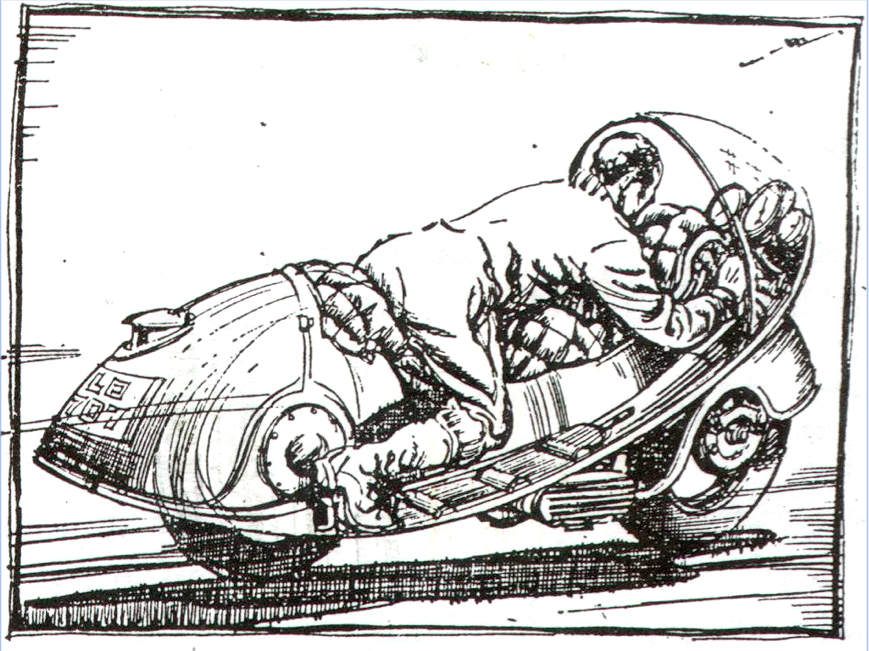
wheeler, some variations must occur in the future. Then I can make a list of the details of 1933 models, to discover that if I took the oldest machine on show, replaced the engine by a motor which can turn at 5,000rpm instead of 2,000rpm and made the frame, balance, saddle, handlebars, tyres and controls more comfortable to use, I could have automatically designed a perfectly modern motorcycle in the year 1910!From the point of view of power production, engines cannot be said to have progressed along really useful lines, for the internal combustion engine is by no means well suited to road work. It has no starting torque and a negligible degree of flexibility. I think it would be right to assume that an old 1914 Triumph had a motor that was generally more ‘comfortable’ than a modern TT winner, and it was certainly more capable of direct speed variation. Quite a number of up-to-date machines are of very little use until the revs exceed 2,000, and in consequence it is essential that they should be nursed by means of an efficient gearbox. Engineers are at a great disadvantage in this matter of flexibility. The modern driver likes to possess a machine which will leap forward at the touch of a finger, and which can be retarded by less than a flick of his toe. The multi-cylinder engine is one solution of the balance and torque problem, but the four- or six-cylinder motor exposes a large area of combustion chamber to the burning gases and consequently reduces thermal efficiency. It is not that petrol consumption is in itself a very important item, but weight and space occupied increase out of all proportion as the heat efficiency of an ordinary engine is reduced. For racing and sporting purposes the difficulty is easily avoided because speed is the almost only consideration, and the rider is perfectly willing to sacrifice silence, smoothness and every other detail which the ordinary tourist considers so essential. The high engine revs, which are so sought after in up-to-date motorcycles, naturally imply a compression ratio so high that an engine may need to be decarbonised every 1,000 miles. The position is really rather amusing, because the designer raises his compression so that the burning of the mixture may be efficient, finds it essential to increase his piston speed to turn the resultant heat into mechanical work without too much loss by radiation, and then works hard to find some means of reducing the explosion speed in order to obtain reasonable flexibility! Unfortunately the mixture of petrol particles and air, which is cheerfully assumed to be a gas when it is nothing of the kind, is only convenient on account of the ease with which petrol can be converted from chemical to heat energy. The carburettor is often one of the most farcical instruments possible to imagine, because it never carries out the work for which it was primarily intended. If carburettors produced a perfect gas the explosion would probably be far too quick to be followed by the piston; and if these instruments were heated to prevent condensation of the mixture as the result of the cold of partial vaporisation, the weight of the affected mixture would be so much reduced that volumetric efficiency would go by the board. The difficulties of the unfortunate designer do not end with those of carburation, for although he has increased the speed of his engine so that top gear driving becomes possible over mildly hilly roads, he has still only the same 14psi of atmospheric pressure to drive the gases into the
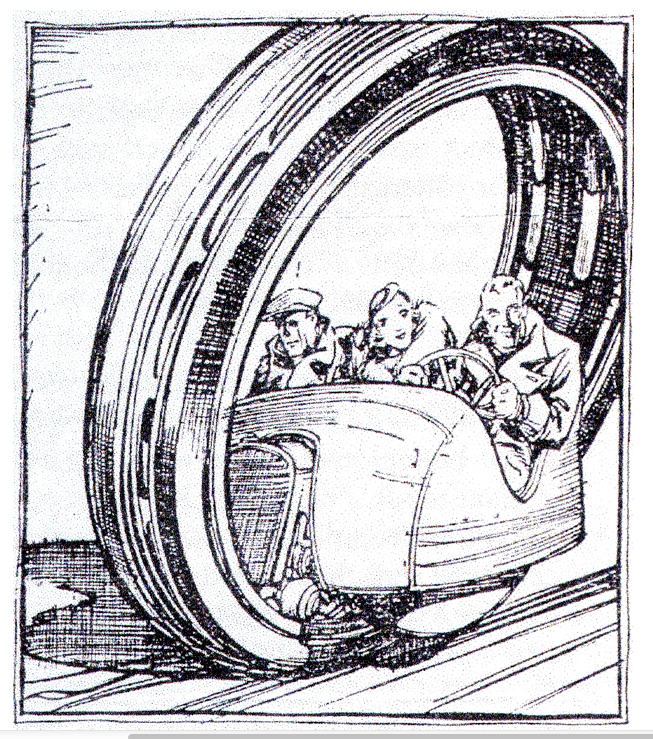
engine; exactly the same pressure, in fact, as apply to an engine turning at a mere 1,000rpm. The high-speed record breaking engine, which is greatly to be admired for not breaking down under so many unbalanced mechanical stresses, requires a peculiar system of timing in which the valves are quite commonly never closed together. In other words, the real timing relies upon gas inertia, and not upon the drawing board movement, which indicates that gas should ‘drift’ into the cylinder. Gas has a very high inertia value at speed, and under these conditions is extremely sensitive to shock, or changes of temperature. These rather obvious faults of internal combustion engines as applied to motorcycles are not likely to remain indefinitely unchanged. It is unsatisfactory to rev an engine to obtain efficiency and to be obliged to sacrifice power through gearbox friction. The more obvious line of progress is to burn the fuel at a rate variable at will, in the manner of a flash boiler or Diesel engine, in which the air alone is compressed to a far higher and more efficient point than is practicable in the ordinary system, and the fuel injected to burn slowly or quickly in accordance with the required speed of the motor. On motorcycles it seems improbable that such a step will take place for a good many years, because the higher stresses imply greater weight, which is not sufficiently counteracted by the absence of normal ignition apparatus on a motor of self-ignition type. Not many years from now noise will be ‘taboo’ in all forms of mechanical transport, and in any case there is no doubt that the abominable noise and clatter from chain and valve gears must be eliminated. Motors may be of the valve-assisted two-stroke type, and it would not surprise me to see an electrically or hydraulically operated system of timing, so that changes could be made while running. Is it not probable, therefore, that motorcycles in 20 years’ time will be divided into two rather distinct classes? There will be the semi-diesel multi-cylinder engine fitted in a pressed-steel frame, and made so readily detachable that whole units can be exchanged at any service depot; and the lighter type of machine, which will be wanted by the increasing number of those who dwell in flats or cities. I am taking it for granted that in 20 years our roads will be almost perfection from the modern standpoint, because no such thing as finality is ever possible. I am even assuming that men will use aeroplanes
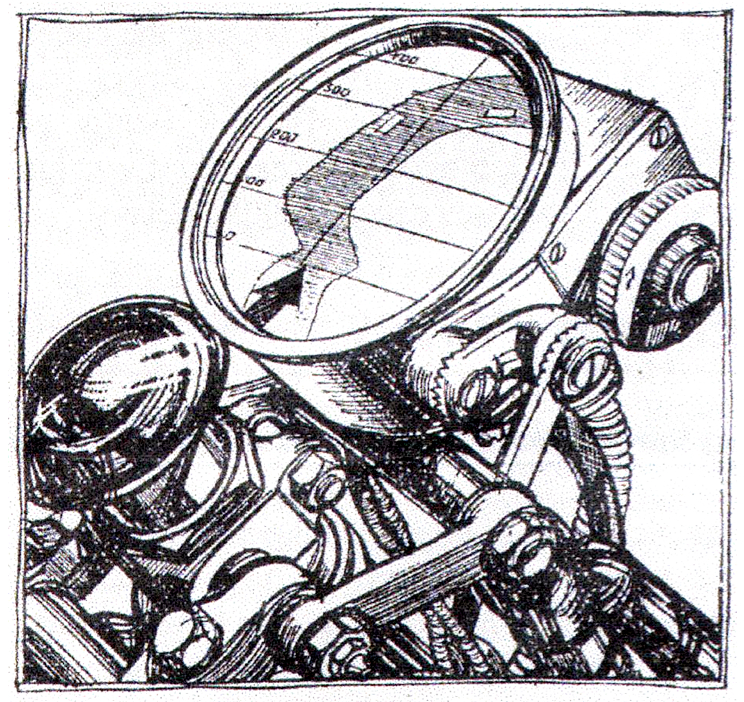
for weekend trips to Cape Town, that the kerbs of main roads will be floodlit and that a number of our main streets in cities will be provided with landing grounds. All this also suggests two classes of motorcycles. There will be long main by-pass roads over which an average speed of 80mph will seem quite reasonable, entirely on account of the comfort with which a rider will be able to accelerate or stop. The popular automatic gearbox of the 1933 car really owed its beginning to early motorcycle experiments, and I believe that some mechanism of this kind will be incorporated in my ‘1953 multi-cylinder comfort model.’ Gearboxes are not likely to become infinitely variable in type because internal combustion engines of any kind must be expensively made if they are to run at their most thermally efficient speed. All of us like to drive a high-capacity car, however much we may pretend that the joy of changing gear amuses us on a fine summer afternoon. The question of weather protection is extremely important, for I do not suppose we shall have learnt how to control the elements by 1953. Men and women are becoming a trifle ‘lounge lizardy’ in their bodies in order that their brains may have more time to think. I very much doubt if people of either sex will be willing to travel long distances with wind and mud touching their faces on a bad day. We must remember that in a few centuries civilisation will probably have cost us our hair, our teeth, our eyes, and our ears. All these commodities will require mechanical aid, and the motorcyclist will not be able to vary his bodily characteristics to suit his own sport. The long-journey motorcycle will be a protected vehicle and will have some kind of streamlining in order to prevent the waste of power which would be abhorrent to the futuristic engineer. So I think that we can safely assume there will be partial streamlined semi-enclosed motorcycles with enormous tyres and a microscopic, multi-cylinder high-compression engine with some form of springing for the driver. I realise, however, that I am upon very dangerous ground in the matter of suspension, and that for sporting machines a great deal can be done by frame, engine, and steering balance. But bumps are really very interesting things and the motorcycle can be treated in quite a different category to the motorcar for the excellent reason that the weight of the driver bears some comparison with the total weight of the whole machine. The greatest difficulty in springing a car is that the springs have to bear a certain amount of the driving and braking load while they are expected to respond equally well between 10-60mph, or with loads varying by as much as 40 stone. The two-wheeler has few of these difficulties and it seems that steps might be taken to cure the vibration trouble over both cobbles and high speed by a similar method to that adopted by some car manufacturers, who spring the passengers on a really good seat suspension. (Remember that at the moment we are considering the comfort machine which does not rely for its success upon its power-weight capacity ratio.) In the field of sheer speed I am assuming that the smaller class of sporting machine will be sub divided. There will be the high-speed single-cylinder type with supercharged engine and perhaps some method of preventing an excessive flame rate. Four-speed automatic
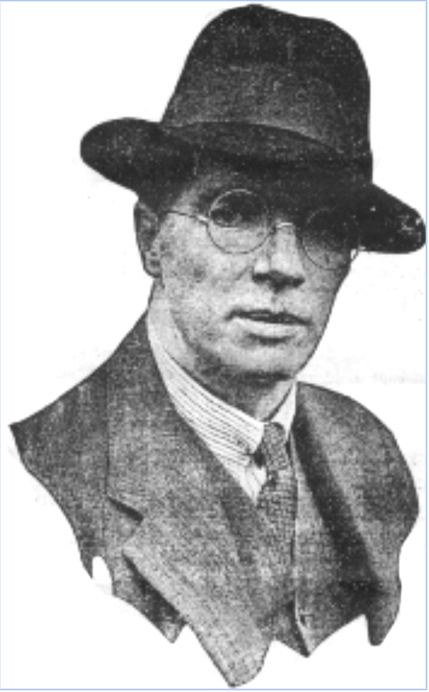
gearboxes will be used, and it will never be necessary to wave hands in the air while effecting a change. On these models our billiards-table road surface will prevent the need for special springing for they will be devoted entirely to the sportsman who, with a motor capacity of perhaps 100cc (a curve shows that cylinder capacity has fallen and speeds increased over the past 20 years), rubber sponge supported handlebars and a press button gear change, will devour distances at his pleasure. One can see the angry letters to the papers from those who demand that corners shall be banked, and equally irritated replies from old gentlemen who will say that 70mph is the speed of their own bath chair and that no sensible person would ever need to exceed that gentle pace. Correspondence on this subject will, in fact, read exactly the same as that which took place when pedal cycles were first introduced. The figures will be slightly multiplied and the terms of abuse rather more parliamentary and offensive. I must not forget the utility riders of the future, who will devote their evenings to the sponging down, with antiseptic liquid, of motorcycles weighing 50lb, carrying large tyres and elegantly sprung pan seats. I shall expect these machines to be made of alloys about which we know nothing at present, to use small engines of 20cc capacity and to be driven by hydrogenated fuel. Perhaps they will have internal combustion turbines giving absolute silence and comfort, so that the over sensitive nerves of riders may not be disturbed. There is, of course, the very great possibility of some method of comparatively effective electrical storage being invented. It is now possible to produce several hundred hp for very short periods by means of accumulators which can be lifted by a couple of men. The grid system makes recharging and interchangeability much more simple, so that a really good accumulator would give us a delightful form of low-range motorcycling. My only anxiety is that motorcyclists in those far-off days will have little about which to complain. Yet, on second thoughts, one can imagine Clubmen wirelessing their secretaries to explain that they were only a thousandth of a second late at the last photo-electric control. They will act and think much more quickly in those days…” You’ll find some notes on the prof in the gallimaufry.
ONE 250 SUMMED UP THE dire state of the market. South London dealer Pride & Clarke was selling Red Panthers, launched the previous year at £42 10s (£42.50), for just £28 10s (£28.50). At that price they soon sold out so Pride and Clarke asked for more. Panther obliged, cutting the price even further to £27 17s 6d (£27 87.5p) including lights and tools. The factory didn’t make a penny profit but the exclusive contract kept it in business. The name of the game was survival and it worked. Panther came through the recession (which bottomed out in 1933); Pride & Clarke was still selling Red Panthers in 1939, still priced at £27 17s 6d. It was still selling bikes more than 40 years later but I came to hate the spares department. On Saturday mornings I’d phone in search of a part for my A10 to be told it was in stock. I’d catch the 109 bus up the A23 from Norbury to Stockwell, trek to the huge blood-red shop and join the queue, to be told “No, we ain’t got it.” I’ve wanted to get that of my chest for half a century—Ed.
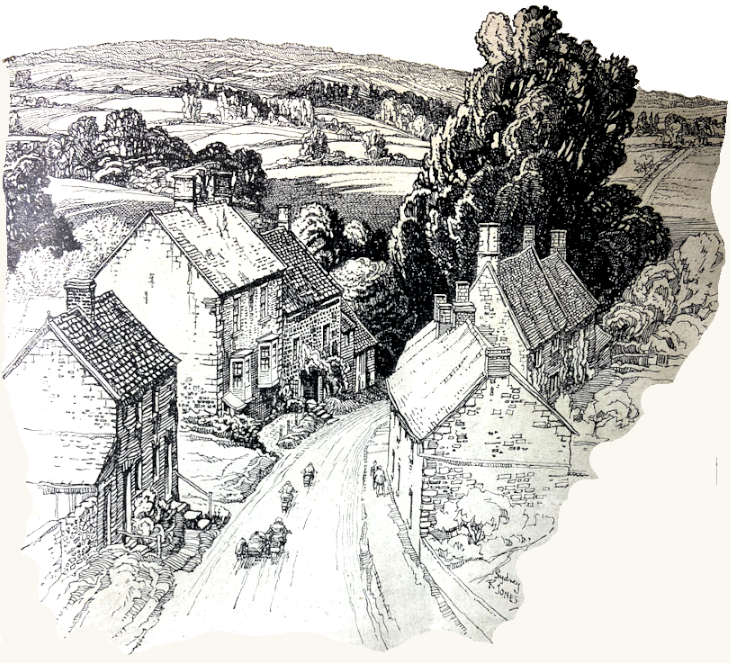
THE ACU SET UP THE SPEEDWAY Control Board. It also launched the National Rally, although the inaugural event wasn’t a great success.
RUDGE’S CREDITORS CALLED in the receivers. Road bike development continued but the race department was closed. However, the factory racers stayed in action courtesy of the Graham Walker Syndicate – a dream team comprising Walker, Ernie Nott and Tyrell-Smith. They all worked for Rudge, which gave them time off and some top spannermen.
FRANCIS BARNETT FOLLOWED the enclosure trend with the 249cc Villiers-powered Cruiser. Deeply valenced mudguards, legshields and engine covers placed the Cruiser in the ‘Everyman’ class of modestly powered, clean-to-use mounts. The same engine powered the enclosed Coventry Eagle Pullman (which was later available with a 250cc Blackburne four-stroke lump).
A 249CC WATER-COOLED VILLIERS engine powered two more enclosed models: the Excelsior D6 Viking, with the whole side of the machine enclosed; and the HRD-Vincent Model W. Yes, even Phil Vincent was looking for sales in the utility market.
TWO-STROKE SPECIALIST Len Vale-Onslow’s SOS (originally for Super Onslow Special, later using the slogan So Obviously Superior) also used the water-cooled Villiers lump. Fair enough; the engine was based on his design. SOS also pioneered the use of an electrically welded frame.
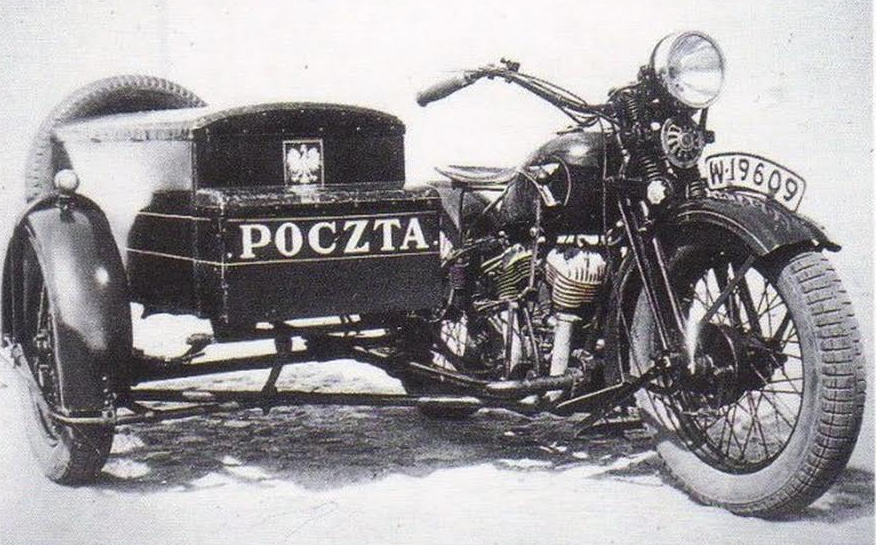
DURING THE SHOW MAURICE Schulte died. He and Siegfried Bettmann had set up Triumph; Schulte was its first managing director.
“A BIKE WHICH wears a very hand-beaten sheet-alloy overcoat is the only 250cc model ever to win a Brooklands Gold Star for beating 100mph during a British Motor Cycle Club race meeting,” writes Bob Currie. “A 246cc Excelsior-JAP, it performed that feat in the hands of Monty Saunders during the Three-lap Junior Handicap at the Hutchinson Hundred race meeting. Motor Cycling reported at the time: ‘In the first race of the afternoon (and there were five short races besides the Hutch) success at last attended the efforts of MB Saunders to establish his Excelsior-JAP as the world’s fastest 250. Formerly, this honour had belonged to a New Imperial, ridden by Archer last year. All through the year Saunders has been striving like a Trojan to earn the first Gold Star to be awarded to a 250; to do this of course, it was necessary to turn a lap at 100mph or over actually during a race. With exasperating persistence the weather conditions—a vital factor with these small engines—had been against him all season, so that it had been impossible to use to the best advantage the streamlined shell belonging to the little Ex. On Saturday everything was right. On went the streamlining. Up went wick. Bang went the record!’ (The enthusiastic writing style is such that, although not named, it could only have been Dennis (‘Castor’) May who turned in the report.) ‘From a standing start Saunders, turned the track at 88.15mph. Next lap 102.27mph, third lap 102.48mph. Hi) previous best during a race had been 99.21mph. It seemed a considerable shame that such extraordinary speeds should only have sufficed to earn third place. Nevertheless, excuse can perhaps be found for the handicapper in this case, for winner CK Mortimer (146 New Imperial) has a most disconcerting way of piling on a matter of an extra three of four mph at each meeting! And it is only natural to suppose that it must stop somewhere. Mortimer’s fine winning speed of 68.31mph was aided by some very competent-looking streamlining of the bottom end, looking like a huge egg.'”

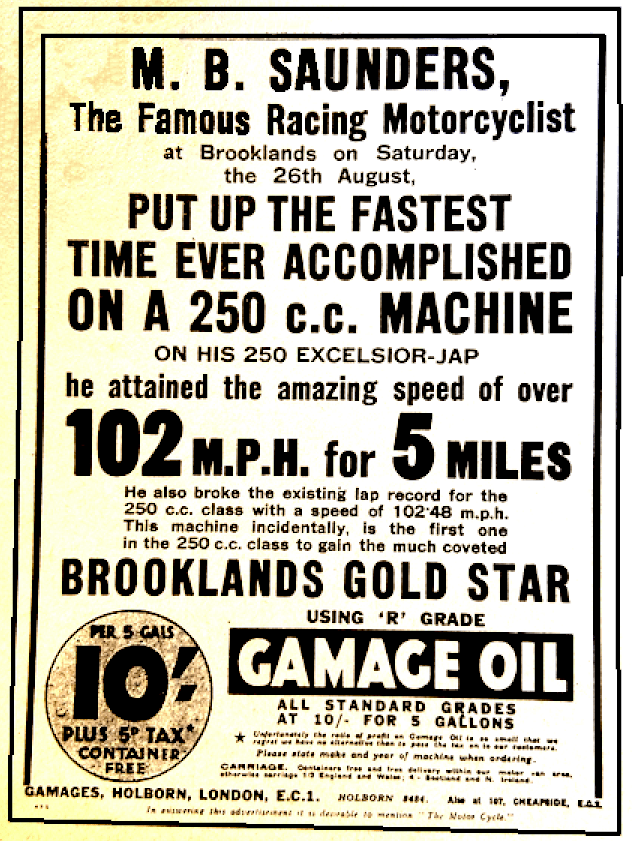
FLASHING INDICATORS appeared in the USA.Then they disappeared. Then they appeared again…
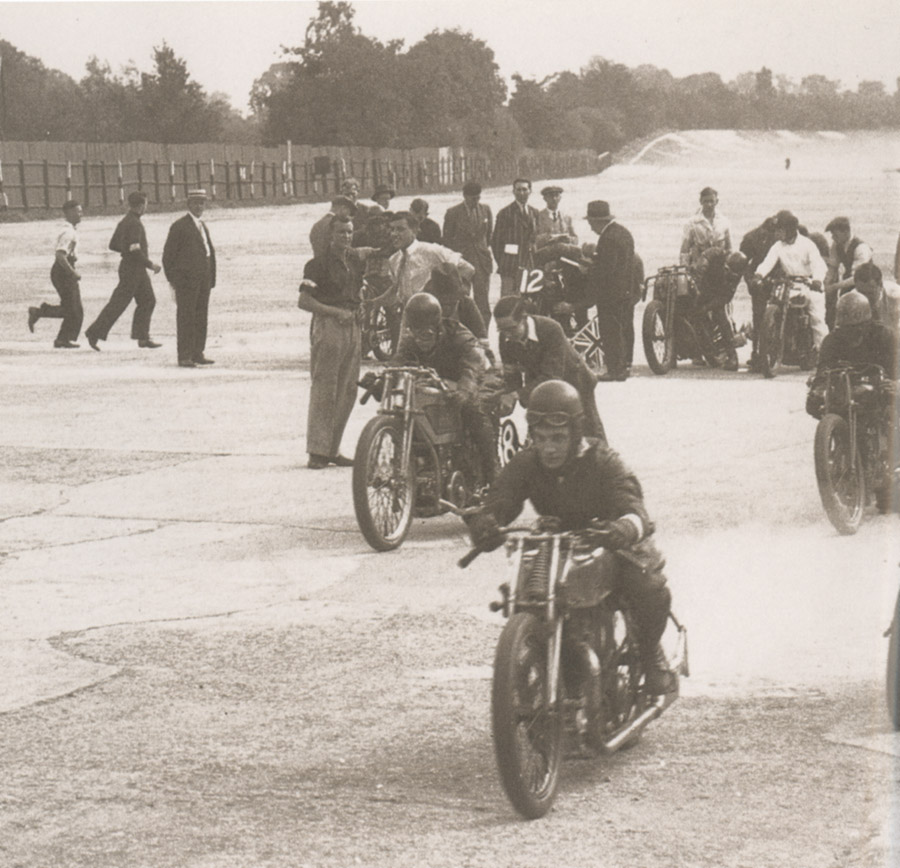
“THE 1933 TRIAL—THE FIFTEENTH International Six Days’—is being held in Wales. This decision to exercise our right to hold the Trial in this country was taken only after careful consideration of the pros and cons. It was realised that there are difficulties peculiar to Britain as compared with the Continent – the difficulty of finding a course that is both fair and yet severe enough, the difficulty of suitable accommodation nearby, the crowded condition of our roads in the holiday seasons, the antipathetic attitude of various authorities, the fact that a success abroad must be a better testimony to the excellence of British machines, and so on. On the other hand, it will be five years since the last Six Days’ was held in England, a suitable course has been found, and it was felt that it was not only our right but our duty to run the Trial again, in that country which was its birthplace twenty years ago. The heartiest welcome, is offered to all those riders and officials from abroad who have honoured the Auto Cycle Union with their attendance at Llandrindod Wells for the XV International Six Days. Though the Welsh mountains cannot hope to outrival the Dolomites as a testing ground, their conquest will reveal unexpected charms.
Duw sy’n llenwir cwd!
TWL.”
‘TWL’ was ACU secretary Tom Loughborough, who was also secretary-general of the FICM.
“CONNING THE DETAILS OF the ACU’s route for the International Six Days, I feel that one and all must congratulate the Union on the way in which it has tackled a difficult job. To ask anyone to provide a true ‘International’ course in Britain—that is, a gruelling mountainous route without freak stuff—is to ask the impossible. Most of the route chosen by the ACU consists of roads which at one time or another I have explored, and, believe me, they seem to have made the very best of a bad job. It is not generally known that observed hills are taboo in all International Six Days Trials; everything has to be done by means of time checks and the final speed test. The course and speed schedule, therefore, have to be such that hard driving is the rule, though it must not consist of freak, machine-smashing surfaces. The speeds will vary between 17mph and 30mph, according to the machine category and the nature of the section; 30mph is scheduled for the main-road run to Donington, where the final speed tests will be held.”
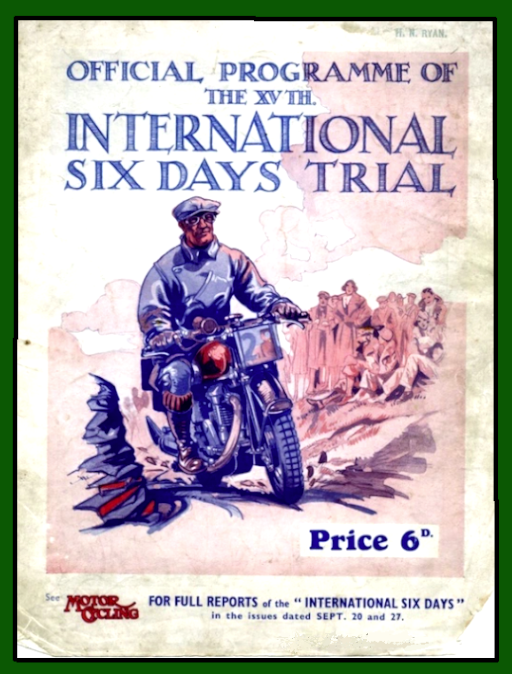
FOR THE FIRST TIME THE ISDT was staged in Wales. The Derby Evening Telegraph explained: “Motor-cyclists from all parts of Europe—from France, Germany, Italy, Czecho-Slovakia, Denmark, Sweden, Holland and Switzerland—will, with more than 80 British riders, take part in a reliability trial lasting six days, over gruelling roads in Wales. Two women are among the British entrants for the trial—the International six-day trial—which is to be held from September 18 to 23. They are Miss Marjorie Cottle, perhaps the most famous woman trials rider in this country, and Miss E Foley. For several years Miss Cottle has been riding motor cycles in reliability trials—trials of physical as well as of mechanical endurance. Each day the riders will set off in the early morning from Llandrindod Wells on a 200-mile journey over Welsh roads, returning to the ‘base’ in the evening. Over hills and valleys. through twisting, turning lanes, and, in some places, along grass-grown roads, the riders will test their machines. The trial has no racing element. In fact, the speeds required may, at first glance, seem slow, but the 22 miles an hour average which the small machines, side-car vehicles and three-wheelers, and the 25mph average which the other machines will have to maintain, will test thoroughly the staying power of both riders and engines. At intervals of two minutes from seven o’clock in the morning the goggled and leather-coated riders will start in threes on their great trek. They will follow the ‘great red way’, for the route will be sprinkled here and there with red powder—through villages, over mountain roads and loose-surfaced lanes. Then, on
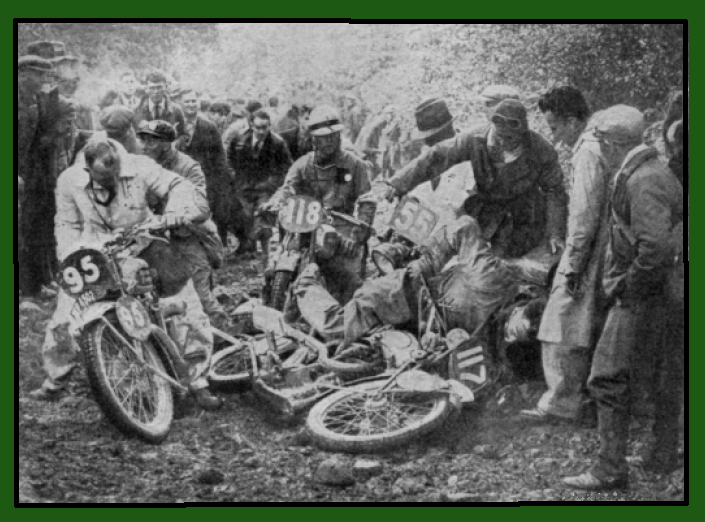
the last day of the trial, they will have a final burst of speed. They will travel across country at ordinary touring speed to the road-racing circuit at Donington Park, where they will open their throttles wide in speed tests.” Motor Cycling reported: “Against the pick of the world’s trials riders, a team of Germans, which included the redoubtable Ernest Henne, holder of the motorcycle speed record, has won the coveted International Trophy. Which is to say, obviously, that Great Britain has lost the Trophy. For that we are sorry; and we join with all other motorcyclists in this country in commiserating with the members of our trophy team, who put up a most gallant fight in an unsuccessful attempt to retain the much sought-after honour in the sphere of trials-riding. The greatest consolation of defeat, however, is that the famous Trophy was won by a team which deserved to win it. All three of its members, mounted on beautifully made (and very expensive) BMWs, the victorious German team furnished, every day of last week, a wonderful display of clever riding. Nothing seemed to bother them; they were as ‘at home’ in the valleys and mountains of Wales as in their own favourite trials ground—the forested slopes of the Harz Mountains, in Saxony. Not that the British trophy team did not do almost equally well; Bradley, Perrigo and Rowley behaved throughout the week like the staunch trials’ geniuses they undoubtedly are. Their machines, too—the Sunbeam, the BSA, and the AJS— stood up to the gruelling they received in a manner that wins our most cordial approbation. To lose the Trophy by a single point is galling; yet it is not so galling as it would have been had the honour been filched by a team that only secured it by an amazing stroke of good luck. It is pleasant to reflect that, although we lost the fight, it was cleanly waged on all sides. We have the pleasure, moreover, in acclaiming our own ‘A’ team—Jack Williams (348cc Norton), GF Povey (499cc BSA) and VN Brittain (490cc Norton) as the victors in the hard fought tussle for the International Silver Vase. The contest for this award was tremendousIy keen; no fewer than 11 teams had high hopes of securing it. One of the Irish teams—H McKee (498cc Levis), S Moran (495cc Matchless) and CW Duffin (498cc Matchless) was second in the Vase contest, and the other English team—R McGregor (499cc Rudge), L Heath (499cc Ariel) and FE Thacker (346cc Royal Enfield)—beat the German DKW team for a well deserved third place. So with a very close second place to our credit in the Trophy contest, as well first, second and third places in the Silver Vase competition, Great Britain and Ireland can well congratulate themselves. It was truly a magnificent achievement. It is tribute, too, to the wonderful reliability of modern motorcycles when it is recorded that no fewer than 87 of the original 140 starters finished. How great a tribute that is, can only be appreciated
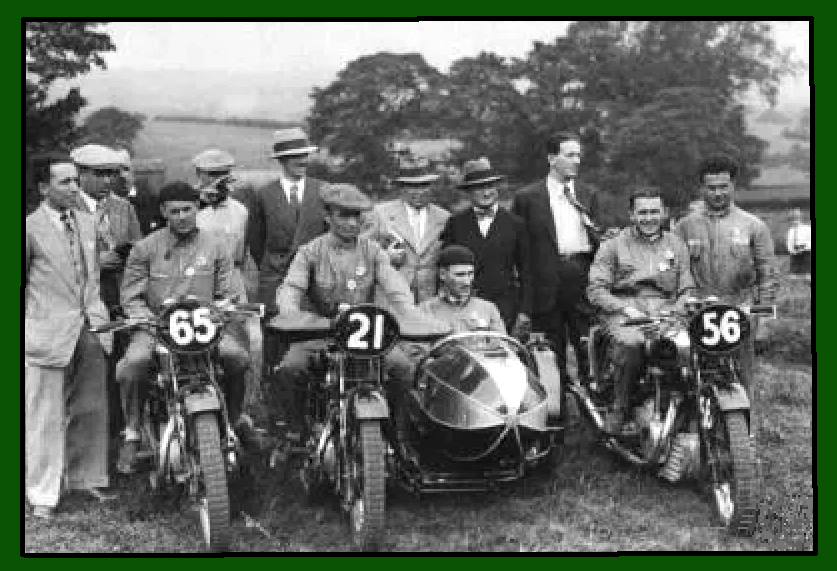
to the full by those of us who actually witnessed the event. The trial was calculated to search out the weakness in both man and machine; yet all its terrors could find no sign of weakness in the 56 men and machines who finished with clean sheet. Bravo! The 1933 International Six Days’ Trial was, in every sense, a magnificent event, and every credit is due to the Auto-Cycle Union for the wonderful organization. The manufacturers of the motorcycle that were set to face such trying conditions deserve our most earnest congratulations too, and as for the competitors themselves well. perhaps this instance will serve to illustrate the spirit of the riders: It was on Dinas Rock on Wednesday. The hill was far, far more difficult than was anticipated. ‘Outside assistance’ in any form was attended by penalization. A rider fell (not the only one) and his leg was being painfully lacerated by the driving chain of his machine, which lay on top of him. A spectator offered to lift it off him…The competitor’s first thought, as he lay there, was to ward off the unwanted help of the spectator; his next was to reach for the compression-release lever, in order to stop the engine and the searing, whirring chain. This done, he heaved the machine from off him, wrested it into an upright position, restarted and went on up the hill…The spectators round about started clapping. But they did not clap on account of any spectacular display of trial riding; the man’s performance, in fact, was not outstanding. Neither, for that matter, was his pluck—140 plucky men were competing. But it was for his pluck they clapped him; for the indomitable spirit that was typical of last week’s International Six Days’ Trial.” Here are some excerpts from the comprehensive coverage by Western Daily Press—yes, in those days the general public took an interest in motor cycling: “Some of the worst of the third-class Welsh roads through the black mountains and a descent of Dinas Rock, one of the steepest and trickiest hills selected for the trial, were included in the 198-mile course which riders had to cover yesterday in the second day’s. run
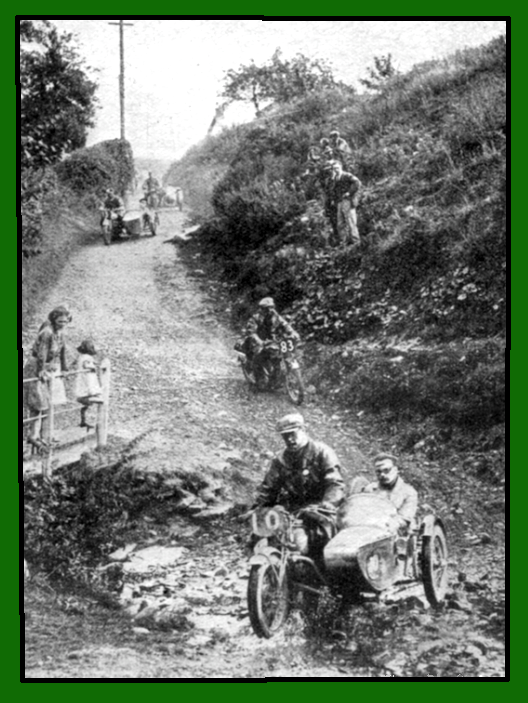
of the international six.days’ motor-cycle reliability trial at Llandrindod Wells. There were 127 starters, 13 having retired on Monday. Only one crash was reported, that of G Aldrighetti, riding a Bianchi, member of the Italian International Trophy Team, who was uninjured. Although her petrol tank sprang a leak early on, Miss Chris Herbett continued with fuel pouring out in a continual stream on her engine. Every 20 miles she had to refuel, and she was faced with the possibility that the machine might at any moment burst into flames. Although her clothing became saturated with petrol as she jolted over the rough roads she finished the day’s run. Wood, who crashed on a mountain road and fainted after completing the course, was yesterday advised by his doctors that he was not to ride. Several riders found that the covers of their tyres were punctured by large nails or tin tacks. One rider pulled nine nails out of a tyre, one of which was two inches long. It is thought that most probably they were placed at some point on the course by mischievous children. In the International Trophy, Great Britain and Germany have lost no points. Italy has only one rider left, two having retired. They have lost 1,100 marks, as has Czecho-Slovakia, who has only one rider left. In the International Silver Vase, Great Britain (A), Ireland (A), Italy (B), Czecho-Slovakia and Germany (A) have lost no marks…The torrential rain on Tuesday night made the Welsh roads difficult and dangerous for the 114 competitors left in the international six-days’ motor-cycle trial, who set out yesterday from Llandrindod Wells. Arthur Clarence Mapstone (London), driving a sidecar outfit, crashed into a boulder on the mountain rood on the outskirts of Hay. His head was badly cut by his broken goggles. His brother, William Gordon Mapstone, of Newbridge, Monmouthshire, in the side-car, fractured his jaw and was attended by Dr Wilson. of Hay. He was taken to Llandrindod Hospital. Both were thrown clear of the machine on to the road. Miss Edith Foley, riding a New Imperial, was not allowed to start by the stewards this morning, owing to a broken spindle, and so she was the first of the three women competitors to retire. Miss Chris Herbert, riding a Cotton, had to retire owing to tyre trouble. This leaves only one woman in the trial—Miss Marjorie Cottle (BSA). Rowley (APS) one of the British International Trophy team, had tyre trouble, and when he checked in he lost two points. Ernest Henne (BMW), who holds the motor-cycling world speed record of 151.46mph, also had trouble. He is a member of the German
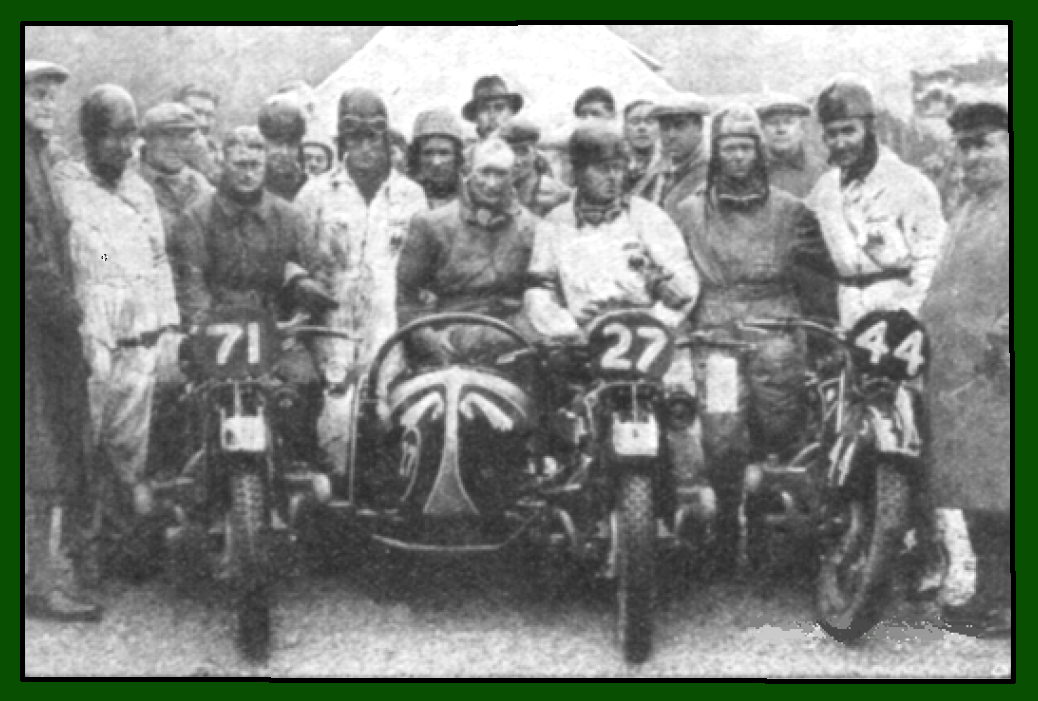
Trophy team. He lost one point. The other members of the British and German teams had lost no points, but Rowley’s mishap cost Great Britain the lead in the International Trophy, the most important award of the trial. In the International Vase three teams have still lost no marks, Great Britain (A), Ireland (A), and Germany (A). There were two non-starters yesterday morning and 14 retired during the day for various reasons. Out of the 140 who started on Monday 98 are left. Of these 70 have lost no marks during three days’ gruelling tests…Yesterday was the fifth day of the international six days motor-cycle reliability trial at Llandrindod Wells, and the route for the run, the last one in Wales, was the reverse of Thursday’s. There were 92 starters. A dog nearly brought disaster to Stelzer, one of the German trophy team riders. A large sheep dog leapt over a cottage garden wall, right into his path. Stelzer had no opportunity of avoiding the animal and’ smashed into it. The rider, motor-cycle and dog fell into a heap and rolled into the ditch. Stelzer however, was unhurt, and was able to continue. R Uvira, a member of the, Czecho-Slovakian silver vase team, had a narrow escape when be crashed into a stone bridge on a corner. He was unhurt, but had to retire. The position of the International Trophy teams were unchanged last night, the Germans having lost one point, and England two points. In the International Silver Vase, the following teams have lost no marks: Great Britain (A), Ireland (A) and Germany (A). There were four retirements during the day…After a thrilling fight with the British team, Germany won the much-coveted trophy of the international six days’ motor-cycle reliability trial which concluded at Donnington Park, Derby, on Saturday, by one point. There were originally 140 competitors, and they started from Llandrindod Wells on Monday
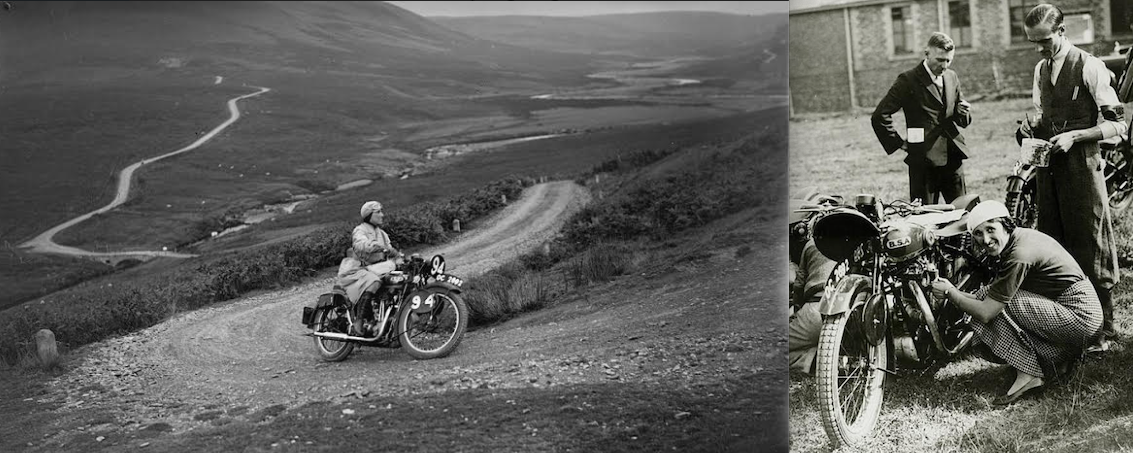
morning, and each succeeding morning, to ride over the most difficult and dangerous roads in the British Tales. Those roads took their toll and retirements were many. The competitors had ridden over 1,000 miles up to Saturday, when only 88 started on the last stage of the trial—to Donnington Park, 130 miles. Great Britain (A) had the consolation of winning the International Silver Vase, the second most important award. Ireland was second and Great Britain (B) team third. Fifty-six riders were awarded gold medals having lost no marks and 18 received silver medals, among them being Miss Marjorie Cottle, the only one of the three women competitors to finish. Nine bronze medals were awarded.” And here’s a snippet from The Herald: “The various nationalities wear distinguishing coloured armlets—German, white; Dutch, orange; Irish, white with green shamrock; Italian, red; Swiss, red and white; Czechoslovakian, red and white with blue triangle; Hungarian, yellow; English, green. On Tuesday the competitors made the descent of Dinas Rock, the steepest hill on the trial. Miss Marjorie Cottle had to dismount when the tool-box of her cycle broke away and threatened to jam in her driving chain. One of the best efforts was made by Miss Herbert, who, although her front tyre was punctured, went up Dinas Rock Hill without a stop. Miss E Foley was not allowed to start, as owing to a spill on the previous day her machine was not considered safe. In the International Trophy contest 14 of the competitors had to give up. Although 98 reached the finish of the day’s run at Llandrindod Wells, only 70 had unblemished records.” Results. International Trophy: 1, Germany (1) penalty points; 2, Great Britain (2); 3, Czechoslovakia (1100); 4, Italy (1400). International Silver Vase: 1, Great Britain A (0) penalty points; 2, Ireland A (0); 3, Great Britain B (1); 4, Germany A (6); 5, Italy B (14); 6, Holland B (59); 7, Germany B (85); 8, Czechoslovakia (260); 9, Ireland B (500); 10, Holland A (600); 11, Italy A (1400).The FICM (now the FIM) analysed the results bike by bike. Five solos up to 175cc started the trial, winning two gold and two bronze awards; one did not finish (DNF). Solos, 250cc: 24 starters, six gold, two silver, 15 DNF. Solos, 350cc: 29 starters, 15 gold, four silver, one bronze, 8 DNF. Solos, 500cc: 49 starters, 21 gold, nine silver, three bronze, 14 DNF. Solos, 750cc, eight starters, one gold, two silver, one bronze, three DNF. Solos, 1,000cc: three starters, one gold, two bronze. Sidecars, 600cc: 10 starters, six gold, four DNF. Sidecars, 1,000cc: seven starters, two gold, one silver, four DNF. Three-wheelers, 1,100cc: five starters, two gold, three DNF. Total starters: 140, 56 gold, 18 silver, nine bronze, Seven finished with no award, 52 DNF.
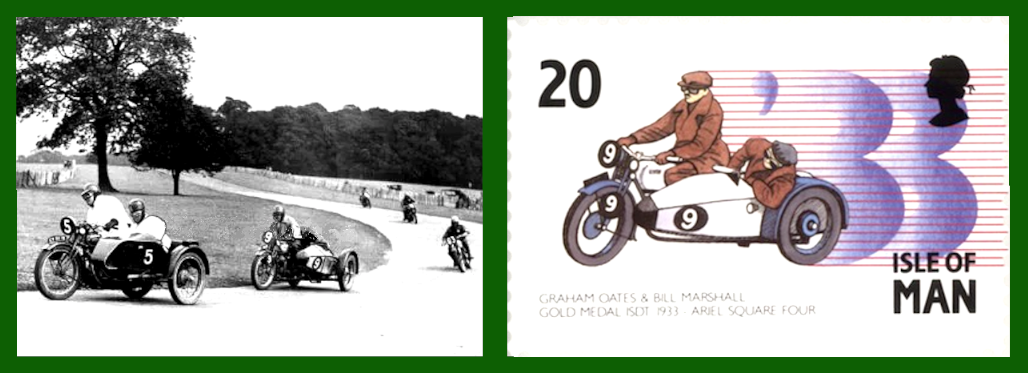
HARRY PERREY MIGHT WELL have been the inspiration for Triumph’s Maudes Trophy. He’d worked with Val Page at Ariel and in 1933 followed him to Triumph. Perrey’s showmanship and riding ability sparked a thought that a Maudes challenge was possible. Page came up with a 645cc ohv vertical twin called the 6/1. Using almost the same rolling chassis as the Triumph singles, it featured a bolt-on semi-unit gearbox and a rear brake that could be locked on as the new model was designed primarily for sidecar use. Primary drive was by a pair of gearwheels (the engine ran ‘backwards’), though surprisingly it lacked a foot gearchange. The 6/1 debuted at the Scarborough Rally with a ‘Gloria’ sidecar designed specially for it by Perrey, who then entered it for the ISDT. Few pundits thought this heavyweight roadster combo (which was designed as an alternative to the big V-twins) had a chance of finishing an ISDT. Not only did Perrey finish, he won a silver with only five penalty points—but for a delay caused by a puncture he’d have won a gold. Following the trial the outfit was returned to the factory for checking; nothing needed doing. It was then ridden to Brooklands for the 500/500 test. Thick fog slowed things down for the first three hours, then Perrey and two of his workmates were able to pick up the pace. They completed 500 miles in 8hr 17min, achieving the 60mph average target with just three minutes to spare. The 6/1 had won its spurs but maybe Triumph made a mistake in aiming it squarely at the sidecar market because sidecar sales were beginning to flag. Only a few hundred vertical twins were sold before the model was dropped, leaving the stage clear for Edward Turner’s Speed Twin…but that’s a story for 1937. [The semi-unit construction and other excellent features of the 6/1 were not forgotten by Page. His post-war BSA A7, which fathered my beloved 1953 Golden Flash, shares genetic material with the 1933 Maudes Trophy winner—Ed.]
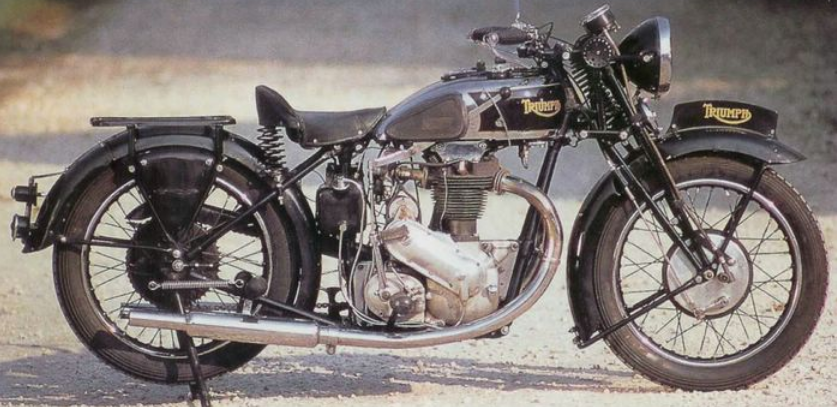
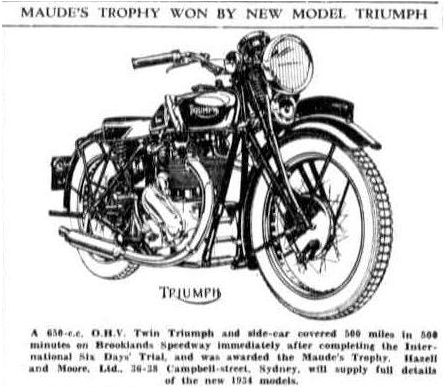
“DIRECTION INDICATORS COMPULSORY. In France, after the end of this month, direction indicators will be compulsory on vehicles with a greater width than 6ft 6in.”
“RECOIL FROM PROHIBITION? Agricultural interests in the USA are endeavouring to induce Congress to make compulsory the mixing of a certain proportion of alcohol with all petrol sold in the States.”
“MOTOR CYCLISTS AS FIRE-FIGHTERS. Volunteer motor cyclists are to precede the Fire Brigade at Wisbech (Combs) in the event of country fires to discover the nearest available water supply for the engine.”
“PEDRO PASSES OUT. During the first nights of dirt-track racing at Mexico City, many of the riders were so ‘blown’ after each race, due to the rarified air at the high altitude at which the city is situated, that they had to lie down to recover!”
“EVER SINCE THE DAYS when Graham Goodman conceived and put into effect the idea of a trial for experts only the British Experts’ Trial has been one of the most interesting and enjoyable events in the sporting calendar; in fact, it can be described as positively the most interesting trial of the year, for everybody who is somebody competes on equal terms over a really 100% course in the Stroud area—ground befitting the experts. Actually the trial is two events in one, for no attempt is made to classify the solos with the sidecars. There are two separate awards—the sole awards except that there are certificates for all who complete the course. Last Saturday, by using all his 17 years’ of hard-won experience, GF Povey (499cc BSA)—a rider who has been ‘knocking at the door’ for some time—won the Skefco Cup for the best performance, with VN Brittain (348cc Norton) only one mark behind him. Last year’s winner of the Palmer Cup for the best sidecar performance—HJ Flook (490cc Norton sc)—once again proved himself master of the third wheel. The 44-mile course, which included 14 observed hills, started from the Bear Hotel, Rodborough Common; near Stroud. The experts were required to cover two circuits of this route; it was very similar to that used last year, and it must surely he the most difficult and varied in England. At 10am the first men were sent off towards the bottom of Ham Mill, a rutted but interesting climb. ‘More Folly’, the next on the route card, could be described as a turning-round test in a rutted lane,
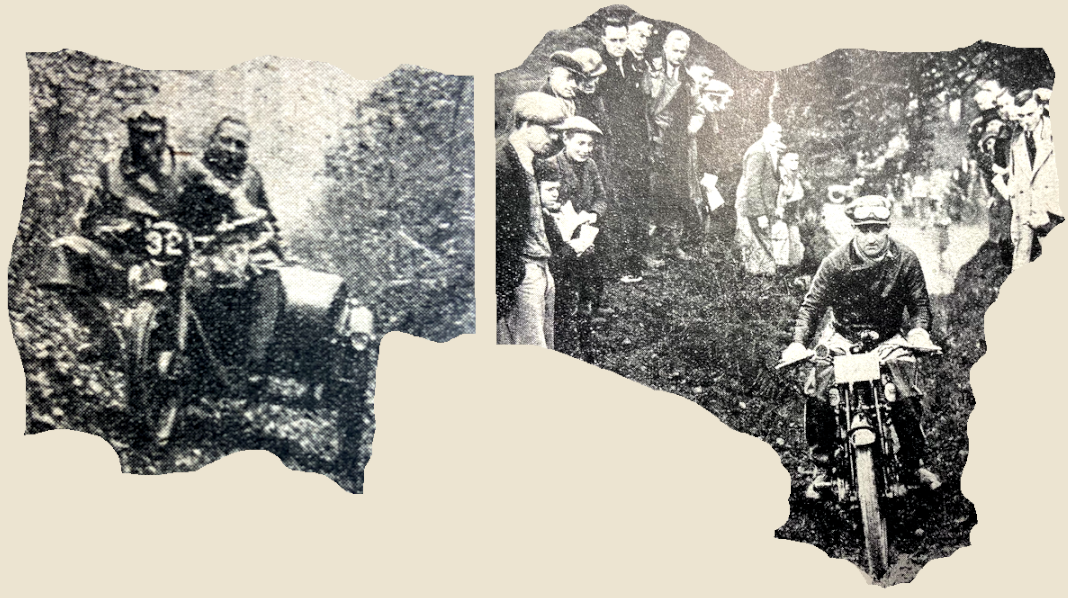
for the riders were sent down one side and had to turn round across some ruts and ride up the other side—a test which called for a lot of slow-riding skill. Here EJ Heath (497cc Ariel) had a very exciting time, shooting up the wrong bank. Nevertheless, he was feet-up. Stanley Woods, (490cc Norton)—it was strange to see this famous road-racing man in a reliability trial (though he does plenty of it in Ireland)—and R Cotterell (497cc Ariel) were both very good, but Jack Amott (348cc Triumph) had to dab once. GW Fisher (348cc Baughan) nearly emulated EJ Heath, but got out of his difficulty a little more easily. Jack White, on an oldish side-valve Sunbeam, was excellent and, after the worst was over, gave vent to an artful chuckle that greatly amused the spectators. Station Lane being in very easy condition, Ashmeads provided the next piece of excitement. This long, greasy climb had an awkward rut at the top which caused any amount of bother for the solo men. GF Povey (499cc BSA)took the hill as it should he taken—flat out, and stylishly at that. CH King (493cc Douglas) nearly rammed L Crisp (493cc Triumph), while J Douglas (498cc Douglas) sidled up at speed with his rear wheel in the rut. Both Jack Williams (348cc Norton) and GE Rowley, riding a 495cc ohc AJS with hairpin valve springs, were absolutely star, while Len Heath (497cc Ariel) was just as brilliant. FE Thacker (348cc Royal Enfield) struck a note that is unusual in these days by sitting firmly in the saddle all the way up. While Hazelwood Hill was moderately easy for the solos, the sidecar men. had the greatest difficulty in keeping on the move. The first section was narrow, with a deep gully on the left, while in the second section the gully was on the right, being at its deepest on a right-hand bend. In the second section HS Perrey (645cc Triumph sc) lost his rear wheel in the gully and headed straight into the bank. WS Waycott (348cc Velocette sc) also fell by the wayside, but RU Holoway (348cc Dunelt sc) was brilliant and got round the bend and clear of the section before be ended up on his side. NP0 Bradley (599cc Sunbeam sc) was the only sidecar man to get through the first section clean, but was unlucky enough to break a chain in the second. HJ Flook (490cc Norton sc) amazed everyone by getting round non-stop, with just two frantic kicks to avoid turning over. He was followed by. AE Morris (499cc Baughan sc), who was nearly as good, but stopped momentarily. DK Mansell (490cc Norton sc) also managed to reach the top like Flook—with a couple of hefty lunges at the bank. ‘BB2’, notorious for its high step and slippery rock outcrop, was a little easier than usual. Stanley Woods and Jack Williams, on their Nortons, Len Heath (Ariel) and Rowley (AJS) all rode to perfection, as did Perrigo (499cc BSA). RS Bond (248cc Triumph) carefully rode round the step until the model elected to throw him. Quite one of the best was L Crisp (493cc Triumph), who was obviously having an ‘on’ day and at the top of his form. On the second circuit the stop and re-start test on Shadwell
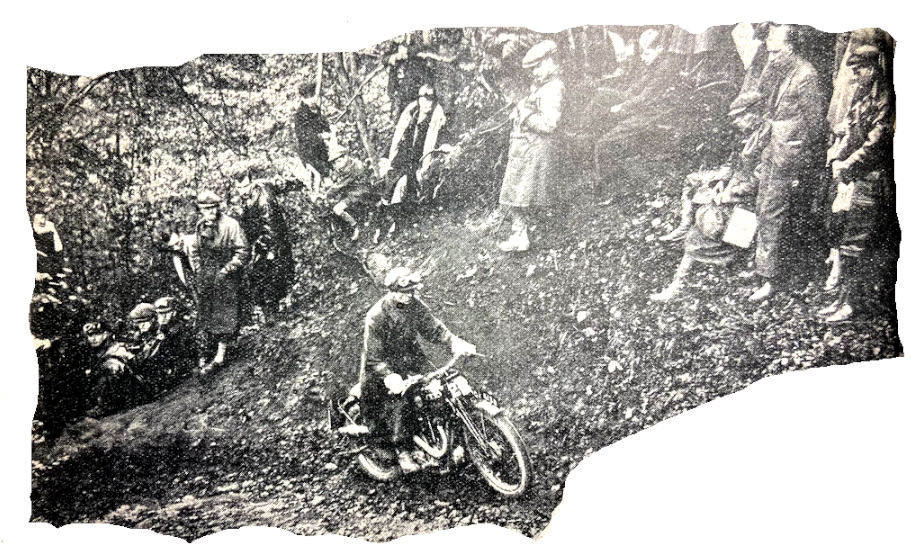
caused almost as much trouble as it did on the first. Povey, the only man to gain full marks on the first circuit, repeated his performance—the only man to do it on both circuits. Immediately following Shadwell lay Breakheart, perhaps the most difficult hill in the trial, having an acute S-bend on a really steep gradient, with rocks and boulders galore. It was great fun to watch the experts run up the bank and foot hard! In spite of the difficulties, Amott (Triumph), and Brittain (Norton), managed to keep their feet on the rests. AR Foster (248cc New Imperial) had to foot for safety, but he was quite one of the fastest. TC Whitton (348cc Velocette) was also very fast, though the model got a shade out of hand on the top bend. J Douglas (Douglas) brilliantly rode feet-up, as did R Dee (346cc Rudge). Miss Cottle (249cc BSA) went straight up the bank, but made an excellent getaway and surprising to relate Len Heath (Ariel) did almost exactly the same thing, though it seemed he was going a shade too slow for once. AE Perrigo (BSA) was good, but a trifle jerky, while J Williams (348cc Norton) was less certain than usual. Riding without a footrest, GE Rowley (AJS) all but kept his feet up. Back once more at The Bear, the experts tried to calculate for themselves who was the winner, but it was not until late in the evening that it was announced that Fred Povey had won the solo honours—and nobody seemed more surprised than Fred himself. He seemed almost sorry about it—because the competitor whom he had beaten by one mark was none other than Vic Brittain, who has been three times placed second in this event, and twice third, but never first. This is an excellent example of the sporting spirit that pervades the whole trial. RESULTS. Solo (Skefco Gold Challenge Cup): GF Povey (499cc BSA), 304 marks (317 possible). Sidecar (Palmer Cup): HJ Flook (490cc Norton sc), 253 marks (260 possible).
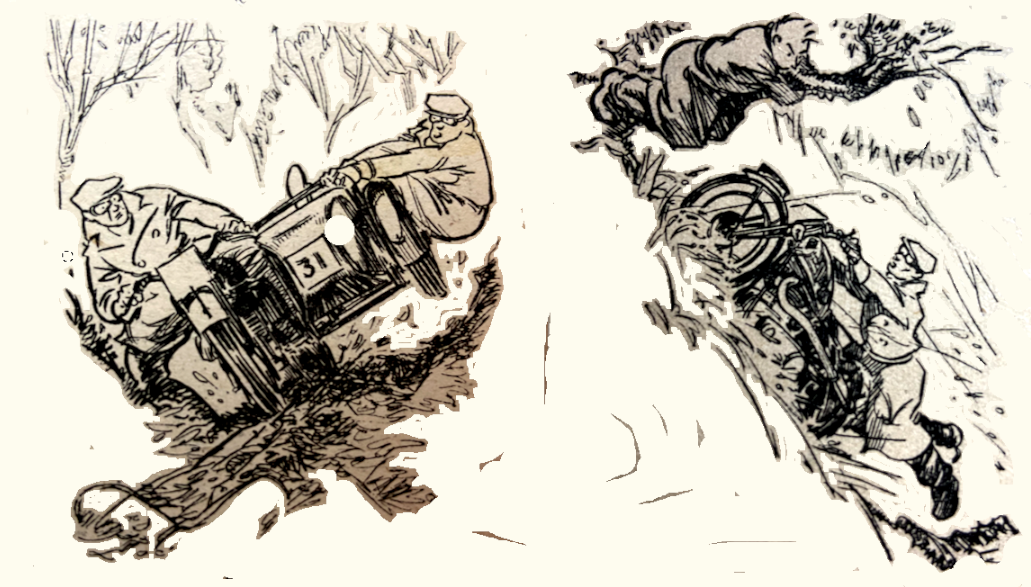
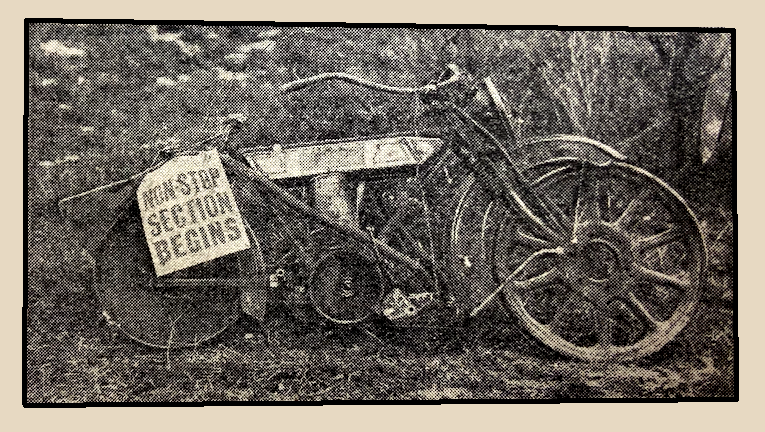
“AT THE MOMENT WE ARE offered two types of standard gear change, and a third is in the air. The tank and the foot control are already with us; the handlebar preselector is being ‘talked up.’ The tank lever has been with us for umpteen years, and is steadily criticised because second-rate riders take their eyes off the road when they operate it, and speed merchants (even if expert) cannot always afford to steer one-handed when they change in a race. The foot control was invented for racing purposes, in which field it now rules. The preselector is slow in coming, but on paper need have no faults at all. Let us admit that any system is satisfactory in expert hands, with foot control ranking best for racing. Foot control is by no means ideal for duffers; when a duffer gets in a traffic block he is usually a little hot and bothered, and it is far safer for him to glance at a high-up tank quadrant than to peer down at a neutral indicator.”
“THE BRITISH TWO-STROKE CLUB recently enrolled its first Italian member—he rides a 98cc model. Already they have members in Japan, Canada and the North-West Province of India—riders separated by thousands of miles, riding under very dissimilar conditions, yet all two-stroke enthusiasts!”
“NEW TERROR FOR THE TIMID. Unilateral parking has come to London. This method of permitting vehicles to stand on one side of the street only, the side depending upon the day of the week, is to be tried out in Jermyn Street, and signs indicating the correct side for the respective day will be erected. The system, which is designed to minimise inconvenience to shopkeepers, has been tried in a number of provincial towns.”
“TRAFFIC SIGNALS—’I am imposing fines of 5s in each case, because motorists have not yet acclimatised themselves to these signals,’ said Mr TE Rhymer, chairman at Tottenham Police Court, when several motorists were summoned for failing to obey the traffic signal lights…Operated in some cases with the aid of a wireless van on each side of the signal, police traps for motorists who ignore the signals are becoming common, and magistrates usually show far less leniency for this offence than in the foregoing cases.”
“SUMMONSES FOR NOISE OFFENCES were 9,871 fewer in 1932 than in 1931, it was stated in Parliament recently, when a member asked the Home Secretary whether this was because of a decline in this class of offence or because the police had not taken action when such noises occurred. Sir John Gilmour’s reply was that it was due to an’ extension of the system of giving verbal warning or cautions in certain types of cases, instead of issuing summonses, and also to a decline in the number of cases.”
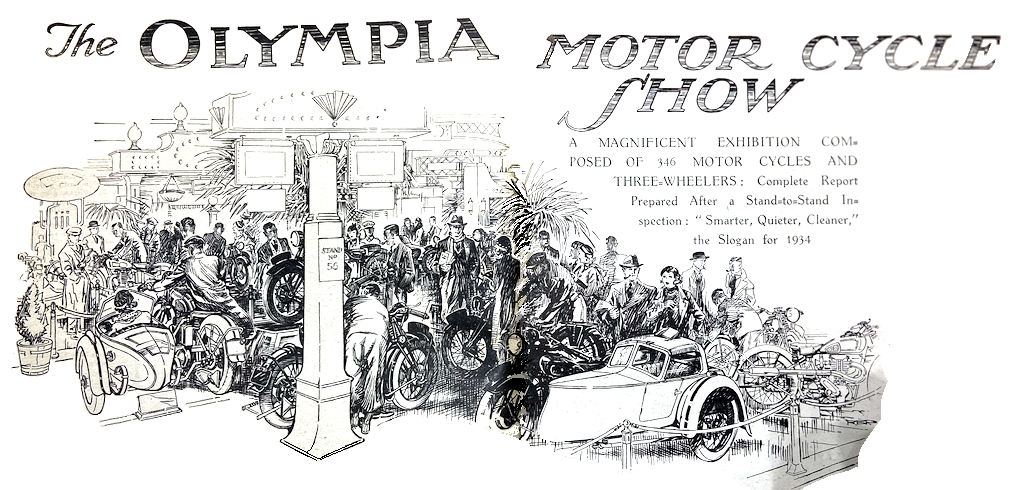
“ALL TOLD, THERE ARE 346 motor cycle and three wheeler exhibits at Olympia. These comprise 257 solo motor cycles, 67 sidecar outfits, and 22 three-wheelers. Counting only those machines that are exhibited on manufacturers’ own stands, it is found that there are 36 150cc models, 83 of 250cc, 43 of 350cc 91 of 500cc, 28 of 600cc, 31 of 1,000cc, and 14 over 1,000cc. Overhead-valve engines take pride of place with 205 machines so fitted, followed by 66 side-valves, 46 two-strokes, and nine overhead-camshafts. In percentages, 81.4% are single cylinders, 15.2% twins, and 2.4% four cylinders. Of the machines with single-cylinder engines, 98 have the cylinder inclined in the frame and 86 vertical mountings. The number of machines with four-speed gear boxes is no fewer than 199, while 115 are shown with foot gear changes. Spring frames appear on 30 of the machines. Magneto ignition is included in the specification of the majority of the models—226 are fitted with magnetos, 31 with flywheel magnetos, and 69 with coil ignition. Well over half the machines, namely 197, are priced with full electrical equipment. A total of 24 motor cycles are either totally enclosed or incorporate special shielding, 28 unit-construction or semi-unit machines, and 13 with pressed-steel frames. One of the most pleasing features…is the wide acceptance of the ‘Everyman’ ideal. On all sides one finds machines with their mechanism enclosed, mounts that are clean to ride and easy to clean, special silencing systems and designs that have as their keynote accessibility…One finds, too, that an increasing number of manufacturers are placing the question of engine flexibility, comfort, ease of handling, weather protection and ease of starting before all else…The day of the Everyman motorcycle has arrived.”

“WHAT THE SHOW REVEALS: A wealth of novelty, including a machine with a fluid fly-wheel and preselector gear, several all-enclosed models, a three-wheeler with a single wheel in front, a new four-cylinder three-wheeler, and another with a single-cylinder engine…The exhibition of a Diesel engine for the first time…Many new 1.5s-tax machines…Two new twins, one of 500cc and the other of 650cc; the latter has side-by-side vertical cylinders…That the 250 is becoming even more popular…That the four-speed gear box now exceeds the three-speed in popularity…That mechanical silence is one of the most general aims, and that the enclosure of valve gear is being brought to a fine art…That oil-bath primary chain cases are now found on quite inexpensive models…That water-cooling has suddenly come into its own…That the convenience of riders in the matter of detail fittings is now receiving really close attention from designers.”
“UNFAIR CONDEMNATION OF MOTOR cyclists by the public was an emphatic point made by the Minister of Transport, Major Oliver Stanley, MP, in his speech when he officially opened the Olympia Show on Saturday morning: ‘Owing to occurrences in the past—actually, some few years ago—the motor cycle has a reputation which it no longer deserves. This has prevented the public realising the big strides that have actually been made in securing silence. No longer is it fair to condemn this particular means of transport in that respect.’ Major Stanley said that this was the first time since 1929 that a Minister of Transport had had the privilege of opening an Olympia Motor Cycle Show. Four years ago the great stock exchange slump in America had occurred, but nobody had realised what serious world depression was to follow in its wake. Depending as it did so largely on sales among weekly wage-earners, the motor cycle industry had been one of the hardest hit of all. It said a great deal for the skill, energy and courage of our manufacturers that they had managed to maintain their credit throughout; they had worthily upheld the prestige of British industry. ‘To me, as Minister of Transport,’ said Major Stanley, ‘motor cycles are an important factor, since there are between five- and six-hundred thousand on the road.”
“MANY THOUSANDS OF NEW readers will receive their introduction to The Motor Cycle through this special Olympia Show Report, and will wish to know more about the journal and its features. In the first place, this enlarged Show Report is not representative of the normal issues, which are altogether broader in their scope. The aim of The Motor Cycle is to help its readers to obtain the maximum enjoyment and pleasure from their machines—to be a helpful friend to one and all—to keep them abreast of everything that is new in design; to suggest by its touring and camping articles ways and means of ensuring happy, inexpensive holidays; to publish informative, entertaining accounts of all the leading sporting events, both at home and abroad, and at all times to watch over motor cyclists’ interests (vide the exposure a fortnight ago of the inspired anti-motor cycling propaganda). The Motor Cycle illustrations are unique; many thousands of riders owe their intimate knowledge of petrol engines and motor cycle design to the clear perspective drawings which have been a feature of this journal for over 20 years. The Motor Cycle was founded in 1903; its staff is composed of a band of enthusiastic riders, and to-day the paper enjoys a circulation far in excess of that of any motoring journal in the world. Its pages form the recognised forum for the interchange of views, and among the many features of normal issues will be found articles dealing with the care and maintenance of motor cycles and their components, technical discussions, practical hints and tips, and helpful articles for the beginner. The Motor Cycle is enterprising, entertaining, and informative.”
A STROLL ROUND OLYMPIA WITH IXION. “Olympia plays many roles. To one firm it is a fountain of wealth; to another the grave of hope; to some it has been an epitaph. There we always see the machines of the moment, the machines of tomorrow, even the machines of yesterday; models with a future, models with a past—and, very occasionally, models with neither! And how the daily Press distorts it! The bloodhounds of the dailies have curious noses which can only smell something new. Almost to a man they were hypnotised (not unpardonably) by the fluid flywheel and Wilson preselector gear of the new BSA. Not a line did most of them concede to the stalwart, yeoman buses of the past which have been the backbone of the sport and industry for a generation. They raved about the 2,000 electric bulbs and three miles of wiring on the BSA stand, and never even noticed the haughty Norton stand, which has gigantic, iridescent red corner-posts carved in the shape of ‘1st’, and stages ‘pottery’ worth a fortune, including as it does the premier award in practically every European speed championship. Not that the new BSA isn’t extremely exciting, of course. It may inspire a positive stampede in the direction of new transmissions by November, 1934; and its oddest feature is that you can walk past it without spotting anything revolutionary, so tidily are the new items incorporated in the frame. There is a strong tendency towards enclosure; with the treble motive of silence, good appearance, and easy cleaning. ‘Nature,’ as one salesman remarked, ‘has not so far created any animal which carries its intestines externally: why should motor cycles be less decent than animals? ‘ I hesitate whether to award the palm of beauty to the Francis-Barnett ‘Cruiser’ (an Olympic débutante, though an old and well-tried friend) or to the new Excelsior. The former is entirely ‘hoseable’, despite its air-cooled engine. The Excelsior, thanks to water-cooling, has the equivalent of a tiny motor car bonnet neatly bestowed in the main frame panel. It appears rattle-proof, and the side-shields lift off when you have undone two wing nuts per side. Its rear wheel is as nearly totally enclosed as is possible, and yet remains completely accessible. Not even a chain shows anywhere. Finished in red, black, and silver, it certainly is a beauty. And the beauty is not eyewash;
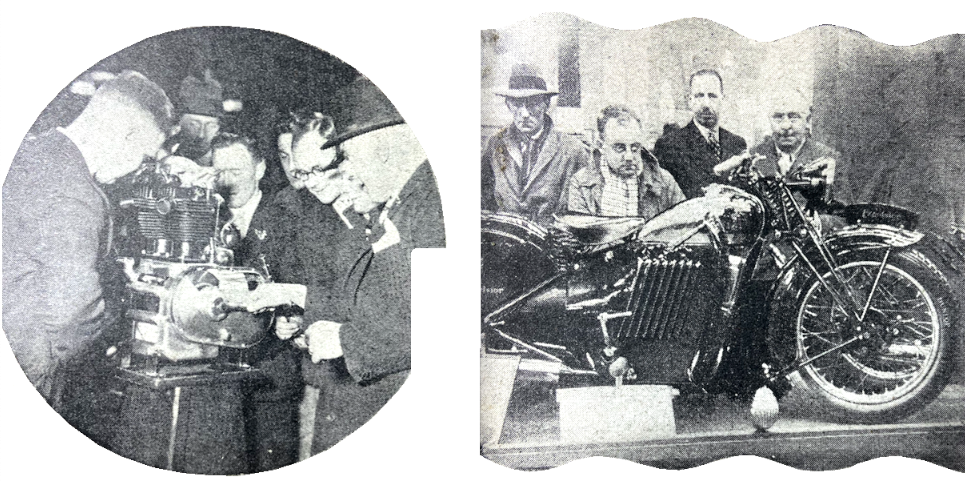
for example, the primary chain runs in a grooved Sorbo rubber bed, saturated with oil. With two silencers and the damping of all metallic ‘ring’, this bus should be super-silent. The HRD people are content merely to enclose the power unit; they profess some fear of side-pressure in beam winds; but their contribution is charming—spring frame, four speeds, and the entire tank-side padded to form an enormous knee-grip, equally pleasant whether you stand 6ft 6in. or 5ft 3in. The dawn of the 150cc super-sports! Now that we expect 70mph from 250cc, sonic of the racing brigade plan to give us hot-stuff one-fifties. (I smell a 100mph Snowden about three years off!) So meet the new 148cc Royal Enfield. About 60mph. Four speeds. Dry-sump oiling. Totally enclosed valve gear. No external piping. Twenty-seven guineas fully equipped. The New Imperial works are very enterprising. Fired by the success of their helical primary drive on small engines they now stage a 350cc ‘Unit Plus’ with a four-speed box, and a very attractive job it is, eliminating that tiresome primary chain with its demand for attention and periodic renewals. They also stage two other new machines known as ‘Grand. Prix’ models which are practically 250cc and 350cc TT replicas, except that the crankcase and oiling are modified to suit road work. You can buy these in either racing or trials guise, as you may prefer. At the Rudge stand the new stuff was mostly ‘inside’. Graham Walker has a humorous knack of comic exaggeration. He says that you’d better not use the internal finish as a mirror unless you are a real good-looker; and they claim to have the best big-end in the whole world of motor cycling. So our 1934 Rudges should stable a few extra Shetlands. They are better-looking than ever, with quick-detachable side-shields to cover up some of the plumbing in the region of the gear box, and the nattiest black-and-gold mudguarding ever seen at a show. 0n the Triumph stand the new vertical twin is naturally a cynosure.
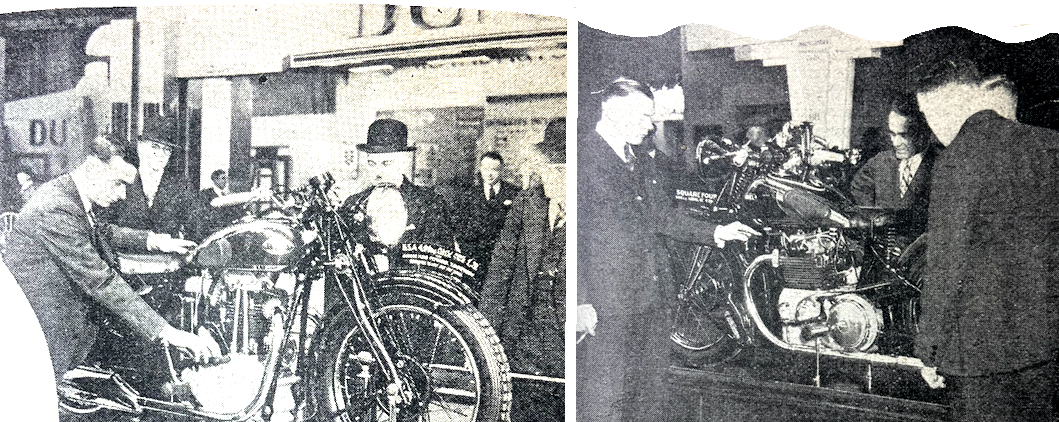
It is already credited with abnormal advance sales. If you’ve ridden it you know that it has the punch of a Petersen and the manners of an arch-angel; and the men who serviced the experimental models during their 30,000-mile road test say that they never wanted anything doing to them. I have always thought—and still think—that the AJS method of driving an overhead camshaft by enclosed chain with Weller spring-blade tensioner cannot be beaten for maintained quietness, neat appearance, and general efficiency. You’ll find a new version of it on the 250cc Levis, employing a plunger and oil dashpot to smooth the spring blade action. This 70mph Levis should make good. It has such a yank in it that, as a precaution, they’ve given it a 350cc-size gear box. Some of these two-fifties are a little on the small side, but the Levis people must have a corpulent fellow on their staff; there was a time when the 250 Rudge was. about the only machine of its power on which a big man could bestow his limbs—another feather in Graham Walker’s cap. The ‘Beam designer dons not radically change his well-proved designs (why should he?) or allow a record depression to cheapen the finish, external or internal. These lordly machines develop a little extra power annually, as even Sunbeams were never quite omniscient. They are one of the few factories who give on flexible oil and petrol piping. It is no wonder that British machines are well on top when, in addition to the conventional mounts on which our super jockeys win all the races and in addition to the detuned replicas thereof which most people ride, our range includes all the sound novelties already noted, and such familiar super buses as the Broughs, and the Ariel and Matchless four cylinders. Where in the world can you match any of the three? And, in quite a different field, is not the Velocette supreme? Compact, cobby, trim, neat, an engineer’s job from stem to stem, in racing guise it is just compressed lightning, and as fine an example in petto of sheer mechanical beauty as a great liner is in a larger sphere. I must leave the sidecars to our chair expert, but I thought them much improved. The Watsonian people show a taking range, and the Triumph company have an excellent model for use with their new twin. Altogether, I welcome a most fascinating blend of enterprising innovation with ripened, conservative experience in the menu for 1934. If a friend offered to stand me a pluperfect dinner by way of a great celebration, I should prefer most of the dishes to be old favourites, each perfectly cooked and perfectly served, surpassing all previous memories of them. But the dinner would be memorable if, in addition, it contained some slight admixture of novelty—at least, one new hors d’oeuvres, perhaps a strange entrée, and some quite unfamiliar wine. This is precisely what the trade offer us for 1934; and it is all extremely attractive. Thank you, gentlemen!”
“ONE OF THE MOST pleasing features of the present Exhibition is the wide acceptance of the ‘Everyman’ ideal. On all sides one finds machines with their mechanism enclosed, mounts that are clean to ride and easy to clean, special silencing systems, and, often, quickly detachable wheels, and designs that have as their keynote accessibility. One finds, too, that an increasing number of manufacturers are placing the question of engine flexibility, comfort, ease of handling, weather protection, and easy starting before all else. All these are features appealing to the everyday rider, and which this journal has so persistently advocated. As many will recall, our advocacy of this policy three years ago in a world which was idolising speed resulted in bitter controversy. That, however, is all past, and to-day we are gratified to find on every side evidence of the fact that our campaign has been heeded. As the Editor remarked in his broadcast speech last Saturday, the day of Mr Everyman’s motor cycle has arrived.”
THE BSA PORTFOLIO INCLUDED Daimler cars, whence came fluid-flywheel transmission that was fitted to a Beeza 500, but it found no favour with the riding public and was stillborn. “I welcome the new fluid-flywheel BSA for three main reasons,” Ixion wrote. “In the first place, it is in the absolute a most fascinating machine, and offers new sensations in motor cycling, just as the Scott and a Douglas and the Ariel and Matchless fours did at their debuts. In the second place, it is a symptom that better days are coming; when trade is in a trough or on the downward slope, factories simply dare not spend money on research and experiments, which may or may not captivate public taste. In the third place, the motor cycle industry has been mentally a little ‘groovy’ of late. In the allied pedal cycle industry a moment arrived when its massed brains seemed incapable of further development; stagnation may be pardonable in the evolution of such a simple commodity as a bicycle, but no sane man can claim that the motor cycle has attained perfection, and it is heartening to find that one designer at least is boldly breaking new ground—doubly so, when the new ground opens up a machine which should prove much simpler for a beginner to handle expertly.”
AS ALWAYS THE MOTOR CYCLE reviewed every bike on show, which offers a snapshot of the British motor cycle industry’s 1934 products. So, having been briefed by Ixion, I’m off for a stroll round Olympia: AJS exhibits ranged from a ‘big port’ ohv 250 (alongside the big-port 350 and 500) to a 900cc sv V-twin (including an export model aimed a US police departments) by way of four ohc models: 346 and 495cc road racers and ‘competition’ versions. One model featured a speedo and rev counter “neatly mounted in front of the steering damper”. Ariel made a virtue of standardising running gear; engines ranged from 250 to the 600cc Square Four. The sporty 250, 350 and 500 Red Hunters came with high-level exhausts; the sidevalve 557cc side-valve big single boasted a detachable head and fully enclosed valves. BSA had the biggest stand at the show and the biggest range, from a 149cc ohv Snowden baby to the 1,075cc
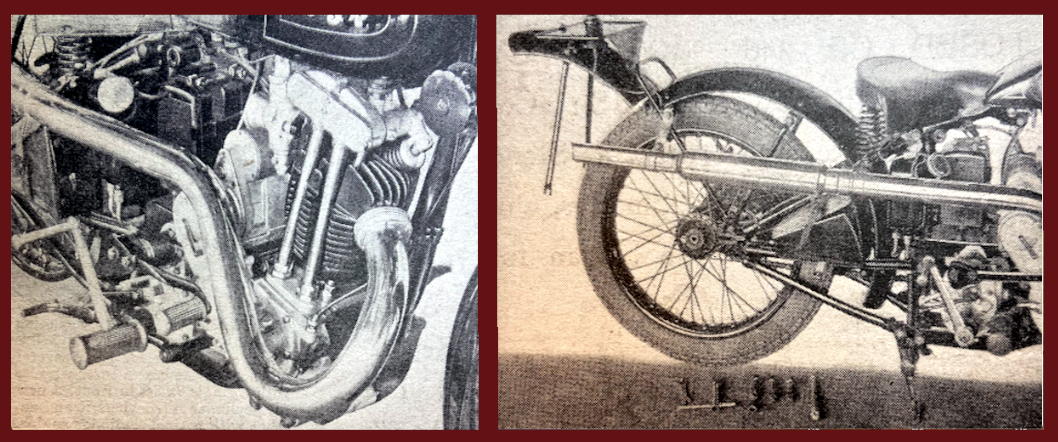
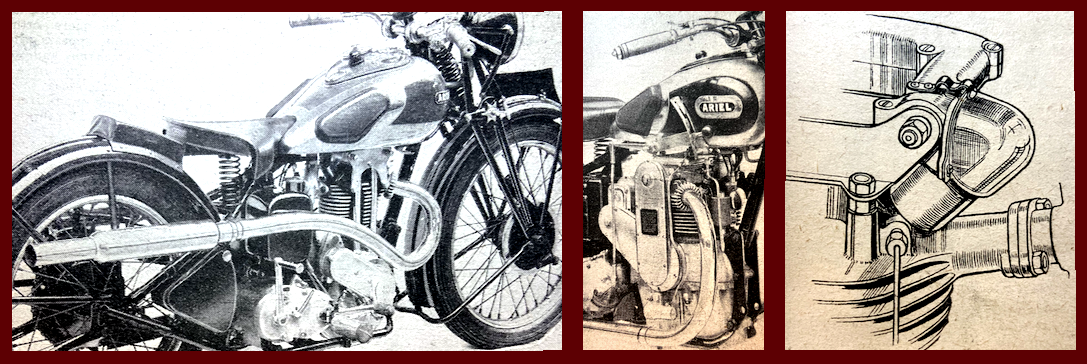
four-pot Special Sports three-wheeler. The Blue-Star 250, 350 and 500 were Beeza’s equivalent of the Ariel Red Hunters; “the 499cc and 595cc side-valve engines will appeal to the rider who likes quiet power”; the 990cc V-twin catered for heavy-duty sidecar work. Centre stage went to a new ohv V-twin 500 and the fluid-flywheel model with a ‘Wilson-type pre-selector gear mechanism’. “All the BSA machines are now electrically equipped as standard.” Brough Superior always attracted crowds—this time enthusiasts focussed on a banking sidecar chassis and the latest SS100 (which ought to have been renamed the SS110 because Brough had upped the ante to a guaranteed 110mph). George Brough was a great showman; the Blue ‘Un noted: “Though not on view the water-cooled four-cylinder model is demonstrated outside the Show. Calthorpe had more than 20 bikes on its stand but only two models: the 247cc Ivory Minor and the 493cc Ivory Major with a choice of coil or magneto ignition. All Cottons featured the duplex triangulated frame powered by a four valve 249cc ohv Python, 596cc ohv JAP, 350 and 500 ohv and sv and a selection of 150s from Villiers, Blackburne and JAP. Coventry Eagle’s entry in the 150cc stakes was powered by a specially made twin-port Villiers
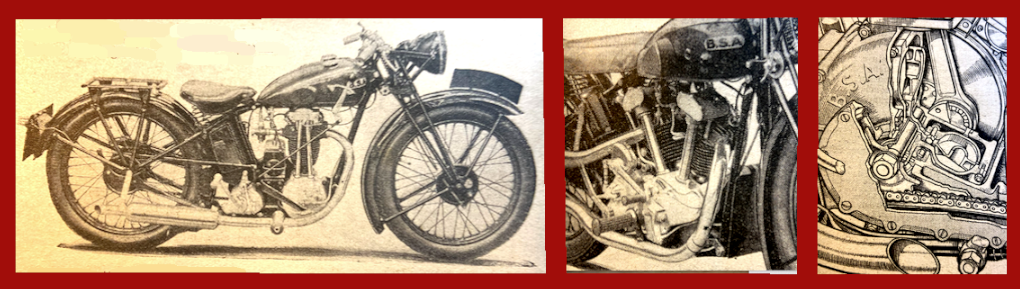
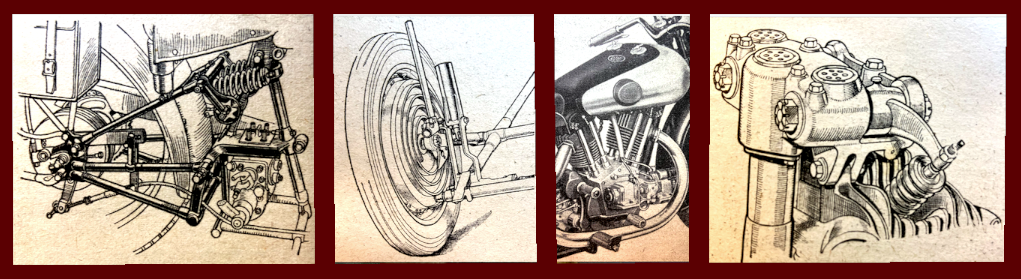
two-stroke housed in a pressed-steel frame; “the power unit is particularly well silenced by means of a large aluminium expansion box in front, terminating in two large-capacity silencers at the rear of the machine…A similar model, but with a 250cc Villiers engine, is also shown” alongside a twin-port four-stroke JAP-powered 250. “A novelty is a special sidecar chassis built to suit the pressed-steel frame.” Coventry Victor was known for its flat twins including a sidevalve 850 that powered a “family three-wheeler…the front seats have pneumatic upholstery and the rear seats are large enough for well-grown children”. A 499cc ohv flat-twin solo was described by the Blue ‘Un as “a sturdy, straightforward machine”. Also on show was a 5hp ohv flat-twin diesel and a flat-four. Dunelt showed four models for 1934. The Villiers-powered 150 was “a handy little vehicle with pressed-steel forks and very efficient mudguarding, while the price [£25] is low enough to suit a slender purse. The Villiers-powered 250 had “a more generous specification” with a claimed top
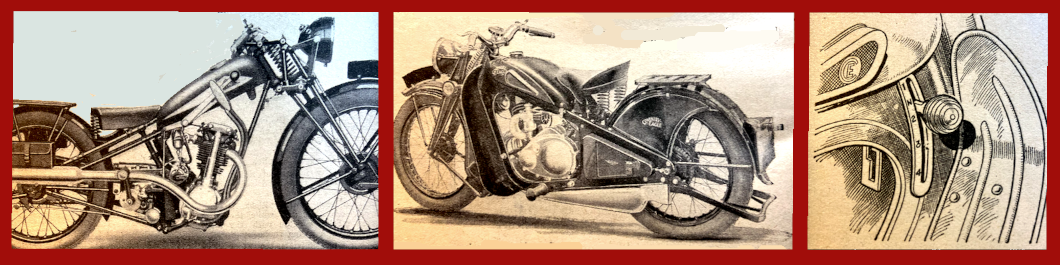
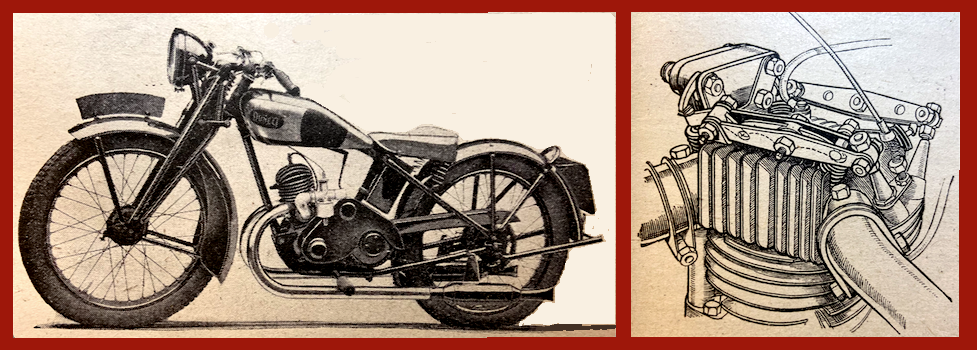
speed of 60mph. The other two 1934 Dunelts had ohv Python engines of 249 and 499cc; “it is noteworthy that the 249cc model is available with a TT replica engine for £55 (without lighting)”. No marque was more associated with horizontal twins than Douglas but the Bantam, its contender for the new 150 cc sector, was a single—and a two-stroke to boot—although it was still horizontal. It was also in the ‘Everyman’ mould, with rubber engine mounts to reduce vibration, detachable panels covering the entire side of the bike and substantial legshields. Flat twins still dominated the range: 250, 350 600 and 750 sidevalves with 500 and 650 ohv models. “It is difficult to say which is the highest ‘high spot’ on the Excelsior stand, but it lies between the 249cc water-cooled all-enclosed model and the ‘Mechanical Marvel’ which won the Lightweight TT.” The D9 roadster was the Everyman’s Everyman: “It is entirely enclosed from stem to stern in metal shields…the primary chain runs in a groove formed in a Sorbo rubber strip which lines the inside of the chain case.” It topped a range of utility lightweight two-strokes from 98-249cc. But Excelsior’s 150 contender (like the Douglas 150 it was called the Bantam, 15 years before Beeza used the name) was an ohv four-stroke; “its design is good and the
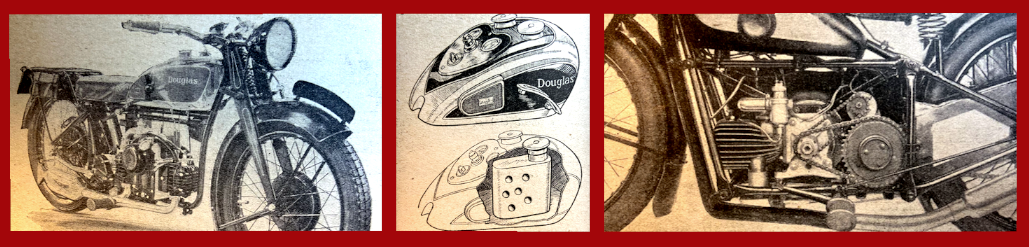
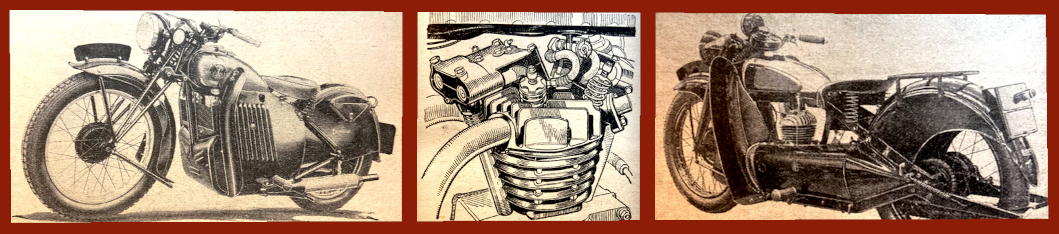
performance snappy”. The four-valve Mechanical Marvel was going into series production and, not surprisingly, “the actual TT winner is on the stand”. Francis-Barnett majored on the popular Cruiser; its 249cc Villiers engine was uprated with Villiers automatic lubrication with oil in a separate tank though petroil lubrication remained available as an option. A 10-bike display included three 148cc Lapwings; the entry level Model 33 had a three-speed box, legshields and direct lighting—the Blue ‘Un reckoned it was “an excellent little job”. The higher spec Lapwings boasted four speeds and electric horns. A brace of Black Hawks were shown with the 196cc Villiers engine; the Falcon was of the same capacity but with a ‘super-sports’ engine. Levis tweaked its well established ohv 350 with a twin-port exhaust with tubular silencers and rubber-faced legshields. “Among the points of minor interest are flexible oil and petrol pipes, plated tank and wheels and racing-type knee-grips moulded in the form of wings.” The 350 was bracketed by a 250 and a 500 of similar spec “but perhaps the greatest interest centres round the new 247cc ohc model” which was “intended for very high-speed work. The engine has a compression of 8 to 1 and employs chain drive (with Weller tensioner) for the valve
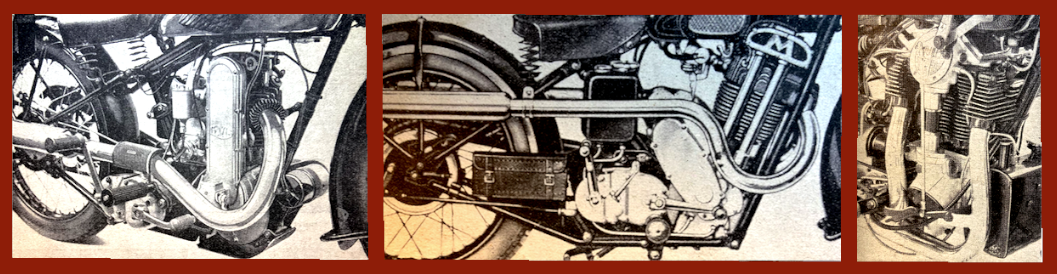
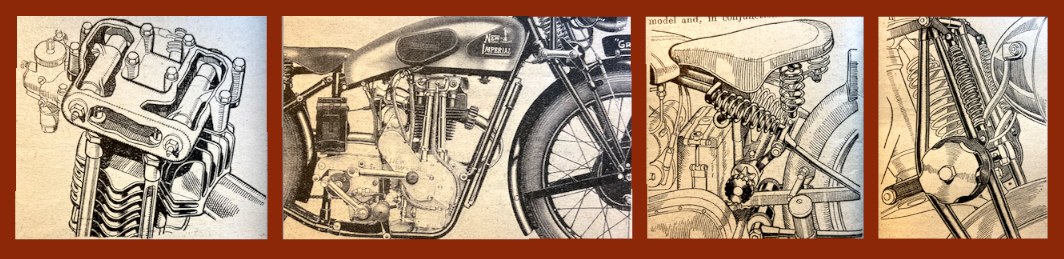
gear. The well-tried 247cc two-stroke makes a welcome reappearance.” Only months after launching its ohv Sports 500 Matchless upgraded it with fully enclosed valve gear, an inclined engine layout and handlebar-mounted instrument panel. The V4 Silver Hawk was virtually unchanged for 1934 but “pneumatic knee-grips are a small but useful addition”. Also on display were ohv and sv 250s, 500 and 600 sidevalve sloggers and the 990cc X4 sv V-twin featuring 8in brakes. “Unit construction of engine and gear box in a neat and practical form is a feature of three ohv models shown on the New Imperial stand.” The 146cc Unit Minor and 246cc Unit Major were joined by a 350. “Inspection of the sectional models displayed will bring to light the interesting fact that the engine runs ‘backwards’, the primary drive being of helical gearing running in an oil bath…another interesting feature is a serrated adjustment for the foot control lever of the four-speed box.” The 499cc Model 17 featured cantilever rear suspension “and in conjunction with unit construction makes an attractive proposition for the man who appreciates comfort and cleanliness”. New Imp also showed its successful Blue Prince range. “Cups, trophies, bowls—a wonderful array of glistening silverware are the crowning glory of this year’s Norton stand. Conspicuous in the display are the two Isle of Man trophies, for the Senior and Junior races, while in the centre of the stand is a 490cc International which, except for saddles, tyres and grips, is one mass of chromium plate and highly polished aluminium.” The 1934 Inter gained an oil-bath chain case; all models got a new
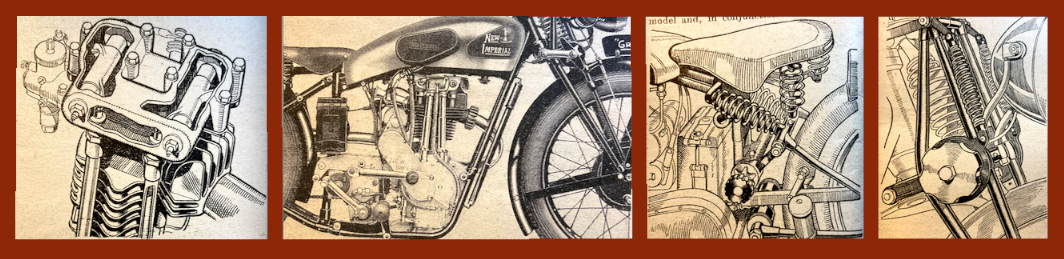
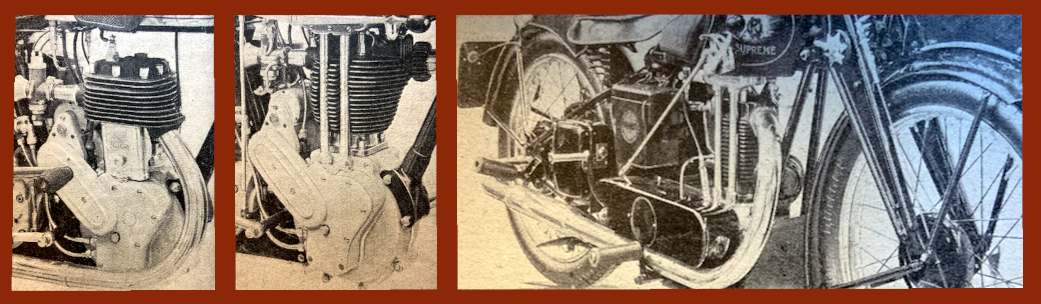
clutch with “patent rubber-block shock-absorber that obviates the necessity for an engine-shaft shock-absorber”. The ohc 348cc Model CJ and 490cc CS1 had cradle frames and “profiting by experience gained in racing the makers have equipped all models in the range with the racing-type forks fitted with two auxiliary damping springs”. The cammy Nortons took the glory but most enthusiasts went for the more affordable ohv 490 and 596cc Models 18 and 19 and the sv 490 and 633cc 16H and Big Four. OK Supreme didn’t adopt full enclosure but did encase the crankcase and rear engine plates of the 246cc Flying Cloud. The Britannia was shown with a 490cc ohv JAP and a four-speed box with hand or foot control; the Phantom was a touring version “equipped with a valanced front mudguard, deep-sectioned rear mudguard, carrier and huge pannier bags”. OK also showed a “handsome sidevalve-engined sidecar outfit”. One of the very few disappointments of the Show is that the four-cylinder OEC is not on view, though it will definitely be included in the 1934 range.” Main feature of the OEC line-up was rear springing, even on the 148cc Villiers-powered tiddler which was one of the few 150s to boast a foot-operated gearchange. OEC relied on proprietary engines all the way up to the 990cc sv V-twin. “Unconventional in design but possessing an attraction peculiarly its own, the new
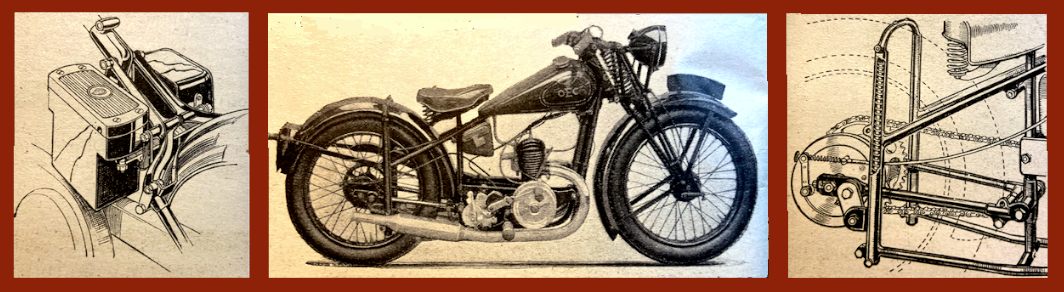
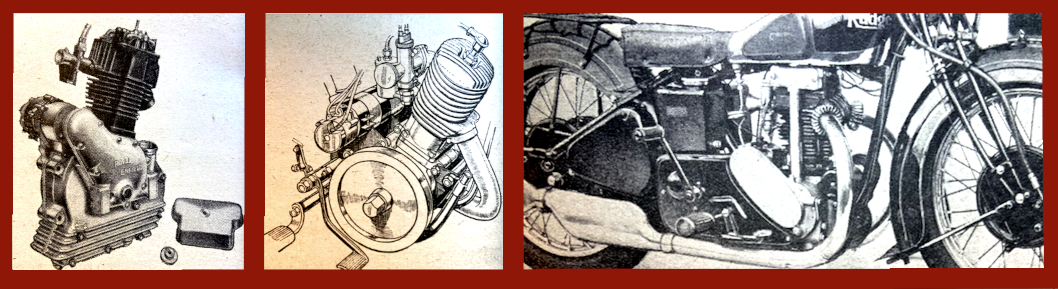

Raleigh three-wheeler, with the single wheel at the front, is proving one of the highlights of the show.” Under its bonnet was a 742cc Raleigh sidevalve transverse V-twin and a set of heavy-duty girder forks. “A welcome and last-minute addition to the ranks of the lightweight, the little 150 ohv Royal Enfield is causing an undoubted stir at Olympia. It is particularly noteworthy for its massive construction and clean exterior.” The 500 Bullet “possesses good lines coupled with a high performance. The engine is of the four-valve type, with independent adjustment for each valve…The central prop stand, with automatic lock, deserves close examination.” The Bullet family also included two-valve 250 and 350 models. The 976cc sv V-twin was “a machine for the sidecar enthusiast or for the man who requires effortless solo riding…a useful feature is the ratchet mechanism of the front brake lever. The range is completed with a delightful little 225cc two-stroke, two low-priced 148cc two-strokes [including the fully enclosed Cycar] and side-valves of 248cc, 346cc and 570cc capacity.” Rudge showed a straightforward family: two duos at 249 and 499cc. The standard 250 was hardly a utility mount, featuring as it did a four-valve head with a 14mm (rather than the more common 18mm) plug, linked brakes and four-speed box. Its sports stablemate came with racing cams and valve springs, a high-compression piston, upswept exhaust and foot-operated gearchange. This pattern was repeated with the 499cc Special and Ulster. Other noteworthy features were “a hand-operated central stand…and, besides full electrical equipment, each model has a Smith chronometric trip speedometer and an eight-day clock neatly displayed on either side of the steering damper”.
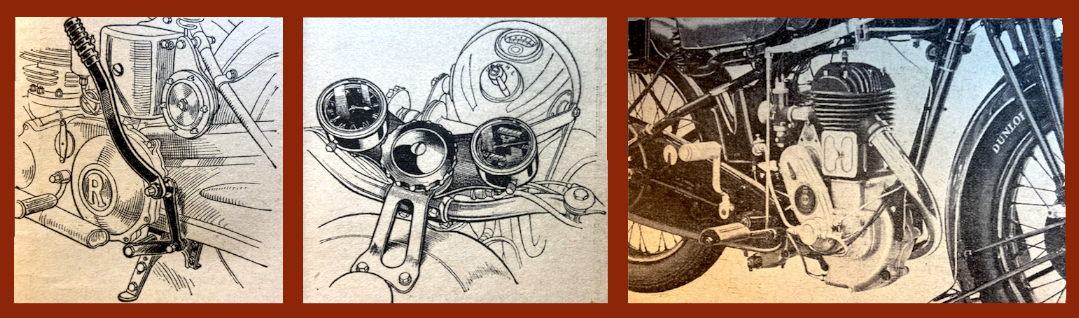
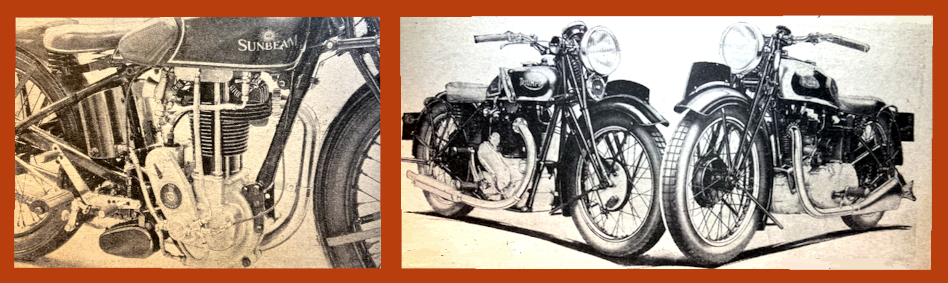
Two Rudges were shown with the Swallow and Watsonian sidecars which were offered as a factory fit. “Many will declare that Sunbeam has as fine a range of machines as any in the Show, and fine models they are, with the ohv 493cc 95 topping the list. Here a real racing performance has been the aim, the single port engine being most carefully produced. It is equipped with hairpin valve springs and an Amal racing carburetter…This machine has a younger brother—the 246cc ‘Little 95’. The Model 9 is a 493cc ohv machine fully equipped for fast touring, employing the Sunbeam four-speed gear box, adjustable dry-sump lubrication, enclosure for the rear chain, if desired, and many other refinements. It is available with a 599cc engine for those who want a really powerful dual-purpose machine.” The Model 8 was a similarly equipped 347cc ohv twin-port. “The Lion long stroke has long been famous among side-valve motor cycles. It embodies those Sunbeam ‘luxury’ features as detachable and interchangeable wheels, a hand-adjustable fork stabiliser, the oil-batch chain case and detachable rear mudguard. The 246cc ohv long-stroke model completes the list. This is a true sports machine lending itself admirably to fast road work under ordinary conditions. Altogether a very bright array, even in so excellent a show. Eighteen models are included in the Triumph range, which represents virtually an entirely new programme…there is a machine to suit the needs of every motor cyclist. Pride of place must be given to the recently introduced vertical twin which won the Maudes Trophy. Sidecarrists will be especially attracted
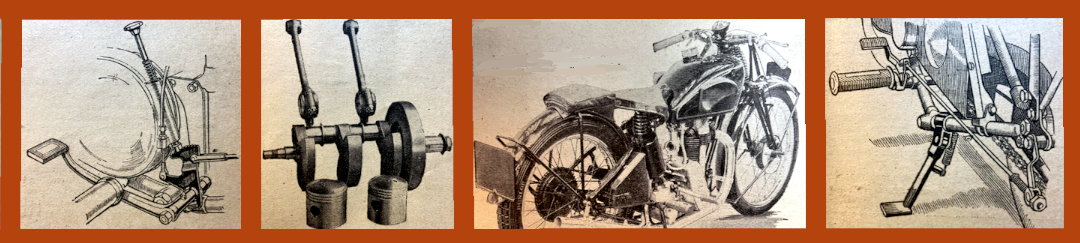
by this model, which provides just the type of performance for passenger work. Its design is outstanding, yet not freakish, accessibility has not ben forgotten, and the dimensions of the moving parts are really generous. If you are an enthusiastic soloist have a look at the 3/5, a grand example of a modern 350 with its well-balanced appearance and compact design. All the ‘Mark 5’ sports machines bear a stylish stamp with the new Triumph finish. Right away from the sporting side, at the other end of the range, is a neat little Villiers-engined 148cc machine which, at £25 10s with lighting and legshields, is an excellent proposition.” Triumph also offered a more powerful option, the 147cc ohv XO5/1, including a sports version stripped of its legshields and with a high-level exhaust, and there was a 174cc variant as well as a choice of 250s and workaday 350 and 550 sidevalves.” World-famous on road and track, Velocettes are well known as exponents of the overhead camshaft. Recently, however, the makers have introduced 250cc [MOV] and 350cc [MAC] push-rod engines. They have kept the push-rods short by raising the timing gear, and taken special pains to ensure mechanical silence. The valve gear is entirely enclosed. The frame is of the cradle type, and both models are of typical Velocette excellence. Typical of the camshaft range is the KTS. A four-gallon tank is a new feature which adds to the appearance of the machine, and the four-speed box is now foot-operated. Special valanced mudguards and chain protection are employed. The KSS is a model of rather more sporting aspect; it sells at £59 10s. The KTT is a racing
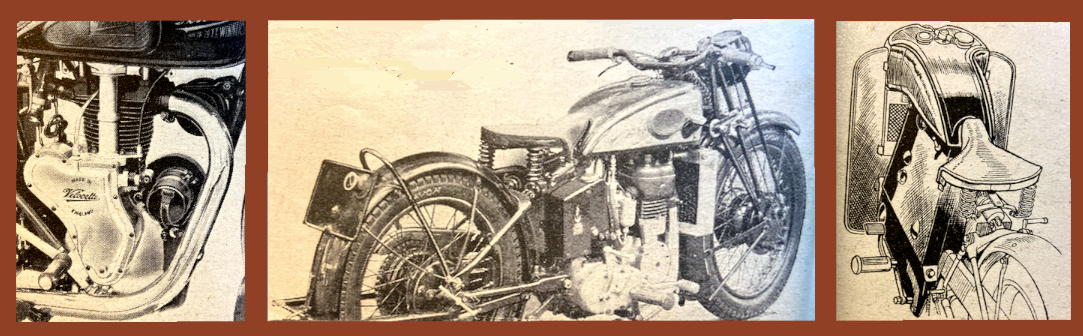
model, sold at £89. There is also the well-known 250cc two-stroke, which now has a transfer port cut in the piston. Lightweight of the Vincent-HRD line-up was the fully-enclosed Model W, powered by a 249cc Villiers lump with auto-lube, flywheel mag and four-speed foot-change box. “A real attempt has been made to protect both rider and machine…the frame is an ingenious combination of channel steel and malleable castings, and includes simple but effective rear springing. Another outstanding new model is the water-cooled side-valve 600cc model, in which the water header is combined with the fuel tank.” The Model P was powered by a 499cc ohv Python driving via a four-speed foot-change Burman box and boasted “full rear spring suspension”. Its PS stablemate boasted the Ulster engine and twin drum brakes on each wheel. “The front brakes are operated through a rocking beam and the rear through balanced cable gear. Two sprockets are fitted on the rear hub, so that by reversing the wheel a second set of gear ratios may be obtained. A
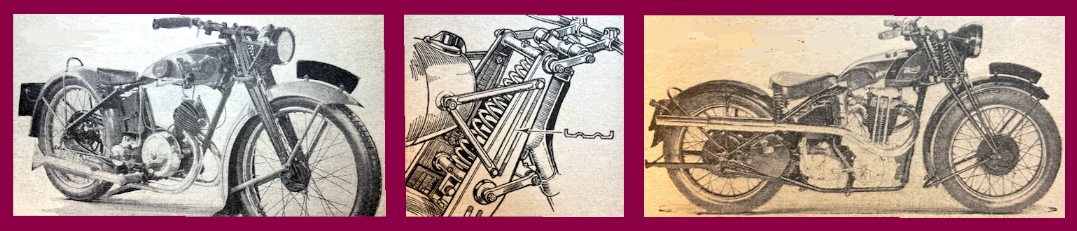
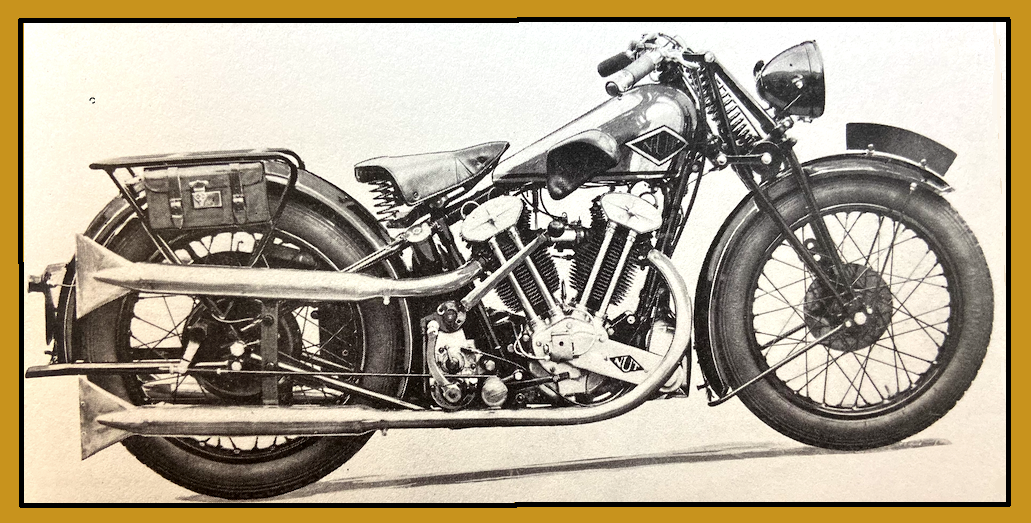
sprung pillion seat is another outstanding feature. There are also JAP single-port models of 490cc, one of which is a real super-sports machine.” Wearwell Cycle Co displayed three of its Villiers-powered Wolf lightweights: the 98cc Cub, the 148cc Vixen and the Silver Wolf, also with the 148cc lump but fitted with a four-speed Burman box and finished in blue with a chrome-plated tank. Zenith relied on JAP engines and launched two ohv models at 246 and 346cc with inclined engines and four-speed, foot-control boxes. “Both are commendably workmanlike and make a special appeal to the sporting rider. Also exhibited are 750cc and 1,100cc twins, the latter being a particularly impressive-looking machine. An excellent representative of the modern 500 is the 490cc ohv standard model; it is available also in de luxe and sporting forms. The Zenith finish of purple and chromium adds a tasteful touch to a small but interesting display.”
“WHAT WILL YOU IN THE way of proprietary engines? There are singles from 77cc to 600cc and twins up to 1,100cc. There is even a flat four of 1,500cc, though there are no conventional fours of proprietary brands. There are side-valve engines, overhead-valve engines, four-valve engines and two-strokes. On the Blackburn stand there is a fine range of singles—clean-cut, straightforward jobs from 150cc to 600cc in overhead-valve types, and 175cc to 600cc in side-valve models. The smaller side-valves and the 200cc ohv have skew-driven camshafts at right angles to the crankshaft, a neat arrangement which permits the oil pump to be driven off the front end and a magneto off the rear, if required. The remainder of the small ohv engines have valves inclined at about 60° and push-rods enclosed within a single die-casting into which a crank case breather is introduced. There are no tappets in this type of engine, the push-rods bearing directly on the upper and lower rockers. A neat single-spanner adjustment has been devised for the rocker gear of the ohv types. The makers of the JAP engine have no stand of their own this year, but their products are to be found in so many different exhibits that it is not difficult to obtain an idea of the many varied types and the excellence of their manufacture. The largest is an 1,100cc side-valve twin, but the new ‘8/75’ ohv model, with its deeply spigoted cylinders and rigid construction, is attracting much attention. There are JAP engines as small as 175cc, and there are side-valve and ohv types with dry-sump and ‘direct’ lubrication systems in almost every conceivable size. Horizontally opposed engines are a Coventry Victor speciality, and four separate types are displayed. The largest is a new flat-four water-cooled engine with side-by-side valves, and the smallest an air-cooled ohv twin of 500cc. There are also two 750cc engines, both water-cooled, with side- and overhead-valve mechanism. Python four-valve engines are to be seen on several stands, the 250cc and 350cc sizes having radially disposed valves. In the 500cc class some have pent-roof heads, and one type has radial exhausts and parallel inlets. When one thinks of two-strokes, one naturally thinks of Villiers.
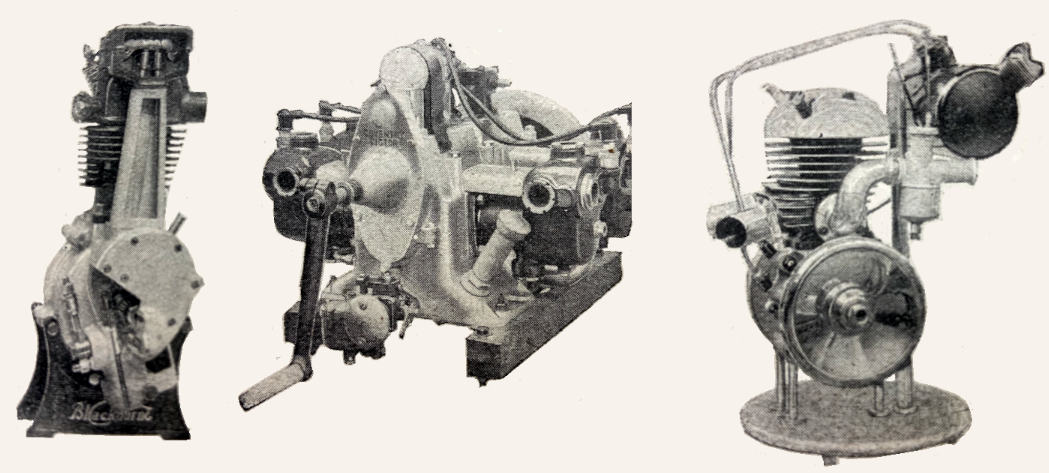
Their range of engines now extends from 77cc to 350cc. Although the 77cc engine is not intended for motor cycles it is of considerable technical interest, for it is on a cast base which forms the fuel tank. The carburetter is floatless and draws its supply direct from the tank, air being admitted through a suction valve. The unit is complete with flywheel magneto, fan, silencer and clock-spring starter. The Villiers range includes both air- and water-cooled types, and, apart from fly-wheel magnetos and carburetters, the name is associated with a clever form of inertia ring to minimise the risk of ‘sticky’ piston rings, and a system of alternate bronze and steel rollers in the big end. As regards gear boxes, the four-speed is easily the most popular type. Though Sturmey-Archer are not themselves exhibiting motor cycle products, the make is well represented on various stands. The design, however, has undergone no radical changes. Burman gears have an enviable reputation, and the latest boxes displayed on their stand have a remarkably clean exterior, even the working parts of the foot-change mechanism being enclosed in a smooth aluminium cover. For the new four-speed box constant-mesh gears are employed, and the normal jaw-type dogs have given way to the internal-tooth type. There are two-, three-, and four-speed boxes to suit all sizes of machines, and the friction inserts are arranged to make the best possible use of the clutch-plate area. A flexible clutch centre can be provided. This last feature applies also to the Albion clutch, and among the boxes of this make on exhibition is a new four-speed type specially made for engines of 150cc. Albion gear boxes are of the constant-mesh type, with two pairs of sliding gears moving together. Jaw-type dogs are used on the main shaft and peg-type dogs engage with broached slots in the layshaft gears. The larger three- and four-speed boxes are similar in construction.”

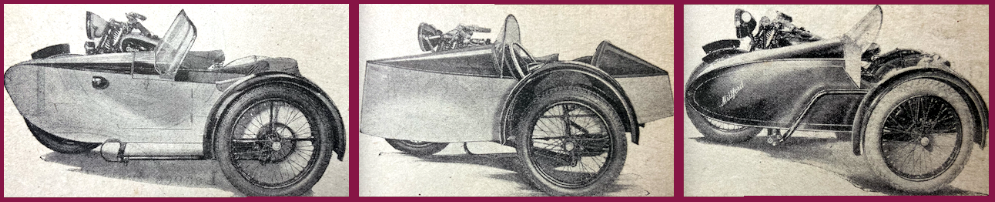
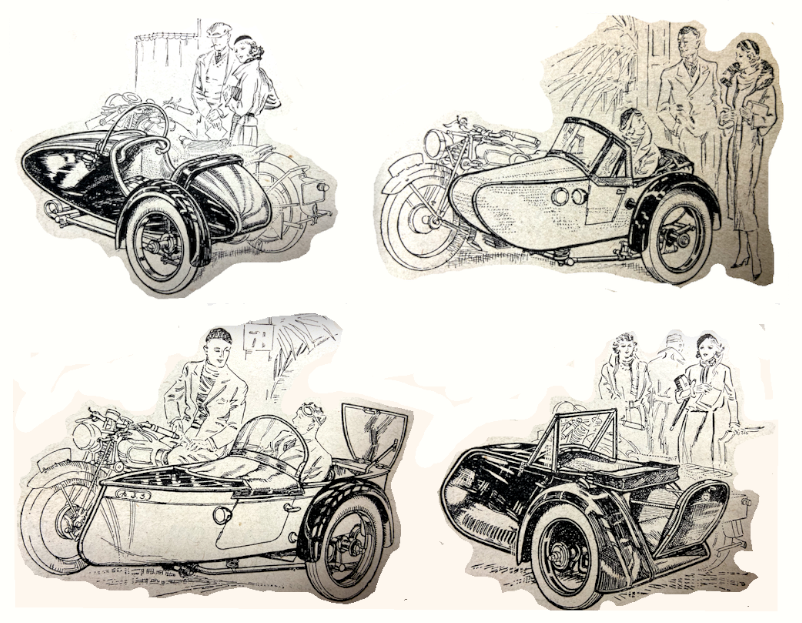
UBIQUE, THE BLUE ‘UN’S TECHNICAL editor, made his own in-depth review of the technical developments. “Olympia shows us two new medium-capacity twins backed by firms with the highest reputations. It presents a transmission system which is new to motor cycles, though tried and proved in the world of cars. It offers novel three-wheeled runabouts. It reveals a gradual tendency towards unit construction in some form, even if that form is, in some cases, but the bolting-up of an engine and gear box to a sub-frame which may be removed as a unit. It discloses a further increase in the enclosure of primary chains and in total enclosure. It displays a general stiffening-up of engines to withstand high power outputs. Speaking generally, however, during the past two years manufacturers have concentrated upon perfecting existing designs and improving both performance and reliability by following the dictates of experience. Fast overhead-valve machines form the backbone of the exhibition. This tendency for the industry to concern itself mainly with the sporting side of the movement has spread even to the smallest class, and it is possible to obtain sturdy little mounts of 150cc which are capable of speeds in the region of a mile a minute. This is a sign of the times, and, though it cannot be ignored, it is safe to prophesy that, with the return of better times, there will be an increasing demand for the purely tourist mount. That this demand can be satisfied as soon as is warranted is evidenced by some of the well-protected and enclosed exhibits. Still more attention to weather protection is needed, and will be forthcoming in proportion to the demand, but it is only natural that the energies of the designer should tend first and foremost to the purely mechanical perfection of his productions. In the matter of price there is a slight but definite tendency towards hardening: manufacturers are placing quality first rather than making low prices the primary consideration. The
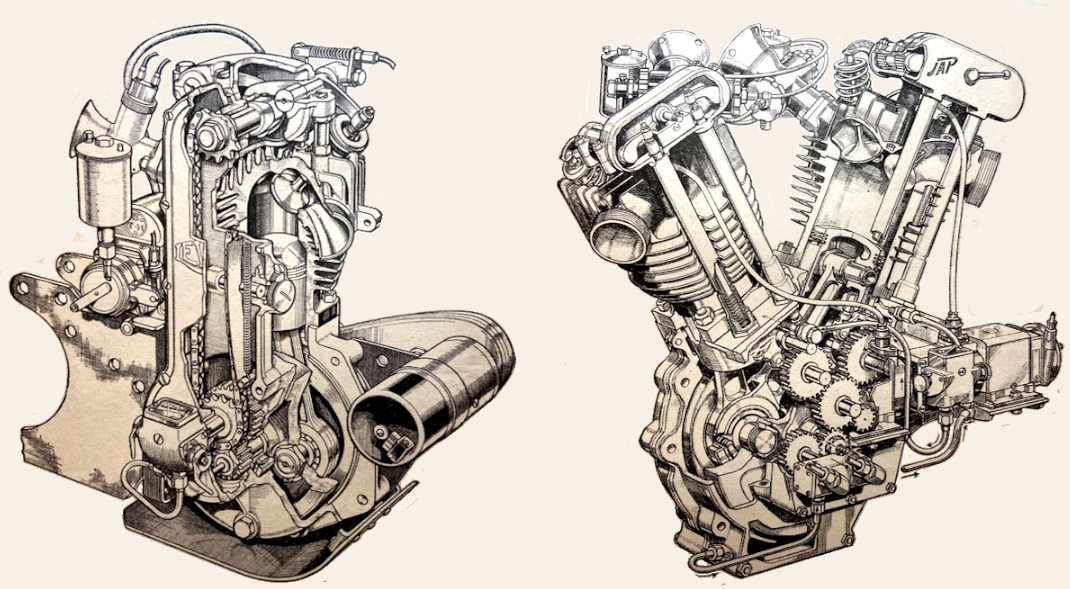
appearance of two new medium-sized twins, backed by two of the most prominent manufacturers in the country, provides a straw which may indicate a growing desire for comfort and refinement as opposed to sheer speed; not that either of the newcomers is slow, for the case is far otherwise, as road and track tests have already shown. Exponents of the big twin have shown us that the market for their comfortable and luxurious products is steady, and, if not large, it shows signs of increasing. The two existing air-cooled four-cylinder machines continue without much change, and one of these engines is standardised in the programme of another make, an indication of further support for the multi-cylinder. As an interesting sidelight on the small four-cylinder engine a manufacturer who is in a position to know the facts has given an assurance that the servicing required for a given number of fours is no more than that for an equal number of singles. The new twins are of entirely different types: one is a conventional but very up-to-date V-twin with over-head valves, and the other a vertical twin with the crankshaft set across the frame. Although the latter type is not new, it has not till now been exploited in this country with the advantages of modern engineering and constructional knowledge behind it. It has the advantages of even firing intervals, almost ideal cooling, and balance at least as good as that of a single of equal capacity. Further, the layout in this instance is particularly sound, and, with its unit construction and double helical primary transmission, it constitutes a real advance in design. Unit construction is embodied also in one of the greatest novelties of the year, this time combined with a fluid flywheel and preselector epicyclic gearing of the Wilson type. With this system it is possible to preselect any gear by means of a small lever on the handlebar, and that gear will come into action noiselessly when a pedal, corresponding to the clutch control, is depressed. There is, of course, no clutch in the ordinary sense of the word, but the construction of the fluid flywheel is such that there is practically no drive from the engine to the gear box below a predetermined number of engine revolutions per minute. It is therefore possible to stop, in traffic, merely by closing the throttle and applying the brakes, and to restart by opening the throttle alone. Further, the fluid transmission forms an ideal shock-absorber which damps out any snatch in the drive. To the ranks of the overhead camshaft brigade there is a new recruit, a 250cc engine having a chain-driven camshaft; it is a model of peculiar interest in that it is produced by a firm which has previously, and very successfully, stood by push-rod valve operation. In general, there is little outward change in the overhead valve single, though there has been an all-round stiffening-up of parts, particularly in crank case construction. The modern super-sports machine is popular with those who undertake their own tuning for track work. Many of these enthusiasts think mainly of high-compression ratio and fancy fuels, which may produce enormous tensional stresses on the cylinder castings. For this reason one manufacturer has standardised a cylinder base flange of no less than one inch in depth.
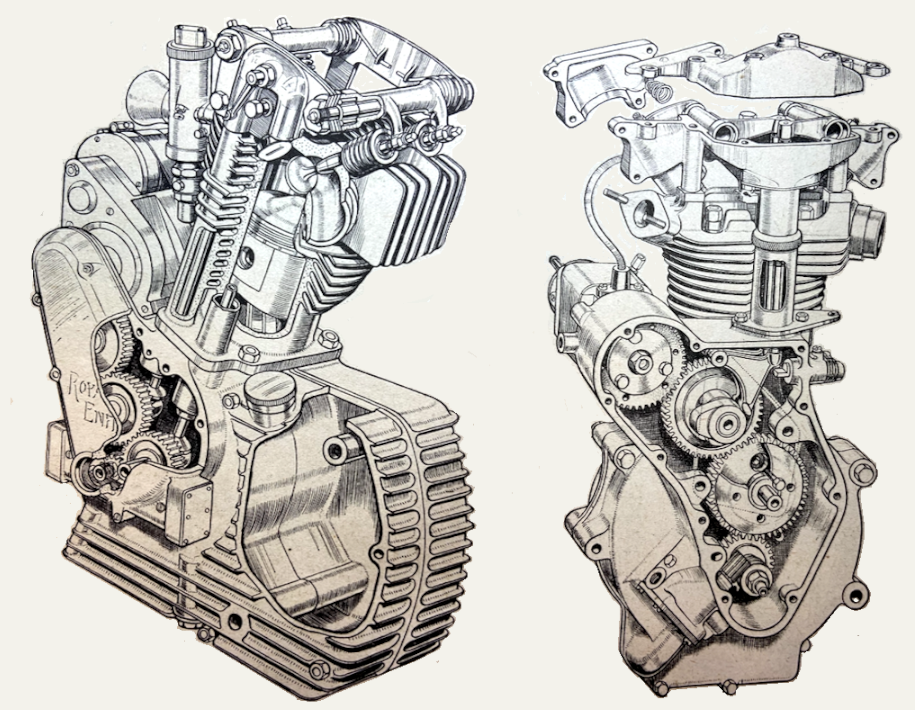
Valve gear as a whole remains much as before; there is an increasing tendency towards total enclosure and improved lubrication, and a vogue for the so-called ‘down-draught’ carburetter, in which, as a rule, the induction port is canted downwards for a matter of perhaps 15°. In one side-valve engine tappets as such are avoided by the use of short push-rods between the timing-case rockers and the valve ends. Since there are no tappet guides there is a free flow of oily vapour to the valve springs and guides, which are, of course, totally enclosed. Lubrication of valve guides is now general, and has extended even to certain side-valve engines. Dry-sump lubrication is firmly established, but improvements have been made in filtration, and detachable gauze or felt filters are to be found in many instances. In the case of two-stroke engines, changes are confined to detail improvements rather than to basic principles. There is a newcomer with a famous name behind it which shows more sheer novelty than is usual, and this is particularly noticeable in that the piston rings are carried in a separate ring-groove carrier. This carrier is, in itself, divided into two halves, and the slight work between the parts is intended to keep the rings free from gumming up. Four-speed gear boxes are the rule rather than the exception and even when three speeds are specified a four-speed may often be substituted for a small extra cost. Many de luxe models have oil-bath or semi-oil-bath chain cases for the primary drive, and this excellent move has been extended to all the products of a firm well known for successes in road-racing events. Shaft drive is not yet with us, nor, in any appreciable quantity, are the ‘clean’ engines and gear units to be found on certain Continental machines. The modern gear box is often, if not usually, foot controlled, and is immediately pivot-mounted such a way that the striking mechanism is not affected by chain adjustment. It is a pleasure to be able to record that the practice of listing machines ‘all on’ is growing. No one would think of buying a car without lamps or horn, and, with the possible exception of super-sports machines intended for racing, there is no reason why motor cycles should be supplied without these necessary adjuncts. Indeed, the matter might be taken farther, and the practice of employing built-in lugs for lamp brackets and horn fixings might be extended, for there are still comparatively few
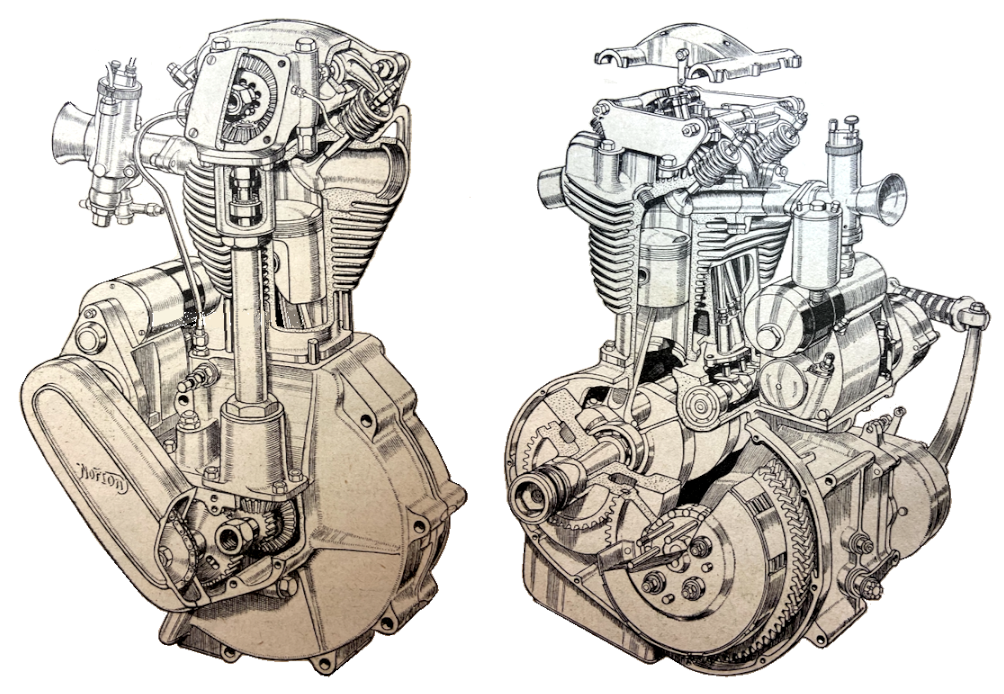
firms who have adopted the practice. A novelty of really practical utility appears in the form of a rubber-mounted handlebar. The arrangement is such that, though the steering is unaffected, the bars are insulated by a layer of rubber, and thus the rider’s wrists are saved from shock and vibration. There is little that is new in frame or fork construction; a channel-steel frame design has appeared and consolidated its position since the last Show; there is a mild increase in the use of steel pressings; and a front fork previously confined to racing models has found its place in a standard range. As a rule, however, forks having a single central compression spring, and a damper accessible from the saddle, are standardised. Protection of running mechanism and for the rider has received attention in several ‘last minute’ designs, but there is still much scope in this direction if the touring community is to be attracted to our ranks in greater numbers. As a general rule, frames are of the semi-loop or duplex cradle constructions, but combined head and top rails, usually forged but occasionally malleable castings, are not uncommon, and pressed steel, channel steel, and composite frames are growing in number. Rear springing is not yet a usual fitting, though there are a few first-class examples on view. Brakes show a tendency to increase in size, and diameters of seven and eight inches are not uncommon. In one case twin brakes are fitted to each wheel. Tyres grow steadily larger, a 3.25in section being common on quite small machines, and 4in tyres are often available on larger mounts. A few more quickly detachable wheels are shown. A general improvement in battery suspension has led to an increase in the popularity of coil ignition, a system which in former times was sometimes used solely to save cost. Modern coil ignition, however, is very satisfactory. Designers of sidecars have recently made big advances in the appearance and comfort of their products, and it is now possible to obtain sidecars of all kinds, from the skimpiest racing shell to imposing saloon bodies, with almost every possible luxury included in the equipment. There is a marked and welcome tendency to provide more room for the passenger. This year there is something new in the way of banking sidecars. The idea of banking is not new, but the method of mechanical operation under the control of the driver is not only new but admirable from every point of view. Obviously the rider is the one to control the mechanism, for only he can tell exactly when the machine should be banked. Taken as a whole, the present Show displays an immense amount of solid mechanical improvement. It is devoid of freakish designs, and yet-there is evidence that the latest engineering practice in car and motor cycle spheres is receiving the most careful and practical consideration.”
ROBERT PAHIN WON the 250 class of the Bol d’Or on a Peugeot 108 (his brother Marcel was runner-up in 1934). Peugeot lost no time in advertising his win: “With a side-valve 250cc, Palin covered 1,663km in 24 hours and equalled the class record for the event. After winning all thirty-one races in which he took part on his P108, Pahin wanted to race the ‘premier event’, the Bol d’Or, to definitively establish the value of the P108. Despite his lack of training and against a coalition of the most famous French and foreign drivers, Pahin, with his side-valve P108, came first in his class, beating the runner-up by more than 200 kilometres!” The biggest bike in the Peugeot range was the 350cc P107 350 popularised by the epic runs made by Robert Sexé. To compete more effectively with bigger British imports Peugeot launched a brace of 500s at the Paris Show: the ohv 515 and the sv 517. They were Peugeot’s first 500s since 1920. The pre-Paris Salon press release promised: “Emphasis is placed on the qualities of power and performance obtained without flexibility, reliability and comfort being diminished.” They both featured unit construction. The 517 came with a three-speed transmission but the long-stroke (81x96mm) 515 got Peugeot’s first four-speed box with foot change. In its first year a 515 went to Montlhéry to set a 24hr world record at an average 118.747km/h.
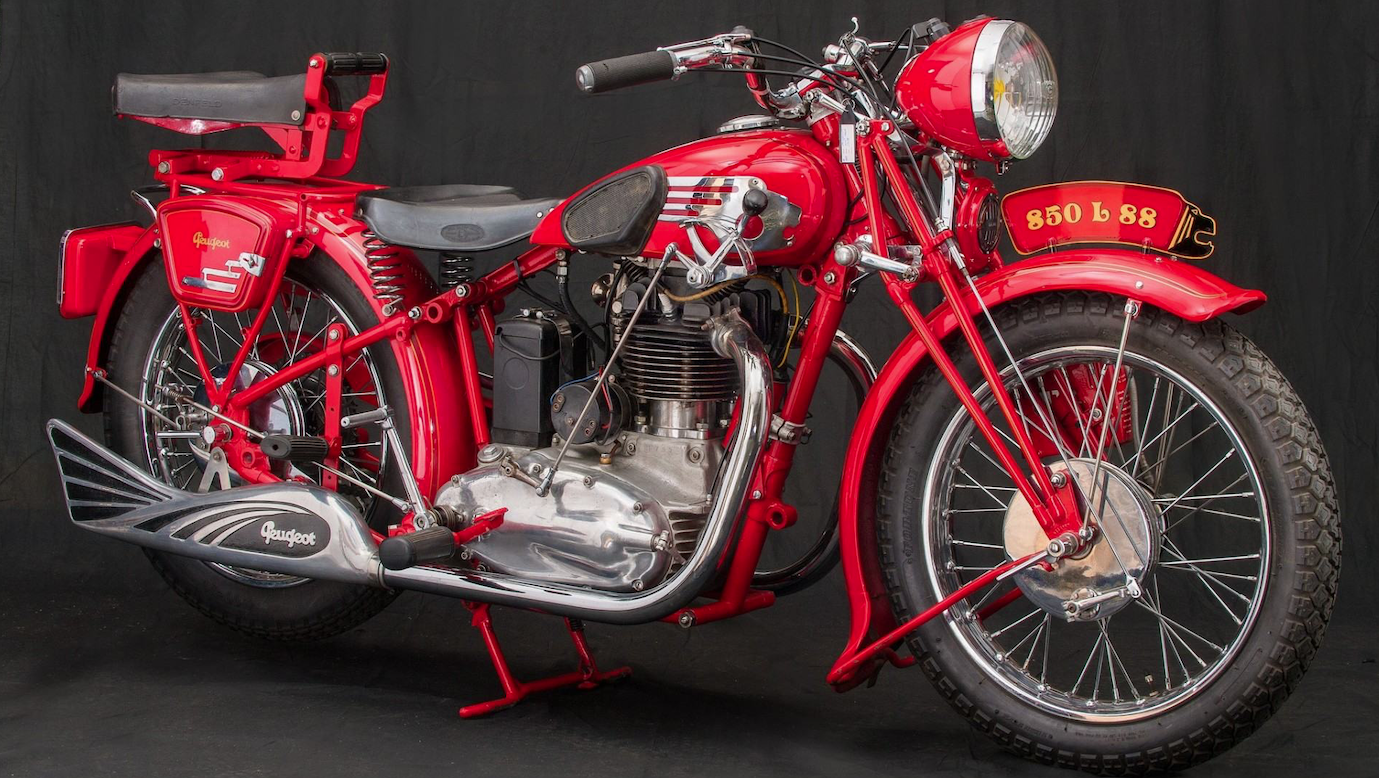
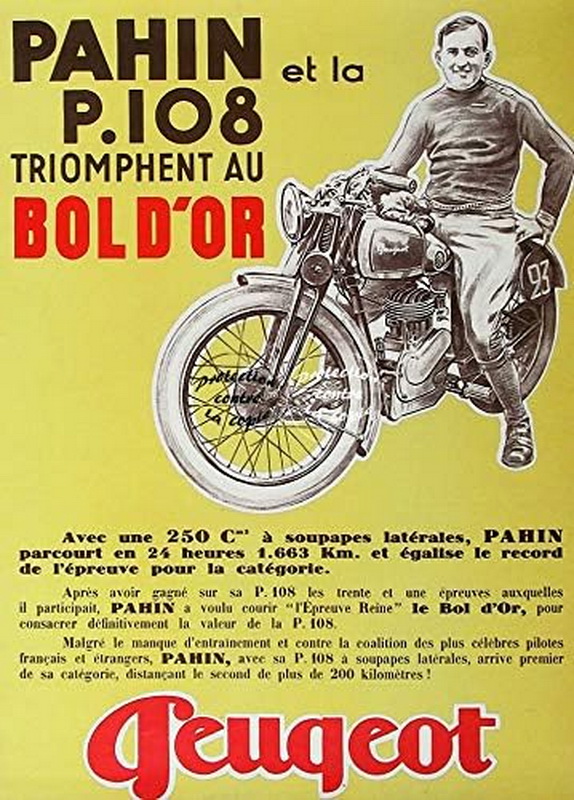
“I WAS VERY MUCH SURPRISED to read in your sister journal, The Autocar, that the Chief Constable of Bedfordshire is of the opinion that cars are preferable to motor cycles for police work because, inter alia, ‘the men’s health has always suffered from driving these combinations in all weathers and at night.’ I can only say that my health has never suffered, and, as a doctor, I am convinced that motor cycling in all weathers is beneficial to the health, though it may not always be pleasant.
HG Robertson (Capt RAMC).”
“WENT DOWN LAST WEEK to watch the ice-racing at the Streatham Ice Rink. A really big crowd was there to see the five riders who had come up from the Southern Centre with their specially prepared machines, on which a skate replaced the front wheel, while half-inch studs had been inserted into the sides of the rear wheel cover. The racing was definitely good to watch—there was a real thrill in the sight of riders sliding the corners and showering up ‘snow’ into the faces of the men behind. One race in particular—the final for the Dunbar Trophy—caused the crowd to yell. T Bryant (Velocette) got well away from the start from S Corbin (Rudge) and L Derrick (Velocette), but suddenly Bryant’s motor cut out temporarily, letting Corbin into the lead. Bryant then went absolutely flat out, soon overtaking Derrick and just pipping Corbin on the line—to slide slap into the barrier after it was all over. By the way, have you ever heard open exhausts indoors?”

THE GLOBAL RECESSION was hitting sales hard. US motorcycle exports for January-November slumped to 6,360, from 11,032 in 1930 and 15,286 in 1928. Harley-Davidson sales, which had topped 21,000 in 1929 (the year of the Wall Street Crash) were down to 3,703 at year’s end.
DURING THE YEAR BRITAIN exported motorcycles and components worth £1.2 million. The top three destinations were Australia, South Africa and, rather more surprisingly, Germany where many smaller manufacturers were fitting British engines, forks and gearboxes.
BY YEAR’S END THERE had been 12,479 convictions in England and Wales for riding or driving without third-party insurance.
The RAC HANDLED 11,983 CAR breakdowns. Ignition problems were most common at 20.2%, followed by ‘axles’ (presumably including punctures) at 13.8%, accidents, at 11.6%, and ‘cylinders and pistons’ at 10%.
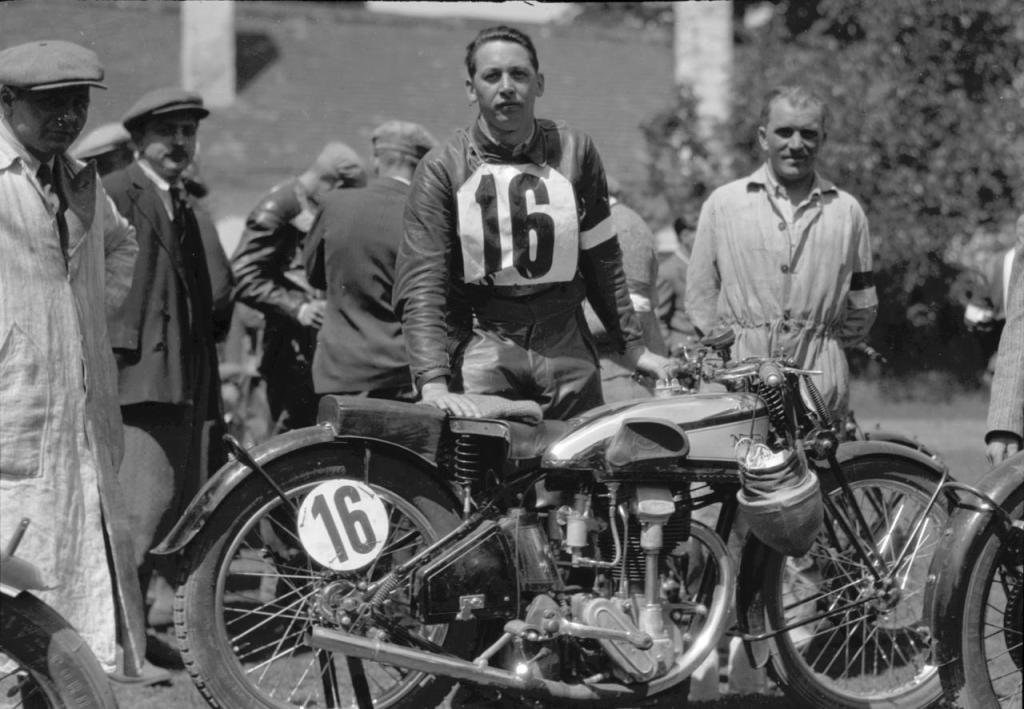
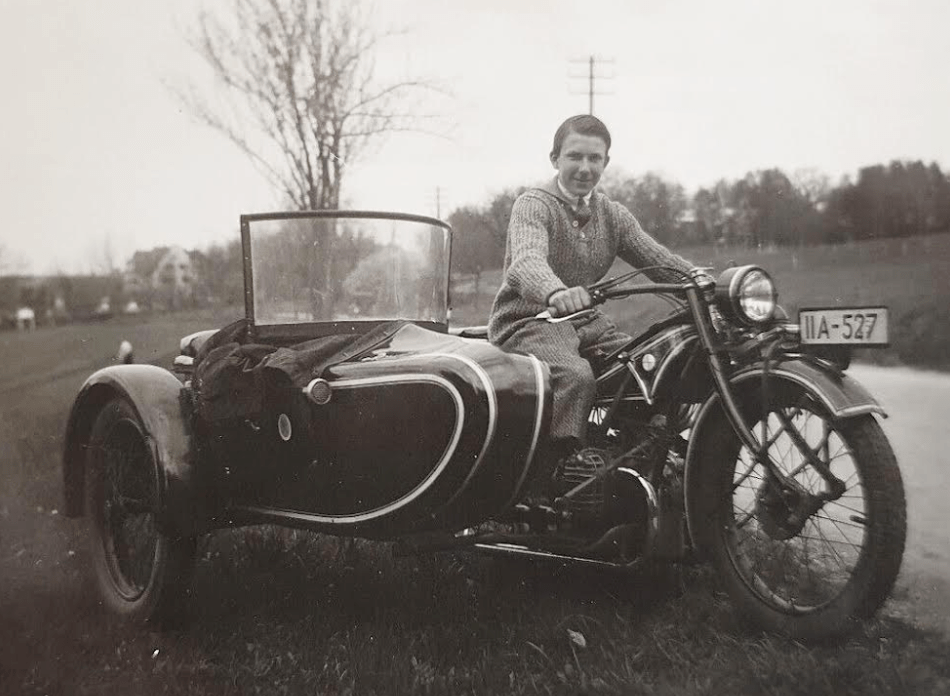
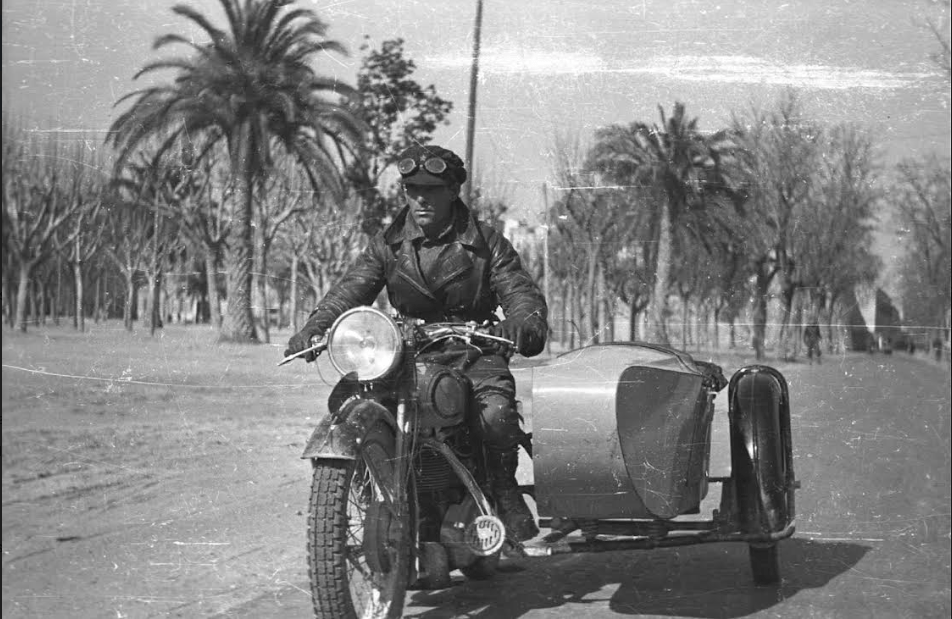
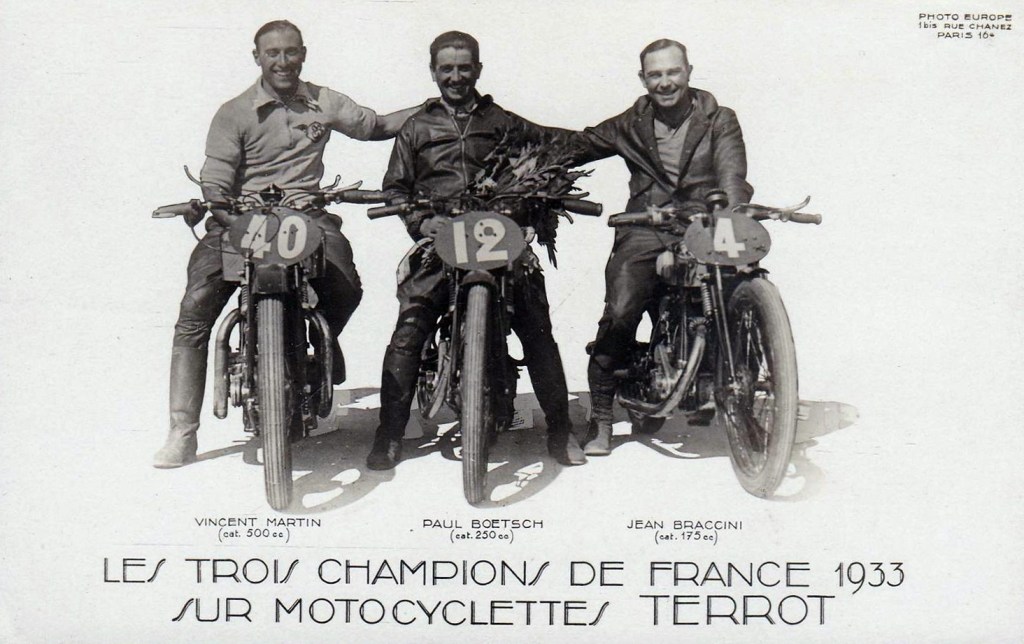

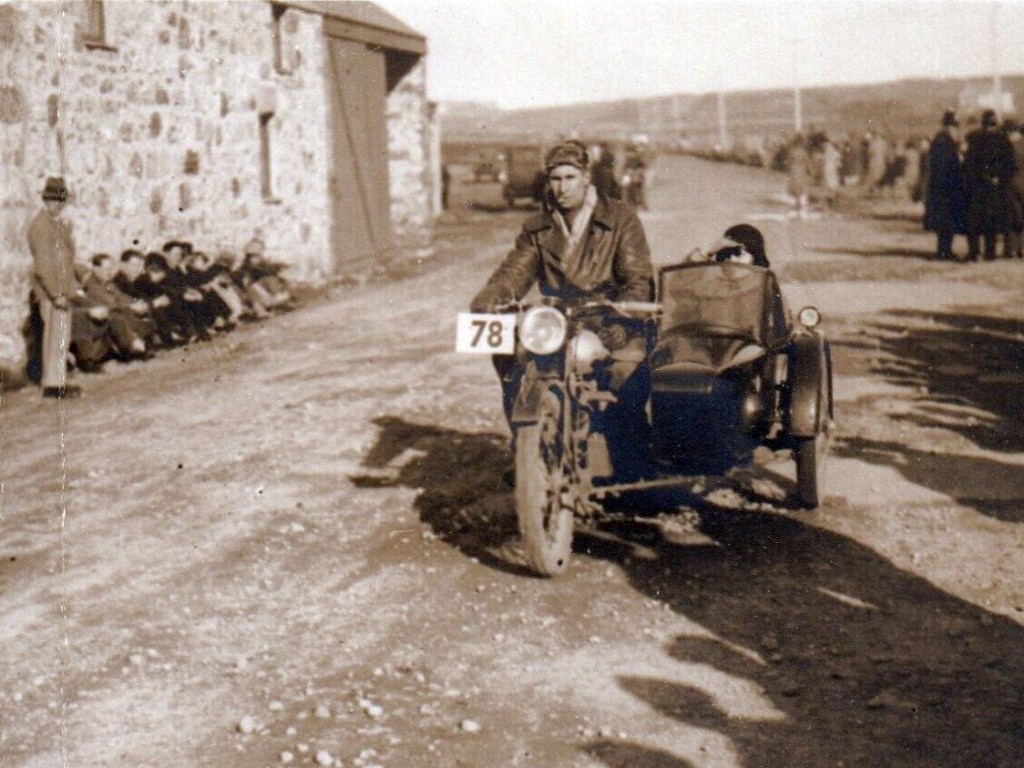
You won’t be surprised to find a clutch of contemporary ads at the end of this review of 1933; let’s start with the biggest bargain of the year.
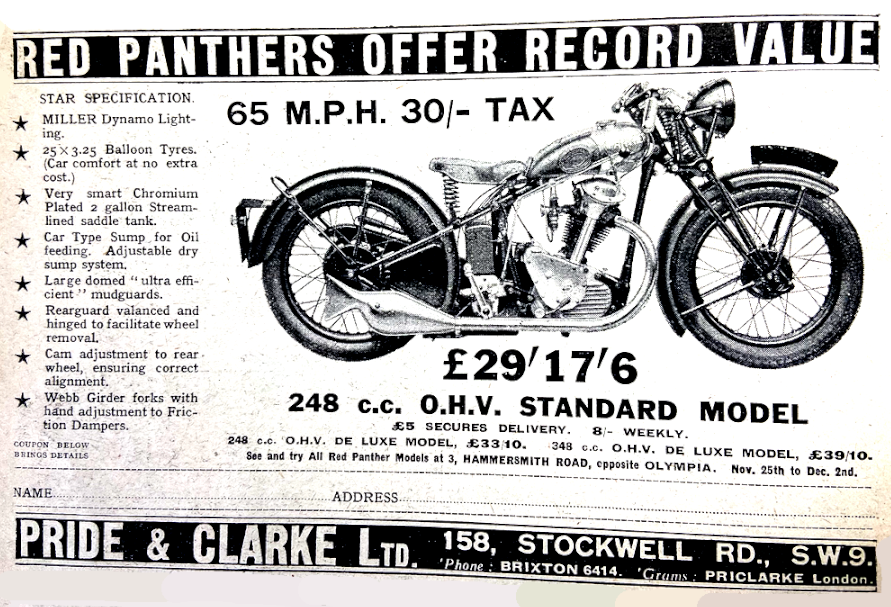
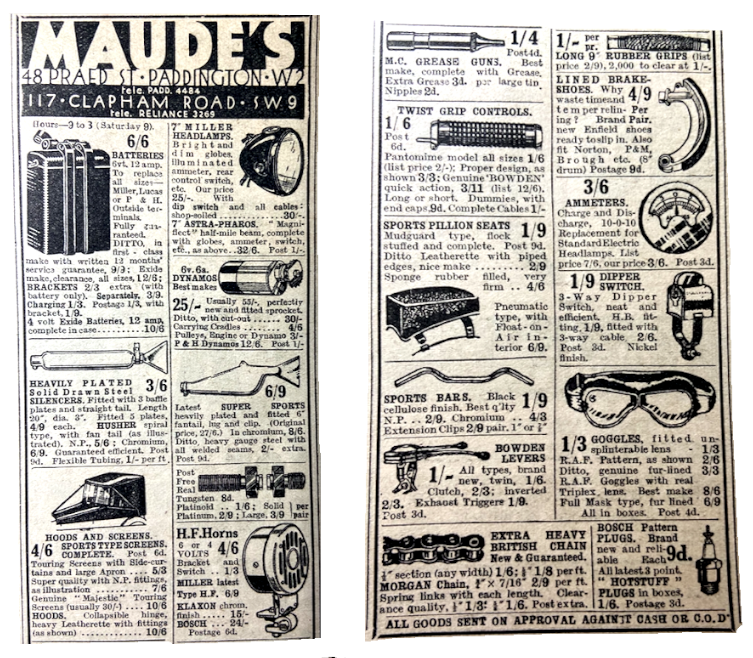
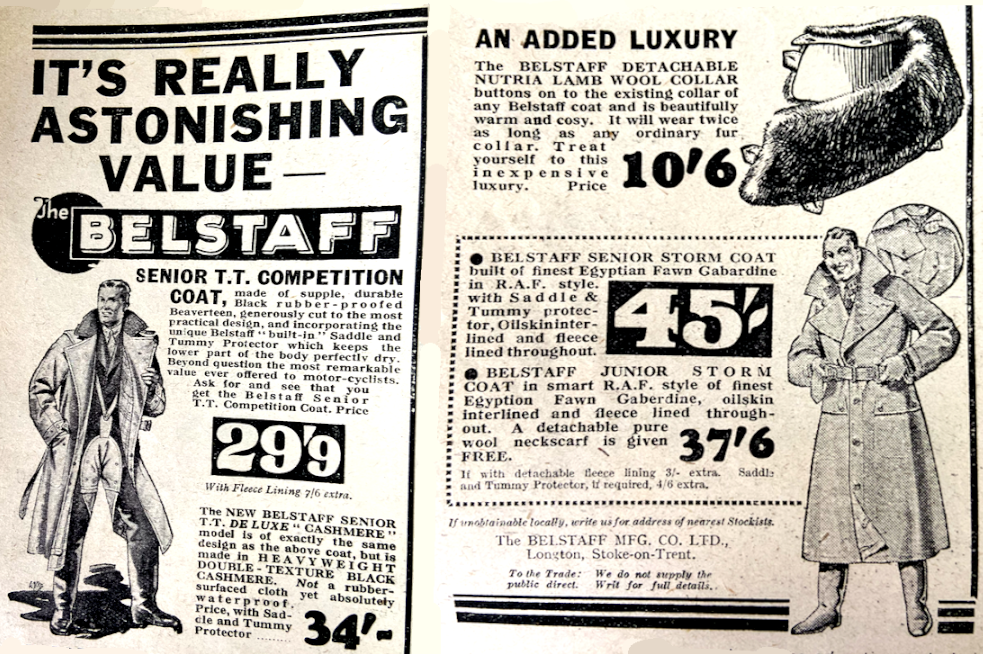
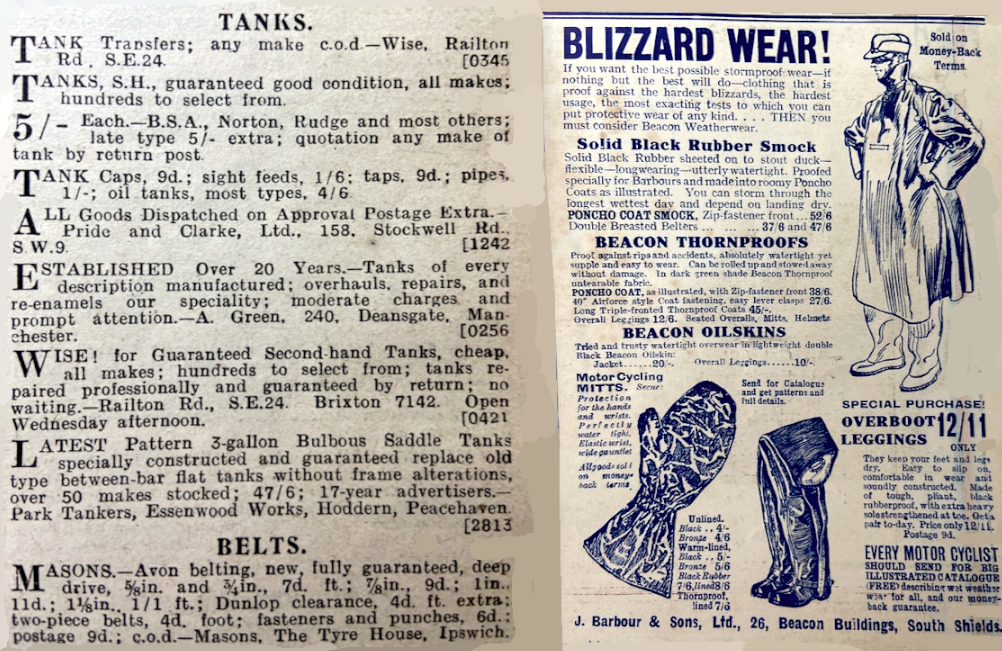
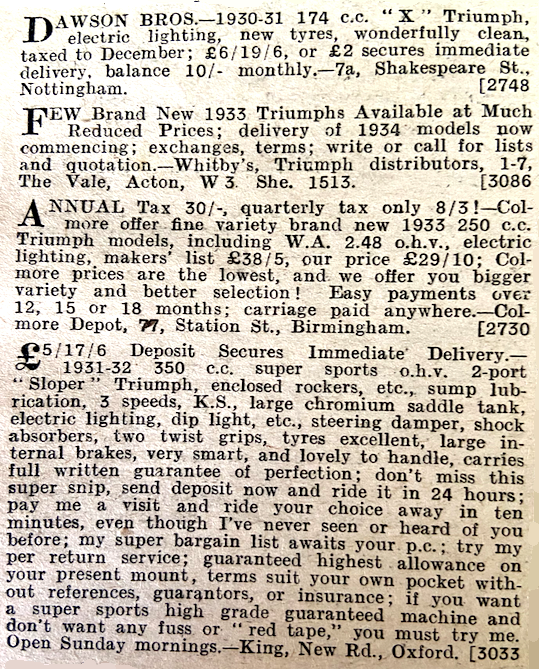
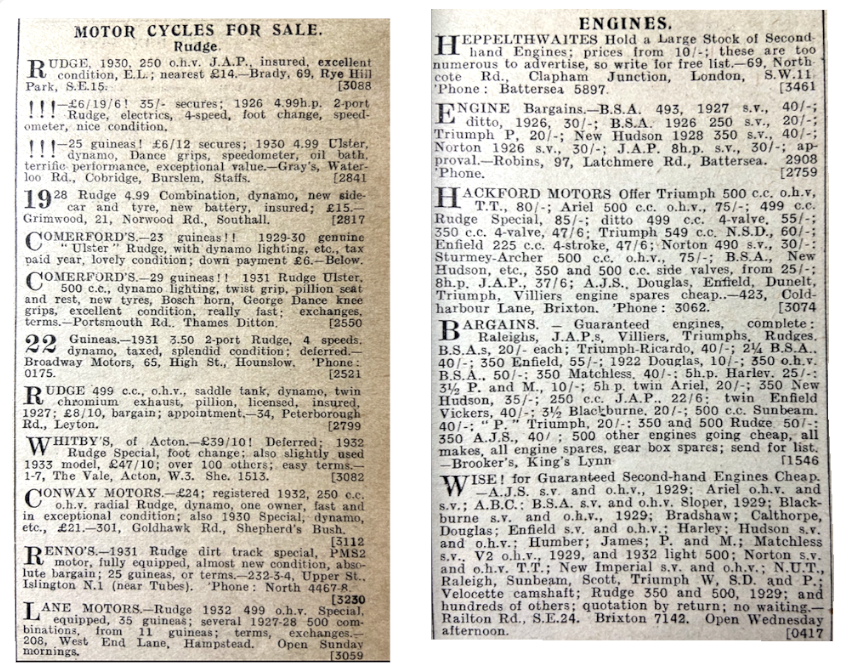
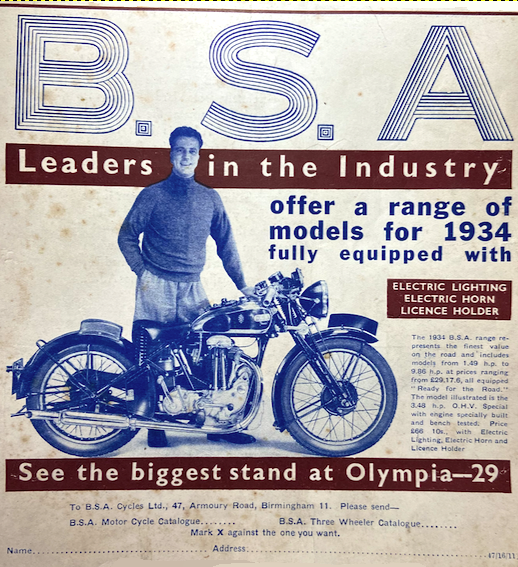

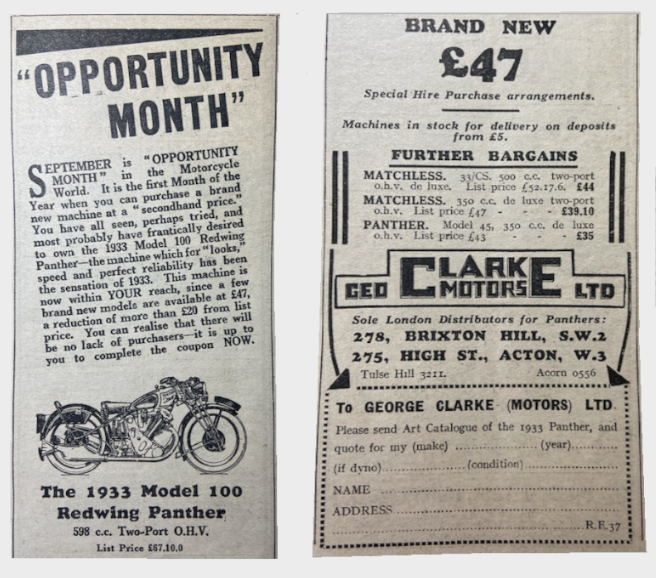
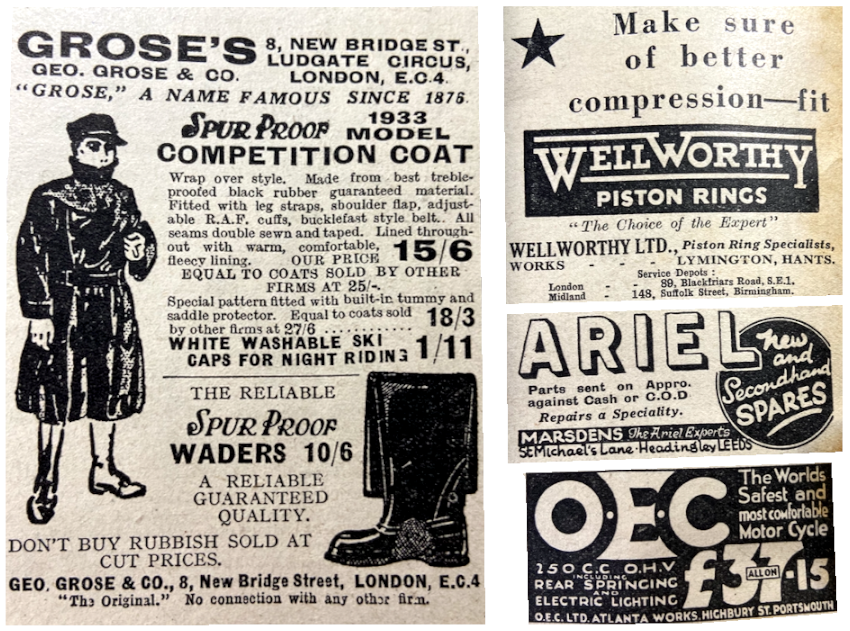
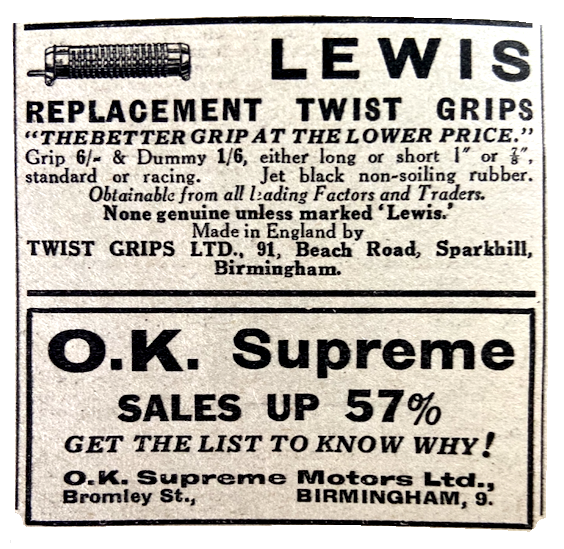
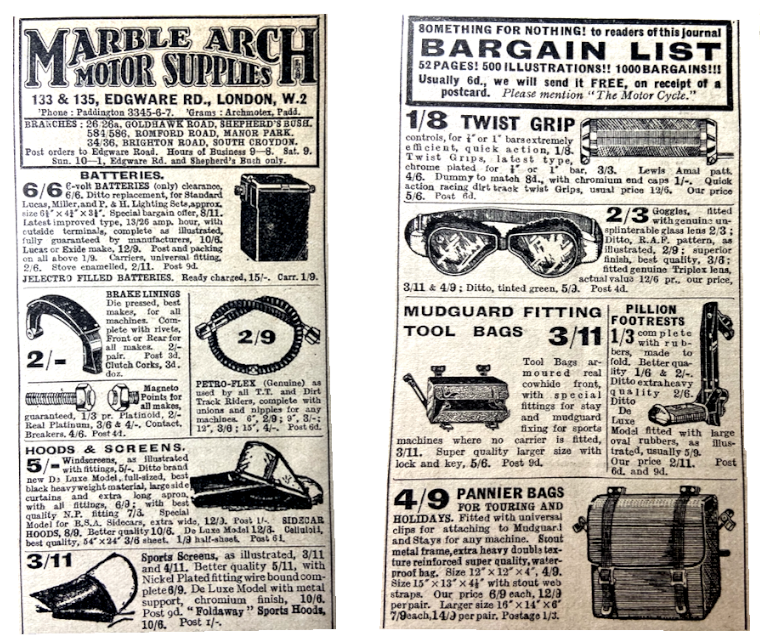
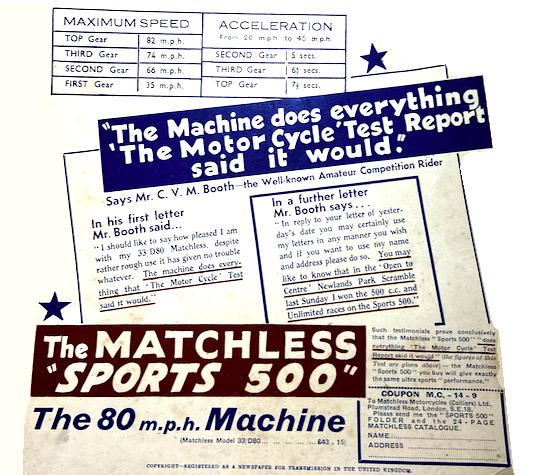
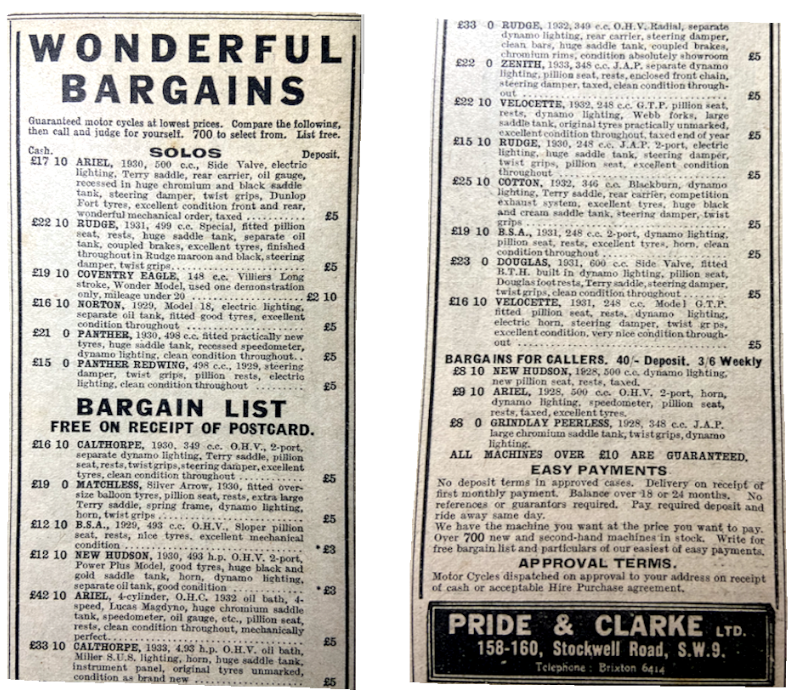
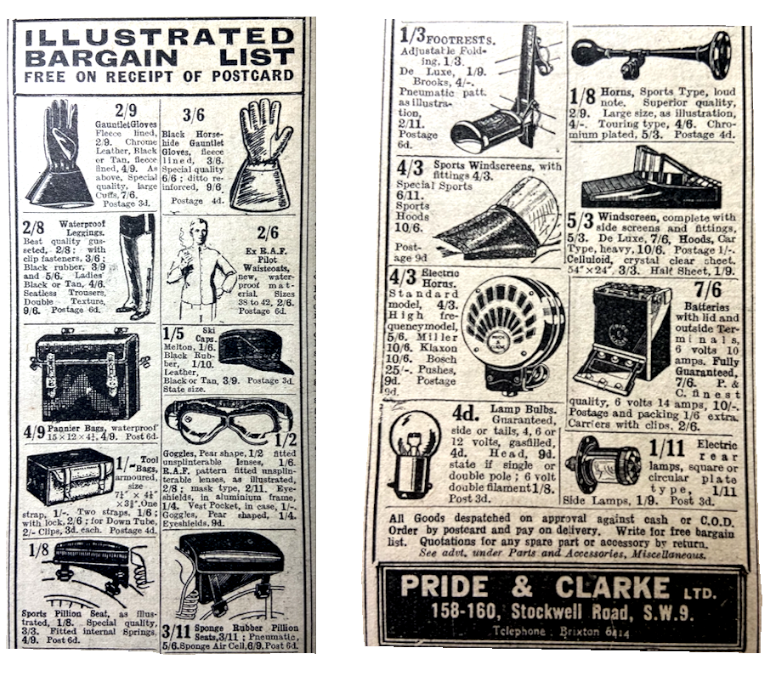
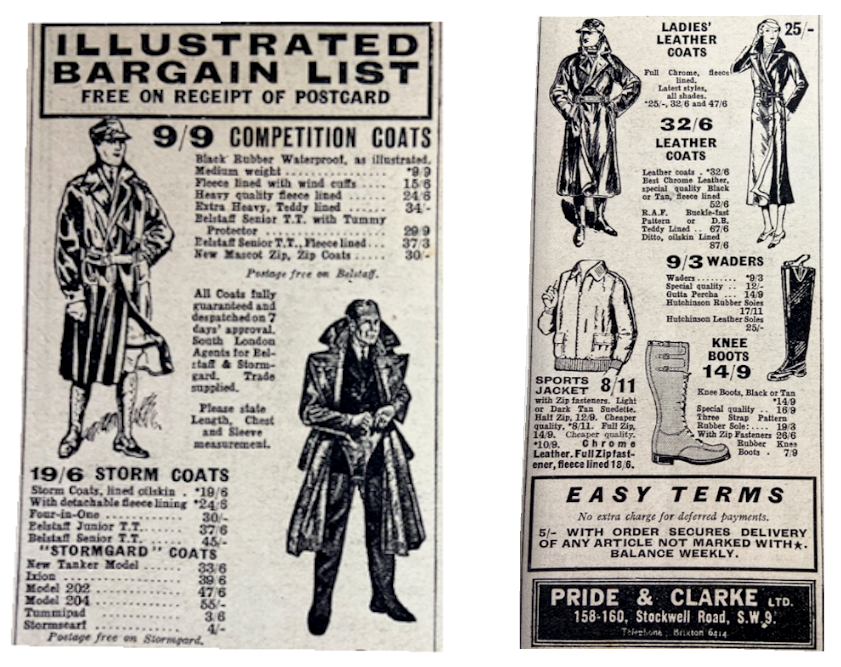
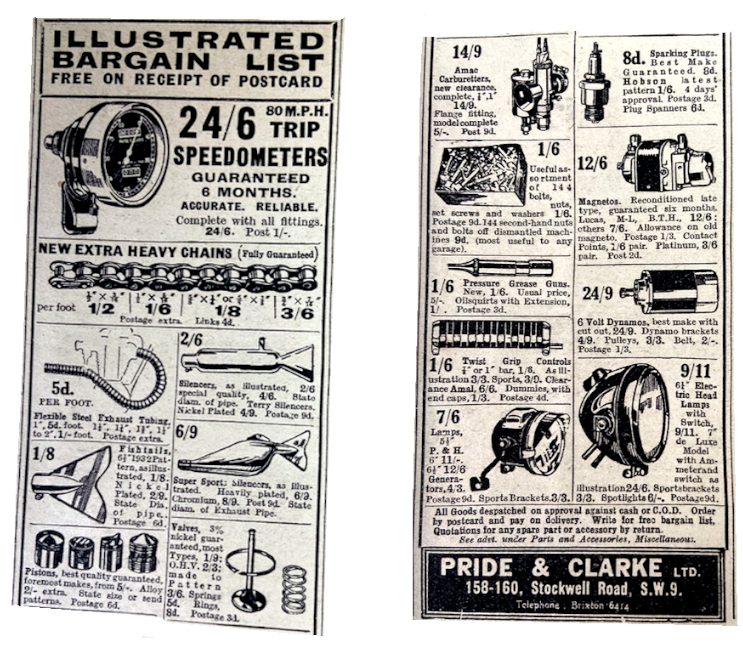
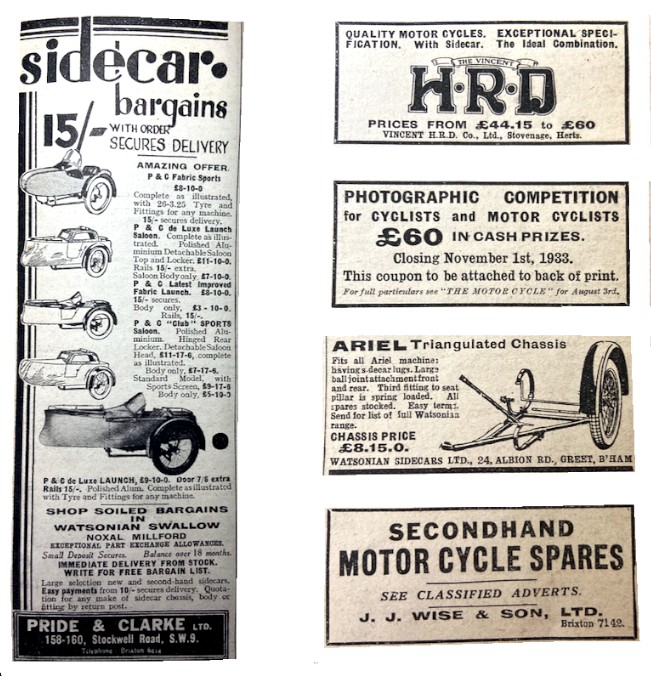

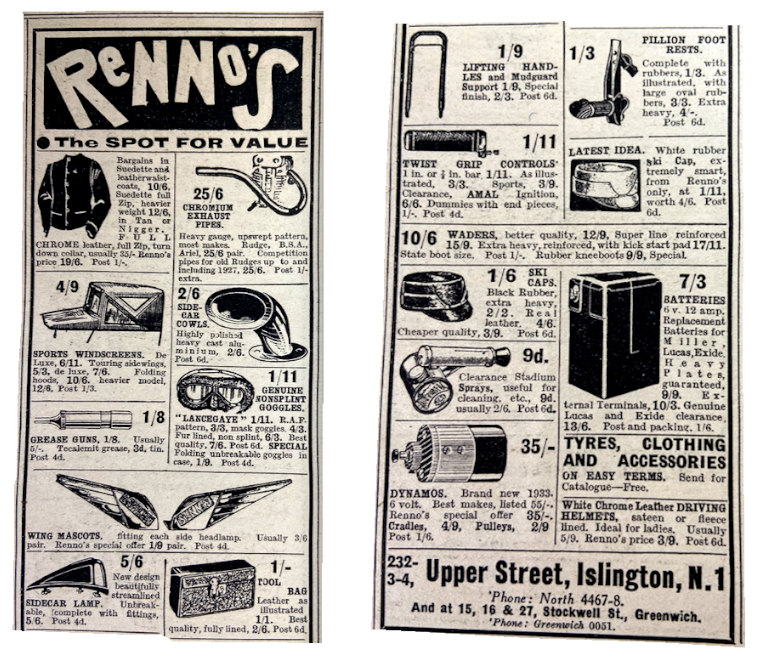
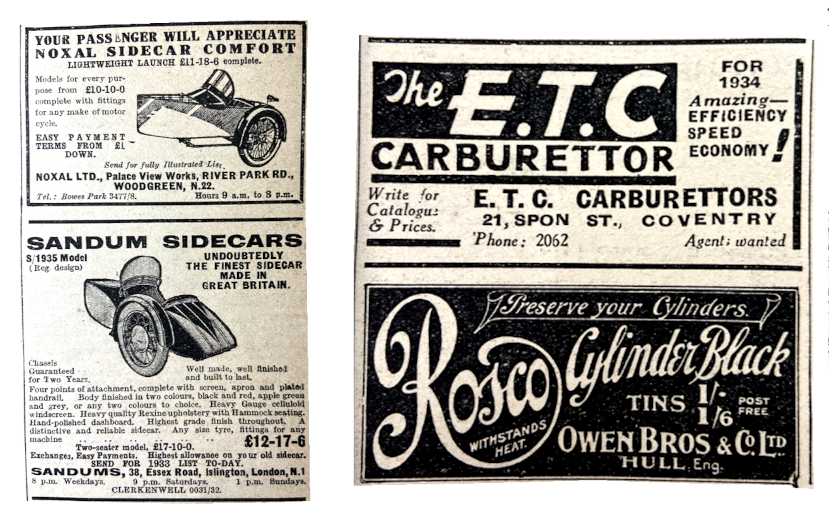
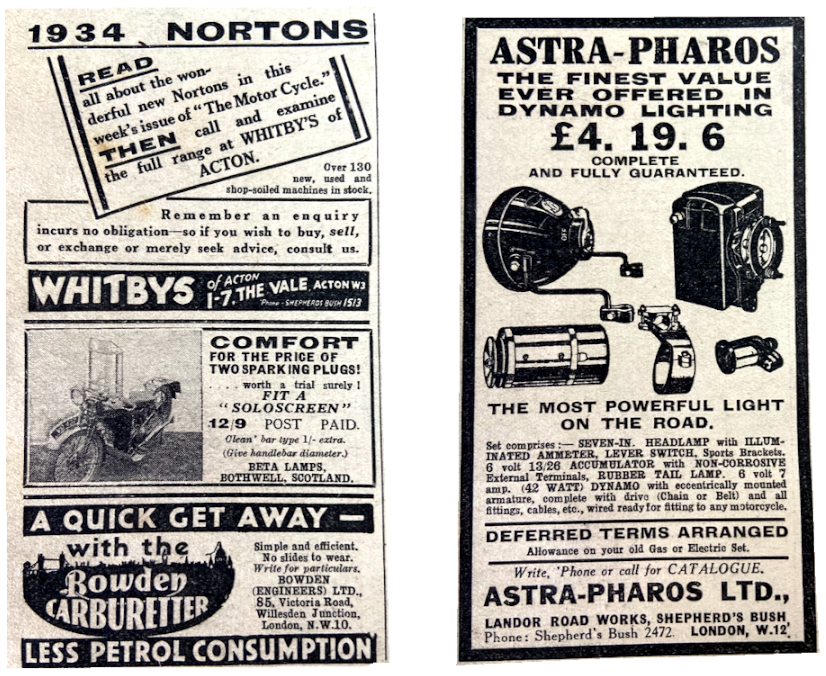
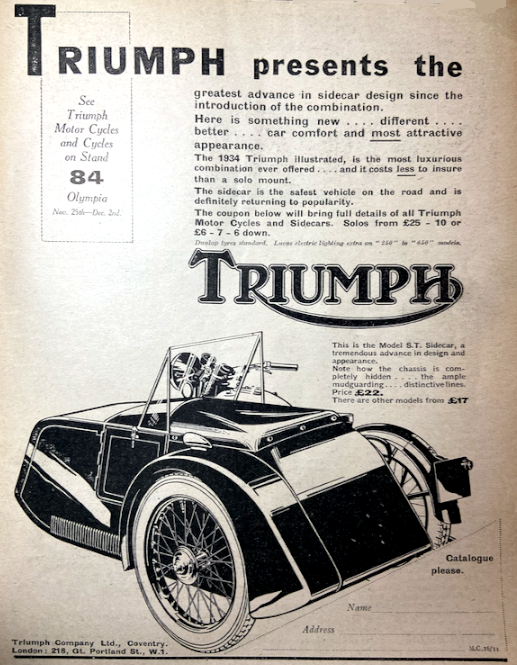
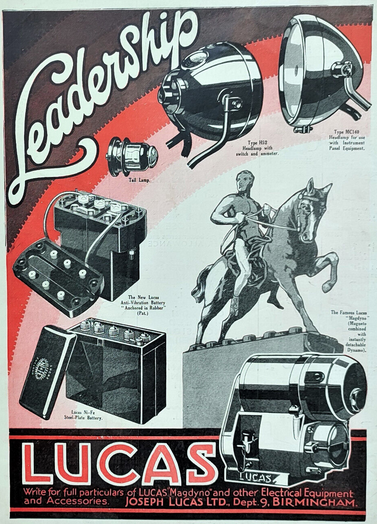
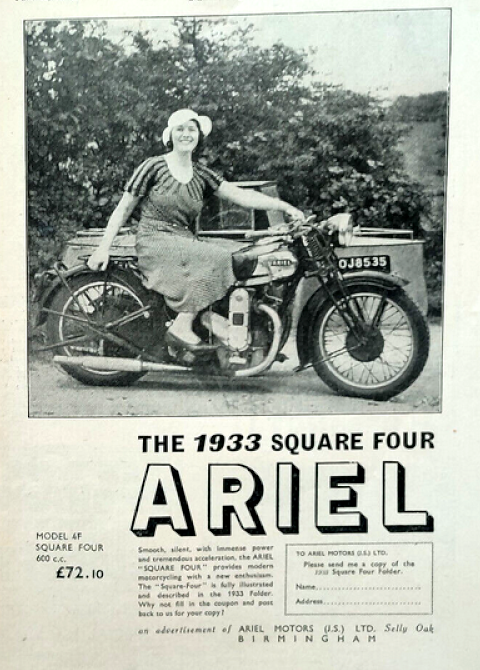
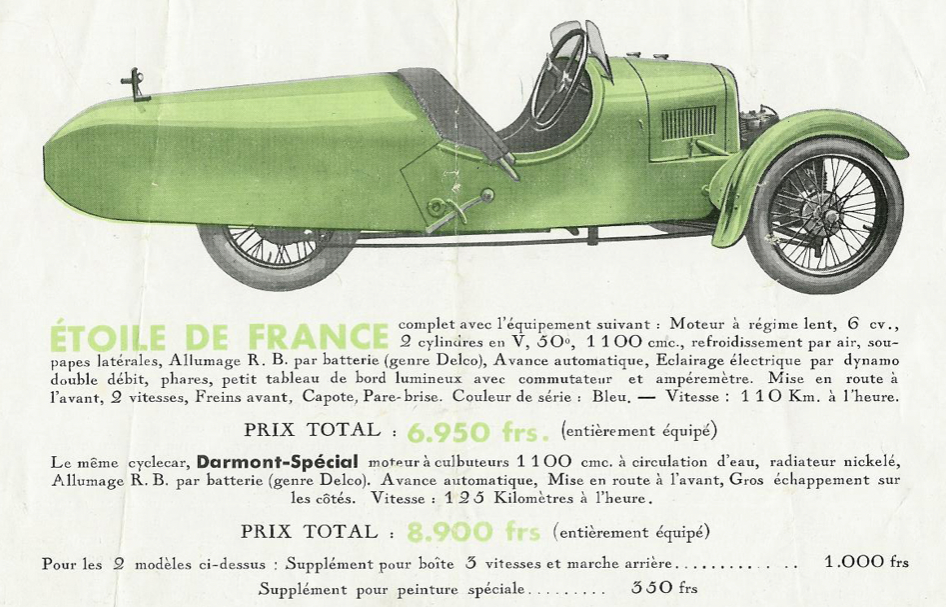
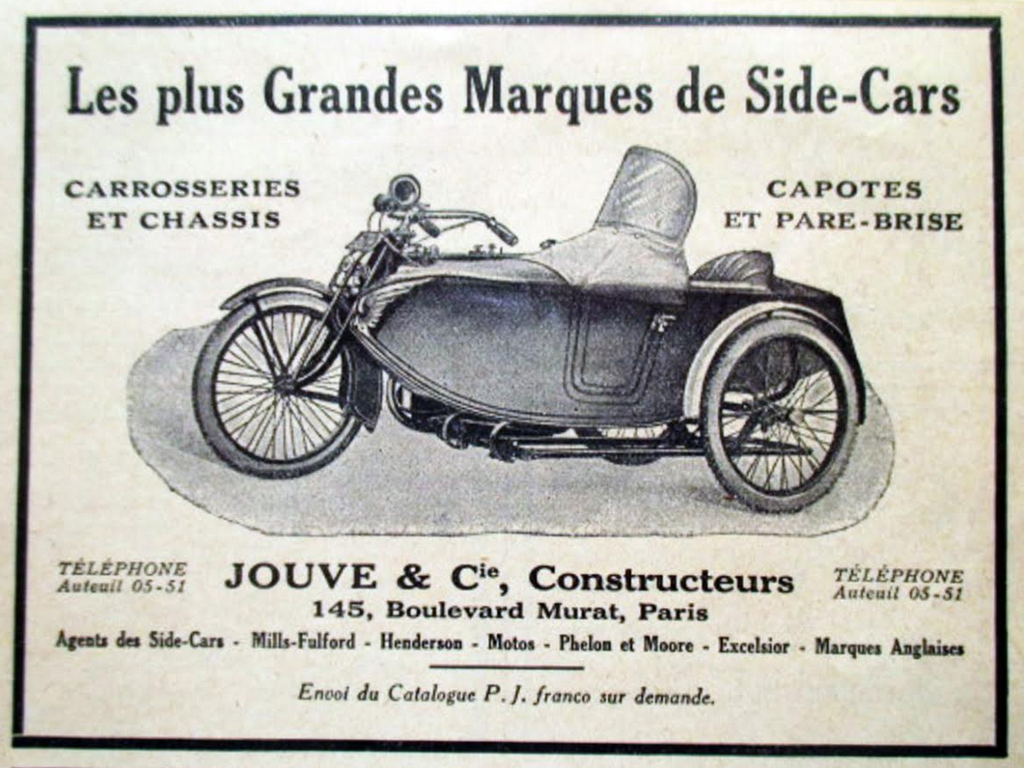
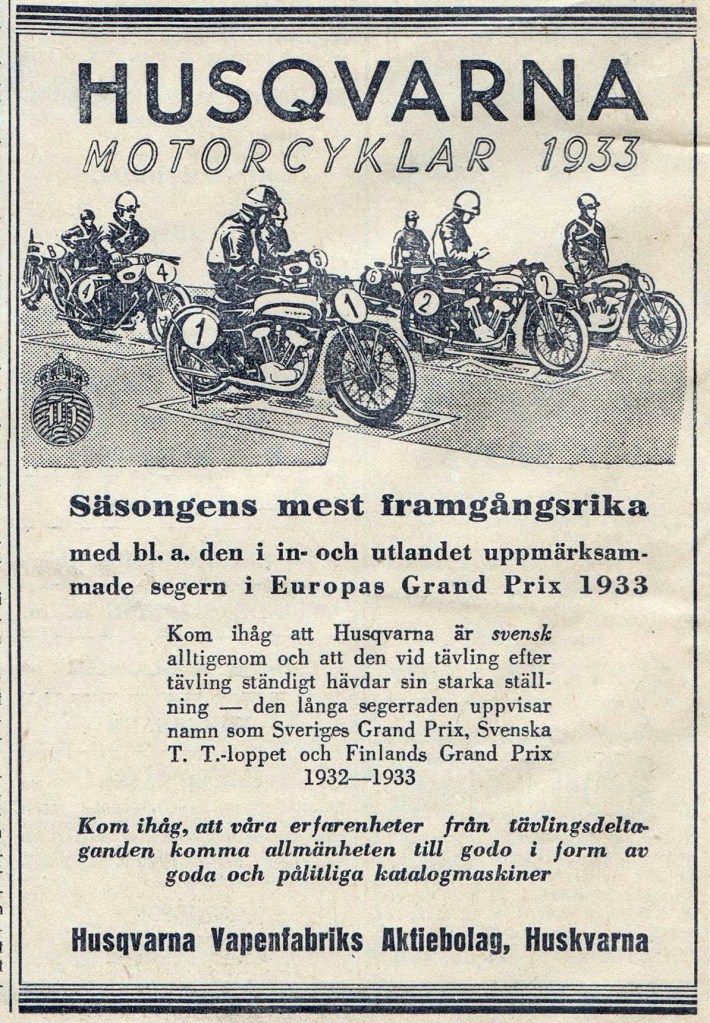
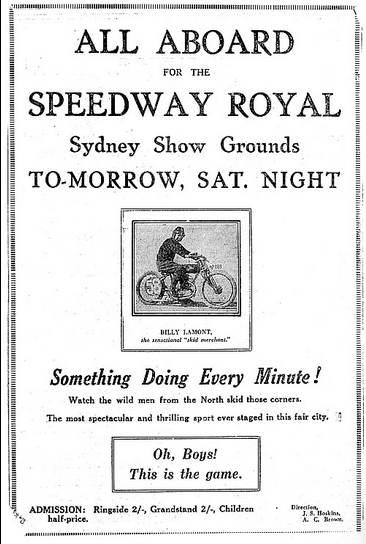
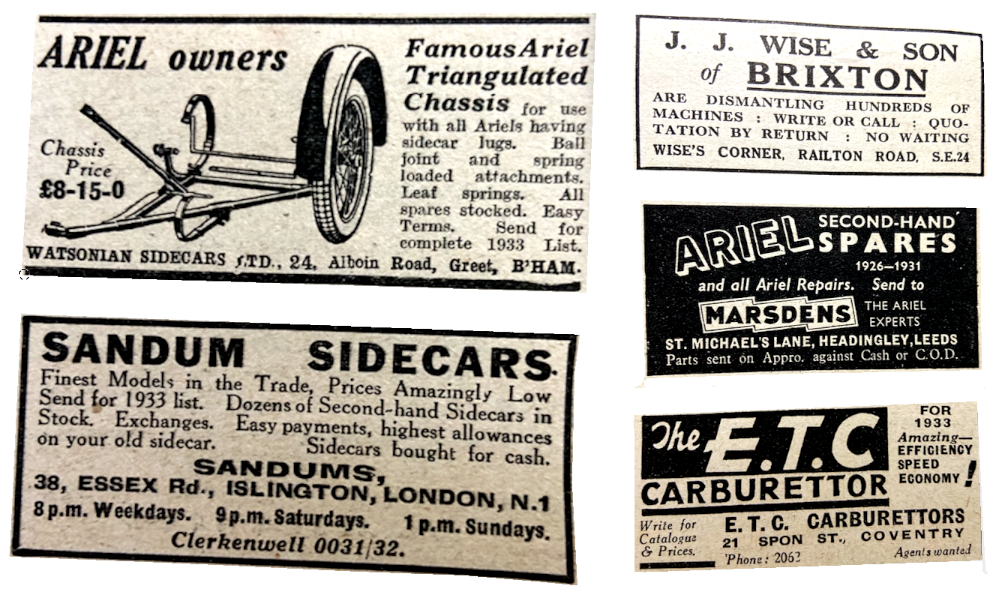

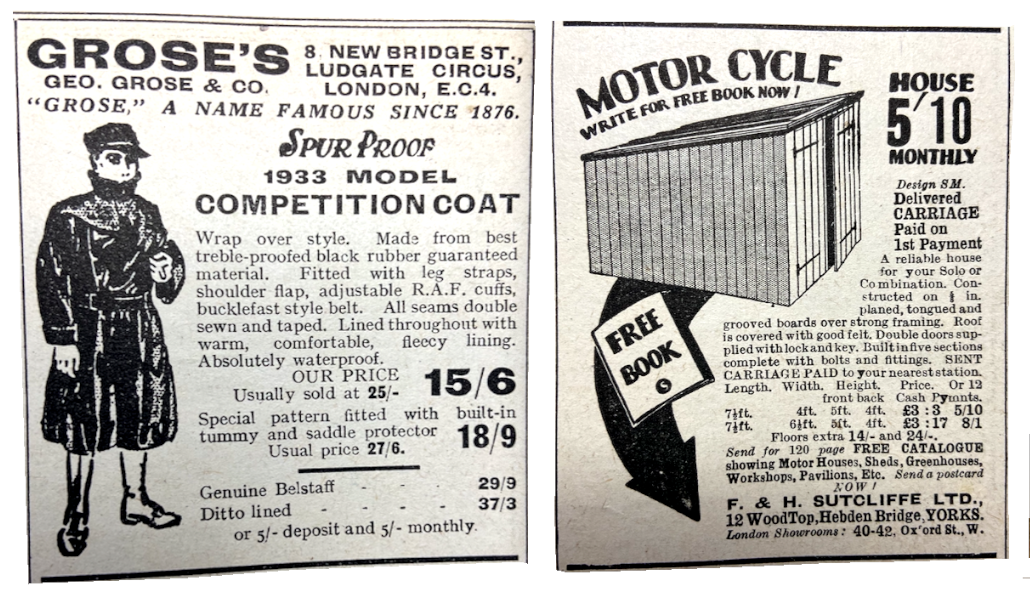
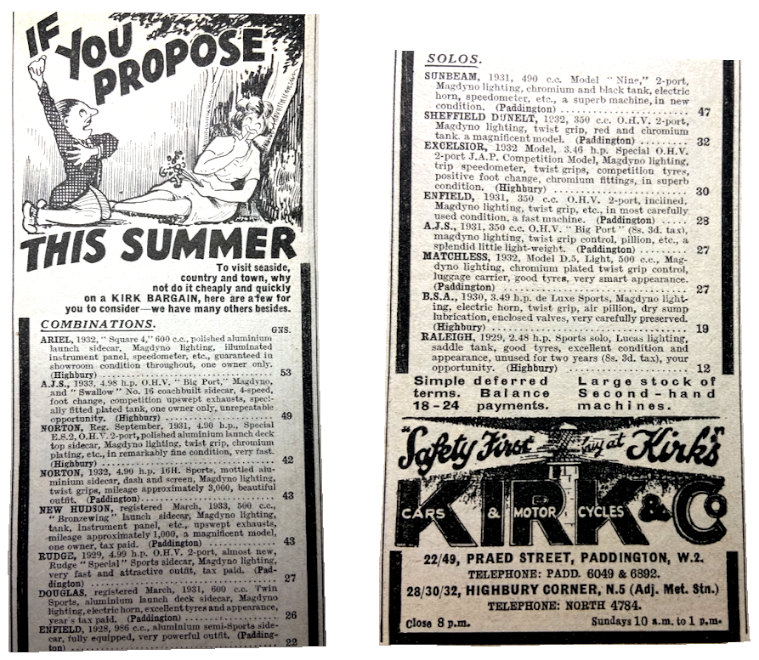
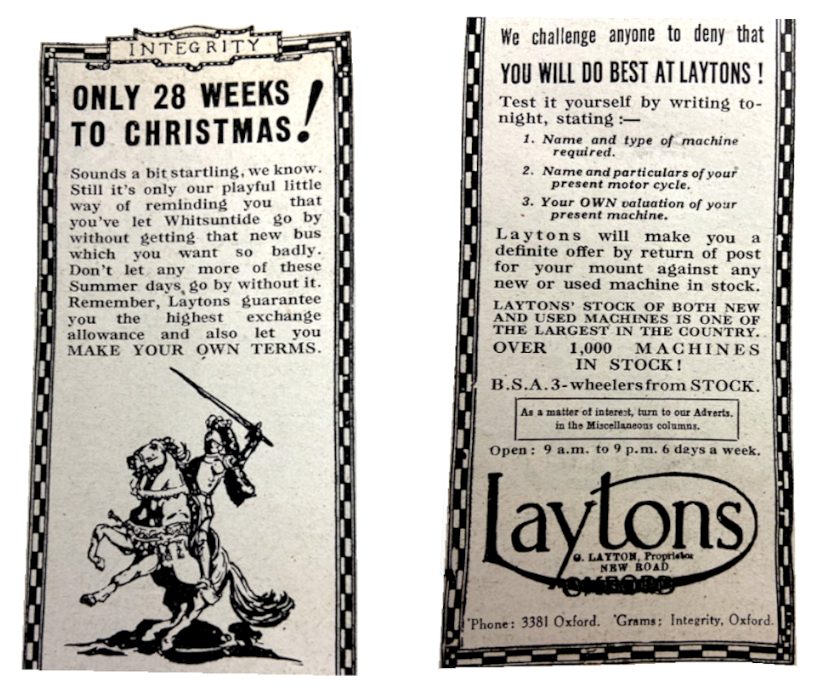
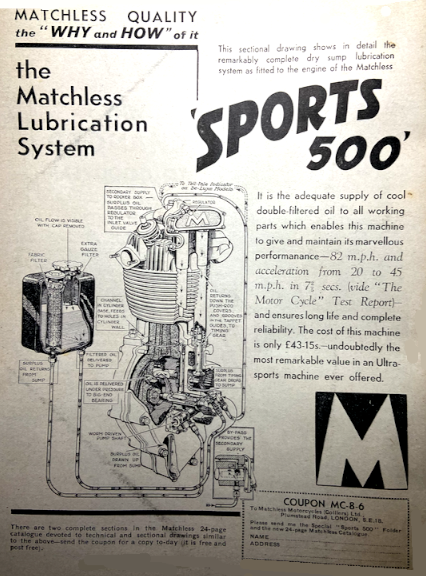
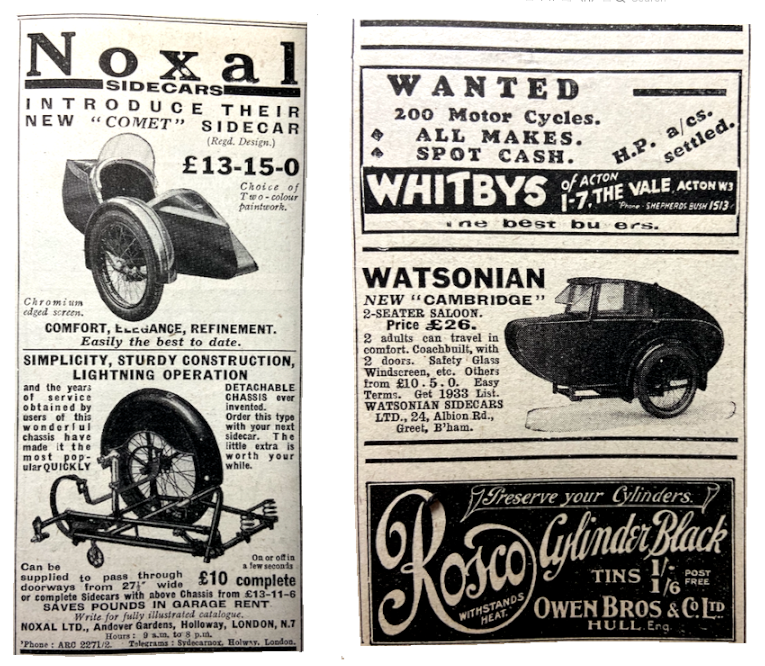
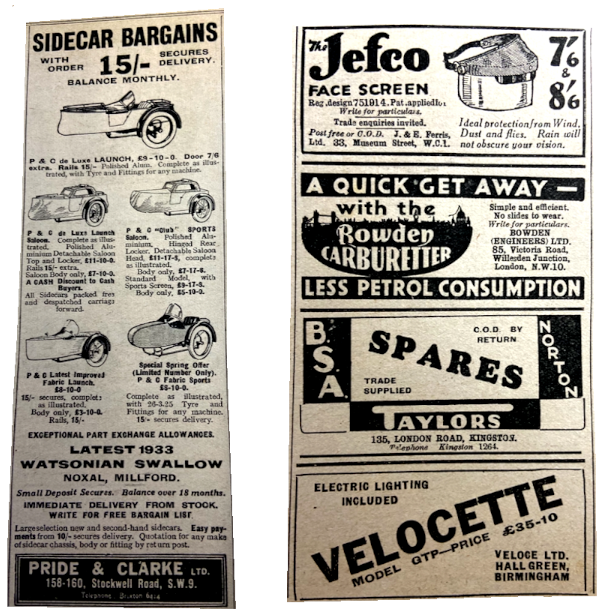
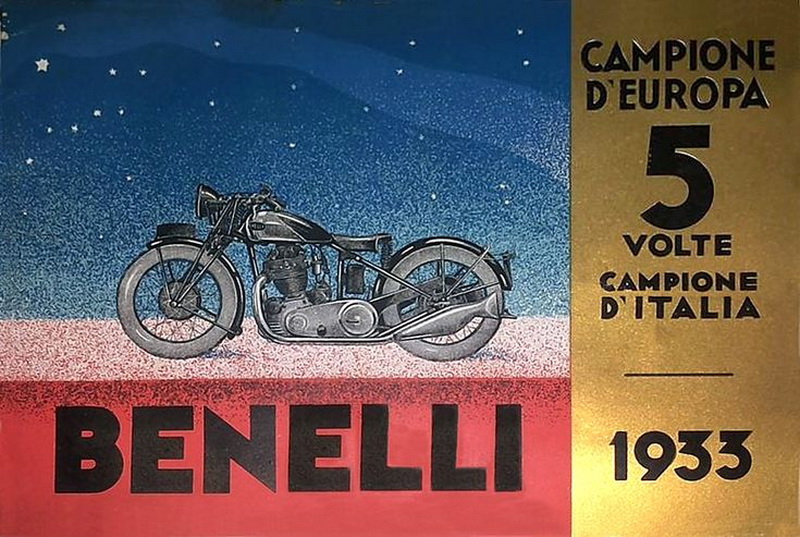
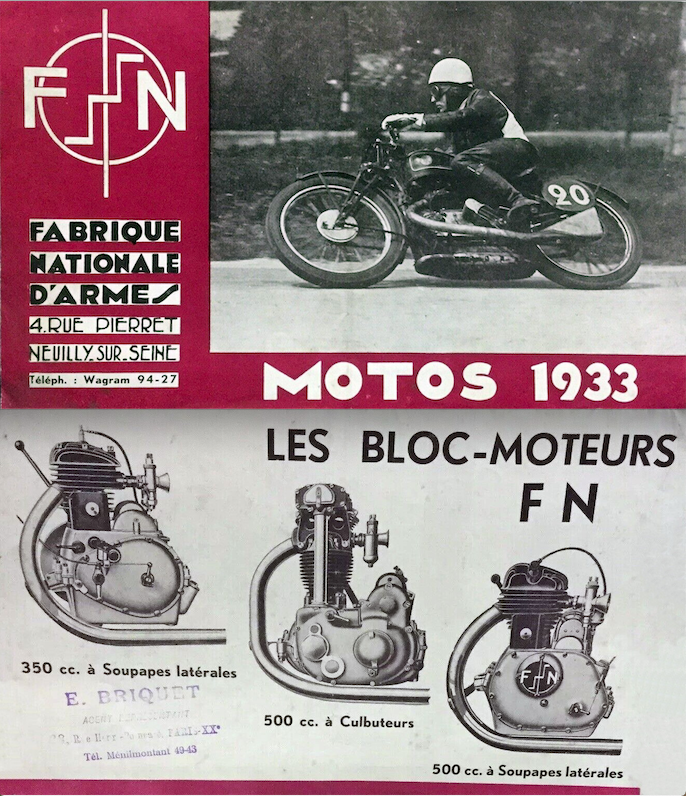
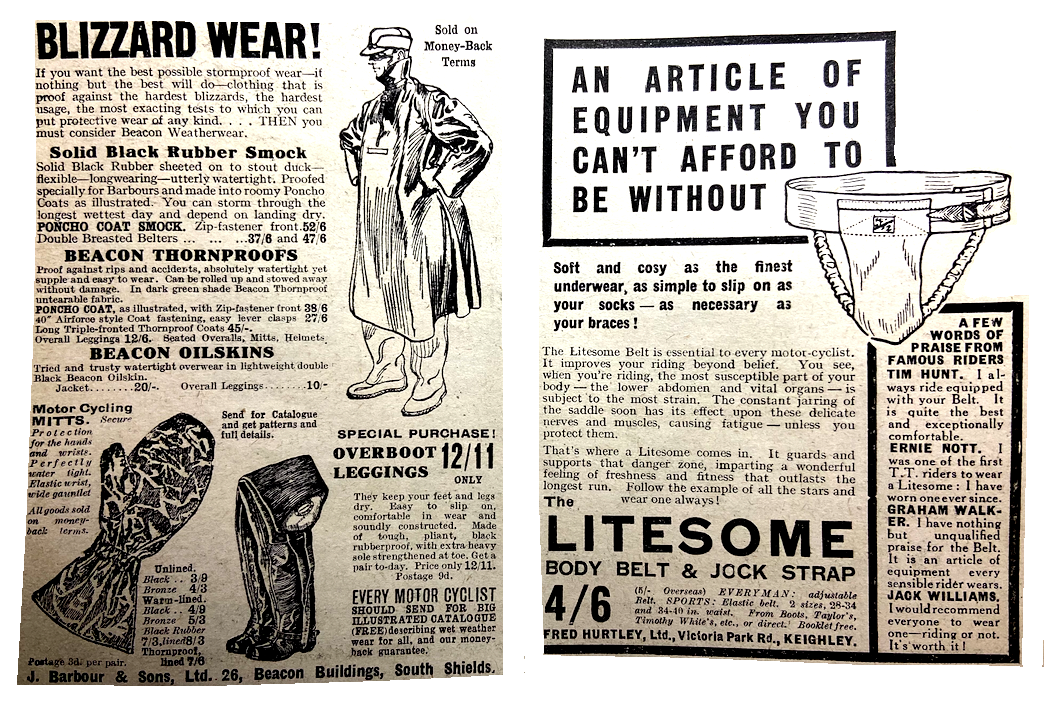
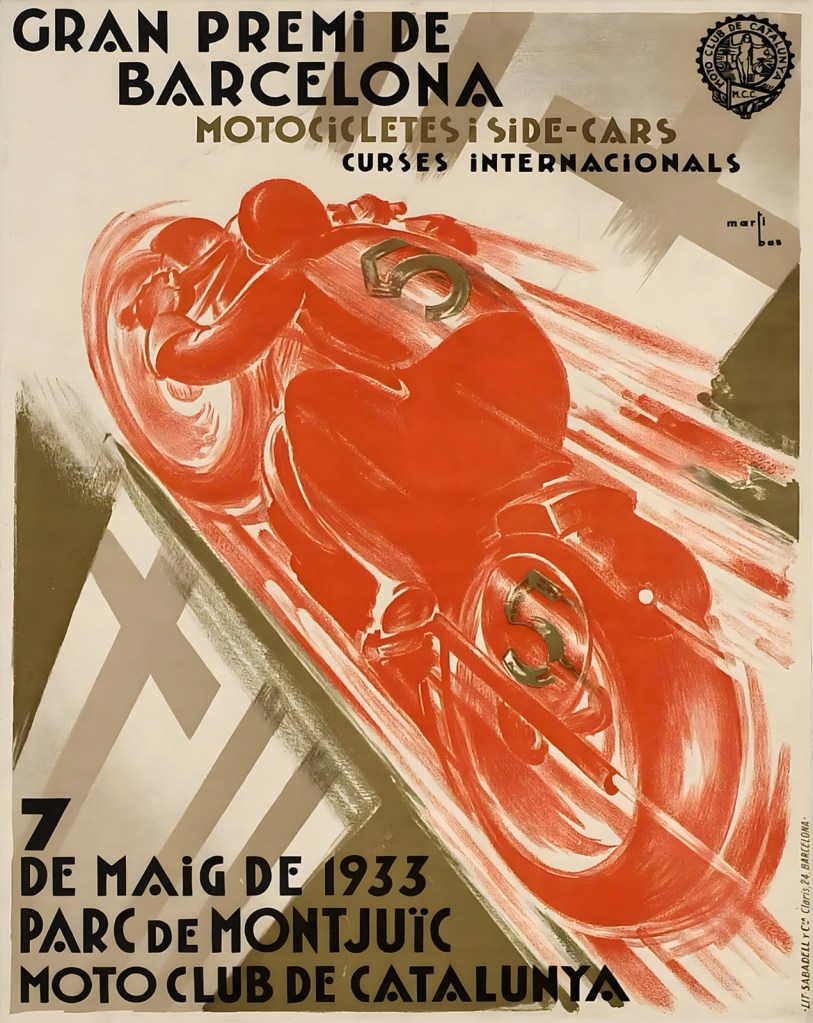
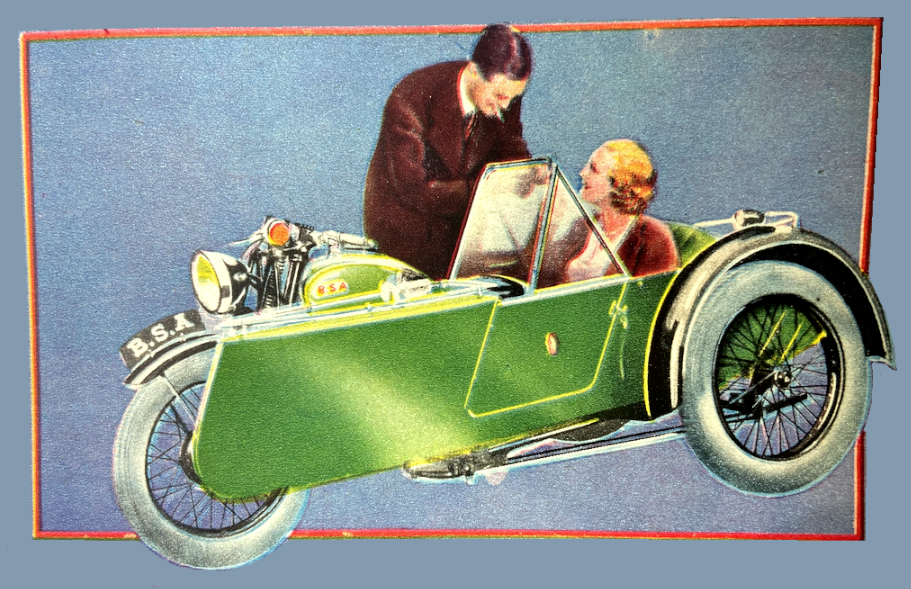
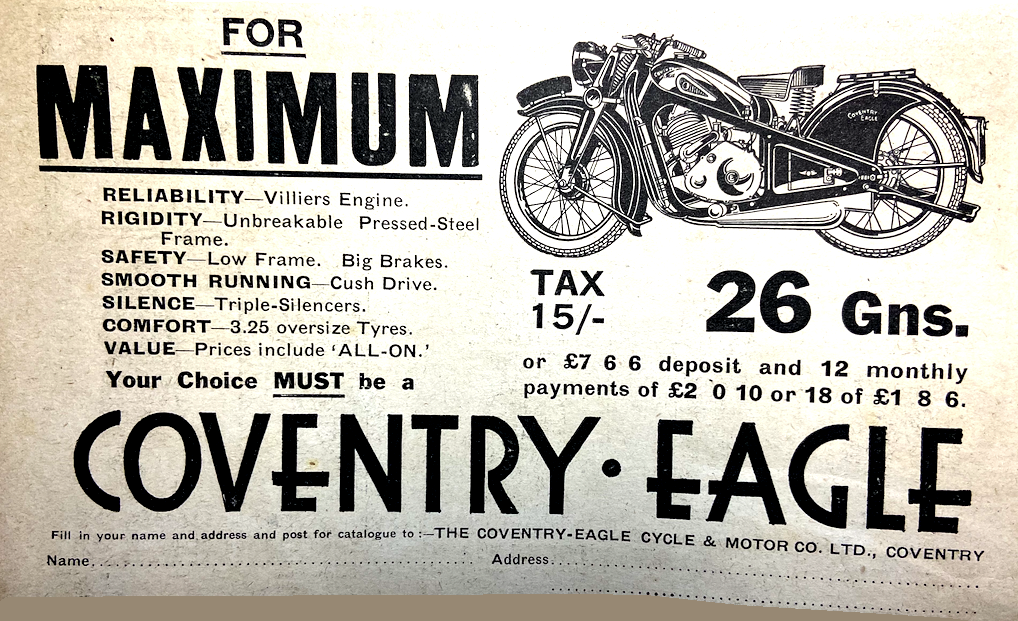

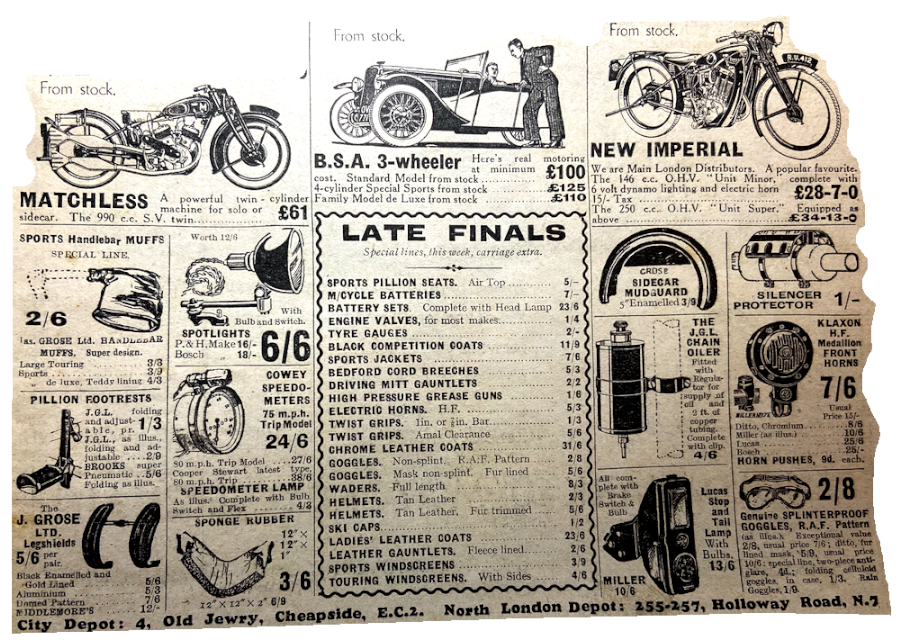

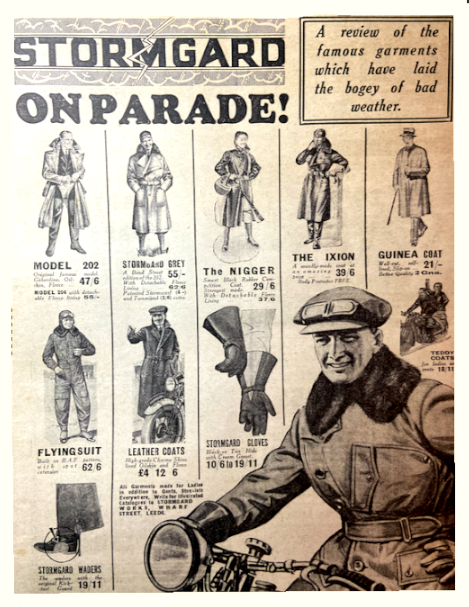
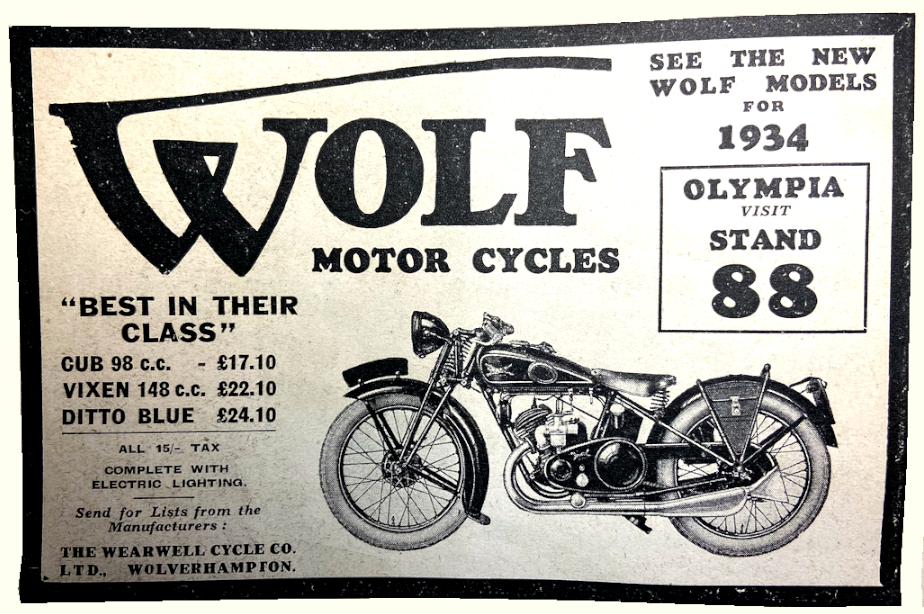
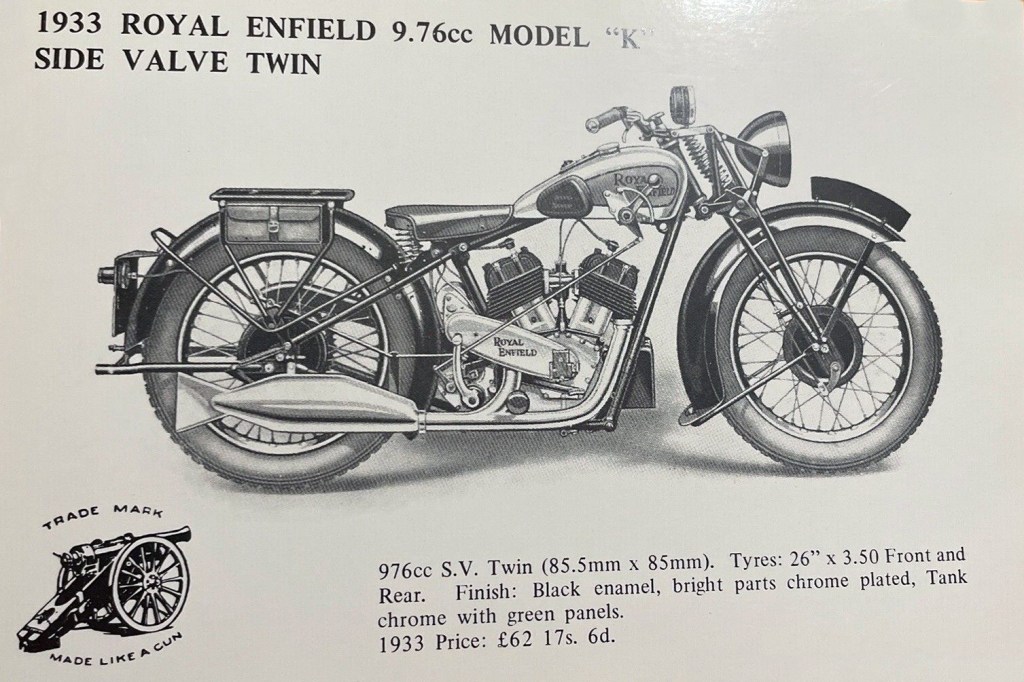
 Motorcycle Timeline