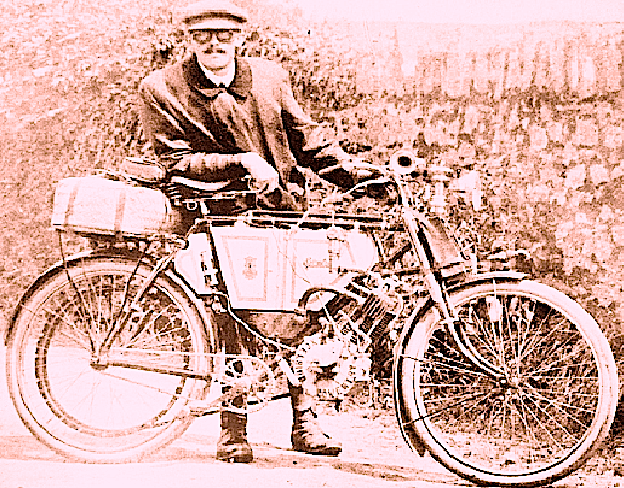
“THAT THE SUBJECT of handle-bar control has not received the full attention it deserves from the makers of motorcycles there is, of course, no denying. Matters have advanced very little in this direction, if at all, since motorcycles became popular. The majority of machines are still fitted with control levers mounted along the top of the tank, necessitating the removal of one hand from the steering bar to actuate them. At the period when the surface carburetter held the field the construction of the mixture tap and throttle was such as to prove a serious obstacle to a satisfactory handle-bar arrangement; but, now that this type is practically obsolete, things are very much simplified. The amount of attention that is being paid towards solving the problem of an automatic spray carburetter will directly help in the direction of obtaining handle-bar control. The air regulator will be thereby rendered unnecessary, and there only remains the throttle as indispensable between carburetter and engine. Now, we must retain the spark advancer and exhaust lift, and then we must have the indispensable front brake. At the very least, we have got to provide four adjustments on the handle-bar. These must be close up to the grips, so that they can be manipulated without having to alter the position of the hands. The Bowden cable principle has so far offered itself as the simplest way of effecting handle-bar control, but a little experimenting would suggest other and possibly better methods. I see no reason why the spark advance and throttle levers could not be arranged on the left-hand side of the handle-bar, and the movements conveyed to the engine and carburetter by jointed rods with a ball and socket joint to compensate for the steering movement. I consider that one brake lever on the handle-bar is enough, and that the other brake should invariably be foot operated, preferably by back-pedalling.”
“THE RECENT REMARK of a County Court judge to the effect that motorcars have not as much right on the public highways as other vehicles illustrates the peculiar manner in which the legal mind so frequently approaches the consideration of public questions. It is an example of the intense conservatism of the law, which, even in spite of the more progressive minority in the profession, renders progress so slow.”
“MESSRS. HERWIN, CANNY AND CO, 158, Sandy Hill Road, Plumstead, London, SE, have placed on the market an excellent little stand for motorcycles, and this combines the following features: Instantaneous and automatic in action, a stand and rest combined, very light weight, rigid and neat, very quickly attached to any machine. The price is very reasonable, viz, 9s 6d.”

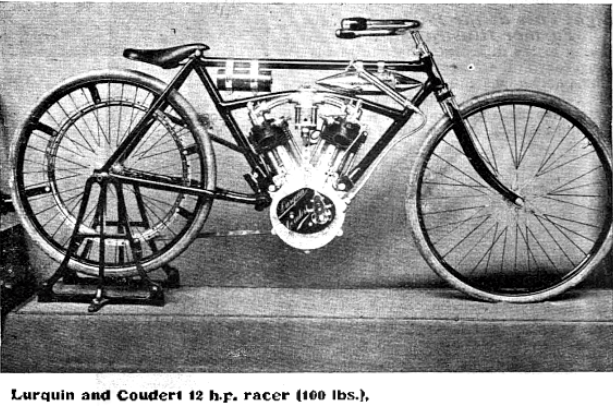
“THE MOTORCYCLES SHOWN are not numerous. A series of Werner machines, one having spring forks, is shown by H Martin, and on the stand of JJ Leonard is to be seen a Lurquin and Coudert racer, with twin-cylinder engine. The Rex Co show two of their latest models, including the very popular Rexette, the features of which are well known. One of the machines is shown equipped with a ‘Jack-no-skid’, a very efficient device attached to the rear frame. Pumphrey and Co, Furzedown Parade, Streatham, show a type of machine of distinctly unconventional design. The frame is built high, and, strictly speaking, consists of a duplex or two frames, joining the head by a series of forks. The tanks, which are of unusually capacious dimensions, are built in between, the two frames. The saddle is carried at the end of a long laminated leaf spring, instead of on the usual seat pillar. The engine is a 3½-4hp air cooled by fan. A pedal-operated free engine clutch and. hand starter is provided. The drive is by V-belt. No pedalling gear is fitted. Douglas Cox, West Norwood, displays a handsomely-finished Raleighette, a Rover motor-bicycle, and also specimens of Griffon and Roc machines. A well-finished mount named the Emerald, shown here, has a flat belt, but a V-belt can be fitted if wished. The engine is a 4hp Antoine. The Griffon machine has spring forks. A machine named the Bi-car, shown by Bitton and Harley, 1, Caister Road, Yarmouth, is claimed to have all the comforts of a car. It has bucket seat, footboards, free engine, and hand starting The chief feature is that the frame resembles a car chassis and there are no front forks. The transmission is by V- belt.”

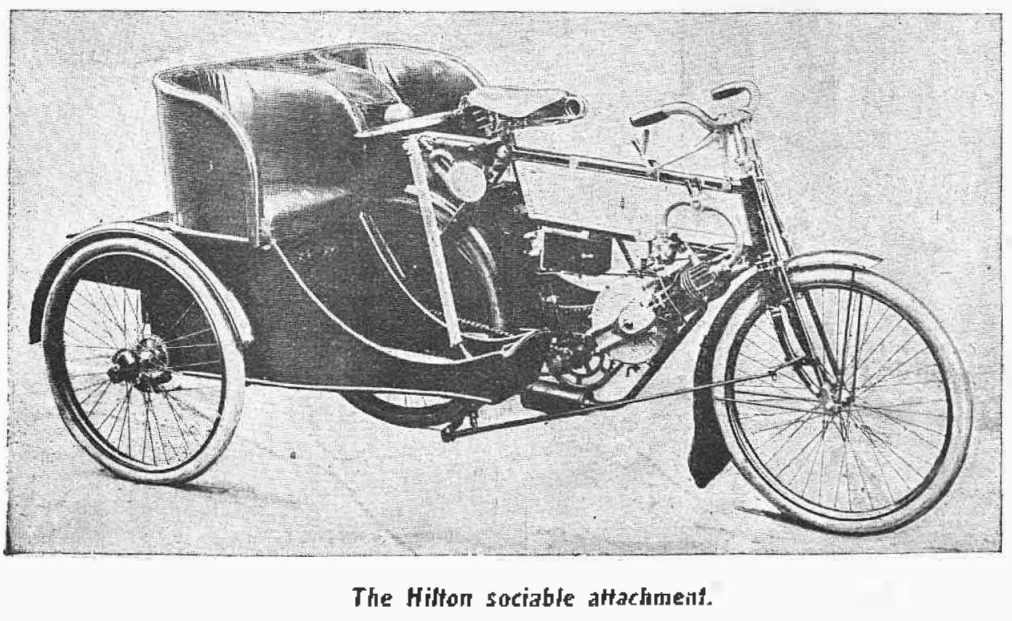
A sociable attachment has been brought out by Mr Geo T Hilton, 4, North Street, Rugby, the inventor of the Main-Hilton combination stand and carrier. This rear-carriage is a two-seated vehicle, having a space between the two seats to allow the back wheel of the motor-bicycle to pass. The frame of the rear-car is fixed to the axle of the back wheel of cycle by two nuts with collars, and is also securely bolted to a lug on the seat pillar of the bicycle. By this means the back wheel of the cycle is raised from the ground any height required, making the combination a three-wheel car. The steering gear is fixed to the front forks of the cycle by one bolt. It is driven by a chain running from a sprocket at the back of freewheel of the bicycle to a two-speed gear contained in the axle of the rear-car. It is easily attached or detached in 10 minutes, the bicycle being ready for use immediately the carriage is detached. A 2¾hp Humber cycle has been found powerful enough to take the attachment anywhere with two up. The weight of the motorcycle and attachment need not exceed 2¼cwt. The initial cost of running and up-keep of the rear-car are claimed to be very considerably less than those of a light car. It also has the advantage of being very speedy and absolutely safe. The seats and boot are isolated from the frame by a good system of springs.”
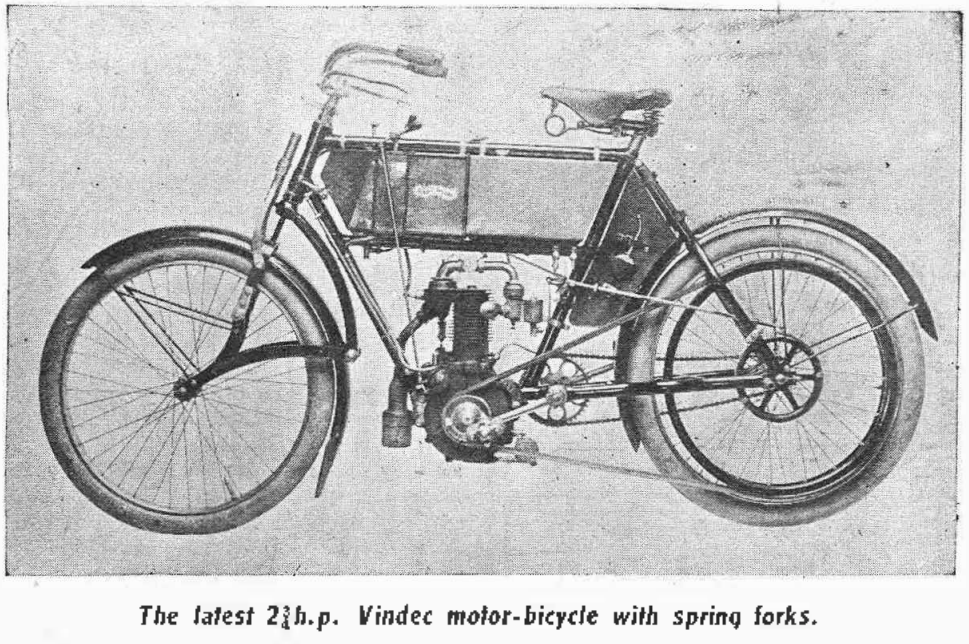
“THE VINDEC MOTOR-BICYCLE can now be supplied fitted with the Truffault spring suspension forks. The construction of this device, which is favourably spoken of as a vibration absorber, is clearly shown in the illustration.”
“WHEN THE RECENT doings by automobiles on the Florida beach in front of Ormond and Daytona are reviewed in their totality, the wonderful development in speed of the motor vehicle is revealed. A comparison of ‘best on records’ made by man, horse, and machine presents this interesting table: Electric car, 130.4mph; Locomotive, 120.0mph; Motorcar, 109.7mph; Motorcycle, 69.2mph; Bicycle, 62.0mph; Steam yacht, 45.0mph; Running horse, 37.4mph; Motor boat, 27.8mph; Skating, 22.2mph.”
“THE APPLICATION OF electric lighting to cars and cycles has not, up to the present, made much progress, and the oil and acetylene lamp practically hold the field. That electric lighting is the ideal if it can only be conveniently applied is generally admitted, but the one great disadvantage has always been that to get even a moderate light for any length of time necessitated the use of an altogether prohibitive weight of storage batteries or accumulators…We should say that these disadvantages are things of the past entirely, judging from a new electric lamp that was shown us by Mr Peto the other day. The new lamp is the invention of Dr Auer, the well-known German physicist, known all over the world as the inventor of the incandescent gas mantle which revolutionised gas lighting…Mr Peto brought one of the new lamps, of 4 volts…and connected it up to a very small accumulator, such as could easily be carried in the pocket. The result was astonishing…the new Auer lamp glowed out with dazzling brilliance…The whole secret lies in the filament. Instead of using a carbon wire, Dr. Auer makes his filament from certain elements, chief amongst which are the rare earths oxides of Ceria and Thorim. Exactly the same materials, in fact, as are used in the incandescent gas mantle. It is these oxides that give out the brilliant glow…It is not difficult to’ predict that now it is possible to obtain a brilliant light with the expenditure of a very small amount of electrical energy, that electric headlights will become a standard feature…”
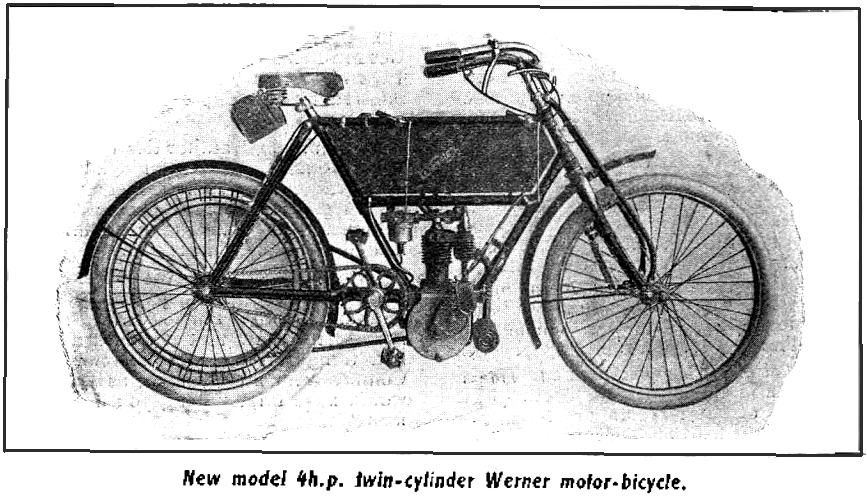
“A NEW MODEL 4hp TWIN-CYLINDER WERNER MOTOR-BICYCLE. Messrs Werner Motors, of 45, Dean’ Street, Shaftesbury Avenue, London, have just introduced a new model 4hp machine at £47, which price is only £2 more than is asked for the 3¼hp model. It has been specially designed as a. hill climber. The cylinders are placed side by side, and have a bore and stroke of 60x76mm [430cc]. It is claimed to be only a few pounds heavier than the 3¼hp. model. Special attention has been paid to the carburetter, which is provided with an automatic air inlet. The transmission is by V-belt, and the well-known inlet valve depressor for releasing the compression is fitted. The Werner spring forks, which are both efficient and neat in design, can also be had fitted to this machine. The ignition is by coil and accumulators.”
“TUBE IGNITION IS NOT used now. In principle it consists of a platinum tube of small diameter projecting from the combustion chamber of the engine: the outside end is closed up and kept at a bright red heat by means of a bunsen flame playing on it: the charges of gas are forced into this tube with the compression stroke and coming in contact with the red hot portion are ignited. Not an easy matter to advance or retard the ignition with this arrangement…”
“ONLY THE ONE leading Club recognised as the ruling body of the sport by the Automobile Clubs of the country being admitted to the Federation, the Motor Cycle Union of Ireland and the Scottish Cyclists’ Union are eligible, and we hope to hear that they have applied at the next Congress. The president of the permanent International Bureau is M de la Hausse, of the Motor Cycle Club of France, Mr Mervyn O’Gorman, of the Auto-Cycle Club of England, being first vice-president (he has our congratulations), the German delegate being elected second vice-president. The Federation has as one of its objects mutual help and support in the control of sport and in the fostering of the pastime. When matters are definitely arranged, it will be impossible for the wrong-doer in France, after being, thrown out of the sport over there, to come to this country and compete. But not the least important section of the work of the Federation will be the removal of harassing, restrictions upon foreign touring on motorcycles. We wish every success to. the Federation, and particularly, hope that it may steer clear of the difficulties that beset such International combinations of ruling bodies, whilst at the same time we trust it will use its undoubted powers for the general good of the sport and pastime.”
“A CAMBRIDGE UNDERGRADUATE has been killed whilst motorcycling, as the result of the recent heavy fogs. He collided with a cart and was killed instantly.”
“SOME MISAPPREHENSION SEEMS to exist in club and trade circles in regard to the motor-bicycle trials intended.to be promoted this year. It has been stated that in addition to the light-weight trials fixed for April, there is to be another 1,000 miles reliability trial for ordinary motor-bicycles in August. As a matter of fact no trials, other than the one for light-weight machines, have been settled upon, and we very much question whether any other bicycle trials are at all necessary this year. The ordinary motor-bicycle has been proved and we know what it can do. Not so the lightweight. It is necessary to demonstrate under conditions which will afford conclusive evidence that the light machine is the practical vehicle we believe it to be. Such proof has already been long enough delayed, and undoubtedly such a trial should take place early in the year so as to secure business for this season. It is also essential that the light-weight should be proved on its merits in a class by itself, and apart from any other trial, so as to avoid the possibility of its performances being overshadowed by those of heavier and more powerful bicycles and tri-cars.”
“THE DECIDING COMPETITION to determine the winner of the Dunlop Reliability Motor Contest from Sydney to Melbourne, which commenced on February 21st, and which finally resulted in seven cars and two motorcycles scoring full points, was carried to a successful issue over a course from Melbourne to Ballarat and back, a distance of 140 miles. The run-off was conducted under most severe conditions—one point being deducted for every minute of stop of car or motorcycle. After the heavy drive from Sydney to Melbourne, and without any overhauling or adjusting, this was a most stringent condition to enforce, but it was considered by the promoters to be the fairest mode of deciding which car or motorcycle was in the best running order. An official was placed aboard each car to record stops, whilst each cyclist was accompanied by two official motorcyclists. Besides having to put up a non-stop run, the light cars had to cover the distance in 8hr 45min. (an average of 16mph). Heavy cars: 7hr 20min (an average of 19mph). The two motorcyclists were allowed 7hr 30min in which to do the journey, an average of slightly under 19mph.”

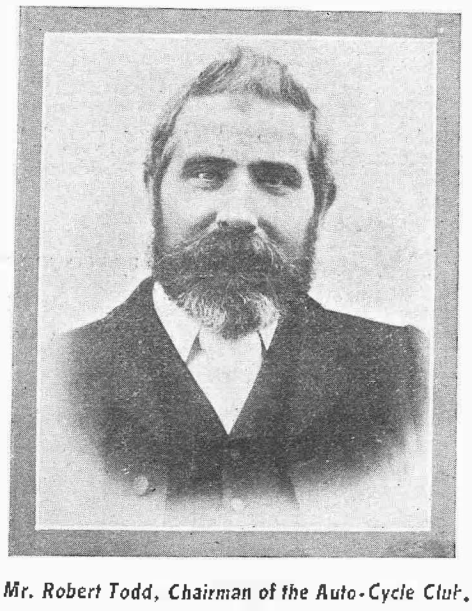
THE CHAIRMAN OF THE Auto-Cycle Club, Mr Robert Todd, the Chairman of the Auto-Cycle Club, is such a well-known personality that his name hardly requires any introduction. In the old days, as an ardent follower of the tricycle, he became associated with the National Cyclists’ Union, and such a pillar of strength did he become to this important body that he ultimately became its chairman (as senior vice-president), a position he continues to hold to-day. Indeed, as a chairman this little Irishman, with his twinkling eye, dry wit, and ready repartee, is at his best, and it is by no means an easy task to find his superior; for, in addition to being able to keep a meeting—no matter how large—in constant good humour and under perfect control, he has a shrewd business manner which always commands respect, and his quick and decisive rulings (Mr Todd is a solicitor by profession) are invariably the means of solving any knotty problem which may be up for discussion. For a number of years Mr Todd has presided over the executive committee of the Stanley Show, and the work he has performed in this connection has been both valuable and untiring. It was inevitable when motoring came into vogue that Mr. Todd should take to it in some form or other; his choice was a motor-tricycle, and for several years he obtained all the pleasure—and experience of a most varied character—that he desired from this handy vehicle, passing from it to the Quad. Latterly, however, he has become more ambitious and he is now often to be met on the North Road at the helm of a Panhard car. It was Mr. Todd’s association with the motorcycle that brought him in touch with the Auto-Cycle Club; it was not long before he was prevailed upon to preside as chairman over its destinies, and it is to be hoped he may continue to do so for many years. The Auto-Cycle Club, which holds its annual general meeting this week, is only a couple of years old, but it has managed to make a stir in its small way. It numbers about 200 private members, many notable names appearing on its membership roll. It fought the battle of the motorcyclist when the Motor Cars Act was passing through the House of Commons, and secured more considerate treatment for him than was meted out to the motorcar owner. It also secured substantial advantages when the LGB regulations were drafted, and cleared the motorcycle and trailer from the old incubus of the six-mile-an-hour limit to speed. It took action in the cases where riders were being fined for not showing a red light to the rear, and got the convictions quashed, and it has kept up its fight against the Inland Revenue on the matter of the carriage tax on the motor-bicycle, and may even yet get the tax abolished. The reliability trials, the various lectures and papers in the winter months and similar functions and events have done much to advance progress and to disseminate information to both makers and users of the popular motor vehicle. The. energy with which it challenged for the International Auto-Cycle Cup last year was most commendable, and it did much good work afterwards in obtaining the promise of better conditions for the event next June.”
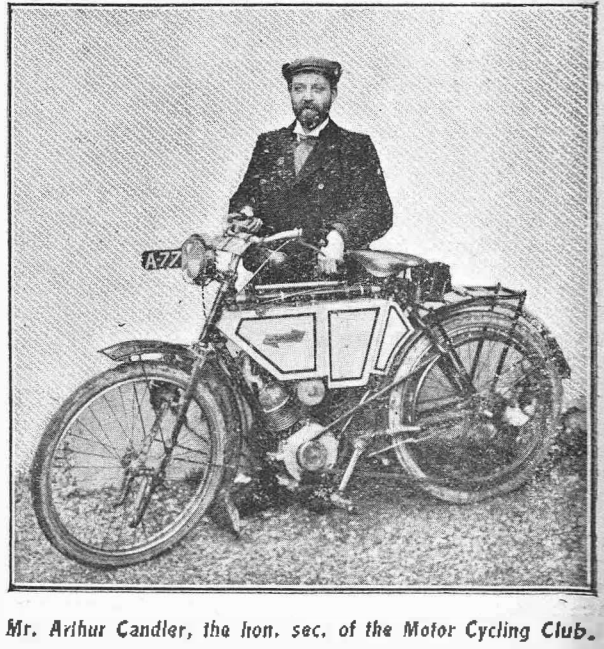
“MR ARTHUR CANDLER, who has this year undertaken the duties of hon sec to the Motor Cycling Club, is one of the most enthusiastic of motorcyclists. He has been a keen participant in the pastime for three years, and it was due to his representations that the CTC were induced to form a motorcycle committee as one of the standing committees, and of this Mr Candler was chairman. Of course, MrCandler is a cyclist as well as a motorcyclist, and he is a representative CTC councillor for Surrey, and hon sec of the Metropolitan District Association. It will interest our readers to know that Mr. Candler cycles or motorcycles on every day of the year, and that his mileage for last year totalled approximately 12,000 miles. The subject of our paragraph indulges in boating in the hot weather, and occasionally rows to Oxford and back, sleeping in the boat or camping out. Photography is another of his hobbies, and, taken all round, it will be agreed that the MCC have appointed for their hon sec a particularly versatile gentleman and one who will be likely to do credit to the important office he fills. Mr. Candler has travelled very considerably, and he is not unknown as a writer.”

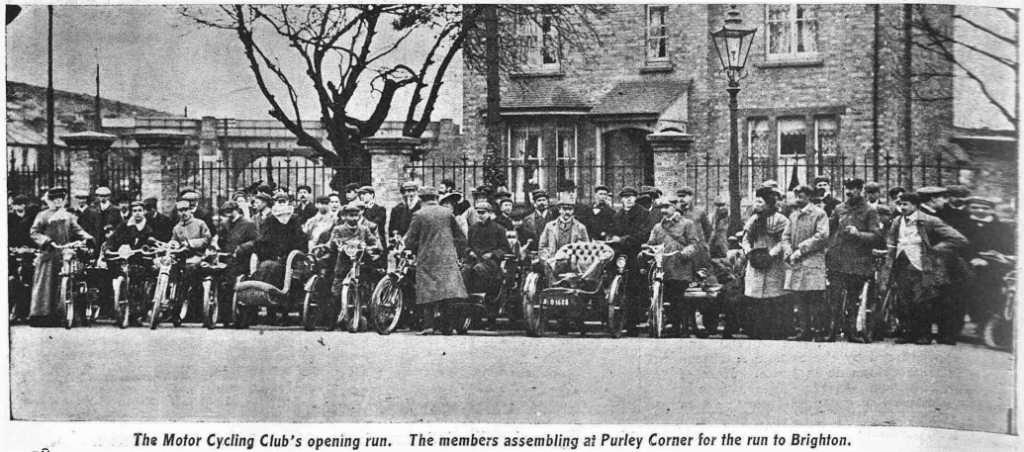
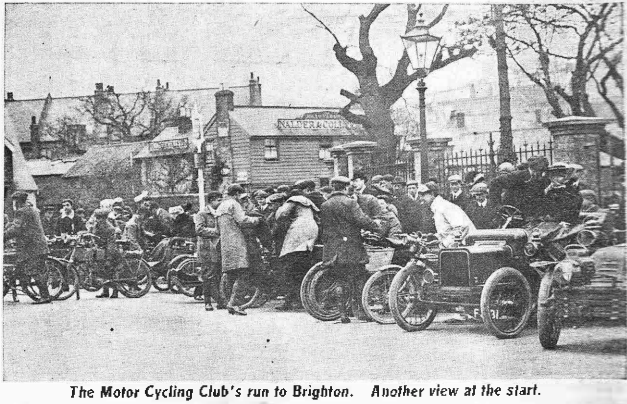
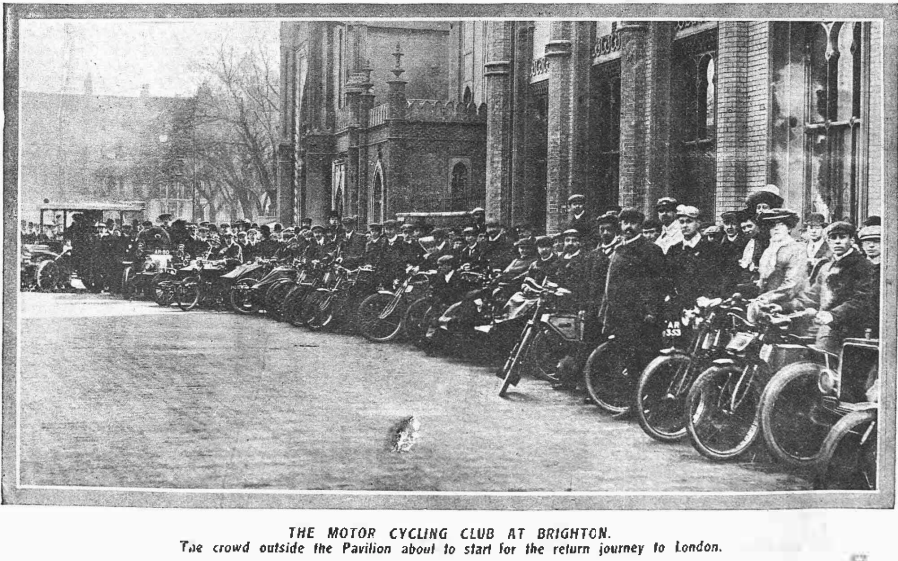
“THE OPENING RUN of the Motor Cycling Club took place on Saturday last, when the members ran to Brighton, returning to town on Sunday. The weather promised well, at the start at Purley Corner, which was the arranged rendezvous, as on previous occasions, members riding here from all parts of London. At 3.30 about 55 members, including ladies, made a start, all types and powers of machines, including many tri-cars, being in evidence. The police were also assembled at Purley in strong force, but no incidents occurred to call for their special attention. The weather became threatening shortly after leaving Purley, and by the time Crawley was reached rain had commenced to fall heavily. A stop was made here for tea, and some additional members joined the party, several cars being also noticed. From Crawley to Brighton the roads gradually got worse, and the last 12 miles into Brighton was decidedly unpleasant, the rain descending in torrents, and roads quickly became veritable seas of mud. There were practically no mishaps, however, everyone reaching the Gloucester Hotel in time for dinner, with the exception of J van Hooydonk, who had experienced tyre troubles near Handcross. He found it impossible to make an effective repair under the miserable conditions prevailing, and reached Brighton only by dint of great perseverance in pumping up the tyre every few miles. Owing to the record turn-out the hotel accommodation was considerably strained, and a large proportion of the members had to be put up at the Pavilion Hotel. After dinner Mr JA Jackson proposed the toast of ‘The King’. Mr A Candler, the club secretary, then proposed the toast of the members, and mentioned that it spoke well for their enthusiasm that such a large number had joined in the run despite the wretched weather. The presence of so many ladies was specially gratifying. He called attention to the very excellent programme of events for the season. With the toast he coupled the name of the captain, Mr JA Jackson, which was heartily responded to by Mr Jackson, who went on to say that there were twice as many members on this opening run than on the former one. He was especially pleased to see so many new members, and the club committee intended to spare no effort to make them feel at home in joining in all the club events. The club was primarily a social club, and by no means a trade club, as was the mistaken impression held in some quarters. Mr SF Fry (Club ‘Gazette’ Editor) proposed the toast of ‘The Visitors’ in a brief speech. Mr Louis Smede, of the Brighton Cycling Club, said a few words, in which he expressed his pleasure at being amongst the club once more. A capital musical programme was gone through, to which Messrs Schofield, Perman, Hooydonk, Smart, and Mrs Ashworth contributed. The return home was made on Sunday in brilliant weather, and the roads having dried up the run was greatly enjoyed. A stop was made at Reigate for lunch, after which some of the party went home via Dorking and Guildford, others going via Croydon. The club group photo was taken in front of the Pavilion before the start off. The departure was watched by a large crowd of interested spectators.”
“THE ANTI-MOTOR LEAGUE has at length revealed its real public aims to a wondering world. Recently in a prominent position on the front page of a morning paper appeared an advertisement calling upon all and sundry to join the league (not as we have named it) in defence of ‘the rights of the highway’ and as an inviting lure, a weird representation of what was supposed to be a racing motorcar, but which could be better described as a cross between a circus van and a traction engine, graced the centre of the page. The fussy faddists to whom anything which departs from old-fashioned ideas is a terror and abomination have doubtless hailed with delight the means proffered them of worrying law-abiding people who wish to enjoy their pleasures without inconveniencing the rest of the community…”
“THE OPPORTUNITY provided by the Manx legislature and the enterprise of the Auto-Cycle Club, whereby a motorcycle race on the open road will be legally possible in the British Isles, is one that we hope will be fully grasped by all who wish to see the pastime of motorcycling flourishing and the trade progressing.”
“THE ‘DAILY MAIL’ asks the question, ‘Are motor fumes deadly?’ The query arises from the death of a lady who is alleged to have been overcome by the fumes of a passing motorcar. After suffering from sickness, she became unconscious, and died the following day. Now the ‘Daily Mail’ asks its readers whether ‘motor fumes are deadly’. We should say just about as deadly as the ‘Daily Mail’ likes to make them in fiction. In fact, no! This applies to most other problems propounded by the same authority.”
“IN REPLY TO ‘CAM’, who wishes to drive to Italy via Paris, I should strongly recommend him to keep to France and the French roads as long as possible. The Swiss people, I have found, are very disagreeable, none more so, and hate English people and motorcars, so I should not advise going that way.
Leopold Canning.”
“REFERRING TO ‘SUNNY JIM’S’ enquiry, in a recent issue, re Olympia tandem, I may state that I have driven one 11,000 odd miles since last March. 1 toured for three weeks in North Wales with an 11-stone passenger and luggage, climbing the Pass of Llanberis with a rise of 800 odd feet in 2½ miles. I can average 19 or 20mph over give-and-take roads, the highest speed on the level being about 30mph. The cost of upkeep is comparatively small, as I can run about 58 miles on a gallon of petrol. As regards tyres, I have found light car Clincher 2½in tyres very satisfactory, my front tyres having now run 6,400 miles and still being good for at least another 1,000 miles, but the driving tyres’ life is very much shorter, owing to a great extent to the fact that not enough weight is carried by it.
C Napier-Paterson.”
“NO MATTER WHAT one’s political views may be, everyone admits that Mr Winston Churchill, MP, is a brilliant young orator, and that whatever subject he tackles—whether it be Free Food, the decay of the nations, or Mr Wanklyn— he does so in a manner which entitles his remarks to some respect. It is, therefore, a matter of considerable interest (and a great relief to many) to learn that his views on automobilism, as expounded at the annual dinner of the Manchester Automobile Club the other evening, are of a decidedly agreeable character—except to the anti-motorist. In the course of a highly instructive and entertaining speech, the versatile member for Oldham remarked that one of the most remarkable things to his mind was the extraordinary rapidity with which automobilism had overspread our life. ‘Five years ago,’ he said, ‘a motorcar was an object of derision if it stopped for one moment; now, the horses have got used to them, the asses have got used to them, and we see them on every road. People are conducted to their marriages in them; post offices are engaging them to convey mails; large motor omnibuses are running up and down London streets.”
“WE WERE READING the other day in a recent engineering supplement of the ‘Times’ that ‘the motorcycle industry is in a very unsatisfactory condition’, and that ‘it has been steadily going down for the past four months, and is now practically moribund.’ These lines are contained in the extracts from patents, and the compiler thereof proceeds to inform a wondering public that the cause for this depression is ‘the nerve-racking vibration which the riders of motor-bicycles have to endure’. Then follows the description of Patent No 4,605—a spring frame which is stated to ‘provide a means for resuscitating this industry’.”

“AT THE PRESENT MOMENT, when our great and growing army of motorcyclists in Great Britain and Ireland are looking forward with keen anticipation toward the great race for the single trackers, it may not be impertinent for us to enquire as to what our British manufacturers and riders are going to do to win the International Motorcycle Cup, which will be contested for at Dourdan on June 18th. When we were invited last year by the Motor Cycle Club of France to send a team to compete for the International Cup then offered for the first time, we knew nothing of road racing in general nor of Continental motor-bicycles and their riders in particular; unless our innocent little law-breaking episodes in crooked lanes, with enthusiastic but erratic policemen for judges, and the occasional glimpse of the Continental motor-bicycle at the Palace or Canning Town track may be termed the proper sort of experiences…Our sporting mentors, the Committee of the Auto-Cycle Club, took hurried counsel, which the short notice from the French Club (one month) made imperative. They appealed to the trade; three manufacturers responded promptly, but several valuable days were lost in these necessary preliminaries. Three weeks in which to design, build, and ‘tune up’ an entirely new type of motor-bicycle for the World’s Championship! Impossible? Well, it was done, nevertheless, and the three machines with their riders were on the course at Dourdan five days before the race. The world calls us sportsmen; maybe some day they may say we are not altogether slow. But, however sportsmanlike and enterprising the efforts of the Auto-Cycle Club Committee, the British manufacturers, and those three most excellent and plucky riders, Messrs Silver, Hodgkinson, and Rignold, I can safely state as a fact…that, as the representatives of Great Britain and Ireland, we were never on an equal plane with our Continental opponents…The invitation to contest this race reached the Committee of the Auto-Cycle Club at the one moment of the whole year when they were least able to deal properly with a matter of such importance. The 1,000 miles trials were just finished; the entire clerical and executive staff were in the throes of an exhaustive analysis of its complicated details; and, to make matters worse, our annual races were fixed for September 24th, at the Crystal Palace, the very eve of the French race, making it an absolute impossibility for the English Club to be represented by anything like an efficient force at Dourdan on Sunday morning at six…When called upon to produce a machine for this event last autumn the manufacturers were given certain specifications, the most important being the weight limit. Power was left to the-discretion of each maker. On the meagre data obtainable at that time, it was assumed that an average speed of 46-48mph might do well in the scramble, and, since the average speed of the actual winner was only 46mph, this estimate would appear to have been justified by the result. But the winning machine was not the fastest in the race, at least three others being incomparably more speedy. In conversation with several intending competitors in the coming struggle I have found a most unpardonable tendency to underestimate our rivals…a glance at the record of one of them will prove my assertion. One round was made by this machine at an average speed of 58mph, but to maintain this splendid average the maximum pace estimated by the experts was at least 69mph…this machine required a motor of 14 brake horse-power, which in fact it had…If we are to hold our own in the motorcycle industry, do not let us commit the awful folly of sending a team abroad to win a Booby prize. Unless our foolish superstition concerning horse-power is dispelled, the aforesaid Booby prize is ours already…We have in this country several track riders undoubtedly equal in every respect to our Continental rivals; but track racing and road racing are two entirely different accomplishments. On the Continent, where speed limits are unknown, save through villages, the motorists have daily opportunity of practising’ those little details which are absolutely indispensable in successful long-distance races. Not only do they enjoy these privileges now, but they have done so since first they took to motoring years before we even knew of the sport; and it was probably in this respect that the English team suffered a greater handicap than from our inefficient machines. Our riders are fearless and skilful to a degree, but they cannot hope to meet the Continental men on anything like an equal footing without many weeks of actual road racing. Therefore, I would advise all intending competitors to take their machines over to France without further delay, and on to the actual course, which is open to them every day in the year, in order to make themselves familiar with all the peculiarities of this course, and to feel absolute masters of their own machines, which they can never be on either road or track in England. As one illustration of what they must be prepared to meet, let me describe how a corner is taken by the crack men. The brakes fitted are only made to comply with the rules, for the wheels are too light to stand them, therefore the riders wear heavy shoes and skate round the corners at an incredible speed with their feet on the ground. This is an acrobatic feat, the difficulty and danger of which must be witnessed to be realised. Furthermore, they know the course so well that they can reckon not to deviate more than a few inches from the best possible track in every round.”
“SIR ARTHUR CONAN DOYLE, the eminent author, is a keen motorcyclist, and has just been elected a member of the Auto-Cycle Club. He rides a Roc motor-bicycle, and it is interesting to note that he has entered his machine for the International motorcycle race, the eliminating trials for which take place in the Isle of Man on May 31st. It is not likely, however, that Sir Arthur will ride the machine himself.”

“IT HAS NOW BEEN definitely decided that this race, the first of its kind in England which is combined with the Selection Trials for the International motor-bicycle race, will be run three times round the Isle of Man circuit. This is 54⅕ miles, so that the total distance will be 163½ miles (the ‘International’ at Dourdan on June 25th will be about 180 miles). There are to be no controls. The men will be started at daybreak on May 23rd in batches of three at about two minutes’ interval. The rider accomplishing the fastest time will win the cup and the gold medal of the A-C.C. The second man will gain a silver medal, and the third a bronze medal. In addition, silver medals, with the performance inscribed on the reverse, will be presented to all competitors who complete the distance in 3½ hours or less, and bronze medals to all who get round in not more than four hours. This race is open to the world without restriction, except that the nett or ’empty’ weight of the machine must not exceed 110lb. The closing date for entries is April 29th, and we hope to hear of some foreign riders coming over for what, we believe, will prove to be a thoroughly sporting event. It will be seen from the following list that some of our best and most daring path riders have entered. Mr JS Campbell represents the Scottish Cyclists’ Union, and Mr CB Franklin the Green Isle of Erin. 1, JF Crundall, 8hp Humber; 2, GA Barnes, 10hp Barnes; 3, TH Tessier, 9hp Roc; 4, H Rignold, 8hp Rignold; 5, W Hodgkinson, 6hp JAP; 6, HP Maffert, 8hp Westlake; 7, HA Collier, 6hp Matchless; 8, CR Collier, 6hp Matchless; 9, AB White, 9hp Roc; 10, CB Franklin, 6hp JAP.”
“THE EXHAUSTIVE MOTORCYCLE TRIALS which are being organised by the Auto-Cycle Club of France, and which will be carried out during the months of April and May, are likely to assume much importance. Already the majority of the leading motorcycle makers in France have intimated to the promoters their intention of entering machines, and the trials are, therefore, bound to attract considerable public attention. It seems to us that these trials present an opportunity for British manufacturers to pit their productions against those of the French under something approaching equitable conditions. It has long been argued—and with much truth, too—that the English manufacturer has not been able to get a footing or gain great success in the matter of selling motorcycles in France, because he has been greatly handicapped owing to the fact that the French are able to indulge in that useful form of advertisement, road racing, whereas the speed restrictions in force in this country, and the fact that French races generally are not open to English competitors, have virtually debarred the English maker from the French market. Now, in the trials referred to, high racing speeds are not to be permitted, the events being of the reliability order; that being so, we would urge British manufacturers whose products are eminently suitable for this sort of trial to enter machines through their French agents, so that the reliability of the British-built bicycle may be thoroughly demonstrated.”
“A VERY INTERESTING letter lies before me from Mr Charles Jarrott, who tells me that he has followed up some conversations and some correspondence which has passed between us and has entered a motor-bicycle and rider for the International Auto-Cycle Cup race. He has selected a JAP motorcycle of high horse-power, and Mr Hodgkinson, who rode a machine of this make in last year’s event, will conduct it through. Mr Jarrott has no pecuniary interests in the machine and so he is, in this connection, an amateur (that is, non-trade) owner just as is Mr Lionel de Rothschild, who has entered a car for the Gordon-Bennett race or any other sportsman who enters a horse for the Derby. Mr Jarrott says that he hardly knows why he is entering the machine and rider, but I can see that he captured the enthusiasm that permeated that little dinner given recently by the Auto-Cycle Club when the general ‘note’ was the determination of England to make a good fight for the Cup this year, and I must say that I am thoroughly delighted that Mr Jarrott has taken this step. I know, too, of another wealthy enthusiast who has virtually made up his mind to do exactly as Mr Jarrott has done. The only difficulty is finding the machine, and if any firm is prepared to accept an order for a high-powered racer I should be able to at once bring the buyer and seller together. A note in Mr. Jarrott’s letter pleases me as much as his first announcement. He says he has made up his mind to go on entering a machine until England wins the Cup, and it is only a matter of time and experience for this to take place.”—Cyclomot
“IT IS MOST SATISFACTORY to see what a fine lot of English-made machines are lining up for the International contest this year. Out of these I hope we shall have a team that will win, and be an object lesson to the foreign brigade and a monument of credit to the British industry. I do not think there will be any puncture troubles this time; skilful riders and good machines will win the day. I hope one of those most interesting Barry engines will be there, as the mere sight of one of these weird motors will discourage and frighten the enemy. The nail-strewing episode gives one food for thought, and when the great race comes off it would be just as well if our representatives kept an eye on the sort of petrol they get. As the French brought over their own stuff when they came to Ireland for the Gordon-Bennett, why should we not take over a special supply of our own, and so ensure having this important item of the best?
Leopold Canning.”
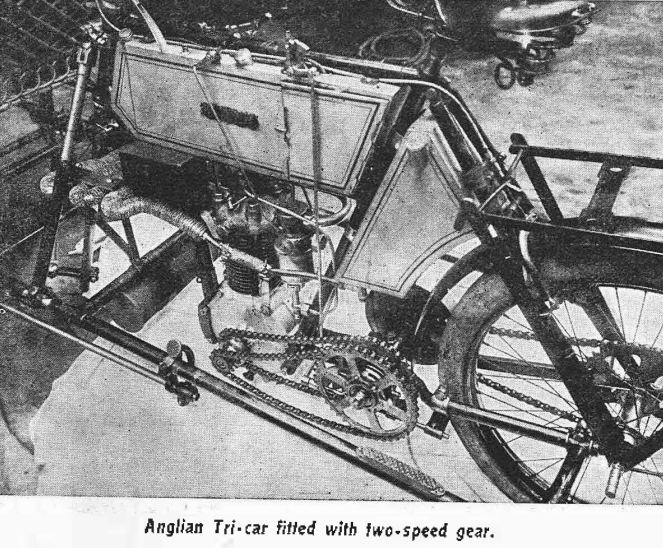
“THE ANGLIAN TWO-SPEED GEAR FOR TRI-CARS. A two-speed gear that has proved very satisfactory under the test of continuous hard work is the Anglian, made by the Anglian Motor Co, Beccles, Norfolk. The illustration depicts the gear, from which it will be seen that two chains drive from the engine to different size chain wheels running free upon ball-bearings. These wheels are provided with jaws to engage a dog clutch, which can be moved along the squared countershaft. Upon the other end of the shaft is a clutch of large diameter. The male portion carries a sprocket, which drives by chain to a rear chain wheel. The female part is arranged to slide on the squared shaft and transmit the drive when put in engagement with the male part by means of a pedal release. The gear is changed by a simple lever moving in a notched quadrant, which gives high, neutral, or free engine and low gear. The clutch also gives a neutral position. The engine is started up by means of a handle, which can be fitted on to the end of the countershaft. This gear has the merit of great simplicity as well as efficiency, and is most unlikely to go wrong. A member of our technical staff recently had a 60 miles run on a fore-carriage fitted with this gear, and was very favourably impressed with its working and ease of manipulation. Although the engine with which the fore-carriage was fitted was but a standard 2¾hp De Dion, the gear enabled every hill encountered to be surmounted with ease. With a more powerful engine there is no doubt that this gear will meet any possible requirement in the way of surmounting hills.”
“AT A RECENT MEETING of Watford and district motorcyclists it was decided to form a motorcycling club, to be named The West Herts Motor Club. It will be run on absolutely up-to-date lines, be affiliated to the Motor Union, and hold reliability and non-stop runs during the coming season. A general meeting will take place at Clarendon Hotel, Watford, when all interested are cordially invited.”
“THE MANX LEGISLATURE has just adopted a Bill governing motorcar racing and motor travel in the Isle of Man and, as might be expected, the Bill is on most moderate lines…there will be no legal restrictions in the Isle of Man against the Gordon-Bennett Eliminating Trials or the Motorcycle race for ‘The Motor’ Cup and for the honour of representing England in the International Auto-Cycle Cup race. The clauses that deal with the regulation of motor traffic on the Manx roads have been based upon the Act in force in the rest of the British Isles. The offence is the same, the speed limit is the same, powers of limiting speed on narrow roads and in populous places are taken, and motor vehicles must be registered.”
“THE BIRMINGHAM MOTORCYCLE Club has just become affiliated to the Auto-Cycle Club.”
“THE SECOND READING of the Universal Lights Bill was defeated on Thursday evening by one vote, the figures being— for 108, against 109. For this unsatisfactory state of affairs the public probably has to thank two of the most notoriously rabid politicians who ever represented a constituency—Messrs. Henry Labouchere and Cathcart Wason. ‘Labby’ ran the ‘motor interest’ fallacy for all it was worth, arguing that if the Bill was passed motors would ‘run through the country at a reckless speed by night as well as by day’. Mr Wason invoked ‘the liberties of the people’ in his narrow-minded and singularly erroneous assertion that the measure was brought forward by motorists alone: it is, of course, a matter of history that cyclists have been agitating for the measure for years. Mr Wason’s conception of liberty—the liberty to walk in darkness—is at least a curious one.”
“AS A STIMULUS TO MOTORCYCLISTS, the Rex Manufacturing Co is offering a trophy to be awarded for the best individual performance of any amateur rider on an ordinary roadster motor-bicycle during the present season. The competition is open to every motorcyclist, of course, quite irrespective of the make of machine, the only restriction being that an ordinary roadster touring machine shall be used, and no path racing event will be considered, neither will any win be allotted by the adjudicator where a motor-bicycle other than a roadster is used.”
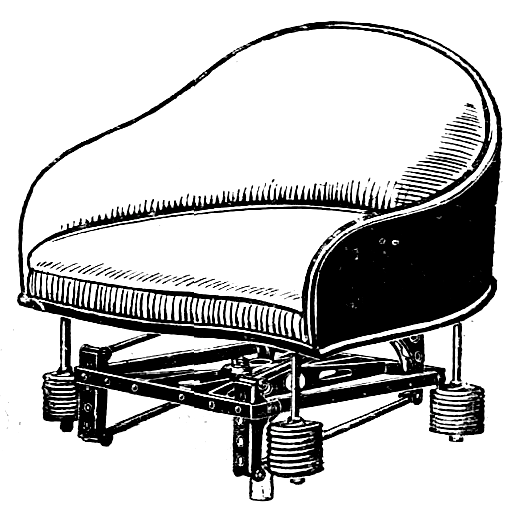
A BUCKET TYPE OF SEAT specially suspended on springs and adaptable to all kinds of motorcycles has been placed on the market by Messrs JB Brooks and Co, Great Charles Street, Birmingham. It is made of sheet metal, well upholstered, and fitted with a well-padded removable cushion. The principal feature about it, however, is the arrangement of a spring underframe for absorbing all road shocks and vibration. The springs are of a. special compound type, one being placed inside the other. The rider’s weight compresses the inner spring and extends the outer one. Thus the actions are opposed, and the objectionable quick rebound that occurs with the ordinary type of spring is quite overcome. To render the seat firm and free from oscillation the springs are fitted with a series of controlling links. Price, £3 3s.”
“MCC INTER-CLUB RUN. This most interesting gathering took place on Saturday, the 13th, the destination being Warwick. The MCC members foregathered at Southall (about 12 miles out of London) at noon, and the first stop was at Wendover for luncheon. At this place they were joined by some members of the Aylesbury Automobile Club, and others joined the club at Bicester. The next stop was at Banbury for tea, and soon after leaving there the club were met by a contingent of the Coventry Motor Cycle Club. Warwick was reached shortly before six, and for an hour it was a busy scene at the Woolpack Hotel, motorcyclists arriving from all quarters to join the club at dinner, which was fixed for 7.30. Mr JA Jackson, the captain, was in charge of the arrangements, and was one of the early arrivals, together with Mr WH Wells and Mr Victor Abraham, riding officers, and other prominent members of the club. After an excellent dinner Mr Jackson proposed the health of the visitors, thanking them in the heartiest manner for the interest they had shown, and associated with the toast the name of Mr. Holroyd, the chairman of the Coventry Motor Cycle Club. This gentleman responded in enthusiastic terms. Mr JR Bedford, the secretary of the Birmingham Motor Cycle Club, proposed the toast of the MCC, and this was responded to by Mr. Chester Fox, a member of the committee. Then, after a speech by Mr GE Roberts, of the Coventry club, and formerly the hon sec of the MCC, and after musical honours had been accorded to the chairman of the evening, the company broke up into small gatherings, and seemed thoroughly to enjoy the occasion.”
“NEARLY 900 MOTOR VEHICLES were registered in Manchester during 1904, and the number is being steadily added to.”
ALF COLLINS, WHO WORKED for the Gaumont British Picture Corporation, directed the first motor cycling movie, The Drunken Motorcyclist. Collins specialised in chases; in this case our hero is seen staggering out of a pub a riding away followed by a gang of his mates on bicycles. He weaves on and off the road knocking over various bystanders including, for no obvious reason, a juggler. This theme was developed in Aunty’s Motor Bike (UK, 1907) and its 1908 sequel Auntie tries a Motor Bike; Motorcyklisten (Denmark, 1908) in which a nipper who knocks over pedestrians with his Ellehammer (qv); The Uncontrollable Motorcycle (UK, 1909), in which the motor cycle wrecks a house; and Margaret’s Motor Rides (USA, 1911).
“I ENCLOSE A SIMPLE RULE which gives a near approximation to the horsepower of motorcycle engines when working under favourable conditions, and a few examples of engines to show its application. It is as follows: Take two-fifths of dimensions in millimetres, square result of bore thus obtained and multiply by stroke (also multiplied by two-fifths) then point off four figures from the right-hand, result is approximate horse-power. Example: 70x80mm. Two-fifths of 70=28, and two-fifths of 80=32; then 28x28x32=25,088=2.50hp. Below are a few engines compared: 3½hp White and Poppe, 80x85mm, result 3.48hp; 3hp Raleigh, 75x80mm, result 2.88hp; 2½hp Kerry, 70x80mm, result 2.5hp; 2¾hp Kerry, 76x85mm, result 3.06hp; 3½hp Kerry, 80x90mm, result 3.68hp; 2½hp JAP, 70x76mm., result 2.35hp; 3½hp JAP, 85x76mm, result 3.47hp; 2hp Minerva, 68x70mm, result 2.04hp; 2¾hp Minerva, 76x76mm, result 2.7hp; 3½hp Minerva, 82x82mm, result 3.59hp. (Dimensions appear excessive as compared with Minerva of same power.) When multiplying the millimetres by two-fifths take the nearest even result thus: two-fifths of 82=164 divided by 5=33; two-fifths of 73=146 divided by 5=29; and so on.
Cross Keys.”
“A DISCUSSION ON ALCOHOL. On Friday next the Society of Motor Manufacturers and Traders are holding a dinner at the Hotel Cecil, after which Dr Ormanby, DSc, will read a paper on the necessity for greater facilities for the manufacture of industrial alcohol. This is a result of the unsatisfactory nature of the recent Government report oil the matter. In view of the fact that the petrol supply of the country is under foreign control, the society considers that the home production of alcohol for motor purposes is a matter of great importance. The Government report discouraged the use of alcohol on the score of expense, but it is pointed out that it would tend to become cheaper, and, moreover, that as the demand for petrol increases, this latter spirit must advance in price. The advantages claimed for alcohol are—slowness of combustion (allowing of longer piston stroke and greater steadiness of running), and greater safety in storing and handling. As to the important question of a denatural (to render the spirit undrinkable) German manufacturers successfully use benzol and an aniline dye.”
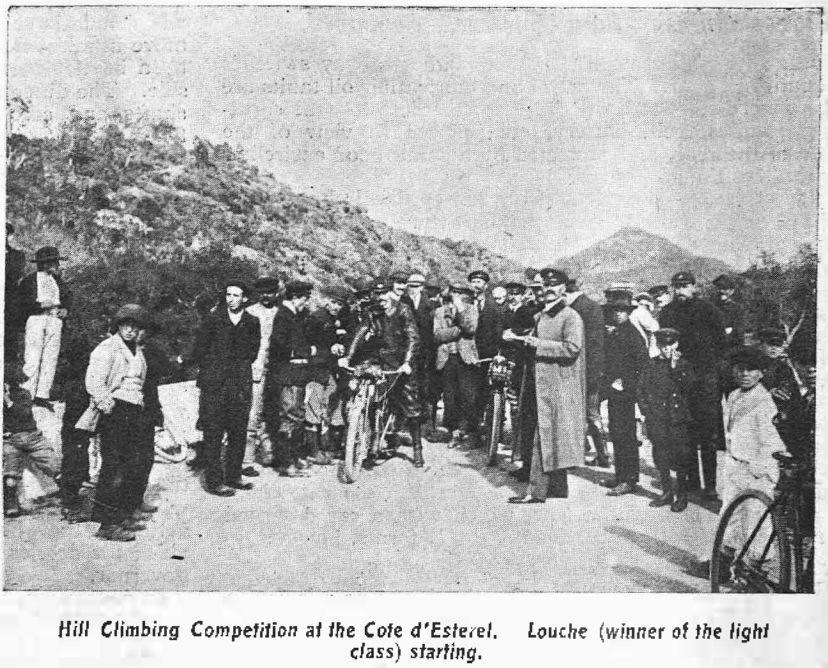
“FOLLOWING ON THE MONACO motor boat meeting, a hill-climbing competition for motorcycles was held at Cannes. The venue was the Côte d’Esterel—starting from the Minelle bridge and traversing a course of 10km (about 6½miles). Competitors were started at intervals of three minutes. Most of the best known French makers were represented. The winner of the light class was Louche, who, on a 3hp Buchet, covered the distance in 15min 17sec. The next best performance was by a 2¾hp Griffon, in 15min 44sec. In the heavy class Camoin, on a 5½hp Griffon, won in 12mm. 58sec and next to him was Yourassoff (5hp Peugeot), 13min 2sec.”

“WHO SHALL DECIDE when magistrates differ? Two decisions diametrically opposed have, within the course of a few days, been delivered at the City Summons Court as to the licensing of motorcycles, in each case the question was precisely the same. The defendant was summoned for driving a motorcycle without a license. His defence was that the machine was not charged with petrol, and was being ridden as an ordinary bicycle and not as a motorcycle. One magistrate held that the defence was unsound; the other decided that it was good. Only a superior tribunal can decide which of these two magistrates was right. We shall not be surprised, however, if the superior tribunal, when it has the opportunity of reviewing these decisions, adopts the view of the magistrate who decided that the defence was unsound. That a motorcycle comes within the statutory definition of a motorcar does not admit of doubt. In some respects, it is true, special provision for motorcycles is made. But, notwithstanding these special provisions, it is indisputable that a mot’ rcycle is a “ motorcar ” within the meaning of the Act. A motorcar is defined as “ any vehicle propelled by mechanical power, if it is under three tons in weight.” Is a motorcycle any the less a motorcycle because its owner chooses to use only foot power? That is really the question.
PC FRANCIS G56, OF REDBOURN, having discovered a portion of the road to be covered with nails, which had peen maliciously strewn by three youths (who were afterwards haled before the Bench), courteously warned an approaching motorist as to the presence of the puncture fiends, and thus averted tyre troubles. Who dare say after this that police chivalry has become extinct?”


“THE SOUTH BRITISH TRADING CO, Wilson Street, Finsbury, London, show several specimens of the Vindec motor-bicycle, with spring front forks…That popular tri-car known as the Rexette, shown by the Rex Motor Manufacturing Co, Coventry, has been brought right up to date. The distinguishing features of this little vehicle are the well-stayed tubular frame; spring suspension of special patterns for both wheels; a 5½hp water-cooled engine, with a neat and efficient system of tubular radiator; chain transmission; wheel steering; very ample mudguards; and compensating brakes for front wheels, with a band brake on the rear axle. One of these vehicles is fitted with Roi des Beiges body, and is altogether a handsome little machine. Several Rex motor-bicycles are also shown. The latest developments are a beehive pattern silencer, improved brake gear, and a considerable reduction in weight. The engine is 3¼hp, with V-belt transmission. All these machines are finished off in aluminium enamel. The Barry Motor Co, Kendrick Road, Barry, exhibit an interesting novelty in the shape of a rotary cylinder motor-bicycle…It is made on an entirely new principle, and gives a very high power for the weight. There are two working cylinders, so that a very smooth and vibrationless drive is obtained. The ordinary V-belt is used. The machine with 4hp motor comes out at about 70lb. Taylor, Gue and Co, Peel Street, Birmingham, show a light-weight 2hp motor-bicycle built on very simple lines. The transmission is by V-belt. The engine is fitted vertically and has an outside flywheel. The petrol tank is at the back of the diagonal tube. It looks a thoroughly serviceable little mount. A Kelecom 3hp motor-bicycle on standard lines is also shown.”

“LANFRANCHI, THE HOLDER of the world’s kilometre and mile motorcycle records, is still an inmate at the Boucicaut Hospital, Paris, suffering from a badly fractured thigh, caused through a fall at the Winter Track two months ago.”
“THE MEMBERSHIP OF THE Auto-Cycle Club, as a whole, will, we feel sure, be glad that the proposal which stood on the agenda of the AGM in the name of Mr J Horace Reeves was thrown out on Tuesday evening last. This gentleman, who is a prominent member of the Motor Cycling Club, was anxious that the AC should cease to promote social and competitive events limited to its private members—his argument being that the shelving of this side of the Club’s programme would enable it to better serve the interests of motorcyclists in a general sort of way. Unfortunately, for the sake of his cause, Mr Reeves’ logic was hardly strong enough to carry his proposal, the majority being of opinion that with the need for legislative work becoming much less necessary in the near future—the disabilities of the motorcyclist on account of the successful intervention of the AC having now been greatly reduced—the social side of the club will soon, become one of, if not the leading feature of the institution. This was successfully argued by Mr GF Sharp, the vice-chairman of the club, who went to the opposite extreme and urged the prosecution of a vigorous social programme, his amendment to this effect being carried by a majority. He emphasised the fact that the AC was primarily established as a social organisation and the abolition of its social events would be a serious—if not illegal in the eyes of the Automobile Club to which the Auto-Cycle Club owes allegiance—attack on its constitution. Then, too, Mr Reeves’ suggestion that the Auto-Cycle Club could obtain sufficient financial support from its affiliated clubs to enable it to carry on a useful overlordship provided it gave more attention to the formation of new clubs was altogether impracticable. Probably ten years hence such a proposition might have a substratum of reason in it, but at the present moment, with only about 30 clubs in existence (all of which are not affiliated) and the immediate prospects for the establishment of many others by no means rosy, the AC would indeed be in a parlous position if it had to depend upon support from this direction.”
“THE REV BH DAVIES has been elected to the committee of the Auto-Cycle Club.”
“THE DIFFICULTIES THAT foreign motorcyclists encounter on entering this country with their machines for touring purposes are so great that the Auto-Cycle Club is now approaching the authorities in order to secure some concessions in the way of the temporary licensing of the riders and registration of their machines.”
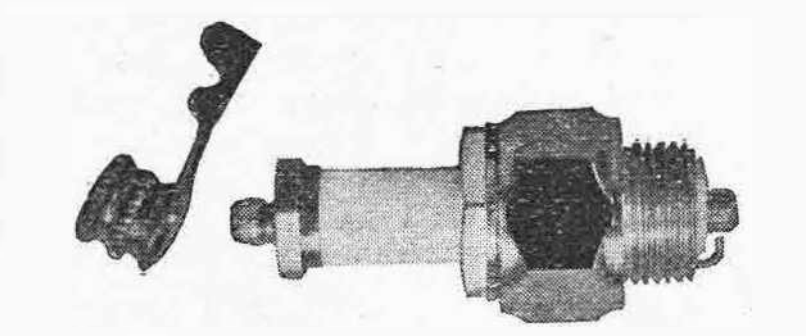
“A SAMPLE OF a new plug having a very convenient device fitted for making the cable connection has been forwarded to us by the Civil Service Cycle and Motor Agency, Featherstone Buildings, High Holborn, London, WC. Instead of the usual threaded terminal stem and nut, a small rounded stud projects; and over this fits a snap fastening, not at all unlike a glove fastener in principle. This fastening has a clip attached to carry the cable. The connection can be detached instantly, whereas with the ordinary connection a screw or nut has to be undone with often the prospect of losing it in the darkness.”
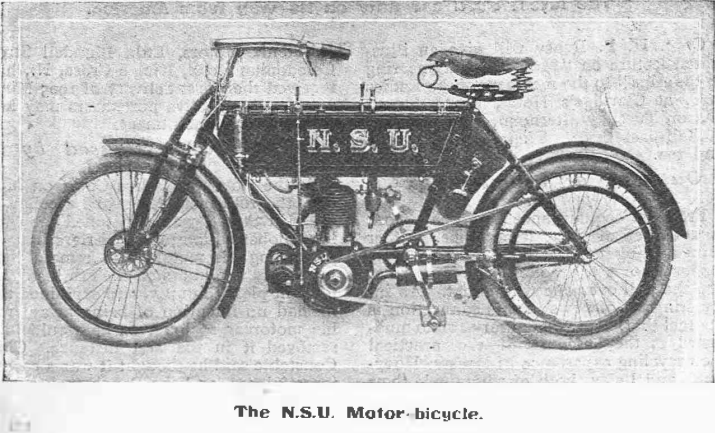
“A GOOD MOUNT. A member of our staff has been riding a 3hp NSU motor-bicycle for some time, and speaks very highly of it. He rarely finds it necessary to use the pedals, when negotiating hills, and its speed abilities, when it is seriously put to the test, he tells us are truly remarkable. The NSU has a splendid reputation on the Continent, and judging from the above report, and also from an inspection of the machine, which is a strongly-made and well-finished production, we should say it is likely to gain many friends here…For one of the heavy-weight brigade it is certainly a very fine mount. It has several notable features. First and foremost, it will run perfectly and regularly at a speed of eight miles an hour, which, for anyone having to negotiate traffic, is a great convenience. Secondly, it takes ordinary hills without noticing them, and, with a little manipulation, it will negotiate such a hill as Anerley Hill at the Crystal Palace, or Dashwood Hill on the Oxford Road, at a good speed. The rider has used the machine under most disadvantageous circumstances, as the weather has been anything but motorcycling weather; in fact, the only time he had an opportunity of really letting the machine out was on one frosty day, when on quiet stretches in a certain private park the machine attained a remarkable turn of speed. A great feature of the machine he tried was the magneto ignition, which, when properly set, does away with all electrical troubles. Another feature with the NSU machine is the design, the position, when riding, being very comfortable, together with absence of side-slip, which he attributes to the long wheel base. The machine is most excellently finished, and the workmanship is of a high standard throughout. One word for the rubber belt, which gives no trouble whatever as regards slipping and stretching, although it has been practically running in a mixture of mud and grease all the time.”
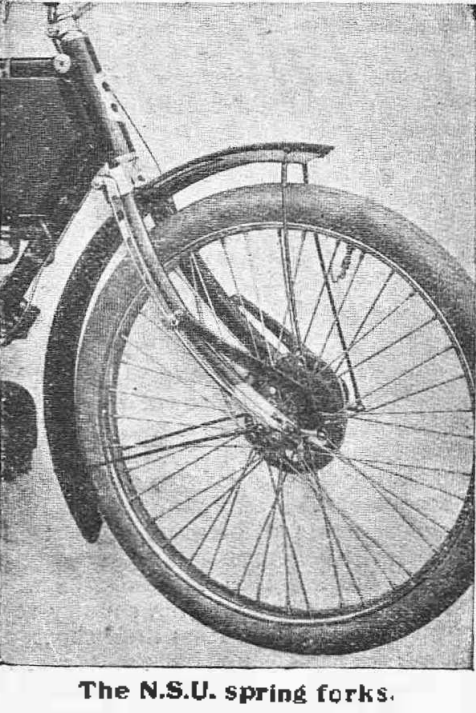
“THE NEW NSU MOTOR-BICYCLE spring forks are exceptionally long and flexible, and the method of working is as follows: The long bell crank lever, which is attached to the middle of the spring takes its fulcrum from the end of the fork; the short end of the lever is attached to the axle, and as the wheel strikes an obstacle it rises, and the long end of the lever pulls the spring outwards. The tension spring may be adjusted to suit the varying weights of different riders. We recently tried a NSU machine fitted with these forks, and we found that it made the running remarkably smooth.”
MINERVA MOTORS POINT out that their spring fork is adaptable to any existing motor-bicycle, and that they are prepared to supply same separately for 45s for the complete device. With special mudguard an additional 5s is charged.”
“WE ARE DELIGHTED to note the increasing prosperity of the Birmingham Motor Cycle Club, which has now entered on the third year of its career. The membership at the end of December last had risen to 60—an increase of 50%. On the fortnightly runs during the past season an average attendance of 18 was maintained.”
“IN REPLY TO ‘WGE’, I use a Stevens’ 4hp air-cooled engine geared 4 to 1. The engine can be run as slow as six or seven miles an hour, and 35 or 40 on the level and up small hills. Have not used a side-car, but with trailer can take a 9st 10lb passenger up hills of 1 in 8| without pedalling. Vibration seems no more than I have noticed on 2¼hp and 2¾hp machines that I have had.
Leamington.”
“I AM DESIROUS of fitting engine to an ordinary roadster, but owing to the small amount of clearance in back forks, there is no room for a belt rim; will some fellow-reader give me his opinion of a friction drive, and if to be recommended, also some details?
WSW, Cape Town.
[You might be able to get a good practical cycle repairer to set out the forks sufficiently to clear a narrow rim. One of the Clement pattern is about as narrow as you could get.—Ed.]
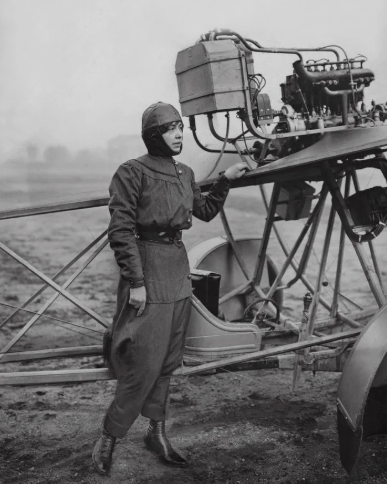
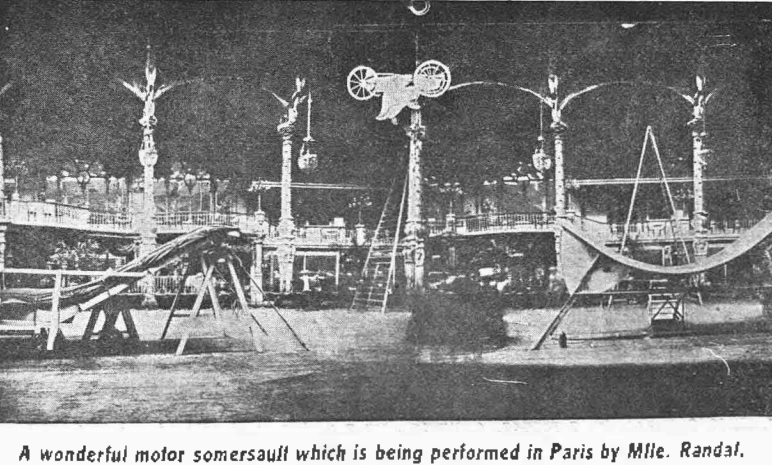
“A DANGEROUS TRICK. The motorcycle has been pressed into the service of the sensation monger. A variation of the ‘looping the loop’ feat, known as ‘A Leap to the Moon’, has been performed in Berlin by a young lady named Dutrieu, who may be remembered as the heroine (save the mark!) of the ‘Human Arrow’ or ‘Flight Through Space’ feat at the Crystal Palace in 1903. The present trick is a development of the former, the lady being mounted on a motor-bicycle, which rushes down a steep inclined plane, then swerves sharply upwards and is hurled into space through a pictured representation of the moon. Miss Dutrieu was badly hurt the other day, the machine catching the edge of the platform on which the moon is raised.” Following the Berlin accident Hélène Dutrieu spent eight months recovering her health. She was the first female pilot to fly with a passenger and the first woman to pilot a seaplane, flew in airshows as ‘The Girl Hawk’ (there was a minor scandal early when it was revealed to the press that she did not wear a corset while flying). Dutrieu was also a successful actress and journalist, was a member of the Légion d’honneur and ran a military hospital during the Great War. In 2011 Belgium issued a euro coin in her memory; in 2024 a street was named after her.
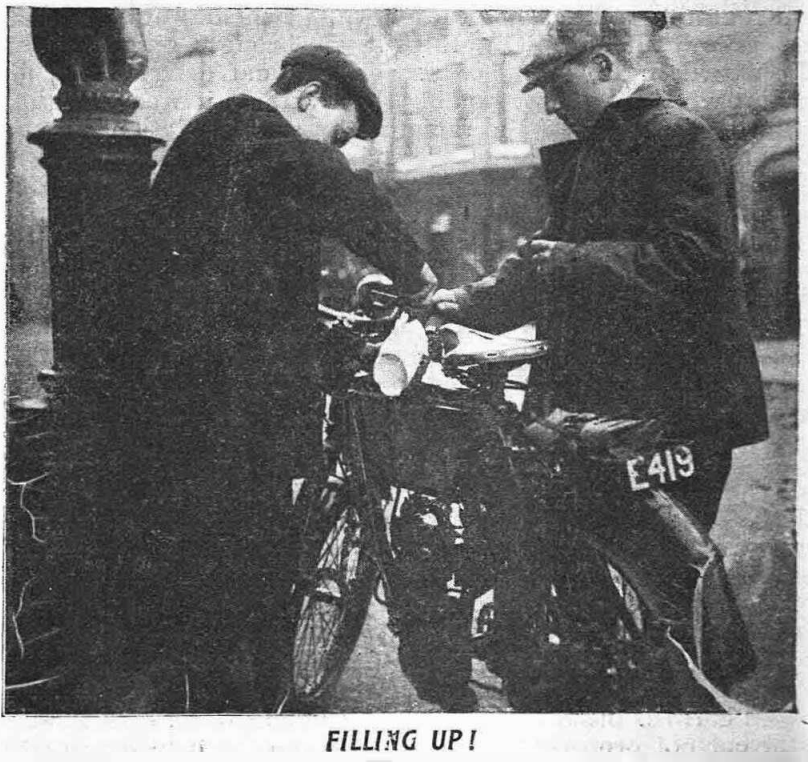
“THE FREQUENCY OF accidents to motorists and cyclists due to some slow-moving form of vehicle whose driver has gone to sleep prompts us to renew attention to the leniency with which this practice is regarded by the Bench. It is particularly important, from the point of view of the general safety of the road, that these offenders shall be severely dealt with as, in the usual absence of any lights, the vehicle becomes dependent absolutely upon the vigilance of its driver. The driver of a lighted vehicle might go to sleep with far less risk of precipitating an accident; but in nine cases out of ten it is a farm waggon, a market cart, or a lumbering dray which is allowed to roam about the road, unlighted, at the sweet will of the animal which draws it. To give the horse his due, he often displays more intelligence than his driver; if it were not so, this class of accident would be much more common than it is.”
“AUTO-CYCLE CLUB ADVANTAGES. Now that an agreement has been arrived at, after months of negotiation, between the Auto-Cycle Club and the Motor Union, whereby the latter provides legal defence to every member—individual or affiliated—of the former body, motorcycling clubs are being asked to make their decisions in the matter of affiliation to the controlling body. The scheme, on the whole, is a very fair one, and although both the Auto-Cycle Club and the motor-cycling clubs are called upon under it to depart from the ideal which each might set up, yet it must be granted that the compromise is fair and reasonable, and when the whole of the clubs are banded together, and the new organisation gets into working order, the small remaining barriers to complete control can be cleared away.”
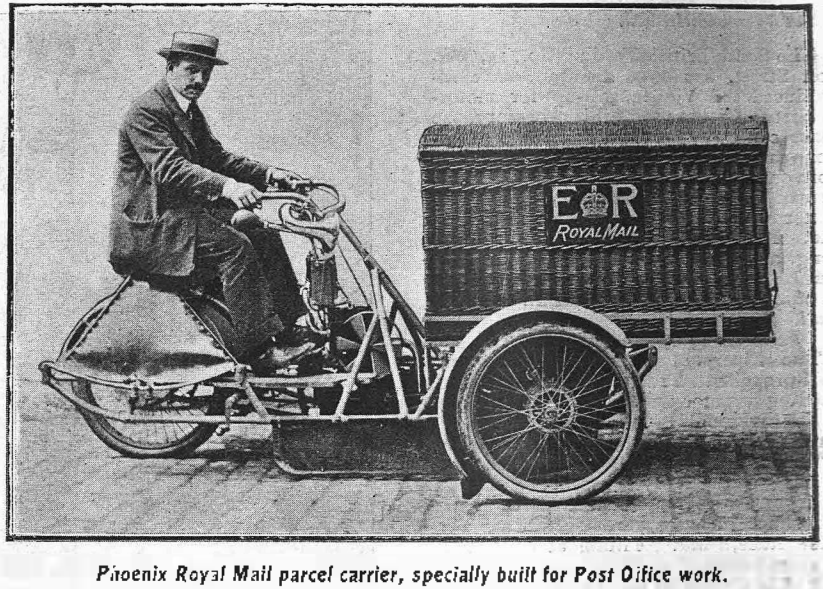
“ENTERPRISE HAS EVER been a characteristic of Phoenix Motors, and the latest production of this progressive firm forms a distinct departure from previous designs. For the special purpose in view, the carrier illustrated has been built to comply with certain requirements of HM Postmaster-General for parcels carrying in the London district, and differs in practically every detail from the famous Phoenix Trimo with which it must not be confounded. The framework has been designed to meet the peculiar strains imposed by constant manoeuvring through traffic; all three wheels are sprung, and the rear framing is triangulated, and forms a rigid seat support. The engine is of 4hp, air-cooled by a belt-driven fan. The petrol tank is shaped to lie snugly in the framework beneath the driver’s seat. The lubricating oil tank is supported from the steering column, and has the usual hand pump communicating with the crank case. The drive is taken by a chain to a countershaft carried midway between engine shaft and rear wheel centre, and thence by a chain to the driving wheel. Only a. single gear is employed; but the power is taken through what is practically the low speed of the Phoenix patent hub gear by means of pinions. A free engine is thus attained, so as to secure hand starting by means of a permanent handle on the other end of the countershaft. An ingenious method of control is arranged. On the handle-bar there is only the exhaust valve lifter; there is a throttle lever on the right-hand side of oil tank, and advance spark lever on left for the chain-driven magneto. The machine is controlled almost entirely by two pedals, having ratchets on their lower faces so as to lock them in any desired position. The left pedal controls the driving gear, and is connected to the throttle; for the free engine position the pedal cuts off the gas to a minimum, as well as releasing the drive, and gives intermediate speed ranges between zero and about 15mph by the agency of the Phoenix gear together with the lever to throttle. The separate hand throttle cuts out that applied by the pedal. The right pedal controls all three band brakes on the wheels; this can be locked in any position and released by the foot. By this method of control the driver has the free use of his hands for steering. The basket will carry 3cwt of parcels, and is painted the official red. [It will cover] close upon 50 miles per day, and forms the severest test of the kind to which such a vehicle has ever been put.”
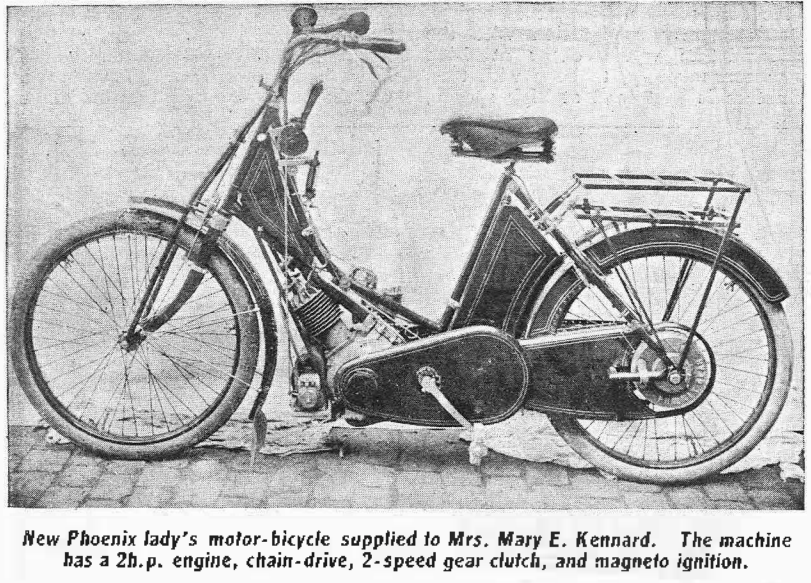
“THE REX MANUFACTURING COMPANY has just introduced a new type of machine intended for a lady to ride. The engine is 3¼hp, and it is mounted vertically in a cradle built in the main down tube. The petrol and oil tanks are mounted on a supplementary tube running from the bottom bracket to the head. An extra pair of tubes are built into the back triangle of the frame. The carburetter is a spray type.” Transmission is by V-section belt.
“THE BRITISH MEDICAL JOURNAL fancies that diabetes, so common among engine drivers, stokers, and others connected with railway travelling, is due to vibration, and that, further evidence in support of this will be found among drivers of motorcars, and especially amongst motorcyclists.”
“SIR A CONAN DOYLE has been fined £5 for exceeding the limit, the police alleging a speed of 30mph against him on the Portsmouth road last month.”
“THE RALEIGH CYCLE Co have received an excellent testimonial to the efficiency and lasting qualities of their motorcycles from a user of one of their 3hp machines. He claims to have ridden it not less than 10,000 miles since April, 1904, during which period he has not had to replace any single part. This is as good a record as any maker could wish for.”
“A HOBART 3½HP motor-bicycle scored over all competitors in a recent hill-climb held in connection with the Ulster Centre of the Motor Cycle Union of Ireland. It is interesting to note that the rider weighed 14½ stone, which is eloquent testimony as to the power developed in the motor referred to.”
“THE CHAMBERS OF AGRICULTURE do not approve of motors. At a meeting last Tuesday Mr Kidner said that ‘a volcano was simmering under motorists, and when the working classes were thoroughly roused by their behaviour the volcano would break forth. The so-called new industry would be swamped.’ We do not know who Mr Kidner is, but we tender our sincere thanks to him for the warning. We are not used to being swamped by volcanoes.”

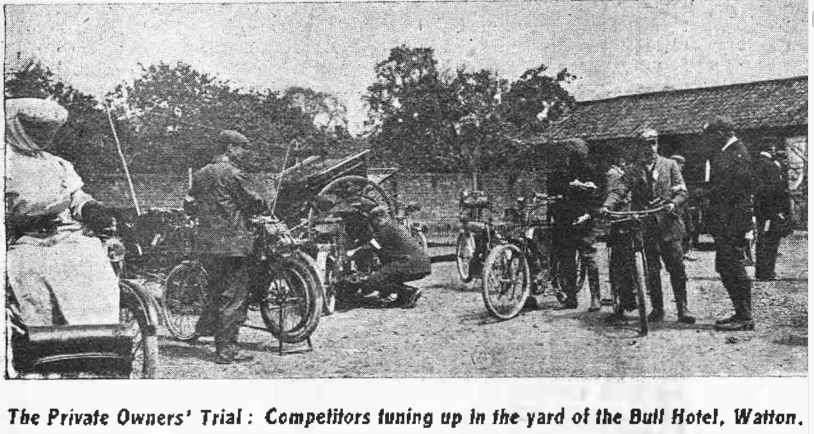
“THE FIRST OF THE SEASON’S competitions organised by the MCC was carried out in splendid weather on Saturday last. The trial was a 200 miles non-stop run for the Reeves’ Challenge Cup and Trophy. The committee decided on choosing a new course to run the trial over, instead of adopting last season’s route, with headquarters at Redbourn. This was agreed on by reason of the exceeding vigilance of the police on the London-Coventry road since the lamentable occurrence at Markyate. Police are now stationed at distances half a mile apart only, and practically all motorists are stopped and requested to show their licenses. The course was from Watton (headquarters, the Bull Hotel), a picturesque old-world village six miles from a railway station, to Broadwater, Stevenage, Baldock, Royston, Barkway, Puckeridge, Wades Mill, and back to Watton. Out of 27 entries for the event 22 competitors actually started. These were Messrs Fox, Hart, Baddeley, Badenoch, Penzer, Hulbert, Wells, Young, Reynolds, Lowe, T Hooydonk, LN Young, Sopwith, Day, Ilsley, Alegre, Davies, Brice, Ambrose, Hall, Lyons, and Mays. The length of the trial necessitated a start being made at 5am. Long before this hour Mr CW, Brown, the trials secretary, was astir, undertaking the sealing and checking of competitors’ machines. These were all bicycles, ranging in power from 2¼hp to 7hp twin-cylinder engines. Promptly to time the men were despatched at 30 seconds intervals, after undergoing the ordeal of being photographed. Before 20 miles had been completed there was a considerable number of competitors who had dropped out. Chester Fox had bad
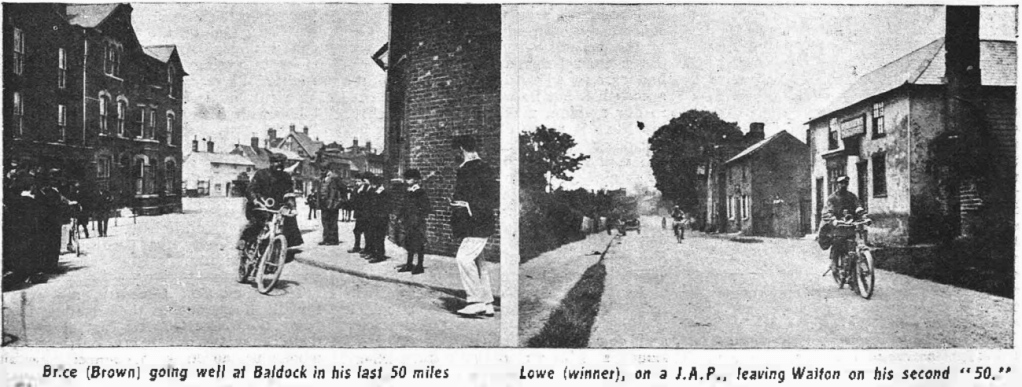
luck with his belt, the fastener breaking. Baddeley had a mishap in the shape of a fall; Hooydonk got his carburetter choked, and there were others who had tyre troubles, and some exceeded the speed limit. At the end of the first 50 miles the competitors left in were Hulbert, Wells, Reynolds, Lowe, Ilsley, Brice, Hall, and Young. At the completion of the first 100 miles a stop of 45 minutes was allowed for lunch, and then a start was made for the second 100 miles. The list of eight competitors left in was further reduced to six at the completion of 150 miles. By 4.30 Hulbert, Lowe, Ilsley, Brice, and Hall had completed their task, and it was now a question of deciding on a winner out of the five. After a short interval for tea a further contest was carried out on a good stretch of road about three-quarters of a mile outside Watton. The contest comprised a hill-climb over a certain distance, a start of 100 yards being allowed to the first line. The times were taken at the start and finishing point. The hill was only about 300 yards, and of quite moderate grade, say, not more than 1 in 12. Hulbert appeared to get up in the best time with Lowe and Brice next best. Ilsley was handicapped in having the exhaust valve lifter of his engine damaged, and could, therefore, not get a quick start on account of having to overcome the compression. After the hill-climb a further test, comprising a short speed trial and brake test, was carried out on the level. A special system of awarding marks was adopted by which a competitor was penalised for every yard by which he undershot or overshot the finishing line. His object was to ride as fast as possible between the tapes, and pull up dead on the finishing line. After this trial had been carried through the officials and competitors returned to the hotel, when the times and marks were totalled up. The final result was given as: 1, Lowe; 2, Brice; 3, Hall. The whole of the event was admirably organised, the system of marshals and checkers being in every respect satisfactory.”

THE QUART DE LITRE RECORD. Undoubtedly one of the best motorcycle record breaking performances of the year stands to the credit of Anzani, who has just succeeded in wiping out Lanfranchi’s long-standing hour and 100 kilometres records on the Quart de Litre type of motor, which is well under 2hp. To drive such a small-powered motor 46 miles 218 yards in the hour, and 100 kilometres (62 miles 246 yards) in 1hr 22min 28⅖sec. is no small order, as the minutest care and attention has to be bestowed upon the machine throughout such a trying ride, and this performance Anzani accomplished at the Parc des Princes track, Paris, on December 22nd last. After his ride he said, “ This is hard work compared to my recent hour record of close on 55 miles.”
“MOTORCYCLE RECORD OF 50 MILES PER HOUR WITH A SMALL ENGINE. The recent sensational performance made in Paris by Anzani on an Alcyon motor-bicycle of riding 100 kilometres in 1hr 14min 37sec, must restore interest in the possibilities of the small engine. The speed made by Anzani was 50mph, and the engine fitted to his machine was a Buchet 76x73mm [330cc], and what would be rated in this country as giving 2½hp. The weight of the machine did not exceed the standard of 110lb. The critics of the small engine will find it difficult to explain away the fact that it has been possible to attain a record speed with an engine that they are pleased to designate as a toy, and not to be considered in construction of an efficient motor-bicycle. There are plenty of motorcyclists who doubtless will wonder how this performance is possible, seeing that their own machines of 3, 4, and 5hp could not, under the most favourable conditions, do 30mph. Reduced to a plain matter of fact question, what is the use of a big, heavy engine on a motor-bicycle if 50mph can be got out of a small one? The V-section belt, as used by Anzani, has proved that as an efficient power transmitter it can beat the chain and gear, so this makes one ask another question. If the belt is so efficient, why use the chain and gear drives with their complications?”

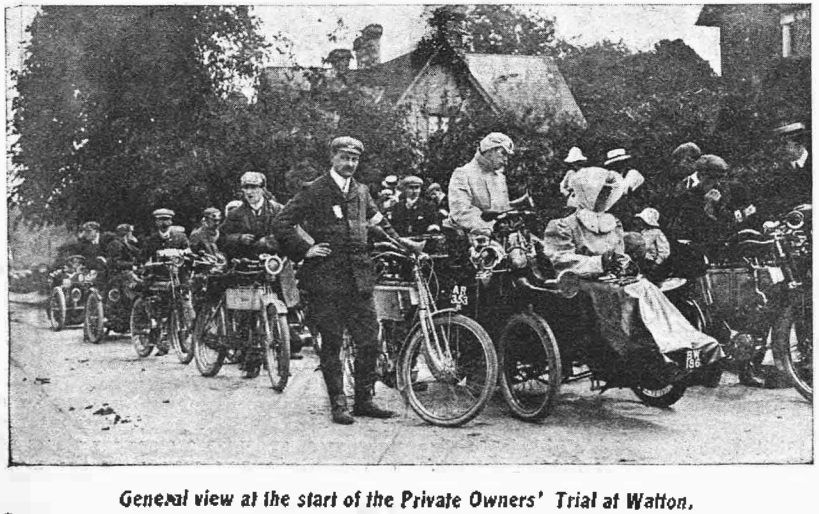
“THE EXECUTIVE OF the MCC are to be congratulated for their enterprise in adding to the list of events a private owners’ non-stop trial. For this event the large entry of 37 competitors had been received, but there were 27 actual starters. It would have been difficult to improve on the route over which the 200 miles non-stop was held a fortnight ago, namely, Stevenage, Puckeridge, Baldock, Royston, Broadwater, Wade’s Mill. Hence it was again adopted, the Bull Hotel, at Watton, being used as headquarters. The event being timed for 1 o’clock proved a great convenience, as it enabled members who might be detained in town on the Saturday morning to compete in the afternoon. The weather conditions were again perfect, and, owing to the recent showers, there was a welcome absence of dust. The following is the list of actual starters and their machines, these including several tri-cars: Gregory (Griffon), Hull (two-cylinder Werner), RC Davies (Humber tri-car), Mussel (Quadrant), Hayle (Trafalgar), Thorn (Phoenix tri-car), Battell (Minerva), Gibson (Vinco), Reynolds (Bat), Badenoch (Humber), Morris (Quadrant), Ashworth (Lagonda), Hart (London), Davies (Werner), Mays (Vinco), Porter (Brown), Bottomley (Barnes tricycle), Fox (Fox), Cowles (Rolfe-Minerva), Watts (Werner), Grimsdale (Bat), Mays (Brown), Hedges (Bat), Patterson (Humber tandem), Lambert (Kildare Speed), and Norris (Kerry). The competitors were started at intervals of one minute, and, according to the rules, they had to ride strictly to schedule time, which allowed of a speed well within legal limit. No stop had to be made except at the conclusion of 50 miles, when 15 minutes’ interval was allowed. A sufficient supply of petrol had to be carried on the machine to run the full distance. At stated places on the route each competitor had to hand over a metal cheque to the control marshal. Thanks to the foresight of Mr CW Brown, the club trials secretary, no interference from the police whatever was. experienced, as the necessary guarantees as to the behaviour of the competitors on the route had been given. At the conclusion of the first 50 miles the majority cf the starters had accomplished the distance. These were: Davies, Hayle, Gibson, Badenoch, Morris, Ashworth, Hart, Davies, Mays, Porter, Bottomley, Watts, and Lambert. The others were disqualified for failing to keep strictly to schedule time, although, in some cases, it was but a matter of seconds. This, of course, seems like hard luck, but to ensure a successful issue of the event the conditions allow of no lenient view being taken. Reynolds was
unfortunate in being compelled to dismount on account of a vehicle blocking the road. Gregory and RC Davies both went a trifle too fast, and in two or three other cases trifling mishaps, such as a toolbag coming unfastened, sparking-plug cable detaching from the plug terminal, spoilt the competitor’s chance. It was 7 o’clock before the full distance was completed, and then, after a short interval for tea, the final part of the programme was carried out. This was to decide three winners out of ten competitors left in. A very simple, interesting, and satisfactory plan was adopted. Mr CW Brown, accompanied by Mr DK Hall, during the afternoon went out along the main road and measured off exactly one mile by means of a tape. Curiously enough, although an active search was made, only one milestone in several miles could be discovered, and this a very ancient one, the others had vanished; hence the necessity of re-measuring the distance. Each competitor had to cover this distance at the rate of 17mph, or, to be accurate, 17.14 miles. He was told the exact time necessary to accomplish it, but he was not allowed to use a watch or cyclometer. The task set, therefore, was entirely one of judgment of a given speed, and the competitor who got nearest was acclaimed.the winner. At 8pm the following ten competitors were despatched over the measured mile at intervals of one minute, a standing start off the tape being made: Gibson, Badenoch, Ashworth, Hart, Davies, Mays, Porter, Bottomley, Fox, and Watts. It was found on calculating out the times, that Ashworth was the winner, as he had judged his pace with great exactness, being only one-fifth of a second within the time. Bottomley was second, two-fifths outside, and Hart two-fifths outside. The winners were deservedly congratulated. In every respect the event proved a very enjoyable social event.”

“THE INTRODUCTION OF A couple of handicaps into the second series of speed trials of the Motor Cycle Union of Ireland gave an added interest to the meeting that was held at Portmarnock Strand on Saturday afternoon. The committee of the Union made no secret of the fact that a system of handicapping became necessary owing to the consistent manner in which CB Franklin swept the decks at each of the previous meetings. Franklin is certainly a wonderful rider. He has done infinitely better on his machine in Ireland than other riders who were similarly mounted, just as he did very much faster time than the riders of similar machines in the Isle of Man last week. But while the committee of the Union admired the regularity of his wins, they felt that it was not in the interests of the sport that their meetings should be ‘benefits’ for one rider. It is a difficult thing to handicap motors, but the sub-committee entrusted with the work on Saturday made a very fair allotment, and one with which little fault was found either before or after the events. Franklin, of course, was scratch man, and he was asked to give away, in the mile race, starts running up to 30sec—a fairly big effort, for his best time for a straightaway mile on the Strand was 1min 28sec. He got into the final, but finished some 7sec behind the winner, the prizes going to two long-markers, W Guilfoyle (25sec) and PS Sheardown (30sec). Both of the men were strangers to prize-winning, so that the handicap achieved its object in distributing the awards. Franklin won the scratch event from HS Huet, and he also won a two miles’ out-and-home handicap. This event was arranged on a novel basis. The heats were made up of men on machines of similar horse-power, and a handicap was framed on the field for the final—and a very good handicap it was, for Franklin just beat A Summers by 2sec. Results. Mile Handicap: 1, W Guilfoyle, 2¾hp Liberty (25sec start), net time 1min 47sec; 2, PS Sheardown, 3hp NSU (30sec), 1min 53⅖sec; 3, W, Keating, Jun, 2½hp Triumph (20sec), 1min 44⅘sec, 3; won by 1⅖sec; 2⅗sec between second and third. Mile Scratch: 1, CB Franklin, 2¾hp FN, 1min 31⅖sec; 2, HS Huet, 3½hp Minerva, 1min 33sec; 3, A Summers, 3hp Triumph, 1min 42⅖sec. Two Miles (Out-and-Home) Handicap: 1, CB Franklin, 2¾hp FN (scratch), 3min 16sec; 2, A Summers, 3hp Triumph (18sec start), 3min 36sec; 3, HS Huet, 3½hp Minerva (8sec start), 3min 49sec; won by 2sec.”

“AS AN ENGINEER who has often to tackle the work of repairing the engines of motorcars, I should like to draw your readers’ attention to the disadvantage of buying either cars or engines in which the parts are made to the metric measurements instead of to the ordinary standard English measurements. This means that if a breakdown has to be repaired in an ordinary engineer’s shop, none of the ordinary tools, such as drills, broaches, taps, etc, are available, and the work takes three or four times as long to do, and is, of course, much more costly. So far as my experience goes, our English workmen do not take kindly to the foreign sizes, and as the English inch is the standard measure in at least nine-tenths of the workshops of the world, there is no object in foreignising motorcar parts. Whitworth fully demonstrated the value of standardisation some 50 years ago; yet motorcar designers appear to take a delight in making parts to any sizes but ordinary standard ones, and they even pretend that our good old English measurements are not sufficiently delicate for them to work to; whereas, as far as I can see, motorcar design is being worked out by the same methods as brought the cycle to perfection—trial and error, or, in other words, rule of thumb—and the intricate calculations they brag about are mere talk.
AC Pemberton.”
“I SEND YOU A PHOTOGRAPH of a connecting rod taken from a small air-cooled motor, and feel sure you will agree that it has a unique appearance. A brief account of how it came into its present shape is as follows: I had completed a run of some 18 miles on the machine, and was about to make the return journey, and endeavouring to get a start, when the engine gave about four explosions, then pulled up with a bang. On taking the engine to pieces I found the connecting rod doubled up into its present artistic angles. The piston had not seized, neither had anything got into the cylinder to interrupt its stroke. The only probable cause I can suggest for the rod (which I might mention is made of phosphor bronze or some other yellow metal) bending in this manner is that I advanced the spark too soon, and the fact of two forces acting in direct opposition, viz, that due to the momentum of the engine with the weight of the machine behind it and the explosions opposing this momentum, the rod buckled up; as neither the gudgeon nor crank pins were damaged, and the engine not thrown out of line, I think this is phenomenal.
William N Bragg.
[The above is certainly remarkable, but the connecting rod does not appear as if it had been well designed, the section being a weak one for its length, especially if made of brass or similar alloy. But in any case, if the rod had not been bent, you would most likely have broken the crank shaft.—Ed.]”
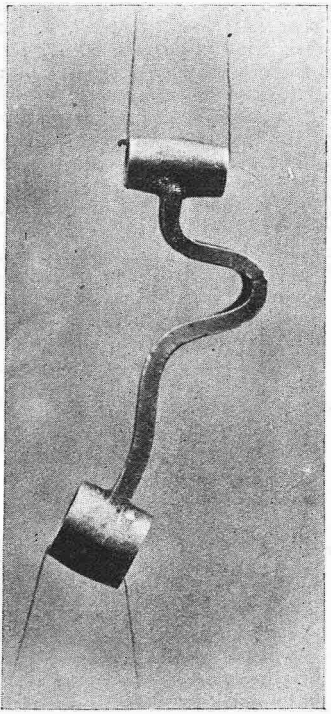
“IN REPLY TO A LETTER from a correspondent ‘FR 54’ as to a Rex 1904 surface carburetter I can testify to its being very economical, having ridden a Rex 1904 3¼hp machine for over a year. I can go approximately 100 miles on a gallon of petrol in this district (Cambridgeshire and Norfolk), and this Easter I did 229 miles on two gallons. I find Carless gives the best results, as it can be run with more air, and does not seem to go stale in the carburetter so soon as other brands I have tried. The secret in using the surface is only to run petrol in from the tank as required, and so arrange that the carburetter shall be as nearly empty as possible at the end of a journey. Stale petrol will mean difficulty in starting.
Ernest R Evans.”
“WE MUST, FOR THE PRESENT, definitely refuse to give our approval to the scheme for-special roads for motorists…It is obvious that in these islands, which possess an absolute, network of roads enabling one to travel practically direct from any one spot to any other spot, one or two, or even a dozen, of the projected motor ways would never touch even the fringe of general requirements. If the matter is to be touched at all, it must be tackled out and out in a thorough manner, and the proper way is to look ahead and recognise the facts that mechanical traction and rapid transit are to be the method and condition of all future road traffic, and that each and every road in the country must be available and rendered fit for the newer methods and the newer conditions. To claim anything short of this is to place a weapon in the hands of our enemies.”
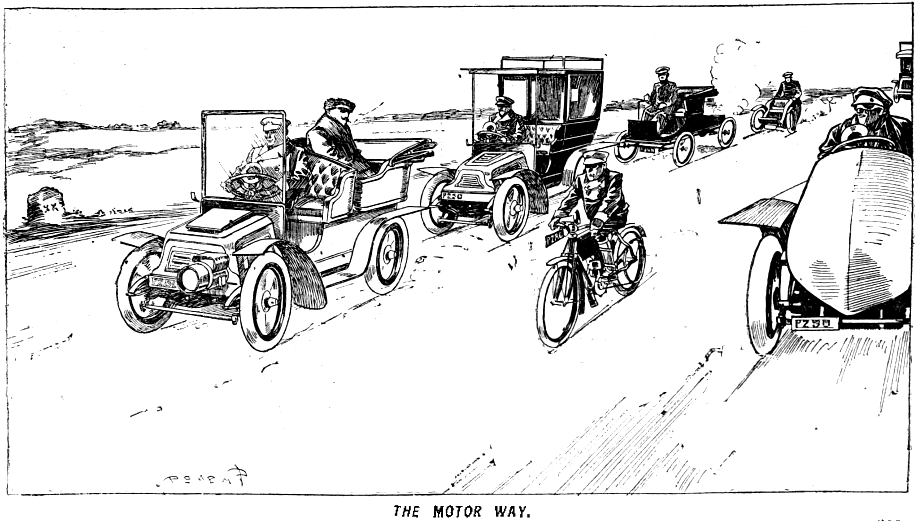
“EASTER MONDAY SAW THE inauguration of the motoring season in Lincolnshire, for it was then that the members of the Peterborough and Counties Automobile Club met at Bourne, and afterwards had a hillclimb for motorcycles in Grimsthorpe Park, by kind permission of Lord Ancaster…Practically, the hill is half a mile long, and at its steepest point the gradient is about 1 in 9…The contest was carried out under handicap conditions—the usual formula as to weights, horse-power, bore, stroke and revolutions per minute being observed…The best time was credited to Mr H Rieff, who covered the distance, on a 3hp Clarendon, from a flying start, in 36⅕sec. This was a very smart performance, and Mr Rieff accordingly carried off the gold medal offered bf the club. A bold bid to beat his time was made by Mr T Woodman, on his 2¾hp Chase, but he could do nothing better than 37⅖sec.”

“MOTORCYCLE RACES AT CANNING TOWN. Some interesting motorcycle races were decided at Canning Town on Monday, at the meeting promoted by the Thames Ironworks CC. Owing to an accident to Franz Hoffman, the Continental motor pacer, who fell while training on the track on Tuesday of last week, and had to be conveyed to the hospital, the services of Fellas, a motorist of some note on Continental tracks, was secured by the officials. It appears that Hoffman, riding a four-cylinder Clement-Garrard—an old favourite of Marius Thé—increased his speed although he had just done 22sec for the lap, and the outside fly-wheel catching on the banking, the machine was swung round and smashed into the fencing, the rider sustaining a broken ankle and other injuries, but of a slight nature. Fellas had a 16hp Gladiator single cylinder and a 24hp two-cylinder (used by Cissac upon occasions) at his command, but both were obviously unsuitable for the limited banking, and, as a matter of fact, the heavier-powered machine could not be tuned up satisfactorily for the meeting, which was perhaps fortunate for the driver!”
“WHY DO THE MAJORITY of motor-bicycles in London career the streets without efficient silencers? The noise appears to be in inverse ratio to the size- of the engine.”
“THE OLYMPIA SHOW. For the first time the Automobile Show organised by the Society of Motor Manufacturers and Traders will be held before the Paris Salon, and the importance of this priority is not to be overlooked. The last show, held in February of this year, attracted 248 exhibitors: the show to be opened on the 17th inst will be supported by over 300 exhibitors…” but none of them were motor cycle manufacturers. Fortunately the Stanley Show was a different bouilloire de poisson.

A GOOD SHOW of the popular Werner motor-bicycles is made by Werner Motors, 45, Dean Street, London, W. Amongst these are to be found the 3¼hp and 4hp twin-cylinder models, having several notable improvements. These include larger tank for the petrol supply, and with the view of rendering the machine adaptable for any kind of weather, larger mudguards, with ample clearance, are fitted. Control by exhaust lifter is another feature of this make. The spring fork adopted last season has proved so successful that it will be adopted on present and all future models; Magneto ignition can also be had at customer’s option, but the improved low-tension system will be retained as standard. A novelty is the 5hp tri-car, a type the company have been developing for some time back. It has a 5hp engine, water-cooled, and with two cylinders. Transmission is by pedal-operated clutch and chain through a novel two-speed gear…Brakes are fitted to both the driving and steering wheels, and other features make for perfection, whilst the finish is good.”
“THE LONDON AUTOCAR CO, 182, Gray’s Inn Road, London, EC, have some special novelties to show, including the LAC spring fork attachment, LAC sets for cycle and tri-car buildings, samples of the Givaudan and White and Poppe engines, De Dion parts, complete sets of motor castings, electric ignition accessories, etc, the whole going to make up an interesting exhibit.”
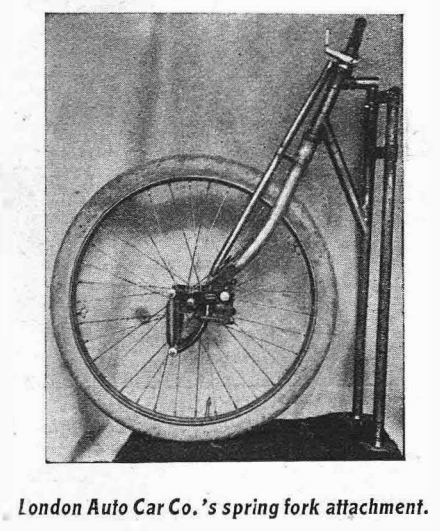
“THE KENT VARIABLE GEAR Co, 77, High Street, Chatham, will have their two and three-speed gear for motor-bicycles and tri-cars on view. This is a type of gear that has been extensively used during the past season and given much satisfaction. It is designed to fit direct on the driving wheel, and has a friction clutch of large diameter combined. It gives a direct drive on the top speed, and runs on ballbearings. The gear wheels run in oil, and are very accessible for the purpose of inspection.”
“THE TRIUMPH CYCLE CO, Coventry, have a fine show of 1906 Triumph motor bicycles. This machine is an improvement upon the 3hp 1905 model, which has obtained such an excellent reputation for good design, best possible workmanship, and the embodiment of many original features, not the least of these being the use of ball-bearings in the engine. On the new models will be seen a new spring fork pivoted at one point at the crown on ball-bearings, and this has been proved to be most effective. The frame is built lower and of improved design. The firm are now fitting high-tension magneto ignition as standard, but coil ignition can be had at purchaser’s option. The magneto driving chain is protected by a neat aluminium case. Other improvements comprise the use of neat footrests with rubber cushions and an aluminium silencer, having a foot-operated cut-out which has no back pressure, and is nevertheless thoroughly effective. The machines are fitted with the Triumph Lightning stand, and a new pattern tubular carrier, and there is also a novelty in the shape of a very convenient tool-bag permanently fitted to the carrier.”

“O AND W ORMEROA, ROCHDALE, the makers of the well-known Watawata belt, will be showing this speciality, and some clever apparatus for demonstrating the construction and action of the belt. A number of pulleys formed to the correct angle will be on exhibit.”
“RW COAN, GOSWELL Road, Clerkenwell, London, EC, is showing aluminium castings, such as crank-cases and gear-boxes, and a novelty in the shape of a patent steering wheel, which can be warmed by hot water for winter work. The special feature is that the wheel is bound in leather.”
“MILLS AND FULFORD, Crown Works, Coventry, will show a new form of trailer, which they name a rear-car. It is claimed to be detachable in 60 seconds. Another novelty will be a side-car fitted with a castor wheel. A full selection of ordinary fore-cars and trailers improved in various ways will be shown.”
IN MOTOR-BICYCLES the Phoenix company have much of interest to show. The quite new low-built open frame model calls for special mention. It has a 2hp, or, if desired, 2¾hp Minerva engine fitted with two-speed gear and starting handle. Instead of pedals footrests are fitted, and the saddle is replaced by a special type of spring seat which looks very comfortable. This machine should certainly meet the demand for an easily-handled and fairly light mount which, if need be, can be ridden by a lady. The idea of comfort and vibrationless running, ease of manipulation in traffic and capability to mount any class of hill are its special features. The standard Phoenix machines in 2¾hp and 3½hp patterns fitted with magneto and two-speed gear, and with many detail improvements, are also shown, and go to make up an exhibit which must enhance the reputation of this enterprising firm.

“THE CRYPTO CAR AND CYCLE CO, 14, Mortimer Street, London, W, who recently purchased the name and goodwill of Kelecom, exhibit specimens of the Kelecom bicycles in three types. There is a 4hp single-cylinder, with band brakes to front and back wheels, and V forks of a very strong design, which is priced at £27. The two-cylinder 5hp machine is on similar, lines, but built stronger. The four-cylinder model is an interesting type, and has magneto high-tension ignition, bevel gear transmission, and a frame of extra strength. It is provided with 26in wheels, having 2½in tyres. This comes out at the reasonable figure of £45.”
“THE ROC MOTOR-BICYCLE will be shown by AW Wall and Co, Roc Works, Guildford. The 1906 model will have a twin-cylinder engine, with the cylinders placed side by side and the fly-wheel between. Transmission is by chain and sprockets on countershaft. High-tension magneto ignition and the use of 2½in tyres are specialities.”
“THE REX DISPLAY comprising 20 motor-bicycles and three and two-seated Rexette tri-cars, a chassis of same, and a series of the special 25-guinea line in motor-bicycles. This eminently up-to-date machine is likely to prove one of the most striking features of the Show. The Rex Co believe that in adopting this policy a very large accession of cyclists to the ranks of motorcyclists will take place, as it will no longer be true that the heavy initial first cost of a machine bars the way to their becoming motorists. It certainly looks a thoroughly serviceable mount, especially as it has the new spring fork fitted. The frame, is now made of increased length and lower in build, to give increased steadiness and stability on rough roads and greasy surfaces. The usual seat pillar is dispensed with, and the saddle is now supported on an extension of the horizontal tube. This brings the rider further back and into what is recognised as the most comfortable riding position. The equipment is very complete. Two brakes are now arranged to operate on the back wheel. One is fitted on the hub, and consists of a coiled metal band on a metal drum, giving an extremely powerful braking effect. This is worked by Bowden wire from the handle-bar. The other brake is a pedal-operated one working on the belt rim. The engine is 3⅜hp (82x89mm) engine, mounted vertically in a special frame. The 5hp twin-cylinder model, with cantilever seat and spring front forks, is sure to command much attention. It has a Longuemare carburetter, neatly arranged, and with concealed adjusting levers. A small but useful improvement is a spring lamp holder. The frame tank holds 2¼gal petrol, and the rear tank contains a coil and provision for two sets of accumulators. All the machines are finished off in standard aluminium finish with green lines, giving a very workmanlike finish. Mudguard equipment is very efficient, the guards being wide and well extended. This is a machine the company hope to do well with next season, and for this model old machines will be accepted in part payment.”
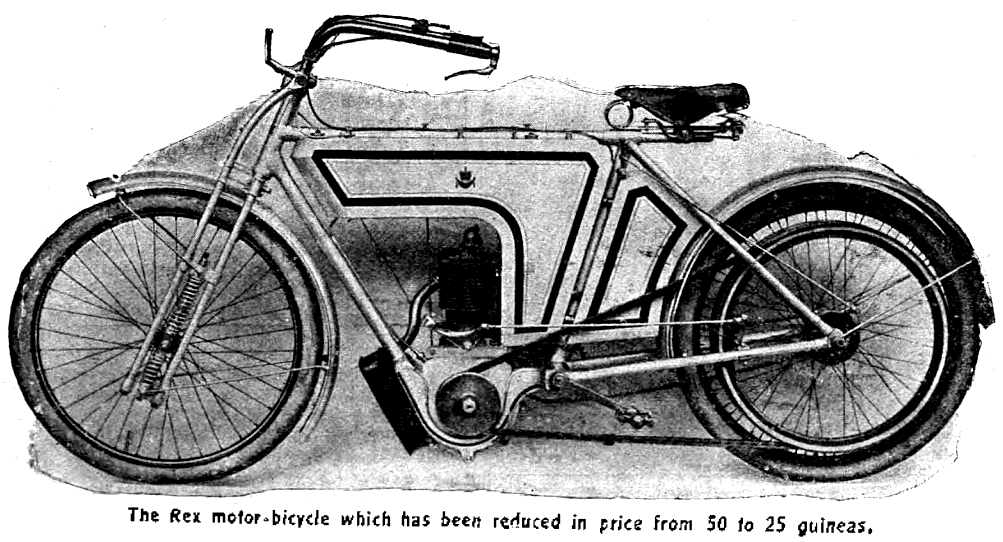
“THE WELL-KNOWN Dicks’ Balata V-section belting for motorcycles will be shown by Messrs Hobday Bros, Gt. Eastern Street.”
“MOTORCYCLISTS INTERESTED IN transmission will find a novelty in the Simpkins pitch band, shown by the Metropolitan Machinists Co, of Bishopsgate Street, London. General motor accessories will also be shown.”
“THE ZENITH BI-CAR is a motor-bicycle built on quite unconventional lines, and selling at 43 guineas. The wheels are supported in a type of double rectangular frame, the front wheel being pivoted in guides and steered by connecting rods from the steering column, this part occupying almost the centre of the machine. The low build of the frame renders it easy to mount, and with footboards in place of pedals a comfortable riding position is obtained. The engine is a 3h.air-cooled, fixed low in the frame and driving by V-belt through a free engine clutch, this giving very easy control. It is claimed that this machine is specially free from side-slip. There is also shown a tri-car selling at 52 guineas and having some novel features. It has a similar type of frame to the Bi-car, and is fitted with a 3hp Fafnir engine. A two-speed epicyclic gear is used, giving a very low ratio of gearing. Band brakes are fitted to all wheels, all operated by wires. It looks remarkably good value.”
“THE BAT MOTOR CO, Kingswood Road, Penge, London, have an extensive and interesting show of Bat motorcycles. These include the No 1, having ball bearing, spring frame, spring front forks, and fitted with a JAP 6hp twin-cylinder engine. This is a finely-finished and powerful mount equal to any class of work it may be put to, and priced at £52 10s. The No 2 has a 4hp engine—either Stevens or JAP at option—spring frame, and all latest improvements, selling at £45. The No 3 machine is the Bat fore-car minus fore-carriage and fittings, and is arranged with the idea of being a machine well adapted for winter work for one passenger. A racing machine, fitted with 5hp Soncin engine, looks capable of a good turn of speed. In place of the round tanks the company used to fit, a square pattern is now adopted. At the customer’s desire, pedals or magneto may be had on any of the models.”
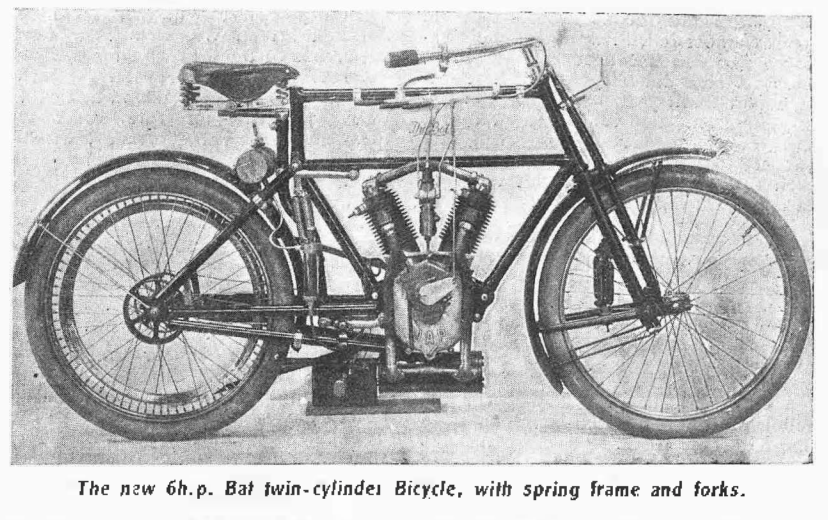
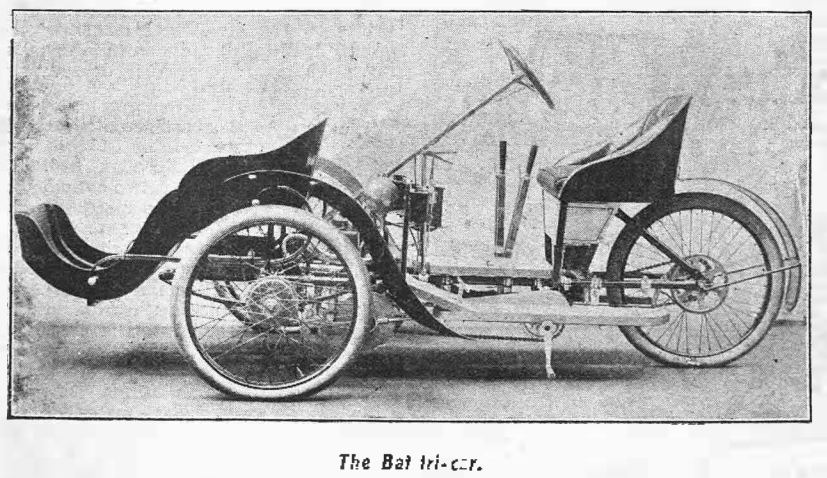
“A NEW TWO-SPEED GEAR for motorcycles will be exhibited by Messrs J Chapman and Co, Fann Street, London, EC. It is claimed to be capable of easy attachment to any machine without alteration. There is a direct chain drive on each speed, and a free engine position. A powerful footbrake of a very simple pattern, and acting on the belt rim, will be shown.”
“THE ONAWAY MOTOR ENGINEERING CO, 83, St Albans Road, Watford, are introducing a novelty in a motor-bicycle fitted up on the Onaway frame principle, in which the usual top tube and seat stays are dispensed with. This admits of the use of a comfortable upholstered spring seat and spring footboards. Other special features are the adoption of a 5hp twin-cylinder Antoine engine, free clutch, and pulley, with four speeds, and handle-bar control.”
THE FN MOTOR AGENCY, 139, Queen Victoria Street, London, EC, exhibit the four-cylinder 3½hp FN motor-bicycle considerably improved in detail for 1906. A larger silencer is fitted, and the gear has been strengthened. The spring front fork has been improved by the use of much larger double springs. A new throttle controlling each cylinder is now added. Some difficulty was formerly experienced with the plugs fouling. A baffle plate has now been fitted at the base of each cylinder, which entirely obviates this difficulty. The high-tension distributor can now be quickly dismantled for cleaning. The carburetter is now made automatic and engine power slightly increased. Other improvements include a neat and effective carrier, new valve lifter, more powerful rear brake, stronger details to magneto. The single-cylinder 2¾hp is also shown, fitted with magneto and detail improvements, including specially large and strong tyres. The price of the four-cylinder machine is £45 and the 2¾hp at 30 guineas, fitted with magneto.
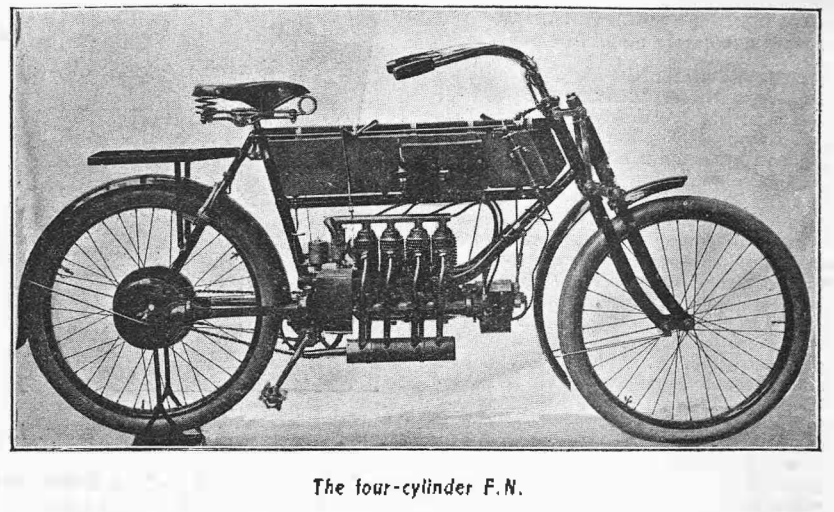
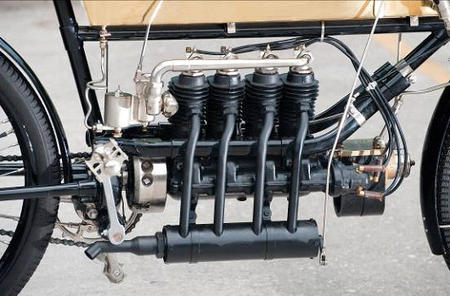
“MR GH WAIT WILL EXHIBIT…a 6⅓hp Clyde spring frame tricar…Three different types of motorcycle will also be shown on this stand; a 3½hp Clyde, with patent spring frame and spring forks, a new model motorcycle for 1906, and a 5hp twin-cylinder machine.”
“BROWN BROS, GREAT EASTERN STREET, London, EC, will have a large stand on the ground floor wholly devoted to motor goods and accessories…Amongst the motorcycles two new models will be found. One is a twin-cylinder machine of 5hp, a powerful and substantially built mount, with belt transmission, and the usual standard equipment; the other is a 3½hp high-tension magneto model, embodying all the best features of the Brown. The engine of the Brown machines is in particular a very durable piece of work, with substantial bearings, large diameter interchangeable mechanical valves, heavy flywheels, etc. In addition to these new models, the well-known standard 2¾hp and 3½hp machines are shown. Special attention has been given to the strength of frame, and duplex front forks are used.”
“THE SELF-SEALING RUBBER CO, Hinckley Street, Birmingham, will show their leading lines in self-sealing air tubes, Hermetic tyres, patent detachable joint air tubes, Hermetic tyres stopping, etc.”
“EH HILL, 56, BROOMHALL STREET, Sheffield, will display accessories in the shape of pumps in brass and celluloid. A special class of inflator for garage purposes, a motor tyre gaiter, pressure indicator, water pipe clips, tool kits, funnels, etc, will make up a comprehensive exhibit.”
“THE SOUTH BRITISH TRADING CO, 13-15, Wilson Street, Finsbury, London, make a special feature in their exhibit of the Vindec motorcycle. This is a machine which during the last two seasons attained much popularity for its consistent reliability. The latest models have 2½hp and 3½hp FN engines and spring front forks, on the Truffault’s Suspension principle. Magneto ignition is now fitted to all models. The transmission is by V-belt. Special attention should be given to the new two-speed gear and free engine clutch introduced in connection with the Vindec Special, having chain drive. It is arranged in the hub, and provides a range of speeds in the proportion of 4 to 1 and 7 to 1 for any given size sprocket. A new twin-cylinder model, having a 5hp engine, which the company hope to show in the course of the week, is an interesting feature. The cylinders are mounted vertically, with combustion chambers placed in front for cooling effect. An improved handle-bar is fitted to all models, enabling the rider to sit well back. A variety of accessories are shown here, noteworthy amongst which is a new tyre pump, named the Skinner, which works on the compound principle, thus greatly facilitating the operation of pumping up a tyre. A number of 20th Century lamps are exhibited.”
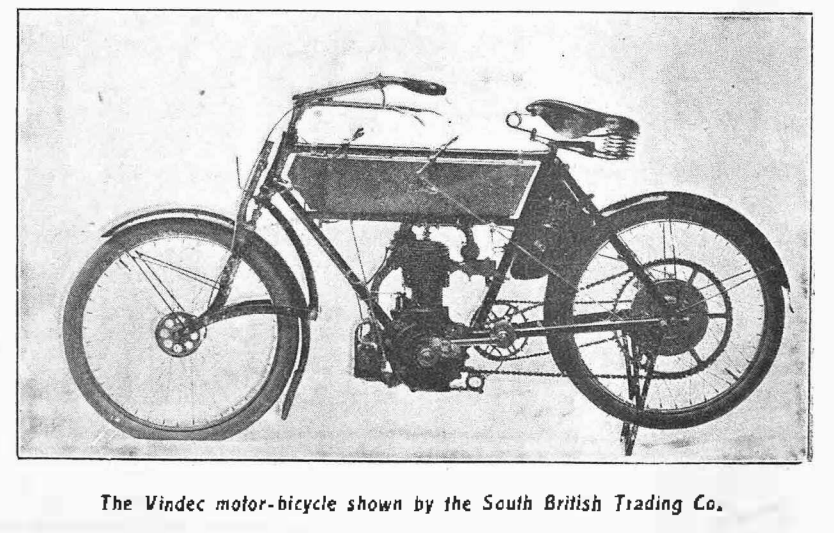
“THE ARIEL CYCLE CO, of Birmingham, will exhibit… cycles, motorcycles and accessories. The motorcycles for 1906 will be of 5hp, 3hp, and 2½hp, the latter being of the lightweight type, and similar in design to the Ariel machine which gained a gold medal in the recent London to Edinburgh run. Prospective purchasers will note with interest that the price of the 3hp models has been reduced from 50 guineas to 35 guineas, and of the 2½hp model from 45 guineas to 30 guineas. The 5hp Ariels are of the twin-cylinder type, and are similar to the model which was awarded first position in the Little Gordon-Bennett Trials and secured the Motor Cup. This machine is placed on the market at the very reasonable price of 45 guineas. The Ariel Liberty cycle attachment continues to grow in favour, and motorcyclists interested in this form of passenger attachment will be able to inspect a bicycle fixed to a motorcycle by this device at the firm’s stand.”
“THE EAST LONDON RUBBER CO show a range of motorcycles fitted with Kerry engines. These include a 2½hp Lightweight, a 2¾hp and 3½hp Roadster, and 3½ and 5hp speed machines, the latter having a twin-cylinder engine. Otherwise the standard features are adopted. The Kerry-Abingdon tri-car is an interesting production, being a combination of Kerry engine on Abingdon frame. A two-speed gear, specially simple in design, and claimed to be very efficient, is a feature of this machine. Numerous accessories of every variety are also, shown.”
“MINERVA MOTORS, HOLBORN VIADUCT, London, EC, have a fine show of their, 1906 model machines. The twin-cylinder 4½hp type is the leading feature. It is shown in two forms, one having magneto ignition and spring fork suspension, and the other with coil ignition and rigid forks. The driving arrangement of the magneto is novel, inasmuch as it consists of a connecting rod rocking on a centre and operating eccentrics at each end. Other features include two brakes operating on the back wheel, one being a band brake worked by back pedalling, the other acts on the belt rim. Samples of the 2, 2¾ and 3½hp single-cylinder machines are shown. A new device for controlling the carburetter air inlet and throttle should be inspected. On the twin-cylinder models will be found a clever and simple lubricating device. It consists of a small circular sight-fed oil container, which fills up automatically from the tank, then, by means of a simple lever motion, the charge is at once admitted to the engine. The glass cover to the oiler enables one to judge with certainty that oil enters the engine. All the machines are nicely finished, thoroughly well equipped, and sell at very moderate prices.”
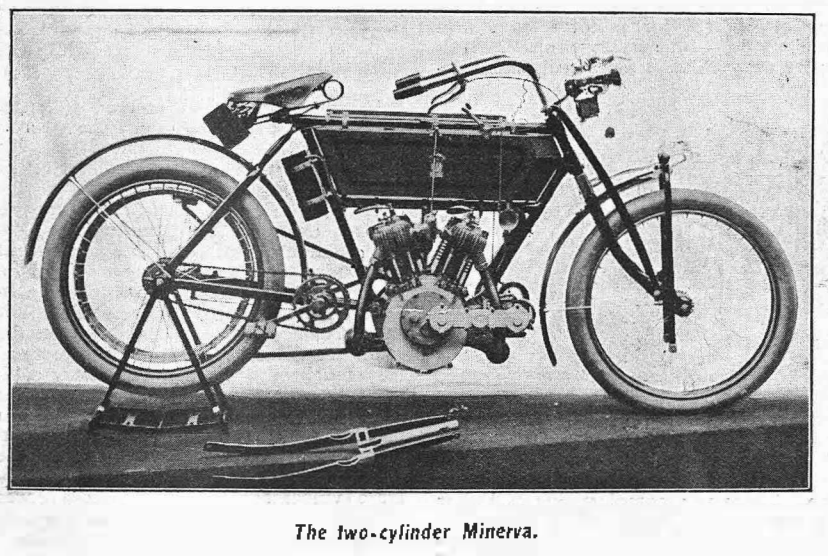
“THE ROVER CYCLE CO, Coventry, exhibit specimens of the 2½hp Lightweight and the 3hp standard chain-driven model. A quite new type of carburetter is fitted, much smaller and neater than the old model, and quite automatic in action. The chain-drive pattern is provided with free engine device and handle for starting. The frame has also undergone some slight alteration, being made stronger at the fork crown lug. Both machines are typical examples of the fine workmanship and high finish associated with all Rover products.”
“THE QUADRANT CYCLE CO, Birmingham, exhibit their 3½hp motorcycle, which embodies very considerable improvements for 1906. The engine is now mounted vertically, and ignition is by high-tension magneto. The well-known spring fork has undergone some modification. In its new form it is neater and, if anything, more effective than before as a vibration absorber. The design of the tank is also much improved. In the Quadrant tri-car the well-known twin engine principle is retained. There are many minor improvements which command attention. From all appearances, the Quadrants for 1906 will enhance the fine reputation earned in the past season for reliability.”
“THE ANGLIAN MOTOR CO, Newgate Street, Beccles, exhibit two tri-cars and two motor-bicycles. The No 1 Anglian Tri-car is 5hp with twin-coupled air-cooled engine. Anglian two-speed gear, open trussed frame of novel and original design, pedal brakes to front wheels, and side lever to back wheel brake. The fore-carriage is coach-built, and footboards are provided. The design of frame enables a lady to drive the machine if so desired. In the No 2 Anglian tri-car a 3¼hp genuine De Dion engine is fitted with water-cooled head, and magneto high-tension ignition is adopted. Circulation is by thermo-syphon arrangement and radiator. Both machines look thoroughly serviceable and well-finished mounts. In the bicycles the No 1 has a 2¾h.p. genuine De Dion engine and coil ignition drive by V-belt. It is built with a view to hard work in all weathers. The No 2 machine is on similar lines, but fitted with a JAP Anglian motor and 26x2in wheels instead of 28x2in, as on the 2¾hp machine.”
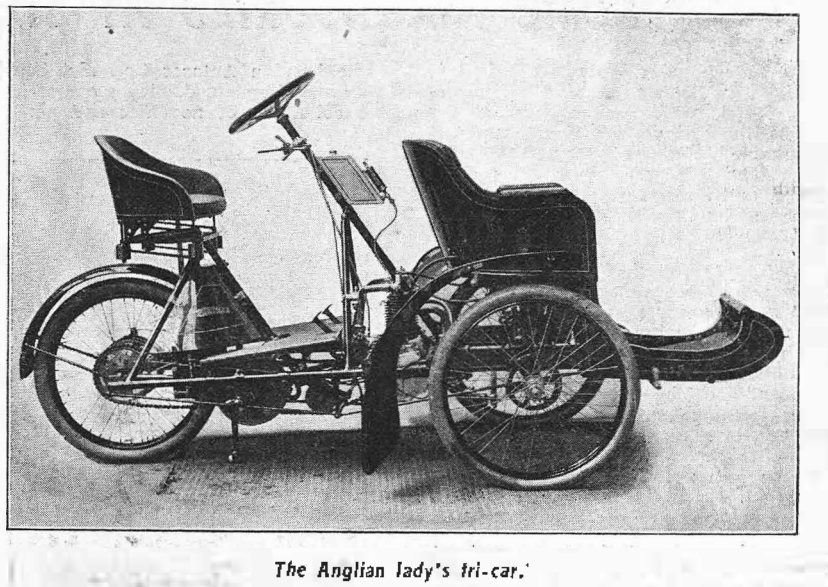
“H&D FRIEDENHAIN, 67 AND 68, Bunhill Row, London, exhibit as a speciality a number of the 1906 Sarolea engines. These include the 3hp single-cylinder 76x85mm, a 4hp double-cylinder V-type 66x72mm, and a 5hp 70x80mm double cylinder. A feature of these engines is the sound workmanship throughout, which has earned for them a high reputation for durability. They also develop rather more power on the brake than they are rated for. A good selection of fittings and accessories for building up complete machines and different sizes of ball-bearings for motor work are shown.”
“A LINE OF MOTORCYCLE accessories is shown by Herwin Canny & Co, 158, Sandy Hill Road, Plumstead. These comprise the following specialities: Simplex motorcycle stand and rest for attaching to the rear stays, patent belt fasteners, a new spring fork attachment, Simplex accumulator repairing fluid. A twin-cylinder motor-bicycle with some distinctive features is shown.”
“THE NSU CYCLE AND MOTOR CO have an excellent display of their motorcycles in the Gallery. Some twin-cylinder machines shown have many points of interest. The position of the engine is such that one cylinder is vertical and the other nearly at right angles to it. Transmission is by a wide V-belt, and a free engine clutch for starting is provided on the engine. The wheel base is unusually long, and the wheels small in diameter. Magneto ignition, spring forks, very capacious tanks, and ample brake power are characteristic features. A nicely-finished fore-carriage attachment coupled to a twin-cylinder machine, and also a sidecar fitted up are shown, along with a very practical-looking type of tradesman’s carrier. The NSU machines are made in many types to suit all classes of motorcyclists, starting with the 2½hp single-cylinder model having either magneto or coil ignition. The NSU engine is effectively displayed in all its types, and, as this engine has many interesting and quite original features, close attention should be paid to it.”
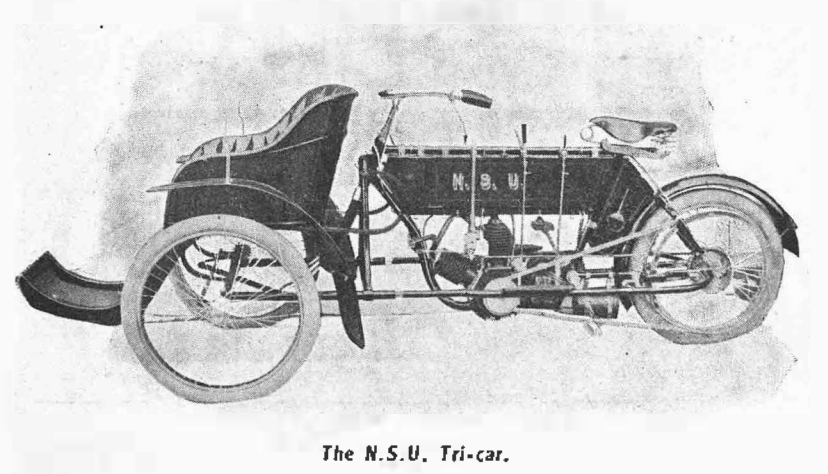
“GA BARNES, PRINCE STREET, Deptford, shows a series of Barnes motorcycles, including a 4hp machine having a dropped frame and a round tank. A new 5hp model is fitted with two-cylinder V-type engine and spring forks, and built low to diminish risk of skidding. A 12hp racing motor-bicycle built on original lines. A 6-8hp tri-car has an air-cooled engine with outside fly-wheels. Two speeds are fitted, giving direct drive on top speed. Special attention should be paid to the control arrangements on this car. Push-forward pedals operate clutch and front brakes, and side levers operate the gear and back brake. A 12hp fore-car, fitted with 12hp engine, air-cooled, is also shown. This has many original features, not the least being accessibility to every part.”
“THE STEVENS MANUFACTURING CO, Pelham Street, Wolverhampton, show the latest types of the very popular Stevens engines. This firm has a well-deserved reputation for the excellence of their productions, as testified by the large number of these engines in use. The exhibit comprises a series of 6-8, 8-10, and 16-18hp engines, the 6-8 and 8-10hp having two cylinders, and the 16-18hp four cylinders.”
“WE FAILED TO FIND a single motor cycle at the Stanley Show fitted with a surface carburetter, the spray having at last asserted its undoubted superiority. There were no ‘giraffe’ types of motor cycles exhibited, all having low frames with 26in. wheels. Some makers had even gone to the extreme and fitted 24in wheels, which, however, would not be comfortable unless fitted with large-diaimeter tyres or a spring frame.”
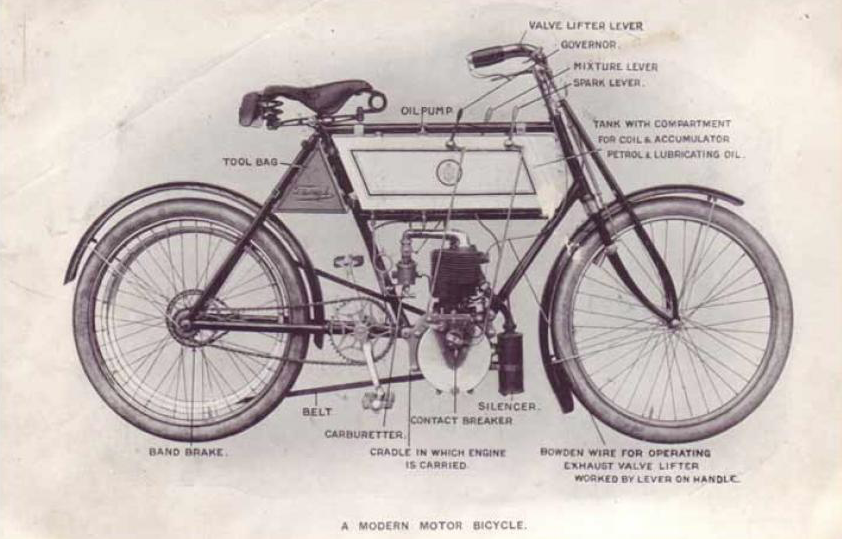
“GLASGOW MOTORCYCLE CLUB. The open hill-climbing contest promoted by this club was carried out on the Lennoxtown-Fintry Road in beautiful weather. The course was fully a mile and three-quarters in length, with an average gradient of 1 in 15; some of the pitches having a maximum of about 1 in 9. The competitors were arranged in classes, according to cylinder capacity; unrestricted pedalling was allowed in Class I. only, the other classes being only allowed to pedal at starting. Two trials were run, the best time being taken to count. Of 39 competitors 16 completed the course in accordance with the conditions. A remarkable feature was the large number of high-powered machines which failed to finish, and as the majority of these were geared in the region of 3½ and 4½ to 1, their failure must be attributed to the prevailing tendency to gear too high. The event parsed off without a hitch, and was witnessed by a large concourse of spectators. The police did not interfere, except to stop some riders returning downhill and demand exhibition of their license. In the results times are taken from a standing start. The winner in each class was awarded a gold medal. Class I (70x70mm): 1, William Hutchison (1¾hp Clement-Garrard, 55x70mm), 7min. 5sec; 2, John Caldwell (2hp Clement-Garrard, 60x70mm), 7min 17sec; 3, D McCallum (1¾hp Ormonde, 63x76mm), 9min 8sec. Class II (76x76mm): 1, Arthur Reid (2¾hp Minerva, 76x76mm), 6min 40sec. Class III (8080mm): 1, CB Ferguson (2¾hp King, MMC, 79x79mm), 6min 9sec; 2, John Falconer (3hp Centaur, 79x79mm), 6min 59sec; 3, JS Bryce (3hp Quadrant, 79x80mm), 8min 1sec; 4, John Roberts (2¾hp Bradbury, 79x76mm), 9min 10sec. Class IV (85x8mm): 1, FC Holms (3½hp Brown, 82x90mm), 5min 35sec. 2, AE Holms (3½hp Ariel, 82x78mm), 5min 48sec; 3, RL Sandeman (3½hp Ormonde, 85x85mm), 6min 21sec; 4, Alex Jarvie (3¼hp Wolf, 82x89mm), 6min 36sec; 5, William Comery (3½hp Holloway-Antoine, 80x85mm), 6min 47sec. Class V (Engines exceeding 85x85mm): 1, JS Campbell (6hp Ariel Racer, JAP twin-cylinder), 5min; 2, Charles E Bell (5hp Kerry, twin-cylinder, 70x80mm), 5min 20sec; 3, Robert Donald (5hp Peugeot, twin-cylinder, 70x86mm), 5min 27sec.”
“A MEETING OF THE COUNCIL of the Auto-Cycle Club was held at 119, Piccadilly, on Friday last, Mr Robert Todd presiding. The chief business was the election of representatives of affiliated clubs on the committee of the club. Ten clubs are now affiliated, the Birmingham Motor Cycle Club, Brighton Cycling Club (motorcycling section), Bristol Bicycle and Motor Club, Chatham and District Motor Club, Coventry Motor Cycling Club, Essex Beaumont Motor Club, Guildford Cycling and Motor Club, Ilford Motor Club, South West Ham Rovers, and Woolwich, Plumstead and District Motor Club. The Motor Union’s motorcycle section, consisting of 54 members, is also affiliated under the terms of the agreement between the two bodies…After the meeting the club delegates were entertained at dinner, and a very enjoyable function resulted. The speech list was cut down to a toast of ‘The Club’ by Mr Sharp and the toast to the chairman by Mr. Reynolds, Mr Todd making a very happy reply.”
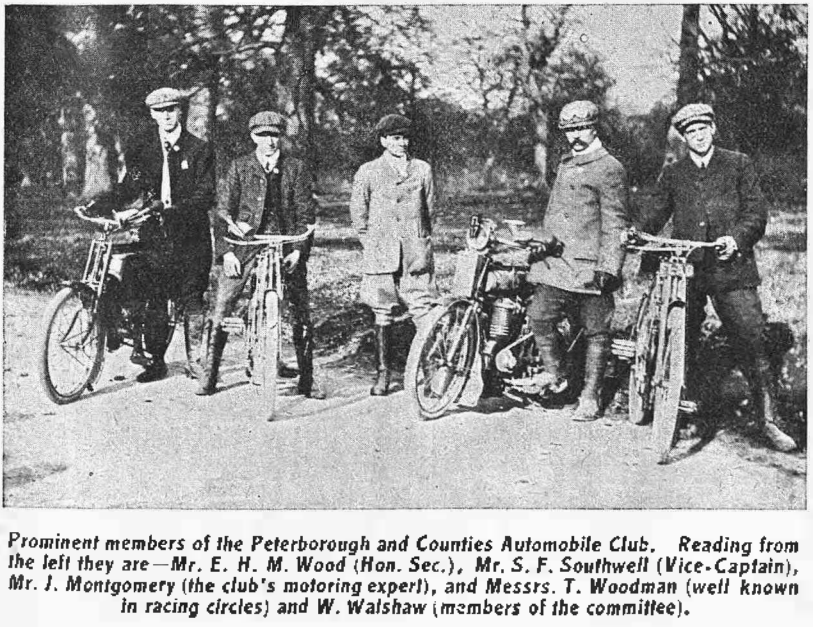
“ANOTHER INDUSTRY IS DOOMED, according to those persistent seekers after trouble and adversity—the halfpenny papers. Apropos of recent doleful utterances on the condition of the motorcycle industry, the Rex Motor Manufacturing Co write: ‘A visit to these works by anyone interested (manufacturers or their representatives excepted) will reveal a state of activity in motor-bicycles never surpassed by any industrial concern not excluding the period of the bicycle boom in 1896. As the oldest and largest firm of manufacturers exclusively engaged in the production of motorcycles, it may interest you to know that we have actually turned out of these works 6,000 motorcycles. The demand instead of diminishing is greater by three-fold than it was a year ago. At the time of writing we have on our books a larger number of orders than at any previous period, and on all sides customers are clamouring for delivery.'”
“DURING THE LAST TWO years motorcars and motorcycles have been used in such rapidly increasing numbers in Calcutta, Bombay, and Madras, that several French firms, having consulted their Consul-General, are now taking steps to open a vigorous campaign. Already Calcutta possesses an essentially French garage and depot; the traveller of another firm, being convinced of their utility, has consigned a large number of motorcycles to another Calcutta agent; whilst the representative of a third French firm is studying the possibility of the general use of motor boats on the Delta of the Ganges. All are agreed that the Reliability Trials which have been organised have demonstrated in no uncertain manner the value of motor traction and considerably hastened its development.”
THE FICM RULES FOR THE COUPE INTERNATIONALE make interesting reading: note that the bikes had to work as pedal cycles; silencers didn’t have to silence; the 50kg weight limit was clearly seen as impracticable.—and the organisers were taking vandalism seriously: “1. The auto-cycle must not weight more than 50 kilos empty, that is without fuel, paraffisn, accumulators, tools, spare parts, and luggage. An allowance of 3 kilos is made for machines fitted with magnetos. 2. The auto-cycle mushst be entirely, and is every part, constructed in the country of the Club which they represent (in this case Great Britain and Ireland). 3. Machines must be finished with two brakes, either both at the back, or one at the front one at the back.. 4. Silencers (which may be so in appearance only) must be fitted. 5. Every machine to have pedals and chain or cardan shaft capable of propelling it without the aid of the engine. (It has been explained that these need only be sufficient to propel the machine for short distances, and their exclusive use throughout controls will not be enforced this year as heretofore.) 6. The cycles must be ridden by members of competing Clubs, or of Clubs recognised by them (in this case Auto-Cycle Club). 7. The race shall be over a road in road a single stage of a distance of from 250 kilometres to 350 kilometres at most. This distance can be selected from town to town, or broken up into going and returning runs or circuits, provided that each journey shall consist of not less than 40 kilometres. Note: The most elaborate precautions as to nails on the course will be taken this year. The course will be guarded by the military, swept on the eve of the race, and guarded all night be one cyclist and one policeman patrolling every kilometre.”

“I AM WRITING LATE on Monday evening, and all the machines that will start in Wednesday’s contest have passed through the judges’ hands this afternoon. The officials had most thoughtfully decided that one o’clock sounded well, and so the weighing was ordered to commence at that hour. Lunch not being obtainable until exactly one o’clock at the hotels, those concerned said hard words under their breaths, bought fruit and proceeded to the weighing place. Here it was found that the scale to be employed was a weighbridge weighing up to eight tons by steps of 7lb! The judges refused to regard the decision of this scale—good as it might be—so a beam scale at the rope merchants near-by was requisitioned, and the weighing process was conducted sensibly. A plank was provided to take the machine on one pan of the scale, and this was carefully counter-balanced. Then the 50kg weight, which the Auto-Cycle Club bought as the result of its experience last year, was placed on the scale and the machines all weighed against it. No calculations were thus necessary, and the machines could be weighed to ounces. So far, 11 machines have arrived, and there is still a chance for two more to turn up. Mr. Jarrott’s 6hp JAP (rider, W Hodgkinson), was 21b under weight. CR Collier’s 6hp Matchless was ½lb under weight, whilst his brother’s machine (identical in all respects) was exact to an ounce. H Rignold’s 8hp Rignold was also of exact weight. CB Franklin’s 6hp JAP was 21b inside, and JS Campbell’s 6hp Ariel had a pound to spare. The two 10hp Barnes (riders, Barnes and Wilton) were respectively 1½lb. and ½lb overweight, and after much trimming, which included discarding the balance of their pedals, already denuded of most of the side plates, so that only the spindles were left to comply with the condition that ‘a means of moving the machine other than by the engine must be provided’. This brought them exactly to weight. The two 9hp Rocs (riders, White and Tessier) were overweight—one by 1lb 7oz, and the other by 21b 15oz. Pedals were reduced to spindles only, brake gear was still further reduced, the girder forks were removed and pieces cut off of saddle-pins, handle-bars, axle ends, etc., and finally they got within weight, allowance being made for the magneto machines on them. The constructor of the Rocs doubted the scale’s accuracy when he was told that his machines were now 1½lb and 2½lb respectively underweight, because he was certain not more than a couple of pounds’ weight of stuff had been taken off, but on weighing the parts removed they were found to exactly total 4lb. per machine, and he was left wondering whether to replace the girder forks or the brake gear. The 8hp Westlake, of HP Maffert, had sustained a broken connecting rod in the course of its trial spins, and a new one had been cast out of gun-metal. This was replaced and the machine was produced late in the day, getting just inside weight by reducing the pedals to their spindles only. A telegram from Silver announces that he cannot get his weight within 41b of the limit, so he will not ride. The machines which have not turned up are JF Crundall’s Humber (while this rider was going round the course, his machine skidded at the sharp ‘hairpin’ corner at Ramsey and threw him off the road. Crundall’s left arm was fractured and his collar-bone broken, thus depriving the contest of a fine machine and clever rider), the second Westlake, the Werner, which has had an accident, the 6hp JAP, entered by Mr Bickford, but not accepted by him from the makers because of late delivery, and the three 12hp Barrys which, it is understood, cannot be induced to lubricate properly.”
“THE MOTOR-BICYCLE which Mr Charles Jarrott has entered for the Eliminating Trials for the International Cup in the Isle of Man is noteworthy for its length and lowness of build, and its very wide handle-bars. It is fitted with a two-cylinder JAP motor of 70x95mm. The petrol tank has a capacity for 125 miles, and weight has been cut down everywhere to the finest point in order to comply with the regulations. The machine is fitted with 26x2in Palmer tyres, and Mr Hodgkinson, its driver, has had the machine in the Isle of Man for some days, and has had some practice spins over the course. It will be observed that it is geared specially high, and, with the 7hp available, it should have a fine turn of speed.”

“A 5HP TWIN-CYLINDER ARIEL motorcycle has been entered for the International Motorcycle Cup; its rider is Mr J Campbell, of Greenock. The total weight of the machine, stripped of accumulator and coil, comes out nicely under the maximum limit of 110lb. The carburetter is an Ariel spray pattern. High-tension ignition is employed, with positive make-and-break and non-trembler coil: sight-feed lubrication is fitted. The brakes are a Crabbe rim type (actuated by lever) on the front wheel, and back-pedalling rim brake on the driving wheel, and the machine is geared to 3¾ to 1. Liberty tyres will be used in the race.”
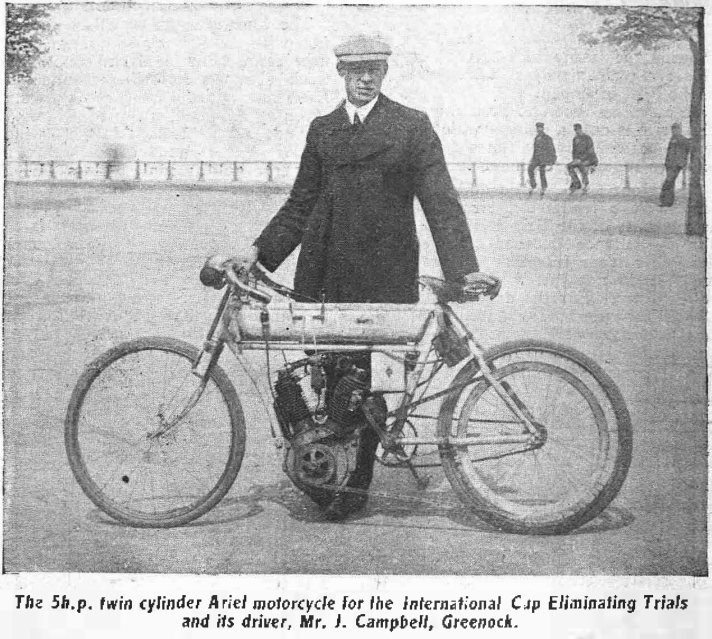

TO GET ROUND the British ban on road racing the ACC staged selection trials for the Coupe Internationale on the Isle of Man as part of the Gordon Bennett car races (the secretary of the Automobile Club’s cousin was Lord Lieutenant of the Island). Seven bikes built to comply with the Continental 50kg racing limit started the high-speed reliability trial. Only two made it to the end but a team of three was selected. A local newspaper reported: “It being necessary to open the roads to the public at eight o’clock, the race commenced at three, when a large number of people assembled at Quarter Bridge to witness the start. There were 17 entries, but only seven faced the starter. The course was that of the Gordon-Bennett motor tests, with the omission of Snaefell, which is both difficult and dangerous for motor cycles. The official result was declared to Campbell, on an Ariel machine, first, HA Collier, on a Matchless, second, and Franklin, on a JAP, third, providing the last-named can satisfactorily explain that stoppage made was not due to defective machinery.” Some years later ACU secretary Fred Straight shared his memories of the day: “For some reason or other the start had been fixed for 3am. The weather at that time, however, was very hazy, and it was decided to delay the start for half an hour. One of the conditions was that machines should not exceed 110lb in weight [in line with the Continental 50kg limit], and it was amusing to see the riders when their machines were put on the scales and found to be overweight filing away all possible parts in order to reduce the weight. The rubbers were taken off the pedals, side plates discarded, holes bored in the pulleys and belt rims; in fact, the majority of machines were so weakened that it was not to be wondered at that only two completed the course, viz, JS Campbell (6hp Ariel) and HA Collier (6hp Matchless), the former winning by 1min 16sec over a distance of 120 miles, which was covered in 4hr 9min 36sec. Barnes was one of the competitors in this race. He made a very brilliant start from Quarter Bridge, darting away like a shot out of a gun, but we saw nothing more of him, and it was reported that at the first bad corner he was travelling too fast to get round, so went straight on and in at the door of a cottage.” Notable among riders who didn’t make the team were Charles Jarrott (6hp JAP), Charlie Collier (6hp Matchless), Freddie Barnes (Zenith), Adrian Conan Doyle (3hp Roc), son of Sir Arthur, who had a financial interest in Roc manufacturer AW Wall, and “Rev BH Davies”—Ixion, of course—on his 8hp Westlake. And just for fun, here’s Ixion’s recollection of the event: “We began preparations in good time, and the eliminating trials to choose a team of three were run off in the Isle of Man on May 29. Nineteen machines were entered, most of which were big twins, despite the 108.5lb weight limit imposed by the French. GA Barnes actually produced a V twin measuring 94x100mm [1,387cc] but it was almost unstartable, and when it got going generally split its pulley or tore the spokes out of its back wheel. Nobody realised that reliability is the first essential in racing; the machines were far too flimsy, and the engines much too big. Barnes even got a fretsaw and cut a lot of leather out of his tiny saddle. At the last moment the course was altered, as the machines could not manage the two hairpins on the climb from Ramsey up Snaefell. In the race a very poor standard of reliability was shown. Only two machines (Campbell’s Ariel and HA Collier’s Matchless) completed five laps before the roads were opened at 8am. The speed was rather less than 30mph. Franklin and Rignold (reserve) on JAPs were chosen to complete the team.”

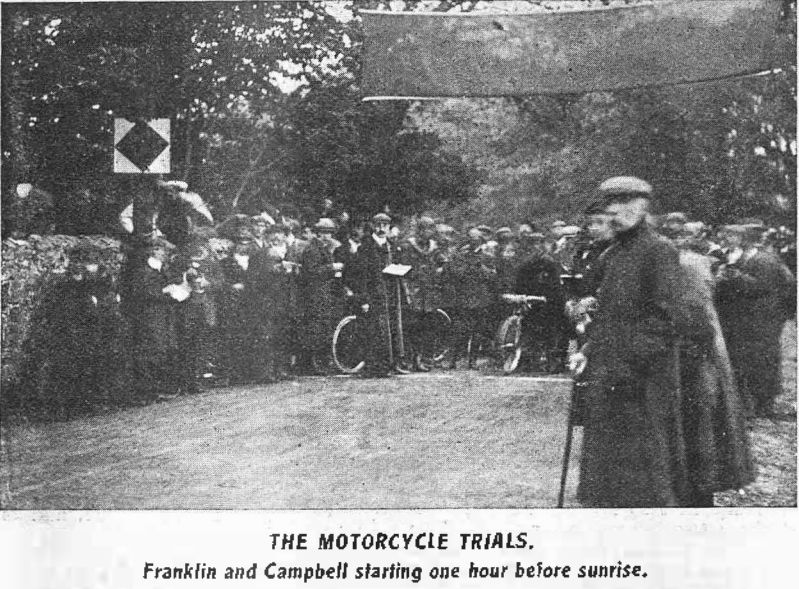
…and here’s a contemporary report on the elimination trial, courtesy of The Motor (incorporating Motor Cycling)…
“IT IS THE FUNCTION of an eliminating trial to eliminate the weaklings, and therefore it would be absurd to grumble if the process is, in any particular instance, a thorough one. And, unquestionably, the elimination in the trials for the selection of the British team for the International Auto-Cycle Cup race could not have been carried much further. But if, out of seventeen machines entered for the trial, only two completed the distance (which, on account of the time limit imposed by the Manx authorities, had to be reduced), that fact must not be taken as a reflection upon the capabilities of motorcycles as a class, nor even upon the racing machines. For it must be remembered that the event decided on Wednesday last was the first legalised road race for motorcycles ever held in these islands. Moreover, it was the first time that such high-powered engines had been put into machines which complete could weigh no more than 110lb 3oz. And as every designer, constructor, and rider was doing his best to win the Cup for England, it is obvious that the extreme limits of power in small weight and compass were touched on every hand. This being so, it is equally obvious that, when the results of these efforts were put to the first test, certain details were found to be faulty. These defects can only be found out by experience, and if the makers who built machines for this year’s trials can use the time intervening before next year’s event is held in experimenting and testing, in eliminating defective parts, strengthening weak ones, and saving weight in those places where it can best be spared, much better showing should result in 1906. We ourselves, who have watched the earnest efforts of the makers, Messrs Humber, Prestwich, Collier, Westlake, Ariel Co, Barnes, Wall and Co, Rignold, and the Barry Co, and who have observed the pluck of the drivers, have admired their grim determination to win regardless of cost and personal risk. Some of them overstepped the mark—how could they help it?—but it was only in the desire to go a little bit further than the men in France, Austria, and elsewhere whom they might have to meet in three weeks time. Take Crundall’s accident as an example. The course chosen included the climb up the mountain road and the dangerous turn on to it at Hairpin Corner. This corner was so sharp that at speed it was exceedingly dangerous to try and get round it. On the other hand, the gradient was so steep that if the machine was
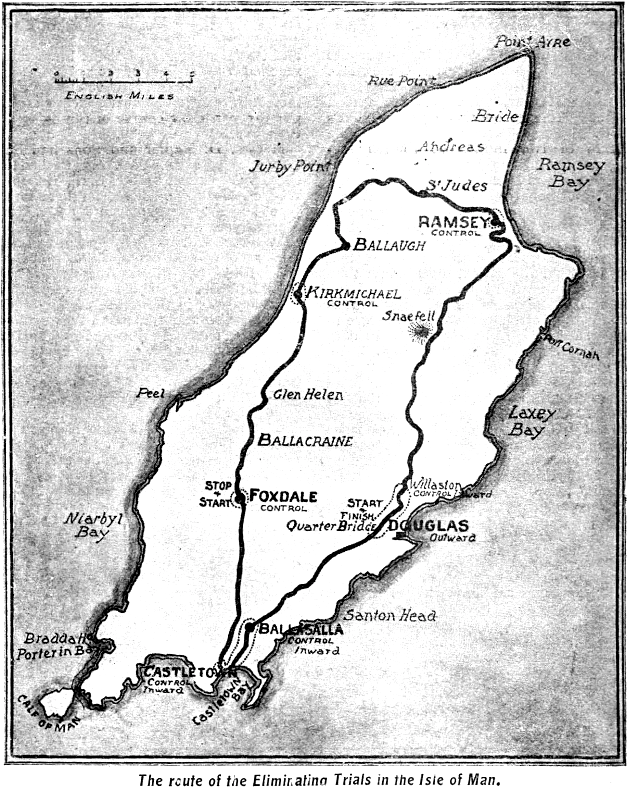
slowed down it was morally a certainty that a high-powered engine would stop, and the rider would be in the position of having to start his machine on a steep gradient. But if the course were to be negotiated, that corner had to be got round, and Crundall, realising this, determined to test his fate. It was a dangerous thing to do, but there was no other course if he meant to win. So he made a cast of the die and—smashed his machine, broke his arm, and lost his chance of representing England this year. But it was a plucky thing to do, and it was rather a pity that it should have been necessary in order to demonstrate the impossibility of the corner for motorcycles. So with the makers; they had to determine to cram on power, as, under the conditions of the race, that is what their competitors will do, and some of them overstepped the mark, and so they must stand down this year. But the experience has not been dearly bought, and it will be put to some useful purpose, and, this being so, the race on Wednesday last could not be regarded as anything but a success, at least, from this point of view. As a spectacle, perhaps, it would not thrill an average crowd, and, acting upon experience, the Auto-Cycle Club may, in future, see its way towards an improvement in this direction. Of the 18 entrants the following did not materialise at the weighing: The 6hp Humber, to be ridden by JF Crundall, because of the accident already referred to; the 6hp JAP, to be ridden, by Mr OL Bickford, because the machine was not ready by contract time, and the rider thought that the fortnight at his disposal was too little to enable him to get it tuned up and in good running order; the three 12hp Barrys, because some defect in the method of lubricating the cylinders was discovered, and a satisfactory way out of the difficulty could not be found in time for the race; and the 8hp Westlake, because it could not be finished in time. These defections reduced the number of competitors for the Selection Trials and for the race for ‘The Motor’ Cup to it, and there were no others who were riding in the latter event but excluded from the former, because the two extra entrants failed to put in an appearance. M Bonnard, who would have ridden the
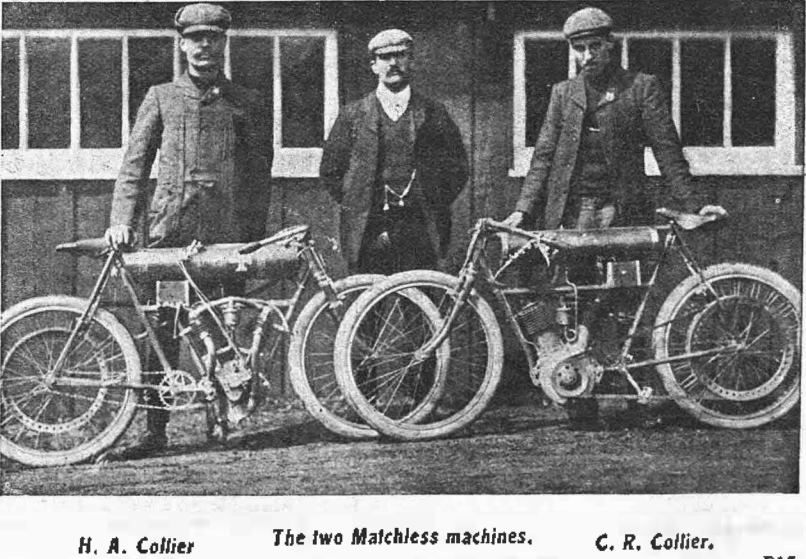
Werner, had just sustained an accident in Paris; whilst. Mr Silver was unable to reduce the weight of his Quadrant by the four pounds necessary to enable him to come within the weight limit. Of the 11 machines produced for the inspection of the judges, four were scratched afterwards…After the weighing Maffert went out for a spin on his Westlake and broke the.timing gear of one of the cylinders, this putting him quite out of the contest. Tessier, riding one of the 9hp Rocs, caught a kerb and did some damage. These two machines had never been on the road, and at the last the entrants, having insufficient confidence in them, did not send them to the starting line. Barnes and Wilton require another month in order to get their 10hp machines tuned up, and even then we doubt whether the frames would stand road work. It was two o’clock in the morning when a couple of cars left Douglas and deposited the officials on the course. Messrs Todd, Sharp, and Orde, of the Judges, and Messrs Straight and Woollen, the timekeepers, were at Quarter Bridge. Messrs Ebblewhite and Todd, Jun, at Ballasalla control, and Messrs Harding and White at Ballacraine. On reaching the course quite a dense mist was found, and it was decided to wait a little while before starting the men—chiefly out of consideration for HA Collier, who wears glasses. At 3.30, everything being ready, and the light being good, W Hodgkinson went away, followed a minute later by CR Collier. HA Collier was next at 3.32, and then came Rignold, who dropped a tool out of his pocket 20 yards from the start as he was running beside the machine. Franklin made a good start, but Campbell went a hundred yards before his engine started. A quarter of an hour afterwards Barnes came in on his car, with his machine in the tonneau. He had been out on one of his innumerable trial trips, and said he had never been on a machine that travelled so fast. He had to replace a broken plug, clean out the carburetter, and getting two strong men to push him off, went for a hundred yards, but the machine gave one pop and no other assistance. Then
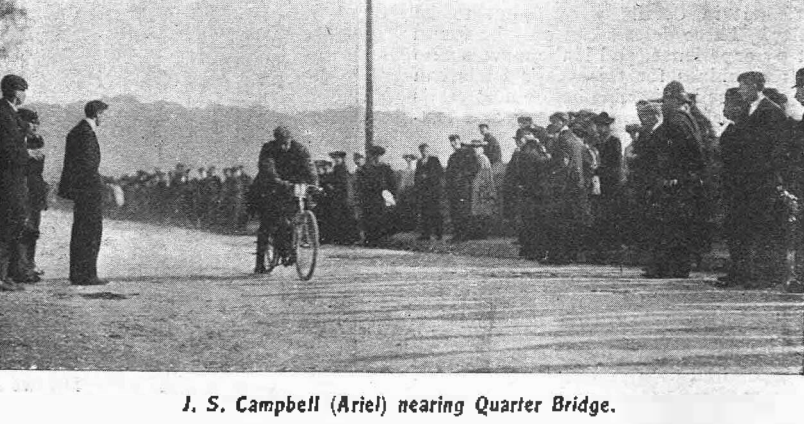
Barnes sat in the road and cleaned out his carburetter again, and at the next essay the machine went off like a streak—for another hundred yards. The last we saw of him was at about 4am, being pushed out of sight up the hill and round a corner. He arrived at Ballasalla, going great guns, about three hours afterwards. The first stretch to Ballasalla was eight miles long, and the times occupied by the riders were: CR Collier, 10min; Hodgkinson, 11min; HA Collier and Franklin, 11½min; and Campbell, 14¾min. Thus the younger Collier had travelled at 48mph. He took the lead at Ballasalla, and got round to within half a mile of Quarter Bridge in about 26 minutes, and then had a side-slip at a turning on the bridge. He came in, got a new wheel, refitted his displaced parts, and was on the line in 46min 39sec. But on the next round he broke a connecting rod in his engine and had to retire. Collier, the elder, was first to complete the circuit, and he was closely followed by Franklin. In the second round Franklin had worked up from fifth place to first, and he retained that position for two more circuits, Campbell displacing Collier for second place in the fourth round, Collier having run out of petrol and having pedalled five miles. He arrived exhausted, but went away very gamely. His fifth round was his fastest, and it enabled him to pass Franklin, who broke down at Foxdale with a fractured connecting rod, and also to pass Campbell, who was travelling well at the time. Rignold went three rounds, two in good time, the third occupying 2¼ hours, his three accumulators running out. Hodgkinson retired after the third round, having had innumerable punctures. Collier finished five circuits in 4hr l0min 52sec, and Campbell also finished his fifth circuit about two minutes afterwards. The latter (who started three minutes after Collier) had taken 4hr 9min 30sec. On the previous circuit Collier came into Quarter Bridge as Campbell was on the line, in the midst of a dense mob, whom there was no means of keeping to the pathways. Collier was held back, and although he started replenishing at once (which had to be done in
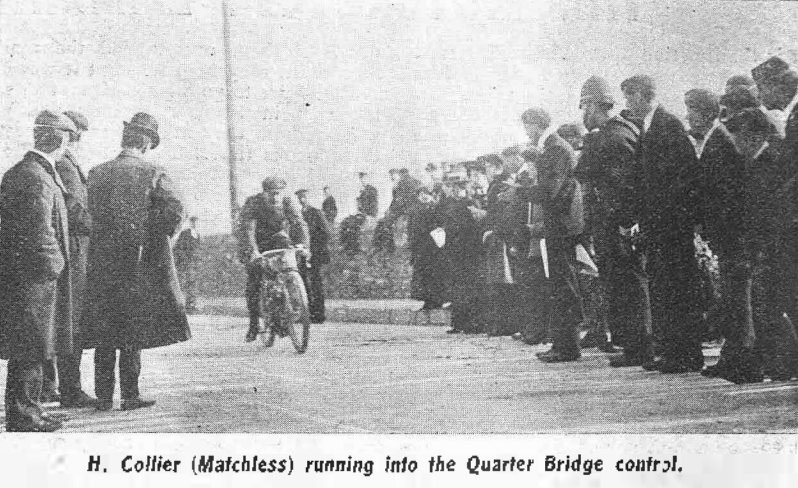
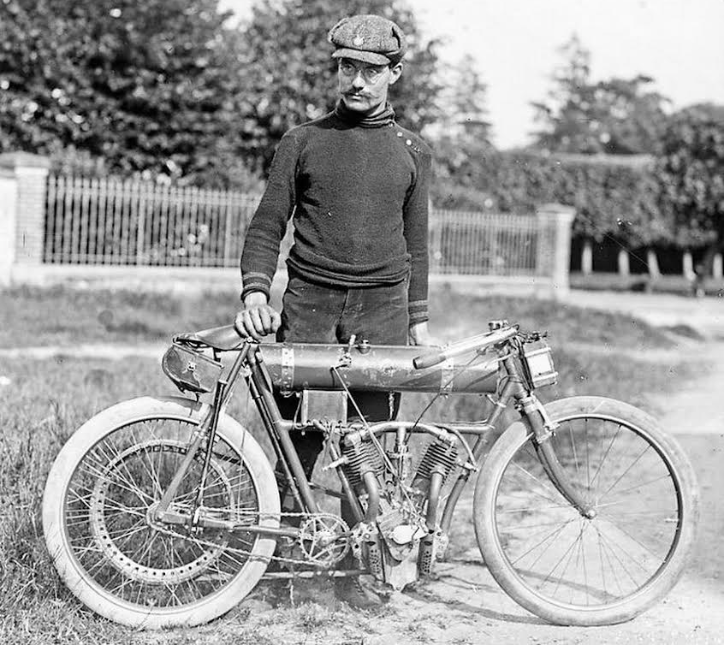
running time), he was allowed a minute by the official who held him back. This reduced his time to 4hr 9min 52sec, or only 16 seconds longer than Campbell. But for his petrol supply failing he ought to have finished six rounds in the time easily. These were the only two to do five laps, and as the road had to be opened at 8 o’clock, cars were sent out at that hour, and the race declared closed. As it happened, all the other competitors had stopped. The judges met later in the morning and selected the following: JS Campbell, 6hp Ariel; HA Collier, 6hp Matchless; CB Franklin, 6hp JAP; H Rignold, 8hp Rignold (reserve). ‘The Motor’ Cup and gold medal were awarded to Campbell, and a silver medal to Collier. Campbell had a couple of experiences. On the first round one of the guy lines of the signal banners got caught in his machine as he flew by and deranged the lever of his contact breaker and his wiring, and on replenishing at Quarter Bridge petrol was spilled over the machine, and as he wheeled off for starting the petrol caught fire. The machine was at once a mass of flame, but the fire was smothered by means of a coat. The connecting rods that broke were phosphor-bronze castings, and the experience will prompt the makers to get forgings for the purpose before the machines are taken over for the race itself on June 25th. The average speeds are about 30mph. Franklin did 96 miles in 2hr 42min 38sec, equalling 35½ mph; whilst Collier’s average speed over four circuits, excluding the one in which he had to pedal his machine for want of petrol, was 36½mph. But for the fog he would have done better, and on the wide clear roads at Dourdan, without so many corners, he should show an average of 40 to 45mph.”
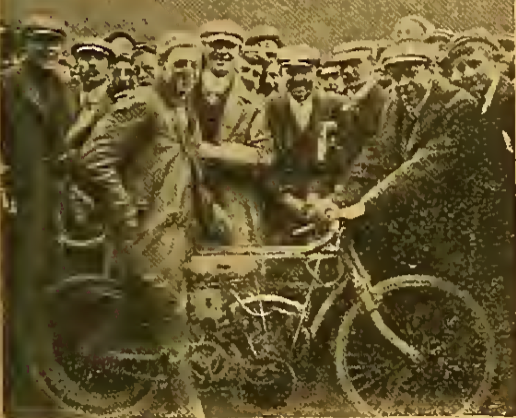

“THE TRIAL RACE to select two motorcycles to complete the trio which shall represent Austria in the International Motorcycle Cup Race, was held on May 28th over a course situated in Bohemia. The circuit was 60km in length, and had to be traversed four times—giving a total of 240km (150 miles). Three firms had entered two machines each: Laurin-Klement (drivers, Vondrick and Merfait); Johann Puck (Nikodem and Otruba); and Ch Luizer (Lust and Bittner). The race, which was started at 7am in lovely weather, soon resolved itself into a match between Nikodem and Vondrick, the former eventually winning in 3hr 45min 31sec against 3hr 53min 57⅕sec. It will be remembered that the Austrian Club had already selected the Laurin-Klement machine, on which Toman came in second last year as the first representative of the country. The machines and riders, therefore, to take part in the Cup Race on June 25th are Laurin-Klement (Toman), Johann Puck (Nikodem), and Laurin-Klement (Vondrick).”
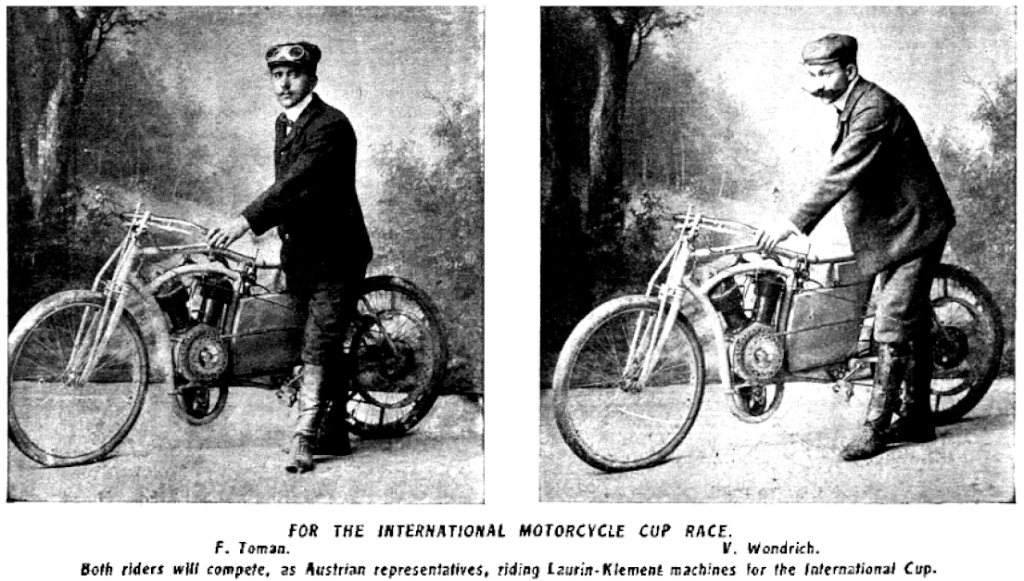
“ON WHIT SUNDAY motorcycle races took place over the Raida-Bohmisch-Leipe stretch, 16km in length. The Laurin and Klement men, driving two-cylinder machines, put to their credit some extraordinary times considering the weather and the fact that competitors had to double. In the single-cylinder competition the following were placed: 1, Toman (Laurin and Klement), 10min.48sec; 2, Klimt (Puch); 3, Wondrich (Laurin and Klement). Double-cylinder events: 1, Toman (Laurin and Klement), 9min. 26sec; 2, Kalka (Laurin and Klement), 9min 33sec; 3, Wondrich (Laurin and Klement). Thus Toman attained a speed of close upon 102 kilometres an hour—roughly, 64 miles! Toman’s chances in the ‘Coupe de France’ are none of the worst.”
“FRENCH MOTORCYCLE TRIALS. The following are the names, in order of starting, of the competitors in the French eliminating race for the International Motorcycle Cup on Sunday next over the Dourdan course. The riders’ names are in brackets: 1, Alcyon (Taveneaux); 2, Magali (Bac); 3, Gillet (Lalanne); 4, Griffon (Demester); 5 Fleury (Demmler); 6, Peugeot (Champoiseau); 7, Alcyon (Anzani); 8, Magali (Colomb); 9, Gillet (Fauvet); 10, Griffon (Bucquet); 11, Peugeot (Giuppone); 12, Alcyon (Griet); 13, Magali (Thomas); 14, Griffon (Lamberjack); 15, Peugeot (Cissac).”
“THE FRENCH ELIMINATING TRIALS for the International Motorcycle Cup were run off on Sunday over the Dourdan course, and produced a splendid race, marred only by an unlucky puncture which put Cissac (on a Peugeot machine) out of court in the last round when he was leading by about eight minutes. The accident, however, did not affect the Peugeot firm vitally, as Demester (Griffon) would have qualified anyhow. The result was to leave one Griffon machine and two Peugeots in for the Cup Race on June 25th. The course, about 34 miles in circuit, had to be covered five times. Of the 15 entrants, only one—Demmler (Fleury)—was a non-starter, but an early spill put Pernetie (who had taken Griet’s place on the Alcyon) out of the race. Two other machines—both Magalis—retired in the second round, and the third Magali (ridden by Colomb) caught fire at Dourdan and was incapacitated. Bucquet (Griffon) did fastest time in the first round, 36min 46sec; but in the second lap he punctured, and was passed by half-a-dozen competitors. Demester (Griffon) securing the best figures with 38min 13sec, closely followed by Lamberjack (Griffon), 38min 35sec; the Griffon team thus being very prominent at the start. In the third round a complete change came over the scene. Demester was the victim of tyre and belt troubles, and Lamberjack lost ground, leaving the entire Peugeot team (Cissac, Giuponne, and Champoiseau) at the head of affairs. Cissac did a very fast lap in 34min 9sec. In the fourth round Demester made up a lot of lost ground, and ran into third place; but Cissac, with a clear lead of eight minutes, was a certain winner at this point
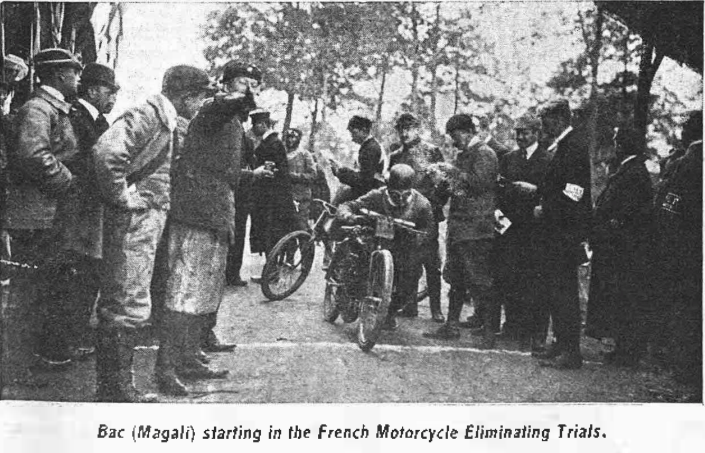
bar accidents. But the accident happened in the last round. At Ablis he suddenly punctured a tyre when going at full speed, came over heavily, broke a pedal, and lost not only the honour of coming in first but of securing a qualifying place. Meanwhile Demester, running splendidly, and picking up his lost ground steadily, overhauled Champoiseau, and ran into first place, finishing about 2½ minutes in front. Giuppone and Champoiseau came next in the order named, two minutes separating them, and another two minutes behind them came Anzani, who, on his Alcyon, had run a very steady race all through, being either fifth or fourth at the end of every round. The first four men were: Demester (Griffon), Giuponne (Peugeot), Champoiseau (Peugeot) and Anzani (Alcyon). The first three will represent France in the Cup Race. The fastest riding done in the race was Cissac’s 34min 9sec in the third lap. Giuppone travelled splendidly in the first three and the last lap, but had a bad time in lap four; and the most consistent performances were those of Anzani and Champoiseau…England has a very hard task in front of her, and the only way in which her team can possibly win is to set speed high above all other considerations. The whole circuit, including the 23 minutes spent in controls, should be covered in about 60 minutes on the average to win. The French machines are very sound and practical, whilst the power piled on has been enormous. Twin-cylinders are the invariable rule. The Alcyon engines have a bore and stroke of 90x90mm [572cc]. The Peugeots are 80x86mm [432cc]. The Griffons are 85x85mm [482cc]. Compare with these measurements those of the English machines, and it will be seen that we have not equalled the French in the production of racing machines. The engines of all of the English machines had a bore of 70mm and a stroke of 95mm 365cc], but the redesigned cylinders of the Collier have a bore of 75mm [420cc]. The rule as to silencers being fitted is a farce, because the exhaust pipe is generally only a
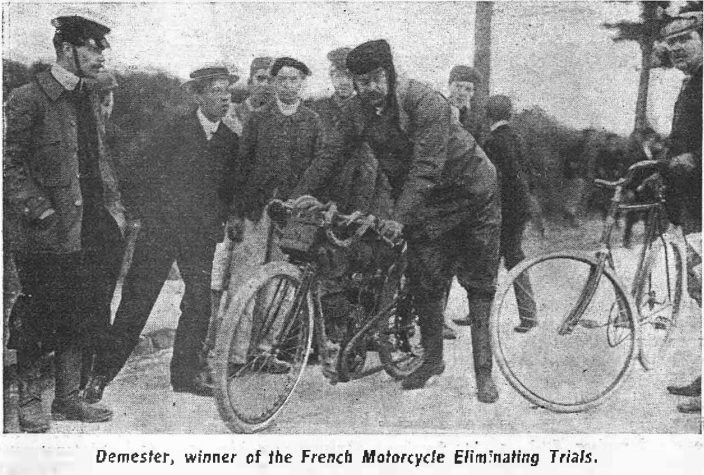
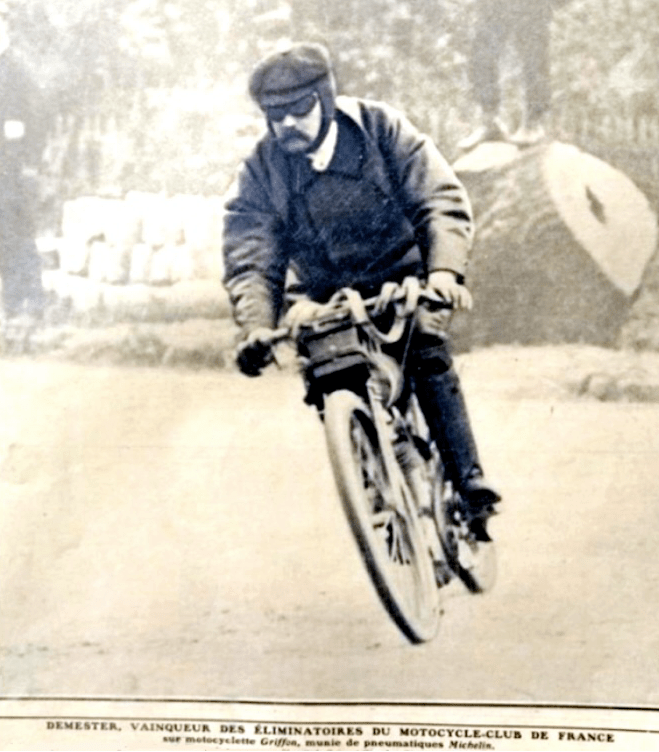

few inches long and is nearly all orifice. The English team need not worry about their silencers, which more nearly approached the real article, in appearance at least, than did any of the French productions…It must be remembered that the roads are not cleared for the motorcycle race, so that traffic is to be met everywhere. Our riders should be prepared for passing, or meeting traffic, but they will find, judging from what I saw in the French trials, that ample room is left for the competitors. The roads are in magnificent order, and there should be an absence of troubles, caused by road vibration in the race itself…The race to-day has been Griffon versus Peugeot. Last year Griffons filled all three places in the team. This year Peugeots have secured two places, whilst had Cissac not broken down in the last round and finished late he would have filled first place. Demester’s win was a popular one, otherwise enthusiasm was not at what one may describe as fever heat. Enthusiasm is being reserved for Sunday week. Demester finished quite fresh, and so did Giuppone. Bucquet had tyre troubles, and lost much time through having to send back for a tyre. It is quite the usual thing for friends and helpers of the competitors to be on the course riding in the opposite direction and rendering help where needed. But Sunday’s trials were very free from trouble. The nail nuisance has been very skilfully tackled by the appointment of a number of road menders, each man having a section under his eye. He was paid five francs before the race, and told that if no punctures through nails occurred on his section he would receive another five francs. And if he caught redhanded any person putting nails down he would receive a hundred francs. Austria’s chance is very much fancied. The French team were doing 60mph on Sunday, but the Austrians have done better. Against these our own chances are not great. But we must hammer away at it.”
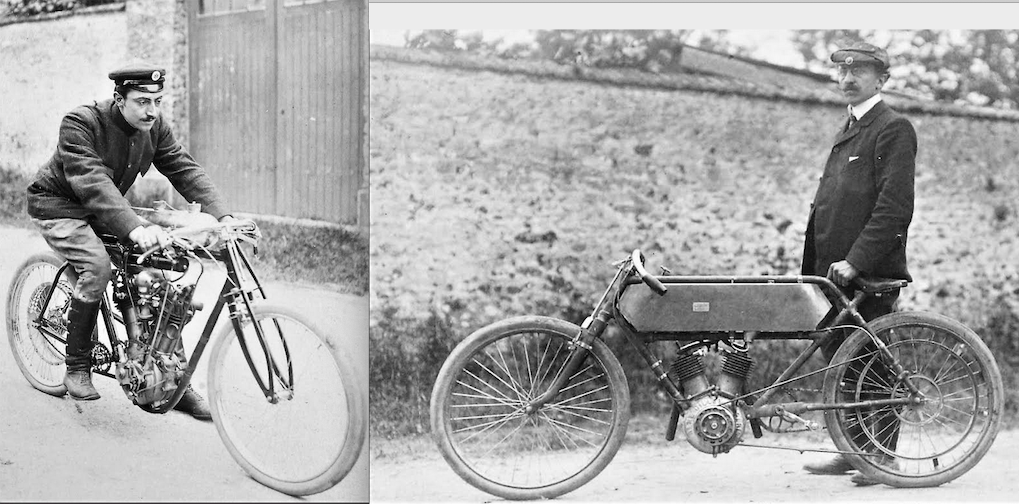
“THE INTERNATIONAL MOTORCYCLE RACE. We have received a letter from the Hon. Leopold Canning in which he asks us to state that he regrets that owing to business affairs he will be unable to go over to France as an official of the Auto-Cycle Club. He intends, however, to send a friend, the Marquis de St. Mars, in his place. This gentleman, although a Frenchman, will thoroughly look after British interests. As proof of this he has been good enough to give a donation of five guineas towards the race fund, and has placed his 15hp car at the disposal of the Auto-Cycle Club.”

THE FIRST TWO BIKES HOME in the FICM’s international motor-cycle cup race were Laurin & Klements, made in Bohemia which is now part of the Czech Republic. L&K would later be acquired by Skoda so, not surprisingly, the victory has gone down in Skoda’s official history: “…the unofficial world championship took place 50 kilometres south-west of Paris in the small town of Dourdan. For the peak of the motorcycle racing season at the time, the organisers had mapped a 54km circuit which had to be completed five times. It also included three so-called neutralisation sections—in these stretches, the drivers had to push their machines with the engine turned off and hope that they would start up again afterwards. In 1905, the strongest national teams of their time competed in this international competition. In the hopes of representing Austria-Hungary, two riders with motor cycles from Laurin & Klement, František Toman and Václav Vondřich, had entered themselves into a qualifying race in Pacov, Czech Republic. Eduard Nikodém on a Puch came third in the group. The brands Ariel, Matchless and JAP competed for Great Britain; the French two-wheelers came from Griffon and Peugeot; while Germany sent three Progress motor cycles to France. The strict regulations stipulated that in addition to all the essential components, the tyres also had to come from the respective country of origin. Tyres only lasted for short distances at that time, and the riders themselves were responsible for repairing them. The Laurin & Klement team arrived well prepared: in trials the year before, they had covered the challenging track with nails, which made tyre failures even more likely. And so Vondřich started the race with a heavy leather bag strapped to his back. It contained all the necessary tools and spare parts but also earned the Czech the nickname ‘The Travelling Blacksmith’ from the spectators. Despite the additional weight and higher centre of gravity, Vondřich with his two-cylinder L&K CCR quickly caught up with the previous year’s winner, Léon Demeester, who was in the lead. On the fourth lap, after 246km, the Czech…took the lead. At the finish line, he was more than eight minutes ahead after 3hr 13min 17sec, before the Frenchman was eliminated from the classification due to an illegal rear wheel change. As a result, František Toman moved up one place to make a perfect double victory for Laurin & Klement. Only three of the 12 participants managed the full distance.”
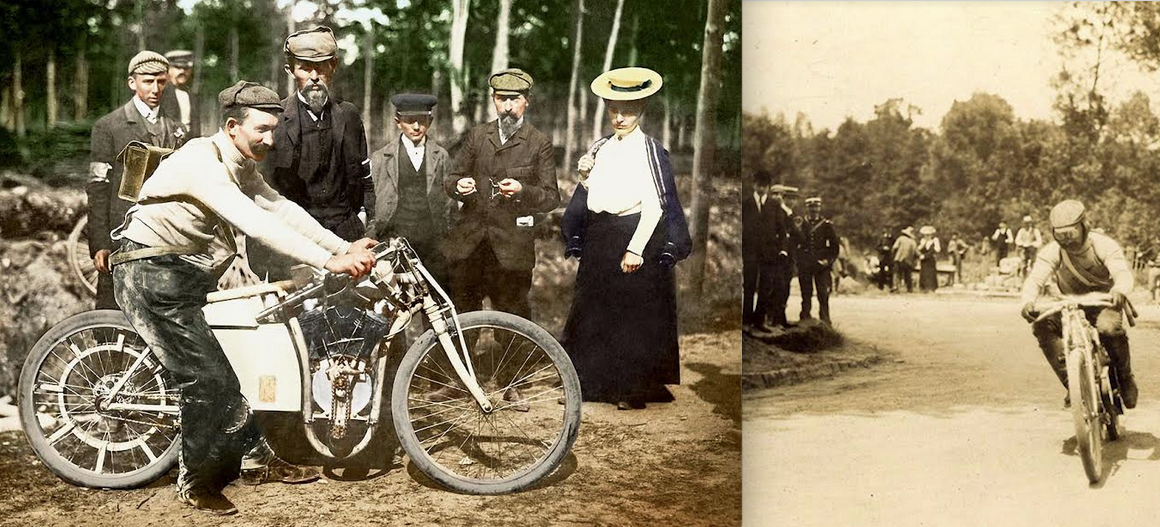
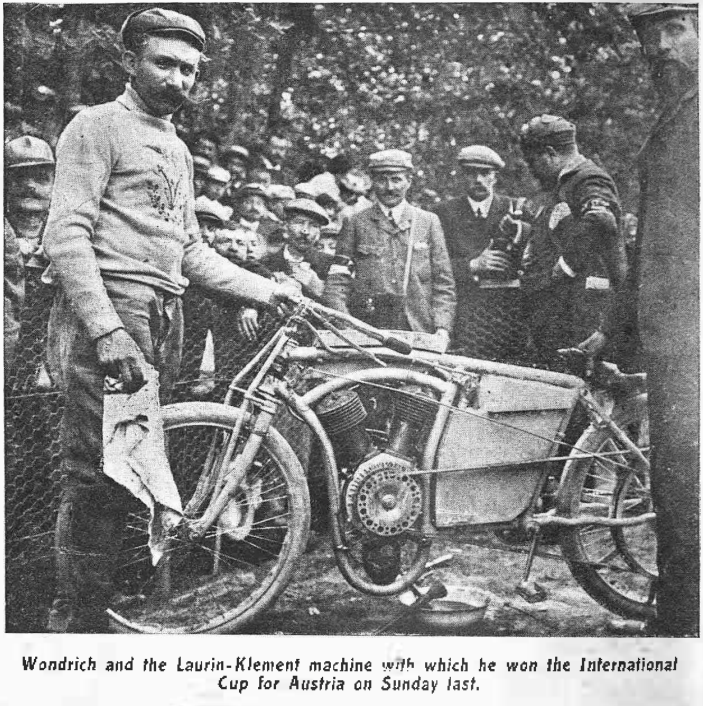
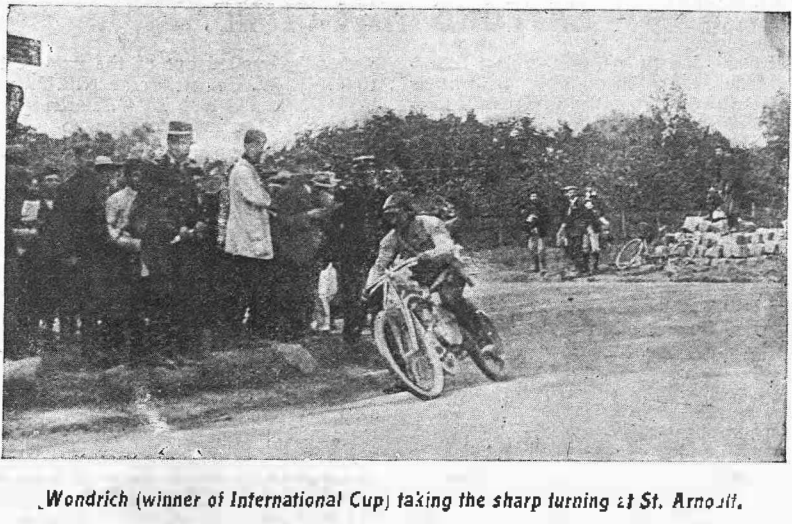
…and here’s a comprehensive report of the great race, courtesy of The Motor (incorporating Motor Cycling):
“THE ATMOSPHERE PERVADING the second contest for the International Cup offered by the Motor Cycle Club of France is curious, and yet quite logical and easily explainable. There is no doubt but that last year’s contest, with its multitude of nail incidents, was a long way from being fair, and so an excess of precaution characterises the attitude of the foreign competitors and their delegates of the foreign clubs. Moreover, the Motor Cycle Club of France is genuinely anxious to preserve the good name of Frenchmen, and to this end it has adopted various expedients calculated to nullify any attempt on the part of makers who might be actuated by unfair motives. But the foreign delegates are giving away no chances, a very strong and determined line being taken by Austria and England. These two find themselves in agreement on all essential points, and there is a great feeling of friendship between the two. The Germans are not so well versed in all the points at issue, and, not feeling their feet at all, are listening to arguments, their vote being given according to their convictions. But their unvarying tendency is to mould their convictions upon those of Austria and England, and so it comes about that Mr Robert Siercke, representing Austria, and Mr Mervyn O’Gorman, representing Great Britain, have the balance of power, and the French find themselves continually in the position of being outvoted by three votes to one. The position is an eye-opener to them, and they feel rather dejected, but it must be said, entirely to their credit, that they are accepting the position in the best and wisest spirit. The proceedings commenced with the half-yearly meeting of the International Commission in Paris on Friday. This Commission may be separated from the contest, because it is a federation of the leading clubs of all nations, one of which—the French—is organising the race. Thus the meeting of the Federation controls all international sport, the delegates from the clubs who form the Sporting Commission having to decide all matters in doubt…On Saturday morning the scene shifted to St Arnoult, where the machines were to be weighed and examined, and where the English team was located. The Auto-Cycle Club was represented on the spot by a new member, the Marquis de St Mars, a cousin of the Hon Leopold Canning, who is a member of the club committee. The Marquis has been a decided acquisition to the club, and his services to the members of the team and to the club committee can scarcely be measured by any ordinary standard. He is a fluent linguist, speaking—as was frequently necessary at some of the meetings and discussions—in English, French, and German without any hesitation. He made all sorts of arrangements, planned out practising schemes, overcame difficulties, and generally did so much for the team that everyone was enthusiastic when the representative of the A-CC arrived. He had secured a wonderful grip of the situation, and the plans which he had devised for the policing of the course, and the replenishing of the machines, and the thousand and one details which nobody who has not had experience in this
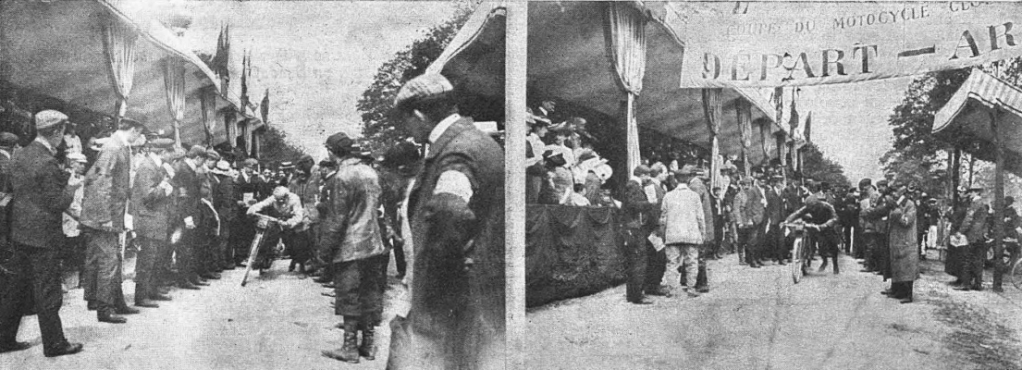
direction would conceive, were admirable. In the course of the weighing the machines were subjected to the keenest scrutiny, and the English people present had a smile when the chain driving the magneto on the Austrian Puch machine was found to be a Renold. It was naturally objected to and replaced by an Austrian chain. Brakes also caused objections, the French wishing to impose the regulations of the country compelling the use of the two brakes on the rear wheel; but the other countries would not agree. The English machines went through without objection, Campbell’s being slightly overweight and having to be pared down. Campbell had broken his frame in a practice spin, and was using the frame of his reserve machine. The exhaust opening in the cylinder walls of the Peugeot machines, and the place of construction of the Griffon engine (which is made under the patents of the Zedel engine of Swiss origin) were also matters for argument. The former was objected to because all the exhaust gases do not pass through the silencer, but the point was not insisted upon. Assurances were given as to the Griffon engines. The machines were all within weight, the method of weighing insisted on by the Auto-Cycle Club (which consisted of placing the machine in the place occupied by the standard 50kg weight which the club owns and sent over) was adopted and generally approved. After the weighing the machines were made to run, and were then taken into the schoolroom and there a dozen large boxes were placed in a row. Into its proper box was wheeled the machine, the box being padlocked by the driver and sealed with the seals of the French and English clubs. All the windows and doors of the room were sealed, and the place left in the charge of two local attendants, who remained on guard all night. Then the ‘triple alliance’ met, and the whole of the course was policed. The English club provided 13, the German club five, and the Austrian club three gentlemen, who were split up to (1) watch the start, the timing, the finish, and the weighing at the grand stand; (2) overlook the work at all inward controls; (3) overlook everything at the out controls, seeing that the men were despatched fairly and that the repairs were conducted according to rules; (4) watch the ‘hairpin corner’ and record the passage of every rider, because it was possible there to cut off the triangle and so save a mile or two per circuit; (5) to act as a check on the timekeeper at the level crossing; (6) to watch certain dangerous corners; and (7) to patrol the course of cars, motorcycles, and cycles.
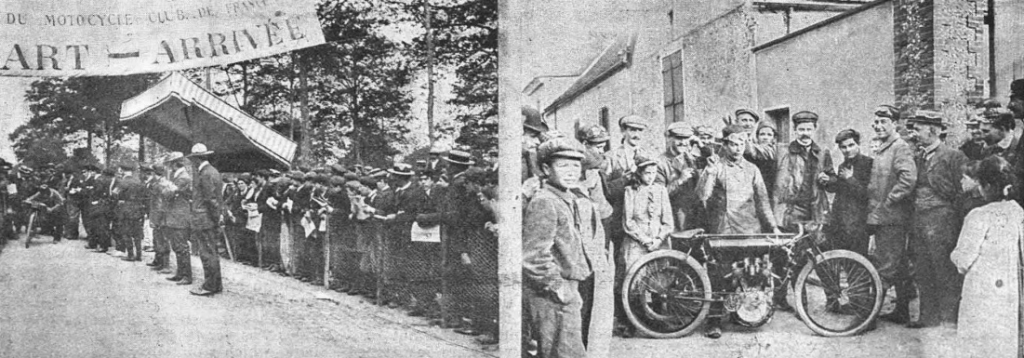
Each man’s work was plotted out, arrangements made for placing him at his post, bringing him back and providing him with food whilst the feeding of the competitors, the replenishing and repair stations were also arranged. The three countries worked together in the best spirit, and it may be said right away that the scheme worked admirably, the French being much disturbed when it was all communicated to them on the day of the race. Early on Sunday morning the Marquis de St Mars was out with his car, taking officials to their various positions. The AngloAmerican Oil Co and the Vacuum Oil Co had been good enough to send over a large quantity of petrol and oil for the use of the English team. Unfortunately, these supplies, although advised by the railway company as being near at hand, could not be obtained in time, but the compliment was appreciated. At nine o’clock the seals of the boxes were broken, and the work of filling up commenced. Two-cylindered engines were employed on all the competing machines except the three Progress (German), which had single cylinders, 100x90mm. The Ariel and JAP were 70x95mm; the Matchless 76x95mm; the Laurin-Klement 72x85mm; the Puch 76x80mm; the Peugeots 80x86mm; and the Griffon 85x85mm. It will thus be seen that the stroke of the English engines was very long in proportion to the bore, which would have been an advantage on a hilly course, but the engines were not speedy enough for the Dourdan course. The French and English machines had accumulators and coil, the Austrians and Germans low-tension magneto. All the machines were belt driven. The twelve riders were sent away in the following order at two-minute intervals from ten o’clock: 1, Demester (Griffon), France; 2, Carl Mueller (Progress), Germany; 3, JS Campbell (Ariel), England; 4, Toman (Laurin-Klement), Austria; 5, Giuppone
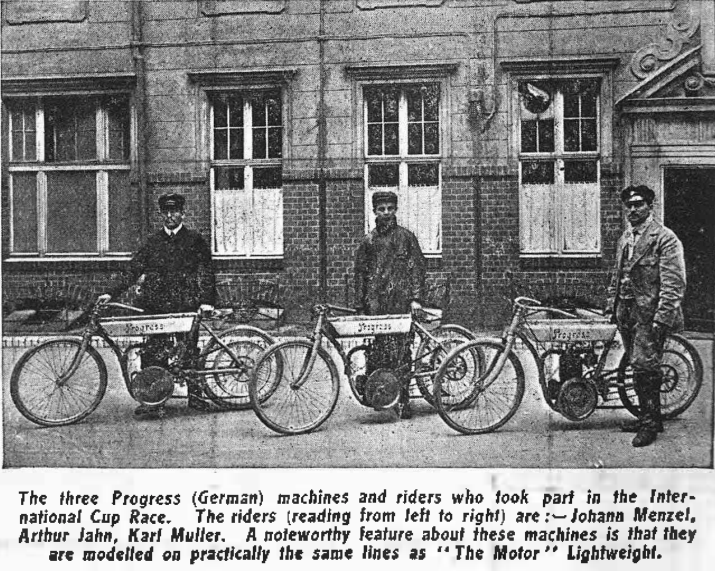
(Peugeot), France; 6, Menzel (Progress), Germany; 7, HA Collier (Matchless), England; 8, Nikodem (Puch), Austria; 9, Cissac (Peugeot), France; 10, Jahn (Progress), Germany; 11, CB Franklin (JAP), England; 12, Wondrich (Laurin-Klement), Austria. The French all got away well, Campbell was slow in getting off, and Nikodem and Collier about the best. The Germans were late in arriving, and had a lot to do to get their high-powered single-cylindered machines going. Jahn, in his hard pedalling struggle, unshipped his chain about 30 yards from the start, and threw the machine down in disgust. However, the chain was quickly replaced, and he was about to restart when he found he had bent his crank in his useless fit of temper, and this delayed him over a quarter of an hour. Demester finished the first round in 53min 55sec, Giuppone came through second, Nikodem third, followed by Collier…his engine was missing fire when he passed. Cissac was next through, next then came Wondrich…Franklin took 76min 38sec, having had a burst inner tube 20 miles from the start. The Germans took about two hours per circuit, and it turned out that all had the same trouble—oil leaking into the petrol tanks and the difficulty of re-starting the big engines after each control. Toman had tyre troubles and a fall, and was the only one who did not complete the first round. Two Germans (Mueller and Genzel) dropped out in the second round. Fastest time was made by Wondrich, 55min 32sec, Demester’s time being 55min 53sec. Demester was the only one to skid at the Hairpin Corner, and fell, but he did no damage. Franklin had a broken inlet valve, and lost the washer in his combustion chamber. Campbell had to make a new valve lifter, and every time he passed the grand stand his engine was missing fire through a defect in the lifting gear. Collier lost time through tyres, taking 82min on the circuit, of which he spent 4min at the level crossing. On the third round Demester had a burst back tyre, and as this entailed removing the wheel, he put a new complete wheel in as being the quickest repair. He did this at Dourdan, and again at Ablis, but as the wheels, pulleys, front forks, saddles, and engine cases were all sealed with a punch mark,
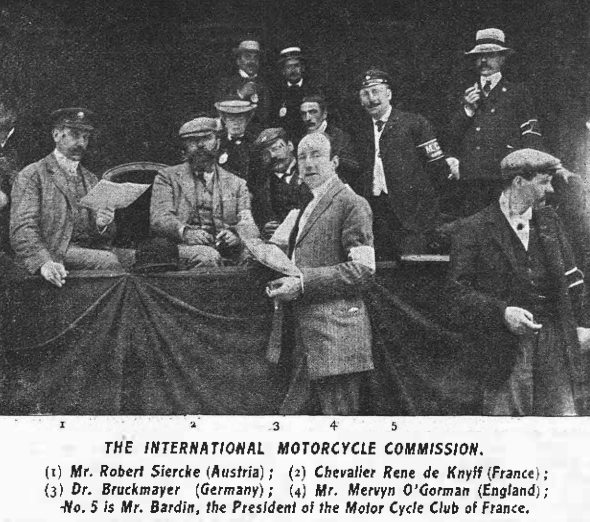

Demester’s action was a most foolish one, for at the end of the race he was disqualified. His third circuit occupied 56min 26sec, whilst that of Wondrich (who had started twelfth, and was now lying second) was 54min 38sec. Collier, did a good round, his time being 58min 28sec. Campbell with plug troubles and Franklin in all sorts of difficulties reduced England’s chances enormously. At the end of the fourth round six were left out of twelve, and the times were Demester 55min 40sec, Wondrich 55min 59sec, Giuppone 62min 25sec; whilst Collier took 77min 52sec and Campbell a little over a minute, for he had no stop for once in a while. The race was in Wondrich’s hands by a minute and a half, and in the final circuit he covered the course (54km) in 54min 53sec, whilst Giuppone did a good lap in 58min 33sec, Demester taking 62min 23sec. The objection to Demester was lodged and he took his disqualification in a manly fashion. The French had proposed the new rule at the eleventh hour, and perhaps it was rough that it hit them in the very next race. Great objection was also raised to the fact that Demester was followed all through the race (Bucquet taking four laps) by a man to help in the case of tyre repairs. Wondrich’s net time, deducting the neutralisation (18min per circuit, the neutralised area by about five kilometres per circuit), was 3hr 13min 15sec, which is 20min better than Demester’s time in the recent eliminating races, and 38min better than the same rider’s time in last year’s contest. Demester’s time was second best, namely, 3hr 13min 2sec, but he was disqualified as already explained, Giuppone was the only other rider to finish in 3hr 35min 2sec, and he was placed second. Nikodem and Collier were in the running for third place, but both broke down in the last lap, whilst Campbell did not cover more than four laps. Wondrich’s average speed was 87½km (54½ miles) per hour. The cup thus goes to Austria, being in charge of the Motor Cyclists’ Union of the Austrian Automobile Club, and next year’s contest will in all probability be run on a circuit near Prague in South Bohemia, Tabor being the centre. The course is a good one, with Wide roads of excellent surface, and it can be kept free of traffic. The congratulations of the Austrian club by the English and German clubs were very sincere, and it may be taken for granted that the next contest will be a very good one, as efforts are being made to get the Danes to support it again (they were very much upset at last year’s treatment), whilst Italy and. Belgium should send teams. The French Club took their beating well, but the French makers or their representatives showed their chagrin, and said ‘That’s the end of the International Cup—we shall not compete again!’ But Mr De Knyff ridiculed this attitude. Mr O’Gorman and Mr De Knyff got along exceedingly well together.”
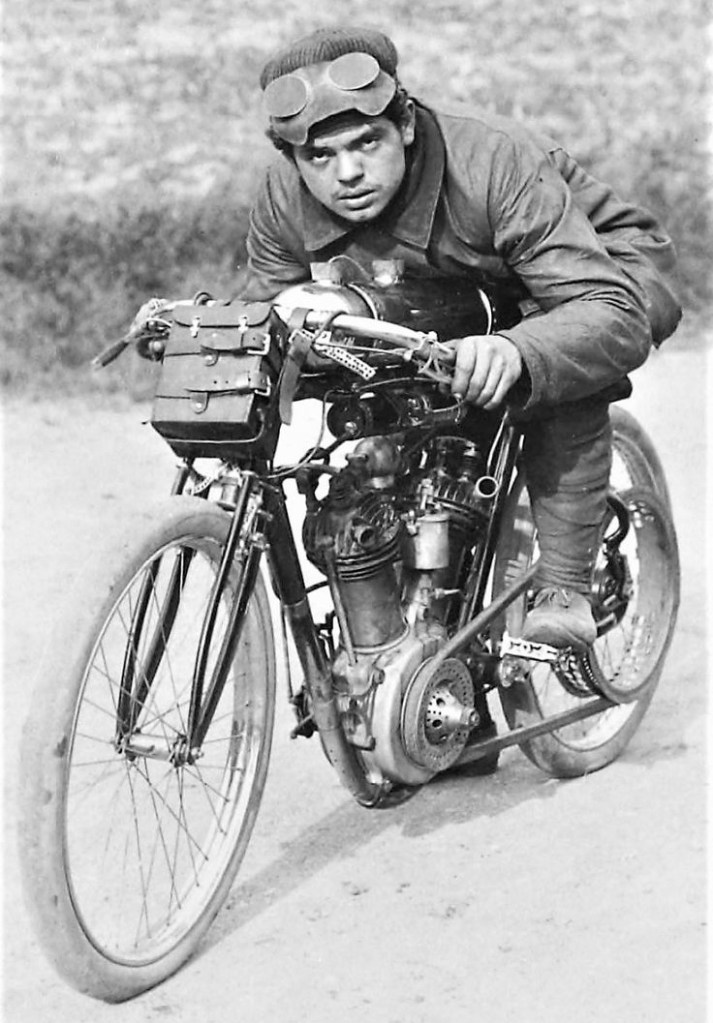

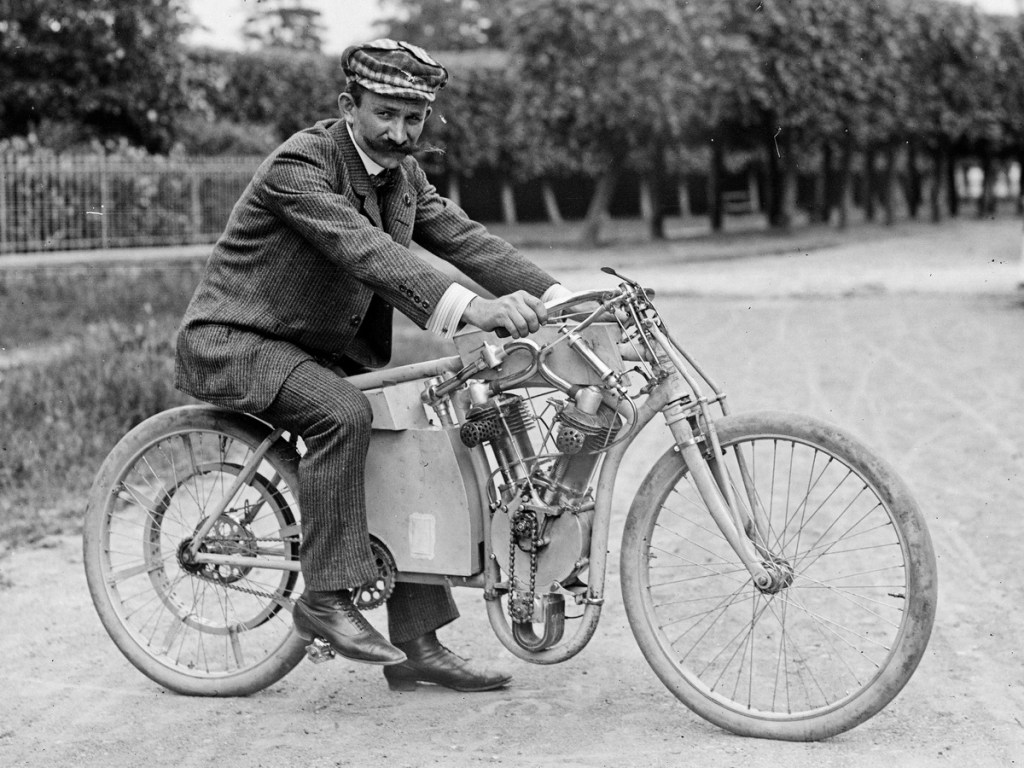
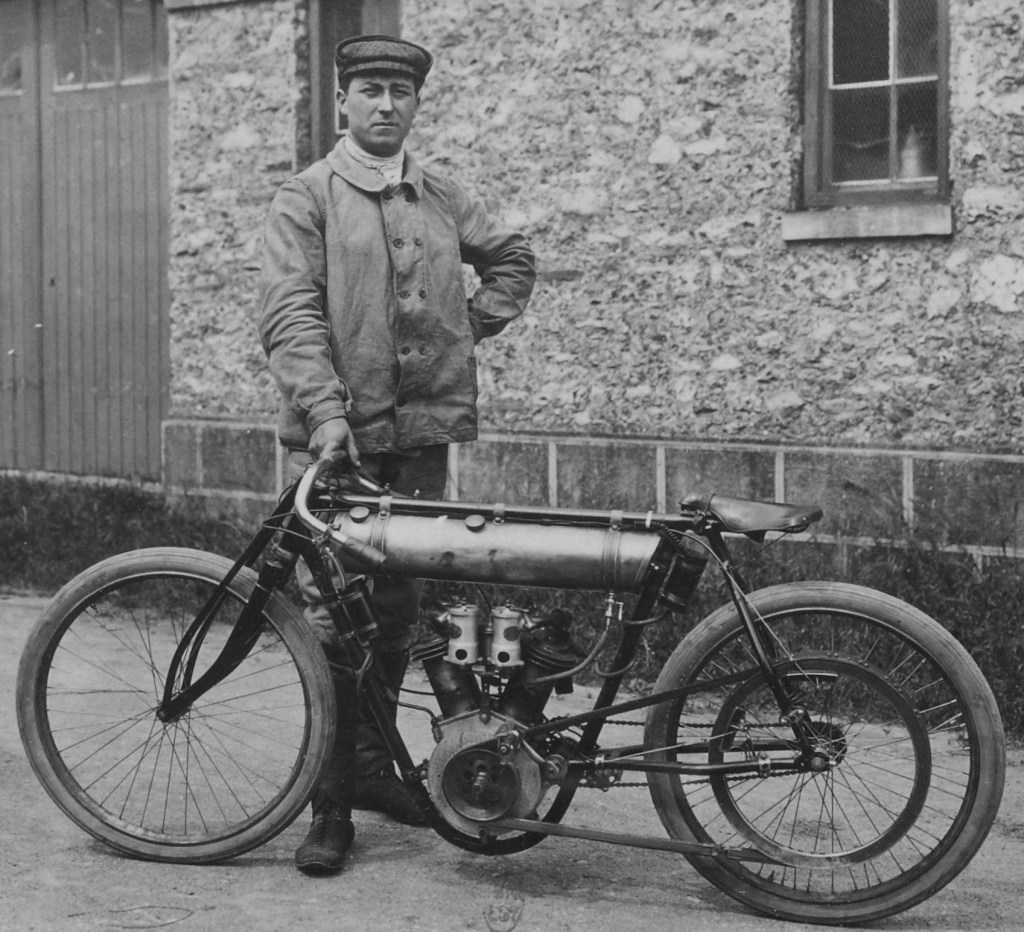
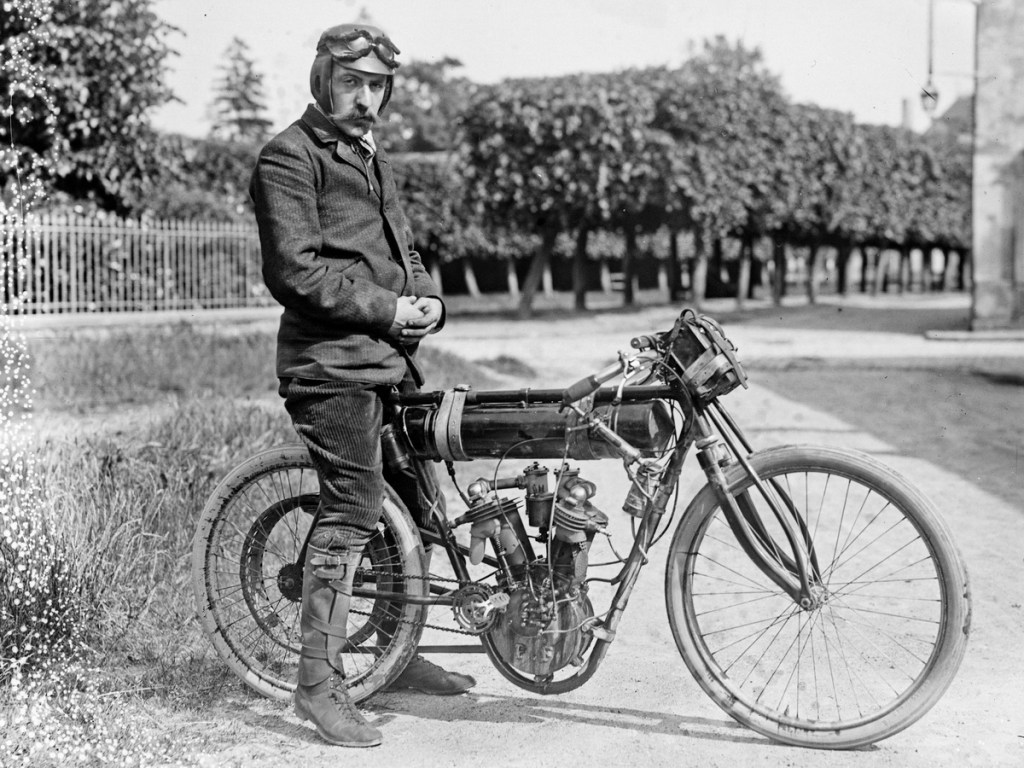
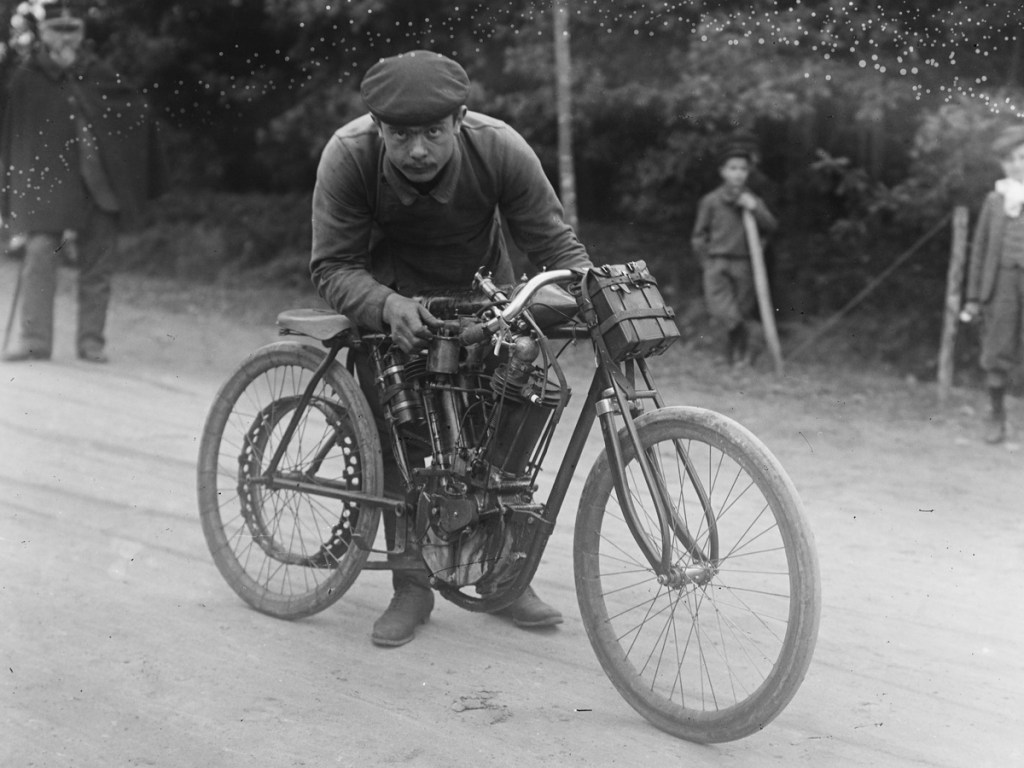
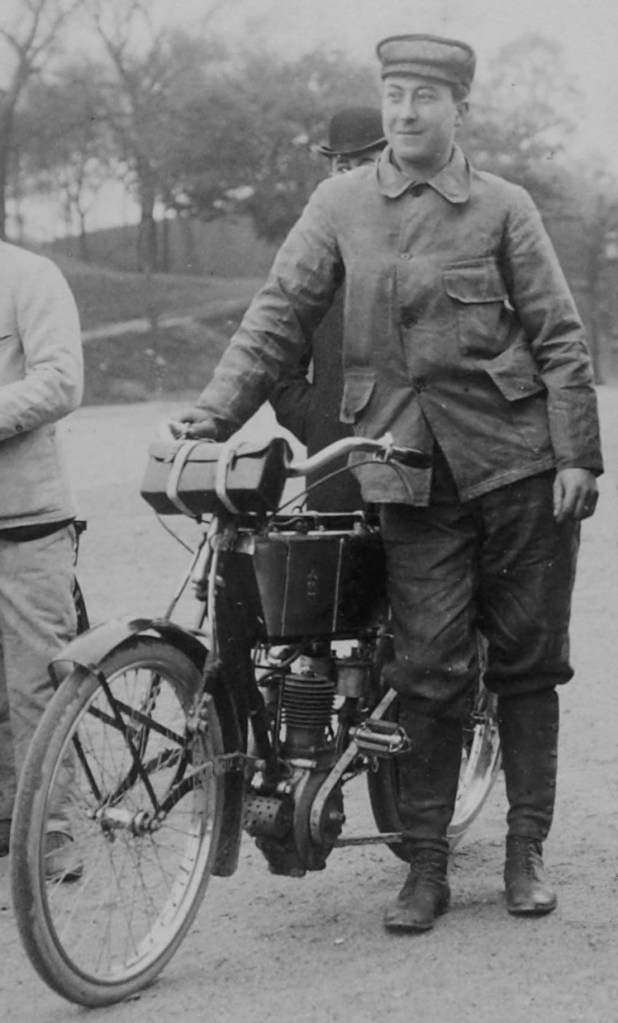
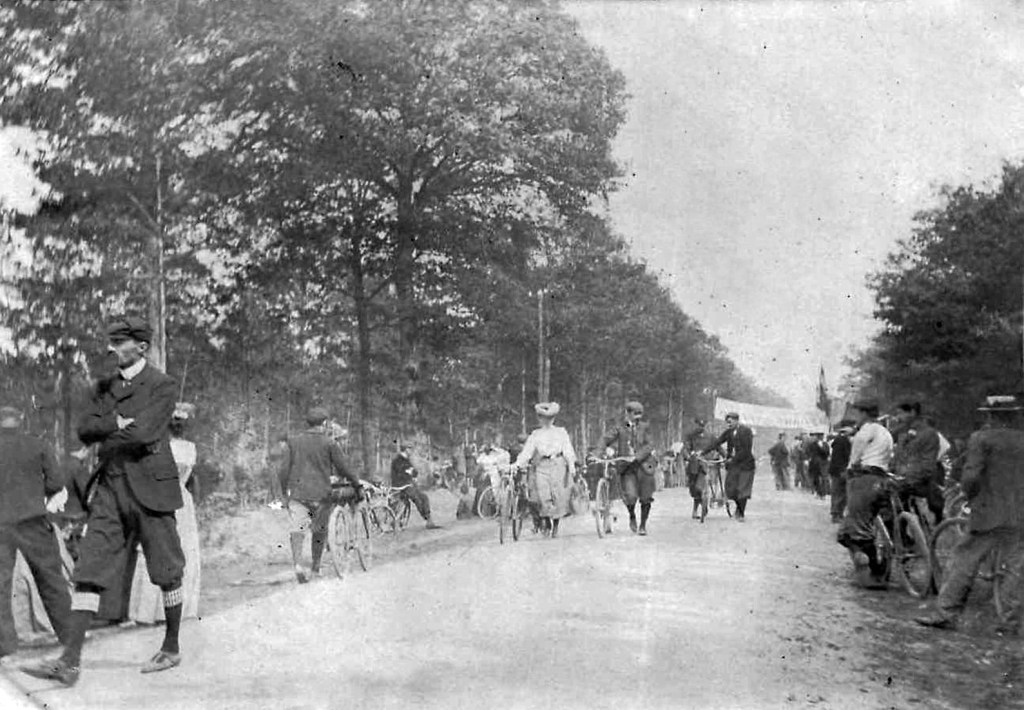
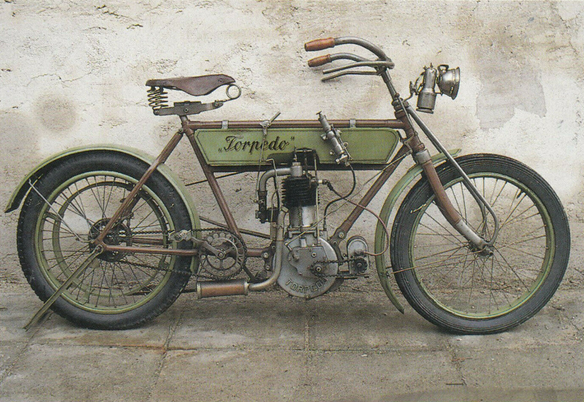
FROM 1902-1909 MOTOR CYCLING ceased production, leading to The Motor Cycle’s masthead slogan, “Established in 1903 and for six years the only paper solely devoted to the pastime”. But Temple Press didn’t ignore motor cycling; The Motor took an interest, as had Illiffe Press’s Autocar before the arrival of The Motor Cycle. So we must thank The Motor for the following: “Alexander Anzani, the Italian expert, who recently won the [first] world’s motorcycle championship at Antwerp [on an Alcyon powered by a 330cc Buchet single-cylinder engine he developed himself] accomplished a really marvellous record ride at the Parc des Princes track, Paris, on Saturday last week, by covering 58 miles 489 yards in the hour, and 100 kilometres (62 miles 246 yards) in 1hr 14min 14.4sec, as against the previous bests of Joseph Giuppone of 56 miles 266 yards and 1hr 6min 36.4sec respectively. It will therefore thus be seen that a mile a minute for 60 consecutive minutes is within the bounds of possibility, even on a small motorcycle weighing under 50 kilogrammes (110lb), while in endeavouring to reach this end Anzani is actually reach this end Anzani is actually reducing the cylinder capacity, his record ride being accomplished on 90x90mm [572cc], whereas with the identical engine 90x110mm [699cc] dimension the most he could get out of it last year was about 54¾ miles. Unfortunately, the weighing in after the record, Anzani’s Alcyon, which was fitted with a Buchet engine and Dunlop tyres, was found to be a trifle over 50kg, and so the record for this latter type of machine still stands to the credit of Giuppone, but as the world’s bests, Anzani’s times are well ahead of previous figures. During the past month the Italian has been experimenting with the engine, and told the writer that when he summoned the official chronométreur new times would be recorded, and this statement be thoroughly confirmed. It is generally the second time of asking that these marvellous rides are completed, and Anzani’s case proved no exemption, for in his first attempt the oiler did not work satisfactorily; but after this had been adjusted everything went like clockwork…Anzani’s wonderful ride of over 58 miles in the hour is a triumph for the light motor-bicycle.”


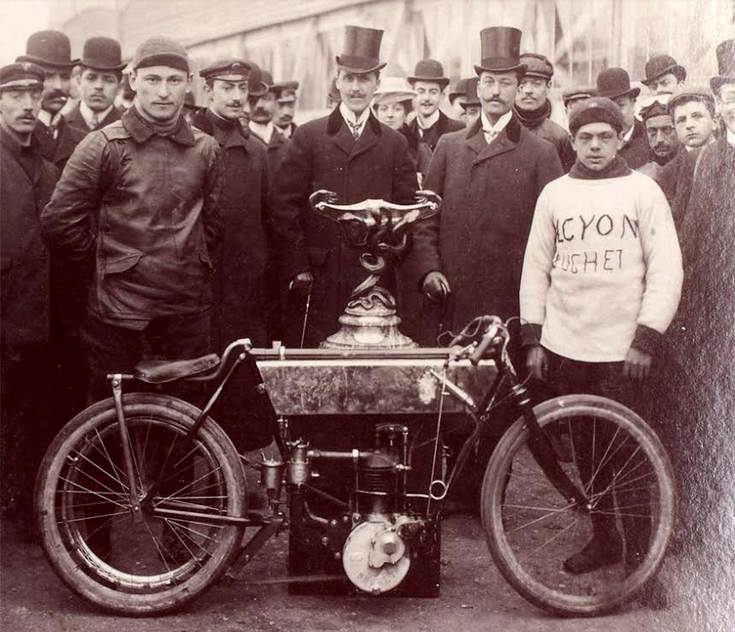
“JOSEPH GIUPPONE, THE young Italian motorcycle record breaker, covered 56 miles 266 yards in his recent hour ride at the Parc des Princes, but even this distance, although it appears truly remarkable on paper, will, we are assured, be considerably improved upon before long, as Anzani is having a special machine built, and declares he can cover close on 60 in the hour—with ordinary luck.”
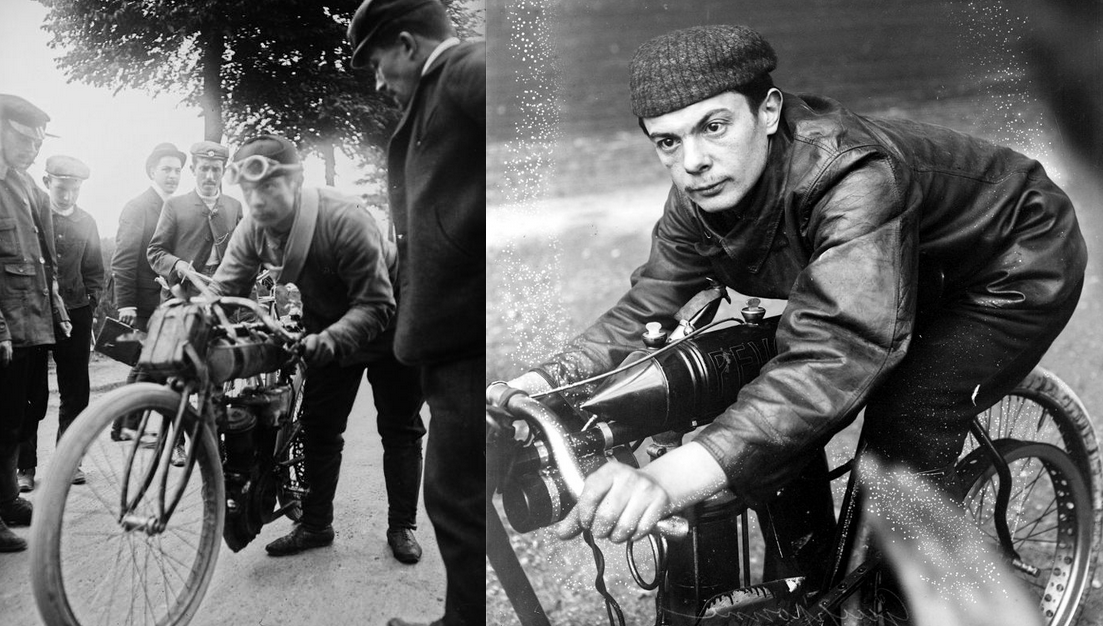
“MOTORCYCLING RECORD at the Winter Track, Paris: Anzani’s recent figures for the 100 kilometres light motorcycle path record have not been allowed to remain for long. The young Italian rider Giuppone attacked them just before Christmas at the Winter Track in Paris, and succeeded in lowering them. He covered the full distance of 100 kilometres (62½ miles) in 1hr 6min. 36⅖sec; and, incidentally, established a fresh record for the hour—90.36km. Giuppone rode a special Peugeot racing machine.


THE CHATEAU-THIERRY ‘UPHILL RACE’, now in its 4th year, was paired with the similar late-season hillclimb at Gaillon, with cups awarded for aggregate scores. The event was open to touring and racing vehicles from light motorcycles to trucks, in 15 classes. On the day before the race rain made the roads slippery, and the stewards noted that the S-curve after the first straight kilometre had become too dangerous for the racing cars so they decided on standing starts in both races (kilometre and mile) except for the ⅓-litre bikes, which ran the flying mile. Peugeot entered Cissac, Giuppone and Champoiseau in the two ⅓-litre lightweight events. In the sprint mile race, the eagerly awaited Peugeot/Alcyon confrontation was won by Paugeot, with Giuppone beating the previous record set by Collomb (Magali) by three seconds. In the ⅓-litre class victory went to Anzani (Alcyon), followed by Contant (Quentin) and Giuppone on (Peugeot) .
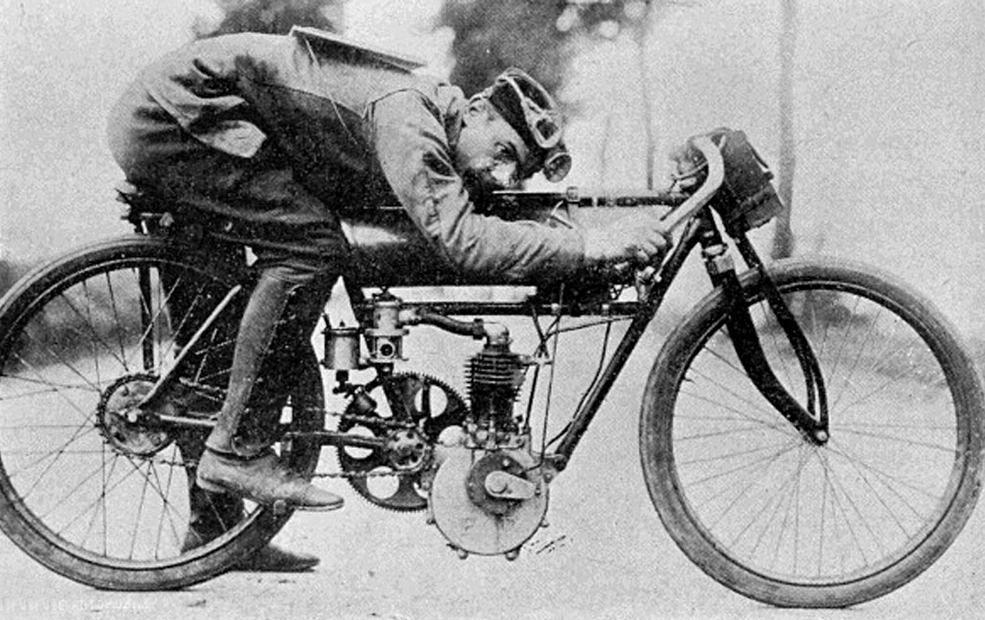
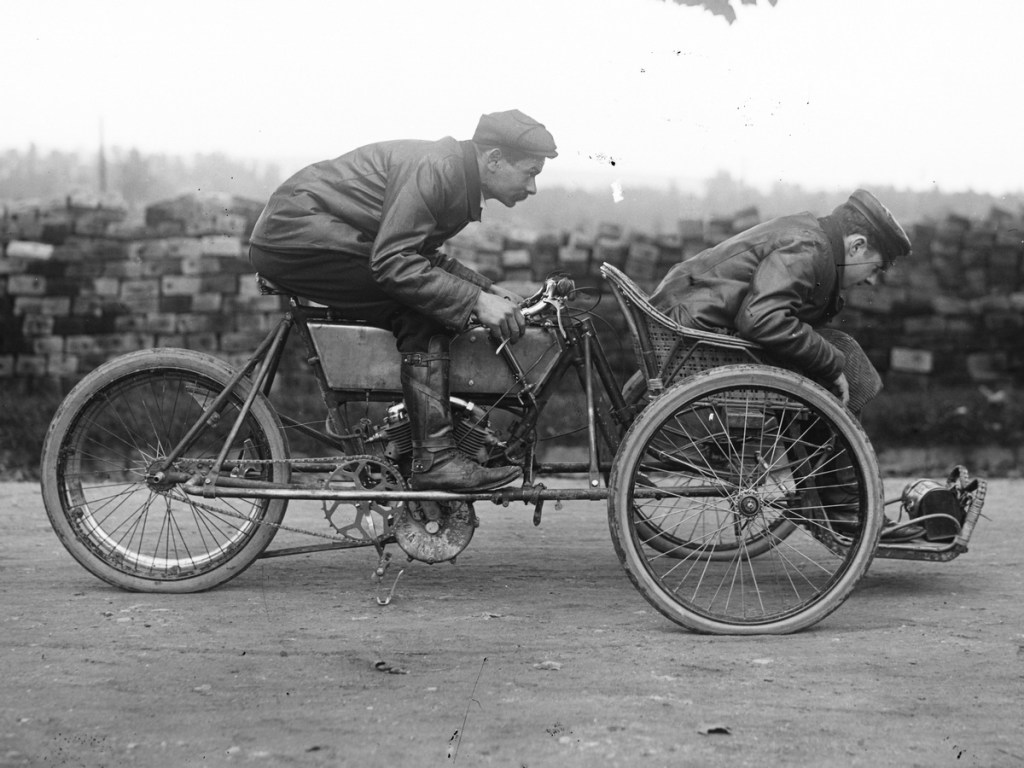
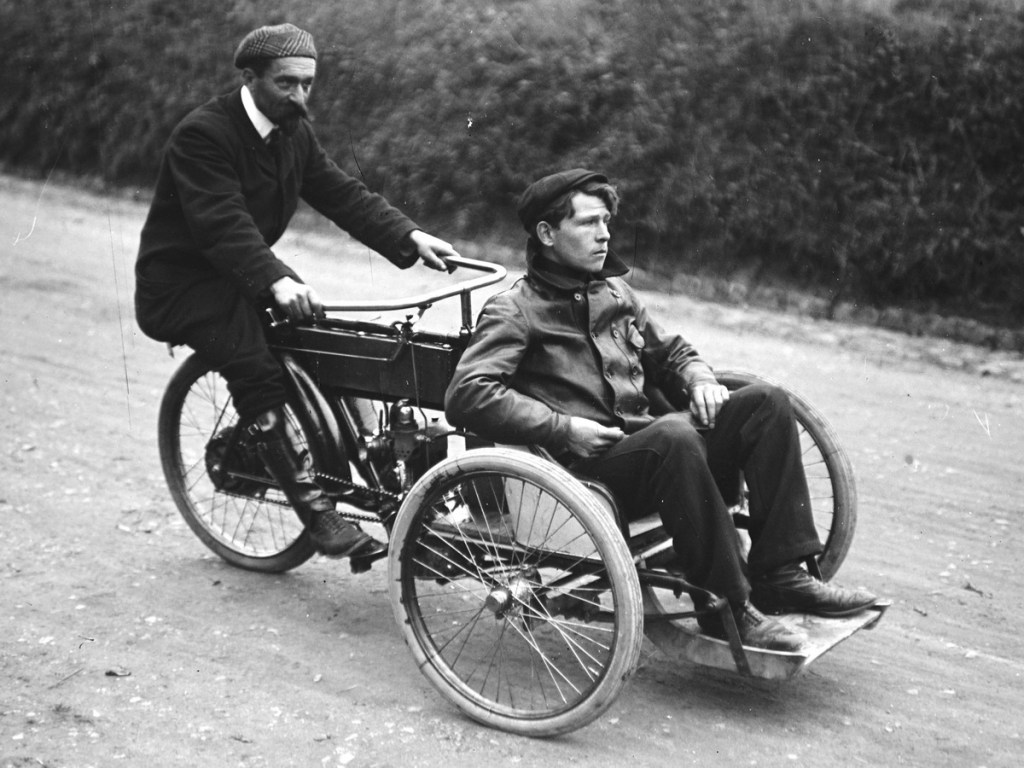
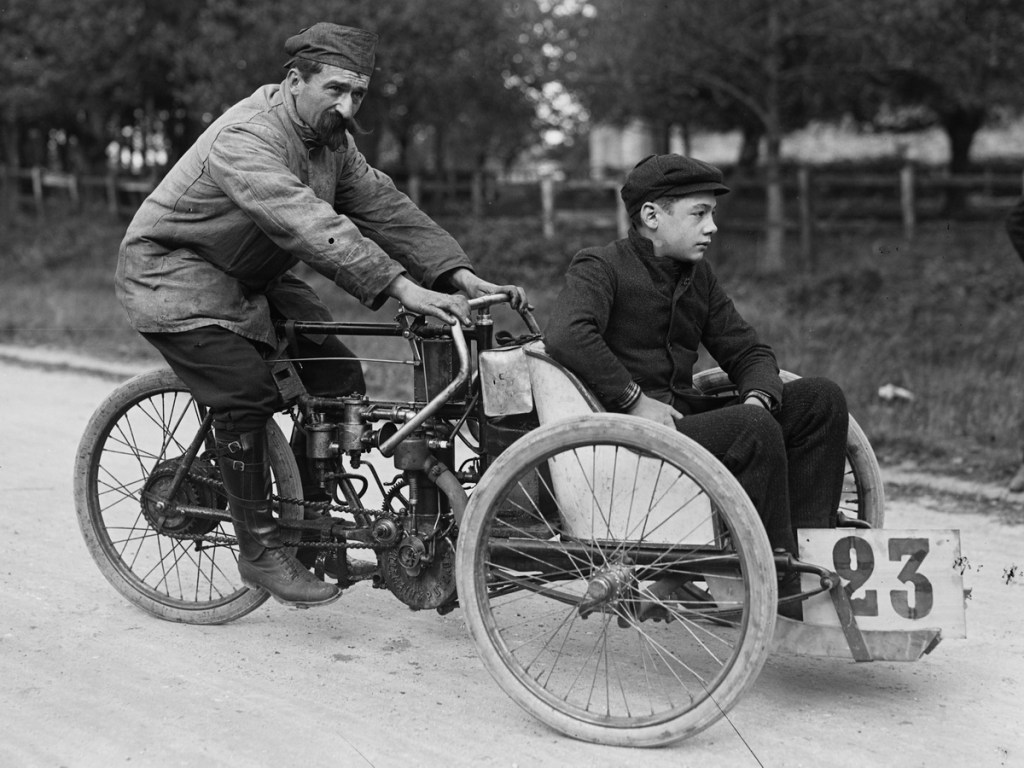
JOSEPH BARTER’S LIGHT Motors, which had already produced a conventional single-cylinder engine to power a bicycle, developed a 200cc in-line flat twin marketed as the Fee (French for Fairy) which was soon anglicised to Fairy. It was (probably) the first flat-twin. In the USA The Bicycling World and Motorcycle Review was impressed: “Here’s a 60 Pound Two Cylinder. Though long a feature of the automobile, so far as known, the two cylinder horizontal opposed motor has never been applied to the motor bicycle prior to the advent of the type shown in the accompanying photograph. This is of English make, and is doubtless the out-come of the great amount of agitation raised over the question of building a really light motorcycle—one that may be carried upstairs by the dweller on the top floor who had no other place to store it—and it would seem to be designed to meet the great demand that is prophesied to spring up for such a machine, as its weight complete is slightly under sixty pounds. The 2½ horsepower engine alone weighs but thirteen and one-half pounds, the bore and stroke of the cylinders being 2 ³⁄₁₆ inches. The flywheel is outside, and the engine entire with its muffler is clamped horizontally between the saddle post tube and lower strut of the frame as far down as possible without bringing it out of the level. Immediately beneath it and clamped to the same strut is a countershaft carrying two pulleys and a friction clutch combined. The transmission is by means of a chain direct from the motor pulley to this countershaft, from which the drive is taken to the rear wheel through a flat belt. The clutch allows the engine to be started by hand if desired, although the usual procedure is to mount with it out and pedal for a few yards. The clutch is then let in and the exhaust valve dropped, when the drive is said to be taken up almost imperceptibly, the machine running very quietly. As a whole, it presents a rather neat appearance, and apart from the use of an engine of this unusual type for a motorcycle and the addition of a clutch does not embody any of the bizarre features that might naturally be looked for in an attempt to produce a machine to tip the scale at such a low figure. In addition to marketing the machine complete, the power plant will be sold separately for attachment to an ordinary bicycle; also a larger size of the same type rated at 5 horsepower.”
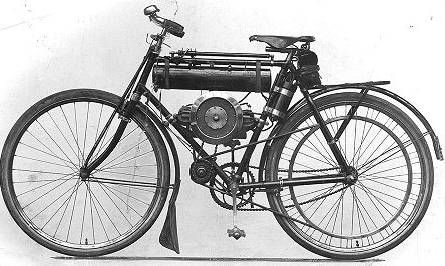
INDIAN CAME UP with a 500cc V-twin. It was a good year for V-twins; they also came from NSU of Germany, Puch and Styria of Austria—and Indian’s compatriot Glenn Curtiss. He put his twin to good use by riding it round the one-mile Syracuse dirt track in exactly 61 seconds to set the latest in a series of records.
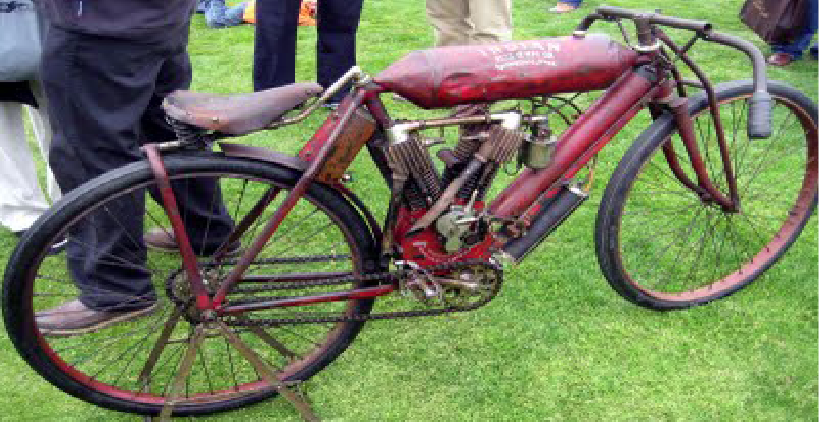
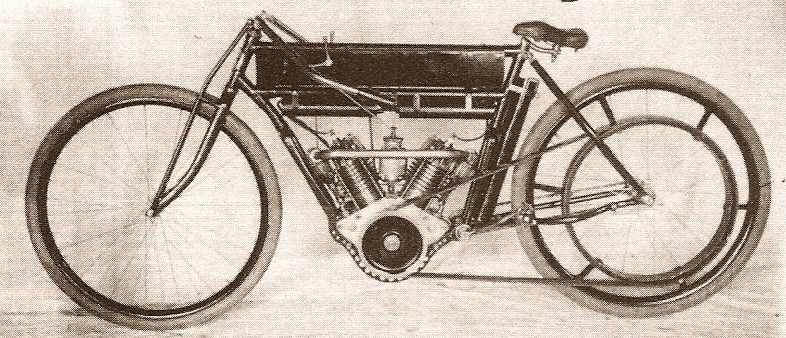
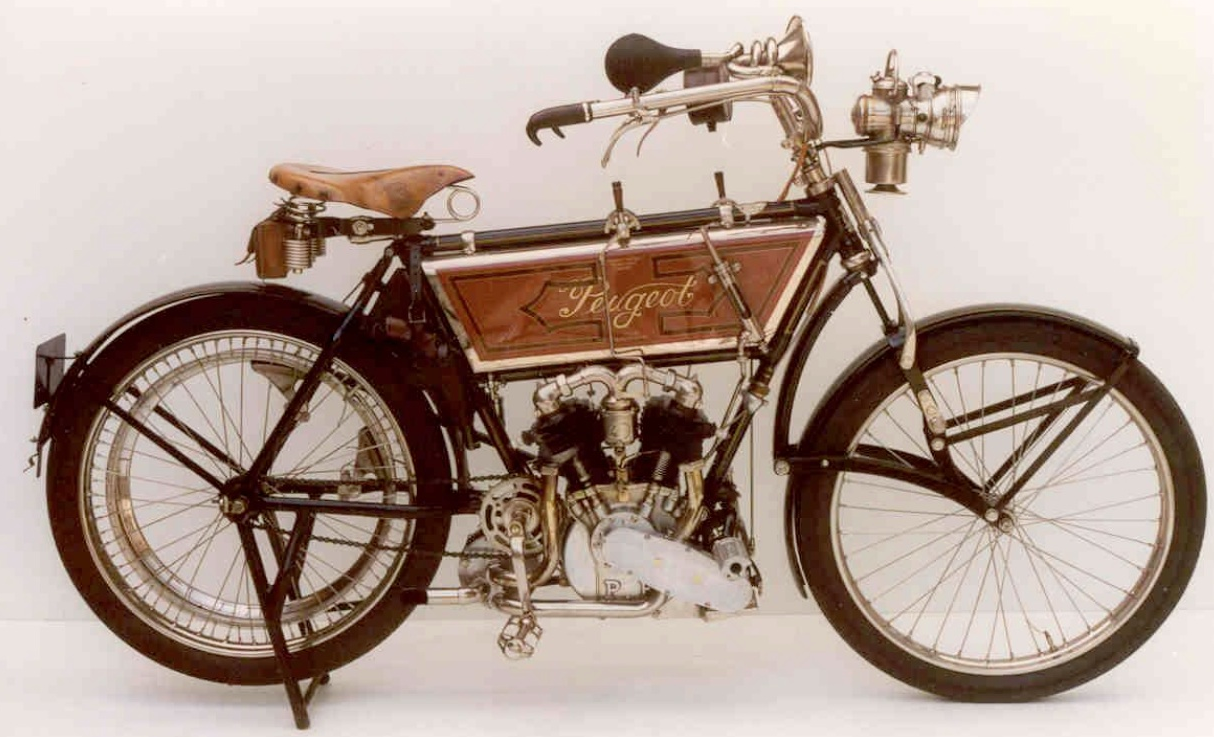
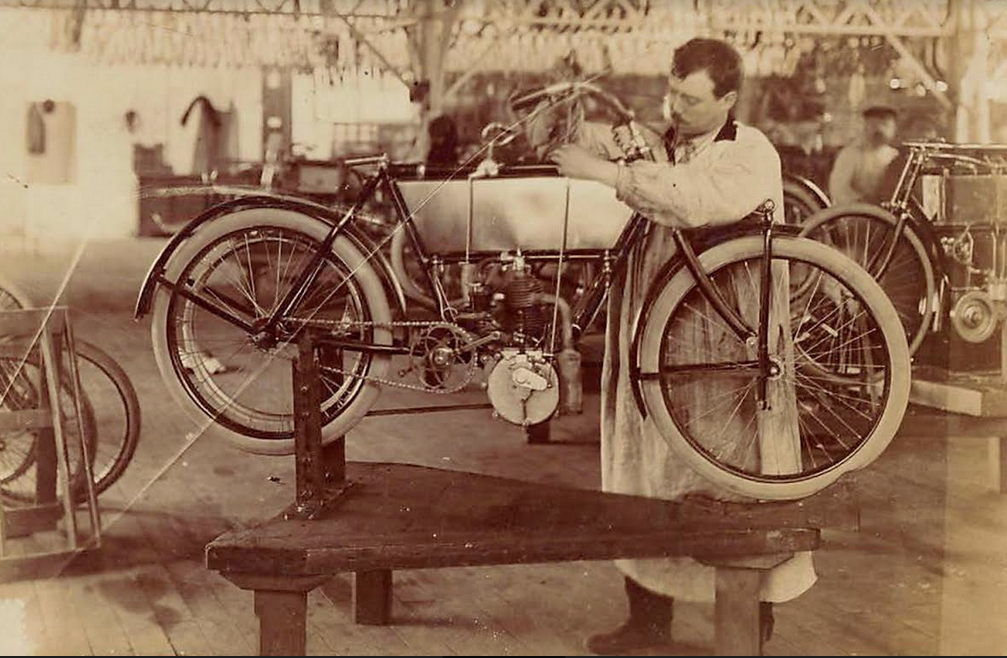
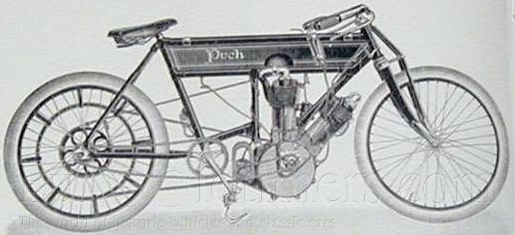
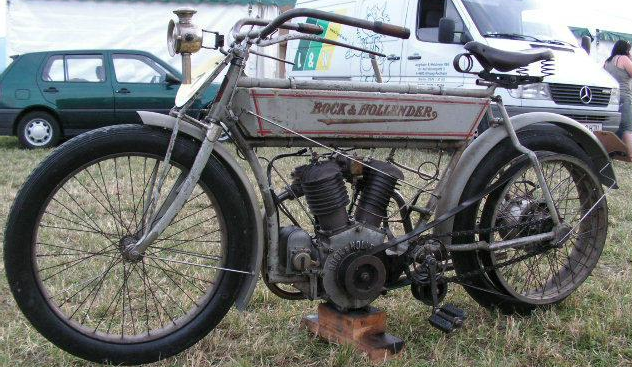
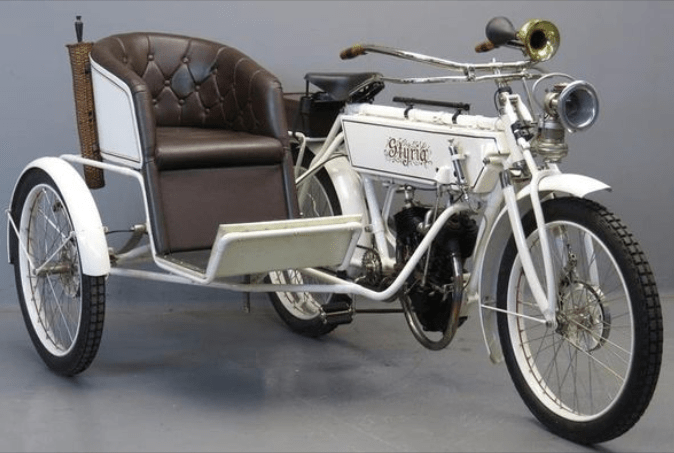
“A NOVEL MOTOR ATTACHMENT. A device which, it is claimed, enables an ordinary pedal-bicycle to be quickly converted into a motorcycle, has been recently introduced by Speed and Power, 34, Pilgrim Street, Liverpool. The attachment, as the illustration depicts, is self-contained, the bicycle to which it attaches taking no weight er strain. Its construction is simple, consisting of a framework of tubes carrying a 2¼hp engine; this drives by chain a countershaft, having a differential gear, thence there are chains to drive the two road wheels. The petrol and oil tank is placed on the opposite side of the frame to the engine. The bicycle is very quickly attached to the motor framework, and is supported on springs to minimise any vibration that might be set up. The control is entirely effected by Bowden wires and levers fixed on the handle-bar by one movement. The attachment can be fixed as easily to a lady’s as to a gent’s machine. It is claimed to be able to climb steep gradients, and is easily manipulated in traffic. Its non-side-slipping virtues are also said to be very marked. It weighs under 80lb, and, fitted up on an ordinary cycle, the total weight is about 110lb. The price of the attachment is £20.”
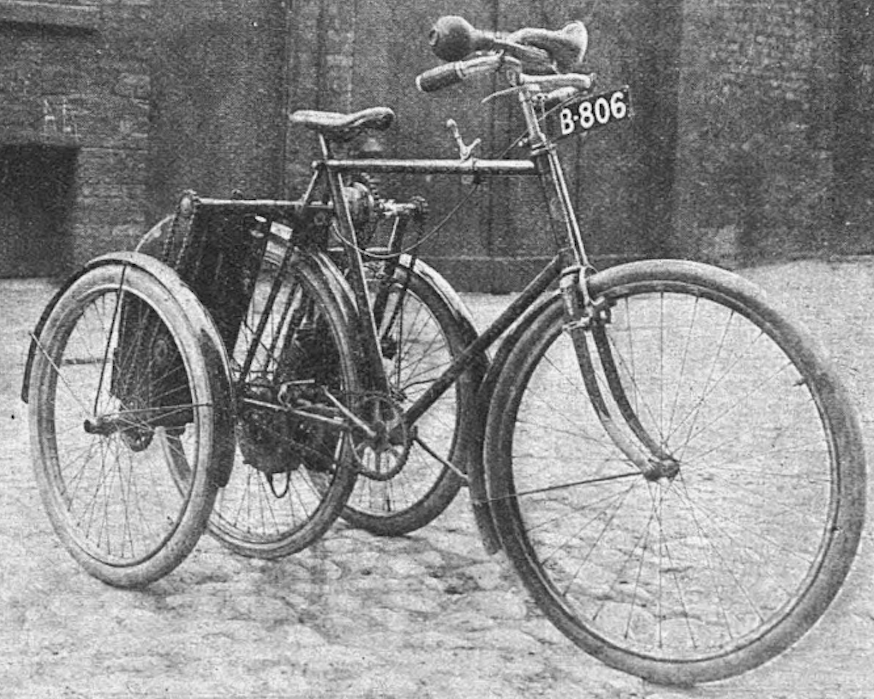
“GLASGOW MOTORCYCLE CLUB. The programme of this club for the ensuing season comprises fortnightly destination runs and several competitive events, viz two hill-climbing contests, a reliability trial and a petrol consumption contest.”
“THE MOTOR CYCLING CLUB DEFIES THE AUTOCYCLE CLUB. To decide the question as to whether or no they should apply to the Auto-Cycle Club for a permit to run ‘open’ events, ie, other than events confined solely to members, the Motor Cycling Club held an extraordinary meeting of its members at the Frascati Restaurant on Tuesday last. A full discussion of the much-debated subject took place, and eventually it was decided by a big majority that the club should not make application to another club, which had not yet published its rules, and which competed with it for members for a permit to run an inter-team competition amongst motorcycling clubs. It was further decided to continue to promote any other ‘open’ events the committee might think desirable, and to proceed with the organisation of the inter-team competition.”
“MOTOR CYCLING CLUB PICNIC. The MCC made a new departure this last week-end, and selected one of the beauty spots of the Thames for what is described as a picnic. Monkey Island, near Bray, is a delightful place, and eminently suitable for a summer outing. Unfortunately, London was deluged with rain on Sunday morning, and the gathering was comparatively small, but it turned out exceedingly enjoyable, luncheon being taken under the trees.”
JOHANNESBURG MCC. THIS FLOURISHING South African club held a most successful reliability trial extending over two days during the Whitsun holiday, and from the accounts which have reached us the proceedings appear to have been carried through from start to finish on business-like lines, and with commendable attention to those minute but essential details which tend to make or mar similar events. Fourteen competitors faced the starter on the first day for the initial test—a time schedule run at a speed of 15mph to Florida and return—some 18 miles. Then followed a run to Heidelburg and back (66 miles), one hour for lunch being spent half-way, when the machines were locked away. Three men dropped out half-way, due to ignition and valve troubles. On the return to Johannesburg, a six-mile run to Craighill and back was taken, an extremely steep hill having to be negotiated en route. Machines were then locked away after petrol consumption had been recorded. On the second day a hill-climbing test up a hill over a mile in length, with an average gradient of 1 in 12, occupied the morning, and brake tests on the level over a 200 yards course concluded in the afternoon a very interesting two days’ sport. The results were as follow, 200 being the highest possible number of marks: 1, Lynn (Humber), 171; 2, Usher (Rover), 169; 3, Jones (NSU), 169; 4, Hanscomb (Rover), 162; 5, Koch (NSU), 158; 6, Ashworth (Triumph), 153. Second prize was awarded to Usher because he had accomplished a better all-round performance than Jones.”
THE MAGAZINE L’AUTO staged a ‘Concours de tri-cars’ and because I live a gossip here’s some tittle-tattle about L’Auto, a sports daily published from 1900 as L’Auto-Vélo. Henri Desgrange, founded it to compete with the sports daily, Le Vélo, following the Dreyfus affair (if younger readers haven’t read of it have a google—it was a doozie). Le Velo decided the new newspaper had nicked part of its name and a court agreed so from 1903 it was cut down to L’Auto which hit back by helping establish the Automobile Club de France and went on to launch the Tour de France. Le Velo went to the wall in 1904. L’Auto thrived but its anti-Dreyfus stance was reflected in its pro-German stance during World War 2—it referred to the French resistance as “terrorists”—and one of the men behind L’Auto’s finances was executed for collaboration. L’Auto was banned after the Liberation. And now, back to the concours…
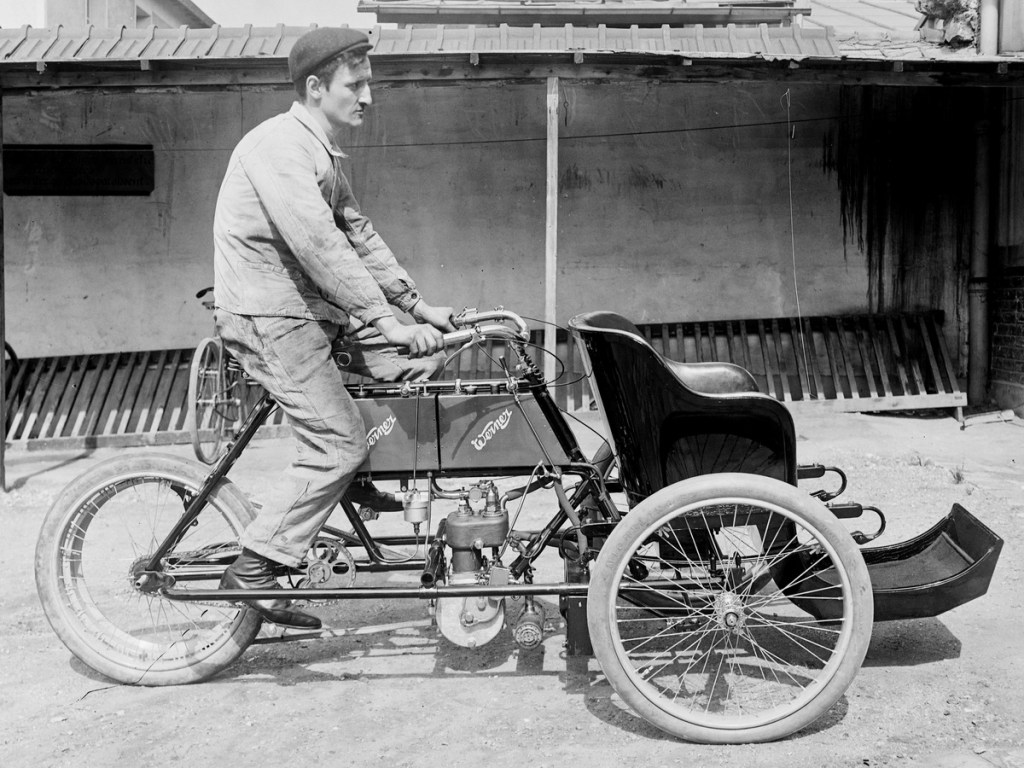

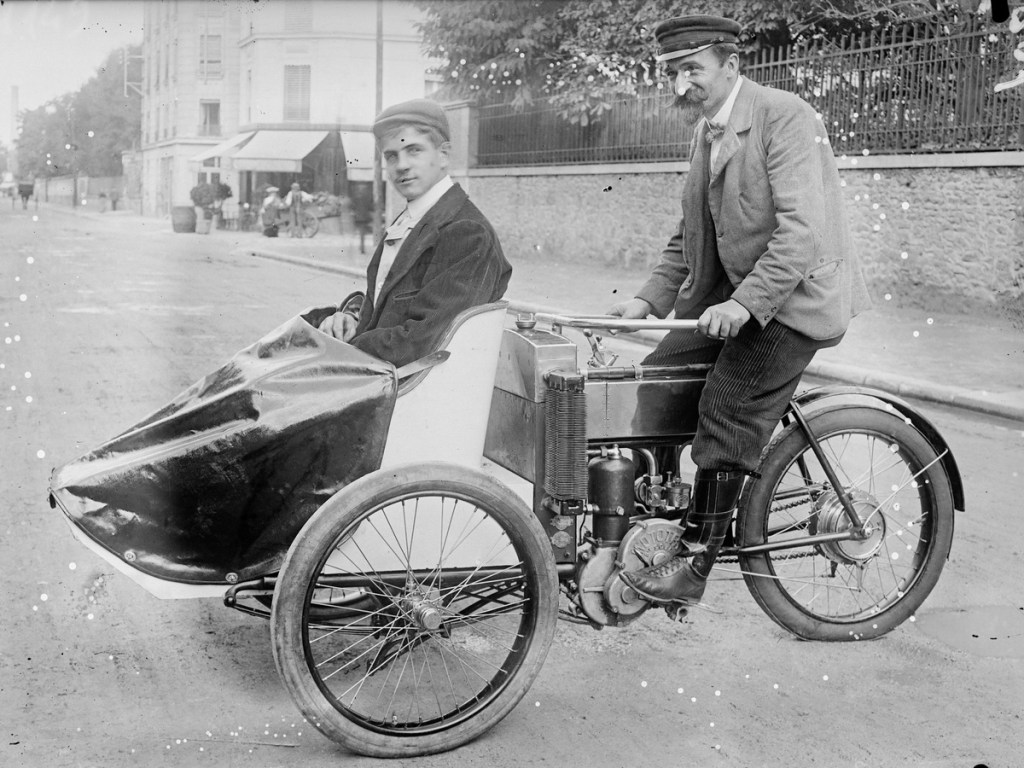

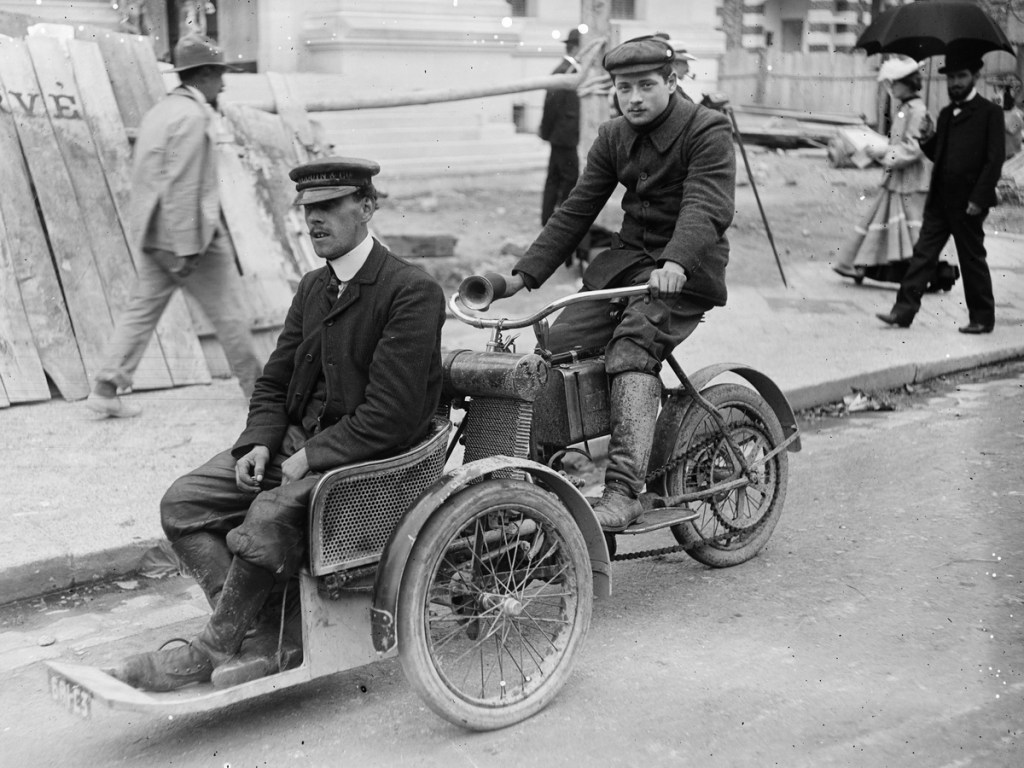
“A 1,279 MILES TOUR IN SIX DAYS ON A TRIUMPH MOTOR-BICYCLE. The tour undertaken by the Rev BH Davies [better to known the Blue ‘Un readers as Ixion] on a 3hp Triumph with magneto ignition was completed on July 2nd. He covered 200 miles per day; visiting Taunton, Derby, Shrewsbury, Ludlow, Grantham, and Bournemouth, and was back at his headquarters at Oxford each evening for dinner. He was timed by Mr DK Hall, the well-known timekeeper, who checked and verified the run. Of special interest is the fact that the total running expenses for the 1,279 miles was only 25s, about ¼d per mile. The machine was the same one ridden by Mr Davies in the MCC London-Edinburgh run. The same belt and sparkplug lasted the entire tour.”

“A REMARKABLE DEMONSTRATION. One afternoon last week a member of our staff witnessed a test of the hill-climbing powers of a Phoenix motor-bicycle on the steepest gradient in London. Netherhall Gardens, Hampstead, is reputed to be as steep as one in four and a half, or about 22%, and its difficulties are enhanced by the road coming at right angles from a busy thoroughfare, where the hill at once commences, without any possibility of securing a take off. It is reckoned a good feat for a car of moderate horse-power to attain the summit with a proper complement of passengers. The machine used on this occasion was a Standard Phoenix 2¾hp, with two-speed gear and free engine, and was the identical machine which secured the gold medal in the Haslemere hill climb of the Auto-Cycle Club, and which also did so well in the Reeves’ 200-mile non-stop contest. Mr Ilsley rode the bicycle last week, and we were assured that no gear alterations had been made, these still remaining at the ratios of six to one for the high and eleven to one for the low. Four ascents were made in quick succession without a movement of the pedals, then Mr. Ilsley illustrated the handiness and comfort of the combination. Most riders have been stopped by other vehicles, etc, when attempting the ascent of a steep hill, and have had to descend to the bottom to secure a fair start. On the occasion under notice the machine was purposely brought to a standstill on the middle of the rise and the engine stopped. With a starting handle (conveniently carried in the toolbag) the engine was wound up; seated in the saddle with one toe resting on the ground to support the machine and Mr. Ilsley gently eased in the low gear and sailed up without a sign of faltering. The pick-up from the standing start was absolutely smooth and quite free from any symptom of jar or harshness of movement. The trial was repeated and was equally successful on the second occasion. No attempt was made to help by a hard ‘push off’ from the foot or otherwise, and the pedals were only used as footrests. Just as the last ascent was being made, a four-cylinder car of a well-known make came up, and was passed easily by the bicycle at quite double the pace.”
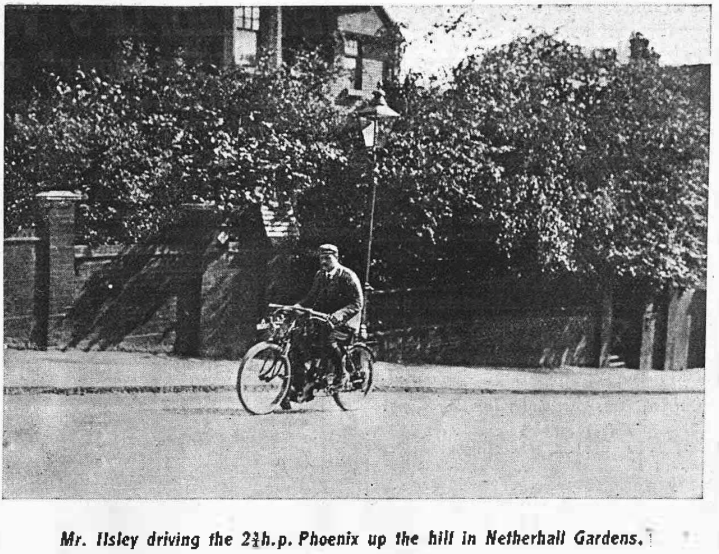
“THE AUTO-CYCLE CLUB was fortunate over the matter of its hill-climb on Saturday last. First and foremost, Mr FS Philipson Stow made a capital host, dispensing his hospitality in such a quiet way that one felt instantly at home and as if one were under no obligation to anyone. The grounds of Blackdown House are very extensive, the house itself standing in a delightful spot just below the summit of the down, and, therefore, sheltered from the keen wind; whilst the view southwards over the Sussex weald is rich in those features for which the county is justly famous…Altogether it was truly a magnificent climb, for in the mile length which had been marked out the road rose from a level of 268 feet above the datum line to a level of 720 feet, or 452 feet rise in 5,280 feet, or slightly less than 1 in 11 throughout…The surface throughout was magnificent, for Mr Stow had given instructions that it should be carefully prepared, and, thanks to the efforts of the clerk of the works, the conditions were perfect for the trial. After breakfast officials and
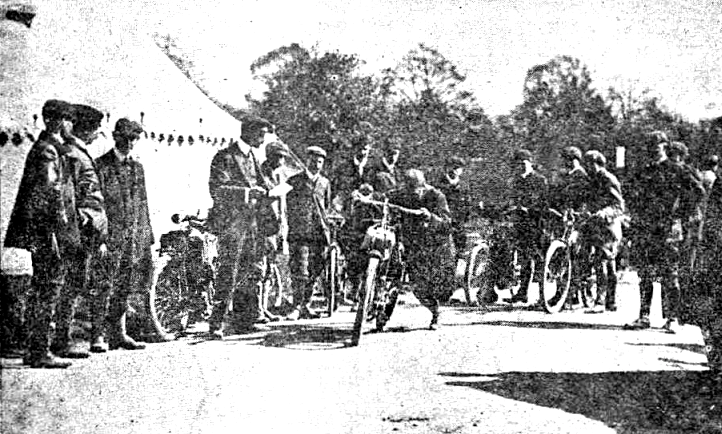
competitors made for Blackdown, five miles away, and the morning was spent in weighing and inspecting the machines. These latter were weighed with tanks full and fully equipped for the road, whilst the men were weighted up with sand and stones and sound advice, so as to bring them up to the minimum of l0st 71b. Lunch was served in a marquee, whilst the officials were the guests of Mr Stow at the house. Blackdown House was built in 1640, and is in a beautiful state of preservation, the recent additions to it being in absolute keeping. Mr. Stow has some beautiful pictures, and a few minutes after lunch were most enjoyably spent in admiring the house and its contents. Mr Stow has been away in South Africa for some months, and only reached home at 6 o’clock on Saturday morning. Over the entrance gates was the old Scotch motto, ‘East and West, Hame is best’. Mr SF Edge marshalled the men at the foot of the hill and started them, giving them a 50 yards flying start. Mr Straight timed at the foot of the hill, and Mr Swindley at the summit, Mr Ebblewhite working out the figures…In the first class (machines up to 76x76mm) [345cc], F Hulbert, 2¾hp
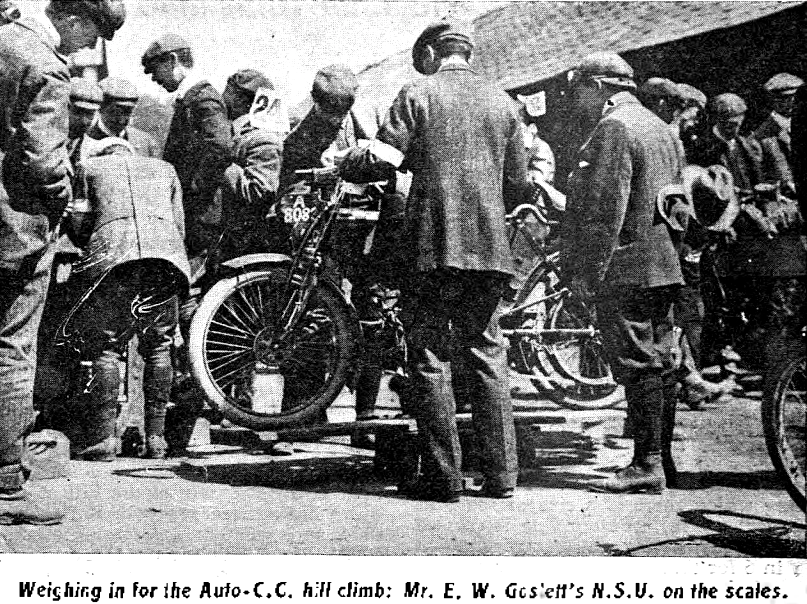
Triumph, did 2min 28⅘sec, and AF Ilsley, 2¾hp Phoenix, did 2min 38sec. Hulbert came up very well indeed; Ilsley used the lower of his gears on the steep pitch. All the other competitors in the class stopped on the steep portion except Blackney (two-cylinder Werner), who surprised everybody by failing on the 1 in 8 portion. Crundall (2¾hp Humber) just reached the top of the steepest part, and then could go no farther. JH (2¾hp R and P) stopped half way up, Goslett (2¾hp NSU) a little er down, and WW Genn (2¾hp Eland) stopped a quarter of the way up the steep pitch. Class 2 (machines up to 80x80mm) [402cc] produced very similar sort of results to Class 1, two men surmounting the hill—AE Lowe (3hp JAP), 2min. 31⅘sec, and RW Ayton (3hp Triumph), 2min 42⅘sec, whilst Tyler (3hp Humber) stopped on top of the steep pitch, Goslett (3hp NSU), Mabon (3¼hp Mabon), and Pemberton (3hp Singer) getting half way up it, WE Blackwood (3hp Chater
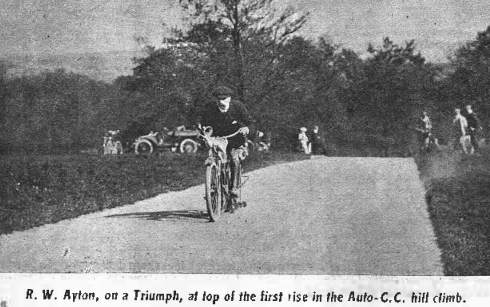
Lea) doing nearly as well, whilst the Rev BH Davies (3hp Triumph) failed on the 1 in 8 stretch. Class 2 showed slower times than Class 1. Class 3 was for machines up to 85x85mm [482cc], and, naturally, they did well. J Hancox (3½hp Roc) went up splendidly in 1min 58½sec; T Silver (Quadrant) travelled well, his time being 2min. 9⅘sec; AC Wright (1¾hp Roc) went up easily but slowly, his time being 2min. 35⅖sec; DE Brown (3½hp Ormonde) did 2min 59⅗sec; and FW Applebee (3¼hp Rex) did 3min 7sec. AP Tyler (3½hp Traveller) and F. Jeffree 3¼hp Durkopp) both stopped on the steep pitch…Class 4 was for any machines, with no restrictions of any sort. Only four competitors essayed the climb in Class 4. JF Crundall had to swing wide on to the grass, and, after an adventurous journey, got the road again, his 5hp Humber picking up grandly on the hill. His time was 1min. 48⅖sec—the fastest time of the day. ED Fawcett, on a 4hp Bat, came up in faultless style, his time being 2min. 7⅘sec. Wilbur Gunn (5hp Lagonda) also travelled well, 2min 30⅖sec; whilst JB Walford, on a 3½hp Ortona, did 2min 52⅗sec. Crundall’s time averaged 33.2mph…The prizes were silver and bronze medals in each class, and there will be gold medals for the most meritorious performances.”
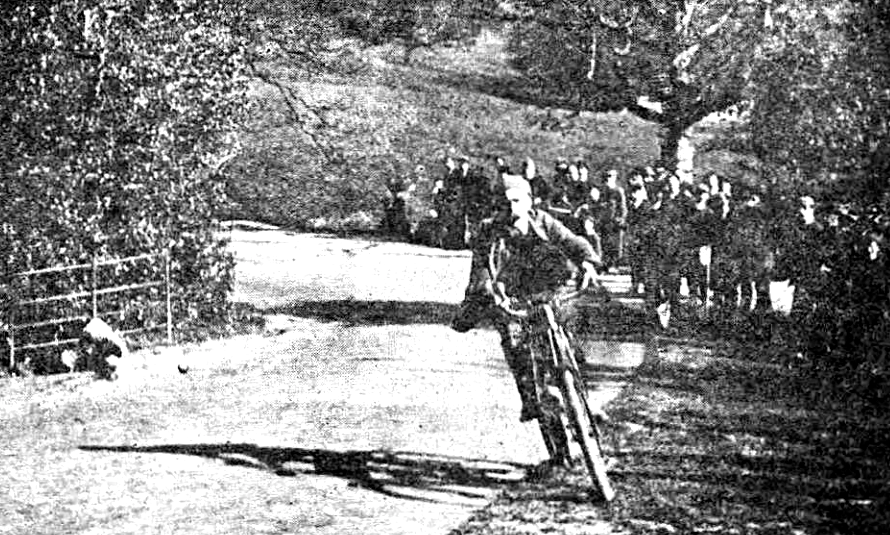
“THE FOLLOWING COMPARATIVE figures are interesting as showing the rapid growth of motoring in France. The total number of private cars manufactured in 1899 was 1,438 ; in 1900, 2,354; 1901, 4,427; 1902, 7,358; 1903, 9,922; 1904, 12,519.”
“THE MCC RUN ON SUNDAY was to Woburn, and as many as 19 sat down to lunch at the Bedford Arms. J van Hooydonk (freshly returned from reliability trials in France and full of harrowing stories about the French habit of strewing nails on the roads to knock out competitors) was in charge of the arrangements, and with him were JA Jackson, Victor Abraham, CW Brown, and others. Miss Muriel Hind, who usually drives a motor-bicycle, on this occasion drove a Brown car.”
“THE ISLE OF MAN AS A HOLIDAY RESORT. Motorists generally owe the inhabitants of the Isle of Man a great debt of gratitude for the whole-hearted and generous enthusiasm which they bring to bear upon motor racing. A special Act is promulgated with quaint ceremony from Tynwald Hill sanctioning motorcar racing over the roads of the island for a period of three days, but prior to this the islanders permit the testing of the racing cars and cycles up to a certain time of the day on the roads selected for the course. This is not done without much expense and considerable inconvenience to the community at large, but all business dislocation is cheerfully borne, and the people are so imbued with the true sporting spirit that they make the event the occasion for a holiday and flock out in their hundreds to see the sights. All this self-sacrifice on the part of the Manxmen is worthy of recompense, and motorists have the means of rewarding the island by visiting it. By so doing they will not only circulate money amongst a really deserving community, but they will experience a thoroughly enjoyable holiday in a delightfully healthy climate and amongst most interesting and hospitable people.”
“THE COMPETITION FOR THE MURATTI CUP. This event, which consists of a 400. miles reliability run, was held under the auspices of the Ulster Centre of the Motor Cycle Union of Ireland on Thursday and. Friday last. The competition was for a handsome trophy presented by Messrs Muratti Sons & Co, to be won three times in succession. The event is open to amateur motorcyclists. The start was fixed for 7 o’clock am on Thursday from Balmoral, Belfast, when 23 competitors were sent away…JS Garrett (Hobart), hon sec Ulster Centre, was first to go under, five punctures in the early stages of the contest left him hors de combat. A bad accident happened to H Williamson of Coventry (Rex) through a restive horse dashing in front of him. Williamson was brought down, and the cart passed over him, rendering him unconscious. He was removed to a hospital in Dublin. At the end of the first day’s run eight out of the 23 competitors crossed the line at Belfast at 6.49pm…At the end of the second day’s run six competitors finished in the times given: A Hulbert, (Triumph), LL. Wilkinson, (Riley), JP Barney (Enfield), RM Brice (Browne), EA Lowe (JA), J Stewart (Triumph)…The conditions of the contest were such that a rider arriving at a sub-section control, of which there were 16, more than 10 minutes after the schedule time lost a mark for every minute. Time gained on the schedule was not taken into account, save in the event of a tie. An audit of the cards on Saturday morning disclosed the fact that Lowe, the JAP rider, and Bryce, who rode a Browne, had scored equal marks. The latter, however, had ridden more closely to. schedule, and was awarded the cup, Lowe being placed second. Williamson’s injuries were not serious, and he has returned to Coventry.”
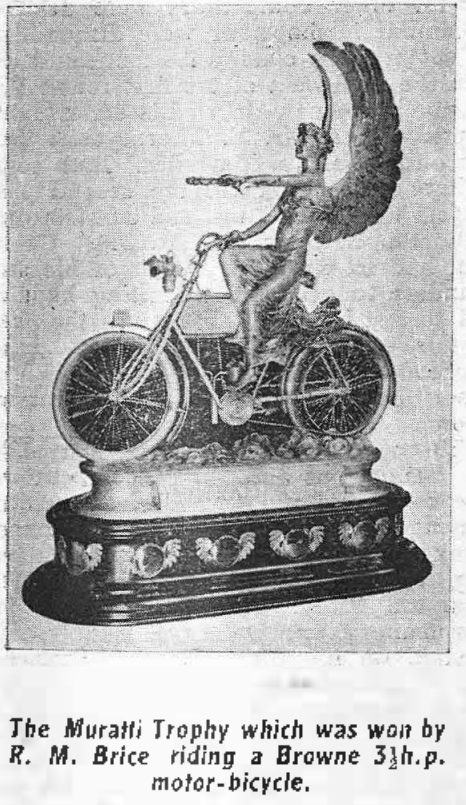
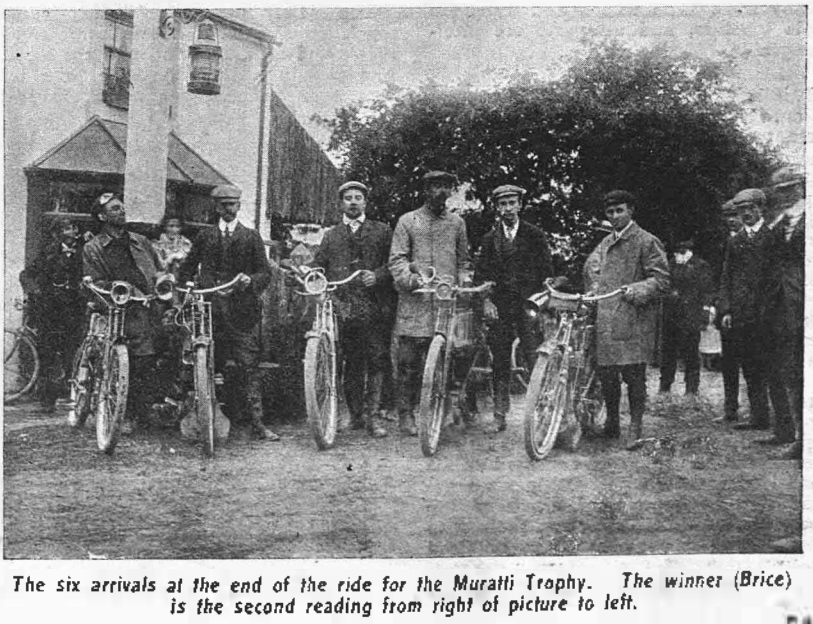
“NEARLY ALL MOTORISTS agree with me that 20mph is quite fast enough for anyone to drive at, and it seems to quite satisfy even those who wish to go faster, providing they keep at that speed; but should they exceed it and get up to, say, 30 miles, and then drop down to the limit of 20, they feel as though they were going at 10, and so experience a desire to go faster, which, in my belief, is sometimes the cause of an accident. I have experienced these facts many times myself, and am sure that there are plenty of motorists who will agree with what I say. I would suggest that all motorists have a good speed indicator fixed upon their cars.
Samuel Smith.”
“REPLY TO ‘LPT’ (LONDON, N): (1) No, we have not heard of any practical application of compressed acetylene for driving car engines. It has been done experimentally, of course, but it is difficult to see what could be gained by using acetylene instead of petrol. It is expensive, has an objectionable exhaust, and the tendency for carbon to be deposited in the combustion chamber is much greater than with other fuels. There was a motorcycle exhibited at the last Paris Show driven by acetylene. (2) Nothing seems to have come of the liquid air idea for driving motors; since the 1903 Stanley Show we have not seen any car driven by it.—Ed“


“IT IS A FAR CRY from London to Edinburgh; 400 miles of as varied road as it would be possible to find have to be covered by the wayfarer ere the northern town is reached, and even in fair weather the task is an arduous one, requiring all that a man possesses of pluck and determination to compass the various difficulties which lie in the way of he who would go hither by road by means of such a vehicle as the motorcycle and within the short space of 24 hours. It is just one of those tasks which, demanding as it does a full measure of endurance, determination, and, in a word, ‘devil’, appeals in particular to the Britisher. The event has grown in popularity since last year. Then there were 70 entries and 47 starters. Of this number 22 riders managed to reach Edinburgh, the first arrival being HE Cowles, who rode a 2¾hp Stockwell motor-bicycle. This year the entries totalled 88, and, despite the forbidding nature of the weather, there were 57 starters. These comprised two tricycles, two bicycles with side carriages, nine tri-cars, and 44 singles. The riders commenced to assemble about eight o’clock in Paternoster Square, and rode up in ones and twos until the whole space was crowded with riders, motors and interested spectators…Riders were able to run their machines on the stands and give a final tuning up without being mobbed by a gawking crowd. Each rider notified his arrival to one of the officials, and having received a white armlet with a numbered leaden seal attached, made his way to the supper room at the Red Cross Hotel. The inner man being satisfied, Mr CW Brown gave a few words of final advice to the riders and warned them that if the legal pace was exceeded or any racing was indulged in so as to be first at Edinburgh, the offenders would certainly be disqualified. When the street was reached, an inspector and several constables of the City police rendered good service in marshalling the riders in single file in the order of their entry. One constable particularly distinguished himself by his stentorian tones when he shouted out the numbers of the wished-for riders. Just as the
last of the men were formed up a water-cart turned the corner and persisted in swamping road and machines with unnecessary fluid, as if enough had not fallen from the heavens during the preceding week…Promptly at 9.45 the police inspector led the long line of competitors to the General Post Office, and as the clock showed 9.50 Mr J Horace Reeves sent the first man, JW Penzer (2½hp Ariel) away on the long journey…Notwithstanding the falling drizzle a huge crowd lined up in the middle of Aldersgate Street and somewhat hampered the men in securing a good start on the greasy wood pavement; there were a few shaves, but the long narrow lane of spectators was safely negotiated by all, and at 12 minutes past ten the last rider had left…The variegated ‘get up’ and general equipment of the riders created intense amusement amongst the crowd. Some of them, evidently in anticipation of rough weather, had two suits of waterproofs and sou’ westers…Not the least interesting feature of the start was the Lagonda tri-car, driven by Wilbur Gunn, which had a 20-stone passenger in the fore-carriage. One or two of the competitors copied the French racing motorcyclists’ idea of wrapping a few spare inner tubes round their bodies so as to be prepared for tyre troubles. In several instances the machines were equipped with two acetylene lamps…The paving between Islington and Highgate was exceedingly greasy, and there were two or three falls from side-slips. The worst experience appears to be that of R. T. May (2¾hp Brown), who damaged his pedalling gear so badly that he had to give up. Between Highgate and Hatfield the going was exceedingly bad, and this, coupled with the intense darkness of the night, proved most trying for the riders’ nerves. Beyond Hatfield the conditions improved, and by the time Hitchin was passed the roads were perfectly dry. It would appear that after leaving Stamford some few of the riders missed their way and struck the Cambridge road, and were not heard of afterwards. The first control was Grantham, 110 miles out, at the George Hotel, the proprietor of which had an excellent repast ready…By 6.30 a total of 40 of the starters had arrived. No serious mishaps whatever were reported, a few being delayed by punctures and running short of petrol a few miles from Grantham…Most of the arrivals complained of the intense cold of the early morning. After signing on, and having some refreshment, they started off

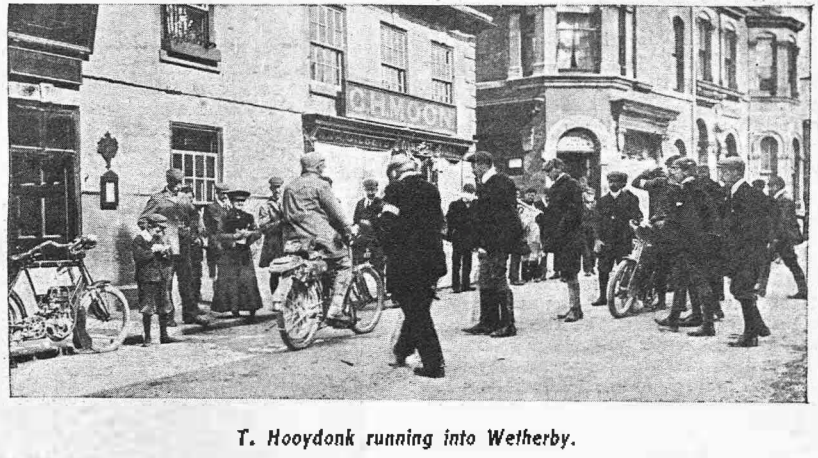
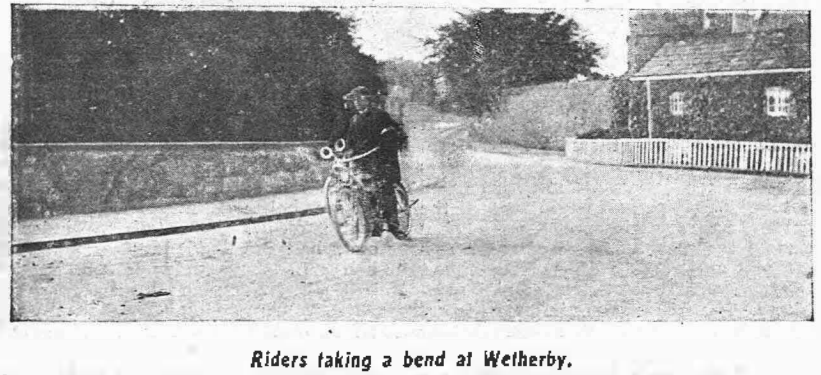
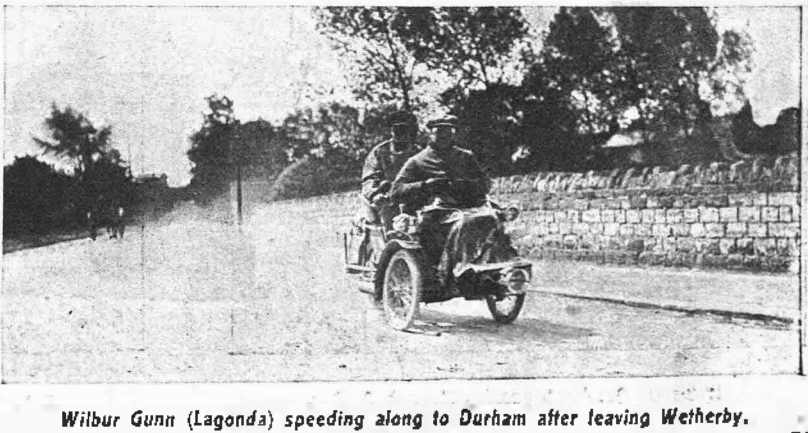
again for Wetherby. Hooydonk (4hp Phoenix), and Fry (3½hp Phoenix) arrived at Grantham very late and decided to abandon the run as they had lost too much time to catch up again…Between Wetherby and Boroughbridge Penzer had a serious mishap. A drove of horses suddenly appeared across his path, and as a result he had to charge the ditch, smashing the front wheel of his Ariel…Up to Wetherby nothing worse than a few punctures had occurred, and the majority of the starters from Grantham duly arrived at the control at the White Hart, Wetherby. The next control was Durham, the route being via Boroughbridge, Leeming, Catterick Bridge, Darlington, and Ferryhill, a distance of 66 miles. The roads for the most part were good, but loose in parts. Somewhere on this stage Chester Fox (3½hp Trafalgar) gave up, and it was reported that Bond, on a four-cylinder FN machine, which had been running well up to Wetherby, was in trouble through over-lubricating his engine; earlier on he had the end of his silencer blown off. Lunch was served at Durham, at the Three Tuns, the early arrivals reaching here between 11 and 11.30. A total of 24 riders had reached Durham up to schedule time, and several others followed later, these having been delayed by tyre troubles. Between Durham and Berwick, the next control, a distance of 80 miles away, some considerable stretches of bad-surfaced road were met with; but, on the whole, they were in better condition than on the occasion of the last run. Nothing had meanwhile been seen of any of the tri-cars or side-cars with the solitary exception of a l0hp Lagonda, driven by Wilbur Gunn (Lagonda), who was reported going strong. Penzer had managed to repair his front wheel sufficiently by taking it back to Wetherby, and had come on again. At Berwick a very large crowd had assembled to greet the riders coming over the historic bridge across the Tweed. Williamson headed the earliest arrivals, and 18 had come into the control at the King’s Arms in schedule time, and after lunch they were off again on the last stage, most of them looking more or less exhausted and practically unrecognisable for dust and oil on their features. The weather had all along been brilliantly fine, and everything promised for a large muster at Edinburgh…After Berwick there was no control till Levenhall, nine miles outside Edinburgh. This final part of the run was most picturesque being in sight of the Firth of Forth, and passing, through the towns of Dunbar and Portobello. At Dunbar BH Davies [Ixion] (3hp Triumph), Hulbert (2¾hp Triumph),
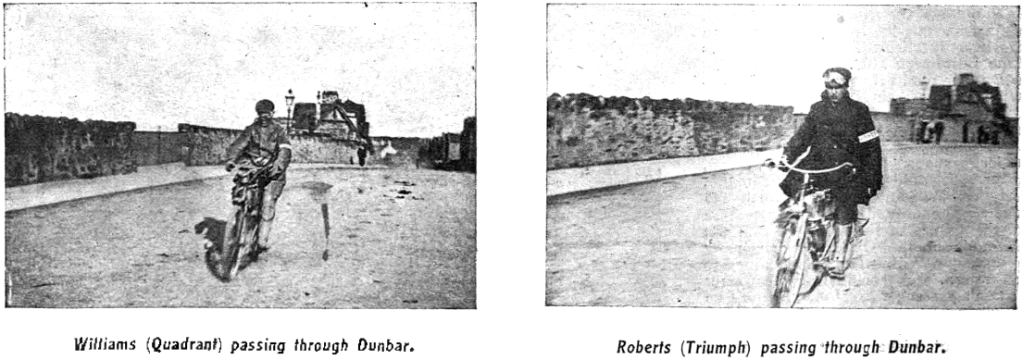
Williamson (3¼hp Rex), Roberts (3hp Quadrant), and Williams (3hp Quadrant) were fairly close up to each other and going well. The departure from Levenhall was timed for 7.30, to reach the GPO, Edinburgh, at 8 o’clock. There was a large crowd awaiting the riders outside the North British Hotel, and just on time the leaders came in and were heartily cheered. Several members of the Edinburgh MCC rode out along the Dunbar road to meet them…Penzer (2½hp Ariel) did an excellent performance, as he must have lost some hours getting his front wheel repaired. His engine was much the smallest that had been entered. Tuchmann did well on his 3hp Quadrant, after his plucky attempt to get through on a tricycle last year. HE Cowles (2¾hp Stockwell), who generally does pretty consistently in all club events, rode the same machine he rode through on last year. Practically all the successful machines were belt driven, and, taken all round, there seems to have been exceedingly few belt troubles…Williamson, who dismounted at 5.43, and who had therefore accomplished the distance of 390 miles (including time spent in the controls) in 19hr 43min, stated that up to Biggleswade the roads were heavy. After that point they improved, and on the Border the conditions were excellent. He had met with no accident of any kind, not a single stop or puncture troubling him. After Mr Williamson, came the
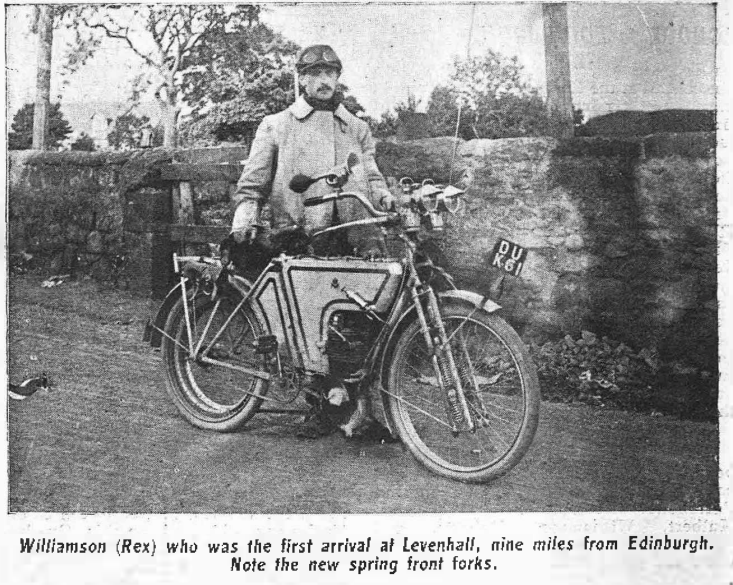
following: Frank Hulbert, 6.30; Rev BH Davies, 6.30; A Williams, 6.40; WH Wells, 6.40; T Woodman, 6.40; SA Baddeley, 6.40; DS Baddeley, 6.40; RM Brice, 7; AG Wilson, 7…The venue at Edinburgh was the North British Hotel, the manager of which had provided most excellent accommodation for the members of the club and their machines, every attention being shown to them. A formal reception was given by the committee of the Edinburgh MCC, after which an adjournment was made to the dining-room for supper…At the supper Mr Reeves proposed the toast of the King, and in a short speech congratulated the members of the MCC on their success, especially those who were new members. Mr Jefferson, president of the Edinburgh Motor Club, referred to the long and arduous journey undertaken, and thought that the feat was one that they could be proud of. On behalf of the Edinburgh Motor Cycling Club he heartily welcomed the MCC to the city of Edinburgh, and only regretted that the comparative youth of the Edinburgh MCC prevented them from being able to show their welcome in a more extensive manner than they were at present able. Mr Reeves replied, and hoped it would be possible to arrange for the Edinburgh club to come to London, as a sort of return visit, next year. At any rate, he felt sure that the MCC would have the audacity to accept the Edinburgh club’s hospitality for many years to come. A programme was afterwards arranged for the rest of the Whitsun holiday, this including a steamer trip up the Firth, visits to places of interest in Edinburgh, and a return home by machine for those who wished by the east or west coast route.”

“THE LONDON-EDINBURGH MOTORCYCLE Run. Although there were considerably more starters in this year’s run than last, it will have been observed that the number who got through was about the same. It has been suggested that the weather at the start was accountable for this, but glancing through the report of the run the statement appears that 40 members reached Grantham, and as there was certainly most favourable weather for three-quarters of the journey, I should have thought that a total of 30 members at least would have qualified for the gold medal instead of 22. Investigation of the causes which contributed to the large number of non-arrivals at Edinburgh seems to show that tyre troubles were far more numerous than they should have been. There were certainly two or three instances in which the air tubes burst and split under the driving strain; and, as every motorist knows, it is hopeless to try and repair an extensive split or burst in an air tube. Apparently something better than the ordinary air tube is wanted for motorcycle work. It is, absurd to expect solutioned seams and joints to stand continuous hard work at high speed. What is wanted is a specially made tube with all joints well vulcanised. The solution-jointed tube softens with the heat generated in the tyre and then gives way under the high pressure. I do not suggest that one should use anything as strong as a car tyre tube, but something considerably stronger than a full roadster cycle tube. I believe also that there is an opening for a really good butt-ended air tube. It is a very big saving of time in an event such as the London-Edinburgh to be able to jack up the wheel, open the cover, draw out the tube complete, and replace with a new one, in place of having to set about and endeavour to make a repair with no certainty as to how it is going to turn out. To replace an endless tube means, of course, taking the wheel right out of the forks, replacing it properly and adjusting the bearing and chain; and all this takes no inconsiderable time. I should object to having a butt-ended tube in which there was anything in the nature of a thick, heavy join: the tube should be as near as possible symmetrical throughout. If it is thick and heavy at once place, it sets up a nasty shock or jar at every revolution of the wheel, owing to the tyre being ‘dead’ at that place.—Magneto“
“WE HAVE RECEIVED a letter from Mr H Williamson on the subject of his disqualification by the Motor Cycling Club. The letter reaches us too late for inclusion in our correspondence column, and as it is too lengthy for publication in full in this section of the paper, we are compelled to summarise his remarks. Mr Williamson maintains that he can find no rule in connection with the London-Edinburgh ride which he neglected to observe and states that his times at all controls are slower this year than last. He claims to have driven with the utmost prudence throughout the night, and at a moderate speed consistent with the safety and interests of the public. During the time he was leading, he says, he maintained a steady average speed. He holds that his times through populated districts were the slowest of anyone reaching Edinburgh inside 22 hours, and neither during the ride nor since has he heard any complaint from the police, although there were several traps. Mr Williamson is writing to the police authorities along the route, enquiring if they have any complaints against his driving, and promises to hand such replies as he receives them to the Press. In giving the salient features of Mr Williamson’s letter, we have suppressed certain suggestions as to the motives of the club in disqualifying him.”
“OLD ETONIANS HAVE DECIDED to present the respected ex-head of Eton College, Dr Warre, with a motorcar, and the committee’s selection has fallen upon a RollsRoyce. This must be gratifying to the Hon CS Rolls, who received his early education at the famous college.”
“THE DUBLIN CENTRE of the Motor Cycle Union of Ireland ran off a 100 miles reliability trial on Saturday last. The event was confined to teams of three, and the course was from Dublin to Carlow and back. The usual speed limitations were imposed, and from a possible 100 marks for each competitor one mark was deducted for each road stop. Three teams entered, seven of the nine men securing non-stops. The winning team consisted of G Mayne (Singer), VH Meredith (Triumph) and R Howison (FN). Second honours went to Guilfoyle, Campbell and Carey, the latter dropping two marks for a puncture and an upset.”
“THE INTERESTING PHOTOGRAPH of a Singer belt-driven motor-bicycle which we publish this week shows what a well-constructed machine will stand. The driver, in endeavouring to take a sharp corner at too high a speed, ran up a heap of broken road metal and charged straight into a low wall built of roughly-laid slabs. The machine neatly took off the top stones and turned completely over, flinging the rider headlong into the field on the other side. The rider was quite unhurt, and the machine itself landed on the saddle and handle-bar and then toppled over sideways. It will be seen that, in spite of the tremendous impact necessary to distort a strong front wheel so violently, the frame and forks are quite uninjured. This speaks volumes for the splendid workmanship put into Singer machines, for which they have been renowned ever since the days of the old ordinary bicycle 25 years ago.”

“THE CYKLONETTE. This is the name given to a novel tri-car which has just been placed on the market by the Union Cable Co of 23, College Hill, EC. It follows on the lines of a vehicle designed some time ago, but is a practicable machine which, whilst not professing to give a high turn of speed, is very suitable for those who want a reasonably priced runabout to seat the driver and passenger side by side. The centre of gravity is kept low, and the weight of the passengers is kept near the rear axle, so as to balance the weight carried by the front wheel. The engine employed is a 3½hp air-cooled, 82x82mm, with automatic inlet valve. Gas is supplied by a surface carburetter of a much improved type, and the construction is such as to apparently obviate all the old difficulties of alteration of carburation when passing over rough roads…the petrol tank [has] capacity for 150 miles…A member of our staff had a short run on the Cyklonette a few days ago and purposely selected a busy route in the middle of the day, with the object of observing the behaviour of the machine in traffic as well as its hill-climbing powers…it climbed Putney Hill on the high gear at a round 12mph, showing that the engine cooling was effective. Without a preliminary stop the test hill in Richmond Park was tackled, and the engine took the load up without a falter. Arrived at the top, we turned round and came back to the bottom, and again turned for a severer test. Midway up the hill, on the steepest portion, the machine was brought to a standstill at our request, and the brakes held without running back for an inch. Then the low gear was let in, and the driver and passenger were carried to the top as well as upon the first attempt.”
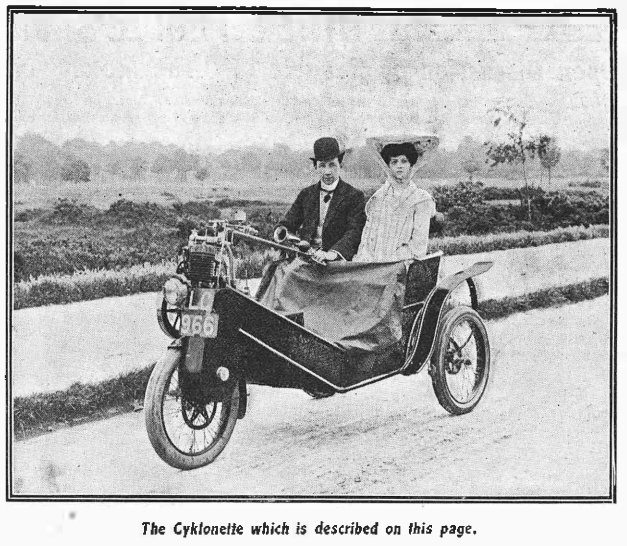
“ONE OF OUR STAFF had the good fortune recently to have a 3½hp Brown motorbicycle lent to him for a week-end, and he speaks in enthusiastic terms about the capabilities of that machine. It is fitted with two accumulators, and a two-way switch fixed most conveniently on the top tube, near the middle of the handle-bar. The tank holds nearly two gallons of petrol, and it is a comfortable, low-built machine. It is started easily, and when we had let a little of the air out of the front tyre was very free from vibration. As to speed, it was an easy matter to touch 35mph, and the writer is distinctly on the heavy side, slightly over 15 stone. We were naturally anxious to see how this machine was going to behave on the hills, and we ran it up Fitzjohn’s Avenue on to Hampstead Heath to commence with, then over Mill Hill on to Stanmore, and up the stiff hill from Berkhampstead into Ashridge, back through Hampstead, up that winding hill on to Laverstock Green, on to Elstree, and then, to wind up, we put it at Woodcock Hill, between Elstree and Barnet, the gradient being mostly 1 in 8. It romped up with its bulky burden at about 25 an hour without a touch of the pedals. In fact, only on one hill was it necessary to pedal, and then only because we had to switch off for traffic. The performances of this machine in the Muratti Cup and MCC 24 hours trial are instructive.”

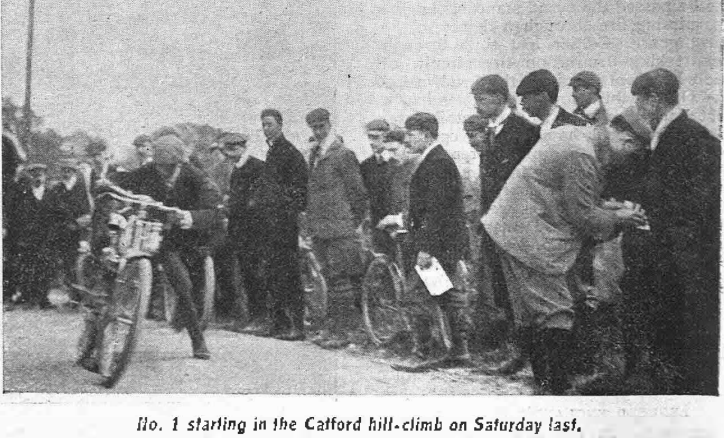
“ALL ROADS LED TO WESTERHAM last Saturday, when the Catford CC held their annual hill climb—the nineteenth promoted by the Club. This now historical event always attracts a big crowd, and we think that this year’s must have been the biggest on record. The timing arrangements, in the capable hands of Messrs AV Ebblewhite and JR Dainty, were greatly facilitated by the installation of a telephone by the General Electric Co between the starting and finishing points, the time of each man being ‘phoned to the top as he left his mark. Weather conditions might have been better, as the little rain that fell was not sufficient to reduce the dust, which lay thickly on the hill, and the wind blew down it sufficiently strongly to reduce the times to a substantial, extent. The course was manned by clubmen and one or two kindly disposed policemen, the latter calmly looking on while motors whizzed past at 30mph, literally under their noses! From which we may assume that the Westerham police constable is a good sportsman. Pedal assistance was barred, the contest thus resolving itself into one of machines only. Silencers were compulsory, but ‘cut-outs’ might be used. All machines were weighed with petrol and oil tanks filled, and had to pass the judges as touring machines.
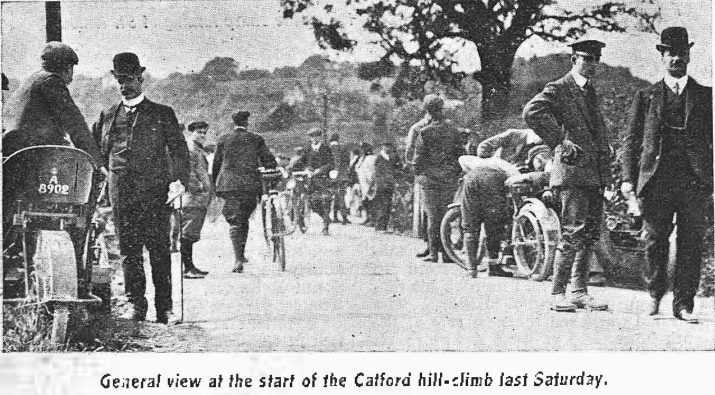
Powers ranged from 2¾hp 10hp, the latter being the Lagonda tri-car. Times were taken from the actual start, competitors being allowed to run, pedal, or be pushed to the flag, fifty yards away; any competitor unable to start his engine in this distance was allowed a second attempt. Class I took the form of a private owners’ handicap, for riders not connected with the trade. Cylinder capacity limited to 85x85mm, or equivalent volume swept out. There were ten entries, four climbing the hill. JP Le Grand (Kerry 3½hp) seemed not to be getting the best out of his engine. WA Getting followed, on a Roc (3½hp JAP engine), being crowded in to the side by a cart and two horses, the driver of which chose that particular moment to pull his vehicle broadside on across the road, and was only hustled out of the way just in time. EW Goslett, on an NSU, went up well, as did also HG Partridge, on another of the same make, who agitated his carburetter continually en route. Results: Gold medal, EW Goslett, 10sec allowance, 1min 34sec; silver medal, HG Partridge, 12sec allowance, 1min 43sec; 3rd, WA Getting, l0sec allowance, 1min 49sec; 4th JP Le Grand, 5sec allowance, 2min 51½sec. Class II: This was an open handicap for machines with a cylinder capacity not exceeding 90x90mm, or equivalent. Sixteen entries, including many of the well-known names, had been secured, and ten materialised. SS Hickson, on a 4hp CIE, climbed the hill by dint of close attention to his carburation, but did not give the impression of fast travelling. JJ Leonard rode a two-cylinder Lurquin-Coudert, but did not appear to get out of his machine all the pace of which it seemed capable. A Sampson drove a 3-horse Quadrant, and economised on his time by hugging the inside of the bend, a somewhat risky proceeding, considering the crowd. JA Prestwich flew up on a machine of his own make, riding in shirt-sleeves, and uttering weird yells as he went! T Silver, riding a 3½hp Quadrant, followed close on the heels of WH Wells, who was on a Vindec, a few seconds only separating the two at the top. Silver’s silencer is a wonder, and would do duty for a chimney-cowl at a pinch! WW Genn (2¾hp Minerva) travelled well, and RM Brice (3½hp Brown) and CH Richards (3½hp Minerva) topped the hill in splendid style, there being four machines on the hill together at this stage. Richards’ machine was firing erratically, but in spite of this made a good show. Results: Gold medal, T Silver, allowance 5sec, 1min. 27⅘sec; silver medal, WW Genn, 15sec allowance, 1min 34sec; 3rd, RM Brice, 10sec allowance, 1min 34⅘sec. Silver and Genn are, of course, veterans at the game, but Brice made his initial attempt on the hill, and is to be congratulated on his successful show.”
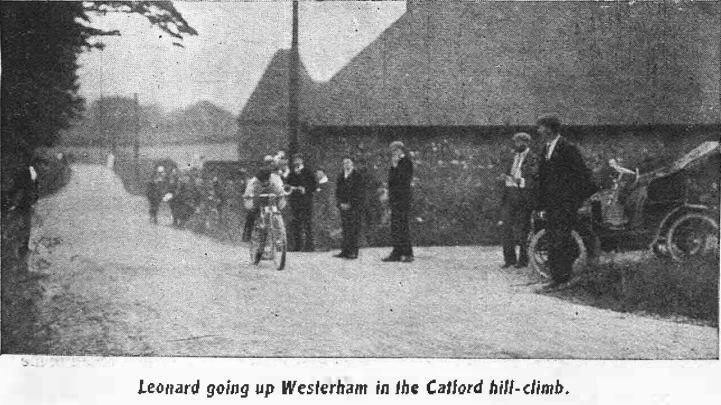

“WE ARE NOW ABLE to place before our readers a complete detailed report of an exhaustive series of experiments carried out to solve the problem ‘Which is the best petrol?’ The tests have been most carefully conducted for us by Prof DA Low, Wh Sc, MIMechE, in the engineering laboratory of the East London Technical College. As the first complete test of its kind to be carried out in this country, the results obtained form a record which must prove interesting and useful both to the ordinary motorist who wants plain facts put before him, and to the motor designer and manufacturer. The high standing which Prof. Low holds in the engineering profession we think is ample guarantee that the tests have been carried out in an exact and scientific manner…as the supplies were purchased in the usual way of business from a shop, and not from the manufacturer, they may be taken as representative of the spirit sold to the public…About two gallons of each of the following brands of petrol were received: Bowley’s motor spirit; ‘Carburine’ motor spirit, doubly rectified petrol by Messrs Carless, Capel and Leonard (called ‘Carless’ in this report); ‘Motol’, a specially deodorised motor spirit by Messrs Read, Holliday and Sons; Pratt’s motor spirit; Shell motor spirit; and Whitaker’s spirit. The object of these trials was to determine the relative merits as power producers of different samples of petroleum spirit…The engine used is a single-cylinder Fafnir rated at 4hp…The power was measured by one of Mr WG Walker’s fan brakes…The power absorbed by this brake is proportional to the cube of the speed, and the power at 1,000rpm was carefully determined in the Electrical Engineering Laboratory of the East London Technical College by Prof JT Morris…Each trial lasted 15 minutes…The running of the engine was most satisfactory during all the trials…The exhaust was perfectly clean, and there was no smell whatever. As evidence of the cleanness of the exhaust a sheet of white note paper placed opposite to, and within a few inches of, the exhaust outlet was not soiled, but only slightly scorched by the heat…[On the basis of Prof Low’s tables our technical representative has worked out the cost per bhp per hour and consumption in gallons per bhp of the seven samples as follow: Shell spirit 0.86d and 0.086gall; Whitaker’s, 1.00d and 0.091gall; Carburine, 1.20d and 0.092gall; Carless, 1.14d and 0.095gall; Pratt’s, 0.96d and 0.96gall; Bowley’s, 0.97d and 0.097gall; Motol, 1.85d and 0.103gall. In fairness to the last-named spirit, it must be mentioned that the difference in consumption is very small, but a considerably higher price was charged for it by the local dealer than for the others.—Ed.] BHP for one hour on one gallon of petrol: Shell, 11.6; Whitaker’s, 11.0; Carburine, 10.9; Carless, 10.5; Pratt’s, 10.4; Bowley’s, 10.2; Motol, 9.7. BHP: Motol, 4.33; Pratt’s 4.22; Bowley’s, 4.14; Whitaker’s, 4.14; Carless, 4.11; Carburine, 4.04; Shell, 4.04. Total consumption: Shell, 0.087gall; Carburine, 0.090gall; Whitaker’s, 0.100gall; Pratt’s, 0.098gall; Bowley’s, 0.103gall; Carless, 0.107gall; Motol, 0.109gall.”
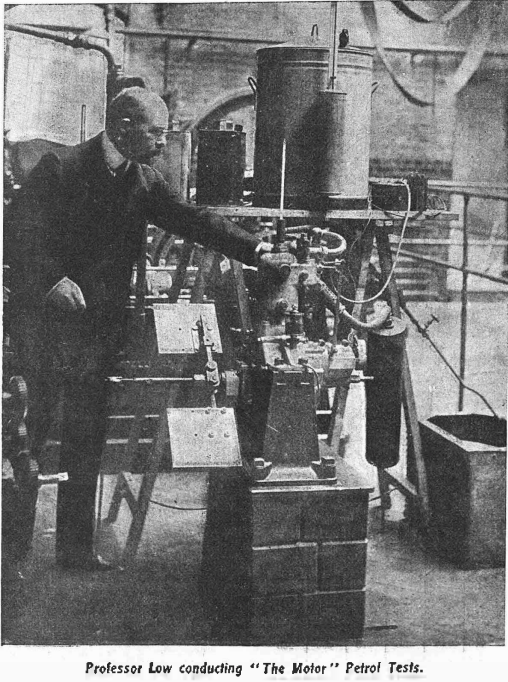
TWO YEARS AFTER Harley Davidson was launched there were only a handful of Harleys on the road. In a letter to his local paper Arthur Davidson announced that the Harley-Davidson Motor Co had been formed to ‘manufacture motors and motor-cycles’. On 2 June Walter Davidson took a new model, the 442cc ‘heavy’, to the Wisconsin State Fair horse track where he beat a 316cc Merkel ridden by Henry Zerbel (Indian used the same lump). The next day Walter and Harley’s first employee, Perry E Mack, rode in a three-mile race at the Milwaukee Mile. Mack led his boss home to win at nearly 48mph. The next outing for Arthur, Walter, and Mack was the Fourth of July meeting at Chicago’s Garfield Park where a series of races were held on the ⅓mile cement oval. Glenn Curtiss opened the event with an exhibition run his V-twin Hercules, covering five miles in 5min 5sec. Walter Davidson then won the 10-mile open and was runner-up behind Perry Mack in the 15-mile race. Mack was leading the 10-mile when a dog ran onto the track; he escaped with a gashed head, the dog didn’t survive their meeting. Within a few months Mack left to produce his own engines; you can read all about it in 1906.
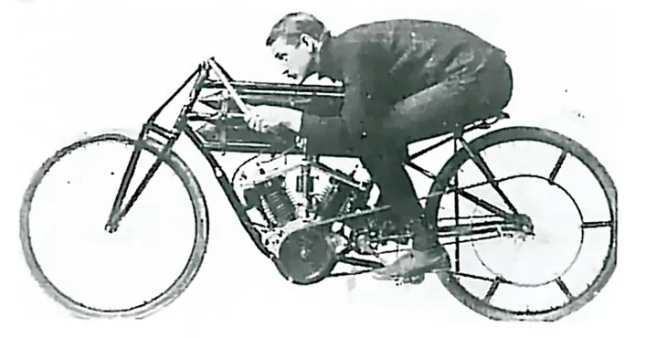
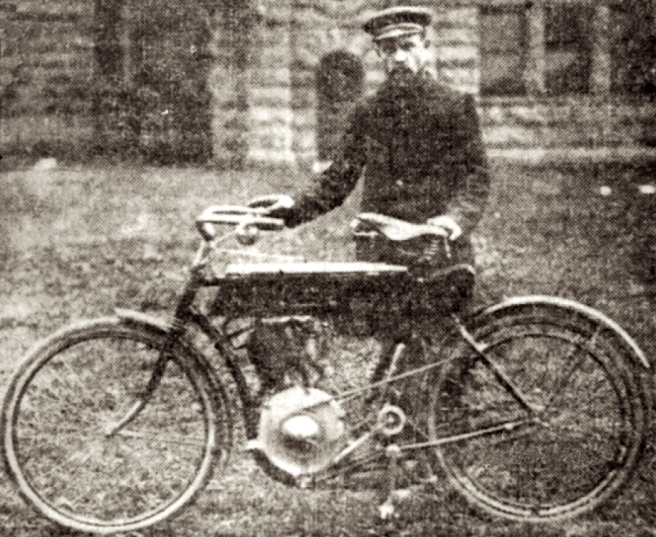
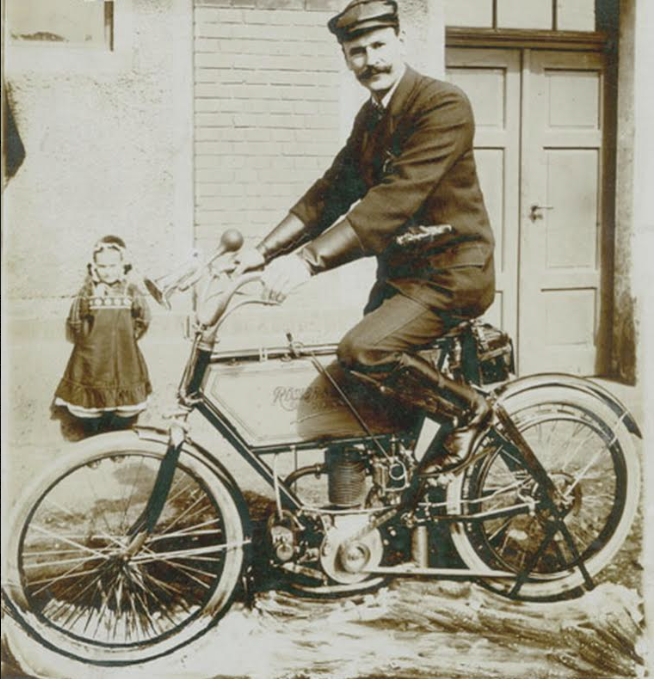
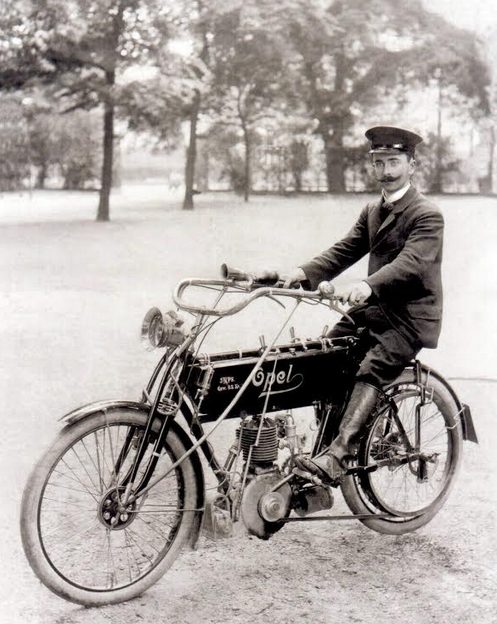
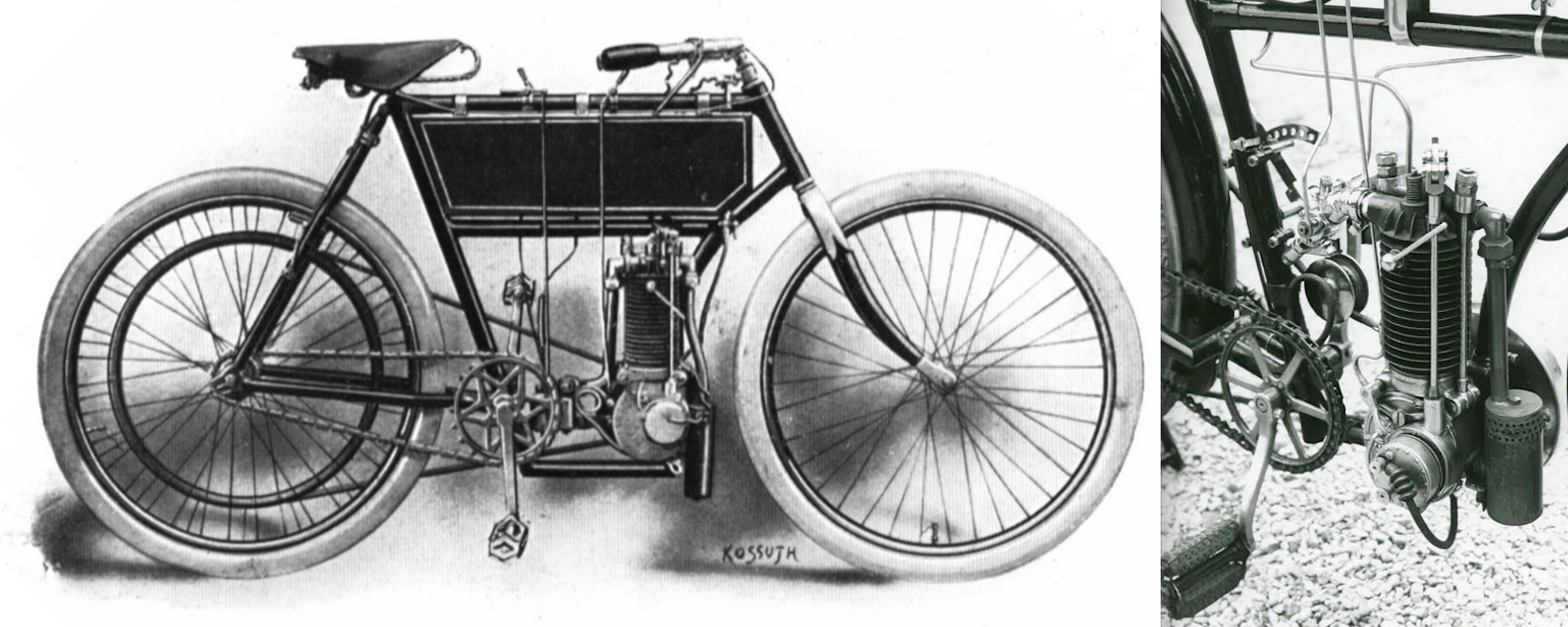

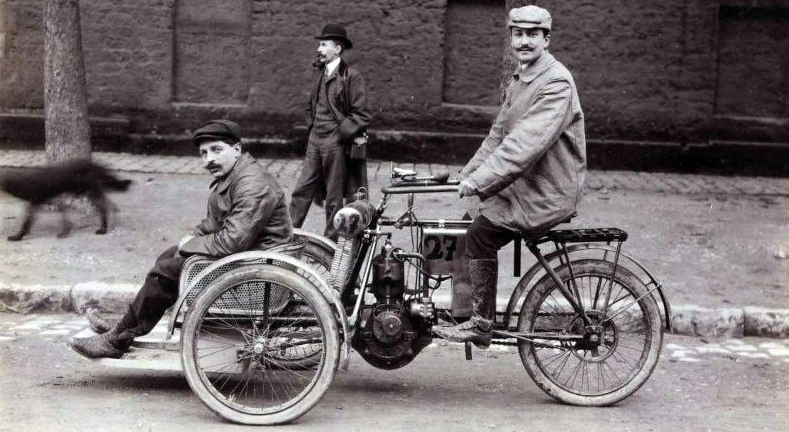
“THE ANNUAL AUTOMOBILE MEETING organised at Ostend is usually associated with sensational performances and the lowering of previous records. The Snaeskerke course is admittedly a fast one, and many world’s records have been made there…In the motor-bicycle section, speeds second only to those of the big racing cars were naturally expected, but the spectators were hardly prepared for the sensational performance which Cissac gave them. Lanfranchi’s world’s record of 29½sec at Dourdan was yet fresh in the memory, when Cissac on his wonderful little Peugeot knocked a full second off it, his time of 28½sec for the flying kilometre giving him an average speed of 80mph; and this on a machine weighing little over l00lb. Cissac’s was certainly the performance of the day. Beautiful summer weather favoured the spectators, but the breeze was stiffer than some of the competitors cared about…Thursday, set apart for the Standing Mile trial, was productive of another triumph for the motorbicycles, Giuppone scoring a victory in the cycle section on his Peugeot machine, and breaking two world’s records in so doing. First of all, Cissac’s newly-created figures of 28⅕sec, on the same make of machine, for the flying kilometre earlier in the week were reduced to 27⅕sec—equal to a speed of nearly 83mph; and secondly, the full mile (from a standing start) was covered in 55⅗sec, the old record (held by Olieslagers, on a Minerva machine) being beaten by no less than 3⅘sec. Decidedly this was the day of the motorbicycle, for although some of the racing cars—especially the Darracqs—showed a splendid turn of speed, no records were broken…”
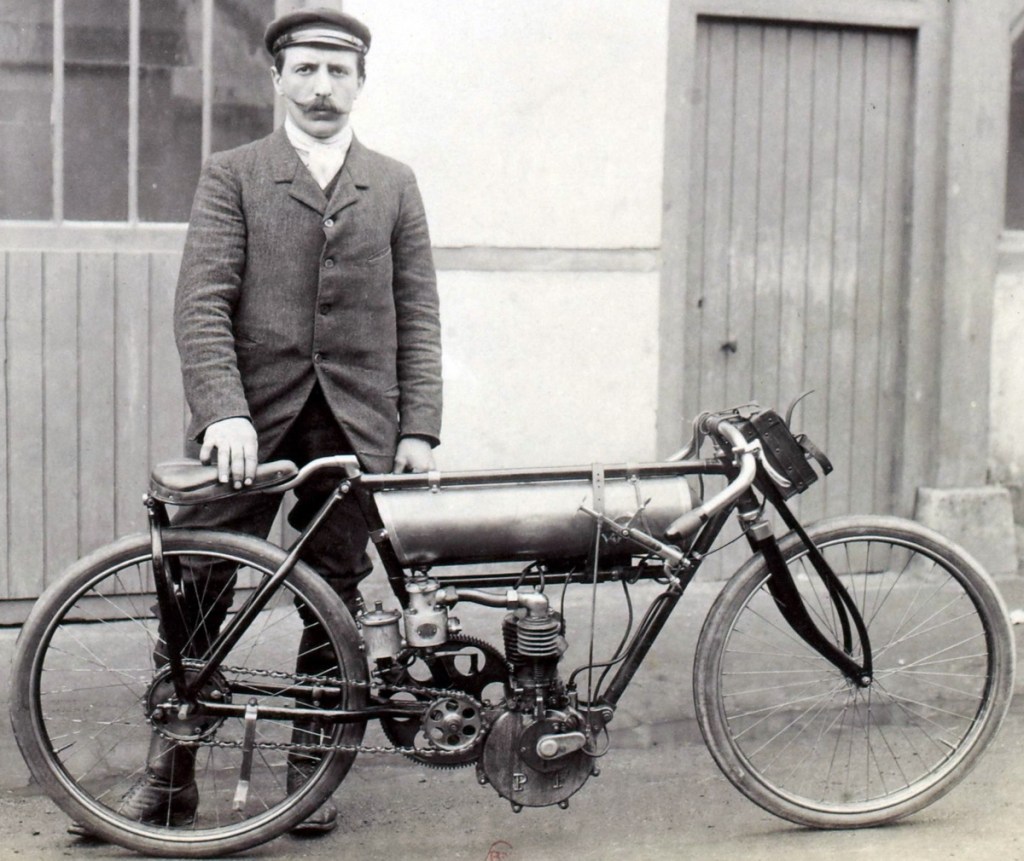
MOTORCYCLE RECORDS—BRILLIANT PERFORMANCE AT CANNING TOWN. CR Collier has gained some slight recompense for his failure in France. There is not, perhaps, the same glory attaching to a record attack—a ‘one-man show’—that there is to international competition, but the performance of CR Collier at Canning Town on Wednesday is none the less meritorious because it was not accomplished in a big field of competitors. With the same twin-cylinder Matchless which he used in Manxland for the Eliminating Trial and ‘Motor’ Cup, Collier essayed the figures standing respectively to the credit of H Martin, T Tessier, J Crundall, and GA Barnes, who, amongst them, shared the records from 1 to 50 miles. His attempt on Martin’s times from one to five miles failed, but be began clipping figures at six miles, which he accomplished in 6min 46⅖sec to Tessier’s 6min 48⅕sec. At 20 miles he had done 22min 9⅘sec.to Crundall’s 23min 8⅖sec; at 35 his time was 38min 36⅖sec to Barnes’s 41min 59⅘sec; and thereafter he kept gradually gaining right up to the 50, which was accomplished in 55min. 13⅕sec as against Barnes’s 1hr 0min. 42⅖sec. As demonstrating the regularity with which Collier’s machine ran, it may be noted that he twice beat the five miles flying start record, en route, doing exactly the same time, 5min 28⅕sec on each occasion. The previous best was 5min 31⅕sec, by Tessier, and was accomplished on the same track on August 7th, 1903. Collier’s Matchless machine was fitted with a JAP engine…Riding on, Collier covered 54 miles 523 yards in the hour.”
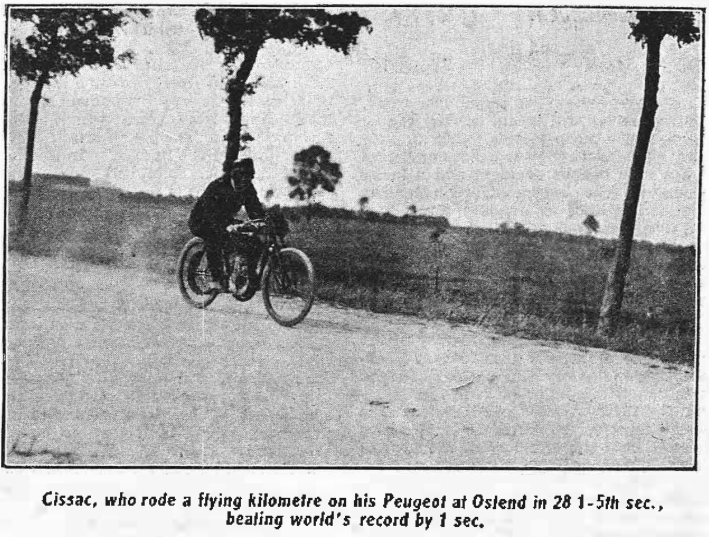
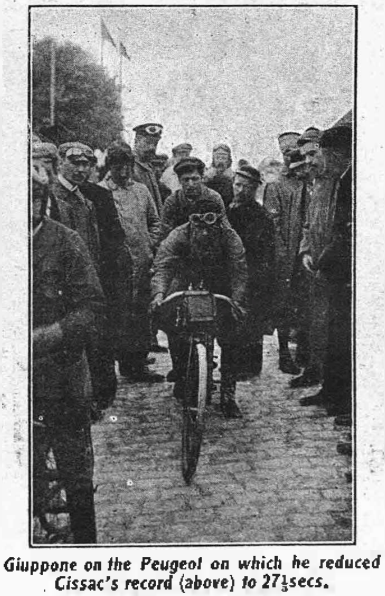
MOTORCYCLE RECORDS—BRILLIANT PERFORMANCE AT CANNING TOWN. CR Collier has gained some slight recompense for his failure in France. There is not, perhaps, the same glory attaching to a record attack—a ‘one-man show’—that there is to international competition, but the performance of CR Collier at Canning Town on Wednesday is none the less meritorious because it was not accomplished in a big field of competitors. With the same twin-cylinder Matchless which he used in Manxland for the Eliminating Trial and ‘Motor’ Cup, Collier essayed the figures standing respectively to the credit of H Martin, T Tessier, J Crundall, and GA Barnes, who, amongst them, shared the records from 1 to 50 miles. His attempt on Martin’s times from one to five miles failed, but be began clipping figures at six miles, which he accomplished in 6min 46⅖sec to Tessier’s 6min 48⅕sec. At 20 miles he had done 22min 9⅘sec.to Crundall’s 23min 8⅖sec; at 35 his time was 38min 36⅖sec to Barnes’s 41min 59⅘sec; and thereafter he kept gradually gaining right up to the 50, which was accomplished in 55min. 13⅕sec as against Barnes’s 1hr 0min. 42⅖sec. As demonstrating the regularity with which Collier’s machine ran, it may be noted that he twice beat the five miles flying start record, en route, doing exactly the same time, 5min 28⅕sec on each occasion. The previous best was 5min 31⅕sec, by Tessier, and was accomplished on the same track on August 7th, 1903. Collier’s Matchless machine was fitted with a JAP engine…Riding on, Collier covered 54 miles 523 yards in the hour.”

“A TRIAL FOR PASSENGER motorcycles forms one of the standard fixtures on the MCC programme. Former events in this class have attracted good entries, and it is somewhat surprising that Saturday’s trial only drew the meagre total of six entries. At a recent meeting of the executive it was decided to allow three-heeled motorcycles of any weight to compete. A possible explanation of the scarcity of entries is the counter attraction offered by the Catford hill-climb, the two events unfortunately occurring on the same day. The headquarters for the trial was, as on former occasions, at the Clayton Arms, Godstone. The route was 25 miles out through Blindley Heath, Felbridge, East Grinstead, Forest Row, Wytch Cross, Lane End, and Chailey. At this point competitors had to turn and travel back to Godstone, thus completing 50 miles. After an hour for lunch the route had to be repeated. At 11am the following competitors were dispatched at intervals of a minute: Messrs Lyons (Trafalgar 6hp side car, twin-cylinder engine); J Van Hooydonk (4¼hp Phoenix Trimo); E March (4¼hp Phoenix Trimo); Leny (Humber bicycle and trailer); Priest (Quadrant tri-car); H Densham (Anglian tri-car, 2¾hp De Dion engine). The weather conditions were perfect, the only matter that could be grumbled at being the dust, which was rather prevalent. The conditions of the trial are that each section must be an absolute non-stop, and each rider must keep strictly to schedule time, which allows just under 20 miles an hour to be made. Owing to the increased vigilance of the police in this district riders were warned to be specially careful to avoid exceeding the limit. On the whole the route is by no means difficult. There is one rather steep and rough rise at Forest Row, and the rest is easy and undulating. The first competitor to be in trouble was Densham, who a few miles out from Godstone experienced a burst in one of his front tyres. Leny was next, his difficulty being inability to surmount the hill at Forest Row, probably due to his gear being too high for the work. Shortly afterwards J Van Hooydonk, who of late has had extraordinary bad luck in competitions, punctured a tyre, and thus lost his chance in the event. This only left three
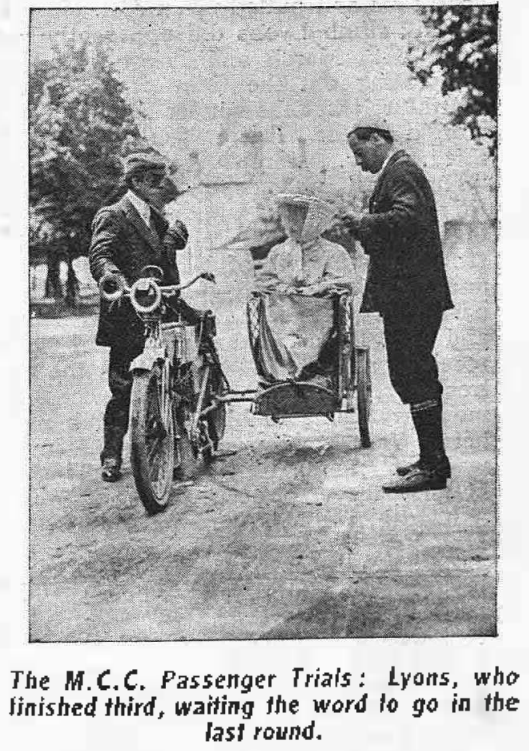
competitors in at 50 miles, viz, Priest, Lyons, and March, and these were duly started off on the second 50 at 2.45. It appears that a forced dismount had to be made beyond Grinstead, as the road here was up for repairs and strewn with half bricks for a few hundred yards. Priest reported having driven on, however, without a dismount. Lyons on the first 50 damaged the exhaust valve lifter of his engine, but managed to keep going. It was noted that there were at least five police traps on the route, the police in most cases being garbed as yokels and signalling by means of pocket handkerchiefs from behind the hedge, whilst their confreres manipulated the stop watch. No one was caught, however, except some car drivers who had not been warned. The three survivors duly completed the 100 miles without mishap, and to decide the tie a short speed and hill-climb test was held. This comprised a 100yds on the flat and 160yds on the hill. A feature of this test was the rapidity with which the machine could be stopped after passing the tape. The time taken to pull up was deducted from the net time. In the 100yds test Lyons got up a good speed, but covered 73ft before pulling up. March was a little slow but pulled up in 17ft 6in, skidding his back wheel in doing so. Priest did good time and pulled up in 28ft 6in. In the hill-climb Lyons did apparently best time, with March and Priest next. On calculating out the times it was found that March was the winner by the narrow margin of ⅖sec. Priest was second, Lyons third. Mr March’s success on the Humber was deservedly applauded, this being his first win, although he has entered nearly all club events. The trophy is the gift of H Kennett, Esq, and is valued at 20 guineas. The lady passengers were Mrs March, Mrs Priest, and Mrs Lyons, and each of these ladies received a prize. Mr March is the club treasurer, and this makes his success the more gratifying to his fellow club members. Very good work was done in the way of marshalling and checking by Messrs Fry, Sewell, Jenkins, Brown, Ashworth, and Mrs Jenkins, Mrs Brown, Mrs Fry.”
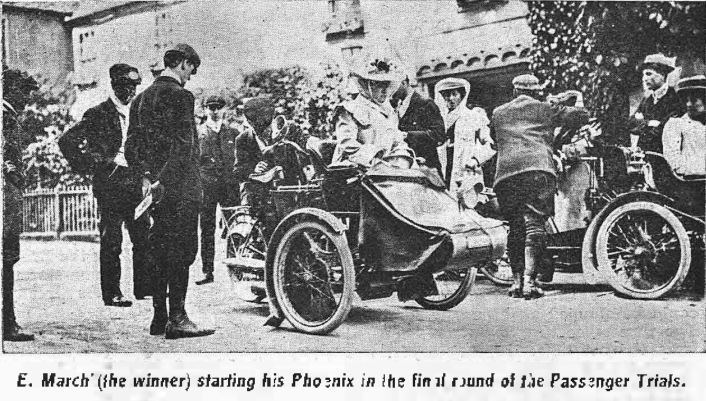
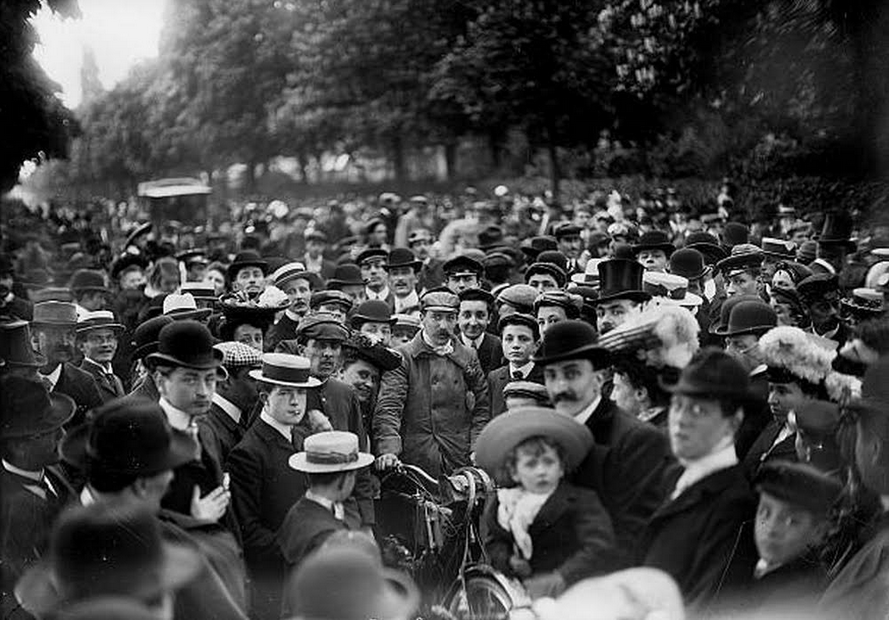

LE TOUR DE FRANCE POUR MOTOCYCLETTES (as distinct from the pedal-pushing offshoot) was staged by the Autocycle-club de France and the newspaper Les Sports under the patronage of the Automobile Club de France and the Touring Club de France. The nine-day time trial was promoted as “a 2,000 kilometre ordeal, the biggest and toughest that has ever been imposed on the motor vehicle…a colossal test”. Judging by the statistics that wasn’t entirely Gallic hyperbole—of seven riders in the 225cc class two completed the course; there were 38 starters in the popular ‘one-third litre’ 333cc class, and 14 finishers; and only one of the nine 500s completed the Tour. Here’s a taste of the action, courtesy of Les Sports’ sister magazine, La Presse. “Day 1, Paris-Auxerre-Dijon (319km), 5am-4pm: Pouring rain, wind, soggy and slippery roads. The bad weather continues to rage; it will make the task of the competitors in the Tour de France on motorbikes quite painful, and one wonders how these frail vehicles will even manage on the long and difficult route that has been imposed on them. [Best time] Tiercelin (Alcyon), 4hr 16min. Day 2, Dijon-Macon-Saint Etienne (250km), 6am-5pm: The day was better, the rain that had accompanied the riders from Paris to Dijon finally left them behind and ifthere were some threatening clouds at the start of Dijon, it was in superb weather that the finish was made in Saint-Étienne. Giuppone (Peugeot), 3hr 22min. Day 3, Saint-Étienne-Montélimar-Avignon (225km), 6am-3.30pm: Heavy rain and slippery roads, particularly on the ‘Côte de la République between Saint-Étienne and Bourg-Argental. All the competing machines showed extraordinary durability, and an example must be given, that of Mallet, to demonstrate this: he did, in fact, following a skid in the Côte de la République, an extraordinary somersault, which sent him tumbling down the embankment of a ravine about fifty metres deep. The man was unharmed and so was his mount, as they were both checked in the evening at the final stage. During the second part of the stage, from Valence to Avignon, the rain was still falling! Not for a moment did it show mercy to the Tour de France riders, and it was in the rain that they arrived in Avignon, whose city walls, despite the weather, were covered with people. There is no need to say that the event organised by our colleague, Les Sports, is a colossal success and fascinates all the towns and regions through which it passes. Day 4, Avignon-Marseille (110km) 7am-noon: Overcast and dry, mistral wind at the back. Day 5,
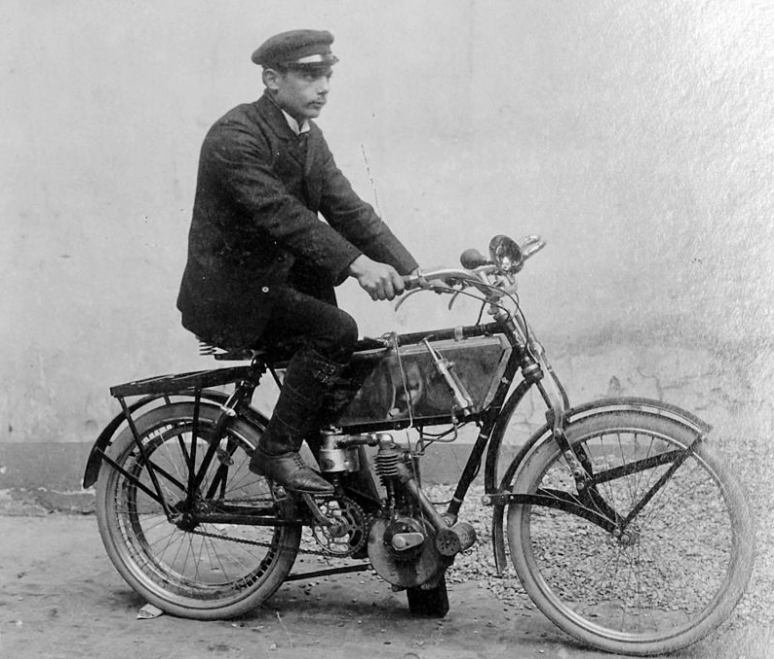
Marseille-Nîmes-Narbonne (279km) 6am-4.30pm: Mistral on the side…Yesterday, the fourth day of the Tour de France motorbike race, was relatively a day of rest for the competitors; the course, in fact, which was covered in a single stage, was only 110km long, and if the sun of the Midi did not deign to join in, at least the mistral, a good boy, had the sense to blow all the time at the competitors’ backs, thus coming to their aid and notably increasing their speed. All the competitors, that is to say the 23 motorbikes that arrived in Avignon the day before and left from this town in the morning, reached Marseilles without any trouble. No accidents, only two incidents: Faivre, who ran over a dog, and Lemétais, who hit a level crossing barrier. The two robust little machines resisted wonderfully and their riders were able to continue on their way, after examining their mounts, as if nothing had happened…Having set off from Marseille, the valiant competitors of the Tour de France found the mistral again from the very first turns of the wheel; but, this time, instead of helping them, this damned wind started to take them by the scruff of the neck, taking them off their saddles at times and almost throwing them into the ditches. This is how Mignard smashed his engine against a badly placed paving stone, which forced him to retire. It was Nîmes (131km) that was the goal of the first stage of the fifth day. To describe the enthusiasm of the people of Nîmes is almost impossible; it was amidst cheers, ‘Vive Les Sports! Long live

Thomas! Vive Cissac!’ etc, that the riders arrived, for in Nîmes, people are very sports-minded and follow with passion the reports of the great events. Narbonne (279km) is the goal of the stage of the fifth day. The control, set up in the Capitole café, was invaded well before the time fixed for the opening by a huge, turbulent crowd which shouted, gesticulated, discussed and which, as all along the route, snatched up the issues of our colleague Les Sports, to read the details of the race of which they were spectators. The first arrivals, grey with dust, are enthusiastically cheered and accompanied to the garage, where the machines must spend the night. Day 6, Narbonne-Toulouse-Agen (273km), 6am-4.30pm: Dry weather, dry roads. Narbonne woke up earlier than usual to celebrate one last time before their departure the courageous competitors of the great Tour de France for motorbikes, organised by our colleague Les Sports, with a care which makes this competition one of the most interesting and remarkable manifestations of the automobile. Of the twenty-three riders who left from Marseille, only two withdrew and the 21 others got into the saddle at seven o’clock in the morning to set off for Toulouse, the goal of the first stage of this sixth day. The weather was favourable, the roads dry and smooth, and our men happily covered the 150km that separated them from the capital of Languedoc. There, indescribable ovations were to receive them; it was necessary to have an important service of order to maintain the crowd of enthusiastic spectators, who all wanted to see the competitors of the Tour de France on motorbikes. At the exit of Toulouse, Messrs Audistère and Richard, official timekeepers of the Automobile-Club de France, always faithful to their post, took the times of the level kilometre, which Giuppone won in 51⅖sec which set the world record for motorbikes of one third of a litre on the road. When one considers that Giuppone’s machine has just run for six days in a row, with a daily average of 250km, one can be really proud of the progress that French industry has made in this marvellous little motorised machine that is the motor cycle. Day 7: Agen-Bergerac-Limoges (271km), 6am-4.00pm: Beautiful weather, dry roads. Day 8: Limoges-Châteauroux-Orléans (263km), 6am-4pm: Strong wind, freezing cold, bad roads. The seventh stage took place yesterday in splendid weather. The world record for the kilometre was beaten by Thomas, in 48⅘sec, ie at more than 70 per hour. Early in the morning, the competitors went to the central garage, where the start was to take place, and checked their machines one last time before setting off. As every day, the Phoenix-Trimo tri-car starts first at 6 o’clock in the morning, followed at 6.30am by the quarter-litre motorbikes and at 7 o’clock by the third-litre motorbikes. Nineteen riders presented themselves under the orders of the starter. Le Métais, who was unwell, retired. The stage from Limoges to Châteauroux (124km) was, according to the unanimous opinion of the valiant riders, the most difficult of all those they had ridden so far. The road was very hard and very uneven, which delayed their march somewhat. A violent wind and a bitter cold did little to increase the difficulty of this arduous journey. Out of 19 starters from Limoges, 17 arrived within the prescribed time limit. Only Faivre, on whom the jinx seems to be particularly strong, and van Hooydonk arrived after the expiry of these deadlines. Faivre punctured three times, and the English team nine times. The latter holds the record for punctures so far. Van Hooydonk’s team-mate is collecting nails that he wants to take to England as a souvenir of the Tour de France. Orléans, the goal of the penultimate stage, is a sporting city par excellence. Also, it is in front of several thousands of onlookers that the arrivals took place, in spite of the distance of the control installed at the octroi of the Manillère. All the competitors are in great spirits, with only 128km to go, and they will finally receive the warm ovations from the Parisians that are their due after this wonderful event. Day 9: Orleans-Ville d’Avray (128km) 9am-2pm. The Tour de France organised by the Autocycle-Club de France and the newspaper Les Sports is over. Seventeen competitors have completed the course, offering the best average regularity ever found in a competition. As this was the toughest competition ever attempted, it is easy to see the logical conclusion to be drawn. The motorbike had played a game that was all the bigger because it was more public. The
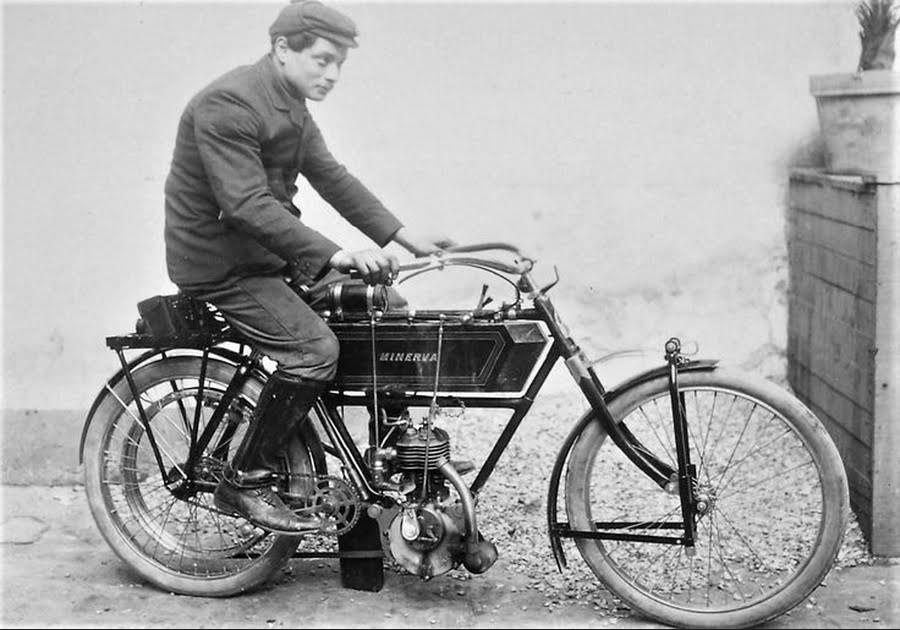
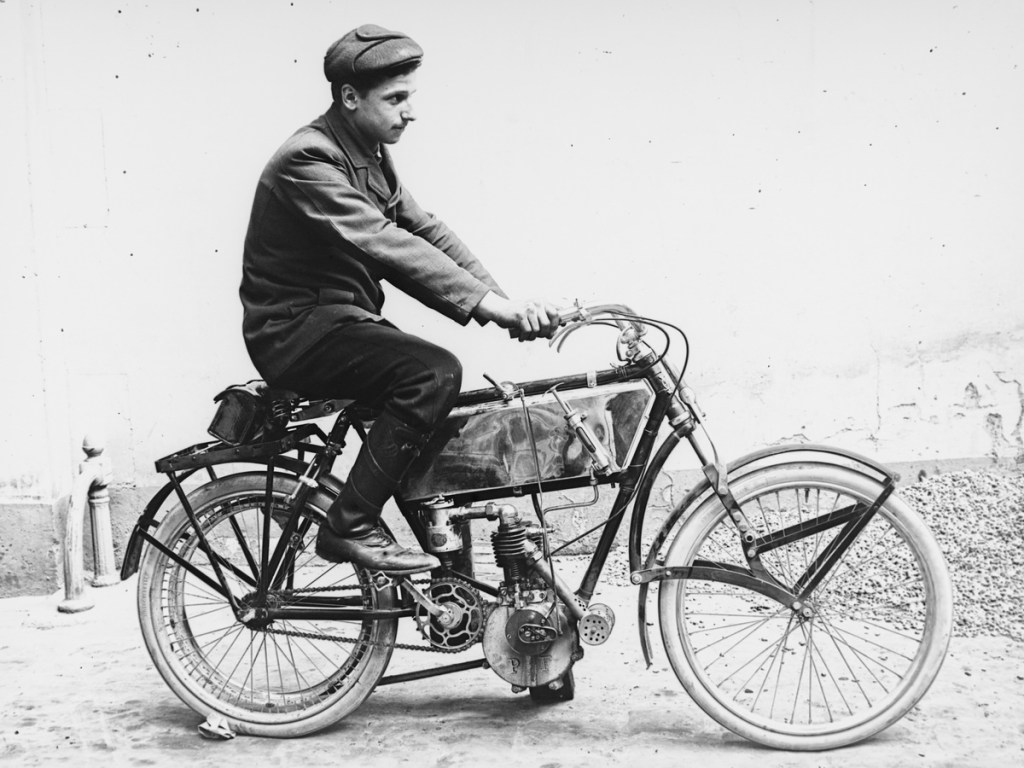
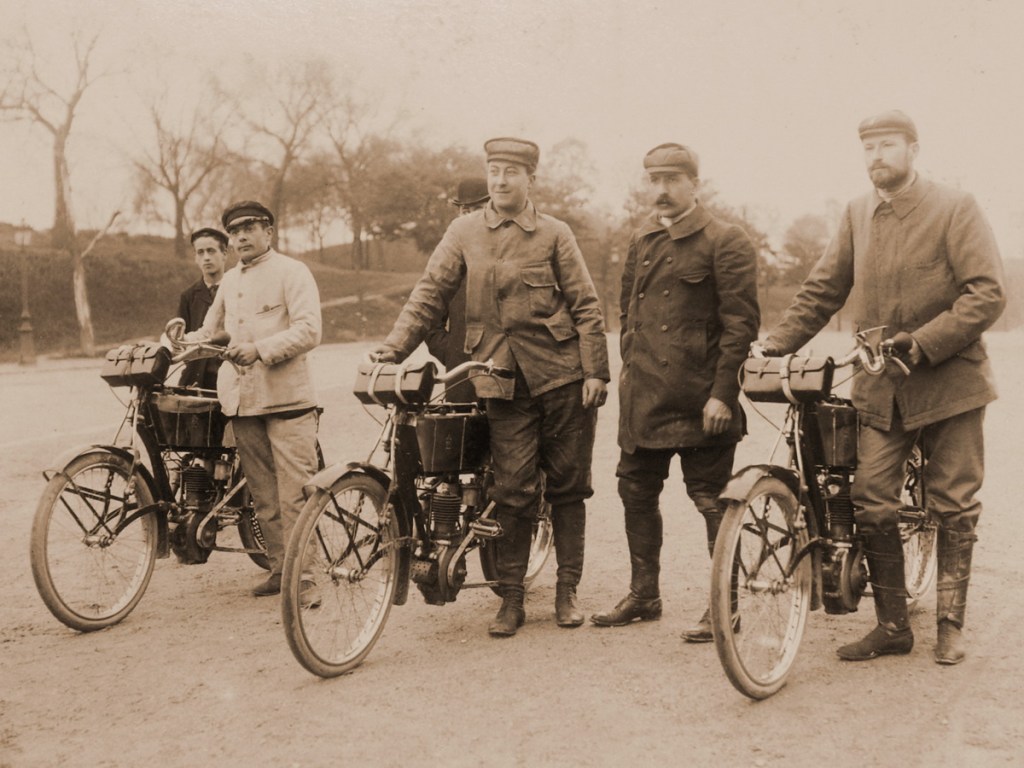
whole of France, and especially the thirty departments crossed, the 400 towns which had seen the…small squadron of motorcyclists parade by, followed this audacious attempt with an attentive mind, ironic at the beginning, enthusiastic at the end. It succeeded, even beyond what one could have wished. The motorbike, the small practical machine, because it is simple and cheap, won its grand touring licence in a week. It now has it; it is known that it can be counted on, and it has, as a result, won over to itself and to the cause of the automobile the innumerable armies of small purses. The final classification, naturally subject to the official approval of the committee, is as follows—333cc class: 1, Cissac (Peugeot), 1212 points; 2, Giuppone (Peugeot), 1200; 3, Bucquet (Griffon), 1192; 4, Blatgé (Minerva), 1183; 5, Champoiseau (Peugeot), 1168; 6, Bonnard (Werner), 1151; 7, Schweitzer (Minerva), 1146; 8, Thomas (Magali), 1129; 9, Foulon (Brùneau), 1107; 10, Lepetit (Stimula), 1098; 11, Canèsse (Lamandière-Mauger), 973; 12, Contant (Werner), 953; 13, Platel (Stimula), 925; 14, Yourassoff (Peugeot), 883. 225cc class: 1, Dacier (Clément), 803; 2, Faivre (Terrot), 632. 500cc class: 1, van Hooydonk (Phœnix Trimo), 783. Thus ends the toughest endurance race to which motorbikes have ever been subjected. The classification of the Peugeot team provided an excellent indication for the choice of a real motorbike, a touring motorbike. It should be noted that in each of the nine stages it was Peugeot that held the lead, with Cisaac, Giuppone and Champoiseau, and if we consider that Cissac and Giuppone are first and second by twelve points, is this not the best proof of the regularity of the motorbikes of the great manufacturers of Valentigney? The times for the uphill kilometre were taken in the Côte de Dourdan, by Messrs Audistère and Richard, official timekeepers of the ACF. Here are the results: 1, Thomas (Magali) 1min 31⅗sec; 2, Giuppone (Peugeot), 1min 32⅗sec; 3, Cissac (Peugeot), 1min. 45⅕sec; 4, Schweitzer (Minerva), 2min 7⅕sec; 5, Canisse (Lamaudière-Mauger), 2min 7⅗sec; 6=, Bucquet (Griffon) and Bonnard (Werner), 2min 9⅕sec; 8, Champoiseau (Peugeot), 2min 10⅖sec; 9, Le Metais (NSU), 2min 13⅘sec; 10, Foulon (Bruneau), 2min 19⅗sec; 11, Blatgé (Minerva), 2min 25⅘sec; 12, Yourassoff (Peugeot), 2min 28⅘sec; 13, Lepetit (Stimula) 2min 30⅘sec; 14, Contant (Werner) 2min 51⅖sec; 15, Dacier (Clément), 3min 17sec; 16, Van Hooydonk (Phœnix-Trimo), 3min 21sec; 17, Faivre (Terrot), 3min 21⅕sec. The length of the climb…was 1km 350, including 200 metres of cobblestone after a difficult bend. There was a strong headwind.”
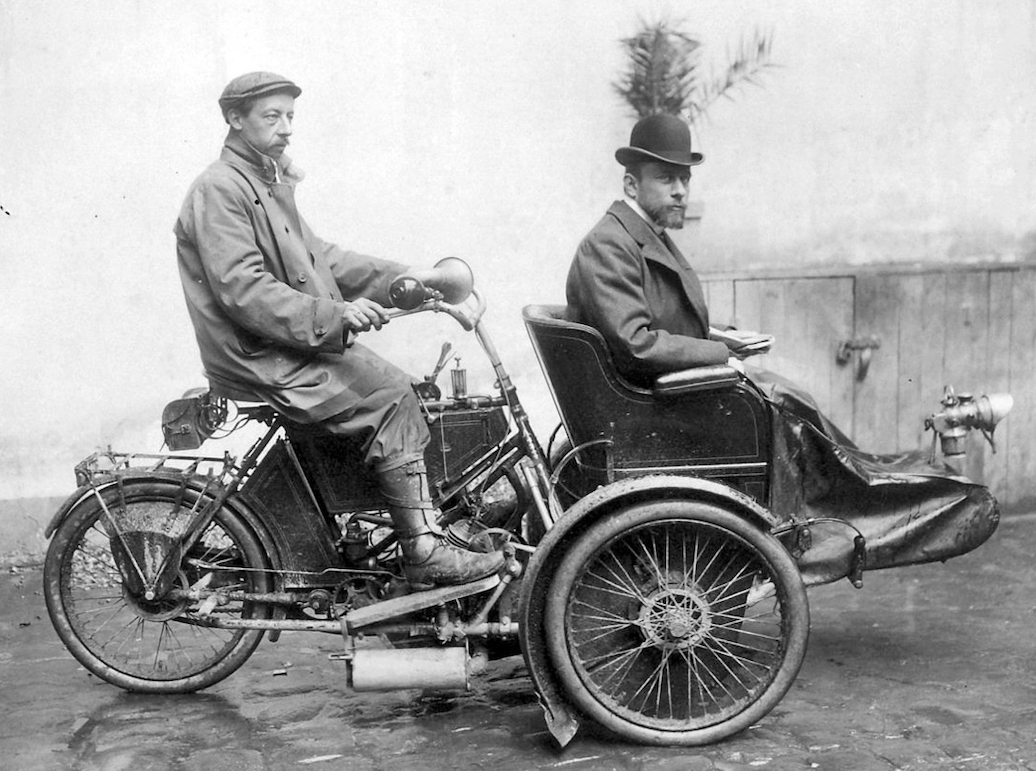
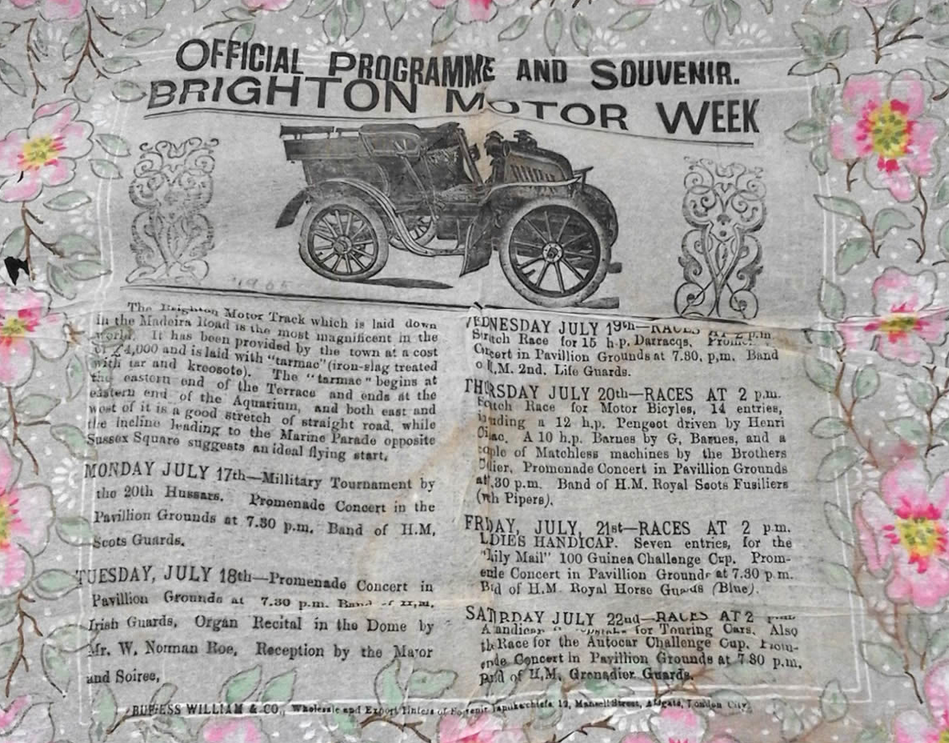
THE AUTOMOBILE CLUB of Great Britain and Ireland staged a week of races on Brighton seafront after local resident Sir Harry Preston persuaded the local council to lay a motor racing track using the newly invented tarmac between the Palace Pier and Black Rock. [Since 1909 this stretch of road has been called Madera drive. It is still the home of the Brighton Speed Trials and was the destination of The Sunbeam MCC’s Pioneer Run until 2020 when it switched to Shoreham airfield for safety reasons.] Here’s a contemporary acount: “Some wonderful speeds were accomplished by motor cars and motor cycles at the opening race meeting held on the new straightaway Automobile Racing Track laid down on the Esplanade at Brighton, England. The track is 1.25 miles, with a special surface composed of tarmac, which is said to give a perfect surface for automobile racing. Vey fast times were established by the huge racing cars, but…the motor cycle more than held its own. The motor cycle honours were carried off by H Cissac and H Rignold, both of whom drive 14hp twin cylinder Peugeot cycles weighing under 110lb. The former crack won the open Motor Cycle Mile Race from a flying start in 49.6sec. During the mile he covered a flying kilometre in the astounding time of 26 seconds (World’s Motor Cycle Record) equal to a speed of 86mph. Subsequently in a record attempt Rignold converted a flying mile in 46.2sec, world’s record. Cissac also succeeded in covering a mile from a standing start in the wonderful time of 52.2sec, the previous best being 64sec…The most interesting items during the Motor Carnival, which spread over four days, were two matches between Rignold on his motor cycle and the Hon AL Guinness on his 100hp Darracq car. The distance was over a kilometre from a standing start. The event created great excitement. At the start the car, with running engine, jumped into a high speed at once, gaining 20 yards before Rignold had his motor firing. In 30 yards the motor cycle was travelling at 50mph. He gradually crept up to the flying Daracq, but faile fot give away the 20 yards lost at the start. Time 35.8sec, world’s record. A similar match was held between Cissac and JE Hutton on a 120hp Mercedes car, resulting in a repetition of the first match. Hutton won by a few yards in a second slower than that accomplished by Guinness. The carnival drew enormous crowds and was a great success.”
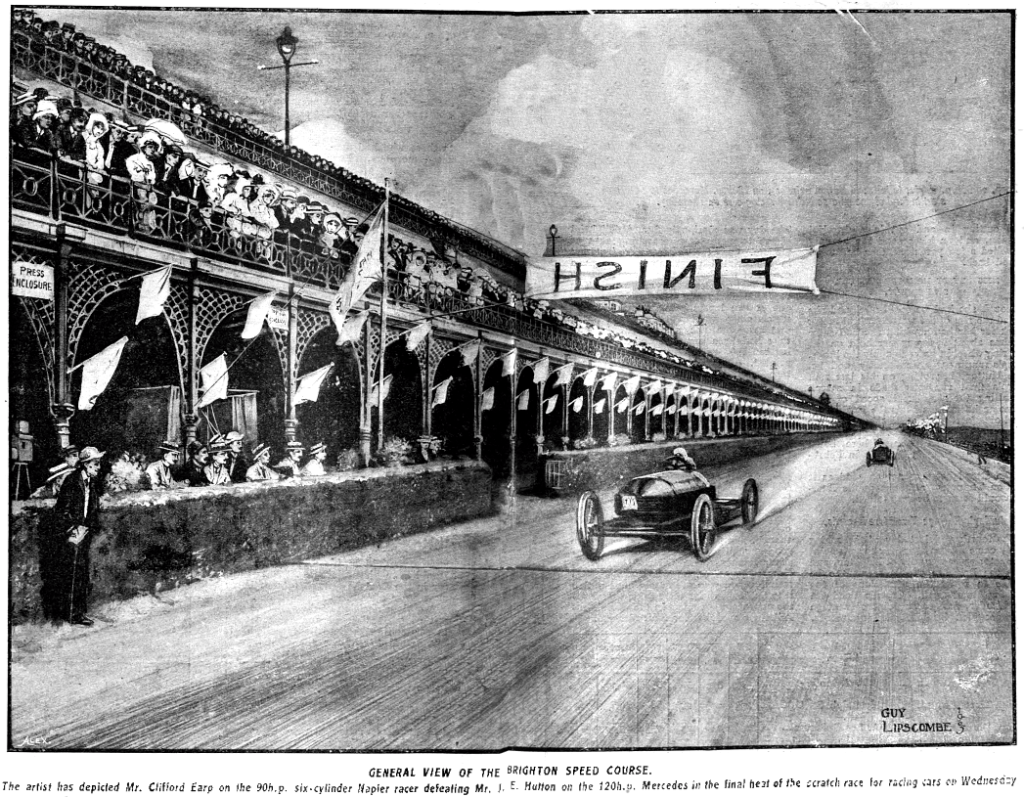
…and here’s how The Motor reported on the motor cycle events…
“THE BRIGHTON AUTOMOBILE WEEK deserves to rank as the best attempt that has been made in England to conduct a great popularising programme of motorcar events. Not alone will Brighton benefit from the meeting—at least that is the earnest hope of all concerned—but the motoring movement also must benefit in more ways than one. Brighton is enjoying an influx of visitors of a class such as is not usually present in such numbers at this season of the year, and the best hotels are all full and garage accommodation has as many calls as is comfortable. In fact, indirectly and directly Brighton is profiting quite nicely. Motoring is profiting too, in this respect, that a large section of the public is becoming familiarised with some of the speed capabilities of the cars, for not only do the vehicles travel at their best speed on the track every afternoon, but at all other hours of the day car drivers take advantage of the strong motoring air and the spirit of tolerance that prevail to travel fast, and in this way the man in the street becomes accustomed to a new standard of speed and ceases to even elevate his eyebrows when a car travels past him at 30mph. Moreover, the Brighton police force is learning a lesson that must eventually be to the advantage of motorists, and the Chief Constable, having been drawn into the vortex of the automobile swirl, is learning that the average or representative motorist is a
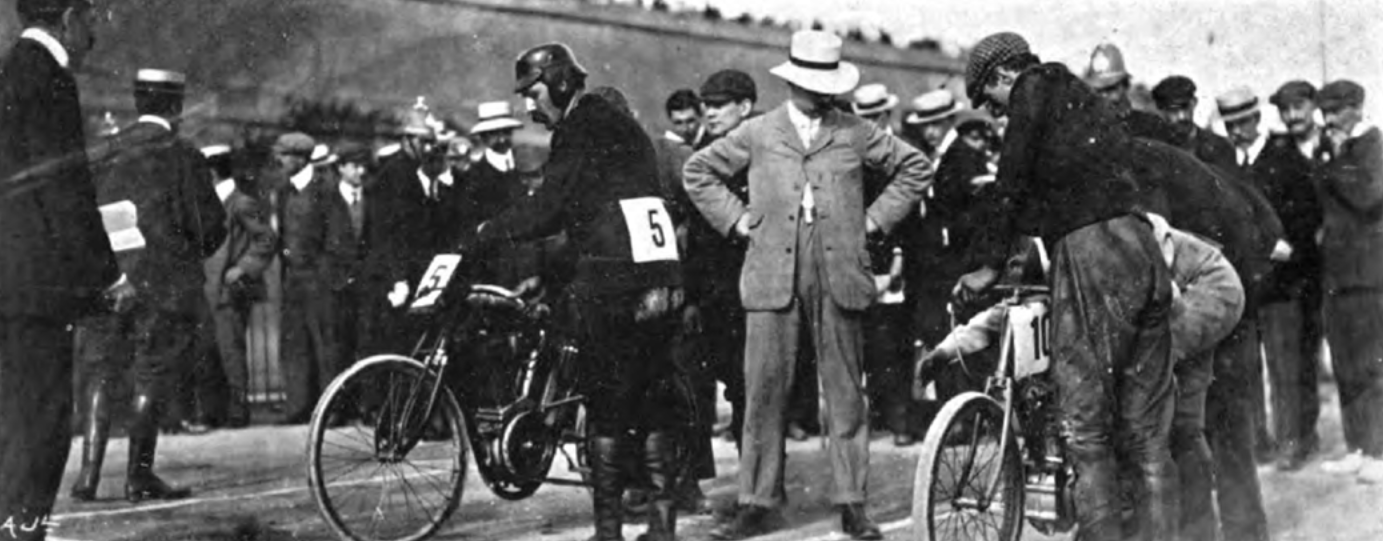
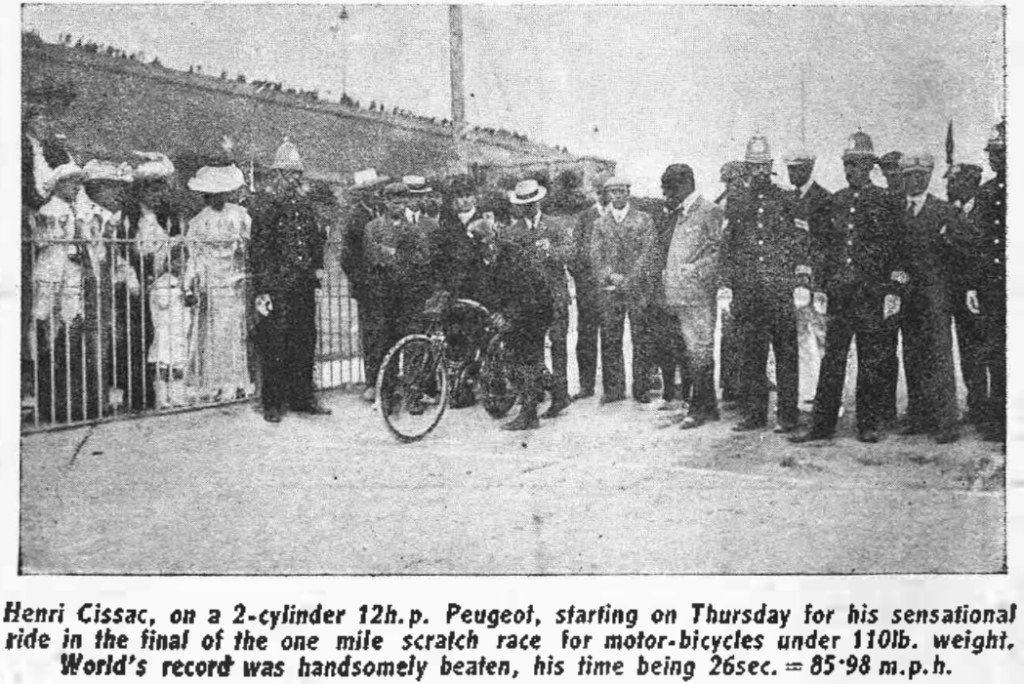
much-abused and greatly-wronged individual—one who has to study and allow for the vagaries of the man in the street and his womankind, his children, and his dogs, and to avoid the accidents that they would cause if he were not to watch and guard over them. The motoring movement is also gaining much valuable knowledge from the Brighton week. It has always been a debatable question whether a series of safe events such as those conducted under the auspices of the Automobile Club have not had all the fire taken out of them in the Club’s desire to reduce risks to an absolute minimum. It is recognised that there is a certain amount of danger in the pursuit of any sport, and this fact alone adds zest to the proceedings both for participant and onlooker. But motor racing is regarded as a fit subject for the process of danger elimination…the racing motorcycles provided some of the best sport of the day. Ten riders, divided into three heats, contested the preliminary round. The first heat included Henri Cissac and H Rignold, on 12hp Peugeot machines, ET Jones having an 8hp Peugeot. They went away at a wonderful speed, and Cissac gaining all the way, won in 53⅕sec, Rignold’s time being 57⅖sec. Cissac covered the flying kilometre in 27⅖sec (equalling 81.58mph), only ⅕sec outside of world’s record. GA. Barnes, on a 10hp Barnes, won the second heat in 1min 13⅖sec, beating A Westlake and E Varney. The third heat went to CR Collier, on the International 7hp Matchless, in 1min. 4⅘sec, his brother, HA Collier, being second. Collier’s kilometre speed was 63.51mph. In the final Cissac decided to go for the world’s record over the kilometre, and he, Collier, and Barnes got away to a splendid start. It was quite thrilling to see the three travelling along
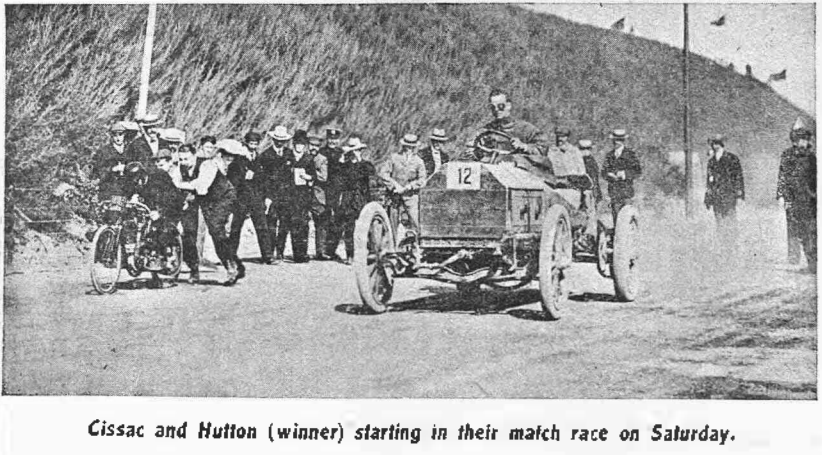
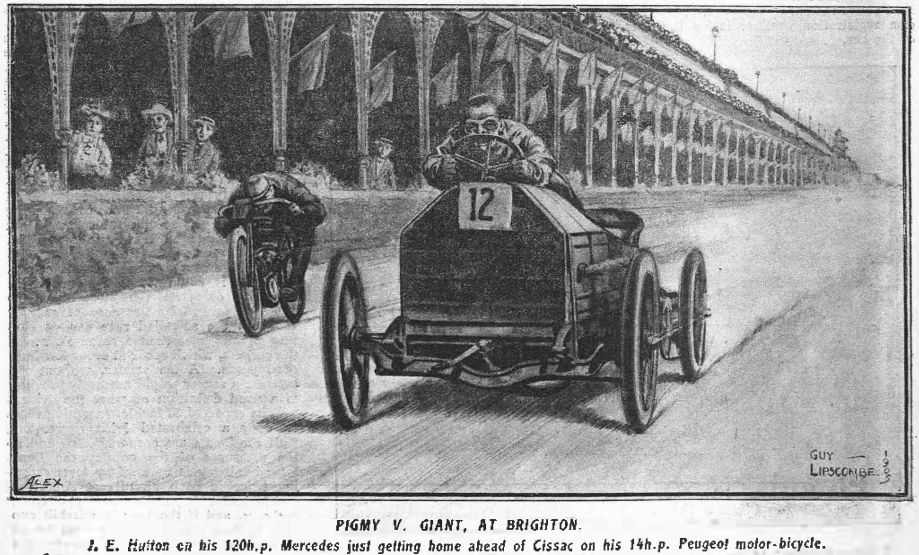
at the terrific pace attained on the Tarmac.Cissac, travelling at nearly 90mph, passed the post a winner in 49⅖sec, his flying kilometre occupying only 26sec, his average speed over the distance being 85.98mph, which beats Giuppone’s world’s record of a fortnight ago at Ostend of 27⅕sec. Barnes finished second, 20⅕sec behind Cissac. After this it was arranged to measure the distance that had been cut off the start and add it to the finishing end, and then send Cissac for the standing mile record and en route for the flying kilometre, whilst H Rignold would try the flying mile and also the flying kilometre. Directly the racing cars had finished the timekeepers took their stations, and then Rignold made his essay. He did not start well, because he rather muddled his switch when dropping down to the starting line, but he travelled with wonderful celerity when he did get going, and he covered the full mile in 46⅕sec, the added piece being 85 yards, and occupying 2sec—42½ yards per second! His kilometre time was 26⅗sec, which thus beat Giuppone’s wonderful Ostend time. The time of 46⅕sec is the best ever done over a flying mile in any country, the previous known best being Tessier’s 64sec at Canning Town. Cissac followed, and, getting away unaided from a standing start, he covered the distance in 53⅕sec, his flying kilometre occupying 26⅕sec. He steered rather a wide course, giving an impression of better possibilities. His time beat Giuppone’s standing mile record (world’s) of 55⅗sec, also made at Ostend. Thus three world’s records were beaten on Thursday…The second contest, JE Hutton, on his120hp Mercedes, vs H Cissac, on his 14hp Peugeot, was virtually a repetition of the first, but the times were not so fast. Hutton did 36⅕sec, and Cissac 36⅘sec. The new style of contest (invented by Cissac, and arranged through the action of some of the committee of the Auto-Cycle Club who were at Brighton) was voted a great success, and it was decided to repeat it at Blackpool, with this alteration, that the cycles should be given a running start, the car starting when the cyclist reached the line, 20yd being considered enough in which to get the engine started.”
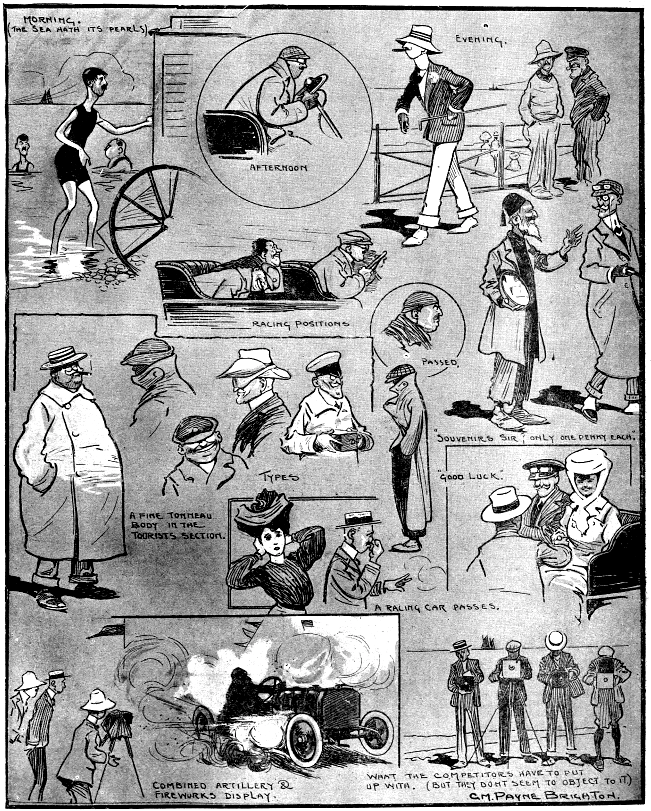
OF THE 17 MACHINES which completed the whole run of nearly 1,500 miles, 13 were belt-driven; two (Bruneau and Phoenix Trimo) chain-driven; one direct drive (Knap); and one two-speed gear (Magali). The Bruneau machine is water cooled. Seven Longuemare carburetters were fitted; two Minerva-Longuemare; two Werner; two Vaurs; one Knap; one RV; one Stimula; one Amoudruz. The tyres used on the 17 machines were: Eight Dunlops, four Wolbers, three Michelin, one Continental, one le Gaulois.
“THE MAIL RECENTLY published two articles on ‘The Failure of the Motorbicycle’. We presume that contributions of this sort have to be addressed to the Fiction Editor.”
“WILL AGENTS AND DEALERS throughout the country kindly watch for a 2hp, Beeston-Humber motor-bicycle, No 90,115, stolen early in July? The alleged thief has been sentenced to seven years’ imprisonment, but the machine has not been recovered. The owner, Mr HG French, GPO staff, Nottingham, will be glad to pay a moderate reward for information.”

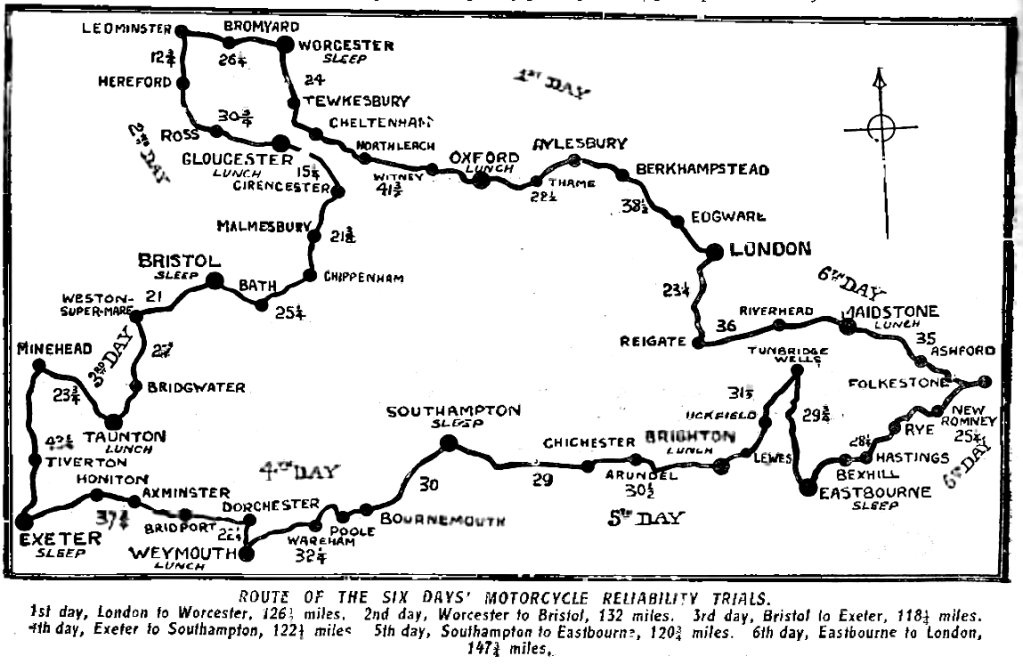
“OFFICIAL FIGURES SHOW that there are some 31,000 motorcycles registered in Great Britain, and amongst such a large number of riders it may be thought strange that only 33 entrants could be found for the Reliability Trials, which commenced on Monday of last week. But to those who have competed in previous events of this nature the wonder rather is that so many, instead of so few can be found courageous enough to go through the ordeal which the trials involve…The rules of the trials impose a severe strain upon both man and machine. I put the man first, because, however good the machine may be, the rider must possess skill and pluck to an extraordinary degree. Not alone has he to know every minute detail of the construction of the machine he is, riding, but he must be prepared to instantly locate a fault and put it right. To these qualifications must be added indomitable pluck to ride for eight hours every day (as a minimum) for six days, and to be able to keep to a schedule of time for nearly every mile of the route covered. Sunshine or storm, the journey must be completed each day by a certain hour to stand any chance in the competition, whilst the rider cannot choose his route, but is tied down to a selected number of roads, picked with the avowed object of trying the stability of machines to the utmost. No shoddy or garret-constructed motorcycle stands the slightest chance of
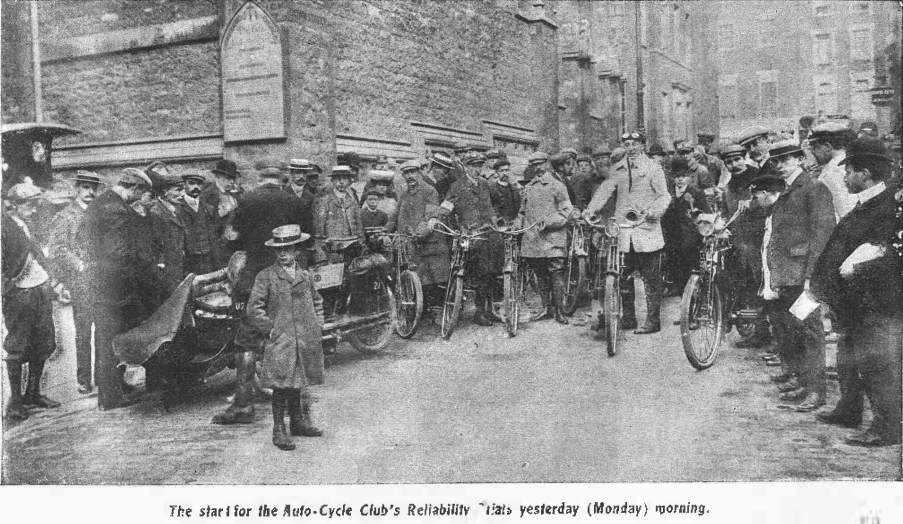
surviving, and it may be averred with confidence that those machines which secure the judges’ awards at the end of the trials will have more than earned the honours bestowed upon them…Monday’s Journey32 starters cried content with the imposed conditions and lined up at Down Street, Piccadilly (the headquarters of the Auto-Cycle Club) at 8.30am for the start on Monday, August 14th. Splendid weather prevailed, and the large crowd of competitors’ friends and onlookers somewhat interfered with the orderly marshalling of the men. So many competitors had to be finally coached into the needful route directions, and the minute details in connection therewith, that the start had to be delayed for some time. However, the Auto-CC secretary, Mr Straight, at last succeeded in evolving order out of chaos, and the men were sent away in batches…Thus there were despatched on their week’s journey 24 motor-bicycles and eight two-seated cycles, Class 2a, for double machines not exceeding 85 guineas comprising four, and Class 2B for machines over that figure, also having four starters. The first day’s route was to Worcester via Edgware Road, Stanmore Bushey Heath, Watford, Berkhampstead, Tring, Aylesbury, Dinton, Thame, Wheatley, Oxford, Eynsham, Witney, Northleach, Andoversford, Cheltenham, Tewkesbury, Worcester—a total distance of 126½ miles…The first hill of any importance was Stanmore, just before reaching Watford, and we followed up behind M Paul Colardeau on the 2½hp Mototri-Contal, and saw it scale the hill with its combined passenger weight of some 27 stones absolutely without a falter…Nearly all the men arrived in good time for final control of the day at Worcester. AE Lowe was unfortunate in getting a seized piston and withdrew his machine; the 4½hp Riley tri-car suffered from a burst inner tube; and one or two other competitors had tyre troubles. J Penzer, who was riding the two-cylinder 4hp Ariel, had desperately bad luck at 13 miles from the finish. He ran up to schedule time to this point, and then had his rear tyre go flat. Investigation showed that the inner tube was leaking at the joint. It was hurriedly repaired, but would not hold air for more than a minute, and had again to be taken out of the.
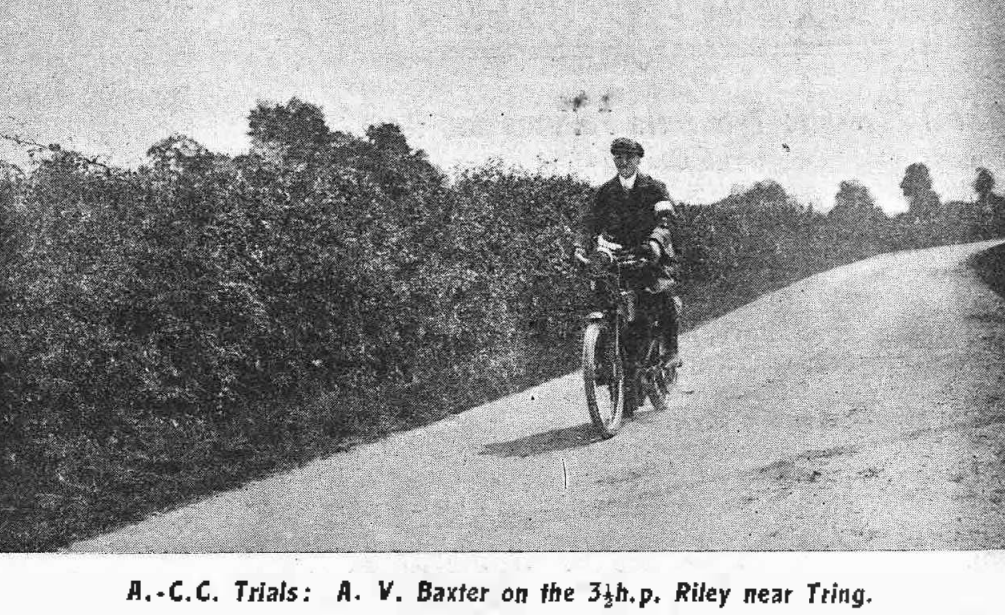
cover. This operation was repeated five times, and Penzer managed to get to the hotel at 10.30…Tuesday’s Journey: Sharp to the minute at 8.30 a.m. (the official time for starting), Mr Straight sent all his men away. Thirty machines left the Star Hotel yard, but only 29 were running, officially; Rivierre was the 30th man, and announced his intention of going through to the end of the week, despite the official scratching. The day’s destination was Bristol, which, normally, is a very nice journey indeed. As mapped out, however, it proved to be a really terrible day to many of the men…One of the test hills of the tour had been selected at the far-famed Dinmore Hill…Unfortunately this proved ineffective for its purpose, as all the machines, without exception, simply sailed up the two miles’ slope of about 1 in 12. So another height is levelled down so far as the motorcycle is concerned…Applebee had carburetter troubles…This gentleman was a competitor in the Reliability Trials in 1903 and 1904, but this year is acting the part of the good Samaritan. Nominally he is the rear guard honorary observer in collecting the checking cards and sheets from the checkers after all the competitors have passed through the different controls. The rules demand that an observer shall stand by a competitor who has tyre troubles, to take time, and thus secure allowance to the competitor for this unmechanical fault. It fell to Applebee’s lot to stand by Penzer till nearly 10 o’clock on Monday night, and we think it only fair that his sportsmanlike action should be recorded. It may be remarked that the morning’s journey was one of pure delight for the whole of the 70 miles, and took in some of the most beautiful scenery in the United Kingdom. It is not a speed course as understood
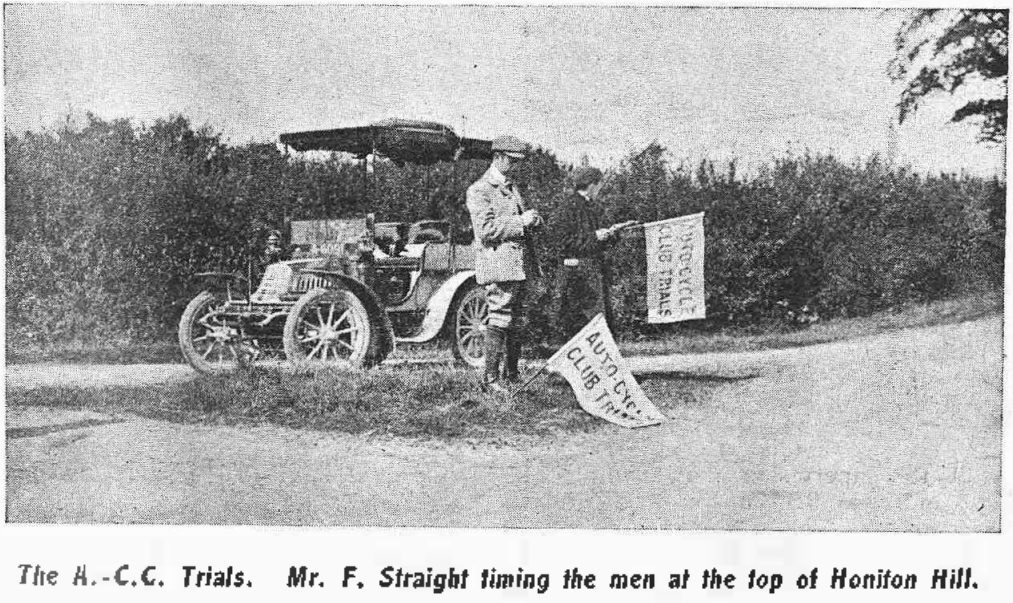
by motorcyclists, but is one to be covered leisurely to enable full appreciation to be made of the ever-changing panorama which nearly every hundred yards reveals. The country is diversified by numerous hills, which occasionally spring up suddenly from the lower levels. Most of these are covered with a wealth of foliage which is showing at its best, and with the hop gardens and apple orchards for which Hereford is so famous, make up such glorious landscapes as to well repay a journey of many hundreds of miles. In order to escape a multitude of heavy gradients, the roads, as far as possible, are taken round the bases and shoulders of many of the hills, and it is the sudden bends and windings thus necessitated which play their part in lending an added charm to every yard of the road. Dinmore Hill is a look into fairyland, whilst the marvellous panorama of scenery spread out in every direction between Hereford and Ross, with glorious Symonds Yat raising its tree-topped summit to the sky, makes up a series of views of the most picturesque character. If anyone desires to see some of our beautiful England let him follow the route of the Auto-Cycle Club, and there will be revealed such wonderful stretches of hill and dale as can be hardly matched for beauty by any other country in the world. After the men had provided themselves with the necessary stoking for themselves and machines, a start was made for the terrible Birdlip Hill. Most of the riders had only heard of the slope by reputation, and were inclined to jeer at its terrors when retailed by those who had previously attempted the climb—and failed. We do not
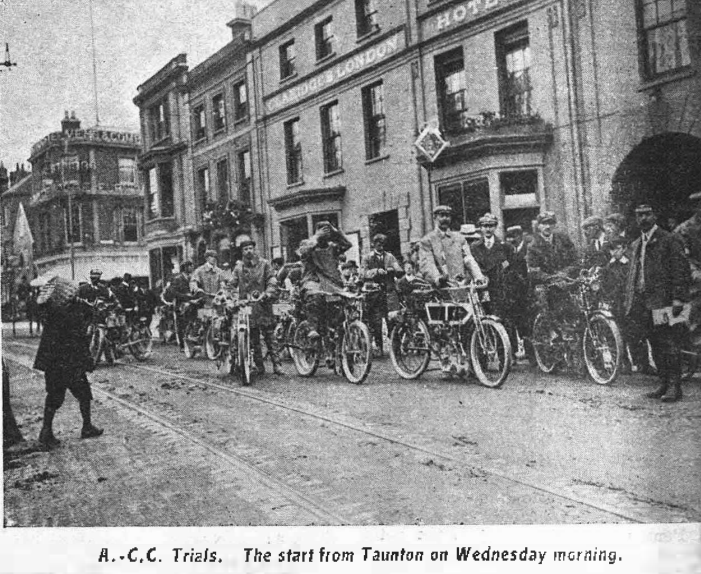
think it the wisest course to have pursued to have selected this particular mountain. (It is politely called a hill, but the other word better expresses its true nature.) It frowns at one soon after Ross is left, and seems ready to fall down and crush Gloucester, although it is actually 7¼ miles distant. The trade members of the committee were most anxious for its inclusion in the trials routes, as the hill-climbing powers of the machines would be better tested. If every machine was fitted with a two-speed gear there might be something in the argument, but as the majority at present sold are of the single-geared belt-driven variety, it degenerated into a test of the physical capacity of the men and not the machines. It is not a hill which is essential to be taken between Gloucester and Cirencester, as it can be easily avoided. However, as it was on the programme it had to be tackled, and the tackling will live in the memories of many of the competitors when they are old fossils and telling tales of their youthful heroism to their grandchildren. Heroes all certainly were those who got their machines to the top by vigorous pedalling, but double-distilled heroes are the unhappy wights who failed to climb and pushed two hundredweight of machine and luggage to the summit. The hill may be aptly described in Mr Straight’s terse language as two Westerhams rolled into one. Those who know Westerham with its dreaded Hell Corner of 1 in 7 will understand the difficulty of the ascent by remembering that the satanic turn occurs twice in some 400 yards at Birdlip, and that so bad is the previous mile and half of the hill that many men on high horsepowered machines had to pedal vigorously even at the commencement. In anticipation of fun (!) a number of people had assembled at the summit, including some well-known people from Coventry. The honours of-the climb rest with three machines, viz, the 5hp Ariel, the 3½hp two-speed Phelon & Moore, and the 10hp Lagonda tri-car. The two. bicycles went up from base to summit without a single turn of the pedals. The 10hp two-cylinder Lagonda, with its

designer (Wilbur Gunn) driving, went up exceedingly well, and proved the usefulness of possessing a three-speed gear in enabling one of the worst hills in England to be climbed without having to shed the passenger. The 2¾hp two-speed Phoenix, ridden by J Hooydonk, may be said to have accomplished the next best performance, as the machine went up with pedalling only on the worst portions, and that not of an exhausting nature. SE Pemberton, on the 3hp Singer, we should be inclined to place fifth, although it must be remembered that he only has a single gear, but had to pedal exceedingly hard to keep the engine running. JB Walford, on the 3½hp Ortona, also did well by successfully mounting the hill with the help of severe and continued pedalling. Those six mentioned sum up the successful performers. Of the others, the 2¾hp two-speed Phelon & Moore was helped by the driver hopping off and running alongside for a few yards. Hayes, on a 3¼hp Rex, dismounted after the first half and had a rest, as did HG Priest, with his 6hp two-cylinder Quadrant carette. The 3½hp Noble also was given a rest half-way. W Milnes, with the 2¾hp two-speed Phelon & Moore, ran along with his machine for a few yards and again mounted without the engine stopping. T Silver, on the 3½hp Quadrant, was compelled to dismount at the first bad corner, as having previously had a mishap to his pedalling gear, he could not give any pedalling assistance…After Birdlip was finished with, the run was continued to Bristol via Malmesbury, Chippenham, Box and Bath, a total for the day of 134 miles. Twenty-eight riders were booked in up to 12.30pm…Tuesday’s proceedings were wound up by the heaviest thunderstorm.experienced in the West of England for very many years. Some of the men were caught in this, and had a wicked time. One of the unfortunates was Paul Colardeau, who, it was learned, had carried his passenger up the first portion of the hill, then dropped him whilst running, and continued up alone to the top. Colardeau arrived late, having lost his way in the dark. The rain was so heavy that it was impossible to drive through it, and three or four men had to take temporary shelter…twenty-six men
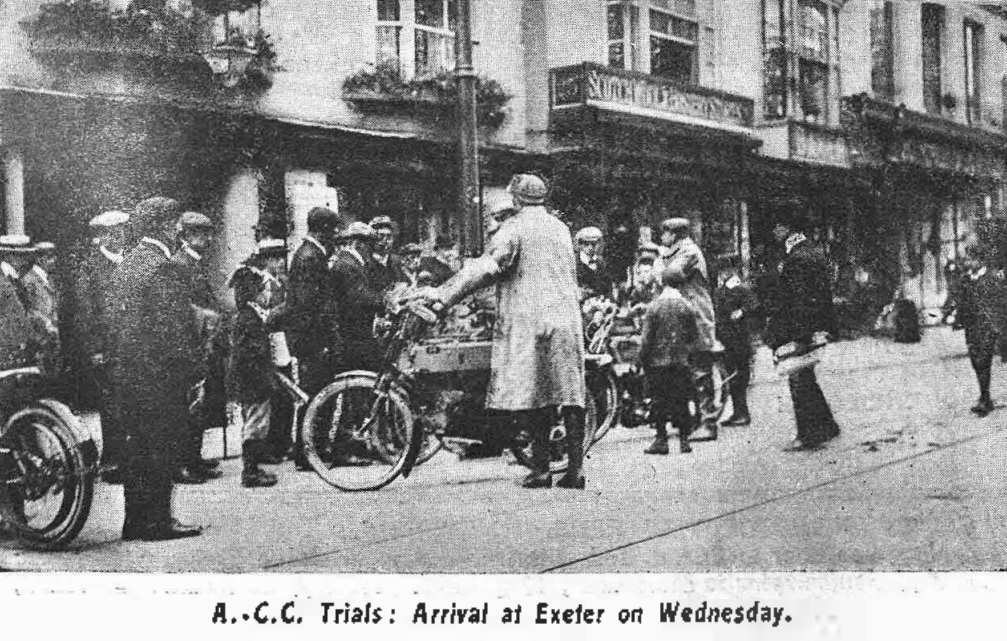
left Bristol for luncheon at Taunton, via Weston-super-Mare, Highbridge, and Bridgwater. Some two miles from the start Baxter had a side-slip on his 2¾hp Noble, and damaged the contact breaker. This necessitated a lengthy roadside repair, and he had continual trouble as a consequence with short-circuiting, only arriving at the end of the day at 10.45. Silver was another sufferer from accident. As he swung round an extremely sharp corner he came upon a cart coming towards him on the wrong side of the road. His pace at the moment was only slow, but so suddenly was the cart approached that he had not time to get quite clear. His left leg was caught by the hub cap of the cart, and he was thrown off the machine on his back. His trousers were ripped up almost from the ankle to the thigh. Although the skin was not broken, the thigh was bruised badly. His worst trouble was intense pain in the spine. We have before noted that he was without pedals, but he pluckily mounted, in spite of the pain he experienced, and kept to schedule time for the remainder of the day. Benzer was again in trouble with his inner tubes, and spent 5¼ hours attempting to repair tubes which had only solutioned joints instead of being vulcanised. His mechanical troubles were nil…Wedensday’s Run: Yesterday’s storm had turned the oolite-surfaced roads into a terrible mass of slimy grease, and the stretch to Weston-super-Mare, with its twisting bends and rough surface, was a trying experience. The risk had to be taken of keeping the pace up, or else losing time at controls, and every man reported many narrow shaves of accident. Luncheon over, at Taunton, the longest portion of the day’s run was commenced. This went to Crowcombe and Minehead, from whence a continuous climb of 8½ miles had to be undertaken to Wheddon Cross. From here the gem of the whole route was
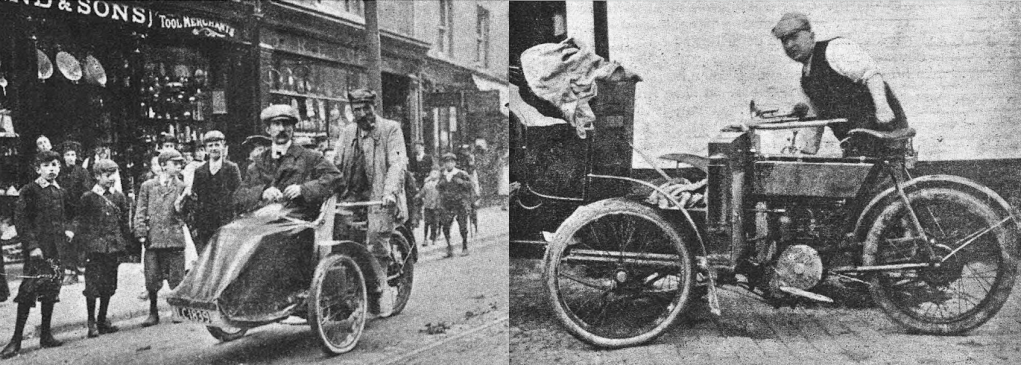
negotiated down the glorious valley of the Exe to Exebridge, a magnificent run down hill of ten miles, which is considered very nearly the best piece of scenery in England…A large crowd assembled outside the hospitable Half Moon Hotel at Exeter, and watched with interest the arrival of the riders. As has been the case from the commencement of the trials, the police rendered every assistance rather than hindering the competitors, and they were courtesy personified in tendering information and directing the men on their route. Colardeau was received with a very hearty cheer by the rest of the competitors, and, although he cannot speak a word of English, he has become a favourite with the crowd. Twenty-five men arrived at the end of the day, Clark being the one to retire…At the Wednesday evening meal occasion was taken of the men being altogether to make some speeches and propose a few toasts. Mr Van Hooydonk proposed the health of the three French visitors (Messrs Contal, Rivierre, and Colardeau) in very felicitous terms. M Contal replied in French, and, after thanking the gentlemen present for their kindly reception of strangers such as he and his two friends were on Monday, declared that the help and assistance they had received from every man present had deeply touched them. He had written to the French journal L’Auto a lengthy letter describing the pains that had been taken to make their visit pleasant and instructive, and had explained in his letter the splendid arrangements at the hotels for the drivers’ comfort, which compared more than favourably with those in the recent French auto-cycle reliability trials. Thursday’s Run: On paper the run for this day seemed comfortable enough, the destination for lunch being Weymouth, 61¼ miles. But the morning’s journey proved for some of the men nearly as arduous as that of Tuesday afternoon. The route was selected to cover some of the hilliest country in the south of England, and steep climb followed on steep climb with startling frequency. The roads were winding, with acute corners to negotiate; to add to the difficulty of the journey

one or two extraordinary villages had to be- passed through. The roads here were very narrow, and the houses are built right up to the edge of the road, without an inch of footpath intervening and having the doors opening straight into the road. The long pull up from Clyst Honiton gave the men a taste of what was in front of them. It had been decided to hold one of the timed hill tests up the hill out of Honiton towards Axminster and to treat the climb at Dinmore on the Tuesday as the ‘average hill’ which every machine had to climb or lose a large number of marks for any failure. Honiton served as a very good hill indeed for the purpose, as it was long enough, practically every man was strange to it, and it demonstrated the conditions which apply in ordinary touring. The climb was taken on the run—ie, the men were not stopped at the foot of the hill, but their times were noted as they passed the timekeeper at the commencement. A flagman was stationed some 50 yards away to warn the men as to the climb commencing. The length of the hill was one and three-tenth miles, the average gradient being one in sixteen, with a piece of one in thirteen at the commencement. Two very sharp bends occur within a few yards of each other…The men went straight on through the narrow streets of Axminster up the steep hill beyond, with another steep climb out of Charmouth, and a steeper descent into Bridport, and then came a heart-breaker in the shape of Stoneyhead Hill, leading out of Bridport. A piece of this is 1 in 7½, and whilst many had to pedal vigorously, four men had to push their machines to the top. Another very steep hill came on top of this, and then was experienced the very worst ten miles of the whole six days’ trip as regards road surface. The road is made up of local flints, and these did more injury in the way of cuts and surface damage than the rest of the mileage combined. Mr AG Reynolds, one of the judges, who has followed the men on a twin-cylinder Minerva bicycle, had a bad rear tyre burst on this stretch. In the afternoon, up to Bournemouth, the roads continued hilly but with improving surface, and the men finished up at Southampton, after passing through some of the splendid scenery of the New Forest. Some three miles before reaching Southampton a most unfortunate accident occurred to Van Hooydonk. Close by Totton he was turning a corner slowly, at not more than 5mph, when he came upon a cart driven on the wrong side of the road—this is quite the usual practice in Devon and Dorset. He turned suddenly, and the cart driver did the same, and Van Hooydonk was knocked over. The cart wheels went from end to end of the machine and made a veritable wreck of it. This mishap was the more regrettable inasmuch as the 2¾ two-speed Phoenix had not lost a single
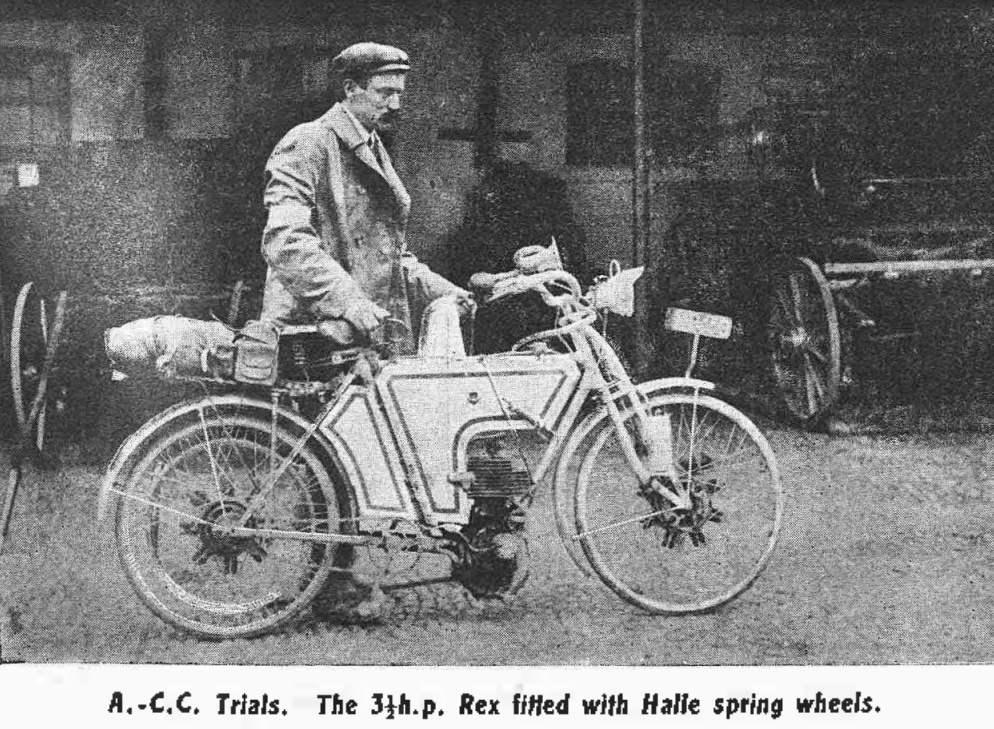
mark up to that point. On Saturday Van Hooydonk was still feeling slightly the effects of the shaking up. This made the second machine to drop out on Thursday, as Silver had attempted the climb up Honiton. His machine was travelling splendidly, but half way up he dismounted in very great pain as the result of his accident on Tuesday. This left in 23 machines—a very fine muster indeed, considering the nature of the country which had been travelled over. Friday’s Run: The day may be summed up by the statement that 23 men started and the same number finished. The route directions were the most complicated of any of the six days. Brighton was made for straight along the well-known and easy coast road. In the afternoon, just before entering Lewes, a stopping and starting test on a gradient of about 1 in 25 was held for the following machines: The two Phelon & Moore bicycles, two Riley tricars, Quadrant tri-car, Lagonda tri-car, and the two Contal tri-cars. The machines were all brought to a standstill, and had to be re-started from the clutch without assistance. The bicycle drivers were permitted to stand with one foot on the ground, but were not allowed to give physical assistance in any way. The light machines were all successful, and satisfied the requirements of the officials. The journey was continued to Eastbourne by a roundabout route, taking in Tunbridge Wells and Mayfield. The evening at the hotel here was enlivened by some excellent music from a local trio. Several speeches were made at dinner, and thoughts naturally centred on the approaching conclusion of the ride. As the next day’s start was to be at 7.30am, the men were permitted to clean up their machines in the evening, prior to dinner, and the resulting effects were startling, some bicycles looking just as if they had left the factory rather than having travelled so many miles. Saturday’s Run: Ninety miles was the distance before lunch, the route being to Hastings, Rye, Folkestone, and then at last north-east towards London. Maidstone was the luncheon place, and many farewells were said here as the men would arrive singly in London. For the last stage of the journey, Wrotham, Riverhead, Westerham, Godstone, Redhill, and Reigate was the route. At Reigate the men were stopped at the foot of the hill, and were sent up singly for a second timed trial. Although of no great height or gradient after many of the hills negotiated earlier in the week, it seemed to have some extraordinary effect upon either the men’s nerves, or else they were frightened to display the merits of the machines in public. Machines that had been doing well all the week, took fits of the sulks just because a few friends had
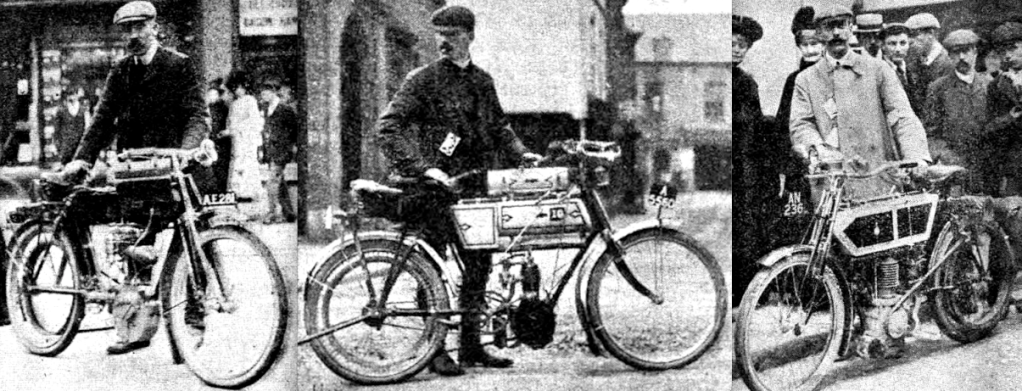
motored down from London to welcome them. Hulbert (Triumph) seemed to be the fastest, with Brice (Brown) a close second, and Wells (Vindec) about third; we have not yet seen the figures, and are judging only as to the apparent speed as each man passed. Penzer did not appear to be going at any great pace. Bond (2½hp Ariel) was shut in at the first bend by an ascending carriage and two descending cyclists, and he had to switch off current. It was surprising that he did not come off, as there was barely inches to spare. Walford (Ortona) went up at a very fair pace. The Lagonda tri-car was misfiring badly when it passed the corner; the two-cylinder Riley tri-car was changed into top gear round the second bend, but had at once to be dropped into low, or the engine would have stopped. The 2¾hp Noble stopped firing at the first bend, and had to be vigorously pedalled to get going again. The Singer machine was suffering from a slipping belt, and had to be pedalled vigorously, and the Bradbury received a few strokes of the pedals. Some quarter mile after passing the top of the hill two judges held a surprise brake test, the men being called upon suddenly to stop. The spot was admirably chosen, close to the tea-house on the top, and some of the competitors were not at all sorry for the call to dismount. The distance from the point where the flag was waved to the dismounting place was carefully measured, and then the men were sent away to Piccadilly. The first arrival was timed in a few minutes after six o’clock, and the men were coming in at intervals for a couple of hours. As compared with last year, the welcoming muster was not large. As each man came in his machine was taken charge of by the club officials and locked away, without being cleaned or adjusted in any manner, for the judges’ inspection on Monday. It may be of interest to state that up to Friday night 16 machines had lost no marks, a result which is really wonderful when the nature of the roads is taken into consideration. It would be unfair to publish the names of these, as some alterations may yet have to be made when other checking- sheets come in. At 10 o’clock pm, when our representative left, 22 machines had been booked in, out of a total of 32 starters on Saturday. The two accidents (caused by horsed vehicles) were possibly responsible for reducing the number by two, as both the Quadrant and the Phoenix had not lost points when they were knocked out. These are the names of machines in programme order who completed the whole of the. route: RM Brice, 3½hp Brown; T Woodman, 2¾hp Vindec Special; WH Wells, 3½hp Vindec Special; JB. Walford, 3½hp Ortona; H. E. Blackney, 3½hp
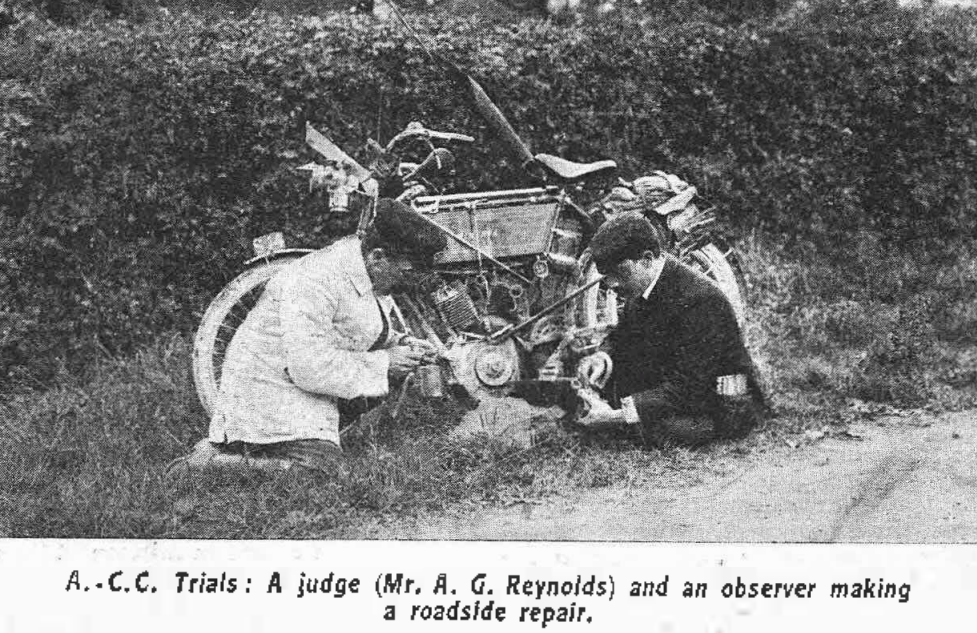
Werner; LM Young, 4hp Werner; J Hall, 3hp Bradbury; AH Bindoff, 3¼hp Rex (Hallé spring wheels); J Penzer, 5hp Ariel; W Milnes, 2¾hp Phelon & Moore; R Moore, 3¼hp Phelon & Moore; W Hayes, 3¼hp Rex; AV Baxter, 3½hp Riley; T Hulbert, 3hp Triumph; WG Watts, 2¾hp Noble; JCC Brodie, 3½hp Noble; SE Pemberton, 3hp Singer; J Bond, 2¾hp Ariel; Paul Colardeau, 2½hp Contal Tri-car; C Potter, 4½hp Riley Tri-car; HG Priest, 6hp Quadrant Carette; J Browning, 6hp Riley Tri-car; Wilbur Gunn, 10hp Lagonda Tri-car. Those men who have thus completed the long ride are to be heartily congratulated on a sterling and meritorious performance, which must have been followed on most of the roads covered to enable a proper appreciation of its merits to be made. On Mr Frederick Straight’s shoulders has devolved the whole of the organisation and working of the 1905 Reliability Trials. The arrangements from start to finish were of the most satisfactory nature and the minutest detail has been considered; we might instance the printed direction arrows which the riders found in the most forsaken and out-of-the-way spots in the West of England, and it was a physical impossibility for any man to lose his way during daylight. We are certain that all the competitors without exception will substantiate our statement as to the courtesy and consideration extended by Mr Straight to all those multitudinous enquiries which crop up in such an event. Three other honorary workers should not be overlooked; we refer to Mr AG Reynolds (one of the judges) and Mr Brooker, who rendered loyal help to Mr Straight till a late hour each night in working out the checking cards. We have before referred to Mr. Applebee, as a kind Samaritan to these helpless by the wayside with tyre troubles…from our own observation we believe that the following have not lost a single mark up to arrival of machines at Southampton on Thursday: 3½hp Brown, 2¾hp Vindec, 3½hp Ortona, 2½hp Werner, 3hp Bradbury, 3¼hp Rex-Halle, 2½hp Ariel, 2¾hp Phelon & Moore, 3½hp Phelon & Moore, 3¼hp Rex, 3hp Triumph, 3½hp Noble, 3hp Singer, 6hp Quadrant Tri-car, 6hp Riley Tri-car, l0hp Lagonda.
“THE SIX DAYS’ TRIAL which concluded on Saturday last was a triumph of organisation, and it will stand out as one of the best events of the kind which has been engineered by the Auto-Cycle Club. Save for the tail end of the thunderstorm on Tuesday evening, fine weather prevailed throughout, and the riders, therefore, fortunately had the oolite roads at their best. Immense interest was taken in the trial, and crowds assembled in all the western towns to see the riders go through. We consider the object of the trials has been entirely attained, not alone in giving official guidance as to the merits of the various machines but also in familiarising the outside public with the possibilities of the motorcycle in an exceedingly hilly district., This was proved by the assemblage at the checking points of interested enquirers, who, thinking of purchasing, were anxious to know how the machines had climbed particular hills in their own neighbourhood. Speed did not seem to be desired, but rather ability to negotiate, without pedalling, any and every hill which a rider might have to ascend.”
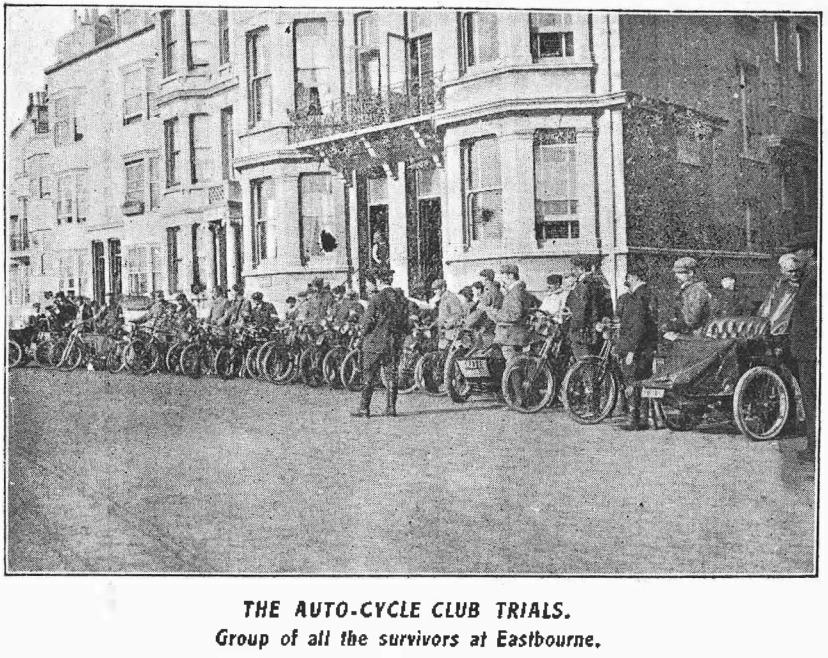
“AUTO-CYCLE CLUB RELIABILITY TRIALS: Awards and Certificates. The judges have recommended to the committee of the Auto-Cycle Club that the following awards be made: To receive first-class certificate and gold medal: Bicycles: 3½hp Brown (RM Brice); 2¼hp Phelon & Moore (W Milnes); 3½hp Phelon & Moore (R. Moore); 3hp Singer (SE Pemberton); 3hp Triumph (T Hulbert); 2¾hp Vindec Special (T Woodman); 3½hp Vindec Special (WH Wells). To receive first-class certificate: 2¾hp Ariel (J Bond); 3hp Bradbury (J Hall); 3½hp Noble (JCC Brodie); 3½hp Ortona (JB Walford); 3¼hp Rex, fitted with Halle spring wheels (AH Bindoff); ¼hp Rex (WH Hayes); 2½hp Werner (HE Blackney). To receive second-class certificate: 5hp Ariel, twin-cylinder (J Penzer). To receive third-class certificate: 3½hp Riley (AV Baxter). To receive first-class certificate and gold medal: Tri-cars: 10hp Lagonda tri-car (Wilbur Gunn). To receive first-class certificate: 6hp Quadrant Carette (HG Priest); 6hp Riley tri-car (J Browning). To receive second-class certificate: 2½hp Mototri-Contal (Paul Colardeau). To receive third-class certificate: 4½hp Riley tri-car (C Potter). In each class the machines have been placed in alphabetical order. Appearance Prizes: Bicycles: 1st, 2¾hp Vindec Special (T Woodman); 2nd, 3½hp Brown (RM Brice). Tricars: 1st, 10hp Lagonda (Wilbur Gunn). These recommendations will be brought up for confirmation at the next meeting of the committee. We think the awards now made public will meet with general acceptance by competitors, the trade and the buying public. Eight gold medals is a criterion of the reliability of the modern motorcycle.”
“BIRDLIP HILL. MR TW SILVER asks us to correct a statement in our report of the ascent of above in the A-CC trials, where he rode a Quadrant motor-bicycle. We stated that as the result of a prior accident, Mr. Silver could not give any pedalling assistance, and that he stopped half-way up. Mr Silver says that he could have easily reached the top without a dismount but for the fact that his engine stopped dead after the worst corner, owing to the throttle having closed, and that he restarted without pedal assistance and rode to the top. Our report was correct as to the fact of Mr. Silver stopping half way, but we are pleased to give his explanation of the reason. We regret to learn that he is still suffering severely from the effects of his fall on the 16th inst, and trust he will quickly recover.”
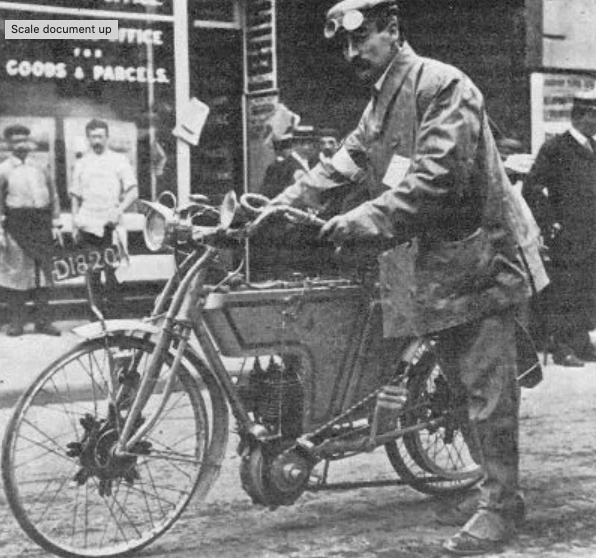
IN THE BLUE ‘UN Ixion subsequently noted thaqt the auto-cycle club “was beginning to wrest the reins of development from the MCC” and staged a 750-miles Six Days Trial: 31 bikes started, 21 finished and six won gold medals. The course included Birdlip Hill which was scaled by one superman on a single-speed 5hp Ariel trike “which was forced up the long ascent by a determined rider with super leg muscles”. But two P&Ms astonished the competition by cruising up thanks to a two-speed transmission—”goggle-eyed men, lying purple-faced and panting by the hedges half-way up Birdlip, stared incredulously at the machines as they climbed steadily under their own power”. AJ Wilson, author of the seminal Motor Cycles and How to Manage Them, presented a prize “for the best performance in comparison with the total weight of the machine”. It was won by LM Young on a 2½hp Werner.
“IN CONNECTION WITH the recent reliability trials of the Auto-Cycle Club the committee of the Club, who recently considered and confirmed the awards of the judges, decided, to mark their appreciation of the work of Mr AG Reynolds and Mr F Straight by presenting to the former the gold medal of the Club and to the latter a donation of five pounds…Mr FW Applebee has also received the thanks of the club for his invaluable services on the trials.”
“THE FIRST PUBLIC AND official test of any spring wheel has been made and triumphantly survived by the Hallé spring wheel, which, fitted to an ordinary trade motor-bicycle, without any sort of spring on the frame, went through the six days’ reliability trial of the Auto-Cycle Club without any hitch. This is a far severer test than any car test, as the carriage springs of a car have a very great deal to do with the comfort of travelling.”
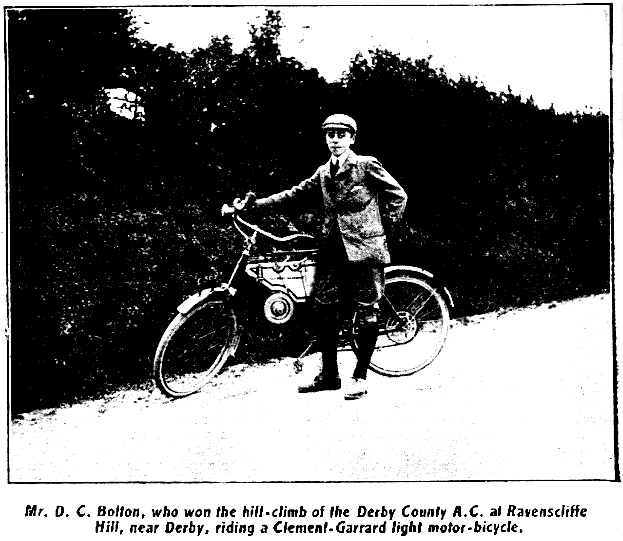
“THE REVISED OPEN competition rules have now been finally passed by the Auto-Cycle Club, and go into force immediately. In future, all open motorcycle competitions held in England, the Isle of Man, and the Channel Islands must be conducted under, the open competition rules of the Auto-Cycle Club. No open meeting, competition, or trial may be held without a permit from the Auto-Cycle Club. Such permit will only be granted by the Club upon application of the person or club organising the event; and it will be deemed a condition attaching to all permits that no permit is assignable…we counsel clubs and riders not to allow themselves to be persuaded to compete in open events for which the Auto-Cycle Club’s permit has not been obtained, because the result will only be suspension and disqualification, and one needs only to glance at two of the rules to see that such a decision debars one from participation in any motorcar, motorcycle, or cycle competition in the British Isles, and in the principal European countries.”
“MOTOR CYCLING CLUB’S 100 MILES’ NON-STOP RUN. This event figures in the club programme as a 100 miles’ non-stop run for the Motor Cycle Challenge Cup for teams of six riders from recognised clubs. The friction at present existing between the Motor Cycling Club and the Auto-Cycle Club resulted unfortunately in the event being robbed of. the greater part of its interest, inasmuch as the clubs that competed last year did not take art, being deterred by the Auto-Cycle Club enforcing their ruling that as the Motor Cycling Club had not approached the Auto-Cycle Club for a permit to run an open event, any rider taking part therein would be liable to be suspended. Nevertheless, the Motor Cycling Club determined to run the event off on Saturday last amongst their own members. The headquarters were made at Watton (Bull Hotel), and a route was selected via Stevenage, Baldock, Royston, Barkway, Puckeridge and Wades Mill, practically the same as adopted for most of the events that have been carried out this season. The competitors were E March (Trimo), J van Hooydonk (Trimo), A Candler (Quadrant bicycle), CW Brown (FN bicycle), Chester Fox (Trafalgar bicycle), and H Booth (bicycle). A start was made at 11.20am, timekeeper Hall officiating, the weather conditions being promising. The competitors, however, had been out about an hour when a storm of great violence suddenly burst over the district. This converted the roads for the time being into a series of lakes, but, notwithstanding the inconvenience, all the competitors stuck to their task and went through it. Later the sun came out, and the roads quickly dried. The first 50 miles saw three competitors fail to make non-stops. Hooydonk stuck on a hill through not changing gear in time, Chester Fox had his belt fastener break, and Candler had to stop to clear away some mud off his contact breaker. Booth, Brown, and March made non-stops, and, after lunch, started for the second 50 miles at 2.45, covering the route over again. Keeping well up to schedule, time, the trio completed their task at 5.30 without incident. On totalling up the marks gained, it. was found they reached 375, which is a. considerable improvement on last year’s figures. Several lady members of the club were present, including Mrs March, Mrs Hooydonk, Mrs Brown and Miss.Wood. Mr AJ Boult acted as judge. That the Motor Cycling Club has acted most unwisely in this affair must be generally granted. Whether it relishes the idea or not, there is a ruling body for the sport, and its rules are framed to protect sports promoters and competitors from those forms of dishonesty which invariably creep into uncontrolled sport. Having refused to apply for the Auto-Cycle Club’s permit and witnessed the withdrawal of all the other clubs which had entered, the Motor Cycling Club indulged in its run on Saturday quite fruitlessly, having nothing to gain and everything, to lose. In the first place, the affair having been ‘proclaimed’ was obviously no race, and any claim to the trophy as a result of the run will be put on one side by the ruling body. In the second place the Auto-Cycle Club is now given the unpleasant task of calling upon the Club and the riders for an explanation of their conduct, and, as it is obvious that no explanation can, in the circumstances, be satisfactory, the suspension of the Club and of the competitors becomes unavoidable.”
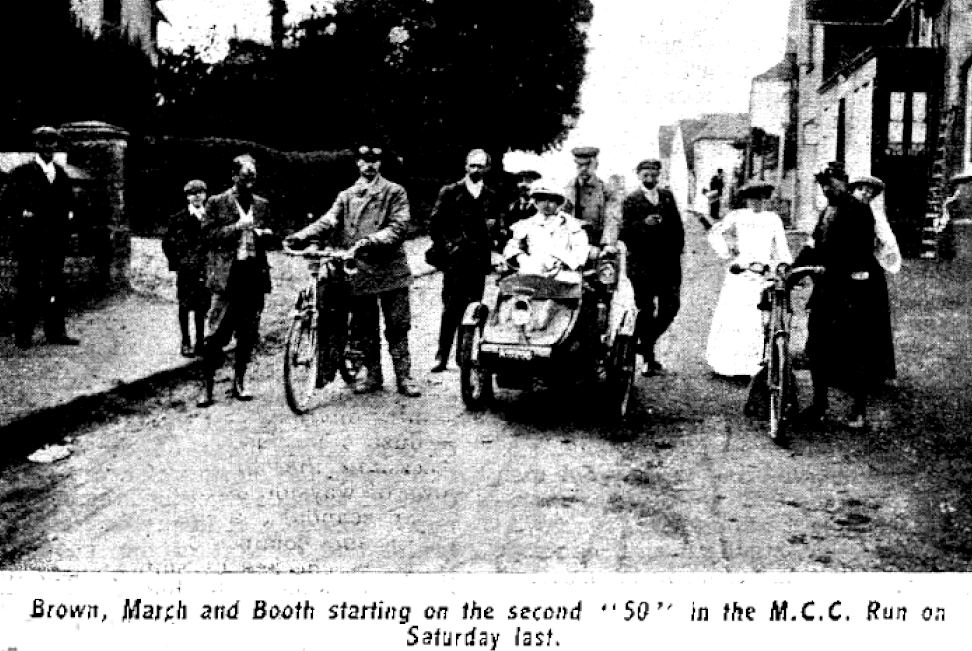
“DURING THE PAST FEW WEEKS a number of paragraphs have appeared in the Press, and many circulars have been issued by the A-CC relating to the affairs of the Motor Cycling Club. My committee hopes that motorists and readers of your paper who may not be acquainted with the whole of the facts will suspend their judgment until such time as they have heard the arguments from both sides. Naturally my committee takes great exception to the threats thrown out broadcast by the ACC, although it regards them as quite ineffective and purposeless. As far as this current year is concerned, the A-CC has succeeded, by means of what my committee believes to be doubtful expedients, in spoiling the Team Competition for the ‘Motor Cycle’ Challenge Cup, and this is a matter for which the donors of the cup have to thank them. We—the Motor Cycling Club—are only the trustees of the cup, the annual competition for which we regulate and administer under a trust deed, which provides, amongst other things, that the competition must be held annually. In this deed, drawn up by our hon solicitors, Messrs JB and F Purchase, the conditions under which the teams of various clubs are to compete are definitely set out. The Auto-Cycle Club as a governing body is not mentioned in the deed, and all that the Motor Cycling Club has done in the past is to attempt to carry out these conditions faithfully. As trustees of the cup, this club does not regard itself as the winners of it this year; we are good sportsmen. The Motor Cycling Club will hold the cup until next year, when it will be again put up for competition. As regards the Brown Cup, the A-CC, in their haste to snatch an advantage, has made a false step. My committee has made this event a club event, and reduced the entrance fee to 5s. It is hoped the success of last year will be repeated. I may add that in the Brown Cup competition last year every competitor except one was a member of the club, and that one non-member has since joined. If any manufacturers of an all-British machine find a difficulty in providing a driver who is eligible, my committee will give facilities for the election of any suitable person nominated by them. As regards the future, the Motor Cycling Club will never acknowledge the A-CC as other than a competing social club, until it ceases to be so and occupies itself with the functions of a governing body only. This is but reasonable. Clubs in the provinces may not feel the injustice so keenly as our own members do, but we are quite resolute in the determination not to support financially or in any other way a competing social organisation in our own city. Thanking you on behalf of my committee for the courtesy of the use of your columns.
Arthur Candler, Hon Sec Motor Cycling Club.”
“AT AN EARLY MEETING of the committee of the Auto-Cycle Club the following proposition will be discussed: ‘That the Club does not challenge for the International Motorcycle Cup in 1906.’ Whatever may ultimately be decided, the general opinion in club circles is that a race confined to genuine touring motorcycles would serve a much more useful purpose than the present type of contest.” And that, gentle reader, could fairly be described as the acorn from which sprouted the TT oak.—Ed
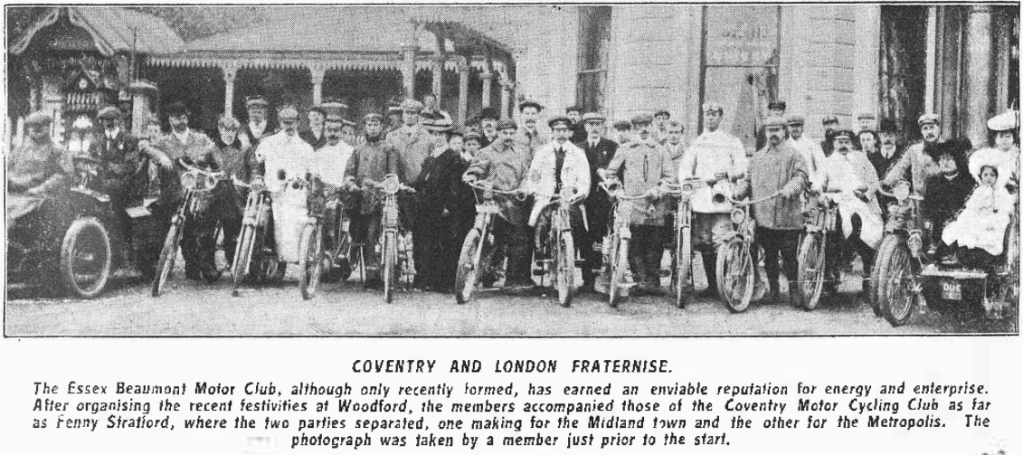
“MANY PRESENT OWNERS of Ormonde and Kelecom motor-bicycles will be interested to learn that Messrs CA Vandervell and Co, of Chapter Road, Willesden, London, NW (who manufactured the accumulators for those machines), can supply all spare accumulator parts, as also the special sizes of cells which were used on Ormondes.”
“BEING A MOTORIST IN ENGLAND, the state of motoring here in Denmark has, naturally, interested me, and may also interest your readers. There is to be seen out here in fairly large numbers a motorcycle with a drop frame construction. After making some inquiries I found this was of Danish make, and called the Ellekam motorcycle. On calling at the factory I made the acquaintance of the inventor and maker, Mr Hansen Ellekammer, who kindly placed a machine at my disposal, and gave me some interesting particulars. The lower portion of the drop frame consists of a platform to rest the feet on, and, being made hollow, is used as a petrol tank. The engine (a 2½hp Minerva, AOV) is attached in a nearly upright position to the tube containing the saddle pillar. The base of the engine crank case rests on the platform. The difficulty of the petrol tank being below the level of the engine is overcome by a carburetter of novel design. A small enclosed fan, worked by the suction stroke of the engine, has fixed on its shaft a pulley, which revolves directly above a vertical supply pipe, which goes to the bottom of the petrol tank. Another pulley is placed in this end of the pipe. An endless band, consisting of fine wire wound in the form of a coil spring, is placed on the pulleys. The band revolving brings up sufficient petrol to the mixing chamber (which is a portion of the enclosed fan compartment, and placed across the combustion head) to supply the engine. There is a fixed and adjustable air inlet. It is claimed that the speed of the engine, with its more or less suction in the fan, automatically regulates the amount of petrol required. An automatic release valve is fitted for the compression, which only acts when the machine is walked along. Twenty-eight inch wheels are used. The frame, however, is very low, the ground being touched easily with the feet. No pedals are fitted. I found it climb hills nicely, this speaking well for the 2½hp Minerva engine. The controls are a switch handle, advance spark lever, and foot brake, acting on driving rim. Ignition is by Hellesen primary battery, which is made here, and found to be quite satisfactory. I found the machine an easy starter. The roads here are broad and straight for miles. The surface, however, is indifferent. No driving after dark in the country is allowed. The legal speed limit is 16mph. Driving licenses are obtained after examination in driving, no fee being payable.
Montague Greenwood.”
“SEEING IN A RECENT ‘Motor’ a case where a motorist sacrificed his car and self by running into a ditch to avoid a cyclist, I thought possibly my experiences might be interesting to readers. Not that I wish to blow my own trumpet, but to show what damage may be done by the reckless riding down hill of ‘push’-bikists. I journeyed from Devon on a motor-bike, and when within about six or seven miles of Bristol, was ascending a hill, when a stream of cyclists came free-wheeling down at a goodly rate. When, presumably, they had all passed, a motorcyclist, who was at rest on the right side of the road, made a move as if to start, when a lady cyclist came tearing down at anything between 20 and 30 miles an hour, I should think, and, making straight for me, compelled me to hug the left side of the road so closely that I had to run into a wall to give her room. When she passed, so close was she that I was right up against the wall, and she grazed my right hand as she flew on; the consequence is that I have damaged my ankle and knee very considerably, and it will require some days’ rest before my leg is of use. If she had struck my machine, it must have meant almost certain destruction to her, but she went on, and never had the kindness to come back and enquire what damage had been done. If the police would pay a little more attention to ordinary cyclists on steep descents like this, and not always persecute the poor motorist as they do, they would get a good bag, I fancy. I noticed, on getting to the top of the hill, that there was a danger board.
Harold Swanwick.”
“‘WELL, WHAT DO YOU THINK of the collection?’ said Professor Hubert von Herkomer at the exhibition of the competing cars in the Beissbart Auto-garage on Friday afternoon. ‘Did you ever see finer machines! Oh, they are wonderful! Wonderful!’ The enthusiasm of the well-known artist and donor of the trophy which occupies the attention of amateur motorists is not only an indication of the hearty success that is attending the competition that is being carried out by the Bavarian Automobile Club, but also it serves to give the keynote to the enthusiasm that is being manifested by all and sundry who are playing any part whatever in the affair…There were plenty of sensible little accessories to be seen… little eccentricities were not unknown, such as the siren, in explaining which to the judges Monsieur Ernest Cuenod had great pleasure in giving a practical demonstration of it. The unobtrusive little instrument is only calculated to carry 12 kilometres against the wind and 20 with it, so that if you were in a hurry to have a clear road it would be merely necessary to sound it at Staines and the ‘Bobbies’ regulating the traffic at Piccadilly Circus and Bank would instantly clear the road and keep it so against your arrival later on in life…The ball in connection with the automobile week was set rolling on Thursday night at the Kunsthaus, when the Grand Duchess Mecklenburg-Schwerin and Prince Ludwig Ferdinand were received by the officers of the Bavarian Automobile Club, and there was much speechifying, including a half hour’s oration by Doctor Freiherr von Schrenck-Notzing, chamberlain of the club. The entrance of the four British motorists, who were free on that occasion to attend on behalf of the contingent over here, namely, Messrs Julian W Orde, Edward Manville, Frank Rendle, and H Massac Buist, was distinctly humorous. As the little party stepped through the cumbrous wooden gates into the dinner garden, they were somewhat surprised to find all the nabobs of the district and hochfellers, so to speak, dribbling with trinkets, and drawn up in two very formal lines at the very entrance. They were welcomed profusely, but with an air of haste that seemed strange, until, a moment later, the Princess entered behind them, and it dawned on the Britons that they had very nearly, and all unconsciously, marred the dramatic, effect of a Royal arrival…the Munich meeting—which comprises the competitions for the Herkomer and Bleichroeder Cups —was continued on Monday, August 14th, with a reliability run from Munich to Baden-Baden, a distance of about 220 miles.”
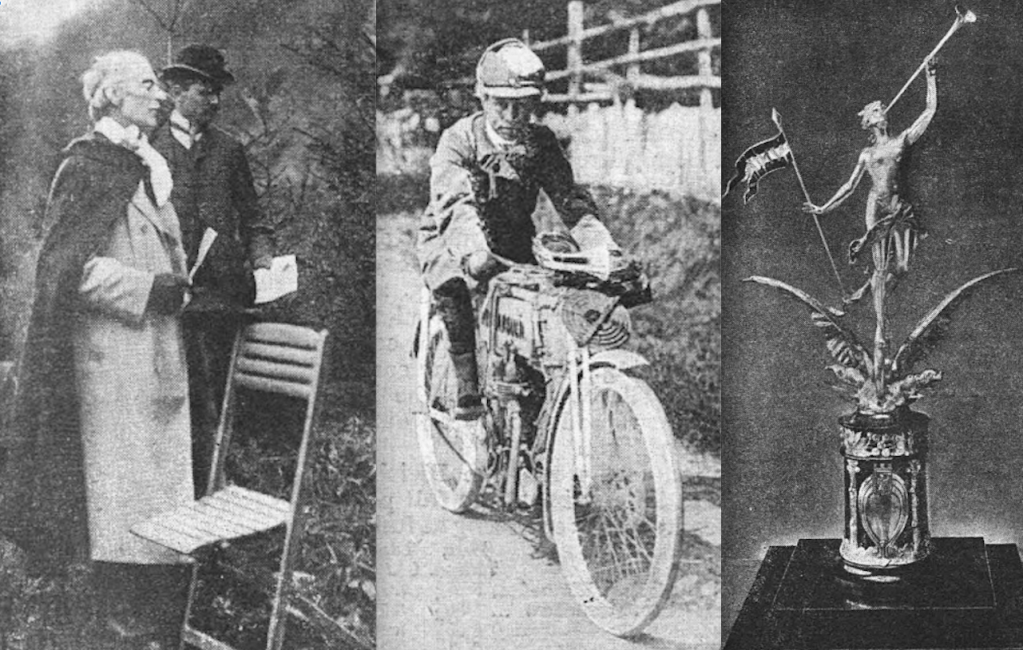
NOT ALL TWINS were of the V-persuasion. The Paris Show featured vertical twins from Werner and Bercley (a new Belgian marque) and a 363cc in-line four from FN with a Simms-Bosch high-tension magneto, shaft drive running through a frame tube, leading link forks and a drum rear brake.
“TRANSFORMING SIDE-CAR INTO FORE-CAR. Express (London) writes: ‘I have a 2¼hp Kerry motor, 1903, in good condition, and a basket side-car. I propose having the front wheel of the bicycle removed and the side-car built on stronger wheels and fixed in front of the cycle, thereby forming a tri-car. Can anyone who has had experience in this or tried it say if the experiment will prove successful? Is my engine likely to prove powerful enough?’—Nothing under 3½hp, together with a two-speed gear, is of the slightest use for tri-car work, if amusement is desired and not hard labour. Do not waste your money in the method you outline or you will be hugely disappointed.—Ed.“
“THE BUSINESS OF THE Bat Motor Manufacturing Co, Penge, London, SE, has been taken over by Mr TH Tessier, who is now in a position to supply parts, etc, for the Bat machines.”
“IT IS TO BE REGRETTED, having regard to the present state of public opinion on the matter of the motorist, that there is an increasing tendency on the part of car owners to adopt unshaded acetylene headlights of altogether excessive power. There can, of course, be no question but that a good light thrown well ahead is a necessity for safe travelling, but is there any need for the glare of a couple of thousand candlepower projectors to be directed right into the faces of other road users? Accidents have already been chronicled which have been directly attributable to this practice.”
“SOME RECENT MAGISTERIAL decisions in accepting speedometer records against the testimony of constables will doubtless make useful a brass badge which is supplied with all Jones’ speedometers, as sold by SF Edge of 14, New Burlington Street, W. The illustration gives an excellent idea of its appearance, the exact size of the metal badge being 3½in in diameter, with attached strap and buckle for hanging on a convenient portion of the car.”
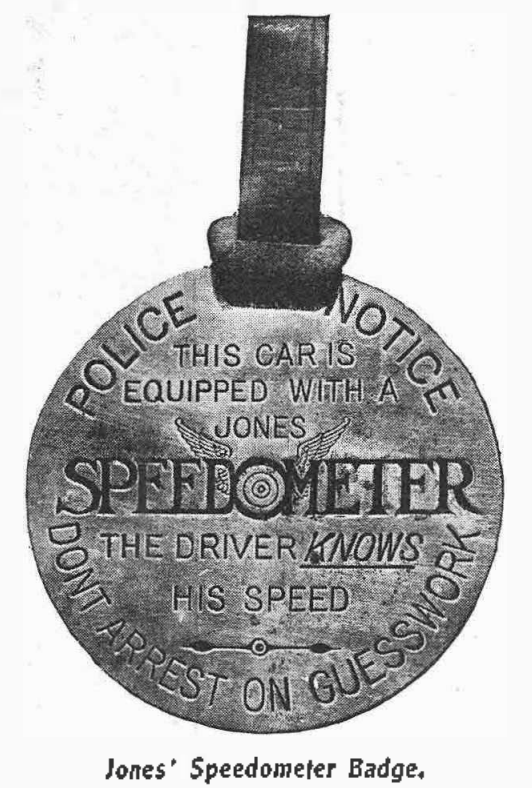
“THIS ANTI-VIBRATION DEVICE has several points about it which have not hitherto been embodied in spring handlebars, and are such as to warrant a description. The bar itself is carried between two guides, as shown in the illustration. These guides take the whole of the steering thrust, and are rigidly fixed to the steering pillar of the machine. The bar itself is a comparatively tight fit in between the guides, and has two steel pieces brazed through its centre. These steel pieces embrace the bolts which pass through the guides and have four helical springs top and bottom, in each guide, bearing upon their surfaces. By this arrangement any jolts which may occur to the front forks of the machine tend to lift or lower the centre of the bars. In doing this the rider’s hands remain practically stationary, the flat portion of the bar rotating on its own axis, and thus allowing the ends of the bar to keep a level passage irrespective of the irregularities of the road surface. This design has the merit of perfect safety, and, whilst freeing the rider’s hands from fatiguing vibration, it ensures a feeling of perfect control and security.”
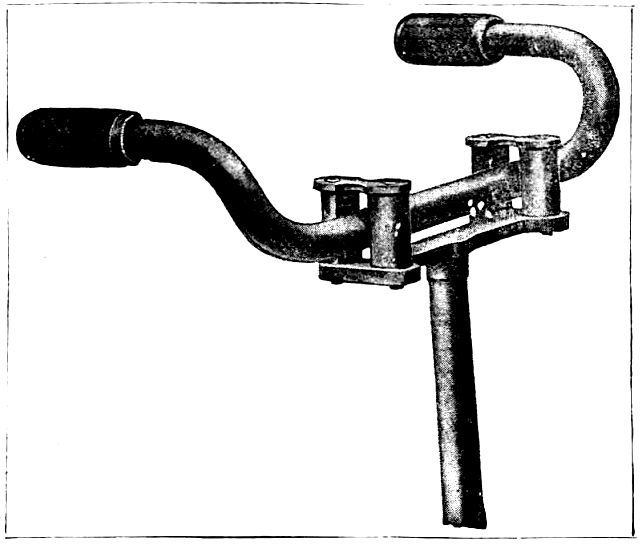
“SPRING FORKS WILL DOUBTLESS, in the near future, become universal on all motorcycles built for pleasure purposes, and one has only to take a short run on a cycle so fitted in order to appreciate the additional comfort afforded by such a device. But there are spring forks and spring forks, and should the design and workmanship not be of the very best, excessive wear will surely take place, allowing side play, whilst much trouble will soon render the device an additional worry instead of an additional comfort. With a view to enabling motorcyclists whose machines have rigid forks to enjoy the pleasure of smooth running, the London Autocar Co have placed a spring fork attachment on the market, which can be readily fitted to any machine. This device 1 was recently invited to inspect, and as the result of my examination I am able to say that the attachment is well designed and very solidly constructed. The bearing which takes up the lateral movement is shown at A in the accompanying illustration, whilst the two compensating springs (E) present shocks after sudden movement. Respecting the fitting, all that has to be done is to remove the wheel, and fix the two parts of the attachment in its place, as shown in the illustration, two bolts passing through the axles holes, and holding the rigid portion of the device in place, whilst the shoulder-pieces (F) press against the forks, and take up the strain. The ends of the axle are then placed in the slots shown at C, and the nuts screwed on in the usual way. The wheels are thus suspended by the tensional springs (D). It will be noticed that the attachment raises the forks an inch or two, thus allowing plenty of clearance for springing between the tyre and the mudguard. The design is such as to render the device absolutely safe, and should the springs (D) break, from any extraordinary reason, the two shoulders to which the springs (E) are fastened would come together, and hold the wheel.”
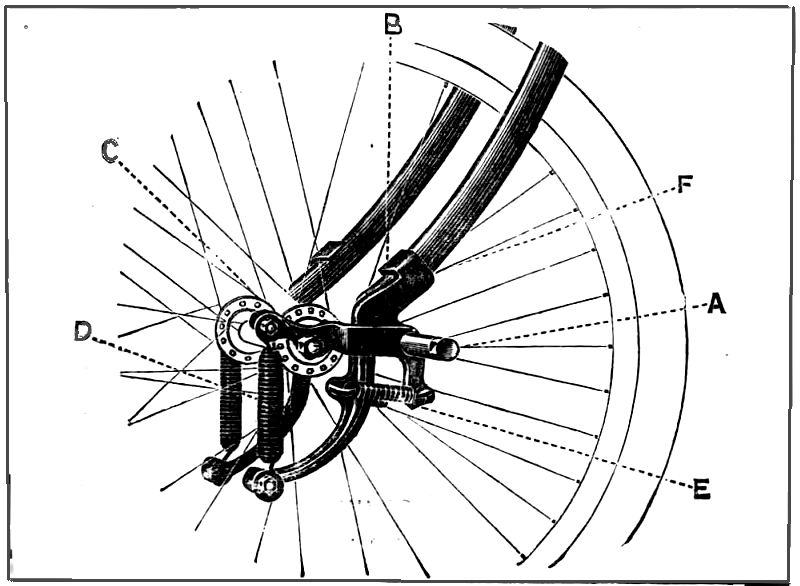
“THE SPRING FRONT fork illustrated herewith will be a special feature on the Rex motor-bicycle for 1906. It will be observed that clips are brazed at the base and half-way up on each side fork. Through each clip runs a rod, which can have vertical but no side movement. Around each rod are springs, held in compression. The rods are rigidly attached to blocks which between them carry the front wheel, any road shock is absorbed by the springs before reaching the forks, because of the up-and-down movement communicated to the sliding rods in the guide clips. Any rebound when passing over very bad surfaces is provided for by the lower pair of springs. The results obtained with this device are said to be very satisfactory.”
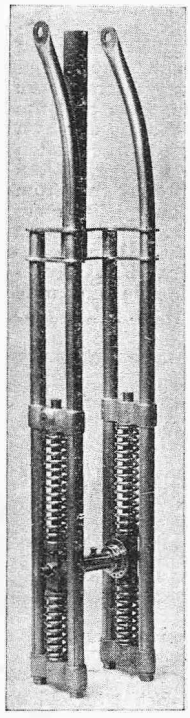
“THE NSU CYCLE and Motor Co have removed from 4 and 6, Hatton Wall, EC, to more extensive premises at 78, Charlotte Street, Fitzroy Square, W.”
“AN EPIDEMIC OF speed limit prosecutions has suddenly broken out in the North of England, and Carnforth is particularly distinguishing itself in this direction.”
“A VERY SUCCESSFUL SEASON was brought to a close on Saturday by the Motor Cycling Club, when they held a petrol consumption test. An entry of 18 competitors was obtained, and, to give everyone a chance, a special handicap was arranged, in which one dram of spirit was allowed for each 50mm of cylinder measurement (that is, bore and stroke multiplied together). The smallest engine thus got the smallest allowance of spirit. By kind invitation of General Sir Henry Colvile the trial was held at ‘Lightwater’, Bagshot. A triangular course of 1¼ miles had to be covered as many times as possible by each competition…After two or three laps had been reeled off half the starters had got into difficulties. In some cases the carburetters would not feed properly with the small depth of spirit remaining in the tank. After five or six laps the majority had stopped, but Johnson, Hunt and Lowe were going strong, and carefully nursing their engines…the successful competitors were: Hunt (55x62mm) 200mpg; Lowe (82×76) 160mpg; and Johnsonn (86×89) 97mpg.”
“THE NEW DUTCH MOTOR ACT…will most probably not come into force before the end of the year. Until then special permission must be obtained for moting…at least three weeks before the trip. The form to be filled up must contain owner’s name and address, chauffeur’s name, type and power of car, etc, and can be procured for as. from the secretary-general of the Dutch Motor Club at Scheveningen. For a number of provincial highways permission of the local authorities is also necessary, and some towns—Rotterdam, Groningen and Deventer, for instance—require a police permit as well for passage through in a motorcar. For motorcycles under 150kg no particular permit is required where high roads are concerned. The maximum speed is 20kph, which, however, drops to 8kph—5mph—in the case of foggy weather, night travelling, and descending hills.”
“MESSRS PANHARD AND LEVASSOR have instituted a scheme for keeping in touch with users of their cars, and for promptly effecting necessary repairs. For this purpose a specially-designed travelling workshop has been built, and this, with a full equipment of all needful tools and appliances, will travel about the Kingdom, and will visit any Panhard owner who communicates with the firm requesting its services.”
“A PETROL CONSUMPTION TRIAL is not the least interesting of the A-CC season’s events. This was carried out on Saturday afternoon last, a route being chosen from the Angel Hotel, Thames Ditton, through Guildford and Godalming to the summit of the Hindhead. The roads were in excellent order, an agreeable contrast to last year’s trial, on the occasion of which the roads were in an.exceedingly bad state. The distance out and home was 57 miles of undulating road, and including the 3½ miles steady climb up the Hindhead. At 2.30pm the following competitors started with full tanks: AB White (3hp Roc, 77x80mm, spray carburetter); WH Hayes (3¼hp Rex tricar, 83x83mm, spray); HJ Densham (2¾hp Excelsior, 79x80mm, surface); SE Pemberton (3hp Singer, 80x80mm spray); RS Fox (3hp Rover, 79x76mm, spray); EW Goslett (3hp NSU, 80x80mm, spray); CG Thistleton (2¾hp Bat, spray); FW Applebee (3¼hp Rex, 83x83mm, spray). The rules provided for a uniform speed of 20mph, and no pedalling was permitted, nor was the engine to be stopped throughout the trial. The competitors were observed from the front and rear by two cars with official observers on board. The run up to the Hindhead was uneventful, but Goslett had a momentary stop on the hill, and Hayes and Densham put in a few strokes with the pedals. On the summit a few minutes’ stop was indulged in, the magnificent view of the surrounding country being alone well worth the trip. On the return journey the competitors were still kept under close observation, and all arrived back at the Angel at 5.30. The gauging of the quantity of petrol used by each competitors was at once proceeded with, and on measurements the results were: HJ Densham, 77oz; W Goslett, 84oz; CG Thistleton, 88oz; RS Fox, 90oz; FW Applebee, 91oz; AB White, 99oz; SE Pemberton, 122oz; and WH Hayes (tricar) 167oz. The weight had to be taken into account, and a suitable formula used. The awards will be a silver medal for the best actual performance on the above basis and an award will also be given in each class of machine, irrespective of weight showing the smallest consumption. The final results on the basis of weight are announced as follow: 1, Densham (Excelsior), combined weight of machine and rider 3461b, consumption 116mpg; 2, Goslett (NSU), 3321b, 107mpg; 3, WH Hayes (Rex bicycle), 3501b, 100mpg; 4, Thistleton (Bat), 3321b, 104mpg; 5, Fox (Rover), 3301b, 102mpg.”
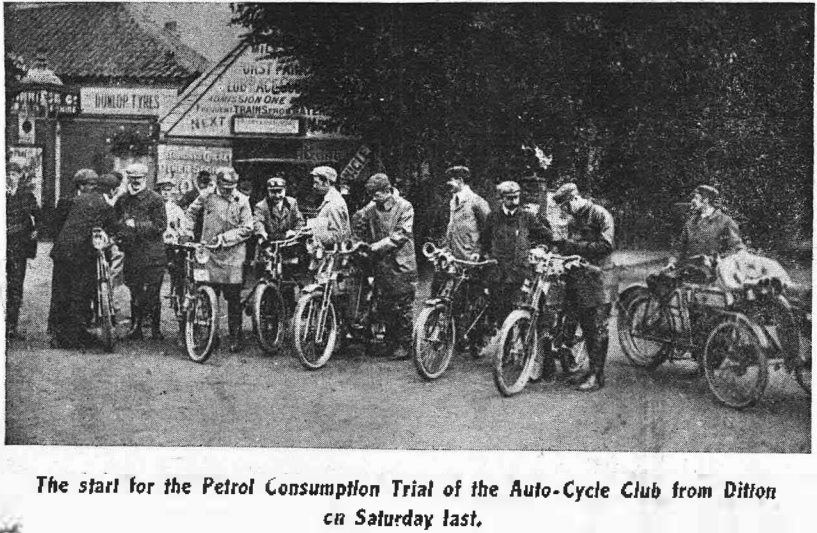
“THE RECENT DECISION of the French Minister of Finance to allow motorcyclists from foreign countries free passage through the Customs with their machines, conditional on their producing a membership card of a national touring club, is a concession of the utmost importance, and for such the gratitude of motorcyclists is due to the council of that splendid organisation the Touring Club of France, whose strenuous efforts to get the concession granted have at last been crowned with success.”
“THE NSU CYCLE AND MOTOR CO had two new machines stolen from their London show rooms on the night of August 12th. One has magneto ignition and the other accumulator. The numbers on engines are 7,158 and 5,705 respectively. The company would be glad in the event of any reader coming across either machine to immediately inform the police.”
“EPSOM HIGH STREET TO BE CLOSED. Epsom is about to try ‘Tarmac’, and the Town Surveyor writes the local correspondent of the Motor Union as follows: ‘I thank you for your kind offer to advertise the fact that Epsom High Street is to be closed for repairs.’…It is to be hoped that local anti-motorists will not follow the example of the road deviation at Kingston. There the main road is up, and will be up for a considerable time owing to the tramlines, and consequently the traffic is being diverted from the main London Road, along Liverpool Road. A resident evidently dees not appreciate the extra traffic, as over 60 Blakey’s boot protectors, with the business points up, were picked up by a motorist when walking along the road on a recent morning. This kindly act of course does not affect owners of large cars fitted with nail catchers, but it is likely to be very hard on drivers of small cars and cyclists.”
“PROBABLY MANY READERS of ‘The Motor’ are considering the question of making their motor-bicycles a more sociable machine. I enclose a photograph showing the arrangement I have fitted to mine, which, after about 3,000 miles’ trial without any trouble, has proved a very practicable and useful arrangement. The motor-bicycle is a Clement-Garrard (60x70mm), and I have run it for 10,000 miles during the last four years. I have re-arranged the gear especially for rear seat, and saved 71b in weight. The seat, support, and footboards weigh 11lb, and the motor-bicycle 901b. With live loads of 12 and 8 stone respectively, I can do as much as 160mpg on an average road. The seat is detachable, leaving a substantial luggage carrier, or the whole may be removed in a few minutes.
ST Cuts.”
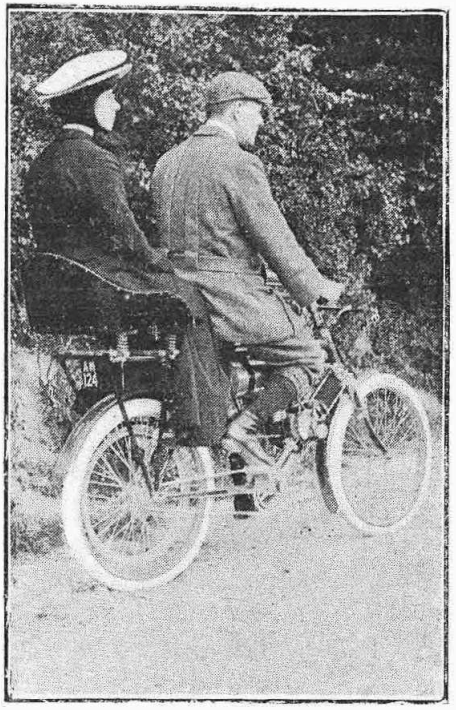
“I FAIRLY TROD UPON A HORNETS’ NEST after dinner the other evening—and, strangely enough, the dinner had not been at all bad. They were four to one, and to a man (and woman, for man, as you are aware, embraces woman) they were anti-motorists and lovers of horseflesh. I have always understood in a vague, uncomprehending sort of way that we motorists are supposed to be out and out fiends, that no deed is too bad for us, that no fate can be too terrible for us; but I doubt very much if I had ever before realised the blind, hopeless, angry, foaming-at-the-mouth sort of prejudice that permeates the being of the non-motorist as I did that evening. What always puzzles me about this type of individual is the absolute fetish he makes of horseflesh. And, truly, it seems to me that we motorists had better set to work to destroy the idol, for the absolute rot that is constantly talked about horseflesh is a bit disgusting at times. It is mainly the outcome of affectation, the love of the huntsman for his mount being aped by people whose closest association with the friend of man is probably a ride in an omnibus or a cab. The ‘lover of horses’ (self-styled) will generally be found to be a complacent sort of man, who can sit behind an animal all day, see it toiling and steaming up a hill, struggling under its load, and being constantly goaded on to its work with a whip. Or, if he attains the accomplishment of remaining astride the beast, he digs spurs into it and lathers its sides with his hunting crop (carried ostentatiously from the City to the mews where he hires his mount). He can without a single conscience-prick watch the struggles of the beast as it drags or carries him where he desires to go; and at the end of the day, when the animal is quite worn out, he gives it a feed of corn and says what a noble animal is the horse, and how kind and good he always is to his cattle. And when the horse revolts at his treatment or his neglect, and, showing that it has a will of its own, takes the bit between its teeth and masters the man, then you see the look of terror and of utter incompetent helplessness in his eyes. But afterwards, when he has regained his supremacy through the horse tiring, he still thinks that the horse is a noble animal, and that he himself is a marvel in his ability at controlling it! As a matter of fact, it is man’s bounden duty to the rest of creation to develop mechanical means that shall accomplish the drudgery which he creates.—Cyclomot“
“NOBLE MOTORCYCLES. Since the taking over of the business by Messrs Brodie and Catherwood in January last, noticeable changes have been made in the Noble engine, and we last week took an opportunity of visiting this company’s works in Pocock Street, Blackfriars, with a view to gaining information as to their 1906 patterns. The chief points are as follow: Hardened steel bushes are fitted throughout, the gudgeon pin is tapered at its extremities and forced into the piston, there being no internal screws. The pulley groove is cut to 28°, with a view to the employment of a Watawata belt. A feature which we noticed was the great improvement in the design of valve gear…two slippers, working on a central pivot, are inserted between the cams and tappets, thus relieving the side thrust on the latter, reducing the wear, and making the gear exceptionally silent. The valve box is removable upon undoing a stout set screw, and copper and asbestos washers enable the joint to be made gas-tight. The valves are of good area, and are interchangeable. The engine is fitted in the usual vertical position. Either make-and-break or an improved wipe contact is fitted as desired, and a Longuemare carburetter is supplied. The frames are built of Chater Lea fittings throughout, a good point we noticed being that the spokes are of substantial gauge…This is a feature which many other makers might well pay more attention to. Two brakes are fitted, one being a very powerful foot brake, operating on the belt drum, which is strengthened by plates. Pedals or footboards are fitted as desired. The finish of the machine is good, and the design is such as to render the various parts most accessible, this being a studied feature of the makers.”
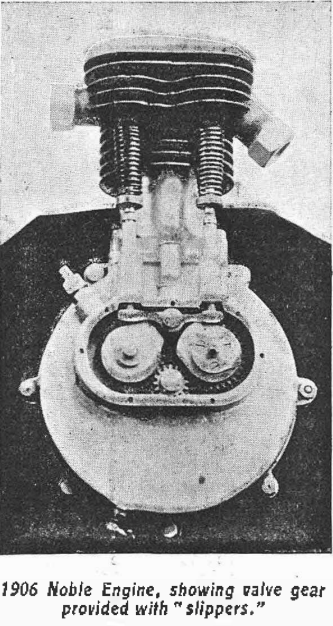
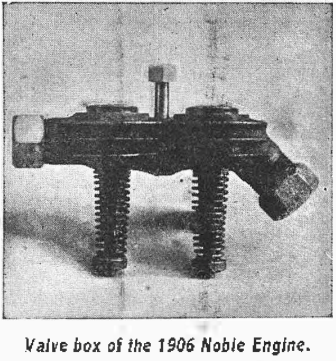
“MESSRS GREENWOOD, OF PORTLAND Place Works, Halifax, have recently brought out a V driving pulley for motorcycle engines, the special feature of which is that it can very quickly be arranged to get a higher or lower gear by detaching a loose screwed flange inserting a brass ring, and then tightening up again by means of a milled nut. To avoid using a jockey pulley the alternative method of having a few spare pieces of belt with fasteners available to lengthen the belt is recommended. Another advantage is that as a belt becomes worn and pulled out thinner the flange of the pulley can be tightened up and the grip of the belt kept as good as ever.”
“I WAS CYCLING ALONG the Croydon Road in the direction of Purley, riding about 15mph on the paved car track (my side, not between the two tracks). An electric car going to Croydon passed me, causing a motorcar (which was evidently overtaking me) to slow down. Immediately the electric car had passed the motorcar dashed up to within quite three inches of my handle-bar, and the driver, who was alone in the car, said: ‘It would serve you right if you were knocked down.’ I had been riding all the way from Croydon on the paved car track and did not see any necessity to leave it and be forced to take the macadam because a motorist overtaking me sounded his hooter and objected to either slow down for a few yards or pass on the near side. There was nothing else ‘practically in sight’ except the electric car going to Croydon. After this had passed the driver of the car had the rest of the road to pass me, which is 42 feet wide, so I told him I should report him to the Automobile Club, and got off my machine to write down the number of his car. Then he stopped and demanded my name and address, which I refused to give him, and he said he should follow me till he got it. I rode to the Purley car terminus (about half a mile), when he rushed in front (on the near side) and told the policeman on point duty to stop me. This was done. On my asking the reason, the driver (who also said he was the owner) of the car replied: ‘Obstructing the highway.’ This remark puts the case in a nutshell. How can a cyclist travelling at 15mph, on his own side, obstruct a 42ft highway with nothing in sight but an electric car going in the opposite direction? I am awaiting his summons, and have also forwarded copies of this letter to the Secretary of the Automobile Club of Great Britain and Ireland and the Editor of ‘Cycling’ with my name attached for publication.
Wynne Penwyn.”
“MICHEL WERNER, INVENTOR and manufacturer of the famous motorcycle which bears his name, died in Paris last week from the effects of a sunstroke he sustained a week previously. The history of the Werner machine would cover a large portion of the entire history of the motorcycle. It was as far back as 1897 that the first Werner motor-bicycle appeared: the motor, which was fitted in front, with the belt rim on the front wheel, gave ¼hp. In the early years of this century the Werner machines gained many triumphs, Rivière being one of the first riders to bring them. into prominence—notably by his victories in the Paris-Bordeaux and Paris-Berlin races in 1901. In1902 the Paris-Vienna race, and in 1903 the Paris-Madrid race fell to Werners. M Werner started life as a lieutenant in the Russian Navy, and for several years experimented with the phonograph and the kinetograph before developing his motorcycle. He was only 46 years old.”

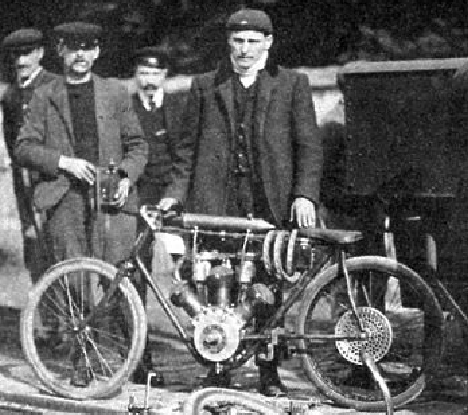
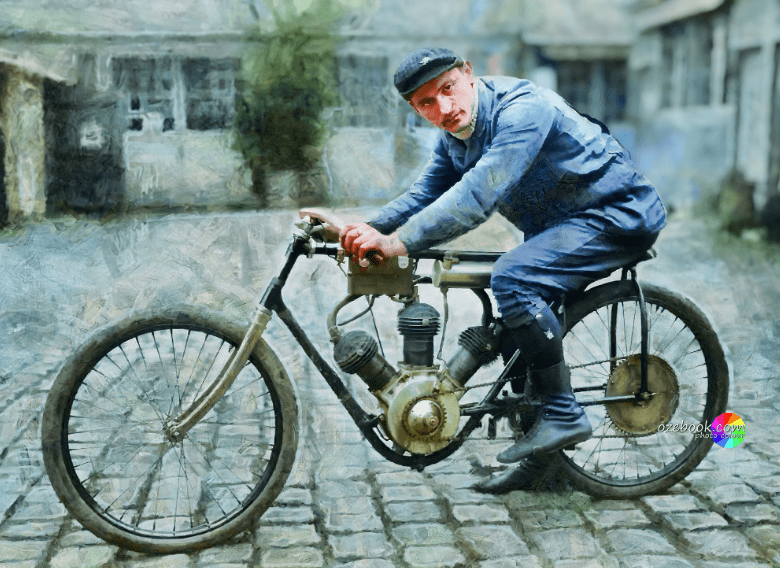
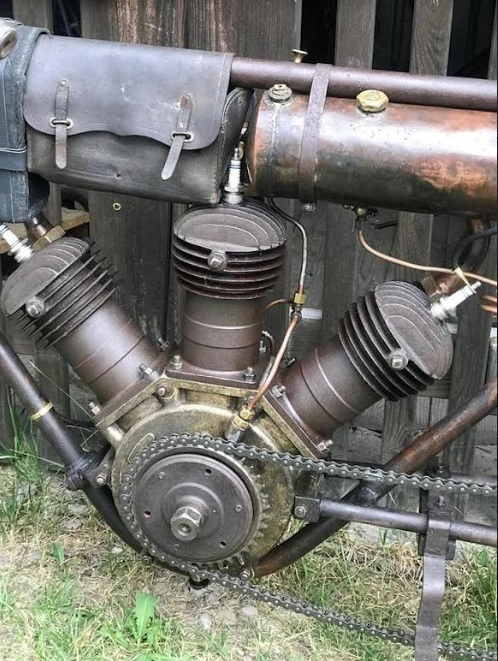
“AT A RECENT MEETING of the Institute of Automobile and Cycle Engineers, Mr Binks discussed the relative advantage of the two-cylinder versus the four-cylinder engine for motor-bicycles, broadly speaking, his views were in favour of the two-cylinder engine as being the best compromise for the motor-bicycle, and that although the four-cylinder engine gives delightfully smooth running, it is so costly and so complicated that the motorcycle builder is scarcely justified in using it. To these views I take exception…If the two-cylinder is compared with the four-cylinder engine running at the same number of revolution per minute, the number of working strokes of the engine will be in the proportion of one to two, hence if the engines are to develop the same power, the work developed in one working stroke of the two-cylinder engine must be double that developed in the four-cylinder engine, this means that the shocks and vibration in the transmission of the power of the engine to the machine must be considerably greater in the two-cylinder engine. Further, it is easier to produce a more perfect balance of the working parts in a four-cylinder than with a two-cylinder engine, and for this reason alone in order to reduce vibration to a minimum it would be justifiable to fit the four-cylinder engine…direct spur or bevel gearing cannot be used satisfactorily with the single or two-cylinder engine, owing to the wear and tear caused by the shocks in the transmission of the power from the motor. To get over these difficulties has been a problem to which the Fabrique Nationale of Liege have been devoting much time and money during the past five years, with the result that they have this season produced a machine which was exhibited at the London, Paris, and Brussels Shows, which was considered not only a novelty, but a remarkable advance in motorcycle construction; briefly, it is a motorcycle with a four-cylinder engine with a bevel gear transmission. Before deciding to place this model on the market, it was subjected to an exhaustive nine months’ trial, M Osmont touring with it on the Continent on all classes of roads for some 3,000 miles, and in four different countries. The cost of the machine compares favourably with other types now on the market, and its weight is considerably below that of many of the now well-known types of motor-bicycles now in use. I think the above reasons show that a satisfactory four-cylinder motor-bicycle can be produced.
WR McTaggart.”
“MUCH HAS BEEN said and written, for and against, the four-cylinder motorcycle. My personal experience, after a few hundred miles’ running and tests on the steepest hill in the country, is that nothing I have ridden compares with this machine for smoothness in running, ease of starting, flexibility of speed and power, hill-climbing capacity, and general excellence. The spur gear works admirably well, the upkeep of the gear drive being practically nil. Comparing the four-cylinder FN with their single-cylinder 2¾hp, I find the latter gets hotter than the former. I have climbed very long and steep hills which I could not tackle with the single-cylinder FN, owing to overheating. I am surprised to find how cool the four-cylinder keeps, and I think this must, to some extent, account for its power on hills ; it feels more like a 5hp than a 3hp when running up a hill. The machine starts the moment you move it, and I find the magneto ignition equally effective at low and high speeds. The absence of vibration I also find most marked. So far, I have not discovered any defect in this machine. For the benefit of would-be purchasers, let me call their attention to what is, I presume, a misprint in the FN booklet, which says that the machine requires 12 charges of oil to start with, and an additional charge every 4½ miles. It should be one charge, or a little over, to start with and another charge every 10 or 12 miles. If the FN instructions as printed are carried out the troubles consequent on over-oiling will at once become manifest.
‘AJ67‘.”
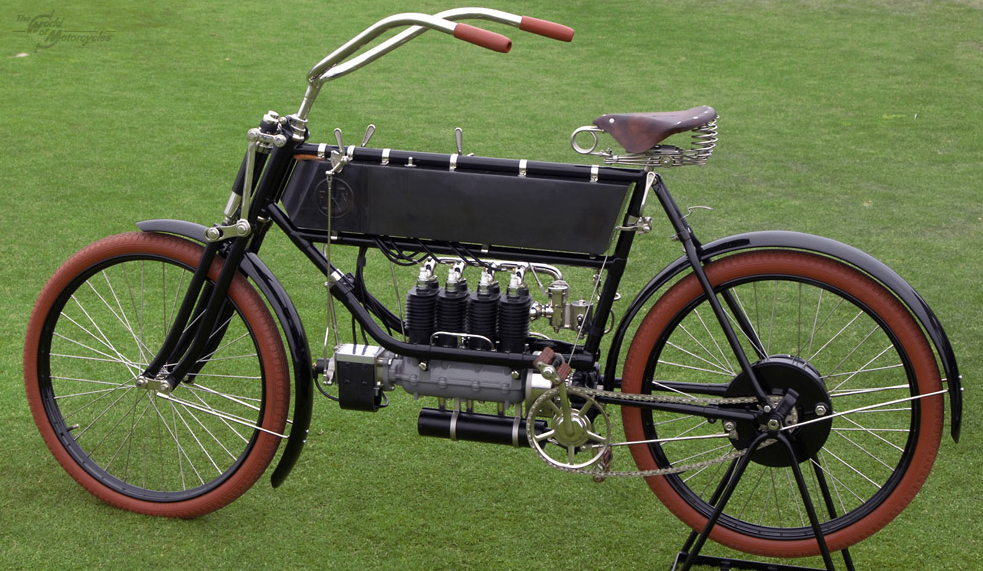
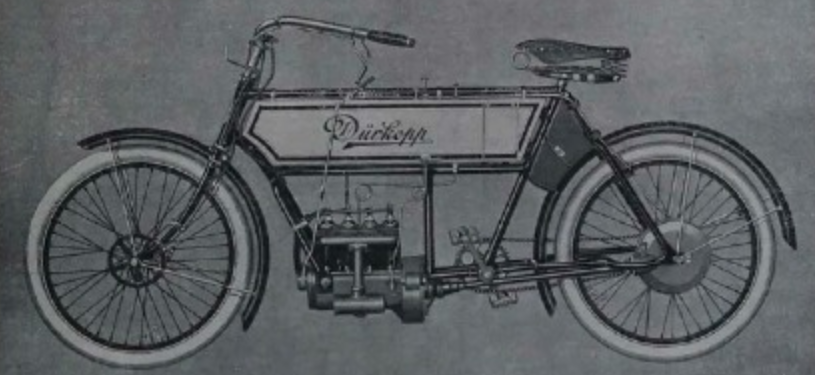
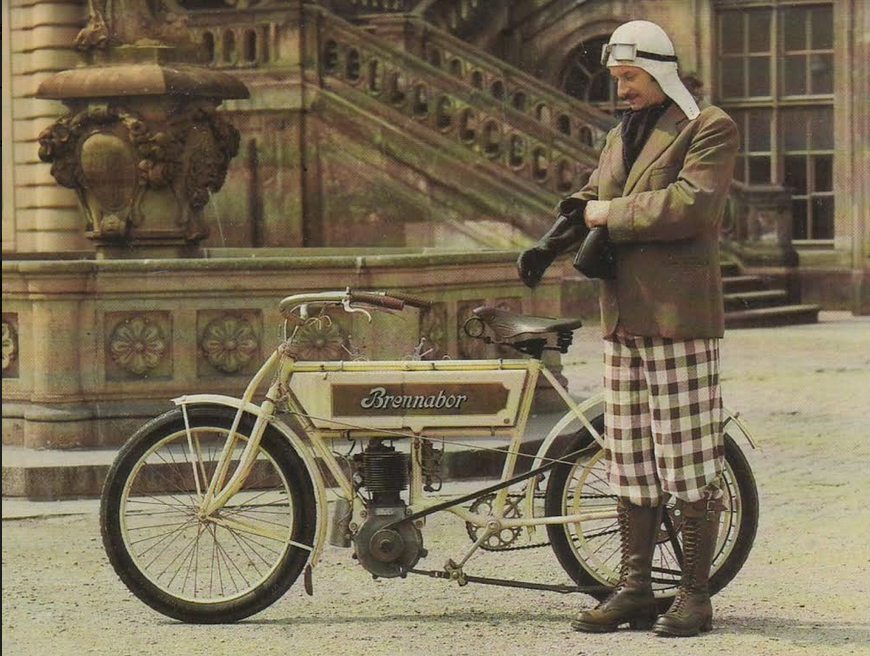
THE DÜRKOPP MOTOR-BICYCLE, which Messrs. Gamage, Holborn, London, EC, have introduced into this country, is a machine embodying the features of first-class workmanship and design, and, with certain interesting novelties added, it calls for the careful consideration of those who are on the look-out for a new mount. It has a vertical engine, made in two sizes, viz., 2½ and 3hp, the dimensions of which are 70x85mm [269cc] and 80x90mm [452cc] respectively. A special feature about this engine is that it runs on ball bearings, which reduces friction losses to a minimum and makes the life of the engine practically unlimited. The inlet valve is mechanically operated. The frame has an extra long wheel base, and there is an extra horizontal tube and a vertical cross stay, which ensures great rigidity. The carburetter is a standard type of spray fed from a tank holding 1½ gallons of spirit. Two powerful band brakes, one to each wheel, and operated from the handle-bar, are fitted. The diameter of the wheels is 26in, and a noteworthy feature is that the belt rim is secured by arms direct to the tyre rim, which, in our opinion, is the correct way of doing it. The handle-bars are brought well back, giving a comfortable position and effective control over the steering. Transmission is by V-belt, the long frame and forward position of the engine giving the advantage of a long drive. With regard to the ignition, either coil and accumulator or magneto combined with the coil system can be had at option. The magneto system adopted on the Durkopp is a remarkably ingenious one, quite different to any other system. Firstly, the puzzle is where is the dynamo? The explanation is that it is made as part of the internal mechanism of the engine. Although we have not got the exact technical details of the arrangement, it is doubtless on the following lines: The fly-wheels carry magnets, which, as they rotate, induce a current in two fixed armatures in the crank case. The low-tension current thus obtained passes into an induction coil fixed in a compartment of the tank case, and thence to the spark-plug of the engine. The engine speed can be controlled by a spark advance lever. The size of tyre fitted may be 2, 2¼, or 2½in, at option. The front forks are of great strength.”
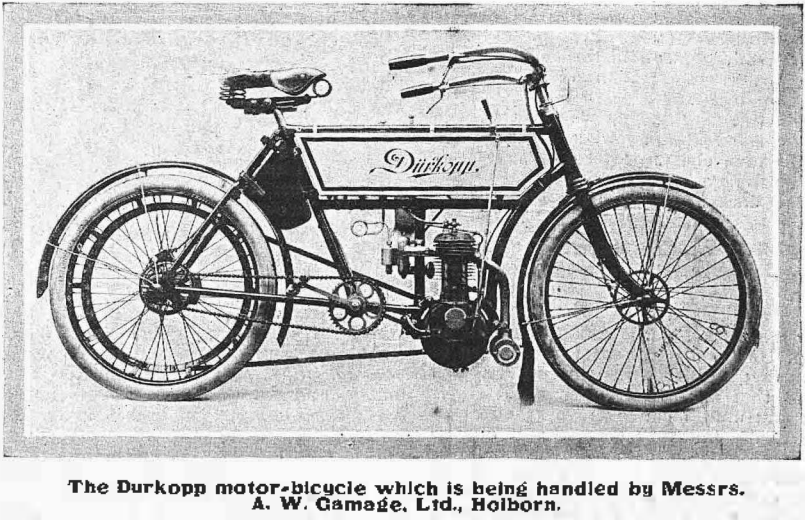
THE AUTOFAUTEIL DEBUTED with small wheels, an enclosed (427cc) engine mounted below the ‘fauteil’ (armchair) and an open frame – in essence the ancestor of the motor scooter.
SWISS ENGINEER ALFRED BÜCHI patented a “highly supercharged compound engine” incorporating an “axial compressor, radial piston engine and axial turbine on a common shaft”.Thepump was tyo be driven by exgaust gas so this marks the birth of the turbocharger. The idea of precompressing the air suppliedf to an engine was as old as the combustion engine—Gotleib Daimler had a go in 1885, as did Rudolf Diesel in 1896. Judging by Büchi’s drawings it would have worked too, but he was ahead of his time; superchargers would have to wait for the right fuel and materials.
“AUTO-CYCLE CLUB’S RACE MEETING AT THE CRYSTAL PALACE. The track race meeting promoted by the ruling body of motorcycling on Saturday was worked off smartly to time, and would have been finished earlier than was the case but for considerations of courtesy to the French visitor, René Thomas, to enable him to change saddle and induction coil prior to the last event on the programme. A keen wind blew across the ground, otherwise no grumble was possible against the weather, even the sun deigning to shine at intervals. Immediately after 2 o’clock E Varney was sent off alone for a trial against the watch in a flying start mile for machines with capacity not-exceeding 76x76mm and under 1701b weight. Eight men competed, with the following results: 1st, HV Colver, Matchless, 76x76mm, time 1min 11sec (gold medal); 2nd, W Hodgkinson, JAP, 85x60mm, 1min. 12⅖sec (silver medal); 3rd, WW Genn, Minerva, 76x76mm, 1min 15sec (bronze medal); CR Collier, Matchless, 76x76mm, 1min 17⅖sec (Collier won last year in 1min 15sec); E Varney, Crownfield, 76x76mm, 1min 17⅘sec; C Read, N Century, 76x76mm, 1min. 21⅖sec. J Perkins gave up as his engine was misfiring, and René Thomas also gave up at two laps for no particular reason, as his machine was going well. The second event was a five miles handicap for machines 76x76mm, not exceeding 170lb weight. Eleven starters were divided in three heats…In the final heat the starters were: Thomas, scratch, CR Collier, scratch, W Hodgkinson, 7sec, WW Genn, 7sec. Hodgkinson at once went to the front running clean away from Collier, finishing the distance half a lap ahead of the field. 1st, W Hodgkinson, JAP, 6min 9⅗sec; 2nd, René Thomas, Alcyon, 6min. 21⅕sec; 3rd, Genn, Minerva, 6min. 37⅘sec. Ten men lined up for the one hour race, engines being limited to 70x70mm., total weight of machines not to exceed 1141b. The race may be described shortly as Eclipse first and the rest nowhere, as the moment the first lap was completed, with WW Genn leading, René Thomas secured the lead, and, covering mile after mile with the utmost regularity, simply made hacks of the other riders. Crundall was lapped at 8¾ miles, the rest of the crowd having been thus served a mile previously. At 10¼ miles the competitors, except Crundall, were lapped for a second time. 1st, René Thomas, Alcyon, 45 miles 146 yards; 2nd, JF Crundall, Humber, 41 miles 1,376 yards; H. V. Colver, Matchless, 40 miles, 400 yards; 4th, E Varney, Crownfield, 40 miles 146 yards; 5th, E Hunt, Swallow, 33 miles 1,475 yards. During the afternoon GA Barnes gave an exhibition ride, covering one mile in 1min 8⅘sec, and two miles in 2min 18⅕sec.”
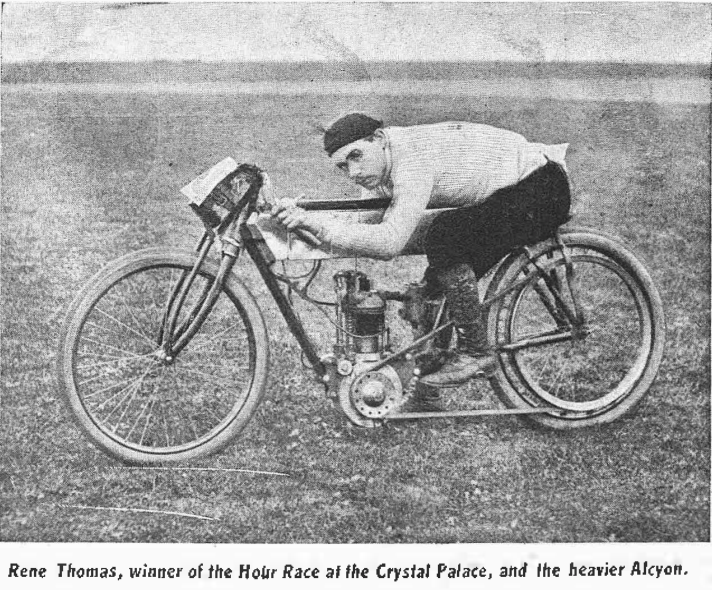
“A NEW MOTORCYCLE BELT. A novelty in belt construction has recently been patented by E Pilkington, Osborne Road, Earlsdon, Coventry. The object the patentee had in view was to obtain effective grip of the pulley with maximum amount of flexibility. This is achieved by using a single strip of Balata canvas belting, and riveting to the underside, small tongues of leather overlapping each other. When running over the pulleys these small tongues of leather are automatically closed up, forming for the time they are in contact with the pulley practically a solid V-section belt. The inventors claim that the belt has given excellent results in practice, and can be turned out at a cheaper rate than ordinary belting.”
“GLASGOW MOTORCYCLE CLUB. The second and final hill-climbing contest promoted by the above club for this season was carried out on the Lennoxtown-Fintry Road on Saturday, September 30th. The course was about a mile and a half in length, with an average gradient of 1 in 15, and a maximum in places of 1 in 8. The contest was decided on the formula under which the gross weight of machine and rider is divided by the cylinder capacity, multiplied by the time. It is noteworthy that the Clement-Garrard was the only machine fitted with a two-speed gear. The winner, Wm Hutchison, 1¾hp Clement-Garrard) is awarded a gold medal.”
“THE MCC HELD THE ‘ALBERT BROWN’ TROPHY non-stop trial on Saturday last. This being practically the closing event of the season, it drew a large entry from amongst the club members, and in every way proved most successful. There were 18 starters. This trial differs from all the others held by the MCC, inasmuch as it is a necessary condition that competitors’ machines must be British made, even to the smallest detail. The use of a foreign make of sparking-plug, for instance, would render the machine ineligible to compete…The distance was 150 miles, run off in two stages, one of 100 miles and the other of 50 miles. The route selected was a stretch of the London-Coventry road between Redbourn and Braunston. The headquarters were at the Bull Hotel. The start was at 6am, the morning being very cold but fine, and the roads in excellent condition. The first 100 miles took till about 12 o’clock to run off…Miss Muriel Hind (Singer tricar) was compelled to stop when near Redbourn due to a carburation failure, caused by water in the petrol tank. After lunch the final stage was run off, [retirements leaving] 12 competitors. A further series of tests was carried out immediately on the conclusion of 150 miles. These comprised a hill-climb, a speed test, and a brake test. The hili selected was close to Redbourn village, and its severe gradient came as a surprise to most of the competitors. It is about 500 yards of 1 in 9, with a series of awkward turns. The rules of the contest did not admit of pedalling, and, as a consequence, some of the lower-powered machines, through having too high a gear, failed to get up…The short-distance speed trial and brake test, in which competitors who overshot the tape were penalised, created much interest, some of the competitors, in their1 anxiety not to go past the tape switching off their engine at half distance, thus losing on the speed test. RM Brice (Brown) distinguished himself by good judgment, getting up a very good pace and only overshooting the tape by 12 feet. Miss Hind went very well, but the impetus of her car took it 60 feet past the tape. EW Ashworth (Lagonda) and Riley went slow, but stopped dead on the tape. [A tie-break] determined the winner to be Brice, with Ashworth a good second, and J Platt-Betts (Rover) third…Miss Hind, in consideration of her excellent performance on the Singer tri-car, will be awarded a special certificate. As a lady rider she showed remarkable physical endurance in staying the 150 miles, besides good nerve and judgment. Brice was congratulated on his victory, which must also further enhance the already splendid reputation for sound construction and ample power which the Brown machine possesses. It was somewhat hard on Lowe, Penzer and Booth that they should be disqualified for failing to mount the test hill. As they were mounted on 2½hp machines, geared about 1 to 4, it is no discredit whatever that they failed. With a 1 to 5 gear they would have had an excellent chance of reaching the top. SE Pemberton (Singer) was decidedly unfortunate, after doing the 150 miles in good style, in not being able to get a start up the hill owing to the failure of his magneto.”
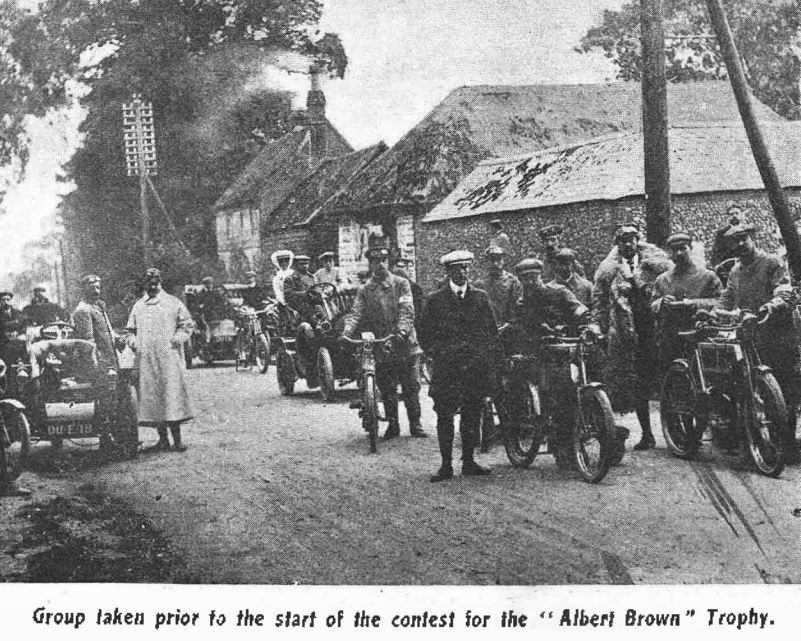

“‘ALBERT BROWN’ TROPHY. Mr FM Penzer writes as follows: ‘As one of the competitors in the above event, and in the interests of fair play, I shall be extremely obliged if you will allow me through your columns to give vent to a grievance which is not only a personal one, but one which has been equally felt and commented upon by other competitors. In the rules sent to members in connection with above, there is no mention whatever that in the event of several being left in the running no pedalling would be allowed upon the test hill. The result was that myself, with others, naturally thought we stood an equal chance with more powerful machines, and I entered my 2½hp Ariel Lightweight. The placing of the judges, in awarding the cup to the competitor who climbed the hill without pedalling, simply means that the competition resolved itself into a hill-climbing test more than a reliability trial. Had I known that the conditions would be altered at the last moment, I, personally, should have been saved the trouble of riding in the trials and to and from Birmingham—a distance, all told, of some 350 miles.”
“The DOURDAN SPEED TRIALS meeting, which for two years has filled an important position in the French racing programme, is not now attracting the entries of the big racing cars, but for Sunday’s meeting there was not at all a bad entry in the motorcycle classes…The light-weight motorcycle class was contested by three Peugeots (Cissac, Champoiseau and Giuppone riding) and the heavy-weight motor cycle class by two Peugeots (Cissac and Giuppone), and the Buchet which Anzani was riding. The latter had a three-cylinder engine…Thera were nine competitors in the class for motorcycles having engines of a third of a litre cylinder capacity, namely, three Peugeots, three Quentins, two Buchets, and a Chanon.”
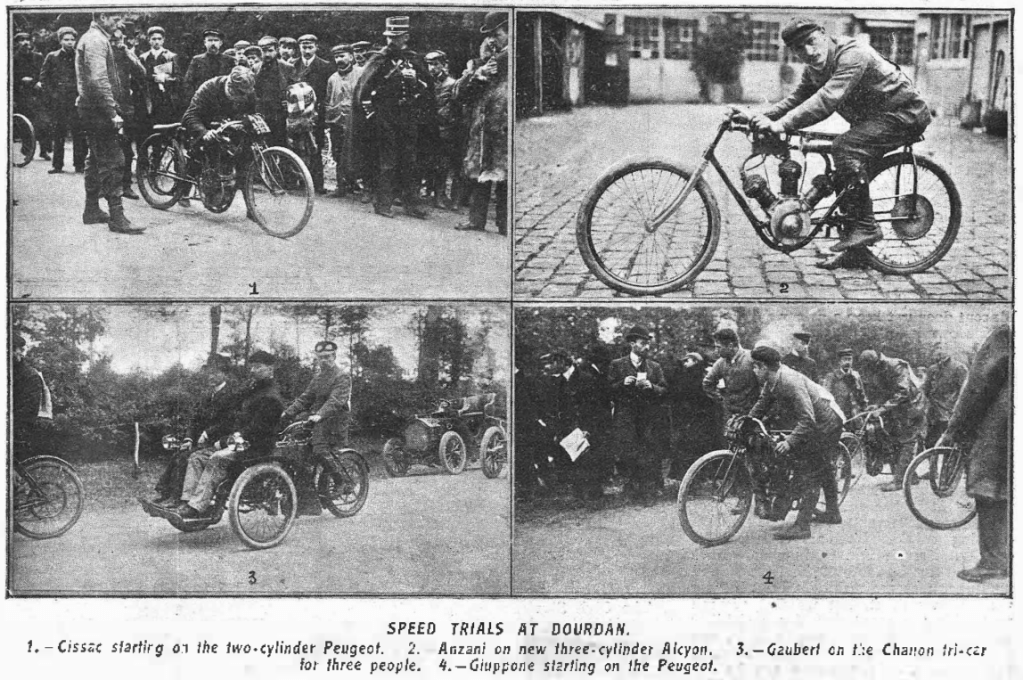
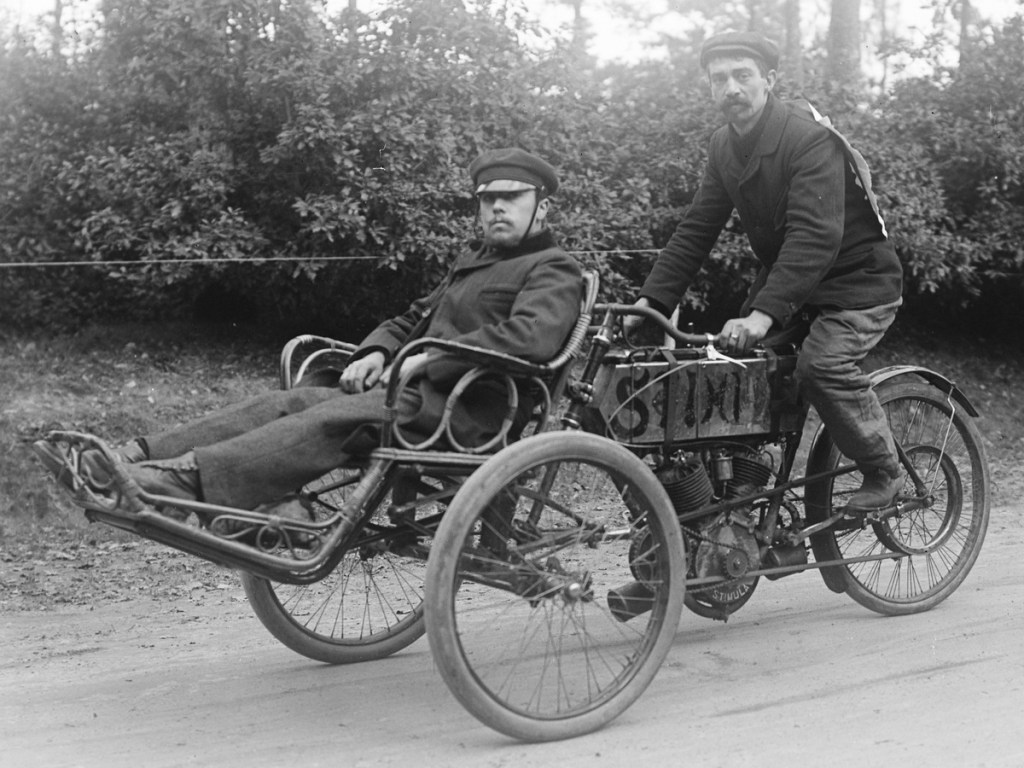
“ENGLAND AND THE INTERNATIONAL Motorcycle Cup. A rumour has gained currency to the effect that the committee of the AutoCycle Club has decided not to enter for the International Auto-cycle Cup race next year. This is quite inaccurate, as no decision has yet been come to. The club has, however, sounded the other countries on the possibility of confining the race to a more useful type of machine, and the Austrian Club is apparently of the same opinion, for it has asked the Auto-Cycle Club for its support to one of two proposals which will be laid before the next congress in Paris in December. The alternative proposals of the Austrian Club are that each machine should be weighed without tyres, the rest of the machine (without- oil, water, petrol, or batteries) not to exceed 47kg (101lb); and that only the motor and ignition apparatus be subject to a maximum weight…The Auto-Cycle Club intends to support any proposal that shall have for its objects the strengthening of the frame and other parts of the machines in the next race.”

“AS WE HAVE already reported in these columns, the outcome of the recent race in France for the International Auto-Cycle Cup, and the correspondence initiated by the English and German Auto-Cycle Clubs upon the matter of the nail-strewn course, was the establishment of a congress in Paris on December 21st and 22nd. At this meeting the Auto-Cycle Club of England was represented by Messrs M O’Gorman and J Pennell, and as a consequence of the discussion the Federation Internationale des Club Motocyclistes has been established…At the suggestion of the Auto-Cycle Club a meeting of the delegates of the International Auto-Cycle Club was called in Paris…This meeting decided that it represented the Auto-Cycle Clubs of Europe, and that as the representatives were empowered to decide upon the main purpose of the agenda (the business of an International Federation of Auto-Cycle Clubs), such a Federation should be formed. Those present or represented were Great. Britain, France, Austria, Denmark, Germany and Belgium…it was resolved that the Congress should recognise only one ACC from each country…The annual subscription for membership to the Commission was named at not exceeding 500 francs. The six countries together would produce 3,000 francs, of which it is suggested that about one-half may be expended on the salary of a secretary. The new body is to be called the ‘FICM’ (Federation Internationale des Clubs Motocyclistes)…The various matters which were recommended by the ACC Committee to discuss were: Touring (unification of riding permits); facilities for passing frontiers. Racing: To get the various countries to adopt our system of licensing riders; to recognise licenses issued and confirmed by other countries; to recognise each other’s suspensions; to suggest that the fitting and use of pedals in the International Cup race be optional…the English Club were asked to obtain information as to the exact position of a foreigner arriving in England with a foreign number, (a) stating what permit or license he must obtain to drive a motorcycle, (b) whether he is bound to obtain ah English number, or whether his foreign number will be recognised at all, etc, etc…With respect to France, the Motocycle Club is only empowered to deal with riders on roads, track: riding in France, whether for motor or other cycles, is in the control of the Union Velocipede de France. This body will therefore be separately approached by the Auto-Cycle Club…The question of abolishing compulsory pedals was discussed, and it was considered that this merely amounted to increasing the amount of weight available for the engine, and was departing from the usual useful ‘touring-machine’ type. Further, the police would not authorise the race unless the pedals were fitted and could be used to propel the machines in controls. It was agreed that the pedals, however, might be as light as the makers liked, and that, provided the riders kept behind the pedal cyclists in the controls, the driving of the auto-cycle by pedals only would not be enforced; but a rider must both start and finish with pedals capable of transmitting power enough to drive the road wheels along. It was agreed that the definition of an auto-cycle should be an automobile weighing less than 250kg (without any restriction as to number of wheels, use of pedals, etc)…The most elaborate precautions as to nails on the course will be taken this year. The course will be guarded by the military—swept the eve of the race—guarded all night by one cyclist and one policeman patrolling every kilometre.”
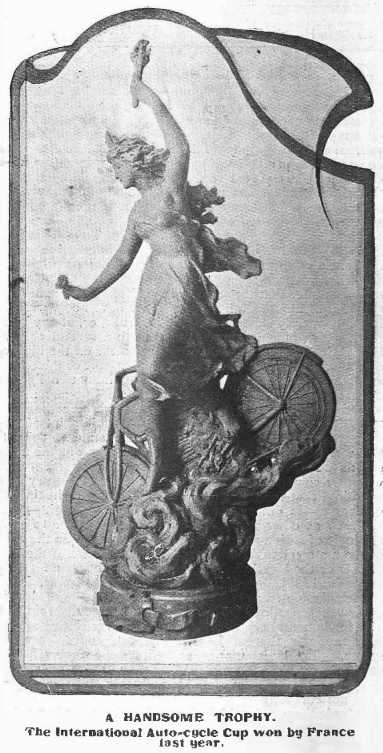
“THE UNDOUBTED SUCCESS of the Tarmac surface upon the straightaway mile course at Brighton has brought into prominence the merits of the remarkable substance used in the construction of the now famous speedway. The really extraordinary results to be obtained by its use upon all sorts of highways have been appreciated by but very few people, and, strange to say, least of all by those whose business it is to care for our road surfaces—we refer to the highway surveyors employed by the various county, borough, district, and urban councils. There are two or three outstanding exceptions, and it has been left to these gentlemen to prove conclusively that dust is not due to motorcars running at legal speed, but to the faulty road construction upon which they have to be placed. It would be strange, indeed, if a track laid solely with the object of securing reliable records for racing cars, travelling at 95mph, should prove in the end to have focussed public attention upon the most pressing need of the 20th century—viz, nationalisation of the main roads of Great Britain…Foremost amongst the scientific highway surveyors must be placed Mr E Purnell Hooley, surveyor to the county of Nottingham, and it is to his investigations that the now far-reaching movement for dustless roads owes its inception.”
“AFTER TEN YEARS. History is made very rapidly nowadays, but rarely, we should think, has history been made so quickly as in the case of the motorcar. When we survey the present position of automobilism it hardly seems possible that it was only ten years ago that Sir David Salomons proved the practical utility of motorcars by organising a show and demonstration at Tunbridge Wells. On that occasion six vehicles were exhibited on the Agricultural Show ground, and Sir David himself drove a Peugeot vis-à-vis car to display the ease with which it could be controlled. At the time we wrote of the event as follows: ‘We are firmly convinced that the future is big with the promise of a startling revolution in road locomotion—a revolution which finds its parallel just over 70 years ago, when, on September 27th, 1825, George Stephenson proved the practical utility of the steam locomotive. Sir David Salomons has, in 1895, proved the practical use of road motors, and future generations will look back upon the event of last week at Tunbridge Wells as an epoch in the history of road locomotion.’ It will be seen that we were sanguine enough then, but even we would not have attempted to forecast that progress would have been as rapid and as startling, as it has turned out to be. Ten years only have elapsed since the foregoing words were penned by the present writer, and in spite of the most persistent prejudice, in spite of the ingrained conservatism of the Britisher, the motor vehicle is the commonest object in our streets and on the country roads, and the motor industry is rapidly becoming one of the greatest in the country.”
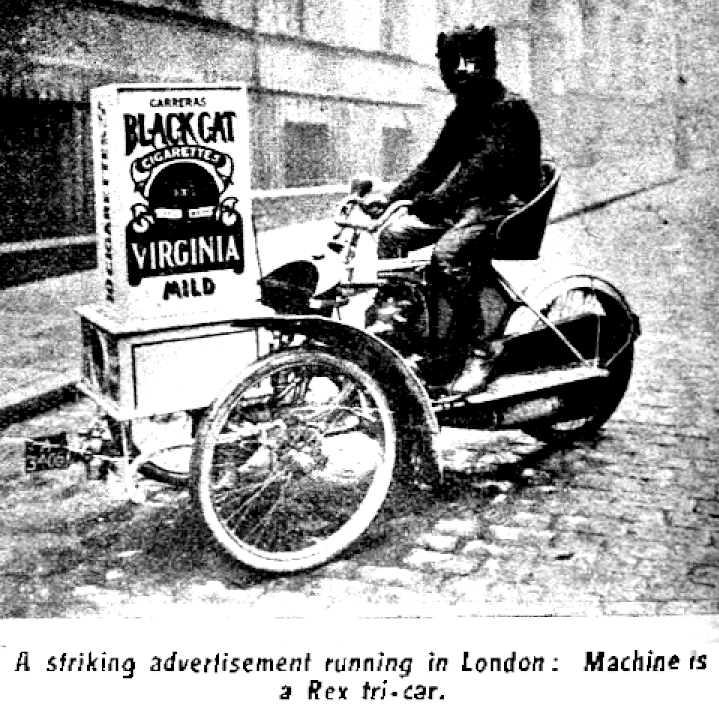
“THE BLACKPOOL MEETING…should in the ordinary course of events prove the death-knell of motorcar racing as it is managed in this country, for of all the slow, unexciting programmes, that decided on Thursday was the worst possible example. Waits of about fifteen or twenty minutes were the order of the day, and the time that was frittered away in the starting of the events seemed interminable to those condemned to wait drearily whilst nothing was happening at the finishing end, where the grand stand had been erected. Certain it is that sport-lovers will not waste their time to see an occasional car come through in all the tameness of a walkover…The only motorcyclist figuring on the day’s programme was Cissac, who was to make three attempts on the world’s records for the flying mile and the kilometre. The first attempt was started from the mile line, the standing mile being essayed instead with flying start. Three times did Cissac run off from the line, but on each attempt the engine did not at once pick up, and he returned to the line, probably on account of the breeze that was rising. The spectators seemed to become impatient at this third failure, but their complaints changed to a murmur of astonishment when, like a shot from a gun Cissac got away on his fourth attempt, reaching full speed in a hundred yards. The time for the mile was announced as 54⅘sec (65.69mph) and for the kilometre 27⅗sec (80.04mph). Cissac thought that the wind troubled him in getting off, and on his second attempt later in the day tried the course from the other end. This time he had better luck, and broke all three world’s records, doing the standing mile in 50⅕sec (71.71mph); the standing kilometre in 35sec (63.91mph); and flying kilometre in 25⅗sec (87.37mph)—not a bad minute’s work.”
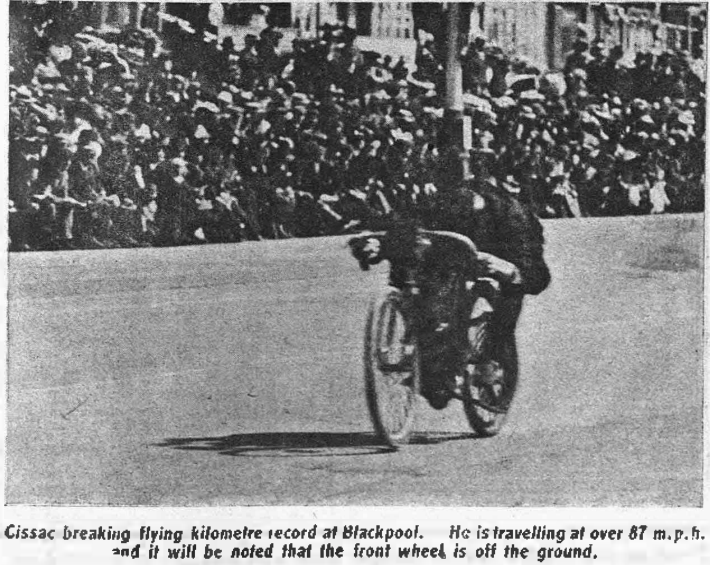
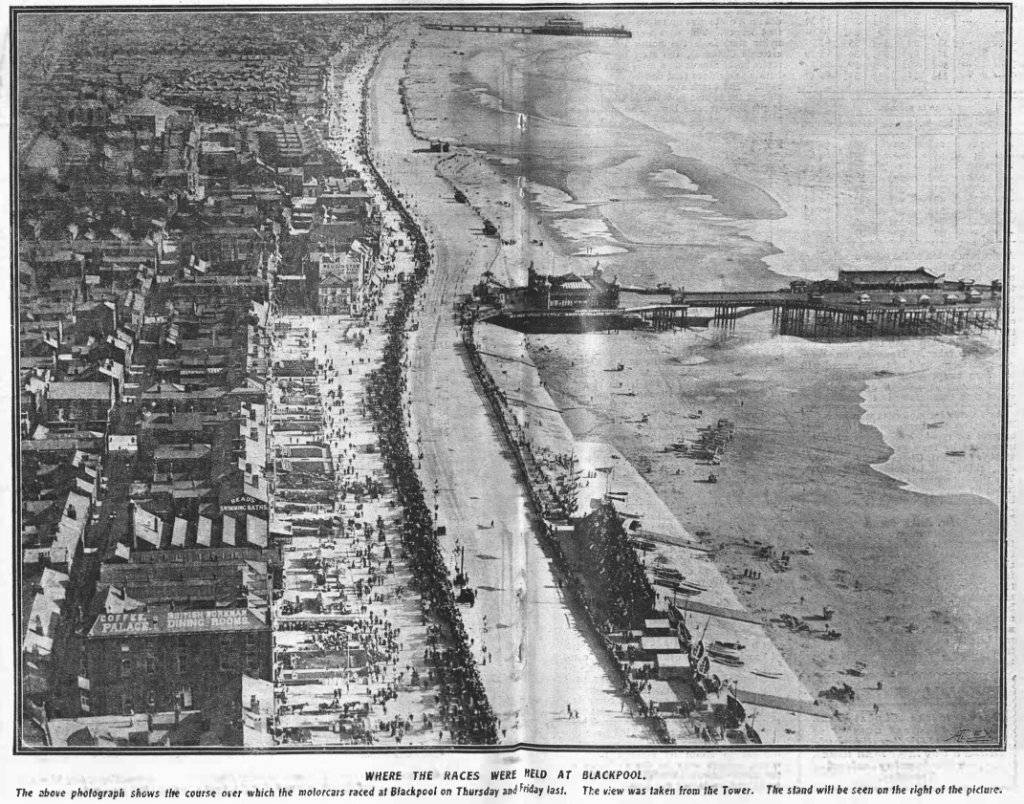
THE FIRST SPEEDING FINE ISSUED in Western Australia resulted from speed limits drawn up by Perth City Council only weeks before: 4mph at crossroads, 10mph on three nominated streets and 15mph elsewhere. Arthur Spalding, the charge alleged, had “furiously ridden a motor-bicycle”; he was fined 18 bob with 2d costs.
THE LAUNCESTON MC was set up in Tasmania and it’s still going strong today—it controlled motor cycle sport on the island until the ACU of Tasmania took over in 1958.
“THE OFFICIALS OF THE Motor Cycling Club are to be congratulated on the admirable arrangements for carrying through the successful twenty-four hours’ trial which, starting at 8.15pm on Friday last, finished at the same hour on Saturday. Six courses were mapped out like a rough star. Each of the arms of the star was exactly 18 miles from the start, or a total of 36 miles out and home, and each arm was ridden over twice in succession…The splendid muster of 16 machines lined up at the start of the first twenty-four hours’ trial ever held under the stringent conditions imposed…To run dead to a schedule of 18mph for twenty-four hours on end, with only a possible margin of five minutes per hour, was far more difficult of accomplishment than it looked on paper, and a few of the more pessimistic declared their conviction that twelve hours would see the retirement of all the competitors…As the last few minutes approached everyone streamed out into the roadway, and the hitherto chattering crowd became as hushed as if the fate of nations depended upon the result. Three strangers’ machines coming down the slope caused the folks to open out, but at last our patience was rewarded as 16 and 12 drove in abreast, followed within a few seconds by 18 and 15. A hearty cheer greeted their arrival, and Woodman (3½hp Vindec Special), Baddeley (3½hp Baddeley), and Brice (3½hp Brown) were warmly congratulated upon having tied for first place. At the call of time no one else had arrived. Ashworth (5hp two cylinder Minerva), who was in the running, had punctured on the return from Royston, and, trusting to luck, had ridden on a flat rear tyre and split the rim; Gunn 10hp two-cylinder Lagonda tri-car) broke a chain link at Baldock, Bellinger (2hp Quadrant) again had tyre troubles, and Sproston (3½hp Vindec Special), as above noted, came in with the winners. A special committee meeting will be held to decide the manner in which the tie will be concluded.”
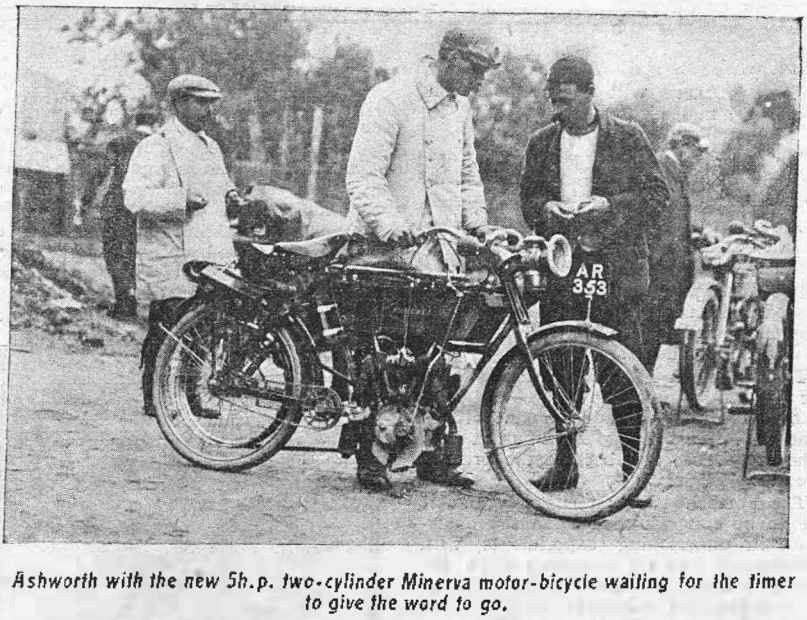
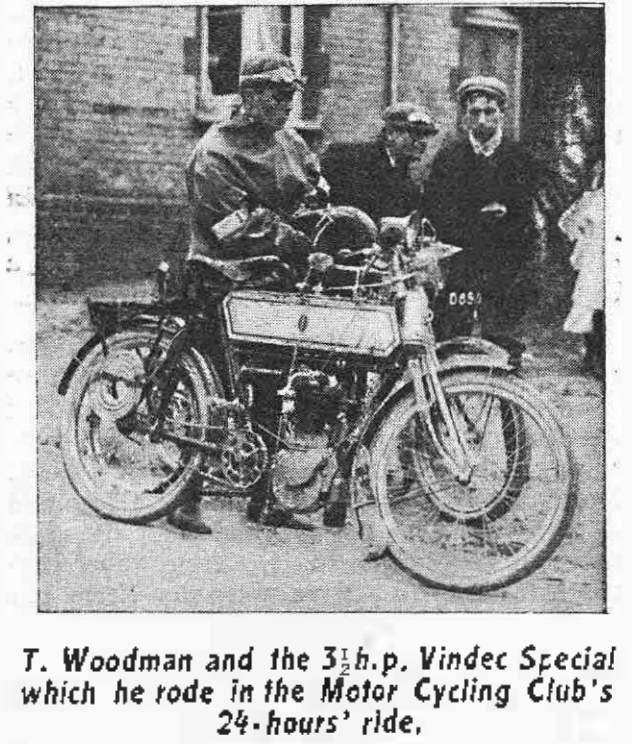

“THE REX ‘SOCIABLE’. Two Rex motor-bicycles (3hp and 3¼hp) [have been] coupled together by their owners, the idea being to counteract side-slip in greasy weather and to promote sociability. ‘The combination,’ says Mr R Walker, one of the ‘twins’, ‘works excellently, and gives us ample power for a large amount of luggage, spares, etc.’ The couplings are sufficiently stout to bear any strain. The ‘earth’ wires are arranged on the same circuit, so that either ‘twin’ can stop at will. Either machine is capable of pulling the other alone. The name of the other ‘twin’ is Mr P Pilling.”
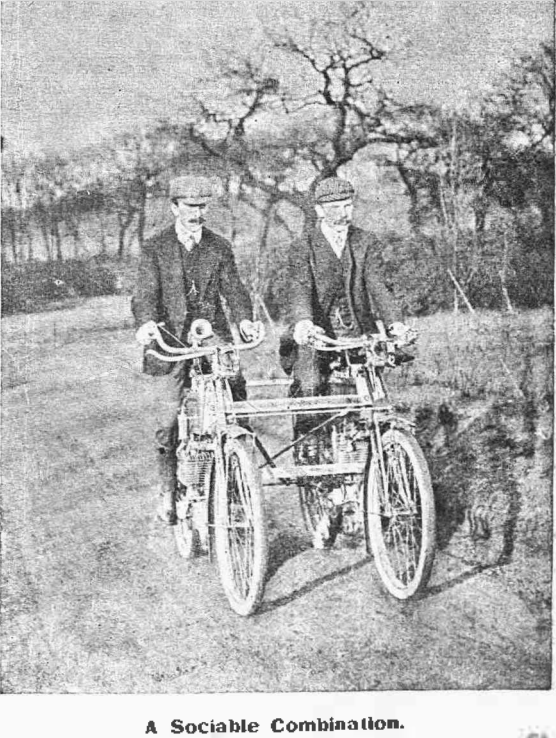
ROYAL ENFIELD ADOPTED the P&M two-speed set-up; Werner used a similar system with a rocking footchange.
HUMBER CEASED motor cycle production to concentrate on cars—but they’ll be back.
“THE DEFENDANT, ON THE OCCASION for which he was summoned, was riding a four-cylinder bicycle, which ‘gave bangs much more frequently than the ordinary cycle which had only one cylinder.’ Consequently it gave the impression of terrific speed while going at the same rate as the ordinary motor cycle. ‘Colonel Rowan Hamilton, JP— “I should get rid of that machine if I had it.” ‘Mr Devaynes Smith, JP—”Or alter it into a one-bang machine.”‘—From the report of the hearing of a speed-limit case in an Irish court.”
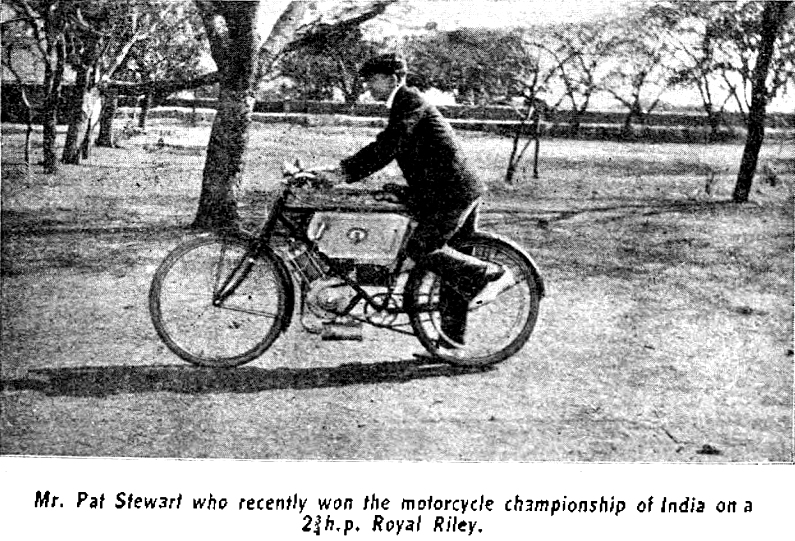
“KINGSTON MAGISTRATE: ‘WHAT DO you calL a police trap?’ Defendant: ‘A trap set by the police to catch motorists.’ Magistrate: ‘Then it is a motor trap. A trap set to catch rats is a rat-trap. This is not a police trap, because it is not used to catch the police. It is a motor trap.’ As the magistrate in question attempts to split hairs, we should like to point out that even ‘motor trap’ is not correct; it is the motorists who are trapped, not the motors.”
William C Chadeayne, Captain of the Buffalo Motorcycle Club and a director of the Thomas Auto-Bi Company, rode one of the company’s bikes across the United States. It was only the second coast-to-coast run; the first man to do it was George Wyman in 1903—you can read the full story of Wyman’s run in the 1903 Features section. Here’s Chadeayne’s story, courtesy of The Bicycling World and Motorcycle Review…

“‘SAN FRANCISCO, OCT 30 (BY WIRE)—Chadeayne reached here at 9 o’clock this morning. He was ‘all in’ physically, but is otherwise all right.’ This message reporting the completion of WC Chadeayne’s ride across the continent on a 3 horsepower [440cc] Thomas motor bicycle marks the successful consummation of one of the pluckiest and most enduring performances in the annals of any sport. After he reached Cheyenne, Wyo, and sent back the message, ‘I’m no quitter and will reach ‘Frisco if it takes all winter’, few doubted but that he would keep his word. He had been snowbound for two days at the time—October 16—and it seemed as if the task he had set for himself might prove an all winter one. There then remained but a ghost of a chance of his being able to reach his destination inside of George A Wyman’s record of forty-eight and a half days. He was then thirty-six days out from New York, was more than 1,200) miles distant from San Francisco, and the roads were deep with snow and the Rockies and the Sierras and two deserts were ahead of him. All but hope and Chadeayne’s pluck had fled. Slender as was the chance, he accepted it, and by daring and desperate riding by night and by day, he reached his goal. He beat Wyman’s record by slightly less than a day. Chadeayne left New York September 13 at 9:25am and reached San Francisco October 30, at 9am. He thus completed the journey from ocean to ocean in 47 calendar days, 11 hours and 35 minutes, which takes into consideration the three hours’ difference between Eastern and Western time. After leaving Cheyenne, Chadeayne practically had not a night’s rest. Fired by ambition and determination not to fail, he little more than snatched an occasional few hours’ sleep. He reached the backbone of the continent, the Great Divide, at the tiptop of the Rockies, at midnight, and in darkness treaded his way up hill and down over the rocks and sand, over strange and lonely roads and bone racking railroad ties. It is not strange that ultimately in the early morning, near Ogden, Utah, he plunged over an embankment. He was knocked insensible and his machine was almost wrecked. If ever man had vailed excuse for quitting, Chadeayne had it at that time. But he had no thought of anything of the sort. When he regained his wits he straightened out the wreck as best he could and pressed on. He reached and left Ogden, some 900 miles from ‘Frisco, on October 23, and covered that distance, which includes a desert and the Sierra range, in a little 1.9 than seven days, and nights, for the last mail advices from him reported his arrival at Reno, Nev, at 7pm on October 28, after covering 175 miles in the preceding twenty-four hours. ‘Rode between the rails most of the way,’ he adds, ‘roads being too sandy. Am riding night and day, in a desperate effort to get in on time. Am ‘all in’ here, but will not rest till I reach ‘Frisco.’ Previous to the receipt of this postal he had sketched his strenuous ride from Cheyenne to Ogden in the following semi-personal letter dated at Ogden, October 23: ‘Arrived here this morning at 5am. Talk about hell! I am getting it. Am making a desperate effort to get there on time. I am pretty much on the bum—that is, bunged up. Have lost plenty of hide in last few days and am black and blue in numerous places. But I will get there if there is a ghost a show. You will find I am no quitter and will be them somewhere near the time. The plains and deserts were the ‘worst ever’. Thought I had some sand farther east, but all those roads were dreams compared with them Western roads—mile after mile of sand, sage brush and alkali. My lips crack so they bleed, my throat and tongue are inflamed and swollen and the thirst cannot be quenched by drinking from the canteen which I fill whenever opportunity offers. The ranches and people are few and far between, twenty or thirty miles in some cases, and it makes one long to be back in God’s country. I cover. over 200 miles of desert country and am mighty thankful to have a short breathing spell, for I will get more of it after leaving Ogden. Found the railroad track well ballasted, and covered many miles on it bumping ties. At Cheyenne I improved my time while having to wait there on account of snow by overhauling the machine and working on a rail attachment which proved a failure. Had a pretty hard time of it the first day after leaving Cheyenne. Had a clear cold day, but could not get away
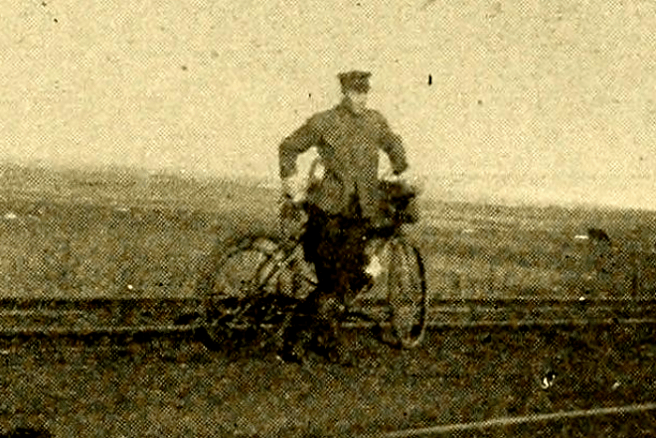
before afternoon. I started my climb of Sherman Hill, thirty-three miles long and going up to an altitude of somewhere around 11,000 feet. Toward evening it got very cold and I was making poor time of it over the road on account of snow, so took to the railroad and about 12am passed over the great continental divide. From there it was all down hill to Laramie, where I arrived about 2am, covering about fifty-seven miles. The next day I went over the desert to Rawlins; the day after that Green River, and the next day to Evanston. Have been taking advantage of moonlight to make up mileage at night. It was 11am when I pulled into Evanston, and after resting a bit left for Ogden, seventy-six miles away, fully expecting to reach there in good time Sunday afternoon. I found the roads in pretty good shape for this country, and after climbing for fourteen miles started on a down grade through Weaver Canyon. I had more than the usual number of spills and much hard luck. Thirty miles from Ogden I was making good time down a hill with a turn; at the bottom I slowed up some, but did not expect to run into snow and gumbo, and so lost control of the machine and pitched over a 20- or 30-foot embankment. When I came to two men and a woman were carrying me up to the road. I did not care about myself, as no bones were broken, and beyond a bad shaking up and a few scrapes and bruises I was all right—must have struck my head on a rock on the way down, for it was pretty, sore in places. What worried me most was the condition of the machine—it appeared a wreck as it lay there, but I managed to get it to a ranch some distance away, where I went at it with crowbar, large wrenches and hammer. It was long after dark when I finally got it in shape, so the wheels would revolve. I bumped over the rocky road for a while, but after two spills took to the railroad, which I followed in the dark to Echo, twenty-four miles from Ogden. I was determined to reach Ogden that night, and waited till after 2am for the moon, and finally reached Ogden at 5am. Was up and working on machine at 7:30. Expect to leave in morning.’San Francisco, Nov 3—WC Chadeayne, the cross-continent motorcyclist who reached here on Tuesday morning, 31st ult, is pretty well recovered from the exertions of his strenuous jaunt. Aside from a badly ulcerated tooth, which required the attention of a dentist, his chief ailment has been brain fag, due to loss of sleep. Sleep has been his chief desire since his arrival, and be he has been permitted to obtain it undisturbed and in generous proportions. During his waking hours CC Hopkins, LH Bill and others of the local riders have striven to make his stay agreeable and to show him that they are able to appreciate the man qualities that made his long, stern night and day chase memorable. On Sunday next the San Francisco Motorcycle Club will have Chadeayne as their guest of honor on a run and dinner at Centreville. FM Byrne, the new captain of the club, has called on his fellows to turn out in strength to honor the rider who ‘covered a few miles to visit us’. Chadeayne’s own story of his ‘run home’—this is, from Ogden to ‘Frisco—is as follows: ‘From Ogden to San Francisco proved the most trying part of my trip, for I used every bit of energy to get through ahead of time, driving the machine over roads when they were passable, and over the rail-road ties when they were not; walking when I could not ride,

sleeping only when I had to from sheer exhaustion. From Ogden I followed the railroad over the Lucin cut-off, saving probably fifty miles by so doing. This cuts across the great Salt Lake, and I had to keep a good look out in order not to be run down by trains. After crossing the lake again, I reached the desert, which is made up of a peculiar light, sandy loam, which I found was as smooth as a floor, and hard as pavement in places, and I rode for many miles over it, to the railroad when it was impossible. I had a good deal of trouble in getting lubricating oil, but finally got a mixture of castor oil and machine oil, which carried me into Montello where I stayed long enough to load up with oil and gasolene and, after getting something to eat, again started bumping ties westward. This was the most discouraging part of the journey, for I rode for miles and miles without seeing even a jack rabbit, but at intervals I passed sign posts labeled ‘stations’ a few box cars and section houses, which, however, I was glad to come across, for I could then replenish nay canteen with water, and occasionally get something to eat. The railroad across the desert is well ballasted, and by turning on full speed I could make pretty good time over the ties. At Wells it looked like rain, and sprinkled a little. I arrived at Carlin late in the evening and slept for a few hours in the ice box of an empty refrigerator car. It was the warmest place I could find. Early the next morning, while riding on the ties, I happened to look round just in time to see a passenger train coming after me at tremendous speed. It was within forty or fifty yards of me. Having no time to stop, I turned sharply to the right, my machine struck the rail and machine and rider landed in a heap in the ditch just as the train passed with a roar. I was somewhat bruised, and I expected the machine would be a wreck, but a bent crank seemed to be the extent of the damage. Otherwise the day passed without incident. The same thing—sand, sage brush, bad road and heat—was encountered on the next day of my journey. The faithful little motor plugged along, carrying me steadily westward. I reached Winnemucca, where I enjoyed a few hours’ sleep in a bar room, and continued my night ride. I had some trouble in starting up here, for the oil had ‘frozen’ in the cylinder, but a liberal flooding of gasolene and an abnormal waste of energy finally started it and I covered many miles. About 5am my motor refused to mote, and I slept until daylight alongside of the track. After repairing a broken battery wire I continued my trip. It is now a steady climb, and I follow the track most of the way, gradually getting into a more fertile country. I stopped at a place called Hazen long enough to get something to eat. This a two-house village, into which a stage runs from the mines farther south. Prices are away up; shaving, 75 cents; hair cut, $1. The fare on the stage to the mines is $25 per seat. Continuing my trip, I finally enter a fertile valley and find a fairly good road. Imagine my joy at the sight. ride over the road for many miles and enter Reno—the Monte Carlo of the West—shortly after dark. While here I am entertained by some of the staff of The Utah State Journal. After a good dinner I tarried long enough to look over my machine, fill tanks and look into the different gambling houses. Poker. roulette craps and faro seemed to be the popular games, and the gold and silver were piled high on the tables. I would have liked to have spent more time in Reno, for I found it au interesting place. However, I made a start in the dark for Truckee, following the rails. I had not gone far before I pitched into an open culvert, breaking a pedal and badly bruising my hip. I returned to Reno and was fortunate enough to secure a pedal. I was forced through mere exhaustion to take a few hours’ rest in a shed adjoining a saloon, and, awakening in time to get an early start, I followed the railroad track to Truckee, where I climbed for miles over a hard road to the summit. From there it was a down grade over a fair and very dusty read to Colfax, where I stayed for a short time, and after riding nearly all night arrived at Sacramento about 8am. It is only ninety miles by rail to San Francisco, and I was much disappointed to learn that I would have to ride fully one hundred and fifty miles to get there by road.’ Owing to error in dating The Bicycling World’s telegram, reporting Chadeayne’s arrival in ‘Frisco, it was made appear that he reached there at 9am on Monday, October 30. As a matter of fact, it was at that hour on the following day that he arrived at his destination. His record, therefore, stands at 48 calendar days, 11 hours, 35 minutes, about two hours better than George A Wyman’s performance in 1903. Chadeayne may explore Mexico. WC Chadeayne, the new cross-continent motorcycle record holder, is still unsatisfied and is sighing for new fields to conquer. Before returning to his home in Buffalo, NY, he will tour Southern California, and may even explore Mexico, and return home through the Southern and Atlantic Coast States.”
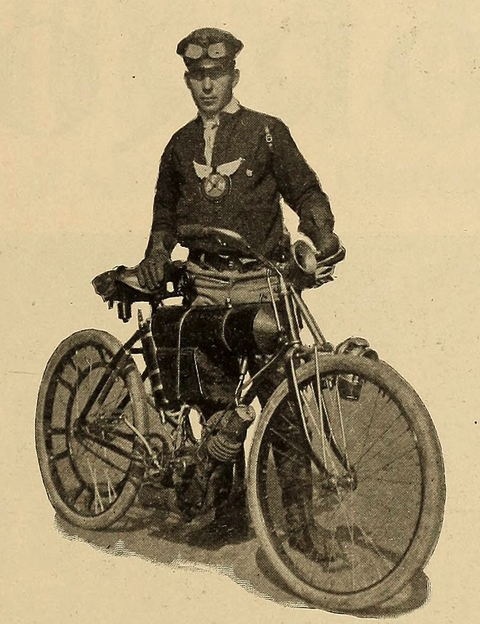
And here’s some more yarns from the Wld West, also culled from that excellent organ The Bicycling World and Motorcycle Review…
“WHAT THEY LEARNED ABOUT GASOLENE. Gasolene is a substance that is not to be treated lightly wherever it may happen to be found, as witness the recent experience of some young Englishmen in a boat—an incident that also illustrates the danger of emptying fuel about promiscuously when necessary to dispose of it in a hurry. A number of motorcyclists were about to take the boat from New Haven to Dieppe, and emptied the tanks of their machines in the first convenient place available. Most of the gasolene found its way into the river and was floating down stream when the aforementioned young men saw it. Out of curiosity one of them threw a lighted match on the surface to see if it would burn. He was instantly rewarded by a fierce flame, which shot some feet in the air, setting fire to the boat and to his clothes. He jumped overboard without delay in the attempt to extinguish the flames, but was badly burned before being rescued. His companions escaped unhurt.”
“WHAT MIGHT HAVE PROVED a fatal accident in the case of both of two prominent devotees of the motor bicycle who owe allegiance to the Kaiser and claim a residence in his capital affords an excellent illustration of the necessity of keeping a sharp lookout when on an unfamiliar road. While going toward Magdeburg, Germany, Otto Lueders and Alwin Boldt did not think it worth while to slow up where it was necessary to cross a drawbridge across the Havel at Werder, the approach to which is completely screened by dense foliage. Tearing along at full speed they rounded the curve in the approach, and, when within a few yards of the bridge, found that it was open in order to allow a barge to pass. Lueders, who was first, succeeded in coming to a stop within a few inches of the edge, but his companion was less fortunate, rider and machine going into the river at high speed. Being a good swimmer, however, he had no difficulty in reaching the bank, and later recovered the machine as well. With a delay of but a few hours both were able to resume the journey.”
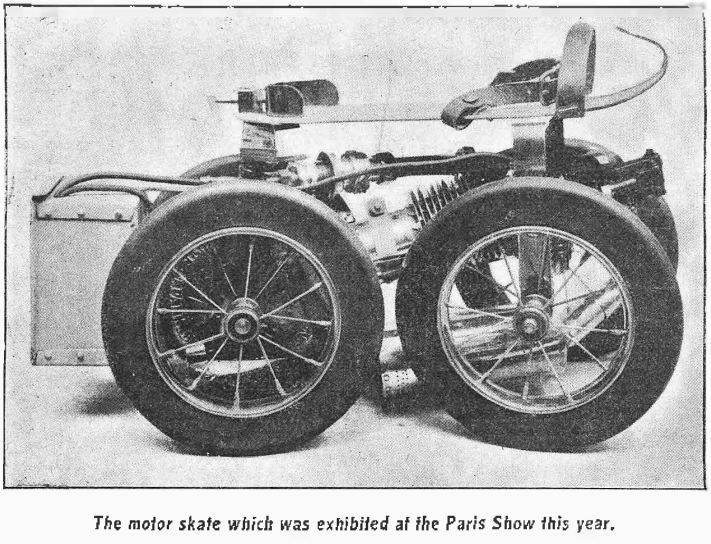
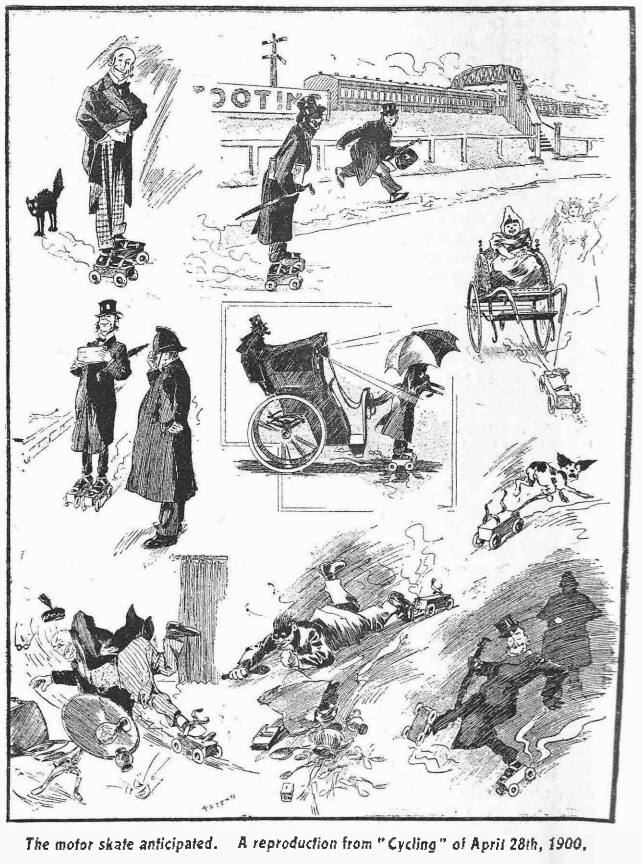
“ALTHOUGH A HEAVY TRACK greatly handicapped the riders in negotiating the turns and prevented any record breaking performances, the first race meet held by the Omaha (Neb) Motorcycle Club on Sunday, 1st inst, was a decided success. Over one thousand persons witnessed the event, all of which were well filled and the finishes of the hair raising variety. The meet was held on the Sprague Park track, and, although the meet was for motorcycles and promoted by gasolene disciples, several bicycle events were carded.”
“REIDEVILLE, NC, WILL HAVE the possibly proud distinction of being the first town in the United States in which a citizen actually has had to go to law to obtain the right to use a motor bicycle on the public highways. David L Carroll is the citizen in question. Incidentally, the Carroll case is the first one in which the Federation of American Motorcyclists has taken a hand. PD Watt, Mayor of the town, was the author of the ordinance, or bylaw, or motion, responsible for the state of affairs. It appears on the town records in this form: ‘PD Watt, Mayor—Motion to prohibit the running of what is known as motorcycles on the streets of the town, and a fine of $2 be imposed for each offence. Motion carried. Clerk instructed to post notices to this effect.’ There are three motorcyclists in Reidsville. The action of the ‘city fathers’ was enough for two of them. They have not used their machines since the passage of the prohibitive bylaw. Carroll is the third one. He is made of sterner stuff. He applied to the FAM for advice and assistance. Chairman John C Higdon, of the Legal Action Committee, informed him that there was no doubt of the unconstitutionality of the ordinance, and that if he became a member of the organisation and would ‘get arrested’, the FAM would assist in his defence. Carroll promptly did both things. His arrest entailed a fine of $2, but he immediately appealed the case to the superior court. His determination caused some of the Reidsville officials to weaken, and to suggest that he compromise the matter, but Carroll’s fighting blood is up, and he writes that he means to see it through to a finish. The case will come up for hearing next week. The brief which Counsellor Higdon bas prepared, and which will be brought to bear, and which, as the first of its kind, is of interest and value, is as follows: ‘The defendant is charged with riding his motorcycle the streets. Defendant contends that the ordinance is unconstitutional, and is class legislation, inasmuch as it prohibits motorcycles from being used on the streets, but places no restriction on other vehicles. A street or a road is, in law, a public highway, and as such belongs to the public and to all the citizens thereof, and all have the right to travel thereon by their own selected modes of conveyance, whether it be as foot passengers, bicycle, ox team, a four-in-hand, or an automobile. (Coombs vs Purrington, Barker vs Savage, Commonwealth vs Temple.) To say that a new mode of passage shall be banished from the streets, no matter how much the general good may require it…would hardly comport with the advancement and enlightenment of the present age. (Moses vs Pittsburg, etc.)”
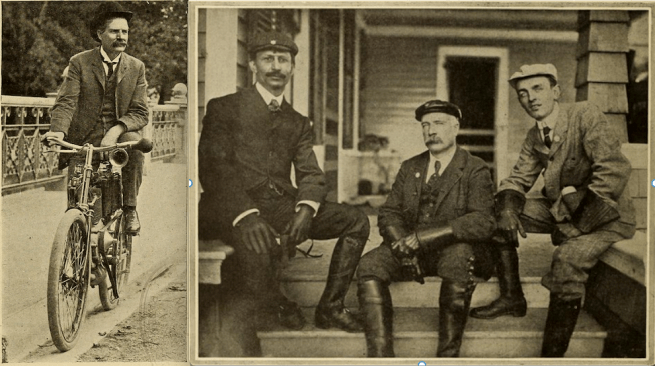
“THE WALTHAM (MASS) Autocycle Club has ‘sen the error of its way’ and has changed its name. It is now the Waltham Motorcycle Club.”
“AUSTRALIA HAS GROWN GENEROUS. It has reduced the motorcycle registration fee from $1.25 to 25 cents and the dealers’ tax from $15 to $2.50. The speed limits have also been raised from 20 to 25 miles is the country and from 10 to 12 miles per hour in cities.”
“THERE IS SAID TO BE a good market for motor bicycles in the North of Sweden and Finland, where the means of communication are usually very defective. Belgian and German machines have the lead up to the present time, but the opening for trade is said to be good.”
“ALDERMAN SM BECKER is planning to introduce a measure in the Common Council of Milwaukee, Wis, to provide a detail of policemen with motorcycles. He believes they will be able to suppress automobile scorching, catch runaways and better regulate traffic.”
“SHADES OF ANDREW CARNEGIE! An Essex man in England advertises a ‘three roomed cottage and five plots of valuable land’ in exchange for a ‘light, low frames 1905 motor bicycle’.”
“I INCLOSE A COUPLE of snaps of double and triple carriers, as we are successfully using them out here. The women that you see in them ride them and run them without assistance. Mrs FE Carroll drove the two-seater, carrying her husband, over fifty miles on Sunday, the 8th, when these pictures were taken. Mrs CC Hopkins (who is shown in the car with Mrs JH Nash in front and Mrs Carroll in the rear) can also handle the three wheeler successfully, but she prefers the comfort of the front seat, and usually rides there. I carried three of us some seventy miles on Sunday last with the greatest comfort and success. ‘I find even more comfort in riding the machine with three than with two. If the rear rider assists a little in starting the machine there is no extra labor for the middle rider, who is nearly ‘everything’ in this rig, so far as operation goes; but this ‘middleman’ is not put to any great labor and has ample time to look at the scenery as he passes along the way. I found that I could easily get over sixty miles from a gallon of gasolene, carrying three, whose weight was 450, with forty pounds of baggage added, and not try for fine results, and I must say that under ordinary conditions I have been converted thoroughly to the tricycle for three, as I now have it.”
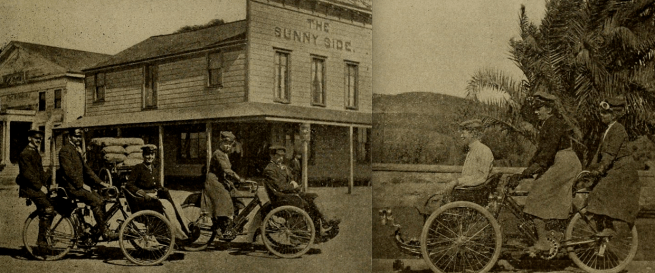
FREDDIE BARNES JOINED Zenith as chief engineer and patented the Gradua variable-ratio belt drive transmission. It changed the effective diameter of the crankshaft pulley to alter the drive ratio, while simultaneously moving the rear wheel forward or back to maintain belt tension. Control was via a rotating lever on the fuel tank, The company was not shy of innovation, witness the Bicar, with hub-centre steering, two-speed transmission and a drum brake; it was based on the three-wheel Tricar. The Blue ‘Un reported: “Invented by Mr Tooley, of Great Yarmouth, and exhibited at the last Crystal Palace Show, where it made its debut, the Zenith Bicar is a completely novel form of motor-bicycle. The most interesting portion of the machine is, of course, the frame, which, as will be seen at once, is a startling departure from orthodox lines. The upper longitudinal tubes extend from the rear wheel spindles completely round the front wheel, the latter being supported in phosphor-bronze guides, in which it is allowed to move freely on hardened steel rollers. On each side of the front wheel spindle there are rods running to the steering arm, which are somewhat after the fashion of a tri-car one attached to the bottom of the steering pillar. The lower portion of the frame is hinged on two lugs which are brazed on to the forward end of the upper frame, while at the rear end shackles are fitted between the two portions. The back forks are of the usual pattern, but are hinged at the points where they converge on the rear spindle slots. The lower frame, therefore, carries the engine and coil and accumulator boxes, and the
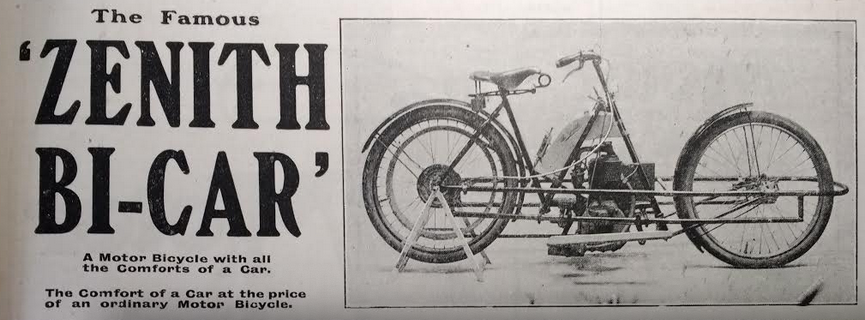
weight of the rider, since the down tube is carried through a guide fixed on a lateral stay of the top frame, and attached to a similar stay on the bottom frame. Thus, to explain it clearly, the top frame carries the two wheels only, while the bottom frame supports the weight of the rider, engine, etc, independent movement of the two being allowed by the hinges and shackles to which reference has been already made. The advantages claimed are that vibration is considerably reduced, and by the novel system of steering employed the front forks-which are generally admitted to be the most vulnerable portion of the modern motor-bicycle-are done away with. Risk of sideslip also is, according to the makers, entirely eliminated. The motive power is a 3hp air-cooled [Fafnir] engine, governed by means of a variable inlet valve, while the gas is supplied to it through a latest pattern Longuemare carburetter. Particular attention has been paid to the ignition system, the current being supplied by two Prested accumulators, and intensified by a Prested trembler coil. Either accumulator may be put into action by using a neat two-way switch, which is fitted in a convenient position. A useful handlebar switch is also supplied, by means of which the current may be permanently cut off, or momentarily switched on and off at will for traffic riding. The belt is a Watawata, running on pulleys turned up to a correct angle. A free engine clutch is incorporated in the engine pulley, and a starting handle is supplied. After inspecting the machine at the Zenith Motor Engineering Co’s works at 101a, Stroud Green Road, Mr Bitton, the manager, kindly placed a machine at our disposal for a few minutes. The clutch took up the drive very nicely, and the engine easily started the machine from a standstill. Seated on 3 Brooks’ B100 saddle, and with our feet on comfortable footboards, we found the machine to be an easy-running and a satisfactory mount.”
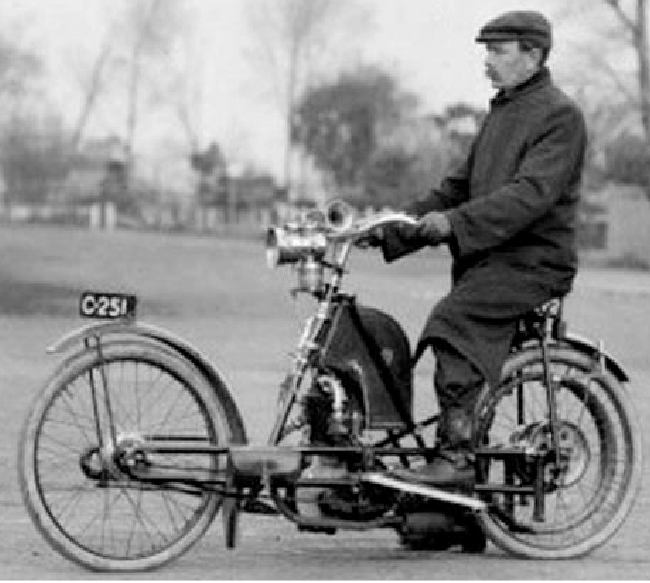
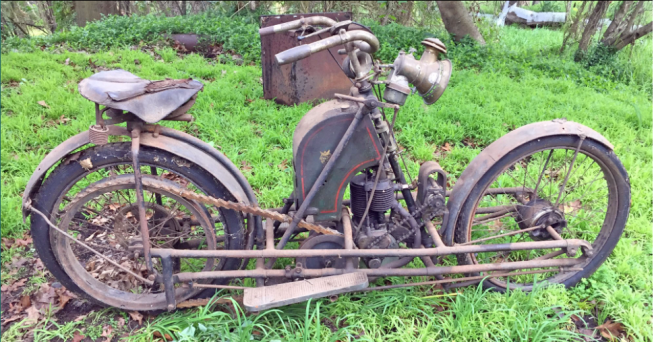
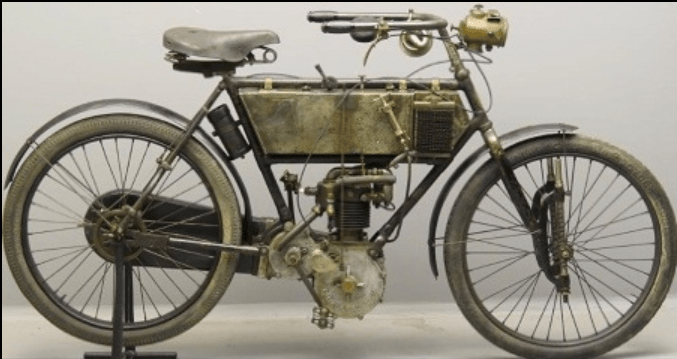
BSA MADE ITS first motor-cycle, powered by Minerva; Minervas finished first, second and third in the 560-mile Sydney-to-Melbourne race.
SVANUS F BOWSER invented a petrol delivery pump. There’s eponymous for you.
THE USA PRODUCED 2,295 motor cycle, up from 159 in 1900. Among them was a new 4hp V-twin Orient.
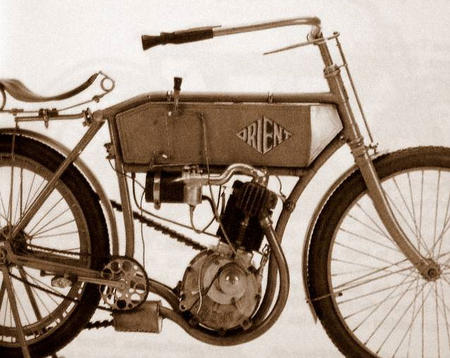

BY YEAR’S END there were 21,521 motorcycles registered in Britain.
BRITISH IMPORTS OF motor cycles rose, to 1,700. Exports fell, to 688.
A GROUP OF enthusiasts met at the London Trocadero to set up the Automobile Association. Its prime aim was to help motorists avoid police speed traps.
THE SECOND RUNNING of the club team trial was a walkover for the MCC—no one else entered.
BICYCLING NEWS AND MOTOR REVIEW opined: “There is no disguising the fact that the motor-bicycle is, in England at least, under a cloud, many former riders of the same having given it up. Nor are the reasons for this state of affairs difficult to comprehend. Almost all manufacturers have, without rhyme or reason, taken the ordinary push-bicycle as their model for the vehicle, and tacked a motor to it somehow or other. As the fastenings turned out insecure, or the strain proved too much for the frame, or the space originally allowed showed itself to be too cramped, modifications have been introduced one by one, the maker being apparently content to get his conglomeration to hold together somehow, and wonderful contraptions have been the result. I don’t think it is too much to say that not a single one of the most popular—shall I not more truthfully say least unpopular?—models of to-day display features that a self-respecting designer of some six years back would have been ashamed to acknowledge as his own. Owing to—shall we say?—the want of mechanical thought, the small engine that, after all, did fairly well on the original motor-tricycles, and even on quads, has proved insufficient to take the bicycle with standard transmission along. Engine power has gone up, bringing in its train heavier framework and tyres, and speeds on the level that are far above the requirements of the average individual, without, however, always ensuring regular hill-climbing power…”
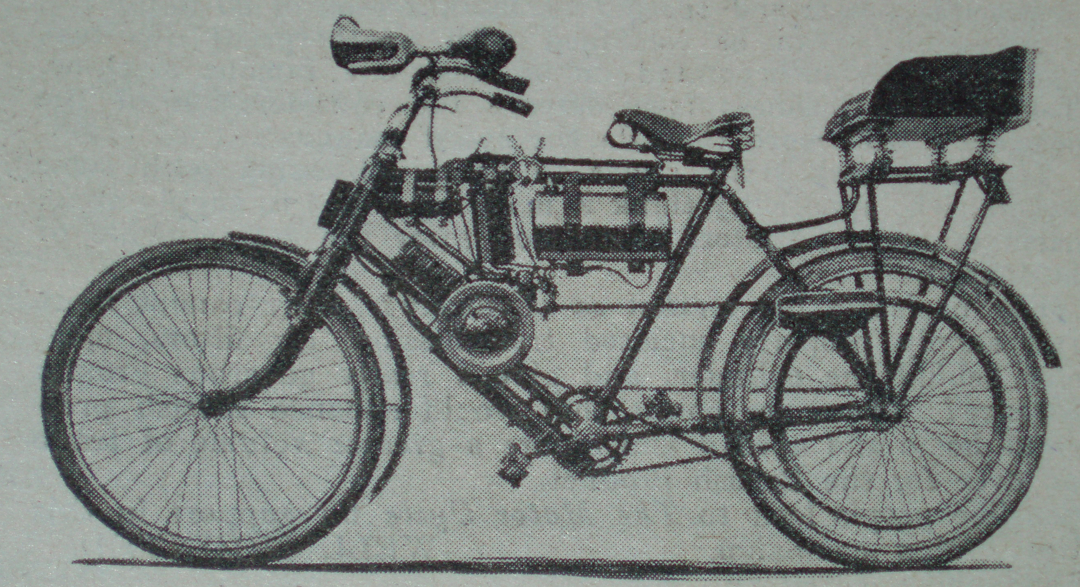
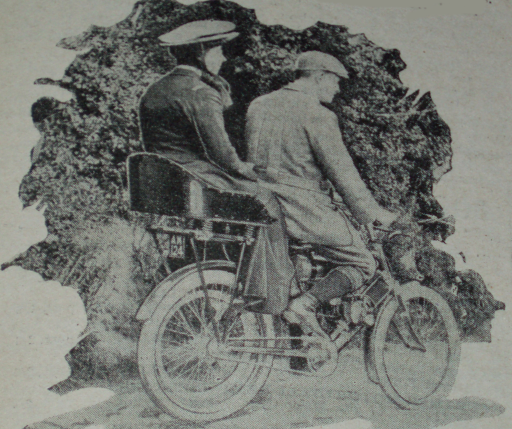
MOST OF THE motor cycle clubs springing up around the country were named for their home town; a small group of enthusiasts in Oxford showed more imagination, setting up a ‘semi-private’ club and calling it the Boanerges MCC. As biblical scholars will know, Boanerges was, allegedly, a nickname Jesus gave to his disciples John and James to reflect their fiery natures; it was later used to describe any ‘fire and brimstone’ preacher. So why use it for a bike club? Because it also translates as ‘sons of thunder’ and that’s how they were generally known (until they adopted the name Bocardo MCC a few years later). The Sons of Thunder MCC… clearly ahead of their time.
THERE WERE 20 STARTERS in the Circuit d’Ardennes. Entries included three Griffons ridden by messrs Lamberjack, Demeester and Bucquet; four Peugeots ridden by Cissac, Giuppone, Champoiseau and Riva and three Alcyons ridden by Anzani, Thomas and Griet. They faced three German Adlers and three Belgian Saroléas. Motor Cycling reported: “The race round the Ardennes Circuit— one of the big Continental road races, second only in importance to the Gordon Bennett—opened on Saturday last with the events for motorcycles and light cars, which compete on a shorter circuit than that set aside for the heavy vehicles. The Ardennes course includes no controls, so that the race is a race in the genuine sense of the word, with the exception, of course, that, as a measure of precaution, competitors are despatched at one-minute intervals. The entries received this year were not up to former years in point of number, but most of the principal Continental firms were represented, and there was every prospect that in the light motor-bicycle class the struggle for supremacy between the Griffons, the Peugeots, and the Alcyons would be as keen as ever, when such cracks as Thomas, Demester, Lamberjack, Anzani, Bucquet, Cissac, Giuppone and Champoiseau were acting as pilots. Punctually at 7.15, in a light drizzling rain, the first Peugeot motorbicycle, driven by Giuppone, was despatched on the first of the five laps which had to be negotiated. Nineteen bicycles started; after them five tri-cars were despatched, and three light cars—a Darracq and two Gregoires—brought up the rear. The race, which was remarkable for the consistent running of most of the machines, resulted in a triumph for the Griffons in the two cycle sections…in the motor-bicycle class the Alcyon people had hard luck in not qualifying for second place, as Thomas actually drove his machine in second (nine minutes behind Bucquet), but was displaced subsequently on ‘weighing in’, being a few ounces overweight, for the following reason: he was apprehensive of his petrol tank becoming loosened, and strengthened it with a leather thong, which was sufficient to bring the machine over the limit. Cissac and Champoiseau, on Peugeot machines, had side-slip troubles, and Giuppone damaged his tank in a spill. The Griffon machines took the first three places: Bucquet, 2hr 12min 49⅕sec; Lamberjack, 2hr 25min 28⅕sec; Demester, 2hr 30min 36⅘sec.”

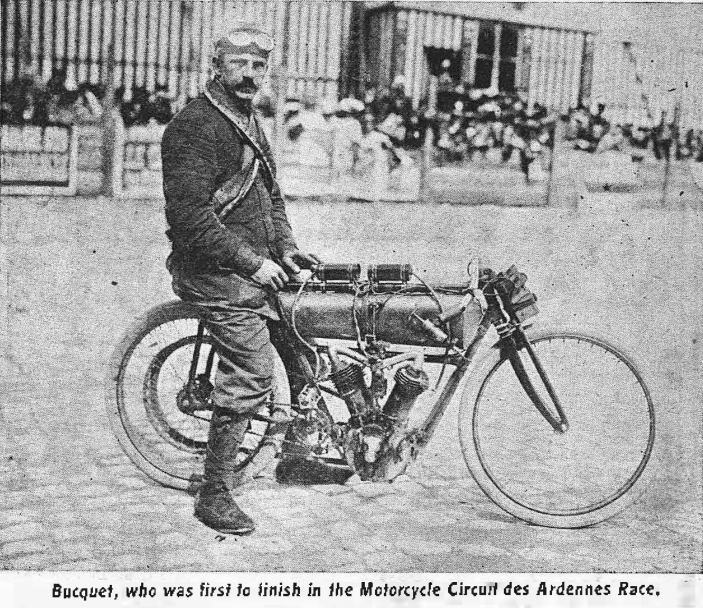
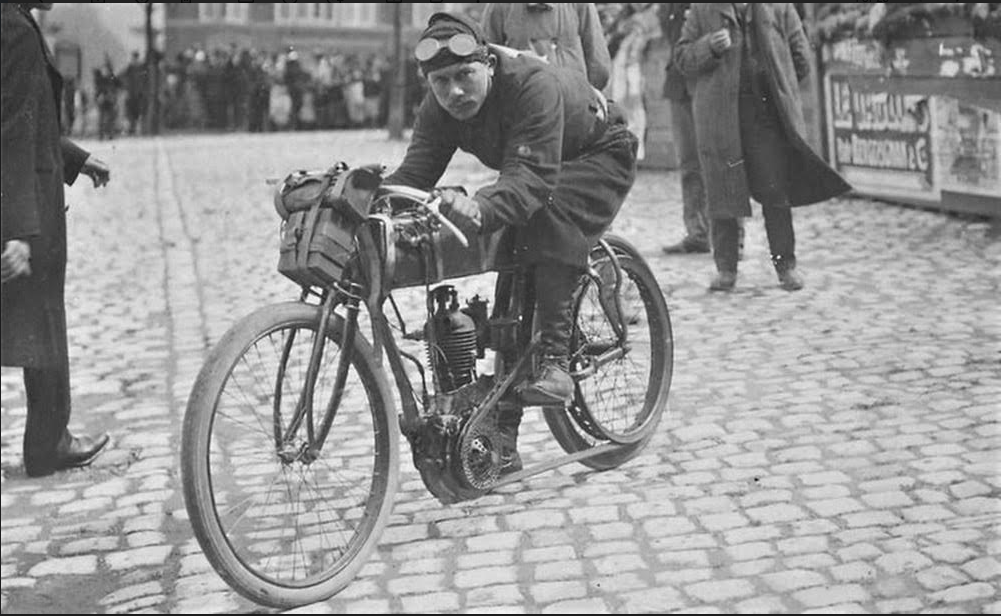
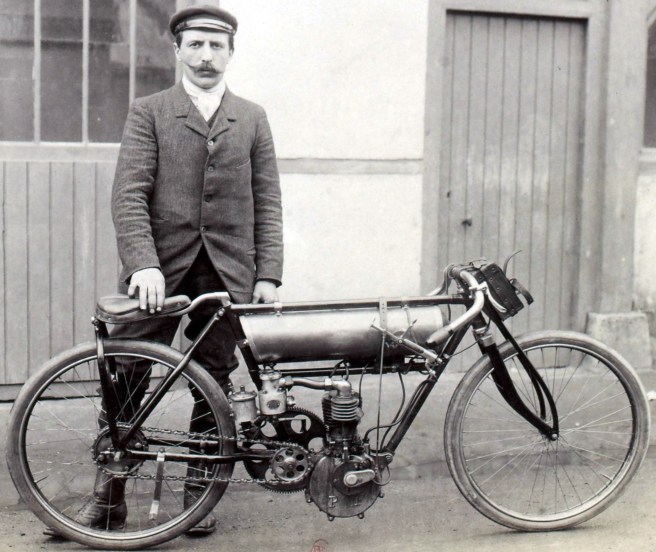
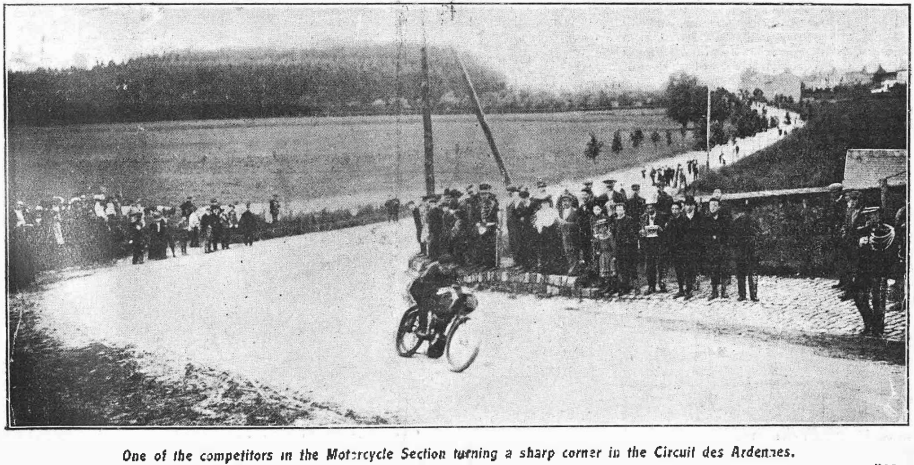
GIOVANNI PIRELLI DECIDED motor cycle races would be a great testbed for his tyres; their first outing was at the third Susa-Moncenisio race at Turin. The start was delayed by the late arrival of Queen Margherita who made up for it by donating a silver cup. There were 10 starters in the motor cycle class with the Peugeot team, Riva, Reale and Giuppone, firm favorite. Giuppone was leading when he ran out of petrol. He pushed his bike to the line leaving his team-mate Riva to win the cup presented by the magazine La Stampa Sportiva. However Giuppone ended the year on a high note. On 9 December he rode a 12hp twin Peugeot round the Parc des Princes track, covering 63 miles 1,078 yards in an hour to set a world record that would stand for three years (to save time slogging through 1908, the record breaker was Charlie Collier on, inevitably, a Matchless; he took the world record to 70 miles 105 yards in an hour).
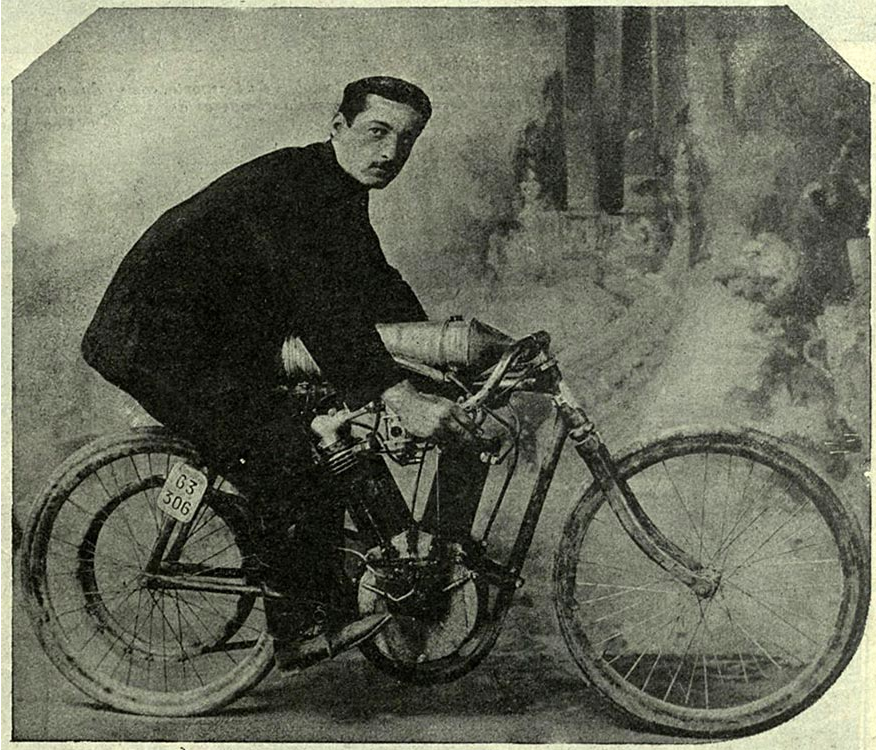

STAGED AT MILAN FOR THE SECOND time by the magazine Gazzetta dello Sport, the Mille Kilometer Motor Competition, including the Brescia Cup race for motor cycles, was run over four 250km stages and coincided with the start of the Brescia Automobile Week, a major event on the European motor racing circuit with the prestigious Florio Cup at stake. Each manufacturer could enter a up to three machines. But breaking with standard Continental practice, they had to be fully equipped tourers of 3-4hp up to 475cc. Points were awarded for a range of factors including fuel consumption, reliability, durability, price and weight—and there was an average speed limit of 25km/h making this more like a long-distance trial than a road race. Teams were entered by Zedel, Neckarsulmer, Adler, Peugeot, Marchand, Primus and Stucchi; bikes started at one-minute intervals. Peugeot ended a long series of victories—all three bikes retired during the second stage with serious tyre problems. Marchand’s campaign ended when Morandi crashed and suffered serious head injuries. Stucchi, Neckarsulmer, Adler, Zedel and Primus all completed the course and, following a couple of weeks of deliberations, the judges declared Stucchi the winner, awarding the Brescia Cup to Stucchi teamster Pavesi.
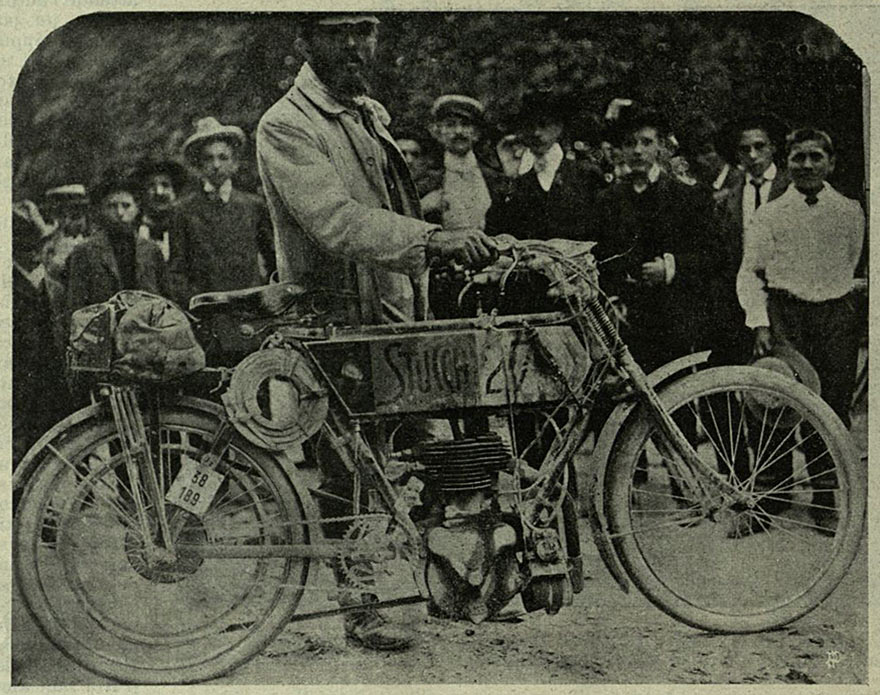
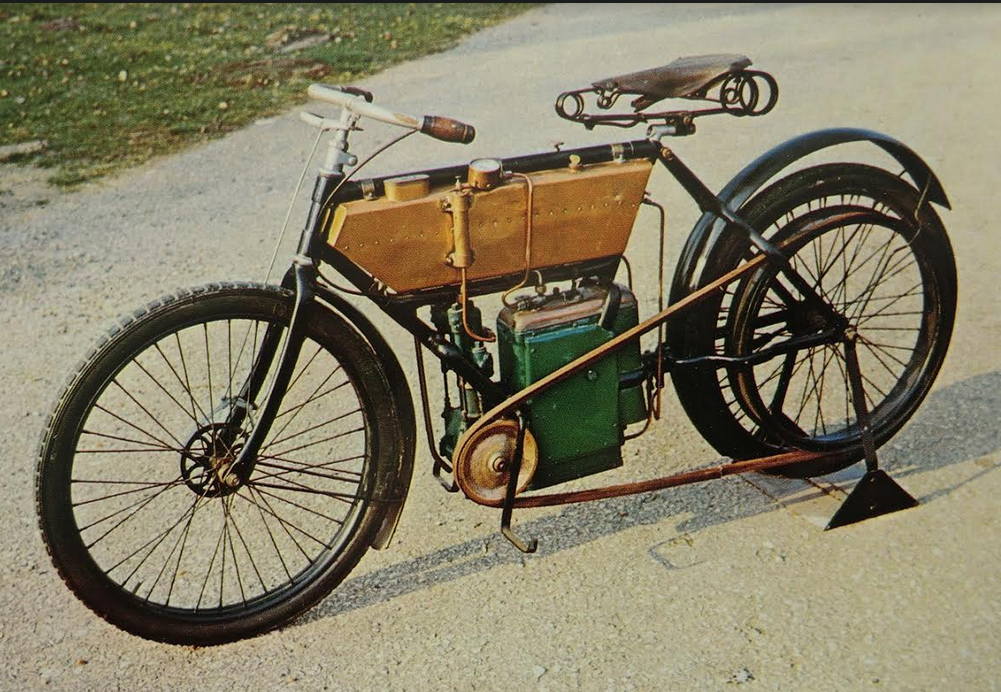
Paul Buard built this tidy steamer in the Serpollet workshops in Paris, Serpollet being the home of advanced steam cars incorporating the flash boilers invented by the Serpollet brothers. This is one of the last steam bikes to be built; it didn’t make it past the prototype stage.
Here are some left-over pics from 1905…
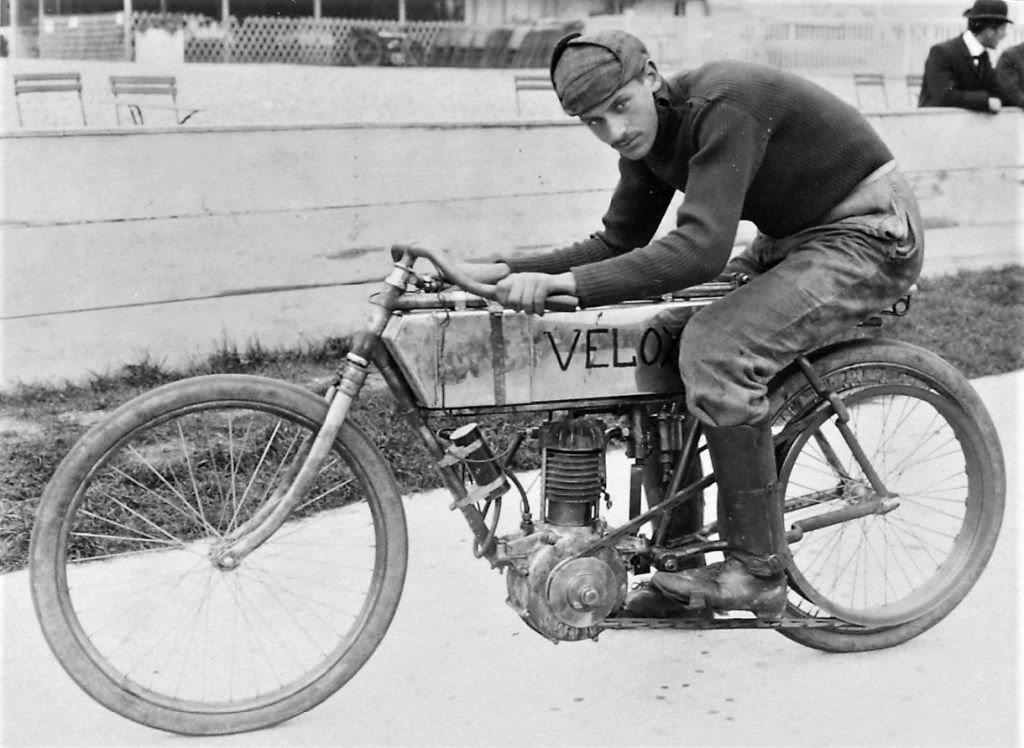

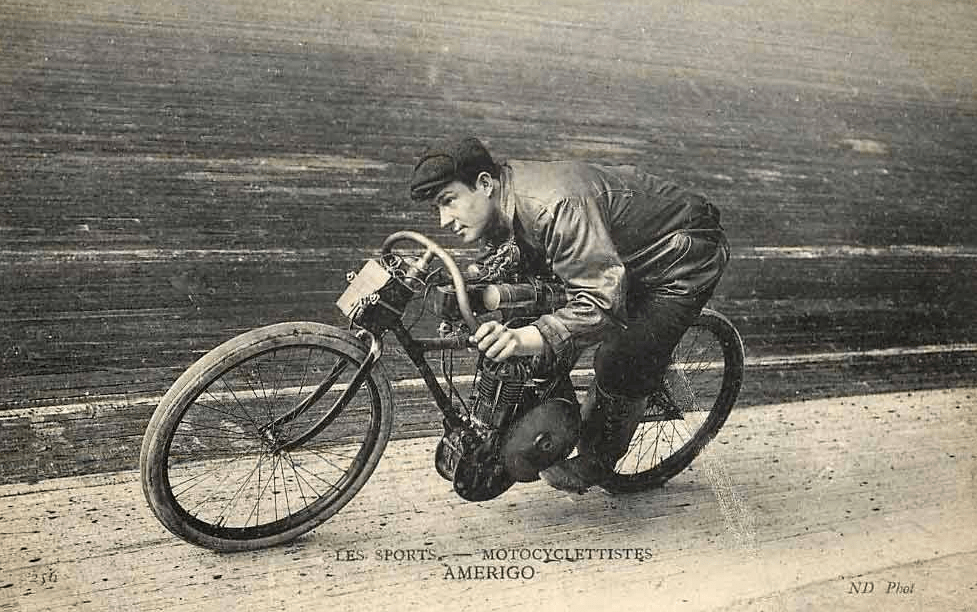

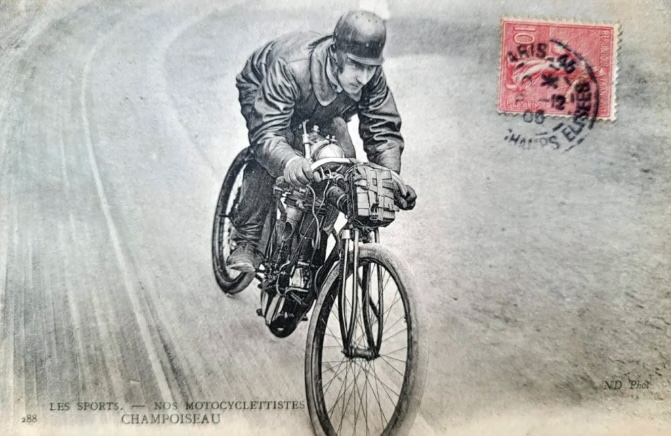
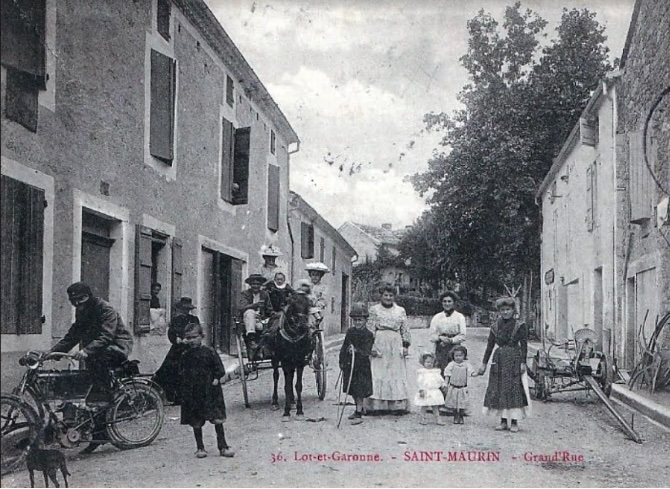
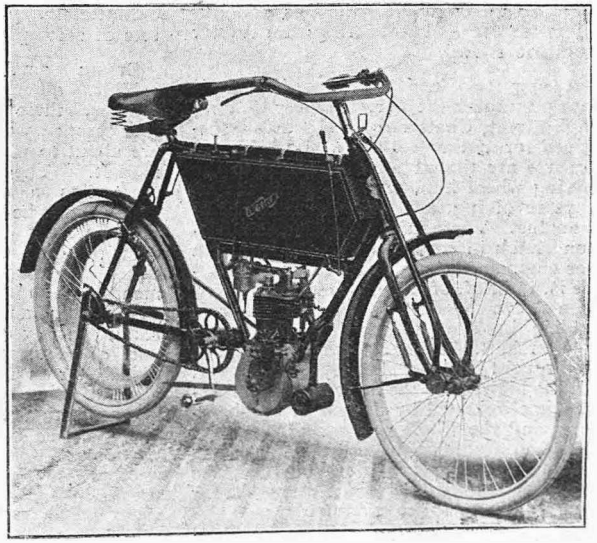
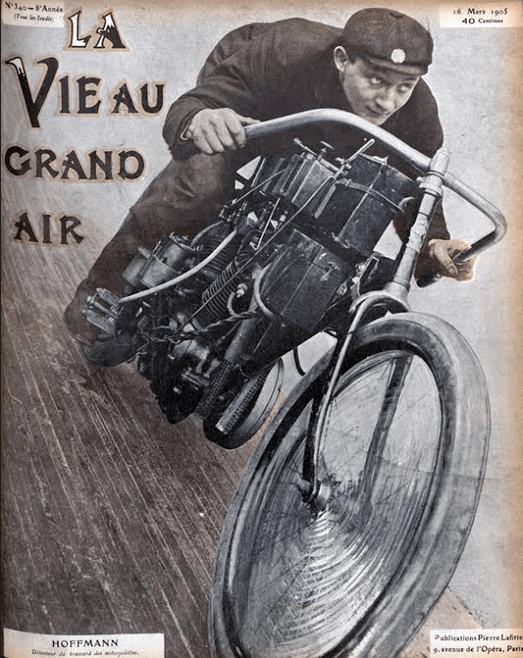
…and, for your delectation, here are a few of the ads that were tempting enthusiasts in 1905.
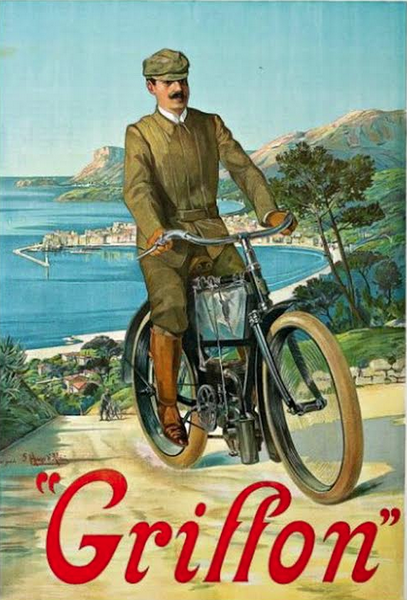
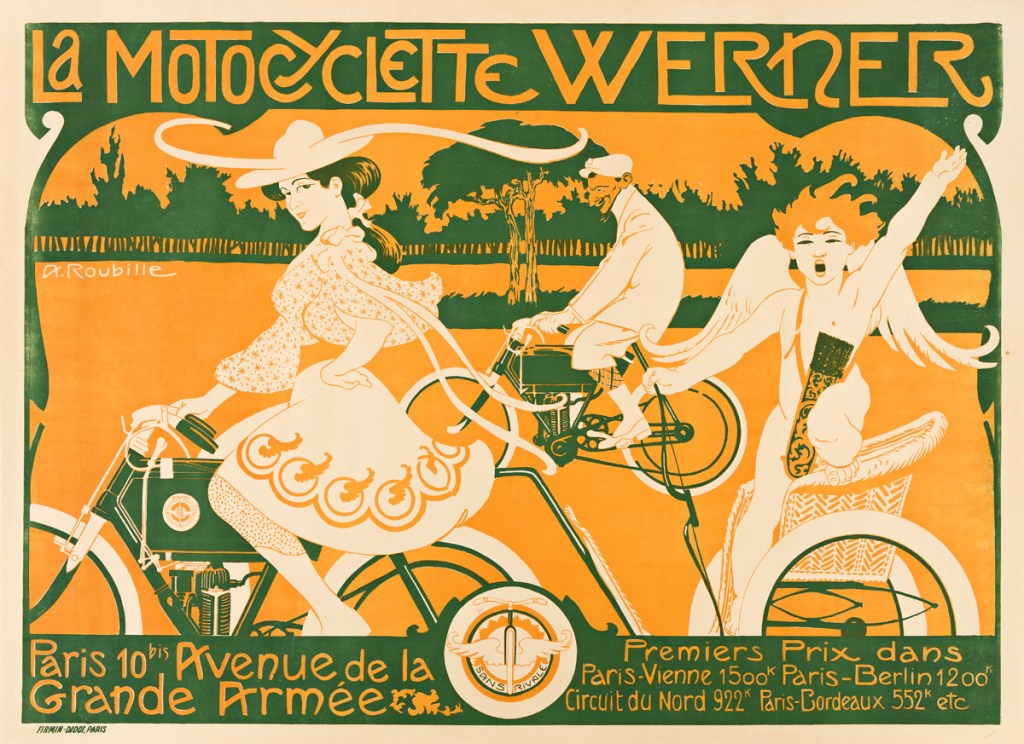
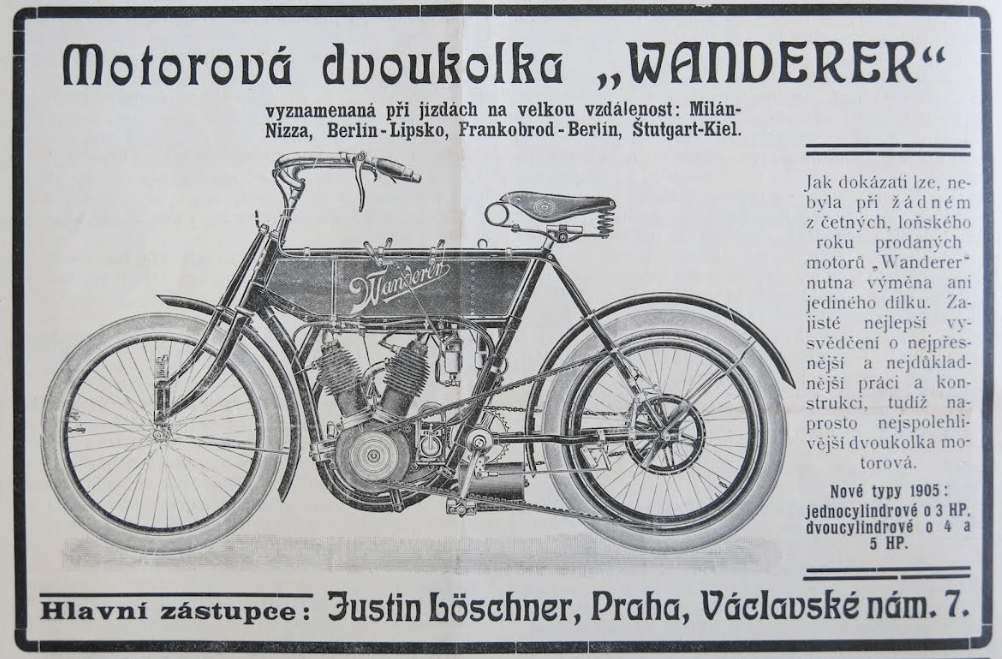
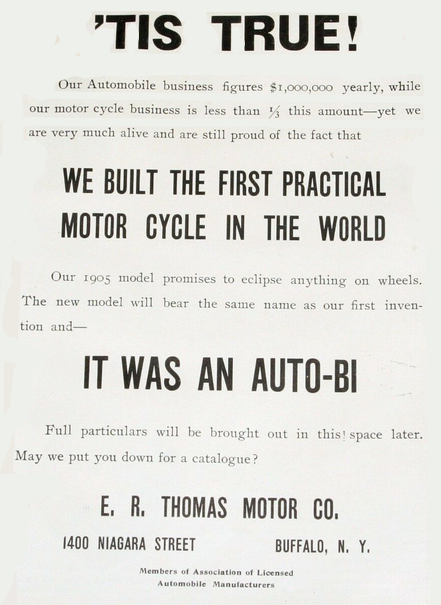
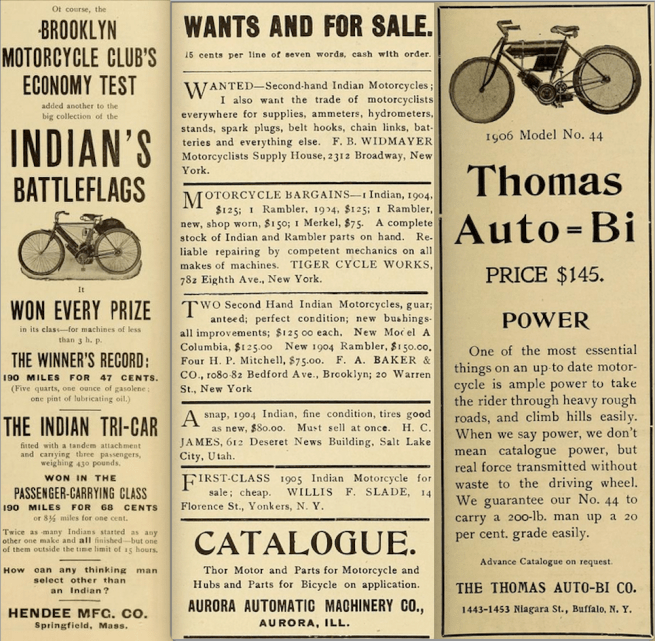
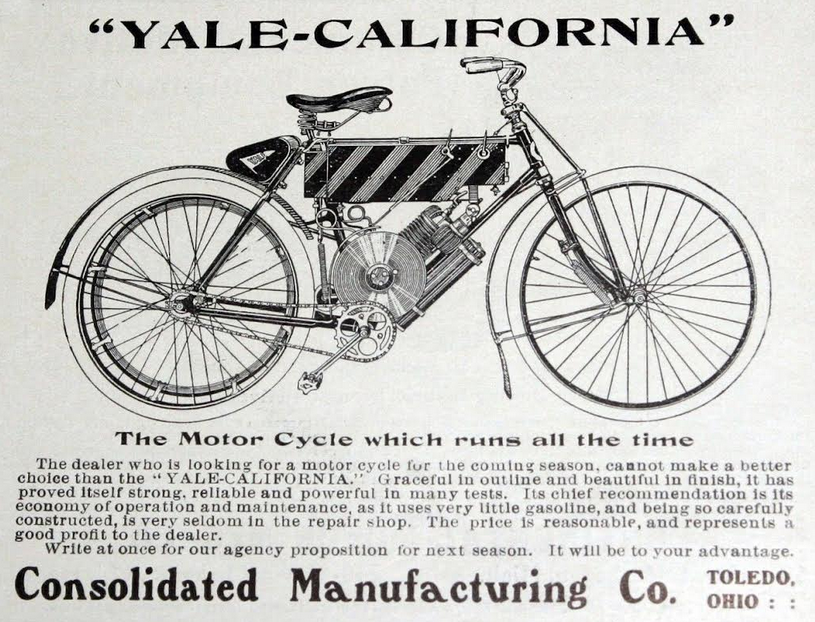
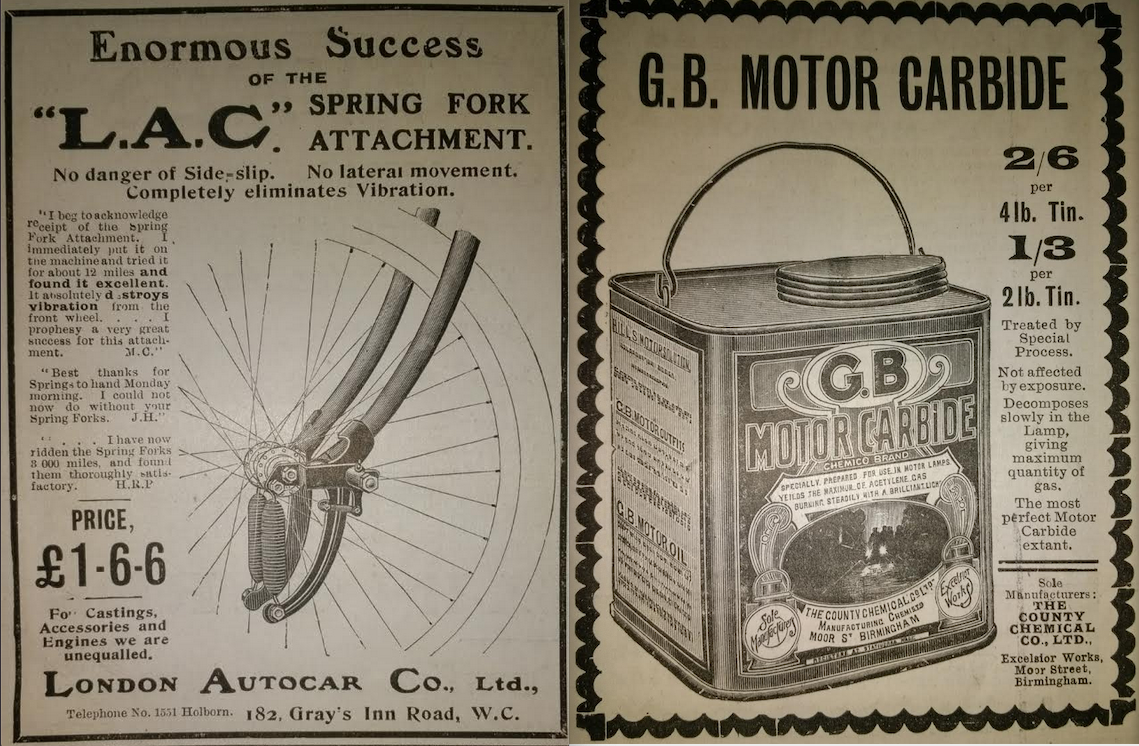
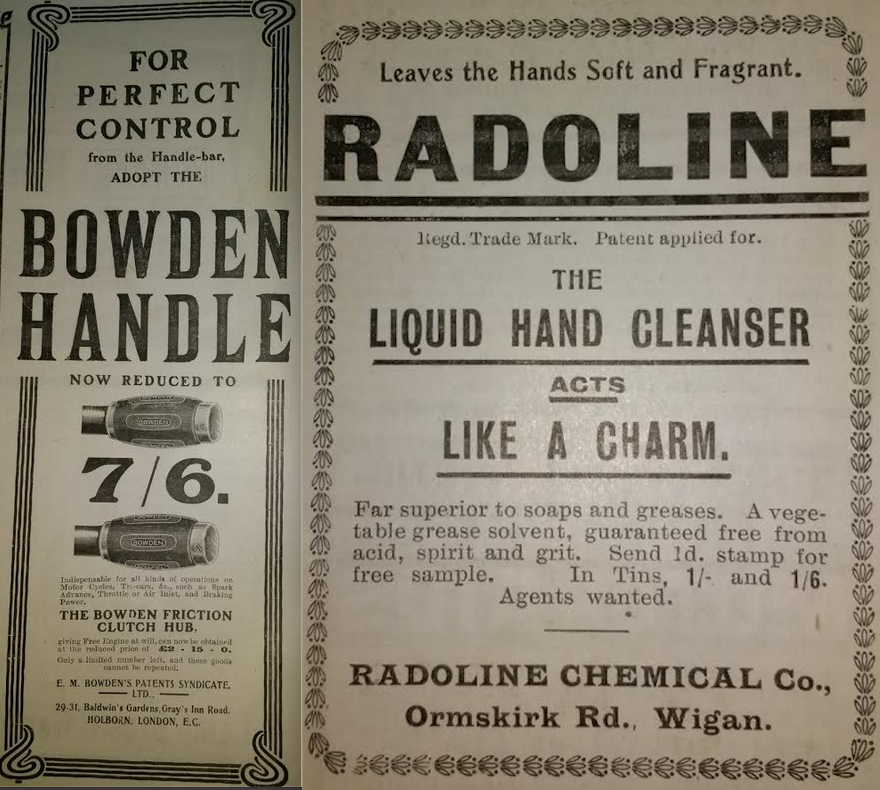
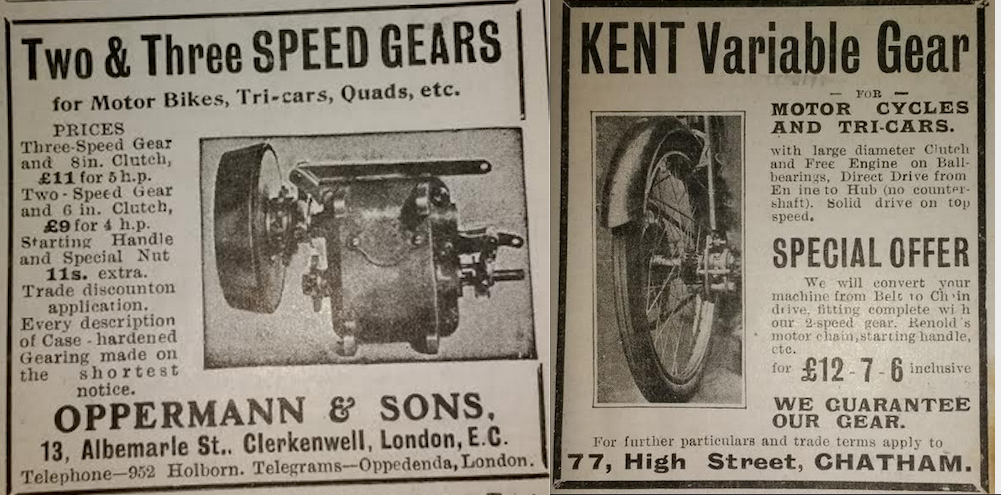
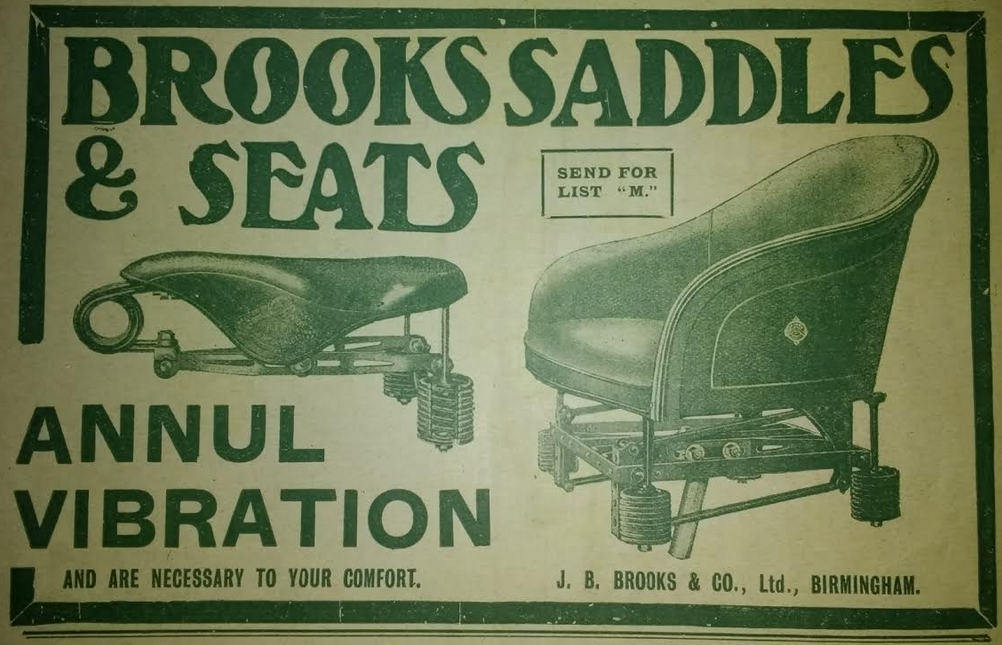
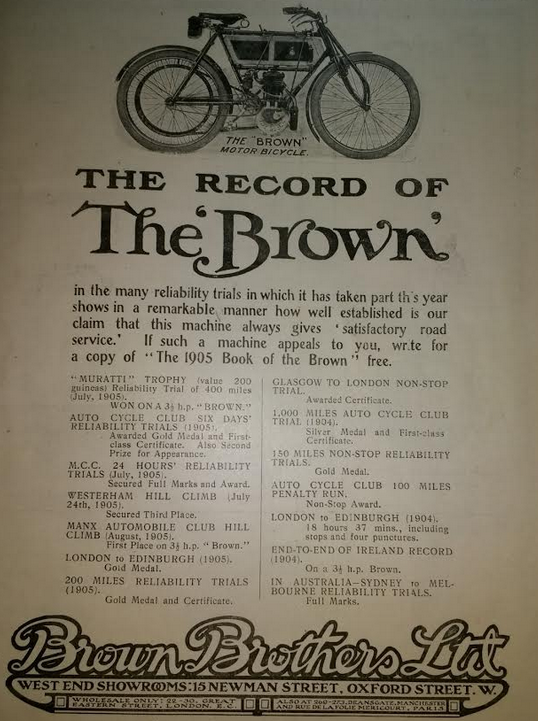
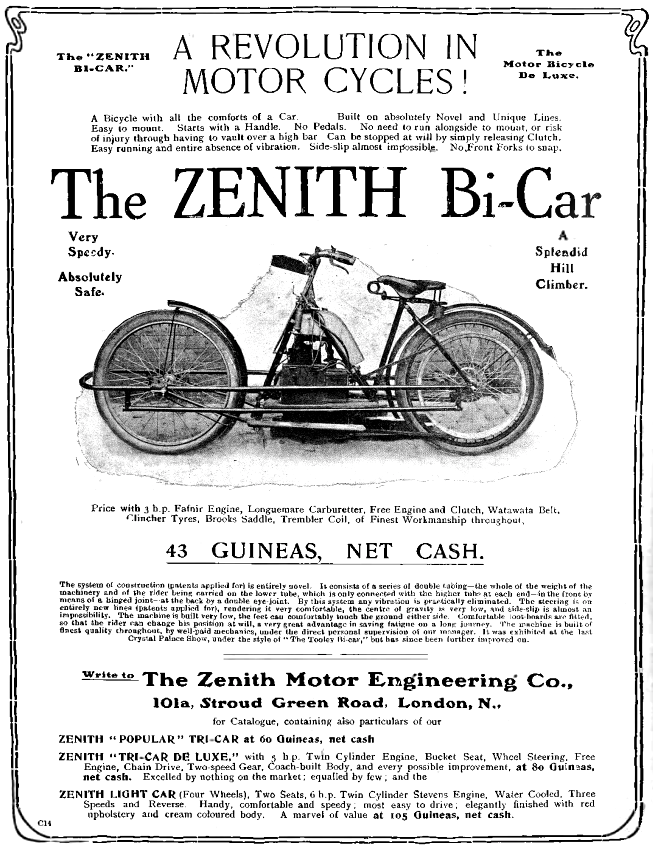
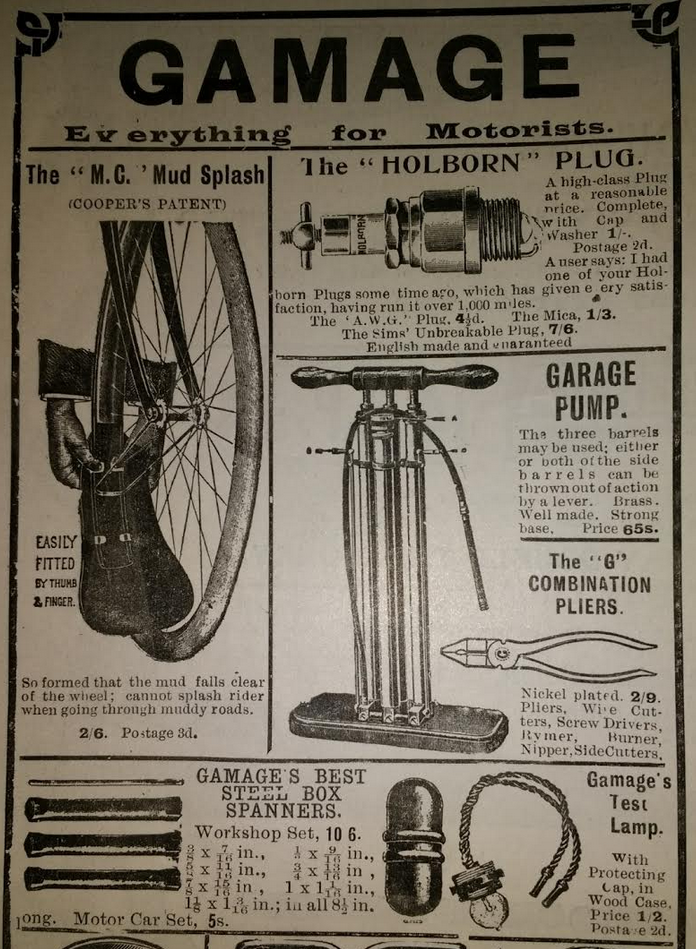
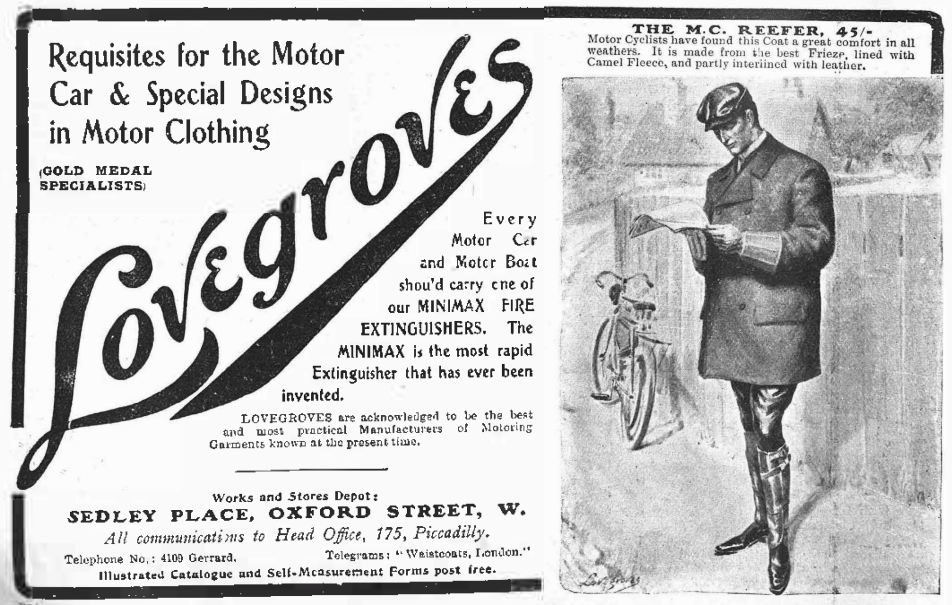
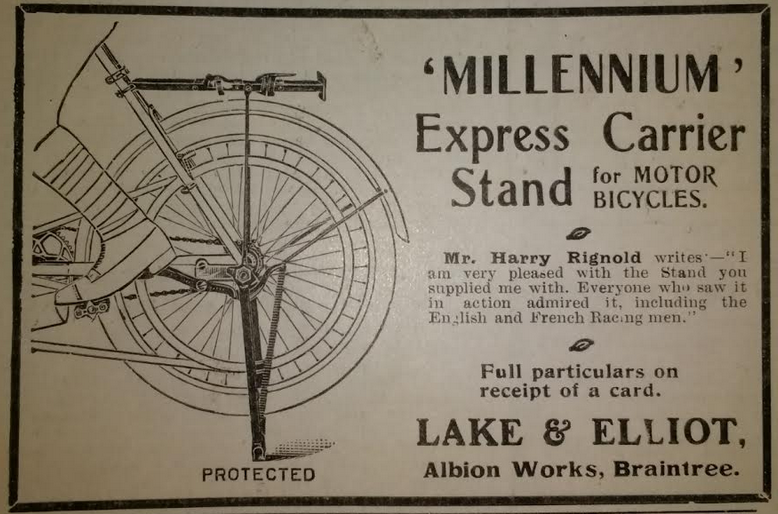
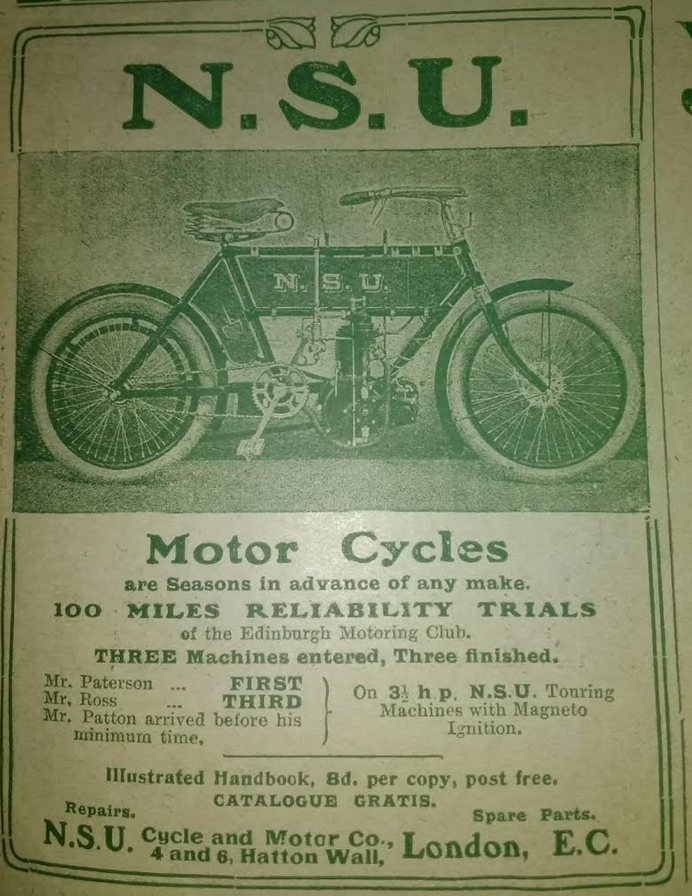

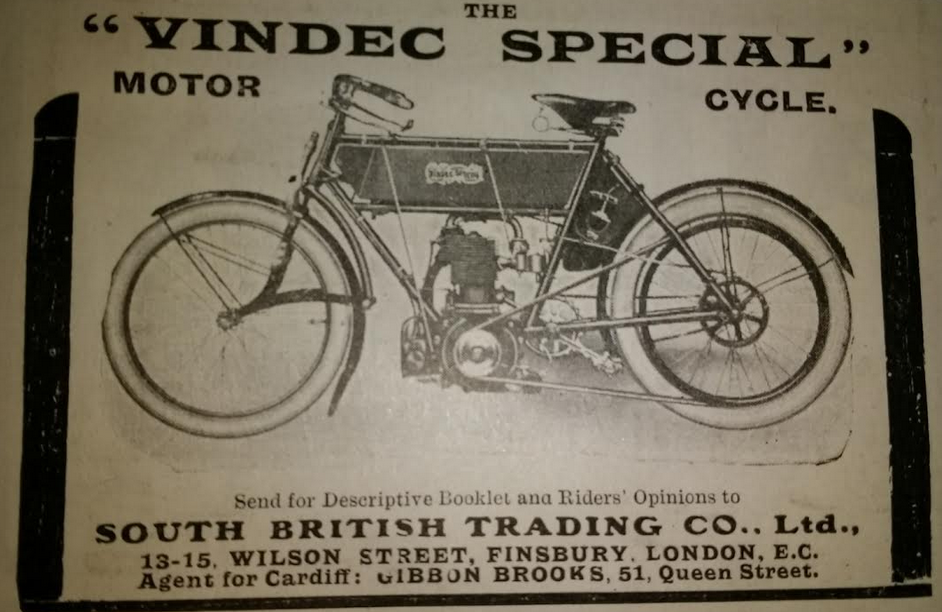

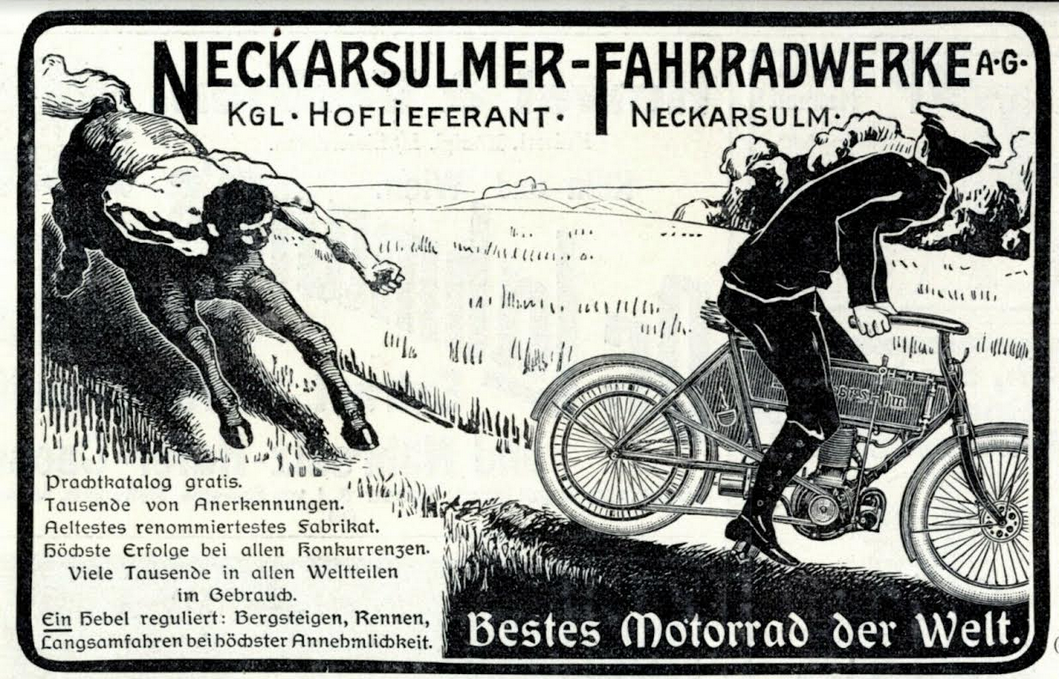
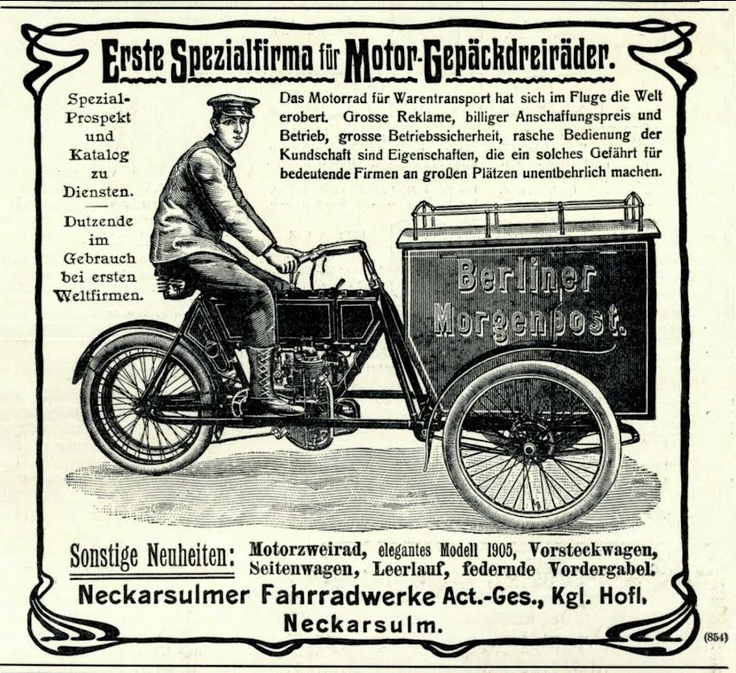
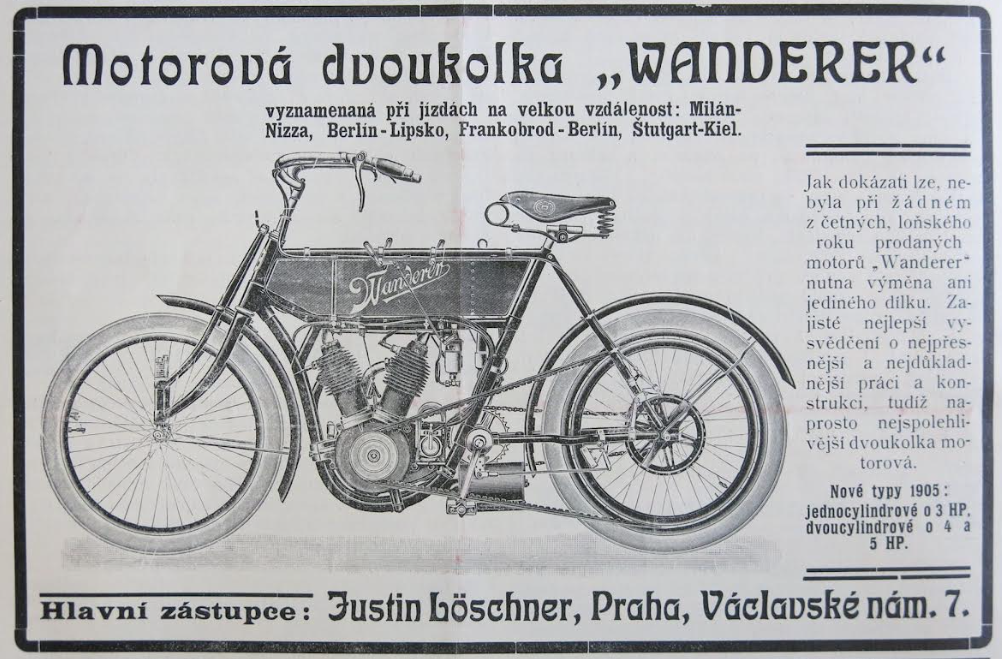
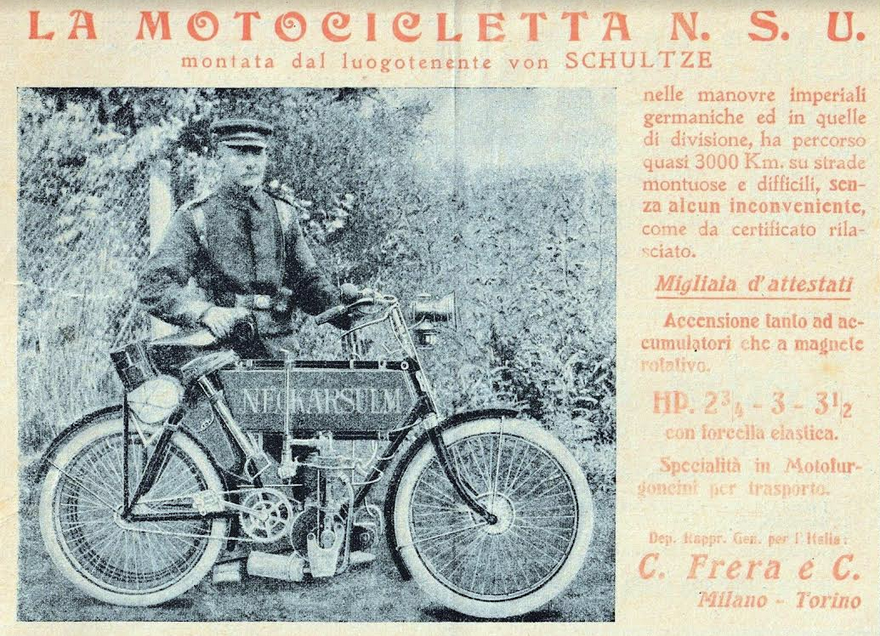

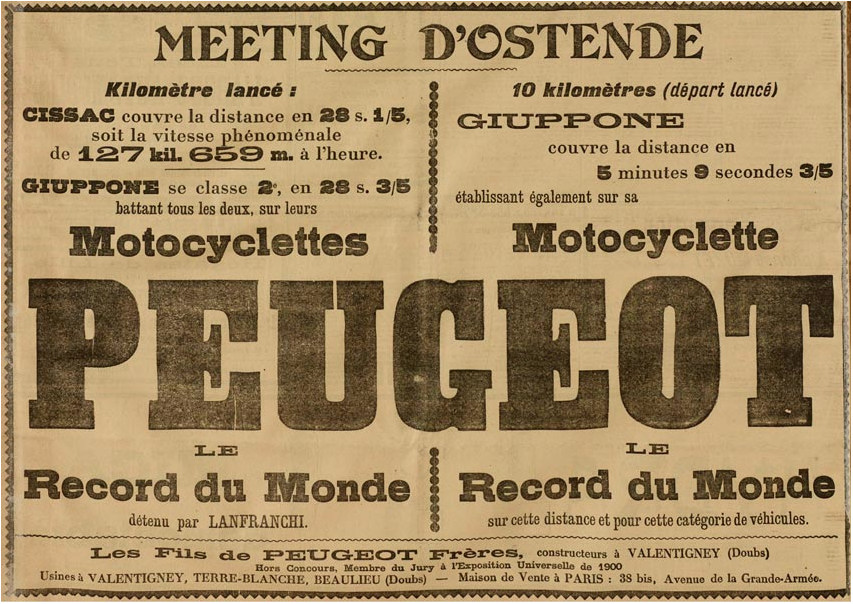
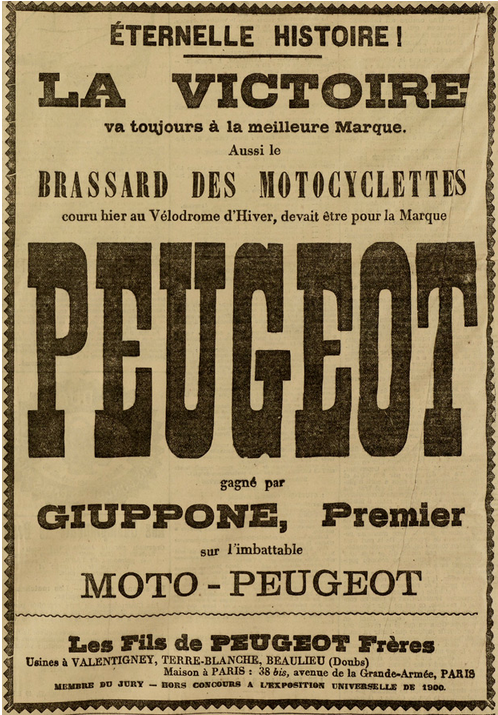
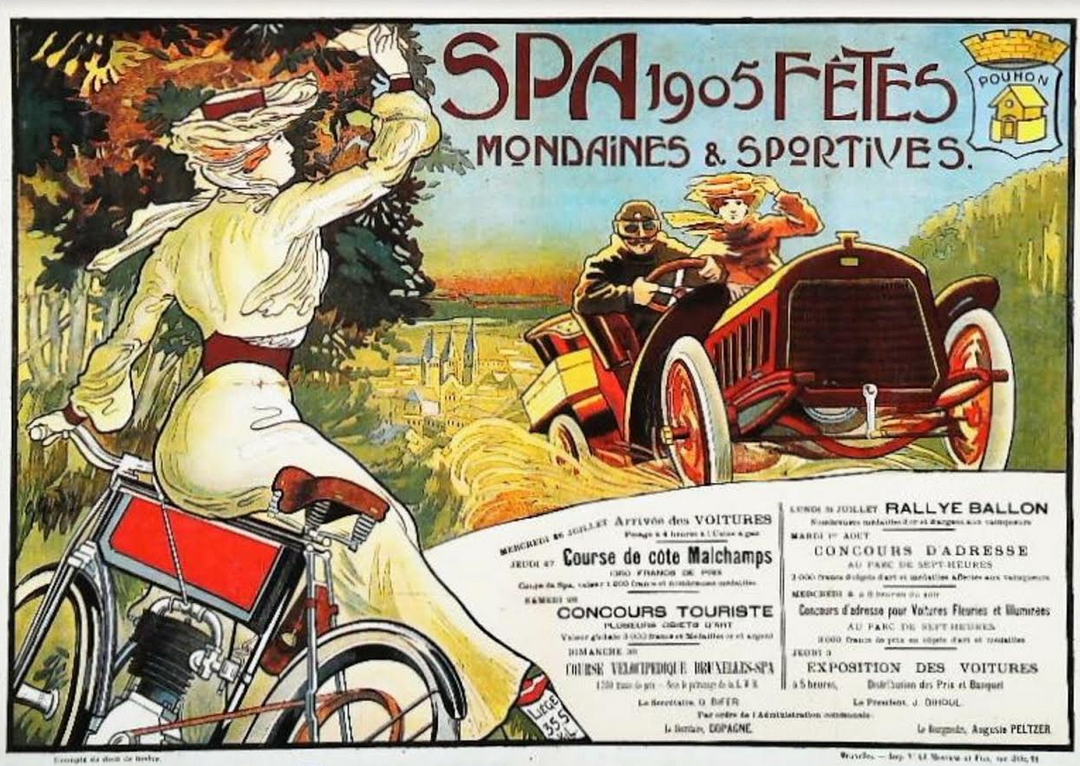
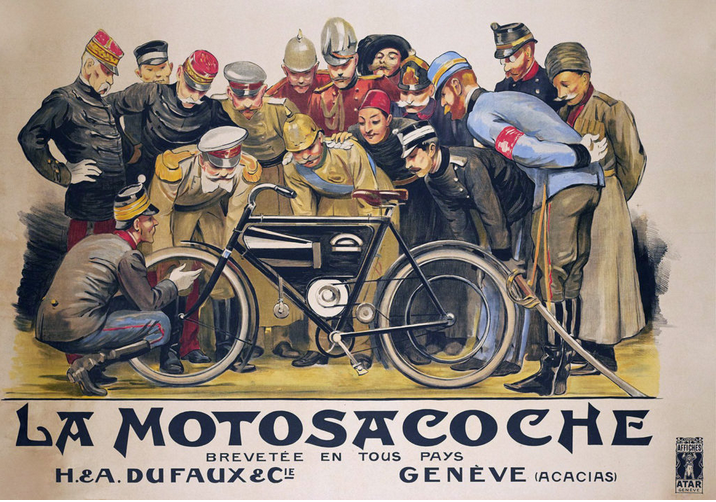
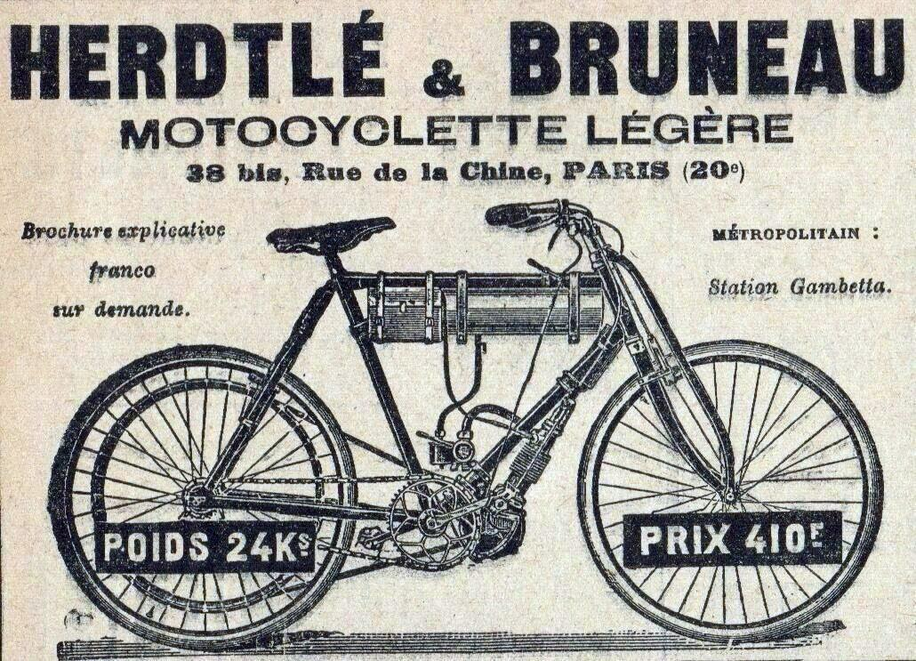
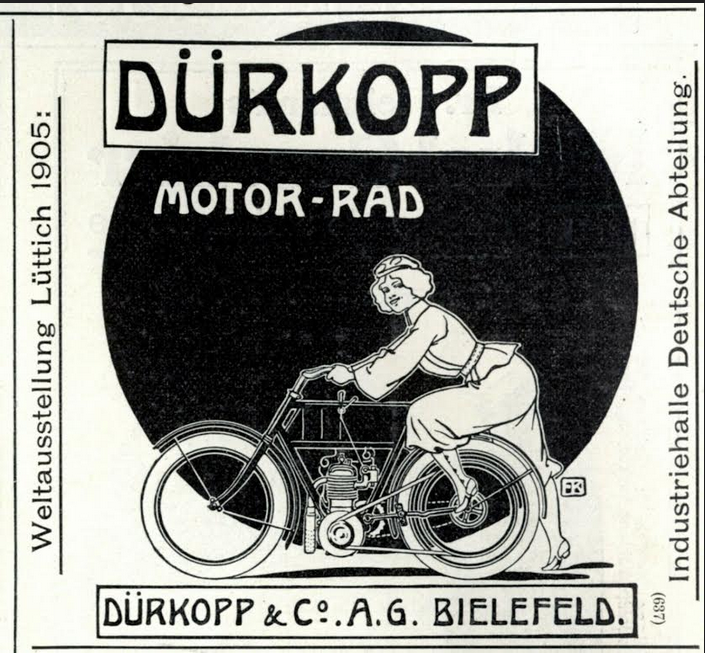
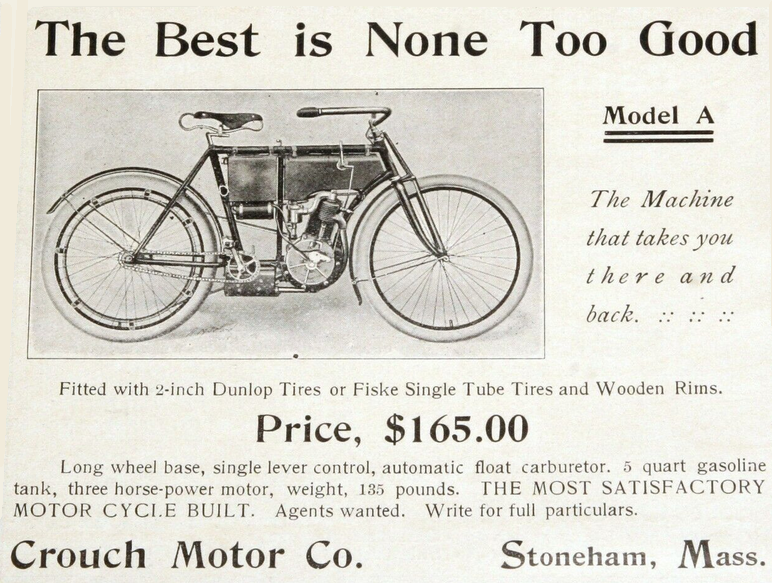
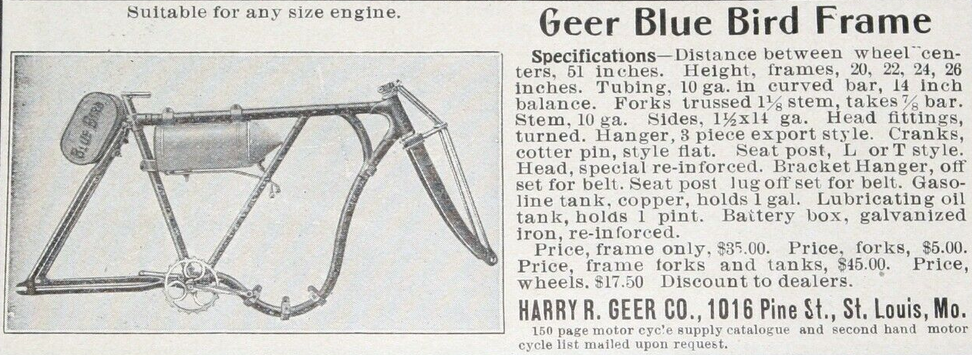
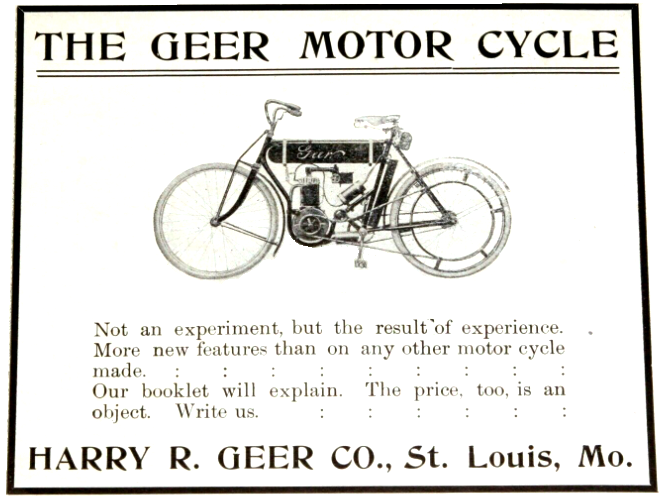
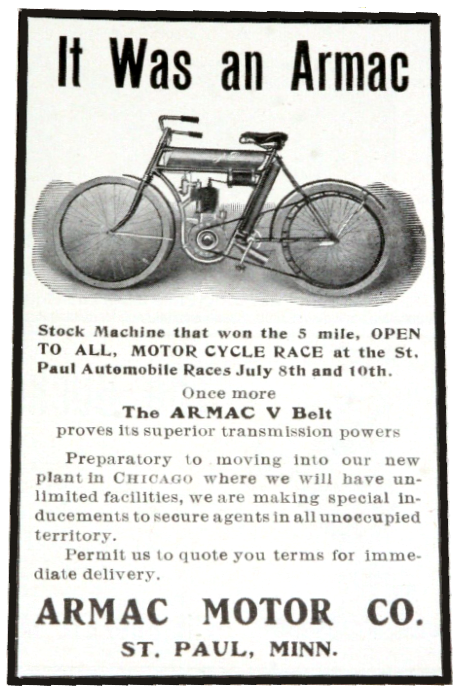
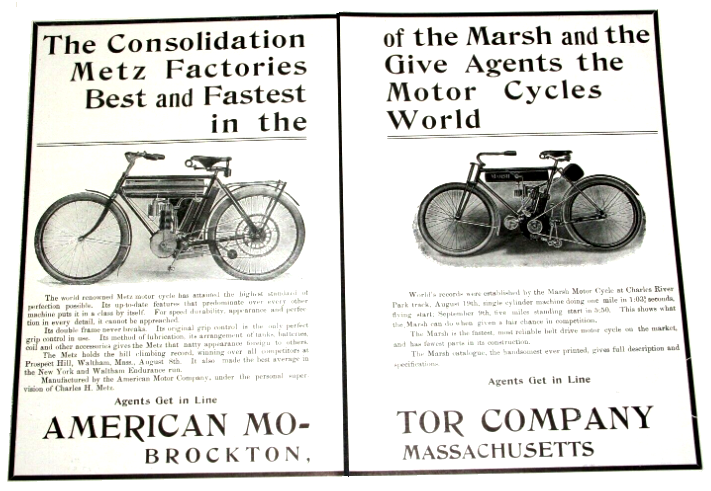
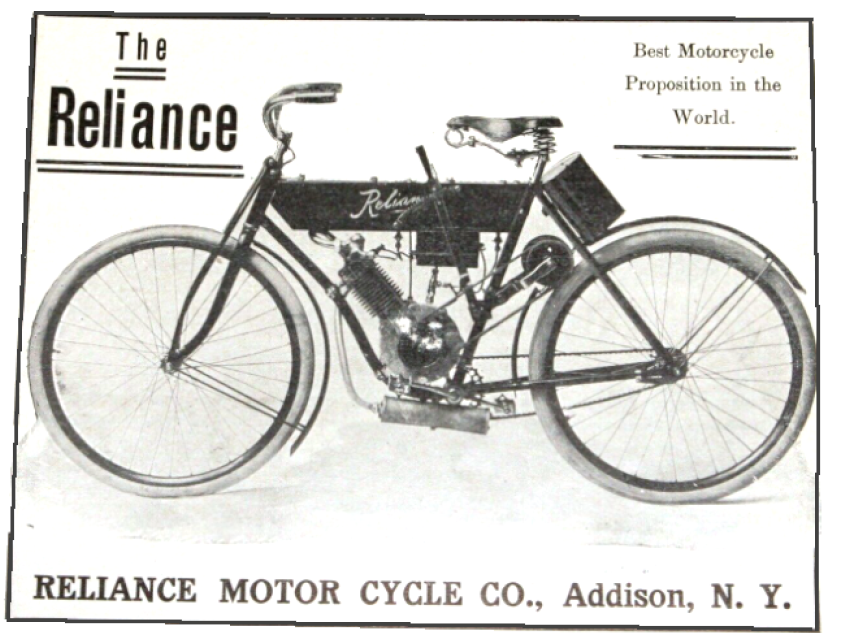

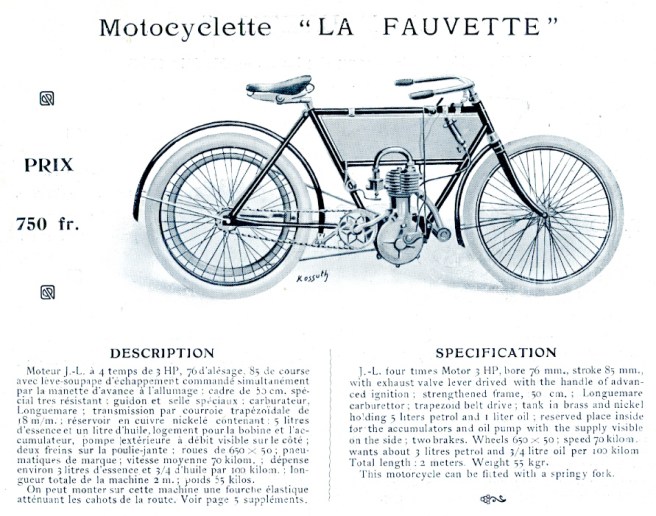

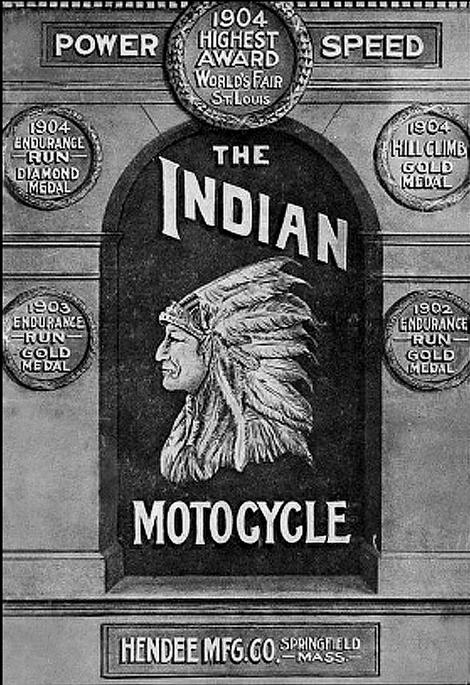
 Motorcycle Timeline