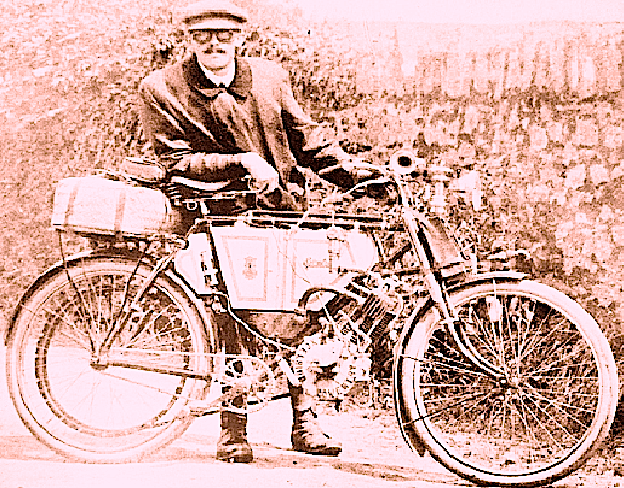
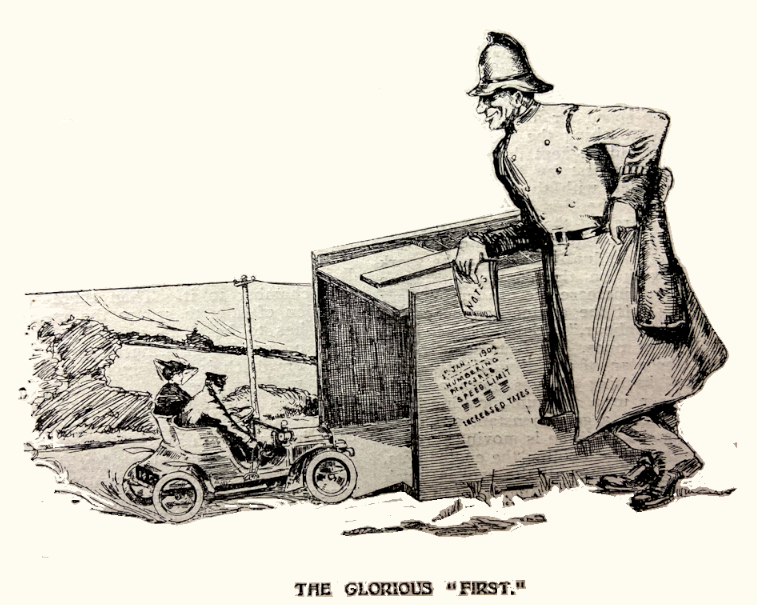
THE MOTOR CAR ACT came into force on 1 January. Offences included: “Driving recklessly or negligently or at a speed or in a manner which is dangerous to the public”; refusing to give your name or address following an offence; using an unregistered bike; using a bike without the correct style of registration mark; “failing to produce a licence, when driving a motor cycle, upon the demand of a police constable”; failing to hand in a licence for endorsement following an offence “within a reasonable time”; “forging or fraudulently altering or using or fraudulently lending or allowing to be used by any other person, any indicative mark or any licence”; leaving the scene of an accident “occurring to any person (whether on foot or horseback or in a vehicle)”; riding on any road “scheduled by the Local Government Board as being especially dangerous to motor cycle traffic, or on a highway which does not exceed 16ft in width”; exceeding 20mph “and within any limits or places scheduled by the Local Government Board” exceeding 10mph; and “Driving over the Menai Bridge, contrary to the regulations of the Commissioner of Works”. Maximum penalties included a £50 fine (that’s the price of a decent bike, worth more than £7,500 in 2023), three months’ jail and a riding ban “for such time as the court thinks fit”.
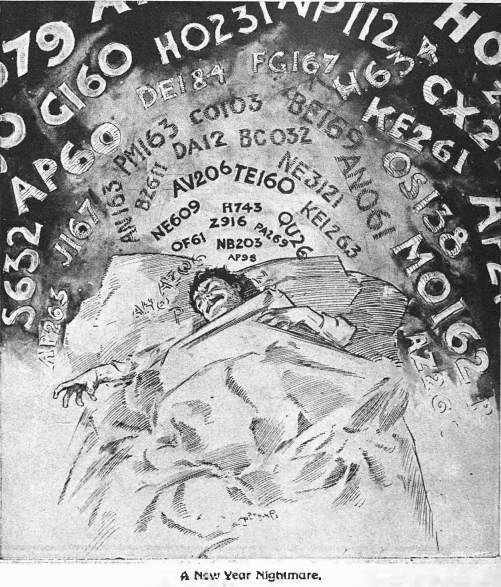
THE NEW ACT CAME into force on New Year’s Day, but we have not yet heard of any attempt to enforce it on the part of the police. The County and Borough Councils are, in a good many eases, greatly behind with the work of registration and the issue of numbers and licences, and it has been mainly owing to this fact that so many cars and cycles are still to be seen about without the identifying label. Another cause for delay is the fact that number plates, lamps and lamp brackets are as difficult to obtain as a gleam of sunshine in these islands. The illuminating clause of the regulations has necessitated the manufacture of an entirely new kind of lamp—one which gives a white light towards the near side of the car and a red light towards the rear. Nothing of that kind has been made before, because those made on the Continent for the purpose of plate illumination have shown the white light towards what is the ‘off’ side in this country. They would be useless for use on our roads because, having to be fixed on the left-hand side of the car, the warning red light would be in the wrong place, and would mislead the driver of a following vehicle…Considering that the Act was only passed in August, it should not have come into force until about next April (say the first of the month!). This would have given the Government authorities time for their vacation and for the issue of the regulations, and would have enabled owners to equip their vehicles.”
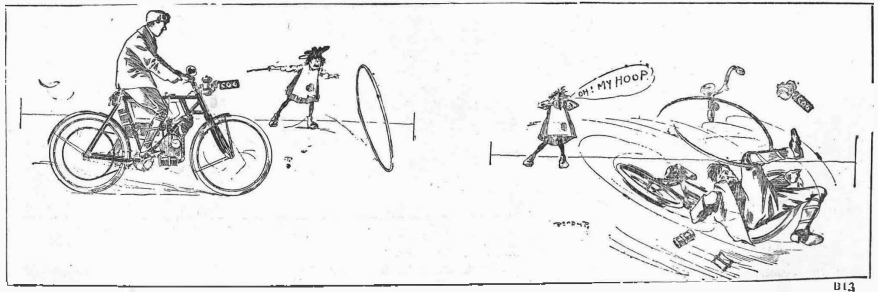
“THE ANNOUNCEMENT THAT there will be a competition for devices for the prevention of side-slip organised early in the New Year by the Auto-Cycle Club will be heard with somewhat mixed feelings. We are all of us anxious to learn about the qualities of the non-slipping devices already on the market, and to encourage inventors to come along with others, but can anybody suggest a really satisfactory method of testing them? For the test to be of any value at all it must be thorough; and to be thorough will involve a very great risk of life and limb to the demonstrators. The records of science show that the inventor is always so buoyantly confident of the soundness of his method and the perfection of his instrument that he scoffs at the idea of danger, and so the Club will experience no trouble in the matter of finding drivers who will undergo any risk with their own pet inventions under them; but in the event of a certain method proving a failure and the demonstrator sacrificing his life in a series of tests imposed by the Club, would not the organisers of the competition be liable to prosecution for aiding, abetting and encouraging the man to risk his life? It will be useless to run a series of tests which are ‘safe’ or only moderately risky to the riders. And, another thing, it will be desirable to show the behaviour of the unprotected machine on the chosen surface, in order that the qualities of the various devices submitted for test may be compared with it.”
“THE NUMBER OF motor vehicles registered and drivers’ licences issued to the end of 1903 amounted to about 15,000, London showing by far the largest figure, namely, a little over 2,500. The proportion of motorcycles in these figures is curiously small, amounting in England and Wales to only one-third of the total. On the other hand, motorcycles have a slight lead in Ireland. This general state of affairs does not warrant the opinion which we have elsewhere seen expressed, that motorcycles are much less numerous than was thought. Many owners of motorcycles will, in the next two months, be disposing of their mounts and taking delivery of their new machines, and as each specific motor vehicle must be registered, a rider would rather wait and then register his new machine, and leave the purchaser of the old one to carry out that formality for himself. So the influx of motorcycle registration will not take place until about March.”
“REX MOTOR-BICYCLE CLUB. Among recent candidates for membership to the above club are the following: Monsieur le Comte Avvo. Alfred Peracca, Turin, Italy; Monsieur Andrea Montur, Turin, Italy; Monsieur le Comte di Montonaro, Turin, Italy; Monsieur Guiseppe Corte, Turin, Italy. We are asked to state that every user of a motorcycle is eligible for membership in the Rex Club The subscription is the nominal one of 2s 6d, which includes a handsome club badge. Application for membership, accompanied by this subscription, should be made to the secretary, 24, The Butts, Coventry.”

“THE FIRST MOTOR CYCLIST in East Anglia to be prosecuted for driving his motor cycle without the identification plate, made his appearance before the King’s Lynn bench of magistrates recently. The defendant pleaded guilty, and the magistrates, recognising the paltry nature of the affair, only imposed a fine of 5s and costs.”
“TRAVELLING DOWN THE BATH ROAD last week we easily overtook a motor cyclist who was pedal-assisting his mount up a hill. He informed us that he had rather more than fifty pounds of luggage on board, and he added, ‘I think it’s only kind to push a bit uphill.’ He certainly made up for pace in going downhill.”
“ALREADY AN EXPORT trade is springing up in British-built motor cycles. During the four months ending April, the shipments amounted to 265 machines, Which, together with parts, represented a value of £12,220.”
“THE SPLENDID WEATHER last week resulted in a large number of motor cycles coming out on the roads around London. Even up to the small hours the roads resounded with the merry teuf-teuf of motors large and small.”
“MANY OF OUR READERS are no doubt waiting until the price of a motor cycle comes within their reach. To those who are wavering we would like to point out that the price of the Star motor cycle is now reduced to £38.”
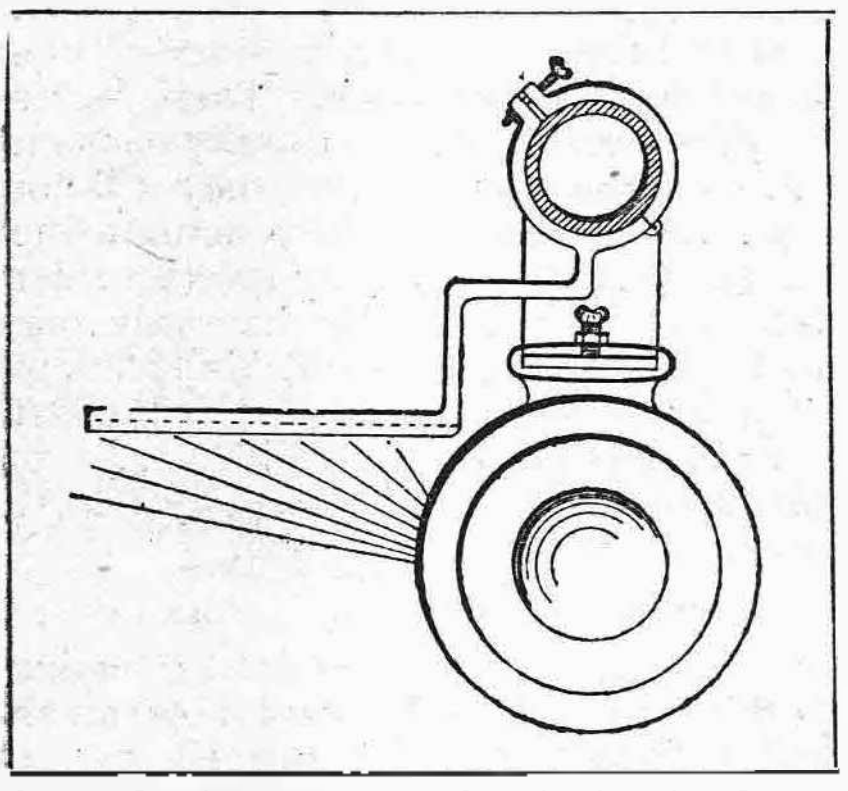
“A CORRESPONDENT WRITES ME somewhat plaintively about the numbering conundrum. The nature of the mystic symbol which he is to bear has been communicated to him, but he cannot decide upon the best means of fixing the plates, and in this respect I can sympathise most heartily with him, because, although I have known my number for some weeks, it is only to-day (as I write) that I have given an order for a set of plates, and even now I am not thoroughly satisfied that, with so many busy brains at work, some better schemes will not be put forward. I think, if I were not likely to be wanting to use a motorcycle for a month or two, I should wait, sitting on the fence as it were, applying, however, for the number before the figures got too high. In London, for instance, the numbers a week or two ago had nearly reached the limit of 999, and after that London will have to take on a double index letter instead of the simple A at present being issued. I have decided upon plates of stout tin, stove-enamelled, with the numbers painted on. Made in this way they are lighter than enamelled iron, and in the case of a blow they will bend, and the surface will not fracture as enamel will. The rear one I am having clipped on the rear of the luggage carrier, which will allow it to present a vertical surface, will carry it in a7 place where it i can be firmly and rigidly attached, and if the machine should happen to be stopped at the wayside, resting on the stand, the number will be down out of sight. This latter may be a minor point, or it may be important, and if it is important the front number can easily be concealed in some seemingly careless way. I think that a plate attached to the rear mudguard would be somewhat in the way, and certainly it would be liable to sustain damage, whilst on the backstays there is insufficient room with a brake and a toolbag and, as the plate must be quite upright, it would have to stand away from the stays. The front plate is equally awkward to deal with, but I propose to have a couple of clips riveted at the back to enable it to be attached to the twin tubes of the steering head, and I shall have this a square plate, whereas the rear one can be oblong. Night illumination is a terrible nuisance, and I can foresee a lot of trouble arising from the Local Government Board’s regulation. I should not mind adopting the plate which projects from the lamp, a system which I know from experiment to be quite satisfactory, provided the plate be kept perfectly flat and upright and at right angles to the lens.” ‘Cyclomot’
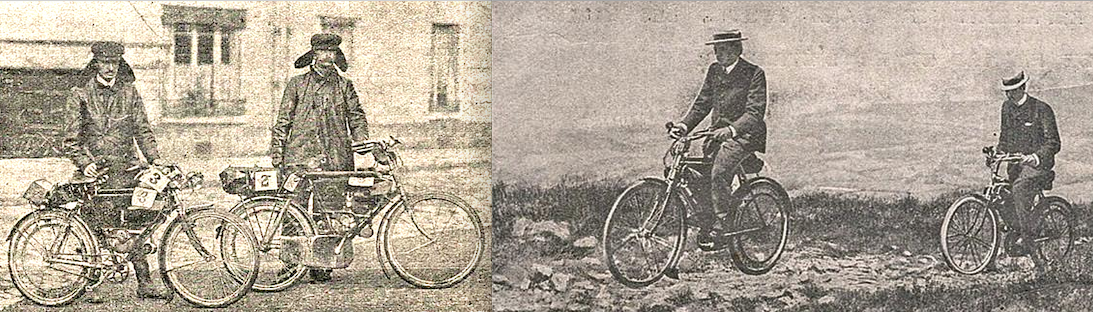
“TRACED THROUGH ‘THE MOTOR’. Mr TH Scott, of Carlisle, writes: ‘I herewith enclose a snapshot of a Humber motorcyclist I met in the Lake District last Whitsuntide, when on a cycle run round Thirlmere. He towed me a mile or two towards Keswick and then returned to Windermere (where he had come from). It did not strike me till after I left him that I did not know his name. Some time afterwards I noticed a query in ‘The Motor’ on some accumulator difficulty from a Mr Hodson, 2¾hp Standard Humber, Windermere, and thought he must surely be the motorist I had snapped on the Thirlmere road, but I had no actual proof. On returning from the recent National and Stanley Shows I met a cycle agent who turned out to be the actual one who had sold the 2¾hp Coventry Humber, and the name of the owner was Mr Hodson, Windermere, as I had correctly surmised. The agent was Mr Braithwaite, Windermere. I hope you will accept the snapshot for reproduction and record my thanks to him.'”

“WE ARE INFORMED that a young-man is doing good business at one of the South Coast-resorts with a motor cycle and forecar, by conveying passengers for short trips in the locality for a small fee.”
“MOTOR CYCLISTS PASSING along the main road of Glamorgan between Swansea and Cardiff need to exercise caution, as quite recently several of the village police stations have been placed in telephonic communication with each other. The police telephone the numbers of motor cycles, and the time they pass, to the next village.”
“AT THE HALF-YEARLY meeting of the South Eastern Railway the chairman attributed the falling off in the receipts for passenger traffic during the past six months to the competition of motors, and ‘motor cycles in particular’.”
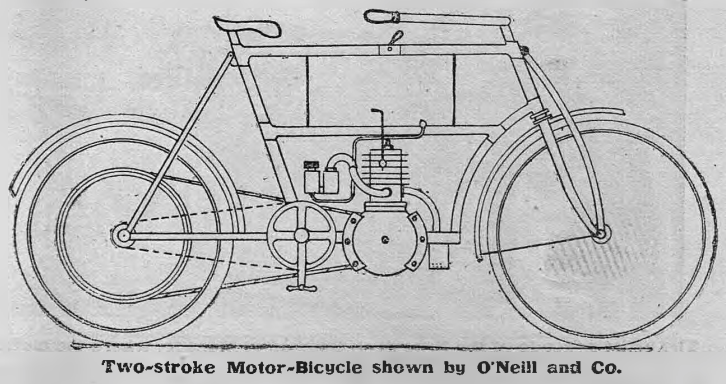
“FROM O’NEILL AND CO, 213, Piccadilly, London, come two patterns of a motor-bicycle. An illustration is given of one of these machines, although the only difference is that one has a curved front tube, and the other a straight tube. The engine is of the ordinary two-cycle type, having no valves. The transmission is by twisted hide belt, and a simple type of spray carburetter is used. The motor is mounted in brackets between the diagonal and front tube, and is quite vertical and in the centre of the frame. The front forks are reinforced. High tension ignition with rotary contact is used. Two sizes of motors are fitted, these are 2¼ and 3hp, the latter is claimed to be equal to driving the machine at 35mph. The machines are supplied to the trade only, and are of French manufacture.”
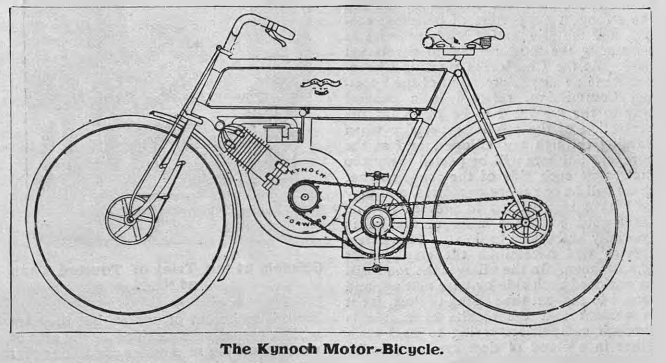
“THE KYNOCH MOLOR BICYCLE. Kynochs, of Birmingham, have introduced a chain drive motor-bicycle. This has a 3hp air-cooled engine mounted in a slanting position, and occupying the place of the usual down tube, the cylinder top and crank case lugs being held in special brackets. Two chains are used in the transmission, a countershaft at the pedal axle forming the first reduction. A spray carburetter is used and ignition is by coil and accumulator. All the control levers and minor gearing details have been carefully worked out. The petrol tank is of large capacity. Two brakes are fitted, and the general equipment and workmanship are of the best.”
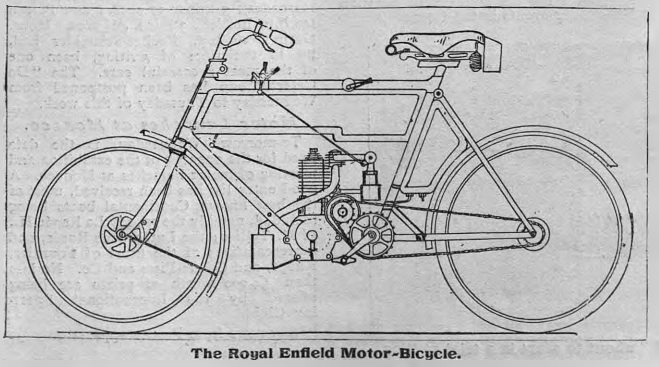
“THE ROYAL ENFIELD motor-bicycle has many features distinctly original in design. The engine is carried in a cradle, which forms part of the frame, it is quite vertical, and the weight is well distributed. The transmission is by reduction gear incorporated in the engine and thence by chain to the rear sprocket, thus allowing one chain to serve for driving and pedalling. It will be seen from the illustration that the pedal chain wheel only engages with the lower side of the chain. There is a spring driving sprocket on the engine shaft and a friction clutch on the rear wheel, this being operated by a small lever on the top tube of the frame. The reduction gear causes the contact breaker shaft to revolve at one-sixth the speed of the engine, hence it has three contact positions. The ignition is by trembler coil, and two sets of accumulators are provided. The carburetter is a specially designed spray type with throttle. The front forks are extra strong, and a band brake is fitted to the front wheel. The rear triangle of the frame is strengthened by an extra tube forming another triangle at the bottom bracket. The price of this machine is 40 guineas.”
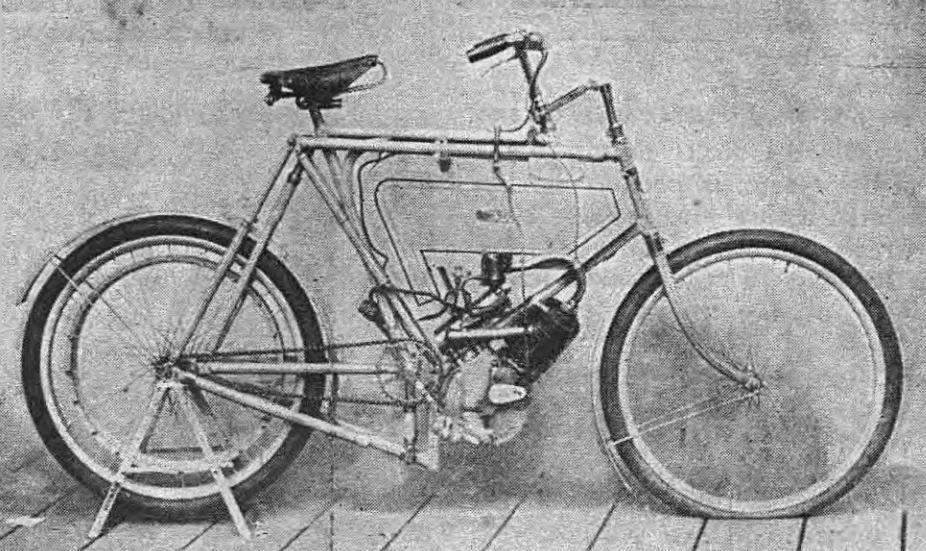
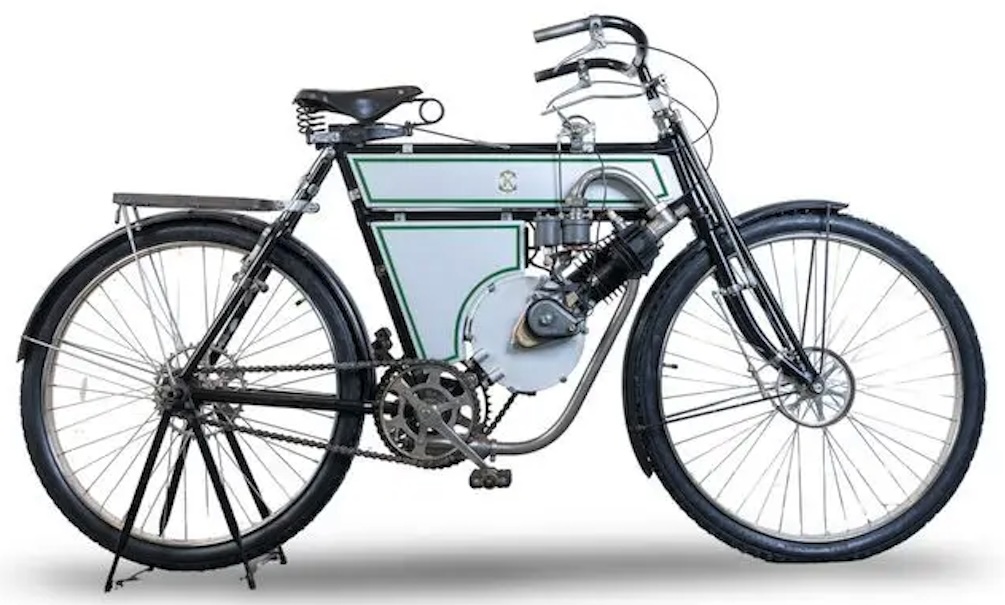
“ANOTHER TYPE OF motor-cycle frame. An alternative method of mounting the engine on a motor-bicycle is shown in the illustration. This machine is made by C Lefebure and Co, engineers, Ciney, France. The diagonal tube ends about half-way down, and connects with the bottom bracket and main down tube by a stout V-shaped tube. There are two lugs on the crank case of the engine, and these are securely bolted to eye pieces at the ends of the V tube. This method of fixing the engine is quite simple and mechanical, and the frame should prove particularly rigid in a lateral direction. The other features of the machine do not call for special mention, the carburetter and ignition being of the usual spray and coil order.”
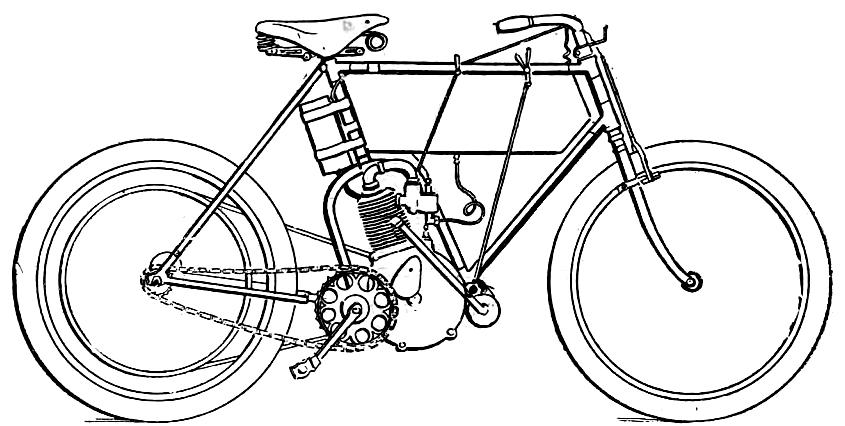
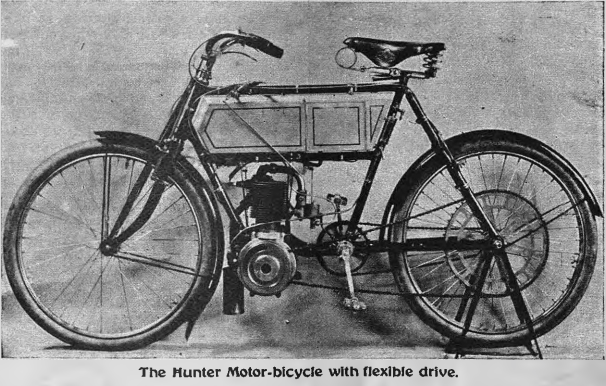
“THE HUNTER CHAIN DRIVE Motor-bicycle. The machine illustrated is made byHunter Motors, Eastdown Works, Lewisham, London, SE. The special feature of the machine is the transmission and gear system, which is fixed on the engine in place of the ordinary pulley. This gear, the makers claim, has the advantage of giving a perfectly flexible and yet positive and direct drive. Only one chain is used for the drive and thus the complication of a countershaft is avoided. The motor is mounted vertically in a special long wheelbase frame and is fitted with duplex forks. The carburetter is of the spray type and ignition by coil. The petrol tank has a large capacity. Two rim brakes are fitted.”
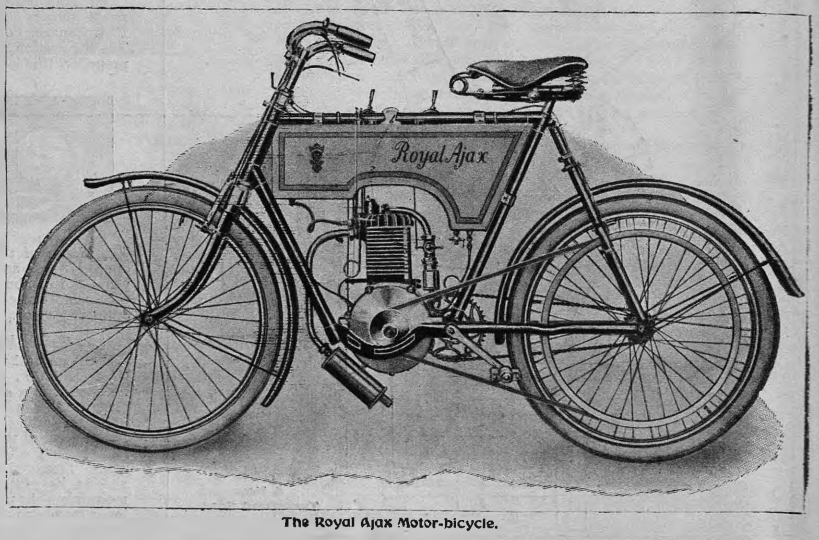
“THE AJAX MOTOR-BICYCLE. The Royal Ajax motor-bicycle has recently been introduced by the Silver Queen Cycle Co, 18, Gray’s Inn Road, WC. The engine is 2¾hp with automatic inlet valve, the gas being supplied from an English spray carburetter with throttle. The petrol tank has a neat pointer indicating quantity, and will hold petrol sufficient for 160 miles. Space for lubricating oil is included in tank, and a flap-fronted compartment for two accumulators and coil. Ignition is by high-speed trembler coil and wipe contact. A special form of triple head, a large motorcycle free-wheel clutch, a stand and carrier, with portion of back mudguard attached for convenience of puncture repair are features of the machine. V-belt, efficient brakes and Clincher tyres complete the specification. The price, 38 guineas net cash, includes carriage and the various fitments mentioned above.”
“THE INCREASING USE of silencer cut-outs was noticeable at the week-end. Many riders made use of them when negotiating hills. When fitted close to the exhaust port the bluish flames of the exploded charges produce a curious effect at, night, this being more notice-able on some machines than on others.”
“A NEW GRADE of petrol, to be known as the ‘Shell Motor Spirit’, is about to be marketed. The two gravities I will be ‘Shell A’, about .700, and ‘Shell B’, about .715. To meet the convenience of motor cyclists it will be put up in gallon cans.”.
“THE NUMBER OF TRAILERS to be seen on the roads at recent week-ends affords convincing evidence that the older form of passenger attachment still retains a fair amount of popularity. Several we came across were fitted to up-to-date and powerful machines, which seemed to make light work of the extra load.”
“MY EXPERIENCES DURING six years of motor-tricycling may perhaps be of some interest to others. I have ridden thirty thousand miles in all sorts of weather, and I think I have come across most of the little faults which a tricycle has. My first machine was a 1¼hp Beeston with tube ignition and surface carburetter. This was not powerful enough and I soon exchanged it for a 2hp of the same make. Tube ignition was very simple, but it involved the bother of lighting up, the nuisance of nipples getting choked, and the danger of fire, so that I do not think we shall ever see it adopted again for tricycles. With reference to fire, I had one nasty experience. Owing to a back fire the carburetter burst and caught fire, the burning petrol covering my clothes. This was very alarming at the time and although I was not burnt myself, owing to a thick ulster which I was wearing, the machine was very much damaged. I believe the cause of this explosion was owing to the inlet valve not closing properly, either from too weak a spring, or from dirt or

carbon getting under the valve. I remember I had had a good deal of back firing which you could hear in the inlet tube, and as it was a new machine I had complained to the makers about it…One constant source of trouble with the Beeston engine—and I often hear of the same thing with other engines—was the gudgeon pin. This was kept in place by means of two set screws, the points of which entered two countersunk holes in the gudgeon pin. Although these set screws had a split pin to prevent them unscrewing, they were always working loose. I would suddenly hear an awful noise in the engine, and on taking it to pieces I would find the remnants of one of these screws which had become jammed between the piston and crank case, and probably had done considerable damage…After my blaze up I had electric ignition fitted, and with this many mysterious troubles developed. The trembler was the greatest bother; it wanted cleaning every day, and even then I would get misfiring at hills. This made me think that something else was the matter, so new batteries and plugs were tried, and even new wires. The sole cause of all this bother was faulty contacts which were not of genuine platinum…Pure platinum contacts do not want
cleaning once in three months…I have often been bothered with the terminal nut or screw of a sparking plug working loose and falling off. This generally happens half way up a hill, or in the dark when it is a difficult matter to find it again. I fit my plugs now with a hook terminal…There has been a good deal of argument lately about surface and spray carburetters. I never find any difficulty in starting with a surface carburetter, but in cold weather it is always necessary to let a little fresh petrol in from the reservoir, and also on approaching any very stiff hill. No doubt when passing over rough ground you must let in more air, but this is no trouble with handlebar control…Spray carburetters seem to me so complicated, with their delicate needle valves and float which must be perfectly petrol tight. You constantly see in answers to queries: ‘See that your carburetter is not flooding’, or ‘your spray is not large enough, or too large’…Another matter I should like to comment upon is accumulators. Personally I do not believe in them. I have always used dry batteries, first the Meyra and now the Ideal make. These batteries last from six to eight months, and the firing is perfect…With dry batteries you always have warning when they are getting low by occasional misfiring, and it may be necessary to contract the gap in the sparking plug to get home; or, if you wait for a short time, they will regain some of their power. While you are waiting for a new set you can rejuvenate the old ones by boring a hole in the pitch and injecting a solution of salammoniac. Accumulators constantly want recharging. If you have no public supply at hand you can recharge with primary batteries…I have used dry batteries for nearly five years, and have never yet been stranded for want of battery power. I am much in favour of a tricycle as compared with a bicycle. With the latter on a rounded road with a greasy surface you do not feel at all safe. A tricycle will not skid unless you turn almost at right angles. On a tricycle you can keep dry and much more comfortable. With footrests’ and an
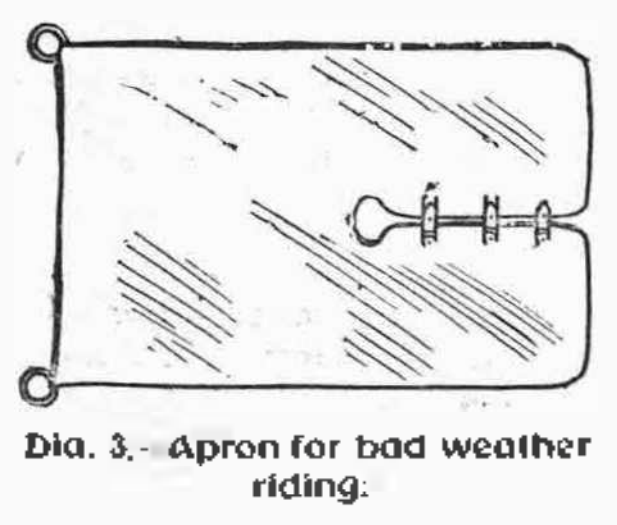
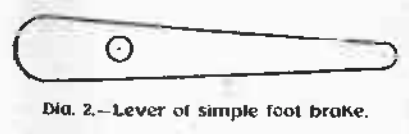
apron one can defy the elements, and can let go of the handles to light a pipe if necessary, as it is possible to steer quite well with the feet. Certainly one cannot go so fast as on a bicycle, but one can average a good seventeen miles an hour up and down hill—more than this with an air-cooled motor will overheat the engine; perhaps with a water-cooled head one could do more, but I prefer the slower speed without this complication. Footrests are a great comfort, they keep the feet free from mud; and, as I said before, you can steer with them. With the feet on the pedals there is danger of the clutch seizing. This happened with me on one occasion, and owing to the pace at which the pedals revolved and the suddenness of the occurrence it was a marvel that I was not thrown off…As luck would have it my knee caught the lever which closed the throttle, and this brought the tricycle to a standstill. This was in the days of the tube ignition. My footrests are in the form of pedals, and are adjustable on a round bar which is attached to the front fork of the tricycle. By means of this bar I have been able to fit some very simple and reliable foot brakes. These consist of a piece of wood about 6in long, with a hole near one end, which just fits over the bar. The short end presses against the rim of the front wheel when pressure is put on the other end with
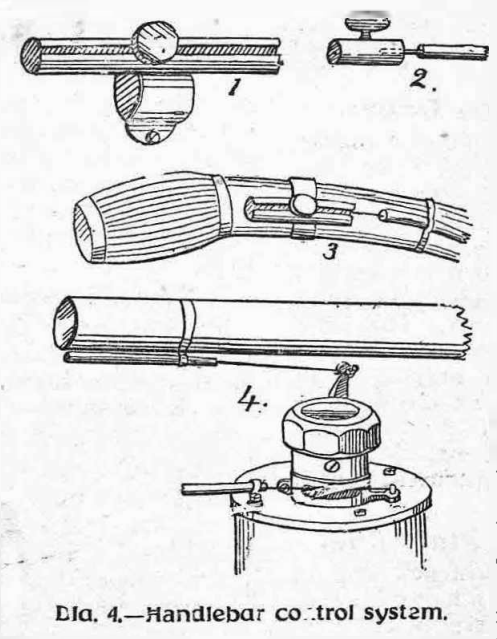
the foot: a short spiral spring draws it back into position again…Handlebar control is another very great advantage and I am sure anyone who has once tried it would never be without it again. The method I use, which I think is the simplest, is by means of thumb slides consisting of a piece of slotted tubing about 2½ inches long with a clip for fastening to handlebars’ as shown at 1. The slide fits easily into the tube and is moved backwards and forwards by means of the button. One end of a piece of Bowden brake wire is attached to the slide and the other end to the gas or air lever. It is essential that the outer portion of the Bowden wire should be firmly fixed close to the slide and also to some portion of the frame of the machine near the gas or air lever. The advantages of being able to control an engine without removing the hands from the handles are invaluable; more especially is this the case at starting, when a firm grip of the handles is necessary to properly pedal. Also in heavy traffic and at night the exact position of the various valves can be told by the feel alone. For the past two years I have ridden a Dennis tricycle with a 2¾hp genuine De Dion engine, air-cooled, and I must say I have had very little trouble with it. One often reads of axles twisting off. I remember mentioning this to the makers after buying my machine, and they offered to give—I forget how much—to the local infirmary if such a thing happened to my tricycle. But I am happy to say it never has happened. So much for tricycles. They seem quite out of date now, and it is exceptional to meet one on the road. But I am certain they will come in again—and, no doubt, very much improved; for they are, I think, open to improvement in certain respects. I should like a free engine to start with and also for going down hills. Two speeds are desirable where the country is very hilly; but in that case I am sure one would require a water-cooled head. I think also a belt or chain driven machine would be an improvement on the present system of gear wheels.”

“NOT THE LEAST AMONG MANY PLEASURES permitted to man is that of remembrance, and with our memory of incidents past there is invariably the association of something tangible, the re-occurrence of which at once recalls the period it unconsciously is a part of. Thus, when recently through my bedroom window came the keen refreshing breaths of air and the welcome rays of a genial morning sun, I felt a sense of exhilaration, a stirring to impulse, and through my mind flashed memories, memories of when at such a period of another year I had my first experience of motoring. Like a first visit to Paris, or a first dance, one has a first motor ride but once—unfortunately. Well do I remember mine! The germs of the ‘motor fever’ I developed were first caught through reading our little ‘green-backed friend’, and very soon afterwards was a selection made and a mount purchased. After waiting a short time the machine arrived. Then, mounting it on the stand, filling the tanks with oil and petrol, and with a book of directions on the table before me, I assumed the role of chief engineer (a whiff of petrol vapour at, any time recalls that evening), and, with some coaxing, off went the engine. How it buzzed and hummed! It seemed to me then, and still does so, almost incredible that upwards of 1,200 separate and distinct volumes of gas should be inducted, compressed, ignited and exhausted in the short space of one minute; yet such was, and is, the case. It was no wonder that I felt a sense of admiration not unmixed with awe as I watched and controlled the movements of the rapidly revolving little engine that was to propel me so faithfully and well afterward. The consciousness of possession had pleasures of its own, and all the little taps, levers, electric and other fittings added not a little to this feeling. It is the small things of life that somehow attract us most. The next morning, and without any previous experience, I essayed to ride alone, and not without some slight trepidation mounted, pedalled briskly, and though I soon heard the engine go ‘pop-pop-pop’, it was not until I had gone 20 or 30 yards further that I realised I was actually being carried along without any effort of my own. The psychological moment had come. I was being whirled through the air, slowly at first, but with rapidly increasing speed, the vibrations of the machine caused by the engine explosions acting as a stimulant and producing a feeling of elation, for then at least the sordid cares of life were non-existent. On I went, lifting the switch lever for a moment every 50 yards or so until the confidence of control was felt; then gradually advancing the spark and opening the throttle valve the speed increased; 10—20—30 miles per hour was reached—the last seemed 60. Off flew my cap, it soared to earth. What mattered a dozen caps? Let it lie, it belonged to earth. Onward I sped by winding country roads, tears trickling down my cheeks, nerves at high tension, approaching curves with both hands ready on the brake levers, now taking hills upward at a speed that seemed marvellous, now rushing down the other side at break-neck rate. Intoxicated! And all the time more speed, faster, faster was the desire. Surely something must happen, something break? But no, switching off current my engine stopped, and in a few seconds I stood once more on terra firma, my heart beating wildly. Could such a ride be repeated ? It could, and was, and as I sped homeward I knew that I lived; hitherto I had merely existed. Since then I have had many exciting rides, but none more so than my first. The feeling when riding at high speeds is delicious for the reason that a motor-bicycle has a personality, so to speak, of its own; it is part of you, and you are part of it. In driving a car this feeling is quite absent, it is grand to go through out of the way and hitherto unexplored regions, unexplored either because of the distance from home or the hilly contour of the country: the exhilaration of spirits produced as one skims over roads, whizzing by hedges and meadows, up hill and down dale: the fragrance of growing vegetation, hawthorn blossom or honeysuckle on the olfactory organs, exercises a subtle charm and combines to form a new sensation which cannot well be described. This article being written principally with a view to interest prospective or novice motorcyclists, I refrain from dealing with or criticising technical subjects. The various correspondents in ‘OPV’* discuss very thoroughly the questions as to the merits of various types of machines, methods of power transmission, and the virtues of carburetters, etc, but I feel bound nevertheless, while not antagonistic to the ideas of those who favour the higher-powered and heavier machines now being so much used, to express an opinion in favour of a machine comparatively light and not exceeding 2hp. Less than this size, a 1¾hp well-known chain-driven machine has carried me about easily, and up any hill (including the famous Ballybannon hill at Castlewellan) without trouble, and 1 have also used it for trailer work, doing at times a 70-mile run. There is no doubt, whatever, to my mind, that a saving is effected in the lighter made and lower-powered machines in cost of maintenance of tyres and running, quite apart from their being cheaper in price than others in the first instance, and more easily handled in bringing in or out of premises. The latter point is a consideration. The question of the reliability of motorcycles is one in which much misconception on the part of the non-riding public exists. I am asked continually, ‘Is not the motorcycle very liable to break-downs?’ My reply invariably is, ‘No’; but I cannot always get people to believe this. To them a stoppage, for any cause whatever, whether only to clean a fouled sparking plug, or refix a loosened terminal, is a ‘breakdown’. And the wrong impression is not altogether unwarranted, for they have good cause sometimes for thus regarding stoppages, owing to the mishandling’ of machines by novices through want of experience, and the lack of understanding or the apathy of those who ought to be past the novice stage. The motor-bicycle is an intricate and delicate piece of machinery, though simple to work if treated properly; but to keep it in tune and to secure the highest possible results from it it demands that an intelligent interest be displayed; herein many are found wanting. The man who only cares to be carried anywhere he pleases without exertion, and refuses to take the simplest precautions against compulsory stoppages simply courts trouble, and to tell the truth, he does not long suffer disappointment on that score, for example, a friend of my own told me that his engine gave forth a peculiar rattling sound: ‘something loose’ I informed him, and advised him to examine his engine, or have it examined. He neglected the advice, and for a week or so had ‘a presentiment that something was going to happen’. Something did happen: he was stranded 12 miles from home, and the motor was damaged to the extent of 39s. Now the tightening of a gudgeon pin would have saved all this. One day I noticed a youth go the length of a street and back, pedalling as though his life was at stake, and dropping off nearly exhausted, only to find he had omitted to reinsert the ‘interrupter plug’. ‘Beastly unreliable things,’ says the man on the side walk as he moves on. I did not escape trouble myself during my early motoring days, trouble which was due principally to an ignition fault which intermittently cropped up and long defied detection, but after spending an Easter Monday holiday in taking’ every part of the motor and fittings to pieces I discovered and remedied the defect, and in doing so obtained a knowledge of the engine which enabled me to appreciate the principle of power production, and so afterward to develop the best possible results in running.—John C Nixon.”
*‘Other Peoples Views’—The Motor’s readers’ letters pages.
“MOTORCYCLE TAXATION. ON SATURDAY a case was before the Bridlington Bench against a motorcyclist for driving a motorcycle and drawing a trailer, having only paid the Inland Revenue tax on one vehicle. His defence was that he had made enquiries from the Post Office and the Inland Revenue officer and had been informed that they did not know what to charge him. The summons was, therefore, dismissed. As the Auto-Cycle Club are approaching the Board of Inland Revenue in order to get motor-cycles exempted, a policy of waiting may be best.”
“IT IS ONLY WITHIN the last year that lamp manufacturers have put lamps on the market specially constructed for use on motor cycles, but nothing certain is known about their usefulness. All lamp manufacturers should be invited to construct a lamp specially suitable, and these should be tested by an impartial and expert body.”
“SEVERAL CORRESPONDENTS have communicated with us during the last few weeks complaining of the way the weights of machines are under-estimated in advertisements of motor cycles. In one instance a gentleman from Brighton was informed that a machine loaded weighed 130lb; when delivered it weighed 190lb. Readers are recommended to scale their mounts on delivery, as we have proved from our own experience that many machines are greatly in excess of catalogue weights.”
“THE SPRING FRAME models at present on the market have met with much favour, and used over fairly good roads prove a luxury; over the majority of town roads, where one’s pace is lessened to a degree, an appreciable difference is found.”
“EXPERIMENTS FOR THE prevention of dust are being carried out in many parts of the country by painting the surface with tar, or sprinkling with oily compounds. Some of the processes are said to be successful, but very costly, and it is questionable if they can be undertaken on a large scale within a reasonable expenditure except in very populous districts.”
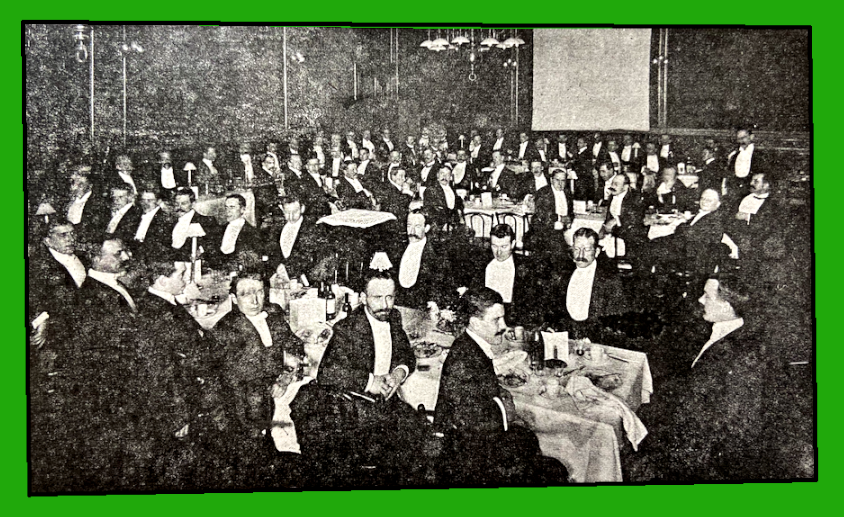
“THE MOTOR CYCLING CLUB DINNER. The second annual dinner of the Motor Cycling Club was held at Frascati’s Restaurant, Oxford Street, London [where the club was formed] on Tuesday evening, January 5th. The number of members and friends present on this occasion was much larger than last year, no less than 80 being present. The function was held in the large Banqueting Hall. There were present many of the leading spirits in London automobilism…After the toast of ‘The King’, Mr T McDonald Rendle gave a speech cast in a humorous strain in which he touched lightly and frivolously on various phases of the progress of motorcycling and the curious ideas of the death-dealing powers of the new machine entertained by many of the public.”
“COLLECTING NUMBERS. THE ‘COLLECTING’ hobby springs eternal in the juvenile breast (if that is the part of the human anatomy in which one carries one’s hobbies!). One of the favourite pursuits of the genus small boy has been collecting the names of railway engines: a more up-to-date hobby has now presented itself to the mind of the enterprising youngster, in the collection of the numbers on motorcars. On a drive through Surrey during the first week of the year, we noticed several lads who had taken up positions by the side of popular roads, and, notebook in hand, were carefully taking down the numbers on passing cars. However, anything tending to interest the rising generation in motors is good for the cause.”
“A VAPOUR-PROPELLED motor-bicycle has been invented by a young French naval engineer, Mons R d’Espujois.”
“Watering carts put in their appearance again in many of the suburban roads around London last week. Dust lay thick on the roads, even near town, and goggles were again required.”
“The first London newspaper to employ motor cycle riders was the Evening News The first rider was Walter Blake, and so successful was the experiment that he now has four comrades. Mr Blake has had only three roadside stops in 12 months’ riding—one side-slip and two punctures.”
“MUCH IS BEING written and spoken just now on the question of the horse vs the motorcycle, and the matter of substituting a motor cycle corps to perform some of the functions of cavalry is being discussed in all its bearings.”
“AT A RECENT AUCTION sale at a London Mart some thirty motor cycles were sold under the hammer. Over three-fourths of the number were fitted with engines of from 1¼hp to 1¾hp. This further indicates that the chief demand now is for slightly more powerful machines.”
“SIR,—I BEG TO send you a photograph of a spring frame for motor-bicycles, which I consider very essential from the point of view both of ease of running and greatly lessened vibration. On examination it will be seen that a short length of tubing is fixed in front of the steering head or stem, giving the bicycle somewhat the appearance of having two heads. In this extension a tubular prolongation of the fork crown is allowed to work up and down with a piston or telescopic action; its movements in either direction being checked by means of buffer springs. To allow of the staying of the lower ends of the front fork tubes these latter are attached by means of two hinged tubular stays to the lower end of a member or support made of two lengths of D-tubing, these being affixed to a lug on the lower end of the steering pillar. The two D-tubes in question are built apart to allow of the steel mudguard being fitted. It will also be seen that a similar telescopic movement is arranged for the back fork, the chain stays being hinged near the bottom bracket. It will be noticed from the illustration that there are very few working joints, and these have been so arranged as to reduce the movement to a minimum. The frame and fork can also be used as a rigid machine at will. I might mention that during the tests through which the bicycle has been put it has been fitted with ordinary Clipper 1¾in cycle tyres. I have so arranged my invention that every part of the fork, etc is a strengthening part or support for the other, and the experimental machine is built up of light gauge material. Therefore, I claim that it can be ridden with every confidence; and even if it should happen that the springs give way, which is not at all likely, the rider can still continue his journey safely, as though on a rigid frame. The advantage of a spring frame and fork for motor-bicycles is that it can be ridden during the winter months fitted with solid tyres, thus preventing any fear of skidding, or side-slip; and I am convinced it would give every satisfaction, as I have allowed of a vertical movement of an inch and a half. The frame is suspended between springs, these being fixed at the extreme ends, thereby avoiding any vibration at the handlebar, saddle and pedals. It is also perfectly rigid laterally. For light engines up to 2hp I have a design slightly different from the one mentioned above. In this the front fork telescopes in the steering stem, which gives the bicycle the appearance of an ordinary bicycle and this class of fork is also adaptable to ordinary pedal propelled cycles. The frames can be built for either position of engines, vertical or inclined, as desired. The cycle illustrated has been in daily use for the past six months and during that time it has been ridden by experts and has given entire satisfaction.
Thos Ashburn, 115, Sommerville Road, Small Heath, Birmingham.”

SPRAY CARBURRETORS were replacing wick-in-a-tin ‘surface’ carbs (which, let it be noted, were known as ‘bubblers’). Rubber and canvas V-section belts were replacing twisted rawhide belts and mechanical inlet vales (MOIV) were replacing automatics (AOIV). Tyres were growing from two to three inches wide. Other innovations included high-voltage magnetos, Bowden cable controls, clutches and sprung forks.
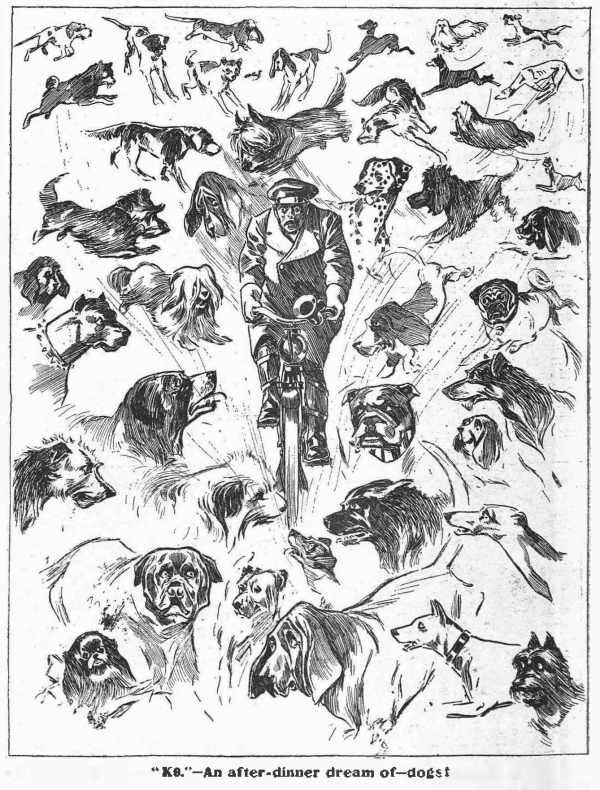
“THOUGH SOME DOGS are sworn enemies of motor cycles, others are enthusiastic pro-motorists. One, a well-bred wire-haired fox terrier named ‘Rip’, is as much devoted to the motor cycle as his master. After his first trailer ride he sat down outside the cycle shop from which it was hired and watched it with admiration till darkness set in.”
“DOGS APPEAR TO BE doing deadly work just now, but when a motorcyclist is brought over by a dog it is never a dog peril: only a ‘motor peril’.”
“ON MONDAY AFTERNOON a motorcyclist named G. A. Smith, of Wandsworth Common, was found lying insensible beside a wrecked motorcycle near Beddington station. At the hospital he was found to have sustained concussion of the brain. A dog is surmised to have been the cause.”
“DOGS AND MOTORCYCLISTS. Re the letters on the subject of ‘Dogs’, my experience might be interesting to your readers. I have had two bad accidents from dogs this year. The first took place in France early in March, when, going fast on a racing machine, a big spaniel running in front, the machine was upset and I was pinned under it, and badly cut on the head, hands, and hip. I have bruises and cuts on my hip I shall probably carry all my life. The machine was badly damaged. The dog was unhurt. My second accident took place last August in Ireland, when the same thing occurred whilst riding a touring machine. I met the dog quite square, however, and the machine did not fall. The front fork stem was broken, the girders twisted, and the front tyre blown off. The dog, a large collie, was, I believe, killed. Since then, whenever any dog which has a reputation for running at motors comes at me, I stop, get off, and go to the house where the owner of the dog lives, and, after interviewing him, thrash the dog severely myself. This I have done five times lately, and have not yet been prevented from doing so. I have never yet been worried by the same dog again after interviewing it once. I look upon this as the most successful treatment I know of, when the owner of the dog is warned of the danger he runs, and the damages he might be liable to be forced to pay on account of an accident caused by a dog not controlled. I might mention that I have three dogs myself, and am a lover of animals. I value my own life higher, however, than a dog’s feelings.”
HEH.”
“IT IS CERTAINLY HIGH TIME that something was done to deal with the dangerous dog nuisance. This question of dogs at large is one that the Motor Union might well take in hand.” [In case you missed it, there’s a feature on this subject in 1903, “Dogs: Shoot, hang or poison?” It’s my favourite Blue ‘Un yarn so do take a gander—Ed.]
“STAGE TRACK-RIDING and exhibition riding on motor cycles are not altogether innovations, for about a couple of years ago we remember seeing such feats performed by a well-known motor cyclist at a London music hall. For this class of riding the machine must naturally be geared down considerably.”
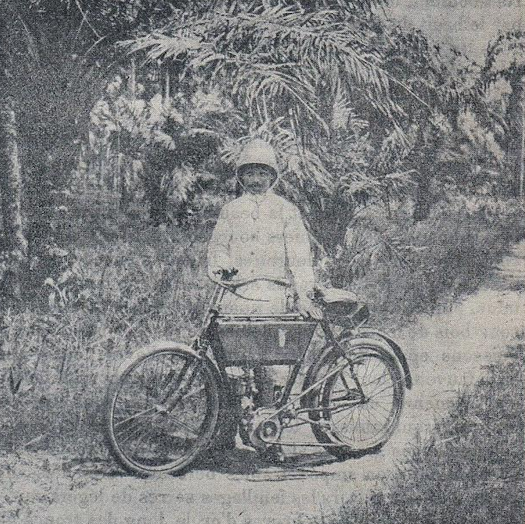
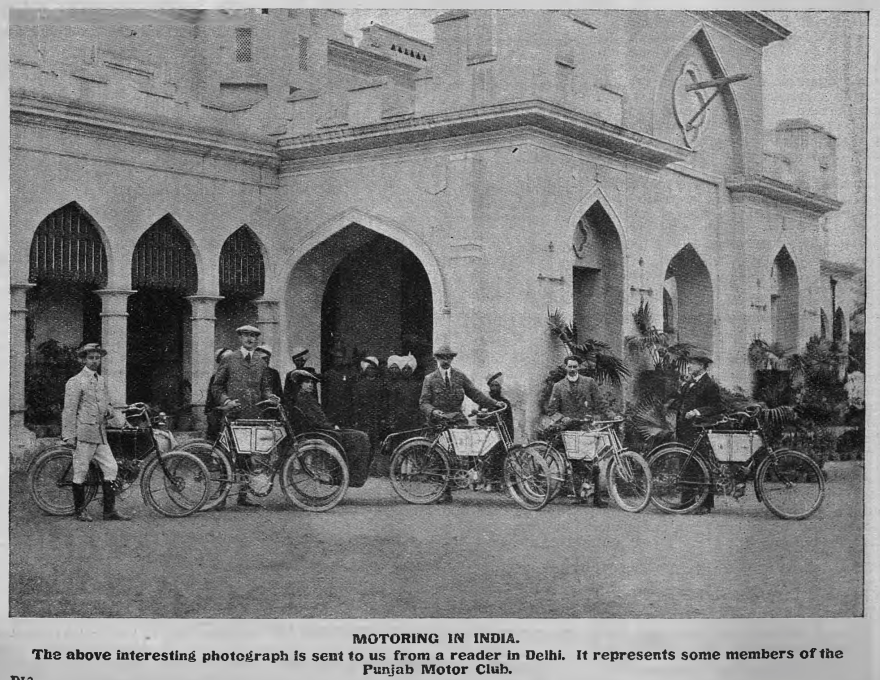
THE FIRST MOTOR cycle in India was dubbed ‘shaitan-gari’ or ‘devil-carriage. The rider lived 1,700 miles from the nearest petrol.
RACERS WERE routinely exceeding 60mph.
“GA BARNES IS BUILDING a light road machine fitted with the Stevens 2¾hp engine, and wood rims. The rims, which were specially made, are designed for Constrictor road tyres, which are bound to the rim with canvas in a similar manner to the racing tyre.”
“IN A SPORTING daily the petrol tank of a racing motor cycle is referred to as the ‘essence cistern’.”
“ON THE QUESTION of hotel charges a correspondent says: ‘I am a pedestrian, cyclist and motorist, and in each capacity I have called at a small country hotel in Kent. On the first occasion I arrived on foot, and was charged 2s for a meal. About a week later I rode there on a cycle, and was charged 3s 6d for a similar meal. The climax came a few days ago when I stopped at the same hotel, this time on a fairly expensive-looking motor bicycle. Without a blush the landlord demanded 5s for a meal precisely similar again.'”
WITHIN SIX months 21,521 motorcycles and 18,340 cars had been registered (lower cost made two wheels more popular than four). Just 770 motorcycles were exported; 979 were imported.
INDIAN ADOPTED twistgrips way ahead of the pack, though Werner had pioneered them for racing.
“HIGH TENSION VS MAGNETO IGNITION. As the question of ignition still appears to be rather a vexed one, we must make this our excuse for writing you on the subject, as we thought possibly our experience would be useful to you. We have just completed a long series of extensive experiments with practically every known system of ignition, and as a result we have decided to retain the well-known high-tension system upon our cars this season. Our experience is that for all-round satisfaction the high-tension system is very hard to beat; speaking broadly, there are no working parts which are at all times apt to get out of order, and if any trouble is encountered the fault can usually be traced by the merest novice, whereas with the magneto form of ignition any derangement is usually outside, the scope of the average driver’s capabilities, and the result is that the whole apparatus has to be removed and returned to the manufacturers for repairs. With the high-tension form of ignition the most important detail which requires attention is the accumulator. A good quality coil practically never requires any attention whatever (we are prepared to fit induction coils with one, two or four tremblers) and the only attention needed to the commutator is occasional adjustment and cleaning of the platinum points. Sparking plugs have now reached such perfection that defect is seldom experienced, and with careful driving the sparking plug points should rarely require cleaning. To overcome any likelihood of trouble with accumulators we are this season fitting two accumulators with two-way switch within easy reach of the driver, and will also in addition supply, free of charge, a spare four-volt accumulator. All insulated wires and terminals are thoroughly protected, and providing the driver occasionally tests his accumulators, we think that ignition troubles will—at any rate on Ariel cars—be few and far between.
The Ariel Motor Co.“
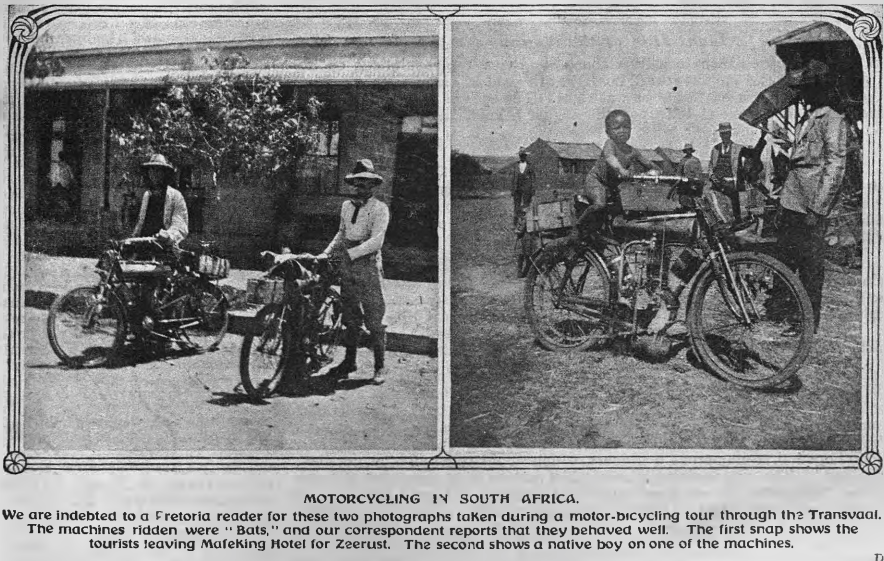
GERMAN EMIGREE Johannes Gütgemann adopted the name John Taylor (later changed to Goodman) and, with his partner William Gue, produced Hampton bicycles. They took over the Begian firm Kelekom Motors and developed a 2hp powered bike which they marketed as the Veloce (Italian for Speed). It was not a success, but Veloce would be back.
“THE OPENING RUN OF THE SEASON of the Edinburgh Motor Cycle Club should have taken place on Saturday, the 9th inst, to Peebles, but owing to the violent storm of a mixture of snow, sleet, hail, rain and wind, the run had to be abandoned, to the great disappointment of the members who had been looking forward to a pleasant outing. Saturday was just about as wild and unpropitious a day for riding as can be imagined, and reminded one more of a day in mid-winter rather than in spring. The club, we are informed, promises to be much stronger numerically this year, and the members are very enthusiastic. They are only longing for the April showers to cease. Linlithgow was the destination of the club on Saturday last, and other places to be visited in the course of this month, May and June are West Linton, West Calder, Haddington, Bathgate, Gullane, and North Berwick, Lauder, Falkirk, Innerleithen, Dunbar, and Galashiels.”
“THE PASSING OF THE BILL amending the law relating to Light Locomotives, in other words, the Motor Bill, by the Manx Legislature, has made it possible for the eliminatory trials of the Gordon-Bennett motor races to take place in the Isle of Man. From one end of the island to the other, and amongst all classes, from his Excellency the Lieut-Governor (Lord Raglan) downwards, the keenest interest is taken in the matter. If evidence of this were needed it could easily be found in the fact that the Bill enabling the races to take place was passed through the three branches of the Legislature in the course of a few hours.”
“MANY MOTORISTS DISLIKE the leather type of garment which necessity, rather than choice, prompts them to adopt, and it is pretty certain that the newly designed motorcycling suit, which Mr John Piggott has put on the market, will be very favourably received. The suit is made of specially serviceable and very closely woven tweed, and in the make-up all the requirements of the motorcyclist have been well considered. Mr. Piggott claims that the cloth of which the suit is made is equal to leather.”

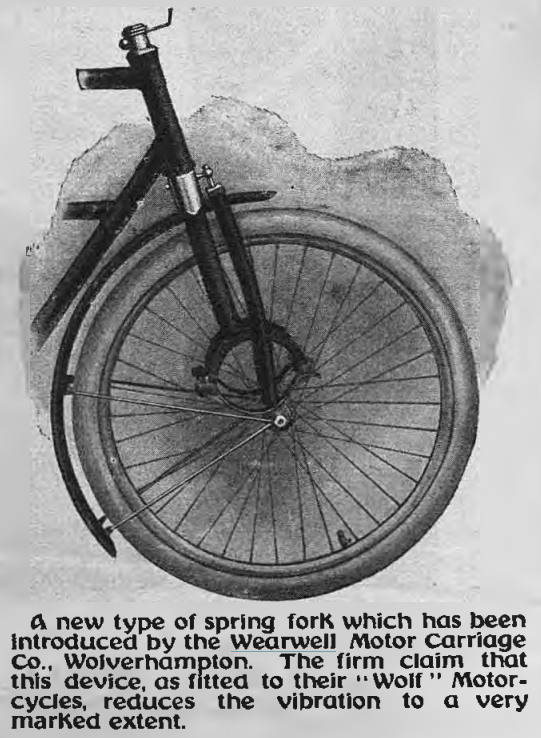
“THE WEARWELL MOTOR Carriage Co, Wolverhampton, have a small number of their last year’s 2¾hp motor-bicycles unsold. Some are shop soiled and a few are secondhand. All, however, are, we understand, in perfect running order, and are being offered at very low prices with a view to effecting a clearance.”
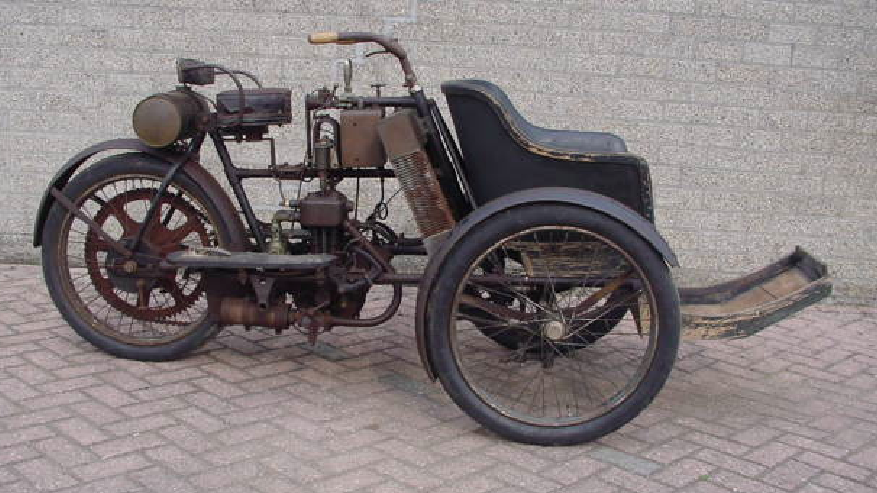
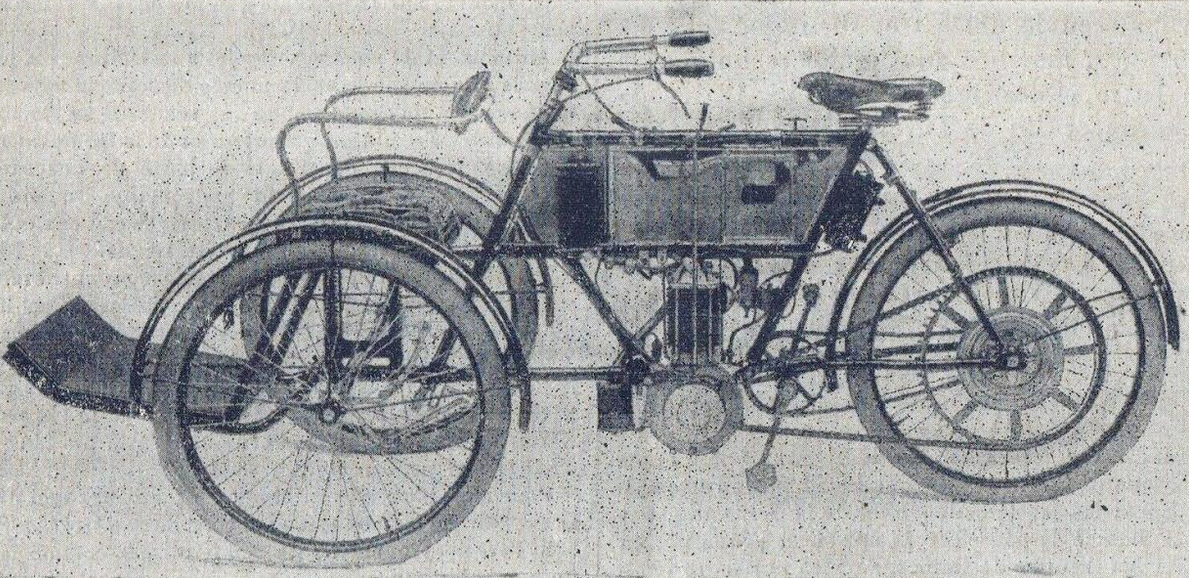
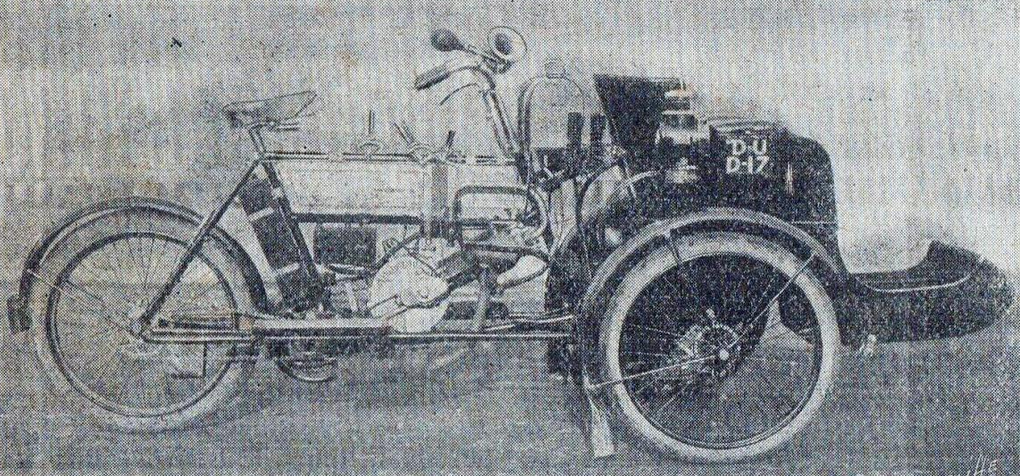
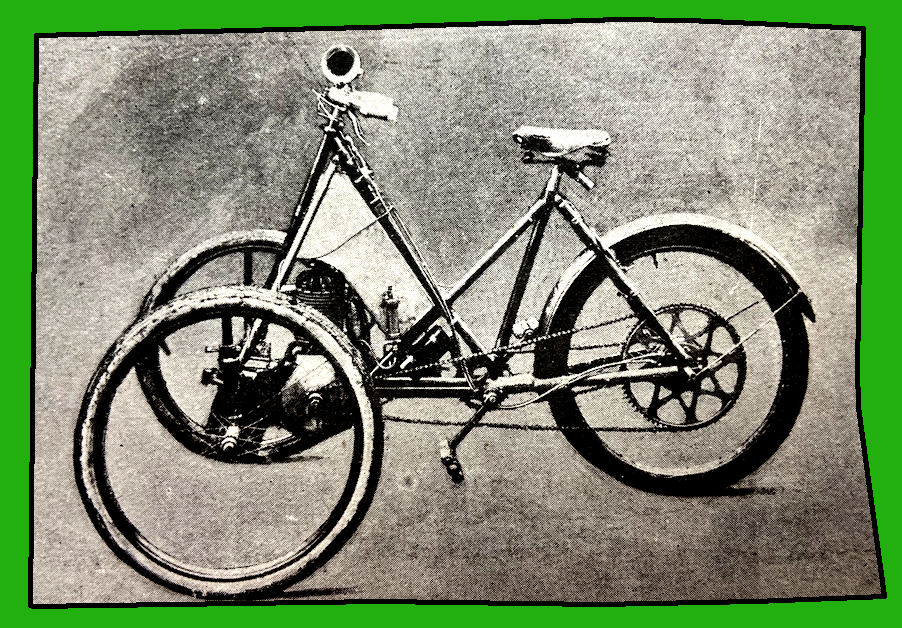
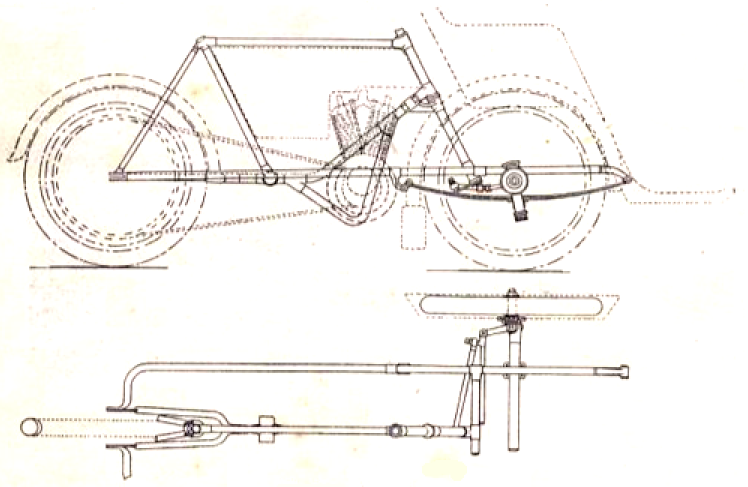
TRICARS AND FORECARRIAGES were outselling trailers so instead of eating dust hapless passengers served as an early form of airbag. The Motor Cycle was clearly cognisant of the problems facing single-trackers during inclement weather: “As we have pointed out many times before, the only preventive of a fall on greasy roads is to convert the motor bicycle into a tricycle by the addition of two front wheels and steering gear. There is a slight drawback to the tricycle, and that is the storage question. This, however, in the case of enthusiastic riders, is of little moment, as they am generally find somewhere to store the machine for a small charge, and we can only hope and wait for the future, when a perfect collapsable forecarriage will probably be made to go through any ordinary doorway. The Neofold tricycle has special advantages in this direction, but up to the present the maker has not busied himself with the strengthening of the parts for motor cycle use, preferring to make a few machines to special orders as pedal tricycles. There are in the English winter many fine days when motor cycling can he made very enjoyable, but it is on these fine days, when the roads in places are dry and hard, that one is apt to be incautious, and run on to a patch of greasy slime before one realises the danger. During the winter season there is no doubt that the tricycle has a big score over the single-track machine. We do not wish to imply that the fact of making the machine into a tricycle renders it absolutely devoid of sideslip, but it certainly renders it perfectly safe, as with ordinary care a fall is an impossibility.” Here’s a selection of forecars and what we would now call tadpole trikes from the 1904 season…
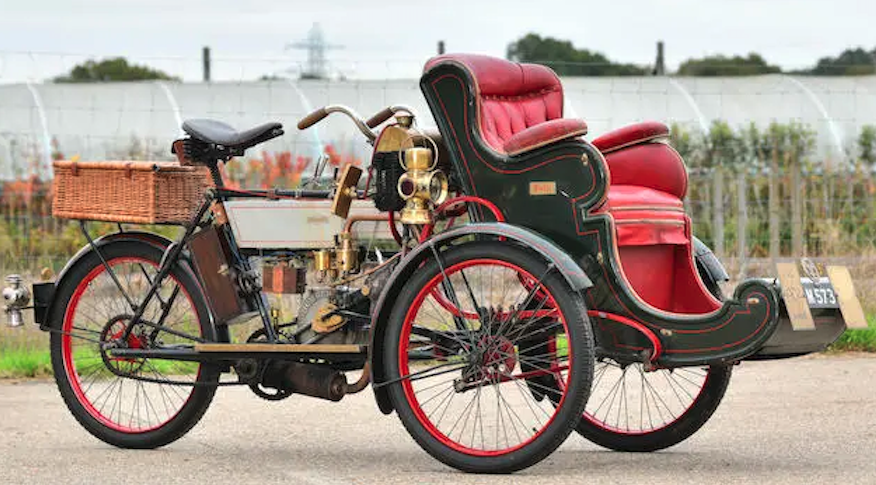

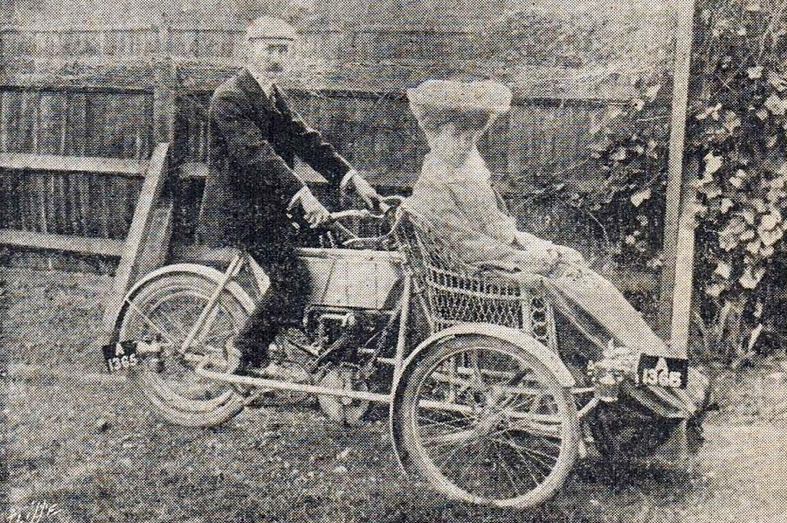
“A TRADESMAN’S MOTOR CARRIER. A new pattern just introduced by the Hubbard’s Motor and Engineering Co, Much Park Street, Coventry, has the special advantage that it can be speedily converted into, an ordinary tri-car. It has a 3½hp engine, water cooled, and the transmission is by a 1½in flat belt. The carrier body is made of wickerwork, hung on springs, and has large carrying capacity. The engine has a free clutch, spray carburetter, and trembler coil ignition. There are three brakes—a rim brake on back wheel and expanding brakes on front wheel. The extreme length is 8ft 6in, and width 4ft. The makers have introduced this line with a view to its appealing to up-to-date tradesmen who require rapid and economical transit of goods. They are prepared to allow a week’s free trial to prospective customers. The price is £75. There is no doubt that a vehicle of this class has been wanted, and this one seems to fill the bill.”

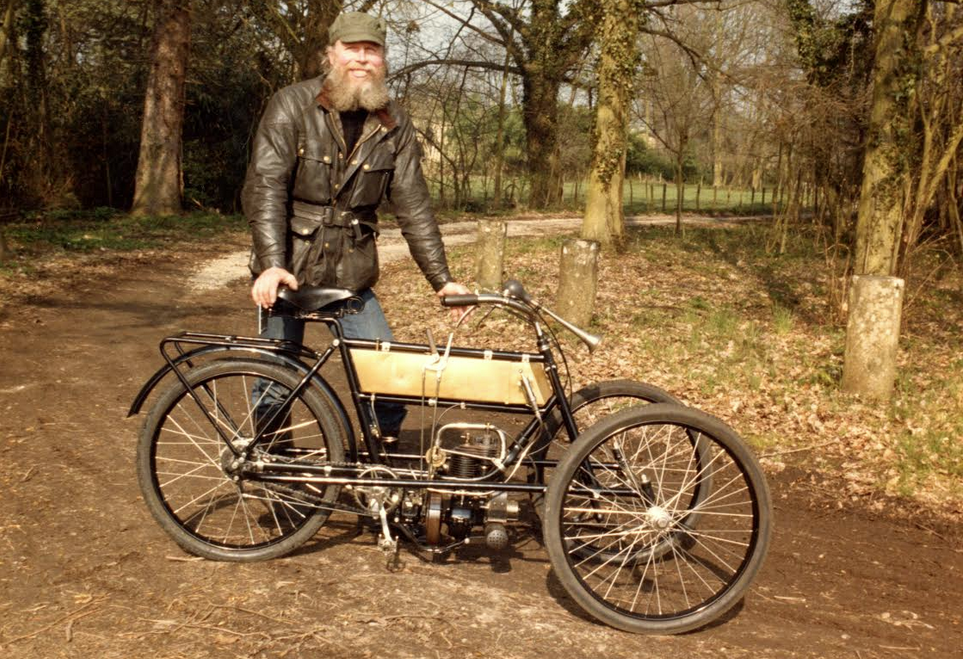
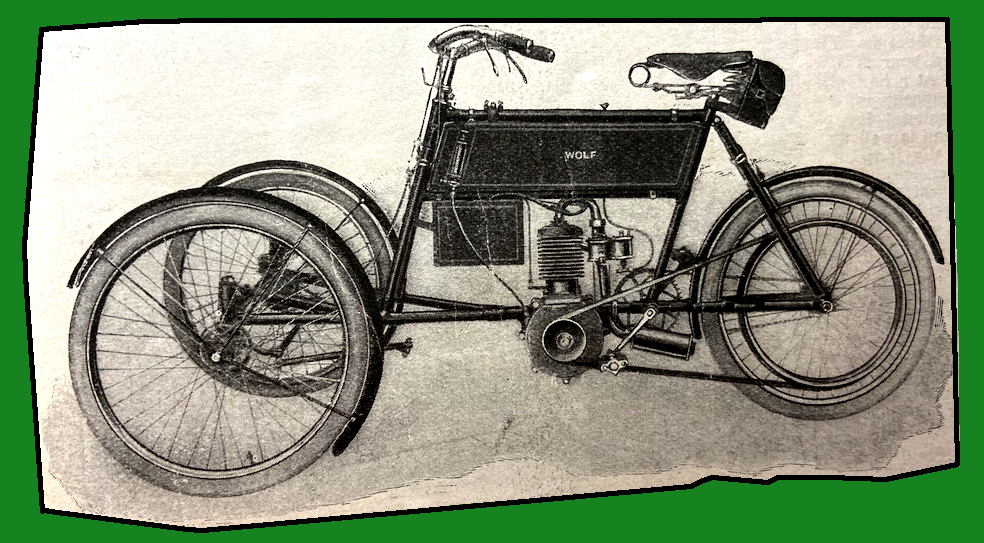
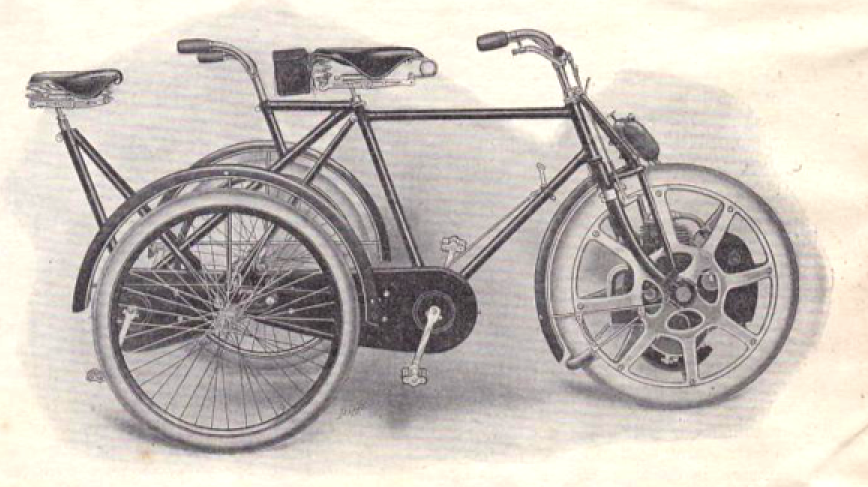

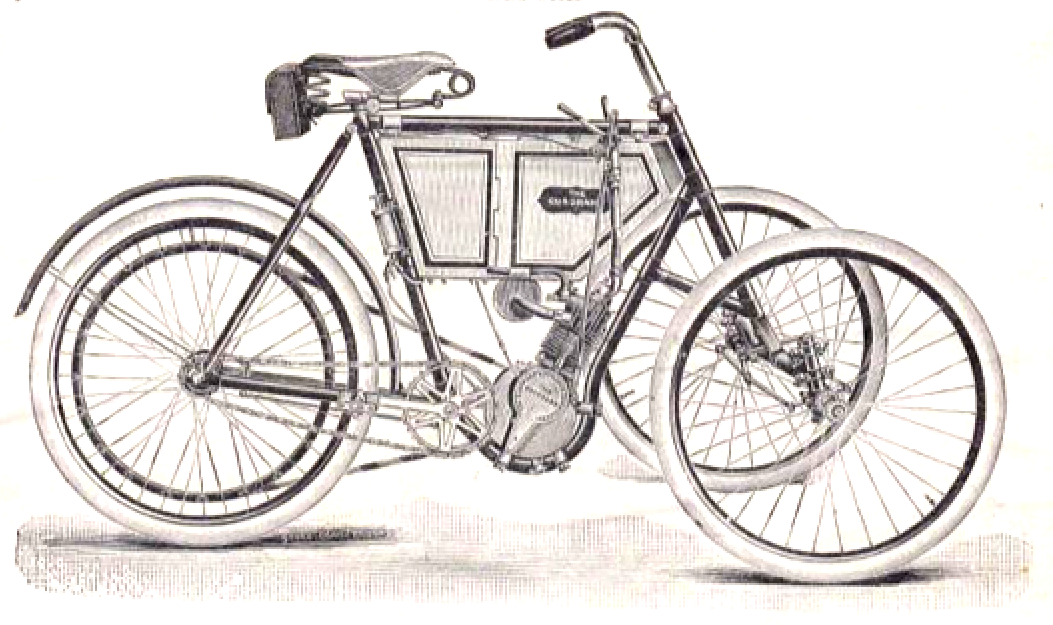
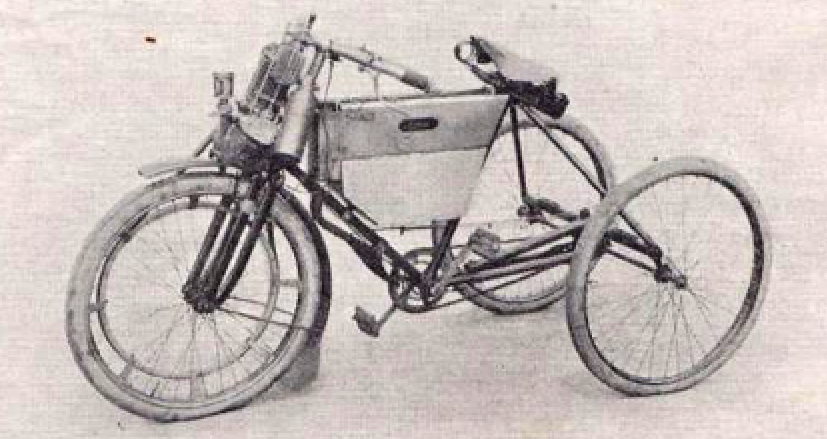
“THE ILLUSTRATION BENEATH is that of a 2¾hp Phoenix tricycle. This machine is fitted with magneto ignition. In writing to us, Phoenix Motors say: ‘We think that there is a growing demand for a really good and efficient light three-wheeler which can be started by hand and driven after the manner of a car, as is the case with this machine, it being fitted with our two-speed gear, clutch, and free engine.’ Phoenix Motors recognised some time ago the necessity of making an attachment for bicycles, and now make one called The Trimo forecarriage, which suits other makes of bicycles besides their own. The illustration shows this without the seat attached for a passenger, as it can be supplied with or without the seat. To detach the seat does not take more than five minutes. Thus the rider always has three machines in one—safety, tricycle, and forecarriage complete. This firm were practically the first to make a successful fore-carriage machine, and have had a vast amount of experience in suiting riders’ requirements in this direction. The width over all is 3ft f5in, and the approximate length is 8ft with the attachment affixed.”
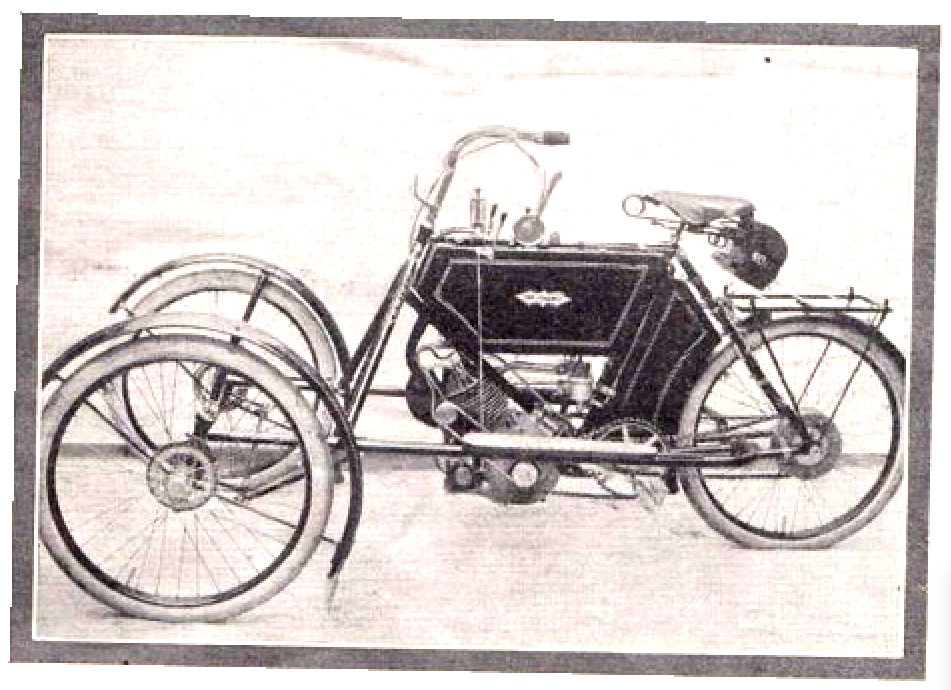
“THE GEAR DRIVEN tricycle introduced by the De Dion-Bouton Co is now almost obsolete, but similar machines can be obtained now from the Ariel Motor Co, which alone continues to manufacture a few of this pattern to order.”
Some riders took matters into their own hands but converting their bikes into all-weather three-wheelers...

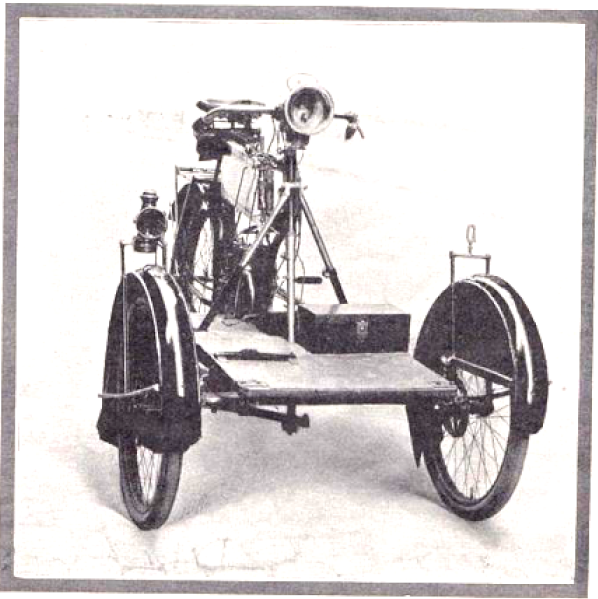
“MANY MOTOR CYCLISTS maintain that motor cycles are useless for regular winter riding, risk of side-slip and belt difficulties being sufficient to deter the majority. However, the ‘all-weather’ machine is bound to come, and I do not think the time is far off when a suitable machine will be put upon the market. I have been more than satisfied with the machine illustrated, which I have been riding regularly since last Christmas, and, as most machines can be converted in the way I converted mine, it may be of interest to describe it. The machine in the chrysalis stage was a motor with a 2¼hp engine, but side-slips, glimpses of straying cattle on dark evenings, made me think that a single track was not safe enough, in spite of its advantages. I therefore had a Mills & Fulford Trimo attachment fitted, so converting it into a tricycle, but without a front seat. After a few miles the engine lay down and died on a hill—with a broken connecting rod, I believe. This was before I had time to see if the power were sufficient; the machine was at the time manfully climbing my test-hill. As I had to get a new engine, I determined to increase the power to 3hp, and, after looking round, settled on a 3hp Clarendon, with a ball hearing on the crankshaft outside the pulley. This engine has been perfect in every respect, and I can assure doubters that a good 3hp engine is quite sufficient for the purpose. Mine is geared five to one on to a 28in wheel, which gives me about 32mph on the flat, and will climb any reasonable hill around here (Coventry). For more hilly parts I should add another ½hp and gear the same. The back mudguard is 4½in wide, as also are the front, the bottoms of which require wide flaps, as supplied by Mills & Fulford; these have to be renewed each season, as they gradually disappear. The front band brakes are operated by a pedal on the right-hand side of the machine, and if kept in proper working order are more than effective. The advent of the ‘Watawata’ has overcome my belt troubles, and both my lamps are as near perfection as anything on this earth. The steering gear is strong, and is well ‘lock-nutted’ and ‘split-pinned’, and works very freely. The machine is stable as a whole, though naturally, if a right angle corner be taken fast, one wheel rises, which is more startling than dangerous. I covered over the front of the tricar frame with a platform of wood, which can be covered with rubber or linoleum. Upon this I mounted the coil and a substantial toolbox, and also some plates through which straps could be run, as shown in the illustration. This platform has been extremely useful, as, at a pinch, a passenger (male!) can be carried, and I have even strapped on a large packing case, loaded. I have used the machine very regularly, having for eight months to travel 14 miles at least each day. As a result of my experience I can safely say that it can be improved on, for its purpose, in only one direction—i.e, it requires to be spring suspended; but this is to come. The springs will greatly increase the cost but it will be worth it. As to cleanliness, I have ridden the machine in white flannels and white boots, and arrived clean at my destination. The platform projecting back as it does, protects the rider from everything.
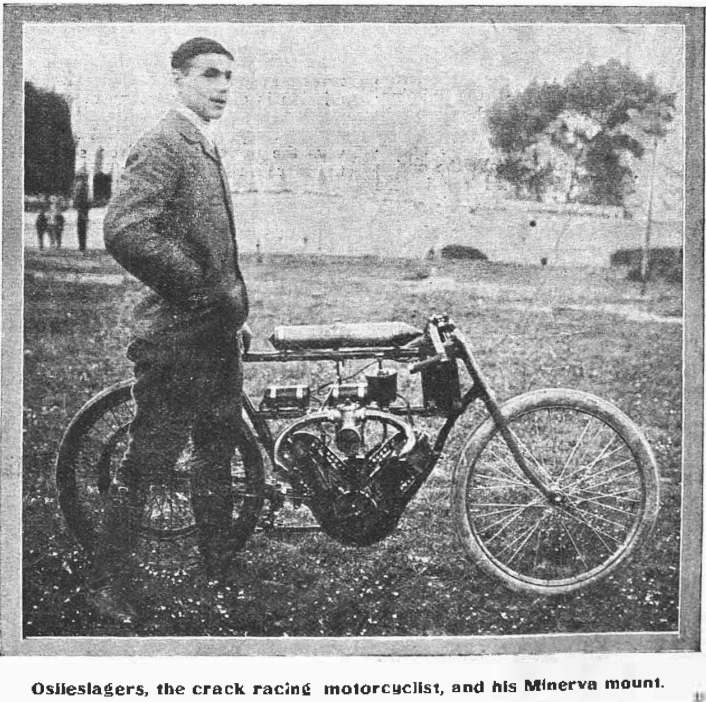
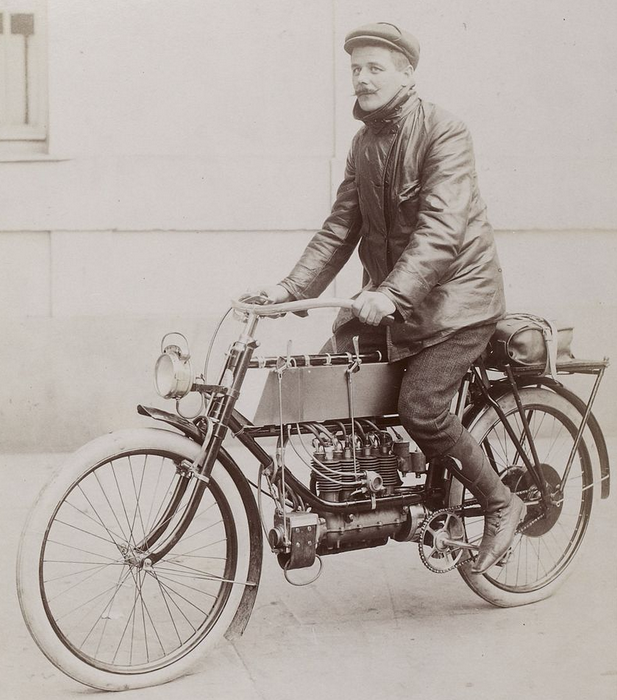
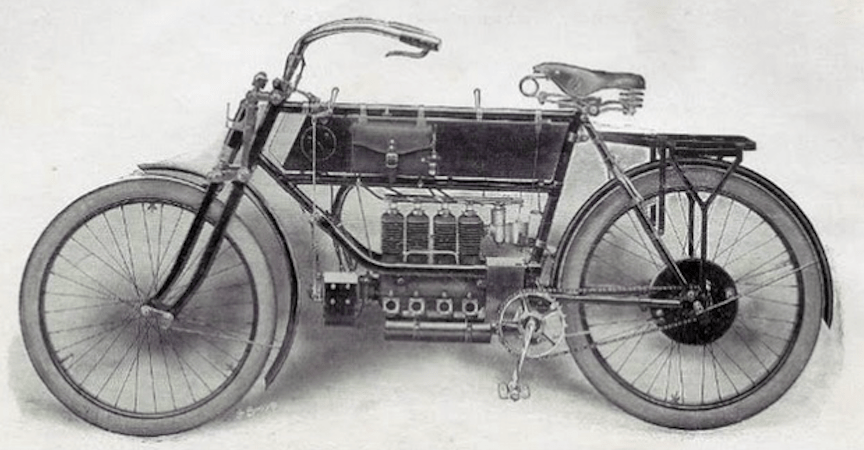
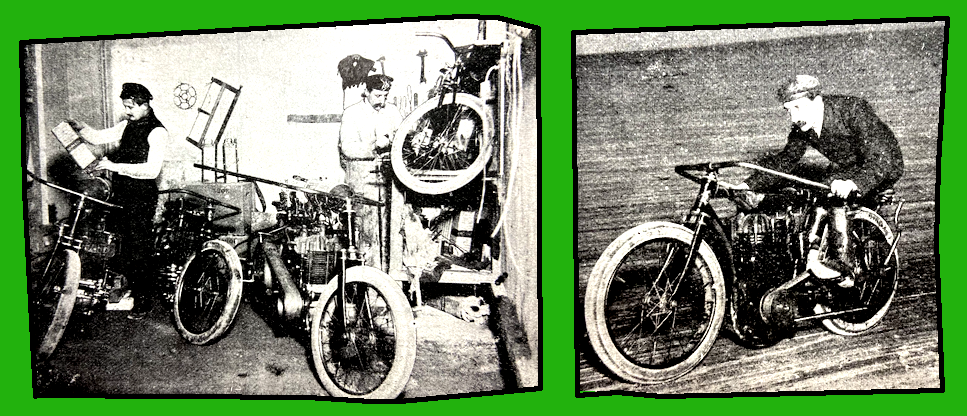
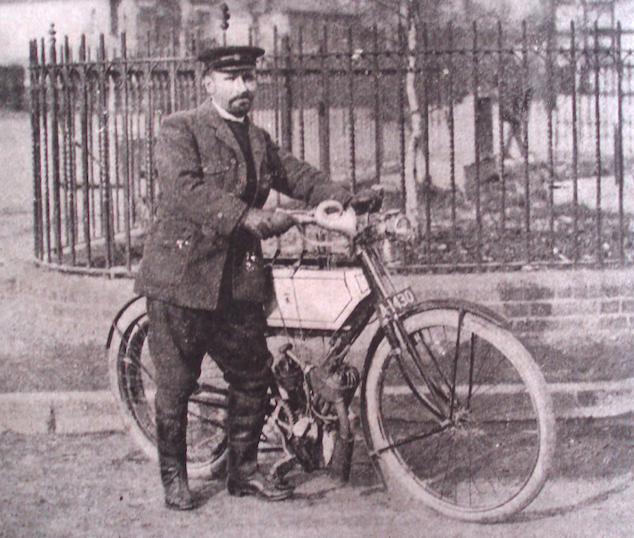
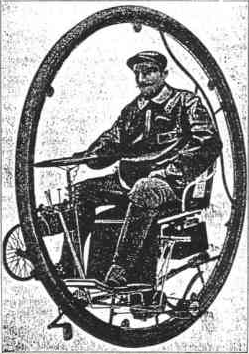
ALFRED ANGUS Scott patented a vertical twin two-stroke engine of advanced design [and you can read an account in his own words in the 1914 Features section].
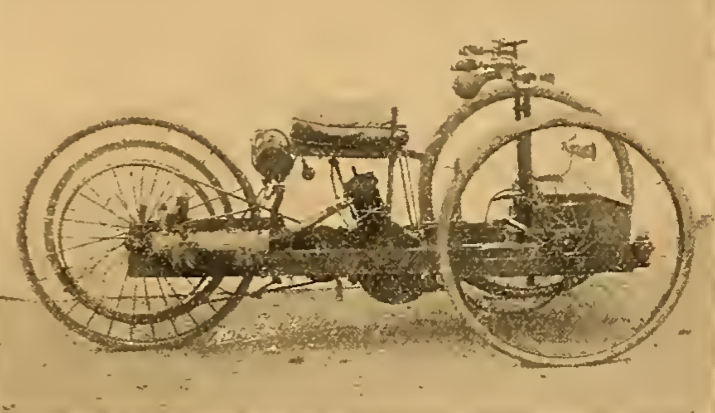
THE FOUR SONS of motoring pioneer John Knight (see 1895) acquired a 1¼hp engine and built it into a trike frame made of two planks of ash, lengths of angle iron from their dad’s scrap pile and the rear wheel of Knight Snr’s historic car. They incorporated rubber-block front suspension and made a surface carb from a Bath Oliver biscuit tin. Knight’s oldest son reported: “It is a fact that for a whole week we tried to get that engine to go, but a few spasmodic explosions were all we could get! At the end of that period, my father designed a carburettor embodying another biscuit tin containing coils of lamp wick wound on a wire frame, the petrol rising by capillary attraction up the wick, and thence evaporating very readily. Then at last the engine not only ran, but drove the machine…”
GLENN CURTISS took one of his bikes to Ormond Beach, Florida where he set a 10-mile record for 10 miles on the hard-packed sand and did 67.3 mph. After a Curtiss beat an Indian in an endurance race from New York to Cambridge, Maryland, Hendee rep EH Corson went to check out Curtiss’s Hammondsport base and was startled to find the entire Curtiss motorcycle enterprise in the back room of Curitiss’s modest shop.
“FIRST AMERICAN MOTORCYCLE CHAMPION. The first hall-marked American motor-cycle champion is GH Curtiss, of Hammondsport, New York, and he won the title at the Empire City meet at Yonkers, New York, on last Decoration Day, when he defeated the pick of the ‘Simon pure’ motorcyclists in a fast five-mile race. Curtiss rode the 5hp two-cylinder belt-driven ‘Hercules’. There was no semblance of a race; Curtiss took the lead at the pistol-shot, and no one ever got within hailing distance. The race brought out many of the men who had participated in the hill-climbing contest of the New York Motor Cycle Club in the morning. Curtiss had won that, and it was fully expected by the cognoscenti that he would duplicate his performance. The men were lined up near the head of the straight and came to the tape at a fair pace; but the starter refused to give them the signal, as two or three men were somewhat in the rear, and they rode around for another start. This time they ‘bunched’ finely and, getting the pistol, dashed ahead. Half a mile had not been covered before it was seen that, barring accidents, Curtiss was the winner. He opened the gap between himself and the nearest man at once and steadily increased it. At about three miles he lapped the tail enders and eventually won in 6min 34sec, GW Holden being second and FW Rogers third.”

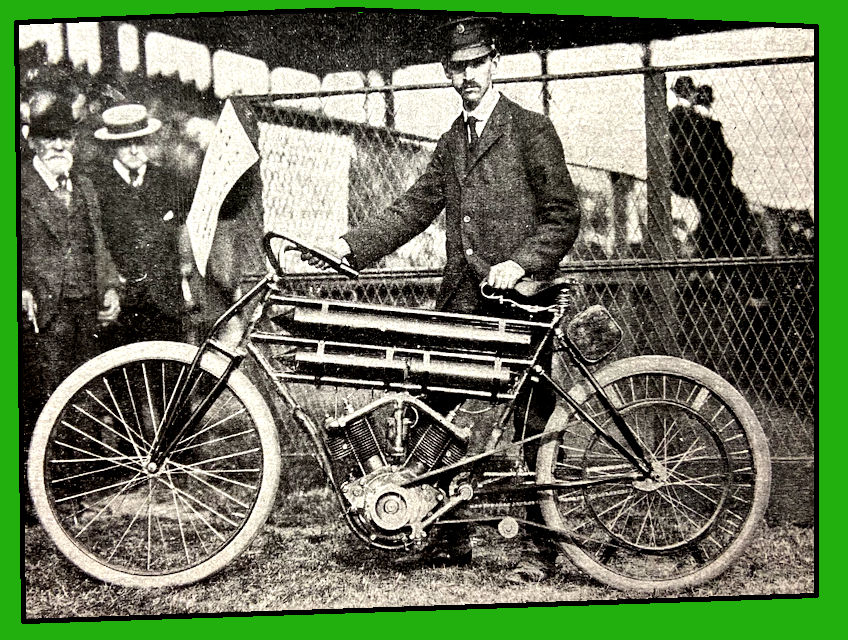
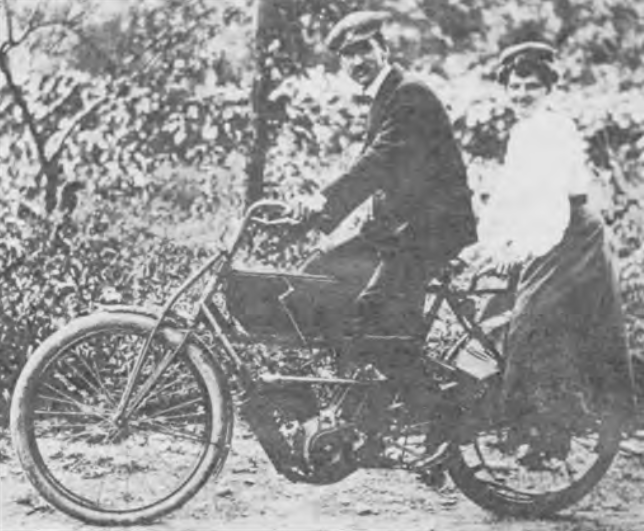
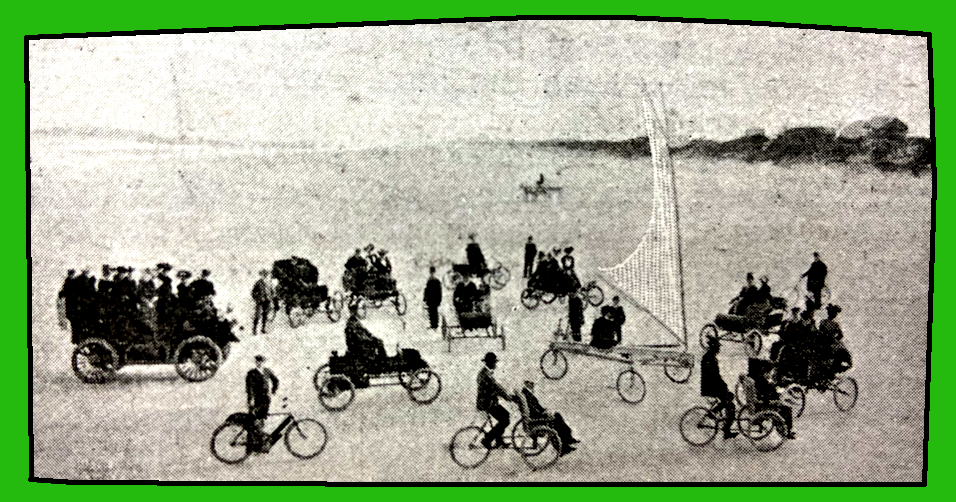
“A SUCCESSFUL AMERICAN MACHINE. The public have come to look for great and ingenious improvements in the motor-bicycle from the makers of the Thomas ‘Auto-Bi’, who are the originators of the first motor-bicycle roadster, and are today the largest and most popular manufacturers of this useful machine.”
“PRINCE HENRY OF PRUSSIA recently accepted an honorary membership in the German Motor Cyclists’ Association (Deutsche Motorradfahrer-Vereinigung), with headquarters at Stuttgart, and the committee have resolved to thank him for his acceptance in a message to be sent by relays of motorcyclists from Stuttgart to Kiel, a distance of 850 kilometres.”
“OVER 21,000 MOTORCYCLES have been registered in the United Kingdom.”
“A LIQUID TO WHICH the name of Petsen has been given, has just been introduced by Moore and Co, 7, Savage Gardens, London, EC. It is an agent which, added to petrol, entirely removes the objectionable odour both from the spirit itself and from the exhaust gases. The price of Petsen is 25s per gallon.” [That’s about £200 in 2025—Ed.]
“THE HEAD OF THE New York police force, Police Commissioner McAdoo, is well pleased with the tests of a new 2¼hp motorcycle weighing 98 pounds, which has been subjected to some very severe tests. The Commissioner will ask for sufficient money to equip the entire bicycle squad with these machines, which are particularly useful in overtaking speedy autos and their reckless drivers. This new cycle is said to be able to develop a speed of 53mph.”
“AN UCKFIELD TRADESMAN was knocked off his motor-bicycle and robbed the other day whilst riding from Tunbridge Wells to Uckfield. The outrage was committed by several men at about midnight, and the perpetrators of the deed got away. Four men have been committed to trial on suspicion.”
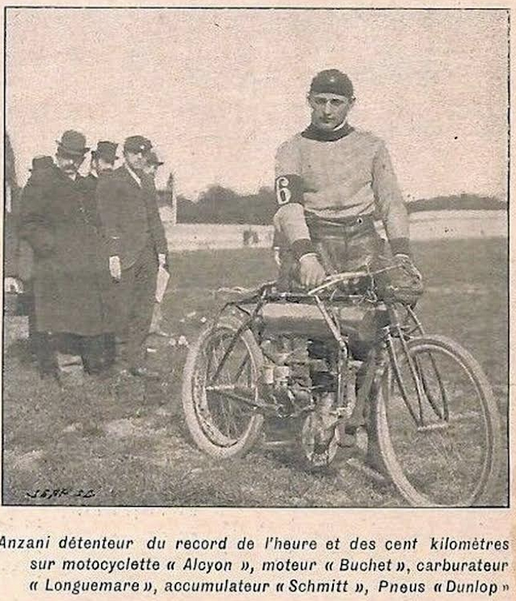

“AT MUNICH A MEETING has just taken place with a view to forming a society for the prevention of road dust. It was convened at the instance of Professor Dr Herzog and Dr Uebel, whose work, entitled Roads Free of Dust, was recently issued by the Association for Protecting the Interests of Bavarian Cyclists and Motorists.”
“A MACHINE WHICH can easily touch a speed of 95 kilometres per hour (60 miles approximately) is that depicted in the illustration. The makers are Messrs Laurin, and Klement, a well-known German firm, reputed for racing machines. The engine is a twin cylinder type of 12hp, driving by a V belt. The ignition is of the Eisemann high-tension magneto type, the dynamo being driven by a chain from the motor. The carburetter is a spray type. At the rear of the machine will be seen a wind screen and safety roller to be used when the machine is employed for pacing a racing bicyclist. The control levers are mounted on the curved top tube of the frame. There are no pedals, but a sort of stirrup rest is provided for the driver’s feet.”
“THE BRITISH MOTORCYCLE does not seem to have made any great headway in Spain, the majority of the machines being of French make. The Spaniard, however, is of somewhat too lethargic a disposition to take violently to the new sport, and this fact, coupled with the poor condition of most of the roads, seems to militate against any great future for the industry in the Peninsula. A little more enterprise, however, on the part of the British manufacturer might be rewarded.”
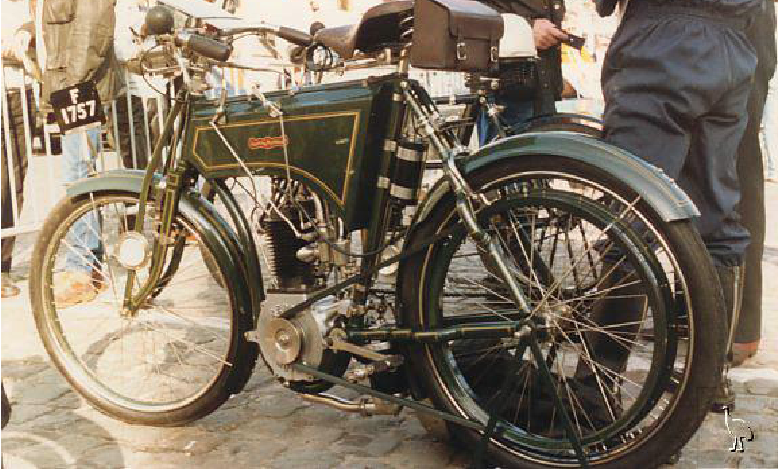
“I AM OF THOSE who consider that in many respects the motorcycle is far more interesting a hobby than the car. When, for instance, I take out my 5hp Bat I am convinced at the outset that I need fear no car-driving competitors who are enamoured of mere speed. I have beneath me a safe—except in towns and on bad grease—vehicle taking up little space, and hence of little inconvenience to other users of the road. I can rush hills such as Hindhead at a rate not attained by most car-users on the level. I am not worried by considerations of storage. I note few complications which are in any way likely to mar my journey, for what goes amiss may, in ninety-nine cases out of a hundred, be easily repaired on the roadside. In fine, for those having full experience of the ordinary push-wheel, and endowed also with good nerves and clear heads, the high-powered motor-bicycle, over a large portion of ordinary country roads, has no equal. Its extreme speed, great ease of control, and heavy reserve of power, are apt to make one sadly discontented with the ‘new car’. On the other hand, the enjoyment of this bicycle is limited to those (and they form a sort of aristocracy of the wheel) who can sit upon it without serious risk to themselves. I know men who sigh for motorcycling, but who, through absence of the necessary qualities, have to content themselves with a cumbersome and slower car. They have not had the advantage of being first experts on the pedal-bicycle, and, in default of this training, have never had the skill and nerve to mote on two wheels of any power.” [Having made such a good start, the author of this comment piece in The Motor, E Douglas Fawcett, went on to suggest that in many circumstances light cars have the advantage over single-trackers. So, passing on…—Ed.]
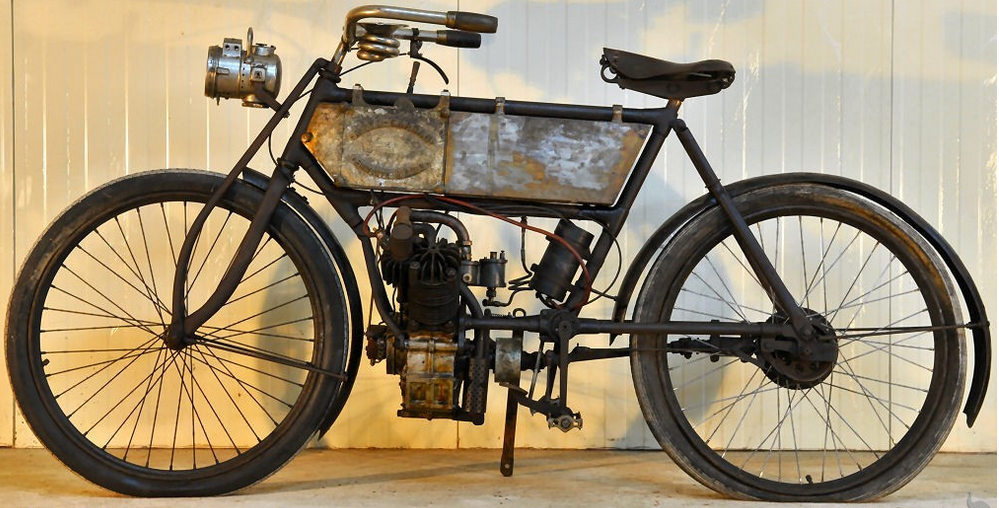
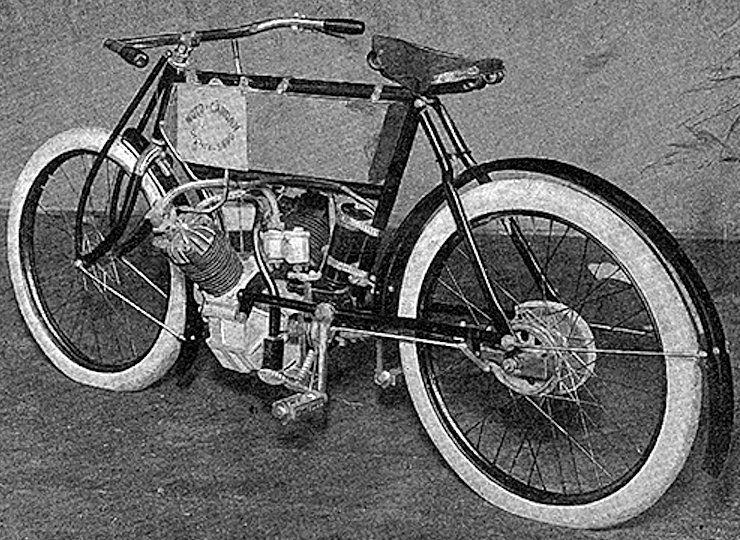
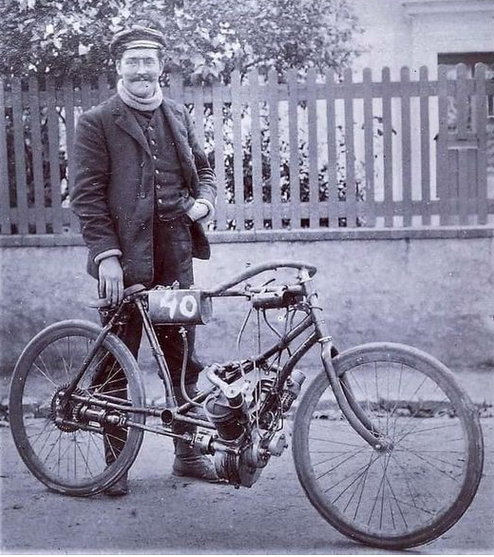
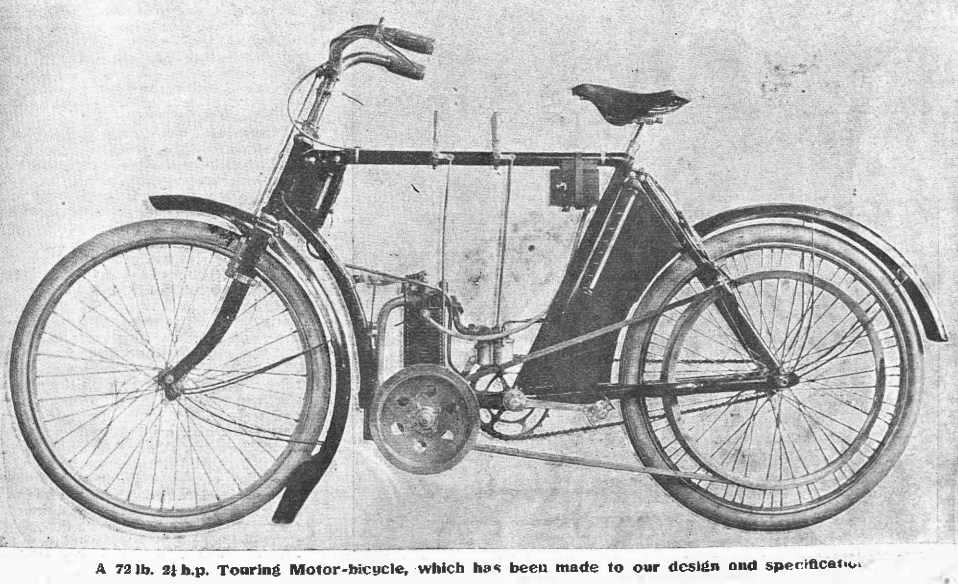
THE MOTOR MAGAZINE (INCORPORATING Motor Cycling) commissioned “a special lightweight touring motor-bicycle…to demonstrate that a type of motor-bicycle alternative to existing types is quite practicable…There are a large number of would-be motorcyclists to whom the powerful and necessarily very heavy machine does not appeal…to jump from 26lb to 170lb or so is too big a step…Our ideal has been to have a machine constructed that would have an engine developing a full 2hp and scaling between 70 and 80lb minus petrol and accessories. By suitably proportioning the parts and introducing one or two innovations, chief of which is the employment of the metal aluminium where possible, we have obtained a mount scaling 78 1/2lb, having a solidly constructed frame, equipped with strong tyres, two brakes, two accumulators, wide mudguards and large petrol capacity.” The 169cc lump weighed 19lb and developed 2.35hp at 2,500rpm. The cylindrical fuel/oil tank was aluminium and gave a claimed range of 150/450 miles. “This is the first aluminium tank ever fitted to a motor-bicycle.” The spray carb and mudguards were also aluminium. The accumulators were said to supply sparks for “easily 550 miles”. Brakes (Crabbe Special front, Garrard Moderatum rear) were said to hold the bike on a 1 in 7. “In actual running there is a marked absence of vibration, due to the high-speed engine, large flywheel and extra wheelbase. The pace on the level is ample to satisfy even a fastidious tourist…the stiffest climbs on the Brighton Road were surmounted with ease, the merest touch of the pedals on one or two occasions alone being necessary. Our designs and suggestions have been carefully carried out by the makers, Messrs Garrard, of Birmingham, and we think from the foregoing it is clear that the 80lb touring motor-cycle can be made…The manufacturer has, up to the present, we maintain, entirely a large class of possible customers, who want a machine that can be handled with an ease in some degree approaching that of the pedal cycle. The market for the high-powered and heavy mount will always be a good one we admit. This is the class of machine for the riders of above the average weight, and who wish to make a high average speed…There is a threadbare argument continually put forward by the upholders of the ‘weight-at-any-price’ theory, and that is that there are at this present moment hundreds of 2hp motor-bicycles throughout the manufacturers’ depots that no one will have. The explanation is a simple one, and it is this.
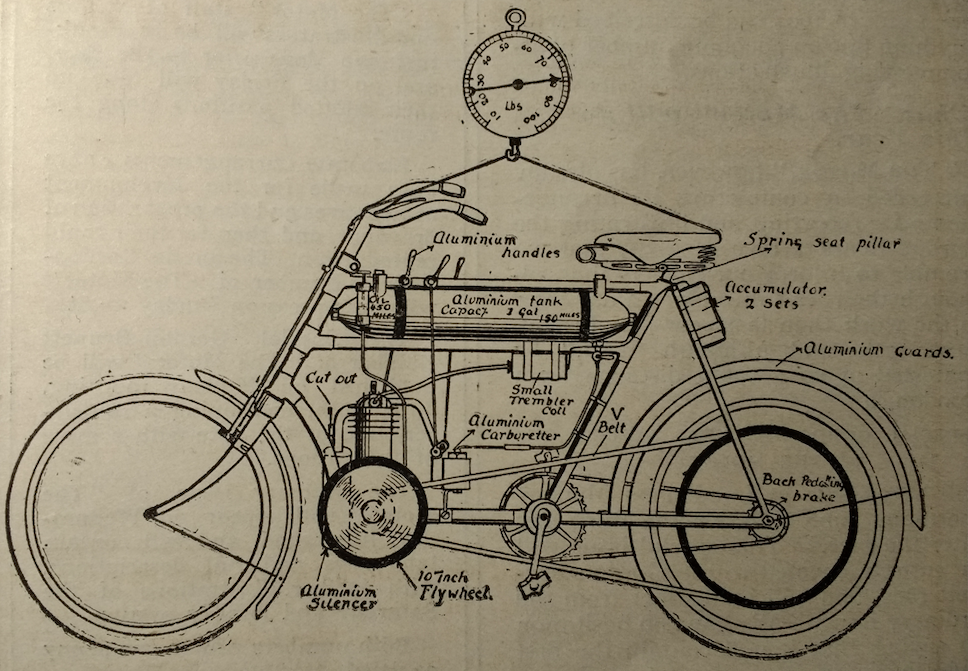
A 2hp engine on a 1351b machine does not make an all-round efficient machine; but put that same power of engine on an 80lb machine, and it does make an efficient machine.” Lightweight components included “celluloid guards, aluminium spray carburetter, specially light petrol tank, aluminium controlling handles, Fuller’s Midget trembler coil and special size accumulator”. However, readers were assured: “The frame is as rigid as a rock, and substantial gauge tubing is used at vital parts. The back wheel is strongly spoked, and should be equal to any strain. The tanks, although of thin gauge metal, have substantial corners to obviate any possible risk of springing a leak…Accessibility of the various parts is another point we believe will strongly appeal to the motorcyclist. He should be able to get at a nut or screw quickly, and without having to perform an acrobatic feat to do it. A special feature of the machine is its comparatively large petrol capacity, this being considerably more than 1 gallon, which should give at least 180 miles’ running…the low build of the frame enables the rider to mount and dismount easily. A member of our staff reports taking the machine for an 80-mile spin on Sunday last. He finds its speed and hill climbing capacity exceed expectations. On the level it will easily do 30mph. As an instance of its hill climbing capacity it took Holywell Hill, St Albans, without a touch of the pedals.”
“OUR MANAGER HAS returned to the office after the week-end in high feather. He is a keen member of the Motor Cycling Club and took part in the Brighton opening run on a new light motor-bicycle, now known as the Torpedo, owing to the shape of its aluminium tank. In common with another member of the staff, he has been a believer in the light motor-bicycle, despite present-day tendencies being all against it and for this season has had built a 2hp machine which comes out at 80lb net, ie, minus oils, lamp, hooter and tools. It has been designed by a member of our staff and built by Garrards of Birmingham. It was only delivered on Friday evening last, but it went to Brighton and back without a hitch, excepting only troublesome hand lubrication, through the fitting of an inefficient pump, but this can be quickly remedied. The Torpedo kept well up with the crowd and beat 12hp cars up rises.”
“SEVERAL READERS HAVE sent us orders for The Motor motor-bicycle. We must point out that the machine was only made with the view of demonstrating to the trade and public what can be done in the matter of lightness, and that orders cannot be entertained by us. Any enterprising manufacturer, however, would build to the specification published.”

“LOOKING AT THE CYCLOMETER on the experimental motor-bicycle I note it reads 1,130 miles. This is the total distance accomplished on the machine since it materialised in practical form. I cannot help thinking that here is striking testimony that the machine has stood the test of hard practical work. The false prophets and critics, who, by the way, in nine cases out of ten, have no practical knowledge of the subject they write about, are completely out of their reckoning. The frame and tanks should have gone to pieces, the engine was a mere toy, the vibration would be terrific, and so forth. Let it be said that not a screw, nut, or any detail about the machine has given a moment’s worry. The light clincher tyres have, not punctured once, and beyond a surface scratch or two on the back cover, the tyres are just as good as when new. During the recent spell of fine weather I accomplished over 700 miles on this mount, and I can safely say I have never been on a machine which has given more pleasure in the riding. Beyond filling up the petrol tank and having an occasional look at the contact maker it has been unnecessary to touch any part of the machine. The Lycett two-ply belt keeps at a perfectly even tension, and has not been off the pulleys. To keep it thoroughly flexible I have occasionally brushed a coating of oil on the top layer. Now as to the speed and hill-climbing powers of the machine. On a dead level and deserted stretch of the Ripley road I satisfied myself that the machine would easily touch 30mph, and I have not yet come across a hill on my journeys which has necessitated walking up. Eight out of 10 hills I have had to negotiate the machine has gone up without a turn of the pedals being requisite. As far as I have been able to estimate by repeated trials, the steepest gradient the machine will climb unaided with my weight (10 stone 6lb) is 1 in 9.5…My trips have been along the Brighton and Eastbourne roads, the South Coast as far as Portsmouth, then across country via Newbury to Oxford and back to London through Henley. Shorter trips have been along the Ripley, Bath, and Coventry roads, so that roads of a fairly average character have
been covered, having a good number of hills en route. The large outside fly-wheel and extra high compression of the engine are features which, in my opinion, contribute largely to the successful running…With regard to petrol consumption this has worked out wonderfully small. Given 25 miles of dead level road with no head wind I have managed to do this on a fraction over one pint of petrol, and it would be safe to say 200 miles level roads could be covered per gallon. But taking the average for the whole 700 miles it works out at 165 miles per gallon. Some readers may wonder how it feels to ride on such small tyres as 1¾in diameter. I can say that by keeping the front tyre moderately inflated and easing the machine over rough places the vibration is nothing like as noticeable as might be expected; but I should vote for a spring front fork as being a sine qua non for long distance work with small tyres…A very carefully designed spring front fork might only mean at the most 2lb additional weight. I must say a good word for the very silent running of the machine, thanks to the large and carefully thought-out silencer. This is an aluminium outer tube 7in long and 2½in diameter. Inside are two smaller perforated steel tubes side by side, somewhat after the Dunlop arrangement. There is plenty of room for expansion of the gases, and the minimum of back pressure obtained thereby…The lubricating oil tank and pump are very conveniently placed, and the total amount of oil used for the 700 miles was about a pint. A charge of half an ounce every 20 miles seems sufficient for level roads…The accumulator I used throughout the ride was a specially made Prested. It gives 11½ ampere-hours and is exceedingly compact and light. There are five plates in each compartment. It is still well up to 4 volts and, I should imagine, would run the machine another 100 miles easily on the one charge. A feature which does not seem to be at all fully recognised is that there is no need for a large heavy accumulator if the coil is constructed to take a, specially small current.”
“ANOTHER LIGHT-WEIGHT MOTOR-BICYCLE. Following our lead, WW Genn, of 17, Church Road, Wimbledon, has turned out for a client a very smart light machine. This is fitted with a standard pattern Clement Garrard engine, weighing 21lb, and the total weight of the machine as shown is 761b. The machine is of very taking appearance and exceedingly well turned out. Like our own light-weight the frame is built of Chater-Lea fittings, the design being very compact; the fork and crown are heavy roadster, strengthened by girder tubes. The tank, specially made by the Chater-Lea Mfg Co, is sheet steel, with sight gauge, and contains over a gallon of petrol—sufficient for 150 miles—and oil for 150 miles, with sight feed pump. Wheels are 26x2in, shod with Clincher tandem tyres. Other items in the equipment are Longuemare carburetter, 10ah Lithanode accumulator, Bassee-Michel coil, and celluloid mudguards, with full-size Brooks’ motor saddle. Mr Genn’s name will be familiar to our readers as haying figured successfully in many competitions during the past season; this is so far the lightest machine he has turned out, but he states that he could, if required, build a somewhat similar machine at 70lb weight. His latest effort decidedly reflects much credit upon him.”

“THE LIGHT-WEIGHT MACHINE. I read with interest the article on the Torpedo light-weight bicycle. I fully agree with it, so far as the need for a light-weight motor-bicycle, fully capable of all-round work, is concerned. For some time I have been on the look-out for such a mount, with easy starting. My experience of the 2hp C-Garrard engine left much to be desired in this particular respect, and two of my friends found the same fault. I think their make and break contact is a very poor system, but in your machine the trembler coil and rotary contact may have remedied this fault. I should be glad to know if it has. Two years back I had a small 1¼hp FN machine, and for ease of starting and general all-round usefulness I have never had anything like it. One slight push and it was off. The 2hp FN of last year was also good, though nothing to compare with the 1¼hp of the year before. The small 1½hp Quadrant was also a good starter; but my last mount, the 2¾hp Werner, until I put an automatic carburetter, brush contact with high speed coil, and did away with the compression lever, etc, by fitting an exhaust valve lifter, sorely tried my temper. This fault of the Werner no doubt lost it the speed contest in the Phoenix Park last year in the Gordon-Bennett Week, as the rider could not get the machine going for some 100 yards. I have come to the conclusion, after three years’ experience with nearly every make and power, that the heavy high-powered engine is a mistake. If you must have big horse-power for fore-car work, build it in one, the same as the Rex and Century people are doing, and have water-cooling; otherwise, in my opinion, the fore-car is not satisfactory; and, personally, I have discarded it for the small car after nine months’ trial with a 3½hp, air-cooled, and a 3¾hp (full) water-cooled engine, the fore-car not being built along with the machine.
FHP.”
“MOTORCYCLE EFFICIENCY. I have just had an illustration of the remarkably efficient state that the motor-bicycle has reached. Through pressure of business (not lack of enthusiasm) I have not been able to use my motor the past four months. Being desirous of attending the opening run of the Motor Cycling Club to Brighton on March 12th, I took out my 2½hp Ariel, just as I put it away last October, charged the accumulator and pumped up the tyres. I fully expected to have to make some adjustments, but thought I would just try it on the stand before touching it. To my surprise it fired with the first revolution of the pedals, and that on the stale petrol. So I left well alone, and went to Brighton and back without an involuntary stop, and this on a machine that did 7,000 miles last year.
T Hooydonk.”
“WHY NOT THE MOTOR SIDE-CAR? Personally, I have found a 2hp engine all I require for the propulsion of my motorcycle. It is light, convenient, easy to pedal, and scales only about 80lb. I use a gear of 7 to 1, which, with slight assistance, will get me up many very stiff gradients. I, however, make no secret of the fact that when I take a trailer with the machine, I have a troublesome time on gradients; so much so, in fact, that I am now preparing a side-car which is to have a 1¾hp engine attached, to drive by belt to the outside wheel. I intend connecting the exhaust lift and spark advance to my present levers; and I also intend carrying separate carburetter, coil and battery on the side-car. I believe this arrangement will be satisfactory and I think it will be the correct solution of the passenger problem, for without rendering my cycle unnecessarily heavy or clumsy, I can have a good 3½hp available when taking a passenger. Therefore, I ask: Why not retain the 2hp engine with comparatively light weight? And, when required for passenger use, why not adopt the motor side-car?
JA Walshaw, Otley.”
“A BAD SMASH. We give an illustration from a photo of the motorcycle which broke on the racing track of the Velodrome d’Hiver in Paris last week. Reimers, one of the ‘habitués’ of the French track, was pacing the cyclist Bruni, when one of the front forks of the motorcycle smashed, and flung its rider heavily on to the track. Bruni, close behind, was also brought down, but luckily, neither man was materially injured; indeed Bruni rode later in the day in another race. Owing to the spilling of some petrol from the tank, which was battered in, both machines caught fire, but this was promptly extinguished by the use of sand.”
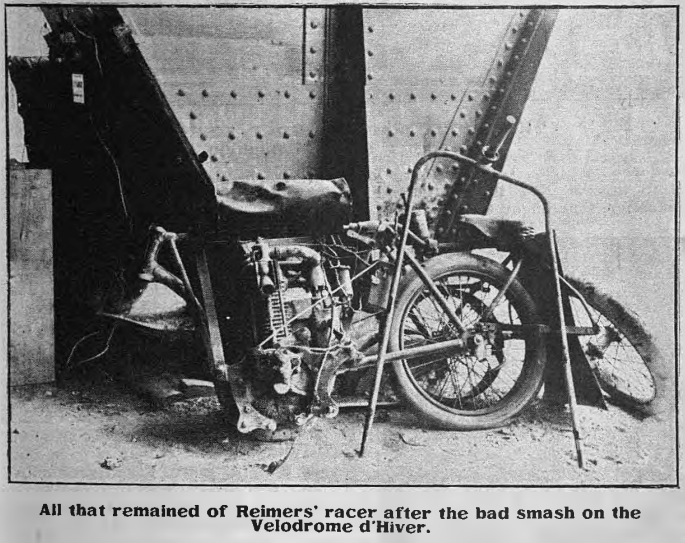

THE AUSTRIAN MOTORCYCLISTS’ ASSOCIATION Motorcyclisten-Vereinigung staged a 100km benzine consumption competition between Wiener-Neustadt and Neunkirchen.
M FRANCHINI OF COMO made what was claimed to be the first two-wheeled ascent of the hill from Varese to Santo Monte “the hill being very steep and rugged”.
NOTTINGHAM FIRE BRIGADE sent two engines and two escape ladders to the Campion Cycle Co. “A close inspection of the premises failed to disclose any trace of a fire, but later it transpired that a member of the firm had been testing a motor-bicycle previous to taking it out for a run, and had over-lubricated the engine. The smoke issuing from the shop caused some passer-by to give the alarm.”
THE LOCAL GOVERNMENT BOARD amended the Motor Car Act to allow cars to be reversed “to the extent which is consistent with the safety or convenience of the occupants of the car. Under the amended laws “any horse driver may, by raising his hand, compel a motor driver to stop”. Until this change motor drivers could only be stopped by drivers of “restive” horses.
“SIR,—I HAD THE MISFORTUNE to have the spring of my inlet valve break on my motor-bicycle. Having no spare spring with me, I thought I was to have some hard work. I found I had about a foot of India rubber tape with me, which I doubled and used as per sketch. This I found answered well and I rode home without trouble. I think the adoption of this tip will carry your readers home if they should be in the same trouble as I was; and many shops sell elastic, but few sell springs.
Chas E Allsopp.”
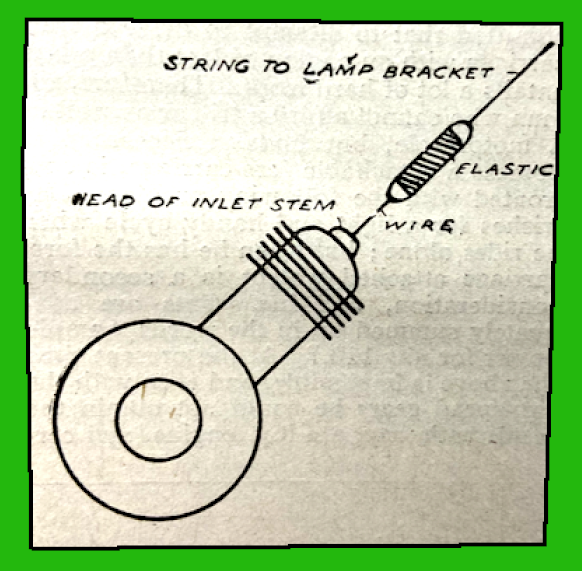
“A GOOD CLIMB. Mr HJ Densham, of Purley, while on a week’s motor cycling tour from Purley to Beccles, via Oxford, Lincoln, and Cambridge, was talking to a friend at Lincoln of the hill-climbing powers of his machine—an Anglian No 1 model—when his friend challenged him to ride up ‘Steep Hill’, a feat that had never been performed by any description of motor vehicle, and was deemed impossible. So much so is this the case that the authorities some time ago erected a barrier across the street to prevent vehicles attempting to descend the hill, so great is the gradient. Mr Densham was not to be daunted, and replied that he was backing his 2¾hp De Dion engine against any hill in Lincoln. He was justified by the event for he rode up ‘Steep Hill’ three times, carrying on his machine his full kit of tools and his luggage. A good idea of the gradient—about 1 in 4—may be gained from the angle the shop front makes with the pavement.”
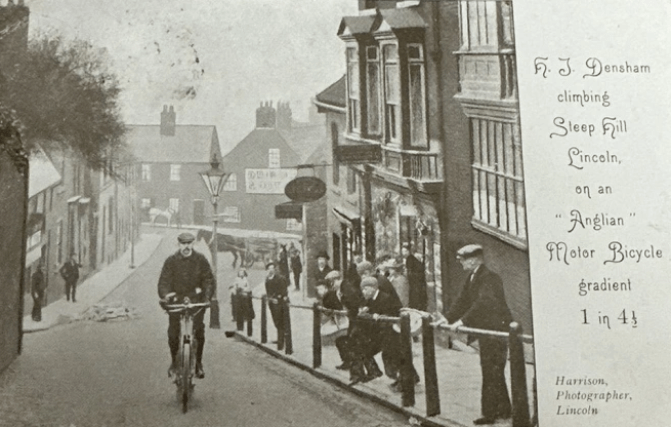
“THE MOTOR CYCLE has reached a very high state of efficiency, but has only reached that stage by continual alterations and improvements, which, tending to enhance the value of the complete machine, have not been suddenly added, but are the result of experiment and experience by numberless makers and users. Exactly the same process by which, the featherweight pedal bicycle became evolved from the early boneshaker, has the motor-bicycle (but more quickly) trodden the heels of the, comparatively, recent motor-tricycle. (I use the term ‘recent’ to the tricycle, for the three-wheeler has stood still whilst the single-tracker has gone forward.) Evolution in each case has been by what engineers term rule of thumb, but which might more correctly be described as the method of trial and error; not possibly the best way of arriving at the goal of perfection, but undoubtedly, in our hitherto limited knowledge of the theory of the internal combustion engine, the only possible means. It is principally the little points of detail that take up a good deal of time in pottering about and tuning up a machine to that perfection of sweet running which every considerate driver likes to attain on each and all of his rides…it is the trivial things which are of vast importance to the man who desires to see the day arrive (we all trust that it may be in the near future when he can get his machine on the road for a short five-mile spin with as much facility as a pedal bicycle. ‘This’ only takes a couple of minutes to adjust, or ‘that’ can doubtless be fixed in four or five minutes; but these odd minutes added together for every ride often deter the owner from taking his machine on the road for very short distances, and practically precludes usage, except for half-day or whole day rides. Fifteen minutes out of half a day does not count; but to take practically as long a time to get the machine in running order for a five-mile business trip as it actually takes to cover the short journey, causes many a man to fall hack upon the pedal-bike for such a purpose. Take such a necessity as filling the petrol tank; simple enough in its way, but it requires knack to manipulate a small tin funnel and a heavy two-gallon drum so that all the spirit runs into the tank, and not, as usually happens, for a pint or so to find its way to the ground…Some of the spirit manufacturers are past praying for; they will persist in sending out their wares in inconvenient receptacles, and with caps to the filling spouts, which require special tools for their removal; in fact, that brand which is always to be relied upon for its standard of good quality, is handicapped by the awkward drums it is sent out in, and retailers will not be bothered with them; I believe this is the sole reason why it can rarely be obtained outside the London district. The filling hole to the lubricating oil tank is usually in an out-of-the-way spot, as close to the head of machine as it van be squeezed in; on the majority of machines it is impossible to insert a funnel, and the oil must be trickled in directly from the can. This little fitting is more the cause of mess and dirt than almost anything else on the machine, and could be easily altered, and thus prevent oil being carried over the front edges of the tank…The universal type of back rim-brake gives general satisfaction; I do not suppose the manufacturers would have a larger sale, but they certainly would receive the blessings of all thankful people if they could only contrive to make quickly-detachable brake shoes. Punctures are had enough, without the added worry of manipulating the inner tube past the brake shoes where the tyre happens to he closest to the frame, and, at the same time, trying to save the tube getting mixed up with the chain or free-wheel clutch. Some of the more prominent makers have arranged the rear mudguard in combination with the stand or jack, so that the act of placing the stand under the machine carries half the mudguard with it, and leaves the top op the tyre quite clear for repairs. This excellent method might be generally copied…The last 12 months have seen big strides in perfecting the high-speed trembler coil, and there is now no difficulty in buying a British coil more than equal to anything turned out in France; but why do we still have to contend with refractory screw terminals which pinch down on the fine flexible wires and squash them beyond breaking point? Most of us have had to wrestle on the road with a snapped coil wire connecting to cell or contact breaker, which is just that odd inch shorter than we need, and which has had to be tinkered up with an odd piece of bare copper wire, and placed back in its compartment with an ever-present fear of a ‘short’. I had many, troubles of this nature until I came across a French coil with spring terminal clips…This is one of the many little ignition details which British coil makers would do well to copy. English manufacturers again have proved that there is no difficulty in accurately boring a single piece cylinder, and have laid to rest that bogey of possible loss of accuracy which was raised by their foreign competitors when this improvement was introduced. But why follow the ancient De Dion practice of screwing the holding bolts or studs for the cylinder into the aluminium crankcase? With the old pattern of two-piece cylinder this was a frequent source of trouble; in endeavouring to make the separate combustion-head quite gas-tight, the act of screwing down the nuts on top often drew the long screwed rods…Free-wheel clutches recall the unhappy memories of the 1,000 miles trials of 1903; most of the riders therein had trouble with their clutch, not because the clutch was inherently bad or faulty in itself, but because it was not protected from the effects of grit and mud. When the pros and cons of the trials were discussed in the press at the conclusion, there was considerable ventilation of this very subject; and, of course, one looked round the machines at the shows in November, and expected to find a remedy. On only one well-known machine, even in July, 1904, can I find any provision made for protecting the clutch. A gear-case for the chain would naturally obviate any difficulty, but the chain has such little work to do that a cased-in chain is a nuisance, and an additional trouble if the rider has the had luck of many punctures. It is so easy to fit a small guard round the clutch when the machine is being assembled in the factory, that it is surprising such a fitment is not general; if the rider desires to fit a guard himself, it means taking the wheel from the forks, dismantling the brake, chain, and belt, and the joy of fixing all up again; and sooner than face this trouble the clutch has to get along as best it can. Mudguards are all but perfect; the extra vibration to which motorcycles are subject has been well considered, and breakages are very infrequent. But it is possible to carry perfection a little farther, and make the guards real preventers of mud slinging, by making the section of the guard more circular, and bringing the edge of guard deeper down the side of tyre. The addition of a leather flap at the bottom of front guard is now a standard specification with many machines; the rear guard might well he brought considerably round the tyre where the tyre passes close to the diagonal tube and chain stays, and carried down two or three inches below the stays. Extended to the rear end of guard so that it is in line with or below the level of the hub it would be the means of preventing many splashes reaching the rider’s back, and the addition of a small leather flap at this point would also be advantageous.”
“A NEW STAND. A stand which enables the user, while sitting in the saddle, to start the engine and without dismounting to get a good ‘push off’, has recently been invented in France. It is named Garel’s Patent, and Messrs L Bernstein and Co, of Holywell Lane, EC, have the sole agency for the United Kingdom and Colonies. It saves the rider a lot of hard work, and with it a start on a hill can easily be accomplished…A spring steel tape runs from the drum on back stay to the centre of the outer side of the stand. A chain from the shoe of the Bowden brake is attached to a clip on the chain stay. In operation it is only necessary to press the brake lever, this releases the clip, and the spring tape pulls the stand back into position on the bicycle, causing the motorcycle to run forward by gravitation. It will be noticed that the stand base is shaped so that at the instant it leaves the ground the tyre comes into contact with the surface of the road, ensuring a smooth action without any bump or jar.”
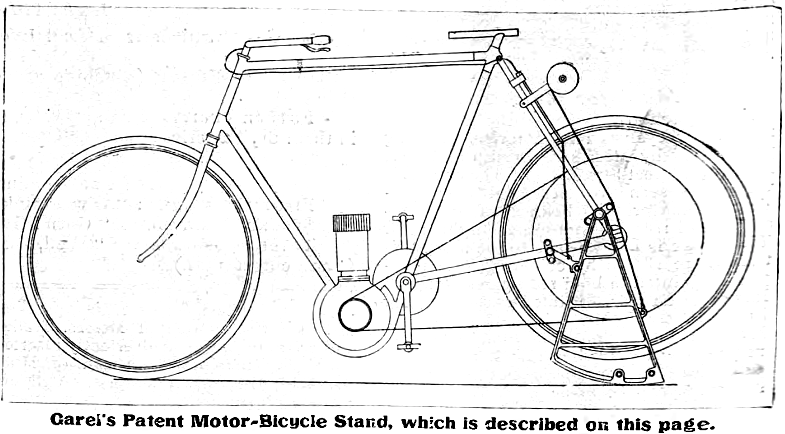
“COLLIER HAS A RACING MATCHLESS on the stocks at the present moment on which he ought to accomplish some quick times when he gets the engine and carburetter properly tuned up.”
“LIGHT SIDE OF THE NEWS. A French butcher fell off a pig which he was riding, fracturing his skull and dislocating his ankle. The papers, however, did not report this as ‘Shocking Pig Accident’.•••Truly, the motorist and those with whom he comes in contact must be men of metal. Mr Silver explores South Africa on a Quadrant, Mr Steel circumambulates Australia on a Clyde: then at home we see a good deal of Mr Copper, don’t we ?•••A Monte Carlo gentleman was smitten to the earth by a motor, the number of which he promptly noted. He then went to the roulette tables, backed the number, and won £800. It’s an ill wind that blows nobody any good: if we were the motorist, we should claim a percentage of the winnings, and offer to knock the gentleman down again. In time, should he become damaged under this system, we should probably be known as the Man who Broke the Man who Broke the Bank at Monte Carlo•••Another French motorcar elopement is reported in the papers. A chauffeur named Vaudoyer, who has acquired considerable skill in the art of carrying off young couples, was instructed to have a car ready ‘at full pressure’ near the Château du Boisson at Pau. (We wouldn’t mind venturing to say that it was a petrol car.) At the uncanonical hour of 5am the young lady arrived and was duly carried off. At least, so the papers say.•••The ‘Western Evening Herald’ reports that Ernest Alford Harris was fined 10s and costs at the St Columb Police Court ‘for riding a motorcycle at St Columb Minor with trawler attached’. This must certain.ly have been a record ‘catch’ for the local ‘offish als’; but it is an indifferent advertisement for the roads in that part of the country…One of the principal motor-bicycles made in America is the ‘Auto-Bi’. The manufacturers should designate the prospectus, which sets forth the claim, of this machine, their ‘Autobi-ography’.”
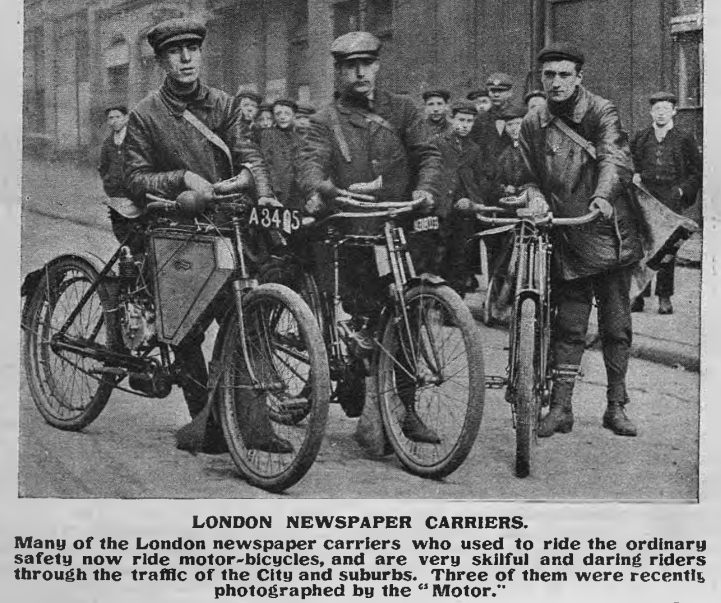
“LONDON TO EDINBURGH. The Motor Cycling Club are fast competing their arrangements for the all-day run from London to Edinburgh, which will start on May 20th next. This will be an historic event, and one which will attract a great deal of public interest. Legal limit will be strictly observed. The ride is open only to members of the Club, and motorcyclists wishing to join should write without delay to the Hon Sec, Mr JH Reeves, 2, Penywern Road, Earl’s Court, SW. As the entries close at an early date there is little time to lose…The club toured in the Shakespeare country at Eastertide, and spent a very enjoyable time exploring the beauty spots in the neighbourhood of the club headquarters, The Dun Cow, at Dunchurch. The weather and condition of the roads were all that could be desired. Most of the ruling spirits of the club joined in the run, including the captain, JA Jackson, who rode a Bradbury Peerless; SH Fry came along on an Ormonde tandem; J van Hooydonk was on a new Trimo, and the treasurer, E March, for once in a way rode a two-wheeler. The return journey was made via Oxford and High Wycombe.”
“A USEFUL HEAD-GUARD FOR MOTORS CYCLE RACERS. The leather ‘casques’ worn on the head of American motorcyclists when racing have often proved their utility, and they might be adopted with advantage by racing (and pacing) men in other countries, particularly in France, where on the small 5-laps-to-the-mile tracks accidents are unusually frequent. A striking instance (in two senses of the adjective) was afforded at the Winter Track in Paris some days ago. Lawson, who has come over from the States as pacemaker to the crack American rider, Walthour, had a bad spill, and was only saved from a terrible, and perhaps fatal, injury by the leather helmet which he invariably wears.”

“ADELAIDE TO BALLARAT ON A MOTOR-BICYCLE. A correspondent has forwarded us an account of a ride which he made at the close of last year on a Clyde motor-bicycle from Adelaide to Ballarat, a distance of 530 miles. Leaving Adelaide on December 19th the tourist started with a non-stop run of 45 miles over good metal roads, the distance being covered in 1hr 40min. To this succeeded a long stretch of sandy soil track interspersed with patches of roughly metalled road and heavy sandhills. Thence along the beach of Coorong which for ten miles consists of smooth white pipe-clay, which afforded splendid riding. At Kingston, reached on the second day, fresh supplies of petrol ordered from Adelaide had not turned up and a day was lost waiting. On Tuesday, December 22nd, the journey was resumed with a splendid run of 27 miles into Robe, over an excellent metal road at a steady speed of 17 miles an hour against a strong head wind, this pace being about as much as was comfortable on the road, though the machine had plenty of reserve power not applied. Passing through Mount Gambier, a volcanic district with much fine scenery, the tourist reached Casterton after a very trying experience over fearful sand patches and swamps, the great heat of the day adding to the discomfort. On the last day, Christmas Day, slippery roads and tyre troubles preceded the conclusion of the trip at Ballarat. The rider is of opinion that on such rough roads a pedal cycle would make easier and faster time than a motor-bicycle, the pushing of which through loose sand is a very arduous task. The machine used was a _2¾hp Clyde with Simms-Bosch magneto ignition, duplex front forks and extra petrol tank.”
“MR ALEX LEVEDAHL, president of the Aurora Automatic Machinery Co, who make the Thor motor, one of the best known American cycle motors, delivered a lecture in Chicago recently on motorcycles. Dealing with the cylinder, he said: ‘A cylinder will never be cut if it is even reasonably oiled; it will even run fairly dry without injury, as before it can reach the state that will seriously damage it the piston will stick many times. Thus the operation of expansion will save the careless operator from damaging his motor. It is, therefore, automatically fool-proof, and many times when the, piston sticks the rider ought to congratulate himself…An engine should be so placed that the air can get all round the ribs.’ The effect of boring holes through the ribs was, he said, to considerably increase radiation.”

“THE FIVE MILE motor-bicycle handicap decided at Canning Town on Good Friday and Easter Monday formed very interesting items in the programme, particularly so as these were the first races under the new conditions, wherein engines were not to exceed 76 bore by 76 stroke, or the equivalent volume swept out [345cc], while the use of silencers was optional. The handicaps turned out in favour of the back markers, and, of course, this met with the approval of the crowd, although it was not very encouraging to beginners. The entries were good for this time of the year, Crundall, Yates, and the brothers Collier posing as the stars, the most conspicuous absentees being Harry Martin (who informed our representative that his new machines were not ready), Tessier, and CE Garrard, who was programmed on scratch with the only two-cylinder machine entered. Crundall proved master of the situation, and won both the handicaps,
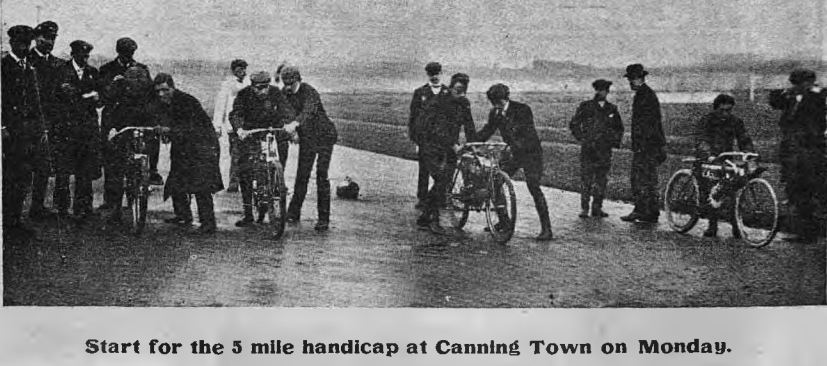
riding remarkably low and taking the corners in splendid fashion. The much-boomed match, fixed for Easter Monday between GA Barnes and W Hinz, fell through at the last moment, owing to the Russian’s machine not arriving, and as the track was wet Barnes did not care to essay records on his high-powered machine, so the management arranged an impromptu match between Willie Weekes, billed as an American motorist, and the local champion, Professor Trow. The first-named could not get his machine going, so this had also to be abandoned. The first heat of the five miles motor-bicycle handicap brought out four drivers, viz, JF Crundall (Humber), 15sec start; HV Colver (Matchless), 15sec; CS Prentice (Prentice), 50sec; HJ Butler (Koh-i-Nor), 50sec. Crundall left his co-marksman and passed to the front before half-distance had been covered, the limit men retiring, J Colver finishing a lap to the bad, Crundall winning in 7min 32⅗sec. Heat two brought out Bert Yates (Humber), 15sec; CR Collier (Matchless), 15sec;
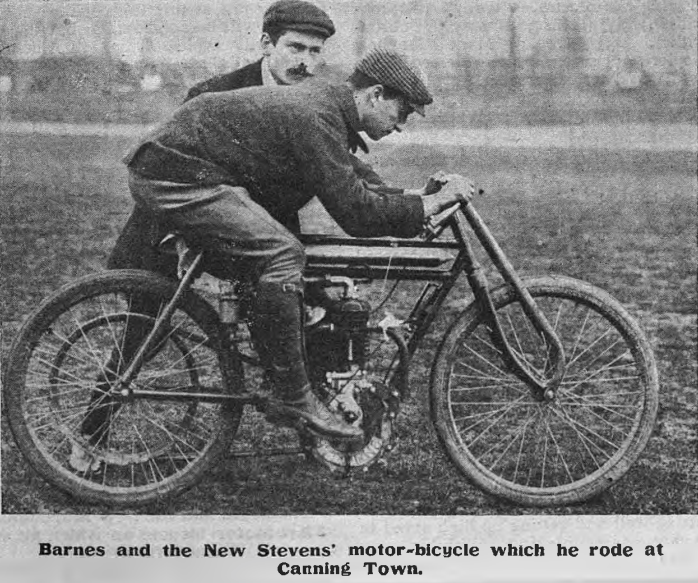
C Bennett (Kerry), 20sec; WW Genn (Eland), 50sec. Genn made good use of his start, but the back markers soon decreased the gap, and he was overhauled before half the distance had been completed. Bert Yates retired through his petrol pipe breaking, Bennett retired, and Collier got home over a lap in front of Genn. Time, 7min 52⅗sec. Heat 3 saw HA Collier (Matchless), on virtual scratch, viz, 15sec; J Perkins (Crownfield), 20sec; HJ Trow (Trow), 25sec; FE Barker (Dart), 50sec. Collier was quickest off the mark, and before a mile had been covered assumed the lead, winning by a lap from Trow in 8min. I4⅕sec. The first two in each heat qualified for the final. Two miles from home Crundall went to the front, and Genn was passed by the Colliers half a mile from home, the final placing being Crundall first by three-quarters of a lap, CR Collier second, and HA Collier third, thirty yards dividing second and third. Time, 7min 32⅘sec. Easter Monday was another day out for Crundall, who proved himself to be a very clever and daring driver, and, although the track was very wet, he knocked over half a minute off his best time on Good Friday,
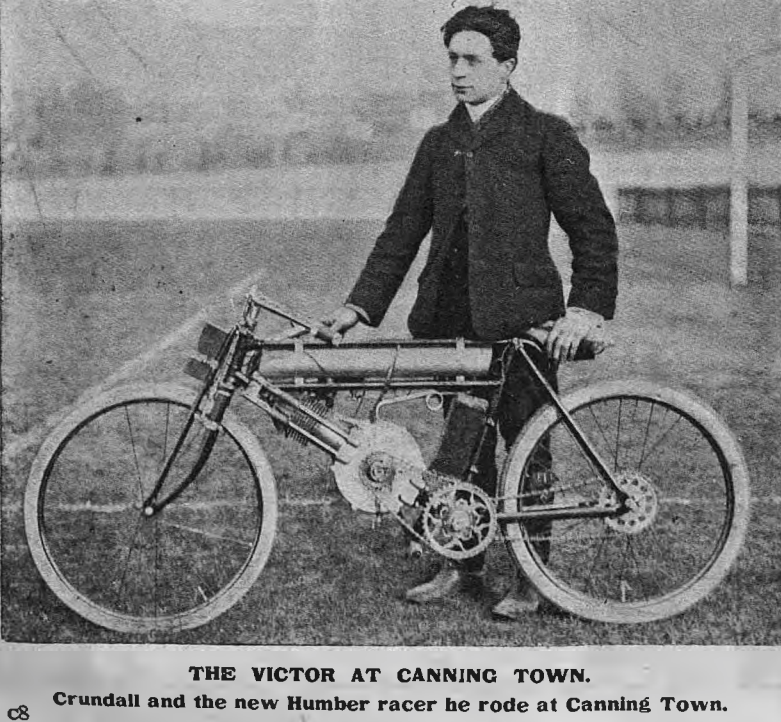
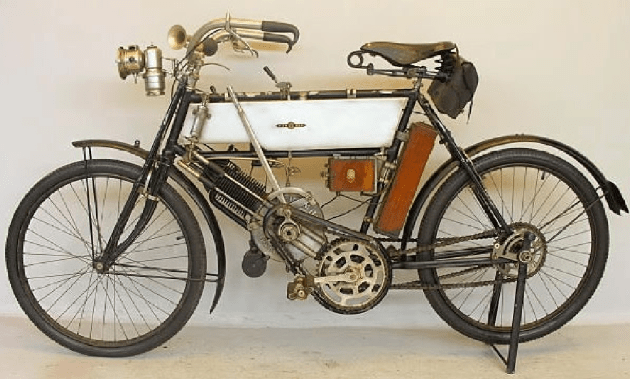
while it is good to report that not a single accident or fall occurred on either day. Heat 1 saw but two starters, CR Collier and HJ Butler, the first-named winning easily by a couple of laps. Time, 7min 54⅘sec. Heat 2 brought Crundall, 15sec; Colver, 15sec; SA East (Shaw), 15sec; and HJ Trow, 25sec. Before two laps had been covered Crundall was in front, while Colver could not get his machine to go at the start, but after a few laps he piled on the pace, and an exciting pursuit was then witnessed, he just managing to pass East and Trow in the last lap, and so finish second to Crundall. Time, 7min 23⅖sec. Three riders faced the starter in the last heat, viz, Bert Yates, 15 sec; J Haslan, 20 sec; and Willie Weekes, 20sec. Yates soon overhauled Haslan, winning easily in 8min 4⅕sec. Although qualifying for the final, Butler did not start, thus making it a scratch race for Crundall, Yates, CR Collier and J Colver, all in receipt of 15sec. Colver got away first, and led; then Yates led for four laps, with Crundall close on his hind tyre. Crundall then made an effort, and succeeded in getting the lead, and, riding as if he were part and parcel of his machine, gradually got away from his opponents, and won by 100 yards, Yates being second, and Colver, who seemed to jump past Collier in the last straight, third, 100 yards behind Yates. Time, 6min. 56⅕sec. The racing was watched by a very interested crowd on the Friday, but the wet weather on the Monday reduced the attendance to about 5,000 people.”
“JF CRUNDALL, THE CHAMPION crack of the opening meeting at Canning Town, has a new and powerful Humber racer on the stocks for record work, upon which he anticipates breaking the hour and other records. It is fitted with an engine of nearly 4hp…”
“I HAVE LATELY had an opportunity of trying a gear which is being introduced by the inventor of the Humber engine, Mr Phelon, of Cleckheaton, which appears likely to be as effective and successful as the engine has proved itself to be…I can testify personally that it works most sweetly and smoothly, and can be changed instantly either up or down without the least jar or shock. There is a free engine between the two speeds, and the machine is started like a car, and stands perfectly still while the engine is running at full speed There is no involuntary crawling, but the gear will do what I have never heard of any other gear claiming to do, that is either on the low speed or the high speed you can slip the gear in so gradually that the speed can be kept as low as a slow walking pace. On the occasion in question I saw the engine started on the floor of the works; the high-speed gear was put partly in, when the machine commenced a slow procession across the floor. I also saw this done outside, and there was scarcely any picking up of speed…it appears to me that this gear is likely to be a good thing if it is put on the market, and I should imagine it will be comparatively cheap. From details of its construction that I have seen, it can be fitted to existing machines without any trouble whatever…
HB Ratcliffe.”
“RE TWO-SPEED GEARS. I noticed in ‘OPV’ a letter from HB Ratcliffe describing a two-speed gear recently invented and patented by Mr Phelon, of Cleckheaton, Yorks. Having had considerable experience in the use of motor cycles and tri-cars, and having already tested several gears which are on the market, I decided to inspect the new invention. On arriving at the works Mr Phelon met me in a very courteous manner, and kindly offered me a trial on the road, which I gladly accepted. For the benefit of your readers who may be interested in two-speed gears, I will give my experience and a brief description of the working of this two-speed motion. The gear is actuated by a lever secured to the top of the frame of the cycle, which gives in its central (or vertical) position a free engine; on being moved forward you gradually bring the high gear into action; or from the free engine position, on moving the lever backward, you gradually bring in the low gear. There is a direct drive on both speeds, no power being lost, as would be the case in transmission through gear wheels; dispensing with gear wheels, there is no jar or jerk in the starting or changing of gears, and there is no noise or vibration in the running; the working parts are self-adjusting, and thus compensate for any small wear which might occur. A point well worth attention is that on either gear one can secure every variety of pace from a crawl up to 30mph. From the experience I had with the machine on the road, on a gradient of 1 in 9 (two passengers, weight 350lb, machine 190lb), with 2¾hp air-cooled engine, the result was quite satisfactory, the engine showing no signs of overheating. There is nothing about the arrangement which appears unsightly, and the working parts are simple and fool-proof. From its mechanical simplicity and sound workmanship, and its adaptability to existing motors, I should think it will be largely adapted in the future for tri-car work.
Will C Priestley, AIEE.”
“A GOOD RIDE. Mr EJ Steel, formerly a successful bicycle record rider, on Wednesday last accomplished a fine performance in an up-journey from Edinburgh to London on a 3hp Rover motor-bicycle, covering the 400 miles in 20hr 47min without any trouble. This eclipsed all previous performances, although it was more of a tour than a race, as the rider halted when convenient for meals, and did not attempt a non-stop run. His halfway time to York was 9hr 55min.”
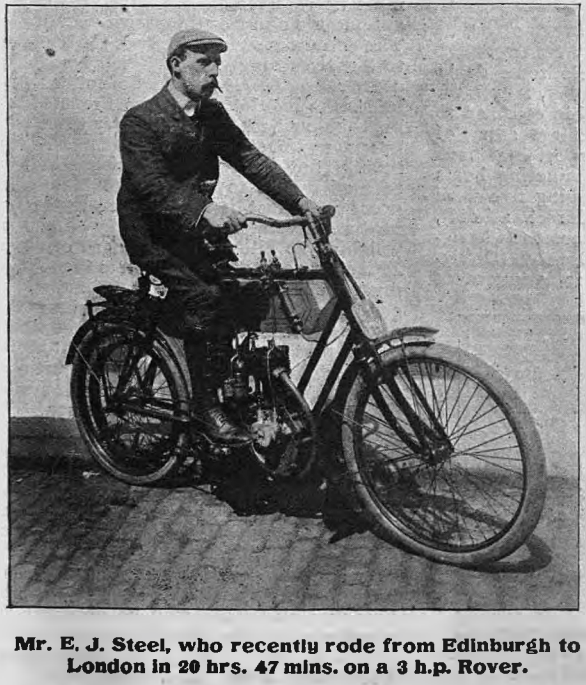

“THE PULSATIONS OF MANY motorcycles woke up that usually calm and scholarly corner of London, the precincts of Paternoster Square, last Friday evening. Here the entrants for the 400-mile run promoted by the Motor Cycling Club assembled before a start was made for their journey to Edinburgh. The actual start was from the GPO at 10 o’clock. A large and curious crowd examined the machines while.the competitors and friends had supper at Huggett’s—a hostelry within the square. A committee meeting was held subsequent to the supper, the principal point discussed being the weight of some of the tri-cars competing…Mr Edge, in a short speech, commented on the fact that motorcyclists were for the first time carrying out a long distance run from the centre of the City with a 20mph legal limit, and trusted the competitors would abstain from annoying people en route, but would run under the strict conditions laid down…The route out of London, said Mr CW Brown, who had put in a great deal of the hard work in connection with the fixture, had to be followed as per card, and competitors would find marshals and checkers along the route. He warned them, too, of police traps at certain points. After supper a move was made, and in quick time Messrs Jackson and Fry, with the kindly aid of the police, lined the men up in order and a procession was then started for the GPO. So great was the crowd here that it was difficult to keep a clear line open for the men…At 9.52pm it was decided to let No 1 depart, and the rest were despatched in quick succession. In fact, all the 47 actual starters out of an entry of 70, were sent off by 10.5…Rain commenced to fall just after the start…As soon as the last man had got clear of the GPO I made for King’s Cross Terminus to catch the night express to the North, which would enable me to be at

Grantham well in advance of the fast contingent. Grantham is 110 miles from the starting point, and the first important stop. The riders must have experienced a rather prolonged and heavy shower about half an hour from the start, and this must have settled one or two of the fair weather section, who were not seen again after the start…The morning was bitterly cold, and I conjectured it would make itself felt amongst the riders. At 2.45 a.m. a speck of light and a faint pom-poming—and a minute later F Hulbert, on a Hulbert-Bramley arrived. A few minutes later he was followed by WH Wells (Vindec), J Platt-Betts (Rover), and CW Brown (FN). Then after an interval of some minutes more competitors came up in quick succession…Perman came in at 5.15, having run short of petrol. The incidents experienced on the first 110 miles were numerous and exciting. There can be no question that despite the intense darkness most of the first group rode at a dangerously fast pace. The result was that Pinder, on an Ormonde fore-car, charged the roadside and capsized into a deep ditch full of ice cold water. Silver had a collision and fall beyond Stamford, cutting his face and hands severely, nevertheless he rode on to Grantham and presented a sorry sight on arrival, with blood and dust all over himself and his machine. Platt-Betts shed a petrol tank and any number of acetylene lamps were shed and lost on the road through the vibration; this lampless condition of several machines on the dark roads causing numerous collisions and minor mishaps; so that out of the 48 that started only 19 reached Grantham by schedule time. Alter an early breakfast, petrol tanks were replenished and a start was made for Wetherby and Durham. There can be no doubt that the first 110 miles ridden at a fast pace in the darkness had unnerved some of the riders, and in two cases falls occurred at the fresh start. News came along just now that L Jones had had a bad smash and retired. Ashworth was most unfortunate in fracturing a main tube joint on his Centaur fore-car and gave up. When the survivors had got clear away on the next stage to Durham, I caught a GN express which would take me

to Berwick-on-Tweed in plenty of time to see the competitors come in. Meanwhile, they would have a particularly trying stretch of road to negotiate, and staying power would be tested to the utmost degree. I reached the picturesque little border town an hour before the first arrival. The greatest enthusiasm prevailed among the townspeople, several thousands of whom had assembled in the neighbourhood of the King’s Arms Hotel. Amidst much cheering the riders came along in the following order: Bell, Hulbert, Wright, Williamson, Hacking, Reeves, Sale, Fox, Candler, Hooydonk and Roberts, Cowles, Crundall, Wells, Densham and Arnott. The first arrival received a sort of civic welcome from Alderman Marshall, president of the Tweedside CC, and Mr A Scott, chief checker of the run at Berwick control. Reeves looked as if he had been in trouble. His face was cut and bruised, and he explained how he had fallen asleep on his machine, and had two bad falls. Brown came in after being greatly delayed with his ‘bête noir’, tyre troubles, as usual. Hooydonk was in great form, and looked less exhausted than anyone. Silver looked worse than ever, and Wright had doubts as to whether he could keep up for the rest of the journey. Candler revived after tea and a successful preparation was made for the final section of 57 miles into Edinboro’. The weather keeping delightfully fine, this last stretch of road through charming scenery, and in full sight of the coast and sea, was entered on, and all left amidst enthusiastic demonstrations. Catching another express to Edinboro’, I reached the North British Hotel hours before any of the competitors arrived. When the train was passing Inveresk I caught sight of the vanguard going at a great pace, as the road runs parallel here with the railway for some miles. A great crowd had assembled at the North British
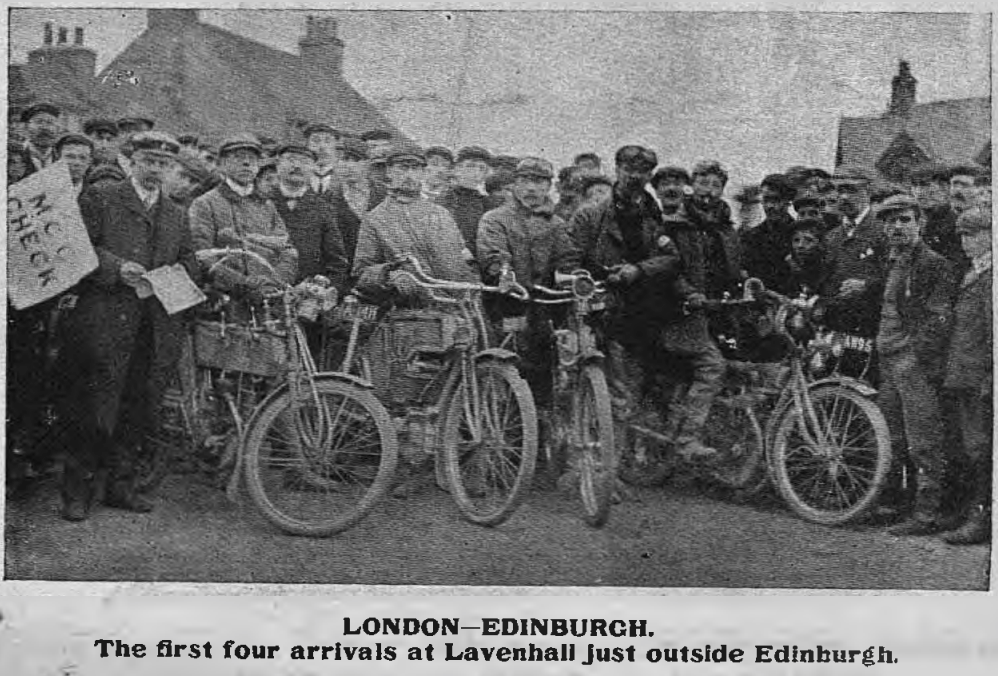
Hotel, and members of the Edinboro’ Motor Cycling Club were there to welcome the riders.The first arrival at the Scottish capital was HE Cowles at 7.55, quickly followed by Candler, Bell, Hooydonk and Roberts, Silver, Wells, Hacking, Arnott, Crundall, Williamson, Chester Fox, Wright, Maffert, Hulbert, Sale, Milligan, Reeves and EH. Young; DE Brown and CW Brown came in later, and Arnott, who had lost hours in the first sections, most pluckily got through before nine o’clock. T Hooydonk arrived later, having been delayed; and Wilson had his cylinder go wrong near Berwick, and came in by train. The highly successful result of 22 competitors having got through was announced after supper by Mr JA Jackson. Excellent as the machines had proved, the endurance of the riders must call for the highest admiration. To accomplish 400 miles in the saddle well under 24 hours is a test of the severest character. Great credit is due to Messrs JA Jackson and CW Brown for the admirable organisation. Not a hitch occurred at any point on the route,
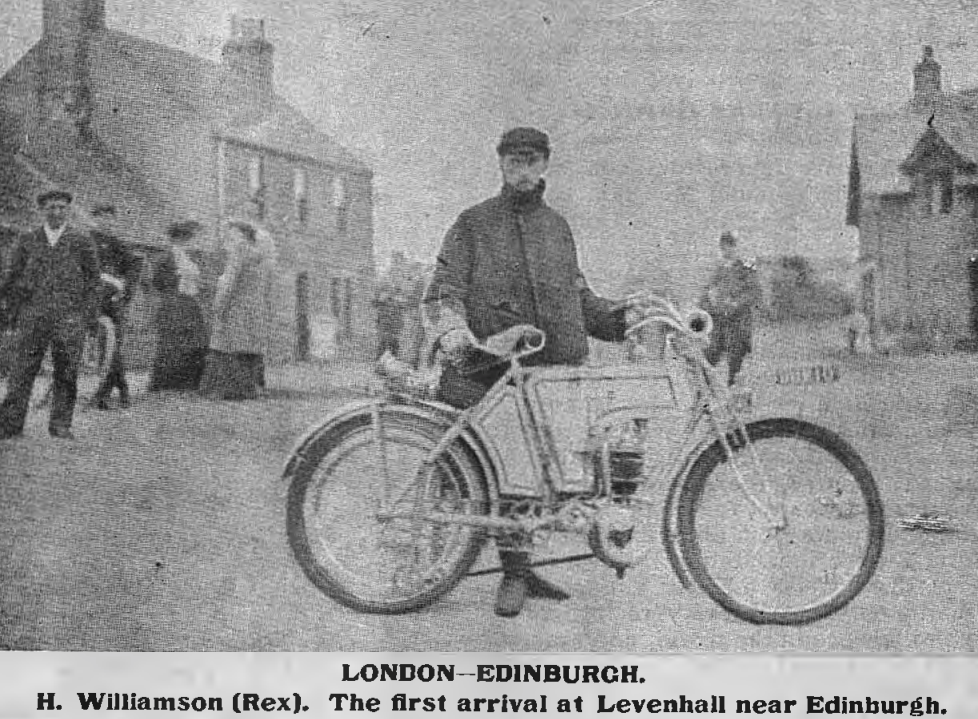
checkers and marshals being provided at every important point. The refreshments and supplies were also abundant along the road. Some later arrivals turned up after dinner, amongst whom was Bramley-Moore, he having been delayed by punctures. Reports were heard that Platt-Betts had a rough experience beyond Grantham, his machine framework having collapsed. Out of the half dozen or so tri-cars that started the Phoenix alone, strictly speaking, got through, although Gunn, on his Lagonda, can also lay claim to accomplishing the distance, but he was not at the official start; nevertheless his performance was excellent. Young arrived late, having ridden 12 miles on the rim. Two of the fore-cars were observed lying wrecked and deserted on the roadside; one of them, it was said, had charged into a telegraph post in the darkness. The roads on the whole were as good as could be desired, with the sole exception of a cruelly bad two miles on the outskirts of Newcastle-on-Tyne: this stretch was up for electric tram line laying. The following day an excellent programme of sightseeing was carried out. The return to London was made by train by the majority, but several determined to continue by machine, taking the route via Carlisle and Kendal.
“LONDON-EDINBURGH—LATEST! The following is the full list of the 22 riders who are expected to qualify for awards: FH Arnott (Werner 3hp), CE Bell (Quadrant 3hp), CW Brown (FN 2¾hp), D Elyard Brown (Ormonde 3hp), Arthur Candler (Quadrant 3hp), HE Cowles (Minerva 2¾hp), JF Crundell (Humber 2¾hp), HI Densham (No 1 Anglian 2¾hp), Chester Fox (Special Vindec 2¾hp), CW Hacking (Ormonde 3hp), J van Hooydonk (Phoenix Trimo 3½hp), Theodore Hooydonk (Ariel 3½hp), F Hulbert (Hulbert-Bramley 2¾hp), HP Gaffort (Bat 2¾hp), WJ Milligan (Bradbury 3hp), J Horace Reeves (R&P 2¾hp), WA Sale (Quadrant 2hp), T Silver (Quadrant 3hp), LN Young (Werner 2¾hp), WH Wells (Special Vindec 2¾hp), Harold Williamson (Rex 3¼hp), Alf Wright (Roc 3hp). It is interesting to note that seven-eighths of the total number of machines that got through were fitted with belt transmission. Also that ignition troubles were practically non-existent. Almost all machines used coils and accumulators.”
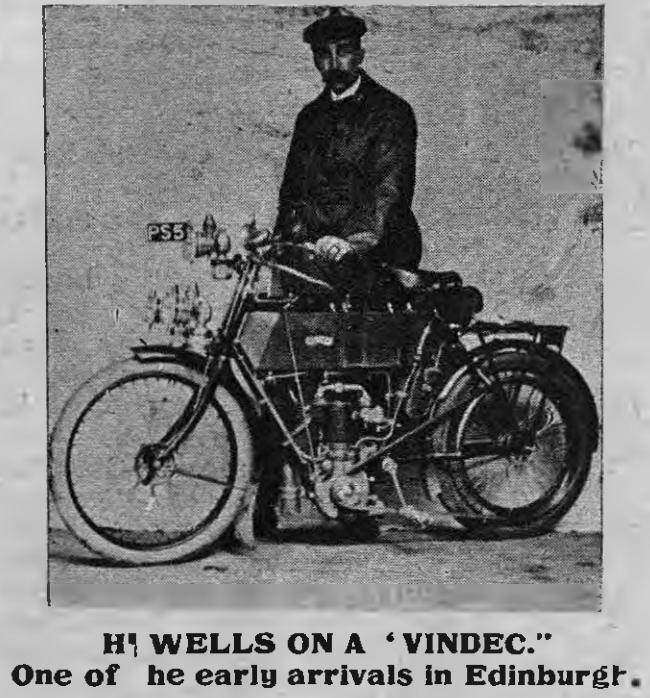
“THE COMMITTEE HAVE decided that the London-Edinburgh run will be an annual event. A special badge will be given to all the successful competitors, and it is intended that this badge be worn as long as the competitor remains a member of the Club. Being Club property, the badge is returned to the committee in the event of withdrawal. The number of gold medals to be awarded in connection with the run is twenty-two.”
“IMPRESSIONS ON THE LONDON TO EDINBURGH RIDE: A Chat with J van Hooydonk.—Meeting by a happy chance Mr. Hooydonk as he was returning from the Motor Cycling Club’s London to Edinburgh ride, we shook and said, ‘Glad to see you safely back. Did you return by train or road?’ ‘I came back by road, through Carlisle and over Shap Fell. Had a great deal of rain. My total mileage for the whole trip to Edinburgh and back touches just on a thousand miles.’ ‘What was your idea as to the general success of the Edinburgh run?’ ‘I think the event was a complete success, and so arranged that everyone stood an equal chance, and the trade rider should not have any advantage over the private rider. The course through the night was excellently marshalled, while in the day time the crowds in the various towns gave one very little chance of missing the way.’ ‘It was a very dark night, was it not?’ ‘Yes; and this, with rather poor lighting on some of the machines, contributed to some of the mishaps that occurred in the earlier stages, together with the fact that, in my opinion, some of the men went considerably too fast. I had a schedule made for an average of 23 miles an hour all the way through, and was able to keep to this, and very rarely did I exceed that pace. Some of the men were travelling at over thirty an hour.’ ‘Do you think that the ride has done good in the interests of the pastime of motorcycling?’ ‘Undoubtedly; the enthusiasm all along the route was remarkable, while on my return journey, although right away from the route, I was asked about the ride pretty well every time I stopped. News of the ride seems to have penetrated all over the country.’ ‘Any personal incidents you can relate?’ ‘No. I had good luck and the Trimo went through without my touching the tool bag.'”
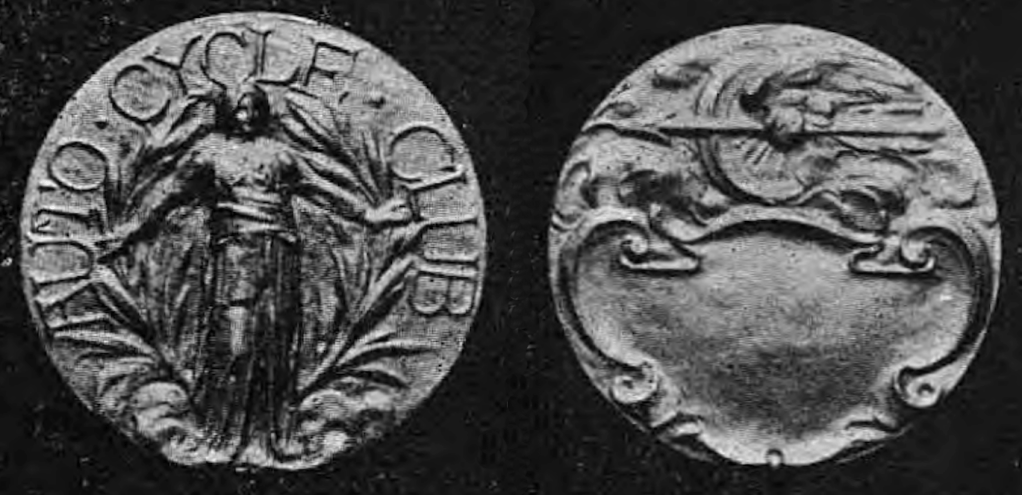
“IN THE REPORT of the London-Edinburgh run, the statement appears that Platt-Betts had a rough experience beyond Grantham, reports being heard at Edinburgh that the frame of his machine had collapsed. We are informed that it was the result of an accident pure and simple. A cleaning rag on the machine got entangled with the belt whilst running at high speed. This caused a spill of such violence that the lower of the two down tubes fractured. This happened near Wetherby. Betts, however, with local help, effected a repair by rivetting two steel plates over the fracture. This repair was perfectly satisfactory, and he got as far as Dunbar. He was, however, too late to reach Edinboro’ within schedule time. He returned next day and rode back without further incident to Hatfield.”
“THE EDINBURGH RIDE and Its Lesson. The Motor Cycling Club is to be congratulated upon its enterprise in organising and carrying to a thoroughly satisfactory issue what may possibly become a classic event in the history of motorcycling progress. The actual number of entries for the London-Edinburgh ride was 70. Of this number 47 started, and the very high total of 22 reached the Scotch [sic] capital in the schedule time to qualify for a gold medal. Even the most optimistic forecasts as to the number that would reach the goal were considerably less than this. Motorcycling progress dates from 1900. In three and a half years steady advances have been made in the direction of reliability, and no better proof as to the degree of success achieved in this direction is required than the Edinburgh event. The actual running conditions of averaging 20mph upon an average class of road for a distance of 400 miles were of the severest possible character, and machines that do this, it may fairly be said, are equal to anything that may be required of them under the less arduous conditions of everyday use. It is an emphatic answer to the question often advanced by some sections of the public: ‘Is the motor-bicycle a machine to be relied on for touring purposes?’ As to the balance of 25 starters who did not arrive at Edinburgh, in quite half of these instances the sole reason was that the competitors could not stand the physical strain entailed in keeping in the saddle for 22 hours. There is every reason to believe that the machines were quite equal to the task. Of the remainder, their failure to reach the goal was due to mishaps occurring on the first stretch of road, which had to be negotiated in the dark. By this time next year, when the Club repeats the event—it has been decided to make it annual—we hope we shall see a lighter class and smaller powered type of machine illustrate what it can do without going into any of the pros and cons as to weight and power. Not the least gratifying feature of the run was the good feeling shown by the public all along the route. The police also co-operated in an admirable manner, especially at the start, and there is no instance recorded of friction having occurred. Riders also, we think, played their part in showing the public that such an event, well, organised as it was, in no way interferes with the rights of other road users.”
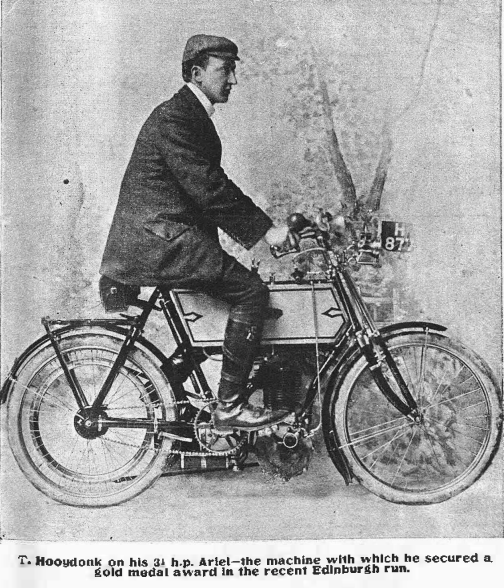
“THE AUTO CYCLE HILL CLIMB. In splendid weather the Auto Cycle Club carried out a hill-climbing competition on Saturday last. The hill selected was not a well-known one, being on one of the bye-roads beyond Northaw, off the Great North Road, in Herts. It has a length of about 750 yards, and the gradient varies considerably, ranging from a short stretch of 1 in 8 to a long stretch of 1 in 12. As the special feature of the test was that no pedalling whatever was allowed, the hill was by no means an easy one for mounts of medium power. The competitors, to the number of about 30, assembled at the Old Salisbury Arms, Barnet, at 2 o’clock, and the machines were carefully weighed. Machines, in all cases, had to be touring mounts, fully equipped, and tanks being filled with oil and petrol. The machines were classified under four heads, namely: Class 1: Motorcycles having a cylinder capacity not exceeding 70x70mm [269cc]. Class 2: Up to 76x76mm [345cc]. Class 3: Up to 80x80mm [402cc]. Class 4: Reserved for fore-carriages, side-carriages and trailers, carrying two passengers. Competitors were allowed to pedal up to the starting line only…Only three machines failed to get up the hill, and it was noteworthy that the three fore-carriages made very good times.”
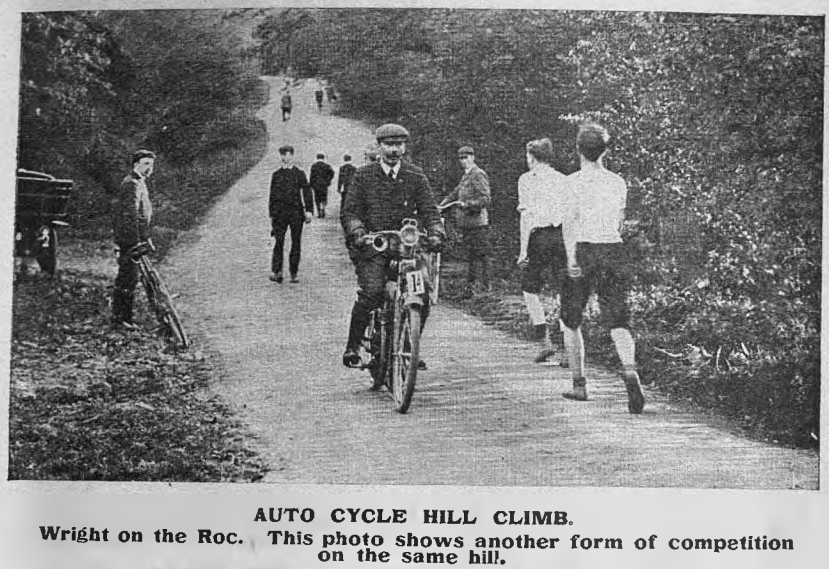
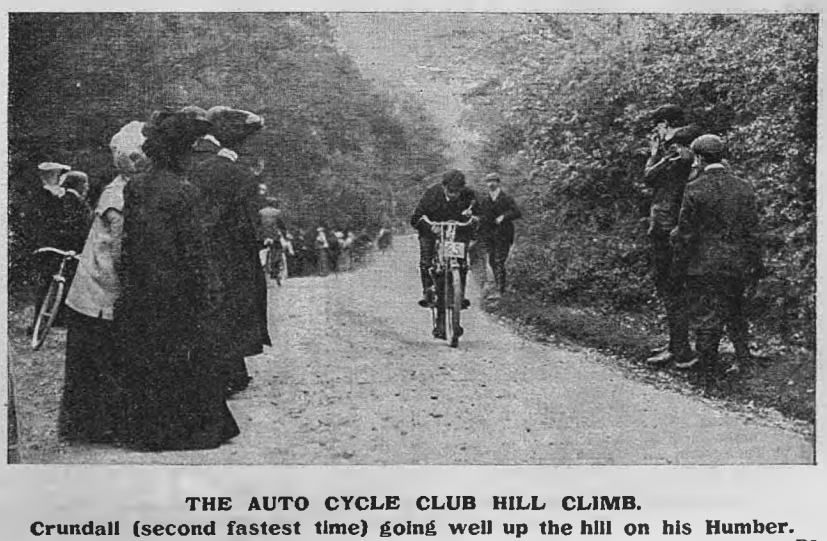
“THE LONDON MOTOR-BICYCLE. The London motor-bicycle, manufactured by Rex Patents, 3, The Exchange, Clapham High Street, Loudon, is so named because it is fitted with their widely-known London motor. The engine develops 3½hp, and is entirely London made. English threads and measurements are alone used, so that, should a bolt or similar fitment be lost, it can be replaced at any well-stocked fitter’s shop. The valves are mechanically operated. No stampings are used, parts being machined from the solid bar. Not an ounce of foreign material is used in their manufacture. Points in the complete bicycle specification are: Longuemare carburetter, wipe contact with high-speed trembler coil, Chater Lea fittings, Palmer tyres and Bowden back brake. The standard machine is finished in green enamel, gold lined, and the price is 40 guineas.”
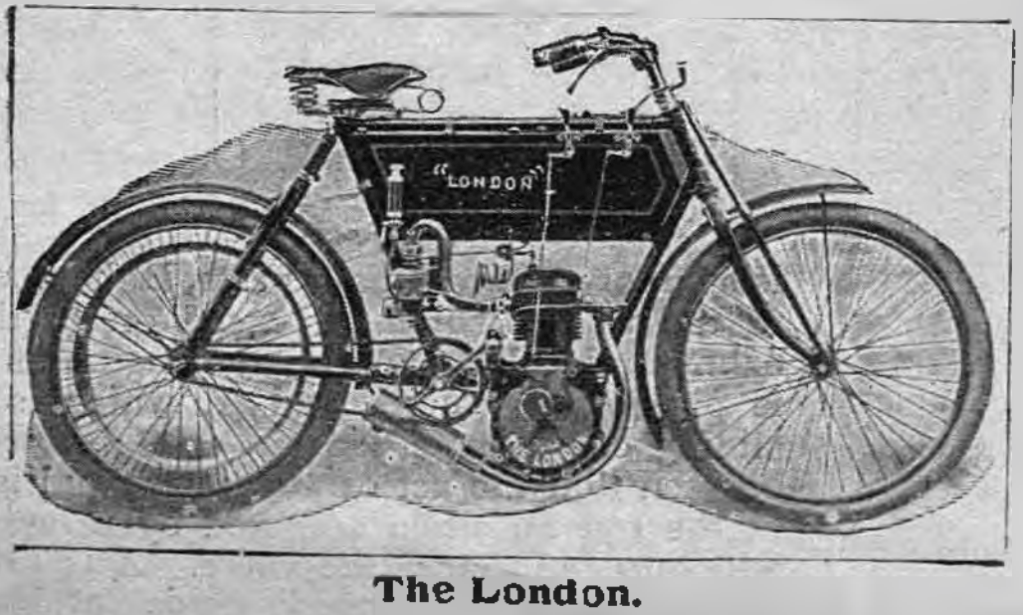
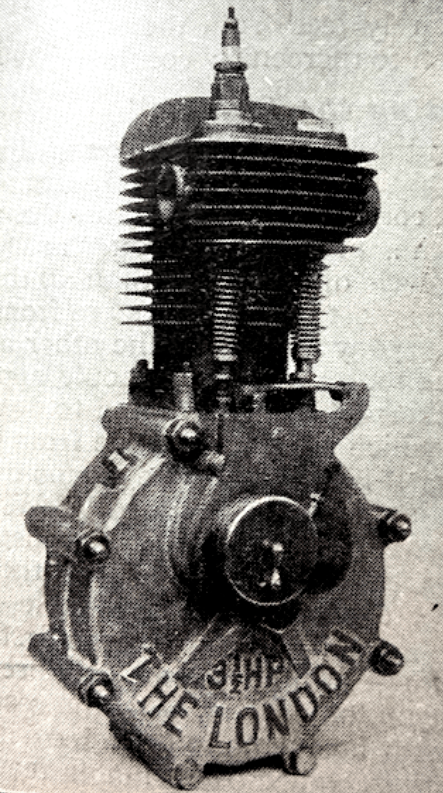
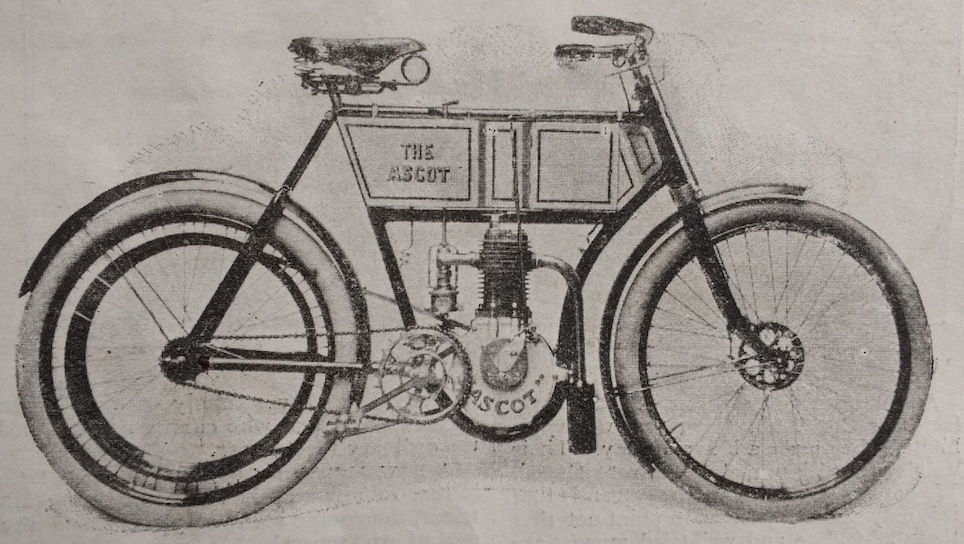
“A GERMAN-BUILT MACHINE. The Diamant is made by the Diamant-Fahhradwerke, Chemnitz. It has some rather novel features, principal amongst these being the ignition. This is effected by a small dynamo clamped behind the steering tube, and the armature is driven by a long shaft and small bevel gears from the motor. This dynamo works in conjunction with a coil concealed in a compartment of the tank. The high tension cable can be seen connecting to the spark plug. In addition to the dynamo a small accumulator works in conjunction with the coil as a reserve, or for easy starting. The engine is bolted to a loop on the main down tube and further supported by a bracket from the crank case to bottom bracket. The transmission is by flat belt with a ball bearing jockey pulley for tensioning. The only out-of-date fitting on this machine is the front brake, which is of the old plunger type. The rear brake is a Bowden rim pattern.”
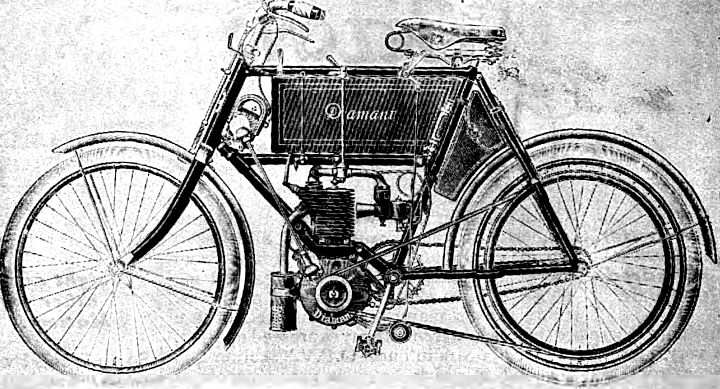
“THE R AND P MOTOR TRICYCLE. Robinson and Price, Liverpool, are putting on the market a motor-tricycle which has proved a great success on the road. Fitted with their 2¾hp engine, built into the frame, and with other details the same as on the well-known R and P motor-bicycle produced by this firm, the new tricycle is not much heavier than the average motor-bicycle. The drive is by special V-belt to rear axle. It is an excellent hill climber, fast on the level, and a most comfortable mount. We believe a large number of riders are looking out for a machine of this kind, which is a vast improvement on the heavy motor-tricycles of a few years ago.”
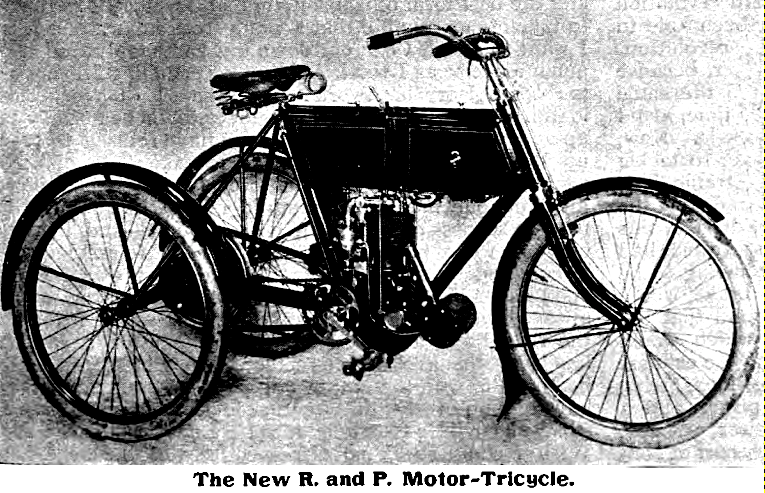
“MOTOR VERSUS MAILCART. Since the first rural mail route was established, more than a decade ago, the rural delivery of mail has spread with almost incredible rapidity…CL Clayton, of Kansas, says: ‘My connection with the rural free delivery was the occasion of my purchasing a motor-bicycle, and while I am somewhat fond of cycling in any form, yet I am a motorcyclist from the standpoint of business rather than pleasure. In the performance of my duties as a carrier I am compelled to travel 27 miles per day…After I had been driving horses over my rural route for more than a year, it occurred to me one day, when I had a lame horse to try my motor-bicycle. I was rather pleasantly surprised to be able to make the route upon it as easily as I did…With a good horse I can make my route in six and one-half hours…With the motor-bicycle I am covering it in two and a half hours…The expense for repairs on the motor-bicycle has thus far been no more than the shoeing and veterinary bill for a horse.”

“WHOEVER FANCIES THAT the trade in motorcycles has not attained volume has but to visit the plant of the Hendee Manufacturing Company, at Springfield, Mass, to have his mind disabused of the idea. As all the world knows, the Hendee people have thrown themselves earnestly into the motor-bicycle business. The proud position occupied by the Indian machine, due to its remarkable efficiency, is the natural result, and that the demand for it is keen and increasing the accompanying illustration will serve to show. At the time the photograph was taken, two weeks since, 120 Indians were assembled and in stock awaiting shipping directions. Oscar Hedstrom, the chief Indian, told your correspondent a few days ago that ‘as far as the outlook on Indian motorcycles for 1904 goes, it could not be brighter. We have for the last month, or six weeks, turned out six (6) complete machines a day, and anticipate turning out during the next three months at the rate of ten (10) complete machines per day. We feel even with this output that we shall not be able to cope with our orders. Regarding the weight of motor-bicycles I would say that we gave this question our careful consideration when we designed out Indian motorcycle something over three years ago: our original machine weighed about 100lb complete, ready to ride, and we have made no change whatever in the construction towards lightening it, as we believe it would be impracticable to attempt to lighten the machine carrying the weight of motor that our machine does. Our machine last year listed at $200, but this year, with the addition of the grip control and other minor details which we have added, we ask a price of $210.”
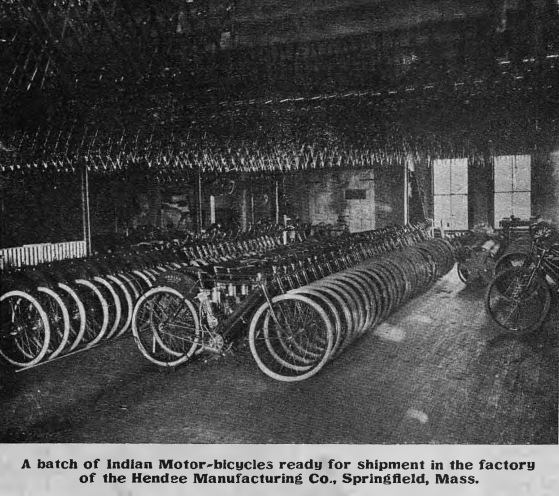
“GEORGE M HENDEE, President of the Hendee Manufacturing Co, who make the Indian motor-bicycle, is opposed to motorcycle road racing, on the ground that it is too dangerous, and likely to do more harm than good.”
“MR GD HOLLOWAY, who was unwittingly instrumental in causing the death of an old man at Mitcham by knocking him over with a motorcycle, has been acquitted by the Croydon magistrates. Both the coroner’s inquest and at the subsequent magisterial inquiry absolved Mr Holloway was of all blame, and his generosity to the widow of the deceased was commended.”
“IT IS EVIDENT FROM the correspondence which reaches us from time to time that there is still a large amount of misunderstanding amongst motorcyclists concerning the question of the Inland Revenue tax on motorcycles. The Inland Revenue Acts impose a tax on carriages of £2 2s when they run on four wheels, and of 15s when they have less than four wheels. By an order of the Inland Revenue Board motorcycles are included under the latter head, because the Act embraces mechanically-propelled vehicles as well as those which are horse-drawn. It is, however, the contention of motorcyclists firstly, that the Inland Revenue Board is stretching the definition in order to include motorcycles, and, secondly, that the poor man’s motor is less of a luxury than the dogcart with which it is classified, but is rather an aid to health and exercise. Moreover, it is a vehicle which is adapted to be propelled, either wholly or partly, by human power and, as such, it may not unjustly be claimed that it should be classified with the ordinary push-bicycle, which has never been taxed, although it is just as much a two-wheeled carriage as is the dogcart.”
“THE TRIALS OF MOTOR-BICYCLES from Paris to Bordeaux and back being organised by the Auto-Cycle Club of France promise to be very interesting and successful. Upwards of sixty motor-bicycles have already been entered, and the only foreign machines among them are the Motofaure of Geneva, the Van Altena of Holland, and the Fabrique Nationale. It is much to be regretted that English makers have not entered bicycles in these trials, for they would seem to have an excellent opportunity of showing up well in tests that are intended to bring out the qualities of reliability and other features necessary in a touring machine.”
“WEST HAM MOTOR AND CYCLE CLUB. This club is now holding regular Thursday, Saturday and Sunday runs. As will be seen from the photograph, taken on the occasion of the club run to Billericay, on April 10th, the runs are well attended. Motorists in the East End of London desirous of becoming members should write for prospectus and list of runs to the hon secretary, AC Davis, 47, Queen’s Road, Canning Town, E.”
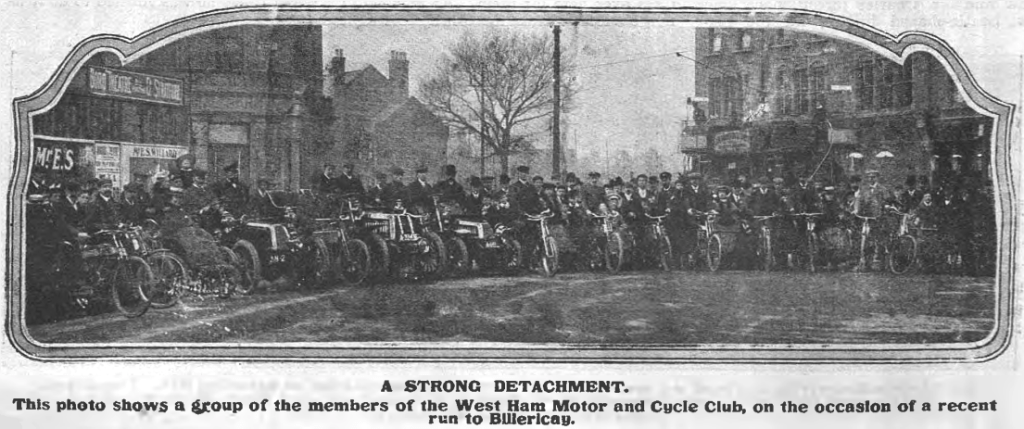
“MR J HORACE REEVES, hon sec of the Motor Cycling Club, writes expressing his disapproval of the paragraph which appeared last week, stating that he had chosen an R and P motorcycle for his 1904 mount. Mr Reeves seems to think there is some reflection upon his amateur status implied in the paragraph, but this was certainly not intended.”
“NEW PATTERN IRIS MOTOR-BICYCLE. The photograph depicts the latest type Of 3hp Iris machine with water-cooled engine. This is fitted with a new style of outside radiator shown on the side of the tank; there is also a clutch and hand starter provided and the latest petrol tank is of increased capacity. The company are now making these machines with English built frames and adding many improvements. The front forks are duplex and two rim brakes are fitted. The Iris specialities for 1904 will be the single-cylinder and 6hp twin-cylinder, both air and water-cooled. The makers are the Iris Motor Company, 58, Holland Street, North Brixton, London, SW.”
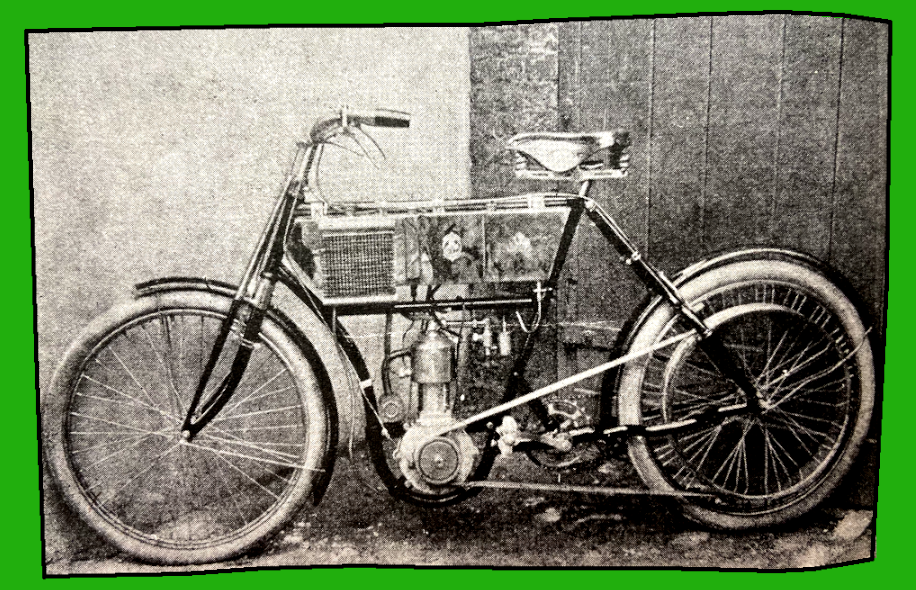
“THE 1905 2¼HP XL-ALL MOTOR-BICYCLE, made by the Eclipse Motor and Cycle Co, John Bright Street, Birmingham, is claimed to have some new features in it that are not to be found in any other machine. All levers for the manipulation of the motor on the tank and handlebar have been abolished. The throttle is controlled by a twist handle. The switch, which is a three-way type for two accumulators, is fitted inside the handlebar and controlled by the thumb. The sparking advance is controlled by another twisting handle, which, when retarded to the extreme, also lifts the exhaust valve. There is no additional air lever fitted, as the carburetter is automatic, thus the entire motor is managed without loosing the handle grips, and without the usual complications of levers and wires. The makers are also fitting a ⅞in V-shape belt to this machine, and the engine pulley is made with deep flanges, so that it is impossible for the belt to run off by accident, even when running quite slack. The price is £35.”
“SOME AMERICAN MOTOR-BICYCLES. The spring number of the New York Bicycling World describes and illustrates the leading American motor-bicycles. The Indian, Columbia, Auto-Bi, Rambler, Merkel, Orient, Mitchell, Metz and Yale seem to be the principal makes. To the eye accustomed to the productions of English and Continental machines, most of the American bicycles have a somewhat clumsy and grotesque appearance. One or two notable exceptions are the Metz, the Yale and the Auto-Bi, which have very simple, graceful and workmanlike lines…Most of the American cycle manufacturers are following the lead of their English fellow-traders, and turning their attention to motorcycles and motor accessories—not to the exclusion of the pedal cycle, but as an auxiliary.”
“AMERICAN VIEW OF THE LIGHT MACHINE. ‘Statistics will show,’ says a writer in Bicycling World, ‘that it is not necessary to build a motorcycle to weigh 150 pounds to make it hold up on American roads, and, therefore, we should follow our neighbours in France in placing the limit in weight at 110 pounds, which really includes all of the good motorcycles.’”
“MOTOR-BICYCLE FASHIONS. The New York Motorcycle Club has pronounced leather to be an unsuitable material for its members. The club uniform now consists of Scotch tweed of a pepper and salt colour, the coat cut in the half-Norfolk style, ordinary knickerbockers, or trousers, with leggings, grey cap.”
“MOTORCYCLE DEVELOPMENT IN AMERICA. ‘The betterment of the 1904 models is far-reaching,’ says Bicycling World, of New York. Those that have lacked the power necessary to surmount, without pedalling, the steeper grades, have been made more powerful. Parts and equipments hitherto inaccessible or difficult of access have been rendered easily accessible. The little things that contribute so greatly to reliability and efficiency, as, for instance, the methods of lubrication, of removing or replacing batteries, of injecting gasolene in the cylinder for starting or flushing purposes, of draining the gasolene tanks, of taking up the slack in chains or belts, and last, but not least, the method of making the electrical connections, have all undergone marked improvement. The personal comfort and cleanliness of the rider have not been overlooked. The use of spring forks and the general adoption of saddles and mudguards of ample proportions constitute evidence to that end. The gradual realisation that ‘how slow’ is as important as or more important than ‘how fast’, has brought with it carburetters of more elastic regulation; and the supreme and dominating necessity that man be the complete master of the machine has evolved the several systems of one-hand control—the so-called grip control. It makes man the absolute master at all speeds and under all conditions. The motor-bicycle is now literally and instantly controlled—started, stopped, and its speed regulated—by the merest twist of the wrist.”

“THE MOTORCYCLE CLUB OF FRANCE first saw the necessity of pointing out to makers the way in which they should develop the motor-bicycle, by organising’ trials of touring machines in November last, when they ran for a distance of 1,000 kilometres in execrably bad weather, and on the whole behaved themselves remarkably well. For the first time the machines had to be provided with full touring equipment. Marks were given for the efficiency of the brakes, mudguards, and silencers. The value of these trials was evidenced in the wonderful improvement observable in the bicycles, which, while preserving their characteristic of lightness, showed that makers were beginning to fully understand the requirements of the average user. Further experience, however, was still necessary for the perfection of the touring machine, and the Autocycle Club of France, which was formed at the instigation of a number of makers, and is affiliated to the Motorcycle Club, decided upon continuing the trials under actual touring conditions…This contest is being run off from Paris to Bordeaux and back, a distance of 1,200 kilometres,
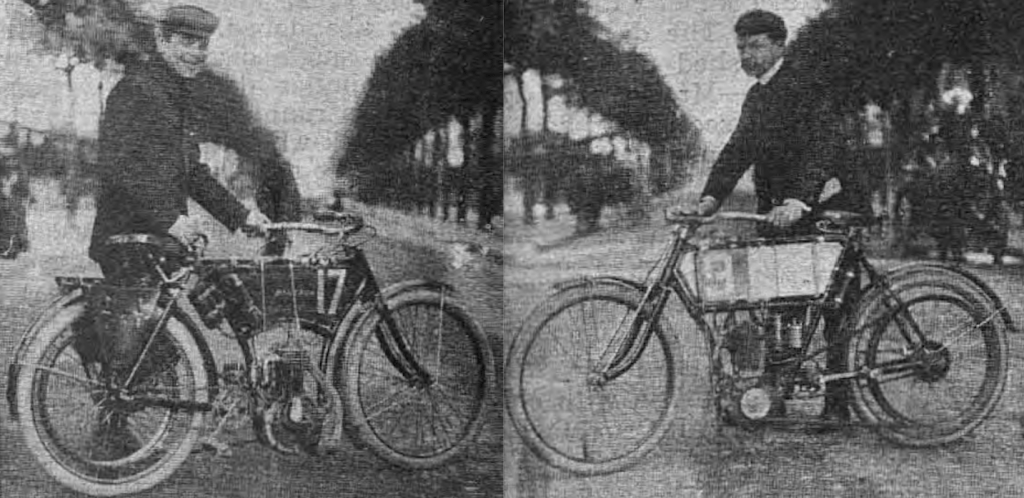
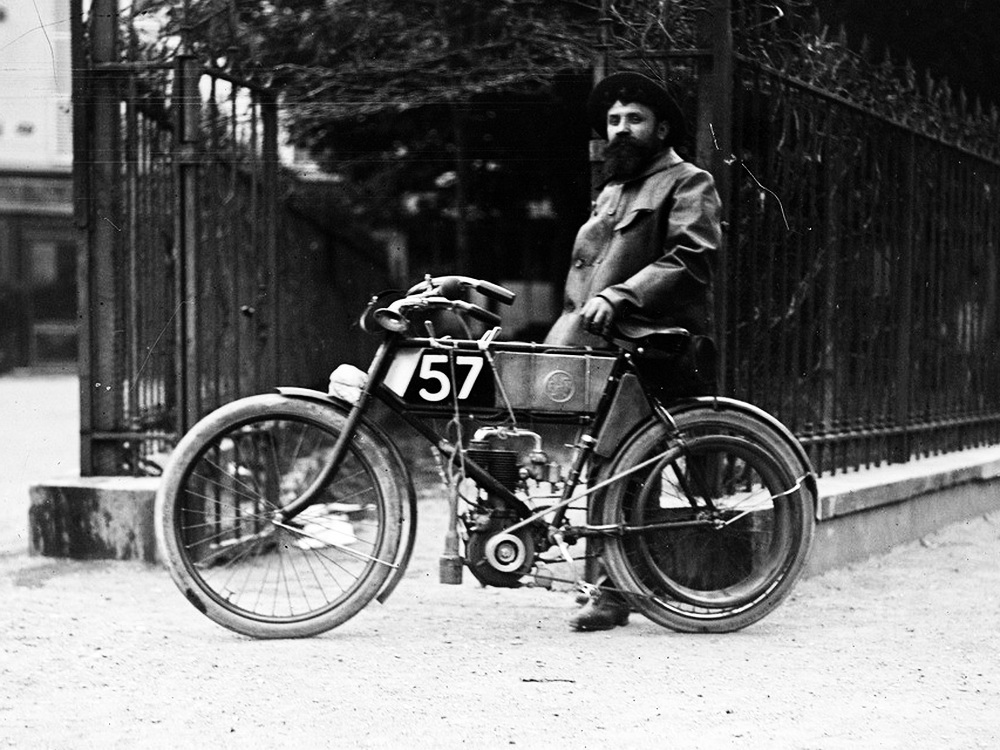
in four stages. The competition is limited to machines of less than 50 kilos fully equipped for touring, and the result will be based mainly upon regularity, hill climbing speed, and economy, and marks will, of course, also be awarded for the efficiency of the brakes and silencers. The start took place on Friday from St Mande, a suburb to the east of Paris, when no fewer than 59 motor-bicycles were present out of a total of 65 entries. When it is said that 37 makers were represented, some idea will be gained of the way in which French manufacturers are supporting every manifestation which may popularise the motor-bicycle and at the same time provide them with experience enabling them to turn out thoroughly reliable and satisfactory touring machines. The run started under favourable conditions, with the wind behind the competitors, but towards Orleans progress was retarded by a strong head wind, and further on the rain began to fall in such torrents that a good many motorists found themselves in difficulties. The only
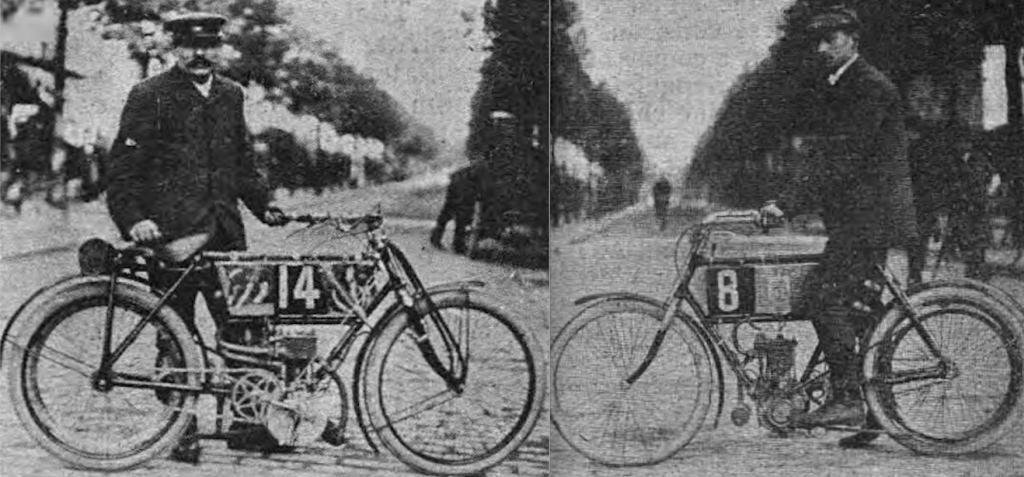
accident of any seriousness on this run appears to have been that happening to Louis Saussard, who was riding a Bailleul bicycle. On nearing Melun he passed a horse, which shied and knocked him down, and he fell so heavily against the vehicle that he broke an arm, and was injured about the head. Altogether 48 competitors reached Tours, the first to arrive being the two Bruneau chain-driven bicycles, followed by Kuhling on a Gobron-Minerva, Lepetit on a Stimula, and Osmont on a Fabrique Nationale. A rough calculation of the times would seem to show that Osmont had done the quickest journey. In view of the heavy rain falling towards the end of the run, the proportion of competitors finishing must be regarded as very satisfactory. The rain continued to fall in torrents on the second day, and the roads were so muddy and greasy that the motor-bicyclists were obliged to ride with great caution. Few of them seemed to have escaped side-slip, and so far as could be seen none of them were using non-skidding tyres. At Poitiers Osmont was leading, followed by Baret on his Bruneau nine minutes later, with the Werner of Bonnard close up. Renouil had been thrown by a dog, and his Clement bicycle was put out of the trials with a

broken wheel. At Angouleme Osmont had fallen a long way to the rear, and Kuhling (Gobron-Minerva) and Bonnard (Werner) passed first together. Most of the competitors looked as if they had succumbed to the law of gravitation, and were riding very cautiously. Kuhling was leading at Barbezieux, with Bonnard behind. The heavy rain accompanied the competitors all the way to Bordeaux, where they arrived covered with mud. Kuhling on his Gobron-Minerva had been passed by Obeslagers on a similar machine, and the others finished in the following order: Carreau (Carreau), Derny (Werner), Canale (Alcyon), Bonnard (Werner), Denis (Lurquin-Coudert), Coudert (Lurquin-Coudert), Janin (Alcyon) Osmont (FN), Mauxion (FN), Bafet (Bruneau), Meline (Iris), Oster (Gladiator), Chauffour (Georgia Knap), Taron (Eonnet-Jumel), Castagne (Georgia Knap), Andre (Chantemede), Dacier (Clement), Joyeux (La Foudre), Rene (Cavelier), Lepetit (Stimula), Foulon (Bruneau). At the time of telegraphing from Bordeaux 23 competitors had

finished, and others were on the road, while about half a dozen had given up and come on by train. After such an experience on the muddy roads, with a continual succession of storms of wind and heavy rain, the competitors were glad of the opportunity of a rest…Sunday was spent at Bordeaux, some of the competing machines being exhibited the Alhambra. So far as could be judged, the FN, Werner, Minerva, and Bruneau machines specially distinguished themselves on the outward run, the Alcyon (a new machine which was making its debut) also rendering a good account of itself.

On Monday a start was made for the return journey at 6am from Bordeaux, thirty-one competitors being started at minute intervals. The weather was perfect, and the roads in splendid condition. Good time was made to Angouleme, the first to arrive being Foulon (Bruneau) ; seven minutes later came Osmont on his FN, this competitor having been distinguished throughout the run for a well-sustained turn of speed. Lepetit (Stimula), Kuhling (Minerva), Baret (Bruneau), Mauxion (FN), and Olieslagers (Minerva) were the next to arrive in the order named, and shortly before eleven o’clock Van Altema and Done brought up the rear. In the course of the next stage Osmont went to the front and ran into the historical town of Poitiers a long way ahead of the rest; indeed, being in advance of schedule time, he was delayed a few minutes before being re-started. Kuhling, Foulon, Mauxion, Barre, and Rene were the first of the next batch to arrive, Olieslagers having dropped back some way. Owing to the excellent state of the weather and roads, no casualties of importance were recorded, and of the thirty-one starters on this day only three or four failed to arrive in schedule time. The last stage of the trial comprised the run from Tours to Paris. With commendable earliness and punctuality, Foulon was started oft at 6.1am, twenty-four brother competitors following at the usual one-minute interval. The first control was Melun, and the first machine to arrive was the irrepressible FN, driven by Osmont, who had started twentieth on the list. It remains, of course, to be seen whether this racing policy of Osmont’s will find favour in the eyes of the judging committee, but there is no doubt that he has been most prominently before the eyes and on the lips of the public during the trial. Olieslagers, another fast rider, followed Osmont into Melun, but as he had started some 10 minutes earlier and arrived 15 minutes
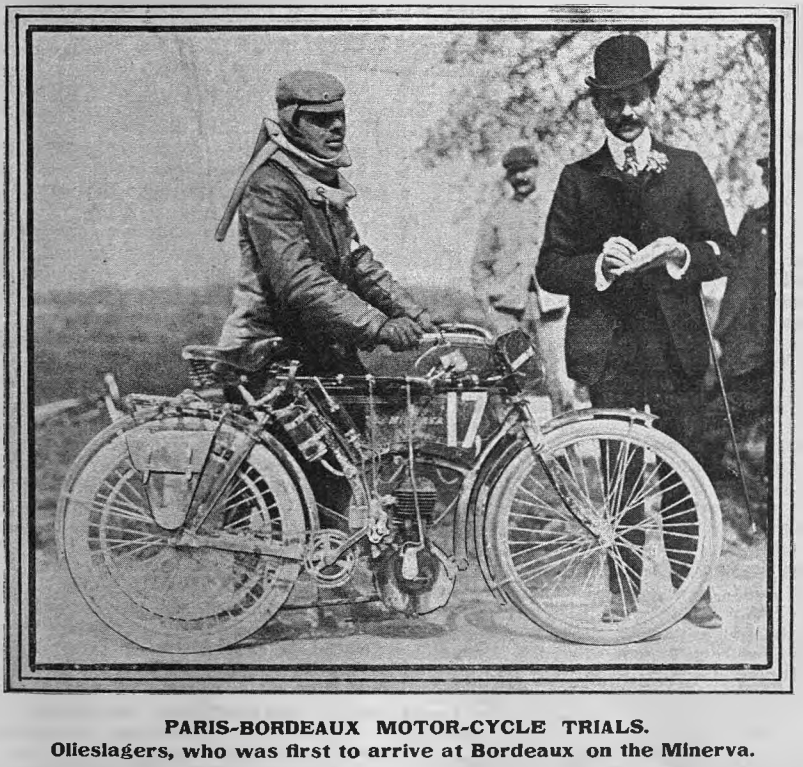
later than the FN pilot, some idea of the latter’s ‘going’ may be formed. Derny, Bonnart, Coudert and Denis also made good running on this stage. The arrival at Paris was eagerly awaited by a large crowd from an early hour in the afternoon, the Rue de la Tourelle being the most favoured view point. The actual finish took place at the top of the Champigny hill, the leading officials of the Autocycle Club of France and many of the greater lights in the French automobile world being grouped here. At about a quarter past three a cry of ‘Gare! Gare!’ (‘Look out!’ (‘Look out!’) was raised, and Osmont, covered with dust, tore up and finished first, as he has so often done throughout the trial. It was stated that in his anxiety to be the first back in Paris Osmont neglected the formality of signing at one or two intermediate controls. However that may be, he had gained a full quarter of an hour on the ‘field’, the next arrival being the Minerva driven by Olieslagers; after an interval of another 20 minutes, the first op the Werner machines (Derny up) came in, closely followed by Janin on the new Alcyon; then Janin on Werner No 2. The two Lurquin-Coudert machines arrived together ‘neck-and neck’, and of the next batch Foulon, Taron and Kuhling were the most prominent. Twenty-four machines out of an original total of 37 arrived back in Paris. Although from the public’s point of view, and to some extent from that of the competitors, the event was looked upon as a race, we must remind our readers that endurance was the crucial test, and the official results are not expected to be ready for at least a fortnight.”
RESULT OF PARIS-BORDEAUX MOTOR-CYCLE TRIALS. The Sports Committee of the French Autocycle Club met last Friday to consider the results of the recent Paris-Bordeaux and back motorcycle trials. The Committee, having in view the nature of the trials (which were tests not of speed but of reliability), selected no actual winner, but awarded diplomas according to merit, as follows: First-class diplomas to J Bruneau (Foulon), Lurquin-Coudert (Denis), Werner (Bonnart), Minerva (Kuhling), Lamaudiere-Mauger (Baron), Lurquin-Coudert (Coudert), Bonnet et Jumel (Taron), Georgia Knap (Castagni), Minerva (Olieslagers), Werner (Derny), Lamaudiere (Canesse), Georgia Knap (Chauffour), Cavelier (Rene), Bruneau (Barre), Stimula (Lepetit), J Carreau (Carreau fils), FN (Mauxion), Alcyon (Canale), Clement (Dacier). Second-class diploma to G Doue (G Doue). Honourable mention: Van Altema (Van Altema), La Foudre (Galliot), Alcyon (Jamin), Gladiator (Oster). The names in brackets are those of the riders, the others being the names of the machines. It will be noted that the FN ridden by Osmont does not appear in the above lists. This rider did some very fast running all through, but appears to have been disqualified for starting from a control before time. These results should settle all disputes.”
OLIESLAGERS IN THE FRENCH MOTORCYCLE TRIAL. J Olieslagers, the winner of the recent trial from Paris to Bordeaux and back, organised by the Auto-Cycle Club of France, was congratulated upon his win by the directors of Minerva Motors, and we have been permitted to see his letter acknowledging the telegrams, and to take a translation from it. The letter is characteristic of a rider who is very frank and outspoken, and who moreover is a most enthusiastic motorcyclist. Olieslagers wrote: ‘You will have noticed that I have done my best in this Paris-Bordeaux-Paris race. I say “race”, gentlemen, and do so purposely, for that is what this trial came to. The great thing with which everybody who took part in this event was concerned was to arrive first at the final controls. The first day they were content with something like 45km/h, but when I noticed that some were trying to set the pace, I could not resist showing those Frenchmen what a Minerva motor can do, and the second day I averaged my 62km/h, or to be exact, I did my 145km in 2hr 15min, and the success I attained is incredible. Owing to my last spurt to Bordeaux I arrived covered with mud, but, to make up for this they offered me a bouquet on my arrival, with hundreds and thousands of good wishes, and the cheering held on until a second arrival was announced, and, to my great delight, this was Mr Kuhling, also on a Minerva—the same success, but no flowers for him! On the return journey I made up my mind to try and arrive first in Paris as well, and, as you will have seen, I succeeded, and so it is that John Olieslagers is to-day known to all French sportsmen. I only hope, now, my dear sirs, that you will not forget your promise to let me run in the Circuit des Ardennes, because you will understand how greatly it would worry me if I had to let this event pass without having the honour of defending the colours of the Minerva.
Yours very truly, (Signed), J Olieslagers.'”

“ROAD TRIAL OR ROAD RACE? Drawing conclusions from the reports and comments in the Paris sporting journals, we cannot but believe that the four days’ Paris-Bordeaux motorcycle road trials just concluded have been a brilliant failure—brilliant, in that a very large percentage of starters came through without serious mishap, and showed great capacity for prolonged speed on the road; but a failure, by reason of the numerous infringements of the regulations, owing to the fact that many of the competitors forgot that endurance and smooth running at a moderate speed was the raison d’être of the trials, and not racing capacity. As an instance, Osmont (who was riding an FN machine) started about an hour later than Foulon (on a Bruneau) on the last day’s run, and finished nearly an hour and a half earlier, although Foulon does not appear to have met with any mishap or delay on the road. We do not suggest that the trials have been of no value—far from it; they have given yet another proof of the vast progress made in motorcycle manufacture during the past year; but of what use are regulations if some of the competitors are allowed, apparently with impunity, to disregard them?”
“PUBLIC SCHOOLS MOTORCYCLING Championship of France. The old track of the Velodrome de la Seine was the scene on Sunday, May 15th, of a motorcycle championship confined to schools and colleges. A large entry of young enthusiasts of the sport had been received, and after the eliminating heats had been run off the following five were left in: Mazaraki (Condorcet school), Michelot (Duvignau), Gaulet (Charlemagne), and Verde and Dauchy (Duvignau). Mazaraki and Verde, winners of the semi-finals, and Gaulet (fastest loser) contested the final, Mazaraki on a 2½hp Griffon winning. Touring machines only were eligible.”
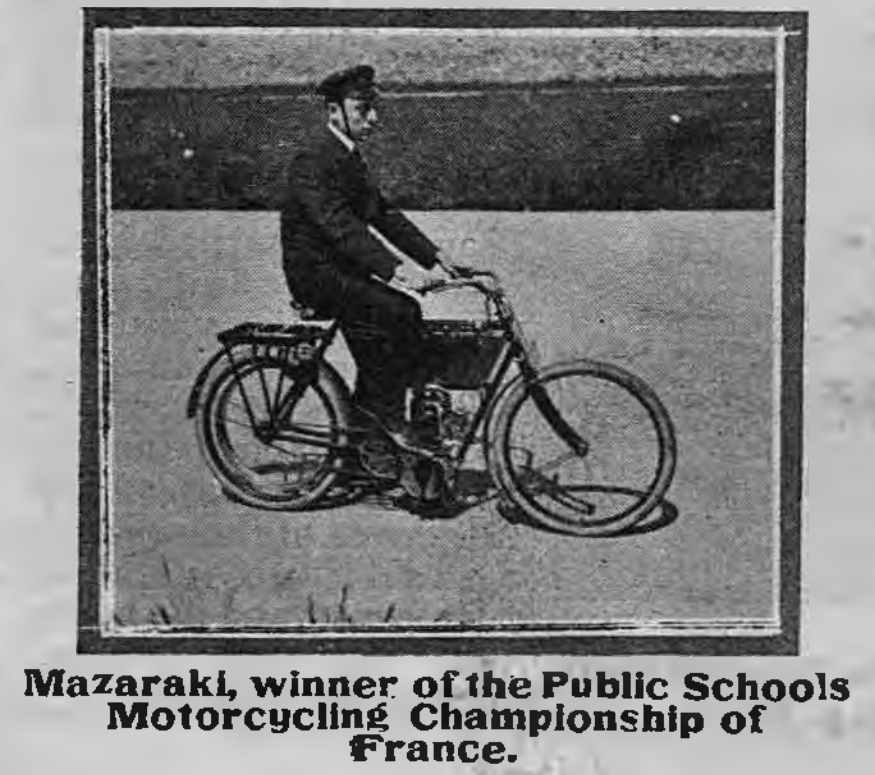
STARLEY’S NEW MODEL. Messrs Starley & Co, St John’s Works, Coventry, whose 2hp motor-bicycle, having a worm gear system of transmission, two speeds and a free engine, has often been referred to in these columns, are now building a more powerful type of machine, viz, one of 3½hp, which is designed particularly for trailer or fore-carriage work. Although built on the lines of the older model, it possesses several improvements. These were pointed out to us when we visited Messrs Starley’s factory last week, and one of Mr Starley’s sons, Mr Hubert Starley, demonstrated some of its capabilities to us. It has provided for a starting handle similar to those found on cars. By giving this a quarter of a turn, young Mr Starley, without any effort, started the engine, mounted, put in the low gear, and, as soon as he got under way, changed to a high gear, and the machine immediately attained a good speed. The machine ran most silently, and we were very much struck with the ease it could be handled, and turned round in the road with the engine running free. This new model is minus pedals, and is made for the Cosi Car Co, London, who purpose attaching it to one of their little cars. A new carburetter has been fitted; this is constructed without a float feed, but it has an adjustable nipple by which it is claimed that almost any density of petrol can be used. Mr Starley informs us that he has even tried paraffin with good results. A new and very neat form of silencer is also attached; while an improved band brake acting in the drum of the rear hub is also a fresh feature. This is a very powerful device, and possesses the advantages of being easily detachable whenever this is necessary. As in the lower-powered machines, the whole of the two-speed gearing, worm and wheel, are enclosed in an oil-tight aluminium case, and run in a thick lubricant, and there is no belt and only one chain. The workmanship and finish is exceptionally good, and we shall be very much surprised if Mr Starley’s latest model does not create an even more favourable impression than the original 2hp type did.”
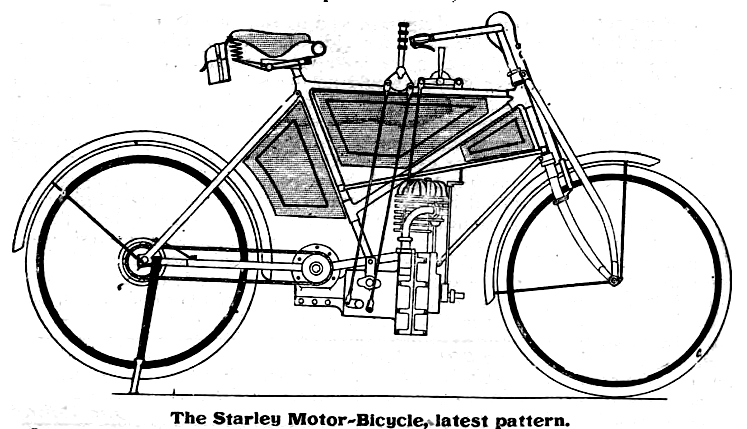
“THE COMET MOTOR-BICYCLE, a machine of neat and symmetrical build, is fitted with the Minerva engine, having mechanical inlet valve, and driving by V-section belt. The Longuemare-Minerva carburetter is used. Duplex forks, long wheel base, ample petrol capacity are some of the other good features. It is made in 2¾hp pattern at 37 guineas, and 3½hp at 40 guineas. The makers are the Comet Motor Works Co, Tanner’s Hill, New Cross, London, SE. These works are amongst the most up-to-date in the motor trade, being particularly well equipped with American automatic machinery.”
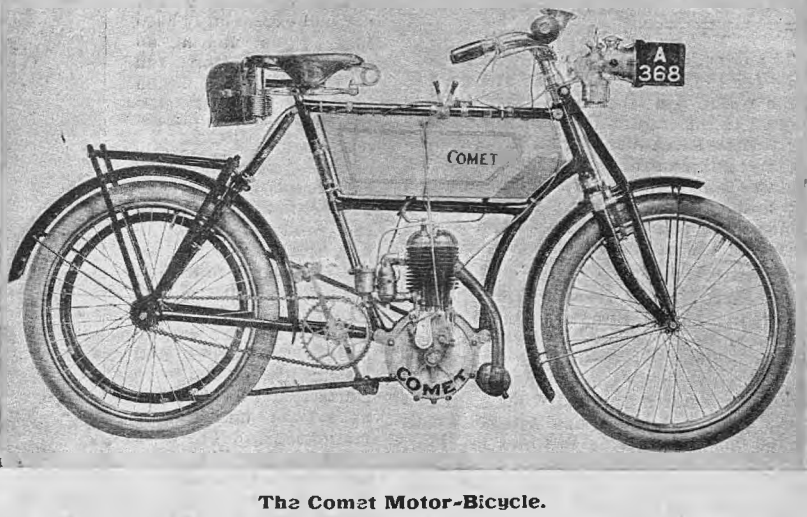
“THE MOTOR-BICYCLE here illustrated looks at first sight like a diamond frame machine which has been placed too near the fire, and has warped in consequence. As a matter of fact, the design has been carefully thought out by its inventor, and he claims that by this shape and disposition of the tubes and the motor, the centre cf gravity of the machine is brought down much closer to the ground than usual, with a consequent increase of stability. The machine is of French origin and is known as the Ruggles. The four tubes of the frame are arranged in pairs running in parallel curves, and the motor is clamped between them about midway between their extremities, and inclined backwards at a moderate angle. The saddle, which takes the form of a chair seat, is placed directly above the cylinder, and is supported by it and an auxiliary seat or carrier is placed behind. The petrol tank ‘T’ occupies the forward space between the pairs of frame tubes, and underneath the lower pair of tubes is fixed a triangular case ‘E’, containing the carburetter and electrical accessories.”
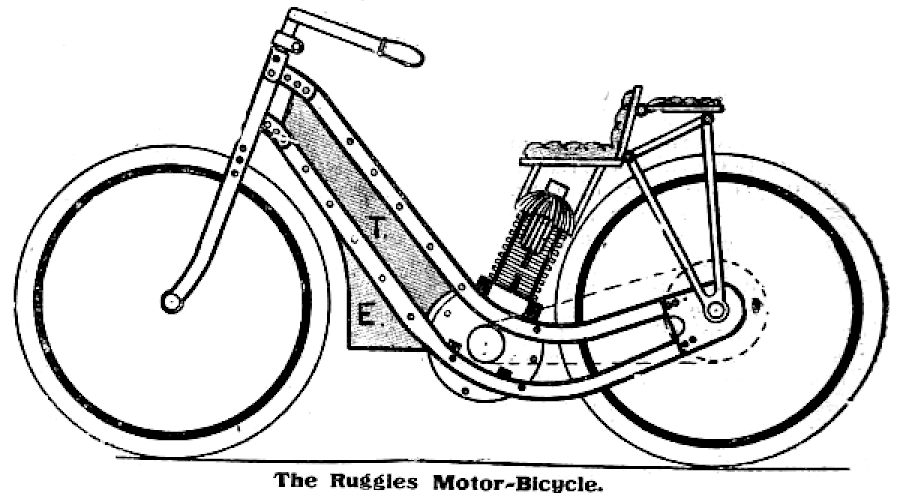
“THE BARNES MOTOR-BICYCLE is made by GA Barnes, 34, Algernon Road, Lewisham, London, SE l. It has a Stevens vertical engine with one-piece cylinder and head. The frame is of low build, with short wheel base. It is reinforced at the head, giving a very rigid structure. The engine is supported in brackets between the diagonal and down tubes. The front forks are strengthened by a duplicate pair between the axle and top ball head clip. The carburetter is a Longuemare type with automatic air control. Ignition is by trembler coil and accumulator. Transmission is by V-section belt, with pulleys of large diameter. No pedals are fitted, but special footrests are fitted in convenient positions. The petrol tank is of tubular design, made in brass, and having a capacity equal to 70 miles running. The machine is made in three powers, viz, 2¾, 3, and 3½hp, priced at 42 and 48 guineas.”
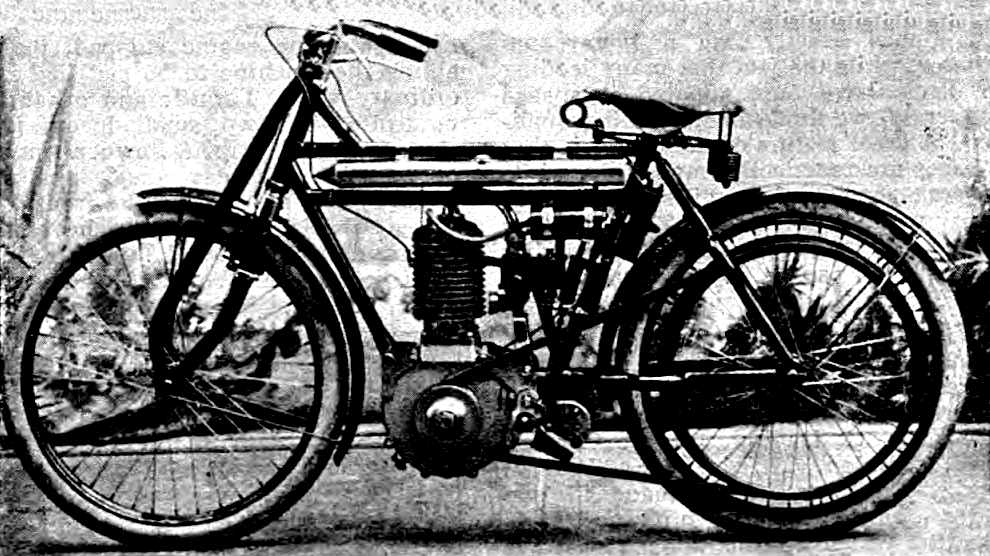
“THE DAVISON MOTOR-BICYCLE. A motor-bicycle containing a number of interesting and original features is that known as the Davison, and manufactured by Mr AC Davison, of 366 Camden Road, London, N, and the Viaduct Works, Coventry. It is made in two powers, 2hp, and 2¾hp, and it is the latter which we illustrate…The handle-bar is securely held by two set screws, and it is worth noting that the ball head can be adjusted without interfering with handlebar adjustment and vice versa. The bore and stroke of the engine are 75x75mm [331cc], full power being developed at 1,800rpm. A good feature is that the engine is placed vertically in the centre of the frame and low down—it is claimed that this position minimises vibration and secures a long and efficient belt drive…The carburetter is the popular FN (spray)…The control is from the handlebar, and this without it being necessary to remove the hands from the grips. The right handle by a movement from right to left accelerates and retards the speed, while by twisting the left handle to the right the exhaust valve is lifted, and the engine stopped, thus enabling the machine to be pedalled in the ordinary way. Throttle and exhaust are controlled by two small levers placed close to the left grip. A Bowden rim brake operates on the rear wheel, and a rim brake is also attached to the front wheel. The weight is only 1251b, the gear 5 to 1, speed 5-35mph, and the price £50.”
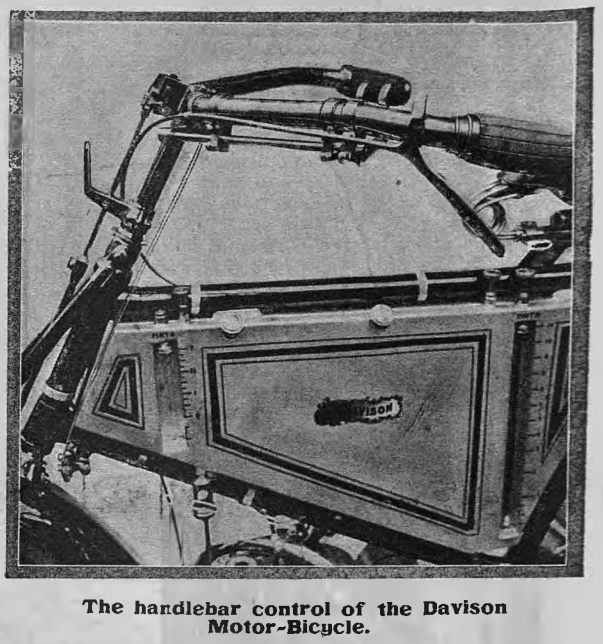
“THE 1904 WERNER MACHINE. The illustration will convey a good idea of the lines and detail improvements of the 1904 Werner machine. The engine has a one-piece head and cylinder; the valve cases are placed well forward, and an air channel is provided between the valve casing and cylinder. The inlet valve is now mechanically operated. The familiar flat belt has given place to a V-belt, and the pulley is provided with an ingenious clutch giving a free engine. This is operated from the handlebar. The carburetter is concealed inside a compartment in the tank, and is thus out of the way of dust, and is also kept at a favourable temperature. There is a special device fitted on the engine to prevent it racing when the clutch is thrown out. The rear belt rim is very securely stayed to the wheel by steel arms. The cranks can be swung over into line with each other, so that the pedals form comfortable foot rests…As considerable correspondence is taking place about the comparative merits and demerits of the mechanically operated inlet valve and the automatic suction inlet valve as applied to cycle motors, it is interesting to note that Werner Motors have prepared themselves to suit either taste by introducing three new models of 2½hp, 3hp and 4hp with the inlet valve automatically operated, in contra distinction to their two earlier 1904 models with mov. A strong argument in favour of their latest type is its simplicity and freedom from deterioration as the result of wear. A valve that times itself presents no difficulty, even to the most inexperienced driver; whereas the perfect timing of a mechanically operated inlet valve on an engine running so fast as 2,000rpm is almost more than can be relied on from toothed gearing sufficiently strong to stand continuous use. In these three new models we refer to the cylinder and head are secured to the crank chamber by four column bolts, and the carburetter is placed below the tank close to and in front of the engine. The Werner pulley for V-belt driving, which provided a free engine at will without clutch mechanism, is fitted. This pulley, besides enabling a slack belt to be tightened without the rider dismounting, enables a slight variation in the gear to be effected. This is a great convenience, either for speed or hill climbing. The speed governing arrangement introduced by Werners this season also finds its place on these new models. In general appearance they resemble the earlier 1904 types, and, like them, are remarkable for their light weight and low build.”
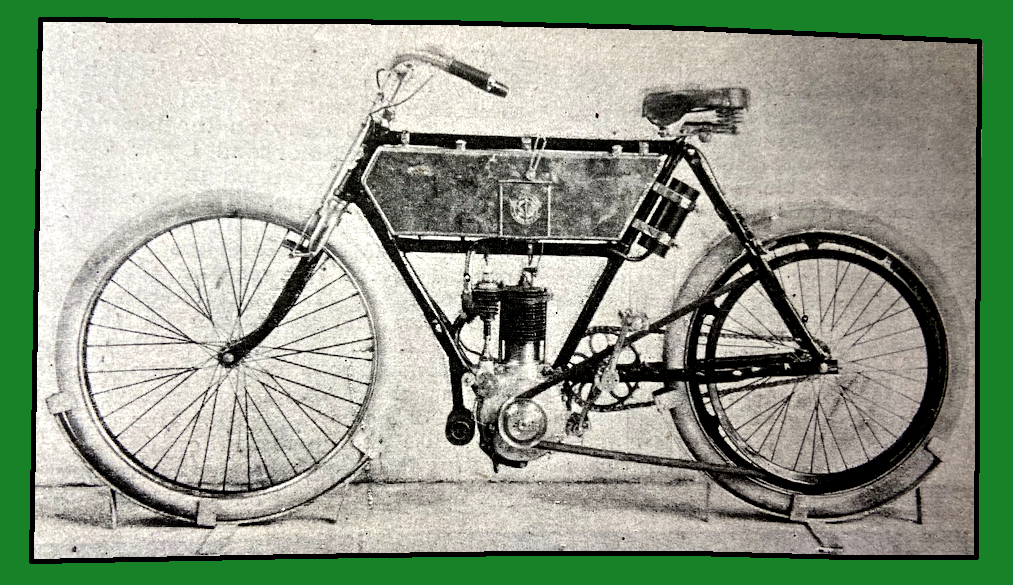
“THE ‘WERNER’ MOTOR-TRICYCLE is the design of Mr HT Arnott, and, in principle, is founded upon the old ‘Cripper’ tricycle, which was renowned for its easy running and stability. It is really an ordinary motor-bicycle as far as the back axle, with the usual ‘Werner’ belt drive. The driving pulley on back axle is only 12½in in diameter, and is fitted with a reducing gear, while the axle has, of course, a differential gear provided. The total weight of the machine is only about 160lb and the distribution of weight is so well arranged that the machine is safely and easily driven in all weathers and on all conditions of roads.”
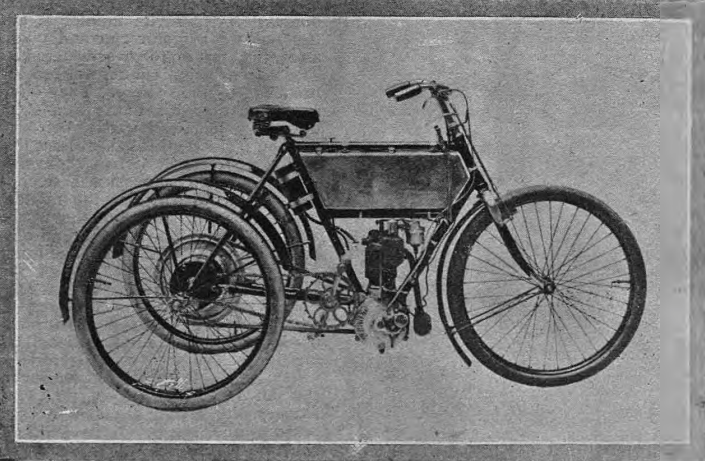
“WERNER VS GAMAGE. The result of the action brought by Werner Motors against AW Gamage for infringement of patent and registered design, has created considerable stir amongst the trade. Messrs Gamage were selling Werner motor-bicycles bought direct in France, and by importing and selling them infringed the rights of the English house of Werner; but Mr Justice Byrne’s decision to grant an injunction has been based upon the ground of infringement. The design is the well-known one, with the parallel strut running from the down main tube to the seat diagonal, the strut being considerably lower than it used to be, the lower parallel tube running from the bottom of the head of the old double top tube bicycle. The gap between the end of the down main tube and the crank bracket, which is filled by the engine, is also a part of Werner’s design, and if Mr Justice Byrne’s judgment is held to be a certificate of validity, it would seem as if any maker who might desire to use this type of frame would have to obtain a license from Messrs Werners.”
“MESSRS WERNER MOTORS write us as follows: ‘We have been receiving many enquiries from your readers quite recently asking us if we can supply our free engine pulley for any make of motor-bicycle other than the Werner. Will you kindly allow us to inform them, through the medium of your journal, that this is a feature which we wish to keep exclusively for our own designs. We may possibly be in a position to supply this pulley suitable for fitting to the old-type Werner machines, either 1902 or 1903 patterns, in about five or six weeks from date. However, when we can deliver this fitment from stock we will announce the fact in our advertisements.”
“ELECTRIC VS ACETYLENE MOTORCYCLE LAMPS. I have been thinking a good deal lately whether there is not a distinct opening for a motorcycle lamp of the electric type to compete with acetylene and oil. To those riders who have facilities for charging accumulators at home an electric lamp would not, I think, be anything like so troublesome, besides being no more expensive in actual running. One very serious drawback with the acetylene lamp is its necessarily heavy weight. Consequently, in many cases, no lamp bracket of ordinary strength will support it, and even if a massive support of great strength be used the strain is simply transferred to the spring back of the lamp, with the result that the body of the lamp breaks away, and an expensive article is ruined. Now, a small electric incandescent lamp mounted in a well-designed projector would not weigh more than a few ounces, and would be quite unaffected by vibration…What about the intensity of the light compared with acetylene? Well, from some experiments I made, a 7½-volt lamp in a highly polished conical projector gave a light that would compare very favourably indeed with the average motor-bicycle acetylene lamp. True, it means slightly overrunning the lamp and thereby shortening its life, but is not of much moment; a new lamp costing 1s 3d can always be carried to replace a burnt out one. There is good feature about an electric lamp, and that is that the beam of light can be projected far ahead of the rider and give him due notice of obstacles in time to avoid them. This feature is of more value than having a wide area of the road illuminated only a few feet ahead.”
“THE TUNBRIDGE WELLS St John’s C&AC held a successful athletic meeting on Bank Holiday, on the Nevill Athletic Ground, in the presence of 8,000 spectators. Sport in the motorcycling events proved excellent. In a flying-start one-mile contest WW Gann, on an Eland Minerva, won a gold medal, having completed the distance in 1min. 31sec, on a grass track, four laps to the mile. TH Tessier’s time in the same event was 1 min. 32⅘sec. The track was in excellent condition and very ‘fast’. A five miles handicap (open) was won by CE Bennett (Canning Town, 1min 45sec), on a Kerry machine, in 8min 23⅗sec. In the final Tessier (2¾Bat), riding from scratch, failed to catch up his men, and retired. The three miles open race also fell to CE Bennett, WW Gann putting up a capital race until he had the misfortune to lose his belt. Time, 4min 54⅖sec.”
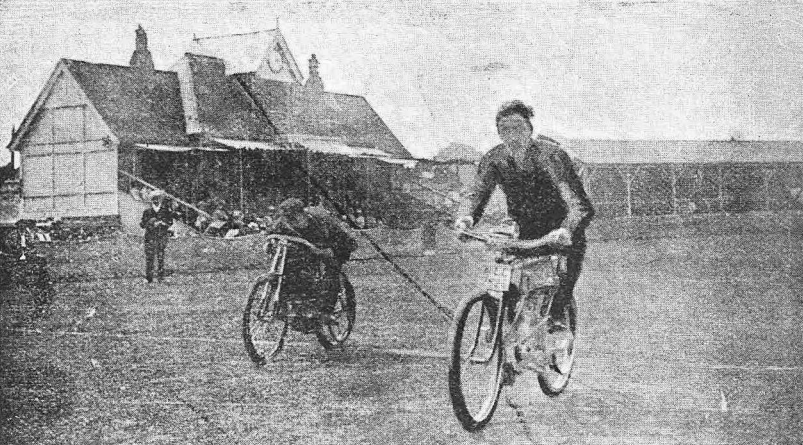
“MOTOR-CYCLING IN AUSTRIA. A new motorcycle association has been formed in Austria under the name Verband der Motorzweiradfahrer fuer Oesterreich. Like the Motor Cycling Union of the Austrian Motor Club, it is an offshoot cf the Austrian Touring Club. There are thus two associations at present looking after the motorcycling interest in Austria.”
“THE CONFIDENCE TRICK. A French motorcyclist has just lost a good machine by an ingenious adaptation of the confidence trick. Exulting in the purchase of a new mount he was putting it through its paces in the Bois de Boulogne when a gentlemanly-looking young fellow on a bicycle accosted him. The two sportsmen got into conversation, the stranger praised the new motor-bicycle in lavish terms, and presently begged to be allowed to take a spin on it, remarking that he was a tolerably good rider. Leaving his bicycle in charge of the motorcyclist, he took a turn or two round the roads in the Bois, and presently shot off at full speed in the direction of the Jardin d’Acclimatation—to be seen no more. The mortified owner of the machine was left in charge of a pedal cycle which, under its specious coat of nickel and enamel, was found to be worth about 30s. Moral: remember the fable of the fox and the crow and do not listen to flattery.”
“THE BIRMINGHAM MOTORCYCLE Club had a very enjoyable run to Dunchurch on Saturday. The members started at their own times, and the first to arrive was JR Bedford, the hon secretary, who was closely followed by Vice-Captain Davis, and these twain were met by a representative of this journal. By ones and twos other members dashed up to the Dun Cow Hotel, and by six o’clock nearly twenty had arrived. There had not been a single mishap on the road. After having partaken of a most excellent tea, the party commenced their return journey, and our latest advice is that all reached home safely and in good time. The members were so pleased with the run—the roads are excellent all the way—that they intend repeating it before the season ends. The total mileage covered was about 60 miles.”
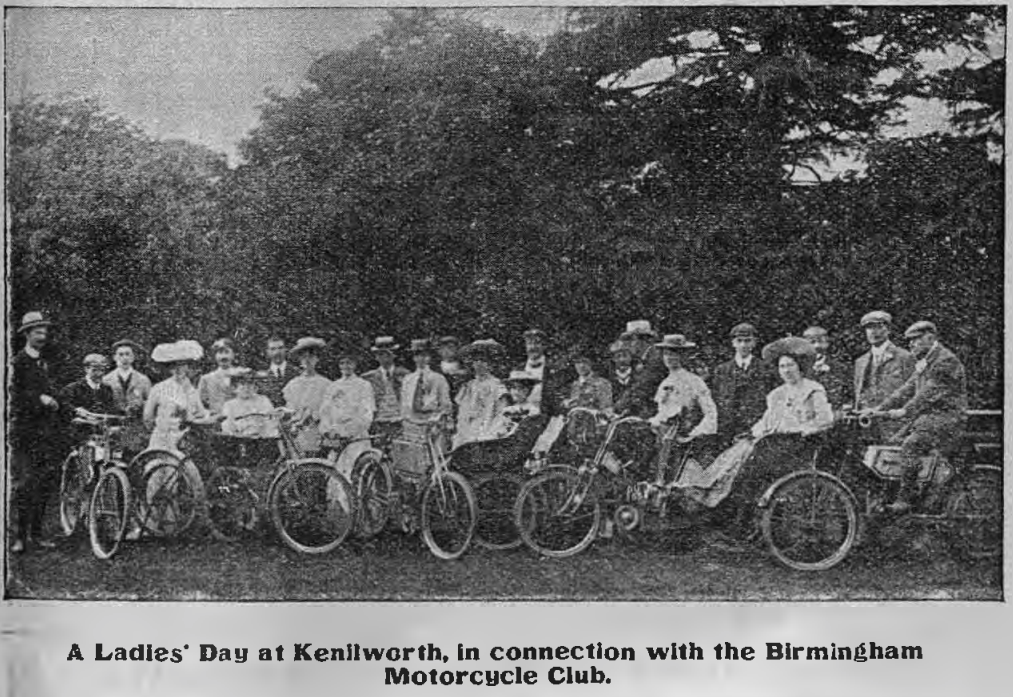
“THE INTERESTING SERIES of 100-miles’ runs between Peterborough and Lincoln, organised by the Peterborough Motorcycle Club, was continued on Thursday, when the three finalists made a run between the two cities. They were due at the John Bull (the old inn on the hill south of Lincoln) for checking at 11.30, and were running so well and so regularly that they arrived about a couple of minutes before time, RM Wright (Lincoln), being the checker, as before. After ‘signing up’ and replenishing the petrol tank, the return journey was at once made. The three left in were BC Holmes (Peterborough), 3½hp Vinco; T Woodman (Peterborough), 3hp Lightfoot; and H Brown (Peterborough) 2½hp Bradbury. They all completed the hundred, so that a further run was necessary and another fifty was made, this time Brown dropping out. After a rest of an hour a further run of 25 miles was taken, but both Woodman and Holmes were left in, so they will have to have another run.”
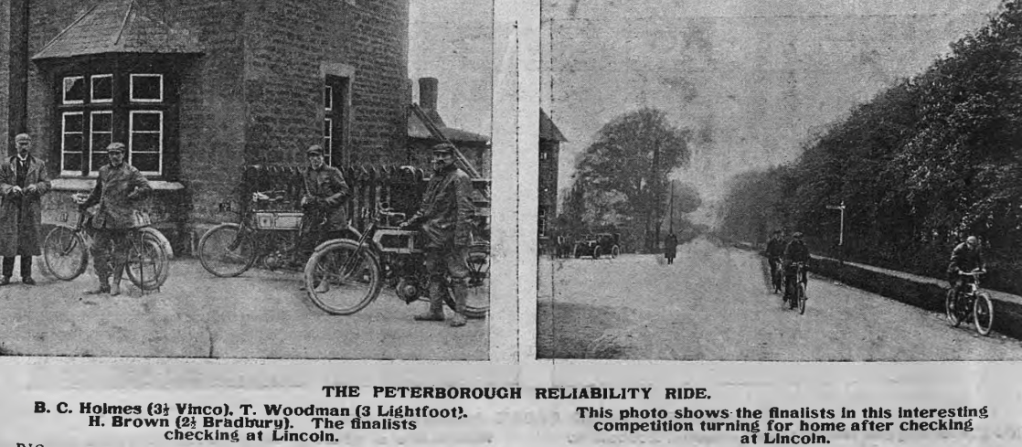
“CONCLUSION OF THE LINCOLNSHIRE RELIABILITY TRIALS. This event, organised by the Peterboro’ and District Motor Club, was continued last Tuesday by the two uneliminated competitors, BC Holmes and T Woodman. The two had already’ run off severe additional miles in a vain endeavour to settle the question of superiority. Or Tuesday morning they rode from Peterboro’ to Lincoln and back, 100 miles, but neither fell out, so an additional run to Hitchin and back had to be covered, and this also proved ineffective. Finally, after having covered 575 miles, they suggested dividing the prize. The committee, however, met and ordered them to run another 50 miles, from Peterboro to Folkingham and back, on Wednesday evening. This time a definite result was arrived at, Woodman having the bad luck to puncture, leaving Holmes the winner. The determined nature of the struggle between the pair aroused a lot of interest in the neighbourhood of Peterboro’ and Lincoln. Holmes rode a 3½hp Vinco-Minerva, and Woodman a 3½hp Lightstrung.”
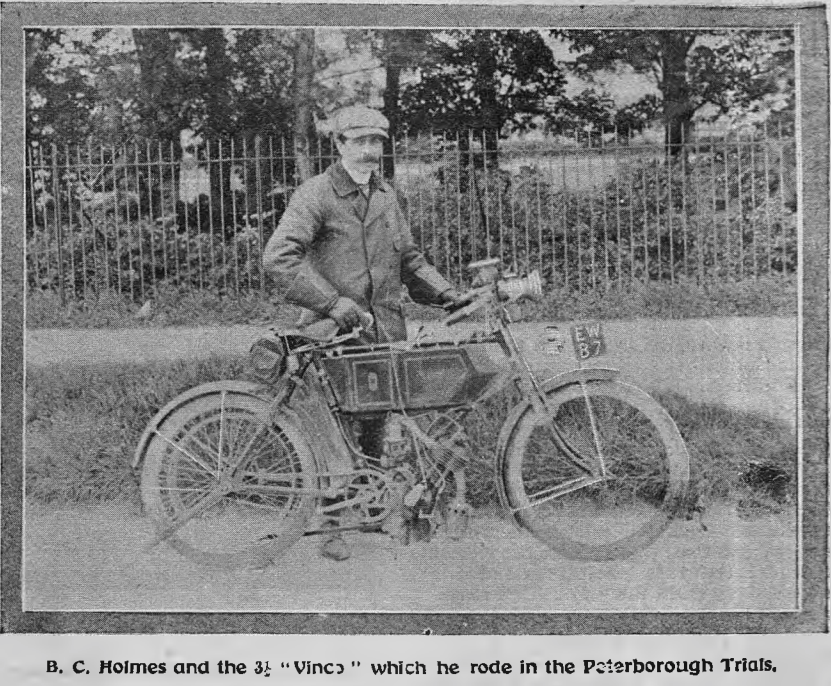
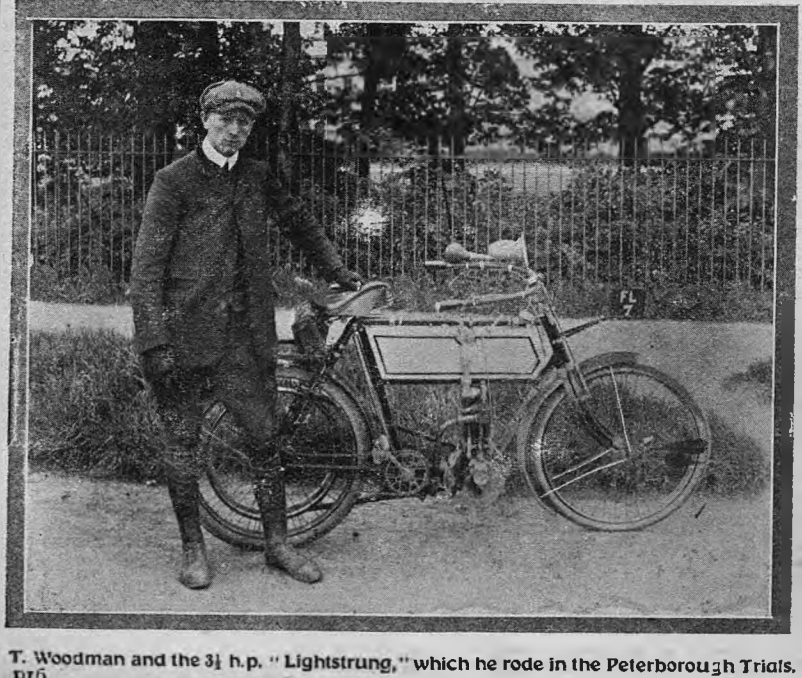
“THE IRISH MOTOR CYCLING UNION opened their season on Saturday last with a run from Dublin to Portmarnock. The object of the outing, apart from the giving of an official opening to the season, was to test the suitability of the silver strand at Portmarnock for the speed trial which the Union intends to promote during the year. About a score of members turned up at the beach, and although the tide was full at 5.45, it was found that the strand was in every way suitable, and that it would be possible to hold trials at practically any period of the tide.”
“AFTER AN EXCITING adventure in which he appears to have been attacked by two dogs, three gentlemen, and a labourer, a South Wales motorcyclist got away, after knocking the labourer down. We do not as a rule advocate turning tail in preference to facing the matter in view of a possible claim by the other side, but on this occasion we think the motorcyclist was justified in showing the better part of valour. Fair play’s a jewel.”
“MESSRS BROWN BROS have received a letter from a rider of a standard pattern Brown motor-bicycle in South Australia. He states that he has just completed 10,000 miles’ riding with it. The roads are hilly and rough, and it is interesting to note that the machine has been used with a trailer, side-car and fore-carriage, and is now used as a tandem.”
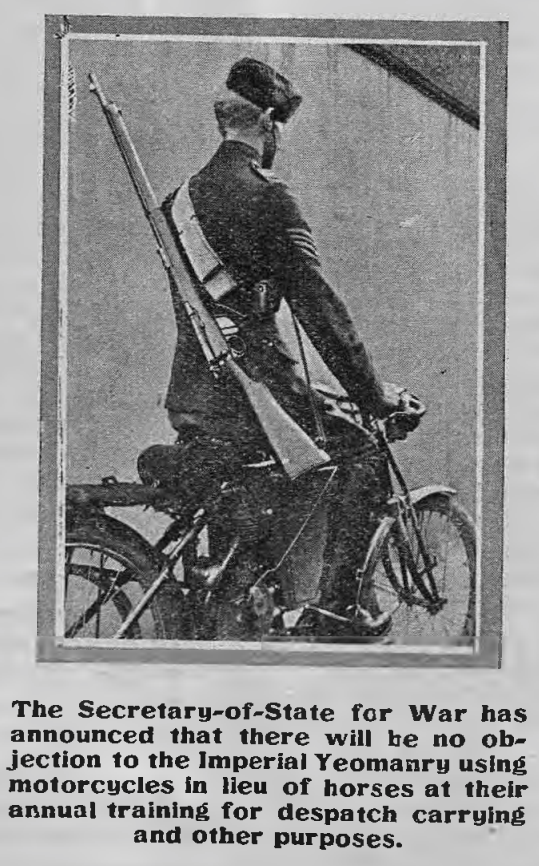
“AN UNIQUE EXPERIENCE was that of the members of the Motorcycle Union of Ireland, on Saturday week, when the speed trials under their auspices took place at Portmarnock. The Velvet Strand, which runs along by the residence of Mr John Jameson, of Irish whiskey fame, and along the links of the Portmarnock Golf Club, is practically an ideal course for such events…The distance of the races was one mile from a standing start, and the course lay in a straight line within about a hundred yards of the high banks against which the tide washes at times. When we say that a speed of 35¼mph was attained by a rider of a 2¾hp touring bicycle, with 2in tyres, mudguards, etc, we have said enough to show that the course was a fast one. Nor was that speed exceptional, for the same rider rode six times during the afternoon, and his slowest mile—one in which he had a ‘walk over’—took but four seconds longer than his fastest, the respective times being 1 min 42sec and 1min 46sec. The machines were classed in a rough and ready manner by dividing them into three classes according to weight, viz, under 120lb, 120lb-150lb, and any weight. In the light class the winner turned up in WB Martin, on a 1903 FN, weighing 117½lb, who beat in the final JG Drury on a 1903 Triumph in 1min 53sec. In the final of the intermediate class, CB Franklin, on a machine weighing 137½lb, won the final from KW Stevens (76×76 Phoenix) in 1min. 42sec, the fastest time of the day. The unrestricted class received the best support, as it included many of those who previously competed. Franklin on his FN again scored, winning his heats of the first and second round in fine style, and beating RW Ireton, of Belfast, a Royal Riley rider, in the final.”
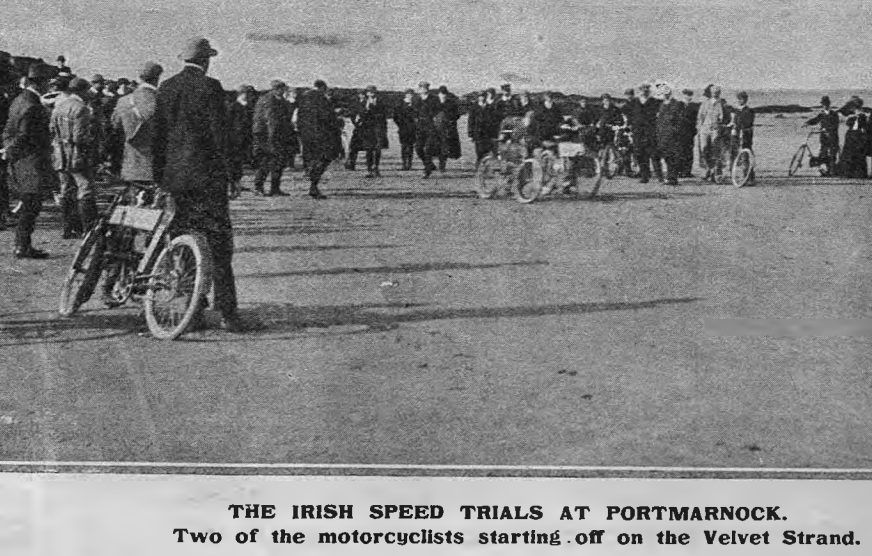
“MOTORCYCLISTS AND THE PUBLIC. In the matter of the crusade against inconsiderate driving on the part of motorists, the Auto-Cycle Club has fallen into line with the parent body, and has issued a manifesto to the Press of the country in which it invites the co-operation of the public in the endeavour which is being made to discover the identity of those who aggravate and annoy the ordinary user of the highway, thus bringing the whole of the motoring community into disrepute…In the event of misconduct on the part of a member of the Auto-Cycle Club rendering it desirable that he should cease to be a member, the Committee will enquire whether cause for expulsion has arisen or not. If the offender be a member of any other club the complaint will be passed on to the committee of that club; and if the offender be not a member of any club, the complainant will be so informed in order that he may take such action as he may consider advisable…The difficulty, however, generally arises from that section which is so little interested in the welfare of the pastime that it remains detached from club life, and so does not understand that individual bad or thoughtless behaviour can reflect upon the whole of the community. The Auto-Cycle Club can have done no harm by issuing its manifesto; whether the public will be properly impressed, or whether it can be induced to co-operate in the suppression of inconsiderate driving, are matters that can only be judged by experience…The letter to the general Press of the country asking for the co-operation of the public against those drivers who drive inconsiderately has been accompanied by a more simple request on the part of the Auto-Cycle Club, and in this matter we should think that the Club is more likely to score a success. The Club draws the attention of dog owners to the enormous risk created by the presence of uncontrolled dogs on the highway. Scarcely a motorcyclist has enjoyed immunity from the attentions of these irresponsible beasts, and the statements of the Club will be conceded by everyone to be by no means exaggerated. Accidents have been numerous, whilst many have been fatal, and unfortunately the results are sometimes far-reaching, as, for instance, when the bread-winner of a family is thus suddenly removed. For we must remember that motorcycling is particularly a past-time that will gain the adherence of men of an age when they are generally the bread-winners for a family…If the appeal af the Club to dog owners is hearkened to and the dogs be checked in every attempt to harass passing cyclists and motorcyclists the effect all round will be good, and dog owners themselves will reap a benefit in saving, for themselves,the loss or injury of, perhaps, a valuable animal.”
“THE ENCLOSED SKETCH shows an idea for upsetting those dogs which are too ‘fond’ of the motor-bicycle. A is a single tube coming about two to three inches off the ground, and is straight in front of the wheel. BB are two tubes coming, one from each side of the girder head and curved round the wheel to meet at the top of A. CC are two tubes coming from the hub spindle each side and curved so as to meet at the bottom of A…Perhaps someone will make it, it is not protected! I do not think a dog would like coming in contact with A.
‘Storage’.”

“I AM ENCLOSING you a sketch and description of a safety guard which I am endeavouring to place on the market or dispose of to some enterprising trader or manufacturer. As an old wheelman (and latterly a motor wheelman) I have naturally encountered the usual unfortunate experience of being brought to earth with serious results to both the machine and myself by that never-tiring road pest, the dog. Nearly every motorist of experience has his dog story to tell, either of his miraculous escapes, or, worse, his ugly spill, which placed him on the retired list for some time to come. It ultimately occurred to me that similar accidents might easily be avoided in the future, and that motorcycling and pedal cycling might be indulged in with much greater safety and comfort if a simple device such as I have designed were placed over the front wheel, the object of which is to push away any obstruction it may come in contact with, instead of dragging or pulling it underneath the wheel. I think it will be clear to you that the front wheel makes a progressive and rotary motion whilst travelling, and it is this latter motion that accounts generally for the wheeler getting the worst of the argument, by reason of the front wheel rotating downwards and drawing any obstacle it may strike underneath. When this happens it is next to impossible to prevent a smash, As you will observe by reference to sketch, the device is constructed on similar lines to a lady’s dress guard, with the difference that it is placed over the front wheel in such a manner that it is impossible for a dog or similar animal to get underneath. The safety guard is constructed of light materials, but compatible with strength to resist front and lateral strains.
Geo F Vardy.”
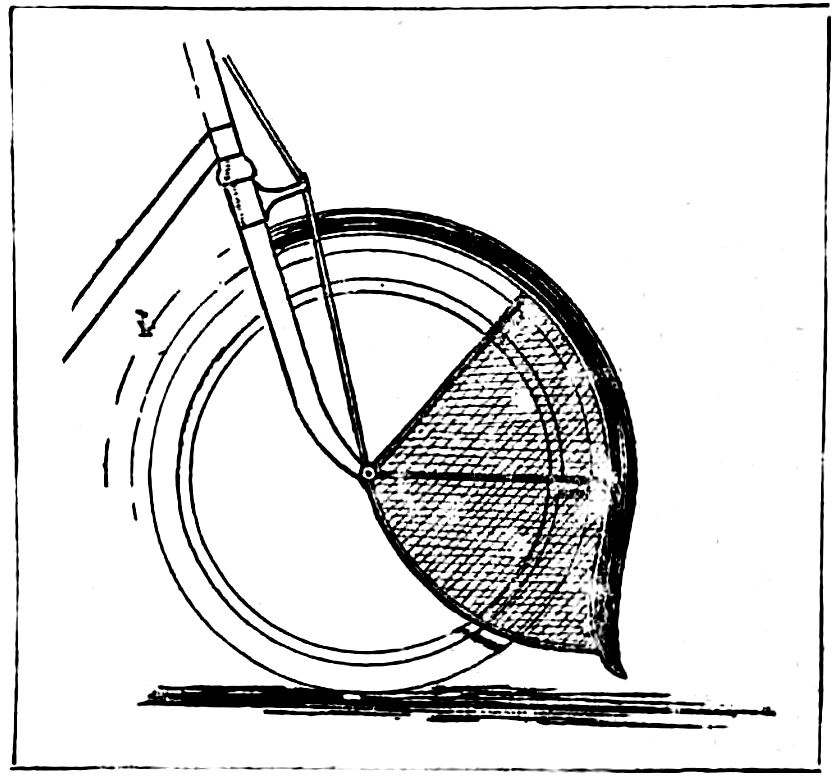
“MR CW CRAFTER, of Upton Park, vice-chairman of the West Ham MC, had a spill the other day, which fortunately ended in nothing more serious than a severe shaking and some nasty cuts and bruises. The inevitable dog was the cause of the accident. Lying low behind one of the electric tramway standards in High Street, Ilford (these standards are dangerously placed in the middle of the road), the dog darted out in front of Mr Crafter’s motor-bicycle and completely upset him. Mr Crafter is foreman of Messrs Jarrow’s torpedo-destroyer works at Poplar. It would be conferring a boon upon the motoring and cycling public if Jarrow’s would turn their attention for the moment to some sort of dog-destroyer.”
“MR HOOYDONK, AFTER PROVING to our personal satisfaction that the new two-speed Trimo, with the 3hp Minerva engine, is a very efficient article, took the Rev Basil Davies [who would soon be gracing the pages of The Motor Cycle as ‘Ixion’] for a hill climbing trip a few days ago. Starting from London, Westerham was the objective of the run, and with the driver and passenger the machine successfully climbed this, probably one of the stiffest hill roads in England. On the return journey it naturally climbed Reigate Hill with ease. The machine used was absolutely standard, whereas we have had cause for complaint with some makers who, for the purpose of display, gear a machine specially low for a hill test. As another instance of the utility of such a machine as the Trimo, it is not an infrequent occurrence for the two managing directors of Phoenix Motors, Messrs Hooydonk and Ilsley, to run down to Coventry on the machine in the morning, transact their business, and be back in London in the evening.”

“A NEW TOOL. A clever application of the principle of the ratchet has been made in the Schroeder ratchet spanner, invented and patented by Mr FW Schroeder, 126, Copthall House, EC. Each. spanner is provided with a series of tumblers of various sizes (one is shown fitted and one removed) in the illustrations. To tighten up a nut, a tumbler to fit it is placed in the jaws of the spanner, the fixing plate put into position, and the tool is ready to do its work. Once on the nut it is not necessary to remove the spanner until its work is completed. To unscrew, all that is required is to remove the spanner and replace it with the face, which was previously outwards, inwards. Some of the many merits of the tool are its quick action, its protection of the nuts from injury, and its sureness of grip. Tumblers can be extended to any required length, and by this means nuts in positions difficult to reach can be easily got at. In an emergency the tool can be used as a ratchet brace for roadside repairs, and in certain circumstances as a fixed spanner. It is to be made in all sizes, from that required for a cycle to that for use on a large car; and in one form it will be adapted for use on spoke nipples, to facilitate the building and truing up of wire wheels. The illustration shows an experimental pattern. The article as manufactured for the public will be improved in several ways; the fixing plate, for instance, will be let into the face of the tool so that it lies flush with the surface and has no projections to get in the way.
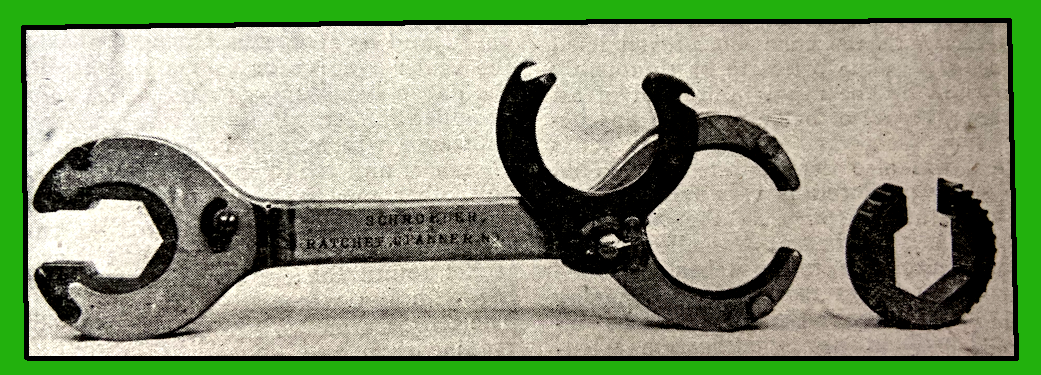
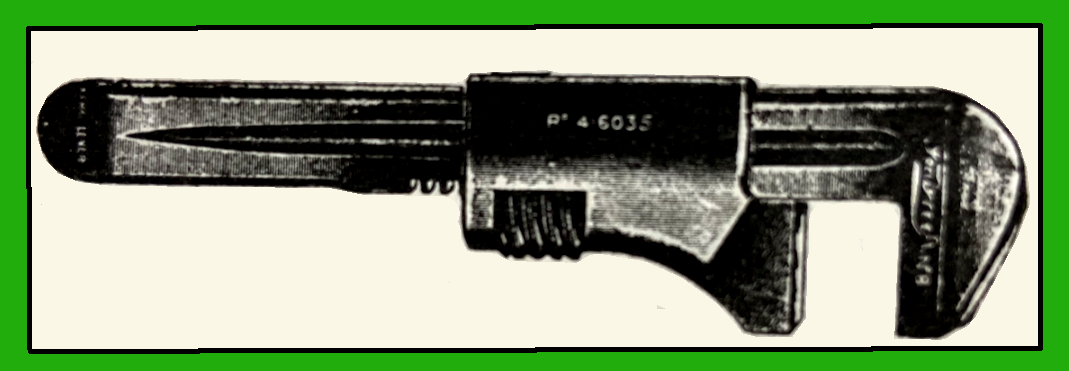
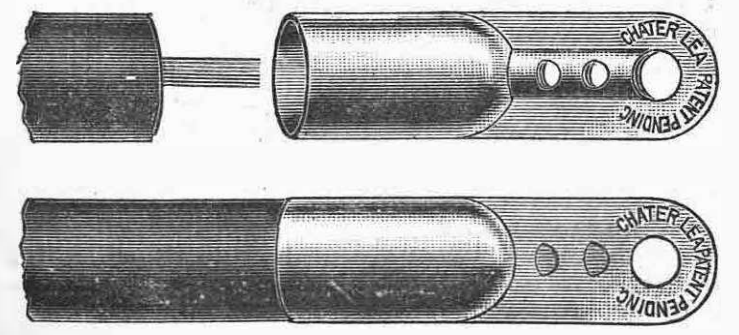
“THE ‘LIGHTNING’ MOTOR STAND. Messrs Lycett, 164a, Deritend, Birmingham, inform us that they have taken up the sole factoring license for the ‘Lightning’ motorcycle stand. The illustrations show the positions of the stand attached to the machine. The stand is out of the rider’s way when not in use, and can be put into use by simply touching a button and wheeling the machine back, when the machine is lifted from the ground and the stand is locked. This obviates the difficulty of standing the machine against the wall. The whole of the stand is perfectly rigid for the rider to pedal to find his mixture.”
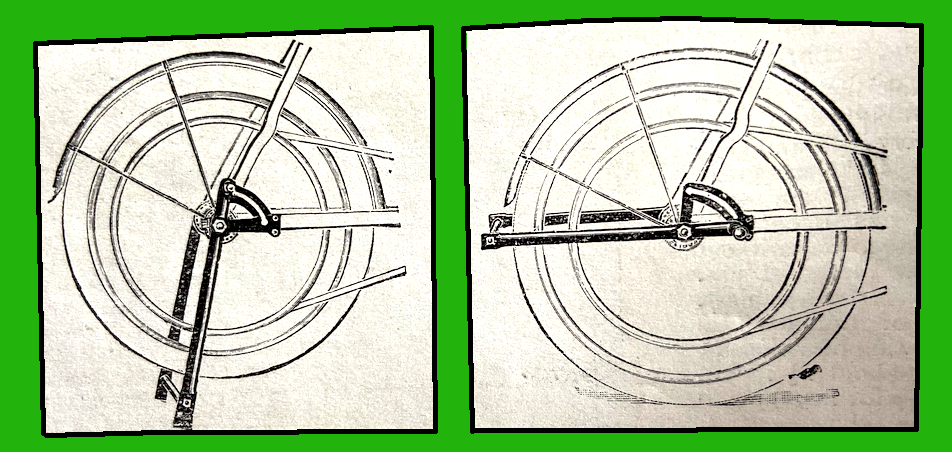

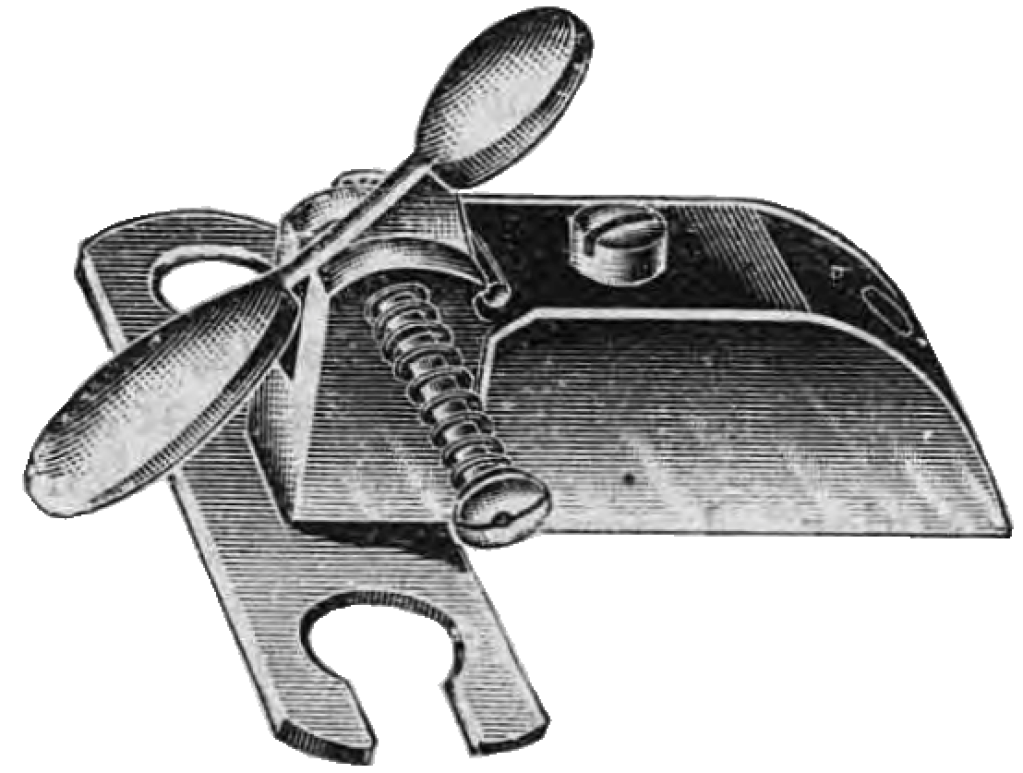
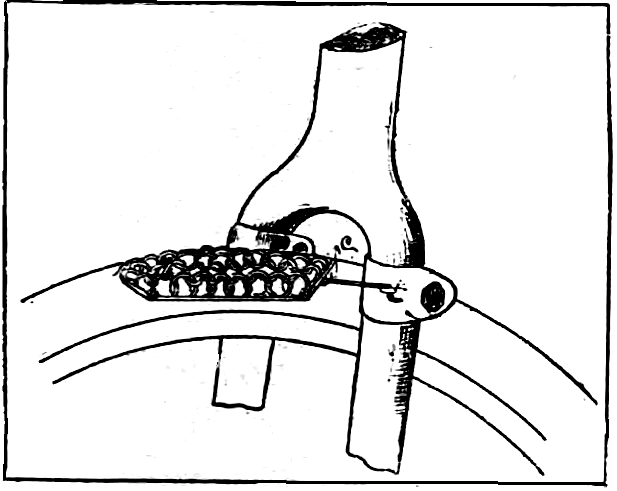
“I ENCLOSE AN ILLUSTRATION of an idea which I have protected, and which, I think, will be of interest to the man of moderate means. It is to place a chair over the front wheel of a motor-bicycle in such a way that it remains in line with the frame, and therefore does not interfere with the steering. I have fitted one to my machine, and have ridden some hundreds of miles with passenger up. The first time I had it on I rode from Preston to Morecambe and back, a distance of about 50 miles. I simply held the machine whilst the passenger got in, and then started the engine and mounted in the usual way by running a few yards. The chair is fixed to the frame by two U-shaped pieces of steel and two clips, one clip on the top tube and the other on the down tube just below the tank: the joint between the bottom clip and U-piece is hinged, and the top U forms the spring. A few of the advantages are: One track, less power required to drive than fore-car, and much less cost. It will also come through any door, as the whole thing is no wider than the handle-bar. I should be pleased to hear from any firm that would take the idea up.
Frank I Sargeant, 30, Hartingdon Road, Preston.”
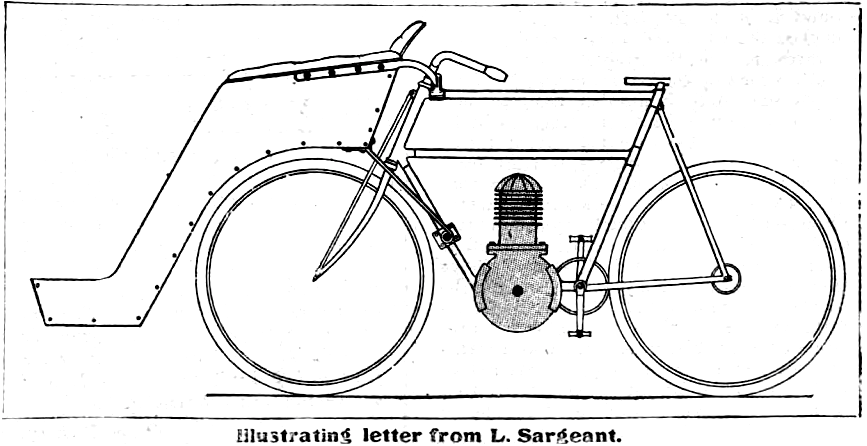
“THE ARMAC MACHINE. This is manufactured by the Armac Motor Co, St Paul, Minn, USA. It has a vertical engine, 3hp, having a 3×3-5in cylinder [364cc]. The frame is of a somewhat standard type, with a loop in the combined main and diagonal tube to support the motor. The cylinder and head of engine are in one piece, and a special feature is made of extra long bearings, the pulley side being 2¼in. Part of the frame tube acts as the exhaust pipe, an aluminium silencer being fitted near the bracket. The transmission is by a hollow V-shaped belt, and ignition by dry cells and coil, this being fixed behind the diagonal tube. The contact breaker on the motor is rather novel. It is constructed on the plunger principle, and works inside an oil and dust-tight glass tube, so that it can be seen, contacts are separated by acting on the plungers, supply is claimed to be equal to 300 miles’ running. Control is by means of a single lever, which lifts the exhaust, starts the engine, and advances the spark. . A single brake in the back hub is fitted. The oil feed can be used either as a sight or automatic one.”

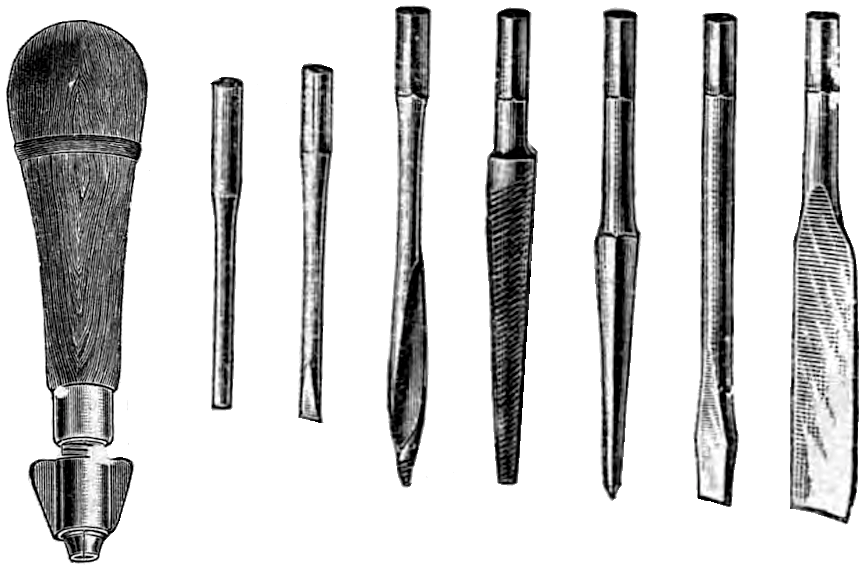
“A SPRING MOTORCYCLE SEAT. An auxiliary seat or luggage carrier for motorcycles has just been introduced. It is known as Cooke’s patent motorcycle seat. The seat can be had in aluminium upholstered with leather. The spring is of steel tempered to different degrees at the angles. It is fitted in the saddle pillar and carried over the rear wheel. In addition to the flat spring, spiral springs are fitted in between. It is capable of adjustment, and can be tilted to some extent. Further details of this invention can be had from RW Curtis, accountant, Holbeach.”
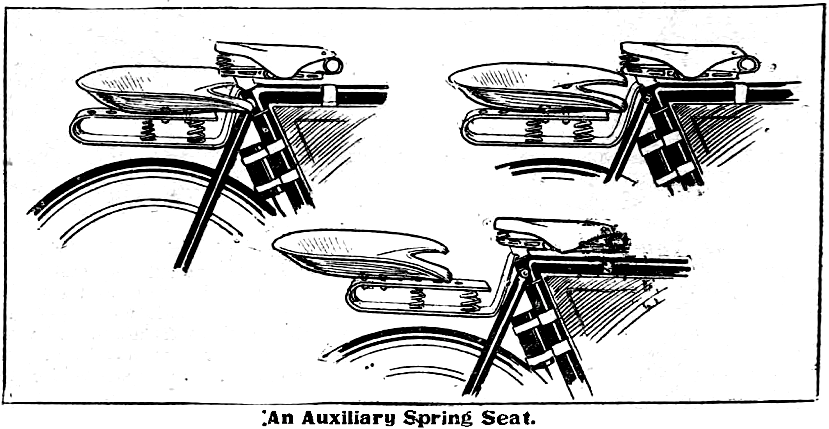
“THE AUTO-CYCLE CLUB has decided to at once take the necessary steps to put a stop to inconsiderate driving of motorcycles, and the forthcoming announcement to the public of this decision will synchronise with an appeal to dog owners to check any attempt on the part of their animals to harass cyclists and motorcyclists.”
“THE MOTOR CENSUS IN FRANCE. A Paris sporting journal publishes the following figures in connection with motor-cycles in France, based on the Government registration returns: Total number of motorcycles in the country in 1903, 19,816; out of this number the Department of Seine (including the city of Paris) claims no less than 4,264; the Department of Nord (which embraces the important manufacturing town of Lille) coming a bad second with 752. Comparative figures of previous years are unfortunately not given.”
“THE MOTOR CYCLE UNION of Ireland is certainly one of the most active bodies devoted to the promotion of the sport of motorcycling, and its programme during the present season has been an exceedingly large and diversified one. On each alternate Saturday since the beginning of the season it has had a competition of some sort, either of speed, reliability or hill-climbing test. Its most important competition of the season was run off on Tuesday of last week, when a 200 miles Reliability Trial from Dublin to Waterford and back was held under its auspices. Our contemporary, the Irish Cyclist, presented ten guineas to the Union for prizes for the event. The competition took the form of a team race confined to teams of four riders mounted on the same make of bicycle. Four teams took part in the competition, two of them riding FN bicycles, and two of them Triumph. The conditions of the race were of a simple character. The pace was limited to 20 miles an hour, and for any time gained in access of that rate one mark was deducted for each minute, and for any time under 15 miles an hour a mark was similarly deducted. There were no penalties for stoppages on the road, but the riders were required to execute repair; with implements carried by them, and were limited to assistance from their team mates. Unfortunately the day was not altogether favourable, heavy rain during the night making the roads wet for two thirds of the outward journey. As, however, there was little rain during the day, things improved on the homeward journey, and the competitors were able to travel fully up to the maximum speed. The competition resulted in a win for a team of Triumph riders, all of whom covered the distance within the time limits, and succeeded in getting full marks. Two of the second Triumph team also secured full marks, but their partners, having trouble in the earlier stages of the day, did not complete the journey. Of the two FN teams, the brothers Franklin were the only ones to receive full marks. Results: Triumph team No 2, A Summers 100 marks, L Summers, 100, G Mayne, 100, JG Drury, 100; FN team No 1, CB Franklin 100, RF Franklin, 100; Triumph team No 1, RM Talbot, 100, TW Murphy, 100.”
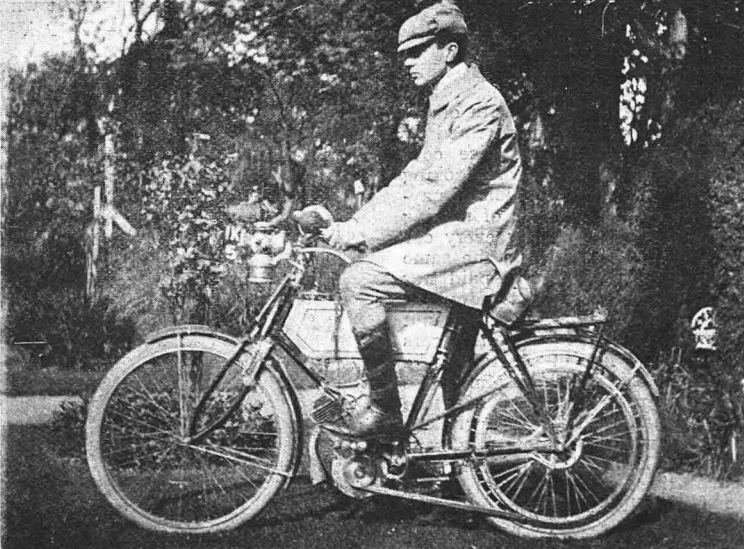
“IS THERE A FUTURE for the two-stroke engine as applied to the motorcycle? This question is being seriously considered at present by many authorities, both in the pastime and the trade. Some go so far as to say that a perfected two-stroke engine would steadily drive the present four-stroke out of the field. Personally, I should welcome a really good two-stroker, and chiefly for this reason, that in direct proportion to the degree of simplification of the motor-bicycle attained, and the reduction of parts, will the machine become more and more popular.”
“ONE OF THE OBJECTS of the recently-formed motorcycle club at Buffalo, USA, is to raise and settle the question whether the motorcycle is to have the same status as the bicycle, or is to come under the regulations which govern the motor vehicle.”
“‘I BELIEVE,’ SAYS a writer in the New York Automobile Magazine, ‘that the motorcycle has a great future. You do not need a stable to keep it in, yet it is. both economical and useful. You can travel with a motorcycle where you never could go with an automobile, while the price will appeal to many people, since it is a compromise between the cost of an ordinary bicycle and the cheapest automobile. Motorcycling has taken a firm hold on European countries, and I see no reason why it should not become as universally liked on this side of the water.'”
“THE REX MOTOR Manufacturing Co, Coventry, are making an offer to motorcyclists, increasing their exchange allowance for secondhand machines of good quality to £35. They are increasing this policy with a view to introducing their machines more extensively throughout the kingdom.”

“THERE IS PLENTY of excitement at all times in riding a motorcycle, but when you are riding through the West of Ireland, excitement often becomes ‘high-tension’, which begets abject fatigue, after an hour or two of the worst form of vibration, which cannot be avoided upon many Irish roads. The absolute stillness in some of the most thinly-populated districts has the effect of transforming the pulsations of the motor into a sound resembling that of a maxim gun, and unusual caution is essential, when riding in these desolate parts, from the fact that the semi-wild horses, donkeys, mules goats and, in fact, everything on four legs, generally take to frantic flight as soon as the sound reaches them. My business takes me into most parts of Ireland, and having travelled by motorcycle for the past year or two, my experiences have been numerous. The closest ‘shave’ I have yet had occurred in County Mayo. Running at about 20mph, in a narrow road with steep banks and hedges upon either side, I became aware of a stampede of some kind, with the usual suddenness that is experienced when travelling at anything like a high speed. I had just time to realise that it was caused by a huge colt, which had taken fright at the noise of the motor, when, with a tremendous jump, he cleared the hedge and bank, and spread-eagled, all-fours, into the road, not ten yards in front of me. How I managed to steer clear of the plunging, rolling animal I hardly know to this day, and to make matters worse, I had barely got over the shock caused by this unexpected avalanche of horseflesh, when I nearly came a ‘cropper’ through swerving at a startled pheasant, which dashed clean into my machine from the road-side. This shying, or swerving at unexpected objects, is always a danger in such districts—at another time I remember nearly landing in a ditch through a blackbird flitting in front of me in the twilight. The worst of all bad animals, from a rider’s point of view, and one of the most frequently met with, is a cow with a calf. Riders, take my advice, and dismount the instant you see one! Mules and donkeys, also, are shy beyond conception, and either bolt in front of you, or wait till you are passing and take the opportunity to crash into your back wheel by an adroit movement in the rear. A magnificently-built jack-mule bolted in front of me one day, and went full speed ahead. I slackened somewhat, and eventually dismounted, with the object of walking the machine past him, speaking to him persuasively and confidentially the while. Try as I would, I could not get by. Each time I got parallel with him, his hind-quarters approached menacingly. 1 blew my cycle horn, shouted, and threw pebbles at him, but he refused to budge. I therefore walked back for some distance, remounted, and picking up speed, shouted with all my might. The sound of the engine shifted him, and he careered in front of me like a thoroughbred. Now. the road being straight, and miles long, I became imbued with the spirit of the chase, and putting on more gas, I gradually reduced the distance between mule and motor. As soon, however, as I reached within a certain distance of the mule, he advanced his gas, too, with the result that the sprint I had anticipated developed into a five-mile handicap, the motor starting ‘scratch’. Shrieking with laughter and excitement, I drew nearer and nearer to the mule, whose eyes, by this time, appeared like two saucers. Puff! Puff! went the motor, and puff! puff! went the mule, for his breathing began to be terribly laboured. I was just wondering what would be the end of it all, when the mule suddenly seemed to draw away; next moment I became aware of a puncture, and had to dismount for repairs. I never saw the mule after, but if he were entered for the Derby I think I should back him. Petrol can now be obtained in almost every Irish town of any size, and repairs are generally to be obtained without much difficulty. I have never met with the slightest antagonism to motors in any part of Ireland, but to retain the good-will of the country folk it is always desirable (and only naturally so) to pull up when approaching horses, and to dismount immediately it appears in the slightest degree necessary, for as yet the sound of a motor will frighten fully half of the horses to be met with in the country roads.
HT Painter.”
“IRISH MOTORCYCLE RELIABILITY TRIAL. The Motorcycle Union of Ireland have had presented to them by the Ariel Cycle Co, Birmingham, a very handsome challenge cup to be competed for in a 200 mile non-stop reliability contest for British made motorcycles. The conditions of the contest are that it is to be a 200 mile non-stop run, allowing an interval of sixty minutes for refreshments at the end of the first 100 miles. No adjustments whatever are to be allowed during this period, but the tanks of the machines can be replenished with petrol and lubricating oil if required. The engine, tyres, and frames of the machines ridden are to be of British manufacture. The contest will be run from Dublin to Waterford and back. The hon secretary of the Motor Cycle Union of Ireland, Mr CG Grey, 15, Marlboro’ Road, Donnybrook, Dublin, will be very pleased to receive entries, and any English motorcyclists wishing to compete may do so by joining the Motor Cycle Union of Ireland, for which the subscription is 10s. Mr Grey will also be very pleased to give anyone further particulars.”
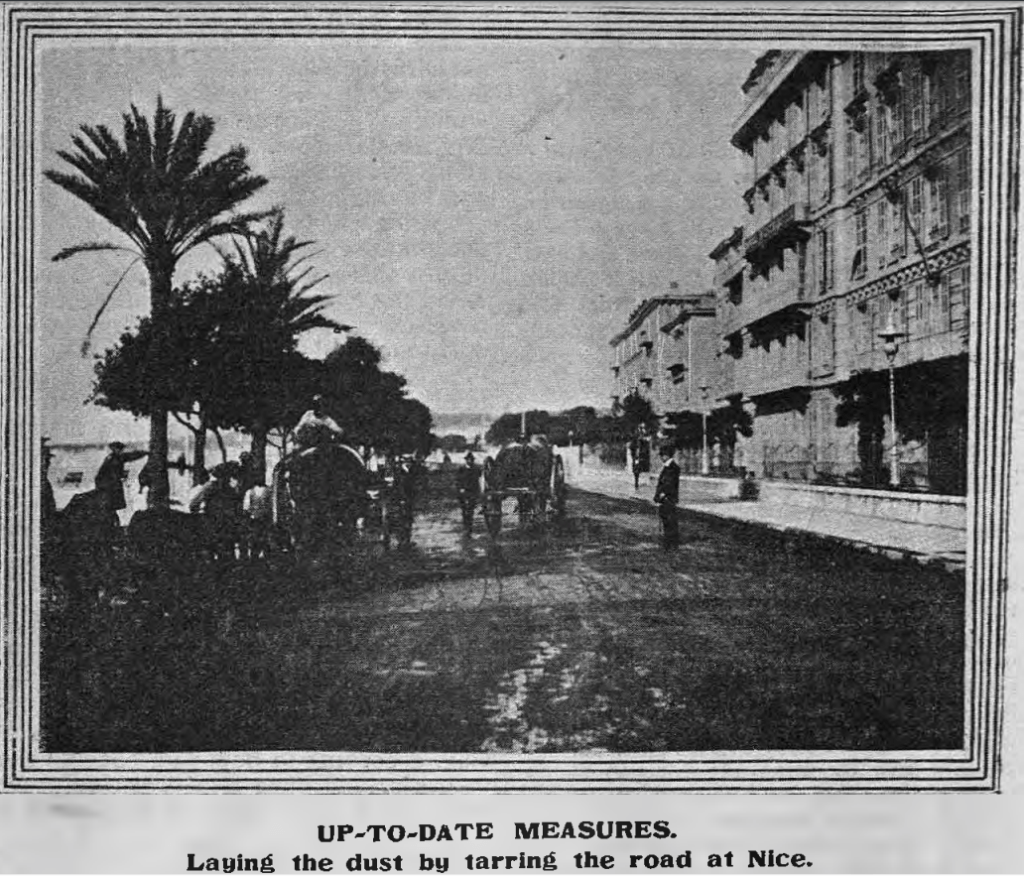
“IF THE TOURIST intends to cross over the frontier from one country to another, say, from France to Germany or Italy, the delay at the Customs is sometimes very vexatious, unless he happens to be a member of the Touring Club of the country he is entering. In France the authorities are insisting upon tourists obtaining a permit to drive and having identification plates. It is a very great pity indeed that some arrangement could not be agreed to between the Automobile Club of Great Britain and the French Government more especially, to relieve English motorists of all these troublesome formalities. What is required is for the Club to be able to certify that the motorist entering France is a bona-fide tourist and a capable rider. The method of obtaining the permit to ride in France is to write the Prefect of Police of the Department in which the port of entry is situated. If Dieppe or Havre. it would be at Rouen; if Boulogne or Calais, it would be Arras. To facilitate matters the letters should be written in French, and a stamped (French) addressed envelope enclosed for reply. Very important is it to remember that the rule of the road is exactly the reverse to that followed here; that is to say, keep to the right, and not the left. Neglect of this rule might land one in a nasty accident through collision. Supplies such as petrol and oil are obtainable everywhere. Repairs to machine or tyres can be easily done, but it is not so easy to get accumulators recharged, except in the towns, and even then it costs two to three francs to have a 12 ampere-hour size cell charged. Hence it is very important to have a good supply of current to last the tour.”
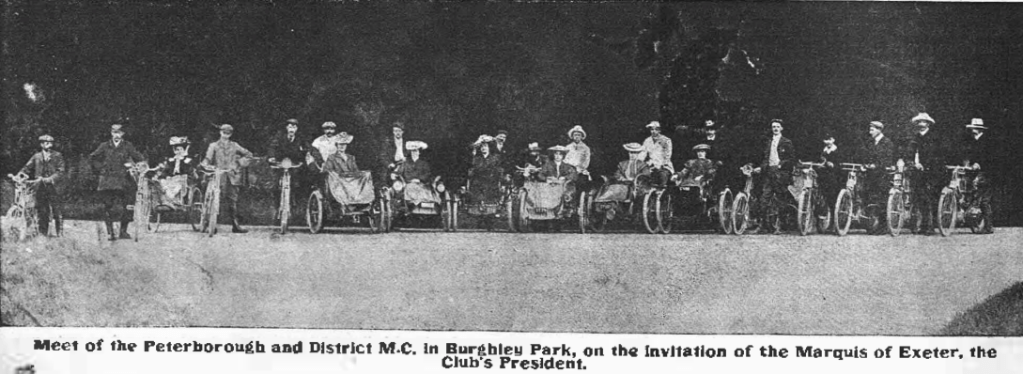
“The great motor race of Friday last put an end to the hopes and fears, the scheming and planning, the contention and rivalry, the bickerings and debate which have occupied the motoring world for so many months, and many of us would be relieved to know that we should be spared the. sound of the phrase ‘Gordon-Bennett’ until, at least, 1905.” So much for prima donna automobilista—Ed
“THE CYCLING GOSSIPER of The Lady has been telling the story of her first lesson in motorcycling. It will not fire her sex with a burning desire to acquire the art. When the only possible means of getting off ‘the strange beast’ is by ‘slowing up gradually, bending the legs, and slipping down into a kneeling posture to accommodate the entangled skirt—which has got tightly wedged behind the stay of the dress guard—and then (owing to the impossibility of maintaining this cramped position by reason of the superincumbent weight of the machine) gently giving way, and half-lying and half-sitting on the ground with the machine quite comfortably lying on the top’—we think ladies will pause before getting on.”
“The illustration depicts a Garrard suspended tri-car fitted up as a swift parcel distributor. We understand this has been made to the order of the En Avant Yeast Co. The fore-carriage part has been replaced by a box having large storage. capacity. This is an adaptation of the light motor vehicle that should prove of special interest to the up-to-date tradesman who is anxious to ensure the quickest possible delivery of his goods.”

CHASE VS JAP. The match between Arthur Chase and AE Lowe for £25 aside, which has caused a considerable amount of interest lately, duly materialised at Westerham Hill last Wednesday. Chase, of course, rode a Chase (76 bore by 85 stroke), while Lowe’s mount was a JAP (88×76). It will be observed that the bore of the JAP engine is greater than the stroke, which is very unusual. The conditions were that no pedals were to be used, and the start to be from a stationary position, with a 50 yards run for getting under way. Each rider made three ascents of the three-quarter mile of stiff gradient, the winner being decided upon the best average performance. Chase won the toss and made the first run; then Lowe followed, and so the pair scaled the slope alternately. Chase’s third run, however, was abortive, as he had accidentally turned off the petrol supply. This run, therefore, was not counted and he was allowed another essay. In every case Chase, who is physically stronger than Lowe, was the quicker to get away. After tea at the Crown Hotel the times of the individual runs were announced. CHASE: First run, 1min 27⅕sec; Second run, 1min 29⅕sec; Third run, 1min 31⅕sec; Average, 1min 29⅕sec. LOWE: First run, 1min 28⅗sec; Second run, 1 min 30⅕sec; Third run, 1 min 33⅕sec; Average, 1 min 30⅗sec. Thus Chase won the match, but, as will be noticed, by the very narrow margin of 1⅖sec only on an average. Both performances were excellent, and they prove after all that the Chase and JAP machines are practically equal in power. Both engines climbed the trying hill in faultless manner. It is interesting to note that both riders broke the previous record for climbing Westerham Hill. The previous best was 1min. 31⅘sec, accomplished by a 4½hp motor-bicycle. Chase’s machine was the identical one used by him in the Catford hill climb.”
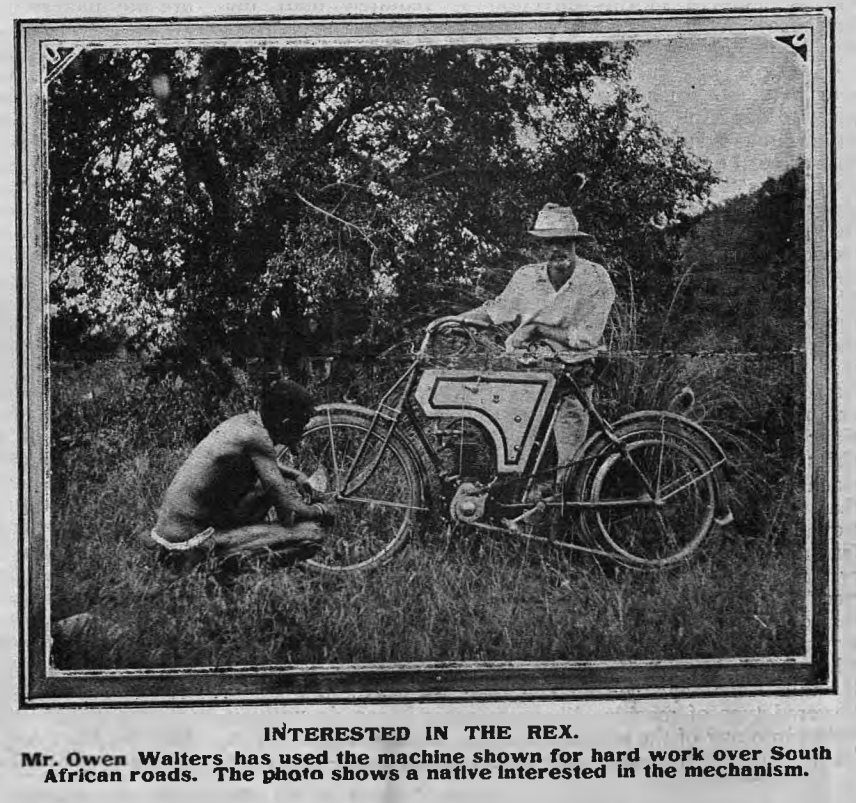
“IN THE SHETLANDS there are thirteen registered motorcycles and two registered cars; but only one man is licensed to drive them. In Govan, on the other hand, there are eighteen licensed drivers, but only nine registered vehicles for them to drive.”
“THE MOTOR CYCLING CLUB is going ahead strongly this season. At the last meeting of the committee 15 new members were elected, bringing the total to over 150. The full list of events to be promoted by the club is no doubt the cause of this happy state of affairs. The weekly runs, too, are being very well supported.”
“LEVEL CROSSING ACCIDENT. A North-country motorcyclist had a narrow escape the other day whilst riding across a level crossing at a place called Wideopen. A colliery engine came along the rails at the time and collided with the machine, which was smashed to pieces: the rider luckily fell clear and was only bruised and shaken. What the authorities were doing to allow both ways of the crossing to be in use at the same time deponent sayeth not; but the name of the locality appears to be singularly appropriate. it is time a closed gate was introduced at Wideopen.”
“THE CATFORD CC HELD their 18th annual hill climb at Westerham on Saturday last, the event attracting an enormous crowd, who, in spite of dull and somewhat threatening weather, lined the hill from foot to top…This fact of the start being taken on rising ground proved troublesome to competitors in the high-powered class, some of whom had struggles with their engines, such as Mrs Malaprop would style ‘herculaneum’. Without making the course excessively long, it would be impossible to place the starting line on a down grade, but as the test is intended to encourage the development of the road machine, perhaps it is as well not to give the competitors too easy a start. The starts were frequently interrupted by the sudden appearance on the scene of motorcars and other vehicles…Competitors were allowed a running start or a push-off, pedalling was permitted, but exhaust cut-outs were barred. Machines having to pass the judges’ inspection as roadsters, fully equipped, anything in the nature of a freak was shut out…This was somewhat disappointing to spectators, who were anticipating sensational times, but the encouragement of speed monsters is not the aim of the Catfordians…All the competitors took full advantage of the clause allowing pedalling, and put in some hard work on the steeper parts…The times might have been better if the competitors had been able to fly over the finishing line, but, unfortunately, the crowd were rather thick there, and did not sufficiently appreciate the necessity of leaving a clear space to pull up in. It requires a considerable amount of nerve to charge a mass of spectators, leaving it to them to get out of the way…The results were announced in the tea room of the Crown Hotel…The judges examined and sealed every machine, and refused to accept any that departed from the accepted lines of a standard touring machine…Taken all round, the arrangements for the hill climb were excellent, the man and machine, for instance, being weighed with an equipment which they were not allowed to alter.
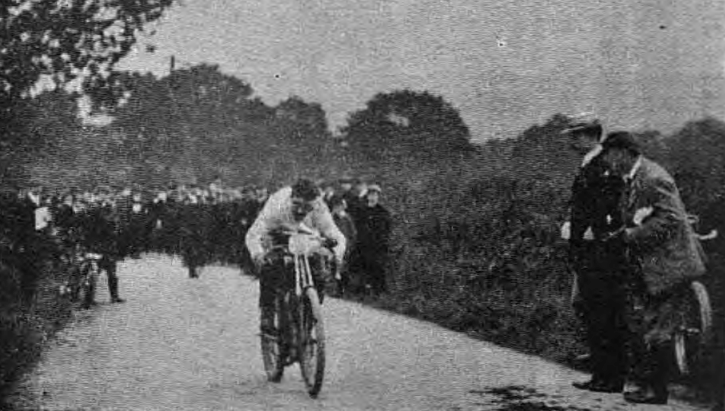
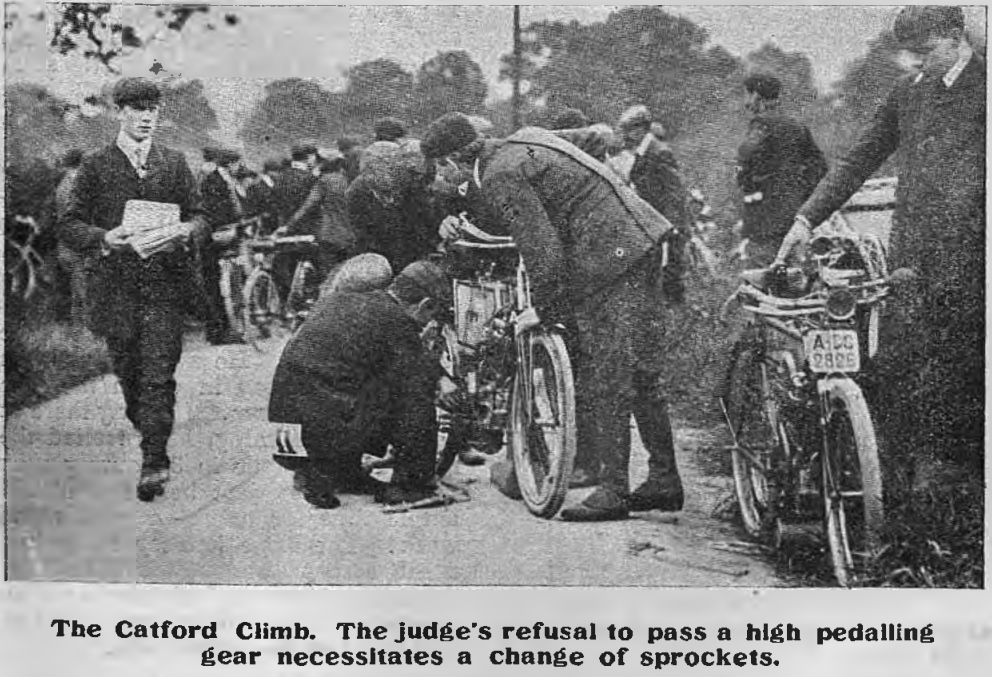
“TWO EXETER MOTORCYCLISTS were fined 5s each recently for an offence which the Chairman of the Bench characterised as ‘not a very serious one’—viz, riding a few miles in the small hours of the morning without lights. Both riders were supplied with acetylene lamps, but their supply of water ran out and they were unable to obtain any. One of the legal lights of the court, who was apparently labouring under a delusion as to the nature of an acetylene lamp, asked the defendants why they didn’t carry spirits with them, a question which elicited the obvious retort: ‘We do, but we generally carry them inside.'”
“FRANKFURT TO POTSDAM. The Great Motorcycle Reliability Run organised by the German Cycling Association. The reliability run organised by the influential German Cycling Association, rightly called forth the eulogies of the Prussian Minister of Commerce, Herr Moller, who delivered an after-dinner speech on the motor sport and industry at the Savoy Hotel on the evening of the final stage. He congratulated the Bund on having covered a distance of nearly 700 kilometres without accidents worth referring to, although he was presumably unaware of the fact that Herr Gobel, one of the speedy contingent, had had a severe fall…The trip began at Frankfort-on-the-Main, on June 4th, was interrupted at Hanover, and continued at five o’clock next morning, ending up at the Café Sans Souci at Potsdam. Of the 73 who reached Hanover on the Saturday no fewer than 70 lined up for the re-start on the following day. At 11.14am the first rider of the heavy brigade hove in sight, and by noon quite a dozen had put in an appearance. Up till 3 o’clock 30 cycles had reached the terminus, and few machines had any defects to show. The men’s faces bore a liberal portion of real estate, for the dust was here, the dust was there, the dust was all around, and not a drop of Westrumite! Very smartly did the Racing Committee get through their work. As fast as rider and ridden turned up the machines were promptly shoved into the overhauling room, where band, tyre, motor, pedal, and what not were scrutinised by the sharp eyes of experts. A complete result will not be publishable until the reports from the controlling stations have been collected and compiled, and the list hereunder gives only the order of the first three competitors of each category as they arrived at Potsdam— Riders of the two Heavy Sections: Kellner, Frankfort-on-the-Main, 11hr 14min 2sec (3hp Adler); Schrodt, Höchst-on-the-Main, 11hr 15min 55sec (3hp Adler); Steffen, Beelitz, 11hr 31min 14sec (2¾hp Brennabor). Riders of the Light Sections: Wolf, Schlungenhof, 12hr 33min 10sec (2h½hp Triumph); R Schulze, Leipzig, 12hr 41min 58sec (2hp Progress); B Heinze, Leipzig, 12hr 43min 13sec (2¼hp Progress).”
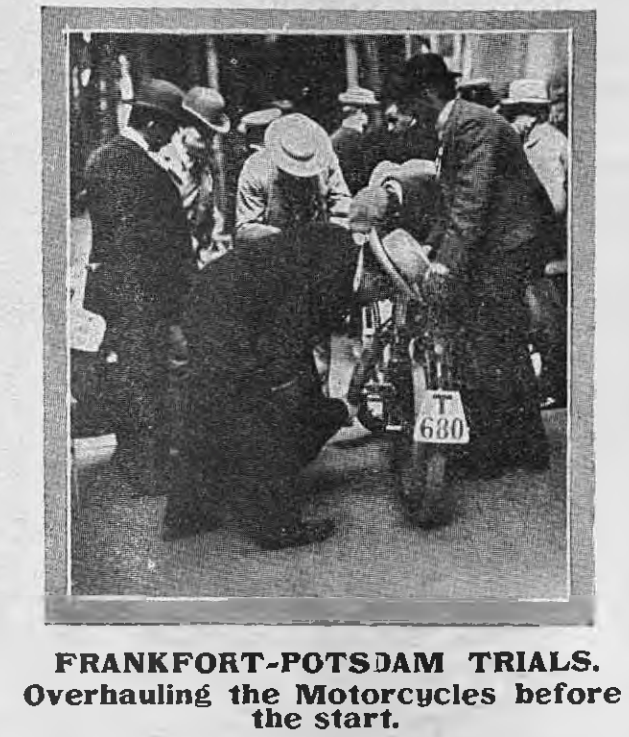
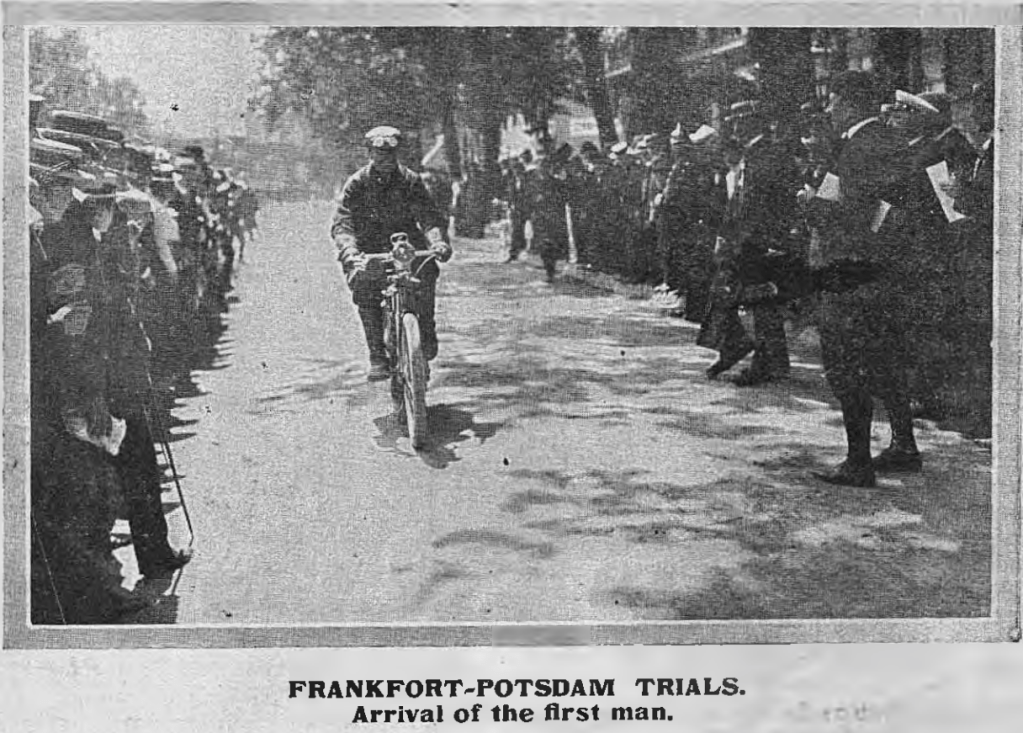
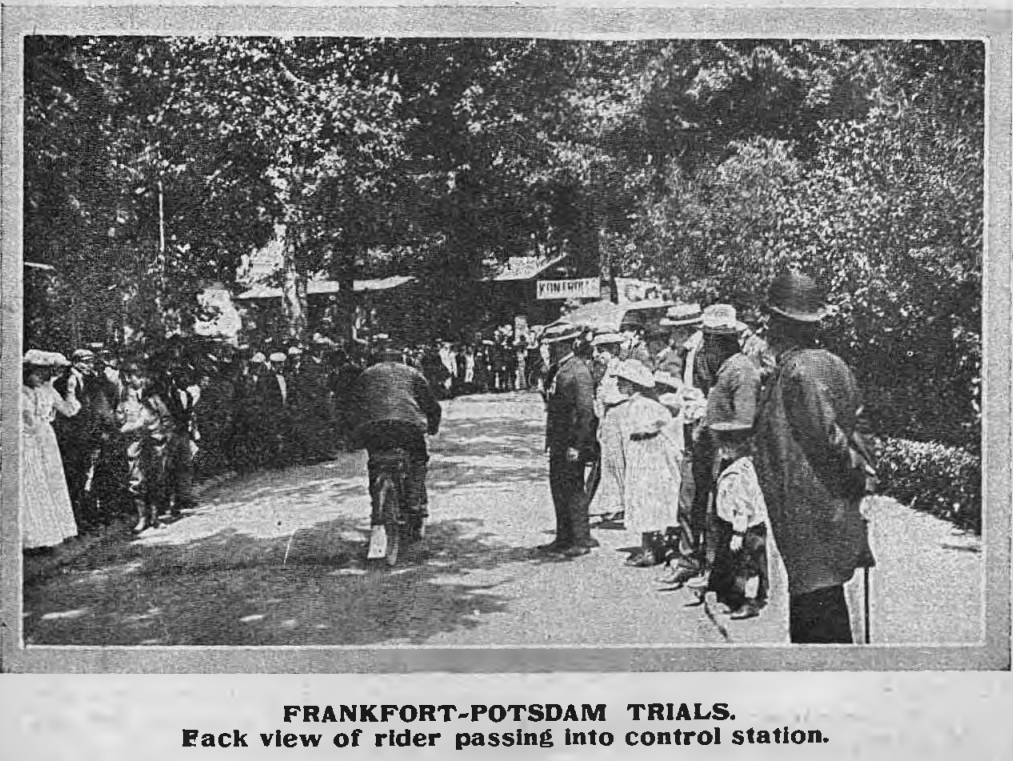
“THE RUN TO GREAT YARMOUTH promoted by the Auto-Cycle Club and in which motorcycling clubs have been invited to participate takes place on the 28th inst [April]. The London party will meet at Barnet at 1Oam, and will proceed via Hatfield, Hertford, Ware, Cambridge, Newmarket (lunch at the Victoria), Bury St Edmunds, Harleston, Bungay and Beccles to Yarmouth, the Queen’s Hotel being the headquarters there. The return ride on the Sunday will be via the main Ipswich road to Chelmsford, whence the road to Dunmow and Bishops Stortford will be taken for Ware. Tea will be taken here and then the party will disperse. A very enjoyable ride is in prospect.” Stop for a moment and consider. Many of the bikes on this run will be single-speeders relying on pedals to start with LPA on aclivities. Lubrication is off the total-loss variety with oil pumped by hand. Suspension is by no means universal up front and a rare undamped luxury behind. Also, a run from London to Great Yarmouth wasn’t unheard of; that was the first day’s route in the AC-C’s 1,000-mile reliability trial. But this, let it be noted, wasn’t a special event; just a club run. Motor cycles were no longer novelties; motor cycling had come of age.
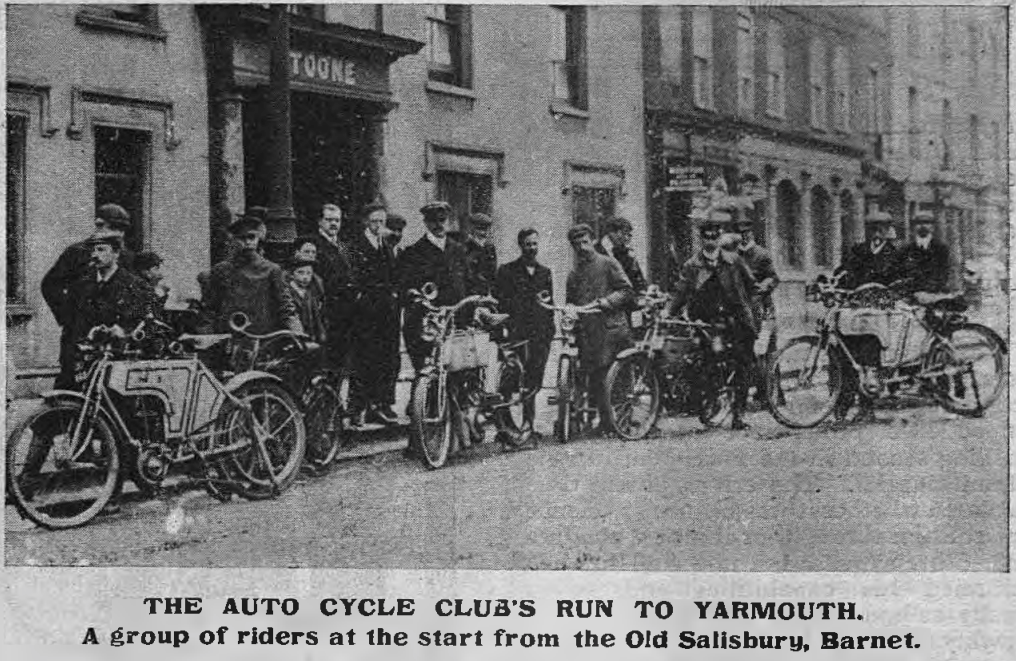
THE AUTO-CYCLE CLUB’S POLICY. In answer to an enquiry, the Auto-Cycle Club has laid down as a principle the fact that the absolute control over the sport of motorcycling upon tracks and other closed spaces is, by virtue of the agreement between the National Cyclists Union and the Automobile Club, vested in the Auto-Cycle Club. As to motorcycling competitive events on the roads, the club does not recognise racing on the road, because of its illegality, but no rules have been put into force to render liable to any form of punishment those who may promote or take part in such events. In the matter of trials and hill climbs on the road, the club proposes to take over the control of every event of this nature, to issue permits to such clubs as may desire to hold them, to proclaim unauthorised trials and to suspend all participants in such, and where necessary, to impose any conditions necessary for the general welfare of the pastime. In return for the allegiance of the promoting clubs, the Auto-Cycle Club will protect the clubs and the competitors against unfair competition, and generally afford the benefits accruing under the competition rules and regulations of the club. Clubs and others desirous of holding such competitions on the road in future are advised to make application for a permit, accompanied by the fullest possible particulars of the contest, to the Secretary of the Auto-Cycle Club, 119, Piccadilly, London, W.”

“THE CLUB EVENT held on Saturday last to select a team of riders to compete in the inter-club competition at Oxford, on August 7th, proved to be a most enjoyable function. The distance run off was a 50 miles non-stop from Redbourne to a point 25 miles along the Coventry road, and return. At one time it looked as if there was to be a wet afternoon, but before 3 o’clock things brightened up, and the riding conditions were as good as could be desired. Eight members started off at 3.45, viz: Arnott (two-cylinder Princeps), Hulbert (Hulbert-Bramley), Crundall (Humber), Densham (Anglian), Reeves (R&P), Sale (Quadrant), Maffert (Bat), and Wells (FN). Out of this group Crundall was the only one to experience a bit of genuine hard luck in the contest, inasmuch as through the breaking of a coil trembler spring he lost his chance of finishing. The remaining seven members thereupon had to compete in the starting and stopping test so successfully carried out on previous occasions. After tea an adjournment was made to a stretch of good road close to the hotel. This stretch was measured off to be just a mile out and home, and seven stopping places were totalled in the distance. Reeves was unfortunate in having a rather bad fall in taking a corner, and this resulted in a bent crank. Densham who followed, got off and on at each point in excellent style. Then came Arnott. He got away all right from the first two controls, but at the third his pedal chain came off, and he also experienced difficulty in getting his engine to fire. Malfert, on a pedalless Bat machine, did remarkably well at all the controls. Sale, on a Quadrant also did well, but lost some time through his band brake jamming. Reeves meanwhile had his crank straightened and made another attempt, and although it looked odds an him having another fall in his endeavours to mount quickly, he got through very pluckily, and in good time at each control. The course was not an easy one, as it comprised an awkward hill to start on and a nasty turning. The best times for the mile were: Densham, 3min 14⅖sec; Reeves, 3min 31⅖sec; Maffert, 3mins. 38sec, so that, in all probability, these three will figure in the team. The checking and management was very efficiently carried out by Messrs Brown, Van Hooydonk, Rev BH Davies, and Cowles.”
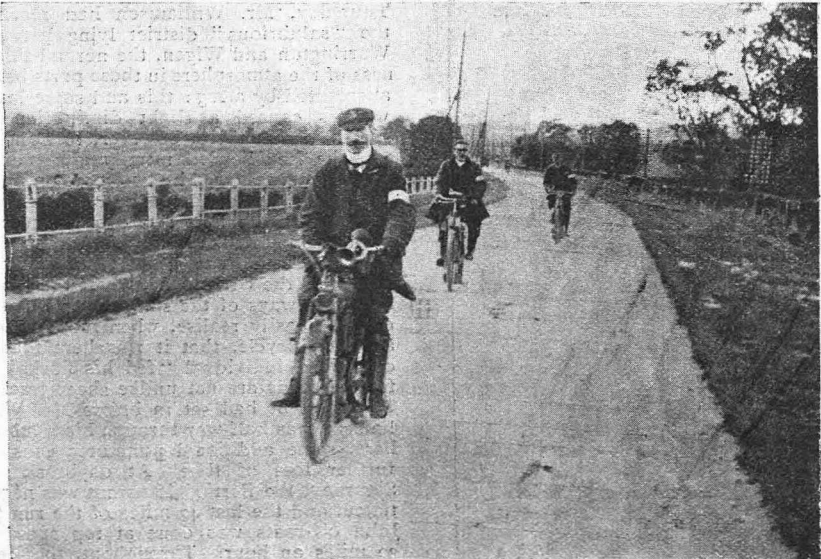
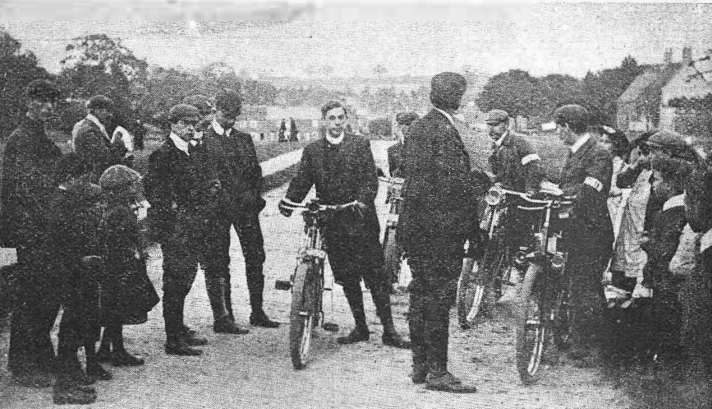
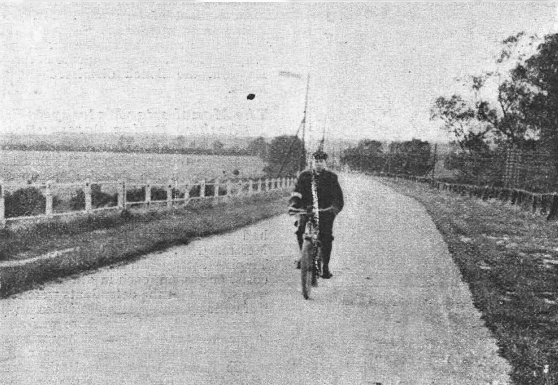
“MOTOR TRACK RACING as practised in America abounds in danger, and it is considered probable that it will be prohibited before long. The races are held on un-banked tracks, with a loose, dusty surface—generally a horse trotting track. In addition to the grave risk of skidding at an unbanked corner, there is the danger of running into the rails or another competitor on account of the dust raised.”
“A POPULAR YEOMANRY REGIMENT has a vacancy for a few recruits who possess motorcycles. Applicants, however, must be good horsemen or undertake to take lessons in riding. Everything, including uniforms, is found, and full particulars are obtainable from Mr T Hydes, The Laurels, Thames Ditton.”
“AT THE FORTHCOMING Austro-Hungarian Army manoeuvres motorcycles and cars will form a prominent feature. Some thirty members of the Austrian Automobile Club, and the Motorcycle Vereinigung, who volunteered for service, have already been drafted—on paper—into various corps.”
“THE KINGSTON-ON-THAMES Motor Cycling Club will meet on Sunday, l4th, at 10am, at the Anglers, for a run to Brighton. Intending members are invited.”
“THE AUTOMOBILE CLUB’S SIDE-SLIP TRIALS are now in full operation…the motorcycle devices took part in a three days’ trip to the Midlands. These consisted of the Empire bicycle support, a couple of small wheels at the ends of triangulated legs, which, when the machine heels over slightly, touch the ground and arrest a slip; the Parsons’ Non-skid; Edwards’ cover, with transverse steel segments; the Wilkinson tread, and a non-slipping rubber tread entered by Messrs W and A Bates. On Monday a further run over West London roads was made to complete the 850 miles, and during the week any shortage of mileage on the part of any device will be made up prior to the remainder of the tests….So far as the motorcycles were concerned, success to now has been scored in the case of each competing device. Three of them are devices incorporated in the tyres, namely, the Edwards leather band with steel segments vulcanised on to the tyre, the Wilkinson rubber tread studded with wires, and the Bates non-slipping tread of soft rubber moulded with innumerable arrow heads between two side ridges. Besides these there are the Parsons non-skid and the Empire support, the straddling legs of which are depressed by a back-pedalling action on the part of the rider, one of the little wheels at the end of a leg coming into contact with the ground and arresting any slip. These devices were sent on the Birmingham and Nottingham round, and

also over the runs round the West London district at the commencement of last week, thus completing 450 miles, and it was noticed on the wet and greasy run from Birmingham to Nottingham that the cycles were exceedingly steady, whilst there are statements flying around of pirouettings and other frivolities on the part of some of the cars…the judges examined the devices for condition, those on the cycles being in remarkably good order—one of the immense advantages, by the way, of lightness of vehicle. On Friday last the whole of the competitors proceeded to Stag Hill, near Potters Bar, and under the eyes of the judges, the devices were tested for power absorption…With the device in operation the car was started from a given spot and allowed to run, by gravity only, down the hill, the place at which it stopped being carefully noted, and the time of the run being taken by the judge, who travelled in the car. This was done twice, and then the device was removed, and the performance repeated twice. The general difference was only a few yards, the car travelling for five or ten seconds further without the device. The cycles were tested in the same way, the Empire support being followed by an observer on another machine, who saw that it was kept in contact with the ground. The Bates and Wilkinson treads reduced the distance travelled by a very few yards, the Empire support cut off ten yards, the Parsons non-skids stopped the Bat by about fifty yards, and the Edwards cover having a still further slowing effect. After the trials, which occupied the whole day, the vehicles returned to the garage in a storm of rain.”

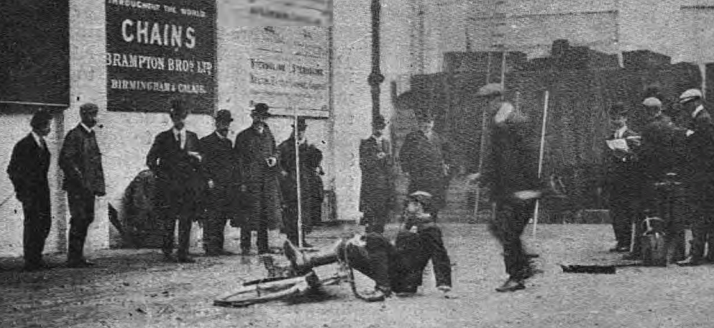
“COMBINED SUPPORT AND NON-SKIDDER. Turner’s Motor Manufacturing Co, Lever Street, Wolverhampton, are marketing a new pattern combined support and non-skidder for motor-bicycles. It is styled the Empire. The device is fixed to the frame of the machine, and is put into operation instantaneously, whenever required, by the simple act of back-pedalling, the inequalities of the road being met by springs, which the makers claim give a certain amount of flexibility, and allow the support to find its own level. The side running wheels possess a base of i8in, and it is said by riders who have thoroughly tested them they efficiently overcome any tendency to side-slip. As soon as a greasy patch is crossed, the tension is taken off the pedals, and the support automatically rises out of action. This is certainly a great advantage, for, unlike most other non-skidding appliances, it only suffers wear and tear when it is actually in use on a greasy piece of road. Apart from its non-skidding properties, the support enables the machine to be brought to a standstill in traffic, and the rider can remain seated ready to start as required. It is brought into or out of action in about thirty seconds. The price is £3 10s…The makers of the Edwards non-skid device ask us to state that the reason the machine fitted with this device which was entered for the non-skid trials held by the AC, and was not tested along with the other machines was due to the driver having some delay on the road. The machine was tested on the greased track afterwards, and some very sharp turns made successfully, fully demonstrating the efficiency of the device.”

“THE BIG MEETING organised by the Federation of American Motorcyclists for July 2nd-9th was carried through with conspicuous success. The meeting included an endurance run (New York to Albany and back, 306 miles); an economy test (distance run on one quart of petrol); hill climbing, starting, and slow-speed contests; and a second endurance run (New York to Cambridge, 271 miles). The New York to Albany run attracted 23 starters, 15 of whom finished within schedule time. The first man back in New York was Edward Buffum, of Boston, who rode a 2hp Yale-California machine shod with G&J Tyres (these tyres, by the way, were used by all the competitors, save one); but the best all-round performance was done by the six riders of Indian machines, who worked together all through like a team, and who finished 3rd, 4th, 5th, 7th, 8th, and 9th. The Columbia team also did exceedingly well, as it provided the second man in Walter Ziegler, of Hartford, and four others who finished. In view of the nature of some of the roads ridden over, the high percentage of successful competitors speaks well for the soundness and reliability of their machines. ‘For many miles,’ says a writer in Bicycling World, ‘the men simply bounded from rock to rock. It was not unusual for machines to fairly clear the ground and race while in mid-air…yet not a single machine broke down.’ At Tarrytown a stretch of slime was encountered, which led to several casualties. Chubbuch (on a 2hp Yale-California) and Gliesman (1¾hp Rambler) collided, the former’s handlebar snapping: he finished the run with a pair of dropped racing bars. Breeze (2½hp Tourist) skidded and broke his petrol feed-pipe; his motor shook loose, and his inlet valve broke, necessitating his retirement at Albany. An exciting incident happened in connection with Hedstrom, who brought up the rearguard of the Indians; he carried a revolver and some bird-shot cartridges to frighten dogs off: this he used with success on several occasions. Near Hudson a dog attacked the party: Hedstrom drew his ‘barker’ and aimed at the dog under his left arm; his machine skidded, and down he came as the revolver went off. After riding about a mile, Hedstrom remarked, “I shot myself in the arm that time!”; this proved to be the case. In the economy test, Edward Buffum was again to the fore, winning the competition with a total run of 55.3 miles. The hill-climb and other contests were held on the following day. The starting and slow-speed trials took place on Dyckman Street, New York. An unfortunate accident in the early morning to Buffum, who collided with a motorcar and broke his knee-cap, prevented him from taking any further part in the meeting. FC Hoyt won the starting trial, Gliesman second; and Hendee third. The slow-speed contest (over a stretch of 110 yards) resulted in the victory of Gliesman (49⅖sec); AJ Banta (48⅘sec) second; FC Hoyt (45sec) third. The hill climb (up the hill from Dyckman Street to Fort George) was won by Hedstrom 1¾hp Indian) in 1min 2⅗sec; JH O’Malley (2¼hp Tribune) 1min 7⅘sec, second; HY Bedell, 1min 10⅖sec, third. For the second endurance run, on July 6th, from New York to Cambridge, 21 started and 12 finished in the following order:—Holden (1¾hp Indian), Hedstrom (1¾hp Indian), Hoyt (1¾hp Indian), Banta (1¾hp Rambler), Hendee (1¾hp Indian), Baker (1¾hp Indian), Gliesman (1¾hp Rambler), O’Malley (2¼hp Tribune), Ziegler (2¼hp Columbia), Bernard (2¼hp Columbia), Coates (2¼hp Columbia), and White (1¾hp Light).”
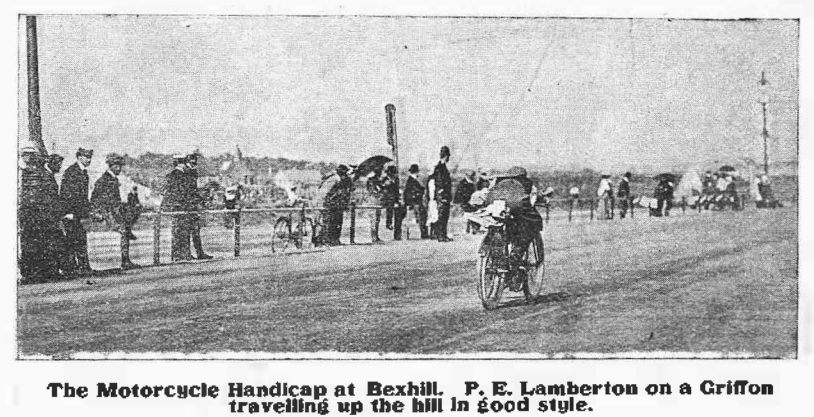
“0F THE THIRTEEN competitors who failed to complete the recent motor-bicycle endurance run in America, only three really suffered from machine troubles, the breakdown in two cases being due to the stripping of the electrical timing gear, and in the third to carburetter trouble. Of the others, two came to grief through broken frames—an unseen ditch being the cause in one case, and the ubiquitous dog in the other; one was run into by a motor-car; two had broken belt pulleys due to side-slip; three abandoned the contest from sheer physical exhaustion; and two gave up because they had ‘had enough of it’. The total number of competitors was 26; so that 50% came through without a stop, and only about 7% failed from machine troubles.”
“THE SUFFOLK POLICE Sports will be held at Ipswich, on September 10th, motorcycle events, under the rules of the Auto-Cycle Club, being included in a most interesting programme.”
“A CURIOSITY IN MOTOR-BICYCLE ATTACHMENTS. The impression conveyed at a first glance of the motorcycle attachment illustrated is that it might possibly work; but it is nonetheless an addition to the already long list of mechanical freaks in motorcycle inventions. The idea is plain enough and easily grasped. It consists of an ordinary air-cooled motor, supported in a special framework, which can be clamped to the rear stays of any ordinary pedal bicycle. A special chain and, presumably, a spring clutch are fitted to the back wheel hub, and take the drive from the engine by means of a chain. A reducing gear on the engine is fitted. The petrol tanks are seen fixed to the frame tubes. The accumulator and coil are clipped to the bicycle frame in the usual manner. Control of ignition, carburation and throttle are manipulated by Bowden wires and hand levers. It will be noted that part of the strain of the attachment is carried by a small trailing wheel carried by a spring fork. The wheel is apparently about 12 inches diameter, and shod with a pneumatic tyre. The carburetter is an ordinary spray. It is claimed that this attachment can be fitted to any bicycle in a few minutes, and should anything go wrong it can be removed and the machine pedalled home without it!! Speaking candidly, from a mechanical point, we cannot see how such an arrangement can justify the optimistic claims made for it. We should expect to find the steering seriously affected, and it would be awkward to manage in traffic by reason of its length, and the jumping about of the trailer part. The small trailer wheel would run at a tremendous pace, and the effect of it striking obstacles in the shape of stones, not to mention the risk of it getting stuck in a tram line groove, would not be pleasant. Further particulars of the invention can be had of Mr H Hewitt Griffin, 73, Norroy Road, Putney, London, SW.” […but after that review I doubt if Mr Hewitt had many callers—Ed.]
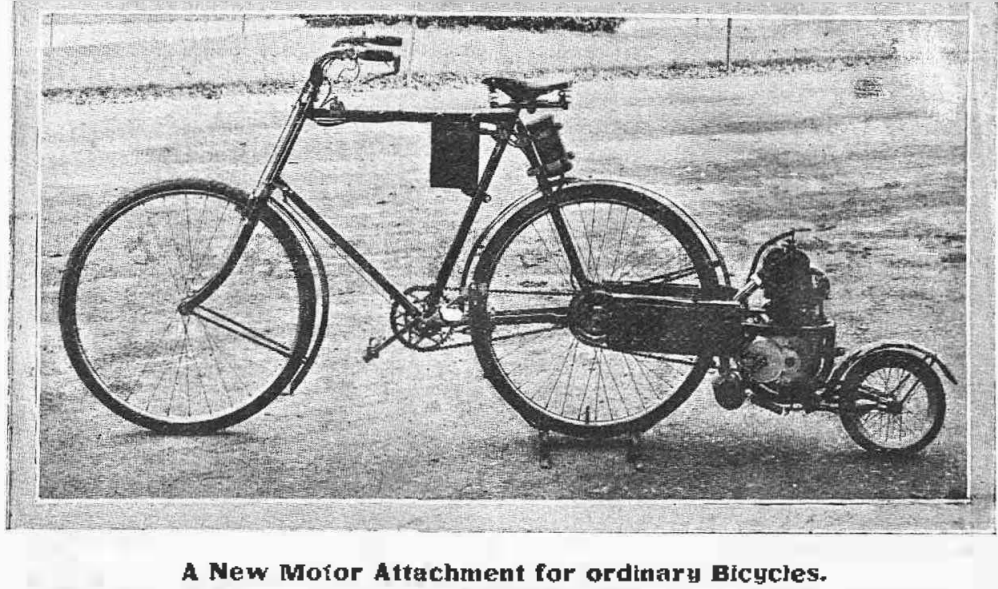
“TO THE EARLIEST EXAMPLES of motorcycles—which were due principally to the enterprise of Messrs Werner Freres—the reproach was appended ‘that they were ordinary bicycles with engines slung on’, and though this reproach was not absolutely true, some considerable period elapsed before special attention devoted to the design and construction of the petrol-driven cycle resulted in radical difference to the ordinary form. In these almost prehistoric times, toy engines of 1hp and 1¾hp (nominal) capable of developing possibly only about two-thirds of this power on the brake were used, and it was therefore of no great moment that the frames followed the lines of the ordinary type. Now, however, when there is an increasing tendency to use engines rated as 3, 3½ or even 4 and 5hp, powers which are actually developed—and exceeded at brake tests—it becomes essential to consider what form of frame is best suited to carry an engine and accessories of such weights and powers, in order that the utmost efficiency may be conserved. To attain this very necessary end, it will be obvious that the frame design must be such that the engine—having regard to all contingent circumstances—may be carried in the most convenient position for developing, and also for transmitting, its power to the driving wheel, and in the line of this transmission, where very great additional stresses are created, closest attention must be given to the design and construction in order that these stresses may be balanced…To Messrs. Werner Freres again must be given the credit of effecting the most noticeable improvement in design, by embodying the engine as an integral part of the frame itself, in the now familiar vertical position just in front of the bottom bracket, so largely adopted by many well-known manufacturers. The strengthening of the front forks, by a girder construction, was, with minor alterations, adopted from the earlier type of motor-tricycle, and is now quite generally used where engines of considerable power are employed. Messrs Humber made a decided departure from normal design by building the engine into the frame in an inclined position, occupying the place, by substitution, of the tube from bottom head lug to bracket, seen in ordinary cycle frames, this, in conjunction also, with the duplicated top rail. In the Excelsior and others, the original ‘Minerva’ position (engine beneath and just forward of the bottom bracket, and clipped to the main down tube) was adopted; and in order to accommodate the large, high-powered engines, a type of frame with extended head construction was evolved, and subsequently registered by the firms of Messrs Chater Lea and Perry. In the Clyde and others, the later ‘Werner’ position was adopted, a loop tube running from bottom bracket to lower head carrying the engine, to which it was clipped. The Ormonde, as originally placed on the market, had the engine carried behind the seat column, in front of the back wheel, and in order to provide room for it there the rear triangle was extended accordingly. The Raleigh, using the modern ‘Werner’ position, have a design of considerable originality and merit. It is a combination of the diamond and cross frame, a tube running from the bottom of the head to the seat column, from whence it is continued as an additional pair of rear forks to the back hub spindle. In the Bat, in which the ‘Werner’ position is approximately maintained, an additional pair of back forks is also used, and these, running from the lower part of the crank-case to the hub spindle, balance the stresses perhaps better than any of the other designs under consideration.”

“THE MOTORIST IN THE MOTHER COUNTRY has little idea of what his brother in the Colonies has to put up with. If you start out for a day’s run in Australia, you must make up your mind for a bout of real hard work before you get home again. I do not mean to say that this is the case all over, but in a scattered colony like Western Australia the roads are left to take care of themselves and the motorist suffers the inevitable consequence. The Colonial motorcyclist laughs when he reads of an English motorcyclist who has climbed a hill of 1 in 6, and wonders what he would say if he had to get off and push before he had gone 50 yards up a 1 in 2½ grade, and before he had gone another 50 yards, take the belt off to make the work lighter. This is what the Colonial has to do. The reader may feel inclined to doubt the statement, but I think the following experience should convince him of its truth, and prove interesting to all motorcycling readers. A friend and myself started on our motorcycles at 8am on Easter Monday of 1904 for a 90-mile ride from Perth to a small town called Northam. After leaving Perth 20 miles behind, and bidding adieu to the good roads, we made the acquaintance of the hills. The first resulted in our getting about 100 yards out of the two miles before our engines stopped, and we had a pleasant (?) half-hour getting to the top. I was fortunate in having a light 2hp machine, weighing 90lb all on, but my friend was quite exhausted with a 2¾hp machine scaling 135lb. After a little refreshment and a short rest we resumed our journey. As we should not see another house for 56 miles, we made the best of our time, and with a clear bit of road we ”opened out’, and very nearly brought our ride and our lives to a simultaneous conclusion, for as we rounded a sharp curve, we pulled up on the edge of a burnt-out culvert, about 9ft across and 6ft deep, stretching right across the road. A bush fire had passed over the forest and burnt out all the culverts. Needless to say, we proceeded more carefully until we reached the good road again (though I hardly suppose it would have been called ‘good’ in England). Here again we opened out, and had our first enjoyable spin since we left home five hours before. Again we struck those beautiful hills—this time to get down, and I do not know which was the worst, going up or down! It was like crawling down the face of a cliff, with the brakes hard on. We had literally to hold the machines back. The surface of the road reminded us of a quarry, and we had to wheel our machines round big stones, while we ourselves crawled over them. Thankful indeed were we when we came to our first stopping-place after such hard work. But a wash and a good dinner made us feel more like ourselves again, and equal to starting on the last stage of our ride. After fighting our way’ to our machines through the crowd of country children who were amusing themselves by blowing the horns, we made another start. We reeled off 27 miles in 48 minutes, which I am
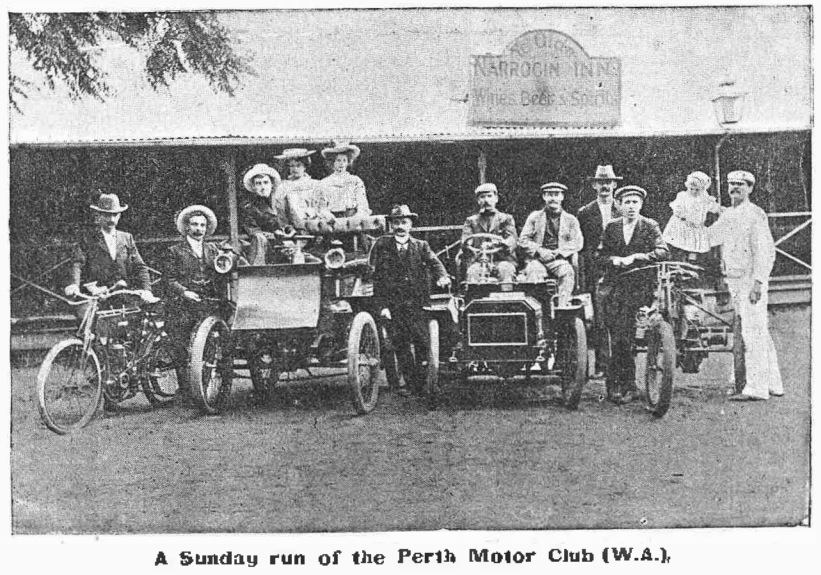
afraid, if you reduce it to figures, exceeds the legal limit, but we have no Surrey police out in the back blocks, so with a good level road before us, we soon came to our journey’s end, and were not sorry to get to bed. The 90 miles had taken us just 12¾ hours to do. Our machines behaved splendidly, but the riders were not so fortunate on the return journey. When about 35 miles on our way the fun started. We had been delayed in the town, and did not make a start until 1 o’clock the next day, and it was getting dark when my friend’s machine started misfiring badly after a half-hour’s work. We had to put in a new trembler and screw, and by the time we started again it was quite dark. After doing another 25 miles our lamps went out. Of course we had no more, carbide just when we wanted it, too, as we were getting near the burnt-out culverts, so the only alternative was to walk and push the machines. I will leave the reader to imagine our feelings. We had not touched a bite of food for seven hours, and it was five hours since we had had a drink. We had struck all our matches looking for water in the bush, so we could not console ourselves with a smoke. We tried to light our pipes from the high tension wire, but got more shocks than lights. Finally we reached home at 5 o’clock the next morning after 16 hours’ hard work and misery. I had asked a friend of mine just out from the Old Country to come with us, but he said we were mad to tackle such a ride, and I am bound to admit that he was not so far out of his reckoning. As the result of my Colonial experience I have come to the conclusion that the ideal motorcycle for the Colonies is either a light 2hp machine (not more than 100lb), or else a 5hp water-cooled bicycle after the Iris twin-cylinder pattern. The 2¾hp motor is not sufficient, in my experience, for most of the hills, and is too heavy to push up a long hill. A two-speed gear would be a big advantage in the cool weather, but it would be useless for such summers as we get here (100° in the shade, and the wind like the blast of a furnace), unless water-cooling was resorted to. Spring saddle-pillars and large tyres are almost a. necessity.”
“A 2½HP WATER-COOLED motor-bicycle is now being handled by The Farman Automobile Company, 100-104, Long Acre, WC. It is christened the Hopper and the transfer will be the representation of a grasshopper. The engine has a steel cylinder and water jacket and is fitted in a shapely loop frame with three detachable clips. The carburetter is an FN, and the contact breaker is of an improved type. The tank stores petrol, accumulator, lubricant and water, the water-containing section being separated by a space to which the outer air has access. Efficient radiators are fitted at the head. The water tank has capacity for half a gallon, which is sufficient for 100 miles, and the petrol is ample for the same mileage. Front and back rim brakes operated by a single lever on the left handle-bar, are supplied, and the exhaust lift is by Bowden wire from right handlebar. Two ratchet levers on right hand of the top tube operate the advance, sparking and throttle. The drive is by V-belt. The wheels are 26in and the tyres 2in. The total weight when loaded with water and petrol, ready for the road, is 108lb. The stock sizes of frames are 22, 24 and 26in, but any other size of frame can be supplied to order.”
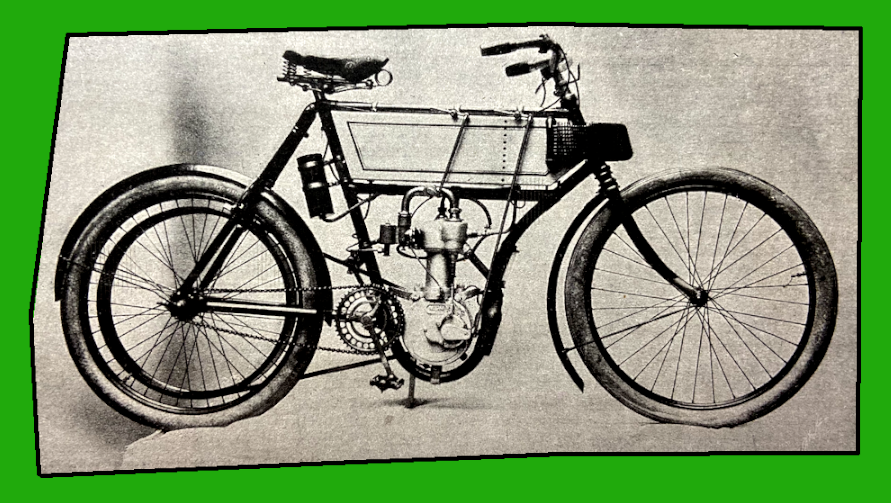
“THE AUTO-CYCLE CLUB held a special general meeting on Friday last, and finally passed the new scheme of affiliation. The proposals will very shortly be laid before the other motorcycling clubs of the country. Concerted action amongst motor-cyclists is a most desirable thing, and this scheme will provide for it.”
“MOTORCYCLING DICK TURPIN. A story (which we give with all reserve) has been sent by the ‘Special Correspondent’ of a London daily from New York, relating how a motorcyclist has, successfully so far, played the part of highwayman. The story goes as follows: ‘Mr Hall, a New York merchant, started on an automobile from Philadelphia for Delaware. At Water Gap, as he slowed up preparatory to taking a steep hill yesterday evening, by the light of his own headlight he saw a motorcyclist who had been for two miles slightly ahead of the car. At the point of two pistols the order was given for the party to leave their automobile. The assailant took Mr Hall’s money, the jewels of Mrs Hall and two women friends—in all about $2,000 worth—and compelled Mr Hall to transfer the contents of his gasoline tank to the cycle, disconnect the batteries and deflate the tyres, leaving the car in the road. The victims walked about two miles to where they obtained aid. The bandit escaped.'”
“THE REX PATENTS CO, of the Exchange, Clapham, are introducing a 3½hp motor called The London. The name is chosen because it is made throughout in the Metropolis. English threads and measurements are alone used, so that it will be possible to obtain nuts, bolts or similar fitments at any fitter’s shop in town or country. The inlet valve is mechanically operated and a wipe contact is fitted. The bore is 3¼in and stroke 3¼in (449cc). The sparking plug is fitted in the top of the combustion head and extra large radiators are fitted. An exhaust valve lifter is included in the design.”
“ST LOUIS, THE SCENE of the great American World’s Fair of 1904, is one of the most rabidly motorphobic cities in the worlds. A speed limit of 6mph is in force; and the licence regulations are so ridiculously red-tape-bound that if a motorist wishes to drive through five counties in Missouri State he has to take out five separate licences. A recent regulation imposes a fine of from $5 to $100 for allowing oil or spirit to drip on to the road from the car.”
“I WITNESSED A RATHER SERIOUS accident to a motorcyclist near the foot of Harrow Hill on a recent Saturday afternoon. That he was a comparative novice was evident from the careless fashion in which he rushed the beginning of the hill. I should not consider Harrow Hill a dangerously steep gradient. I question if it exceeds 1 in 9 anywhere, but there is an acute turn about two-thirds of the way down, and it is here the danger really lies. Unless a rider has his machine thoroughly well in hand right from the commencement of the hill he cannot negotiate the turn. This happened to the young rider in question. He tore down the hill, gaining impetus every second, and in attempting o take the turn as wide as possible he shot into the hedge and over a ditch. His machine was simply wrecked, and his personal injuries consisted of severe cuts about the hands and face. Now the point I wish to emphasise is that it is never wise to withhold the application of the brake on a hill till one recognises that the machine is getting out of hand. Put it on right at the beginning, and do not let the machine increase its pace perceptibly. If a sudden pull up is necessary, it can then be effected without having to strain the whole machine and pull the brakes to pieces. The effort required to pull up a 180lb machine at 25-30mph down hill is enormous; in fact, nothing short of locking the two wheels is of any use. The ruinous effect this has on the tyres is, of course, pretty well known…the other day a novice rider put forward the question: ‘Supposing that in descending a hill which I do not know, and the bottom of which I cannot see ahead, it should happen that the brakes will not hold the machine and prevent it gathering speed, what is the best course to adopt?’ Well, personally, I should take no risks. I should slip out of the saddle backwards and hold the machine up by the saddle till I could stop it. I had an actual experience of this sort on Westerham a few seasons ago and I reckon I only avoided a smash by a sudden backward dismount. I nearly had to let the machine go, but by a supreme effort and strained wrist I saved it…I hope motor-bicycle manufacturers will not overlook the claims of the spring fork when designing their 1905 machines…I think a good spring fork is a strong selling point in a machine, and makers will do well to keep this fact in view in their own interests. What is wanted is something neat, simple in construction, and such that it will not diminish the lateral rigidity of the machine. There must be any number of ways of making a spring fork, and yet we see so very few of them adopted…”—‘Magneto’
“NOTES ON HILL-CLIMBING. If there is one feature in the manipulation of a motor-bicycle which calls for skill more than anything else it is in being able to climb a hill successfully. About the most severe trial possible is a long steady grade, say, averaging 1 in 15 or so, and then a really steep finishing stretch of 1 in 7 or 8. There are plenty of hills of this sort about the country, and yet how many riders fail on them. The majority of motor-bicycles are single-geared, and fitted with pedals. With a second gear there would be less need for skill in surmounting the finishing crest of a hill. Many riders new to their machine are too apt, in my opinion, to blame their mounts when they come to a stop on a hill, and have to dismount. They consider the engine is underpowered, whereas, in nine cases out of ten, it is simply due to their want of experience. If a long and severe gradient has to be ridden up, the plan should be to rush it as far as possible with the spark well advanced, but the minimum of gas on. Now it is this latter that is the key to the problem. At the throttle the power is really controllable. You can keep your hand on the reserve of power, as it were, and dole it out to the engine as the occasion demands. The spark advance and very little gas will take you up the hill as long as the momentum of the machine keeps up. As soon as this begins to fall, then is the time to depend on your throttle. But simultaneously with the opening of the throttle, the spark must, in a degree, be retarded; the reason for this being that there is a certain fixed time for the spark to occur for varying speeds and loads on the engine. If the engine is labouring, early firing is the worst possible thing for it, simply because there is no reserve energy in the fly-wheels to overcome the initial back pressure against the piston when the charge is fired early in the stroke. This, then, results in a very serious loss of efficiency, and the engine will develop a knocking and will stop in a very short time. The spark should be timed to occur just as the piston commences to descend; no later. There is a great deal in knowing exactly when to help the machine with the pedals. Many riders, before they have learnt by experience, pedal too late on the hill. Practised riders know well that it is just the few vigorous turns at the pedals here and there that gets the machine up the steepest bit of the hill. Of course, if one desires to make really good time on a hill, pedalling may be begun sooner and the spark kept fairly well forward, because the momentum of the machine will be kept up. A rather high pedal gear, say about 75, is best for this purpose, whereas, if occasional help only is required, about a 66 gear would do very well—higher than this, by the way, is not advisable for starting a heavy mount. Continuous pedalling with a low gear, and the rider in a somewhat unfavourable position in the saddle, is very tiring. But for a few dozen strokes or so a lot of power can be put into the machine without undue exhaustion being experienced.”—‘Magneto’
“PARAFFIN VERSUS PETROL. There can be very little doubt that before long we shall have spray carburetters that will vaporise paraffin if required. I am not so sure, however, that even if cycles or cars were so designed that either fuel could be used, but that petrol would not still be employed in nine cases out of ten. But in an emergency it certainly would be an advantage to be able to use paraffin. I have tried some experiments with a mixture of paraffin and petrol, and I found that with two parts of paraffin to one part of petrol I got, as far as it was possible to detect on the road, just as good results as with petrol only. The subject of paraffin vs petrol, and the comparative power developed by each is, however, an interesting one.”—‘Magneto’
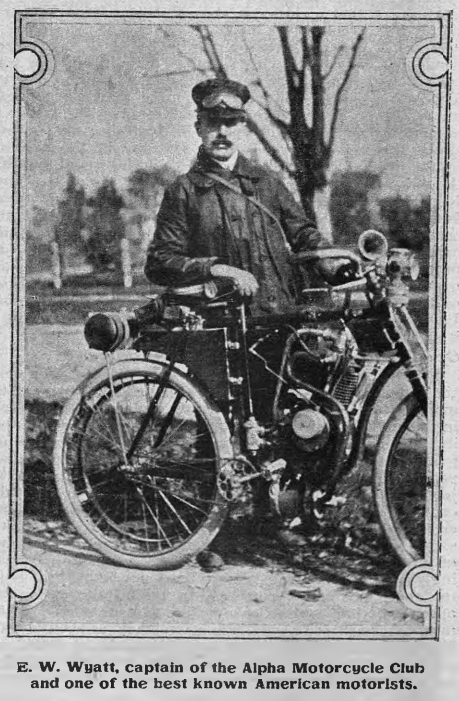
“THE MANCHESTER MOTORCYCLE CLUB—Cheshire Police Persecution. A sequel to the Knutsford police interference on the occasion of the first round of the Club’s 100 miles’ non-stop reliability trial on July 16th, took place. on Wednesday last at the Knutsford Petty Sessions, when the three members who had been stopped by the police, viz, Messrs JT Ward, R Raines, and H Tippings, were each fined £1 and 11s 6d costs, or 31s 6d each in all. In defence it was stated that the defendants were simply ‘crawling’ along at 8mph when stopped, and that there was no one in the street at the time. They were summoned for ‘riding to the danger of the public having regard to all the circumstances of the case’, and the police evidence was to the effect that the street was full of children at the time, and that the riders were driving furiously at the rate of 15mph. Each rider ably defended his own case, but it was of no avail, and the Chairman of the Bench read the men a very severe lesson on the iniquities of furious driving, stating that he implicitly believed the police, and generally treated the case as one of very serious aspect. He also led them to understand that this being the first offence he had let them off very lightly, but the fine would be much heavier on a future occasion; the men’s licences were ordered to be endorsed.”
“DESPITE THE CONVENIENCE of the trembler coil, inasmuch as it does away with the troublesome necessity of trimming and adjusting platinum contacts on the make and break, it is, nevertheless, liable to give rise to occasional stoppages, or at least misfiring, unless certain details are. carefully attended to. For instance, with a high-speed engine, to get regular firing at high speeds the coil trembler must vibrate exceedingly fast to be able to give a series of sparks per contact. A little consideration will show that the sector on the brush contact is supposed to be so set that a spark or series of sparks must occur at the instant it touches the brush to get accurate timing. This can only be so if the trembler on the coil is set to vibrate at the highest possible speed. Should it vibrate relatively slowly, the spark may not occur till the sector on the brush contact is leaving the brush. This will obviously cause the charge to fire much later than it should. As an instance of how fast a coil trembler has to vibrate to give even as few as two consecutive sparks per contact, suppose the engine is only running at a fair speed of 1,200 revs per minute. The brush contact disc will revolve once in 1-10th second, but it is only making contact ⅛th of the complete revolution or for ¹⁄₈₀th part of a second. To give but two sparks in that time the trembler must vibrate at the rate of 9,600 times per minute. To give four sparks it must vibrate at the rate of 19,200 times per minute. Now, the speed of the trembler is a detail of prime importance in getting successful firing. Making the contact sector longer will not compensate for a slow trembler; as this obviously means that the timing cannot possibly be accurate. Suppose the sector be made ¼th instead of ⅛th the circumference of the disc, it is impossible to determine at what part of the contact the spark and ignition will occur. It is for this reason that many experienced racing men prefer a plain coil with make and break, because there can be no doubt that the charge must explode at the instant the contacts break, and the engine can be timed accordingly.”—‘Magneto’

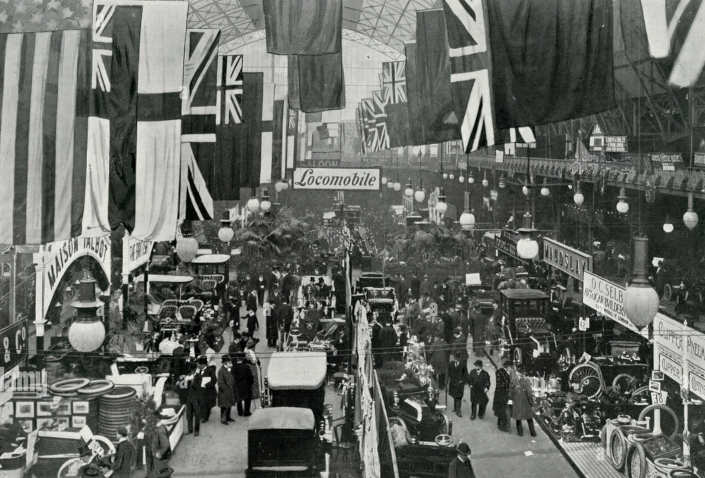
“THE NINTH ANNUAL MOTOR SHOW at the Agricultural Hall, Islington, and the only one which has received the patronage of the Automobile Club, is now open…a horse show which proceeded the show (rather a curious juxtaposition, by the way) was not cleared out until the Tuesday…The place was in an indescribably filthy state, reeking of the stable…Those who had left the Hall in chaos on the Friday…were compelled to marvel at the transformation effected in the night…There is scarcely an inch of room unoccupied in the Hall…The Clarendon motor-bicycles exhibited by The Clarendon Motor Car and Bicycle Co, Ltd, Coventry are of taking design and neatly finished. They are fitted with 3hp engines, the cylinder and head being cast in one piece. Mechanically operated valves are a feature, as are the patent pulley bearings. This ball race, which is carried on two projections cast on the left hand side of the crank case, takes the full driving strain of the belt, which actually runs between two bearings. It is claimed that this method prevents any possibility of the flywheels running out of line or uneven wear on the bushes. The belt can also be tightened to any pitch without affecting the running of the motor. The motor is attached to the frame by four bolts, and is supported by a loop tube in a vertical position. The frame, too, is of patent design, the bottom head lug being in one casting, thus greatly strengthening this important part of the machine. A Longuemare carburetter with throttle, a Lithanode accumulator, and a high-speed trembler coil are fitted. The wheels have two-inch Clipper motor tyres, although any other make can
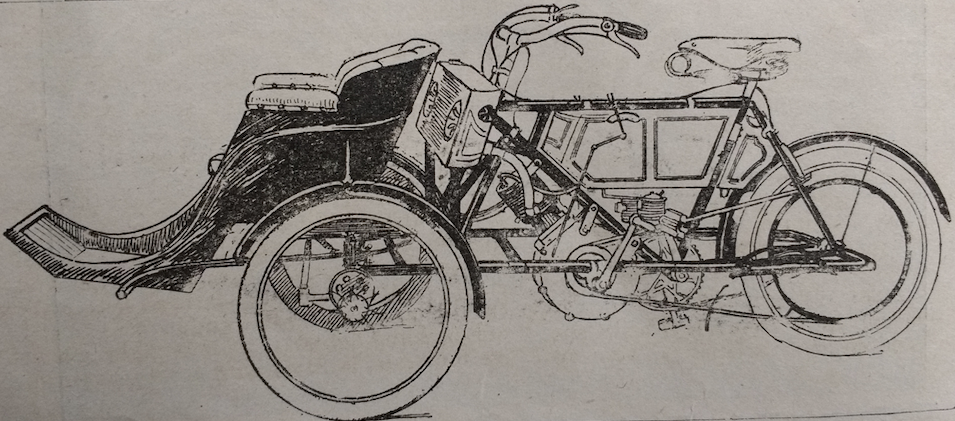
be fitted to order, A tri-car having a 4½hp water-cooled engine, is also shown. The popularity of the Excelsior motor cycles, made by the old-established firm of Bayliss, Thomas and Co, Ltd, Coventry, is testified by the large number of these machines which are to be met with on the road. Consequently they require no introduction or recommendation by us. None the less, we advise those of our readers who visit the show to make a close inspection of the latest models. Various detail improvements are noticeable and all bear the high-grade stamp as regards workmanship and finish. The 2½ and 3 ¼hp bicycles, a 3¼hp tricycle (air cooler) and a 3¼hp tri-car (also air-cooled) strike the eye. All are fitted with Clincher A Won tyres, duplicate Lithanode non-spillable accumulators, two-way switches, Bassee-Michel high-speed trembler coils, wipe contacts, Lincona belts and spray or surface carburetters. A new addition to the Excelsior group is the 4hp model fitted with a carriage built forecar. It possesses the usual features, but the engine is free and water-cooled and is started by a release handle in exactly the same way as an ordinary car. Moreover, two speeds are provided, and 2½in motor tyres are fitted to all wheels. This is an excellent machine, and its power and capabilities are such as will make it speedily leap into popular favour. Already a number of orders for it have been secured, notwithstanding that it only made its first public appearance on Saturday.
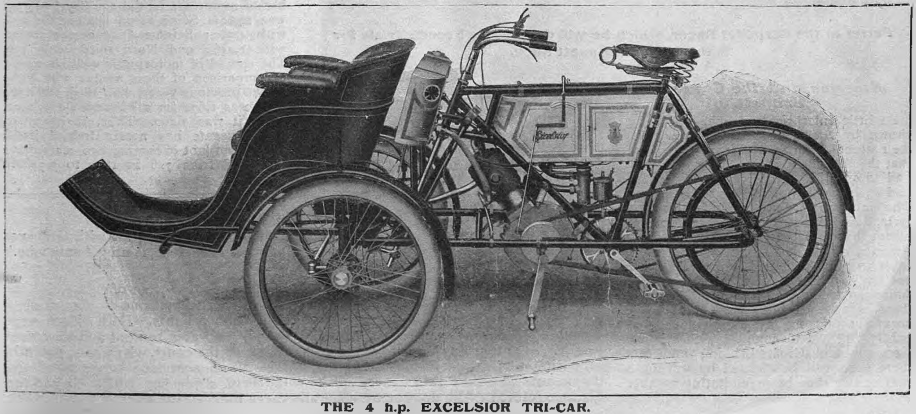

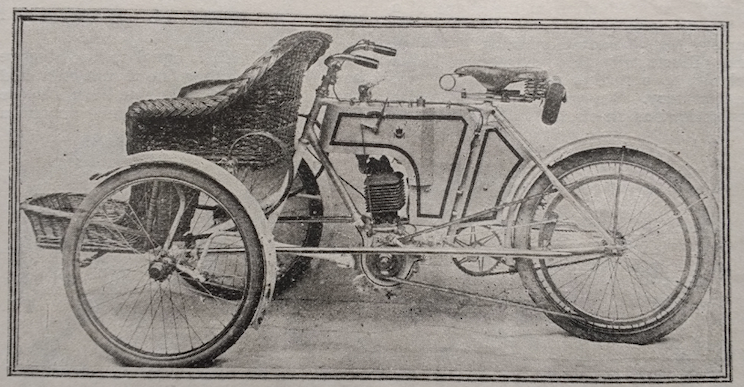
As is the wont of the Rex Motor Manufacturing Co, Ltd, Coventry, when exhibiting they make a brave display. Their well-known 3¼hp motorcycles are staged. We have referred to them so frequently that it is only necessary for us to point out that these up-to-date and well-tried mounts are worthy of the attention of visitors who are thinking of taking up the fascinating pastime of motorcycling. The Rexette possesses two coach built bucket seats, one being attached in the form of a fore car and the other at the back—that is to say, it supersedes the saddle. A water-cooled engine of 4hp drives the carette (as it may be aptly described), and this is rigidly fixed to a registered design of cradle, which permits of its being easily removed when necessary. The vehicle is pedalless and is started by a fixed handle after the practice of ordinary cars. The engine power is transmitted by a chain (protected against dirt and mud) through a clutch to the rear wheel. The tubular framework is very strong; indeed, the Rexette is a serviceable and attractive vehicle, which at 90 guineas is appealing very strongly to that large class of individuals who cannot yet afford the ordinary type of car. A new addition to the Rex models is the Tri-ette. This takes the form of a tri-car, the engine being of 3¼hp and the seat of wicker work. The Begbie Manufacturing Co, 407, Oxford Street, London W, exhibit a Pearson motor-bicycle, The main feature of this machine is that it is fitted with the excellent
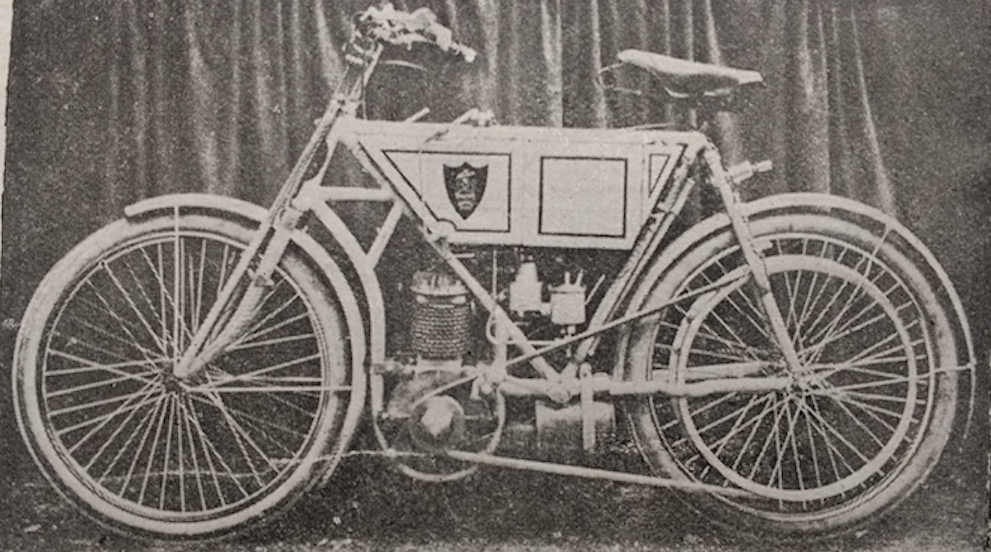
Aster engine. This has ribbed copper radiators and develops 4hp. A special design of frame is adopted on this machine, the engine being mounted vertically in a loop running from the lower part of the head tube. It is braced at this point to the main down by two short tubes, forming a double triangle behind the head, thus giving an immensely strong structure. The carburetter is a float feed spray with throttle and air control. The ignition is high tension electric by coil and accumulators, and transmission is by a long V-section belt. It will be noticed from the illustration that the engine is very rigidly held in the loop tube, and the triangle of tubes just in front of the bottom bracket makes this vital part extra rigid. Duplex forks and a large silencer are fitted. Two machines shown by the Aurora Motor Manufacturing Co, Coventry, must be noted, a 2½hp motor-bicycle and a 3½hp tri-car. The former is built on standard lines, and does not call for any special description—although we may say it is excellent value for £38—and the latter is provided with a free engine clutch and a mechanically operated inlet valve. The Fuller motor-bicycle is made in 2, 2¾, and 3½hp sizes. It is a handsome mount, with vertical engine, mechanical valves, and Bowden valve lifter fitted. The motor is fitted in a loop
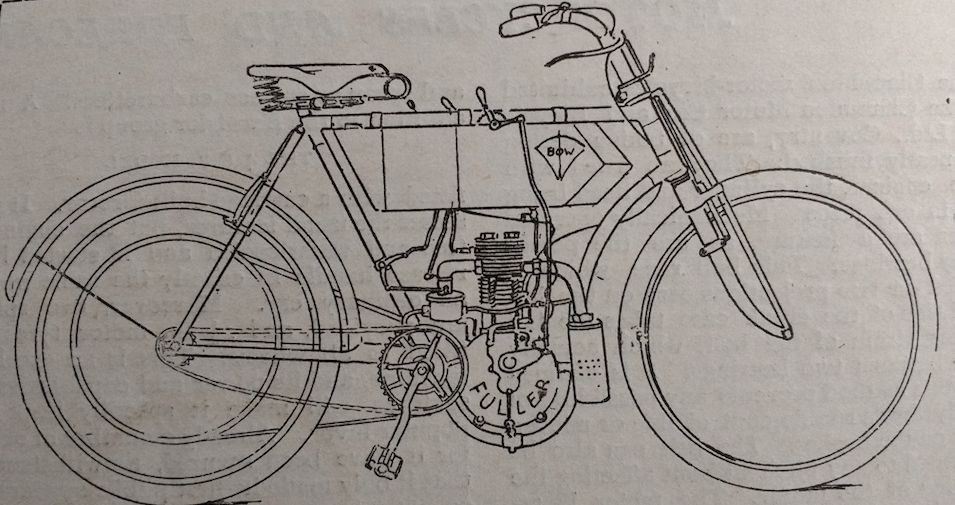
frame, having duplex front forks. The carburetter is of the Longuemare type, with automatic air regulator. The ignition is by a Fuller trembler coil and Fuller dry battery or accumulator. The tyres can be Clipper, Dunlop, Palmer or Continental make at option. The drive is by V-belt. There are two brakes, the rear one being a Bowden rim pattern. The engine is a very excellent one, and securely clamped in the frame, and the regulating levers have ratchet adjustments. The price is 40 guineas. The firm call the machine the Bow motor-bicycle. The Garrard Manufacturing Company, Magneto Works, Birmingham, exhibit their latest production in the shape of a 5hp tri-car, having numerous good features. We have quite recently described and illustrated this handsome little vehicle, so a further description will not be necessary. We can recommend a close inspection, as an effort has been made to eliminate the several disadvantages of the usual type of light three-wheeler. The finish and symmetrical lines especially will be noted. In addition to the tri-car will be found a new two-speed motor-bicycle gear shown fitted in the flywheel of a 2hp Clement Garrard motor. It is of the internal pinion type and is certainly a device from which much may be expected. We illustrate on this page a lady’s motor-bicycle that has been in constant use for several months past, having been ridden by Miss Garrard, of Birmingham. The machine was made by the Garrard Manufacturing Company, Ryland Street, Birmingham. It is fitted with the firm’s special spring forks, and a 1⅓hp engine. The working parts have been made as simple as possible. A spray carburetter is fitted, and there is only one lever to manipulate, this being the exhaust valve lifter and advance spark combined.
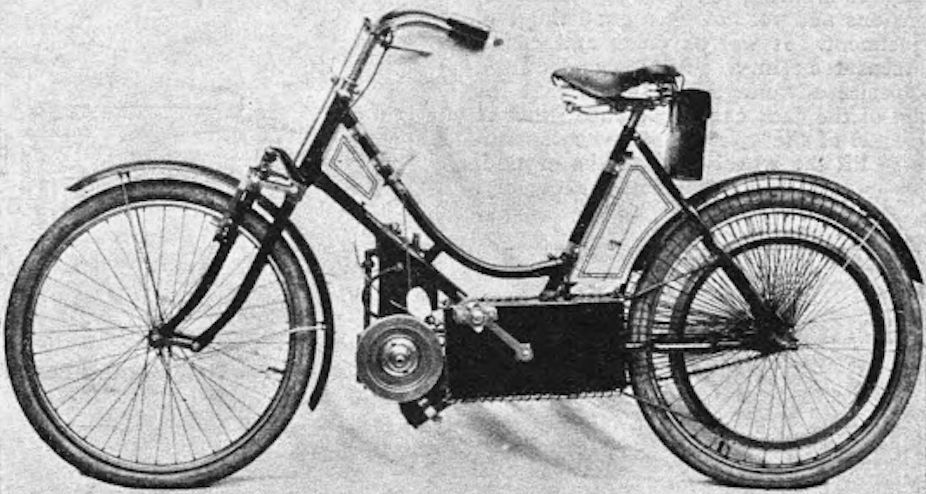
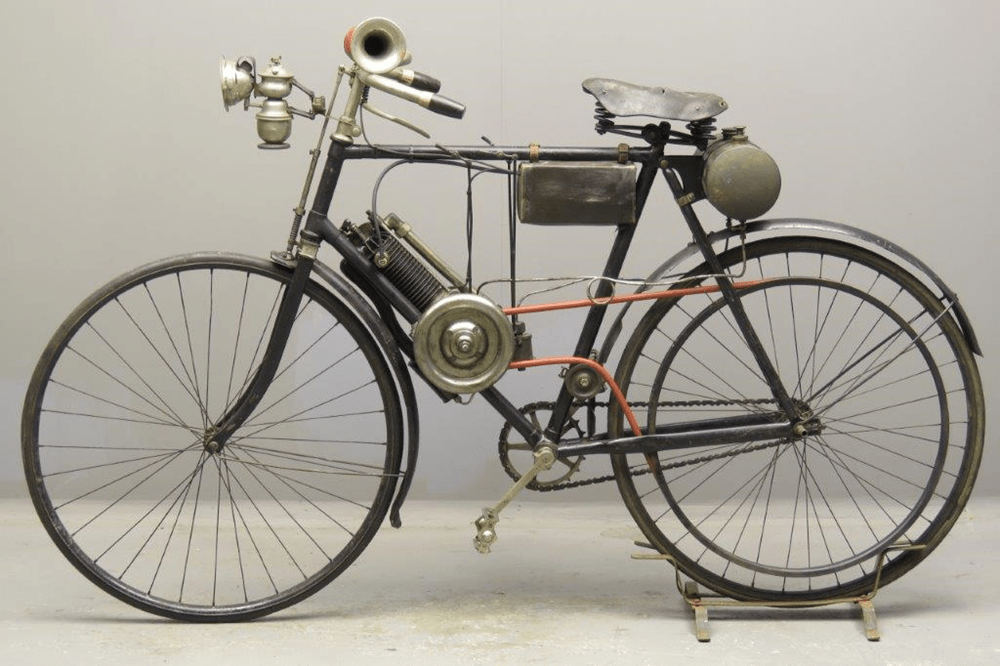
Motorcyclists will be interested to learn that AW Gamage, Ltd, Holborn, have introduced a new pattern 3hp motor-bicycle, fitted with Fafnir engine on a Chater Lea frame. It has the FN carburetter and coil and accumulator ignition. The drive is by V-belt, and there are two brakes, and the mudguards are wide and well extended. The control levers have ratchet adjustments, and the petrol capacity is extra large. The front forks are duplex, and the tyres are special Dunlops. At £35 this machine is really splendid valve, and a mount to suit the most critical rider. It has excellent hill-climbing powers, and the general finish is equal to anything we have seen. Another fine mount exhibited has a 2¾hp vertical engine built into the frame. It has V-belt transmission and a Longuemare carburetter. High-tension ignition is used and two sets of batteries are provided, including a two-way switch. The front forks are duplex, and there are two brakes and an exhaust valve lifter. This mount is £47, inclusive of all accessories. W Maitland Edwards, at Stand 241, is showing his improved non-skidder, which consists of a specially prepared toughened chrome leather cover, moulded so as to fit all sizes and makes of tyres. On the tread of the cover steel segments are fixed, with bifurcated rivets at suitable intervals. The Palmer Tyre, Ltd, Birmingham, have, as usual, a very attractive display. The nature of the exhibits does not vary from those recently shown at the Crystal Palace. Their famous cord motor tyres of the flange-fixing and beaded-edge tyres are to be seen,
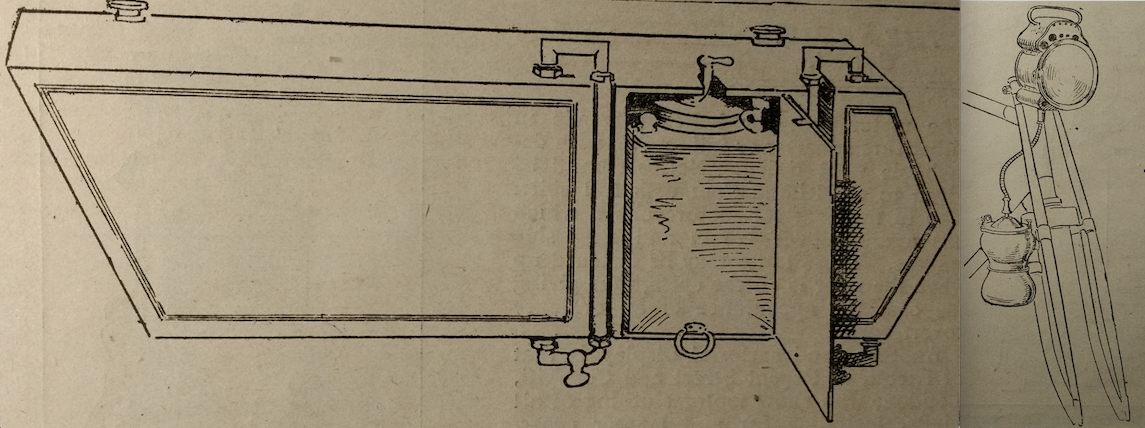
and various sizes of motorcycle tyres are also displayed viz. 2in, 2¼in. and 2½in. The last is now made of the cord fabric, and should appeal very strongly to motorcyclists who are seeking a high-class and ingeniously constructed tyre, embodying in a very marked degree speed with durability. The Fisk detachable tyre, shown by the South British Trading Co, is an American tyre of sound construction and fine quality material. Its novel point is its principle of attachment to the rim. It is clamped on by steel rims and drawn bolts, and is most securely fixed, and yet very readily dismounted for repair. Fisk single-tube tyres are another special line. They are secured to the rim by bolts. Numerous accessories are shown, including a set of the Fuller batteries, etc. Other details are steering wheels, jacks, pumps, tyre repair outfits, cycle belting, tool outfits, etc. The ‘Arclight’ lamp stands out prominently among the exhibits of H Miller and Co, Ltd, Miller. This is an acetylene lamp having a burning capacity of six hours. The Miller Tail Lamp is so constructed that it can be used for inspecting the engine. It has a red glass and a white glass, and the red glass can be folded back. It burns paraffin…The Anglo American Oil Co, 22 Billiter Street, London, EC, makes a bold bid with Pratt’s motor spirit which is so extensively used throughout the kingdom. Mr AA Godin, of 9, Littyle James Street, Gray’s Inn Road, WC, is showing a pump which will appeal very strongly to those who are tired of the old back-aching method of inflating tyres. It is put into gear with the engine, the amount of air which is pumped into the tyre at each piston stroke being the same as that pumped by an ordinary foot inflator. The indiarubber valve connection has a gauge fixed to it, in order to show the pressure of the tyre. This gauge is provided with a two-way tap, which, during the inflation, communicates with a safety valve fitted with a whistle. When the required pressure is obtained the whistle sounds, and it is then only
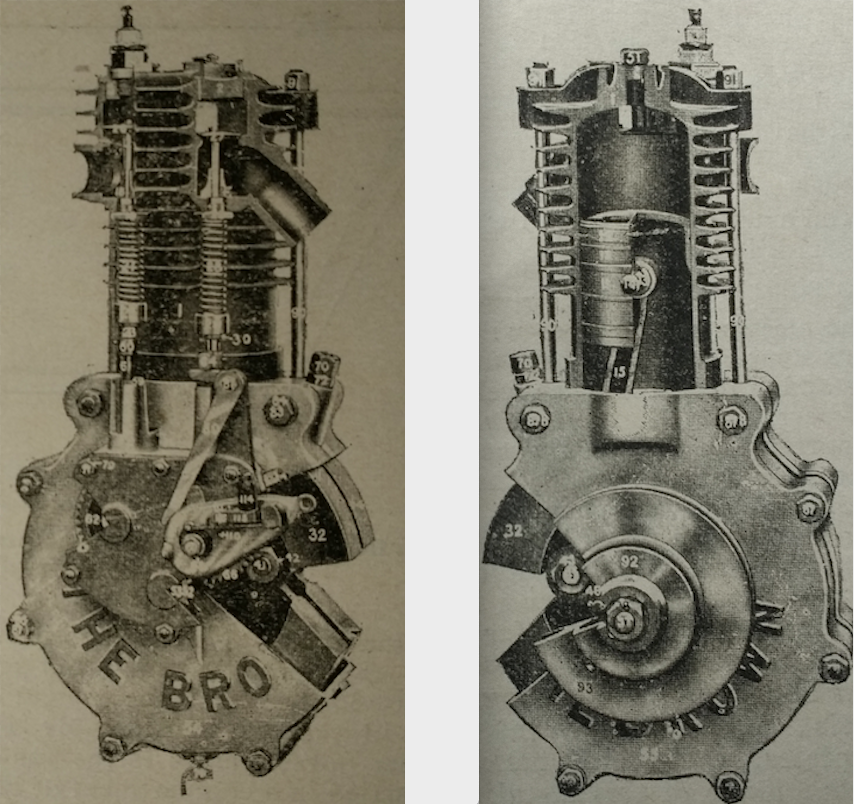
necessary to turn the tap into its second position when the surplus air will find its way out. Messrs J Bartlett and Co, of South Tottenham, London, N, have entered the list of manufacturers of lamps…The motorcycle lamp is made with a separate generator, to be clipped on the front forks…Another novel feature is the gas generator, carried in a compartment of the tank [which] is well made, with petrol and oil gauges fitted…Messrs Lake and Elliott, of Braintree is displaying a carrier-stand, which is quickly brought into operation without the necessity of undoing any screws…It is very strongly made, and when in use as a stand has a wide base of 10½in, which gives it great stability, and allows motor-bicycles to be run on it for test purposes with security. When folded up (which is quickly and readily done) it supports the carrier,
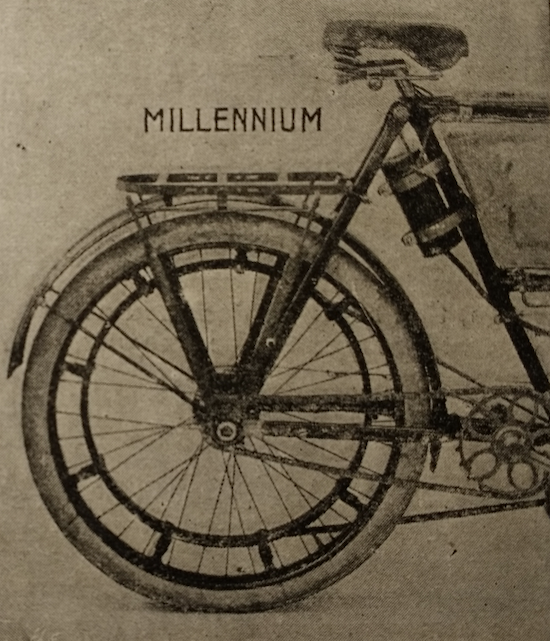
and closes up to 6½in, leaving no awkward projections to catch the rider’s leg when dismounting. A great point about it is that the luggage of the carrier in no way interferes with the use of the stand. Alfred Dunhill, Ltd, of Euston Road, London NW, have a most complete and varied assortment of their numerous specialities: jackets of various patterns, waistcoats, chrome-dressed calf skin clothing, gloves, gauntlets, overcoats, dust coats, aprons, furs, waterproofs, overalls, caps, leather over boots and foot muffs, gaiters, etc all tempt the eye…in addition, headlights, test lamps, pumps, speed indicators, number plates, altitude recorders, side baskets, goggles, motor horns, in fact, as the firm aptly puts it, ‘everything’ but the motor can be obtained here. Wass and Cocks, Ealing, show the Gripwell brake. This consists of a lever working in a clip which is attached to the compression stay of the motorcycle. One end carries a shoe which engages with the belt pulley, the other carries a pawl which comes into action by back pedalling. The power of the brake can be graduated to a nicety. It has few parts and is altogether highly effective.”
“WASS AND COCKS, Ealing, show the Gripwell brake. This consists of a lever working in a clip which is attached to the compression stay of the motorcycle. One end carries a shoe which engages with the belt pulley, the other carries a pawl which comes into action by back pedding. The power of the brake can be graduated to a nicety. It has few parts, and is altogether highly effective and sold at the moderate price of 15s. Several readers who have tried it, speak well of the device. It is shown in action and should not be missed.”

A selection of the ads that accompanied the show report may be found in the ad section at the end of this page.
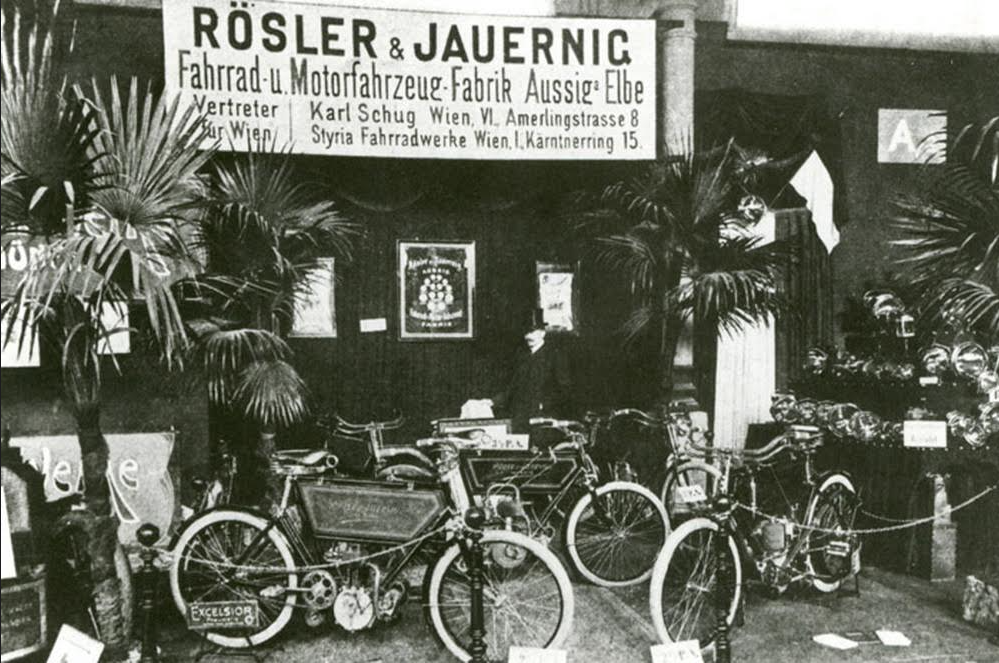

“IN REPLY TO Mr Stewart-Brown’s letter, I may say that I have owned a Bichrone motor-bicycle for about seven months. I can say that I am very pleased with it indeed, and find that it does all that the makers claim it to do. It is fast and thoroughly reliable, and, as your correspondent says, is a really splendid running mount. I went on a test run of 20 miles in 45 minutes the other day and consider this is not a bad run at all, as the road is very hilly in parts. The construction of the motor is of the simplest kind, and if anything does go wrong you can lay your hands on it in a moment. The valves never want grinding-in, and the doing away with an exhaust spring (which in time is bound to shrink a little with heat and necessitate a new one being put in its place), is a great saving of time and annoyance. There is no vibration whatever except that caused through the unevenness of the road. The machine has a flat belt fitted, but I believe the makers can supply the engine with a V-shaped pulley if preferred. The only troubles experienced were the splitting of the lock nut on the inlet valve and the wearing through of the pulley wheel, which is made of rather too soft a metal. I have had fitted in its place a cast steel one, which, of course, will not wear down at all. The engine never overheats, and a trailer can be taken out without fear of any overheating on hills.
F Arthur Cobb.”
“SPRAY VS SURFACE CARBURETTERS. The Motor recently published a letter of mine asking for suggestions as to a marked want of power, the cause of which had eluded me during all the nine or ten months I had the machine, a Swift bicycle, 1903, 2hp Ariel engine. You may be interested in learning that I have solved the problem by substituting a spray carburetter for the original surface pattern. The results are very striking. It now climbs hills which formerly it would not look at, and I am sure quite 40%, has been added to the speed. Best of all, there is a gratifying sensation of power, a feeling that there are reserves to draw upon if required. The frequently-recurring letters in The Motor on the relative advantages of surface and spray carburetters prevented me heretofore from trying the experiment, but I cannot now comprehend why there should be any question as to their respective merits. Perhaps it is not reasonable to draw conclusions from an individual experience, but assuredly they would be powerful arguments which would induce me to revert to the surface type.
‘Voltmeter’.
“THE DOG FIEND. As one of the latest victims to the above terrible nuisance to motorcyclists, being still in the doctor’s hands for treatment, I wish to obtain the views of other readers of your esteemed paper as to what can be done to protect oneself from this curse to motorcycling. My own case is briefly stated as follows: I started out for a ride on my Clyde machine, and when travelling at something under 20mph down the main road, I presently became aware of a dog racing alongside the front wheel of my machine, hugging it quite close: this continued for some little distance, during which I did all in my power to distract the dog, shouting at him and trying to frighten him off, but without effect: then, suddenly, gaining slightly on the machine, the dog slipped across in front of the wheel, and down we all came. I was shot over the handlebar on to my face and received very considerable damage. In fact, it is a wonder I was not killed. Now, sir, I love motorcycling, but I confess I fear the dog. Many of your readers must have had experience of this pest, and may possibly have found a way of dealing with the evil, and be willing to give their experience, and it is with this view that I write to you. I may say I have ridden a motorcycle since 1902, but have never before met with such a determined case as the above.
AHI.”

“A NEAT LADY’S MOTOR-BICYCLE. The lady’s motor-bicycle depicted in the illustration is a special one constructed by the Hulbert-Bramley Motor Co, 19, Grand Parade, Putney, to the order of Mrs Kennard, Market Harboro’. It is fitted with a 2¾hp Minerva engine fitted in a slanting position. The ignition is by trembler coil, brush contact, and a double set of accumulators. The control is entirely effected from the handlebar. There are sight feed gauges for petrol and oil, and the belt is protected by an efficient guard.”

“A PATENT PETROL SUPPLY TANK. An improved spare petrol supply tank has just been introduced by WM Mollison and Co, Anniesland, Glasgow. It is specially constructed for motorcycle use. The special feature about it is the method of securing it to the frame of the cycle. There are two clips on the tank, and one is fixed to the. left-hand compression stay, and the other is fixed to the step of the back wheel hub. The tank is thus well out of the way, and the weight is kept low down. It is made in japanned sheet metal, and the capacity is ½ gallon, and weight 22oz. The clips can be supplied to suit any kind or size of tube. The price is 9s per pair, or 5s each.”
“AN AUSTRALIAN-BUILT MOUNT. The illustration depicts a motor-bicycle designed and constructed by Edgar Tozer, of the Albion-Magnet Motor and Cycle Co, Nicholls Lane, Melbourne. The outline of the frame is somewhat uncommon, there being a double lug at the bottom of the head tube, and a second tube is fitted in this, a small cross lug joining it with the main down tube. The engine, which we should say is 2¾hp, is held to the frame by lugs gripped by the crank case bolts. The silencer is of the American wirewound pattern. Strictly speaking, this is not a silencer at all, as it simply consists of the exhaust pipe being blocked at one end and its surface drilled all over with small holes. A layer of wire is closely wound over it. A curious feature of this machine is the rear pulley: apparently this is a flat one, with a V-belt driving on it—hardly correct practice, though it may work. The carburetter is a spray type and ignition is high tension. One front rim brake is fitted. The maker of this machine, in his letter to us, mentions the great value ‘The Motor’ has proved to the motor industry in Australia, which is rapidly growing. He says, ‘What motor news is not to be found in ‘The Motor’ is not worth having, as its special scope in light vehicles is specially suited to the country’s requirements.'”


“A NEW CHAIN DRIVE BICYCLE is a type constructed by Kelly, Boumphrey and Co, 73, Market Street, Birkenhead. The motor is 3hp (75x80mm), and is mounted vertically in a specially-designed frame. There are cross-tubes fitted between the back forks and diagonal and one from the diagonal to the engine. There is also a second horizontal tube. This arrangement gives great lateral strength. Girder front forks are fitted, having slotted ends. The special points about the engine are the one-piece cylinder and head, mechanical valves, extra long bearings and ready accessibility of the valves and all parts that may require to be got at. The fly-wheels are extra large and heavy and the maximum speed is kept low (1,500 revs). The silencer is extra large and efficient.The carburetter is a Longuemare and ignition is by Van Raden high-speed trembler coil. The transmission is by Hans Renold ⅝ chain from engine sprocket direct to back wheel through a friction clutch. This clutch is capable of adjustment and can be thrown in and out of gear by means of a lever on the top tube, thus giving a free engine at will. A spare tank is fitted behind the diagonal. The price complete, with all tools, etc, is 42 guineas.”
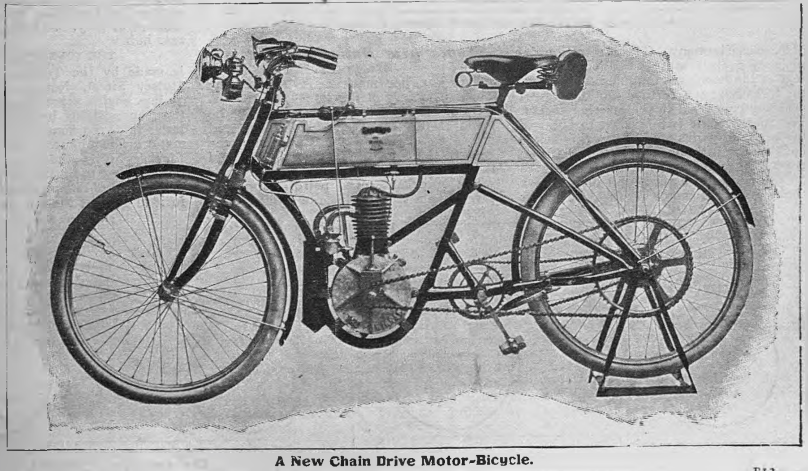
“A GERMAN-BUILT SPRING FRAME MOTOR-BICYCLE. The manufacture of motorcycles proceeds apace in the Fatherland. One of the latest productions is a spring frame machine on somewhat novel lines. The makers are Messrs Rösler and Jauernig, of Aussig, Germany. The front and rear of the frame are mounted on springs, the forks having a vertical motion against a spring concealed in the steering socket. The rear triangle is hinged at the bottom bracket, and works against a spring at the back of the diagonal tube. The ignition is by a magneto-electric machine mounted on the main down tube, and driven by a chain from the motor shaft. The motor is 2½hp, mounted vertically in brackets between the two main tubes. A spray carburetter with throttle valve is used, and the transmission is by a V-belt. A band brake is fitted to the rear wheel.”
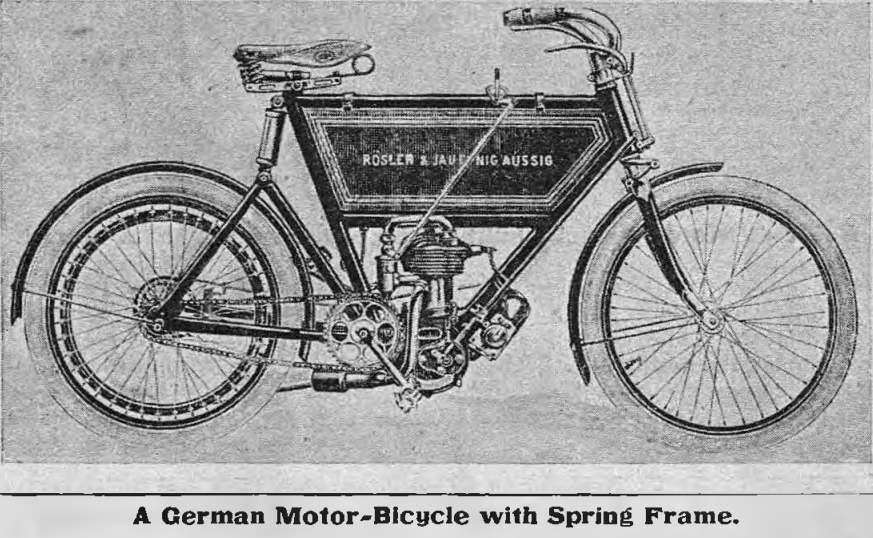
“THE RAMBLER MACHINE is built at the Chicago factory of the Pope Manufacturing Co. It has a 1¾hp motor, taking the place of the usual diagonal tube, and drives by chains—a short one from the engine shaft to pedal crank axle, and thence by another chain to the rear wheel sprocket. The petrol supply is carried in a tank behind the saddle. The ignition is by dry battery and coil, these being carried in tubular cases fixed on the down tube. The upper case contains the coil, and there is a special compartment formed in one end of it which acts as a receptacle for tools. A new feature on this make is the automatic lubricator. Mounted over the cylinder head is a circular oil tank, and this connects to the crank case via a sight feed tube, through which the oil is sucked automatically. The carburetter is a special type of float feed, with air and throttle adjustment. The control of the machine is effected by one lever on the handlebar—this opens the exhaust valve, then the throttle, and further movement advances the spark. A friction clutch or cone is mounted on the engine shaft to allow a small amount of slip at starting. The front forks are of an ingenious spring action type, a double bearing guiding surface is constructed on each side just below the crown, thus providing a joint, so that the forks proper pivot at this point. Combined with this joint are specially constructed springs, which allow the forks a certain amount of play. A brake is fitted in the rear hub.”
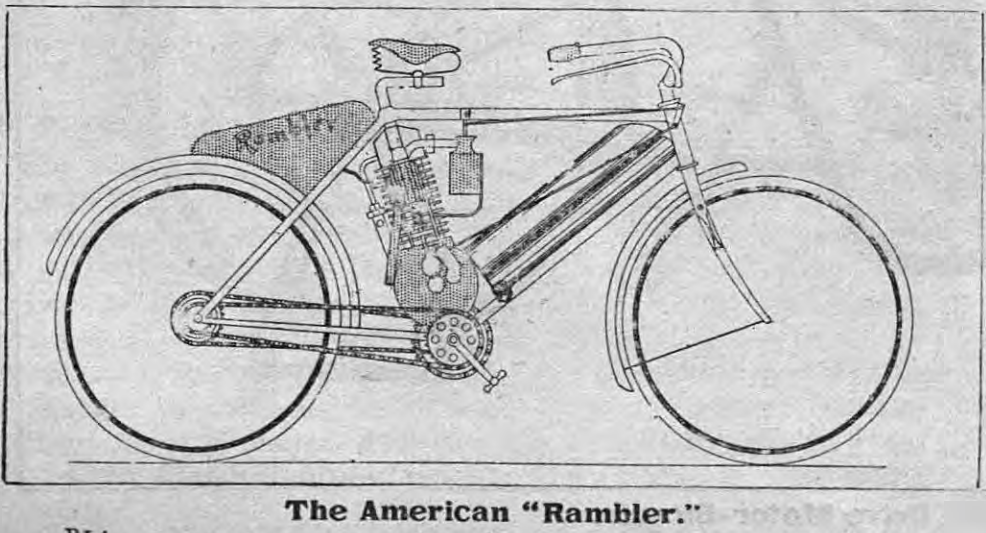
“THE TOURIST MACHINE is made by the Tourist Motor Co, 97, Halsey Street, Newark, NJ. It has a 3½hp engine placed in an inclined position, and driving by a belt. The carburetter is of the float feed type, with automatic air regulator. The ignition is by four dry cells and a coil. It will be noticed that the main and diagonal tubes are formed of one piece, with a loop made in it to support the motor. Control is by a lever on the handlebar, which actuates the exhaust valve and contact rocker and advances the spark. The throttle valve is controlled by a small pedal actuated by the right foot, and this also puts the rear brake on. Lubrication is effected by a sight feed oiler mounted on the crank case. The petrol capacity is large, being 2¼ gallons. The batteries and coil are carried in a separate compartment of the tank.”
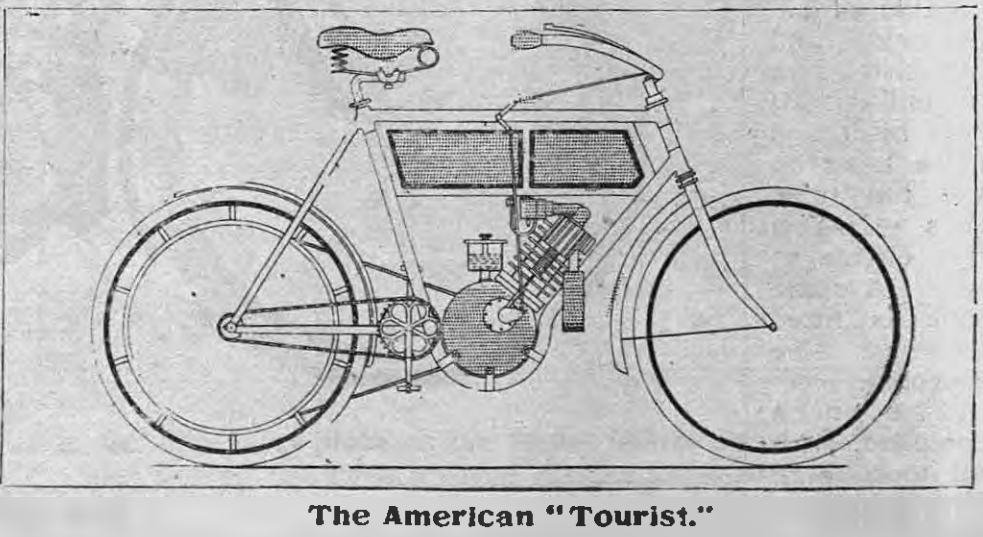
“FOR MOTORISTS OF TASTE, who take exception to the raucous noise of a horn, the new Cathedral Chime bell can be recommended. One of ours has used it for some weeks on a motor-bicycle, and finds that it is as effective as a horn for road clearing, and is evidently better received by the general public because of its musical and less domineering note. It clips securely to the handlebar, the operating lever is in a convenient position for prompt action, and, so far, it has not shown signs of developing any looseness or rattle. It has a double gong, and when the two well-blended notes are sounded the general impulse is to look round for a steam car. It is introduced by Messrs Seabrook Brothers, Featherstone Street, EC.”
“WE HAVE PREVIOUSLY NOTICED the pillion seat, which is the invention of Mr Rowse, of the Cycle Trade Supply Co, Edgware Road, W. A member of our staff has just completed a trial of a motor-bicycle fitted with the device, and finds that it is a method of conveying a passenger that demands less power than any other previously tried. A little practice is required in order to mount the machine and take up the passenger successfully, but once that stage is passed all is plain sailing. It is not very sociable; conversation was not easy, especially with the strong winds recently prevailing. The main impression left by the experience was the amount of attention bestowed by holiday-makers and the free comment.s passed by them upon the rider and his fair passenger. For use over wet roads, we think some non-slipping device should be fitted to the tyre, otherwise the likelihood of side-slip appears to be considerable, because of the weight being so concentrated over the back wheel.”

“THE ARIEL COUPLER has recently been experimented with by a member of our staff. The invention constitutes a means of attaching a safety bicycle to a motor-bicycle. The device consists of the three parts illustrated. Fig 1 is built of tubing, the corners are not rigid, but allow a considerable amount of lateral play. Sleeves are fitted on the side tubes, and these, being shorter than the tubes, also allow for automatic adjustment. The ears on the sleeves are attached to the front wheel spindles of the bicycle and motor-bicycle. Fig 2 is an adjustable sleeving-tube, hinged at each end, and carried by triangles which clip to the handlebar of each machine. Fig 3 is an adjustable tube which is attached to the back wheel spindle of the bicycle and clamped to the chain stay of the motor-bicycle. The special connections as indicated in the illustration are flexible. Mounting and dismounting need to be practised. We found it best to allow the lady to mount and get firmly seated before pushing off, and when dismounting we slowed down and dismounted from the pedal just before the machines came to a standstill. So far, the writer has not experienced any method of conveying a companion which is more delightful than this. The coupled-up bicycles are too wide to go through the usual-sized front door of a suburban house, but can quickly be detached. It is claimed that the coupled machines will not side-slip. One of our rides included 50 miles of wet and greasy road, finishing up with some miles of tram lines, without experiencing a fall or slip.”

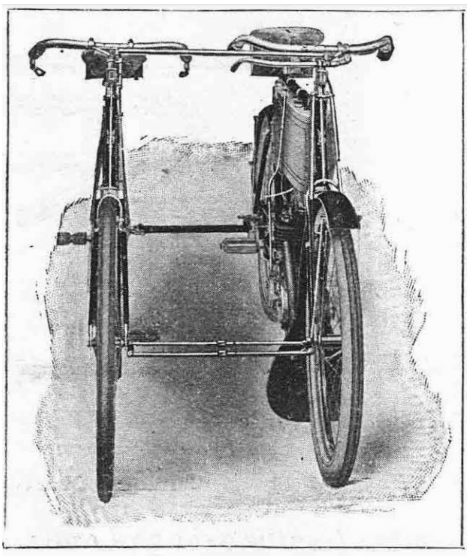
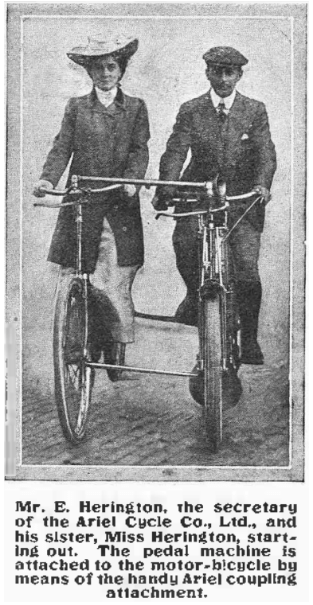
“AN AMERICAN FIRM of Cleveland, Ohio, have just placed on the market a new combustible called Energine, which, they claim, effects a saving of 42%, weight for weight, compared with petrol. Other advantages claimed for Energine are that it is colourless, odourless and non-carbonising.”

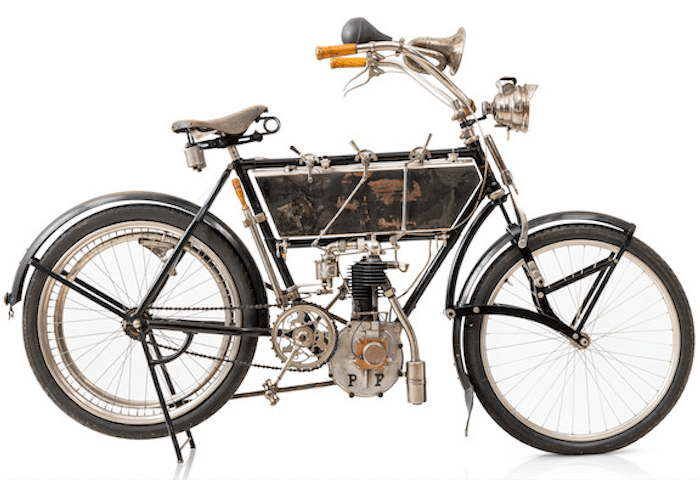

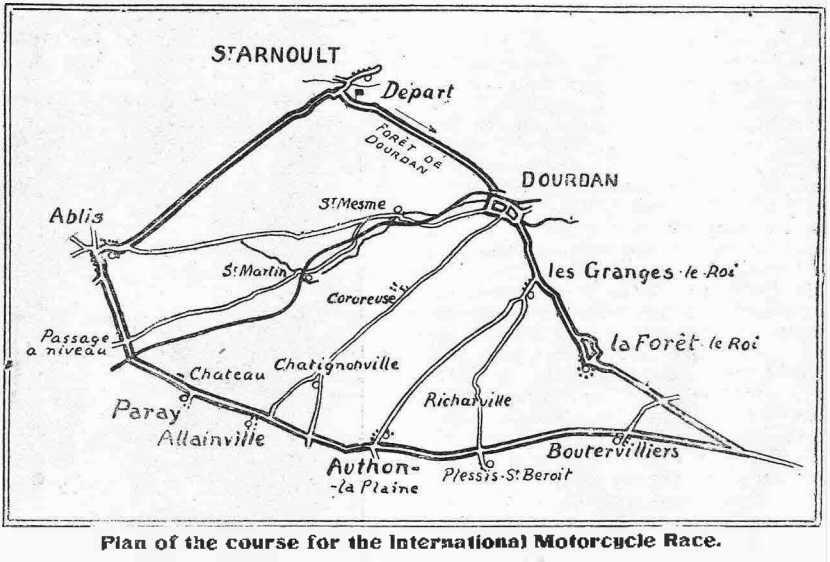
THE FRENCH ELIMINATING TRIAL. The ‘Little Gordon-Bennett’, as they are calling it in France, is attracting increased interest as the eventful day (September 25th) draws near. The eliminating trial, to decide which of the 15 French entrants should represent France, was held…over the same course as that selected for the cup race itself. Three Buchets, three Peugeots, three Griffons, three Lamaudieres, one Aiglon, one Rigal, and one Mayeski made up the sum total of the competitors. The Peugeot people were fortunate in being able to command the services of three such capable motorcyclists as Cissac, Lanfranchi and Yourassof; the Griffons had an equally powerful team in Lamberjack, Demester and Inghilbert; and the mighty Anzani held out hopes of at least one Buohet machine qualifying for the international race. Nevertheless, the trial really resolved itself into a struggle between Griffon and Peugeot. At the outset the supporters of the latter machine were dealt a cruel blow. Early on the morning of the trial—indeed, within an hour of the actual start—Cissac’s bicycle was put hors de combat: a careless smoker set the petrol tank ablaze, and before the flames could be extinguished irreparable injury had been done. The Peugeot ‘star’ had to play the part of onlooker…the Griffon trio qualified for the cup race; Lamberjack’s average speed, works out at 74.88 kilometres (about 47 miles) an hour…The arrangements of the French Motorcycle Club were very satisfactory.”
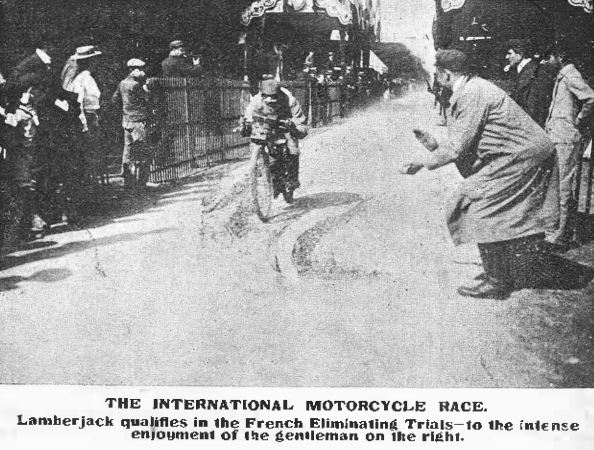
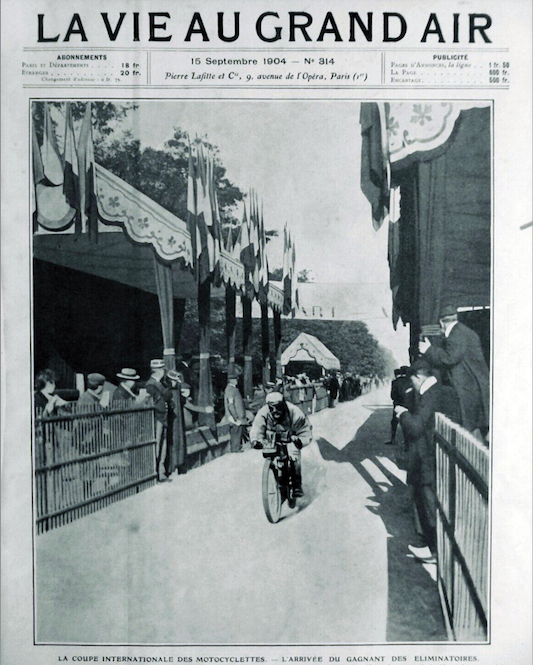
“THE FIRST RACE for the International Motorcycle Cup founded by the Motorcycle Club de France, with the object of having for the light motor machine a similar event as the Gordon-Bennett Cup is for the cars, was held on Sunday last. Representatives of no fewer than five countries competed. Victory eventually rested with France, as was generally anticipated, Demester taking first place, but the visitors were by no means disgraced, as the detailed report will show, inasmuch as the race was marred by numerous punctures caused by nails thrown on the road. Splendid weather favoured the race, the sun shining brilliantly as soon as daylight appeared, and not being obscured afterwards by a single cloud during the day. The early hour of the start, and also the fact that it took place in a district situated some 50 miles from Paris, made it very inconvenient for many people to assist. Nevertheless, there must have been more than a thousand present when the first competitor started. And as the day wore on hundreds of spectators kept arriving, so that by the time Demester passed the post a winner, the above attendance must have been at least trebled. Many of the familiar faces one is accustomed to see at all automobile gatherings were present, as well as a number of delegates from the foreign countries represented in the contest. As the weighing operations had taken place on the Saturday, the starting formalities were quickly dispatched under the able guidance of the members of the committee, chief among whom ought to be mentioned Messieurs Deckert and De la Hausse, who spared no effort in the organisation of the race throughout. The start was given at 6am sharp by Mons Tampier, the official time- keeper, all the other men being afterwards sent on their journey at intervals of two minutes. In all there were 11 starters. These were as follow: (1) Lamberjack (France), Griffen; (2) Wenceslas Vondrick (Austria), Laurin et Klement; (3) Rignold (England), Lagonda; (4) Adolf Mraz (Germany), Progress; (5) Niels Petersen (Denmark), Jurgensen; (6) Inghubert (France), Griffon; (7) Toman (Austria), Laurin et Klement; (8) W Hodgkinson
“THE INTERNATIONAL MOTOR-BICYCLE RACE. When the newly-founded Motorcycle Club de France conceived the idea, about six months ago, of promoting an international motorcycle race, little did its members think that it could be made a real success, at least for the first year. It was generally thought that all that could be done in 1904 would be to launch the idea, and that this year’s race would be little more than a contest between French makers. However, things have assumed an entirety different aspect since last spring, as will readily be understood when we remind our readers that the race on Sunday next will bring together teams of five different nations, namely, France, England, Denmark, Italy, and Germany. The absence of Belgium is much to be regretted, since this country has made quite a hit in the manufacture of the motor-bicycle and, on paper, had a splendid chance of winning the race. It is to be hoped that next year’s contest will see their colours represented. The course for next Sunday’s race is exactly the same as that used for the French eliminating trials. The conditions of the race allow three machines only to each nation (as in the motorcar Gordon-Bennett) and each machine must be provided with two brakes and pedals. Five laps of a 34-miles’ course have to be covered, and three controls (representing a delay of 16 minutes each lap) are included in the triangular course. Competitors will be started at one minute intervals. Teams and colours are as follow: Austria (black), not finally selected; Denmark (red), Mich Petersen (Danish Humber motor-bicycle); France (blue), Lamberjack, Inghilbert and Demester—all on Griffon machines; Germany (white), Tolksdorf and Mraz (Progress-Charlottenburg motor-bicycles); Great Britain (green), Harding (Lagonda), Hodgkinson (JAP), and Silver (Quadrant). Late information has been received to the effect that Laurin and Klement are building machines to represent Austria.
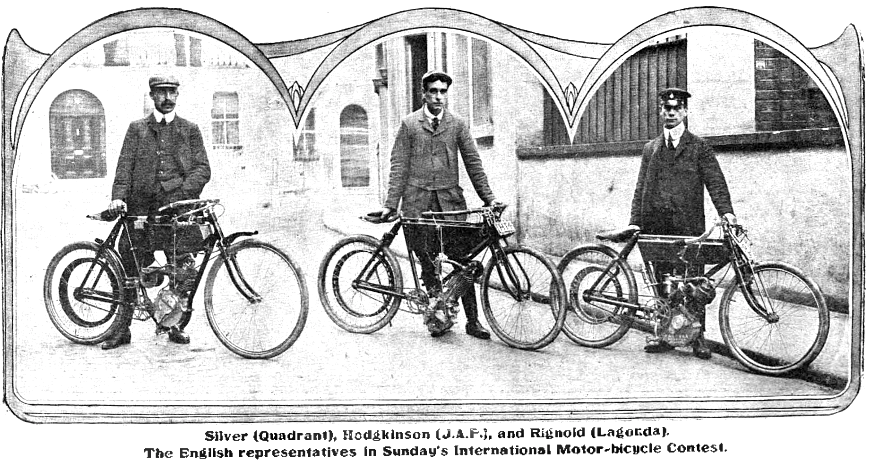
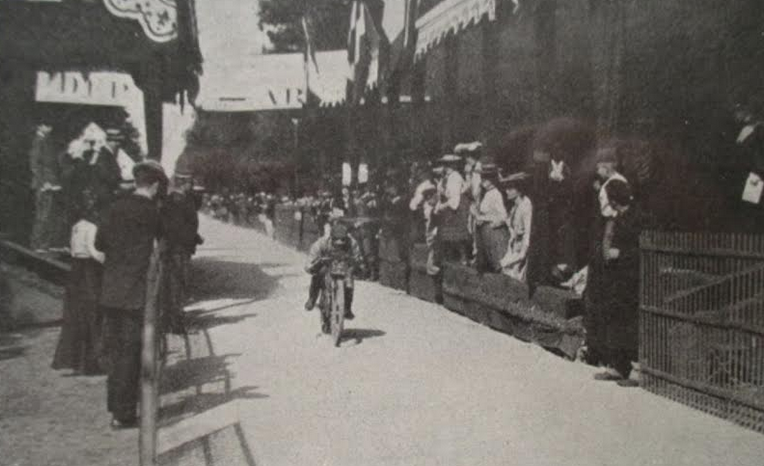
(England), JAP; (9) Em Tolksdorf (Germany), Progress; (10) Demester (France), Griffon; (11) Thomas Silver (England), Quadrant. The third member of the German team, Mueller, did not start, his machine having been injured by fire, on Saturday. Twenty minutes had elapsed since Tampier gave the last ‘go’, when the leader on the first circuit—distance 54 kilometres, or a bit under 34 miles—the Austrian, Vondrick, rushed by, amid the cheers of an evidently interested crowd. He had covered the first lap in 56 min 31sec, gross time, and was closely followed by Petersen, of the Danish team, while Demester, who passed fourth, was the first Frenchman to appear. Lamberjack, who was a hot favourite, arrived last, a long way behind. He complained of several punctures caused by nails. Two members of the English team were also victims of this dastardly passed third, being the only English competitor to complete the first lap. In all, nine riders passed this before time, but before the second circuit was completed the punctures had reduced the field to six. This time, again, the Austrian, Vondrick, was leading, while Demester had run into second place, only six minutes behind the leader. England’s last hope was gone with the retirement of Rignold through punctures. When the third circuit was completed, it was seen that France had taken the lead with Demester, and although Vondrick passed second, he was as much as 19 minutes behind the leader. Only five of the eleven starters had survived at that point of the contest, and with no changes in positions taking place during the fourth circuit, the victory could now only be taken by accident from France, who had still three representatives left in. No incidents or accidents were, however, recorded, and Demester, slightly increasing his lead, scored a highly popular win for the heme team; while Toman had the honour of taking second place (more than one hour behind) for Austria; and the Frenchman, Inghilbert, was third, 20 minutes later. The official net time of the winner for the 270 kilometres (about 169 miles) was 3hr 45min 0⅖ sec, which averages about 45 miles an hour, not nearly so good as the speed attained by Lamberjack in the French eliminatory race over the same course. The names and times of the, competitors who finished are as follow: (1) Demester (France), 3hr 45min 0⅖ sec; (2) Toman (Austria), 4 hr 53min; (3) Inghilbert (France), 4hr 14min; (4) Lamberjack (France), 4hr 44mins; (5) Vondrick (Austria), 5hr 4min. Only the first three finished in standard time. The comparatively slow times and small number of finishers is accounted for by the fact that every one of the competitors sustained several punctures, for reasons indicated above. The committee intend to send a complaint to the police authorities with a view of discovering, if possible, the authors of the mischief. (We have since heard by wire that the stewards have declared the race void.)
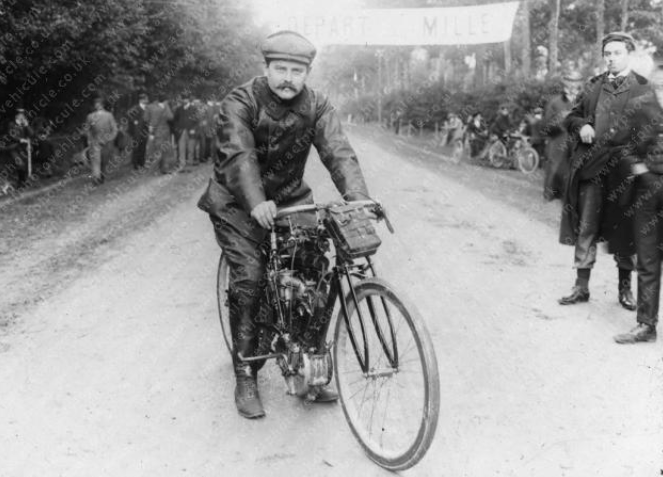
ONCE THE DUST had settled The Motor Cycle had its say: “The most important motor bicycle event of the whole year, in which the honour of nations was at stake, is over. England made a plucky fight for it and lost, and, with that doggedness innate in every man born under the Union Jack, British manufacturers must enter again and again until the cup is carried. As regards speed, the race was intensely exciting, and, as is too often the case on these occasions, turned into a trial, not so much of general reliability as of tyres. The nails that were found on the road were stated to be strewn from one side of the road to the middle, leaving the other side quite clear, thereby proving that this dastardly and unsportsmanlike act was carried out with the intention of rendering certain machines hors de combat while others might avoid

them. The Frenchmen had a complete system whereby their representatives could obtain spares, as racing motor bicycles laden with these necessaries toured the course in the opposite direction to the competitors, whom, of course, they met at frequent intervals. Previous to the race Demester’s machine was weighed and found to scale 49.75kg. It was then given a thorough clean down with petrol, was weighed again, and again found to be too heavy. Its high-tension wire was then shortened, and having received other small attentions it was weighed again, and this time declared to he within weight by the acting commissioner, and though it was said a verbal protest was about to be lodged the matter was allowed to drop. Then came another surprise. The subcommittee, instead of referring to the International Commission, informed the press that the rare was annulled. The French daily automobile press then made an outcry against this, saying that when nails had been found on the Paris-Bordeaux and the Circuit des Ardennes courses neither of these races had been cancelled. This produced another startling revelation, for a member of the sub-committee wrote a letter to Le Velo, saying that, were the reasons actuating
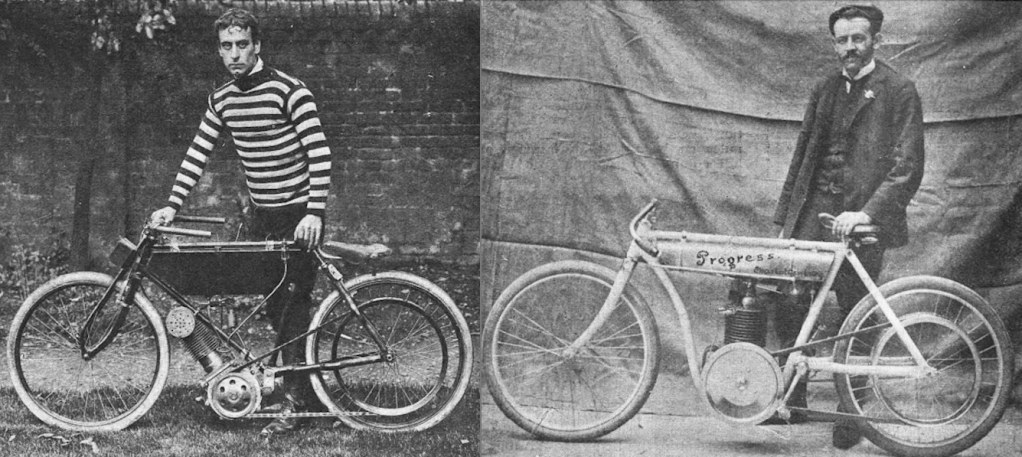
them known their conduct would be universally approved. What the reasons were is a secret, but it is clearly evident that it was not the presence of the nails. Then the International Commission, amongst other business, declared their decision final, which was, of course, obvious from the Gordon Bennett rules, which the Commission vigorously followed as far as they were applicable to motor bicycles. As may be imagined, therefore, the meeting was a stormy one, and lasted over four hours. At the banquet given to the competitors and officials, M Bardin, president of the MCF, made a pleasant speech, which was heartily received. Mr O’Gorman, delegate of the Auto Cycle Club, in proposing the health of the president, pointed out that no doubt everyone thought that the English competitors and he were depressed at the results of the race; if that were the case they were much mistaken, as they were determined to try and lift the cup another year. Other speeches were then made by various journalists, a vast staff of whom were present; and it eventually fell to Mr O’Gorman to propose the health of the winner. Messrs Priest, of the Quadrant Co., Prestwich, and Wilbur Gunn, were present. There is no doubt that but for the hard work done by the Auto Cycle Club, England would never have been represented. Of the manner in which it gave the competitors every assistance, and its promptness in carrying out all the arrangements in record time, we cannot speak too highly; while the competing firms are to be heartily congratulated on their enter prise. But most of all, every British motor cyclist must be thankful to Mr M O’Gorman, of the ACC, on whose shoulders the brunt of the arrangements fell.”
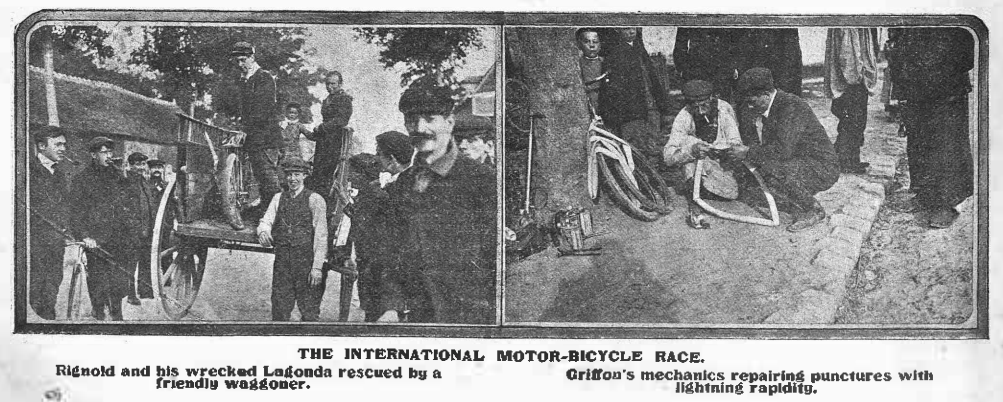
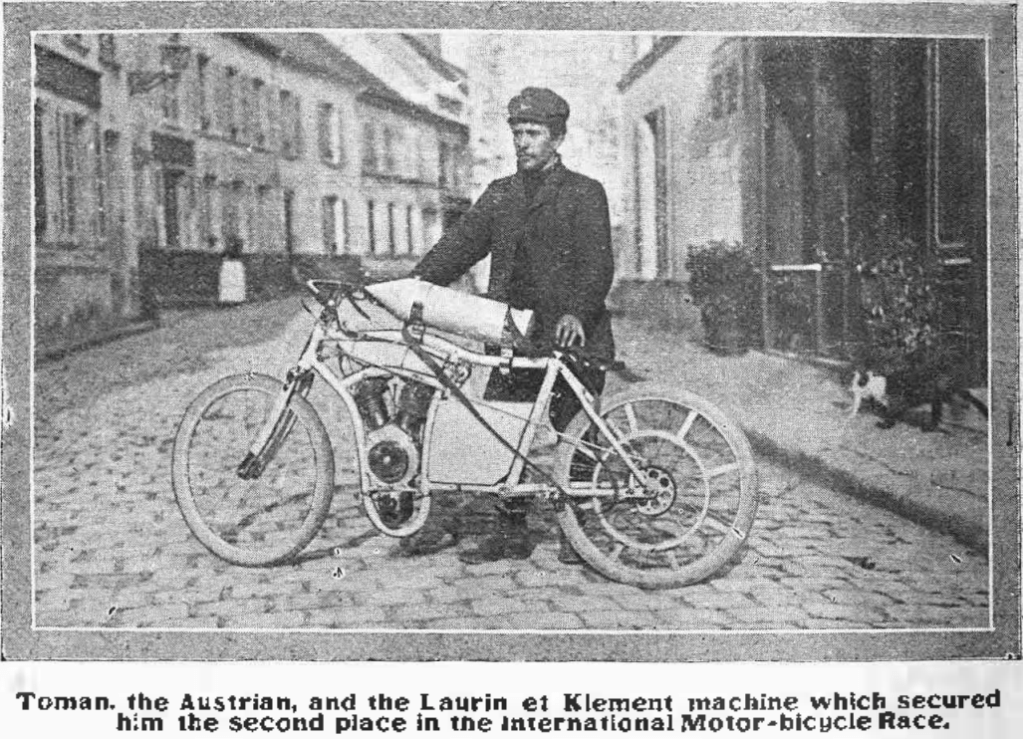

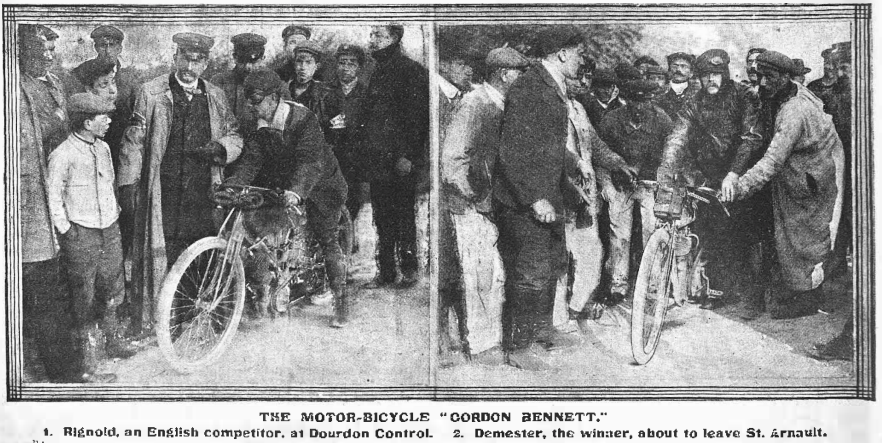

“A REPRESENTATIVE OF The Motor has been able to gather from authoritative sources information as to what really happened on the occasion of the international motor-bicycle race which took place in France on Sunday week…Preliminary spins were taken over the course, and in one or two unofficial tussles they had with Lamberjack and Demester they proved that their expectations were not too optimistic. The French competitors completed their preliminary spins on Saturday morning: on Saturday afternoon our men went for a final run around the course, and, just beyond Authon, Silver, on the Quadrant, ran into a patch of large stones strewn all over the road for some distance. One of the stones jammed between the back forks and the wheel, buckling the rear rim and smashing up the rear brake. Fortunately such an occurrence had been provided for, and Silver had his machine in good going order again by the evening. Why the stones were put down after the Frenchmen had completed their training spins was somewhat of a mystery, as they were cleared away prior to the start of the race at 6 o’clock on Sunday morning. The explanation tendered to our official representative was to the effect that the folks at Authon had decided to repair their roads on this particular afternoon…The decision as to definitely allowing outside assistance was only officially communicated to the British team at 11pm on the night preceding the race, and when Mr Gunn went around the hotel and informed the men, the tidings could hardly be believed. Both our manufacturers and competitors had made all their arrangements strictly in accordance with a typewritten circular issued to them by the Auto-Cycle Club of England, which professed to be a faithful translation of the French printed regulations: ‘Competitors are forbidden to replenish at the controls, or to obtain help for repairs; the competitor alone must do his own repairs, and he must not replenish on neutral ground.’ The French riders made it quite apparent that, rules or no rules, they meant winning the cup. At 6am on Sunday Monsieur Tampier, the well-known French timekeeper, who, as usual, was early at his post, started the race. All the British team were going well up to Anthon; Hodgkinson, on the JAP, had taken the wrong road through the control at Dourdan, as no pilot cyclist was visible to take him along; in spite of this he passed two men. Silver, on the Quadrant, had passed one man, and Rignold, on the Lagonda, had passed Lamberjack, the distance then covered being about 20 miles. Hodgkinson, later on, discovered that one of the men he had passed was Adolf Mraz, who had started at 6.6; as Hodgkinson had started 8min later, at 6.14, and at 20 miles had overhauled Mraz, his pace must have been a very hot one, as Mraz was timed to do the first round of the course (33½ miles) in 41min 23sec. Just beyond Authon Silver’s front tyre subsided, and upon dismounting he pulled out three round-headed hob-nails: not the sort we know in England. The nails are peculiar because, if thrown down, 90 out of 100 would be certain to rest with, the
point upwards. Whilst the solution was settling on his inner tube, Silver noticed a man in the distance (to his rear) busily sweeping the stretch of road he had just covered. Upon Silver’s approach the sweeper hurriedly disappeared up a side lane, and a cyclist who was standing beside the sweeper, jumped aboard his machine and scurried away. Silver picked up several of the hob-nails and some tacks, ⅝in in length, all being quite new and unsoiled, as if just thrown down. Silver met with several punctures in the next mile or two, until a sudden deflation of his tyre precipitated him into the side of the road, and finding his front wheel buckled he decided to abandon the race. Hodgkinson’s experience was very similar to Silver’s. Entering Ablis both his tyres suddenly punctured (new hobnails again) and his machine slipped suddenly from under him, letting him down heavily. Rignold got through the first round with only one puncture, and then did 50min. 8sec. Soon after passing Dourdan for the second time he punctured (new hob-nails), and his rear tyre collapsed, causing the machine to swerve; Rignold was thrown off on one side of a bank, the machine bounded over into a field on the other side and turned a few somersaults upon its own account until it came to rest with a wrecked rear wheel, bent front forks and handlebar, etc, etc. Our men are quite certain that the French race officials were in entire ignorance of the hob-nail game until Silver told them at Authon. That the nails were placed on the roads with intention of inflicting malicious injury upon some of the competitors there can be no doubt. From various statements made to us the nails do not appear to have been thrown down indiscriminately, but were laid in those places which a man on a fast machine would naturally take, such as inside of a bend or big turn…whatever was intended, the cup remains in France, and in spite of the hobnails the plucky Toman, on a Laurin-Klement, nearly succeeded in taking it to Austria. Toman’s times are really remarkable. Taking the distance of a lap as being 33½ miles, he must have covered some portions of the road at almost 65 miles an hour, and his total average speed works out at over 58 miles an hour. The winner’s time (Demester) was also truly remarkable, as he reported having had four punctures; how these punctures could have occurred does, not quite appear, unless some magic tyre-repairing methods were adopted.”
“THE ACTION OF the International Racing Committee in cancelling the decision of the stewards who annulled the motorcycle race in France is sharply criticised in Germany as prompted by chauvinism and calculated to cause great dissatisfaction in international sporting circles.”
IXION SUMMED UP the event in his glorious Reminiscences of Motor Cycling*: “The Motor-Cycle Club of France offered a valuable cup for an international race at eight weeks’ notice. France would have won in any case, but so brief an interval gave us no chance to prepare. A course of 168 miles in five laps near Dourdan was selected, and the French club held eliminating trials on September 11 over the actual course. Thirteen riders contested the three places, which were all secured by Griffon machines, the winner averaging 46.5mph—a fine feat for those days. We selected Hodgkinson on a JAP, Rignold on a Lagonda, and Silver on a Quadrant, and all three firms found it very difficult to get down to the stipulated weight of 108.5lb. France, Austria, Great Britain, Denmark and Germany were represented in the race on September 26, though only 11 men started. Of our team Rignold was the only man with racing experience, and he was a track rather than a road man. None of the three threatened danger. Demester on a Griffon won comfortably in slow time, but Vondrick on an Austrian Laurin-Klement gave the Frenchmen a rare fright.”
* You’ll find the entire book at the end of ‘Tales from The Motor Cycle‘ in the main menu: it is impossible to over-praise it.—Ed

“TO DISCOVER THE NAILSTREWERS. In connection with the recent race for motorcycles in France for the International Auto-Cycle Cup, the Auto-Cycle Club of England suggested that a fund should be established to provide a reward for the discovery and conviction of the miscreants who placed the nails on the roads, and offered to give a sum of 250 francs to the fund. The Automobile Club of France has, through its President, Baron de Zuylen, communicated with the AutoCycle Club agreeing with the proposal, itself giving 500 francs and undertaking to set machinery at work in order to discover the delinquents.”
SOMEONE HAD TO bring some order to international motor cycle racing so the sports authorities of the five competing countries put their heads together. At the end of the year delegates from the French MCF, British ACC, German DMV, Austrian MVÖ and Danish DMCC met at the restaurant Ledoyen in Paris and established the Fédération Internationale des Clubs Motocyclistes (FICM).

THE CIRCUIT DES ARDENNES, the great annual road race for all types of motor vehicles, organised by the Belgian Automobile Club, came off on Sunday and Monday of last week. The race was divided, as usual, into two courses—a short one of 48 kilometres for light cars and cycles (which had to be covered five times, making a total distance of 240 kilometres, equivalent to 150 miles)…In the cycle section the race may be looked upon as one of the classic events of the year, although its lack of international flavour robs it of any consideration to be regarded as a Gordon-Bennett. Instituted in 1902, the course, as the name implies, was situated in the southern portion of the Belgian Ardennes, a district destitute of populous towns, devoid of traffic, and abounding in undulating rounds and diversified country, which affords a good test of reliability. Owing to the nature of the country, it was found possible to run the race off with a stop, no controls of any kind being established, and this unique feature of the race has been continued ever since…among the motorcyclists there were such cracks as Kuhling, Demester, Olieslagers, Anzani,Griet, Flamand, Clement, Rigal etc…About forty machines faced the starter, some half-dozen of these being tricycles. The first man to leave was Olieslagers, on a Minerva, and he was followed by Flamand, Elskamp and Kuhling, all on Minervas. Two Sarolea machines, followed by two Red Stars, cleared the way for a bunch of Peugeots, five in number, Lanfranchi and Ancel being the bestknown pilots of these machines. Immediately after this came a very hot couple, Demester and Lamberjack, mounted on Griffons; and the rear was brought up by Bonnard (Werner), Anzani and Griet (Alcyon), Pillette (De Dion tricycle), Rigal (Buchet tricycle), and Tavenau (Gregoire). The morning was oppressively hot, and the roads gritty and stony, and to this combination of difficulties may be attributed the fact that only fifteen of the starters finished. Most of those who collapsed put down their failure to tyre troubles, due to the state of the roads: nails and broken glass were frequently met with, in some cases so much so as to suggest malice prepense on the part of the villagers whose territory was invaded. The race itself proved to be a splendid tussle between Ruhling’s Minerva and Grief’s Alcyon. Lap after lap these two reeled off without establishing any great gap in time between them, and they finished eventually within two minutes and a half of each other over a course of 150 miles; first honours going to Kuhling. The results of the first six bicycles are as follow: (1) Kuhling (Minerva), 3hr 46min 6⅘sec; (2) Griet (Alcyon), 3hr 48min 49⅗sec; (3) Flamand (Minerva), 4hr 2min 7⅘sec; (4) Demester (Griffon), 4hr 8min 22sec; (5) Anzani (Alcyon), 4hr 32min 56⅗sec; (6) Olieslagers (Minerva), 4hr 33min 48⅕sec. Ruhling’s average speed works out at 40mph. His success and the splendid running of the other Minerva machines was a great triumph for Belgium”
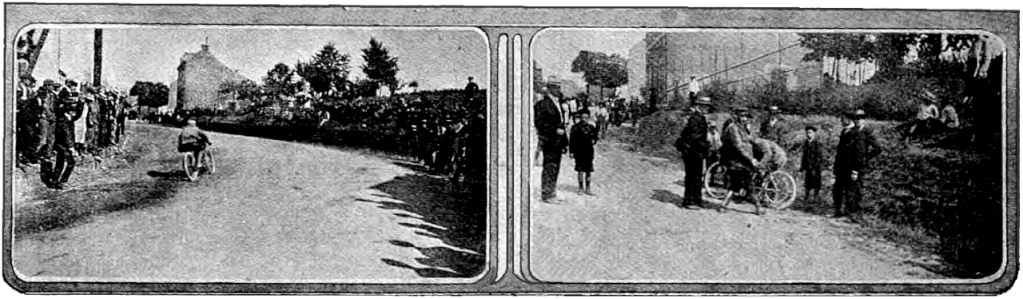
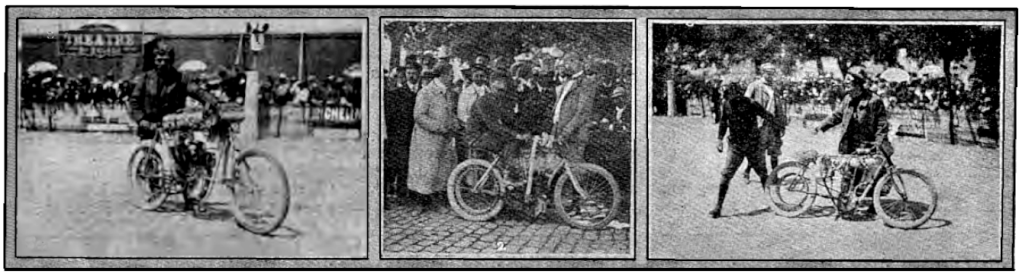


“MOTORCYCLE Racing at New Brighton. A five-mile motorcycle scratch race, limited to engines 76×76, was included in the programme of the Athletic Sports at New Brighton on Monday last. Owing, perhaps, to the attractions at Bexhill, only four riders entered, and of these only three started. These were L Hadley, on a Royal Enfield (Minerva engine, 76×76); L Myerscough, on a Crosby (Minerva, 75×75); and GH Reynolds, on a Dearne (Buchet engine, 66×72). The winner was apparent from the start, for Hadley at once drew away steadily, the other two keeping close together in the rear. Hadley lapped the others in the seventh and again in his eleventh lap, and ran home first in 6min 44⅕sec. Myerscough, handicapped greatly by a high gear, came in in 8min 6⅕sec. Reynolds crawled home, with his engine nearly red hot, in 9min 23⅕sec. It was the winner’s first race.”
“A MISSING CLUB. A projected interclub run between members of the Liverpool MC and the Wolverhampton MC had a rather humorous sequel. The clubs were to have met for lunch at the Royal Hotel, Llangollen, and the Wolverhampton contingent turned up duly at about one o’clock, to find none of the Liverpool boys had arrived. After waiting an hour the ‘Wolves’ fell to at the luncheon table. Just as the toast of the absent club was being proposed a dusty, weatherbeaten figure stepped into the room through the French window from the lawn with the query, ‘Are you the Wolverhampton lot?’ ‘Yes,’ was the reply. ‘Well, I’m the Liverpool Club.’ At which he was heartily welcomed, and invited to sit down and have lunch.”
“A PARTY OF MOTORCYCLISTS from Nottingham had a pleasant week-end with some members of the London Polytechnic at Meriden, Kenilworth and Warwick on Saturday and Sunday week last. Trent Bridge was left about four o’clock on Saturday afternoon. Owing to heavy thunder-showers the roads through Loughborough, Leicester and Coventry were in a fearful condition, and some members did not arrive at Meriden until nearly midnight. Sparking troubles, belts stretching owing to the wet, and difficulty in obtaining a proper mixture were responsible for the delay. At Meriden ten Poly boys, on push bicycles, and three on Mr Jones’s Mercedes car, met the Nottingham contingent. Supper was laid at the Bull Hotel, and after ample justice had been done to the excellent fare, a convivial time was spent until about 2am. All the party were up by nine o’clock, and prior to breakfasting some time was spent in removing the mud from the machines, which included three 3½hp tri-cars. During the feeding process three more motorcyclists from the lace city appeared, and were welcomed with vociferous cheers. The tourists then proceeded to Stonebridge, where the Poly boys said ‘au revoir’, and set out on their return journey to town via Coventry and Daventry. The ten motorcycles and the Mercedes went on to Kenilworth and Warwick, where the historic castles were inspected, and a most enjoyable afternoon whiled away in pleasant fashion. The party broke up at Warwick about 5.30, and while the London men went back to town, the Nottingham party returned through Coventry and Narborough after a varied, but highly enjoyable, outing.”
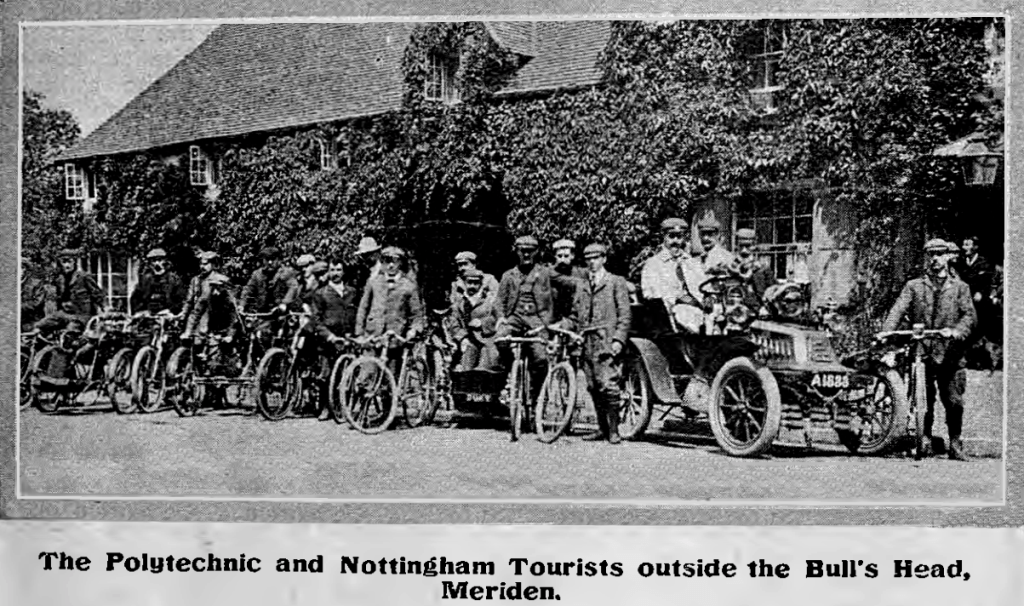
“THE LOT OF THE MOTORIST in Germany is not precisely a happy one, the police being one of the many thorns in his path. But when the police can make use of him, oh, what a difference in the bearing. Quite recently the Commissioner of the Brunswick Police invited all the members of the Brunswick Motor Club to attend at the police headquarters, and was very, very suave and polite. You see, his high-and-mightiness wished to know how many cars he could depend upon in case a war broke out. To the credit of the club, be it here recorded, that every member promptly placed himself and car at the disposal of the war authorities.”
“20,076 MOTORCARS HAVE BEEN registered in the United Kingdom up to the end of July, 1904. Of these, 15,616 are used as private cars; 2,380 for business purposes alone; 660 for business and pleasure combined; 950 for haulage of heavy goods; and for the conveyance of the public.”
“A YOUNG LADY who stooped to pick up her dog from the road at Shenfield, Essex, was knocked over by a motor-bicycle and had her nose broken. A less plucky individual would have thought of her own safety first, and allowed the dog and the cyclist to look after themselves.”
THE BAT MOTOR Manufacturing Co have acquired some excellent premises at 321, Oxford Street, W. They are most conveniently situated, and the place is well stocked with their latest models. The company have made arrangements whereby machines may be tested by likely purchasers.”
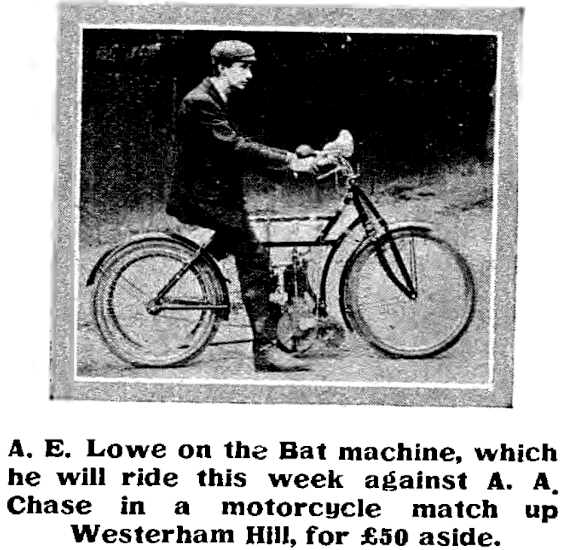
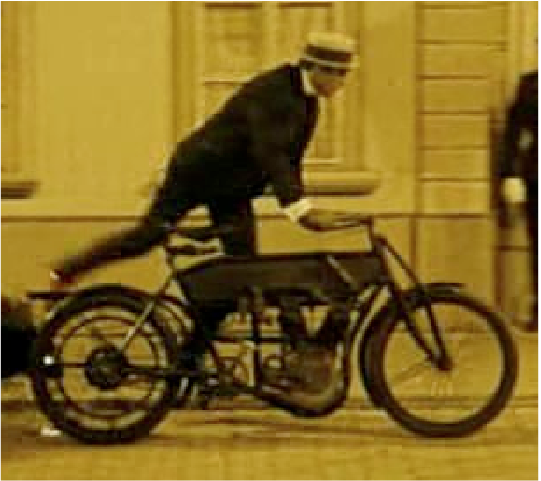

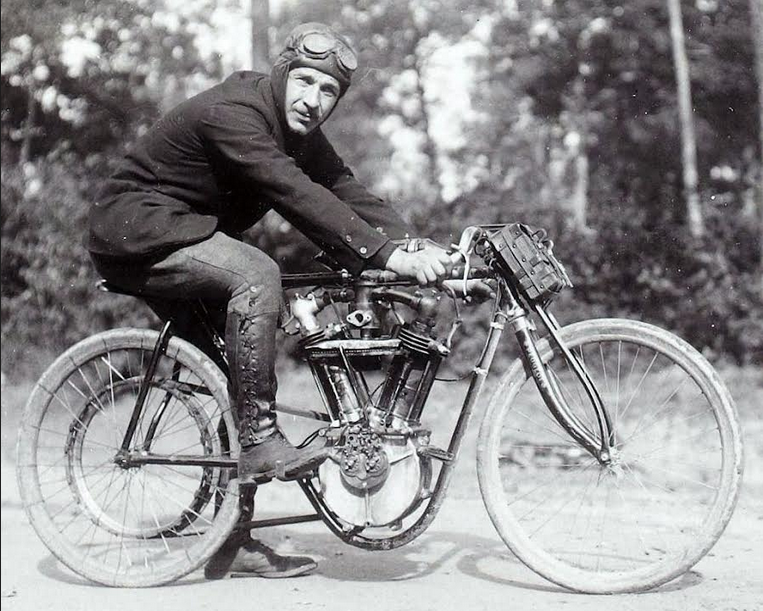
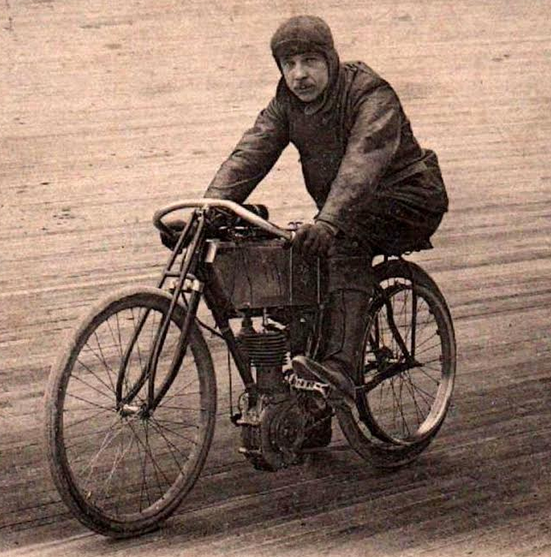
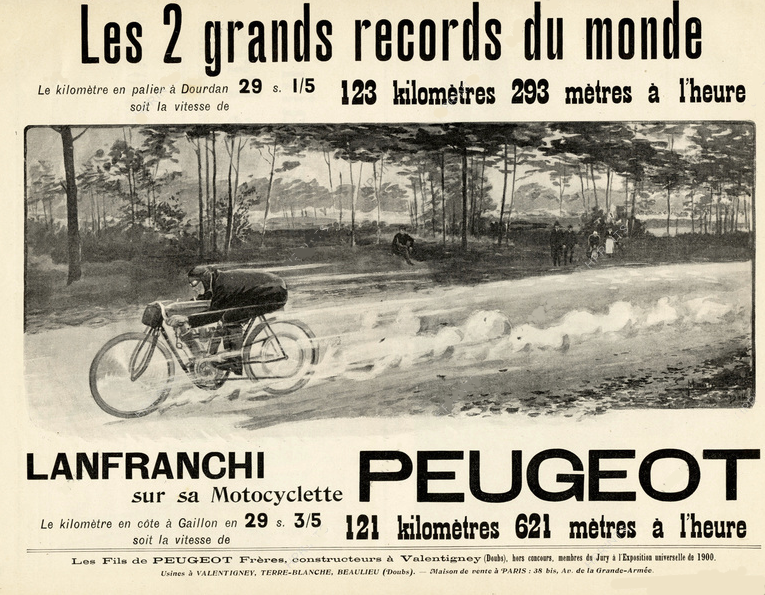
“A ‘WORLD’S MOTORCYCLE’ CHAMPIONSHIP. The ‘World’s’ motorcycle championship has been exciting a good deal of interest on the Parc des Princes track, Paris. Most of the French and Italian cracks are engaged in the competition. Up to the time of writing the event has been reduced to the following four: Marius Thé, Anzani, Collomb and A Fossier. An amusing incident occurred in one of the semi-finals last week. Fossier’s machine broke down, and he had, perforce, to dismount and abandon the second qualifying place to Rigal. Hardly had he done so when Rigal’s machine went wrong, whereupon Fossier busied himself to get his motor working again, succeeded, leaped on, and eventually landed in a good second to Anzani, thus qualifying for the final. Anzani, it may be mentioned, rode one of the new Alcyon motorcycles fitted with a Buchet engine.”
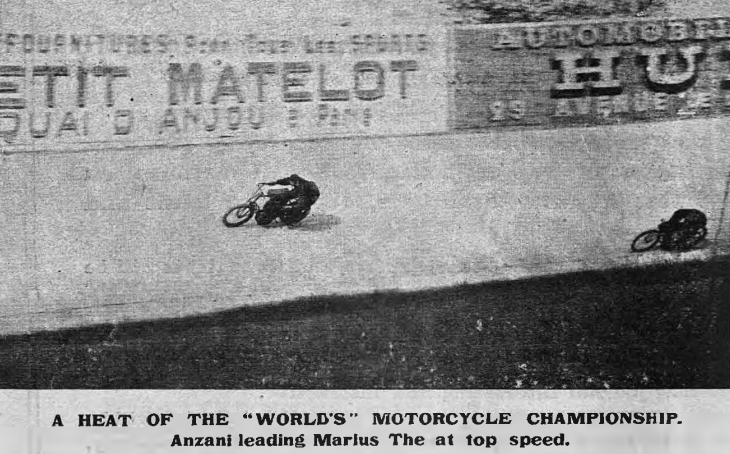
“FINAL OF THE ‘WORLD’S’ CHAMPIONSHIP IN PARIS. The final of the so-called ‘world’s’ motorcycle championship was run off on Sunday, May 8th, at the Winter Track in Paris. Marius Thé, Anzani, Collomb and Fossier were the four who had survived the eliminating heats. The first three of these only turned out. Marius Thé was the first to get away, and before long he lapped Collomb, who was in trouble with his carburetter. Keeping steadily in front of Anzani, Thé made good going until the last lap, and then with a final spurt dashed away, and won easily by about one lap, Anzani being second. The distance of the race was 10 kilometres (6¼ miles), or 30 laps of the track. Time, 6min 27⅖sec.”
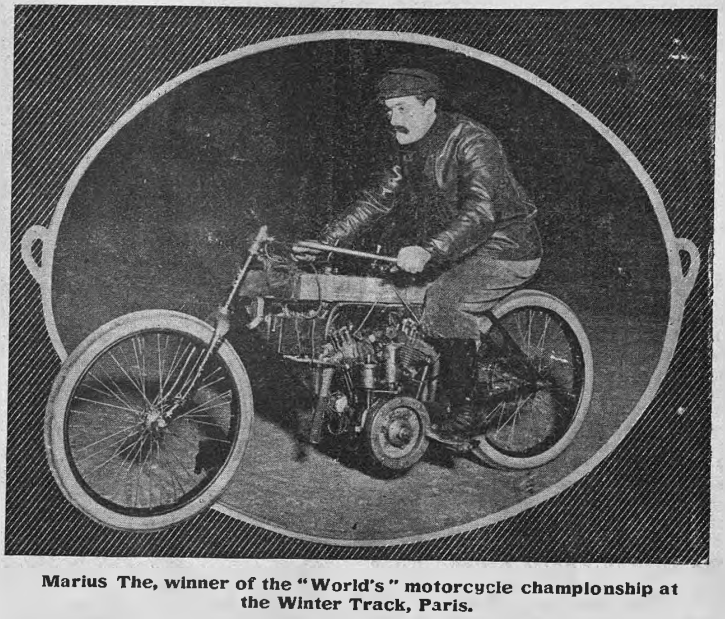
WATCH AND INSTRUMENT manufacturer Samuel Smith moved into the automotive sector with the the Perfect Speed Indicator. The first example was delivered to Edward VII for the royal Mercedes. Smith’s speedos would dominate the British motor cycle industry.
“INTERESTING DECISION. The Stipendiary Magistrate of Leeds has decided that a motorcycle which is being pedalled as an ordinary cycle must be regarded as such, and not as a motor vehicle—provided that the motor mechanism cannot be started without a dismount to make alterations and adjustments. Thus the owner of a belt-driven machine could not, under this decision, be proceeded against for neglecting to carry a number plate, if at the time the belt was disconnected.”
“FIRST SUCCESSFUL APPLICATION for reduced speed limit. The Borough of Beverley (Yorks) has obtained an order from the Local Government Board authorising the imposition of a five-miles-an-hour limit along [various] stretches of road. The Automobile Club immediately wrote to the LGB asking that the order should not come into force until the Beverley Council had erected the necessary notice boards, and the Council have agreed to erect such notices forthwith.”
“THE ENTRIES FOR THE Criterium of a Third of a Litre over a distance of 100km, which will be held at the Parc des Princes track, Paris, are already very representative. Peugeot Frères have entered six machines. Bruneau, of Tours, whose chain-driven motor cycle has been repeatedly mentioned in our columns, has three machines running. The winner of the last year’s Quart de Litre contest, Georgia Knap, has one representative. The other machines are Quentin, Moto Ideal, two Aiglons, and three representatives of the Magali. Sigonnaud, the famous French motor cycle pacer, is riding one of the Aiglon machines.”

“THE ANNUAL ‘TIERS DE LITRE’ bicycle trials began on the Parc des Princes track in Paris last Wednesday…As the name indicates, the trials are restricted to motor vehicles of a cylinder capacity not exceeding one-third of a litre, and a weight not exceeding 75 kilos, which practically confines it to light touring machines averaging 2hp—the class of machine which the French, Belgian, and German manufacturers makes a speciality of. All the well-known French firms had entered one or more of their machines; the crack types, such as Peugeot, Griffon, Alcyon, Lamaudiere, being fully represented. Belgium was also adequately represented by a team of FNs. The trials are divided into several heats of 100 kilometres each, extending over five days. Reliability of running at a high speed is the principle which governs the competition; and the rules allow the same machine to be ridden by more than one rider, and the same rider to ride a different machine in. each heat. For the Reliability Cup not more than three machines can be entered from one firm. The two winning machines in each heat are eligible to compete in the final which is also over a distance of 100 kilometres (62 miles)…The final heat was run off on Sunday, the result being a win for the Alcyon machine ridden by Anzani, who covered the 100 kilometres in 1hr 18min 37sec, the rest arriving as under: Buchet (Giorgis), 3 laps behind; Stimula (Meline), 10 laps behind; Alcyon (Griet), 12 laps behind; Peugeot (Cissac), 13 laps behind ; Griffon (Champoiseau), 13½ laps behind; Magali (Bac), 15 laps behind; Magali (Collomb), 21 laps behind; Lurquin (Hibon), 24 laps behind; Peugeot (Lanfranchi), 25 laps behind; Griffon (Moreau), 26 laps behind; Peugeot (Yourassoff), 27 laps behind.”
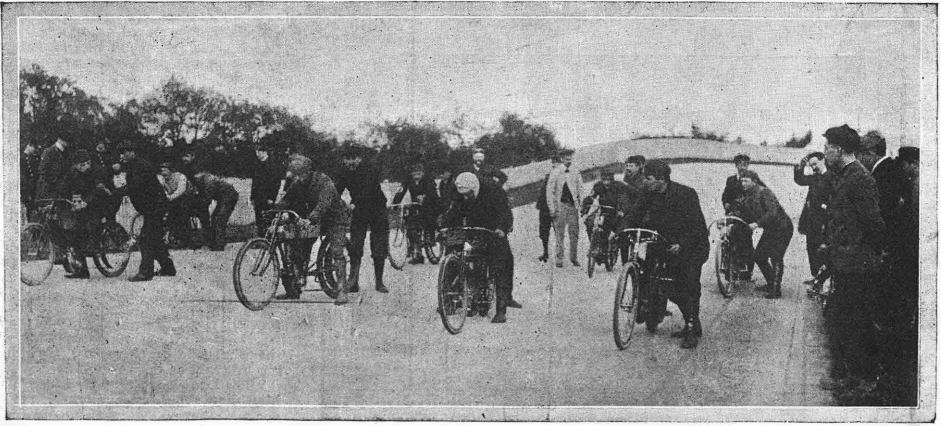
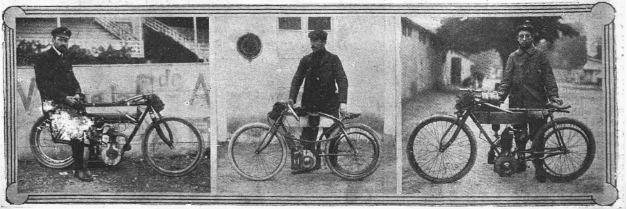
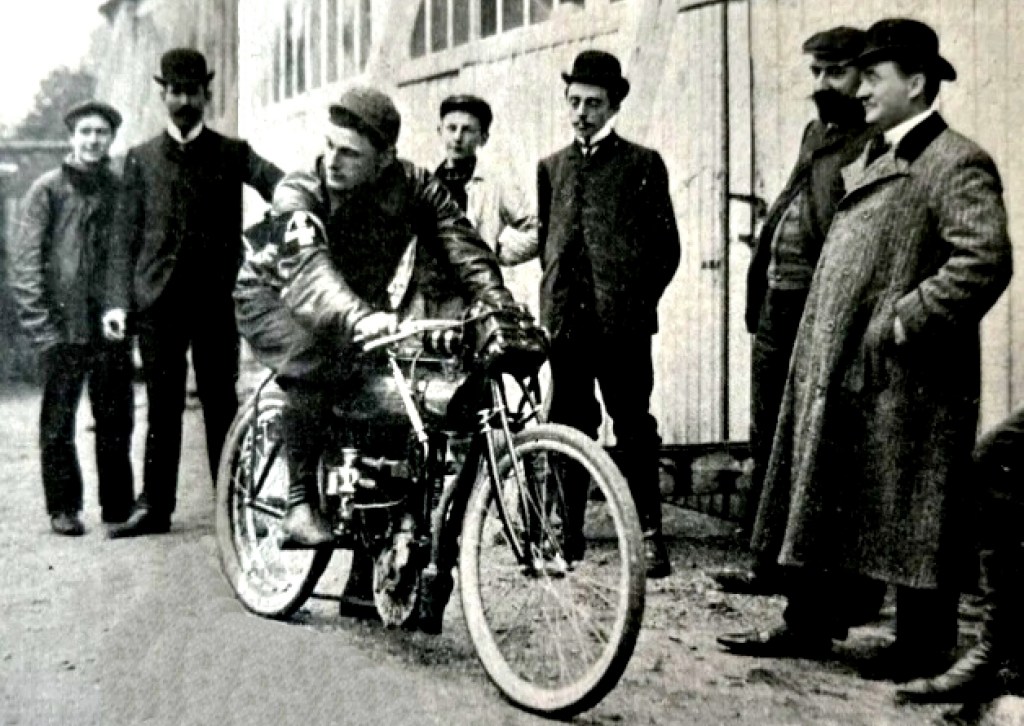
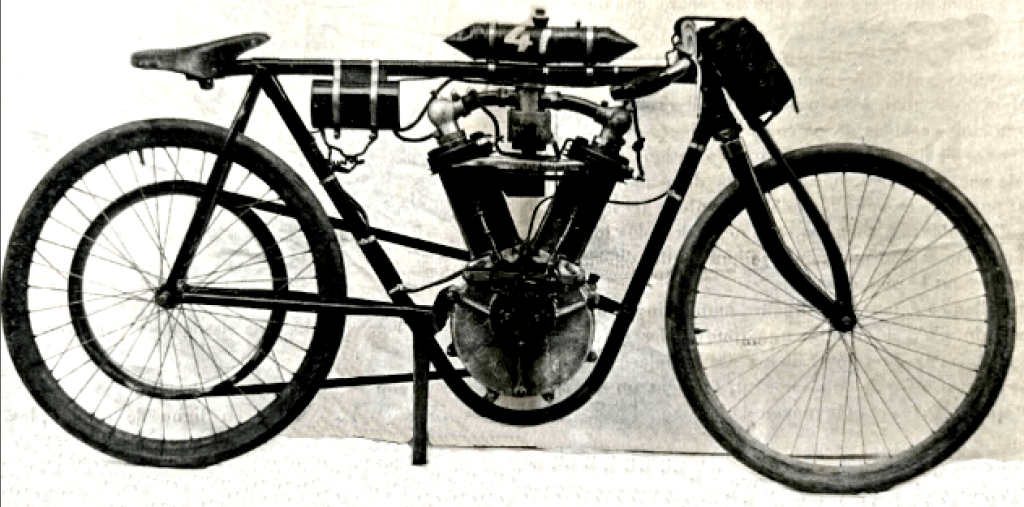
“TO CHECK FAST driving a contemporary suggests that a cart load of gravel be laid across the road, forming a slight bank. This bank, it is stated, would not incommode horse vehicles or cars travelling at the regulation speed, but would break the car springs of the scorcher. It is to be surmised that cyclists and motor cyclists would have to get off and walk past the obstruction. Whenever these drastic anti-motor ideas are on the tapis the poor motor cyclist seems to be forgotten.”
“AN INTERESTING CASE came before the Leeds Police Court last week A gentleman named Ben Scarth, living at Harrogate, was summoned for driving a motor bicycle in Leeds without an identification plate in front, and for not producing his driver’s license. The first summons was dismissed; the defence raised on the second was that he was not driving a light locomotive, but was riding a bicycle with motor attachment, and on the occasion in question he was pedalling the machine and the motor was not driving the cycle. On payment of the cost of the summons defendant was allowed to go away; at the same time he was told that if he failed to do so he would have to come another day and have the question discussed. Needless to say defendant paid the cost.”
THE SECOND ANNUAL TRIAL of motorcycles is now in progress, and will occupy the attention of competitors and officials for the whole of this week. The trial is being conducted upon lines which differ entirely from those of last year; it more nearly resembles the famous thousand miles tour of the Automobile Club, which is generally looked back upon with kindly feelings by all who took part in it, because of the thoroughly sociable nature of the proceedings. There is a very general hope among competing firms that the motorcycle trials may produce as good an effect upon potential purchasers as did the b:g- car tour, and it must be granted that there is every possibility that this hope may be fulfilled. The districts to be traversed are extensive and well populated, and although the motorcycle must be a familiar object of the wayside in all of ‘them, there can be not the slightest doubt but that the passage of nearly fifty of the lightest and cheapest of self-propelled vehicles bound upon a lengthy tour under test conditions, will create an interest such as is not likely to be created by the passage of a hundred isolated machines.
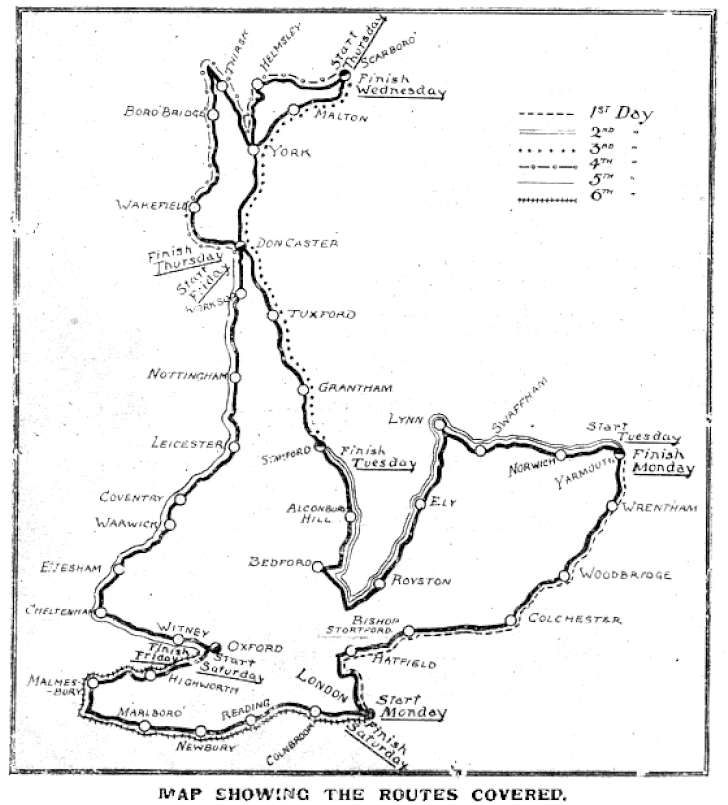
Monday—London to Yarmouth, 154 miles.
“HAVING SEEN THE MOTOR-BICYCLES and the tri-cars despatched on their journey, there was a hurried final chat amongst the members of the staff of The Motor, and then, saying farewell to the other two, I took my seat (a passenger for once in a while) in a comfortable forecar, and set out to accompany the competitors who were to demonstrate to an expectant world the reliability of the motorcycle, and to receive the were promised for so doing…By Barnet Church we turned away towards Elstree, and then made for St Albans, this way being chosen in order that the machines should essay the climb up Holywell Hill into the Cathedral City. Not only were they given the hill to tackle, but the judges were stopping the competitors half-way and making them start again. Too early in the week for such hard work I thought! However, nearly everyone passed through this ordeal well…We made a fast run through a drenching shower through Hatfield and on to Hertford. Here we met the first evidence of public interest evinced in the tour, the narrow streets being lined with spectators, and the police in a most amiable mood keeping the course clear. We ran on to Ware, passing several of the motor-bicycles. Here again there were crowds to see us go through. Shortly after leaving Ware the route became tricky and the roads rough. The first mishap occurred just outside Ware, the unlucky one being A Hooydonk on a Phoenix tricycle. He, in taking a right-angle turn over a bridge about 8ft wide, ran up a bank and damaged one of his steering wheels

badly. The road now became winding and loose, and further ahead was a water splash which had to be negotiated and an exceedingly stiff hill to climb. Most competitors were careful to take the water splash slowly. I learned further on that one of the forecarriages went through with a rush, and as a result water got in the carburetter. This must have occasioned a lot of trouble. Punctures had caused several competitors to dismount between Ware and Much Hadham. At this latter village there is a most deceptive turning up a narrow lane. At Bishop Stortford, Dunmow and Braintree intense interest in the tour was shown by the villagers. The running up to Colchester from Bishop Stortford was on excellent surfaced and level roads, and no derelicts were seen on this stretch. At Colchester (83 miles) a great welcome awaited us, and we made our way with difficulty along the narrow streets to the Cups Hotel through lines of spectators. Here lunch was taken and each competitor made a start an hour after his arrival. Leaving the garrison town we ran on through pleasant country to Stratford St. Mary and Copdock, and on to the quaint old town of Ipswich. There was little chance of a competitor missing his way, as all turnings were denoted by a flag signaller. From Ipswich there was a delightful run till near Woodbridge. About one mile from here a most unfortunate accident had occurred. The Kynock (No 13) motor-bicycle was lying on the roadside in
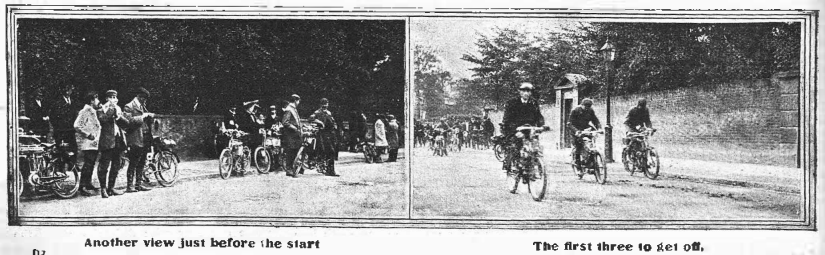
a mass of flames. The petrol tank had caught fire, and in ten minutes the machine was destroyed. How the accident occurred is not clear; presumably petrol had leaked on to a red-hot exhaust pipe. A compulsory stop of 15 minutes was made at Wrentham, during which time tea was taken. From here the running was through Lowestoft and Gorleston (where much enthusiasm was shown) right into Yarmouth (154 miles). The roads along by the sea about four miles from Yarmouth were in an indescribably rough condition, necessitating very slow going. At last the sea-front was reached (local police directing the way) and a move made for the Queen’s Hotel. No provision was made for the machines here, and all had to make tracks for a local garage. The first arrivals on a Vindec, Bat, and Altena reached the Hotel at 6.5, and the others followed in rapid succession. All reported good running and nothing in the way of mishaps whatever, except a few punctures and belt breakages. Dinner was taken at the Aquarium, during which time the day’s doings and experiences were actively discussed. The total to finish was 40 out of 45 actual starters. Some late arrivals had a weird experience in getting their machines through in the dark, and did not reach Yarmouth till 3.30am. Retired: 2¼hp Kynoch, caught fire at Woodbridge; 3½hp Phoenix tricycle, offside tyre burst causing collision with bridge; 4hp Mars Carette, faulty induction coil.
Tuesday—Yarmouth to Stamford, 205 miles.
To be ready for this day’s work meant being astir soon after 5am. Shortly after six everyone turned up for breakfast at the Queen’s, and at 6.45 preparations were made for the official start from the Britannia Pier. Early as the hour was a big crowd assembled and were kept in order by the police, who made things quite easy for us. The sun was shining brilliantly, and there was every promise of a grand day’s running. At 7.10 Mr Orde started the first batch on their long journey, and the others in succession amidst the cheering of the onlookers. We kept along the sea-front for a mile or so and then turned off for Caister, Acle, Thorpe, and Norwich. This stretch of road had some awkward turnings, and care was required in taking them. At Norwich a large number of people lined the main street, but the police had a clear course prepared for us, a courtesy which was much appreciated. At the turnings small boys were stationed bearing large placards having the mystic words ACC and with an arrow pointing in the direction the riders were to travel. From Norwich we ran through the pretty little villages of East Dereham, Swaffham, and King’s Lynn. A couple of competitors’ machines were noticed standing at the roadside while punctures were being repaired. With these two exceptions every machine seemed to be running well. The Phoenix trimo, Rex tricycle, and Bradbury forecar seemed to be running very consistently. At Downham Market—a curious little town—a
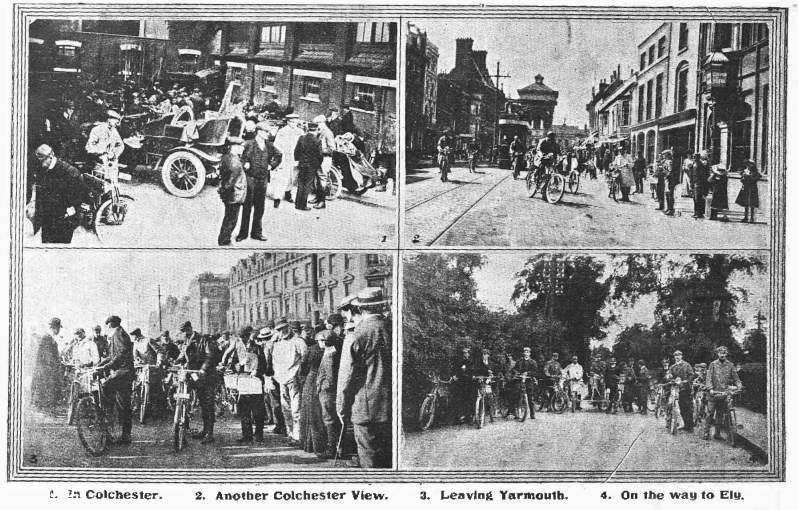
surprising number of villagers were out to meet us; in fact it seemed as if the farther we progressed the greater was the enthusiasm shown by the public. From here to the Cathedral City of Ely was about 18 miles, the road —which had deteriorated somewhat— running close to the river on a rather steep embankment. This necessitated careful steering. We reached Ely in good time, the. distance being 96¾ miles from Yarmouth. The mid-day stop for lunch was made at the Lamb Hotel. As the riders came in some of them had startling news to tell. The Noble fore-carriage had got badly damaged on Acle Bridge, six miles beyond Norwich. It was reported it had fouled the bridge through a cart driving close up. Barnes came along considerably behind his-.time and reported having had to do the last 10 miles on the rim through a bad puncture. Two other machines had also experienced tyre troubles. After lunch another start was made for Cambridge. We had to negotiate an extraordinary number of turnings, at each of which a white gloved policeman directed us. Clear of Cambridge the route was over very level roads via Royston, Baldock and Shefford, and a detour round Bedford and on by the Great North Road to Buckden, where a stop was made for tea. Punctures were rather prevalent on this stretch. After tea there was a final splendid stretch of 29 miles to do to reach Stamford, which completed the 203½ miles. This very interesting old town was reached well before lighting-up time, and the George Hotel has surely never been more bustling since the old coaching days. Barnes wired that he hoped to reach Stamford some time during the night. He had experienced eight punctures and two burst inner tubes. Hall, on the Bradbury tri-car, who had a mishap at Littleport, wired from Ely at 7.30 he had effected repairs and was on his way. Retired: 2¾hp Millenium, broken cylinder at Yarmouth; 2¾hp Ixion, engine seized; 3½hp Barnes had eight punctures and spoiled two inner tubes; 4hp Noble Tri-car collided with bridge at Acle; 4hp Rover Tri-car broke tappet of exhaust valve; 4hp Bradbury tri-car collided with wall at Downham and smashed up steering wheels; new wheels fitted and restarted Wednesday.
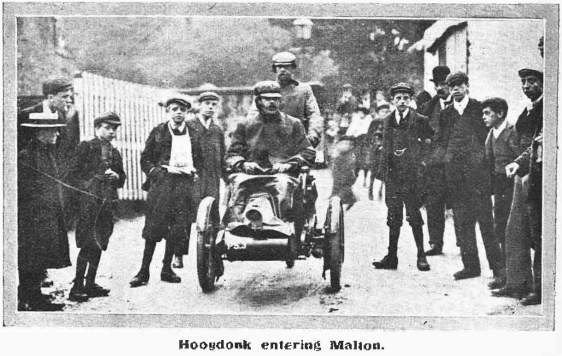
Wednesday, Stamford to Scarboro’, 165½ miles.
To-day has been a time of trial and tribulation for all of us. The weather at 7am, when everyone was preparing for a grand day’s running, looked promising. An hour later ominous clouds had gathered, but little did anyone anticipate what was in store for them. The machines and competitors lined up just outside the town, and at 9.10 the first batch were started. Amongst the tri-cars the Bradbury had put in an appearance, a new wheel having been sent on by train. I found a place on the front seat of Bert Yates’ Humber tri-car, and we got away immediately after J van Hooydonk, at 9.20. Ten minutes after the start the rain commenced to fall, and a little later it literally came down in sheets. At intervals of a couple of miles or so we passed a solitary competitor having a look at his spark plug or belt with much concern. We plugged along through the mud to Grantham and Great Gonerby. Between Balderton and Newark the deluge increased, and then a few ominous misfires and the engine stopped. This was pleasant. We were in for trouble. Yates could not get it to start, do what he might. At last I decided to accept a lift on a passing cart and make for Newark, four miles away. Here I took train for Doncaster, where the mid-day stop was to be made. I learned here that about twelve machines had arrived and departed, including the Phoenix trimo and Bradbury fore-car. I got aboard a 12hp Humber car, which was waiting for me at Doncaster by arrangement. Making the best of things, we forged ahead at good speed. After an hour’s running we came up with the front-rankers, and here and there passed a competitor effecting a puncture repair. Surprising though it be to relate, the belt machines we passed were going exceedingly well, despite the mud and rain pouring on the pulleys and belts. We passed the imperturbable Hooydonk on his trimo going with the regularity of a train, and apparently enjoying it. The Bradbury tri-car was noticed running
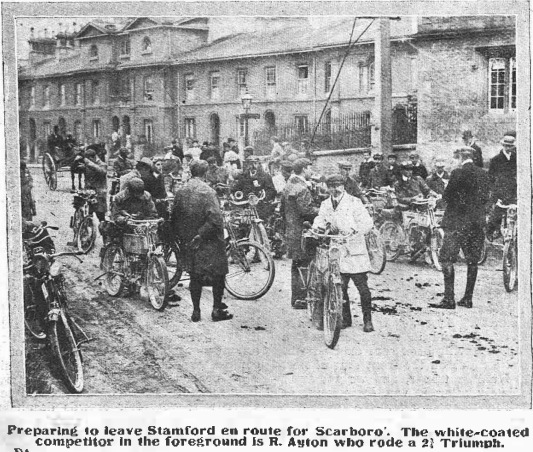
splendidly. It was not till we reached Selby toll-gate that we learned one of the competitors, having had a bad sideslip near the bridge over the river, had retired. At each village and town there were very fair crowds despite the rain, which continued with unabated fury. From Selby to York we saw no riders. At York the crowds at all turnings were large and enthusiastic, and we were well directed by flag-signallers at all the tricky turnings. The route skirted the busy parts of the city, and soon we entered the main York and Scarboro’ Road. Malton was the next important stop before Scarboro’. About six miles before Malton the road crosses a range of hills, and there is a real teaser to be tackled here—a second Westerham, in fact. The first rise is about half a mile with a good length of 1 in 8, and there are a couple of others after this one, but less severe. To get up the first we had to descend to our lowest gear, and just got up. At the crest we waited to see how some of the competitors would manage. They came up surprisingly well under the circumstances. At Malton the Ariel, Brown, Bradbury, Rex (bicycle and tricycle), and Leader machines were awaiting us. Shortly after in came the Bradbury tri-car, soon followed by Hooydonk. Both had tackled the hill in good style. We left soon for Scarboro’, so as to reach there before lighting-up time. We only passed one competitor—Lowe on the JAP—after leaving Malton. He was going well and fast. Nearing Scarboro’ there were several very dangerous turnings, which could only have been negotiated in daylight, and numerous level crossings. We ran into town, the rain still descending, and drew up at the Salisbury Hotel at 7.15. A dozen machines were there before us, and the others came in at intervals of a few minutes. Silver reported having a series of punctures, but otherwise all well, and others related trouble with their
tyres, high-tension leaks, and shocks from the wet insulation. All agreed that they had never experienced such a deluge of rain and mud, the roads in parts being like lakes. Under the conditions it is surprising that the machines did so well. The test was excessively severe. We have received a notice which the Star Cycle Co say they are inserting concerning the alleged tampering with their machine in the trials at Ely. A matter of this kind must be left to be dealt with by the Club, and comment would, therefore, be out of place at present. Retired: 2¾hp Vindec, tyre cut about beyond possible repair in rain:
2¾hp Hulbert Bramley, cause unknown; 3hp Mabon, broken carburetter; 2¾hp Star, engine troubles; 2¾hp Triumph, cause unknown ; 2¾hp Hunter, cause unknown ; 3hp Rover Belt Drive, cause unknown; 3¼hp Dux, rear wheel bearings locked; 3½hp Olympia Tri-car, water in carburetter.

Thursday—Scarboro’ to Doncaster via Thirsk and Wakefield, 164½ miles.
The start this morning was fixed for 8 o’clock. It was still raining heavily, and the outlook was unpromising. Hulbert rode up to the hotel at 7.15am, and reported having experienced tyre troubles the previous evening between York and Scarboro’. This delayed him for several hours, and as he was unable to reach his destination, he spent part of the night in a railway signal box. A start was made at 8.15, and as a little climbing test had been arranged on the road some three miles out, some interesting sport was promised. The hill is a stiff one, from the summit of which a magnificent view of Scarboro’ Bay is obtained. The length is about 750 yards, and steepest part about 1 in 8. The surface, although good, was heavy through the wet. The competitors were all stopped at the foot of the hill and were sent up at intervals by a timekeeper and starter. It was not surprising, under the conditions, that some of the machines did not prove equal to the task; all things considered, they did exceedingly well, the surface being very heavy. Crundall, on the 2¾hp Humber, got up in splendid style without a touch of the pedals being necessary; in fact, he appeared to be gaining speed as he went up. The best performances were made by 3½hp King, 3¼hp Clyde, 2½hp Riley, 3hp Bradbury, 2½hp Alldays, and 3½hp Brown. These got up without pedalling. Several required very slight pedalling. The Ariel (3½hp), Humber (1¾hp), Leader (2hp), Anglian (2¾hp), also did well. Most of the fore-cars managed to get up with slight pedalling. The test being concluded, the run was continued via Ruston, Snainton, Pickering, and Kirby Moorside, the road having numerous dangerous turns, and a troublesome feature being the cattle, poultry, and live stock generally straying about the road. The inhabitants of every village had turned out to see us pass. At Oswaldkirk there was a bad hill to descend, and a right angle stone wall right at the foot, the road turning off to the left. It was fortunate that this hill had not to be ridden up, as it was about 1 in 5, and of good length. Between here and York we only saw two riders stopped, one tightening a belt and the other repairing a puncture. The country round here was very picturesque, and the roads rapidly drying, riding conditions were pleasant enough. We ran right through York to get on the Thirsk road, and a really fine wide road this is. At the old town of Thirsk, with its great market square, an immense crowd had gathered round the Fleece Hotel, where a stop was made for lunch. The first arrivals were the Brown, Griffon, Altena, and Platt-Betts on the Rover, all having made splendid running from York; others came up in quick succession. The afternoon’s
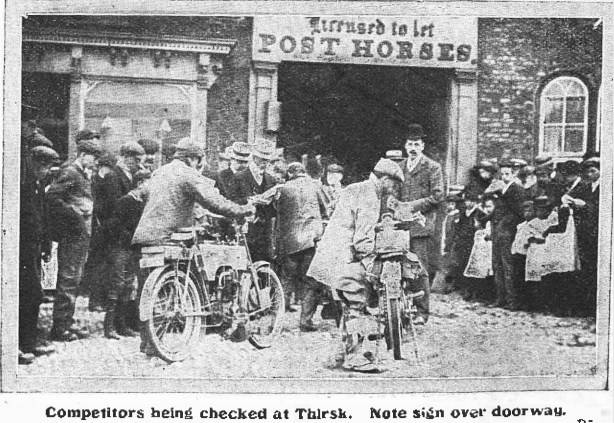
run was 86½ miles back to Doncaster. This certainly proved to be the stiffest part of the trip so far, the road being exceeding hilly and tortuous, necessitating frequent use of the low gear on the car to creep up them. After leaving Topcliffe, the country became grimy and laden with coal-dust for the most part. The next stop was Wakefield—a veritable Slocum-in-the-Mud; but, nevertheless, the crowds here had strong sporting instincts, and were most enthusiastic as the riders came through. A stop was made at a hotel on the outskirts of the town for tea, and after a short stay the final run of 23 miles to Doncaster was tackled. The first 15 miles was through typical Yorkshire manufacturing districts, the road being very hilly and rough in the extreme. We stopped the car before reaching Barnsley, and watched the competitors go past in excellent style. We missed Crundall and Wright, however, and heard later that Crundall had several bad punctures. The police were in strong force along this road, but were entirely friendly, and directed us on our way. There is a grand stretch of five miles into Doncaster, and this was soon reeled off. We got in without noting further incident, and drew up at the Reindeer, the crowd awaiting the competitors being very large. A few competitors had got in before us, but the majority came along about 7.30…Chase, who had a bad side-slip at Scarboro’, had managed to get a new axle fitted to his machine, and came along arriving at 9.30. He reported having seen Wright in trouble, and that Spencer, on the 2½hp Ariel, was held up. Twenty-four riders out of the 28 who started from Scarboro’ had got through —a really excellent total. So far, considering the adverse circumstances as regards weather and roads, the performances of the machines as a whole have been remarkably good. Retired: 3½hp Riley, fell on greasy road and broke crank and spindle; 3½hp Hulbert Brambey, tyre troubles; 2¼hp Anglian, driver taken ill.

Friday—Doncaster, Nottingham, Leicester, Warwick, Stratford, Oxford, 185 miles.
To-day’s run was 185 miles through the Midlands to Warwick. A start was made at 8.15, the weather being favourable, although a smart shower at 7.30 looked ominous. Wright was a starter, he having got in after dinner the previous evening. He had some trouble through his petrol feed pipe choking, and not through his ignition, as had been reported. The excellent garage accommodation at Doncaster had enabled the riders to clean up their machines, and they all looked smart despite their hard work. Through Tickhill, Carlton, Worksop, Mansfield to Nottingham good running was made. Nottingham had to be carefully negotiated, the narrow and busy streets being thronged with spectators, doubtless due to its being a centre of motor manufacture. A few miles past Nottingham, Bunny Hill proved a teaser. Somewhere about here Hooydonk had a mishap, due to his petrol pipe cracking. He soon got going again, however. Tyler, on the 1¾hp Humber, was in trouble at Loughboro’, and unfortunately could not continue. Hulbert had the misfortune to get his cylinder cracked near Loughboro’, and had to retire between Loughboro’ and Coventry. The roads were superb. We saw Crundall, Silver, Platt-Betts, Milligan, and Lowe in a group going better than at any previous time in the trials. Through beautiful country we ran till the spires of Coventry peeped above the trees. On the outskirts there were a few groups of spectators awaiting us, but strange to relate there was absolutely no enthusiasm in the city itself— the very place where one would have expected some interest, if not excitement. There were only a few straggling groups on the crest of the hill outside. The splendid avenue between Coventry and Kenilworth proved a delightful stretch, and at Warwick we drew up at the Warwick Arms for lunch. There was a good deal of enthusiasm here, and 20 machines had arrived by two o’clock. Hall, on the Bradbury tri-car, however, had not arrived, and it was reported he had had a bad puncture near Worksop. After lunch the following set out for Stratford-onAvon, Evesham, Cheltenham, Witney, and Oxford: 3¼hp Rex, 2¾hp Noble, 2¾hp Humber, 2½hp Alldays, 3hp Altena, 2hp Leader (Minerva), 3hp JAP, 3½hp King, 2¾hp Griffon, 3hp Rover, 3hp Quadrant, 2¾hp Chase, 3hp Bradbury Peerless, 3¾hp Bat, 3hp Clyde, 2½hp Ariel, 3½hp Lagonda, 3¼hp Dux, 3¼hp Rex (tricycle), 3½hpPhoenix Trimo. The country from here was perfectly delightful, and the road in good condition, and very free from traffic. On one side the Malvern Hills stood out sharp and clear, and the weather keeping bright, though windy, everything was in the riders’ favour. Large crowds assembled at Stratford-on-Avon

and Evesham, but it was at Cheltenham that a surprise awaited us. The principal street was lined three deep on both sides, and the police in white gloves kept back the traffic till all the riders had passed. The spectators had evidently been awaiting the riders for an hour or so, and so far Cheltenham had proved the most enthusiastic of any town we had passed through. We noticed that Silver and Crundall appeared to keep up a perfectly steady average speed throughout, and had kept control time very closely. Punctures and minor mishaps with the majority of the others had necessitated sprinting from point to point. Milligan, who had been up to this running exceedingly well, was worried with a piston ring sticking from burnt up oil, and to keep up his speed he had to use a record amount of oil. Shortly after leaving Cheltenham, the Chiltern Hills had to be surmounted, and the road winds round and up for a distance of about five miles: the grade is pretty stiff, too, and a good test for the cycles. The majority easily passed the car, so it was evident they were going well. After this there is a long, steady descent of several miles on towards Witney. We reached this old-world town to find more crowds waiting, and an assembly of motor enthusiasts who had come over from Oxford to meet us. The competitors came in rather late. Wright was reported to be in trouble, and Hall, with the Bradbury tri-car, had a badly burst outer cover. Thompson, on the Clyde, had a broken exhaust valve, but got along by making an ingenious repair, using the broken exhaust valve as the inlet, and converting the mechanical inlet into an exhaust valve. From Witney to Oxford was 11 miles. This was soon reeled off, and reaching the University city we found a huge crowd assembled in the vicinity of the Clarendon Hotel, the finishing point…A total of 22 had got in safe and sound, a few punctures being the worst breakdowns reported. There were 25 starters at Doncaster, the three missing at Oxford being Hall, Wright, and Tyler. All the arrivals looked in extremely good form considering the work they had done. This was pretty generally commented on by the spectators. Retired: 1¾hp Humber, cause unknown; 3½hp Roc, broken piston ; 3¼hp Clyde, cause unknown; 2½hp Ariel, engine troubles ; 4hp Bradbury tri-car, tyre troubles.
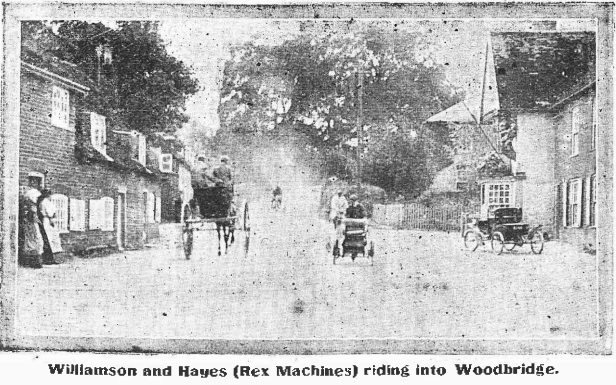
Saturday—Oxford, Chippenham, Marlborough, Newbury, London, 146 miles.
To-day the start for the final stage of 146 miles was made promptly at 8 from the Clarendon. Oxford was not properly awake at this time, but a couple of hundred people had gathered round the hotel. The roads as far as Faringdon are level, but, being of a chalky construction, were fearfully dusty. There were several very severe descents between Faringdon and Malmesbury, but these were all negotiated safely. At Highworth control the riders stopped, as they were a little in front of time. At the charming little Wiltshire town of Malmesbury a big crowd had assembled. A long, steady ascent of three miles starts from here, but all the machines got up without pedal assistance. From the summit the road drops gently to Chippenham. Between here and Marlboro’ Williamson had a nasty fall through taking a corner too fast. He cut his hands rather badly, but did not damage his machine beyond knocking the cover off the exhaust valve chamber. Lunch was taken at the Ailesbury Hotel, Marlboro’, the Automobile Club headquarters in the town. Much interest was evinced in the first arrivals who reached here about 12 o’clock. A large number of the Club officials had come in from London to be present at the hill climb to be held on the main road a mile outside the town. This is locally known as Marlboro’ Hill, and is a very fair test for a motor-bicycle, but not so severe as Westerham. It is about 1,000 yards, and half the distance is, roughly, 1 in 15, and the rest 1 in 13 to 1 in 10 near the top. The competitors were officially started from the foot of the hill.
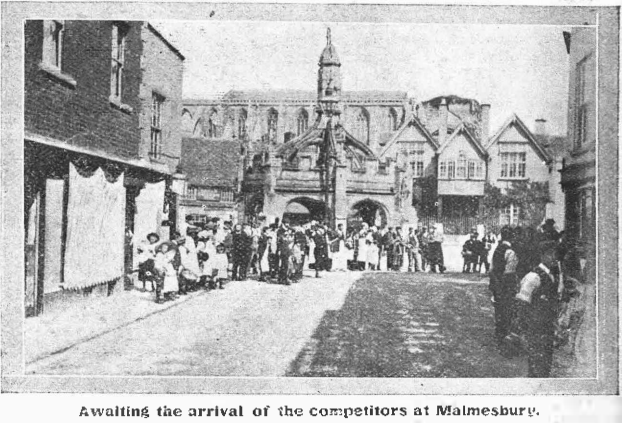
Amongst the best performances were those of Lowe (3hp JAP), Crundall (2¾hp Humber),Chase (2¾hp Chase), Silver (3hp Quadrant), J van Hooydonk (3½hp Trimo), W King (3½ King), A Hoffmann (3½hp Ariel), H Harding (3½hp Lagonda), E Clarke (2hp Leader)—a capital performance considering the power—W Milligan (3hp Peerless), H Williamson (3¼hp Rex). The 3½hp Alldays also did well. The remainder either required pedal help or did not get up at all. Reynolds, on the 3¼hp Bat, dismounted twice, but kept his engine going and ran alongside to the top. Brice, on a 3½hp could doubtless have got up without pedalling, but was evidently endeavouring to do fast time. Once over the hill the riders had the splendidly surfaced Bath road right in front of them to London, this being free from traffic and nothing further in the way of hills to trouble them. The town of Reading took a considerable time to get through as the traffic was considerable. Two or three competitors had lost their exhaust silencers, and consequently made a rare racket in the town, causing considerable astonishment. Through Twyford, Maidenhead, and on to Colnbrook, where a short stop was made for tea, good running was made. We were warned of a police trap about six miles from Reading, and, sure enough, at a bend in the road came across a policeman in uniform adjusting his helmet—probably as a signal—and another one disguised as a tramp sitting languidly in the grass, close alongside, apparently botanising or insect catching. From Maidenhead to Colnbrook was fearfully dusty, and the road, alive with cars and cycles hurrying away from town; whilst we, on the contrary, were hurrying to town. We noticed one stretch of about a mile on the Bath road had been treated so as to be absolutely dustless, and on this the most delightful running was possible, as the surface was like concrete. There was a good crowd at Colnbrook, but the riders got away immediately the short time
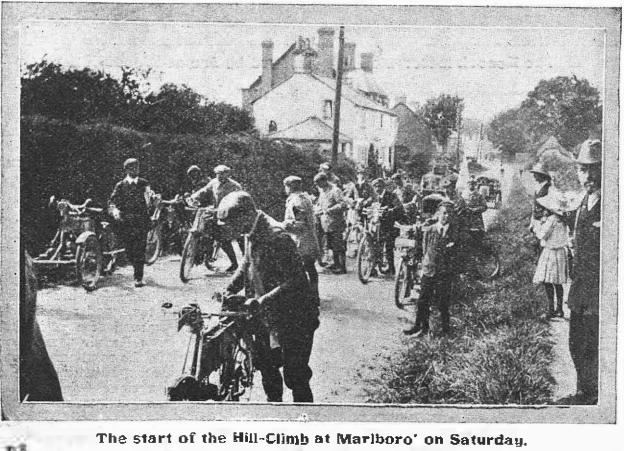
allowed for tea had expired. The dusty state of the road had made some of them quite unrecognisable, but the machines were going well, and this was the chief concern. Crandall had some anxiety lest his chance of getting through the last few miles should be jeopardised, and small wonder, considering that a piece of his sparking-plug porcelain had a short time ago fallen into the cylinder, and was dancing about merrily on top of the piston. Clarke, on the 2hp Leader, had been worried with a burst in the driving tyre; he, however, obtained a leather strap, and bound it around the damaged place in the cover, and sailed off for London quite happy. Once Hounslow was reached the competitors lost touch of each other, and made their respective ways through the traffic to Piccadilly. There was a fair crowd at the Automobile Club Garage in Down Street, but less than one might have expected. A van Altena (Altena) and Crundall (Humber) came in close together, followed by Williamson (Rex), Clarke (Leader), Platt-Betts (Rover), Lowe (JAP), King (3½hp King), Jennings (Mabon), Brice (Brown), the two Allday riders, JC Brodie (Noble), AG Reynolds (3¾hp Bat), W Milligan (Peerless), Harding (Lagonda), Silver (Quadrant), J van Hooydonk (Phoenix Trimo), Chase (2¾hp Chase). This made a total of 18 arrivals within three-quarters of an hour. Hayes, on a Rex tricycle, followed. It was reported that Lambert (Griffon), who had been experiencing bad luck with his tyres, had discarded his back outer cover at Kew, and was riding in on the rim only. Hoffmann (Ariel) was also coming along slowly, his engine having been working badly from a sticking piston for some miles. Silver drove up with his Quadrant machine in spick and span condition, having—it is alleged—spent twenty minutes cleaning it in a deserted road in Kensington. As the only fore-carriage driver to get through, Hooydonk and his machine became a centre of attraction. All the starters on last day arrived excepting the 3I Ariel reported to have stopped at Coinbrook with a seized piston ; it had not arrived when our representative left Down Street at 8.45 p.m.
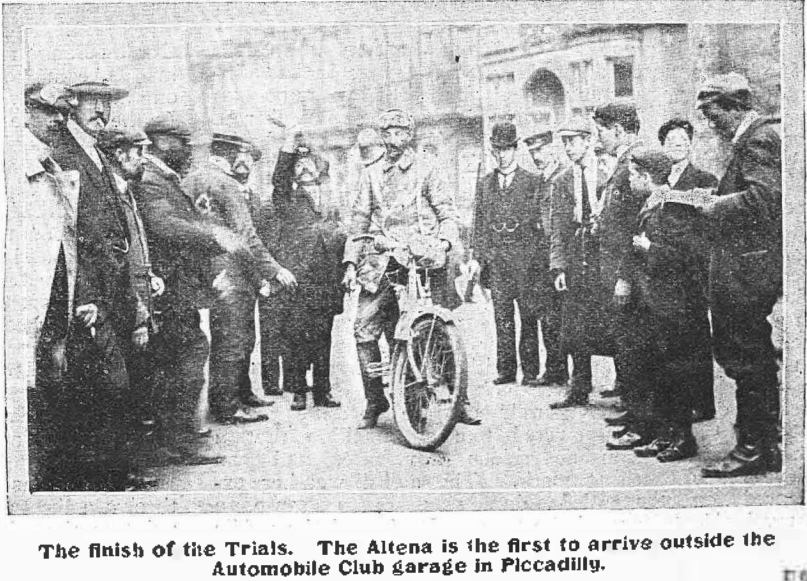
THE AUTO-CYCLE CLUB’S 1,000 MILES TRIAL. The most important motorcycle event of the year has just been brought to a most successful conclusion. An immense amount of interest has been created throughout the country generally as to how the forty-five machines and riders who started on Monday last would acquit themselves, and it can safely be said that the sport and the industries connected with it have, as a result, received a much-needed impetus. The most excellent organisation of the 1,000 miles trial by the Club officials undoubtedly contributed in a great measure to the success attained. With one striking exception, the weather during the tour has been almost ideal, but Wednesday’s experience as a day of storm, rain and wind will long be remembered by all who went through it. Out of a total of forty-five starters twenty got through, and, considering the great distance covered and the comparatively short time of six days taken to cover it, this result must certainly be classed as a highly satisfactory one. It is noteworthy that a very considerable proportion of the breakdowns must be attributed to purely accidental causes, such as collisions, falls, and fatigue towards the end of the tour. The reliability of the machines on the whole has been proved beyond the most sanguine expectations. Of engine or transmission breakdowns there were remarkably few, but it must be stated that the tyre has shown itself to be the most vulnerable part of the machine’s equipment, the stoppages necessitated for repairing punctures being numerous. But punctures, it must be remembered, are very largely a matter of chance. As an example of this, it might be mentioned that one rider had twelve punctures during the trip, and another, with identical tyres, had none. Of considerable interest just at present, when the demand for a light and medium-powered touring machine is beginning to develop, is the fact that the lightest and smallest powered machine entered in the trial accomplished a most meritorious performance. That the only machine fitted with a 2hp engine, 1¾in ordinary cycle tyres and belt drive, and scaling not much over 100lb, came through the 1,000 miles in schedule time without requiring any attention whatever, and moreover took every hill on the route in really good style, must surely convince the critics of the light-weight medium-powered touring machine that a 2hp machine can be ridden anywhere, and can achieve really excellent work. The awful weather experienced on the Wednesday was in a sense a most valuable feature of the
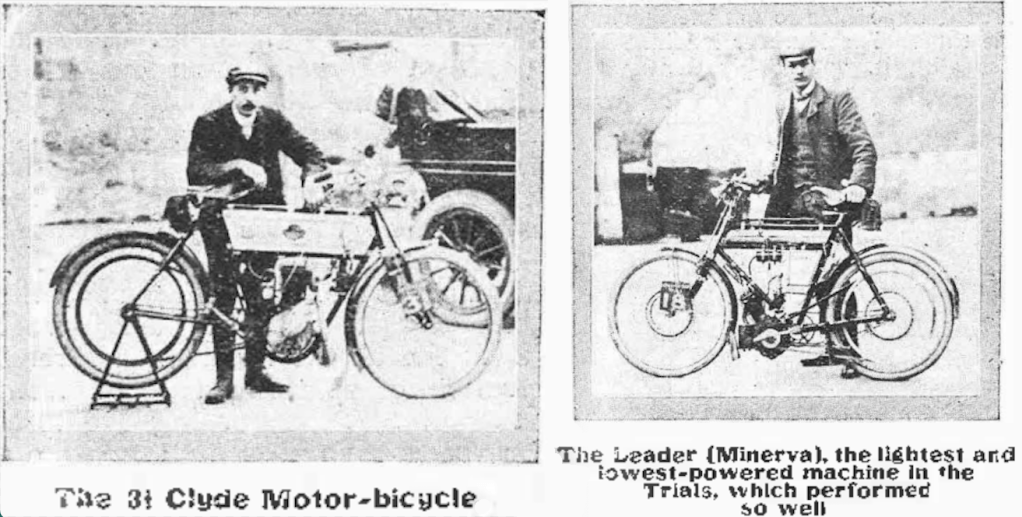
tour. It showed the public that the motor-bicycle is not by any means a machine for fair weather riding only. The machines went through the deluge of rain and mud for 180 miles, and if they could do that they could do anything. The improved system of V-belt transmission has come out of the test with flying colours, and it must also be said that the chain-driven machine has equally proved itself capable of excellent work. But the trial has conclusively proved that the belt-drive is far from being proved less efficient than the chain. Makers will, however, do well to note a feature in the general equipment of the machine that can be improved, and that is in the direction of the casing in of the electric wires and coil, making it absolutely damp-proof so as to resist the effects of the heaviest rain. In several instances temporary cessation of sparking resulted from rain saturating the wires and coil. Regarding the forecarriages, it is a, matter for some regret that not more than one machine got through, this being the Phoenix Trimo, driven by the veteran J van Hooydonk. This machine accomplished a really meritorious performance and deserves the greatest credit. The Bradbury tri-car and Humber tandem were both victims of really hard luck. The former had a wheel buckled through collision early in the trial. This breakdown was speedily remedied, and up to Friday the machine ran splendidly till a series of punctures in the back tyre rendered it impossible to get the machine going again in schedule time. The Humber machine had nothing seriously amiss with it, but simply during the heaviest part of Tuesday’s downpour a considerable quantity of water found its way into the petrol tank through a small float aperture, the cover of which had not been shut properly. When the trouble was located it was too late to continue. We simply state these facts to show that, given average luck, these machines should have got through. We consider that officials, riders, and manufacturers have every reason to congratulate themselves on the results of the trials.
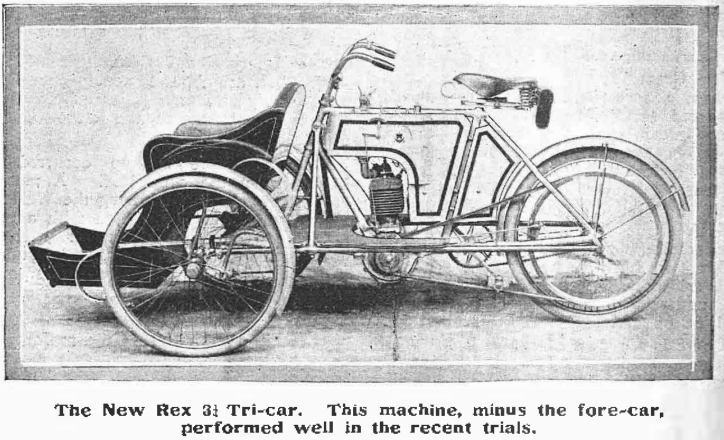
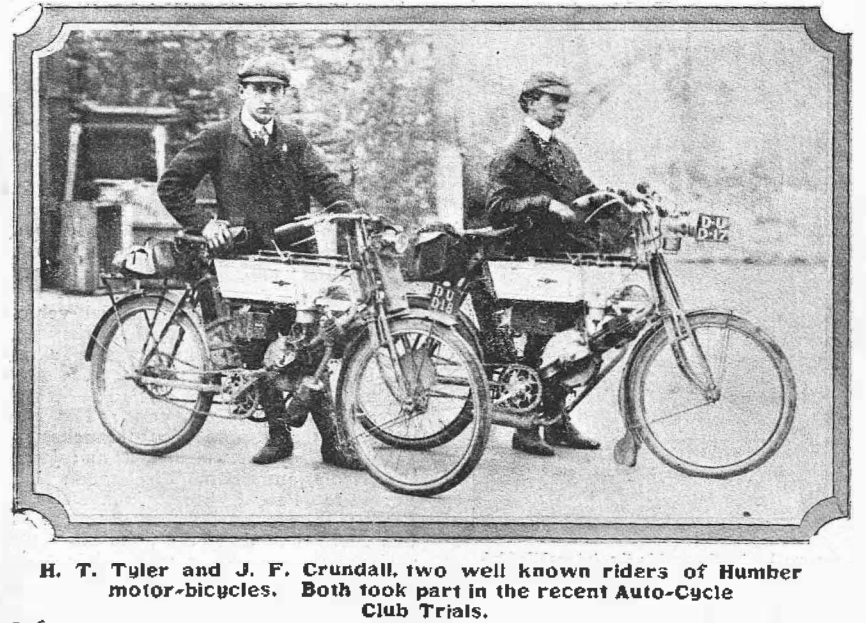
“CURIOUSLY ENOUGH SUMMER-TIME, with its long evenings, is just the time when the motorcyclists’ cry for a good lamp is loudest. In winter roads are bad, and few of us are seen out, especially after dark. But between May and September dry roads and cool, light evenings tempt one to a spin after the day’s work is finished; we go a trifle too far afield, and sooner or later we are confronted by exasperating struggles with the lamp just when the engine is running at its best. After considerable expense and experiment I have at last found a ‘no trouble’ lamp in the Castle Electric. It is fitted with an 8-volt bulb, taking just under half an ampere; and this, in my opinion, is less expensive than acetylene for a London rider who can recharge the necessary brace of 20AH accumulators at 6d apiece. But the initial expense is considerable. The lamp is £1 12s 6d, two accumulators, say, £2 10s, and a box to carry them, 10s to £1. It has a well-designed projector lens, and gives ample light to see the next telegraph post and travel up to the legal limit [those prices equate to over £700 in 2025—Ed]. With this combination lighting troubles are things of the past. At the same time we are all agreed that for economy and speedy travelling by night there is no illuminant to touch acetylene gas; only, unfortunately, the ideal carbide lamp has not yet appeared. Some are reliable light-givers, but are ridiculously heavy; others are unreliable or flimsy.”
“THE LATEST DEVELOPMENT of the Bat Motor Manufacturing Co is a forecar with water-cooled engine of 5¼hp. Circulation is given by pump and thermo syphon. The specification includes Longuemare carburetter, radiator of special design, two-speed gear, free engine, well seat for tools, etc. The forecar of cane is not only graceful in model, but also provides the passengers with maximum comfort. The tyres are 2¼in with band brakes on each wheel. It is fitted with the company’s well-known spring frame and presents altogether a most attractive and business-like appearance.”
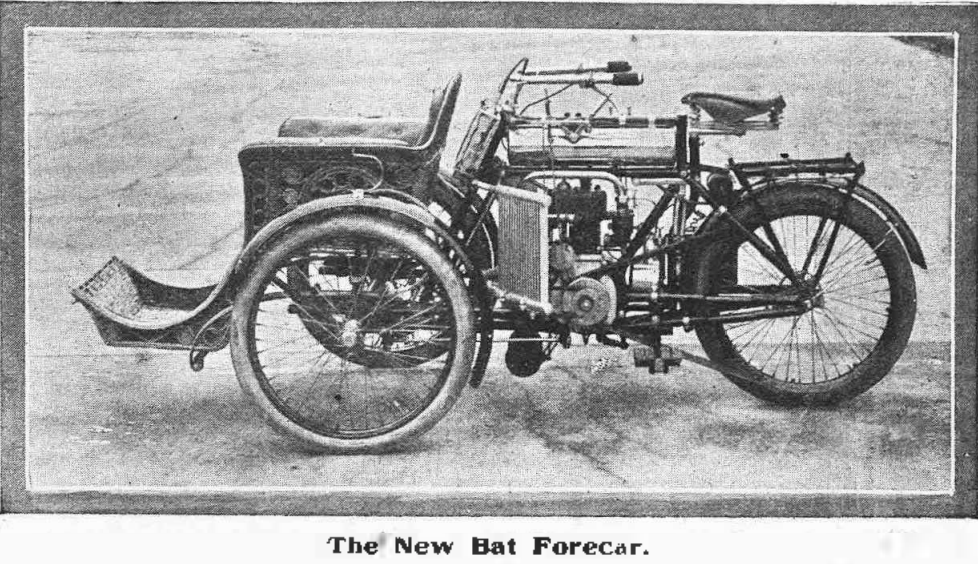
“AN INTERESTING PETROL consumption test was held by the Auto-Cycle Club on Saturday last. The distance was 50 miles, starting from Thames Ditton, and then, via Ripley, Guildford, to a few miles past Godalming, and then return. The roads were for the most part in a fearful state of thick mud, due to the heavy rain on Friday and Saturday morning. A start was made from the Angel, Thames Ditton, at 2.45, the competitors’ petrol tanks having been filled right up by the officials. The amount of petrol used in covering the 50 miles was determined by refilling the tank from a graduated vessel. The starters were: CA Smith, 2¾hp Ariel tricycle; E Palmer, 3hp Singer tri-car; H Martin, 3hp Excelsior; J van Hooydonk, 3½hp Trimo; E Perman, 2hp ‘Seventy’; H Rignold, 4½hp Lagonda; S Harris, 1¼hp FN Whippet; JJ Leonard, 2¾hp Lurquin & Coudert; FW Applebee, 3¼hp Rex; JH Reeves, 2½hp R&P; HJ Densham, 2½hp Anglian; HP Rose, 2½hp Roc…there were no sideslips experienced by any of the competitors, although there were some very narrow escapes, especially in passing through Godalming, where it was necessary for some of the riders to dismount…As certain figures taken at the start were not available, the amount of petrol consumed by each competitor’s machine could only be determined with moderate accuracy…The lowest consumption, one and one-twentieth quarts for the 50 miles, was that of Rose, on a 70x76mm [292cc] [Roc] engine and FN carburetter. Next, that of Hains, 50x68mm [133cc]—a tiny FN engine and carburetter—one and one-tenth quarts; Perman, 60x70mm [198cc] Clement-Garrad engine and carburetter, 1⅓ quarts; Martin, 1½ quarts, Excelsior 80x80m [402cc] engine and surface carburetter. The average distance per gallon would approximately be: Rose, 192 miles; Harris, 182.4 miles; Perman, 153.7 miles; Martin, 132.8 miles. Had the roads been at all in good condition, better performances would have been done. As it was, the roads were exceedingly heavy, which meant using proportionately more gas.”
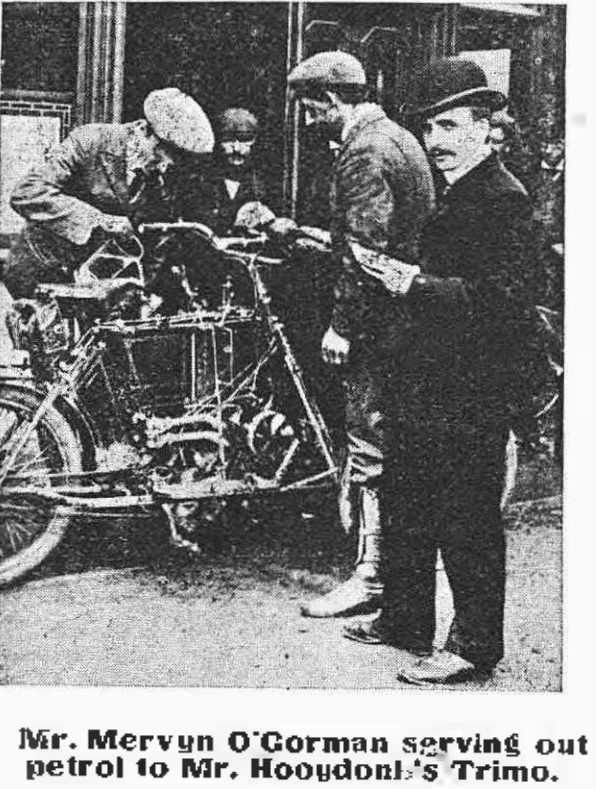

“THERE IS NO novelty in seventy pound machines; they were made two years ago, exhaustively tried, and found wanting, and one of their first defects was excessive vibration. The motor bicycle can be, and will be, lightened, but the first aim should be—and it has been with the majority of makers—efficiency and a reasonable margin of strength. The lightening process will be gradual, and not seventy pounds at a time. Weight is a great drawback, but it is at present the lesser of two evils.”
THE AUSSIES HELD their first long-distance race; it was won by a 2hp Minerva.
“A WEEKLY PAPER PUBLISHES a novel specific against side-slip, which, it says, will save a severe tumble. The advice reads: ‘Get a few pennyworth of carbonate of lime and, before going for a ride, give the tyres a rub down with the powder; it will stick to the cover. Wet and grease have no effect upon it, and it clings to the surface if there is a tendency to slip in turning a corner. When home is reached again the tyres may be wiped dry with a cloth. Carbonate of lime, however, would not injure them if allowed to remain on.’ Note: Carbonate of lime is nothing more nor less than chalk.”
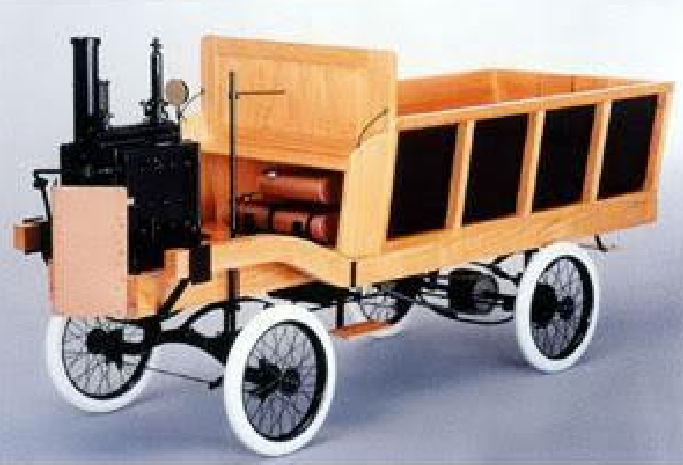
“WILL THE PEDALS BE RETAINED as a part of the equipment of the motor-bicycle of future seasons? Are they necessary even now? These are questions which are being extensively discussed amongst riders at the present moment, as they will undoubtedly influence the design of future types of motor-bicycles to an important degree…Up to now most motorcyclists will, I think, agree with me that pedals have proved of great value in nine machines out of ten. If we go back a matter of four seasons, we find that the small and inefficient motor of that period was regarded more as an adjunct to the pedal-propelled machine. Manufacturers claimed that their 1¾hp machines could go twice as fast on the level without pedal assistance as the ordinary bicycle could, but it was rarely claimed that even a moderate hill could be surmounted without pedal assistance. But nowadays things have changed greatly; the small motor of to-day is greatly superior in point of efficiency to its predecessor of 1900, and pedals are more or less regarded as a useful accessory for starting and controlling the machine over short distances when the engine is switched off rather than as an aid to propelling the machine on stiff hills; but in reality, I contend, there are very few machines under. 2½hp that do not require pedal assistance at some time or other in their career. I regard the pedals as, in a sense, taking the place of a variable speed gear. With a medium-powered engine minus pedals more often than not it would be a case of walking up the finishing stretch of a hill which a few turns of the pedals would have sufficed to surmount, and this, in practice, amounts to the same thing as putting a low gear into action when the hill becomes too much for the engine. A surprising amount of power can be put into the pedalling gear over a short period, even though the rider be not or the muscular order; and this feature is of the utmost value at critical periods. For actual starting of the machine pedalling can certainly claim to be a very convenient method, though by no means the only one; there is the method, for instance, of running by the side of the machine for a few yards, dropping the exhaust valve, and then vaulting into the saddle—but this is hardly to be recommended to the novice, as it is more or less of an acrobatic performance. Of course, the easiest method of all is to have a clutch and hand-starting gear; then all that is required is to start the engine up, get into the saddle, and let the clutch in gently. This latter method, indeed, would appear to be the only practicable one for a 3 or 4hp machine, with its immense weight. On very heavy machines I really cannot see that pedals can prove of the least service. To be able to move the machine from rest an abnormally low pedal gear would have to be used, and even then the strain might have serious consequences for a rider with a weak heart. It was just this very difficulty of ‘starting up’ a great dead weight by pedalling that helped to kill the quad. But for the type of motor-bicycle which, to my thinking, must become by far the most popular—a machine which will scale about 84lb all on and develop a good 2hp—the pedal gear will certainly be retained. In traffic riding the pedals give one a control over the machine which the rider of a pedalless machine cannot possibly have. True it is that something can be done even in this case by manipulating the machine a la ‘hobby horse’,’ but it is not a method that commends itself to me. With the help of pedals, and having the valve up, one can go along at a mere crawl of two miles an hour in dense traffic, which would otherwise mean dismounting every few minutes. On greasy surfaces, crossing badly laid metals, and rounding corners, I invariably find it better to switch of the engine, lift the valve, and put in a few strokes of the pedals. A not-to-be despised convenience with pedals is the ability to jack the machine up on the stand and give it a preliminary test indoors to see that all is right. I now come to the last advantage of pedals—although this particular one is becoming more and more of a negative value, as it is so rarely necessary to make use of it—and this is the fact that, given a fairly light mount, if by any chance the engine should break down, or even should one run unexpectedly short of petrol or current, it is always possible to pedal the machine to the next town and get a repair effected. I am quite aware that the ‘anti-pedallists’, if I may so term them, hold strongly to the view that a modern mount of good class should never break down, and that no rider worth the name would be so careless as to let his supplies run short. This statement looks well enough on paper, but can it be borne out in actual practice in the majority of cases? Personally, I do not think any practical engineer would stake his reputation that it would be quite impossible for any vital part of the complicated mechanism of a motor to go wrong, no matter how excellent the work or how careful the tests or inspection in its manufacture. We hear sometimes of a flaw developing in the propeller shaft of a great liner, and surely if it is possible for a steel shaft eighteen inches thick to break in two, despite all the tests and precautions modern engineering science can suggest, it is not unreasonable to admit a greater chance of a break on some part of a tiny petrol engine. I do admit that the ordinary type of pedal gear does not make an ideal footrest, and yet it is not uncomfortable by any means when one is used to the position—of which, by the way, it is possible to make innumerable changes, and thus avoid a tired or cramped feeling. Swing cranks, I am afraid, hardly fill the bill in their present form; they are rather susceptible to wear and derangement, and are awkward to manipulate into the ‘driving’ position. I rather favour auxiliary footrests of some kind, so that one can take the feet off the pedals if desired. The anti-pedallists may have a stronger case than that I have just indicated: if so, I hope they will give us the benefit of their experiences on the subject.”
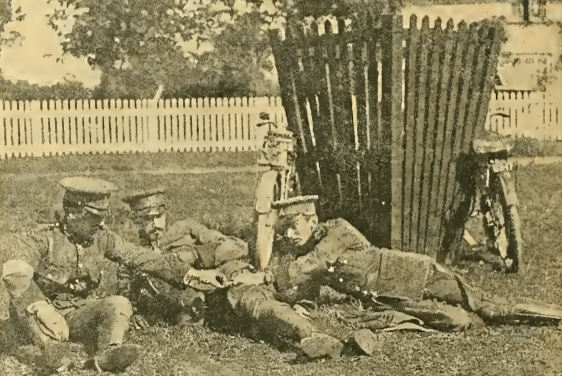
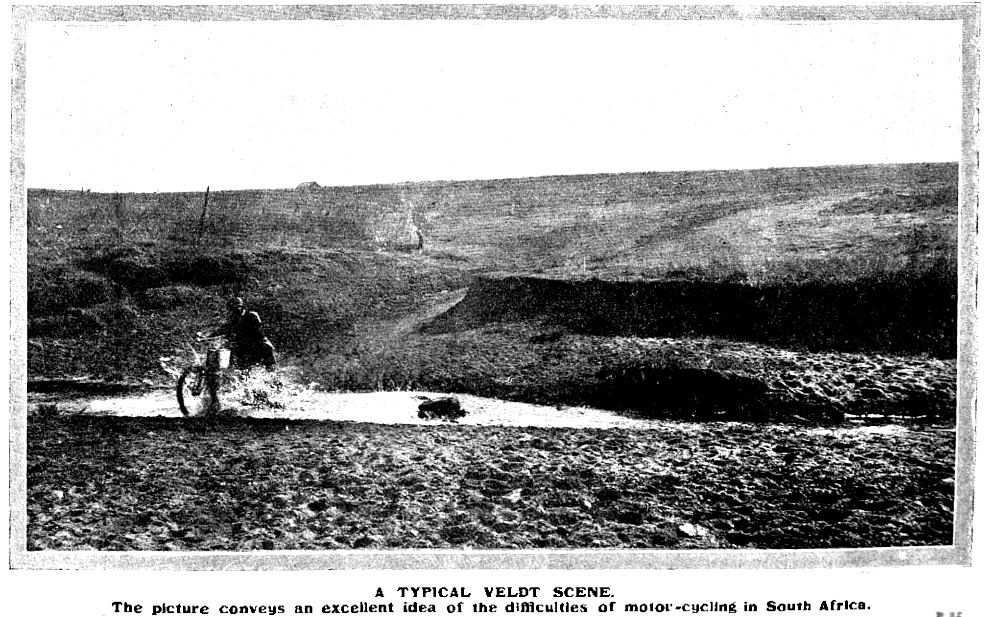
HAILED AS IRELAND’S FIRST motor cycle race, a 200-mile reliability trial was staged on 19 July. In 1927 the Irish Cyclist & Motor Cyclist published a report, based on the winner’s recollections: “The competitors, numbering about thirty, were sent off from Donegall Street, Belfast, at six o’clock…Their machines included such makes as Centaurs, Rexs, Excelsiors, Bats, Rileys, FNs, Ormondes, Minervas, Humbers, Raleighs, and Royal Enfields. The course was from Belfast to Derry, via Cushendall, Ballycastle, and Coleraine. Before Carrickfergus was reached everything possible—tool bags, spares, inflators—has been shaken off the machines. Alex Parker took the lead at an early stage, but at Cushendall he retired, having lost all his petrol. Petrol stockists were few and far between in those days. John Burney…did not get flustered when apparently faster men passed him. He kept a steady pace while they wrecked their engines, and at Derry he had a substantial lead. He came home a winner by 45 minutes, with JB Ferguson second and Bertie Robb third. Mr Burney thinks that he averaged much more than 20mph. On the Saturday before the race he broke his crank bracket axle and was thus deprived of pedalling gear and the pedals, which he used as foot rests. He had abandoned the idea of starting in the race, but, on his way home, passed the shop of Bob Ireton, who was inside preparing his own machine. Burney told of his troubles, and he and Ireton between them made a repair which served the purpose on the day of the event. The premier award was a cup presented by the Marquis de Mars, a French friend of the Hon Leopold Canning, now Lord Garvagh, who was then president of the Centre. At the time of the race M Burney was the holder of the 100 miles cycle record over many of the roads used in the course, but he did not find it necessary to use pedalling gear during the event.” Here’s a contemporary account, courtesy of The Motor: “This, the most important event promoted by the Ulster Centre, was run off on Tuesday last, the 19th inst. In the early hours of that morning the principal thoroughfares of Belfast leading towards the far-famed Shore Road were considerably stirred by the exhausts of the many motorcycles prepared to do
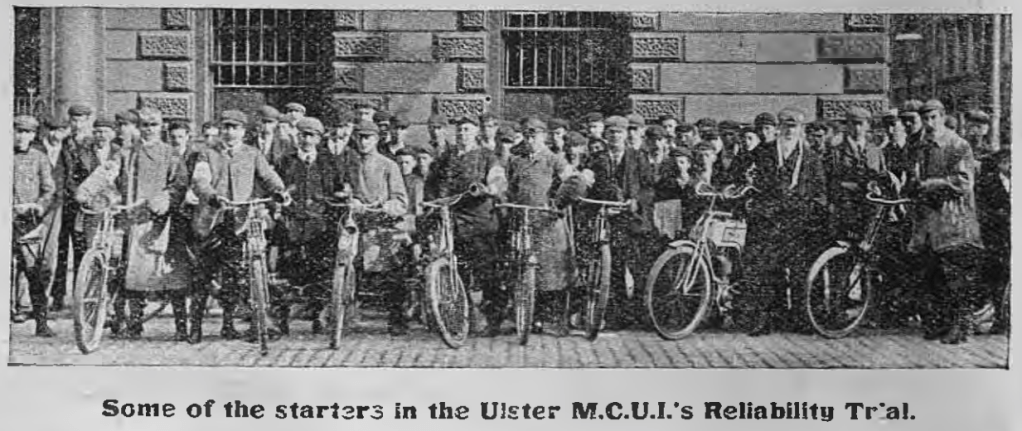
honour to their makers and their drivers. The route selected is probably one of the most beautiful in these isles, and it certainly is a searching one for both the reliability of the machine and the skill of the rider. For about 20 miles the waters of Belfast Lough are close to the road, then over a 200 feet hill and Larne Lough is reached. After passing the town of the same name, and for the next 22 miles, the road is within a stone’s throw of the North Channel. At Cushendall (49½ miles) a turn to the left led the competitors into the beautifully wooded and watered Glens of Antrim, with an 800 feet hill to be ascended in about two miles, followed by eight miles of gradual descent into Ballycastle (65 miles) on the rugged shores of the North Atlantic, through Bushmills and Coleraine (88½ miles) noted for their spirits (not petrolic), over the dangerous Downhill (95½ miles), and along the right bank of Lough Foyle to Londonderry’s ancient walls (124½ miles) thus completing the first stage. An hour’s compulsory stop here gave opportunity for the riders’ refreshment (but none for the machine while in control), before facing the 84 miles by the inland route to near Belfast. With a liberal prize list and such an itinerary, specially adapted to the hot weather we have had, it is a matter of little surprise that the entrants were many but the finishers were comparatively few, the united attraction of the sea under a glorious sun and the distraction of punctures overcoming many. Everyone reported punctures, and thunder showers just before the finish did not add to the comfort of the competitors. The winner was JP Burney, on a Royal Enfield, followed by JB Ferguson (Excelsior), and H Cooke (Raleigh).” [John Burney’s sons, John and George, added to the family’s trophy collection. John won the 350 Class at the 1924 Ulster Grand Prix; George won the International Leinster 200. Both were friends with Stanley Woods—John married Stanley’s sister, Violet. After WW2 John and Stanley became partners in a bike shop. And in 2024 John great-grandaughter rode in a commemorative run over the original course, on her Royal Enfield.—Ed]
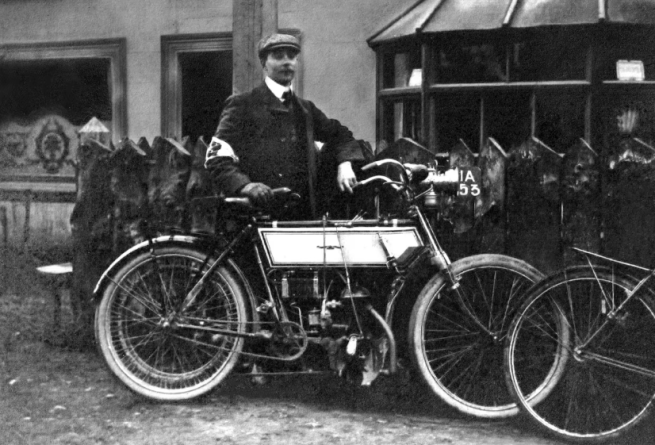

“THE HANDSOME TROPHY which the Ariel Cycle Co resented to the Motor Cycle Union of Ireland was competed for on Saturday last. The cup was offered for a two hundred miles non-stop ride, and one of the conditions imposed by the donors was that it was to be competed for on British-made motor-bicycles…There were nine entries, and of these only half a dozen presented themselves at the Custom House at 8 o’clock on Saturday morning…various accidents and mishaps occurred on the way, and only one of the six riders covered the first hundred miles without a stop, and even he had a sideslip when forty-six miles from home.”
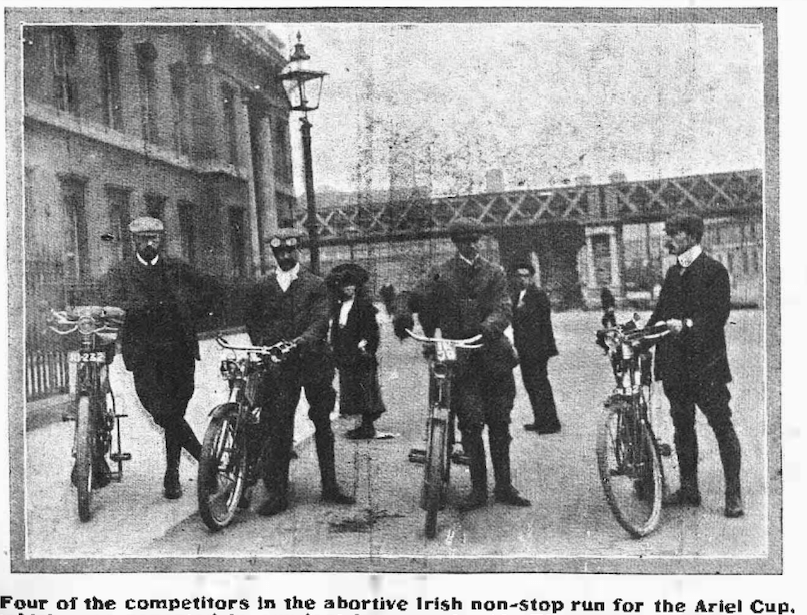
“A GREATER MEASURE of success attended the Motor Cycle Union of Ireland in their second attempt to run off the 200 miles trial for the cup presented to them by the Ariel Cycle Company, of Birmingham. It will be recollected that on the first occasion none of the competitors succeeded in doing a non-stop run of 200 miles, a feat which, it will be readily understood, is much more difficult of accomplishment on Irish roads than on the, comparatively speaking, sand-papered highways of England, the second attempt was made on Wednesday last, and the successful competitor was TW Murphy, the honorary treasurer, of the Union, he alone of the competitors getting through the journey without a stop. Of the others FA Wallen had particularly hard lines, his machine puncturing within 20 miles from home; while HT Harman, of Birmingham, after having completed the first half of the journey, went astray a few miles outside of Waterford, and afterwards got a bad puncture. Gerald Mayne ran short of petrol within four miles of the turning point, and WJ Thompson, of Mallow, had to dismount to make an adjustment to his carrier. Murphy was mounted on a 3hp belt-driven Singer bicycle, a machine on which he has been very successful this year, having secured full marks in each of the three Reliability Trials held under the auspices of the Irish Union.”
“A NOVEL TYPE OF FOUR-STROKE MOTOR. The illustration depicts a four-stroke motor embodying certain new features. It is the invention of AG Melhuish, of Edmonton. The piston, it will be noted, has two diameters A and B. The small end is the working piston; the large end works in another cylinder D. There is a passage from this latter cylinder to a condenser chamber F, and another port leading to the same is uncovered when the working piston has reached the end of its stroke. There is an inlet valve H to the working cylinder, and a relief valve I in the exhaust passage of the condenser F. Both cylinders are water jacketed. The action of the motor is, briefly, thus: Imagine a charge has been exploded in C, the piston A in descending does useful work, and the piston D creates a partial vacuum in the condenser. Now, the exhaust gases will escape into the condensing chamber by the port E being uncovered by the small piston in the same way as a two-stroke motor. The inventor claims that the exhaust is thereby completely silenced. The second stroke now begins and the gases forced out of the condenser by the large piston B and through valve I, the working piston, of course, closing the port E. The remaining burnt charge in C is compressed, and the piston begins its third stroke, valve H opens and lets in a new charge as soon as the piston has reached the end of its stroke, and the remainder of the burnt charge is drawn into F. On the fourth stroke, compression of the fresh charge occurs, and ignition at the completion of stroke. We should be inclined to expect some of the fresh charge to escape by the port E on the third stroke, which would render the motor somewhat uneconomical. Otherwise the cycle seems a good one. Although there is no exhaust valve to be mechanically operated, a two-to-one gear presumably would still be required to work the ignition cam, so that the motor lacks the simplicity of a two-cycle motor.”

“THE RILEY MOTOR-bicycle has been showing up prominently on the racing path of late. KW Ireton, who rides a 3hp Riley, has been particularly successful, amongst his best performances being his riding at the MCUI meeting, recently held at Ballymena, when he won outright two of the three events, and tied for first place with PS Brady in the one-mile flying start.”
“THE SUBJECT OF automatic versus mechanical inlet valves, if becoming somewhat threadbare, is still one of those points on which motorcyclists are divided in opinion. The writer has just completed 1,200 miles on his 1904 mount (which is fitted with a mechanically operated inlet valve) and is able to compare the MOV with automatic valves on previous machines. The first impression gained is the quicker starting of the motor. Provided the carburetter has been flooded, the engine fires as soon as the exhaust valve is dropped. This is seldom the case with an automatic valve, and the advantage is particularly noticeable in cold weather, or when starting on rising ground, for the valve opens independently of the strength of the suck of the piston. At the other end of the stroke the benefit is maintained. The valve closes sharply, so that at high speeds the charge is not in part forced back out of the cylinder through the valve, which latter, by reason of its comparatively weak spring, does not close sufficiently quickly at these speeds. The next advantage, I find, is the ability to drive the engine slowly and steadily: this is particularly useful in traffic.
VH Feeney.”
“THERE IS NO BETTER method of charging ignition accumulators than by a small turbine and dynamo, providing a suitable high-pressure water service is available. Such a machine is made by P Pitman, of Bosbury, Ledbury, Herefordshire. It will work from an ordinary house supply with as low a pressure as 40psi. The turbine runs noiselessly and requires no attention whatever. The dynamo is direct coupled, and the whole arrangement is very simple and efficient. The price, we understand, is very moderate.”

“ALTHOUGH THERE IS no risk of an actual explosion with a spray carburetter, it is certainly possible for the petrol in the carburetter to take fire; in fact, I know of two instances in which this occurred. In one case the flame ran along the insulation of the two low-tension wires which ran close to, and these were spoilt. What should be done in such a predicament is to blow out the flame at once before it has reached serious dimensions. A sharp puff will do this. Should the flame be a large one stifle it with a handkerchief.”
“OWING TO THE PETROL in the tank catching fire, a motor-bicycle was practically destroyed in the shop of an Oxford cycle agent. It is surmised that the tank leaked and that some of the spirit which had escaped was ignited by the lighted lamp of a bicycle which was standing near.”
“THE PETERBOROUGH &DMC offered gold medals to the members of the motorcycling section who could get through a 200 miles’ run from Peterborough to Yarmouth and back in ten hours…it was not necessarily a non-stop run, but was more particularly held to demonstrate the reliability of the motorcycle, and the capabilities of the driver, who was barred any organised assistance, and was, therefore, solely responsible for his own adjustments (if any) on the way…The actual riding time allowed was not less than 10 hours, or more than 10¼ hours, and the route was from headquarters (the Angel Hotel, Peterborough) to Wisbech, thence to King’s Lynn, Swaffham, Norwich and Yarmouth. Nine competitors entered the contest, viz: Percy Mays, 2¾hp Vinco; W Whattoff, 3hp Bradbury; T Pearson, 2¾hp Royal Enfield, FT Heighton, 3½hp Vinco; BC. Holmes, 3½hp Vinco; T Woodman, 3hp Lightstrung; B Gibson, 3½hp Vinco; C Ransom, 2¾hp Minerva; and PR Heighton, 2¾hp Vinco. The finish of the first 100 miles was at the Angel Hotel, Market Square, Yarmouth, where a compulsory stop of an hour was made for dinner, and for replenishing petrol and oil tanks. The return journey was taken by the same route, the last check and control being at the Blue Boar Inn, Eye. The competitors who succeeded in finishing reached Peterborough between 8 and 8.15pm. Mays, FT Heighton, Holmes, Woodman, Gibson, Ransom and Whattoff completed the distance in accordance with the conditions laid down, and will receive gold medals recording the performance. Holmes, on a Vinco, and Woodman, on a Lightstrung, rode the same machines, which behaved so well in the club’s too miles non-stop run from Peterborough to Lincoln recently. It will be remembered that they then rode 625 miles before deciding a winner.”
“THE OSTEND MOTOR RACE meeting began on the 14th of July with a trial for touring vehicles. The gay Belgian watering place is just now at the height of its season, and with magnificent summer weather prevailing visitors were enabled to enjoy the spectacle of cars and cycles racing along the Snaeskerke road…No touring motorcycles competed…On the second day a 10 kilometres trial for racing cars was on the programme, some of the best motorcyclists end motorcar drivers in France competing. In the light motor-bicycle class René, on a Red Star, won in 7mins, 28⅘sec. In the motorcycle section Pilette, on a De Dion-Bouton tricycle, covered the distance in 7min 29sec, beating Rigal (Buchet motor-tricycle) by 28sec…On the fourth day one of the most important events—the one-mile race (standing start)—took place…Olieslagers, on a Minerva, beat the light racing motor-bicycle record in 59⅖sec. Rigal (Buchet tricycle) beat the heavy motorcycles record in 1min 16⅕sec…Seguty (Griffon) won the flying kilometre trial in 36⅖sec.”
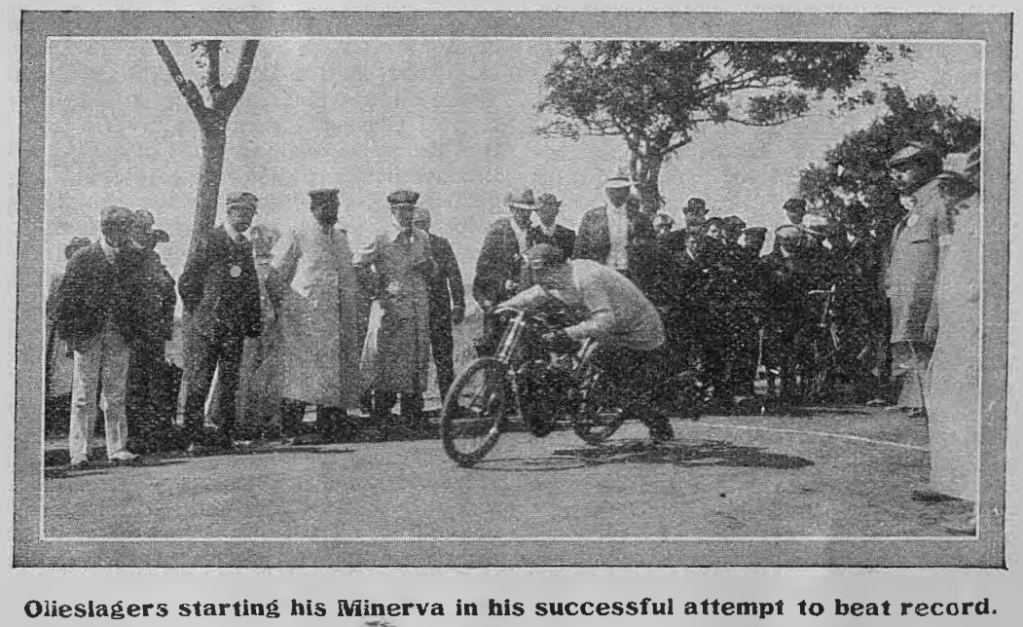
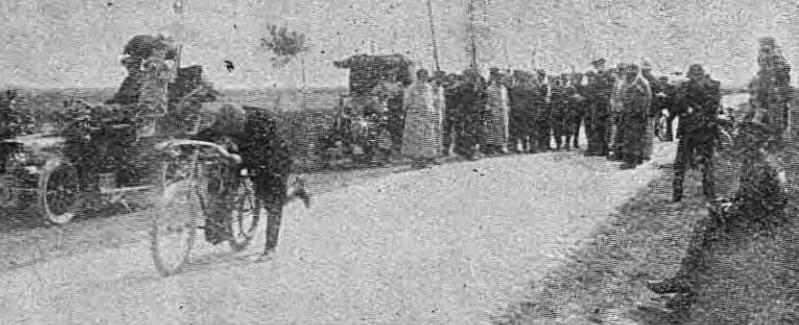
“A DEPUTATION IS to be sent to the Home Office on the question of universal lighting. The Motor Union is agitating for the enforcement of a by-law securing that all vehicles shall show a red light to the rear after dark.”
“THE AUTOMOBILE CLUB JOURNAL draws attention to the unwise policy on the part of motorists of writing hasty letters of sympathy or regret in the case of collision with a horse-drawn vehicle—such letters frequently invalidating any attempt to deny legal liability in court in the event of a summons.”
“A DUBLIN MOTORCYCLIST has unsuccessfully pleaded that a motor-bicycle becomes an ordinary bicycle when the belt is removed, and does not therefore require to carry a number plate, nor need the rider carry a licence. The Bench decided that the machine was still a motorcycle, and fined defendant 2s 6d for not carrying a licence, cautioning him for the absence of the number plate.”
“DE DION TRIKES EVERLASTING. It is surprising how long some of the old De Dion tricycles last, and many are now in almost as good working condition as when new. A number of these mounts can be seen round about London any fine week-end. We noticed one on the Bath Road the other Sunday pulling a double trailer and load of three passengers at a good 18mph. The lasting power of these pioneer machines speaks volumes for the workmanship put in them by the famous French firm. We know of one of these machines in which the engine has run 12,000 miles without requiring new bearings.”
“IMPUDENT THEFTS. Two men, of Mile End, London, were charged before the Spalding (Lincolnshire) magistrates last week with stealing two motorcycle accumulators, a lamp, and some tools. It appeared that the prisoners hired a motor-bicycle at Skegness, and rode to Boston, thence to Spalding. On reaching the village of Gosberton the accumulators of the machine gave out, and they could not proceed. Seeing, however, a motorcycle at a house in the village they abstracted the accumulators and put them on their own machine and proceeded to Spalding. Here they went to a local workshop for petrol and repairs, and whilst there appropriated a cycle lamp and some tools. The police, however, had followed them, and they were arrested. The Bench convicted on both charges, and prisoners were each sentenced to six weeks’ imprisonment with hard labour.”
“DUST PREVENTION EXPERIMENTS IN SCOTLAND. With permission of the First District Committee of the Renfrewshire County Council the Western Section of the Scottish Automobile Club have treated two portions of roadway with Westrumite [‘a road-dust preventing material composed primarily of petroleum and ammonia], and one portion with crude oil, with a view to testing or demonstrating the efficiency of these materials with regard to the prevention of dust and the maintenance of roads generally. The Westrumite is laid for fully one-third of a mile on the Glasgow to Kilmarnock road, above Whitecraigs station, near Giffnock, and for one half of a mile on the Anniesland road, west of Scotstounhill station. The crude oil has also been applied on the latter road near to the entrance to Jordanhill Estate for a distance of 400 yards.”
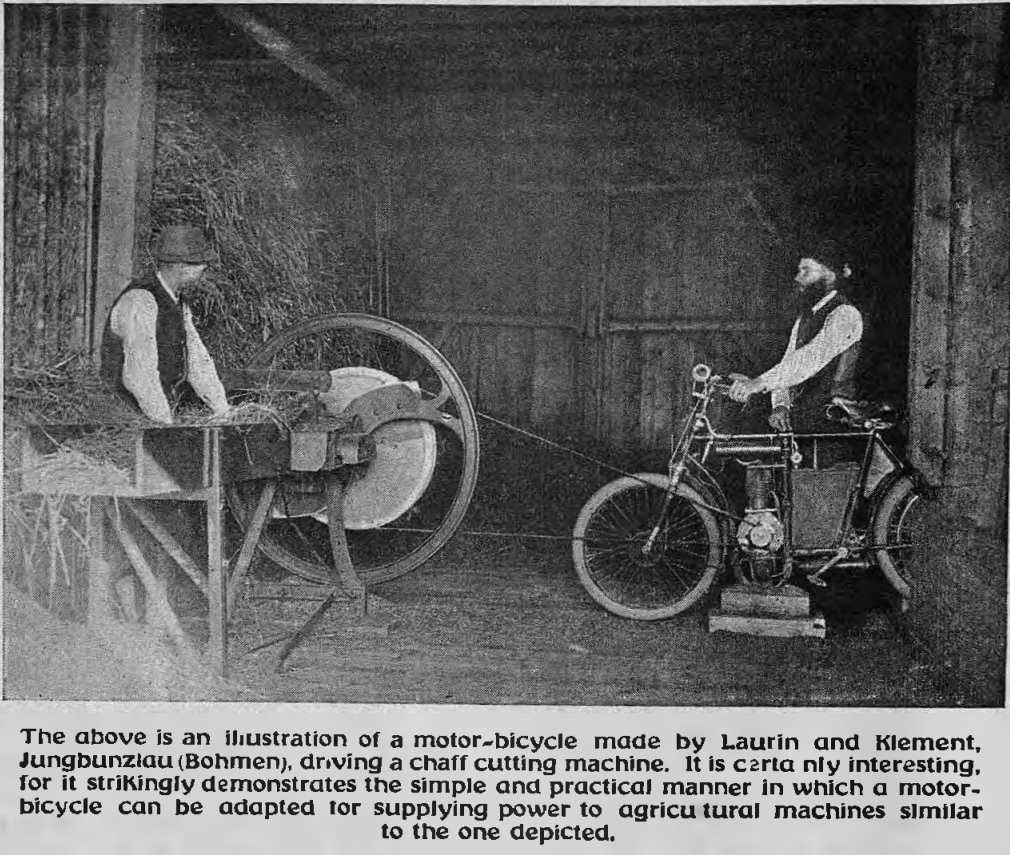
“NOTHING IS MORE UNNERVING to the motor cyclist than a constant fear that something will be encountered on the road which cannot easily be seen. With a good acetylene lamp which lights up the road for about a hundred yards, night riding loses all its terrors, and the light almost takes the place of a companion, as it illuminates the dark stretches of the road. In the winter acetylene lights are likely to give trouble when it is freezing, however slightly, and a very good plan to adopt is to take the lamp into the hotel when a stop is made; thus preventing any chance of the water being frozen when a light is required. After the lamp is lighted the heat from the burner will prevent freezing of the water in most patterns. In addition to the acetylene light an oil lamp should always be carried, and this should be kept warm as much as possible, to prevent the oil from congealing.”
“ELECTRIC MOTORCYCLE LAMPS. The United Motor Industries,45, Great Marlborough Street, London, W, have now introduced a special line in electric lamps for motorcycles. These lamps have a specially designed reflector to collect the rays of light and direct them well ahead. They are fitted with 4 or 8 volt lamps…The electric principle has been applied successfully to a number plate for mounting on the front mudguard extension of a motorcycle.”
MANCHESTER MC’s 1OO MILES NON-STOP RELIABILITY TRIAL. The first reliability trial of the above club, and the first of the kind ever held in the district, took place on the Cheshire roads, on Saturday, the 16th instant, and Wednesday last, the 20th. For the first day a triangular course of about 16½ miles was selected, lying between Knutsford, Northwich and Holmes Chapel. Unfortunately the starting and finishing points were at Over Tebley, within a mile of Knutsford, while a slight portion of the course lay through one street on the outskirts of Knutsford, behind the gaol. As there were fully 25 to 30 motorcycles and cars at the starting point, it soon reached the ears of the police that a ‘race’ (?) was in progress, and as the course had to be traversed six times the competitors quickly attracted attention in passing through Knutsford, with the result that the police stopped and booked the names of three riders…The times varied from 5¼ to 6 hours, and all but two finished. The principal machines were Bradburys, Bats, Humbers, Peboks, Clydes and Minervas, and nearly all did the journey on less than a gallon of petrol. In consequence of police interference on the first day, it was considered advisable to alter the course to an out-and-home one of about 50 miles for the second day…Starting from Rudheath Corner, near Holmes Chapel, they went through the latter place to Sandbach, then on to Crewe, through Nantwich, then on to Whitchurch, and through Wem to Shrewsbury, and returned via same route to Plumley, via Lostock Graham from Rudheath. Eleven competitors were despatched in couples at intervals of five minutes…Clifft was first man home in 5hr 35min, on a fore-car.”
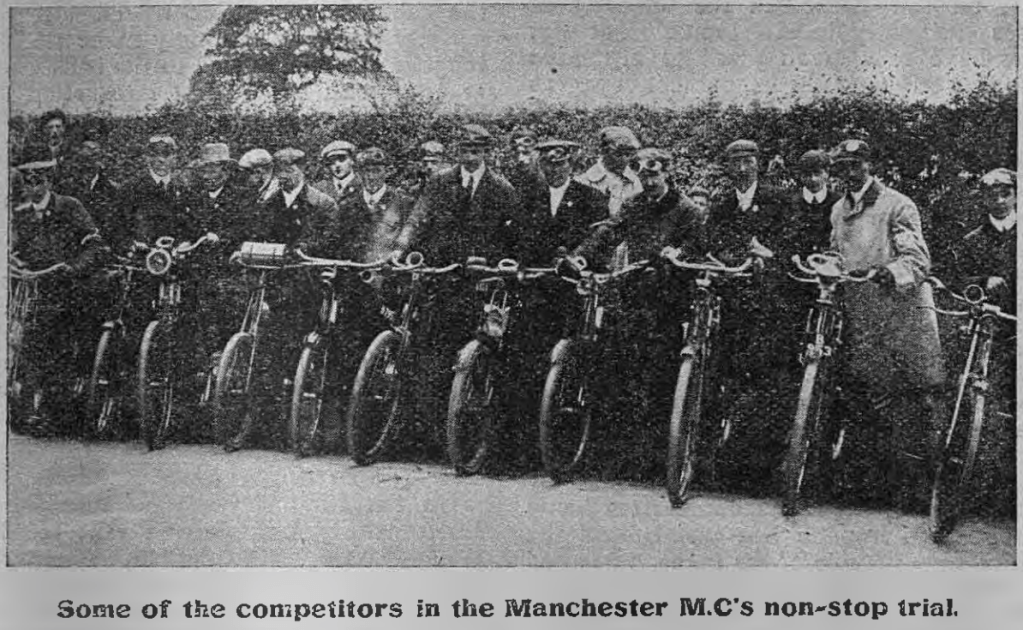
“DURING THE FIRST six months of 1904 the exports of motorcycles from. Germany increased to 2,236 machines, as against 900 machines in the corresponding period of 1903.”
“MOTOR-BICYCLE TEAM races have been tried at race meetings in America.”
“MISS FLORENCE NAVLET, who rides a diamond frame Indian motor-bicycle in a divided skirt, is the champion lady motorist of California.”
“AN UNSUCCESSFUL MEETING. Rain spoilt the kilometre race organised by the Motor Cyclists’ Association of the Austrian Motor Club for divers categories of machines. Eight men should have started in Class A, but not a single one put in an appearance. Group B found a solitary representative in the person of Josef Dottori, who negotiated the course on a 3hp Eless and Plessing in 59⅘secs. Only one man decided to compete in Class C (motorcycles with trailers) to wit, Julius Curjel, who towed Lieutenant Stohanzl over the kilometre in 1min 11⅖sec. On the termination of this series of lugubrious ‘walks-over’, several men of Class A were inspired with a desire to perform. The officials deliberated on the matter and eventually proclaimed the race at an end. We wish the energetic association better luck next time.”
“A MOTOR-BICYCLE GORDON-BENNETT. The Motor Cycle Club of France is projecting a motor-bicycling Gordon-Bennett. It is felt that an international race for motor-bicycles on the lines of the great car race would stimulate the motorcycling industry as it has done the car industry. Steps are being taken to obtain Government authority for a circular road course on which the French eliminating trials will be held. When her team is selected France will throw down the gauntlet to the nations and invite competition for the possession of a £200 cup.”
“A SENSIBLE SUPERINTENDENT AND A REASONABLE DOG OWNER. The Welshpool magistrates recently had before them a resident who was summoned at the instance of Supt Williams for not keeping his dog under control. The Superintendent was attacked by the dog when riding a motor-bicycle. He said that he did not wish to press the summons, but merely to ask the magistrates to impress on the defendant the necessity of controlling his dog. Defendant caused some amusement by pointing out that the plaintiff had not stopped his machine when the dog ran out at it. ‘No; I kept on to get out of its way!’ The affair was amicably settled by defendant promising to keep his dog under control in future.”
“THE PHOTO REPRODUCED depicts a distinct novelty in the shape of a motorbicycle fitted with a 4hp engine mounted horizontally, examples of which type are distinctly scarce. It is made by the Roc Motor Co, Guildford, Surrey, and is working most successfully, one feature noticed in particular being a considerable reduction of vibration. The machine has been run a very considerable distance, and no difference in wear of valves, compared with the vertical engine, has been discovered so far. Neither is the slightest difficulty experienced with lubrication. The spark is produced by an Eisemann dynamo and induction coil. The shape of the frame is worthy of note. The main tube encircles the engine, and holds it secure by clips.”
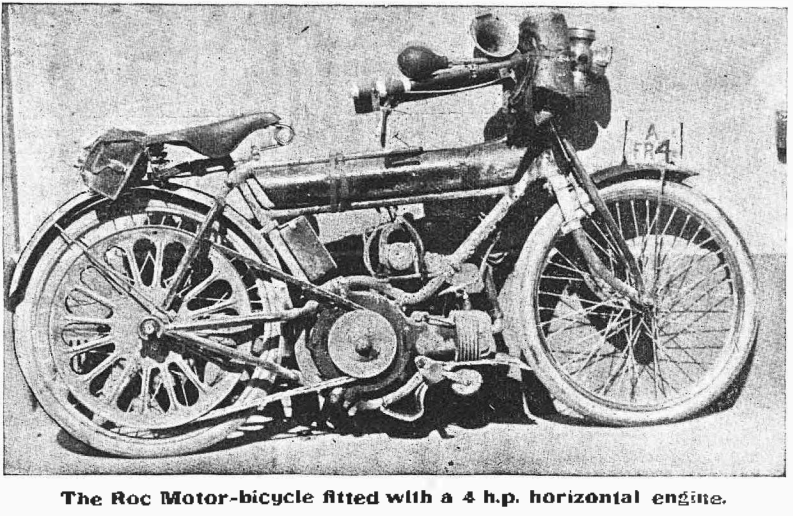
“THE RILEY CYCLE CO, Coventry, have effected a number of improvements in their tri-car since its introduction, and the latest model is a very handsome and thoroughly well-designed two-seated automobile. The engine, a Riley, is of 4½hp, and the cylinder is entirely water jacketed; the water being carried in a tank, capacity four gallons, between front of frame and back of front seat. An ample length of gilled tube radiators is carried below the frame, and circulation is maintained between these and the engine by means of a centrifugal pump driven off the engine shaft by a chain. A Longuemare carburetter of the latest ‘air. shutter’ type supplies the mixture, and the ignition is the high-tension system, with two accumulators, and a two-way switch on top of the frame…For the transmission a large leather-lined coned friction clutch is fitted on the engine shaft, operated by a pedal; a chain takes the drive to a gear box at rear of engine. This box contains two sets of gear wheels (always in mesh), giving two speeds, with direct drive on top gear.”
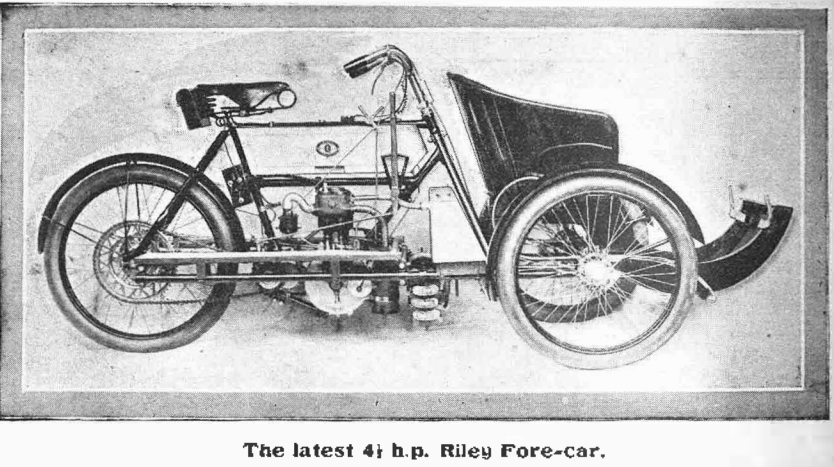
“A NEW UP-TO-DATE model of a tri-car for 1905, which has been named the National, and has been designed and manufactured by the National Motor Co, of Bury New Road, Manchester. The machine is equally suitable for two gentlemen, two ladies, or a lady and gentleman, and it is also intended for small tradesmen; while it can also be used as a tricycle…The specification includes a 4hp MMC engine, with MO inlet valve, water cooled, with specially large radiators, two speeds and free engine, no sliding gears, direct drive on top speed, dustproof oil retaining bearings throughout, Hans Renold’s Silent chains, large motorcar tyres, wheel steering, comfortable bucket seat for driver, art cane or coach-built body in front as preferred, latest Longuemare air-governed carburetter, petrol, water, and oil tanks of large capacity, all fitted with glass level gauges; extreme silence in running, but fitted with free exhaust at will. The front seat is easily detached for use as a single machine, or as a tradesman’s carrier.”
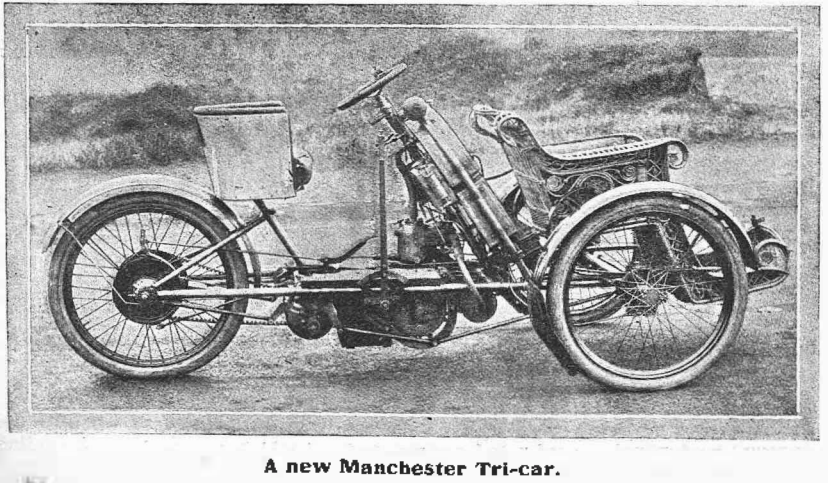
“A LIGHT AND HANDSOME 2hp tricar has been built up from a Clement-Garrard bicycle by Mr J Baskett, of Madras. The framework of the car itself had to be made of gas tubing, as the ordinary steel cycle tube was not obtainable. The little engine (60x70mm) [198cc] does excellent work, as it has done 22mph with two passengers, the total weight propelled being 30 stone. The roads around Madras are quite level, and hence a two-speed gear is not necessary, A fan is provided at the sparking plug side of the cylinder.”
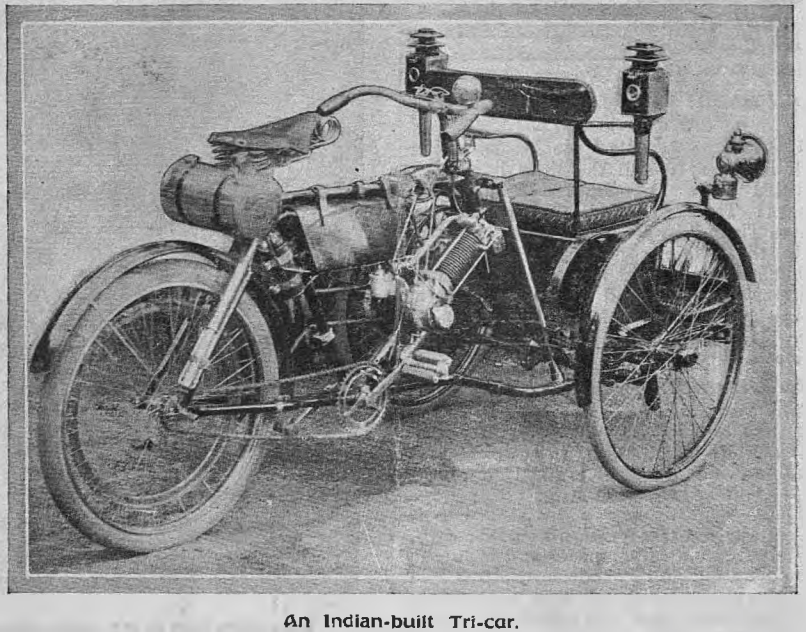
“THE MOTOR-BICYCLE ILLUSTRATED has many interesting features. It has a 2½hp horizontal engine with valve gear worked almost exactly in the same way as a gas engine. The crank case is supported by the down tube in a special manner; easily followed from the diagram. The crank shaft runs on ball bearings, which are adjustable. The usual carburetter is dispensed with and a simple vaporiser on the engine takes its place. The engine has a large diameter outside fly-wheel fitted. The petrol, oil and accumulator and coil are carried in the tank compartments. Transmission is by V belt. The frame, it will be noted, is a very simple one with a curved main tube. In view of the fact that it is often contended that a horizontal engine on a cycle will not work, this machine is interesting. The makers claim that the weight of the machine is 85lb only. It is the patent of, and manufactured by, Howard and Co, Cycle. Makers, Coalville, near Leicester.”
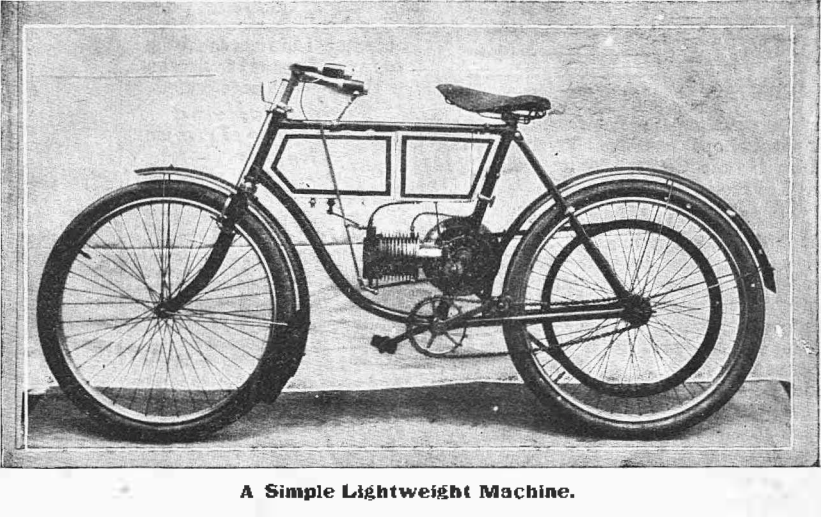
“THE JUNO 3HP MOTOR BICYCLE, made by the Metropolitan Machinists’ Co, 75, Bishopsgate Street Without, London, EC, can claim to be a thoroughly sound and nicely designed mount at a very reasonable figure, viz, £34. The engine is the very popular Fafnir 75x80mm [353cc] driving by a V-belt. It is mounted vertically between the down tube and diagonal. The carburetter is the Fafnir spray type. The petrol tank has a capacity of 1½ gallons, and the compartment for lubricating oil holds one quart. There are two brakes, a Bowden back and a lever pattern on the front wheel. The front forks are of extra large section and have duplex stays. Wheels of 26in diameter are fitted, and the tyres are Dunlop 2in. Ignition is by coil and accumulators, these latter being carried in a metal box at the back of the tank. The mudguards are of ample size, and the general equipment throughout is of the best.”
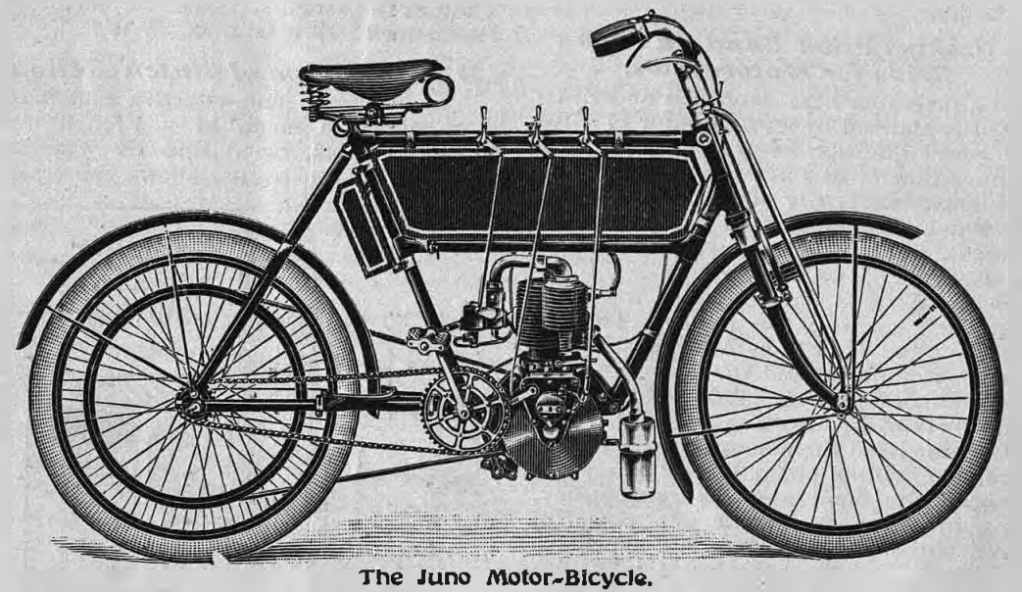
“A MACHINE POSSESSING wheel steering and a spring support for the rider has just been patented in France. It is known as the Systeme Suddard. The steering wheel is supported by an extension of the usual diagonal tube. The movement is conveyed to the fork crown by extension rods. On the steering wheel pillar the engine control levers are mounted very much in the same manner as on a car. The rear triangle of the frame does not differ from the ordinary type, but it will be noticed that the saddle is supported on a separate frame supported on springs, and thence by a curved tube which is jointed and capable of movement with the vertical tubes. From a rear view the tubes are seen to form a bridge over the rear wheel. Instead of pedals footrests are fitted. The inventor claims that this type of machine is much more comfortable to ride than the usual type, there is less risk of side-slip on greasy surfaces, and quick mounting and dismounting can be effected. The method of attaching the motor at three points gives extra rigidity.”

“A FRENCH-BUILT MACHINE of queer outline is that illustrated. The motor is carried in a deep loop formed in a single tube, running from the lower part of the steering socket to the saddle pillar lug. The position of the saddle is right back over the centre of the rear wheel. It will be noted that the rear stays have a double triangle formation, so that this part should be rigid. The design, we should imagine, was more suited for a track machine than for a road machine. The position of the handlebars is decidedly uncomfortable looking.”
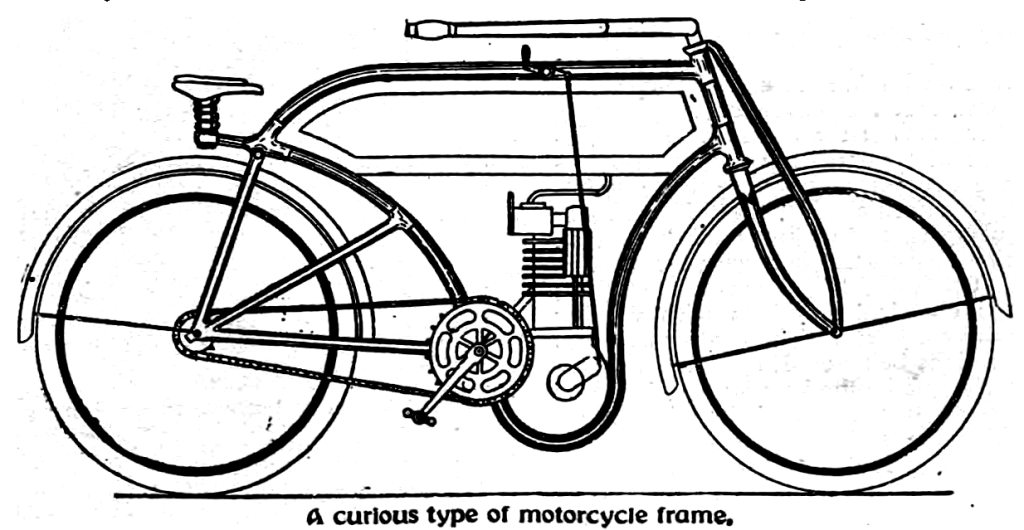
“THE NSU MOTORCYCLE engine depicted in the illustration has some very interesting features, chief amongst which is the valve operating mechanism. The inlet valve is mechanically operated from the top of the engine by means of a tappet rod, which extends to the underside of the two-to-one gear box. This rod is depressed by means of the cam striking the ball which rests in a seating just over the rod. A similar ball is placed between the exhaust valve cam and tappet rod. Thus the friction is greatly reduced. The inlet valve is, strictly speaking, a combination of the mechanical and automatically opened type, the chief purpose of the mechanically actuated tappet being to start the valve from its seating. The suction then draws it full open. Another feature about the engine is the magneto electric ignition. The dynamo generates a high-tension current, and is driven by a train of small cog wheels from the two-to-one shaft…Just below the spark-plug is shown a nipple for connecting up the warming jacket of the carburetter to the exhaust…The ignition can be retarded and advanced in the usual manner.”

“THE FOLLOWING DETAILS of an illuminating device for motorcycle number plates adopted by a doctor in this neighbourhood may interest your readers. This consists of replacing the coloured sidelights of an acetylene lamp by a small reflector, and mounting the plate on an arm on fore mudguard extension or girder forks close to head tube and below the lamp. In the instance from which the photo was taken, the reflector consists of a right-angled prism of clear glass, mounted in an open metal frame. The dimensions of the prism are, approximately, 1in by 1in. by 1.41in, with a thickness of ¾in.
H Parker, St Ives.”
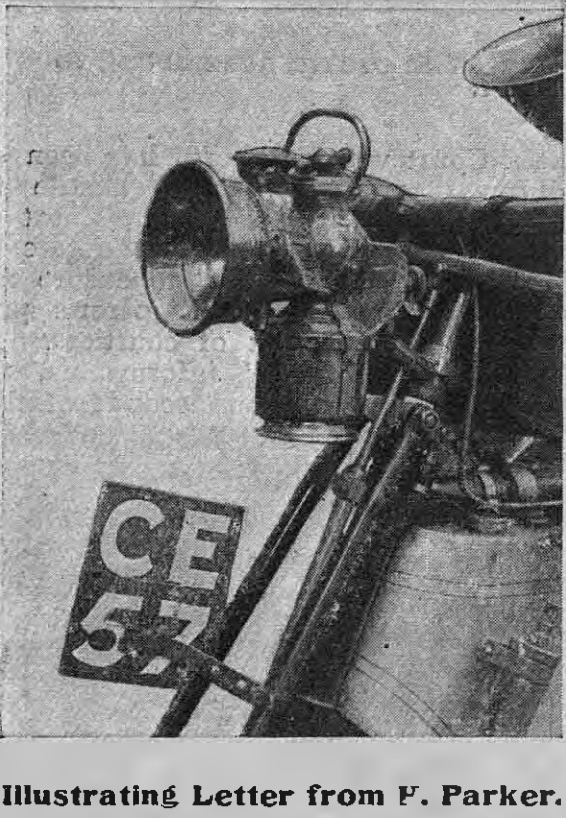
“THE FOLLOWING DETAILS of a new tricar I have patented may interest your readers. This machine ha.s been designed as a convertible tri-car, so that by detaching the side tubes of back frame and the nuts on the rear portion of the bicycle frame, the machine can be made into a bicycle. The dotted line in the illustration shows the position of the back bicycle wheel. As a bicycle the drive is by belt, and there are no surplus parts left on which are not required, so the weight would be the same as a standard machine. As a tri-car the drive is by a belt to countershaft, and thence by chain to the rear axle. The engine, I suggest, is a 4hp twin cylinder air-cooled, because owing to the engine position the full amount of cold air is obtained on cylinders. A free engine clutch is fitted, this being operated from a pedal on the footrests. The foot-rests are formed by a tube, which is part of the frame, and acts as a support for the side tubes of back carriage. On the opposite side to the clutch pedal is another pedal for working the back brake of bicycle or tri-car, and beside this, but attached to the side tubes of back carriage frame, is a pedal for operating the two-speed gear. This gear would be on the Crypto principle in its simplest form, fitted on the countershaft, and controlled by a lever which locked the ‘sun and planet’ pinions, or locked the sun pinion to the fixed shaft.
A Goodchild, 331, East Park Road, Leicester.”

“FOR THE TRIPLE OFFENCE of furious driving, not showing his licence when required, and not having a bell or horn on his machine, a motor cyclist was tined £9 6d at the Penge court last week. At the request of the defendant’s solicitor the magistrates reduced the fine by £2.”
“AT AN EXTRAORDINARY general meeting of the Manchester Motor Cycle Club, held in Manchester the other evening, it was unanimously resolved that the word ‘Cycle’ be deleted from the title and that the name of the club henceforth be ‘The Manchester Motor Club’. Although the club from its inception has been most successful, and now numbers about 80 members, the step was universally considered a wise one, and it was pointed out that in many cases the motorcycle had proved a ‘stepping stone’ to the car with the members, that other members were contemplating a car, and that a large number of car owners were holding aloof from the club on account of its title.”

“AT BANGOR LAST WEEK a motorcyclist was summoned for driving a motorcycle without carrying his license. A policeman stopped the rider for not having the number plates properly fixed, and then found that he had no license. The defendant submitted that there was no case, as, owing to having no petrol, he was pedalling the machine at the time. Hence he was not driving a motorcycle within the meaning of the Act. After consulting the Act, the Bench upheld the contention and dismissed the case.”
“SINCE THE NEW ELECTRIC TRAMS began to run in South London there have been numerous stoppages on some of the routes. A reader dismounted on seeing a stranded tram and offered the worried mechanic his neat little four-volt testing lamp…We understand that his creditors wish to sell his machine.”
“A RATHER NOVEL hill climbing competition, promoted by the Birmingham MCC took place on Saturday, at Hagley Hill, on the Kidderminster road, about five miles beyond Halesowen, and 12 miles from Birmingham. The length of the hill was about half a mile. The novelty lay in the fact that only one machine was ridden by the whole of the competitors. This machine was selected by the committee, and was a twin-cylinder Clement-Garrard, kindly lent for the occasion by Mr CG Garrard, who also presents the prizes of the value of three guineas ands two guineas. The weather appeared very threatening in the morning, but the two or three sharp showers which came only served to lay the dust. At 4pm, when the competition started, it was very bright and warm. Pedalling was allowed on the hill, as the machine was a strange one to all the competitors. Twelve members entered, but only nine turned out. The small number of entries is accounted for by the committee adhering strictly to the rule of the club, which lays down that no member shall be eligible for any competition until he has made three club runs. The winner was the captain of the club, Mr. EH Humphries, who scaled the hill in 1min 45sec, the second place being taken by Mr G Dennison in 1min 51sec.”

“GP MILLS, THE FAMOUS long-distance cyclist of the ’eighties and ’nineties, the mention of whose name invariably recalls the two most widely-separated points of Great Britain, left Land’s End early on Thursday morning last en route for John o’Groats. The journey of 886 miles is no new one to ‘GP’, as most readers of The Motor will know, but having accomplished it in record time on every form of muscle-assisted cycle—solid-tyred ordinary, pneumatic safety, tricycle, and tandem—he was anxious to attempt it on a motor-assisted machine…Leaving Land’s End at 8am on Thursday morning, he arrived at John o’ Groats at about a quarter to eleven on Saturday morning, the full time of the ride being 50hr 46min 30sec. This beats T Silver’s 64hr 29min by nearly 14 hours. Mills was two hours late in starting from Land’s End, and having the bad luck to puncture his tyres more than once reached Warrington four hours behind his schedule. He had made up two and a quarter hours of this time when he reached Carlisle. The next news to reach us was from John o’ Groats, announcing his successful arrival. He had expected to cover the distance in 42 hours, or a little over…Only those who have attempted the feat of getting from Land’s End to John o’ Groat’s in the shortest possible time can have the least conception of what the task entails. The physical strain is enormous, and only a plucky man, and a machine of equal ‘pluck’, are capable of successfully overcoming the difficulties. We have always been strongly inclined to the opinion that the satisfaction obtained from beating the end-to-end record is quite an inward one, far outweighing public kudos, simply because nobody except the aspirant for record honours can understand all that is entailed in the attempt. There have, during the past eighteen months, been a number of attacks on the record, the vehicle employed being the motorcycle, but they have all failed, mainly because the record essayer has had to learn the inevitable lesson. A chat with GP Mills after he had commenced to recover from his recent end-to-end experience could not fail to cause one to marvel at the sterling qualities, the grit and the determination of the man. You imagine him to have come through with teeth clenched the whole way, taking each difficulty as it cropped up as a necessary part of the programme, each heavy shower, each puncture, each piece of vile road, each wrong turning carrying him miles out of the way being just as inevitable an item of the ride as is each mile of the road. Mills had an idea last year of going for the record on a 4½hp motor-bicycle, but he wisely waited for the new pattern Raleigh, and thus his ride was made on
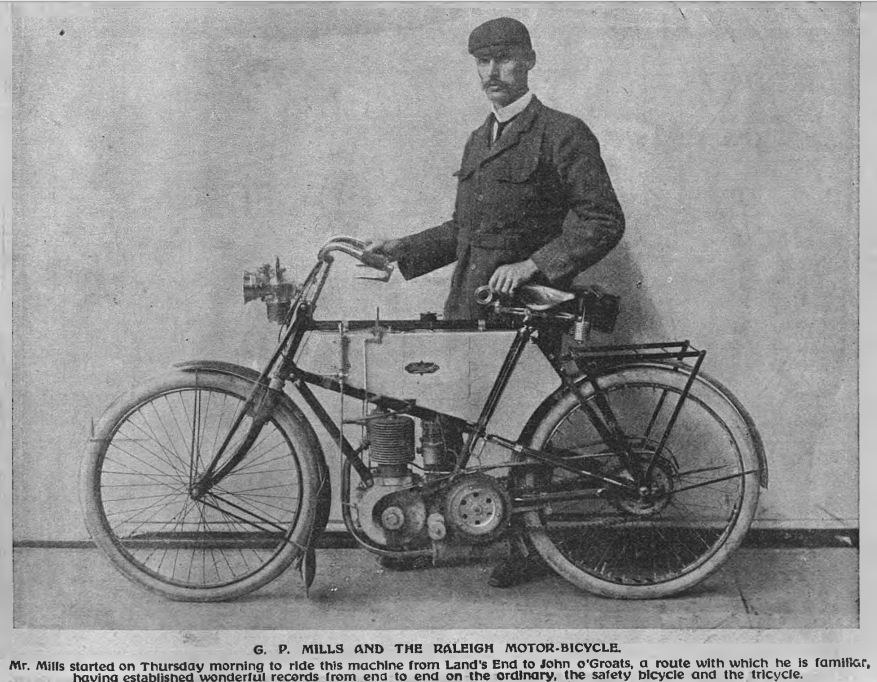
a 3hp Raleigh motor-bicycle absolutely standard in every respect, having a two-speed gear, and lacking pedals. He left Land’s End with the intention of covering the distance in 42½ hours, or practically two very long days and a night. Had he left at six o’clock on the Thursday morning as intended, and been able to keep to schedule, he would, after riding all day Thursday, all through the night, and all day on Friday, without more than an occasional break for meals, have reached John o’ Groat’s soon after midnight on Friday. As it was, Mills did not get away till eight o’clock on the Thursday, and he did not reach his destination until neatly eleven o’clock on the Saturday. Soon after starting he found that the movements of his spring handlebar (a new and untried device) had cut the switch wire, leaving the current permanently on, and also the front brake wire, leaving him minus much of his brake power. Hastily repaired punctures, sustained over the dry West of England roads, leaked continuously, and necessitated pumping almost every hour throughout the ride. The narrow roads of Cheshire, taken at top speed, called for skilful driving, whilst around Warrington the roads were in a terribly bumpy condition. In two places on the way railway and tramway operations made driving extremely hazardous. A wrong road taken at Newmains lost Mills a lot of time and then came the rain, the greasy roads, the fearful surfaces for the greater part of the way, and the strong head wind. And when his schedule time had expired he was yet a hundred and twenty miles from his goal! All through that second night Mills kept going, fighting the desire for sleep, and finally reaching John o’ Groat’s at 10.48am, his gross riding time being 50hr 46min 30sec, and his net time inside 40 hours, the distance covered being 886 miles. The Raleigh motor-bicycle ran perfectly all the way, never once missing fire, and giving no trouble whatever throughout the long and severe trial. The record looks like standing for a long time.”
“THE FACT THAT GP Mills used a pair of P&R solid electrolyte cells on his recent end-to-end record ride is excellent testimony to the efficiency of this type of cell. One of the sets of cells lasted 600 miles, and the full distance was completed on the other one.”
“JUST AS WE go to press a report reaches us that Mr Harold Williamson, of Coventry, succeeded last week end in beating Mills’ motor-bicycle record from Land’s End to John o’Groats by nearly two hours. The journey was accomplished in 46 hours 36 minutes, and Mr FT Bidlake timed. Mr Williamson rode a 3¼hp Rex machine.”
“AN UNDOUBTED REVIVAL in the popularity of the motor-tricycle is to be witnessed. During the last month or two quite a number have been seen on Southern roads, A few of these were old pattern De Dions, but the majority were quite new patterns, with belt or chain drive. This is in keeping with the prophecy of many former enthusiasts that the tricycle would come again.”

“THE THIRD IMPORTANT event organised by the Motor Cycling Club this season was held on Saturday last. It consisted of a 100 miles reliability test for motorcycles for two riders, including types of fore-carriages, side-cars, trailers, and tandems. The awards are a special trophy presented by SF Edge, Esq, valued at 20 guineas, and second and third prizes of gold and silver medal respectively. The event was highly successful last year, and proved even more so this year, the total number of entrants being 17. The regulations were briefly these: (1) The combined weights of driver and passenger must not be less than 18 stone; (2) the passenger in all cases to be a lady; (3) the machine fully loaded with petrol, water, and oil for the entire journey must not exceed 4cwt; (4) no adjustments are allowed but at the conclusion of the first 50 miles the riders may refill the petrol and oil tanks from supplies carried on the machine; (5) no competitor may cover a less distance than 15 miles or exceed 20 miles in one hour; (6) competitors are

provided with checks, which are to be handed to checkers at the turning points. The starting point, as last year, was the pretty little village of Godstone, and from here a run had to be made to a point 25 miles beyond. The time for starting was 10.30 from headquarters. The following is the list of competitors, who were despatched at intervals of a minute: T. Silver (Quadrant tri-car), Wright (Roc side-car). Reeves (Liberty side-car), Priest (Quadrant tri-car), Maffert (Bat tri-car), Davison, J van Hooydonk (Phoenix Trimo), Johnson (Humber-Olympia fore-car), Wilson (Ormonde fore-carriage), Crundall (Humber), Densham (Anglian fore-car), Jenkins. (Rover fore-car), Arnott (Werner fore-car). Young (Werner cycle and trailer), Wilbur Gunn (Lagonda fore-car), Milligan (Bradbury fore-car), and Goslett. The weather was perfect, but the roads were dusty as far as Forest Row, where the steep rise beyond the village was in a
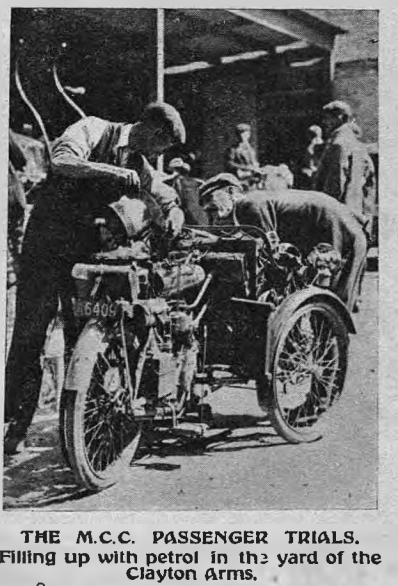
heavy sodden condition from local showers. Reeves was early in trouble with a defective oil tank, and Young failed to surmount the hill at Forest Row. These two competitors proved, however, to be but the forerunners of a long list of others. Wright was reported stopped with a puncture; Arnott’s engine pulled up on a hill through overheating; Jenkins’ chain came off; Crundall had a trifling fault with his contact breaker; while Johnson found that through an oversight both sets of cells in his machine were exhausted. A few others also had very trifling mishaps which, nevertheless, sufficed to throw them out of the contest. Considerable surprise was evinced at headquarters when, by two o’clock, only Silver, Hooydonk, Gunn, Densham, and Milligan had returned.All the others had been left behind, in striking contrast with last year’s trial, when practically everyone finished. However, after lunch the five competitors left in were started on the final 50 miles. Silver had not covered many miles when he found that his lubricator failed to work through a fracture in the pipe. His retirement left four competitors in; and these, experiencing no
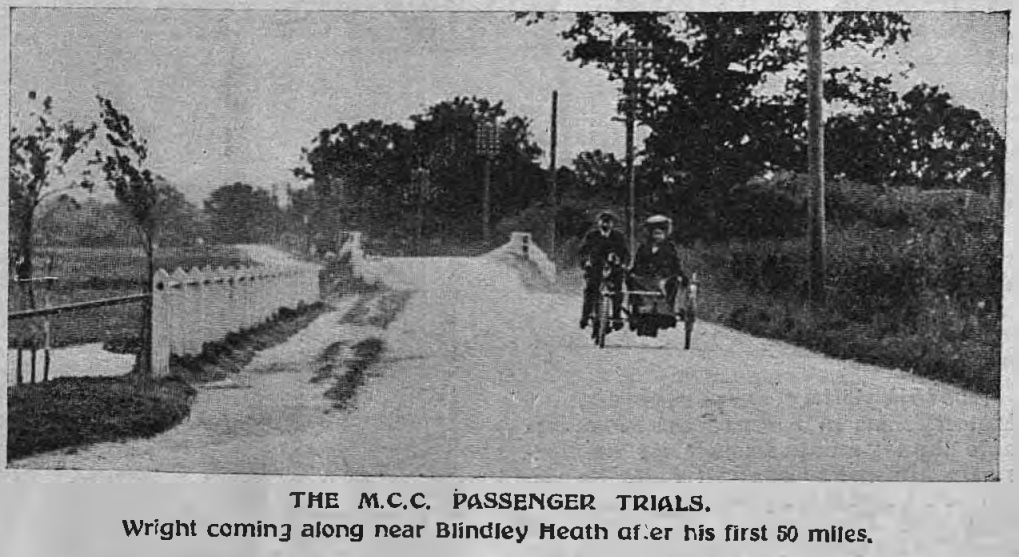
further mishaps and keeping well up to schedule time, arrived back at headquarters about five o’clock. It had been intended to hold a further test on another Saturday, as it was thought that at least a dozen competitors would have got through, but as only four were left in the committee decided to put into operation a novel test to determine the winner out of these. After tea everyone set out for a point on Blindley Heath, where there was a cross-road, dead straight, level, and deserted. On this an out-and-home course of about half a mile each way was chosen, with marshals at each 220 yards. At each of these points and at the turn the engine and road wheels of each competing machine had to be brought to a dead stop, and then restarted. At each stopping place the machine had to be stopped to the marshal’s satisfaction between two lines ten yards apart. The operation had to be repeated at each point where a marshal was stationed, and the competitor who covered the course in the shortest time was declared the winner. This was obviously an excellent test for the rapidity with which the machines could be started and stopped. The winner proved to be J van Hooydonk, who was smart in manoeuvring his machine. For second place the committee have to decide between Wilbur Gunn and Milligan.”

“MOTORCYCLING IN ITALY. The Brescia (Lombardy) Cup motorbicycle trials were concluded in Italy last, week. Official results are not yet published, but the following 17 competitors completed the 1,000 kilometres’ reliability run; the names in brackets are those of the machines: Tamagni (Marchand), Caminada (Bianchi), Palazzi (Adler), Mainoni (Turckheimer), Franchini (Turckheimer), Brambilla (Turckheimer), Guippone (Peugeot), Picena (Peugeot), Keale (Peugeot), Gregori (Adler), Tomihaselli (Bianchi), Scotti (Bianchi), Strumia (Wanderer), Lamberjack (Griffon), Homo (Griffon), Pusterla (Neckarsulmer), Cerabolini (Brennabor).”
“MILITARY DESPATCH BY MOTORCYCLE. Our French contemporary, L’Auto, has organised a relay ride on motorcycles from Belfort to Brest, the object being to carry a sealed military despatch from the commanding officer at Belfort—the town close to the Alsatian frontier which underwent such a terrible siege in the Franco-German war 34 years ago—to the commanding officer at Brest on the coast. The distance is 1,127 kilometres, or 695½ miles, and it was divided into eleven stages of about 100km each, a different machine being used for each stage. Osmont, on an FN, took the first stage, leaving Belfort at midnight on Monday of last week. He took 3hr 54min to cover the 110km assigned to him. The other stages were reeled off at an average of a little less than 50 kilometres an hour, Madame Clouet, who took the tenth stage, covering her allotted distance at 56 kilometres (or 34 miles) an hour. Lanfranchi, on his Peugeot, delivered the despatch to the officer at Brest at nine minutes past noon on Wednesday, the gross time being 36hr 8min. But little intervals occurred between the arrival of the despatch at the end of a stage and its departure, whilst the despatch lay at Fouy nearly six hours, so the net running time was 28hr 17min, giving an average speed of about 25 miles an hour.”
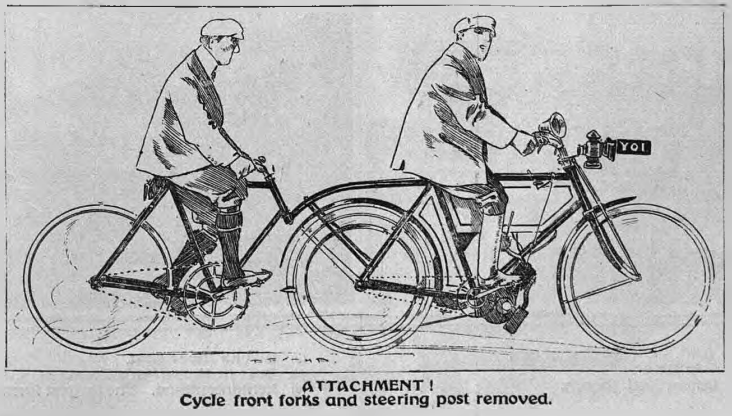
MOTORCYCLE ROAD RACE IN AMERICA. The 50-mile road race of the Buffalo Motorcycle Club attracted a gathering of over a thousand spectators at the starting point. The course was from Limestone Hill, through Bowmansville, Mill Grove, and Crittenden, to Corfew and back. Thirteen competitors started, the race resolving itself into a contest between Indian and Thomas machines, wherein honours may fairly be said to have been divided, for whereas an Indian took first place, the next four in order were Thomas machines. A time limit of 2hr 45min was allowed in which to qualify for a gold medal. Nine competitors finished within the limit, the times being phenomenally fast for the road. The winner was AS Noonan, of Rome (New York), who rode a 1¾hp Indian—time, 1hr 11min 30sec. Becker, on a 3½hp Thomas, finished second in 1hr 14min 30sec.”
“AN UPPER NORWOOD motorcyclist had the misfortune to leave his license at home the other day. As luck would have it he came to grief on that identical day, and a sympathetic policeman rendered first aid—in the shape of a summons for not carrying a license. With a smashed machine and a bruised knee he presented a fit subject—in the constabulary eye—for a practical demonstration of the value of red tape, for he was dragged two miles to Beckenham Police Station to be charged, and at the subsequent sitting of the court at Bromley the Bench imposed a fine of 18s, including costs.”

“RACING IN ROUMANIA. Six competitors presented themselves at the starting-point for the first motorcycle race ever held in Roumania, each determined to make the first record for the 108 kilometres (about 70 miles) on the Bucharest-Ploeshti-Bucharest route. Sharp at 10am on a recent Sunday Metzner, on a 2hp Peugeot, was sent off and then, with five minutes’ interval, the following went after him, in the order named: Sachirogulo (3hp Peugeot); A Pucher (2¾hp Puch); P Dumitresco (3½hp Minerva); B de Singapor (3½hp Griffon); D Vladoiano (2¾hp Griffon). Before 11.30 it was known that Metzner and Vladoiano had given up owing to faulty carburetters; and at a quarter to one De Singapor passed the winning post, having completed the distance in 2hr 33min. The only other competitor to finish was Sachirogulo, whose time was 3hr 9 min. Although these times can hardly be called fast, it is only fair to remember that the competitors had to contend against unusual circumstances. The winner was attacked by gipsies, and had to charge through them as best he could. Having got away from this unusual danger of a cycle race, he was straightening his handlebars and generally overhauling his machine after the collision, when he was again attacked and escaped with much difficulty. Sachirogulo declared that he had to wait 40 minutes at the Ploeshti control before he could get his ticket signed and a fresh supply of petrol. To quote the Roumanian Press: ‘Motorcycling is in its infancy in this country, but the most difficult part has been achieved and the first race has been won; all that remains now is to go ahead and hope for better luck next time.’
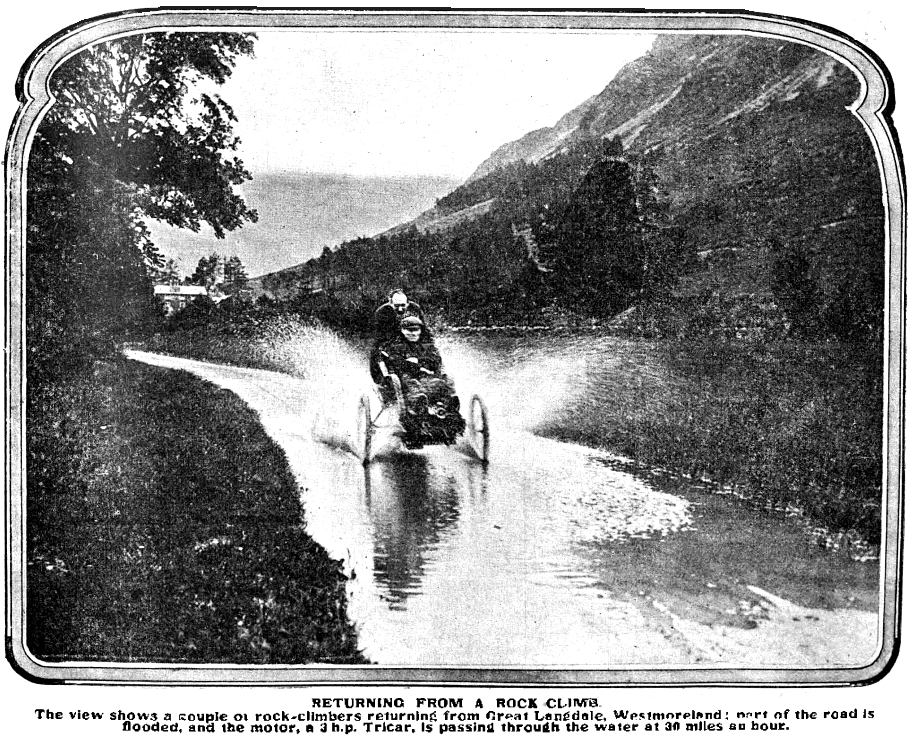
“THE CHAPMAN EXPANDING PULLEY for motorcycles possesses a diameter which can be varied while running and set at any desired point, thus giving a wide range of gear ratios. The invention is now fully perfected, and can be seen in operation at the works of Messrs Chapman, 18-22, Fann Street, Aldersgate Street, EC, or a full description will be sent by post on application. We are promised an opportunity of testing a machine fitted with this pulley, and in due course will be able to say more concerning it.”
“A NEWPORT (MON) MOTORCYCLIST has been fined £2 and costs at Cardiff for furious driving. Defendant rode at an alleged speed of 16-18mph through the streets, and aggravated his offence by towing two cyclist—a most reprehensible practice in traffic.”
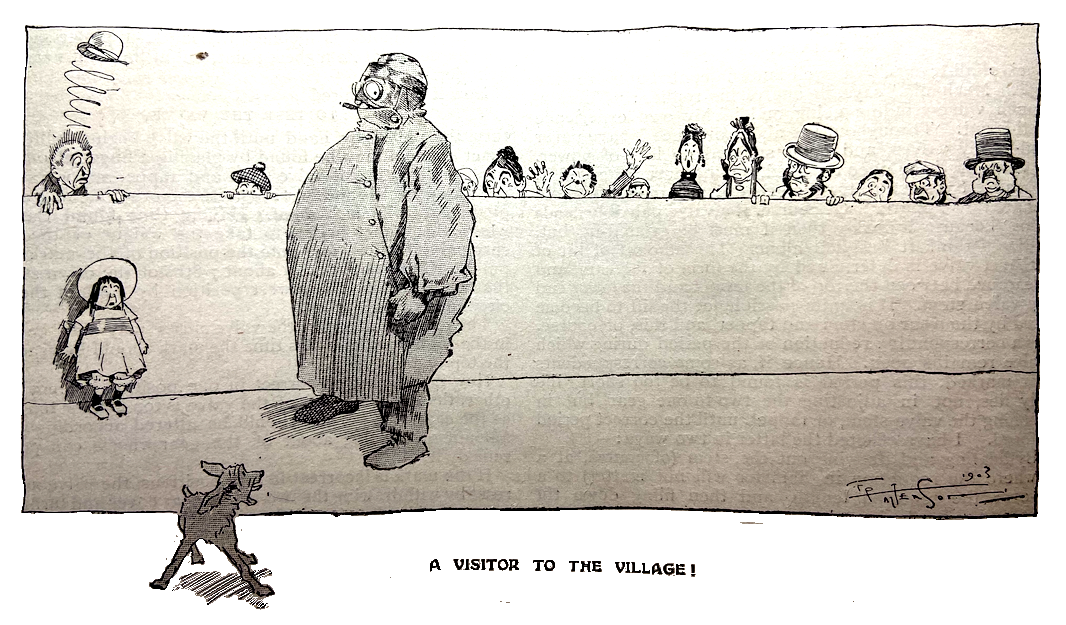
“THE LOCAL GOVERNMENT Board Inquiry into the application of the City of London for a 10-mile speed limit was held at the Guildhall on Tuesday last. Mr Moresby White appeared on behalf of the Automobile Club, and Colonel Holden, Mr ER Calthrop and others ware called as witnesses. The Secretary appeared on behalf of the Motor Union, and Mr Nisbet and Mr Roberts, the honorary secretary of the Blackheath Automobile Club, gave evidence. The same inspector, Mr Burd, held a similar inquiry relating to the Borough of Kingston on the following day, and will issue a report shortly.”
“A MOTORCYCLING CLUB has recently been formed in Johannesburg, and is to be run under the name of the Johannesburg Motor Cycling Club. Although the club is of but recent formation, the fact of there already being over 50 members speaks well for its future. The photo was taken on the occasion of the club’s opening run to Rosherville Lake, starting from the Market Square, Johannesburg, and, as can be seen, was well attended. In the background of the illustration can be seen the Market Buildings surrounded by a corrugated iron fence, erected on account of the building being found to contain rats infected with plague germs. The club committee has arranged a number of runs for the ensuing three months embracing most of the towns and places of interest in the vicinity of Johannesburg, and also others up to a radius of about 50 miles, therefore giving the members the choice of long or short runs.”
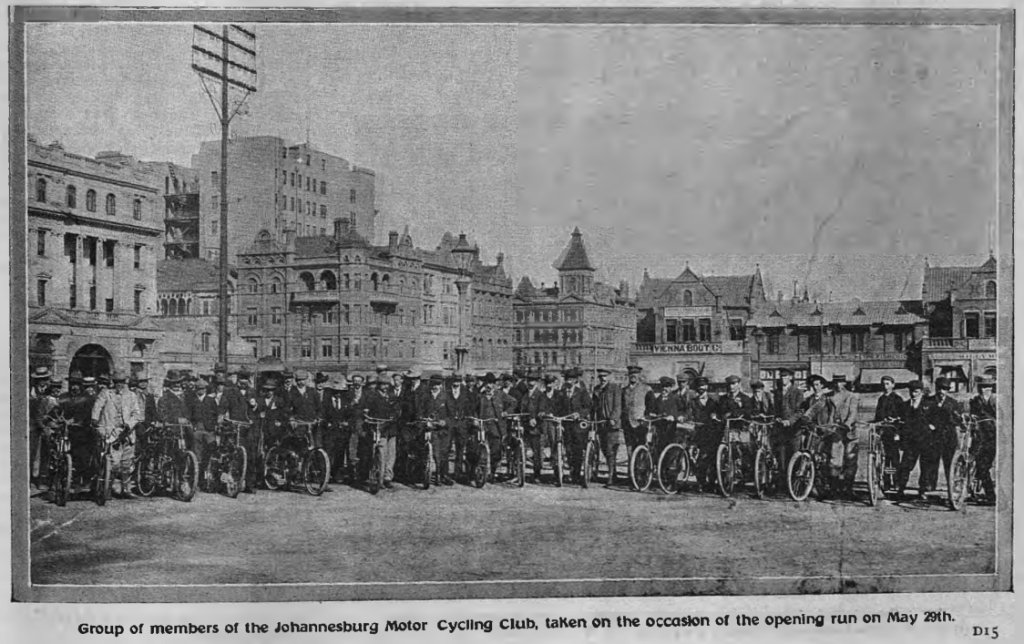
“THE IMPORTANT MATTER of motor cycles and vibration has been engaging the attention of many of our largest makers for some considerable time, and several designs have been turned out that have not, perhaps, attracted the public as they have been expected to. But regarding the output of new designs very little in the annihilation of that enemy of our sport—vibration—has been arrived at which could secure for all riders of motor cycles greater comfort in travelling to even an equal quantity compared
with the pneumatic tyre. The spring frame models at present on the market have met with much favour, and used over fairly good roads prove more or less a luxury, while over the majority of town roads where one’s pace is lessened to a degree an appreciable difference to found. And how many riders of this handy form of locomotive are patiently awaiting the improvements in 1905 models which are likely to eclipse all former years in special detail, if not in strikingly novel construction.”
“WE HEAR FROM THE South British Trading Co that Mr Gordon Stuart, chief of the Johannesburg Fire Brigade, an ardent motorist, offered a cup to the winner of a motor cycle race open to all comers from Pretoria to Johannesburg. A Mr Murkett won the cup, beating the previous best record time by 16min, Chater, the second man, being within record time. Murkett’s machine was an ordinary 2¾hp Vindec Special, and considering that the previous best record has been beaten to the extent of 16min, it must be admitted that the Vindec machine is not only staunch and strong, but speedy as well. “
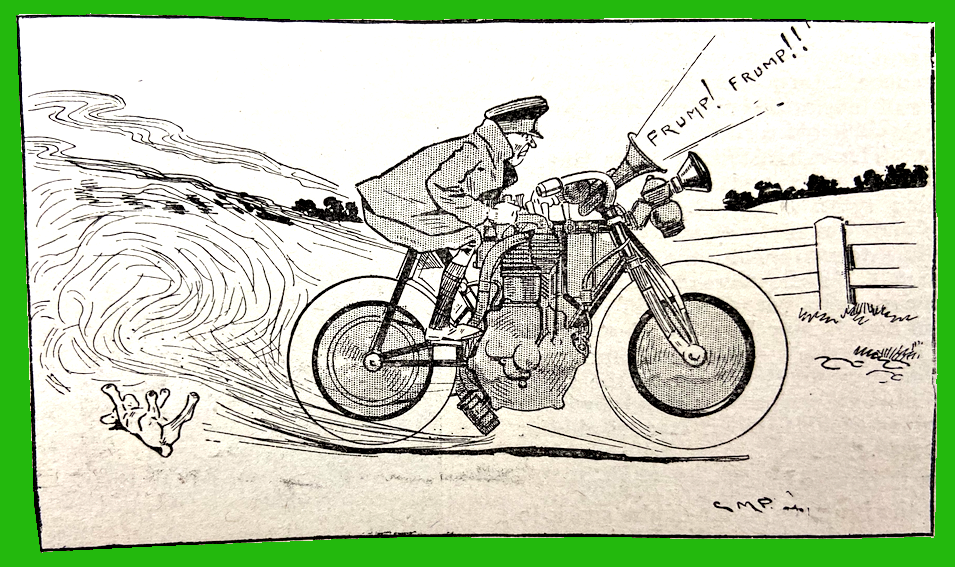
“THE ONLY MOTOR CYCLE races of the year in Lincolnshire were held on Wednesday at Lincoln, on the City FC ground. The meeting was held under the auspices of the Lincoln Wheelers CC, and included a two miles motor cycle handicap, open to the county and members of the club. The prize was the motor cycle club silver cup. Nine entries were received for the event, and three preliminary heats were run, the winners of each heat and the second in the fastest heat qualifying in the final. There was only one non-starter. In the first heat the riders were: HE Wilson, Lincoln, 2¾hp Enfield (holder of the cup), scratch; J Evans, Lincoln, 2¾hp Acme, 100 yards; and C Wallis, Lincoln, 2hp Fleet, 180 yards. Wilson was some time catching his men, but Wallis’s engine began to misfire, and he and J Evans were soon overhauled. A good tussle ensued for a while till Wilson got away and won by nearly half a lap in 4min 38⅘sec. In the second heat, W Evans, Lincoln, scratch, was on a 3¼hp Acme; S Evison, Sleaford, 10O yards, was on a 2¾hp Excelsior; and A Hornsby, Scunthorpe, 2½hp JAP, was on 150 yards. Evans Went at a great pace on the straight, but had to shut off at the corners, but even then ran wide at the goal posts at the railway end, taking that bend at what appeared to be a perilous angle and very near. He, however, got round all right and won, but by only about 20 yards from Evison; Hornsby third. Time, 4min 46⅕sec. The last heat brought out G Bates, Grimsby, 3hp Rover, 50 yards, and W Pindar 2½hp Minerva. Bates, who is more used to banked cement tracks, would not take the corners it any pace, though he made good speed in the straight. Pindar got round well, and won in 4min 11⅘sec, but Bates gave up at the last lap, and so did not ride in the final as second in the fastest heat. The four finalists were a good lot, and got round well, except W Evans, who took the lower corner near the goal posts wide. In the second lap, W Evans was coming op very fast, and endeavoured to pass, but failed to get round, coming with a terrible smash into one of the posts holding the wire ropes. He was sent spinning for about ten yards, rolling over as he went, and falling on his back. He, however, was only there momentarily, and, to the great relief of the crowd, got up and went to clear the wreckage of his machine out of the way of the other racers. The heart was, however, taken out of the sport, though the riders did not slow up appreciably, Pindar won he a few yards short of a lap in 4min 10⅕sec, nearly passing the second man, Wilson, on the post; J Evans third. Before the finish of the race we took a photograph of the smashed machine, which is reproduced here.”
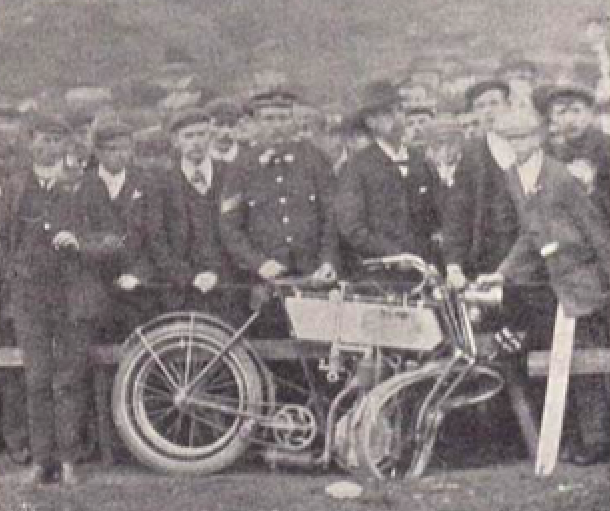
“AN UNQUALIFIED SUCCESS in every sense was the two-day race meeting held by the Irish Automobile Club, at the Velvet Strand, at Portmarnock, on Tuesday and Wednesday of last week. Favourable weather, magnificent racing, and a track that left nothing to be desired combined to make the meeting one of the most successful events of its class that has ever been held in the British Isles…The motorcycle races resulted in a complete triumph for CB Franklin, a rider who, in the competitions of the Motorcycle Union at Portmarnock, has been wonderfully successful. He made a clean sweep of the events on Tuesday and Wednesday, winning both of the races each day. He had his 2¾hp FN tuned to concert pitch on every occasion, and the fact that he was able to beat machines of considerably higher horse-power was due to the wonderfully quick manner in which he got away from the mark. In the race for the Wheatley challenge bowl he was followed home by WR Ireton, on a 3½hp Riley, and in the lightweight class JG Drury, on a 2½hp Triumph, was second. On the second day his runner up in each event was ET Jones, a Welsh rider, but an objection to the latter, on the ground that his machine was over 1501b weight, deprived him of the prize he won in one of the events. It may be mentioned that the Motorcycle Union of Ireland and the ICA gave special permission for amateurs and professionals to meet in the race for the Wheatley challenge cup without the former losing their amateur standing, but all of the entrants were amateurs.”

“SOMEWHAT VARIED EXPERIENCES with the motorcycle of today are often recorded in the columns of your deservedly popular and most interesting paper, and as 1 have recently completed 5,000 miles on a standard 2¾hp Beeston-Humber, I venture to give an account of a tour, with a trailer, which I think may interest some of your numerous readers. My friend Brown joined me on a recent Saturday afternoon, and after strapping our small bags to the trailer, we started at 6pm with the intention of reaching Shrewsbury, 80 miles away, that evening. The weather was very promising, and although the roads were dusty they were not loose. Leaving the town quickly behind us, we were soon doing a little over the limit, and all went well until near Lichfield, when I heard a scraping noise from the rear. Looking behind, I saw that one of the trailer tyres was punctured. Quickly dismounting, we discovered that the protecting band, which I had had solutioned over the outer cover, was very badly cut, the tyre evidently having been down for some miles. Brown said he thought it bumped, but put it down to the loose, stony roads, which were in a shocking condition near about Lichfield. I blessed him, but as it was his first trailer ride I forgave him. after one hour’s hard work I got the tyre in a rideable condition and we were soon off again. A short stop in Lichfield, and we were quickly moving along at a high speed. We had to make up lost time, and, coming to a long decline, I was letting the engine out (it was almost dark and I had decided to light up at the bottom of the hill), when I suddenly saw some dark forms a short distance ahead. My horn gave out several startling blasts, but the forms did not move, and, to my horror, I saw they were cows. I applied brakes immediately, but too late, and the brutes were turning round when I dashed broadside into one of them. There was an ominous and tremendous crash, and I was rolling on the ground some yards from the machine, with friend Brown almost immediately on top of me. We were quickly up, and I had visions of a broken up motor and training home, but to our great delight we found that the only damage was a badly bent pedal and crank and a bent horn. How the machine was able to withstand such a collision is beyond me—I expected the frame, forks, and wheels to be broken up. Lighting the lamp, we returned to Lichfield, deciding to get the crank and horn repaired and to make a fresh start on Sunday morning. After a most comforting supper we drank the health of Humber, Ltd, for we had reason to be pleased with their work. Sunday morning turned out bright and hot, and we made another start about 10 o’clock. Running perfectly, we went by way of Newport to Shrewsbury, then on by Whitchurch and Chester to Liverpool, where we put up at the Waterloo Hotel. We had made very good time from Lichfield, averaging 24 an hour. On Monday morning we took motor and trailer to Humber’s fine depot in Bold Street, where I had another band put on the trailer tyre, and under the guidance of Mr Harry Saunders, the old-time racing crack, had a look round the premises. Monday was a festive day, for we had a large number of friends to visit, and for hospitality Liverpudlians stand in the first rank. Tuesday morning came and it was blazing hot—quite tropical in fact—and we were glad to get off again, for we were bound for Rhyl and Llandudno, and were longing to get in the briny. Running on very little gas and the ignition well advanced, we did fast time to Rhyl, where we lunched at the Queen’s, and had a dip in the sea, prior to continuing our way through Colwyn Bay to Llandudno. Here we had a very pleasant time, climbing the Great Orme and enjoying the lovely scenery and cool breezes. Although we were longing to stay, we had a lot of work before us, so on Wednesday got
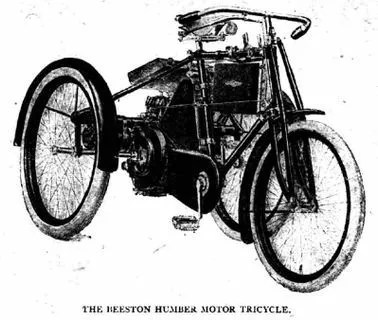
under weigh again, this time the route being right across England to the Norfolk Broads. What a magnificent country we had entered! Indeed the run through the Vale of Conway, Llanrwsh, Bettws-y-coed, Corwen to Llangollen was something to be remembered for years. We had some stiff climbs, but the engine was giving remarkable power and we made very fast running right on to Shrewsbury, where we did full justice to our lunches. Leaving this quaint and most interesting old town, we went by way of Bridgnorth, encountering’ a terrific climb over Wenlock Edge—so steep that we had to push the motor and trailer; this is no joke when it is 130° in the sun; on we went to Kidderminster and Worcester, comfortably passing the night at the Bell in the latter town. This was our biggest day, and so far we had been running splendidly, not a misfire or a forced stop since the Lichfield puncture. We started early on Thursday morning for Stratford-on-Avon, and when nearing our destination the engine seemed to lose some of its power. Finding a motor garage, we left the machine to have the accumulators re-charged and the valves ground in. Stratford and its beauties are too well known to call for any description from me, and we had a very enjoyable time there, the boating on the Avon being particularly good. Calling next morning for the machine, we found the accumulators had been re-charged and replaced in the box, but on trying the engine could not get an explosion. I examined the wiring up of the accumulators and found it all wrong. This was soon rectified and the engine running; but again something was wrong, as when the ignition was advanced the engine slowed down. Enquiring of the motor expert (?) I found he had taken the trouble to clean the wipe contact, and in doing so had taken the fibre ring off. This he had replaced in such a manner that the timing was all wrong. However, I put this right, and without waiting for the valves to be ground in we got on our way again, calling at Warwick, where the Castle was inspected, then on to grand old Kenilworth, where we made quite a long stop, and from there to Coventry. Here we had lunch while Humber’s put the valves in order. After having a look round their splendidly-equipped works, we proceeded once more on our journey and soon found that we were getting more power than ever. Rugby was passed in very fast time, and on we went to Northampton, where I called for a fill up of petrol and lubricating oil. I could not obtain Price’s, and had to be content with some ‘ just as good’. Making our way through Wellingboro’, Thrapston, and Huntingdon, we came on very loose, flinty roads, and soon had one of the trailer tyres in trouble. A quick repair, and on again to Cambridge and Newmarket, where we enjoyed the hospitality of the White Hart. Early Sunday morning we were awakened by the clattering of hundreds of horses going to the Heath for their morning gallops. I enjoyed the sight very much; they came by in long strings almost every minute, their coats shining like satin, and every horse bestrode by a diminutive specimen of a boy. After a glance over the machine we set out for Oulton Broad, and were quickly in trouble again with the trailer tyres, the flints being very bad. More repairs and we reach Bury St Edmunds, the machine now lacking that sharp turn of speed it had been showing from Coventry. As we got further on the loss of power was very noticeable, but the country being flat we still kept up a fair average. Harleston was reached in good time, only to be delayed by another puncture, and then on again through Bungay, Beccles (another puncture), to Oulton Broad. During the last 20 miles we made rather slow progress, but I partly put this down to the tropical heat. We spent two days at Oulton, boating and fishing (I won’t give any weights), and then decided to visit the golden sands of Yarmouth, where we spent the rest of the week, having a real good time, and getting as brown as coffee berries. While in Yarmouth I had the exhaust valve ground in. I found it was caked up with the burnt residue of the common oil I bought in Northampton, which had been the cause of the loss of power. I shall in future buy nothing but a well known brand of oil. Our holiday was now fast drawing to a close, and on Sunday morning we started for home, feeling very loth to leave Yarmouth. We had six punctures in the first 30 miles, causing much tedious, thirsty work; the trailer tyres were now getting very bad, the canvas showing in several places. However, a few boxes of antiseptic rubber tape very greatly improved matters, and we got going again in tremendous style, passing through Dereham, Swaffham, King’s Lynn, Wisbech, to Peterborough, where we ran into a heavy thunderstorm. We could not wait to shelter as Brown had to catch a train home, so we continued on our way, encountering very bad roads and getting wet through in spite of rain-proof clothing. As we neared Uppingham we got on very high country and seemed to be within a stone’s throw of the clouds. The storm was now at its height, and we were very thankful to get through it safely and sound. In due time we reached home, and I said good-bye to Brown, after having had what we both agreed was our best holiday. When I come to review the actual trouble experienced I find the machine, engine, and accumulators were faultless, the trailer tyres being really the only trouble. To be able to do this distance over a very mixed country, with a 12-stone passenger, must surely prove the extreme reliability of the modern motorcycle. I have now done over 5,000 miles since Easter on this machine, and I have never been stuck up on the road. I have nothing but praise for the chain drive, which has far exceeded my greatest expectations. I have not had the least trouble with the chains, and beyond tightening several times and oiling them, they have had no attention whatever. The free engine is undoubtedly one of the greatest improvements of the year, and gives the advantages of a car, making traffic riding much easier and safer and enabling you to start with a trailer on almost any hill in the country. The machine is certainly heavy, I dare say it weighs 160 to 170lb, but I have never found it cumbersome. My Palmer tyres are, I think, as perfect as tyres can be; I have had two punctures in 5,000 miles, each through a large nail; otherwise, they have never been touched with a pump, and the shocking flinty roads of Norfolk have not made the least impression on them. The front tyre still has the pattern as new, the back one being just, worn off; this is all in favour of the chain drive, called by some the tyre scraper—by me, the only perfect all-weather drive on the market. I am now waiting for a really good two-speed gear—which would make trailing even more enjoyable in hilly country. I trust that the manufacturers will have something good in that line at the coming shows.—ABC.”
“ANZANI, ABOARD AN ALCYON, won the Motor Speed Trials at Arras with a flying kilometre time of 32⅕sec, ahead of Demester (Griffon), 35⅘sec; and Lamberjack (Griffon), 36⅗sec. Anzani was also fastest in the standing-start mile class with a time of 1min 7⅖sec, ahead of Demester, 1min 9⅘sec and Lamberjack, 1min 21⅘sec. But Rigal (Buchet) won the 5km race in 3min 2⅖sec, ahead of Griet (Griffon), 3min 30⅖sec; Demester (Griffon), 4min 2⅖sec; Anzani (Alcyon), 4min 5sec; and Lamberjack (Griffon), 4min 5sec.”
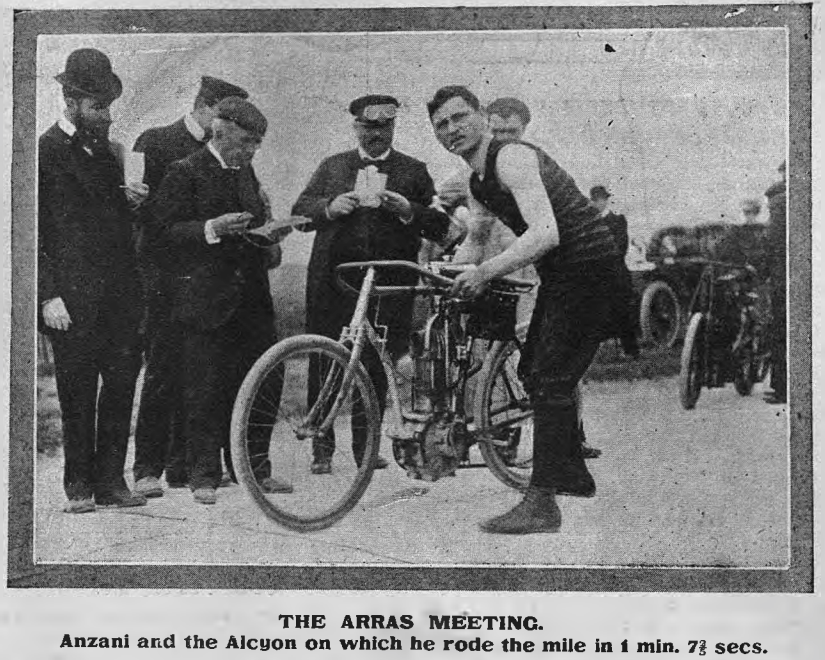
“TWELVE HOURS’ MOTORCYCLE MATCH IN PARIS. Some short time back Osmont, the well-known French motorcycling crack, issued a challenge to match his FN in a race of twelve hours’ duration against any other standard make of racing motor-bicycle. The challenge was eventually taken up by another well-known Continental racer, Anzani, and the match came off last Thursday at the Parc des Princes track in Paris. The race proved a decisive victory for Anzani, who established a lead of 11 laps in the first hour, and increased it gradually to 44 laps at the end of six hours: then he punctured his front wheel tyre and lost 14 laps. At the end of the seventh hour Osmont retired on the plea that Anzani was violating the conditions of the match. At the end of the tenth hour Osmont started riding again; Anzani was leading by 150 laps. At the end of the twelfth hour Anzani had covered 698km 666m. (about 430 miles), and Osmont 503km 330m (about 300 miles). Anzani rode an Alcyon machine. Osmont has written to the Paris Press protesting against Anzani’s having replaced one of his wheels with a special racing type, thus violating the condition of ‘standardism’ in the machine.”
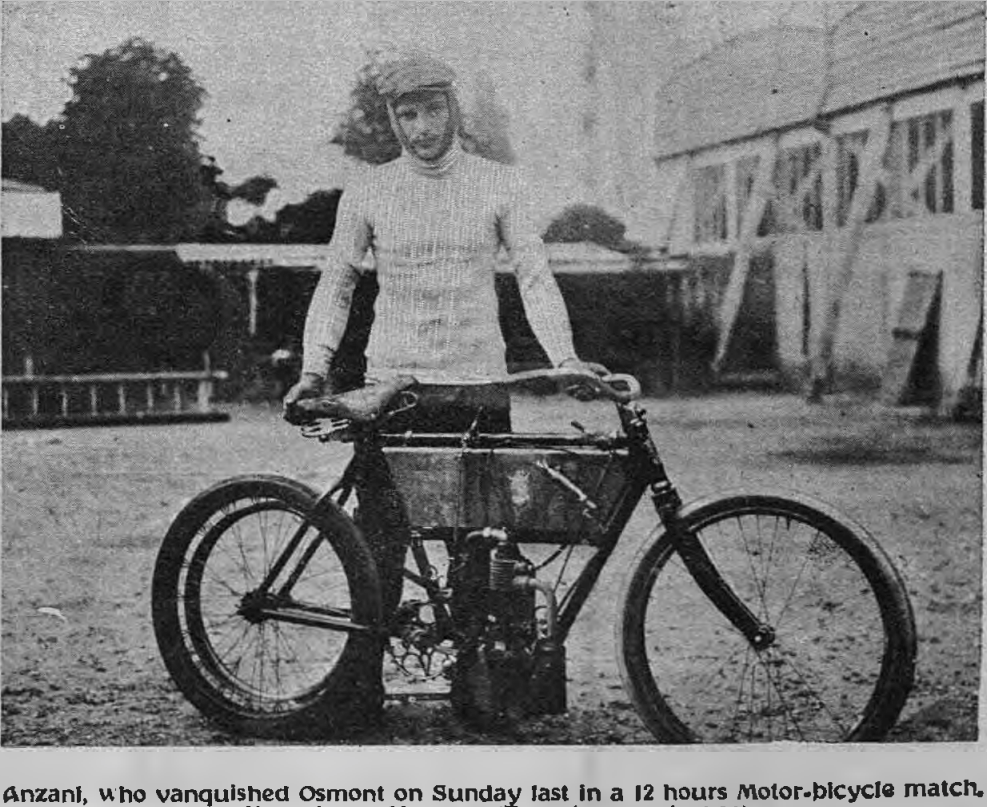

“PEDALS VS FOOTRESTS. ‘Magneto’ expressed a desire for the experience of pedalless riders. At that time I had only just received my new season’s mount, a 3½hp standard Bat machine. I have now done something like 600 miles on it, including a matter of 150 or so with a trailer attached. I have been a cyclist for over twenty years, and my present machine is my third motor mount, and also my third year as a motorcyclist. I have till now always favoured pedals, and still believe they are a ‘regrettable necessity’ on most machines; my last was a 2¾hp weighing about 160lb, and I often found them useful to pedal to the nearest station or town; but I was so struck with the remarkable reliability and comfort of the Bat machine that I decided to chance it (as I then thought), and I have had 600 miles of the most comfortable and enjoyable riding I have yet experienced. My machine is ready to start as soon as the fly-wheels revolve, and it is not an ‘acrobatic feat’, as ‘Magneto’ thinks, to step on to the low-fixed footrests (of course, with flying pedals the case is different). I have not yet had occasion to touch a single detail on the machine; it is always ready to go anywhere and up any hill, and the steeper the hill the better it seems to go. I was a bit doubtful at first about traffic riding, but find I can get through anywhere I could have got on a pedal machine, and I have not had to dismount more than three or four times for traffic, and then it has been a complete block. I ride it daily through the streets, and many of our roads are ‘up’ for the new trams. The side-slip competitors can testify to the ‘going’ through Leicester just now, as I saw them pass my window one day. ‘Magneto’ thinks pedals are useful as a help up a stiff hill, but for give-and-take roads you must have power; that is my experience; and then the light pedalling we hear about is no joke. In grease the footrests give the machine a wonderful stability, and I have not yet experienced the slightest symptoms of a slip. As regards the ability to start the machine on the stand, the Bat people supply a starting handle, which goes in the tool-bag, and it is simplicity itself to jack the machine on their patent stand and start the engine (if needed). I may say this stand is a particularly rigid one, and I can stand the machine up quite safely with a passenger in a trailer, and have no dread of an upset if I leave my ‘turn-out’ in the road while I make a call. I advise ‘Magneto’ to have a few hundred miles on a pedalless machine. I think he will find that all his objections are groundless. I may say, in conclusion, that, in spite of the theory of ‘ a long wheel base’, my machine is the shortest I think on the market, and whether it is the footrests or not, I find it very comfortable in riding. I also am glad to have taken ‘Cyclomot’s’ tip and had a trembler coil: when I have time I will have a look at it to see how it works. I have not yet had occasion to bother the slightest about it; no more make-and-break contact for me.
‘BC137’.”
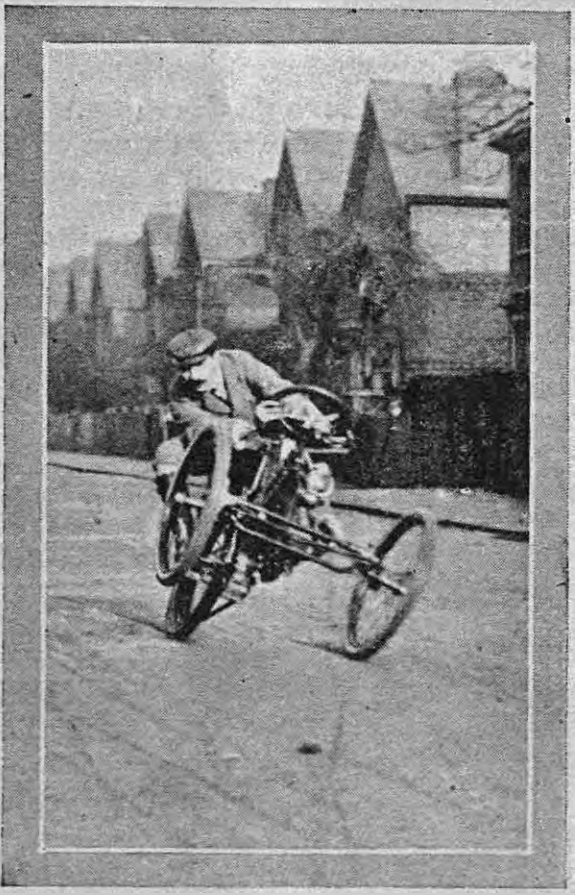
“TOURING LAST AUTUMN I became rather tired of the few changes of position obtainable on a motorcycle, so by way of experiment, I slid back on to my luggage on the rear carrier. The change of position was such a relief that I stopped at the first store and procured a football air bladder, which I blew up just so that I could get it into my Gladstone bag and snap the catch to. The bag was then strapped on to the Lucas carrier and a pneumatic saddle was the result. It is marvellous how you are freed from vibration, jars and shocks, and at an expense of 2s 5d for the bladder. Since then I have gone a step farther (or shall I say a revolution?) and have procured a regulation Rugby football, and by one single strap over the middle fastened it to the back end of the carrier, and have converted an adjustable up and down to a forward and backward handlebar, so that when on the rear saddle I have the steering handles well in reach. In a recent tour to Chester I noticed quite a number of motorcycles with passengers up behind, whose comfort might have been enhanced at small expense by the adoption of this idea.
‘HWT’.”
“HANDLE-BAR CONTROL. This will next season probably become quite the thing, for, after all, simplicity of design and working is the chief point in most new converts’ opinion. So much has been said about weight that manufacturers no doubt will turn their attention to this important, question, but whatever is done the difference cannot be great, and but for the handiness of the mount within doors it would appear that the question is not an absolutely important item in the turn-out of a machine. As with the ordinary pedal-propelled mount it is a matter of the moment that improvements in motor cycles must be looked for year by year, and whether many are improvements or merely alterations in style must be proved by those on the look out for a genuine luxury in the possession of a good class motor bicycle.”
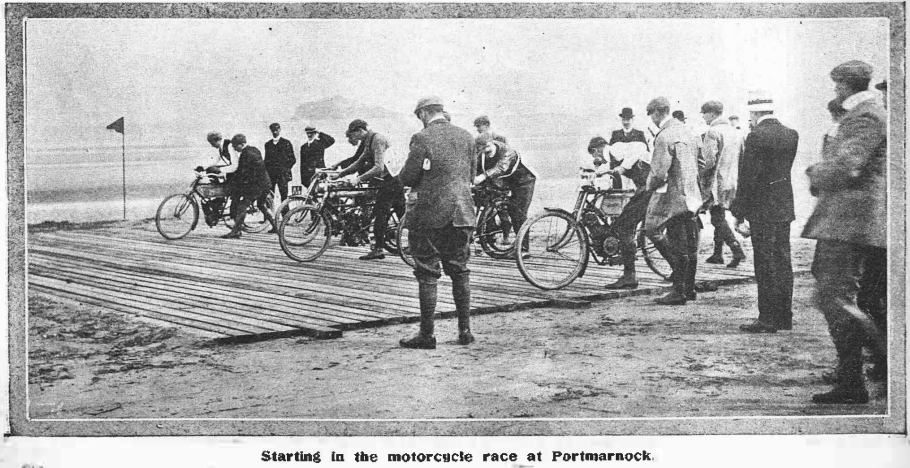
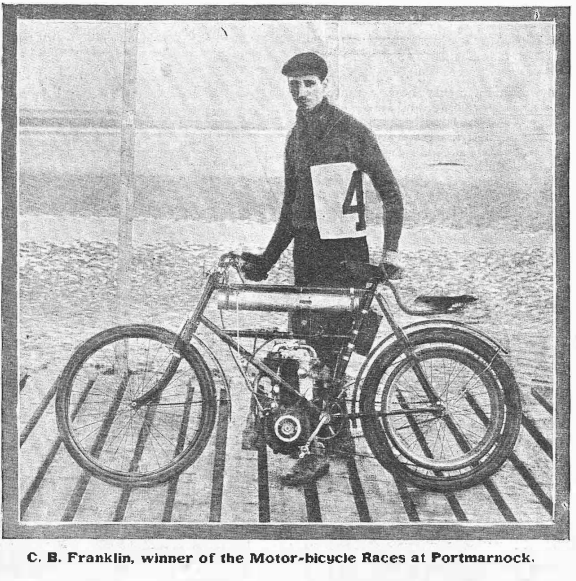
“A MOTOR CYCLING FRIEND who rides a 2¾hp FN. recently allowed us to have a short spin on his machine. The power on this motor motor was transmitted through a Perry chain belt, which did the work it was intended to perform in a highly satisfactory manner. Them was no slip, and yet the drive was by no means harsh.”
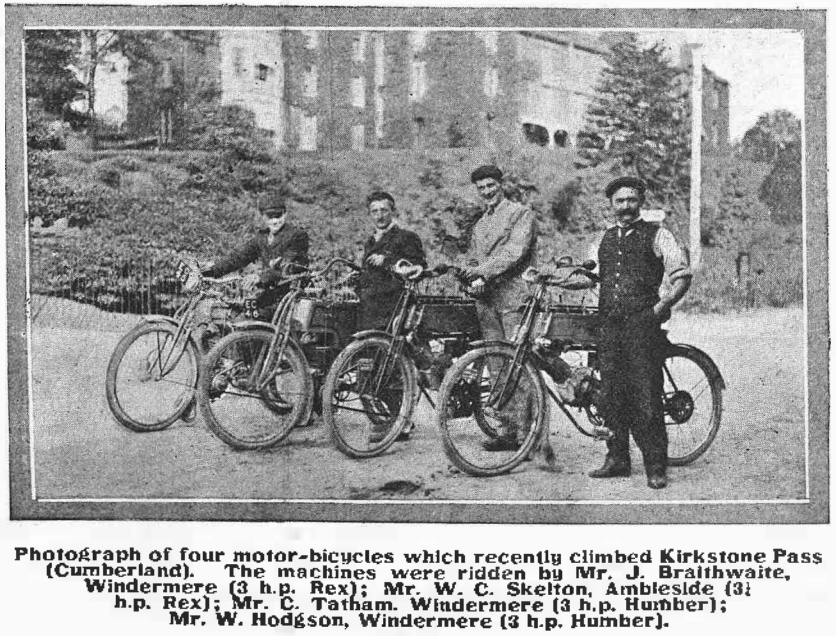
“THE MOTORCYCLE CLUB OF FRANCE has stepped into an obvious breach and has instituted a ‘Gordon-Bennett’ (the term is so thoroughly explanatory that we make no apology for making use of it for once) for motor-bicycles. The Auto-Cycle Club has received an invitation to send three representatives by September 1st, the race to be run off on an early date, and on a course to he arranged in France. But we understand from the terms of the invitation that it is being issued indiscriminately to various motor-cycling clubs in each country, and in these circumstances it would seem as if some concerted action amongst English clubs would be desirable, because—one reason will suffice—suppose an English rider were to win, which is not at all unlikely, are we prepared to run a big international motorcycle race in this country next year? This is apparently an insurmountable difficulty, but if it could be suggested by England to France that the number of representatives of any one country be limited (five would be a good figure), and by arranging that, at any rate, a course would always be available in France, the English clubs might agree to enter for the first contest. We strongly recommend the Auto-Cycle Club to call a meeting, or to get opinions front the other clubs of the country, before entering for the race.”
“THE INTERNATIONAL CUP RACE FOR MOTORCYCLES. Despite the exceedingly short notice given by the French Club, the Auto-Cycle Club intends to send a team to represent England in the forthcoming international race for motorcycles which is to be held in France on September 25th on Gordon-Bennett lines. The air has now been cleared of all doubts and difficulties, and the Motorcycle Club of France has now agreed that no country can be represented by more than three riders sent by the one recognised club—such club to be accepted by the Automobile Club of France. The Auto-Cycle Club is the only club in this country which fills the position, so only that club can send a team to represent England. To enable the Club to secure a team, it has invited the makers of the machines which successfully underwent the recent ordeal of the reliability trials to supply machines and riders, and from the answers received the Club will select the most suitable team on Thursday next. The machines have to be British built throughout, and must weigh not more than 50 kilos. (110lb) without petrol, oil, accumulators, or spare parts, but 3 kilos, will be allowed for magneto. They must be presented to the Auto-Cycle Club for weighing and inspection by Monday, September 19th. The Club intends to send a representative to the International Commission, and he will at the same time zealously watch the interests of the English team, and will make all possible arrangements for them.”
“I HAVE READ your paper with great interest, and with much benefit to myself and motor, but I have not seen any mention of what I consider one of the chief advantages. I am not a doctor, nor interested in the trade, so that, perhaps, what I say may have more effect. Since my racing days in the Bath Road and Catford, I have had rheumatism very badly. Three years ago I hired a motorcycle, and I noticed that during the time I had it, and for a fortnight at least afterwards, I had no trace of it. Last year the only time I was free was when motoring, and this year, now that I have one, I am free altogether. I have spoken to several people about it, and can give three instances during the past week if anyone cares to communicate with me.
BH Durrant Field, Goldhanger, Witham, Essex.”
“WHEN SIDE-CARS WERE first placed on the market, it appeased to me that, if practicable, this would be the most sociable and companionable form of attachment to a motorcycle, and would have advantages over the trailer or forecar with regard to the position of the passenger. The fore-car position, in my opinion, is bad for a nervous passenger, and the trailer is unsociable, and there is the risk of side-slip on greasy roads. As I have an idea of investing in some form of passenger attachment next season, and possibly many other readers are of the same way of thinking, the opinions of those readers who have had experience with the side-car would be of great assistance. The questions that occur to me are: (1) Safety, steering qualities, and comfort. (2) Side strain on frame of motorcycle and wear of tyres. (3) Power of engine required, and if more or less than fore-car (assuming that the trailer requires least power of the three). (4) Rigid type with or without duplex steering, or compensation joints. To the rider of very moderate means the side-car looks to be the best substitute for the light two seated car, but ‘we all learn more on the road than anywhere else’, and therefore the benefit of the opinions of those who have had experience would be acceptable.
‘A Egg‘.”
“IT IS AS WELL YOUR readers should know that the police are very active in waylaying motorists at Sutton now, and motorcyclists should ride carefully, not only through Sutton, but also approaching from Banstead Downs through Belmont. Motorists anyhow ought to ride very carefully through a large suburb like Sutton, with its narrow main street, but should be extra careful now, because, if they are summoned, it has been recently shown that the Epsom Bench incline to take the word of the police against contrary evidence, even when given by unbiassed witnesses.
‘Caution’.”
“WITH REGARD TO the question of fan cooling for motorcycle engines I should like to give my experience, which may perhaps be of some interest to other readers. My machine has a 2½hp Minerva engine, and has a gear of 5 to 1, with a 28-inch back wheel. This gear I found very suitable for the cycle alone, giving plenty of speed on the level and ample reserve of power for hill climbing. With a trailer, however, I found the engine overheated rather badly, even on moderate gradients, with the result that the passenger had to do rather more walking than was altogether agreeable…I resolved to try a fan on the engine, but was met with the difficulty of finding room anywhere on the frame of the machine for attaching it. Finally I hit on the arrangement shown in the illustration. The fan case is made of sheet tin and is attached to the tank by three studs and nuts…The fan and fittings weigh approximately 2lb. The outlet of the fan is about 3in long and 2in wide, and embraces a portion of the head, the exhaust outlet and the top portion of the exhaust valve spring. It gives a good blast of air where it is most required, viz, across the head and between the top ribs, especially at the back where the cylinder is shielded from the direct draught. I find in use that the fan is a great improvement, and though I must say that overheating is not entirely got rid of, I can, with careful driving, surmount, with a trailer, an eight stone passenger and about 20lb of luggage, without pedal assistance, hills that formerly I had to dismount and walk…Altogether I am very well satisfied with the results so far obtained and I can readily see that this type of fan would be of still greater advantage on a machine with fore-car attachment.
WJ Colebrook.”
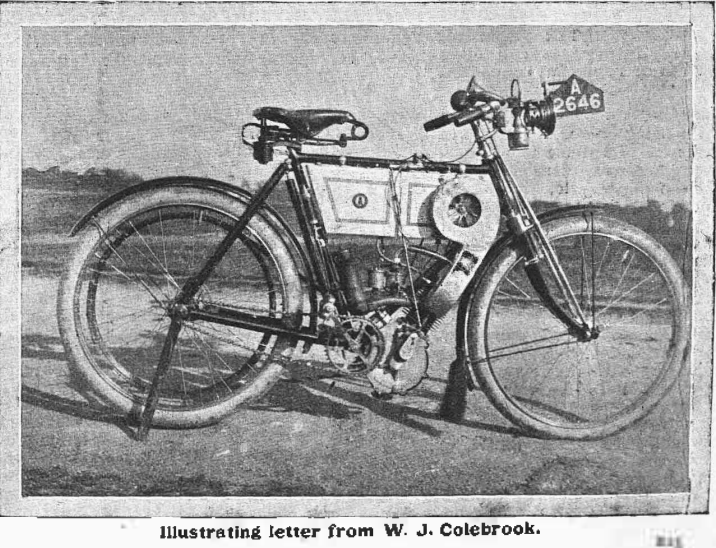
“I HAVE READ many of the interesting letters in your excellent paper, and thought your readers would like to hear of a simple method I have discovered of cooling my engine with an air draught. I have tried several kinds of blowers during the past twelve months, but have not yet come across one which has given me such satisfaction as the following: On my 3½hp Minerva engine there is a hole in the crank case which comes directly over the periphery of the fly wheel: from this hole I have carried a ⅜in flexible steel pipe over to the front of the engine and pointing directly on to the exhaust valve. The draught created is really extraordinary. I was afraid at first that this would interfere with the lubrication and that it would ‘blow’ thick oil, but I have now ridden some hundreds of miles with it and find this is not the case; in fact the machine goes much better, and I seem to get more power, as it has relieved the back pressure to a great extent, as well as keeping the engine cool even when I have a passenger up.
ES Knight.”
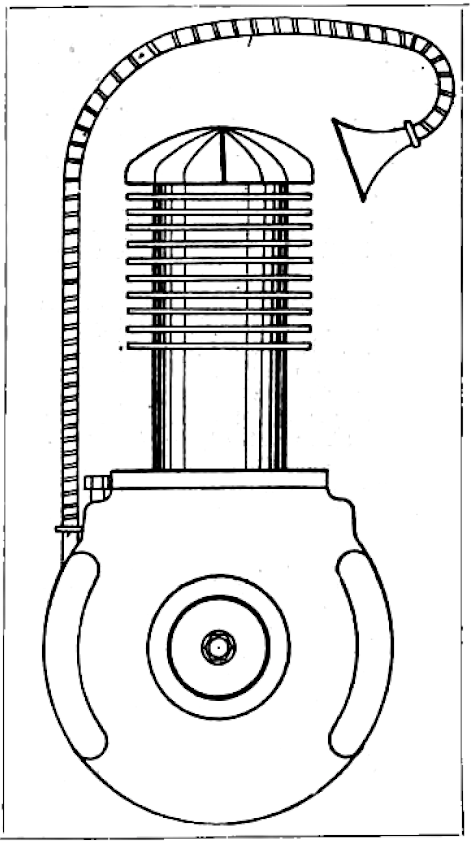
“RIDING ALONG THE ROAD from Lincoln to Market Rasen on Monday week, I saw a curious procession, viz., a motorcyclist with three young ladies on bicycles in tow, followed by another motorcyclist with two young ladies in tow. On making enquiries, I learnt they had just covered the 14 miles in three-quarters of an hour; and that the two motorcyclists were well-known in the South of London ; whilst the five young ladies were from a neighbouring parsonage.
SMW.”
“AS AN OLD PEDAL PUSHER, and not amongst the newest of the paraffin-pushed brigade, I am pleased to contribute my testimony in favour of the light weight machine if the mass you already have is not too great. I sold a 2cwt. mount to get a 1cwt machine, and am now doing my best to get rid of this to buy a 70lb cycle of not more than 1½hp I say advisedly that such a power with such a weight will do all that most people desire; and it will not be long before your strenuous advocacy of the light machine will bear fruit. Many more perhaps than you imagine are wishing you good luck and a speedy finish in your campaign. By the way, I was considerably taken aback the other day to be informed by the secretary of a big motor manufacturing firm that the trade papers were responsible for the demand for heavy high-powered machines, and that the trade itself was simply catering perforce for a demand that others had created for them!
Sigma.”
“I HAVE MADE a motor for bicycle; the dimensions are 66x72mm bore and stroke. It works exceedingly well, and runs up to 2,200rpm. I do not know what power it is, but, assuming that compression is good and the timing is accurate, what bhp might I expect? I am anxious to make a really effective silencer to suit the engine, and yet I want it as small as possible and to put as little back pressure as possible on the exhaust. Might I ask you to give a dimensioned sketch of such a silencer, as I am sure it would be of use to many other readers?
‘Mechanic’, Leicester.”
“From a 66×72 cylinder you will not get more than 2¼hp. The silencer sketched ought to suit your engine very well. You can build it up from aluminium tubes (except inner one), end plates of brass. For hill climbing and hard work the cut-out slide on central tube will be found useful. The large number of holes give a free passage to gases, and these should issue with little more than a slight swishing sound.—Ed.”
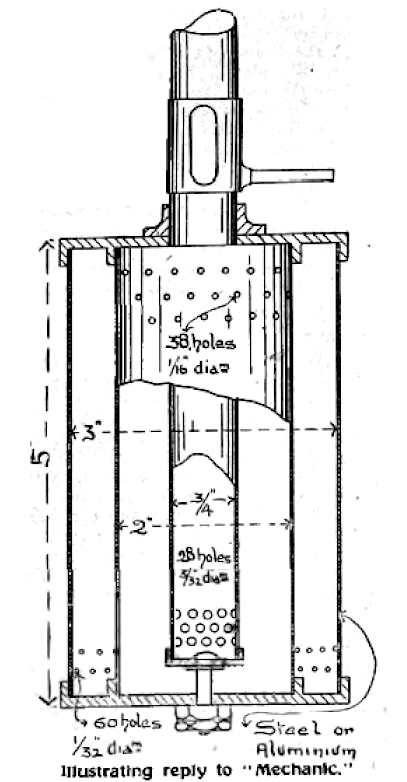
“I HAVE BEEN very much interested in the discussions in your paper on the merits of the heavy and light motor bicycle, and after three years’ experience I am still a believer in the light machine. I send you a photo of my machine, which is an ordinary roadster first grade Humber bicycle, on which is fitted a 1½hp motor (with two-speed gear added this year). This machine has carried me some thousands of miles, and since the two speeds were added without any pedal work, even on the steepest hills which I have encountered. I have turned the carburetter across the machine, which keeps the petrol at the same level in the nozzle when hill-climbing, and I think this is a great improvement. All the movements of air, gas, exhaust valve lift, spark, and two-speed gear are controlled from the handlebars, by the thumb levers shown, the cables from which pass along inside the bars, down the steering stem and out between the forks, so that the steering does not affect the accuracy of control, which is perfect, and can be graduated to a nicety without slackening the hold of the handlebar grips. There are no wires of any sort on the handlebars, a positive return being led from the contact-breaker to the rod which works the band brake on back wheel, which in turn makes contact with the interrupter plug fixed on the seat pillar tube, and a slight lifting of the right-hand brake lever breaks the connection, and there is no twisting handle grip, both grips being fast. This direct return is of great benefit when the accumulators are nearly exhausted, as the motor will run, firing perfectly, when it would not do so when the current had to travel through oily joints on the engine to the frame and back in the usual roundabout way. I have been converted from a believer in the short wheel-base machine by an accident caused by a hen which got stuck in the front wheel of my machine, which, with me, turned a complete somersault, peeling the skin of the knuckles of both hands and inflicting a gash over my left eyebrow, exposing the bone and rendering me unconscious for about half an hour; no mean feat for a hen to turn up a 14-stone rider, but after this I plump for a long wheel-base and as much weight as possible behind.
SA92.”

“LAST YEAR YOU were good enough to publish an illustration of my tankless motor-bicycle. I now send you photographs of another machine I have had built, developing the idea, and which you may consider of interest to your readers, in view of the important subject of lightening the motor-bicycle. As will be seen, the tubes are of a larger diameter, and every one in the frame being utilised for the carrying of petrol, which is poured in at an opening in the seat pillar. The tubes are arranged so that the petrol always flows towards the bottom bracket. The vertical Simms magneto engine is supplied with gas from an ordinary FN carburetter placed under the shield seen at front of engine, and is connected by a short pipe to a tap screwed into the bottom bracket, from whence the petrol is obtained. The air and throttle levers are fixed on the left-hand side of the top tube, and the advance ignition lever on the right-hand side, all being operated by rods…For lessening vibration, the back part of the frame rests on two coil springs, which are held in proper position by suitable guide-rods attached to the back axle. These, in turn, work in vertical slots formed in the back stay lugs, which allow sufficient movement to take up severe shocks, and with the special springs on Brooks’ saddle the machine runs with very little jolting of rider. The small reservoir underneath the bottom bracket contains lubricating oil, which is drawn into pump and supplied to engine in the usual manner. Also, the amount of petrol can be readily seen in the glass indicator which is fitted alongside one of the back seat stay tubes; this gauge is fitted with a tap, so that in the event of breakage the petrol may be cut off. The total weight with the 2¾hp engine scales 116lb only. It is built of 20-gauge tubing throughout, and the duplex down tube from steering head to engine make a very rigid machine, which has been well tested under all conditions of weather and roads. The framework is brazed in a similar manner to an ordinary machine, no extra skill being required. Messrs. Kynoch, Birmingham, made the fittings from special patterns and designs, and no doubt would supply others for interested motorists. Thanking you for past favours.
F Hayden Green, 87, High Street, Cheltenham.”

“THE FOLLOWING ARE the details of a 2¾hp motor-bicycle I have made which may interest your readers: Wheels, 26in diameter; wheel base, 53¼in; clutch (pawl) chain, pedals, etc; capacity of tank, one gallon; accumulator case, lined cork; two Peto and Radford celluloid accumulators; lead pipe for wires through case to coil; wires from coil, battery, etc, separated, running each side of top tube; high-tension coil wire to engine is carried underneath tank in stout india-rubber tube to prevent high tension current returning to the frame, both ends of T wire are, with their terminals, securely insulated from outside moisture, thus preventing leakage of current; the low-tension wires are similarly treated. The weather can have little or no effect upon this important portion of the machine. The coil, engine, etc, are De Dion. The frame, Chatfield’s registered design. The transmission is by a crossed fiat Dicks (4-ply) cotton belt, fitted with Jackson’s fastener, and is absolutely satisfactory.
ER Webb.”
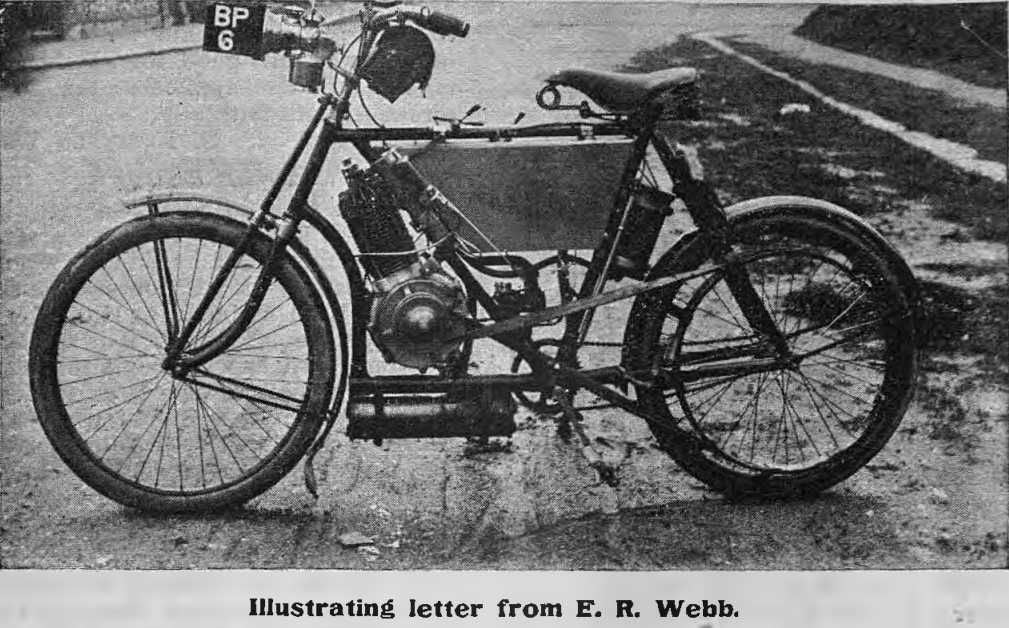
“I NOTICE IN RECENT correspondence regarding side-cars that a great point in their favour has not yet been mentioned—namely, the fact that a large proportion of the passenger’s weight is carried by the driven wheel, giving it that essential driving grip in which all fore-cars are more or less deficient. During last winter, when riding with side-car, the driving wheel never appreciably slipped, and the wear on tyre tread after 2,000 miles was scarcely perceptible; my average distance per tread with fore-car or trailer was about 800 miles, owing to grinding action on road surface. Apart from tyre wear, the weight on rear wheel renders the jolting to driver far less than on fore-car. The chief point, however, is the fact that with a rigid side-car side-slip was unknown, even if both cycle wheels were locked on grease, the free-running wheel of side-car maintained a straight line of progression. In this respect the side-car seems to have an advantage over any other form of motor vehicle, car or cycle, especially on tramlined roads.
Fred A Johns.“
“IF PROOF WERE WANTED as to the efficiency of the motor-bicycle, a recent tour taken by me may be of interest to your readers. Leaving London on Saturday, the 16th July, I rode to Bath, Wells, Glastonbury, Taunton, Honiton, and thence to a small seaside watering place named Budleigh Salterton; on the following day I returned to London by Honiton, Chard, Sherborne, Shaftesbury, Andover, and Basingstoke, and when I tell you that I weigh 13 stone 8 lb, and that the machine, a 3hp Quadrant with spray carburetter, took me to Devonshire without any help from the pedals, except twice, and that I only walked up two hills, the performance must be considered creditable in the extreme. On the return journey I only helped the machine on one hill and walked none. It is needless to say I have no sort of interest with the Quadrant Company.
‘Spark’.”
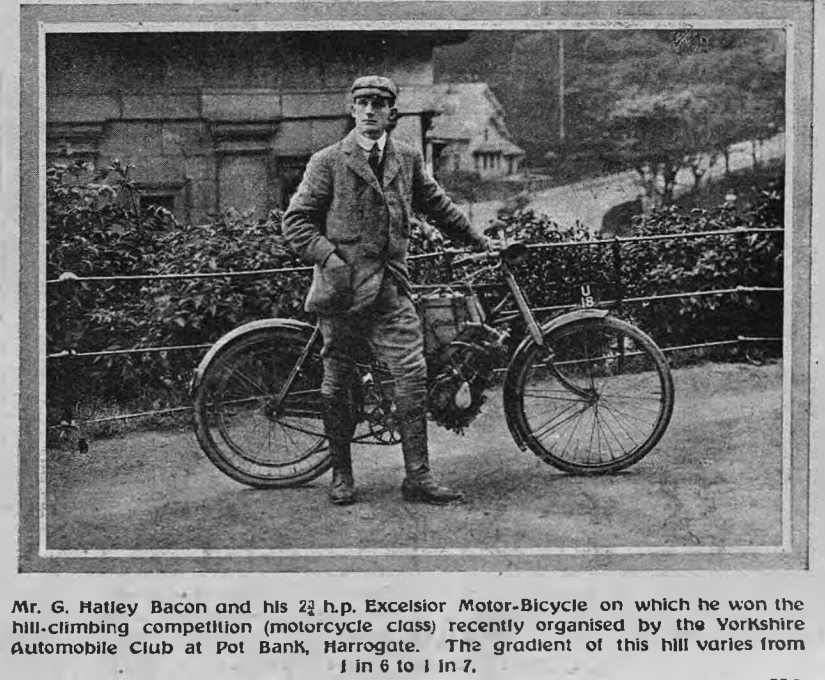
“I HAVE ONLY JUST seen the letter of ‘One in Five’…in which he asks how it is possible that my Excelsior motor-bicycle could climb a hill of 1 in 4¼. The hill I wrote to you about is the Gas House Hill, Norwich, and I gave the gradient as 1 in 4¾, not 1 in 4¼. This gradient is given me on very good authority, and I see no reason to doubt it. The Excelsior is a standard 2¾hp machine, Lincona belt, gear on the occasion that I climbed the Gas House Hill about 6 to 1, the machine weighs 155lb, and my own weight is 13 stone. This hill has been climbed by Mr Egerton several times on a Werner, and by Mr Densham on an Anglian, besides by many others, and is, as a performance, nothing to be compared, in my opinion, to Mr Chase riding Westerham Hill at 31mph on his 2¾hp machine. If ‘One in Five’ were not in Natal I would suggest that he took the trouble to go to Norwich and measure the Gas House Hill before he comes to the conclusion that the gradient is nothing like what I said it is, and that if he believes the Chase 2¾hp went up a hill of 1 in 8 at 31mph he will have the courtesy to believe a poor amateur who climbs a hill of 1 in 4¾ slowly, pedalling hard. I am sorry that you, sir, think it most probable that I estimated the gradient wrongly, and when I am next in Norwich I will try and obtain a contour of the hill from the Borough Surveyor.
H Spilmer Marriott.”
“COURTEOUS TREATMENT. I feel it my duty to write and let the readers of your valuable paper, ‘The Motor” know the courteous way in which the BSA Co treated me over a defect in my motor forks. While on a tour to Anglesey, the forks on my motor-bicycle gave way—through no fault of the BSA Co. It was an internal flaw, which, owing to the fact that it was not fitted with girder stays, parted. I wrote to the above company and forwarded the fork, stating the cause and result of the accident, which, luckily, was not serious. The following day I received a letter from them stating that although they could not admit any responsibility, they were willing, without prejudice, to replace the forks, and as the result of the accident would also replace handlebars and brake. I am now the possessor of new girder forks, handlebars, and brake-lever. This only endorses the sterling qualities of the BSA Co, and I advise any intending purchaser of a machine built to order to have same fitted with the genuine BSA. I have no interest in this company, but wish to let others know that it is only another good and considerate act performed by this reliable and trusty firm.
H Smith.”
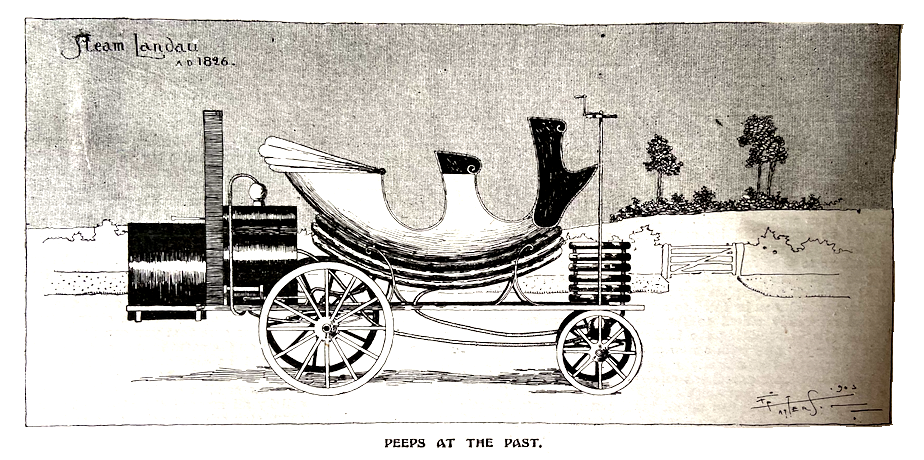
“A MOTOR THAT IS making good headway is the White and Poppe, which possesses a useful feature in its detachable valve seatings. These can be removed by undoing two bolts, and all motorists who have experienced valve troubles will at once see the advantage of this method. The engine has 80mm bore x 85mm stroke, mechanically operated inlet valve and large bearings. All details have been carefully studied, the paraffin cock on the cylinder and the valve lifter being carefully thought out. Both the air and water-cooled engines are admirably adapted for driving forecars or safeties that will be used in conjunction with attachments for a passenger.”
“MEATH RIC SPORTS. The five-mile motor-bicycle race at this meeting, which came off on Wednesday last, proved quite the event of the programme, and was much appreciated by the very large gate present. There were 13 entrants, but of this number only the three well-known Dubliners, RW Stevens, FA Wallen and HS Huet faced the starter. HS Huet, on 2¾hp Minerva, started from scratch. RW Stevens, on 2¾hp Griffon, had 150 yards, and FA Wallen, on 2½hp Triumph, 140 yards. Wallen got away at the start and gained gradually on Huet, who was losing ground at the bends. Stevens was now getting into his stride, and at about five laps from home passed Wallen amidst great excitement. A splendid tussle now ensued, but Wallen was unable to pass Stevens, who won by two lengths. Huet slipped, in, the last lap, on one of the bends, but escaped with slight damage to his machine. The time, 9min 50sec, was very good for this track, every bend on which had to be taken with switch off.”
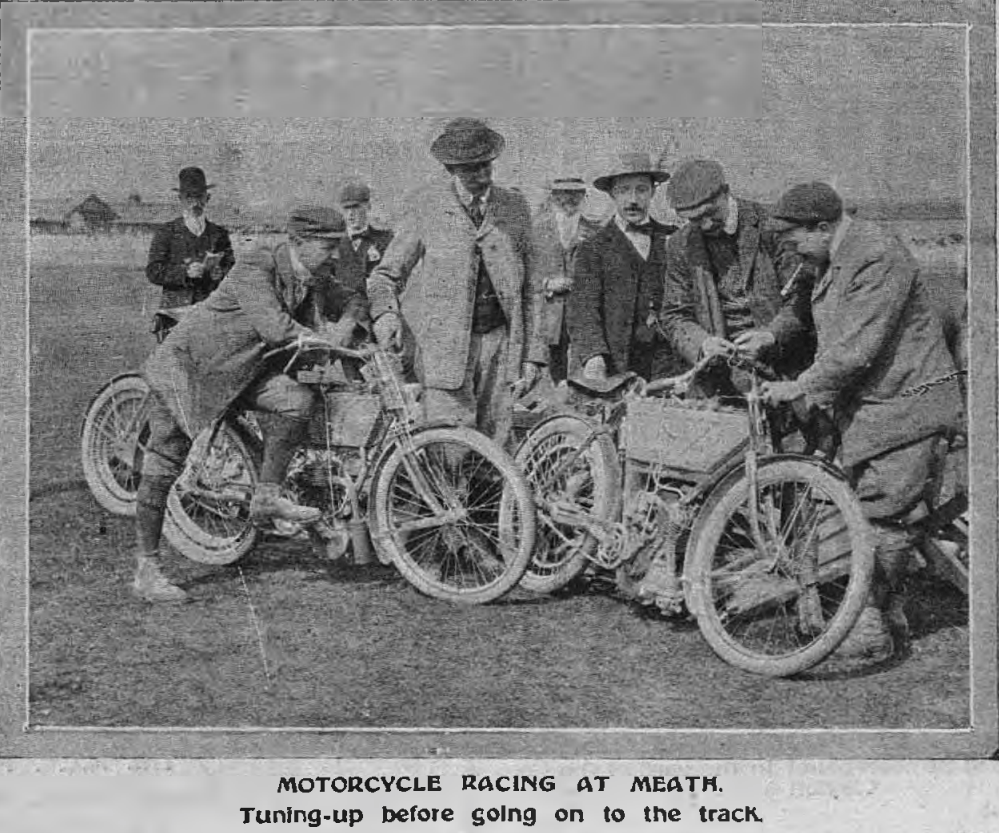
“MOTOR-BICYCLE RACING IN BELGIUM. The new Zurenborg track at Antwerp was the scene, on the 10th inst, of some phenomenally fast motor-bicycle racing. In a race of 10 kilometres (about 6¼ miles) Olieslagers, on a two-cylinder 6hp machine, won by about 30 yards in 6min 56sec; Dancart being second, Bertin third, and Marius Thé (the well-known pacer) fourth. One of Olieslager’s laps was covered in 13⅕sec, which works out at 68mph. Olieslager is a competitor in the Ostend races which began last Thursday and finish on Thursday next. Some further fast times may be therefore expected.”
“IRISH HILL CLIMB. The Irish Motorcycle Union was more successful with its hill climbing competition on Saturday, July 9, than it was with either of the events of a similar character that it attempted to bring off last year. The first of the latter was stopped by the police, and in the second the hill selected was so steep that none of the bicycles were able to get up, even with pedalling assistance. It was at one time feared that a similar result would be arrived at in connection with the competition under notice, as the climbing of the ‘Long Hill’ from Kilmaconague to Calary Bay is a very severe test indeed. The entry was small, many of the members having satisfied themselves of the impossibility of getting up the hill; but the performances of those who competed were very creditable. Ten of the eleven competitors in the pedalling class ascended the hill, the smallest horse-powered machine to get up being a 2hp Triumph, ridden by JG Drury. The winner turned up in HS Huet, on a 3½hp Minerva. CB Franklin, on a 2¾hp FN, was second in the pedalling and also the non-pedalling class, the latter being won by A Summers, on a 3hp Triumph in faster time than that accomplished by the winner of the pedalling class. The distance covered just exceeded a mile and a half.”
“MOTORCYCLE RELIABILITY RUN IN ITALY. The Italian Touring Club has just concluded a motorcycle reliability trial from Turin to Col de Sestriers and back. Of 37 starters 31 completed the half and 21 the full distance in schedule time. The order of merit of the first four in respect of average speed was: 1st, Giuppone (5hp Peugeot); 2nd, Battagliotti (2¾hp FN); 3rd, Quaranta (3hp Invicta); 4th, Reale (3½hp Peugeot). In respect of petrol consumption the four best performances were: 1st, Ansaldi (2½hp Sarolea) ; 2nd, Carbone (2½hp Buchet); 3rd, Patrone (4hp Turkheimer) ; 4th, Battagliotti (2¾hp FN). The trials have taught many lessons.”

“THE SOUTHERN MOTOR CLUB held a very successful Hill climb on the Ewell and Banstead Road, on Saturday, Sept 10th. The competitors were W Rathbone (3½hp Seymour water-cooled motor-bicycle), B Pattison (3½hp Phoenix), H Billing (3½hp Excelsior). The result was a tie between fastest time recorded was that of B. Pattison, who climbed the hill in 1min 31sec. The club are arranging a very interesting winter programme of social functions. The town headquarters will be the Landor Hotel, Clapham.”
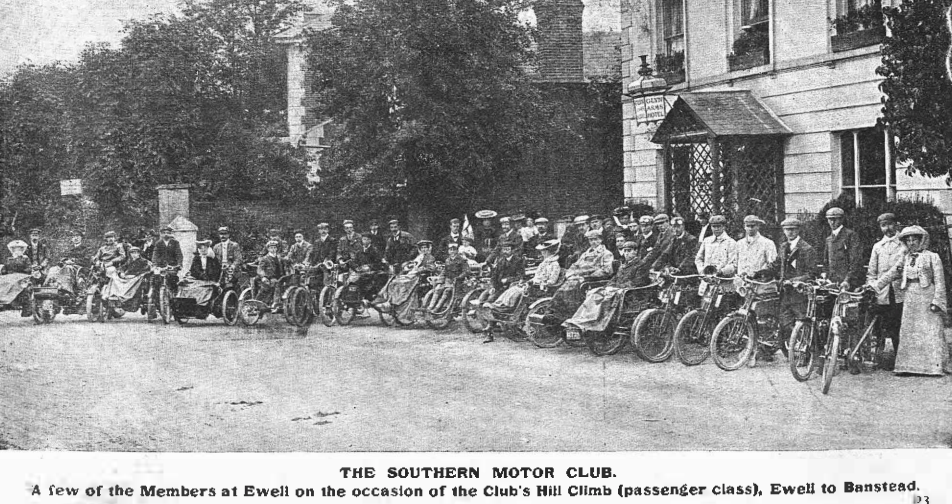
“‘MOTOR CYCLES ARE NOW much in request at the Crystal Palace and Herne Hill cycle tracks for pacing purposes. At Herne Hill, Callaghan steers one of the fastest machines, and Chambers and his Bat are in request at the Palace.'”
“AN AUTOMATIC STARTER: The Rockaway Automobile Co, of Rockaway, United States, have introduced a starting arrangement for petrol-driven cars. There are two patterns, one acting on the principle of a coiled spring, and the other consisting of a dynamo-motor and small storage battery. The battery is kept fully charged whilst the car is running, and as soon as these are fully charged an automatic clutch releases the dynamo from engagement. To start the engine it is only necessary to press a switch, which causes the current from the accumulators to flow into the dynamo; this runs at a high speed as a motor, and being geared by a chain to the engine starts it up. The battery also serves the purpose of supplying the lights of the car, and also to work the sparking apparatus. The spring starter is kept automatically rewound by the engine, and when fully wound it is also automatically disengaged. It can remain wound up for any length of time, and is at once ready to start the engine.”
“CIROGENE IS THE NAME of a new lubricant just introduced by Messrs Price’s Patent Candle Co, Belmont Works, Battersea, London. It has been specially prepared for use with motor chains, and is of such a nature that it cannot be squeezed out of the links by the driving pressure—a drawback with many chain lubricants. It is of a hard, wax-like consistency, and has to be melted by application of heat and the chain soaked in it. It is equally applicable to motorcycle or motor car chains. It does not gather dust like an oily lubricant does—another important advantage.”
“I DESIGNED THIS frame some three years ago when the first Minervas were on the road, though it was not until last season that I registered it as a design. I may also state that I am at present making a combined free engine clutch and back hub so that I can make the machines chain as well as belt driven.
J Milnes, Jun, Manchester Road, Haslingden.”
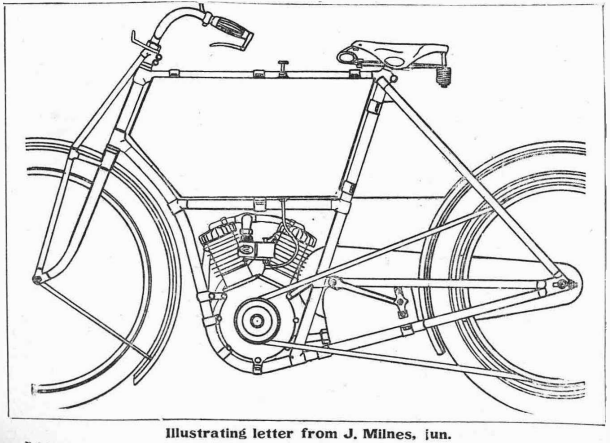
“SEEING THAT FROM time to time the correct position of engine is discussed by experts and otherwise, we have thought that the enclosed may be of some interest to you. It is an illustration of a motor tandem which we built and ran some three years ago. At this time motoring was practically in its infancy. We adopted this position after numerous trials, and found the best results therefrom. The engine is a 3¾hp auto-motor. The machine would carry three riders with ease, and many are the glorious spins we have had on same.
S Holmes and Co.”
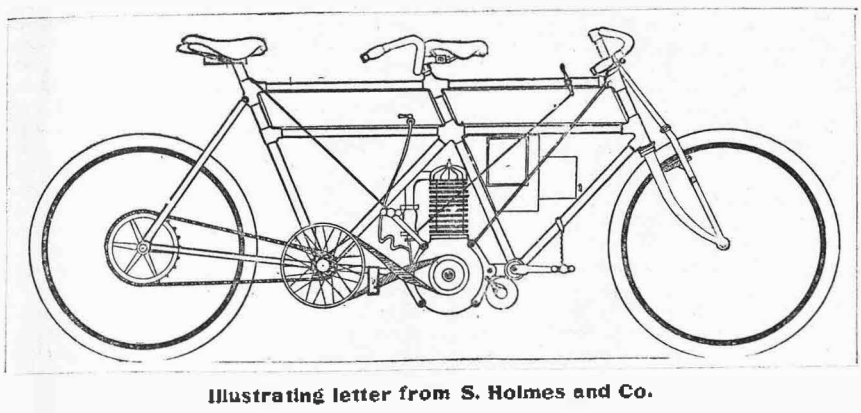
“MOTORCYCLE TAXATION: ANOTHER MOVE. The Auto-Cycle Club has, since its decision not to contest the case of O’Donoghue vs Moon, ever kept in view the desirability of taking some useful step towards securing the exemption of the motorcycle from the Inland Revenue carriage tax. An opportunity has arisen of approaching the Chancellor of the Exchequer in order to ask him to take into consideration the desirability of introducing into the Finance Bill now before Parliament a clause securing this exemption. A prominent Member of Parliament has promised the Club to place the matter upon the notice paper of the House of Commons.”
“IS IT NOT AN EXTRAORDINARY THING that the best recognised principle for constructing an engine is entirely ignored by motorcycle makers! I refer to the outside fly wheel type—a type which it is exceedingly rare to meet with on the road. The same complicated design is still employed as was done by De Dion and Bouton a decade ago. Why is this? Personally I believe one out of ten makers could not give a satisfactory answer. Everybody follows the De Dion pattern; and to be in the fashion they adopted it as a matter of course. Sound mechanical reasons are difficult to get. A practical engineer who is not necessarily a motor cyclist—will as a rule, express surprise that the small enclosed fly wheel on a high-speed engine having but one impulse per two revolutions is used. The characteristic features of all gas engines is a good big fly wheel; yet the motorcycle engine is a gas engine, and this is just the feature it lacks. Now first of all, let us consider what we gain by having the fly wheels enclosed in a case. There is a certain symmetry of appearance, more in the artistic than the mechanical sense, the wheels being enclosed do not fling oil or mud over the rider, and the weight of the two wheels is well supported between the two bearings. On the other hand look at the disadvantages; an extremely complex and expensive method of building up the shafts, fly wheels and crank pin. There are fastenings at the shaft ends and crank pin ends, requiring very careful fitting to get the whole system true. If it is the least bit out of truth the shafts are thrown out of line, causing the engine to work very stiffly, and possibly (as often happens) the fly wheels will foul the crank case as they revolve. If it is necessary to remove the connecting rod for any reason (such as to renew the liner or bush) the whole crank system has to be dismantled, and this is a process requiring skill and special tools, as the wheels are generally pressed up on to the coned seatings of the crank pin; and as many amateurs know to their cost it is not a job that can be tackled at home.”—Dynamic
“RIDERS OF MOTOR CYCLES for two should never forget that, though they may omit to carry split pins, there are other articles of almost equal use which ladies never omit to insert in their lovely tresses. Hairpins!”
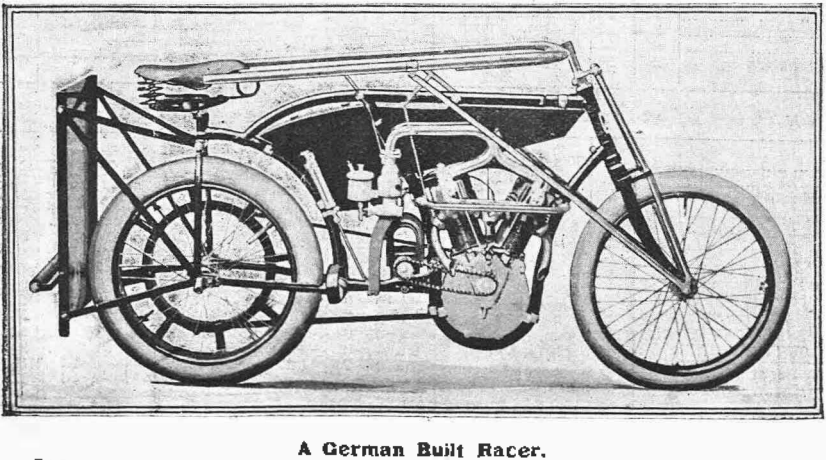
“IN THE RECENT Auto Cycle Club members’ reliability trial, Mr JJ Leonard rode a Lurquin-Coudert. This is a light weight though powerful French made motor cycle that conforms more to the standard English machine than’ the majority of Continental makes. For instance, It is provided with a plated brass tank of two gallon capacity, two efficient brakes and wide guards, valve lifter, silencer cut-out, etc. The engine ie unusually light, a good feature being interchangeable valves. A large oil pump is carried in an inclined position on the side of the tank, this being easily accessible from the saddle, and instead of the usual two-way tap an ingenious ball valve is fitted.”
AFTER A COUPLE YEARS as a stand-alone motor cycle magazine, Motorcycling had returned whence it came, into the bowels of The Motor. Judging by the following comment, motor cycles were not taken seriously by The Motor incorporating Motor Cycling & Motoring: “It is a strange thing, this wonderful, fascinating desire for engine driving which possesses most of us. I wonder how many of those who are now experiencing the delights of motoring, have, like myself, in very youthful days expressed their fired intentions of ‘being engine drivers’? I recall that, as a youngster, no soldier in the finest uniform ever impressed me so much as the begrimed individual on the footplate who held all the might and power of a panting steam engine in the hollow of one hand. The man who by the movement of a lever could set the overawing monster into motion, urge it to a swifter and yet swifter pace, and stay it at his will. And now the faculty is mine, with the added power of controlling the course of the vehicle at my will. But I am digressing. There comes a time when the motorcyclist tires even of mere ‘tap twiddling’ and the bicycle; when, if his means permit, he will feel a yearning to grip the steering wheel and to know the reason for the calm, comfortable control which the man on the car possesses over his vehicle. He himself will want a car. He has graduated as a motorcyclist. All the fundamental knowledge of motoring is his. He makes the plunge, and gets a car and this opens up a still wider field of interesting possibilities. He can now bring more friends to a proper appreciation of the pleasures of motoring, but his departure from the motorcycling fraternity has not depleted its ranks, for he has interested and converted others who are already passing through the initial stages of motoring with the motorcycle.” Bah humbug!
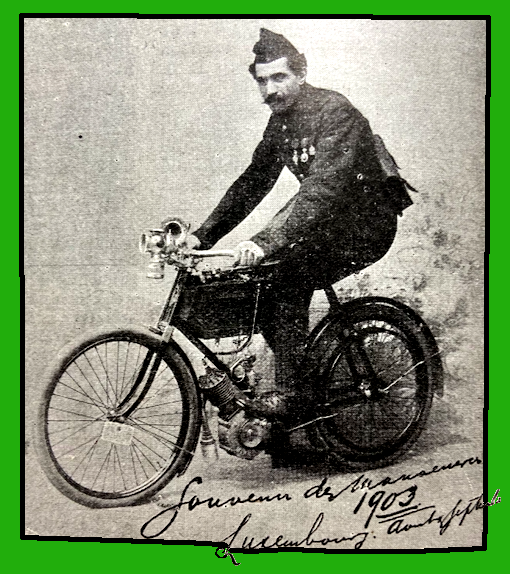
“THE MOTOR CYCLE PRESENTED A FIFTY-GUINEA CUP to the Motor Cycling Club “for competition among teams representing clubs of Great Britain”. Each club entered a team of six riding four solos and two ‘passenger machines’ over a 100-mile course between Bicester, Aynho and Deddington, Oxon. Ixion reported: “A twenty-five miles out and home course was originally fixed upon, to be covered twice. However, as in the team trials a checker to each mile will be necessary, since each rider is to score one mark for every mile covered without a stoppage, it became clear that a twelve and a half miles out and home course would be ample even for this short stretch about a score of reliable marshals will be requisitioned.” The course included four climbs, the steepest of 1 in 12. Five clubs entered: The MCC, Coventry MCC, Guildford C&MC, Peterborough &DMC, and the Southern MC. Riding for the MCC were F Hulbert (3½hp Hulbert-Bramley with Minerva engine) who went on to become works manager at Triumph and Billy Wells (2¾hp Vindec) who was Hendee’s UK manager. The Coventry team included RW Ayton (2¾hp Triumph), the original patentee of aluminium cylinders with steel liners. And the Guildford riders included AW Wall (3½hp Roc and trailer), who invented the Roc gear and the Auto-wheel. Most of the passenger machines were trailers or tricars—only one of the new-fangled sidecar outfits was entered. The Coventry MCC won the cup, ahead of the MCC, Peterborough, Guildford and Southern; the team trial would become a popular annual event—as would the MCC’s London-Edinburgh Trial. Years later Ixion dexcribed the 1904 run as “the genesis of a ride which has become a classic…It has long since become contemptible as a test of riding skill or mechanical reliability, and today men enter for it either as oldsters for the sake of ‘auld lang syne’, or as novices seeking to earn their spurs in competition work. But in those days many authorities criticised the organisers for subjecting motor cycles to an incredible task. It was easy to find heavy layers that not a solitary machine would reach Edinburgh at all, much less within the stipulated 24 hours. Some of the entrants made a number of trial trips over the section to Grantham, which had to be covered in the dark. When SF Edge took the chair at the official dinner prior to the start in Paternoster Square, the proceedings wore an air of ‘Ave, Caesar, to morituri salutamus’. London turned out en masse to speed the parting heroes. The men rode off with palpitating hearts into the bottle-neck of a huge crowd. All these forebodings were shattered. Twenty-two machines out of 46 starters won gold medals. To this day a ‘first’ London-Edinburgh medal remains a dearly-treasured possession. I remember that one rider carried no less than four 20 ampere-hour accumulators. Most machines carried two or three lamps; as a lamp used up its charge of carbide it was pitched into the ditch, for its spring bracket was pretty certain to be a wreck by this time. Several men rode for miles lampless, steering by the glow thrown on the road from the lamp of the next man ahead.”

Joseph Pennell was an American illustrator, sometime long-distance cyclist and obnoxious twerp who made disparaging remarks about the Edinburgh trial and motor cycling in general. This aroused Ixion’s ire. Enjoy!
“I SEE IN THE CTC Gazette that Mr Joseph Pennell compares his 3hp tricycle to a friend’s 16hp De Dietrich very much to the advantage of the latter, as far as reliability is concerned. I don’t happen to know what machine Mr Pennell is riding, so I can criticise freely. Now I have always understood Mr Pennell is not to he taken seriously as a motor cyclist. That if the roads are greasy—Mr Pennell would come over. That if there was a cart in sight—Mr Pennell’s machine would charge it. That if there was a sharp comer—Mr. Pennell would sprint straight ahead. As he broke his back axle and twisted his frame, he has evidently been living up to his reputation. But there are motor cyclists living who have never done either. He used up four belts—I can show him one that has done the same distance without attention. He grumbles about his ‘silly 2in or 2½in tyres’. Tyres, Mr Pennell, are a matter of luck; but even here the motor cyclist has a big scoop over the car owner. Mr Pennell lumps his own disappointments and the fact that only 22 riders out of 46 came through the Edinburgh run into one big indictment against the motor cycle. As far as Edinburgh goes, there were 24 failures. Seven of these never intended to get to Edinburgh, but just started for the fun of participating in the early stage of an historic event. Eight more met with accidents, more or less slight, which practically put them out of the running. Four of the remainder found their physical strength unequal to the task, and five, Mr Pennell—only five—were unwillingly debarred from finishing by the unreliability of the machines they rode. I am open to correction, but these results are derived from the official schedule, and my own knowledge. The fact is, Mr Pennell is still a member or that large army who ride a motor cycle as long as it will go, and then get down and wonder what’s the matter with the crazy thing. Few of them take themselves seriously or make any real complaints; but all the same they do lots of harm. No complicated piece of mechanism can work everlastingly without attention. An express locomotive does its six hours’ run on a steel track, and then has 18 hours skilled attention, if it needs it. I could refer Mr Pennell to novices who have run the simpler motor cycles, such as the Quadrant, for months, without other troubles than a punctured tyre. A good motor cycle is not only tremendously simple, but marvellously reliable compared to any other piece of mechanism which is trusted in the hands of a novice and subjected to enormous strains. I hope Mr Pennell will not be offended that I have, for once, taken him seriously.”
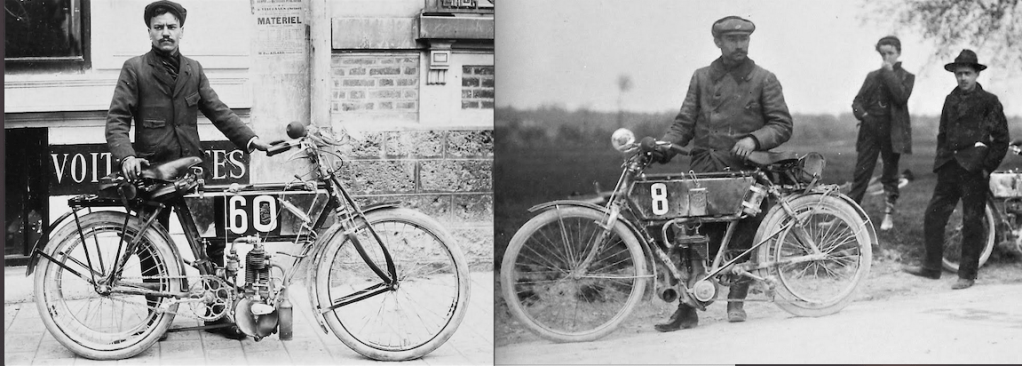
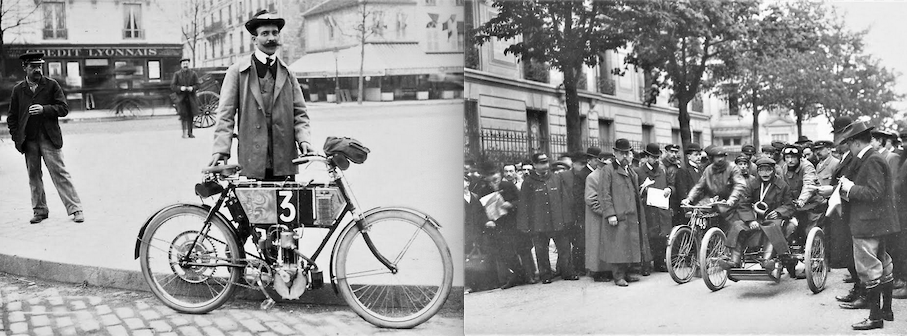
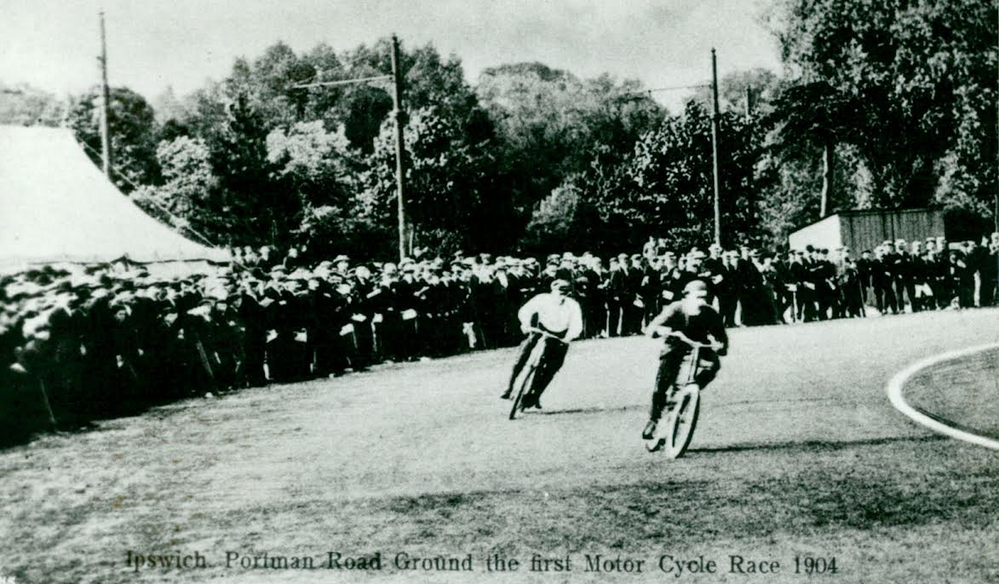
“LAST WEEK WE HAD THE PLEASURE of a trial spin on the new Triumph motor bicycle. The machine is fitted with a vertical air-cooled 3hp engine, and weighs complete about 140lbs. The frame, which is built from seat tubes of 22in and 24in, is made from stout gauge tubing, and is specially reinforced where required. The wheelbase is slightly longer than the majority, namely, 53in from centre of front wheel to centre of back wheel. This, Mr Schulte explained to us, had been done to provide for increased storage accommodation for oil and batteries, and to steady the machine in grease. The wheels are 26in diameter, shod with 2¼in diameter Clincher motor cycle tyres, extra stout spokes being fitted. The engine has a bore of 75x80mm [353cc] and develops 3hp at 1,800 revolutions a minute. The petrol is vaporised in a Longuemare spray carburetter, the exhaust valve being fitted with a governor and valve lifter. The governor is worked by a lever fitted on the tank, and causes lesser or greater lift of the exhaust valve according to the speed required. In addition to control by means of the exhaust, there is a combined switch and exhaust lift lever on the handle-bar. One of the special points of the Triumph motor cycle will be the improved design of tank, which is made of a special stout gauge acid-resisting metal having only one longitudinal seam. This should prevent any possibility of leakage, besides rendering a somewhat delicate part of the machine less liable to damage through falls or other accidents. The capacity of the tank is one and a half gallons of petrol and two pints of lubricating oil. Two accumulators are firmly fixed in the tank by means of a special clip, which is both neat and prevents any possible short circuit through the terminals touching the metal of the case. The accumulators are connected up to a two-way switch, and to prevent any possibility of damage to the batteries an automatic cut-out is provided. Brook’s B90 saddle and two toolbags complete the equipment of one of the most up-to-date motor cycles that we have yet examined.”
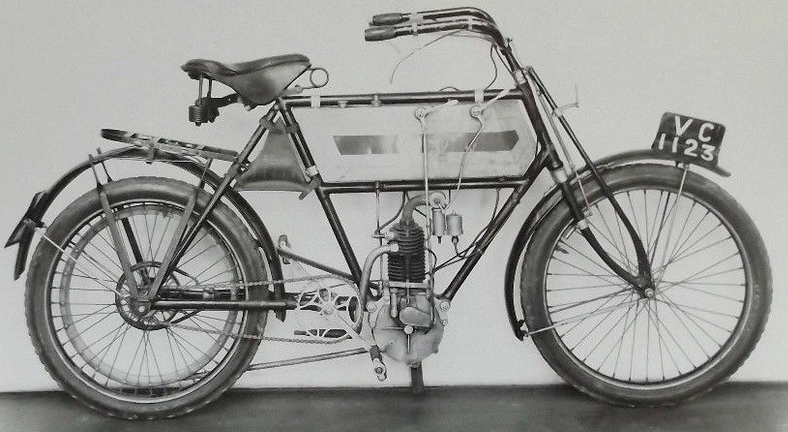
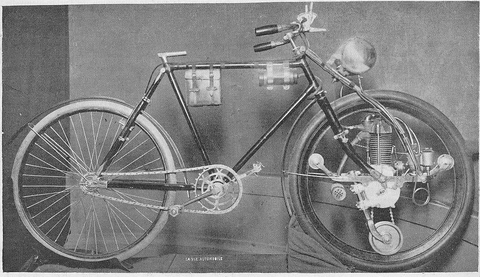
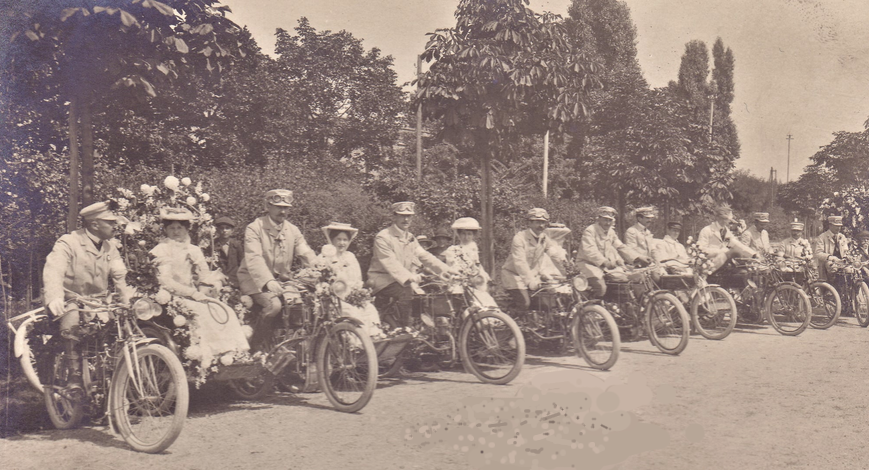
“IN ORGANISING ITS FIRST HILL-CLIMB, open to members only, the Auto Cycle Club has drawn up a most sensible net of rules, which should not fail to ensure the weeding out of the weaklings from the efficient machines. No pedalling is to be allowed. In this rests the success of the undertaking, which, we think, cannot fail to ensue. Of all competitions a hill-climb is the most interesting, and there is no sight more gratifying than to see a £50 motor bicycle scorn a gradient of 1 in 9 in a manner which would put a £500 car to shame. If pedalling were permitted, it would not mean that necessarily the best engine would be the winner of its class, but probably, or, rather, more than probably, the strongest rider, or the man who was wise enough to use a suitable pedalling gear. There was a tremendous outcry recently against weight in motor cycles, and perhaps not without reason; but we ask our readers, if we take off our 2½hp or 2¾hp engine, which will carry us up any average hill without pedal assistance, and to save a few pounds in weight, replace it with a 1½hp or 1¾hp motor, which will cause as to break our backs in pedalling up a 1 in 14 gradient, is it worth while to sacrifice efficiency for lightness? Let us now consider a few arguments against the light machine. Its advantages have been put frequently and pretty clearly before us of late. Its highest speed is little over the legal limit; its engine is geared low, and consequently has to run at a high rate of speed to maintain its power. This means excessive vibration, and increased discomfort in proportion. If it is taken into a crowded street and asked to crawl behind an omnibus, its small flywheels cause the engine to give up the ghost at a critical moment. You are told that it will climb any hill with light pedalling. Try it on a really bad one, and you will find the light and beneficial exercise develop into such strenuous over-exertion that you will have to get off in disgust and push the weakling up. The advocates of this class of machine—the introduction of which will turn our healthy and charming pastime into a farce—tell us that it appeals to the old cyclist. We rather doubt it. If it does, it is the old cyclist who has tried neither the light nor the heavy machine. They also tell as that the remedy for the lightweight’s obvious defects is a two-speed gear. Surely a change-speed gear is out of place on a single machine. The great advantages which the efficient motor bicycle has over the car are its simplicity mechanically, its lower price, and its cheapness of upkeep. If we are going to advocate the introduction of these complications into the poor man’s motor car, the poor man will be the first to blame us. Of course, there are some cyclists who would like a machine of the type we have just described, but unless they live in a level district, and are capable of keeping their mounts in perfect trim (they have absolutely no reserve of power), we advise them to adopt nothing under a 2½hp. No one more than ourselves would like to see a light motor bicycle, but at the present time such a machine does not exist in an efficient and commendable form, and in our opinion it is in every way possible to choose the heavier machine. The public want them because the public are wise and know what they really require. Many of them have tried the light powerless machine and found it wanting. The majority of manufacturers realise this, and the manager of one firm to whom we were talk-ing the other day, when asked whether he found that customers preferred the 3½hp to the 3hp machines, replied most emphatically in the affirmative. We do not, of course, advise a beginner to invest in a machine of such a high power, which two years ago was considered murderous and appalling, but as soon as he has mastered his first machine, and found out what hills it will not take. this is the mount which he will necessarily choose. In conclusion, we beg our readers to ask themselves whether the machine which will go anywhere and do anything is not, after all, the one they wish to buy? and surely not the mount which, though it may be easily wheeled up a flight of nine or ten steps, will jib as soon as its rider comes to a hill of any severity. If it were possible to have a very light machine with all the advantages of the heavier one in point of power and hill-climbing, we should be the first to advocate it, but to advocate a lightweight motor bicycle for all purposes is not our policy. Indeed, it is obvious that a machine which might suit a nine-stone rider in level country would be useless for a twelve-stone man in a mountainous one, however well he might pedal on hills.”
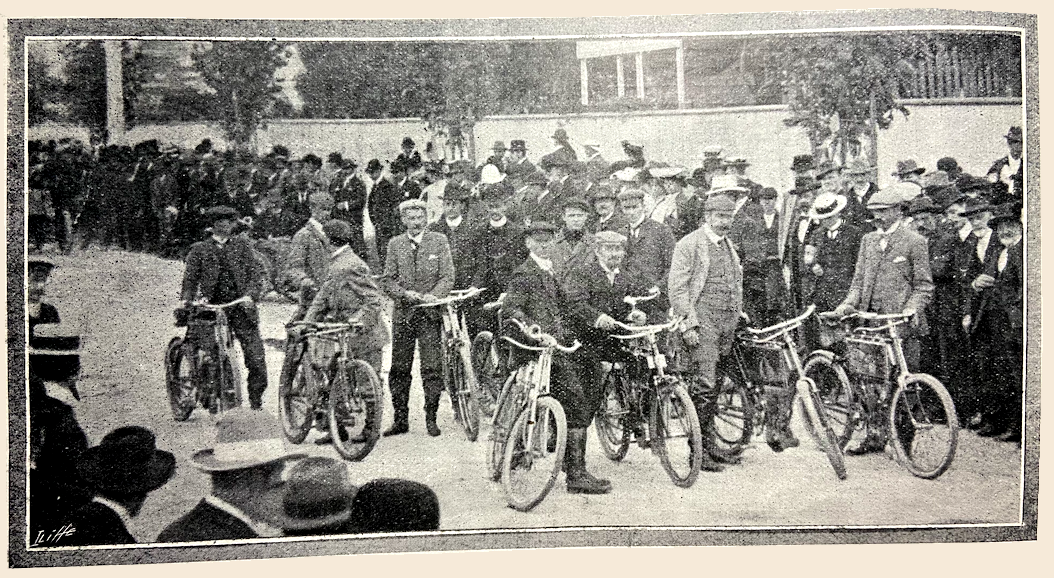
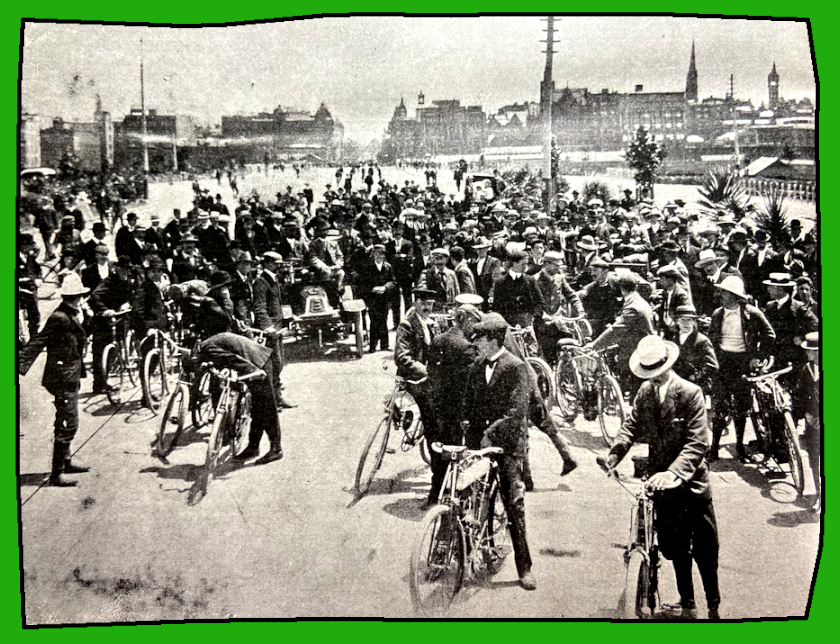
“SPEED AND BRAG. We have had our attention drawn within the last few weeks to a practice which we think might with advantage be dropped on the part of a good many motor cyclists and auto-mobilists. We refer to the bragging that goes on with regard to the distance that can be covered in a certain time. In many instances lately we have found that the culprits are newcomers to the sport, and, being possessed of a fast machine, do not lose the slightest opportunity of publicly stating in places of resort that they have come from so and so in such and such a time, or previously done from so and so to so and so in so many minutes. If this was confined to their own club members and fellow riders, we should have nothing to say on the subject, but, unfortunately, it is not confined to them, and in consequence it is talked about pretty considerably amongst non-motorists, till it gradually gets round to the ears of a motorphobe, who then seizes upon it as a subject to ventilate his grievance. A speedy ride on a motor of any description is most exhilarating, and can be undertaken with safety when there is no traffic about, but, even if 20 miles are covered in half an hour, there is no actual necessity to tell everybody you come across about it. It is not a very difficult matter, if you take a 20 miles run out on a fast road, to cover this distance in some districts without coming across any traffic worth mentioning, but when you arrive in the next town and state that you have come 20 miles in half an hour, it naturally opens the eyes of others to the fact that you have been racing along, and, without making enquiries as to whether there was any traffic on the route, they immediately say, ‘Oh, how dangerous.’ This little caution is given at a time when there are numerous owners purchasing new machines, and novices coming into the ranks of motor cyclists; we therefore think it a good opportunity to draw attention to it. We are in a position to prove that there is a good deal more harm done to the cause by thus advertising what the mot cycle or car can do than by quietly doing it and saying nothing about it.”
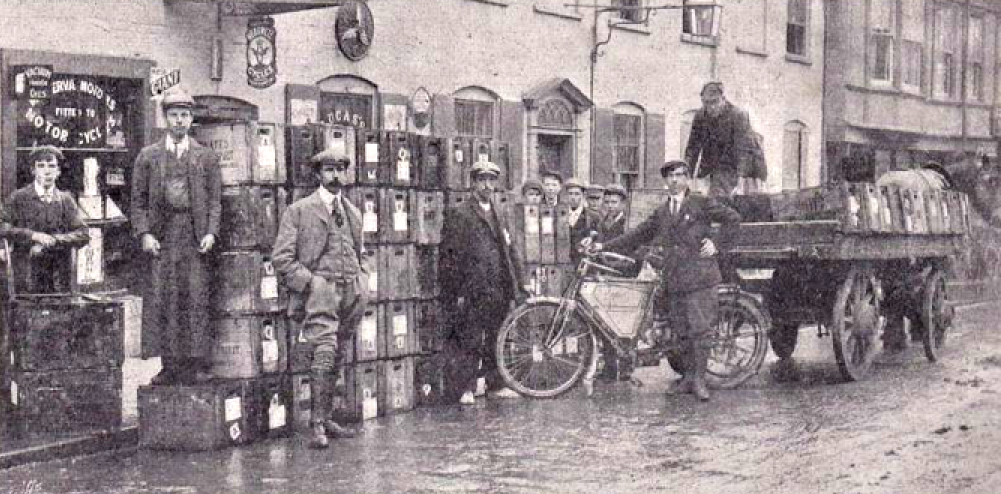
“WHILE EVERYONE NATURALLY thinks his motor cycle to be the best procurable, there are, without a doubt, certain things in most machines which call for special attention and testimony, and if I may again trespass on your valuable apace I should like to write a few words about the spring forks now fitted to the Quadrant motor cycles. Apart from the fact that they entirely destroy all jarring vibration, which no many complain of, a recent incident proves them to be a safeguard in encountering obstacle. of no mean height. At a garden party I was asked to exhibit the qualities of my 3hp Quadrant motor cycle. I accordingly rode it down the drive, past the house, where the spectators were assembled, and on to a narrow road leading to the stables. Getting into a deep rut, I could not turn at the bend. No doubt I was going too fast, and the result was that my motor took me straight into a rockery, a foot high, rising to two feet at the back. To my astonishment and to everybody’s, the machine, thanks to the spring forks, climbed the rockery in a most clever manner, and landed me quite quietly amongst the evergreens at the back of the rockery. The only damage resulting was a bulge in the back wheel, which I soon took out. I am perfectly certain that had it not been for the spring forks my front wheel must have been buckled, my machine otherwise damaged, and I must have come to earth. Experiences of this kind go to prove the value of such an invention, which the Quadrant firm are lucky enough to possess.
EHF May.”
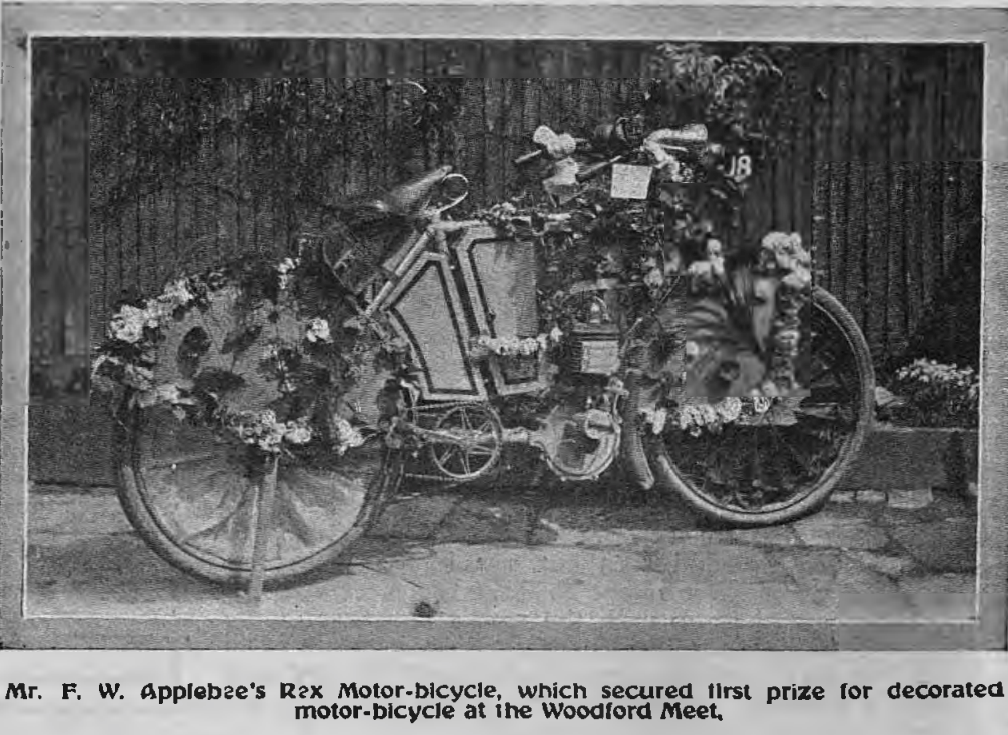
“IT HAS BEEN DECIDED to elect a sub-committee of the Auto Cycle Club for the purpose of dealing with the pastime of motor cycling as distinct from the racing section.”
“IT MAY INTEREST SOME of your readers to know that motorcycles are used in British Central Africa. I have recently received one from England, and have just returned from a journey through the country lying SW of Lake Nyassa, during which I travelled 250 miles on the machine. Our roads and paths in this Protectorate are not made with a view to motoring, but I found that I could get along fairly well in most parts, though some portions of the journey were decidedly rough riding. My machine has a 3½hp Minerva engine, and is geared as low as the driving wheel will admit. I can get down to 4mph without the engine stopping.
British Central Africa.“
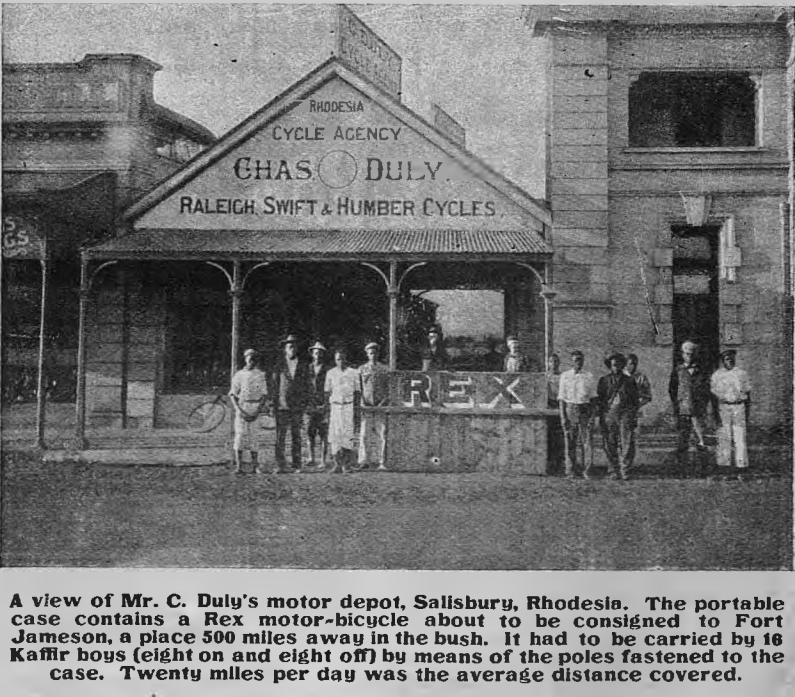
“MOTORCYCLING IN SOUTH AFRICA, A Johannesburg correspondent in forwarding us some details of a recent cycle and motorcycle road race held between Pretoria and Johannesburg alludes to the spread of motorcycling in South Africa and the interest taken in The Motor. The race, a distance of about 45 miles, attracted a large number of entries, no less than twenty motorcycles starting from Pretoria. Of these eight finished, the winner’s time being excellent when the hilly and often very rough state of the roads is taken into consideration. The cyclists were sent off first, and the first four of them arrived before the first of the motorcyclists, who were despatched much later, but the times of these latter were nearly 50% better than those of the cyclists—a result which rather upsets the recent opinion of a South African settler that over the rough roads in that country a pedal cycle was faster than a motor. The following are the names and times of the first five motorcyclists, the figures in brackets being the handicaps: GB Usher, Rex 3¼hp (4min), 1hr 39min 14sec; W Smith, FN 2hp (11min), 1hr 53min 20sec; G Davis, Bat 3½hp (3min), 1hr 45min 47sec; R Murkel, FN 2hp (11min), 1hr 55min 50sec; JA Kock, Werner 2hp (11min), 1hr 57min 55sec. The first cyclist took 2hr 30min 45sec over the journey.”
“QUEENSTOWN, SOUTH AFRICA, has recently celebrated its first motorcycle race. This was included in the programme of a cycling and athletic meeting, and was much appreciated by the spectators. The distance was five miles, and the competitors were allowed a flying start. The first three were McKay (9min 44⅓sec); Jones (12min. 50⅔sec); Poplowsky (15min 26sec). The winner rode a 3hp Ormonde; Jones a 2½hp Antelope; and Poplowsky a 2hp machine; so that the result was clearly influenced more by the power of the cycle than the art of the man. Now that a start has been made we may expect other races of a similar character in this part of the Empire.”
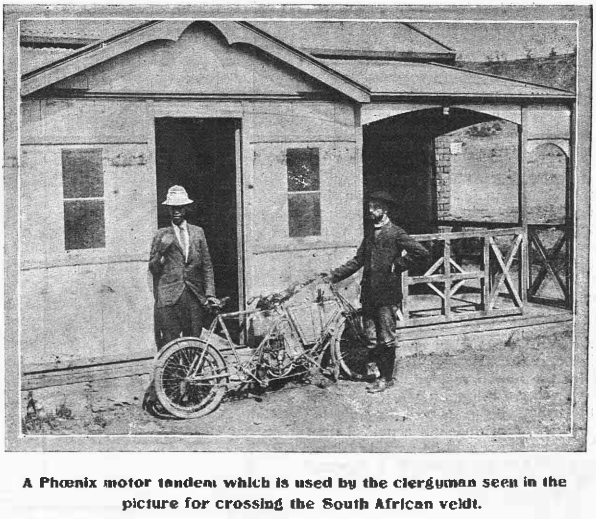
“UP TO THE DATE OF going to press no more entries have, we hear, been received for the motor cycle side-slip trials. It is a pity that a few more enterprising folk do not give publicity to the devices they have invented.”
“REX MOTOR-BICYCLE CLUB. Among recent candidates fcr member-ship to the above club are the following: Monsieur le Comte Avvo. Alfred Peracca, Turin, Italy ; Monsieur Andrea Montu, Turin, Italy; Monsieur le Comte di Montonaro, Turin, Italy; Monsieur Guiseppe Corte, Turin, Italy. We are asked to state that every user of a motorcycle is eligible for membership in the Rex Club. The subscription is the nominal one of 2s 6d, which includes a handsome club badge. Application for membership, accompanied by this subscription, should be made to the secretary, 24, The Butts, Coventry.”
“ANOTHER CHALLENGE TO THE world emanating from a record holder appeared recently in one of the sporting dailies, but at present it does not appear probable that it will lead to a match. Such challenges flavour more of the pugilistic world, and do little good to the challengers.”
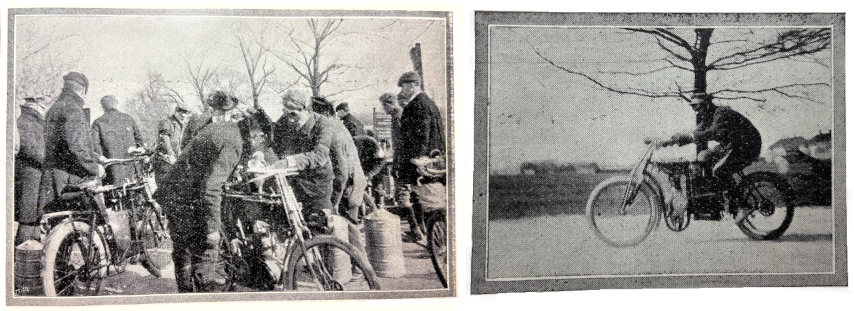
“MESSRS BINKS’S ENGINEER, a Mr David Roberts was summoned for furiously riding a motor cycle in Burton Street, Nottingham. There was a unique defence to the case. Dr Bottrill said that Messrs Binks had been experimenting with a new machine, and the defendant was sent out to try the new method of ignition. He went down Burton Street at a slow pace, but on turning and starting the engine to come back, the machine developed a speed which took the driver by surprise. The machine referred to is apparently the four-cylinder Binks engine which has been under test for six or seven months, and had not given the results which were anticipated, and it was therefore decided to try a new method of ignition, with the above result.”
“SIDE-SLIPPING IS A GREAT bugbear to motor cyclists, yet the risk is greatly exaggerated. The proper thing to do is to cross tram lines at as wide an angle as possible, and to keep off wood setts when they have a thick coating of slime on them. Drying roads are more dangerous in this respect, too, than wet roads. People often ask which tyre has the best anti-slipping corrugations. A Northern correspondent writes that his experience is that corrugated treads make no appreciable difference. He says that he had three pairs of pneumatic tyres of the original smooth pattern, and in two of these cases the tendency to skid was no more marked than it has been in recent years with all kinds of anti-slipping corrugations, and basket patterns and what not. In the third case the machine was always skidding in mud or thick dust, but these propensities were not mitigated in the slightest degree when the smooth tyres were taken off and a corrugated pattern substituted. This seemed to indicate that the skidding tendencies were due to the machine itself, and not to the tyres, and our correspondent thinks lesser liability to side-slip depends almost entirely upon the attention paid to frame design.”
“THE MOTOR CYCLING CLUB is fast completing its arrangements for the twenty-four hours’ run from London to Edinburgh. The start will be made on May 20th from the GPO, the historical point from which the old mail coach to Edinburgh originally started. The North Road Club has always started the London to York ride from the same point, which gives the matter additional interest now the motor cycle is being used in place of the pedal-propelled machine. Motor cyclists should note that this ride, which will no doubt often be referred to in the future, is open to members of the club only, and if they wish to participate in the run, it would be well for them to put themselves in communication with the honorary secretary, Mr JH Reeves, 2, Penywern Road, Earls Court, London, SW. The entries close at an early date, therefore little time is to be lost.
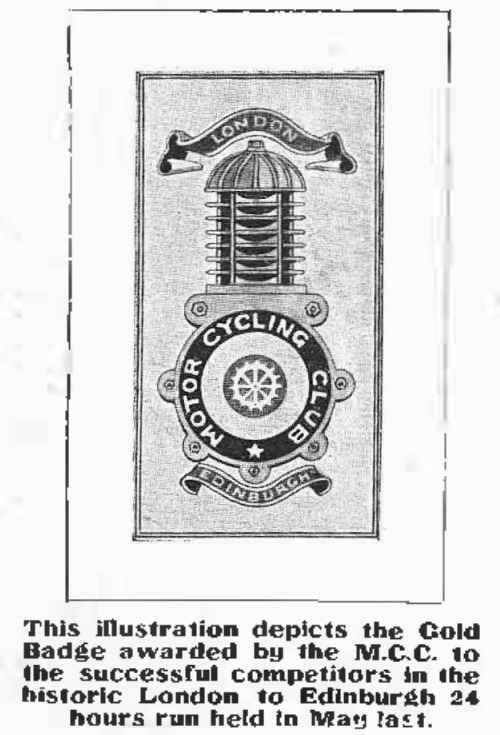

“AN INTERESTING EVENT that has been looked forward to for a long time by motor-bicyclists was held on Saturday last at Bicester, a pretty little village about 12 miles NW of Oxford. The event was an inter-club competition as a test of reliability of motorcycles for a challenge cup, presented to the club by The Motor Cycle. The conditions and general arrangements were on the following lines: ‘The cup is to be the award in a competition between teams of riders, members of, and nominated by, recognised automobile clubs, motorcycling clubs, or cycling clubs. In case of doubt as to whether any entrant is or is not a recognised club, the Auto-Cycle Club shall adjudicate. No club may enter more than one team. If the cup be won three times, not necessarily in succession, by the team representing any one club, it shall become the
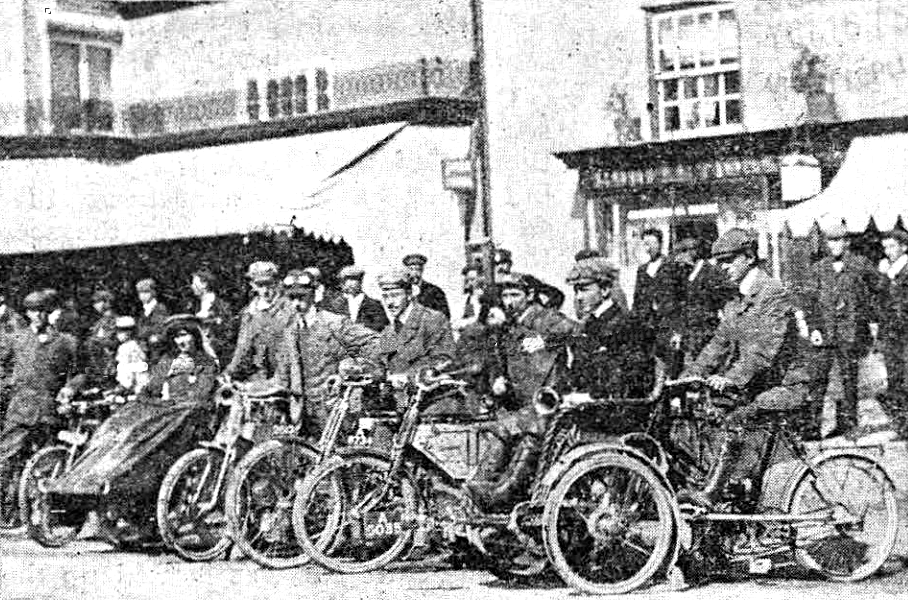
absolute property of that club. Each team shall consist of six riders, of whom: (a) Two shall drive single-seated motorcycles fitted with engines of a cubical capacity not exceeding the equivalent of 76x76mm [345cc]. (b) Two shall drive single-seated motorcycles fitted with engines of any capacity, (c) Two at least of the four single seated motorcycles must be motorbicycles. (d) Two shall drive a two seated motorcycle, as defined by the Local Government Board, or a motorcycle with passenger attachment. The Committee will strictly enforce the 3cwt limit. The competition shall consist of a 100 miles non-stop run, with a lunch interval after 50 miles. The number of miles, up to 100, accomplished by each rider of each team without stoppage other than during the lunch interval will be added together, and the team scoring the highest mileage thus arrived at shall be the winner of the trophy. After an interval of one hour from the conclusion of the hundred miles—during which time no adjustments or alterations shall be made—the competitors
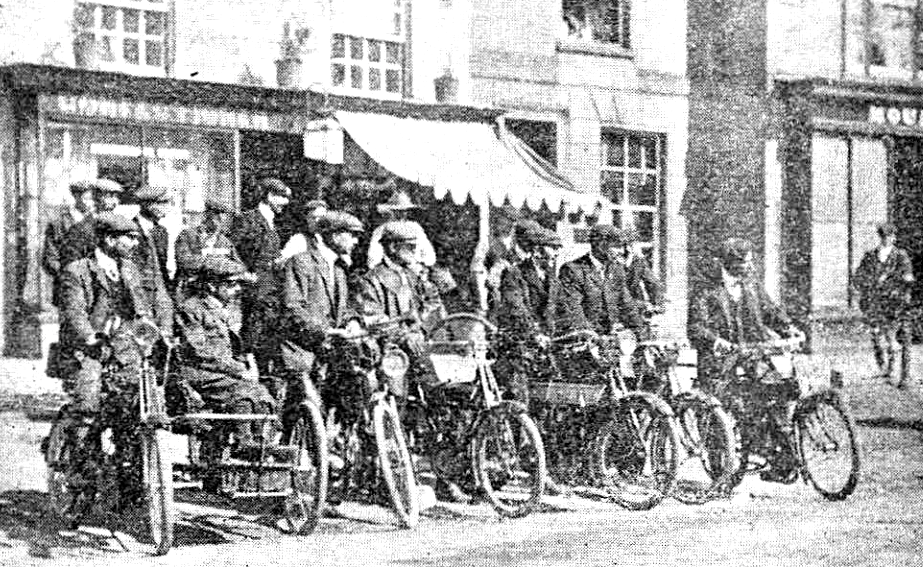
who have finished this distance will be declared the winners. The time will be taken from the word “Go!” at the starting point.’ The Crown Hotel was made headquarters, and the majority of the competitors stayed here overnight, having ridden in on their machines. The starting time had been arranged for 10 o’clock, and fortunately the weather was beautifully fine, and gave every promise of a good day’s sport, the roads being in excellent condition. Mr CW Brown, having unfortunately been taken ill, most of the work devolved upon Mr E Marsh (the MCC treasurer), assisted by Mr Hall (NRCC), as official starter. The Rev BH Davies, who had previously mapped out the route, rode over to the turning point at Deddington just before the start. The following is the list of starters in the five clubs competing. Guildford MCC: Rose (Roc motor-bicycle), White (Quadrant motor-bicycle), Horrocks (Roc motor-tricycle), Gammon (Roc motor-bicycle), Wright (Roc side-car), Wall (Roc motor-bicycle and trailer). Southern MCC: CE Pattison (Phoenix Trimo), CE Bygrave (Excelsior motor-bicycle). Motor Cycling Club: Hulbert (Hulbert-Bramley motor-bicycle), Reeves (R&P motor-bicycle), Wells (Vindec motor-bicycle), Hooydonk (Phoenix Trimo), Jenkins (Rover tri-car). Peterborough MCC: Heighten (Vinco motor-bicycle), Mays (Vinco motor-bicycle), Holmes (Vinco
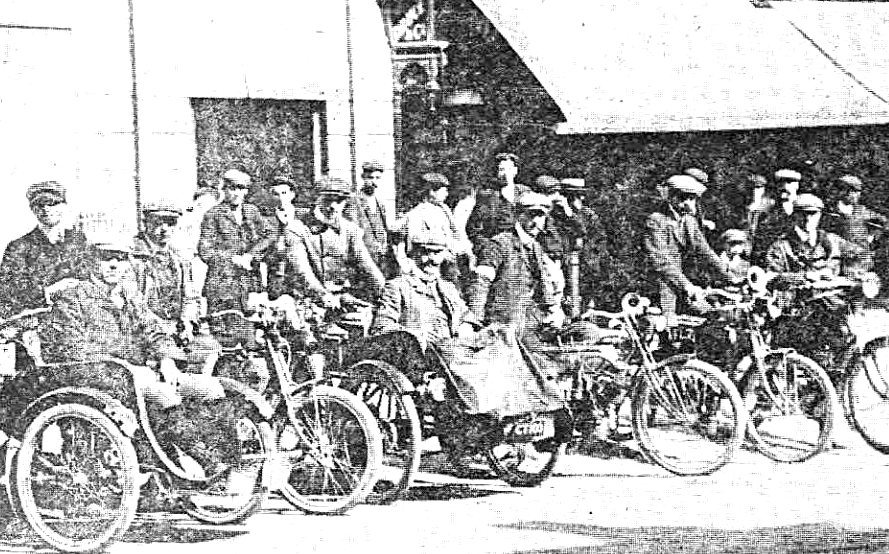
fore-car), Wadsley, (Vinco motor-bicycle), Gibson (Vinco forecar), Woodman (Lightstrung motor-bicycle). Coventry MCC: Owen (Humber motor-bicycle), Ayton (Triumph motor-bicycle), Duret (Singer motor-bicycle), Riley (Riley motor-bicycle), S Wright (Excelsior motor-bicycle), Yates (Humber forecarriage). The turning point at Deddington was 12½ miles out from Bicester, and the competitors were started off by the official starter at intervals of 30 seconds. The event created a great stir in the little town, and the main road in front of the hotel was pretty well crowded with villagers to see the start. The local police —after receiving ample assurance that the law was not to be transgressed by the riders exceeding 19mph—became very friendly disposed, and kept the traffic clear. There are some very fair hills on the 12½ miles course, one (Aynho Hill) being a rise of about 1 in 12, and a few hundred yards long. Amongst the first to be in trouble was Van Hooydonk, who had a puncture very shortly after the start. Heighten (Peterborough) had a puncture near Deddington, and finished the last 13 miles on the rim. Holmes (Peterborough)
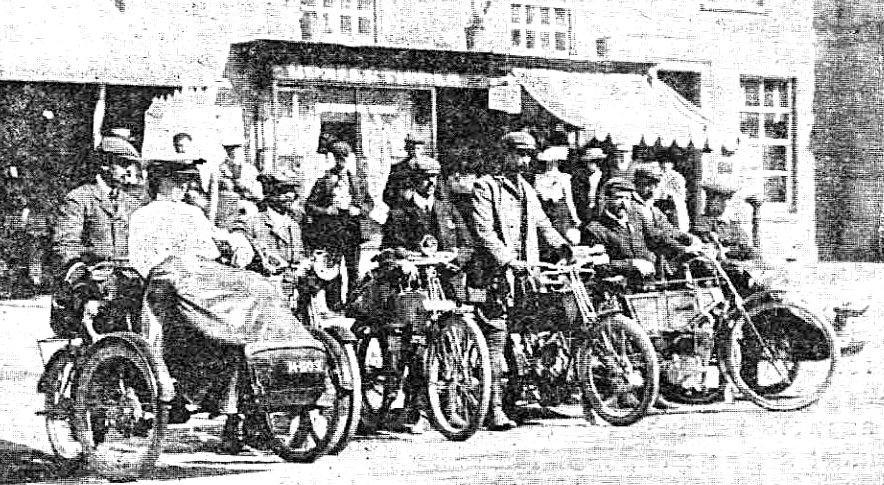
experienced a short circuit through one of the wires having rubbed its insulation off against the tank. Several of the fore-carriages failed on Aynho Hill, especially those having a single gear only. The hill, although not very steep, is approached from round a corner, and consequently the drivers, not noticing it ahead, were quite unprepared to rush it…at the finish of the third round (75 miles) there were left in: Owen, Duret, Yates, Wright, Riley (all of the Coventry Club), Reeves, Candler, Wells (Motor Cycling Club), White, Wadsley, and Woodman. The Motor Cycling Club were placed still further behind in this stage through Hulbert being compelled to stop, as his high tension wire had broken. It was seen at this stage that the Coventry team, barring excessively bad luck, would win the cup. A fair crowd of spectators had assembled in the afternoon at Aynho Hill, and these was much disappointment that most of the fore-carriages had
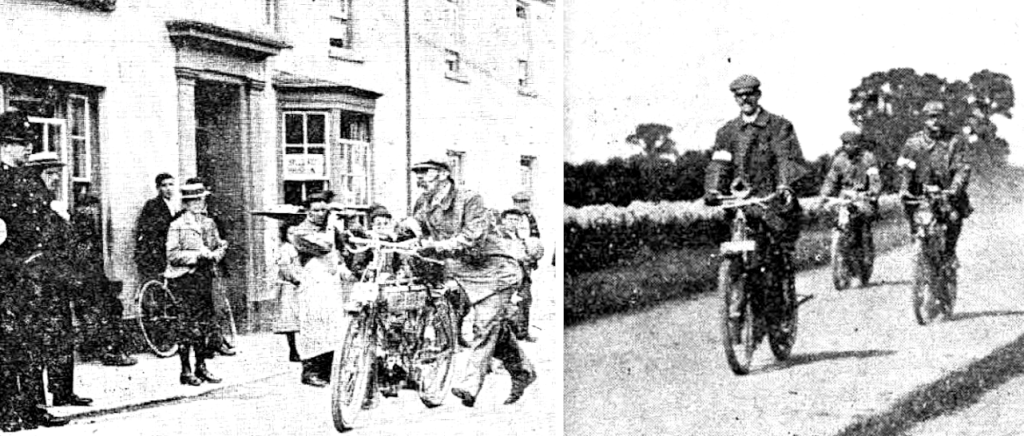
dropped out of the competition. The turning at Deddington was missed by several competitors, who ran straight on, and who, it appears, had some slight friction with the police, otherwise, up to this point, everything had gone smoothly. The first arrivals in the last stage came in at 4.45. These were Duret, Owen, S Wright, Candler, White, Woodman, Wells, Reeves, and Yates. It was thus clear that the Coventry team were the victors, and they received congratulations all round. The necessity for running off the final stage in the starting and stopping test did not arise. Punctures, as usual, were responsible for the majority of the breakdowns in the motor-bicycles, but, as regards the fore-carriages, the performances of these machines conclusively proved that two gears are absolutely necessary for general work, The marshalling and controlling along the route was considerably facilitated by the timely arrival of Mr AJ Wilson, on his Gladiator car, as he was thus able to convey the officials to the control points…On the whole, the event was a great success, and next year’s competition will be looked forward to with much interest.”
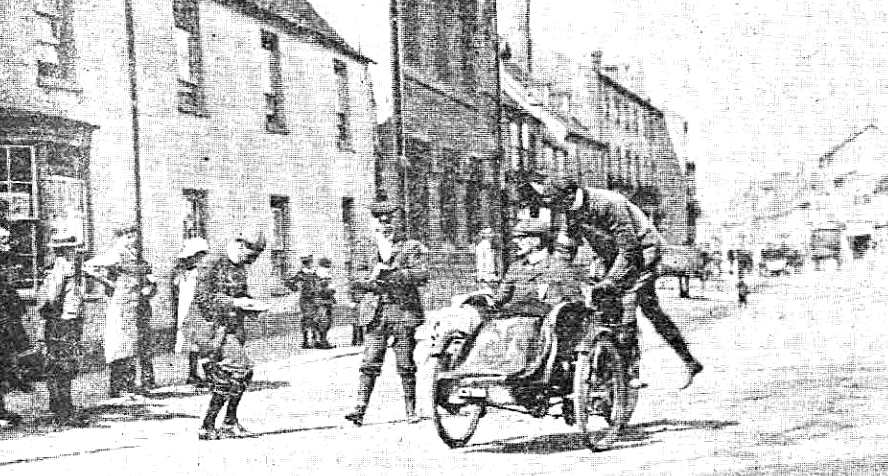
“THE SIDECAR HAS JUST reached America, one having recently been en evidence on the Ormond Beach, one of those vast tracts of hard sand which our American cousins are finding so suitable for speed tests. One of the American automobile papers refers to it as a. ‘sociable attached to a motor bicycle, which appeared to run well on the smooth sand track, but, of course, was not suitable for road work’.”
“0NE OF OUR CONTEMPORARIES in a recent issue inserted a paragraph which implied that motor cyclists had a most haggard appearance when on their machines, and queried the reason why this should be the case. If the paragraph had been confined to the circulation of the publication in which it was inserted we do not think any very great harm to the cause of motor cycling would have been done, but when it happens to be quoted in a leading daily with a circulation of about half a million copies, which goes all over the world, it becomes a serious matter. Of course, there is no truth in the statement whatever. Motor cyclists do not wear any different expressions from other users of automobiles, and to say anything to the contrary is only an absurdity. We have noticed for some time that the particular paper in question gathers a good deal of its motor cycle information from the pages of The Motor Cycle, and we should be inclined to think that its exchange copy was mislaid in the post on this particular occasion, and it was put to considerable trouble to fill the motor cycling column in consequence. At least, one would be inclined to think so, judging by the paragraph to which we refer above. The motor cyclists in the paragraph are alluded to as ‘flying by’. Does the writer mean that he spends most of his time walking or looking out of the window, or is he a driver of a car which was intended to do thirty miles an hour and will not? One might as well argue that ladies playing golf looked haggard as to say that motor cyclists present any other than their usual appearance when enjoying their exhilarating runs.”
“ACCORDING TO THE Evening News a cycle motor weighing but 7lb, and developing 2½hp, is the latest invention. Further particulars would be welcomed.”
“ONE OF THE MACHINES which completed at the recent five miles event at Canning Town was fitted with a surface carburetter, but the machine never had a look in.”
“IN MANY PRESENT DAY machines it is impossible to take off the cylinder without having to remove the whole engine from the frame. Having a loss of compression and suspecting the piston ring slots to be in line we removed the cylinder, found our suspicions correct, and had the cylinder back in half an hour. We thoroughly appreciated not having to dismantle the engine. Accessibility is not the leading feature of marry motor cycles, but is an important one.”
“RECENT RIDING OF A TRIMO, in traffic particularly, has impressed upon us the necessity of having a clutch on such machines. As our engine has a ball bearing on the engine shaft, the clutch will have to be fitted on the rear wheel. If any motor cyclist who has a clutch so fitted would give us his experiences we should esteem it as a favour.”
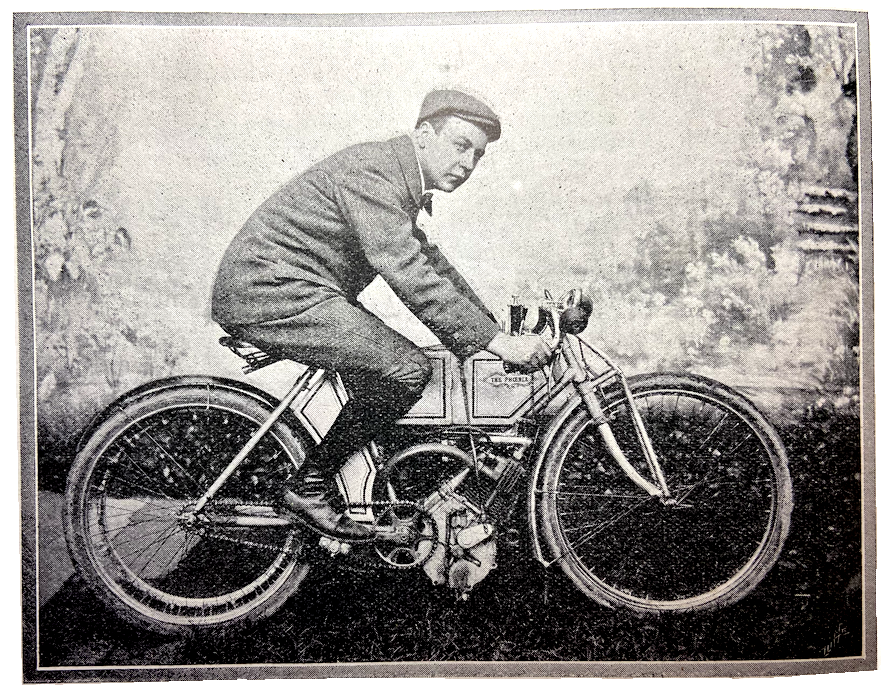
“IT IS CUSTOMARY to form a loop or coil is the petrol or lubricating feed pipes on motor cycles, often to the surprise of the novice, who naturally supposes that better results would be obtained with a straight pipe. The object of these loops is two-fold—firstly to give a certain amount of spring to the pipe, to prevent fracture under vibration; secondly to provide for the pipe being drawn out a little in the event of a breakage, to enable afresh joint to be made. If the pipe were direct and the end broke off, it would necessitate a whole new pipe.”
“MOTOR CYCLES WERE TO THE FRONT at the meet of the Derby, Nottingham and Leicester Automobile Clubs at Ashby-de-la-Zouch. The proceedings were not remarkable for excessive sociability, as is frequently the case at inter-club meets. Amongst the machines were Quadrants, including a two-engine tricar, Excelsiors, 2½hp Daw, two-cylinder Garrard with side-car, and 3hp Clarendon Trimo. After the two-engine Quadrant forecar the most interesting machine was a chain-driven Humber fitted with Simms high-tension magneto and a Sthenos carburetter. We had a chat with the rider, who informed us that he had made the alterations himself, and that the ignition worked perfectly at all speeds. The magneto was chain-driven, in two steps for convenience, from the half-speed shaft. We saw this machine start up, which it did just as quickly as a machine fitted with the ordinary ignition. The inevitable shower fell during the photo-graphical proceedings, but otherwise the weather was, as it should be in April.”
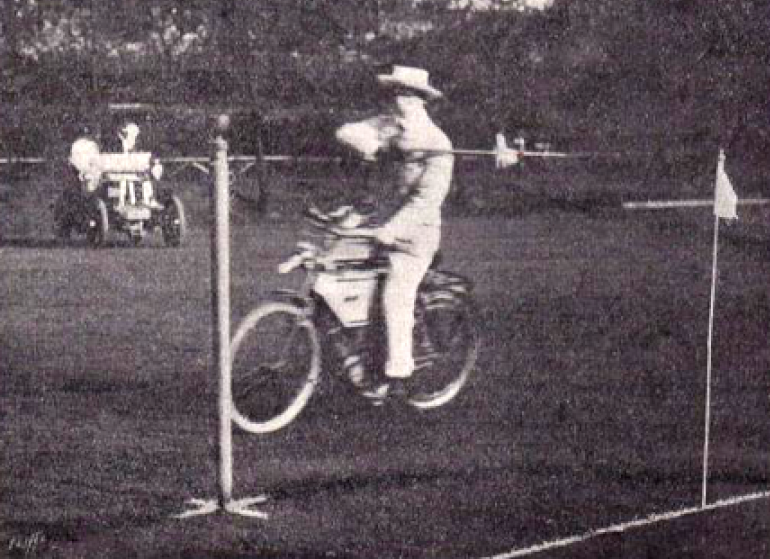
“THE MEMBERS OF THE Southern Motor Club had a most enjoyable Easter tour. Leaving London by the Bath Road on Friday afternoon, they arrived at Marlborough mid-day on Saturday, where after a short stay they returned home via the Thames Valley, the weather being all that could be desired. Several members joined the tour at various places, including Henley and Marlow. A well arranged fixture card will be issued in the course of a few days. Among the various fixtures are the following: Two 100 miles reliability trials, three hill-climbing contests, two garden parties, and a launch party. The first reliability trial of 100 miles for motor cycles (single class) will take place on May 7th, the course of which will be decided on shortly.”
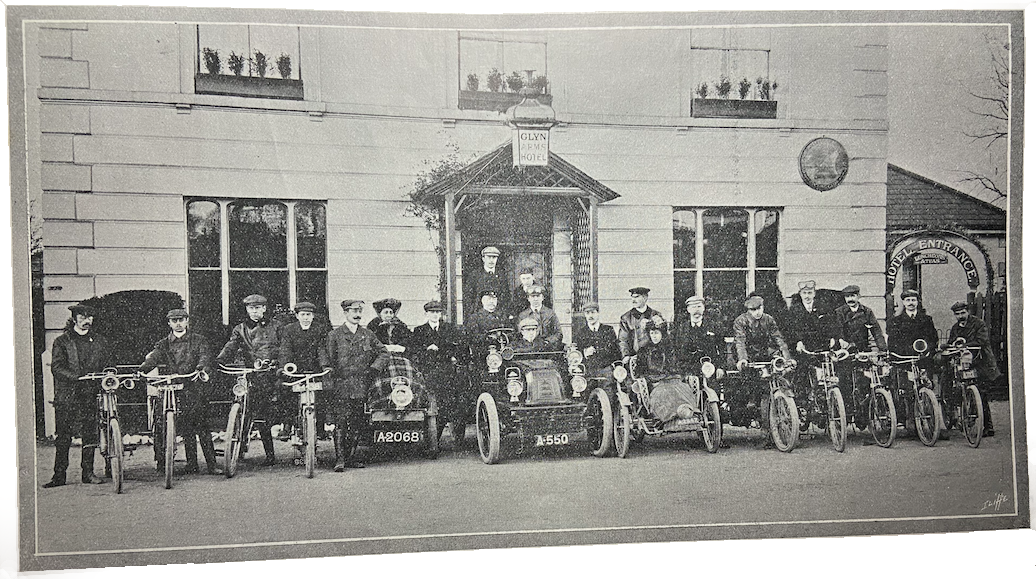
“THE BIRMINGHAM MOTOR CYCLE CLUB held its opening run on Saturday, April 9th, to Worcester, and before starting was photographed outside the club headquarters, the Crown Hotel, Corporation Street. Unfortunately, a heavy downpour of rain prevented many of the members from going all the way, and the state of the roads on the tram routes of the city resulted in one or two side-slips. If we may be permitted to offer a little advice, we should recommend a starting-point on the outskirts as being more convenient to the majority concerned. After leaving Northfield the roads were in splendid order, and an enjoyable run was made to the city of gloves and porcelain. An unfortunate accident took place, owing to one of the riders on a tricycle fouling a cart and bringing down the honorary secretary (Mr Bedford), whose Werner suffered a buckled wheel, etc. Mr Maxfield, the collaborateur with Mr Garrard in the production of the Maxfield-Garrard ignition, kindly kept his workshop open, and very soon had matters put right. This regrettable contretemps and the bad weather reduced the tea party to thirteen, who sat down at the Bell Hotel.”
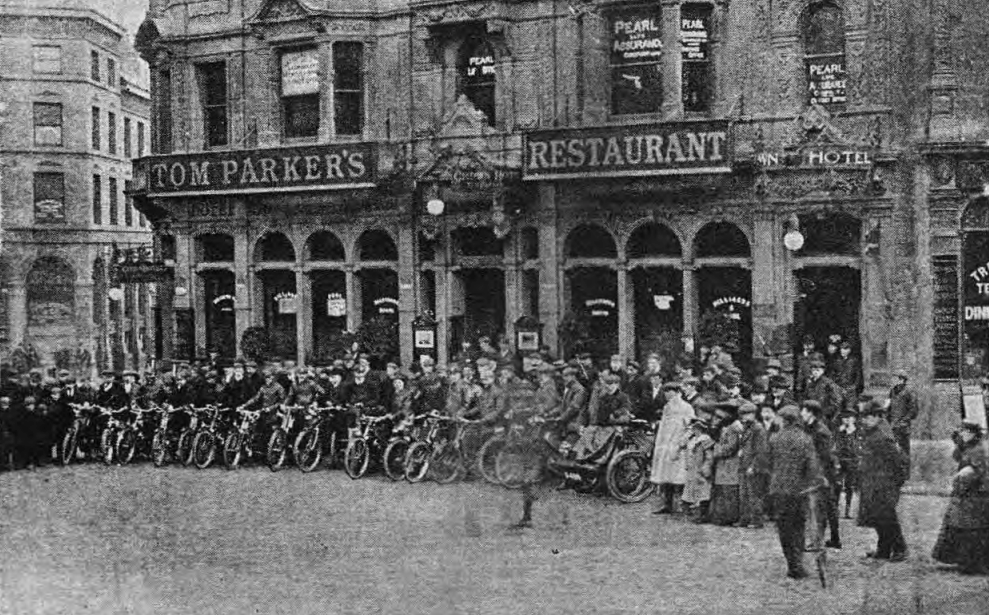
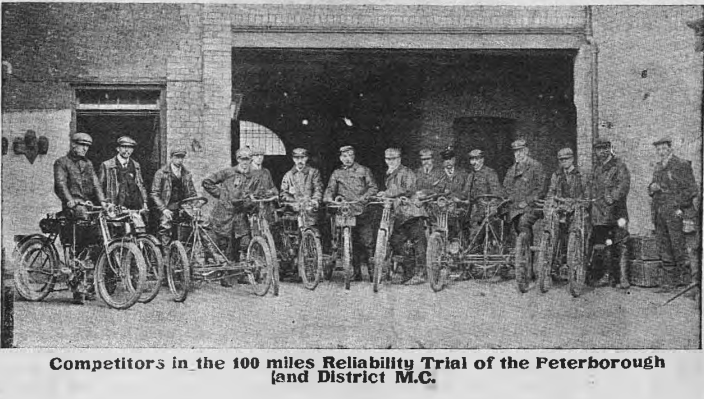
THE CAMBRIDGE UNIVERSITY club trials extended over three days. Day one was “an easy run of about 30 miles, via Newmarket Heath, Bottisham and Guy, with only one serious hill, the Gog-Ma-Gog hills…The Gogs hill, about four miles out, accounted for one machine, while a sharp turn later on put two more out of the competition, owing to the riders attempting the corner at too great speed. These were the only casualties…” Day two’s route “was via Caxton, Arrington, Orwell Hill and was a stiffer one, including two good hills, while a head wind was against the machines for the first ten miles. Two hours were again allowed for the completion of the round. Madingley Hill and the head wind accounted for two machines, whilst in the next ten miles two other riders had trouble with their belts, and coming home, GS Newall, on the Humber, broke the exhaust valve…The third trial was run…via Barrington, Shepreth, Harston. The roads were in a bad condition, for heavy rain had fallen throughout the morning. The run included the ascent of Haslingfield Hill, a long, stiff pull up, with a right-angled corner at the bottom. Five machines started at 2.30, and of these three came through, covered with mud. The other two sticking on the hill. Those who finished were: Botfield, 3½hp King; Greyrig, 2¾hp King; Bax, 3½hp Kerry.”
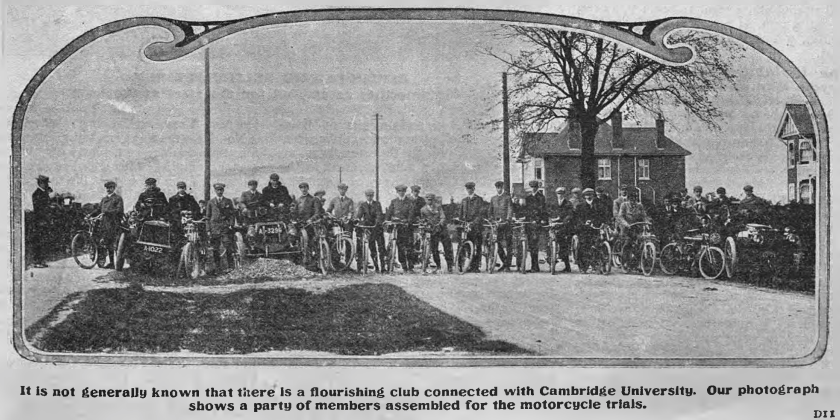
“ALTHOUGH THE SUNDERLAND Automobile Association did not organise a Good Friday run, a good many independent motor cyclists braved the stormy weather and cycled out to villages in the locality, Durham city being visited by several. Votaries of the motor cycle are increasing so rapidly that, judging by appearance at least, they bid fair soon to almost equal the numbers of those who keep to the ordinary machine. Local cycle traders are now exhibiting motor cycles more than ever before, and one business man told our correspondent that the demand for these machines quite surprised him, and he is now finding it to his interest to make a speciality of motor cycles, leaving other machines to take second place. To a less degree this sort of thing obtains in many other shops in the district. It is a case of motors, motors everywhere. It is needless to say that dealers welcome the organisation of motor cyclists, as they consider it will result in the growth of the pastime.”
“AFTER THE ACTIVITY which has been the most marked characteristic of the Sunderland Automobile Association since its inception, the officers and members are relaxing their efforts somewhat. There is nothing at present to stir them into vigour in regard to oppressive regulations as to speed—they removed this danger at the outset—and their work now is to secure adequate co-operation and smooth working among all the branches throughout the county of Durham. The committee is still receiving numerous applications for membership, and there is reason to believe that ere long the motor cyclists of Sunderland and Durham county generally will have one of the strongest and most effective unions in the country. A desire exists, however, to spread the cause in the neighbouring county of Northumberland. Hitherto the battles of Northumberland motor cyclists have been fought by the Durham men, but it is felt that they should now find further strength in themselves.”

“THURSDAY AND FRIDAY last were the dates fixed for this sporting event, which an irreverent person promptly christened ‘the bob a nob trial’. The rules governing the event were commendably simple: a maximum and minimum time schedule were given for the intermediate and total distances; each time a man stopped or dismounted outside the luncheon and tea controls he was fined one shilling, and the last man in on each of the two days was fined five shillings; these fines, with a contribution from the Club, being devoted to prizes for the leaders. An entry of 15 was received. The first day’s run was via Basingstoke to Salisbury (64½ miles) where a stop of one hour was made for luncheon; then on to Shaftesbury, Sherborne, and Yeovil (tea stop of 30 minutes here, 105¾ miles), and thence through Crewkerne, Chard, and Honiton to Exeter (a total of 152 miles for the day). The minimum time allowed was 9½ hours, inclusive of meal stoppages, and the maximum 12¼ hours. The second day’s route was from Exeter back to Honiton, and thence to Axminster, Bridport, Dorchester (luncheon stop, 53½ miles), Wimborne Minster, and Ringwood, finishing at Southampton (100¾ miles): minimum time (including one hour for luncheon) 6 hours 10 minutes, maximum time 8¼ hours. Thursday opened delightfully overhead, but owing to the deluge of rain which fell on Wednesday the roads from London to the starting point (16
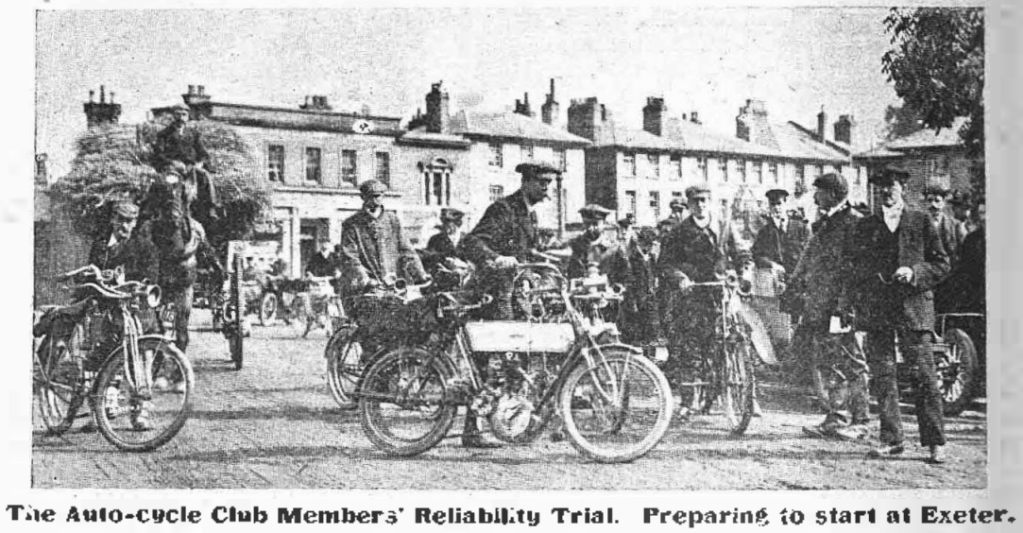
miles) were in that slimy, slithering condition that every motorcyclist abhors; one competitor before reaching Staines actually turned back to London and was seen no more. The greasiness of the roads doubtless contributed to reducing the number of starters, these being HP Rose, J Leonard, HJ Densham, Mervyn O’Gorman, M Ponder, W Hayes, and F Applebee; but beyond Egham there was considerable improvement in the roads. The sun was now shining brilliantly; and with the exception of occasional patches under the trees the going was very good. Mr O’Gorman and Mr Applebee spent a shilling each before reaching Salisbury through a broken sparking plug and broken belt hook respectively. Mr Hayes retired from the contest at Salisbury; Messrs O’Gorman, Leonard and Densham each disbursed a shilling for Chard Hill. Mr Rose was 45 minutes late, and as he dismounted on Chard Hill he was 6s out of pocket. Friday was a magnificent day, but it is to be feared that the six starters found little time for scenery, their energies being fully occupied in pushing up the fearsome heights they encountered at Bridport and onwards. Ponder had found discretion the better part of valour, and stopped at Crewkerne on Thursday night, not venturing to take risks on an unknown road in the dark. He decided to forfeit 5s and had a good night’s rest. Mervyn O’Gorman, Ponder, JJ Leonard, HJ Densham, and FW Applebee started at the proper

time. HP Rose had some little trouble with the inlet dome of his machine, and followed on later, eventually retiring with a broken inlet valve. Applebee found the hills ‘a big order’, and after reckoning up that if he went right through to Southampton he would find most of the prize money, he elected to retire. Amongst the tortuous questions looming in front of the Club committee is the poser herewith. Applebee, Rose and Flayes retired from the contest, and have all incurred sundry single shilling fines for stoppages, but as they are no longer competitors are they still liable to the other men who finished? And if not, why not? Rose was the last man to finish on Thursday, but as he did not get through on Friday, what happens to his 5s fine as to the first day’s proceedings? And as Ponder did not arrive at all on Thursday, do his single shilling fines continue to accumulate for finishing after schedule time? And is he liable for 5s? Can the other men claim his odd shilling fines on Friday as well as Thursday? Does Rose pay 5s for Thursday and 5s for Friday as last man in on Thursday and dropping out on Friday? Does Hayes only pay 5s for Thursday for retiring at Salisbury, and nothing at all for Friday? If so, why should he not pay as much as Rose, if Rose pays anything at all? And so on ad infinitum. But to return to the trial. O’Gorman, Leonard, Densham, and Ponder completed the run at Southampton at 4.15; but we are unable yet to give the actual official results. In conclusion, we should like to ask whether the club committee has seriously considered the necessity of having a non-stop, sitting of its own for discussion of the delicate questions alluded to; and will a is. fine be imposed on members who go home for sleep at intervals during the week?”
THE ‘BOB-A-NOB’ TRIALS. ‘A chapter of accidents!’ ‘A brilliant failure!’ ‘Most enjoyable trial of the year!’ ‘All blanks and no prizes!’ Such were some of the descriptions applied to the recent trials of the Auto-Cycle Club—so aptly christened by some genius ‘The Bob-a-Nob Trials’. As a matter of fact; they really were one of the most successful failures imaginable. Seven started: three discontinued at various points: four finished: and all were, disqualified. It must have been a little irritating to the indomitable four who sacrificed bobs and dollars galore on the strength of raking them all in again in the form of pool money to be disqualified for their brilliant achievement of a task which a thoughtful committee had adjudged too difficult, and had eliminated in consequence. A ‘consolation’ prize was really the most fitting way out of the difficulty, and from the mere outsider’s point of view the committee emerged from the trial covered with more honour and glory even than the competitors. Theirs was a fearsome task, and they might have got very much mixed up; instead of which, they cut the Gordian knot at one fell swoop, and everybody has ‘lived happily ever since’.”

“MINERVA MOTORS HAVE several distinctly good things for 1905…These include…the Minerva two-speed motorcycle engine gear, motorcycle spring fork, motorcycle with magneto ignition. Two pairs of front forks are used. One pair, of oval section, is fitted to the cycle in the ordinary manner, and carries at the lower end two lugs. These lugs carry the front wheel, and are bored for the purpose of supporting vertically the second pair of forks of round section. These lugs have a vertical movement on the secondary pair of forks, and are kept in position by means of four spiral springs which are placed inside the tube. At the crown of the cycle a laminated spring is attached, which extends some ten inches in front of the frame, and at the further end of this spring is fixed the second pair of forks. The gear is composed of two large gear wheels, always in mesh, and is fitted to the interior of the crank case of the motor. The same operation of lubricating the motor also lubricates the gear. The principle of the gear is to transform the vertical movement of the connecting rod to a rotary movement. Attached to the big end of the connecting rod is a small pinion. This engages with an internal toothed ring, the fly-wheel being recessed to take the latter. It will therefore be seen that the internal toothed ring and the flywheel are always revolving in the same direction at two different speeds. A hollow shaft fixed to the internal toothed ring is carried to the exterior of the crank case, and a solid shaft attached to the flywheel runs through the hollow shaft. Fixed to each shaft is a pulley to take a flat belt. To change speed, the belt is slipped by a lever from one pulley to the other. The width of the driving rim pulley equals the width of the two engine pulleys, so as to ensure the belt always running in line. The control of the two speeds is by means of a Bowden wire operated from the handlebar. The company will supply this gear during the 1905 season, at the buyer’s option, with the 2%hp motor, at an extra charge of £5. The remaining feature of the new Minerva engine is the adoption of the magneto system of ignition, which can be obtained at a slightly different price to that charged for coil and accumulators. The illustration depicts a machine fitted with the Eisemann high tension ignition. The coil is fitted in a compartment of the tank case. The dynamo is mounted on a bed plate alongside the engine, and is driven by a small chain. The company, however, have patented an entirely new method of transmission for driving the dynamo, which is claimed to be a great advance on the chain or other systems.”
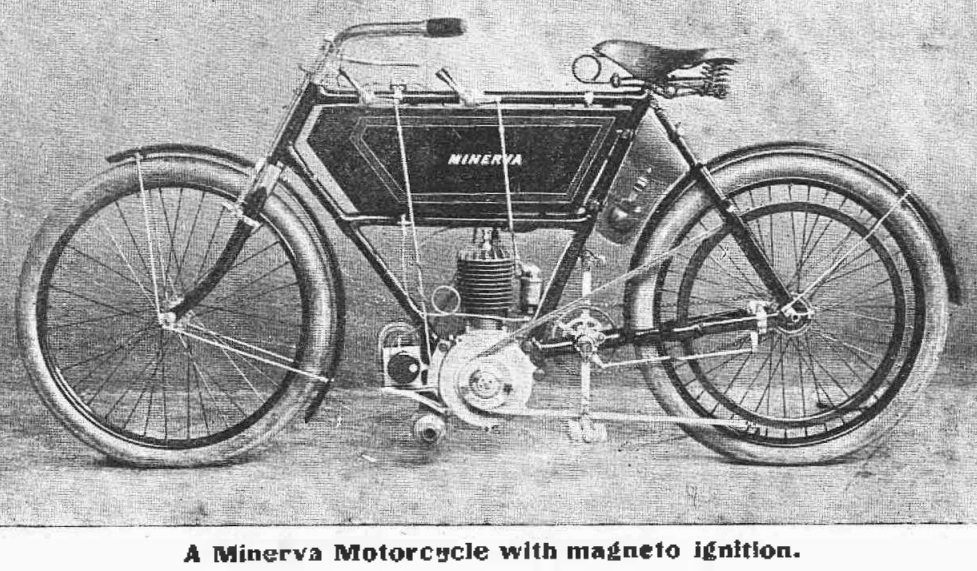
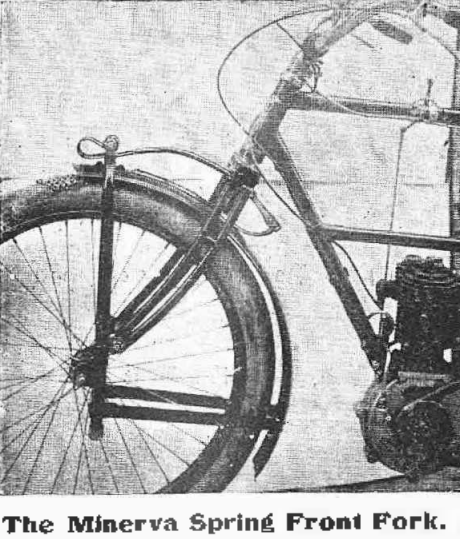
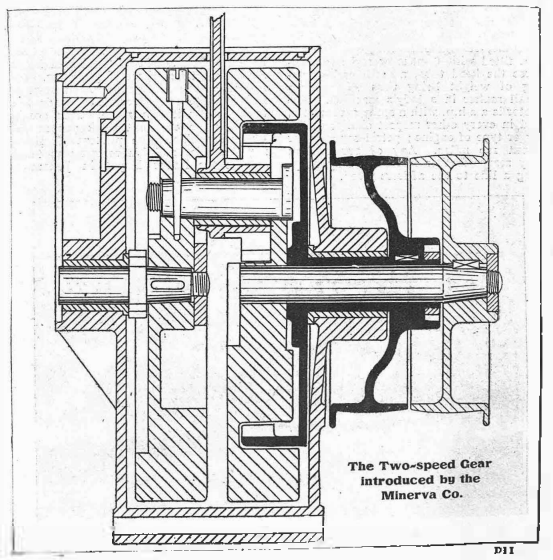
“WITH THE CYCLE TOURING CLUB (Motor Cycle Section) to Land’s End…Brown proved a capital guide for the first mile; then a cow ran at him, knocking him over. The damage was slight to man and machine—I do not know about the cow—and we were soon tackling the stiff hills to St Buryan. The last is a terrible one, which Brown alone succeeded in climbing, for the cow seemed to have put new life into him…There was another great descent into Truro. Motor bicyclists cannot be too careful in taking these descents and the corresponding ascents in wet weather…It appeared that Brown’s accumulator ran out near Penzance. Why such an experienced tourist should come away without a spare accumulator I cannot imagine…The road out of St Austell is vile in the extreme. For nearly three miles we ascended over a dangerously greasy road and through the most desolate, depressing country of the whole tour. We were passing through the tin and copper mine districts and china clay works…At Bugle we got clear of the worst of this terrible stage. We had risen to nearly 800 feet above sea level, and it is a marvel how we succeeded in climbing over such a treacherous surface. It was on this stage Chatterton…had a bad side-slip when he was going nearly 20mph. The muscles of his arm and shoulder were badly bruised, and he was unable to take any further part in the Easter tour…Nearly the whole 21 miles which separate Bodmin from Launceston go through a very wild country. There are no trees, no hedges, no houses, for miles. Small chance of a police trap here, thought I. Shipton evidently thought the same, for his machine just then bounded forward at full legal limit, and I altered my speed also to suit the new conditions. The day was now exceptionally bright, the roads excellent, the wind favourable, the motors running like clockwork, and the course was clear; you could see for miles. How could motor bicycling possibly be enjoyed under more favourable conditions? We called a halt at the highest point, 1,000ft above the sea, and felt just then that life was indeed worth living…Less than two hours sufficed to polish off the 42 miles…It wax necessary that I should be back in London on Monday, before lighting-
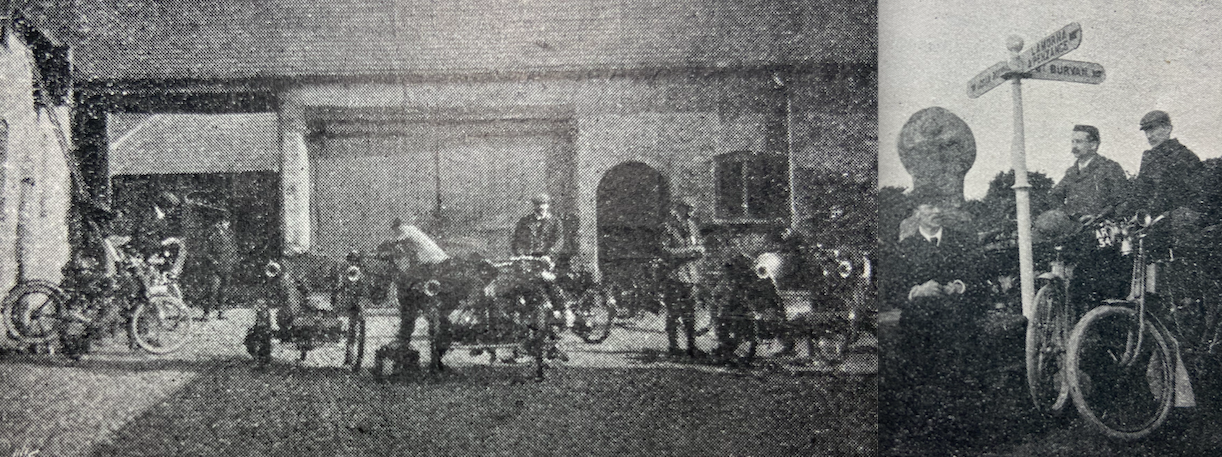
up time…The weather was very unsettled when we got away at 6.30am with the intention of riding to Ilminster—33 miles—for breakfast…After waiting nearly two hours I was obliged to go on alone, and, travelling via Ilchester, Wincanton and Shaftesbury, reached Salisbury in good time for lunch…After one and a quarter hours for rest and refreshment I went on to Basingstoke for tea…A very pleasant day’s run was terminated by a run to Richmond Park and round it, then home over Hammersmith Bridge. The whole run from Exeter occupied a shade over 12 hours, including all halts for rest and meals. The machine never required an adjustment whatever, nor, indeed, did it during the whole tour of nearly 700 miles. A few observations on the lessons derived from such a tour as this may not be out of place. Four of the five machines were belt-driven. The chain-driven one, as already noted, had some delay owing to the nut working off the chain bolt. My only complaint against the belt is on the score of expense of renewal. I have not yet found a belt, however costly, that will carry me on my 3hp machine 3,000 miles. Indeed, 1,000 miles is the average distance. Thus the belt costs far more than the petrol, electricity, and lubricating oil. Is this as it should be? I should very much like to hear of a belt that with ordinary care would last a reasonable distance. Some of the roads in Devon and Cornwall are almost unrideable in wet weather. The side-slip danger is ever present with one when traversing these dangerous parts. It is a marvel to me we came through so well as we did, seeing how many miles of bad and exceptionally greasy road we passed over. All machines should be permanently fitted with two accumulators. It is most awkward to know how otherwise to carry a spare one, and the result is one often ventures out on one alone. I am glad to say my 1904 mount is fitted with twin accumulators. Previously I have ruined leather cases and clothes when carrying a spare battery. To enjoy motor bicycling at all times of the year and in all parts of the country, some spring fork or frame arrangement is an absolute necessity, It is a crying shame the way cows and horses, etc, are allowed to stray all over the road. Finally, motor cycling is probably the most invigorating outdoor exercise that can be indulged in. The blood gets thoroughly oxygenated in a way that can be attained by no other means at present available.”
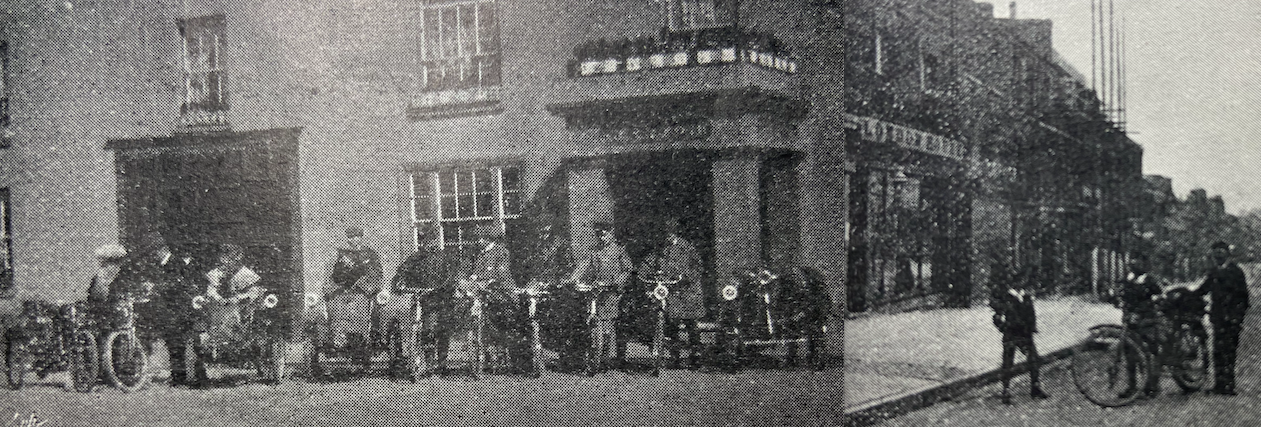
“THERE APPEARED TO BE a decided scarcity of petrol at certain of the South coast resorts during the recent holidays. Several cycle and motor agents informed us that the stock of lighter spirit was sold out before Sunday in consequence of so many motors being on the road. At Canterbury and Ashford, however, we experienced no difficulty in securing a supply of Carless, the Canterbury Motor Co having a good supply at their extensive garage.”
“WE RECENTLY PUBLISHED a photograph of the motor expert who tests all the Bowden motor cycles. Owing to an error, we unfortunately stated that this gentleman’s name was Mr C Brett, whereas it should have been Mr SJ Galley. Mr Galley resides at 62, Lawrence Road, Tottenham, London, N, and makes a speciality of motor cycling, teaches driving, and supplies any make of motor cycle. Our readers may rest assured that Messrs The EM Bowden’s Patents Syndicate would not have handed over the testing of all their motor cycles to him unless they were positively assured that he was a practical man; therefore any motor cyclists in the district who want machines tuning up cannot do better than apply to Mr Galley.”
“COLLIER’S VICTORY IN the five miles handicap at the recent Auto Cycle Club race meeting was undoubtedly one of the most popular wins of the season. The recent Auto Cycle Club race meeting was undoubtedly one of the most popular wins of the season. He carried off the opening races in the spring, and certainly wound up the year in good style.”
“A VERY INTERESTING LIST of winter fixtures is being arranged by the Auto-Cycle Club. The annual dinner will be held at the Automobile Club on Wednesday, November 30th, and will be followed by a musical evening. The monthly dinners, followed by an interesting paper, which were so popular last season, will be resumed in November, and Messrs van Hooydonk and Campbell have been invited to give an account of the recent 1,000 miles trials by means of lantern slides at the first monthly dinner.”
“AN ENGINEERING expert who frequently contributes to the Berlin papers’ popular scientific dissertations under the nom de plume ‘Hans Dominik’ figured in the recent motorcycle reliability run held in connection with the annual cycle road race of the German Cyclists’ Association. Whatever chances the expert may have had of finishing amongst the first arrivals were spoilt by nails. He ‘fished up’ three en route, the last—which might be described as the coffin nail of his hopes— piercing the tube as he was gaily pom-pomming within three or four miles of home. In point of fact, about a third of the competitors had to give up in consequence of visitations from nails; perfect machinery and precise timing were reduced to nothing by the vulnerability of the ‘pneus’…On the other hand, he hesitates to recommend the buckling on of a leather jacket round the tyres in reliability trips, for the obvious reason that such jackets greatly retard the speed of the cycle.”
“A VERY SUCCESSFUL RIDE was recently accomplished by Mr Stanley Richards, of Johannesburg, on an Imperial Rover motor-bicycle. He rode from Johannesburg through the hilliest parts of South Africa, a total distance of 480 miles. The machine gave no rouble from start to finish, despite the very bad roads and tracks met with en route. This speaks well for the excellent work put in the Rover machine. The photograph showing the rider and his mount was taken outside the Rover Depot in Johannesburg.”
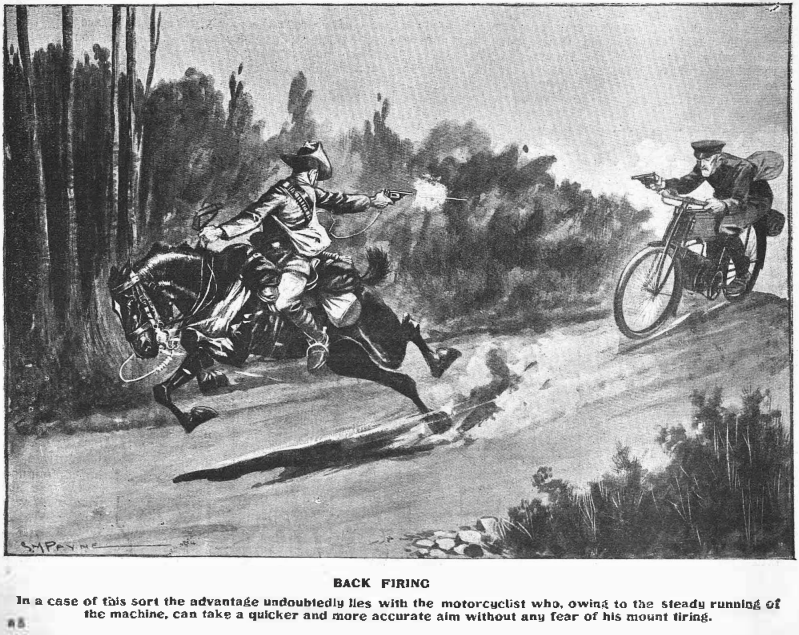
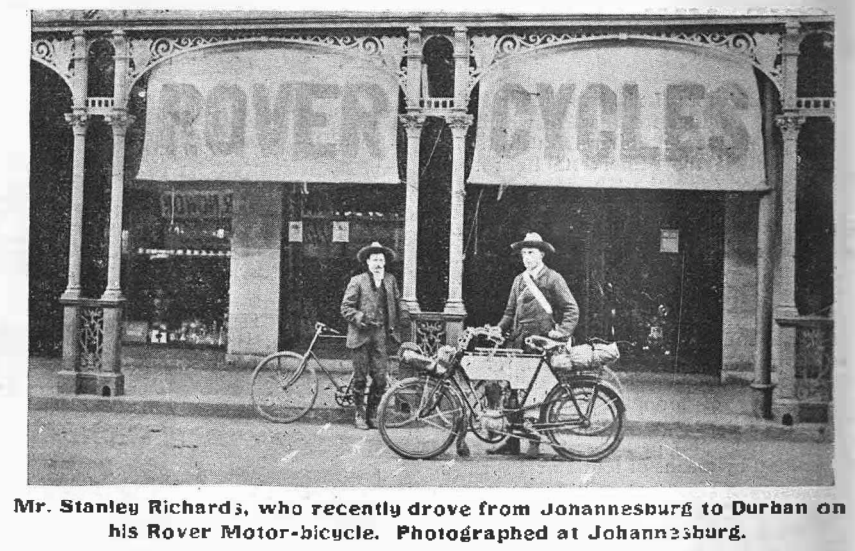
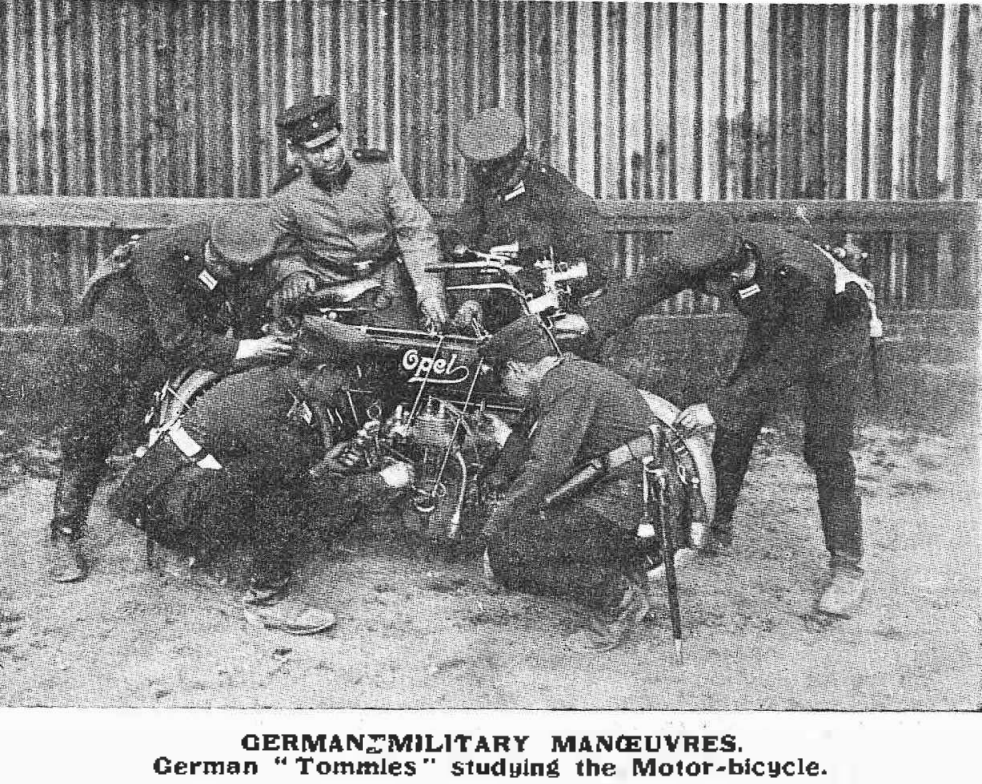
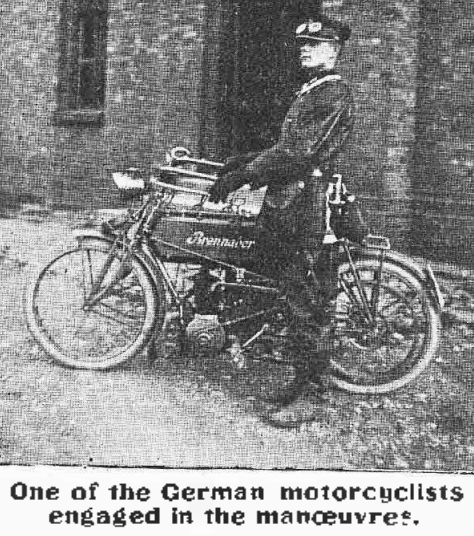
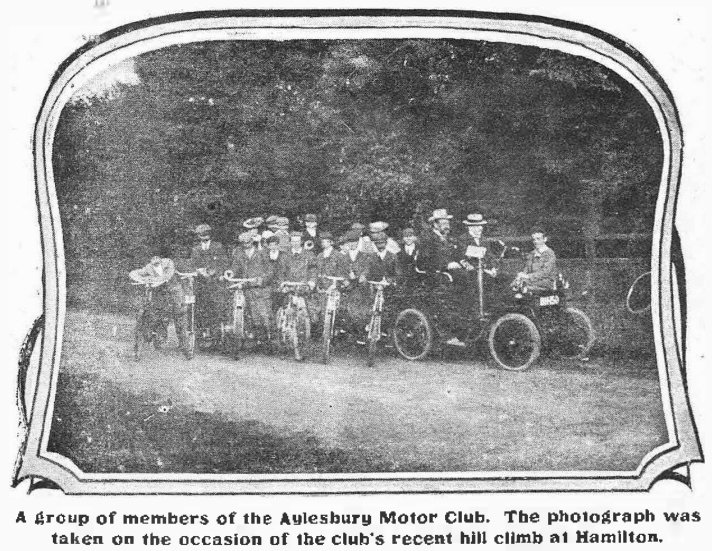
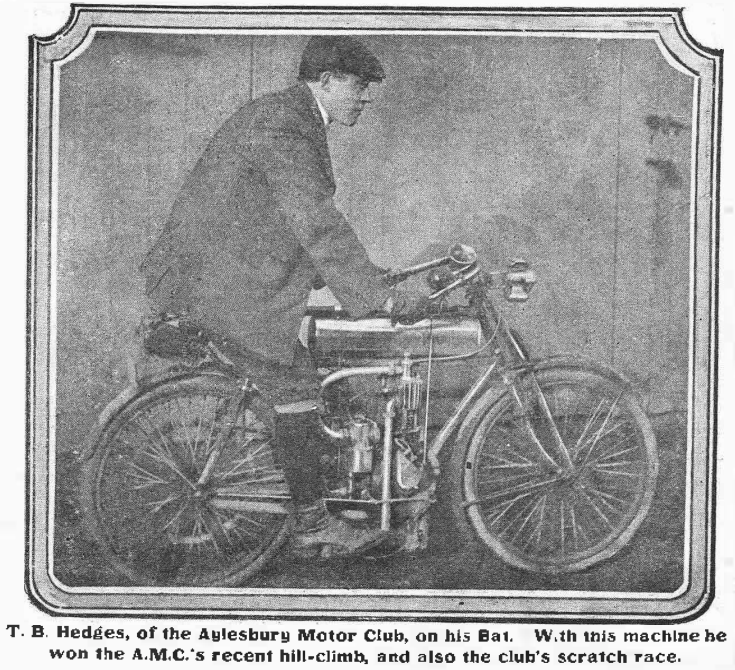
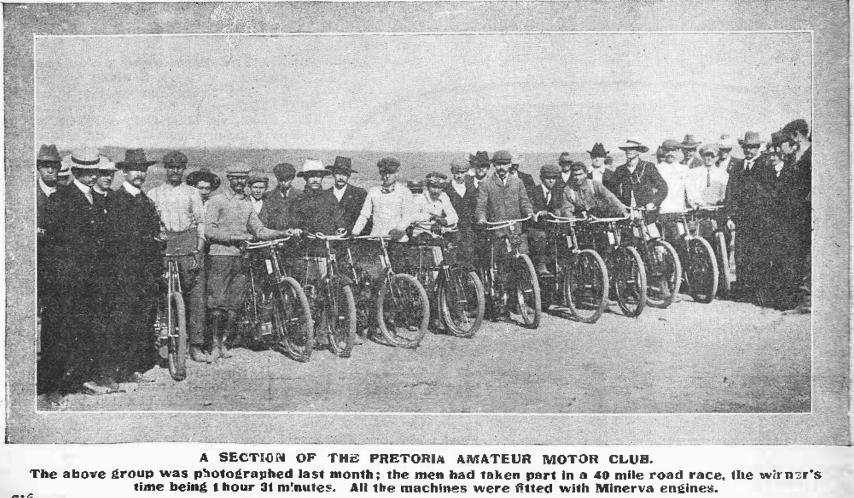
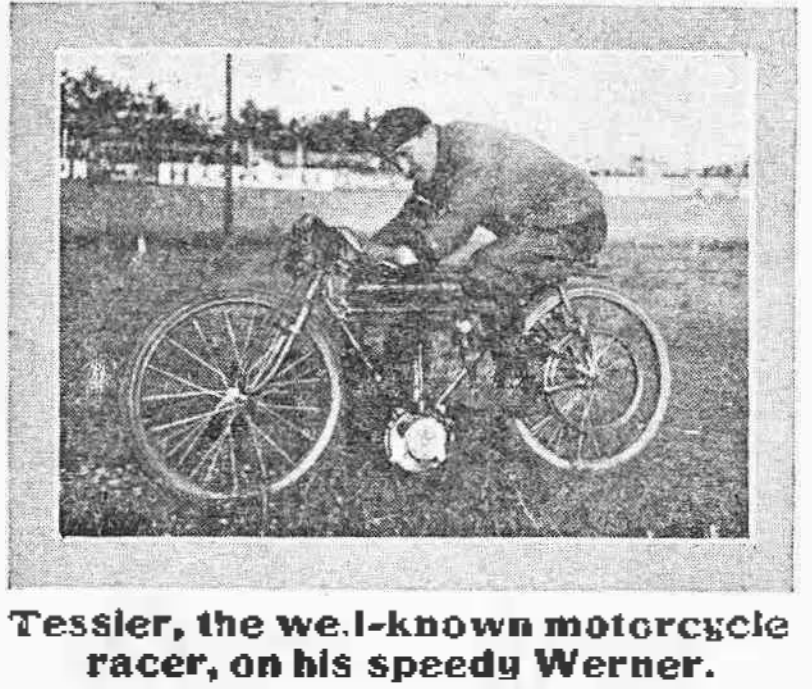

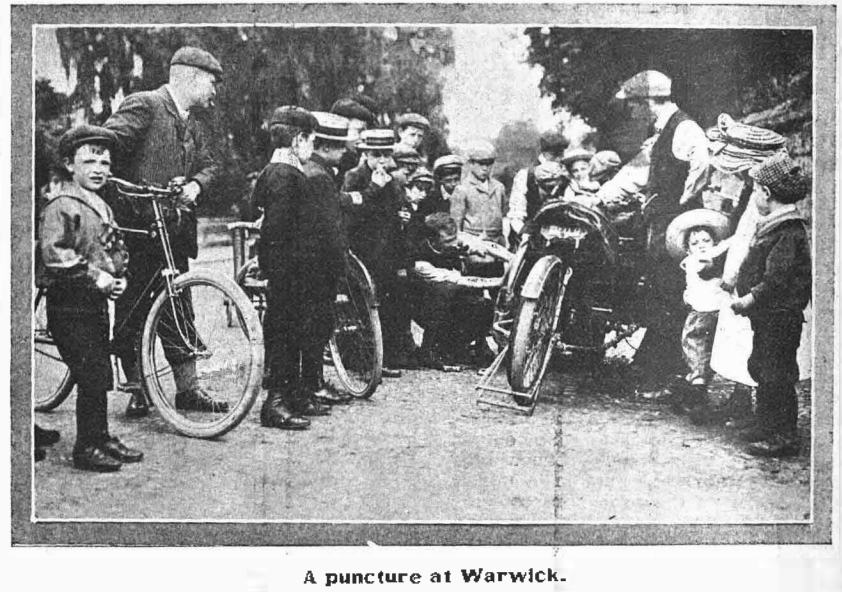

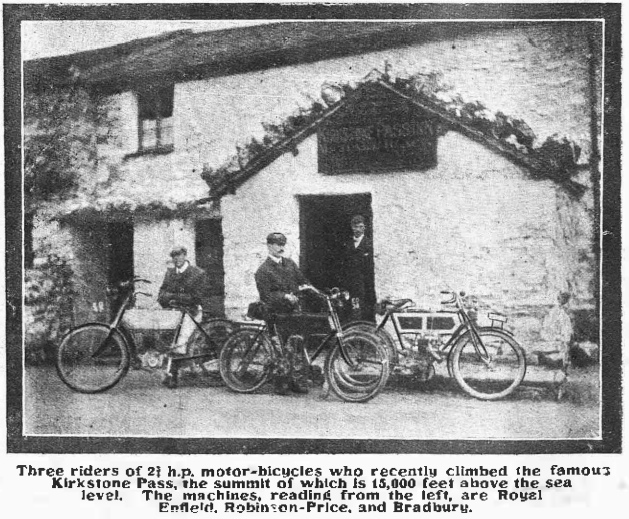
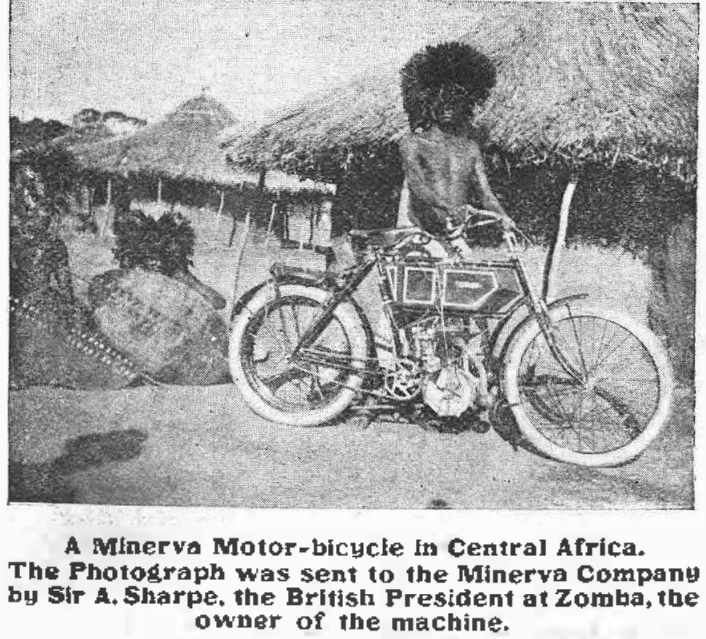

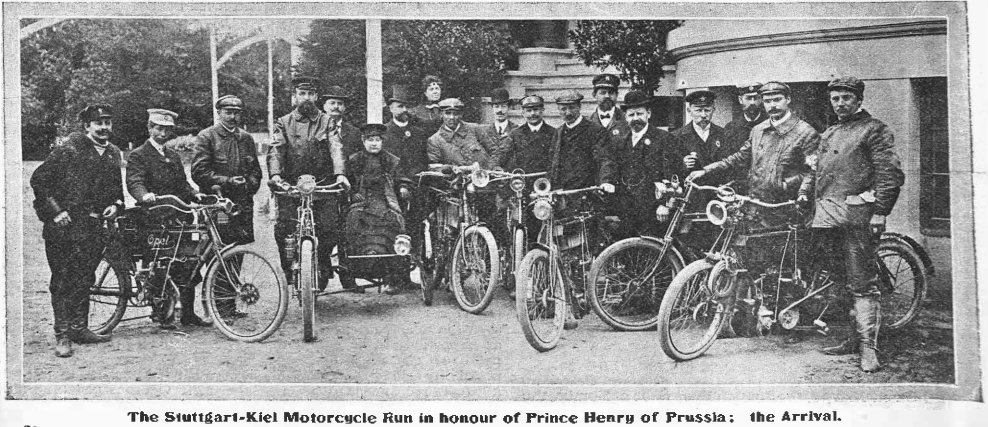
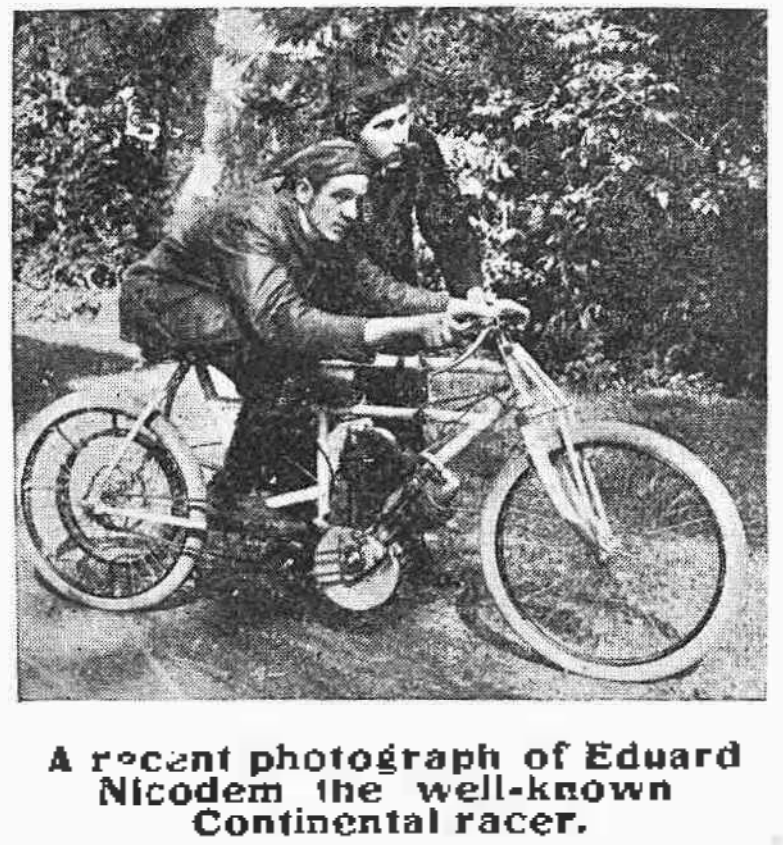

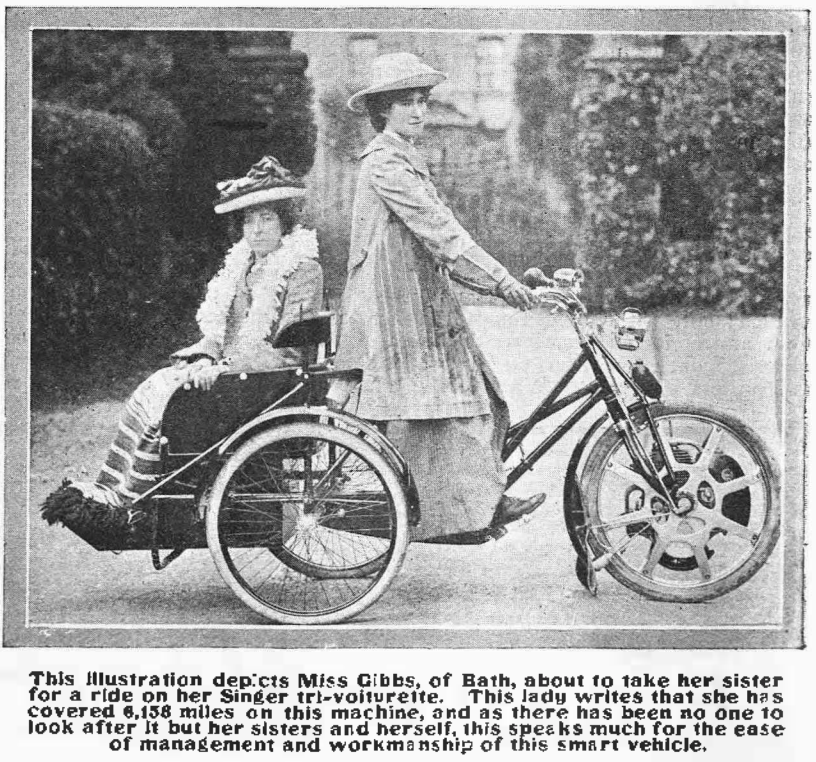
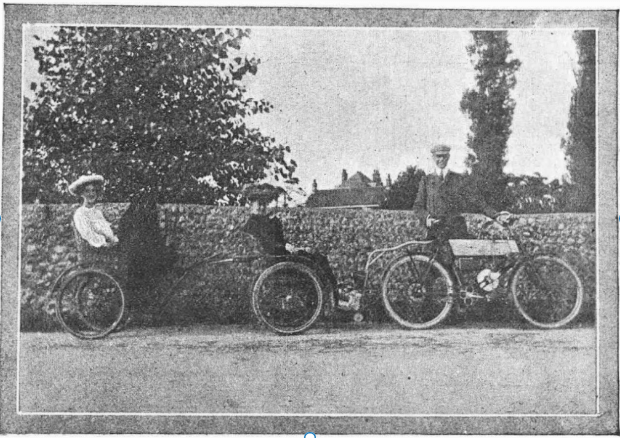
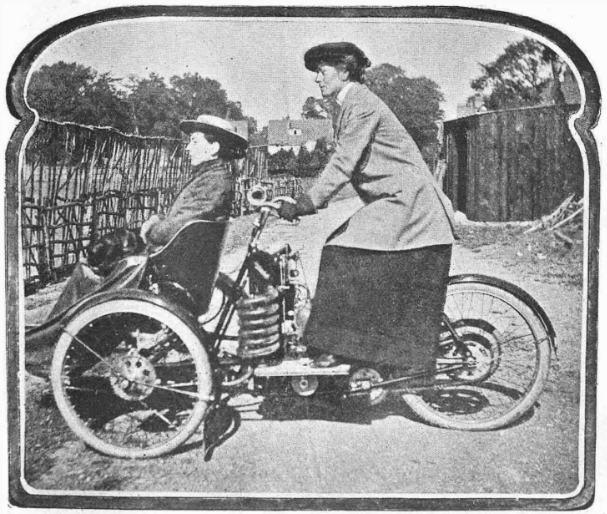
“A YOUNG LADY WAS FINED 20s and costs last week for furiously driving a motorcycle along Broad Street, Birmingham. A police constable assessed defendant’s speed at 12 to 14 miles an hour, which he considered dangerous among heavy traffic. To the best of our recollection, this is the first time a lady motorcyclist has been fined for furious driving, although ladies on motorcycles are not an uncommon sight, especially in Birmingham, where numerous representatives of the fair sex may be seen disporting them selves on Clement-Garrard machines.”
“THE RECENT RUN of the Birmingham Motorcycle Club from Streetly to Lichfield, via Shire Oak, and back, was one of the most successful and enjoyable yet held by the club. The distance of the course mentioned above is 20 miles, and it was decided to run this five times—making a 100 miles non-stop run, with one control stop of 15 minutes at Lichfield on the third round. The following members entered: H. Downing (2½hp Allday), R. Simms (Allday), Goodwin (2¾hp Allday), C Garrard (5hp Garrard), W Walker (4hp Garrard), R Gould (2¾hp Lloyd), C Norton (2hp Norton), G Bull (2hp Garrard), Wincle (3hp Hamilton), F Carpenter (2hp JAP), R Tingey (3hp Smith o’ Saltley), EH Humphries (3hp Smith o’ Saltley). Of these Goodwin, R Tingey, R Gould, EH Humphries, Simms, and Garrard completed non-stop runs. C Norton also did the distance without a stop, but he arrived in front of schedule time. As Messrs. Tingey and Goodwin both did non-stops, their tussle for first prize (for which, it will be remembered, they ‘dead-heated’ on a previous occasion) still remains undecided.”
A NEW MOTOR-BICYCLE FOR LADIES. The Stevens Motor Co, Pelham Street, Wolverhampton, have introduced a special type of motor-bicycle for a lady. The bicycle is an ordinary lady’s roadster machine, strengthened in various parts, and fitted with cantilever forks to reinforce the head tube, a considerable saving of weight being thus effected—no small matter in a lady’s machine. The motor is a 2hp with a spray carburetter, and in every other respect similar to the larger type of engine; petrol capacity for about 100 miles.”

“ONE RECENT AFTERNOON my friend came into the office and asked me how I would like accompanying him on a business trip to Edinburgh, the form of vehicles to be motor-bicycles. I replied that nothing would please me better, but his carburetter, which he had been converting from surface to one of the spray type, was not quite complete. ‘I will, however, fix it up just for the present, as I have to start to-night,’ he answered. Well, the long and short of it was that we managed to start that night about seven o’clock, and I noticed that the difference in power resulting from the alteration effected in his machine was most marked. Hills which before he had to pedal up, he now simply flew up. We made our way slowly through the traffic of Liverpool, and soon were on our way to Ormskirk and Preston. Owing to our having lost the way, and it being rather late when we arrived at Ormskirk, we decided to sleep at the latter place, and put up at the ‘Talbot’ for the night. In the morning, after haying overhauled our machines, we set out of Preston, but had not gone far on the road before my friend noticed that his petrol tank was on fire. Looking back on the cause of the fire, the explanation is simple. We had the petrol tanks filled up while at Ormskirk, and the petrol must have been splashed out from the twin tap belonging to the rejected carburetter and fallen on to the exhaust pipe. To say that I was upset by my friend’s catastrophe would be superfluous, and he, poor chap, seemed dazed by the suddenness of it all, as I am sure he had not left me more than three or four minutes before, when, coming into the straight road, I saw the blaze, and a solitary form, in a Napoleonic position, standing by. I am afraid I exceeded the legal limit of speed for the next few hundred yards, and though I and a gardener, who was kind enough to assist, threw buckets of water over the machine, the flames were not got under till all that was combustible about it was destroyed. I reluctantly bid my friend goodbye after I had done all 1 could for him, and left him to go on to Edinburgh by train. I started for Preston at 12.30, the day being beautifully fine and the roads only slightly dusty. I reached Preston without a mishap, with the exception of staying for a short time at a roadside repair shop to solder the petrol supply pipe to the carburetter, which was leaking slightly. I arrived al Preston at two o’clock, distance about 18 miles; had lunch there, and, having smashed my goggles in the excitement of the fire, I bought a new pair. I then remounted my machine and started for Lancaster at 3.30, reaching there at 4.35, the distance being 21 miles. The roads were in excellent condition, and no incident occurred of any note, the machine running splendidly with only two notches up on the spark advance (there are 10 in all) and the throttle about a quarter open. I did not stop at Lancaster, but went on to Carnforth and Burton and Kendal, arriving at the last place at 5.35 (distance, 20 miles from Lancaster) without incident or accident. It was a lovely ride, the country looking at its best, and the small villages between most picturesque. I had tea here, and, after taking in two quarts of petrol, I lighted my lamp and started what I did not know was going to be a ‘twister’. 8.15 saw me on the road to where 1 intended to stay, viz, Shap Fells, but as I proceeded the roads became more rugged and undulating, with rapid and steep climbs, meaning as rapid a run down the other side; as the road was very winding, and it was getting dark, I had to ride with caution. It was not long before I came across a road which seemed to run down into the interior of the earth, but just at the bottom it turned, and then to my dismay I saw a road of tremendous steepness, which seemed to go on and on, up to the sky. Just at this critical moment my engine commenced to misfire, and a cold shudder came over me. I guessed the cause, and I jumped off. Seeing that the wires were all correct, I took out the platinum-tipped screw, and saw it was very black, so I filed this slightly, as well as the contact on the spring, and, putting it together, pushed the machine up the hill I had come down for about 50 yards, then got on, and turning off the auxiliary air inlet slightly, and opening the throttle a little more, I started off to face the redoubtable Shap climb. I had misgivings, and it was get ting very dark, but I put the machine at it, and it took the incline like a bird. I only had to assist the engine at a few corners, where I was afraid of meeting some trap or horse. It was now beginning to rain but I gained the top, and ran ahead in the darkness right through to Shap, which I reached at 10, only to find every place closed; but luckily I came across a friendly stranger who directed me to Shap Hotel. After knocking, as the hotel was closed, I was let in. I went straight to bed, first putting the motor into the saddle room. I slept like a sluggish carburetter till 1 was knocked up in the morning. 1 looked out, and, to my sorrow, saw it was dark and stormy, and raining fast; however, I made a start for Penrith at 11am in spite of the weather. From here onwards to Penrith, and from Penrith to Carlisle, I had an uneventful journey. On reaching the latter town I went to an hotel, ‘The Vineries’, where the general manager was kind enough to lend me some thick brown paper to make two coverings for my knees, and also some string to fasten them on. They kept out the rain well for the rest of the journey to Hawick, 44 miles; the roads were now inches thick in mud, and under the trees the surface was like thick grease. I arrived safely at Hawick at 8.15, when I put up at Mr Luff’s hotel, where Cecil Edge had been staying only a day or so previously. I had a cold bath directly I had taken off my clothes and sent them down to dry, the landlord very kindly lending me a pair of his trousers for the evening. I could easily have made a complete suit out of them alone, but by fastening them twice round I managed to stroll around the hotel with impunity. I had a capital tea, and the cooking was excellent. I slept well, and arose about eight o’clock, breakfasted at nine, and then I and an assistant turned our attention to the machine in order to get some of the mud off. This operation took one hour, and seven buckets of hot water. The mud was as thick as if it had been put on with a trowel. I rubbed the machine down with a dry cloth, oiled up, purchased one gallon of petrol, and started for Selkirk, 11 miles away. It was a fine day, but the roads were covered with thick grease, and very hilly. There is a tremendous rise for about three miles from the town, and I had to stop and shorten the belt three times in this distance. I met several ‘Weary Willies’ tramping on the roads, who turned round when they heard me coming, and asked for ‘backsheesh’. Once, further on a steep rise, I was fain to stop and yet again shorten the belt, when a husky and weary one asked for help; I gave him a few coppers and then said he might help me push the motor to the top of the hill about 400 yards off. He acquiesced, and stood by, but was at once seized with such an uncontrollable fit of coughing and asthmatic breathing that I told him he had better go on, as he might explode my petrol tank with syntonic sound waves; needless to say, he gladly shuffled off. I started off at the top of the hill, and had an enjoyable run to Selkirk, about seven miles off, when, in going down the steep hill into the town, a sudden and terrible noise occurred. I held my breath, and got off, and 1 at once saw that something had gone wrong with the engine. I wheeled down to the bottom of the hill, and there met a cyclist, with whose help I took off the motor and found that both wheels of the two to one gear were smashed. I was still 30 miles from Edinburgh, and was very vexed at this eleventh hour mishap, but there was nothing for it but to take the next train, which I did, arriving at Edinburgh at 3.30pm.”—’Tourist‘.
“THE MOTOR CYCLING CLUB Reliability Runs for the ‘Gilbert Brown’ Trophy. The Motor Cycling Club will carry out on Saturday, September 10th, a series of reliability runs, in which the competing machines must be of British manufacture throughout. The award is a trophy value 25 guineas, presented to the Club by Mr Albert Brown, who has stipulated the condition just mentioned. This event should prove to be one of the most interesting and instructive of the series of contests carried out by this enterprising club. Each machine entered must be accompanied by’ a signed declaration that every detail in its construction is of British make. The signature must be that of the actual maker or some competent person. In the event of any original foreign parts having been replaced by others of home manufacture a further signed declaration must be made to that effect. All types of motorcycles as defined by the Act are eligible for entry. Machines designed to carry two riders must weigh not less than 18 stone—that is, combined weight of machines, riders, and passengers. The distance to be ridden will be 150 miles, the first hundred to be an absolute non-stop. This run will be followed by an interval of one hour, and then a further non-stop of 50 miles will be run off. During these runs each 50 miles must be ridden in not less than 2 hours 30 minutes, or occupy a longer time than 3 hours. The starting point will be within 30 miles of London. In the not unlikely event of a tie between two or more competitors, the event will be decided by adopting the starting and stopping test on an out-and-home course of a mile of level road, which proved so successful in the passenger trials held recently. In this test marshals are placed at each 220 yards, and the competitor.s have to stop their machines between two lines drawn across the road, the distance between them being 10 yards. This being done to the satisfaction of the marshal, the competitor may at once restart and proceed to the next stopping point and repeat the operation right along the course to the finishing line. The competitor occupying the least time in covering the course to be adjudged the winner.”
“THE WINNER OF THE ‘ALBERT BROWN’ TROPHY, W King, of Cambridge, was awarded the ‘Albert Brown’ Trophy as the winner in the Motor Cycling Club 150 miles reliability trial held at Redbourn. The machine had, as a condition of entry, to be British made in every detail. This is a 3½hp King fitted with MMC engine and belt transmission. It is a powerful and strongly-constructed mount, scaling about 180lb. The feature which mainly contributed to its success, apart from general reliability, was the rapidity with which it could be controlled in the starting and stopping test.”

“THE GOVERNING BODY of the sport of motorcycling held their annual race meeting at the Crystal Palace track, on Saturday afternoon, and the arrangements reflected credit on all concerned. A welcome innovation was the decision of the one-hour race at the commencement of the programme, which insured the finish being completed before dusk. The first few miles of the one-hour race witnessed a fine struggle between Crundall (holder of the cup) and F Bent. In the seventh mile an unfortunate smash occurred. AA Chase was just passing CE Bennet, when the latter wobbled and touched Yates’ shoulder, and then Chase’s back wheel, and fell. Bent was just coming up behind Bennett, and rode over him, and came down with a crash, breaking his collar bone, and sustaining several bad cuts. Bennett was also cut about badly on the arms and legs, but he was fortunate in escaping with such small damage. The race was immediately stopped, and Bent was taken to the Norwood Cottage Hospital, and we understand he is progressing satisfactorily, and will soon be about again. A couple of heavy showers fell during the afternoon, spoiling the chances of the last men to attempt the flying mile, there being too much danger of side-slip in negotiating the banking at high speeds. We must certainly congratulate C Collier upon his dual
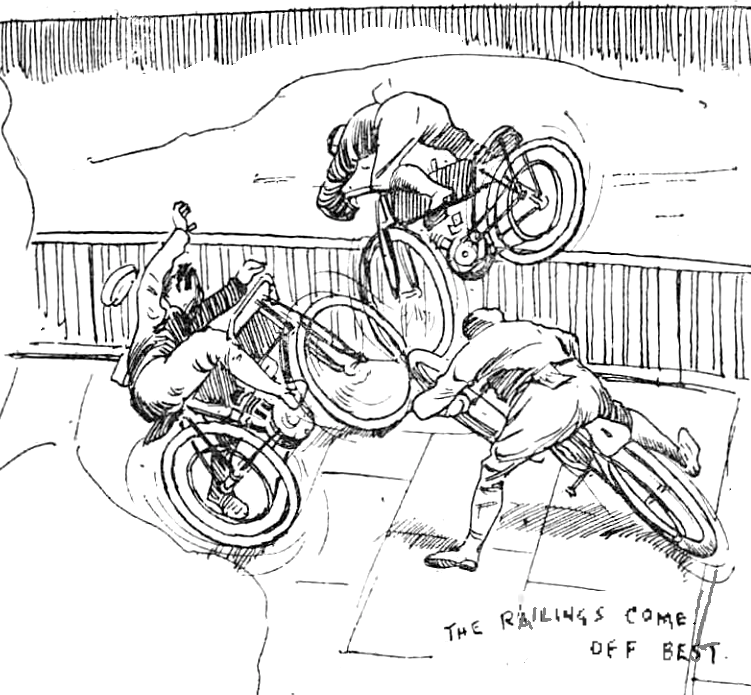
win in the flying mile time trial and the five-miles handicap. Collier is a very good sportsman, who does not push his personality too prominently, except when actually on his machine, and deserves his success in proving that, when he did the best time in the flying mile at last year’s meeting, it was due to his ability in tuning up and driving. It may be remembered that at the 1903 meeting Collier did the best time in the mile time trial, but was disqualified by the judges for not having an efficient silencer. Since that time the Auto-Cycle Club committee have passed a rule permitting the removal of silencers when racing upon enclosed tracks. As a matter of interest, it is worth mentioning that Collier used an engine having exactly the same cylinder capacity (76x76mm) [345cc] last year and this year, and in both races he did practically identical time. In the hour race for The Motor Cycle challenge cup for engines having a capacity not exceeding 70x70mm [270cc] (holder, JF Crundall), JF Crundall (Humber), 42 miles 1,390 yards, beating his performance last year by 192 yards, was first; 2nd, C Collier (Matchless), 39 miles 470 yards; 3rd, B Yates (Humber), 38 miles 100 yards; 4th, J Leonard (Lurquin-Coudert), 33 miles 1,272 yards. After Bent’s smash the race was re-started, and Crundall practically led from start to finish. At the half hour he had covered 22 miles; AA Chase (Chase) 20 miles; Collier 19⅔ miles; Leonard 17⅓ miles; Yates 16⅔ miles. Chase, retired soon after the half hour through a broken sparking-plug. There was a splendid tussle for second position. Yates, after he had passed Leonard, hung on to Collier for mile after mile, with only a few inches separating them. Collier got away in the last ten minutes, and beat the third man by over a mile.”
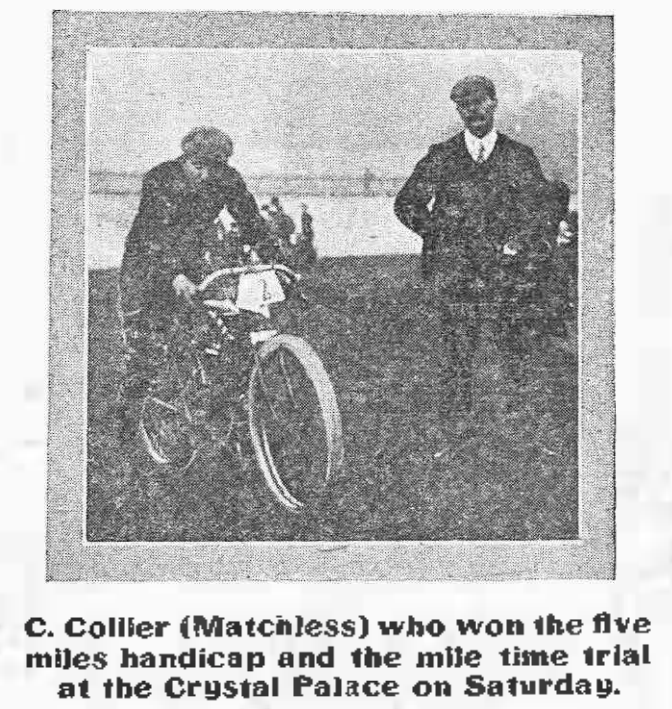
“CLOTHING IS A MOST IMPORTANT question. In the early days of motor cycling, leather coats and trousers were considered essential for winter use. They have, however, gone out of fashion, and although they prevent a cold wind penetrating to the body, they are looked upon as an unhealthy garment, besides giving the rider the appearance of a paid driver. They are consequently eschewed by many. An alternative is provided by several of the large firms who make a speciality of motor cycle clothing. In some cases it takes the form of a very stout cloth, lined inside with thin leather. This has the same drawback, from a health point of view, as the all-leather garment lined inside with wool. Taking everything into consideration, there is nothing better than good stout woollen clothes, with an overcoat which can be removed, made sufficiently thick to prevent the cold penetrating, yet porous enough not to hold the perspiration in the same way that leather clothing does if pedalling has to be resorted to. We know that a great many of our readers who are motor cyclists in the summer take up other pursuits in the winter which are more to their liking, such as football, hockey, etc, but there is still a big army of riders who persistently cling to the favourite hobby, and the above hints may possibly assist them in continuing to ride their machines for the next few months. We can assure them that if they ride through the winter, they will have many surprises. They will see the country under a new aspect, the late autumn providing a different form of scenery altogether from that seen at other seasons. Nothing is more interesting than to note from week to week the different tints and colours of the declining foliage. A long run out should generally be arranged, and for those who like to meet their fellow riders at tea. a hotel should be fixed upon within a short distance of home, so that night riding is reduced to a minimum. We have indulged in such rides as these throughout the winter, with considerable benefit and satisfaction to ourselves and others, and we recommend our readers to do likewise.”
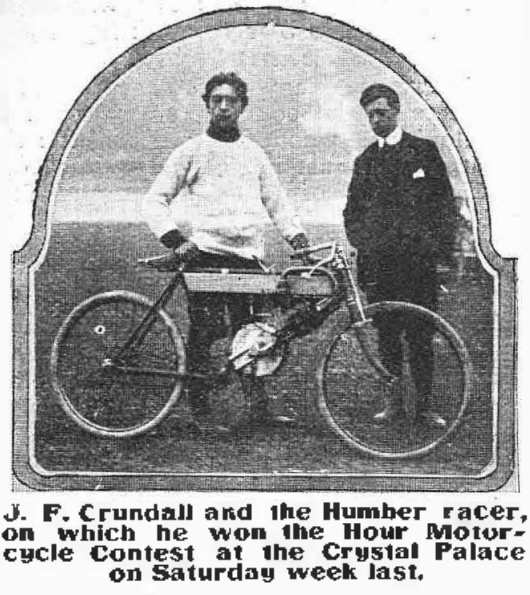
“A FEW WEEKS AGO we published details about one of the members of the Liverpool Motor Club having trouble with a cow near Crewe. We understand that the farmer stated that the tricar ran into the cow, and carried it along for 30 yards. then dropped it, and ran away. The motor cyclist told the simple, plain truth, pointing out that if the cow had fallen into the forecarriage it would have smashed it to pieces and injured the passenger. However, the farmer won. What with the police proceedings and the action for damages, the motor cyclist is over £20 out of pocket, and for no fault of his own.”
“DRIVERS OF MOTOR CYCLES for two should never forget that, though they may omit to carry split pins in their wallets, there are other articles of almost equal use which ladies never omit to insert in their lovely tresses. A thin hairpin is almost of as much value as gold wire to a motor cyclist in trouble.” [Seventy years later, at Thornton Heath Pond on the A23, a chum replaced a lost split link on his G9 Matchless with a hairgrip scrounged from a passing schoolgirl. Plus ça change…Ed.]
“MISS MURIEL HIND, an enthusiastic motor cyclist, made a long run on a Singer motor bicycle one day last week. Leaving Conway (North Wales) early, she arrived in Coventry long after dark, the driving tyre having punctured no less than six times after lighting-up time. The mechanism of the Singer gave no trouble.” No doubt Miss Hind’s mount was the latest model with a vertical engine hung from the downtube in place of the company’s ‘motor wheel’.
“I CONTEMPLATE MAKING a long trip, starting early in May. I shall be glad if you or any of the numerous readers of The Motor Cycle will give me any information or make any suggestion which can be of use on the journey. I propose moting from London to LIverpool, and want to call at Sheffield and Doncaster en route, then boat to New York, motor to Los Angeles, calling at St Louis for exhibition, Salt Lake City, and San Francisco, and along the Pacific Coast to destination. Can you give me the best routes to follow? Do you know if I can buy in London a. cyclists’ road map of America? How do their roads compare with ours? Do you know if it will be imperative to pack motor in a case or in crate for the shipping company? Shall I be called upon to pay any ‘duty’ on the bicycle upon arrival in New York, seeing that it is for my own use only? Will it be possible to buy petrol in American towns? How many miles a day could I average comfortably, allowing, say, eight hours a day actual running? I intend having a new motor bicycle for the journey. What horse-power and which make do you think most suitable? If you think this will be of sufficient interest, I shall feel highly favoured if you will publish it along with a reply. Thanking you in anticipation for your kindness.
AR STUBBS.
“CAN YOU PLEASE INFORM me if the Bowden handle control is in your estimation a success, as I have heard it variously criticised, one rider stating that on rough roads the strain of preventing the shifting of position of handle controlling the throttle was so considerable that the vibration conveyed to the wrist and the tension of the grip robbed the system of much that might otherwise be claimed for it.
EHG, Windsor.
The Bowden system is, in our opinion, excellent and likely to become well nigh universal for bicycles. The criticism you detail evidently refers to the earlier pattern of handle, which certainly did tend to shift under vibration unless tightly gripped, but this has now been entirely redesigned to give a wider range of movement, and will remain in any position independent of hand-grip.”
“I AM IN DOUBT AS TO whether to go in for surface or spray carburetter, though I see the latter is becoming more general. I have had a few trips on a borrowed machine with surface carburetter, and cannot conceive how the tiny apparatus of the spray can replace the bulky surface type.
RAS, Nuneaton.
It is still a disputed matter, though the balance is in favour of the spray type, largely because it is more nearly automatic in action, wastes less petrol, as it does not go stale when left in tank, and engine as a rule starts quicker. On the other hand, its parts are more delicate and liable to choke up if dirt gets into the petrol tank. The bulk of the surface carburetter is due to the fact that, as its name implies, a large surface of petrol must be exposed to the incoming air, but the actual difference is not so much as it appears, because the surface carburetter is also acting as a petrol tank. We should advise any of the better makes of spray, such as Longuemare or FN.“
“CAN YOU INFORM ME if there is any motor bicycle on the market, or if it would be practicable to get one built, which would enable me to quickly detach the motor mechanism and transfer it to a small boat, and if so what power motor would you suggest as being best suited to the double purpose? The boat is 15ft x 4ft beam.
PHS, Marlborough.
We do not think there is anything on the English market answering your requirements, and quick detachment and replacement of the whole of the working parts would be extremely difficult to arrange so far as the bicycle is concerned, Moreover, an ordinary air-cooled bicycle motor would soon overheat on launch work. The power of the boat would depend on propeller diameter and pitch, on the speed required, and on the class of water it had to run in, as to work in a tidal river would call for much more power than still water. We should not recommend you to proceed with the idea, but 3½ to 4hp should suit such a boat, though that is in excess of what the average rider should have on a motor bicycle.“
“I SHALL BE MUCH OBLIGED if you will give me your experience (if any) of sidecars for motor bicycles, and their advantages over forecars and trailers. Is there any undue strain on the bicycle? They do not seem to be taken up much by the public, and one does not see them advertised so much now. What is the reason?
HTM, Bude.
We have not as yet noticed that sidecars are less used or less advertised than formerly. In fact, they seem just as popular as ever. The advantages which they have over trailers are as follows: They are rigid in grease, so side-slip is done away with; they are also perfectly safe attachments, and do not require more engine power to propel them; they are more sociable than a forecar; the passenger is not exposed to any obstacle a careless driver may run him into; and the engine is not carried in a sheltered position.“
“I HAVE A 3½HP MOTOR CYCLE which goes very well, but which I find very hard work to start. I am anxious to have a friction clutch fitted. I should be much obliged if you could recommend me a suitable and satisfactory one. The engine has a De Dion type belt pulley.
HBJ, Wandsworth.
We advise you to write to any of those firms who make a speciality of clutches, giving them full details of your engine, and asking them if they can supply you with one of their clutches.“
“I AM WRITING FOR A FRIEND who wants to know about the motor business as a profession. Will you kindly answer the following questions: (1.) Is it a profession for a gentleman? (2.) What age ought you to begin at? (3.) Have you got to know very much about motors? (4.) Will it be a paying profession? (5.) Can you give me the name of firms where they take in gentlemen?
CHG, Cheltenham.
(1.) Yes, we should consider the motor profession suitable for a gentleman. (2.) It would be preferable to apprentice your friend to one of the best firms of engineers making motor cars, where a thorough works training would be received, finishing afterwards with a certain time in the drawing offices. (3.) It is not necessary to know the business before being apprenticed, but naturally to become a motor engineer it would be necessary for your friend to be thoroughly acquainted with the mechanism of these machines. (4.) As to whether it will become a paying profession depends entirely on the man’s own capabilities and initiative. (5.) The Mardslay Motor Co, Parkside, Coventry; Daimler Motor Co, Coventry; and the Wolseley Tool and Motor Co, Adderley Park, Birmingham.“
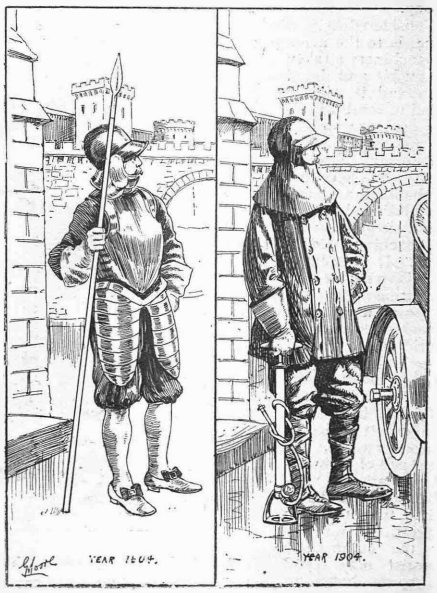
“I AM THINKING OF GOING in for a motor cycle. I realise the most important part is the engine, regarding which I am perfectly ignorant. There are so many advertised that I am lost amongst them. My ideas are as follows: Frame, BSA fittings, wheels, 28in diameter; tyres, 2½in Dunlop or Clincher; belt or chain driven, no idea ; handle-bar control, etc, no idea; engine and power of same, no idea; height of frame, I am 6ft high, and 13st weight. Should be glad of any other points of information that would be of advantage to me.
JC, Maghull.
Your choice as regards frame, fittings, wheels, and tyres is perfectly sound. We recommend you to have an engine of about 2½ to 2¾hp of standard make with belt transmission (large V belt). Handle-bar control is a matter of choice, and you could have ft fitted afterwards if you thought you would like it. We would recommend you to fit an exhaust valve lifter, working independently of the switch, to be attached to the handle-bars. A 24in. frame would be most suitable for you.“
“THERE IS NO DOUBT ABOUT IT—the two-speed gear will be a predominant feature in the motor cycle of the future. For the motor bicycle it will be a luxury; for the passenger-carrying three-wheeler a necessity. My own early experiences with motor tricycles and quads convinced me that a variable speed gear was essential when a small motor had to propel the weight of two people. After struggling with single-geared motor cycles for three years, I found relief in a 3hp Ariel quad with a two-speed gearing, which carried me and an adult passenger on its initial trip from London to Hastings in three hours and a quarter. Without a two-speed gear I could not have done the journey at all, in the heavy state of the roads. But the type of two-speed gear fitted to the Ariel quad was not an ideal type for motor cycle purposes; it was too positive and jerky in changing, not having a friction clutch; it gnashed its teeth in a manner painful to the nerves of the rider, who knew that every time the gears scraped they were wearing out the dog clutch. The average life of a dog clutch was under 500 miles, and the dog clutch was both an expensive and an awkward thing to renew. The positive gear, moreover, did not economise the rider’s efforts at starting, because both machine and engine had to be started by the rider’s physical efforts, just as though there had been only a single gear. The modern friction clutch has changed all that. Experience with motor cars has shown how completely efficacious and satisfactory is the principle of starting the engine with the vehicle at a standstill, by means of a hand crank, and letting the engine gently commence to drive the vehicle by means of a slipping clutch; and the adoption of this practice will mean that the motor cyclist will in the future—nay, he can now—be free from the heartrending efforts that have been hitherto associated with the starting of a motor cycle by the pedals.”—AJ Wilson
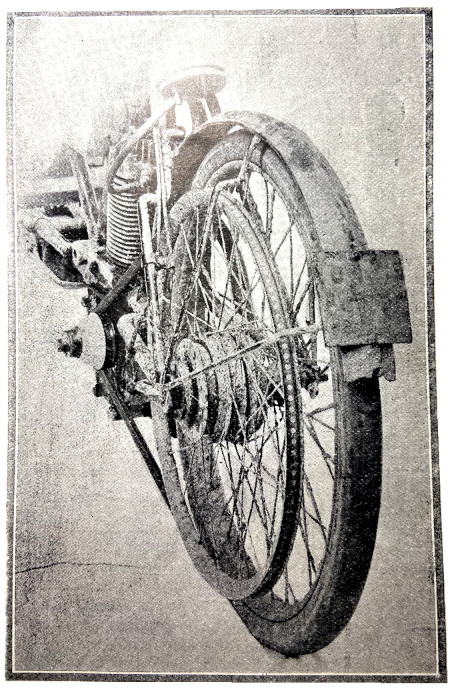
“THE ANNUAL SPEED TRIALS at Dourdan in France were held on Monday, October 3rd. The trials consist of a Standing Mile and a Flying Kilometre along a stretch of road in the Dourdan Forest. The meeting is promoted by the Paris sporting daily Le Velo, and it usually attracts some of the best machines and men in France. The events are open to motorcars and motorcycles, racing and touring, and these are divided into classes according to weight in the racing section, and according to price in the touring section. Many remarkable performances have been accomplished during the last year or two at Dourdan, and the meeting is always looked forward to in French motoring circles as likely to provide some new sensation and some fresh world’s record. We may say here at the outset that this year’s trials were disappointing, except in so far as the racing motor-bicycles were concerned. In this department both records were beaten by Lanfranchi on a Peugeot machine—the old-established French firm thus rehabilitating itself in public favour after its indifferent performances in the Ardennes, and in the eliminating race for the motorcycle ‘Gordon-Bennett’. Lanfranchi’s time of 29⅕sec for the flying kilometre was wonderful: it was actually five seconds faster than his own record of 1903; and five seconds over a course not greatly exceeding one thousand yards in length take a lot of knocking off. Lanfranchi’s speed was roughly 77 miles an hour. In the Standing Mile, again, the same rider and machine put up fresh figures of 57⅘sec—Olieslagers’ Belgian record of 59⅖sec on a Minerva being well beaten. Lanfranchi’s speed over the mile (from a standing start) works out at a fraction under 63 miles an hour; so that it must be admitted that even if the French construct their motor-bicycles with a view to speed alone, they at least get what they aim at. Apart from these remarkable performances of the Peugeot machine, nothing very striking was done by the motorcycles—if we except the 30⅖sec of Cissac (on a Peugeot) and the 32sec of Olieslagers (Minerva); both splendid trials, but overshadowed by the winner’s figures. The car section was disappointing so far as world’s records are concerned…[that’s enough cars—Ed.]”

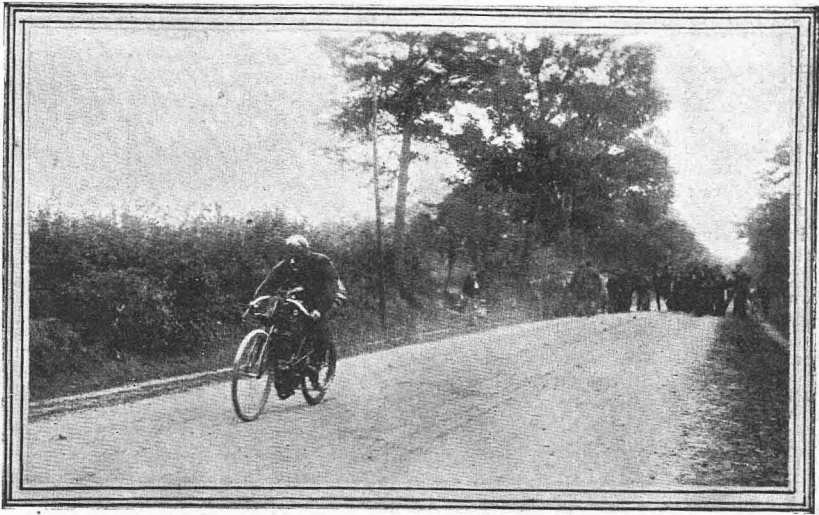

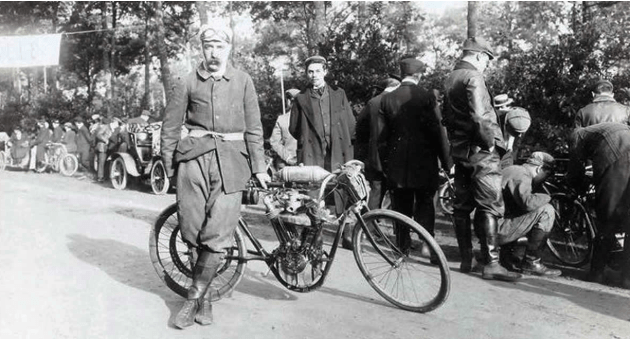
“SECRETARIES OF MOTORCYCLING clubs who have not received a copy of the affiliation scheme of the Auto-Cycle Club should write at once to the Secretary, 16, Down Street, Piccadilly, London, W. It is important that all clubs should be affiliated, and have representations on the council of the ruling body of motorcycling.”

“BLACKPOOL IS AN enterprising town well used to big events, but seldom has such excitement been aroused as was manifested during the race meeting here. When I motored up on Wednesday evening I saw two or three cars and as many motorcycles in the town, but nothing unusual either in size or speed. By Thursday all was changed; handsome Mercedes cars glided along the front, followed by motors bearing the name of every maker under the sun; racing Wolseleys, Darracqs, and Napiers enthralled the townspeople with their din and speed, while the hollow exhaust of unsilenced motor-bicycles added to the general confusion…Quite Arctic in severity was the weather on Friday morning, when, before 6 o’clock, I wended my way to the racing track to see the competitors testing their machines. Even although it was not yet quite light, nearly all the racers were rushing down the course and back to the starting point by the separate tram roadway, as if their lives depended on it. Very exciting scenes were occasionally enacted, as for instance when two or three racers would come thundering down the course accompanied by several motorcyclists. Indeed, many of the drivers of the large cars were greatly surprised at the ease with which the motorcyclists could pass their cars when at top speed and leave them far behind… Promptly at 10 o’clock the motorcycle events were commenced. Class A was open to all motorcycles weighing,
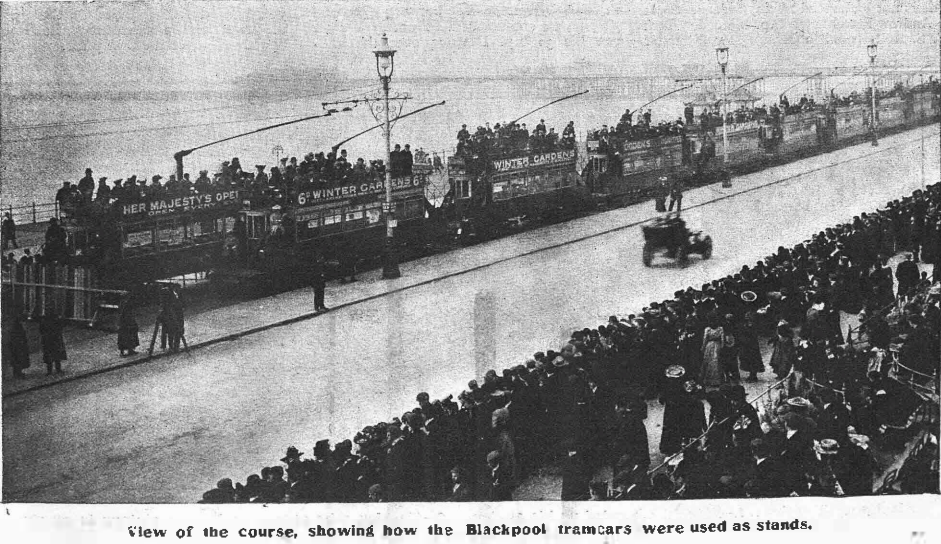
without accumulators or petrol, under 170lb. In this the first heat brought out Blaker, on a 4½hp Bat, Bickford, on a 5hp Chase, Metcalfe, on a 3hp Bradbury, and a Humber driven by Jones, who came in first, with Bickford close behind. Winner’s time was 1min 24⅕sec. Heat 2 brought out four celebrities in Tessier, on his Bat, Crundall, of Humber fame, Hodgkinson, on the JAP, and Rignold, on his 4½hp Lagonda. After a good race Tessier won in 1min. 19⅗sec, Crundall being only a few yards behind. The final of Class A was then proceeded with. First and second in each heat were qualified for the final, hence four now lined up. Tessier and Crundall both got away well together, but the former had a slight lead, which he maintained till the finishing post was reached. Tessier’s time was 1min. 13⅖sec. Class B was open to motorcycles without weight limit, and out of six entrants five faced the starter: Jones (Humber); Rignold (4½hp Lagonda); Hodgkinson (4½hp JAP); Tessier (4½hp Bat); and Crundall (Humber). Only one heat was run in
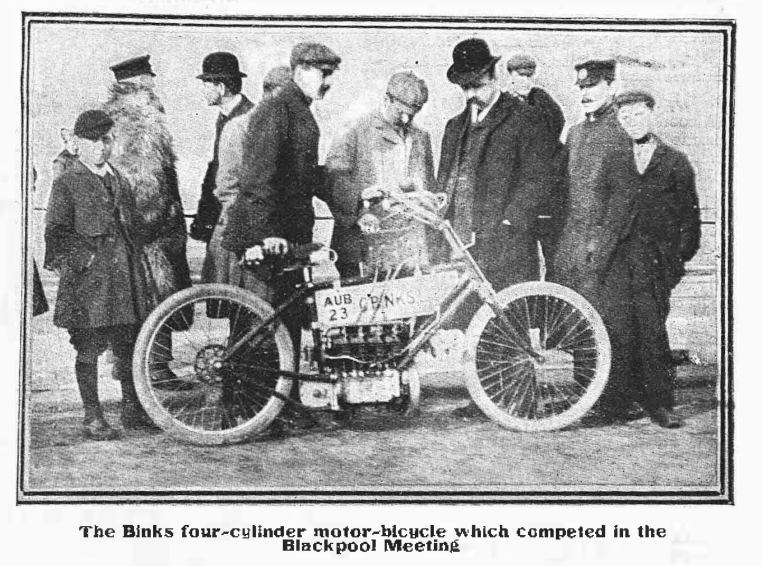
this event. Tessier soon passed all the others, and won in 1min 15sec, with Hodgkinson second…Owing to the large number of events on the programme it was decided to commence the racing at 9.30 on Saturday, and very soon after this time the motorcycle events opened. The best time was made by the invincible Tessier, who drove his Bat over the kilometre in 36⅗sec. Crandall’s time was 39⅘sec, while the third man, Rignold, took 41sec. This last rider’s machine is the light-weight Lagonda, built for road work in the international race, and does not show up to its best in short speed bursts. Tessier managed to carry off first prize in Class R also…A matter which at future meets should receive attention is the question of the relative importance of the motorcycle events. Considering that from the spectacular point of view the motorcycle races were not far from being the most interesting items on the programme, it is rather surprising that such slight attention was given to them by the committee. In fact, the impression given was that the motorcycle events were to be hurried out of the way as quickly as possible in order to make way for the car races, some of which were not so interesting to the public…By the way, the writer would like to see at future meets a class for bona-fide touring motor-bicycles, and also an event for two-seated motorcycles.”
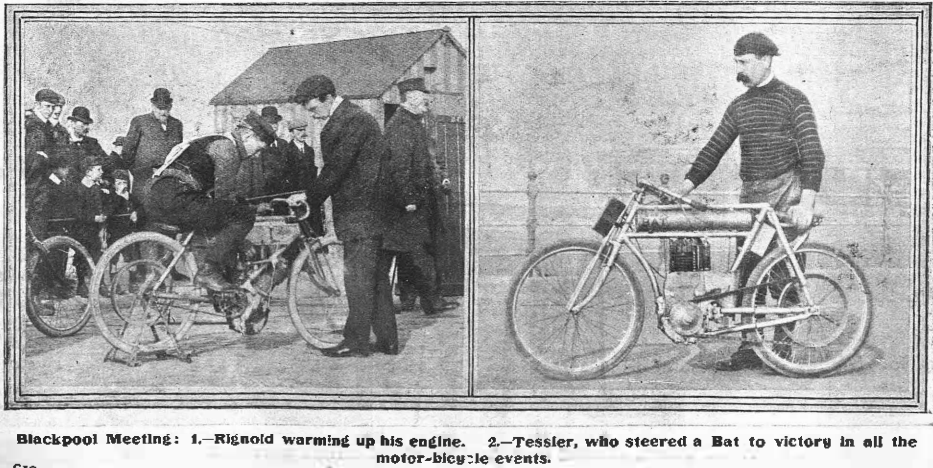
FROM A TOURING yarn headed “A Tour Through North Wales”: “We knew that North Wales was a miniature Switzerland, and we had misgivings and imaginations of walking every hill more than about 1 in 20 we came to, so we tried to get another machine of higher power. We ordered a 2¾hp, and thought we were all right, but at the last moment we were disappointed, for the new mount could not be delivered to us until a week after we wanted it. This was vexing, and we looked at each other with gloomy faces, and, had we been girls, I have no doubt we should have resorted to tears. But as we were young fellows, ready to make the best of a bad job, we determined to make our ‘little baby’ (as we termed our 1¼) do the work. Now for the work; and in consideration of the fact that we had a hilly district to contend with, we made sure of helping our machine to do all that could be expected—and more. We cut up an old belt, which, by the bye, was a ¾in flat one, and cemented it on with tyre cement to the engine pulley, and this, together with a new belt, made a perfect means of transmission—so perfect that when we had the compression tap closed we could not move the back wheel round. We filled up with Carless Capel petrol, and packed our few things together and started, each confident of the success of the tour, but each inwardly thinking of the hills we should have to walk. We started on a Saturday morning at 11.30, hoping to do 80 or 90 miles before nightfall. Just before we reached St Albans our engine stopped, but we located the trouble immediately; the pin holding the inlet spring in place had broken. We remedied this and got on our way, if not rejoicing, perfectly contented, owing to the ‘mopping’ qualities of the bike. Stop No 2 was made through going over some rough ground, and snapping the metal terminal of one of the wires connected with accumulator. It was the work of two or three minutes putting this in order, and we proceeded without further mishap on through Dunstable, Stony Stratford, Towcester, Daventry, and Coventry. As it was still quite early, and we were both fresh, we thought we would go on to Lichfield, which is about 120 miles from our starting point. We arrived there at 8.15, and put up at the George Hotel in the High Street. This was our first day’s ride—nearly 120 miles with trailer, passenger, and necessary luggage, in less than nine hours—and only 1¼hp machine. So far we had only walked one hill, and shed the passenger on about three others, while the gentleman who was manipulating the levers slightly assisted the engine to climb these three. The following morning we got a fresh supply of petrol, and proceeded on our journey…”

“THE TRIUMPH CO, OF COVENTRY, are putting on the market a 3hp motor-bicycle weighing not more than 120lb net, ie, without fuel, lubricant and accumulator. This means a throwing overboard of some 40lb dead weight. We have been putting the first of the new models through its paces for the last week or two, and can say that up till now a more speedy, comfortable and easily controlled single-tracker we have never had the good fortune to drive…It is a low-built vehicle fitted with footrests in addition to the usual pedalling gear, and rendering it possible for the user to easily reach the ground with his feet. The handlebars are semi-circular, affording a most comfortable position. The engine is new, the mainshaft being fitted with ball-bearings, an achievement not hitherto successfully attained by many makers. Specially large, and heavy fly-wheels are employed, whilst the valves are mechanically operated. Another important feature is the design of frame. The double top tubing is dispensed with, but there are double tubes from the head to engine affording stability in the right place. Further, the frame is to an extent elastic, so that over rough roads there is a certain amount of ‘give’, which considerably lessens vibration. Two brakes are of course fitted: one on the front rim and one operated by the left foot (whilst on the footrest) on the inside of the belt rim. Transmission is by three-ply. This machine will be exhibited at the Stanley Show, but it really requires trying on the highway for its many good points to be appreciated.”
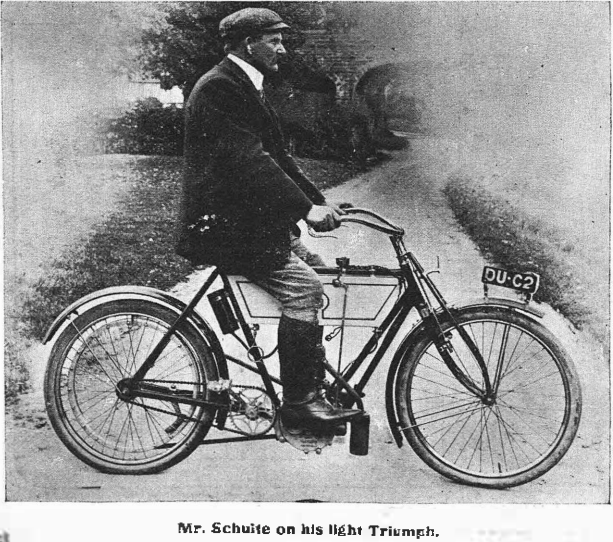
ON FRIDAY LAST we had the opportunity of inspecting the new Garrard two-cylinder tri-car, and of being piloted for a short trial spin by Mr Garrard, Jun. A sufficient distance was covered to enable us to fully judge of the speed and hillclimbing capabilities of the machine, and to test the springing of the fore-carriage over some of the vile road surfaces on the outskirts of Birmingham. We should estimate possible speed on level at something approaching double the legal limit. We found the front seat very comfortable and astonishingly free from vibration, due to the double system of spring suspension; the question of ample leg room has not been overlooked, and we must tender our congratulations to the designer of one of the best tri-car seats we have yet come across. The machine has been designed with the object of obtaining the average speed attainable by a high-powered car and yet whilst keeping the weight within reasonable limits to afford both driver and passenger ease and comfort for a long journey. The engine is a two-cylinder set V-wise upon an aluminium crank chamber lying across the frame, each cylinder being 85mm bore by 85mm stroke [964cc] and developing 8hp on the brake. Automatic inlet valves are used…
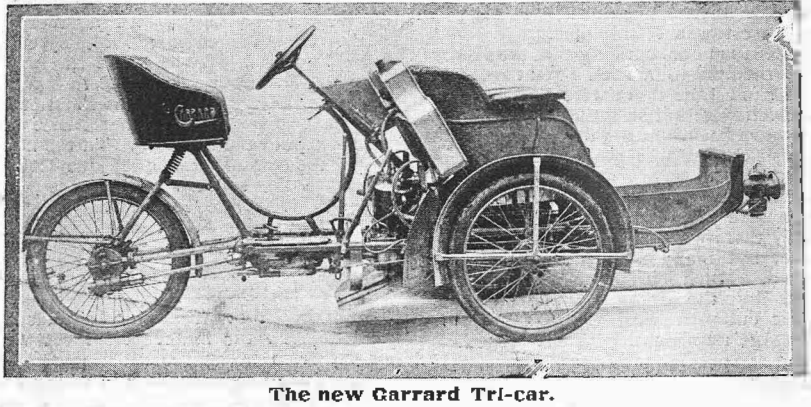

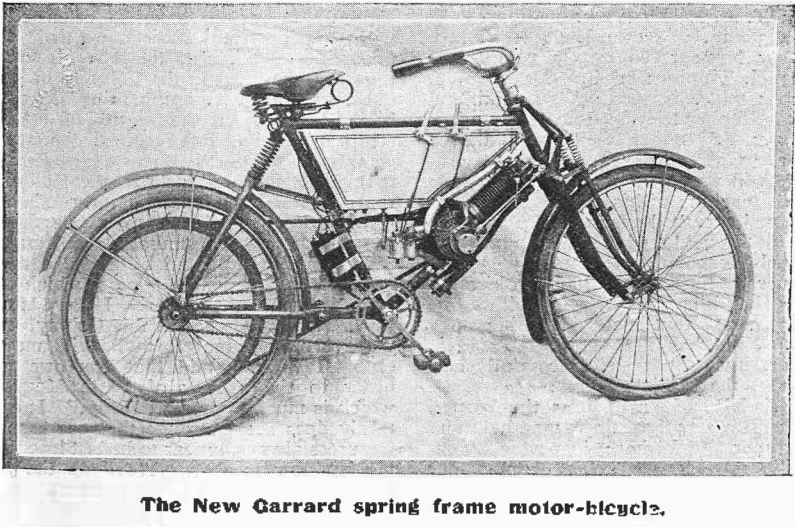
Within the gear box are the three gears of the Panhard sliding type…The motion is communicated to the rear driving wheel by a worm drive contained within an oil tight and dust-proof casing. The drive is silent and very efficient, and as the worm is carried upon ball thrust bearings blocks at both ends it ought to wear indefinitely. Upon the left-hand side of the rear wheel is fitted the new Garrard patent internal expansion brake. This is actuated by the left pedal, the right pedal releasing the clutch; the two brakes on the steering wheels are also internal expanding, and are controlled by the side lever…Two sparking plugs are fitted to each cylinder, and an immediate change oyer can be made if one fails. The petrol capacity is four gallons, and a little detail is the dishing of the top of the tank so that any spilled spirit must go into the orifice; the filling cap contains an air release valve to prevent any air lock in the petrol supply pipe; when engine stops the valve closes the air vent and keeps the spirit fresh. Two-and-a-half-inch tyres are supplied to the three wheels, and readers will notice the serviceable mudguards to the driving wheels, and also the shield below the engine, which thoroughly protects it from the mud.”
“WE GIVE AN ILLUSTRATION of a new motor-bicycle model which the Clyde and Motor Car Co, Leicester, are building for the 1905 season. This is fitted with free 3½hp water-cooled engine, two-speed gear, and the reader will observe the special way in which the radiator and tanks are fitted to the frame. The length of radiating pipes exposed to cooling surface is 7ft. Circulation is effected on the thermo-syphon system. It would be difficult to design a neater form of water-cooled motor-bicycle than this, and its introduction certainly adds to the firm’s reputation as makers of high-class automobiles.”
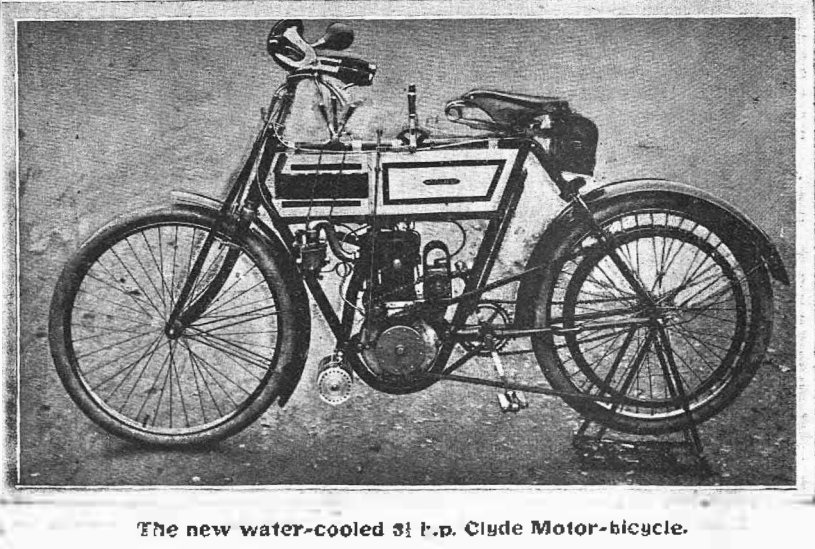
“SOMETHING NEW IN AMERICAN motor-bicycles. The machine known as the Buckeye is made by the Oscar Lear Automobile Co, Columbus, Ohio. The chief novelty consists in the fixing of the engine. The two main tubes of the frame are brazed into lugs in the crank case, and the cylinder occupies the space between the tyre and diagonal tube. The pedal bracket is in front of the crank case. Another novelty is that the chain drive is taken from the two to one gear wheel shaft, and thus it is possible to use a small diameter chain wheel. The front forks are duplexed. Ignition is by coil and a set of dry batteries, these being fixed in the case seen at the rear of frame. It is priced at £40.”
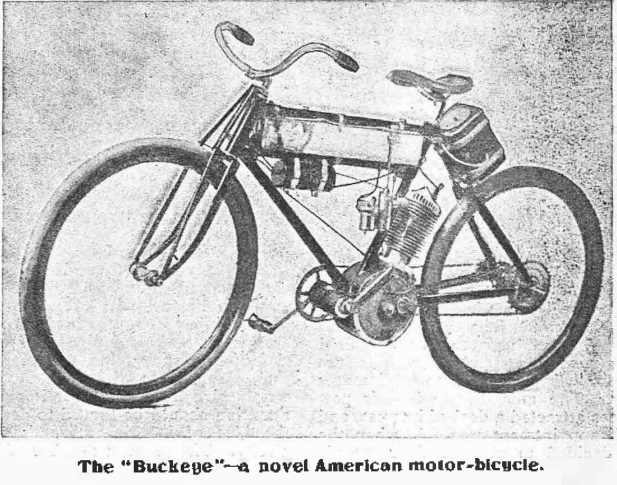
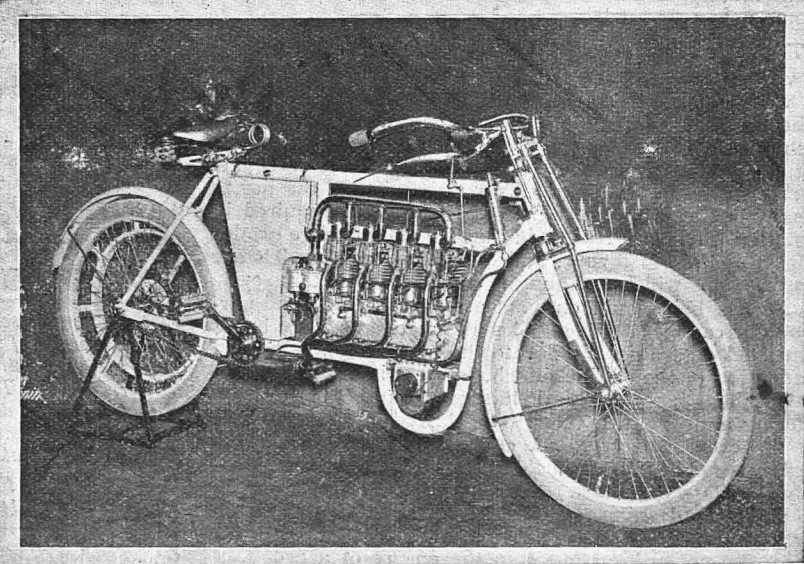
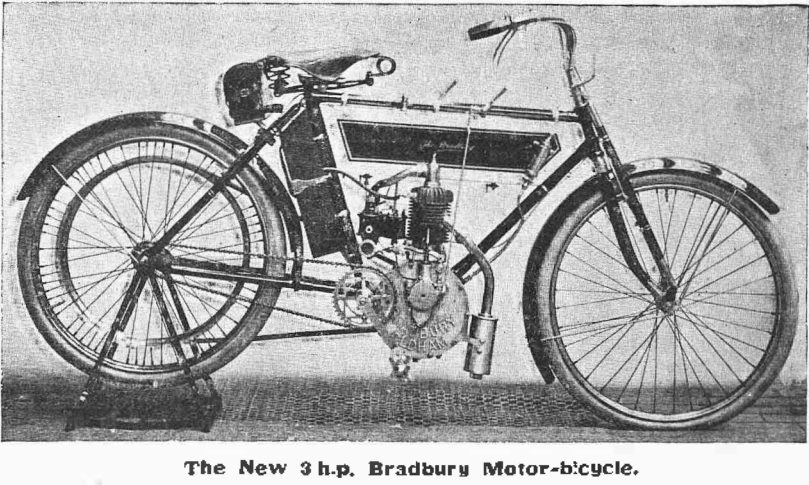

“ARIEL CYCLES. THE 1905 pattern differs from that of 1904 only in minor details, such as a larger exhaust box, improved valve lifter and cut-out, and a new type of cut-out for the back-pedalling brake, enabling the machine to be wheeled backwards. Two accumulators of large capacity and a two-way switch will be supplied with all the new models. The Ariel Cycle Co will exhibit five motorcycles and a side-carriage. Further, a lady’s cycle coupled to a motor-bicycle by a Liberty cycle attachment will also be exhibited on the company’s stand.”
THE FOUR-CYLINDER FN. Messrs McTaggart, Dublin, who are sole agents for the United Kingdom of the FN motor-bicycle, will be showing the 1905 pattern four-cylinder FN. The cylinders are placed one behind the other, and are air-cooled. Automatic inlet valves are employed, and their chests are well cooled by radiators. The wheel base is longer than in any previous model, and the motor being placed low, great stability is obtained. One of the chief novelties is the adoption of the ‘acatene’ system of bevel-gear transmission from crank-shaft to driving wheel. This system has been fitted to the FN ordinary safety for the last seven years. To avoid any very sudden shock on the bevelled teeth, an elastic coupling is fitted between the bevel-gear and crankshaft; this also acts as a fly-wheel and ensures very smooth running. It is unnecessary to point out that this bevel-gear could not be used with a single—or even double-cylinder motor…An elastic front fork, which is a combination of a steel spring and some rubber plugs, takes up vibration in the steering plane…By means of a lever on the right-hand side of the handlebar the exhaust valves can be simultaneously raised. The machine is then easily pedalled a short distance, when, on dropping the exhaust valves, the motor starts running almost immediately.”
“THE QUADRANT LIGHT-WEIGHT. The demand for light-weight machines has caused the Quadrant Company to produce a 2hp light-weight motor-bicycle. The tyres are 2in, mud-guards are wide, and with a large Brooks’ saddle the weight comes out at under 100lb. If 1¾in tyres are used and a small saddle fitted, the weight is reduced to about 90lb. The 3hp has been remodelled, and now scales 130lb complete. On all the 1905 machines a surface or spray carburetter will be fitted according to the purchaser’s choice.”
“THE ROVER LIGHT Motor-bicycle. Like several other up-to-date motor-bicycle manufacturers, the Rover Co have given attention to the light-weight question, with the result that they have evolved an exceedingly smartly designed and efficient machine of 2¼hp, weighing complete with tool-bag and accumulator less than 100 lb. The build of the frame, which is 21in high, is best understood by reference to the illustration. The forks are constructed on the duplex principle, and the head tube is of taper gauge. The engine is held by plates in front of the crank bracket—the plates being fixed to the frame by bolts passing through T lugs, which are brazed on the ends of the bottom tubes of the frame…The tanks accommodate petrol, lubricating oil, high-speed trembler coil, and a 20 amp-hour accumulator. Sufficient spirit can be carried for 100 miles. As regards control, this is a matter of simplicity, brought to an almost irreducible minimum. The right hand lever on top tube regulates the ignition, while the left-hand lever works the throttle valve. The left-hand inverted lever on the handle-bar governs the exhaust valve lifter. Lewis’ patent switch is also attached to the handle-bar.”
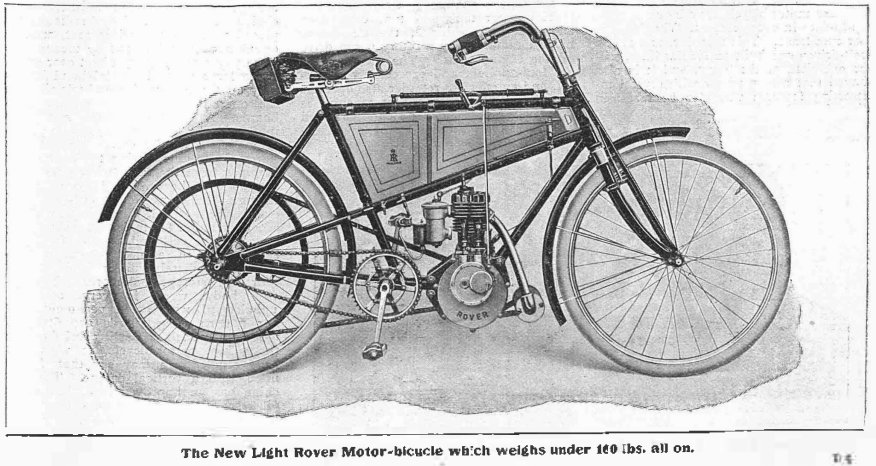
“MOTORCYCLISTS WILL BE interested in the New Millennium Express Stand for motor-bicycles exhibited by Lake and Elliott, of Braintree. It is instantaneous in action, and is operated by simply depressing a small foot lever, so arranged that it can be worked either from the saddle or from the ground. A large carrier is supplied with the stand, which is very strongly constructed to stand vibration.”
“THE 3HP CHAIN-DRIVEN RALEIGH. Footrests instead of pedals form the most prominent improvement in the Raleigh motorcycle for 1905. The machine is chain-driven, a spring chain wheel and slipping clutch being used. The engine is controlled by twisting the left handle. Any speed from 5-35mph can thus be obtained without releasing the hold on the handle-bar. The two-speed gear is contained in the hub. In addition a 3hp belt-driven machine will be exhibited by the Raleigh Co.”
“THE 2¾ HP GRIFFON LIGHT-WEIGHT. The feature of the Griffon Co’s exhibit will be their 2¾hp motorcycle, the engine of which weighs 461b. A special Longuemare carburetter, with automatic air regulating inlet, is employed on these bicycles, which are characterised by a long wheel base. A 2¾hp 1905 pattern Griffon ordinary motorcycle will also be shown. This pattern also includes a Longuemare carburetter, but with a special Griffon air regulating device.”
MESSRS BROWN BROTHERS’ exhibit will include several Brown motor-bicycles in both 2¾ and 3½hp. One of the 2¾hp will be fitted with the new Brown free engine clutch. Others will have side-cars and trailers attached.”
“THE CENTAUR MODELS. The new pattern 3hp chain-driven motor-bicycle made by the Centaur Cycle Co, Coventry does not vary a great deal from the old model with which, our readers are familiar, the only constructional alterations being a new silencer, a new mixer to regulate the air supply to the carburetter, while the exhaust valve lifter is now controlled by a handle attached to the handle-bar. An improved commutator is also fitted. In the old type it will be remembered that the exhaust pipe and silencer formed an integral part of the frame by superseding the tube, which is usually carried from the bottom of the head to the bracket.”
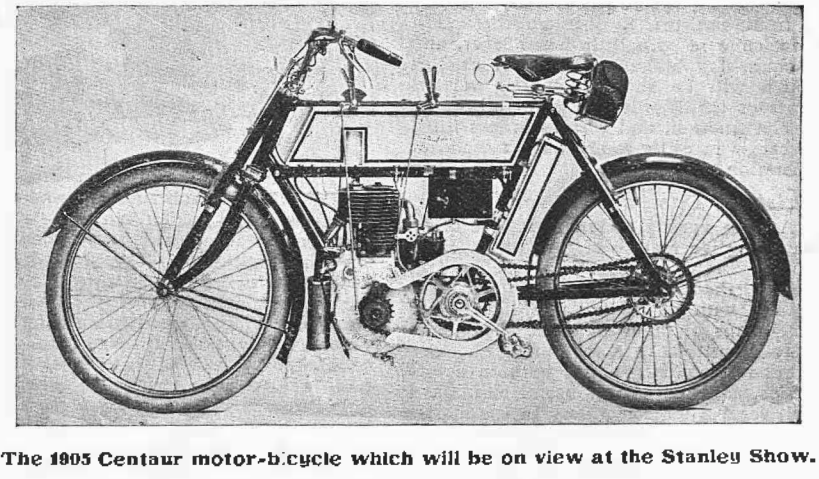
“THE NEW EXCELSIOR MODELS. As usual, Messrs Bayliss Thomas and Co, Coventry, will make a good show, and of their numerous Excelsior models we have no doubt that their 3hp motor-bicycle and the entirely new wheel-steered tri-car with coach-built fore-carriage will claim the greatest attention from visitors to their stand…the 3hp motor-bicycle, to which we have alluded, we may say that this is fitted with a vertical engine. The machine has an improved tank, having an oil reservoir at the fore-part, the whole having an unbroken surface. An oil pump is fitted to the right-hand side. The levers are on the spring ratchet principle.”
“THE JN MOTORCYCLE STAND AND CARRIER. A stand which has met with great success on the Continent is that known as the JN, and which has recently been introduced on the English market. The illustration depicts the stand in position as a carrier, and also being adjusted to support the machine. It is made of steel tubing, and thus comes out very light and yet has great strength. It is also finished in the best style, and the price is remarkably low. The device is made by Jules Noiray, Grenoble, France, and it can be obtained from most of the leading motor accessory firms in the kingdom.”
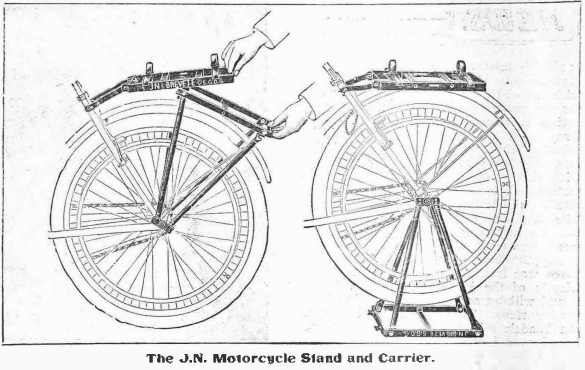
“ANOTHER NEW STAND. Messrs G Main and Co, Albert Place, Loughborough, inform us that they have very greatly improved their well-known stands and carriers for the next season. In addition to this, they are putting on the market a new collapsible stand, which can be quickly attached and detached from the carrier. This new stand will be known as the GMP.”
“MARSH MOTORCYCLES. P Brough, of Kettering, will be showing the 3½hp Marsh motorcycle. He is the British sole agent for the engine fitted to this machine, which is built up and finished in this country. Special features of the engine are a large crank case, containing 9in fly-wheels, and a long connecting rod. The handles are long, and the triple forks are practically unbreakable. The ignition is low tension ‘make and break’, with current from dry batteries. On this stand will also be shown the 3½hp Marsh tri-car, with side lever steering and two-speed gear, with free engine. A Marsh motor-bicycle, dismantled to show all the working parts, and a patent lock washer to supersede lock nuts or split pins will also be staged.”
“BROWN & BARLOW’S CARBURETTERS. These carburetters are built up from solid drawn brass tubes, screwed and sweated into a bottom plate. A much lighter, better finished and truer article can thus be obtained. A throttle and air valve are fitted, with either horizontal or vertical outlet to the motor, to these carburetters, which are fitted to Cycle Components, Triumph, Royal Enfield, Swift, and other well-known makes of cycles.”
“THE MILFORD SPECIALITIES. Mills and Fulford’s stand at the annual Cycle Shows has always been one possessing more than ordinary interest to every visitor, as it has usually contained designs of attachments for motorcycles of a more or less distinct and original character. This year, we are informed, is to be no exception, as they are showing for the first time an original form of car for fitting to motorcycles of a fairly high horse-power, enabling the passengers to sit side by side. This is done by the removal of the saddle and fixing of two neat bucket-shaped seats to the frame. The frame is much on the same lines as the fore-carriage, but has no chair in the front, and is nicely sprung on the same lines as the light motorcar. This model car, which is termed the Social, can be fitted with auxiliary pedals, enabling each passenger to use them when necessary. Further, the frame is so constructed as to allow of a fore-carriage chair being fitted, providing the hp of the engine be high enough to take the triplicate load. The other exhibits will include a number of side-cars and trailers.”
“THE ENFIELD ‘LIGHTWEIGHT’. For 1905 a chain-driven motorcycle with a two-speed gear and free engine, is being placed on the market by the Enfield Cycle Co. One of these machines, which weighs 111lb and is excellently designed, will be a feature of this company’s exhibit. A belt-driven type, weighing 90lb, will also be shown. The chain-driven machine has 26in wheels, the front wheel being fitted with 1¾in and the back 2in tyres. It is built low, and therefore, as the centre of gravity is very low, a most safe and handy machine has been evolved for general use. It is fitted with a Royal Enfield engine, which will develop 2¼hp at 1,800rpm, though the engine can be readily accelerated to a speed of 2,500rpm. The bore of the cylinder is 2¾in, and the stroke 2⅞in, and a feature of the motor is the method of actuating the mechanically-operated valves by means of rocking levers working on cams. The machine is fitted with two-speed gear, obtained by having two chains and a slide carrying four sprocket wheels, which engage the top or bottom portion of the chain as required to obtain the high and low speeds. This is operated by a lever attached to the top tube of the frame, and, it is claimed, enables the machine to climb almost any hill that can be found on main roads, and yet, when on the level, it will travel very fast without causing the engine to race. In fact, the actual tests made by the makers show that this bicycle will, on the average, perform, during a run of 50 miles in fairly hilly country, as well as many higher powered machines. The foregoing description also applies to the belt-driven bicycle, eliminating, of course, that portion which refers to the change-speed and double chains, there being only one chain which is used for starting or pedalling the bicycle, and the drive being by belt from pulley on engine to pulley on back wheel. The engine is identical on both machines.”
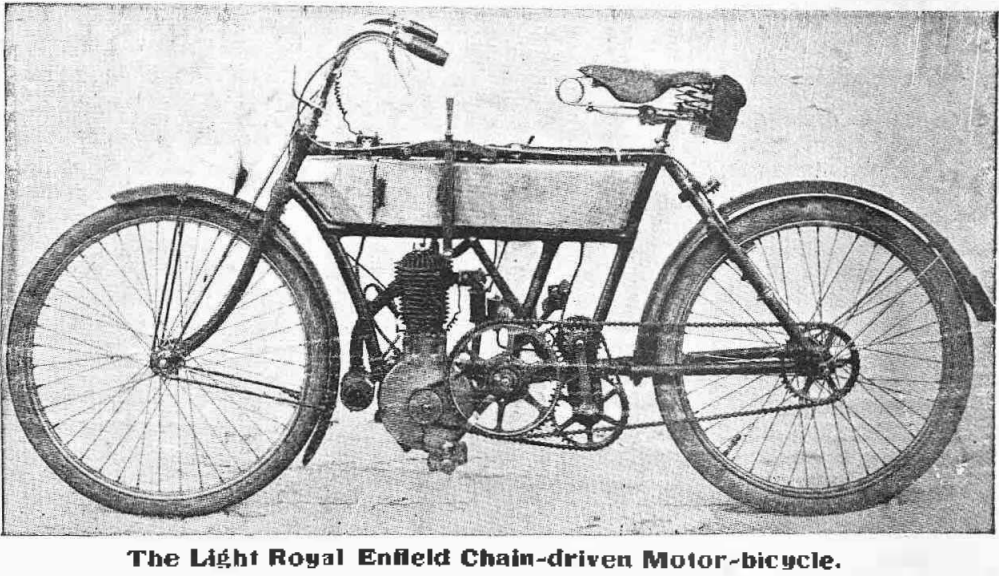

“A NEW TWO-SPEED GEAR. The Stevens Motor Manufacturing Co, Wolverhampton, besides showing examples of their single-cylinder air and water cooled engines, will exhibit a new model 6hp double-cylinder water-cooled engine, 3in bore by 3½in stroke. This has automatic valves of large diameter, the timing gear is enclosed for protection, but easily accessible for inspection; a large outside fly-wheel is fitted, and the crank case is an aluminium casting. This engine is designed for fore-car work in conjunction with the company’s two-speed gear and internal clutch, leather to metal, which obviates any end thrust on the bearing.”
“THE NEW REX MOTOR-BICYCLE. The Rex Motor Manufacturing Co, Coventry, will be showing an entirely new model of machine for 1905. In this new design the engine is bolted into the cradle as hitherto, and does not form part of the frame. The bore and stroke are 82mm. The great features of next year’s engine are MOV, an entirely new pattern of silencer, double air draught to both valves, and spray carburetter. The valves are placed on the left side of the engine, the exhaust in front and inlet at the back, both being separated from the engine and each other by air passages. By this means the engine is kept cool on the stiffest hills. The new Beehive silencer is a great improvement on last year’s baffle plates. The exhaust is discharged in front into a box, shaped like a beehive, which contains a number of pipes drilled with small holes. It passes from the beehive into another chamber, situated underneath the valve seatings, and finally is discharged downwards into the air. It is claimed that there is an absence of back pressure, and that the noise is reduced to a minimum. The old surface carburetter will be superseded by a Longuemare let into the bottom of the tank to prevent grit, etc, entering. It is easily accessible, the side of the tank coming away on removal of a pin. The frame has been lowered 4m. in the new machine, and in the model we saw it was quite easy to place both feet on the ground while sitting in the saddle. This is rendered possible by fitting 26in. wheels and a new design of top tube, which allows the saddle to be got well down.”
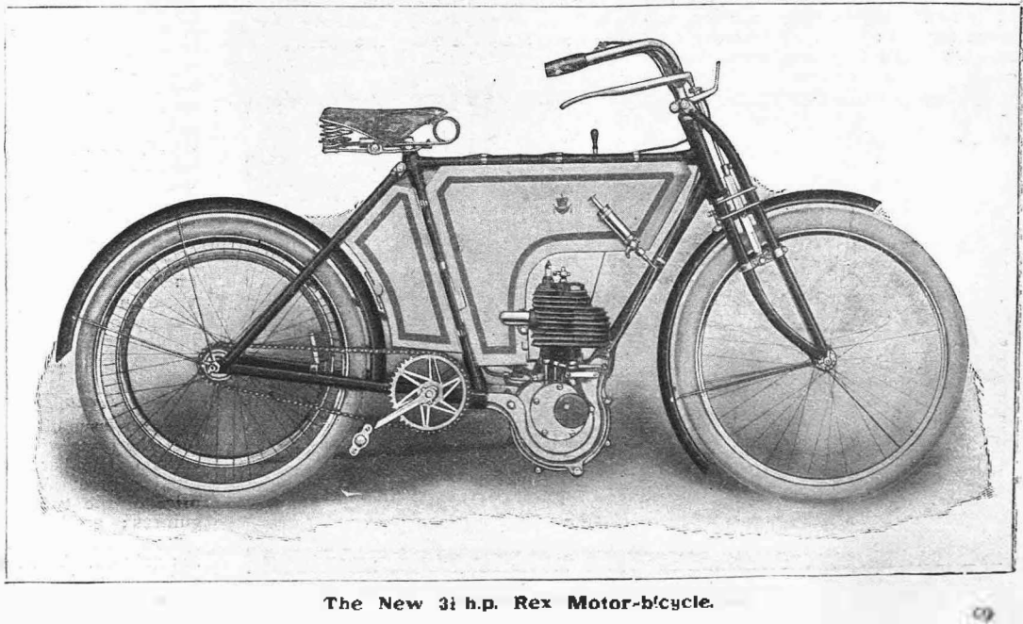
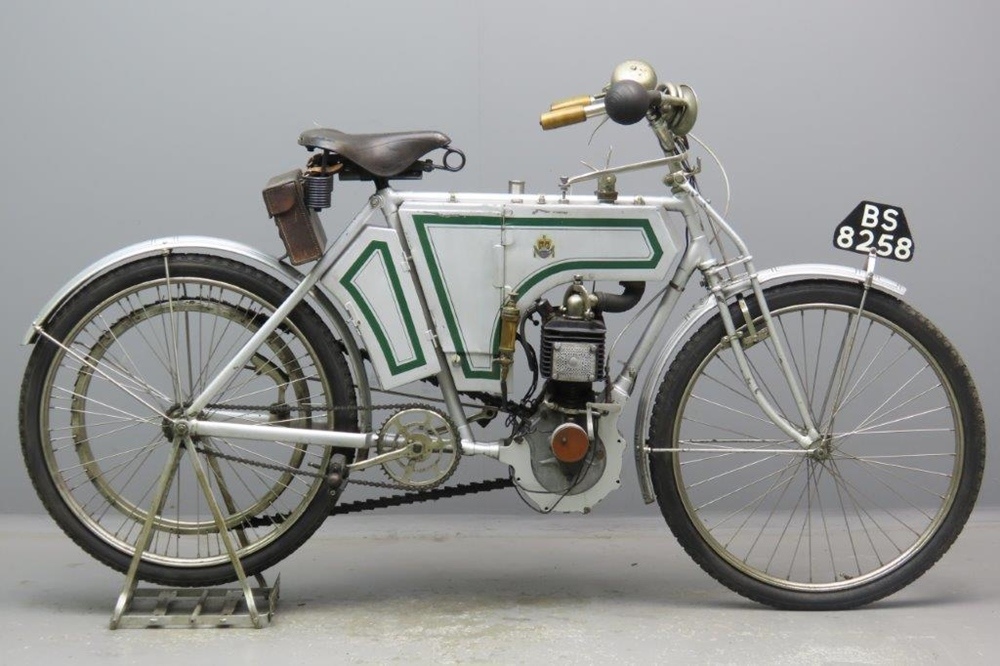
“WHITE AND POPPE’S LATEST. Messrs. White and Poppe, Coventry, whilst showing their 3½in air-cooled and 4hp water-cooled, will also exhibit newly designed engines of one, two, three, or four cylinders, developing 4hp for single, 7hp for double cylinder, 9hp for the three, and 12hp for the four cylinder.”
“A NEW CHATER-LEA FORE-CAR FRAME. We illustrate a frame built from Chater-Lea fittings—one of the many patterns that can be obtained from the Chater-Lea Manufacturing Co. It will be seen that practically any engine suitable for a forecar could be used in this frame, while a number of modifications can be made, according to requirements. For instance, the bracket can be done away with and a lug used instead if pedals are not required. The Chater-Lea Manufacturing Co are making a good display of new patterns at 114-120, Golden Lane, EC, during Show week, and members of the trade would do well to pay them a visit.”
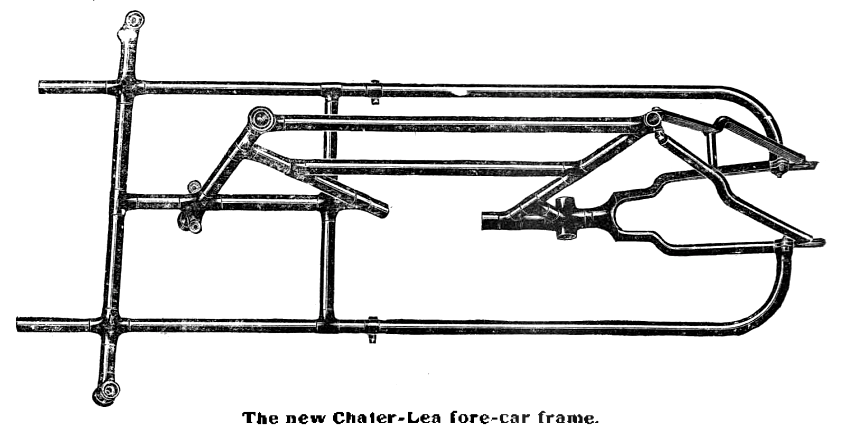
“‘STARS’ AT THE STANLEY. The Star Cycle Co, Wolverhampton, always have a good and interesting display at the Stanley Show, and this year they will be exhibiting two motorcycles, a 4hp water-cooled English. machine and a 2¾hp air-cooled German machine. In both of these the cylinder head is cast integrally with the cylinder. Both of them are fitted with Longuemare carburetters and compression taps; but whereas the English machine has a wipe contact breaker, the German machine has a make and break blade.”
“THE NSU PRODUCTIONS. The NSU Cycle and Motor Co, of Neckarsulm (Germany), are now comfortably installed in their new English depot, at 4 and 6, Hatton Wall, where an excellent display of their various models may be inspected. The company have taken space at the Stanley Show, and we have no doubt that their machines will excite the attention they deserve. A very taking model is their 3hp motor-bicycle…These machines have a tremendous popularity on the Continent, . and the makers claim to have turned out no less than 3,000 of them during last year alone, and since then the output has gradually increased. The machines stand out on account of their neat design and excellent workmanship and finish, the engines particularly being neat productions. The valves are mechanically operated, and a small and effective spray carburetter supplies the petrol vapour, which is ignited by an electric magneto. The machine, which is both powerful and speedy, is controlled almost entirely by means of a throttle and petrol regulator combination, and runs remarkably smoothly and quietly.”


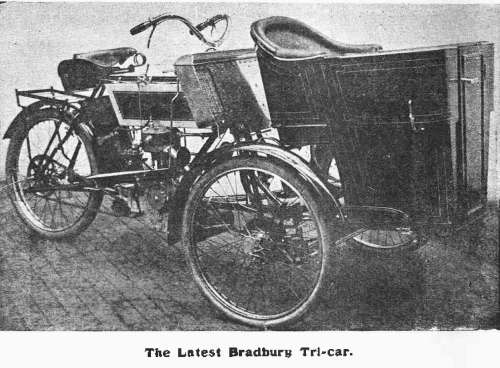
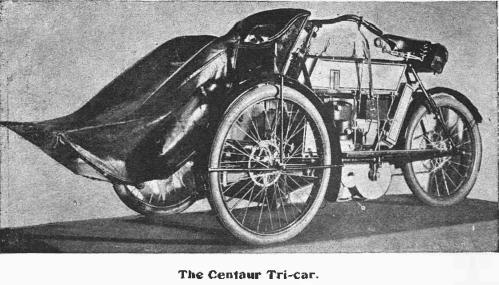


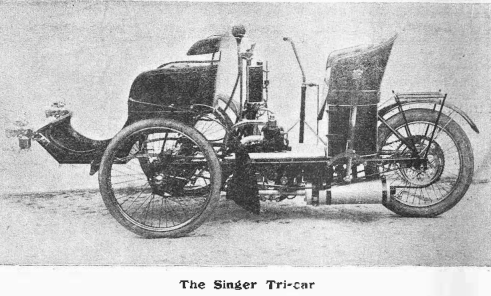
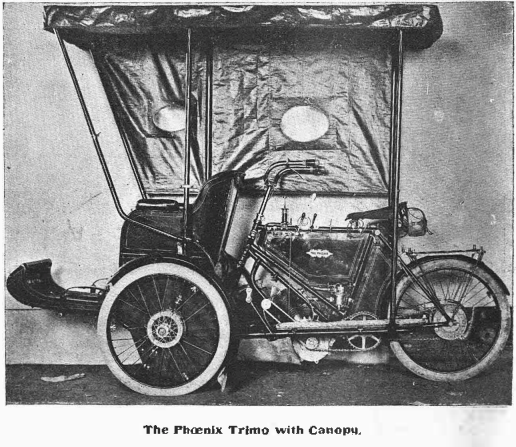

“CHASE MOTORS, Anerley, London, stage nine motor-bicycles, the smallest power is 2½hp, at 105lb. This is a neatly designed mount with Longuemare carburetter. The tank is made of copper, and holds considerably over one gallon of petrol. It is fitted with a sight gauge. The transmission is by V-belt, and ignition by coil and accumulator. A full equipment in the shape of two brakes, wide and extended guards, is provided. Any make of motorcycle tyre can be fitted.”
“HUMBERS, BEESTON, have one of the greatest attractions in the Show in their 1¾hp motor-bicycle, fully equipped scaling only 71lb. The splendid design and finish of this little mount are being extensively admired. This machine has the well-known chain drive, duplex forks, spring saddle, spray carburetter, trembler coil and accumulator. The control is by single lever, the carburetter being self-regulating. The engine is 65x76mm, and has outside valve gear on the Clement principle, but the usual pair of inside fly-wheels. The petrol tank is of large capacity. Two rim brakes are fitted. The tyres are Dunlop 1¾in. Although so remarkably light, every part of the machine has been kept of ample strength. The accumulator is of 10 ampere-hours capacity. For riders of moderate weight who want a light and easily-handled machine the Humber Light-weight should meet their requirements in every respect.”
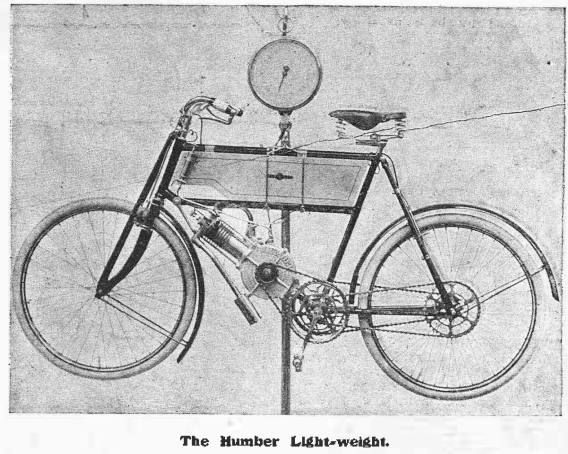
“THE JAP LIGHT MOTOR-BICYCLE, made by JA Prestwick & Co, Lansdowne Road, Tottenham, is a remarkably strongly-built machine, with 2½hp engine, and yet only scales 84lb. It has a spray carburetter, V-belt drive, large capacity tank, and is built up on a Chater Lea frame. It has a large and effective silencer, and no part has been unduly cut down. Ignition is by coil and accumulators. The makers claim that the 2½hp engine fitted is the lightest made for the power, and it should prove a fast machine. It looks a thoroughly neat and easily handled mount, and just the thing for any rider up to 12 stone.”
“THE TRIUMPH CYCLE CO, Coventry, have considerably reduced the weight of their latest model down to 120lb, and this without the sacrifice of any point tending to efficiency, or comfort. The engine is a 3hp with mechanical inlet valve, and the main shaft runs on ball bearings. A most ingenious arrangement of ignition cut-out and exhaust valve lifter is worked by a lever below the left handle and is devised to permit the valve to seat before the contact is made. A very neat type of high-speed trembler coil is fitted below the tank. In the purely cycle portion of the frame many improvements may be noted: the tube running from ball-head to bottom bracket is duplicated and spread apart at the base and helps as an extra support for the engine cradle. A new form of spring contact breaker, which is claimed to be oil proof, is one of the carefully-thought-out details amongst a number on this admirable machine. We recommend our readers to carefully inspect one of the best-finished machines in the Show. The price is £43 and includes a specially devised jack, and a tool-bag carrier to take the weight of the kit of tools at back of the saddle.”

THE ROVER CYCLE CO, of Coventry, are making a feature of a light motorcycle weighing complete 100lb, which weight includes accumulators, a comprehensive kit of tools and wide mudguards, whilst the frame is strutted from the base of the steering head to the back axle and the front forks are of the girder type. A wedge-shape tank provides spaces for petrol, oil, accumulator and coil. The celebrated Rover carburetter is employed, and this is attached directly to the inlet flange of the cylinder so that the induction passage is of the shortest. The engine gives 2¼hp, and has mechanical valves, wipe contact, and a large silencer. The drive is taken through a Watawata belt. The lever on the left handle-bar lifts the exhaust valve and a spring clip is provided for holding the valve open. Ample brake power on both wheels is provided, the back wheel brake being a very efficient specimen of the band type applied by back pedalling. The light Rover is well designed and splendidly finished. Its price is £40.”
“THE RILEY CYCLE CO, Coventry, show a splendidly finished 2¾hp lightweight motor-bicycle. This comes out at 105lb. The engine has a mechanical inlet, large gas and exhaust pipes, and a specially effective silencer. Control is by throttle and spark advance. Transmission is by wide V-belt. The strength of the parts is ample in every respect, in fact as strong as on many machines scaling 200lb. Duplex forks, two powerful brakes, extra capacious tank, wide mudguards, spring seat pillar make up a machine that could not be beaten for design or appearance. The carburetter fitted is the Longuemare, and tyres are Dunlop motorcycle pattern. This machine is deservedly attracting much attention.”
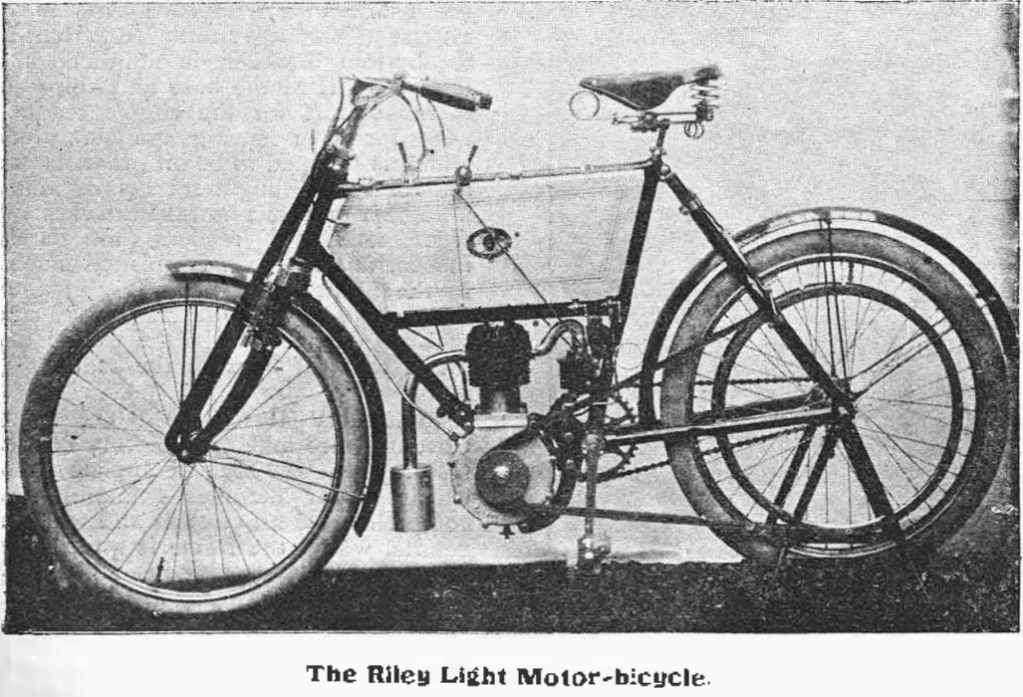
“PHOENIX MOTORS, Blundell Street, Caledonian Road, London, N, are showing a light-weight motor-bicycle, but one which is fitted up with every necessary, and has even a number of refinements. It has a 23in frame, with 26in wheels, the latter being shod with 2in motorcycle tyres. A 2hp Minerva engine, with mechanical valves and high-tension ignition, is employed, the engine being fed from a Phoenix automatic carburetter. Two accumulators are provided, whilst the machine is complete with girder forks, a large luggage carrier, and stand, which carries the rear half of the mudguard, a full roadster saddle, and the Phoenix two-speed gear. For its completeness the machine is light at 120lb.”
“MASON & BROWN, Volta Works, Leicester, have a light-weight motor-bicycle with Howard’s patent horizontal engine, the crank-case being built in as part of the frame. The cylinder is of short stroke and large bore. The cooling is effected by a special draught jacket over the cylinder, with large horizontally drilled holes passing through. The main shaft runs on ball-bearings, which can be adjusted. No carburetter is used, the petrol being sprayed direct into the inlet valve box. The lubrication is by drip feed direct on to the piston. The transmission is by V-belt. There are two brakes, the rear one being in the hub. The weight of the 2hp is 75lb, and the 3hp 95lb. Either Clincher or Palmer tyres are fitted as desired. The price for the 2hp machine is £26 5s, and the 3hp £30. Considering the excellent work put in this machine the price is wonderfully low.”
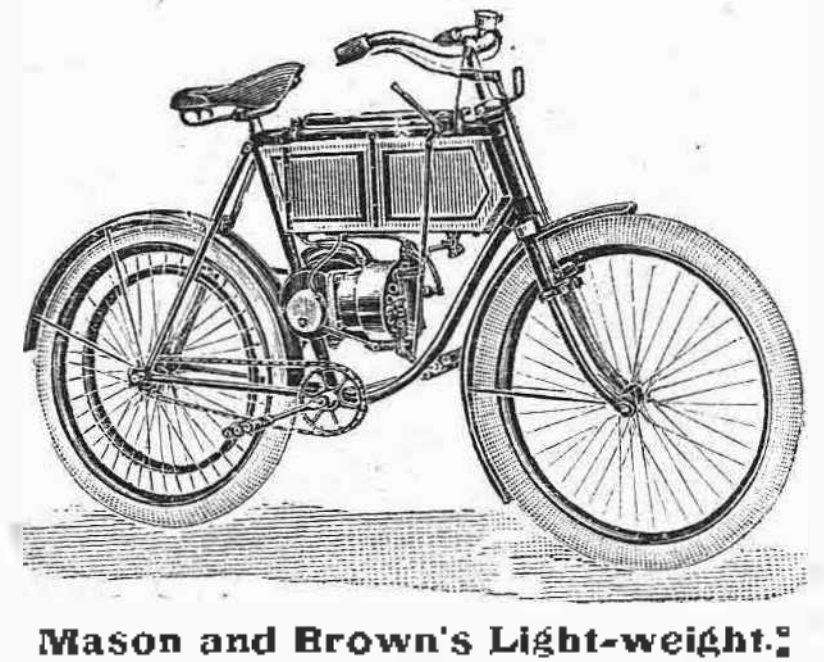
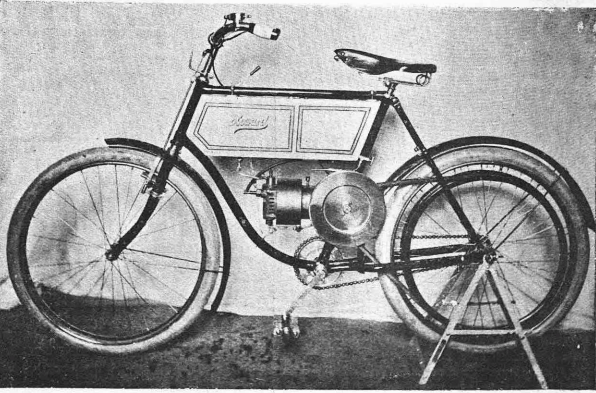
SINGER & CO, Coventry, show a special light-weight at 50 guineas, with 3hp engine and high-tension magneto ignition. This mount weighs 130lb. It has Dunlop carburetter, handle-bar control, two brakes, the rear one acting on rear hub. The drive is by Watawata belt. The tank holds 1¼ gallons. The wheels are 26x2in. Duplex forks are fitted. In this machine the makers have effected a total reduction of no less than 40lb from last season’s standard. Special attention has been paid to the matter of having ample margin of strength provided and this machine would safely carry up to 14 stone. The engine has the usual Singer features, including the frictionless roller bearings, one-piece cylinder and head, large valves and heavy rimmed flywheels. The petrol tank is made of sheet copper beautifully finished, as is every part of the machine.”
“THE ENFIELD CO, Redditch, show a 2½hp machine scaling 100lb. It has a vertical engine with one-piece cylinder and head, mechanical inlet, Brown and Barlow spray carburetter, two brakes, duplex forks, and V-belt drive. The control levers are fitted in neat quadrants with adjusting stops, ignition is by coil and accumulator, these being carried in compartments of the tank case. Every detail of this machine is splendidly finished, and to show the kind of workmanship put in the engine one of them is shown dissected. The price is 35 guineas.”
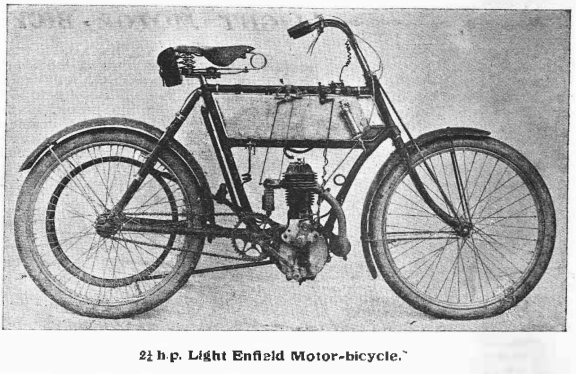
“THE ASCOTT MOTOR CO, 212, Pentonville Road, London, N, show what is practically the lightest machine in the exhibition. It scales 55lb only, fully equipped. It is of French manufacture, and is rated at 1hp. The motor is clamped to the down tube, and is supplied with gas by a Vaurs carburetter. The petrol tank, oil pump, and battery case are supported from the horizontal tube. Duplex front forks are fitted, and there is one brake, this acting on the belt rim through a Bowden wire. The machine is geared low, but should be able to touch 15mph on a fair road and also climb hills of more than the average steepness. This machine comes, perhaps, more strictly under the class known as motor assisted bicycles. The motor itself is very light, and must run at a very high rate of speed. A rather striking feature about it is the very small crank case used.”
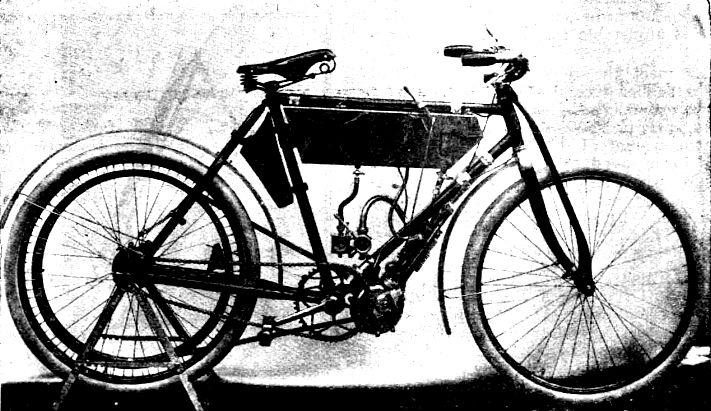
“THE SHARP AIR SPRING CO, 15, Bridge Street, Hammersmith, showed specialities in vibrationless motor-bicycles and tri-cars. On the bicycles the air spring is contained in a small cylinder in front of the steering stem and between the back forks and diagonal, both wheels in fact being pivoted. The use of the air springs enables much smaller wheels and tyres than usually fitted to be adopted. There were two motor-bicycles shown, both light-weight; one has a 2hp Clement engine and scales 751b and the other a 3hp Clement engine and scales 105lb. There are no pedals fitted on this machine.”
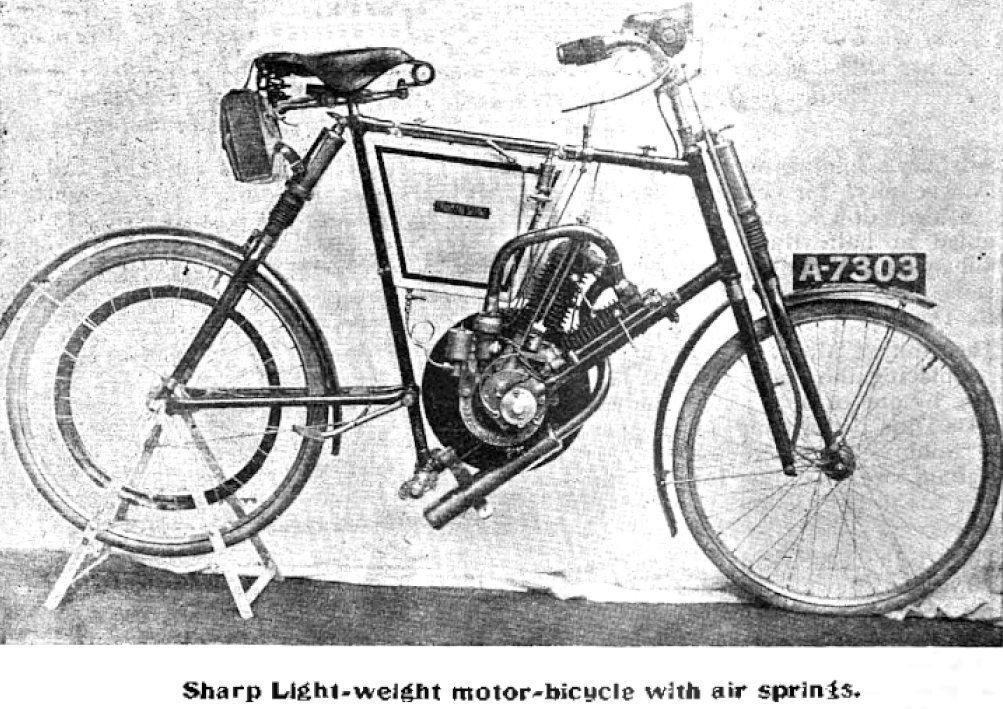
“THE QUADRANT CYCLE CO, Sheepcote Street, Birmingham, have brought the weight of their 2hp machine down to 98lb, or, if spring forks are fitted, to 103lb. The outline of the machine has been considerably improved, and altogether it is a very handy and symmetrical mount. The engine is fitted in a loop frame, and a spray carburetter is now fitted. The design of the tank has been improved and accessibility of all details carefully thought out. Two brakes are fitted, viz, a band brake and rim brake, on rear wheel. The engine is amply powerful enough for a mediumweight rider, and even severe hills can be surmounted at a good pace. The reliability and finish of the Quadrant machines is so well known that there is no need for comment on the matter.”

“HUMBERS FOR 1905 retain in the main their characteristic features as last season, but without in any way affecting the ample margin of strength in the machine they have been able to very sensibly reduce the weight. The 2hp and 3hp machines come out at 98lb and 143lb respectively. If a free engine clutch is fitted, 146lb. These machines are on standard lines, with chain driving. The coil and accumulator are now placed in the tank, a special compartment being provided. A new automatic carburetter is used, and trembler coil and accumulator ignition. The free engine can be fitted to the 3hp machine as an extra. The equipment of the machines is complete in every respect, and the finish of that high degree of excellence for which Humbers are noted. The prices are, 2hp £40, and 3hp £45 10s.”
“THE KERRY MACHINES as shown by the East London Rubber Co range from 2¾ to 5hp, the latter being a new twin-cylinder type. The well-known Kerry features are incorporated, including the vertical engine supported in a loop frame, FN carburetter, V-belt, ordinary ignition by coil and accumulator, duplex front forks, two brakes. On the new 5hp twin-cylinder machine a band brake is fitted to each wheel. One machine has a new type of spring front forks fitted. A considerable number of detail improvements have been effected, chiefly in the two-to-one gear, etc. A 3hp machine is shown, to which a Rex patent rear seat extension has been fitted to carry an extra passenger, as on a tandem. A few of the machines exhibited have the Longuemare type of carburetter fitted. A machine that will appeal to the rider who likes fast travelling and power to take any hill met with, no matter how steep, is the new 5hp twin-cylinder pattern. The cylinders are set at an angle and drive on to the same crank pin. The wheel base is of good length, and it should prove a particularly steady and vibrationless mount. All the machines have large and effective silencers fitted.”
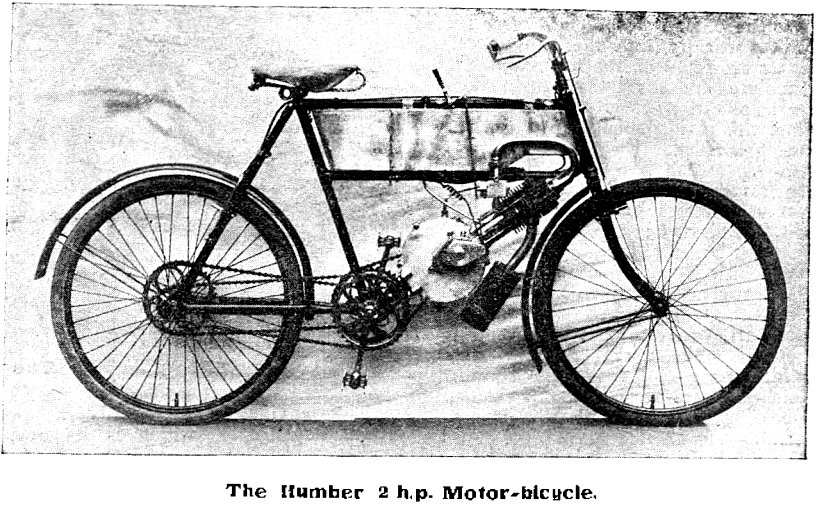
“PHOENIX MOTORS, of Blundell Street, Caledonian Road, London, N, besides showing their Trimos, light motorcycle and two-speed gear, make an interesting display of single-seated motor vehicles.The Phoenix motor-bicycle has a 2¾hp engine driving through a belt with a two-speed gear (at £55) or through a chain with single gear (at £50). A large silencer is used.Compactness has been secured throughout the whole of the machine without the sacrifice of any essential feature or loss of accessibility. The petrol tank is capacious, and compartments for two accumulators and coil and for oil are found in the case. The well-known sight-feed lubricator is fixed on the top tube. With large saddle, a capacious and well-filled tool-bag and a substantial stand and carrier the Phoenix is well-equipped. The show machine has the two-speed gear, the changing lever for which is on the top of the frame. The Phoenix tricycle is a very well-designed machine of a type introduced by this company.”
REX MOTOR CO, Coventry, display 12 of their latest motor-bicycles. The weight of the complete 3¼hp machine is 125lb: a step in the right direction. The frame has been lowered, and 26in wheels are now fitted; the surface carburetter has been discarded and a Longuemare is now added, this being enclosed in the tank. A high speed trembler coil is used for the ignition, and the manner of carrying out the general electrical arrangements will obviate any troubles. The air draught around the exhaust valve chamber is retained and a mechanical inlet valve completes the new design engine. An entirely new design of silencer is fitted, and its construction should lead to very effective results in getting rid of the exhaust quickly without back pressure. The other details which have proved successful on the 1904 model are retained, but where experience has suggested alteration the improvement necessary has been embodied.”
“WP BROUGH, KETTERING, shows the Marsh 3½hp machine. The engine is mounted in a cradle, and occupies part of the position usually fitted with the diagonal tube. Other features are flat belt transmission, spray carburetter, large silencer, duplex forks, ignition by coil and dry batteries and tensioning pulley for the belt. This machine is finished in two grades, one priced at £32, and the other at £36.”
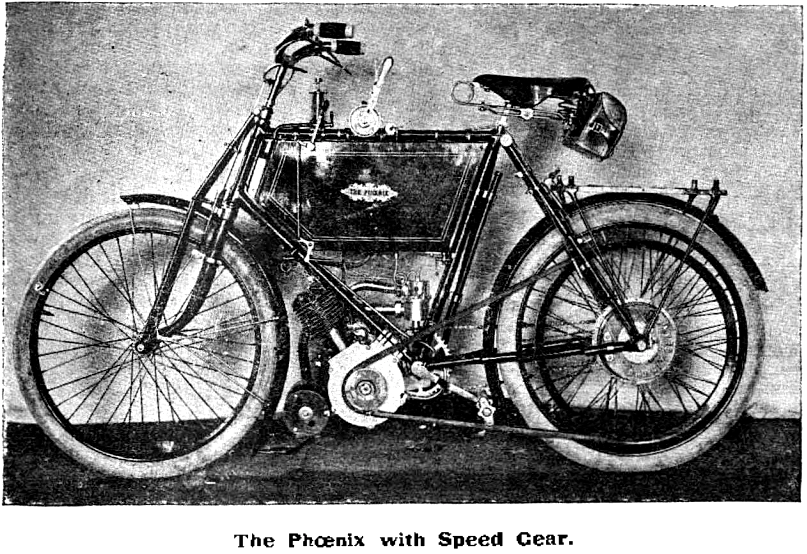
“THE NSU MOTOR & CYCLE CO show a series of motor-bicycles fitted with powerful engines from 2¾hp. The transmission is by V-section belt. A spray carburetter is used on all models, and either coil or magneto electric ignition can be had at option of purchaser. Two brakes are fitted on all models, the front wheel having a band brake fitted. A spring fork of original design is an interesting feature. The front wheel is carried on rockers, which are tensioned against flat springs. A water-cooled engine model shown looks an extremely fast though necessarily heavy mount. Other special features are the extra large petrol capacity provided, long wheel base, hinged back mudguard, and extended front guard.”
“WOLF MOTORS, MADE BY the Wearwell Motor Carriage Co, Wolverhampton, comprise a series of nicely finished motor-bicycles of 2½ and 3hp. There are several special features on the machines, which include the Bowden handle-bar control, and entirely new double-action front brake and switch, large and specially effective silencer, outside ball bearing to engine shaft. The engine cylinder and head are in one piece, and the carburetter is of the Longuemare type. Ignition is by trembler coil and accumulator, this being fitted in a separate case behind the tank. Duplex forks are fitted on all the models, as also is the Gripwell rear rim brake.”
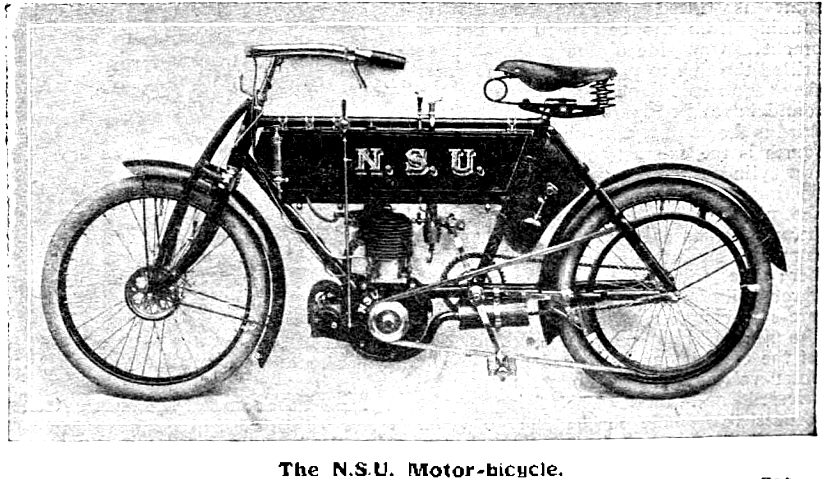
“THE ABINGDON WORKS CO, Shadwell Street, Birmingham, show a motor-bicycle built up from King Dick fittings. A special feature is the exceedingly strong front forks, with a new and easily detached fork end. A new engine of 2½hp, light-weight, and with mechanical inlet, looks a splendidly-finished piece of work. The cylinder and head are in one piece, and the position of the spark-plug is in the centre of the head.”
“AMONGST AN EXCELLENT ARRAY of motor-bicycles to be found on Messrs Bayliss, Thomas & Co’s stand, the new 3hp Excelsior, weighing 125lb, stands out prominently. This belt-driven model possesses several important improvements over the older types. The engine is now built vertically into the frame; all the levers are fitted on the spring and ratchet principle, and the Longuemare carburetter is placed transversely behind the engine, this arrangement, it is claimed, ensuring a constant level of the petrol. A two-way switch is attached to the top of the frame, and works in connection with two accumulators, which, with a trembler coil, are carried in a neatly-designed tank placed between the seat tube and the back stays. An improved oil and petrol tank also forms a feature of this machine—the lubricating oil being now carried in the fore part, where a sight feed pump is attached. These are just the principal points of a well-designed and beautifully finished motor-bicycle, which catches the eye of every visitor to this interesting stand. It is catalogued at £40.”
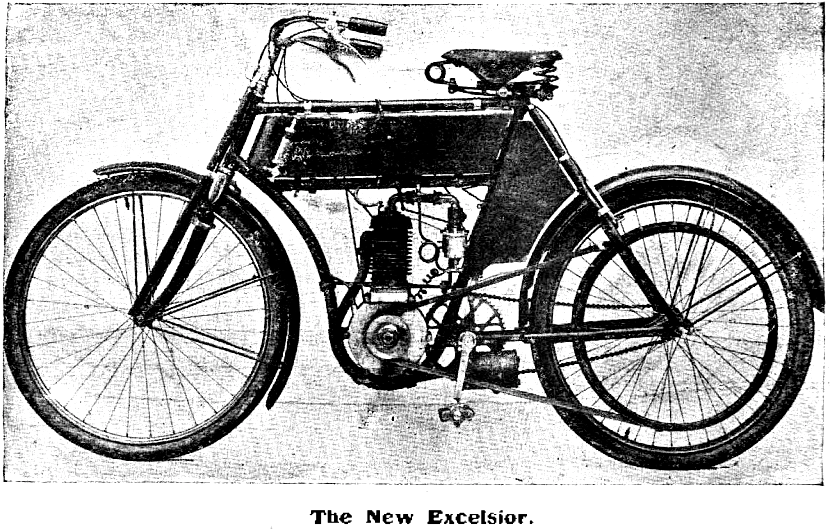
“THE ANGLIAN MOTOR CO, Beccles, Suffolk, show the No 1 and No 2 Anglian motor-bicycles. The No 1 has a 2¾hp De Dion engine and carburetter, and the No. 2 an Anglian engine, 2½hp. The special feature of both machines is the strength put into them. The 2½hp machine comes out at 100lb, with a double set of large accumulators. The Dunlop carburetter is fitted. Transmission is by V-belt. The 2¾hp machine is built up on a Chater Lea frame, and equipped as a strong touring mount, with 23in frame. The lighter machine has a 22in frame. Duplex forks, substantial and extended mudguards, large silencer, sight feed lubricator, 28in wheels, with 2in tyres, are other good features. The 2¾hp machine comes out at 42 guineas, and the 2½hp machine 34 guineas—a remarkably reasonable figure considering the first-class work put in.”
“HOBART BIRD & CO. The motor-bicycles made by this firm show improvements on last year’s pattern in many details. They are fitted with a new frame with the engine built in. The accumulators are fitted in a teak case at the back of the seat tube, and they are fitted with a new and very reliable contact breaker, a speciality of this firm, in which the contact spring does not vibrate.”
“THE STANDARD TYPE of machine exhibited by Chase Motors, Anerley, London, is a particularly well finished mount, and one special feature shown on one of the series is the high-tension magneto ignition fitted. This is a strongly built full roadster machine. The racer staged has a 2¾hp engine, geared specially low. It has duplex forks, V-belt drive, and, with torpedo-shaped tank, it weighs about 105lb. A remarkably simple and effective belt rim brake is fitted to all the machines.”

“THE SOUTH BRITISH TRADING CO. The new Vindec motorcycle, with the FN engine and Bosch magneto, or coil and accumulator ignition, as preferred, makes an attractive display. A great improvement is the adoption of the Truffault spring fork, which, whilst taking off all vibration, does not cause any unpleasant whip or rebound. Tanks are of brass of heavy gauge. Petrol and oil-level indicators are attached to the tank screwcaps, and a single-stroke pump, which merely requires pressing down, simplifies the once uncertain task of oiling up. The back wheel is now detachable without removing the stand—a little improvement of great convenience. A powerful band brake, the application of which cuts the current, is fitted.”
“GA BARNES, of Lewisham, stages two machines, one 2¾hp, priced at £45, and a 3½hp at £55. No pedals are fitted; the ignition lever is on the top bar, and all other control levers are brought up to handle-bar by Bowden wire connections.”
“GRIFFON MOTORS, of Upper St Martin’s Lane, WC, make an excellent display of the famous Griffon motorbicycles and the Zedel engines. The cycles are fitted with 2¾hp engines at £45, and the 3½hp engine at £45, the spring fork adding £2 to these prices. A very efficient carburetter feeds the engine through a mechanical valve, and the drive is taken through a V-belt of ample surface. The petrol tank is of large capacity, and is finished with rounded upper edges. The brakes both act on the rear wheel through flexible wire mechanism.”
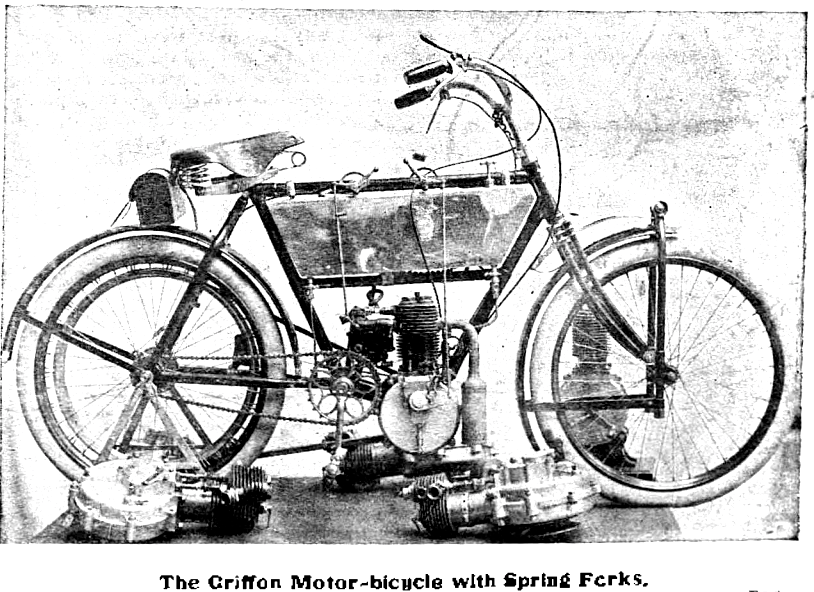
“THE RALEIGH CYCLE CO, Nottingham, show their 3hp Land’s End to John o’ Groats record model motorbicycle. The No 1 has a two-speed gear and chain drive and footrests, and No 2 has a belt drive and pedals. The No 1 has a very rigid triangulated frame, and both models have duplex forks. The two-speed gear is of the clutch type, providing a free engine. The ignition is by plain coil, and make and break. A novelty introduced on the No 1 Model is a cleverly designed spring handle-bar. The bar itself is movable in both places, as it works in guides against concealed spiral springs. The carburetter used is of the Longuemare type. Specially strong chains are used, and it is a noteworthy feature of both machines that they are immensely strong in all parts. The finish is of the best possible description. The No 1 machine, with two speeds, is priced at 57 guineas; and the No. 2 is 43 guineas.”
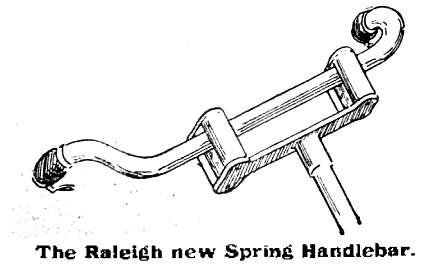
“THE ROVER CYCLE CO, of Coventry, are showing a couple of motorbicycles constructed upon the lines which have already made the Rover famous. The engine is of 3hp, and is carried in a cradle. It has mechanical valves, wipe contact, and is fed through the new Rover carburetter (Lewis’s patent), which makes for perfect mixture at all speeds and economy of spirit. A large silencer is employed, and a departure is made from the earlier pattern in that it is now placed forward of the engine instead of below the crank-case—in order to remove it from proximity with any petrol that might overflow from a flooded carburetter. Two accumulators and the coil are carried in the supplementary case behind the saddle tube. Each Rover is equipped with a firm tubular stand and luggage carrier, a large inflator, a complete kit of tools, and wide and long mudguards. Brake power is ample too, the chain-driven type having two rim brakes, and the belt-driven a front rim brake and a rear band brake, actuated by back-pedalling. The lower part of the belt on the former passes through a tubular guard, which shields it perfectly from falling wet or mud. The chain-driven motorcycle has a free engine clutch on the crank shaft of the engine. The drive is very smooth. The price of the belt-driven motor-bicycle is £50, chain drive being £5 more.”
“A FINE DISPLAY OF 1905 model motorbicycles is made by Werner Motors, Dean Street, London, W. Three powers are to be seen, viz, 2½, 3, and 3¼hp. Numerous detail improvements have been introduced. Chief amongst these is a new method of inlet valve control. In this arrangement the inlet valve is opened instead of the exhaust, and the throttle is simultaneously closed to avoid a back-fire. The carburetter is now placed outside the tank, instead of being enclosed as in last year’s models. Increased petrol tank capacity is provided, and all parts about the engine are readily accessible. The one-piece cylinder and head is retained, and automatic inlets have been substituted for the mechanical valve. Some of the models have free engines, electric governors, and handle-bar control devices as last year. The new spring fork shown is a capital innovation, being at once effective and light, and neat in appearance. Perhaps the most striking exhibit on this attractive stand is a new 3¼hp two-cylinder type. The cylinders are fitted parallel with the crank bracket, and it looks a remarkably neat and powerful engine. It is governed on the inlet, and has one coil for firing the two cylinders; this, by the way, being enclosed in the tank in all models. One exhaust pipe is used. It is noteworthy that a new and very pleasing finish has been introduced. This consists of the tank work being enamelled French grey with crimson lining, and the wheels and belt rim are enamelled a buff colour, which does not show up dust or mud.”
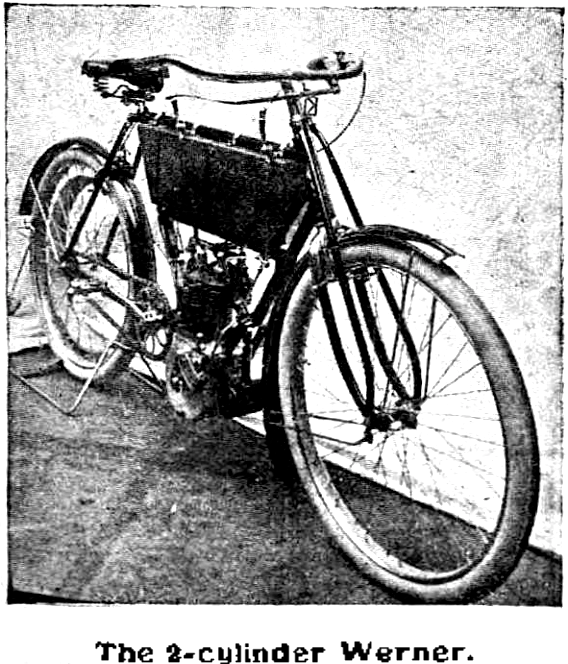
“THE MOTOR-BICYCLE SHOWN by FH Parkyn is not only reduced in price, but is improved in many details compared with their last year’s machine. It is 2¾hp, cylinder and head cast in one piece. The accumulators (two 20 amperes, Bluemel’s) are neatly fitted in a case between the seat pillar tube and the mudguard; by this method there is no shake between them and the case, and a two-way switch is fitted on the handlebar. The machine is well finished, fitted with good brakes, belt, forward extension mudguard, well stayed, girder forks, and is not heavy.”
“THE INTERNATIONAL ELECTRICAL ENGINEERING CO, Clun House, Surrey Street, Strand, London, show the CIE. motor-bicycles. A special 3hp model shown has high-tension magneto ignition fitted. This is driven from the two-to-one shaft by two bevel pinions. The transmission is by V-belt. The engine has a one-piece cylinder and head, mechanical valves and large radiators. The engine is fitted in a loop frame, and mounted vertically. Duplex front forks and large tank capacity are notable features. Two brakes are provided, the front one being a rim type and the rear one a powerful band. The tank work and engine are finished off in a dark oxidised colour; and control is by three levers, these being for the valve lifter, spark, and gas admission. The 3hp with coil ignition comes out at £32, and with magneto ignition at £33. A 4hp machine on similar lines is priced at £36 and £39 5s.”
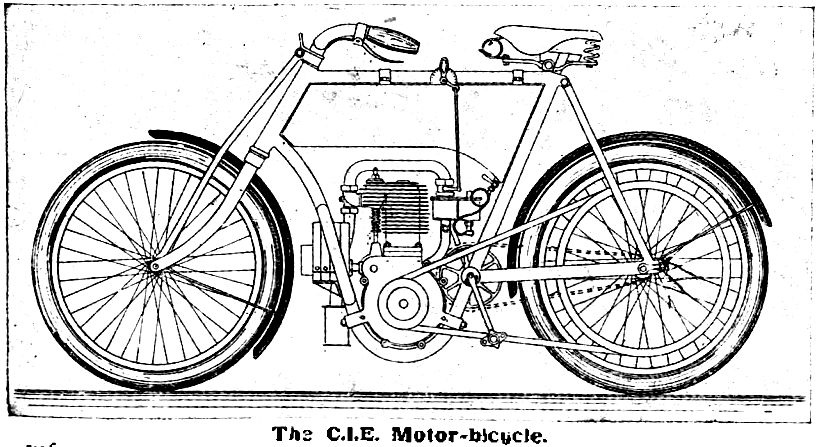
“MINERVA MOTORS, of 40, Holborn Viaduct, London, EC, are making a radical change of policy for next year, in that, besides making and vending motors for all kinds of motorcycle work, they are placing complete machines on the market. Three types are being catalogued, whilst each type is capable of being varied in certain respects. The types are the 2hp machine at £27, the 2¾hp at £29, and the 3½hp at £32. The additions are the spring fork at £2 10s, magneto ignition at £7 10s, and the two-speed gear at £5. These can be fitted to all three types, with the sole exception that the two-speed gear can only be supplied in connection with the 2¾hp machine. A lady’s motor-bicycle on show has the 2hp engine clamped on to the main down tube. The upper part of the frame is of the drop pattern, well stayed. The drive is by V-belt. The petrol tank, accumulator, and coil are fixed in the rear part of the frame. The control levers are fixed near the head. A spray carburetter is used. This change of policy is rather drastic, but many agents will appreciate being able to obtain well-designed and well-made machines bearing a known and respected name, and being able to sell them with confidence, and so save all the trouble and anxiety attendant upon manufacture (or, rather, assembling) on a small scale. The Minerva motor-bicycles are well and soundly constructed, and are in every sense as good as the Minerva motor. The Minerva cycle motor does not show any great changes, but the two-speed gear, the magneto ignition, and the spring fork are features that will still further add to the popularity of the Minerva engine. The change speed gear is provided by a couple of belt pulleys on the engine shaft constantly running, one at the normal speed of the crank shaft (being, in fact, a fixture on the crank shaft), and the other running at a speed 10% slower than the crank shaft, the reduction in speed being effected through a sun-and-planet gear. By means of a fork the belt can be shifted from one pulley to the other, a wide driven pulley allowing the belt to align itself. The magneto is a high-tension Eisemann, driven through an exceedingly clever double eccentric driving shaft, which is encased, and so is particularly suited to cycle work. The spring fork is a very efficient device, which entirely obviates any side play of the wheel whilst insulating the frame from all road shocks.”
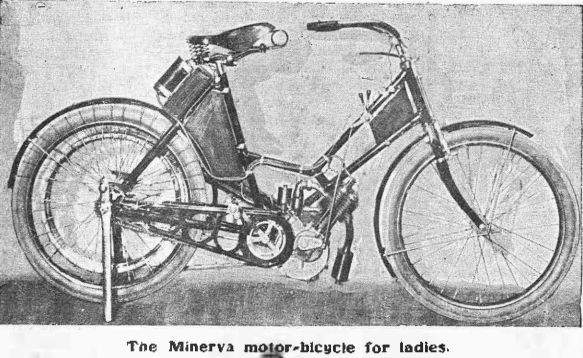
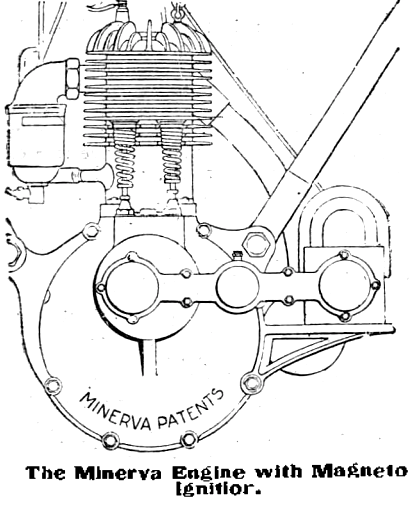
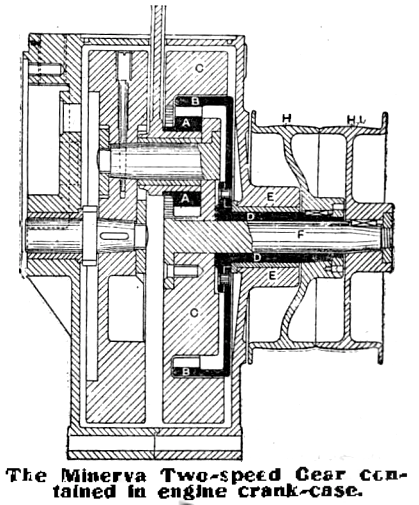
“W KING & CO , CAMBRIDGE—One of the noticeable features of the motor-bicycle exhibited by this firm is the fitting of the gauges to show the levels of the oil and petrol in the respective tanks, which are let into the bodies of the tanks, and are thus protected. The two accumulators are well fitted in a wood case, preventing shaking or breaking. The machines are British made throughout, having Mason and Brown’s switch, Lycett’s V-section belt of ample size, Bowden exhaust valve lifter, EIC coil, and 2¼ Dunlop, Warwick, or Clincher tyres. The fittings are Chater Lea, with an Eadie back hub, which is wider than last year, and fitted with larger balls and stronger spindle.”
“BROWN BROS. SEVERAL MOTORCYCLES were shown by this firm. The one to which most attention was attracted is an all-English machine of 3hp (80x80mm) with MOV, having a Forman engine, EIC commutator, EIC trembler coil, Bowden exhaust valve lifter, Bowden back brake, Brown and Barlow carburetter, and 4in mudguards. Any English tyres are fitted to suit customers’ wishes. These machines are very, carefully made, the frames are reinforced at all vital parts, the front fork is triply strengthened by the extension of the forks upwards and a pair of girder tubes. The belt rim is attached direct to tyre rim by double tangent spokes. This firm, for a small extra charge, will fit a free-engine clutch. Two other machines are shown, 2¾hp and 3½hp, but these are not entirely English, having Longuemare carburetters. All the machines have extra large flywheels, two sets of accumulators, and are quite up-to-date in every respect.”
“WR McTAGGART, 48, WELLS STREET, London, W, show the 1905 FN touring bicycle, which is one of the most striking departures in motor-bicycle construction yet introduced. The motor has four cylinders of about 1¾in bore, and the transmission is by shaft and bevel gear on to the rear wheel. The whole gear is cased in. The engine is 3½hp, and is mounted with the cylinders and crank-case in line with the plane of the machine. A spring clutch is placed in between the shaft and first pair of gears. The driving shaft is carried through the right side chain stay. The inlets are of the automatic type connecting up to one supply pipe and small FN carburetter. The ignition is effected by the Simms-Bosch high-tension magneto and distributor. There is an automatic sight feed lubricator to the four cranks and cylinders. The engine is bolted to a special cradle between the head and diagonal. A new spring fork is also fitted, the wheel being carried on an auxiliary pair of forks controlled by a central spring. Splendid workmanship throughout is a strong feature.”
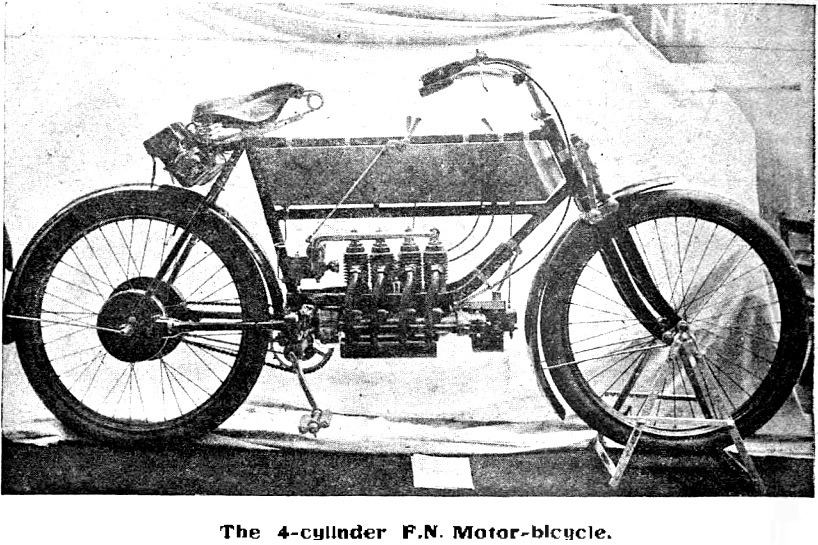
“RICHARDS’ BEAU IDEAL stage two motor-bicycles with 3hp Fafnir engines and FN carburetters. The petrol pipe is closed by a screw-down valve. The whole of the top tank space is devoted to oil and petrol, the accumulator and coil being carried in separate metal boxes behind the down tube. The details follow accepted practice, and the whole design denotes forethought in the details. The price is £38.”
“AW WALL. THE ROC MACHINES have many characteristics peculiar to them. The machines are low built. The belt rim is an aluminium casting, fitted with a friction clutch, by which it can be connected to the axle of the rear wheel, which is a live one, running in bearings carried by the fork ends. The road wheel is built on a sleeve on this live axle, and may be connected to or disconnected from the belt rim by the clutch. This clutch is controlled by the foot by means of a lever pivoted at its rear end to the back of the frame, the said lever acting against a rod passing through the hollow live axle. The front end of this controlling lever is guided by a cross tube which acts as a foot rest, a suitable support being provided to retain the lever with the clutch in action. In traffic riding the controlling lever may be easily moved into and out of the operative positions by the heel. On the opposite side to the clutch lever is a brake lever operated by the other foot, the brake acting on the rear wheel. A lady’s machine, well fitted with belt and other guards, built for Miss Connie Ediss, is also on view. It has very comfortable rubber-covered foot rests, and, being low built, is specially suitable for ladies.”
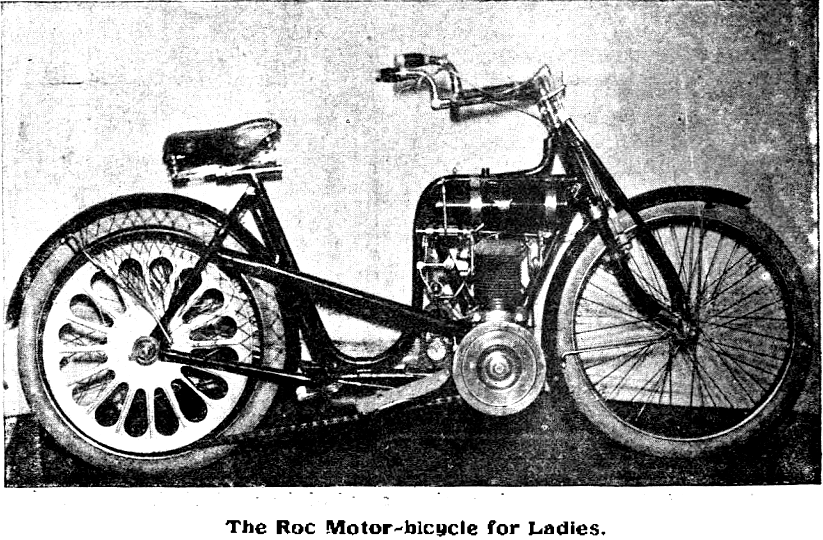
“THE BAT MOTOR CO, Beckenham Road, Penge, show a series of motor-bicycles, 2¾ and 3½hp. There are a number of detail improvements, but on the whole the machines remain as last season. An improved front brake of great power is fitted, and pedals can be fitted to any model if desired. The accumulator case is now fitted lower down at the back of the engine. The rear-wheel hub is fitted with a band brake. A Longuemare carburetter and trembler coil are fitted. The duplex front fork have been improved in the way of strength, and they can also be detached readily. The No 1 Bat, with pedals, is priced at £46 10s. The spring frame Bat, with 3½hp engine, is £55.”
“THE MOST ORIGINAL design of engine in the entire exhibit of bicycle motors—in fact the most radical novelty that has been introduced since internal combustion motors were first manufactured, is the 4hp revolving motor shown by the Barry Motor Co, Ton Pentre, Glamorgan. The engine is a two-cylinder, each cylinder being 2in bore by 2in stroke. The main features of this motor are that it acts as its own fly-wheel—the cylinders being directly opposed to one another, and united in a diagonally halved, and gas-tight crank-chamber—that it is self-cooling without ribs or jacketing of any sort, because its revolving motion induces a sharp draught through the perforated casing in which it is enclosed; and that the mixture is automatically forced to each cylinder by the combined action of the front ends of the pistons, non-return valves in the crank-case, and a small pressure-chamber connected with the latter, from which the induction pipes lead to their respective cylinders. One end of the crank-shaft is bored hollow to about ¾in. diameter, and united in a free joint to an ordinary float-feed carburetter mounted on the central stay of the bicycle-frame. It contains a non-return AO valve, so that when the pistons fly apart on their in-stroke they draw enough mixture for two charges into the crank-chamber. These two charges are next compressed on the out-stroke of the pistons, and forced through a second non-return AO valve into the pressure reservoir (at right-angles to the shaft and cylinders, but in the same plane as the latter) ready to be admitted to either cylinder as one or other MO inlet opens. Both inlet and exhaust-valves of each cylinder are mechanically operated from the usual double cam on the short sleeve which carries the half-time gear, and is itself mounted on a short stud on the cylinder. Thus each gear rotates upon, instead of being driven by, the smaller gear on the crank-shaft; as the combustion effort in each cylinder acts centrifugally to
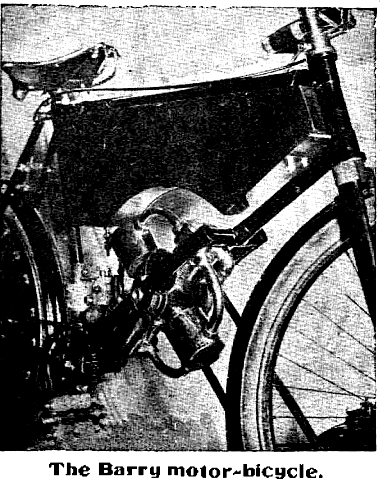
rotate the whole motor. Furthermore, the ignition in each cylinder is automatically induced by the rotation of the motor; that is to say, there is no commutator, other than an insulated strip of metal mounted in the casing in electrical connection with the usual contact-breaker on the other end of the shaft; a short leaf spring from each sparking-plug—which is inserted in much the usual situation—making momentary contact with the strip as it runs past it, and conveying the HT current to its plug. Thus all wiring and ignition troubles are eliminated, for as the casing protects the whole motor, short circuits through moisture or defective insulation is impossible. Lubrication is by gravity-feed through the end of the crank-shaft, which is bored out into the crank-arms, pins and journals, with the usual leads and cross borings. The exhaust from each cylinder is led into a common silencing chamber, opposite to, and of the same size and weight as, the storage chamber. The weight of the whole motor is 15lb. only, or 3¾lb. per bhp, and it is claimed that the whole arrangement can be duplicated or triplicated for motors of larger size and power. Where it is desirable, as in a boat installation, to keep the shaft axis low, short-stroke cylinders may be mounted. And, owing to the whole of the power being stored, fly-wheel fashion, by the centrifugal effort of each cylinder mass during successive working strokes, no vibration—which is merely the outcome of lost energy—can possibly occur. This result, too, may be somewhat assisted by the cushioning effect of the crank-case compression; which last also prevents condensation, no matter how low the temperature induced around the motor, because the charge is alternately maintained in tension and compression. Altogether, the Barry motor is the most essentially original, simple and apparently efficient product of the modern motor industry.”

“THE SELF-SEALING AIR-TUBE CO, Hinckley Street, Birmingham, are showing their well-known air-tubes for voiturettes and motor-bicycles. One of their specialities is a detachable joint air-tube composed solely of rubber. In non-slipping tyres, a new double zig-zag tread is a novelty.”
“PERFECTA CLUTCH CO, Coventry. In the past free-wheels for motorcycles have not been entirely satisfactory. This firm have now put on the market a ‘motor clutch’ having four powerful pawls, two of which are in action at a time. These pawls engage with deep rack teeth, and are held in engagement by long springs of large diameter capable of standing constant free-wheeling to which they are subjected. A buffer is introduced between the spring and pawl which reduces friction and lengthens the life of the spring.”
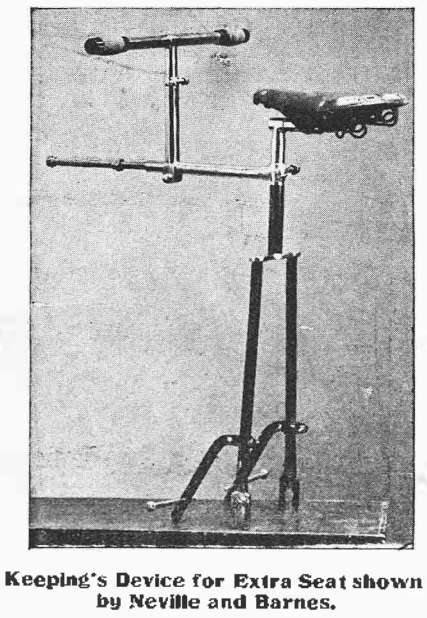
“MESSRS O&W ORMEROD, Rochdale, have a most interesting exhibit of their well-known Watawata belts, which have been used in various competitions during the past year, including the 1,000 miles Reliability Trials and the ‘Brown’ Trophy contest. An educative apparatus consists of two pulleys, over which are respectively hung a Watawata belt and a solid belt of equal strength, the former under tension from a half-pound weight, the latter from a 10-pound weight. Needless to say the Watawata belt shows more flexibility than the solid belt.”
“THE BRITISH CHICAGO RAWHIDE Manufacturing Co, of 6, Dowgate Hill, EC, show samples of Chicago rawhide leather applied to motorcycle belting. This leather is manufactured at the firm’s Birkenhead works by a process devoid of limes and acids. By the method employed, the hide fibre is retained practically in its natural state, and the leather is therefore not dried or hardened, but remains soft and pliable. It is claimed for this leather that it is immensely strong, extremely durable, and has no ‘slip’. This firm also shows an auto tyre-sleeve, which, being made of flexible hard Chicago rawhide, is puncture-proof, and moulded to the shape of the tyre, so as to fit perfectly when adjusted.”
“THE PRESTED ELECTRIC LAMP CO, Elthorne Road, Holloway, London, N, have a fine display of the well-known Prested accumulators, a type of cell which has of late earned great popularity. It is a very light cell, and from the special composition of the plates gives a remarkably high capacity. Celluloid separators are fitted between the plates, rendering short circuits impossible. A simple and effective pole finder has recently been placed on the market by the company. It consists of two short rods of lead supported on an ebonite base and with terminals affixed. It can be placed in any vessel containing dilute acid, and when connected up it shows the positive pole by one of the lead rods turning a brown colour. It is to be sold, we understand, at 1s 6d.”
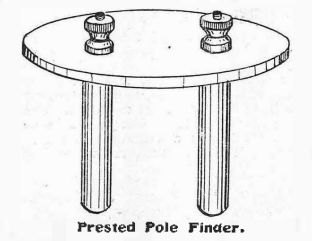
“THE LEATHERIES, of Birmingham, make a speciality of cycle saddlery, and show a comprehensive collection of saddles, leggings, motor bags, tool-bags, gear-cases, and mud flaps. The British Pattisson hygienic saddle in various varieties is displayed here. The Empire toolbag is a neat article. The method of fastening and opening this bag does away with straps, buckles, or locks, it being fastened by a rubber ring connected with a silk cord, the action of attaching the rubber ring to the stud automatically closing the bag. Another good line is the motor mud flap, which is easily fixed on mudguards with two adjustable screws. The Lowenthal automatical saddle is well worth examination.”
“FULLER, MACLEOD & CO, 9, Red Lion Court, Cannon Street, London, EC, show the popular Hellesen dry battery for ignition of car and cycle engines. A very small and useful spare cell, giving 4½ volts, will appeal to motorcyclists. It can be carried in the pocket, and in case the accumulators run out it can be used to run 50 miles or so. It weighs about 1lb…A good line of voltmeters, ammeters, switches, lamps, wires, and cables are also shown. A new motorcycle radiator for a water-cooled engine is an interesting feature. It is suitable for a 4hp motor, and from its construction, should prove highly effective.”

” SMITH’S O’ SALTLEY. A wall-case contains a set of motor fittings, the bends for chain and back stays being heavy castings and of U-shaped section. The fork ends and all parts are extremely massive, and the set is designed to suit any size or power of engine.”
“C LOHMANN shows the new Perfecta motorcycle lamp, which has been further strengthened and improved in finish. This is one of the few lamps that will successfully stand motorcycle vibration. The Duro motor tyre, guaranteed for 12 months, makes its appearance for the first time in this country, the market being now freed by the expiry of the Bartlett patent. Motorcar lamps are also here, as well as horns, goggles in mica and aluminium, and accessories too numerous to detail.”
“HO WASS & COCKS, West Ealing. The Gripwell motor brake for motorcycles is shown at this company’s stand. It consists of a lever, which is pivoted to the fork by means of a swivel clip, thereby enabling it to fit various makes of machines. The rear end of the lever carries the brake block, which has a V-shaped surface to fit the belt rim between the upper and lower straight portions of the belt. The front of the lever carries a spring pawl, which gives way to allow the crank to pass, but which is caught by the crank in back-pedalling. This pawl may be turned up to allow the machine to be wheeled backwards. The brake is also made for use on chain-driven motorcycles, when a small brake rim is specially fitted on the pedal chain side of the machine.”

“LYCETT’S. THE RAWIDE V-BELTING is a prominent exhibit, and there are all the usual array of saddles, including a new pattern with four coils, which is strong but light. An acid-resisting accumulator case is a boon and a blessing to be seen and appreciated, and the well known Lightning stand, which is raised and lowered by the simple pressing of a stud, is also on view. The vexed question of motor tool-bags should be settled finally by the advent of the B bag, which is of good capacity and metal lined. Some of the patterns are provided with a lock, which will save the annoyance of lost, stolen, or strayed tools.”
“AT THE STAND OCCUPIED by Mabon Motors, Clerkenwell Road, EC, the Opperman three-speed gear and clutch for cars, and the two-speed variety for motorcycles may be thoroughly examined, as the gears are shown in pieces. The principal features of the gear are that the toothed wheels are always in mesh; it may be changed without difficulty; and between each change the gear runs free.”
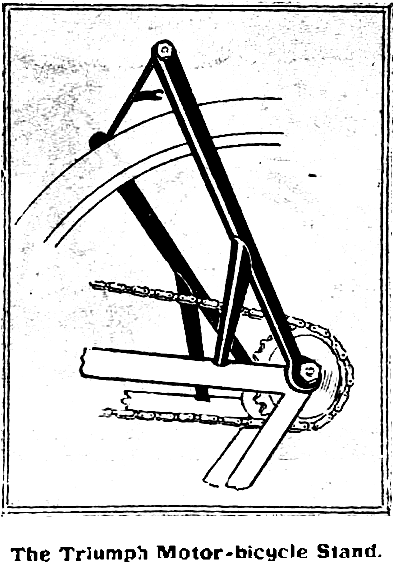
“SAWYER & CO, KENSAL RISE, London, are displaying a number of their non-skid bands for tyres. These bands are supplied separately or with the tyre complete, being vulcanised to an intermediate band which will be of great interest to all visitors.”
“JOS LUCAS. THIS FIRM IS exhibiting at the old and well-known corner of the gallery a large selection of lamps, lamp brackets, oils, carbide, bells, horns, pumps, carriers, luggage bags, oil cans, funnels, repair outfits, tool bags, saddles, etc. Many of the articles have been improved and brought up-to-date, but other articles appear to have reached perfection some years ago. A welcome improvement is the removal of the number-plate from the front of the glass. The lamp is now provided with a hood, which reflects the light downwards on to the double number plates, which are carried by a mud guard extension. These plates meet at the upper edges and open outwards at their bases, so that each plate receives the reflected light. The company also supplies a suitably-stayed mudguard with the number-plates attached.”
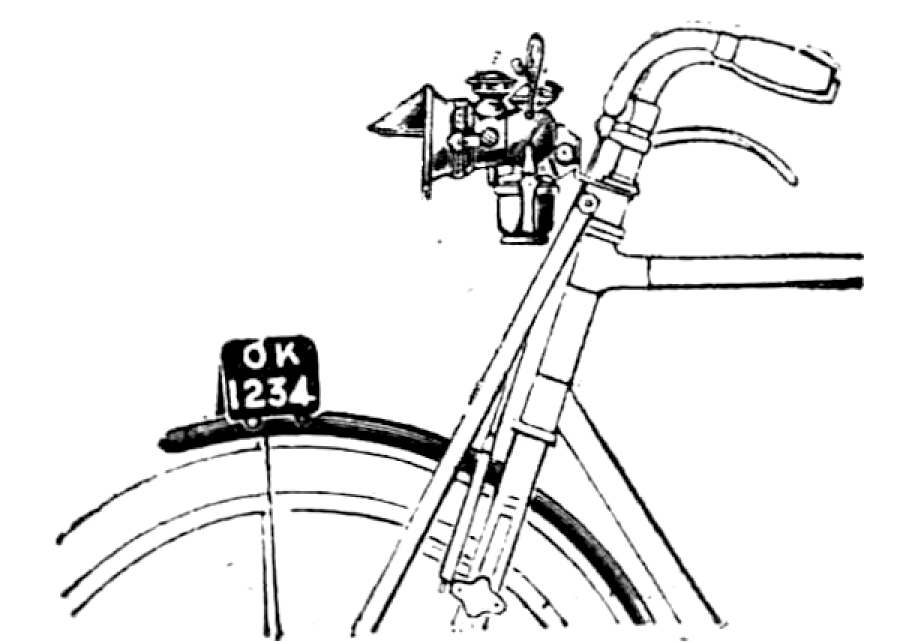
“COMPONENTS, OF BOURNBROOK, BIRMINGHAM, is a firm which bears an honoured name in the cycle and motor world, and one naturally looks for an unusual degree of excellence in the wares which are on view at their stand. This anticipation does not provoke disappointment. Among the many items which are offered for inspection are a complete range of the various Fleet models. The complete machines are shown, several of them being fitted with the Crabbe two-speed gear, which is a very satisfactory and perfect contrivance. Three motor-bicycles are also on view with varying horse-power. These mounts are obviously carefully designed and efficiently constructed. Other exhibits of the firm are Liberty tyres, as well as the other Liberty specialities such as tyres, brakes, hubs, free-wheels, clutches, pedals, etc.”
“MASON & BROWN, Rutland Street, Leicester, show some interesting electrical accessories, including the well-known M&B two-way handle-bar switch, ammeters, voltmeters, plugs, contact breakers, test lamps, etc. A new accumulator shown is made on good principles, being well protected from short circuits. The Spalding belt shown is specially made to bend easily round the pulley, the under layer being made in sections. This belt comes out at a remarkably cheap rate.”
“COULTHARD & CO, CARLISLE, show a new non-skidding tyre for motorcycles. The tread has a series of projections or studs of rubber on the sides, and these only come in contact with the road in the event of a tendency to skid. The actual tread of the tyre is plain. The patent has had a very extensive test of two years, and has given every satisfaction. The price of the new tyre is very little more than that of any high-grade tyre.”
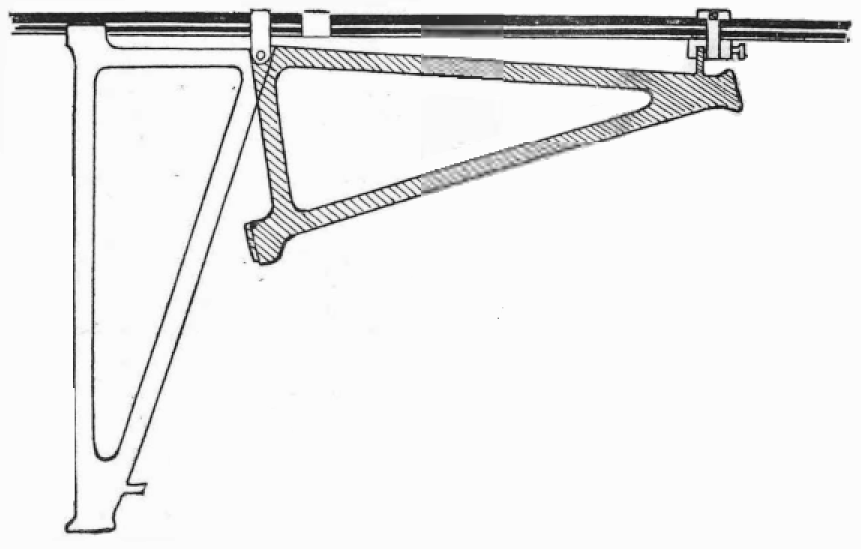
MESSRS BROWN & BARLOW, Birmingham, show carburetters, float chambers, needles, etc. These well known carburetters are wholly made from solid brass bars, and have very thin but strong walls. The spraying chamber is fitted with a jacket which can be connected up to the exhaust if the carburetter is some distance from the engine. Another type is fitted with constant air lift, but adjustable spraying nozzle. Every part can be fitted at any desired angle. A new type of two-way switch is a special feature.”
“JAS DAWSON & SON, Lincoln. The name Lincona is a household word in the motorcycling world, this being the name given to the V-belt so largely used for driving purposes. It is made in two sizes—the Standard, for machines up to about 2¾hp, and the Magna, for bicycles with trailers, fore-carriages, side-cars, etc, of larger power. The leather used in the belting is a specially-prepared production, having an unusually high tensile strength. It is mainly to its non-stretching qualities, however, that its great popularity is due. Belt fasteners and punches are also shown by Messrs. Dawson, a report of whose exhibit would not be complete without a reference to the Lincona belt dressing. The life of a belt depends largely on the treatment it receives, and it is with the view of increasing this that frequent applications of this special dressing are recommended.”

“MESSRS JOHN CHAPMAN & CO, of 18-22, Fann Street, Aldersgate Street, London, EC, are displaying a couple of novelties in the shape of an expanding pulley for motorcycles and an enclosed fan for air-cooled motors. The pulley is expanded or contracted by the movement of a single lever, all the mechanism being contained in the pulley itself. It can be fitted in the place of any existing pulley without any alteration or disturbance. The device is well designed and most workmanlike in construction. To take up the slack of the belt when the pulley is contracted a jockey pulley is provided, and the power thus absorbed, although small, is utilised for the purpose of driving the rotary enclosed fam which projects a powerful blast of cold air on to the cylinder of the engine. The fan is most efficient and should have a large sale separately as well as in combination with the pulley.”
PHOENIX MOTORS, BLUNDELL Street, Caledonian Road, London, N, show their two-speed gear in working model form. As is well known, the Crypto system of cog-wheels always in mesh is employed to secure a low gear for starting purposes or for hill climbing. The power can be let in very sweetly, because a leather-faced clutch is employed, and thus there is an entire absence of shock in starting. Nor can the clutch be let in sharply and so cause jar or shock. By means of a short lever carried on a quadrant on the top tube of the frame, operating through cable wire, the clutch can be thrown out and a free engine obtained. Then a further movement of the lever Locks, by means of face dogs, the two parts of the gear together, and a high gear for level roads and moderate gradients is secured.”


“NO ONE INTERESTED in the evolution of the motorcycle will deny that the Show at the Agricultural Hall was a very noteworthy one, perhaps the most noteworthy of any of the series that has so far been held, and it will, I think, be of interest to give a brief summary of some of the main mechanical features of the machines exhibited, and to indicate broadly the constructional tendencies of the time.
The Engine: Turning first to engine construction, I noted a well-marked inclination to adopt multi-cylinder engines. Several firms of standing staged both bicycles and tri-cars fitted with two-cylinder engines, whilst one manufacturer of established reputation showed a four-cylinder bicycle. In one case where the two-cylinder type was fitted the cylinders were cast in one piece, parallel to one another, and placed transversely to the frame, but the construction most in favour is that in which the cylinders form a V-shape with the crank-case, and are placed longitudinally. In two instances the engine was placed horizontally. Generally I noted a tendency to fit multi-cylinder air-cooled engines (at any rate, for bicycles) in preference to single cylinders of large size, with the necessary added complication of induced draught or water-cooling. Automatic and mechanical inlet valves, about the respective virtues of which there has been so much controversy, were pretty equally represented. The outside fly-wheel had only one or two exponents, whilst the two-stroke motor was a conspicuous absentee. The Cooling System: In many instances, as far as bicycles are concerned, the old, somewhat haphazard system of air-cooling, without any provision for securing a specially keen draught upon the cylinder head, is retained. This has been found efficient enough, in the hands of careful drivers, with engines up to 3-3½hp, but with engines of larger size, or where tri-cars are concerned, the induced draught by means of a fan, or else water-cooling, has been found necessary. Ignition: Magneto electric ignition, brought within the last two years to such a high state of perfection, was fairly well in evidence, but most makers still seem to prefer the accumulator system. I noted amongst such a persistent and regrettable tendency to supply accommodation for only one accumulator, but several of the best makers, I was pleased to see, continue to fit two accumulators, a point which will be appreciated by all experienced motorcyclists. The trembler coil with wipe contact, and the plain (non-trembler) coil with make-and-break contact, were both well represented, the make-and-break variety being, if anything, in the majority. Carburation: The spray carburetter was fitted almost universally, one well-known make being particularly (and deservedly) popular. The surface carburetter is, to all intents and purposes, dead, its demise being, no doubt, largely due to the deterioration in the quality of petrol during the past eighteen months. Transmission: Whilst I note a growing tendency for the ordinary motor-bicycle to be fitted with a free engine, if not with a two-speed gear as well, the V-shaped belt and single gear was well represented. This is a transmission deservedly popular for its efficiency and simplicity.Tyres: It is to be regretted that many of the machines, particularly the tri-cars, were fitted with tyres of insufficient size. It should never be forgotten that given a pneumatic tyre of sufficient or, indeed, of excessive size, and a careful driver, the popular and very real bogey of tyre unreliability will be practically eliminated. Small tyres on even an ordinary motorcycle of medium weight are bound to give trouble and dissatisfaction sooner or later. The Show, as a whole, was essentially the apotheosis of high power. Finally, the impression left by a visit to the Agricultural Hall is that motorcycles tend to become differentiated into three classes—(a) single-cylinder bicycles of 2½-3½hp air-cooled and belt-driven, with one gear; (b) multi cylinder bicycles, air-cooled, with one or two gears, and belt, chain, worm, or bevel drive; (c) tri-cars with single or double water-cooled cylinders, with two or three gears and chain, worm, or bevel drive.—EJW“
“AN IMPORTANT FEATURE of the Stanley Show was the holding of a conference representing motor and cycle organisations to discuss the question of universal lighting. The conference decided to take immediate steps towards the introduction of a measure compelling every vehicle to show a white light in front and a red light behind.”
“THE EADIE MANUFACTURING CO. The popular Eadie coaster hub is now made in an extra strong and substantial pattern for motorcycle work; almost any chainline can be supplied to fit various frames. The Hyde clutch is also made in motor size. Two motorcycle frames are shown, one for vertical engines, built into the frame, and one for inclined, which are hung on to a specially heavy lug. The registered design of front fork is of excellent structure, which leaves no room for doubt as to its stability under the heaviest loads, and a good point in its design is that the girders are carried well forward to clear the tank when turning.”
“MESSRS ELLIOTT, HALLAS, & SON, of Huddersfield, are showing samples of their V-shaped belts for motorcycle work. They are made in two qualities with three sizes in each quality. The Hallas belt is made from three plies of the best raw hide, each strip being without any joint and all the initial stretch has been carefully taken out of the material. These belts have been most severely tried in some of the recent classic events and have acquitted themselves admirably. Without doubt the Hallas belt is entitled to rank with the very best for motorcycle purposes.”
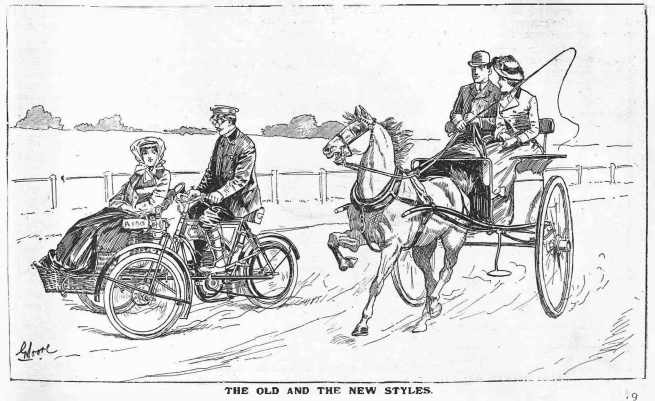
“CROYDON MOTOR CLUB. The annual non-stop run in connection with the above club was from Brighton and back, a distance of 80 miles. The first award was the president’s silver cup and special gold medal, the second prize being a gold medal. There were nine entries, but in consequence of the unfavourable road condition the starters were reduced to five. Mr CW Brown, acting as starter and timekeeper, gave the word ‘go’ soon after 8am, the riders being Messrs Martin, Steel, and the brothers Bradbury. The first to drop out was Mr F Bradbury, who retired at Crawley on the outward journey, whilst his brother gave up the contest soon after leaving Patcham on the return. Messrs Martin and Steel, who were mounted on the Excelsior and Rover motorcycles respectively, completed the journey, each gaining the maximum number of marks. A second round over the same course was therefore necessary. This was immediately undertaken, the result being almost the same, except that Mr EJ Steel was compelled to dismount at Dale Hill to avoid a herd of cows, for which one mark was deducted. The holder therefore retains the ‘Brown’ trophy and secures the special prize. The second award, of course, went to EJ Steel.”

“MOTOR-BICYCLES FOR MILITARY USE. An American military expert, General Baldwin, has put forward a strong recommendation to the War Department in favour of instituting a series of trials to find out whether the motorcycle is likely to be of use in warfare. It is not, however, expected that the recommendation will be favourably treated by the authorities. Recent experiments with the pedal-bicycle have not been so successful in America as in other countries; and, curiously enough, the War Department of the most go-ahead nation of the day is singularly lacking in energy and enterprise.”
“AN AMERICAN SPEEDOMETER. The Jones ‘Speedometer’, an American device for registering the speed of a motorcar or a cycle, has been adopted by the Metropolitan Police Department of Washington (District of Columbia) and seems to have given great satisfaction.”
THERE CAN BE NO question that the success of the two-seated motorcycle—be it fore-car, side-car, or tandem—very largely depends on the application of a two-speed gear that will have the essential features of high efficiency as a piece of mechanism, long life, and wearing capabilities, compactness, minimum weight, least possible number of parts, and non-liability to derangement. It is not a little surprising that such comparatively small progress has been made in the direction of adapting two-speed gears, the more so when one considers that some very practical variable speed gears are in use on ordinary cycles.”
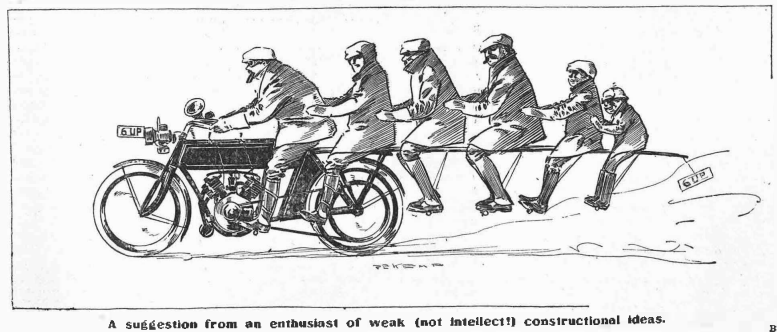
“MOTORCYCLIST ASCENDS THE GREAT ORME’S HEAD. On Saturday, October 29th, Mr J Edge, of Liverpool, succeeded in riding to the top of the Orme’s Head on his 4hp Bat. The ascent had previously been made only by a 60hp Mercedes and a Lanchester car. Mr. Edge started his machine at the railway terminus, and easily mounted the first slope, which has a gradient of 1 in 12 at the start, and this quickly steepens till a 100-yard stretch of 1 in 3½ is reached. After this the rider followed the old quarry road for some distance, all the time mounting up a gradient of about 1 in 8. A cart track only three feet in width was the next stage of the ride, and here the machine stuck in a rut and threw the rider to the ground. With the assistance of several bystanders Mr Edge quickly got off again, and after a short climb up a grass-covered slope reached the summit. The total length of the road was about a mile, the gradient varying from 1 in 20 to 1 in 3. The machine was geared 5¾ to 1, and a Watawata belt was used. The 2¼in Palmer tyres were fitted with Parsons’ non-skid attachments, otherwise the ascent of the slippery grass slope at the finish would have been impossible. Mr Edge is very jubilant at his success, and is quite ready to repeat the performance.”

“‘HONI SOIT QUI MAL Y PENSE!’ Dorsetshire motorists are agitating for an alteration of their present registration letters. It is stated that the county funds suffer a considerable loss owing to the objection of Dorsetshire owners to register their cars in the county. Many resort to the neighbouring counties of Somerset and Hants, and even to London, rather than adopt the present Dorsetshire lettering— which, by the way, is BF.”
“HUNGARY IS RECOMMENDED as a good country for a motor holiday. Straight wide roads, generally with good surface, abound. Petrol is readily obtainable in the large towns, though not always in the villages.”
“THIS IS THE TIME of year when the cycle tracks are besieged by motorcycle record breakers, and GA Barnes and H Martin have set the ball roiling by sharing between them the new record figures from 33 to 100 miles. The performances were accomplished at Canning Town on Friday, October 28th, Martin, as usual, riding an Excelsior, and Barnes a machine of his own make. It should be mentioned, however, that Martin’s mount was of an-old type, with surface carburetter, and fitted with mudguards and brake. Barnes was the first to go, and he got inside record at 33 miles. From that point onwards, he established new figures up to 50 miles, and beat his own one hour record en route. The previous best for 50 miles was made by TE Newman (Chase), at Canning Town, on November 18th, 1903. The principal times in Barnes’s ride were:—One mile, 1min. 19⅕sec; five miles, 5 min 55sec; 10 miles, 11min 50⅘sec; 25 miles, 29min 53sec; 50 miles, 60min 42⅖sec. Barnes’ new hour record is now 49 miles 800 yards. Delayed somewhat by Barnes’ ride, it looked as though Martin would not finish his task in daylight, and indeed it was almost dark when he completed the 100 miles. So much so, in fact, that Mr AV Ebblewhite, who timed on both occasions, had to strain his eyes to see the rider cross the line. Martin’s times, all records, were:—51 miles, 1hr 8min 39sec; 75 miles, 1 hr 45min 13⅖sec; 100 miles, 2hr 21min 45sec. Martin’s distance for two hours was 85 miles 1,680 yards.”

“MOTORCYCLING IN SOUTH AFRICA. A Johannesburg correspondent sends us a few interesting details about the annual motor-bicycle race from Johannesburg to Pretoria and back for the ‘Gordon Stuart Cup’, which was run off last September. The cup has to be won three times before it becomes the property of the winner, and the winner of each year receives a gold medal. This year’s race was won by R Murkett, who beat the record by eight minutes on a 2¾hp Royal Shimwell Bros, motor. His full time was 3hr 10min 45sec. The second man in (Chater) rode a similar machine; and the third man (Halscomb) was on a 3hp Rover. Considering the terrible roads, and the fact that two small rivers had to be crossed each way, the race was a fine test of reliability both of machine and man. Mr Murkett is well known in cycling circles at home, and was employed a few years back at the Rover Company’s repairing depot in Holborn. He is a novice at motor racing. The English reader can form no idea of South African roads unless he has been out. In some parts there is sand a foot deep and stones galore. A couple, of the competitors were thrown off their machines. At one part of the journey there is a steep hill, and at the bottom is a small river. One of the riders got stuck in this and took five minutes to get out of it.”
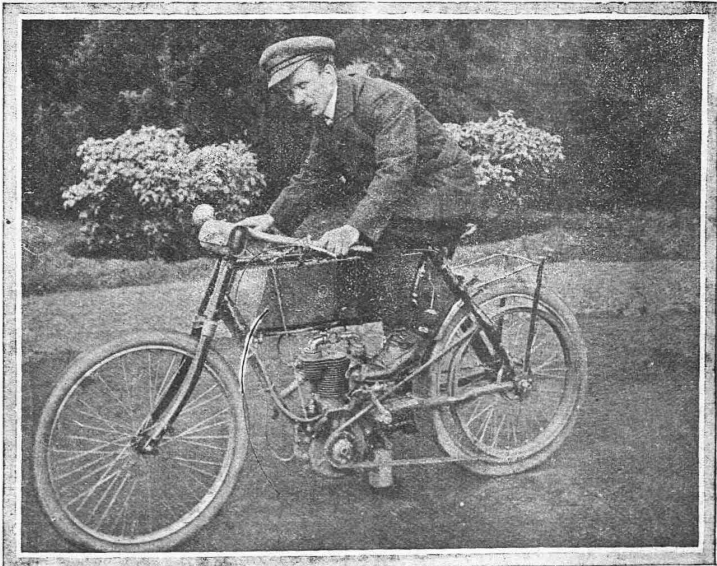
MOTORCYCLING IN SOUTH AFRICA. Our illustration shows Mr T Armitage riding his 3hp Imperial Rover at 14mph up a 1 in 8 gradient in a recent hill-climbing trial at Johannesburg. The occasion was a meeting of the Johannesburg Motorcycling Club, which included various races. A reliability run to Roodeport and back (maximum speed allowed 12mph), ended in Messrs Kock and Attewell gaining six points each. In the hill climb Mr Armitage, still riding a Rover machine, did fastest time, Mr Kock (2hp Werner) being second. In a subsequent ‘start and stop’ event, Messrs Lynn, Hanscombe, Murkett and Cotter came off best.”
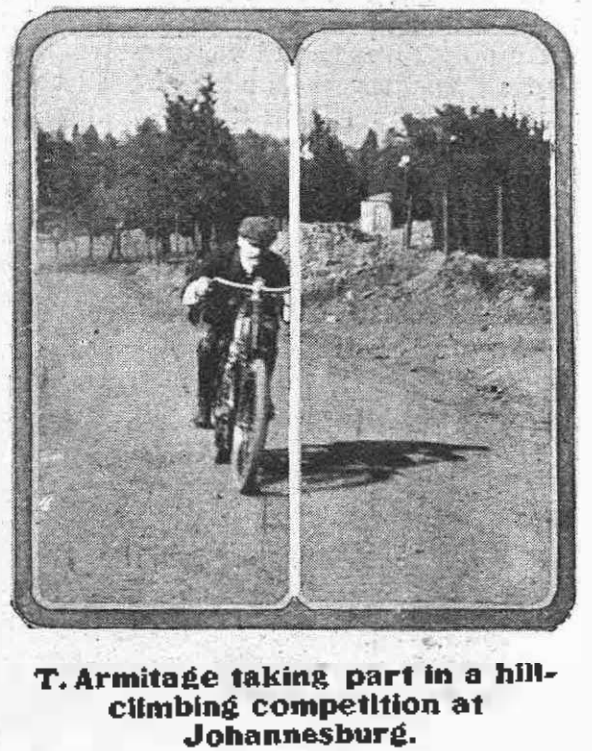
“IN REPLYING TO THE TOAST of ‘The Club’ at the annual dinner of the Auto-Cycle Club on Wednesday last, the vice-chairman Mr GF Sharp announced that the final difficulties in the way of a great open motorcycle race in this country had been overcome, and that it had been arranged to hold an eliminating contest in order to select a team to represent England in the International Motorcycle race. The eliminating race will form part of the programme in connection with the English selection contest for the Gordon-Bennett race. The same route will be followed, and the controlling and timing arrangements organised for the car race will be available for the subsequent motorcycle race. Negotiations are still proceeding in the matter of the course, and it is generally hoped that the one in the Isle of Man will be chosen. This will be the first great race of motorcycles ever held in this country, and the Auto-Cycle Club propose to make it doubly important by arranging that it shall also be a complete race in itself, open to all British built motorcycles. Such a race will obviously effect an enormous amount of good, encouraging, as it will, the development of the light and efficient motor-bicycle, and we are pleased to confirm an offer, made to the Auto-Cycle Club on the occasion of the dinner, of a trophy that shall be worthy of the event. Such a race held annually will give an enormous impetus to motorcycling, and if it be held in May or early June, the riders who finish first, second, and third will have time to get fully prepared for the big International race in which they will represent England. The Auto-Cycle Club has decided to enter for this event provided only that the French club gives its guarantee that every’ effort will be put forth to secure fairness for the foreign competitors (including a cessation of the mysterious nail-strewing).”
“THE ISLE OF MAN interested me greatly, because there I had that rapid succession of changes which is always like unto a constant feast. And I was curious to know how it impressed some French motorists who came over for the trials. One of these is a man of very artistic tastes, and his opinion was worth obtaining, especially as he is none too quick to praise. Yet, at once, when the question was put to him, he declared that he was enchanted with the scenery. The wild, rolling hills, the sharp ravines, the tumbling cascades, whose busy music soothes the senses, the wealth of foliage and particularly the glorious blossom on the gorse, the wild coast of cruel aspect wherever it was seen and the general peacefulness everywhere constituted a picture that was as delightful as it was new to him. And I must say that so it appealed to me. I should say that the Isle of Man would make an ideal pleasure ground for the motorcyclist, provided he had an engine with a fair amount of power, such as a 2¾hp. A 2hp machine would also be all right for the well-engineered roads, but there are some very sharp and sudden pitches which would here and there call for brisk pedalling. Being a hilly country, the Isle of Man is just suited by the motorcycle. The journey across is a simple matter, because the machine is easily stowed under cover, petrol and other supplies are readily obtainable through Mr Corlett, and there are some delightful runs for the day time and ample amusement for the evenings, whilst, at the same time, quietness is easily secured if one does not care to stay in Douglas.—‘Cyclomot’“

“THE THIRD ANNUAL HILL CLIMB at Chateau-Thierry was this year favoured with splendid weather, and passed off most successfully. The competition is confined to touring vehicles (motorcycles as well as cars), and in addition to prizes given for the best performances over the one-mile climb, there are prizes awarded for general excellence in the design, arrangement, and all-round appearance of the vehicle from a touring point of view. ChateauThierry is situated some 40 miles east of Paris, and the hill on which the trials took place is a long ascent as steep as 1 in 10 in places, and allowing of a splendid course of one mile in length. More stringent regulations had been put into force this year, and the competing cars and cycles were, generally speaking, strictly touring in character, and not, as in many cases in previous years, racing machines…Competitors were divided into seven classes, one of which comprised motor-bicycles…represented by the following makes: Magali, Griffon, Alcyon, Neckarsulm, Stimula-Vandelet, La Fauvette, Carreau, La Foudre, and Ideal. We append the principal results:1st, Collomb (Magali), 1 min. 43⅘sec; 2nd, Bac (Magali), 1min 47⅖sec. The first prize in the touring awards went to Neckarsulm.”
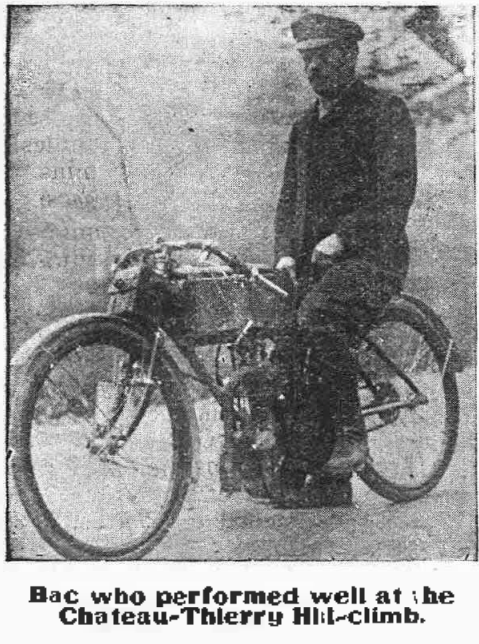
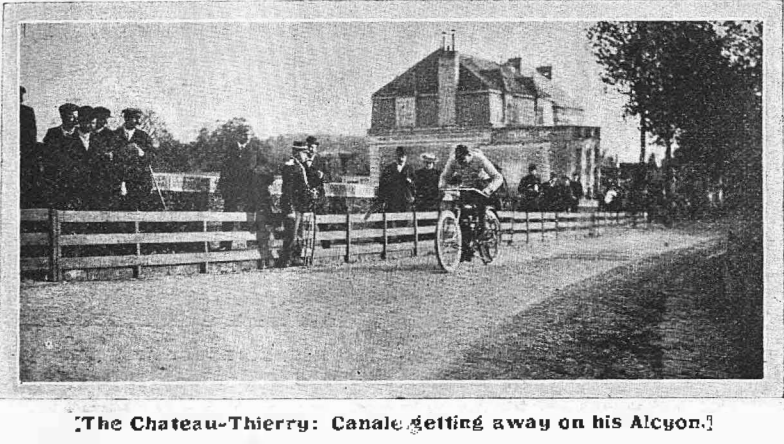
“MOTORCYCLE RACING AT FRIEDENAU. In very unfavourable weather, the German Motor Cycle Association’s programme was carried through at Friedenau on the 30th of October. Notwithstanding the conditions, the attendance ran into thousands, the spectators following the races with as much interest as the cold north wind allowed. The meet opened with the heats of a 5,000 metre race for machines of 2½hp. An interesting feature of this race was the Cyclon, a front-driven cycle—the sole representative of its class. Its engine and necessary accessories are fixed above the front forks—not in the front wheel, as with the Singer—transmission being by belt. In the preliminaries this make did very well—ran fast and with marked steadiness, but was quite out-distanced by the the Progresses and an Allright in the final, when Mraz and Tolksdorf (the ‘little Gordon-Bennett’ representatives) gave us an exciting bit of neck-and-neck racing, not a yard separating the two on the tape. The result was: 1st, Mraz (2.4hp Progress), 4min 28⅘sec; 2nd, Tolksdorf (2.4hp Progress), about a yard behind; 3rd, Ebstein (2.35hp Allright), 130 metres behind. In the 10,000 metre race for motors up to 3hp, Otto Lenz, a young student from Alt-Strelitz,
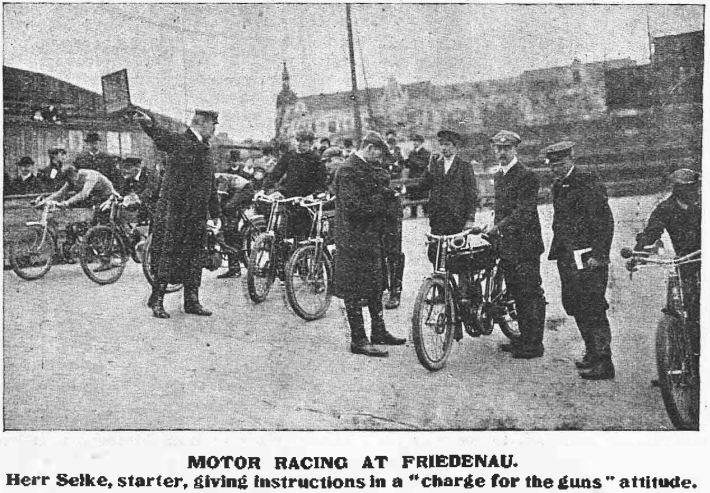
showed how a mere tyro could steer a Neckarsulm with all the dexterity and audacity of an old professional hand. Lenz, it appears, had never been on a track before the Friday prior to the race, to which his attention was called by a friend, who invited him to come over and compete. He beat the runner-up by more than a lap and a half, and the third man by more than two. Result: 1st, Otto Lenz (3.05hp Neckarsulm), 8min 18⅘sec; 2nd, Steininger (3hp Express), 790 metres behind; 3rd, Tolksdorf (3.05hp Progress), 1,060 metres behind. Twenty-five machines were entered for the hour race. Once the Alt-Strelitzer had a narrow shave in the home curve; he took too wide a sweep, and almost brushed the barrier when rounding into the back straight. It was a fine performance to cover over 72 kilometres in the hour in face of the slow track, the sharp wind, and his inexperience of the path. Distances for the hour: 1st, Otto Lenz (3.05hp Neckarsulm), 72.520 kilometres; 2nd, Mraz (3.5hp Progress), 69.300km; 3rd, Tolksdorf (3.5hp Progress), 65.760km; 4th, Ebstein (3.5hp Allright), 65.070km; 5th, Menzel (3.5hp Progress), 62.216km; 6th, Muller (2.7hp Brennabor), 60.110km. The final item on the programme, a 10km event for racing motorcycles over 3½hp, resulted in Tolksdorf (Progress) vanquishing Steininger (Express).”
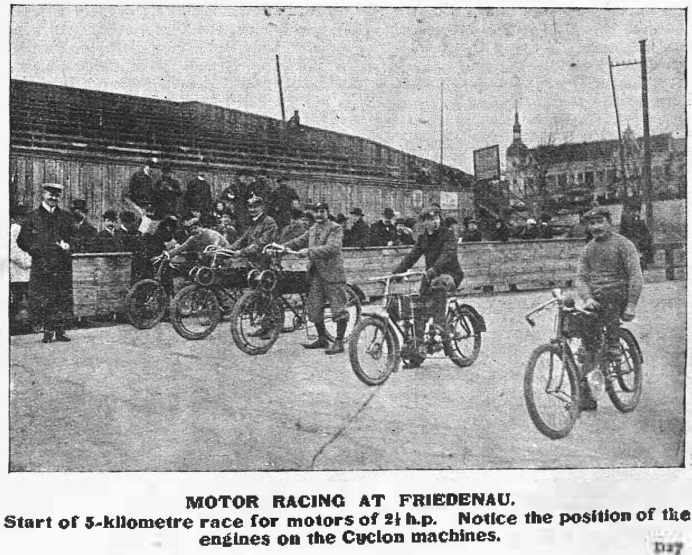
“THE FINALS OF THE trials for motorcycles carrying lady passengers, organised by the Birmingham Motor Cycle Club, were held on Saturday week last. The preliminary event consisted of a 50 miles non-stop run (25 miles out and home on the Chester road, starting from the Royal Oak, Streetly. Seven entries were received: S Downing (3½hp Allday’s tri-car); CG Garrard (7hp twin-cylinder Garrard tri-car); C Thompson (4hp Smith’s o’ Saltley motor-bicycle and trailer); FR Gould (3½hp WA Lloyds’ bicycle and trailer); CR Townsend (4hp New Revolution tri-car); and EW Winckle (3¼hp Hamilton tri-car). Of these three dropped out, viz, Garrard (short of petrol), Gold (tyre troubles), and Walker (broken sparking plug). The four left in competed in a ‘starting and stopping’ trial over a measured distance (about a third of a mile), with the following result: Downing, 1min. 15⅗sec, first; Townsend, 1min 35⅕sec, second; Winckle, 2min, third; and Thompson, 2 min 30sec, fourth.”
REES JEFFREYS, HEAD of the Automobile Club’s Legal department, announced that nearly 5,000 cars and 3,000 motorcycles had been registered in London, where 11,750 licences had been issued.
“A WELL-ATTENDED MEETING of motorcyclists was held at the Rummer Hotel, Duke Street, Cardiff, on Monday of last week to discuss the question of the formation of a motorcycle club for Cardiff. It was unanimously decided that such a club should be formed, and the name, ‘The Cardiff District Motor Club’ was proposed. The subscription will be 10s 6d. The question of affiliation to the AutoCycle Club or the Motor Union was deferred until some idea of the numerical strength of the club can be ascertained.”
“‘Sir A Conan Doyle is among the latest additions to the ranks of motorcyclists.’ So says a motor contemporary. We are sure this must be news to Sir A Conan Doyle, who, to our knowledge, has been a motorcyclist for over two years.”


“MAGNIFICENT! THAT IS THE ONLY WORD which describes the seventh annual great Salon de 1’Automobile, which was opened in Paris by President Loubet on Friday last. Great as have been the successes of previous years, the 1904 Salon easily surpasses them both as regard the artistic nature of the stands and the number of actual exhibits. From all points of view the Exhibition is a veritable masterpiece of skill and good taste. It cannot with truth be denied that the French possess in a wonderful degree the faculty of combination. The Grand Palais des Beaux Arts, which houses the Salon, certainly lends itself to decorative effect, and every advantage has been taken of this fact. One heard beforehand of the quarter of a million electric glow and arc lamps which were to add brightness and grace to the beautiful interior, but the artistic and dazzling nature of them must be witnessed if the true extent of their beauty and brilliance are to be fully realised. The mighty dome which rears up its head like that of St Paul’s is graced with a huge suspended half-globe, from which tapered rays radiate in all directions; this structure possesses over 30,000 white electric glow lamps, which, when lighted, are almost blinding in their brilliance, and the stands are marvels of colour and decorative art; while the thousands of palms, festoons of flowers, and clustering flags combine to produce an effect striking and magnificent beyond all words. The popularity of the Salon is remarkable and the opening day witnessed a tremendous influx of visitors. In the afternoon it was filled to the utmost capacity…The first day only those ladies and gentlemen who had received special invitations from the French club were admitted, and it is estimated that out of the 100,000 tickets issued fully one half were presented at the doors. Altogether this year’s Salon is a marvellous institution, and should be visited by all automobilists who can afford the time and money to do so.”

“THE MOTORCYCLE EXHIBITS this year are, if anything, more numerous than last, and many interesting features are to be found. Nearly all the firms of any note have adopted some form of spring fork for reducing vibration, and there can be no doubt that the problem of how best to get over the bugbear of vibration has received serious consideration on the part of the French makers. The devices adopted cannot, in many cases, be said to improve the appearance of the machine, but they all have the element of efficiency to a greater or less extent. In some instances both wheels are insulated by springs, which, of course, is a step in advance of having the front wheel alone insulated. Chain-driven machines are still in a great numerical inferiority to the belt-driven, nine out of ten machines having the V-section belt. Several smart ideas in free engine clutches are shown, and a larger proportion of machines than last year have magneto electric ignition of the high-tension variety, but fully 90% of machines retain the coil. In the matter of weight, it cannot be said that French makers have made special efforts to turn out a featherweight, but excessive weight is certainly not a predominating feature. The average 2½hp machine scales between 95 and 110lb, and even high-powered twin-cylinder machines of 4-6hp do not exceed 140lb in any instances. The twin-cylinder machine seems to be installing itself as a favourite type in France, for the number of these shown this year is greatly ahead of last year. Doubtless this is because a much higher average speed is possible than in England on account of the long, straight, and comparatively deserted roads in that country. The popularity of long-distance running in France has called for larger petrol tanks. Those fitted in many cases hold three gallons. In the way of brakes, the band brake seems to be the most popular type, and it is noteworthy that nearly all machines have two brakes. For general finish, the English manufacturer is far ahead of the great majority of French makers. Sound work in engine and frame and high speed seem to be the main considerations. Adjustments and control arrangements are a weak point in the French machines. In carburetters a few attempts have been made to fit automatic or self-regulating types, but on the whole the ordinary type predominates. Tri-cars are by no means numerous in the Exhibition, and it is quite evident that the English makers have practically the whole trade in this class of machine. Perhaps a dozen or so are to be found. The idea of the ‘Avant train’ came from France, and it is certainly surprising how French makers have neglected to develop it. The machines shown mainly have separate attachments, the fore-car bodies being wicker work, and the frames lacking the important main side tubes as adopted over here. Only in two or three instances have two-speed gears been adopted. In the matter of racing machines, the French are far ahead of us, as they manage to get as much as 10 and 12hp on a machine scaling under 110lb. These machines are geared very high, about 1 to 2½ being the usual ratio. An idea that seems to have been well developed by the French is that of providing an auxiliary exhaust passage to the engine. They do this by making a port near the end of the stroke, A series of baffle plates are arranged to trap any oil blown out, and the port is simply joined on to the main exhaust pipe. The tremendous speeds French racers get out of their engines certainly seems to show that there is something in this idea.”
“A VERY INTERESTING MACHINE is shown by Legosier and Co, 196, Boulevard Voltaire, Paris. The engine of 3hp is mounted so as to drive by a propeller shaft and thence by bevel gear. A clutch of large diameter with fork spring and engagement (just as on a car engine) is used. The driving shaft is carried through one of the horizontal stays, this being reinforced at the wheel end. A very novel spring fork is also fitted: the wheel axle is carried on a short rocker to which is fixed one end of a flat coil spring, the other end of the spring being clamped on to the end of the main fork. When running over rough ground the spring is tightened up—it is in fact a coiled suspension spring.”

“LURQUIN AND COUDERT, 19, Rue Planchette, Paris, show a series of well-finished mounts of 3hp. The transmission is by V-section belt, and the ignition by high tension magneto with gearing cased in. The engine has mechanical valves, and a special cut-out is fixed on the exhaust. Control is effected by levers on the handlebar. The front forks have spring suspension, the arrangement consisting of a duplicate fork pivoted on the main fork and acting against a spring in a tube mounted in front of the steering column.”
“MINERVA MOTORS, of Antwerp, exhibit a very wide range of their productions, in which their celebrated motorbicycles stand out prominently. Perhaps the most interesting in this category is the 3½hp model fitted with magneto ignition, the very appearance of which denotes great speed abilities. The engine, which is fitted vertically into a strongly-built cradle, has mechanically operated valves, and the other well-known Minerva features. A Longuemare carburetter sprays the petrol, and the new double-eccentric rocking bar drives the magneto. The machine is amply provided with brakes, there being a back-pedalling brake and another acting on the belt rim. The spring forks are retained, and the head is strengthened by twin stays. Long handle-bars are fitted, and the machine (which is built entirely on the well-known Minerva lines with which our readers are thoroughly acquainted) cannot fail to maintain the reputation of this important firm. The new 6hp twin-cylinder engine is also shown.”
“TERROT AND CO, Dijon, have some interesting models. Chief amongst these is a machine having flat belt transmission. The engine and rear pulley are about equal in diameter, being about six and seven inches respectively. The shaft of the rear pulley drives an internally toothed ring connecting to the rear wheel hub, and thus a positive drive is obtained. The driving belt is about 1½in wide. The engine is 3½hp, vertical, and with the usual coil and accumulator ignition, and spray carburetter. A powerful double-acting cable rim brake is fitted on the rear wheel. No front brake is used on account of a new type of spring fork used. This consists of a duplex fork, one being of the usual oval section blade. The other one is a round tube about one inch diameter. The front wheel is secured to a pair of plungers or pistons acting against springs in each side of the tubular fork. The arrangement looks mechanically correct and neat. Other Terrot models have V-belt transmission. One machine has twin cylinders, V-belt transmission, and spring forks, and the new Longuemare carburetter. All these machines are well equipped as touring mounts, but look rather heavy.”
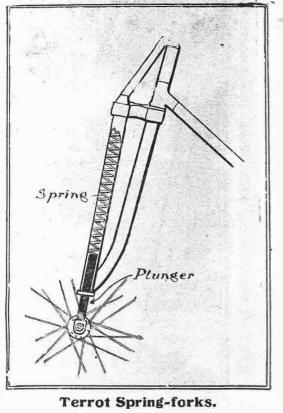
“MORE THAN A DOZEN motorcycles are to be found on the Werner stand. These include the 2½, 2¾ and 3½hp models which were exhibited recently at the Agricultural Hall. Of these the most taking machine is, we think, the 3½hp. The engine has twin-cylinders (these being parallel to each other and cast together), and the inlet valves are now automatic—the mechanically-operated ones having been abandoned; the free engine pulley is also retained, and a new rim brake adds to the control efficiency. The spring forks are a feature of the machine, as is also an electrical controller for regulating the speed. Undoubtedly, the 1905 Werner motor-bicycle is an admirable production, and well worthy of the consideration of those about to purchase new machines.”
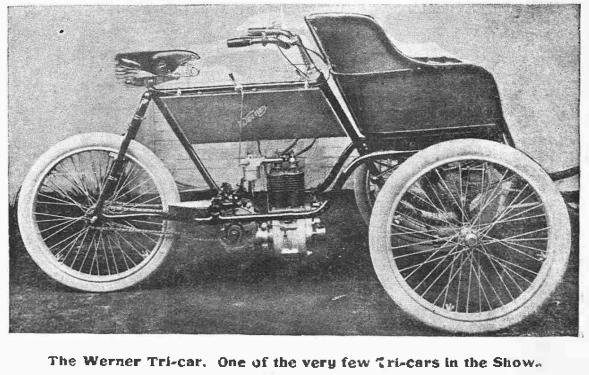
“THE SOCIETE ANONYME Constructions Mecaniques de la Loire show the Automoto cycles. These are powerful mounts with 4hp engines, air-cooled. Transmission is by V-belt, and the usual accessories are adopted. A novelty introduced in this machine is a spring front fork; which does not, however, by any means improve the look of the frame. The wheel is carried in a supplementary fork, at the upper end of which is a plunger acting against a spiral spring carried in a tube supported direct from the fork crown. The ends of the main forks have slotted plates brazed on, and in the slots the front wheel axle moves.”

“GAYON AND CO, Rue Danton, Levallois, stage about 20 Magali motor-bicycles. This machine has recently accomplished some excellent performances in road and track races. The transmission is by gearing and then from countershaft by chain. The gearing is cased in by an aluminium cover. A clutch is provided on the large gear wheel, this being actuated by a lever mounted on the horizontal tube. The special novelty about this machine is the spring front fork. The action is obtained in a curious manner: the main forks carry a bearing at the end for a supplementary horizontal pair of forks which can rock on the bearing. These forks extend back to the mudguard and look like, and in fact serve as, tubular mudguards stays. The springs are fixed in a curved tube inside the mudguard, and the end of the fork carries a stop which presses against the springs. The coil box is clipped to the steering column. Two rim brakes are fitted on the back wheel.”
“LAMAUDIER, MAUGER, AND CO, Levallois Perret, show the Audax machine in numerous types. These are mostly fitted with vertical engines of the 3hp, and V-belt transmission. The outside fly-wheel of engine originally made by this firm appears to have been abandoned, as all the engines shown have inside fly-wheels. A curious arrangement on one racing machine shown is an extra exhaust passage near the end of the stroke. There is an exhaust pipe bolted on and some arrangement for trapping the oil provided: this extra pipe joins the main pipe. A new spring fork calls for special mention: the main fork branches off into two arms, the forward one carrying a rocker at the end of which the wheel axle is fixed, the other arm containing a spiral spring; a projection on the rocker engages with it. The arrangement seems to give a good action. The brakes act on the back wheel rim and belt rim. Several types of spray carburetter are shown, but the Longuemare type predominates. The engine is supported at the cylinder head by four bolts screwing into it: the main supports are on the crank-case. A feature calling for comment is the scarcity of radiators on the engine, there being only four, spaced wide apart. One machine has the Griffon spring fork fitted.”
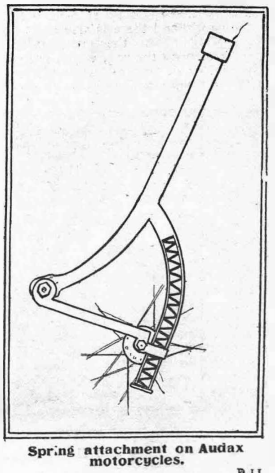
“BUCHET AND CO, 15, Rue Greffulhe, Levallois, show some 4hp machines with Buchet engines. Both valves are mechanically operated by outside rockers. These machines are obviously for racing purposes, as the saddle pillar is simply an extension of the horizontal tube of the frame. Transmission is by V-belt, and the carburetter is of the Vaurs spray type. One brake only is used; this acts inside the belt rim and is actuated by Bowden wire. One machine is fitted with the Griffon type spring fork.”
“BRUNEAU AND CO, TOURS, have specialities in motorcycles with combined water and air-cooling for the motor. A 3½hp bicycle and a 3½hp fore-car with chain transmission have some interesting features. The back chain wheel has a spring centre to absorb the engine shocks. On the outside of the free engine clutch drum a band brake, actuated by Bowden wire, is fitted. The water tank is placed in the fore-part of the frame and holds about one gallon. Two neat radiators are mounted alongside the tank. The circulation is on the thermo-syphon principle. The head alone of the engine is water-cooled. The fore-car frame has no stays running from the front cross tube to the rear axle, as is considered the best practice in this country. The carriage has open sides on a tubular frame ; and the brakes consist of one on the engine clutch and a back wheel rim brake. A very strong chain is supplied. High tension ignition and FN spray carburetter are also fitted.”
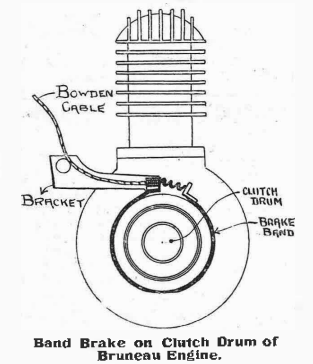
“A WELL-MADE 4½hp water-cooled engine bicycle is shown by L Bonin, Paris. There are no pedals, but footplates are provided. The radiator and tank are mounted in the fore portion of the tank, and is arranged on the thermo-syphon principle. A novel type of clutch is fitted on the engine shaft, worked by vertical rods and handles from the top tube of the frame. The ignition is on the usual high-tension principle, and drive is by a flat belt. The engine is arranged to be started by a handle on the engine shaft. A facing machine shown has the same engine as the touring machine, but the frame is of a different type, the saddle being arranged over the centre of the rear wheel. The steering handles are brought right back in a long sweep. The transmission on this machine is by chain, and has the free engine and clutch, as in the other model. Duplex forks and extra large tyres are special features of this machine.”
“GEORGIA KNAP, TROYES, stages a series of Knap motorcyclettes built on the direct-drive principle through spur gearing. The engine is mounted on one side of the back wheel by a clamp on the stays. A small spur gear on the engine shaft engages into a large spur gear connected to the back wheel hub. This gear is in two parts, an outer and inner ring being connected by springs to render the drive less harsh. A gear-case encloses the spur wheels. The engine is the usual pattern, but none of the models have silencers proper, the exhaust valve box being enlarged and perforated. A rather obsolete type of surface carburetter is used, connecting to the engine by a flexible metal tube. A novelty shown on one machine is a spring fork. The main fork is curved rather sharply at the end, and carries a pair of rockers to the centre of which the wheel axle is fitted. The free end of the rocker moves against a spiral supported against a stop brazed to the main fork, and there is also an additional spring above the latter, acting against a stop on the rod, which is fixed to the end of the rocker. It is, in fact, like two springs acting in opposite directions. It looks an effective device. The Knap machines are made in several powers from 1½hp to 2¾hp.”
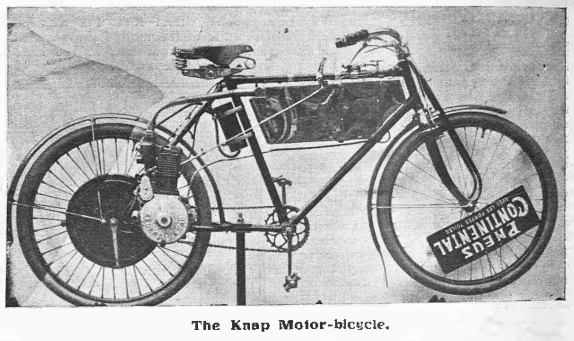
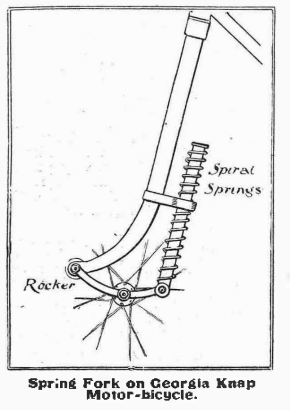
“THE BRILLIANT MOTOR-BICYCLE shown by F Brosse and Co is built on standard lines with vertical engine, spray carburetter, coil ignition and V-belt drive. A rather neat metal-to-metal band brake worked by a Bowden wire calls for attention. The Griffon type spring fork is fitted.”
“A VERY LIGHT RACING MACHINE, fitted with a 5hp Buchet engine, is shown on the Alcyon stand. It is fitted with a very capacious tank for long-distance work. A. special feature are the tyres, which closely resemble the first Dunlop tyre made in 1889, being canvased on to the rim. A. neatly designed twin-cylinder 5hp touring machine is also shown here. The cylinders are inclined with the carburetter placed between them. Both exhaust valves are arranged to lift together. Two brakes are fitted on the back wheel, one being a metal-to-metal band brake, and the other acting on the belt rim. A single cylinder machine shown has a 2¾hp engine with high-tension magneto ignition and Simplex spring fork.”
“ON THE LIBERATOR STAND are shown a series of nicely-finished machines fitted with the Sarolea engines. Some have magneto ignition. Two very effective band brakes are fitted. A 6hp machine shown has a twin-cylinder engine with transmission by V-belt.”
“THE GRIFFON COMPANY stage a number of machines mostly built on standard lines with V-belt transmission, and either magneto or coil ignition. All the machines have a new double-acting band brake on the rear hub. An 8hp twin-cylinder racing machine with V-belt drive is a special feature. The frames of the machines shown strike one as being unusually strong, especially the front forks, which are of the duplex type. Several spring forks are shown. The magneto is most ingeniously concealed in a compartment of the tank, and drives by a vertical shaft and bevel gear from the two-to-one gear-box.”
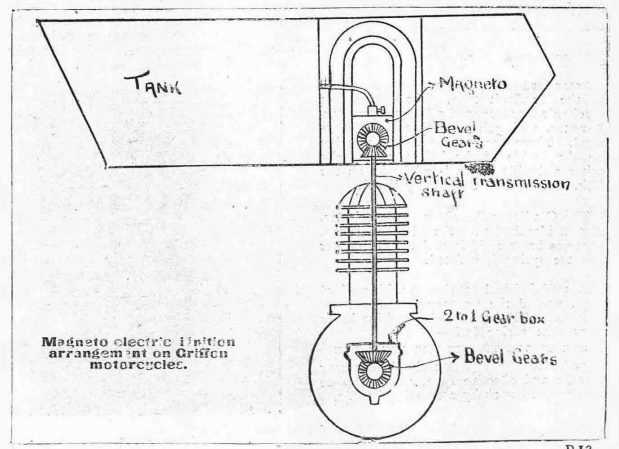
“THE WERNER COMPANY show their new fore-car with a two-cylinder engine of 4hp. The front axle is suspended on elliptical springs, and the frame strikes one as an original piece of work. The engine is mounted with its shaft at right angles to the frame, and gears direct to a countershaft having a two-speed gear of the double-clutch variety, thence the drive is by chains to sprockets on each side of the rear hub. The clutches are pedal-operated. The engine is arranged to be started by a strap. Handlebar steering is fitted. The fore-carriage is coach-built with brass edging giving it a smart appearance.”
“THE PEUGEOT COMPANY have an interesting display. In the centre of the stand is a 12hp path racer scaling 100lb or so, and which has made some famous records, having touched 70mph. It is geared as high as 2 to 1. Very light path racing tyres are fitted, and a miniature torpedo-shaped tank on the top tube carries petrol. The standard mounts comprise a moderate weight 4hp twin-cylinder and 3 and 4hp single cylinders. A neat magneto ignition drive arrangement is shown on one machine, consisting of an enclosed shaft and bevels. Special features are the small number of radiating fins on the engine, a curious bottle-shaped silencer, tanks of very large capacity, and the Truffault suspension spring forks. The finish on these machines is much better than the average on French-built mounts.”
“A LIGHT-WEIGHT MOUNT with 1½hp engine is shown by A Brossard. The engine is placed inside the frame, being clamped between the main down tube and an extra tube running parallel to it. In the angle formed between the top tube and diagonal a triangular-shaped petrol tank is fitted. The transmission is by a chain to a compact two-speed gear arranged on the pedal shaft bracket. The gears are put into action by pawls engaging with a ratchet worked from the top tube. From the gear shaft a chain runs to the usual rear sprocket.”
“The Hurdtle and Bruneau feather-weight machine has a very small hp engine driving by V-belt. The frame and general equipment is practically the same as on an ordinary bicycle. This machine scales 551b and is intended for light work and pedal assistance on steep hills.”
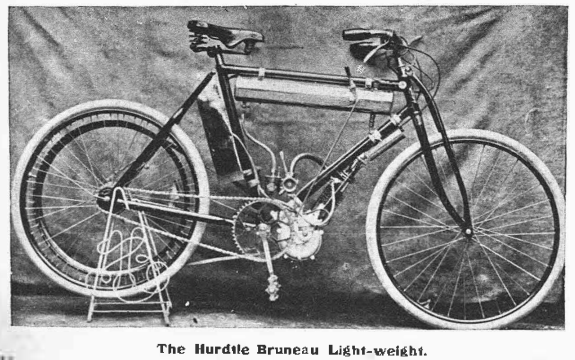
“THE ROCHET STANDARD touring mount is certainly one of the best constructed mounts in the Show. It has a 3½hp engine with gear driven high-tension magneto ignition. The transmission is by V-belt. A special feature of the machine consists in the construction of the belt rim, this being separately spoked to extra flanges on the wheel hub. The brakes are of a new type, two acting on the rear wheel, one of which is a powerful double-acting band brake, and the other a belt rim brake with rubber blocks pressing in the belt groove, both being actuated by Bowden wires. Spring forks are fitted. A notable contrast with other machines is the large number of radiating fins on the engine cylinder and head. Both valves are mechanically operated. The machines shown on the Georges Richard stand are practically identical with those on the Rochet stand.”
“A NEAT-LOOKING MOUNT with a 4½hp water-cooled engine is shown by L Bailleul, Levallois. The cooling tank and radiators are in the fore-part of the frame. The tank has two parts, the top and bottom section being joined by a large number of thin square copper tubes so arranged that the air can freely circulate. A novelty on the engine is a combined inlet and exhaust valve. Two ignitions are provided, viz, magneto and coil. Transmission is by belt.”
“A NOTABLE FEATURE of the La Française stand is a 6hp twin-cylinder machine with V-belt drive. The tank is a very capacious one, holding nearly three gallons petrol. The front forks have a spring suspension of a novel type. The wheel is carried at the ends of horizontal forks, the other ends being pivoted on a bar supported by two curved tubes running from the fork crown. A flat laminated spring connects the curved tubes and main fork. One end of the spring is rigidly fixed to the horizontal forks so that when the wheel is pushed upwards by an obstacle it tensions the spring, which thus takes up the shock. It seems a very effective device.”
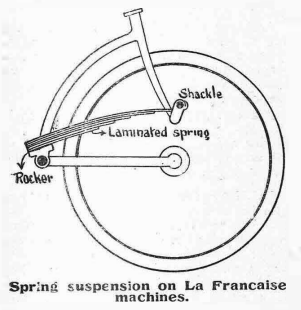
“SOME FORE-CARRIAGES are shown by Chauvin and Co, 47, Rue Richard Lenoir, Paris. These are of the detachable order, the only special feature being the strong construction of the frame. The front axle has a tube of large diameter running from the centre, curving upwards, and fixed by a clamp to the head tube.”
“MOTOCYCLETTES STIMULA SHOW a range of machines with spring suspension for front and rear wheels. The arrangement consists of plungers or pistons connected to the end of the forks and acting against springs fixed in tubes held by brackets. In other respects the machines follow the general practice, except that a new arrangement of belt rim brake is fitted. This is actuated by back pedalling. A fore-carriage with single-geared belt drive is shown.”
“THE NSU CO HAVE a fine exhibit…The fore-carriages on this stand are about the best designed in the show. A light pattern racing machine is, however, a new feature. This has the Eisemann magneto ignition.”
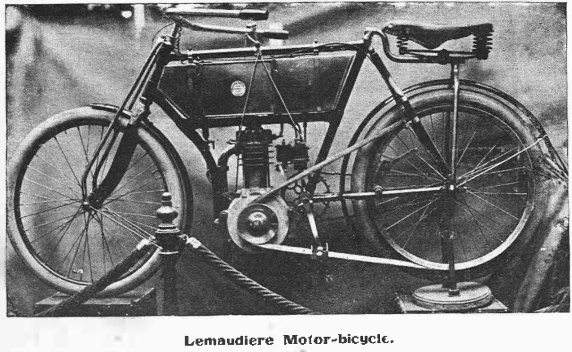
“CLEMENT AND CO, LEVALLOIS, show a motor-bicycle, with 3hp engine, built on standard lines, but with a spring fork of the Truffault type. The engine has mechanical valves,, and a Longuemare carburetter, with self-regulating air inlet, is used. There are two brakes, one acting on the inside of the belt rim, and the other a double-action band brake on the hub. The transmission is by V-belt.”
“THE GLADIATOR CO show two machines, almost identical with the Clement, except that one has a rigid front fork. The other has the spring fork fitted.”
“A WELL-FINISHED touring machine of 3½hp, named the Centaure, is shown by Flinois and Bonnel. This machine has a very neat spring fork—one of the best in the exhibition—and also a free engine clutch of a very simple and effective type, which can be arranged to work by a twisting handle.”
“ONE OF THE BEST-CONSTRUCTED fore-carriages in the Exhibition is that of E Chielus and Co, 5, Place Pigale, Paris. The front axle is suspended on flat springs, and the frame is very rigid. The main support for the engine is made of channel steel, and is extended to the back fork, to which it is brazed. The fore-car is clamped on what is practically a separate frame bolted to the central main tube. The engine is a 4hp Aster. A very capacious water tank is fitted behind the fore-car, and the radiators are placed below it.”
“AMONGST THE MACHINES shown by Rene Gillet, 10, Villa Collet, Paris, is a fore-carriage having a very large clutch arranged on the rear wheel. The belt rim is spoked separately to a flanged drum, which can be made to engage with a cone connected to the wheel flanges. Amongst the bicycles the novel features are an improved band brake and a tank of very large capacity, obtained by modifying the frame design. The diagonal tube is carried much further back than usual.”

“A WEIRD-LOOKING FREAK in motorcycles is shown on a nameless stand situated in the annexe. The motor, petrol tank and carburetter are fixed inside the rear wheel. The drive is by a pinion on engine shaft engaging with an internally toothed wheel. The inventor appears to have copied to some extent the old Singer principle. The frame is a hideous design, being a mass of tubes, connecting rods and levers.”

“A AND G MORELLE, 12, Avenue Grand Armee, Paris, have a special line in a 3hp water-cooled machine. The tank and radiators are placed in the fore part of the frame. The rest of the equipment is on usual lines. A 6hp air-cooled engined machine, with twin cylinders, looks a very speedy mount.”
“J QUENTIN, LEVALLOIS, shows a number of engines from 2½ to 6hp, some being water cooled. A well-finished racer, with 6hp engine and V-belt transmission, is a special feature. A very capacious tank for long-distance work is used.”
“A RACING MOUNT is shown by Lurquin and Coudert. This is an 8 h.p. twin-cylinder machine, very compactly arranged, and scaling about l00lb. The transmission is by V-belt. There are no silencers fitted, but the exhaust ports are unusually large to give a free passage to the gases. The cylinder is also drilled at the end of the stroke to give a freer exhaust.”
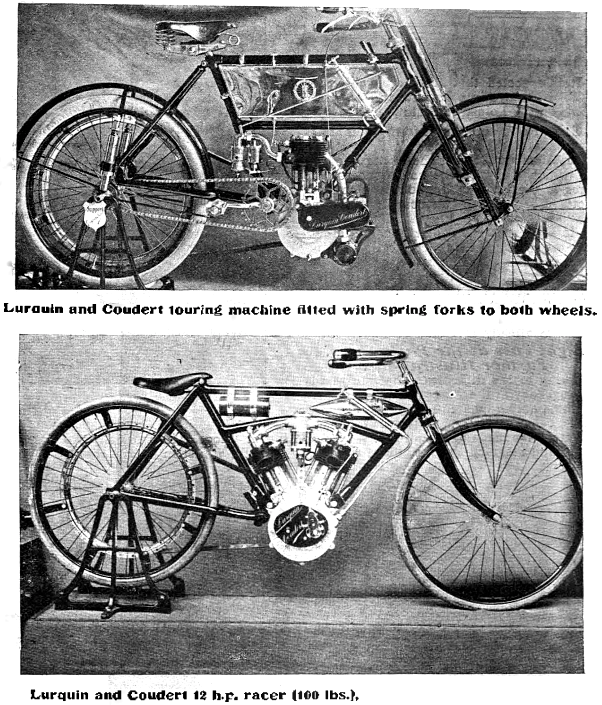
“LA MOTOSACOCHE or ‘motor set in a case’ is shown by La Touricyclette Co., 22, Avenue Grand Armee, Paris. This is a popular arrangement on the Continent for converting an ordinary cycle into a motorcycle in a short time. The whole equipment is compactly fitted up in a metal case which can be readily clamped inside a diamond frame. The engine is 1½hp, and is mounted on the slant. The radiators, however, are horizontal, so as to catch the draught through an opening in the case. A neat spray carburetter is used, and the coil and accumulator are compactly fixed in the angles of the case. The control is effected by a Bowden wire moving the contact breaker. This set only weighs about 351b, so that the machine complete should not exceed 65lb. The belt rim and clips are supplied with the set. Several excellent performances have been done on this machine.”
“The illustration depicts the 4½hp 82x86mm [454cc] White and Poppe engine, a size specially adapted for tri-car work. It is water-cooled and has mechanical valves. The design is according to the best practise, and a special feature is the excellent finish of every part.”


“THERE ARE NOW, I suppose, 25,000 motorcyclists in the kingdom. These figures astonish the trade, who, 12 months ago, scoffed at an estimate of 18,000; they astonish the Income-tax Commissioners, who wonder how we can afford it; while we, who have tasted the joys of the sport, marvel that every well-to-do artisan does not forswear beer and tobacco to buy a machine. That there are no more is not because of impecuniosity. Just stand outside a garage in some popular holiday resort and watch the touring motorcyclist arrive. It is pouring with rain, and the streets are smeared with mud—red, black, yellow, white, or brown. So is the dismal figure whose approach is heralded by a series of spasmodic, intermittent bangs. He dismounts wearily, directs the attendant to repair his leaky tyres, trace a recurring ‘short’, drain the water from his carburetter, and replace sundry lost screws and nuts. He gazes sadly at his soaked and streaky suit of tweed, his limp, spongy collar. He then sneaks sadly off to a remote hotel, where disreputable habitués stare insultingly at him. He either removes his sodden attire, and goes remorsefully to bed, or he sulks about the lounge and smoking-room with leaden feet, catches cold, and dreams of home—clean shirt, comfortable flannels, woolly pyjamas, and an easier to-morrow. He is a terrible warning to the local nibbler who yesterday wrote to Coventry for a catalogue. In touring there are two things to aim at—comfort on the road and comfort at your stopping-places. To ensure comfort on the road you must first of all have a good machine, and know a little about it. These essentials secured, you will keep to your programme, unless your tyres puncture, your carburetter gets water-logged, or your ignition rained out. Considering that few motorcyclists cover more than 5,000 miles per annum, one would expect to see puncture-proof bands fitted to more machines. The first cost is certainly high, but from four to five thousand miles’ running can be obtained from a pair, if the back cover be put on the front wheel after 2,000; while the entire absence of puncture and side-slip are alone worth the money. I have not had a puncture for four months, except on a borrowed machine, without armoured treads. Water in the carburetter is a common nuisance on tour: it is very awkward to remedy unless a cow-shed is adjacent,
and as the symptoms resemble electrical troubles it is not easily traced. For a shilling a shield of stiff leather or bent tin can be fitted to any machine on the market. On most modern machines the wiring is reduced to a minimum. But water on (i.) the porcelain of the sparking plug, or (ii.) the insulation of the contact-breaker terminal, is bound to cause stoppage or misfiring. Wrapping with insulating tape is a certain preventive. The only objection to this is that it then becomes a nuisance to test and change the plug. For this reason, I use an expensive, but reliable, plug. Spare plugs should be carried in wooden cases, not in cardboard boxes or tissue paper, or loose in the tool-bag. A belt that will stand dirty weather is the Watawata. It will take you through a 1,000 miles’ tour over heavy roads without attention. Lost nuts can easily be guarded against by covering each of them, and the end of the bolt it screws on, with two or three coats of thick paint. Black paint does not spoil the appearance of the machine; the nuts cannot then jar off, and yet can be instantaneously removed with a spanner when need arises. After a no trouble run of 100 or 200 miles, you arrive at the hotel where you are going to stop the night. Your face and hands are smudgy, if not absolutely grimed. Your clothes are either wet, dusty, or oily. Your feet feel very heavy, and bits of road have permeated through your boots and hose. Everyone stops to look at you, and if you have friends in the place you dare not go to see them. What is the proper touring costume? That question has cost me a lot of money, but at last I can answer it confidently. First of all, you want an ordinary coat, vest, and trousers of tweed, with under-linen, socks, and boots to match—such as you would wear on a fine day in early autumn. It may be midsummer, but then you are not going on the tramp in the noonday sun; it may be as cold as winter—but then this is not all you require. You cannot conveniently carry a dozen collars; you cannot economically give the soiled one to the waiter, and buy a new one each night. The solution is a xylonite collar, which can be bought (in all the fashionable shapes, if you are fastidious) for 7d. A rub with a damp towel on arrival at your destination, and lo! it is clean; but the stud-holes will not stand much use, and so it is well to use springtop studs and a made-up tie. These xylonite collars cannot be distinguished from the ordinary linen variety in wear, except by putting a match to them. For headgear a motoring cap of thick blue cloth with a patent leather peak is both smart, comfortable, and rainproof. To keep rain from your tweed jacket a fairly stout umbrella cape is the thing, and it can be rolled up and strapped to the tool-bag when out of use. It is rather too hot to work in, though, and so a light covering should be worn underneath—a fawn dust-jacket is the thing. If the season or the locality threaten extreme cold a sleeved cardigan waistcoat lined with flannel can be carried behind the machine as a stand-by. The legs are still to be provided for. Leather is repulsive in appearance, and the ordinary cheap waterproof trousers make you look like a dustman. I recommend a pair of overalls, of a warm brown colour, fairly heavy in texture and waterproofed. They must terminate in spats to protect the light walking boots, and should fit closely round the calf. Messrs Dunhills have a pattern, the lower part of which is practically a spring-clip legging, with a flexible gusset insertion, so that they can be quickly slipped on. With these I wear bicycle trouser-clips, which hold the tweeds underneath in position and prevent unsightly creases. The umbrella cape has wind-sleeves, and so small gloves are ample. Two pairs should be carried, one heavy, with leather or rubber palms, and an old pair of cotton gloves for dirty repairs. I do not propose to give a list of requisites for the machine: these differ in every case, and lists have been given ad nauseam. Combined carriers and stands are a nuisance. A Lycett stand is very convenient, as it can swiftly be put into operation at any moment. The luggage should be supported on a substantial Turner carrier. On this should be strapped a long oak valise, consisting of a cover and a drawer, the latter to pull out endways, so that one can get at everything without loosening any of the straps. The drawer should have two compartments. The first is a little one to hold tools and spares, the second contains personal luggage—viz, comb, tooth-brush, nail-brush, cake of Lasso soap, pyjamas, cardigan vest, clean shirt, socks. This is the absolute minimum, and everyone of them is a requisite on a comfortable tour. They ensure comfort, and yet the machine is not a mass of shapeless parcels and straggling straps, which the rider is afraid to touch lest he should never be able to replace them. The only place for the camera is slung over the shoulders. I am fully aware that these notes are rudimentary from beginning to end But it is the proper combination of elementary tips that procures enjoyment on a tour; and I doubt whether any English motorcyclist has done as much pleasure touring as myself, so that I speak from experience—and experience has to be paid for. I have spent many pounds and suffered much discomfort by using unsuitable stands, carriers, clothing, etc, and I write in the hopes of saving others from similar expenditure and annoyance.—BHD.”
The glorious writing style gives it away; ‘BHD’ is BH Davies, writing just before he started his illustrious writing career in the Blue ‘Un as Ixion.—Ed.
“I NOTICE A LETTER from MS Tinne; so I enclose a sketch of wiring as it was on my front-driven Werner in 1900. It was very complicated, so I reduced the wires to two only, along the top tube, one low and one high-tension. If Mr Tinne is in this neighbourhood I shall be pleased to show him how I have simplified it: if not, perhaps the sketch of the original wiring may be of use to him.
T Fred Hunt, Bournemouth, E.”
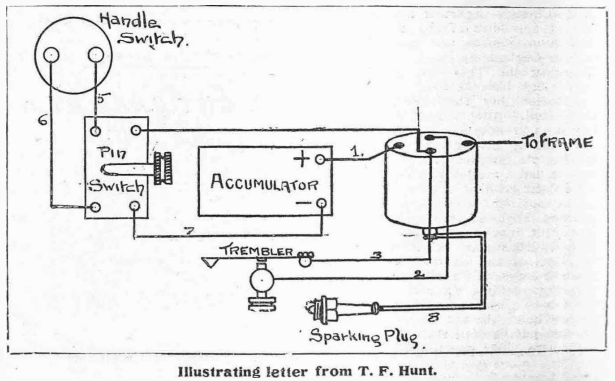
“LANFRANCHI, THE CRACK motorcyclist who holds the standing start world’s mile motorcycle record at 57⅘sec, and the flying kilometre at 29⅕sec, is still confined to his bed at the Boucicaut hospital, but is making very satisfactory progress. It will be remembered that he fell while travelling at the rate of 60mph in a race at the Velodrome d’Hiver on November 6th.”
“HENRI CISSAC, THE PRESENT holder of the world’s hour motorcycle record at 54 miles 1,058 yards, will, before the end of the season, endeavour to ride 100 kilometres (62 miles 246⅔ yards) in the hour on the Parc des Princes track. This is indeed a big order, and means beating a mile a minute all the way. He has had a special machine built for the purpose, and in a recent trial reeled off mile after mile inside 60 seconds. Cissac paced Darragon in his recent world’s hour motor-paced cycle record.”
“FLYING FOR EVERYBODY. It is not possible for mankind to take generally to aerial navigation in the present condition of that interesting pastime, but Sir Hiram Maxim’s captive flying machine will make it possible for thousands to have a foretaste of the locomotion of future generations. The safety of the apparatus was recently demonstrated in the grounds of Thurlow Park, Norwood, and flying machines, as depicted here, will be in full flight at Earl’s Court and the Crystal Palace during the summer months. The cars are made to resemble fishes, and they whirl through the air fifty feet above the ground at any speed between thirty-five and sixty-five miles per hour. At the trial the latter speed was almost attained and enjoyed by the venturesome visitors.”
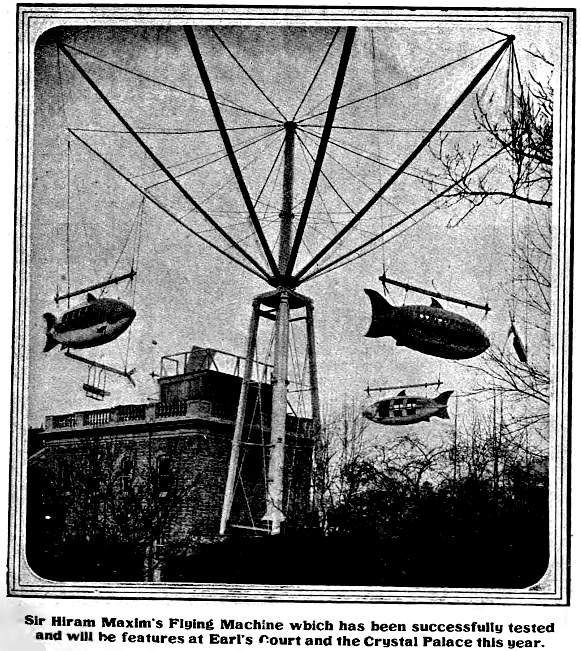
“THE HOUR RECORD. Up to a few weeks ago, the world’s hour motorcycle record stood to the credit of one or other of the crack pacemakers who from time to time trailed a bicycle rider over 60 minutes in record time, Cissac, on a 16hp machine, who paced Darragon, the present hour bicycle record-holder 54 miles 1,058 yards in the time, being the last pacemaker to hold the motorcycle record. Now the figures stand to the credit of that daring driver, Anzani, who, on an Alcyon, fitted with a Buchet engine, 90x90mm, giving about 3¾hp, covered 54 miles 1,368 yards in the hour from a standing start. This is 5 miles 568 yards in advance of George Barnes’ British hour record, but if the skilful little English rider had such a track as the Parc des Princes, Paris, for daily practice, we fancy he would soon add a few miles to his present record.”
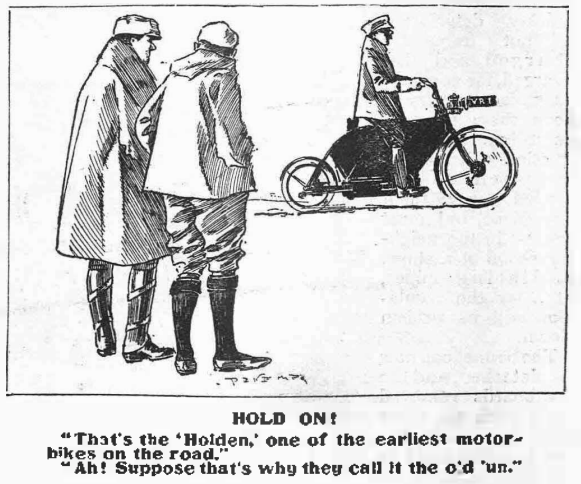
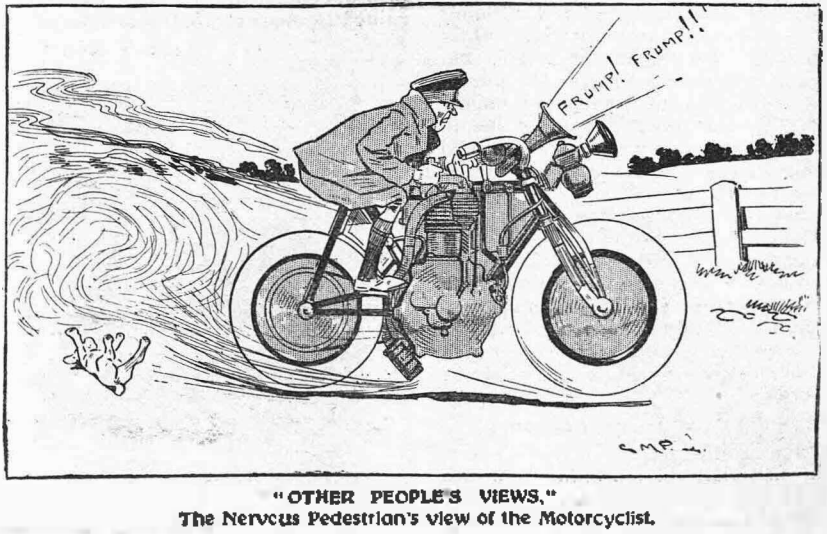
“MOTORCYCLISTS AND THOSE interested are joining the Auto-Cycle Club in large numbers, nearly 40 new names having been proposed at the last two meetings. Rather a pleasant feature of the applications is the fact that a large proportion emanate from independent gentlemen and professional men.”
“A NEW PHASE of the movement towards mutual help and support in the ranks of motorists is how rendered possible by an understanding which has just been arrived at between the Auto-Cycle Club and the Motor Union, whereby not only those motorcyclists who constitute the individual members of the club, but the members of all motorcycling clubs and sections that may be affiliated to the Auto-Cycle Club, will be admitted to membership of the Motor Union, the terms which have been arranged being equitable, and enabling the Union to afford in return for the fee the advantage of legal defence in all cases where the rights and privileges of motorcyclists are involved. The policy followed by this scheme is a right and proper one, and it has for its ultimate object the federation of all motorists under the flag of the Motor Union. Already the users of cars have joined it, by individual membership and through the medium of clubs, to the number of over 6,000, a figure which is being constantly augmented, and now that the terms under which motorcyclists may join have been made so favourable the Union will not only be representative of all interests, but will be a very strong co-operative body working for the common good of motorists.”

“AS AN INDICATION of the character of the work that is undertaken by the Auto-Cycle Club of England, it is worth noting that during the past few weeks it has been in correspondence with the Automobile Club de France, the Motor Cycle Club de France, the Deutscher Motor Radfahrer Vereinigung, the Club Automobilisti d’Italia, the Dansk Automobilklub, the Dansk Motor Cycle Club, and the Automobile Club de Suisse.”
“THE JACK NO SKID. This quaint title has been given by Mr WH Hayes to the combined non-skidding device and jack, which he has considerably improved since we first described it some 18 months ago. As now constructed it can be fitted to any type of motor-bicycle. Normally the two small rubber-tyred wheels are carried upon the arms, as shown in the illustration; when a greasy stretch of road has to be negotiated the simple act of back-pedalling lowers the side wheels into any desired position, either right on the ground or just clear. Forward pedalling instantly raises the wheels to what may be termed the neutral position. For use as a jack, the arms carrying the wheels can be lowered independently by means of an instantaneous ratchet, and this independence is useful when a machine has to stand upon a sloping surface. Mr. Hayes gave us an illustration last week of the capabilities of his non-skid upon the greasy stone setts in Rosebery Avenue, and manipulated his machine in a manner which appeared to be absolutely courting danger: he turned sharp around at a good pace at any point we wished, stopped and started, and wobbled the front wheel purposely, without the slightest sign of skidding. Mr. Hayes offers £10 to anyone who will discover a road surface which will cause him to skid or slip over, and searchers after the ‘tenner’ will find him at 532, Oxford Street, W. We think the device a really excellent one, and deserving trial by those who fear greasy roads.”
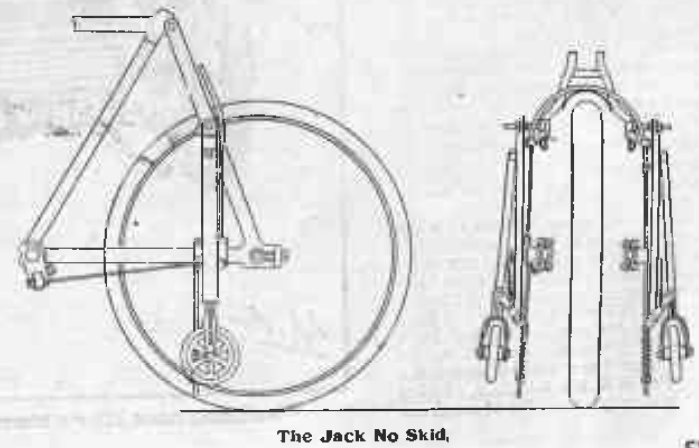
“A NEW MOTORCYCLE STAND. An improved stand has just been introduced by Messrs Castell and Sons, cycle makers, 154 and 164, Malden Road, Kentish Town, London, NW. The special feature about it is that the back wheel can be taken out without interfering with the stand, as this clamps on to the stays. The illustration shows its position when out of use. It is priced at 10s 6d.”
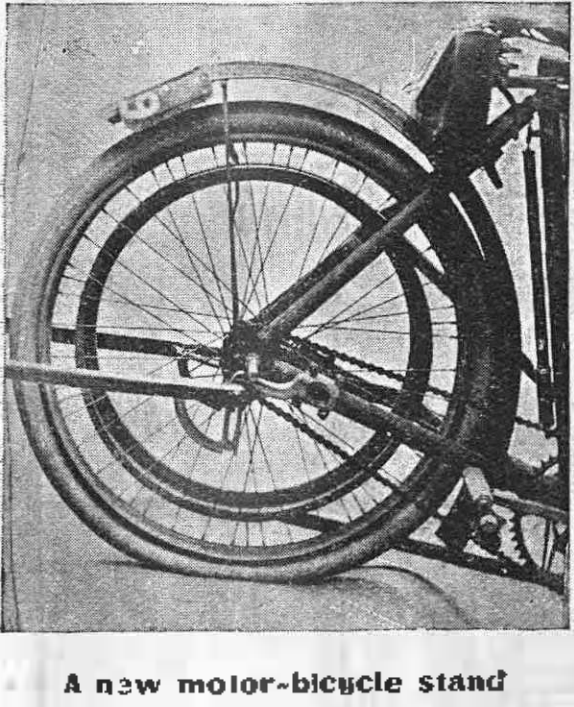
“MOTORCYCLE RACING IN AUSTRALIA. Reports of the League of Wheelmen’s meeting at Adelaide indicate that motor racing arouses a good deal of interest ‘down under’. Some excellent performances were accomplished on the grass track, H Deards (an Englishman and champion of Australasia) and W Reynolds showing good form. A five miles motor handicap was won by Reynolds (100sec start) in 7min 27sec, Deards (who started from scratch) being close behind. Deards subsequently succeeded in lowering the record of the five miles flying start from 6min 15sec to 5min 54sec.”
“A LADY’S MOTOR-BICYCLE. The illustration shows a motorcycle which a reader of ‘The Motor’ has recently made for his wife. The motor is a 2hp Minerva, driven by a twisted belt, which is guarded from catching the dress by a frame covered with ½in wire netting. The gear case is made the same way, and both can be taken off in five minutes. The petrol tank is between the down tube and back wheel ; the accumulator next the head tube in front; and a tank containing oil a little below it. The coil and trembler are fixed to the front forks. As the motor stands, it weighs 971b, and a speed of 30mph can easily be got out of it. Our correspondent’s wife has been riding it since last August, and wherever she goes the machine is the general topic of conversation, and everyone says it is the first they have seen.”
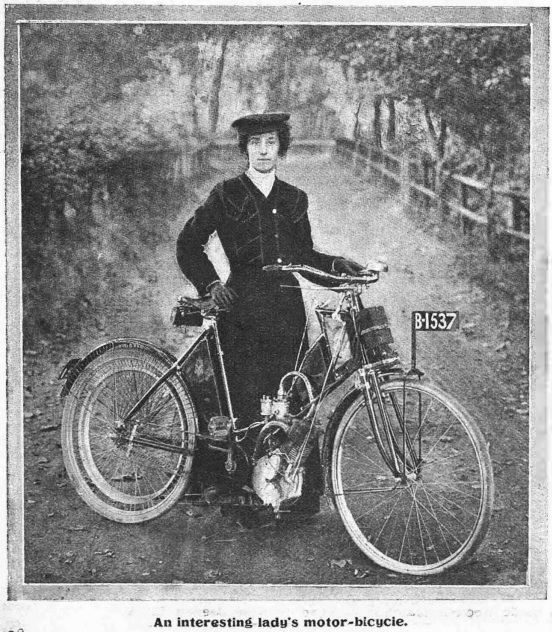
“SINCE THE FIRST NUMBER of The Motor, known then as Motor Cycling, I have read with interest every page from cover to cover, and more especially anything on spring forks, because myself (a mechanical draughtsman) and a friend (a practical cycle maker) have been experimenting with spring forks for some time, and have now patented, one which we think is ahead of any on the market…The road wheel is supported by two short links which are pivoted at the other ends to the ends of the ordinary forks. These two links are connected (so that they will move together) by a fork which passes over the fork crown and is there supported both above and below by springs, which are to take up both the compression and recoil. These springs are carried by a stud which is fixed to the fork crown and also carries adjusting nuts at the top. The action of the fork is most easily explained by the following. Suppose that a man is trying to get a wheelbarrow or handcart on to the footpath or over an obstruction See him push and strain himself by trying to bounce it on to the path or over the obstruction. But let him turn round and pull, and the trick is done instantly and with very little exertion. This is exactly the way in which our fork works, ie, it is dragged over an obstruction, which we believe is the only correct principle to work upon. I may state that we intend placing the fork on the market at a most reasonable price, but are also open to let the same out on royalty to any firm who may wish to take the same up.
Dickinson and Stevenson, Accrington.”
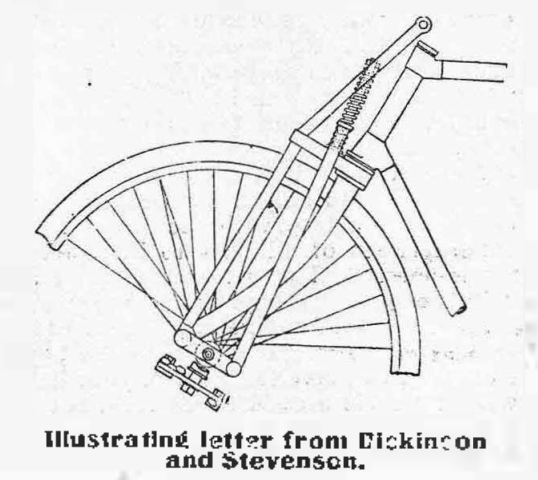
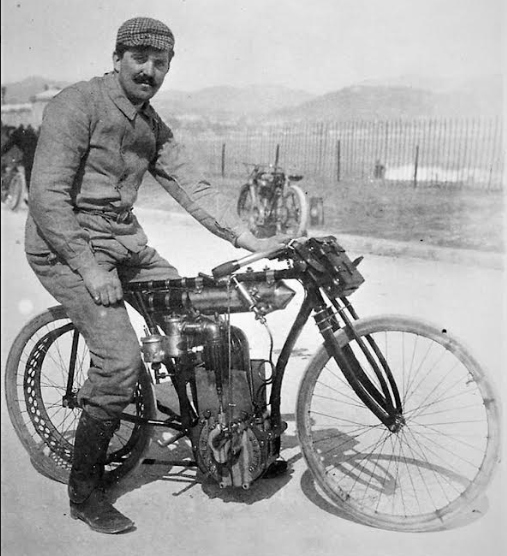

…and here’s a quartet of snapshots recording a run with les demoiselles. The third forecar in the convoy is conspicuously vacant which somehow makes the rider look more lonely than an empty pillion seat. (Digswell, which is mentioned in the original caption, is a village in Hertfordshire which dates back to the Domesday Book.)…
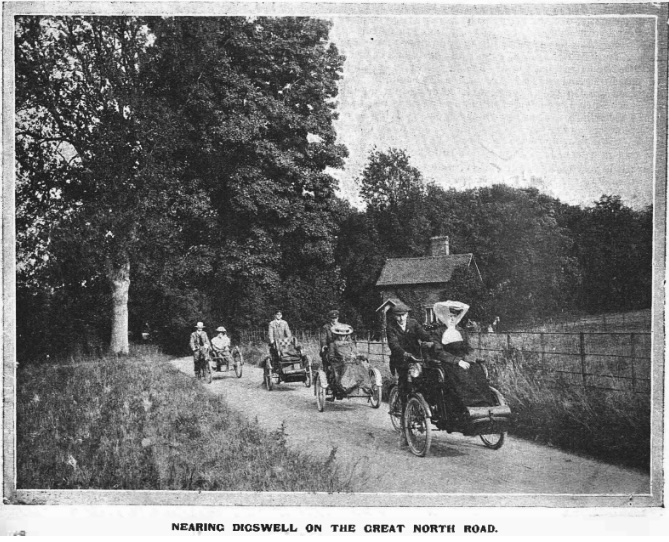
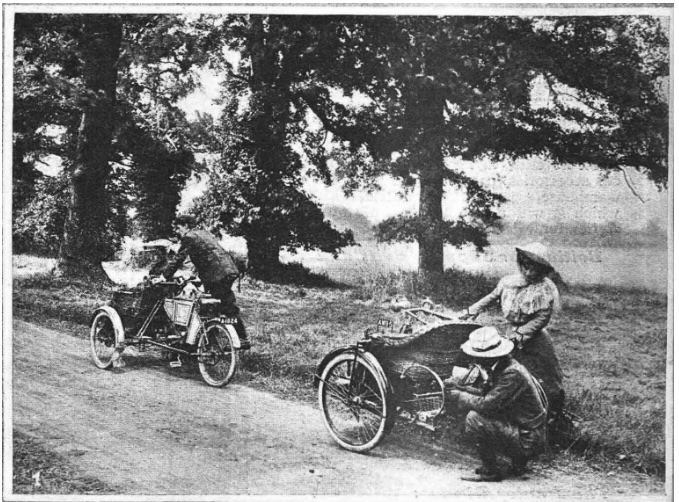
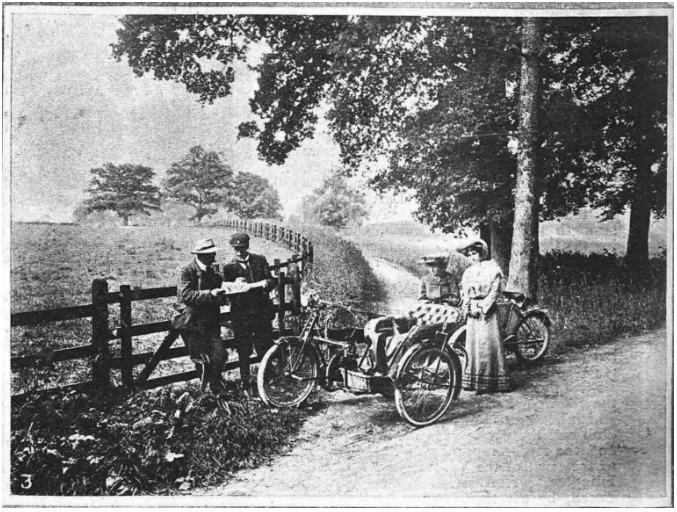
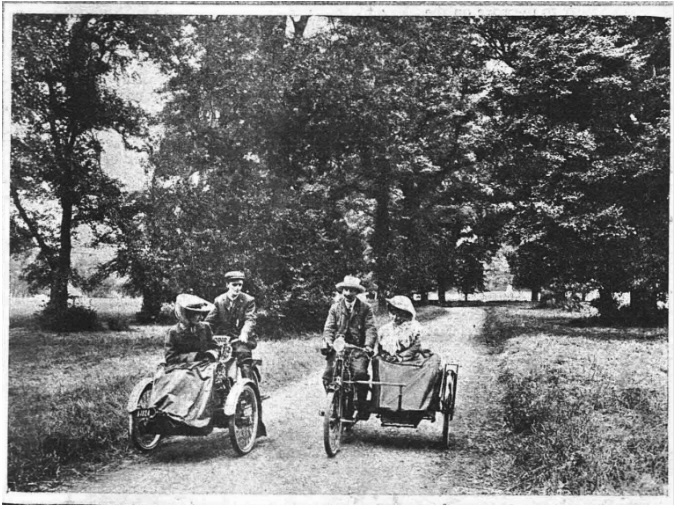
To conclude the year, a selection of contemporary adverts…

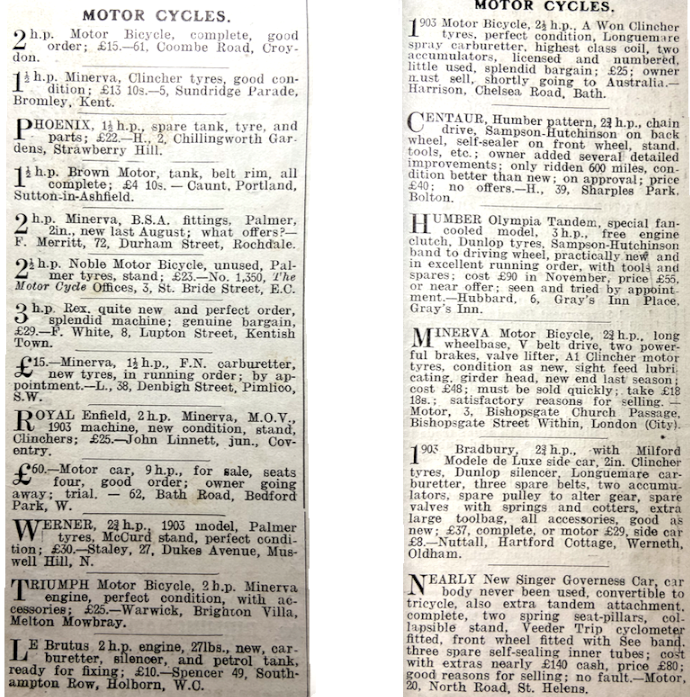
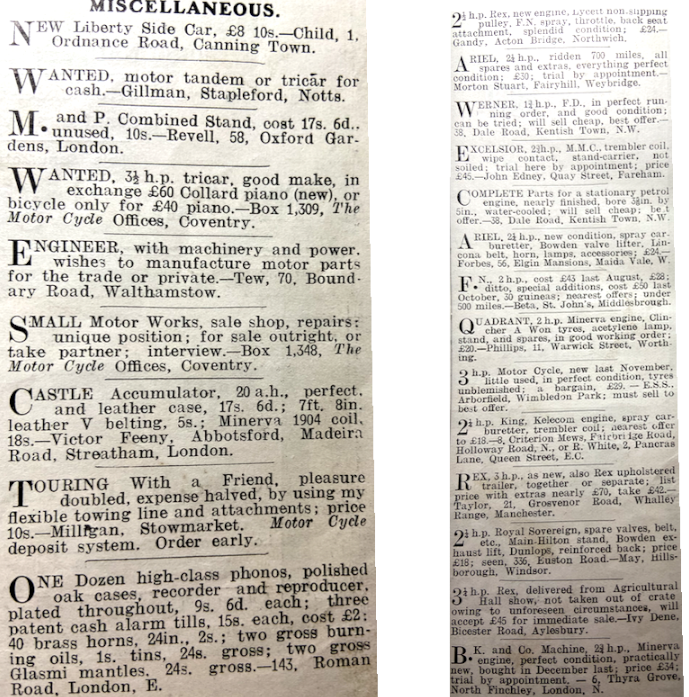
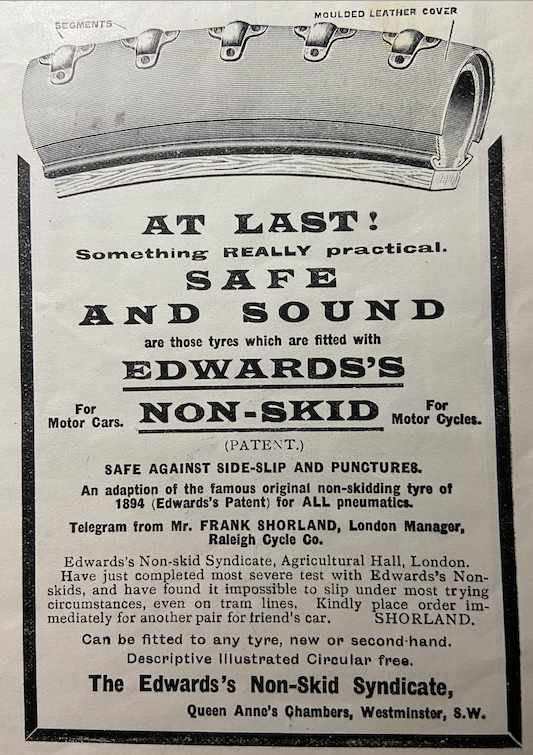


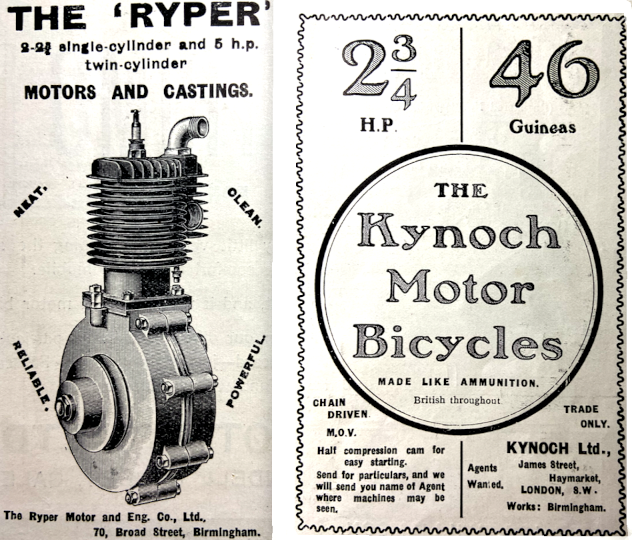
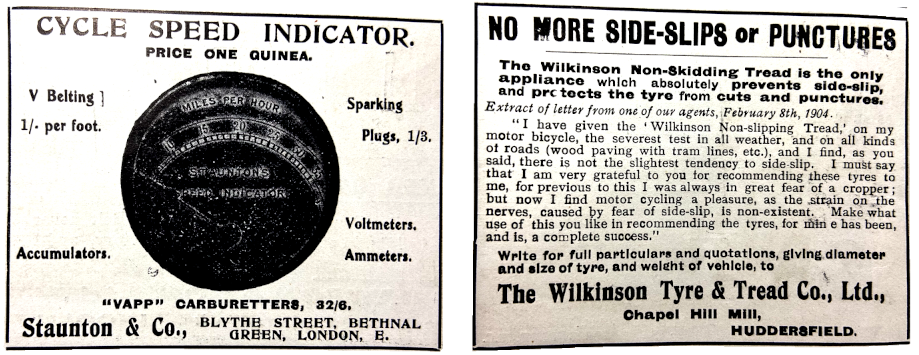
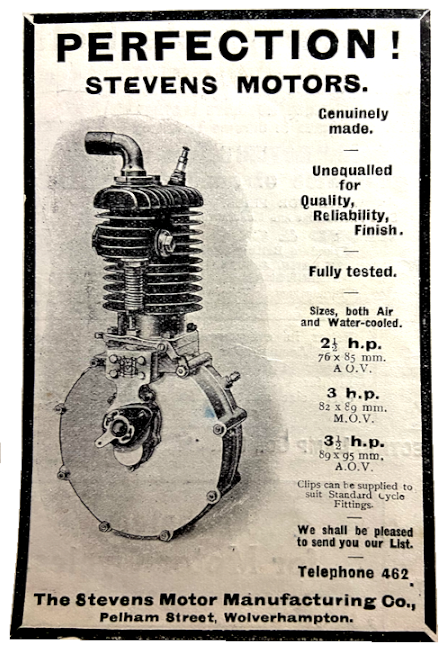


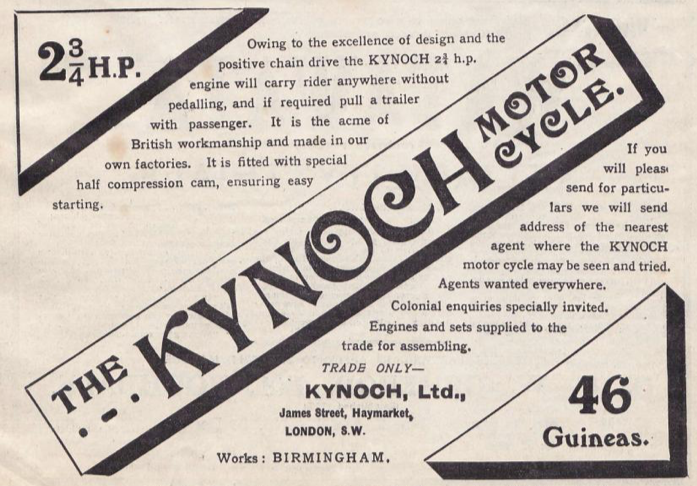
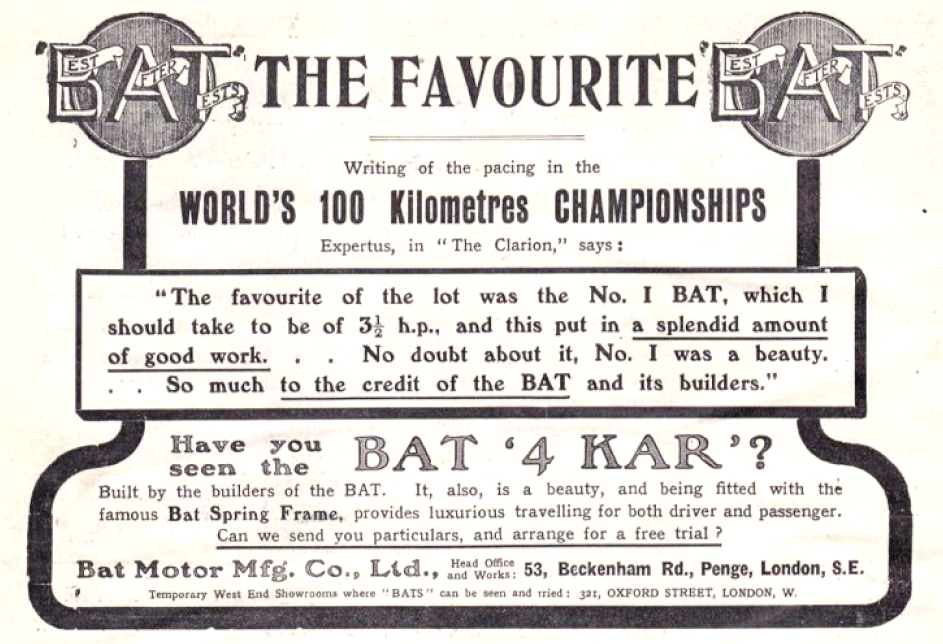
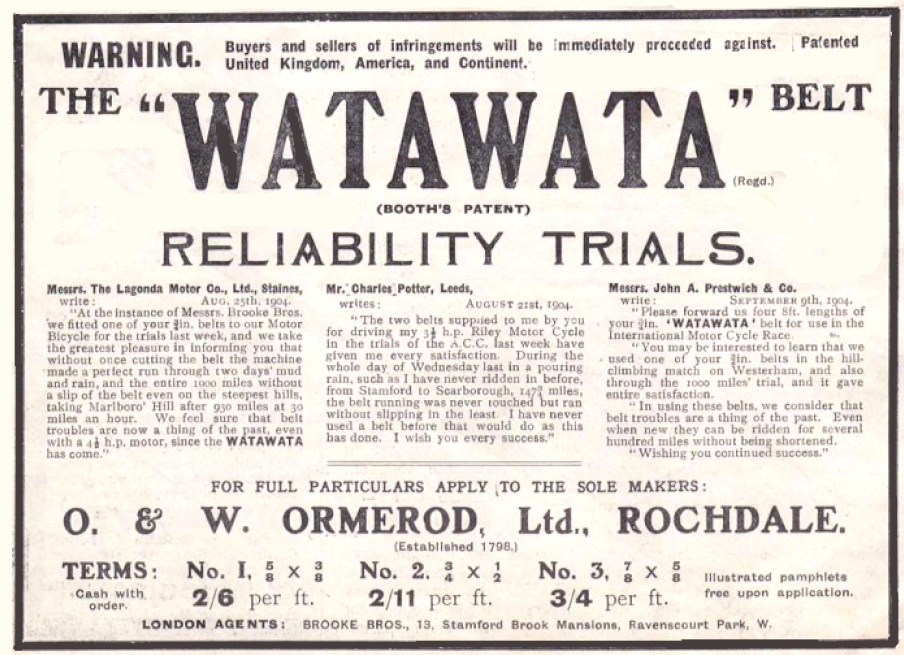
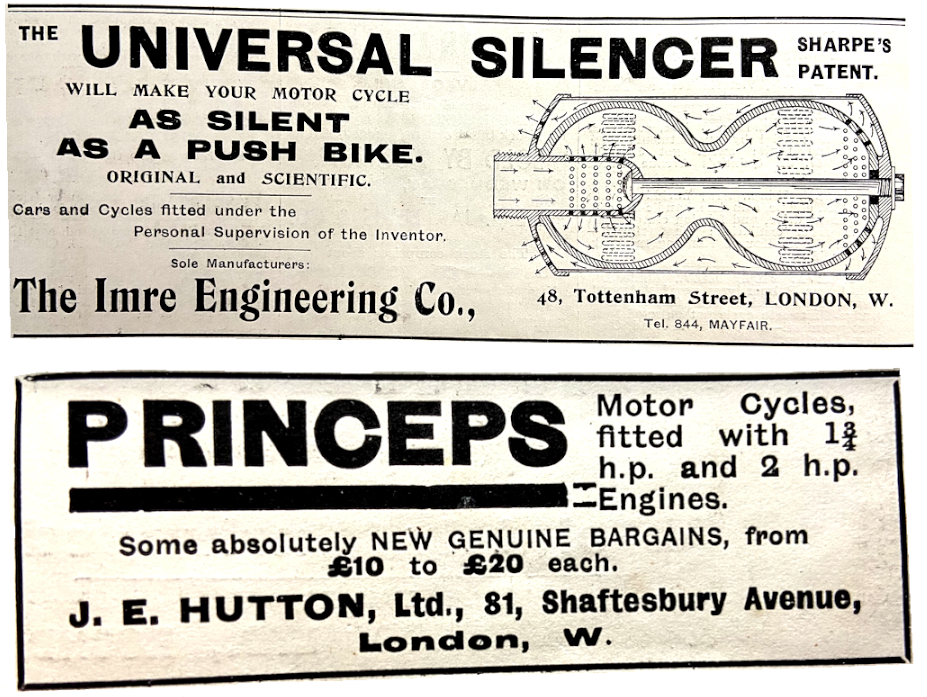

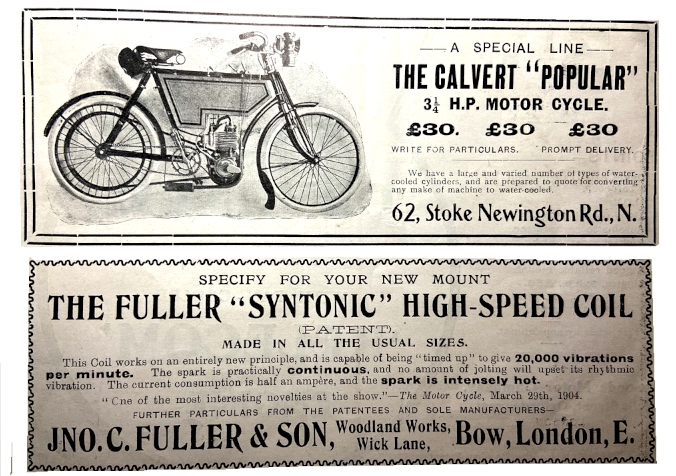
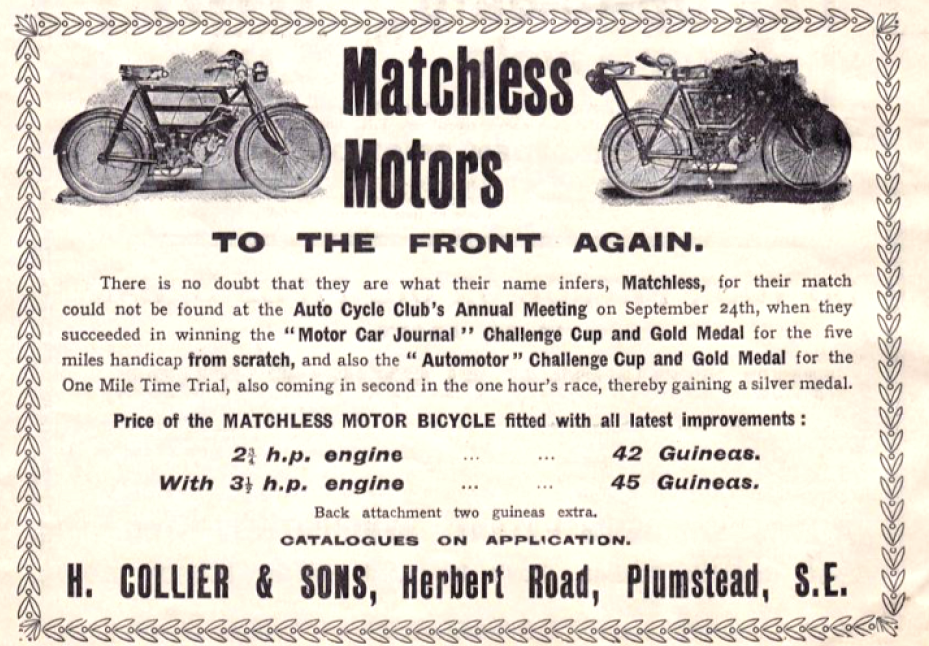
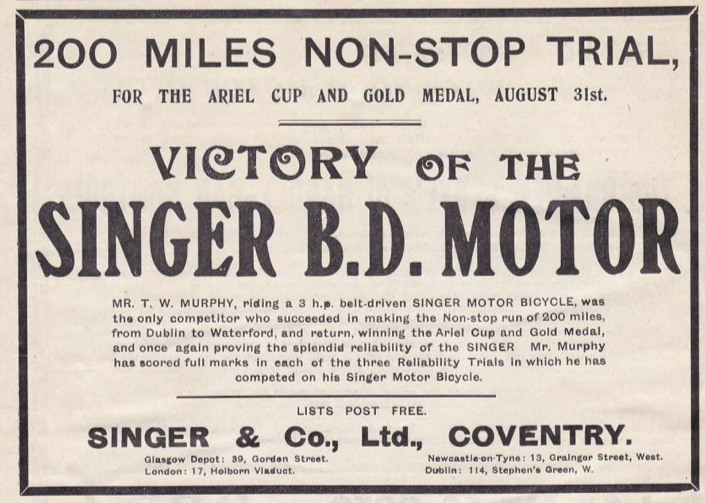
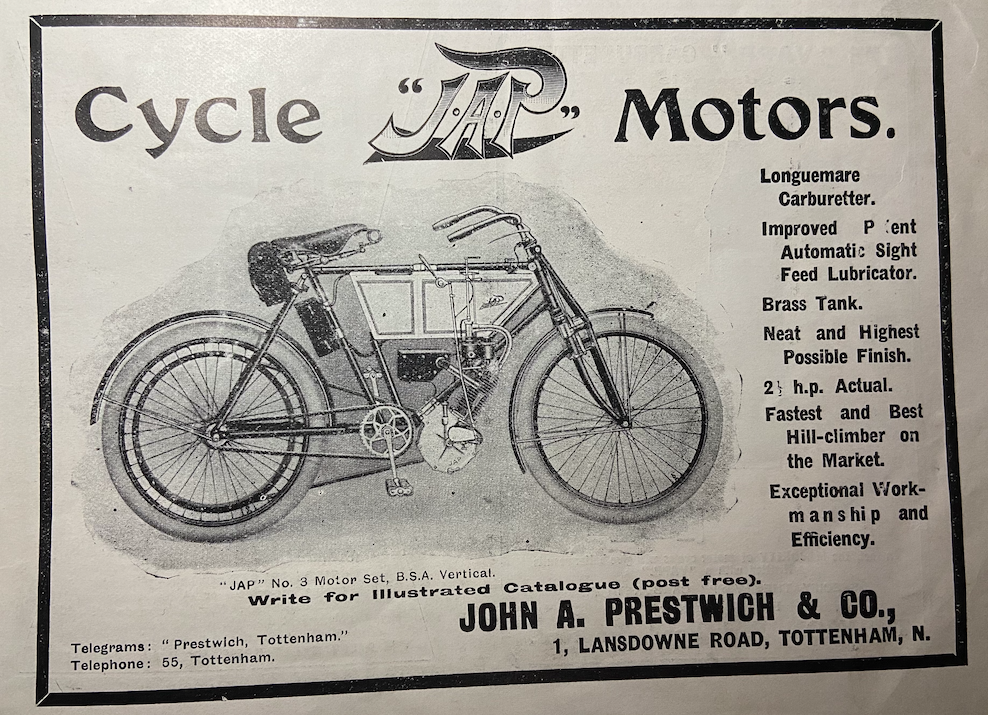
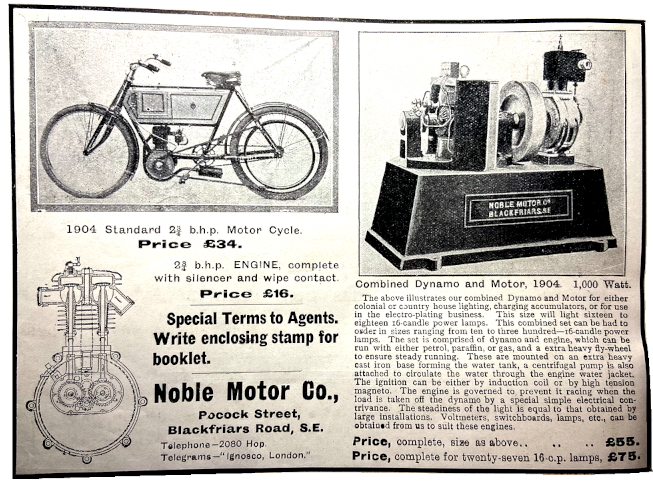
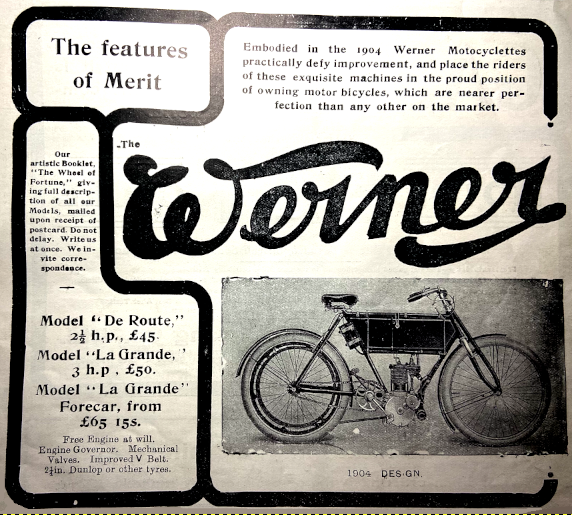




Here are some of the ads that accompanied the Motor Show at the Agricultural Hall, Islington:
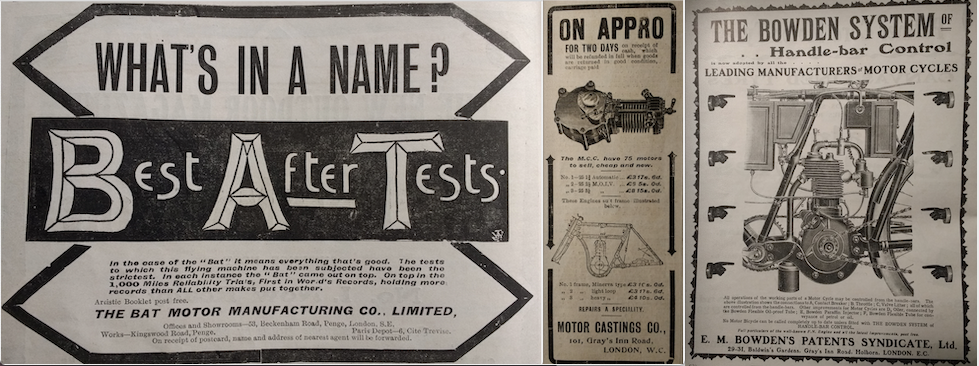

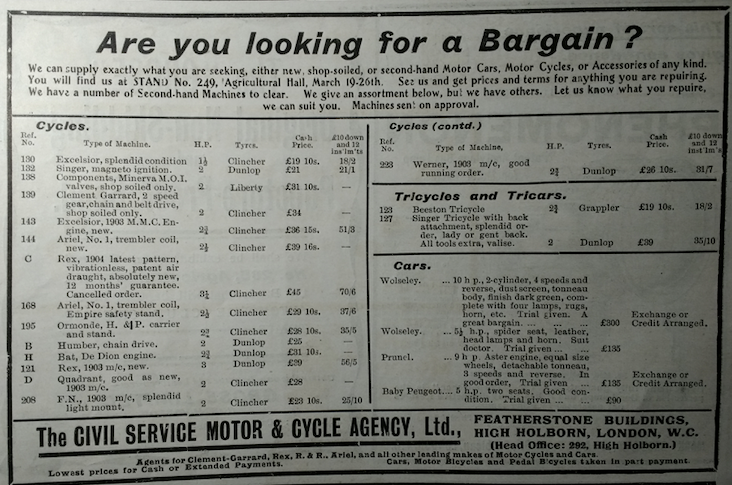
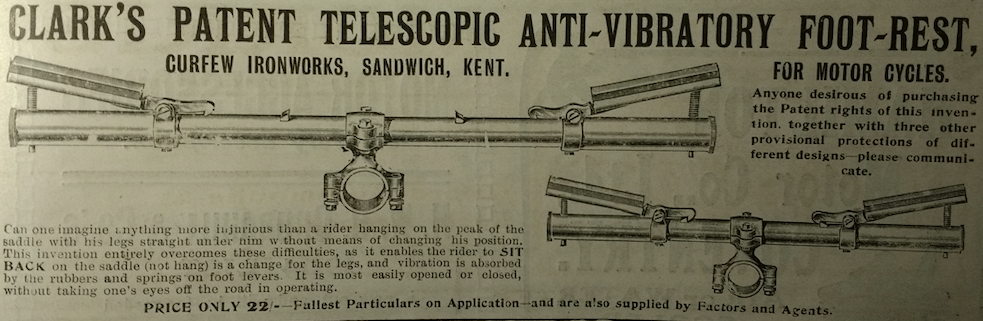
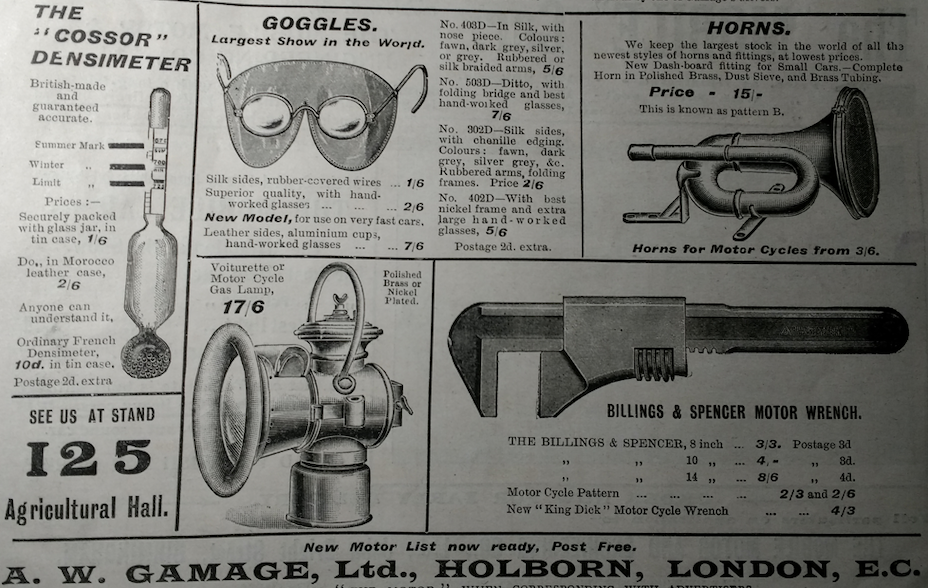
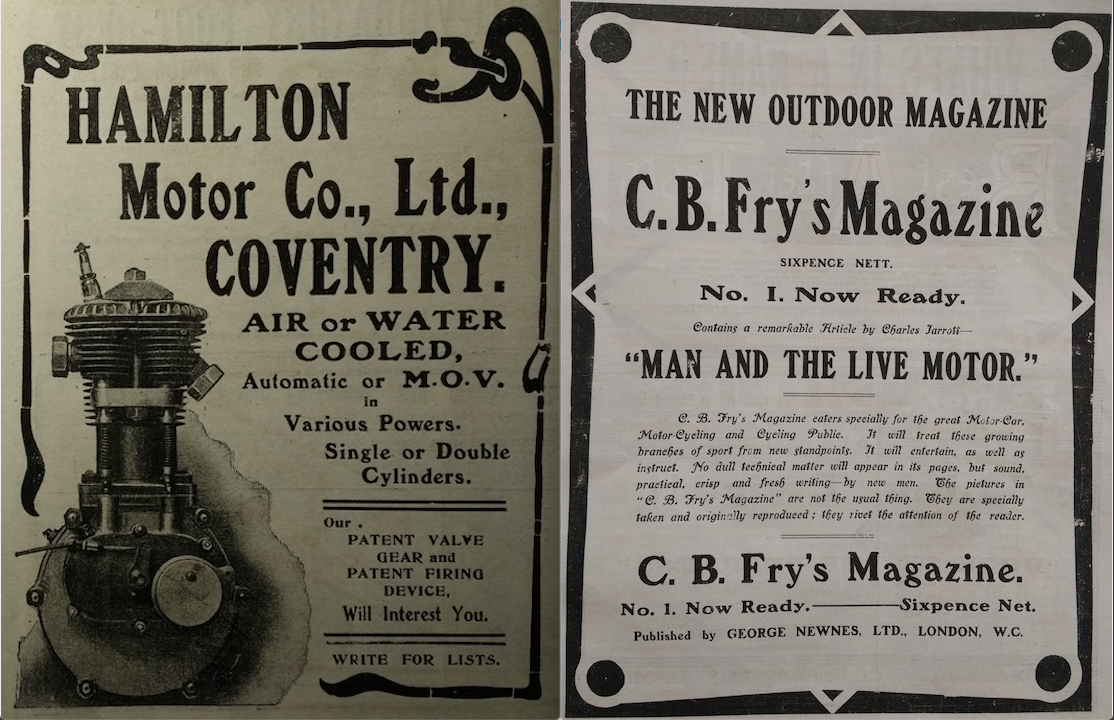
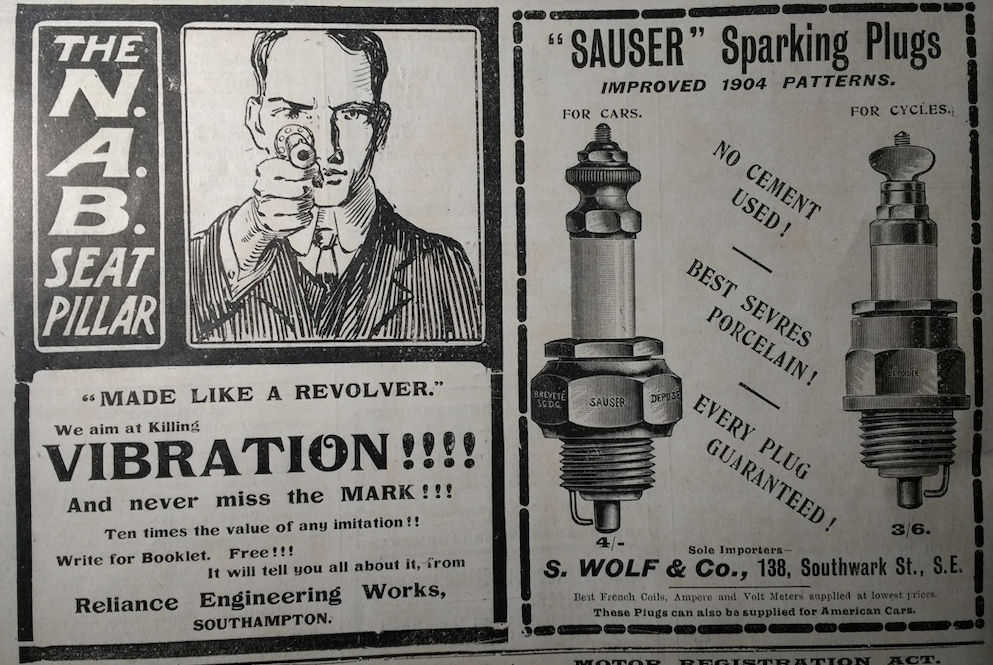
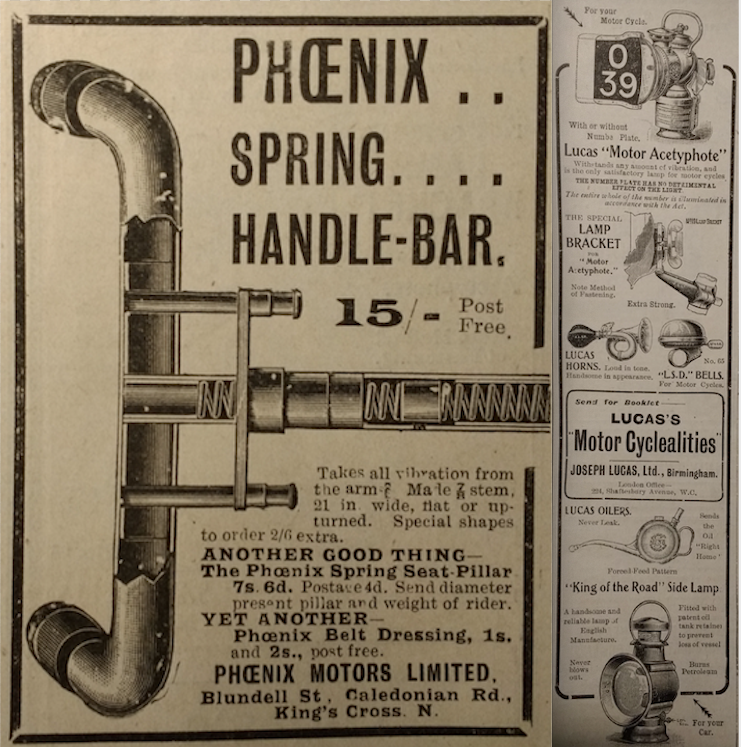
Here’s a selection of ads from the colonies…
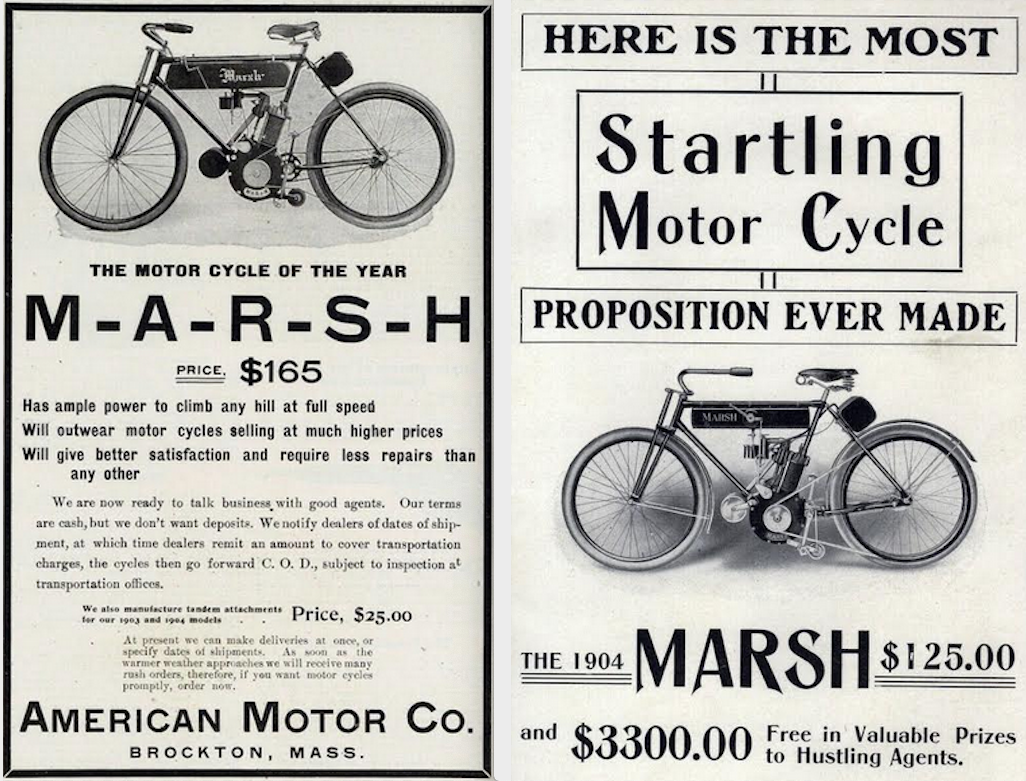
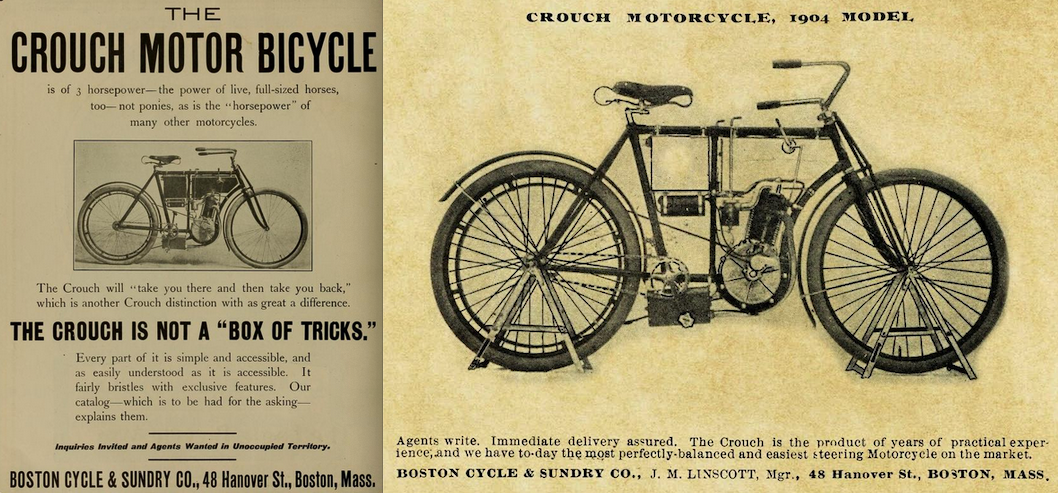
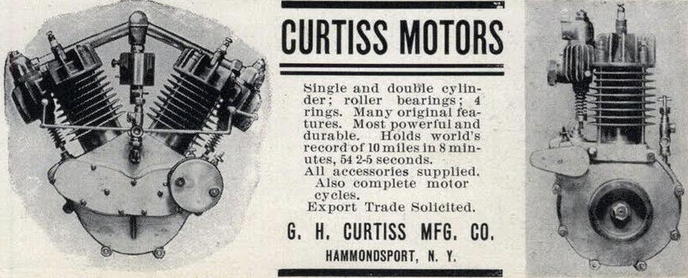

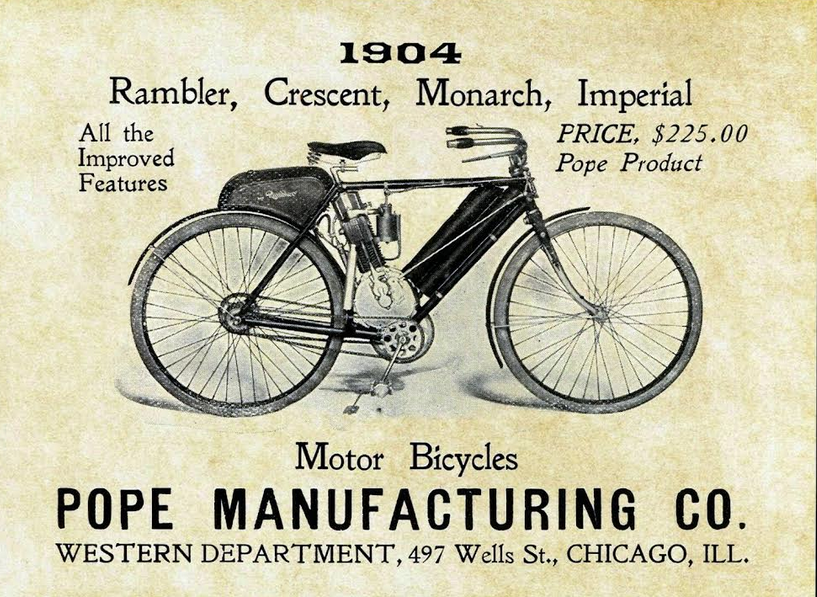

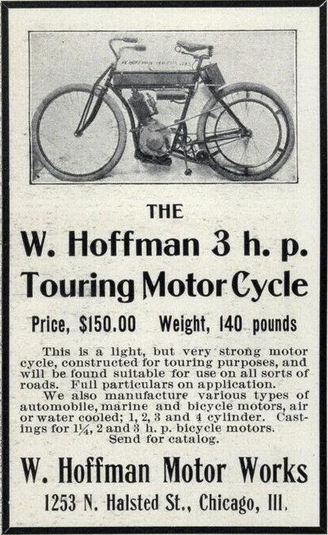
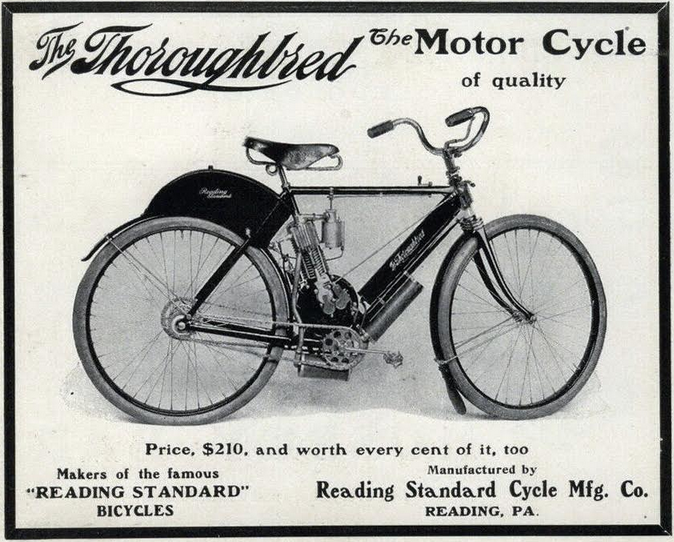

These adverts appeared in The Motor which, following the suspension of its stablemate Motor Cycling, took an interest in motor cycles…
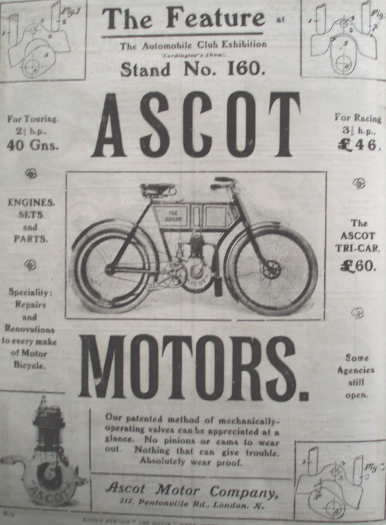
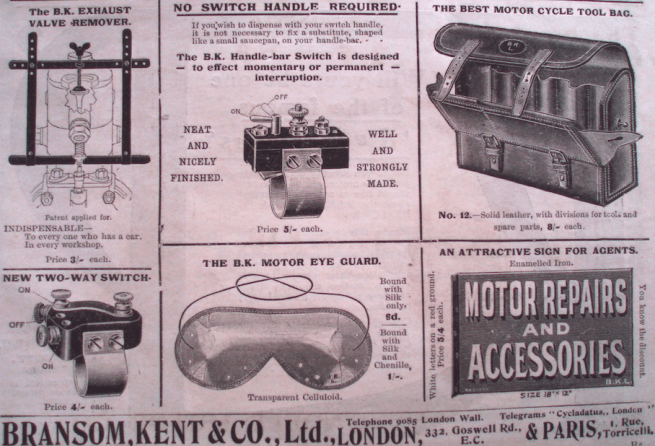
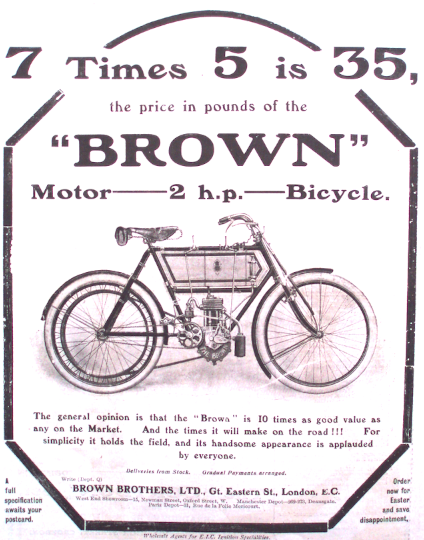
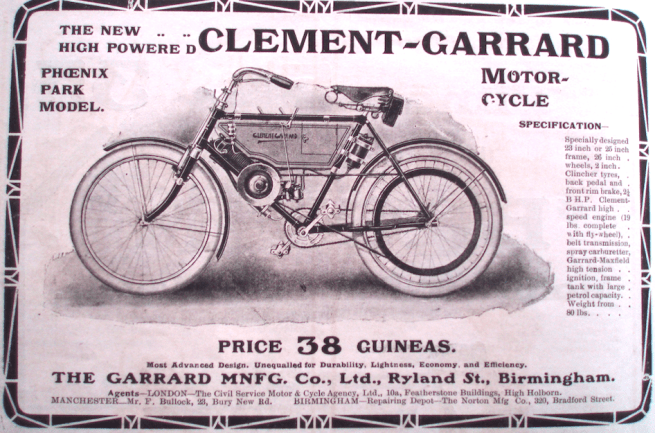
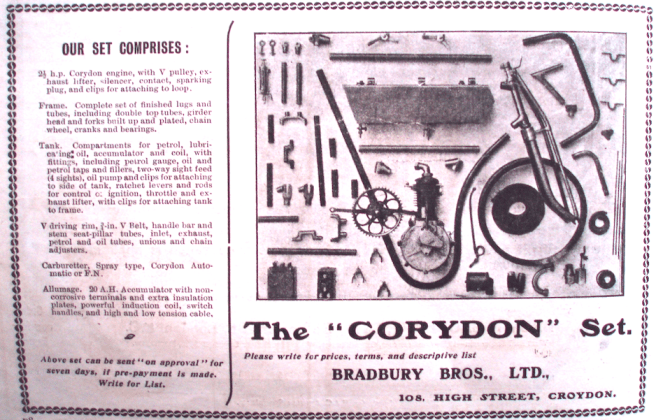

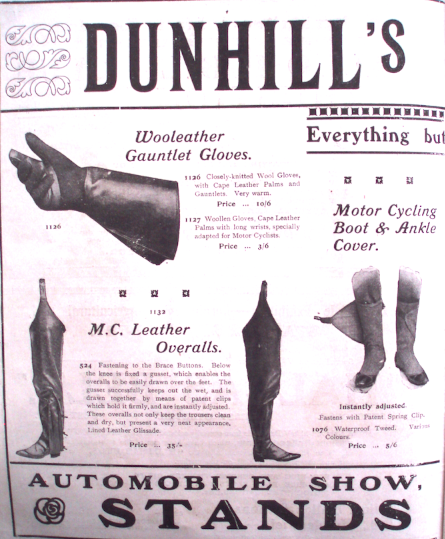
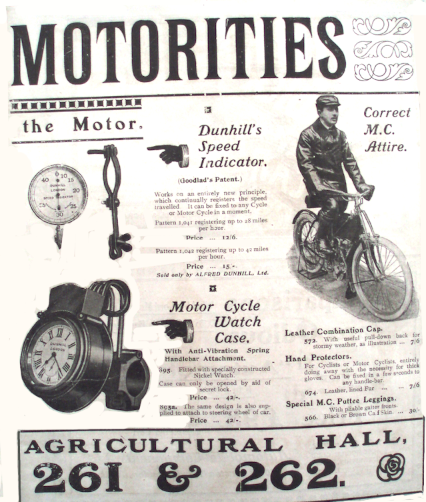
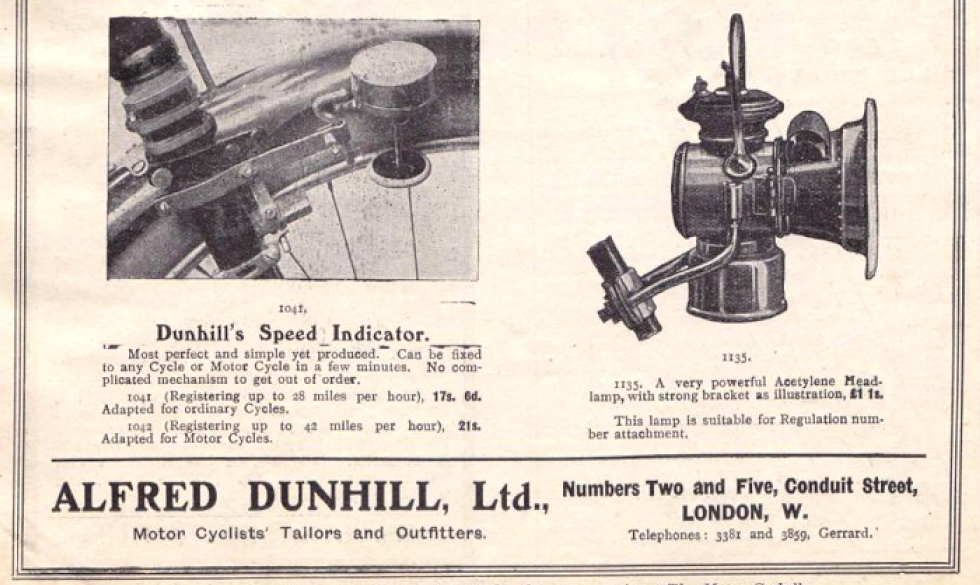
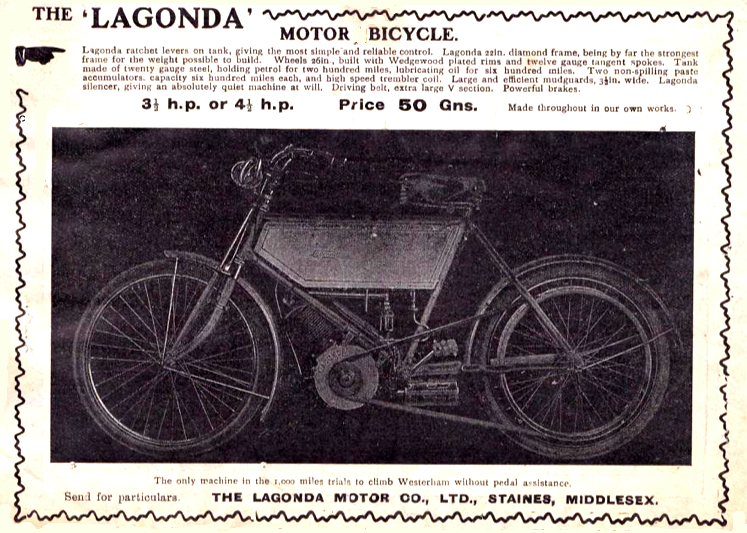
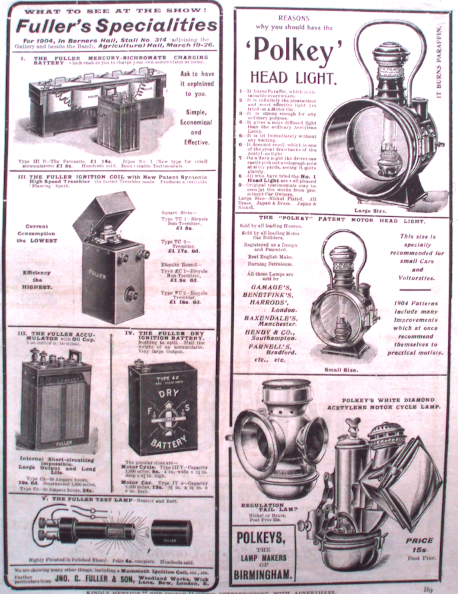
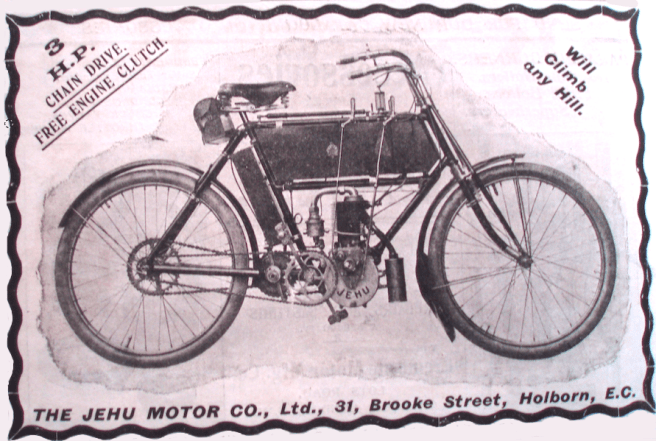
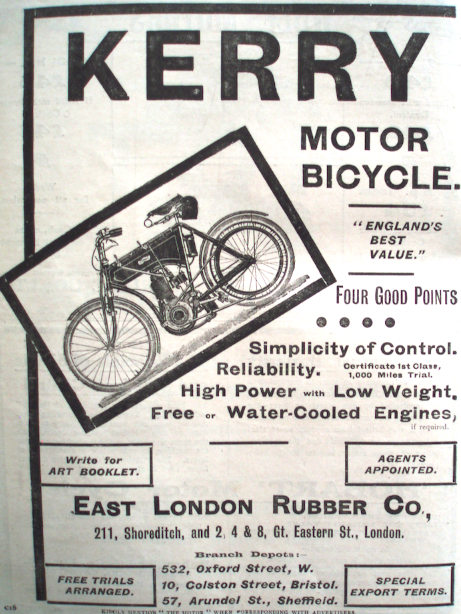
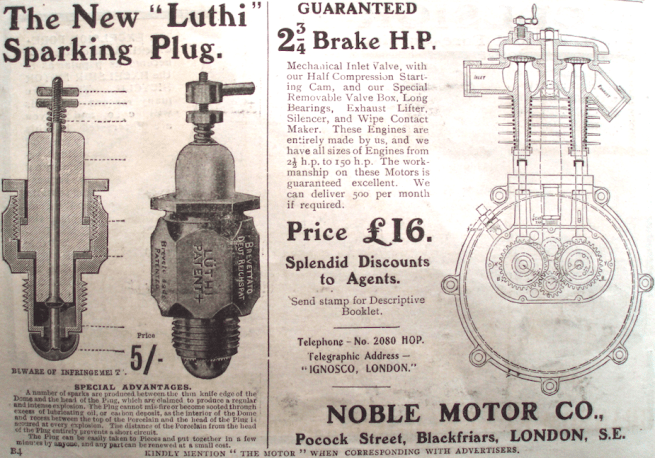

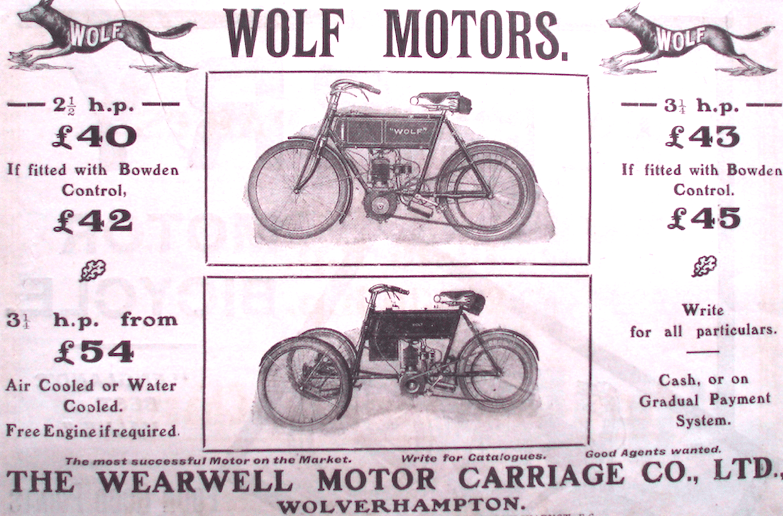
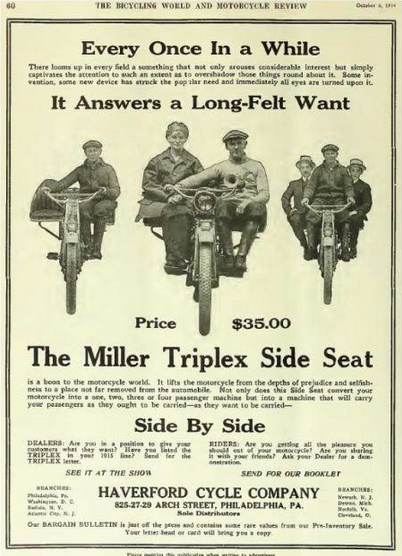
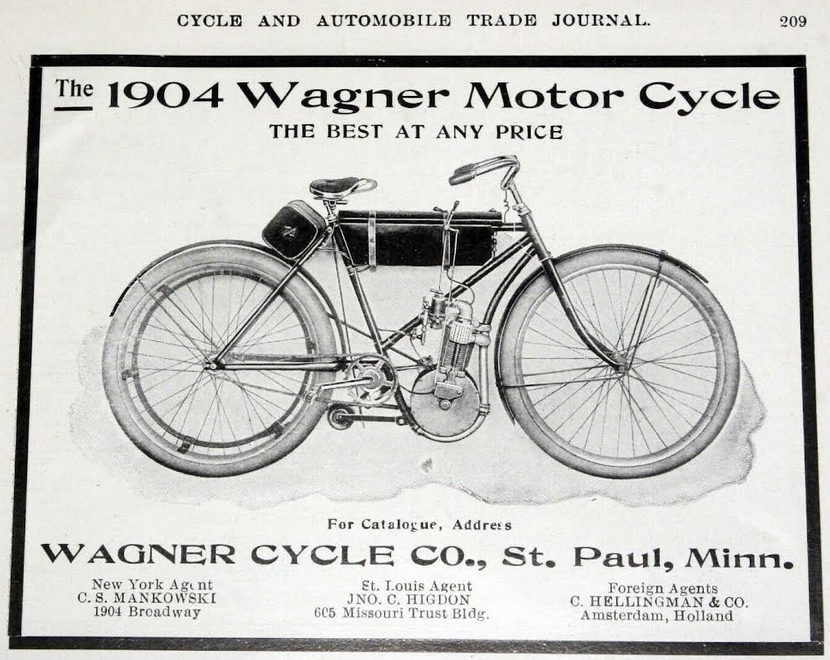

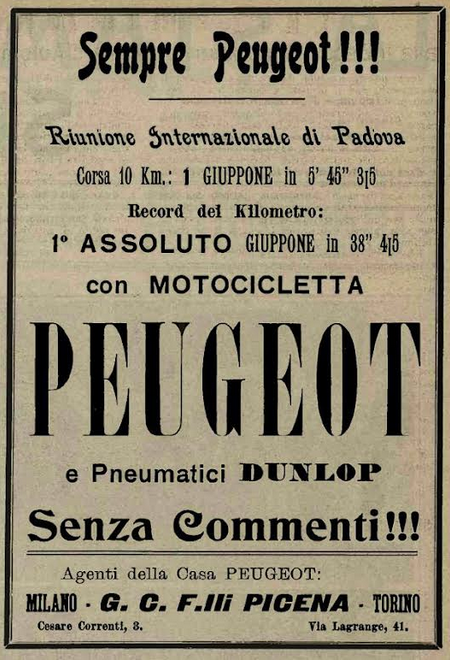
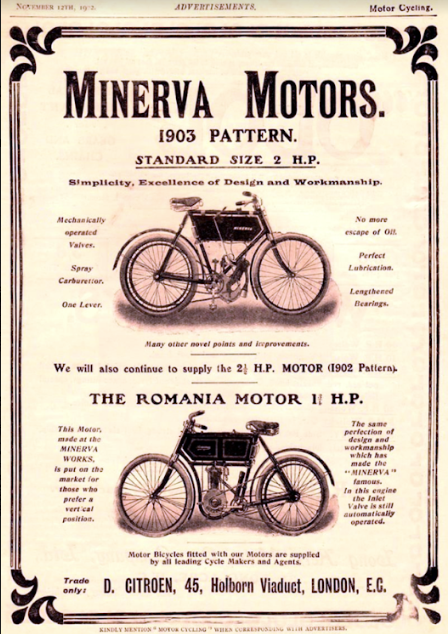
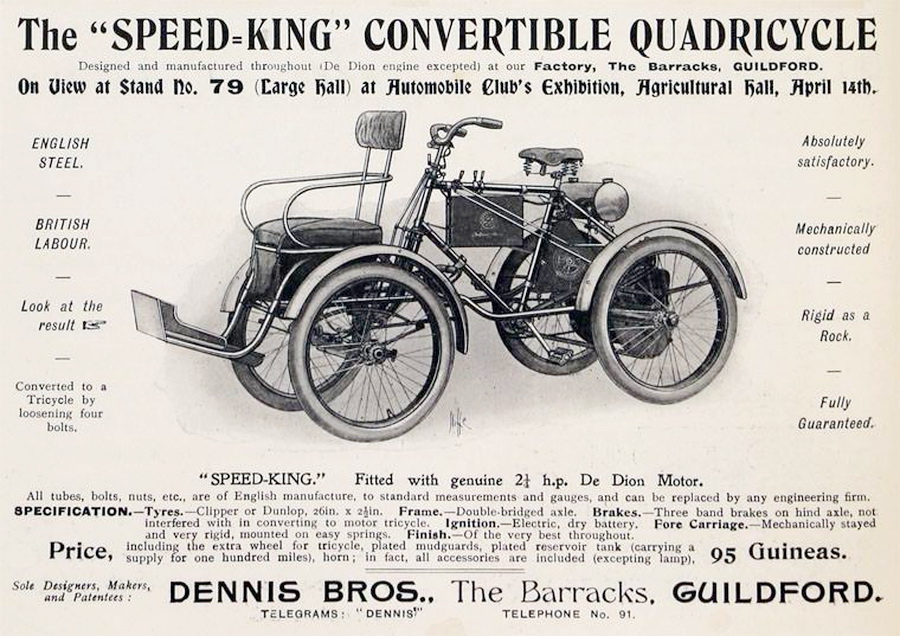
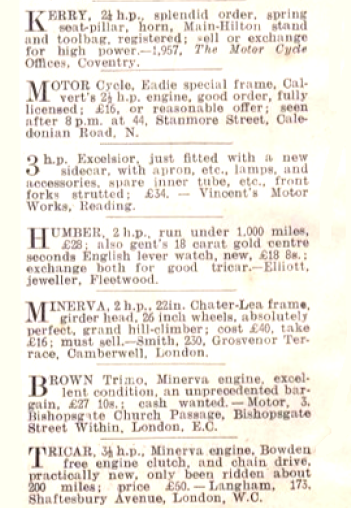
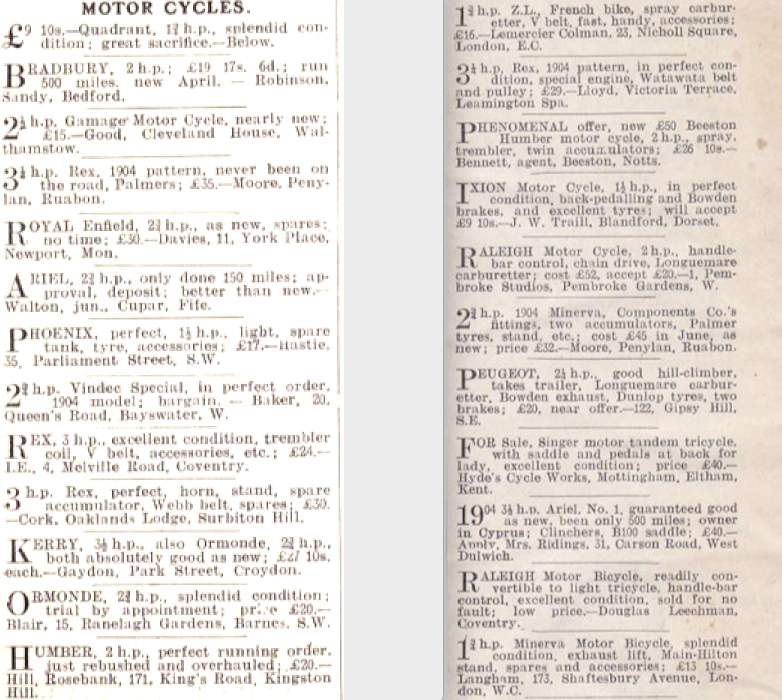
 Motorcycle Timeline