1890
IN THE FACE OF the 2/4mph urban/rural speed limit Edward Butler gave up on his Petrol-cycle. He wrote in the magazine The English Mechanic: “The authorities do not countenance its use on the roads, and I have abandoned in consequence any further development of it.” It was a brave attempt that, had it not been scuppered by ridiculous legislation, would have put Britain at the forefront of the motor cycle (and automobile) revolution from the beginning.
KITCHEN GOODS specialist John Marston and Co expanded its output to include bicycles. As we’ll see in 1912, this was A Good Thing for motorcyclists.
HERBERT AKROYD Stuart patented a compression-ignition engine, a clea189r three years ahead of that nice Mr Diesel.
KARL BAYER developed the large-scale production of aluminium from bauxite.
IN JAPAN EISUKE Miyata set up a gun factory where he also made Asahi bicycles, closely based on the British Cleveland.
1891
EADIE MANUFACTURING renamed its Townsend bicycles Enfields to mark an arms deal with the Royal Small Arms Factory in Enfield. The Enfield Manufacturing Co, soon renamed Royal Enfield, was set up to market them. In 1893 the firm adopted the slogan: ‘Built Like a Gun—Goes Like a Bullet’.

MAYBACH DEVELOPED a spray carburettor, though surface carbs would be more common for years to come.
1892
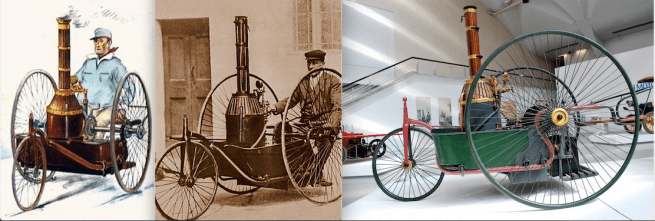
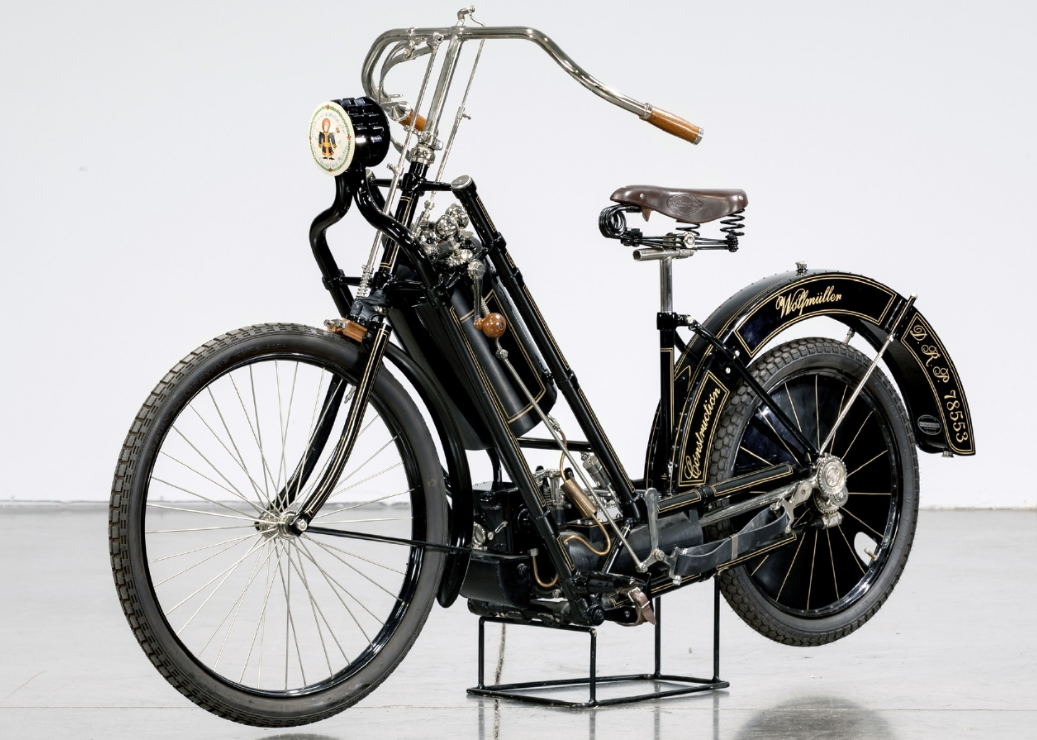
HANS GEISENHOF, who had worked with Karl Benz, designed a two-stroke petrol engine for the Hildebrand brothers. They fitted it into a bicycle frame but it was gutless so he and Alois Wolfmüller built a 1,489cc, water-cooled four-stroke parallel twin that developed 2½hp at 240rpm. The weight of this engine snapped the frame so the brothers used the frame from their 1889 steamer.
RUDOLPH DIESEL started development of a compression-ignition engine and was awarded a patent the following year.

JD ROOTS DEVELOPED a water-cooled, two-stroke trike featuring shaft drive and exported its entire output to France to avoid Britain’s bonkers legislation.
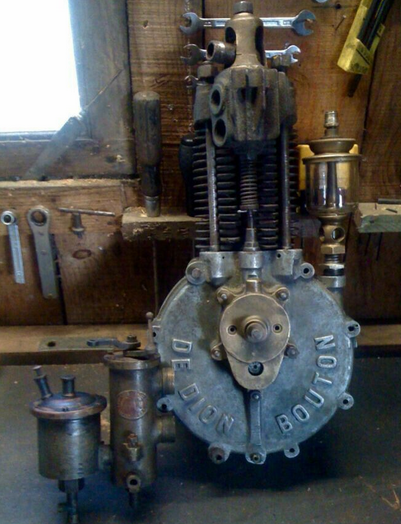
COMPTE ALBERTE de Dion, Georges Bouton and Charles Trepardoux had been making successful steamers for a decade when, following a visit to the Paris Exposition where they saw the Daimler engines, De Dion and Bouton decided internal combustion was the coming thing and began serious work on a petrol engine at the expense of their steamer projects. Trepardoux, a confirmed steam-head (‘vaporiste’, en Francais), walked out in disgust with the parting shot, “How can a motor function on a series of explosions?” His departure must have caused a row in the family, particularly when De Dion and Bouton were proved right.
1893
GEORGES BOUTON produced a 138cc single inspired by the Daimler engine in the 1885 Einspur but he found that it ran much smoother at higher revs. So while the Daimler engine ran at 250rpm and the Daimler at 750rpm, the De Dion Bouton ran at 1,500-2,000rpm and in trials reached 3,500rpm. Instead of hot-tube ignition the new ‘high-speed’ engine had a 4V battery/coil system with a contact breaker. Unlike many later engines it also boasted a detachable cylinder head; power output was about ½hp. De Dion and Bouton mounted their engine at the back of a pedal-powered Decauville trike which became a great success, running on the new tyres being mass produced by brothers Andre and Edouard Michelin. They also sold De Dion Bouton engines to power motor cycles, trikes and even an airship. This was the practicable proprietary engine that, combined with the many safety bicycles coming onto the market, launched an industry and, let it be said, an obsession.

ANGLO-GERMAN Frederick Simms, a pal of Daimler’s, bought the British rights to Daimler engines.
IN THE USA A bicycle was fitted with a rear-mounted horizontal twin two-stroke by one EJ Pennington—a second-rate designer but a first-class conman (‘premier division’ would be more accurate; he thought big. Take a look in the Galimaufrey for some of his scams).
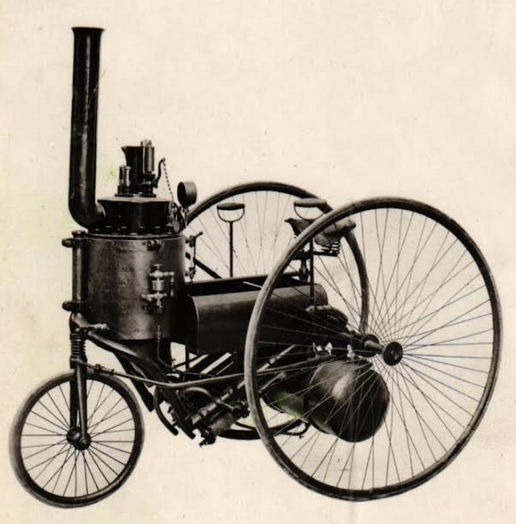
A GERMAN CALLED von Mayenberg built a two-speed steamer with fuel for the burner carried inside the frame.
COTTON REINFORCING cords were moulded into bicycle tyres for tougher sidewalls.
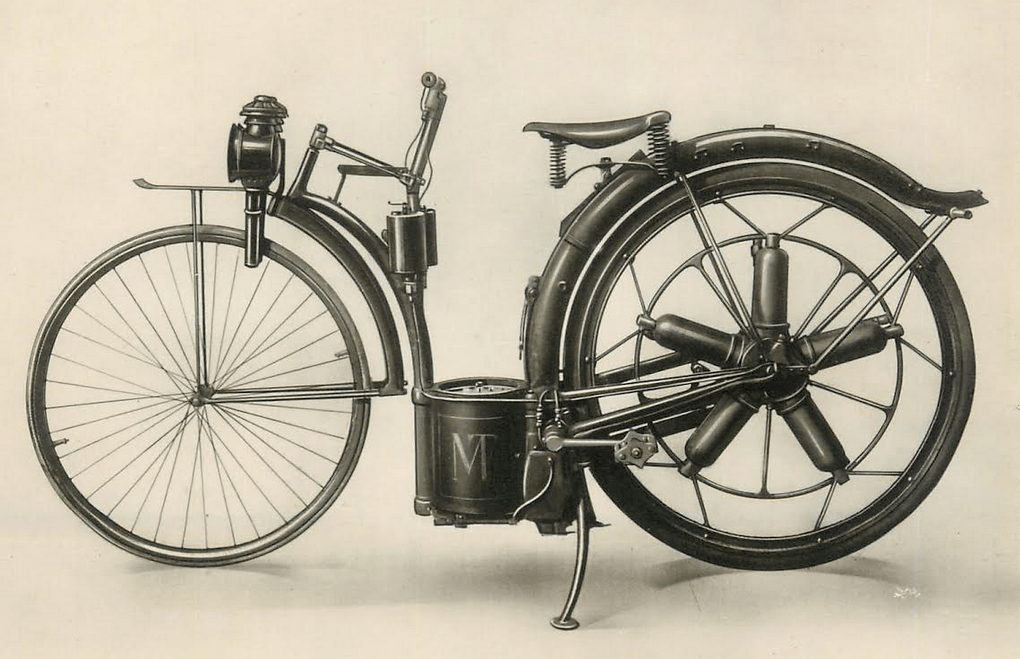
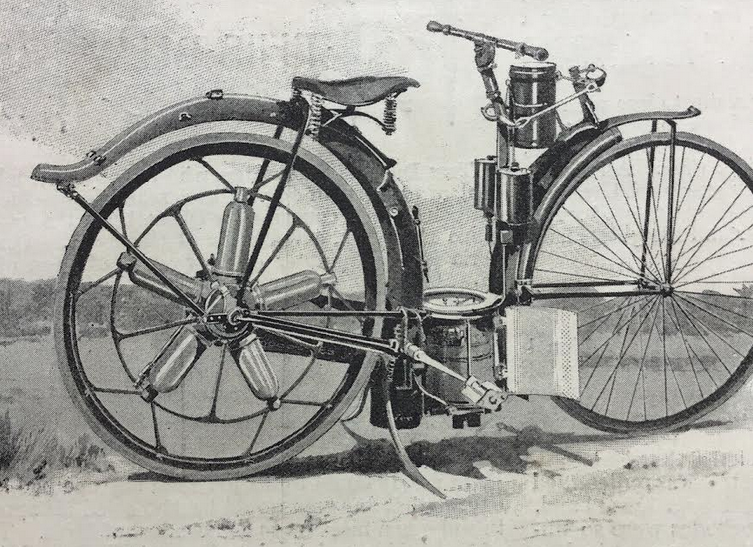
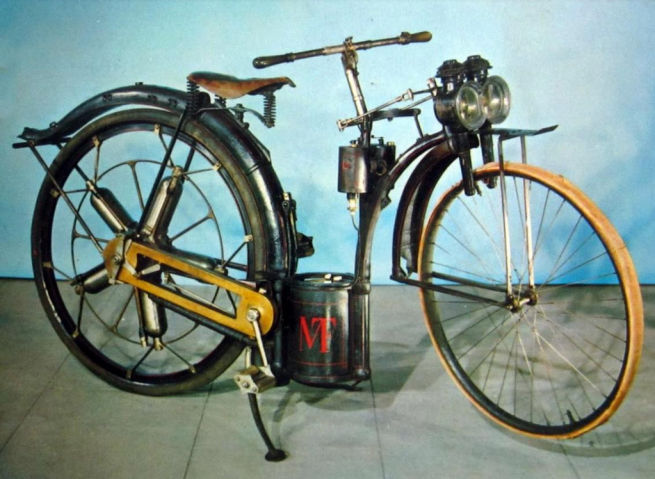
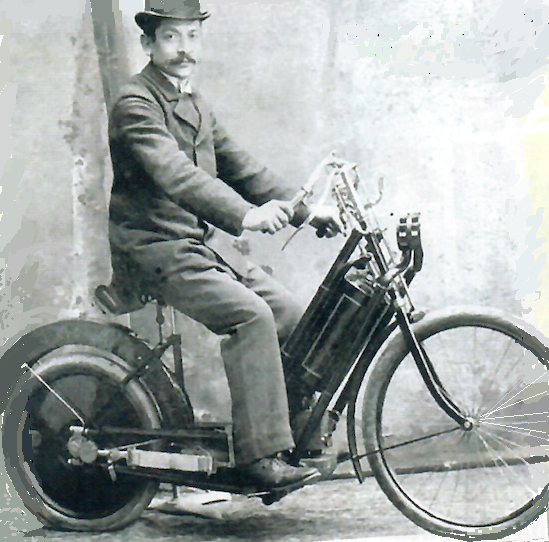
HAVING POWERED A TRIKE with his five-pot radial engine in 1887, Félix Millet built a motor cycle. This time the engine was in the rear wheel; the crankshaft served as the wheel spindle. Revolutionary features included a clutch (operated by back-pedalling, which also applied a brake), a semi-automatic frame lubrication system, mechanically operated valves, what was probably the first motorcycle centre stand (well, yes, it was a prop stand but it was in the middle) and an ‘elastic’ rear wheel which was an early attempt at suspension. The 1,924cc engine was rated at ¾hp at 180rpm giving a claimed top speed of 35mph. Fuel consumption was about 110mpg. Ignition was by a coil and lead-acid battery rather than the Hildebrand & Wolfmüller’s hot tube. Fuel was carried in the rear mudguard; a surface carb and air filter were fitted between the wheels. Millet sold the rights to Alexandre Darraq who planned to put the bike into series production; it was one of 17 starters (out of 102 two, three and four-wheeled entries) in in the Paris-Rouen Trials, generally accepted as the world’s first motoring contest. The Millet retired early in the race, production plans were dropped and Millet died in poverty.
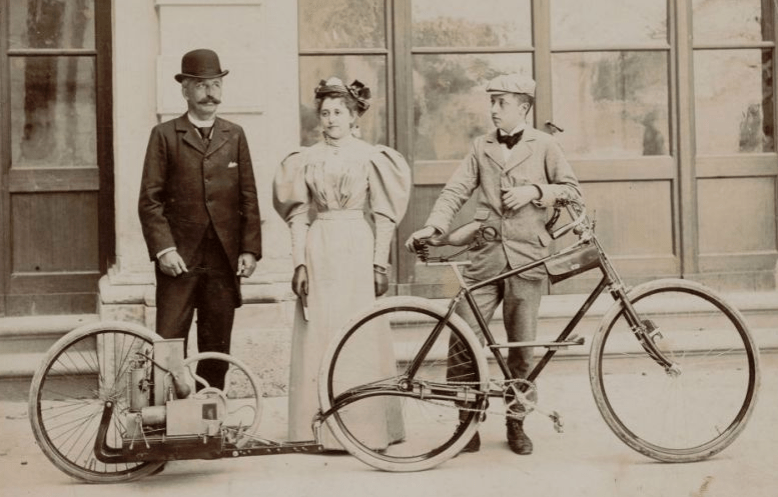
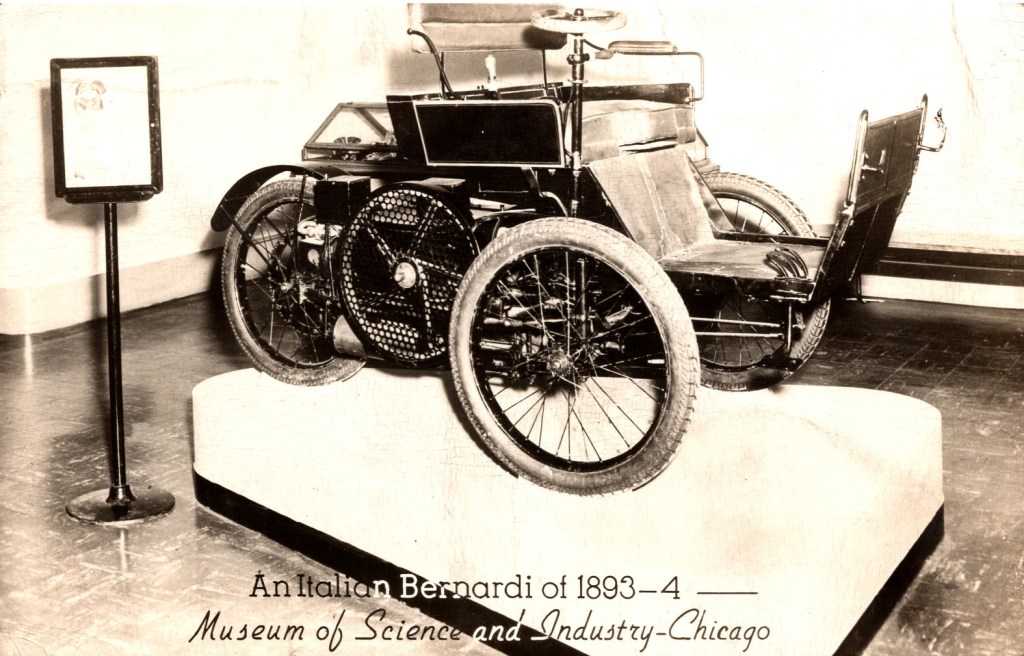
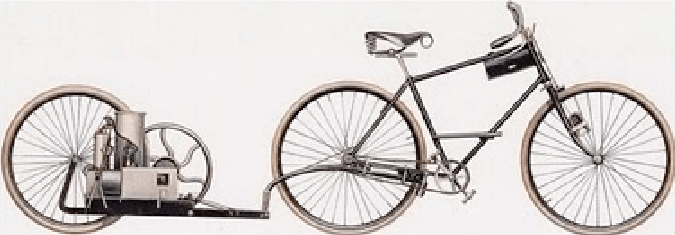
ENRICO BERNARDI, having registered the first patent for an Otto-cycle engine in 1882, also produced a petrol-powered two-wheeler, although in this case the engine was mounted in a trailer which pushed the bike.
1894
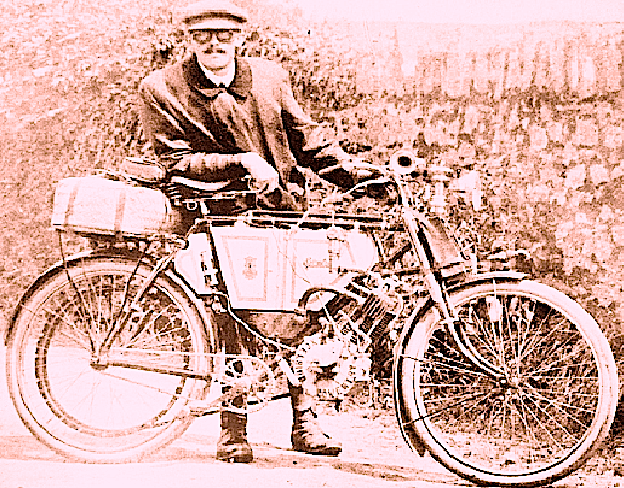
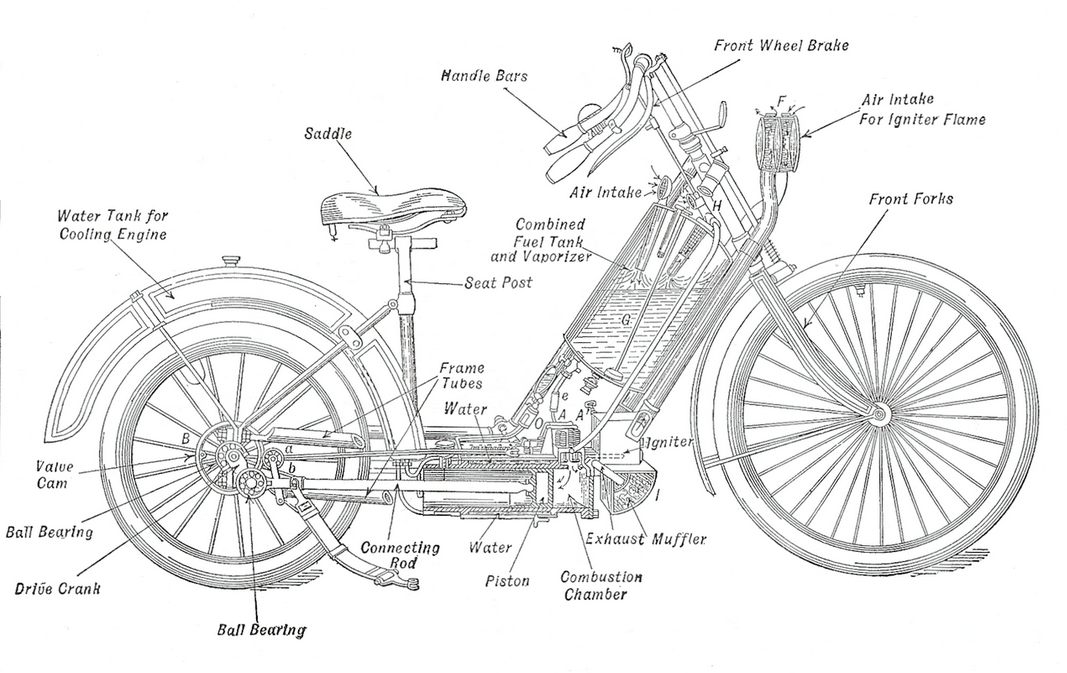
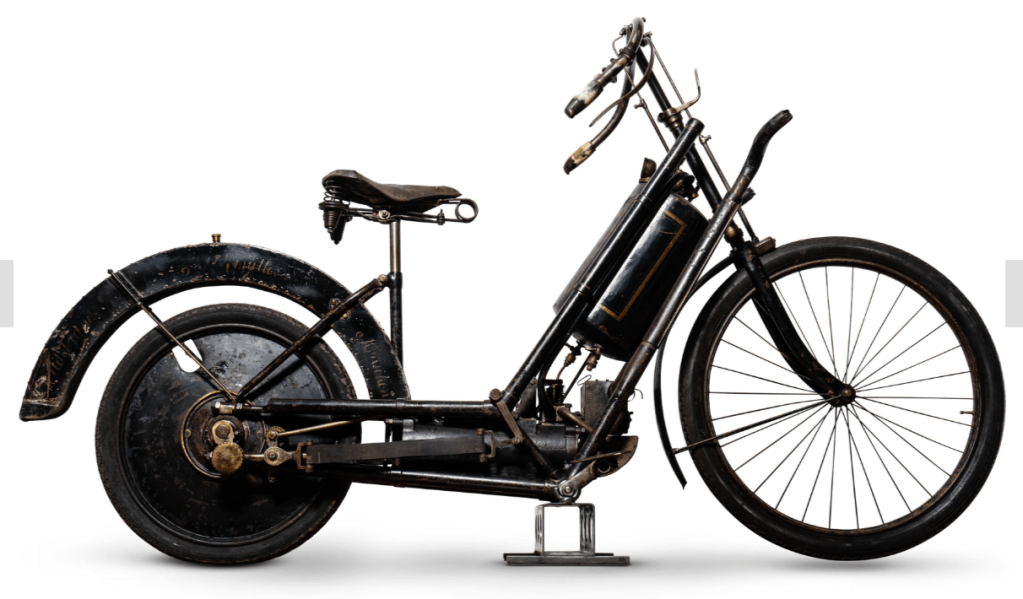
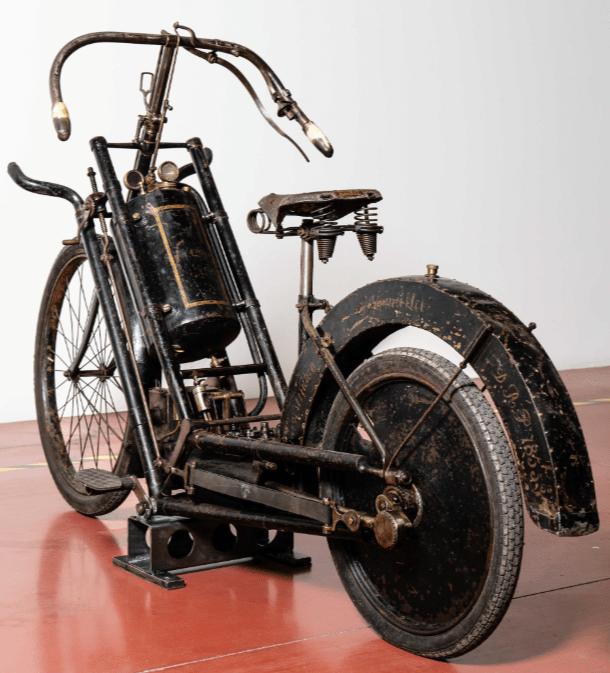
HEINRICH HILDEBRAND and Alois Wolfmüller patented the bike they’d been working on since 1892: a 1,428cc/2½hp water-cooled four-stroke twin (with hot-tube ignition and surface ‘bubbler’ carb) which would become the first motor cycle to sport pneumatic tyres, thanks to a deal with Dunlop. Following steam-locomotive practice the conrods drove the rear wheel so there was no crankcase and no belt, chain or shaft rear drive. Neither was there a flywheel; instead elastic straps helped the pistons back down the barrels. Claimed top speed was 25mph; brakes comprised a steel ‘spoon’ pressing against the front tyre and a pedal operated ‘sprag’ rear brake—a lump of metal that could be forced down against the road surface as an anchor of last resort. It was the world’s first motor cycle to go into series production, made in Munich by Motorfahrrad-Fabrik Hildebrand & Wolfmüller in a factory the brothers had purpose built for the project with 1,200 assembly workers; they also used many local engineering firms for components. ‘Motorfahrrad’ translates as ‘motorcycle’; an early use of the term. They even sent a demo model to Paris in a bid to win export business.


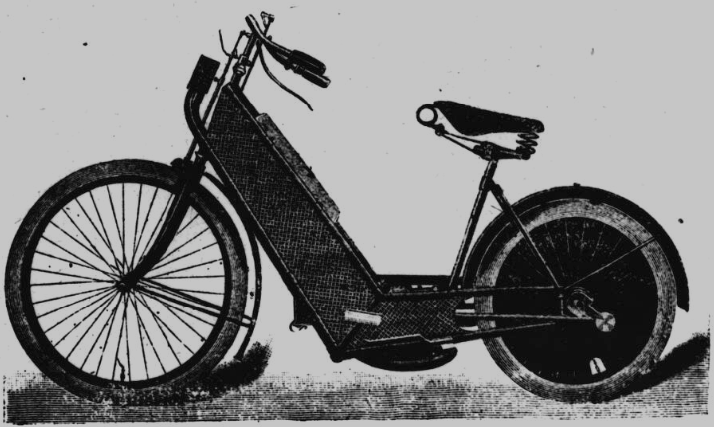
IN BETWEEN STORIES about “the latest design of unicycle” from Chicago (incorporating “a casing or cage for the rider…on which is loosely hung a frame carrying a seat for the rider) and advance notice of the Stanley Show “…as the space will be allotted strictly according to priority of application, delay will be dangerous for those who desire to share in the cream of the sites” Cycling magazine reported: The motor cycle, the invention of H Hildebrand, editor of Radfahr Humor, is now being actually made to supply orders and a factory is in course of construction, at Munich, to be devoted to the manufacture of the machine. A good pace can be obtained out of the machine, without any exertion on the part of the rider. Just what the motive power is we are not informed, further than that it is concealed in a reservoir, and can be obtained cheaply anywhere. We illustrate the machine, or engine.”

Stop press (spring 2025): A Hildebrand & Wolfmüller turned up in Italy and is due to go under the Bonhams hammer with an estimated price of £120-160,000. Here, for your delectation, are are some rather fine images of the 121-year-old, that looks pretty sprightly for its age…

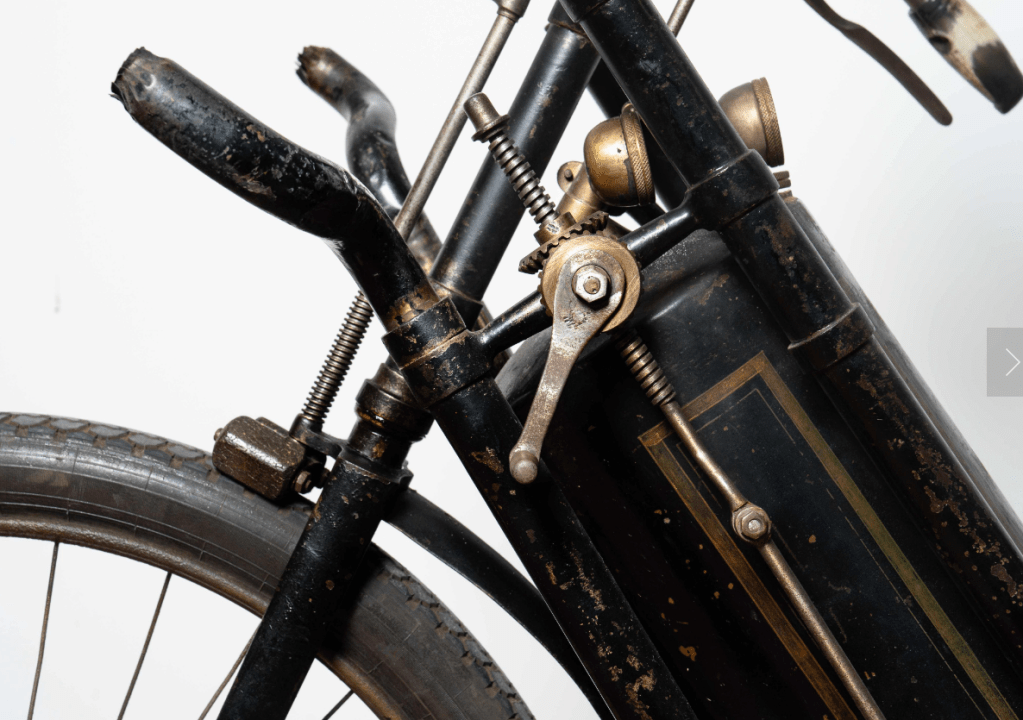
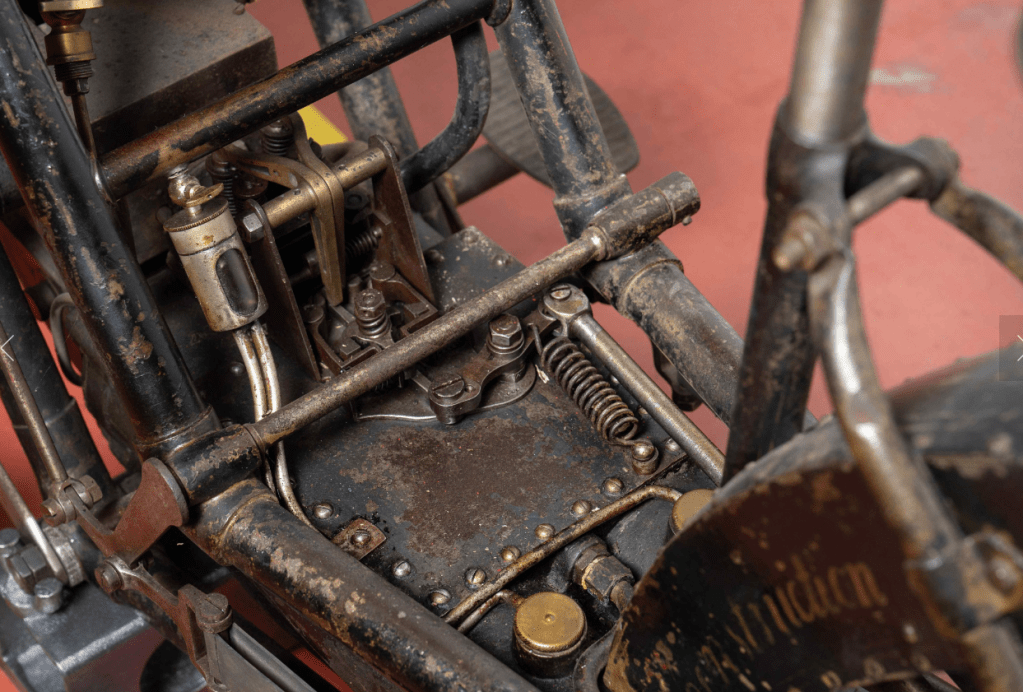
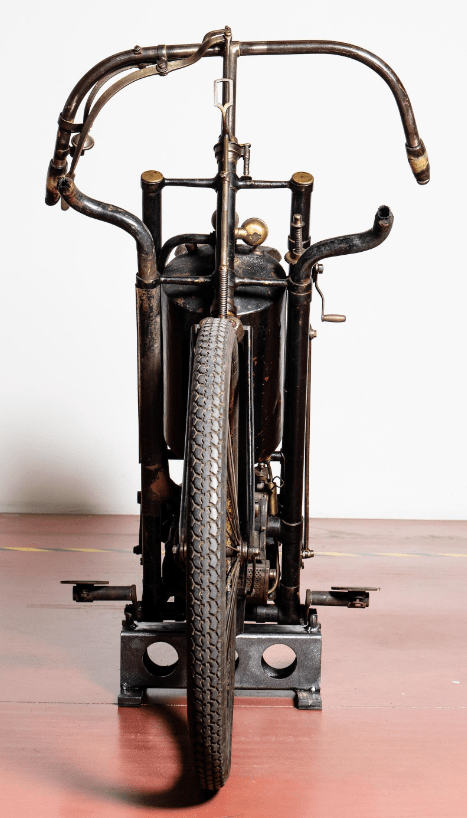
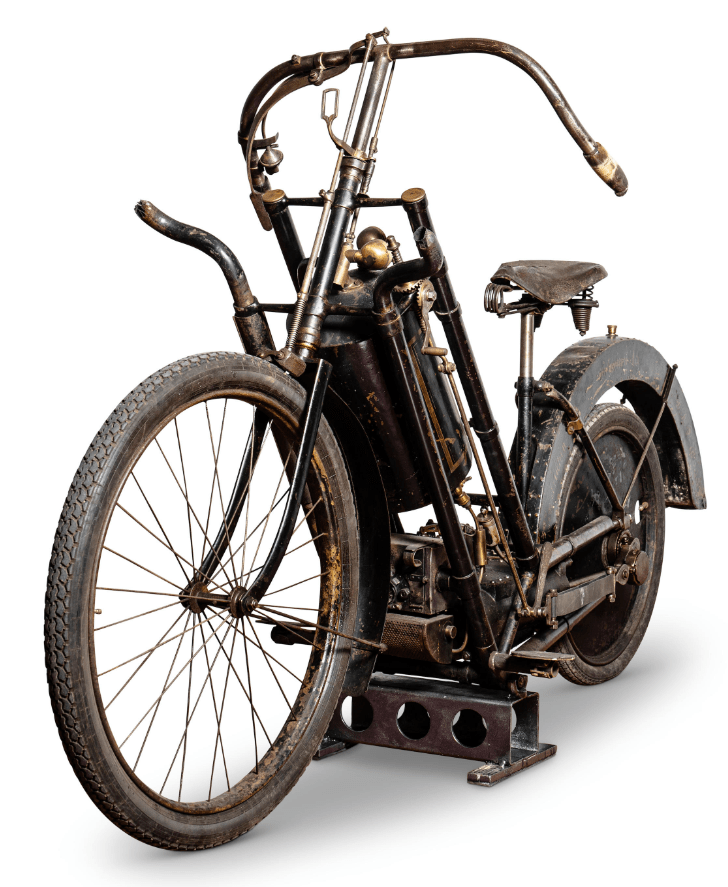
PROFESSOR ENRICO Bernadi of Verona built a four-stroke, water-cooled ohv 265cc single-cylinder engine and named it the Lauro. It was too bulky to fit in a bicycle frame so Bernadi mounted it in a monowheel trailer. The engine turned the trailer wheel and the trailer pushed the bike. Control was via a rubber bulb which controlled a carburettor diaphragm.
I’M GRATEFUL TO my amigo Francois for recording the first known motor cycle race (read all about it in ‘Images of Yesteryear’ via the main menu). Italy was first past the post when two (sadly unidentified) bikes joined three cars in a 70-mile race from Turin to Asti and back. We don’t know who won, or indeed if anyone completed the course—but they tried. Viva l’italia! Within weeks the French had a go when two bikes started in the ambitious 732-mile Paris-Bordeaux-Paris race. The winning car finished in 48 hours; neither bike survived the course…you’ll find more details further down the page.
HARRY LAWSON’S Motor Manufacturing Company (MMC) company bought the British rights to De Dion engines.
1895
EIGHT YEARS BEFORE launching The Motor Cycle, Iliffe Press catered for the new breed of motorised transport with The Autocar. Here’s an excerpt from its first editorial: “Horseless carriage—automobile carriage—automatic carriage—autocar. All these names have been used to designate the latest production of the ingenuity of man, the motor-driven road carriage, irrespective of whether steam, electricity, hot air, or petroleum be the motive power. The last is the latest. The latest is the best, and, as ‘the best is good enough for us’—as our American cousins have it—its adoption to indicate the journal as well as the machine in whose interests it is published scarcely needs explanation. Nor is excuse needed for our entry into the world of periodic literature…The automatic carriage movement has come somewhat suddenly before the notice of the British public, although for over a year it has been making steady headway on the Continent, but now that it has reached our shores its practicality and far-reaching influence on the future life of the people force themselves irresistibly upon all thinking men. To those who have only now had their attention drawn to it, the idea, all new and fresh, falling suddenly on an unprepared mind, appeals with varying sensations, but to those who, like ourselves, have been pioneers in the early stages of automobility, and have seen and intimately followed the birth and growth to its present dimensions of the forerunner of the autocar—the bicycle—and have learnt to appreciate its advantages, there is nothing either strange or startling in the notion. It is the outcome and natural evolution of an idea to which the events of the past quarter century have led up, and which those whose thoughts have been cast in advance of the times have now for some time been looking forward to with pleasurable anticipation. The cyclist and the cycle maker have paved the way for the autocar…whilst the bicycle rider has accustomed the public mind to the sight of wheeled vehicles without horses, and convinced even the dense bucolic brain that such things have nothing uncanny in their composition, and can be as well controlled as the erstwhile equine steed, the manufacturer has brought the science of road-carriage construction to a point of perfection which enables the power developable by a motor to be utilised to the fullest and best advantage…To those who would revile the British engineer with having allowed both France and America to be before him, we point to the legislation of the past, which has throttled all enterprise at its birth, and now that way has been opened for the exercise of her powers we may say we have no fear that Great Britain will find herself in any way behind, as soon as the inventive talent of her mechanics has had time to develop itself.”
Unless stated otherwise, quotes for the rest of the year will be courtesy of The Autocar.—Ed
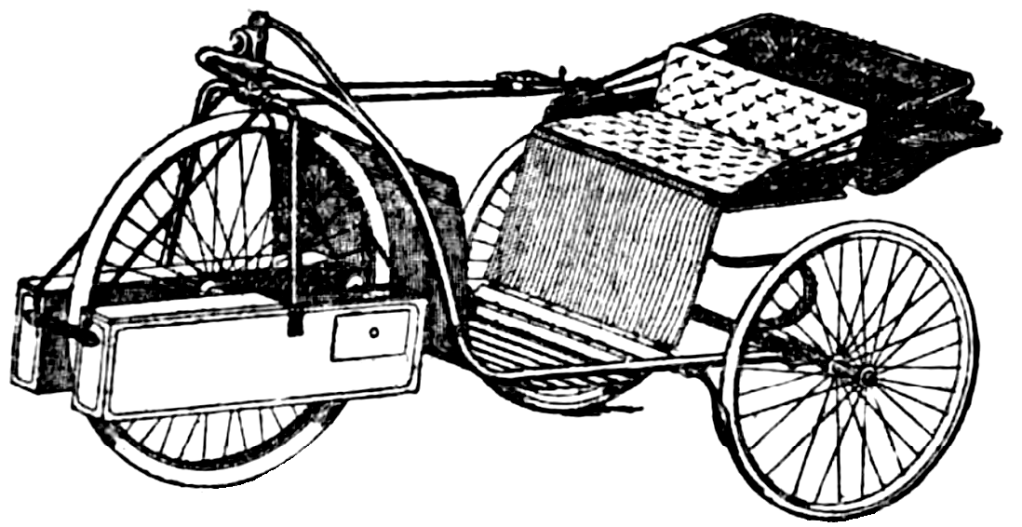
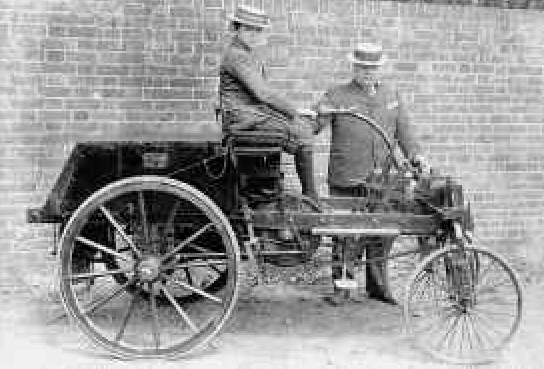
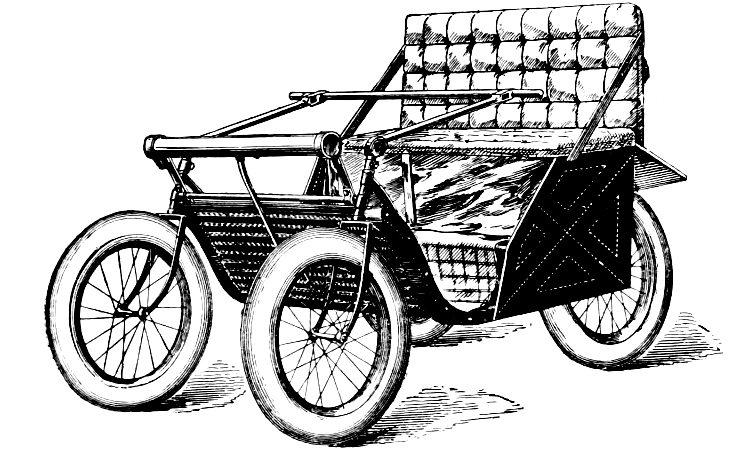
JOHN KNIGHT WAS prosecuted for “permitting a locomotive to be at work without a licence” in Castle Street, Farnham, Surrey—under local bylaws “no locomotive other than those employed for the repairing of roads, or for the purposes of agriculture should be used on the roads of the county without a licence”…another bylaw said locomotives could only be used within permitted hours. Knight contended that his machine was “not a locomotive within the meaning of the Act and thought he was “perfectly at liberty to use it”. He told the court that he had brought the carriage for the Bench to see and trusted they would not prosecute him for going home on it, adding that it was the “first machine of the kind to be made in England, though there were some 700 in France and on the Continent generally”. He was doing 4mph when stopped. The court imposed a fine of 2s 6d (12½p) on each of the two passengers. The Daily Telegraph reported: “The motor carriage in question, which was standing in the roadway outside the court, was the object of eager scrutiny. The task of getting up steam occupied about ten minutes after the case had been decided, and the tricycle, in charge of two men, moved off at a gentle pace in the direction of Mr Knight’s residence at Barfield, some two miles distant. The machine itself is remarkably compact, weighing only five and a half cwt, and there is nothing out of the common either in its shape or its appearance. In fact, it is nothing more or less than an enlarged and more elegant edition of the tricycle carts which are to be generally seen in the streets nowadays. As the tricycle moves along on its indiarubber tyres a little noise is given off from the motor, but nothing worth speaking of, and certainly insufficient to frighten horses. The vehicle seats two persons side by side, the levers, which are in front, being in close proximity to the driver’s seat, on the right hand. The machinery, which is at the back of the tricycle, is entirely, out of sight, and is stowed in a small compass. Driven entirely by the aid of benzine, the vehicle can cover eight miles an hour on good road, but, in view of the decision of the magistrates, no attempt was made to put the machine through its paces as it wended its homeward way.” The Autocar reported: “The carriage weighs in running order about 1,075lb. The gasoline engine is on the Otto principle, and has a piston 3¼in diameter and 4½in stroke [609cc] developing rather over three-quarter brake horse-power at 500 revolutions. The driving wheels, or rather the hind wheels—for one wheel only is a driver—are 3ft diameter, and the steering wheel 2ft 6in, all have 1½in solid rubber tyres. Two speeds are arranged for, corresponding to about three and a half and seven and a half miles per hour. No arrangement for reversing is used or thought necessary. The cooling water for the engine cylinder is contained in a tank under the seat, and a current of air is drawn by the exhaust over the water, and cools it to a considerable extent. We are informed that the motor cycle is almost silent in running, and that horses take no notice of it. With one person on, it will run seven and a half miles per hour on fairly level roads, and has run at from eight to nine miles per hour for short distances. With two passengers the speed is somewhat less. it was intended to be simply an experimental vehicle, chiefly to bring to public notice the restrictions which have hitherto prevented the use of motor carriages in England.In 1870 some excellent runs were made, and all difficulties were well overcome. The carriage, however, was very expensive to work, through repairs, and as some of the machinery was not very accessible, a good deal of time was taken up in adjusting brasses, etc. It was eventually sold to Mr James Braby, who converted it into a small traction engine, and fitted it with some peculiar wheels he had invented.” Knight’s four sons all drove it until 1903 when the minimum driving age of 17 was introduced—with Knight Snr’s encouragement the lads got stuck in and built themselves a wooden-framed trike.
“MR. KNIGHT’S PETROLEUM AUTOCAR—Please correct error in account of my motor cycle. The weight is not 1,0751b, but five and a quarter hundredweight [588lb] in running order. This, of course, includes three gallons of cooling water. In future machines of this size and type, the weight could be reduced considerably, but it must be remembered that in this first experimental machine facility for alteration and modification was of primary importance. May I add that the little carriage will take its load of two passengers up an incline of one in twenty, and one passenger up a fairly long hill of one in sixteen, and with a little care in driving up a much steeper incline. It can be turned round in a space of 12ft 6in.
John Henry Knight.”
“THE USE OF LOCOMOTIVES on public roads appears to be chiefly regulated by the Locomotives Act, 365. Section three of this Act provides that every locomotive propelled by steam or any other than animal power on any turnpike road or public highway shall be worked according to certain rules and regulations specified in the Act, amongst others that at least three persons shall be employed to drive or conduct such locomotive, that every such locomotive shall be instantly stopped on any person with a horse, or carriage drawn by a horse, signalling for the locomotive to be stopped; that those in charge of any such locomotive shall have two lights fixed conspicuously, one on each side on the front of the same, between the hours of one hour after sunset and one hour before sunrise; and section seven provides that the name and residence of the owner of every locomotive must be affixed thereto in a conspicuous manner. The Highways and Locomotives Amendment Act, 1878, orders that each locomotive must be preceded by some person by at least twenty yards, who shall, in case of need, assist horses in passing the same; and the same Act empowers county authorities to grant licences for the use of locomotives in their county. None of these regulations appear to have been repealed or in any way affected by later Acts, so they apparently regulate the use of all machines which are driven by other than animal power. The case Parkyns vs Priest supports this view, for in it a bicycle which was capable of being propelled by the feet of the rider, or by steam as an auxiliary, or by steam alone, which caused no smoke or gave any indication that it was worked by steam, and could not frighten horses or otherwise cause danger to the public more than an ordinary bicycle, was held to be a locomotive within the definition of sec 38 of the Highways and Locomotives Act, 1878, which defines a locomotive as ‘a locomotive propelled by steam or other than animal power’. It is exemption from laws such as this which is wanted in a new Act. It must be self-evident that such vehicles as the modern autocar were never contemplated when they were framed, and it is simply monstrous that the growth of trade and the development of a new industry of incalculable importance to the future prosperity of the country should be hindered and prevented by adhesion to the letter of laws intended to regulate traffic of quite a different character, and we confidently look forward to such a consummation in the immediate future.”
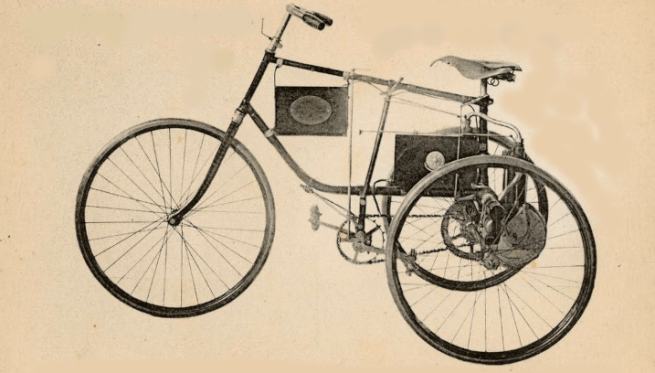
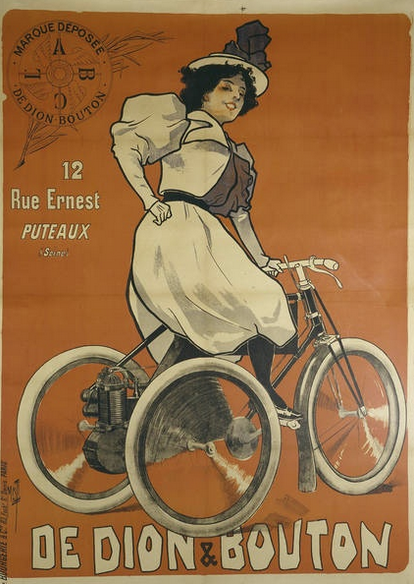
THE DE DION-BOUTON engine, enlarged to 185cc (1¼hp) and then to 211cc (1½hp), but still weighing less than 40lb including the battery and petrol tank, was mounted at the back of a Decauville pedal trike which was shod with the new tyres being mass produced by brothers Andre and Edouard Michelin. De Dion-Bouton were soon selling their own trikes and engines as fast as they could make them. The tricycle (with a 920mm track) was chosen because, according to the good count, “a bike appeared too fragile for this purpose”. It would be the most successful motor vehicle in Europe until 1901, with about 15,000 examples sold,


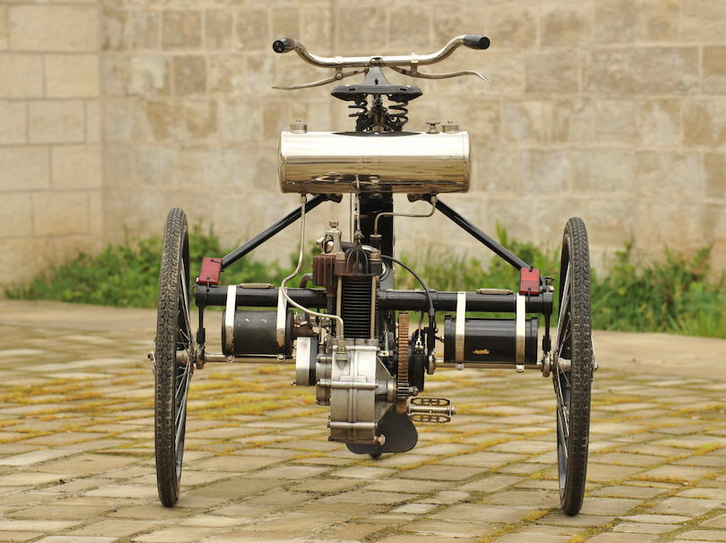
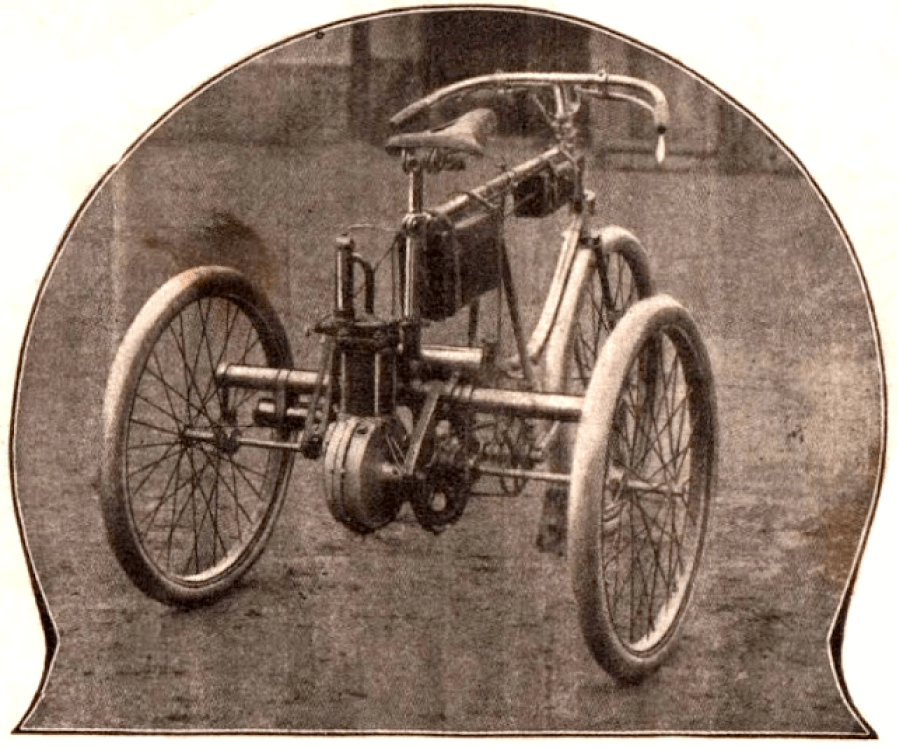
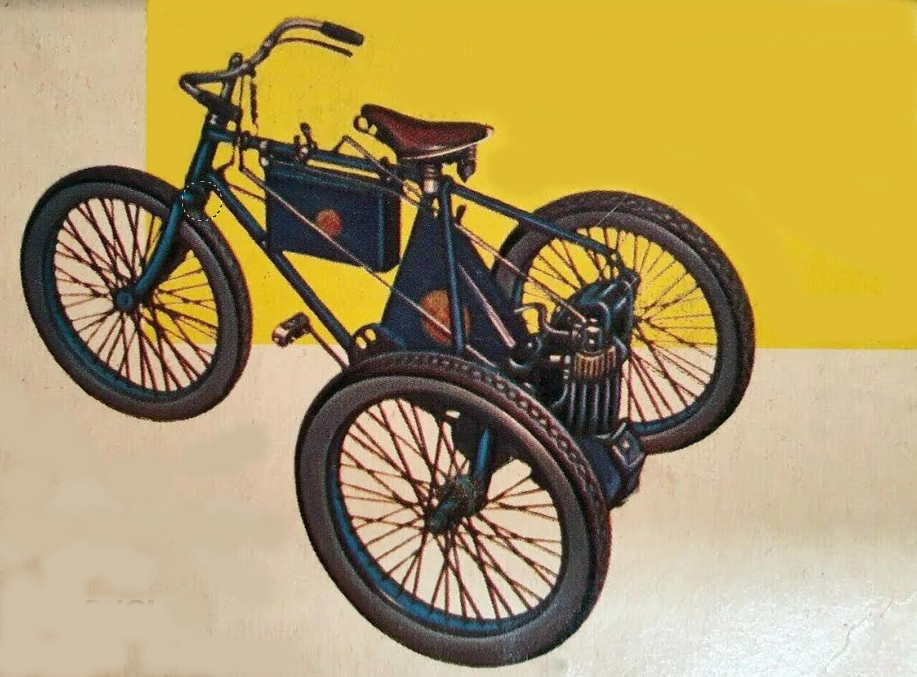
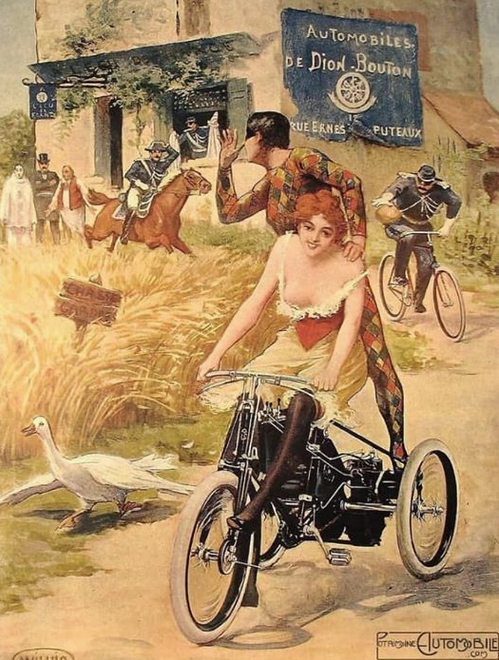
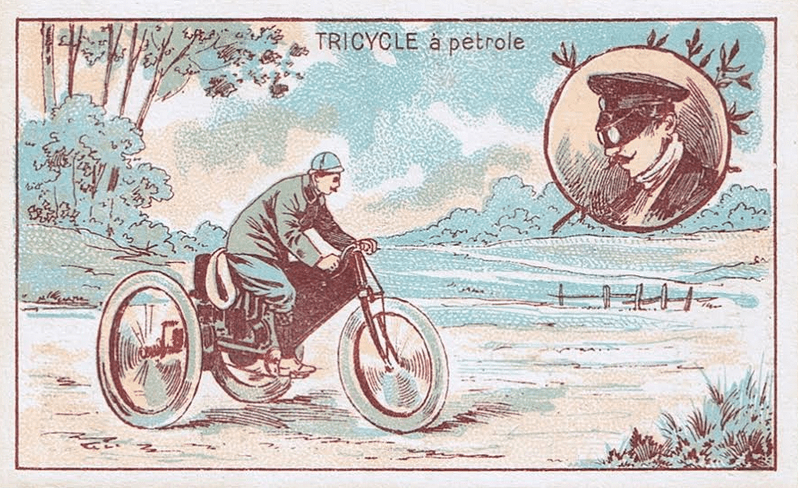
IT ALL LOOKS TRES JOLI but judging by the caption on this card, trikes were not universally popular in La Belle France…
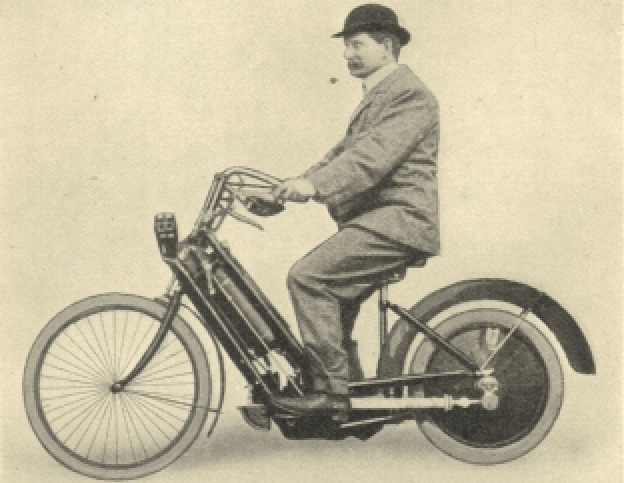
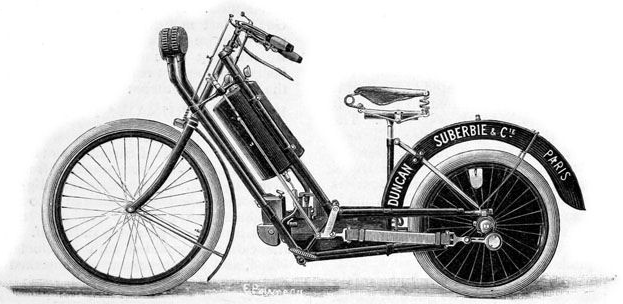
SIEGFRIED BETTMAN’S partner in Triumph, Mauritz Schulte, considered producing H&Ws under licence. He imported one for testing but the idea went no further. However the French manufacturer Duncan-Superbie & Co produced bikes developed from H&Ws which they marketed as Petrolettes (presumably to mollify painful French memories of the 1870-1 Franco-Prussian war). Wolfmüller took a brace of H&Ws to Italy for its first bike/car race; they came 2nd and 3rd over a rocky 62-mile course behind a Daimler car. Two Petrolettes were among the six bikes that entered the 732-mile Paris-Bordeaux-Paris race. None of them completed the course but a Petrolette, ridden by Georges Osmont, was the only two-wheeler to complete the first leg from Paris to Bordeaux, in 45 hours. The first car home was a Panhard et Lavossar (driven by Emile Levassor), in 48hr 48min, ahead of three Peugeots. However the first two finishers were ineligible for the cup as they were two-seaters and the rules called for at least three seats. A report for the French Institute of Civil Engineers predicted that motorcycles would be no more than a curiosity.
AND, FOR YOUR delectation, here’s how the big race was reported at the time: “The start was given to the first vehicle at midday, and the others followed at intervals of two minutes. As the contest was one of speed, it was not to be expected that the competitors would take any special precautions to ensure safety, and not long after the carriages had left Versailles, it was reported that one of the two Serpollet vehicles, driven by M Serpollet himself, had come to grief at a dangerous turning, and had fallen over a bridge. The vehicle was smashed, but, fortunately, none of the occupants were injured. The lead was taken by one of the smaller steam vehicles belonging to Dion, Bouton et Cie, which arrived at Etampes at 2hr 15min, followed a quarter of an hour afterwards by a petroleum carriage of Panhard et Levassor, and driven by M Levassor. About twelve minutes were spent in coaling up the steam carriage, but this was made up for by the faster pace on the road. Not long after leaving Etampes, the De Dion carriage came to grief through the breaking of an axle, and M Levassor thus took the first position, entering Tours at 8hr 40min. From this point, he continued to add to his lead, and reached Poitiers—338km—at 12hr 45min on Wednesday morning. Two hours afterwards, a Peugeot carriage arrived, followed, at long intervals, by six other petroleum vehicles, of which five belonged to the same firms, and the last to M Roger. The sole remaining Serpollet carriage made its appearance at 8hr 16min on Wednesday evening, while the large De Dion traction vehicle arrived at 9hr 30min. Nothing had then been heard of the electric carriage constructed by M Jeantaud, and it appeared afterwards that it had given up. This carriage was driven with the aid of Fulmen accumulators, which were changed along the route. The accumulators were conveyed to the different points by a special train, and the cost of the race to the owner is said to have been upwards of £1,000. The petroleum bicycles also fared badly, as one belonging to M Millit, of Persan-Beaumont, only went a part of the distance, while the Wolfmüller-Hildebrand bicycle also gave up after a long series of accidents. The ranks of the steam and petroleum carriages were thinned out considerably
by the difficulty of making repairs, which were necessitated very frequently by the excessive jolting of the vehicles over the ill-kept pavements of the different towns through which they passed, to say nothing of the vibration of the carriages caused by the motors. Before reaching Angoülême one of Panhard et Levassor’s carriages was thrown over by a dog, and a wheel was smashed, thus putting it out of the running. The leading vehicle, however, continued to make good headway, and M Levassor arrived at Bordeaux in 10hr 32min. Three Peugeot carriages completed half the distance between 2hr 10min and 5hr 23min, and then came Panhard et Levassor and Roger, while the Serpollet steam carriage did not reach Bordeaux until one o’clock on Thursday morning. The traction vehicle of Dion Bouton et Cie had long since given up, in consequence of repeated accidents; and, in fact, contrary to anticipations, steam made a very poor show indeed, even to the extent of the vehicles having to be pushed up the gradients. As some of the competitors allowed strangers to help them in pushing their vehicles, a great many protests have been laid with the committee, which is now occupied in considering them. Another drawback to these carriages is the blowing off of steam, which, in spite of every precaution, cannot be entirely avoided. On the return journey M Levassor continued to remain in charge of his carriage, and without further incident he arrived at the Porte Maillot, in Paris, at 12hr 57min on Thursday afternoon, having thus occupied less than 49 hours in covering the distance. This time would have been greatly reduced if it were not for the fact that owing to his lamp being smashed he was obliged to slow down during the night. The carriage showed very little evidence of the hard work to which it had been put, and during the long journey it hardly required any attention whatever. The next three arrivals were Peugeot’s carriages, one reaching Paris at 6hr 37min, another at 11hr 55min, and a third at midnight on Friday. Under the condition that the first prize was to be given to the owner of the first carriage containing’ four persons, the award was made to Peugeot for the vehicle which arrived fourth, and Panhard et Levassor only secured the second prize. The results, therefore, are as follows: First prize, the Fils de Peugeot Frères, of Valentigney, Doubs; second prize, Panhard et Levassor, 19, Avenue d’Ivry, Paris; the third and fourth prizes to the Fils de Peugeot Frères. The only steam carriage that completed the journey took 90 hours to cover the distance. It belonged to M Rollé of Mans—Sarthe—and was constructed about 20 years ago. Of the 28 vehicles that started from Versailles only 12 were able to reach Bordeaux, and eight completed the journey within 100 hours, when the race was declared closed. The result is not perhaps quite so good as to justify the hope that the difficulties in the way of adapting automatic carriages to everyday use are entirely overcome, but it is certain that a great many more competitors would have finished the journey if they had not been thrown so much on their own resources. Nor is such a hard test necessary to prove that the petroleum carriage, at any rate, can be conveniently employed for the ordinary purposes of road traction, though the fact that all the seven prizes were secured by petroleum vehicles places the superiority of this power beyond all question. It is noticeable, too, that the first five were all constructed upon the same system, that is to say, with the Daimler petroleum motor, of which a description has already been given in The Engineer. By employing a high explosion pressure, and working the motor at a high speed, it is possible to keep the weight very low, and, concealed in a box in front of the driver, the vehicle has a very neat appearance. The only difference between the systems employed by the two firms is that while the motor in the Panhard et Levassor carriage is in front, in the Peugeot vehicle it is placed in the rear, though in both cases the power is conveyed by a chain passing round the axle. The consumption of petroleum spirit in the Daimler motor is said to be about one pound per horse-power per hour, and the cost comes to about a halfpenny a kilometre with a carriage containing four persons, and rather less for the smaller vehicle.
“LONDONERS MUST HAVE these horseless carriages shown in the metropolis. The County Council should arrange for a display on our grand boulevard, the Thames Embankment, of the electrical tricycle, the petroleum carriage, and the steam waggon. They must he seen here as they have been in Paris.”—The Daily Telegraph
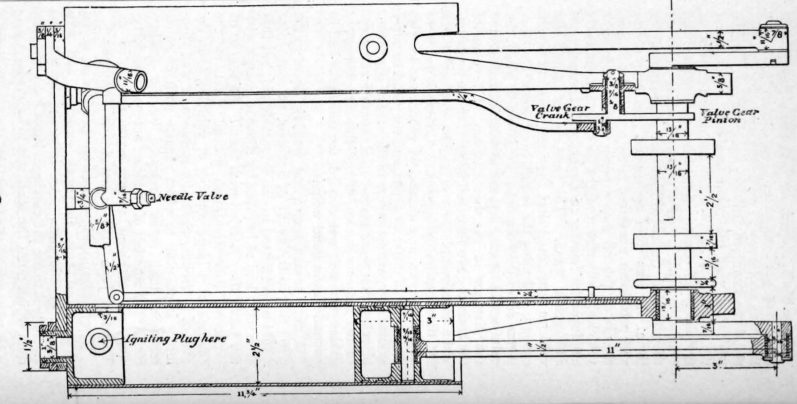
“WE HAVE ALREADY spoken in these columns of the Pennington engine which is attracting so much attention in America, and a few words concerning its construction will doubtless not be without interest to the readers of The Autocar. In the first place, we may say that the engine was first publicly experimented with about a year ago, and is the outcome of a series of successive developments which have been made in light engines by Thomas Kane and Company, of Chicago, Illinois, USA, who ten years since went into the business of manufacturing light machinery for the propulsion of boats and launches. The obtaining of the maximum of power with the minimum of weight was always the central point of their attention, and their Racine automatic engines and boilers, using oil for fuel, achieved a large success. Then, foreseeing that steam would in time be supplanted by a gas or gasoline engine using no boiler, they designed and built the Regan, and, later, the Kane electro-vapour engine, and claim to have been the first to use electricity for ignition purposes instead of fire. Their success in this line soon brought other similar engines on to the market, employing about the same principles and differing only in general construction, namely, making gas in a carburetter or vapouriser, and exploding it in the cylinder by means of an electric spark. This type of engine necessitated a large number of working parts, was necessarily constructed heavily to withstand the explosion in the cylinder, and to allow a large space for water jacket for cooling purposes, and required a heavy fly wheel to secure power and smooth running. The demand meanwhile called for a less complicated engine and one of fewer parts and light weight for stationary purposes, boat and vehicle use, and a thousand and one places where heavier power could not be used, and this ultimately led to the invention of the Pennington engine, which has been successfully used on motor cycles and light carriages, and is now built by the firm for all lines of work. Its general description is as follows: Ordinary
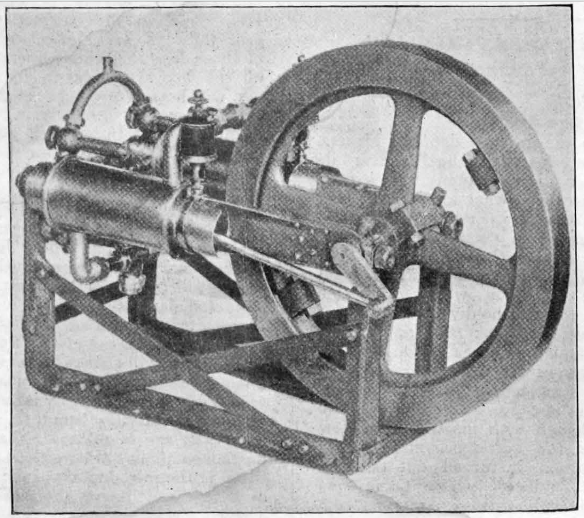
gasoline or kerosene oil is stored in a galvanised iron tank. Extending from this tank is a small pipe, and through this pipe the oil flows to the engine by gravitation, substantially as it does to an ordinary gasoline stove. A small primary battery is placed in any convenient position out of the way, from which a copper wire leads into the interior of the engine. It is a well-known law that rapid evaporation of any fluid produces cold; the more rapid the evaporation the more intense the cold. Pennington’s engine utilises this principle, and on the motor cycle no water is used for cooling purposes. On other engines for vehicles and marine and stationary work only sufficient water is required to keep an equal temperature, ie, about one gallon per horse power, and the water is used over and over again. For this purpose a small brass tube is slipped over the cylinder, which adds only a little to the weight, and gives the engine an attractive appearance. In all other engines of the gas or vapour type the explosive fluid is compounded and produced outside of the engine, by means either of a vapouriser or carburetter, and when thus prepared is pumped into the engine and there exploded. This produces only heat, and renders a water jacket necessary, as well as a large quantity of water for cooling purposes. The Pennington engine produces both heat and cold, as above described, and in such proportion that the temperature of the cylinder is never greater than that of an ordinary steam engine, and requires a minimum quantity of water. In a ¾hp engine there is only one cylinder, 2hp two cylinders, and in a 4hp four cylinders. Each cylinder is 2½in. in diameter, 6in. stroke. The engine runs 500 or more rpm as desired. The whole mechanism is extremely simple in construction, and is designed to be ignoramus-proof. There are said to be 14 chances for a locomotive engine to get out of order and fail to work. In an electric car motor 22 chances. In the Pennington engine them are but two, viz., the flow of fluid, and the electric spark. Both are very easily tested, and when both work properly the machine is bound to go. The cylinders are made of specially drawn steel tube, tested at a pressure of 8,000psi. The piston is made loose with spring rings, and needs no packing. It can be drawn out by loosening a single bolt, and the working parts seen. The balance wheel is utilised to start the engine, and a single turn is sufficient to set it in operation. In the motor bicycle no balance wheel is required, the start being effected by the pedals in the usual manner. As soon as the engine gets to work, it over-runs the pedals, which are connected with a ratchet gearing, and the rider can either pedal faster, and so keep ahead of the engine, and do some of the work of propulsion himself, or else put his feet on the rests, and ‘coast’ all the time. The engine is attached to the back wheel, the petroleum reservoir on the top of the frame, and the electric battery in a leather case beneath it. The oil is fed to the engine through the long
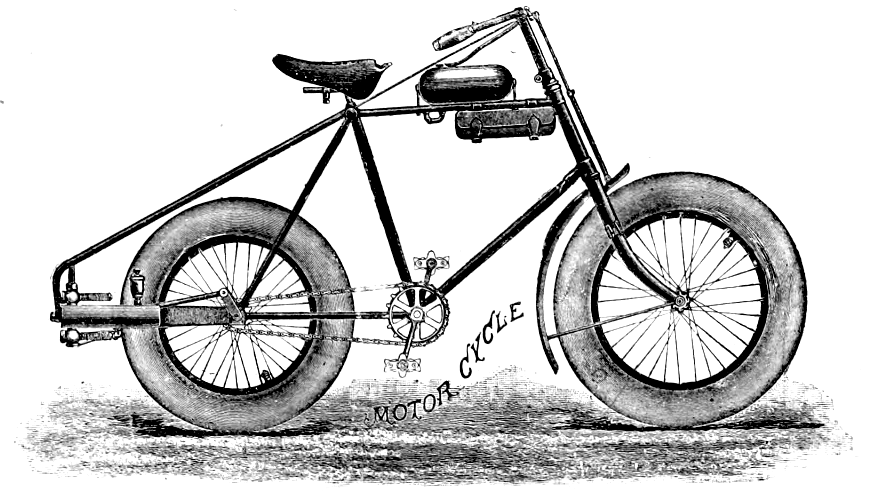
tube at the back, and the regulation is entirely under the control of the rider by a connection from the handle-bar, the regulation of the supply of oil regulating the speed of the machine. By turning a button on the handle-bar, the electric current is shut off, and instantly the cylinders convert themselves into air brakes. The bicycle, which has 4in tyres, thus obtaining the acme of comfort in riding, is, of course, built specially strong to stand the strain, yet with all this, and with engine and attachments complete, it weighs but 65lb, the weight of the engine and attachments alone being only 12lb. The electric battery will last for months, and is easily re-charged or renewed, whilst one charge of petroleum is sufficient for a run of 50-100 miles, according to gradients, etc., encountered. As to speed, the company claim to have done a mile in 58sec, and put the road speed down at from 6-50mph’ according to circumstances or inclination. The firm also produces a light form of Victoria carriage fitted with a 4hp four cylinder engine, and the entire carriage weighing about 140lb only. Doubtless practical engineers will be asking about efficiency, and whether the horse power of these little engines is actual or merely nominal. It may, therefore, be interesting if we quote the following extract from a letter received from Mr Kane last week by Mr Baines, the company’s representative here: ‘The invention grows upon us all as we make further trials with larger engines. To illustrate, a few days ago we tested one of our old type of cast iron engines, rated 2½hp. Under our old system of introducing gas it developed about 2hp in regular running. Putting in one spark and taking the fluid directly into the cylinder, it -developed 2.28hp. Substituting an electrode with a double
spark it developed 4.18hp. We attached a dynamo running 50 electric lights, and it did perfect work right along—in fact, it solves the electric lighting problem with gas engines, without any question. This problem has not hitherto been thoroughly solved in this country. We are now changing some ½hp old-style engines, and expect to develop fully 1hp, probably more.’ From this we fancy our readers will agree with us that on the face of it the Pennington engine seems to have about solved the motor question for light vehicles, more especially as ordinary petroleum—crude oil even—is used instead of the more expensive and more explosive benzoline. We may add that the English patents have been purchased by an English syndicate for a very large sum, a larger sum, we believe, than has ever been paid for any other petroleum motor patent, and that it will very probably he one of the series of engines which will be handled by the large company which is spoken of in another column. No engines are at present in England, but we understand that Mr Pennington leaves America today, bringing several specimens of the carriages with him, and that the public will ere long have the opportunity of seeing the vehicles at work.”
“A CORRESPONDENT TO The New York Herald speaks of a visit he recently paid to the factory where the Pennington motors are being built. He says that an engine of two horse-power has been fitted to a bicycle, the weight of the bicycle when equipped being only 65lbs, and this machine is reputed to have made a mile in the astonishing time of 58sec. The writer states that he was invited to take a seat on a tandem bicycle, the clever inventor riding with him. It was timed, and found to cover a distance of one mile in 1min 30sec. He was told that the machine was not even then being driven at its maximum speed, but on being asked if he would prefer to go at a higher pace he declined.”
“IN THE COLUMNS of The American Machinist, Mr John Randol, who, we understand, is an expert of some standing in American engineering circles, gives the following interesting report on the Pennington engine and a visit to the Kane-Pennington Works…During my first inspection of the Kane-Pennington motor, I thought I was not treated with the entire frankness due to an impartial observer, if he be allowed to observe a strange and wonderful thing. I saw a heat engine, for I suppose the explosion engines are as rightfully to be called heat engines as if they took their heat slowly and through the comparatively moderate and leisurely process of ordinary burning, instead of employing pressures established by the sudden and violent deflagration of some explosive compound. I saw, I say, a heat engine of such exquisite simplicity that a child might easily remember all of its few parts and their uses, and all so small and light that a child might use them for play-things; a machine so absurdly lacking in all the parts and appliances which I had been trained by example and theory to believe essential to the effectiveness of motors of its class, that if previous knowledge were not wholly error, this new wonder should not be able to even move itself; yet this incredible machine not only did move itself, but moved with such vigour of action as to drive loads far beyond its apparent possibilities…in some way, so far wholly unexplained, the great heat which in other explosive engines manifests itself in an inconvenient by-product, to be taken care of as best it may, is in the Pennington engine transformed into useful effect on the piston. I know that when the long, thin, first spark is not put through the charge the engine becomes weak and hot, and that when this first long, thin spark, this ‘mingling’ or ‘ripening’ spark, as Mr. Pennington calls it, is used, a common gas engine with its carburetter eliminated gives twice its ordinary effect on the crank…the two-spark mechanism of the Pennington motor…does not cost five cents, and yet when applied to the ‘Regan’ gas engine, largely built up to the present time by the Kane establishment at Racine, doubles the power of that motor. It is in the igniter, and in the double spark, or rather in the effect of the first spark, apparently, that the efficiency of the Pennington motor lies. This statement is as incredible to my mind now as it was when I first heard it from the lips of Mr Pennington, but this first spark seems to be the only possible agency through which this motor achieves its miraculous results, and gives us a heat engine which delivers in usable work a great part of the possible effect of the heat delivered to it, and so opens a new round of dazzling possibilities to the engineer…No fire, no water, no boiler, no carburetter—only a few pieces of steel, with a few brass-bushed joints, a battery weighing one pound, and a gallon of kerosene; put these with a bicycle, bringing the weight of the whole piece of wizardry up to 58lb, and a man may be carried by it on a smooth road a mile in fifty-eight seconds, as a man was carried on one of the asphalt-paved streets in the city of Milwaukee a few days since. To avoid the weight of reducing gear the diameter of the cycle wheels is dropped to twenty-two inches, and to give adhesion, and to avoid puncture, the pneumatic tyres are made four inches diameter, after Pennington’s specifications, and cannot be injured by a hammer and nail
in skilled hands; the attempt to drive the nail into the inflated tyre results in a simple rebound of the nail, the tyre remaining intact. To run a mile a minute with twenty-two inch diameter wheels requires over nine hundred turns; it is therefore certain, as the cycle did run a mile in fifty-eight seconds, that the motor can make about 920 turns per minute. I was one of the riders on a Pennington tandem weighing 106lb over a poor block pavement, railway tracks, etc; the time was not taken; it was quite sufficiently swift, however, to satisfy all my longings for speed…I hardly think there will be a dissenting voice from the assertion that this feat of the Pennington motor cycle is one of the most marvellous achievements of mechanism ever seen. There is evidently some heat-absorbing or diverting or abstracting element in operation in the Kane-Pennington engine not commonly present in the gas engine, and it is difficult to see what this can be, if it is not the truth that the heat of the cylinder walls is absorbed by the incoming charge previous to the moment of the ignition, or else transformed into work on the piston, as it seems impossible that the gases after ignition should be otherwise than very hot indeed. There is no visible discharge of vapour, and no evident odour, except in case of an over-admission of oil, and an over-admission of oil leads to a loss of efficiency which makes its continuance an impossibility. The one great mystery is the coolness of the naked cylinders, which should be red hot at the end of the first twenty strokes or so of a run. Chemists are familiar with the establishment of low temperature pressures, but pressures established by explosion are not cold as a rule, and the gas engine has always been hot. The Kane-Pennington shops are making, or have made, general trials of the water jacket cylinder; the 2½x12in expansion engine is jacketed and piped with top and bottom natural circulation pipes to a small water tank, which a run of some length did not seem to heat very much. The cylinders run perfectly well naked, with no cooling element more than their inevitable exposure to the atmosphere.”
“AT LAST WE ARE HAPPY. We have seen Mr. Pennington, and we have seen his motor, and we shall be happier still when we have seen it at work. Mr. Pennington, who arrived in this country late on Friday evening of last week, is a tall finely built man, with a deeply thoughtful expression of countenance, and a way of expressing himself which of itself goes very far towards carrying conviction with it. It is very evident that he has given deep and close attention to every detail of his little machine. The one we saw was a two-cylinder bicycle motor, and, as far as we could judge from an inspection, it bore out everything which has been said concerning it. For simplicity of construction there is nothing we have yet seen which can in any way approach it, and it only remains to be proved that the little midget will develop, as Mr. Pennington says it will, something over two brake hp, with a very much higher indicated record still.”
FILE THIS ONE under the heading “not directly relevant to the evolution of motor cycles but to good to ignore”—a row broke out between Pennington and the British manufacturer Root & Venables over the merits of their respective products. The Autocar consistently took Penington’s side leading to this no-nonsense letter in that illustrious organ: “Re The Pennington Motor—With regard to the remark made by you on behalf of Mr Pennington in your last issue, ‘but that until Messrs Roots & Venables can produce and establish their engine’, Mr Pennington must be singularly ignorant of what has been done in this country in connection with oil engines, and it must be noted we are now speaking of oil engines, not spirit engines. Mr. Roots was the first to make an oil engine to run in this country, or in any country. He was closely followed by Messrs. Priestman, who placed theirs on the market first. It was fully a year after this that an oil engine was produced on the Continent, and quite two that one was produced in the United States. For the past five years the Roots oil engine has been sent to most parts of the world, and many hundreds of them have been sold. The Roots oil engine is everywhere known favourably in Great Britain, New Zealand, India, Australia, South Africa, South America, Japan, etc, etc, and has been purchased among others by the Indian Government, by Eastern Princes, and by the Brighton and South Coast Railway Co. It is undoubtedly the most reliable and most automatic (ie free from attention) of any oil engine in the market. With regard to carriage oil motors we made one in 1893, and exhibited one at the Stanley Show in 1894, and since then we have sold them in France, India, and in this country also. All our motors use kerosene or Russolene of a specific gravity of 0.8 to 0.835. Our works are run day by day from 7.30 to six with a horizontal oil motor, using oil of 0.831, and having the high flash test of 130°; we shall be glad to show anyone and everyone our motors at work or otherwise, and we are willing to prove all that we claim. Any person may bring a sample of kerosene up to the specific gravity and flash test named, and we will put it into the engine and run it in anyone’s presence, or conversely we are prepared to supply a small quantity of the oil we use for any person to try the specific gravity and flash test. We shall be glad for every person to satisfy themselves; there is nothing we desire to hide. Again, we propose to Mr Pennington a test of our motor against his, and we make the following definite proposal under the auspices of The Autocar. We will place one of our carriage motors anywhere in London the editor appoints, Mr. Pennington to do the same, and we name three gentlemen well known, Professor Unwin, Professor Kennedy, Professor Robinson, one of whom, whichever Mr Pennington may select, to be asked (1) to test the engines and decide which motor gives the nearest approach to the BHP it is stated to give, both being run for four hours with full brake load; (2) what fuel from the point of view of safety each motor uses for starting or running; and (3) which costs most per BHP per hour. The loser to pay all costs, the competition to take place within three weeks, and we propose March 4th. We are very sorry if Mr Pennington considers our letters discourteous. We have read them through again to see if there are any indications of this, but we fail to find any. Our sole object is to elicit the truth; this, we believe, is manifest to everyone, and if Mr Pennington still fears to meet the competition everyone will draw his own conclusions. With regard to Mr New, we are not so discourteous as to call his letter ‘utter nonsense’, the words he applies to ours, but as he is stated to be an electrician, we would ask him to give a direct positive or negative to this question: Does he believe that upon anyone’s mere instruction one spark of electricity can be persuaded not to ignite while the next one will, or, in other words, that any person by wishing can induce an electric spark to alter entirely its usual action and behaviour?
Roots and Venables.”
[We are glad to find that Messrs Roots and Venables have seen fit to alter the tone of their correspondence. This letter was received too late for publication last week.—Ed.]
“IT WAS SCARCELY to have been expected that with the universal attention which is being paid to the autocar question throughout the length and breadth of the land, and the absolute certainty that all legal restrictions will immediately be removed, we should be long without some definite movement being made to introduce the vehicle commercially into this country, and we are now enabled to inform our readers that a company on a very large scale is at present in course of formation, which will immediately undertake the manufacture and introduction of this vehicle into England. Last week we had conversation on the subject with Mr HJ Lawson, who was intimately associated with the early days of the cycle movement, and who is now busily engaged in organising the company. Mr. Lawson recognises the immensity of the business before him, and has had the foresight to secure agreements with the owners of the principal motors, which, of course, are the key to the situation, and in doing so has already paid out some £16,000 as deposits to secure contracts. The two principal petroleum motors which will, we understand, be handled will be the Pennington engine and the Daimler motor, which, up to now, has the most striking record of any, having practically vanquished all competitors in the Paris-Bordeaux trials of last June, and being now almost the only engine utilised upon the large number of machines in use throughout France. No attempt will be made in any way to obtain a monopoly of the horseless carriage business, but the firm will virtually. secure a monopoly of the manufacture of practical motors covered by the large and important series of patents referred to. We may add that the capital of both the Daimler and Pennington syndicates is £100,000, some one-half of which represents actual cash paid for the patents. These syndicates are entirely private concerns, and arrangements have been made with them by Mr Lawson, on behalf of the new company, for the exclusive right of manufacture under royalty of the articles covered by the respective patents. In addition to these, what are believed to be master patents of value in the direction of both electric and steam motors, as well as the manufacturing rights of several entirely new forms of autocar, have been secured, and the very large capital of the company will enable it to introduce the autocar business into this country in a fit, thorough manner, and to experiment with and secure the rights over new inventions of value to the movement as they appear.”
THE HONOURABLE EVELYN ELLIS ordered a left-hand-drive motor car to be made to his own specifications from the Paris firm of Panhard-Levassor, powered by a 709cc Daimler engine developing 3½hp at 7000rpm. The car was driven from Paris to Le Havre, shipped to Southampton and by train to Micheldever station in Hampshire. From there, on 6 July, Ellis drove home. His passenger, Frederick Simms (who we’ll be meeting again) described the journey in the Saturday Review: “We set forth at exactly 9.26am and made good progress on the well-made old London coaching road; it was delightful travelling on that fine summer morning. We were not without anxiety as to how the horses we might meet would behave towards their new rivals, but they took it very well and out of 133 horses we passed only two little ponies did not seem to appreciate the innovation. On our way we passed a great many vehicles of of all kinds (ie horse-drawn), as well as cyclists. It was a very pleasing sensation to go along the delightful roads towards Virginia Water at speeds varying from three to twenty miles per hour, and our iron horse behaved splendidly. There we took our luncheon and fed our engine with a little oil. Going down the steep hill leading to Windsor we arrived right in front of the entrance hall of Mr Ellis’s house at Datchet at 5.40, thus completing our most enjoyable journey of 56 miles, the first ever made by a petroleum motor carriage in this country in 5 hours 32 minutes, exclusive of stoppages and at an average speed of 9.84 mph. In every place we passed through we were not unnaturally the objects of a great deal of curiosity. Whole villages turned out to behold, open mouthed, the new marvel of locomotion. The departure of coaches was delayed to enable their passengers to have a look at our horseless vehicle, while cyclists would stop to gaze enviously at us as we surmounted with ease some long hill.” Ellis was deliberately testing the law that required all self-propelled vehicles on public roads to travel at no more than 4mph and to be preceded by a man waving a red flag. He was not arrested and, as we’ll see, the Act was repealed in 1896.

“THE DAIMLER SYNDICATE has received no less than 73,000 letters during the past three months from persons desirous of being interested in the horseless carriage movement in this country. The prospects of the new company look rosy.”
“ONE OF THE NEXT great advances in matters pertaining to the army in time of war will, in the opinion of Major-General Miles, of the American army, be in the adoption of horseless or automobile vehicles for the transportation of ammunition and supplies.”
“ALREADY, SAYS The Christian World of the 7th, the petroleum bicycle has made its appearance in London streets. Yesterday one of the genus might have been seen wending its way down Wellington Street, across the crowded Strand, where the rider dismounted, proceeding over Waterloo Bridge.”
“OUR AMERICAN COUSINS are already feeling inclined to crow over ‘effete Old England’ on the autocar question, although they have to admit they take a back seat as compared with France. A Chicago journal says: ‘It would appear that as far as English efforts in this line go American inventors are ahead, and their work in the field of motor cycles, as in that of bicycles, will lead that of the English makers. There ought to he a great market for these motor cycle vehicles in a hot climate, where horses sometimes suffer greatly from heat.'”
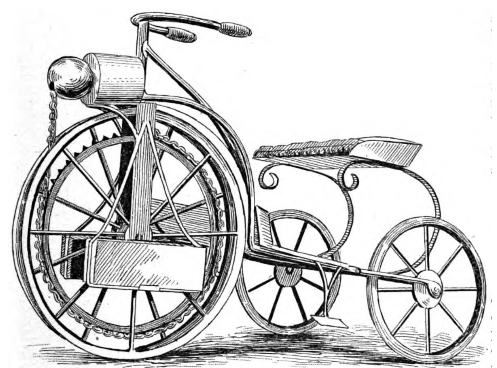
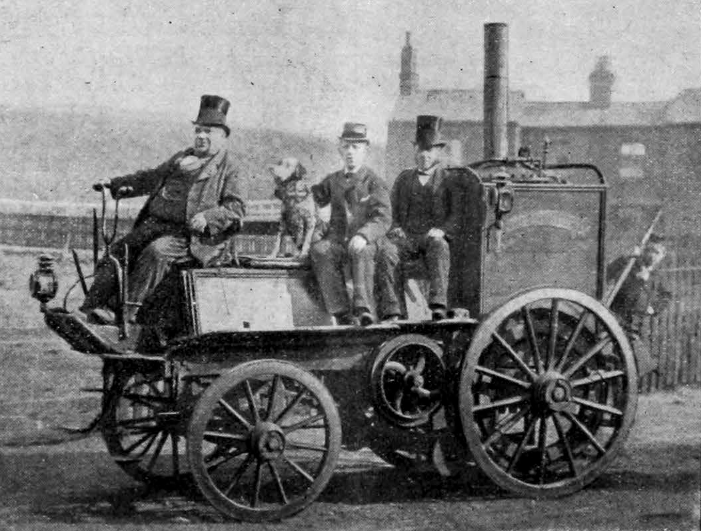
“MR JOHN GEORGE INSHAW, of Cheston Road, Nechells, Birmingham, sends us a photograph, which we reproduce, of an experimental steam carriage which he built in 1881. This carriage was, he says, well known in Birmingham and district, and its working was most satisfactory. The only reason he had for discontinuing his experiments was in consequence of the law prohibiting the use of steam-propelled carriages on the common road, although this carriage made no more noise than an. ordinary vehicle, and the exhaust steam, being entirely condensed, there was nothing against steam, which Mr. Inshaw says he is very much in favour of now, so much so indeed that he intends making another carriage as soon as the law has been repealed, which, naturally, he hopes will be very soon. Mr Inshaw gives the following particulars of this carriage: The boiler was almost entirely composed of steel tubes, and would generate steam in about 20 minutes to a pressure of 180-200psi, finding steam for two cylinders, 4in bore, 8in stroke. There were three different speeds for hill-climbing, etc, and the engines could be thrown out of gear for downhill, etc. There was also double driving gear, reversing gear, and, in fact, all the necessary contrivances were to be found in this machine. The steering was very satisfactory and quite easy to manage. When loaded with 10 passengers, fuel, and water, this carriage weighed 35cwt, and the speed on a good road averaged 8-12mph. The steerer had entire control over she carriage; in fact, far more than a coachman has over a pair of horses, and during the whole of his experiments, which lasted for several years, our correspondent says he never had the slightest accident of any kind.”
WEALTHY ENTHUSIAST AND Mayor of Tunbridge Wells Sir David Salomons teamed up with Frederick Simms to stage the first ever motor vehicle show. There was a grand total of five exhibits—two cars, a fire engine, a steam carriage and a trike. Among the spectators was one Harry J Lawson who clearly saw a great future for petrol power —he bought the British rights to Daimler engines from Frederick Simms and made a serious attempt to dominate the nascent British industry. The great day was recorded in the first issue of The Autocar: “The mayor of Tunbridge Wells, Sir David Salomons, deserves exceeding well of every member of the travelling community who desires to improve the means and facilities of vehicle transport over the roads of the country by the exhibition engineered by him in the grounds of the Tunbridge Wells Agricultural Show on Tuesday, Oct 15th last. When the day arrives, and by all surrounding signs the time is not far distant, when for many purposes a horsed vehicle will look as quaint as did the horseless chariots seen by us at the Wells a fortnight since, this exhibitive trial will rank for this class of vehicle very much on an equality with that memorable trial of locomotives, in which the famous old Rocket so completely defeated the engines opposed to it at Rainhill just sixty-six years ago. But in the present uncertain state of the law, the motor vehicles at Tunbridge hardly had fair play. They were obliged to demonstrate their pace and handiness over rough soft turf, a surface over which, under what should be the ordinary course of things, they would never be asked to travel. The trials brought quite a crowd of engineering notabilities to the Wells, to say nothing of the press representatives, and quite five thousand spectators, attracted by the novelty of the show. The list of exhibits promised six pieces, but of these five only materialised, the tricycle of the Gladiator Co not being in evidence. Punctually at three o’clock Sir David Salomons entered the ring, seated in his visa-vis, built by Messrs Peugeot, of Paris, and fitted with a Daimler engine by Messrs Panhard and Levassor, followed by the Hon Evelyn Ellis, with a carriage made by Messrs Panhard and Levassor, and also driven by a Daimler engine. This carriage excited much interest, as it is practically a duplicate of the vehicle that arrived first in the Paris-Bordeaux race for automobile vehicles this year. Following came a steam horse by Messrs de Dion & Bouton, of Paris, but as this is really only an improved, albeit greatly improved, form of traction engine, it hardly comes into the category of motor vehicles. It was attached to a landau occupied by two ladies, and as the front wheels and fore-carriage of the carriage had been removed, and the forward part thereof was hoisted upon and attached to the steam horse, it rather suggested a collision between the two, in which the steam horse had scored by the demolition of the fore-carriage, etc, and the capture and bearing off the landau. Dion
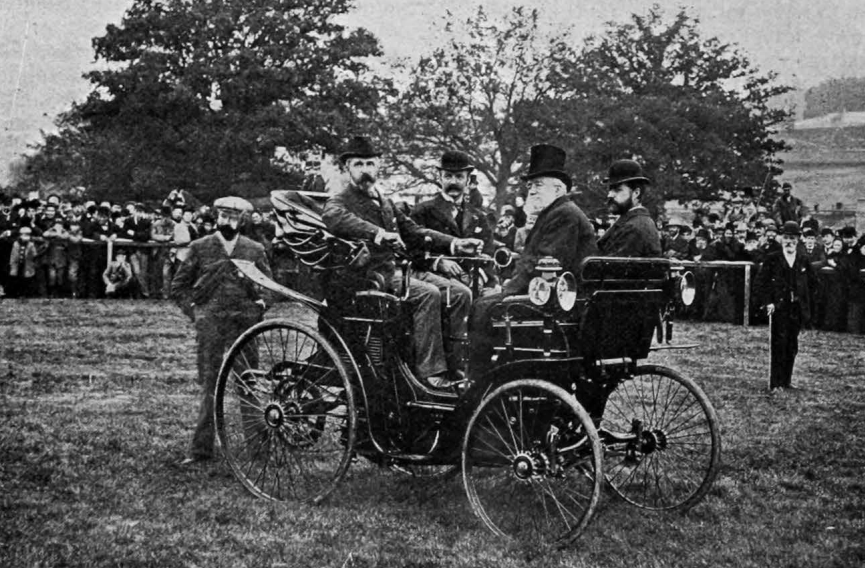
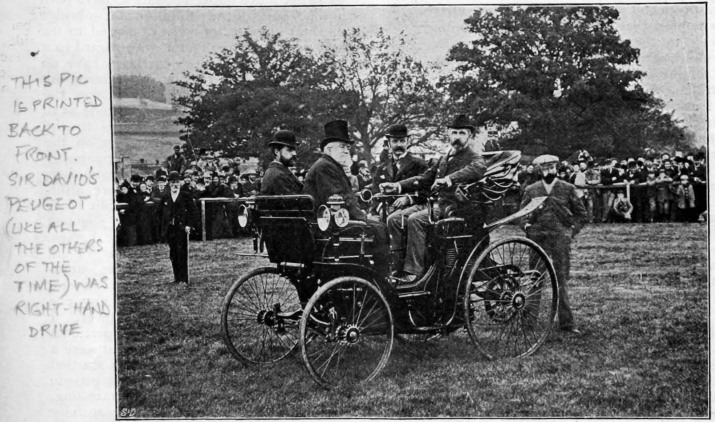
and Bouton’s tricycle, with petroleum motor, fired by electric spark ignition, came next, and, naturally, drew the particular attention of the cycle experts. A fire engine, designed for a country house, and worked, so far as the water jets were concerned, by a Daimler petroleum engine, was run on to the ground by a detachment of the local fire brigade under Captain Tinne, and the motor put into action. The motor vehicles and the tricycle made many circuits of the ground, and exhibited very remarkable speed capacity, considering the soft and lumpy nature of the turf. These disadvantages militated particularly against the show made by the Dion-Bouton tricycle, for the machine, excepting for the addition of the motor, placed very neatly and unobtrusively behind the saddle pillar, and nicely enclosed in a nickel casing, was in all respects an ordinary tricycle, and consequently not built for running over rough pasture. Sir David, who was much cheered as he passed, stopped from time to time and gave short descriptions of his own vehicle. As may be seen from our illustration, the carriage takes the form of a Victoria body with a seat for two in front; the back seat, also accommodating two passengers, is raised considerably above that facing it, in order that the directeur may have a good view ahead. His starting and stopping lever, and his speed

variation lever, is placed close to him on the right, and a foot lever is conveniently fitted for the purpose of throwing the engine out of gear, and for actuating the brake on the shaft that carries the gearing. A lever brake is also fitted which has several actions; it throws the engine out of gear, brakes the gear shaft, and both driving wheels. The engine is 3¾ horse-power, but will develop if more if required. The average speed on a good level road is about eight miles per hour, but fifteen miles per hour is attainable when desired. The engine, etc, is all neatly packed away under the back seat, and, except for the driving chain running naked at one side, there is no indication of machinery in connection with the vehicle, except the slight noise and smell of warm spirit as it passes, and the somewhat serious vibration when the carriage is stopped. The steering is done by a bicycle handle-bar in front of the directeur, which actuates the front pair of wheels, which run free of each other on a fixed axle. The axle of the rear driving wheels is fitted with differential gear. to allow of independent rotation when turning. The vehicle weighs 13cwt, and will run from 180 to 200 miles without a fresh charge of petroleum. The petroleum reservoir is well removed from the motor, being formed under the front seat. Five gallons of benzine, costing about 11d per gallon, is stored in this tank, from which it is pumped by a small pump into a smaller vessel which supplies the fuel for the two burners which keep the small platinum ignition tubes at a red heat. This having been done, a pump like a syringe is attached to the small tank, and, all tubes having been closed, is worked until the

pressure reaches a certain point indicated by the gauge, then a little spirits of wine is poured on the cups, one of which surrounds each burner. This when lighted heats the burner, and in two minutes the valves may be opened and the burners lighted. Very quickly the ignition tubes are red-hot, and the engine is ready to start. The engine is started, and the driving gear thrown into gear after the directeur has taken his seat. To stop the vehicle the gear is thrown out, and, though the vehicle stops, the engine rattles on as though it had not another moment to live, and causes so much noise and vibration that one is heard with difficulty, while the vehicle appears seized with a species of Brobdingnagian ague. This, we were informed, is to be averted in future by the fitting of a band-brake, which will cause the motor to moderate its transports when let loose for a while. In order to make the explanation clearer, we might say that, except for special fitting, these motors are practically the same as gas engines, except that the petroleum is vaporised at the moment of employment, and that it is the explosion of the gas so produced which gives the necessary impulse. The vehicle shown by the Hon Evelyn Ellis was driven by a similar motor, but the body took the form of a waggonette with seating accommodation for four. Both Sir David Salomon’ and the Hon Evelyn Ellis’s vehicles mounted the hill in the show-ground, which has a gradient of about one in forty, in excellent form. Of the motor attached to the Dion and Boston tricycle we are, unfortunately, unable to give much detailed description. It is neatly and unobtrusively fixed behind the saddle pillar, and the connection made there between the motor and the main axle. The motor in this case, however, is only to be regarded as an auxiliary, for the tricycle is fitted with the usual pedals, cranks, and chain, resource to which was always had when the machine was to be started, or was put at the hill. The motor is of the
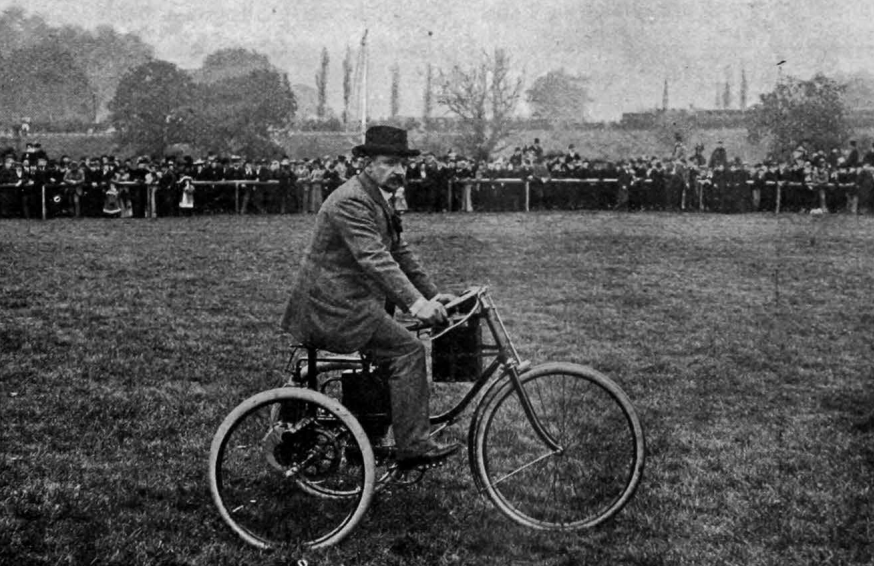
same character as that referred to above, the chief difference being the employment of the electric spark for the ignition of the petroleum vapour in the cylinder. The storage battery is carried on the top tube, close up to the steering socket, and a Rumkhorf coil carried on the bridge. The machine shown weighed ninety pounds, and was priced at £50. These two characteristics may prove considerable factors in selling them by the gross. After a time Sir David evidently steeled himself to dare the majesty of the law, for the carriages left the ring and came out upon the excellently laid highway which stretches between the Agricultural Show Ground and the town. Directly the wheels of the automobiles revolved upon the surface of the high road, the serious handicap imposed upon their movement of propulsion by the rough turf of the ring was plainly apparent. Moreover, the experiment must at once have laid the ghost of all fear with regard to danger to pedestrians or fright to horses. The roadway was lined with spectators, and horses and carriages were stationed at very frequent intervals. The motor vehicles were shown to be under perfect control, and no one of the horses so much as lifted an eye as the horseless carriages sped somewhat noisily by. At the close of the proceedings, it was felt by all present that the occasion undoubtedly heralded the dawn of a new era in vehicular propulsion on the high roads of this country, and that for manifold purposes the horse would shortly be reckoned de trop. The whole of this undertaking to make something like a reasonable start in demonstrating the entire practicability of motor-driven carriages arose with, and its expenses were defrayed by, the Mayor of Tunbridge Wells, Sir David Salomons, to whom the thanks of the community at large, to say nothing of those of over-worked equines, are certainly due. Changes are rapid in these days, and the hour of the motor-driven road vehicle is close at hand.”
SIR DAVID SALOMONS wrote to The Daily Telegraph: “The vast number of communications which have reached me since the day of the announcement that a horseless carriage exhibition would be held in this town, and which correspondence still continues, proves conclusively that a widespread interest in this mode of locomotion exists throughout Great Britain. From a perusal of these letters it is evident that a desire is prevalent to form an association to deal with this subject, which closely affects agricultural, trade, and private interests. I have no right, nor have I the desire, to constitute myself sole guardian of this kind of locomotion in England, though I have so far taken an active put in the movement, for the reason that I felt it was necessary for someone, known to be a lover of horses and quite independent of any pecuniary stake in self-propelled vehicles, to make the start. May I now request that your influential columns give publicity to the fact that I am willing to receive communications from all those who are desirous of joining an association to deal with self-propelled traffic.”
“A MEETING FOR the purpose of forming an association to further the interests of self-propelled traffic was duly held on Tuesday last, and the association is now un fait accompli, with Sir David Salomons at its head. A provisional committee or council has been formed, and we may look upon the association now as in full working order. We wish the deputation which is to wait upon Mr [Henry] Chaplin [President of the Local Government Board] with regard to the proposed measure for amelioration that success which its object deserves, and we would impress upon it the importance in all negotiations of obtaining, if possible, absolutely unrestricted freedom for the use of the new vehicle, and the consequent development of the new industry…The users of autocars will always be amenable to the ordinary byelaws regulating carriage traffic, and they will in their own interests take particular good care that careless driving or high speed in crowded situations are avoided, and we are not likely to meet with a tithe of the recklessness which is seen every day with horse traffic.”
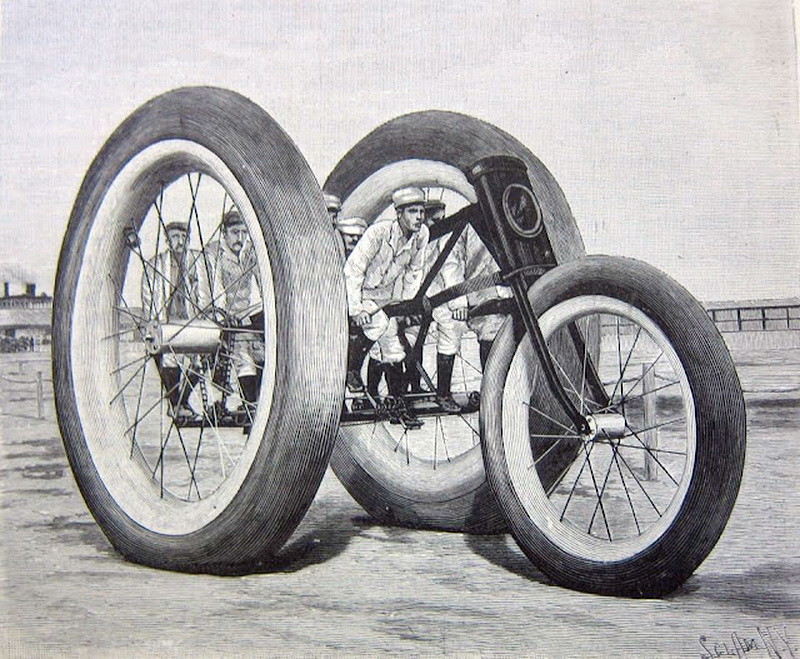
“IN THE EARLY ATTEMPTS to apply motive power to cycles, engineers were inclined to adopt the ‘safety’ for this purpose, probably because it was the most popular machine and the one most likely, in its new form, to meet with public favour. It cannot, however, be said that the bicycle driven by steam or petroleum has so far met with much success. One or two types that are being put upon the market are undoubtedly practicable machines, but they can hardly, with perfect safety, be placed in any but expert hands. The two-wheeled machine does not leave the engineer free enough to devise a motor of sufficient power and simplicity to withstand the somewhat rough usage to which it must be put upon a bicycle, nor is it always a matter of ease to start the machine or stop it in the event of the rider falling. The weight of the machinery, too, is likely to add to the gravity of any accident, while the fear of the bicycle skidding away to its own destruction is not calculated to promote the rider’s peace of mind. For these reasons, and for others it is unnecessary to enumerate, engineers now give very little attention to the bicycle, and think that the three-wheeled machine is the only one that can be safely and conveniently fitted with a motor. Some of them are being devised with powerful brakes and automatic stopping arrangements that make them perfectly safe for anyone who has the slightest idea of driving such machines. There is no doubt that the motor tricycle will very soon become quite as popular, if not more so, than the self-driven carriage.”
“IT WILL BE REMEMBERED that one of the rules governing the recent Chicago Times-Herald $5,000 Road Trials provided that the judges should be allowed to test the vehicles for efficiency, economy, etc. To aid them and the assisting experts in their tests, an apparatus was designed by two Chicago engineers on the lines of the locomotive testing plant at the Pardue University. It will be seen the driving wheels of the car run on a friction drum which is revolved by them when under steam, or, we should say, under vapour, and the friction drum is connected to a dynamometer. Two speed indicators, one run off the driving wheels of the car and the other off the friction drum, make it easy to deduce the mean speed of the vehicle. Besides these a draw bar pull register is fitted to register the tractive pull of the motor…the apparatus…is well designed to ascertain and register the actual power and efficiency of an autocar.”

FOLLOWING THE ROAD TRIALS, The Chicago Times-Herald asked organiser FU Adams how useful they’d been. “The influence of the contest held yesterday upon American mechanics cannot be estimated by a glance at the superficial results,” he concluded. “It is astounding that a self. propelled vehicle should be driven fifty-four miles through a sea of slush and mud at a speed which would kill any team of horses. It is remarkable that this vehicle should be guided over a course covered with pleasure carriages and crossed and cut up by railroad, cable, and electric tracks without serious accident to the drivers, or the users of the highways. But the vital question is, of what value is this demonstration, and does it settle the problem of automobile propulsion?’ The contest inaugurated by The Times-Herald has not demonstrated the perfection of the motocycle or proved its general adaptability to the various demands which are made on a street vehicle…It was the hope of the promoters of this contest that by it American inventors would be stimulated in a new and most important field, a field which, for some perverse reason, had been pre-empted abroad and neglected at home, and one in which the United States was vitally concerned. Of all countries this depends most largely for its continued supremacy upon the excellence of its transportation facilities…The response of American inventors to the offer made by The Times-Herald has never been equalled in the history of mechanical progress. In June of this year perhaps four inventors were at work on motocycles which possessed any features of practicability. Since that time five hundred applications have been filed in the patent office at Washington on inventions pertaining to this branch of transportation. Not less than two hundred distinct types of moto-cycles are now in process of construction…The American motocycle has not been produced, but the draughtsman has traced its lines and the machinist and expert will adjust its parts. This is a realisation which will come not in the remote future, but is for the to-morrow. It is the deliberate opinion of conservative capitalists and manufacturers that the Times-Herald motocycle contest has advanced the art not less than five years and saved this country untold millions in royalties which would have been paid to foreign inventors and builders. It has given direction to inventive genius in arts allied to the motocycle. It has stimulated the creation of compact motors of limited power, which are demanded in a thousand places for myriad purposes.”
“IN FRANCE, ENTERPRISE, invention, and experiment in the direction of autocar construction is going on apace, and the success of the Daimler-propelled carriages of Peugeot Frères and Panhard & Levassor have incited much emulation. As we suggested recently, the peculiar adaptability of the cycle trade for the construction of this class of vehicle has already been recognised in France, Messrs Peugeot being already well known as cycle builders, whilst another firm, La Societé Francais des Cycles Gladiator, of Pré St Gervaise, have also been giving considerable attention to the matter, doubtless somewhat assisted by the fact that one of their principal works managers is Mr CR Garrard, one of the joint inventors of an electric autocar. This firm have for some time seen experimenting with a motor tricycle upon somewhat novel lines…we may here say that it is the result of a careful study of the adaptability of the inventions of Monsieur Beau de Rochas* and Dr. Otto [if you haven’t heard of the Otto cycle you might be reading the wrong timeline, but go on, google it, you’re secret’s safe with me—Ed] and is a four-cycle engine, the details having been so simplified that two great complications have been entirely, and, we are told, successfully, swept away, namely, the water jacket and the vaporiser. Like the Pennington and some other engines, the ignition of the charge is effected electrically, a small button making or breaking the contact. This being so readily done, we are informed, that the crowded boulevards are daily traversed with more safety when they are in a greasy condition than by a rider upon an ordinary safety bicycle. The store of mineral naphtha carried is sufficient for a run of about nine hours, and as no fire is employed, the fear of the liquid catching fire is altogether removed. The tricycle itself is built upon a principle formerly somewhat largely experimented with in this country, having a single driving wheel, and steering with two wheels swivelled upon a centre something like the front wheels of an ordinary four-wheeled carriage. The tricycle was originally studied as a stepping point to the regular autocar, or land yacht, as some of our French friends are inclined to term it, but turning out so well, and working so successfully, the Gladiator Co have put a number of them in hand, in addition to a tandem quadricycle and a light carriage. The total weight of the tricycle with its engine is 50kg, or about 110lb, and the power developed is three-quarter horse. The side wheels are constructed upon folding axles, so that the total width of the machine may be reduced by some five inches, which enables it to be readily wheeled into an ordinary house doorway. Some little time back, Mr Garrard brought one of the early samples of this machine on to the celebrated Velodrome Buffalo cycle track in Paris, and rode it between the races which were going on at the time. The public were not a little surprised at the audacity of the rider, who went off for ten yards with the pedals, then held the pedals still, and let the motor go, attaining a speed of some 29 kilos per hour, following this up by a sort of fancy riding exhibition, as the construction of the machine enables it to be ridden by a skilled cycle rider upon two wheels only, either of the two front steering wheels being able to be raised from the ground by leaning over in the opposite direction, and then steering the machine on its two wheels like a bicycle. We may further add that Mr Garrard himself is present at the Stanley Cycle Exhibition at the Agricultural Hall, which opened yesterday (Friday), and has with him specimens of the tricycle in full working order, where we have no doubt many of our readers will make a point of inspecting it.”
*Alphonse de Rochas; you’ll find him in the gallimaufry.
“A GENTLEMAN LAST WEEK applied to the Hove Police Committee for permission to introduce a tricycle partially propelled by electricity and petroleum into the town. It was not intended to let the motor do all the work; but simply to use it as a help to pedalling. The authorities, however, considered they had no power to grant the request, and for the present, therefore, the new invention is excluded from Hove.”
“NEW PATENT 21,167: J McKenny and FL North, ‘The utilisation of compressed air in the operation of driving cycles and other similar vehicles.'”
“THE STEAM TRICYCLE OF 1881. By Arthur H Bateman. In accordance with your request, I now give your readers the history of this machine. In the summer of 1880, my friend, Sir Thomas Parkyns, Bart, patented the application of steam to a tricycle or quadricycle, and constructed a vehicle that truly ran by steam, and was provided with a condenser, but as this latter appendage became too hot to work within a few minutes, there was little practical value in the whole affair. The idea was there, and the thing worked, but much had to be done before any claim could be reasonably made to call it a practical road carriage. At this stage the patentee placed the matter in my hands, and experiments began in earnest. Modifications in many details were immediately made; the con-denser was radically improved, and before long the time of continuous running was extended from a few minutes to about an hour, when a pail of cold water gave another hour, and so on. At this stage an additional 100lb of dead weight in the form of storage water for condensing was the alternative to frequent stoppages to obtain the same at a convenient horse-trough or
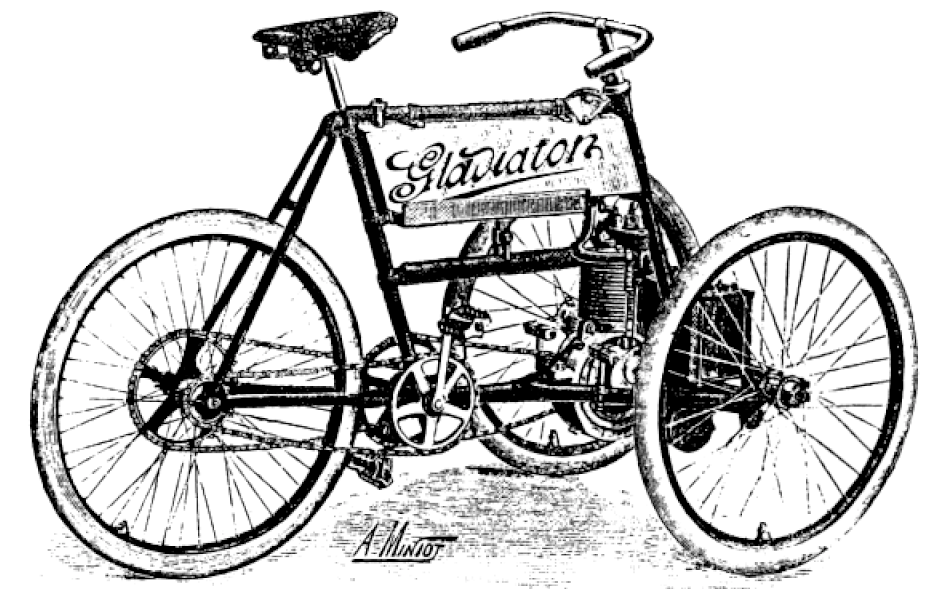
a hospitable cottage, and, failing either, the cycle had to be laboriously pedalled, its weight apart from rider being about two cwts. It was easy to see that much had yet to be modified before even partial success could be claimed. At this stage, my then partner, Mr Edward Barker (a very clever engineer and inventor, and patentee of the hydraulic railway brake), entered into the matter with enthusiasm. I suggested most of the ideas, and Mr Barker worked them out with the utmost ingenuity, one of the first objects aimed at being the abandonment of methylated spirit as the fuel, both on account of its danger and difficulty of purchase in out of the way places. Petroleum spirit (about 650 sp gr) was successfully employed after a lot of trouble, and not without some complication of parts, and experiments were being actively prosecuted, and promised well towards the employment of common petroleum, when the blow fell that stopped further expenditure and progress. Shortly after, Mr Barker died, and his remarkable ingenuity became lost to the cause of light, economical, safe, and rapid steam motors. Meanwhile, a new engine and boiler somewhat on the original lines, but with many improvements in detail, were fitted to the original rather heavy frame, and in this condition I exhibited the machine at a cycle show at the Holborn Town Hall. There was no room to move about, but safely ensconced in a corner (a very warm corner) the machinery was shown in motion, and became the centre of an admiring and excited crowd. On the invitation of Mr Le Fevre, the then (and present) president of the Balloon Society of Great Britain, the machine was taken to the Westminster Aquarium, and there I delivered a lecture and rode the cycle immediately after. An urgent invitation to take part in the Stanley Show, at the Agricultural Hall, at Islington, was received, and the great gallery courteously placed at my disposal. Evening after evening I careered around this capital track, the centre of a mixture of chaff, envy, and admiration. I was hoarse for weeks, but it was a great advertisement, and orders came pouring in. Then arose the vital question, could buyers legally use the machines if they bought them, and it was determined to find out what the law really was. Accordingly, one day Sir Thomas Parkyns, riding in triumph along Greenwich Road, was ‘haled before the beak’, in the genial person of Mr Marsham, the then magistrate of the Greenwich Police Court, charged with a breach of the Highways Acts, in using a carriage ‘propelled by steam or other than animal power’ at a greater speed than three miles an hour, with wheels less than four inches broad, and unprotected by attendants, one carrying a red flag! In vain was it pleaded that no such thing as a steam tricycle had been

born or thought of when the Highways Acts were passed, and that Parliament in its wisdom really could not have legislated for an article yet in the clouds, if anywhere, certainly not in existence in the United Kingdom. The magistrate held that it was not his business to discuss what Parliament meant or claimed; the wording of the Act included this particular incriminated vehicle, and the defendant left the court poorer by the sum of one shilling and costs. Appeal to the Queen’s Bench speedily followed, and here it was hoped the matter would be fought out and the question argued really on its merits, but, alas! the judge declined to hear either argument or evidence, and made short work of the whole thing by the brief but too effective decision, ‘Conviction affirmed.’ It was useless to proceed with the scheme further. A few academic experiments were yet made, and then, not feeling disposed to throw good money after bad, the whole thing was dropped, much to the disappointment of many would-be possessors of the new ‘autocar’—headed by the present energetic and enthusiastic Mayor of Tunbridge Wells, Sir David Salomons, who was one of the first to send an order, and at last is happy (after 14 years) in his Daimler vis-à-vis, which at the recent interesting exhibition at Tunbridge Wells certainly proved a practical and admirable machine. It has yet to be ascertained whether steam will be discarded for this special purpose in favour of ‘explosion’ engines, and it must not be forgotten what a useful power the former possesses in variation of both pressure and speed, unlike its newer rival, which (at present at least) requires uniform speed and continuous running.”
BUTLER’S PETROLCYCLE OF 1887: Information continues to come to hand of experimental autocars which have been made in recent years, but which have in every case been throttled at their birth by the restrictive nature of the laws as they at present exist. One of these was Butler’s petrolcycle, designed and made about ’87 or ’88, and Mr Chas T Crowden, who was connected with Mr Butler in its manufacture, and who has been good enough to furnish us with a photograph of it, informs us that the machine was got to work, and worked fairly satisfactorily, but as they were unable to run it in this country, the syndicate who found the money for it to be built would not go any further with it. Mr Crowden gives the following particulars concerning it: The machine has two steering wheels in front, and one driving wheel behind. On each side of the driving wheel are mounted two power cylinders, driving direct without intervention of gearing by means of two connecting rods and the cranks. Between the steering wheels is fixed a seat for the rider, and on each side are fitted two handles for the rider to steady himself at high speed, and at the same time manipulating the steering wheels. Each steering wheel is fitted with a powerful band brake actuated by a foot lever. Another foot lever was also provided for raising the driving wheel from the ground to start the motor running, and by taking the pressure of the foot slowly off the lever, the driving wheel was lowered to the ground or taking the pressure of the foot slowly off the lever, the driving wheel was lowered to the ground or raised as required. The mudguard over the driving wheel was in the form of a water tank, and was used for supplying water to the jackets of the power cylinders. Petroleum was carried in a small vessel under the seat, from which it passed through a novel form of vapouriser, and thence to the cylinders, as required. To ignite the explosive mixture a small Wimshurst machine was tried, and this was soon abandoned for a Rhumkorf coil and battery. The direct driving was also given up, and a fly wheel was fitted on the driving wheel axle, driving the road wheel by means of an ingenious gearing, which allowed the motor to run at an increased number of revolutions. The motor possesses some very novel features, and at the time the machine was made there were scarcely any oil motors known. I might say that the Butler oil engine is now being made by a large firm in this country. Had Mr Butler and his friends constructed an oil engine before the tricycle, which after it was made could not be used in this country, there is no doubt that the Butler oil motors would have been the best known oil engines of today.

“THE AUTOCARS AND MOTOR TRICYCLES AT THE STANLEY SHOW.
THERE HAS BEEN much cry, and is little wool, in connection with the horseless vehicle show at the Agricultural Hall this week, for the total number of cars staged amount to two, with plans for a third, while the motor-driven tricycle class is represented only by one machine exhibited by De Dion and Bouton and the Gladiator tricycle, which may be seen upon the same stand as the ordinary man-propelled cycles manufactured by the well-known French house who hail from the Boulevard Montmartre. But the attending public, doubtless considering that half a loaf is better than no bread, gather in crowds round both vehicles and tricycles, and evince the liveliest interest in the questions of their pace, weight, cost, and mode of propulsion. At Stand 107, on the right-hand side of the hall, and only a few yards past the stand upon which the latest issues of The Autocar lie displayed, is the motor tricycle exhibited by MM De Dion and Bouton, of 12, Rue Ernest, Priteaux (Seine). This tricycle is of the usual Cripper type, steering by means of the front wheel, and driving with both rear wheels. The machine is about four feet in width, and though the frame is on regular lines, the tubes of which it is formed have wisely been made of larger diameter and stronger gauge to carry the extra weight and resist the extraordinary strain. The usual driving by means of pedals and chain wheels is attached and employed to start the motor in the same manner as the Gladiator. The bridge is of unusual diameter, and the bearings in which the axle runs are carried by four stout metal arms depending therefrom. The container in which the essence de pétrol, is stored is of a flat triangular shape, and is carried after the fashion of a frame luggage-carrier in front of the down tube. The motor is fixed in rear of the diagonal and below the saddle, the end of the cylinder entering a cheese-shaped metal case, which encloses gearing crank, etc. The end of an auxiliary axle protrudes from this case and carries a toothed pinion, which engages with a large spur wheel mounted on the differential gear box on axle, and driving the driving wheels thereby. So far as we were able to gather from the description afforded us, the explosion is caused in the vapourising chamber on the top of the piston by electric spark very much in the same way as the Gladiator or Benz motor, the current being derived from two batteries carried under the top tube abaft the steering pillar, and passed through a Ruhmkorff coil depending from the bridge. The sparking is effected by a cam and metal spring finger on the spindle, a great saving in current being claimed for the method adopted. The charging, compressing, firing, and exhausting is performed very much in the same manner as in other motors of the kind, but in the metal case below the cylinder, and in which the crank revolves, an intermediate spindle carrying the toothed pinion before referred to outside, is contained, which makes but one revolution to one of the engine. No water jacket is required, the outer cylinder surface being formed with serrations just as in the Gladiator motor. The motor runs 1,000rpm, when a speed of 25-30km/h is attained. At Stand 27, where are staged the exhibits of the Gladiator Co., we discover the Gladiator motor tricycle, which is a cycle of the Olympia pattern, which is to say, is steered by two parallel leading wheels, and driven by one wheel behind…the oil used for the propulsion of this tricycle is mineral naphtha at a density of 0.7, and is carried in a reservoir beneath and suspended to the top tube, occupying the entire space between the steering lock and the diagonal down tube. The motor is also supported and attached to a further tube which, midway between the top tube and Y frame, extends from the diagonal to the steering socket. The ordinary chain gear and pedals are fitted, and by working these in the usual way the motor is put into action and the air drawn into the oil reservoir over the contained liquid, whereby its vapour is taken up and conveyed through channels so arranged as to prevent priming, or, rather, the penetration of the oil into the cylinder. The mixture of air and gas then passes down a tube, which is fitted with a kind of Bunsen burner orifice, to allow a further atmospheric dilution, and is drawn into the cylinder by the first half revolution of the engine. The second or upward stroke of the piston, the motor being vertical, compresses the gaseous mixture, which is then exploded, and the work done, the return expelling the products of the explosion from the cylinder, or exhaust. The connecting rod is pivoted to the piston as in a Crossley gas engine, and connected with a crank pin, joining two heavy discs of metal. This frictional point or bearing runs in an oil-bath. A nine-toothed chain wheel is keyed on to the engine or motor-shaft, and, by means of a chain, drives a 26 toothed wheel running free on the pedal axle spindle. To this wheel is attached, à la tandem cycle, a 13-toothed wheel, which engages, by means of another chain, with a further 26 toothed wheel fixed to the driving wheel of the machine. So geared, the motor makes 5.7 revolutions to one of the 26in driving wheel, and with this combination a speed of 19mph has been obtained from the machine exhibited. The sparking apparatus, which brings about the explosion of the mixture of oil gas and air behind the piston, is comprised in two square celluloid primary cells carried on the bridge, one on each side of the steering pillar. The primary circuit is carried to a Ruhmkorff coil below, but before the conducting wire reaches the coil contact is made and broken by the interposition of a metal cam, which is carried on the spindle actuating the exhaust. The current also passes by means of an insulated wire to a small button on the handle-bar, by which the ignition of the explosive vapour can be started or stopped at will. The induced current then passes from the coil to the sparking point within the cylinder, where the spark is made to bridge a space of two millimetres, and, in so doing, fires the compressed charge. A water jacket for the cylinder is dispensed with, the same being kept cool by its outer surface being turned up into a series of A-shaped ridges, whereby the greatest possible area is offered to the refrigerating effects of the external atmosphere. The actual pressure upon the whole area of the piston at the moment of explosion is no less than 1,000lb, but this, of course, is instantly lessened by expansion. The pedals are used to start the motor, and assist in the propulsion of the machine up steep hills, but disengage automatically when the motor over-runs them. The pedals can then be used as foot-rests. The brake is applied by the pressure of the foot upon a lever placed conveniently near the left footrest, the braking being performed by the introduction of a wedge between the frame and a small drum mounted on the engine shaft, which, by reason of the rapid revolution of the latter, will hold the machine in check down any grade. The compressive action of the piston in the cylinder suffices to hold the machine in down moderate declivities. The total weight of tricycle and motor turns the scale at 110lb, and the design and construction of both do the greatest credit to the Gladiator Co and Mr CR Garrard.”
“FRENCH JOTTINGS. By our own correspondent.
It remains to be seen whether the autocars driven by petroleum spirit will continue to enjoy their present supremacy, or whether they will eventually be superseded by motors worked with some other combustible. In the event of the petroleum spirit continuing to hold sway, some arrangement will have to be made before long for enabling autocar users to replenish their supplies in any of the out-of-the-way places in which they may find themselves stranded. The spirit is used so extensively in France for a variety of purposes that it can generally be purchased in towns of any size, but to make the autocar thoroughly practicable it must be possible to replenish the stock of the combustible in every town and village. This matter has already attracted attention in this country, and the well-known oil firm, MM Deutsch, are making arrangements for the establishment of depots for the sale of petroleum spirit throughout the country. They are at first beginning with the towns, and when these are all supplied they will have the spirit on sale in the smaller centres of population. It is evident that the same thing will have to be done in England, where petroleum spirit is an almost unknown commodity among the tradespeople.”
THE CHICAGO Times-Herald coined the term ‘moto-cycle’ to supersede ‘horseless carriage’ when organising the first automobile race in the USA, from Chicago to Waukegan, with $5,000 in prizes. There were 83 entrants but only six showed up on the day. After a gruelling 54-mile run [nowadays listed at 36 miles] a Duryea, built and driven by J Frank Duryea, crossed the line in 7hr 53min at an average speed of 7mph to win $2,000. Runner up, 90 minutes later, was a Benz—the rules stated: “In the event the first prize goes to a vehicle of foreign manufacture, the most successful American entry will receive this prize”. The Sturges Electro Motocycle won $500 although it was abandoned after 12 miles. The GW Lewis Motocycle was awarded $150 “…for friction driving device and brake and a reduction gear for increasing speed.” [This is generally as America’s first race, but I’ve come across a reference to a “steam waggon” race in the 1880s—if anyone out there has details do please let me know.—Ed]
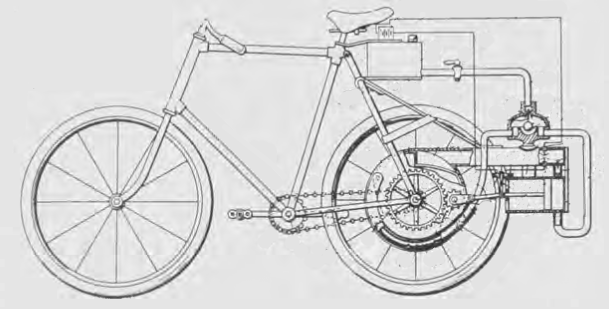
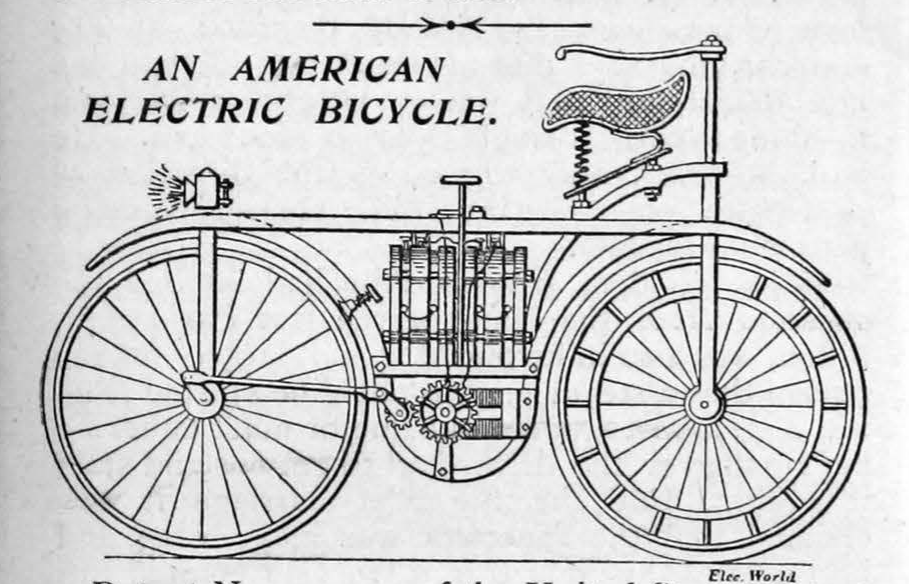
“IT IS SAID on good authority that there are, at this moment, no fewer than three hundred different forms of motor vehicles under construction in the United States. America has adopted the word ‘motocycle’ to indicate the horseless carriage, because it is short, and not cumbersome. The English name ‘auto-car’ is shorter still, and, we fancy, more clearly indicative of the general form of vehicle which the future will see in general use.”
HH CUNYNGHAME LECTURED the Society of Arts on ‘Locomotive Carriages for Common Roads’. Here are selected highlights from The Autocar report: “As regards designs, Mr Cunynghame thinks there is room for improvement, there being great loss of force from badly-cut wheels. Hitherto, the method of designing these carriages has been to take a carriage and fit into it an engine contrived for some other purpose. This method is entirely erroneous. To obtain a good carriage it will be necessary to start from a fresh standpoint, and to design the whole machine, de novo. A successful carriage must not be liable to get out of order. Economy of fuel consumption is quite a secondary consideration. Everyone who works a small gas engine knows that the cost of the gas is the least item of his expenses. One visit of a mechanic and his mate costs as much as would pay for gas for a month…Not only have the French designed road-carriages, but they and the Germans have attempted to make petrol cycles. The first of these was a German bicycle by Messrs Wolfmüller. One of these is to be seen fitfully appearing from time to time in the suburbs of London. I only know of one English gentleman, added the lecturer, who has ridden this very dangerous machine, viz, the enterprising London representative of the new periodical called The Autocar, and who, I suppose, felt in honour bound to try it. If it fell with the rider, I do not see how it could fail to break his leg. The second petroleum cycle is the invention of Mr Pennington, of Chicago. The engine runs at five hundred revolutions a minute; the piston rod works directly on the hind wheel of the bicycle, which, therefore, is carried forward at about five hundred yards in a minute, or twenty miles an hour. The fuel is ordinary kerosene oil, and the gas is ignited by the electric spark. It is claimed that this machine can, on a smooth road, go at the rate of a mile a minute. In a recent number of an American journal, entitled The Horseless Age, a number of inventions are put forward which seem in the highest degree extravagant. In one of them a rider of a bicycle works treadles, which, however, instead of moving the wheel directly, work a pair of pumps, which pump water into a water-wheel connected to the hind wheel of the machine, and thus propel it. There are also a number of road-cars propelled by spiral springs, which have to be wound up by means of winches. There are others which are propelled by primary batteries weighing 100lb, and having an output of 750 watts, that is to say, a horse-power for ten hours; in fact, so far as descriptions can be trusted, the number of these vehicles in America is very great, and their speed and performances altogether surpass anything that has been done in Europe.”
“[PATENT] No 1,580, AD 1895—Improvements in Velocipedes, FT Millet. This invention relates to various improvements in and connected with the construction of velocipedes which are constructed with the driving wheel carrying a motor therein, as described in patent No 5,199, 1889. A velocipede constructed according to this invention contains in general the following parts: A motor consisting of a series of cylinders mounted in the rear wheel radially around the axis of the said wheel and fed with atmospheric air charged with combustible vapour to render it explosive, a reservoir for petroleum, gasoline, or other hydro-carbon, constituting the mudguard, and storing a certain quantity of the liquid which generates the combustible vapour, a carburettor for vaporising the said liquid and effecting its mixture with the atmospheric air. The combustible mixture of vapour after having been used in the said motor is driven therefrom into a collector connecting the discharge from the motor to the carburettor, where the exhaust gases impart heat to the air which forms the explosive mixture. In front of the carburettor is arranged a reversing battery having its connections attached to the terminals of the circuit of an electric transformer or induction coil. The circuit induced from this coil is connected on the one hand to the end of each cylinder, and on the other hand to the frame of the cycle which constitutes the return conductor. This battery and transformer are dispensed with when other means for effecting ignition are employed, and may be replaced by equivalent means, for instance, by a dynamo or incandescent tubes. The cycle also carries certain accessory apparatus, such as a reservoir divided into two compartments by a vertical partition, and containing in the one the oil for effecting the lubrication of the motor, and in the other petroleum or the like for increasing, when desired, the carburation of the explosive mixture in the motor; a parachute for retaining the bicycle when stationary in a vertical position, operated by the steering handles; a box enclosing the toothed wheels, endless chain, and the brake mechanism, and means for engaging the crank shaft of the motor, and finally the different transmitting and connecting mechanisms for connecting up the different parts of the cycle.”

“NEW COMPANIES. British Motor Syndicate. With a capital of £150,000 in £1 shares; to enter into an agreement for the acquisition of certain undescribed inventions, and to manufacture, sell, let on hire, and deal in motors, cycles, velocipedes, carts, waggons, vehicles, ships, boats, launches, carriages, flying-machines, etc. The first directors (to number not fewer than four nor more than six) are to be appointed by the sub-scribers. Remuneration, chairman, £120 per annum; ordinary directors,£100 each per annum. Registered office, 23, Old Broad Street, EC.”
“ALTHOUGH BUT TWO YEARS have elapsed since the great awakening took place, and our friends on the other side of the Channel commenced to turn their attention to the horseless carriage, great strides have been made, and motors wonderfully well suited for the work they have to perform have been designed and used. The Daimler, Benz, Fitz, Delahaye, and other motors have already been brought out, and doubtless many engineers, both in England and France, are engaged in designing and perfecting other systems. There is a very widespread belief amongst engineers that steam is after all the better, though for the present petroleum motors are fitted to almost all the successful autocars. For heavy work and agricultural purposes there is little doubt that steam is better than petroleum. But for pleasure carriages there is, at least in France, a strong feeling in favour of the petroleum vapour motor.”
“ALTHOUGH SEVERAL AUTOCARS and motorcycles found a place amongst the exhibits at the Stanley Show at the Agricultural Hall, a fortnight since, only one vehicle of the kind is to be seen at the Crystal Palace in the cycle exhibition there which closes to-day. This is a steam bicycle by J Houldsworth & Co, of 61, Lord Street, Liverpool, but it appears rather to be exhibited as a novelty to attract attention to the rest of the machines on the stand than as a vehicle with which the firm expect to do business. It is an ordinary safety bicycle, apparently without alteration, carrying on the front, where the luggage is usually held by the luggage-carrier, a circular boiler and spirit stove some 18in in height, and probably a foot in diameter. To the under part of the frame of the bicycle on one side, a short cylinder, with about a 2in stroke, is fastened, the piston being connected with one of the cranks, which is cranked out a couple of inches from the base so as to afford a bearing for it. The engine is fitted with a steam gauge, safety valve, and steam whistle, steam being supplied to the cylinder by a copper tube carried along the frame. It is claimed to develop quarter horse power, with a speed on a good road of fifteen miles per hour at a cost of fourpence per hour. The ordinary pedal driving is, of course, retained, but we confess not to have conceived a very favourable impression of it. So far as steam, at any rate, is concerned, we do not fancy power applied to a bicycle.”
“SINCE THE PUBLICATION of this journal the title ‘autocar’ is seen every day more frequently in print, and we fancy this will be the generally adopted term for the vehicles in this country. America appears so far to have unanimously adopted ‘motor cycle’ for all classes of vehicle, which we are inclined to think is at times just a little incongruous.”
“AS THE NEW INDUSTRY, the motor carriages, are likely to be extensively used before long, I think it is nothing but right that the ‘iron horse’, like cycling, should also have its verb. I beg to suggest motor-touring, say motouring or motoring, the verb would thus be to ‘motour’ (motor). Of course it might strike us as rather funny now, if we read in the paper ‘Lord Salisbury motored this afternoon from Downing Street, and arrived at Paddington Station at exactly six o’clock’, but I feel sure we shall get used to this and a good deal more in the twentieth century.
Frederick R Simms.”
“THE ROTATORY MOTOR has made its appearance, and in principle nothing can be better for an autocar. It consists merely of a cylinder, in which a cam turns round with the axle. The gas mixture is introduced into the cylinder, and the explosion drives the eccentric round. If it is found that the claims are borne out, the motor will prove to be a formidable rival of those now in use. It is to be hoped, for the sake of the future of the autocar, that the inventor is not over-sanguine.”
“EIGHT DAYS IN PARIS by Sir David Salomons, Bart. On December 12th an exhibition was opened in Paris, at the Palais de l’Industrie, under the name of the Salon des Cycles et Automobiles, and from the interest which I feel in all matters concerning motor carriages and cycles, it was only natural that I should go to see the newest productions. The exhibition was only to be open for a fortnight, it was therefore necessary to start immediately after the successful meeting for the formation of the English Self-propelled Traffic Association in order to be home by Christmas. To proceed with what I saw in this period of eight days—the exhibition itself was probably one of the largest and most representative of the kind ever held. Apart from the French firms, the English were strongly represented amongst the exhibitors. The Palais is a splendid building, and the decorations gave the scene that appearance of gaiety of which the French are complete masters. When nightfall arrived, and the great hall was lighted by arc lamps, the scene was more like fairyland than an exhibition of cycles, and the whole appearance by day or by night was a contrast to the gloom pervading the English Stanley Exhibition…I spent the whole or every afternoon at the exhibition, and probably no single article in the place, small or large, escaped my observation. The visit had another special interest for me, as I met all the leading gentlemen connected with the ‘automobile’. I was also present at the house of the Count de Dion at a largely attended committee meeting of the Automobile Club, and therefore, quite apart from what I saw at the exhibition, I had the opportunity of gaining more intimate knowledge of French feeling in regard to this new class of traffic as well as their sentiments towards our nation, since we all conversed without reserve…Turning to the stand of MM de Dion et Bouton, their exhibit is not so large as it might be. They show a steam racing carriage, which has done wonders at the trials, but it is not built in accord with English ideas. The Count de Dion states that this carriage is constructed simply for racing purposes and nothing else. They have a fine show of motor tricycles, which have proved very successful, and for which they have obtained a large number of orders—as many as two hundred. The new form is a vast improvement on the one shown at Tunbridge Wells, and it is to be regretted that none of these were ready in time to bring to England at that period. In the course of a few weeks I expect my own to be delivered. The celebrated firm of MM Clement is making the tricycle for the motor, so there is a guarantee that both the tricycle and the motor are first class. Next to this stand is that of the Gladiateur Company. They show a tricycle and a tandem with motors, not very unlike those of De Dion et Bouton. They, however, appear clumsy, and not so scientifically constructed…Two carriages, worked by petroleum motors, and said to be Belgian, were set in motion with the wheels lifted off the ground. Such a test is not fair, because any vibration which might exist would be set up tenfold. The result of this test did not produce a favourable impression upon the public, since the sensation to the onlookers gave them the idea of a small earthquake being in progress. Another carriage, very clumsy in appearance, was run a short distance by the inventor, who declared it to be quite free from vibration, but the riders were considerably shaken so far as the onlooker could judge, and the ground trembled as they passed over it, when going at a slow pace. These carriages were greatly inferior. At another stand, that of MM Duncan and Suberbie, a number of petroleum motor bicycles are to be seen…The bicycles, which were shown on the track, ran very well, but at times, when the explosions in the cylinder were not given successively at each alternate stroke, the rider received, to all appearances, unpleasant intermittent shocks. Still there must be a beginning to all things, and it must now be admitted that bicycles can be constructed self-propelling in character. The original motor came from Germany, but has been greatly improved by Mr Duncan, a partner in the company mentioned.”
1896
AT LAST! HP SAUCE ARRIVED to complement the bacon sandwiches (and baked beans) which have always sustained motorcyclists, courtesy of Fred Garton who cooked it up in his pickle factory in Basford, Nottingham. And now it’s made overseas. Shameful.

EDWARD BUTLER sold the patent rights to his Petrol-Cycle to Harry Lawson, who manufactured its advanced engine to power boats, and broke up his machine for scrap but, as the Red Flag Act had been repealed, Butler and his wife were able to make at least one last ride in the Petrol-Cycle on the roads of Erith—he wrote of reaching a speed of 12mph— before selling it as 163 pounds of scrap metal. (The weight of the machine was 280 pounds so maybe the “very compact motor” was salvaged.)
FROM THE BENDIGO ADVERTISER, in the Aussie state of Victoria: “A new terror is to be added to our thoroughfares. This is to take the shape of a motorcycle, to be worked by oil and to be capable of a record pace. It is to be provided also with pedals so that the rider can first take his fill of exercise, then shield his feet from the pedals and enjoy all the pleasures of rapid locomotion. Nor is this all, the motor bicycle is to be built for either one of two passengers, to be followed by the motor tricycle, on which three people may find comfortable seats. The thoroughfares are dangerous enough as it is what, with trams and other conveyances and with bicycles shooting sharply round corners without even that pre-emptory tinkle of the bell that is popularly supposed to be one of the regulations for cycle traffic. But what will they be with the motorcycles. Then again, ‘horrors are likely to be piled on horrors’ head’ by the appearance of the electric motor, which is gaining so much popularity in the old country , but, thank heaven! it requires the passing of an Act of Parliament before these can be used on our public roads, and Parliament is not likely to enter on the consideration of fresh legislation for a long time to come. For which relief much!”
“THE STORY OF the much-discussed performance of a mile in 58sec on a Pennington motor bicycle is recorded in the following terms by the Evening Wisconsin, a Milwaukee journal. It will be seen that it was made publicly, and not in private trial. The report says: ‘EJ Pennington, patentee of the celebrated motocycle, has been exhibiting one of his machines. Our Milwaukee people were greatly interested in the wonder. The authorities gave him the use of a portion of Grand Avenue, which is paved with asphalt. A squad of mounted police were delegated to keep back the hundreds of people who congregated to see the machine as it sped up and down the avenue with lightning like rapidity. Mr Pennington made some very fast time, and astonished the folks of the great beer brewing town. The first mile test he ran in something like 1min 2sec, and the second mile in 58sec.'”
“‘A PENNINGTON COMPANY FORMING IN AMERICA. News has reached here from Clinton, Ia, that one of the largest and strongest companies ever formed in that city has just been organised. The new company will be known as the Clinton Motocycle and Power Company, the principal incorporators being several millionaires of that place. This company has bought the patents of the Kane-Pennington engine from Thomas Kane & Co, who manufacture in this city. It is understood that there are several million dollars back of the enterprise, and that Clinton, Ia, will have one of the largest and best equipped plants in America for the manufacture of these horseless vehicles. This plant will be used for building the Kane-Pennington vehicles as well as the Kane-Pennington engines.’—Racine Daily Journal.”

“THE ROCHDALE STAR says that the Highways and Locomotives Act of 1878 is making us the laughing stock of Europe: “Only England lags behind, but that is because the use of motor vehicles is surrounded by ridiculous restrictions, and it is reasonable to suppose that as soon as these have been removed an impetus will be given to a new industry which will effect a revolution in our preconceived ideas of locomotion.”
“A WRITER TO THE English Mechanic opens up the question of autocars, and invites discussion upon it. The more the merrier. Every little helps.”
“WE ARE PLEASED to see our contemporaries Engineering and The Engineer giving so much attention to horseless carriages. Full discussion amongst mechanical experts cannot fail to be productive of good results.”
“HOW MANY SIGNATURES will you get to The Autocar petition?”
“AFTER REFERRING TO the great popularity of the auto-car in France, the Liverpool Mercury says: ‘It is incredible that England, the pioneer of railways, will lag behind. Those who saw the experimental runs, performed under the direction of Sir David Salomons, are agreed as to the facility with which the carriages were steered, turned, and stopped.'”
“MR WE GIBBON, in a letter to Engineering, asks if the Kane-Pennington motor will work with oil of a specific gravity of 0.800, and what is the average mean pressure obtained. As Mr Pennington claims it will work with any ordinary lamp oil, and, in fact, with crude petroleum itself, we believe the first question is easily answered.”
“THE CHICAGO TIMES-HERALD says:’The Kane-Pennington motocycle was the only one to make a test at Washington Park track on the testing apparatus, and a high degree of efficiency was shown by their engines and machine. Mr. Pennington, of the Kane-Pennington machine, made a mile in three minutes on the track, while the Benz motocycle’s fastest mile made was 4.40. The Kane-Pennington outfit weighed 400lb, while the Benz weighed 1,700lb.'”
“MESSRS ROOTS AND VENABLES continue the correspondence on the Kane-Pennington motor in Engineering. Their letter may be summed up in the question, ‘Why will not Mr Pennington show his 20lb motor giving two horse power on the break?’ In Messrs Roots and Venables, Mr Pennington has doughty opponents, and he cannot do better than answer their questions and objections as far as lies in.his power. Might we suggest to Mr Pennington that he should submit his engine to D Kirkaldy and Son, or some equally well-known and reputable firm of testing engineers.”
WALTER ARNOLD DROVE his Benz automobile through the village of Paddock Wood, Kent at 8mph—four times the urban 2mph limit—earning him the dubious honour of Britain’s first speeding fine. He was also charged with “allowing a locomotive to be operated by fewer than three persons” and failing to display his name and address on the “locomotive”. He was fined £4 7s (worth about £750 today) including ten bob (£85) for the speeding offence. A few months later he launched a locally built variant of the Benz as the Arnold Motor Carriage.
“PATENT NO 23,771, SELF-PROPELLING road vehicles, EJ Pennington.—The objects of the invention are: First, to furnish a light and convenient road vehicle, driven by power obtained from an oil engine; secondly, to provide a cheap, practical, explosive engine, that will not heat though run at high speed, thus dispensing with a water jacket or other artificial means heretofore used, to carry away the heat generated by the compression of the charge, and subsequent explosion thereof; thirdly, to provide a simple, cheap, and efficient inlet or exhaust valve; and fourthly, to convey the heat developed in the combustion of the explosive mixture to certain parts of the machine, as those upon, or near which, the feet of the rider rest, or which are engaged by his hands in the steering of the vehicle; this feature of the invention being designed for use in cold weather, and to be rendered inoperative when the necessity of its use no longer exists. The engine is of that class in which a charge of an explosive mixture of air and oil is admitted behind the piston, and is, after compression, exploded so as to develop the necessary power. Fly wheels, special compression cylinders, and other special instrumentalities are discarded, and the explosive mixture is compressed in the explosion cylinder through the momentum of the load—ie, the weight of the rider—on the vehicle. Apart from such load the vehicle will not run, for the compression of the explosive mixture acts as a brake, but when the rider mounts and starts the vehicle the additional weight stores the power and furnishes the momentum for overcoming the resistance opposed by the compression…The operation is as follows: The can 80b being supplied with proper fluid, the burners are lighted to heat the ignition tubes. Then the rider, adjusting the needle valve 45 and mounting the machine, starts the wheel 2 and shaft turning. If the parts are in the position shown, the pistons are both drawn forward by the cranks 11, 11a, and connecting rods or pitmen 12, 12a. If both cylinders 6, 6a, are empty, a mixture of air and oil is drawn into them through the arched pipe 49 and the inlet valves 23. As the end of the forward stroke is reached the springs close these valves. The contents of one cylinder (6) are exhausted, and the other 6a compressed by the action of a valve gear, the valve 54 being closed. The compression takes place also in the ignition tube, and when completed explosion ensues. The pistons having now reached the inner end of their stroke the explosion in the cylinder 6a faces the piston forward, turns the crank which is fixed to the wheel axle, and propels the machine. During this forward movement, the piston draws in a charge of oil and air, its exhaust valve 54, as well as the corresponding valve of the other cylinder, being closed. The operations are then repeated with respect to the other cylinder, and the machine is thus alternately propelled on either side. The wheels are fitted with large pneumatic tyres. A supply of fluid is carried in the can 42, and is led down the pipes 41. The rod 47 is used to operate the valve 45.”
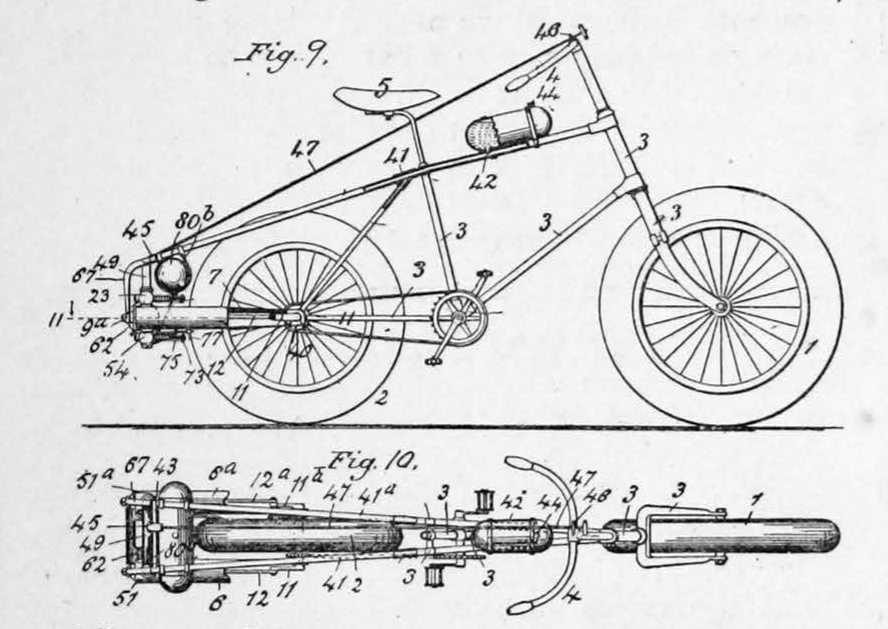
“FRENCH INSURANCE COMPANIES are issuing special tariffs for the insurance of autocars as well as against accidents caused by them.”
“A WELL-KNOWN CYCLIST who has been experimenting with a petroleum bicycle says: ‘It is not a question of how fast it could go, but how fast one could allow it to go to keep one’s seat.'”
“NOW THAT WE are going across the desert again to fight the Dervishes it seems a pity that the autocar movement is not a little more developed than it is, for we feel convinced that had it been so we should hear of the Government buying autocars instead of camels.”
“AN AUSTRALIAN CORRESPONDENT writes us from Melbourne: ‘We have not seen autocars or motor cycles in this part of the world yet, nevertheless we are pleased to note they are soon to take a place on the highways of the world. What a revolution in traffic will result—special roads, and an end to the clatter of city streets.'”
“IN REFERRING TO the somewhat prevalent idea that autocars and the like are more or less likely to blow up at any time, an engineer drily states: ‘For instance, if you fill the benzoline tank with a lighted pipe in your mouth, you will probably have a notice all to yourself in the papers next day.’ Behind this little pleasantry a well-known truth is recognised, and that is that nine-tenths of the accidents which occur in everyday life are due to carelessness, and not to defect in the instrument, machine, or material, that is usually blamed for the accident and labelled dangerous forthwith.”
“THE AUTOCAR BILL.—I saw with sorrow in a paper that in the Act being prepared for removing Parliamentary restrictions re autocars that it is not proposed to allow one motor carriage to be towed by another. The other day I was expounding to a lady how she could ride out with a cycling party on a petro-electric bike, act as chaperone, and in case of need lend a helping machine, by means of a towing apparatus, to anyone who required it. I fear this beautiful vision is to be nipped in the bud. What, perhaps, is more to the point is: What is to happen in case of a breakdown? Is an automotor to be left devoid of assistance by another, and only to be able to rely on the pushing powers of its unfortunate occupants, or until the services of a four-footed animal can be obtained? It seems to me a rather grandmotherly restriction. Cannot this be left to the ordinary rules of the road, the same as the rate of speed has been?—though I hardly expected this much good sense—engineering—on the part of our legislators. After all, waggons are allowed to be towed by three or more horses in line, and tandems to travel at their own sweet will—the leader—one nearly put a period to myself in Kenilworth on Thursday evening last. I think this is a matter which really deserves consideration.
Lisle H Curtois.”
AN AUTOCAR PUNDIT looked at some of the choices that would have to be made by horseless-carriage designers: “…take the case of internal combustion engines, which term will include gas-engines, oil-engines, spirit-engines, and similar engines, in which the motive power is obtained by the explosion or combustion of a charge of inflammable gas or vapour…Speaking generally, there are four methods available: ( 1 ) Gas or oil flame; (2) hot tube; (3) compression; (4) electricity…electricity, we think, will eventually, in almost all cases, be the method which will be adopted to ignite the explosive charge in the cylinder or combustion chamber. Although it may be urged that the battery or generator of electricity will take up as much space, if not more than some of the other named arrangements, it must be noted that whereas in the latter cases the extra space is added to the cylinder, whether convenient or not, in the case of an electric battery, it can be placed in any odd corner available. As regards the form of electric igniter, several are available, such as a platinum wire rendered incandescent by means of an electric current; two wires arranged within the cylinder in close proximity, so that when a current is passed through them, a series of sparks is discharged between the points of the wires, such as adopted in the original Lenoir engines, or two electrodes which are brought into contact, and the contact broken to produce an ignition spark, such as in the much-debated Kane-Pennington motor. The electric current offers the advantages of compactness, reliability, and adjustability of ignition, and from what we have seen of the last-named engine, it offers further advantages little short of marvellous.”
THE AUTOCAR ALSO looked backwards: “Anyone who has studied the history of the autocar movement in England cannot fail to have been impressed by the manner in which it has been repressed by our countrymen. Nothing else shows this better than the series of articles which have been appearing in our columns, ‘Steam Locomotion on Common Roads’. These papers have been a veritable catalogue of inventor-martyrs, and it is positively lamentable to think of the way in which England has treated some of the most ingenious of her sons. Many of them men who would have risen to fame and fortune went broken hearted to an early grave, into which they may be said to have been driven by prejudice and greed. It is a great thing that this repressive legislation will soon be altered, but nothing can ever atone for the loss of trade, of pleasure, and of life itself that has been caused by our inability as a nation to recognise a good thing when it was offered us.”
IN LE MANS LEON BOLLÉE and his dad, Amédéé, patented and built a 650cc 2½hp tricar marketed as the Voiturette—the passenger seat position earned it the nickname ‘Tue Belle-mère’, ‘Mother-in-law killer’. The border between motor cycles and automobiles was blurred but Bollée called his company Léon Bollée Automobiles and, although the Voiturette won the 1897 Paris-Dieppe and Paris-Trouville races, he switched his attention to four-pot four-wheelers.
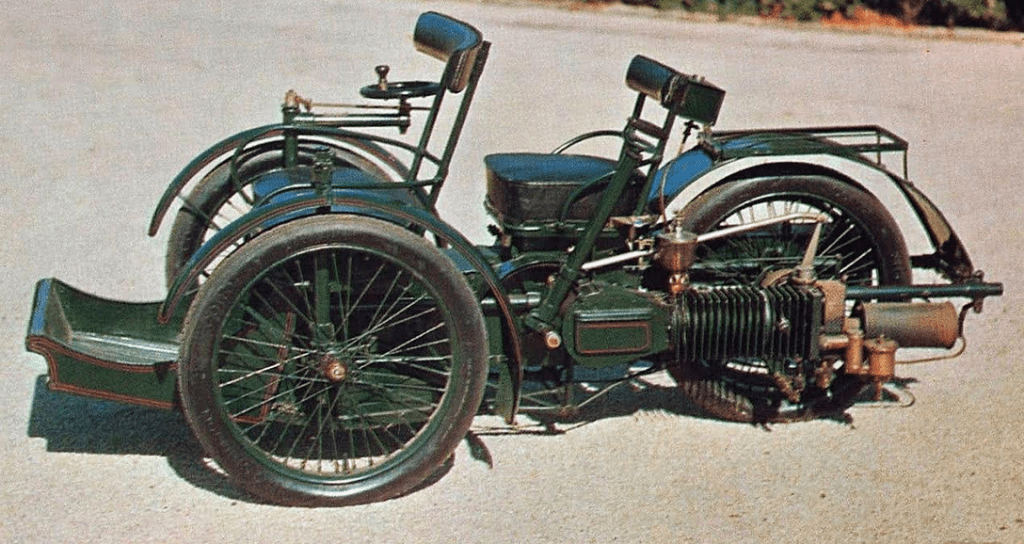
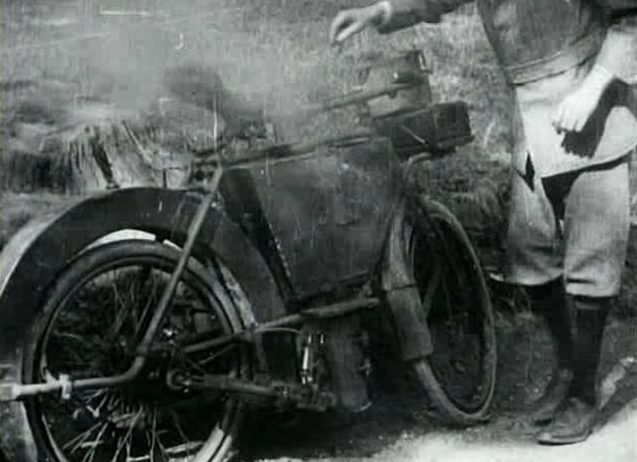
“A PETROLEUM BICYCLE. One of the first, if not the very first, firm to turn its attention to modern bicycles driven by other than the rider’s power was the German house of Hildebrand & Wolfmüller. Under these circumstances a brief description of the machine as modified by the well-known firm of French bicycle makers, Duncan Suberbie & Co, Croissy, near Paris—who, we believe, hold the French right of the H&W patent—will be of interest. Its appearance is not fascinating, as will be seen from our engraving, but the bicycle self does not look nearly so clumsy as would be expected. Duncan, Suberbie & Co have spent several months in experimental work with the petroleum safety to modify the machine in many cycling points, as the motor, they consider, is nearly perfect, and the firm have been able to manufacture these safeties in numbers on practical cycling lines. Those they have delivered have given general satisfaction.

The petroleum tank is fitted in the front of the machine between the double set of tubes, and it contains six litres, which are sufficient for a twelve hours’ spin at an average speed of fifteen to twenty miles per hour. The water reservoir, to cool the cylinders, is at the back over the driving wheel, which is solid, on the disc wheel principle, and acts as mudguard. The steering is far easier than on an ordinary safety, as the greater portion of the weight is below the rider, and to maintain the equilibrium is more simple, to that a novice at cycling can ride the petroleum safety in a few minutes. It is necessary for the weight of the rider to be across the driving wheel, so that the grip upon the ground may prevent the wheel from ‘skidding’,’ which is a very important advantage—for in the case of a fall, for instance, the machine, without the rider’s weight being in the saddle, would stop instantly. The regulation of the speed is also very simple, and is mastered with the thumb and forefinger on a coned screw. The more it is un-screwed the faster the machine goes, or it can be stopped by screwing up entirely. To stop suddenly, or to go downhill, it is only necessary to press the lever right down into a clutch, which immediately closes the valve of the petroleum reservoir, and then the pistons act as automatic brakes. A spoon brake is also fixed upon the front wheel, in case of need, so that the machine going at full speed can be stopped in a few yards.”
“MR WILLIAM CROSS, a well-known Newcastle engineer, has been testing a Hildebrand and Wolfmüller motor bicycle. He was able to get comparatively extended running, as the trials were made in a private park along a mile drive. The machine he tried weighed 170lb complete, with 22in back and 26in front wheel, and pneumatic tyres…While giving every credit to its designers and constructors, Mr Cross thinks the frame especially is open to improvement, and we fully agree with him. At anything above twenty miles an hour the vibration on the hands was excessive, though the steering itself was good at any speed. On a measured quarter of a mile of only fair surface be covered the distance in 37sec, and a full mile, with the last quarter uphill, was done in 2min 57sec. The noise of the exhaust was complained of as being unnecessarily obtrusive.”
“COVENTRY AND THE MOTOR CYCLE INDUSTRY. Special saloon carriages attached to the 10.10 train from Euston Station this morning brought down to Coventry a party of some 60 London journalists associated with the Metropolitan and Provincial Press. They came on the invitation of Mr Henry J Lawson for the purpose of inspecting the premises of the Coventry Cotton Factory Company, which have been—or are rapidly being— transformed into motor mills. Mr Walter Phillips met the party, which included Mr Lawson, at the station, and they were at once driven to what, it may be supposed, must in future be termed the Coventry Motor Mills. Here Mr Lawson introduced to the company Mr Sims, consulting engineer, adding that after luncheon he would ask the visitors visit the Humber Works, where motor cycles were being made under the new organisation’s patents. They would then proceed to the Quinton and new Beeston works, winding up in the Kenilworth Read, where there were two miles of straight running, and upon this road they would see the motor cycles tested. The fact that the railway and canal came right up to the mills was duly pointed out, and then the party proceeded to make an inspection of the premises. The testing and erecting shop was first gone through, and Mr Sims very briefly explained the purposes to which it would be put, as also the fact that there would be three departments of production, steam, electric, and petroleum. The Pennington motor would be greatly made, and Mr Pennington, who has come over from the United States, was introduced. The other portions the premises were inspected, as also the surroundings. It was stated that the engines would be 750 horse power, fed by four boilers. At the luncheon following the inspection of the Motor Car premises at the Queen’s Hotel, Lord Norreys occupied the chair, and was supported by Messrs HJ Lawson, JA Bradshaw (Liverpool), P Hardie (Paris), FR Sims, H Fenney (Birmingham), J Crutchley, W Phillips, HH Griffin, JH Mace, C Osborn. CS Nigel Stuart, JA Bradshaw, J Hay, and most of the press representatives who had inspected the company works. Mr. Lawson, replying to the toast of his health, stated that those who had seen the Coventry of the present day would not be surprised at the little paragraphs which had appeared in the press stating that the result of the invention of his bicycle had been to increase the population the city by 20,000. He added that a gentleman came to Coventry last week to buy 100 machines, and went back after two days with but five machines. (Laughter.) Only few years ago he (Mr Lawson) was in Coventry working at the bench helping make his own safety bicycle and at the present day some of the gentlemen he was connected with were forming their business into companies with a capital of half a million of money. Mr Lawson spoke of the large amount of orders that had already been received for motor cars, motor cycles, and vehicles for every description of traffic, and predicted a great and prosperous future for the new company’s undertaking. He also referred to the aid which was to be given in the production of the company’s patents by the Humber and Quinton Cycle Companies. Mr Griffin proposed ‘Success to New Beeston Cycle Company’, coupled with the name of the inventor of the safety bicycle. Mr Sims supported the toast, and Mr Lawson, replying, said the company’s guarantee dividend was 10%, for two years. A vote of thanks was passed to Lord Norreys for presiding.”—Coventry Evening Telegraph, Monday 8 June.
THE FIRST LONDON show for “horseless carriages” was held at the Imperial Institute in South Kensington under the auspices of Harry Lawson’s Motor Car Club.
“‘DO YOU THINK the new motor cycle will displace the ordinary machine?’ asks a York reader. We think not. though in cycle matters the saying ‘one never knows’ holds good. Cycling cults are followed as strictly as any rule of fashion in regard to feminine attire. The cost will be against the motor cycle, and ‘the pleasure of making the machine go’ will be gone. Some stout old gentlemen will be risking their necks on it, and no doubt to them it will be useful. At least it will enable paterfamilias to keep his eye upon the young folk who get far beyond his ken in these days.”—The Northern Weekly Gazette.
BAYLISS THOMAS and Co of Coventry had been making penny-farthings since 1874; the firm became Britain’s first motorcycle manufacturer, fitting De Dion engines over the front wheel of the safety bicycles. It was marketed under the Excelsior banner.
A PATENT IN the name of Gustav Mees mentioned desmodromic valves. Instead of springs, vales were to be closed, as well as opened, by cams.
THE 1½HP ENGINE ON the Munich-made Heinle & Wegelin replaced the downtube years before Joah Phelon (of P&M) patented the idea. It also had one of the first Bosch mags and shaft drive. Evidently a pillion seat could be fitted; trailers were offered to carry people or luggage and an ambulance version was available. One was driven on the streets of London
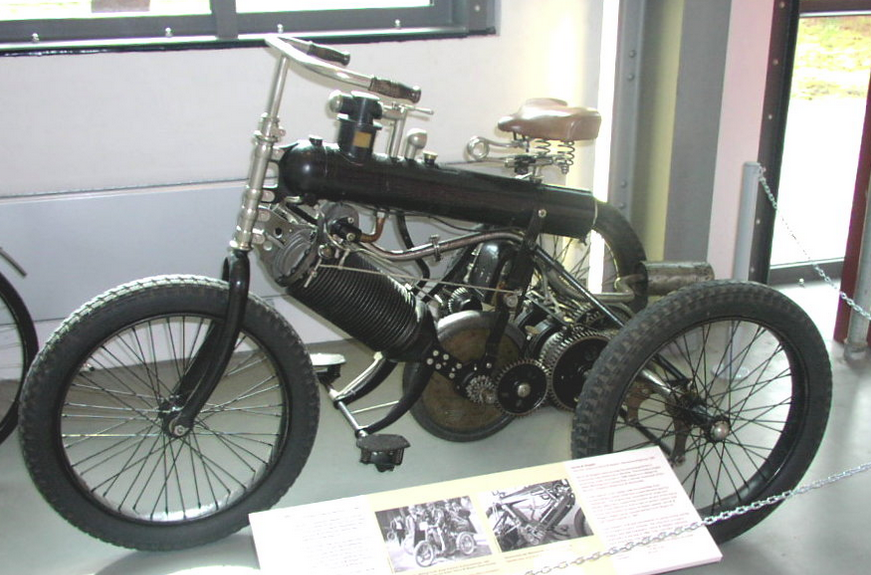
LUDWIG RUB, A Munich shoemaker, designed the Heigel-Wegulin, a shaft-drive motor cycle which used the engine and fuel tank as part of the (conventional bicycle) frame. Advanced features included a mechanically operated inlet valve. It went into production and was exhibited in Britain but high production costs killed it off.
“FROM OUR BRUSSELS correspondent we learn that the Belgium Automobile Club is now in full working order, and that important action in connection with the autocar movement in Belgium has already been commenced.”
“A PARIS LAWYER, who has just given an order for an autocar with which he means to take a tour through France. The vehicle is to have a dining room, two bedrooms, a lavatory, and a kitchen.”
“THE POLICE AUTHORITIES in Paris are showing the greatest regard towards the autocar. The Automobile Club has just received official sanction from the Prefect of Police on condition that no games of chance are to be allowed in the club The headquarters are fixed, temporarily at least, at 4, Place de l’Opera, where very shortly a stand of autocars will be established for the convenience of members. If the authorities permit of autocars running in the city, they are at any rate very exacting in the formalities to be carried out before a self-driven vehicle can be put into use. The secretary, M Paul Meyan, has just published the details of these formalities, under which a complete specification of the vehicle is to be lodged with the Prefect of Police, together with an abundance of particulars, as to the birth, marriage, profession, and other matters affecting the applicant. The vehicle is to be inspected by an engineer, and the applicant himself is to be examined as to whether he is capable of driving the carriage. These formalities occupy about a fortnight, and the granting of a permit may be taken as a very good testimony to the efficiency of the autocar and the capacity of the owner.”
“TO BEGIN WITH, no doubt, says the Lady’s Pictorial, the automobile carriages will take on the outward semblance of the familiar victoria, coupé, or village-cart, just as, when railways were first invented, they were made to look as much like a stage-coach as possible, to lure a diffident and not too approving generation on to the iron rails. Gradually, however, the large, heavy, cumbersome carriage will give way to some fanciful-looking vehicle, not much bigger in size than a tricycle, but with a cosy cushioned seat to hold two, while for what coachmen call ‘night-work’, there will probably be revived some such conveyance as the adorable Sedan chair, which will be fitted with wheels, and worked by electricity. Indeed, it is not improbable that the carriage form will be done away with altogether. Why should not Lady Betty ‘take the dust in Hyde Park’ AD 1900 in a fairy-car propelled, not by doves, but by naphtha; while a hollow swan might convey Amanda to the summer sales, and an exaggerated cockle-shell, lined with satin, contain Amaryllis on her way to pay her morning calls?”

“MR CR GARRARD, one of the inventors of the well-known electric carriage, is now leaving the Gladiator Cycle Co, in whose service he has been for more than twelve months past, in order to take up an engagement with Humber & Co. This firm is entering into arrangements with the Gladiator people for the acquirement of the English patents of the new petroleum tricycle, upon which Mr Garrard has been working, in conjunction with other engineers, for some time past. In the event of these negotiations being brought to a satisfactory conclusion, the motor tricycle will be turned out at the Beeston works as soon as possible. Mr Garrard informs me that the police regulations in England have alone prevented his carriage from coming into use, and that as soon as the law is modified the carriage will be put upon the market. The Gladiator Co, which has so far identified itself solely with the manufacture of bicycles, is about to take up not only motor cycles, but also self-propelled carriages of different types.”
“FROM THE PARIS Velo of the l0th, we learn that on the afternoon of the previous day, a private exhibition was made at the English Ambassador’s residence by MM de Dion et Boston of their petroleum tricycle, the exhibit being made at the request of and in the presence of the Prince of Wales and of Lord Dufferin and his son. If we find the Prince relinquishing his Humber tricycle for a tricycle à pétrole, we may expect to see an early boom upon the new vehicle in England as soon as Parliament permits us to use it.”
“A FEW DAYS SINCE we called at the works of the Dawson Engineering Co in Manor Street, Clapham Road, to inspect a cycle motor designed by the manager, Mr Singer, for which Messrs Linley & Biggs, the cycle makers of Clapham Road, have constructed a tricycle. Mr Singer was good, not only to give us the opportunity of examining his autocycle, but to conduct us round the works, and make us acquainted with many interesting particulars with regard to the Dawson gas and heavy oil motors. The special motor which we had gone to see was that shown in position on the tricycle in the accompanying illustration. It is a half horse-power engine driven by essence de pétrole, gasoline, or benzoline, the container for the spirit being suspended from the top tube of the tricycle frame, and within the rhombus formed by the tubes. Excepting that the tube used in the construction of this tricycle is of somewhat stouter gauge than that generally employed for a man-driven machine, it presents no dissimilarity from the usual tricycle frame, except for the increased diameter and gauge of the bridge tube. To this member the motor is strongly secured, being further held and steadied by a tube projecting backwards from the seat-pillar lug, and bolted at its other end to the top of the vaporising chamber. The particular features of this motor are two—first, the vaporising chamber cylinder with the outer walls of its water jacket and the crank chamber are all formed in one casting of aluminium alloy, which makes the engine come out very light; and secondly, the motor has no valves—that is no valves in the ordinary acceptation of the term. In lieu thereof, with all their accompanying complication of levers, cams, or eccentrics, the body of the cylinder is pierced with four helical slots, the cast-iron piston being similarly perforated. These slots are so arranged in both piston and cylinder that the piston being given a rotary as well as the usual up and down movement, the helical ports
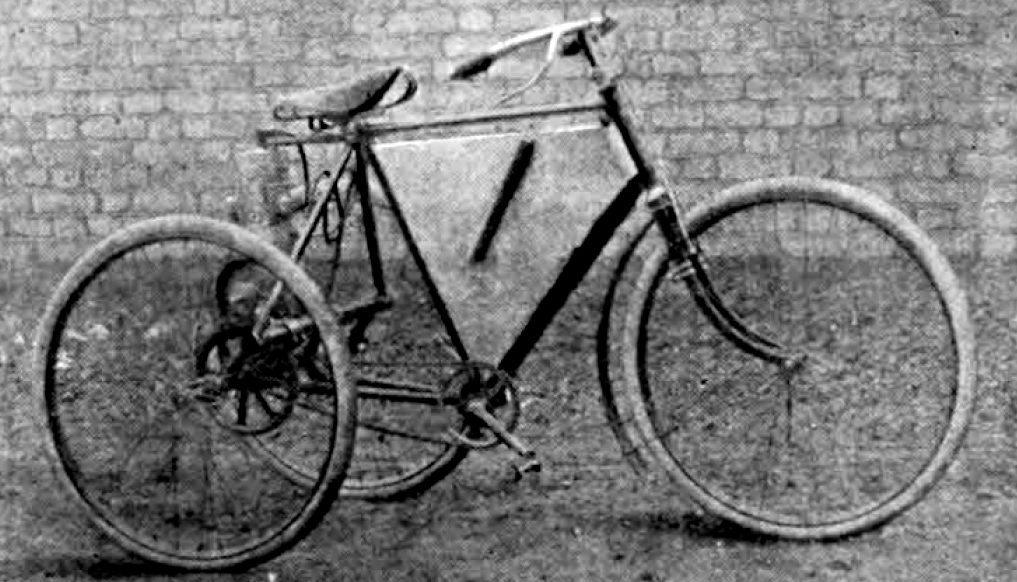
in the cylinder are visited by the helical ports in the piston at the exact moment necessary to enable the functions of charging, exploding, and exhausting to be properly and exactly performed. This rotation of the piston is obtained in a particularly ingenious manner by means of one of the connecting rods (there are two, one each side of the crank spindle) being fitted with a worm wheel, which engages with a worm formed on the face of a disc keyed on the crank spindle inside the crank arm, and of such a form that the necessary amount of circular movement is given to the connecting rod to which the worm wheel is fitted, and thereby to the connecting rod and piston…With regard to motors which are to be placed in the hands of those who have but little skill in, or knowledge of, mechanics, this arrangement appears to us to have great recommendations. The tricycle-motor has a two-inch stroke, and weighs without the fly-wheel 16lb. On the engine shaft beyond the fly-wheel is keyed a toothed pinion, which gears into another pinion, and which in its turn engages with a spur wheel on the tricycle axle, the driving of the machine being effected through this train of gear. This gear is to be enclosed in an aluminium gear case, so that none of the working parts of the driving tackle will be exposed to view or dust. The tricycle has the usual pedal and chain gear fitted, so that the aid of the motor can be dispensed with if required. The motor will run at 500 revolutions per minute, which upon the level will drive the tricycle at twenty-five miles per hour if desired. Mr Singer also showed us an aluminium alloy casting for a double cylinder engine on the same principle, which he intends to fit to a quadricycle for his own use.”
“‘THE BIRMINGHAM CITY Council have,’ writes our Birmingham correspondent, ‘not only decided, but unanimously decided, “that a memorial to the Board of Trade be prepared and signed by the Mayor, in the name and on behalf of this Council, praying that a bill may be brought in to relax the restrictions which now hamper the transit of mechanically propelled vehicles along the public roads”.'”
“PROFESSOR WK BURTON, of Tokyo, Japan, a gentleman naturally interested in the progress of Western ideas in that wonderful country, writing recently, says ‘There is one autocar in Tokyo. I may tell you, by the way, that a friend of mine strongly objects to this word, as being a mixture of Greek and Irish!’
“WHEREAS IN 1894 THERE were about fifty autocars in France, and more than a hundred in 1895, there are this year upwards of a thousand mechanical vehicles on the roads. At this rate of progress it is difficult to imagine the number of autocars that will be running in this country a few years hence…In the figures given above no account is taken of the petroleum tricycles, which are also making a great deal of progress, and it may be taken for granted that they will enjoy their fair share of popularity. Of late there has been a notable increase in the number of these machines on the road, and the way in which they are driven over all sorts of surfaces is a much better testimony to their capabilities than the official trials that are often held under very favourable conditions. I was much struck a day or two ago by the running of a Dion tricycle mounted by a man and woman, the lady standing on the axle carrying the motor, and it was being driven at a good sixteen miles an hour. There was not the slightest noticeable vibration, nor was any vapour given off by the motor, and the only thing that betrayed the mechanism was the almost imperceptible noise of the explosions. The improvements made to these machines have, indeed, entirely overcome the objections that at one time might have been entertained against them, and with the employment of aluminium where possible, a simple gearing, automatic lubricators, and pneumatic tyres, there is nothing to complain of either in the weight, the noise of working, or the inconvenience of having to frequently oil the piston and bearings. While the tricycles are making such headway it is perhaps not surprising that so little should be seen of the petroleum and steam bicycles which were believed at one time to be on the point of achieving a great deal of popularity. As a matter of fact, the motor bicycle has never had any big chance of proving a rival to the three-wheeled machine, to which it is inferior for the application of mechanism in every respect.
THE COVENTRY MOTOR Company (part of the Harry Lawson empire) began to produce motorcycles on the same site as Beeston and Humber. The Autocar reported: “The first practical motor cycle built in this country was completed last week when Messrs Humber and Co finished a bicycle fitted with a Pennington two-horse power motor, made at their works in Coventry [and displayed it at the Horseless Carriages Exhibition]. The machine was taken down to the Nunhead Grounds, and tried there in the presence of a number of witnesses, and although the motor required some little alteration, the speed developed was said to have varied from thirty to forty miles per hour. Whilst speaking of the Pennington motor, we may say that Mr. Pennington has taken a portion of one of the floors of the factory at Coventry belonging to the Horseless Carriage Co., and will next week commence working there upon several entirely new forms of carriage to be propelled by his motor, as well as upon the completion of the wonderful flying machine which he has invented, and which he has already practically proved in America.” Which goes to show how much they knew, because the Kane-Pennington (it was funded by Thomas Kane of Racine, Wisconsin and based on Kane’s patent) would have seized after a few hundred yards for lack of cooling fins, and was a pile of junk despite its “long-mingling spark” and “inpenetrable” balloon tyres. Pennington came to England at the invitation of Humber boss Harry Lawson—a sharp cookie in his own right—and relieved him of £100,000 for the rights to this hopeless engine and some other dodgy patents. Pennington’s story is a fascinating one which is covered in the Gallimaufry in all its grisly detail. In truth he had little to do with the evolution of the motor cycle and everything to do with conning lots of people out of lots of money on both sides of the Atlantic. His vehicles were praised to the skies in Autocar; but the launch editor of Autocar was later sacked for “undisclosed financial dealings” with Pennington. Meanwhile Humber produced its own 3hp engine which, fitted to Humber’s pioneering diamond-framed safety bicycle, made Humber the country’s first motor cycle manufacturer.
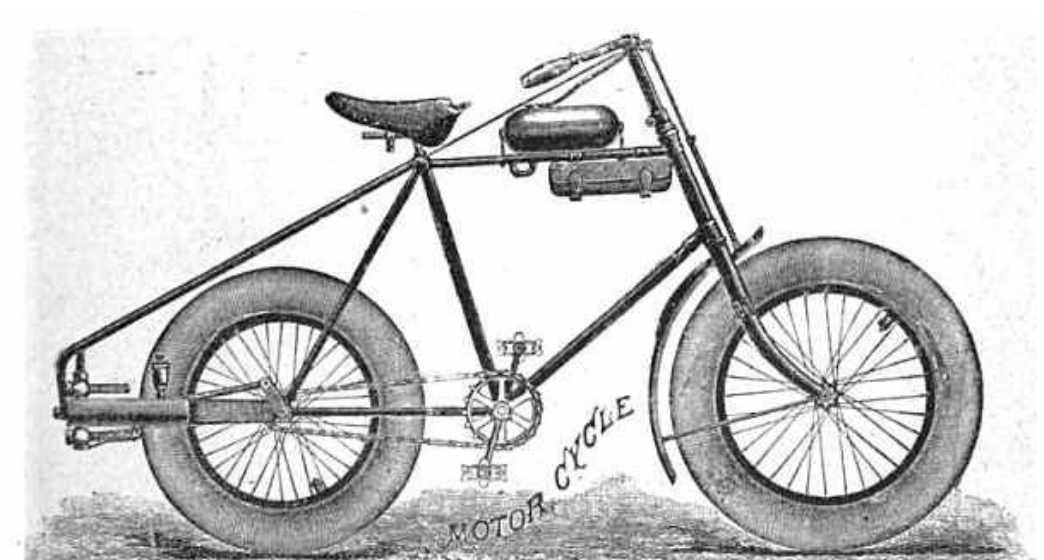
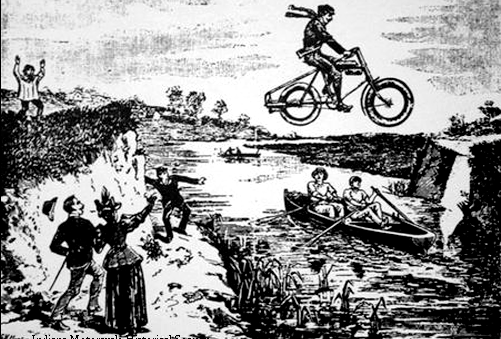
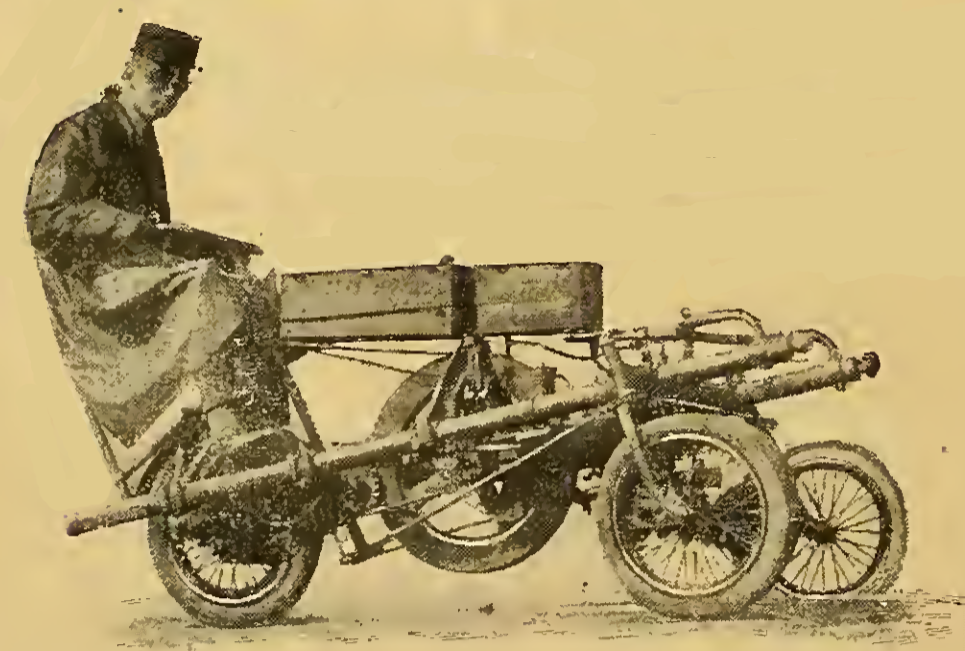
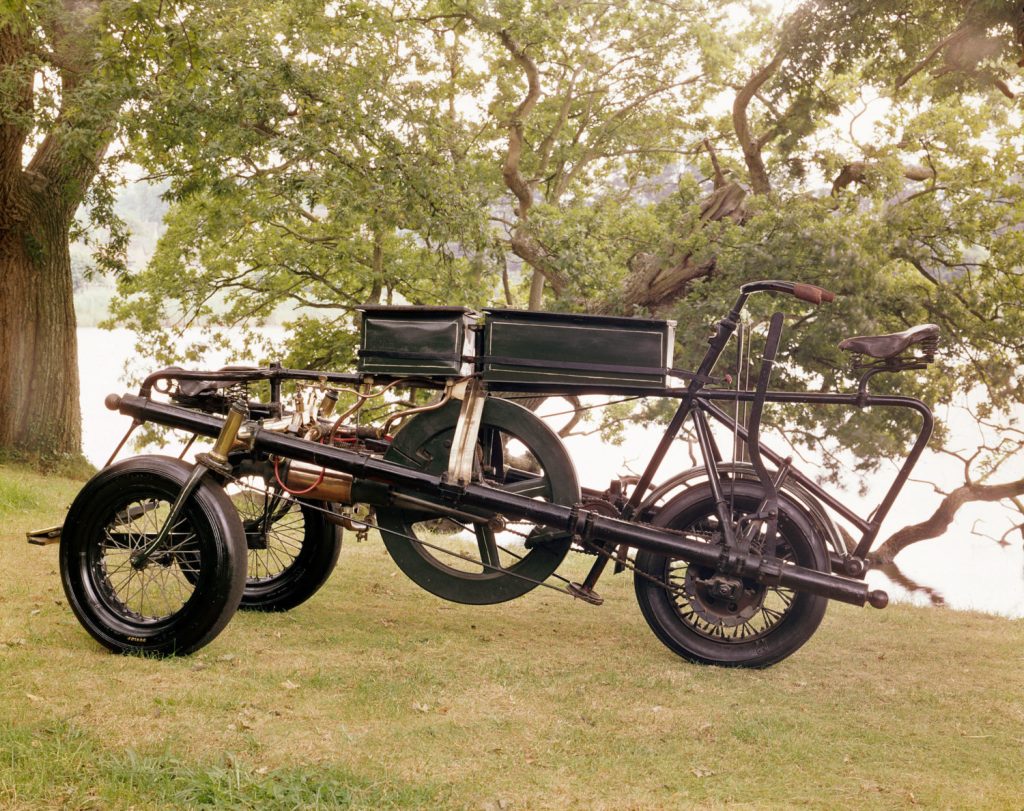
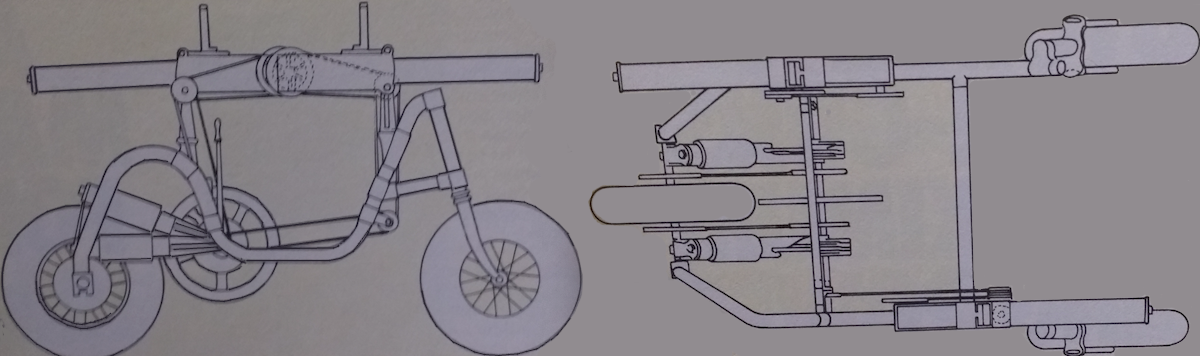

MAJOR (LATER BRIGADIER-GENERAL) Henry Capel Lofft Holden of the Royal Engineers produced the world’s first four-pot motor cycle. Its water-cooled 1,047cc engine developed a claimed 3hp at 400rpm. Like the Hildebrand and Wolfmüller (and indeed the ‘opeless Pennington) railway-style conrods drove the rear wheel; the exhaust was routed through the fuel tank because, as we all know, warm petrol vapourises quicker. Top speed was about 25mph. The Holden was built around a modified Crypto Bantam bicycle frame. The Crypto Bantam was a development of the penny farthing with gearing built in to the front hub to allow a smaller front wheel. It was soon replaced by the safety cycle.
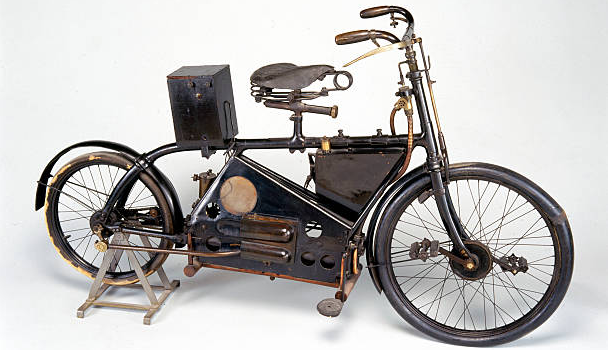
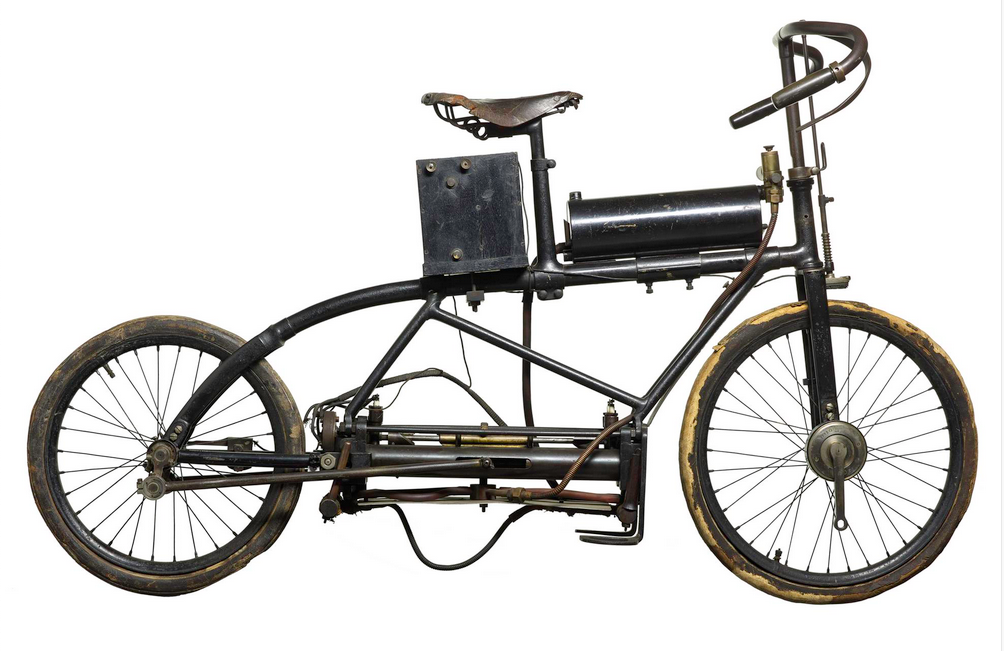
The Holden four is clearly a motor cycle rather than a motorised bicycle. This contemporary sales brochure makes fascinating reading…

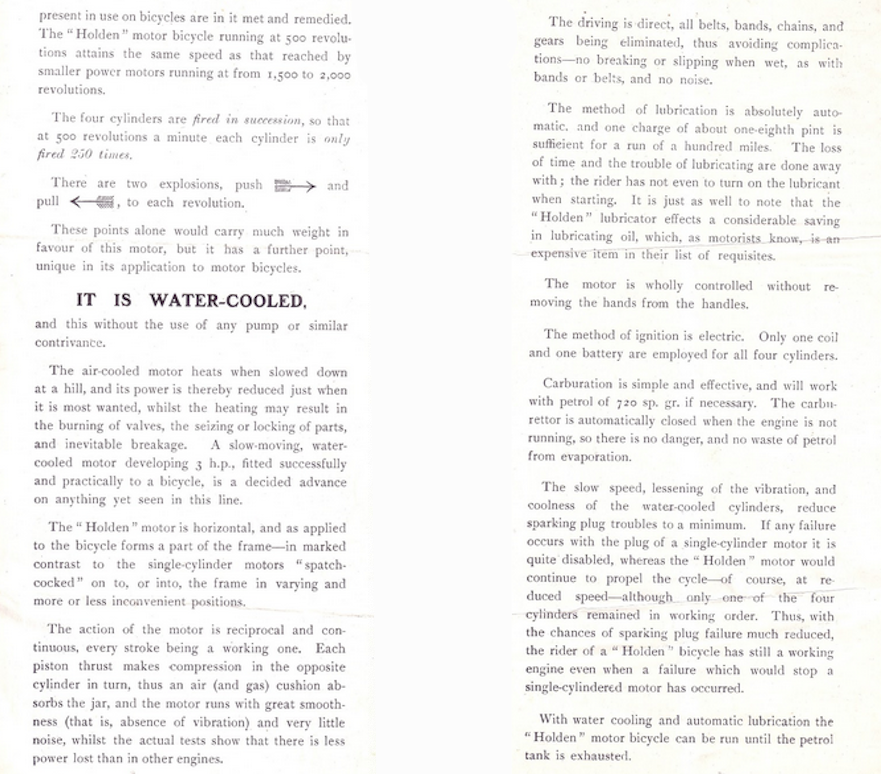

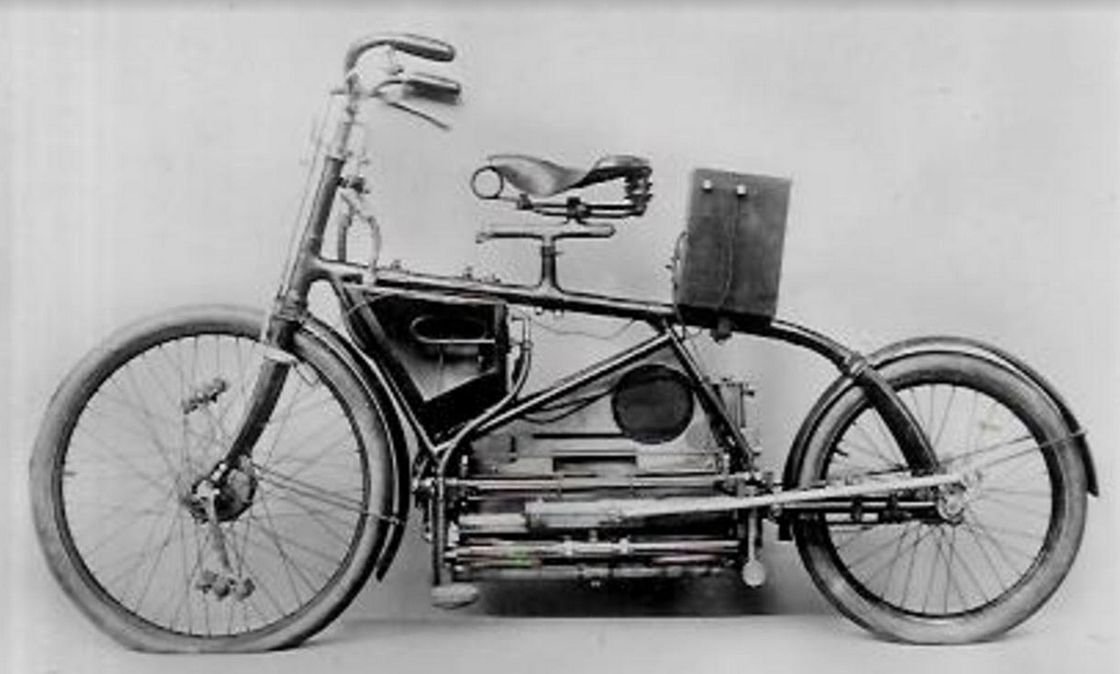
ERWIN ROSS Thomas of Buffalo, NY added De Dion engine kits to his output of Cleveland bicycles.
IN PARIS HIPPOLYTE Labitte built a tidy little 198cc ¾hp engine and offered it to Russian emigrees Michel and Eugene Werner to replace the electric motors that powered the kinetoscopes (film projectors) they were importing from the Edison company. Michel fitted one over the front wheel of a bicycle as a publicity stunt. It drove the front wheel via a twisted rawhide belt that slipped hopelessly in the rain. It was top heavy and, when it skidded on wet, greasy cobblestones, tended to burst into flames because of the spirit burner that heated its hot-tube ignition. But there wasn’t much competition and a dozen had been sold within a few months.
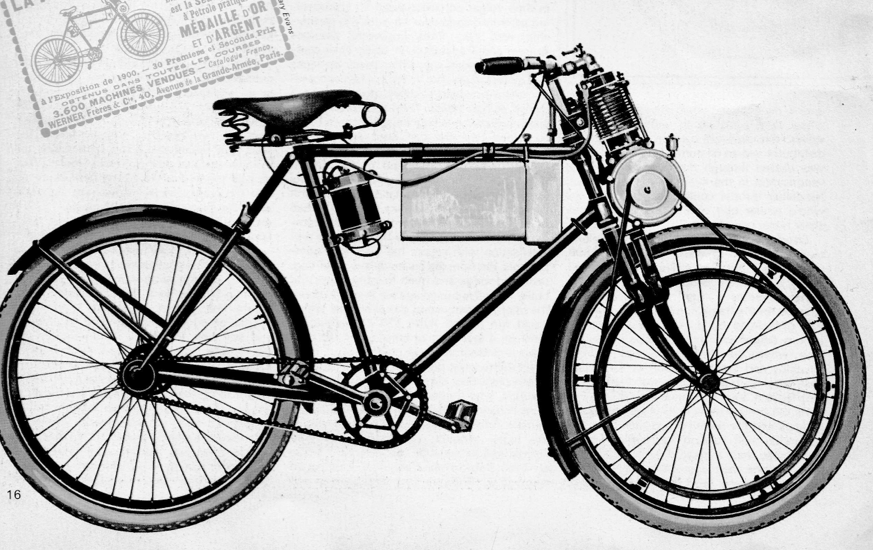
HERE’S A TREAT, dating from the early years of the 20th century—the nearest thing you’ll find to a roadtest of a first generation over-the-front-wheel Werner: “She cost me thirty shillings, did my 1½hp front- drive Werner, back in 1903, and I shall never be able to buy so much fun for the money again. A schoolboy is not over plentifully supplied with cash (or should not be), and the indulgent cycle-maker who let me have her accepted half-crown instalments, at irregular intervals. Even then she was a wondrous antique, but her tyres (French racing Dunlops) were thoroughly good, her frame strong enough for a modern twdn, and her engine was a splendid job. That was a proud moment when, after an overhaul lasting weeks (needless to say the price included the right to do all the necessary tinkering in the seller’s workshop), we bore her down the steps. I had done my best to transform her into the outward semblance of a speed monster: the saddle had been removed, and a rickety luggage-carrier intended for a cycle substituted, liberally padded on top, the exhaust arrangements and pedalling gear scrapped, and in the place of the latter a piece of broomstick (wrapped with inner tube to conceal its domestic origin) did duty for footrests. (One had to mount gingerly.) I sat astride her in the road, regarding thef engine with affection and pride. Please remember that I was sixteen, she was my very own (for had not the first half-crown been paid?), and I had never been on a power-driven machine before. The kindly cycle-maker and his apprentices pushed lustily. We swayed down the road in wide arcs. She fired. Oh, irrecoverable moment! Never was such a bark as that baby engine possessed. They lodged complaints in the Maida Vale flats about me, because I would run up and down half the day wondering if it wasn’t really possible to do something in the way of tuning on a surface carburetter. Little Werner and I careered down the road, keep- ing an eye out for people who might know us, and be impressed. We rounded the first comer successfully, but on straightening up side-slipped on a tramline, and went down with a slam. (That was her first naughty trick, and her last: with the engine over the front wheel the little machine steered perfectly, and could be ridden ‘hands off’.) I recovered my steed: a little acid spilt from the accumulator and some petrol (tenpence a gallon, so it didn’t matter) was all that was lost, and we ran soberly round the houses back to where the expectant staff awaited us. That was the beginning of a jolly time. A man named Arthur Cummings, who was very prominent as a speed exponent on the 70×70 class, used to haunt Paddington track near by. I
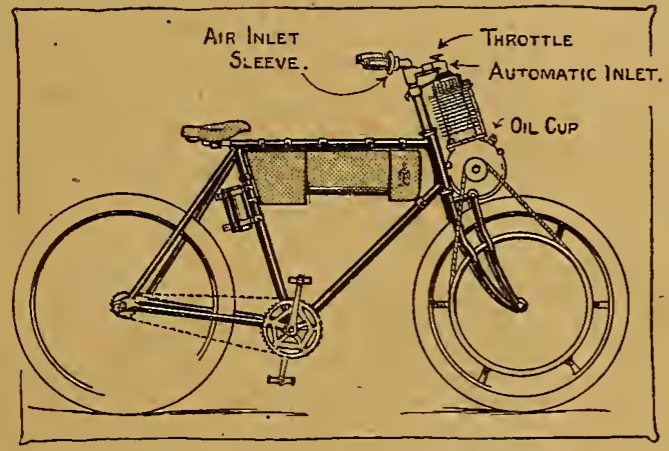
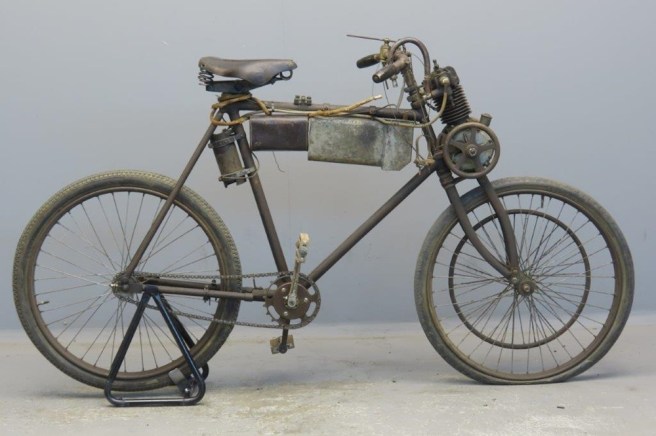
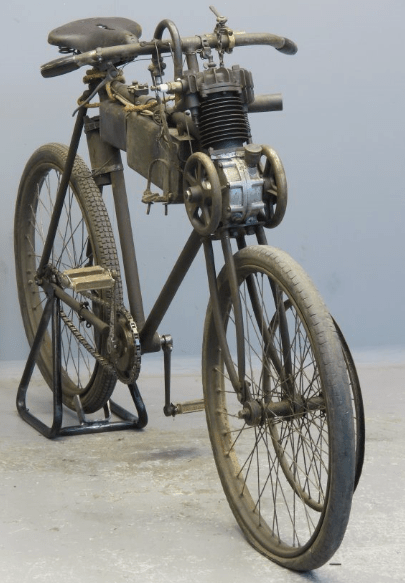
showed him the Werner. He was too well-mannered to laugh, and took her and my efforts to make her do thirty miles an hour seriously. We bought a drill, and started to tune her. The air intake to the engine was governed by a revolving sleeve on the handle-bar, and the neat mixture was led from a surface carburetter forward of the tank up the head column to the handle-bar lug, where the engine was bolted on. Drive was by twisted round belt (and some of you think a V belt is troublesome!) to a pulley on the front wheel, and you carried your oil in a little glass cup on the crank case. Coil and accumulator conspired together to defeat dull care: one or the other or both always needed attention. The band brake on the back wheel was splendidly efficient—until one day it broke; after that I remember I used to stop by dragging my feet on the ground and using the compression. (There is undeniably a special providence for mechanically-minded schoolboys). We removed the gauze from the induction pipe, and while this ran her consumption up terribly, it was worth it. I ran her to Brighton and back in days when none ventured on pedalless machines, and she took everything except the last stretch of Handcross. There her proud owner had to slip off and run; but she was forgiven, for it was a plucky climb for an engine aged and so small. By this time we were regular habitues (sixpence admission) at Paddington track. One day we borrowed a back wheel from a racing push-cycle, with a fabric-sided tyre about the diameter of a lead pencil, and a slender wood rim and cobweb spokes. We inserted this in the back forks, gave Werner an extra swig of oil, and issued a formal challenge to a neighbouring youth who owned a wheezy 3hp Kelecom. It was a Homeric struggle. I flattened myself along the top bar until I could flatten no more, sprayed with hot oil, and unutterably happy because the dreaded Kelecom was well behind. It was a famous victory, but as she crossed the line poor Werner seized. Her piston had gone. We disembowelled a worn-out Yankee ‘Thomas’ that we had access to. Some brisk work with a file, and the old rings, and the little engine was got going again—a thought metallic in the exhaust at speed, but serviceable. I always feared it was the drilling we did on that piston: we used much enthusiasm on the job, but little discretion. Poor little ‘bus. I suppose her rusty bones are lying in some forgotten corner. Still, I think in her time she gave a keener pleasure than my little opposed twin, now waiting in the shed, eager and twice as speedy, can ever give.” RHB.
…and here’s another treat. For its golden jubilee issue, in 1952, the Green ‘Un got its hands on an 1898 Werner; more than 70 years later it went under the hammer. So as well as another roadtest complete with a couple of contemporary pics you can also see this 127-year-old (at the time of writing) survivor in exqusite detail.
“OF ALL PIONEER MACHINES, undoubtedly the most famous is the 1¼hp front-wheel-drive Werner which, first appearing in 1897, was produced up to the early months of 1902, when the Werner factory popularised a new fashion by introducing a ‘central-engined machine. During those five years many examples of the earlier model were sold and gave sterling service, among the more famous exploits of the type being several rides from Land’s End to John o’Groats. Since its earliest days this journal has featured independent road tests of manufacturers’ products. What could be more appropriate therefore in our Jubilee issue than a report upon the present-day performance of such a machine which was still current when Motor Cycling first appeared on the bookstores? So a suitable model was located and the owner, Alton enthusiast ASL Denyer, sportingly agreed to lend it for the test. The Werner’s bicycle parentage is unmistakable. It is, in fact, a suitably strengthened pedal cycle with a neat 1¼hp engine mounted on the front forks and fixed by a single through-bolt at the bottom of the crankcase and, at the upper end, by a large nut to the induction tract formed in the handlebars. The fuel is vaporised by a wick carburettor and then led, via the steering head and stem, to the automatic overhead inlet valve. Extra air is admitted by the mixture control, this being a ported sleeve—resembling a miniature twist grip—mounted just forward of the right hand grip. That’s particular control was found to be the most sensitive and throughout the test it was invariably used for governing the speed of the engine. The Fleet-Aldershot road had been chosen for the test. The Werner was pedalled away on half compression and after a few yards the ignition was switched on and the compression tap closed. Immediately the engine commenced to fire—unevenly at first and then
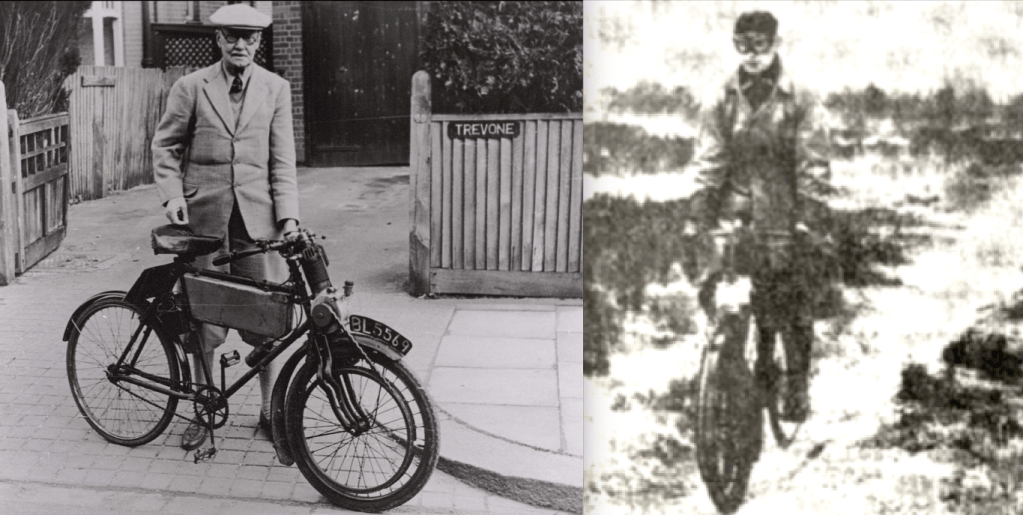
with a slow regular beat. While the response to the mixture control was instantaneous the throttle itself had no progressive effect and the position of the ignition lever was, surprisingly enough, not critical. For starting and stopping use was made of the compression tap fitted just above the exhaust valve. Owing to the angle of the engine, however, petrol vapour emitted from the tap was wafted straight into the writer’s nostrils so this control was operated but sparingly. Once the engine had warmed up a number of climbs were made of the sharp rise on which stands The Foresters. In each case of Werner surmounted the steep gradient on the approach from Aldershot with LPA (light pedal assistance). The longer but more gentle grade from Fleet could be made unaided. Roads in the Werner’s heyday were not the—comparatively speaking—’billiard’s table’ surfaces which we know now. To gain some idea of the machine’s handling on going similar so that which it must have covered many times in its youth, a short trip was made over several of the tracks on Church Crookham Common. Some of the ‘roads’ were frozen mud ruts, with their ice-puddles as an additional hazard, ‘rippled’ chalk-track hummocks and loose shingle. Naturally the speed was restricted but the handling was faultless throughout. Steering was first-class but it was confirmed that rigid front forks did not make for a large degree of riding comfort! Also, of course, vibration from the engine was transmitted through the handlebars. The mudguarding was quite good, only a slight spray from the front wheel sullying the polished brass fuel tank. Returning to Aldershot speedometer readings were taken by a following car, the driver reporting that a steady 21mph had been maintained with ‘flash’ readings of up to 24mph with a downhill rush onto the level had been impossible. On most gradients17mph had been maintained, although the steep climbs had brought the speed down to
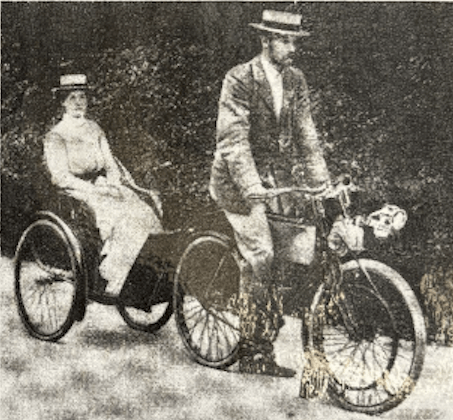
10mph. In the afternoon the Werner set out once more en route for Basingstoke where arrangements have been made to interview the original owner, Mr WW Webber, who had purchased the model in 1898 through its concessionaires. A pint of petrol was measured into the tank and the diminutive tap on the carburettor compartment turned on—the first spot of fuel from this tap indicating that the wick was sufficiently petrol-laden so allow the engine to fire. A few twists of the pedals and the Werner was climbing Victoria Road, Aldershot, with only sporadic peddling to help it. No assistance at all was called for on the long but gruelling climb towards Odium, for the engine was exceptionally flexible, and the pulling power pulling at low revs was reminiscence, almost, of a two-stroke. On several of the sharper rises the cut-out on the in-built ‘silencer’ was operated. The only noticeable effect of this, however, was a harshening of the erstwhile pleasantly subdued exhaust note. After some six miles had been covered the engine started to misfire and, despite the total closing of the mixture control, the model lost speed. A further mile and the firing had become so erratic that although the Werner was still able to proceed as a greatly reduced speed, a halt was indicated. Examination showed that the fuel tank still contained a certain amount of spirit but that not enough was reaching the carburettor to provide a sufficiently rich mixture. The fuel consumption test was consequently abandoned, although there was every indication of an overall figure in the region of 60 or 70mpg. The tank was refilled and the sump oil replenished—a task which is apparently repeated at 10-mile intervals—and an attempt was made to restart. Despite vigorous pedalling the engine fail to respond. More pedalling ensued and this time the engine fired, only to cut out again a few hundred yards further on. Then, as suddenly as it had appeared, the trouble was no more! Possibly the wick had been insufficiently soaked, with consequent poor vaporisation of the fuel. A loose electrical connection—the ignition current of course being obtained through a coil fed direct by a battery—caused a temporary halt just outside Basingstoke, but no further troubles were experienced and the 17-mile trip was accomplished in a riding time of 1¼ hours—an average speed about 14mph. Owing to the cycle-type brake operating on the rear wheel only, town riding had proved somewhat hectic and the tester was thankful that only a small urban mileage had to be covered before the Werner came to rest before Mr Webber‘s home in Clifton Road. He was able to confirm the figures which had been obtained. By simply loosening two nuts and screwing a third it was possible to remove the cylinder head and barrel, and a brief internal examination revealed that the lubrication had, if anything, been over-generous. The general accessibility of the major components was praiseworthy.”

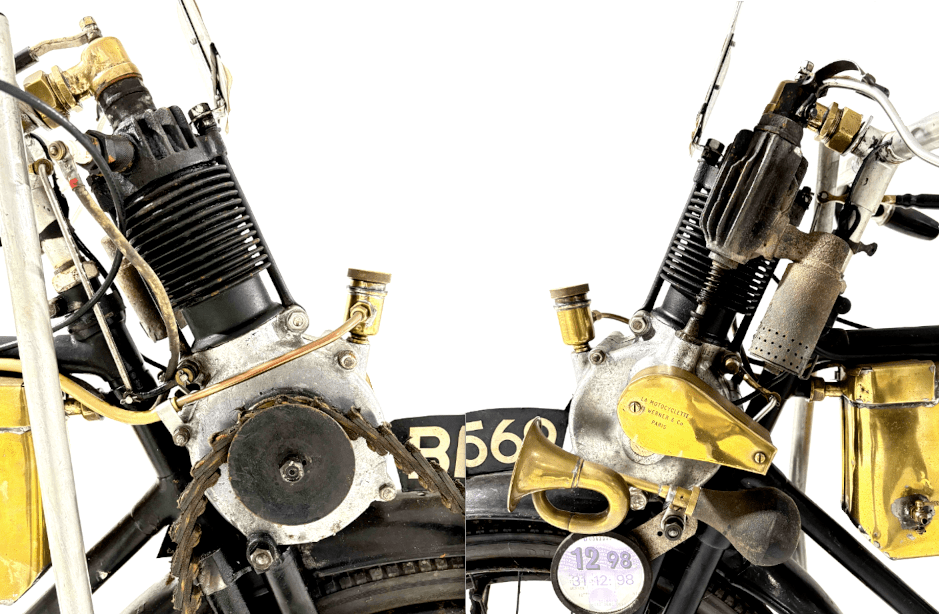
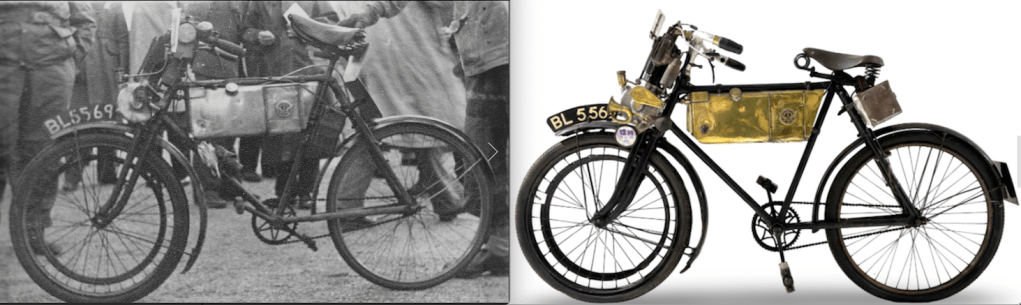
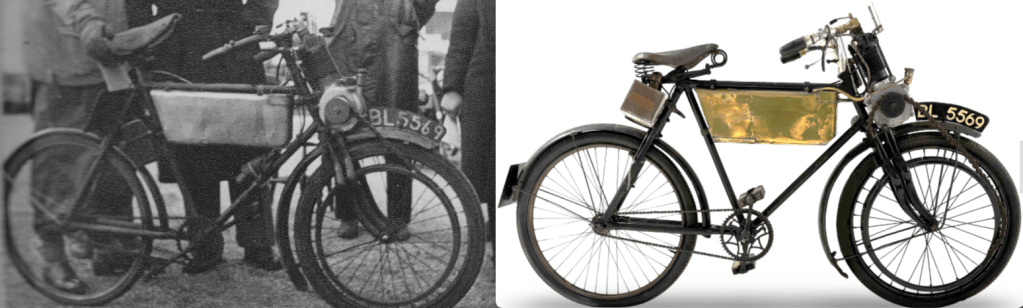
A HILDEBRAND & Wolfmüller made a demo run in Tokyo—the first motor cycle to be seen in Japan. But that year its German and French operations collapsed. H&Ws had been sold at below cost price, they were unreliable and buyers demanded their money back. An H&W was raced at the Crystal Palace where it was said to have reached 27mph, but only on level ground. Major weaknesses were a tendency to skid and problems climbing even gentle slopes.
BICYCLE MANUFACTURER Alexander Leutner & Co of Riga produced five trikes powered by De Dion Boutin engines. Leutner was a motoring pioneer: he comp[eted in the first motor race in St Petersburg, in the 1890s, had tested-driven a Hildebrand and Wolfmüller and was chums with Gottlieb Daimler, who had visited him in Riga. He had studied in Lyon, Aachen and Coventry.
IN THE 171-MILE race from Bordeaux to Agen and back a De Dion trike came 4th, ahead of a Hildebrand & Wolfmüller. In a race from Paris to Mantes six DeDions finished 1-2-3-4-6-8 (with a Hildebrand & Wolfmüller 7th). De Dion started to sell engines to all comers.
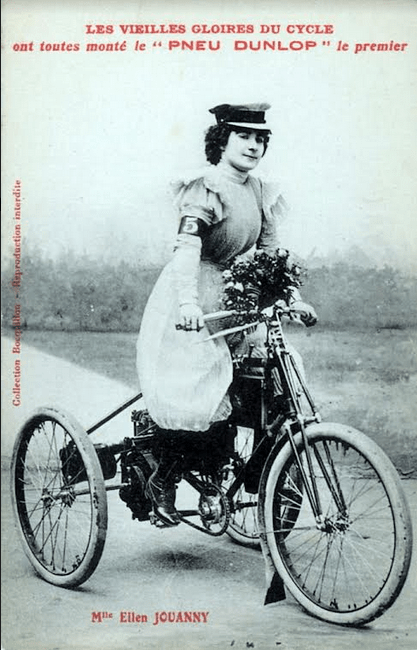
The following yarn has little to do with the evolution of i/c vehicles, let alone motor cycles, but it’s a bloody good yarn. Enjoy.
“A RUNAWAY AUTOCAR. An-up-to-date Runaway—This Horseless Carriage dumped its Occupants and Dashed Away—Behaved like a Bucking Horse—a passing Hero fed his coat to the Whirling Engine, bringing it to a Standstill. With the above headings all set out in large type, one above the other, in the usual American style, the New York World records the following: ‘The great virtue asserted for horseless carriages is that they stop when they’re told, but if they really did so, Civil Engineers Alfred Dalbec and Thomas O’Connor wouldn’t be pasted all over with court-plaster and soaked with arnica as they are now, and a horseless carriage would not be lying a dishevelled wreck in one of Nathan Straus’s stables. Two days before the start the horseless carriage, which had been showing symptoms of indisposition was thoroughly overhauled by a Kingsbridge blacksmith, who corrected some of the crudities of the French inventor who built it, and put it on a first-class American running basis. A good speed was made to Fort Lee, with the aid of a ferry-boat, and when the expedition landed, a steep hill confronted it. This was the first test of the thing’s hill-climbing capacity. The homeless carriage attacked the grade with wild rush, got half-way up, and then stuck. No amount of extra steam would induce it to move, and it wasn’t any use hitting it. Almost every other horseless carriage expedition would have stayed there until now, but these people were made of sterner stuff. They got out, and putting their shoulders to the wheel pushed the vehicle to the top of the hill, where they decided that the time had arrived to divest it of the triumphal bunting and flags with which it was bedecked. “She’ll get down grade all right,” exclaimed Mr Dalbec. “Toot the whistle, O’Connor, and let her go.” At a speed of twenty miles an hour they rattled down the grade. At the bottom of the hill a man named Robert Woods was driving a horse to a waggon. The horse pricked up his ears at the sight of the queer machine and anchored himself in the roadway, petrified with astonishment. The whistle blew and the brake gear was started, but it was not on speaking terms with the brake, and the brake wouldn’t work. From a heap of dislocated wrought iron, engine, horse and harness, four men crawled out and uttered expletives. The horseless carriage expedition began to reassemble the fragments, and the Woods outfit limped off towards the nearest veterinarian. The flywheel of the machine was twisted back until it was almost round, an axle was tied up with a bit of clothesline, and another start was made. The expedition towed the carriage up the hill near Garrett Allison’s, and it went into Englewood under its own steam. There it was the centre of admiring villagers, who were not told about its misconduct en route. At 6.30 the start was made for Fort Lee, and all went well until the hill was reached that gave so much trouble at the outset. The party thought they knew every inch of that hill. It was pitch dark. Mr Sipp, who is superstitious, had certain misgivings; so on the descent he got out, telling the others that as someone had to precede the vehicle and blow a tin horn to give the alarm, it might just as well be he. So nothing interesting happened to Mr Sipp. “You remember how slowly she went when she struck this hill before?” said Mr Dalbec confidently. “Yes, but we were going up then, replied O’Connor, with a shiver. We’re travelling the other way now.” The horseless carriage gave a spiteful snort and broke away. Brakes, steam valves, and all the other accessories suddenly refused to be bossed, and as the thing progressed the speed became positively frightful. Dalbec and O’Connor shouted “Whoa!” and howled to any one who might be near to get out of the way. Their capers seemed to annoy the machine, and in front of Garrett Allison’s house it stopped for a second, just like a bucking horse. Dalbec and O’Connor went sailing through the air, and landed, the first in a flower bed in Allison’s front yard, and the other in a stream of water by the side of the road. While Mr Allison was chasing out the invaders of his premises, the horseless carriage, relieved of its load, doubled its speed. It had got the bearings of its stable, and was bound there. At the bottom of the hill, however, it shied at something, and sat back on its haunches. It was just about to return to all-fours again, and proceed on its exciting career, when Thomas Fields, a Fort Lee hero, who has stopped many a runaway, jumped aboard. Not knowing how to shut off the steam, he pulled off his coat and threw it into the engine. In a few seconds the garment was ground into an all-wool hash, which clogged the wheels and brought the thing to a standstill. Then the engineers came up and secured the runaway. Both men were badly bruised. They led the horseless carriage into a siding, and yesterday Mr Straus sent a waggon to collect the pieces. We have a sort of fancy that the tale of the Kingsbridge blacksmith who “corrected some of the crudities of the French inventor who built it and put it on a first-class American running basis” may account for the incident on which this story is based. Our readers need not, however, be alarmed at the dangers of the new mode of locomotion. Here is a story (from the Pall Mall Gazette last month) of the old sort of runaway, to which we are all accustomed, and of which we take but little notice, but, told in English fashion, it does not read quite so thrillingly, though the facts are all there: “EXCITING RUNAWAY IN BIRMINGHAM. An extraordinary scene was witnessed at Moseley, a suburb of Birmingham, last night. Dr Carter’s brougham was returning from a reception given by Mr Chamberlain at Highbury, when his horse took fright, and ran into a cab. The cabhorse also galloped off, and the pair ran furiously abreast for a mile and a half. Eventually, the cabhorse collided with a vehicle, and was killed, and the brougham was smashed against a steam train.”‘
“A NEW MOTOR CYCLE—inventors have for a long time been working on the problem of the propulsion of bicycles without the aid of muscular power. Unlike the motor carriage the advantage of the motor cycle cannot be so easily demonstrated, for bicycle riders use their wheels very largely for exercise and for the pleasure in riding, and anything in the way of power propulsion would not be received with favour by them. There is, however, a class of people who would welcome the advent of a practical motorcycle, as it would enable them prolong their excursions and would eliminate the element of fatigue. The Scientific American gives an engraving of an experimental motor cycle, built by Nelson S Hopkins, of Williamsville, New York. The motor is heavier (it weighs 12lb 4oz) than would be ordinarily required for use on a bicycle. Mr Hopkins has succeeded in building a motor which will propel a wheel and rider over moderate grades, and weighs only 8½lb. The motive power is derived from gasoline which is contained in an aluminium reservoir which is strapped to the upper part of the diamond frame. From the reservoir the gasoline is conveyed to the carburettor by means of a small pipe. A valve limits the quantity of the gasoline which is admitted to the carburettor. This valve may be operated from the saddle by means of a rod. The valve stops and starts the motor and regulates the speed. From the carburettor, where the vapour of the gasoline has been mixed with air, the mixture is drawn into the compressor and is then forced into one of the explosion cylinders where the charge is ignited by an electric spark, contact being controlled by the movement of a piston. The use of two cylinders makes it possible to obtain impulse at every turn of the shaft, and by means of gears the wheel is propelled with great freedom from jerkiness and vibration. The battery is placed under the saddle in a tool bag, and the spark coil is fastened to the diamond frame, but in later experiments both the battery and coil have been carried in the tool bag. At the back of the shaft is a small steel gear wheel which runs with a larger one of phosphor bronze secured to the hub of the wheel. The weight of the motor being on one side of course tends to throw the wheel out of balance but this is remedied by throwing the centre of the saddle over a trifle. All the working parts except the gears are enclosed.”—Sheffield Weekly Telegraph, Saturday 9 May.

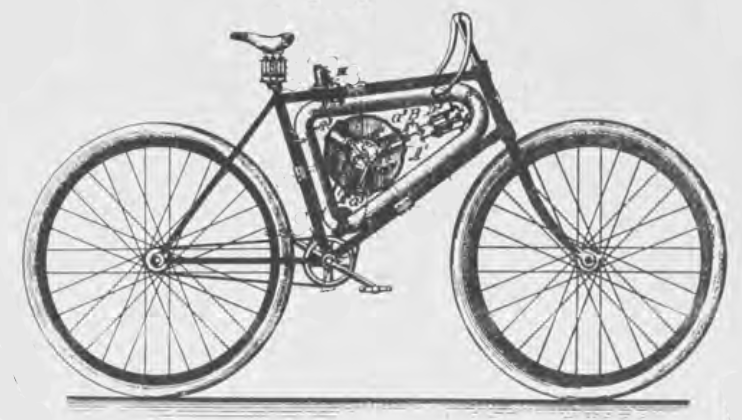
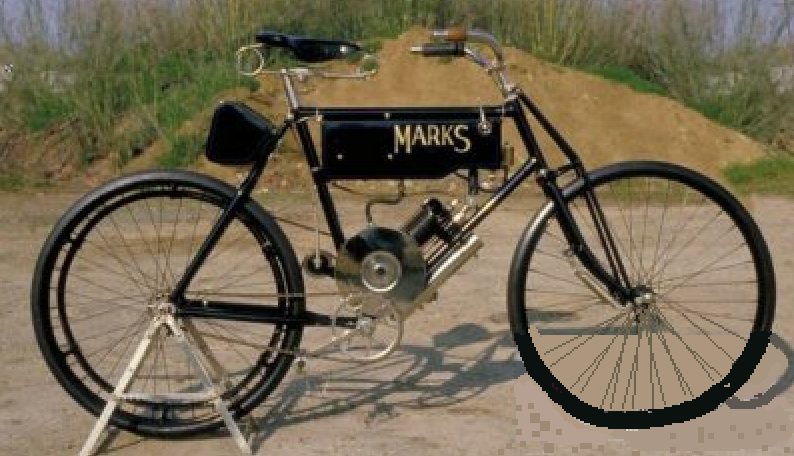
“THE DAIMLER MOTOR. Historical notes on the inventor, by Frederick R Simms, CE. Mr Gottlieb Daimler was born in the quaint and picturesque village of Schorndorf, in Wurtemburg, Germany, in the year 1834. Already in his childhood he showed a remark. able love for everything mechanical…As expected, young Gottlieb, almost before he left school, became a mechanic, and in a short time a very efficient one; in fact, his principals are stated to have said that they never had a more conscientious worker with regard to carrying out exact and precise workmanship of solid and yet original construction. Mr Daimler was subsequently employed by various leading engineering firms in Germany, and even spent a few years in England. He has often told me that it was at Sir Joseph Whitworth’s celebrated works that sound English ideas and engineering skill were pumped into his head, to use a common expression. All the time he was not idle in improving his educational, theoretical, and practical technical knowledge by attending various Polytechnics, and giving his mind thoroughly to study. Eventually, Mr Daimler, having visited various countries, and collected a widespread experience, joined Dr Otto, of Deutz, on the Rhine, near Cologne. Dr Otto had not then succeeded in constructing a successful gas engine, and it was only when Mr Daimler joined him that these two celebrated men constructed the now famous ‘Otto’ gas engine. They then had only a very small engineering shop, quite on an experimental scale…In 1872 the well-known Gas Motoren Fabrik at Deutz, Cologne, was formed, the liberal Privy Councillor Langen, of Cologne, lending an open purse for some years, for it was nearly ten years before the said company reaped their first financial success, but then enormously. Mr Daimler was managing director of this company until 1882, during which time the new factory, perhaps one of the finest and most complete engineering works in the world, was constructed and built under his own supervision. Mr Daimler during that period also assisted and instructed Messrs. Crossley Bros, of Manchester, with regard to the building of their now well-known gas engine, after the drawings and experiences collected by him…For the past fourteen years, having retired from the Gas Motoren Fabrik of Deutz, in which he has still a large interest, Mr Daimler has been engaged in perfecting and constructing oil engines on lines which had, until then, never been attempted or approached. Mr Daimler was the first to invent a simple, effective, and, above all, extraordinarily light high speed gas and oil engine, which has since been called, after his name, the ‘Daimler motor’. It was also Mr Daimler who first practically discarded the so-called slide or open ignition, and substituted the compression or ignition tube firing. As far as lightness and simplicity, combined with reliability, are concerned, it seems unequalled, and has so far no rivals. This light and effective motor has enabled Mr. Daimler to put his engine on wheels, for it had always been his idea and ambition to see and use the explosive engine as a means of locomotion, As early as the year 1886 Mr Daimler constructed a successful motor-bicycle, the first trial of which took place on the l0th November of that year…The first experimental trial trips of Daimler motor carriages took place on the 4th March, 1887, which were followed by most successful tests to drive bicycles and the like by petroleum, but more especially by the light oils. The honour of having created a new industry, or, at any rate, having given a new impulse to mechanical carriages, therefore seems undoubtedly due to that eminent engineer, who should justly be called the inventor of oil motor cycles and carriages.”
PEUGEOT FRÈRES, HAVING made steam cars since 1889, began to make petrol engines of their own design.
“THE TOWN OF SPA, Belgium, has proposed to the Automobile Club of Brussels to organise a grand international autocar contest during the coming season.”
“‘GOD HELPS THOSE who help themselves’ is a very well-known adage, and, what is more, a very true one. The same may be said regarding Parliament. If people are content, like Micawber, to sit still and wait till ‘something turns up’, they are not likely to get any grievances they may possess amended…If no complaint is made, the only supposition is that no cause for it exists, and where everyone is satisfied where is the reason for alteration ? Recognising this fact, and also recognising the truth of another saying that ‘every little helps’, we think the readers of The Autocar will come forward with promptitude and assist us in pointing out the demand which exists for a change in the present absurdly restrictive legislation, by which enterprise, industry, and thrift are alike throttled in the land. There can be no doubt that the original framers of the Locomotives Acts had no such vehicle as the autocar in contemplation, and that an entirely new form of vehicle, possessing none of the objectionable features of the steam road engines of the period at which the Acts were framed, should be considered to come within their scope, is making the law a farce and bringing ridicule upon those who are called upon to enforce it. Our contemporary The Engineer has already done good service to the movement by the petition which it has sent in to Mr Chaplin, and that gentleman’s favourable reception of it is a pleasing augury for the future. But it is never wise to be too sure, and a petition from the readers of The Autocar and their friends will have the effect of showing the demand which exists by another section of the public for amended legislation.”
THE CYCLING CORRESPONDENT of a national newspaper opined: “Not everyone is agreed as to the possibilities of motor cycles, though I cannot help thinking personally that they are to be the machines of the future. It is the fashion for the athletic young man and woman to pooh-pooh the idea of being carried along the road minus the present amount of exertion which has to be put forth in propelling a bicycle, but I am afraid time will prove that the scoffers are wrong. Without altering the amount of physical exercise which the present-day cycle entails, why should not the average rider be able to go three or four times the distance he is now able to traverse unassisted? That, to my mind, is the great charm of motor cycling. If the jaded Londoner can run down to Brighton and back in a day, with practically no more exertion than it takes now to ride a quarter of the distance, don’t you think there will be a tremendous field for the new type of machine, provided the cost is not prohibitive?”
“WE HAVE NOW closed the lists for The Autocar petition, the result of which we consider most satisfactory and encouraging. We have already noted in previous issues the universal approval which the movement has received from all classes, and the sweeping range throughout society which the signatures to the petition show. In sending in the forms this week several further instances of this are to be noted. Thus, one correspondent points out that his petition sheet is signed by five clergymen, two HM inspectors, two doctors, four district or parish councillors, one church warden, one schoolmaster, and one gardener. Another fills his sheet entirely with signatures from members of the Macclesfield Chamber of Commerce. From the towns which have given us their support we have received the following signed and sealed petitions. Hartlepool, Tiverton, Folkestone, Leamington, Cardiff, Weymouth, Heywood, Hythe, Poole, Droitwich, Deal, Bangor, Guildford, Clifton, Dartmouth, Hardness, Maldon, Berwick-on-Tweed, Keighley, Aberavon, and Stafford. In addition to these, The Autocar petition has been adopted in its entirety by the towns which we give below. In these cases, however, the petitions will be presented independently to Parliament by the city or borough members. Bridgwater, Gateshead, Bishop’s Castle, Rochester, Longton, New Romney, Warrington, Dover, Walsall, Hyde, Wolverhampton, Devonport, Christchurch, Bradford, Crewe, Chipping Norton, Eastbourne, Dewsbury, Colchester, Glossop, Huddersfield, Maidenhead, Whitehaven, Harrogate, Southampton, Portsmouth, Birkenhead, High Wycombe, Bournemouth, Eccles. Thus it will be seen that The Autocar petition will be headed by no less than nineteen municipal bodies, followed by the signatures of 8,027 members of all classes of the community, ranging throughout every grade of society from peer to peasant. The petition will be presented to Parliament through the medium of Mr CJ Murray, the member for Coventry, who has very kindly undertaken to see the matter through for us. This closes our labours in this direction, and it only remains for us to thank all those of our readers who have so very ably and energetically assisted us in the way they have done.”
“SAYS THE MIDLAND Evening News: ‘Possibly the most practical feature of the motor-carriage exhibition at the Imperial Institute, on Saturday, was the presence of a considerable number of members of Parliament, for the first necessary step in securing the further development of this advantageous innovation in street locomotion is the removal of legal restrictions. The motor-cars, or autocars, can be driven at a rate of from six to ten miles an hour with ease…At the Imperial Institute the cars ran round the trees, careered among the groups of spectators, and climbed a rather steep incline with perfect ease, and were steered, changed their speed from fast to slow, and were brought to a stand in a manner which secured the confidence of the spectators. Now that the era of faddist legislation has been closed, there should be little difficulty in finding time to remove the legislative restrictions on the Public use of these vehicles.'”
NO SOONER HAD petrol-engined motor cycles appeared than they were used as ‘pacers’ for racing bicycles (you’ll find a fine selection of pacers at the start of the picture melange). Those pioneer petrol burners were unreliable so Colonel Albert Pope, the man behind Pope Columbia bicycles, decided to try steam. He commissioned Sylvester Roper, now 72, to build him a steam-powered pacer in a modified Columbia bicycle frame (you’ll find details of Roper’s first steamer back in 1868). Roper duly fitted an improved steam engine rated at 8hp; all-up weight was 150lb with a range of some 25 miles. Its range was only seven miles but the reckoned it could ‘climb any hill and outrun any horse’. American Machinist magazine reported: “The exhaust from the stack was entirely invisible so far as steam was concerned; a slight noise was perceptible, but not to any disagreeable extent.” Roper was asked to demonstrate his ‘self propeller’ at the Charles River velodrome, a ⅓-mile banked concrete track. Having paced the racing cyclists he raced against them and was timed at over 40mph. Sad to say at this point he was seen to swerve off the track. He was found to have suffered a heart attack and died in the saddle.
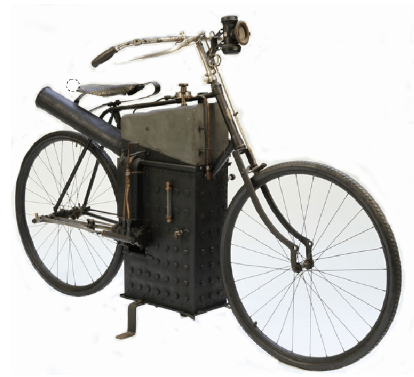

“THE FATAL TRIAL TRIP. In our last issue but one we mentioned the sad death of an American inventor of 73, who was overcome by excitement at the success of his machine, and while riding it died from the intensity of his emotion. From the Wheel we reproduce a rough sketch of the inventor and his motor bicycle, of which latter the following description is given: ‘Further particulars of the sudden death of Inventor Sylvester H Roper, at the Charles River track, Boston, last week, show the affair to be a particularly sad one. The trial of his steam bicycle, during which he met his death, was the consummation of an idea which had cost him years of study and hard labour. The machine on which he was riding had been tried and altered as defects were found, over and over again, and he had just succeeded in getting it to suit himself. As far as can be learned, it was a success in every way, as it was worked up to a great speed without showing any of the straining or twisting which has always been the trouble with bicycles operated in any other manner than by foot-power. The mile which he did in 2min 1⅕sec represents only a fraction of the speed which could be attained by the machine, as the track is so small that he was unable to let it out at anywhere near its full power, and on the turns shut off the power entirely, and coasted around until he came into the straight again. No one was familiar with the machine but himself. The fire-box, boiler, and water-tank are all contained in an oak box about three feet high, two feet long, and ten or eleven inches wide, placed inside of the frame of an old style Columbia bicycle, with the bottom about eight inches from the ground and the top a little above the top of the frame, the whole machine weighing in the neighbourhood of 200 to 250 pounds. The application of the power is on the right side of the machine, and is much the same as that in use on marine engines, except that the piston works in a horizontal direction instead of vertically, as is the case with most marine engines, and that the end of the crank, instead of running in a bearing, is free, with the eccentric rod applying to the free end, the other end, of course, being fixed to the rear wheel. Both the piston rod and the eccentric rod run through several guides, which were attached to the lower side of the frame of the bicycle, so that the whole is firm and compact. The throttle is on the outside of the machine, just above the cylinder, so that if the cord connecting with the handle-bar, by which it is usually operated, fails to work, it can be shut off by a direct application. The machine is a coal burner, and has a funnel projecting backward almost on a straight line, so that the smoke is thrown out behind the rider. The running of the machine works an automatic pump, which is provided with a cut-off, which operates when the boiler is full. It has also a draught regulator, by which the fire can be blown up to almost any height. The machine usually carries 140 pounds of steam, but the pressure could be run up to 160.'”
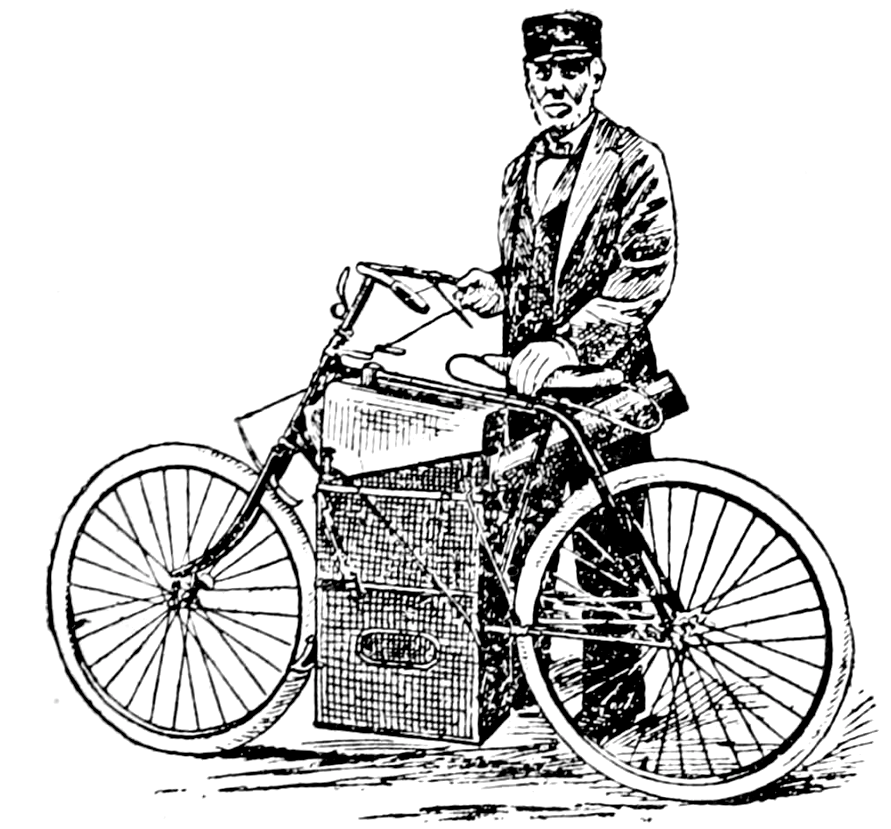
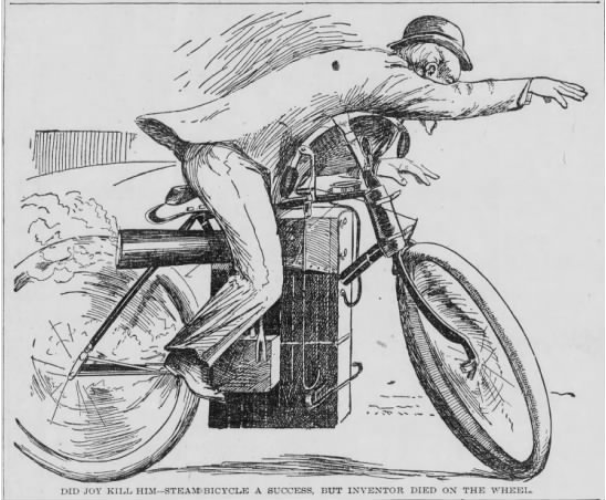
“A FRENCH JOURNAL humorously suggests that perambulators should be fitted with a motor, so that the nurse, whilst taking the infant out for an airing, can herself take a ride.”
“AN INFLUENTIAL ENGLISH MP is, writes a Paris correspondent, seen daily going through the streets of Paris in an automotor car, piloted by Baron von Zuylen, the owner of the car, and it is stated that the gentleman in question has been commissioned by Government to make a report upon automobilism. There seem to be happy days in store yet for the motor cars in old-fashioned England.”
“A COVENTRY BICYCLE maker is building himself a motor-driven safety cycle.”
“IN DISCUSSING THE Pennington bicycle last week with the inventor, Mr Pennington expressed the confident belief that, given the favourable conditions of a smooth, level, and perfectly straight and clear roadway, it would be quite possible to accomplish, upon a bicycle driven with his motor, a mile inside half a minute. This sounds tall, but Mr Pennington has already ridden a straight. away mile in fifty-eight seconds, which, as he says himself, was ‘quite as fast as he wanted to go’, and we are inclined to place credence in his belief.”
“BE IT KNOWN TO ALL whom it may concern, says the Carnarvon Herald, that the Welsh word for ‘autocar’ or horseless carriage, is ‘peirfen’—plural, ‘peirfeni’. This matter has just been settled by the autocar —we beg pardon, autocrat —who edits Papur Pawb, as the result of a toughly-contested competition, wherein the vigour and vitality of the roots of the Cymric tongue were abundantly manifested. At least a score of the names sent in for competition might have been warranted to choke an alligator. We have seen a list, but we suppress it; for, otherwise there would be no chance of obtaining an Act of Parliament to authorise the use of ‘peirfeni’ on the high roads.”
FROM A DAILY newspaper: “The ‘horseless carriage’ race from Bordeaux to Paris, which was held recently, displayed how remarkably electricity and other motive-powers for light vehicles have progressed. Never had such a novel sight been witnessed, and the interest taken in the event shows plainly how people regard the importance of modern appliances for speed purposes. The petroleum motor bicycle was one of the vehicles entered for competition, and by no means the least interesting. Many people consider that the motor-driven cycle is the cycle pf the future, while others assert that the physical exertion necessary for propulsion purposes gives the real charm to cycling. Be that as it may, the motor bicycle is an accomplished fact.”
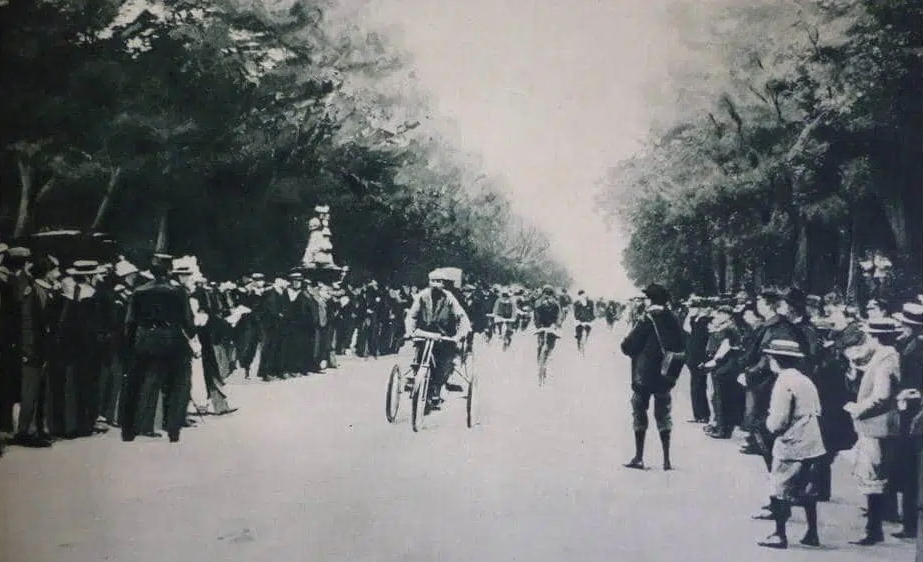
“AS PUBLIC INTEREST in the autocar movement develops, we find out almost daily that many ingenious and enthusiastic engineers have been privately experimenting with autocars in one form or another. One of these appears to be Mr Jas Sumner, Water Street Works, Leyland. This gentleman has been interested in steam locomotion on common roads for upwards of twenty years. He made a ‘steam waggon’ to carry four tons about ten years ago, which ran very well for upwards of six months. He also made a steam tricycle about five years ago, for which he was fined for running at eight miles an hour, and from this steam tricycle was developed his patent steam lawn-mower, for which he has obtained two silver medals and a first-class certificate of merit. One of these steam mowers is in use at Rugby School, and he has several in hand for the coming season. Last winter he made a crude steam autocar, and put in it one of his small size lawn mower engines and boiler to drive it. This engine was of one horse-power, and as made for lawn mowers it weighs nearly four cwt, and the carriage altogether about eight cwt. He has been out with it several times this year (having managed to escape prosecution this time), and can run at ten miles an hour on fairly level roads with four persons aboard. He tells us it will go up a hill of one in ten at four miles an hour with three passengers. He has run it up and down this hill a dozen times. With two persons on it will run up at five or six miles an hour, although its surface is very rough and stony, being a sort of byway, neither much used, nor kept in good repair, so it is looked upon by the carters and cyclists of the district as a nasty hill. The boiler is oil fired, the oil carried in a convenient tank, and forced to the burner by the use of a small air pump at a pressure of two atmospheres, and by this means we understand he obtains very good results, the burner working with an intensely hot flame, and not a particle of smoke or smell; there is also an arrangement for condensing the steam on the carriage, so that no escaping steam or smoke is visible. The engine is compound, and both cylinders can be worked under high pressure steam for starting and going up very steep hills…It will interest those of our readers who are cyclists to note that the converted tricycle illustrated herein is a ‘Salvo’ sociable. Some fifteen years ago, this machine, which was the production of the late James Starley, the father of the bicycle, was looked on as the ideal vehicle for sociable cycling. It then occupied much the same place in the cycling world as does the rakish narrow-gauge tandem bicycle of to-day.”
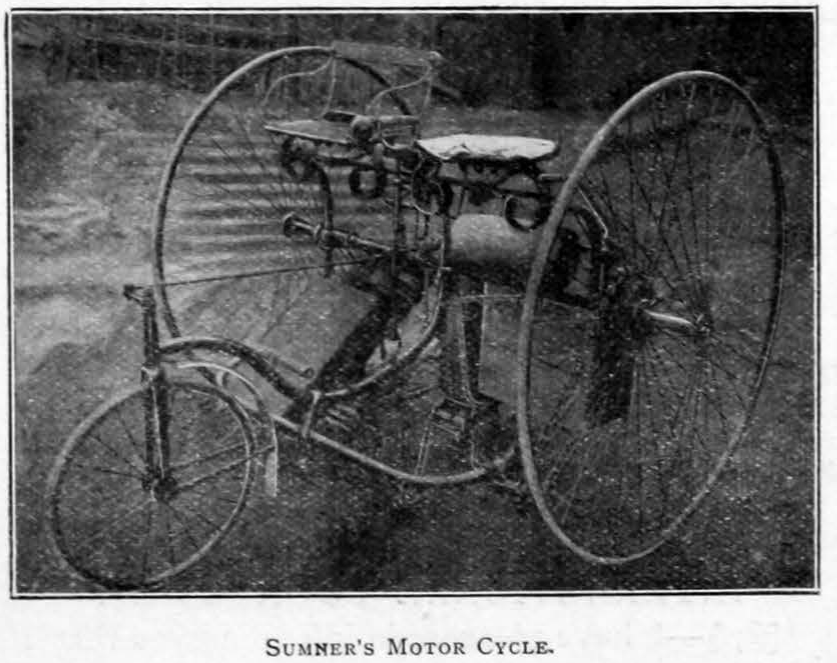
“AUTOMOBILISM IS PROGRESSING and spreading its ramifications in all lands, the latest country to give attention to the subject being Russia, where we hear an automobile club is in course of formation. In connection with automobile clubs it is interesting to note that an entente cordials has been arrived at between the Automobile Club of Paris, the Motor Car Club of London, the American Motor League, the Automobile Club of Belgium, and those who will organise the new Russian society. This is certainly much better than the squabbling and divided interests which have unfortunately in the past characterised the autocar movement in this country.”
IRISHMAN ERNEST MORNINGTON BOWDEN was granted a patent for the ‘Bowden mechanism’. Thanks for the cables, Ernie.
“THE WEST OF ENGLAND was practically the birthplace of mechanically propelled carriages, so far as England is concerned, Trevethick’s first steam carriage, now in the South Kensington Museum, having been run in the West of England in 1801, whilst many of Sir Goldworthy Gurney’s practical experiments were conducted between Gloucester and Cheltenham. The establishment in Bristol of a branch of the Motor Car Club—the first provincial movement of the kind—shows that the old spirit of enterprise has not forsaken the once second port in the Kingdom. “
“IN THE ANNUAL publication of the Touring Club de France, a cycling organisation which has taken automobilism under its wing, there is some excellent advice to autocar users on the management and use of petroleum carriages. For instance, the author has the following to say about petroleum spirit: ‘Take care to purchase the spirit, and do not accept it if it weighs more than 710 degrees. Above all, do not place faith in the statements of the seller, but weigh the spirit yourself with the densimeter. Insist upon the spirit being brought to you in a clean can that has not contained oil or acids. Superintend yourself the filling of the reservoir, which ought to be done by passing the spirit through fine linen. It would be advisable at that moment to again ascertain the density of the spirit.’ If autocar users read, mark, learn, and inwardly, digest the counsels given in this volume, they will, no doubt, save themselves a great deal of trouble, notwithstanding that, in the case of the recommendation quoted, the advice is here and there more applicable to the French user than to the English.”
“WHAT FURTHER PROOF can be needed of the grow-ing popularity of autocar riding than the steps now being taken by the Touring Club de France to facilitate excursions into the country? It is making arrangements for establishing depots in the provinces for the sale of petroleum spirits in sealed cans, and, to begin with, 200 towns in the principal touring centres will be supplied with the mineral essence. It will be sold in quantities of ten and five litres at 5frs and 2frs 50 respectively. The empty cans are taken back at 1fr 50 and 75 centimes, according to the capacity. Another little attention that will no doubt be appreciated by the chauffeurs is the formation of a school for initiating men who may wish to be engaged as drivers of autocars, and the Touring Club hopes to be able this year to give certificates of capacity to thirty drivers. This may perhaps be thought superfluous, for it requires little or no special training to manage an autocar, and a man of average intelligence can master all its details in a very short time. Some of the chauffeurs are employing their coachmen for this purpose. If, however, the men trained in this new school are to be taught how to make repairs and in other ways keep the vehicle in good order, the idea is, no doubt, worth carrying out.”

“THE DAILY GRAPHIC makes a new suggestion in connection with the autocar. It suggests, in short, the motor caravan, and makes its suggestion in the following terms: ‘Living in a stationary house is all very well in its way, but to live in a house that one could move from place to place by merely lighting a lamp and turning on a tap would be to realise one of the most golden dreams of buoyant youth. For many important classes of the community—for quack doctors, commercial travellers, artists, and literary men—no more convenient mode of existence can be imagined; while for newly-married couples who dislike the publicity of hotels and the vulgar noise of lodging-houses, and long to be alone together, no other sort of tenement would so well promote the poetical possibilities of the honeymoon. It cannot be more difficult to build a motor caravan than to build a motor landau. Let us hope that someone will try before the honeymoon season is upon us.’
“I HAVE BEEN a riding and hunting man all my life, and have belonged to a mounted branch of the army (Horse Artillery), but that does not prevent me from seeing how necessary it is that we Britons should not allow the rest of the world to go ahead of us, even though it be to the injury of horseflesh. My opinion is that the nation which adopts autocars for the army will gain a tremendous advantage. The great responsibility of a general commanding an army in the field is the conveyance of the commissariat, ammunition, and baggage. To collect the immense number of animals for this purpose is a serious task; and then they have to be fed, and must carry, at all events, a certain portion of their food with them. Now, if autocars could be substituted for carts, drawn by animals of sorts, it would be a great relief to responsible officers. These autocars could go fast enough not to impede the progress of the troops, and on the line of march they would not straggle so much. This, of course, would be a safeguard from being cut off by an energetic enemy. My belief is that, if I live to a respectable age, I will hear of the Horse Artillery of the future being ‘horsed’ with autocars, having bullet-proof mantles to protect the gun detachments. We, of course, will not be the first to adopt this, but it will come, unless the autocar movement proves a failure, which I am sanguine it will not.
JW Magrath (Colonel).”
LLOYDS ISSUED the first motor insurance policy.
“ALTHOUGH I HAVE been interested and engaged in the mechanical road locomotive question for many years past, it is only within the last two years that I have been able to notice the increasing public interest in the great industry of the future. I think a proof of the coming event to be carried out by all the civilised nations of the world is manifested by the many names that both the public and the press have been trying to invent and suggest. I give you the following list of names for the ‘new horse’ suggested by the British people and press, as well as our American cousins: ‘Petrocycle’, ‘motorfly’, ‘automotive’, ‘horseless car or carriage’, ‘moto-cycle’, ‘oleo-locomotive’, ‘volvite’, ‘auto-kenetic’, ‘mechanical car or carriage’, ‘automobile’, ‘electrobat’, ‘paramount’, ‘locomotive car or carriage’, ‘self-moving car or carriage’, ‘self-propelled car or carriage’, ‘automatic car or carriage’, ‘nonequine’, and last, but not least, the ‘autocar’ and ‘motor car or carriage’. For the former, viz, the ‘autocar’, I know you are responsible, and I consider it a name which is specially suitable for a journal, as well as for the thing itself, and I feel certain that the popular name will be either the ‘autocar’ or ‘motor car’, for the latter of which I humbly flatter myself to be responsible.
Frederick R Simms.”
“ANOTHER POWERFUL MOTIVE power for traction has been discovered. It is stated that a heavy roadster bicycle and a sixteen stone rider have been drawn by it a distance exceeding a hundred miles, over very rough roads, in a marvellous manner. The motor was stationed at the end of the journey, and from photograph forwarded, appears to be remarkably pretty and graceful.”
“M LÉON BOLLÉE, OF Le Mans, is the latest French inventor to make a sensation in the auto-car world, and most certainly he has done that. [In a recent test] he both actually and metaphorically made rings round every other demonstrator. This was, it is true, partly due to the fact that M Bollée, having ridden the machine—the first and only one, by the way, which he has yet made—some five thousand miles, is perfectly at home with its management, knows exactly what he can do with it, and further than this has just a little bit of dare-devil in his nature which led him to do things which more cautious individuals would not have attempted. On Saturday we understand that the patent rights for England were secured by the British Motor Syndicate, and the same evening M. Bollée and his machine travelled down to Coventry. Here on Sunday afternoon he created immense excitement amongst the inhabitants by dashing wildly through the crowded streets in every direction, and it was amusing to see about eight policemen busily engaged in keeping the track clear for his operations. Nor did he confine himself to the city, as he took a run over the beautiful Warwick Road to the quiet little town of Kenilworth. On the following day he again exhibited the machine, taking one after the other Coventry’s most interested citizens, ourselves amongst the number, for trial spins through the streets and the proceedings presented rather a humorous aspect
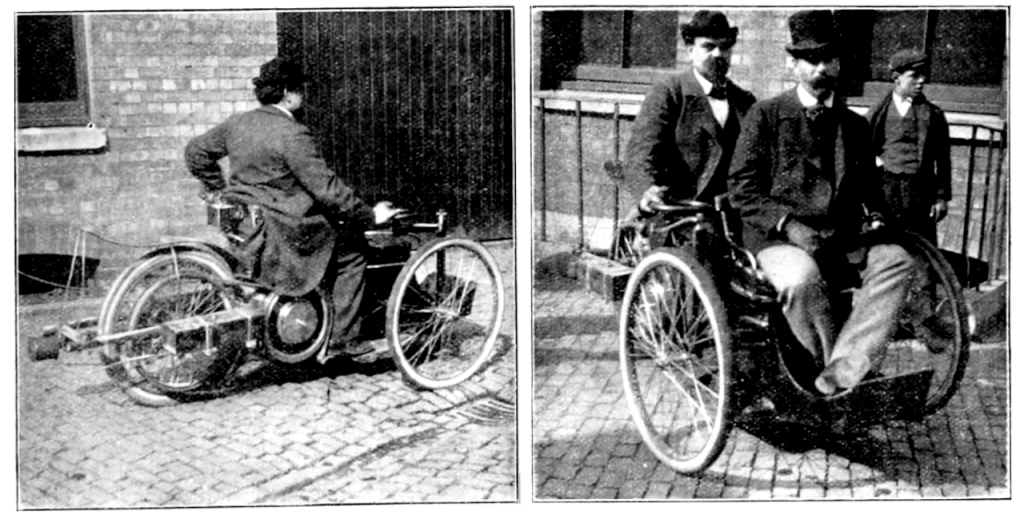
when the venerable Mayor of Coventry himself became busily engaged, with the assistance of six policemen, in breaking the law, in other words, in riding through the Locomotive Acts, upon M Bollée’s petroleum tricycle. The machine, which weighs 160 kilos, is a tandem tricycle with two comfortable railed seats, one behind the other. It is driven by a single central wheel at the back, the two front wheels being used for steering purposes. Steering is effected by means of a rack and pinion actuated by a wheel and handle, whilst the speed controlling mechanism and brake are both in connection with a long and powerful lever on the left-hand side. A very slight movement of the lever serves to readjust and alter the speed, whilst a full movement throws the engine out of gear, and applies simultaneously a powerful brake. The management, both steering and otherwise, is effected by the rider at the rear, and the machine being low, the driver can give the machine a push off with his feet and this, combined with a long wheelbase, makes it very safe at high speed. It is capable of considerably over twenty miles an hour on the level, and of mounting hills of good gradient at an eight to twelve miles pace. When once going, the vibration is not felt, though when stationary, as with all other petroleum motor carriages, this is considerable. The chief novelty is the absence of electric firing and a water jacket. The firing is done by the aid of a special tube of M. Bollée’s invention, and the cooling water is dispensed with by using a flanged cylinder. It makes somewhat of a noise, and, perhaps owing to the quality of the petroleum used, is rather ‘smelly’, but is, undoubtedly, one of the handiest, fastest, and most practical light autocars we have yet seen…M Bollée is a young engineer who has already brought out about thirty inventions, which is an average of more than one for each year of his existence, and probably the most successful of these was a calculating machine. This, however, has been eclipsed by his motor tricycle. Mons F Charron, who is, if we mistake not, Messrs Humber & Co’s manager in Paris, has undertaken to purchase from Mons Bollée all the machines which he is able to manufacture this season.”
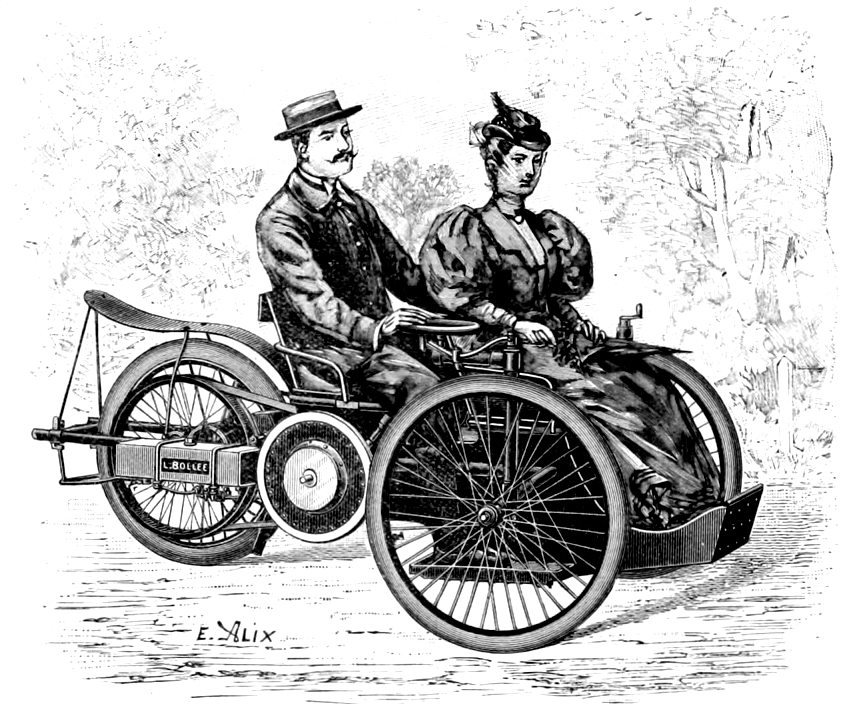
‘TWAS ALWAYS THUS…no sooner had enthusiasts formed clubs than they fell out: “Doubtless many of our readers will have noticed, as we have, the regrettable antagonism which appears to exist between the Self-propelled Traffic Association and the Motor Car Club, if we may judge by the printed utterances of Sir David Salomons on the one hand and Mr AW Moore on the other; and they will doubtless agree with us in deploring such a condition of things, if the signs of the times alluded to have been interpreted correctly. We do not ourselves profess membership to either body, so are unable to place any tangible construction upon the reason of the apparent discord which seems to have shown itself of late, but we do feel, and feel most strongly, that now, of all times, is not the time for autocarists to quarrel amongst themselves. All have, or should have, a common object in view, that is to say, the obtaining for the patrons of the new form of locomotion those rights and privileges to which they are justly entitled, and the conservation of their interests in every particular. Yet here we have the recognised figurehead of one association formally and publicly denying any connection with the other, and the mouthpiece of the latter disclaiming any desire for the association which is denied by the former. Truly it appears to us to resemble more than anything else the cry of the rival tradesmen that they have ‘no connection with the man on the other side of the street’, and appears all very childish and ill-considered in its way…besides these two bodies we have the Road Motor Association, which, although it has been working more quietly, and has not thrust itself prominently upon the public notice in the same manner as the other two bodies, is still operating with the same objects in view, and has done good work by the dissemination of much information upon the subject. What strikes us, therefore, in the whole situation, is the absurdity of the three associations working on different lines to attain the same objects. ‘United we stand, divided we fall’ is a very well-known and oft-proved adage. Unity is strength is another, and both are singularly applicable in the present instance. Why on earth cannot these great and good men, the heads of their respective movements, unite their forces into one strong, active, and capable association without these apparently petty squabbles, which can only disgust well-wishers, and do no good to either the bodies themselves or the cause they represent?”
THE GENEVA STEAM bicycle was made by the Geneva Cycle Company, of Geneva in Ohio. The naptha-fired steam engine was based on a design by Lucius Copeland. A modern replica was found to be capable of 12mph, but maintaining a head of steam at that speed was not easy.
“IT IS GENERALLY ADMITTED that the bicycle has mechanically done much for the autocar, and even more to educate the British public to the delights of fast and silent road travel, and consequently to bring about the enthusiastic reception that has been accorded horseless vehicles everywhere through the land, save before a few benighted ‘benches’ who have allowed a slavish devotion to the letter of the law to blind their common sense to its spirit. Mechanicians need not be told of the invaluable hints that an intelligent designer of autocars finds in the study of the details of a modern bicycle. It is no exaggeration to say that if the bicycle had not been almost perfected by now, the building of light autocars, really light ones we mean, would not have been possible for another ten years at least. Now there are two sides to bicycling. It is firstly, a pastime, secondly, a sport, and it is the sport of bicycling that the autocar is going to help. It was discovered some years ago by observing bicyclists that if they could get another rider to go his best speed just in front of them they could easily keep up behind him…This method of ‘pacing’, as it is called in the bicycle world, has now been reduced to a science, and monster bicycles to seat three, four, six, and even nine riders, have been built for the sole purpose of pacing celebrated bicycle racers in their attempts on record…a motor cycle has recently been successfully tried on the fastest and safest bicycle track in England, and it will only be necessary to arrange for higher speeds, say from thirty to thirty-five miles an hour, and the sports-loving Britishers will be able to recapture some of the coveted world’s records which have gone to other countries almost entirely through better and more scientific pacing.”
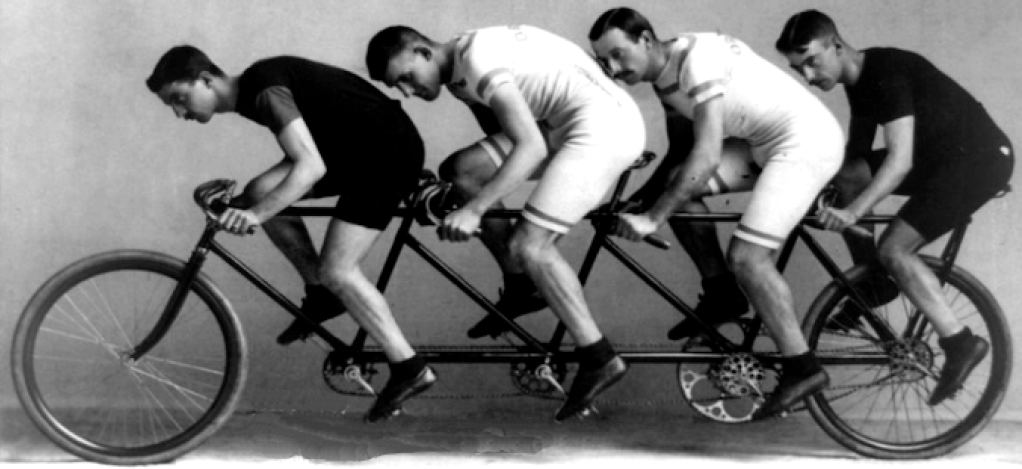
“WE HAD THE OPPORTUNITY the other day of seeing Mr EJ Pennington’s arrangement for the rapid volatilisation of heavy oils, and it appears to us that his claims to use even crude, unrefined petroleum in his motor are amply borne out. The arrangement consists in a small plate, through which a powerful electric current is caused to pass, producing great heat. To illustrate the way in which it gets to work, Mr Carse, who showed it to us, placed a piece of solid paraffin wax upon the plate, and then turned on the current, the result being that in three or four seconds we saw the wax pass off in vapour.”
“THE LATEST MOVE in the company direction is the Motor Car Insurance Company, coupled with cycle insurance as well. This is certainly taking time by the forelock, although we have no doubt that as soon as autocars are in anything like general use in this country, their owners will be desirous of ensuring their liability in connection with them, and unless the already existing carriage insurance companies would consent to undertake the risks they would, but for the new firm, have to take their risks themselves.”
“THE HON EVELYN ELLIS has gone back to the ‘Sunny South’, from which he came specially to attend the opening banquet of the Motor Car Club. Mr Ellis informed us that he had, during his month’s stay in the South of France, driven his Daimler carriage many hundreds of kilometres, and had tried it over the hilliest of districts to be found, and his experience was that, although for speed a good carriage and pair would beat him on a good level road for a few miles, he would wear out the best pair of horses ever harnessed in the long run. His average speed throughout the entire trip equalled twelve miles per hour, which, we take it, is quite good enough for most people, and is about fifty per cent better than the usual horse average, except with the best of teams.”
“MOTOR CYCLE TRIALS ON CATFORD BICYCLE TRACK. In the presence of a good muster of well-known racing men and experts, a trial was made on the afternoon of Wednesday week of a new petroleum-driven bicycle by Mr AG New, of the firm of New and Mayne, Palace Chambers,Victoria Street, SW. It is not claimed for the somewhat ungainly-looking machine that it is at all perfect; there are many points which have suggested themselves to the inventor, and which were commented upon on the occasion of the trials, wherein improvements can and will be made. Allowing for these, the machine ran wonderfully well, and answered to the steering splendidly. There is, however, an excessive amount of vibration from the handles, which we should think would be accentuated on the road; but this can be remedied. With a flying start the motor cycle went one mile in 2min 18⅗sec, the fastest unpedalled mile ever done on a cycle in this country. The sight of a rider careering round a bicycle racing track ‘legs up’ at a twenty-six in the hour gait was a strange one. If some variety of pace—especially a variation towards a faster pace—can be obtained, the machine should make a splendid pacing and training instrument for bicycle racing athletes, apart from its utility for highway travelling.”
“AT THE KINGSTON-ON-THAMES County Bench on May 7th, Mr Alfred George New, of Palace Chambers, Westminster, was summoned for driving a locomotive on the highway at Cobham between the hours of ten am and six pm, contrary to the byelaws of the Surrey County Council. He was also summoned for not having a licence for the said locomotive. Mr TW Weeding, Deputy Clerk of the Peace for Surrey, appeared to prosecute. Police-constable Baker said he was on duty at Cobham on the 25th of April, and saw the defendant riding a safety bicycle, but without using the pedals. He stopped him, and asked how the bicycle was propelled, and he said ‘By oil.’ He told him that if that were so the bicycle became a locomotive, and he asked him if he had a licence. He said he had not, so witness took his name and address. There were two gentlemen on bicycles about thirty yards in front of the defendant carrying a red flag. They were evidently with the defendant. The defendant, in answer to the Bench, said the machine he was riding was not in his opinion a locomotive, and he did not think it was necessary to have a licence. The Chairman (Mr JF Eastwood): ‘Will you explain why it is not a locomotive?’ —The defendant: ‘Because it is a velocipede, a vehicle with two wheels. As far as I understand, a velocipede cannot be a locomotive. A locomotive must have three or four wheels. It is a machine propelled by oil, which I wanted to test, and as I could not test it properly, except on the road, I took it to the quietest road I could find.’ Mr Weeding said a locomotive was clearly defined by the Act under which the byelaws were made. By the 38th section, a locomotive was a locomotive propelled by steam or other than animal power. It was quite certain the machine in question was not propelled by animal power, but by the combustion of oil. In a case before the Queen’s Bench a tricycle propelled by steam had been held to be a locomotive, and he submitted that the defendant’s bicycle in this case was a locomotive also. The Chairman said the magistrates were of opinion that it was a locomotive, and the defendant, therefore, would have to pay a fine of 15s on each summons.”
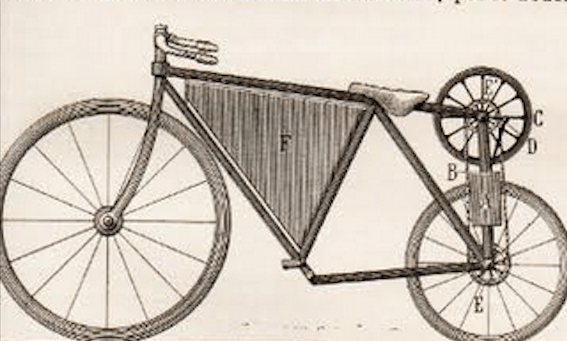
“INTERNATIONAL HORSELESS CARRIAGE EXHIBITION AT THE IMPERIAL INSTITUTE. Saturday last being the opening day of the summer reason at the Imperial Institute, the Prince of Wales took advantage of the occasion to pay an informal visit to the building. His Royal Highness, accompanied by her Royal Highness the Grand Duchess of Mecklenburg-Strelitz, their Highnesses the Princess Marie and the Princess Jutta of Mecklenburg-Strelitz, and Prince Edward of Saxe-Weimar, Sir Francis and Lady Knollys, Major-General Arthur Ellis (in attendance on the Prince of Wales), Colonel Francis Wemyss (in attendance on the Grand Duchess), and Mr Christopher Sykes, dined at the Institute, and afterwards occupied seats in the pavilion adjoining the band kiosk at the evening inaugural concert of the Monte Carlo Orchestra. There were also present Lord Herschell, Lord Loch, Lord Henry Fitzgerald, Sir E Lawson, Sir F Abel, Sir 0T Borne and Lady Agnes Borne, Sir S Samuel, Sir D Tennant, Sir Somers Vine, Sir P Magnus, Mr C Scott Dickson (Solicitor-General for Scotland), the Hon Duncan Gillies, the Hon Agar Wynne (of Victoria), Mr TP O’Connor, MP, Professor Dewar, Colonel C Washington Eves, Mr A de Rothschild, Mr A Randegger, and other ladies and gentlemen. The above exhibition of horseless carriages or autocars, which, by the way, is a descriptive term much neater and more applicable than that employed in the title of the show, is really one that should not be missed by any person feeling even a passing interest in the road, pleasure, and business vehicle of the near future. The expert who has attended the linked exhibitions held since the movement began to
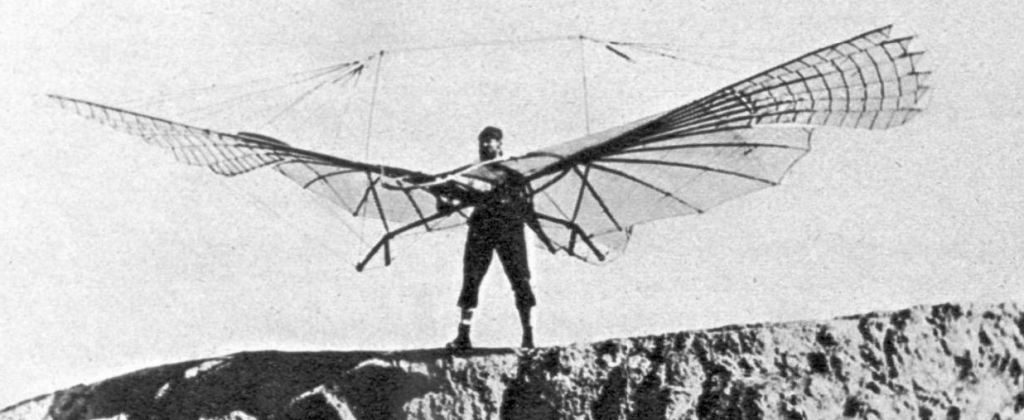
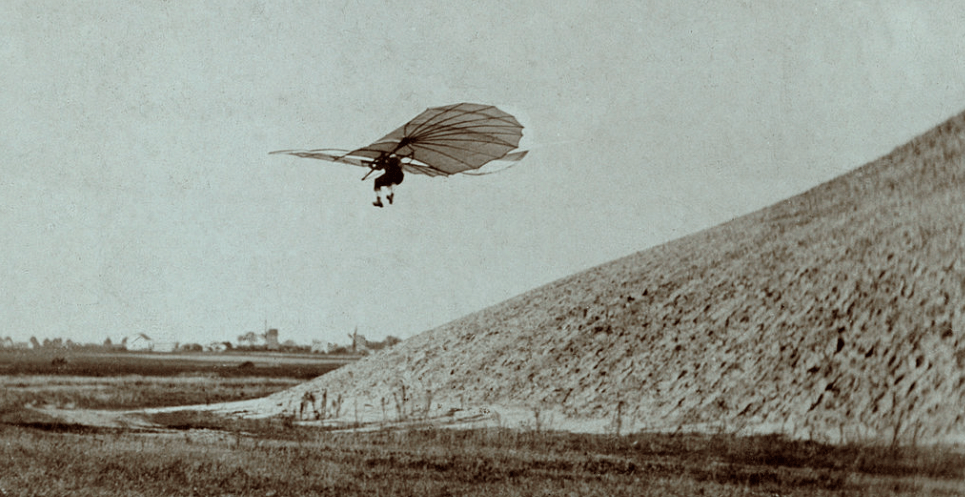
catch on in this country will find but few novelties, but for the uninitiated the North Gallery of the Imperial Institute is full of interest. The practical trials to which some of the vehicles are subjected in the gaily decorated grounds attract much notice, and these trials, which will go on here from day to day, will do much to convince ail who witness them of the practicalness of the autocar or autocycle, whether impelled by Daimler, Benz, Kane-Pennington, Electric, or De Dion and Bouton motors…Approaching the exhibits from the east end of the North Gallery, we come first in Room I upon the space allotted to IJ Bennett, 106, Walton Street, Oxford, who shows one of Lilienthal’s ‘Glider’ flying machines, suspended overhead, and which resembles nothing so much as a man-carrying kite, in the shape of a great canvas winged bird, with a curious rudder-like tail, and fitted between the wings with arm-holes and shoulder rests, whereby the ‘glider’ may swing himself…Also in Room I is Hiram S Maxim, 32, Victoria Street, who shows that featherweight 150 horse-power engine which was used to drive the American engineer’s flying machine at Bexley, also the great air propeller by which the engine drove the machine. Hard by we come upon the exhibit of PS Pitcher, of Artillery Mansions, Victoria Street, SW, who also shows a soaring machine, somewhat upon the lines of, but differing considerably in detail from that of, Lilienthal. Mr Pitcher, who has soared to a height of thirty feet with this kite-like construction, is present, and willingly gives any earnest person full details of his experiences. H Middleton, Slough, also shows a balloon flying machine and other aerial models, beyond which we came upon a vehicle fitted with the air-wheels of The Pneumatic Wheel Co, of 6, Gray’s Inn Road. These wheels when first introduced were much discussed, and their vibration-annihilating properties fully admitted. They take the form of a large inflated collar of canvas-lined rubber held between dish flanges, which are fixed, or form part of a metal sleeve attached to the axle. Joseph Lathond, 38, Rue de Belleville, Paris, is down in the catalogue to exhibit an electric motor suitable for autocars, bicycles, and tricycles, with other articles, but did not appear to have taken up his space when we passed in Room III…H Middleton, of Slough, who shows two somewhat antique-looking cycles, one a safety and the other a tricycle, each driven by small steam engines. The engines fitted were of somewhat small proportions, the boiler in the case of the tricycle being carried in rear of the saddle. The engine fitted to the safety was made with two cylinders, end to end, the cranked spindle of the auxiliary sprocket wheel
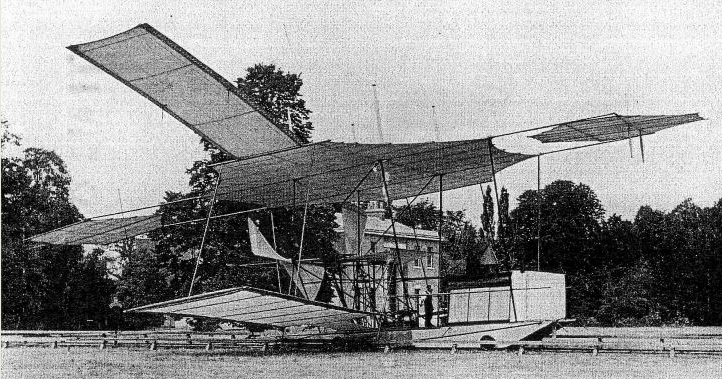
passing between them. Both machines were shod with solid tyres. In Room III, Hans Renold, of Green Lane, Brook Street, Manchester, shows a somewhat novel form of steel chain for autocars, which is said to be silent in running. It is made with internal projecting teeth, which engage with the teeth of and connect up toothed spur and pinion wheels…New & Mayne, Palace Chambers, Westminster, stage a Hildebrand oil motor cycle, with improved high-speed attachment. This machine is very similar to that shown at the late Salon du Cycle, in Paris, by Duncan & Suberbie…This machine was tried last Wednesday on the Catford track, and there ran a mile in 2min I8⅕sec. It has also successfully made eighty-one miles between Woking and Devizes, and was the cause of the case heard before the Kingston Bench last week. The Daimler Motor Co, 40, Holborn Viaduct, EC, have the largest, if not the most interesting, exhibit in the exhibition…what is most interesting to all, a motor horse, which is a low and primitive form of tricycle constructed and motor fitted by Gottlieb Daimler, of Cannstadt, in 1886, and an experimental motor quadricycle constructed by the same gentleman in the same year. Humber & Co, Beeston, Notts, have an interesting exhibit of motor cycles fitted with the Kane-Pennington oil motors, the patents of which are now the property of the British Motor Syndicate. There are two tandem safeties with the twin cylinder motors boomed out in rear, as so often shown in connection with this motor when attached to cycles, and two tricycles…The British Motor Syndicate, in addition to motors and motor cycles by Kane and Pennington, of the same character as those just mentioned, also show a safety fitted with a large air propeller carried behind the saddle, and driven by a KP motor. This machine, Mr Pennington assured us, has developed a speed of thirty-five miles per hour without pedal aid from the rider. The syndicate also exhibit a steam tricycle capable of carrying two persons, wherein steam is generated in four minutes by the use of an ingenious methylated spirit burner invented by M Sautenard, of Paris…A single and double tricycle, fitted with the now familiar De Dion and Bouton oil motors, are also shown, the former at the time of our visit running about the grounds in a most satisfactory and convincing manner.”
“THE HOUSE OF LORDS has already passed the second reading of a Bill modifying the restrictions on the use of road engines; so that we are well on the way of catching up our continental rivals. Still, the fact that one cannot use motor carriages freely at present has not prevented English patentees and capitalists from preparing for the time when our roads and streets will be as free to steam and oil and electricity as to horses and cycles. Already many patents have been taken out in this country for horseless carriages, the name of Gottlieb Daimler being prominent in the list; but a number of English inventors have also done much in this field. The new industry has also begun to figure in the world of finance, the British Motor Syndicate, which owns some seventy patents, having distinguished itself by paying a ten per cent dividend before it was four months old. The Daimler Motor Company is a subsidiary enterprise, working under licence from the syndicate, and many well-known engineering firms, finding there is a demand for motor carriages, have applied for licences to build machines under the many patents acquired by this company. But a bigger undertaking has now beds registered, with a view to taking up the manufacture of motor carriages, that they may be ready for delivery when the Legislature enables the public to use them freely. The new enterprise is the Great Horseless Carriage Company, with a capital of £750,000. For the patents of the British Motor Syndicate £500,000 is to be paid in 50,000 £10 shares, and the remaining £250,000 will be retained as working capital. Such a sum is certainly not excessive when the possibilities of the industry are considered. A great fire-proof factory of four storeys has been acquired at Coventry, with engines of 750 horse-power, and with a railway siding and a canal wharf. This looks like business, and when the proposals of the company are put before the public investors will find that they are not asked to sub-scribe to an inchoate or incomplete scheme. The company will have in its possession all the leading English patents, and among its directors and officers will be found many of those who have become prominently identified with the development of motor traction, not only in this country, but abroad.”
“MESSRS L’HOLLIER, GASCOYNE & Co, of Bath Passage, Birmingham, executed a neatly politic stroke the other day. As has been already reported in our columns, this firm has embarked upon the manufacture of autocars at Birmingham and Maidstone, having acquired the rights of a patent oil motor. Taking advantage of the fact that the Horseless Carriage Bill was before the House of Commons, Messrs L’Hollier and Gascoyne sent down to Westminster one of their handiest motor carriages, and during the afternoon a good many legislators varied the monotony of a singularly dull sitting by riding round Palace Yard, much to the edification of the cabbies on the rank there. Doubts were suggested as to whether Palace Yard was not a thoroughfare within the meaning of the Act, and whether on that account the riders did not subject themselves to various pains and penalties under the existing law. But the risk of a prosecution appeared to be but lightly regarded by our law-givers. In the matter of law Mr L’Hollier has already had some experience at Solihull. The effect of his grasp of an exceptional opportunity was to give his firm, and the autocar movement generally, a splendid advertisement. The car was found to go very smoothly, and no complaints were made of vibration or odour, and the steering arrangements were pronounced as very effective. Among those who tried the car in the course of the afternoon were the Duke of Norfolk, the Marquis of Lorne, Mr Asquith, Mr Maclean, Lord Coleridge, Sir James Fergusson, and others.”
“THE WILKINSON PNEUMATIC HUB is an ingenious and simple arrangement, and Mr Wilkinson sees no reason why it should not be used instead of pneumatic tyres. The elasticity comes in the right place. There is no metal contact between the axle and the wheel, the pneumatic tube rings breaking the contact and absorbing vibration. The elasticity of the wheels is claimed to be greater than that obtained from the use of pneumatic tyres. Their section of tyre is ⅜in outside rubber, ⅛in canvas, ⅛in. inner tube; total, ⅝in. They can be used in all weathers, and do not throw up dust and mud like large pneumatic tyres. The cost is very much less than that of pneumatic tyres. The rings are made with a thin inner tube of perfectly airtight rubber, covered with an outer and stronger tube. Only a small quantity of rubber is used, so that there need be no hesitation in using the very best material.
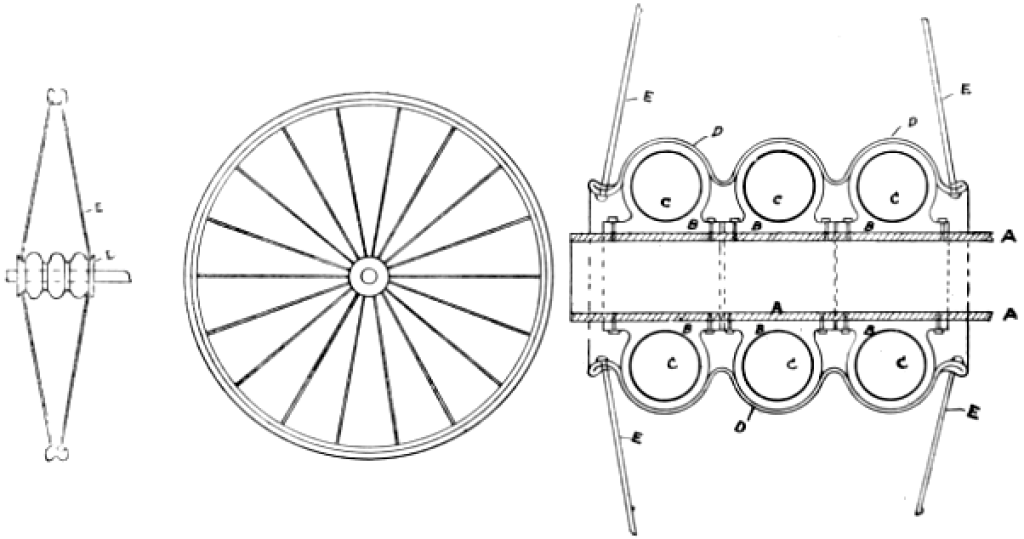
“MR PENNINGTON INTERVIEWED. LONDON, May 8th—It is now many months—I know not how many—since rumours reached England from America concerning a Mr Pennington and a motor of his invention, which was said to perform wonders in the autocar moto-bicycle line. Nor is it to be wondered at that this news, calculated as it was to affect the interests of European inventors, carriage and bicycle manufacturers generally, should have excited the vivid curiosity of the different trade organs devoted to these matters. Letters from correspondents poured in on all sides, the perusal of which might almost be said to form in itself a liberal education on the subject of motors in general. Nor was the discussion quite devoid of ‘feeling’; for, according to one correspondent, the accounts were too ‘American’ to be accepted as genuine. However that may be, a powerful English syndicate, which has bought the Daimler and De Dion patents, was not inclined to be led astray by parochial feeling, or to be otherwise caught napping. An emissary was promptly sent over to the States, bought up Mr. Pennington’s patents, and before long, Mr. Pennington himself appeared on the scene—where he now looms very large at the Metropole Hotel, London…Not satisfied with merely putting in a personal appearance, Mr. Pennington—or rather the American firm of Kane-Pennington—issued a public challenge of £1,000, backing his motor against every other in existence, which challenge was at once backed by the eminent English firm of Robey and Co, of Lincoln, which commits itself to the statement that: ‘We have no hesitation in expressing our opinion that the Pennington motor carriage is far the best of any we have examined.’ With those facts to go upon, I solicited an interview with M. Pennington, whom I found installed…occupying a large suite of rooms, surrounded by type-writers, draughtsmen, motor models, and other sundry impedimenta of a great inventor. Mr Pennington is a tall dark-eyed man of very striking and distinguished appearance, strongly reminding one of Edison by his cast of features. In fact, I do not hesitate to commit myself to the statement that there was something decidedly Napoleonic in the impression he created upon me. Calm, placid, and deliberate, totally different to the popular conception of an excitable, sanguine inventor. ‘I hear, Mr Pennington, that you have patented a motor bicycle which holds a record of a mile in fifty-eight seconds?’ ‘Yes, that is so…In my motor the cycle of operations is the now universal Otto or Four-cycle, but the cylinder is open-ended. There is no vaporiser, outside light, or previous heating up. A special form of electric ignition serves the purpose of vaporising, and the action is as follows: At the first outstroke a charge of oil and air is drawn in, and on the return stroke of the piston this charge is compressed, and when nearing the end of the stroke a spark mingles with the charge, converting it into a perfect gas, which is rapidly ignited by the second spark. This takes place when the crank has got well over the dead centre…Probably nothing has retarded the progress of the oil engine so much as imperfect electric ignition—this difficulty has been overcome by the Pennington method…What oil-engine builders have considered the correct lines on which to build an oil engine have been proved to be defective. To most minds a single cylinder and slow speed would appear to be the correct lines on which to work; this is not so. Using a number of cylinders and running at a high rate of speed reduces the weight per horse-power, and enables an engine to be constructed with balanced moving parts giving a uniform turning moment. To illustrate how very different the Pennington motor is from any other: A four-cylinder engine developing four actual horse-power when running at five hundred revolutions per minute weighs 120lb. This is at most one-fifteenth of the weight of the ordinary type of engine.”—New York Herald
“SOME IDEA OF the hold the Daimler motor has upon the Continental autocar world may be gleaned from the fact that at the excursion to Meulan held last week by the Automobile Club of Paris, out of the thirty-three vehicles taking part in the trip no less than twenty-five were propelled by this motor, the honours of construction being about equally divided between Messrs Peugeot Frères and Messrs Panhard et Levassor. This excursion of the Automobile Club of France seems to have been an exceedingly pleasant outing. It took the form partly of a procession or demonstration, partly of a picnic, and just a little bit of a race. There was no intention of racing, it is true, but, like bicyclists when they get together, the enthusiasts could not help trying their speed a little bit when they got well upon the road. The result was that two petroleum tricycles of Messrs De Dion and Bouton arrived first, having accomplished the forty-three kilos in 1hr 34min, whilst a steam brake made by the same firm finished third in third in 1hr 42min, Mons Paul Meyan on a bicycle coming in three minutes afterwards.”
“SIR DAVID SALOMONS, Mr HJ Lawson, and Mr GF Simms are not in accord. That is to say, the former with the two latter. The reasons therefore we will not enter into now. We, however, protest most strongly against the action Sir David appears to be taking ‘to get even’ with his opponents. Whatever his dispute with the promoters of the Great Horseless Carriage Company may be, it is not fair to the innocent shareholders in that company that a man in Sir David’s position should make remarks in the public press calculated to damage their interests. The company is formed, and it is not Mr Lawson or Mr Simms that Sir David is damaging, but a number of individuals who have absolutely nothing whatever to do with the matter of the dispute.”
“LAST FRIDAY SOME trials of a couple of Hildebrand and Wolfmüller bicycles were made on the bicycle racing track at Coventry. Certain gentlemen in the bicycle manufacturing business in Coventry and Birmingham, who were interested in the autocar movement, wished to see the machines under practical trial, so, to avoid the law, and at the same time to keep the running trials in comfortable view of all interested, sundry tests were made on the Coventry track of the machines by men who had never ridden a motor bicycle before, but no difficulty was experienced by the autocar novices. At the same time, one or two exceptionally expert bicyclists, who were used to riding on the track, steered and managed the machines noticeably better, and while one racing man was riding, several quarter-mile circuits were reeled off at between twenty-six and twenty-seven miles an hour. Most of the experimenters wisely contented themselves with a slower pace. The trials demonstrated the ease with which a motor-cycle can be handled, and were satisfactory, as the machines—though, of course, a great step forward—are very clumsy and crude in design, and might easily be improved in very many ways. The bad points in particular are—firstly, the vibration from the engine, which is very much felt at all speeds, despite the power-wasting rubber bands, which are contrived to deaden the shock of the impulses; and, secondly, the appearance, which is ungraceful in the extreme.”
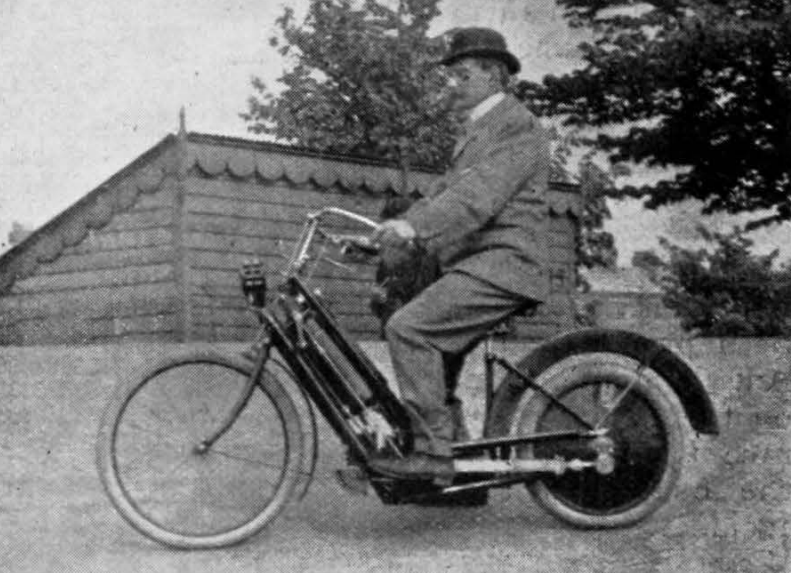
“THE INCREASING CONSUMPTION of petroleum in autocars seems to have raised a doubt in the minds of some people whether the supply of the mineral essence will be at all equal to the demand when the use of the mechanical vehicle becomes more general…But, after all, there is no reason for anticipating an early extinction of the Baku wells [in Azerbaijan where the world’s first mechanically drilled oilwell ‘gusher’ in 1847—Ed]. The owners have more petroleum than they know what to do with. They have been making strenuous efforts during the past few years to open up new markets in the interior of Russia and elsewhere…In the somewhat equivocal commercial slang, Russian petroleum is a drug on the market. Even should the Baku wells refuse to yield any more, there are still enormous supplies of petroleum in America, and especially along the coast of Peru, where there are sufficient quantities to meet the world’s needs for, it may be, a century to come. Then there are several other countries which possess petroleum deposits capable of being profitably worked in the event of prices advancing. Germany and France have their petroleum districts, and in Central Europe there are large areas of oil-bearing territory. Little fear need therefore be entertained as to the giving out of the world’s petroleum supplies.”
“THEY DO NOT appear to be able to keep secrets in French automobile circles any better than in English cycling circles, as the fat appears to be very much in the fire now in Paris over the publication in Mons Paul Meyan’s journal of the names of applicants for membership in the Automobile Club of Paris who have been blackballed. It is curious how these occurrences, which take place at presumably private meetings, manage to creep out. But they do nevertheless.”
“BARON DE ZUYLEN, the president of the French Automobile Club, sent one of his autocars the other day to Peugeot, the makers, for repairs, and when requesting by telephone that it should be got ready, he was informed that it had already been fetched by his mechanic. This was found correct, both driver and vehicle having disappeared. As, however, an autocar is at present not yet quite as common as a cycle, he was easily traced to Asnières, from whence he had to return to Paris. We presume that this is the first theft of an autocar on record.”
“THE BOLLÉE PETROLEUM TRICYCLE which attracted so much attention over here a fortnight ago has made its mark in its own country, and we now learn that Mons Canet, a well-known engineer in connection with modern artillery, has just entered into a contract with Mons Bollée to manufacture five hundred of these tricycles with the utmost possible speed; indeed, his contract is to deliver the first lot within six weeks. That is certainly the way to do things, and we are quite sure that if a similar quantity of these machines could be placed upon the market in this country within the same time, a very ready sale would be found for them.”
“IT SEEMS THAT an architect has written to the President of the Automobile Club, asking him whether it be advisable to fit up coach-houses for autocars in some large mansions that he is now erecting in Paris. The idea is novel in the sense that no other architect has given any attention to the lodging of autocars, but it is evident that the novelty will soon wear off when all the autocars now being built are put into service. Of course, there will always be found plenty of room for putting up the vehicles —if not at the owner’s own house then at the livery stables—but the owner will naturally prefer to have the autocar always under his own observation, and the part of the building set apart for this purpose will have to be specially fitted up. As the owner usually engages the services of a competent man to look after his vehicle he will prefer to do any slight repairs himself, and this will necessitate the fitting up of the coach-house with a few indispensable tools—in fact, a sort of amateur workshop. Then the storing of petroleum spirit and electrical batteries, where used, will have to be provided for, and a house which can offer these facilities will have a much better chance of being let than one which is not fitted up for the requirements of the autocarist.”
“THOUGH WE NEED not say there is nothing new in the principle of a turbine or rotary motor, we are not aware that it has been applied to a bicycle or an autocar up to the present in England. In describing an American specimen, the Bordman motor bicycle, The Horseless Age states: The design in form and lightness is certainly commendable. The motor, which is about eight inches in diameter, occupies the position of the ordinary treadle. It is intended to run at high speed, but may be reduced to any required speed by light concealed gearing on the hind axle. While the inventor is not prepared to give full details of the construction of his motor, he states that it is not a compression motor, but takes the air at ordinary pressure and explodes it by means of an electric spark. He uses very little gasoline, and expands it thoroughly, claiming under his system to get rid of vibration and noise, and generate much less heat. The gasoline tank will contain a supply sufficient for a journey of over fifty miles. A single cell battery, weighing three pounds, generates the spark. The flow of gasoline is controlled by a valve on the top frame, and just behind this valve is the contact breaker. The battery and spark coil are concealed in an ordinary pocket in the front angle of the frame. The brake is applied to the rear axle by means of a lever close to the rider’s hand. The weight of the entire apparatus is said to be less than ten pounds, and as the motor has no internal rolling parts no internal lubrication is necessary. The inventor of this motor is John J Bordman, 144, Henry Street, Brooklyn, NY, who was recently granted patents on it. He states, however, that he is making improvements on his original idea, and has applied for patents on these latter features also. It is his intention to apply this motor to all purposes where light power is required.”
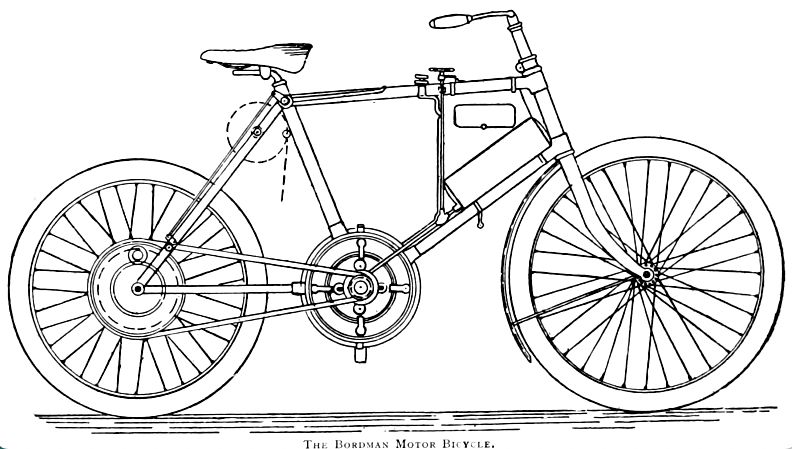
“I HAVE BEEN SURPRISED not to see any attempt in autocars to balance the tremendous thrust to which the crank axle is subjected at every other revolution. Why not, instead of one cylinder, have two smaller ones acting simultaneously on opposite cranks? I think that, with such spasmodic motors as oil engines, we must not be afraid of increasing the number of cylinders. Personally, I should like at least four, to give a turning couple each revolution.
Hugh De Burgh.”
“AT THE VELODROME de la Seine in Paris a tandem bicycle was tried last week, built by the Gladiator Co, and propelled by electricity, the machine giving a speed of fifty-one kilometres over a course of ten kilometres, which were covered in 11min 51½sec being about 10sec better time than Stocks’s world’s bicycle record made a month since on the Catford track. It is proposed to use this electric tandem for pacemaking purposes in cycle races.”
“THERE SEEMS TO BE a very general opinion among intending autocar users that while pneumatic tyres may be very comfortable, and may lessen traction, that after all solid tyres are good enough. This is a great mistake—the solid rubber tyre has but one advantage worthy of mention over the pneumatic tyre, and that is its comparative simplicity. Simplicity is certainly a great advantage, but too much may be, and often is, sacrificed to it. To realise the advantage of the pneumatic it is only necessary to ride in a carriage fitted with solid rubber tyres over a certain road, and then to repeat the drive in a precisely similar vehicle but fitted with pneumatic tyres. Of course, this test is but a rule of thumb one, but it is so convincing that no argument or scientific tests are needed to enforce the lessons it teaches.”
“THERE IS ONLY one autocar in Mexico at present. Though there is no restrictive legislation there, the roads are not generally good, and are in many parts very bad, while horseflesh is decidedly cheap. Despite these drawbacks, several auto-cars will shortly be imported into Mexico city by an enterprising machinery agent.”
“TO CELEBRATE THE passing of the Light Locomotives Act, the Motor Car Club are organising a procession of motor cars to proceed from the Imperial Institute to the Houses of Parliament as soon as the Act receives the Royal assent. I am anxious that the procession should be as representative of every system of road locomotion as possible, and to this end I would ask you to bring the project to the notice of your readers, so that all who are likely to have any workable motor carriage or cycle ready may take part in this demonstration, which should prove a valuable object lesson to the public as to the capabilities of the new road locomotion. I shall be pleased to receive entries from, and to give particulars to, any intending participants.
C Harrington Moore, Secretary.”
“MR PENNINGTON is constructing a new motor cycle which in accordance with suggestions from ourselves. There is no alteration in the construction of the bicycle, to the frame of which the motor is attached by clamps and screw fastenings. A small Pennington motor, with cylinders, is carried in front of the machine in the place where the usual luggage carrier is attached, and this motor is connected with the crank axle or driving by a chain, the essential feature of the contrivance being the fact that, although Mr. Pennington calculates that with the engine as designed a speed of over thirty miles an hour can be attained, the motor is intended purely as an auxiliary one, the rider pedalling in the usual way, and driving the machine with his feet so long as he desires it, and can throw his motor into gear for use when ascending hills, or just when he feels inclined. As an auxiliary power engine we believe there is a great future for something of the kind, for as at present designed it is calculated to develop a great deal more power than is necessary, and a still further reduction and simplification may advantageously be made. For auxiliary purposes a single cylinder would doubtless in many cases prove sufficient, although there would possibly be more vibration.”
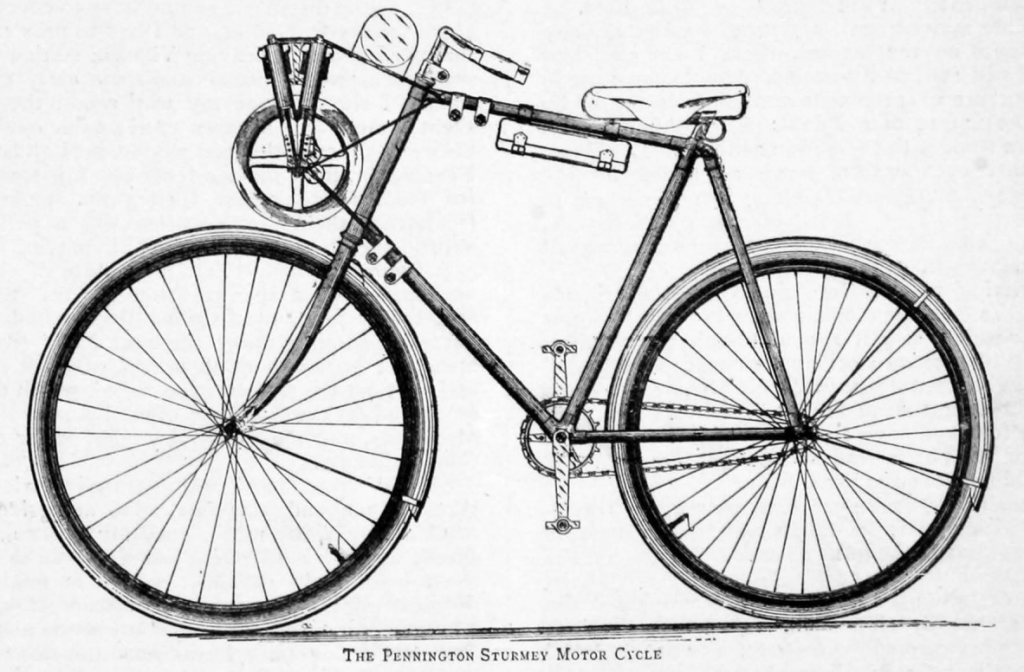
“AS AMENDED BY the Standing Committee on Law, and entitled ‘An act to amend the law with respect to the use of locomotives on high-ways’, this Act, upon which the hopes of British autocarists have so long been centred, now reads as follows: ‘Be it enacted by the Queen’s most Excellent Majesty, by and with the advice and consent of the Lords Spiritual and Temporal, and Commons, in this present Parliament assembled, and by the authority of the same, as follows: 1—(i) The enactments mentioned in the schedule to this Act, and any other enactment restricting the use of locomotives on highways and contained in any public general, or local and personal Act in force at the passing of this Act, shall not apply to any vehicle propelled by mechanical power, if it is under three tons in weight unladen, and is not used for the purpose of drawing more than one vehicle (such vehicle with its locomotive not to exceed in weight unladen four tons), and is so constructed that no smoke or visible vapour is emitted therefrom except from any temporary or accidental cause; and vehicles so exempted, whether locomotives or drawn by locomotives…Now that the Bill has passed its third reading in both Houses, it will become law immediately on receiving the Royal sanction, and we presume that this is only a matter of days or hours, and that the Bill having passed both Houses has so far became law that no further prosecutions for an infraction of the old Highways Act will be taken. We may therefore, consider our disabilities removed, and British autocars free of the road.”
“AS WE MAY DAILY, nay, almost hourly, expect the Royal assent to be given to the Autocar Bill, and British autocarists thus be made free of their country’s roads, we may expect as an early sequence the appearance of many autocars upon our streets and highways. As many of these will, especially the lighter and more speedy ones, doubtless be fitted with pneumatic and indiarubber tyres, their progress will be, more or less, unaccompanied by noise, and the necessity for some form of signal of approach will soon present itself. On the Continent the difficulty has been solved by the adoption of that instrument of torture which, a few years ago, was unsuccessfully attempted to be introduced to the English cycling world under the name of the ‘cyclorn’. This fearsome instrument is as common in France upon bicycles as bells are in this country, and the advent of an autocar is generally made known by a rattle over the pave, and an aggravating ‘squork’, ‘squork’ of the horn. It consists, as some of our readers know, of an indiarubber hollow ball, the compression of which forces air through a metal ‘horn’, producing a sound of the most disagreeable and aggravating character. Nothing in short that we have ever heard is so annoying. Some foot passengers in this country seem to be rubbed the wrong way by the sound of the bicycle bell behind them, and what persons of such temperament would do when the sound of the cyclorn attacked their ear it is really fearful to contemplate.”
“SEVERAL CONTINENTAL INVESTIGATORS are studying the question of the use of acetylene gas for autocar purposes, and there is reason to believe that acetylene and other hydrocarbons may very efficiently be employed in place of petroleum for this purpose. Amongst others, we learn that an Italian inventor, Mons Pedretti, of Parma, has constructed a motor cycle driven with an acetylene motor, which is said to be able to work fifteen hours without replenishing, to weigh only nine kilos, and to cost about seven-tenths of a penny per effective horse-power per hour.”
“OUR FRENCH CONTEMPORARY La France Automobile draws attention to the carelessness of some auto-car users, who will replenish their reservoirs with petroleum spirit whilst smoking a cigar. Our contemporary points out that such a practice is very imprudent, and may result in an explosion and possible destruction of the car.”
“LAST WEEK, MR TRB ELLIOT (who was recently fined 6d. at Berwick-on-Tweed) drove his Daimler carriage from Clifton Park, Kelso, to Perth, where he exhibited it at the Highland and Agricultural Society’s Show. The president, the Marquis of Breadalbane, the Lord Provost of Perth, and many others had an opportunity of trying the carriage. The journey of 125 miles was accomplished in a day and a half, and the route was via Kelso, Lander, Edinburgh, Linlithgow, and Stirling, and the roads, though good, were at times very hilly, especially crossing the Lammermuir Hills, where the road rises to 1,200 feet above the sea. The whole trip was a most enjoy-able one. Mr. Elliot has now run well over 1,000 miles in his carriage.”
“APPLICATION WAS MADE to the Brighton Town Council last week by a Brighton gentleman for permission to exhibit an autocar in motion in Preston Park. It would have been a great attraction, and would have caused an immense amount of curiosity, but the application was refused. We should have imagined that Brighton councillors would have been a little more up to date.”
“THE DWELLERS IN Stratford-on-Avon were greatly interested, not to say excited, last week, by the appearance of the Bolée motor tricycle. It seems that the employees of one of the large Coventry bicycle firms, Humber and Co, were indulging in their annual excursion to Shakespeare’s town, and their enterprising manager, who has built several carriages for Mr Pennington, obtained the loan of a Bolée autocar. We understand that some of the inhabitants in sleepy Warwick, as well as in the intermediate villages en route, were absolutely astounded by the new vehicle.”
“TWO NEW MOTOR BICYCLES. Last week two interesting specifications of motor bicycles were published, from which we have abridged the following particulars: ‘No 12,878, AD 1895, July 1st—Attaching Motor Apparatus to Cycles and Other Rolling Vehicles, G Boivin. This invention consists in attaching the motor apparatus to the driving wheel of the cycle or other rolling vehicle, and in the method of effecting this object. The piston B works in the cylinder A, and to it is jointed the connecting rod C transmitting the motion to the driving axle D. The framing F of the motor has secured upon its two sockets a long one H fixed between the two branches of the head I of the fork and a short one H1. The hub K of the driving wheel L is secured upon the axle D by a key. This extremity of the axle D turns in a bearing secured between the two branches of the head I of the fork. The other hub K1 of the driving wheel L turns freely upon the sleeve H. A tyre M is fastened upon the driving wheel, and the spokes are replaced by a metallic casing constituting a closed cylinder with rounded edges and perforated sides, in the interior of which the motor device is arranged. The driving wheel L may be made in the form of a cup, the tyre forming the edge, and the metal work replacing the spokes being all on one side. The wheel L might have two tyres, one on each side of the central plain, and it may also be arranged to receive in its interior two coupled cylinders instead of one, the spokes being in this case replaced by a central perforated plate with a keyed hub situated in the central plane of the tyre, and by two perforated plates, each provided with a free hub turning upon the sockets H HI, thus enclosing the motor apparatus. The transmission of the motion of the axle D to the driving wheel L may be effected in various ways. Latest date for opposition,
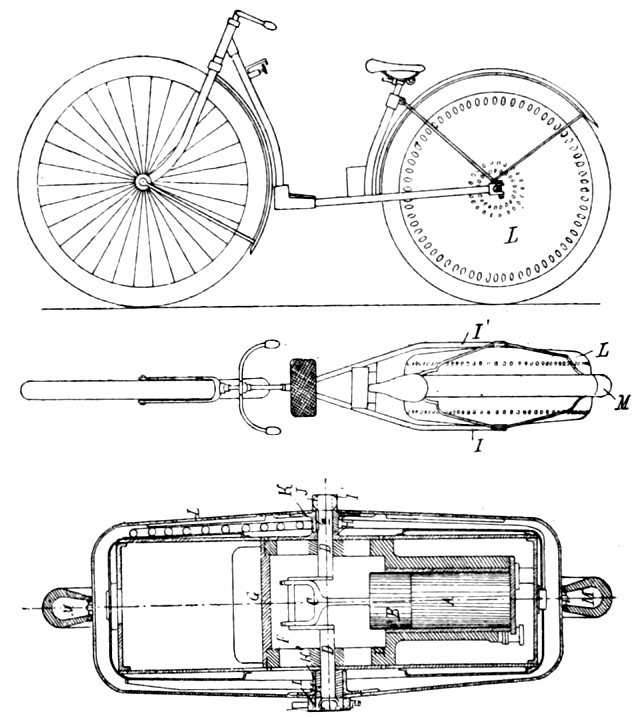
August 17th, 1896. No 7,566, AD 1896, April 9th—Motor-Driven Velocipedes, L Rob. The tandem motor A, hereinafter more particularly described working machine with its cylinders a a1 lying one behind the other and formed of a continuing tube-like piece, and surrounded with cooling ribs, is fixed at its upper part on the fork tube B, and at its lower part to the crank bearing bracket b b1. By the peculiar construction and arrangement of this motor, the lower frame tube of a cycle and the special frame arrangement provided for the motor in other motor cycles are dispensed with, and the crank axle can be put exactly at the same place as the pedal crank axle of the usual cycle. The cylinder a is closed above and below, and its piston rod is connected with the piston of the cylinder a1. This cylinder is open on its under side, and its connecting rod is united with the motor crank by ball bearings of special construction. One of the two fly-discs c c1 of the crank is provided with a bevelled toothed wheel d, and with this gears the bevelled toothed wheel e, fixed upon the tube shaft f. This shaft carries on the other end also a bevelled toothed wheel g, which gears with a bevelled toothed ring h on the back wheel hub, and drives the back wheel. The tube shaft f encloses one of the frame tubes i il, in which the back wheel axle is fixed, and this frame tube forms an axle for the tubular shaft f. The back wheel is here provided with a hub consisting of a strong metal ring h of about twenty millimetres thickness in order to operate as fly-wheel.
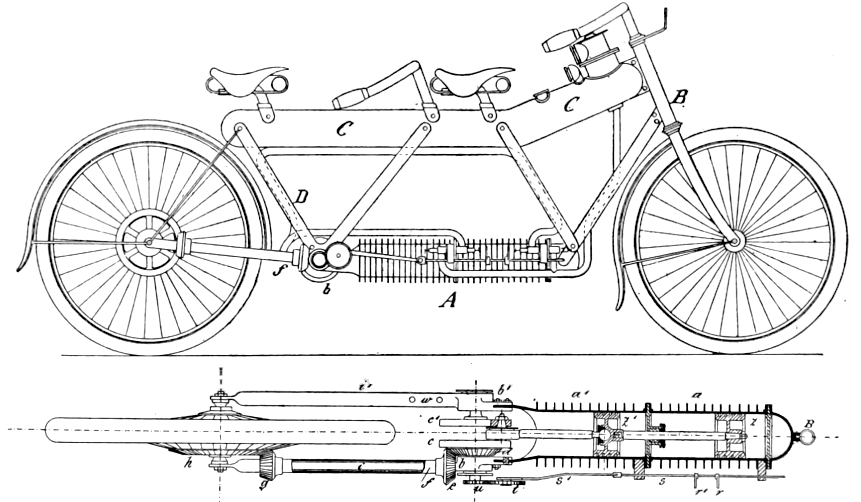
The benzene reservoir C is fixed also at the front to the tube B and behind on rails D. It is formed also tube-like, and replaces the upper frame tube of the usual cycle frame. It does not need a special frame construction for holding the benzene reservoir, but it has this position (more or less horizontal) also for another reason. The level of the benzene is of larger surface, and cannot sink so far below the suction opening of the gas mixture valve. The benzene gas being heavier than air, this offers a great advantage for uniform vaporisation; but as the motor working as fly would suck up too quickly the benzene gases which can be developed in the proportionally small receiver, a further enlargement of the vaporising surface is effected by a small cylindrical basket 1 of wirework being fixed on the bottom of the mixing chamber k, over which basket a hose-like wick is drawn, which reaches down to the back end of the receiver. The air entering through the valve m in consequence of the suction of the motor is forced to pass the wick and to quickly evaporate the benzene contained in it. From here the gases pass upwards to the mixing chamber k, in which the pure air entering through the valve n is mixed with the gas. From this mixing chamber there leads through the receiver C (but separated from it) the suction tubes o to the suction valves p pl of the motor, which operate automatically. The latter works in four-time, whilst the one piston pushes the burnt gases through the escape valve; the other one compresses the insucked gases. The escape valves q q1, with springs, are operated alternately by the fingers r r1 upon the rod S. The movement of the rod s is effected by the connecting rod s1 lying in an eccentric groove in the toothed wheel t by the gearing of the toothed wheel u fixed upon the motor axle with the wheel t revolving round a pin. From the escape valves q ql lead the exhaust tubes v vl which enter at w into the frame tube i1. The latter is perforated sieve-like on its underside in order to weaken the noise of the exhaust gases. The exhaust tubes may be conducted directly to the frame tube, or, as shown, one of them (v) makes a detour under the benzene reservoir in order to serve for warming it. Between the two rails D, which carry the back of the benzene reservoir and replace the saddle tube, is a lubricator B and a source of electrical force, here a magnetic inductor F. The first provides the two cylinders by suitable conducts (not shown on the drawing) automatically with oil; it is influenced from the motor axle. The magnetic inductor F effects the lighting of the gas mixture in the cylinders, to which the electrical current passes on one side through the metal parts of the machine, and
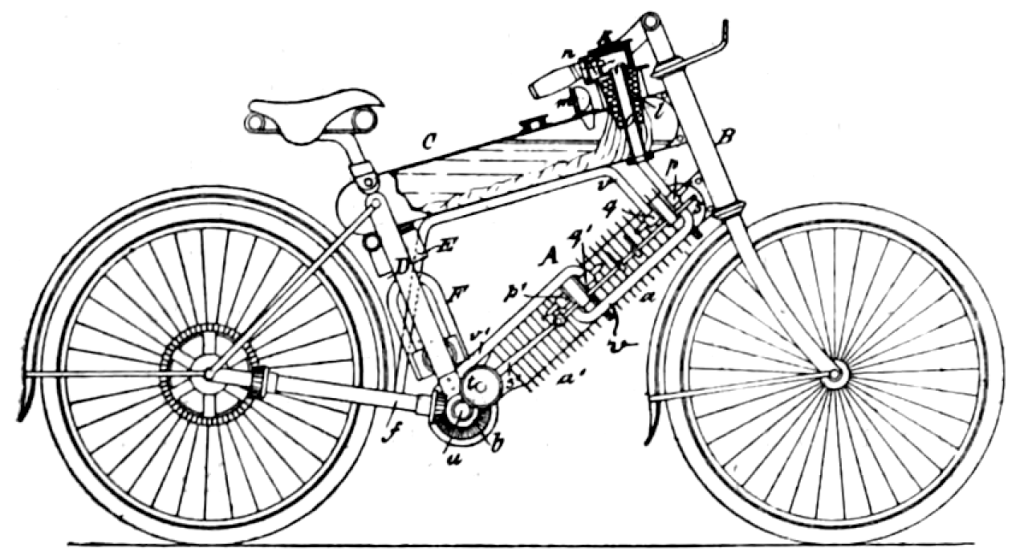
on the other side through an insulated covered conducting wire. In the circuit is a contact device, so that it may be closed or interrupted at the most suitable place by a pressure. This is effected by arranging a contact clamp on the brake lever in order that by a slight pull the current can be interrupted at once, and the lighting will cease immediately. After having filled the benzene receiver and the lubricator, which holds sufficient for about twelve to fifteen hours’ run, the machine, of which the more delicate parts are protected against dust and weather, is ready. To set it in action it is wheeled forward two to three steps, and the motor is in operation. By pushing the cycle along the motor crank is moved by the gear from the back wheel, and the connecting rod is operated, to bring the pistons z z1 from the back dead point to the front dead point. Behind the piston z gas is thus sucked in, and by the then following return of the pistons it is compressed, and lighted at the back dead point by means of an electric spark, caused to form at this moment by means of any suitable lever gear. The then following explosion moves the piston forwards, and the piston z1 then sucks in gas mixture in order to compress it when returning, whilst the piston a drives out the exhaust gases through the escape valve. The exhaust is effected from the crank axle, which operates alternately the escape valves q qi, whilst the two suction valves p pl act automatically. The speed of the machine can be regulated in any manner by the brake lever, and also the motion can be stopped quickly. In the latter case, the stopping of the lighting, the air compression taking place in the motor, and the usual effect of the wheel brake operate together in order to stop the machine at once. August 17th, 1896.”
“IT IS A PITY that the De Dion and Bouton motor tricycle which runs daily round the quadrangle at the Imperial Institute should have its handle-bar adjusted to so low a position. Of course this is only a question of adjustment, but the rider is doubled up in a most ungainly and unnecessary fashion, so that those not in the know naturally think ‘what an ungraceful exhibition of himself a rider makes on a motor tricycle’.”
“IF THE PRESENT position of the motor behind the back wheel is retained on the Pennington-Humber bicycle, it will be necessary to fit an efficient cover to the engine. As it is at present, it is in such a position that all the mud and dust from the back wheel is thrown into and on the motor in such quantities that would result in very serious damage before long if the engine were not properly cased in. This, of course, could easily be done without in any way casing the cylinders.”
“A PARTY OF JOURNALISTS and others visited Coventry on Monday last to view the Daimler Motor Co’s factory, and to have a look at the city which has become the centre of the cycle trade. Later in the day, they were driven into the country, and a little practical demonstration of the capabilities of motor cycles was given for their benefit. Mr Pennington rode a Pennington-Humber motor bicycle. He made no attempt at speed but once, when for about a third of a mile, he opened the eyes of the company considerably by doing about thirty-five miles an hour on a nice clear stretch of the road. Mr H0 Duncan also put the Duncan and Suberbie edition of the Hildebrand & Wölfmuller motor bicycle through its paces, but it must be confessed that for speed, handiness, and appearance it was in no way comparable with the Pennington-Humber. The De Dion and Bouton tricycle also performed in a satisfactory manner, and gave the journalists an impression of stability which was of necessity lacking in the narrow-gauge vehicles. A heavy shower put an untimely end to the demonstration, and demonstrators, journalists, and motor bicycles alike were packed into various conveyances and driven to shelter, the rider of the De Dion tricycle alone having the hardihood to face the elements.”
“FROM THE ACCOUNT of the Continental tour of the Hon Ellis in a Daimler autocar…it will be seen that he covered seventy to eighty miles a day. This shows better than any amount of argument the immense superiority in the way of staying power of the motor vehicle over the horse. We should like to know how many horses and relays of horses would have been required to perform this tour.”
“M MICHELIN LAST WEEK journeyed from Mont Geron to Clermont Ferrand, a distance of 400 kilometres, in nine hours, upon a Bollée petroleum tricycle.”
“THE ARNOLD AUTOCAR which plies up and down the sea front at Margate is widely patronised by the public, who are anxious to see how riding in an autocar feels. The car is not a bad one at all, but it is under-motored, as it appears unable to run uphill unless the passengers get down. Of course, this is not likely to enhance the visitors’ ideas of the coming vehicles.”
“PRINCE ALBERT OF BELGIUM is already an enthusiastic autocarist. Struck by the lightness of a De Dion petroleum tricycle, the prince has ordered one for immediate delivery, and we are told that during the rides which he took in the Daimler Victoria of the Baron de Zuylen he continually urged the Baron to greater speed, saying ,’Marchez vite. J’aime à aller vite.’ This would appear to indicate that whatever regulations may be made for the conduct of autocars in Belgium, no restriction is likely to be placed upon their speed.”
“STEAM FOR THE propulsion of cycles has been definitely abandoned. Some time ago M Dalifol constructed a bicycle which was extremely simple in design, and so far as speed, economy, and safety were concerned it really seemed to meet all the requirements of the mechanical cycle user. It, however, had the fatal drawback of not being sufficiently clean, and frequent stoppages had to be made for a renewal of fuel and water. No one would care to handle coke every ten minutes or so, or to inhale the fumes that escaped from the chimney placed directly under his nose. It was to be feared that after a run of an hour or so the rider would be a living advertisement as to the necessity of using somebody’s universal soap. Nor was it particularly agreeable to place the feet on the top of the furnace, especially in the dog days, and the cat on hot bricks would not be in it with the motor cyclist, who was condemned to roast his feet on what resembled a miniature baked potato can. The steam bicycle has thus gone the way of all other imperfect devices, and M Dalifol is now turning his attention to another type of machine. By the way, I came across a steam bicycle the other evening being pushed along in the Bois de Boulogne, but as it was dusk, no idea could be obtained of its details of construction. The glowing furnace under the cumbrous mass of concealed mechanism gave it a mysterious appearance. Why is it that mechanical bicycles are almost invariably pushed along instead of being ridden? I do not believe
that the two-wheeled motor cycle will ever be made a success.”

“FROM AUGUST 10TH TO AUGUST 15TH: 17,620—FJ Burrell, ‘Improvements in self-propelled vehicles and locomotives.’ 17,625—B Whiteley, ‘Improvements in brakes for cycles, motor cars, and other road vehicles.’ 17,628—T McGovern, ‘A new or improved gear wheel and chain to match to be called the McGovern frictionless chain gear for bicycles, tricycles, motor cars, and all other vehicles where a chain gear is used.’ 17,634—T and 0J Meacock, ‘Improvements relating to driving gear for cycles, auto-cars, and for other purposes.’ 17,666—HF Parshall, ‘Improvements in automatic maximum speed governors for electrically-propelled vehicles.’ 17,667— A Lindigkeit, ‘Improvements in treadle mechanism for driving the steering axles of vehicles.’ 17,703—HE Webb, ‘Improvements in or connected with the propelling of cycles or other wheeled vehicles.’ 17,777—C Gautier and X Wehrle, ‘Improvements in motor carriages, the driving wheels of which are actuated by endless chains.’ 17,800—AG Melhuish, ‘Improved method of, and combination of, appliances for propelling autocars, launches, bicycles, and the like, applicable also to stationary, portable, and traction engines.’ 17,807—J Kennedy, ‘Improvements in driving gear for velocipedes or motor carriages.’ 17,837—S Evans, ‘Improvements relating to motor cars and the like.’ 17,912—T Browett, ‘Improvements in the method of and means for propelling vehicles.’ 17,926—W Reynolds, ‘An improved motor for cycles, vehicles, and vessels.’ 17,974—CA McEvoy, ‘Improvements in apparatus for propelling cycles and other carriages.. 18,051—HP Holt, ‘Improvements in gas or oil motor cars.’ 18,099—HE Brown, ‘The horseless carriage lamp.'”
“AT THE CRYSTAL PALACE last Monday evening, Mrs Driscoll, of Croydon, was knocked down by a motor car, which went over her head. Death quickly ensued, despite the attention of several doctors.”
“MOST OF OUR READERS will have seen, in the daily press, accounts of the sad fatal accident which happened at the Crystal Palace on Monday last. A lady was knocked down by one of the autocars in the grounds and killed. It is not our intention to discuss here who was to blame, as that is a matter which has been, as far as possible, decided at the coroner’s inquest. What we wish to urge in connection with the fatality, is the great necessity for care in driving the new vehicles. It is useless to complain of the reckless carelessness of pedestrians. All drivers of any sort of conveyance are only too well aware of it. We must expect carelessness, and provide for it as far as possible by exercising every reasonable care when driving our autocars. It is not too much to say that at least fifty per cent of the accidents and collisions which occur between carriages and foot passengers may be traced to the simple fact that people only listen where they are going instead of using their eyes as well as their ears before plunging across a road or street. Whenever we hear of an accident we debit the pedestrian with the blame till we have proof that it was the driver’s fault. We leave children out of the question, as it is too much to expect circumspection from young heads, and taking adults in the mass it appears equally futile to imagine they will exercise proper care to avoid vehicles.”
“THE CRYSTAL PALACE ACCIDENT. At Penge, on Tuesday, August 25th, Mr Percy Morrison held the adjourned inquest on the body of Bridget Driscoll, wife of a labourer, of Old Town, Croydon, who was knocked down and killed by a motor car at the Crystal Palace on Monday week. The jury viewed the spot where the fatality occurred and saw the motor car in operation. Ellen Standing, of Forest Hill, said she was riding on the car which knocked the deceased down. There were only two passengers besides the driver. They had been round the terrace once, and were half-way round again when she heard the driver shout, ‘Stand back’, and witness then saw three persons close to the car. She saw the car swerve, and two of the females rushed to the right. Deceased hesitated, and the car struck her and knocked her down. The driver had perfect control over the car. Witness did not notice the car swerve before. She would have known if it did, because when it swerved just before knocking the woman down it was a peculiar sensation. She did not know the driver. She had not seen him before that day. There was nothing to prevent the driver passing the other cars on one side, but they were too near the parapet to permit him to pass on his right side. John Wood, foreman of the labourers at the Crystal Palace, said he saw the accident, and he did not think the car was going more than four miles an hour. Each car had either a bell or a horn to give warning of its approach, and he heard the horns blowing that afternoon. Arthur James Edsell, the driver of the car, was cautioned by the coroner and elected to give evidence. He said his instructions were to drive slowly on busy days. At the time of the accident he thought he was driving about four miles an hour. He saw two women in front of him, the deceased being one of them, and she had her umbrella up. He rang his bell and shouted, but just as he got up to her she seemed bewildered and got into his way and the car knocked her down. The car was working perfectly smoothly on the day of the accident, and he did not turn it out of the straight road at all. By the Coroner: The greatest speed the car could attain was eight miles an hour. He had no instructions as to which side of the road he was to keep, but he always kept the centre, unless the cars were behind one another. The cars were of French manufacture, and the rule of the road in France was ‘Keep to the right’. The witness denied that his car swerved, as deposed to by previous witnesses. When going at the rate of eight miles an hour the car could be stopped in its own length. Mr. Edmund Gascoine, of Maidstone, the English manager of the Anglo-French Motor Car Company, said that when the late Horseless Carriage Exhibition was held at the Crystal Palace, they were invited to exhibit their cars, and they were now at the Palace by arrangement with the company. Witness engaged the drivers. This particular car could not go faster than nine miles an hour on the level. This concluding the evidence, the coroner summed up at considerable length, and the jury, after sitting eight hours, returned a verdict of ‘Accidental death’…As far as we can say it would seem to be one of those sad cases of fatal errors in judgment of distance, as it is otherwise impossible to conceive how the deceased woman could have gone so directly in the track of the car, as the jury have entirely exonerated the driver from blame. Unhappily, such accidents are likely to happen at all times, and the utmost care will not always be an absolute insurance against serious and even fatal consequences. The records of thousands of ordinary street accidents are a lamentable proof of this.”
“FROM M MICHELIN’S EXPERIMENTS, it has been proved that the saving in traction by the use of pneumatic tyres is, roughly speaking, 33⅓%. That is to say, where three horses would be required to draw a certain iron-tyred vehicle, two would suffice if the carriage had pneumatic tyres. This refers to the advantage in reduction of drawing effort alone; the gain in comfort from silence and absence of vibration is incomparably greater.”
“MR CR GARRARD, who…while in Paris, we believe, designed and superintended the construction of the Gladiator motor cycles, is now to be found in Birmingham. He has started in business as a manufacturer of cycle and autocar chains at Ryland Street, and he has a Gladiator motor cycle for his own use. We need hardly say this little machine causes the greatest sensation in his neighbourhood, and he tells us that on a good stretch of road he can easily maintain seventeen to nineteen miles an hour.”
LAST WEEK WE MENTIONED that Mr CR Garrard, of Birmingham, was creating no little sensation with his Gladiator motor tricycle in the Midland hardware city. Since then a somewhat curious accident has happened to his son. It seems he was preparing the tricycle for a run, and in replenishing the battery which works the electric ignition he accidentally upset a carboy of sulphuric acid, badly burning his leg from the knee downwards. Mr. Garrard says this accident shows that where dangerous acids are stored, a large bottle holding a gallon at least of strong soda solution should be kept, with directions prominently displayed to ensure prompt action in case of accident. Young Garrard had accepted an invitation to give a demonstration with the motor tricycle at Kidderminster last Wednesday, but in consequence of this accident which necessitates his lying up for some time his father had to go in his stead. The young fellow has given the Birmingham bicyclists a taste of the speed of the autocar, as we hear that on the Bristol Road the other day a party of fast riders tried to keep up with him, but the untiring pace of the motor tricycle was too much for them, and, to use a cycling expression, they were soon ‘left’.”
“AN AUTOCAR WHICH appeared in the streets of Dublin created great interest, and we hear there was quite a struggle between the journalists of the city to obtain and publish the first interview with the driver of the car.”
“SUBSCRIPTIONS FOR THE autocar race, Paris-Marseilles, are coming in satisfactorily, the principal subscribers being Mr Gordon Bennett (New York Herald) 10,000 francs, Baron de Zuylen de Nyevelt, Count de Dion, Société Automobiles Peugeot, 2,000 francs each.”
“THE FIRST MOTOR TRICYCLE made in England under Le Comte de Dion’s patents, was turned out from the Quinton works of the New Beeston Cycle Co at Coventry last week. A lot of these machines are being put through, and we believe it is only a matter of a very few weeks before a large output will be made.”
“THE MOTOR CAR CLUB AT HURLINGHAM: The expedition of motor carriages from the Imperial Institute to Hurlingham, organised by the Motor Car Club, was in every way a success. Six motor vehicles started from the Institute with the special sanction of the County Council and Commissioner of Police, and travelled by the shortest route to the Hurlingham Polo Grounds. The Commissioner of Police had very kindly detailed special officers at congested corners to regulate the traffic, but the motor carriages worked so satisfactorily that this was quite unnecessary so far as they were concerned. The Daimler motor omnibus, made by Messrs Peugeot, of Paris, containing five persons inside and two on the box, attracted special attention, and ran with most satisfactory speed and quietness, quite outstripping some of the other carriages. Mr Ellis’s well travelled carriage also took part in the procession, and behaved excellently, although, unfortunately, Mr. Ellis himself was, through illness, forbidden to travel in it. Arrived at Burlingham Polo Ground, where an excellent track had been laid out by Capt the Hon D Monson, manager of the club, the party, headed by Mr Lawson, the chairman of the club, were welcomed and entertained at luncheon, after which a special demonstration of the motor carriages and cycles was given. It was admitted on all hands that even the spirited teams of four-in-hands showed no signs of alarm at the motor carriages which threaded their way with the utmost facility amongst the various carriages which lined the route from the club to the entrance, and, in fact, throughout the whole route from Hurlingham to the Institute. It was particularly instructive to observe a gathering of coachmen and footmen, who closely scanned the new-comers, and although they were prepared at first to bestow upon the unaccustomed vehicle that supercilious contempt for which their class is noted, it was manifest that before the trials had proceeded very far they were prepared to admit that the motor carriage was a competitor with which they would have to reckon in the near future. On the return of the procession to the Imperial Institute, Mr. Lawson and the vice-presidents of the Motor Car Club entertained to dinner the members of the Automobile Club of France now in London, amongst the invited guests being the Comte De la Vallette, Monsieur Serpilet, Monsieur Delahaye, Monsieur Vergnes, Monsieur Delmer, and the editor of the journal, La Locomotion Automobile, Paris. At the dinner M Delmer, who spoke in French, whilst claiming for his country the credit of having made immense progress in the industry, sorrowfully admitted that his countrymen quite anticipated that England, when the obstructive legislative restrictions were removed, would overtake and eventually outstrip them in the manufacture of the new vehicle. The members of the Automobile Club afterwards inspected the exhibits, and expressed themselves deeply interested at the very representative and serious display which has been gathered together under the auspices of the Motor Car Club.”

“IT WAS OVER a week that I had been waiting for the Bollée tandem petroleum motor tricycle, the second machine of this build ever made, which was manufactured from the ingenious invention of Leon Bollée at his miniature works at Le Mans, a pretty little town bordering on lovely Brittany, and after having seen the machine almost ‘growing’ each day, everybody was anxious to try it, when finally finished, over the beautiful smooth French roads, where there are no laws to stop the autocars from skimming along at any speed, which absence of laws has given such a ‘fillip’ to French inventive genius as to place them years ahead of English mechanical skill in this particular industry. During my stay at Le Mans I had the opportunity of going out every day for some most interesting spins in company with Camille Bollée, on the identical machine that was invented and made throughout by his brother Leon, and we rode from fifty to sixty miles daily up hill and down dale without the slightest bother or accident at a speed of from sixteen to twenty miles an hour. These splendid rides without any fatigue, under a scorching summer sun, made one enjoy the magnificent scenery, whilst the perfume from the newly-mown hayfields came along on the fresh breeze as the machine swept merrily over the fine roads, which is altogether a new sensation that made one realise he was living to indulge in a new era of comfortable—even lazy—but speedy road locomotion…After several severe trials with the new machine at Le Mans, which tricycle was to serve as model for the British manufacture, I left by train en route to Paris, where I intended to take the 9pm Rapide, which was to convey the machine and myself Londonwards. Arriving at Victoria Station at 5.30am on Sunday morning, I intended to put the machine in the cloak room, knowing the laws forbade my riding a motor-driven cycle over the roads of England, and especially London; however, I was informed that the cloak room only opened at seven o’clock, which meant an hour and a half to wait, but as I was feeling somewhat tired with my journey direct from Le Mans, and not caring to loiter about a lonely station at such an hour, especially on a Sunday morning, an idea came to me to risk the laws, and to light up my Bollée motor tricycle, and drive the machine, with my baggage in the front seat as a partner, to my sister’s. country residence near Slough, situated on the well-known Bath Road. My petroleum tanks were nearly full enough to last me about eighty miles without refilling, and at six am the machine was lit up and everything was in readiness for a start. I had quite made up my mind to be stopped, at least half a dozen times along the road, by the police, as the distance I should have to cover was about twenty-four miles, and I had to pass partly through London. Leaving Victoria station from amidst a crowd of officials and some early excursionists I slowly made my way round the most silent streets and squares until I came out upon the excellent smooth wood paving at High Street, Kensington, from whence I opened my speed to ten miles an hour, and sped gaily, smoking a cigarette as though my situation was a perfectly natural one, through Hammersmith, passing many a policeman, whom I left in a state of simple wonderment, not to say astonishment. Seeing that ten or more of these gentlemen had been passed apparently under the most banal circumstances, I began to think things were all right, and I let out the sixteen miles speed, which drove me splendidly towards Kew, where I passed dozens of cyclists, undoubtedly Ripley bent, or for other Sunday haunts. Several ‘scorchers’ were naturally anxious to take me on, and, therefore, rode alongside my machine for a few miles, until my sixteen miles speed, against a stiff head wind, began to bend them over their safeties, and they gradually dropped off, which amused me considerably, and I felt delighted that after so many years absence from the racing path I was now able to ‘drop the scorchers’ on the road, although by the aid of somewhat unfair modern principles. I did not meet many horses until I struck Brentford, where I slackened speed, as I was rather anxious to see how the English quadrupeds would behave before a motor cycle, and it was certainly a pleasant surprise to pass or meet them without their taking the slightest notice, although a weak ‘puff, puff, puff’ can of course be heard from the motor behind…I am pleased to state the general impression caused was satisfactory, and, on the whose, very favourable; therefore, knowing as we do the present ignorance of the British public regarding the practical autocar movement, it was deeply interesting to me to glean an unbiased public opinion from remarks along a highway near London. It was about a quarter to eight when I reached my destination, much to the surprise of my friends, and the whole village turned out to see the new ‘up-to-date’ petroleum locomotor.”
“IT IS PERHAPS somewhat unusual for the passing of an Act of Parliament to be hailed with festive celebration, but the successful progress through the Legislature of the Locomotives on Highways Bill was observed in a very happy manner on Saturday last at Branbridges, East Peckham, Kent. Here are situated the works of Messrs W Arnold and Sons, a firm who have taken very practical interest in the self-propelled traffic movement. During the afternoon the employees had a cricket match, and subsequently high tea was served at the Rose and Crown Hotel. Mr Walter Arnold presided, and expressed satisfaction that the legislative stumbling block, which had stopped all progress in the direction of self-propelled traffic had now been removed…The day’s proceedings were concluded with a display of fireworks, and it may be added that many took a first ride in a horseless carriage.”
“AFTER A LONG PERIOD of labour the ‘Locomotive on Highways Bill, 1896’ has become an Act, and probably at no period in the history of the English legislature has so liberal a measure been passed; indeed, the President of the Local Government Board cannot be charged with a want of faith in humanity, believing, as he must do, that no abuses will follow the help he has so freely extended to the new movement. For the great freedom given in this measure I feel that I am in a large degree responsible, Mr Chaplin and the officials connected with the Local Government Board and the Home Office having accepted the various points which I advocated in person and in writing, as well as the amendments which were finally adopted in committee on Mr Chaplin’s recommendation, and those which were not opposed by him at that committee. In rendering all the assistance in my power to those who had charge of the Bill during its passage through the Houses of Parliament, and to those whose duty it now is to make regulations in connection with this Act, my hands were immensely strengthened by the support received from so many distinguished and eminent men conversant with the subject—all, like myself, entirely disinterested and unbiased by personal or pecuniary motives. These gentlemen include statesmen, engineers, scientists, and a host of others. My object in requesting the publication of this letter is, on the one hand, to express the gratitude of all those I represent in this movement to the Government, to the permanent officials of the departments concerned, and to all others by whose labours and influence success has been obtained; and on the other, to appeal to everyone interested in the movement, whether as manufacturers or users of motors, to do nothing on their part to abuse the freedom which has now been extended to them. It behoves everyone concerned to act with prudence and consideration; to avoid injury to the roads; to use every possible care not to frighten horses; to store no dangerous liquids thoughtlessly, which might endanger life or property; and to act generally with such discretion that it shall not be said in a year or two hence, another Act must be passed to control those who have shown their inability to control themselves, or misused their privileges. There cannot be the slightest doubt in the mind of any reasonable man that this Act will be productive of great changes, and that if all those who have an interest in modern progress will strive to improve self-propelled traffic, and those who avail themselves of its benefits will act fairly towards others having no direct interest in the movement, it will be giving the English nation an advantage which can hardly be overrated, and without entailing, as I hope and believe, a vestige of discomfort or annoyance on any individual.
David Salomons, President Self-propelled Traffic Association, Offices of the Association, 30, Moorgate Street, London, EC, August 15th, 1896.”
“THE AUTOCAR BILL is now no longer a Bill, but an Act, as it has received the Royal assent. The manner in which this good news was elicited from the powers that be was somewhat amusing. It appears that Mr CM Turrell, of Holborn Viaduct, was staying at Margate, and while there recreated himself by driving an autocar which Mr HJ Lawson had lent him. In consequence he was summoned on Wednesday of last week before the Margate magistrates to answer two charges of driving a motor car in the public streets of Margate at a greater speed than regulated by the Highway Act. Police evidence was given that on July 31st defendant drove his motor-car along the Parade at fourteen miles an hour—a pace dangerous to the public. For the defence it was urged that no case had been made out, as the defendant had only been summoned for driving at more than two miles an hour, and not for furious driving. It was also submitted that before the summons was issued, the new Bill, which allowed motor-cars to run about the country as ordinary carriages at a reasonable speed, had passed into law. A telegram was put in addressed to Mr Turrell from Mr. Chaplin, president of the Local Government Board, to the effect that the Bill had received the Royal assent. Having regard to this fact the magistrates dismissed the summons, and the Chief Constable withdrew the second summons. Almost every paper which has dealt with the above matter has fallen into the somewhat excusable error of imagining that Mr Turrell’s ingenious defence, because it procured the dismissal of the summons against him, was a legal admission that autocars could at once be run with impunity on the road. This is a grave error, as the Locomotives on Highways Act, 1896, does not come into force till three months after the Royal assent; that is to say, on November 14th next. This delay is, we believe, made to allow the Local Government Board the necessary time to make the regulations for the government of autocar traffic on the highway as empowered by the Act.”
“A CORRESPONDENT WRITES US: ‘It is a pity that the Motor Car Club was not called, say, the Autocar Club, as MCC are the initials of the present better known Marylebone Cricket Club.’ There is a good deal in this, and we commend the idea to the attention of Mr Harrington Moore and his committee.”
“WE ARE PLEASED, through the courtesy of Mr EJ Pennington, to be able to illustrate the latest pattern Pennington tricycle, a type of vehicle now being manufactured at the Motor Mills, Coventry. This tricycle differs essentially from anything of the kind before produced, and appears to combine all the qualities desirable for a practical motor vehicle for everyday use…This tricycle is made to carry four persons, and is the lightest motor vehicle ever constructed for such carrying capacity, weighing under two and a half hundredweights. The width and height are such that it can be run through an ordinary door, or stored in a low shed. The motive power is furnished by a two or four-cylinder Pennington oil engine, and the speed cf the vehicle ranges from one to thirty miles an hour…the driving is by means of the centrally-placed back wheel, at the hub of which the power is so applied by one lever that the vehicle can be started or stopped at will, and any desired speed obtained. It is also fitted with two band brakes…A very simple contrivance is used for steering, which is effected from the rear handle-bars…Great ease and comfort are obtained by the use of bicycle spring saddles and owing to the fact of the wheels being fitted with the large diameter non-puncturable Pennington pneumatic tyres. In its completed form mud-guards, wind shields, etc, will be fitted, so as to make it comfortable for use in cold or wet weather. We shall be intensely interested in watching its performances in France if the winner of the forthcoming Paris-Marseilles contest accepts the challenge which Mr. Pennington announces he is going to issue.”
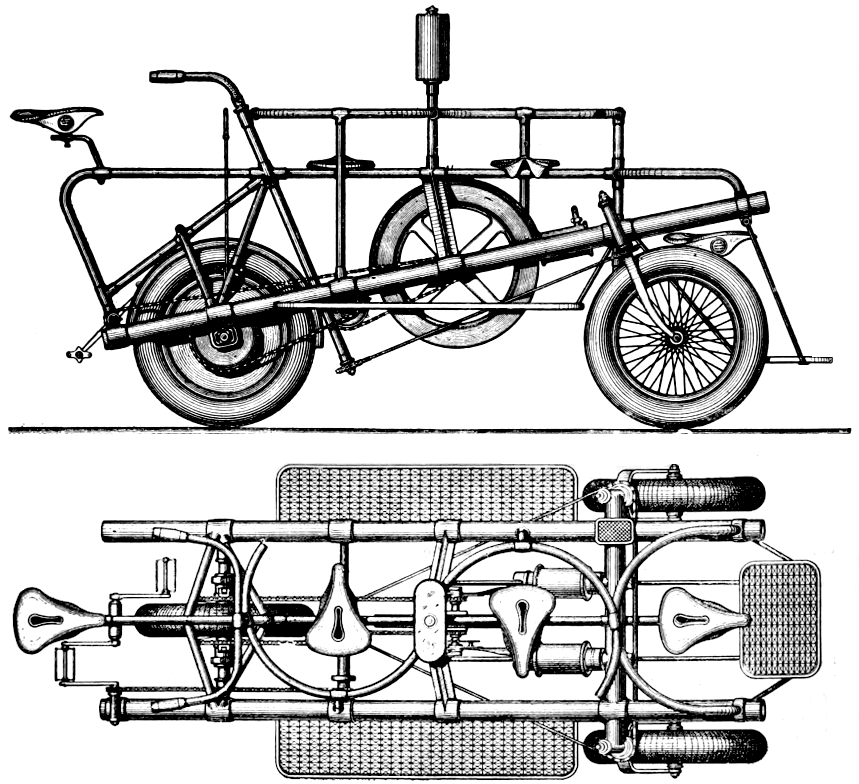
“MOST OF THE daily papers, moved by the Royal assent and by our leader of last week, have published leading articles on the coming vehicle, and we must say that nearly all of them show open-hearted satisfaction that the law which has so long bound autocarists hand and foot has been set aside. To our surprise, we confess, perhaps the narrowest view has been taken by one of the leading British engineering papers…For instance, we are told regarding the clause in the Act which says that no light locomotive shall travel along a public highway at greater speed than fourteen miles an hour. ‘This, for the present at least, is license run mad.’ We must say we fail to see that it is anything of the sort, for no sane driver would…dream of driving at fourteen miles an hour in a street, and if he did so, speed limit or no speed limit, he would be subject to being charged with furious driving, just as though he had been driving a horse-drawn carriage. It appears to us that the unfortunate thing is that a speed limit has been fixed at all, for who can say when it is exceeded, unless it be very grossly exceeded…it must be remembered that the most reckless of the despised amateur autocarists, who are about to make our country roads their playground, have some regard for their own personal safety. An autocar or a motor cycle is not a traction engine, the riders in the autocar are not likely to escape from serious, and perhaps fatal, harm, if they should elect to take a juggernauting tour over her Majesty’s lieges, and their puny carts and horses.”
“FOR OBVIOUS REASONS the lighting of autocars is a matter of the first importance. The self-propelled vehicle travels faster than the ordinary carriage, and the driver is unable to rely upon the instinct of the horse at night time to avoid the obstacles in the road. He can only trust to his own observation, aided by a light which must plainly show up the road twenty or thirty yards ahead. Most of the methods of lighting usually adopted are deficient, though excellent results may be obtained by the aid of oil lamps and reflectors. The best system, however, that has come under my notice is a lamp I saw fixed a day or two ago to a Peugeot carriage. It was an acetylene lamp constructed upon the Serpollet-Letang patent. So far, acetylene gas has only been carried in small volume under pressure, but there is a certain danger in this method of storing the gas. In the lamp under notice the gas is not compressed, but is apparently produced in the ordinary way by the contact of calcium carbide with water. In form it closely resembles the candle lamps usually carried on ordinary vehicles, but the tube for the candle is replaced by a cylindrical receptacle, presumably carrying the materials for the production of the gas. The upper part of the receptacle terminates in a gas burner, and the large glass shade must diffuse the light over a very wide area. If this system be a success, it is difficult to imagine anything to approach it, unless it be the electric light, which, for obvious reasons, is impracticable. Acetylene gas has from four to eight, and in some cases even fifteen, times the illuminating power of ordinary gas, and as the cost of calcium carbide is small, and is being steadily reduced, it is relatively much cheaper than any other form of lighting. The only question that needs to be cleared up is whether the light has sufficient duration. If the gas is produced in the receptacle by calcium carbide and water it is not easy to see how the light will last for a couple of hours at the most, but it is quite possible that the inventors have discovered some means of storage which will permit of the light burning for a longer period.”
“AN ELECTRICAL STARTER.—The idea of using a compressed air reservoir for starting oil or gas engines is not new, for Messrs Crossley Bros and other makers have used such a starter, but instead of compressed air they use compressed gases. Several serious accidents have, 1 believe, happened with these reservoirs, and I think it would be a dangerous thing to employ such a system on an autocar. Besides the danger of explosion, the reservoir would be heavy, and add considerable weight for comparatively little use. Compressed air would be of little use, for although it would start the engine there would be a difficulty in introducing with it the proper mixture of gases to form an explosion. With the same object in view as your correspondent, ie, a self-starting arrangement, I have worked out a system of automatic electrical storage, the power for which is obtained from the engine when running light, and the arrangement is such that at any moment the power stored may be used for starting the engine, or aiding it to overcome a heavy gradient. The plan (which I have protected) is as follows: A small dynamo, say half horse-power, is driven from the flywheel of the petroleum engine, and the current generated is stored in a suitable battery. Whenever the engine is overloaded, and the speed of the engine drops below the normal, the current from the battery returns through the dynamo, making it a motor, and the power transmitted to the flywheel aids the engine to the extent of half horse-power, or for a short period perhaps three-quarter horse-power. The battery used is capable of discharging at a high rate, and the connections are so arranged that the current may be switched off when necessary. With a high discharge considerable power can be obtained for a short time, and in starting the engine, or in helping to overcome a steep hill, the electrical power may be of great use. On the other hand, the current stored in the battery would provide means for firing the engine and lighting the carriage. Such an arrangement as the above would have to be self-starting, and comparatively little electrical power would be required, as the electric motor would only have to start the engine, which it would do in a few seconds. It would obviate the present plan of turning a handle, or pulling over the flywheel. With the electrical starting arrangement, too, it would be the invariable custom of autocarists to stop their oil engine when they wished to alight, and so save the terrible vibration so much objected to when the carriage is standing. It is possible that the electrical power alone would be quite sufficient to drive the carriage along such a thoroughfare as Cheapside, where considerable trouble might be experienced in manipulating the ordinary petroleum carriage at a speed of one mile or less per hour. Where electrical power is not required for starting the engine, or aiding it to climb hills, etc, a very small dynamo weighing only a few pounds can, according to my system, be employed for keeping the small firing battery fully charged. To the tourist such an arrangement ought to be of great value, as the question of charging batteries in some parts of the country would be a somewhat difficult one. When using the small machine an automatic cut in and out is used, so that no return of the current through the machine is possible.
HJ Dowsing, 24, Budge Row, EC.”
“ONE OF THE NEWEST of the designs which Mr EJ Pennington is bringing out at the Motor Mills, Coventry is a remarkably interesting machine, and reminds one of the armoured train of which Rudyard Kipling has written such soul-stirring tales. The machine is driven by a sixteen horse power motor, and carries its two machine guns and four men with 5,000 rounds of ammunition. Seven hundred rounds a minute are fired, and all the marksman has to do is to sight the gun and blaze away, as instead of the crank being turned by hand, as is usual with machine guns, the motor does the work much faster and better, while the speed of firing can be regulated from fifty to seven hundred rounds per minute. The armour is of regulation bullet-proof thickness; in fact, it will stand light artillery fire, and the men while firing are further protected by casemates. The other two shelter below the armour belt, and if one gun only is in action the other gunner also retires behind the Harveyised steel plating. The maximum speed is forty-five miles an hour, so that there is no fear of the machine being unable to follow a fleet-footed enemy, while the damage which a few such engines of war could inflict by making sudden descents on unguarded towns or villages is too awful to contemplate.”
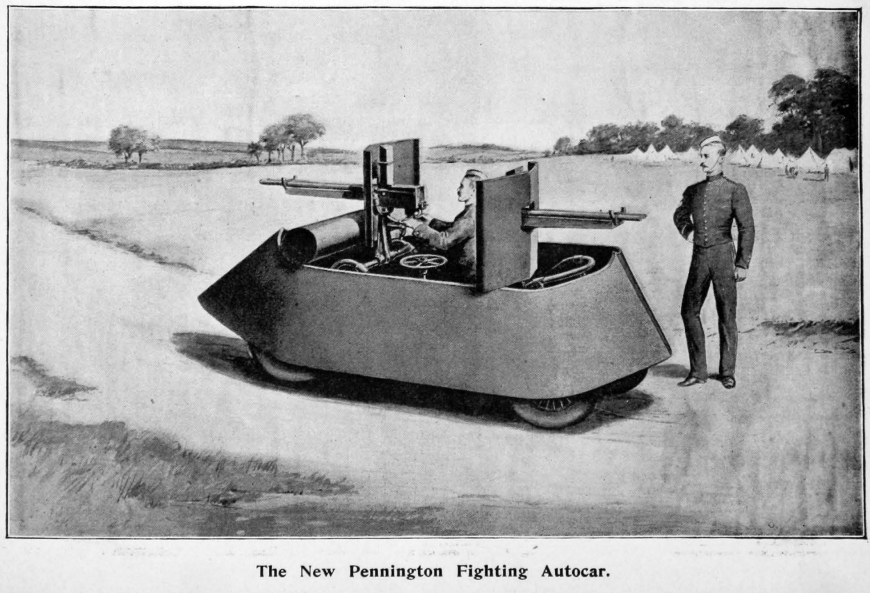
“I NOTICE IN YOUR correspondence of last week a letter from Mr Dowsing re ‘An Electrical Starter’. In reply, I wish to point out that this method of starting explosion engines, whether gas or hydro-carbon, by means of a dynamo and accumulator is not new. I myself made use of it some ten or eleven years ago, and I believe it was employed even before then by Sir William Thompson and others. I gather that Mr Dowsing, when he talks of half hp dynamo and accumulator driving an autocar through ‘such a thoroughfare as Cheapside’ ‘at a speed of one mile or less per hour’, does not speak from practice, as the frequent restartings which would occur would require considerably over that hp (particularly if the incline were against one), and there would be, too, the additional weight of the dynamo and accumulator (from three to four hundred pounds, at the least) added to that of the engine, carriage, and passengers. I speak from experience, as my previous knowledge of electrical starting led me over a year ago to apply it to autocar work. I used an accumulator and dynamo, and, as far as the starting of the engine went, it was of course successful, but owing to the great additional weight it necessitated carrying it was of no practical use, nor will it ever be so till someone devises an accumulator less than one-fourth the weight of the present ones. I have since experimented in another direction, and have devised an electrical starter which weighs under 30lb, and this, I have every reason to believe, will soon be reduced to 20lb or less.
Walter Rowbotham“
“EVERY WEEK SOME autocarist who will not wait till November 14th provides the magistrates of more or less benighted districts with employment and an opportunity of showing their blind devotion to the strict letter of the law. When we come to think of it, it is really remarkable how many of the great unpaid appear void of intelligence, and use law instead of brains.”
“THE CHARGING OF storage batteries for autocars is undertaken by Hunter & Co, electrical engineers, of Eastdown Works, Lewisham, SE. Their facilities are ample for the purpose, they have a full reserve of power, and plenty of room for standing vehicles. We have no doubt this information will prove of use to some of our readers of experimental tastes who live within call of Lewisham.”
“THOSE WHO PROPHESY evil things because auto-cars will be permitted by the Act to run at a maximum speed of fourteen miles per hour under suitable conditions should remember that in France, where there is no speed limit, and where a large amount of experimenting with very crude vehicles indeed has been indulged in, scarcely an accident worth chronicling has happened. In fact, the only serious mishap in which an autocar has figured prominently was caused by a horse.”
“WE UNDERSTAND THAT, in common with many others, the authorities of the Motor Car Club, in projecting their procession of autocars to celebrate the passing of the ‘Magna Charta’ of light locomotive road traffic, overlooked. the fact that the Act did not come into force till three months after the Royal assent. A procession of autocars being out of the question till November, the idea, in the fertile brains of the Motor Car Club organisers, has developed into a proposal to celebrate the emancipation of autocarists by arranging a tour of autocars and motor-cycles from London to Brighton and back for Saturday, November 14th. Knowing Mr Lawson’s enterprise, we do not need to he told that if this idea is carried out nothing in the way of liberality and enterprise will be wanting on the part of the Motor Car Club to make this, the first legalised expedition of autocars in Great Britain, an entire success.”
“AT THE BIRMINGHAM Charity Sports, which were held the other day at the County Grounds at Edgbaston, during the interval, Mr CR Garrard took the Gladiator motor tricycle round the track. He went quietly sailing round, to the great delight of the crowd, at a thirteen miles an hour gait, on the grass track. During the third lap, however, he astonished everyone by lifting one of the side wheels high in the air, and running the motor tricycle the whole lap on two wheels, though, unfortunately, there was not sufficient light to obtain good snap shots. He did another lap alternately on one wheel and then on the other, to show that the motor tricycle, in the hands of an expert bicyclist, cannot possibly be tipped over, save by gross carelessness.”
“AUTOCARS AND CYCLES are getting about the metropolitan district. A petroleum-driven cycle was being driven up the Strand the other afternoon, being very well managed in the thickest traffic. At Catford, too, an autocar has been spinning on the roads lately, and is generally followed by a crowd of bicyclists.”
“WE HAVE MORE than once remarked on the peculiarity of some German inventions which have passed through the English Patent Office. One of the latest is by no means the least peculiar. A platform is mounted on three wheels, two side drivers, and a central steerer. On the platform, a kind of throne is erected, on which the passengers sit. This throne is connected with long Archimedean screws, and the weight of the riders causes the seat to descend; in so doing it revolves the Archimedean screws, which in their turn drive the axle by suitable gearing. What the passengers do when they have ‘sat’ their throne down to the base of its Archimedean screws we are not told, but apparently they are expected to dismount on to the rigid platform, lift their seats up to the top of their traverse, then climb in again and gravitate their machine along a little further. It seems hard to believe that any man, even the most unmechanical, would invent and patent such an apparent absurdity.”
“THE RESULTS OF the Paris-Mantes motor cycle race are most instructive. They show plainly that the motor cycle as contrasted with the autocar is by no means a roadworthy vehicle as it stands. This is a state of affairs which must be rectified at once, as the motor cycle, or perhaps we should say a combination vehicle partaking of the qualities of the light cycle and more stable autocar, will, we believe, be the most popular farm of horseless carriage, at any rate in the immediate future. This being so. it is imperative that motor cycles should be built and fitted in such manner as to enable their users to ride through mud and rain without personal discomfort, stoppage of or damage to their vehicle and its propelling machinery. From our report of the race it will be seen that not all of these provisions were filled by any one of the motor cycles which took part in the contest. Some of the machines suffered from defects in design that were at once apparent to any engineer, even when considered merely as fair weather playthings, but as soon as the elements became unpropitious and the roads heavy and wet, all the competing cycles behaved like so many toys, and showed themselves unfit for practical everyday use.”
“IT WAS A SENSIBLE and enterprising action, quite beyond what frequently happens with Government departments, for the Board of Trade to send Major Tulloch to Paris to make himself practically acquainted with motor-car traffic before setting itself to the task of preparing a set of rules for its regulation in this country. Our friends of the Automobile Club have, we understand, made the major’s visit a pleasant one, and have pretty conclusively shown him how safely and with what certainty a properly-constructed autocar can be handled; and, if the major makes any deductions, it can only be that autocars are very much more reliable and safe to handle than the average horse-drawn vehicle. If this is so, then we may expect from the Board of Trade a set of rules which will be a model of open-minded fairness on the question. We look forward to the publication of the regulations with interest, and, so far as we can see, all that autocarists want, and all that is needed, is that autocars and horse-drawn vehicles should be placed on precisely the same footing.”
“LAST WEEK WE had a trial run on the Pennington tricycle for four…At first some trials were made on the Coventry bicycle track and speeds between fifteen and twenty miles per hour were easily attained and maintained with four men up. Afterwards the machine was taken on some muddy ground at the side of the track, and started in the heavy soil with nine riders up. Having satisfied himself as to the power of his motor, Mr Pennington took his tricycle up the Warwick Road for four or five miles. We tried it, and found it to run well, sweetly, and safely. The steering and management were most easy, and the large pneumatic tyres absorbed all shocks from the road. While the trial of the tricycle was in progress several novices at motor bicycling had their first rides on the Pennington motor bicycle, and so easy was it of management that all acquitted themselves well and rode and manipulated the machine successfully.”
“THE DION PETROLEUM TRICYCLE. As the race from Paris to Mantes and back was an official trial, and was intended to show the exact place which the motor cycles ought to occupy in the autocar movement, their poor performance over the wet and muddy roads led people to the conclusion that the petroleum-driven tricycles were, at the best, merely fair weather machines. So far as the Dion tricycles are concerned, however, this opinion has had to be appreciably modified as the result of the much longer, though by no means harder, race between Paris and Marseilles. It is true that the excellent performance of the petroleum tricycles could never have been accomplished without the aid of manual labour, but all the same it is proved that the motor, assisted by the pedals, gives much better results than the pedals could accomplish alone. It was found, again, that the bad weather is a serious hindrance to the progress of the motor cycle, and in the face of a strong headwind the riders had to work almost continually, while one unfortunate competitor was obliged to push his heavy machine for fifteen kilometres, through his supply of petroleum spirit giving out. Notwithstanding these drawbacks, the fact remains that a tricycle was leading at the end of the first half of the journey, and it is very probable that the strong headwind was solely responsible for the loss of ground on the return journey. The excellent work done by the tricycles has brought these machines very prominently to the fore in France, where the makers have all they can do to satisfy the orders that are coming to hand. The bicycle herewith illustrated differs little from the ordinary types of machine. The tubes are larger and stronger, and the width between the back wheels is increased to give the necessary stability to a machine propelled by a petroleum motor. For the same reason the saddle is placed as low as possible consistent with comfortable riding. In the newer tricycles the head and front forks are built up with four light tubes, and the frame is strengthened at the points of junction with clamps and bolts. The small petroleum motor is bolted on to the rear axle. It is contained in an aluminium case which serves at the same time as an oil bath, so that no trouble whatever is experienced with the lubricating. The cylinder is flanged on the outside to offer a large surface to the air, so that there is no necessity for carrying a supply of water for cooling purposes. The gearing consists of two cog wheels, of which the larger one, acting directly on the axle, serves as a reducing gear. The gearing is held in position by a single bolt D, so that in the event of an accident occurring to the motor, or if the supply of petroleum spirit should give out, it may be disconnected, and the tricycle propelled by the pedals. The axle is a solid steel bar running parallel to the tube carrying the mechanism. The force of the motor is half horse-power, though turning at 1,400 revolutions it will develop one horse-power. The weight of the mechanism is about 40lb. The gas mixture is exploded by electricity, which is furnished by an accumulator F slung to the top bar, and the firing is timed by means of a cam with so much certainty that premature explosions are claimed to be practically impossible. The rate of the explosion, and consequently the speed of the tricycle, can be altered by the rod H, which is placed under the hand of the driver. The carburator I has a capacity of about three quarts of petroleum spirit, and carries two taps, which are operated by the levers J and K, the former regulating the mixture of gas and air, and the latter regulating the admission of the explosive mixture into the motor. The carburator, in which the temperature constantly has a tendency to decrease, is warmed by a part of the exhaust, and the rest of the burnt gases is turned into the receptacle L prior to their final escape into the air, so that the noise from this cause is almost entirely suppressed. To start the machine the rod H is put at the low speed register, and the tricycle is started by means of the pedals. As soon as the machine is started, the tap E is closed, the taps of carburator meanwhile being opened. When an explosion takes place the pedals become disengaged, and all that is then to be done is to regulate the mixture by the lever J, vary the admission of the gas and air into the motor by the lever K, and arrange the electric firing in proportion to the amount of gas admitted. The amount of petroleum spirit carried in the carburator will permit of the tricycle running from forty-five to sixty miles. On the level the machine will travel at from twelve to twenty miles an hour, and with the pedals will take gradients of one in ten, and even more. Messrs de Dion and Bouton are now carrying on experiments with a new horizontal petroleum motor, and they are about to create several new types of light vehicles, including a quadricycle. It is gratifying to find that these pioneers of the autocar are meeting with so much success with a class of vehicle which they were the first to place on the market.”
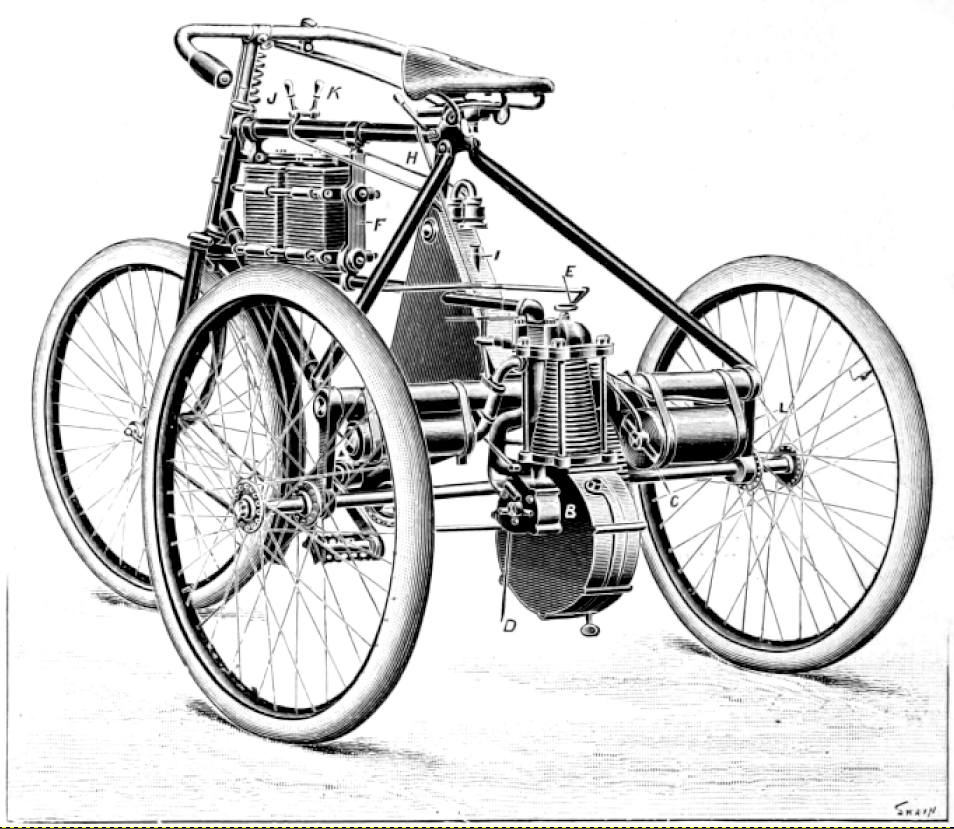
“THE NUMBER OF VEHICLES capable of finishing the long and arduous [Paris-Marseilles-Paris] race was so much greater than had been deemed possible, that the enthusiasm in Paris grew considerably as the autocars neared the end of their journey. After the experience of the first four days, when each run saw the thinning out of the vehicles, there were not wanting people to predict that not a solitary autocar would be able to reach Paris, but when it was found that nearly the full complement of competitors leaving Marseilles were returning, those pessimists who had foretold disaster against their will were only too delighted that their predictions had utterly failed. It was expected that the first autocars would arrive at the Porte Maillot at about eleven o’clock on Saturday, and by that time there was a large crowd of people, so large, indeed, that it was necessary to employ the police to keep the road clear for the vehicles. Along the side of the avenue were all shapes and sizes of private autocars, and at one moment we counted close on thirty of them. In fact, there was nothing else but bicycles, petroleum tricycles, and autocars, and already we had a glimpse of the time when the ordinary horse carriage would be conspicuous by its absence. Decidedly the autocar is making marvellous progress. Soon after midday the first competitor arrived. This was the No. 51 tricycle, which was accompanied by a large number of cyclists, and the public enthusiastically cheered the rider as he got down at the control at the restaurant Gillet. Both he and his machine were in good condition, but they were almost unrecognisable under the dust Hardly had the No 51 been conveyed into the grounds of the control than the No 13 tricycle appeared, followed almost immediately by the No 8 Panhard et Levassor. The riders were almost smothered in dust and flowers, the latter having been showered at them by their admirer…But where was the winner, the No 6? A telegram announced that it had been stopped beyond Versailles through a slight accident to the steering gear, and thirty-five minutes were lost in effecting repairs. This vehicle, however, had so great an advance on the others that its victory was in little doubt. The No. 39 Bollée tandem then appeared running at a great rate along the avenue, and then came a Delahaye and two Peugeot carriages, and eventually the No 6 Panhard et Levassor, the crowd meanwhile cheering each arrival as the riders waved their hats and jumped off the vehicles, evidently delighted at having come to the end of their trials…The full times in covering the 1,728 kilometres—about 1,089 miles—from Paris to Marseilles and back, are as follow: No 6, Panhard et Levassor, 67hr 42min 58sec; No 8, Panhard et Levassor, 68hr 1min 5sec; 13, Dion tricycle, 71hr 1min 0sec; 5, Panhard et Levassor, 71hr 23hr 22sec; 51, Dion tricycle (entered by Michelin), 73hr 30min 12sec; 46, Peugeot, 75hr 26min 24sec; 41, Delahaye 75hr 29min 48sec; 44, Peugeot, 81hr 23min 51sec; 15, Dion tricycle, 83hr 6min 16sec; 42, Delahaye, 84hr 27min 5sec; 29, Maison Parisienne, 100hr 41min 37sec; 30, Maison Parisienne, 108hr 39min 48sec; 26, Landry and Beyroux, 137hr 11min 17sec. This represents an average speed for the winner of 25 kilometres 525 metres, or about sixteen miles an hour. In the classification the autocars have been divided into two classes—class A for the carriages and class B for the motor cycles. The former has been subdivided into two sections, one for vehicles with two to four places, and the other for cars with more than four places. In the first sub-section of class A the prizes are accorded as follows: lst, No 6, Panhard et Levassor; 2nd, No 8, Panhard et Levassor; 3rd, No 5, Panhard et Levassor; 4th, No 41, Delahaye; 5th, No 44, Peugeot; 6th, No 42, Delahaye; 7th, No 29, Maison Parisienne; 8th, No 30, Maison Parisienne; 9th, No 26, Landry and Beyroux. In the second sub-section only one vehicle qualified, and the first prize went to No. 46, of Peugeot at Cie. In the motor cycle class the prizes are distributed as follow: 1st, No 13, Dion tricycle; 2nd, No 51, Dion tricycle (entered by Michelin); 3rd, No 15, Dion. Now that the vehicles have returned from their long run the question is naturally asked whether the great Paris-Marseilles race is a success, whether the carriages have accomplished all that was expected of them, and what are the lessons to be learned from the trials. As to its success, there is no one who can fail to reply in the affirmative. Had the weather been fine and more favourable to a race of this description, there is not the slightest doubt but that a much larger number of vehicles would have completed the whole distance, and that the time occupied in doing so would have been greatly reduced. As it was, the weather during the first part of the race was most deplorable, and it speaks well for the progress of autocar construction that so many vehicles should have successfully gone through the ordeal. By far the majority of the carriages that were put out of the race succumbed through causes entirely independent of their mechanism. The trees and other obstacles scattered over the roads by the storm brought several of the autocars to an untimely end. And then the competitors were much impeded by the stray dogs and other animals that insisted on taking too close an interest in the vehicles. The dogs especially have to be educated up to an understanding of the autocar. Apparently the sight of the vehicles rushing along at the rate of twenty-five miles an hour conveys to these quadrupeds the impression that it is running away, and they are seized with an insane desire to get under the wheels and stop it. Thus, the race has been fatal to the dogs, of whom at least fifteen are known to have lost their lives in this way. The ‘friend of man’ has been anything but a friend to the autocar, as H Levassor can tell us. He was leading by a full two hours when he was overturned by a dog, and he has not entirely recovered from the shock yet. And then the bulls were anxious to put their horns into the spokes of the autocars. One of them smashed the Bollée vehicle, and another broke up the Rochet and Schneider carriage. Of course, the progress of the autocar generally cannot be stopped by a cow, even if individual ones are, and, as George Stephenson expressed it under similar circumstances when the danger of his locomotive for the beasts was pointed out to him, ‘It’s bad for the coo.’ Notwithstanding the extraordinary difficulties that had to be met with during the race the number of vehicles to go right through to the end was larger than even the most sanguine could have anticipated. Out of the fifty-two carriages engaged in the race thirty-two started from Versailles, and on the first day this number was reduced to twenty-seven. The second day the storm played such havoc with the carriages that only seventeen were able to reach Dijon, thus leaving no fewer than ten on the road. The third day two more succumbed, and on the fourth yet another two, so that only thirteen reached Marseilles, though some of the stranded vehicles had in the meantime been repaired, and were continuing the journey, evidently in the hope that if the same proportion of casualties were maintained they would have a chance of showing up well at the finish. On the return journey twelve were timed as reaching Avignon, ten at Lyons, and nine at Dijon, and this number really represents the strength of the finishing vehicles. As some of the leaders thus dropped out of the race, those who were a long way behind crept up a point or two, with the result that thirteen autocars were timed as reaching Paris. All things considered, the proportion is much better than could have been expected, and if only the first seven accomplished really good performances, it must yet be admitted that the others have gone through the race with fair credit.”

“A CIRCULAR DEALING with the Locomotives on Highways Act, 1876, has been issued by the Local Government Board to the various bodies which would in any way have control of horseless carriage traffic, and has submitted to these bodies draft regulations for them to consider or otherwise, so that the most complete set may be drawn up for the governance of the traffic…the definition ‘horse’ includes any beast of burden, just as ‘carriage’ includes all vehicles. ‘Light locomotive’ is to mean a locomotive which emits no smoke or visible vapour, except under temporary, and from an accidental cause. The same expression applies only to a vehicle of less weight than three tons unladen…such a locomotive must be capable of being driven forward and backward, and it must not exceed seven and a half feet in width—between extreme projecting points. For locomotives under a ton the width of the tyre of each wheel is to be not less than two and a half inches…No bosses or protuberances may arise from the tyre, which must be smooth, but if the tyre be a pneumatic or soft one, bosses of the same or a soft material are permitted. Two independent brakes must be provided, so that on an ordinary road, when going at fourteen miles an hour, the loco-motive can be stopped within fifty feet…A competent person must be in charge. The lamp, which is to be always lit an hour after sunset till an hour before sunrise, must show a white light in the direction of travel, and a red light in the rear—the lamp, to be on the right or off side, and free of all obstructions…the person in charge of the light locomotive…must not quit it nor lose control of it, nor allow it to stand in a highway so as to be an obstruction. He is to follow the rule of the road in meeting and passing. When drawn up the locomotive and its carriage must be on the near side of the road, so as to permit the free passage of other vehicles. He may not drive the engine furiously to the danger of life and limb, and he must, by sounding a bell or other instrument, give signal of his approach. If a restive horse, or other occasion, calls for it, he must stop at the request of a police constable, or any other person lifting up his hand, and the locomotive must be kept stationary as long as this may be reasonably necessary…the person driving shall, on any reasonable request, give the name of the owner and his abode.”
“AFTER LOOKING CAREFULLY through them, and considering them in detail, we have to congratulate the LGB broadly upon a very excellent set of regulations, to the majority of which even the hypercritical can scarcely take exception. There are, however, clauses which we sincerely hope the LGB will see its way to amend, more particularly that one which requires that an autocar shall not be left unattended. Doubtless this is put forward with the best intentions for the safety of the public, but we respectfully submit with scarcely a full understanding of the construction of autocars. With a horse, very naturally, unless the animal is of very poor description, it is necessary that someone should always be in charge, lest the animal should take fright at some passing object, or elect to move forward of its own sweet will. With autocars there are, of course, no eccentric animals to be reckoned with, and the starting of the machines, whether propelled by petroleum, electricity, or steam, is of a mechanical character with absolute and certain movements throughout. In all autocars irrespective of the power by which they are propelled, must be a lever or handle, which when moved into one position puts the machinery in connection with the motor or starts the engine, and when in another position takes it out of gear, and nothing but the alteration of the position of this lever can then cause the machine to advance. Very possibly the Local Government Board recognised this fact, but had in view the possibility of some unauthorised individual tampering with the machine and pulling about the different handles and levers attached to the unattended autocar out of mere mischief or curiosity. Yet a little consideration will show that even this case can be met by a less inconvenient regulation.”
“MR W MILLS, OF the Atlas Works, Sunderland, has received an order from a Coventry firm for several hundreds of sets of castings in his special aluminium alloy, to be used in the construction of motor cycles. It is claimed for Mr Mills’s speciality that it is admirably adapted for use in the manufacture of motor cycles, motor cars, etc. The inventor has done much towards bringing aluminium into more general use, and as a result of his efforts the weekly output from his works of castings in this metal has reached a point considerably in excess of that attained by any other manufacturer.”
“A PARTY CONSISTING OF Messrs JS Critchley, AJ Drake, ER Sewell, and JP Clear, officials of the Daimler Motor Co, on Sunday last left Coventry for a trip to Banbury and back upon one of their improved autocars, which are now being built in this country at their new and extensive works at Coventry. They left the city of the three spires at eleven o’clock by way of High Street, and passing through Ryton-on-Dunsmore, on the London Road, the first stop was made at Dunchurch, eleven miles from the city, a distance which was covered in forty minutes. After a stay of half an hour, the journey was resumed at 12.10 through Daventry to Banbury, passing through Byfield and many picturesque villages on the way, arriving at Banbury at two o’clock, a distance of thirty-five miles. The roads between Coventry and Dunchurch being comparatively level the whole distance, an average speed of fifteen miles an hour was maintained; between Dunchurch and Banbury the roads were hilly and rough, with one or two very steep hills to ascend. Crowds of people assembled to witness the departure from Dunchurch, and as it was the first autocar to visit that quaintly picturesque old place, the villagers gazed with surprise at the horseless vehicle. It was very amusing to see the dwellers of the countryside dart out of their doors to catch a glimpse of the new carriage bowling along the roads without any visible means of propulsion. Children were snatched up into their mothers’ arms, women ran down to their garden gates, wondering what next this inventive age would bring forth. The way the men rushed out of the public-houses to see the car was amusing, and it will doubtless be the talk for weeks to come as to how so and so saw the first autocar in their village. The appearance of the Daimler car in the streets of Banbury created quite as great a stir among its peaceful inhabitants, throngs of people gathering to see the first horseless carriage in their town, and it found great favour with all. The return journey was resumed at five o’clock, by way of Mollington, Southam, and Marton to Leamington, where a stop of forty-five minutes for refreshments was made. Leamington was left behind at seven o’clock, and passing through Kenilworth, Coventry was reached at 7.40, the last nine miles being covered during the twilight in forty minutes. In Coventry, crowds of people lined the roadsides to witness their arrival, anxious to get a glimpse of the first English-made Daimler motor in their city. The Coventry crowd is, of course, a comparatively educated one so far as autocars are concerned, as they have had quite a number of different makes through the city, but their interest in the vehicles seems none the less for that. Thus a journey of upwards of eighty miles was completed, and not a single hitch of any description occurred to either the machinery or the car. A very little vibration was felt while standing, but this was reduced to absolutely nothing during the running, and altogether a more enjoyable and interesting day could not have been wished for, the roads being in excellent condition, as they generally are in Warwickshire. The maximum speed attained downhill was thirty miles and the minimum uphill four miles an hour. Although many steep hills were met with, the motor ascended all with the greatest ease. The amount of oil used during the day was three and a half gallons.”
“THE OPINION IS very generally expressed that the tax on autocars is excessive. We do not mean among autocarists themselves, as they might be deemed prejudiced in their own favour, but we refer to people who are by no means enthusiasts in the autocar movement.”
TO-DAY, NOVEMBER I4TH, 1896, is a red-letter day, not only in the history of automobilism, but in that of England itself, for it marks the throwing open of the highways and byeways of our beautiful country to those who elect to travel thereupon in carriages propelled by motors, instead of in horse-drawn vehicles or upon bicycles…To-day marks the dividing line between the old and the new, and the meet of the Motor Car Club at the Hotel Metropole, and the ride thence to Brighton being the first legalised public appearance of autocars upon British highways, should form a fitting, impressive, and practical commencement of the new era, which is undoubtedly destined to work so great and beneficial a revolution in the life, habits, and methods of locomotion of the people of this country…To-day the users of the autocar enjoy the free rights of British citizenship, restricted in such points only as are necessary for the comfort and safety of other liege subjects of the Queen, whilst those same policemen and officious officials who were yesterday empowered to hale us before the magistrates for infraction of the law now join in applauding the progress of the pioneers of the new progression. Yesterday the proverbially blind eyes of Justice refused to see anything but an ugly, unwieldy, smoking, puffing, traction road engine when an autocar passed by, whilst to-day, with the bandage removed, that good lady recognises in the same vehicle a light, handy carriage, travelling anywhere with the ease and facility of a cycle, with but little noise, no smoke, and a minimum of other objectionable features. Yesterday, too, five miles an hour was ‘furious driving’, whilst to-day the law says nothing if fourteen is not exceeded. Could ever contrast be greater? Surely to-day should be a day of true rejoicing, and the hearts of autocarists be glad in the land.”
WITH THE REPEAL of the Locomotion Act the British speed limit was raised from 2mph in towns and 4mph in the country to a breathtaking 12mph. On 14 November this was marked by the Emancipation Run from the Hotel Metropole in Whitehall to its namesake in Brighton. Lord Winchelsea symbolically ripped a red flag in two at the start. A De Dion-engined Beeston trike assembled in Austria (to avoid local import duty) was the only British trike to complete the run (three Bollée trikes were specially imported from France for the event). Two Beestons were subsequently sent to Sandringham where one was ridden by the Duke of York, later George V. A Monsieur Lormont entered a steam-powered bike as the Dalifol, and therby hangs a tale. He worked for the Hildebrand brothers who were busy with the Hildebrand & Wolfmüller petrol-powered motor cycle, and his steamer was actually the Hildebrand steamer (which you might have read about in 1889). The Dalifol/Hidebrand failed to make it all the way to Brighton and was abandoned at Southern Railways’ Newhaven depot, and there it stayed for the next 44 years. In 1940, finally accepting that M Lormont wasn’t coming back, the railwaymen donated the steamer to the Science Museum of London. It was exhibited as ‘the Brighton Steamer’ until 1956 when Heinrich L Hildebrand, son of Heinrich Hildebrand, identified it as the prototype built in 1889 by his father and uncle. Charles Jarrott, who was on the run, recalled: “The effect of the run on the public was curious. They had come to believe that on that identical day a great revolution was going to take place. Horses were to be superseded forthwith, and only the marvellous motor vehicles about which they had read so much in the papers for months previously would be seen upon the road. No one seemed to be very clear as to how this extraordinary change was to take place suddenly; nevertheless, there was the idea that the change was to be a rapid one. But after the procession to Brighton everybody, including even horse dealers and saddlers, relapsed into placid contentment, and felt secure that the good old-fashioned animal used by our forefathers was in no danger of being displaced. It was, however, the beginning of the movement, and the start in England of the great modern era of mechanical traction on the road.”
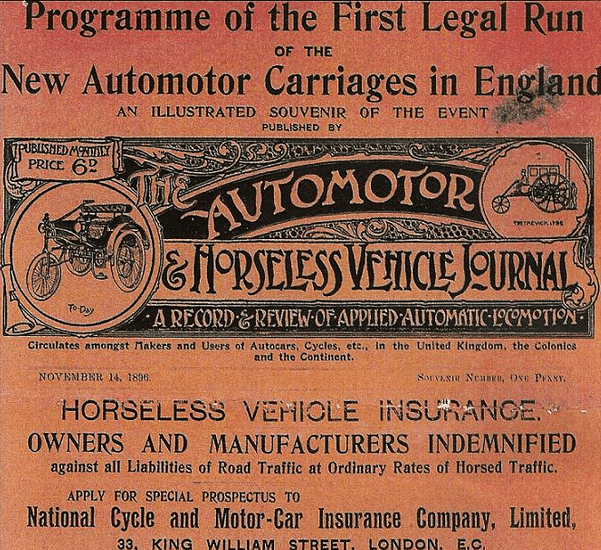
The Autocar devoted an entire issue to the great day. For your delectation here’s a blow-by-blow report, collated from the contemporary accounts.

“THE COMMITTEE OF the Motor Car Club decided to celebrate the coming into force of the Act giving autocarists the free use of the roads in this country by a tour en masse from London to Brighton. Great preparations had been made for the event, and the Central Hall in Holborn had been taken by the club for the purpose of a store-house in which the machines coming from the Continent and the country could be safely housed upon their arrival in London. Here over a score were to be found on Friday evening, and some enthusiasts were so eager to feel their new fledged wings that as soon as the chimes of midnight had passed, and October 14th had legally commenced, they took their cars out for a spin along the almost silent streets. After two or three days of really beautiful weather, the morning of Saturday, the 14th, opened most inauspiciously. Throughout the night a good deal of rain had fallen, and everything was damp, dreary, and dull, with a fog of considerable proportions thrown in…the only comfortable reflection for the autocarists was that it might have been worse. As we drove past the Central Hall on our way to the rendezvous—the Hotel Metropole—we found a keenly curious crowd collected, and at the moment the passing traffic was stopped, and out dashed Messieurs Leon and Amedée Bollée, each upon a racing car with passengers in front, and rattled away before us up Holborn, amidst the remarks—favourable and otherwise—of the surrounding jarveys. ‘They won’t frighten them, ejaculated a bus’ driver, as the
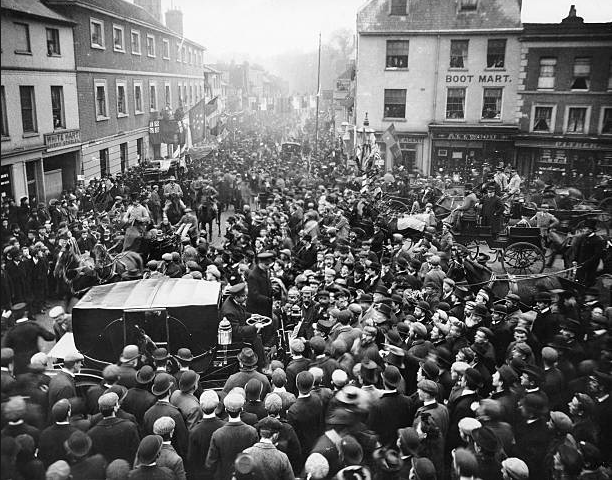
machines flew by his steeds without giving him any cause for alarm. The initial proceedings of the day were commenced by a recherché luncheon in the Great Banqueting Hall of the hotel. Here some 150 guests sat down, under the presidency of the Earl of Winchilsea. There were many notables present, both of English society and of the English and French automobile worlds. During the course of the repast, a message was brought that Prince Edward of Saxe-Weimar, who with his brother were occupying an upper room to view the start of the procession, understanding that Mr Gottlieb Daimler was present, desired an interview. Before the conclusion of the meal, Mr Bertram B Van Praagh, one of the vice-presidents of the club, made a brief statement of the object of the ride, and the noble Chairman, in a few fitting words, expressed the thankfulness of autocarists at their liberty, and signalised the fact by the significant action of formally tearing up a red flag such as that which until that day had been by law required to be carried in front of the car. The members then made the best of their way to points of vantage to witness the start, those who were to take part in the tour seating themselves in their carriages, getting their motors going, and waiting for the signal. By this time it was apparent that the interest of Londoners in the function was of no ordinary character…When Mr HJ Lawson and his fellow members of the Motor Car Club resolved that the day which saw the legal bonds of the autocar riven asunder, and the shackles that bound the road vehicle of the future struck from it with the parliamentary hammer should also see some fit celebration of the occasion, even the most optimistic among them could never have bargained that it should approach a people’s holiday—for such it undoubtedly proved to be. The huge and unwieldy crowd of decent and interested spectators who gathered about the Hotel Metropole, in Northumberland Avenue…estimated to number upward of half a million…The crowds not only lined the pavements, but filled the roads within a
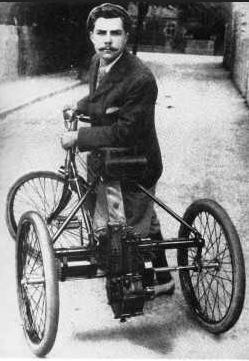
foot or so of the autocar wheels; in fact, we have never before seen such an immense crowd. At the last minute, with the utmost amount of exertion on behalf of the police, a foreign gentleman, with a motor bicycle of a new design to us, was literally dragged through the crowd, and took his place in the line…Within five minutes of the advertised time, Mr Lawson, in the pilot car, gave the signal to proceed, and the half-score of mounted police, backing their horses on to the crowd, had the utmost difficulty in clearing a sufficiently wide roadway for the cavalcade to progress. However, at last a start was made, including Mr Pennington…thirty-three vehicles out of the fifty-eight which had been entered getting under weigh [the first ten being] the Panhard and Levassor Daimler carriage, which won the Paris-Bordeaux race of last year, containing Mr Harry J Lawson, president of the Motor Car Club, and Mr Meyer, of the Daimler Co; the Daimler barouche, which took part in the Lord Mayor’s show, with Mr FR Simms and Mr Van Toll in charge, and containing Mr Gottlieb Daimler and other passengers; the Panhard and Levassor Daimler carriage, which won the Paris-Marseilles race this year, carrying a party of Parisian automobilists; Daimler dogcart, belonging to and steered by the Hon Evelyn Ellis, with The Graphic artist as passenger; three Bollée tandem motor cycles, steered respectively by MM Leon and Amedée Bollée and H0 Duncan; New Beeston (De Dion system) motor tricycle ridden by Mr S Gorton; Daimler char-à-banc, with canopy and a load of pressmen; Daimler parcels van, belonging to Peter Robinson, carrying parcels for delivery to customers in Brighton…The route lay over the Embankment, across Westminster Bridge, and on through Brixton to Croydon, and the immensity of the crowd became more apparent as the procession progressed. Indeed, before long, the efforts of the police proved of no avail, and several breaks in the procession occurred, so that by the time Brixton Rise had been surmounted, the procession was considerably scattered. The roads were filthy, and the cars progressed through a deep sea of mud, over surfaces of the most sodden and heavy-going character. Shortly after Brixton Rise had been passed, and the streets began to be left, the
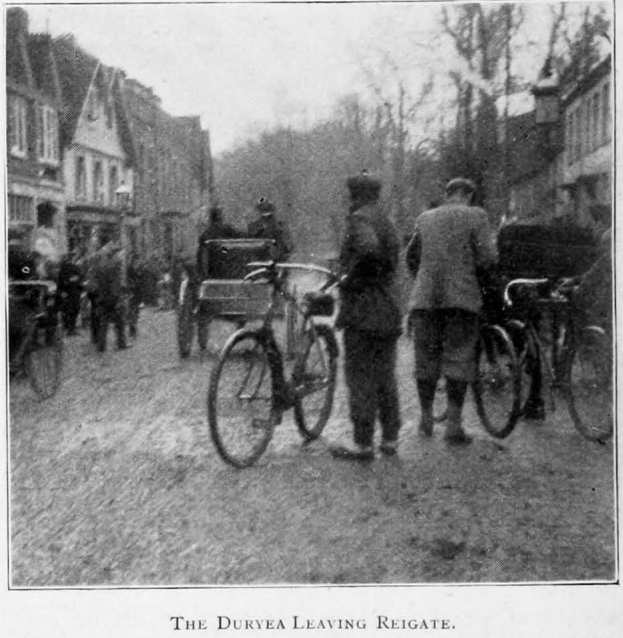
motor on the pilot car, owing to the slow speed at which the procession had been so long travelling, struck work until it had had time to cool down a little. This gave an opportunity to the fast division, who had been panting for it, to get away, and very quickly, once the processional pace was broken, the gaps between the different vehicles lengthened, and Mr. Pennington’s, the Bollées, the Daimler carriages which had already distinguished themselves in the French race, and the American Duryea cars were practically making a race of it. For a time Mr Pennington led, but his progress was quickly cut, short by the giving way of his driving-wheel pneumatic tyre, and he had perforce to take the train for the rest of the journey. The electric cars, whose accumulators did not carry sufficient power to take them through the journey, had not started with any intention of going farther than Brixton, and these one by one also found their way to the railway station, and made their way to Brighton by that means…Croydon struck the keynote so far as interest was concerned, for from end to end the road was lined with expectant spectators, and although they naturally thinned out at times, the public were never lost sight of all the way down…Reigate town was quite unrecognisable by reason of the immense crowd through which the cars and other vehicles forced a way with difficulty. Decorations were the order of the day, and very pretty the little place looked, with the intimation aloft. flower and bunting surrounded, that ‘Reigate welcomes Progress’ which was very sporting of it. and a thing to be remembered and cherished by the autocarist of the future. Lunch was served by mine host of the White Hart, in the Town Hall, and we learnt from the Reigate timekeeper that the Duryea car first seen by us, and the three Bollées had just buzzed through southward without stopping, scorning food. The Duryea led the first Bollée, with Duncan at the helm and Turrell, sen, at the prow, by 3min 9sec; the first Bollée was 1min 21sec in front of the second; and the third 7min after that…A few minutes later the Panhard and Levassor vehicle, the winner of the recent Paris-Marseilles contest, passed through, then
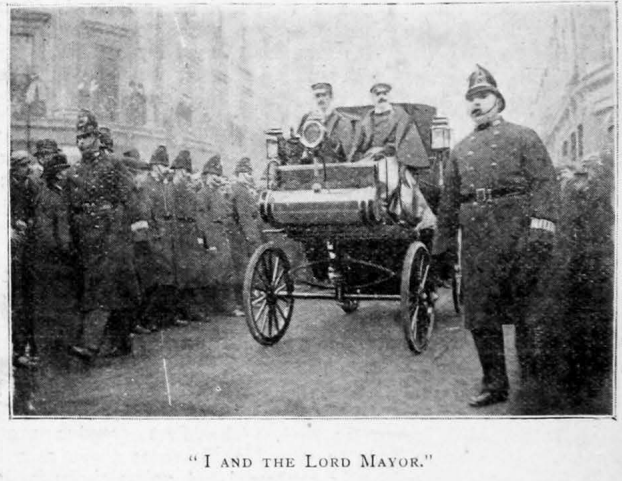
came the Peugeot omnibus, followed by a couple of Duryeas. These two smart-looking American vehicles were without splash-guards, and the two occupants of each were carrying enough mud on their hats, faces, and clothes to start a small estate. Then Mr Lawson in the pilot car came through with his banner flying, and the good people of Reigate cheering lustily. Mr CMR Turrell drove in soon after, and Mr Crowden passed through at the helm of the Panhard waggonette, the second vehicle in the Paris-Marseilles contest…To say that that particular stretch of Her Majesty’s highway which connects London-on-Thames with London-on-Sea was lined from end to end with Her Majesty’s subjects would not be overstating the truth. The interest shown in the country as well as in town was nothing less than astonishing. High and low, rich and poor—the sweet athletic English girl on her bicycle, the coster with his donkey-drawn barrow, my Lady Bountiful in the family carriage, the company promoter with his drag, the squire, the parson, the publican, and the prince—in fact, every shade and degree of the great British public were out awheel and afoot to see the autocars on their initial legal journey in this country…For the distance, the road to Brighton is perhaps the hardest road to travel out of London, and much astonishment was expressed that this and not an easier route had been chosen upon which the autocars might make their bows to the public. But the course and the day have only made the fact the more patent to the hundreds of thousands of people who watched the cars last Saturday, that autocars have arrived, have come to stay, and are likely to increase exceedingly…The number of lady cyclists was astonishing—in fact, in the early part of the day they predominated. The first car was sighted tackling Merstham Rise, which is about three-quarters of a mile long, at 12.15, and the greatest excitement prevailed amongst those at the summit. It was seen to be gallantly collaring the steep, and noted as one of the low-built cars of which the English public have had but little experience. It was quickly seen to be surrounded and followed by a crowd of cyclists who were doing their best to hold it, and the hum of the motor soon made itself heard. No number or description distinguished it, but it turned out to be an American car, the Duryea.
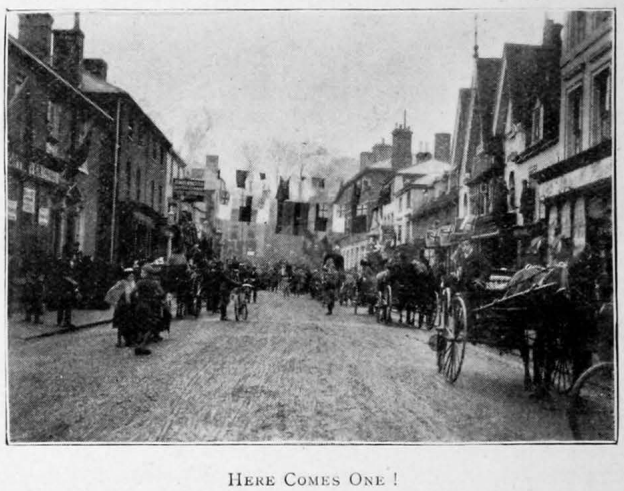
It made but little noise, and was going great guns; indeed its pace, as it ran of the grade on to the level could not have been much less than twenty miles an hour. Two minutes later the Daimler carriage breasted the hill with the Earl of Winchilsea up, and passed on its way bravely, and after a short wait of seven minutes, the New Beeston Cycle Co’s tricycle, with the auxiliary De Dion and Bouton motor, assisted by a little pedalling on the part of Mr Gorton, jun, who handled it right well, passed gaily on its way in the centre of a crowd of cyclists…At Crawley, only a lane was left for the passage of the cars through the people, and we heard of the sad accident to the little girl Dyer by the Duryea car, which was no fault of the autocarists, and which up to the present, we are glad to hear, has not resulted fatally. Cars passed through at intervals, while the rain set in steadily, and made things most ‘demnably moist and unpleasant’. Tidings reached us how the brave Duncan had charged the hedge with his Bollée rather than a horse, and had shot his companion into the field beyond, to such ultimate derangement of the gearing of his car that he entered Brighton at the cart’s tail…The orders of the day had been that the cars, as they arrived at the Plough Inn at the top of the Sussex Downs, some six miles from Brighton, should there halt, and wait until the majority had arrived, so as to make somewhat of a procession into Brighton, the Mayor of that town having arranged to meet the procession officially…but it was soon apparent that the arrangements for a

procession had fallen through. The fearful condition of the roads smothered many of the drivers in mud, whilst the rain had given them a thorough wetting, so that no driver waited for the cars behind him, but each shifted for himself and made the best of his way to Brighton and sheltered from the elements…As we approached the town it was plain that the public of Brighton were as keenly interested in the ride as the Londoners had been. For at least three miles streets were densely packed on each side, the police in many places having a difficulty to keep the way clear, although the rain was descending pitilessly all the time…Just outside Preston Park, the Mayor, accompanied by a row of mounted police, awaited the arrival of Mr Lawson, the president of the club, and escorted him into the town…The roads became even worse going under the continual downpour, but the untoward elements had no terrors for the cars or their drivers, for up to a quarter to six o’clock no less than fifteen of the cars had arrived at the Hotel Metropole…A considerable time elapsed before any other cars turned up, but one by one they straggled in, and by nine o’clock all the parcels vans (save one) which had come along quietly, and others, to the number in all of twenty-two, bad reached the destination…The honours of the day, so far as law-breaking speed were concerned, rest with the Bollée car, driven by the inventor, so that the unnumbered intervening Duryea must have been left after Reigate. M Bollée covered the forty-eight miles from Brixton in 2hr 53min. We were unfortunate in not witnessing the descent of the famous Handcross Hill by any of the cars, but those who waited at the foot thereof say that the pace with some was terrific, and the control remarkable. Somewhere on this stage, Turrell’s car ran a bearing hot, and was obliged to make a long wait, but the actual running time was considerably under three hours…”
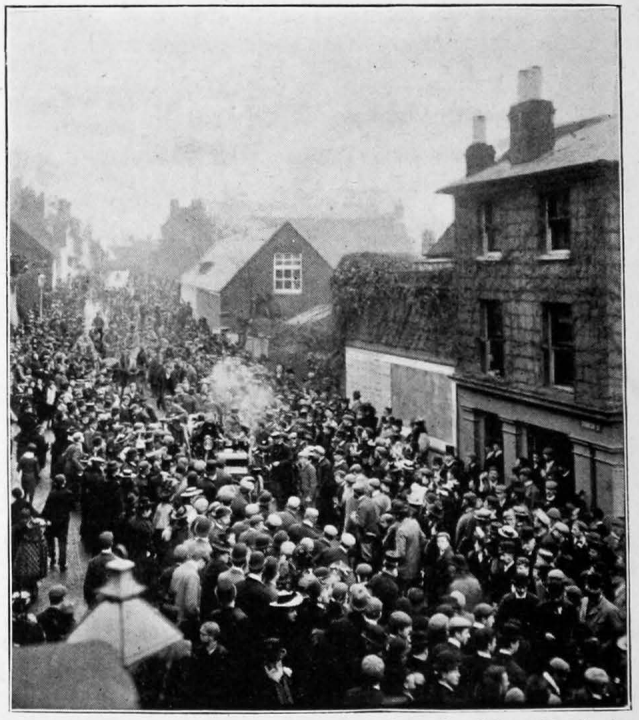
“WHAT BECAME OF THE PENNINGTON?—I saw in last week’s issue a letter describing a tug of war, in which the mysterious Pennington beat the Bollée. As the former is, I believe, constructed to carry four persons and the latter two, the result is not astonishing. On Saturday we had a chance of observing both motors at work. The Pennington climbed Brixton Hill very deliberately and went down the wood pavement to Streatham at a fair pace. It only carried half its load—two riders instead of four. Two Bollées, fully loaded with two riders each, came along some twenty minutes later (Mr Pennington started before the procession, I am told). They came up the hill nearly twice as fast as the Pennington, and went down the wood pavement from two to four miles an hour faster, and, after getting clear of Streatham, they went away at a tremendous pace. I have been unable to learn what became of the Pennington, which was not noted anywhere beyond Croydon. Did it break down?
SARDANAPALUS.”
[At Brighton, Mr. Pennington informed us that his driving wheel tyre burst at Croydon when he was leading by 10½min having started a minute behind the last machine which left the Metropole. We have proofs that the tyre burst, not punctured, in letters received from correspondents, but pressure on our space compels us to hold them over till next week. The Pennington tyres are unpuncturable, as we have actually seen nails which penetrated the outer skin of the tyre pulled out after being in for some time with their points turned back by the armour which protects the air tube from outside attack.—Ed.]
“HAVING HEARD FROM my friends that some doubt has been thrown on the fact as to which was the leading autocar at Norbury on Saturday, November 4th, I wish to say that my house being situated on the main road to Brighton, by which the procession passed, I can vouch to the following. About half-past eleven I was told that the leading car was in sight, and I immediately went into the garden to see it pass. When it arrived just opposite my gate I heard a loud explosion, and directly noticed that the car was stopped. On making enquiries I learned that the tyre on the back wheel had burst. The gentleman driving this car asked if he might put it into my garden, so as to avoid the crowd and not interfere with the cars coming on behind, which request I readily agreed to. I soon ascertained that the gentleman driving the car was Mr EJ Pennington, so well known in the autocar world. This certainly was the leading car at Norbury, and no other autocar passed for at least ten minutes afterwards.
Ellen Bendall, Dursley, Norbury, SW, 18th Nov.”
“ACCORDING TO THE eternal fitness of things, the weather for the autocar run to Brighton was singularly appropriate for the burial of the Act that banned them. Fog seemed a wreath for muddle-headed legislators; mud, the binding material in which they have been so long stuck; rain, the cold water thrown on progress; while wind was typical of anti-autocar bluster. One of the French visitors did not see this in a proper light, as he remarked—’Ah! it is true, then, that these English love to take their pleasures sadly.'”
“OF THE MARVELS witnessed during the reign of Queen Victoria none has been more striking than the growth of railroads, which have altered all the conditions of life and of trade, revolutionised the whole aspect of the country, and for their construction and equipment employed capital in comparison with which the National Debt is insignificant, while they opened up powers of transport such as could never have been dreamed of in preceding ages. At the close of the century new developments are taking place scarcely less wonderful. Those who never bestrode a horse now mount their own cycle, and improvement upon improvement renders the wheel safer, more easy, and swifter. The value of this method of locomotion is indescribable…Now that the fair sex have taken to the wheel—who would have dared to predict such things?—the demand for cycle making has been so widespread that commerce is endowed with another new industry with millions embarked in it. But if this is the case with cycles, what shall we see when the automotors pass into the field of practical utility? The country doctor, without waiting for the harnessing of his trap, will be able to start at once at double the speed in his motor. The brewer or the farmer will despatch his waggon without its long team; parcel deliveries will effected at a fraction of the old cost; the omnibus will become an agreeable mode of transport without all the terrible wear and tear and visible strain of horseflesh which has recently moved the pity of many of our readers. The hansom will be transformed into a veritable gondola, and all discussion as to its safety when freed from the knock-kneed nags that sway between its shafts will be closed for ever. The noise of our streets will be lessened by the removal of the ceaseless clatter of the hoofs, while the sweetness of the air will be distinctly affected by the absence of those overpowering smells inseparable from the crowded horse traffic of this huge city. The cubic space occupied by vehicles with horses will at once be halved, giving us gain in room, absence of noise, and atmospheric purity…As in the case of the wheel, when once started the fashion is likely to be taken up rapidly on account of the great saving…But, it will be objected, some of these carriages have been shown, and of those exhibited some were found to be not free from heat, smell, or shakiness. That is true, but in how short a time has the perfect, easy-going cycle been evolved out of the parent wheel, and at this moment every day is bringing to light the means of making the auto-motor car as perfect in its way…companies, which will speedily rival the cycle undertakings, are being formed to lay down plant for the construction of cars and carriages which, it is promised, shall ensure us increased comfort and safety, less weight of machinery, automatic brake, freedom from vibration, and a number of most important improvements. A van, omnibus, or carriage will still remain a costly article of construction, but, instead of requiring from £100 to £300 [£17-51,000]-a year for its up-keep, it will barely need as many shillings. In France, where they are swifter in these matters, they have already made great advances in the new venture.”—Morning Post.
“THE SMALL OIL MOTOR which Mr C Crastin, of Holloway, has designed and fitted to a Rudge-Whitworth quadricycle, weighs under fifty pounds complete. The engine has a double-acting cylinder, working on the Otto cycle, and by taking vapour at either end of the cylinder alternately, an impulse is given every revolution. It is fitted with water circulating chambers and cooler, an oil reservoir, as well as vaporising apparatus for converting ordinary paraffin oil into gas, an exhaust silencer and condenser, lamp for heating ignition tubes, and long flue for conveying waste heat to rear. The castings forming the supports for the cylinder tube, and combustion and water circulating chambers, covers, brackets for crank shaft, gearing, and crank, are made of a specially hard and tough alloy of aluminium, while the brackets and castings for holding the cylinder tube are made to clamp on any ordinary tricycle. The design and construction of the engine are somewhat novel, as the cylinder is formed by a long steel tube, which is slotted midway in its length. Within it fits an inner tube with stopped ends forming a double-ended piston. The piston stroke is 4in, and the cylinder diameter 1¾in. The motor may be used single acting for level roads, double acting for uphill work, and may be thrown out of action for downhill running, while means are provided for easy starting and for preventing a charge entering the cylinders, and compressing when not required. This particular machine is geared to ten miles per hour at five hundred revolutions per minute, but various speeds may be obtained by changing the toothed wheels if desired. When used as a spirit motor and electrically fired, the oil-gas producing apparatus flues from ignition tubes and lamp are dispensed with…and will give the machine a very light appearance.”
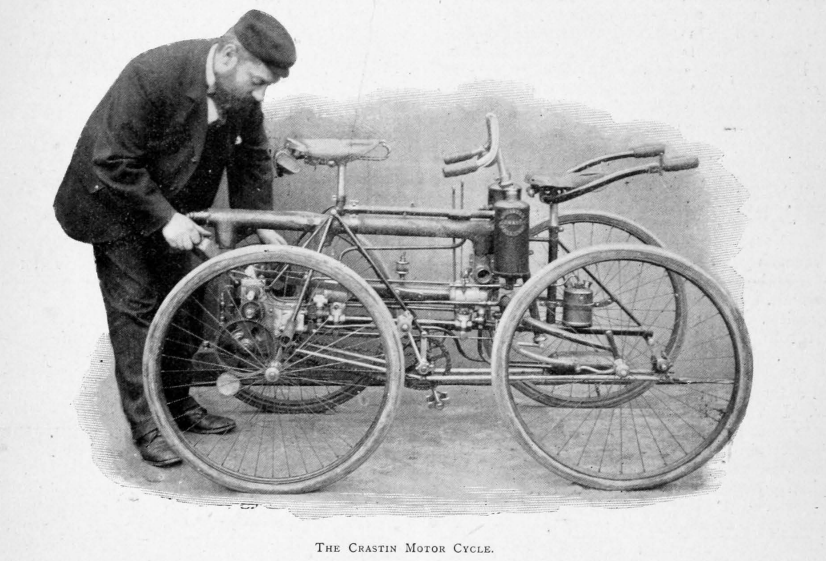
“A PARIS JOURNAL states that up to October 1st, 1896, no less than 1,300 motor vehicles of every description have been constructed in France.”
“ACCORDING TO A PARAGRAPH going round the press an accident has happened with a motor car which should be a warning to those who have not common sense to let alone things which they do not understand. It seems that a motor car—we have not yet been able to find out exactly what kind, or to whom it belonged—whilst returning from Brighton required some adjustment made to the gearing. It was taken to the works of a coachbuilder, and a man got underneath the car with a candle to effect the necessary repair. Whilst so engaged some idiot, probably on an investigation tour, is stated to have ‘turned the benzoline tap on’, by which we imagine that he unscrewed the aperture to the benzoline tank. Very naturally the vapour caught fire, and set alight to the clothes of the man underneath the car, who was somewhat severely burnt. Of course, this mishap is being heralded abroad as ‘the dangers of the motor car’, whereas it should be ‘a lesson to meddle-some idiots’.”
“WHAT IS THE best Welsh word for motor car or autocar? Papur Pawb, a Welsh journal, suggests ‘pairfen’, plural ‘peirfeni’. The Welsh word for motor is ‘mod’.”
“IN THE COURSE of an interview with a Morning reporter last Tuesday, Mr Harry J Lawson, speaking on the motor patent question, said: ‘In my parent British Motor Syndicate I have all of the leading patent Queen’s Counsel at work, and I put my technical knowledge on the subject publicly at stake when I say I have not the least doubt but that we shall win our patent actions, and prove that the motor car as now made is our complete monopoly, some of the master patents being ten years old, and the original patents for the first motor cars on the present system.”
“PRINCE RANJITSINHJI DROVE an autocar from London to Cambridge a few days ago, with five friends on board. The vehicle attained a high rate of speed at times, we are told.”
“THE SULTAN OF ZANZIBAR has just ordered a Daimler motor carriage from special designs submitted him by the Daimler Motor Co. Thus it appears that a mere African princelet is more up to date than many much greater rulers.”
“THE ANNUAL SALON du Cycle in Paris has become as much a show of autocars as of bicycles, and in the race for supremacy the self-propelled carriage seems to have some chance of ultimately over-taking the ‘wheel’…The first stand to come under notice is that of M Emile Mors, 48, Rue du Theatre, Paris, who shows two carriages, one carrying two persons and the other four. The latter is driven from the rear by a six horse-power motor. The engine has four cylinders, inclined in pairs at forty-five degrees. In this way it is claimed that the vibration is entirely taken up so that the carriage runs with perfect smoothness. As is the case with many of the light motors, and especially those used for cycles, the cylinders carry a series of ailettes or flanges to facilitate the air cooling them, and the economy in the consumption of water resulting therefrom will enable the seventy litres of water stored in the hollow sides of the carriage to last a whole day…The gases are exploded by electricity generated by a small dynamo, which is operated by a friction wheel running on the fly wheel. Beneath the motor is a box, into which the exhaust passes and expands before escaping into the air. In this way the noise arising from the exhaust is suppressed…The petroleum tricycles of A Loyal, 204, Rue Saint Maur, made their first appearance, we believe, exactly a twelvemonth ago, and like nearly all the autocars on this side, the patent rights for England have already been purchased, so that these tricycles may before long become familiar to the English public. In this machine, the two-cylinder motor is carried on a rectangular framework between the front wheels, and the rear wheel is geared for driving. The pistons work directly on a crank shaft, which is geared by pinions on to a differential axle. A chain runs from this axle to the back wheel. The crank shaft likewise carries two fly wheels. The carburator is placed between the cylinders, and a small reservoir for the burner is fixed underneath the seat. The motor is of two horse-power, and the tricycle on view, which has been built for racing purposes, is said by the makers to be capable of running up to fifty kiloms an hour. The speed is changed by a handle at the side of the seat, which is spacious and comfortable, and the speed can be further varied by regulating the admission of the petroleum spirit into the cylinders by means of taps. With three litres of spirit the tricycle is said to be capable of running one hundred and fifty kiloms. The cylinders are flanged to permit of their being cooled by the air, so that the water jacket is dispensed with. Once the platinum tubes are in a state of incandescence, the burners may be extinguished, and the tubes will be kept at a white heat by the explosions.”
“THE MANXMEN ARE not going to be behind the mainlanders of Great Britain, and, accordingly Mr Mylchreest, the representative of Castletown in the House of Keys, has introduced into the Manx Legislature a Bill to legalise the use of autocars in the Isle of Man. By this Bill it is proposed that the weight unladen shall not exceed four tons, and the vehicles shall be so constructed that no smoke or visible vapour is emitted therefrom. This is on a par with the British Acts, but the Manxmen, doubtless not having the numerous local boards and parish councils to conciliate, have not found it necessary to reduce the minimum speed of travel below fourteen miles per hour. It is also provided that annual duties shall be levied in respect to autocars.”

“THE NUMBER OF CARS which the British Motor Syndicate desired to exhibit at the Stanley Cycle Show now proceeding at the Agricultural Hall was so much greater than last year that it has been necessary to make special provision for them, and in order to do this a part of the building known as King Edward’s Hall, heretofore occupied by a shooting gallery, has been devoted to them. This cheerless and chilly annexe has been made as gay as possible by wall hangings of red and white, strings of bunting from side to side, and cocoanut matting under foot…Entering the hall by the opening on the left-hand side of the Arcade, we find on the left four examples of the New Beeston motor cycles (tricycles)—counterparts, indeed, of that particular machine ridden to Brighton on Saturday week last by Mr Gorton, jun. Another of these cycles is shown on the stand of the New Beeston Cycle Co, of Coventry, in the body of the hall. The motors, which are auxiliary, are made under the De Dion and Bouton patents…Beyond this again, we found H0 Duncan and CR Turrell demonstrating a Beeston motor tricycle to an interested crowd…The right-hand side of the hall is occupied by nine of the Coventry motettes, tandem motor-driven two and a half horse-power tricycles, made on the Bollée system, and which from the fame they gathered to themselves on the Brighton day, form the attraction of the hall. On Stand 77, in the big hall, will be found the Gladiator motor-driven Olympia-type tricycle, which was shown running by the Gladiator Co last year here, and which has since then been driven over 4,000 miles, and looks none the worse, save in travel stains, for the work. At Stand 104, the New Beeston Cycle Co flank their beautifully-staged exhibits with two of their Beeston motor cycles, similar to those referred to in our previous remarks.”
“PROBABLY THE LAST victim of the old Locomotives Act is Mr William Marshall, an electrical engineer, of Tokenhouse Yard, who was fined l0s and costs at the Westminster Police Court for having exceeded the two miles rate with an auto-car on the 9th ult by driving along Victoria Street at from four to six miles an hour.”
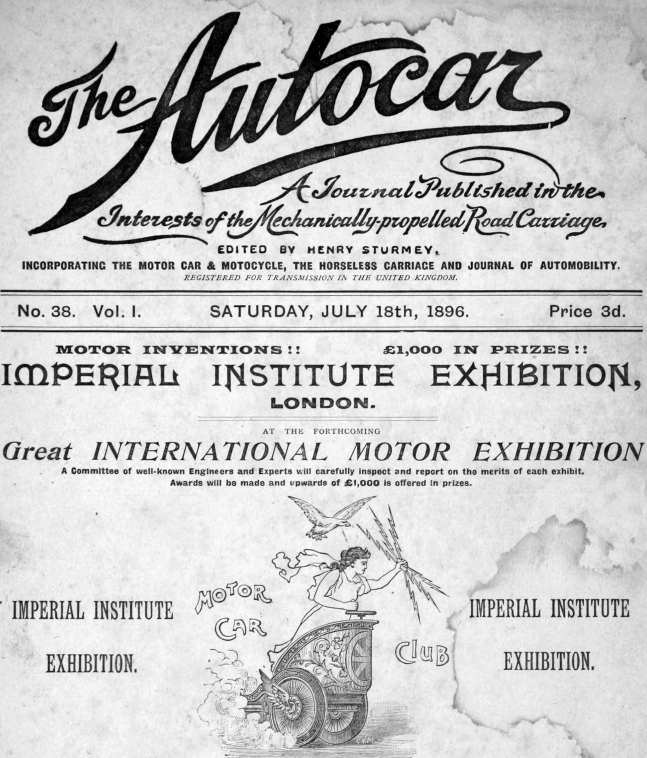
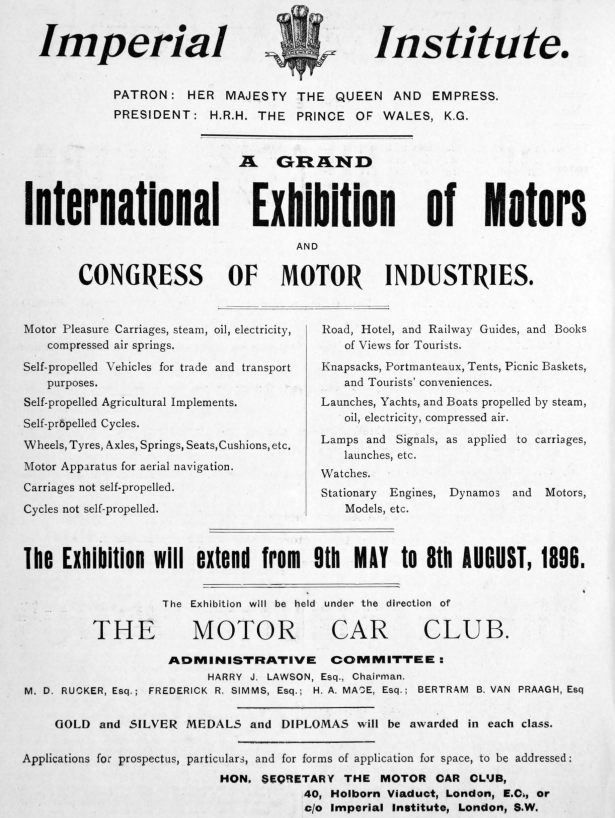
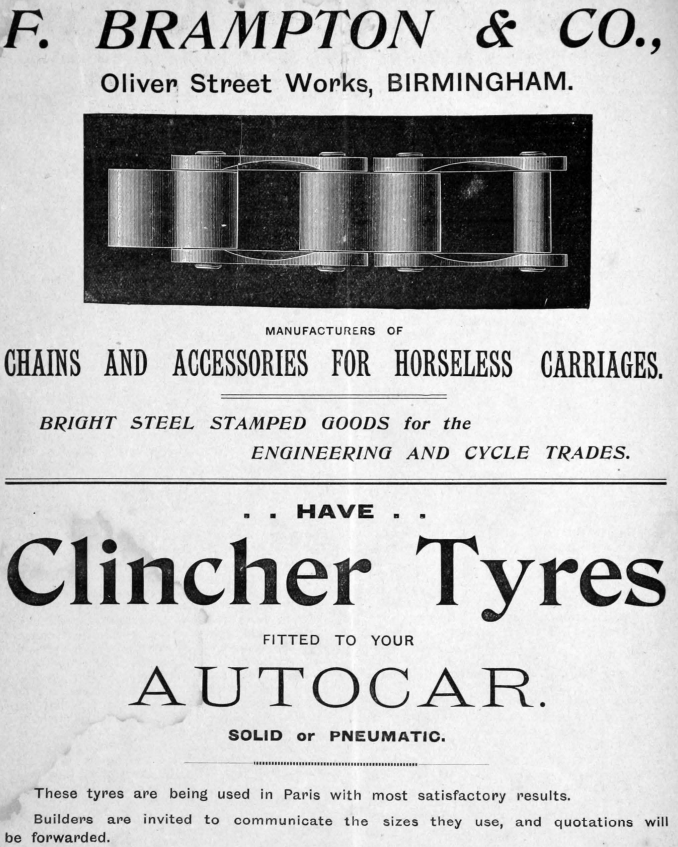
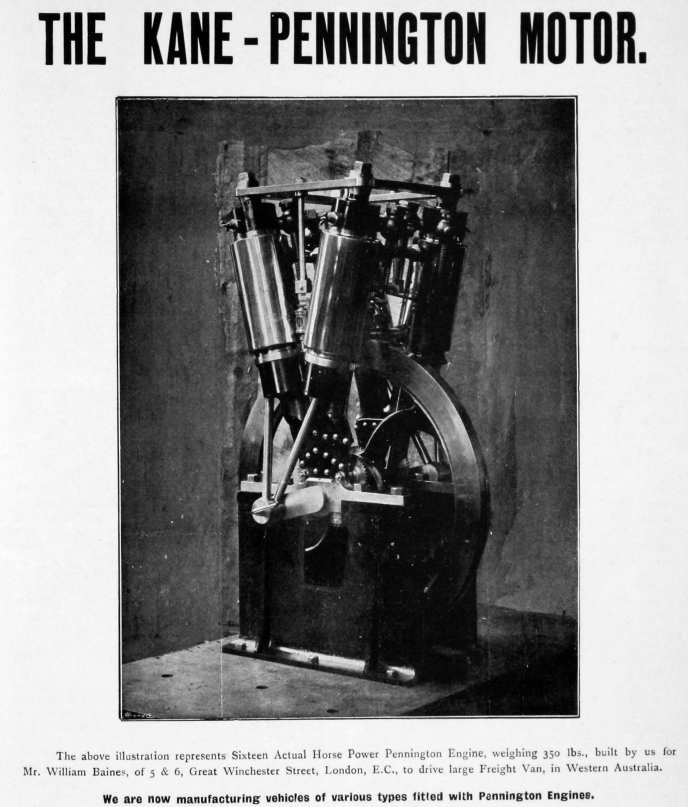
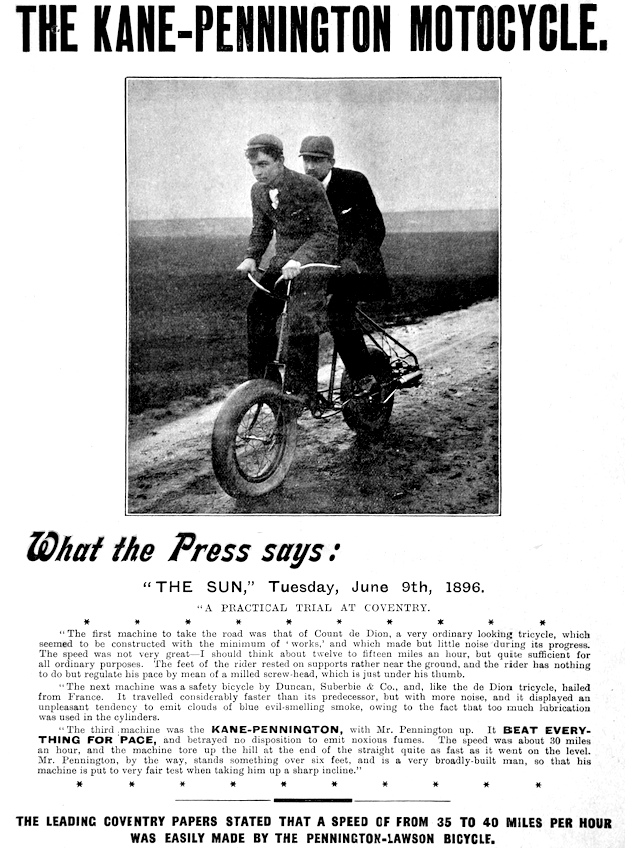
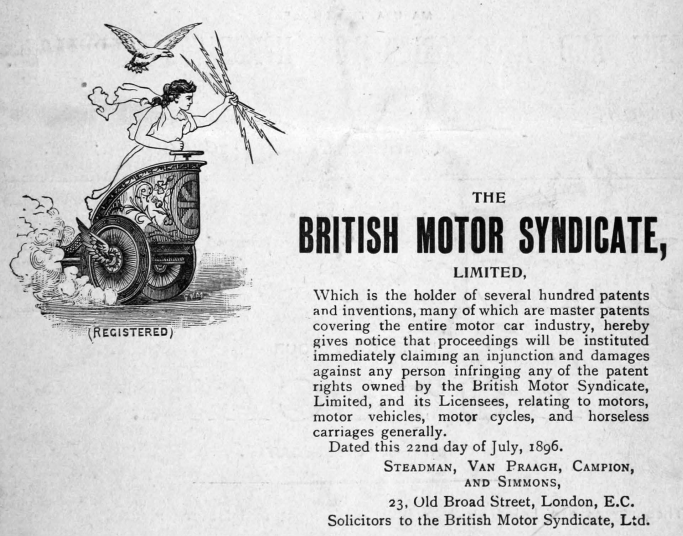

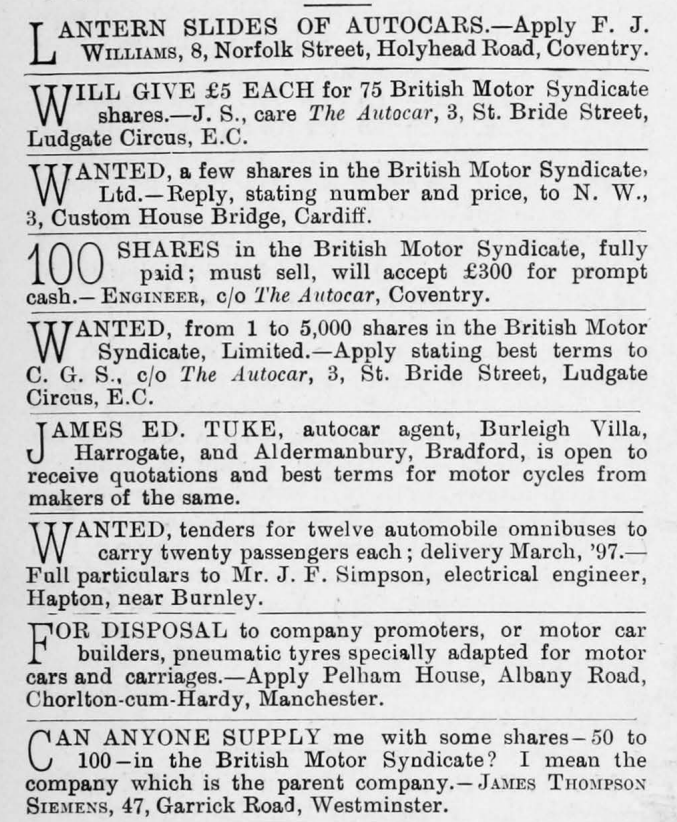

1897
MOTOR CYCLE RACING reached in England. “There were motor-cycle races on the fine track of Sheen House Club during the afternoon, but as the cycles engaged were all of one type—the De Dion petrol motors, with electric ignition—it is difficult to say what precise moral is to be drawn from the results. Mr C Jarrott, the secretary of the club, won the first heat of the two mile bicycle race in 5min. 24⅕sec. He rode a machine of about 100lb in weight, and with pedals and chain, of which he made effective use. Mr HO Duncan, who was a bad second, rode a machine of 70lb, with no pedal attachments. In the second heat Mr Taylor walked over, and in the final Mr Jarrott performed the same feat, so that the race was not very exciting. He only rode a mile, and did it in the time of 2min. 8⅓sec. In the one mile tricycle race Mr Bidlake, who is not unknown in the cycling world, was the winner, in 3min 6 ⅘sec, Mr. Jarrott being second, with 3min. 19 ⅗sec. Most of the racers dropped nuts, or something of the kind, on the way, which is scarcely to be wondered at, for the De Dion cycle is a very complicated machine. The starter was Mr HH Griffin, and the judge the Hon CS Rolls. A gold medal was presented to each of the winners.”—London Daily Chronicle, Tuesday 30 November. There was no adjustment on the flat drivebelts which had to be smeared with “a gluey sticky form of compound” to ensure grip.

FREDERICK SIMMS sent a De Dion-Bouton trike to Robert Bosch to be fitted with a magneto. This led to the development of the high-voltage mag; Simms set up a UK Bosch agency (and LATER helped set up what would become the RAC).
BEESTONS WERE AMONG eight motor cycles and trikes at the Stanley Show. This marque was among several owned by the ever-confident Harry Lawson. The Autocar reported: “Recognising the uselessness of the motor bicycle for general use the company does not propose to continue their manufacture in large quantities.”
IN LONDON A DUNLOP Rubber engineer, Arthur Hertschmann, built an air-cooled four-stroke vertical twin and bolted it into a bicycle frame with separate inclined cylinders clamped to either side of the downtube. It featured chain drive and ram-air cooling with a cowling over the head.

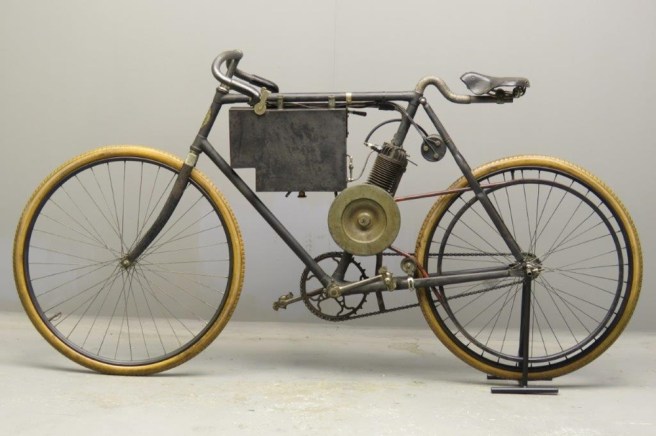
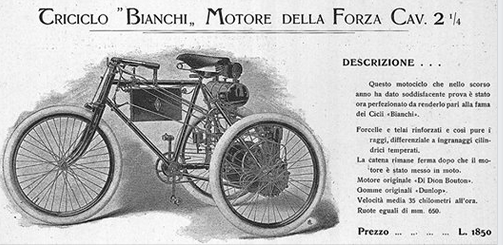
IN THE USA Hiram Maxim (of machine gun fame) built a petrol trike while working for Colonel Albert Pope, the country’s leading cycle manufacturer. When he showed it to Pope the Colonel snorted: “You can’t get people to sit over an explosion.” Three years later he would be making motor cycles.
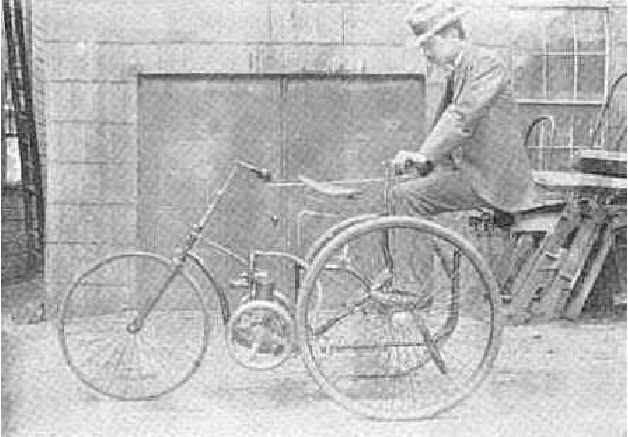
THE HOLLEY BROTHERS, Earl, 16, and George, 19, of Bradford, Pennsylvania, built a trike using a single-cylinder engine of their own design and manufacture. They called it the Runabout and proceeded to top 30mph.
THERE WAS SO much interest in the Werner Brothers’ petrol-powered bicycle that they bought some bicycles from the Hozier company of Glasgow, fitted engines and marketed them as Motocyclettes. Harry Lawson paid £4,000 for the UK manufacturing rights—a much better deal than he got from Pennington.

THE FIRST COUPE des Motocycles was a five-lap/100km race between Saint-Germain and Ecquevilly about 20 three-wheelers entered, along with an un-named “bicyclette” ridden by a M Simon; alas it failed to finish. Most of the trikes used De Dion engines—De Dion offered a trike to the winner. Other prizes included a bronze from a local property developer named Dufayel and 100 litres of Motonaphta (petrol). However a handful of riders turned up on Léon Bollée trikes which took four of the first five places. First home 2hr 46min 17sec was Léon Bollée himself who presumably took home a De Dion. Evidently the two ends of the road between Saint-Germain and Ecquevilly ended in hairpin bends The reporter of La France Automobile reported: “They (the Léon Bollées) arrived at full speed on the right-hand side of the road and abruptly locked their brakes at the same time as they gave their front wheels the sharpest possible angle to the left. In this movement, the rear wheel was brutally driven away by the acquired speed, it was driven onto the ground, and the car was straightened out by itself. This is the controlled skid that is well known to tricycle drivers!”
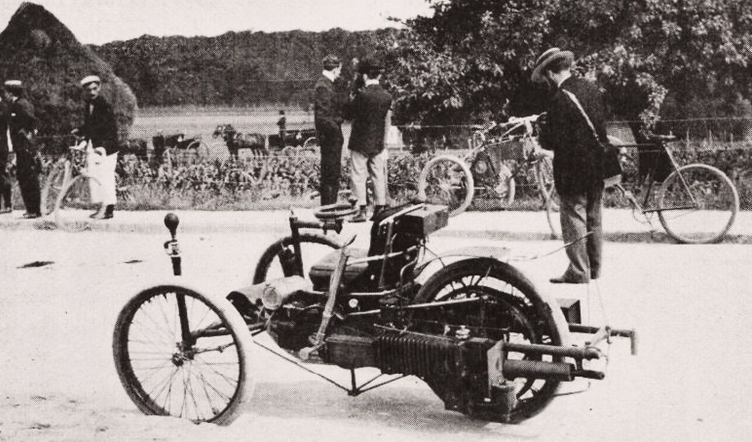
THE STADE-VÉLODROME in the Parc des Princes in Paris was christened by motor cycle races. Gaston Rivierre on a De Dion-Bouton won the first series and posted the best time of the day at 40.8km/h.
“DALZIEL’S TELEGRAM PARIS, MONDAY—The 100 kilometer motor cycle race from Montgeron to Ozair and back yesterday resulted in the victory of the Dion-Bouton tricycle.” —The Lincolnshire Echo, 5 April.
“MOTOR CYCLE VS COSSACKS. An interesting trial was made a few days ago in Moscow with the motor bicycle. Two hundred trained motor cyclists mounted on their metal steeds were pitted on a body of Cossacks with picked horses. Their way led them over a clayey track, which recent rains had rendered most soft and slippery. The distance over which they had to ride was 200 versta, or about 120 miles. The Cossacks were allowed to change their mounts at different points in the road. The result of the experiment showed that the superiority of the horses on an unfavourable ground went without saying, while on a smooth, hard track the balance was undeniably in favour of the wheelmen.”—Leicester Daily Post, Wednesday 7 July.
“A WINTER MOTOR CYCLE. An American inventor has come forward with another novelty in the shape of a winter bicycle. The tyres have small spikes fastened to them at regular intervals, not of sufficient length to impede the progress of the wheel, but at the same time long enough to prevent the sudden slip or turn that always presages the unlucky fall. In front of the machine is a shield to keep the bitter winds from the rider, and against this streams of hot air will play, while the hollow tubing of the frame will also be filed with hot air, procured by means of the gasoline motor, which will drive the cycle. It is said that this machine will be capable of accomplishing 15mph in any weather and on any roads. The feet are intended to be placed on rests until it is desired to stop.”—Dublin Evening Telegraph, Saturday 2 January.
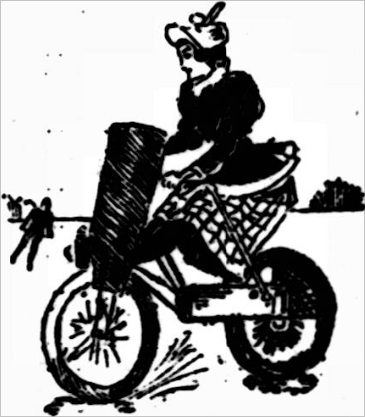
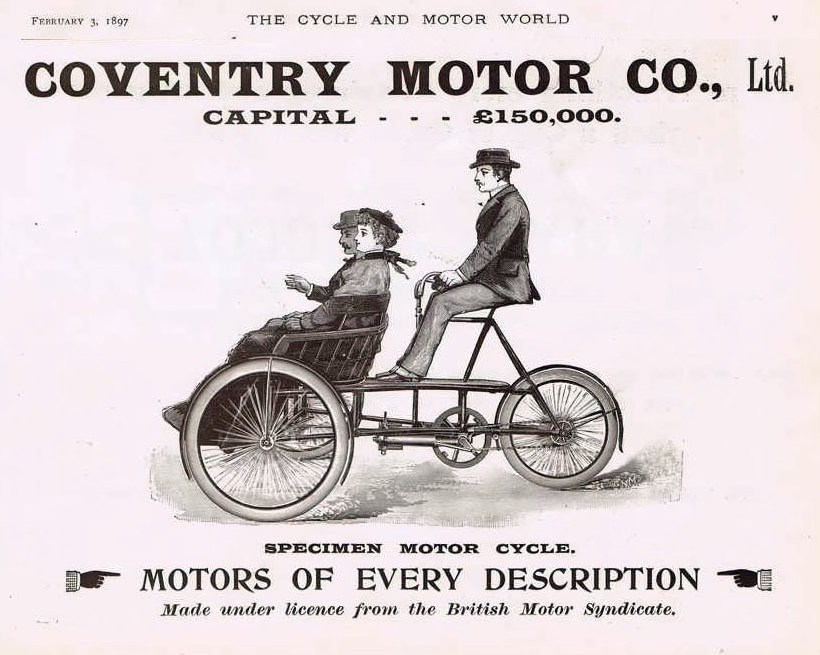
1898
“TWO OR THREE YEARS AGO,” according to the Chicago-based The Cycle Age And Trade Review, “the general appearance and use of the motorcycle the world over seemed an immediate certainty. Oddly enough, this anticipation has been abundantly realized in some countries, while in others it has been almost wholly disappointed. In France the motorcycle has ‘arrived’, and is seen everywhere; large establishments exclusively devoted to its manufacture are running day and night and are yet months behind their orders. The principal type of motorcycle adopted in France is that driven by the gasoline engine; there are several makers, but there is no material difference in the ‘petrole’ engines. Then in France, there are a number of builders of steam driven motorcycles, The Companie General, Decanville-Serpollet, Dion et Bouton, Le Blant, Societe des Chaudieres Scotte, and Weidknecht, who are doing heavy work, mainly in the omnibus and goods-carrying lines. There are no less than 47 different firms and companies and individuals manufacturing ‘petrole’ motorcycles in France, many of them having large plants, and all full of orders, most of them declining to fix day of delivery, and the customers paying each other premiums for early-filled orders. There are also nine concerns which supply electrically driven carriages, making a total of over sixty motorcycle builders in France, and the French nation seems to be falling over itself in its eagerness to buy the product of these makers. The Winton motor carriage company at Cleveland are offering motorcycles with gasoline motors. The Fierce-Crouch Engine Company, New Brighton, Pa, have placed their gas engines in two motorcycles and say that the lightness of their engines and several other advantageous features make them peculiarly suitable for motorcycle service. But neither in England or America is the gasoline motor driven motorcycle received with anything like universal approval. They are hot, they are not exactly quiet, they want a lot of cold water, although they are said to emit ‘very little’ in the way of disagreeable odours. There are only a very few gas engine driven motorcycles in the hands of purchasers in America, perhaps not more than ten or fifteen all told. So far, all of the gasoline or gas engine driven motorcycles are practically identical so far as the motive power is concerned. There are small detail differences in the engines, but nothing radical or generic to distinguish one from the other. They are all explosion engines, using a mixture of air and gas which is very much compressed and then fired in the engine cylinder or an extension of the engine cylinder, by an electric spark or by a red hot tube. All of these gas engines operate on what is known as the ‘Otto-Cycle’, that is to say that the cylinder and piston perform several entirely different acts, and these acts recur in a fixed sequence. Thus one stroke outward of the piston draws into the single-acting cylinder, a mixture of gas and air, the following inward stroke of the piston compresses this charge at the expense of power stored up in the fly-wheel, and at the end of this inward stroke the charge is fired and creates a pressure of about 170lbs to the square inch, which drives the piston outward in its effective or working stroke, at the end of which the cylinder is filled with burned vapour which is inert, and is pushed out of the cylinder at the next inward stroke of the piston, which completes the ‘cycle’ invented by Dr Otto, an eminent German improver of the gas engine, and bearing his name. There are thus three strokes of the gas engine which do not help turn the crank shaft, so that the engine is idle three-fourths off the time, and if only a single cylinder is used, the crank shaft obtains a turning impulse only during one-half of each alternate revolution. If two cylinders are used in one vehicle then the crankshaft has a turning impulse given it during one-half of every revolution it makes, and if four cylinders are employed then the crankshaft receives two turning impulses during each revolution, same as the ordinary single-cylinder steam engine. The cycle’ makes a single cylinder gas engine a very unsteady driver, and hence calls for a large and heavy flywheel. The gas engine was first applied to carriages in any notable way by Daimler, a German who ran a little pleasure railway from the little town where he lived to a little lake…Now that Dr. Otto’s patents have expired, the gas engine is free to the world, and there are no patents of controlling effect in the art…There are constant rumours of the formation of motorcycle companies, but the foregoing about covers the American motorcycle industry, so far as it has a tangible existence. The English are making an effort to place the steam-engine driven motorcycle in front, and this form of motor has undeniable advantages for general heavy work. It does not now seem likely that the petroleum or gasoline engine driven motorcycle is to have any great use in either England or America until the engine has been very materially improved. Americans want machines that are nice in every way; silent, clean, and without bad smells…For three-quarters of a century the best of mechanical talent has directed its efforts towards the improvement of the steam boiler without finding any radical or fundamental advantage…there seems to be no prospect of anything new in the steam way that will make the steam motorcycle desirable for anything except heavy freight work. With the gas engine we have unlimited power at our disposal. We can carry a large amount of gas-producing materials, and the air is everywhere with us. We can mix air with a little gas and squeeze this mixture pretty hard, and fire it off and so obtain all the power we want, and obtain it in a controllable form. Having the power, it seems beyond dispute that we shall sooner or later find out how to use it. We shall find some elements which we can place between this force generated by explosion and the wheels of our vehicles which will be wholly satisfactory. The power, the living force, is in our hands now. We shall learn how to use it.”
WERNER BROS SOLD more than 300 Motocyclettes, including a number in Britain via Harry Lawson’s Motor Manufacturing Co (MMC). Lawson also had the rights to De Dion’s tricycle, which Humber made for him.
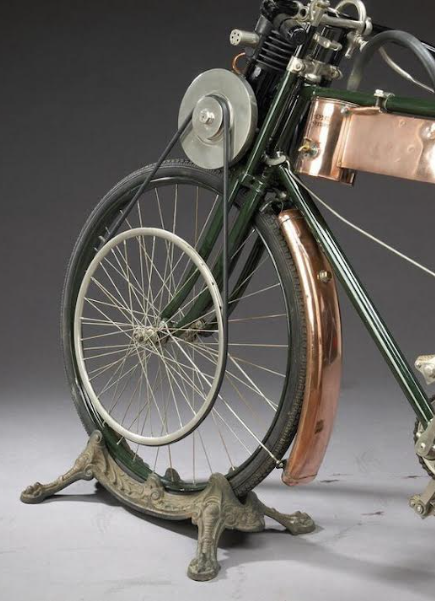
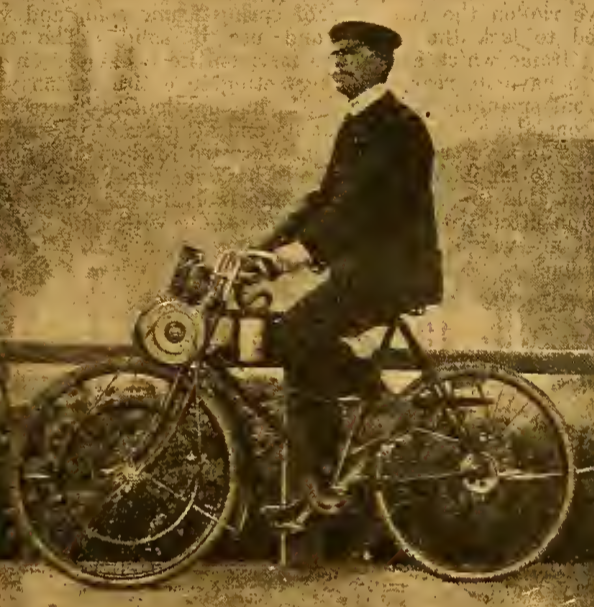
CARRIAGE BUILDER Henry Timken developed a tapered roller bearing sturdy enough to be used in wheel hubs.
ELMER SPERRY OF Cleveland, USA built an electric car with disc brakes – the brake pads were applied by electromagnets.
IN GERMANY’S FIRST race, over the 36 miles from Berlin to Potsdam, a Beeston-Humber trike took the flag ahead of a Daimler car and a Clement trike. Harry Lawson launched a Beeston motor cycle using a strengthened bicycle frams. It was powered by a 346cc De Dion engine mounted low, just behind the pedalling gear. Triumph considered making it under licence, but no agreement was reached. Siegfried Bettman also negotiated to make Humber motor cycles but failed to come to an agreement.
JULES TRUFFAULT made sprung forks for his bicycle; they were quickly adapted to suit motorcycles.
JAMES LANSDOWNE Norton began making bicycle parts, primarily chains.
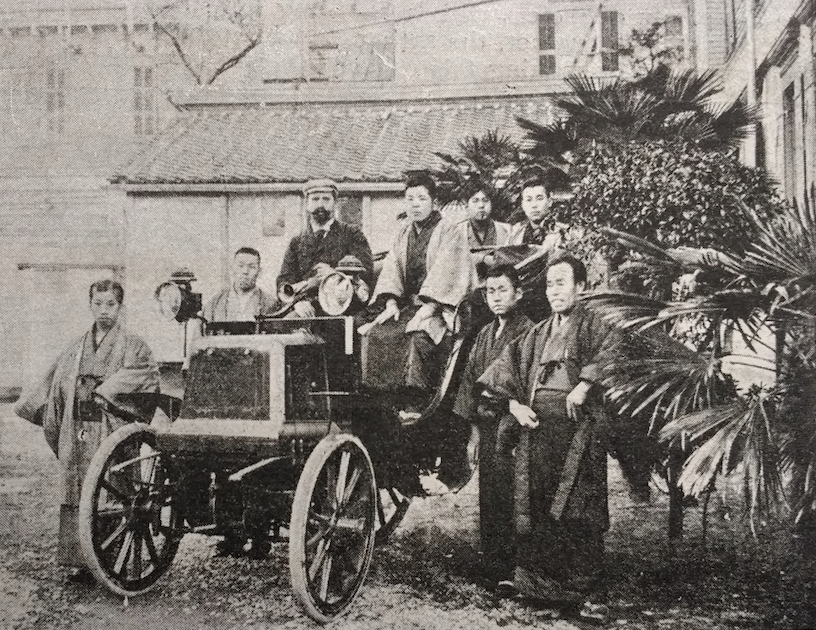
THE SCOTTISH REFEREE REPORTED: “A very interesting interview with Mr SF Edge, the manager of the Dunlop Pneumatic Tyre Co, appears on the subject of motor cycles in this week’s Cycle. Mr Edge was first introduced to the motor cycle somewhere in the spring of last year, since which time in company with Mrs Edge he has travelled over 4,000 miles in his motette. Regarding break-downs to motorcycles, Mr Edge affirms that this has been much exaggerated. Asked whether he thought the motor-cycle would supersede the present type of cycle, Mr Edge gave it as his opinion that it will not, on account of the expense, but added that motor-cycling will doubtless become a popular sport just as yachting.”
PEUGEOT EXHIBITED a prototype De Dion-engined Peugeot bicycle at the Paris Salon in 1898, but the first motorised cycles to leave the factory were trikes with De Dion-Bouton engines.
GLOBAL PRODUCTION of aluminium had risen from 15 tonnes in 1885 to several thousand tonnes.
ROBERT AYTON OF COVENTRY lodged a patent covering “Improvements in or relating to radiating devices for heating or cooling purposes…According to this invention I provide the tube, cylinder, or other body from which heat is to be radiated, with a partial or total covering constructed of a metal having a higher conductivity than the metal of which the tube or cylinder itself is composed. Thus in applying the invention to the cylinder of an internal combustion engine, the cylinder may be provided with a conductive covering or with wings or gills constructed of aluminium, silver, or some alloy of these or other metals, whose heat conductivity is considerably greater than that of the iron or steel of which the cylinder is composed…” It was an idea ahead of its time so Ayton did not profit from his patent but he did build and race his own bike in the first (1907) TT. He used a Riley Engine and finished 7th.
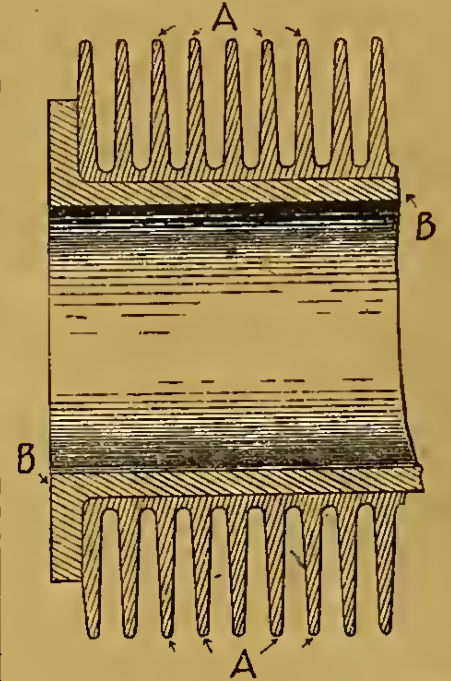
“THE FIRST MOTOR CYCLE. Mr WJ Crampton, electrical engineer, 23, Regent-road, is the pioneer of the motor cycle in this town. On Saturday this gentleman rode through the town on new ‘Beeston Motor Cycle’. The cycle was travelling at as fast a rate as the law would allow in a public thoroughfare, the rider sitting at his ease and only troubling himself to steer his way through the traffic. In appearance the machine is handsome, and the rider, being relieved of all exertion in the matter of propulsion, is able to sit erect with feet on rest. The motive power is obtained from Petrol, a kind of benzoline highly refined, but not at all costly, and which combines the advantages of a minimum of expense with the maximum of power. The gearing of the machine is the same as with the ordinary cycle and in general aspect has the look of one of the best makes; although necessarily heavier, the extra weight telling in favour of steadiness. The motor is marvel of mechanical skill, and great ingenuity has been exercised in its development. It is practically on the principle of the ordinary oil-motor used in connection with trade cars, with the explosion of oil vapour and air taking place at every alternate revolution. The tank containing the oil is carried very compactly beneath the seat, and is supplied with an indicator showing the rider the exact quantity of oil in the reservoir. A tube carries the oil down to the carburetter and vapouriser, and thence to a compressing chamber, from which the lamp is fed. A platinum tube is thus heated, and carries out the function of exploding the mixture of oil vapour and air already referred to, and so acting upon the parts contained in the crank-chamber. When starting on a journey, after lighting the burner, the rider has simply to give his driving wheel a couple of turns, as on an ordinary machine, after which the motor works automatically, the operator having perfect control of both speed and steering gear. The oil reservoir has a capacity of an imperial gallon, and will take a machine a distance of fifty miles at high speed without a stop; but for longer distances en extra supply of oi1 is carried in an independent reservoir, and can be made available at a moment’s notice. The machine weighs about 130lb, and is tyred with 3-8-inch tyres, giving an extra steadiness, and taking off a large amount of the vibration. One of the Beeston motors accomplished a short time since the extraordinary speed of 26mph for three consecutive hours on an ordinary road, and covered a further 100 miles in three hours and 36 minutes on the same day. This latter ride was accomplished without a hitch, and the rider had not to dismount once.”—Yarmouth Gazette and North Norfolk Constitutionalist, Saturday 26 March.
THE SCHRADER valve stem was patented to facilitate inner tube inflation; we’re still using it today.
ANDREE BOUDEVILLE developed a high-tension magneto in Paris, but it lacked a condenser.
DUTCH (EYESINK), Belgian (Sarolea) and Italian (Figini) motor cycles went into production.
HENRI FOURNIER TOOK the first bicycle pacing machines to the United States. A young French Canadian named Jake De Rosier became infatuated with the motorised machines and, after much persuasion, convinced Fournier to let him ride one. Fournier was impressed enough to hire De Rosier to ride for him in the Paris races. We’ll meet Jake again.
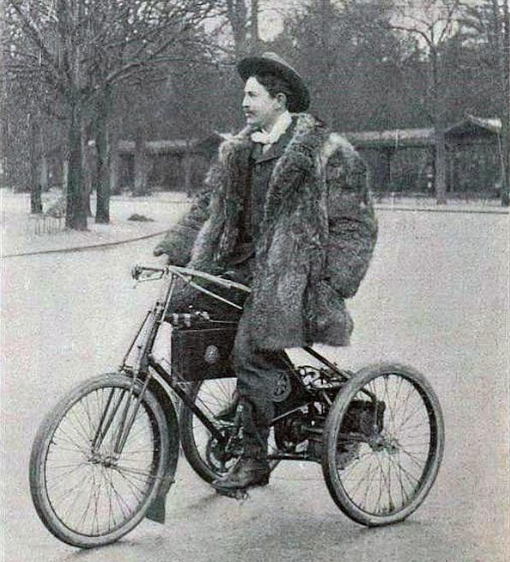
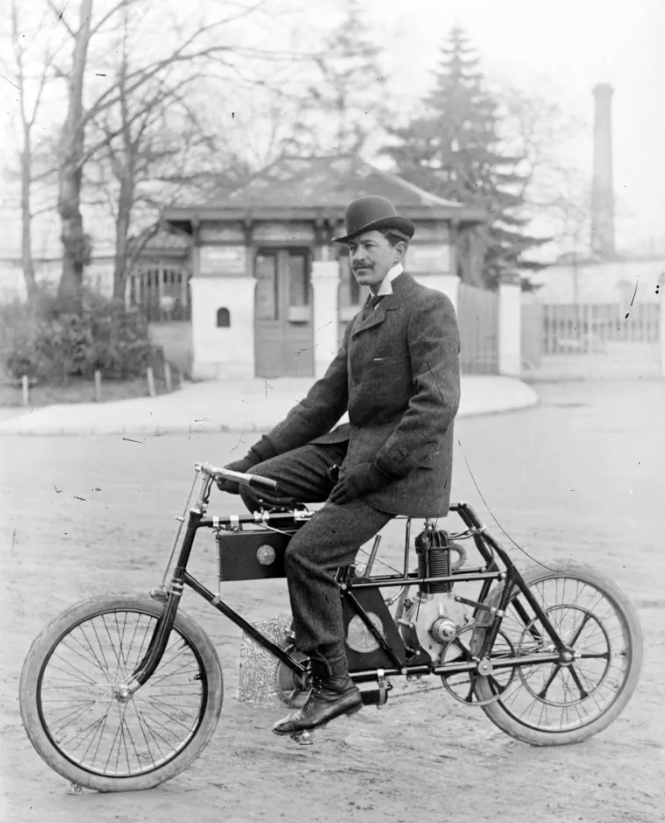
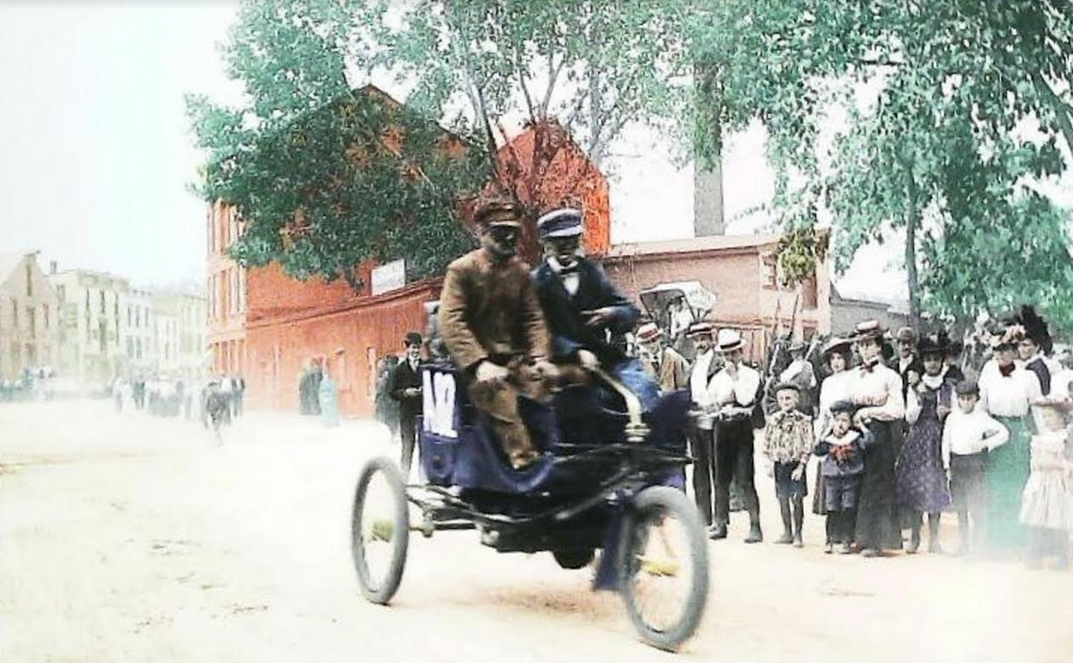
“MOTOR CYCLE EXPLOSION. A remarkable explosion occurred at Chester on Wednesday night. Mr Webb, of Rockferry, stopped at Chester with his motor cycle to replenish his oil store. A boy named Haswell held a candle while Mr. Webb attended to the machine. By some means the flames came in contact with the oil, which exploded with a loud report. Haswell’s clothes were set on fire, and another lad, named Whiteley, was seriously burned about the face, while two men, who endeavoured to extinguish the names on Haswell’s clothing, were burned about the hands.”—St James’s Gazette, Friday 11 February.
“AN EXPLOSION OF BENZINE. Before the Chester Magistrates Henty Burton Webb was charged with a breach of the Locomotive and Highways Act. It appeared that Mr Webb arrived at Chester from Shrewsbury with a motorcycle. The machine then failed for want of oil. He bought a quantity of benzine, and was proceeding to examine the cycle with a light when the benzine exploded, the flames went as high as the houses. A boy named Whiteley was severely burnt, and is still in the infirmary, and two others were burnt less seriously. Mr Smith, the Town Clerk, said benzine was a highly volatile inflammable article, and called the Inspector of Petroleum to show that flashed off its own accord a temperature 51°. The defence was that Mr Webb was a stranger, that the people flocked round to see the machine, and that was purely accident. The bench said they considered the explosion was quite unintentional. At the same time there had not been reasonable care taken, and they inflicted a fine of 20s and costs.”—Lewisham Borough News, Thursday 24 March.
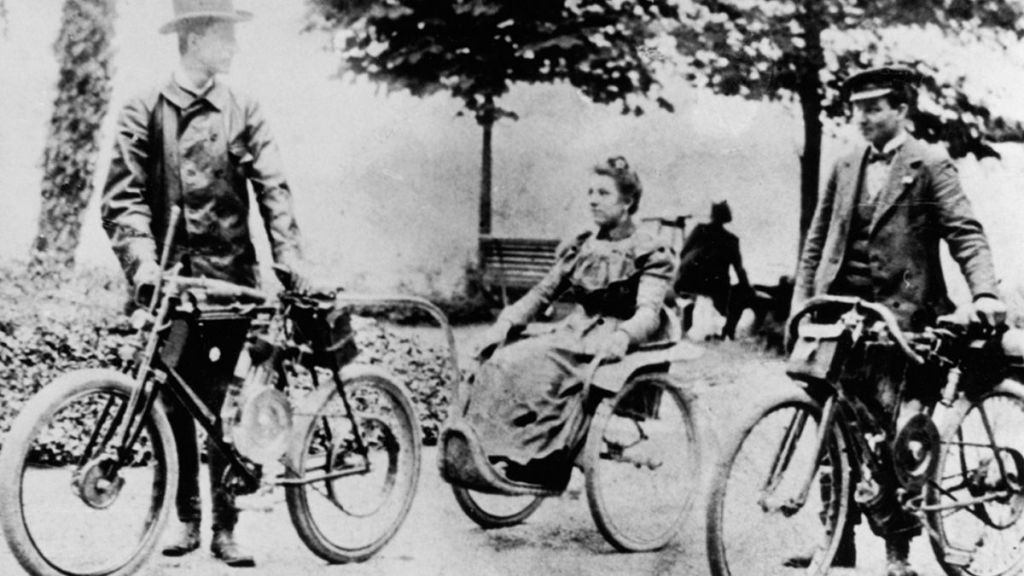
“CHASING A MOTOR CYCLE. At Chertsey Petty Sessions, yesterday, John Wilson Taylor, of Weybridge, was fined £5 for furiously driving a motor cycle the highway. A police inspector said the motor was being at the rate of eighteen miles an hour. When asked how he arrived at the speed, the inspector said be was riding a high-geared cycle weighing only 251b, and could not catch the motor.”—Eastern Evening News, Thursday 14 April.
WILLIAM R. BULLIS of Chatham, Massachusetts patented a twin-cylinder two-stroke engine equipped with poppet valves; the inlet valves were automatic. The fuel pipes were to be coiled round the cylinders to cool the engine while utilising its heat to vaporise fuel. The ignition was to be actuated by a fitting on the tops of the pistons. The Horseless Age reported that Bullis’s engine had been fitted to a “railroad velocipede with most satisfactory results” as it produced “unusual power”. Bullis’s patent drawing bore an uncanny similarity to the twin made by that arch fraudster Joel Pennington in 1896. (Scroll back up, unless you’ve just been there; or read more about the scoundrel in the gallimaufry.)

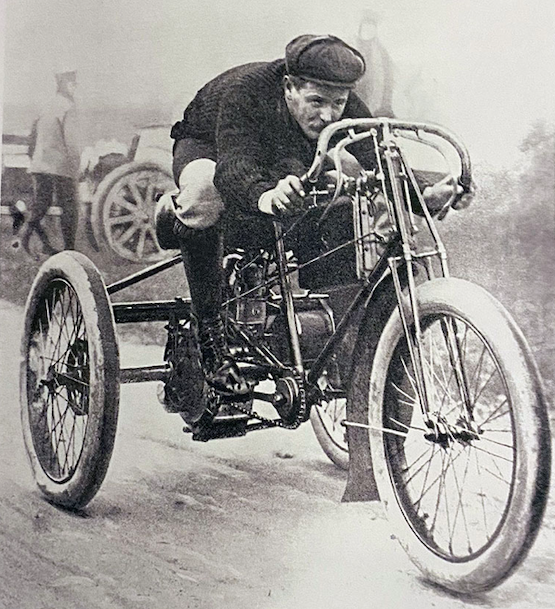
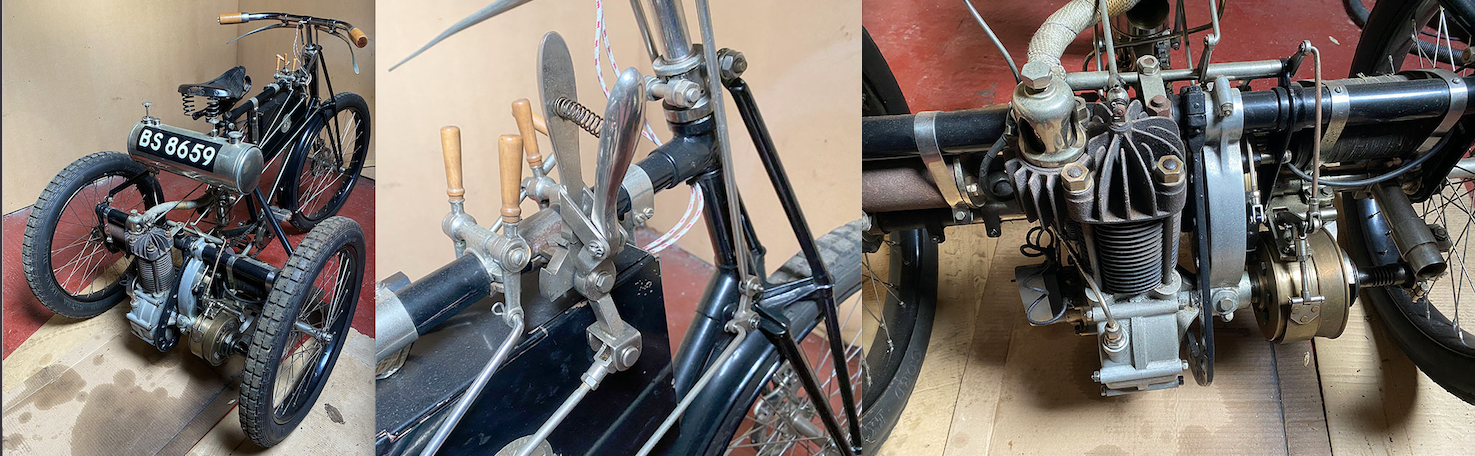
Here are some more trikers courtesy, inevitably, of mon ami Francois.
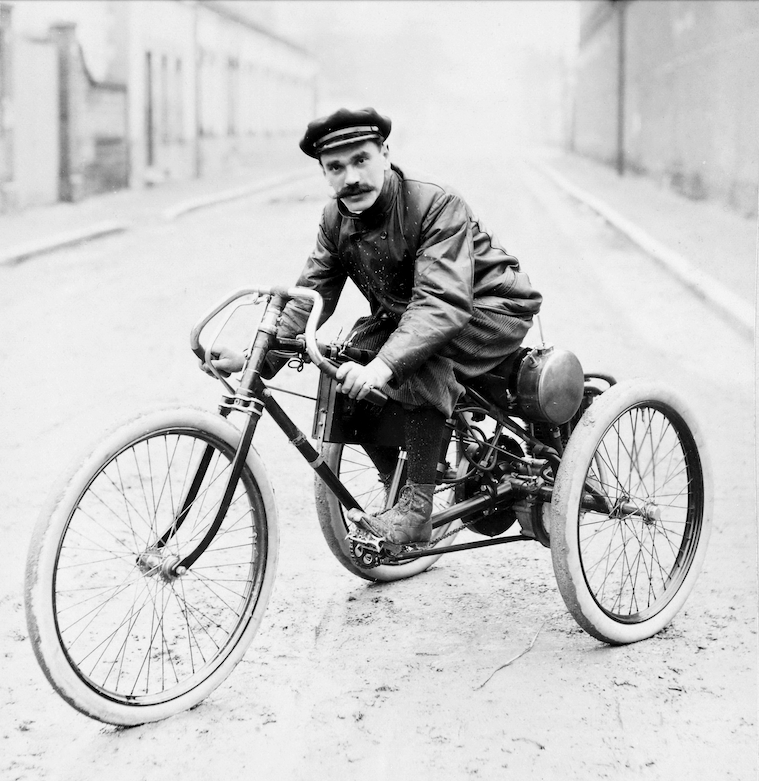

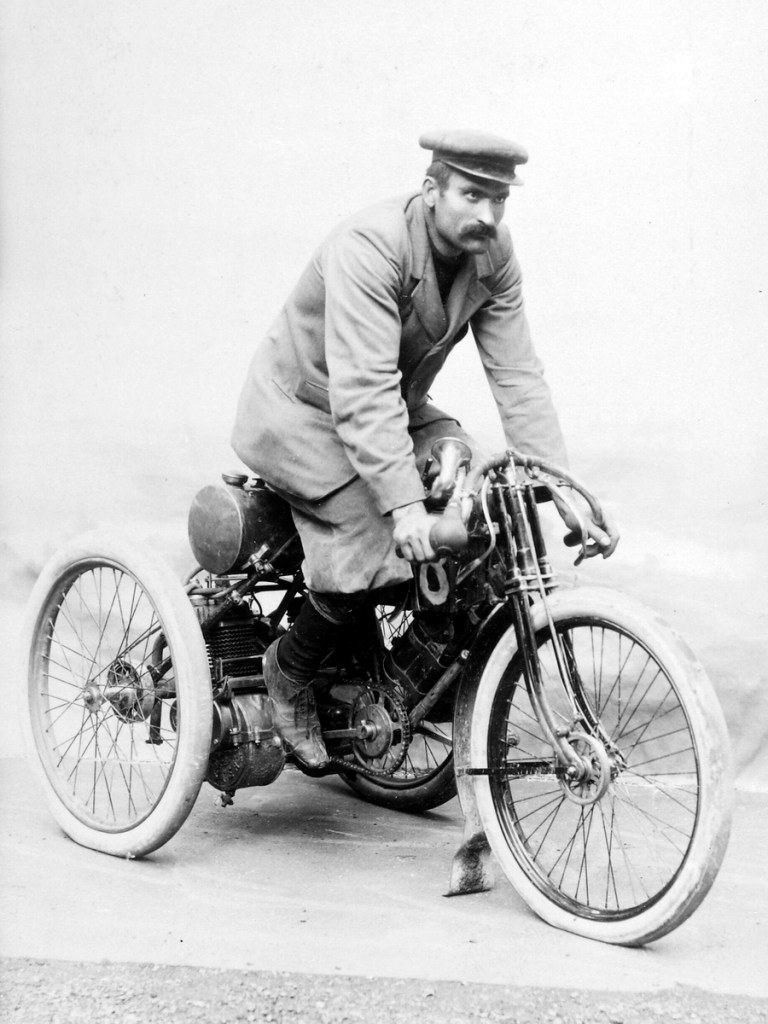
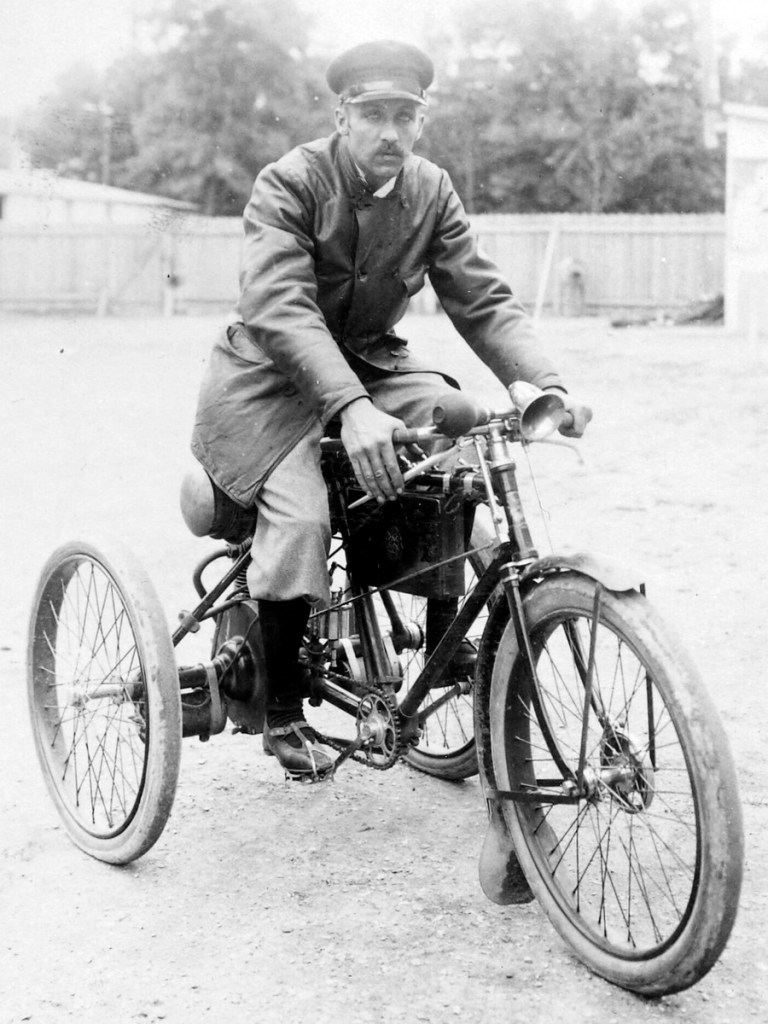
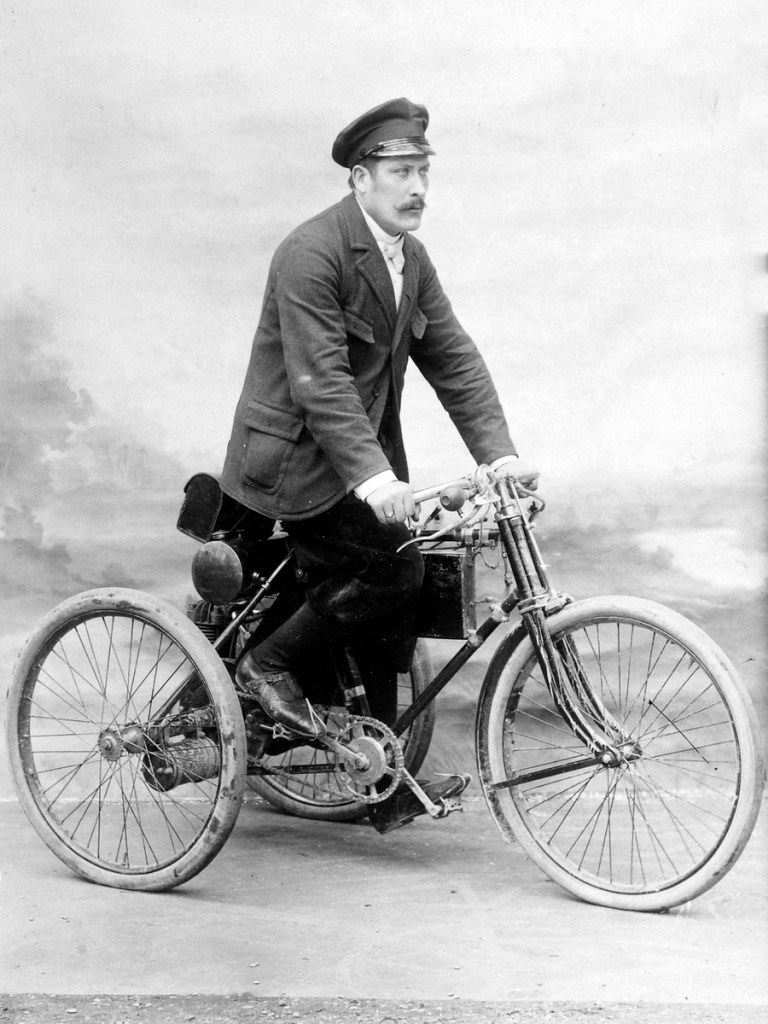
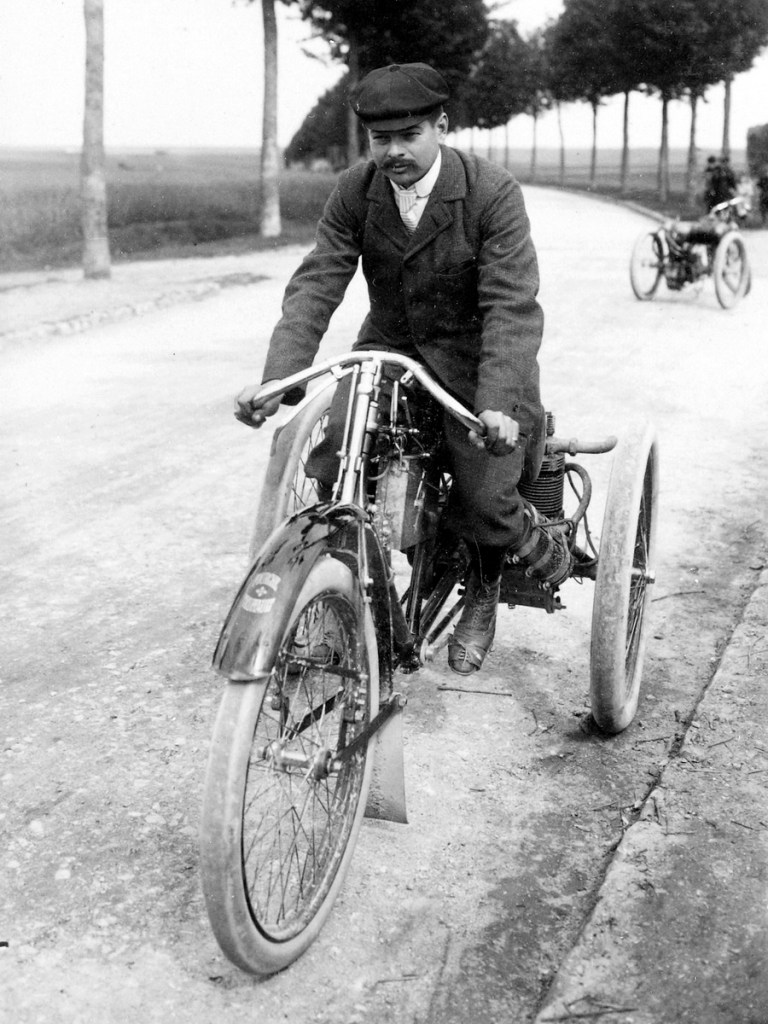
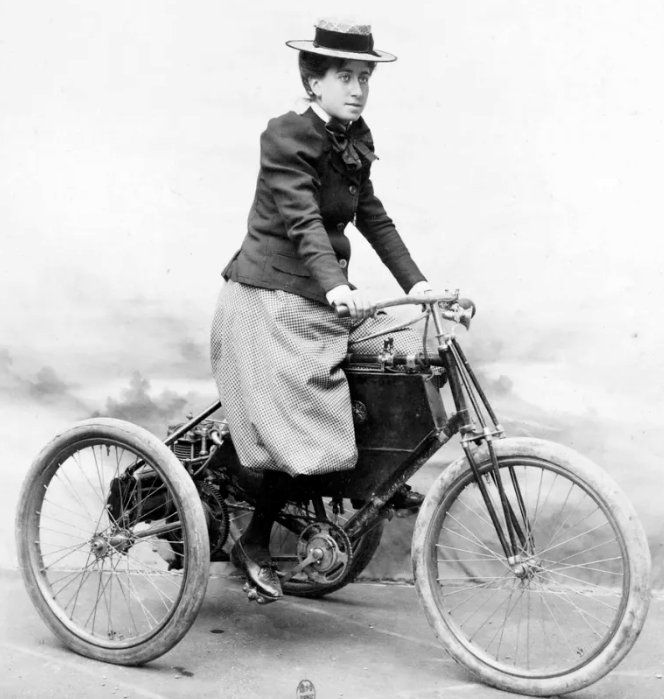
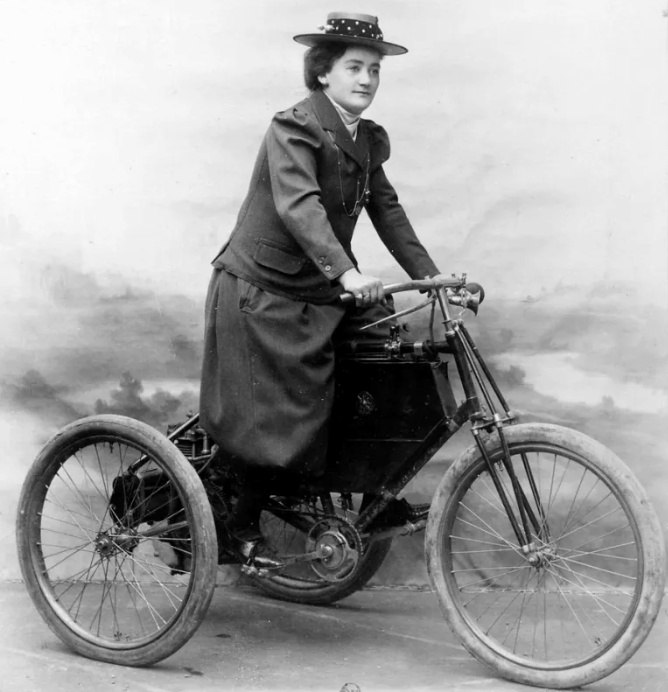

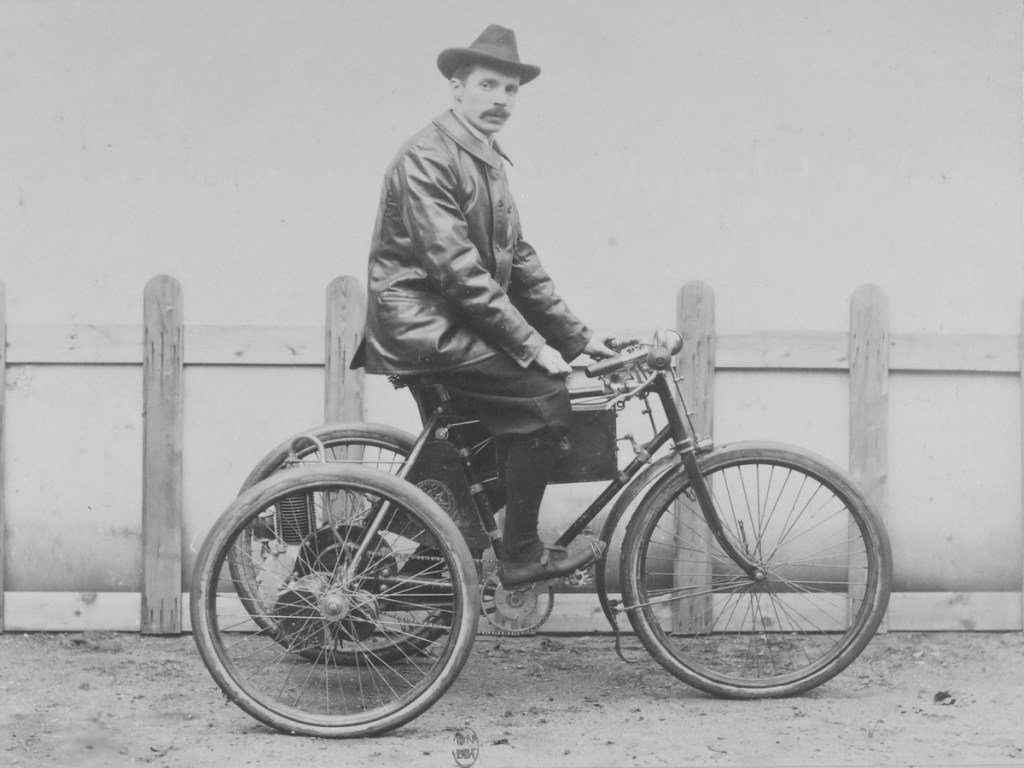

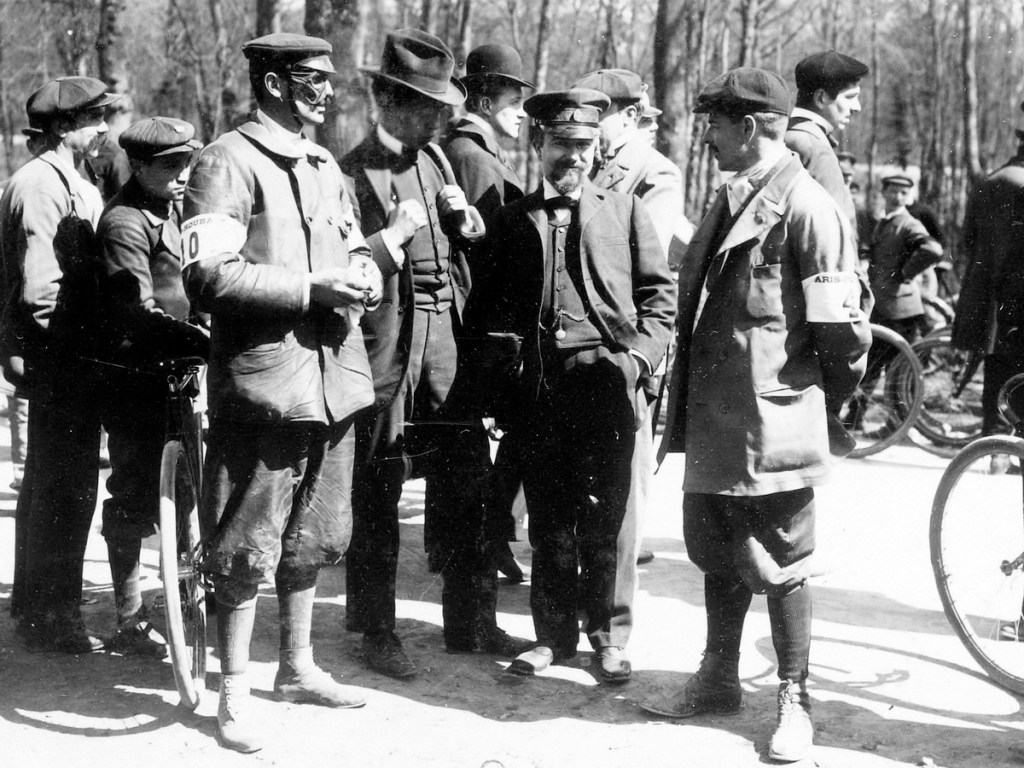
and here are a couple of quads…
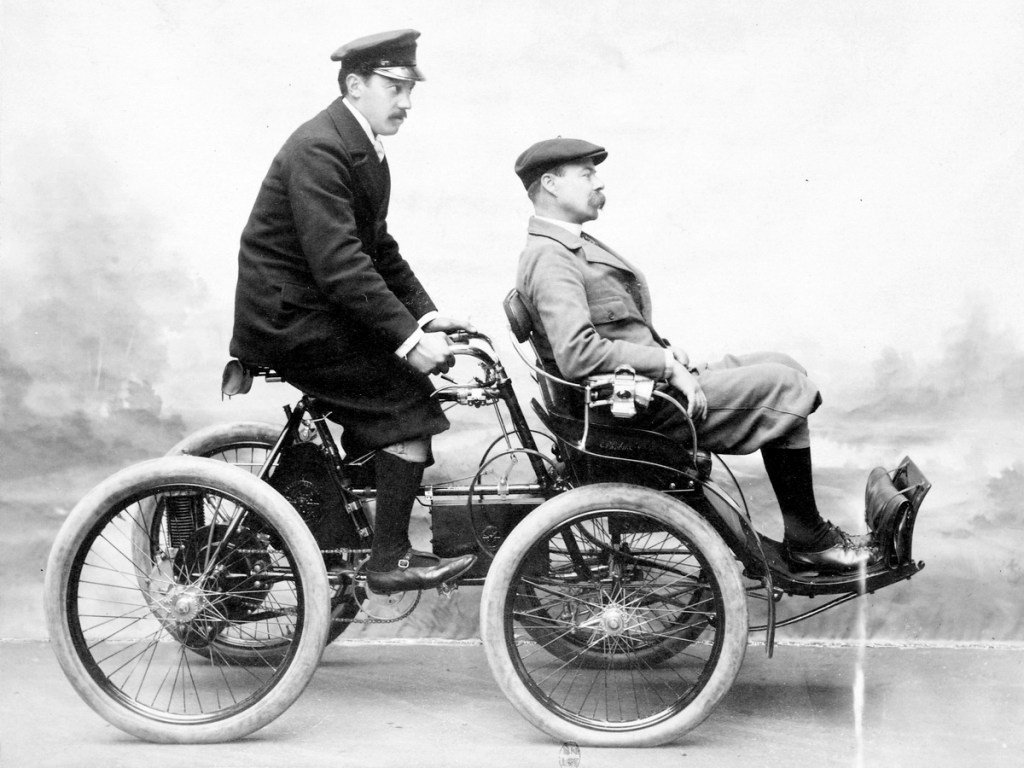
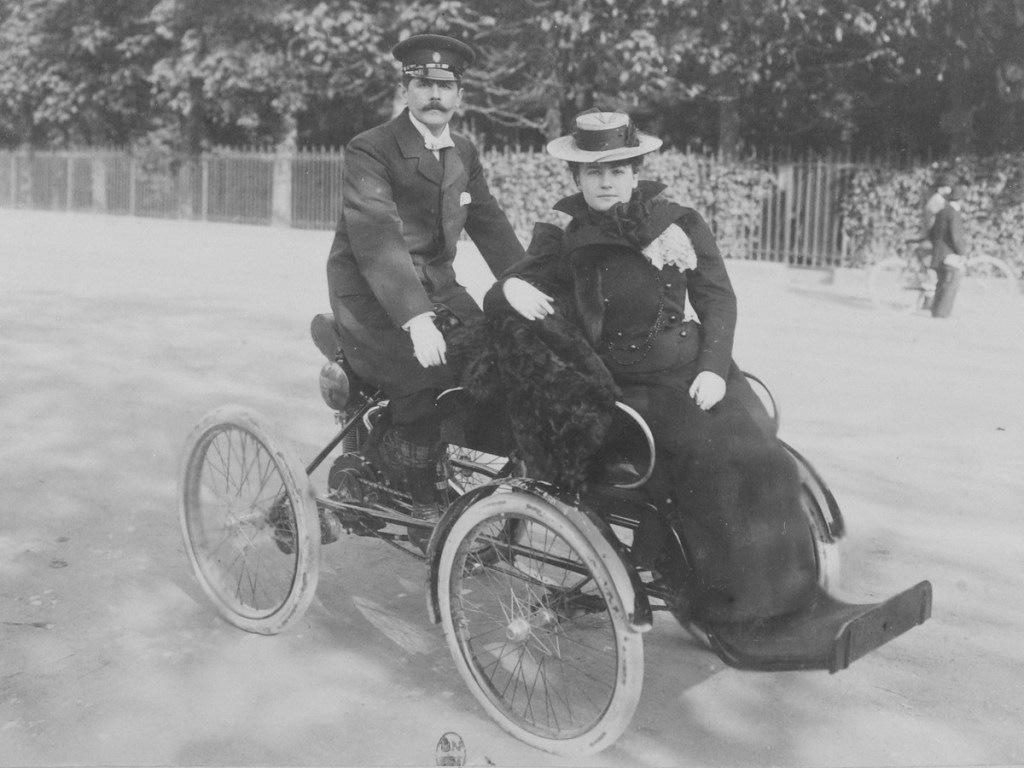
“A MOTOR-CYCLE’S MISBEHAVIOUR. Before the Chester magistrates yesterday, Mr Henry Burton Webb, manager of the Rock Ferry Cycle Company, was charged with a breach of the Locomotive and Highways Act. It appeared that Mr Webb arrived in the city from Shrewsbury with his motorcycle. At Chester the machine failed for want of oil. He bought a quantity of benzine, and was proceeding to examine the cycle with a light when the benzine exploded. The flames went as high as the houses, and a boy named Whitley was severely burnt. The inspector of petroleum stated that benzine flashed of its own accord at a temperature of 51°. The defence was that the people flocked round to see the machine, and that the affair was purely an accident. The Bench said they considered the explosion was quite unintentional. At the same time there had not been reasonable care taken, and they inflicted a fine of 20s and costs.”—Westminster Gazette
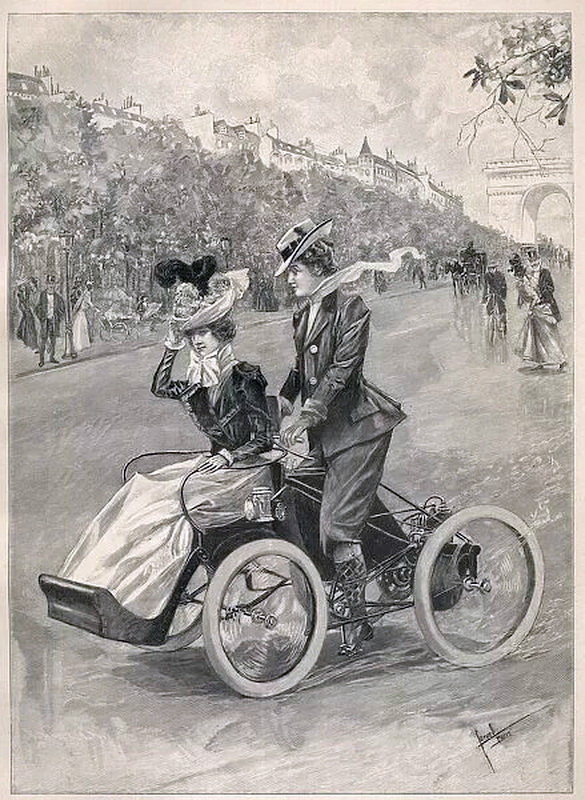
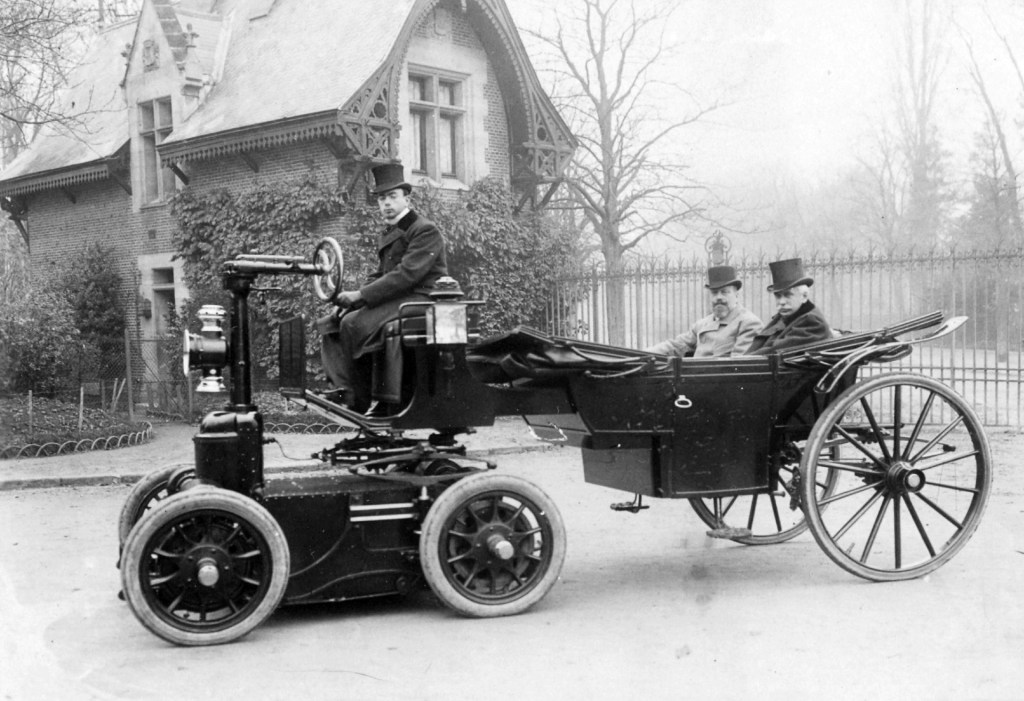
1899
THE STEVENS BROTHERS, George, Jack, Joe, and Harry set up the Stevens Motor Manufacturing Company in Wolverhampton to produce petrol engines. Harry was interested in powered transport and fitted a US-made Mitchell engine that had been acquired for use as a stationary engine into a BSA bicycle that was lying around the works. Ignition was by accumulator and trembler coil; a metal rim was fitted to the rear wheel for a belt drive. The engine wasn’t too reliable but it attracted the attention of their neighbour William Clark, who ran the Wearwell Cycle Company. Believing they could improve on the Mitchell, the Stevens boys had some castings made by a firm in Derby and, in their spare time, made a reliable, efficient (for its day) 1¾hp engine incorporating a carburettor made from an old mustard tin. Stevens already supplied Clark with spokes and fasteners; before long they were also supplying him with engines.
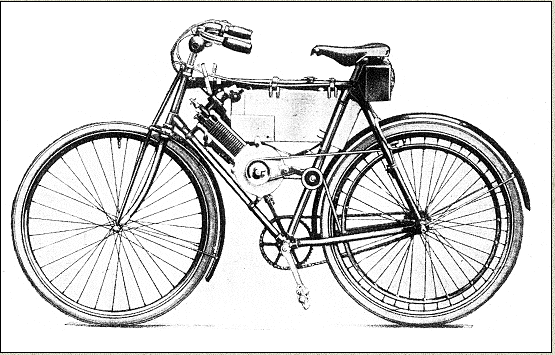
PRINETTI& STUCCI of Milan, who had been making sewing machines since 1882 and bicycles since 1892, began making Tipo 1 trikes (and quads) using not one but two De Dion engines. They were designed by Ettore Bugati who drove a Tipo 1 to victory in a number of road races. Carlo Maserati built a bike on which he also won several races (yes, THAT Bugatti and THAT Maserati).

THE COLLIER Brothers put Woolwich on the map with the first Matchless.
WITH DE DION concentrating on trikes and quads the relatively crude Werner had the market to itself. Harry Lawson’s Motor Traction Company bought the UK rights to the Motocyclette for £4,000; the Werners replaced its hot-tube ignition with a trembler coil. MTC also bought the rights to the four-cylinder Holden. Raleigh fitted 1½hp De Dion engines into its trikes. De Dion-style engines were built under licence by Fafnir in Germany, Laurin and Klement in what is now the Czech Republic and The Motor Manufacturing Company (MMC) in England. Other firms simply built their own versions; they included Aster, Buchet and Clement in France, Sarolea in Belgium and ZL in Switzerland. Also in Switzerland Henri and Armand Dufaux made an engine to power bicycles. It came in its own subframe which was said to look like an engine in a bag so they called it the Motosacoche, which translates as “engine in a bag”.
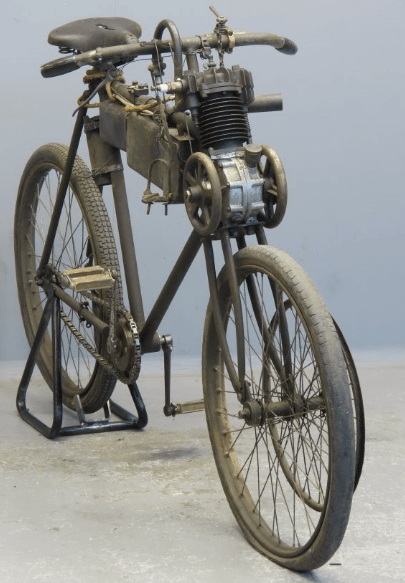


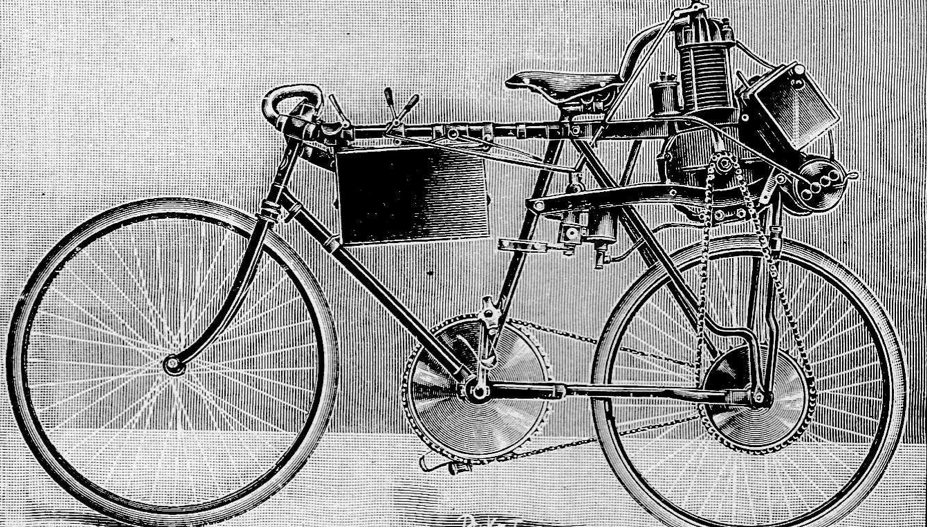
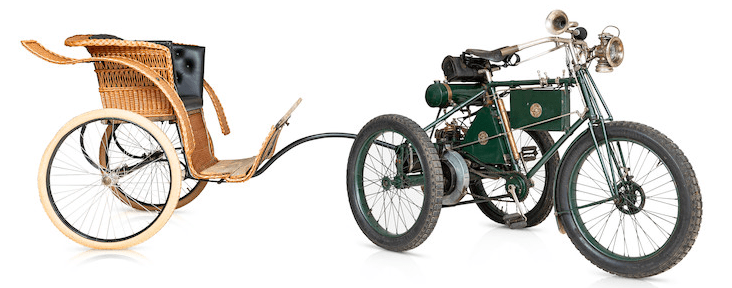
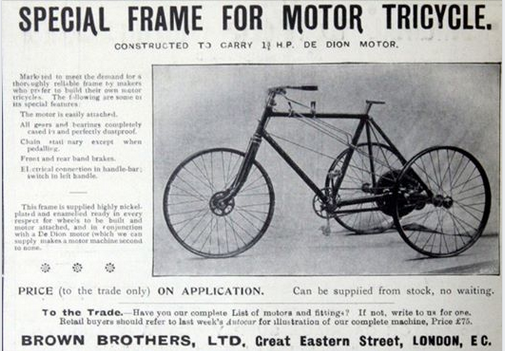
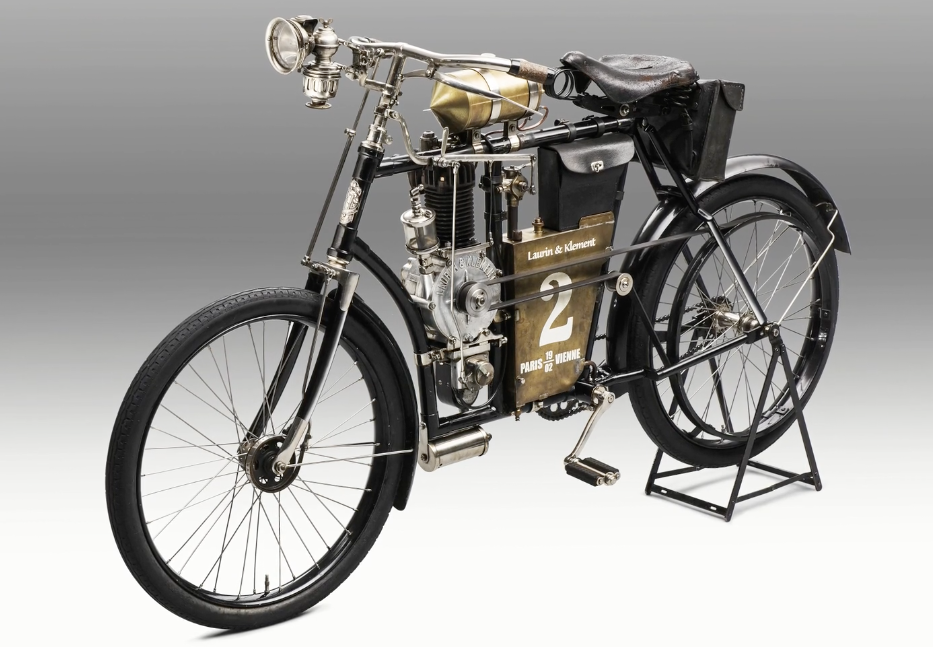
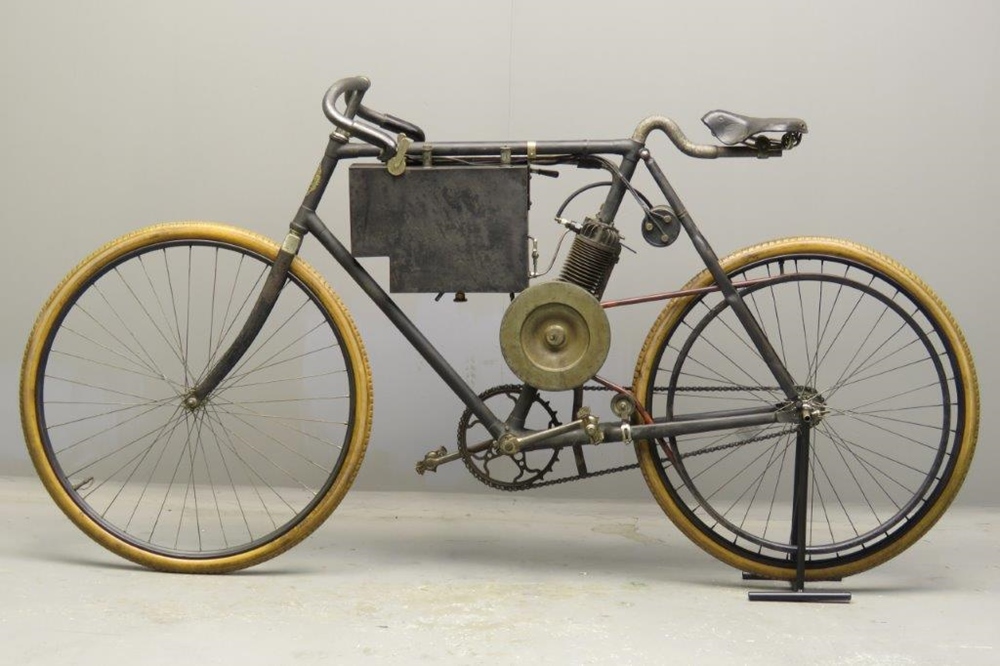
FOR ANYONE PLANNING an Easter run The Autocar listed petrol suppliers—there were four in London and 29 elsewhere in England, including a chemist and a grocer.
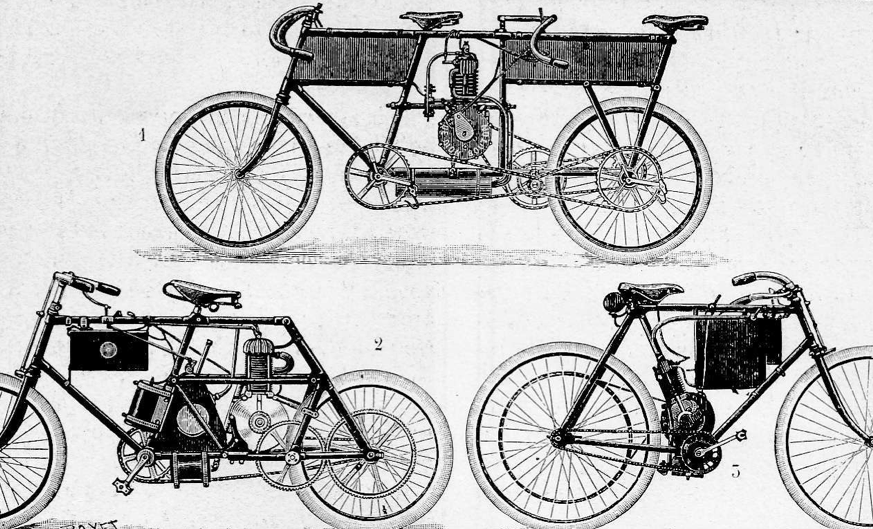
IN THE US THE Marsh Brothers, WT and AR, built the 1hp single-cylinder Marsh Motor Bicycle.
IN FRANCE Paul Bruneau launched a business making motorised bicycles and tricycles.
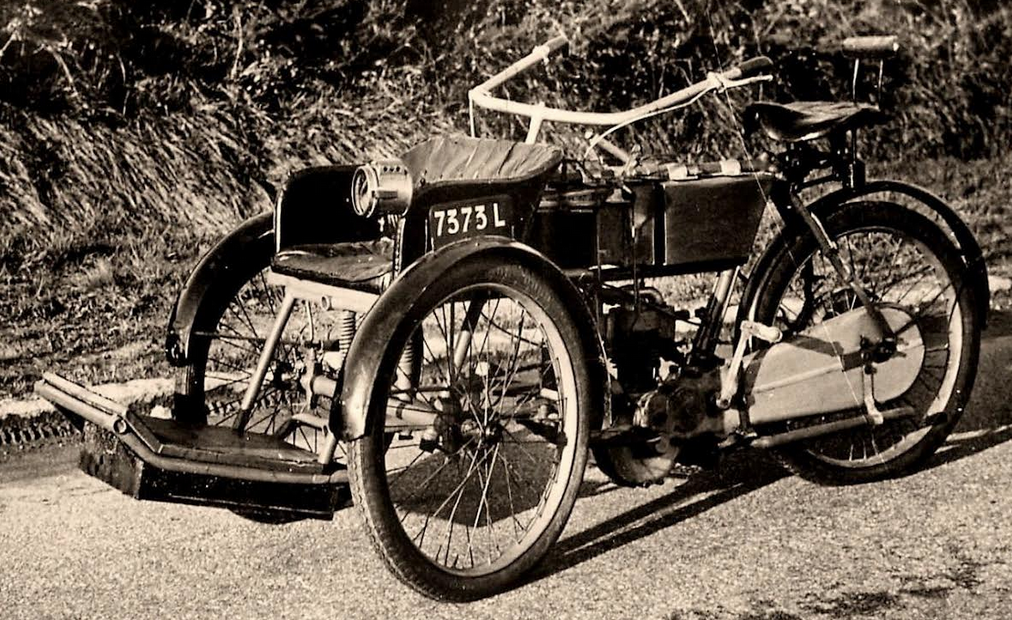
HUMBER CONSTRUCTED a tandem, driven by a battery-powered electric motor. Although its life was short—petrol-engined pacers were faster—it proved to be useful on racing tracks where it was used for cycle pacing. A ladies’ bicycle, modified to carry an engine behind the seat tube, was also produced, along with a forecar known as the Olympia Tandem. This was based on the Pennington design, with the engine hung behind the rear wheel. None of these models were produced beyond 1899.
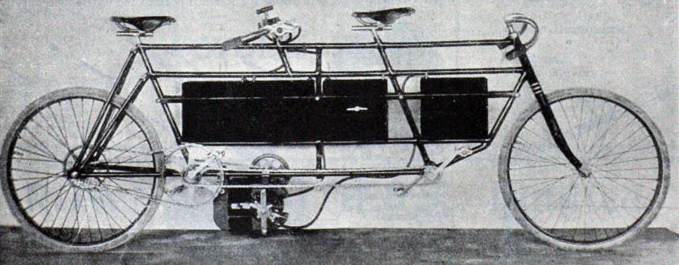
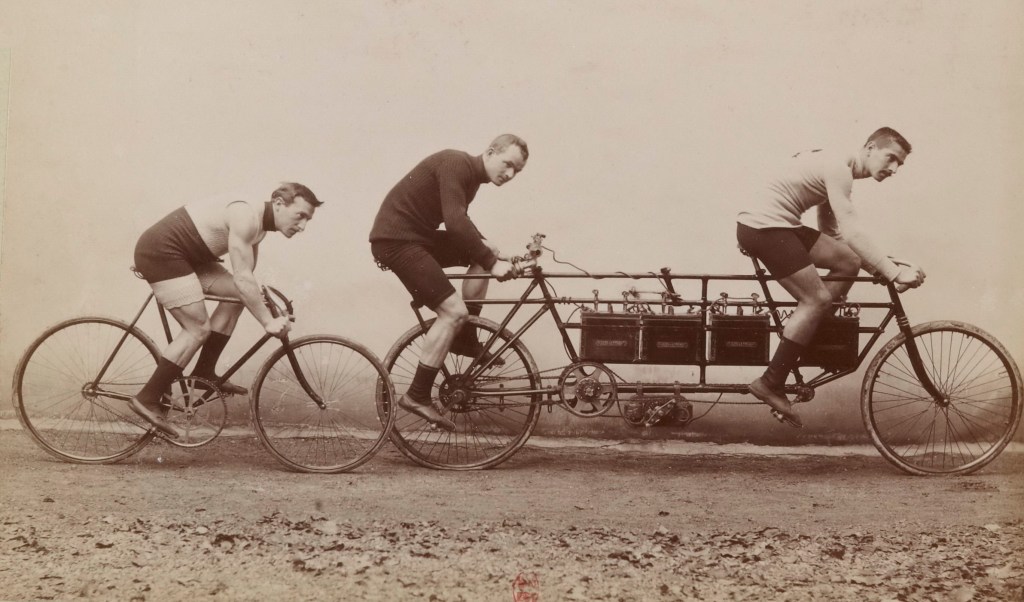
FOLLOWING A FACT finding tour of France, Germany and England, or to be more precise, Coventry, German emigree Alexander Leitner returned home to Riga, Latvia to set up as a bicycle manufacturer. He prospered. Then, having tried and being unimpressed by a Hildebrand & Wolfmüller, Leitner saw some De Dion trikes in St Petersburg and produced half a dozen, using a reinforced version of his existing pedal tricycle.


JOHN HARRIS OF CLEVELAND, OHIO was using an oxy-fuel process in an attempt to make synthetic rubies and sapphires when he accidentally cut through a steel plate. He developed the process and established the Harris Calorific Company to manufacture and sell oxy-acetylene welding and cutting equipment.
JOHN PERRY, DSC, FRS, PROFESSOR OF MECHANICS and Mathematics in the Royal College of Science, Vice-President of the Institution of Electrical Engineers, Vice-President of the Physical Society, wrote a prophetic essay on the evolution of engines and energy sources: “Watt was jubilant if his cylinder was not more than an inch untrue in its bore…the limits of error now allowed by Messrs Willans and Robinson are 0.05mm, and there is less error allowed in other parts of an engine (the metric system of measurement is in use in these excellent shops; its introduction has given no trouble whatsoever). in 1629, the Italian architect Giovanni Branca conceived Branca engine that operated on the same principle as today’s impulse turbines, but it remained at the conceptual stage and never saw practical use. Why! the very engine of Branca, almost without improvement, has lately been brought into use, and already competes in economy with the very best steam engines of equal power. There is a great deal of virtue in a revolving wheel. It may go at great speed, and yet not shake the framework which supports it, even when this framework is light. The very earliest engine, that of Hero, was really a revolving wheel, a reaction turbine, and as I write this (April, 1897) I have received a letter from a friend in Newcastle to say he had just been out on the new Parsons’ turbine steam boat, and that it proves to be the very fastest boat that has ever gone through the water, although only 100ft long. And furthermore, at much smaller speeds, the very best other boats vibrate so much that a man in the stern can hardly keep himself upright, even when holding on hard, whereas at its highest speed the Turbinia has no vibration. When Aladdin first discovered the power at his command it is remarkable how conservative he was in his notions. He made the genie bring him silver dishes, because he started in the silver dish line, and there is one of the most interesting of lessons in the fact that although each of his silver dishes was worth sixty pieces of gold, he sold each of them for one piece of gold over and over again. Aladdin’s imagination had to be stirred by a violent emotion before he could make the genius work in other ways for him. Even at his best I believe that Aladdin never took full advantage of the power of the wonderful lamp. His finest palace was probably just an ordinary house, made very large and stuck over with precious stones, as vulgar as Milan Cathedral. The engineer, far more than Aladdin, needs to have his imagination developed, because Aladdin’s power was unlimited, whereas, great as the stores of Nature are, they are not all for the engineer to develop. It is possible that future scientific men may discover some way of developing them, but so far as we can see there is no great store of energy available for man which is in any way comparable with coal. For the past 20 years I have lifted up my voice occasionally in the hearing of a not unbelieving but a half-hearted generation, to warn men of the time to come, when their great stores of energy will be exhausted. The chancery law of England is destroying invention in all but small details; but if I am right in my beliefs, it would be worth while for our government to hand over a few millions of money to its best scientific men, telling them to squander it in all sorts of experiments, in an intense search for some method by which instead of only from one-twelfth to one-hundredth of the energy of coal being utilised, nine-tenths of it might be utilised. If I am right, almost all the social and political questions which excite us now will be of small importance on the future of the human race, for the wild competition of nations and people for luxuries must gradually during the next 400 years become a struggle for mere existence. Quite common men live now in houses furnished with luxuries of which no potentate of the Middle Ages could dream. I think it to be evident that very much the greater part of all that goes to make up our civilisation is directly or indirectly to be traced to our utilisation of coal, and it is just as evident that when our stores of coal get exhausted the greater part of all this wealth and evidence of civilisation must disappear. The world will not be left in its old state. The old state was like that of an earnest poor young man with great hopes, the new state will be that of the spendthrift, whose fortune has gone but whose expensive habits remain. Then will come the time of great struggle for Niagara by all the civilised nations of the earth; the water power of the West of Ireland will form a new centre of civilisation, as will the hills of Switzerland and all places of high tide round the coasts of the world. Then will be the time when men will try to utilise the stores of energy which now seem to be insignificant or hopelessly out of our reach: the direct radiation from the sun or the internal heat of the earth. I am sure that the mind of no engineer ought ever to be quite free from this incubus that we are wasting our coal with enormous rapidity: that a heat engine is essentially uneconomical. But this book is altogether about heat engines, and when in future I shall speak of the economy of a steam engine, I shall compare it not with that of the perfect engine about which we know so much, but of which not one cheap specimen has yet been made, and not even with the most perfect heat engine imaginable but with the perfect steam engine. In Great Britain an annoying defect may remain unreformed for a century, but let it be called a nuisance by a chancery court and reform is very rapid. Large steam engines are now working in towns: not merely in the slums, but in the districts inhabited by rich people. We are first told that really we must produce no smoke, and instantly we use mechanical stokers or better grates and flues, and we refrain from forcing the fires, and get rid of smoke, although for 100 years every engineer has declared the thing impossible. There is a vast difference between being asked to try to get rid of a nuisance and being told by the policeman that we must stop working if we create a nuisance. We find it necessary to use non-condensing engines in towns because condensation water is expensive; and of course our blast pipe becomes an organ-pipe nuisance; we find that all window frames within half a mile are really microphones. We have remedied this defect of our engines because the only alternative was to stop working. There is a defect that is put up with in locomotives and in ships which is ever so much worse in a large town, and it has been declared to be a nuisance. Consequently every young station engineer has already acquired an astonishing amount of cunning in diagnosing it and mitigating its effects. It is the vibration produced by reciprocating engines. Of course the only real remedy is the use of a steam or gas turbine, sure to be applied in the long run; but capital has given momentum in the direction of reciprocating engine manufacture, and a complete change towards turbine manufacture must be slow.”
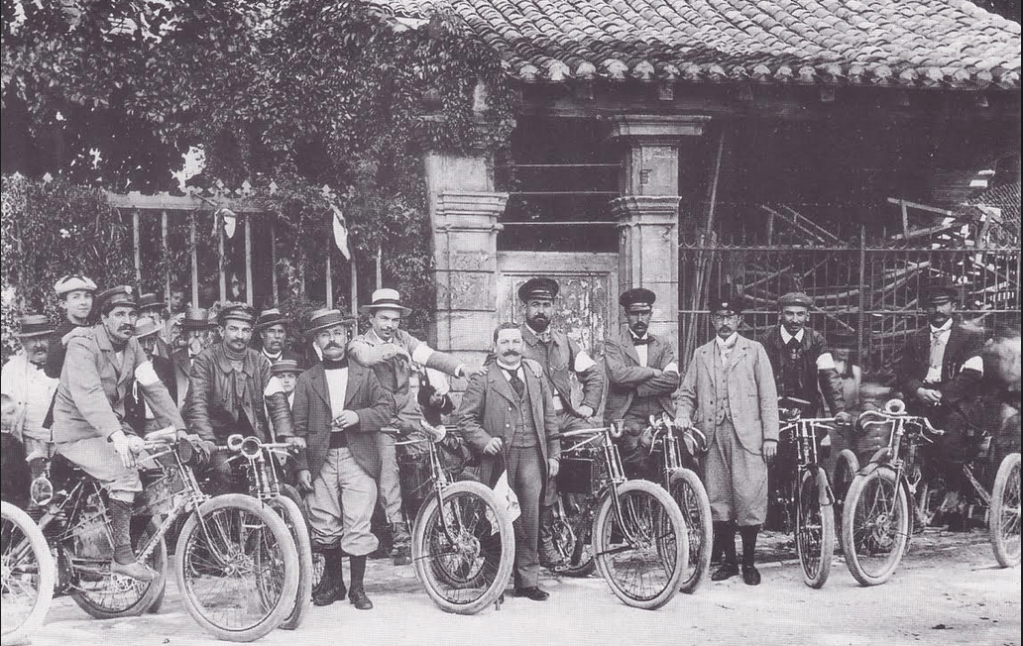
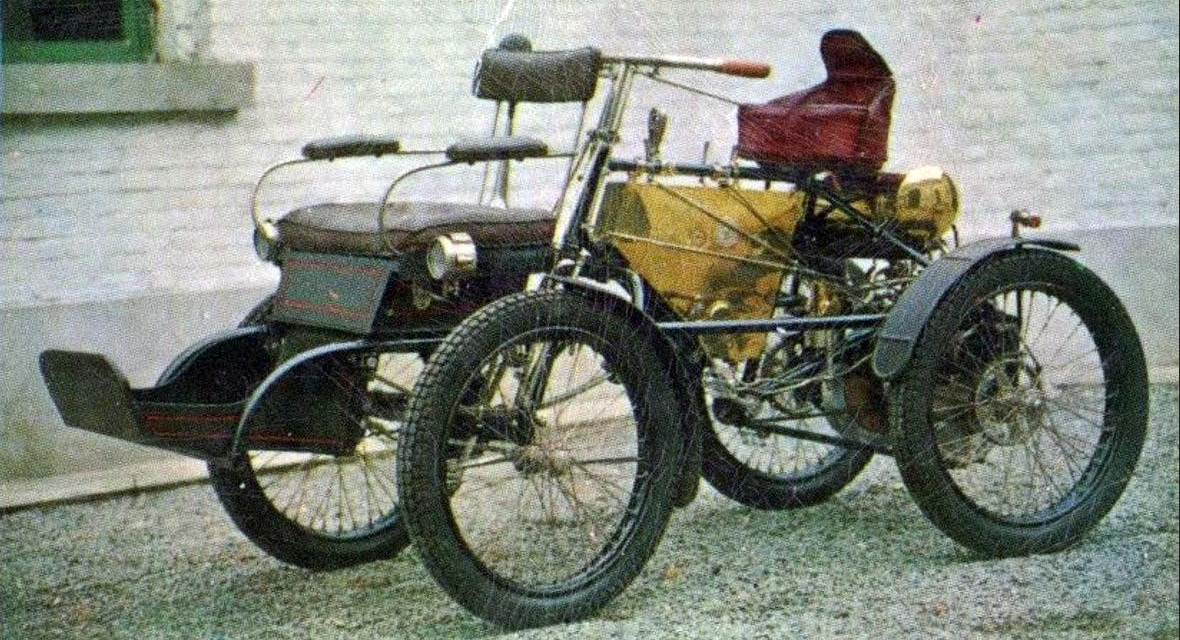
THE CRITÉRIUM DES Motocyclettes is said to be the first race to have been run exclusively for motor cycles. It ran from Etampes to Chartres and back over a distance of 100km; Eugène Labitte won on a Pernoo motorcyclette, powered by the 1¼hp Labitte engine he produced.
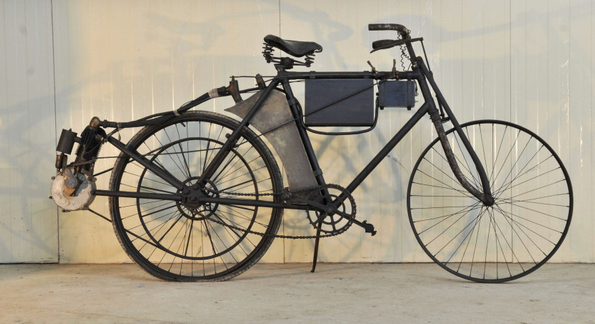
“MORE MOTOR CYCLE RECORDS. Now that the favourite attempt on the hour record has been checked somewhat Beconnui’s riding over 42 miles in the hour the Parisian chauffeurs have begun on a fresh errand—viz, in setting middle distance records. On Octolier 16, at the Parc de Princes’ Track, M Gaste rode 100km (about 62 miles) in 1hr 37min 24⅕sec, world’s record for any type of cycle, motor, or otherwise. It will thus be seen that he covered 100km under 100min. The new world’s record is appended: 68km in 1hr 5min 59⅕sec, 70km in 1hr 17min. 51⅕sec, 80km in 1hr 17min. 47⅕sec, 90km in 1hr 27min. 54⅖sec, 100km in 1hr 37min 24⅕sec. M Gaudichard took the tunes. The best record for cycles over 200km stands at 1hr 48min 50⅗sec, made Bouhours at the Crystal Palace on August 7.”—Sporting Life, Thursday 19 October.”
“PARIS, BEING AT PRESENT without any cycle races, seems to be taking kindly to motorcycle contests. One of these was held on Sunday last at the Parc des Princes cycle track, the competitors being Corré and Osmont, who both rode petroleum tricycles. The match was of six hours duration, and Osmont won, covering 236 kilometres, leaving Corré (the old-time cyclist) a long way behind.”—Cycling
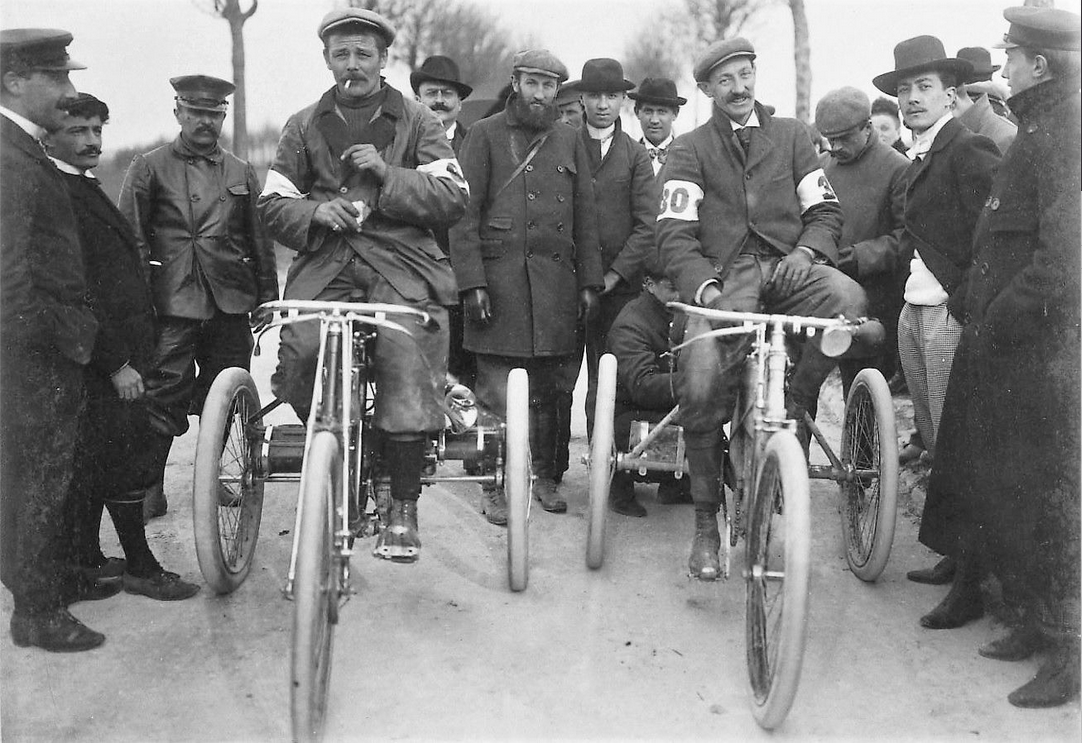
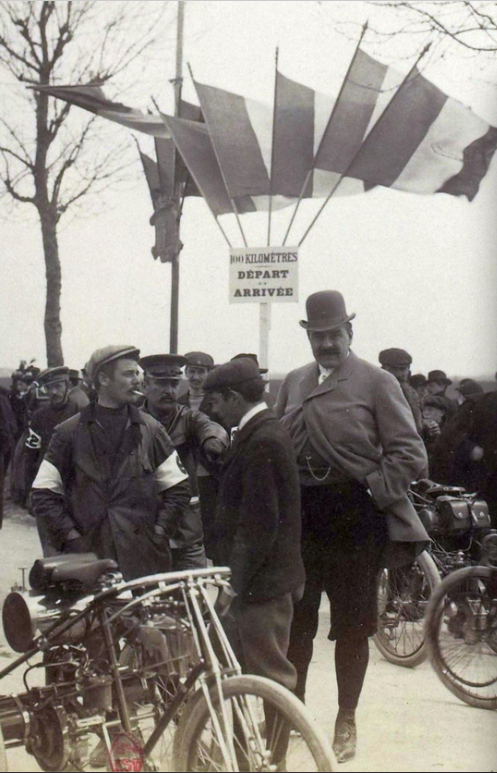
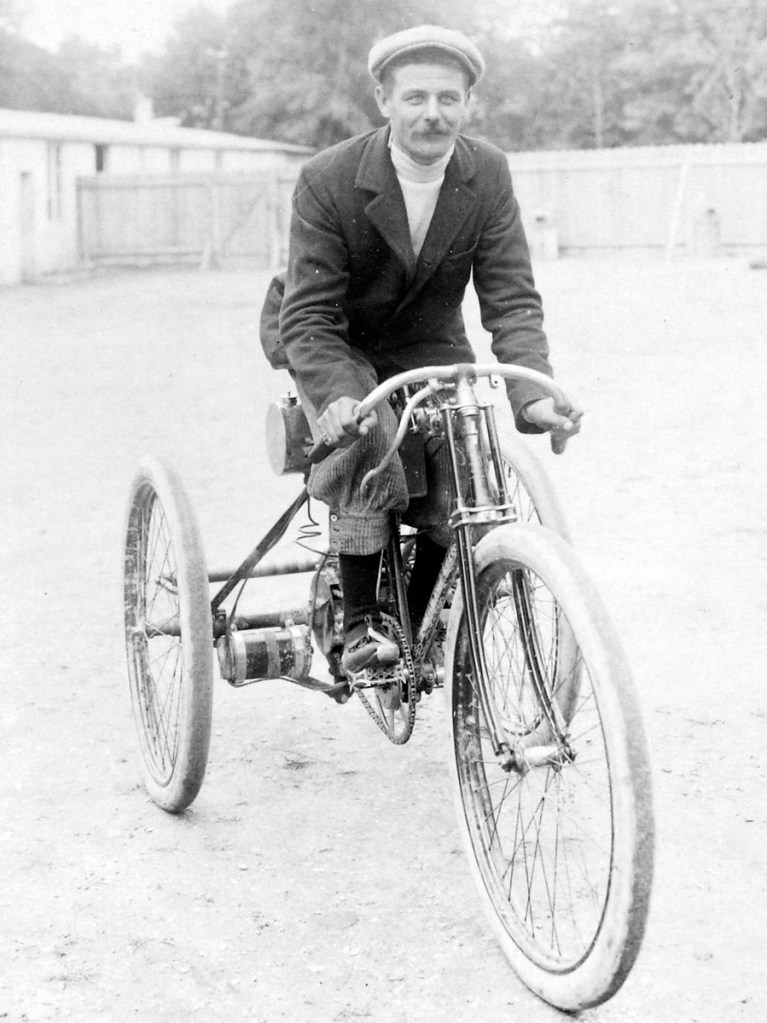
“MOTOR CYCLE RACE MEETING. Yesterday at the Clarence-park track, St Albans, a motor cycle race meeting was held under Motor Car Club rules. C Jarrott was in fine form, as he secured a double first by winning the Five Miles Handicap Race from scratch, and subsequently the Five Miles Level Race, while he held third place from scratch in the Two Miles Open Handicap, being at that point about 20 yards in front of SF Edge, when he had to retire through water getting into his machine. Mr FT Bidlake timed and Mr FF Wellington judged. Results: Five Miles Handicap—1, C Jarrott, scratch, won by 40 yards, time, 8min 34⅕sec; 2, SF Edge, scratch; 3, FG Lewin, 1,600 yards start. Two Miles Local Race—1, EJ Hart, won by 50 yards, time, 4mim 27⅖sec; 2, R. Burley, Five Miles Scratch Race—1, C Jarrott (De Dion), won by 30 yards, time, 8min 43⅘sec; 2, SF Edge (De Dion); 3, CG Wridgeway (Phebis-Astor); 50 yards separated second and third. Two Miles Handicap (Open)—1, GF Lewin, 65O yards start, won by 30 yards, time, 3min 5⅖sec; 2, J Machin, 400 yards; 3, SF Edge, scratch; 20 yards separated second and third.”—Morning Post, Thursday 28 September.
WM. POOLE, OF 28, BURNHAM-ROAD, Tollington Park, London, was summoned by Supt Allen for riding motor tricycle Norman Cross, on the 8th September, a a greater speed than 14mph, contrary to the Locomotives on Highways Act ,1896. Defendant did not appear. PC Mayle proved that the defendant rode to Norman Cross Corner from Stilton village in trifle over two minutes, or at the rate of nearly 30mph. The Court imposed a fine of £2, and 18s costs.”—The Peterborough Advertiser.
“MOTOR CYCLE BLOWN TO ATOMS. A curious and exciting motor cycle accident occurred near Cheltenham late on Sunday night. A local electrician, named Baggett, was riding along a country road when he noticed that burning benzoline was dropping on the road and had ignited his stockings. When he dismounted to extinguish the flames an explosion occurred, and the motor was blown to atoms. The burning oil reached a supply tank, and the flames spread with such rapidity that the grass on the roadside was set alight, and in turn ignited a dry hedgerow. The rider fortunately escaped with but little injury. The accident was probably due to the choking of a valve by grit, which thus caused a leakage of oil.”—Exmouth Journal, Saturday 28 October.
“FATAL MOTOR CYCLE ACCIDENT. A curious accident was witnessed in the Promenade des Anglais at Nice. Two men were riding along, one on a petroleum bicycle, the other on an ordinary machine. Suddenly there was a flame and a loud report, and the rider of the petroleum bicycle fell to the ground writhing with pain, while his comrade was knocked down. An examination showed that the petroleum reservoir had caught fire and exploded, severely burning the rider on the hands, and chest. The unfortunate man died on Monday after terrible suffering. The other cycle was shattered to pieces.”—Dundee Evening Telegraph, Wednesday 5 April.
THE FIRST MEETING of the Tour de France Automobile was held, with 19 cars and 25 motorcycles starting a course of seven stages over 2,216km.

 Motorcycle Timeline